



Form PRE 14A EPLUS INC For: Sep 10
 Tweet
Tweet Share
Share E-mail
UNITED STATES
SECURITIES AND EXCHANGE COMMISSION
Washington, D.C. 20549
Proxy Statement Pursuant to Section 14(a) of
the Securities Exchange Act of 1934 (Amendment No.)
Filed by the Registrant ☒
Filed by a Party other than the Registrant ☐
Check the appropriate box:
| ☒ |
Preliminary Proxy Statement
|
| ☐ |
Confidential, for Use of the Commission Only (as permitted by Rule 14a-6(e)(2))
|
| ☐ |
Definitive Proxy Statement
|
| ☐ |
Definitive Additional Materials
|
| ☐ |
Soliciting Material under § 240.14a-12
|
(Name of Registrant as Specified In Its Charter)
(Name of Person(s) Filing Proxy Statement, if other than the Registrant)
Payment of Filing Fee (Check all boxes that apply):
| ☒ |
No fee required.
|
| ☐ |
Fee paid previously with preliminary materials.
|
| ☐ |
Check computed on table in exhibit required by Item 25(b) per Exchange Act Rules 14a-6(i)(1) and 0-11.
|

Notice of 2026 Annual Meeting of Shareholders
and
Proxy Statement
EPLUS INC.
NOTICE OF 2026 ANNUAL MEETING OF SHAREHOLDERS
|
When:
|
Where:
|
|
September 10, 2026
8:30 a.m. ET
|
The Westin Washington Dulles Airport
2520 Wasser Terrace
Herndon, Virginia 20171
|
We at ePlus inc. (“ePlus” or the “Company”) are pleased to invite you to our 2026 Annual Meeting of Shareholders (the “2026 Annual Meeting”).
Items of Business:
| 1. |
Elect as directors the nine nominees named in the attached proxy statement, each to serve an annual term, or until their successors have been duly elected and qualified;
|
| 2. |
Approve an advisory vote on our named executive officers’ compensation as disclosed in the proxy statement;
|
| 3. |
Ratify the selection of our independent registered accounting firm;
|
| 4. |
Approve an amendment to our amended and restated certificate of incorporation to increase the number of authorized shares of common stock; and
|
| 5. |
Transact such other business as may properly come before the 2026 Annual Meeting, and any postponements or adjournments thereof.
|
Such other business as may properly come before the meeting, or any adjournment or postponement thereof.
Record Date:
All shareholders are welcome to attend the 2026 Annual Meeting. Holders of our common stock as of the close of business on July 17, 2026, are entitled to notice of, and to vote at, the 2026 Annual Meeting.
How to Vote:
Your vote is important to us. Please see “Voting Information” on page 4 for instructions on how to vote your
shares.
These proxy materials are first being distributed on or about July 24, 2026.
|
July 24, 2026
|
By Order of the Board of Directors
|
 Erica S. Stoecker
|
|
|
Corporate Secretary, General Counsel & Chief Compliance Officer
|
|
IMPORTANT NOTICE
Regarding the Availability of Proxy Materials for the Shareholder Meeting to Be Held on September 10, 2026:
ePlus’ proxy statement for the 2026 Annual Meeting and its Annual Report for
the Fiscal Year Ended March 31, 2026,
are Available Online at www.edocumentview.com/plus.
|
|
1
|
||
|
1
|
||
|
1
|
||
|
2
|
||
|
2
|
||
|
3
|
||
|
3
|
||
|
3
|
||
|
4
|
||
|
4
|
||
|
4
|
||
|
4
|
||
|
4
|
||
|
5
|
||
|
5
|
||
|
6
|
||
|
6
|
||
|
6
|
||
|
8
|
||
|
8
|
||
|
9
|
||
|
9
|
||
|
9
|
||
|
9
|
||
| 10 | ||
|
10
|
||
|
10
|
||
|
11
|
||
|
11
|
||
|
11
|
||
|
12
|
||
|
12
|
||
|
16
|
||
|
18
|
||
|
19
|
||
|
19
|
||
|
19
|
||
|
20
|
||
|
21
|
||
|
22
|
||
|
23
|
||
|
23
|
||
|
23
|
||
|
24
|
||
|
24
|
||
|
24
|
||
|
25
|
||
|
26
|
||
|
27
|
||
|
27
|
||
|
27
|
||
|
27
|
||
|
27
|
||
|
29
|
||
|
34
|
||
|
36
|
||
|
36
|
||
|
37
|
||
|
37
|
||
|
37
|
||
|
38
|
||
|
38
|
||
|
40
|
||
|
41
|
||
|
42
|
||
|
42
|
||
|
47
|
||
|
47
|
||
|
51
|
||
|
53
|
||
|
53
|
||
|
54
|
||
|
55
|
||
|
56
|
||
|
56
|
||
|
57
|
||
|
57
|
||
|
57
|
||
|
57
|
||
|
58
|
||
|
58
|
||
|
58
|
||
|
58
|
||
|
61
|
||
|
61
|
||
|
61
|
||
|
61
|
||
|
61
|
||
|
62
|
||
|
62
|
||
|
62
|
||
|
2026 Annual Meeting
|
|
Who:
|
Shareholders as of the Record Date, July 17, 2026
|
|
What:
|
See detailed Proposals on pages 11, 23, 53 and 56, and summaries below
|
|
When:
|
September 10, 2026, 8:30 a.m. ET
|
|
Where:
|
The Westin Washington Dulles Airport, 2520 Wasser Terrace, Herndon, Virginia 20171
|
|
How:
|
Internet/Mobile, Telephone, Mail, In Person (see “Voting Information”
beginning on page 4 for details)
|
|
Proxy:
|
We began mailing these proxy materials to our shareholders on July 24, 2026
|
|
Who We Are and What We Do
|
ePlus has an unwavering and relentless focus on leveraging
technology to create inspired and transformative business outcomes for its customers. Offering a robust portfolio of solutions, as well as a full set of consultative and managed services across the technology spectrum, ePlus has proudly achieved more than 35 years of success in the business, carrying customers forward through adversity, rapidly changing environments, and other obstacles. ePlus is a
trusted advisor, bringing expertise, credentials, talent and a thorough understanding of innovative technologies, spanning artificial intelligence (“AI”), cloud, data center, security, networking,
collaboration and critical infrastructure to domestic and foreign organizations across all industry segments. ePlus’ more than 2,100 associates are focused on cultivating positive customer experiences
and are dedicated to their craft, harnessing new knowledge while applying decades of proven experience.
On June 30, 2025, ePlus closed a transaction with Marlin Leasing Corporation (dba PEAC Solutions), a
portfolio company of the Asset Value Funds sponsored and managed by leading global investment firm HPS Investment Partners, LLC, to sell the domestic subsidiaries comprising our U.S. financing business (the “Divestiture”).
The Divestiture positions ePlus as a pure-play technology solutions provider and strengthens our ability to continue to invest in high growth areas of AI, cloud, cybersecurity, data center modernization,
high performance networking and related consulting and managed services, while providing us the flexibility to accelerate plans around expanding our footprint and customer base. For additional information regarding the Divestiture, please refer
to our Current Reports on Form 8-K filed with the Securities and Exchange Commission (the “SEC”) on (i) June 23, 2025, and (ii) July 1, 2025, as amended, as well as other filings we make with the SEC from
time to time.
ePlus is currently headquartered at 13595 Dulles Technology Drive, Herndon, VA 20171, with locations in the United States, UK, Europe, and Asia‐Pacific. For more information, visit www.eplus.com.
PROPOSAL 1 – ELECTION OF DIRECTORS
ePlus’ Board of Directors (the “Board of Directors” or “Board”) is currently composed of nine directors in total. Eight of ePlus’ directors are “independent,” and one director, our Chief Executive Officer, Mark P. Marron, is not “independent,” within the meaning of The Nasdaq Stock Market LLC’s (“Nasdaq”) listing standards. The Board’s Nominating and Corporate Governance Committee has recommended to the Board, and the Board has nominated for election at our 2026 Annual Meeting, each of our
nine sitting directors, having found they each possess the requisite knowledge, skills, and abilities to oversee the Company’s strategy, management and business objectives.
|
ePlus Director Nominees for the 2026 Annual Meeting
|
|||||||
|
Board Committees
|
|||||||
|
Name
|
Age*
|
Audit
|
Compensation
|
Nominating &
Corporate
Governance
|
Number of
Other Public
Company Boards
|
Independent
Director
|
|
|
Melissa J. Ballenger
|
56
|
Chair
|
✔
|
0
|
✔
|
||
|
Renée Bergeron
|
63
|
Chair
|
✔
|
0
|
✔
|
||
|
Bruce M. Bowen
|
74
|
0
|
✔
|
||||
|
John E. Callies
|
72
|
✔
|
Chair
|
0
|
✔
|
||
|
Ira A. Hunt, III
|
70
|
✔
|
✔
|
0
|
✔
|
||
|
John M. Lutz
|
64
|
✔
|
✔
|
0
|
✔
|
||
|
Mark P. Marron, CEO and President
|
65
|
0
|
|||||
|
Maureen F. Morrison
|
72
|
✔
|
✔
|
1
|
✔
|
||
|
Michael J. Portegello
|
62
|
✔
|
✔
|
0
|
✔
|
||
*Ages are as of the date of this proxy statement.
More information about our Board, including their biographies, is available in Proposal 1 – Election of
Directors.
PROPOSAL 2 – ADVISORY VOTE TO APPROVE NAMED EXECUTIVE OFFICERS’ COMPENSATION
Our executive compensation philosophy is to reward performance in alignment with our shareholders’ long-term interests, and to promote and
maintain stability within the executive team by granting long-term compensation such as cash incentives, performance stock units and restricted stock awards, each with multi-year vesting terms.
For the fiscal year ended March 31, 2026, our named executive officers were Chief Executive Officer (“CEO”) and President, Mark P. Marron; Chief Financial Officer (“CFO”), Elaine D. Marion; Chief Operating Officer (“COO”), Darren S. Raiguel; and General Counsel (“GC”) and Chief Compliance Officer, Erica S. Stoecker
(appointed as an executive officer effective October 20, 2025). Each received a base salary, short-term cash incentive compensation, and long-term equity-based incentive compensation, and Messrs. Marron and Raiguel and Ms. Marion also
received long-term cash incentive compensation. Detailed information about our executive compensation practices is available in the section titled “Compensation Discussion and
Analysis”.
Last year at our September 2025 Annual Meeting of Shareholders (the “2025 Annual
Meeting”), our shareholders approved the Company’s say-on-pay proposal with approximately 89.4% of the votes cast in its favor. The Compensation Committee considered this approval in determining that our executive compensation
philosophies and objectives continue to be appropriate, and did not require changes in response to the say-on-pay vote at the 2025 Annual Meeting.
THE BOARD UNANIMOUSLY RECOMMENDS A VOTE FOR
THE APPROVAL OF THE COMPANY’S EXECUTIVE COMPENSATION PROGRAM
PROPOSAL 3 – RATIFICATION OF INDEPENDENT REGISTERED PUBLIC ACCOUNTING FIRM
The Board’s Audit Committee has selected Deloitte & Touche LLP (“Deloitte”)
as the Company’s independent registered accounting firm for the fiscal year ending March 31, 2027. Deloitte has served as the Company’s independent registered public accounting firm since 1990, and the Board unanimously recommends that
shareholders vote to ratify the appointment of Deloitte as the Company’s independent registered public accounting firm. More information about Deloitte is available in Proposal
3 – Ratification of the Selection of Deloitte & Touche LLP as our Independent Registered Public Accounting Firm for our Fiscal Year Ending March 31, 2027.
THE BOARD UNANIMOUSLY RECOMMENDS A VOTE FOR
RATIFICATION OF THE APPOINTMENT OF DELOITTE
PROPOSAL 4 – APPROVAL OF AN AMENDMENT TO THE COMPANY’S AMENDED AND RESTATED CERTIFICATE OF INCORPORATION
TO INCREASE THE NUMBER OF AUTHORIZED SHARES OF COMMON STOCK
We are asking shareholders to approve an amendment to our Amended and Restated Certificate of Incorporation, as previously amended on September
18, 2023 (the “Certificate of Incorporation”), to increase the number of authorized shares of our common stock, par value $.01 per share, from 50 million to 75 million,
which would correspondingly increase the total number of authorized shares of capital stock to 77 million (with no change to the 2 million authorized shares of Preferred Stock) (the “Authorized Share Increase”).
The Board of Directors has determined that the Authorized Share Increase is advisable and in the best interests of the Company and its
shareholders and has unanimously approved the Authorized Share Increase, subject to shareholder approval. More information about the Authorized Share Increase is available in Proposal
4 – Approval of an Amendment to the Company’s Amended and Restated Certificate of Incorporation to Increase the Number of Authorized Shares of Common Stock.
THE BOARD UNANIMOUSLY RECOMMENDS A VOTE FOR
THE AUTHORIZED SHARE INCREASE
This proxy statement, our Notice of Internet Availability of Proxy Materials
(the “Notice”) and our proxy card are being
furnished in connection with the solicitation of proxies by the Company’s Board, to be voted at our 2026 Annual Meeting, and at any adjournment or postponement of the Annual Meeting. We are using the “Notice and Access” method of furnishing proxy materials to you over the Internet. The SEC’s Notice and Access
rules permit us to furnish our shareholders with proxy materials, including this proxy statement and our Annual Report, including the Annual Report on Form 10-K for fiscal year 2026 that was previously filed with the SEC (the “2026 Form 10-K”), by providing access to such documents on
the Internet instead of mailing printed copies. We believe that this process will provide you with convenient and efficient access to your proxy materials so you may vote your shares, while allowing us to reduce the environmental impact
of our 2026 Annual Meeting and the costs of printing and distributing the proxy materials. On or about July 24, 2026, we mailed our shareholders the Notice with instructions for accessing our proxy statement and Annual Report. The
Notice also identifies the items to be voted on at the 2026 Annual Meeting and provides instructions for voting and instructions for requesting a printed copy of the proxy materials. Most shareholders will not receive printed copies of
the proxy materials unless they request them. If you would like to receive printed or electronic copies of our proxy materials, you should follow the instructions in the Notice for requesting such materials. Any request to receive proxy
materials by mail will remain in effect until you revoke it.
You are eligible to vote at the 2026 Annual Meeting if you were a shareholder of record of ePlus inc. as of the close of business on July 17, 2026, the record date (“Record Date”) for our 2026 Annual Meeting.
Cast your vote as soon as possible on each of the proposals listed below to ensure your shares are represented.
|
Proposal
|
More Information
|
Board Recommendation
|
|
1 Election of Directors
|
Page 11
|
FOR each Director Nominee
|
|
2 Advisory Vote to Approve Named Executive Officers’ Compensation
|
Page 23
|
FOR
|
|
3 Ratification of Independent Registered Public Accounting Firm
|
Page 53
|
FOR
|
|
4 Approval of the Authorized Share Increase
|
Page 56
|
FOR
|
Even if you plan to attend the 2026 Annual Meeting in person, read this proxy statement with care and cast your vote as soon as possible, as
described below. For shareholders of record, have your Notice or proxy card in hand and follow the instructions. If you hold your shares through a broker, bank, or other nominee, you will receive voting instructions from your broker,
bank, or other nominee, including whether telephone or Internet voting options are available, and any voting deadline that may differ from the below.
| • |
Vote your shares online at www.investorvote.com/plus until 8:30 a.m. ET on September 10, 2026.
|
| • |
Vote your shares by toll-free telephone call by calling 1-800-652-VOTE (8683) until 8:30 a.m. ET on September 10, 2026.
|
| • |
Vote your shares by mail; mark, sign, and date your proxy card, and return it in the postage-paid envelope (must be received by 8:30 a.m. ET on September 10, 2026).
|
A proxy that is signed and dated, but which does not contain voting instructions, will be voted as recommended by our Board on each proposal.
You may vote in person at the 2026 Annual Meeting, which will be held on September 10, 2026, at 8:30 a.m. ET at the Westin Washington Dulles
Airport, 2520 Wasser Terrace, Herndon, Virginia 20171.
If you hold your shares through a broker, bank, or other nominee and would like to vote in person at the 2026 Annual Meeting, you must first
obtain a proxy issued in your name from the institution that holds your shares.
The presence, in person or by proxy, of the holders of record of a majority in voting interest of the outstanding capital stock entitled to vote
at the 2026 Annual Meeting is necessary to constitute a quorum at the 2026 Annual Meeting.
A list of shareholders entitled to vote will be available for 10 days prior to the 2026 Annual Meeting at our headquarters, 13595 Dulles
Technology Drive, Herndon, Virginia 20171. If you would like to view the shareholder list, please contact our Investor Relations Department at [email protected] or by telephone at (703) 984-8400 to schedule an appointment.
Shareholders’ votes will be tabulated by a representative of the Company’s Transfer Agent, Computershare. Shareholders who vote and/or attend the
2026 Annual Meeting by following the instructions in this proxy statement will be considered to be attending the 2026 Annual Meeting.
If you are the beneficial owner of shares held for you by a broker, bank or other nominee, such holder must vote those shares in accordance with
your instructions. If you do not give instructions, whether the broker, bank or other nominee can vote your shares depends on whether the proposal is considered “discretionary” or “non-discretionary.” If a proposal is discretionary, a broker
or other entity holding shares for an owner in street name may vote on the proposal without voting instructions from the owner. If a proposal is non-discretionary, the broker or other nominee may vote on the proposal only if the owner has
provided voting instructions. A “broker non-vote” occurs when a broker or other nominee holding shares for a beneficial owner does not vote on a particular proposal because the broker or other nominee does not have discretionary voting power
for that item and has not received instructions from the beneficial owner. Proposal 3 (Ratification of Independent Registered Public Accounting Firm) and Proposal 4 (Approval of the Authorized Share Increase) are the only discretionary
proposals; therefore, brokers or other nominees only have discretion to vote customers’ unvoted shares held by such firms in street name on Proposal 3 and Proposal 4.
Both abstentions and broker non-votes will be treated as shares present for purposes of determining the presence of a quorum at the 2026 Annual
Meeting.
|
Proposal
|
Vote Required
for Approval(1)
|
Effect of
Abstentions
|
Effect of
Broker Non-Votes
|
|
| 1 |
Election of Directors
|
“FOR” votes of a majority of the votes cast with respect to each
director
|
None; not counted
as a “vote cast”
|
None; not counted as a “vote cast”
|
| 2 |
Advisory Vote to Approve Named
Executive Officers’ Compensation
|
“FOR” votes of a majority of the shares present in person or
represented by proxy and entitled to vote
|
None; not counted as a “vote cast”
|
None; not counted as a “vote cast”
|
| 3 |
Ratification of Independent
Registered Public Accounting Firm
|
“FOR” votes of a majority of the shares present in person or
represented by proxy and entitled to vote
|
None; not counted as a “vote cast”
|
Brokers and other nominees may vote;(2) Broker non-votes are
not expected
|
| 4 |
Approval of Authorized Share Increase
|
“FOR” votes of a majority of the shares present in person or
represented by proxy and entitled to vote
|
None; not counted as a “vote cast”
|
Brokers and other nominees may vote;(2) Broker non-votes are
not expected
|
|
(1)
|
Assuming the presence of a quorum at the 2026 Annual Meeting.
|
|
(2)
|
If a broker or other nominee does not exercise this discretion, such broker non-votes will have no effect on the results of this
vote.
|
Our Board of Directors has adopted Corporate Governance Guidelines and Policies (the “Guidelines”) that provide a framework for effective corporate governance. The Guidelines outline our Board of Directors’ operating principles, and the composition and working processes of our Board and its committees. Our
Nominating and Corporate Governance Committee periodically reviews our Guidelines and developments in corporate governance, and, if appropriate, recommends proposed changes for Board approval.
Our Guidelines and other corporate governance documents, including the Charter,
Bylaws, committee charters, and our Code of Conduct and Business Partner Code of Conduct, are all available on our website at https://www.eplus.com/who-we-are/investor-relations/governance.
Under our Guidelines and Nasdaq’s listing standards, a majority of our Board members must be “independent.” The Board of Directors annually
determines whether each of our directors is independent. In determining independence, the Board follows the independence criteria set forth in Nasdaq’s listing standards and considers all relevant facts and circumstances.
Pursuant to Nasdaq’s independence criteria, a director is not “independent” if she or he has one or more of the relationships specifically
enumerated in Nasdaq’s listing standards. In addition, the Board must affirmatively determine that a director does not have a relationship that, in the Board’s opinion, would interfere with that director’s exercise of independent judgment in
carrying out the responsibilities of a director. The Board has affirmatively determined that Messrs. Bowen, Callies, Hunt, Lutz and Portegello, and Mses. Ballenger, Bergeron and Morrison, are each “independent” under the applicable Nasdaq
listing standards.
The Board regularly reviews the effectiveness of the Company’s corporate governance structure, and on at least an annual basis, examines what
form of Board leadership structure is in the best interest of our shareholders. The Board has determined that at this time, a structure with a separation of the Board Chair and CEO roles, along with the implementation of regular executive
sessions of the independent directors, provides appropriate oversight of the Company’s strategic direction and enables the Board to best carry out its roles and responsibilities on behalf of ePlus’ shareholders. Ms. Maureen Morrison currently serves as our Board Chair, a role which she has held since the 2024 Annual Meeting of Shareholders.
The Board also regularly reviews its committee structure. Each of the Board’s standing committees—Audit, Compensation, and Nominating and
Corporate Governance—are comprised entirely of independent directors, which further complements the Board’s oversight role.
Our Board has three standing committees: (1) Audit, (2) Compensation, and (3)
Nominating and Corporate Governance. Each committee’s charter is available on our website at https://www.eplus.com/who-we-are/investor-relations/governance. Effective July 18, 2025, Mr. Xiang resigned as a member of the Board and each of its committees. Following Mr. Xiang’s resignation, the following changes were made to the Board’s committees: (i) John E.
Callies rotated off of the Compensation Committee, became a member of, and chair of, the Nominating and Corporate Governance Committee, and continues to serve on the Audit Committee, but no longer serves as the chair of the Audit
Committee; (ii) Melissa J. Ballenger continues to serve on the Audit Committee, and became the new chair of the Audit Committee; and (iii) Renée Bergeron continues to serve on the Nominating and Corporate Governance Committee, and became
the new chair of the Nominating and Corporate Governance Committee. For additional information regarding Mr. Xiang’s resignation from the Board, please refer to the Company’s Current Report on Form 8-K that was filed with the SEC on July
18, 2025. On January 6, 2026 and July 6, 2026, Michael J. Portegello and John M. Lutz, respectively, were appointed to the Board, with both appointed to serve on the Audit Committee and Compensation Committee. Additional information about
each committee, including each committee’s current membership, is below.
|
Audit Committee
|
|||||
|
Chair:
Melissa J. Ballenger
Other Committee Members: John E. Callies, John M. Lutz, Maureen F. Morrison, Michael J. Portegello
Meetings Held in Fiscal Year 2026: 8
Independence:
Each Audit Committee member meets the audit committee independence requirements of Nasdaq and the rules of the Securities Exchange Act of
1934, as amended (the “Exchange Act”).
Qualifications:
Each member of the Audit Committee is financially literate, knowledgeable, and qualified to review financial statements.
In addition, the Board has determined that Melissa J. Ballenger, John E. Callies, Maureen F. Morrison and Michael J. Portegello each meet
the definition of an “audit committee financial expert” under the Exchange Act rules.
|
Primary Responsibilities:
Our Audit Committee is responsible for, among other things: (1) appointing, compensating, retaining, and overseeing the work of the
independent auditor engaged to prepare or issue audit reports and perform other audit, review, or attest services for the Company; (2) reviewing and discussing the annual audited financial statements with management and the Company’s
independent auditor, including the Company’s disclosures under “Management’s Discussion and Analysis of Financial Condition and Results of Operations” (“MD&A”),
and recommending to the Board whether the audited financial statements should be included in the Company’s Annual Report on Form 10-K; (3) reviewing and discussing the Company’s unaudited financial statements and related footnotes, the
auditor’s quarterly review and the MD&A portion of the Company’s Form 10-Q for each interim quarter with management and the independent auditor; (4) overseeing the Company’s internal audit function; and (5) reviewing and discussing
the earnings press releases, financial information (including non-GAAP information) and earnings guidance, if any, provided to analysts and rating agencies with management and/or the independent auditor, as appropriate.
|
||||
|
Compensation Committee
|
|||||
|
Chair:
Renée Bergeron
Other Committee Members: Melissa J. Ballenger, Ira A. Hunt, III, John M. Lutz, Michael J. Portegello
Meetings Held in Fiscal Year 2026: 8
Independence:
Each member of the Compensation Committee meets the compensation committee independence requirements of Nasdaq and the Exchange Act rules,
as well as the non-employee director requirements of Exchange Act Rule 16b-3, and the outside director requirements under the Internal Revenue Code Section 162(m).
|
Primary Responsibilities:
Our Compensation Committee is responsible for, among other things: (1) establishing the Company’s general compensation philosophy and
overseeing the development and implementation of our executive compensation programs and related policies, including ensuring promotion of shareholder interests and support of our strategic objectives; (2) reviewing and approving, and
recommending for Board ratification (as relates to the CEO), the corporate goals and objectives applicable to the compensation of the Company’s CEO and other executive officers; (3) reviewing and approving and, if required by law,
recommending for Board approval incentive compensation and equity-based plans, and, where appropriate or required, recommending such plans for shareholder approval; (4) reviewing the Company’s Section 16 officer compensation
arrangements to determine whether they encourage unnecessary or excessive risk-taking, reviewing and discussing at least annually the relationship between risk management policies and practices related to executive compensation, and
evaluating compensation policies and practices that could mitigate any such risk; (5) reviewing periodically the terms and implementation of any “clawback” or similar policy or agreement regarding the Company’s cancellation or
recoupment of employee compensation; (6) reviewing and discussing with management the Compensation Discussion and Analysis (“CD&A”) and related executive
compensation information, and recommending the same for inclusion in the Company’s proxy statement or Annual Report; (7) reviewing and recommending for Board approval the frequency with which the Company conducts Say on Pay votes, and
approving proposals regarding the Say on Pay Vote; (8) appointing, compensating and overseeing the work of any compensation consultant, legal counsel, or other advisor the Committee retains and periodically evaluating the independence
of such advisors; (9) reviewing plans for Section 16 officer development and succession planning and discussing the same with the Board at least annually; and (10) reviewing and approving, and recommending for Board ratification,
employment agreements, severance agreements, retention agreements and change in control agreements for the Company’s executive officers.
|
||||
|
Nominating and Corporate Governance Committee
|
|||||
|
Chair:
John E. Callies
Other Committee Members:
Renée Bergeron, Ira A. Hunt, III, Maureen F. Morrison
Meetings Held in Fiscal Year 2026: 4
Independence:
Each member of the Nominating and Corporate Governance Committee meets Nasdaq’s independence requirements.
|
Primary Responsibilities:
Our Nominating and Corporate Governance Committee is responsible for, among other things: (1) selecting and recommending nominees for director election to
the Board; (2) reviewing committee composition and presenting recommendations for committee memberships and committee chairs to the Board; (3) overseeing the annual performance evaluation of the Board, each of its committees, and the
Chair of the Board; (4) annually reviewing and recommending compensation of non-employee directors to the Board; (5) reviewing our related person transaction policy, and any related person transactions; and (6) reviewing and assessing
the adequacy of our corporate governance framework, including our Charter, Bylaws, and the Guidelines, and making recommendations to the Board as appropriate.
|
||||
Our directors are expected to attend meetings of the Board and applicable committees. During our fiscal year ended March 31, 2026, the Board held
16 meetings. Each of our directors attended at least seventy-five percent (75%) of the meetings of the Board and the committees on which she or he served. Beyond holding regular Board meetings, the Board also convenes periodic informational
sessions for Board members to remain well-informed about operational and industry trends, emerging risks, and strategic developments that support effective oversight and well-informed decision‑making. Although we do not have a formal policy
requiring directors to attend our Annual Meetings, we encourage their attendance. All seven of our directors then in service attended the 2025 Annual Meeting.
The Board oversees the Company’s enterprise risk management process. Management reviews the process with the Board on a periodic basis, including
identifying key risks and steps taken to monitor or mitigate those risks, including risks associated with business strategy, operations, accounting and controls, cybersecurity, environmental, social and governance, human capital and capital
investments. In addition, the Board’s standing committees—Audit, Compensation, and Nominating and Corporate Governance—assist the Board in discharging its oversight duties as described below. Accordingly, while each of the committees
contributes to the risk management oversight function by assisting the Board in the manner outlined below, the Board itself remains responsible for overseeing the Company’s risk management program.
The Audit Committee discusses with management, the independent auditor
and/or internal audit function, as appropriate, risks related to the Audit Committee’s roles and responsibilities as described in its charter. These responsibilities include oversight of the Company’s independent auditor and the internal
controls’ process and any related improvements.
The Nominating and Corporate Governance Committee considers risks
related to the subject matters for which it is responsible, primarily corporate governance matters and related person transactions.
The Compensation Committee reviews risks related to the subject matters
for which it is responsible, primarily our executive compensation program and incentive plans as well as succession planning. As described in “How We Make Executive Compensation Decisions” in this Proxy Statement, the Compensation Committee’s
review includes the Company’s compensation policies for all employees (including the Cash Incentive Plan, the 2021 Employee LTIP (as defined below), the 2022 Employee Stock Purchase Plan, etc.), the total mix of compensation elements and the
performance metrics associated with incentive-based compensation. We believe that our compensation program encourages behaviors that support sustainable value creation without encouraging excessive risk through an appropriate mix of
compensation that balances current and long-term performance objectives and cash and equity compensation. Based on the Compensation Committee’s risk review, the Compensation Committee has concluded that our compensation programs do not
encourage excessive risks that are reasonably likely to cause a material adverse effect to our Company.
We are committed to behaving ethically. Our Code of Conduct applies to all our
directors and employees, including our executive officers. Relevant sections also apply to our directors. Our Code of Conduct is available on our website at https://www.eplus.com/content/dam/assets/eplus/documents/legal/governance/2025-code-of-conduct.pdf. If we make any substantive amendments to the Code of Conduct, or grant any waiver from a provision to our executive officers, it is our intention to publicly disclose the
nature of such amendment or waiver on our website if such disclosure is required by Exchange Act or Nasdaq rules. Our employees are annually required to acknowledge our Code of Conduct. We also have a Business Partner Code of Conduct,
which clarifies our expectations in the areas of business integrity, labor practices, health and safety, and environmental management. The Business Partner Code of Conduct complements our Code of Conduct, and is available on our website
at https://www.eplus.com/content/dam/assets/eplus/documents/legal/governance/business-partner-code-of-conduct.pdf. We expect our suppliers, vendors,
contractors and subcontractors, consultants, agents, and other providers of goods and services for ePlus-affiliated entities worldwide to follow our Business Partner Code of Conduct.
Our Insider Trading Policy
applies to our directors, officers and employees, as well as family trusts or similar entities controlled by or benefiting individuals subject to the Insider Trading Policy. Under the Insider Trading Policy, all trades of Company stock by
directors, executive officers, and other insiders require pre-approval from our Insider Trading Compliance Officer and must be made in accordance with the policy. The policy also prohibits directors, officers, and employees who are Insiders
(as defined in the policy) from hedging transactions involving Company securities, and it also prohibits transactions that establish downside price protection, including short sales, and buying or selling put options, call options, or other
derivatives of Company securities. The policy prohibits Insiders from holding securities in a margin account or pledging securities as collateral, except in certain circumstances with pre-approval from our Insider Trading Compliance Officer.
Shareholders who desire to communicate with the Board or its committees may do so by writing to them at the Company’s headquarters at ePlus inc., 13595 Dulles Technology Drive, Herndon, Virginia 20171. Correspondence may be addressed to the collective Board, or to any of its individual members or
committees. Any such communication is promptly distributed to the director(s) named therein unless such communication is considered, either presumptively or in the reasoned judgment of the Company’s Corporate Secretary, to be improper for
submission to the intended recipient(s). Examples of communications that would presumptively be deemed improper for submission include, without limitation, solicitations, communications that do not relate to the Company, and unsolicited
advertising, spam, or junk mail.
The Compensation Committee is currently comprised of five independent directors, Renée Bergeron, Melissa Ballenger, Ira A. Hunt, III, John M.
Lutz, and Michael J. Portegello. No member of the Compensation Committee is a current or former officer or employee of the Company, or any of its subsidiaries. During the fiscal year ended March 31, 2026, no member of the Compensation
Committee had a relationship that required disclosure under the SEC rules as a related person transaction. Also, during the fiscal year, none of our executive officers served on the board of directors or compensation committee of any entity
that had one or more of its executive officers serving on our Board, or the Company’s Compensation Committee.
Section 16(a) of the Exchange Act requires the Company’s officers and directors and persons who beneficially own more than 10% of the Company’s
common stock (collectively, “Reporting Persons”) to file reports of beneficial ownership and changes in beneficial ownership with the SEC. Based solely on our review of
filed reports or written representations from certain Reporting Persons, the Company believes that all reports were filed on a timely basis, except that Michael J. Portegello’s initial Form 3 and Form 4 following his appointment as a director
were filed late due to EDGARNext-related delays in obtaining filing codes (which qualifies for reliance on the SEC’s no-action position published on March 9, 2026).
The Board has adopted a written policy for approval of transactions between ePlus
and its directors, director nominees, executive officers, greater than 5% beneficial owners of ePlus’ common stock, and each of their respective immediate family
members, where the amount involved in the transaction exceeds or is expected to exceed $120,000 in a single fiscal year, and the related person has or will have a direct or indirect material interest in the transaction. Under the policy, the
Company’s General Counsel gathers material facts and other information necessary to assess whether a proposed transaction would constitute a related person transaction.
If the General Counsel determines that the proposed transaction will be a related person transaction, she or he submits an assessment to the
Nominating and Corporate Governance Committee. The policy directs that ePlus’ Nominating and Corporate Governance Committee reviews transactions subject to the policy
and determines whether or not to approve or ratify those transactions, considering all relevant facts and circumstances reasonably available to it, which include:
| a. |
the related person’s relationship to the Company and interest in the proposed transaction;
|
| b. |
the facts of the proposed transaction such as the proposed aggregate value of the transaction or in the case of indebtedness, the amount of principal that
would be involved;
|
| c. |
the purpose of, and the potential benefits to the Company of, the proposed transaction;
|
| d. |
if applicable, the availability of other sources of comparable products or services; and
|
| e. |
an opinion of whether the proposed transaction will be undertaken in the ordinary course of business of the Company and is on terms that are comparable to the
terms available to an unrelated third party or to employees generally.
|
The Committee approves only those related person transactions that, under all of the circumstances, are fair to the Company, as the Committee
determines in good faith, and may, in its sole discretion, impose such conditions as it deems appropriate on the Company or the related person in connection with approval of the related person transaction.
As described above, all related person transactions are prohibited unless approved or ratified by the Nominating and Corporate Governance
Committee, or, in certain circumstances, the Chair of the Nominating and Corporate Governance Committee.
Except for the transaction described below, there were no transactions since the beginning of the fiscal year beginning April 1, 2025, in which the
Company was a party, the amount involved in the transaction exceeds $120,000, and in which any director, director nominee, executive officer, holder of more than 5% beneficial owners of ePlus’ common stock, or immediate family member of any of the foregoing individuals had or will have a direct or indirect material interest. The transaction described below is a related person transaction and has been approved
and ratified in accordance with our written policy.
One of Mr. Marron’s daughters is a non-executive employee of a subsidiary of the Company. In her role as a Customer Success Manager, she received
approximately $149,500 in compensation during the fiscal year ended March 31, 2026. Approximately 82% of her compensation was comprised of base salary, with the remainder being benefits provided by the Company (which are generally available to
similarly situated employees), consisting of grossed-up costs relating to sales meetings attendance, and certain bonus payments.
The Company has not adopted a shareholder rights plan (commonly referred to as a “poison pill”).
Adopting the recommendation of the Nominating and Corporate Governance Committee, the Board has nominated all nine of its current
directors—Mses. Ballenger, Bergeron and Morrison, and Messrs. Bowen, Callies, Hunt, Lutz, Marron and Portegello—to be elected to serve until the 2027 Annual Meeting of Shareholders, or until their successors are duly elected and
qualified. Biographical information as of July 17, 2026, for each nominee is provided herein.
Each of the nominees has agreed to be named in this proxy statement and serve as a director if elected, and we know of no reason why any of the
nominees would be unable to serve. If, however, any nominee is unable or declines to serve as a director, or if a vacancy occurs before the election (such events are not anticipated), the proxy holders will vote for the election of such
other person or persons as the Board nominates. There are no arrangements or understandings between any of the nominees and any other person pursuant to which such director nominees were selected.
Each of the nine nominees for director will be elected by a majority of the votes cast at the 2026 Annual Meeting and entitled to vote on the
election of directors. Additionally, pursuant to the Company’s Guidelines, each director is required to offer her or his resignation should he or she not receive a majority of the votes cast. Abstentions and broker non-votes will have no effect
on the vote for this proposal.
The Board of Directors is responsible for determining the appropriate number of Board members, nominating individuals for election to the Board,
and filling vacancies on the Board that may occur between annual meetings of shareholders. The Nominating and Corporate Governance Committee is responsible for identifying and screening potential candidates, and recommending qualified
candidates to the Board for nomination. Third-party search firms may be retained to identify individuals that meet the Nominating and Corporate Governance Committee’s criteria; however, during the fiscal year ended March 31, 2026, no
third-party search firms were used. The Nominating and Corporate Governance Committee will consider director candidates recommended by shareholders in the same manner in which it evaluates candidates it identifies, if such recommendations are
properly submitted to the Company. Shareholders wishing to recommend nominees for election to the Board should submit their recommendations in writing by mail to our Corporate Secretary, at ePlus inc., 13595 Dulles Technology Drive, Herndon, Virginia 20171.
In selecting director candidates, the Nominating and Corporate Governance Committee and the Board of Directors consider the individual
candidates’ qualifications and skills, as well as the Board’s composition as a whole. Under our Guidelines, the Nominating and Corporate Governance Committee and the Board consider the following attributes for each candidate, among other
qualifications deemed appropriate, when considering the suitability of candidates for nomination as director:
| • |
Impeccable personal ethics and integrity;
|
| • |
Specific skills and experience that align with ePlus’ strategic direction and
operating challenges, and complements the Board’s overall composition;
|
| • |
Multiple dimensions of diversity, including with respect to race, ethnicity and gender, to strengthen and increase the diversity, breadth of skills and
qualifications of the Board;
|
| • |
Core business competencies of high achievement and a record of success;
|
| • |
Financial literacy, exposure to best practices, and a history of making good business decisions;
|
| • |
Interpersonal skills that maximize group dynamics; and
|
| • |
Enthusiasm about ePlus and sufficient time to become fully engaged.
|
Key skills held by our directors include finance, accounting, risk oversight,
cybersecurity, sales and marketing, mergers and acquisitions, corporate governance, technology, and international business experience, as further highlighted in our directors’ biographies below. Additionally, the Nominating and Corporate
Governance Committee facilitates an annual performance self-assessment of the Board and each of its committees, including an assessment of the individual director skillsets. In doing so, the Board
assesses the Board’s collective skill set and composition with a view towards periodically refreshing the Board with new directors who possess skills, traits and characteristics that complement those of the incumbent directors.
Effective July 18, 2025, and in accordance with the Guidelines, Ben Xiang resigned as a member of the Board and each of its committees due to a
change in his principal occupation and the Board accepted such resignation. At that time, the Board decreased the size of the Board from eight to seven directors. For additional information regarding Mr. Xiang’s resignation from the Board,
please refer to the Company’s Current Report on Form 8-K that was filed with the SEC on July 18, 2025. Thereafter, utilizing the processes described above, on January 6, 2026, in accordance with the Company’s Bylaws, the Board increased the
size of the Board from seven to eight directors and appointed Michael J. Portegello to the Board, filling the vacancy. On July 6, 2026, the Board further increased the size of the Board from eight to nine directors and appointed John M. Lutz
to the Board, filling the new vacancy. As is the case with each of the Company’s other current directors, Messrs. Portegello’s and Lutz’s terms continue until the 2026 Annual Meeting or until their respective successors are elected and
qualified.
Pursuant to the Guidelines, directors will generally not be nominated to stand for re-election after age 72 (or age 75 for directors who were
appointed before March 31, 2010). The Board may make exceptions and waive the retirement age for one year (with subsequent one-year waivers permitted) if circumstances warrant, such as a need for Board continuity or an individual director
with particular skills or qualifications that are valuable to the Board’s effectiveness until a suitable replacement is found. Based on these considerations, the Board elected to waive the retirement age of Mr. Callies and Ms. Morrison
and nominate them for re-election at the 2026 Annual Meeting in recognition of the importance of Board continuity, their valuable skills, their current service on the Audit Committee, Mr. Callies’ current service as Chair of the
Nominating and Corporate Governance Committee, and Ms. Morrison’s current service as Board Chair and as a member of the Nominating and Corporate Governance Committee. If elected by the shareholders, Mr. Callies and Ms. Morrison will
continue to serve until the 2027 Annual Meeting of Shareholders.
Our Board has a variety of qualifications and expertise relevant to our business, resulting in a collective diverse set of backgrounds and
experiences. See above, Director Qualifications, for more information.
The following biographies describe the director nominees’ business experience, including their specific experiences and qualifications
that, collectively, strengthen the Board’s qualifications, skills, and experience.
The Board expects that each of the nominees will be available for election as a director and, if elected, will serve for a term expiring at
the 2027 Annual Meeting of Shareholders, and until their successors have been duly elected and qualified.
THE BOARD OF DIRECTORS UNANIMOUSLY RECOMMENDS A VOTE FOR
THE FOLLOWING NOMINEES FOR ELECTION AS DIRECTORS:
|
Melissa J. Ballenger
Independent Director
Age 56
|
Director of ePlus since 2025
Committees:
Audit (Chair)
Compensation
Other Public Company Directorships: None
|
Ms. Ballenger joined the ePlus Board of Directors in January 2025. From 2020 to 2023, Ms. Ballenger served as Chief
Financial Officer of Mosaic, a financial technology platform for sustainable home improvements. Ms. Ballenger served as a public-company finance executive from 2003 through 2019, including Chief Financial Officer roles at the global
firms State Street (EMEA), Santander and TD. Ms. Ballenger also served as Principal Accounting Officer and Controller at Mastercard, a global technology company in the payments industry. Ms. Ballenger currently serves on the Board of Trustees of The Penn Mutual Life Insurance Company, where she is Chair of the Audit Committee.
Ms. Ballenger's finance executive experience includes strategic and financial planning and execution, capital markets and treasury
management, operational efficiency and risk management, and M&A. Ms. Ballenger is a Certified Public Accountant (CPA), served in public accounting as an Arthur Andersen auditor, and is credentialed as a Certified Director by the
National Association of Corporate Directors (NACD). A summa cum laude graduate of the College of William & Mary with a Bachelor of Business Administration degree
and an adjunct business professor at William & Mary from 2024 to 2025, she currently serves on the Board of Visitors of William & Mary.
The Board has determined that Ms. Ballenger’s vast range of finance executive
leadership in financial services, as well as her global capital markets and auditor experience, provide invaluable perspective across ePlus’ strategic growth areas. The Board has also
determined that Ms. Ballenger qualifies as an “audit committee financial expert” as defined in applicable SEC regulations.
|
Renée Bergeron
Independent Director
Age 63
|
Director of ePlus since 2022
Committees:
Compensation (Chair)
Nominating and Corporate Governance
Other Public Company Directorships: None
|
Ms. Bergeron is Chief Operating Officer of AppDirect, where she provides leadership and strategic vision, and oversees customer operations,
technical support, and customer success on a global basis. She joined AppDirect, one of the leading B2B commerce platforms for selling, buying, and managing recurring technology services, in March 2020. From 2010 until 2020, Ms.
Bergeron held roles at Ingram Micro, a global leader in technology and supply chain services, most recently as Senior Vice President Global Cloud. Since March 2020 she has also been a board member of FLO EV Charging, a privately-owned
premier manufacturer and network operator of electric vehicle charging solutions. Ms. Bergeron has a Master of Business Administration from McGill University, and a Bachelor’s degree in Information Technology from Université de
Sherbrooke.
The Board believes that, as a proven industry leader with significant experience across many of ePlus’ strategic focus areas, such as security, cloud and services, Ms. Bergeron brings a strong knowledge base that will help ePlus be a customer-centric, service-driven partner of choice.
|
Bruce M. Bowen
Independent Director
Age 74
|
Director of ePlus since 1990
Committees:
None
Other Public Company Directorships: None
|
Mr. Bowen founded our company in 1990 and served as our President until September 1996. Beginning in September 1996 until March 2014, Mr.
Bowen served as our Executive Vice President and from September 1996 to June 1997 also served as our Chief Financial Officer. In March 2014, Mr. Bowen stepped down as Executive Vice President, and retired as an employee of the company
in May 2018 though he continues to serve on the Board.
Prior to founding the Company, he served as Senior Vice President of PacifiCorp Capital, Inc., which was an equipment leasing company. In
the past, he has also served as Chair of the Association for Government Leasing and Finance as well as various committees of the Equipment Leasing and Finance Association, which gave him a broad understanding of issues affecting our
industry. During his leasing career, Mr. Bowen participated in equipment lease financing transactions in excess of an aggregate of $3 billion, involving many major vendors as well as government contractors. Mr. Bowen has a degree in
finance from the University of Maryland as well as a Master of Business Administration in Finance from the University of Maryland.
Mr. Bowen’s experience in the leasing industry brings to the Board depth and breadth of knowledge relating to finance and funding. He also
has a thorough knowledge of sales and operations activities and in a multitude of industry-specific areas.
|
John E. Callies
Independent Director
Age 72
|
Director of ePlus since 2010
Committees:
Audit
Nominating and Corporate Governance (Chair)
Other Public Company Directorships: None
|
Mr. Callies has been a Senior Advisor to McKinsey and Company since 2011. Previously, he was employed by IBM in various capacities for 34
years. Mr. Callies served as General Manager of IBM Global Financing from 2004 until his retirement in June 2010. With operations in 55 countries supporting 125,000 clients, Mr. Callies led the world’s largest information technology
financing and asset management organization and was responsible for business direction and management of a portfolio of nearly $35 billion in total assets. Mr. Callies has a degree in economics from Lehigh University.
The Board believes that Mr. Callies’ knowledge of our business, including the leasing sector, along with his sales, operational, strategic,
international and board experience bring value to the Board. The Board has also determined that Mr. Callies qualifies as an “audit committee financial expert” as defined in applicable SEC regulations.
|
Ira A. Hunt, III
Independent Director
Age 70
|
Director of ePlus since 2014
Committees:
Compensation
Nominating and Corporate Governance
Other Public Company Directorships: None
|
Mr. Hunt is President and CEO of Hunt Technology, LLC, which he founded. Hunt Technology, LLC focuses on strategic IT planning, cyber and data-security, AI
and big data analytics, and cloud computing. He retired from the Central Intelligence Agency in 2013 as their Chief Technology Officer after a 28-year career in intelligence. From July 2016 through October 2020, he served as Managing
Director and Cyber Lead for Accenture Federal Services in Arlington, Virginia, and he has also served as Chief Architect for Bridgewater Associates, the world’s largest hedge fund. Mr. Hunt currently serves on the Board of Directors for
Mission Link, a non-profit organization, and for VAST Data Federal, a next-gen solid state storage company. He also serves as an advisor to Enlightenment Capital. He holds a Bachelor and Masters of Engineering in Civil/Structural
Engineering from Vanderbilt University in Nashville, Tennessee.
The Board believes that Mr. Hunt’s extensive knowledge of the technology industry, including strategic IT planning, cyber and data-centric
security, big data analytics, cloud computing, and IT architecture and environment, bring valuable industry expertise to the Board.
|
John M. Lutz
Independent Director
Age 64
|
Director of ePlus since 2026
Committees:
Audit Committee
Compensation Committee
Other Public Company Directorships: None
|
Mr. Lutz is the Vice Chancellor of Development and Alumni Relations at Vanderbilt University, a position he has held since April 2021, and
is an Adjunct Professor for Vanderbilt University’s Owen Graduate School of Management, since December 2019. Mr. Lutz has served in various roles at Vanderbilt University, including as Interim Vice Chancellor of Development and Alumni
Relations (May 2020 to April 2021) and as Vice Chancellor of Information Technology (April 2013 to April 2021). Prior to his tenure at Vanderbilt University, Mr. Lutz spent over 28 years working at IBM, most recently as President of IBM
Canada (January 2012 to March 2013), where he oversaw the day-to-day operations of the IBM organization in Canada and was responsible for setting strategic direction. From 2008 to 2024, Mr. Lutz served as a member of the Advisory Board
for the Johns Hopkins Center for Talented Youth. He holds a Bachelor of Arts in Linguistics and Computer Science from Harvard University.
The Board believes that Mr. Lutz’s decades of leadership in the technology industry, including his enterprise-technology expertise and
demonstrated ability in technical landscapes while providing strategic direction, make him a valuable addition to the Board.
|
Mark P. Marron
Director, CEO and President
Age 65
|
Director of ePlus since 2018
Committees:
None
Other Public Company Directorships: None
|
Mr. Marron became the CEO and President of ePlus
inc. on August 1, 2016, and was appointed to the Board on November 14, 2018. He oversees all corporate strategy for global operations, leading with an emphasis on our greatest asset: our people. He began his career at ePlus in 2005 as Senior Vice President of Sales and became COO in 2010. A 30+ year industry veteran, he was formerly with NetIQ where he held the
position of Senior Vice President of Worldwide Sales and Services. Prior to joining NetIQ, Mr. Marron served as General Manager of Worldwide Channel Sales for Computer Associates International Inc., a provider of software and services
that enables organizations to manage their IT environments. Through his time with both NetIQ and Computer Associates International Inc., Mr. Marron gained extensive international experience, throughout North America, Europe, the Middle
East, and Africa and holds a Bachelor of Science degree in Computer Science from Montclair State University.
The Board has determined that Mr. Marron’s role as CEO provides the Board with access to an experienced executive with a thorough
understanding of our business and extensive experience in leading sales teams, international sales, and mergers and acquisitions.
|
Maureen F. Morrison
Independent Director and Chair of the Board
Age 72
|
Director of ePlus since 2018
Committees:
Audit
Nominating and Corporate Governance
Other Public Company Directorships: Asbury Automotive Group Inc.
(NYSE: ABG)
|
Ms. Morrison joined the ePlus Board of Directors
in June 2018. She is a highly accomplished senior executive leader who retired in 2015 from a career as an audit partner at PricewaterhouseCoopers, LLP (“PwC”).
At PwC, Ms. Morrison worked with prominent private equity backed entities and multibillion-dollar global technology corporations. She has diversified experience in software, IT-enabled solutions and consulting, hardware, and
manufacturing. As a highly respected financial and accounting professional, Ms. Morrison has extensive experience in corporate boardrooms advising Audit Committees of midcap public companies, private equity-backed entities, and Fortune
500 companies.
Ms. Morrison currently is a member of one other board of directors of a publicly traded company: Asbury Automotive Group Inc., where she is
the Chair of the Compensation and Human Resources Committee and a member of the Audit and Governance Committees. She holds a Bachelor of Arts in Business Administration with a concentration in Accounting from Rutgers University.
The Board has determined that as a result of her broad experience with complex accounting, financial and risk related issues, as well as
her experience on public company boards, Ms. Morrison is well-qualified to assist in the auditor oversight function as an Audit Committee member and provides indispensable leadership expertise as the Chair of the Board. The Board has
also determined that Ms. Morrison qualifies as an “audit committee financial expert” as defined in applicable SEC regulations.
|
Michael J. Portegello
Independent Director
Age 62
|
Director of ePlus since 2026
Committees:
Audit
Compensation
Other Public Company Directorships: None
|
Mr. Portegello joined the ePlus Board of Directors in January
2026. He is an accomplished senior executive who retired as an audit partner of Ernst & Young, LLP (“EY”) after thirty-seven (37) years of
service. Throughout his career at EY, Mr. Portegello worked with a wide range of companies, from high-growth companies sponsored by venture capital and/or private equity to established multinational public corporations. His experience
spanned multiple sectors, including cloud computing, software, IT Solutions, biotechnology, and e-commerce. Since his retirement, Mr. Portegello has served as an investor and advisor to emerging technology companies, including those
focused on generative AI and health technology. Mr. Portegello is a Certified Public Accountant and holds a Bachelor of Science in Accounting from St. John’s University and a Master of Business Administration in Management from New
York University’s Stern School of Business.
The Board has determined that Mr. Portegello’s extensive experience in audit, complex accounting matters, and global capital markets transactions qualifies
him to serve on the Audit Committee and to assist the Board in its oversight of the Company’s financial reporting and audit processes. The Board has also determined that Mr. Portegello qualifies as an “audit committee financial expert”
as defined in applicable SEC regulations.
The below table sets forth the compensation for the non-employee members of the Board for the fiscal year ended March 31, 2026. Effective
July 18, 2025, Mr. Xiang resigned as a member of the Board and each of its committees. On January 6, 2026, we appointed Michael J. Portegello as a member of our Board, as well as a member of the Audit and Compensation Committees. On July
6, 2026, we appointed John M. Lutz as a member of our Board, and also as a member of the Audit and Compensation Committees.
Mr. Marron, our CEO and President, is an employee of the Company and does not receive any additional compensation for his service as a
director. Mr. Marron’s compensation is reported under “Executive Compensation” in this Proxy Statement.
The Board’s general policy is that compensation for the non-employee directors should be a mix of cash and equity-based compensation. The
base level of compensation for the non-employee directors for fiscal 2026 is set forth in the table below.
|
Director Compensation Element
|
Amount
|
|||
|
Annual Cash Retainer (1)
|
$
|
86,250
|
||
|
Annual Restricted Stock Award (2)
|
$
|
105,000
|
||
| (1) |
The annual cash retainer is paid in four quarterly installments of $21,562.50.
|
| (2) |
The number of shares awarded was determined by dividing the compensation to be delivered ($105,000) by the Company’s closing stock price on the date prior
to the date of grant.
|
In addition to the base compensation provided above, effective as of April 1, 2024, the chair of the Board receives $50,000 in additional
cash compensation and each of our Board’s committee chairs receive additional cash compensation as follows:
|
Committee
|
Annual Chair
Compensation (1)
|
|||
|
Audit
|
$
|
15,000
|
||
|
Compensation
|
$
|
12,500
|
||
|
Nominating and Corporate Governance
|
$
|
10,000
|
||
| (1) |
Paid in equal quarterly installments.
|
Directors also have the ability to elect to receive awards of the Company’s stock in lieu of any cash payments under the director
compensation program. All equity-based grants to non-employee directors are awarded pursuant to our 2024 Non-Employee Director Long-Term Incentive Plan (“2024
Director LTIP”). For fiscal 2026, the Annual Restricted Stock Award was granted on October 1, 2025, with vesting to occur on the earlier of the Company’s next annual stockholder meeting or October 1, 2026. Stock that directors
receive in lieu of cash compensation is not subject to forfeiture or a vesting period. Where a targeted amount of compensation is intended to be delivered as an award under the 2024 Director LTIP, the amount of shares awarded is rounded
down to avoid a fractional share.
Directors are also reimbursed for out-of-pocket expenses incurred to attend Board and committee meetings, the Annual Meeting, and continuing
education programs for Directors.
As previously noted, effective July 18, 2025, Ben Xiang resigned as a member of the Board and each of the committees he was serving on. In
recognition of Mr. Xiang’s service to the Board, the Board elected to allow Mr. Xiang’s unvested equity awards granted in connection with his service on the Board to vest in accordance with their terms. As such, Mr. Xiang’s 677 restricted
shares awarded on September 25, 2023, and his 1,067 restricted shares awarded on October 1, 2024 became fully vested on September 25, 2025, and on September 16, 2025, respectively.
The tables below show compensation for all directors who served as a director during fiscal 2026, except for Mr. Marron, whose compensation
is in the Summary Compensation Table.
|
Name
|
Fees Earned
or Paid in Cash
(4)
|
Stock Awards
(5)(6)
|
All Other
Compensation
(7)
|
Total
|
||||||||||||
|
Melissa J. Ballenger
|
$
|
96,807
|
$
|
104,953
|
$
|
262
|
$
|
202,022
|
||||||||
|
Renée Bergeron
|
$
|
98,750
|
$
|
104,953
|
$
|
436
|
$
|
204,139
|
||||||||
|
Bruce M. Bowen
|
$
|
86,096
|
$
|
104,953
|
$
|
436
|
$
|
191,485
|
||||||||
|
John E. Callies
|
$
|
97,731
|
$
|
104,953
|
$
|
436
|
$
|
203,120
|
||||||||
|
Ira A. Hunt, III
|
$
|
86,250
|
$
|
104,953
|
$
|
436
|
$
|
191,639
|
||||||||
|
John M. Lutz (1)
|
$
|
-
|
$
|
-
|
$
|
-
|
$
|
-
|
||||||||
|
Maureen F. Morrison
|
$
|
136,250
|
$
|
104,953
|
$
|
436
|
$
|
241,639
|
||||||||
|
Michael J. Portegello (2)
|
$
|
20,604
|
$
|
77,331
|
$
|
-
|
$
|
97,935
|
||||||||
|
Ben Xiang (3)
|
$
|
24,063
|
$
|
-
|
$
|
436
|
$
|
24,499
|
||||||||
| (1) |
Mr. Lutz joined the Board on July 6, 2026, and did not receive any compensation during fiscal 2026.
|
| (2) |
Mr. Portegello joined the Board on January 6, 2026, and received pro rata compensation for his partial year of service.
|
| (3) |
Mr. Xiang resigned from the Board on July 18, 2025, and, as such, received pro rata compensation for his partial year of service.
|
| (4) |
The above table reflects fees earned during the 2026 fiscal year. Pursuant to our 2024 Director LTIP, directors may make a stock fee election, through
which they receive shares of stock in lieu of cash compensation. The Annual Restricted Stock Award was granted on October 1, 2025, and the number of shares granted was determined by dividing the compensation to be delivered
($105,000) by the Company’s closing stock price on the last trading day before the date of grant ($71.01) and rounding down to avoid the issuance of a fractional share.
|
Mr. Bowen received stock instead of cash throughout the fiscal year. This stock is not subject to forfeiture or a vesting
period. The amount of stock granted for each quarter to Mr. Bowen is shown below.
|
Board Service Time
|
Number of
Shares Granted
|
|
April 1, 2025 – June 30, 2025
|
301
|
|
July 1, 2025 – September 30, 2025
|
300
|
|
October 1, 2025 – December 31, 2025
|
248
|
|
January 1, 2026 – March 31, 2026
|
283
|
| (5) |
The values in this column represent the aggregate grant date fair market values of the fiscal year 2026 restricted stock awards, computed in accordance
with Codification Topic Compensation—Stock Compensation.
|
| (6) |
The table below reflects the aggregate number of unvested restricted stock shares outstanding as of
|
March 31, 2026, for each non-employee director.
|
Name
|
Unvested
Restricted Shares
|
|
Melissa J. Ballenger
|
1,478
|
|
Renée Bergeron
|
1,478
|
|
Bruce M. Bowen
|
1,478
|
|
John E. Callies
|
1,478
|
|
Ira A. Hunt, III
|
1,478
|
|
John M. Lutz
|
-
|
|
Maureen F. Morrison
|
1,478
|
|
Michael J. Portegello
|
894
|
| (7) |
The values in this column represent the accrued dividends on the fiscal year 2026 restricted stock awards.
|
The Board believes that each non-employee director should maintain a minimum level of ownership in the Company’s common stock to align the
interests of our non-employee directors with the interests of the Company’s other shareholders. Our Nominating and Corporate Governance Committee regularly reviews the stock ownership guidelines, and compliance by our non-employee
directors of such guidelines. Pursuant to the stock ownership guidelines, which are part of our Corporate Governance Guidelines, non-employee directors are expected to reach a multiple of three times their annual cash board retainer fee
within four years of joining the Board. During the fiscal year ended March 31, 2026, all directors met this requirement or were within the four-year phase-in period for meeting the ownership guidelines.
The following tables show information regarding the beneficial ownership of our common stock by:
| • |
each member of our Board of Directors, each director nominee, and each of our named executive officers (“NEOs”);
|
| • |
all members of our Board and our executive officers as a group; and
|
| • |
each person or group who is known by us to own beneficially more than 5% of our common stock.
|
Beneficial ownership of shares is determined under the SEC’s rules and generally includes any shares over which a person exercises sole or
shared voting or investment power. Shares of restricted stock that have not vested as of our Record Date are deemed outstanding and beneficially owned by the person and any group of which that person is a member because such holder has
voting rights with respect to those shares. Except as footnoted below, and subject to community property laws where applicable, we believe based on the information provided to us that the persons and entities named in the following
table have sole voting and investment power with respect to all shares of our common stock shown as beneficially owned by them.
The percentages of beneficial ownership were calculated on the basis of [27,920,389] shares of common stock outstanding which includes
[238,616] unvested restricted shares, which have voting rights, as of our Record Date.
Share ownership in the below table is shown as of our Record Date of July 17, 2026.
|
Name (1)
|
Aggregate
Number of
Beneficial
Shares
|
Percent of
Outstanding
Shares
|
Additional Information (2)
|
|
Melissa J. Ballenger
|
2,525
|
*
|
Includes 1,478 shares of restricted stock that have not vested as of July 17, 2026.
|
|
Renée Bergeron
|
5,772
|
*
|
Includes 1,478 shares of restricted stock that have not vested as of July 17, 2026.
|
|
Bruce M. Bowen
|
26,022
|
*
|
Includes 9,255 shares of common stock held by Bowen Holdings LLC, a Virginia limited liability company, which is owned by Mr. Bowen and his three
adult children, of which Mr. Bowen serves as manager. Also includes (a) 1,084 shares held by the Elizabeth Dederich Bowen Trust in which Mr. Bowen’s spouse serves as trustee, (b) 14,205 shares held by the Bruce Montague Bowen
Trust in which Mr. Bowen serves as trustee, and (c) 1,478 shares of restricted stock that have not vested as of July 17, 2026.
|
|
John E. Callies
|
21,148
|
*
|
Includes 1,478 shares of restricted stock that have not vested as of July 17, 2026.
|
|
Ira A. Hunt, III
|
27,806
|
*
|
Includes 1,478 shares of restricted stock that have not vested as of July 17, 2026.
|
|
John M. Lutz
|
309
|
*
|
Includes 309 shares of restricted stock that have not vested as of July 17, 2026.
|
|
Maureen F. Morrison
|
13,838
|
*
|
Includes 1,478 shares of restricted stock that have not vested as of July 17, 2026.
|
|
Mark P. Marron
|
226,073
|
*
|
Includes (a) 56,713 shares of restricted stock that have not vested as of July 17, 2026, and (b) 169,360 shares held in a revocable trust in which
Mr. Marron serves as trustee.
|
|
Elaine D. Marion
|
129,060
|
*
|
Includes (a) 93,835 shares held in a revocable trust in which Ms. Marion serves as trustee, (b) 34,801 shares of restricted stock that have not
vested as of July 17, 2026, and (c) 424 shares held in an IRA.
|
|
Michael J. Portegello
|
894
|
*
|
Includes 894 shares of restricted stock that have not vested as of July 17, 2026.
|
|
Darren S. Raiguel
|
106,663
|
*
|
Includes (a) 71,236 shares held in a revocable trust in which Mr. Raiguel serves as trustee and (b) 34,801 shares of restricted stock that have not
vested as of July 17, 2026.
|
|
Erica S. Stoecker
|
7,397
|
*
|
Includes 2,698 shares of restricted stock that have not vested as of July 17, 2026.
|
|
All directors and executive
officers as a group (12 persons)
|
567,507
|
[2.0]%
|
| * |
Less than 1%
|
| (1) |
The business address of Mses. Ballenger, Bergeron, Marion, Morrison and Stoecker, and Messrs. Bowen, Callies, Hunt, Lutz, Marron, Portegello and Raiguel
is ePlus inc., 13595 Dulles Technology Drive, Herndon, Virginia 20171.
|
| (2) |
Nonvested restricted shares included are considered beneficially owned since the owner has the right to vote such shares. Like vested shares, such
nonvested restricted shares also accrue cash dividends paid on the Company’s common stock, with such cash dividends paid to the holder upon vesting of the restricted shares. Other than the ownership described below, the balance of
the shares beneficially owned represents shares directly held by the holder.
|
Share ownership in the below table is shown as of the date disclosed in the Additional Information column, and percentages are calculated
assuming continued beneficial ownership at our Record Date of July 17, 2026.
|
Name of Beneficial Owner
|
Aggregate
Number
of Beneficial
Shares
|
Percent of
Outstanding
Shares
|
Additional Information
|
|
BlackRock, Inc.
55 East 52nd Street
New York, NY 10055
|
3,944,903
|
[14.1%]
|
BlackRock, Inc. reported that as of June 30, 2025 it had sole voting power over 3,878,504 shares and sole dispositive power over
3,944,903 shares. This information is based on a Schedule 13G/A filed with the SEC on July 18, 2025.
BlackRock indicates in its Schedule 13G/A that one entity, iShares Core S&P Small-Cap ETF, has the right to receive or the
power to direct the receipt of dividends from, or the proceeds from the sale of, or has an interest in the common stock of, more than five percent of ePlus’ total outstanding common stock.
|
|
River Road Asset Management, LLC
462 S. 4th Street, Suite 2000
Louisville, KY 40202
|
1,386,853
|
[5.0%]
|
River Road Asset Management LLC reported that as of March 31, 2025 it had sole voting power over 1,186,040 shares and sole
dispositive power over 1,386,853 shares. This information is based on a Schedule 13G filed with the SEC on May 8, 2025.
|
The following biographies describe the business experience of each of the Company’s executive officers as of March 31, 2026, except for
Mr. Marron, who is discussed under the heading “2026 Nominees for Election to the Board of Directors.”
|
Elaine D. Marion, Age 58
Chief Financial Officer
|
Officer of ePlus since 2008
|
||
Ms. Marion joined us in 1998 and became our CFO on September 1, 2008. From 2004 to 2008, Ms. Marion served as our Vice President of
Accounting. Prior to that, she was the Controller of ePlus Technology, inc., a subsidiary of ePlus, from 1998 to
2004. Before joining ePlus, Ms. Marion was General Manager of Bristow Development Corporation. Ms. Marion is the chair of the George Mason University School of Business Dean’s
Advisory Council and a former board member of the Executive Advisory Board of the College of Business at the University of Mary Washington. Ms. Marion is a graduate of George Mason University, where she earned a Bachelor of Science
degree in Business Administration with a concentration in Accounting.
|
Darren S. Raiguel, Age 55
Chief Operating Officer |
Officer of ePlus since 2018
|
||
Mr. Raiguel joined us in 1997 and served in various sales and management roles until his promotion in April 2011 to Senior Vice President
of SLED (state, local and education) and northeast commercial sales. From November 2014 to May 2018, Mr. Raiguel served as our Executive Vice President of Technology Sales of ePlus
Technology, inc., a subsidiary of ePlus, and he became Chief Operating Officer of the Company and President of ePlus
Technology, inc. on May 7, 2018. Before joining ePlus, Mr. Raiguel worked for Computerware, later acquired by Elcom International, from 1992 to 1997. Mr. Raiguel is a graduate
of Temple University, where he earned a Bachelor of Business Administration degree, with dual majors in Marketing and Finance. Mr. Raiguel has participated in numerous industry organizations, councils, and advisory boards throughout
his career.
|
Erica S. Stoecker, Age 56
|
Officer of ePlus since 2001
|
||
Ms. Stoecker joined us in 2001 as our General Counsel. Ms. Stoecker has also served as our Corporate Secretary since 2002, as our Insider
Trading Compliance Officer since 2008, and as our Chief Compliance Officer since 2013. In her current capacity as General Counsel, Corporate Secretary and Chief Compliance Officer, Ms. Stoecker oversees all legal and corporate
governance matters for ePlus, and serves as the primary legal advisor to the Board of Directors and senior management. Before joining ePlus, Ms. Stoecker was a litigator in private practice in Baltimore, Maryland. Ms. Stoecker is a graduate of the University of Maryland School of Law, where she earned a Juris Doctor, and McDaniel
College, where she earned a Bachelor of Arts in Psychology.
Each of our executive officers is chosen by the Board and holds his or her
office until his or her successor shall have been duly chosen and qualified, or until his or her death, resignation, or removal by the Board. There are no family
relationships among any of our executive officers or directors.
Shareholders may cast an advisory vote to approve NEO compensation as disclosed in this proxy statement pursuant to Section 14A of the
Exchange Act (commonly referred to as a “say-on-pay” vote). This vote is not intended to address any specific item of compensation, but rather our overall compensation policies and practices relating to our NEOs. Although the vote is
non-binding, we value feedback from our shareholders on compensation and other important matters, and we expect to hold this vote on an annual basis for the foreseeable future. The Board of Directors and the Compensation Committee
will consider the voting results when making future compensation decisions. At our 2025 Annual Meeting, approximately 89.4% of the votes cast by our shareholders approved the compensation in the 2025 proxy statement for our NEOs.
In deciding how to vote on this proposal, we encourage you to review the CD&A
and 2026 Executive Compensation sections of this proxy statement for a detailed description of our executive compensation program. As described in the CD&A, the
Compensation Committee has designed our compensation program with the objective of rewarding achievement of specific goals that align the interests of management with the interests of our shareholders.
We are asking our shareholders to indicate their support for our NEOs’ compensation as described in this proxy statement by voting “FOR”
the following resolution at our 2026 Annual Meeting:
“RESOLVED, that the shareholders of ePlus approve, on an advisory basis, the
compensation paid to the named executive officers, as disclosed in the Company’s proxy statement for the 2026 Annual Meeting pursuant to the compensation disclosure rules of the Securities and Exchange Commission, including the
CD&A, the Summary Compensation Table, and the other related compensation tables and narrative disclosure.”
The affirmative vote of the holders of a majority of the shares entitled to vote on the proposal, present in person or represented by
proxy at the meeting, is required to approve Proposal 2. Abstentions will have the same effect as voting “AGAINST” this proposal, and broker non-votes will have no effect on the vote for this proposal.
THE BOARD OF DIRECTORS UNANIMOUSLY RECOMMENDS A VOTE FOR APPROVAL
ON AN ADVISORY BASIS OF THE COMPENSATION OF OUR NAMED EXECUTIVE OFFICERS
AS DISCLOSED IN THE CD&A, THE SUMMARY COMPENSATION TABLE,
AND OTHER RELATED DISCLOSURE AND TABLES IN THIS PROXY STATEMENT
The information contained in this report shall not be deemed to be (i) soliciting material, (ii) filed with the SEC,
(iii) subject to Regulations 14A or 14C of the Exchange Act, or (iv) subject to the liabilities of Section 18 of the Exchange Act. Further, this report shall not be deemed incorporated by reference in any filing of the Company under
the Securities Act of 1933, as amended, or the Exchange Act, whether made before or after the date of this proxy statement and irrespective of any general incorporation of this proxy statement by reference, except to the extent the
Company specifically incorporates this report by reference into such filing.
The Compensation Committee has reviewed the CD&A contained in this proxy statement and discussed the CD&A with management. Based
on its review and discussions with management, the Compensation Committee recommended to our Board of Directors that the CD&A, as it appears below, be included in this proxy statement and incorporated by reference into the
Company’s 2026 Form 10-K.
Submitted by the Compensation Committee
Renée Bergeron, Chair
Melissa J. Ballenger
Ira A. Hunt, III
Michael J. Portegello
This CD&A provides an overview of our executive compensation program for our fiscal year 2026, and our executive compensation
philosophies and objectives. For the fiscal year ended March 31, 2026, our NEOs were our CEO, CFO, COO, and GC:
|
Name
|
Title
|
|
| Mark P. Marron |
Chief Executive Officer and President
|
|
|
Elaine D. Marion
|
Chief Financial Officer
|
|
|
Darren S. Raiguel
|
Chief Operating Officer
|
|
|
Erica S. Stoecker (1)
|
General Counsel and Chief Compliance Officer
|
(1) Effective October 20, 2025, Ms. Stoecker, who has served as our GC since 2001, was appointed by the Board as
an executive officer of the Company pursuant to Rule 3b-7 under the Exchange Act.
This CD&A is divided into three sections:
| Overview |
•
• •
•
|
Financial Highlights
Our Executive Compensation Program
Our Executive Compensation Practices
2025 Say-On-Pay Vote
|
||
|
What We Pay and Why
|
•
• •
•
•
|
Fiscal Year 2026 Executive Compensation Decisions
Base Salary
Annual Cash Incentive Awards
Long-Term Incentive Program (Time-Based Restricted Stock Awards, Performance Stock Units and Performance Cash Awards)
Other Elements of Our Fiscal Year 2026 Executive Compensation Program
|
||
| How We Make Executive Compensation Decisions |
•
• •
•
|
Role of the Board and Compensation Committee, and our Chief Executive Officer
Guidance from the Compensation Committee’s Independent Compensation Consultant
Comparison Peer Groups
Alignment of Senior Management Team to Drive Performance |
Fiscal Year 2026 Highlights
| • |
Net sales increased 22.1% from the prior year to $2.4 billion
|
| • |
Service revenue increased 15.6% to $462.9 million
|
| • |
Gross profit increased 20.3% to $616.1 million
|
| • |
Operating income increased 66.7% to $166.1 million
|
| • |
Net earnings from continuing operations increased 62.4% to $124.1 million
|
| • |
Diluted net earnings per share from continuing operations increased 64.1% to $4.71
|
Past Five Years Highlights
Over the past five years from fiscal year 2022 to fiscal year 2026, our financial performance has been strong.
| • |
Net sales grew at a compound annual growth rate (“CAGR”) of 9%
|
| • |
Service revenue grew at a CAGR of 18%
|
| • |
Gross billings increased at a CAGR of 10%
|
| • |
Gross profit grew at a CAGR of 11%
|
| • |
Net earnings from continuing operations grew at a CAGR of 14%
|
| • |
Diluted earnings per share from continuing operations increased at a CAGR of 14%
|
Return of Capital to Shareholders
Over the past five fiscal years, we have returned over $108 million to shareholders in the form of stock repurchases. On August 7, 2025,
we announced the commencement of a quarterly cash dividend of $0.25 per common share, and returned over $19 million to shareholders during fiscal year 2026 in the form of cash dividends. Over the past five fiscal years, we have returned
over $127 million of capital to our shareholders in the aggregate. Subsequently, on May 28, 2026, we announced an increase of our quarterly cash dividend from $0.25 to $0.27 per common share.
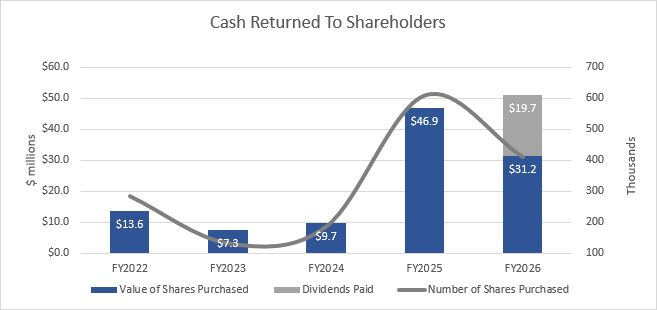
The Company’s goal for its executive compensation, as well as its non-executive compensation program, is to attract, motivate, and retain
a talented, ethical, and creative executive team who will provide leadership for the Company’s success in dynamic and competitive markets, while remaining attuned to the risks facing the Company. The Company seeks to accomplish this
goal in a way that rewards performance, is aligned with its business strategy, and maximizes shareholders’ long-term interests. The Company’s compensation program reinforces the Company’s culture of high performance through an
emphasis on performance-based pay opportunities which are earned for achieving key financial, operational and strategic metrics that align to long-term value creation. The Company’s executive compensation program is also intended to
promote and maintain stability within the executive team by issuing restricted stock with multi-year vesting terms, as well as cash awards and Performance Stock Unit awards with multi-year performance periods. The table below
summarizes the components of our fiscal year 2026 executive compensation.
|
Pay Element
|
|||||
|
Salary
|
Annual
Cash Incentive
|
Long-Term
Cash Incentive
|
Performance Stock Units
|
Restricted
Stock
|
|
|
Who Receives
|
All NEOs
|
All NEOs
|
Certain NEOs
|
Certain NEOs
|
All NEOs
|
|
When Granted
|
Annually
|
Annually
|
Annually
|
Annually
|
Annually
|
|
Form of Delivery
|
Cash
|
Cash
|
Cash
|
Equity
|
Equity
|
|
Performance
Type
|
Short-Term Fixed
|
Short-Term Variable
|
Long-Term Variable
|
Long-Term Variable
|
Long-Term Fixed
|
|
Performance
Period
|
1 Year
|
1 Year
|
3 Years
|
3 Years
|
3-year Ratable Annual Vesting
|
|
How Payout
Determined
|
Amount Set
by Compensation Committee
|
Formula Determined
by Compensation Committee
|
Formula Determined
by Compensation Committee
|
Formula Determined by Compensation Committee
|
Amount Determined
by Compensation Committee
|
|
Performance
Measures |
Individual
|
Consolidated Net Sales; Earnings Before Taxes; Services Gross Profit
|
Target Increase in Adjusted EBITDA and Adjusted Gross Billings
|
Target Increase in Adjusted EBITDA and Adjusted Gross Billings;
Relative Total Shareholder Return (“TSR”)
|
Time-Based
|
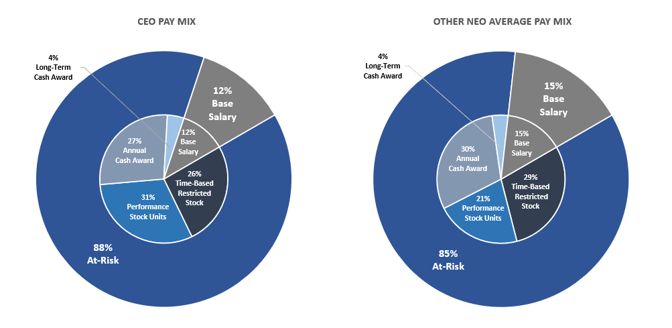
|
|
|
*The GC did not receive a long-term cash award or performance stock units in 2026.
|
|
Our Compensation Committee reviews the Company’s executive compensation program annually to evaluate whether it is aligned with
shareholder interests and supports the Company’s executive compensation philosophies and objectives. Our executive compensation practices are outlined below, each of which is intended to reinforce our executive compensation
objectives:
| Our Executive Compensation Practices | |||||
|
What We Do
|
What We Don’t Do
|
||||
|
✓ Annual review of our executive compensation programs
✓ Annual advisory vote by shareholders to approve executive compensation programs (say-on-pay)
✓ Periodic market comparison of executive compensation against relevant peer group and survey information
✓ Periodic use of an independent compensation consultant reporting directly to the Compensation Committee and providing
no other services to the Company
✓ Significant percentage of compensation delivered in the form of variable compensation, which is “at-risk” and tied to
quantifiable performance measures
✓ Long-term vesting of restricted stock and performance stock units, to align executive and shareholder interests
(minimum of three-year vesting)
✓ Long-term performance-based cash and performance stock unit grants
✓ Robust executive officer stock ownership guidelines require NEOs to hold ePlus stock
✓ Clawback policy to recoup erroneously paid incentive compensation
|
x No excessive executive perquisites
x No excessive severance benefits
x No supplemental executive retirement plans
x No acceleration of unvested stock upon retirement without approval by the Board or Compensation
Committee
x No hedging or short sales of our securities
x No pledging of our securities, except in limited circumstances with approval by the Insider Trading
Compliance Officer
x No tax gross-ups on benefits (other than as also provided to non-executive officer employees)
|
||||
As part of its review of the Company’s executive compensation program, the
Compensation Committee considers the results of the annual, non-binding advisory vote by the shareholders to approve named executive officer compensation (the “Say-On-Pay Vote”). Approximately 89.4% of the votes cast for the Company’s Say-On-Pay Vote at our 2025 Annual
Meeting were to approve the Company’s executive compensation program, and the Compensation Committee believes the results of the Say-On-Pay vote demonstrate shareholder support for the Company’s executive compensation program.
Accordingly, the Compensation Committee believes that the Company’s executive compensation philosophies and objectives continue to be appropriate and aligned with shareholder interests, and therefore made no material changes to the
Company’s executive compensation program in response to the 2025 Say-On-Pay vote.
Consistent with our pay philosophy and executive compensation program objectives described below, in determining the fiscal year 2026
executive compensation levels and the mix of compensation elements for each NEO, the Compensation Committee and our CEO (in making recommendations regarding the other NEOs’ compensation) considered each NEO’s scope of responsibility,
prior performance and experience, and Company performance, as more fully described below under “How We Make Executive Compensation Decisions.”
Base salary represents annual fixed cash compensation and is a standard element of compensation necessary to attract and retain talent.
It is the minimum payment for a satisfactory level of individual performance as long as the executive remains employed with the Company. Base salary is set by the Compensation Committee, and ratified by the Board, after taking into
account the competitive landscape—the compensation practices of the companies in our selected peer group and survey data from a broader index of comparable companies—as well as our business strategy and short- and long-term
performance goals, and individual factors, such as position, individual performance and contribution, length of service with the Company, experience in the position, and placement within the general base salary range offered to our
NEOs. In conducting this review and analyzing these factors at the end of fiscal year 2025, the Compensation Committee adopted the base salary increases set forth below effective for the 2026 fiscal year.
The base salary for each of our NEOs as of March 31, 2026, and 2025 is set forth below:
|
Base Salary as of March 31,
|
||||||||
|
Named Executive Officer
|
2026
|
2025
|
||||||
|
Mark P. Marron
|
$
|
975,000
|
$
|
975,000
|
||||
| Elaine D. Marion |
$
|
540,000
|
$
|
525,000
|
||||
| Darren S. Raiguel |
$
|
565,000
|
$
|
550,000
|
||||
| Erica S. Stoecker (1) | $ |
315,000 | ||||||
| (1) |
Effective October 20, 2025, Ms. Stoecker was appointed by the Board as an executive officer of the Company pursuant to Rule 3b-7 under the Exchange Act. Accordingly, Ms.
Stoecker’s 2025 compensation information prior to her appointment as an executive officer is not disclosed.
|
Effective April 1, 2026, Mr. Marron’s base salary was increased to $1,000,000, Ms. Marion’s base salary was increased to
$565,000, and Mr. Raiguel’s annual base salary was increased to $590,000.
During the 2026 fiscal year, we provided our NEOs with short-term cash incentive compensation through our annual Cash Incentive Plan.
This short-term, variable cash compensation represents a significant portion of each NEO’s target total cash compensation opportunity in a given year.
Cash Incentive Plan Pay for Performance Alignment
Our Compensation Committee annually reviews, and then sets, performance goals under a Cash Incentive Plan, which was adopted by the
Compensation Committee in 2025 (“CIP”) replacing our prior 2018 Cash Incentive Plan. During the 2026 fiscal year, short-term performance goals and cash awards were made under
our CIP. The combination of performance goals the Compensation Committee chose for fiscal year 2026 emphasizes factors that the Compensation Committee believes are important to Company strategy, future growth and enhancing shareholder
value. The Compensation Committee administers the CIP and has full authority to determine which of the Company’s executive officers will participate in the CIP; the terms and amounts of each participant’s minimum, target, and maximum
awards; and the period during which the performance is to be measured.
Cash Incentive Awards for Fiscal Year 2026
For the fiscal year ended March 31, 2026, our NEOs’ annual cash incentive awards were earned pursuant to the CIP, based on the following
financial performance goals: consolidated net sales (30%), earnings before taxes (40%), and services gross profit (30%). In prior years (including fiscal year 2025), our annual cash incentive awards utilized an additional performance
metric related to operating income attributable to our financing business, which was removed for fiscal year 2026 annual incentive awards due to the Divestiture in the first quarter of fiscal 2026.
The annual cash incentive award opportunity for fiscal year 2026 was based on a target amount and payouts that range between 0% to 200%
for our NEOs (except our GC whose range is between 0% to 125%) of the target award amounts as set forth in each participant’s award agreement, with the payout based on the Company’s actual level of attainment of fiscal 2026 financial
performance. Following the completion of the process described in this CD&A under the heading “How We Make Executive Compensation Decisions,” the Compensation Committee set
the fiscal 2026 target award for each of ePlus’ executive officers indicated in the table below. All of the participating executive officers had the same financial
performance goals and the same performance weights. The fiscal year 2026 financial performance weights and target amounts for each participant were as follows:
|
Consolidated Net Sales
|
Earnings Before Taxes
|
Services Gross Profit
|
||||||||||||||||||||||||||
|
Named Executive Officer
|
Percentage of
Total Bonus
|
Target Bonus
Amount
|
Percentage of
Total Bonus
|
Target Bonus
Amount
|
Percentage of
Total Bonus
|
Target Bonus
Amount
|
Total Target
Bonus Amount
|
|||||||||||||||||||||
|
Mark P. Marron
|
30.0%
|
$
|
345,000 |
40.0%
|
$
|
460,000 |
30.0%
|
$
|
345,000
|
$
|
1,150,000
|
|||||||||||||||||
|
Elaine D. Marion
|
30.0%
|
$
|
202,500 |
40.0%
|
$
|
270,000 |
30.0%
|
$
|
202,500
|
$
|
675,000
|
|||||||||||||||||
|
Darren S. Raiguel
|
30.0%
|
$
|
202,500 |
40.0%
|
$
|
270,000 |
30.0%
|
$
|
202,500
|
$
|
675,000
|
|||||||||||||||||
|
Erica S. Stoecker
|
30.0 % | $ |
45,000 |
40.0 % | $ |
60,000 |
30.0 % | $ |
45,000 |
$ |
150,000 |
|||||||||||||||||
The Cash Incentive Award Agreements permit the exclusion of all items of income, gain or loss determined by the Board to be extraordinary or unusual in nature and not incurred or realized in the ordinary course of business, the incentive compensation expensed by ePlus for payments under the CIP, and any revenue, gain, or loss attributable to the business operations of
(i) any entity acquired by us during the fiscal year or (ii) any portion of our business that we divest during the fiscal year. The CIP further provides that cash payments under the CIP are subject to recovery by the Company to the
extent required by the Dodd-Frank Wall Street Reform and Consumer Protection Act of 2010 (“Dodd-Frank”) and the Sarbanes-Oxley Act of 2002 (“Sarbanes-Oxley”) and any related regulations. As
more fully discussed below, the Company has adopted a Policy for Recoupment of Incentive Compensation.
Possible payouts under the CIP for the fiscal 2026 annual cash incentive award ranged between 0% and 200% of the target amount, except
for our GC, whose cash incentive award ranged between 0% and 125% of the target amount, depending on the level of achievement of the performance goals for the fiscal year 2026. The financial performance goals for fiscal 2026 were as
follows:
|
Performance Goals
|
|||||||||||||
|
Performance Level
(Dollars in thousands)
|
Consolidated
Net Sales
(30%)
|
Earnings
Before Taxes
(40%)
|
Services
Gross Profit
(30%)
|
||||||||||
|
Maximum
|
n/a
|
(1)
|
n/a
|
(1)
|
n/a
|
(1)
|
|||||||
|
Target
|
$
|
2,088,234
|
$
|
128,728
|
$
|
184,179
|
|||||||
|
Threshold (75% of Performance Goal)
|
$
|
1,566,176
|
$
|
96,546
|
$
|
138,134
|
|||||||
|
Below Threshold
|
< $1,566,176
|
< $96,546
|
< $138,134
|
||||||||||
| (1) |
The maximum payout of 200% (for each NEO, except Ms. Stoecker with a maximum payout of 125%) of the target award can be achieved based on the results of one or more of the
performance goals. The threshold and escalators for each performance goal are as follows:
|
|
Amount of Goal Achieved
|
Award Amount
|
|
Less than 75% of Goal Target
|
No award relating to that target
|
|
Between 75% - 100% of Goal Target
|
Award shall be 50% of target, plus an additional 2.0% for each percentage point over 75% of Goal Target achieved
|
|
100% of Goal Target
|
100% of target for that Goal
|
|
More than 100% of Goal Target
|
100% of target for that Goal, plus an additional 5.0% for each percentage point over 100% of Goal Target achieved
|
|
Total Maximum Award for all goals combined
|
200% or 125% of Target (depending on NEO)
|
At the conclusion of the fiscal year ended March 31, 2026, the Compensation Committee determined which of the financial objectives
described under the CIP and in the award agreements were achieved. There were no waivers or modifications to any specified performance targets, goals, or conditions with respect to the CIP or award agreements. The achievement of the
financial performance goals is set forth below.
| Performance Criteria |
Goal (1)
|
Achievement (2)
|
Amount of
Goal Achieved |
|||||||||
| Consolidated Net Sales |
$
|
2,088,234
|
$
|
2,458,360
|
117.7
|
%
|
||||||
|
Earnings Before Taxes
|
$
|
128,728
|
$
|
188,019
|
146.1
|
%
|
||||||
|
Services Gross Profit
|
$
|
184,179
|
$
|
162,377
|
88.2
|
%
|
||||||
| (1) |
Performance Criteria achievement were adjusted to exclude (i) the incentive compensation accrued by the Company, (ii) expenses as relates to mergers and acquisitions activities
that occurred during fiscal 2026, and (iii) certain Board of Directors’ third-party advisory expenses; the Performance Criteria goals were adjusted to exclude incentive compensation targets. The payout percentage of the total
target award earned is:
|
|
Named Executive Officer
|
Total Target Award
|
Annual Incentive
Cash Payment Earned
Fiscal Year 2026
|
Payout
Percentage
|
|||||||||
| Mark P. Marron |
$
|
1,150,000
|
$
|
2,300,000
|
200
|
%
|
||||||
|
Elaine D. Marion
|
$
|
675,000
|
$
|
1,350,000
|
200
|
%
|
||||||
|
Darren S. Raiguel
|
$
|
675,000
|
$
|
1,350,000
|
200
|
%
|
||||||
|
Erica S. Stoecker
|
$ |
150,000
|
$ |
187,500
|
125 | % |
||||||
Under our 2021 Employee Long-Term Incentive Plan (“2021 Employee LTIP”), the Compensation Committee has the
authority to award various forms of long-term incentive compensation grants, such as cash awards, stock options, restricted stock awards, restricted stock units, and performance stock units. The Compensation Committee’s objectives for the fiscal year 2026 long-term equity-based and
cash incentive awards to our NEOs were to focus executives on long-term, profitable growth and shareholder value creation linked to the Company’s long-term strategic plan, and to promote the retention of our executives through
multi-year vesting requirements.
Mr. Marron makes recommendations to the Compensation Committee for cash and equity grants with regard to the other NEOs; however, the
Compensation Committee deliberates and reaches its own decision regarding grants to all NEOs, including Mr. Marron, who does not participate in any deliberations or votes regarding his own compensation. When determining the level of
the grant, the Compensation Committee considers each NEO’s functional and enterprise management responsibilities, contributions to the Company’s profitability and growth, the value of prior long-term incentive grants and other
non-cash and cash compensation, regular analysis of how the Company performed on multiple financial metrics as compared to certain peers, information from our independent compensation consultant, and each executive’s total
compensation, including cash compensation. However, the Compensation Committee does not use a formula or assign a particular weight to any given factor in determining equity award grant levels. Rather, the Compensation Committee’s
determination of grant levels is subjective and informed by relevant data, information and market practices, and the Compensation Committee grants awards that are intended to deliver compensation to the executive at the target
performance level (subject to actual performance and irrespective of accounting and tax implications) and in its judgment are reasonably competitive.
The Compensation Committee believes that restricted stock and performance stock unit awards help to create incentives for performance and
further align the interests of executives with those of shareholders because the award’s value increases or decreases in conjunction with the Company’s stock price. The Compensation Committee has historically granted long-term cash
performance awards, including in 2026, with the award’s value tied to operating metrics that drive-long term shareholder value in order to align the interests of executives with those of shareholders. The Compensation Committee
believes that granting awards with multi-year vesting periods creates a substantial retention incentive and encourages the NEOs to focus on the Company’s long-term business objectives and stock performance. All outstanding restricted
shares vesting for, or granted to, executive officers and other employees during the fiscal year ended March 31, 2026, vest over a three-year period. Cash dividends paid on the Company’s common stock are paid to the holder if and when
the stock vests.
After conducting the process described above for fiscal year 2026, the Compensation Committee elected to provide the NEOs with a
combination of long-term incentive vehicles, including time-based restricted stock (to each NEO) as well as performance-based stock units and long-term cash performance awards (to each NEO except Ms. Stoecker), which are consistent
with the award types granted to the NEOs for fiscal 2025.
|
Element of LTI
|
Overview of Design
|
|
|
Time-Based Restricted Stock
|
• |
Vests annually in three equal increments
over three years
|
|
Performance Stock Units
|
• |
Award tied to growth in Adjusted EBITDA (60% of award), Adjusted Gross Billings growth (20% of
award), and Relative TSR, based on the Russell 2000 Index (20% of award)
|
| • | Three-year performance period | |
| • | Vesting and payout can range between 0% and 200% of target award | |
|
Long-Term Cash Performance
Award
|
• |
Award is tied to achievement of growth in Adjusted EBITDA
(60% of award) and growth in Adjusted Gross Billings (40% of award)
|
| • | Three-year performance period | |
| • | Payout occurs at end of three-year performance period | |
| • | Payout can range between 0% and 150% of target award |
(1) “Adjusted EBITDA” is defined as net earnings from
continuing operations calculated in accordance with GAAP, adjusted for interest expense, depreciation and amortization, share-based compensation, acquisition related expenses, provision for income taxes, interest and other income
(expense).
(2) “Adjusted Gross Billings” is defined as technology
business net sales from continuing operations calculated in accordance with GAAP, adjusted to exclude the costs incurred related to sales of third-party maintenance, software assurance, subscription/SaaS licenses, and services.
The performance metrics for the performance stock units and long-term cash performance awards granted, and the relative weight of each
metric for fiscal year 2026 and fiscal year 2025, are set forth in the tables below.
| Performance Stock Units | |||||
|
2026 Metric
|
Weight
|
2025 Metric
|
Weight
|
||
|
Adjusted EBITDA Growth
|
60%
|
Operating Income Growth
|
45%
|
||
|
Adjusted Gross Billings Growth
|
20%
|
Net Sales Growth
|
45%
|
||
|
Total Shareholder Return
|
20%
|
Total Shareholder Return
|
10%
|
||
|
100%
|
100%
|
||||
| Long-Term Cash Performance Awards | |||||
|
2026 Metric
|
Weight
|
2025 Metric
|
Weight
|
||
|
Adjusted EBITDA Growth
|
60%
|
Operating Income Growth
|
50%
|
||
|
Adjusted Gross Billings Growth
|
40%
|
Net Sales Growth
|
50%
|
||
|
100%
|
100%
|
||||
The Compensation Committee believes that NEO compensation should be aligned with long-term, profitable growth and
shareholder value creation. Accordingly, and as shown above, beginning with the fiscal 2026 awards, the Compensation Committee changed the financial measures underlying the Company’s performance stock units and long-term cash performance
awards to better align with this long-term strategy by linking NEO compensation to growth in Adjusted EBITDA and Adjusted Gross Billings (replacing growth in operating income and net sales). Adjusted EBITDA and Adjusted Gross Billings
have become some of our key metrics to gain insight into our operating performance and performance trends. We believe these financial metrics
are the most useful measures to focus our NEOs on long-term shareholder value, with Adjusted EBITDA incentivizing NEOs to generate revenue and control costs and Adjusted Gross Billings incentivizing NEOs to increase our volume of
business.
In reviewing the competitiveness of the compensation package provided to the NEOs, it was determined that in order to maintain the
competitiveness and attractiveness of the compensation package, total target compensation should be increased, primarily through increases to performance-based equity awards (performance based-stock units) and to a lesser extent through
increases to long-term cash awards (cash performance awards). These vehicles focus NEOs on driving long-term profitable growth and achieving key financial, operational and strategic metrics that are intended to generate long-term value
creation for our shareholders. The target values of the time-based restricted stock awards and long-term cash performance awards for fiscal 2026 were consistent with the target levels provided for fiscal 2025 for both. The target values of
the performance stock units for fiscal 2026, relative to fiscal 2025, were as follows:
|
Percent Increase in Target Value in
Fiscal Year 2026, Compared to 2025
|
|
|
Named Executive Officer
|
Performance Stock Units (1)
|
|
Mark P. Marron
|
63%
|
|
Elaine D. Marion
|
43%
|
|
Darren S. Raiguel
|
40%
|
|
Erica S. Stoecker
|
N/A
|
| (1) |
Target value amounts used in the calculation of the percent of increase in target value of Performance Stock Units are based on the closing price of our common stock on March 31, 2025, as relates to the
Performance Stock Units granted in fiscal 2026, and March 28, 2024, as relates to the Performance Stock Units granted in fiscal 2025.
|
The table below shows the long-term incentive award values granted (at the target level of performance) for fiscal year 2026 for each of the
NEOs:
| Target Value of 2026 Long-Term Incentive Awards | ||||||||
|
Named Executive Officer
|
Time-Based Restricted Stock (1)
|
Performance Stock Units (2)
|
Long-Term Cash Performance
Award (3)
|
Total Value
|
||||
| Mark P. Marron | $ |
2,199,943
|
$ |
1,299,939
|
$ |
350,000
|
$ |
3,849,882
|
| Elaine D. Marion | $ |
1,349,930
|
$ |
499,958
|
$ |
200,000
|
$ |
2,049,888
|
| Darren S. Raiguel | $ |
1,349,930
|
$ |
524,980
|
$ |
200,000
|
$ |
2,074,910
|
| Erica S. Stoecker | $ |
99,954
|
$ |
-
|
$ |
-
|
$ |
99,954
|
| (1) |
Award amounts for Time-Based Restricted Stock are based on $72.80 which was the closing price of our common stock on June 10, 2025, the date of the award.
|
| (2) |
Award amounts for Performance Stock Units are based on $61.03, which was the closing price of our common stock on March 31, 2025, the last trading day before the beginning of the Performance Stock Units’
performance period. The three categories of performance goals to be achieved during the performance period, which will be assessed at the end of the performance period, are as follows: (a) 60% of the Performance Stock Units will be
based on the Company’s Adjusted EBITDA relative to a targeted growth over the performance period; (b) 20% of the Performance Stock Units will be based on the Company’s adjusted gross billings relative to a targeted growth over the
performance period; and (c) 20% of the Performance Stock Units will be based on the Company’s total shareholder return relative to the Russell 2000 Index (the “Relative TSR Metric”). The
performance period is April 1, 2025, to March 31, 2028. Amounts and percentages shown are the target amounts and represent the amount of compensation intended by the Compensation Committee to be delivered to the NEO (subject to
actual performance and irrespective of accounting and tax implications). The threshold and escalator for the Company’s Adjusted EBITDA and the Company’s adjusted gross billings of the Performance Stock Units are as follows:
|
|
Amount of Goal Achieved
|
Award Amount
(for Adjusted EBITDA and Adjusted Gross Billings Metrics)
|
|
Less than 50% of Performance Target achieved
|
No Performance Award relating to that Performance Target goal
|
|
Between 50% - 100% of Performance Target achieved
|
Performance Award shall be 50%, plus an additional 1.0% for each percentage point over 50% of Performance Target achieved
|
|
More than 100% of Performance Target achieved
|
Performance Award shall be 100%, plus an additional 5.0% for each percentage point over 100% of Performance Target achieved, subject to the Total Maximum Awarded PSUs
|
|
Total Maximum Vested Awarded PSUs
(for all goals combined)
|
200% of the Awarded PSUs
|
The threshold and escalator for the Relative TSR Metric of the Performance Stock Units are as
follows:
|
TSR Percentile Rank
(against Russell 2000 companies)
|
Award Amount
(for Relative TSR Metric)
|
|
Less than 25th Percentile
|
0%
|
|
25th Percentile
|
50%
|
|
50th Percentile
|
100%
|
|
75th Percentile
|
200%
|
| (3) |
The two categories of performance goals to be achieved during the performance period, which will be assessed at the end of the performance period, are as follows: (1) 60% of the long-term cash performance
awards will be based on the Company’s Adjusted EBITDA relative to a targeted growth over the performance period and (2) 40% of the long-term cash performance awards will be based on the Company’s adjusted gross billings relative to a
targeted growth over the performance period. The performance period for the long-term cash performance awards is April 1, 2025 – March 31, 2028. Amounts and percentages shown are the target amounts and represent the amount of
compensation intended by the Compensation Committee to be delivered to the NEO (subject to actual performance and irrespective of accounting and tax implications). The threshold and escalators for the long-term cash performance awards
are as follows:
|
|
Amount of Goal Achieved
|
Award Amount
|
|
Less than 75% of Goal Target
|
No award relating to that target
|
|
Between 75% - 100% of Goal Target
|
Award shall be 50% of target, plus an additional 2.0% for each percentage point over 50% of Goal Target achieved
|
|
100% of Goal Target
|
100% of target for that Goal
|
|
More than 100% of Goal Target
|
100% of target for that Goal, plus an additional 5.0% for each percentage point over 100% of Goal Target achieved
|
|
Total Maximum Award for all goals combined
|
150% of Target
|
Vested Long-Term Cash Performance Awards and Performance Stock Units
(Performance Period April 1, 2023 – March 31, 2026)
Our Compensation Committee granted long-term cash performance awards and performance stock units in fiscal year 2024 that pay out based on
specific pre-established performance goals. The performance metrics for the fiscal year 2024 long-term cash awards were growth in operating income (50% of award) and growth in net sales (50% of award). The performance metrics for the fiscal
year 2024 performance stock units were growth in operating income (45% of award), growth in net sales (45% of award) and relative total shareholder return (10% of award). For each award, performance was measured over the three-fiscal-year
performance period ending March 31, 2026. After the conclusion of the fiscal year ended March 31, 2026, the Compensation Committee determined that the financial objectives for each award type for the performance period of April 1, 2023,
through March 31, 2026, were achieved at the levels indicated in the table below, generating the indicated payouts under these long-term awards. There were no waivers or modifications to any specified performance targets, goals, or
conditions with respect to the award agreements. The achievement of the financial performance goals for both the 2024-2026 long-term cash awards and the 2024-2026 performance stock units are set forth below.
|
Performance Criteria
|
2024-2026 Long-Term Cash Performance Awards
and 2024-2026 Performance Stock Units
|
|||||||||||
|
Goal (1)
|
Achievement (2)
|
Amount of
Goal Achieved |
||||||||||
|
Increase in operating income from
April 1, 2023, to March 31, 2026
|
$
|
160,816
|
$
|
166,145
|
103.3
|
%
|
||||||
|
Increase in net sales from
April 1, 2023, to March 31, 2026
|
$
|
2,257,082
|
$
|
2,442,549
|
108.2
|
%
|
||||||
|
Relative total shareholder return*
|
|
(3)
|
(3)
|
181.6
|
%
|
|||||||
* Performance metric only applicable to the 2024-2026 Performance Stock Units.
| (1) |
The operating income goal represents a 20% growth target for operating income over the three-year performance period. The net sales goal represents a 12% growth target for net sales over the three-year
performance period. The goals were adjusted for the second and third quarters of fiscal year 2026 to exclude the Company’s historic financing business as a result of the Divestiture.
|
|
(2)
|
The achievement of the performance criteria was adjusted to exclude expenses related to mergers and acquisitions activities that occurred during the final year of the performance
period (i.e., fiscal 2026), and certain Board of Directors’ third-party advisory expenses. The achievement of the performance criteria was also adjusted to include continued operations and the first quarter of fiscal year 2026
results from the Company’s financing business (in relation to the Divestiture). The Payout earned and Payout Percentage relative to the Total Target Award is set forth in the tables below:
|
|
2024-2026 Long-Term Cash Performance Awards
|
||||||||||||
|
Named Executive Officer
|
Total Target Award
|
Earned
Performance Period
April 1, 2023 to March 31, 2026
|
Payout
Percentage
|
|||||||||
|
Mark P. Marron
|
$
|
275,000
|
$
|
354,277
|
129
|
%
|
||||||
|
Elaine D. Marion
|
$
|
150,000
|
$
|
193,241
|
129
|
%
|
||||||
|
Darren S. Raiguel
|
$
|
150,000
|
$
|
193,241
|
129
|
%
|
||||||
|
Erica S. Stoecker
|
$ | — |
$
|
— |
— |
|||||||
|
2024-2026 Performance Stock Units
|
||||||||||||
|
Named Executive Officer
|
Total Target Award
|
Earned
Performance Period
April 1, 2023 to March 31, 2026
|
Payout
Percentage
|
|||||||||
|
Mark P. Marron
|
8,173
|
9,956
|
122
|
%
|
||||||||
|
Elaine D. Marion
|
3,269
|
3,981
|
122
|
%
|
||||||||
|
Darren S. Raiguel
|
3,678
|
4,480
|
122
|
%
|
||||||||
|
Erica S. Stoecker
|
— | — |
— |
|||||||||
The following table details the payments earned during the three-fiscal-year periods ended March 31, 2026, and March 31, 2025, respectively,
(but paid in the subsequent fiscal year) for each NEO.
| Long-Term Cash Payment Earned Performance Period | ||||||||||||
|
Named Executive Officer
|
April 1, 2023 to March 31, 2026
|
April 1, 2022 to March 31, 2025*
|
% Change
|
|||||||||
|
Mark P. Marron
|
$
|
354,277
|
$
|
208,464
|
70
|
%
|
||||||
|
Elaine D. Marion
|
$
|
193,241
|
$
|
113,707
|
70
|
%
|
||||||
|
Darren S. Raiguel
|
$
|
193,241
|
$
|
113,707
|
70
|
%
|
||||||
|
Erica S. Stoecker
|
$ | — |
$
|
— |
— |
|||||||
* The payments earned during the 2025 fiscal year were adjusted to reflect the amount of erroneously awarded
compensation recovered by the Company under the Recoupment Policy. See “Recovery of Erroneously Awarded Compensation” for more information.
| (3) |
In order to achieve the relative TSR performance metric, the Company’s stock price performance is measured against the companies in the Russell 2000 during the applicable performance period. The change in
stock price value from the beginning to the end of the period is divided by the beginning stock price value to determine TSR. A 20-day trading averaging period is used to determine the beginning and ending stock price values used to
calculate the TSR of the Company and the other companies in the Russell 2000. Then, the level of achievement with respect to the PSUs depends on the Company’s relative TSR percentile ranking for the performance period. For the
2024-2026 Performance Stock Units, the Company’s relative TSR was at the 70th percentile.
|
More information about the long-term incentive awards granted to each NEO in fiscal year 2026 are set forth in “2026 Grants of Plan-Based Awards Table.”
CEO Compensation
The Compensation Committee determines compensation for our CEO using generally the same criteria it uses for other executive officers.
Severance and Change in Control Provisions
Severance and change in control provisions are designed to facilitate our ability to attract and retain executives as we compete for
talented employees in a marketplace where such protections are frequently offered. Severance benefits are designed to provide benefits to ease an executive’s transition following an employment termination by the Company due to changes in
our employment needs. Additionally, severance agreements increase the enforceability of non-competition provisions to which all of our executives are contractually bound. Change in control benefits are intended to encourage executives to
remain focused on the Company’s business in the event of rumored or actual fundamental corporate changes. Both severance and change in control benefits are often an important part of an executive’s compensation package. See further details
under the section entitled “Employment Agreements, Severance, and Change in Control Provisions.”
Clawback Policy
Our executive compensation arrangements with our NEOs, including our CIP, our 2021 Employee Long-Term Incentive Plan, employment
agreements, long-term cash performance awards, and Performance Stock Unit awards provide that bonuses or other compensation are subject to recovery by the Company to the extent required by Dodd-Frank and Sarbanes-Oxley, and related
regulations. This provision does not apply to base salary, or to time-vested restricted stock which is not awarded, granted, or vested based on financial measures required to be reported under the securities laws.
The CIP includes a provision for an adjusted award if it is determined that an award was paid based on incorrect financial results, and
permits the Compensation Committee to lower the amount of such payment so that it reflects the amount that would have been paid based on the correct financial results and requires, to the extent permitted by law, the participant to
reimburse to the Company any amount received with respect to such an award. The CIP also provides that cash payments under the plan are subject to recovery by the Company to the extent required by Dodd-Frank and Sarbanes-Oxley, and related
regulations. Our 2021 Employee LTIP provides that awards shall be subject to Company policies and applicable statutes, rules or regulations regarding recoupment or clawback as may be in effect from time to time, and that if for any reason
our financial statements must be restated for any part of a performance period, as result of material noncompliance with accounting requirements, and the vesting or amount of an award for a participant would be materially affected by
information changed in such financial statements, then such Award will be forfeited, and be repaid to us, in such amount or to such extent as the Compensation Committee shall determine.
During our fiscal year ended March 31, 2024, Nasdaq listing standards became effective which required the development and implementation
of the clawback policy mandated by Dodd-Frank. Our Board accordingly adopted and maintains a stand-alone Policy for Recoupment of Incentive Compensation (the “Recoupment Policy”), which complements
the recoupment provisions in the CIP and the 2021 Employee LTIP. Performance-based award agreements entered into after the effective date of the listing standards include specific recoupment language consistent with our Recoupment Policy
and these listing standards.
Following the end of fiscal 2026, the Compensation Committee oversaw a recovery analysis under the Recoupment Policy of incentive-based
compensation received by our executive officers during the years ended March 31, 2025 and March 31, 2024 to ascertain whether any recovery of excess incentive-based compensation was required because of revisions made to our
previously-issued financial statements for such periods in our 2026 Form 10-K. In June 2026, the Compensation Committee concluded that recoupment of fiscal year 2025 executive incentive compensation was required because the revisions
adversely affected that year’s performance metrics, resulting in excess incentive compensation subject to recovery. For details, see “Recovery of Erroneously Awarded Compensation” in this proxy statement.
Stock Ownership Guidelines
Our Board has adopted stock ownership guidelines for our executive officers to further align the interests of our executive officers with
the interests of our shareholders. The guidelines are expressed as a multiple of the executives’ base salary as of each January 1st, or as of the date they are first identified as executive officers. Our non-CEO executive officers are expected to retain stock ownership valued at a multiple of two times their annual
base salary within five years of first being identified as an executive officer. Our CEO is expected to retain stock ownership valued at a multiple of five times his annual base salary within the same time frame. All executive officers are
expected to retain one-half of all equity grants until such time as the target stock ownership is reached. The guidelines may be waived at the discretion of our Compensation Committee in the event of an extraordinary expense (such as, for
example, housing or higher education needs), or if compliance would create a severe hardship or prevent an executive from complying with a court order, as in the case of a divorce or other property settlement. However, the Company expects
such instances to be rare, and has not granted any waivers. At this time, all of our executive officers meet their respective stock ownership guideline level or are within the five-year phase-in period for meeting the ownership guidelines.
Insider Trading, Hedging and Short Sales Policies
Our Insider Trading Policy applies to all of our employees, officers and directors. Under the policy, our directors, officers, and
employees who are “Insiders” (as defined in the policy) are prohibited from hedging, including using prepaid variable forward contracts, equity swaps, collars and exchange funds, and similar transactions that establish downside price
protection, including short sales, and buying or selling put options, call options, or other derivatives of Company securities.
All trades of Company stock by directors, executive officers, and other insiders require pre-approval from our Insider Trading Compliance
Officer and must be made in accordance with the Insider Trading Policy. A copy of our Insider Trading Policy is filed as Exhibit 19 to our 2026 Form 10-K.
Tax and Accounting Considerations
Deductibility of Executive Compensation
When designing compensation plans, the Compensation Committee takes into consideration any changes to Internal Revenue Code (“IRC”) Section 162(m), as applicable. The Company believes that tax deductibility of compensation is an important factor, but not the sole factor, to be considered in setting executive compensation policy,
and the Compensation Committee has authorized payments that are not deductible for federal income tax purposes when it believes that such payments are appropriate to attract, retain, and incentivize executive talent.
Our executive employment agreements provide that, if a severance payment is subject to the excise tax provided in IRC Section 280G, the
executive will receive a lesser payment if he or she would receive a greater after-tax benefit, which will better enable the Company to obtain a tax deduction. Our long-term Performance Cash Award agreements include a similar provision.
Accounting Considerations
Accounting considerations also play a role in the design of our executive compensation
programs and policies. Codification Topic Compensation—Stock Compensation requires us to expense the cost of stock-based compensation awards.
We consider the relative impact of the expense, in addition to other factors such as shareholder dilution, retentive impact, motivational impact, and the overall competitiveness of compensation packages when selecting long-term equity
incentive instruments.
Benefits and Perquisites
Our NEOs participate in benefit plans generally available to all of our employees, including medical, health, life insurance, and
disability plans. They also are eligible to participate in our 401(k) plan, and receive Company matching contributions, to the extent made by the Company, on the same terms as generally available to our employees. Pursuant to their
employment agreements, they also are entitled to reimbursement for annual participation in an executive health assessment program.
Our executive officers are provided with relatively limited perquisites, which we believe is in the best interests of the Company. In some
years, certain of our executive officers have received certain Company-paid travel, meals, and entertainment costs for their families to attend the Company’s meetings for high performers. All attendees at the meetings are likewise eligible
to have their families attend the meeting. The Company pays the same costs for the executives as for all attendees at the meetings. The costs incurred with regard to the family members of our named executive officers are included in our
Summary Compensation Table in the compensation for each year ended March 31, 2024, March 31, 2025, and March 31, 2026. Additionally, from time to time, some of our employees attend sales meetings or other events held by our vendor business
partners, to which guests are invited. To the extent vendor partners pay part or all of this expense for the executive and his/her spouse, the expense is not reported in our Summary Compensation Table as there is no expense to the Company.
Role of the Board and Compensation Committee
The Compensation Committee, which is composed entirely of independent directors, generally establishes the components of our executive
officer compensation program and may evaluate the components from time to time. The Compensation Committee is responsible for evaluating and setting the compensation for our CEO and the other NEOs. The Compensation Committee reviews
executive compensation on a periodic basis, and typically grants both equity awards (time-based restricted stock and Performance Stock Units) and cash awards once per year. Compensation decisions may be made at any time during a year,
particularly as relates to promotions, new hires, or changes in responsibilities. In making these determinations, the Compensation Committee may consider such factors as the Company’s performance, the individual performance of an executive
officer, information from our independent compensation consultant, and recommendations from management. The Compensation Committee’s decisions are generally subject to ratification by our Board of Directors. The Compensation Committee also
considers any recommendations from the Board relating to the CEO’s performance.
Role of the Chief Executive Officer
Our CEO, Mr. Marron, oversees the implementation and administration of our executive compensation program during the fiscal year. Mr.
Marron recommended the overall structure for our executive compensation program for fiscal year 2026, including base salary, metrics for the CIP award agreements for fiscal year 2026, metrics for the long-term cash awards made pursuant to
our 2021 Employee LTIP for the performance period ending as of the end of fiscal year 2026, metrics for our Performance Stock Unit awards granted during fiscal year 2026, and the amount and vesting schedule of equity awards that were
granted during 2026. The final decisions regarding executive equity compensation were, however, made by the Compensation Committee, and decisions regarding base salary were made by the Board, with Mr. Marron abstaining from votes relating
to his compensation. In all cases, the CEO is not present during any deliberations or voting regarding his own compensation.
An independent compensation consultant, Pay Governance LLC (the “Compensation Consultant”), was
initially retained by the Compensation Committee in February 2023, and has been engaged by the Company with respect to executive compensation periodically, including in May 2025 and January 2026. The Compensation Consultant is engaged
directly by the Compensation Committee. The Compensation Consultant assists the Compensation Committee with developing a publicly traded peer group for benchmarking executive pay levels and design, reviewing incentive plan and award design
practices (including underlying performance metrics) and recommending changes to incentive plans and awards, and analyzing target compensation levels for executive officers relative to peer group companies and relevant published survey
sources. In fiscal 2026, no fees were paid to the Compensation Consultant other than fees related to the services it provided to the Compensation Committee, and its work did not raise any conflicts of interest.
The Compensation Committee approves the compensation for the NEOs based on its own evaluation, input from our CEO, internal pay equity
considerations, the tenure, role, and performance of each NEO, as well as input from the compensation consultant and market data. The CEO is not present during any deliberations or voting regarding his own compensation.
The Compensation Committee periodically reviews the compensation practices of peer companies as part of its decision-making process so it
can set total compensation levels that it believes are reasonably competitive. In March 2025, the Compensation Committee, with the assistance of the Compensation Consultant, determined a new peer group. In selecting the peer group, the
Compensation Committee considered potential peers’ primary industry, total revenue, market capitalization, gross margin, operating income margin, number of employees, and cumulative Total Shareholder Return (“TSR”) on a 1-year, 3-year and 5-year basis.
|
Peer Group
|
|||
|
ASGN Incorporated
|
EPAM Systems, Inc.
|
Perificent*
|
|
| CACI International Inc.* |
Everpure, Inc. (f/k/a Pure Storage, Inc.)
|
PC Connection, Inc.
|
|
|
Climb Global Solutions, Inc.*
|
ICF International, Inc.*
|
ScanSource, Inc.
|
|
|
CSG Systems Internationals, Inc.
|
Itron, Inc.
|
Unisys Corporation*
|
|
| * |
Only these five companies provided compensation information for the COO role.
|
The above peer group was used in 2025 for compensation-related decisions for the fiscal year ended March 31, 2026.
The Compensation Consultant also provided a secondary market reference, Mercer’s 2024 U.S. Executive Benchmark Database.
The Compensation Committee considered this broad range of data to ascertain where the compensation for our executive officers is
positioned with respect to the median to properly reflect various factors, such as our Company’s performance, the unique characteristics of each executive’s position, and applicable retention considerations. The Compensation Committee does
not set compensation components to meet specific benchmarks, such as targeting salaries “above the median” or equity compensation at a particular percentile.
Our performance goals are designed to drive shareholder value creation by aligning members of senior
management with our strategy and corporate performance goals. To that end, we engage in extensive communications regarding concrete actions and tactics that members of senior management, together with their teams, should undertake, both
individually and collectively, to impact and ultimately achieve the Company’s goals. We believe this understanding of the link between individual, team, and Company performance helps the Company to focus on actions that have the
greatest potential to drive the Company toward more profitable growth and shareholder value.
The following table includes information concerning compensation earned by our NEOs during fiscal years 2026, 2025, and 2024.
|
Name and Principal Position
|
Fiscal Year
|
Salary
|
Stock Awards
(1)
|
Non-Equity Incentive
Plan Compensation
(2)
|
All Other
Compensation
(3)
|
Total
|
|||||||||||||||
|
Mark P. Marron – President and Chief Executive Officer
|
2026
|
$
|
975,000
|
$
|
4,799,821
|
$
|
2,654,277
|
$
|
109,531
|
$
|
8,538,629
|
||||||||||
|
2025
|
$
|
975,000
|
$
|
3,799,811
|
$
|
1,545,793
|
$
|
63,800
|
$
|
6,384,404
|
|||||||||||
|
2024
|
$
|
925,000
|
$
|
3,199,831
|
$
|
1,570,821
|
$
|
26,443
|
$
|
5,722,095
|
|||||||||||
|
Elaine D. Marion – Chief Financial Officer
|
2026
|
$
|
540,000
|
$
|
2,349,846
|
$
|
1,543,241
|
$
|
78,093
|
$
|
4,511,180
|
||||||||||
|
2025
|
$
|
525,000
|
$
|
2,049,906
|
$
|
898,661
|
$
|
71,019
|
$
|
3,544,586
|
|||||||||||
|
2024
|
$
|
500,000
|
$
|
1,749,877
|
$
|
898,443
|
$
|
15,945
|
$
|
3,164,265
|
|||||||||||
|
Darren S. Raiguel – Chief Operating Officer
|
2026
|
$
|
565,000
|
$
|
2,399,890
|
$
|
1,543,241
|
$
|
81,060
|
$
|
4,589,191
|
||||||||||
|
2025
|
$
|
550,000
|
$
|
2,099,858
|
$
|
898,661
|
$
|
50,994
|
$
|
3,599,513
|
|||||||||||
|
2024
|
$
|
525,000
|
$
|
1,799,913
|
$
|
898,443
|
$
|
15,609
|
$
|
3,238,965
|
|||||||||||
|
Erica S. Stoecker – General Counsel and Chief Compliance Officer (4)
|
2026
|
$
|
315,000
|
$
|
99,954
|
$
|
187,500
|
$
|
18,306
|
$
|
620,760
|
||||||||||
| (1) |
The values in this column represent the aggregate grant date fair values of restricted stock awards and Performance Stock Units granted in the
respective fiscal year, computed in accordance with the Financial Accounting Standards Board’s Accounting Standards Codification Topic 718, Compensation—Stock Compensation. Consistent with instruction 3 to Item 402(c)(2)(v) and (vi) of Regulation S-K, the amounts for the Performance Stock Units assume that the highest level of performance
conditions will be achieved; other assumptions used in calculating these values may be found in Note 14 of our financial statements in our 2026 Form 10-K. Each of these amounts reflect our expected aggregate accounting
expense for these awards as of the grant date and do not necessarily correspond to the actual values that will be expensed by us or realized by the NEOs. The stock awards for the past three fiscal years are as follows:
|
|
Name and Principal Position
|
Fiscal Year
|
Time-Based
Restricted Stock
|
Performance
Stock Units
|
Total
Stock Awards
|
|||||||||
|
Mark P. Marron – President and Chief Executive Officer
|
2026
|
$
|
2,199,943
|
$
|
2,599,878
|
$
|
4,799,821
|
||||||
|
2025
|
$
|
2,199,951
|
$
|
1,599,860
|
$
|
3,799,811
|
|||||||
|
2024
|
$
|
2,199,947
|
$
|
999,884
|
$
|
3,199,831
|
|||||||
|
Elaine D. Marion – Chief Financial Officer
|
2026
|
$
|
1,349,930
|
$
|
999,916
|
$
|
2,349,846
|
||||||
|
2025
|
$
|
1,349,958
|
$
|
699,948
|
$
|
2,049,906
|
|||||||
|
2024
|
$
|
1,349,947
|
$
|
399,930
|
$
|
1,749,877
|
|||||||
|
Darren S. Raiguel – Chief Operating Officer
|
2026
|
$
|
1,349,930
|
$
|
1,049,960
|
$
|
2,399,890
|
||||||
|
2025
|
$
|
1,349,958
|
$
|
749,900
|
$
|
2,099,858
|
|||||||
|
2024
|
$
|
1,349,947
|
$
|
449,966
|
$
|
1,799,913
|
|||||||
|
Erica S. Stoecker – General Counsel and Chief Compliance Officer
|
2026
|
$
|
99,954
|
$
|
-
|
$
|
99,954
|
||||||
| (2) |
These amounts reflect cash payments under our CIP (the annual cash incentive awards) and under our 2021 Employee LTIP (the long-term cash
performance awards). The cash payments under our CIP were earned during the fiscal year identified, as disclosed in Annual Cash Incentive
Awards. The cash payments for the long-term cash performance awards under our 2021 Employee LTIP were earned during the fiscal year identified (which is the final fiscal year of the three-year performance period),
the fiscal 2026 long-term cash performance awards granted under our 2021 Employee LTIP were earned over the three-year performance period, as disclosed in Long-Term Incentive Program above. Both the annual cash award and the long-term cash performance award payments were received after the conclusion of the fiscal year in which they were earned.
A detailed description of the fiscal year 2026 payments can be found in the CD&A. The cash awards for the past three fiscal years are as provided in the below chart. The amounts for fiscal year 2025 have been reduced
by the following amounts of erroneously awarded compensation recovered by the Company pursuant to the Recoupment Policy: Mr. Marron - $23,146; Ms. Marion - $13,402; and Mr. Raiguel - $13,402. See “Recovery of Erroneously
Awarded Compensation” in this proxy statement for additional information.
|
|
Name and Principal Position
|
Fiscal Year
|
Annual
Cash Award (a)
|
Long-Term
Cash Award (b)
|
Total Non-Equity
Incentive Plan
Compensation
|
|||||||||
|
Mark P. Marron – President and Chief Executive Officer
|
2026
|
$
|
2,300,000
|
$
|
354,277
|
$
|
2,654,277
|
||||||
|
2025
|
$
|
1,337,329
|
$
|
208,464
|
$
|
1,545,793
|
|||||||
|
2024
|
$
|
1,158,321
|
$
|
412,500
|
$
|
1,570,821
|
|||||||
|
Elaine D. Marion – Chief Financial Officer
|
2026
|
$
|
1,350,000
|
$
|
193,241
|
$
|
1,543,241
|
||||||
|
2025
|
$
|
784,954
|
$
|
113,707
|
$
|
898,661
|
|||||||
|
2024
|
$
|
673,443
|
$
|
225,000
|
$
|
898,443
|
|||||||
|
Darren S. Raiguel – Chief Operating Officer
|
2026
|
$
|
1,350,000
|
$
|
193,241
|
$
|
1,543,241
|
||||||
|
2025
|
$
|
784,954
|
$
|
113,707
|
$
|
898,661
|
|||||||
|
2024
|
$
|
673,443
|
$
|
225,000
|
$
|
898,443
|
|||||||
|
Erica S. Stoecker – General Counsel and Chief Compliance Officer
|
2026
|
$
|
187,500
|
$
|
-
|
$
|
187,500
|
||||||
| (a) |
The amounts for fiscal year 2025 have been reduced by the following amounts of erroneously awarded compensation recovered by the Company pursuant
to the Recoupment Policy: Mr. Marron - $18,719; Ms. Marion - $10,987; and Mr. Raiguel - $10,987.
|
| (b) |
The amounts for fiscal year 2025 have been reduced by the following amounts of erroneously awarded compensation recovered by the Company pursuant
to the Recoupment Policy: Mr. Marron - $4,427; Ms. Marion - $2,415; and Mr. Raiguel - $2,415.
|
| (3) |
The “All Other Compensation” includes accrued dividends on stock awards and a Company match to our 401(k) plan, both of which are available to all
employees on the same terms, as well as costs (on a grossed-up basis) relating to their and their families’ attendance at the Company’s meetings for high-performers, which was available for all attendees at the meeting.
For the most recent fiscal year, the grossed-up costs relating to certain meeting attendance by the NEOs and their families was as follows: Mr. Marron - $75,822; Ms. Marion - $54,028; Mr. Raiguel - $56,994; and Ms.
Stoecker - $8,467. All of our NEOs are entitled to an annual executive physical. For health privacy reasons, each NEO has been attributed a cost of $3,750, regardless of whether such benefit was used. For fiscal 2026, the
amount of accrued dividends on stock awards were as follows: Mr. Marron - $24,959; Ms. Marion - $15,316; Mr. Raiguel - $15,316; and Ms. Stoecker - $1,089.
|
From time to time, Mr. Raiguel attends events hosted by our vendor business partners. On
such trips, the vendor business partner paid some or all of the expenses for Mr. Raiguel’s spouse to accompany him, with no related expense to the Company, and therefore no related amount is included in “All Other Compensation.”
All such trips were properly reported in accordance with the Company’s policies.
| (4) |
Ms. Stoecker was appointed by the Board as an executive officer of the Company pursuant to Rule 3b-7 under the Exchange Act, effective October 20,
2025. Accordingly, Ms. Stoecker’s 2025 and 2024 compensation information prior to her appointment as an executive officer is not disclosed.
|
The following table provides information regarding the grants of plan-based awards during fiscal year 2026 under the CIP and the
Company’s 2021 Employee LTIP.
|
Estimated
Future Payouts
Under Non-Equity
Incentive Plan Awards ($)
|
Estimated
Future Payouts
Under Equity
Incentive Plan Awards (#)
|
All Other Stock
Awards:
Number of
Shares of
Stock or Units
(#)(4)
|
Grant Date Fair
Value of Stock
and Option
Awards ($)
(5)
|
||||||||||||||||||||||||||||||||||
|
Name
|
Grant Date
|
Threshold
|
Target
|
Maximum
|
Threshold
|
Target
|
Maximum
|
||||||||||||||||||||||||||||||
|
Mark P. Marron
|
6/10/2025
|
30,219
|
$
|
2,199,943
|
|||||||||||||||||||||||||||||||||
|
(1)
|
|
4/1/2025
|
$
|
172,500
|
$
|
1,150,000
|
$
|
2,300,000
|
|||||||||||||||||||||||||||||
|
(2)
|
|
4/1/2025
|
$
|
70,000
|
$
|
350,000
|
$
|
525,000
|
|||||||||||||||||||||||||||||
|
(3)
|
4/1/2025
|
2,130
|
21,300
|
42,600
|
$
|
2,599,878
|
|||||||||||||||||||||||||||||||
|
Elaine D. Marion
|
6/10/2025
|
18,543
|
$
|
1,349,930
|
|||||||||||||||||||||||||||||||||
|
(1)
|
|
4/1/2025
|
$
|
101,250
|
$
|
675,000
|
$
|
1,350,000
|
|||||||||||||||||||||||||||||
|
(2)
|
|
4/1/2025
|
$
|
40,000
|
$
|
200,000
|
$
|
300,000
|
|||||||||||||||||||||||||||||
|
(3)
|
|
4/1/2025
|
819
|
8,192
|
16,384
|
$
|
999,916
|
||||||||||||||||||||||||||||||
|
Darren S. Raiguel
|
6/10/2025
|
18,543
|
$
|
1,349,930
|
|||||||||||||||||||||||||||||||||
|
(1)
|
|
4/1/2025
|
$
|
101,250
|
$
|
675,000
|
$
|
1,350,000
|
|||||||||||||||||||||||||||||
|
(2)
|
|
4/1/2025
|
$
|
40,000
|
$
|
200,000
|
$
|
300,000
|
|||||||||||||||||||||||||||||
|
(3)
|
|
4/1/2025
|
860
|
8,602
|
17,204
|
$
|
1,049,960
|
||||||||||||||||||||||||||||||
|
Erica S. Stoecker
|
6/10/2025
|
1,373
|
$
|
99,954
|
|||||||||||||||||||||||||||||||||
|
(1)
|
|
4/1/2025
|
22,500
|
150,000
|
187,500
|
||||||||||||||||||||||||||||||||
| (1) |
These amounts reflect annual cash award opportunities under the CIP and are described more fully in the CD&A under the heading “Annual Cash Incentive Awards” and the subheading “Cash
Incentive Awards for Fiscal Year 2026.” Threshold amounts represent the minimal level of achievement of the lowest weighted financial performance metric, and the maximum amounts represent 200% (for each NEO,
except Ms. Stoecker with a maximum payout of 125%) of target values. Actual payments with respect to the awards for fiscal year 2026 (and paid in the following fiscal year) are disclosed in the Non-Equity Incentive Plan
Compensation column of the 2026 Summary Compensation Table.
|
| (2) |
These amounts reflect long-term cash performance award opportunities under our 2021 Employee LTIP and are more fully described in this CD&A
under the heading “Long-Term Incentive Program.” Threshold amounts represent the minimal level of achievement of the lowest weighted financial performance metric, and maximum amounts represent 150% of target values. These
awards are earned on the third anniversary of the grant date to the extent the Company achieves performance goals relating to growth in operating income and growth in net income.
|
|
(3)
|
The amounts represent the number of Performance Stock Units granted to the NEOs under our 2021 Employee LTIP and are
more fully described in this CD&A under the heading “Long-Term Incentive Program.” These awards are based on certain
performance metrics for the period of April 1, 2025, through March 31, 2028, and will be earned (if at all) at the conclusion of the performance period. Threshold amounts represent the minimal level of achievement of the
lowest weighted financial performance metric, and the maximum amounts represent 200% of target values. The vesting may be accelerated in limited circumstances as set forth in the 2021 Employee LTIP, award agreements,
and/or employment agreements.
|
| (4) |
These amounts represent the number of shares of restricted stock granted to the NEOs under our 2021 Employee LTIP. Equity awards granted to the
executive officers and reflected in the 2026 Grants of Plan-Based Awards Table vest ratably over a three-year period and may be accelerated in limited circumstances as set forth in the 2021 Employee LTIP, award agreements,
and/or employment agreements.
|
| (5) |
These amounts reflect the grant date fair value of the restricted stock and performance stock units granted in fiscal year 2026. This represents
the aggregate amount that we expect to expense for such grants in accordance with Codification Topic Compensation—Stock Compensation over
the grants’ respective service period. These amounts do not necessarily correspond to the actual values that will be expensed by us or realized by the NEOs. The amounts for the performance stock units assume that the
highest level of performance conditions will be achieved; other assumptions used in calculating these values with respect to restricted stock awards and performance stock units may be found in Note 14 to our financial
statements included in our 2026 Form 10-K.
|
The following table provides information concerning the outstanding equity-based awards for our NEOs as of March 31, 2026. Our
Performance Stock Unit awards constitute “Equity Incentive Plan Awards” for the purposes of Item 402(f) of Regulation S-K. The Company does not currently grant new awards of stock options, stock appreciation rights, or similar option-like awards as part
of its compensation program. Accordingly, the Company has no policies or practices to disclose under Item 401(x) of Regulation S-K.
|
Restricted Stock Awards
|
Performance Stock Units
|
|||||||||||||||
|
Number of Shares or
Units of Stock That
Have
Not Vested (1)
|
Market Value of Shares
or Units of Stock That
Have
Not Vested (2)
|
Number of Shares or
Units of Stock That Have
Not Vested (3)
|
Market Value of Shares
or Units of Stock That
Have
Not Vested (4)
|
|||||||||||||
|
Name
|
||||||||||||||||
|
Mark P. Marron
|
63,515
|
$
|
4,779,504
|
31,485
|
$
|
2,369,246
|
||||||||||
|
Elaine D. Marion
|
38,975
|
$
|
2,932,869
|
12,648
|
$
|
951,762
|
||||||||||
|
Darren S. Raiguel
|
38,975
|
$
|
2,932,869
|
13,376
|
$
|
1,006,544
|
||||||||||
|
Erica S. Stoecker
|
2,827
|
$
|
212,732
|
—
|
$
|
—
|
||||||||||
| (1) |
The following table shows the dates on which the outstanding restricted stock awards as of March 31, 2026, will vest, subject to continued
employment through the vest date, or acceleration in limited circumstances as set forth in the 2021 Employee LTIP, award agreements, and/or employment agreements.
|
|
Vest Date
|
Mark P. Marron
|
Elaine D. Marion
|
Darren S. Raiguel
|
Erica S. Stoecker
|
|
6/10/2026
|
10,073
|
6,181
|
6,181
|
457
|
|
6/14/2026
|
23,206
|
14,240
|
14,240
|
995
|
|
6/10/2027
|
10,073
|
6,181
|
6,181
|
458
|
|
6/14/2027
|
10,090
|
6,192
|
6,192
|
459
|
|
6/10/2028
|
10,073
|
6,181
|
6,181
|
458
|
| (2) |
We calculated the market value of restricted stock awards by multiplying the closing price of our common stock ($75.25) on the last trading day of
our fiscal year, March 31, 2026, by the number of shares indicated.
|
| (3) |
The following table shows the dates on which the outstanding performance share units as of March 31, 2026, will vest, subject to the Company’s actual performance relative to the applicable performance metrics, and subject to the terms and conditions as set forth in the 2021 Employee LTIP and the award
agreements.
|
|
Vest Date
|
Mark P. Marron
|
Elaine D. Marion
|
Darren S. Raiguel
|
Erica S. Stoecker
|
|
3/31/2027
|
10,185
|
4,456
|
4,774
|
-
|
|
3/31/2028
|
21,300
|
8,192
|
8,602
|
-
|
| (4) |
We calculated market value of performance stock unit awards by multiplying the closing price of our common stock ($75.25) on the last trading day
of our fiscal year, March 31, 2026, by the number of shares indicated.
|
The following table sets forth information with respect to the shares of Company common stock acquired by our NEOs through vesting
of restricted stock and performance stock units during our 2026 fiscal year. There were no stock options outstanding during fiscal year 2026.
|
Stock Awards
|
||||||||
|
Name
|
Gross Number of
Shares Acquired on
Vesting (#)
|
Value Realized on
Vesting ($) (1)
|
||||||
|
Mark P. Marron
|
45,690
|
$
|
3,317,934
|
|||||
|
Elaine D. Marion
|
25,909
|
$
|
1,859,183
|
|||||
|
Darren S. Raiguel
|
26,408
|
$
|
1,900,645
|
|||||
|
Erica S. Stoecker
|
1,507
|
105,006
|
||||||
| (1) |
Market value of the restricted stock (for all named executive officers) and performance stock units (for all named executive officers except Ms. Stoecker) was
computed by multiplying the closing price of our common stock on the day of vesting by the number of shares acquired. Additionally, the restricted shares were net-share settled such that the Company withheld shares with
value equivalent to the NEOs’ minimum statutory tax obligation for the applicable income and other employment taxes, and remitted cash to the appropriate taxing authorities. The amounts in the table represent the gross
number of shares and value realized on vesting for each of the NEOs. The net number of shares acquired (after withholding shares for taxes, as described above) were as follows: Mr. Marron, 27,203; Ms. Marion, 16,366; Mr.
Raiguel, 16,640; and Ms. Stoecker, 1,028.
|
Our incentive plans for, and employment agreements with, our NEOs reflect our compensation philosophy. All of our employment
agreements with our NEOs contain “clawback” provisions as required by Dodd-Frank and Sarbanes-Oxley.
In all cases, our NEOs’ receipt of severance payments is contingent upon their executing a release, and certifying that they will
comply with certain confidentiality, non-competition, and non-solicitation provisions of his or her employment agreement.
The Company’s employment agreements with its NEOs are intended to comply with IRC Section 409A. The material terms of the
employment agreements are described below. Also, pursuant to our 2021 Employee LTIP and standard award agreement, unvested restricted stock, cash performance awards and performance stock units issued to any employee will vest
upon a “Change in Control,” as defined in the 2021 Employee LTIP.
Under the Company’s executive compensation plans, each of Mr. Marron, Ms. Marion, Mr. Raiguel and Ms. Stoecker are subject to the
following provisions under various termination scenarios:
| • |
The receipt of cash severance in the amount of 18 months base salary for Mr. Marron, and 12 months base salary for Ms. Marion, Mr. Raiguel and
Ms. Stoecker.
|
| • |
In the event of disability, termination without cause, or termination for good reason (all as defined in the agreement), the Company would pay
an amount equal to eighteen months of the cost of premiums the Company paid prior to the date of termination for the executive and his/her dependents’ qualified coverage under the Company’s medical, prescription, dental,
and other health benefits.
|
| • |
In the event of termination without cause or by the executive for good reason, the executive would be entitled to either, at the Company’s
election, the acceleration of unvested restricted stock, or cash in an amount equal to the value of the stock on the date of termination.
|
| • |
Long-Term Cash Incentive Awards and Performance Stock Unit Awards for fiscal performance periods beginning on or after April 1, 2024, include a
provision that, in the event of retirement, if more than one year has passed since the beginning of the performance period, retirement criteria in the Employee LTIP are met, and the executive complies with our Code of
Conduct and certain post-employment requirements, then the award is paid out at the end of the performance period in the same manner as if the executive had remained employed through the full performance period, based on
the Company’s actual performance over the full performance period relative to the applicable performance goals.
|
Employment Agreement Terms
Mark P. Marron
Chief Executive Officer
| • |
Mr. Marron’s currently effective agreement was amended and restated on December 12, 2017, and thereafter amended. Pursuant to such agreement
(and the Compensation Committee’s and Board’s discretion to increase base salary), Mr. Marron’s current base salary is $1,000,000.
|
| • |
Mr. Marron’s agreement had an initial termination date of January 31, 2018; however, the agreement contains automatic two-year successive
renewal periods unless either party terminates the agreement 60 days prior to the end of the then-current term. As no notice of termination was provided, the expiration date of his agreement is now January 31, 2028.
|
Elaine D. Marion
Chief Financial Officer
| • |
Ms. Marion’s employment agreement was amended and restated on December 12, 2017. Pursuant to such agreement (and the Compensation Committee’s
and Board’s discretion to increase base salary), Ms. Marion’s current base salary is $565,000.
|
| • |
Ms. Marion’s agreement had an initial termination date of July 31, 2018; however, the agreement contains automatic one-year successive renewal
periods unless either party terminates the agreement 60 days prior to the end of the then-current term. As no notice of termination was provided, the expiration date of her agreement is now July 31, 2026, and no notice
of termination has been given that would preclude a renewal to July 31, 2027.
|
Darren S. Raiguel
Chief Operating Officer
| • |
Mr. Raiguel’s employment agreement was effective as of May 7, 2018. Pursuant to such agreement (and the Compensation Committee’s and Board’s
discretion to increase base salary), Mr. Raiguel’s current base salary is $590,000.
|
| • |
Mr. Raiguel’s agreement had an initial termination date of July 31, 2019; however, the agreement contains automatic one-year successive renewal
periods unless either party terminates the agreement 60 days prior to the end of the then-current term. As no notice of termination was provided, the expiration date of his agreement is now July 31, 2026, and no notice
of termination has been given that would preclude a renewal to July 31, 2027.
|
Erica S. Stoecker
General Counsel and Chief Compliance Officer
| • |
Ms. Stoecker’s employment agreement was amended and restated as of November 24, 2025. Pursuant to such agreement (and the Compensation
Committee’s and Board’s discretion to increase base salary), Ms. Stoecker’s current base salary is $315,000.
|
| • |
Ms. Stoecker’s agreement has an initial termination date of November 24, 2026; however, the agreement contains automatic one-year successive
renewal periods unless either party terminates the agreement 60 days prior to the end of the then-current term.
|
Termination Events
The table below summarizes the potential payments and benefits to our NEOs upon the occurrence of certain triggering events. The
table assumes a hypothetical effective date of termination of March 31, 2026, the last day of fiscal 2026. The table does not include accrued, unused vacation time, which is paid to all employees upon termination of employment,
or company-paid life insurance benefits (one year’s salary, up to $250,000) that are provided to all salaried employees, each in accordance with the Company’s policies.
Mark P. Marron
Chief Executive Officer
|
Triggering Event
|
Cash Severance
|
Cash Incentive
Plan Awards
(3)
|
Long-Term Cash
Performance
Awards
(6)
|
Time-Based
Restricted Stock
|
Performance
Stock Units
(13)
|
Total
|
||||||||||||||||||||||||||||||||||||||
|
Termination Without Cause, or for Good Reason (1)
|
$
|
1,516,992
|
(2)
|
|
$
|
2,300,000
|
(4)
|
|
$
|
840,725
|
(7)
|
$
|
4,779,504
|
(10)
|
|
$
|
1,533,190
|
(14)
|
|
$
|
10,970,411
|
|||||||||||||||||||||||
|
Change in Control
|
$
|
-
|
$
|
-
|
$
|
350,000
|
(8)
|
$
|
4,779,504
|
(11)
|
|
$
|
2,933,498
|
(15)
|
|
$
|
8,063,002
|
|||||||||||||||||||||||||||
|
Disability
|
$
|
1,516,992
|
(2)
|
|
$
|
2,300,000
|
(4)
|
|
$
|
1,015,725
|
(7)
|
$
|
4,779,504
|
(12)
|
$
|
2,933,498
|
(16)
|
|
$
|
12,545,719
|
||||||||||||||||||||||||
|
Death
|
$
|
-
|
$
|
2,300,000
|
(4)
|
|
$
|
1,015,725
|
(7)
|
$
|
4,779,504
|
(12)
|
$
|
2,933,498
|
(16)
|
|
$
|
11,028,727
|
||||||||||||||||||||||||||
|
Retirement
|
$
|
-
|
$
|
2,300,000
|
(5)
|
|
$
|
350,000
|
(9)
|
|
$
|
-
|
$
|
2,933,498
|
(17)
|
$
|
5,583,498
|
|||||||||||||||||||||||||||
Elaine D. Marion
Chief Financial Officer
|
Triggering Event
|
Cash Severance
|
Cash Incentive
Plan Awards
(3)
|
Long-Term Cash
Performance
Awards
(6)
|
Time-Based
Restricted Stock
|
Performance
Stock Units
(13)
|
Total
|
||||||||||||||||||||||||||||||||||||||
|
Termination Without Cause, or for Good Reason (1)
|
$
|
573,984
|
(2)
|
|
$
|
1,350,000
|
(4)
|
$
|
471,212
|
(7)
|
$
|
2,932,869
|
(10)
|
$
|
616,591
|
(14)
|
$
|
5,944,656
|
||||||||||||||||||||||||||
|
Change in Control
|
$
|
-
|
$
|
-
|
$
|
200,000
|
(8)
|
$
|
2,932,869
|
(11)
|
$
|
1,183,364
|
(15)
|
|
$
|
4,316,233
|
||||||||||||||||||||||||||||
|
Disability
|
$
|
573,984
|
(2)
|
|
$
|
1,350,000
|
(4)
|
$
|
571,212
|
(7)
|
$
|
2,932,869
|
(12)
|
$
|
1,183,364
|
(16)
|
|
$
|
6,611,429
|
|||||||||||||||||||||||||
|
Death
|
$
|
-
|
$
|
1,350,000
|
(4)
|
|
$
|
571,212
|
(7)
|
|
$
|
2,932,869
|
(12)
|
$
|
1,183,364
|
(16)
|
|
$
|
6,037,445
|
|||||||||||||||||||||||||
|
Retirement
|
$
|
-
|
$
|
1,350,000
|
(5)
|
$
|
200,000
|
(9)
|
$
|
-
|
$
|
1,183,364
|
(17)
|
|
$
|
2,733,364
|
||||||||||||||||||||||||||||
Darren S. Raiguel
Chief Operating Officer
|
Triggering Event
|
Cash Severance
|
Cash Incentive
Plan Awards
(3)
|
Long-Term Cash
Performance
Awards
(6)
|
Time-Based
Restricted Stock
|
Performance
Stock Units
(13)
|
Total
|
||||||||||||||||||||||||||||||||||||||
|
Termination Without Cause, or for Good Reason (1)
|
$
|
619,870
|
(2)
|
|
$
|
1,350,000
|
(4)
|
$
|
471,212
|
(7)
|
|
$
|
2,932,869
|
(10)
|
$
|
674,964
|
(14)
|
|
$
|
6,048,915
|
||||||||||||||||||||||||
|
Change in Control
|
$
|
-
|
$
|
-
|
$
|
200,000
|
(8)
|
|
$
|
2,932,869
|
(11)
|
|
$
|
1,275,077
|
(15)
|
$
|
4,407,946
|
|||||||||||||||||||||||||||
|
Disability
|
$
|
619,870
|
(2)
|
|
$
|
1,350,000
|
(4)
|
|
$
|
571,212
|
(7)
|
|
$
|
2,932,869
|
(12)
|
|
$
|
1,275,077
|
(16)
|
|
$
|
6,749,028
|
||||||||||||||||||||||
|
Death
|
$
|
-
|
$
|
1,350,000
|
(4)
|
|
$
|
571,212
|
(7)
|
|
$
|
2,932,869
|
(12)
|
$
|
1,275,077
|
(16)
|
|
$
|
6,129,158
|
|||||||||||||||||||||||||
|
Retirement
|
$
|
-
|
$
|
1,350,000
|
(5)
|
|
$
|
200,000
|
(9)
|
|
$
|
-
|
$
|
1,275,077
|
(17)
|
$
|
2,825,077
|
|||||||||||||||||||||||||||
Erica S. Stoecker
General Counsel and Chief Compliance Officer
|
Triggering Event
|
Cash Severance
|
Cash Incentive
Plan Awards
(3)
|
Long-Term Cash
Performance
Awards
(6)
|
Time-Based
Restricted Stock
|
Performance
Stock Units
(13)
|
Total
|
||||||||||||||||||||||||||||||||||
|
Termination Without Cause, or for Good Reason (1)
|
$
|
351,253
|
(2)
|
|
$
|
187,500
|
(4)
|
|
$
|
-
|
(7)
|
$
|
212,732
|
$
|
-
|
(14)
|
$
|
751,485
|
||||||||||||||||||||||
|
Change in Control
|
$
|
-
|
$
|
-
|
$
|
-
|
(8)
|
|
$
|
212,732
|
$
|
-
|
(15)
|
$
|
212,732
|
|||||||||||||||||||||||||
|
Disability
|
$
|
351,253
|
(2)
|
$
|
187,500
|
(4)
|
$
|
-
|
(7)
|
|
$
|
212,732
|
$
|
-
|
(16)
|
|
$
|
751,485
|
||||||||||||||||||||||
|
Death
|
$
|
-
|
$
|
187,500
|
(4)
|
$
|
-
|
(7)
|
$
|
212,732
|
$
|
-
|
(16)
|
|
$
|
400,232
|
||||||||||||||||||||||||
|
Retirement
|
$
|
-
|
$
|
187,500
|
(5)
|
$
|
-
|
(9)
|
|
$
|
-
|
$
|
-
|
(17)
|
|
$
|
187,500
|
|||||||||||||||||||||||
The terms “Termination without Cause,” “Termination for Good Reason,” “Change In Control,” “Disability,” “Death” and “Retirement” are defined in each
executive officer’s respective employment agreement and/or the relevant Plan.
| (1) |
Termination without Cause generally refers to an executive officer’s involuntary termination by the Company (without the presence of conditions
that constitute “Cause”), while Termination for Good Reason generally refers to an executive officer resigning from office (with the presence of conditions that constitute “Good Reason”), in each case in accordance with
the applicable definition under the agreement or Plan.
|
| (2) |
Cash Severance: (i) Termination without Cause or for Good Reason or (ii)
Disability. Reflects 18 months base salary for Mr. Marron and 12 months base salary for Ms. Marion, Mr. Raiguel and Ms. Stoecker. As provided in each executive officer’s respective employment agreement, this
column includes an amount equal to the cost of premiums paid prior to the date of termination for the executive and his/her dependents’ qualified coverage under the Company’s medical, prescription, dental and other health
benefits for 18 months. The amount of premiums would be paid in cash as opposed to providing continued coverage.
|
| (3) |
The Cash Incentive Plan awards are annual cash incentive awards based on a one-year performance period.
|
| (4) |
Cash Incentive Plan: (i) Termination without Cause or for Good Reason, (ii)
Disability or (iii) Death. The executive is entitled to a pro-rated amount of his or her annual incentive award, to the extent performance goals are met. The pro-rated amount is based on the number of months of
employment during the performance period. The amount shown is the amount actually achieved for the fiscal year ended March 31, 2026.
|
| (5) |
Cash Incentive Plan: Retirement. The Compensation Committee has
discretion to make a pro-rated award, based upon performance goals met, that is paid at the end of the performance period. The pro-rated amount is based on the number of months of employment during the performance
period. The amount shown is the amount actually achieved for the fiscal year ended March 31, 2026, and assumes that the Compensation Committee exercised discretion to make an award. Since the hypothetical retirement date
is March 31, 2026, which is the last day of the Cash Incentive Plan’s performance period, the amount shown is the full amount of the award for the year based on actual performance under the Cash Incentive Plan’s
performance metrics.
|
| (6) |
Our Long-Term Cash Performance Awards have three-year performance periods, aligned with our fiscal year.
|
| (7) |
Long-Term Cash Performance Award: (i) Termination without Cause or for Good Reason, (ii) Disability, or (iii) Death.
|
| • |
Termination without Cause, or for Good Reason. The amount due is the
amount earned as if the executive had remained employed until the end of the performance period, but pro-rated based upon the number of days the executive was employed during the performance period.
|
| • |
Termination in the event of Death or Disability. The award is paid
out at the target level of performance.
|
|
(8)
|
Long-Term Cash Performance Award: Change in Control.
If there is a termination without Cause or for Good Reason within 24 months after a Change in Control, and the executive is not provided equivalent value that supersedes his or her award, then the award will be paid
out at the target level of performance.
|
|
(9)
|
Long-Term Cash Performance Award: Retirement.
If at least one year has passed since the beginning of the performance period, retirement criteria in the Plan are met, reasonable notice of retirement is provided, and the executive has complied with our Code of
Conduct and certain post-employment requirements, then the Cash Performance Award is paid out at the end of the performance period in the same manner as if the executive had remained employed through the full
performance period. The amount shown in the above tables is the target amount.
|
|
(10)
|
Time-Based Restricted Stock: Termination without Cause
or for Good Reason. The executive is entitled to, at the Company’s election, either the acceleration of unvested restricted stock, or cash in an amount equal to the value of the stock on the date of
termination. The amount in the tables above reflects all unvested stock, valued at our closing price of $75.25 on March 31, 2026.
|
|
(11)
|
Time-Based Restricted Stock: Change in Control.
Under our 2021 Employee Long-Term Incentive Plan and award agreements for all equity recipients, our restricted stock vests upon a Change in Control. The amount in the tables above reflects all unvested stock, valued at
our closing price of $75.25 on March 31, 2026.
|
|
(12)
|
Time-Based Restricted Stock: Disability or Death.
Under our 2021 Employee Long-Term Incentive Plan and award agreements for all equity recipients, our restricted stock vests upon Disability or Death. The amount in the tables above reflects all unvested stock, valued at
our closing price of $75.25 on March 31, 2026 (the last trading day before the hypothetical effective date of termination of March 31, 2026).
|
|
(13)
|
Our Performance Stock Units (“PSUs”) have three-year performance periods that correspond with the beginning and end of the applicable
fiscal year (for example, the PSUs awarded for fiscal 2026 have a performance period of April 1, 2025, to March 31, 2028).
|
|
(14)
|
PSUs: Termination without Cause or for Good Reason.
The award will be paid at the end of the performance period, based on actual performance, but pro-rated based on the number of days employed during the performance period. The amount shown in the above tables reflects
the actual earned number of shares for the 2024-2026 PSUs as well as two-thirds of the target number of shares for the 2025-2027 PSUs and one-third of the target number of shares for the 2026-2028 PSUs, valued based on
the closing price of $75.25 on March 31, 2026 (the last trading day before the hypothetical effective date of termination of March 31, 2026).
|
|
(15)
|
PSUs: Change in Control. If there is a
Termination without Cause or for Good Reason within 24 months after a change in control, and the executive is not provided equivalent value that supersedes his or her award, then the award is paid at the end of
employment at the greater of the performance target or the actual level of achievement for certain financial metrics, and the greater of the performance target or actual level of achievement with respect to the Relative
TSR Metric. The tables above reflect the value of the actual earned number of shares for the 2024-2026 PSUs and target number of shares awarded for the 2025-2027 PSUs and the 2026-2028 PSUs, based on the closing price of
$75.25 on March 31, 2026.
|
|
(16)
|
PSUs: Death or Disability. The awarded PSUs will
vest at the Performance Target level of achievement. The tables above reflect the value of the actual earned number of shares for the 2024-2026 PSUs and target number of shares awarded for the 2025-2027 PSUs and the
2026-2028 PSUs, based on the closing price of $75.25 on March 31, 2026.
|
|
(17)
|
PSUs: Retirement. If at least one year has
passed since the beginning of the performance period, and the retirement criteria in the plan are met, reasonable notice of retirement is provided, and the executive has complied with our Code of Conduct and certain
post-employment requirements, then following the end of the Performance Period, the PSUs vest based upon the actual performance level achieved in the same manner as if the executive had remained employed until the end of
the performance period. The tables above reflect the value of the actual earned number of shares for the 2024-2026 PSUs and target number of shares awarded for the 2025-2027 PSUs and the 2026-2028 PSUs, based on the
closing price of $75.25 on March 31, 2026.
|
Pursuant to Item 402(u) of Regulation S-K, the Company is required to provide annual disclosure of the ratio of the median of the
total annual compensation of all employees of the Company (other than Mr. Marron, the Company’s CEO) to the total annual compensation of the principal executive officer, which for ePlus is our CEO, Mr. Marron. The purpose of the required disclosure is to provide a measure of the equitability of pay within the Company. ePlus believes its compensation philosophy and process yield an equitable result. The below table shows our median employee annual compensation and the total
compensation of Mr. Marron as reflected in the Summary Compensation Table, as well as the ratio of the two pay levels.
|
Median Employee
Total Annual Compensation
|
Mr. Marron’s
Total Annual Compensation
|
Pay Ratio
|
|
$114,962
|
$8,538,629
|
74.3 to 1
|
The median employee that was used for purposes of calculating the ratio of the annualized total compensation of our CEO to the
median of the annual total compensation of all employees is the same employee that was identified for purposes of the pay ratio disclosed in our 2025 proxy statement. There has been no change in our employee population or
employee compensation arrangements since that median employee was identified that we believe would significantly impact our pay ratio disclosure. In determining our median employee, we considered the full annual compensation of
all individuals who were employed throughout the entire 2024 calendar year, and annualized compensation for employees who joined ePlus
during 2024, with the following adjustments. Our employee population on December 31, 2024, after taking into consideration the adjustments permitted by SEC rules and described below, consisted of approximately 2,290 individuals.
We did not include our 50 non-U.S.-based employees in the calculation, which was less than 5% of our total workforce, and consists of 24 employees in the United Kingdom and 26 employees in India. We selected our median employee
from the list of the remaining employees. To identify our median employee, we calculated compensation as the sum of (i) base salary, (ii) commissions, if any, (iii) equity that vested during the year, if any, and (iv) the amount
of our contributions to the retirement plans in which the employee participates. Using this methodology, we determined that the median employee was an exempt, salaried, full-time employee located in Rochester, New York, with an
annual total compensation of $114,962 for the calendar year ended December 31, 2025, calculated in accordance with SEC rules. Mr. Marron’s compensation was calculated using the same methodology that the Company used to calculate
the CEO’s annual total compensation for the 2026 Summary Compensation Table described above.
To ascertain the median employee’s compensation this year, we calculated his or her annual total compensation under the Summary
Compensation Table rules in a manner that is consistent with the calculation of our CEO’s compensation, without any adjustments or estimates. The SEC requirements for identifying our median employee and calculating the pay ratio
based on that employee’s annual total compensation allow companies to adopt a variety of methodologies, apply certain exclusions, and make reasonable estimates and assumptions that reflect their compensation practices.
Accordingly, the pay ratio we report may not be comparable to the pay ratio other companies report.
As required by Section 953(a) of Dodd-Frank, and Item 402(v) of
Regulation S-K, we are providing the following information reflecting the relationship between executive compensation actually paid by the Company and the Company’s financial performance for each of the last three
completed calendar years. In determining the compensation “actually paid” to our NEOs, we are required to make various adjustments to amounts that have been previously reported in the Summary Compensation Table in previous
years, as the SEC’s valuation methods for this section differ from those required in the Summary Compensation Table. For further information concerning the Company’s pay for performance philosophy and how the Company
aligns executive compensation with the Company’s performance, refer to the “Compensation Discussion and Analysis” provided elsewhere in this proxy statement. The Compensation Committee did not consider the pay versus performance disclosure below in making its
pay decisions for any of the fiscal years shown.
The table below summarizes compensation values both reported in our 2026 Summary Compensation Table, as well as the adjusted values required in this section for the last five fiscal years.
|
Fiscal
Year
|
Summary Compensation Table Total to PEO
|
Compensation
Actually Paid to
PEO
|
Average Summary
Compensation Table
Total for Non-PEO NEOs
|
Average Compensation
Actually Paid to Non-
PEO NEOs
|
Value of Initial Fixed $100
Investment Based On:
|
Net Income
($ thousands)
|
Operating
Income
($ thousands)
|
|||||||||||||||||||||||||
|
Company TSR
|
Peer Group
TSR
|
|||||||||||||||||||||||||||||||
|
(a)
|
(b)
|
(c)
|
(d)
|
(e)
|
(f)
|
(g)
|
(h)
|
|||||||||||||||||||||||||
| 2026 | $ | $ | $ | $ | $ | $ | $ | $ | ||||||||||||||||||||||||
|
2025 (i)
|
$
|
|
$
|
|
$
|
|
$
|
|
$
|
|
$
|
|
$
|
|
$
|
|
||||||||||||||||
|
2024
|
$
|
|
$
|
|
$
|
|
$
|
|
$
|
|
$
|
|
$
|
|
$
|
|
||||||||||||||||
|
2023
|
$
|
|
$
|
|
$
|
|
$
|
|
$
|
|
$
|
|
$
|
|
$
|
|
||||||||||||||||
|
2022
|
$
|
|
$
|
|
$
|
|
$
|
|
$
|
|
$
|
|
$
|
|
$
|
|
||||||||||||||||
| (a) |
Reflects compensation amounts reported in the “2026 Summary Compensation Table” for our President and Chief Executive Officer,
|
| (b) |
Compensation actually paid to our President and Chief Executive Officer for each period presented, as computed in accordance with SEC rules, does not reflect the actual amount of compensation earned
or received during the applicable fiscal year. In accordance with SEC rules, these amounts differ from the total compensation reported in the “2026 Summary Compensation Table” for each fiscal year as shown below. The fair
value of equity awards was determined using methodologies and assumption developed in a manner substantively consistent with those used to determine the grant date fair value of such awards in accordance with Codification
Topic Compensation – Stock Compensation.
|
|
Fiscal 2026
|
Fiscal 2025
|
Fiscal 2024
|
Fiscal 2023
|
Fiscal 2022
|
|||||||||||||||||||
|
Summary Compensation Table Total
|
$
|
|
$
|
|
$
|
|
$
|
|
$
|
|
|||||||||||||
|
-
|
Grant Date Fair Value of Stock Awards Granted in Fiscal Year
|
$
|
(
|
)
|
$
|
(
|
)
|
$
|
(
|
)
|
$
|
(
|
)
|
$
|
(
|
)
|
|||||||
|
+
|
Fair Value at Fiscal Year-End of Outstanding Unvested Stock Awards Granted in Fiscal Year
|
$
|
|
$
|
|
$
|
|
$
|
|
$
|
|
||||||||||||
|
±
|
Change in Fair Value of Outstanding Unvested Stock Awards Granted in Prior Fiscal Years
|
$
|
|
$
|
(
|
)
|
$
|
|
$
|
(
|
)
|
$
|
|
||||||||||
|
±
|
Fair Value at Vesting of Stock Awards Granted in Fiscal Year That Vested During Fiscal Year
|
$
|
|
$
|
|
$
|
|
$
|
|
$
|
|
||||||||||||
|
±
|
Change in Fair Value as of Vesting Date of Stock Awards Granted in Prior Fiscal Years for Which Applicable Vesting Conditions Were Satisfied During Fiscal Year
|
$
|
|
$
|
(
|
)
|
$
|
|
$
|
|
$
|
(
|
)
|
||||||||||
|
-
|
Fair Value as of Prior Fiscal Year-End of Stock Awards Granted in Prior Fiscal Years That Failed to Meet Applicable Vesting Conditions During Fiscal Year
|
$
|
|
$
|
|
$
|
|
$
|
|
$
|
|
||||||||||||
|
+
|
Dividends Accrued During Fiscal Year
|
$
|
|
$
|
|
$
|
|
$
|
|
$
|
|
||||||||||||
|
Compensation Actually Paid
|
$
|
|
$
|
|
$
|
|
$
|
|
$
|
|
|||||||||||||
| (c) |
Reflects the average compensation amounts reported in the “2026 Summary Compensation Table” for our NEOs (excluding the President and Chief Executive
Officer), which included the Chief Financial Officer, Ms. Marion, and the Chief Operating Officer, Mr. Raiguel for fiscal years 2022 to 2025 and also included the General Counsel and Chief Compliance Officer, Ms. Stoecker for
fiscal year 2026.
|
| (d) |
Average compensation actually paid to our NEOs (excluding the President and Chief Executive Officer) for each period presented, as computed in accordance with SEC rules, does not reflect the actual
amount of compensation earned or received during the applicable fiscal year. In accordance with SEC rules, these amounts differ from the average total compensation reported in the “2026
Summary Compensation Table” for each fiscal year as shown below. The fair value of equity awards was determined using methodologies and assumptions developed in a manner substantively consistent with those used to
determine the grant date fair value of such awards in accordance with Codification Topic Compensation – Stock Compensation.
|
|
Fiscal 2026
|
Fiscal 2025
|
Fiscal 2024
|
Fiscal 2023
|
Fiscal 2022
|
|||||||||||||||||||
|
Summary Compensation Table Total
|
$
|
|
$
|
|
$
|
|
$
|
|
$
|
|
|||||||||||||
|
-
|
Grant Date Fair Value of Stock Awards Granted in Fiscal Year
|
$
|
(
|
)
|
$
|
(
|
)
|
$
|
(
|
)
|
$
|
(
|
)
|
$
|
(
|
)
|
|||||||
|
+
|
Fair Value at Fiscal Year-End of Outstanding Unvested Stock Awards Granted in Fiscal Year
|
$
|
|
$
|
|
$
|
|
$
|
|
$
|
|
||||||||||||
|
±
|
Change in Fair Value of Outstanding Unvested Stock Awards Granted in Prior Fiscal Years
|
$
|
|
$
|
(
|
)
|
$
|
|
$
|
(
|
)
|
$
|
|
||||||||||
|
±
|
Fair Value at Vesting of Stock Awards Granted in Fiscal Year That Vested During Fiscal Year
|
$
|
|
$
|
|
$
|
|
$
|
|
$
|
|
||||||||||||
|
±
|
Change in Fair Value as of Vesting Date of Stock Awards Granted in Prior Fiscal Years for Which Applicable Vesting Conditions Were Satisfied During Fiscal Year
|
$
|
|
$
|
(
|
)
|
$
|
|
$
|
|
$
|
(
|
)
|
||||||||||
|
-
|
Fair Value as of Prior Fiscal Year-End of Stock Awards Granted in Prior Fiscal Years That Failed to Meet Applicable Vesting Conditions During Fiscal Year
|
$
|
|
$
|
|
$
|
|
$
|
|
$
|
|
||||||||||||
|
+
|
Dividends Accrued During Fiscal Year
|
$
|
|
$
|
|
$
|
|
$
|
|
$
|
|
||||||||||||
|
Compensation Actually Paid
|
$
|
|
$
|
|
$
|
|
$
|
|
$
|
|
|||||||||||||
| (e) |
Reflects the TSR of a $100 investment in ePlus’ common stock. Cumulative TSR is calculated by dividing (a) the sum of (i) the cumulative amount of any dividends for the measurement period, assuming
dividend reinvestment, and (ii) the difference between the Company’s stock price at the end and the beginning of the measurement period by (b) the Company’s stock price at the beginning of the measurement period. The beginning
of the measurement period for each year in the table is March 31, 2021. Historical stock performance is not necessarily indicative of future stock performance.
|
| (f) |
Reflects the TSR of a $100 investment in the S&P 600 Small Cap Information Technology Group, which is used in the stock performance graph required by Item 201(e) of Regulation S-K included in our
Annual Report for the applicable fiscal year. Historical stock performance is not necessarily indicative of future stock performance.
|
| (g) |
The dollar amounts reported represent the amount of net income reflected in the Company’s audited financial statements for the applicable fiscal year.
|
| (h) |
The “Company-Selected Measure” (as defined in Item 402(v) of Regulation S-K) is our
|
| (i) |
The Summary Compensation Table amounts and the Compensation Actually Paid amounts were adjusted to reflect the amount of erroneously awarded compensation recovered by the Company under the Recoupment
Policy. See “Recovery of Erroneously Awarded Compensation” for more information.
|
The charts below illustrate the relationship between the PEO and average Non-PEO Compensation Actually Paid (“CAP”)
amounts and the S&P 600 Small Cap Information Technology Group’s (our “TSR Peer Group”) TSR during the periods ended March 31, 2022, 2023, 2024, 2025 and 2026.
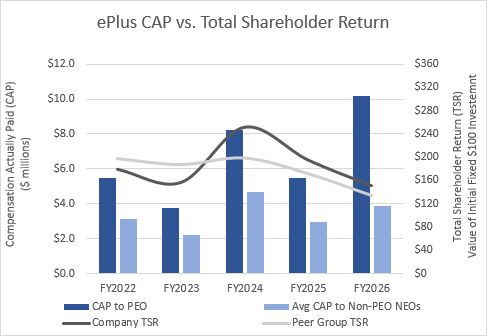
The chart below demonstrates the relationship between CAP amounts for our PEO and non-PEO executive officers and our net income.
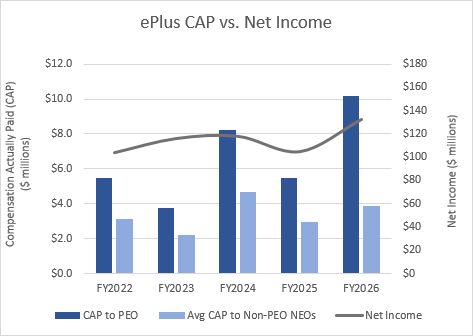
The chart below demonstrates the relationship between CAP amounts for our PEO and non-PEO executive officers and our operating income.
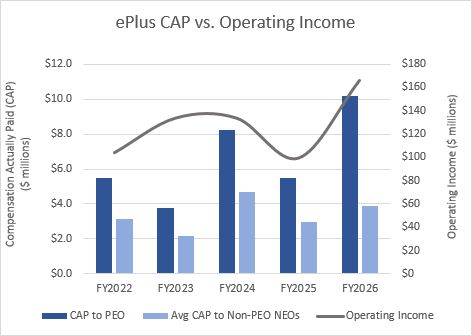
Financial Performance Measures
Below is an unranked list of the most important performance measures used to link executive compensation actually paid for the most recently completed
fiscal year, as described above, to the Company’s performance:
| • |
|
| • |
|
| • |
|
| • |
|
Revisions to Financial Statements
During the preparation of the 2026 Form 10-K, the Company identified an issue related to an overstatement of revenue from the Company’s product segment
that resulted from a miscalculation of accrued revenue as well as certain misstatements related to inventory cost and other expenses in the fiscal years ended March 31, 2024 and March 31, 2025. The Company assessed the impact of the
misstatements from both quantitative and qualitative perspectives and determined that the related impact was not material, either individually or in the aggregate, to the Company’s previously issued consolidated financial statements.
However, on May 26, 2026 , the Audit Committee determined that such misstatements should be revised by adjusting prior
period financial statements. As a result, the Company included revised financial statements to correct such misstatements in its 2026 Form 10-K filed with the SEC on May 28, 2026.
Recoupment Policy
The revisions to correct such misstatements in the 2026 Form 10-K required a recovery analysis of incentive-based compensation received by the Company’s
executive officers during the relevant recovery period pursuant to the Recoupment Policy adopted pursuant to Nasdaq Rule 5608, Section 10D of the Exchange Act, and Rule 10D-1 under the Exchange Act.
The Recoupment Policy applies to incentive-based compensation earned based on the attainment of financial performance measures during the three completed
fiscal years immediately preceding the restatement and received on or after November 17, 2023, the effective date of the policy. Any incentive-based compensation received prior to that date is not subject to recovery under the
Recoupment Policy. For purposes of the Recoupment Policy, incentive-based compensation is “received” in the fiscal period during which the financial reporting measure specified in the incentive-based compensation is attained, even if
the payment or grant of the incentive-based compensation occurs after the end of that period.
Recoupment Analysis
Three of the Company’s executive officers at the time received incentive-based compensation during the 2024 and 2025 fiscal years that was
based on misstated financial statements that were subsequently corrected in the 2026 Form 10-K. Such incentive-based compensation was comprised of the 2024 Annual Cash Incentive Awards, the 2025 Annual Cash Incentive Awards, the
2022-2024 Long-Term Cash Incentive Awards, and the 2023-2025 Long-Term Cash Incentive Awards.
As relates to the 2024 fiscal year analysis, the Compensation Committee determined that none of the underlying financial performance metrics used to
determine the 2024 Annual Cash Incentive Awards and the 2022-2024 Long-Term Cash Incentive Awards were overstated, and, as a result, did not result in erroneously awarded compensation. On the contrary, the executive officers were
underpaid with respect to the 2024 Annual Cash Incentive Awards and the 2022-2024 Long-Term Cash Incentive Awards in an aggregate amount of $24,962, as a result of the understatements in the 2024 fiscal year.
As relates to the 2025 fiscal year analysis, the financial performance metrics used to determine payouts under the 2025 Annual Cash Incentive Awards were
consolidated net sales (20%), financing segment operating income (20%), earnings before taxes (30%), and services gross profit (30%). With respect to each performance metric, the Compensation Committee determined:
| • |
Consolidated net sales was overstated by $9,399 in the prior misstated financial statements, changing the overall payout of this metric in the 2025 Annual Cash Incentive Awards from 85.0% to 84.6% of target.
|
| • |
Financing segment operating income was not affected by the corrections in the financial statements.
|
| • |
Earnings before taxes was overstated by $4,684 in the prior misstated financial statements, changing the overall payout of this metric in the 2025 Annual Cash Incentive Awards from 84.8% to 82.3% of target.
|
| • |
Services gross profit was not affected by the corrections in the financial statements.
|
The financial performance metrics used to determine payouts under the 2023-2025 Long-Term Cash Incentive Awards were consolidated net sales (50%) and
consolidated operating income (50%). With respect to each performance metric, the Compensation Committee determined:
| • |
Consolidated net sales was overstated by $9,399 in the prior misstated financial statements, changing the overall payout of this metric in the 2023-2025 Long-Term Cash Incentive Awards from 92.6% to 92.2% of target.
|
| • |
Consolidated operating income was overstated by $4,684 in the prior misstated financial statements, changing the overall payout of this metric in the 2023-2025 Long-Term Cash Incentive Awards from 84.8% to 83.6% of target.
|
As a consequence of the fiscal year 2025 overstatements listed above, payouts to the executive officers pursuant to the 2025 Annual Cash Incentive Awards
and the 2023-2025 Long-Term Cash Incentive Awards were determined by the Compensation Committee to be $3,343,118, rather than $3,393,067, in the aggregate, resulting in erroneously awarded compensation of an aggregate $49,949 across the three impacted executive officers.
Payment and Recovery
The erroneously awarded compensation pursuant to the 2025 Annual Cash Incentive Awards and the 2023-2025 Long-Term Cash Incentive Awards were paid to the
executive officers in cash, net of tax withholding, in June 2025. The aggregate amount of erroneously awarded compensation that remained outstanding at the end of fiscal 2026 was $49,949 (as the correction to financial statements had not yet been discovered and the amount of erroneously awarded compensation had not been determined), and $0 was outstanding as of the date of this proxy statement. Please see the Summary Compensation Table, which reflects the Company’s recovery
of the erroneously awarded compensation in the compensation reported for 2025.
The following table provides information as of March 31, 2026, regarding the number of securities available for future issuance under our current
equity compensation plans. Currently, there are no outstanding options, warrants, or rights under our prior or current equity compensation plans pursuant to which common stock may be issued.
|
Number of securities
to be issued upon
exercise of
outstanding options,
warrants, and rights
|
Weighted average
exercise price of
outstanding
options, warrants,
and rights
|
Number of securities
remaining available for
future issuance under
equity compensation
plans (excluding
securities reflected in
first column)
|
||||||||||
|
Equity compensation plans approved by security holders
|
57,509
|
(1) |
n/a
|
2,632,576
|
(2)
|
|||||||
|
Equity compensation plans not approved by security holders
|
-
|
n/a
|
-
|
|||||||||
|
Total
|
57,509
|
2,632,576
|
||||||||||
| (1) |
This number represents the number of Performance Share Units at target level.
|
| (2) |
This number includes 281,072 shares reserved for issuance under the 2024 Non-Employee Director Long-Term Incentive Plan and available for future equity awards, and 2,351,504 shares reserved for
issuance under the 2021 Employee Long Term Incentive Plan.
|
PROPOSAL 3 – Ratification of the Selection of Deloitte & Touche
LLP as our Independent Registered Public Accounting Firm for our Fiscal Year Ending March 31, 2027
The Board and the Audit Committee recommend that the shareholders ratify the selection of Deloitte as the Company’s independent
registered public accounting firm for the fiscal year ending March 31, 2027. Deloitte is currently the Company’s independent registered public accounting firm, and the Audit Committee approved the selection and retention of Deloitte
for fiscal year 2027.
Neither the Company’s Charter, Bylaws or other governing documents nor the law require shareholder ratification of the selection
of Deloitte as the Company’s independent registered accounting firm. As a matter of good corporate practice; however, the Company is submitting the selection of Deloitte to the shareholders for ratification. If the shareholders fail
to ratify the selection, the Audit Committee will reconsider whether to retain Deloitte. Even if the selection is ratified, the Audit Committee retains discretion to select a different independent registered accounting firm at any
time if the Audit Committee determines that such a change would be in the best interest of the Company and its shareholders.
Representatives of Deloitte are expected to attend the 2026 Annual Meeting and will have the opportunity to make a statement and
respond to appropriate questions.
THE BOARD UNANIMOUSLY RECOMMENDS VOTING FOR RATIFICATION OF THE SELECTION OF DELOITTE & TOUCHE LLP
AS THE COMPANY’S INDEPENDENT REGISTERED PUBLIC ACCOUNTING FIRM FOR THE FISCAL YEAR ENDING MARCH 31, 2027
The Audit Committee’s report regarding the Company’s audited consolidated financial statements for the fiscal
year ended March 31, 2026, is below. The information contained in this report shall not be deemed to be (i) soliciting material, (ii) filed with the SEC, (iii) subject to Regulations 14A or 14C of the Exchange Act, or (iv) subject
to the liabilities of Section 18 of the Exchange Act. Further, this report shall not to be deemed incorporated by reference in any filing of the Company under the Securities Act of 1933, as amended, or the Exchange Act, whether made
before or after the date of this proxy statement and irrespective of any general incorporation of this proxy statement by reference, except to the extent the Company specifically incorporates this report by reference into such
filing.
The Audit Committee has certain duties and powers as described in its written charter adopted by the Board, which is
available on the Investors section of the Company’s website at https://www.eplus.com/who-we-are/investor-relations/governance. The Audit Committee is
responsible primarily for assisting the Board in its oversight of the Company’s accounting and financial reporting processes, including audits of the Company’s financial statements and the integrity of its financial statements,
determining the independent registered public accounting firm’s qualifications and independence, and evaluating the performance of the Company’s internal audit function and that of the independent registered public accounting
firm. The Audit Committee does not itself prepare financial statements or perform audits. All members of the Audit Committee are “independent,” as required by applicable Nasdaq Listing Rules and in accordance with SEC rules and
regulations, as currently in effect, and each such member has the ability to read and understand fundamental financial statements.
Management is responsible for the preparation, presentation, and integrity of the Company’s financial statements; establishment
and effectiveness of internal controls over financial reporting; and maintenance of appropriate accounting and financial reporting principles, policies, and internal controls and procedures that provide for compliance with
accounting standards and applicable laws and regulations. Deloitte, as the Company’s independent registered public accounting firm, is responsible for planning and carrying out a proper audit of the Company’s annual financial
statements in accordance with the auditing standards of the Public Company Accounting Oversight Board (United States) (“PCAOB”), expressing an opinion as to the conformity of such financial
statements with generally accepted accounting principles, and auditing the effectiveness of internal controls over financial reporting.
In performing its oversight role, the Audit Committee has reviewed and discussed the audited consolidated financial statements
with management and Deloitte. The Audit Committee has discussed with Deloitte the matters required to be discussed by the applicable requirements of the PCAOB and the SEC. The Audit Committee has received the written disclosures and
the letter from Deloitte required by the applicable requirements of the PCAOB regarding the independent auditors’ communications with the Audit Committee concerning independence, and has discussed with Deloitte its independence.
Deloitte has unfettered access to the Audit Committee to discuss any matters Deloitte deems appropriate.
Members of the Audit Committee rely without independent verification on the information provided to them and on the
representations of management and Deloitte. Accordingly, the Audit Committee’s oversight does not provide an independent basis to determine that management has maintained appropriate accounting and financial reporting principles, or
appropriate internal controls and procedures designed to assure compliance with accounting standards and applicable laws and regulations. Furthermore, the Audit Committee’s considerations and discussions referred to above do not
assure that the audit of the Company’s consolidated financial statements has been carried out in accordance with the auditing standards of the PCAOB, that the consolidated financial statements are presented in accordance with
accounting principles generally accepted in the United States, that Deloitte is in fact “independent”, or the effectiveness of the Company’s internal controls.
Based on the review and discussions noted above, and subject to the limitations on the role and responsibilities of the Audit
Committee described above, the Audit Committee recommended to the Board of Directors that the audited consolidated financial statements be included in the Annual Report on Form 10-K for the fiscal year ended March 31, 2026. This
report is provided by the following independent directors, who served on the Audit Committee during the 2026 fiscal year.
Submitted by the Audit Committee
Melissa J. Ballenger, Chair
John E. Callies
Maureen F. Morrison
Michael J. Portegello
Deloitte has served as the Company’s independent registered public accounting firm since 1990. The Audit Committee of the Board
has selected Deloitte as the Company’s independent registered accounting firm for the fiscal year ending March 31, 2027.
The following table presents the aggregate fees paid to or accrued by ePlus relating to fees due to Deloitte for the audit of the Company’s annual consolidated financial statements, and all other
professional services rendered by Deloitte, for the fiscal years ended March 31, 2026, and 2025:
|
Fiscal 2026
|
Fiscal 2025
|
|||||||
|
Audit Fees
|
$
|
2,324,698
|
$
|
2,328,957
|
||||
|
Audit‐Related Fees
|
5,359
|
22,267
|
||||||
|
Tax Fees
|
-
|
-
|
||||||
|
All Other Fees
|
-
|
-
|
||||||
|
TOTAL FEES
|
$
|
2,330,057
|
$
|
2,351,224
|
||||
Audit Fees and Audit-Related Fees
Deloitte billed fees for the fiscal year ended March 31, 2026. The Audit Committee pre-approves all auditing services (which may
entail providing comfort letters in connection with securities underwriting), and all audit-related services Deloitte provided to us, subject to a de minimis exception in accordance with SEC’s rules.
Tax Fees
Deloitte provided no tax services, and thus billed no tax fees for the fiscal years ended March 31, 2026, and 2025.
All Other Fees
Deloitte provided no other services, and thus billed no other fees for the fiscal years ended March 31, 2026, and 2025.
Audit Committee’s Pre-Approval of Audit and Non-Audit Services
It is the policy of the Audit Committee to pre-approve all audit and permitted non-audit services proposed to be performed by our
independent registered public accounting firm. Each year, the Audit Committee approves the terms on which the independent auditor is engaged for the ensuing fiscal year. Pre-approval for audit and non-audit services is generally
provided in the annual engagement letter with Deloitte. In accordance with the charter of the Audit Committee, the authority to pre-approve any audit or non-audit services to be performed by the independent auditor has been delegated
to the Chair of the Audit Committee, provided that the services are ratified by the Audit Committee at its next scheduled meeting. Accordingly, any engagement for audit or non-audit services may be approved by (i) the Audit Committee
or (ii) the Audit Committee Chair, subject to ratification by the Audit Committee as described above. Deloitte and management are required to report periodically to the Audit Committee regarding the extent of services provided by the
independent registered public accounting firm in accordance with this pre-approval, and the fees for the services performed to date.
The affirmative vote of the holders of a majority of the shares entitled to vote on Proposal 3, present in person or represented by
proxy at the meeting, is required to ratify Proposal 3. Abstentions will have no effect on this proposal. If you do not instruct your broker, bank or other nominee how to vote on this proposal, your broker may vote your shares on
Proposal 3; accordingly, we would generally not expect there to be broker non-votes with respect to this Proposal 3.
PROPOSAL 4 – Approval of an Amendment to the Company’s Amended and Restated
Certificate of Incorporation to Increase the Number of Authorized Shares of Common Stock
Our Certificate of Incorporation currently authorizes the issuance of 52,000,000 shares of capital stock, consisting of 50,000,000
shares of common stock, and 2,000,000 shares of preferred stock, par value $.01 per share.
We are seeking shareholder approval to increase our authorized shares of common stock from 50,000,000 shares to 75,000,000 shares,
which would correspondingly increase the total number of authorized shares of capital stock to 77,000,000 (with no change to the 2,000,000 authorized shares of Preferred Stock).
On June 15, 2026, our Board of Directors voted unanimously to approve, and to recommend to the shareholders, an amendment to the
Certificate of Incorporation to enact the Authorized Share Increase (the “Charter Amendment”).
Pursuant to Section 242 of the Delaware General Corporation Law (the “DGCL”), we are
required to obtain approval from our shareholders to effectuate the Charter Amendment (and thereby the Authorized Share Increase). Under Section 242(d) of the DGCL, because ePlus is listed on
a national securities exchange, the Charter Amendment may be approved by the shareholders by the affirmative vote of a majority of the votes cast on this Proposal 4.
If the Charter Amendment is approved by the shareholders at the Annual Meeting, it will become effective upon its filing with the
Secretary of State of the State of Delaware at the effective time (or at such later time as may be specified therein), which is expected to occur promptly after the Annual Meeting, without any further action on the part of the
shareholders of the Company. The full text of the form of the Charter Amendment is attached as Appendix A to this proxy statement.
The purpose of the proposal to increase the number of authorized shares of common stock is to provide the Company with greater
flexibility in considering and planning for future business and financial needs.
Our Amended and Restated Certificate of Incorporation currently authorizes us to issue up to 52,000,000 shares of capital stock,
consisting of 50,000,000 shares of common stock and 2,000,000 shares of Preferred Stock.
Shares that have already been issued are referred to as “issued” or “issued and outstanding.” The difference between the total
number of authorized shares and the number of issued shares is the number of shares that we may issue in the future without amending the Certificate of Incorporation. Delaware law and the rules and regulations of the Nasdaq Stock
Market may require shareholder approval of common stock issuances under certain circumstances.
As of the Record Date, our total number of shares of common stock outstanding on a fully diluted basis (assuming that all shares
reserved for issuance under our equity incentive plans are granted and all outstanding equity awards are vested) is [30,792,650] as reflected in the table below:
|
Type
|
Number
|
||
|
Common stock Issued and Outstanding
|
[27,920,389]
|
||
|
Restricted Stock
|
[238,616]
|
||
|
Common stock issuable upon vesting of outstanding Performance Share Units (1)
|
[57,509]
|
||
|
Common stock reserved for future issuance under equity incentive plans (2)
|
[2,576,136]
|
||
|
Total
|
[30,792,650]
|
(1) Assumes vesting at the target level of performance.
(2) Represents shares of common stock reserved for future issuance under each of our 2024 Non-Employee Director Long-Term Incentive
Plan, our 2021 Employee Long-Term Incentive Plan and our 2022 Employee Stock Purchase Plan.
Accordingly, as of the Record Date, the total number of shares of common stock that were authorized, but not outstanding or reserved
for issuance was approximately [19,207,350].
As of the Record Date, none of the 2,000,000 currently authorized shares of Preferred Stock are issued or outstanding.
The Board believes it is in the best interests of the Company and our shareholders to increase our authorized shares of common stock
by 25,000,000 in order to have additional shares available for use as the Board deems appropriate or necessary for future corporate needs such as possible financing transactions, future stock splits or stock dividends, strategic
transactions or other general corporate purposes. We believe that it is advantageous for us to have the ability to act promptly with respect to potential opportunities and that the proposed increase in the number of authorized shares
of common stock is desirable in order to have the additional shares available, as needed, for possible financing transactions, future stock splits or stock dividends, strategic transactions or other general corporate purposes that are
determined by the Board to be in the best interest of our shareholders. Having such additional authorized shares available for issuance in the future would better position us to take timely advantage of market conditions and would
enable us to issue shares of common stock or other securities exercisable, exchangeable or convertible into common stock, without the expense and delay of a shareholders’ meeting, except as may be required by applicable law or
regulations. The Board of Directors will determine the terms of any issuance of the additional shares of common stock.
Except to the extent of our existing obligations on the date of mailing of this proxy statement, we do not currently have any plans,
understandings or agreements for the issuance or use of the additional shares of common stock to be approved under this proposal.
There can be no assurance that the market price per share of our common stock after the Charter Amendment will remain constant in
proportion to the increase in the number of shares of our common stock outstanding before the Charter Amendment.
The market price of our common stock will also be based on our performance and other factors, some of which are unrelated to the
number of shares outstanding. These factors include the status of the market for our common stock at the time, our reported results of operations in future periods, and general economic, market and industry conditions. Accordingly,
the market price of our common stock may not be sustainable at the direct arithmetic result of the Charter Amendment.
The authorization of additional shares of common stock will not, by itself, have any effect on the rights of present shareholders.
Any authorized shares of common stock, if and when issued, would be part of the Company’s existing class of common stock and would have the same rights and privileges as the shares of common stock currently outstanding. Current
shareholders do not have pre-emptive rights with respect to common stock, except for those granted contractually, nor do they have cumulative voting rights. Should the Board of Directors issue additional shares of common stock,
existing shareholders (other than those with contractual pre-emptive rights, if any) would not have any preferential rights to purchase any of such shares, and their percentage ownership of the Company’s then outstanding common stock
could be reduced.
If the Charter Amendment is approved, future issuances of common stock or securities convertible into or exchangeable for common
stock may have a dilutive effect on the Company’s earnings per share, book value per share and the voting power and interest of current shareholders. If the Charter Amendment is approved and filed with the Secretary of State of
Delaware, the additional shares of common stock proposed to be authorized, together with existing authorized and unissued shares of common stock, generally will be available for issuance without any requirement for further shareholder
approval, except as may be required by applicable law or by the rules of the Nasdaq Stock Market.
As is currently the case, our Board, in its discretion and subject to applicable law and stock exchange rules, would determine
whether, when and on what terms to issue any shares of common stock. In addition, the availability of additional shares of common stock for issuance could, under certain circumstances, discourage or make more difficult any efforts to
obtain control of the Company or inhibit the removal of incumbent management. For example, the issuance of the newly authorized shares of common stock could be used to deter or prevent a change of control through dilution of stock
ownership of persons seeking to take control, or by making such a transaction more costly. However, the Board of Directors is not aware of any third-party attempts to assume control of the Company and has not presented this Proposal
No. 4 with the intent that it be utilized as an anti-takeover device or to inhibit the removal of incumbent management.
Certain of our officers and directors have an interest in the proposal as a result of their ownership of shares of our common stock.
However, we do not believe that our officers or directors have interests in the proposal that are different from or greater than those of any of our other shareholders.
| Accounting Matters |
The Charter Amendment will not affect the par value per share of common stock. If the Charter Amendment is approved, our authorized shares
of common stock reported on our consolidated balance sheets will increase to 75,000,000, but our stockholders’ equity will remain unchanged.
If the Charter Amendment is approved, it will become effective upon its filing with the Secretary of State of the State of Delaware, which
the Company expects to file promptly after the 2026 Annual Meeting. If the Charter Amendment is not approved by the Company’s shareholders, the number of authorized shares of common stock will remain unchanged. Additionally, in accordance
with Section 242(c) of the DGCL, the Board reserves the right to abandon or delay the filing of the Charter Amendment even if it is approved by our shareholders.
The affirmative vote of a majority of the votes cast by shareholders entitled to vote on this Proposal No. 4 will be required to approve
the Charter Amendment (assuming a quorum is present at the 2026 Annual Meeting). Abstentions will have no effect on the outcome of the vote on the Charter Amendment because approval requires a majority of the votes cast. If you do not
instruct your broker, bank or other nominee how to vote on this proposal, your broker may vote your shares on Proposal 4; accordingly, we would generally not expect there to be broker non-votes with respect to this Proposal 4.
THE BOARD OF DIRECTORS RECOMMENDS YOU VOTE “FOR” THE APPROVAL OF THE CHARTER AMENDMENT TO INCREASE THE NUMBER OF AUTHORIZED
SHARES OF COMMON STOCK FROM 50,000,000 TO 75,000,000.
Why did I receive these proxy materials?
These proxy materials are first being distributed on or about July 24, 2026, to the Company’s shareholders in connection with our Board’s
solicitation of proxies to be voted at the 2026 Annual Meeting on September 10, 2026, at 8:30 a.m. ET, at the Westin Washington Dulles Airport, 2520 Wasser Terrace, Herndon, Virginia 20171, and any postponement or adjournment. This proxy
statement describes the matters on which you, as a shareholder of the Company, are entitled to vote. It also includes information that we are required to provide to you under SEC rules and is designed to assist you in voting your shares.
What is the purpose of the 2026 Annual Meeting?
At our 2026 Annual Meeting, shareholders will be asked to vote to (1) elect the nine director nominees named in this proxy statement for a
term expiring at the 2026 Annual Meeting of Shareholders; (2) approve, on an advisory basis, the compensation of our NEOs; (3) ratify the appointment of the Company’s independent registered public accounting firm and (4) approve a Charter
Amendment for the Authorized Share Increase; See the sections entitled “Proposal 1 – Election of Directors,” “Proposal 2 – Advisory Vote to Approve Named Executive Officer Compensation,” “Proposal 3 – Ratification of Independent Registered
Public Accounting Firm” and “Proposal 4 – Approval of an Amendment to the Company’s Amended and Restated Certificate of Incorporation to Increase the Number of Authorized Shares of Common Stock.”
The Board does not know of any matters to be brought before the meeting other than as set forth in the Notice of 2026 Annual Meeting of
Shareholders.
Who may attend the 2026 Annual Meeting?
Only holders of our common stock as of the close of business on our Record Date, which was July 17, 2026, or their duly appointed
proxies, may attend the 2026 Annual Meeting. If you hold your shares through a broker, bank, or other nominee, you will be required to show the notice or voting instructions form you received from your broker, bank, or other nominee, or a
copy of the statement (such as a brokerage statement) from your broker, bank, or other nominee reflecting your stock ownership as of our Record Date to be admitted to the 2026 Annual Meeting.
Who may vote at the 2026 Annual Meeting?
Holders of our common stock as of the close of business on the Record Date are entitled to notice of, and to vote at, the 2026 Annual
Meeting. As of July 17, 2026, there were [27,920,389] shares of our common stock outstanding, which includes [238,616] shares of unvested restricted stock entitled to vote at the 2026 Annual Meeting, with each share entitled to one vote.
How do I vote at the 2026 Annual Meeting?
Eligible shareholders may vote in one of four ways:
| • |
By telephone. Use the toll-free telephone number shown on your Notice or proxy card;
|
| • |
Via the Internet. Visit the Internet website shown on your Notice or proxy card and follow the on-screen instructions;
|
| • |
By mail. Date, sign, and promptly return your proxy card by mail in a postage prepaid envelope; or
|
| • |
In person. Deliver a completed proxy card at the meeting to vote in person.
|
Voting instructions for eligible shareholders (including instructions for both telephonic and Internet voting) are provided under the
heading “Voting Information” of this proxy statement and on the proxy card. The telephone and Internet voting procedures are designed to authenticate shareholder identities, allow shareholders to
give voting instructions, and confirm that the shareholders’ instructions have been recorded properly. A control number, located on the Notice and the proxy card, will identify shareholders and allow them to submit their proxies and confirm
that their voting instructions have been properly recorded. Costs associated with telephone and electronic access, such as usage charges from telephone companies and Internet access providers, must be borne by the shareholder. If you submit
your proxy by telephone or via the Internet, it will not be necessary to return your proxy card by mail. The deadline for voting by telephone or via the Internet is 8:30 a.m. ET on September 10, 2026. Any proxy card submitted by mail must
be received by 8:30 a.m. ET on September 10, 2026.
Further, a proxy that is signed and dated, but which does not contain voting instructions, will be voted as recommended by our Board on
each proposal.
What if I do not vote or do not indicate how my shares should be voted on my proxy card?
If an eligible shareholder does not return a signed proxy card or submit a proxy by telephone or via the Internet, and does not attend the
meeting and vote in person, his or her shares will not be voted. Shares of our common stock represented by properly executed proxies received by us or proxies submitted by telephone or via the Internet, and which are not revoked, will be
voted at the meeting in accordance with the instructions contained therein.
If you submit a properly completed proxy but do not indicate how your shares should be voted on a proposal, the shares
represented by your proxy will be voted as the Board recommends on such proposal.
What if my shares of the Company’s common stock are held for me by a broker?
If you are the beneficial owner of shares held for you by a broker, your broker must vote those shares in accordance with your
instructions. A “broker non-vote” occurs when a broker or other nominee holding shares for a beneficial owner does not vote on a particular proposal because the broker or other nominee does not have discretionary voting power for that item
and has not received instructions from the beneficial owner.
| • |
Non-Discretionary Items. The election of directors (Proposal 1) and the advisory vote to approve NEO compensation (Proposal 2), may not be voted on by your broker
if it has not received voting instructions.
|
| • |
Discretionary Items. The ratification of Deloitte as the Company’s independent registered public accounting firm (Proposal 3) and the vote to approve the
Authorized Share Increase (Proposal 4) are discretionary items. Generally, brokers that do not receive voting instructions from beneficial owners may vote on this proposal in their discretion.
|
How can I change my votes or revoke my proxy after I have voted?
Any proxy signed and returned by a shareholder or submitted by telephone or via the Internet may be revoked or changed at any time before
it is exercised at the 2026 Annual Meeting, or any adjournments or postponements thereof, by:
| • |
Mailing written notice of revocation or change to our Corporate Secretary, at ePlus inc., 13595 Dulles Technology Drive, Herndon, Virginia 20171;
|
| • |
Delivering a later-dated proxy (either in writing, by telephone, or via the Internet); or
|
| • |
Voting in person at the meeting.
|
Attendance at the meeting will not, in and of itself, constitute revocation of a proxy.
Will my votes be publicly disclosed?
No. As a matter of policy, shareholder proxies, ballots, and tabulations that identify individual shareholders are not publicly disclosed
and are available only to the inspector of election and certain employees of the Company who are obligated to keep such information confidential.
Who will count the votes?
A representative of the Company’s Transfer Agent, Computershare, will serve as the inspector of election for the 2026 Annual Meeting, and
will count the votes.
What if other matters come up during the 2026 Annual Meeting?
If any other matters properly come before the meeting, including a question of adjourning or postponing the meeting, the persons named in
the proxies or their substitutes acting thereunder will have discretion to vote on such matters in accordance with their best judgment.
What constitutes a quorum at the 2026 Annual Meeting?
A quorum is required to transact business at the 2026 Annual Meeting. To constitute a quorum, there must be in attendance or represented by
proxy a majority of the voting power of the outstanding capital stock entitled to vote at the 2026 Annual Meeting. Abstentions and broker non-votes count toward the establishment of a quorum.
How many votes are required to approve each matter to be considered at the 2026 Annual Meeting?
Assuming a quorum is present at the 2026 Annual Meeting, the vote required for each of the proposals scheduled to come before the 2026 Annual Meeting is as
follows.
Proposal 1: Election of directors. Each of the nine nominees for director
will be elected by a majority of the votes cast with respect to that director at the 2026 Annual Meeting and entitled to vote on the election of directors. Additionally, pursuant to the Guidelines, because each incumbent director’s term
continues until his or her successor is elected and qualified, for the avoidance of doubt, each director is required to offer to resign should he or she not receive a majority of the votes cast. For Proposal 1, you may vote “FOR” or
“AGAINST” each of the nominees or you may “ABSTAIN” from voting with respect to each of the nominees. Abstentions and broker non-votes will have no effect on the vote for this proposal.
Please note that in the event of a contested election (one where the number of director nominees exceeds the number of directors fixed by
the Board in accordance with the Bylaws), director nominees who receive the most votes for the number of seats up for election will be elected.
Proposal 2: Advisory vote to approve NEO compensation. The affirmative
vote of the holders of a majority of the shares entitled to vote on the proposal, present in person or represented by proxy at the meeting, is required to approve on an advisory, non-binding basis the compensation paid to our NEOs. For
Proposal 2, you may vote “FOR” or “AGAINST” the advisory vote to approve NEO compensation or you may “ABSTAIN” from voting with respect to the proposal. Abstentions and broker non-votes will have no effect on the vote for this proposal.
Proposal 3: Ratification of Deloitte & Touche LLP as the Company’s independent registered public accounting
firm. The affirmative vote of the holders of a majority of the shares entitled to vote on the proposal, present in person or represented by proxy at the meeting, is required to ratify on an advisory,
non-binding basis Deloitte as the Company’s independent registered public accounting firm for the fiscal year ending March 31, 2027. For Proposal 3, you may vote “FOR” or “AGAINST” the vote to ratify Deloitte as the Company’s independent
registered public accounting firm or you may “ABSTAIN” from voting with respect to the proposal. Abstentions will have no effect on the vote for this proposal. If you do not instruct your broker, bank or other nominee how to vote on this
proposal, your broker may vote your shares on the proposal, so no broker non-votes are expected.
Proposal 4: Approval of the Charter Amendment for the Authorized Share Increase. The affirmative vote of the holders of a majority of the shares entitled to vote on the proposal, present in person or represented by proxy at the meeting, is required to approve the Charter Amendment for the Authorized Share
Increase. For Proposal 4, you may vote “FOR” or “AGAINST” the Charter Amendment for the Authorized Share Increase or you may “ABSTAIN” from voting with respect to the proposal. Abstentions will have no effect on the vote for this proposal.
If you do not instruct your broker, bank or other nominee how to vote on this proposal, your broker may vote your shares on the proposal, so no broker non-votes are expected.
Who pays to prepare, mail, and solicit the proxies?
The Company will bear the costs of solicitation of proxies for the 2026 Annual Meeting, including preparation, assembly, printing, and
mailing of the Notice, this proxy statement, the Annual Report, the proxy card, and any additional information furnished to shareholders. We may reimburse persons representing beneficial owners of common stock for their costs of
forwarding any solicitation materials to such beneficial owners. Proxies may be solicited in person or by mail, telephone, or electronic transmission on our behalf by our directors, officers, or employees. However, we do not reimburse or
pay additional compensation to our own directors, officers, or other employees for soliciting proxies.
The Board knows of no other matters that will be presented for consideration at the 2026 Annual Meeting. If any other matters are
properly brought before the meeting, the persons named in the accompanying proxy will have the discretionary authority to vote such proxy on such matters in accordance with their best judgment.
A copy of our Annual Report, which includes our 2026 Form 10-K, as filed with the SEC, will be sent to any shareholder without charge
upon written request addressed to Investor Relations, at ePlus inc., 13595 Dulles Technology Drive, Herndon, Virginia 20171.
You may also obtain our Form 10-K via the SEC’s Internet site, www.sec.gov, or our Annual Report, which includes our 2026 Form 10-K, via our website, www.eplus.com/Investors/Pages/Annual-Reports.aspx.
Additional copies of the Annual Report, the Notice, this proxy statement, and the accompanying proxy may be obtained from our Investor
Relations department at the address above.
Company shareholders who share an address may receive only one copy of the Notice or this proxy statement and the Annual Report from
their bank, broker, or other nominee, unless contrary instructions are received. We will deliver promptly a separate copy of the Notice or this proxy statement and Annual Report to any shareholder who resides at a shared address and to
which a single copy of the documents was delivered, if the shareholder makes a request by contacting our Corporate Secretary, at ePlus inc., 13595 Dulles Technology Drive, Herndon, Virginia 20171,
or by telephone at (703) 984-8400. If you wish to receive separate copies of the Notice or this proxy statement and the Annual Report in the future, or if you are receiving multiple copies and would like to receive a single copy for your
household, you should contact your broker, bank, or other nominee.
Shareholders have the opportunity to submit proposals for the 2027 Annual Meeting of Shareholders. To be considered for
inclusion in the Company’s proxy statement and form of proxy for next year’s Annual Meeting of Shareholders, your shareholder proposal must be submitted in writing by March 26, 2027 (assuming the 2027 Annual Meeting of Shareholders is
held within 30 days of the anniversary of this 2026 Annual Meeting), to the Corporate Secretary at ePlus inc., 13900 Lincoln Park Drive, Suite 500, Herndon, Virginia 20171, following our anticipated office
relocation in October 2026 (as will be further confirmed in a Press Release). Proposals must be received by that date and satisfy the requirements of Rule 14a-8 under the Exchange Act to be included in the proxy statement and on the
proxy card that will be used for solicitation of proxies by the Board for the 2027 Annual Meeting of Shareholders. In addition, to comply with the universal proxy rules, shareholders who intend to solicit proxies in support of director
nominees other than the Company’s nominees must provide notice that sets forth the information required by Rule 14a-19 under the Exchange Act postmarked or transmitted electronically no later than July 12, 2027 (assuming the 2027 Annual
Meeting of Shareholders is held within 30 days of the anniversary of this 2026 Annual Meeting).
In accordance with our Bylaws, if you wish to submit a proposal for consideration at next year’s Annual Meeting of Shareholders that is
to be included in next year’s proxy materials, or wish to nominate a candidate for election to the Board at next year’s Annual Meeting of Shareholders, your proposal or nomination must be submitted in writing and received by the Corporate
Secretary not more than 120 days nor later than 90 days in advance of the first anniversary of this 2026 Annual Meeting if the 2027 Annual Meeting of Shareholders is held within 30 days of the anniversary of this 2026 Annual Meeting or,
otherwise, within seven days after the first public announcement of the date of the 2027 Annual Meeting of Shareholders. Assuming that our 2027 Annual Meeting of Shareholders is held on schedule, to be “timely” within the meaning of Rule
14a-4(c) under the Exchange Act, we must receive written notice of your intention to introduce a nomination or other item of business at that Meeting not earlier than May 13, 2027, and not later than June 12, 2027. If we do not receive
written notice during that time period, or if we meet certain other requirements of the SEC rules, the persons named as proxies in the proxy materials relating to that meeting will use their discretion in voting the proxies if any such
matters are raised at the meeting.
A submission by an ePlus shareholder must contain the specific information required in ePlus’ Bylaws. If you would like a copy of ePlus’ current Bylaws, please write
to the Corporate Secretary at ePlus inc., 13595 Dulles Technology Drive, Herndon Virginia 20171
(or our updated address pursuant to our anticipated office relocation in October 2026, as referenced above). ePlus’ current Bylaws may also be found on the Company’s website at https://www.eplus.com/content/dam/assets/eplus/documents/legal/governance/2026-02-amended-and-restated-bylaws.pdf.
The preliminary voting results will be announced at the 2026 Annual Meeting. The final voting results will be tallied by the inspector
of elections and reported in a Current Report on Form 8-K, which we are required to file with the SEC within four business days following the 2026 Annual Meeting.
Although the information contained on, or accessible through, our website is not part of this proxy statement, you will
find information about ePlus and our corporate governance practices at https://www.eplus.com/who-we-are/investor-relations. Our website contains information about our Board, its Committees, and their charters; our Bylaws and our Certificate
of Incorporation (each as amended and restated); and our Code of Conduct, and Corporate Governance Guidelines. Shareholders may obtain, without charge, printed copies of the above documents by writing to the Corporate Secretary, at ePlus inc., 13595 Dulles Technology Drive, Herndon, Virginia 20171 (or our updated address pursuant to our anticipated office relocation in
October 2026, as referenced above).
The Company’s principal executive offices are located at ePlus inc., 13595 Dulles Technology
Drive, Herndon, Virginia 20171. Following our anticipated office relocation in October 2026, our principal executive offices will be located at 13900 Lincoln Park Drive, Suite 500, Herndon, VA Virginia 20171 (as will be further confirmed
in a Press Release). The Company’s main telephone number is (703) 984-8400.
This proxy statement contains “forward-looking statements” as that term is defined in the Private Securities Litigation Reform Act of
1995. These statements are based on management’s current expectations and involve substantial risks and uncertainties, which may cause results to differ materially from those set forth in the statements. The forward-looking statements may
include, but are not limited to, statements made in the CD&A section of this proxy statement regarding the benefits and anticipated results of our compensation programs and the Compensation Committee’s plans and intentions relating
thereto. The Company undertakes no obligation to publicly update any forward-looking statement, whether as a result of new information, future events, or otherwise, except as may be required by law. Forward-looking statements should be
evaluated together with the many uncertainties that affect our business, particularly those mentioned under the heading “Risk Factors” in our Annual Report, and in the periodic reports that we file
with the SEC on Form 10-Q.
IMPORTANT
NOTICE REGARDING THE AVAILABILITY OF PROXY MATERIALS FOR THE
SHAREHOLDER MEETING TO BE HELD ON SEPTEMBER 10, 2026
The proxy materials for the Company’s 2026 Annual Meeting, including our Annual Report on Form 10-K for the year ended
March 31, 2026, and this proxy statement, are available online via the Company’s website at https://www.eplus.com/investors/investor-information/annual-meeting-proxy. Other information on the Company’s website does not constitute part of the Company’s proxy materials.
It is important that your proxy be returned promptly, whether by mail, by telephone or via the Internet. The proxy
may be revoked at any time by you before it is exercised as described in this proxy statement. If you attend the meeting in person, you may withdraw any proxy (including a mailed, telephonic or Internet proxy) and vote your own shares as
described in this proxy statement.
|
July 24, 2026
|
By Order of the Board of Directors
|
| /s/ Erica S. Stoecker | |
|
Erica S. Stoecker
|
|
|
Corporate Secretary, General Counsel, & Chief Compliance Officer
|
Annex A
Charter Amendment
STATE OF DELAWARE
CERTIFICATE OF AMENDMENT OF AMENDED AND RESTATED CERTIFICATE OF INCORPORATION
OF EPLUS INC.
The corporation organized and existing under and by virtue of the General Corporation Law of the State of Delaware
does hereby certify:
FIRST: That at a meeting of the Board of Directors
of ePlus inc., resolutions were duly adopted setting forth a proposed amendment of the Amended and Restated Certificate of Incorporation of said corporation, declaring said amendment to be
advisable and calling a meeting of the stockholders of said corporation for consideration thereof. The resolution setting forth the proposed amendment is as follows:
RESOLVED, that the Amended and Restated Certificate
of Incorporation of this corporation be amended by changing the Article thereof numbered “FOURTH” so that, as amended, said Article shall be and read as follows:
The total number of shares of all classes of stock which the Corporation shall have authority to issue is
seventy-seven million (77,000,000) shares consisting of seventy-five million (75,000,000) shares of common stock having a par value of $.01 per share (the “Common Stock”) and two million (2,000,000) shares of preferred stock having
a par value of $.01 per share (the “Preferred Stock”).
The Board of Directors of the Corporation is authorized, subject to limitations prescribed by law, to provide
by resolution or resolutions for the issuance of shares of the Preferred Stock as a class or in series, and, by filing a certificate of designations, pursuant to the Delaware General Corporation Law, setting forth a copy of such
resolution or resolutions to establish from time to time the number of shares to be included in each such series and to fix the designation, powers, preferences and rights of the shares of the class or of each such series and the
qualifications, limitations, and restrictions thereof. The authority of the Board of Directors with respect to the class or each series shall include, but not be limited to, determination of the following:
|
a)
|
the number of shares constituting any series and the distinctive designation of that series;
|
|
b)
|
the dividend rate of the shares of the class or of any series, whether dividends shall be cumulative, and if so, from which date or dates, and the relative rights of priority, if any of
payment of dividends on shares of the class or of that series;
|
|
c)
|
whether the class or any series shall have voting rights, in addition to the voting rights provided by law, and if so, the terms of such voting rights;
|
|
d)
|
whether the class or any series shall have conversion privileges and, if so, the terms and conditions of conversion, including provision for adjustment of the conversion rate in such events as the Board of Directors
shall determine;
|
|
e)
|
whether or not the shares of the class or of any series shall be redeemable, and, if so, the terms and conditions of such redemption, including the date or date upon or after which they shall
be redeemable and the amount per share payable in case of redemption, which amount may vary under different conditions and at different redemption rates;
|
|
f)
|
whether the class or any series shall have a sinking fund for the redemption or purchase of shares of the class or of that series, and if so, the terms and amount of such sinking fund;
|
|
g)
|
the rights of the shares of the class or of any series in the event of voluntary or involuntary dissolution or winding up of the Corporation, and the relative rights of priority, if any,
of payment of shares of the class or of that series; and
|
|
h)
|
any other powers, preferences, rights, qualifications, limitations and restrictions of the class or of that series.
|
All rights accruing to the outstanding shares of the Corporation not expressly provided for to the contrary herein or in any certificate of designation shall
be vested exclusively in the Common Stock.
SECOND: That thereafter, pursuant to resolution
of its Board of Directors, an annual meeting of the stockholders of said corporation was duly called and held upon notice in accordance with Section 222 of the General Corporation Law of the State of Delaware at which meeting the
necessary number of shares as required by statute were voted in favor of the amendment.
THIRD: That said amendment was duly adopted in
accordance with the provisions of Section 242 of the General Corporation Law of the State of Delaware.
IN WITNESS WHEREOF, said corporation has caused
this certificate to be signed this ____ day of ___________, 2026.
|
By:
|
||
|
Authorized Officer Title: Corporate Secretary
|
||
|
Name: Erica S. Stoecker
|
||
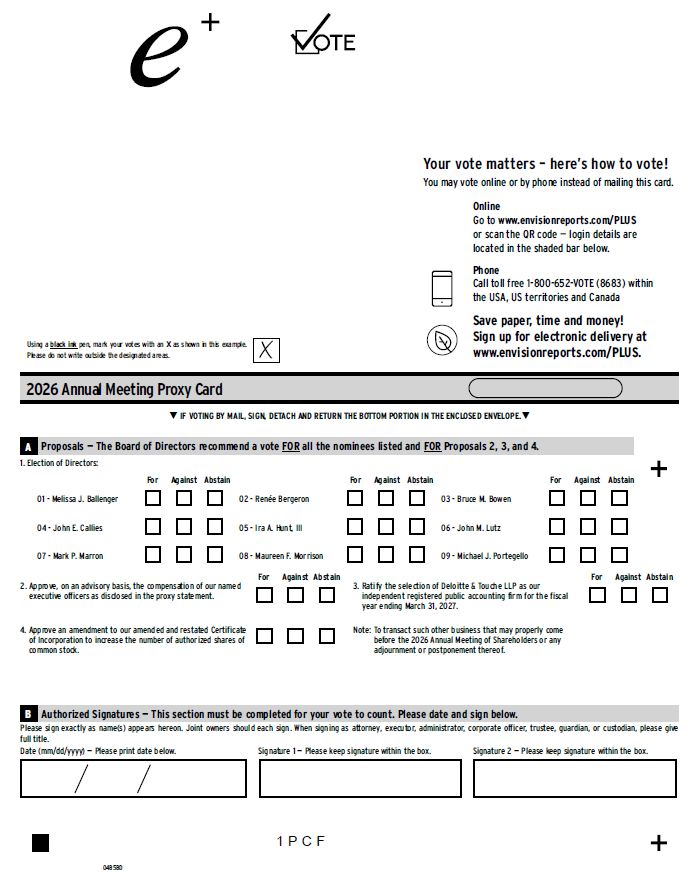

ATTACHMENTS / EXHIBITS
XBRL TAXONOMY EXTENSION SCHEMA
XBRL TAXONOMY EXTENSION LABEL LINKBASE
Serious News for Serious Traders! Try StreetInsider.com Premium Free!
You May Also Be Interested In
- 10 Seconds of Video in 4 Seconds: Yoroll Launches H3 Superfast and YoLive
- Bouygues: Disclosure of trading in own shares
- SOITEC - INFORMATION RELATING TO THE TOTAL NUMBER OF VOTING RIGHTS AND SHARES FORMING THE SHARE CAPITAL
Create E-mail Alert Related Categories
SEC FilingsSign up for StreetInsider Free!
Receive full access to all new and archived articles, unlimited portfolio tracking, e-mail alerts, custom newswires and RSS feeds - and more!
