



Form DEF 14A Quest Resource Holding For: Jun 30
 Tweet
Tweet Share
Share E-mail
UNITED STATES
SECURITIES AND EXCHANGE COMMISSION
Washington, D.C. 20549
SCHEDULE 14A
(Rule 14a-101)
INFORMATION REQUIRED IN PROXY STATEMENT
SCHEDULE 14A INFORMATION
Proxy Statement Pursuant to Section 14(a) of the Securities Exchange Act of 1934
(Amendment No. )
Filed by the Registrant ☒
Filed by a Party other than the Registrant ☐
Check the appropriate box:
| ☐ | Preliminary Proxy Statement |
| ☐ | Confidential, for Use of the Commission Only (as permitted by Rule 14a-6(e)(2)) |
| ☒ | Definitive Proxy Statement |
| ☐ | Definitive Additional Materials |
| ☐ | Soliciting Material Under § 240.14a-12 |
| QUEST RESOURCE HOLDING CORPORATION |
(Name of Registrant as Specified In Its Charter) |
(Name of Persons(s) Filing Proxy Statement, if other than the Registrant) |
Payment of Filing Fee (Check all boxes that apply):
| ☒ | No fee required |
| ☐ | Fee paid previously with preliminary materials |
| ☐ | Fee computed on table in exhibit required by Item 25(b) per Exchange Act Rules 14a-6(i)(1) and 0-11 |

QUEST RESOURCE HOLDING CORPORATION
NOTICE OF ANNUAL MEETING OF STOCKHOLDERS
June 30, 2026
The Annual Meeting of Stockholders of Quest Resource Holding Corporation, a Nevada corporation, will be held at 9:00 a.m., local time, on Tuesday, June 30, 2026, at the offices of Quest Resource Holding Corporation, located at 433 E. Las Colinas Boulevard, Irving, Texas 75039, for the following purposes:
| 1. | To elect two directors, each to serve for a three-year term expiring in 2029. |
| 2. | To provide a non-binding advisory vote on the compensation of our named executive officers for fiscal 2025, or say-on-pay. |
| 3. | To ratify the appointment of Semple, Marchal and Cooper, LLP, an independent registered public accounting firm, as the independent registered public accountant of our company for the fiscal year ending December 31, 2026. |
| 4. | To approve an amendment to our 2024 Incentive Compensation Plan (the “2024 Incentive Plan”) to increase the number of shares available under our 2024 Incentive Plan by 600,000 shares. |
| 5. | To approve an amendment to our 2024 Employee Stock Purchase Plan (the “2024 ESPP”) to increase the number of shares available under our 2024 ESPP by 150,000 shares. |
| 6. | To transact such other business as may properly come before the meeting or any adjournment or postponement thereof. |
These items of business are more fully described in the proxy statement accompanying this notice.
Only stockholders of record at the close of business on May 21, 2026 are entitled to notice of and to vote at the meeting or any adjournment or postponement thereof.
All stockholders are cordially invited to attend the meeting and vote in person. To assure your representation at the meeting, however, you are urged to vote by proxy as soon as possible by mail by following the instructions on the proxy card. You may vote in person at the meeting even if you have previously given your proxy.
Sincerely,
/s/ Brett W. Johnston
Brett W. Johnston
Secretary
Irving, Texas
June 2, 2026
| i |

QUEST RESOURCE HOLDING CORPORATION
433 E. Las Colinas Boulevard
Suite 675
Irving, Texas 75039
PROXY STATEMENT
General
The enclosed proxy is being solicited on behalf of Quest Resource Holding Corporation, a Nevada corporation (the “Company”), by our board of directors (“Board of Directors”) for use at our Annual Meeting of Stockholders to be held at 9:00 a.m., local time, on Tuesday, June 30, 2026, or at any adjournment or postponement thereof (the “Annual Meeting”), for the purposes set forth in this proxy statement and in the accompanying notice. The Annual Meeting will be held at the offices of Quest Resource Holding Corporation, located at 433 E. Las Colinas Boulevard, Irving, Texas 75039, for the following purposes:
| 1. | To elect two directors, each to serve for a three-year term expiring in 2029. |
| 2. | To provide a non-binding advisory vote on the compensation of our named executive officers for fiscal 2025, or say-on-pay. |
| 3. | To ratify the appointment of Semple, Marchal and Cooper, LLP, an independent registered public accounting firm, as the independent registered public accountant of our company for the fiscal year ending December 31, 2026. |
| 4. | To approve an amendment to our 2024 Incentive Compensation Plan (the “2024 Incentive Plan”) to increase the number of shares available under our 2024 Incentive Plan by 600,000 shares. |
| 5. | To approve an amendment to our 2024 Employee Stock Purchase Plan (the “2024 ESPP”) to increase the number of shares available under our 2024 ESPP by 150,000 shares. |
| 6. | To transact such other business as may properly come before the Annual Meeting or any adjournment or postponement thereof. |
If you need directions to the location of the Annual Meeting, please call (972) 464-0004.
These proxy solicitation materials were first released on or about June 2, 2026 to all stockholders entitled to vote at the Annual Meeting.
| 1 |
Important Notice Regarding the Availability of Proxy Materials for the Stockholder Meeting To Be Held on June 30, 2026.
These proxy materials, which include the notice of Annual Meeting, this proxy statement, and our 2025 Annual Report for the fiscal year ended December 31, 2025, are available at https://www.proxydocs.com/QRHC.
Stockholders Entitled to Vote; Record Date; How to Vote
Stockholders of record at the close of business on May 21, 2026, which we have set as the record date, are entitled to notice of and to vote at the Annual Meeting. On the record date, there were outstanding 21,073,513 shares of our common stock. Each stockholder voting at the Annual Meeting, either in person or by proxy, may cast one vote per share of common stock held on all matters to be voted on at the Annual Meeting.
If, on May 21, 2026, your shares were registered directly in your name with our transfer agent, Continental Stock Transfer & Trust Company, then you are a stockholder of record. As a stockholder of record, you may vote in person at the Annual Meeting. Alternatively, you may vote by using the accompanying proxy card. Whether or not you plan to attend the Annual Meeting, we urge you to vote by filling out and returning the enclosed proxy card or by voting online as instructed on the enclosed proxy card to ensure your vote is counted. Even if you have submitted a proxy before the Annual Meeting, you may still attend the Annual Meeting and vote in person.
If, on May 21, 2026, your shares were held in an account at a brokerage firm, bank, or similar organization, then you are the beneficial owner of shares held in “street name,” and these proxy materials are being forwarded to you by that organization. The organization holding your account is considered the stockholder of record for purposes of voting at the Annual Meeting. As a beneficial owner, you have the right to direct your broker, bank, or other nominee on how to vote the shares in your account. You should have received voting instructions with these proxy materials from that organization rather than from us. You should follow the instructions provided by that organization to submit your proxy. You are also invited to attend the Annual Meeting. However, since you are not the stockholder of record, you may not vote your shares in person at the Annual Meeting unless you obtain a “legal proxy” from the broker, bank, or other nominee that holds your shares giving you the right to vote the shares at the Annual Meeting.
Quorum; Required Vote; Broker Non-Votes and Abstentions
The presence, in person or by proxy, of the holders of a majority of the total number of shares of common stock entitled to vote constitutes a quorum for the transaction of business at the Annual Meeting. Votes cast in person or by proxy at the Annual Meeting will be tabulated by the election inspector appointed for the Annual Meeting, who will determine whether a quorum is present.
Assuming that a quorum is present, the vote of a majority of the votes present (in person or by proxy) and entitled to vote will be required to elect directors, to ratify the appointment of Semple, Marchal and Cooper, LLP, an independent registered public accounting firm, as the independent registered public accountant of our company for the fiscal year ending December 31, 2026, to approve an amendment to the 2024 Incentive Plan and to approve an amendment to the 2024 ESPP. The advisory vote on the compensation of our named executive officers for fiscal 2025, or say-on-pay, is non-binding, but the Board of Directors will consider the input of stockholders based on the vote of a majority of the votes present (in person or by proxy) and entitled to vote for the say-on-pay proposal.
Brokers, banks, or other nominees that hold shares of common stock in “street name” for a beneficial owner of those shares typically have the authority to vote in their discretion if permitted by the stock exchange or other organization of which they are members. Brokers, banks, and other nominees are permitted to vote the beneficial owner’s proxy in their own discretion as to certain “routine” proposals when they have not received instructions from the beneficial owner, such as the ratification of the appointment of Semple, Marchal and Cooper, LLP as the independent registered public accountant of our company for the fiscal year ending December 31, 2026. If a broker, bank, or other nominee votes such “uninstructed” shares for or against a “routine” proposal, those shares will be counted towards determining whether or not a quorum is present and are considered entitled to vote on the “routine” proposals. However, where a proposal is not “routine,” a broker, bank, or other nominee is not permitted to exercise its voting discretion on that proposal without specific instructions from the beneficial owner. These non-voted shares are referred to as “broker non-votes” when the nominee has voted on other non-routine matters with authorization or voted on routine matters. These shares will be counted towards determining whether or not a quorum is present but will not be considered entitled to vote on the “non-routine” proposals.
| 2 |
Please note that brokers, banks, and other nominees may not use discretionary authority to vote shares on the election of directors, the say-on-pay proposal, the proposal to amend the 2024 Incentive Plan or the proposal to amend the 2024 ESPP. For your vote to be counted in the election of directors, the say-on-pay proposal, the proposal to amend the 2024 Incentive Plan or the proposal to amend the 2024 ESPP, you will need to communicate your voting decisions to your broker, bank, or other nominee before the date of the Annual Meeting.
Broker non-votes do not represent votes entitled to vote “for” or “against” a proposal and will have no effect on the election of directors, the say-on-pay proposal, the proposal to ratify the appointment of Semple, Marchal and Cooper, LLP as the independent registered public accountant of our company for the fiscal year ending December 31, 2026, the proposal to amend our 2024 Incentive Plan or the proposal to amend our 2024 ESPP, as each such proposal is determined by reference to the vote of a majority of the votes present (in person or by proxy at the Annual Meeting) and entitled to vote.
Where a proposal requires a majority of the votes present (in person or by proxy) and entitled to vote, an abstention will have the same effect as a vote “against” that proposal. As such, an abstention for any of the proposals herein will be considered as a vote “against” such proposal.
Voting of Proxies
When a proxy is properly executed and returned, the shares it represents will be voted at the Annual Meeting as directed. Except as provided above under “Quorum; Required Vote; Broker Non-Votes and Abstentions,” if no specification is indicated, the shares will be voted (1) “FOR” the election of each of the two director nominees set forth in this proxy statement, (2) “FOR” the approval of the compensation of our named executive officers for fiscal 2025, (3) “FOR” the ratification of the appointment of Semple, Marchal and Cooper, LLP as the independent registered public accountant of our company for the fiscal year ending December 31, 2026, (4) “FOR” the approval of the amendment to the 2024 Incentive Plan and (5) “FOR” the approval of the amendment to the 2024 ESPP. If any other matter is properly presented at the Annual Meeting, the individuals specified in the proxy will vote your shares using their best judgment.
Revocability of Proxies
Any person giving a proxy may revoke the proxy at any time before its use by delivering to us either a written notice of revocation or a duly executed proxy bearing a later date or by attending the Annual Meeting and voting in person. Attendance at the Annual Meeting will not cause your previously granted proxy to be revoked unless you specifically so request.
Solicitation
We will bear the cost of this solicitation. In addition, we may reimburse brokerage firms and other persons representing beneficial owners of shares for expenses incurred in forwarding solicitation materials to such beneficial owners. Proxies also may be solicited by certain of our directors and officers, personally or by telephone or e-mail, without additional compensation.
Annual Report and Other Matters
Our 2025 Annual Report to Stockholders, which was made available to stockholders with or preceding this proxy statement, contains financial and other information about our company, but is not incorporated into this proxy statement and is not to be considered a part of these proxy materials or subject to Regulations 14A or 14C or to the liabilities of Section 18 of the Securities Exchange Act of 1934, as amended (the “Exchange Act”). The information contained in the “Report of the Audit Committee” shall not be deemed “filed” with the Securities and Exchange Commission (the “SEC”), or subject to Regulations 14A or 14C or to the liabilities of Section 18 of the Exchange Act.
| 3 |
We will provide, without charge, a copy of our Annual Report on Form 10-K for the fiscal year ended December 31, 2025 as filed with the SEC to each stockholder of record as of the record date that requests a copy in writing. Any exhibits listed in our Annual Report on Form 10-K also will be furnished upon request at the actual expense we incur in furnishing such exhibits. Any such requests should be directed to our Secretary at the address of our executive offices set forth in this proxy statement.
PROPOSAL ONE:
ELECTION OF DIRECTORS
Nominees
Our articles of incorporation and bylaws provide that the number of directors shall be fixed from time to time by resolution of our Board of Directors. As of the date of this proxy statement, there are six directors and that number of directors is divided into three classes, with one class standing for election each year for a three-year term. Our Board of Directors has nominated Stephen A. Nolan and Audrey P. Dunning for election as Class II directors for three-year terms expiring in 2029 or until their respective successors are elected and qualified.
Unless otherwise instructed, the proxy holders will vote the proxies received by them “FOR” each of the nominees named above. In the event that any nominee is unable or declines to serve as a director at the time of the Annual Meeting, the proxies will be voted for any nominee designated by our current Board of Directors to fill the vacancy. It is not expected that any nominee will be unable or will decline to serve as a director.
Our Board of Directors recommends a vote “FOR” the nominees named herein.
The following table sets forth certain information regarding our directors and director nominees:
|
Name |
Age |
Position |
| Daniel M. Friedberg | 64 | Chairman of the Board (2)(4) |
| Glenn A. Culpepper | 70 | Director (1)(3) |
| Stephen A. Nolan | 65 | Director (1)(3) |
| Sarah R. Tomolonius | 46 | Director (1)(2)(4) |
| Audrey P. Dunning | 64 | Director (2)(3) |
| Robert J. Lipstein | 71 | Director (1)(4) |
| (1) | Member of the Audit Committee |
| (2) | Member of the Nominations and Corporate Governance Committee |
| (3) | Member of the Compensation Committee |
| (4) | Member of the Strategic Planning Committee |
See below for certain biographical information about our director nominees named herein and directors continuing in office after the Annual Meeting:
| 4 |
Daniel M. Friedberg has served as Chairman of the Board of our company since April 2019. Mr. Friedberg has served as the Chief Executive Officer of Hampstead Park Capital Management LLC, a private equity investment firm since its founding in May 2016, a Managing Partner at 325 Capital LP since its founding in 2016, and is the Chief Executive Officer of Roundtrip EV Solutions, Inc., a private company in the electric vehicle industry, since May 2021. Previously, Mr. Friedberg was Chief Executive Officer and Managing Partner of Sagard Capital Partners L.P., a private equity investment firm, from its founding in January 2005 until May 2016; Vice President of Power Corporation of Canada, a diversified international management holding company, from January 2005 to May 2016; a Partner and Consultant with Bain & Company, a global strategy management consulting company, from 1997 to 2005 and 1987 to 1991, respectively. Mr. Friedberg has been serving on the Board of Directors of Multi Sensor AI Holdings, Inc. (Nasdaq: MSAI) since July 2024. Mr. Friedberg has also served on the Board of Directors of Transact Technologies Inc. (Nasdaq: TACT), a manufacturer of printers and restaurant systems, since March 2022. Previously, Mr. Friedberg served as a member on the Board of Directors of Roth CH Acquisition IV Co. (Nasdaq: ROCG), a publicly-traded special purpose acquisition company, from August 2021; and served as a member on the Board of Directors of each of Roth CH Acquisition III Co. (Nasdaq: ROCR), a publicly-traded special purpose acquisition company, from March 2020 to March 2021 until its merger with QualTek Services Inc. (Nasdaq: QTEK); and Roth CH Acquisition II Co. (Nasdaq: ROCC), a publicly-traded special purpose acquisition company, from December 2020 until its merger with Reservoir Holdings, Inc. in July 2021. Mr. Friedberg has a master’s in business administration degree from Cornell University’s Johnson Graduate School of Business, and a Bachelor of Science from the University of Manchester Institute & Technology. Mr. Friedberg’s experience as the Chief Executive Officer of three investment firms, his experience as an executive with a leading global management consulting firm, his extensive experience in investing in private and public companies, and his service on multiple boards of directors provide him with knowledge and experience with respect to organizational, financial, operational, M&A, and strategic planning matters and provide the requisite qualifications, skills, perspectives, and experiences that make him well qualified to serve on our Board of Directors.
Glenn A. Culpepper has served as a director of our company since July 2021. Mr. Culpepper has served as a director, investor, and consultant to companies in the environmental services, construction materials, and mining industries during the past ten years. From February 2015 to June 2016, Mr. Culpepper was a Senior Vice President with Newmont Mining Corp, the world’s largest gold mining company. Mr. Culpepper was the Executive Vice President and Chief Financial Officer of Republic Services, Inc., the second largest solid waste services company in the United States, from January 2013 to August 2014. He was the Chief Financial Officer of Summit Materials, Inc., a leading business in the aggregates and construction materials sector, from July 2010 to December 2012. Prior to that, Mr. Culpepper spent 21 years at CRH plc, a large publicly-traded multinational construction materials company based in Dublin, Ireland, including two years as its principal financial officer and member of its board of directors, and 13 years as the Chief Financial Officer of its North American operation, Oldcastle Materials, Inc. Prior to CRH, he held roles of increasing responsibility in audit, tax, and mergers and acquisitions at Price Waterhouse. We believe Mr. Culpepper’s experience as a senior executive and Chief Financial Officer of several companies and his executive and board experience at other companies provide the requisite qualifications, skills, perspectives, and experiences that make him well qualified to serve on our Board of Directors.
Stephen A. Nolan has served as a director of our company since April 2019. Mr. Nolan served as President and Chief Operating Officer of SGS North America, the world’s largest testing, inspection and certification company, from August 2019 until his retirement in March 2024. From June 2013 to April 2018, Mr. Nolan served as Chief Financial Officer and, subsequently, Chief Executive Officer and a member of the Board of Directors of Hudson Global, Inc. (Nasdaq: HSON), a global provider of professional recruitment, talent management, and recruitment process outsourcing services. From September 2004 to December 2012, Mr. Nolan served as Chief Financial Officer of Adecco North America, a staffing and human capital solutions company. From November 2001 to September 2004, Mr. Nolan served as Chief Financial Officer for DHL Global Forwarding NA, a freight forwarding business. From April 2000 to November 2001, Mr. Nolan served as Corporate Controller for Newpower, a residential energy marketing start-up. From December 1985 to March 2000, Mr. Nolan served in Finance roles at Reckitt Benckiser, a global consumer products company. From October 1981 to December 1985, Mr. Nolan served as Audit Senior for PwC. We believe Mr. Nolan’s experience as the Chief Financial Officer and Chief Operating Officer of a number of companies and his executive and board experience at other companies provide the requisite qualifications, skills, perspectives, and experiences that make him well qualified to serve on our Board of Directors.
| 5 |
Sarah R. Tomolonius has served as a director of our company since September 2016. Ms. Tomolonius is a Partner, Head of Investor Relations at M13, a consumer tech-focused full-service venture capital engine, where she has served since March 2020. Ms. Tomolonius co-founded the Sustainability Investment Leadership Council in January 2015. Ms. Tomolonius has served on the advisory board of Private Equity International’s Investor Relations, Marketing and Communications forum since August 2023. Ms. Tomolonius served as Vice President, Marketing and Investor Relations for Arlon Group, a food and agriculture investment firm, from December 2012 to June 2018, and served as Senior Professional, Management Reporting & Analytics from December 2010 to December 2012. From October 2008 to December 2010, Ms. Tomolonius served as Associate, Investor Relations for Citi Private Equity, a private equity group that was acquired by StepStone Group in October 2010. From October 2005 to September 2007, Ms. Tomolonius served as Research Analyst, Corporate & Public Affairs Group of Edelman, a global public relations firm. Ms. Tomolonius served as Program Assistant, Water & Coastal Program of Natural Resources Defense Council, a non-profit international environmental advocacy group, from October 2002 to September 2005. Ms. Tomolonius also served as Chair of the Sustainability Committee for the New York Alternative Investment Roundtable. We believe that Ms. Tomolonius’ experience in the environmental and financial industries and her focus on sustainability provide the requisite qualifications, skills, perspectives, and experiences that make her well qualified to serve on our Board of Directors.
Audrey P. Dunning has served as a director of our company since June 2023. She is the founder and Chief Executive Officer of AMP Growth Advisors, where she advises boards and executive teams on enterprise growth strategy, digital transformation, and technology risk management. Ms. Dunning founded the firm in 2019 after a career leading and advising technology-enabled businesses across regulated and high-growth environments. Ms. Dunning currently serves on the Board of Directors of TransAct Technologies Incorporated (Nasdaq: TACT), a global provider of software-driven technology and printing solutions, where she contributes oversight related to product innovation, software strategy, cybersecurity, and technology-enabled growth. She also serves on the Board of Directors of TriState Capital Bank, a wholly owned subsidiary of Raymond James Financial, Inc. (NYSE: RJF) with assets exceeding $20.0 billion, where she brings experience in technology governance, digital banking platforms, and operational and technology risk. Previously, Ms. Dunning served as a director of the Pittsburgh Branch of the Federal Reserve Bank of Cleveland from January 2015 through December 2020 and as a director of Dollar Bank, FSB from January 2016 through December 2019, roles in which she was actively engaged in oversight of technology modernization, cybersecurity, and regulatory risk management within the financial services sector. Ms. Dunning was formerly the Chief Executive Officer of Summa Technologies, a digital solutions consultancy specializing in human-centered design, enterprise strategy, and agile software development. Under her leadership, the firm delivered complex digital transformation initiatives for enterprise clients and was acquired by CGI Inc. (NYSE: GIB) in 2017. We believe that Ms. Dunning’s experience overseeing technology strategy, cybersecurity, and digital transformation as a public company director and former chief executive officer provides her with the qualifications, skills, and perspective to effectively support our Board of Directors’ oversight of technology-related risk and innovation.
Robert J. Lipstein has served as a director of our company since May 2025. Mr. Lipstein currently serves on the Board of Directors for Seacoast Banking Corporation of Florida (Nasdaq: SBCF), one of the largest community banks headquartered in Florida with approximately $21.0 billion in assets and $16.0 billion in deposits as of December 31, 2025, since May 2019. Mr. Lipstein has been serving on the Board of Directors of AppTech Payments Corp. (OTCQB: APCX), which provides digital financial services for through its scalable cloud-based platform architecture and infrastructure, since April 2026. Mr. Lipstein is also currently on the Board of Directors of Firstrust Savings Bank and its subsidiary since April 2021 and MM Digital Collective (formerly, Modern Mirror) since March 2025, each a privately owned entity. Previously, Mr. Lipstein also served on the Board of Directors of Onity (formerly, Ocwen Financial) (NYSE: ONIT) from March 2017 to May 2020, on the Board of Directors of Infrasight Software from November 2020 to August 2024 and on the Board of Directors of OnFolio Holdings Inc. (Nasdaq: ONFO) from February 2022 to May 2026. He also served as a partner at KPMG LLP from October 1986 to September 2016, during which time Mr. Lipstein was the partner of IT Business Services from September 2014 to September 2016. Mr. Lipstein was initially appointed as a director of our company pursuant to a Cooperation Agreement, dated as of May 7, 2025, by and among our company and the persons and entities listed on Exhibit A thereto, regarding certain changes to the composition of our Board of Directors and other related matters. We believe that Mr. Lipstein’s services on multiple boards of directors and his experience as partner of an accounting firm provide the requisite qualifications, skills, perspectives, and experiences that make him well qualified to serve on our Board of Directors.
There are no family relationships among any of our directors, director nominees, and executive officers.
| 6 |
Director Independence
Our Board of Directors has determined, after considering all of the relevant facts and circumstances, that Messrs. Culpepper, Friedberg, Lipstein and Nolan and Mses. Dunning and Tomolonius are independent directors, as “independence” is defined by the listing standards of the Nasdaq Stock Market (“Nasdaq”) and by the SEC, because they have no relationship with us that would interfere with their exercise of independent judgment in carrying out their responsibilities as a director. Prior to S. Ray Hatch’s retirement as President and Chief Executive Officer on March 12, 2025, Mr. Hatch was an employee director, and he continued to serve on the Board of Directors as a non-employee director from March 12, 2025 until his resignation from the Board of Directors on August 8, 2025.
Classification of our Board of Directors
Our Board of Directors is divided into three classes, with one class standing for election each year for a three-year term. At each annual meeting of stockholders, directors of a particular class are elected for three-year terms to succeed the directors of that class whose terms are expiring. Ms. Dunning and Mr. Nolan are Class II directors whose terms will expire at the Annual Meeting. Messrs. Friedberg and Lipstein are Class III directors whose terms will expire in 2027. Mr. Culpepper and Ms. Tomolonius are Class I directors whose terms will expire in 2028.
Committee Charters, Corporate Governance Guidelines, and Codes of Conduct and Ethics
Our Board of Directors has adopted charters for the Audit, Compensation, and Nominations and Corporate Governance Committees describing the authority and responsibilities delegated to each committee by our Board of Directors. Our Board of Directors has also adopted Corporate Governance Guidelines and a Code of Conduct that applies to all of our directors, officers, and employees, including our principal executive officer and principal financial and accounting officer, and a Code of Ethics for the CEO and Senior Financial Officers. We post on our website, at https://investors.qrhc.com/governance/, the charters of our Audit, Compensation, and Nominations and Corporate Governance Committees; our Corporate Governance Guidelines, Code of Conduct, and Code of Ethics for the CEO and Senior Financial Officers, and any amendments or waivers thereto; and any other corporate governance materials specified by SEC regulations. These documents are also available in print, free of charge, to any stockholder requesting a copy in writing from our Secretary at the address of our executive offices.
Executive Sessions
We regularly schedule executive sessions in which independent directors meet without the presence or participation of management. The Chairman of our Board of Directors serves as the presiding director of such executive sessions.
Board Committees
Our bylaws authorize our Board of Directors to appoint from among its members one or more committees consisting of one or more directors. Our Board of Directors has established standing Audit, Compensation, and Nominations and Corporate Governance Committees, each consisting entirely of independent directors as “independence” is defined by the listing standards of Nasdaq and by the SEC. The Board of Directors also established a standing Strategic Planning Committee in July 2019.
The Audit Committee
The purpose of the Audit Committee includes overseeing the accounting and financial reporting processes of our company and audits of the financial statements of our company and providing assistance to our Board of Directors with respect to its oversight of the integrity of our company’s financial statements, our company’s compliance with legal and regulatory requirements, the independent registered public accountant’s qualifications and independence, and the performance of our company’s independent registered public accountant. The primary responsibilities of the Audit Committee are set forth in its charter and include various matters with respect to the oversight of our company’s accounting and financial reporting process and audits of the financial statements of our company on behalf of our Board of Directors. The Audit Committee also selects the independent registered public accountant to conduct the annual audit of the financial statements of our company; reviews the proposed scope of such audit; reviews accounting and financial controls of our company with the independent registered public accountant and our financial accounting staff; and reviews and approves any transactions between us and our directors, officers, and their affiliates.
| 7 |
The Audit Committee currently consists of Messrs. Culpepper, Lipstein and Nolan and Ms. Tomolonius. Our Board of Directors has determined that each of Messrs. Culpepper, Lipstein and Nolan and Ms. Tomolonius, whose backgrounds are detailed above, qualifies as an “audit committee financial expert” in accordance with applicable rules and regulations of the SEC. Mr. Culpepper chairs the Audit Committee.
The Compensation Committee
The purpose of the Compensation Committee includes determining, or, when appropriate, recommending to our Board of Directors for determination, the compensation of the Chief Executive Officer and other executive officers of our company and discharging the responsibilities of our Board of Directors relating to compensation programs of our company in light of the goals and objectives of our compensation program for that year. As part of its responsibilities, the Compensation Committee evaluates the performance of our Chief Executive Officer and, together with our Chief Executive Officer, assesses the performance of our other executive officers. The Compensation Committee is entitled to delegate its responsibilities to a subcommittee of the Compensation Committee, which complies with the applicable rules and regulations of the Nasdaq Stock Market, the SEC, and other regulatory bodies. From time to time the Compensation Committee retains the services of independent compensation consultants to review a wide variety of factors relevant to executive compensation, trends in executive compensation, and the identification of relevant peer companies. The Compensation Committee makes all determinations regarding the engagement, fees, and services of its compensation consultants, and its compensation consultants report directly to the Compensation Committee.
The Compensation Committee currently consists of Messrs. Culpepper and Nolan and Ms. Dunning. Mr. Nolan chairs the Compensation Committee.
The Strategic Planning Committee
The Strategic Planning Committee provides assistance to our Board of Directors in assessing whether our management has the resources necessary to implement our company’s strategy; assessing external developments and factors, including changes in the economy, competition and technology, on our company’s strategy and execution of its strategy; and advising on strategic development activities, including those not in the ordinary course of business, under consideration from time to time by our company.
The Strategic Planning Committee currently consists of Messrs. Friedberg and Lipstein and Ms. Tomolonius. Mr. Hatch was on the Strategic Planning Committee until his resignation from the Board of Directors effective August 8, 2025. Mr. Friedberg chairs the Strategic Planning Committee.
The Nominations and Corporate Governance Committee
The purpose of the Nominations and Corporate Governance Committee includes the selection or recommendation to our Board of Directors of nominees to stand for election as directors at each election of directors, the oversight of the selection and composition of committees of our Board of Directors, the oversight of the evaluations of our Board of Directors and management, and the development and recommendation to our Board of Directors of a set of corporate governance principles applicable to our company.
The Nominations and Corporate Governance Committee currently consists of Mr. Friedberg and Mses. Dunning and Tomolonius. Mr. Friedberg chairs the Nominations and Corporate Governance Committee. The Nominations and Corporate Governance Committee will consider persons recommended by stockholders for inclusion as nominees for election to our Board of Directors if the information required by our bylaws is submitted in writing in a timely manner addressed and delivered to our Secretary at the address of our executive offices.
The Nominations and Corporate Governance Committee identifies and evaluates nominees for our Board of Directors, including nominees recommended by stockholders, based on numerous factors it considers appropriate, some of which may include strength of character, mature judgment, career specialization, relevant technical skills, diversity, and the extent to which the nominee would fill a present need on our Board of Directors.
| 8 |
Risk Assessment of Compensation Policies and Practices
We have assessed the compensation policies and practices with respect to our employees, including our executive officers, and have concluded that they do not create risks that are reasonably likely to have a material adverse effect on our company.
Board’s Role in Risk Oversight
Risk is inherent in every business. As is the case in virtually all businesses, we face a number of risks, including operational, economic, financial, legal, regulatory, and competitive risks. Our management is responsible for the day-to-day management of the risks we face. Our Board of Directors, as a whole and through its committees, has responsibility for the oversight of risk management.
In its oversight role, our Board of Directors’ involvement in our business strategy and strategic plans plays a key role in its oversight of risk management, its assessment of management’s risk appetite, and its determination of the appropriate level of enterprise risk. Our Board of Directors receives updates at least quarterly from senior management and periodically from outside advisors regarding the various risks we face, including operational, economic, financial, legal, regulatory, and competitive risks. Our Board of Directors also reviews the various risks we identify in our filings with the SEC as well as risks relating to various specific developments, such as acquisitions, debt and equity placements, and new service offerings.
Our board committees assist our Board of Directors in fulfilling its oversight role in certain areas of risk. Pursuant to its charter, the Audit Committee oversees the financial and reporting processes of our company and the audit of the financial statements of our company and provides assistance to our Board of Directors with respect to the oversight and integrity of the financial statements of our company, our company’s compliance with legal and regulatory requirements, the independent registered public accountant’s qualification and independence, and the performance of our independent registered public accountant. The Compensation Committee considers the risk of our compensation policies and practices and endeavors to assure that it is not reasonably likely that our compensation plans and policies would have a material adverse effect on our company. Our Nominations and Corporate Governance Committee oversees governance related risk, such as board independence, conflicts of interests, and management and succession planning.
Board Diversity
We seek diversity in experience, viewpoint, education, skill, and other individual qualities and attributes to be represented on our Board of Directors. We believe directors should have various qualifications, including individual character and integrity; business experience; leadership ability; strategic planning skills, ability, and experience; requisite knowledge of our industry and finance, accounting, and legal matters; communications and interpersonal skills; and the ability and willingness to devote time to our company. We also believe the skill sets, backgrounds, and qualifications of our directors, taken as a whole, should provide a significant mix of diversity in personal and professional experience, background, viewpoints, perspectives, knowledge, and abilities. Nominees are not to be discriminated against on the basis of race, religion, national origin, sex, sexual orientation, disability, or any other basis proscribed by law. The assessment of prospective directors is made in the context of the perceived needs of our Board of Directors from time to time.
All of our directors have held high-level positions in business or professional service firms and have experience in dealing with complex issues. We believe that all of our directors are individuals of high character and integrity, are able to work well with others, and have committed to devoting sufficient time to the business and affairs of our company. In addition to these attributes, the description of each director’s background set forth above indicates the specific qualifications, skills, perspectives, and experience necessary to conclude that each individual should continue to serve as a director of our company.
| 9 |
Environmental, Social and Governance Principles
In 2026, we aim to further formalize and enhance our environmental, social, and governance (ESG) programs while increasing transparency and disclosure around these initiatives. As highlighted in this proxy statement, we remain committed to strong corporate governance principles. These include maintaining Board standing committees composed solely of independent directors, prohibiting pledging and hedging of company stock, and upholding robust corporate ethics and compliance policies, such as our Code of Conduct and Code of Ethics for the CEO and Senior Financial Officers.
Our business revolves around creating tailored programs and delivering services for the collection, processing, recycling, disposal, and tracking of waste streams and recyclables to maximize resource utilization. These programs empower our customers to achieve their business, sustainability, and ESG objectives while optimizing operational efficiencies and reducing costs. We pride ourselves on offering comprehensive, innovative, and cost-effective solutions.
Our services are designed to help businesses:
| · | Capture the commodity value of their waste streams and recyclables. |
| · | Manage disposal and operating costs more effectively. |
| · | Enhance environmental risk management. |
| · | Improve legal and regulatory compliance. |
| · | Achieve business and environmental goals while maximizing asset efficiency. |
We currently focus on waste streams and recyclables from industries such as retail (big box and small box, including grocers and specialty retailers), transportation and logistics, manufacturing, automotive after-market operations (e.g., maintenance, dealerships, collision repair), multifamily properties, restaurant chains, and construction and demolition projects. Our recycling programs cover a wide range of materials, including cardboard, pallets, wood waste, metal, glass, motor oil, oil filters, scrap tires, oily water, food waste, plastics, mixed paper, and construction debris, as well as regulated and non-regulated solid, liquid, and gas wastes. Additionally, we offer products like antifreeze, windshield washer fluid, and compacting equipment, along with other ancillary services.
We optimize waste management and recycling processes for our customers, reducing costs and driving scalable efficiency. By auditing invoices and eliminating unauthorized charges, we uncover hidden cost increases. We consolidate invoices, reporting, and remittance, simplifying the waste management process. Our services align the frequency of waste collection with the actual volume generated, ensuring efficiency. Furthermore, we provide detailed data and reporting on transactional and environmental outcomes, enabling customers to improve operations and meet environmental goals. This data supports reporting to stakeholders, including employees, investors, business partners, and regulatory agencies. Our services cater primarily to Fortune 1000 companies across diverse industries, offering solutions for over 150 types of waste streams and recyclable materials.
Below are some of the programs that reflect our commitment to environmental sustainability and community engagement.
Environmental Sustainability. We are dedicated to practicing the sustainability principles we advocate for our clients. Reducing the environmental impact of our own operations is integral to the value we deliver. To this end, we have established a Sustainability Team to embed sustainable practices within our internal operations.
Internally, we promote environmental awareness by:
| · | Taking efforts to minimize our carbon footprint. |
| · | Encouraging recycling and waste management in daily operations. |
| · | Providing designated recycling receptacles in our offices. |
| · | Reducing or eliminating the use of disposable products. |
| 10 |
Our source reduction efforts include:
| · | Prioritizing email and video conferencing over travel. |
| · | Using two-sided photocopying. |
| · | Employing green marketing tactics, such as recycled materials for printing and paperless advertising. |
| · | Turning off lights in unused rooms. |
These practices reflect our commitment to mindful resource use and environmental stewardship.
Community Engagement. We recognize the dual value—philanthropic and business—of integrating community investment into our practices. Our commitment to community engagement includes participating in events and initiatives that support the communities where we operate.
Key efforts include:
| · | Local Partnerships: At our corporate headquarters, we maintain an ongoing partnership with Susan G. Komen, a local charity organization. |
| · | Client-Aligned Initiatives: In communities where we serve clients, we selectively partner with organizations to amplify community impact. Examples include: |
| · | Participating in Earth Day events to support clients’ zero-waste commitments. |
| · | Supporting local BOPAE (Batteries, Oil, Paint, Antifreeze, Electronics) recycling events. |
| · | Collaborating with organizations to aid local shelters or food kitchens. |
Board Leadership Structure
We believe that effective board leadership structure can depend on the experience, skills, and personal interaction between persons in leadership roles as well as the needs of our company at any point in time. Our Corporate Governance Guidelines support flexibility in the structure of our Board of Directors by not requiring the separation of the roles of Chief Executive Officer and Chairman of the Board.
We currently maintain separate roles between the Chief Executive Officer and Chairman of the Board in recognition of the differences between the two responsibilities. Our Chief Executive Officer is responsible for setting our strategic direction and day-to-day leadership and performance of our company. The Chairman of the Board provides input to the Chief Executive Officer, sets the agenda for board meetings, and presides over meetings of the full Board of Directors as well as executive sessions of the Board of Directors.
Clawback Policy
We adopted a clawback policy in May 2019 (“2019 Clawback Policy”). In the event we are required to prepare an accounting restatement of our financial results as a result of a material noncompliance by us with any financial reporting requirement under the federal securities laws, we will have the right to use reasonable efforts to recover from any current or former executive officers who received incentive compensation (whether cash or equity) from us during the three-year period preceding the date on which we were required to prepare the accounting restatement, any excess incentive compensation awarded as a result of the misstatement. In addition, we will also have the right to recover incentive compensation (whether cash or equity), if a participant, without our consent, while employed by or providing services to our company or any related entity or after termination of such employment or services, violates a non-competition, non-solicitation, or non-disclosure covenant or agreement or otherwise engages in activity that is in conflict with our Corporate Governance Guidelines, Code of Conduct, Code of Ethics for the CEO and Senior Financial Officers, or any other corporate governance materials specified by the SEC or exchange on which our common stock is listed. This policy is administered by the Compensation Committee of our Board of Directors. The policy is effective for financial statements for periods beginning on or after January 1, 2019.
In addition to our 2019 Clawback Policy, we also adopted on November 17, 2023, the Company’s 2023 Dodd-Frank Clawback Policy.
| 11 |
Stock-Based Compensation
We used stock-based awards to reward long-term performance and to attract, motivate, retain and reward executive officers and other employees, officers, directors and individual consultants by enabling such persons to acquire or increase a proprietary interest in our company in order to strengthen the mutuality of interests between such persons and our stockholders, and provide such persons with performance incentives to expend their maximum efforts in the creation of stockholder value. Stock-based awards are awarded under our 2024 Incentive Plan.
Neither the Board of Directors nor the Compensation Committee takes material nonpublic information into account when determining the timing or terms of equity awards, including with respect to options, nor do we time the disclosure of material nonpublic information for the purpose of affecting the value of executive compensation. Although we do not have a formal policy with respect to the timing of our equity award grants, the Compensation Committee has generally granted such awards once a year to directors and executive officers. In addition to the annual grants of equity awards, equity awards may be granted at other times during the year to newly hired or promoted employees, and in other special circumstances. In 2025, we did not grant any stock options, stock appreciation rights, or similar option-like instruments to directors, named executive officers or other individuals.
Insider Trading Policy
We have an insider trading policy governing the purchase, sale and other dispositions of our securities (the “Insider Trading Policy”) that applies to all of our directors, officers and employees. We believe that the Insider Trading Policy is reasonably designed to promote compliance with applicable U.S. federal securities laws, rules and regulations, as well as Nasdaq listing standards applicable to us, relating to insider trading.
Director and Officer Derivative Trading and Hedging Policy
We adopted a director and officer derivative trading and hedging policy in May 2019. Directors and executive officers of our company (including any family members residing in the household of a director or executive officer) may not engage in derivative trading or hedging involving our company’s securities or pledging or margining any common stock of our company.
Stock Ownership Guidelines
We adopted stock ownership guidelines for our non-employee directors and for certain designated executive officers. Our non-employee directors and Chief Executive Officer are required to have stock ownership of our common stock with an acquisition price equal to at least $100,000, and our Chief Financial Officer and our Chief Operating Officer are each required to have stock ownership of our common stock with an acquisition price equal to at least $75,000.
Each individual has five years from the later of the date of adoption of these guidelines (April 3, 2019) or the date of appointment of the individual as a director or a designated executive officer to achieve the required ownership levels. We believe that these guidelines promote the alignment of the long-term interests of our designated executive officers and members of our Board of Directors with our stockholders.
Stock ownership generally includes shares directly owned by the individual (including any shares over which the individual has sole ownership, voting, or investment power); shares owned by the individual’s minor children and spouse and by other related individuals and entities over whose shares the individual has custody, voting control, or power of disposition; shares underlying restricted stock units (“RSUs”) and deferred stock units (“DSUs”) that have vested or will be vested within 60 days; shares held in trust for the benefit of the individual or the individual’s immediate family members; and shares owned through savings plans, such as our 401(k) Plan and our deferred compensation plan or acquired through our employee stock purchase plan.
The acquisition price for purposes of the stock ownership guidelines is the actual purchase price paid for shares of our common stock through open market purchases, private placements, the exercise of stock options, and similar purchases; the amount of cash compensation for executive base salaries or bonuses or director cash compensation exchanged for RSUs or DSUs; and the grant date price of shares underlying vested RSUs or DSUs issued other than in lieu of or in exchange for executive base salaries or bonus or director cash compensation.
| 12 |
The failure to satisfy the required ownership level may result in the ineligibility of the individual to receive stock-based compensation in the case of a designated executive officer or director or the inability to be a nominee for election to the Board of Directors in the case of a director.
Compensation Committee Interlocks and Insider Participation
During our fiscal year ended December 31, 2025, Messrs. Culpepper and Nolan and Ms. Tomolonius served on our Compensation Committee. Messrs. Culpepper and Nolan and Ms. Tomolonius had no material contractual or other relationships with us during such period except as directors and equity holders.
Board and Committee Meetings
Our Board of Directors held a total of eight meetings during the fiscal year ended December 31, 2025. During the fiscal year ended December 31, 2025, the Audit Committee held 10 meetings; the Compensation Committee held six meetings; the Nominations and Corporate Governance Committee held five meetings; and the Strategic Planning Committee held four meetings. No director attended fewer than 75% of the aggregate of (i) the total number of meetings of our Board of Directors and (ii) the total number of meetings held by all committees of our Board of Directors on which he or she was a member.
Annual Meeting Attendance
We encourage each of our directors to attend each annual meeting of stockholders. To that end, and to the extent reasonably practicable, we regularly schedule a meeting of our Board of Directors on the same day as our annual meeting of stockholders. All of our directors attended our 2025 annual meeting of stockholders.
Communications with Directors
Stockholders and other interested parties may communicate with our Board of Directors or specific members of our Board of Directors, including our independent directors and the members of our various board committees, by submitting a letter addressed to the Board of Directors of Quest Resource Holding Corporation c/o any specified individual director or directors at the address of our executive offices. Any such letters are sent to the indicated directors.
The following table sets forth certain information regarding our executive officers:
|
Name |
Age |
Position |
| Perry W. Moss | 66 | President and Chief Executive Officer |
| Brett W. Johnston | 50 | Senior Vice President and Chief Financial Officer |
Perry W. Moss has served as the President and Chief Executive Officer of our company since March 2025 and previously served as the Chief Revenue Officer of our company from June 2024 to March 2025. Mr. Moss previously joined our company as Senior Vice President of Sales and Business Development in July 2023 and brings over 30 years of broad business development experience. Mr. Moss has previously worked in various leadership roles at Rubicon Technologies, Inc. (NYSE: RBT), a publicly traded digital marketplace for waste and recycling services, including Chief Advisor from January 2018 to March 2023, President from January 2011 to December 2017 and Chief Operating Officer from May 2011 to June 2011. Prior to Rubicon, Mr. Moss also served in various roles at Oakleaf Waste Management, a sustainability service group that provides environmental solutions, including Executive Vice President of Major Accounts and Business Development from August 2009 to May 2011, Senior Vice President of Client Services from August 2007 to August 2009 and Senior Vice President of Recycling Services from November 2004 to August 2007. From 1995 to 2004, Mr. Moss served as the Director of Business Development for Smurfit-Stone Container, a global paperboard and paper-based packaging company.
| 13 |
Brett W. Johnston has served as Senior Vice President and Chief Financial Officer of our company since November 2022. Mr. Johnston served as both Senior Vice President and Vice President of Finance and Business Development for the Construction Products Group at Arcosa, Inc. (NYSE: ACA), a publicly traded infrastructure products company, from November 2018 to October 2022. From 2003 until November 2018 when Arcosa spun off from Trinity Industries Inc. (NYSE: TRN), a publicly traded multi-industry company, Mr. Johnston served in various roles for the Construction Materials division across operations, finance, strategic planning, business development, and sales and marketing including Vice President of Finance and Business Development, Vice President of Operations, and Vice President of Business Development.
Fiscal 2025 Summary Compensation Table
The following table sets forth, for the fiscal years ended December 31, 2025 and 2024, information with respect to compensation for services in all capacities to us and our subsidiaries earned by (i) our principal executive officer, (ii) our next most highly compensated executive officer other than our principal executive officer who was serving as an executive officer on December 31, 2025, (iii) our former principal executive officer, who was not serving as an executive officer at the end of the fiscal year ended December 31, 2025, and (iv) our former Executive Vice President and Chief Operating Officer whose compensation would have been disclosed pursuant to (ii) but for the fact that he was also not serving as an executive officer at the end of the fiscal year ended December 31, 2025. We refer to these executive officers as our “named executive officers.”
| Name and Principal Position | Year | Salary (1) | Bonus (1) | Stock and Option Awards (2) | All Other Compensation (3) | Total | ||||||||||||||||
|
Perry W. Moss President, Chief Executive Officer |
2025 | $ | 378,077 | $ | 124,853 | $ | 996,210 | $ | 19,818 | $ | 1,518,958 | |||||||||||
| S. Ray Hatch (4) | 2025 | $ | 105,000 | $ | 34,650 | $ | - | $ | 616,611 | $ | 756,261 | |||||||||||
| Former President, Former Chief Executive Officer, and Former Director | 2024 | $ | 390,014 | $ | - | $ | 363,975 | $ | 30,172 | $ | 784,161 | |||||||||||
| Brett W. Johnston | 2025 | $ | 317,369 | $ | 68,060 | $ | 369,224 | $ | 41,325 | $ | 795,978 | |||||||||||
| Senior Vice President and Chief Financial Officer | 2024 | $ | 313,206 | $ | - | $ | 242,650 | $ | 35,505 | $ | 591,361 | |||||||||||
| David P. Sweitzer (5) | 2025 | $ | 293,725 | $ | 166,819 | $ | - | $ | 378,644 | $ | 839,188 | |||||||||||
| Former Executive Vice President and Former Chief Operating Officer | 2024 | $ | 348,534 | $ | - | $ | 303,313 | $ | 27,329 | $ | 679,176 | |||||||||||
| (1) | The amounts in this column reflect the amounts earned during the applicable fiscal year, whether or not actually paid during such year. Bonus compensation for Messrs. Moss and Johnston can be paid in the form of cash and DSUs, which are fully vested upon issuance and deferred until the executive leaves the Company. Bonus compensation for Mr. Sweitzer includes a one-time cash retention bonus paid in March 2025. Bonus compensation for Mr. Hatch was inadvertently reported in the incorrect column of this table in the Company’s Annual Report on Form 10-K and has been corrected herein. |
| 14 |
| (2) | The amounts in this column reflect the aggregate probable grant date fair value of stock awards granted to our named executive officers during the applicable fiscal year, calculated in accordance with FASB ASC Topic 718, Stock Compensation. These stock awards include RSUs, which vest over three years from the date of grant, and performance stock units (“PSUs”) which become vested and paid upon the Company’s achievement of defined performance metrics over any of the three-year performance periods stated in the terms of the agreement. The valuation assumptions used in determining such amounts are described in the footnotes to our audited consolidated financial statements included in our Annual Report on Form 10-K for the fiscal year ended December 31, 2025. PSUs included in this column are recorded at a level slightly below target for the 2025 awards and at threshold for the 2024 awards because those amounts represent the probable outcome for the applicable performance period at the time of grant for each award, consistent with the accounting treatment under GAAP. The maximum grant date value of the PSUs granted in 2025, assuming the highest level of performance achieved, is $308,000 for Mr. Johnston. The maximum grant date value of the PSUs granted in 2024, assuming the highest level of performance achieved, is as follows: Mr. Hatch, $453,900; Mr. Johnston, $302,600; Mr. Sweitzer, $378,250. The amounts reported in this column do not correspond to the actual economic value that may be received by our named executive officers from their stock awards. |
| (3) | The named executive officers participate in certain group life, health, disability insurance, and medical reimbursement plans not disclosed in the Summary Compensation Table that are generally available to salaried employees and do not discriminate in scope, terms, and operation. However, we pay all health insurance premiums for Messrs. Moss, Johnston, Hatch and Sweitzer, which amounts are included in this column. The figure shown for each named executive officer also includes employer contributions to a qualified deferred compensation plan (401(k) plan) and auto allowance. Our 401(k) plan provides employees with an opportunity to defer compensation for retirement. Employees may contribute up to 87% of compensation, subject to IRS limits. We match 100% of the first 3% and 50% of the next 2% of eligible earnings that employees contribute to the 401(k) plan. Our 2024 ESPP permits our employees and employees of our designated subsidiaries, which we refer to each as a “Participating Company,” to purchase our common stock at a discount equal to 85% of the lesser of (i) the market value of the shares on the offering date of such offering and (ii) the market value of the shares on the purchase date of such offering, subject to limits set by the Internal Revenue Code of 1986, as amended (the “Code”), and the 2024 ESPP. |
| (4) | Mr. Hatch served as our President and Chief Executive Officer from 2016 until his retirement effective March 12, 2025. Mr. Hatch’s fiscal 2025 compensation is for the period from January 1, 2025 through March 28, 2025. Other compensation earned by Mr. Hatch includes severance compensation. Following his retirement, Mr. Hatch continued to serve as a non-employee member of the Board of Directors until August 8, 2025. Compensation of $16,639 earned as a non-employee director is included in other compensation. |
| (5) | Mr. Sweitzer served as our Chief Operating Officer from 2016 until his retirement effective October 20, 2025. Mr. Sweitzer’s fiscal 2025 compensation is for the period from January 1, 2025 through October 20, 2025. Other compensation earned by Mr. Sweitzer includes severance compensation and consulting fees. |
Outstanding Equity Awards at Fiscal Year-End 2025
The following table sets forth information with respect to outstanding stock options held by our named executive officers as of December 31, 2025.
| 15 |
|
Name |
Grant Date |
Option Awards | |||||||||||||
|
Number of Securities Underlying Unexercised Options (1) |
Equity Incentive Plan Awards: Number of Securities Underlying Unexercised Unearned Options |
Option Exercise Price |
Option Expiration Date | ||||||||||||
| Exercisable | Unexercisable | ||||||||||||||
| S. Ray Hatch | 1/7/2016 | 250,000 | — | — | $ | 5.44 | 1/7/2026 | ||||||||
| 1/16/2018 | 100,000 | — | — | $ | 2.39 | 8/11/2026 | |||||||||
| 2/12/2019 | 150,000 | — | — | $ | 1.51 | 8/11/2026 | |||||||||
| 3/16/2020 | 160,000 | — | — | $ | 1.51 | 8/11/2026 | |||||||||
| 3/15/2021 | 80,000 | — | — | $ | 3.83 | 8/11/2026 | |||||||||
| 4/20/2022 | 52,500 | — | — | $ | 6.17 | 8/11/2026 | |||||||||
| 5/17/2023 | 60,000 | — | — | $ | 5.50 | 8/11/2026 | |||||||||
| David P. Sweitzer | 10/3/2019 | 2,100 | — | — | $ | 2.45 | 1/20/2026 | ||||||||
| 4/20/2022 | 40,000 | — | — | $ | 6.17 | 1/20/2026 | |||||||||
| 5/17/2023 | 35,000 | — | — | $ | 5.50 | 1/20/2026 | |||||||||
| Brett W. Johnston | 11/1/2022 | 15,000 | (2) | 10,000 | — | $ | 8.68 | 11/1/2032 | |||||||
| 5/17/2023 | 26,667 | (3) | 13,333 | — | $ | 5.50 | 5/17/2033 | ||||||||
| (1) | Unless otherwise noted, all of the options granted to our named executive officers were granted under and are subject to the terms of our 2012 Incentive Compensation Plan, as amended (the “2012 Incentive Plan”). |
| (2) | One-fifth of the total number of shares underlying this option vest on the anniversary of the date of grant until 2027. This option was not granted under the 2012 Incentive Plan. |
| (3) | One-third of the total number of shares underlying this option vest on each of the first, second, and third anniversary of the date of grant. |
The following table sets forth information with respect to outstanding stock-based equity awards held by our named executive officers as of December 31, 2025.
|
Stock Awards | |||||
|
Name |
Grant Date |
Equity Incentive Plan Awards: Number of Unearned Shares, Units or Rights That Have Not Vested |
Equity Incentive Plan Awards: Market or Payout Value of Unearned Shares, Units or Other Rights That Have Not Vested (4) | ||
| Perry W. Moss | 6/26/2024 | 13,333 | (1) | $ | 24,799 |
| 8/12/2024 | 10,000 | (2) | $ | 18,600 | |
| 3/12/2025 | 214,600 | (3) | $ | 399,156 | |
| 8/13/2025 | 100,000 | (3) | $ | 186,000 | |
| Brett W. Johnston | 6/26/2024 | 13,333 | (1) | $ | 24,799 |
| 8/12/2024 | 10,000 | (2) | $ | 18,600 | |
| 3/12/2025 | 64,000 | (2) | $ | 119,040 | |
| 8/13/2025 | 40,000 | (3) | $ | 74,400 | |
| (1) | Granted under the 2012 Incentive Plan; these shares vest on each of the first, second, and third anniversary of the date of grant. |
| (2) | Granted under the 2024 Incentive Plan; these shares represent unearned PSUs. Any earned PSUs will be fully vested and paid based on defined performance metrics achieved at the end of a three-year performance period. The number of shares of our common stock that each participant is eligible to receive following such period will be determined based on the initial target number of PSUs granted and the actual performance level achieved. Per SEC guidelines, if the performance metric at the end of the fiscal year is below threshold, we are required to disclose threshold performance, and if the performance metric has exceeded threshold, we are required to disclose the next highest performance measure level exceeding the prior fiscal year’s performance. As of December 31, 2025, all unearned PSUs were below the threshold performance goal, and accordingly, for each grant listed, we have reported the unearned shares and value for the PSUs at threshold. |
| 16 |
| (3) | Granted under the 2024 Incentive Plan; these shares vest on each of the first, second, and third anniversary of the date of grant. |
| (4) | Payout value is based on the $1.86 closing price of QRHC common stock on December 31, 2025. |
Pay Versus Performance
As required by Section 953(a) of the Dodd-Frank Wall Street Reform and Consumer Protection Act and Item 402(v) of Regulation S-K, we are providing the following information about the relationship between executive compensation actually paid (as defined by SEC rules) and certain financial performance of the Company. The Compensation Committee did not consider the pay versus performance disclosure when making its compensation decisions for the 2025 fiscal year. The amounts in the table below are calculated in accordance with SEC rules and do not represent amounts actually earned or realized by our named executive officers.
The following table sets forth the compensation for our principal executive officer and the average compensation for certain of our other named executive officers, each as reported in the Summary Compensation Table and with certain adjustments to reflect compensation actually paid as defined under the SEC rules. The table also provides information with respect to cumulative total shareholder return (“TSR”) and Net Loss.
|
Pay Versus Performance | |||||||||||||||||||||||||
| (a) | (b1) | (b2) | (c1) | (c2) | (d) | (e) | (f) | (g) | |||||||||||||||||
| Year | Summary Compensation Table Total for First PEO (1) |
Summary |
Compensation Actually Paid to First PEO (2) |
Compensation |
Average Summary Compensation Table Total for Non-PEO Named Executive Officers (3) | Average Compensation Actually Paid to Non-PEO Named Executive Officers (4) | Value of Initial Fixed $100 Investment Based on TSR (5) | Net Loss | |||||||||||||||||
| 2025 | $ | 756,261 | $ | 1,518,958 | $ | 497,969 | $ | 1,018,103 | $ | 817,583 | $ | 446,487 | $ | 30 | $ | (15,381,239 | ) | ||||||||
| 2024 | $ | 784,161 | $ | — | $ | 582,921 | $ | — | $ | 635,269 | $ | 481,341 | $ | 106 | $ | (15,063,083 | ) | ||||||||
| 2023 | $ | 741,323 | $ | — | $ | 733,374 | $ | — | $ | 613,943 | $ | 613,250 | $ | 120 | $ | (7,291,285 | ) | ||||||||
| (1) | The dollar amounts reported in column (b1) are the amounts of total compensation reported for Mr. Hatch (our former Principal Executive Officer or “First PEO”) for each corresponding year in the “Total” column of the Summary Compensation Table. Mr. Hatch’s fiscal 2025 compensation is for the period from January 1, 2025 through March 28, 2025 as our First PEO, and includes severance compensation and compensation earned by him as a non-employee member of the Board of Directors until August 8, 2025. The dollar amount reported in column (b2) is the amount of total compensation reported for Mr. Moss (our current Principal Executive Officer, or “Second PEO”), which includes compensation for fiscal 2025. Refer to “Executive Compensation - Summary Compensation Table.” |
| (2) | The dollar amounts reported in column (c1) represent the amount of “compensation actually paid” to Mr. Hatch, as computed in accordance with Item 402(v) of Regulation S-K. The dollar amounts do not reflect the actual amount of compensation earned by or paid to Mr. Hatch during the applicable year. In accordance with the requirements of Item 402(v) of Regulation S-K, refer to the following table for adjustments that were made to Mr. Hatch’s total compensation for each year to determine the compensation actually paid. The dollar amount reported in column (c2) represents the amount of “compensation actually paid” to Mr. Moss, as computed in accordance with Item 402(v) of Regulation S-K. The dollar amount does not reflect the actual amount of compensation earned by or paid to Mr. Moss during the applicable year. In accordance with the requirements of Item 402(v) of Regulation S-K, refer to the following table for the adjustment made to Mr. Moss’s total compensation for fiscal 2025 to determine the compensation actually paid. |
| (3) | The dollar amounts reported in column (d) represent the average of the amounts reported for our non-PEO named executive officers as a group (excluding Messrs. Hatch and Moss) in the “Total” column of the Summary Compensation Table in each applicable year. The non-PEO named executive officers included for purposes of calculating the average amounts were Messrs. Sweitzer and Johnston. Mr. Sweitzer served as our Chief Operating Officer until his retirement effective October 20, 2025. |
| 17 |
| (4) | The dollar amounts reported in column (e) represent the amount of “compensation actually paid” to the non-PEO named executive officers, as computed in accordance with Item 402(v) of Regulation S-K. The dollar amounts do not reflect the actual amount of compensation earned by or paid to the non-PEO named executive officers during the applicable year. In accordance with the requirements of Item 402(v) of Regulation S-K, refer to the following table for adjustments that were made to the non-PEO named executive officers’ total compensation for each year to determine the compensation actually paid. |
| (5) | TSR assumes $100 was invested in our common stock on December 31, 2022. |
|
PEO Stock Award Adjustments | |||||||||||||||||||||||||||
|
Year |
Executive(s) |
Summary Compensation Table Total (Average for Non-PEO Named Executive Officers) |
Subtract Stock and Option Awards |
Add Year-End Fair Value of Equity Awards Granted in Covered Year |
Change in Value of Unvested Equity Awards Granted in Prior Years |
Change in Value of Prior Year Equity Awards Vested in Covered Year |
Fair Value of Prior Year Equity Awards that Failed to Meet Vesting Conditions in Covered Year |
Compensation Actually Paid (Average for Non-PEO Named Executive Officers) | |||||||||||||||||||
| 2025 | First PEO | $ | 756,261 | $ | - | $ | - | $ | - | $ | (258,292 | ) | $ | - | $ | 497,969 | |||||||||||
| 2025 | Second PEO | $ | 1,518,958 | $ | (996,210 | ) | $ | 585,156 | $ | (61,870 | ) | $ | (27,931 | ) | $ | - | $ | 1,018,103 | |||||||||
| 2025 | Non-PEO Named Executive Officers | $ | 817,583 | $ | (184,612 | ) | $ | 37,200 | $ | (61,240 | ) | $ | (79,331 | ) | $ | (83,113 | ) | $ | 446,487 | ||||||||
| 2024 | First PEO | $ | 784,161 | $ | (363,975 | ) | $ | 195,000 | $ | (61,538 | ) | $ | 29,273 | $ | - | $ | 582,921 | ||||||||||
| 2024 | Non-PEO Named Executive Officers | $ | 635,269 | $ | (272,982 | ) | $ | 146,250 | $ | (47,811 | ) | $ | 20,615 | $ | - | $ | 481,341 | ||||||||||
| 2023 | First PEO | $ | 741,323 | $ | (211,904 | ) | $ | 261,108 | $ | (5,930 | ) | $ | (51,223 | ) | $ | - | $ | 733,374 | |||||||||
| 2023 | Non-PEO Named Executive Officers | $ | 613,943 | $ | (163,343 | ) | $ | 201,271 | $ | (17,054 | ) | $ | (21,567 | ) | $ | - | $ | 613,250 | |||||||||
Relationships Between Executive Compensation Actually Paid and the Company’s Financial Performance Measures
Relationship Between Compensation Actually Paid and Net Loss
Our current PEO, Perry Moss, was promoted to Chief Executive Officer in March 2025. At that time, in connection with his promotion, Mr. Moss was awarded restricted stock units, which are included in Mr. Moss’s compensation in our Pay Versus Performance Table above. This equity award is in addition to the annual award granted during fiscal 2025. For purposes of our discussion correlating PEO and non-PEO compensation actually paid compared to our net loss, the awards granted at the time of Mr. Moss’s promotion have been excluded. Our discussion also excludes compensation paid to Mr. Sweitzer for severance and consultant costs in 2025. Additionally, when evaluating the trend in compensation, compensation for Mr. Moss, our Second PEO, will be used for fiscal year 2025, while compensation for Mr. Hatch, our First PEO, will be considered for fiscal years 2024 and 2023.
As displayed in our Pay Versus Performance Table, from 2023 to 2025, our net loss increased and the compensation actually paid to our PEO and non-PEO named executive officers also decreased over those years. This does not reflect a change in our compensation practices but is rather a function of fluctuations in our stock price and our ability to achieve certain performance metrics over the same three years. A portion of the compensation actually paid to our PEO and non-PEO named executive officers is based on the satisfaction of certain performance metrics. Performance driven compensation includes bonus, a shorter-term objective as described under “2026 Bonus Plan for Senior Management”, and performance stock units, a longer-term performance metric paid upon our achievement of defined metrics over any of the three-year performance periods stated in the terms of the agreement.
| 18 |
In 2025, our net loss included a $4.4 million net loss on the sale of an underperforming business operation, which was classified as held for sale at December 31, 2024 resulting in an impairment charge of $5.5 million included in our net loss for 2024. Additionally, in 2025, an intangible asset was impaired due to the loss of a certain client, resulting in an impairment charge of $1.7 million. Excluding these charges, the increase in our net loss was primarily driven by the loss of gross profit previously recognized in fiscal years 2024 and 2023 for our underperforming business operation, coupled with ongoing headwinds from certain clients primarily related to lower waste volumes and services tied to the clients’ lower production volumes and certain client attrition. The lost income was partially offset by incremental growth with our broader client portfolio, including new clients, and cost savings initiatives implemented in 2025. Our interest expense has varied since 2023, with 2025 resulting in lower interest charges primarily driven by reduced borrowings. The above factors impact defined performance metrics used to determine certain compensation paid to our PEO and non-PEO named executive officers resulting in lower compensation when the metrics are not met.
Additionally, we grant stock options and time-based equity awards, or restricted stock units, to our PEOs and non-PEO named executive officers. Due to the fluctuation in our stock price from $6.11 at December 30, 2022 to $7.33, $6.50 and $1.86 at December 29, 2023, December 31, 2024 and December 31, 2025, respectively, the value of these awards changed significantly in 2023, 2024 and 2025, which further accounts for the change in compensation actually paid over the three-year period 2023 through 2025.
Relationship Between Compensation Actually Paid and Company Total Shareholder Return
As outlined in the Pay Versus Performance Table, the fluctuations in the compensation values for our PEO and non-PEO named executive officers over the three-year period 2023 through 2025 align with the fluctuations in the Company’s TSR over this same period. A large component of our executive compensation is equity-based to align compensation with performance. We believe the equity-based compensation strongly aligns our PEO and non-PEO named executive officers’ interests with those of our stockholders to maximize long-term value. Additionally, we believe equity-based compensation encourages long-term employment. The ultimate value of the equity awards issued between 2023 and 2025, and the resulting impact on compensation actually paid, aligns with the Company’s TSR performance.
2026 BONUS PLAN FOR SENIOR MANAGEMENT
The bonuses paid to our named executive officers for fiscal 2025 were based on the satisfaction of certain performance metrics. The 2026 Bonus Plan for Senior Management of the Company and its subsidiaries (the “2026 Bonus Plan”) is designed to provide incentive compensation for our named executive officers. To be eligible for a bonus payout, the executive employee must be employed as of December 31 of the bonus plan year or as specified in an employment agreement with the employee.
The total potential bonus at target will be computed as a percentage of the respective executive’s total base salary as follows:
| Chief Executive Officer | 100% |
| Chief Financial Officer | 65% |
Each eligible executive’s total potential bonus is computed as a percentage of total base salary received through the end of the applicable fiscal year.
The 2026 Bonus Plan is exclusively for the fiscal year ending December 31, 2026. The budget for 2026 will serve as the metrics for the 2026 Bonus Plan and the payout of any potential bonus will be dependent on the respective executives meeting certain performance thresholds. The bonus payout will be calculated based on the final audited numbers for the 2026 fiscal year, which are typically available on or before March 31 of the following year. The respective executive may elect to receive the bonus payout in cash or DSUs or in any combination thereof.
| 19 |
Employment and Other Agreements with Our Named Executive Officers
Perry W. Moss
We entered into a severance and change in control agreement with Mr. Moss, our President and Chief Executive Officer, on March 12, 2025. If we terminate Mr. Moss’s employment for any reason other than for good cause (as defined in the agreement) or if Mr. Moss voluntarily terminates his employment with us for good reason (as defined in the agreement), the agreement provides that (a) we will pay Mr. Moss his salary for a period of 12 months (which shall increase to 18 months if Mr. Moss has been the Chief Executive Officer of our company for at least a year) following the effective date of such termination, (b) we will pay Mr. Moss, at the same time as cash incentive bonuses are paid to other executives, a portion of the cash incentive bonus deemed by our Compensation Committee in the exercise of its sole discretion, to be earned by Mr. Moss pro rata for the period commencing on the first day of our fiscal year for which the cash incentive bonus is calculated and ending on the effective date of such termination, and (c) we shall either (i) provide coverage under our medical plan to the extent provided for Mr. Moss on the effective date of termination, such benefits to be received over a period of 12 months (which shall increase to 18 months if Mr. Moss has been the Chief Executive Officer of our company for at least a year) after the effective date of the termination or (ii) provide reimbursement for the COBRA premium for such coverage through the earlier of such 12-month period (or 18-month period if Mr. Moss has been the Chief Executive Officer of the Company for at least a year) after the effective date of the termination or the COBRA eligibility period.
The agreement further provides that, in the event of a change in control of our company (as defined in the agreement), Mr. Moss has the option to terminate his employment with us, unless (a) the provisions of the agreement remain in full force and effect as to Mr. Moss and (b) he suffers no reduction in his status, authority, or base salary following the change in control, provided that Mr. Moss will be considered to suffer a reduction in his status, authority, or base salary, only if, after the change in control, (i) he is not the President and Chief Executive Officer of the company that succeeds to our business, (ii) such company’s common stock is not listed on a national stock exchange (such as the New York Stock Exchange, the Nasdaq Stock Market, or the NYSE MKT), (iii) such company in any material respect reduces Mr. Moss’s status, authority, or base salary, or (iv) as a result of the change in control, Mr. Moss is required to relocate his principal place of business more than 50 miles from The Colony, Texas (or surrounding areas). If Mr. Moss terminates his employment with us following a change in control or if we terminate his employment without good cause, in each case during the period commencing three months before and one year following the change in control, (a) we will pay Mr. Moss’s base salary for a period of 12 months (which shall increase to 18 months if Mr. Moss has been Chief Executive Officer for at least one year) following the effective date of such termination, (b) we will pay Mr. Moss an amount equal to the average of his cash bonus paid for each of the two fiscal years immediately preceding his termination, (c) all unvested stock options held by Mr. Moss in his capacity as an employee on the effective date of termination shall vest as of the effective date of the termination, and (d) all unvested RSUs, granted after the date hereof held by Mr. Moss in his capacity as an employee on the effective date of termination shall vest as of the effective date of the termination.
The agreement also contains a provision that prohibits Mr. Moss from competing with our company for a period of 12 months following the termination of his employment with our company for any reason. The agreement further contains a provision that prohibits Mr. Moss from soliciting or hiring any of our employees for a period of 24 months following the termination of his employment with our company for any reason.
S. Ray Hatch
We entered into a severance and change in control agreement with Mr. Hatch, our former President and former Chief Executive Officer, on January 7, 2016, which was subsequently amended and restated on June 29, 2021. If we terminated Mr. Hatch’s employment for any reason other than for good cause (as defined in the agreement) or if Mr. Hatch voluntarily terminates his employment with us for good reason (as defined in the agreement), the agreement provides that (a) we would pay Mr. Hatch his salary for a period of 18 months following the effective date of such termination, (b) we would pay Mr. Hatch, at the same time as cash incentive bonuses are paid to other executives, a portion of the cash incentive bonus deemed by our Compensation Committee in the exercise of its sole discretion, to be earned by Mr. Hatch pro rata for the period commencing on the first day of our fiscal year for which the cash incentive bonus is calculated and ending on the effective date of such termination, (c) all unvested stock options held by Mr. Hatch in his capacity as an employee on the effective date of termination would vest as of the effective date of the termination, (d) all unvested RSUs granted after the date of the agreement held by Mr. Hatch in his capacity as an employee on the date of the termination would vest as of the effective date of the termination and the shares of Mr. Hatch’s common stock related to such RSUs would be delivered to Mr. Hatch as soon as administratively practicable after the effective date of the termination but in no event later than March 15 of the year following the effective date of the termination and (e) we would either (i) provide coverage under our medical plan to the extent provided for Mr. Hatch on the effective date of termination, such benefits to be received over a period of 18 months after the effective date of the termination or (ii) provide reimbursement for the COBRA premium for such coverage through the earlier of such 18-month period after the effective date of the termination or the COBRA eligibility period.
| 20 |
The agreement further provides that, in the event of a change in control of our company (as defined in the agreement), Mr. Hatch had the option to terminate his employment with us, unless (i) the provisions of the agreement remain in full force and effect as to Mr. Hatch and (ii) he suffers no reduction in his status, authority, or base salary following the change in control, provided that Mr. Hatch will be considered to suffer a reduction in his status, authority, or base salary, only if, after the change in control, (A) he is not the President and Chief Executive Officer of the company that succeeds to our business, (B) such company’s common stock is not listed on a national stock exchange (such as the New York Stock Exchange, the Nasdaq Stock Market, or the NYSE MKT), (C) such company in any material respect reduces Mr. Hatch’s status, authority, or base salary, or (D) as a result of the change in control, Mr. Hatch is required to relocate his principal place of business more than 50 miles from The Colony, Texas (or surrounding areas). If Mr. Hatch terminated his employment with us following a change in control or if we terminated his employment without good cause, in each case during the period commencing three months before and one year following the change in control, (A) we would pay Mr. Hatch’s base salary for a period of 18 months following the effective date of such termination, (B) we would pay Mr. Hatch an amount equal to the average of his cash bonus paid for each of the two fiscal years immediately preceding his termination, (C) all unvested stock options held by Mr. Hatch in his capacity as an employee on the effective date of termination would vest as of the effective date of the termination, and (D) all unvested RSUs, granted after the date hereof held by Mr. Hatch in his capacity as an employee on the effective date of termination would vest as of the effective date of the termination.
The agreement also contains a provision that prohibits Mr. Hatch from competing with our company for a period of 18 months following the termination of his employment with our company for any reason. The agreement further contains a provision that prohibits Mr. Hatch from soliciting or hiring any of our employees for a period of 24 months following the termination of his employment with our company for any reason. On March 12, 2025, the company announced that Mr. Hatch was retiring from his officer positions with the company effective March 12, 2025, and his last day of employment with the company was on March 28, 2025 (the “Hatch Separation Date”).
On March 11, 2025, we entered into a Mutual Separation Agreement and Release (the “Hatch Separation Agreement”) with Mr. Hatch in connection with Mr. Hatch’s departure. Pursuant to the Hatch Separation Agreement, we agreed, in return for a customary general release and waiver in favor of the company and customary post-employment covenants with respect to non-compete, non-solicitation, non-disparagement and confidential company information, to pay Mr. Hatch the amounts due pursuant to Mr. Hatch’s Amended and Restated Severance and Change in Control Agreement, dated June 29, 2021, as modified by the Hatch Separation Agreement. Following the Hatch Separation Date, Mr. Hatch continued to serve as a non-employee member of our Board of Directors until August 8, 2025.
Brett W. Johnston
On May 12, 2023, we entered into a severance and change in control agreement with Brett W. Johnston, our Senior Vice President of Finance and Chief Financial Officer, effective as of the same date. If we terminate Mr. Johnston’s employment for any reason other than for good cause (as defined in the agreement) or if Mr. Johnston voluntarily terminates his employment with us for good reason (as defined in the agreement), the agreement provides that (a) we will pay Mr. Johnston his salary for a period of 12 months following the effective date of such termination and (b) we will pay Mr. Johnston, at the same time as cash incentive bonuses are paid to other executives, a portion of the cash incentive bonus deemed by our Compensation Committee in the exercise of its sole discretion, to be earned by Mr. Johnston pro rata for the period commencing on the first day of our fiscal year for which the cash incentive bonus is calculated and ending on the effective date of such termination.
| 21 |
The agreement further provides that, in the event of a change in control of our company (as defined in the agreement), Mr. Johnston has the option to terminate his employment with us, unless (a) the provisions of the agreement remain in full force and effect as to Mr. Johnston and (b) he suffers no reduction in his status, authority, or base salary following the change in control, provided that Mr. Johnston will be considered to suffer a reduction in his status, authority, or base salary, only if, after the change in control, (i) he is not the Senior Vice President of Finance and Chief Financial Officer of the company that succeeds to our business, (ii) such company’s common stock is not listed on a national stock exchange (such as the New York Stock Exchange, the Nasdaq Stock Market, or the NYSE MKT), (iii) such company in any material respect reduces Mr. Johnston’s status, authority, or base salary, or (iv) as a result of the change in control, Mr. Johnston is required to relocate his principal place of business more than 50 miles from The Colony, Texas (or surrounding areas). If Mr. Johnston terminates his employment with us following a change in control or if we terminate his employment without good cause, in each case during the period commencing three months before and one year following the change in control, (a) we will pay Mr. Johnston’s base salary for a period of 12 months following the effective date of such termination, (b) we will pay Mr. Johnston an amount equal to the average of his cash bonus paid for each of the two fiscal years immediately preceding his termination; provided that in the event Mr. Johnston has not been employed by us for at least two fiscal years at the time of such termination, then the cash bonus shall be in an amount equal to Mr. Johnston’s target bonus for the fiscal year in which such termination occurred, (c) all unvested stock options held by Mr. Johnston in his capacity as an employee on the effective date of termination shall vest as of the effective date of the termination, and (d) all unvested RSUs granted after the date hereof held by Mr. Johnston in his capacity as an employee on the effective date of termination shall vest as of the effective date of the termination.
The agreement also contains a provision that prohibits Mr. Johnston from competing with our company for a period of 12 months following the termination of his employment with our company for any reason. The agreement further contains a provision that prohibits Mr. Johnston from soliciting or hiring any of our employees for a period of 24 months following the termination of his employment with our company for any reason.
David P. Sweitzer
On February 15, 2017, we entered into an executive agreement with David P. Sweitzer, our Executive Vice President and Chief Operating Officer, effective as of the same date. If we terminated Mr. Sweitzer’s employment for any reason other than for good cause (as defined in the agreement) or if Mr. Sweitzer voluntarily terminated his employment with us for good reason (as defined in the agreement), the agreement provides that (a) we would pay Mr. Sweitzer his salary for a period of 12 months following the effective date of such termination and (b) we would pay Mr. Sweitzer, at the same time as cash incentive bonuses are paid to other executives, a portion of the cash incentive bonus deemed by our Compensation Committee in the exercise of its sole discretion, to be earned by Mr. Sweitzer pro rata for the period commencing on the first day of our fiscal year for which the cash incentive bonus is calculated and ending on the effective date of such termination.
The agreement further provides that, in the event of a change in control of our company (as defined in the agreement), Mr. Sweitzer would have the option to terminate his employment with us, unless (a) the provisions of the agreement remain in full force and effect as to Mr. Sweitzer and (b) he suffers no reduction in his status, authority, or base salary following the change in control, provided that Mr. Sweitzer will be considered to suffer a reduction in his status, authority, or base salary, only if, after the change in control, (i) he is not the Executive Vice President and Chief Operating Officer of the company that succeeds to our business, (ii) such company’s common stock is not listed on a national stock exchange (such as the New York Stock Exchange, the Nasdaq Stock Market, or the NYSE MKT), (iii) such company in any material respect reduces Mr. Sweitzer’s status, authority, or base salary, or (iv) as a result of the change in control, Mr. Sweitzer is required to relocate his principal place of business more than 50 miles from The Colony, Texas (or surrounding areas). If Mr. Sweitzer terminated his employment with us following a change in control or if we terminate his employment without good cause, in each case during the period commencing three months before and one year following the change in control, (a) we would pay Mr. Sweitzer’s base salary for a period of 12 months following the effective date of such termination, (b) we would pay Mr. Sweitzer an amount equal to the average of his cash bonus paid for each of the two fiscal years immediately preceding his termination, (c) all unvested stock options held by Mr. Sweitzer in his capacity as an employee on the effective date of termination would vest as of the effective date of the termination, and (d) all unvested RSUs granted after the date hereof held by Mr. Sweitzer in his capacity as an employee on the effective date of termination shall vest as of the effective date of the termination.
| 22 |
The agreement also contains a provision that prohibits Mr. Sweitzer from competing with our company for a period of 12 months following the termination of his employment with our company for any reason. The agreement further contains a provision that prohibits Mr. Sweitzer from soliciting or hiring any of our employees for a period of 24 months following the termination of his employment with our company for any reason.
On October 20, 2025, the company announced that Mr. Sweitzer was retiring from his officer positions with the company effective October 20, 2025. On October 22, 2025, Mr. Sweitzer entered into a Mutual Separation Agreement and Release, pursuant to which we agreed, in return for a customary general release and waiver in favor of the company and customary post-employment covenants with respect to non-compete, non-solicitation, non-disparagement and confidential company information, to pay Mr. Sweitzer the amounts due pursuant to Mr. Sweitzer’s executive agreement.
The employment of all of our other officers is “at will” and may be terminated by us or the officer at any time, for any reason or no reason.
During fiscal 2025, we paid each non-employee director a monthly retainer, which is currently equivalent to $42,000 annually. Currently, the non-employee Chairman of the Board receives an additional $293,040 per year; the non-employee Chair of the Audit Committee receives an additional $15,750 per year; the non-employee Chair of the Compensation Committee receives an additional $10,500 per year; the non-employee Chair of the Nominations and Corporate Governance Committee receives an additional $7,875 per year; the non-employee Chair of the Strategic Planning Committee receives an additional $17,500 per year; the non-Chair members of the Audit Committee each receive an additional $7,875 per year; the non-Chair members of the Compensation Committee each receive an additional $5,250 per year; the non-Chair members of the Nominations and Corporate Governance Committee each receive an additional $3,938 per year; and the non-Chair members of the Strategic Planning Committee each receive an additional $5,250 per year. We also reimburse each non-employee director for travel and related expenses incurred in connection with attendance at Board of Directors and committee meetings. Employees who also serve as directors receive no additional compensation for their services as a director.
Effective September 1, 2019, non-employee directors can elect to receive all or a portion of their annual retainers in the form of DSUs. The DSUs are recognized at their fair value on the date of grant. Director fees deferred into stock units are calculated and expensed each month by taking fees earned during the month and dividing by the closing price of our common stock on the last trading day of the month, rounded down to the nearest whole share. Each DSU represents the right to receive one share of our common stock following the completion of a director’s service. Effective April 30, 2026, non-employee directors can elect to receive all or a portion of their annual retainers in the form of DSUs or RSUs.
We also compensate our non-employee directors through stock-based awards.
In May 2020, Mr. Friedberg received a 10-year option to purchase 223,295 shares at an exercise price of $1.48 per share, and each other non-employee director (excluding Messrs. Friedberg and Nolan) received a 10-year option to purchase 37,915 shares at an exercise price of $1.48 per share. These options vest monthly in 1/12th increments, commencing on the last day of the grant month, and represent annual compensation through May 2021.
In May 2021, each non-employee director received a fully vested DSU award for 15,000 shares valued at $4.23 per share (or $63,450). In July 2021, Mr. Culpepper joined the Board and received a fully vested DSU award for 15,000 shares valued at $6.93 per share (or $103,950). These DSU grants represent annual compensation through May 2022.
In August 2023, each non-employee director received an RSU award for 10,176 shares valued at $7.37 per share (or $74,997), vested on the first anniversary of the grant date and represented annual compensation through August 2024.
In August 2024, each non-employee director received an RSU award for 10,409 shares valued at $7.565 per share (or $78,744) which vested on the first anniversary of the grant date and represented annual compensation through August 2025.
| 23 |
The following table sets forth the compensation earned or paid by us to each non-employee director for the fiscal year ended December 31, 2025.
|
Name |
Fees Earned |
Stock |
Total |
|||||||
| Glenn A. Culpepper | $ | 47,250 | $ | 49,747 | $ | 96,997 | ||||
| Audrey P. Dunning | $ | 54,141 | $ | 38,922 | $ | 93,063 | ||||
| Daniel M. Friedberg | $ | 299,179 | $ | 93,859 | $ | 393,038 | ||||
| Stephen A. Nolan | $ | 16,844 | $ | 77,506 | $ | 94,350 | ||||
| Sarah R. Tomolonius | $ | 15,641 | $ | 77,397 | $ | 93,038 | ||||
| S. Ray Hatch | $ | 16,639 | $ | — | $ | 16,639 | ||||
| Robert J. Lipstein | $ | 32,311 | $ | 34,000 | $ | 66,311 | ||||
| (1) | The amounts in this column reflect the aggregate grant date fair value of stock awards granted to our non-employee directors during the fiscal year ended December 31, 2025, calculated in accordance with FASB ASC Topic 718, Stock Compensation in the form of DSUs, RSUs or other stock awards. |
The following table lists all outstanding equity awards held by our non-employee directors as of December 31, 2025:
|
Name |
Stock |
Option |
|||
| Glenn A. Culpepper | 41,629 | 25,000 | |||
| Audrey P. Dunning | 21,893 | — | |||
| Daniel M. Friedberg | 75,644 | 513,819 | |||
| Stephen A. Nolan | 105,767 | 176,659 | |||
| Sarah R. Tomolonius | 60,095 | 138,650 | |||
| Robert J. Lipstein | 20,000 | — |
| (1) | Stock awards of 20,000 units per non-employee director, in the form of RSUs, will vest on August 13, 2026, which is the first anniversary of the date on which they were granted. |
EQUITY COMPENSATION PLAN INFORMATION
The following table sets forth information as of December 31, 2025 with respect to our common stock that may be issued under our incentive compensation plans and under other option grants.
| Plan Category | Number of securities to be issued upon exercise of outstanding options, warrants, and rights | Weighted- average exercise price of outstanding options, warrants, and rights | Number of securities remaining available for future issuance under equity compensation plans | |||||||||
| Equity compensation plans approved by security holders | ||||||||||||
| 2012 Incentive Plan (1) | 2,216,555 | $ | 2.84 | — | ||||||||
| 2024 Incentive Plan (2) | 927,670 | — | 672,200 | |||||||||
| Equity compensation plans not approved by security holders | 277,100 | $ | 5.71 | — | ||||||||
| Total | 3,421,325 | $ | 3.18 | 672,200 | ||||||||
| 24 |
| (1) | No new awards may be issued under the 2012 Incentive Plan. As of December 31, 2025, the number of securities to be issued upon exercise of outstanding options was 2,034,172, the number of common stock shares to be issued under DSUs was 123,053, and the number of common stock shares to be issued under RSUs was 59,330. |
| (2) | Under our 2024 Incentive Plan, an aggregate of 1,500,000 shares of our common stock was authorized for issuance pursuant to awards granted under such plan. The number of available shares will be decreased by the number of shares with respect to which awards previously granted under such plan are terminated without being exercised prior to expiration or are surrendered in payment of any awards or any tax withholding with respect thereto. As of December 31, 2025, the number of common stock shares to be issued under DSUs was 91,387, the number of common stock shares to be issued under RSUs was 575,133, and the number of shares of common stock to be issued under PSUs was 261,150 if the performance threshold is achieved. There were no outstanding options as of December 31, 2025 under the 2024 Incentive Plan. As of December 31, 2025, the aggregate number of shares of common stock available for future issuance pursuant to awards under our 2024 Incentive Plan was 519,618 and 152,582 shares of common stock reserved for issuance under our 2024 ESPP. Our 2024 ESPP authorizes the sale of up to 250,000 shares of our common stock to employees. |
| 25 |
The Board of Directors has appointed an Audit Committee, consisting of five independent directors. All of the members of the Audit Committee are “independent” of our company and management, as independence is defined in applicable rules of Nasdaq and the SEC.
The purpose of the Audit Committee is to assist the oversight of our Board of Directors in the integrity of the financial statements of our company, our company’s compliance with legal and regulatory matters, the independent registered public accountant’s qualifications and independence, and the performance of our company’s independent registered public accountant. The primary responsibilities of the committee include overseeing our company’s accounting and financial reporting process and audits of the financial statements of our company on behalf of the Board of Directors.
Management has the primary responsibility for the financial statements and the reporting process, including the systems of internal controls. The independent registered public accountant is responsible for auditing the financial statements and expressing an opinion on the conformity of those audited financial statements with accounting principles generally accepted in the United States.
In fulfilling its oversight responsibilities, the committee reviewed the audited financial statements with management and the independent registered public accountant. The committee discussed with the independent registered public accountant the matters required to be discussed by the Public Company Accounting Oversight Board. This included a discussion of the independent registered public accountant’s judgments as to the quality, not just the acceptability, of our company’s accounting principles and such other matters as are required to be discussed with the committee under generally accepted auditing standards. In addition, the committee received from the independent registered public accountant written disclosures and the letter required by applicable requirements of the Public Company Accounting Oversight Board regarding the independent registered public accountant’s communications with the committee concerning independence. The committee also discussed with the independent registered public accountant its independence from management and our company, including the matters covered by the written disclosures and letter provided by the independent registered public accountant.
The committee discussed with the independent registered public accountant the overall scope and plans for its audit. The committee met with the independent registered public accountant, with and without management present, to discuss the results of the examinations, its evaluations of our company, the internal controls, and the overall quality of the financial reporting. The committee held 10 meetings during the fiscal year ended December 31, 2025.
Based on the reviews and discussions referred to above, the committee recommended to the Board of Directors, and the Board of Directors agreed, that the audited financial statements could be included in the Annual Report on Form 10-K for the fiscal year ended December 31, 2025 for filing with the SEC.
The report has been furnished by the Audit Committee of our Board of Directors.
Glenn A. Culpepper, Chairman
Stephen A. Nolan
Sarah R. Tomolonius
Audrey P. Dunning
Robert J. Lipstein
| 26 |
SECURITY OWNERSHIP OF CERTAIN BENEFICIAL OWNERS AND MANAGEMENT
The following table sets forth certain information regarding the beneficial ownership of shares as of May 21, 2026 by (1) each director, nominee for director, and named executive officer of our company, (2) all directors (including the director nominees) and executive officers of our company as a group, and (3) each person known by us to own more than 5% of our common stock.
|
Shares Beneficially Owned | |||||
|
Named Executive Officers and Directors (1): |
Number (2) |
Percentage (2) | |||
| Perry W. Moss (3) | 101,684 | * | % | ||
| Brett W. Johnston (4) | 101,683 | * | % | ||
| Daniel M. Friedberg (5)(13) | 3,482,325 | 16.06 | % | ||
| Glenn A. Culpepper (6) | 88,214 | * | % | ||
| Audrey P. Dunning (7) | 34,378 | * | % | ||
| Robert J. Lipstein | 28,500 | * | % | ||
| Stephen A. Nolan (8) | 364,664 | 1.71 | % | ||
| Sarah R. Tomolonius (9) | 159,195 | * | % | ||
| S. Ray Hatch | 768,641 | 3.55 | % | ||
| David P. Sweitzer | 17,602 | * | % | ||
| All directors and executive officers as a group (8 persons) (10) | 4,360,643 | 19.62 | % | ||
| 5% Stockholders: | |||||
| Wynnefield Partners Small Cap Value, L.P., et al (11) | 2,734,349 | 12.98 | % | ||
| Pinnacle Family Office Investments, L.P. (12) | 2,706,148 | 12.84 | % | ||
| Hampstead Park Capital Management, LLC, et al (13) | 2,842,353 | 13.49 | % | ||
| * | Less than 1% of the outstanding shares of common stock. |
| (1) | Except as otherwise indicated, each person named in the table has the sole voting and investment power with respect to all common stock beneficially owned, subject to applicable community property law. Except as otherwise indicated, each person may be reached as follows: c/o Quest Resource Holding Corporation, 433 E. Las Colinas Boulevard, Suite 675, Irving, Texas 75039. |
| (2) | The number of shares beneficially owned by each person or entity is determined under the rules promulgated by the SEC. Under such rules, beneficial ownership includes any shares as to which the person or entity has sole or shared voting power or investment power. The number of shares shown includes, when applicable, shares owned of record by the identified person’s minor children and spouse and by other related individuals and entities over whose shares such person has custody, voting control, or power of disposition. The percentages shown are calculated based on 21,073,513 shares outstanding on May 21, 2026. The numbers and percentages shown include shares actually owned on May 21, 2026 and shares that the identified person or group had the right to acquire within 60 days of such date. In calculating the percentage of ownership, all shares that the identified person or group had the right to acquire within 60 days of May 21, 2026 upon the exercise of options are deemed to be outstanding for the purpose of computing the percentage of shares owned by that person or group but are not deemed to be outstanding for the purpose of computing the percentage of shares of stock owned by any other person or group. |
| (3) | Includes 25,651 DSUs. |
| (4) | Includes 55,000 shares issuable upon exercise of vested stock options and 5,767 DSUs. |
| (5) | Consists of (a) 2,842,353 shares held by Hampstead Park Environmental Services Investment Fund LLC (“Hampstead Park Environmental”), (b) 513,819 shares issuable upon exercise of vested stock options held directly by Mr. Friedberg, (c) 29,085 shares held directly by Mr. Friedberg, and (d) 97,068 DSUs held directly by Mr. Friedberg. |
| (6) | Includes 25,000 shares issuable upon exercise of vested stock options and 21,629 DSUs. |
| (7) | Includes 1,893 DSUs. |
| (8) | Includes 176,659 shares issuable upon exercise of vested stock options and 95,420 DSUs. |
| (9) | Includes 91,150 shares issuable upon exercise of vested stock options and 43,710 DSUs. |
| (10) | Consists of (a) 3,207,877 shares held by the directors and current executive officers as a group, (b) 861,628 shares issuable upon exercise of vested stock options, and (c) 291,138 DSUs. |
| 27 |
| (11) | Based on the Schedule 13D filed with the SEC on May 8, 2025 by Wynnefield Partners Small Cap Value, L.P., and affiliates. The address for Wynnefield Partners Small Cap Value, L.P., and affiliates is 450 Seventh Avenue, Suite 509, New York, NY 10123. |
| (12) | Based on the Form 4 filed with the SEC on October 27, 2025 by Barry M. Kitt. Mr. Kitt exercises investment discretion and control over Pinnacle Family Office Investments, L.P. The address for Pinnacle Family Office Investments, L.P. is 5910 North Central Expressway, Suite 1475, Dallas, TX 75206. |
| (13) | Hampstead Park Capital Management, LLC (“Hampstead Park Capital”) is the sole member of Hampstead Park Environmental and Mr. Friedberg is the Chief Executive Officer of Hampstead Park Capital; each may therefore be deemed to control Hampstead Park Environmental. The address for Hampstead Park Capital and Hampstead Park Environmental is 6 Lighthouse Lane, Old Greenwich, CT 06870. |
CERTAIN RELATIONSHIPS AND RELATED TRANSACTIONS
Unless delegated to the Compensation Committee by our Board of Directors, the Audit Committee charter requires the Audit Committee to review and approve all related party transactions and to review and make recommendations to the full Board of Directors, or approve any contracts or other transactions with current or former executive officers of our company, including consulting arrangements, employment agreements, change-in-control agreements, termination arrangements, and loans to employees made or guaranteed by our company. We have a policy that we will not enter into any such transaction unless the transaction is determined by our disinterested directors to be fair to us or is approved by our disinterested directors or by our stockholders. Any determination by our disinterested directors is based on a review of the particular transaction, applicable laws and regulations, and policies of our company (including those set forth above under “Corporate Governance” or published on our website). As appropriate, the disinterested directors of the applicable committees of the Board of Directors shall consult with our legal counsel.
Our company has entered into indemnification agreements with each of our directors and executive officers. These agreements require us to indemnify such individuals, to the fullest extent permitted by Nevada law, for certain liabilities to which they may become subject as a result of their affiliation with our company.
| 28 |
PROPOSAL TWO:
ADVISORY VOTE ON EXECUTIVE COMPENSATION
(“SAY-ON-PAY”)
Background
The Dodd-Frank Wall Street Reform and Consumer Protection Act of 2010, or the Dodd-Frank Act, enables our stockholders to vote to approve, on an advisory (non-binding) basis, the compensation of our named executive officers as disclosed in this proxy statement in accordance with the SEC’s rules.
Summary
We are asking our stockholders to provide advisory approval of the compensation of our named executive officers (which consist of our principal executive officer, our principal financial officer, our former principal executive officer and our other executive officer who was serving as an executive officer on December 31, 2025), as such compensation is disclosed in the “Executive Compensation” section of this proxy statement. Our executive compensation program is designed to enable us to attract, motivate, and retain highly qualified executives. This program provides long-term stock-based incentive compensation that focuses our executives’ efforts on building stockholder value by aligning their interests with those of our stockholders. The following is a summary of some of the key points of our executive compensation program. We urge our stockholders to review the “Executive Compensation” section of this proxy statement for more information.
Base Salaries. We target base salaries at levels required to attract, motivate, and retain highly qualified executives with base salaries that are competitive to those of our peer companies.
Our long-term stock-based incentive compensation program is designed to align the interests of our management and the interests of our stockholders. We strongly believe in utilizing our common stock to tie executive rewards directly to our long-term success and increases in stockholder value. Grants of stock-based awards to our executive officers enable those executives to develop and maintain an ownership position in our common stock. Grants of stock-based awards are intended to result in limited rewards if the price of our common stock does not appreciate, but may provide substantial rewards to executives as our stockholders if the price of our common stock does appreciate. Grants of stock-based awards also are intended to align compensation with the price performance of our common stock.
Board Recommendation
Our Board of Directors believes that the information provided above and within the “Executive Compensation” section of this proxy statement demonstrates that our executive compensation program is designed appropriately to ensure that management’s interests are aligned with our stockholders’ interests to support long-term value creation.
The following resolution is submitted for a stockholder vote at the Annual Meeting:
RESOLVED, that the stockholders of the Company approve, on an advisory basis, the compensation of the Company’s named executive officers, as disclosed in the “Executive Compensation” section of this proxy statement.
The annual say-on-pay vote is advisory, and therefore not binding on our company, our Compensation Committee, or our Board of Directors. Although non-binding, the vote will provide information to our Compensation Committee and our Board of Directors regarding investor sentiment about our executive compensation philosophy, policies, and practices, which our Compensation Committee and our Board of Directors will consider when determining executive compensation for the years to come.
| 29 |
OUR BOARD OF DIRECTORS UNANIMOUSLY RECOMMENDS THAT STOCKHOLDERS VOTE “FOR” ADOPTION OF THE RESOLUTION APPROVING THE COMPENSATION OF OUR NAMED EXECUTIVE OFFICERS, AS DISCLOSED IN THE EXECUTIVE COMPENSATION SECTION OF THIS PROXY STATEMENT.
| 30 |
PROPOSAL THREE:
RATIFICATION OF APPOINTMENT OF INDEPENDENT REGISTERED PUBLIC ACCOUNTANT
The firm of Semple, Marchal and Cooper, LLP, an independent registered public accounting firm, has audited the financial statements of our company and/or its predecessors since 2010. Our Audit Committee has appointed Semple, Marchal and Cooper, LLP to audit the consolidated financial statements of our company for the fiscal year ending December 31, 2026 and recommends that stockholders vote in favor of the ratification of such appointment. In the event of a negative vote on such ratification, the Audit Committee will reconsider its selection. We anticipate that representatives of Semple, Marchal and Cooper, LLP will be present at the Annual Meeting via telephone, will have the opportunity to make a statement if they desire, and will be available to respond to appropriate questions.
The Audit Committee has considered whether the provision of non-audit services by our independent registered public accountant is compatible with maintaining their independence.
Audit Fees and Audit-Related Fees
The aggregate fees billed to our company by Semple, Marchal and Cooper, LLP for the fiscal years ended December 31, 2025 and 2024 are as follows:
| 2025 | 2024 | |||||||
| Audit Fees (1) | $ | 624,094 | $ | 683,214 | ||||
| Audit-Related Fees (2) | 29,520 | 16,914 | ||||||
| Tax Fees (3) | — | — | ||||||
| All Other Fees (4) | — | 33,193 | ||||||
| Total | $ | 653,614 | $ | 733,321 | ||||
| (1) | Audit fees consist of billings for professional services normally provided in connection with statutory and regulatory filings including (i) fees associated with the audits of our consolidated financial statements and the audit of our internal control over financial reporting, and (ii) fees associated with our quarterly reviews. |
| (2) | Audit-related fees consist of billings for professional services for the review of SEC filings or other reports containing the audited financial statements including registration statements. |
| (3) | Tax fees consist primarily of tax-related advisory services. |
| (4) | All other fees include professional services related to our employee benefit plan. |
Audit Committee Pre-Approval Policies
The charter of our Audit Committee provides that the duties and responsibilities of our Audit Committee include the pre-approval of all audit, audit-related, tax, and other services permitted by law or applicable SEC regulations (including fee and cost ranges) to be performed by our independent registered public accountant. Any pre-approved services that will involve fees or costs exceeding pre-approved levels will also require specific pre-approval by the Audit Committee. Unless otherwise specified by the Audit Committee in pre-approving a service, the pre-approval will be effective for the 12-month period following pre-approval. The Audit Committee will not approve any non-audit services prohibited by applicable SEC regulations or any services in connection with a transaction initially recommended by the independent registered public accountant, the purpose of which may be tax avoidance and the tax treatment of which may not be supported by the Code and related regulations.
To the extent deemed appropriate, the Audit Committee may delegate pre-approval authority to the Chairman of the Audit Committee or any one or more other members of the Audit Committee provided that any member of the Audit Committee who has exercised any such delegation must report any such pre-approval decision to the Audit Committee at its next scheduled meeting. The Audit Committee will not delegate the pre-approval of services to be performed by the independent registered public accountant to management.
| 31 |
Our Audit Committee requires that the independent registered public accountant, in conjunction with our Chief Financial Officer, be responsible for seeking pre-approval for providing services to us. In connection with any request for pre-approval, the Audit Committee must be informed about the services to be provided and the detail as to the particular services to be provided.
All of the services provided by Semple, Marchal and Cooper, LLP described above under the caption “Audit-Related Fees” were approved by our Board of Directors or by our Audit Committee pursuant to our Audit Committee’s pre-approval policies.
OUR BOARD OF DIRECTORS UNANIMOUSLY RECOMMENDS THAT STOCKHOLDERS VOTE “FOR” THE PROPOSAL TO RATIFY THE APPOINTMENT OF SEMPLE, MARCHAL AND COOPER, LLP AS THE INDEPENDENT REGISTERED PUBLIC ACCOUNTANT OF OUR COMPANY FOR THE FISCAL YEAR ENDING DECEMBER 31, 2026.
| 32 |
PROPOSAL FOUR:
APPROVAL OF THE AMENDMENT TO THE 2024 INCENTIVE PLAN
Background
Our 2024 Incentive Plan was adopted by our Board of Directors on June 5, 2024. Our stockholders approved our 2024 Incentive Plan on July 8, 2024. The purpose of our 2024 Incentive Plan is to assist us and our designated subsidiaries, which we refer to as “Designated Subsidiaries”, in attracting, motivating, retaining, and rewarding high-quality executives and other employees, officers, directors, and individual consultants who provide services to us or our Designated Subsidiaries, by enabling such persons to acquire or increase a proprietary interest in our company in order to strengthen the mutuality of interests between such persons and our stockholders, and providing such persons with performance incentives to expend their maximum efforts in the creation of stockholder value.
As of December 31, 2025, there were no outstanding issued but unexercised options under the 2024 Incentive Plan. As of December 31, 2025, 519,618 shares remained available for future grant under our 2024 Incentive Plan.
As of May 21, 2026, there were no outstanding issued but unexercised options under the 2024 Incentive Plan. As of May 21, 2026, 467,639 shares remained available for future grant under our 2024 Incentive Plan.
Summary of the Proposal
Our Board of Directors approved an amendment to our 2024 Incentive Plan on May 27, 2026, subject to approval by our stockholders at our Annual Meeting. We are seeking stockholder approval of an amendment to our 2024 Incentive Plan that increases the number of shares reserved for issuance thereunder by 600,000 shares. If approved by our stockholders, the increase in the number of shares will become effective on June 30, 2026.
A copy of the amendment to our 2024 Incentive Plan is attached hereto as Annex A and is hereby incorporated into this proxy statement by reference. The following summary of the key provisions of the 2024 Incentive Plan is qualified in its entirety by reference to the full text of the 2024 Incentive Plan.
The Importance of the Proposed Increase in Shares
We believe the ability to grant competitive equity awards is a necessary recruiting tool for us to obtain and retain the quality personnel we need to sustain and move our business forward. If we are unable to offer competitive equity packages to retain and hire quality personnel, this could significantly stymie our plans for growth and adversely affect our ability to operate our business. In addition, if we are unable to grant competitive equity awards, we may be required to offer additional cash-based incentives to replace equity as a means of competing for talent.
Summary of our 2024 Incentive Plan
The material features of our 2024 Incentive Plan are outlined below.
Awards. Our 2024 Incentive Plan provides for the grant of stock options (both nonqualified stock options and incentive stock options), stock appreciation rights, restricted stock, RSUs, DSUs, bonus stock, dividend equivalents, other stock-based awards, and performance awards that may be settled in cash, stock, or other property.
Shares Available for Awards. A total of 1,500,000 shares of our common stock is authorized for issuance under our 2024 Incentive Plan. Any shares under our 2024 Incentive Plan that are not issued because the awards terminate without the issuance of shares, or because of the withholding of shares to pay taxes or the exercise price of an award, will be available for issuance under our 2024 Incentive Plan. If this proposal is approved by our stockholders, a total of 600,000 additional shares of our common stock will be reserved and available for delivery under our 2024 Incentive Plan. As of May 21, 2026, the market value of the common stock underlying the awards is $1.14.
| 33 |
Limitations on Awards. Notwithstanding any other provision of our 2024 Incentive Plan to the contrary, the aggregate grant date fair value (computed as of the date of grant in accordance with applicable financial accounting rules) of all awards granted to any outside director during any fiscal year will not exceed $2,000,000 or 750,000 shares of our common stock.
Subject to adjustment as provided in our 2024 Incentive Plan, the maximum aggregate number of shares of our common stock that may be delivered under our 2024 Incentive Plan as a result of the exercise of incentive stock options granted under our 2024 Incentive Plan currently is 1,500,000 shares.
Except as otherwise provided in our 2024 Incentive Plan, the Board of Directors or a subcommittee thereof formed by the Compensation Committee (the “Committee”), will not be permitted to (1) lower the exercise price of a stock option or the grant price of a stock appreciation right after it is granted, (2) cancel a stock option or stock appreciation right when the exercise or grant price exceeds the fair market value of the underlying shares of our common stock in exchange for cash or another award, (3) cancel a stock option or stock appreciation right in exchange for a stock option or stock appreciation right with an exercise or grant price that is less than the exercise or grant price of the original stock option or stock appreciation right, or (4) take any other action with respect to a stock option or stock appreciation right that may be treated as a repricing, without approval of our stockholders.
Capitalization Adjustments. In the event that any extraordinary dividend or other distribution, recapitalization, forward or reverse split, reorganization, merger, consolidation, spinoff, combination, repurchase, share exchange, liquidation, dissolution, or other similar corporate transaction or event affects our common stock, then the Committee (as defined below) will substitute, exchange, or adjust any or all of the following in such manner as it deems equitable: (1) the kind and number of shares available under our 2024 Incentive Plan; (2) the kind and number of shares subject to limitations on awards described in the preceding section; (3) the kind and number of shares subject to all outstanding awards; (4) the exercise price, grant price, or purchase price relating to any award; and (5) any other aspect of the award that the Committee determines to be appropriate.
Eligibility. The persons eligible to receive awards under our 2024 Incentive Plan consist of officers, directors, employees and consultants who are natural persons providing bona fide services to us or our Designated Subsidiaries. However, incentive stock options may be granted under our 2024 Incentive Plan only to our employees, including our officers who are employees. As of May 21, 2026, there are approximately six directors and 191 employees (including executive officers) eligible to participate in our 2024 Incentive Plan. We currently do not have any consultants eligible to participate in our 2024 Incentive Plan.
Administration. Our 2024 Incentive Plan will be administered by the Committee, except to the extent our Board of Directors elects to administer our 2024 Incentive Plan (subject to limitations described in our 2024 Incentive Plan). The Committee members will be (i) “non-employee directors” as defined by Rule 16b-3 under the Exchange Act, unless administration of our 2024 Incentive Plan by “non-employee directors” is not then required in order for exemptions under Rule 16b-3 to apply to transactions under our 2024 Incentive Plan, (ii) “independent directors” within the meaning of Rule 16b-3 (or any successor rule) under the Exchange Act. Subject to the terms of our 2024 Incentive Plan, the Committee is authorized to select eligible persons to receive awards, determine the type and number of awards to be granted and the number of shares of our common stock to which awards will relate, specify times at which awards will be exercisable or may be settled (including performance conditions that may be required as a condition thereof), set other terms and conditions of awards, prescribe forms of award agreements, interpret and specify rules and regulations relating to our 2024 Incentive Plan, and make all other determinations that may be necessary or advisable for the administration of our 2024 Incentive Plan. The Committee may amend the terms of outstanding awards, in its discretion. Any amendment that adversely affects the rights of the award recipient, however, must receive the approval of such recipient.
Stock Options and Stock Appreciation Rights. The Committee is authorized to grant stock options. In addition, the Committee is authorized to grant stock appreciation rights, which entitle the participant to receive the appreciation of our common stock between the grant date and the exercise date of the stock appreciation right. The Committee determines the exercise price per share subject to an option and the grant price of a stock appreciation right; however, the per share exercise price of an option or stock appreciation right must not be less than the fair market value of a share of our common stock on the grant date. The Committee generally will fix the maximum term of each option or stock appreciation right, the times at which each option or stock appreciation right will be exercisable, and provisions requiring forfeiture of unexercised options or stock appreciation rights at or following termination of employment or service, except that no option or stock appreciation right may have a term exceeding 10 years. Options may be exercised by payment of the exercise price in any form of legal consideration specified by the Committee, including cash, shares (including cancellation of a portion of the shares subject to the award), outstanding awards, or other property having a fair market value equal to the exercise price. Options may also be exercisable in connection with a broker-assisted sales transaction, or a cashless exercise, as determined by the Committee. The Committee determines methods of exercise and settlement and other terms of the stock appreciation rights.
| 34 |
Restricted Stock and Restricted Stock Units. The Committee is authorized to grant restricted stock and RSUs. Restricted stock is a grant of shares of our common stock, which may not be sold or disposed of and which may be forfeited in the event of certain terminations of employment or service prior to the end of a restricted period specified by the Committee. A participant granted restricted stock generally has all of the rights of one of our stockholders, unless otherwise determined by the Committee. An award of RSUs confers upon a participant the right to receive shares of our common stock at the end of a specified period or upon achievement of performance goals and may be subject to possible forfeiture of the award in the event of certain terminations of employment prior to the end of a specified period. Prior to settlement, an award of RSUs carries no voting or dividend rights or other rights associated with share ownership, although dividend equivalents may be granted, as discussed below. The Committee determines all of the terms of the awards of restricted stock and RSUs subject to the terms of our 2024 Incentive Plan.
Dividend Equivalents. The Committee is authorized to grant dividend equivalents conferring on participants the right to receive, currently or on a deferred basis, cash, shares of our common stock, other awards, or other property equal in value to dividends paid on a specific number of shares of our common stock or other periodic payments. Dividend equivalents may be granted alone or in connection with another award, other than a stock option or stock appreciation right award, may be paid currently or on a deferred basis and, if deferred, may be deemed to have been reinvested in additional shares of our common stock, awards, or otherwise as specified by the Committee. Notwithstanding the foregoing, dividend equivalents credited in connection with an award that vests based on the achievement of performance goals will be subject to restrictions and risk of forfeiture to the same extent as the award with respect to which such dividend equivalents have been credited. The Committee determines all of the terms of the dividend equivalent awards subject to the terms of our 2024 Incentive Plan.
Bonus Stock and Awards in Lieu of Cash Obligations. The Committee is authorized to grant shares of our common stock as a bonus or to grant shares or other awards for services performed for our company in lieu of our obligations to pay cash under our 2024 Incentive Plan or other plans or compensatory arrangements, subject to such terms as the Committee may specify.
Other Stock Based Awards. The Committee is authorized to grant awards under our 2024 Incentive Plan that are denominated or payable in, valued by reference to, or otherwise based on or related to shares of our common stock. The Committee determines the terms and conditions of such awards.
Performance Awards. The Committee is authorized to grant performance awards to participants on terms and conditions established by the Committee. The performance criteria to be achieved during any performance period and the length of the performance period will be determined by the Committee upon the grant of the performance award. Performance awards may be valued by reference to a designated number of shares of our common stock (in which case they are referred to as performance shares) or by reference to a designated amount of property including cash (in which case they are referred to as performance units). Performance awards may be settled by delivery of cash, shares of our common stock or other property, or any combination thereof, as determined by the Committee.
Other Terms of Awards. Awards may be settled in the form of cash, shares of our common stock, other awards, or other property in the discretion of the Committee. Awards under our 2024 Incentive Plan are generally granted without a requirement that the participant pay consideration in the form of cash or property for the grant (as distinguished from the exercise), except to the extent required by law. The Committee may require or permit participants to defer the settlement of all or part of an award in accordance with such terms and conditions as the Committee may establish, including payment or crediting of interest or dividend equivalents on deferred amounts, and the crediting of earnings, gains, and losses based on deemed investment of deferred amounts in specified investment vehicles. The Committee is authorized to place cash, shares of our common stock, or other property in trusts or make other arrangements to provide for payment of our obligations under our 2024 Incentive Plan. The Committee may condition any payment relating to an award on the withholding of taxes and may provide that a portion of any shares of our common stock or other property to be distributed will be withheld (or previously acquired shares of our common stock or other property be surrendered by the participant) to satisfy withholding and other tax obligations.
| 35 |
Awards granted under our 2024 Incentive Plan generally may not be pledged or otherwise encumbered and are not transferable except by will or by the laws of descent and distribution, or to a designated beneficiary upon the participant’s death, except that the Committee may, in its discretion, permit transfers of awards subject to any applicable legal restrictions.
Acceleration of Vesting; Change in Control. Upon the occurrence of a “change in control,” as defined in our 2024 Incentive Plan, any restrictions, deferral of settlement, and forfeiture conditions applicable to an award will lapse, and any performance goals and conditions applicable to an award will be deemed to have been met, as of the time of the change in control. Notwithstanding, unless the Committee otherwise determines in a specific instance, each outstanding award will not be accelerated as described in foregoing sentence, if either (i) our company is the surviving entity in the change in control and the award continues to be outstanding after the change in control on substantially the same terms and conditions as were applicable immediately prior to the change in control or (ii) the successor company assumes or substitutes for the applicable award, as determined in accordance with our 2024 Incentive Plan. If and to the extent provided in an award agreement and on such terms and conditions as may be set forth in an award agreement, in the event a participant’s employment is terminated without “cause” by us or any Designated Subsidiary or by such successor company or by the participant for “good reason,” both terms as defined in our 2024 Incentive Plan, within 24 months following such change in control, each award held by such participant at the time of the change in control will be accelerated as described above.
Clawback of Benefits. We may (i) cause the cancellation of any award, (ii) require reimbursement of any award by a participant or beneficiary, and (iii) effect any other right of recoupment of equity or other compensation provided under our 2024 Incentive Plan or otherwise in accordance with any company policies that currently exist or that may from time to time be adopted or modified in the future by us and/or applicable law (a “Clawback Policy”). In addition, a participant may be required to repay to our company certain previously paid compensation, whether provided under our 2024 Incentive Plan or an award agreement or otherwise, in accordance with any Clawback Policy. By accepting an award, a participant is also agreeing to be bound by any existing or future Clawback Policy adopted by us, or any amendments that may from time to time be made to the Clawback Policy in the future by us in our discretion (including without limitation any Clawback Policy adopted or amended to comply with applicable laws or stock exchange requirements) and is further agreeing that all of the participant’s award agreements may be unilaterally amended by us, without the participant’s consent, to the extent that we in our discretion determine to be necessary or appropriate to comply with any Clawback Policy.
If the participant, without our consent, while employed by or providing services to us or any Designated Subsidiary or after termination of such employment or service, violates a non-competition, non-solicitation or non-disclosure covenant or agreement or otherwise engages in activity that is in conflict with or adverse to the interest of our company or any Designated Subsidiary, as determined by the Committee in its sole discretion, then (i) any outstanding, vested or unvested, earned or unearned portion of the award may, at the Committee’s discretion, be canceled and (ii) the Committee, in its discretion, may require the participant or other person to whom any payment has been made or shares of our common stock or other property have been transferred in connection with the award to forfeit and pay over to us, on demand, all or any portion of the gain (whether or not taxable) realized upon the exercise of any stock option or stock appreciation right and the value realized (whether or not taxable) on the vesting or payment of any other award during the time period specified in the award agreement or otherwise specified by the Committee.
We adopted a Clawback Policy in May 2019 and subsequently adopted the 2023 Dodd-Frank Clawback Policy in 2023. See “Corporate Governance – Clawback Policy” for more information.
| 36 |
Amendment and Termination. Our Board of Directors may amend, alter, suspend, discontinue, or terminate our 2024 Incentive Plan or the Committee’s authority to grant awards without further stockholder approval, except stockholder approval will be obtained for any amendment or alteration if such approval is deemed necessary and advisable by our Board of Directors or any amendment for which stockholder approval is required by law or the primary stock exchange on which our common stock trades. Our 2024 Incentive Plan will terminate at the earliest of (i) such time as no shares of our common stock remain available for issuance under our 2024 Incentive Plan, (ii) termination of our 2024 Incentive Plan by our Board of Directors, or (iii) the tenth anniversary of the effective date of our 2024 Incentive Plan. Except as otherwise permitted by our 2024 Incentive Plan or award agreement, amendments to our 2024 Incentive Plan or any award require the consent of the affected participant if the amendment has a material adverse effect on the participant’s previously granted and outstanding awards.
Summary of Certain Material U.S. Federal Income Tax Consequences
The federal income tax consequences to the Company and to recipients of various awards under our 2024 Incentive Plan are complex and subject to change. The following discussion is only a summary of some of the general rules applicable to our 2024 Incentive Plan, based on the Code and the U.S. Treasury regulations promulgated under the Code in effect as of the date of this proxy statement, all of which are subject to change, and is intended solely for the general information of the stockholders considering how to vote with respect to this proposal. The discussion below is not intended to be a complete analysis or discussion of all potential tax consequences, and does not discuss the tax consequences upon a participant’s death, or the provisions of the tax laws of any municipality, state or foreign country in which the participant may reside. Further, this summary is not intended as tax advice to recipients of awards under our 2024 Incentive Plan, who should consult their own tax advisors regarding the tax consequences based on individual circumstances.
Incentive Stock Options. A participant recognizes no taxable income for regular income tax purposes as a result of the grant or exercise of an option that qualifies as incentive stock option under Section 422 of the Code. If a participant exercises the option and then later sells or otherwise disposes of the shares of our common stock acquired through the exercise the option after both the two-year anniversary of the date the option was granted and the one-year anniversary of the exercise, the participant will recognize a capital gain or loss equal to the difference between the sale price of the shares and the exercise price, and we will not be entitled to any deduction for federal income tax purposes.
However, if the participant disposes of such shares either on or before the two-year anniversary of the date of grant or on or before the one-year anniversary of the date of exercise (a “disqualifying disposition”), any gain up to the excess of the fair market value of the shares of our common stock on the date of exercise over the exercise price generally will be taxed as ordinary income, unless the shares are disposed of in a transaction in which the participant would not recognize a loss (such as a gift). Any gain in excess of that amount will be a capital gain. If a loss is recognized, there will be no ordinary income, and such loss will be a capital loss. Any ordinary income recognized by the participant upon the disqualifying disposition of the shares generally should be deductible by us for federal income tax purposes, except to the extent such deduction is limited by applicable provisions of the Code.
For purposes of the alternative minimum tax, the difference between the option exercise price and the fair market value of the shares of our common stock on the exercise date is treated as an adjustment item in computing the participant’s alternative minimum taxable income in the year of exercise. In addition, special alternative minimum tax rules may apply to certain subsequent disqualifying dispositions of the shares or provide certain basis adjustments or tax credits for purposes.
Non-qualified Stock Options. A participant generally recognizes no taxable income as the result of the grant of a non-qualified stock option. However, upon exercising the option, the participant normally recognizes ordinary income equal to the amount that the fair market value of the shares of our common stock on such date exceeds the exercise price. If the participant is an employee, such ordinary income generally is subject to withholding of income and employment taxes. Upon the sale of the shares of our common stock acquired by the exercise of a non-qualified stock option, any gain or loss (based on the difference between the sale price and the fair market value on the exercise date) should be taxed as capital gain or loss. No tax deduction is available to us with respect to the grant of a non-qualified stock option or the sale of the shares acquired through the exercise of the non-qualified stock option.
| 37 |
Stock Appreciation Rights. In general, no taxable income is reportable when a stock appreciation right is granted to a participant. Upon exercise, the participant generally will recognize ordinary income in an amount equal to the fair market value of any shares of our common stock received. Any additional gain or loss recognized upon any later disposition of the shares should be capital gain or loss.
Restricted Stock. A participant acquiring shares of restricted stock generally will recognize ordinary income equal to the fair market value of the shares on the vesting date. If the participant is an employee, such ordinary income generally is subject to withholding of income and employment taxes. The participant may elect, pursuant to Section 83(b) of the Code, to accelerate the ordinary income tax event to the date of acquisition by filing an election with the Internal Revenue Service no later than thirty days after the date the shares are acquired. Upon the sale of shares of our common stock acquired pursuant to a restricted stock award, any gain or loss, based on the difference between the sale price and the fair market value on the date the ordinary income tax event occurs, will be taxed as capital gain or loss.
Restricted Stock Units. There are no immediate tax consequences of receiving an award of RSUs. A participant who is awarded RSUs generally will be required to recognize ordinary income in an amount equal to the fair market value of shares of our common stock issued to such participant at the end of the applicable vesting period or, if later, the settlement date elected by the administrator or a participant. Any additional gain or loss recognized upon any later disposition of any shares received would be capital gain or loss.
Dividend Equivalents. Generally, the recipient of a dividend equivalent award will recognize ordinary compensation income at the time the dividend equivalent award is received equal to the fair market value of the amount received. We generally will be entitled to a deduction for federal income tax purposes equal to the amount of ordinary income that the recipient is required to recognize as a result of the dividend equivalent award, provided that the deduction is not otherwise disallowed under the Code.
Bonus Stock and Awards in Lieu of Cash Obligations and Other Stock-Based Awards. The taxation of these awards will depend on the specific terms of the award. Generally, the grant of bonus stock or awards in lieu of cash obligations will result in immediate recognition of taxable ordinary income by the recipient equal to the amount of any cash paid or the then-current fair market value of the shares of common stock received, and a corresponding tax deduction by us subject to applicable limitations. With respect to other stock-based awards, generally, when the award is settled, the participant will recognize ordinary income equal to the fair market value of the shares or the cash provided on settlement and we should be entitled to a corresponding tax deduction in the same amount and generally at the same time as the participant recognizes ordinary income subject to applicable limitations.
Performance Awards. The granting of performance awards (whether payable in shares or cash) generally should not result in the recognition of taxable income by the recipient or a tax deduction by us subject to applicable limitations. The payment or settlement of these awards should generally result in immediate recognition of taxable ordinary income by the recipient equal to the amount of any cash paid or the then-current fair market value of the shares of common stock received, and a corresponding tax deduction by us subject to applicable limitations. However, if the shares covered by the award are not transferable and are subject to a substantial risk of forfeiture, the tax consequences to the participant and the Company should be similar to the tax consequences of restricted stock awards described above.
Section 409A. Section 409A of the Code provides certain requirements for non-qualified deferred compensation arrangements with respect to an individual’s deferral and distribution elections and permissible distribution events. Awards granted under our 2024 Incentive Plan with a deferral feature will be subject to the requirements of Section 409A of the Code. If an award is subject to and fails to satisfy the requirements of Section 409A of the Code, the recipient of that award may recognize ordinary income on the amounts deferred under the award, to the extent vested, which may be prior to when the compensation is actually or constructively received. Also, if an award that is subject to but fails to comply with Section 409A of the Code, an additional 20% federal income tax will generally apply to the compensation recognized as ordinary income, plus an interest charge.
Section 162 Limitation. Section 162(m) of the Code generally limits our deductibility, for federal income tax purposes, of compensation paid to any covered employees in excess of $1 million per person per year.
| 38 |
New Plan Benefits
It is not possible to determine specific amounts that may be awarded in the future under our 2024 Incentive Plan because grants of awards under our 2024 Incentive Plan are at the discretion of the Committee or a subcommittee thereof formed by the Committee, except to the extent our Board of Directors elects to administer our 2024 Incentive Plan.
OUR BOARD OF DIRECTORS UNANIMOUSLY RECOMMENDS THAT STOCKHOLDERS VOTE “FOR” THE PROPOSAL TO APPROVE AN AMENDMENT TO OUR 2024 INCENTIVE PLAN TO INCREASE THE NUMBER OF SHARES AVAILABLE UNDER OUR 2024 INCENTIVE PLAN BY 600,000 SHARES.
| 39 |
PROPOSAL FIVE:
APPROVAL OF THE AMENDMENT TO THE 2024 ESPP
Background
Our 2024 ESPP was adopted by our Board of Directors on June 5, 2024 and was subsequently approved by our stockholders on July 8, 2024. The purpose of the 2024 ESPP is to provide both present and future eligible employees of the Company and Participating Companies (as defined below) with the opportunity to acquire a proprietary interest in the Company (or increase an existing proprietary interest) through the purchase of our common stock. As of May 21, 2026, all of our 191 employees met the eligibility requirement to participate in the 2024 ESPP. The 2024 ESPP permits our employees and employees of our designated subsidiaries, which we refer to herein each as a “Participating Company,” to purchase our common stock at a discount equal to the lower of (i) 85% of the fair market value of a share of common stock on the offering date and (ii) 85% of the fair market value of a share of common stock on the exercise date, subject to limits set by the Code and the 2024 ESPP. Sales of shares under the 2024 ESPP are generally made pursuant to offerings that are intended to satisfy the requirements of Section 423 of the Code.
As of December 31, 2025, the aggregate number of shares of common stock available for future issuance under our 2024 ESPP was 152,582 shares of common stock.
As of May 21, 2026, 92,689 shares of our common stock were available for issuance under the 2024 ESPP.
Summary of the Proposal
Our Board of Directors approved an amendment to our 2024 ESPP on May 27, 2026, subject to the approval of our stockholders at our Annual Meeting. We are seeking stockholder approval of an amendment to our 2024 ESPP that increases the number of shares reserved for issuance thereunder by 150,000 shares. If approved by our stockholders, the increase in the number of authorized shares will become effective on June 30, 2026. Our Board of Directors recommends a vote “FOR” the approval of the amendment to the 2024 ESPP.
A copy of the amendment to our 2024 ESPP is attached hereto as Annex B and is hereby incorporated into this proxy statement by reference. The following summary of key provisions of the 2024 ESPP is qualified in its entirety by reference to the full text of the 2024 ESPP. If stockholders approve the amendment to increase the number of shares, the total number of shares of common stock authorized for issuance under the 2024 authorized ESPP (including shares that have already been purchased under the plan) will increase from 250,000 shares to 400,000 shares.
Summary of our 2024 ESPP
The material features of our 2024 ESPP are outlined below.
Administration. The 2024 ESPP is administered by the Committee or if no such Committee is appointed, then our Board of Directors. Subject to the provisions of the 2024 ESPP, the Committee shall have the authority to interpret the 2024 ESPP, to prescribe, amend and rescind rules and regulations relating to the 2024 ESPP, and to make all other determinations necessary or advisable for the administration of the 2024 ESPP. The administration, interpretation, or application of the 2024 ESPP by the Committee are final, conclusive and binding upon all participants. In all cases, the 2024 ESPP is required to be administered in such a manner so as to comply with applicable requirements of Rule 16b-3 of the Exchange Act and Section 423 of the Code.
Eligibility. Employees of the Company or a Participating Company as of November 15, 2024 are eligible to participate in the 2024 ESPP as of that date if they have been employed by the Company or a Participating Company for 30 days preceding such date and the employee’s customary employment with the Company or a Participating Company is at least 20 hours per week and more than five months per calendar year. Individuals who become employees of the Company or a Participating Company after November 15, 2024 and the employee’s customary employment with a Participating Company is at least 20 hours per week and more than five months per calendar year, will become eligible to participate in the 2024 ESPP on a subsequent offering date if they have been employed by the Company or a Participating Company for 30 days preceding that offering date. These eligible employees may become participants in the 2024 ESPP by completing an enrollment agreement and filing it with us. As of May 21, 2026, all of our 191 employees were eligible to participate in the 2024 ESPP.
| 40 |
Shares Available for Issuance. 250,000 shares of our common stock are currently reserved for issuance under the 2024 ESPP. If this proposal is approved by our stockholders, a total of 150,000 additional shares of our common stock will be reserved and available for issuance under the 2024 ESPP.
Offerings. The 2024 ESPP provides for separate six-month offerings, commencing on May 15 and November 15 of each year. Shares of our common stock are available for purchase under the 2024 ESPP on the exercise date within each offering period. Exercise dates are the last trading days in each offering period. On the first day of each offering period, participants are granted the option to purchase shares of our common stock on the exercise date within that offering period.
No participant is eligible for the grant of any option under the 2024 ESPP if, immediately after the grant, the participant would own, directly or indirectly, stock possessing 5% or more of the total combined voting power or value of all classes of our stock or of any of our subsidiaries. Additionally, no participant may be granted any option that would permit the participant to buy more than $25,000 worth of our common stock (based on the fair market value on the date the option is granted) in any calendar year in which such option is outstanding. Finally, no participant may purchase more than 10,000 shares of our common stock during any offering period. The closing price of our common stock on May 21, 2026 was $1.14 per share.
Payroll Deductions. The enrollment agreement that each participant must submit authorizes after-tax payroll deductions from the participant’s compensation during each payroll period. Participants may elect a payroll deduction amount of at least 1% and up to 15% of their compensation. A participant may terminate his or her payroll deductions at any time during an offering period but may only begin payroll deductions on specified dates. A participant may change his or her payroll deductions during an offering period, which will be effective as of the next offering period that begins after the date the new enrollment agreement is filed with us, provided that the new enrollment agreement is filed with us on or before the twenty-fifth day of the month preceding the month in which the offering period to which such new enrollment agreement relates, begins. All payroll deductions made for a participant are credited to his or her account under the 2024 ESPP.
Exercise Price. The purchase price shall be the lower of (i) 85% of the fair market value of a share of common stock on the offering date and (ii) 85% of the fair market value of a share of common stock on the exercise date.
Withdrawal and Termination of Employment. A participant may withdraw from participation in the 2024 ESPP at any time by completing a withdrawal form and delivering it to us.
A participant’s withdrawal is effective as soon as administratively practicable after we receive the notice of withdrawal. All options granted to the participant under the 2024 ESPP, but not yet exercised, automatically terminate, and no further purchases of common stock are made for the participant’s account following the effectiveness of the participant’s withdrawal. We cease making payroll deductions for a participant’s account as soon as administratively practicable after receipt of participant’s notice of withdrawal, and we refund any accumulated payroll deductions which are not used to purchase stock under the 2024 ESPP.
After a participant withdraws, the participant is not permitted to participate again in the 2024 ESPP until the next offering date that is at least three months after his or her date of withdrawal. In order to rejoin the 2024 ESPP, a former participant must submit a new enrollment agreement. If a participant’s employment terminates for any reason, he or she is not treated as having withdrawn from the 2024 ESPP for purposes of these rules.
Transferability. No participant is permitted to sell, assign, transfer, pledge, or otherwise dispose of or encumber either the payroll deductions credited to his or her account or an option or any rights granted under the 2024 ESPP other than by will or the laws of descent and distribution. During the participant’s lifetime, only the participant can make decisions regarding the participation in or withdrawal from an offering under the 2024 ESPP.
| 41 |
Adjustments upon Changes in Capitalization. In the event of any change in the structure of our common stock, such as a reorganization, restructuring, recapitalization, reclassification, stock split, reverse stock split, stock dividend, or other similar event, the administrator of the 2024 ESPP shall make an appropriate adjustment in the number, kind, and price of shares available for purchase under the 2024 ESPP, and in the number of shares an employee is entitled to purchase, including, without limitation, closing an offering early, setting a new exercise date, or terminating an offering and refunding participants’ account balances.
Amendment and Termination of the 2024 ESPP. Our Board of Directors or the administrator of the 2024 ESPP may amend the 2024 ESPP in such respects as it shall deem advisable; provided, however, that, to the extent required for compliance with Section 423 of the Code or any applicable law or regulation, stockholder approval will be required for any amendment that will (i) increase the total number of shares as to which options may be granted under the 2024 ESPP, except as provided above in the event of any change in the structure of our common stock, (ii) modify the class of employees eligible to receive options, or (iii) otherwise require stockholder approval under any applicable law or regulation; and provided further, that except as provided below, no amendment to the 2024 ESPP will make any change in any option previously granted which adversely affects the rights of any participant.
The 2024 ESPP will continue in effect for 10 years after the date of its adoption by our Board of Directors. Notwithstanding the foregoing, our Board of Directors may at any time and for any reason suspend or terminate the 2024 ESPP. During any period of suspension or upon termination of the 2024 ESPP, no options shall be granted.
Change of Control, Dissolution or Liquidation. In the event of a Sale Transaction (as defined in the 2024 ESPP), each outstanding option will be assumed or an equivalent option substituted by the successor company or parent thereof (the “Successor Company”), unless the administrator of the 2024 ESPP determines to shorten the offering period then in progress by setting a new exercise date. The administrator of the 2024 ESPP will notify each participant in writing, at least ten (10) days prior to the new exercise date, that the exercise date for the participant’s option has been changed to the new exercise date and that the participant’s option shall be exercised automatically on the new exercise date, unless prior to such date the participant has withdrawn from the 2024 ESPP.
In the event of the proposed dissolution or liquidation of our company, the offering period will terminate immediately prior to the consummation of such proposed dissolution or liquidation, unless provided otherwise by the administrator of the 2024 ESPP.
Federal Income Tax Consequences. The following discussion is a summary of the general U.S. federal income tax rules applicable to purchases offered by the Company and Participating Companies under the 2024 ESPP offerings that are intended to comply with Section 423 of the Code. Employees should consult their own tax advisors since a taxpayer’s particular situation may be such that some variation of the rules described below will apply. The 2024 ESPP and the right of participants to make purchases under it are intended to qualify under the provisions of Sections 421 and 423 of the Code. Under those provisions, no income will be taxable to a participant at the time of grant of the option or purchase of shares. However, a participant may become liable for tax upon dispositions of shares acquired under the 2024 ESPP, and the tax consequences will depend on how long a participant has held the shares prior to disposition. If the shares are disposed of (a) more than two years after the date of the beginning of the offering period and (b) more than one year after the stock is purchased in accordance with the 2024 ESPP (or if the employee dies while holding the shares), the following tax consequences will apply. The lesser of (a) the excess of fair market value of the shares at the time of such disposition over the purchase price of the shares (the “option price”), or (b) the excess of the fair market value of the shares at the time the option was granted over the option price (which option price will be computed as of the offering date) will be taxed as ordinary income to the participant. Any further gain upon disposition generally will be taxed at long-term capital gain rates. If the shares are sold and the sales price is less than the option price, there is no ordinary income and the participant has a long-term capital loss equal to the difference. If an employee holds the shares for the holding periods described above, no deduction in respect of the disposition of such shares will be allowed to our company.
| 42 |
If the shares are sold or disposed of (including by way of gift) before the expiration of either the two year or the one year holding periods described above, the following tax consequences will apply. The amount by which the fair market value of the shares on the date the option is exercised (which is the last trading day of the offering period and which is hereafter referred to as the “termination date”) exceeds the option price will be taxed as ordinary income to the participant. This excess will constitute ordinary income in the year of sale or other disposition even if no gain is realized on the sale or a gratuitous transfer of the shares is made. The balance of any gain will be taxed as capital gain and will qualify for long-term capital gain treatment if the shares have been held for more than one year following the exercise of the option. If the shares are sold for an amount that is less than their fair market value as of the termination date, the participant recognizes ordinary income equal to the excess of the fair market value of the shares on the termination date over the option price, and the participant may recognize a capital loss equal to the difference between the sales price and the value of such shares on the termination date. We, in the event of an early disposition, will be allowed a deduction for federal income tax purposes equal to the ordinary income realized by the disposing employee. Currently, we are not required to withhold employment or income taxes upon the exercise of options under plans qualifying under Sections 421 and 423 of the Code.
New Plan Benefits
The amounts of future purchases under the 2024 ESPP are not determinable because participation is voluntary, participation levels depend on each participant’s elections and the restrictions of Section 423 of the Code and the 2024 ESPP, and the per-share purchase price depends on the future value of our common stock.
OUR BOARD OF DIRECTORS UNANIMOUSLY RECOMMENDS THAT STOCKHOLDERS VOTE “FOR” THE PROPOSAL TO APPROVE AN AMENDMENT TO OUR 2024 ESPP TO INCREASE THE NUMBER OF SHARES AUTHORIZED UNDER OUR 2024 ESPP BY 150,000 SHARES.
| 43 |
DEADLINE FOR RECEIPT OF STOCKHOLDER PROPOSALS
Deadline for the Submission of Stockholder Proposals for Inclusion in our Proxy Statement for our 2027 Annual Meeting
If any stockholder intends to present a proposal to be considered for inclusion in our proxy material for our 2027 Annual Meeting of Stockholders, the proposal must comply with the requirements of Rule 14a-8 of Regulation 14A under the Exchange Act and must be submitted in writing by notice delivered to our Secretary at Quest Resource Holding Corporation, 433 E. Las Colinas Boulevard, Suite 675, Irving, Texas 75039, Attention: Secretary. Any such proposal must be received at least 120 days before the anniversary of the prior year’s proxy statement (by February 2, 2027), unless the date of our 2027 Annual Meeting of Stockholders is changed by more than 30 days from June 30, 2027, in which case, the proposal must be received a reasonable time before we begin to print and mail our proxy materials.
Deadline and Procedures under our Bylaws for Stockholder Notice of Nomination of Director Candidates and for Other Proposals
Our bylaws establish an advance notice procedure for stockholders who wish to nominate persons for election as a director or to introduce an item of other business at our 2027 Annual Meeting of Stockholders, but do not intend for such nominee or business to be included in our proxy statement. To be timely under these procedures, notice of such nomination or business related to our 2027 Annual Meeting of Stockholders must comply with the requirements in our bylaws and must be received by us (a) no earlier than the close of business on March 2, 2027 and no later than the close of business on April 1, 2027; or (b) if our 2027 Annual Meeting of Stockholders is held before May 31, 2027 or after August 29, 2027, no earlier than the close of business on the 120th day prior to such annual meeting and no later than the close of business on the later of (i) the 90th day prior to such annual meeting or (ii) the 10th day following the date on which public announcement of the date of such annual meeting is first made in order to be considered at such meeting. These time limits also apply in determining whether notice is timely for purposes of rules adopted by the SEC relating to the exercise of discretionary voting authority.
In addition to the requirements contained in our Bylaws, to comply with the universal proxy rules, stockholders who intend to solicit proxies in support of director nominees other than our nominees must provide notice that sets forth the information required by Rule 14a-19 under the Exchange Act no later than May 1, 2027 (the 60th day prior to the first anniversary of the annual meeting for the preceding year’s annual meeting).
HOUSEHOLDING OF PROXY MATERIALS
The SEC has adopted rules that permit companies and intermediaries (e.g., brokers) to satisfy the delivery requirements for proxy statements and annual reports with respect to two or more stockholders sharing the same address by delivering a single proxy statement addressed to those stockholders. This process, which is commonly referred to as “householding,” potentially means extra convenience for stockholders and cost savings for companies.
If you and other stockholders of record with whom you share an address currently receive multiple copies of our proxy statement and annual report and would like to participate in our householding program, please contact Continental Stock Transfer & Trust Company by calling (212) 509-4000, or by writing to Continental Stock Transfer & Trust Company, 1 State Street 30th Floor, New York, New York 10004. Alternatively, if you participate in householding and wish to revoke your consent and receive separate copies of our proxy statement and annual report, please contact Continental Stock Transfer & Trust Company as described above.
A number of brokerage firms have instituted householding. If you hold your shares in street name, please contact your bank, broker, or other holder of record to request information about householding.
| 44 |
We know of no other matters to be submitted to the Annual Meeting. If any other matters properly come before the Annual Meeting, it is the intention of the persons named in the proxy to vote the shares they represent as our Board of Directors may recommend.
Dated: June 2, 2026
| 45 |
Annex A
FORM OF
AMENDMENT TO THE QUEST RESOURCE HOLDING CORPORATION
2024 INCENTIVE COMPENSATION PLAN
WHEREAS, pursuant to Section 9(f) of the Quest Resource Holding Corporation 2024 Incentive Compensation Plan, as amended and restated (the “Plan”), the Board of Directors (the “Board”) of Quest Resource Holding Corporation (the “Company”) may amend, alter, suspend, discontinue or terminate the Plan, subject to stockholder approval of any increase in the number of Shares available under the Plan;
WHEREAS, capitalized terms used but not otherwise defined herein shall have the meaning ascribed to them in the Plan; and
WHEREAS, the Board desires to increase the number of Shares available under the Plan by 600,000 Shares.
NOW, THEREFORE, in accordance with Section 9(f) of the Plan, the Plan shall be amended effective [•] as follows:
| 1. | Amendment. Section 4(a) of the Plan is hereby amended and restated as follows: |
First“(a) Limitation on Overall Number of Shares Available for Delivery Under Plan. Subject to adjustment as provided in Section 9(c) hereof, the total number of Shares reserved and available for delivery under the Plan shall be equal to 2,100,000 Shares. Any Shares delivered under the Plan may consist, in whole or in part, of authorized and unissued shares or treasury shares.”
| 46 |
Annex B
FORM OF
AMENDMENT TO THE QUEST RESOURCE HOLDING CORPORATION
2024 EMPLOYEE STOCK PURCHASE PLAN
In accordance with Section 17(a) of the Quest Resource Holding Corporation 2024 Employee Stock Purchase Plan (“Plan”), the Plan is hereby amended effective [•] to read as follows:
1. The first sentence of Section 15(a) of the Plan shall be amended and restated in its entirety to read as follows:
“(a) Number of Shares. Subject to adjustment as provided in Section 15(b) below, the maximum number of shares of the Company’s Common Stock that shall be made available for sale under the Plan shall be 400,000 shares.”
| 47 |
| 48 |
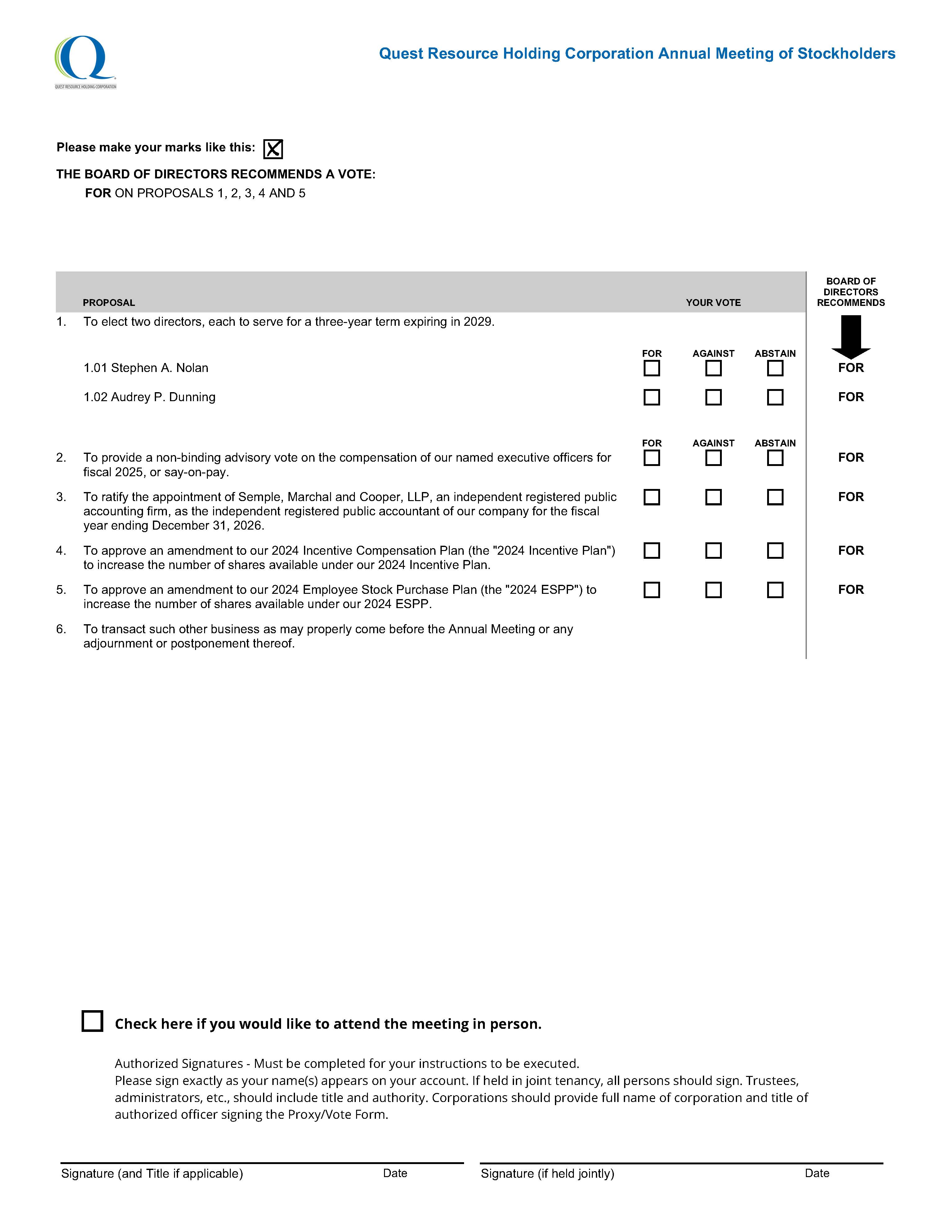
| 49 |
Serious News for Serious Traders! Try StreetInsider.com Premium Free!
You May Also Be Interested In
- Stevanato Group Announces Results of Ordinary and Extraordinary Shareholders’ Meeting
- Quantum-Touch Level 1 Workshop Offers Continuing Education for Wellness Practitioners
- Aeva Technologies, Inc. Launches Proposed Follow-On Offering
Create E-mail Alert Related Categories
SEC FilingsSign up for StreetInsider Free!
Receive full access to all new and archived articles, unlimited portfolio tracking, e-mail alerts, custom newswires and RSS feeds - and more!
