



Form 6-K Transition Therapeutics For: Nov 10
 Tweet
Tweet Share
Share E-mail
UNITED STATES
SECURITIES AND EXCHANGE COMMISSION
Washington, D.C. 20549
FORM 6-K
Report of Foreign Private Issuer Pursuant to Rule 13a-16 or 15d-16
Under the Securities Exchange Act of 1934
For the Month of November 2015
Commission File No.: 001-33514
TRANSITION THERAPEUTICS INC.
101 College Street, Suite 220, Toronto, Ontario, Canada M5G 1L7
(Address of Principal Executive Office)
Indicate by check mark whether the registrant files or will file annual reports under cover of Form 20-F or Form 40-F. Form 20-F x Form 40-F ¨
Indicate by check mark if the registrant is submitting the Form 6-K in paper as permitted by Regulation S-T Rule 101(b)(1): Yes ¨ No x
Indicate by check mark if the registrant is submitting the Form 6-K in paper as permitted by Regulation S-T Rule 101(b)(7): Yes ¨ No x
The information furnished herewith is incorporated by reference into the following Registration Statements:
Registration Statement on Form S-8 No. 333-157279
Registration Statement on Form F-3 No. 333-189879
EXHIBITS
The following information is furnished to the SEC as part of this report on Form 6-K:
| Exhibit No. | Document | |
| 99.1 | Press Release dated November 10, 2015: “Transition Therapeutics Announces First Quarter Fiscal 2016 Financial Results.” | |
| 99.2 |
Management’s Discussion and Analysis for the three-month period ended September 30, 2015.
| |
| 99.3 | Consolidated Interim Financial Statements (Unaudited) for the three-month period ended September 30, 2015 and 2014. | |
| 99.4 | Certification of Interim Filings signed by the Chief Executive Officer dated November 10, 2015. | |
| 99.5 | Certification of Interim Filings signed by the Chief Financial Officer dated November 10, 2015. | |
| 99.6 | Letter to Shareholders. |
SIGNATURES
Pursuant to the requirements of the Securities Exchange Act of 1934, the registrant has duly caused this report to be signed on its behalf by the undersigned, thereunto duly authorized.
| TRANSITION THERAPEUTICS INC. | ||
| Date: November 10, 2015 | By: | /s/ Nicole Rusaw |
| Name: Nicole Rusaw | ||
| Title: | Chief Financial Officer | |
Exhibit 99.1

Transition Therapeutics Announces First Quarter Fiscal 2016 Financial Results
TORONTO, ON, November 10, 2015 – Transition Therapeutics Inc. (“Transition” or the “Company”) (TSX: TTH; NASDAQ: TTHI), a biopharmaceutical development company advancing novel therapeutics for CNS and metabolic disease indications, today announced its financial results for the three month period ended September 30, 2015. Investors are invited to participate in a conference call today at 4:30pm EST to discuss these results. Dial in information for the call is as follows: (888) 227-6492 (North America) and (303) 223-2685 (International). A live webcast can be accessed via Transition’s website www.transitiontherapeutics.com, with a replay available for seven days following the call.
Selected Highlights
Highlights for the Company during the three month period ended September 30, 2015 and up to the date of this press release include the following:
ELND005:
ELND005 is an oral small molecule drug candidate with a proposed dual mechanism of action which includes β-amyloid anti-aggregation and regulation of brain myo-inositol levels. Transition’s subsidiary Transition Therapeutics Ireland (“TTIL”) owns all ELND005 development and commercialization rights.
| · | October 28, 2015 - Transition announced that data from the Phase 2/3 clinical study of ELND005 in Alzheimer’s disease patients with moderate and severe agitation and aggression was presented at the Clinical Trials in Alzheimer’s Disease (CTAD) meeting. A copy of the CTAD oral presentation is available on the Company website at www.transitiontherapeutics.com; |
| · | October
15, 2015 - Transition announced that its subsidiary, TTIL, has completed a thorough review
of the data related to the Phase 2/3 study of ELND005 in AD patients with moderate or
severe agitation and aggression. The analysis identified a significant clinical
benefit of ELND005 in AD patients with severe agitation and aggression, and will serve
as the basis for patient selection in a Phase 3 clinical study. The review was performed
in consultation with a group of key opinion leaders in the field of neuropsychiatry; |
| 1 |
TT701 SARM:
TT701 is an oral drug candidate that is a selective androgen receptor modulator (SARM). TTIL owns all TT701 development and commercialization rights. TT701 is in Phase 2 clinical development as a therapy to ameliorate the symptoms associated with androgen deficiency.
| · | October 29, 2015 – Transition announced that its subsidiary, TTIL, has entered into an agreement with Brigham and Women’s Hospital (“BWH”) for an investigator-led clinical study of drug candidate TT701. TTIL will support a Phase 2 study to evaluate selective androgen receptor modulator (SARM) drug candidate TT701 as a therapy to improve the symptoms of androgen deficiency in men with prostate cancer that have undergone a radical prostatectomy procedure; |
TT401:
TT401 (LY2944876) is an oxyntomodulin analogue that has dual agonist activity of the GLP-1 (Glucagon-Like Peptide-1) and glucagon receptors. A Phase 2 clinical trial of TT401 in type 2 diabetes subjects is being performed by Transition’s development partner, Lilly.
Transition is eligible to receive up to approximately US$240 million in additional milestone payments plus double-digit royalties on sales of TT401 products and a low single digit royalty on sales of related compounds. Transition has no additional funding obligations related to this clinical study or any other development or commercialization activities in the future.
Financial Liquidity
At September 30, 2015, the Company had cash resources of $31,803,201 and a working capital of $28,476,021.
The Company’s current cash projection indicates that the existing cash resources should enable the Company to execute its core business plan and meet its projected cash requirements beyond the next 12 months.
Financial Review
For the three month period ended September 30, 2015, the Company recorded a net loss of $4,491,456 ($0.12 loss per common share) compared to a net loss of $15,695,324 ($0.45 loss per common share) for the three month period ended September 30, 2014.
Research and Development
Research and development expenses decreased $11,309,411 to $4,725,480 for the three month period ended September 30, 2015 from $16,034,891 for the three month period ended September 30, 2014. The decrease in research and development expenses is primarily due to a decrease in funding obligations relating to TT401 as the Company paid a US$6 million milestone payment to Lilly in the comparative period. The decrease in research and development expenses is also due to a decrease in clinical development costs related to ELND005.
| 2 |
General and Administrative
General and administrative expenses increased $94,576 to $1,400,408 for the three month period ended September 30, 2015 from $1,305,832 for the three month period ended September 30, 2014. The increase in general and administrative expenses is primarily due to increases in compensation costs which have been partially offset by reduced professional fees.
About Transition
Transition is a biopharmaceutical development company, advancing novel therapeutics for CNS and metabolic disease indications. The Company’s wholly-owned subsidiary, Transition Therapeutics Ireland Limited is developing CNS drug candidate ELND005 for the treatment of Alzheimer's disease and Down syndrome. Transition’s lead metabolic drug candidate is TT401 for the treatment of type 2 diabetes and accompanying obesity. The Company’s shares are listed on the NASDAQ under the symbol "TTHI" and the Toronto Stock Exchange under the symbol "TTH". For additional information about the Company, please visit www.transitiontherapeutics.com. Extracts of the Financial Statements to Follow:
| 3 |
CONSOLIDATED BALANCE SHEETS
| In Canadian Dollars | As At September 30, 2015 | As at June 30, 2015 | ||||||
| Assets | ||||||||
| Current assets | ||||||||
| Cash | 31,803,201 | 40,510,758 | ||||||
| Other receivables | 330,160 | 265,189 | ||||||
| Income tax and investment tax credits receivable | 399,668 | 399,668 | ||||||
| Prepaid expenses and deposits | 455,960 | 259,143 | ||||||
| 32,988,989 | 41,434,758 | |||||||
| Non-current assets | ||||||||
| Property and equipment | 173,251 | 191,944 | ||||||
| Intangible assets | 7,900,220 | 8,022,383 | ||||||
| Total assets | 41,062,460 | 49,649,085 | ||||||
| Liabilities | ||||||||
| Current liabilities | ||||||||
| Trade and other payables | 3,611,079 | 8,549,895 | ||||||
| Contingent consideration payable | 901,889 | 858,257 | ||||||
| 4,512,968 | 9,408,152 | |||||||
| Non-current liabilities | ||||||||
| Contingent consideration payable | 3,892,339 | 3,503,344 | ||||||
| Total liabilities | 8,405,307 | 12,911,496 | ||||||
| Equity attributable to owners of the Company | ||||||||
| Share capital | 233,623,484 | 233,633,493 | ||||||
| Warrants | 3,150,558 | 5,176,397 | ||||||
| Contributed surplus | 17,170,146 | 14,771,907 | ||||||
| Share-based payment reserve | 5,937,420 | 5,892,305 | ||||||
| Accumulated other comprehensive income | (278,300 | ) | (281,814 | ) | ||||
| Deficit | (226,946,155 | ) | (222,454,699 | ) | ||||
| Total equity | 32,657,153 | 36,737,589 | ||||||
| Total liabilities and equity | 41,062,460 | 49,649,085 | ||||||
| 4 |
CONSOLIDATED STATEMENTS OF LOSS AND COMPREHENSIVE LOSS
For the three months ended September 30, 2015 and 2014
(Unaudited)
| In Canadian Dollars, except per share data | September 30, 2015 | September 30, 2014 | ||||||
| Expenses | ||||||||
| Research and development | 4,725,480 | 16,034,891 | ||||||
| Selling, general and administrative expenses | 1,400,408 | 1,305,832 | ||||||
| Operating Loss | (6,125,888 | ) | (17,340,723 | ) | ||||
| Change in fair value of contingent consideration payable | (228,859 | ) | (225,301 | ) | ||||
| Interest income | 37,464 | 65,693 | ||||||
| Foreign exchange gain | 1,825,827 | 1,805,007 | ||||||
| Net loss for the period | (4,491,456 | ) | (15,695,324 | ) | ||||
| Other comprehensive loss for the period | ||||||||
| Items that may be subsequently reclassified to net income: | ||||||||
| Cumulative translation adjustment | 3,514 | 17,423 | ||||||
| Comprehensive loss for the period | (4,487,942 | ) | (15,677,901 | ) | ||||
| Basic and diluted net loss per common share | (0.12 | ) | (0.45 | ) | ||||
| 5 |
Notice to Readers: Information contained in our press releases should be considered accurate only as of the date of this release and may be superseded by more recent information we have disclosed in later press releases, filings with the OSC, SEC or otherwise. Except for historical information, this press release may contain forward-looking statements, relating to expectations, plans or prospects for Transition, including conducting clinical trials. These statements are based upon the current expectations and beliefs of Transition's management and are subject to certain risks and uncertainties that could cause actual results to differ materially from those described in the forward-looking statements. These risks and uncertainties include factors beyond Transition's control and the risk factors and other cautionary statements discussed in Transition's quarterly and annual filings with the Canadian commissions and the U.S. Securities and Exchange Commission.
For further information on Transition, visit www.transitiontherapeutics.com, or contact:
| Dr. Tony Cruz | Nicole Rusaw | |
| Chairman & Chief Executive Officer | Chief Financial Officer | |
| Transition Therapeutics Inc. | Transition Therapeutics Inc. | |
| Phone: (416) 260-7770, x.223 | Phone: (416) 260-7770, x.202 | |
| [email protected] | [email protected] |
| 6 |
Exhibit 99.2
MANAGEMENT’S DISCUSSION AND ANALYSIS
The following information should be read in conjunction with the Company’s unaudited consolidated financial statements for the three-month period ended September 30, 2015 and the related notes, which are prepared in accordance with International Financial Reporting Standards as issued by the International Accounting Standards Board for interim financial statements, including IAS 34, Interim Reporting (IFRS), as well as the audited consolidated financial statements for the year ended June 30, 2015, including the notes thereto, prepared in accordance with IFRS, and the annual fiscal 2015 MD&A. This Management’s Discussion and Analysis (“MD&A”) provides a review of the performance of the Company for the three-month period ended September 30, 2015 as compared to the three-month period ended September 30, 2014. This review was performed by management with information available as of November 6, 2015.
Where “we”, “us”, “our”, “Transition” or the “Company” is used, it is referring to Transition Therapeutics Inc. and its wholly-owned subsidiaries, unless otherwise indicated. All amounts are in Canadian dollars, unless otherwise indicated.
Additional information relating to the Company, including the Company’s most recently filed Annual Information Form, can be found on SEDAR at www.sedar.com.
CAUTION REGARDING FORWARD-LOOKING STATEMENTS
This MD&A contains certain forward-looking statements within the meaning of applicable securities laws. Forward-looking information typically contains statements with words such as “anticipate”, “believe”, “expect”, “plan”, “estimate”, “intend”, “may” or similar words suggesting future outcomes. Forward-looking statements in this MD&A include, but are not limited to statements with respect to: the clinical study phases of the Company’s product candidates which the Company expects to complete in fiscal 2016 and beyond; the ability of the Company’s business model to maximize shareholder returns; the potential for ELND005 to slow the progression of Alzheimer’s disease and improve symptoms; the potential for ELND005 to be effective for the treatment of agitation and or aggression in patients with Alzheimer’s disease; the potential for ELND005 to be effective for the treatment of Down syndrome; the timing and manner of future clinical development of ELND005; the global population size of those affected by Alzheimer’s disease; the demand for a product that can slow or reverse the progression of Alzheimer’s disease; the demand for a product that can reduce the emergence and severity of neuropsychiatric symptoms like depression, anxiety, agitation and aggression in Alzheimer’s disease; the potential clinical benefit of ELND005 in the treatment of other disease indications; the development of TT401 and the series of preclinical compounds in-licensed from Eli Lilly and Company (“Lilly”) and their potential benefit in type 2 diabetes patients and obese individuals; the timing and manner of future clinical development of TT401 performed by Lilly; TT701 development plans and timelines for individuals with androgen deficiency or other disease indications; the potential clinical benefit of TT701 to increase lean body mass, improve functional and sexual outcomes or improve other symptoms associated with androgen deficiency; the engagement of third party manufacturers to produce the Company’s drug substances and products; the potential future in-licensing of additional drug candidates to expand the development pipeline; the intention of the Company to make collaborative arrangements for the marketing and distribution of its products and the impact of human capital on the growth and success of the Company.
| 1 |
This forward-looking information is subject to various risks and uncertainties, including those discussed below, that could cause actual results and experience to differ materially from the anticipated results or other expectations expressed. Readers are cautioned not to place undue reliance on this forward-looking information, which is provided as of the date of this MD&A unless otherwise stated, and the Company will not undertake any obligation to publicly update or revise any forward-looking information, whether as a result of new information, future events, or otherwise, except as required by securities laws.
Some of the assumptions, risks and factors which could cause future outcomes to differ materially from those set forth in the forward-looking information include, but are not limited to: (i) the assumption that the Company will be able to obtain sufficient and suitable financing to support operations, clinical trials and commercialization of products, (ii) the risk that the Company may not be able to capitalize on partnering and acquisition opportunities, (iii) the assumption that the Company will obtain favourable clinical trial results in the expected timeframe, (iv) the assumption that the Company will be able to adequately protect proprietary information and technology from competitors, (v) the risks relating to the uncertainties of the regulatory approval process, (vi) the impact of competitive products and pricing and the assumption that the Company will be able to compete in the targeted markets, and (vii) the risk that the Company may be unable to retain key personnel or maintain third party relationships, including relationships with key collaborators.
By its nature, forward-looking information involves numerous assumptions, inherent risks and uncertainties, both general and specific, that contribute to the possibility that the predictions, forecasts, projections or other forward-looking statements will not occur. Prospective investors should carefully consider the information contained under the heading “RISKS AND UNCERTAINTIES” as described in the MD&A for the year ended June 30, 2015.
OVERVIEW
Transition is a biopharmaceutical development company, advancing novel therapeutics for CNS and metabolic disease indications. The Company’s wholly-owned subsidiary, Transition Therapeutics Ireland Limited (“TTIL”) is developing CNS drug candidate ELND005 for the treatment of Alzheimer’s disease (“AD”) and Down syndrome. Transition’s lead metabolic drug candidate is TT401 for the treatment of type 2 diabetes and accompanying obesity.
Highlights for the Company during the three month period ended September 30, 2015 and up to the date of this MD&A include the following:
ELND005:
| · | October
28, 2015 – Transition announced that data from the Phase 2/3 clinical study
of ELND005 in Alzheimer’s disease patients with moderate and severe agitation and
aggression was presented at the Clinical Trials in Alzheimer’s Disease (CTAD) meeting.
A copy of the CTAD oral presentation is available on the Company website at www.transitiontherapeutics.com; |
| 2 |
| · | October 15, 2015 - Transition announced that its subsidiary, TTIL, has completed a thorough review of the data related to the Phase 2/3 study of ELND005 in AD patients with moderate or severe agitation and aggression. The analysis identified a significant clinical benefit of ELND005 in AD patients with severe agitation and aggression, and will serve as the basis for patient selection in a Phase 3 clinical study. The review was performed in consultation with a group of key opinion leaders in the field of neuropsychiatry. |
TT701 SARM:
| · | October 29, 2015 – Transition announced that its subsidiary, TTIL, has entered into an agreement with Brigham and Women’s Hospital (“BWH”) for an investigator-led clinical study of drug candidate TT701. TTIL will support a Phase 2 study to evaluate selective androgen receptor modulator (SARM) drug candidate TT701 as a therapy to improve the symptoms of androgen deficiency in men with prostate cancer that have undergone a radical prostatectomy procedure. |
STRATEGIC COLLABORATIONS
Perrigo Company plc (“Perrigo”)
In 2006, Transition exclusively licensed the ELND005 technology to Elan Pharma International Limited (“Elan”) for worldwide development and commercialization. Following amendment of that agreement in 2010, Elan held all development and commercialization rights to ELND005 and Transition became eligible to receive milestone and royalty payments with the successful advancement of ELND005. Transition has received US$40 million from Elan in upfront and achieved milestone payments. Perrigo acquired Elan in December 2013, including all Elan’s rights and obligations to the development of ELND005.
On February 28, 2014, Transition announced that after a series of transactions, Perrigo had transferred all of its ELND005 rights and assets under the collaboration agreement to the Company’s wholly owned subsidiary, TTIL. In parallel with this acquisition, Perrigo invested US$15 million and received 2,255,640 Transition common shares representing approximately a 7% ownership stake in Transition as of the date of the transaction. Perrigo will also be eligible to receive up to US$40 million in approval and commercial milestone payments and a 6.5% royalty on net sales of ELND005 products and sublicense fees received. Going forward, TTIL is responsible for all future development and commercialization activities of the ELND005 drug candidate.
| 3 |
Lilly
Diabetes
On March 3, 2010, Transition and Lilly entered into a licensing and collaboration agreement granting Transition the rights to a series of preclinical compounds in the area of diabetes. Under the licensing and collaboration agreement, Transition received exclusive worldwide rights to develop and potentially commercialize a class of compounds that, in preclinical models, showed potential to provide glycemic control and other beneficial effects including weight loss.
Under the terms of the agreement, Lilly received an up-front payment of $1,055,900 (US$1 million) which has been capitalized as a license acquired from Lilly and is being amortized over 20 years which represents the estimated life of the underlying compounds and patents.
In June 2013, Lilly exercised its option and assumed all development and commercialization rights to type 2 diabetes drug candidate TT401. In conjunction with this assumption of rights, Transition received a US$7 million milestone payment. Lilly has assumed all costs and will perform all future development and commercialization activities of TT401, and Transition paid US$14 million to Lilly in three separate installments during the Phase 2 clinical study in fiscal 2015. Transition has no additional funding obligations related to this clinical study or any other development or commercialization activities in the future.
Transition is eligible to receive up to approximately US$240 million in additional milestone payments plus double-digit royalties on sales of TT401 products and a low single digit royalty on sales of related compounds.
PROGRAMS
Transition is focused on developing innovative therapies in several distinct areas of opportunity. Transition’s vision is to build a company that has a strong foundation for growth based on multiple technologies and product opportunities, which reduces risk and enhances shareholder return. The Company’s technologies are as follows:
ELND005
Alzheimer’s Disease:
Alzheimer’s disease is a progressive brain disorder that gradually destroys a person’s memory and ability to learn, reason, make judgments, communicate and carry out daily activities. As Alzheimer’s disease progresses, individuals may also experience changes in personality and behavior, such as anxiety, suspiciousness or agitation, as well as delusions or hallucinations. Approximately 90% of Alzheimer’s disease patients develop neuropsychiatric symptoms, and up to 60% develop agitation/aggression over the course of their disease. Agitation/aggression are among the most disruptive neuropsychiatric symptoms in Alzheimer’s disease and are associated with increased morbidity and caregiver burden.
The disease mainly affects individuals over age 65 and it is estimated over 18 million people are suffering from Alzheimer’s disease worldwide. In the U.S., Alzheimer’s disease is the sixth leading cause of death and current direct/indirect costs of caring for an estimated 5.4 million Alzheimer’s disease patients are at least US$100 billion annually.
| 4 |
Current U.S. Food and Drug Administration approved Alzheimer’s disease medications may temporarily delay memory decline for some individuals, but none of the currently approved drugs are known to stop the underlying degeneration of brain cells. Certain drugs approved to treat other illnesses may sometimes help with the emotional and behavioral symptoms of Alzheimer’s disease. With an aging population, there is a great need for therapies to address Alzheimer’s disease patient’s neuropsychiatric symptoms and declines in cognitive ability.
Down Syndrome:
Down syndrome (DS, Trisomy 21), caused by an extra copy of chromosome 21, is the most common genetic form of intellectual disability with a prevalence of approximately 1 in 700 live births in the U.S. Children with DS exhibit developmental delay and various degrees of intellectual disability, while adults are at increased risk of Alzheimer’s dementia. There are currently no drugs approved for the treatment of cognitive dysfunction in DS.
Excess activity of genes on chromosome 21, such as amyloid precursor protein (APP) and sodium-myo-inositol active transporter (SMIT), are thought to play a role in the cognitive dysfunction of DS. Life-long exposure to increased amyloid and myo-inositol levels in the brain are thought to lead to synaptic dysfunction and cognitive disability. ELND005 may have the potential to improve cognition in DS by decreasing amyloid levels and regulating myo-inositol-dependent neuronal signaling.
Clinical Development Update
ELND005 for Neuropsychiatric Diseases
TTIL is developing neuropsychiatric drug candidate ELND005, (scyllo-inositol). ELND005 is an orally bioavailable small molecule that is being investigated for multiple neuropsychiatric indications on the basis of its proposed dual mechanism of action, which includes β-amyloid anti-aggregation and regulation of brain myo-inositol levels. An extensive clinical program of Phase 1 and Phase 2 studies have been completed with ELND005 to support clinical development. The Phase 2 study (ELND005-AD201) which evaluated ELND005 in more than 350 mild to moderate AD patients was published in the peer-reviewed journal, Neurology. The Neurology article was entitled “A Phase 2 randomized trial of ELND005, scyllo-inositol, in mild-moderate Alzheimer’s disease”.
Currently, the use of ELND005 is being investigated in two clinical areas:
| (a) | Agitation and Aggression in Alzheimer’s Disease |
A Phase 2 clinical trial of ELND005 for the treatment of agitation/aggression in patients with Alzheimer’s disease was performed at 70 clinical sites in North America and Europe. The objectives of the study were to evaluate the efficacy, safety and tolerability of ELND005 over 12 weeks of treatment in AD patients who were experiencing moderate or severe levels of agitation/aggression. Enrollment of this clinical study (AG201) known as the “Harmony AD” study was completed on March 2, 2015 with a total of 350 patients being enrolled.
| 5 |
On June 24, 2015, Transition announced that ELND005 did not meet its primary efficacy endpoint in the Phase 2/3 clinical study of ELND005 in agitation and aggression in patients with AD. In the study, both the treatment and placebo groups showed a significant, but similar, reduction in agitation and aggression relative to baseline. There was a greater than expected reduction in agitation and aggression observed in the placebo group as measured in weeks 4, 8 and 12 in the study. The safety and tolerability profile of ELND005 was consistent with previous studies in AD at the 250mg bid dose.
The Company’s subsidiary, TTIL performed a thorough review of the data from the completed Phase 2/3 study in agitation and aggression and released the results of this review on October 14, 2015. Although the primary efficacy endpoint was not achieved in the overall study, ELND005 significantly (p value <0.05) improved agitation and aggression in a sub-population of Alzheimer’s disease patients with severe agitation and aggression. In this population, ELND005 demonstrated numerical improvement in 20 of 21 behavioral symptoms measured as part of the primary efficacy endpoint. ELND005 also demonstrated an acceptable safety and tolerability profile. Management intends to meet with regulators to seek guidance on an ELND005 Phase 3 program for AD patients with severe agitation and aggression.
| (b) | Down Syndrome |
On November 20, 2014, Transition announced the results of a clinical study of neuropsychiatric drug candidate ELND005 in young adults with Down syndrome. Transition’s wholly-owned subsidiary, TTIL completed this first study in Down syndrome subjects without dementia to allow optimal dose selection for future larger studies.
The study enrolled 23 Down syndrome subjects in three study arms over a four-week treatment period: placebo, 250 mg once daily; and 250 mg twice daily. At the doses evaluated, ELND005 was determined to have an acceptable safety and tolerability profile and there were no serious adverse events reported in the study. Treatment emergent adverse events were reported in seven of the subjects receiving ELND005 and all were deemed mild in severity. The two ELND005 doses achieved the plasma levels expected in pharmacokinetic modeling and will inform the selection of a higher dose in a larger Phase 2b study in Down syndrome subjects.
The ELND005 technology is claimed in multiple issued patents and pending patent applications in many jurisdictions throughout the world.
Expenditures for the ELND005 Program
On February 28, 2014, Transition announced that after a series of transactions, Perrigo has transferred all of its ELND005 rights and assets to the Company’s wholly owned subsidiary, TTIL. As a result, effective March 1, 2014, TTIL is responsible for all future development and commercialization activities of ELND005.
During the three month periods ended September 30, 2015 and 2014, the Company incurred direct research and development costs for this program as follows:
| 6 |
| ELND005 Program (1) | Three month period ended September 30, 2015 | Three month period ended September 30, 2014 | ||||||
| Pre-clinical studies | $ | - | $ | - | ||||
| Clinical studies | 2,776,699 | 5,488,126 | ||||||
| Manufacturing | 13,774 | 217,778 | ||||||
| Other direct research | 384,841 | 695,323 | ||||||
| TOTAL | $ | 3,175,314 | $ | 6,401,227 | ||||
Note (1) These costs are direct research and development costs only and do not include patent costs, investment tax credits, salaries and benefits, amortization of intangible assets or an allocation of Company overhead.
TT401
Development of TT401 for Diabetes
Diabetes is a disease in which the body does not produce or properly use insulin. Insulin is a hormone released from islet cells located in the pancreas that is needed to convert sugar, starches and other food into energy needed for daily life. There are two primary forms of diabetes; type 1 diabetes and type 2 diabetes.
Type 2 diabetes usually begins as insulin resistance, a disorder in which the cells do not use insulin properly. As the need for insulin increases, the pancreas gradually loses its ability to produce it. Current treatments for type 2 diabetes include lifestyle changes, oral medications, incretin therapy and insulin therapy. Type 2 diabetes accounts for about 90-95% of all diagnosed cases of diabetes.
Clinical Development Update of TT401 (LY2944876)
On March 3, 2010, Transition announced that it had acquired the exclusive worldwide rights to develop and potentially commercialize a series of preclinical compounds from Lilly in the area of diabetes. In preclinical diabetes models, these compounds showed potential to provide glycemic control and other beneficial effects including weight loss.
On June 18, 2012, Transition announced the results of the Phase 1 clinical study of type 2 diabetes drug candidate, TT401. The Phase 1, double-blind, placebo-controlled randomized study enrolled 48 non-diabetic obese subjects in six cohorts evaluating six escalating subcutaneous single doses of TT401. TT401 demonstrated an acceptable safety and tolerability profile in non-diabetic obese subjects in the study. TT401 exhibited the expected pharmacological effect on glucose and pharmacodynamic biomarkers at doses that were safe and tolerable. The pharmacokinetic profile, assessed over 28 days, demonstrated a half-life consistent with once-weekly dosing.
On April 30, 2013, Transition announced the results of a five-week proof of concept clinical study of TT401 in type 2 diabetes and obese non-diabetic subjects. The study enrolled diabetic patients at five dosing levels and non-diabetic obese patients at one dose level. All dosing cohorts received five doses over a five week period. Diabetic patients were on stable doses of metformin.
| 7 |
At the end of the treatment period, TT401-treated patients in the 3 highest dose groups experienced statistically significant reductions in mean fasting plasma glucose relative to placebo. Statistically significant mean body weight reduction relative to baseline occurred in the three highest dose groups. A similar reduction in body weight was also observed in the obese non-diabetic cohort. TT401 demonstrated an acceptable safety and tolerability profile at all doses evaluated in diabetic and non-diabetic obese subjects. The most common adverse event noted in the study was decreased appetite. Some subjects in the highest three dose groups experienced mild nausea and vomiting, which are consistent with studies of other GLP-1 agonist drug candidates. The pharmacokinetic profile, assessed over the five week study, demonstrated a half-life consistent with once-weekly dosing.
On June 17, 2013, Lilly exercised its option to assume all development and commercialization rights to type 2 diabetes drug candidate TT401. In conjunction with this assumption of rights, Transition received a US$7 million milestone payment. Lilly and Transition have amended their agreement to address future development of TT401 and associated financial arrangements. Lilly has assumed all costs and will perform all future development and commercialization activities of TT401. In May, 2014, Transition announced the dosing of the first patient in a Phase 2 clinical study of TT401. The study is being performed by Transition’s development partner Lilly. The objectives of the study are to evaluate the safety and effectiveness of TT401 compared to once-weekly exenatide extended release and placebo. In February 2015, Lilly informed Transition that 420 type 2 diabetic subjects had been enrolled in the current Phase 2 study, thereby completing the enrollment phase of the study.
In fiscal 2015, Transition made three separate installments to Lilly to support the Phase 2 clinical study totaling US$14 million. There are no additional funding obligations related to this clinical study or the TT401 development program.
TT701 for Androgen Deficiency
On May 6, 2015, TTIL exclusively licensed worldwide rights to a novel small molecule drug candidate TT701 from Lilly. TT701 is a selective androgen receptor modulator that has been shown in a Phase 2 study to significantly increase lean body mass and a measurement of muscle strength in male subjects.
Clinical Development of TT701
Since acquiring the exclusive worldwide rights to TT701 the Company has incurred drug development manufacturing costs as it prepares to move the drug candidate into a Phase 2 clinical trial.
The Company has been actively working with potential partners to collaborate on the clinical development of TT701 and on October 29, 2015, Transition announced that TTIL had entered into an agreement with Brigham and Women’s Hospital for an investigator-led clinical study of drug candidate TT701.
| 8 |
TTIL will support a Phase 2 study to evaluate selective androgen receptor modulator (SARM) drug candidate TT701 as a therapy to improve the symptoms of androgen deficiency in men with prostate cancer that have undergone a radical prostatectomy procedure. The Phase 2 clinical study is expected to enroll up to 125 subjects and will be performed at selected specialized clinical sites including Brigham and Women’s Hospital. The principal investigator for the Phase 2 study will be Dr. Shalender Bhasin, an internationally recognized endocrinologist with expertise in testosterone biology and men’s aging. The Company expects the Phase 2 study of TT701 to commence before the end of calendar 2015.
Expenditures for the TT701 Program
During the three month periods ended September 30, 2015 and 2014, the Company incurred direct research and development costs for this program as follows:
| TT-701 Program (1) | Three month period ended September 30, 2015 | Three month period ended September 30, 2014 | ||||||
| Pre-clinical studies | $ | - | $ | - | ||||
| Clinical studies | - | - | ||||||
| Manufacturing | 154,368 | - | ||||||
| Other direct research | 15,104 | - | ||||||
| TOTAL | $ | 169,472 | $ | - | ||||
Note (1) These costs are direct research and development costs only and do not include patent costs, investment tax credits, salaries and benefits, amortization of intangible assets or an allocation of Company overhead.
The Next Steps
Transition’s goal for its programs is to achieve product approval and ultimately significant revenues or royalties. To achieve product approval, the Company and or its partners, must successfully complete clinical trials and achieve regulatory approval. The stages of development of the Company’s technologies are illustrated below:
| 9 |
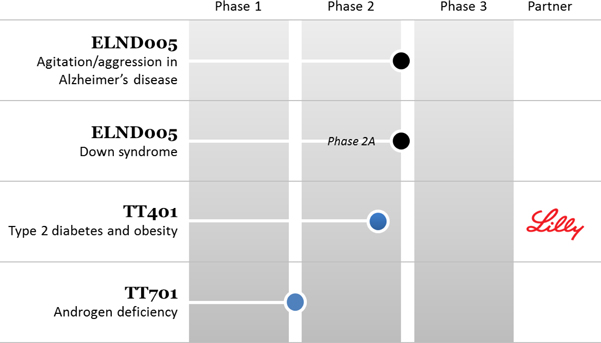
RESULTS OF OPERATIONS
For the three month period ended September 30, 2015, the Company recorded a net loss of $4,491,456 ($0.12 loss per common share) compared to a net loss of $15,695,324 ($0.45 loss per common share) for the three month period ended September 30, 2014.
The decrease in net loss of $11,203,868 is primarily due to the significant decrease in research and development expenses resulting from the Company having no further funding obligations to TT401 development partner Lilly as well as decreased clinical development costs relating to ELND005.
Research and Development
Research and development expenses decreased $11,309,411 to $4,725,480 for the three month period ended September 30, 2015 from $16,034,891 for the three month period ended September 30, 2014. The decrease in research and development expenses is primarily due to a decrease in funding obligations relating to TT401 as the Company paid a US$6 million milestone payment to Lilly in the comparative period. The decrease in research and development expenses is also due to a decrease in clinical development costs related to ELND005.
The Company anticipates research and development expenses for the second quarter of fiscal 2016 will decrease as the Company prepares for Phase 3 development of ELND005.
| 10 |
General and Administrative
General and administrative expenses increased $94,576 to $1,400,408 for the three month period ended September 30, 2015 from $1,305,832 for the three month period ended September 30, 2014. The increase in general and administrative expenses is primarily due to increases in compensation costs which have been partially offset by reduced professional fees.
The Company anticipates that general and administrative expenses in the second quarter of fiscal 2016 will remain relatively consistent with the first quarter.
SUMMARY OF QUARTERLY RESULTS
The following table is a summary of selected quarterly consolidated financial information of the Company for each of the eight most recently completed quarters ending at September 30, 2015.
| First Quarter | Second Quarter | Third Quarter | Fourth Quarter | |||||||||||||
| 2016 | ||||||||||||||||
| Revenue | - | |||||||||||||||
| Net loss (1) | $ | (4,491,456 | ) | |||||||||||||
| Basic and diluted net loss per common share | $ | (0.12 | ) | |||||||||||||
| 2015 | ||||||||||||||||
| Revenue | - | - | ||||||||||||||
| Net loss (1) | $ | (15,695,324 | ) | $ | (16,910,139 | ) | $ | (4,748,096 | ) | $ | (13,985,969 | ) | ||||
| Basic and diluted net loss per common share | $ | (0.45 | ) | $ | (0.48 | ) | $ | (0.13 | ) | $ | (0.38 | ) | ||||
| 2014 | ||||||||||||||||
| Revenue | - | - | - | |||||||||||||
| Net loss (1) | $ | (1,253,772 | ) | $ | (5,067,292 | ) | $ | (13,130,005 | ) | |||||||
| Basic and diluted net loss per common share | $ | (0.04 | ) | $ | (0.17 | ) | $ | (0.43 | ) | |||||||
Note (1) Net income (loss) before discontinued operations was equivalent to the net income (loss) for such periods.
The fluctuations of Transition’s quarterly results are primarily due to milestone payments made to Lilly to help fund TT401 Phase 2 clinical development and changes in: activity levels of the clinical trials being performed by the Company and foreign exchange gains and losses.
CRITICAL ACCOUNTING ESTIMATES AND JUDGMENTS
The preparation of consolidated financial statements in accordance with IFRS requires management to make estimates and assumptions that affect the reported amounts of assets and liabilities, the disclosure of contingent assets and liabilities at the date of the consolidated financial statements and the reported amounts of revenue and expenses during the reporting period. Actual results can differ from those estimates. We have identified the following areas which we believe require management’s most subjective estimates and judgments, often requiring the need to make estimates about the effects of matters that are inherently uncertain and may change in subsequent periods.
| 11 |
| (a) | Estimates |
Valuation and Amortization of Intangible Assets
The Company’s intangible assets are comprised of purchased or licensed pharmaceutical compounds, technology and patents. The costs of the Company’s intangible assets are amortized over the estimated useful life of up to 20 years. Factors considered in estimating the useful life of the intangible asset include the expected use of the asset by the Company, legal, regulatory and contractual provisions that may limit the useful life, the effects of competition and other economic factors, and the level of expenditures required to obtain the expected future cash flows from the intangible asset. The Company re-evaluates the useful life when there has been a change in these factors. The Company assesses its intangible assets for recoverability whenever indicators of impairment exist. As ELND005 did not meet its primary efficacy endpoint in the Phase 2/3 clinical study in agitation and aggression in Alzheimer’s disease, management performed an impairment test and noted there is no impairment of the ELND005 asset as at June 30, 2015.
When the carrying value of an asset is greater than its recoverable amount, which is the higher of its value in use or fair value less costs to sell, an impairment loss is recognized.
Valuation of Contingent Consideration Payable
The contingent consideration is measured at fair value based on level 3 inputs. The contingent consideration is not based on observable inputs and is measured using a discounted cash flow analysis of expected payments in future periods. The significant estimates used in the fair value calculations are as follows:
| (a) | Management has estimated the timing of the milestone payments based on current expectations and plans for the development of ELND005. The milestone payments are assigned a probability based on industry statistics for the successful development of pharmaceutical products including regulatory approval and achievement of revenue targets. An increase of 10% applied to the probability assumptions, with all other variables held constant, will increase the contingent consideration payable by $1,579,000. Conversely a decrease of 10% applied to the probability assumptions, with all other variables held constant, would reduce the contingent consideration payable by $1,663,000; |
| (b) | The probability adjusted cash flows are discounted at a rate of 20% which is management’s best estimate of the Company’s cost of capital. An increase of 5% to the discount rate would decrease the contingent consideration payable by $1,155,000. Conversely, a decrease of 5% to the discount rate would increase the contingent consideration payable by $1,631,000. |
| 12 |
There were no significant changes in the assumptions for the three month period dended September 30, 2015. The Company has recognized
a change in fair value of contingent consideration payable of $228,859 during the three month period ended September 30, 2015 (three
month period ended September 30, 2014 - $225,301) mainly related to the passage of time.
Share Based Payments and Warrants
When the Company issues stock options and warrants, an estimate of fair value is derived for the equity instrument using the Black-Scholes option pricing model. The application of this option pricing model requires management to make assumptions regarding several variables, including the period for which the instrument will be outstanding, the price volatility of the Company’s stock over a relevant timeframe, the determination of a relevant risk free interest rate and an assumption regarding the Company’s dividend policy in the future. If other assumptions are used, the value derived for the equity instruments could be significantly impacted.
IFRS ISSUED BUT NOT YET ADOPTED
IFRS 15 – Revenue from Contracts with Customers
IFRS 15 specifies how and when to recognize revenue as well as requiring entities to provide users of financial statements with some informative, relevant disclosures. The standard supersedes IAS 18, Revenue, IAS 11, Construction Contracts, and a number of revenue-related interpretations. Application of the standard is mandatory for all IFRS reporters and it applies to nearly all contracts with customers: the main exceptions are leases, financial instruments and insurance contracts. Currently IFRS 15 must be applied in an entity’s first annual IFRS financial statements for periods beginning on or after January 1, 2017 however the IASB has deferred the date of adoption to periods beginning on or after January 1, 2018, with early adoption permitted. Management is evaluating the standard and has not yet determined the impact on its consolidated financial statements.
INTERNAL CONTROLS OVER FINANCIAL REPORTING
Internal controls over financial reporting are designed to provide reasonable assurance regarding the reliability of financial reporting and the preparation of financial statements for external purposes in accordance with IFRS.
There have been no substantive changes in the Company’s internal controls over financial reporting that have occurred during the most recent interim period beginning July 1, 2015 and ending September 30, 2015 that have materially affected, or are reasonably likely to materially affect, the Company’s internal controls over financial reporting.
| 13 |
LIQUIDITY AND CAPITAL RESOURCES
Overview
The Company commenced operations in July 1998, and has devoted its resources primarily to fund its research and development programs. All revenue to date has been generated from milestone payments and licensing fees. The Company has incurred a cumulative deficit to September 30, 2015 of $226,946,155. Losses are expected to continue for the next several years as the Company invests in research and development, preclinical studies, clinical trials, manufacturing and regulatory compliance.
Since inception, the Company has been financed primarily from public and private sales of equity, the exercise of warrants and stock options, interest earned on cash deposits and short term investments and revenues and reimbursements from partners.
The Company’s cash was $31,803,201 at September 30, 2015 as compared to $40,510,758 at June 30, 2015, resulting in a decrease of $8,707,557. The Company’s working capital position at September 30, 2015 decreased $3,550,585 from $32,026,606 at June 30, 2015 to $28,476,021, at September 30, 2015.
The decrease in the Company’s cash and working capital is primarily due to the expenditures incurred during the three month period ended September 30, 2015.
The Company’s current cash projection indicates that the current cash resources should enable the Company to execute its core business plan and meet its projected cash requirements beyond the next 12 months.
The success of the Company is dependent on its ability to bring its products to market, obtain the necessary regulatory approvals and achieve future profitable operations. The continuation of the research and development activities and the commercialization of its products are dependent on the Company’s ability to successfully complete these activities and to obtain adequate financing through a combination of financing activities, operations, and partnerships. It is not possible to predict either the outcome of future research and development programs or the Company’s ability to fund these programs going forward.
Financial Instruments
Financial instruments of the Company consist mainly of cash, other receivables, accounts payable and accrued liabilities, and contingent consideration payable. Management’s primary investment objective is to maintain safety of principal and provide adequate liquidity to meet all current payment obligations and future planned expenditures.
The Company is exposed to market risks related to volatility in interest rates for the Company’s investment portfolio and foreign currency exchange rates related to cash and purchases of supplies and services made in U.S. dollars.
The Company is exposed to interest rate risk to the extent that the cash is held in deposit accounts which earn interest at variable rates. The Company’s maximum exposure to interest rate risk is based on the effective interest rate of the current carrying value of these assets. The Company does not speculate on interest rates and holds all deposits until their date of maturity.
| 14 |
Contractual Obligations
Minimum payments under our contractual obligations are as follows:
| Less than 1 Year | 1- 3 Years | 4 – 5 Years | After 5 Years | Total | ||||||||||||||||
| Operating leases | $ | 210,978 | $ | 339,848 | $ | 268,030 | $ | - | $ | 818,856 | ||||||||||
| Clinical and toxicity study agreements | 727,123 | - | - | - | 727,123 | |||||||||||||||
| Manufacturing agreements | 116,198 | - | - | - | 116,198 | |||||||||||||||
| Contingent Consideration Payable | 2,847,759 | - | - | 61,448,760 | 64,296,519 | |||||||||||||||
| Other | 242,210 | - | - | - | 242,210 | |||||||||||||||
| TOTAL | $ | 4,144,268 | $ | 339,848 | $ | 268,030 | $ | 61,448,760 | $ | 66,200,906 | ||||||||||
Contractual obligations denominated in U.S. dollars have been translated to Canadian dollars using the exchange rate at September 30, 2015.
During the three month period ended September 30, 2015, TTIL entered into an agreement with Brigham and Women’s Hospital for an investigator-led clinical study of TT701, a selective androgen receptor modulator (“SARM”) drug candidate to treat androgen deficiency. Under the terms of the agreement TTIL is committed to research grant payments up to US$1,500,000 to be paid quarterly over the course of the Phase 2 clinical study and potential commercial milestone payments of US$10,000,000.
PROPOSED TRANSACTIONS
On July 19, 2013, the Company’s shelf registration statement filed with the United States Securities and Exchange Commission (“SEC”) on Form F-3 became effective. The shelf prospectus provides for the potential offering in the United States of up to an aggregate amount of US$50 million of Transition’s common shares, warrants, or a combination thereof, from time to time in one or more offerings until July 19, 2016.
On January 5, 2015, the Company filed with the SEC a prospectus supplemental to the shelf prospectus and a sales agreement with Cowen and Company, LLC or Cowen, relating to the sale of the Company’s common shares. In accordance with the terms of the sales agreement, the Company may offer and sell from time to time common shares having an aggregate offering price of up to US $25 million with Cowen acting as sales agent. After the closing of the February, 2015 US$23 million public offering, the Company can raise an additional US$27 million through the issuance of common shares, warrants or a combination thereof, from time to time in one of more offerings until July 19, 2016.
Utilization of the U.S. shelf prospectus is dependent upon meeting certain market capitalization thresholds at the time of financing.
| 15 |
OUTSTANDING SHARE DATA
Authorized
The authorized share capital of the Company consists of an unlimited number of common shares.
Issued and Outstanding
The following details the issued and outstanding equity securities of the Company:
Common Shares
As at November 6, 2015 the Company has 38,878,879 common shares outstanding.
Stock Options
As at November 6, 2015 the Company has 2,408,380 stock options outstanding with exercise prices ranging from $2.09 to $10.19 and various expiry dates extending to June 14, 2025. At November 6, 2015, on an if-converted basis, these stock options would result in the issuance of 2,408,380 common shares in the capital of the Company at an aggregate exercise price of $11,430,633.
Warrants
On August
15, 2015, the warrants issued on August 15, 2013 expired unexercised and accordingly, the carrying value of the expired warrants
of $2,025,839 was reclassified to contributed surplus during the three month period ending September 30, 2015.
As at November 6, 2015, the Company has a total of 1,949,250 warrants outstanding with a purchase price of US$7.10. Each warrant entitles the holder, within two years of the June 23, 2013 issuance date, to purchase one additional common share in the capital of the Company.
RISKS AND UNCERTAINTIES
The Company’s risks and uncertainties are as described in the Company’s annual MD&A, which can be found on SEDAR at www.SEDAR.com.
| 16 |
Exhibit 99.3
Consolidated Financial Statements
(Unaudited)
Transition Therapeutics Inc.
For the three months ended September 30, 2015 and 2014
Transition Therapeutics Inc.
CONSOLIDATED BALANCE SHEETS
(Unaudited)
| In Canadian Dollars | Note | As At September 30, 2015 | As at June 30, 2015 | |||||||
| Assets | ||||||||||
| Current assets | ||||||||||
| Cash | 31,803,201 | 40,510,758 | ||||||||
| Other receivables | 330,160 | 265,189 | ||||||||
| Income tax and investment tax credits receivable | 399,668 | 399,668 | ||||||||
| Prepaid expenses and deposits | 455,960 | 259,143 | ||||||||
| 32,988,989 | 41,434,758 | |||||||||
| Non-current assets | ||||||||||
| Property and equipment | 173,251 | 191,944 | ||||||||
| Intangible assets | 5 | 7,900,220 | 8,022,383 | |||||||
| Total assets | 41,062,460 | 49,649,085 | ||||||||
| Liabilities | ||||||||||
| Current liabilities | ||||||||||
| Trade and other payables | 6 | 3,611,079 | 8,549,895 | |||||||
| Contingent consideration payable | 7 | 901,889 | 858,257 | |||||||
| 4,512,968 | 9,408,152 | |||||||||
| Non-current liabilities | ||||||||||
| Contingent consideration payable | 7 | 3,892,339 | 3,503,344 | |||||||
| Total liabilities | 8,405,307 | 12,911,496 | ||||||||
| Equity attributable to owners of the Company | ||||||||||
| Share capital | 9 | 233,623,484 | 233,633,493 | |||||||
| Warrants | 9 | 3,150,558 | 5,176,397 | |||||||
| Contributed surplus | 17,170,146 | 14,771,907 | ||||||||
| Share-based payment reserve | 9 | 5,937,420 | 5,892,305 | |||||||
| Accumulated other comprehensive income | (278,300 | ) | (281,814 | ) | ||||||
| Deficit | (226,946,155 | ) | (222,454,699 | ) | ||||||
| Total equity | 32,657,153 | 36,737,589 | ||||||||
| Total liabilities and equity | 41,062,460 | 49,649,085 | ||||||||
| Contingencies and commitments | 12 | |||||||||
The notes are an integral part of these consolidated financial statements
On behalf of the Board:
 |
 | |
| Tony Cruz | Christopher Henley | |
| Director | Director |
| 2 |
Transition Therapeutics Inc.
CONSOLIDATED STATEMENTS OF LOSS AND COMPREHENSIVE LOSS
For the three months ended September 30, 2015 and 2014
(Unaudited)
| In Canadian Dollars, except per share data | Note | September 30, 2015 | September 30, 2014 | |||||||
| Expenses | ||||||||||
| Research and development | 10 | 4,725,480 | 16,034,891 | |||||||
| Selling, general and administrative expenses | 10 | 1,400,408 | 1,305,832 | |||||||
| Operating Loss | (6,125,888 | ) | (17,340,723 | ) | ||||||
| Change in fair value of contingent consideration payable | 7 | (228,859 | ) | (225,301 | ) | |||||
| Interest income | 37,464 | 65,693 | ||||||||
| Foreign exchange gain | 1,825,827 | 1,805,007 | ||||||||
| Net loss for the period | (4,491,456 | ) | (15,695,324 | ) | ||||||
| Other comprehensive loss for the period | ||||||||||
| Items that may be subsequently reclassified to net income: | ||||||||||
| Cumulative translation adjustment | 3,514 | 17,423 | ||||||||
| Comprehensive loss for the period | (4,487,942 | ) | (15,677,901 | ) | ||||||
| Basic and diluted net loss per common share | 11 | (0.12 | ) | (0.45 | ) | |||||
The notes are an integral part of these consolidated financial statements.
| 3 |
Transition Therapeutics Inc.
CONSOLIDATED STATEMENTS OF SHAREHOLDERS’ EQUITY
For the three months ended September 30, 2015 and 2014
(Unaudited)
| Attributable to equity holders of the Company | ||||||||||||||||||||||||||||||||||
| In Canadian Dollars | Note | Number of common shares | Share capital | Warrants | Contributed surplus | Share-based payment reserve | Accumulated Other Comprehensive Income | Deficit | Total equity | |||||||||||||||||||||||||
| # | $ | $ | $ | $ | $ | $ | $ | |||||||||||||||||||||||||||
| Balance, July 1, 2015 | 38,878,879 | 233,633,493 | 5,176,397 | 14,771,907 | 5,892,305 | (281,814 | ) | (222,454,699 | ) | 36,737,589 | ||||||||||||||||||||||||
| Net loss for the period | - | - | - | - | - | - | (4,491,456 | ) | (4,491,456 | ) | ||||||||||||||||||||||||
| Cumulative translation adjustment | - | - | - | - | - | 3,514 | - | 3,514 | ||||||||||||||||||||||||||
| Share issuance costs pursuant to public offering, net |
9 | - | (10,009 | ) | - | - | - | - | - | (10,009 | ) | |||||||||||||||||||||||
| Share options exercised, expired or cancelled | 9 | - | - | - | 372,400 | (372,400 | ) | - | - | - | ||||||||||||||||||||||||
| Warrants expired | 9 | - | - | (2,025,839 | ) | 2,025,839 | - | - | - | - | ||||||||||||||||||||||||
| Share-based payment compensation expense | 9 | - | - | - | - | 417,515 | - | - | 417,515 | |||||||||||||||||||||||||
| Balance, September 30, 2015 | 38,878,879 | 233,623,484 | 3,150,558 | 17,170,146 | 5,937,420 | (278,300 | ) | (226,946,155 | ) | 32,657,153 | ||||||||||||||||||||||||
| Balance, July 1, 2014 | 35,303,913 | 207,374,493 | 5,176,397 | 14,768,221 | 2,866,292 | 24,028 | (171,115,171 | ) | 59,094,260 | |||||||||||||||||||||||||
| Net loss for the period | - | - | - | - | - | (15,695,324 | ) | (15,695,324 | ) | |||||||||||||||||||||||||
| Cumulative translation adjustment | - | - | - | - | - | 17,423 | - | 17,423 | ||||||||||||||||||||||||||
| Share options exercised, expired or cancelled | 9 | 2,270 | 9,474 | - | - | (4,036 | ) | - | - | 5,438 | ||||||||||||||||||||||||
| Share-based payment compensation expense | 9 | - | - | - | - | 891,654 | - | - | 891,654 | |||||||||||||||||||||||||
| Balance, September 30, 2014 | 35,306,183 | 207,383,967 | 5,176,397 | 14,768,221 | 3,753,910 | 41,451 | (186,810,495 | ) | 44,313,451 | |||||||||||||||||||||||||
The notes are an integral part of these consolidated financial statements.
| 4 |
Transition Therapeutics Inc.
CONSOLIDATED STATEMENTS OF CASH FLOWS
For the three months ended September 30, 2015 and 2014
(Unaudited)
| In Canadian Dollars | Note | September 30, 2015 | September 30, 2014 | |||||||
| Cash flows used in operating activities | ||||||||||
| Net loss for the period | (4,491,456 | ) | (15,695,324 | ) | ||||||
| Adjustments for: | ||||||||||
| Change in fair value of contingent consideration payable | 228,859 | 225,301 | ||||||||
| Depreciation and amortization | 186,100 | 161,596 | ||||||||
| Share-based payment compensation expense | 417,515 | 891,654 | ||||||||
| Accrued interest | - | (13,989 | ) | |||||||
| Unrealized foreign exchange gain | (1,916,102 | ) | (1,944,564 | ) | ||||||
| Change in working capital | 13 | (5,370,528 | ) | (232,174 | ) | |||||
| Net cash used in operating activities | (10,945,612 | ) | (16,607,500 | ) | ||||||
| Cash flows used in investing activities | ||||||||||
| Purchase of property and equipment | (687 | ) | (37,466 | ) | ||||||
| Net cash used in investing activities | (687 | ) | (37,466 | ) | ||||||
| Cash flows (used in) from financing activities | ||||||||||
| Share issuance costs paid | (10,009 | ) | - | |||||||
| Proceeds from share options exercised | - | 5,438 | ||||||||
| Net cash (used in) from financing activities | (10,009 | ) | 5,438 | |||||||
| Foreign exchange gains on cash | 2,248,751 | 2,209,564 | ||||||||
| Net decrease in cash | (8,707,557 | ) | (14,429,964 | ) | ||||||
| Cash at beginning of period | 40,510,758 | 57,212,004 | ||||||||
| Cash at end of period | 31,803,201 | 42,782,040 | ||||||||
The notes are an integral part of these consolidated financial statements.
| 5 |
Notes to the Audited Consolidated Financial Statements
September 30, 2015
(Unaudited in Canadian Dollars)
| 1. | GENERAL INFORMATION AND NATURE OF OPERATIONS |
Transition Therapeutics Inc. and its subsidiaries (together the Company or Transition) was incorporated by Articles of Incorporation under the Business Corporations Act (Ontario) on July 6, 1998. The Company is a public company with common shares listed on both the NASDAQ and Toronto Stock Exchange and is incorporated and domiciled in Canada. The address of its registered office is 101 College Street, Suite 220, Toronto, Ontario, Canada.
The Company is a product-focused biopharmaceutical company developing therapeutics for disease indications with large markets. The Company’s lead technologies are focused on the treatment of agitation and aggression in Alzheimer’s disease and diabetes.
The success of the Company is dependent on bringing its products to market, obtaining the necessary regulatory approvals and achieving future profitable operations. The continuation of the research and development activities and the commercialization of its products are dependent on the Company’s ability to successfully complete these activities and to obtain adequate financing through a combination of financing activities and operations. It is not possible to predict either the outcome of future research and development programs or the Company’s ability to fund these programs going forward.
| 2. | BASIS OF PREPARATION |
These consolidated financial statements have been prepared in accordance with International Financial Reporting Standards (IFRS) as issued by the International Accounting Standards Board for interim financial statements, including IAS 34 Interim Financial Reporting. The consolidated financial statements have been prepared using the historical cost convention except for the revaluation of contingent consideration payable to fair value.
The preparation of financial statements in conformity with IFRS requires use of certain critical accounting estimates. It also requires management to exercise its judgment in the process of applying the Company’s accounting policies. The areas involving a higher degree of judgment or complexity, or areas where assumptions and estimates are significant to the consolidated financial statements are disclosed in the annual consolidated financial statements for the year ended June 30, 2015.
| 3. | SUMMARY OF SIGNIFICANT ACCOUNTING POLICIES |
The Board of Directors approved the interim consolidated financial statements for issuance on November 6, 2015. The significant accounting policies that have been applied in the preparation of these interim consolidated financial statements are described in the Company’s annual financial statements for the year ended June 30, 2015 and have been applied to all periods presented.
| 4. | FINANCIAL RISK MANAGEMENT |
4.1 Categories of financial assets and liabilities
All financial instruments are measured at amortized cost except for the contingent consideration payable which is measured at fair value. The following table outlines the Company’s financial instruments, their classification, carrying value and fair value.
| 6 |
Notes to the Audited Consolidated Financial Statements
September 30, 2015
(Unaudited in Canadian Dollars)
| Financial Instruments as at September 30, 2015 | Classification | Carrying Value ($) | Fair Value ($) | |||||||
| Cash | Loans and receivables | 31,803,201 | 31,803,201 | |||||||
| Other receivables | Loans and receivables | 330,160 | 330,160 | |||||||
| Accounts payable and accrued liabilities | Other liabilities | 3,611,079 | 3,611,079 | |||||||
| Contingent consideration payable | Fair value through profit and loss | 4,794,228 | 4,794,228 | |||||||
| Financial Instruments as at June 30, 2015 | Classification | Carrying Value ($) | Fair Value ($) | |||||||
| Cash | Loans and receivables | 40,510,758 | 40,510,758 | |||||||
| Other receivables | Loans and receivables | 265,189 | 265,189 | |||||||
| Accounts payable and accrued liabilities | Other liabilities | 8,549,895 | 8,549,895 | |||||||
| Contingent consideration payable | Fair value through profit and loss | 4,361,601 | 4,361,601 | |||||||
The Company has determined the estimated fair values of its financial instruments based on appropriate valuation methodologies; however, considerable judgment is required to develop these estimates. The carrying value of cash, other receivables and accounts payable and accrued liabilities approximates fair value due to the short-term nature of the financial instrument.
The contingent consideration is measured at fair value based on level 3 inputs. The contingent consideration is not based on observable inputs and is measured using a discounted cash flow analysis of expected payments in future periods. The significant estimates used in the fair value calculations are as follows:
| (a) | Management has estimated the timing of the milestone payments based on current expectations and plans for the development of ELND005. The milestone payments are assigned a probability based on industry statistics for the successful development of pharmaceutical products. An increase of 10% applied to the probability assumptions, with all other variables held constant, will increase the contingent consideration payable by $1,579,000. Conversely a decrease of 10% applied to the probability assumptions, with all other variables held constant, would decrease the contingent consideration payable by $1,663,000; |
| (b) | The probability adjusted cash flows are discounted at a rate of 20% which is management’s best estimate of the Company’s cost of capital. An increase of 5% to the discount rate would decrease the contingent consideration payable by $1,155,000. Conversely, a decrease of 5% to the discount rate would increase the contingent consideration payable by $1,631,000. |
4.2 Financial risk factors
The Company’s activities expose it to a variety of financial risks: market risk (including foreign exchange and interest rate risks), credit risk and liquidity risk. Risk management is the responsibility of the Company’s finance function which identifies, evaluates and where appropriate, mitigates financial risks.
| (a) | Foreign exchange risk |
The Company operates in Canada and has relationships with entities in other countries. Foreign exchange risk arises from purchase transactions, as well as recognized financial assets and liabilities denominated in foreign currencies, mainly the US dollar. The Company does not enter into hedging or other contracts to mitigate its exposure to foreign exchange risk and maintains sufficient US dollars to meet the Company’s planned US dollar expenses.
| 7 |
Notes to the Audited Consolidated Financial Statements
September 30, 2015
(Unaudited in Canadian Dollars)
Financial instruments in foreign currencies at September 30, 2015 and June 30, 2015 are approximately:
| September 30, 2015 | June 30, 2015 | |||||||
| US$ | US$ | |||||||
| Cash | 22,058,344 | 30,544,014 | ||||||
| Trade and other payables | (118,116 | ) | (102,464 | ) | ||||
| 21,940,228 | 30,441,550 | |||||||
Fluctuations in the US dollar exchange rate could potentially have a significant impact on the Company’s results. At September 30, 2015, if the Canadian dollar weakened 10% against the US dollar, with all other variables held constant, comprehensive loss for the three month period ended September 30, 2015 would have decreased by approximately $1,905,000. Conversely, if the Canadian dollar strengthened 10% against the US dollar, with all other variables held constant, comprehensive loss for the three month period ended September 30, 2015 would have increased by approximately $1,905,000.
(b) Liquidity risk
Liquidity risk is the risk that the Company will not be able to meet its obligations as they become due.
The Company’s investment policies are designed to maintain safety of principal and provide sufficient readily available cash in order to meet liquidity requirements. The Company manages its liquidity risk by forecasting cash flows from operations and anticipated investing and financing activities. All cash and short term investments have maturities less than one year.
At September 30, 2015 the Company’s financial liabilities which include trade and other payables are current and are expected to be repaid within 1 to 3 months of the period end date.
If all contingencies are satisfied, the contingent consideration payable is expected to be paid as follows:
| Fiscal year ending June 30, 2016 | $ | 2,847,759 | ||
| Fiscal year ending June 30, 2021 | $ | 3,797,096 | ||
| Fiscal year ending June 30, 2022 | $ | 17,616,664 | ||
| Fiscal year ending June 30, 2023 | $ | 20,017,500 | ||
| Fiscal year ending June 30, 2024 | $ | 20,017,500 |
| 4.3 | Capital risk management |
The Company’s primary objective when managing capital is to ensure its ability to continue as a going concern in order to pursue the development of its drug candidates and the out-license of these drug candidates to pharmaceutical companies. The Company attempts to maximize return to shareholders by minimizing shareholder dilution and, when possible, utilizing non-dilutive arrangements such as interest income and collaborative partnership arrangements.
The Company includes equity comprised of issued share capital, warrants, contributed surplus and deficit in the definition of capital. The Company has financed its capital requirements primarily through share issuances since inception and collaborative partnership agreements.
The Company manages its capital structure and makes adjustments to it in light of changes in economic conditions and risk characteristics of the underlying assets. The Company monitors its cash requirements and market conditions to anticipate the timing of requiring additional capital to finance the development of its drug candidates. The Company is not subject to externally imposed capital requirements and there has been no change with respect to the overall capital management strategy during the three month period ended September 30, 2015 from the year ended June 30, 2015.
| 8 |
Notes to the Audited Consolidated Financial Statements
September 30, 2015
(Unaudited in Canadian Dollars)
The Company’s current cash projection indicates that the current cash resources should enable the Company to execute its core business plan and meet its projected cash requirements beyond the next 12 months. However, the Company’s working capital may not be sufficient to meet its stated business objectives in the event of unforeseen circumstances or a change in the strategic direction of the Company. When, or if, the Company requires additional capital, there can be no assurance that the Company will be able to obtain further financing on favourable terms, if at all.
| 5. | INTANGIBLE ASSETS |
Intangible assets consist of the following:
| ENI Technology acquired (ELND005) | Lilly Licenses acquired (TT401/402) | Lilly SARM License acquired (TT701) | Total | |||||||||||||
| $ | $ | $ | $ | |||||||||||||
| As at July 1, 2015 | ||||||||||||||||
| Cost | 20,547,993 | 1,055,900 | 624,500 | 22,228,393 | ||||||||||||
| Accumulated amortization | (13,919,829 | ) | (282,019 | ) | (4,162 | ) | (14,206,010 | ) | ||||||||
| Net book value July 1, 2015 | 6,628,164 | 773,881 | 620,338 | 8,022,383 | ||||||||||||
| As at September 30, 2015 | ||||||||||||||||
| Cost | 20,547,993 | 1,055,900 | 667,250 | 22,271,143 | ||||||||||||
| Accumulated amortization | (14,057,914 | ) | (295,218 | ) | (17,791 | ) | (14,370,923 | ) | ||||||||
| Net book value September 30, 2015 | 6,490,079 | 760,682 | 649,459 | 7,900,220 | ||||||||||||
| Period ended September 30, 2015 | ||||||||||||||||
| Opening net book value | 6,628,164 | 773,881 | 620,338 | 8,022,383 | ||||||||||||
| Amortization charge | (138,085 | ) | (13,199 | ) | (13,629 | ) | (164,913 | ) | ||||||||
| Foreign exchange | - | - | 42,750 | 42,750 | ||||||||||||
| Net book value September 30, 2015 | 6,490,079 | 760,682 | 649,459 | 7,900,220 | ||||||||||||
| Technology acquired (ELND005) | Lilly Licenses acquired (TT401/402) | Lilly SARM License acquired (TT701) | Total | |||||||||||||
| $ | $ | $ | $ | |||||||||||||
| As at July 1, 2014 | ||||||||||||||||
| Cost | 20,547,993 | 1,055,900 | - | 21,603,893 | ||||||||||||
| Accumulated amortization | (13,367,489 | ) | (229,223 | ) | - | (13,596,712 | ) | |||||||||
| Net book value | 7,180,504 | 826,677 | - | 8,007,181 | ||||||||||||
| As at June 30, 2015 | ||||||||||||||||
| Cost | 20,547,993 | 1,055,900 | 624,500 | 22,228,393 | ||||||||||||
| Accumulated amortization | (13,919,829 | ) | (282,019 | ) | (4,162 | ) | (14,206,010 | ) | ||||||||
| Net book value June 30, 2015 | 6,628,164 | 773,881 | 620,338 | 8,022,383 | ||||||||||||
| Year ended June 30, 2015 | ||||||||||||||||
| Opening net book value | 7,180,504 | 826,677 | - | 8,007,181 | ||||||||||||
| Acquisition of intangible assets | - | - | 624,500 | 624,500 | ||||||||||||
| Amortization charge | (552,340 | ) | (52,796 | ) | (4,162 | ) | (609,298 | ) | ||||||||
| Net book value June 30, 2015 | 6,628,164 | 773,881 | 620,338 | 8,022,383 | ||||||||||||
| 9 |
Notes to the Audited Consolidated Financial Statements
September 30, 2015
(Unaudited in Canadian Dollars)
The amortization of all intangible assets relates to the research and development efforts of the Company and has therefore been included in the “research and development” line in the consolidated statement of comprehensive loss.
| 6. | TRADE AND OTHER PAYABLES |
Trade and other payables consist of the following:
| September 30, 2015 | June 30, 2015 | |||||||
| $ | $ | |||||||
| Accounts payable | 320,679 | 2,594 | ||||||
| Accrued expenses: | ||||||||
| Clinical trials and manufacturing | 2,672,055 | 7,769,521 | ||||||
| Salaries and benefits | 278,241 | 398,017 | ||||||
| Professional fees and services | 254,368 | 235,477 | ||||||
| Other | 85,736 | 144,286 | ||||||
| 3,290,400 | 8,547,301 | |||||||
| 3,611,079 | 8,549,895 | |||||||
| 7. | CONTINGENT CONSIDERATION PAYABLE |
| (a) | Under the terms of the ENI step-acquisition agreement, the Company is committed to pay the former shareholders of ENI contingent clinical milestones potentially totaling $10.9 million payable in cash or Transition common shares at the then market price and a royalty of up to 1% on net sales of the ELND005 product. The Company has recognized a liability as at September 30, 2015 of $1,502,576 (June 30, 2015 - $1,429,884) which represents the fair value of the contingent consideration payable to the former shareholders of ENI. |
| (b) | Under the terms of the ELND005 milestone and royalty agreement, the Company is committed to pay Perrigo contingent approval and commercialization milestones potentially totaling US$40 million and a royalty of up to 6.5% on net sales of the ELND005 product. Accordingly, the Company has recognized a liability as at September 30, 2015 of $3,291,652 (June 30, 2015 - $2,931,717) which represents the fair value of the contingent consideration payable to Perrigo. |
| Payable to ENI | Payable to Perrigo | Total | ||||||||||
| Contingent Consideration Payable | $ | $ | $ | |||||||||
| Balance at July 1, 2014 | 1,030,775 | 2,807,511 | 3,838,286 | |||||||||
| Change in contingent consideration payable | 399,109 | (333,322 | ) | 65,787 | ||||||||
| Foreign exchange | - | 457,528 | 457,528 | |||||||||
| Balance at June 30, 2015 | 1,429,884 | 2,931,717 | 4,361,601 | |||||||||
| Change in contingent consideration payable | 72,692 | 156,167 | 228,859 | |||||||||
| Foreign exchange | - | 203,768 | 203,768 | |||||||||
| Balance at September 30, 2015 | 1,502,576 | 3,291,652 | 4,794,228 | |||||||||
Significant assumptions and the sensitivity of changes to these assumptions are discussed in Note 4.
| 10 |
Notes to the Audited Consolidated Financial Statements
September 30, 2015
(Unaudited in Canadian Dollars)
| 8. | LICENSING AND COLLABORATION AGREEMENTS WITH ELI LILLY AND COMPANY |
| (a) | On March 3, 2010, Transition and Eli Lilly and Company (“Lilly”) entered into a licensing and collaboration agreement granting Transition the rights to a series of preclinical compounds in the area of diabetes. Under the licensing and collaboration agreement, Transition will receive exclusive worldwide rights to develop and potentially commercialize a class of compounds that, in preclinical models showed potential to provide glycemic control and other beneficial effects including weight loss. |
| Under the terms of the agreement, Lilly received an up-front payment of US$1 million and retained the option to reacquire the rights to the compounds at a later date. The up-front payment of $1,055,900 (US$1 million) has been capitalized as a license acquired from Lilly and will be amortized over 20 years which represents the estimated remaining life of the underlying compounds and patents. |
| In June 2013, Lilly exercised their option and assumed all development and commercialization rights to type 2 diabetes drug candidate TT401. In conjunction with this assumption of rights, Transition received a milestone payment of $7,118,300 (US$7 million) which has been recognized as revenue during the year ended June 30, 2013. Lilly has assumed all costs and will perform all future development and commercialization activities of TT401. In fiscal 2015, Transition has paid US$14 million ($15,491,600) to Lilly in three separate installments during the Phase 2 clinical study. In return, Transition is eligible to receive up to approximately US$240 million in additional milestone payments and will also be eligible to receive a double-digit royalty on sales of TT401 products and a low single digit royalty on related compounds. The Company has no further funding obligations under the Agreement. |
| (b) | On May 6, 2015, the Company, through its wholly owned subsidiary Transition Therapeutics Ireland Limited (“TTIL”), exclusively licensed worldwide rights to a novel small molecule drug candidate, TT701 from Lilly. Under the terms of the agreement, TTIL has acquired the rights to develop and commercialize TT701. Transition will pay Lilly upfront consideration of up to US$1 million. As of June 30, 2015, Transition has paid Lilly $624,500 (US$500,000) of the upfront consideration and this payment has been capitalized as a license acquired from Lilly and will be amortized over the estimated remaining life of 12.5 years. The remaining upfront payment of US$500,000 is due upon first patient enrollment in a clinical trial and is expected to be paid in fiscal 2016 once the milestone is achieved. |
| 9. | SHARE CAPITAL |
| [a] | Authorized |
At September 30, 2015, the authorized share capital of the Company consists of an unlimited number of no par value common shares. The common shares are voting and are entitled to dividends if, as and when declared by the Board of Directors.
| [b] | Common shares issued and outstanding during the period |
At September 30, 2015, there were 38,878,879 common shares issued and outstanding [June 30, 2015 – 38,878,879].
| 11 |
Notes to the Audited Consolidated Financial Statements
September 30, 2015
(Unaudited in Canadian Dollars)
Warrants
Details of whole warrants outstanding at September 30, 2015 and June 30, 2015 are as follows:
Fair Value at Date |
Expiry | |||||||||
| Warrants | # | $ | Date | |||||||
| US$4.60 Warrants issued August 15, 2013 | 853,223 | 1,108,107 | August 15, 2015 | |||||||
| US$6.50 Warrants issued August 15, 2013 | 1,050,118 | 917,732 | August 15, 2015 | |||||||
| US$7.10 Warrants issued June 23, 2014 | 1,949,250 | 3,150,558 | June 23, 2016 | |||||||
| Warrants outstanding at June 30, 2015 | 3,852,591 | 5,176,397 | ||||||||
| US$4.60 Warrants expired August 15, 2015 | (853,223 | ) | (1,108,107 | ) | ||||||
| US$6.50 Warrants expired August 15, 2015 | (1,050,118 | ) | (917,732 | ) | ||||||
| Warrants outstanding at September 30, 2015 | 1,949,250 | 3,150,558 | ||||||||
On August 15, 2015, the warrants issued on August 15, 2013 expired unexercised and accordingly, the carrying value of the expired warrants of $2,025,839 was reclassified to contributed surplus during the three month period ending September 30, 2015.
The remaining warrants outstanding at September 30, 2015 have a total fair value at date of issuance of $3,150,558 which was calculated using the Black-Scholes pricing model.
| [c] | Stock Options |
| Weighted Average Exercise Price | ||||||||||||
| Stock options | # | $ | $ | |||||||||
| Stock options outstanding, July 1, 2015 | 2,755,764 | 5,892,305 | 4.82 | |||||||||
| Stock options expired [i] | (175,000 | ) | (372,400 | ) | 3.48 | |||||||
| Stock options forfeited or cancelled [ii] | (172,384 | ) | - | 7.16 | ||||||||
| Stock based compensation expense | 417,515 | - | ||||||||||
| Stock options outstanding, September 30, 2015 | 2,408,380 | 5,937,420 | 4.75 | |||||||||
| Weighted Average Exercise Price | ||||||||||||
| Stock options | # | $ | $ | |||||||||
| Stock options outstanding, July 1, 2014 | 2,305,589 | 2,866,292 | 3.91 | |||||||||
| Stock options issued [iii] | 30,000 | - | 7.70 | |||||||||
| Stock options exercised [iv] | (2,270 | ) | (4,036 | ) | 2.52 | |||||||
| Stock options forfeited or cancelled [ii] | (18,484 | ) | - | 5.58 | ||||||||
| Stock based compensation expense | 891,654 | - | ||||||||||
| Stock options outstanding, September 30, 2014 | 2,314,835 | 3,753,910 | 3.94 | |||||||||
| [i] | During the three month period ended September 30, 2015, 175,000 stock options expired unexercised. These stock options had a fair value of $372,400 which was reclassified to contributed surplus. |
| [ii] | During the three month period ended September 30, 2015, 172,384 stock options were cancelled. These options had a fair value of $885,865 and were unvested at the time of cancellation. During the three month period ended September 30, 2014, 18,484 stock options were forfeited. These options had a fair value of $75,971 and were unvested at the time of forfeit. |
| 12 |
Notes to the Audited Consolidated Financial Statements
September 30, 2015
(Unaudited in Canadian Dollars)
| [iii] | The fair value of the 30,000 stock options issued during the three month period ended September 30, 2014 was $171,210. |
| [iv] | During the three month period ended September 30, 2014, 2,270 options were exercised. These options had a fair value of $4,036 and resulted in cash proceeds to the Company of $5,438. |
| [v] | The maximum possible cash proceeds to the Company from the exercise of the stock options outstanding at September 30, 2015 are $11,430,633 [June 30, 2015 - $13,274,428]. |
| 10. | EXPENSES BY NATURE |
| Three month period ended September 30, 2015 | Three month period ended September 30, 2014 | |||||||
| $ | $ | |||||||
| Research and development | ||||||||
| Clinical trials and manufacturing | 3,637,056 | 14,314,818 | ||||||
| Salaries and benefits | 851,284 | 883,300 | ||||||
| Stock compensation expense | (35,987 | ) | 509,889 | |||||
| Depreciation and amortization | 164,369 | 155,344 | ||||||
| Facility lease costs and utilities | 70,332 | 85,380 | ||||||
| Insurance | 15,672 | 57,078 | ||||||
| General laboratory supplies and materials | 22,754 | 71,575 | ||||||
| Ontario investment tax credits | - | (42,493 | ) | |||||
| 4,725,480 | 16,034,891 | |||||||
| Selling, general and administrative expenses | ||||||||
| Salaries and benefits | 464,931 | 416,961 | ||||||
| Professional fees and services | 127,105 | 198,468 | ||||||
| Insurance | 61,582 | 62,177 | ||||||
| Stock compensation expense | 453,502 | 381,765 | ||||||
| Facility lease costs and utilities | 38,284 | 38,119 | ||||||
| Business development, corporate communication and investor relations | 65,164 | 115,586 | ||||||
| Regulatory and stock transfer fees | 27,443 | 27,785 | ||||||
| Office and related expenses | 62,143 | 57,890 | ||||||
| Business taxes | 78,523 | - | ||||||
| Depreciation and Amortization | 21,731 | 7,081 | ||||||
| 1,400,408 | 1,305,832 | |||||||
| 11. | EARNINGS (LOSS) PER SHARE |
Basic and diluted loss per share is calculated by dividing the profit attributable to equity holders of the Company by the weighted average number of common shares outstanding during the period. Outstanding options to purchase common shares of 2,408,380 [September 30, 2014 – 2,314,835] and warrants of 1,949,250 [ September 30, 2014 – 3,852,591] are not included in the calculation of diluted earnings per share as the effect is anti-dilutive due to losses incurred in the three month periods ended September 30, 2015 and 2014.
For the three month periods ended September 30, 2015 and 2014, 79,908 contingently returnable common shares were excluded from the basic and diluted net loss per common share calculation. The contingently returnable common shares relate to employment contracts and will be released from escrow based on the achievement of certain corporate milestones.
| 13 |
Notes to the Audited Consolidated Financial Statements
September 30, 2015
(Unaudited in Canadian Dollars)
| September 30, 2015 | September 30, 2014 | |||||||
| Loss attributable to equity holders of the Company | (4,491,456 | ) | (15,695,324 | ) | ||||
| Weighted average number of common shares outstanding | 38,798,971 | 35,226,053 | ||||||
| 12. | CONTINGENCIES AND COMMITMENTS |
At September 30, 2015, the Company is committed to aggregate expenditures of approximately $727,000 [June 30, 2015 - $3,541,000] for clinical and toxicity studies to be completed during fiscal 2016, approximately $116,000 [June 30, 2015 - $215,000] for manufacturing agreements and approximately $242,000 [June 30, 2015 - $327,000] for consulting and other agreements.
During the three month period ended September 30, 2015, TTIL entered into an agreement with Brigham and Women’s Hospital for an investigator-led clinical study of TT701, a selective androgen receptor modulator (“SARM”) drug candidate to treat androgen deficiency. Under the terms of the agreement TTIL is committed to research grant payments up to US$1,500,000 to be paid quarterly over the course of the Phase 2 clinical study and potential commercial milestone payments of US$10,000,000.
| 13. | CHANGE IN WORKING CAPITAL |
The change in working capital consists of the following:
| Three month period ended September 30, 2015 | Three month period ended September 30, 2014 | |||||||
| $ | $ | |||||||
| Other receivables | (64,971 | ) | 16,306 | |||||
| Income tax and investment tax credits receivable | - | (42,493 | ) | |||||
| Prepaid expenses and deposits | (196,817 | ) | (289,428 | ) | ||||
| Trade and other payables | (5,108,740 | ) | 83,441 | |||||
| (5,370,528 | ) | (232,174 | ) | |||||
| 14. | RELATED PARTY TRANSACTIONS |
Key management compensation
Key management includes the Company’s directors, and members of the senior management team. The compensation paid or payable to key management for employee services is show below:
| Three month period ended September 30, 2015 | Three month period ended September 30, 2014 | |||||||
| $ | $ | |||||||
| Salaries and other short-term employee benefits | 477,914 | 516,097 | ||||||
| Stock-compensation expenses | 374,899 | 644,830 | ||||||
| Termination benefits | 127,542 | - | ||||||
| 980,355 | 1,160,927 | |||||||
During the three month period ended September 30, 2015, the Chief Medical Officer and the ELND005 Program Lead left the Company, which resulted in a termination payment of $127,542.
| 14 |
Notes to the Audited Consolidated Financial Statements
September 30, 2015
(Unaudited in Canadian Dollars)
| 15. | SEGMENT DISCLOSURE |
The Company operates in one operating segment, the research and development of therapeutic agents.
| 15 |
Exhibit 99.4
Form 52-109F2
Certification of Interim Filings
FULL CERTIFICATE
I, Tony Cruz, Chief Executive Officer of Transition Therapeutics Inc., certify the following:
| 1. | Review: I have reviewed the interim financial report and interim MD&A (together, the “interim filings”) of Transition Therapeutics Inc. (the “issuer”) for the interim period ended September 30, 2015. |
| 2. | No misrepresentations: Based on my knowledge, having exercised reasonable diligence, the interim filings do not contain any untrue statement of a material fact or omit to state a material fact required to be stated or that is necessary to make a statement not misleading in light of the circumstances under which it was made, with respect to the period covered by the interim filings. |
| 3. | Fair Presentation: Based on my knowledge, having exercised reasonable diligence, the interim financial report together with the other financial information included in the interim filings fairly present in all material respects the financial condition, financial performance and cash flows of the issuer, as of the date of and for the periods presented in the interim filings. |
| 4. | Responsibility: The issuer’s other certifying officer and I are responsible for establishing and maintaining disclosure controls and procedures (DC&P) and internal control over financial reporting (ICFR), as those terms are defined in National Instrument 52-109 Certification of Disclosure in Issuers’ Annual and Interim Filings, for the issuer. |
| 5. | Design: Subject to the limitations, if any, described in paragraphs 5.2 and 5.3, the issuer’s other certifying officer and I have, as at the end of the period covered by the interim filings |
| (a) | designed DC&P, or caused it to be designed under our supervision, to provide reasonable assurance that |
| (i) | material information relating to the issuer is made known to us by others, particularly during the period in which the interim filings are being prepared; and |
| (ii) | information required to be disclosed by the issuer in its annual filings, interim filings or other reports filed or submitted by it under securities legislation is recorded, processed, summarized and reported within the time periods specified in securities legislation; and |
| (b) | designed ICFR, or caused it to be designed under our supervision, to provide reasonable assurance regarding the reliability of financial reporting and the preparation of financial statements for external purposes in accordance with the issuer’s GAAP. |
| 5.1 | Control Framework: The control framework the issuer’s other certifying officer and I used to design the issuer’s ICFR is the updated Internal-Integrated Framework published by the Committee of Sponsoring Organization of the Treadway Commission (2013) (“COSO”). |
| 5.2 | ICFR – material weakness relating to design: N/A. |
| 5.3 | Limitation on scope of design: N/A. |
| 6. | Reporting changes in ICFR: The issuer has disclosed in its interim MD&A any change in the issuer’s ICFR that occurred during the period beginning on July 1, 2015 and ended on September 30, 2015 that has materially affected, or is reasonably likely to materially affect, the issuer’s ICFR. |
Date: November 10, 2015
| “Tony Cruz” | |
| Tony Cruz | |
| Chief Executive Officer |
Exhibit 99.5
Form 52-109F2
Certification of Interim Filings
FULL CERTIFICATE
I, Nicole Rusaw, Chief Financial Officer of Transition Therapeutics Inc., certify the following:
| 1. | Review: I have reviewed the interim financial report and interim MD&A (together, the “interim filings”) of Transition Therapeutics Inc. (the “issuer”) for the interim period ended September 30, 2015. |
| 2. | No misrepresentations: Based on my knowledge, having exercised reasonable diligence, the interim filings do not contain any untrue statement of a material fact or omit to state a material fact required to be stated or that is necessary to make a statement not misleading in light of the circumstances under which it was made, with respect to the period covered by the interim filings. |
| 3. | Fair Presentation: Based on my knowledge, having exercised reasonable diligence, the interim financial report together with the other financial information included in the interim filings fairly present in all material respects the financial condition, financial performance and cash flows of the issuer, as of the date of and for the periods presented in the interim filings. |
| 4. | Responsibility: The issuer’s other certifying officer and I are responsible for establishing and maintaining disclosure controls and procedures (DC&P) and internal control over financial reporting (ICFR), as those terms are defined in National Instrument 52-109 Certification of Disclosure in Issuers’ Annual and Interim Filings, for the issuer. |
| 5. | Design: Subject to the limitations, if any, described in paragraphs 5.2 and 5.3, the issuer’s other certifying officer and I have, as at the end of the period covered by the interim filings |
| (a) | designed DC&P, or caused it to be designed under our supervision, to provide reasonable assurance that |
| (i) | material information relating to the issuer is made known to us by others, particularly during the period in which the interim filings are being prepared; and |
| (ii) | information required to be disclosed by the issuer in its annual filings, interim filings or other reports filed or submitted by it under securities legislation is recorded, processed, summarized and reported within the time periods specified in securities legislation; and |
| (b) | designed ICFR, or caused it to be designed under our supervision, to provide reasonable assurance regarding the reliability of financial reporting and the preparation of financial statements for external purposes in accordance with the issuer’s GAAP. |
| 5.1 | Control Framework: The control framework the issuer’s other certifying officer and I used to design the issuer’s ICFR is the updated Internal-Integrated Framework published by the Committee of Sponsoring Organization of the Treadway Commission (2013) (“COSO”). |
| 5.2 | ICFR – material weakness relating to design: N/A. |
| 5.3 | Limitation on scope of design: N/A. |
| 6. | Reporting changes in ICFR: The issuer has disclosed in its interim MD&A any change in the issuer’s ICFR that occurred during the period beginning on July 1, 2015 and ended on September 30, 2015 that has materially affected, or is reasonably likely to materially affect, the issuer’s ICFR. |
Date: November 10, 2015
| “Nicole Rusaw” | |
| Nicole Rusaw | |
| Chief Financial Officer |
Exhibit 99.6
To Our Shareholders,
The first quarter of fiscal 2015 is highlighted by the completion of the data analysis from the ELND005 Phase 2/3 study, Lilly’s advancement of the TT401 study and the progress of TT701 toward commencing a Phase 2 study.
Neuropsychiatric Drug Candidate ELND005
Subsequent to the quarter-end, Transition’s subsidiary Transition Therapeutics Ireland Limited (“TTIL”) completed its data analysis of the ELND005 Phase 2/3 study of Alzheimer’s disease (“AD”) patients with moderate or severe agitation and aggression. The data analysis was performed in consultation with six of the leading opinion leaders in neuropsychiatry.
The key takeaways from the data analysis were that: (a) ELND005 significantly improved agitation and aggression in a sub-population of AD patients with severe agitation and aggression; (b) In this population, ELND005 demonstrated numerical improvement in 20 of 21 behavioral symptoms measured as part of primary efficacy endpoint; and (c) ELND005 demonstrated an acceptable safety and tolerability profile. This post-hoc data analysis also provided TTIL with important data to select a patient population, effectively screen for these patients in a clinical setting and identify a dosing regimen with acceptable safety and tolerability.
In current clinical practice, over 70% of AD patients present verbal and physical aggression behaviors at some point during their disease. AD patients with severe agitation and aggression can exhibit disruptive physical behaviors such as hitting and pushing individuals, and verbal behaviors including shouting and cursing. These situations can lead to environments of conflict, stress and even danger for caregivers. With no approved therapies, there is an important need for safe medications that can ameliorate these patients’ behaviors.
Since AD patients with severe agitation and aggression are in the most need for treatment and most likely candidates for institutionalization, ELND005 could provide significant benefit and impact to this patient population and their caregivers, as well as reduce overall costs in managing this patient population.
We believe that the overall data support the clinical advancement of ELND005 to Phase 3 development and define a target AD patient population with severe agitation and aggression. The next step will be to share these findings with regulators to discuss an ELND005 Phase 3 program in AD patients with severe agitation and aggression.
Diabetes Drug Candidate TT401
A Phase 2 study of TT401 in type 2 diabetes subjects has been ongoing and is nearing completion. The study has been performed by our development partner, Lilly, and Transition’s subsidiary Waratah Pharmaceuticals has financially supported the study with a contribution of US$14 million in funding. The randomized, double-blind, placebo-controlled study includes six study arms, four doses of TT401, a placebo arm and a once-weekly exenatide arm. The study has enrolled 420 type 2 diabetes subjects. The main efficacy outcome measures is the change in HbA1c (a measure of blood-glucose levels) at week 12 and 24 and change in body weight over the course of the study. The data from this study is expected to be announced in calendar Q1 2016.
Androgen Deficiency Drug Candidate TT701
TTIL acquired the development and commercialization rights to selective androgen receptor modulator (SARM) drug candidate TT701 in May 2015. TT701 is an oral small molecule compound that has been shown to significantly increase lean body mass and a measurement of muscle strength in 350 male subjects. This completed 12-week, Phase 2 study also demonstrated additional beneficial effects, including significant fat mass reduction with no significant change in prostate specific antigen (PSA) levels. With this unique product profile, TTIL has been performing the necessary drug product manufacturing to have material available to perform a Phase 2 clinical study in a targeted patient population.
Subsequent to the quarter-end, Transition announced a clinical trial agreement between TTIL and the Brigham and Women’s Hospital in Boston, Massachusetts. Under the agreement, TTIL will be supporting an investigator-led clinical study to evaluate TT701 as a therapy to improve the symptoms of androgen deficiency in men with prostate cancer that have undergone a radical prostatectomy procedure.
There is no FDA approved androgen deficiency therapy for prostate cancer patients that have undergone a radical prostatectomy. These patients have low androgen levels which can lead to outcomes including sexual dysfunction, physical dysfunction, and low vitality. These symptoms are considered important contributors to poor quality of life among these patients.
The Phase 2 clinical study is expected to enroll up to 125 subjects and will be performed at selected specialized clinical sites including Brigham and Women’s Hospital. The principal investigator for the Phase 2 study will be Dr. Shalender Bhasin, an internationally recognized endocrinologist with expertise in testosterone biology and men’s aging.
Outlook
Looking ahead, the completed data analysis of the ELND005 Phase 2/3 study has clarified the development forward to advance this neuropsychiatric drug candidate to Phase 3 studies. TTIL is undertaking the activities to engage regulators on next steps in ELND005 clinical development. TTIL also expects the androgen deficiency Phase 2 study of TT701 to commence by calendar year-end 2015. The 420 patient Phase 2 study in type 2 diabetes subjects is nearing completion with data release expected in early calendar 2016.
In parallel with the above mentioned activities, the Company will continue to leverage its development team by growing its pipeline of drug candidates. Our strategy is focused on finding opportunities where we can create value by taking calculated risks with potential new candidates.
We appreciate the continued support of our shareholders and look forward to providing an update on the progress of these programs in the coming year.
Dr. Tony Cruz
Chairman and CEO
Transition Therapeutics Inc.
Serious News for Serious Traders! Try StreetInsider.com Premium Free!
You May Also Be Interested In
- Healthcare Machine Learning Hits Production Scale as Governance Falls Behind, Black Book's Fourth Annual Report Finds
- Bio-Techne Corrects Dividend Announcement
- American Geographical Society Honors GPS Pioneer and Trimble Founder Charlie Trimble with O.M. Miller Cartographic Medal
Create E-mail Alert Related Categories
SEC FilingsSign up for StreetInsider Free!
Receive full access to all new and archived articles, unlimited portfolio tracking, e-mail alerts, custom newswires and RSS feeds - and more!
