




Form 6-K Great Panther Silver For: Mar 03

FREE Breaking News Alerts from StreetInsider.com!
StreetInsider.com Top Tickers, 10/16/2026
- S&P 500 subdued as gains in banks offset AI jitters; Dow at one-month high
- Oil heads for weekly gain with focus on Middle East supply
- Stay risk-off as higher real yields and AI volatility threaten stocks: BofA
- Apple’s first foldable iPhone sells out within minutes as preorders begin
- CoreWeave bond rout tests market's math on AI buildout
 Tweet
Tweet Share
Share E-mail
UNITED STATES
SECURITIES AND EXCHANGE COMMISSION
Washington, D.C. 20549
FORM 6-K
REPORT OF FOREIGN PRIVATE ISSUER PURSUANT TO RULE 13a-16 OR 15d-16
UNDER THE SECURITIES EXCHANGE ACT OF 1934
For the month of March 2016
Commission File Number: 001-35043
GREAT PANTHER SILVER LIMITED
(Translation of registrant's name into English)
1330 – 200 Granville Street
Vancouver, British Columbia, V6C 1S4, Canada
(Address of principal executive offices)
Indicate by check mark whether the registrant files or will file annual reports under cover Form 20-F or Form 40-F.
[ ] Form 20-F [X] Form 40-F
Indicate by check mark if the registrant is submitting the Form 6-K in paper as permitted by Regulation S-T Rule 101(b)(1): [ ]
Indicate by check mark if the registrant is submitting the Form 6-K in paper as permitted by Regulation S-T Rule 101(b)(7): [ ]
SUBMITTED HEREWITH
Exhibits
| 99.1 | Consolidated Financial Statements for the year ended December 31, 2015 |
| 99.2 | Management's Discussion and Analysis for the year ended December 31, 2015 |
| 99.3 | Form 52-109F1 Certification of Annual Filings- CEO |
| 99.4 | Form 52-109F1 Certification of Annual Filings - CFO |
| 99.5 | News Release Dated March 3, 2016 - GREAT PANTHER SILVER REPORTS FISCAL YEAR 2015 FINANCIAL RESULTS |
SIGNATURE
Pursuant to the requirements of the Securities Exchange Act of 1934, the registrant has duly caused this report to be signed on its behalf by the undersigned, thereunto duly authorized.
| GREAT PANTHER SILVER LIMITED | |
| /s/ Jim A. Zadra | |
| Jim A. Zadra | |
| Chief Financial Officer & Corporate Secretary | |
Date: March 3, 2016

GREAT PANTHER SILVER LIMITED
CONSOLIDATED FINANCIAL STATEMENTS
FOR THE YEARS ENDED
DECEMBER 31, 2015 and 2014
Expressed in Canadian Dollars
GREAT PANTHER SILVER LIMITED
MANAGEMENT’S STATEMENT OF RESPONSIBILITY FOR FINANCIAL REPORTING
Management of Great Panther Silver Limited is responsible for the presentation and preparation of the accompanying consolidated financial statements of Great Panther Silver Limited and all related financial information contained in the Annual Report, including Management’s Discussion and Analysis.
The consolidated financial statements have been prepared in accordance with International Financial Reporting Standards as issued by the International Accounting Standards Board. They include certain amounts that are based on estimates and judgments of management. Financial information presented elsewhere in the Annual Report is consistent with that contained in the consolidated financial statements.
Management is responsible for establishing and maintaining adequate internal control over financial reporting. Under the supervision and with the participation of the Company’s Chief Executive Officer and Chief Financial Officer, management has a process in place to evaluate internal control over financial reporting based on the criteria established by the Committee of Sponsoring Organizations of the Treadway Commission (COSO - 2013), the Internal Control-Integrated Framework. We, as Chief Executive Officer and Chief Financial Officer, will certify our annual filings with the CSA and SEC as required in Canada by National Instrument 52-109 and in the United States as required by the Securities Exchange Act of 1934.
The Company’s Audit Committee is appointed by the Board of Directors annually and is comprised of three independent directors. The Audit Committee meets quarterly to review the Company’s consolidated financial statements and Management’s Discussion and Analysis, and on an annual basis, the independent auditors’ report. The Audit Committee recommends to the Board of Directors the independent auditors to be appointed by the shareholders at each annual meeting and reviews the independence and effectiveness of their work. The independent auditors have unrestricted access to the Company, the Audit Committee, and the Board of Directors.
MANAGEMENT’S REPORT ON INTERNAL CONTROL OVER FINANCIAL REPORTING
Management is responsible for establishing and maintaining adequate internal control over financial reporting, as such term is defined in Rules 13a-15(f) and 15d-15(f) under the Securities Exchange Act of 1934 (the “Exchange Act”).
Under the supervision and with the participation of our Company's Chief Executive Officer and Chief Financial Officer, management conducted an evaluation of the effectiveness of our internal control over financial reporting, as of December 31, 2015, based on the framework set forth in Internal Control Integrated Framework issued by the Committee of Sponsoring Organizations of the Treadway Commission (COSO - 2013). Based on this evaluation, management concluded that our internal control over financial reporting was effective as of December 31, 2015.
KPMG LLP, an independent registered public accounting firm, has audited the effectiveness of our internal control over financial reporting as of December 31, 2015, as stated in their report which appears herein.
| “Robert A. Archer” | “Jim A. Zadra” |
| Chief Executive Officer | Chief Financial Officer |
| March 3, 2016 | March 3, 2016 |

| KPMG LLP | Telephone | (604) 691-3000 | |
| Chartered Professional Accountants | Fax | (604) 691-3031 | |
| PO Box 10426 777 Dunsmuir Street | Internet | www.kpmg.ca | |
| Vancouver BC V7Y 1K3 | |||
| Canada |
INDEPENDENT AUDITORS’ REPORT of REGISTERED PUBLIC
ACCOUNTING FIRM
To the Shareholders of Great Panther Silver Limited
We have audited the accompanying consolidated financial statements of Great Panther Silver Limited, which comprise the consolidated statements of financial position as at December 31, 2015 and December 31, 2014, the consolidated statements of comprehensive income, changes in shareholders’ equity and cash flows for the years then ended, and notes, comprising a summary of significant accounting policies and other explanatory information.
Management’s Responsibility for the Consolidated Financial Statements
Management is responsible for the preparation and fair presentation of these consolidated financial statements in accordance with International Financial Reporting Standards as issued by the International Accounting Standards Board, and for such internal control as management determines is necessary to enable the preparation of consolidated financial statements that are free from material misstatement, whether due to fraud or error.
Auditors’ Responsibility
Our responsibility is to express an opinion on these consolidated financial statements based on our audits. We conducted our audits in accordance with Canadian generally accepted auditing standards and the standards of the Public Company Accounting Oversight Board (United States). Those standards require that we comply with ethical requirements and plan and perform the audit to obtain reasonable assurance about whether the consolidated financial statements are free from material misstatement.
An audit involves performing procedures to obtain audit evidence about the amounts and disclosures in the consolidated financial statements. The procedures selected depend on our judgment, including the assessment of the risks of material misstatement of the consolidated financial statements, whether due to fraud or error. In making those risk assessments, we consider internal control relevant to the entity’s preparation and fair presentation of the consolidated financial statements in order to design audit procedures that are appropriate in the circumstances. An audit also includes evaluating the appropriateness of accounting policies used and the reasonableness of accounting estimates made by management, as well as evaluating the overall presentation of the consolidated financial statements.
We believe that the audit evidence we have obtained in our audits is sufficient and appropriate to provide a basis for our audit opinion.
Opinion
In our opinion, the consolidated financial statements present fairly, in all material respects, the consolidated financial position of Great Panther Silver Limited as at December 31, 2015 and December 31, 2014, and its consolidated financial performance and its consolidated cash flows for the years then ended in accordance with International Financial Reporting Standards as issued by the International Accounting Standards Board.
KPMG LLP is a Canadian limited liability partnership and a member firm of the KPMG network of independent member firms affiliated with KPMG International Cooperative (“KPMG International”), a Swiss entity. KPMG Canada provides services to KPMG LLP.
KPMG Confidential

Other Matter
We also have audited, in accordance with the standards of the Public Company Accounting Oversight Board (United States), Great Panther Silver Limited’s internal control over financial reporting as of December 31, 2015, based on the criteria established in Internal Control – Integrated Framework (2013) issued by the Committee of Sponsoring Organizations of the Treadway Commission (COSO), and our report dated March 3, 2016 expressed an unqualified opinion on the effectiveness of Great Panther Silver Limited’s internal control over financial reporting.
KPMG LLP (Signed)
Chartered Professional Accountants
March 3, 2016
Vancouver, Canada
| KPMG LLP | Telephone | (604) 691-3000 | |
| Chartered Professional Accountants | Fax | (604) 691-3031 | |
| PO Box 10426 777 Dunsmuir Street | Internet | www.kpmg.ca | |
| Vancouver BC V7Y 1K3 | |||
| Canada | |||
REPORT OF INDEPENDENT REGISTERED PUBLIC ACCOUNTING FIRM
To the Shareholders of Great Panther Silver Limited:
We have audited Great Panther Silver Limited’s internal control over financial reporting as of December 31, 2015, based on criteria established in Internal Control – Integrated Framework (2013) issued by the Committee of Sponsoring Organizations of the Treadway Commission (COSO). Great Panther Silver Limited’s management is responsible for maintaining effective internal control over financial reporting and for its assessment of the effectiveness of internal control over financial reporting, included in the accompanying report titled Management’s Statement of Responsibility for Financial Reporting. Our responsibility is to express an opinion on the Great Panther Silver Limited’s internal control over financial reporting based on our audit.
We conducted our audit in accordance with the standards of the Public Company Accounting Oversight Board (United States). Those standards require that we plan and perform the audit to obtain reasonable assurance about whether effective internal control over financial reporting was maintained in all material respects. Our audit included obtaining an understanding of internal control over financial reporting, assessing the risk that a material weakness exists, and testing and evaluating the design and operating effectiveness of internal control based on the assessed risk. Our audit also included performing such other procedures as we considered necessary in the circumstances. We believe that our audit provides a reasonable basis for our opinion.
A company’s internal control over financial reporting is a process designed to provide reasonable assurance regarding the reliability of financial reporting and the preparation of financial statements for external purposes in accordance with generally accepted accounting principles. A company’s internal control over financial reporting includes those policies and procedures that (1) pertain to the maintenance of records that, in reasonable detail, accurately and fairly reflect the transactions and dispositions of the assets of the company; (2) provide reasonable assurance that transactions are recorded as necessary to permit preparation of financial statements in accordance with generally accepted accounting principles, and that receipts and expenditures of the company are being made only in accordance with authorizations of management and directors of the company; and (3) provide reasonable assurance regarding prevention or timely detection of unauthorized acquisition, use, or disposition of the company’s assets that could have a material effect on the financial statements.
Because of its inherent limitations, internal control over financial reporting may not prevent or detect misstatements. Also, projections of any evaluation of effectiveness to future periods are subject to the risk that controls may become inadequate because of changes in conditions, or that the degree of compliance with the policies or procedures may deteriorate.
In our opinion, Great Panther Silver Limited maintained, in all material respects, effective internal control over financial reporting as of December 31, 2015, based on criteria established in Internal Control – Integrated Framework (2013) issued by the Committee of Sponsoring Organizations of the Treadway Commission (COSO).
KPMG LLP is a Canadian limited liability partnership and a member firm of the KPMG network of independent member firms affiliated with KPMG International Cooperative (“KPMG International”), a Swiss entity. KPMG Canada provides services to KPMG LLP.
KPMG Confidential
We also have audited, in accordance with the standards of the Public Company Accounting Oversight Board (United States), the consolidated statements of financial position of Great Panther Silver Limited and subsidiaries as of December 31, 2015 and 2014, and the related consolidated statements of comprehensive income, shareholders’ equity, and cash flows for each of the years ended December 31, 2015 and December 31, 2014, and our report dated March 3, 2016 expressed an unqualified opinion on those consolidated financial statements.
KPMG LLP (Signed)
Chartered Professional Accountants
March 3, 2016
Vancouver, Canada
Great Panther Silver Limited
CONSOLIDATED STATEMENTS OF FINANCIAL POSITION
(Expressed in thousands of Canadian dollars)
As at December 31, 2015 and 2014
| 2015 | 2014 | |||||||
| Assets | ||||||||
| Current assets: | ||||||||
| Cash and cash equivalents | $ | 17,860 | $ | 17,968 | ||||
| Trade and other receivables (note 5) | 12,576 | 10,697 | ||||||
| Inventories (note 6) | 8,536 | 8,928 | ||||||
| Other current assets | 1,110 | 920 | ||||||
| 40,082 | 38,513 | |||||||
| Non-current assets: | ||||||||
| Mineral properties, plant and equipment (note 7) | 21,252 | 29,770 | ||||||
| Exploration and evaluation assets (note 8) | 5,427 | 3,081 | ||||||
| Intangible assets (note 9) | 111 | 366 | ||||||
| Deferred tax asset (note 13) | 413 | 248 | ||||||
| $ | 67,285 | $ | 71,978 | |||||
| Liabilities and Shareholders’ Equity | ||||||||
| Current liabilities: | ||||||||
| Trade and other payables | $ | 6,830 | $ | 5,606 | ||||
| Non-current liabilities: | ||||||||
| Reclamation and remediation provision (note 10) | 4,762 | 3,378 | ||||||
| Deferred tax liability (note 13) | 3,998 | 4,265 | ||||||
| 15,590 | 13,249 | |||||||
| Shareholders’ equity: | ||||||||
| Share capital (note 11) | 125,646 | 124,178 | ||||||
| Reserves | 11,137 | 10,298 | ||||||
| Deficit | (85,088 | ) | (75,747 | ) | ||||
| 51,695 | 58,729 | |||||||
| $ | 67,285 | $ | 71,978 | |||||
See accompanying notes to the consolidated financial statements.
Nature of operations (note 1)
Commitments and contingencies (note 17)
Subsequent events (notes 17(b) and 21)
Approved by the Board of Directors
| “Robert W. Garnett” | “Jeffrey R. Mason” | |
| Robert W. Garnett, Director | Jeffrey R. Mason, Director |
| 1 |
Great Panther Silver Limited
CONSOLIDATED STATEMENTS OF COMPREHENSIVE INCOME
(Expressed in thousands of Canadian dollars, unless otherwise noted)
For the years ended December 31, 2015 and 2014
| 2015 | 2014 | |||||||
| Revenue (note 20) | $ | 73,374 | $ | 54,390 | ||||
| Cost of sales | ||||||||
| Production costs | 49,338 | 43,615 | ||||||
| Amortization and depletion | 17,963 | 16,570 | ||||||
| Share-based compensation | 374 | 366 | ||||||
| 67,675 | 60,551 | |||||||
| Mine operating earnings (loss) | 5,699 | (6,161 | ) | |||||
| General and administrative expenses | ||||||||
| Administrative expenses | 7,092 | 6,450 | ||||||
| Amortization and depletion | 261 | 311 | ||||||
| Share-based compensation | 585 | 329 | ||||||
| 7,938 | 7,090 | |||||||
| Exploration, evaluation and development expenses | ||||||||
| Exploration and evaluation expenses | 4,346 | 1,536 | ||||||
| Mine development costs | 3,706 | 2,893 | ||||||
| Share-based compensation | 276 | 161 | ||||||
| 8,328 | 4,590 | |||||||
| Impairment charges (note 7(b) and (8)) | 3,006 | 11,743 | ||||||
| Finance and other income (expense) | ||||||||
| Interest income | 291 | 226 | ||||||
| Finance costs | (171 | ) | (58 | ) | ||||
| Foreign exchange gain (loss) | 4,074 | (1,349 | ) | |||||
| Other income (expense) (note 12) | 33 | (173 | ) | |||||
| 4,227 | (1,354 | ) | ||||||
| Loss before income taxes | (9,346 | ) | (30,938 | ) | ||||
| Income tax (recovery) expense (note 13) | ||||||||
| Current expense | 481 | 191 | ||||||
| Deferred (recovery) expense | (486 | ) | 1,884 | |||||
| (5 | ) | 2,075 | ||||||
| Net loss for the year | $ | (9,341 | ) | $ | (33,013 | ) | ||
| Other comprehensive loss, net of tax | ||||||||
| Items that are or may be reclassified subsequently to net income (loss): | ||||||||
| Foreign currency translation | (397 | ) | 1,314 | |||||
| Change in fair value of available-for-sale financial assets, net of tax | (4 | ) | (6 | ) | ||||
| (401 | ) | 1,308 | ||||||
| Total comprehensive loss for the year | $ | (9,742 | ) | $ | (31,705 | ) | ||
| Loss per share (note 11(d)) | ||||||||
| Basic and diluted | $ | (0.07 | ) | $ | (0.24 | ) | ||
See accompanying notes to the consolidated financial statements.
| 2 |
Great Panther Silver Limited
CONSOLIDATED STATEMENTS OF CHANGES IN SHAREHOLDERS' EQUITY
(Expressed in thousands of Canadian dollars, unless otherwise noted)
For the years ended December 31, 2015 and 2014
| Share Capital | Reserves | |||||||||||||||||||||||||||||||
| Number of shares (000’s) | Amount | Share options and warrants | Foreign currency translation | Fair value | Total reserves | Deficit | Total share- holders’ equity | |||||||||||||||||||||||||
| Balance at January 1, 2014 | 138,420 | $ | 123,022 | $ | 12,598 | $ | (3,851 | ) | $ | (215 | ) | $ | 8,532 | $ | (42,734 | ) | $ | 88,820 | ||||||||||||||
| Share options exercised | 1,142 | 1,156 | (398 | ) | - | - | (398 | ) | - | 758 | ||||||||||||||||||||||
| Share-based compensation | - | - | 856 | - | - | 856 | - | 856 | ||||||||||||||||||||||||
| Comprehensive loss | - | - | - | 1,314 | (6 | ) | 1,308 | (33,013 | ) | (31,705 | ) | |||||||||||||||||||||
| Balance at December 31, 2014 | 139,562 | $ | 124,178 | $ | 13,056 | $ | (2,537 | ) | $ | (221 | ) | $ | 10,298 | $ | (75,747 | ) | $ | 58,729 | ||||||||||||||
| Balance at January 1, 2015 | 139,562 | $ | 124,178 | $ | 13,056 | $ | (2,537 | ) | $ | (221 | ) | $ | 10,298 | $ | (75,747 | ) | $ | 58,729 | ||||||||||||||
| Cangold acquisition (note 8(a)) | 2,139 | 1,455 | 9 | - | - | 9 | - | 1,464 | ||||||||||||||||||||||||
| Share options exercised | 12 | 13 | (4 | ) | - | - | (4 | ) | - | 9 | ||||||||||||||||||||||
| Share-based compensation | - | - | 1,235 | - | - | 1,235 | - | 1,235 | ||||||||||||||||||||||||
| Comprehensive loss | - | - | - | (397 | ) | (4 | ) | (401 | ) | (9,341 | ) | (9,742 | ) | |||||||||||||||||||
| Balance at December 31, 2015 | 141,713 | $ | 125,646 | $ | 14,296 | $ | (2,934 | ) | $ | (225 | ) | $ | 11,137 | $ | (85,088 | ) | $ | 51,695 | ||||||||||||||
See accompanying notes to the consolidated financial statements.
| 3 |
Great Panther Silver Limited
CONSOLIDATED STATEMENTS OF CASH FLOWS
(Expressed in thousands of Canadian dollars)
For the years ended December 31, 2015 and 2014
| 2015 | 2014 | |||||||
| Cash flows from operating activities | ||||||||
| Net loss for the year | $ | (9,341 | ) | $ | (33,013 | ) | ||
| Items not involving cash: | ||||||||
| Amortization and depletion | 18,224 | 16,881 | ||||||
| Impairment charges (note 7(b) and 8(a)) | 3,006 | 11,743 | ||||||
| Unrealized foreign exchange (gain) loss | (3,751 | ) | 1,925 | |||||
| Income tax (recovery) expense | (5 | ) | 2,075 | |||||
| Share-based compensation | 1,235 | 856 | ||||||
| Other non-cash items (note 19(a)) | 180 | 806 | ||||||
| Interest received | 102 | 191 | ||||||
| Income taxes paid | (464 | ) | (292 | ) | ||||
| 9,186 | 1,172 | |||||||
| Changes in non-cash working capital: | ||||||||
| (Increase) decrease in trade and other receivables | (783 | ) | 3,879 | |||||
| Increase in inventories | (1,259 | ) | (1,211 | ) | ||||
| (Increase) decrease in other current assets | (365 | ) | 335 | |||||
| Increase (decrease) in trade and other payables | 882 | (701 | ) | |||||
| Net cash from operating activities | 7,661 | 3,474 | ||||||
| Cash flows from investing activities: | ||||||||
| Additions to mineral properties, plant and equipment | (6,406 | ) | (8,428 | ) | ||||
| Acquisition of Cangold (notes 8(a)) | (1,029 | ) | - | |||||
| Additions to exploration and evaluation assets (note 8(b)) | (2,191 | ) | - | |||||
| Additions to intangible assets | - | (18 | ) | |||||
| Proceeds from disposal of plant and equipment | - | 15 | ||||||
| Net cash used in investing activities | (9,626 | ) | (8,431 | ) | ||||
| Cash flows from financing activities: | ||||||||
| Proceeds from exercise of share options | 9 | 758 | ||||||
| Net cash from financing activities | 9 | 758 | ||||||
| Effect of foreign currency translation on cash and cash equivalents | 1,848 | 407 | ||||||
| Decrease in cash and cash equivalents | (108 | ) | (3,792 | ) | ||||
| Cash and cash equivalents, beginning of year | 17,968 | 21,760 | ||||||
| Cash and cash equivalents, end of year | $ | 17,860 | $ | 17,968 | ||||
Supplemental cash flow information (note 19)
See accompanying notes to the consolidated financial statements.
| 4 |
Great Panther Silver Limited
NOTES TO THE CONSOLIDATED FINANCIAL STATEMENTS
(Expressed in thousands of Canadian dollars, unless otherwise noted)
For the years ended December 31, 2015 and 2014
| 1. | Nature of operations |
Great Panther Silver Limited (the “Company”) is a public company which is listed on the Toronto Stock Exchange and on the NYSE MKT LLC and is incorporated and domiciled in Canada. The Company’s registered and records office is located at 1330 – 200 Granville Street, Vancouver, BC.
The Company’s current activities focus on the mining of precious metals from its operating mines in Mexico, as well as the acquisition, exploration and development of mineral properties within the Americas. The Company wholly owns two producing mining operations: the Topia Mine and the Guanajuato Mine Complex (“GMC”). The GMC comprises the Company’s Guanajuato Mine and Cata processing plant, and the San Ignacio Mine. The Company also has three other mineral property interests in the exploration stage: the El Horcon and Santa Rosa projects located in Mexico, and the Coricancha Mine Complex (“Coricancha”) located in the Central Andes of Peru. The Company also entered into an option agreement on the Guadalupe de los Reyes gold-silver project (the “GDLR Project”) during the year, but terminated that option agreement on February 24, 2016 (see notes 8(a) and 21).
| 2. | Basis of presentation |
These consolidated financial statements have been prepared in accordance with International Financial Reporting Standards (“IFRS”) as issued by the International Accounting Standards Board (“IASB”) and interpretations of the International Financial Reporting Interpretations Committee (“IFRIC”).
Certain amounts in the prior period have been reclassified to conform to the presentation in the current period.
These consolidated financial statements were approved by the Board of Directors on March 3, 2016.
| 3. | Significant accounting policies |
The accounting policies set out below have been applied consistently by the Company's entities and to all years presented in these consolidated financial statements:
| (a) | Basis of consolidation |
These consolidated financial statements include the accounts of the Company and its subsidiaries: Minera Mexicana el Rosario, S.A. de C.V.; Metalicos de Durango, S.A. de C.V.; Minera de Villa Seca, S.A. de C.V.; Coboro Minerales de Mexico, S.A. de C.V. (“Coboro”); Great Panther Silver Peru S.A.C.; Cangold Limited (“Cangold”), Great Panther Finance Canada Limited; and GP Finance International S.a. r.l. All intercompany balances and transactions are eliminated on consolidation.
| (b) | Basis of measurement |
These consolidated financial statements have been prepared on the historical cost basis except for the following items in the statement of financial position:
| · | Derivative financial instruments are measured at fair value; |
| · | Financial instruments at fair value through profit or loss are measured at fair value; and |
| · | Available-for-sale financial assets are measured at fair value. |
| (c) | Foreign currency translation |
These consolidated financial statements are presented in Canadian dollars which is the Canadian parent company’s presentation currency and functional currency. The functional currency of Cangold is also the Canadian dollar. The functional currency of the Company’s four Mexican subsidiaries is the Mexican peso. The functional currency of the Peruvian subsidiary is the Peruvian new sol. The functional currency of Great Panther Finance Canada Limited and GP Finance International S.a. r.l. is the US dollar.
Transactions and balances
Foreign currency transactions are translated into the relevant functional currency using the exchange rates prevailing at the dates of the transactions. Foreign exchange gains and losses resulting from the settlement of such transactions and from the translation at period-end exchange rates of monetary assets and liabilities denominated in foreign currencies are recognized in net income.
| 5 |
Great Panther Silver Limited
NOTES TO THE CONSOLIDATED FINANCIAL STATEMENTS
(Expressed in thousands of Canadian dollars, unless otherwise noted)
For the years ended December 31, 2015 and 2014
| 3. | Significant accounting policies - continued |
Translation of subsidiary results into the presentation currency
The operating results and statements of financial position of the Company’s subsidiaries are translated into the presentation currency as follows:
| · | Assets and liabilities for each statement of financial position presented are translated at the closing rate at the date of the statement of financial position; |
| · | Income and expenses for each statement of comprehensive income are translated at average exchange rates, unless the average is not a reasonable approximation of the cumulative effect of the rates prevailing on the transaction dates, in which case income and expenses are translated at the rate on the dates of the transactions; and |
| · | All resulting exchange differences are recognized as a separate component of equity. |
On consolidation, exchange differences arising from the translation of the net investment in foreign entities are recognized in a separate component of equity, foreign currency translation reserve. When a foreign operation is sold, such exchange differences are recognized in net income as part of the gain or loss on sale.
| (d) | Cash and cash equivalents |
Cash and cash equivalents are carried in the statement of financial position at amortized cost. Cash and cash equivalents consist of cash on deposit with banks and highly liquid investments that are readily convertible to known amounts of cash and have maturity dates at the date of purchase of three months or less.
| (e) | Inventories |
Inventories consist of:
| · | Ore stockpiles and concentrate inventories which are valued at the lower of weighted average cost and net realizable value. Costs include production costs and amortization and depletion directly attributable to the inventory production process. Net realizable value is the expected selling price for the finished product less the costs to get the product into saleable form and to the selling location. |
| · | Materials and supplies inventory, which includes the cost of consumables used in operations such as fuel, grinding media, chemicals and spare parts, are stated at the lower of weighted average cost and replacement cost which approximates net realizable value. Major spare parts and standby equipment are included in property, plant, and equipment when they are expected to be used during more than one period and if they can only be used in connection with an item of property, plant and equipment. |
| · | Silver bullion, to be sold as coins and bars, is recorded at lower of cost and net realizable value. |
| (f) | Mineral properties, plant and equipment |
Mineral properties
Mine development costs are capitalized if management determines that there is sufficient evidence to support probability of generating positive economic returns in the future. A mineral resource is considered to have economic potential when the technical feasibility and commercial viability of extraction of the mineral resource is demonstrable considering long-term metal prices. Therefore, prior to capitalizing such costs, management determines whether the following conditions have been met: there is a probable future benefit that will contribute to future cash inflows; the Company can obtain the benefit and control access to it; and, the transaction or event giving rise to the benefit has already occurred.
In the event that that the Company does not have sufficient evidence to support the probability of generating positive economic returns in the future, mine development costs are expensed in the statement of comprehensive income. The Company has historically expensed mine development costs for the San Ignacio Mine. In September 2015, the Company commenced expensing mine development costs for the Guanajuato Mine when the published Measured and Indicated Resurces for the Guanajuato Mine represented less than twelve months of remaining production. Mine development costs incurred at the GMC includes expenditure associated with accessing mineral resources and gaining further information regarding the ore body, whether by means of ramp development, drilling and/or sampling.
Producing mineral properties acquired through business acquisitions are recognized at fair value on the acquisition date. Where applicable, the estimated cost of mine closure and restoration for the property is included in the cost of mineral properties.
| 6 |
Great Panther Silver Limited
NOTES TO THE CONSOLIDATED FINANCIAL STATEMENTS
(Expressed in thousands of Canadian dollars, unless otherwise noted)
For the years ended December 31, 2015 and 2014
| 3. | Significant accounting policies – continued |
Plant and equipment
Plant and equipment is originally recorded at cost at the time of construction, purchase, or acquisition, and is subsequently measured at cost less accumulated amortization and impairment. Cost includes all costs required to bring the plant and equipment into a condition and location where it is capable of operating according to its intended use.
Costs incurred for major overhaul of existing equipment or infrastructure are capitalized as plant and equipment and are subject to amortization once they are commissioned. Costs associated with routine maintenance and repairs are charged to operations as incurred.
Amortization and depletion
Plant and equipment is amortized using the straight-line method over the remaining life of the mine, or over the remaining useful life of the asset, if shorter. All other equipment, buildings and furniture and fixtures which do not relate directly to the mining operations are amortized over the useful life of the asset. Land is not amortized.
The following amortization rates are used by the Company for plant equipment, buildings and furniture and fixtures which do not relate specifically to the mining development and drilling activities:
| Computer equipment | straight-line over the estimated useful life of 3 years | |
| Furniture and fixtures | straight-line over the estimated useful life of 5 years | |
| Office equipment | straight-line over the estimated useful life of 5 years | |
| Leasehold improvements | straight-line over the term of the lease |
When assets are retired or sold, the costs and related accumulated depreciation are eliminated from the accounts and any resulting gain or loss is reflected in the statement of comprehensive income.
| (g) | Exploration and evaluation assets |
Exploration properties
Exploration properties represent properties for which the Company has not yet performed sufficient exploration work to determine whether significant mineralization exists. Exploration properties are carried at the cost of acquisition and included in exploration and evaluation assets. Exploration expenditures incurred on such properties are expensed as incurred as exploration expenditures in the statement of comprehensive income. Examples of exploration expenditures that are expensed under this policy include topographical, geological, geochemical and geophysical studies; exploratory drilling; trenching; and sampling. The Company considers its Coricancha, Guadalupe de los Reyes, Santa Rosa and El Horcon projects to be exploration properties as at December 31, 2015.
Evaluation properties
Evaluation properties represent properties for which the Company has identified a mineral resource of such quantity and grade or quality that it has reasonable prospects for economic extraction. A mineral resource is considered to have reasonable prospects for economic extraction when the Company has sufficient information to determine that extraction is viable and feasible at expected long-term metal prices. Expenditures made in relation to evaluating the technical feasibility and commercial viability of extracting a mineral resource are capitalized and included in exploration and evaluation assets. Evaluation expenditures include the costs of drilling, sampling and other costs related to defining and delineating the mineral deposit.
When the technical feasibility and commercial viability of the extraction of mineral resources associated with the Company’s evaluation properties are demonstrable and management has made a decision to proceed with development, the capitalized costs associated with evaluation assets are reclassified from exploration and evaluation assets to mineral properties and are tested for impairment at that time.
Amortization and depletion
Exploration and evaluation assets are not subject to depletion or amortization, but rather are tested for impairment when circumstances indicate that the carrying value may not be recoverable.
| (h) | Leased assets |
Leases in which the Company assumes substantially all risks and rewards of ownership are classified as finance leases. Finance leases are recognized at the lower of the fair value and the present value of the minimum lease payments at inception of the lease. Subsequent to initial recognition, the asset is accounted for in accordance with the accounting policy applicable to that asset. Other leases are operating leases and are recognized on a straight-line basis in the Company’s statement of comprehensive income.
| 7 |
Great Panther Silver Limited
NOTES TO THE CONSOLIDATED FINANCIAL STATEMENTS
(Expressed in thousands of Canadian dollars, unless otherwise noted)
| For the years ended December 31, 2015 and 2014 |
| 3. | Significant accounting policies - continued |
| (i) | Intangible assets |
Finite-life intangible assets that are acquired by the Company, which includes computer software and costs of computer software customization and implementation, are stated at cost less accumulated amortization and impairment losses. Amortization is recorded in cost of sales or general and administrative expenses in the statement of comprehensive income on a straight line basis over the estimated useful lives of the intangible assets. The estimated useful life for computer software is 3 years.
| (j) | Impairment of non-financial assets |
Exploration and evaluation assets are tested for impairment when circumstances indicate that the carrying value may not be recoverable. When facts and circumstances suggest that the carrying amount of an asset exceeds its recoverable amount, the Company performs an impairment test by comparing the recoverable amount to the carrying amount of the relevant exploration and evaluation property. When the carrying value exceeds the recoverable amount of the relevant exploration and evaluation property, an impairment charge is recorded and the property is written down to its recoverable amount. In addition, exploration and evaluation assets are tested for impairment at the date they are transferred to mineral properties, plant and equipment.
The Company’s mineral properties, plant and equipment are reviewed for any indication of impairment at each financial reporting date or at any time if an indicator of impairment is considered to exist. If any such indication exists, an estimate of the recoverable amount is undertaken, being the higher of an asset’s fair value less costs to sell and the asset’s value in use. If the asset’s carrying amount exceeds its recoverable amount then an impairment loss is recognized in net income or loss for the period, and the carrying value of the asset on the statement of financial position is reduced to its recoverable amount. Fair value is determined as the amount that would be obtained from the sale of the asset in an arm’s length transaction between knowledgeable and willing parties. Fair value of mineral properties is generally determined as the present value of the estimated future cash flows expected to arise from the continued use of the asset, including any expansion prospects, discounted by an appropriate pre-tax discount rate to arrive at a net present value.
Value in use is determined as the present value of the estimated future cash flows expected to arise from the continued use of the asset in its present form and from its ultimate disposal. Value in use is determined by applying assumptions specific to the Company’s continued use which includes future development. As such, these assumptions may differ from those used in calculating fair value.
In testing for indicators of impairment and performing impairment calculations, assets are grouped in cash-generating units, which are identified as the smallest identifiable group of assets that generates cash inflows that are largely independent of the cash inflows from other assets. The estimates of future discounted cash flows are subject to risks and uncertainties including estimated production, grades, recoveries, future metals prices, discount rates, exchange rates and operating costs.
Non-financial assets other than goodwill that have suffered an impairment are evaluated for possible reversal of the impairment whenever events or changes in circumstances indicate that the impairment may have reversed. When a reversal of a previous impairment is recorded, the reversal amount is adjusted for depreciation that would have been recorded had the impairment not been recorded.
| (k) | Share-based compensation |
Equity-settled share-based compensation arrangements such as the Company’s stock option plan are measured at fair value at the date of grant and recorded within equity. The fair value at grant date of all share-based compensation is recognized as compensation expense over the vesting period, with a corresponding credit to shareholders’ equity. The amount recognized as an expense is adjusted to reflect share options forfeited. The Company estimates the fair value of share options granted using the Black-Scholes option pricing model.
| (l) | Revenue recognition |
The Company recognizes revenue from the sale of concentrates when it is probable that the economic benefits associated with the transaction will flow to the Company, the risks and rewards of ownership are transferred to the customer and the revenue can be reliably measured. Revenue is based on market metal prices and mineral content. Revenue is recorded in the consolidated statement of comprehensive income, net of treatment and refining costs paid to counterparties under terms of the relevant sales arrangements. Revenue from the sale of the concentrates is subject to adjustment upon final settlement based upon metal prices, weights and assays. For each reporting period until final settlement, estimates of metal prices are used to record sales. Variations between the sales price recorded at the initial recognition date and the actual final sales price at the settlement date caused by changes in the market metal prices results in an embedded derivative in the related trade accounts receivable balance. The embedded derivative is recorded at fair value each period until final settlement occurs, with changes in fair value classified as a component of revenue.
| 8 |
Great Panther Silver Limited
NOTES TO THE CONSOLIDATED FINANCIAL STATEMENTS
(Expressed in thousands of Canadian dollars, unless otherwise noted)
| For the years ended December 31, 2015 and 2014 |
| 3. | Significant accounting policies - continued |
| (m) | Reclamation and remediation provisions |
The Company's mining and exploration activities are subject to various laws and regulations governing the protection of the environment. The Company recognizes the cost of future reclamation and remediation as a liability when: the Company has a legal or constructive obligation as a result of past events; it is probable that an outflow of resources will be required to settle the obligation; and a reasonable estimate of the obligation can be made. The liability is measured initially by discounting expected costs to the net present value using pre-tax rates and risk assumptions specific to the liability. The resulting cost is capitalized to the carrying value of the related assets, or expensed to exploration, evaluation and development expenses where there is no carrying value of the related assets. In subsequent periods, the liability is adjusted for accretion of the discount with the offsetting amount charged to the statement of comprehensive income as finance cost. Any change in the amount or timing of the underlying cash flows is adjusted to the carrying value of the liability, with the offsetting amount recorded as an adjustment to the reclamation and remediation provision cost included in mineral properties or exploration, evaluation and development expenses. Any amounts charged to the carrying value of assets is depreciated over the remaining life of the relevant assets.
It is reasonably possible that the ultimate cost of remediation and reclamation could change in the future due to uncertainties associated with defining the nature and extent of environmental disturbance, the application of laws and regulations by regulatory authorities, changes in remediation technology and changes in discount rates. The Company reviews its reclamation and remediation provision at least annually and as evidence becomes available indicating that its remediation and reclamation liabilities may have changed. Any such changes in costs could materially impact the future amounts recorded as reclamation and remediation obligations.
| (n) | Financial instruments |
The Company’s financial instruments consist of cash and cash equivalents, marketable securities, trade and other receivables, and trade and other payables. These financial instruments are classified as either financial assets at fair value through profit or loss, available-for-sale, held-to-maturity, loans and receivables, financial liabilities at fair value through profit or loss or financial liabilities at amortized cost. Management determines their classification at initial recognition.
Transaction costs are expensed as incurred for financial instruments classified as financial assets at fair value through profit or loss. The effective interest rate method of amortization is used for any transaction costs for financial instruments measured at amortized cost, which includes loans and receivables and financial liabilities at amortized cost.
Available-for-sale financial assets
Available-for-sale financial assets are non-derivative financial assets that are designated as available for sale or are not classified in any other financial asset categories. The Company’s marketable securities are classified as available-for-sale and are initially and subsequently recorded at fair value. Changes in fair value, other than impairment losses are recognized in other comprehensive income (loss) and presented in the fair value reserve in shareholders’ equity. When the financial assets are sold or an impairment write-down is required, losses accumulated in the fair value reserve recognized in shareholders’ equity are included in the statement of comprehensive income.
Loans and receivables
Loans and receivables are non-derivative financial assets with fixed or determinable payments that are not quoted in an active market. The Company’s cash and cash equivalents, guaranteed investment certificates classified within short-term investments, and trade and other receivables are classified as loans and receivables and are initially measured at fair value and subsequently measured at amortized cost less any impairment.
Financial liabilities at fair value through profit or loss
A financial liability is classified at fair value through profit or loss if it is classified as held for trading in the near future or is designated as such upon initial recognition. The Company’s derivative liabilities are classified as fair value through profit or loss. They are initially and subsequently recorded at fair value and changes in fair value are recognized in the statement of comprehensive income. In the case of cash flow hedge transactions that qualify for hedge accounting treatment, gains and losses would be recognized in other comprehensive income if designated as hedges for accounting purposes.
Financial liabilities at amortized cost
Financial liabilities at amortized cost are non-derivative financial liabilities that are not classified as financial liabilities at fair value through profit or loss. The Company’s trade and other payables are classified as financial liabilities at amortized cost and are initially measured at fair value and subsequently measured at amortized cost using the effective interest rate method.
| 9 |
Great Panther Silver Limited
NOTES TO THE CONSOLIDATED FINANCIAL STATEMENTS
(Expressed in thousands of Canadian dollars, unless otherwise noted)
For the years ended December 31, 2015 and 2014
| 3. | Significant accounting policies - continued |
Derivative financial instruments
When the Company enters into derivative contracts these transactions are designed to reduce exposures related to assets and liabilities, firm commitments or anticipated transactions. All derivatives are initially recognized at their fair value on the date the derivative contract is entered into and are subsequently remeasured at their fair value at each statement of financial position date.
Embedded derivatives: Derivatives embedded in other financial instruments or other host contracts are treated as separate derivatives when their risks and characteristics are not closely related to their host contracts. The Company’s accounts receivable in respect of unsettled shipments are considered to contain embedded derivatives which are adjusted to their fair value at the end of each period.
Impairment of financial instruments
The Company assesses at each financial reporting date whether there is objective evidence that a financial asset or a group of financial assets is impaired using the following criteria:
| · | For available-for-sale financial assets, an impairment loss is established when there is a significant or prolonged decline in fair value of the investment or when there is objective evidence that the carrying amount of the investment may not be recovered. The amount of the impairment loss is measured as the difference between the acquisition cost and the current fair value, less any impairment loss on that financial asset previously recognized in the statement of comprehensive income. Any amounts related to that asset are removed from losses accumulated in the fair value reserve recognized in shareholders’ equity and are included in the statement of comprehensive income. Reversals in respect of available-for-sale financial assets are not reversed through the statement of comprehensive income. Any increase in fair value subsequent to an impairment loss is recognized directly in other comprehensive income until the assets are disposed of. |
| · | For loans and receivables, a provision for impairment is established when there is objective evidence that the Company will not be able to collect all amounts due according to the original terms of the receivables. Significant financial difficulties of the debtor or delinquency in payments are considered indicators that a trade receivable is impaired. The amount of the provision is the difference between the asset’s carrying amount and the present value of estimated future cash flows, discounted at the asset’s original effective interest rate. The carrying amount of the asset is reduced through the use of provision account and the amount of the loss is recognized in the statement of comprehensive income within general and administrative expenses. When a trade receivable is uncollectible, it is written off against the allowance account for trade receivables. Subsequent recoveries of amounts previously written off are credited against general and administrative expenses in the statement of comprehensive income. |
| (o) | Income taxes |
Income tax is recognized in net income or loss except to the extent that it relates to items recognized directly in equity, in which case it is recognized directly in equity.
Deferred tax assets and liabilities are determined based on differences between the financial statement carrying values of existing assets and liabilities and their respective income tax bases (temporary differences), and tax loss carry forwards. Deferred tax assets and liabilities are measured using enacted or substantively enacted tax rates expected to be in effect when the temporary differences are likely to be recovered or settled. The effect on deferred tax assets and liabilities of a change in tax rates is included in net income in the period in which the change is substantively enacted. The amount of deferred tax assets recognized is limited to the amount that is, in management’s estimation, probable that future taxable profits will be available against which the asset can be utilized.
Deferred tax assets and liabilities are offset when there is a legally enforceable right to set off current tax assets against current tax liabilities and when they relate to income taxes levied by the same taxation authority and the Company intends to settle its current tax assets and liabilities on a net basis.
| (p) | Earnings per share |
Earnings per share is calculated based on the weighted average number of shares outstanding during the period. The Company follows the treasury stock method for the calculation of diluted earnings per share. Under this method, dilution is calculated based upon the net number of common shares issued should “in-the-money” options and warrants be exercised and the proceeds be used to repurchase common shares at the average market price in the year. Dilution from convertible securities is calculated based on the number of shares to be issued after taking into account the reduction of the related after-tax interest expense.
Basic earnings per share is computed by dividing net income by the weighted average number of common shares outstanding during the reporting period. Diluted earnings per share is computed similar to basic earnings per share except that the weighted average shares outstanding are increased to include additional shares from the assumed exercise of share options and warrants, if dilutive.
| 10 |
Great Panther Silver Limited
NOTES TO THE CONSOLIDATED FINANCIAL STATEMENTS
(Expressed in thousands of Canadian dollars, unless otherwise noted)
For the years ended December 31, 2015 and 2014
| 3. | Significant accounting policies - continued |
| (q) | Segment reporting |
The Company has identified its operating segments based on the internal reports that are reviewed and used by the chief executive office and the executive management team (the chief operating decision maker or “CODM”) in assessing performance and in determining allocation of resources. The CODM considers the business from both a geographic and product perspective and assesses the performance of the operating segments based on measures such as net property, plant and equipment as well as operating results. All operating segments’ operating results are reviewed regularly by the Company’s senior management to make decisions about resources to be allocated to the segment and to assess its performance, and for which discrete financial information is available. The Company has determined the operating segments based on this information.
Segment results that are reported to senior management include items directly attributable to a segment as well as those that can be allocated on a reasonable basis. Unallocated items comprise mainly of corporate office expenses.
| (r) | Accounting standards issued and adopted |
The Company has not adopted any new accounting standards during the year ended December 31, 2015.
| (s) | Accounting standards issued but not yet adopted |
IFRS 15 Revenue from Contracts with Customers
In May 2014, the IASB issued a new IFRS 15 Revenue from Contracts with Customers. The standard contains a single model that applies to contracts with customers and two approaches to recognizing revenue: at a point in time or over time. The model features a contract-based five-step analysis of transactions to determine whether, how much and when revenue is recognized. New estimates and judgmental thresholds have been introduced, which may affect the amount and/or timing of revenue recognized. In September 2015, the IASB deferred the effective date of the standard to annual periods beginning on or after January 1, 2018, with earlier application permitted. The Company is currently evaluating the impact these standards are expected to have on its consolidated financial statements.
IFRS 9 Financial Instruments
In July 2014, the IASB issued the final version of IFRS 9 Financial Instruments which reflects all phases of the financial instruments project and replaces IAS 39 Financial Instruments: Recognition and Measurement, and all previous versions of IFRS 9. The standard introduces new requirements for classification and measurement, impairment, and hedge accounting. New disclosure requirements will be also be required. IFRS 9 is effective for annual periods beginning on or after January 1, 2018, with early application permitted. The Company is currently evaluating the impact these standards are expected to have on its consolidated financial statements.
IFRS 16 Leases
In January 2016, the IASB issued IFRS 16 Leases, which will replace IAS 17 Leases. This standard introduces a single lessee accounting model and requires a lessee to recognize assets and liabilities for all leases with a term of more than twelve months, unless the underlying asset is of low value. A lessee is required to recognize a right-of-use asset representing its right to use the underlying asset and a lease liability representing its obligation to make lease payments. The standard will be effective for annual periods beginning on or after January 1, 2019, but earlier application is permitted for entities that apply IFRS 15 Revenue from Contracts with Customers at or before the date of initial adoption of IFRS 16. The extent of the impact of adoption of the standard has not yet been determined.
| 4. | Significant accounting estimates and judgments |
The preparation of the consolidated financial statements in conformity with IFRS requires management to make judgments, estimates and assumptions which affect the reported amounts of assets and liabilities, the disclosure of contingent assets and liabilities at the date of the consolidated financial statements and the reported amounts of revenues and expenses during the reporting period.
Estimates are based on historical experience and other factors considered to be reasonable, and are reviewed on an ongoing basis. Revisions to estimates and the resulting effects on the carrying amounts of the Company’s assets and liabilities are accounted for prospectively.
The Company has identified the following areas where estimates and assumptions are made and where actual results may differ from the estimates under different assumptions and conditions and may materially affect financial results of the Company’s statement of financial position reported in future periods.
| 11 |
Great Panther Silver Limited
NOTES TO THE CONSOLIDATED FINANCIAL STATEMENTS
(Expressed in thousands of Canadian dollars, unless otherwise noted)
For the years ended December 31, 2015 and 2014
| 4. | Significant accounting estimates and judgments – continued |
| (a) | Resource estimation |
The accuracy of resource estimates is a function of the quantity and quality of available data and assumptions made and judgments used in the geological and engineering interpretation, and may be subject to revision based on various factors. Changes in resource estimates may impact the carrying value of mineral property, plant and equipment, the calculation of amortization and depletion, the capitalization of mine development costs, and the timing of cash flows related to reclamation and remediation provision.
| (b) | Useful lives of mineral properties, plant and equipment |
The Topia Mine mineral property is depleted using the straight-line method over the estimated remaining life of the mine. The Company estimates the remaining life of its producing mineral properties on an annual basis using a combination of quantitative and qualitative factors including historical results, mineral resource estimates, and management’s intent to operate the property. The estimated remaining life of the producing mineral property is used to calculate amortization and depletion expense, assess impairment charges and the carrying values of assets, and for forecasting the timing of the payment of reclamation and remediation costs.
There are numerous uncertainties inherent in the estimation of the remaining lives of the producing mineral properties, and assumptions that are valid at the time of estimation may change significantly when new information becomes available. Changes in the forecast prices of commodities, exchange rates, or production costs may change the economic status of the resources, estimates of production from areas not included in the National Instrument 43-101 (“NI 43-101”) reports, and management’s intent to operate the property, and may ultimately have a material impact on the estimated remaining lives of the properties.
| (c) | Reclamation and remediation provision |
The amounts recorded for reclamation and remediation provisions are based on estimates prepared by third party environmental specialists, if available, or by persons within the Company who have the relevant skills and experience. These estimates are based on remediation activities required by environmental laws in Mexico, the expected timing of cash flows, and the pre-tax risk free interest rates on which the estimated cash flows have been discounted. These estimates also include an assumption of the rate at which costs may inflate in future periods. Actual results could differ from these estimates. The estimates require extensive judgment about the nature, cost and timing of the work to be completed, and may change with future changes to costs, environmental laws and regulations and remediation practices.
| (d) | Review of asset carrying values and assessment of impairment |
The Company reviews each asset or cash generating unit at each reporting date to determine whether there are any indicators of impairment. If any such indication exists, a formal estimate of recoverable amount is performed and an impairment loss is recognized to the extent that the carrying amount exceeds the recoverable amount. The recoverable amount of an asset or cash generating unit is measured at the higher of fair value less costs to sell and value in use.
The determination of fair value less costs to sell and value in use requires management to make estimates and assumptions about expected production and sales volumes, metal prices, ore tonnage and grades, recoveries, operating costs, reclamation and remediation costs, future capital expenditures and appropriate discount rates for future cash flows. The estimates and assumptions are subject to risk and uncertainty, and as such there is the possibility that changes in circumstances will alter these projections, which may impact the recoverable amount of the assets. In such circumstances, some or all of the carrying value of the assets may be further impaired or the impairment charge reduced with the impact recorded in the statement of comprehensive income.
| (e) | Allocation of costs between mine development and production |
The Company performs mine development and production activities within the same areas of the GMC mines. Therefore, the Company is required to allocate general costs between mine development and production where they cannot be specifically identified. The Company allocates general costs between mine development and production using the percentage of cubic metres of material moved. The allocation requires judgments about the nature of the work performed and estimates of the volume of material moved. Actual costs could vary from the estimated costs.
| (f) | Revenue from concentrate sales |
Revenue from the sale of metals in concentrate is recorded at the time when it is probable that the economic benefits associated with the transaction will flow to the Company, the risks and rewards of ownership are transferred to the customer and the revenue can be reliably measured. Variations between the sales price recorded at the initial recognition date and the actual final sales price at the settlement date caused by changes in market metals prices result in an embedded derivative in the related trade accounts receivable. The embedded derivative is recorded at fair value each period until final settlement occurs, with changes in fair value classified as a component of revenue. During periods of high price volatility, the effect of mark-to-market price adjustments related to the concentrate shipments which remain to be settled could be significant. In addition, actual settlement prices could vary significantly from the estimated prices or forward prices applied at prior reporting dates.
| 12 |
Great Panther Silver Limited
NOTES TO THE CONSOLIDATED FINANCIAL STATEMENTS
(Expressed in thousands of Canadian dollars, unless otherwise noted)
For the years ended December 31, 2015 and 2014
| 4. | Significant accounting estimates and judgments – continued |
| (g) | Income taxes and recoverability of deferred tax assets |
In assessing the probability of realizing income tax assets, the Company makes estimates related to expected future taxable income, potential tax planning opportunities, estimated timing of reversals of temporary differences, and the likelihood that tax positions taken will be sustained upon examination by applicable tax authorities. Where applicable tax laws and regulations are unclear or subject to ongoing varying interpretations, it is reasonably possible that changes in these estimates can occur which may materially affect the amounts of income tax assets recognized. In addition, future changes in tax laws could limit the Company’s ability to realize the benefits from deferred tax assets.
| (h) | Assessment of the Company’s ability to continue as a going concern |
Management believes that the Company has adequate financial resources to manage its business risks, despite uncertainty over metal prices in the foreseeable future. This belief is based on planned production levels, capital spending, ongoing cost mitigation and cash on hand at December 31, 2015. Based upon the above management has determined that it is appropriate to adopt the going concern basis in preparing these financial statements.
| 5. | Trade and other receivables |
| December 31, 2015 | December 31, 2014 | |||||||
| Trade accounts receivable | $ | 9,065 | $ | 8,074 | ||||
| Value added tax receivable (a) | 3,355 | 2,416 | ||||||
| Cangold Loan (note 8(a)) | - | 144 | ||||||
| Other | 156 | 129 | ||||||
| 12,576 | 10,763 | |||||||
| Allowance for doubtful amounts | - | (66 | ) | |||||
| $ | 12,576 | $ | 10,697 | |||||
| (a) | The Company, through its Mexican subsidiaries, pays value added tax on the purchase and sale of goods and services at a rate of 16%. The net amount paid or payable is recoverable, but such recovery is subject to review and assessment by local tax authorities. |
| 6. | Inventories |
| December 31,2015 | December 31,2014 | |||||||
| Concentrate | $ | 4,256 | $ | 5,615 | ||||
| Ore stockpile | 688 | 461 | ||||||
| Materials and supplies | 3,515 | 2,760 | ||||||
| Silver bullion | 77 | 92 | ||||||
| $ | 8,536 | $ | 8,928 | |||||
The amount of inventory recognized as cost of sales for the years ended December 31, 2015 and 2014 includes production costs and amortization and depletion directly attributable to the inventory production process.
The amount of write-down of inventories to net realizable value for the year ended December 30, 2015 was $12 (2014 – $21).
| 13 |
Great Panther Silver Limited
NOTES TO THE CONSOLIDATED FINANCIAL STATEMENTS
(Expressed in thousands of Canadian dollars, unless otherwise noted)
For the years ended December 31, 2015 and 2014
| 7. | Mineral properties, plant and equipment |
| Mineral properties | Plant
and equipment | Land
and buildings | Furniture, fixtures and equipment | Total | ||||||||||||||||
| Cost | ||||||||||||||||||||
| Balance, January 1, 2014 | $ | 50,094 | $ | 37,780 | $ | 4,159 | $ | 3,260 | $ | 95,293 | ||||||||||
| Additions | 5,861 | 2,378 | 206 | 344 | 8,789 | |||||||||||||||
| Change in reclamation provision asset | 113 | - | - | - | 113 | |||||||||||||||
| Impairment charges (b) | (5,681 | ) | (4,707 | ) | (976 | ) | (379 | ) | (11,743 | ) | ||||||||||
| Disposals | - | (95 | ) | (18 | ) | (3 | ) | (116 | ) | |||||||||||
| Foreign exchange | (1,884 | ) | (1,340 | ) | (140 | ) | (26 | ) | (3,390 | ) | ||||||||||
| Balance, December 31, 2014 | $ | 48,503 | $ | 34,016 | $ | 3,231 | $ | 3,196 | $ | 88,946 | ||||||||||
| Additions | 3,284 | 2,651 | 12 | 504 | 6,451 | |||||||||||||||
| Change in reclamation provision asset | 772 | - | - | - | 772 | |||||||||||||||
| Disposals | - | - | - | (26 | ) | (26 | ) | |||||||||||||
| Foreign exchange | 1,102 | 792 | 76 | 58 | 2,028 | |||||||||||||||
| Balance, December 31, 2015 | $ | 53,661 | $ | 37,459 | $ | 3,319 | $ | 3,732 | $ | 98,171 | ||||||||||
| Accumulated depreciation | ||||||||||||||||||||
| Balance, January 1, 2014 | $ | 21,961 | $ | 18,010 | $ | 1,859 | $ | 2,187 | $ | 44,017 | ||||||||||
| Amortization and depletion | 11,355 | 5,534 | 126 | 490 | 17,505 | |||||||||||||||
| Disposals | - | (50 | ) | (17 | ) | - | (67 | ) | ||||||||||||
| Foreign exchange | (1,231 | ) | (907 | ) | (66 | ) | (75 | ) | (2,279 | ) | ||||||||||
| Balance, December 31, 2014 | $ | 32,085 | $ | 22,587 | $ | 1,902 | $ | 2,602 | $ | 59,176 | ||||||||||
| Amortization and depletion (a) | 12,105 | 4,021 | 100 | 294 | 16,520 | |||||||||||||||
| Disposals | - | - | - | (26 | ) | (26 | ) | |||||||||||||
| Foreign exchange | 650 | 508 | 45 | 46 | 1,249 | |||||||||||||||
| Balance, December 31, 2015 | $ | 44,840 | $ | 27,116 | $ | 2,047 | $ | 2,916 | $ | 76,919 | ||||||||||
| Net book value | ||||||||||||||||||||
| December 31, 2014 | $ | 16,418 | $ | 11,429 | $ | 1,329 | $ | 594 | $ | 29,770 | ||||||||||
| December 31, 2015 | $ | 8,821 | $ | 10,343 | $ | 1,272 | $ | 816 | $ | 21,252 | ||||||||||
| (a) | Change in estimate |
On July 9, 2015, the Company provided an update on the Mineral Resource at the Topia Mine following which management reviewed the remaining useful life of the Topia mineral property. The estimate of the useful life of the mineral property was determined to be 11 years, an increase from the previous estimate of 6.5 years as at July 1, 2015. As a result, the depletion recorded during the year was approximately $235 less than would have been recorded prior to the change in estimate. Based on the carrying value of the mineral property as at December 31, 2015, management estimated that the impact of the change in estimate on future periods, when compared to the amount that would have otherwise been recorded, is $471 per annum.
| (b) | 2014 Impairment charges |
As no indicators of impairmemt were identified, no impairment charges were recorded during the year ended December 31, 2015 related to mineral property, plant and equipment. Whereas, as at December 31, 2014, the Company considered declines in forecasted long-term silver and gold prices, along with a reduction in Measured, Indicated and Inferred resources at some of the Company’s cash generating units, to be indicators of impairment. In assessing the recoverable amount of the various cash generating units as at December 31, 2014, the Company applied the following concensus metal price and foreign exchange rate assumptions:
| 2015 | 2016 | 2017 | Long-term | |||||||||||||
| Silver prices (US$/oz) | $ | 17.83 | $ | 18.00 | $ | 19.25 | $ | 19.00 | ||||||||
| Gold prices (US$/oz) | 1,250 | 1,250 | 1,250 | 1,250 | ||||||||||||
| Lead prices (US$/lb) | 0.98 | 1.04 | 1.06 | 0.95 | ||||||||||||
| Zinc prices (US$/lb) | 1.08 | 1.15 | 1.18 | 1.00 | ||||||||||||
| Foreign exchange rates (USD/CAD) | 0.8621 | 0.8696 | 0.8929 | 0.9100 | * | |||||||||||
* Management’s long-term estimate
| 14 |
Great Panther Silver Limited
NOTES TO THE CONSOLIDATED FINANCIAL STATEMENTS
(Expressed in thousands of Canadian dollars, unless otherwise noted)
For the years ended December 31, 2015 and 2014
| 7. | Mineral properties, plant and equipment – continued |
In assessing the recoverable amount of the various cash generating units as at December 31, 2014, the Company applied the following key assumptions for each of the cash generating units:
| (i) | Guanajuato mineral property |
| · | Total estimated production of silver and gold from exhausting all mineral resources that existed as at December 31, 2014; |
| · | Consensus silver and gold prices and consensus foreign exchange rates; |
| · | Average silver and gold grades of 189 g/t and 1.77 g/t, respectively; |
| · | Operating costs estimated at US$103 per tonne milled; |
| · | Total development and sustaining capital cost estimated at approximately $900 over the life of mine; and |
| · | Discount rate of 8%. |
The recoverable amount of the Guanajuato mineral property based on the discounted future cash flows was $15,047 as at December 31, 2014, resulting in a pre-tax impairment charge of $3,914 recorded in 2014.
Sensitivities were carried out on the key assumptions used in the Guanajuato discounted cash flow model as at December 31, 2014. Prior to the impairment charge, the carrying value of the Guanajuato mineral property, including associated working capital, at December 31, 2014 was approximately $18,961. The change to the pre-tax impairment charge as at December 31, 2014, as a result of movements in the underlying key assumptions, would be:
| 5% Change | 10% Change | |||||||
| Average metal prices | $ | 1,966 | $ | 4,462 | ||||
| Average metal grades | 1,912 | 4,417 | ||||||
| Average cost per tonne | 1,300 | 2,752 | ||||||
| Foreign exchange rates (USD/CAD) | 490 | 933 | ||||||
| 1% Change | 2% Change | |||||||
| Discount rate applied | $ | 280 | $ | 552 | ||||
| (ii) | GMC assets |
| · | Total estimated production of silver and gold from exhausting all mineral resources that existed as at December 31, 2014; |
| · | Consensus silver and gold prices and consensus foreign exchange rates; |
| · | Average silver and gold grades of 121 g/t and 2.49 g/t, respectively, for the San Ignacio resources; |
| · | Average silver and gold grades of 189 g/t and 1.77 g/t, respectively, for the Guanajuato resources; |
| · | Operating costs estimated at an average of US$101 per tonne milled; |
| · | Total development and sustaining capital cost estimated at approximately $21,832 over the lives of the assets; and |
| · | Discount rate of 12%. |
The recoverable amount of the Cata processing plant, shared infrastructure and equipment, and related assets (collectively, the “GMC assets”) based on the revised discounted future cash flows was $9,986, resulting in a pre-tax impairment charge of $4,850 recorded in 2014. This 2014 pre-tax impairment charge was allocated as follows:
| 2014 | ||||
| Plant and equipment | $ | 3,561 | ||
| Land and buildings | 953 | |||
| Furniture, fixtures and equipment | 336 | |||
| $ | 4,850 | |||
Sensitivities were carried out on the key assumptions used in the GMC assets discounted cash flow model as at December 31, 2014. Prior to the impairment charge, the carrying value of the GMC assets, including associated working capital, at December 31, 2014 was approximately $14,836. The change to the pre-tax impairment charge as a result of movements in the underlying key assumptions would be:
| 5% Change | 10% Change | |||||||
| Average metal prices | $ | 4,816 | $ | 9,678 | ||||
| Average metal grades | 7,215 | 14,436 | ||||||
| Average cost per tonne | 5,066 | 10,133 | ||||||
| Foreign exchange rates (USD/CAD) | 1,013 | 1,944 | ||||||
| 1% Change | 2% Change | |||||||
| Discount rate applied | $ | 987 | $ | 1,911 | ||||
| 15 |
Great Panther Silver Limited
NOTES TO THE CONSOLIDATED FINANCIAL STATEMENTS
(Expressed in thousands of Canadian dollars, unless otherwise noted)
For the years ended December 31, 2015 and 2014
| 7. | Mineral properties, plant and equipment – continued |
| (iii) | Topia Mine |
| · | Total estimated production of silver, gold, lead and zinc from exhausting all mineral resources that existed as at December 31, 2014; |
| · | Consensus silver, gold, lead and zinc prices and consensus foreign exchange rates; |
| · | Average silver, gold, lead and zinc grades of 361 g/t; 0.47 g/t; 1.86%; and 2.69%, respectively; |
| · | Operating costs estimated at an average of US$174 per tonne milled; |
| · | Total development and sustaining capital cost estimated at approximately $4,724 over the life of mine; and |
| · | Discount rate of 10%. |
The recoverable amount of the Topia assets based on the revised discounted future cash flows was $19,411, resulting in a pre-tax impairment charge of $2,979 recorded in 2014. This 2014 impairment charges was allocated as follows:
| 2014 | ||||
| Mineral properties | $ | 1,767 | ||
| Plant and equipment | 1,146 | |||
| Land and buildings | 23 | |||
| Furniture, fixtures and equipment | 43 | |||
| $ | 2,979 | |||
Sensitivities were carried out on the key assumptions used in the Topia discounted cash flow model as at December 31, 2014. Prior to the impairment charge, the carrying value of the Topia Mine, including associated working capital, at December 31, 2014 was approximately $22,390. The change to the impairment charge as a result of movements in the underlying key assumptions would be:
| 5% Change | 10% Change | |||||||
| Average metal prices | $ | 7,428 | $ | 15,740 | ||||
| Average metal grades | 8,062 | 16,369 | ||||||
| Average cost per tonne | 5,593 | 11,299 | ||||||
| Foreign exchange ratese (USD/CAD) | 964 | 1,841 | ||||||
| 1% Change | 2% Change | |||||||
| Discount rate applied | $ | 1,485 | $ | 2,866 | ||||
| 16 |
Great Panther Silver Limited
NOTES TO THE CONSOLIDATED FINANCIAL STATEMENTS
(Expressed in thousands of Canadian dollars, unless otherwise noted)
For the years ended December 31, 2015 and 2014
| 8. | Exploration and evaluation assets |
| Santa Rosa Property | El Horcon Property | Coricancha Mine Complex | GDLR Project | Total | ||||||||||||||||
| Cost | ||||||||||||||||||||
| Balance, January 1, 2014 | $ | 1,487 | $ | 1,694 | $ | - | $ | - | $ | 3,181 | ||||||||||
| Foreign exchange | (47 | ) | (53 | ) | - | - | (100 | ) | ||||||||||||
| Balance, December 31, 2014 | $ | 1,440 | $ | 1,641 | $ | - | $ | - | $ | 3,081 | ||||||||||
| Acquisition costs (a), (b) | - | - | 2,191 | 3,006 | 5,197 | |||||||||||||||
| Impairment (a) | - | - | - | (3,006 | ) | (3,006 | ) | |||||||||||||
| Foreign exchange | 35 | 38 | 82 | - | 155 | |||||||||||||||
| Balance, December 31, 2015 | $ | 1,475 | $ | 1,679 | $ | 2,273 | $ | - | $ | 5,427 | ||||||||||
| (a) | Cangold acquisition |
On February 26, 2015, the Company announced that it had entered into a binding letter agreement to acquire all of the outstanding shares of Cangold by way of a statutory plan of arrangement. As a result, the Company would acquire a 100% interest in Cangold and its wholly-owned subsidiary Coboro. Coboro held an option to acquire the GDLR Project gold-silver project in Mexico and, prior to the completion of the Cangold acquisition, Cangold was a related party (with directors in common). Prior to the completion of the Cangold acquisition, the Company, Cangold and Coboro also entered into a suite of loan documents (the “Cangold Loan”) whereby the Company continued to provide technical, administrative and management services to Cangold, and discretionary credit advances.
The Cangold Loan included those amounts previously owing from Cangold (December 31, 2014 - $144) for technical, administrative and management services provided prior to the Cangold Loan and also included new credit advances made to Cangold subsequent to February 26, 2015. The Cangold Loan bore interest at 15% (which was receivable monthly) and was secured by a general security agreement, as well as a share pledge agreement. The Cangold Loan entitled the Company to receive bonus common shares in Cangold equivalent to 20% of all cash advances under the Cangold Loan, divided by the market price of Cangold’s common shares.
On May 27, 2015, the Company completed the acquisition of all of the 42,780,600 common shares of Cangold issued and outstanding to third parties, in exchange for 2,138,898 common shares of Great Panther. The Company also issued 475,992 warrants (exercisable at prices ranging from $3.60 per share to $4.00 per share) and 124,250 stock options (exercisable at prices ranging from $2.00 per share to $3.00 per share), replacing warrants and stock options previously issued by Cangold. All the warrants issued had expired as of December 31, 2015. The Cangold Loan and the Cangold bonus common shares were derecognized upon the completion of the Cangold acquisition. As of the date of the acquisition, the Company had advanced $1,152 to Cangold and had received a total of 3,957,680 bonus common shares (fair valued at $119) in Cangold. In exchange, the Company recognized the acquired interest in exploration and evaluation assets and its interest in the net working capital of Cangold and Coboro as follows:
| Consideration paid | ||||
| Fair value of common shares issued | $ | 1,455 | ||
| Fair value of options and warrants issued | 9 | |||
| Cangold Loan derecognized | 1,152 | |||
| Related party receivables derecognized | 197 | |||
| Cangold bonus shares derecognized | 119 | |||
| Professional fees incurred | 161 | |||
| $ | 3,093 | |||
| Amounts recognized | ||||
| Net working capital | $ | 78 | ||
| Furniture, fixtures and equipment | 9 | |||
| Exploration and evaluation assets | 3,006 | |||
| $ | 3,093 | |||
| 17 |
Great Panther Silver Limited
NOTES TO THE CONSOLIDATED FINANCIAL STATEMENTS
(Expressed in thousands of Canadian dollars, unless otherwise noted)
For the years ended December 31, 2015 and 2014
| 8. | Exploration and evaluation assets - continued |
The Company determined the fair value of the issued options using the Black Scholes option pricing model, applying the following weighted average assumptions:
| Risk-free interest rate | 0.68 | % | ||
| Expected life (years) | 2.7 | |||
| Annualized volatility | 65 | % | ||
| Forfeiture rate | 0 | % |
Under the terms of the option agreement to acquire the GDLR Project, the Company had the option to acquire a 70% interest in the project by making two remaining options payments to Vista Gold Corp. ("Vista Gold"). The first payment of US$1.5 million was due on February 25, 2016) and the second payment of US$2.5 million was due on January 15, 2017. The Company also had the option to purchase the additional 30% by making a positive production decision by January 15, 2027 and paying to Vista Gold US$3.0 million plus an escalator payment based upon the price of gold and the number of National Instrument 43-101 compliant Measured and Indicated gold equivalent ounces at the time of the decision.
On February 24, 2016, the Company terminated its option agreement with Vista Gold (see note 21) after conducting an evaluation of the project, which included the 2015 drill program, and determining that the project did not warrant further exploration. As a result of the termination of the option agreement, the Company recorded an impairment charge of $3,006 against the carrying value of the GDLR Project as at December 31, 2015.
As part of the Cangold acquisition, the Company also acquired 100% interests in the Plomo exploration property located in Sonora, Mexico and the Argosy exploration property located in the Red Lake Mining District in Northwestern Ontario. There are no work commitments associated with these properties other than assessment work and payment of mining claims taxes. No carrying value was ascribed to either of these properties.
| (b) | Coricancha option agreement |
On May 19, 2015, the Company announced that it had entered into a two-year option agreement with wholly-owned subsidiaries of Nyrstar N.V. (“Nyrstar”) whereby the Company can acquire a 100% interest in Coricancha. Coricancha is a gold-silver-copper-lead-zinc mine, located in the Peruvian province of Huarochiri, approximately 90 kilometres east of Lima. Coricancha has a processing facility along with supporting mining infrastructure, and has been on care and maintenance since August 2013. Under the terms of the option agreement, the Company made an initial option payment of US$1.5 million and, should the Company choose to extend the option for a second year, a second option payment of US$1.5 million will be due on May 18, 2016. In the event that the Company exercises its option within two years, the Company will be required to make a cash payment of US$5.0 million to Nyrstar for 100% of the shares of Nyrstar Coricancha S.A. A further contingent payment of US$4.0 million may become payable to Nyrstar if certain conditions are met within three years following execution of the Coricancha option agreement. Alternatively (not in addition to the contingent payment), the Company may be obligated to reimburse Nyrstar for certain costs, to a maximum amount of US$6.6 million, under specific circumstances. The contingent payment or the reimbursement will only be made on or after the closing of the acquisition of the Nyrstar Coricancha S.A. shares. The contingent payment will not be payable if the conditions are not met within three years following closing, and no reimbursement will be made unless the costs are incurred by Nyrstar prior to closing. In addition to the cash and option payments to Nyrstar, the Company is required to incur exploration expenditure of US$2.0 million in the first year of the option agreement and US$3.0 million in the second year.
| 9. | Intangible assets |
| 2015 | 2014 | |||||||
| Cost | ||||||||
| Balance, January 1 | $ | 2,079 | $ | 2,116 | ||||
| Additions | - | 18 | ||||||
| Foreign exchange | 39 | (55 | ) | |||||
| Balance, December 31 | $ | 2,118 | $ | 2,079 | ||||
| Accumulated depreciation | ||||||||
| Balance, January 1 | $ | 1,713 | $ | 1,451 | ||||
| Amortization and depletion | 263 | 312 | ||||||
| Foreign exchange | 31 | (50 | ) | |||||
| Balance, December 31 | 2,007 | 1,713 | ||||||
| Net book value, December 31 | $ | 111 | $ | 366 | ||||
The Company’s intangible assets include computer software and costs of computer software customization and implementation.
| 18 |
Great Panther Silver Limited
NOTES TO THE CONSOLIDATED FINANCIAL STATEMENTS
(Expressed in thousands of Canadian dollars, unless otherwise noted)
For the years ended December 31, 2015 and 2014
| 10. | Reclamation and remediation provision |
The Company’s reclamation and remediation provision relates to site restoration, clean-up and ongoing treatment and monitoring of the GMC and Topia operations. Although the ultimate amount of the rehabilitation provision is uncertain, the present value of these obligations is based on information currently available which is reviewed at each reporting date to take into account any material changes to the information.
| 2015 | 2014 | |||||||
| Balance, beginning of year | $ | 3,378 | $ | 2,440 | ||||
| Change in estimates | 1,164 | 643 | ||||||
| Accretion expense | 79 | 58 | ||||||
| Foreign exchange | 141 | 237 | ||||||
| Balance, end of year | $ | 4,762 | $ | 3,378 | ||||
The reclamation and remediation provision is based on the following assumptions:
| · | The total undiscounted estimated cash flows, before estimated inflation, required to settle the Company’s estimated obligations associated with the GMC and Topia operations are $5,784 (2014 – $3,259). |
| · | The expected timing of payments totaling $6,297 (including estimated inflation) is estimated as follows: $334 in 2017, $162 in 2018, $494 in 2019, and a total of $5,307 due after 2019. |
| · | A weighted average risk-free rate of 2.09% for Topia, 1.31% for GMC (2014 – 1.92% and 1.07% respectively) has been used to discount the cash flows. |
Of the total change in estimate, $392 associated with the GMC was recorded as mine development costs in exploration, evaluation and development expenses within the statement of comprehensive income.
| 11. | Share capital |
| (a) | Authorized |
Unlimited number of common shares without par value
Unlimited number of Class A preferred shares without par value, issuable in series
Unlimited number of Class B preferred shares without par value, issuable in series
| (b) | Issued and fully paid |
Common shares: 141,712,605 (December 31, 2014 – 139,562,040)
Preferred shares: nil (December 31, 2014 – nil)
| (c) | Share capital |
The Company is authorized to grant incentive share options (“options”) to officers, directors, employees and consultants as incentive for their services, subject to limits with respect to insiders. Pursuant to the Company’s 2007 Amended and Restated Incentive Share Option Plan, options are non-transferable, subject to permitted transferees, and the aggregate may not exceed 10% of the outstanding shares at the time of an option grant and the aggregate to any one person may not exceed 5% of the outstanding shares. The exercise price of options is determined by the Board of Directors but shall not be less than the closing price of the common shares on the Toronto Stock Exchange on the last business day immediately preceding the date of grant. Grant date share price is the closing market price on the day the options were granted.
Options have expiry dates of no later than 5 years after the date of grant and will cease to be exercisable 30 days following the termination of the participant’s employment or engagement.
| 2015 | 2014 | |||||||||||||||
| Options (000’s) | Weighted average exercise price | Options (000’s) | Weighted average exercise price | |||||||||||||
| Outstanding, beginning of year | 8,493 | $ | 1.46 | 6,744 | $ | 1.41 | ||||||||||
| Granted | 6,119 | 0.71 | 4,038 | 1.27 | ||||||||||||
| Forfeited/Expired | (1,624 | ) | 1.50 | (1,147 | ) | 1.29 | ||||||||||
| Exercised | (12 | ) | 0.75 | (1,142 | ) | 0.66 | ||||||||||
| Outstanding, end of year | 12,976 | $ | 1.10 | 8,493 | $ | 1.46 | ||||||||||
| Exercisable, end of year | 5,948 | $ | 1.39 | 4,002 | $ | 1.76 | ||||||||||
| 19 |
Great Panther Silver Limited
NOTES TO THE CONSOLIDATED FINANCIAL STATEMENTS
(Expressed in thousands of Canadian dollars, unless otherwise noted)
For the years ended December 31, 2015 and 2014
| 11. | Share capital – continued |
| Range of exercise price | Options outstanding (000’s) | Weighted average remaining contractual life (years) | Options exercisable (000’s) | Weighted average exercise price | ||||||||||||
| $0.65 | 3,564 | 4.4 | 546 | $ | 0.65 | |||||||||||
| $0.70 to $0.71 | 3,452 | 3.4 | 1,642 | 0.70 | ||||||||||||
| $0.75 to $0.96 | 513 | 2.6 | 297 | 0.90 | ||||||||||||
| $1.31 | 2,982 | 3.5 | 999 | 1.31 | ||||||||||||
| $1.34 to $3.00 | 2,465 | 1.2 | 2,464 | 2.11 | ||||||||||||
| 12,976 | 3.2 | 5,948 | $ | 1.39 | ||||||||||||
During the year, the Company recorded share-based compensation expense of $1,235 (2014 - $856) and capitalized $9 of share-based compensation associated with the Cangold acquisition.
The weighted average fair value of options granted during the year was $0.23 (2014 - $0.63). The fair value per option granted was determined using the following weighted average assumptions at the time of the grant using the Black Scholes option pricing model as follows:
| 2015 | 2014 | |||||||
| Risk-free interest rate | 0.58 | % | 1.94 | % | ||||
| Expected life (years) | 2.0 | 3.0 | ||||||
| Annualized volatility | 64 | % | 85 | % | ||||
| Forfeiture rate | 18 | % | 18 | % | ||||
The annualized volatility assumption is based on the historical and implied volatility of the Company’s Canadian dollar common share price on the Toronto Stock Exchange. The risk-free interest rate assumption is based on yield curves on Canadian government bonds with a remaining term equal to the expected life of the options.
| (d) | Loss per share and diluted loss per share |
| 2015 | 2014 | |||||||
| Net loss for the year | $ | (9,341 | ) | $ | (33,013 | ) | ||
| (000’s) | (000’s) | |||||||
| Basic weighted average number of shares outstanding | 140,856 | 139,150 | ||||||
| Effect of dilutive share options | - | - | ||||||
| Diluted weighted average number of shares outstanding | 140,856 | 139,150 | ||||||
| Loss per share: | ||||||||
| Basic and diluted | $ | (0.07 | ) | $ | (0.24 | ) | ||
All of the outstanding share options represent potentially dilutive shares and have not been included in the diluted earnings per share calculation for the years presented because the effect of including these shares would be anti-dilutive.
| 20 |
Great Panther Silver Limited
NOTES TO THE CONSOLIDATED FINANCIAL STATEMENTS
(Expressed in thousands of Canadian dollars, unless otherwise noted)
For the years ended December 31, 2015 and 2014
| 12. | Other income (expense) |
| 2015 | 2014 | |||||||
| Scrap material sales | $ | 37 | $ | 47 | ||||
| Insurance claims settlement | - | 519 | ||||||
| Gain on disposition of plant and equipment | - | 11 | ||||||
| Losses incurred as a result of illegal occupation | - | (646 | ) | |||||
| Other | (4 | ) | (104 | ) | ||||
| $ | 33 | $ | (173 | ) | ||||
| 13. | Income taxes |
| (a) | Income tax expense |
| 2015 | 2014 | |||||||
| Current expense: | ||||||||
| Income tax | $ | 23 | $ | 191 | ||||
| Withholding tax paid | 458 | - | ||||||
| 481 | 191 | |||||||
| Deferred (recovery) expense: | ||||||||
| Income tax | (157 | ) | 397 | |||||
| Special Mining Duty | (449 | ) | (641 | ) | ||||
| Withholding taxes accrued | 120 | 2,128 | ||||||
| (486 | ) | 1,884 | ||||||
| Income tax (recovery) expense | $ | (5 | ) | $ | 2,075 | |||
The reconciliation of income taxes calculated at the Canadian statutory tax rate to the income tax expense shown in these financial statements is as follows:
| 2015 | 2014 | |||||||
| Net income before tax | $ | (9,346 | ) | $ | (30,938 | ) | ||
| Canadian statutory income tax rate | 26 | % | 26 | % | ||||
| Income tax expense at the statutory income tax rate | $ | (2,430 | ) | $ | (8,044 | ) | ||
| Difference in statutory tax rates in foreign jurisdictions | (453 | ) | (1,142 | ) | ||||
| Non-deductible expenses | 2,388 | 1,484 | ||||||
| Benefit of tax attributes not previously recognized and other items | 2,267 | 8,858 | ||||||
| Change in prior years | 35 | 274 | ||||||
| Non-taxable items | (1,941 | ) | (60 | ) | ||||
| Special Mining Duty | (449 | ) | (1,423 | ) | ||||
| Withholding taxes | 578 | 2,128 | ||||||
| Income tax expense (recovery) | $ | (5 | ) | $ | 2,075 | |||
| (b) | Deferred income tax assets and liabilities |
| December 31, 2015 | December 31, 2014 | |||||||
| Deferred income tax assets | $ | 413 | $ | 248 | ||||
| Deferred income tax liabilities | (2,247 | ) | (2,128 | ) | ||||
| Deferred Special Mining Duty liabilities | (1,751 | ) | (2,137 | ) | ||||
| $ | (3,585 | ) | $ | (4,017 | ) | |||
| 21 |
Great Panther Silver Limited
NOTES TO THE CONSOLIDATED FINANCIAL STATEMENTS
(Expressed in thousands of Canadian dollars, unless otherwise noted)
For the years ended December 31, 2015 and 2014
| 13. | Income taxes - continued |
The following temporary differences and tax losses give rise to deferred income tax assets and liabilities as at:
| December 31, 2015 | December 31, 2014 | |||||||
| Tax losses carried forward | $ | 2,998 | $ | 4,904 | ||||
| Provision for reclamation and remediation | 359 | 412 | ||||||
| Trade and other receivables | (3,407 | ) | (191 | ) | ||||
| Withholding tax liability | (2,247 | ) | (2,128 | ) | ||||
| Property, plant and equipment | (1,643 | ) | (7,146 | ) | ||||
| Other deductible temporary differences | 355 | 132 | ||||||
| Net deferred income tax liabilities | $ | (3,585 | ) | $ | (4,017 | ) | ||
As at December 31, 2015, the Company had tax operating losses in Mexico of approximately $48,903 expiring between 2018 and 2025, and non-capital losses of approximately $16,169 in Canada expiring between 2026 and 2035.
Unrecognized deferred tax assets:
Temporary differences and tax losses arising in Canada have not been recognized as deferred tax assets due to the fact that management has determined it is not probable that sufficient future taxable profits will be earned in these jurisdictions to recover such assets. The unrecognized temporary differences and tax losses are summarized as follows:
| December 31, 2015 | December 31, 2014 | |||||||
| Tax losses carried forward | $ | 55,195 | $ | 24,507 | ||||
| Property, plant and equipment | 5,635 | 2,881 | ||||||
| Other deductible temporary differences | 10,559 | 8,721 | ||||||
| Unrecognized temporary differences | $ | 71,389 | $ | 36,109 | ||||
Management assesses these temporary differences regularly and adjusts the unrecognized deferred tax asset in the period when management determines it is probable that some portion of the assets will be realized.
| 14. | Capital management |
The Company’s objectives when managing capital are to:
| · | ensure there are adequate capital resources to safeguard the Company’s ability to continue as a going concern; |
| · | maintain adequate levels of funding to support the acquisition, exploration and development of mineral properties and exploration, and evaluation assets, and the operation of producing mines; |
| · | maintain investor, creditor and market confidence to sustain future development of the business; and |
| · | provide returns to shareholders and benefits for other stakeholders. |
In assessing the capital structure of the Company, management includes in its assessment the components of shareholders’ equity and debt, net of cash and cash equivalents and short-term investments. The Topia Mine and the GMC mines are in production, but exploration and development activities are also performed at these and other exploration properties in order to identify further resources. The Company plans to use existing funds, as well as funds from the future sale of concentrates to fund operations, development and exploration activities.
The Company manages its capital in a manner that provides sufficient funding for operational activities. Annual capital and operating expenditure budgets, and rolling forecasts, are used to determine the necessary capital requirements. These budgets are approved by management and the Board of Directors and updated for changes in the underlying assumptions, economic conditions and risk characteristics of the underlying assets, as necessary. For the year ended December 31, 2015, the Company’s management assessed changes in quantitative and qualitative data with respect to the Company’s objectives, policies and processes for managing capital implemented in the prior year to ensure their continued appropriateness. Going forward, the Company will continue to focus on internally generated cash flow to attempt to minimize its reliance on equity and debt financing.
The Company’s capital structure is dependent on expected business growth and changes in the business environment. As at December 31, 2015, the Company is not subject to externally imposed capital requirements.
| 22 |
Great Panther Silver Limited
NOTES TO THE CONSOLIDATED FINANCIAL STATEMENTS
(Expressed in thousands of Canadian dollars, unless otherwise noted)
For the years ended December 31, 2015 and 2014
| 15. | Fair value of financial instruments |
The Company’s financial instruments include cash and cash equivalents, short-term investments, marketable securities, trade and other receivables, and trade and other payables. The carrying values of cash and cash equivalents, short-term investments, trade and other receivables, and trade and other payables approximate their fair values due to the short-term nature of the items. The fair values of marketable securities are based on current bid prices at December 31, 2015. The embedded derivative in the trade receivables is recorded at fair value each period until final settlement occurs, with changes in fair value classified as a component of revenue.
In evaluating fair value information, considerable judgment is required to interpret the market data used to develop the estimates. The use of different market assumptions and valuation techniques may have a material effect on the estimated fair value amounts. Accordingly, the estimates of fair value presented herein may not be indicative of the amounts that could be realized in a current market exchange.
IFRS requires disclosures about the inputs to fair value measurements, including their classification within a hierarchy that prioritizes the inputs to fair value measurement. The three levels of the fair value hierarchy are:
| · | Level 1 – Unadjusted quoted prices in active markets for identical assets or liabilities; |
| · | Level 2 – Inputs other than quoted prices that are observable for the asset or liability either directly or indirectly; and |
| · | Level 3 – Inputs that are not based on observable market data. |
There have been no transfers between fair value levels during the reporting period.
The following table summarizes the Company’s financial instruments as at December 31, 2015:
| Available-for- sale financial assets | Loans and receivables | Financial liabilities at amortized cost | Total | Fair value hierarchy | ||||||||||||||||
| Financial assets | ||||||||||||||||||||
| Cash and cash equivalents | $ | - | $ | 17,860 | $ | - | $ | 17,860 | n/a | |||||||||||
| Marketable securities | 5 | - | - | 5 | Level 1 | |||||||||||||||
| Trade and other receivables | - | 12,576 | - | 12,576 | Level 2 | |||||||||||||||
| Financial liabilities | ||||||||||||||||||||
| Trade and other payables | $ | - | $ | - | $ | (6,830 | ) | $ | (6,830 | ) | n/a | |||||||||
There have been no transfers between fair value levels during the reporting period. The carrying value of cash and equivalents, accounts receivable and payable approximate their fair value as at December 31, 2015.
| 16. | Financial risk exposure and risk management |
The Company is exposed in varying degrees to credit, liquidity, and market risk through its use of financial instruments. Management’s close involvement in the operations allows for the identification of risks and variances from expectations. The Board approves and monitors the risk management processes. The Board’s main objectives for managing risks are to ensure liquidity, the fulfillment of obligations, the continuation of the Company’s development and exploration program, and limited exposure to credit and market risks. There were no changes to the objectives or the process from the prior year.
| (a) | Credit risk |
Credit risk is the risk of potential loss to the Company if a customer or counterparty to a financial instrument fails to meet its contractual obligations. The Company is exposed to credit risk from its cash and cash equivalents, short-term investments and trade and other receivables. The risk exposure is limited to their carrying amounts at the balance sheet date. The risk is mitigated by holding cash and cash equivalents and short-term investments with highly rated Canadian and Mexican financial institutions. The Company does not invest in asset-backed deposits or investments and does not expect any credit losses. The Company periodically assesses the quality of its investments and is satisfied with the credit rating of the financial institutions and the investment grade of its guaranteed investment certificates. Trade and other receivables primarily consist of trade accounts receivable and value added tax recoverable (“VAT”). To reduce credit risk, the Company regularly reviews the collectability of its trade and other receivables and establishes an allowance based on its best estimate of potentially uncollectible amounts. Trade receivables are due from large, multinational corporations that have conducted business in Mexico for a number of years. The Company historically has not had difficulty collecting receivables from its customers, nor have customers defaulted on any payments.
The average credit period for sales is four months and the Company will contractually receive up to 90% advance on payments. The Company has financial risk management policies in place to ensure that all receivables are received within the pre-agreed credit terms.
| 23 |
Great Panther Silver Limited
NOTES TO THE CONSOLIDATED FINANCIAL STATEMENTS
(Expressed in thousands of Canadian dollars, unless otherwise noted)
For the years ended December 31, 2015 and 2014
| 16. | Financial risk exposure and risk management – continued |
The aging of trade accounts receivable and VAT at each reporting date are as follows:
| December 31, 2015 | December 31, 2014 | |||||||
| Less than 30 days | $ | 10,392 | $ | 8,074 | ||||
| More than 30 days | $ | 2,028 | $ | 2,416 | ||||
| (b) | Liquidity risk: |
Liquidity risk is the risk that the Company will not be able to meet its financial obligations as they become due. The Company ensures there is sufficient capital to meet short-term business requirements. A key management goal is to maintain an optimal level of liquidity through the active management of the Company’s assets, liabilities and cash flows. The Company prepares annual budgets which are approved by the Board of Directors and prepares cash flows and liquidity forecasts on a quarterly basis.
The Company’s financial liabilities consist of trade and other payables which are due within one year. Other than the Company’s reclamation and remediation provisions, there are no financial liabilities with a maturity of greater than one year.
| (c) | Market risk: |
The significant market risks to which the Company is exposed are currency, interest rate, commodity price and exchange risk.
| (i) | Currency risk |
The operating results and financial position of the Company are reported in Canadian dollars. As the Company operates in an international environment, some of the Company’s financial instruments and transactions are denominated in currencies other than the Canadian dollar. The results of the Company’s operations are subject to currency transaction and translation risks.
A significant portion of the Company’s exploration, development and operating costs and administrative costs are incurred in Mexican pesos, US dollars or Peruvian new soles. Revenues from the sale of concentrates are denominated in US dollars. The fluctuation of the US dollar, Mexican peso and Peruvian new sole in relation to the Canadian dollar will consequently impact the profitability of the Company and may also affect the value of the Company’s assets and the amount of shareholders’ equity.
The Company has not entered into or purchased any long-term foreign currency hedging arrangements to hedge possible currency risks. Management believes the foreign exchange risk derived from currency conversions for the Mexican and Peruvian operations is not significant and therefore does not hedge its foreign exchange risk. Additionally, the US dollar trade accounts receivable are short-term in nature and the foreign currency risk exposure on those receivables is minimal.
A 10% change in the average exchange rate for the year, with all other variables held constant, would have the following impact on the Company’s earnings:
| 10% change in USD | 10% change in MXN | 10% change in PEN | ||||||||||
| Change in net income | $ | 8,965 | $ | 5,290 | $ | 25 | ||||||
The closing exchange rates for December 31, 2015 of MXN/CAD of 12.4254 (2014: 12.7146), PEN/CAD of 2.4654 and USD/CAD of 0.7166 (2014: 0.8620) were used in the above analysis.
| (ii) | Interest rate risk |
The Company is exposed to interest rate risk on its short-term investments and cash and cash equivalents, from the possibility that change in market interest rates will affect future cash flows. The Company’s approach is to invest cash in high interest savings accounts and guaranteed investment certificates at fixed or floating rates of interest in order to maintain liquidity, while achieving a satisfactory return for shareholders. The Company manages risk by monitoring changes in interest rates and by maintaining a relatively short duration for its portfolio of cash equivalent securities. Many of these instruments can be immediately redeemed and those of a fixed term do not exceed one year.
For the year, an increase or decrease in interest rate of 1% would have increased or decreased net income and comprehensive income by $93.
| 24 |
Great Panther Silver Limited
NOTES TO THE CONSOLIDATED FINANCIAL STATEMENTS
(Expressed in thousands of Canadian dollars, unless otherwise noted)
For the years ended December 31, 2015 and 2014
| 16. | Financial risk exposure and risk management – continued |
| (iii) | Commodity price risk |
The Company is subject to risk from fluctuations in the market prices of silver, gold, lead and zinc. Silver and gold, as well as lead and zinc prices have historically fluctuated widely and are affected by numerous factors outside of the Company’s control, including, but not limited to, government regulations relating to prices, taxes, royalties, allowable production, imports, exports, supply, industrial and retail demand, forward sales by producers and speculators, levels of worldwide production and short-term changes in supply and demand because of speculative hedging activities.
The profitability of the Company’s operations is highly correlated to the market prices of these metals, as is the ability of the Company to develop its mineral properties and exploration and evaluation assets. The value of trade receivables at the balance sheet date depends on changes in metal prices until finalization of sales prices per the contractual quotation period. If metal prices decline for a prolonged period below the cost of production of the Company’s Topia Mine and GMC, it may not be economically feasible to continue production.
During the year, the Company did not hedge silver and gold prices and has a stated policy that it will not engage in long-term hedging of silver prices.
A 10% change in the average commodity prices for the year, with all other variables held constant would have the following impact on the Company’s earnings:
| 10% change in silver | 10% change in gold | 10% change in lead | 10% change in zinc | |||||||||||||
| Change in net income | $ | 3,443 | $ | 2,266 | $ | 193 | $ | 242 | ||||||||
| (iv) | Exchange risk |
The fair value of marketable securities is based on quoted market prices which the shares of the investments can be exchanged for. The exchange price of the shares may fluctuate significantly depending on various other market factors. To mitigate the risk, the Company’s approach is to maintain minimal investments in marketable securities.
| 17. | Commitments and contingencies |
| (a) | Commitments |
As of December 31, 2015, the Company had the following commitments:
| Total | 1 year | 2-3 years | 4-5 years | Thereafter | ||||||||||||||||
| Operating lease payments | $ | 2,192 | $ | 336 | $ | 633 | $ | 599 | $ | 624 | ||||||||||
| Equipment purchases with third party vendors | 137 | 137 | - | - | - | |||||||||||||||
| Consulting | 66 | 66 | - | - | - | |||||||||||||||
| Total commitments | $ | 2,395 | $ | 539 | $ | 633 | $ | 599 | $ | 624 | ||||||||||
| (b) | Contingencies |
Subsequent to December 31, 2015, the Company met with representatives of CONAGUA, the Mexican federal agency responsible for water administration, who have asserted that the Company is required to make applications for permits associated with the use and expansion of the tailings facility at the GMC (the “Tailings Permits”). CONAGUA officials identified no issues arising from the outstanding Tailings Permits and requested that the Company complete its applications. The Company believes its current tailings capacity at the GMC is sufficient to operate and no expansion will be required until the fall of 2016. Although the Company expects the Tailings Permits to be granted in due course without any impact to the ongoing operations, there is no guarantee that the Company will receive any of the Tailings Permits, or that the terms of such permits will be favourable to the Company. The failure to obtain a required permit could impact the Company’s ability to continue operating the tailings facility at the GMC.
| 25 |
Great Panther Silver Limited
NOTES TO THE CONSOLIDATED FINANCIAL STATEMENTS
(Expressed in thousands of Canadian dollars, unless otherwise noted)
For the years ended December 31, 2015 and 2014
| 18. | Related party transactions |
| (a) | Subsidiaries |
| Name | Incorporation Location |
Ownership | Principal Activity | |||||
| Mineral Mexicana el Rosario, S.A. de C.V. | Mexico | 100 | % | Mining operations | ||||
| Metalicos de Durango, S.A. de C.V. | Mexico | 100 | % | Mining service company | ||||
| Minera de Villa Seca, S.A. de C.V. | Mexico | 100 | % | Mining service company | ||||
| Coboro Minerales de Mexico S.A. de C.V. | Mexico | 100 | % | Exploration | ||||
| Great Panther Silver Peru S.A.C. | Peru | 100 | % | Exploration | ||||
| Cangold Peru S.A.C. | Peru | 100 | % | Inactive | ||||
| Great Panther Finance Canada Limited | Canada | 100 | % | Financing company | ||||
| Cangold Limited | Canada | 100 | % | Exploration | ||||
| GP Finance International S.a. r.l. | Luxembourg | 100 | % | Financing company | ||||
| (b) | Goods and services |
The Company entered into the following related party transactions:
| 2015 | 2014 | |||||||
| Consulting services provided by Platoro Resource Corp. | $ | - | $ | 457 | ||||
| Services provided to Cangold and its subsidiary | $ | (224 | ) | $ | (176 | ) | ||
The following are the related party balances outstanding:
| December 31, 2015 | December 31, 2014 | |||||||
| Payable to Platoro Resource Corp. | $ | - | $ | (36 | ) | |||
| Receivable from Cangold | $ | - | $ | 144 | ||||
| Receivable from Coboro | $ | - | $ | 17 | ||||
Platoro Resource Corp. (“Platoro”) is a company controlled by Robert A. Archer through which Mr. Archer provided his services as President and CEO of the Company up until December 31, 2014. Effective January 1, 2015, Mr. Archer entered into an employment contract with the Company. The amounts owing to Platoro Resource Corp. were included in trade and other payables.
Prior to the Cangold acquisition (note 8(a)), Cangold had three directors and/or officers that were also directors and/or officers of the Company. Robert A. Archer and Kenneth W. Major served as board members of both companies, and Robert F. Brown served as an officer of both companies. Mr. Archer also served as Chief Executive Officer and President of both the Company and Cangold. The Company’s employees provided certain exploration and corporate secretarial services to Cangold and its subsidiary. In addition, the Company charged rent for shared office space. The amounts owing from Cangold and Coboro were derecognized upon the completion of the Cangold acquisition.
These transactions occurred in the normal course of operations, are measured at fair value, and were made on terms equivalent to those that prevail with arm’s length transactions. The amounts owing to related parties were included in trade and other payables.
| 26 |
Great Panther Silver Limited
NOTES TO THE CONSOLIDATED FINANCIAL STATEMENTS
(Expressed in thousands of Canadian dollars, unless otherwise noted)
For the years ended December 31, 2015 and 2014
| 18. | Related party transactions - continued |
| (c) | Key management compensation |
Key management includes the Company’s Directors, President and Chief Executive Officer, Chief Operating Officer, Chief Financial Officer and the Vice Presidents. The amounts owing to key management personnel were included in trade and other payables. The Company is committed to making severance payments amounting to approximately $2,451 to certain officers and management in the event that there is a change of control of the Company. The remuneration of directors and other members of key management personnel is shown below:
| 2015 | 2014 | |||||||
| Salaries and benefits, consulting and management fees | $ | 2,408 | $ | 1,545 | ||||
| Directors fees paid or accrued | 335 | 293 | ||||||
| Termination benefits | 48 | 61 | ||||||
| Share-based compensation | 818 | 376 | ||||||
| $ | 3,609 | $ | 2,275 | |||||
| 19. | Supplemental cash flow information |
| (a) | Other non-cash items are comprised of the following: |
| 2015 | 2014 | |||||||
| Change in reclamation and remediation provision | $ | 392 | $ | 530 | ||||
| Interest income | (291 | ) | (226 | ) | ||||
| Accretion expense | 79 | 58 | ||||||
| Losses incurred as a result of illegal occupation | - | 646 | ||||||
| Other | - | (202 | ) | |||||
| $ | 180 | $ | 806 | |||||
| (b) | The non-cash investing and financing activities of the Company includes the following: |
| 2015 | 2014 | |||||||
| Non-cash consideration related to the Cangold acquisition (note 8(a)) | $ | 2,064 | $ | - | ||||
| Change in rehabilitation provision asset | 772 | 442 | ||||||
| Change in trade payables related to mineral properties, plant and equipment | (1 | ) | 33 | |||||
| $ | 2,835 | $ | 475 | |||||
| (c) | Undrawn credit facilities |
On June 10, 2015, the Company announced that it had obtained a US$10.0 million credit facility from Auramet International LLC. The facility has a term of one year and bears interest at a rate of LIBOR plus 5%. The Company has not drawn down any amounts on this credit facility.
| 27 |
Great Panther Silver Limited
NOTES TO THE CONSOLIDATED FINANCIAL STATEMENTS
(Expressed in thousands of Canadian dollars, unless otherwise noted)
For the years ended December 31, 2015 and 2014
| 20. | Operating segments |
The Company’s operations are all within the mining sector, consisting of two operating segments both of which are located in Mexico, one exploration and one Corporate. Due to diversities in geography and production processes, the Company operates the GMC and the Topia Mine separately, with separate budgeting and evaluation of results of operations and exploration activities. The Corporate segment provides financial, human resources and technical support to the two mining operations and exploration activities. The GMC operations produce silver and gold, and the Topia operations produce silver, gold, lead and zinc.
| Operations | ||||||||||||||||||||
| GMC | Topia | Exploration(1)(2) | Corporate | Total | ||||||||||||||||
| 2015 | ||||||||||||||||||||
| External mineral sales | $ | 21,105 | $ | 15,652 | $ | - | $ | 36,617 | $ | 73,374 | ||||||||||
| Intersegment revenue | 36,617 | - | - | (36,617 | ) | - | ||||||||||||||
| Intersegment elimination | (36,617 | ) | - | - | 36,617 | - | ||||||||||||||
| Income (loss) before income taxes | 1,516 | 368 | (5,674 | ) | (5,556 | ) | (9,346 | ) | ||||||||||||
| Net income (loss) for the year | 1,639 | 402 | (5,674 | ) | (5,708 | ) | (9,341 | ) | ||||||||||||
| Additions to non-current assets | 5,507 | 626 | 5,208 | 307 | 11,648 | |||||||||||||||
| As at December 31, 2015 | ||||||||||||||||||||
| Total assets | $ | 22,365 | $ | 17,158 | $ | 6,406 | $ | 21,356 | $ | 67,285 | ||||||||||
| Total liabilities | $ | 7,209 | $ | 3,080 | $ | 103 | $ | 5,198 | $ | 15,590 | ||||||||||
| (1) | Includes the Company’s exploration and evaluation assets of Santa Rosa, El Horcon, Coricancha Mine Complex and the GDLR Project. |
| (2) | In May 2015, the Company expanded its geographic reach to Peru. As of December 31, 2015, the non-current assets associated with this geographic segment had a carrying value of $2,018 (December 31, 2014 - $Nil). |
| Operations | ||||||||||||||||||||
| GMC | Topia | Exploration(1) | Corporate | Total | ||||||||||||||||
| 2014 | ||||||||||||||||||||
| External mineral sales | $ | - | $ | 16,161 | $ | - | $ | 38,229 | $ | 54,390 | ||||||||||
| Intersegment revenue | 38,229 | - | - | (38,229 | ) | - | ||||||||||||||
| Intersegment elimination | (38,229 | ) | - | - | 38,229 | - | ||||||||||||||
| Income (loss) before income taxes | (15,286 | ) | (3,444 | ) | (382 | ) | (11,826 | ) | (30,938 | ) | ||||||||||
| Net income (loss) for the year | (15,367 | ) | (3,453 | ) | (382 | ) | (13,811 | ) | (33,013 | ) | ||||||||||
| Additions to non-current assets | 6,751 | 2,056 | 8,807 | |||||||||||||||||
| As at December 31, 2014 | ||||||||||||||||||||
| Total assets | $ | 22,033 | $ | 18,346 | $ | 3,081 | $ | 28,518 | $ | 71,978 | ||||||||||
| Total liabilities | $ | 4,952 | $ | 2,584 | $ | - | $ | 5,713 | $ | 13,249 | ||||||||||
| (1) | Includes the Company’s exploration and evaluation assets of Santa Rosa and El Horcon. |
For the years ended December 31, 2015 and 2014, the Company had revenue from the following product mixes:
| 2015 | 2014 | |||||||
| Silver | $ | 45,080 | $ | 34,861 | ||||
| Gold | 29,672 | 19,551 | ||||||
| Zinc | 2,531 | 2,954 | ||||||
| Lead | 3,173 | 2,383 | ||||||
| Ore processing revenue | 579 | 645 | ||||||
| Smelter and refining charges | (7,661 | ) | (6,004 | ) | ||||
| $ | 73,374 | $ | 54,390 | |||||
| 28 |
Great Panther Silver Limited
NOTES TO THE CONSOLIDATED FINANCIAL STATEMENTS
(Expressed in thousands of Canadian dollars, unless otherwise noted)
For the years ended December 31, 2015 and 2014
| 20. | Operating segments - continued |
For the years ended December 31, 2015 and 2014, the Company had three customers (2014- three customers) that accounted for the majority total revenues as follows:
| Customer | Segment | 2015 | 2014 | ||||||||
| Customer A | GMC | $ | 31,087 | $ | 169 | ||||||
| Customer B | GMC | 26,635 | 14,627 | ||||||||
| Customer C | GMC | - | 23,852 | ||||||||
| Customer C | Topia | 15,073 | 14,854 | ||||||||
| Other customers | 579 | 888 | |||||||||
| $ | 73,374 | $ | 54,390 | ||||||||
The trade accounts receivable balance of $12,576 at December 31, 2015 (2014 – $8,074) relates to three customers (2014 – three customers).
| 21. | Subsequent event |
On February 24, 2016, the Company notified Vista that it will not be continuing with its option on the GDLR Project and terminated the option agreement between Coboro and Vista’s subsidiary. As a result, the Company recorded an impairment charge of $3,006 against the carrying value of the GDLR Project as at December 31, 2015 (note (8a)).
| 29 |

GREAT PANTHER SILVER LIMITED
MANAGEMENT’S DISCUSSION AND ANALYSIS
FOR THE YEAR ENDED DECEMBER 31, 2015
| TABLE OF CONTENTS | |
| PROFILE AND STRATEGY | 3 |
| OVERALL PERFORMANCE - OPERATIONAL AND FINANCIAL HIGHLIGHTS | 8 |
| SIGNIFICANT EVENTS | 9 |
| MINING OPERATIONS | 11 |
| EXPLORATION UPDATE | 19 |
| SELECTED ANNUAL INFORMATION | 20 |
| SUMMARY OF SELECTED QUARTERLY INFORMATION | 21 |
| RESULTS OF OPERATIONS | 23 |
| OUTLOOK | 30 |
| NON-IFRS MEASURES | 31 |
| LIQUIDITY AND CAPITAL RESOURCES | 37 |
| TRANSACTIONS WITH RELATED PARTIES | 39 |
| CRITICAL ACCOUNTING ESTIMATES | 40 |
| CHANGES IN ACCOUNTING POLICIES | 42 |
| FINANCIAL INSTRUMENTS | 43 |
| SECURITIES OUTSTANDING | 43 |
| QUALIFIED PERSON | 43 |
| CONTROLS AND PROCEDURES | 43 |
| CAUTIONARY STATEMENT ON FORWARD-LOOKING STATEMENTS | 44 |
| CAUTIONARY NOTE TO U.S. INVESTORS | 46 |
GREAT PANTHER SILVER LIMITED Management’s Discussion & Analysis |
Page 2 |
This Management’s Discussion and Analysis (“MD&A”) should be read in conjunction with the annual audited consolidated financial statements of Great Panther Silver Limited (“Great Panther” or the “Company”) for the year ended December 31, 2015 and the notes related thereto, which are prepared in accordance with International Financial Reporting Standards (“IFRS”) as issued by the International Accounting Standards Board, and the most recent annual Form 40–F/Annual Information Form (“AIF”) on file with the US Securities and Exchange Commission (“SEC”) and Canadian provincial securities regulatory authorities.
All information in this MD&A is current as at March 3, 2016, unless otherwise indicated. All dollar amounts are in Canadian dollars, unless otherwise noted.
This MD&A contains forward-looking statements and should be read in conjunction with the Cautionary Statement on Forward-Looking Statements section at the end of this MD&A.
This MD&A also makes reference to cash cost per payable silver ounce (“cash cost”), EBITDA, adjusted EBITDA, cost of sales before non-cash items, mine operating earnings before non-cash items and all-in sustaining cost per payable silver ounce (“AISC”). These are considered non-IFRS measures. Please refer to the Non-IFRS Measures section of this MD&A for an explanation of these measures and reconciliations to the Company’s reported financial results.
Some tables contained in this MD&A may not sum exactly, due to rounding.
PROFILE AND STRATEGY
Great Panther Silver Limited is a primary silver mining and precious metals producer and exploration company listed on the Toronto Stock Exchange (the “TSX”) trading under the symbol GPR, and on the NYSE MKT LLC (the “NYSE MKT”) trading under the symbol GPL. The Company’s wholly-owned mining operations in Mexico are the Topia Mine (or “Topia”), and the Guanajuato Mine Complex (the “GMC”) which comprises the Company’s Guanajuato Mine, Cata processing plant, and the San Ignacio Mine (or “San Ignacio”). The GMC produces silver and gold concentrate and is located in central Mexico, approximately 380 kilometres north-west of Mexico City, and approximately 30 kilometres from the Guanajuato International Airport. The Topia Mine is located in the Sierra Madre Mountains in the state of Durango in northwestern Mexico and produces concentrates containing silver, gold, lead and zinc at its own processing facility.
In May of 2015, the Company entered into an option agreement to acquire a 100% interest in the Coricancha Mine Complex (“Coricancha”), located in the central Andes of Peru. Coricancha is a gold-silver-copper-lead-zinc mine, located in the Peruvian province of Huarochiri, approximately 90 kilometres east of Lima, and has been on care and maintenance since August 2013. Coricancha has a permitted and operational 600 tonne per day processing facility along with supporting mining infrastructure. Significant exploration programs were conducted at Coricancha in 2015, and will continue in 2016.
In May of 2015, the Company also acquired an option agreement on the Guadalupe de los Reyes exploration project in Sinaloa, Mexico (the “GDLR Project”) through its acquisition of Cangold Limited (“Cangold”). The Company terminated the option agreement on February 24, 2016 after conducting an evaluation of the project, including an initial drill program, as the results of the evaluation did not warrant continued exploration work. As part of the Cangold acquisition, the Company also acquired 100% interests in the Plomo exploration property located in Sonora, Mexico and the Argosy exploration property located in the Red Lake Mining District in Northwestern Ontario. There are no work commitments associated with these properties other than assessment work and payment of mining claims taxes and the Company will be evaluating its future plans for these properties.
The Company’s current exploration projects also include the El Horcón and Santa Rosa projects. The Santa Rosa Project is located approximately 15 kilometres northeast of Guanajuato, and the El Horcón Project is located 100 kilometres by road northwest of Guanajuato. The Company continues to evaluate additional mining opportunities in the Americas.
GREAT PANTHER SILVER LIMITED Management’s Discussion & Analysis |
Page 3 |
The Topia Mine, the GMC, El Horcón and Santa Rosa are held through Minera Mexicana el Rosario, S.A. de C.V. (“MMR”), a wholly-owned subsidiary acquired in February 2004. In 2005, the Company incorporated Metálicos de Durango, S.A. de C.V. and Minera de Villa Seca, S.A. de C.V. These two operating subsidiaries of the Company are responsible for the day-to-day affairs and operations of the Topia Mine and the GMC, respectively, through service agreements with MMR. The option to acquire the GDLR Project was held by a wholly-owned Mexican subsidiary, Coboro Minerales de Mexico, S.A. de C.V. (“Coboro”), which was acquired as part of the acquisition of Cangold in May 2015. The option to acquire Coricancha is held by another wholly-owned subsidiary, Great Panther Silver Peru S.A.C.
Additional information on the Company, including its AIF, can be found on SEDAR at www.sedar.com and EDGAR at www.sec.gov/edgar.shtml or on the Company’s website at www.greatpanther.com.
Goals and Objectives
Great Panther's mission is to operate efficiently and profitably, while pursing its goal to become a senior precious metals producer by acquiring and developing additional mines and advanced stage precious metals projects in the Americas with strong operating fundamentals and cash-flow potential.
The Company’s primary goal is growth that will increase the Company’s operating cash flow potential in order to maximize long-term shareholder value. Management’s specific objectives are to increase production and earnings from existing mining operations and realize positive cash flow while continuing to actively develop existing projects and pursue the acquisition of new mining operations, exploration, and development opportunities in the Americas.
Great Panther believes that its ability to make a longstanding and positive contribution toward sustainable development through the protection of the health and well-being of its people and its host communities, environmental stewardship, and community engagement and development is a key driver to achieving a responsible and profitable business.
Key Performance Drivers
Great Panther’s ability to continue to successfully achieve its goals of increasing production while generating positive cash flow is dependent on a number of factors that are regularly measured and monitored. The Company’s key performance drivers are the following:
Metal Production
The Company commenced production at its Guanajuato and Topia mines in 2006 and commissioned the San Ignacio Mine in 2014. In 2015, the Company grew production to a record 4.2 million silver equivalent ounces (“Ag eq oz”).
GREAT PANTHER SILVER LIMITED Management’s Discussion & Analysis |
Page 4 |
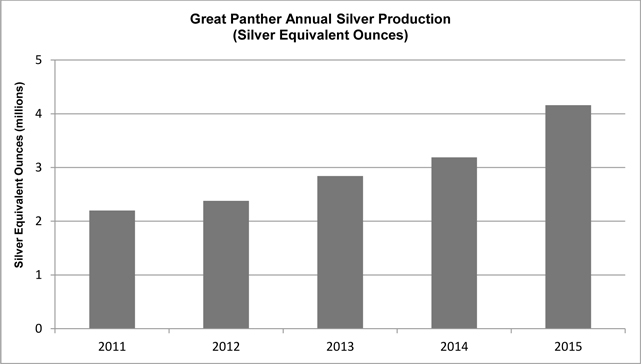
Production grew by 30% in 2015 and, since 2011, production has increased at a compound annual growth rate of 17%. Given the significant increase in production in 2015 and the continued low metal price environment, the Company will primarily focus on operational efficiencies and strong grade control in 2016 and build on the successful achievements in these areas in 2015. In addition, the significant growth in 2015 has brought production levels close to plant capacity at the GMC. Therefore, for 2016, the Company expects production to be in the range of 4.0 – 4.2 million Ag eq oz, similar to the level seen in 2015.
Fundamental to maintaining and growing production is the ability to add Mineral Resources through exploration of the Company’s existing operating mines and also through the exploration and acquisition of other projects. Great Panther is committed to seeking out new opportunities to grow and develop its business.
Resources
Delineation of mineral resources is essential to the future production capability of the Company. When Great Panther acquired its two mines in Mexico in 2005, there were no National Instrument 43-101 (“NI 43-101”) compliant resources for either property. Over the past ten years, the Company has allocated significant capital to support production growth through the definition of new mineral resources at the GMC and Topia. In addition, the Company entered into two option agreements during 2015, adding to the Company’s pipeline of projects, with the ultimate objective of adding new mines to the Company’s existing portfolio. Subsequent to December 31, 2015, one of these option agreements (related to the GDLR Project) was terminated.
The Company plans approximately 15,000 metres of exploration drilling in 2016 to further define resources, look for vein extensions and test new targets. Of this total, 4,000 metres of drilling is planned at the Coricancha Mine Complex.
Operating Costs
Attaining and maintaining low unit operating costs is critical to achieving strong operating cash flow. As experienced in the past year, metal prices can be volatile. Having low unit costs increases mine net earnings and enables the Company to be more resilient during periods of weak metal prices.
GREAT PANTHER SILVER LIMITED Management’s Discussion & Analysis |
Page 5 |
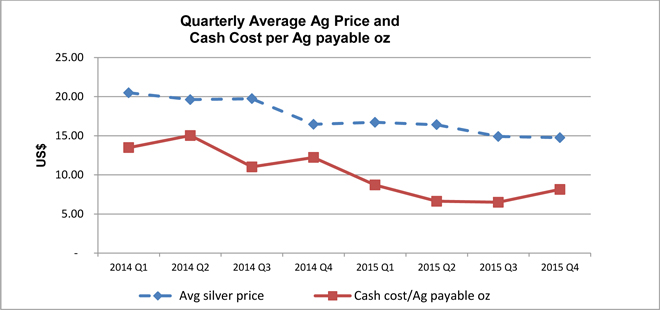
The Company measures and reports unit costs as cash cost, net of by-product credits. Cash cost is a common non-IFRS metric reported by companies in the mining industry. The Company also reports AISC.
In 2015, the Company’s average cash cost decreased to US$7.50 from US$12.78 in 2014, and average AISC decreased to US$13.76 from US$22.07.
Please refer to the Mining Operations and Non-IFRS Measures sections of this document for a more detailed discussion of cash cost and AISC. The Company’s reported cash cost and AISC are also affected by changes in metal prices of non-silver by-products, specifically gold at GMC and lead, zinc and gold at Topia.
Metal Prices
One of the Company’s objectives is to maintain leverage to the price of silver and gold. To this end, the Company does not engage in any long-term hedging arrangements for either silver or gold prices. As a result, Great Panther’s share price tends to correlate very strongly with the price of silver and gold.
During 2015, the spot price of silver decreased by 12% from US$15.711 per ounce at the beginning of the year to US$13.821 per ounce at the end of the year. The price of silver has fluctuated significantly in recent years and is expected to continue to be volatile in 2016.
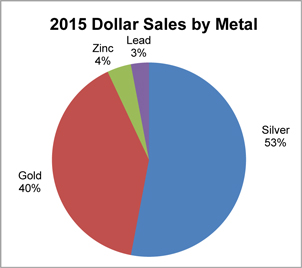
1 London Bullion Market Association Silver Fixings
GREAT PANTHER SILVER LIMITED Management’s Discussion & Analysis |
Page 6 |
The Company’s financial results are very sensitive to the price of silver and gold, and to a lesser extent, lead and zinc. The following table summarizes the effect of changes in the silver price on the Company’s 2016 revenue outlook, based on an assumed production of approximately 4.2 million silver equivalent ounces, which represents the top of the Company’s production guidance range for 2016:
Revenue Sensitivity to Change in Silver Price
| Silver price per ounce | US$10.00 | US$12.00 | US$14.00 | US$16.00 | US$18.00 | |||||||||||||||||||
| GMC revenue | USD 000s | $ | 37,667 | $ | 40,313 | $ | 42,959 | $ | 45,606 | $ | 48,252 | |||||||||||||
| Topia revenue | USD 000s | 8,063 | 9,281 | 10,499 | 11,716 | 12,934 | ||||||||||||||||||
| Total revenue | USD 000s | 45,730 | 49,594 | 53,458 | 57,322 | 61,186 | ||||||||||||||||||
| Total revenue | CAD 000s | 60,974 | 66,125 | 71,277 | 76,429 | 81,581 | ||||||||||||||||||
Assumes gold price of US$1,050/oz, zinc price of US$0.75/lb., lead price of US$0.75/lb., production of 4.2 million Ag eq oz, and a US$0.75 to Canadian dollar foreign exchange rate.
Revenue Sensitivity to Change in Gold Price
| Gold price per ounce | US$900 | US$1,000 | US$1,100 | US$1,200 | US$1,300 | |||||||||||||||||||
| GMC revenue | USD 000s | $ | 39,743 | $ | 42,328 | $ | 44,913 | $ | 47,499 | $ | 50,085 | |||||||||||||
| Topia revenue | USD 000s | 10,741 | 10,782 | 10,824 | 10,865 | 10,906 | ||||||||||||||||||
| Total revenue | USD 000s | 50,484 | 53,110 | 55,737 | 58,364 | 60,991 | ||||||||||||||||||
| Total revenue | CAD 000s | 67,312 | 70,814 | 74,316 | 77,819 | 81,321 | ||||||||||||||||||
Assumes silver price of US$14.50/oz, zinc price of US$0.75/lb., lead price of US$0.75/lb., production of 4.2 million Ag eq oz, and a US$0.75 to Canadian dollar foreign exchange rate.
The Company’s cash cost is affected by changes in metal prices of the by-products of silver, specifically gold at GMC and lead, zinc and gold at Topia. The following tables summarize the effect of changes in prices of gold, lead and zinc on the Company’s 2016 estimated cash cost based on an assumed production of approximately 4.2 million Ag eq oz and assumed cash cost of approximately US$5.00, which represent the top of the Company’s production guidance range and bottom of the cash cost guidance range for 2016, respectively.
Cash Cost: Sensitivity to Change in Gold Price
| Gold price per ounce | US$900 | US$1,000 | US$1,100 | US$1,200 | US$1,300 | |||||||||||||||
| Cash cost (USD) | $ | 6.90 | $ | 5.55 | $ | 4.20 | $ | 2.85 | $ | 1.49 | ||||||||||
Assumes silver price of US$14.50/oz, zinc price of US$0.75/lb., lead price of US$0.75/lb., production of 4.2 million Ag eq oz, and a US$0.75 to Canadian dollar foreign exchange rate.
Cash Cost: Sensitivity to Change in Zinc Price
| Zinc price per pound | US$0.50 | US$0.60 | US$0.70 | US$0.80 | US$0.90 | |||||||||||||||
| Cash cost (USD) | $ | 5.36 | $ | 5.21 | $ | 5.07 | $ | 4.93 | $ | 4.83 | ||||||||||
Assumes gold price of US$1,050/oz, silver price of US$14.50/oz., lead price of US$0.75/lb., production of 4.2 million Ag eq oz, and a US$0.75 to Canadian dollar foreign exchange rate.
Cash Cost: Sensitivity to Change in Lead Price
| Lead price per pound | US$0.50 | US$0.60 | US$0.70 | US$0.80 | US$0.90 | |||||||||||||||
| Cash cost (USD) | $ | 5.30 | $ | 5.18 | $ | 5.05 | $ | 4.94 | $ | 4.85 | ||||||||||
Assumes gold price of US$1,050/oz, zinc price of US$0.75/lb., silver price of US$14.50/oz., production of 4.2 million Ag eq oz, and a US$0.75 to Canadian dollar foreign exchange rate.
GREAT PANTHER SILVER LIMITED Management’s Discussion & Analysis |
Page 7 |
OVERALL PERFORMANCE - OPERATIONAL AND FINANCIAL HIGHLIGHTS
| (in CAD 000s, unless otherwise noted) | Q4 2015 | Q4 2014 | % change | FY 2015 | FY 2014 | % change | ||||||||||||||||||
| OPERATING | ||||||||||||||||||||||||
| Tonnes milled (excluding custom milling) | 94,874 | 92,574 | 2 | % | 375,332 | 335,199 | 12 | % | ||||||||||||||||
| Silver equivalent ounces (“Ag eq oz”) produced1 | 1,002,584 | 911,048 | 10 | % | 4,159,121 | 3,187,832 | 30 | % | ||||||||||||||||
| Silver ounce production | 553,189 | 550,010 | 1 | % | 2,386,028 | 1,906,645 | 25 | % | ||||||||||||||||
| Gold ounce production | 5,637 | 4,822 | 17 | % | 21,740 | 16,461 | 32 | % | ||||||||||||||||
| Payable silver ounces | 502,170 | 534,664 | -6 | % | 2,278,194 | 1,729,503 | 32 | % | ||||||||||||||||
| Cost per tonne milled (USD)2 | $ | 97 | $ | 111 | -12 | % | $ | 101 | $ | 120 | -16 | % | ||||||||||||
| Cash cost (USD)2 | $ | 8.14 | $ | 12.23 | -33 | % | $ | 7.50 | $ | 12.78 | -41 | % | ||||||||||||
| AISC (USD)2 | $ | 15.10 | $ | 21.46 | -30 | % | $ | 13.76 | $ | 22.07 | -38 | % | ||||||||||||
| FINANCIAL | ||||||||||||||||||||||||
| Revenue | $ | 17,152 | $ | 14,244 | 20 | % | $ | 73,374 | $ | 54,390 | 35 | % | ||||||||||||
| Mine operating earnings before non-cash items2 | $ | 4,907 | $ | 2,159 | 127 | % | $ | 24,036 | $ | 10,775 | 123 | % | ||||||||||||
| Mine operating earnings (loss) | $ | 3,226 | $ | (2,693 | ) | 220 | % | $ | 5,699 | $ | (6,161 | ) | 193 | % | ||||||||||
| Net loss | $ | (4,860 | ) | $ | (26,948 | ) | 82 | % | $ | (9,341 | ) | $ | (33,013 | ) | 72 | % | ||||||||
| Adjusted EBITDA2 | $ | (557 | ) | $ | (681 | ) | 18 | % | $ | 9,317 | $ | 255 | 3,554 | % | ||||||||||
| Cash flow from operating activities3 | $ | (775 | ) | $ | (1,252 | ) | 38 | % | $ | 9,186 | $ | 1,172 | 684 | % | ||||||||||
| Cash at end of period | $ | 17,860 | $ | 17,968 | -3 | % | $ | 17,860 | $ | 17,968 | -3 | % | ||||||||||||
| Net working capital at end of period | $ | 33,252 | $ | 32,907 | 1 | % | $ | 33,252 | $ | 32,907 | 1 | % | ||||||||||||
| Average realized silver price (USD)4 | $ | 13.57 | $ | 15.78 | -14 | % | $ | 15.11 | $ | 18.28 | -17 | % | ||||||||||||
| PER SHARE AMOUNTS | ||||||||||||||||||||||||
| Loss per share – basic and diluted | $ | (0.03 | ) | $ | (0.19 | ) | 84 | % | $ | (0.07 | ) | $ | (0.24 | ) | 71 | % | ||||||||
Highlights of 2015 compared to 2014, unless otherwise noted:
| · | Record metal production of 4,159,121 Ag eq oz, a 30% increase, including 1,276,808 Ag eq oz from San Ignacio; |
| · | Throughput increased 11% to 381,019 tonnes (including custom milling); |
| · | Silver production increased 25% to a record 2,386,028 silver ounces; |
| · | Gold production increased 32% to a record 21,740 gold ounces; |
| · | Cash cost decreased 41% to US$7.50; |
| · | AISC decreased 38% to US$13.76; |
| · | Revenues totalled $73.4 million, an increase of 35%; |
| 1 | Silver equivalent ounces are referred to throughout this document. For 2015, Aq eq oz are calculated using a 65:1 Ag:Au ratio, and ratios of 1:0.050 and 1:0.056 for the price/ounce of silver to lead and zinc price/pound, and applied to the relevant metal content of the concentrates produced, expected to be produced, or sold from operations. Comparatively, in 2014 Aq eq oz was established using prices of US$18.50 per oz, US$1,110 per oz (60:1 ratio), US$0.90 per lb., and US$0.85 per lb. for silver, gold, lead and zinc, respectively. |
| 2 | The Company has included non-IFRS performance measures such as cost per tonne milled, cash cost, AISC, mine operating earnings before non-cash items, cost of sales before non-cash items and adjusted EBITDA throughout this document. Refer to the Non-IFRS Measures section of this MD&A for an explanation of these measures and reconciliation to the Company’s reported financial results in accordance with IFRS. As these are not standardized measures, they may not be directly comparable to similarly titled measures used by others. |
| 3 | Before changes in non-cash working capital. |
| 4 | Average realized silver price is prior to smelting and refining charges. |
GREAT PANTHER SILVER LIMITED Management’s Discussion & Analysis |
Page 8 |
| · | Mine operating earnings before non-cash items was $24.0 million, an increase of 123%; |
| · | Net loss was $9.3 million, compared to net loss of $33.0 million; |
| · | Adjusted EBITDA was $9.3 million compared to $0.3 million; |
| · | Cash flow from operating activities before changes in non-cash working capital was $9.2 million compared to $1.2 million; |
| · | Cash and cash equivalents were $17.9 million at December 31, 2015 compared to $18.0 million at December 31, 2014; and |
| · | Net working capital increased to $33.3 million at December 31, 2015 from $32.9 million at December 31, 2014. |
Highlights of the fourth quarter 2015 compared to fourth quarter 2014:
| · | Metal production increased 10% to 1,002,584 Ag eq oz; |
| · | Silver production increased 1% to 553,189 silver ounces; |
| · | Gold production increased 17% to 5,637 gold ounces; |
| · | Cash cost decreased 33% to US$8.14 per ounce; |
| · | AISC decreased 30% to US$15.10 per payable silver ounce; |
| · | Revenues increased 20% to $17.2 million; |
| · | Mine operating earnings before non-cash items was $4.9 million, an increase of 127%; |
| · | Adjusted EBITDA amounted to negative $0.6 million compared to negative $0.7 million; |
| · | Net loss totalled $4.9 million, compared to a net loss of $26.9 million; and |
| · | Cash flow from operating activities before changes in non-cash net working capital amounted to negative $0.8 million, compared to negative $1.3 million. |
SIGNIFICANT EVENTS
On May 19, 2015, Great Panther announced that it had entered into a two-year option agreement with two wholly-owned subsidiaries of Nyrstar N.V. (“Nyrstar”) whereby the Company can acquire 100% of the shares of Nyrstar Coricancha S.A. which holds a 100% interest in the Coricancha Mine Complex (the “Coricancha Option Agreement”).
Under the terms of the Coricancha Option Agreement:
| · | The Company made an initial option payment of US$1.5 million on signing and a second option payment of US$1.5 million is payable on May 18, 2016 if the Company chooses to extend the option for a second year. |
| · | In the event that the Company exercises its option within two years, the Company will be required to make a cash payment of US$5.0 million for 100% of the shares of Nyrstar Coricancha S.A. plus the second option payment, if it has not been paid. |
| · | A further contingent payment of US$4.0 million may become payable to Nyrstar if certain conditions are met within three years following execution of the Coricancha Option Agreement. Alternatively (not in addition to the contingent payment), the Company may be obligated to reimburse Nyrstar for certain costs, to a maximum amount of US$6.6 million, in certain circumstances. The contingent payment or the reimbursement will only be made on or after the closing of the acquisition of the Nyrstar Coricancha S.A. shares. The contingent payment will not be payable if the conditions are not met within three years following closing, and no reimbursement will be made unless the costs are incurred by Nyrstar prior to closing. |
GREAT PANTHER SILVER LIMITED Management’s Discussion & Analysis |
Page 9 |
In addition, the Company is required to incur exploration expenditures of US$2.0 million in the first year of the option period ending May 2016, and US$3.0 million in the second year ending May 2017. The agreement provides that expenditures exceeding the US$2.0 million minimum for the first year will count towards the US$3.0 million of expenditures of the second year.
On May 27, 2015, the Company completed the acquisition of all of the issued and outstanding common shares of Cangold. As a result, the Company acquired a 100% interest in Cangold and its wholly-owned subsidiary Coboro. Coboro held an option to acquire up to a 100% interest in the GDLR Project, but the Company subsequently terminated the option agreement on February 24, 2016 after conducting an evaluation of the project, which included an initial drill program. Based on the results of the evaluation, management decided that the project did not warrant further exploration. The completion of the transaction also added Cangold’s Plomo gold project in Mexico and its Argosy Project in the Red Lake Mining Division of northeastern Ontario, Canada. The Company will be evaluating its future plans for these properties.
On June 10, 2015, the Company announced it had obtained a US$10.0 million credit facility from Auramet International LLC with whom Great Panther has had a commercial relationship for several years. The facility has a term of one year and interest on borrowings under the facility is payable at the rate of three month Libor plus 5%. The Company has not drawn on the facility.
On July 9, 2015, the Company provided an update to the Mineral Resource at the Topia Mine, with an effective date of November 30, 2014. Measured and Indicated (“M&I”) Mineral Resources increased by 41% and Inferred Mineral Resources increased by 29% compared to the previous update which had an effective date of November 30, 2013. The M&I category benefitted from improvements in the reconciliation between the Topia geological model and the actual mine output, while the increase in the Inferred category is attributed to improved modeling and successful in-vein development, which allowed for an expansion of resource block dimensions. This Mineral Resource Estimate reflects M&I Mineral Resources of 11,580,000 Ag eq oz and Inferred Mineral Resources of 11,050,000 Ag eq oz.
On July 28, 2015, the Company fully secured mineral property titles for all of its 7,909 hectares related to the El Horcón Project. Three of the Company’s mineral property title claims were previously cancelled due to an administrative oversight on the part of the government agency, which manages mineral property titles in Mexico.
On January 14, 2016, the Company reported a theft of explosives from one of the mines at the GMC. The Company voluntarily suspended the use of all explosives material at the GMC to facilitate ongoing investigations by regulatory authorities, and to enhance security measures. On February 16, 2016, the regulatory authorities concluded their formal investigation. Operations at the GMC were intermittently halted over the investigation period and were fully resumed on February 16, 2016.
During February 2016, the Company met with representatives of CONAGUA, the Mexican federal agency responsible for water administration, who have asserted that the Company is required to make applications for permits associated with the use and expansion of the tailings facility at the GMC (the “Tailings Permits”). CONAGUA officials identified no issues arising from the outstanding Tailings Permits and requested that the Company complete its applications. The Company believes its current tailings capacity at the GMC is sufficient to operate and no expansions will be required until the fall of 2016. Although the Company expects the Tailings Permits to be granted in due course without any impact to the ongoing operations, there is no guarantee that the Company will receive any of the Tailings Permits, or that the terms of such permits will be favourable to the Company. The failure to obtain a required permit could impact the Company’s ability to continue operating the tailings facility at the GMC.
On February 15, 2016, the Company reported a fatality of a contract scooptram operator that occurred at the GMC. All relevant authorities were contacted and a full investigation into the cause of the accident is ongoing. Safety procedures are being reviewed and reinforced to ensure safety remains the top priority across all operations.
GREAT PANTHER SILVER LIMITED Management’s Discussion & Analysis |
Page 10 |
On February 22, 2016, the Company provided an update to the Mineral Resource at the GMC, with effective dates of July 31, 2015 for the Guanajuato Mine and El Horcon and December 31, 2015 for the San Ignacio Mine. The previous Mineral Resource estimates had effective dates of July 31, 2014 and December 15, 2014, respectively. The Company successfully replaced the M&I Mineral Resources that had been mined since the effective dates of the previous Mineral Resource estimate, as the M&I Mineral Resource were estimated at 6,108,800 Ag eq oz, virtually unchanged from the 6,109,217 Ag eq oz estimated at the previous effective dates. Specifically, this reflects a 36% increase in Measured Resources, while Indicated Resources decreased by 39%. The estimate also reported Inferred Mineral Resources of 8,266,229 Ag eq oz, 1,363,328 Ag eq oz and 1,906,123 Ag eq oz for the Guanajuato Mine, San Ignacio Mine and the El Horcon Project, respectively.
MINING OPERATIONS
Consolidated operations
| 2015 | 2014 | |||||||||||||||||||||||||||||||||||||||
| FY | Q4 | Q3 | Q2 | Q1 | FY | Q4 | Q3 | Q2 | Q1 | |||||||||||||||||||||||||||||||
| Tonnes mined1 | 376,400 | 94,804 | 96,770 | 84,979 | 99,847 | 331,515 | 92,782 | 89,467 | 79,268 | 69,998 | ||||||||||||||||||||||||||||||
| Tonnes milled | 375,332 | 94,874 | 93,730 | 87,476 | 99,252 | 335,199 | 92,574 | 89,030 | 80,964 | 72,631 | ||||||||||||||||||||||||||||||
| Custom milling (tonnes) | 5,687 | 1,583 | 1,346 | 1,560 | 1,198 | 9,058 | 2,312 | 1,852 | 1,929 | 2,965 | ||||||||||||||||||||||||||||||
| Total tonnes milled | 381,019 | 96,457 | 95,076 | 89,036 | 100,450 | 344,257 | 94,886 | 90,882 | 82,893 | 75,596 | ||||||||||||||||||||||||||||||
| Production | ||||||||||||||||||||||||||||||||||||||||
| Silver (ounces) | 2,386,028 | 553,189 | 586,918 | 648,810 | 597,111 | 1,906,645 | 550,010 | 565,966 | 420,001 | 370,668 | ||||||||||||||||||||||||||||||
| Gold (ounces) | 21,741 | 5,637 | 6,079 | 5,322 | 4,703 | 16,461 | 4,822 | 4,200 | 3,773 | 3,666 | ||||||||||||||||||||||||||||||
| Lead (tonnes) | 1,198 | 278 | 341 | 300 | 279 | 1,154 | 285 | 259 | 302 | 308 | ||||||||||||||||||||||||||||||
| Zinc (tonnes) | 1,850 | 425 | 493 | 491 | 441 | 1,675 | 406 | 443 | 395 | 431 | ||||||||||||||||||||||||||||||
| Silver equivalent ounces | 4,159,122 | 1,002,584 | 1,080,296 | 1,088,355 | 987,887 | 3,187,832 | 911,048 | 890,641 | 718,794 | 667,349 | ||||||||||||||||||||||||||||||
| Payable silver ounces | 2,278,194 | 502,170 | 545,787 | 607,898 | 622,339 | 1,729,503 | 534,664 | 461,249 | 381,302 | 352,288 | ||||||||||||||||||||||||||||||
| Cost per tonne milled (USD) | $ | 101 | $ | 97 | $ | 96 | $ | 109 | $ | 102 | $ | 120 | $ | 111 | $ | 122 | $ | 125 | $ | 121 | ||||||||||||||||||||
| Metrics per payable silver ounce | ||||||||||||||||||||||||||||||||||||||||
| Cash cost (USD) | $ | 7.50 | $ | 8.14 | $ | 6.50 | $ | 6.63 | $ | 8.71 | $ | 12.78 | $ | 12.23 | $ | 11.02 | $ | 15.03 | $ | 13.49 | ||||||||||||||||||||
| AISC (USD) | $ | 13.76 | $ | 15.10 | $ | 13.08 | $ | 12.54 | $ | 14.47 | $ | 22.07 | $ | 21.46 | $ | 19.25 | $ | 24.40 | $ | 24.18 | ||||||||||||||||||||
Ore processed for the year ended December 31, 2015 was 375,332 tonnes, an increase of 12% over the prior year. The increase in throughput is attributable to the continued ramp-up in production at San Ignacio, which contributed 129,252 tonnes of ore in 2015 compared to 54,154 tonnes of ore in 2014 (including development ore processed prior to the start of commercial production in June 2014). This increase was partially offset by a reduction of tonnes processed from the Guanajuato Mine, reflecting the application of higher cut-off grades at Guanajuato and the shift in resources to mining the San Ignacio Mine.
During the fourth quarter 2015, ore processed totaled 94,874 tonnes, a 2% increase compared to the fourth quarter of 2014.
1 Excludes purchased ore.
GREAT PANTHER SILVER LIMITED Management’s Discussion & Analysis |
Page 11 |
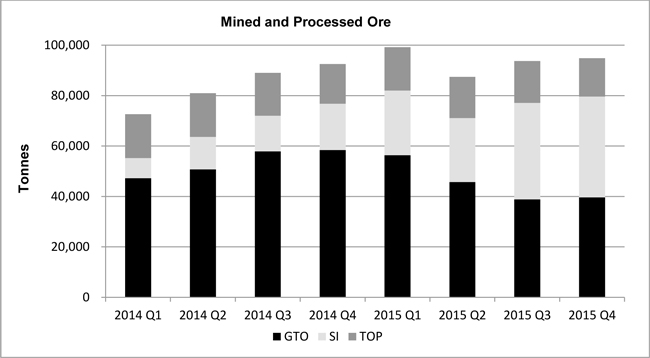
Metal production for the year ended December 31, 2015 was a record 4,159,121 Ag eq oz, representing a 30% increase over the prior year. The increase in production reflects the above noted increase in throughput and higher ore grades at all operations.
Metal production for the fourth quarter of 2015 was 1,002,584 Ag eq oz, an increase of 10% compared to the fourth quarter in 2014. The increase was mainly achieved through improved grades, as overall throughput increased only 2%. The pursuit of efficiencies and improved grade control, combined with an increase in throughput, enabled the Company to maintain its metal production at levels in excess of one million Ag eq oz for the third consecutive quarter.
GREAT PANTHER SILVER LIMITED Management’s Discussion & Analysis |
Page 12 |
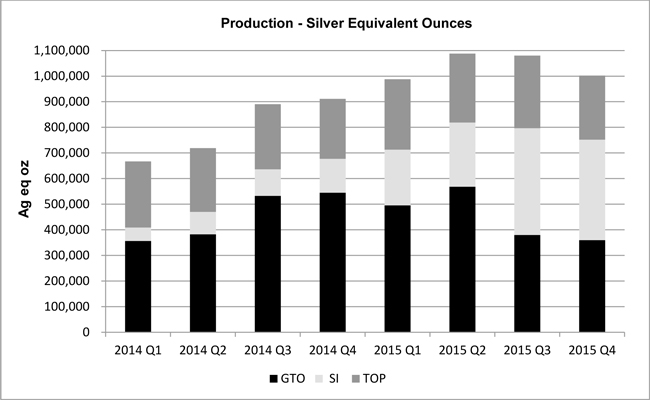
Cash cost was US$7.50 for the year ended December 31, 2015, a 41% decrease compared to US$12.78 for the year ended December 31, 2014. The decrease in cash cost was due to the increase in ore grades at all operations, which contributed to a 32% increase in payable silver ounces and higher by-product credits. In addition, the strengthening of the US dollar compared to the Mexican peso reduced cash operating costs in US dollar terms.
Cash cost was US$8.14 for the fourth quarter of 2015, a 33% decrease compared to US$12.23 for the fourth quarter of 2014. Cash cost decreased due to the strengthening of the US dollar against the Mexican peso, which reduced cash operating costs reported in US dollar terms, further aided by higher by-product credits as gold production increased by 17% during the fourth quarter 2015 compared to prior-year quarter.
Cash cost and the associated by-product credits are computed based on sales during the period as opposed to production. As such, the amount of the by-product credit may not directly correlate to the production reported for the period. Similarly, the cost per tonne milled during the period may not directly correlate to the cash cost reported for the same period due to a time lag between production and sales.
AISC for the year ended December 31, 2015 decreased to US$13.76 from US$22.07 in the year ended December 31, 2014. This 38% decrease is primarily due to the reduction in cash cost. In addition, there was a reduction in general and administrative (“G&A”), sustaining exploration, evaluation and development (“EE&D”) and sustaining capital expenditures (all in US dollar terms) on a per payable ounce basis as a result of the increase in payable silver ounces noted above and the strengthening of the US dollar against the Canadian dollar and the Mexican peso.
AISC for the fourth quarter of 2015 decreased to US$15.10 from US$21.46 in the fourth quarter of 2014. This 30% decrease is primarily due to the reduction in cash cost. In addition, there was a reduction in G&A, sustaining EE&D and sustaining capital expenditures (all in US dollar terms).
GREAT PANTHER SILVER LIMITED Management’s Discussion & Analysis |
Page 13 |
Guanajuato Mine Complex
| 2015 | 2014 | |||||||||||||||||||||||||||||||||||||||
| GUANAJUATO MINE | FY | Q4 | Q3 | Q2 | Q1 | FY | Q4 | Q3 | Q2 | Q1 | ||||||||||||||||||||||||||||||
| Tonnes milled | 180,691 | 39,686 | 38,854 | 45,734 | 56,417 | 214,363 | 58,467 | 57,887 | 50,766 | 47,243 | ||||||||||||||||||||||||||||||
| Production | ||||||||||||||||||||||||||||||||||||||||
| Silver (ounces) | 1,188,393 | 235,934 | 245,845 | 382,132 | 324,482 | 1,067,991 | 331,884 | 341,329 | 216,393 | 178,385 | ||||||||||||||||||||||||||||||
| Gold (ounces) | 9,477 | 1,908 | 2,061 | 2,870 | 2,638 | 12,480 | 3,548 | 3,189 | 2,775 | 2,968 | ||||||||||||||||||||||||||||||
| Silver equivalent ounces | 1,804,450 | 359,973 | 379,821 | 568,714 | 495,942 | 1,816,760 | 544,722 | 532,659 | 382,884 | 356,495 | ||||||||||||||||||||||||||||||
| Average ore grades | ||||||||||||||||||||||||||||||||||||||||
| Silver (g/t) | 225 | 206 | 217 | 282 | 196 | 171 | 193 | 200 | 148 | 133 | ||||||||||||||||||||||||||||||
| Gold (g/t) | 1.76 | 1.63 | 1.79 | 2.08 | 1.57 | 1.96 | 2.02 | 1.84 | 1.85 | 2.14 | ||||||||||||||||||||||||||||||
| Metal recoveries | ||||||||||||||||||||||||||||||||||||||||
| Silver | 91.2 | % | 89.7 | % | 90.7 | % | 92.1 | % | 91.2 | % | 90.7 | % | 91.4 | % | 91.9 | % | 86.5 | % | 88.6 | % | ||||||||||||||||||||
| Gold | 92.8 | % | 92.0 | % | 92.4 | % | 94.0 | % | 92.5 | % | 92.5 | % | 93.4 | % | 93.2 | % | 91.7 | % | 91.5 | % | ||||||||||||||||||||
| Concentrate grades | ||||||||||||||||||||||||||||||||||||||||
| Silver (g/t) | 11,607 | 11,027 | 10,121 | 12,837 | 12,048 | 10,262 | 11,070 | 10,862 | 9,584 | 8,948 | ||||||||||||||||||||||||||||||
| Gold (g/t) | 93 | 89 | 85 | 96 | 98 | 120 | 116 | 101 | 123 | 149 | ||||||||||||||||||||||||||||||
| 2015 | 2014 | |||||||||||||||||||||||||||||||||||||||
| SAN IGNACIO MINE | FY | Q4 | Q3 | Q2 | Q1 | FY | Q4 | Q3 | Q2 | Q1 | ||||||||||||||||||||||||||||||
| Tonnes milled | 129,252 | 39,964 | 38,282 | 25,397 | 25,609 | 53,449 | 18,372 | 14,160 | 12,880 | 8,037 | ||||||||||||||||||||||||||||||
| Production | ||||||||||||||||||||||||||||||||||||||||
| Silver (ounces) | 519,667 | 158,721 | 167,239 | 100,419 | 93,288 | 171,018 | 64,400 | 50,650 | 35,294 | 20,674 | ||||||||||||||||||||||||||||||
| Gold (ounces) | 11,648 | 3,588 | 3,847 | 2,303 | 1,910 | 3,426 | 1,136 | 887 | 873 | 530 | ||||||||||||||||||||||||||||||
| Silver equivalent ounces | 1,276,808 | 391,954 | 417,298 | 250,127 | 217,429 | 376,643 | 132,594 | 103,897 | 87,705 | 52,447 | ||||||||||||||||||||||||||||||
| Average ore grades | ||||||||||||||||||||||||||||||||||||||||
| Silver (g/t) | 147 | 145 | 159 | 145 | 134 | 120 | 130 | 131 | 104 | 103 | ||||||||||||||||||||||||||||||
| Gold (g/t) | 3.18 | 3.15 | 3.51 | 3.22 | 2.68 | 2.34 | 2.21 | 2.26 | 2.55 | 2.47 | ||||||||||||||||||||||||||||||
| Metal recoveries | ||||||||||||||||||||||||||||||||||||||||
| Silver | 85.3 | % | 85.5 | % | 85.6 | % | 85.1 | % | 84.7 | % | 82.9 | % | 84.0 | % | 84.7 | % | 81.8 | % | 77.6 | % | ||||||||||||||||||||
| Gold | 88.2 | % | 88.6 | % | 89.1 | % | 87.5 | % | 86.6 | % | 85.1 | % | 87.1 | % | 86.3 | % | 82.9 | % | 82.9 | % | ||||||||||||||||||||
| Concentrate grades | ||||||||||||||||||||||||||||||||||||||||
| Silver (g/t) | 9,447 | 8,283 | 9,053 | 12,727 | 9,840 | 8,449 | 9,325 | 7,684 | 7,414 | 10,419 | ||||||||||||||||||||||||||||||
| Gold (g/t) | 212 | 187 | 208 | 292 | 201 | 169 | 165 | 135 | 183 | 267 | ||||||||||||||||||||||||||||||
| 2015 | 2014 | |||||||||||||||||||||||||||||||||||||||
| GMC (Total) | FY | Q4 | Q3 | Q2 | Q1 | FY | Q4 | Q3 | Q2 | Q1 | ||||||||||||||||||||||||||||||
| Tonnes milled | 309,944 | 79,651 | 77,136 | 71,131 | 82,026 | 267,812 | 76,839 | 72,047 | 63,646 | 55,280 | ||||||||||||||||||||||||||||||
| Production | ||||||||||||||||||||||||||||||||||||||||
| Silver (ounces) | 1,708,061 | 394,655 | 413,084 | 482,551 | 417,770 | 1,239,009 | 396,284 | 391,979 | 251,687 | 199,059 | ||||||||||||||||||||||||||||||
| Gold (ounces) | 21,126 | 5,496 | 5,908 | 5,173 | 4,548 | 15,906 | 4,684 | 4,076 | 3,648 | 3,498 | ||||||||||||||||||||||||||||||
| Silver equivalent ounces | 3,081,258 | 751,927 | 797,119 | 818,841 | 713,371 | 2,193,403 | 677,316 | 636,556 | 470,589 | 408,942 | ||||||||||||||||||||||||||||||
| Payable silver ounces | 1,663,893 | 349,661 | 387,860 | 460,956 | 465,416 | 1,117,369 | 340,851 | 338,689 | 235,409 | 202,420 | ||||||||||||||||||||||||||||||
| Average ore grades | ||||||||||||||||||||||||||||||||||||||||
| Silver (g/t)2 | 192 | 175 | 188 | 233 | 177 | 161 | 178 | 186 | 139 | 128 | ||||||||||||||||||||||||||||||
| Gold (g/t) | 2.35 | 2.39 | 2.64 | 2.49 | 1.92 | 2.03 | 2.07 | 1.92 | 1.99 | 2.19 | ||||||||||||||||||||||||||||||
| Metal recoveries | ||||||||||||||||||||||||||||||||||||||||
| Silver | 89.2 | % | 87.9 | % | 88.5 | % | 90.5 | % | 89.7 | % | 89.5 | % | 90.1 | % | 90.9 | % | 88.4 | % | 87.3 | % | ||||||||||||||||||||
| Gold | 90.2 | % | 89.7 | % | 90.2 | % | 91.0 | % | 89.9 | % | 90.8 | % | 91.8 | % | 91.6 | % | 89.4 | % | 90.1 | % | ||||||||||||||||||||
| Concentrate grades | ||||||||||||||||||||||||||||||||||||||||
| Silver (g/t) | 10,852 | 9,730 | 9,660 | 12,814 | 11,473 | 9,967 | 10,698 | 10,311 | 9,206 | 9,081 | ||||||||||||||||||||||||||||||
| Gold (g/t) | 134 | 136 | 138 | 137 | 125 | 128 | 126 | 107 | 133 | 160 | ||||||||||||||||||||||||||||||
| Cost per tonne milled (USD) | $ | 91 | $ | 89 | $ | 86 | $ | 100 | $ | 91 | $ | 107 | $ | 99 | $ | 108 | $ | 113 | $ | 110 | ||||||||||||||||||||
| Metrics per payable silver ounce | ||||||||||||||||||||||||||||||||||||||||
| Cash cost (USD) | $ | 5.77 | $ | 6.54 | $ | 4.47 | $ | 4.88 | $ | 7.16 | $ | 11.12 | $ | 10.05 | $ | 9.24 | $ | 14.49 | $ | 12.13 | ||||||||||||||||||||
| AISC (USD) | $ | 9.93 | $ | 10.53 | $ | 9.87 | $ | 8.93 | $ | 10.51 | $ | 18.05 | $ | 17.50 | $ | 14.64 | $ | 20.96 | $ | 21.29 | ||||||||||||||||||||
GREAT PANTHER SILVER LIMITED Management’s Discussion & Analysis |
Page 14 |
For the year ended December 31, 2015, the GMC processed 309,944 tonnes of ore, an increase of 16% over the prior year due to the production ramp up of the San Ignacio Mine commissioned in June 2014. San Ignacio contributed 129,252 tonnes (or 42% of GMC tonnes) in 2015 compared to 54,154 tonnes (or 20% of GMC tonnes) in 2014 (including development ore processed prior to the start of commercial production in June 2014). This increase was partially offset by a reduction of tonnes processed from the Guanajuato Mine, reflecting the application of higher cut-off grades and the shift in focus to mining San Ignacio.
The GMC processed 79,651 tonnes in the fourth quarter of 2015, a 4% increase over the fourth quarter of 2014.
Production from San Ignacio accounted for the largest portion of the production from the GMC in the fourth quarter and will continue to do so for the foreseeable future. At the end of the third quarter, production from San Ignacio had reached more than 500 tonnes per day, greater than the 450 tonnes per day originally targeted for the end of 2015. Continued development of the Southern Extension zones resulted in further production growth through the fourth quarter with an average rate of 550 tonnes per day attained.
Metal production for the GMC was 3,081,258 Ag eq oz for 2015, a 40% increase over the prior year. San Ignacio contributed 1,276,808 Ag eq oz of production. Production from the Guanajuato Mine for 2015 was within 1% of the prior year production as improved silver grades and recoveries made up for a 16% decrease in throughput. This was the result of a mine plan which implemented increased cut-off grades to achieve similar production at lower throughput and, thereby, meaningfully reduce cash cost.
Metal production at the GMC totaled 751,927 Ag eq oz for the fourth quarter of 2015, an 11% increase over the fourth quarter of 2014. The San Ignacio Mine contributed production of 391,954 Ag eq oz during the fourth quarter 2015, an increase of 196% compared to the fourth quarter of 2014. This was partly offset by a 34% decrease in Ag eq oz production from the Guanajuato Mine during the fourth quarter of 2015 relative to the comparative period in 2014 as throughput decreased by 32% due to the mine planning measures taken earlier in 2015 to increase cut-off grade.
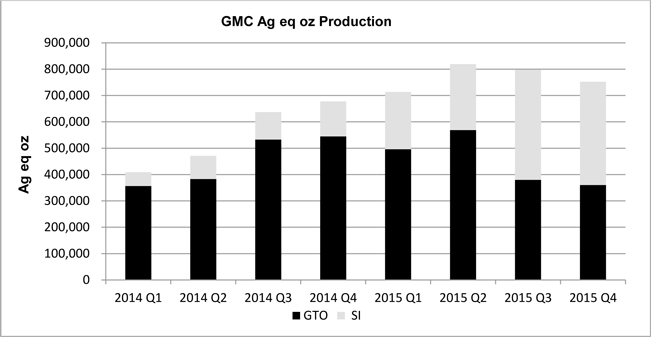
Cash cost for the GMC for the year ended December 31, 2015 decreased 48% to US$5.77, compared to US$11.12 in the prior year, primarily due to higher average silver and gold ore grades which increased the yield of payable silver ounces and by-product credits, respectively. In addition, the strengthening of the US dollar relative to the Mexican peso reduced cash operating costs in US dollar terms as these are predominantly incurred in Mexican pesos.
GREAT PANTHER SILVER LIMITED Management’s Discussion & Analysis |
Page 15 |
Cash cost for the GMC decreased to US$6.54 in the fourth quarter of 2015, from US$10.05 in the fourth quarter of 2014. This was primarily due to the strengthening of the US dollar relative to the Mexican peso, which reduced cash operating costs in US dollar terms as these are predominantly incurred in Mexican pesos. Cash cost also benefitted from the higher average gold and silver ore grades, which increased by-product credits and payable silver ounces, respectively. These factors were partly offset by higher operating costs in Mexican peso terms.
AISC for the year ended December 31, 2015 decreased to US$9.93 from US$18.05 in the year ended December 31, 2014, primarily due to the above-noted reduction in cash cost. In addition, there was a reduction in sustaining EE&D and sustaining capital expenditures (all in US dollar terms) due to the strengthening of the US dollar relative to the Mexican peso and Canadian dollar, augmented by the positive impact of the increase in payable silver ounces noted above.
AISC for the fourth quarter of 2015 decreased to US$10.53 from US$17.50 in the fourth quarter of 2014. This decrease is primarily a function of the decrease in cash cost as described above.
GMC Development
A total of 11,111 metres of development were completed at the GMC during the year ended December 31, 2015, compared to 7,837 metres of development in 2014. Mine development during the year was focused on San Ignacio with a total of 4,333 metres completed, and additional development also progressed at the Cata, Los Pozos, Santa Margarita and Guanajuatito zones. Development at San Ignacio concentrated on infrastructure work including the preparation of loading bays, pumping stations and developing access levels to stopes.
A total of 2,591 metres of underground development was completed during the fourth quarter of 2015 comprising 1,468 metres of mine development at the Guanajuato Mine and 1,123 metres at the San Ignacio Mine. This compares to 1,922 metres of development at the GMC in the 2014 comparative period. At the Guanajuato Mine, fourth quarter 2015 mine development activities focused on the Guanajuatito, Los Pozos and Cata zones.
The Company’s drill program during 2015 totaled 17,680 metres for the GMC compared to 17,101 metres in 2014. Drilling at the Guanajuato Mine totaled 13,024 metres, and was focused on the Valenciana, Cata and Los Pozos zones. This compares to 13,270 metres of drilling at the Guanajuato Mine in 2014. At San Ignacio, a surface drilling program commenced in mid-October 2015 and total drilling amounted to 4,657 metres for the year. This compares to 3,831 metres of drilling in 2014, the majority of which was underground drilling.
GREAT PANTHER SILVER LIMITED Management’s Discussion & Analysis |
Page 16 |
Topia Mine
| 2015 | 2014 | |||||||||||||||||||||||||||||||||||||||
| TOPIA MINE | FY | Q4 | Q3 | Q2 | Q1 | FY | Q4 | Q3 | Q2 | Q1 | ||||||||||||||||||||||||||||||
| Tonnes milled | 65,387 | 15,223 | 16,594 | 16,345 | 17,225 | 67,387 | 15,735 | 16,983 | 17,318 | 17,351 | ||||||||||||||||||||||||||||||
| Custom milling (tonnes) | 5,687 | 1,583 | 1,346 | 1,560 | 1,198 | 9,058 | 2,312 | 1,852 | 1,929 | 2,965 | ||||||||||||||||||||||||||||||
| Total tonnes milled | 71,074 | 16,806 | 17,940 | 17,905 | 18,423 | 76,445 | 18,047 | 18,835 | 19,247 | 20,316 | ||||||||||||||||||||||||||||||
| Production | ||||||||||||||||||||||||||||||||||||||||
| Silver (ounces) | 677,967 | 158,534 | 173,834 | 166,258 | 179,341 | 667,636 | 153,726 | 173,986 | 168,314 | 171,609 | ||||||||||||||||||||||||||||||
| Gold (ounces) | 614 | 140 | 170 | 149 | 155 | 555 | 138 | 124 | 125 | 168 | ||||||||||||||||||||||||||||||
| Lead (tonnes) | 1,198 | 278 | 341 | 300 | 279 | 1,154 | 285 | 259 | 302 | 308 | ||||||||||||||||||||||||||||||
| Zinc (tonnes) | 1,850 | 425 | 493 | 491 | 441 | 1,675 | 406 | 443 | 395 | 431 | ||||||||||||||||||||||||||||||
| Silver equivalent ounces | 1,077,863 | 250,657 | 283,177 | 269,514 | 274,515 | 994,429 | 233,732 | 254,085 | 248,205 | 258,407 | ||||||||||||||||||||||||||||||
| Payable silver ounces | 614,301 | 152,509 | 157,927 | 146,942 | 156,923 | 612,134 | 193,813 | 122,560 | 145,893 | 149,868 | ||||||||||||||||||||||||||||||
| Average ore grade | ||||||||||||||||||||||||||||||||||||||||
| Silver (g/t) | 356 | 357 | 359 | 350 | 357 | 343 | 338 | 352 | 336 | 344 | ||||||||||||||||||||||||||||||
| Gold (g/t) | 0.48 | 0.48 | 0.54 | 0.48 | 0.44 | 0.45 | 0.45 | 0.41 | 0.40 | 0.56 | ||||||||||||||||||||||||||||||
| Lead (%) | 1.94 | 1.94 | 2.16 | 1.95 | 1.71 | 1.82 | 1.93 | 1.62 | 1.84 | 1.90 | ||||||||||||||||||||||||||||||
| Zinc (%) | 2.99 | 2.92 | 3.13 | 3.17 | 2.73 | 2.69 | 2.76 | 2.83 | 2.49 | 2.70 | ||||||||||||||||||||||||||||||
| Metal recoveries | ||||||||||||||||||||||||||||||||||||||||
| Silver | 90.7 | % | 90.7 | % | 90.8 | % | 90.5 | % | 90.8 | % | 89.9 | % | 89.9 | % | 90.5 | % | 89.8 | % | 89.4 | % | ||||||||||||||||||||
| Gold | 60.6 | % | 60.4 | % | 59.6 | % | 59.2 | % | 63.5 | % | 56.4 | % | 61.4 | % | 55.3 | % | 56.1 | % | 53.8 | % | ||||||||||||||||||||
| Lead | 94.5 | % | 94.4 | % | 94.9 | % | 94.3 | % | 94.5 | % | 94.0 | % | 93.8 | % | 94.4 | % | 94.7 | % | 93.4 | % | ||||||||||||||||||||
| Zinc | 94.7 | % | 95.6 | % | 94.9 | % | 94.6 | % | 93.8 | % | 92.3 | % | 93.6 | % | 92.1 | % | 91.6 | % | 91.9 | % | ||||||||||||||||||||
| Concentrate grades | ||||||||||||||||||||||||||||||||||||||||
| Lead | ||||||||||||||||||||||||||||||||||||||||
| Silver (g/t) | 8,213 | 7,758 | 7,433 | 8,539 | 9,321 | 8,974 | 8,149 | 10,024 | 9,083 | 8,730 | ||||||||||||||||||||||||||||||
| Gold (g/t) | 6.42 | 6.12 | 6.28 | 6.54 | 6.79 | 6.47 | 6.35 | 6.29 | 5.77 | 7.39 | ||||||||||||||||||||||||||||||
| Lead (%) | 49.65 | 46.56 | 49.60 | 53.25 | 49.39 | 52.47 | 51.06 | 50.69 | 55.05 | 52.94 | ||||||||||||||||||||||||||||||
| Zinc (%) | 13.23 | 14.08 | 13.39 | 14.14 | 11.22 | 10.34 | 10.15 | 12.13 | 9.46 | 9.77 | ||||||||||||||||||||||||||||||
| Zinc | ||||||||||||||||||||||||||||||||||||||||
| Silver (g/t) | 581 | 612 | 536 | 593 | 585 | 575 | 572 | 570 | 601 | 558 | ||||||||||||||||||||||||||||||
| Gold (g/t) | 1.33 | 1.19 | 1.40 | 1.28 | 1.43 | 1.23 | 1.26 | 1.01 | 1.24 | 1.42 | ||||||||||||||||||||||||||||||
| Lead (%) | 0.96 | 1.05 | 0.95 | 0.96 | 0.89 | 1.22 | 1.48 | 0.86 | 1.26 | 1.28 | ||||||||||||||||||||||||||||||
| Zinc (%) | 51.43 | 51.07 | 52.31 | 51.52 | 50.72 | 52.09 | 50.42 | 53.76 | 52.99 | 51.26 | ||||||||||||||||||||||||||||||
| Cost per tonne milled (USD) | $ | 143 | $ | 135 | $ | 140 | $ | 144 | $ | 153 | $ | 164 | $ | 164 | $ | 173 | $ | 166 | $ | 153 | ||||||||||||||||||||
| Metrics per payable silver ounce | ||||||||||||||||||||||||||||||||||||||||
| Cash cost (USD) | $ | 12.19 | $ | 11.82 | $ | 11.50 | $ | 12.14 | $ | 13.31 | $ | 15.81 | $ | 16.06 | $ | 15.93 | $ | 15.89 | $ | 15.32 | ||||||||||||||||||||
| AISC (USD) | $ | 13.21 | $ | 12.67 | $ | 12.25 | $ | 13.77 | $ | 14.15 | $ | 18.65 | $ | 18.60 | $ | 19.96 | $ | 18.38 | $ | 17.90 | ||||||||||||||||||||
Mill throughput for Topia for the year ended December 31, 2015 was 65,387 tonnes of ore (excluding tonnes milled for third parties), a decrease of 3% compared to the prior year.
Mill throughput for Topia in the fourth quarter of 2015 was 15,223 tonnes (excluding tonnes milled for third parties), a 3% decrease compared to the fourth quarter of 2014.
Metal production at Topia for the year ended December 31, 2015 was 1,077,863 Ag eq oz, an increase of 8% compared to 2014. The increase is accounted for by the 5% increase in Ag eq grade, augmented by the improved recoveries of both silver (1% increase) and gold (8% increase). These positive factors were partially offset by the 3% decrease in throughput.
Metal production in the fourth quarter of 2015 increased by 7% to 250,657 Ag eq oz compared to the fourth quarter of 2014. This was achieved as a result of higher ore grades and higher silver recoveries.
GREAT PANTHER SILVER LIMITED Management’s Discussion & Analysis |
Page 17 |
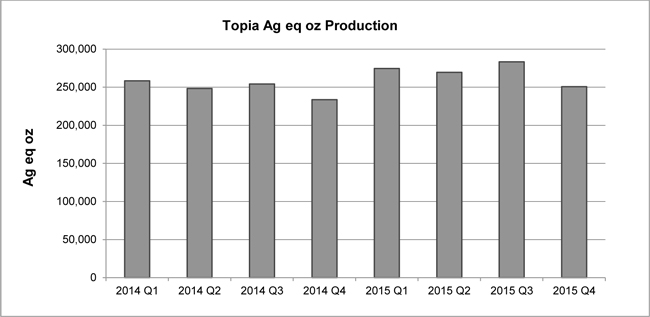
Cash cost for the Topia Mine during the year ended December 31, 2015 was US$12.19, a decrease of 23% from US$15.81 for 2014. The decrease in cash cost is primarily driven by the strengthening of the US dollar against the Mexican peso which reduced costs in US dollar terms, augmented by a reduction in actual Mexican peso denominated production costs. This was partly offset by lower by-product credits due to lower metal prices.
Cash cost for the fourth quarter of 2015 decreased to US$11.82 from US$16.06 per Ag eq oz in the fourth quarter of 2014. The decrease in cash cost is primarily driven by a reduction in Mexican peso denominated direct costs, aided by the strengthening of the US dollar against the Mexican peso which further reduced costs in US dollar terms. The fourth quarter cash cost metrics for Topia also benefitted from a reduction in offsite smelting and refining charges. These positive factors were partly offset by the impact of a 21% reduction in payable silver ounces, as well as lower by-product credits associated with declining commodity prices.
AISC for the year ended December 31, 2015 decreased to US$13.21 from US$18.65 in the year ended December 31, 2014 primarily due to the decrease in cash cost, as well as reductions in mine development and sustaining capital expenditures.
AISC for the fourth quarter of 2015 decreased to US$12.67 from US$18.60 in the fourth quarter of 2014 primarily due to the decrease in cash cost, as well as reductions in mine development and sustaining capital expenditures.
Topia Development
For the year ended December 31, 2015, underground development totaled 8,833 metres, compared to 10,004 metres in 2014, the majority of which was carried out at the Argentina, 15-22, La Prieta and El Rosario mines.
Underground development for the fourth quarter was 2,199 metres, compared to 2,745 metres in the 2014 comparative period, and focused on the same mines as noted above.
There was no drilling at Topia during the year ended December 31, 2015, compared to 1,903 metres in 2014. The Company did not undertake exploration drilling at Topia in 2015 as the mine has sufficient mineral resouces to support an 11 year mine life at current production levels.
GREAT PANTHER SILVER LIMITED Management’s Discussion & Analysis |
Page 18 |
EXPLORATION UPDATE
The GMC
During 2015, exploration at the San Ignacio Mine consisted of underground drilling to better define the Mineral Resource in the Intermediate and Melladito zones, and a surface drill program to define Mineral Resource in the Melladito, Melladito Splay, Melladito 2 and Melladito 3 zones.
On February 22, 2016, the Company provided an update to the Mineral Resource at the GMC, with effective dates of July 31, 2015 for the Guanajuato Mine and El Horcon and December 31, 2015 for the San Ignacio Mine, respectively. The previous Mineral Resource estimates had effective dates of July 31, 2014 and December 15, 2014, respectively. The Company successfully replaced the Measured and Indicated (“M&I) Mineral Resources that had been mined since the effective dates of the previous Mineral Resource estimate.
Effective December 31, 2015, the San Ignacio Mine contained estimated M&I Mineral Resources of 360,352 tonnes above a US$74/tonne cut-off, at an average grade of 145g/t silver and 3.20g/t gold, for a total of 4,301,214 Ag eq oz. This includes Measured Mineral Resources of 249,810 tonnes at an average grade of 151g/t silver and 3.39g/t gold, for a total of 3,130,365 Ag eq oz and Indicated Mineral Resources of 110,542 tonnes at an average grade of 133g/t silver and 2.79g/t gold, for a total of 1,170,848 Ag eq oz. In addition, estimated Inferred Mineral Resources consisted of 770,950 tonnes at an average grade of 138g/t silver and 2.76g/t gold, for 8,266,229 Ag eq oz.
Effective July 31, 2015, it was estimated that the Guanajuato Mine contained estimated M&I Mineral Resources of 149,716 tonnes above a US$74/tonne cut-off, at an average grade of 269g/t silver and 1.50g/t gold, for a total of 1,808,003 Ag eq oz. This included Measured Mineral Resources of 90,365 tonnes at an average grade of 285g/t silver and 1.81g/t gold, for a total of 1,200,576 Ag eq oz, and Indicated Mineral Resources of 59,352 tonnes at an average grade of 245g/t silver and 1.04g/t gold, for a total of 607,427 Ag eq oz. In addition, estimated Inferred Mineral Resources were 135,571 tonnes at an average grade of 151g/t silver and 2.30g/t gold, for 1,363,328 Ag eq oz. Drilling during 2016 will focus on increasing the resource base at the GMC with 6,000 metres of underground drilling planned at the Guanajuato Mine.
GDLR Project
The GDLR Project surface drill program commenced in mid-August, subsequent to the conclusion of community agreements. Surface drilling was completed in early December 2015 with a total of 5,514 metres drilled in 41 holes. The objectives of the drill program were to test the continuity of the mineralized structures and associated gold-silver mineralization with in-fill holes, and to expand the mineralized zones with selected step-outs. The 2015 program did not yield the results the Company had anticipated to warrant additional exploration and, after an extensive review, the Company concluded that the GDLR Project did not meet the criteria for its current growth strategy. The Company elected to terminate the GDLR Option Agreement on February 24, 2016.
Coricancha Mine Complex
At Coricancha, underground drilling started in mid-October from a formerly established drill station near the Wellington vein. By adding a second underground drill, the Company was also able to test the Colquipallana and Constancia veins. In total, 13 holes and 2,324 metres were completed by December 31, 2015. No surface drilling was conducted in 2015. Underground drilling is continuing in 2016 and the results are being used to update the mineral resource estimate for the property. The Company is also conducting engineering and environmental evaluations.
GREAT PANTHER SILVER LIMITED Management’s Discussion & Analysis |
Page 19 |
El Horcón Project
On July 28, 2015, the Company fully secured mineral property titles for all of its 7,909 hectares related to the El Horcón Project. Three of the Company’s mineral property title claims were previously cancelled due to an administrative oversight on the part of the government agency, which manages mineral property titles in Mexico. The Company did not undertake any significant exploration or evaluation work on the El Horcon project in 2015 and has not planned any work for 2016 as it is focusing its resources on the Coricancha project.
It was estimated as at July 31, 2015, that the El Horcon project contained an Inferred Mineral Resource of 1,906,123 Ag eq oz, consisting of 128,732 tonnes above a US$110/tonne cut off, grading 3.64g/t Au, 82g/t Ag, 2.97% Pb, and 4.11% zinc for the Diamantillo, Diamantillo HW, Natividad, and San Guillermo veins.
SELECTED ANNUAL INFORMATION
The following table sets out selected annual financial results which have been prepared in accordance with IFRS except as noted:
| (in thousands, except per share amounts) | FY 2015 | FY 2014 | FY 2013 | |||||||||
| Revenue | $ | 73,374 | $ | 54,390 | $ | 53,954 | ||||||
| Cost of sales before non-cash items1 | 49,338 | 43,615 | 39,822 | |||||||||
| Mine operating earnings (loss) | 5,699 | (6,161 | ) | 640 | ||||||||
| Net loss for the year | (9,341 | ) | (33,013 | ) | (12,729 | ) | ||||||
| Basic and diluted loss per share | (0.07 | ) | (0.24 | ) | (0.09 | ) | ||||||
| Adjusted EBITDA1 | 9,317 | 255 | 5,163 | |||||||||
| Dec 31, 2015 | Dec 31, 2014 | Dec 31, 2013 | ||||||||||
| Cash and cash equivalents | 17,860 | 17,968 | 21,760 | |||||||||
| Total assets | 67,285 | 71,978 | 100,119 | |||||||||
| Total non-current liabilities | 8,760 | 7,643 | 4,772 | |||||||||
| Working capital | $ | 33,252 | $ | 32,907 | $ | 38,223 | ||||||
Revenue in 2015 increased 35% compared with 2014, primarily due to a 42% increase in Ag eq oz sold and a 16% appreciation of the US dollar against the Canadian dollar, which had the effect of increasing revenue reported in Canadian dollars. These factors were offset by the impact of lower metal prices (average realized silver and gold prices declined from US$18.28/oz and US$1,245, respectively, in 2014 to US$15.11 and US$1,110, respectively, in 2015). Revenue in 2014 increased compared with 2013 due to a 4% increase in Ag eq oz sold despite decreases in the average realized silver price (US$18.28 per ounce compared to US$22.89 per ounce) and average realized gold price (US$1,245 per ounce compared to US$1,360 per ounce).
Total assets at December 31, 2015 decreased by $4.7 million from those at December 31, 2014. The reduction is primarily due to a $17.8 million increase in accumulated amortization and depletion, which was partially offset by a $9.3 million increase in property, plant and equipment, the $2.3 million increase in exploration & evaluation assets associated with the acquisition of the Coricancha option, and a $1.6 million increase in current assets. Total assets at December 31, 2014 decreased $28.1 million from those at December 31, 2013 due mainly to an $11.7 million non-cash pre-tax impairment charge in respect of the Company’s operating mines as well as $16.9 million in amortization and depletion.
1 The Company has included non-IFRS performance measures such as cost of sales before non-cash items and mine operating earnings before non-cash items, throughout this document. Refer to the Non-IFRS Measures section of this MD&A for an explanation of these measures and reconciliation to the Company’s reported financial results in accordance with IFRS. As these are not standardized measures, they may not be directly comparable to similarly titled measures used by others.
GREAT PANTHER SILVER LIMITED Management’s Discussion & Analysis |
Page 20 |
The Company recorded a net loss of $9.3 million in 2015 compared to a net loss of $33.0 million in 2014. The 2015 net loss reflected a $3.0 million impairment charge against the Company’s exploration & evaluation assets, whereas an $11.7 million impairment was recorded in 2014 against the Company’s mineral properties, plant and equipment attributed to a decline in silver and gold prices and lower forecast expectations for future metal prices. In addition, the decrease in net loss for 2015 reflected a $11.9 million improvement in mine operating earnings, the benefit of a $5.4 million fluctuation in foreign exchange gains and losses, and a $2.1 million reduction in income tax expense. These factors were partly offset by a $3.7 million increase in EE&D expenses and a $0.8 million increase in G&A expenses. The Company recorded a net loss of $33.0 million in 2014 compared to a net loss of $12.7 million in 2013. The net loss in 2014 increased compared to that of 2013 as a result of a decrease in mine operating earnings of $6.8 million due to lower metal prices despite increased Ag eq oz, a $6.8 million increase in finance and other expense as a result of a $6.0 million fluctuation in foreign exchange gains and losses year over year and $0.7 million of expenses and losses associated with the illegal occupation of the Guanajuato Mine during the first quarter of 2014, a $2.2 million increase in EE&D expenditures due to San Ignacio development work, and a $5.6 million increase in income tax expense.
SUMMARY OF SELECTED QUARTERLY INFORMATION
The following table sets out selected quarterly financial results which have been prepared in accordance with IFRS, except for cost of sales before non-cash items, mine operating earnings before non-cash items, and adjusted EBITDA which are non-IFRS measures:
| (in CAD thousands, except per share amounts) | Q4 2015 | Q3 2015 | Q2 2015 | Q1 2015 | Q4 2014 | Q3 2014 | Q2 2014 | Q1 2014 | ||||||||||||||||||||||||
| Revenue | $ | 17,152 | $ | 16,788 | $ | 19,183 | $ | 20,250 | $ | 14,244 | $ | 12,801 | $ | 14,465 | $ | 12,880 | ||||||||||||||||
| Cost of sales before non-cash items1 | 12,245 | 11,025 | 12,470 | 13,598 | 12,085 | 9,883 | 12,038 | 9,609 | ||||||||||||||||||||||||
| Mine operating earnings before non-cash items1 | 4,907 | 5,763 | 6,713 | 6,652 | 2,159 | 2,918 | 2,427 | 3,271 | ||||||||||||||||||||||||
| Mine operating earnings (loss) | 3,226 | 281 | 1,668 | 524 | (2,693 | ) | (1,521 | ) | (1,529 | ) | (418 | ) | ||||||||||||||||||||
| Net income (loss) for the period | (4,860 | ) | (3,348 | ) | (4,722 | ) | 3,588 | (26,948 | ) | (970 | ) | (4,492 | ) | (602 | ) | |||||||||||||||||
| Basic and diluted earnings (loss) per share | (0.03 | ) | (0.02 | ) | (0.03 | ) | 0.03 | (0.19 | ) | (0.01 | ) | (0.03 | ) | (0.00 | ) | |||||||||||||||||
| Adjusted EBITDA1 | (557 | ) | 2,155 | 4,205 | 3,688 | (681 | ) | 1,267 | 213 | (545 | ) | |||||||||||||||||||||
Revenue varies based on the quantity of metal produced, metal prices, exchange rates and terms of sales agreements. The climate in Mexico allows mining and exploration activities to be conducted throughout the year; therefore, revenue and cost of sales generally do not exhibit variations due to seasonality.
In the following paragraphs, quarterly results are discussed relative to the preceding quarter’s results.
During the fourth quarter of 2015, revenue increased 2% from the preceding quarter, primarily due to the strengthening of the US dollar relative to the Company’s reporting currency (Canadian dollar). The Company’s reported cost of sales benefitted from a reduction of $3.8 million in amortization compared to the preceding quarter, due to the Guanajuato Mine being fully amortized in September 2015. As a result of the foregoing, the Company posted a mine operating earnings of $3.2 million. The strengthening of the US dollar relative to the Mexican peso and Canadian dollar further benefitted the Company as it recorded foreign exchange gains of $1.4 million. EE&D expenditures increased significantly during the quarter, primarily related to exploration work at the GDLR Project and Coricancha, as well as an increase in mine development costs associated with both San Ignacio and the Guanajuato Mine. The fourth quarter of 2015 was the first full quarter in which the Company expensed mine development costs associated with the Guanajuato Mine, whereas the Company previously capitalized and amortized these costs.
| 1 | The Company has included non-IFRS performance measures such as cost of sales before non-cash items, mine operating earnings before non-cash items, and Adjusted EBITDA throughout this document. Refer to the Non-IFRS Measures section of this MD&A for an explanation of these measures and reconciliation to the Company’s reported financial results in accordance with IFRS. As these are not standardized measures, they may not be directly comparable to similarly titled measures used by others. |
GREAT PANTHER SILVER LIMITED Management’s Discussion & Analysis |
Page 21 |
The third quarter of 2015 saw continued declines in metal prices, contributing to a 12% decline in the Company’s revenues relative to the second quarter of 2015. Despite the declines in revenue, the Company realized a mine operating earnings of $0.3 million as cost of sales was reduced due to higher metal grades and the depreciation of the Mexican peso, which reduced cash cost per payable silver ounce. The strengthening of the US dollar relative to the Mexican peso and Canadian dollar further benefitted the Company as it recorded foreign exchange gains of $0.6 million. EE&D expenditures increased significantly during the quarter as exploration work commenced at the GDLR Project and Coricancha and mine development costs increased. In September 2015, the Company commenced expensing mine development cost associated with the Guanajuato Mine, having previously capitalized such costs, and mine development expenditures for San Ignacio increased significantly compared to the preceding quarter.
During the second quarter of 2015, revenue decreased 5% from the preceding quarter, mainly due to declines in commodity prices. The second quarter of 2015 was notable for the increased grades and metal recoveries achieved at the GMC which, along with the impact of mining and processing fewer tonnes, resulted in the second consecutive quarter of mine operating earnings improvement. The improvement in mine operating earnings was more than offset by foreign exchange losses recognized on US-denominated intercompany debt as the US dollar strengthened against the Mexican peso, resulting in a $4.7 million net loss for the quarter.
The first quarter of 2015 was marked by increased production and the depreciation of the Canadian dollar against the US dollar which, along with increased production and metal sales, contributed to the increase in revenue reported. These were also the primary factors in the 209% increase in mine operating earnings before non-cash items compared to the fourth quarter of 2014. In addition to the increases in revenue and mine operating earnings discussed above, significant foreign exchange gains recognized by the Company’s subsidiaries on intercompany debt and net working capital contributed to a large increase in net income.
In the fourth quarter of 2014, revenue increased by 11% mainly due to the 12% increase in Ag eq oz sales, which offset lower realized metal prices. Net loss increased primarily due to an $11.7 million non-cash pre-tax impairment charge, $4.6 million in income tax expense compared to an income tax recovery of $0.3 million in the previous quarter, the realization of a $4.4 million foreign exchange loss in the quarter compared to a foreign exchange gain of $2.1 million in the previous quarter, a $1.2 million increase in mine operating loss, a $0.6 million increase in G&A expenditures and a $0.2 million increase in EE&D expenditures.
In the third quarter of 2014, revenue decreased by 12% mainly due to a 5% decrease in the average realized silver price. Net loss decreased primarily due to the realization of a $2.1 million foreign exchange gain in the quarter compared to a $2.8 million foreign exchange loss in the previous quarter. A decrease in G&A expenses of $0.4 million and the receipt of $0.5 million in insurance proceeds included in finance and other income also contributed to the decrease in net loss. These impacts were partially offset by a $0.3 million increase in EE&D expenses and a $1.9 million reduction in income tax recovery.
In the second quarter of 2014, revenue increased due to an 18% increase in Ag eq oz metal sales. However, mine operating loss increased $1.1 million due to higher cost of sales. Net loss increased significantly as the Company realized a $2.8 million foreign exchange loss in the second quarter of 2014, compared to a $3.8 million gain in the prior quarter. The fluctuation was due primarily to the strengthening of the Canadian dollar against the Mexican peso. These impacts were partially offset by a $1.1 million decrease in G&A and EE&D expenses and costs associated with the illegal occupation of the Cata plant and administration facilities incurred in the first quarter of 2014 which did not recur in the second quarter.
GREAT PANTHER SILVER LIMITED Management’s Discussion & Analysis |
Page 22 |
In the first quarter of 2014, revenue decreased due to the decrease in metal production and lower metal prices. Net loss decreased significantly in the first quarter of 2014 as the fourth quarter of 2013 reflected a non-recurring $12.0 million impairment charge. Net loss for the first quarter of 2014 reflected a $1.9 million decrease in mine operating earnings due to lower sales volume as a result of lower metal production and lower metal prices, $1.2 million of San Ignacio development expenditures, and $0.7 million in costs associated with the illegal occupation of the Cata plant and administration facilities in March.
RESULTS OF OPERATIONS
Year ended December 31, 2015
Sales quantities by metal for the years ended December 31, 2015 and 2014 are as follows:
| FY 2015 | FY 2014 | |||||||||||||||||||||||
| GMC | Topia | Total | GMC | Topia | Total | |||||||||||||||||||
| Silver (ounces) | 1,663,893 | 614,302 | 2,278,195 | 1,116,767 | 612,134 | 1,728,901 | ||||||||||||||||||
| Gold (ounces) | 20,041 | 373 | 20,414 | 13,871 | 350 | 14,221 | ||||||||||||||||||
| Lead (tonnes) | - | 1,083 | 1,083 | - | 1,047 | 1,047 | ||||||||||||||||||
| Zinc (tonnes) | - | 1,279 | 1,279 | - | 1,231 | 1,231 | ||||||||||||||||||
| Silver equivalent ounce sales | 2,966,642 | 917,000 | 3,883,642 | 1,949,020 | 783,332 | 2,732,352 | ||||||||||||||||||
Revenue related to contained metals in concentrates for the years ended December 31, 2015 and 2014 are as follows:
| (in CAD thousands) | FY 2015 | FY 2014 | ||||||||||||||||||||||
| GMC | Topia | Total | GMC | Topia | Total | |||||||||||||||||||
| Silver revenue | $ | 32,836 | $ | 12,244 | $ | 45,080 | $ | 22,327 | $ | 12,534 | $ | 34,861 | ||||||||||||
| Gold revenue | 29,112 | 560 | 29,672 | 19,058 | 493 | 19,551 | ||||||||||||||||||
| Lead revenue | - | 2,531 | 2,531 | - | 2,383 | 2,383 | ||||||||||||||||||
| Zinc revenue | - | 3,173 | 3,173 | - | 2,954 | 2,954 | ||||||||||||||||||
| Ore processing revenue and other | - | 579 | 579 | - | 645 | 645 | ||||||||||||||||||
| Smelting and refining charges | (4,226 | ) | (3,435 | ) | (7,661 | ) | (2,941 | ) | (3,063 | ) | (6,004 | ) | ||||||||||||
| Total revenue | $ | 57,722 | $ | 15,652 | $ | 73,374 | $ | 38,444 | $ | 15,946 | $ | 54,390 | ||||||||||||
The Company’s average realized metal prices and the average Canadian dollar exchange rates relative to the US dollar and the Mexican peso for the years ended December 31, 2015 and 2014 are as follows:
| FY 2015 | FY 2014 | % Change | ||||||||||
| Silver (USD/oz) | $ | 15.11 | $ | 18.28 | -17 | % | ||||||
| Gold (USD/oz) | $ | 1,110 | $ | 1,245 | -11 | % | ||||||
| Lead (USD/lb) | $ | 0.81 | $ | 0.93 | -13 | % | ||||||
| Zinc (USD/lb) | $ | 0.86 | $ | 0.99 | -13 | % | ||||||
| USD/CAD | 0.782 | 0.905 | -14 | % | ||||||||
| MXP/CAD | 12.40 | 12.00 | 3 | % | ||||||||
GREAT PANTHER SILVER LIMITED Management’s Discussion & Analysis |
Page 23 |
For the year ended December 31, 2015, the Company earned revenues of $73.4 million, compared to $54.4 million for 2014. The increase in revenue is attributed to a 42% increase in sales volume on a silver equivalent ounce basis and a 16% appreciation of the US dollar against the Canadian dollar, which accounted for an approximate $25.0 million and $11.4 million increase in revenue, respectively. These factors were partly offset by the impact of 17% and 11% decreases in average realized silver and gold prices, respectively, which accounted for an approximate US$15.5 million negative impact on revenue.
Revenue, Cost of Sales and Mine operating earnings (in CAD thousands) | FY 2015 | FY 2014 | % Change | |||||||||
| Revenue | $ | 73,374 | $ | 54,390 | 35 | % | ||||||
| Cost of sales: | ||||||||||||
| Production costs (cost of sales before non-cash items)1 | 49,338 | 43,615 | 13 | % | ||||||||
| Amortization and depletion | 17,963 | 16,570 | 8 | % | ||||||||
| Share-based compensation | 374 | 366 | 2 | % | ||||||||
| Total cost of sales | 67,675 | 60,551 | 12 | % | ||||||||
| Mine operating earnings (loss) | $ | 5,699 | $ | (6,161 | ) | 193 | % | |||||
| Mine operating earnings (loss) (% of revenue) | 8 | % | -11 | % | ||||||||
| Add: | ||||||||||||
| Amortization and depletion | 17,963 | 16,570 | 8 | % | ||||||||
| Share-based compensation | 374 | 366 | 2 | % | ||||||||
| Mine operating earnings before non-cash items1 | $ | 24,036 | $ | 10,775 | 123 | % | ||||||
| Mine operating earnings before non-cash items (% of revenue) | 33 | % | 20 | % | ||||||||
Cost of sales before non-cash items increased 13% to $49.3 million for the year ended December 31, 2015, compared to $43.6 million in 2014. The increase in cost of sales was driven by the increase in unit metal sales, but was much less than the 42% increase in Ag eq oz sold due to much lower unit production costs as average ore grades improved significantly compared to 2014.
Mine operating earnings before non-cash items for 2015 amounted to $24.0 million, an increase of $13.3 million when compared to 2014 results. This increase was primarily a result of the increase in revenue, combined with the above noted decrease in unit production costs.
Amortization and depletion increased 8% due to a reduction in the Guanajuato Mine mineral resource estimate which had the effect of accelerating amortization charges during the eight months ending August 2015, after which the Company ceased capitalizing development expenditures associated with the Guanajuato Mine.
For the year ended December 31, 2015, mine operating earnings was $5.7 million compared to a $6.2 million mine operating loss in 2014. The improvement in mine operating earnings was due to the increase in revenue coupled with a lesser increase in cost of sales, offset by a $1.4 million increase in amortization and depletion expense.
| 1 | The Company has included non-IFRS performance measures such as cost of sales before non-cash items and mine operating earnings before non-cash items, throughout this document. Refer to the Non-IFRS Measures section of this MD&A for an explanation of these measures and reconciliation to the Company’s reported financial results in accordance with IFRS. As these are not standardized measures, they may not be directly comparable to similarly titled measures used by others. |
GREAT PANTHER SILVER LIMITED Management’s Discussion & Analysis |
Page 24 |
| (in CAD thousands) | FY 2015 | FY 2014 | % Change | |||||||||
| General & administrative (G&A) expenses | $ | 7,938 | $ | 7,090 | 12 | % | ||||||
| Exploration & evaluation, and development (EE&D) expenses | $ | 8,328 | $ | 4,590 | 81 | % | ||||||
| Impairment charges | $ | 3,006 | $ | 11,743 | -74 | % | ||||||
| Finance and other (income) expense | $ | (4,227 | ) | $ | 1,354 | 412 | % | |||||
| Income tax expense (recovery) | $ | (5 | ) | $ | 2,075 | 100 | % | |||||
| Net loss for the year | $ | (9,341 | ) | $ | (33,013 | ) | -72 | % | ||||
G&A expenses increased $0.8 million, which primarily reflects a $0.5 million increase in variable compensation reflecting stronger 2015 operating results and a $0.3 million increase in share-based compensation cost associated with the granting of stock options in 2015.
EE&D expenses increased $3.7 million primarily due to $2.7 million in exploration expenses associated with the Coricancha and GDLR projects. In addition, there was a $0.8 million increase in mine development costs associated with the GMC, as the Company ceased capitalizing development expenditures associated with the Guanajuato Mine in September 2015. Mine development costs includes $0.4 million of non-cash expense associated with the change in estimate of the reclamation and rehabilitation provision during the year ended December 31, 2015.
A pre-tax impairment charge of $3.0 million was recorded in 2015, in connection with the Company’s decision on February 24, 2016 to terminate the GDLR option agreement. A pre-tax impairment charge of $11.7 million was recorded in 2014 against the Company’s mineral properties, plant and equipment attributed to a decline in silver and gold prices and lower forecast expectations for future metal prices, as well as a reduction in Measured, Indicated and Inferred Mineral Resources at Guanajuato Mine.
Finance and other income was $4.2 million for the year ended December 31, 2015, compared to finance and other expense of $1.4 million in 2014. Fluctuations in foreign exchange gains and losses account for most of the variance ($5.4 million) year over year. Foreign exchange gains and losses arise from the translation of foreign denominated transactions and balances relative to the functional currency of the Company’s subsidiaries and the Company’s reporting currency. The Company funds its Mexican subsidiaries through Canadian and US dollar loans and a significant portion of the Company’s working capital is denominated in US dollars. As a result, fluctuations between the US dollar and Mexican peso and the Canadian dollar can cause significant unrealized foreign exchange gains and losses associated with the working capital and loan balances. These unrealized gains and losses are recognized in the consolidated net income of the Company. During 2015, the Mexican peso and the Canadian dollar weakened 15% and 17%, respectively, compared to the US dollar. This resulted in net foreign exchange gains, whereas during 2014 the Company recorded net foreign exchange losses.
Net income tax recovery was $5,000 during the 2015 year compared to a $2.1 million income tax expense in the comparative period. The net recovery reported during 2015 relates predominantly to a decrease in taxable temporary differences associated with special mining duties which arise mainly from the carrying value of the Company’s mineral properties, plant and equipment used in its Mexican operations. The net expense realized during 2014 relates to valuation allowances taken against tax losses and other deductible temporary differences as management had reassessed the ability and timeframe to realize the benefit of such tax losses and other temporary differences in light of lower forecast expectations for future metal prices.
Net loss for the year ended December 31, 2015 was $9.3 million, compared to a net loss of $33.0 million for 2014. The decrease in net loss primarily reflects an $11.9 million improvement in mine operating earnings, a $5.4 million favorable fluctuation in foreign exchange gains and losses and a $2.1 million reduction in income tax expense contributed to the reduction in net loss. In addition, the net loss in 2015 reflects a $3.0 million pre-tax impairment charge, whereas the net loss in 2014 included an $11.7 million pre-tax impairment charge. These factors were partly offset by a $3.7 million increase in EE&D and a $0.8 million increase in G&A.
GREAT PANTHER SILVER LIMITED Management’s Discussion & Analysis |
Page 25 |
Adjusted EBITDA was $9.3 million for 2015, compared to adjusted EBITDA of $0.3 million for 2014. The increase in adjusted EBITDA is primarily attributed to the $13.3 million in increased mine operating earnings before non-cash items, partly offset by the $3.7 million increase in EE&D expenses.
Three months ended December 31, 2015
Sales quantities by metal for the quarters ended December 31, 2015 and 2014 were as follows:
| Q4 2015 | Q4 2014 | |||||||||||||||||||||||
| GMC | Topia | Total | GMC | Topia | Total | |||||||||||||||||||
| Silver (ounces) | 349,661 | 152,509 | 502,170 | 336,726 | 194,797 | 531,523 | ||||||||||||||||||
| Gold (ounces) | 5,314 | 95 | 5,409 | 3,437 | 122 | 3,559 | ||||||||||||||||||
| Lead (tonnes) | - | 271 | 271 | - | 332 | 332 | ||||||||||||||||||
| Zinc (tonnes) | - | 307 | 307 | - | 397 | 397 | ||||||||||||||||||
| Silver equivalent ounces | 695,071 | 226,639 | 921,710 | 542,945 | 250,902 | 793,847 | ||||||||||||||||||
Revenue related to contained metals in concentrates for the quarters ended December 31, 2015 and 2014 were as follows:
| (in CAD thousands) | Q4 2015 | Q4 2014 | ||||||||||||||||||||||
| GMC | Topia | Total | GMC | Topia | Total | |||||||||||||||||||
| Silver revenue | $ | 6,823 | $ | 2,921 | $ | 9,744 | $ | 5,914 | $ | 3,608 | $ | 9,522 | ||||||||||||
| Gold revenue | 7,779 | 136 | 7,915 | 4,636 | 167 | 4,803 | ||||||||||||||||||
| Lead revenue | - | 638 | 638 | - | 721 | 721 | ||||||||||||||||||
| Zinc revenue | - | 663 | 663 | - | 988 | 988 | ||||||||||||||||||
| Ore processing revenue and other | - | 168 | 168 | - | 125 | 125 | ||||||||||||||||||
| Smelting and refining charges | (1,096 | ) | (880 | ) | (1,976 | ) | (889 | ) | (1,026 | ) | (1,915 | ) | ||||||||||||
| Total revenue | $ | 13,506 | $ | 3,646 | $ | 17,152 | $ | 9,661 | $ | 4,583 | $ | 14,244 | ||||||||||||
The Company’s average realized metal prices and the average Canadian dollar exchange rates relative to the US dollar and the Mexican peso for the quarters ended December 31, 2015 and 2014 were as follows:
| Q4 2015 | Q4 2014 | % Change | ||||||||||
| Silver (USD/oz) | $ | 13.57 | $ | 15.78 | -14 | % | ||||||
| Gold (USD/oz) | $ | 991 | $ | 1,188 | -17 | % | ||||||
| Lead (USD/lb) | $ | 0.81 | $ | 0.87 | -7 | % | ||||||
| Zinc (USD/lb) | $ | 0.74 | $ | 1.00 | -26 | % | ||||||
| USD/CAD | 0.749 | 0.880 | -15 | % | ||||||||
| MXP/CAD | 12.56 | 12.21 | 3 | % | ||||||||
For the fourth quarter of 2015, the Company earned revenue of $17.2 million, compared to $14.2 million for the fourth quarter of 2014. The increase in revenue is partly a function of a 16% increase in metal sales volume as a result of an increase in metal production which accounted for an approximate $2.6 million increase in revenue. In addition, a 17% appreciation of the US dollar against the Canadian dollar had the effect of increasing revenue reported in Canadian dollars by approximately $2.6 million. These factors more than offset the impact of 14% and 17% decreases in average realized silver and gold prices, respectively (as expressed in US dollars), which accounted for an approximate US$2.0 million negative impact on revenue.
GREAT PANTHER SILVER LIMITED Management’s Discussion & Analysis |
Page 26 |
Compared to the third quarter of 2015, revenue increased by $0.4 million primarily due to the appreciation of the US dollar against the Canadian dollar with the effect of increasing revenue reported in Canadian dollars. This more than offset the 8% decrease in payable silver ounces, and the 3% decrease in average realized silver prices in US dollar terms.
Revenue, Cost of Sales and Mine operating earnings (in CAD thousands) | Q4 2015 | Q4 2014 | % Change | Q3 2015 | % Change | |||||||||||||||
| Revenue | $ | 17,152 | $ | 14,244 | 20 | % | $ | 16,788 | 2 | % | ||||||||||
| Cost of sales: | ||||||||||||||||||||
| Production costs (cost of sales before non-cash items)1 | 12,245 | 12,085 | 1 | % | 11,025 | 11 | % | |||||||||||||
| Amortization and depletion | 1,555 | 4,729 | -67 | % | 5,397 | -71 | % | |||||||||||||
| Share-based compensation | 126 | 124 | 2 | % | 85 | 48 | % | |||||||||||||
| Total cost of sales | $ | 13,926 | $ | 16,938 | -18 | % | $ | 16,507 | -16 | % | ||||||||||
| Mine operating earnings (loss) | $ | 3,226 | $ | (2,694 | ) | 220 | % | $ | 281 | 1,048 | % | |||||||||
| Mine operating earnings (loss) (% of revenue) | 19 | % | -19 | % | 2 | % | ||||||||||||||
| Add: | ||||||||||||||||||||
| Amortization and depletion | $ | 1,555 | $ | 4,729 | -67 | % | $ | 5,397 | -71 | % | ||||||||||
| Share-based compensation | 126 | 124 | 2 | % | 85 | 48 | % | |||||||||||||
| Mine operating earnings before non-cash items1 | $ | 4,907 | $ | 2,159 | 127 | % | $ | 5,763 | -15 | % | ||||||||||
| Mine operating earnings before non-cash items (% of revenue) | 29 | % | 15 | % | 34 | % | ||||||||||||||
Cost of sales before non-cash items increased 1% for the fourth quarter of 2015 compared to the fourth quarter of 2014. While metal sales increased 16% on a Ag eq oz basis, cost of sales increased by a substantially lower margin as a result of significantly lower unit costs due to higher ore grades which enabled the production of considerably more metal ounces per tonne of ore mined and processed.
Compared to the third quarter of 2015, cost of sales before non-cash items increased 11% due to higher unit production costs, correlating with the increase in cash cost from the third to the fourth quarters of 2015.
Mine operating earnings before non-cash items increased by $2.7 million in the fourth quarter of 2015 compared to the fourth quarter of 2014, as a result of the $2.9 million increase in revenues, which was offset by the $0.2 million increase in cost of sales before non-cash items. The proportionately higher increase in revenue is attributable to the impact of the US dollar strengthening against the Canadian dollar, as well as the 16% increase in silver equivalent ounces sold, all at a significantly lower unit cash cost.
Mine operating earnings before non-cash items decreased by $0.9 million in the fourth quarter of 2015 compared to the third quarter of 2015. This was primarily due to the $1.2 million increase in cost of sales before non-cash items. This was partly offset by a $0.3 million increase in revenue due to the strengthening of the US dollar against the Canadian dollar which had the effect of increasing revenue reported in Canadian dollars.
| 1 | The Company has included non-IFRS performance measures such as cost of sales before non-cash items and mine operating earnings before non-cash items, throughout this document. Refer to the Non-IFRS Measures section of this MD&A for an explanation of these measures and reconciliation to the Company’s reported financial results in accordance with IFRS. As these are not standardized measures, they may not be directly comparable to similarly titled measures used by others. |
GREAT PANTHER SILVER LIMITED Management’s Discussion & Analysis |
Page 27 |
Amortization and depletion of mineral properties, plant and equipment relating to cost of sales decreased to $1.6 million in the fourth quarter of 2015 from $4.7 million in the fourth quarter of 2014. This was due to the Guanajuato Mine being fully depreciated as at the end of the third quarter of 2015. The Company also made the decision to cease capitalizing development expenditures related to the Guanajuato Mine.
| (in CAD thousands) | Q4 2015 | Q4 2014 | % Change | Q3 2015 | % Change | |||||||||||||||
| General & administrative (G&A) expenses | $ | 2,225 | $ | 2,063 | 8 | % | $ | 1,713 | 30 | % | ||||||||||
| Exploration & evaluation, and development (EE&D) expenses | $ | 4,193 | $ | 1,574 | 166 | % | $ | 2,122 | 98 | % | ||||||||||
| Impairment charge | $ | 3,006 | $ | 11,743 | -74 | % | $ | - | 0 | % | ||||||||||
| Finance and other expense ( income) | $ | (1,373 | ) | $ | 4,310 | 132 | % | $ | (508 | ) | 170 | % | ||||||||
| Income tax expense | $ | 35 | $ | 4,566 | 99 | % | $ | 302 | 88 | % | ||||||||||
| Net loss for the period | $ | (4,860 | ) | $ | (26,947 | ) | 82 | % | $ | (3,348 | ) | 45 | % | |||||||
G&A expenses for the fourth quarter of 2015 increased by 8% compared to the same period in 2014 due to an increase in variable compensation recognized during the fourth quarter of 2015 reflecting stronger 2015 operating results.
Compared to the third quarter of 2015, G&A expenses increased due to higher share-based compensation cost associated with the granting of stock options in December 2015 and an increase in variable compensation reflecting stronger 2015 operating results.
EE&D expenses increased 166% in the fourth quarter of 2015 compared to the same period in 2014. The increase is primarily due to the exploration programs carried out on the Coricancha and GDLR projects in the amount of $1.2 million and $0.7 million, respectively, during the fourth quarter of 2015. As the options on these projects were acquired in 2015, there were no comparable expenditures in 2014. In addition, there was a $0.8 million increase in development costs associated with the GMC in the fourth quarter of 2015 compared to the same period in 2014.
EE&D expenses increased by $2.1 million, or 98%, compared to the third quarter of 2015, primarily due to the above noted exploration programs at Coricancha and the GDLR Project. In addition, there was a $1.0 million increase in mine development costs, as the Company commenced expensing the Guanajuato Mine development costs to EE&D expenses at the end of the third quarter of 2015 as the previously-defined NI43-101-compliant Measured and Indicated Resource was mined and depleted.
The $3.0 million pre-tax impairment charge for 2015 noted above was fully recorded in the fourth quarter. The pre-tax impairment charge of $11.7 million for 2014 was also recorded in the fourth quarter that year.
Finance and other income amounted to $1.4 million for the fourth quarter of 2015, compared to finance and other expense of $4.3 million for the same period in 2014. The change is primarily associated with a $5.8 million increase in foreign currency gains recognized in the fourth quarter of 2015, compared to the same period in 2014. Foreign exchange gains and losses arise from the translation of foreign-denominated transactions and balances into the relevant functional currencies of the Company and its subsidiaries. The Company funds its Mexican subsidiaries through US and Canadian dollar loans, while a significant portion of the Company’s working capital is denominated in US dollars. As a result, fluctuations between the US dollar and Mexican peso and the Canadian dollar can cause significant unrealized foreign exchange gains and losses associated with the working capital and loan balances in the records of Great Panther and its Mexican subsidiaries. These unrealized gains and losses are recognized in the consolidated net income of the Company.
GREAT PANTHER SILVER LIMITED Management’s Discussion & Analysis |
Page 28 |
The $1.4 million in finance and other income in the fourth quarter of 2015 compares to $0.5 million in finance and other income in the third quarter of 2015. The change is primarily associated with a $1.4 million foreign currency gain recognized in the fourth quarter of 2015, compared to a $0.6 million foreign currency gain in the third quarter of 2015. Please refer to the preceding paragraph for the nature of these foreign exchange gains and losses.
The Company recorded a net income tax expense of $35,000 during the fourth quarter of 2015, $22,000 of which relates to current income tax recognized in one of the Company’s subsidiaries. The net income tax expense in the fourth quarter of 2014 amounted to $4.6 million, the majority of which related to valuation allowances taken against tax losses, as well as accruals for Mexican withholding taxes. The valuation allowances taken in the fourth quarter of 2014 relates to management’s reassessment of the ability and timeframe to realize the benefit of tax losses and other temporary differences in light of lower forecast expectations for future metal prices.
The net income tax expense for the fourth quarter of 2015 compares to a $0.3 million income tax expense in the third quarter of 2015. The change is primarily the result of deferred tax assets recognized in some of the Company’s Mexican subsidiaries during the fourth quarter of 2015.
Net loss for the fourth quarter of 2015 was $4.9 million, compared to a net loss of $26.9 million for the same period in 2014. The decrease in net loss is primarily attributable to an $11.7 million pre-tax non-cash impairment charge recorded in the fourth quarter of 2014, whereas the impairment charge recorded in 2015 amounted to $3.0 million. Other factors, which decreased net loss, are the $5.9 million improvement in mine operating earnings, the $5.8 million increase in foreign exchange gains, as well as the $4.5 million decrease in income tax expense. These factors were partly offset by the $2.6 million increase in exploration expenditures attributed to the Company’s new projects, the expensing of certain development expenditures.
The result of the fourth quarter of 2015 improved from the third quarter of 2015 net loss of $3.3 million, primary due to the $2.9 million increase in mine operating earnings. The Company also recorded a foreign exchange gain that was $0.8 million higher than the foreign exchange gains reported for the third quarter of 2015. This was partly offset by the $2.1 million of higher EE&D expenses, as the Company increased exploration activities on its Coricancha and GDLR projects.
Adjusted EBITDA was negative $0.6 million for the fourth quarter of 2015, compared to negative $0.7 million for the same period in 2014. The improvement in adjusted EBITDA reflects the $2.7 million increase in mine operating earnings before non-cash items, partly offset by the $2.6 million in higher EE&D expenses reported in the fourth quarter of 2015.
Adjusted EBITDA decreased from $2.2 million in the third quarter of 2015, primarily due to the $1.5 million increase in EE&D expenses (excluding the impact of changes in reclamation estimates recorded in EE&D), the $0.9 million decrease in mine operating earnings before non-cash items, and the higher G&A expenses reported during the fourth quarter of 2015.
GREAT PANTHER SILVER LIMITED Management’s Discussion & Analysis |
Page 29 |
OUTLOOK
| Production and cash cost guidance | FY 2016 Guidance Range | FY 2015 Actuals | ||||||
| Total silver equivalent ounces1 | 4,000,000 – 4,200,000 | 4,159,121 | ||||||
| Cash cost (USD)2 | $5.00 – $7.00 | $ | 7.50 | |||||
| AISC (USD)2 | $13.00 – $15.00 | $ | 13.76 | |||||
| Exploration drilling – operating mines (metres) | 11,000 | 17,680 | ||||||
Given the significant increase in production in 2015 and the continued low metal price environment, the Company will primarily focus on operational efficiencies and strong grade control in 2016 and build on the successful achievements in these areas in 2015. In addition, the significant growth in 2015 has brought production levels close to plant capacity at the GMC. As such, consolidated production for 2016 is anticipated to be in the range of 4.0 - 4.2 million Ag eq oz (using a 70:1 silver:gold ratio), similar to that in 2015.
Although overall production at the GMC is planned to remain at similar levels to 2015, San Ignacio is expected to account for a larger proportion of the throughput. Topia is also expected to produce at similar levels as in 2015.
Consolidated cash cost is anticipated to be in the range of US$5.00 - 7.00, while AISC is projected to be US$13.00 - 15.00.
Drilling in 2016 will focus on increasing the resource base at the GMC with 6,000 metres of underground drilling planned at the Guanajuato Mine, and 2,500 metres of underground drilling and 2,500 metres of surface drilling planned at San Ignacio. At the Guanajuato Mine, the focus of exploration in 2016 will be at the Los Pozos, Guanajuatito, and Valenciana zones. A compilation of the historical workings is being undertaken with a focus on parallel and sigmoidal veins with mineralization of economic significance. This will include the Rayas, upper Cata, Los Pozos, Valenciana and Guanajuatito zones. At San Ignacio, plans for 2016 include the continuation of surface exploration south from the present mineral resource to the historic mining area of San Pedro. Underground drilling will focus on converting Inferred Mineral Resources to the Measured and Indicated categories.
An additional 4,000 metres are planned at Coricancha in order to better define and test the extension of several high grade zones. This information will be used for an updated resource model and internal economic evaluation of the mine.
1 For 2016 guidance, Aq eq oz have been established using a 70:1 Au:Ag ratio, and a ratio of 1:0.0504 for the US dollar price of silver ounces to the US dollar price for both lead and zinc pounds. For 2015, Aq eq oz are calculated using a 65:1 Ag:Au ratio, and ratios of 1:0.050 and 1:0.056 for the price/ounce of silver to lead and zinc price/pound, respectively.
2 Cash cost and AISC are non-IFRS measures. Refer to the Non-IFRS Measures section of this MD&A for an explanation of these measures and reconciliation to the Company’s reported financial results in accordance with IFRS. As these are not standardized measures, they may not be directly comparable to similarly titled measures used by others.
GREAT PANTHER SILVER LIMITED Management’s Discussion & Analysis |
Page 30 |
The Company provides the following guidance for capital expenditures and EE&D expenses.
| Capital expenditures and EE&D expense guidance (in CAD millions) | FY 2016 Guidance | FY 2015 Actuals | ||||||
| Capital expenditures – buildings, plant & equipment | $3.5 – 5.0 | $ | 3.2 | |||||
| Capitalized development costs – operating mines | $ | 0.5 | $ | 3.2 | ||||
| Exploration, evaluation and development expense – operating mines | $7.0 – 8.0 | $ | 4.6 | |||||
| Exploration and evaluation expense – Coricancha | $1.0 – 3.0 | $ | 2.7 | |||||
NON-IFRS MEASURES
The Company has included certain non-IFRS performance measures throughout this MD&A, including cost per tonne milled, cash cost, AISC, mine operating earnings before non-cash items and cost of sales before non-cash items, each as defined in this section. The Company employs these measures internally to measure its operating and financial performance and to assist in business decision making. The Company believes that, in addition to conventional measures prepared in accordance with IFRS, certain investors and other stakeholders also use these non-IFRS measures as information to evaluate the Company’s operating and financial performance. As there are no standardized methods of calculating these non-IFRS measures, the Company’s methods may differ from those used by others and, accordingly, the use of these measures may not be directly comparable to similarly titled measures used by others. Accordingly, these non-IFRS measures are intended to provide additional information and should not be considered in isolation or as a substitute for measures of performance prepared in accordance with IFRS.
Cost per tonne milled
The Company uses the non-IFRS measure of cost per tonne milled to manage and evaluate operating performance at each of its mines. Cost per tonne milled is reported in US dollars and calculated based on the total production costs on a sales basis, adjusted for changes in inventory, to arrive at total production costs that relate to metal production during the period.
Management believes that the Company’s ability to control cost per tonne milled is one of its key performance indicators of results of operations. The Company believes this measure provides investors and analysts with useful information about its underlying cost of operations and how management controls those costs.
To facilitate a better understanding of this measure as calculated by the Company, a detailed reconciliation between cost per tonne milled and the Company’s cost of sales as reported in the Company’s consolidated statements of comprehensive income is provided below.
GREAT PANTHER SILVER LIMITED Management’s Discussion & Analysis |
Page 31 |
The following table reconciles cost per tonne milled to production costs, a component of cost of sales, for the years ended December 31, 2015 and 2014:
| (in USD thousands, except where noted otherwise) | GMC | Topia | Consolidated | |||||||||||||||||||||
| FY 2015 | FY 2014 | FY 2015 | FY 2014 | FY 2015 | FY 2014 | |||||||||||||||||||
| Production costs (sales basis) (CAD thousands) | $ | 36,406 | $ | 29,825 | $ | 2,905 | $ | 13,790 | $ | 49,311 | $ | 43,615 | ||||||||||||
| Production costs converted to USD (sales basis) | 28,608 | 26,991 | 10,101 | 12,454 | 38,709 | 39,445 | ||||||||||||||||||
| Change in concentrate inventory | (314 | ) | 1,636 | 81 | 65 | (233 | ) | 1,701 | ||||||||||||||||
| Production costs (production basis) | $ | 28,294 | $ | 28,627 | $ | 10,182 | $ | 12,519 | $ | 38,476 | $ | 41,146 | ||||||||||||
| Tonnes milled, including custom milling | 309,944 | 267,812 | 71,074 | 76,445 | 381,018 | 344,257 | ||||||||||||||||||
| Cost per tonne milled (USD) | $ | 91 | $ | 107 | $ | 143 | $ | 164 | $ | 101 | $ | 120 | ||||||||||||
The following table reconciles cost per tonne milled to production costs, a component of cost of sales, for the three months ended December 31, 2015 and 2014:
| (in USD thousands, except where noted otherwise) | GMC | Topia | Consolidated | |||||||||||||||||||||
| Q4 2015 | Q4 2014 | Q4 2015 | Q4 2014 | Q4 2015 | Q4 2014 | |||||||||||||||||||
| Production costs (sales basis) (CAD thousands) | $ | 9,078 | $ | 7,641 | $ | 3,141 | $ | 4,444 | $ | 12,219 | $ | 12,085 | ||||||||||||
| Production costs converted to USD (sales basis) | 6,805 | 6,749 | 2,348 | 3,921 | 9,153 | 10,670 | ||||||||||||||||||
| Change in concentrate inventory | 309 | 826 | (76 | ) | (956 | ) | 233 | (130 | ) | |||||||||||||||
| Production costs (production basis) | $ | 7,114 | $ | 7,575 | $ | 2,272 | $ | 2,965 | $ | 9,386 | $ | 10,540 | ||||||||||||
| Tonnes milled, including custom milling | 79,651 | 76,839 | 16,806 | 18,047 | 96,457 | 94,886 | ||||||||||||||||||
| Cost per tonne milled (USD) | $ | 89 | $ | 99 | $ | 135 | $ | 164 | $ | 97 | $ | 111 | ||||||||||||
Cash cost per silver payable ounce
The Company uses the non-IFRS measure of cash cost to manage and evaluate operating performance at each of its mines. It is a widely reported measure in the silver mining industry as a benchmark for performance, but does not have a standardized meaning. Cash cost is calculated based on the total cash operating costs with the deduction of revenues attributable to sales of by-product metals net of the respective smelting and refining charges. By-products consist of gold at the GMC, and gold, lead and zinc at Topia.
Management believes that the Company’s ability to control cash cost is one of the key performance indicators for its operations. Having low cash cost facilitates profitability even during times of declining commodity prices and provides more flexibility in responding to changing market conditions. In addition, a profitable operation results in the generation of positive cash flows, which then improves the Company’s financial condition. The Company believes these measures provide investors and analysts with useful information about its underlying cash cost of operations and the impact of by-product revenue on the Company’s cost structure and is a relevant metric used to understand the Company’s operating profitability and ability to generate cash flow.
The Company’s primary business is silver production and its future development and current operations focus on maximizing returns from silver production, with other metal production being incidental to the silver production process. Accordingly, gold, zinc and lead produced from operations are considered by-products. As a result, the Company’s non-IFRS cost performance measures are disclosed on a per payable silver ounce basis. When deriving the production costs associated with an ounce of silver, the Company includes by-product credits from gold, zinc and lead sales incidental to the silver production process, thereby allowing the Company’s management and other stakeholders to assess the net costs of silver production.
GREAT PANTHER SILVER LIMITED Management’s Discussion & Analysis |
Page 32 |
To facilitate a better understanding of this measure as calculated by the Company, a detailed reconciliation between the cash cost and the Company’s cost of sales as reported in the Company’s consolidated statements of comprehensive income is provided below. A breakdown is provided as to how the by-product revenues applied are attributed to the individual by-product metals.
The following table reconciles cash cost to production costs for the years ended December 31, 2015 and 2014:
| (in USD thousands, except ounces and where noted otherwise) | GMC | Topia | Consolidated | |||||||||||||||||||||
| FY 2015 | FY 2014 | FY 2015 | FY 2014 | FY 2015 | FY 2014 | |||||||||||||||||||
| Production costs (CAD thousands) | $ | 36,406 | $ | 29,825 | $ | 12,905 | $ | 13,790 | $ | 49,311 | $ | 43,615 | ||||||||||||
| Production costs (as converted to USD) | 28,608 | 27,153 | 10,101 | 12,523 | 38,709 | 39,676 | ||||||||||||||||||
| Smelting and refining charges | 3,227 | 2,514 | 2,623 | 2,694 | 5,850 | 5,208 | ||||||||||||||||||
| Revenue from custom milling | - | - | (453 | ) | (271 | ) | (453 | ) | (271 | ) | ||||||||||||||
| Cash operating costs | $ | 31,835 | $ | 29,667 | $ | 12,271 | $ | 14,946 | $ | 44,106 | $ | 44,613 | ||||||||||||
| Gross by-product revenue1 | ||||||||||||||||||||||||
| Gold by-product revenue | (22,235 | ) | (17,246 | ) | (424 | ) | (445 | ) | (22,659 | ) | (17,691 | ) | ||||||||||||
| Lead by-product revenue | - | - | (1,933 | ) | (2,153 | ) | (1,933 | ) | (2,153 | ) | ||||||||||||||
| Zinc by-product revenue | - | - | (2,423 | ) | (2,670 | ) | (2,423 | ) | (2,670 | ) | ||||||||||||||
| Cash operating costs, net of by-product revenue | $ | 9,600 | $ | 12,421 | $ | 7,491 | $ | 9,678 | $ | 17,091 | $ | 22,099 | ||||||||||||
| Payable silver ounces sold | 1,663,893 | 1,117,369 | 614,302 | 612,134 | 2,278,194 | 1,729,503 | ||||||||||||||||||
| Cash cost (USD) | $ | 5.77 | $ | 11.12 | $ | 12.19 | $ | 15.81 | $ | 7.50 | $ | 12.78 | ||||||||||||
The following table reconciles cash cost to production costs for the three months ended December 31, 2015 and 2014:
| (in USD thousands, except ounces and where noted otherwise) | GMC | Topia | Consolidated | |||||||||||||||||||||
| Q4 2015 | Q4 2014 | Q4 2015 | Q4 2014 | Q4 2015 | Q4 2014 | |||||||||||||||||||
| Production costs (CAD thousands) | $ | 9,078 | $ | 7,641 | $ | 3,141 | $ | 4,444 | $ | 12,219 | $ | 12,085 | ||||||||||||
| Production costs (as converted to USD) | 6,805 | 6,789 | 2,348 | 3,940 | 9,153 | 10,729 | ||||||||||||||||||
| Smelting and refining charges | 741 | 738 | 664 | 893 | 1,405 | 1,631 | ||||||||||||||||||
| Revenue from custom milling | - | - | (126 | ) | (70 | ) | (126 | ) | (70 | ) | ||||||||||||||
| Cash operating costs | $ | 7,546 | $ | 7,527 | $ | 2,886 | $ | 4,763 | $ | 10,432 | $ | 12,290 | ||||||||||||
| Gross by-product revenue1 | ||||||||||||||||||||||||
| Gold by-product revenue | (5,258 | ) | (4,102 | ) | (102 | ) | (146 | ) | (5,360 | ) | (4,248 | ) | ||||||||||||
| Lead by-product revenue | - | - | (481 | ) | (635 | ) | (481 | ) | (635 | ) | ||||||||||||||
| Zinc by-product revenue | - | - | (501 | ) | (870 | ) | (501 | ) | (870 | ) | ||||||||||||||
| Cash operating costs, net of by-product revenue | $ | 2,288 | $ | 3,425 | $ | 1,802 | $ | 3,112 | $ | 4,090 | $ | 6,537 | ||||||||||||
| Payable silver ounces sold | 349,661 | 340,851 | 152,509 | 193,813 | 502,170 | 534,664 | ||||||||||||||||||
| Cash cost (USD) | $ | 6.54 | $ | 10.05 | $ | 11.82 | $ | 16.06 | $ | 8.14 | $ | 12.23 | ||||||||||||
| 1 | Gross by-product revenue is defined as revenue from the by-products of silver, specifically gold at GMC and gold, lead and zinc at Topia, net of the respective smelting and refining charges calculated on the applicable gross revenue. The by-product revenues attributable to each by-product metal are included. |
GREAT PANTHER SILVER LIMITED Management’s Discussion & Analysis |
Page 33 |
All-in sustaining cost per silver payable ounce (“AISC”)
AISC is a non-IFRS measure and has been calculated based on World Gold Council (“WGC”) guidance released in 2013. The WGC is not a regulatory organization and does not have the authority to develop accounting standards for disclosure requirements. The Company believes that the disclosure of this measure provides a broader measure of the cost of producing an ounce of silver at its operations as the measure includes sustaining capital and development expenditures, G&A costs, and other costs not commonly included in the cost of production and therefore not included in cash cost.
AISC starts with cash cost net of by-product revenues and adds G&A expenditures inclusive of share-based compensation, accretion of reclamation and remediation costs, sustaining EE&D expenses, sustaining capitalized mine development costs and sustaining capital expenditures. Sustaining expenditures are those costs incurred to sustain and maintain existing assets at current productive capacity and constant planned levels of productive output. Excluded are non-sustaining capital expenditures which are expected to result in a material increase in the life of assets, materially increase resources or reserves, productive capacity, future earning potential, or result in significant improvements in recovery or grade.
The following table reconciles cash operating costs, net of by-product revenue, to AISC for the years ended December 31, 2015 and 2014:
| (in USD thousands, except ounces) | GMC | Topia | Corporate | Consolidated | ||||||||||||||||||||||||||||
| FY 2015 | FY 2014 | FY 2015 | FY 2014 | FY 2015 | FY 2014 | FY 2015 | FY 2014 | |||||||||||||||||||||||||
| Cash operating costs, net of | ||||||||||||||||||||||||||||||||
| by-product revenue1 | $ | 9,600 | $ | 12,421 | $ | 7,491 | $ | 9,678 | $ | - | $ | - | $ | 17,091 | $ | 22,099 | ||||||||||||||||
| G&A and share-based compensation | - | - | - | - | 6,489 | 6,603 | 6,489 | 6,603 | ||||||||||||||||||||||||
| Accretion20 | 47 | 34 | 108 | - | - | 54 | 155 | |||||||||||||||||||||||||
| Sustaining EE&D | 2,567 | 2,373 | 97 | 31 | - | - | 2,664 | 2,404 | ||||||||||||||||||||||||
| Sustaining capitalized mine development and capital costs | 4,328 | 5,318 | 493 | 1,600 | 234 | - | 5,055 | 6,918 | ||||||||||||||||||||||||
| All-in sustaining costs | $ | 16,515 | $ | 20,160 | $ | 8,115 | $ | 11,417 | $ | 6,723 | $ | 6,603 | $ | 31,353 | $ | 38,179 | ||||||||||||||||
| Payable silver ounces sold | 1,663,893 | 1,117,369 | 614,302 | 612,134 | na | na | 2,278,194 | 1,729,503 | ||||||||||||||||||||||||
| AISC | $ | 9.93 | $ | 18.05 | $ | 13.21 | $ | 18.65 | na | na | $ | 13.76 | $ | 22.07 | ||||||||||||||||||
| 1 | Cash operating costs, net of by-product revenue, are reconciled to the Company’s financial statements in the cash cost table. |
GREAT PANTHER SILVER LIMITED Management’s Discussion & Analysis |
Page 34 |
The following table reconciles cash operating costs, net of by-product revenue, to AISC for the three months ended December 31, 2015 and 2014:
| (in USD thousands, except ounces) | GMC | Topia | Corporate | Consolidated | ||||||||||||||||||||||||||||
| Q4 2015 | Q4 2014 | Q4 2015 | Q4 2014 | Q4 2015 | Q4 2014 | Q4 2015 | Q4 2014 | |||||||||||||||||||||||||
| Cash operating costs, net of | ||||||||||||||||||||||||||||||||
| by-product revenue1 | $ | 2,288 | $ | 3,425 | $ | 1,802 | $ | 3,112 | $ | - | $ | - | $ | 4,090 | $ | 6,537 | ||||||||||||||||
| G&A and share-based compensation | - | - | - | - | 1,733 | 1,911 | 1,733 | 1,911 | ||||||||||||||||||||||||
| Accretion2 | 13 | 2 | 45 | - | - | 4 | 58 | |||||||||||||||||||||||||
| Sustaining EE&D | 991 | 1,300 | 43 | 2 | - | - | 1,034 | 1,302 | ||||||||||||||||||||||||
| Sustaining capitalized mine development and capital costs | 402 | 1,221 | 85 | 444 | 234 | - | 721 | 1,665 | ||||||||||||||||||||||||
| All-in sustaining costs | $ | 3,683 | $ | 5,959 | $ | 1,932 | $ | 3,603 | $ | 1,967 | $ | 1,911 | $ | 7,582 | $ | 11,473 | ||||||||||||||||
| Payable silver ounces sold | 349,661 | 340,851 | 152,509 | 193,813 | n/a | n/a | 502,170 | 534,664 | ||||||||||||||||||||||||
| AISC | $ | 10.53 | $ | 17.50 | $ | 12.67 | $ | 18.60 | n/a | n/a | $ | 15.10 | $ | 21.46 | ||||||||||||||||||
The above costs are included in the Company’s consolidated financial statements at December 31, 2015 as follows:
| Item | Source | |
| G&A and share-based compensation | Consolidated statements of comprehensive income | |
| Accretion | Included in Finance and other income within the consolidated statements of comprehensive income | |
| Sustaining EE&D | A subset of the total exploration, evaluation, and development expenses within the consolidated statements of comprehensive income | |
| Sustaining capitalized mine development and capital costs | Included within mineral properties, plant and equipment additions on the statement of financial position |
Management believes that the AISC measure represents the total sustainable costs of producing silver from current operations, and provides additional information of the Company’s operational performance and ability to generate cash flows.
In the above tables, development costs related to the Company’s San Ignacio property prior to it entering commercial production in June 2014 were considered non-sustaining, as are any expenses incurred in respect of the Company’s El Horcón, Santa Rosa, the GDLR Project and Coricancha.
EBITDA and adjusted EBITDA
EBITDA is a non-IFRS measure that provides an indication of the Company’s continuing capacity to generate income from operations before taking into account management’s financing decisions and costs of amortizing capital assets. Accordingly, EBITDA comprises net income excluding interest expense, interest income, amortization and depletion, impairment charges, and income taxes.
Adjusted EBITDA is also a non-IFRS measure in which EBITDA is adjusted to exclude share-based compensation expense, foreign exchange gains or losses, changes in reclamation and remediation estimates recorded in EE&D, as well as non-recurring items. Foreign exchange gains or losses may consist of both realized and unrealized losses. Under IFRS, entities must reflect in compensation expense the cost of share-based compensation. In the Company’s circumstances, share-based compensation can involve a significant accrual of amounts that will not be settled in cash but are settled by the issuance of shares in exchange. The Company discloses adjusted EBITDA to aid in understanding of the results of the Company and is meant to provide further information about the Company’s financial results to investors.
| 1 | Cash operating costs, net of by-product revenue, are reconciled to the Company’s financial statements in the cash cost table. |
GREAT PANTHER SILVER LIMITED Management’s Discussion & Analysis |
Page 35 |
The following table provides a reconciliation of EBITDA and adjusted EBITDA for the quarter and year ended December 31, 2015 and 2014 to the consolidated financial statements:
| (in CAD thousands) | Q4 2015 | Q4 2014 | FY 2015 | FY 2014 | ||||||||||||
| Loss for the period | $ | (4,860 | ) | $ | (26,947 | ) | $ | (9,341 | ) | $ | (33,013 | ) | ||||
| Income tax expense (recovery) | 35 | 4,564 | (5 | ) | 2,075 | |||||||||||
| Interest income | (36 | ) | (87 | ) | (291 | ) | (226 | ) | ||||||||
| Interest expense | 33 | - | 171 | 58 | ||||||||||||
| Impairment of mineral properties, plant and equipment | 3,006 | 11,743 | 3,006 | 11,743 | ||||||||||||
| Amortization and depletion | 1,622 | 4,804 | 18,224 | 16,881 | ||||||||||||
| EBITDA | $ | (200 | ) | $ | (5,923 | ) | $ | 11,764 | $ | (2,482 | ) | |||||
| Foreign exchange loss (gain) | (1,354 | ) | 4,410 | (4,074 | ) | 1,350 | ||||||||||
| Share-based compensation | 429 | 302 | 1,235 | 857 | ||||||||||||
| Changes in reclamation estimates recorded in EE&D | 568 | 530 | 392 | 530 | ||||||||||||
| Adjusted EBITDA | $ | (557 | ) | $ | (681 | ) | $ | 9,317 | $ | 255 | ||||||
Mine operating earnings before non-cash items and cost of sales before non-cash items
Mine operating earnings before non-cash items and cost of sales before non-cash items are non-IFRS measures that provide a measure of the Company’s cost of sales and mine operating earnings on a cash basis. These measures are provided in order to better assess the cash generation ability of the Company’s operations, before G&A expenses and EE&D expenses. A reconciliation of mine operating earnings and cost of sales before non-cash items is provided in the Results of Operations section.
LIQUIDITY AND CAPITAL RESOURCES
Net working capital including cash and cash equivalents
| (in CAD thousands) | December 31, 2015 | December 31, 2014 | December 31, 2013 | |||||||||
| Cash and cash equivalents | $ | 17,860 | $ | 17,968 | $ | 21,760 | ||||||
| Net working capital | $ | 33,252 | $ | 32,907 | $ | 38,223 | ||||||
At December 31, 2015, the Company had cash and cash equivalents of $17.9 million compared to $18.0 million at December 31, 2014, and no debt. During 2015, the Company invested $6.4 million in mineral properties, plant and equipment, $3.2 million in exploration and evaluation assets (Coricancha and the GDLR Project), and increased non-cash working capital (primarily accounts receivable) by $1.5 million. These factors slightly exceeded cash flows from operating activities before changes in non-cash working capital of $9.2 million and a $1.8 million increase in cash and cash equivalents due to the effect of foreign currency translation.
At December 31, 2015, the Company had net working capital of $33.3 million compared to $32.9 million at December 31, 2014. Net working capital increased by $0.3 million due to the $1.9 million increase in trade and other receivables, net of the $0.4 million decrease in inventories and a $1.2 million increase in trade and other payables.
GREAT PANTHER SILVER LIMITED Management’s Discussion & Analysis |
Page 36 |
Operating activities
For the year ended December 31, 2015, cash flow provided by operating activities was $7.7 million, compared to $3.5 million in the comparative period in 2014. The $4.2 million increase in cash flow from operating activities was achieved due to the $13.3 million increase in mine operating earnings before non-cash items achieved during 2015, partly offset by a $3.8 million increase in changes associated with non-cash net working capital, $3.8 million increase in EE&D expenses (net of changes in non-cash share based compensation and changes in estimate of reclamation provisions). Other factors also included a $0.6 million increase in G&A expenses (net of non-cash amortization and share based compensation), a $0.2 million increase in income taxes paid, as well as a $0.5 million decrease in the cash receipts associated with other income and expenses (insurance proceeds received during 2014).
For the quarter ended December 31, 2015, cash flow provided by operating activities was negative $0.2 million compared to negative $0.3 million for the quarter ended December 31, 2014.
Investing activities
For the year ended December 31, 2015, the Company invested $9.6 million in non-current assets, compared to $8.4 million in the comparative year ended December 31, 2014. The increase is predominantly attributable to the Company’s $3.2 million in expenditures associated with the Coricancha option agreement and the Cangold acquisition, partly offset by a $2.0 million decrease in expenditures on mineral properties, plant and equipment related to the Company’s mining operations.
For the quarter ended December 31, 2015, the Company had net cash outflows from investing activities of $0.9 million, compared to $2.0 million during the comparative period in 2014. The decrease is related to amounts invested in mineral properties and plant and equipment related to the Company’s mining operations.
Financing activities
For the year ended December 31, 2015, there was $9,000 in cash flows provided by financing activities, compared to $0.8 million in the corresponding period in 2014. These cash flows relate to proceeds received from the exercise of stock options during the year.
There were no cash flows provided by financing activities during the quarter ended December 31, 2015 compared to $15,000 in the corresponding period in 2014 related to proceeds received from the exercise of stock options during the period.
Trends in liquidity and capital resources
For the year ended December 31, 2015, the Company used $9.6 million of cash in investing activities. As this exceeded operating cash flows before changes in non-cash working capital, the Company decreased cash and cash equivalents by $0.1 million at the end of December 31, 2015 relative to December 31, 2014.
The Company anticipates that cash flow generated from mining activities along with net working capital will be sufficient to fund the Company’s operations without requiring any additional capital to meet its planned growth and fund investment and exploration, evaluation, and development activities during 2016 and the foreseeable future. However, this is highly dependent on metal prices and the ability of the Company to maintain cost and grade control at its operations. Cash flow from operations for the year ended December 31, 2015 was ahead of the Company’s expectation due to favorable exchange rates, successful initiatives to achieve higher cut-off grades and improve grade control, higher than planned production rates, and lower cash costs.
GREAT PANTHER SILVER LIMITED Management’s Discussion & Analysis |
Page 37 |
The Company’s operating cash flows are very sensitive to the price of silver and gold, foreign exchange rate fluctuations, and grade fluctuations, and the cash-flow outlook provided in the above paragraph can vary significantly. Spending plans may also be adjusted in response to changes in operating cash-flow expectations. An increase in average silver prices and gold prices from current levels may result in an increase in planned expenditures and, conversely, weaker average silver and gold prices could result in a reduction of planned expenditures.
The Company has no debt, other than trade and other payables. On June 10, 2015, the Company announced that it had obtained a US$10.0 million credit facility from Auramet International LLC. The facility has a term of one year and bears interest at a rate of LIBOR plus 5%. The Company has not drawn down any amounts on this credit facility. The Company may require access to additional capital in order to fund exploration, development or other investment plans, or to undertake an acquisition.
Contractual Obligations
As of December 31, 2015, the Company had the following contractual obligations:
| (in CAD thousands) | Total | 1 year | 2-3 years | 4-5 years | Thereafter | |||||||||||||||
| Operating lease payments | $ | 2,192 | $ | 336 | $ | 633 | $ | 599 | $ | 624 | ||||||||||
| Equipment purchases with third party vendors | 137 | 137 | - | - | - | |||||||||||||||
| Consulting | 66 | 66 | - | - | - | |||||||||||||||
| Reclamation and remediation (undiscounted) | 6,297 | - | 496 | 725 | 5,076 | |||||||||||||||
| Total | $ | 8,692 | $ | 539 | $ | 1,129 | $ | 1,324 | $ | 5,700 | ||||||||||
Off-Balance sheet arrangements
At the date of this MD&A, the Company had no material off-balance sheet arrangements that have, or are reasonably likely to have, a current or future effect on the financial performance or financial condition of the Company.
TRANSACTIONS WITH RELATED PARTIES
Cangold was a related party of the Company, with directors and/or officers in common, up until completion of the acquisition of Cangold on May 27, 2015. Robert A. Archer and Kenneth W. Major served as board members of both companies. Robert F. Brown served as a board member of Cangold and served as an officer of both companies. Mr. Archer also served as Chief Executive Officer and President of both Great Panther and Cangold. The Company’s employees provided certain exploration and corporate secretarial services to Cangold and its subsidiary. In addition, the Company subleased office space to Cangold and charged Cangold rent in proportion to the space it occupied. The Company, Cangold and a Mexican subsidiary of Cangold also entered into a suite of loan documents on February 26, 2015 (the “Cangold Loan”) whereby the Company agreed to continue to provide technical, administrative and management services to Cangold, and discretionary credit advances.
The Cangold Loan included amounts previously owing from Cangold (December 31, 2014 - $0.1 million) with regards to technical, administrative and management services historically provided. It also included new credit advances made to Cangold subsequent to February 26, 2015. The Cangold Loan bore interest at 15% and was secured by a general security agreement, as well as a share pledge agreement. The Cangold Loan entitled the Company to receive bonus common shares in Cangold equivalent to 20% of all cash advances under the Cangold Loan, divided by the market price of Cangold’s common shares. Interest was receivable monthly while the outstanding principal amount was receivable from Cangold within 45 days of the Company making such demand. The Cangold Loan and the Cangold bonus common shares were derecognized upon the completion of the Cangold acquisition. As of the date of the acquisition, the Company had advanced $1.2 million to Cangold and had received a total of 3,957,680 bonus common shares (fair valued at $0.1 million) of Cangold.
GREAT PANTHER SILVER LIMITED Management’s Discussion & Analysis |
Page 38 |
Platoro Resource Corp. (“Platoro”) is a company controlled by Robert A. Archer through which Mr. Archer provided his services as President and CEO of the Company until December 31, 2014. The Company entered into an employment agreement with Mr. Archer effective January 1, 2015 that succeeded the consulting services agreement with Platoro. As at December 31, 2015, nil (December 31, 2014: $36,000) was payable to Platoro.
The Company’s key management includes the Company’s Directors, the President and CEO, the COO, the CFO, and two Vice Presidents. The compensation paid or payable to key management for the year ended December 31, 2015 was $3.6 million (2014 - $2.3 million). The Company is committed to making severance payments amounting to approximately $2.5 million to certain officers and management in the event that there is a change in control of the Company.
CRITICAL ACCOUNTING ESTIMATES
The preparation of the consolidated financial statements in conformity with IFRS requires management to make judgments, estimates and assumptions which affect the reported amounts of assets and liabilities, the disclosure of contingent assets and liabilities at the date of the consolidated financial statements and the reported amounts of revenues and expenses during the reporting period. Estimates are based on historical experience and other factors considered to be reasonable, and are reviewed on an ongoing basis. Actual results may differ from these estimates. Revisions to accounting estimates are recognized in the period in which the estimates are revised and in any future periods affected.
The Company has identified the following areas where estimates and assumptions are made and where actual results may differ from the estimates under different assumptions and conditions and may materially affect financial results of the Company’s statement of financial position reported in future periods.
Resource estimation
The accuracy of resource estimates is a function of the quantity and quality of available data and assumptions made and judgments used in the geological and engineering interpretation, and may be subject to revision based on various factors. Changes in resource estimates may impact the carrying value of mineral property, plant and equipment, the calculation of amortization and depletion, the capitalization of mine development costs, and the timing of cash flows related to reclamation and remediation provision.
Useful lives of mineral properties, plant and equipment
The Topia Mine mineral property is depleted using the straight-line method over the estimated remaining life of the mine. The Company estimates the remaining life of its producing mineral properties on an annual basis using a combination of quantitative and qualitative factors including historical results, mineral resource estimates, and management’s intent to operate the property. The estimated remaining life of the producing mineral property is used to calculate amortization and depletion expense, assess impairment charges and the carrying values of assets, and for forecasting the timing of the payment of reclamation and remediation costs.
There are numerous uncertainties inherent in the estimation of the remaining lives of the producing mineral properties, and assumptions that are valid at the time of estimation may change significantly when new information becomes available. Changes in the forecast prices of commodities, exchange rates, or production costs may change the economic status of the resources, estimates of production from areas not included in the NI 43-101 reports, and management’s intent to operate the property and may ultimately have a material impact on the estimated remaining lives of the properties.
GREAT PANTHER SILVER LIMITED Management’s Discussion & Analysis |
Page 39 |
On July 9, 2015, the Company provided an update on the Mineral Resource at the Topia Mine, following which management reviewed the remaining useful life of the Topia mineral property. The estimate of the useful life of the mineral property was determined to be 11 years as at July 1, 2015, an increase from the previous estimate of 6.5 years. As a result, the depletion recorded during the current quarter was approximately $0.1 million less than would have been recorded prior to the change in estimate. Based on the carrying value of the mineral property as at December 31, 2015, management estimated that the impact of the change in estimate on future periods is $0.5 million per annum.
In September 2015, the Company commenced expensing mine development cost associated with the Guanajuato Mine through the statement of comprehensive income, having previously capitalized and depreciated such costs. This change in presentation reflects the fact that the Company has mined and depleted the most recently published Measured and Indicated Resources for the Guanajuato Mine. However, the Company continues to mine from Inferred Mineral Resources and areas outside of defined resources. In addition, the Company is continuing the exploration and development of the mine with the objective of adding further resources and converting existing Inferred Mineral Resources to Measured and Indicated Mineral Resources.
Reclamation and remediation provisions
The amounts recorded for reclamation and remediation provisions are based on estimates prepared by third party environmental specialists, if available, or by persons within the Company who have the relevant skills and experience. These estimates are based on remediation activities required by environmental laws in Mexico, the expected timing of cash flows, and the pre-tax risk free interest rates on which the estimated cash flows have been discounted. These estimates also include an assumption of the rate at which costs may inflate in future periods. Actual results could differ from these estimates. The estimates require extensive judgment about the nature, cost and timing of the work to be completed, and may change with future changes to costs, environmental laws and regulations and remediation practices.
Review of asset carrying values and assessment of impairment
The Company reviews each asset or cash generating unit at each reporting date to determine whether there are any indicators of impairment. If any such indication exists, a formal estimate of recoverable amount is performed and an impairment loss is recognized to the extent that the carrying amount exceeds the recoverable amount. The recoverable amount of an asset or cash generating unit is measured at the higher of fair value less costs to sell and value in use.
The determination of fair value and value in use requires management to make estimates and assumptions about expected production and sales volumes, metal prices, ore tonnage and grades, recoveries, operating costs, reclamation and remediation costs, future capital expenditures and appropriate discount rates for future cash flows. The estimates and assumptions are subject to risk and uncertainty, and as such there is the possibility that changes in circumstances will alter these projections, which may impact the recoverable amount of the assets. In such circumstances, some or all of the carrying value of the assets may be further impaired or the impairment charge reduced with the impact recorded in the statement of comprehensive income.
Allocation of costs between mine development and production
The Company performs mine development and production activities within the same areas of the GMC mines. Therefore, the Company is required to allocate general costs between mine development and production where they cannot be specifically identified. The Company allocates general costs between mine development and production using the percentage of cubic metres of material moved. The allocation requires estimates about the nature of the work performed and the volume of material moved. Actual costs could vary from the estimated costs.
GREAT PANTHER SILVER LIMITED Management’s Discussion & Analysis |
Page 40 |
Revenue from concentrate sales
Revenue from the sale of metals in concentrate is recorded at the time when it is probable that the economic benefits associated with the transaction will flow to the Company, the risks and rewards of ownership are transferred to the customer and the revenue can be reliably measured. Variations between the sales price recorded at the initial recognition date and the actual final sales price at the settlement date caused by changes in market metals prices result in an embedded derivative in the related trade accounts receivable. The embedded derivative is recorded at fair value each period until final settlement occurs, with changes in fair value classified as a component of revenue. During periods of high price volatility, the effect of mark-to-market price adjustments related to the concentrate shipments which remain to be settled could be significant. In addition, actual settlement prices could vary significantly from the estimated prices or forward prices at each reporting date.
Income taxes and recoverability of deferred tax assets
In assessing the probability of realizing income tax assets, the Company makes estimates related to expected future taxable income, potential tax planning opportunities, estimated timing of reversals of temporary differences, and the likelihood that tax positions taken will be sustained upon examination by applicable tax authorities. Where applicable tax laws and regulations are unclear or subject to ongoing varying interpretations, it is reasonably possible that changes in these estimates can occur which may materially affect the amounts of income tax assets recognized. In addition, future changes in tax laws could limit the Company’s ability to realize the benefits from deferred tax assets.
CHANGES IN ACCOUNTING POLICIES
The Company has not adopted any new accounting standards for the year ended December 31, 2015.
The following are accounting standards anticipated to be effective January 1, 2016 or later:
IFRS 9 Financial Instruments
In July 2014, the IASB issued the final version of IFRS 9 Financial Instruments which reflects all phases of the financial instruments project and replaces IAS 39 Financial Instruments: Recognition and Measurement, and all previous versions of IFRS 9. The standard introduces new requirements for classification and measurement, impairment, and hedge accounting. New disclosure requirements will apply. IFRS 9 is effective for annual periods beginning on or after January 1, 2018, with early application permitted. The Company is currently evaluating the impact these standards are expected to have on its consolidated financial statements.
IFRS 15 Revenue from Contracts with Customers
In May 2014, the IASB issued a new IFRS 15 Revenue from contracts with customers. The standard contains a single model that applies to contracts with customers and two approaches to recognizing revenue: at a point in time or over time. The model features a contract-based five-step analysis of transactions to determine whether, how much and when revenue is recognized. New estimates and judgmental thresholds have been introduced, which may affect the amount and/or timing of revenue recognized. In September 2015, the IASB deferred the effective date of the standard to annual periods beginning on or after January 1, 2018, with earlier application permitted. The Company is currently evaluating the impact these standards are expected to have on its consolidated financial statements.
GREAT PANTHER SILVER LIMITED Management’s Discussion & Analysis |
Page 41 |
IFRS 16 Leases
In January 2016, the IASB issued IFRS 16 Leases, which will replace IAS 17 Leases. This standard introduces a single lessee accounting model and requires a lessee to recognize assets and liabilities for all leases with a term of more than twelve months, unless the underlying asset is of low value. A lessee is required to recognize a right-of-use asset representing its right to use the underlying asset and a lease liability representing its obligation to make lease payments. The standard will be effective for annual periods beginning on or after January 1, 2019, but earlier application is permitted for entities that apply IFRS 15 Revenue from Contracts with Customers at or before the date of initial adoption of IFRS 16. The extent of the impact of adoption of the standard has not yet been determined.
There are no other IFRS or IFRIC interpretations that are not yet effective that would be expected to have a material impact.
FINANCIAL INSTRUMENTS
(In CAD thousands) | Fair value as at Dec 31, 2015 | Basis of measurement | Associated risks | |||||
| Cash and cash equivalents | $ | 17,860 | Amortized cost | Credit, currency, interest rate | ||||
| Marketable securities | $ | 5 | Fair value through other comprehensive income | Exchange | ||||
| Trade and other receivables | $ | 12,576 | Amortized cost | Credit, currency, commodity price | ||||
| Trade and other payables | $ | 6,830 | Amortized cost | Currency, liquidity | ||||
The Company is exposed in varying degrees to a number of risks from financial instruments. Management’s close involvement in the operations allows for the identification of risks and variances from expectations. The types of risk exposure and the way in which such exposures are managed by the Company are provided in note 16 of the annual audited consolidated financial statements for the year ended December 31, 2015.
SECURITIES OUTSTANDING
As of the date of this MD&A, the Company had 141,722,605 common shares issued and 12,083,268 options outstanding.
QUALIFIED PERSON
Robert F. Brown, P. Eng., a Qualified Person as defined by National Instrument 43-101 and the Company's Vice President of Exploration, has reviewed and approved the technical disclosure contained in this MD&A.
CONTROLS AND PROCEDURES
Disclosure controls and procedures within the Company have been designed to provide reasonable assurance that all relevant information is identified to its President and Chief Executive Officer (“CEO”), its Chief Financial Officer (“CFO”) to ensure appropriate and timely decisions are made regarding public disclosure.
Internal controls over financial reporting have been designed by management, under the supervision of, and with the participation of the Company's CEO and CFO, to provide reasonable assurance regarding the reliability of the Company’s financial reporting and its preparation of financial statements for external purposes in accordance with IFRS.
GREAT PANTHER SILVER LIMITED Management’s Discussion & Analysis |
Page 42 |
Management’s Report on Disclosure Controls and Procedures
Management, under the supervision of and with the participation of the Company's CEO and CFO, evaluated the effectiveness of the Company's disclosure controls and procedures and concluded, as at December 31, 2015, that such disclosure controls and procedures were effective.
Management’s Report on Internal Controls over Financial Reporting
Management, under the supervision of and with the participation of the Company’s CEO and CFO, evaluated the effectiveness of the Company’s internal controls over financial reporting. In making this evaluation, management used the criteria set forth by the Committee of Sponsoring Organizations of the Treadway Commissions (“COSO”) in Internal Control - Integrated Framework (2013). Based on that evaluation, management and the CEO and CFO have concluded that, as at December 31, 2015, the Company’s internal controls over financial reporting were effective.
Changes in Internal Controls over Financial Reporting
Other than changes in the Company’s ICFR associated with the Cangold acquisition, there have been no changes to the Company’s internal controls over financial reporting during the year ended December 31, 2015 that have materially affected, or are reasonably likely to materially affect, its internal controls over financial reporting. Any system of internal control over financial reporting, no matter how well designed, has inherent limitations. Therefore, even those systems determined to be effective can provide only reasonable assurance with respect to financial preparation and presentation.
CAUTIONARY STATEMENT ON FORWARD-LOOKING STATEMENTS
Certain of the statements and information in this document constitute “forward-looking statements” within the meaning of the United States Private Securities Litigation Reform Act of 1995 and “forward-looking information” within Canadian securities laws (collectively, “forward-looking statements”). All statements, other than statements of historical fact, addressing activities, events or developments that the Company expects or anticipates will or may occur in the future are forward-looking statements. Forward-looking statements are often, but not always, identified by the words “anticipates”, “believes”, “expects”, “may”, “likely”, “plans”, “intends”, “expects”, “may”, “forecast”, “project”, “budgets”, “potential”, and “outlook”, or similar words, or statements that certain events or conditions “may”, “might”, “could”, “can”, “would”, or “will” occur. Forward-looking statements reflect the Company’s current expectations and assumptions, and are subject to a number of known and unknown risks, uncertainties and other factors, which may cause the Company’s actual results, performance or achievements to be materially different from any anticipated future results, performance or achievements expressed or implied by the forward-looking statements.
In particular, this MD&A includes forward-looking statements, principally under the section titled Outlook, but also elsewhere in this document relating to estimates, forecasts, and statements as to management’s expectations, opinions and assumptions with respect to the future production of silver, gold, lead and zinc; profit, operating costs and cash flow; grade improvements; sales volume and selling prices of products; capital and exploration expenditures, plans, timing, progress, and expectations for the development of the Company’s mines and projects; the timing of production and the cash and total costs of production; sensitivity of earnings to changes in commodity prices and exchange rates; the impact of foreign currency exchange rates; expenditures to increase or determine reserves and resources; sufficiency of available capital resources; title to claims; expansion and acquisition plans; and the future plans and expectations for the Company’s properties and operations. Examples of specific information in this MD&A that may constitute forward-looking statements are:
GREAT PANTHER SILVER LIMITED Management’s Discussion & Analysis |
Page 43 |
| · | Expectations that the current tailings capacity at the GMC is sufficient to operate and no expansions will be required until the fall of 2016; |
| · | Expectations that permits associated with the use and expansion of the tailings facility at the GMC will be granted in due course; |
| · | Expectations of the Company’s silver equivalent ounce production for 2016; |
| · | Guidance for cash cost and AISC for 2016; |
| · | Revenue and cash cost sensitivities to changes in metal prices for 2016; |
| · | Plans and targets for exploration drilling in 2016 and beyond for each of the Company’s operating mines and projects; |
| · | Guidance for capital expenditures and EE&D expenses for 2016 and beyond for each of the Company’s operating mines and projects; |
| · | Expectations that cash flow from operations along with current net working capital will be sufficient to fund capital investment and development programs for 2016 and the foreseeable future; |
| · | Expectations regarding access to additional capital in order to fund additional expansion or development plans, or to undertake an acquisition; |
| · | Expectations in respect of permitting and development activities; and |
| · | The Company’s objective to acquire additional mines or projects in the Americas. |
These forward-looking statements are necessarily based on a number of factors and assumptions that, while considered reasonable by the Company as of the date of such statements, are inherently subject to significant business, economic and competitive uncertainties and contingencies, as described below. These assumptions made by the Company in preparing the forward looking information contained in this MD&A, which may prove to be incorrect, include, but are not limited to, general business and economic conditions; the supply and demand for, deliveries of, and the level and volatility of prices of, silver, gold, lead and zinc; expected Canadian dollar, Mexican peso and US dollar exchange rates; the timing of the receipt of regulatory and governmental approvals for development projects and other operations; costs of production, and production and productivity levels; estimated future capital expenditures and cash flows; the continuing availability of water and power resources for operations; the accuracy of the interpretation and assumptions used in calculating reserve and resource estimates (including with respect to size, grade and recoverability); the accuracy of the information included or implied in the various independently produced and published technical reports; the geological, operational and price assumptions on which these technical reports are based; conditions in the financial markets; the ability to attract and retain skilled staff; the ability to procure equipment and operating supplies and that there are no material unanticipated variations in the cost of energy or supplies; the ability to secure contracts for the sale of the Company’s products (metals concentrates); the execution and outcome of current or future exploration activities; that current financial resources will be sufficient for planned activities and to complete further exploration programs; the possibility of project delays and cost overruns, or unanticipated excessive operating costs and expenses; the Company’s ability to maintain adequate internal control over financial reporting, and disclosure controls and procedures; the ability of contractors to perform their contractual obligations; operations not being disrupted by issues such as mechanical failures, labour disturbances, illegal occupations and adverse weather conditions; that financial resources will be sufficient to fund new acquisitions, if any.
This list is not exhaustive of the factors that may affect any of the Company’s forward-looking statements or information. Forward-looking statements or information are statements about the future and are inherently uncertain, and actual achievements of the Company or other future events or conditions may differ materially from those reflected in the forward-looking statements or information due to a variety of risks, uncertainties and other factors, including, without limitation, changes in commodity prices; changes in foreign currency exchange rates; acts of foreign governments; political risk and social unrest; uncertainties related to title to the Company’s mineral properties and the surface rights thereon, including the Company’s ability to acquire, or economically acquire, the surface rights to certain of the Company’s exploration and development projects; unanticipated difficulties in obtaining government approvals and permits; unanticipated operational difficulties due to adverse weather conditions; failure of plant or mine equipment and unanticipated events related to health, safety, and environmental matters; failure of counterparties to perform their contractual obligations; and deterioration of general economic conditions.
GREAT PANTHER SILVER LIMITED Management’s Discussion & Analysis |
Page 44 |
The Company’s forward-looking statements and information are based on the assumptions, beliefs, expectations and opinions of management as of the date of this MD&A. The Company will update forward-looking statements and information if and when, and to the extent required by applicable securities laws. Readers should not place undue reliance on forward-looking statements. The forward-looking statements contained herein are expressly qualified by this cautionary statement.
Further information can be found in the section entitled Description of the Business – Risk Factors in the most recent Form 40-F/AIF on file with the SEC and Canadian provincial securities regulatory authorities. Readers are advised to carefully review and consider the risk factors identified in the Form 40-F/AIF for a discussion of the factors that could cause the Company’s actual results, performance and achievements to be materially different from any anticipated future results, performance or achievements expressed or implied by the forward-looking statements. It is recommended that prospective investors consult the more complete discussion of the Company’s business, financial condition and prospects that is included in the Form 40-F/AIF.
CAUTIONARY NOTE TO U.S. INVESTORS
This MD&A has been prepared in accordance with Canada securities regulations, which differs from the securities regulations of the United States. The terms “Mineral Resource”, “Measured Mineral Resource”, “Indicated Mineral Resource” and “Inferred Mineral Resource” are used in accordance with Canadian NI 43-101, however, these terms are not defined terms under SEC Industry Guide 7 and are normally not permitted to be used in reports and registration statements filed with the SEC. Investors are cautioned not to assume that any part or all of the mineral deposits in these categories will ever be converted into reserves. “Inferred Mineral Resources” have a great amount of uncertainty as to their existence, and great uncertainty as to their economic and legal feasibility. It cannot be assumed that all or any part of an Inferred Mineral Resource will ever be upgraded to a higher category. In accordance with Canadian rules, estimates of Inferred Mineral Resources cannot form the basis of feasibility or other advanced economic studies. Investors are cautioned not to assume that all or any part of an Inferred Mineral Resource exists or is economically or legally mineable.
GREAT PANTHER SILVER LIMITED Management’s Discussion & Analysis |
Page 45 |
FORM 52-109F1
CERTIFICATION OF ANNUAL FILINGS
FULL CERTIFICATE
I, Robert A. Archer, Chief Executive Officer of Great Panther Silver Limited, certify the following:
| 1. | Review: I have reviewed the AIF, if any, annual financial statements and annual MD&A, including, for greater certainty, all documents and information that are incorporated by reference in the AIF (together, the “annual filings”) of Great Panther Silver Limited (the “issuer”) for the financial year ended December 31, 2015. |
| 2. | No misrepresentations: Based on my knowledge, having exercised reasonable diligence, the annual filings do not contain any untrue statement of a material fact or omit to state a material fact required to be stated or that is necessary to make a statement not misleading in light of the circumstances under which it was made, for the period covered by the annual filings. |
| 3. | Fair presentation: Based on my knowledge, having exercised reasonable diligence, the annual financial statements together with the other financial information included in the annual filings fairly present in all material respects the financial condition, financial performance and cash flows of the issuer, as of the date of and for the periods presented in the annual filings. |
| 4. | Responsibility: The issuer’s other certifying officer(s) and I are responsible for establishing and maintaining disclosure controls and procedures (DC&P) and internal control over financial reporting (ICFR), as those terms are defined in National Instrument 52-109 Certification of Disclosure in Issuers’ Annual and Interim Filings, for the issuer. |
| 5. | Design: Subject to the limitations, if any, described in paragraphs 5.2 and 5.3, the issuer’s other certifying officer(s) and I have, as at the financial year end |
| (a) | designed DC&P, or caused it to be designed under our supervision, to provide reasonable assurance that |
| (i) | material information relating to the issuer is made known to us by others, particularly during the period in which the annual filings are being prepared; and |
| (ii) | information required to be disclosed by the issuer in its annual filings, interim filings or other reports filed or submitted by it under securities legislation is recorded, processed, summarized and reported within the time periods specified in securities legislation; and |
| (b) | designed ICFR, or caused it to be designed under our supervision, to provide reasonable assurance regarding the reliability of financial reporting and the preparation of financial statements for external purposes in accordance with the issuer’s GAAP. |
| 5.1 | Control framework: The control framework the issuer’s other certifying officer(s) and I used to design the issuer’s ICFR is Internal Control – Integrated Framework issued by the Committee of Sponsoring Organizations of the Treadway Commission (COSO). |
| 5.2 | N/A |
| 1 |
| 5.3 | N/A |
| 6. | Evaluation: The issuer’s other certifying officer(s) and I have |
| (a) | evaluated, or caused to be evaluated under our supervision, the effectiveness of the issuer’s DC&P at the financial year end and the issuer has disclosed in its annual MD&A our conclusions about the effectiveness of DC&P at the financial year end based on that evaluation; and |
| (b) | evaluated, or caused to be evaluated under our supervision, the effectiveness of the issuer’s ICFR at the financial year end and the issuer has disclosed in its annual MD&A |
| (i) | our conclusions about the effectiveness of ICFR at the financial year end based on that evaluation; and |
| (ii) | N/A |
| 7. | Reporting changes in ICFR: The issuer has disclosed in its annual MD&A any change in the issuer’s ICFR that occurred during the period beginning on October 1, 2015 and ended on December 31, 2015 that has materially affected, or is reasonably likely to materially affect, the issuer’s ICFR. |
| 8. | Reporting to the issuer’s auditors and board of directors or audit committee: The issuer’s other certifying officer(s) and I have disclosed, based on our most recent evaluation of ICFR, to the issuer’s auditors, and the board of directors or the audit committee of the board of directors any fraud that involves management or other employees who have a significant role in the issuer’s ICFR. |
Date: March 3, 2016
| “Robert A. Archer” | |
| Robert A. Archer | |
| Chief Executive Officer |
| 2 |
FORM 52-109F1
CERTIFICATION OF ANNUAL FILINGS
FULL CERTIFICATE
I, Jim A. Zadra, Chief Financial Officer of Great Panther Silver Limited, certify the following:
| 1. | Review: I have reviewed the AIF, if any, annual financial statements and annual MD&A, including, for greater certainty, all documents and information that are incorporated by reference in the AIF (together, the “annual filings”) of Great Panther Silver Limited (the “issuer”) for the financial year ended December 31, 2015. |
| 2. | No misrepresentations: Based on my knowledge, having exercised reasonable diligence, the annual filings do not contain any untrue statement of a material fact or omit to state a material fact required to be stated or that is necessary to make a statement not misleading in light of the circumstances under which it was made, for the period covered by the annual filings. |
| 3. | Fair presentation: Based on my knowledge, having exercised reasonable diligence, the annual financial statements together with the other financial information included in the annual filings fairly present in all material respects the financial condition, financial performance and cash flows of the issuer, as of the date of and for the periods presented in the annual filings. |
| 4. | Responsibility: The issuer’s other certifying officer(s) and I are responsible for establishing and maintaining disclosure controls and procedures (DC&P) and internal control over financial reporting (ICFR), as those terms are defined in National Instrument 52-109 Certification of Disclosure in Issuers’ Annual and Interim Filings, for the issuer. |
| 5. | Design: Subject to the limitations, if any, described in paragraphs 5.2 and 5.3, the issuer’s other certifying officer(s) and I have, as at the financial year end |
| (a) | designed DC&P, or caused it to be designed under our supervision, to provide reasonable assurance that |
| (i) | material information relating to the issuer is made known to us by others, particularly during the period in which the annual filings are being prepared; and |
| (ii) | information required to be disclosed by the issuer in its annual filings, interim filings or other reports filed or submitted by it under securities legislation is recorded, processed, summarized and reported within the time periods specified in securities legislation; and |
| (b) | designed ICFR, or caused it to be designed under our supervision, to provide reasonable assurance regarding the reliability of financial reporting and the preparation of financial statements for external purposes in accordance with the issuer’s GAAP. |
| 5.1 | Control framework: The control framework the issuer’s other certifying officer(s) and I used to design the issuer’s ICFR is Internal Control – Integrated Framework issued by the Committee of Sponsoring Organizations of the Treadway Commission (COSO). |
| 5.2 | N/A |
| 1 |
| 5.3 | N/A |
| 6. | Evaluation: The issuer’s other certifying officer(s) and I have |
| (a) | evaluated, or caused to be evaluated under our supervision, the effectiveness of the issuer’s DC&P at the financial year end and the issuer has disclosed in its annual MD&A our conclusions about the effectiveness of DC&P at the financial year end based on that evaluation; and |
| (b) | evaluated, or caused to be evaluated under our supervision, the effectiveness of the issuer’s ICFR at the financial year end and the issuer has disclosed in its annual MD&A |
| (i) | our conclusions about the effectiveness of ICFR at the financial year end based on that evaluation; and | |
| (ii) | N/A |
| 7. | Reporting changes in ICFR: The issuer has disclosed in its annual MD&A any change in the issuer’s ICFR that occurred during the period beginning on October 1, 2015 and ended on December 31, 2015 that has materially affected, or is reasonably likely to materially affect, the issuer’s ICFR. |
| 8. | Reporting to the issuer’s auditors and board of directors or audit committee: The issuer’s other certifying officer(s) and I have disclosed, based on our most recent evaluation of ICFR, to the issuer’s auditors, and the board of directors or the audit committee of the board of directors any fraud that involves management or other employees who have a significant role in the issuer’s ICFR. |
Date: March 3, 2016
| “Jim A. Zadra” | |
| Jim A. Zadra | |
| Chief Financial Officer |
| 2 |
| March 3, 2016 | TSX: GPR |
| For Immediate Release | NYSE MKT: GPL |
NEWS RELEASE
GREAT PANTHER SILVER REPORTS
FISCAL YEAR 2015 FINANCIAL RESULTS
GREAT PANTHER SILVER LIMITED (TSX: GPR) (NYSE MKT: GPL) (“Great Panther”; or the “Company”) today reported financial results for the Company’s year ended December 31, 2015. The full version of the Company’s consolidated financial statements and Management’s Discussion and Analysis (“MD&A”) can be viewed on the Company's website at www.greatpanther.com, or SEDAR at www.sedar.com. All financial information is prepared in accordance with IFRS and all dollar amounts are expressed in Canadian dollars, unless otherwise indicated.
“Strong operating results translated into substantial increases in our operating margins and operating cash flow for 2015, despite continued declines in silver and gold prices”, stated Robert Archer, President & CEO. “Production increased 30% as a result of the ramp-up of San Ignacio and improvements in grade control and operating efficiencies. These factors, combined with favourable foreign exchange rates, also resulted in significantly reduced cash cost and all-in sustaining cost. In addition, our strong operating cash flow enabled us to invest in strategic initiatives and fund advanced exploration projects while maintaining our strong cash and working capital balances.”
The combination of a 30% increase in production and a 38% reduction of all-in sustaining costs per payable silver ounce (“AISC”) to US$13.76 resulted in strong cash-flow generation from the Company’s operating mines. Notwithstanding the vastly improved mine operating earnings before non-cash items of $24.0 million, the Company reported a net loss of $9.3 million for 2015, mainly as a result of non-cash expenses of $14.8 million and exploration, evaluation and development (“EE&D”) expenditures of $8.3 million which reflected increases in project expenditures associated with the advanced exploration projects including significant exploration and evaluation work on the Coricancha Mine Complex (“Coricancha”) in Peru. The Company also recorded a $3.0 million write down at December 31, 2015, related to its decision to terminate an option agreement on the Guadalupe de los Reyes project (the “GDLR Project”).
Fiscal Year 2015 compared to Fiscal Year 2014, unless otherwise noted:
| · | Record metal production of 4,159,121 silver equivalent ounces (“Ag eq oz”), a 30% increase, including 1,276,808 Ag eq oz from San Ignacio; |
| · | Silver production increased 25% to a record 2,386,028 silver ounces; |
| · | Gold production increased 32% to a record 21,740 gold ounces; |
| · | Cash cost per payable silver ounce (“cash cost”) decreased 41% to US$7.50; |
| · | AISC decreased 38% to US$13.76; |
| · | Revenues totalled $73.4 million, an increase of 35%; |
| · | Mine operating earnings before non-cash items was $24.0 million, an increase of 123%; |
| · | Adjusted EBITDA was $9.3 million compared to $0.3 million; |
| · | Net loss was $9.3 million, compared to net loss of $33.0 million; |
| · | Cash flow from operating activities before changes in non-cash working capital was $9.2 million compared to $1.2 million; |
| · | Cash and cash equivalents were $17.9 million at December 31, 2015 compared to $18.0 million at December 31, 2014; and |
| · | Net working capital increased to $33.3 million at December 31, 2015 from $32.9 million at December 31, 2014. |
Fourth quarter 2015 compared to fourth quarter 2014:
| · | Metal production increased 10% to 1,002,584 Ag eq oz; |
| · | Silver production increased 1% to 553,189 silver ounces; |
| · | Gold production increased 17% to 5,637 gold ounces; |
| · | Cash cost decreased 33% to US$8.14 per ounce; |
| · | AISC decreased 30% to US$15.10 per payable silver ounce; |
| · | Revenues increased 20% to $17.2 million; |
| · | Mine operating earnings before non-cash items was $4.9 million, an increase of 127%; |
| · | Adjusted EBITDA amounted to negative $0.6 million, compared to negative $0.7 million; |
| · | Net loss totalled $4.9 million, compared to a net loss of $26.9 million; and |
| · | Cash flow from operating activities, before changes in non-cash net working capital amounted to negative $0.8 million, compared to negative $1.3 million. |
| Page - 2 |
OPERATING AND FINANCIAL RESULTS SUMMARY
| (in CAD 000s, unless otherwise noted) | Q4 2015 | Q4 2014 | % change | FY 2015 | FY 2014 | % change | ||||||||||||||||||
| OPERATING | ||||||||||||||||||||||||
| Tonnes milled (excluding custom milling) | 94,874 | 92,574 | 2 | % | 375,332 | 335,199 | 12 | % | ||||||||||||||||
| Silver equivalent ounces (“Ag eq oz”) produced1 | 1,002,584 | 911,048 | 10 | % | 4,159,121 | 3,187,832 | 30 | % | ||||||||||||||||
| Silver ounce production | 553,189 | 550,010 | 1 | % | 2,386,028 | 1,906,645 | 25 | % | ||||||||||||||||
| Gold ounce production | 5,637 | 4,822 | 17 | % | 21,740 | 16,461 | 32 | % | ||||||||||||||||
| Payable silver ounces | 502,170 | 534,664 | -6 | % | 2,278,195 | 1,729,503 | 32 | % | ||||||||||||||||
| Cost per tonne milled (USD)2 | $ | 97 | $ | 111 | -12 | % | $ | 101 | $ | 120 | -16 | % | ||||||||||||
| Cash cost (USD)2 | $ | 8.14 | $ | 12.23 | -33 | % | $ | 7.50 | $ | 12.78 | -41 | % | ||||||||||||
| AISC (USD)2 | $ | 15.10 | $ | 21.46 | -30 | % | $ | 13.76 | $ | 22.07 | -38 | % | ||||||||||||
| FINANCIAL | ||||||||||||||||||||||||
| Revenue | $ | 17,152 | $ | 14,244 | 20 | % | $ | 73,374 | $ | 54,390 | 35 | % | ||||||||||||
| Mine operating earnings before non-cash items2 | $ | 4,907 | $ | 2,159 | 127 | % | $ | 24,036 | $ | 10,775 | 123 | % | ||||||||||||
| Mine operating earnings (loss) | $ | 3,226 | $ | (2,693 | ) | 220 | % | $ | 5,699 | $ | (6,161 | ) | 193 | % | ||||||||||
| Net loss | $ | (4,860 | ) | $ | (26,948 | ) | 82 | % | $ | (9,341 | ) | $ | (33,013 | ) | 72 | % | ||||||||
| Adjusted EBITDA2 | $ | (557 | ) | $ | (681 | ) | 18 | % | $ | 9,317 | $ | 255 | 3,554 | % | ||||||||||
| Cash flow from operating activities3 | $ | (775 | ) | $ | (1,252 | ) | 38 | % | $ | 9,186 | $ | 1,172 | 684 | % | ||||||||||
| Cash at end of period | $ | 17,860 | $ | 17,968 | -3 | % | $ | 17,860 | $ | 17,968 | -3 | % | ||||||||||||
| Net working capital at end of period | $ | 33,252 | $ | 32,907 | 1 | % | $ | 33,252 | $ | 32,907 | 1 | % | ||||||||||||
| Average realized silver price (USD)4 | $ | 13.57 | $ | 15.78 | -14 | % | $ | 15.11 | $ | 18.28 | -17 | % | ||||||||||||
| PER SHARE AMOUNTS | ||||||||||||||||||||||||
| Loss per share – basic and diluted | $ | (0.03 | ) | $ | (0.19 | ) | 84 | % | $ | (0.07 | ) | $ | (0.24 | ) | 71 | % | ||||||||
| 1 | Silver equivalent ounces are referred to throughout this document. For 2015, Aq eq oz are calculated using a 65:1 Ag:Au ratio, and ratios of 1:0.050 and 1:0.056 for the price/ounce of silver to lead and zinc price/pound, and applied to the relevant metal content of the concentrates produced, expected to be produced, or sold from operations. Comparatively, in 2014 Aq eq oz was established using prices of US$18.50 per oz, US$1,110 per oz (60:1 ratio), US$0.90 per lb., and US$0.85 per lb. for silver, gold, lead and zinc, respectively. |
| 2 | The Company has included non-IFRS performance measures such as cost per tonne milled, cash cost, AISC, mine operating earnings before non-cash items, cost of sales before non-cash items and adjusted EBITDA throughout this document. Refer to the Non-IFRS Measures section of the Company’s MD&A for an explanation of these measures and reconciliation to the Company’s reported financial results in accordance with IFRS. As these are not standardized measures, they may not be directly comparable to similarly titled measures used by others. |
| 3 | Before changes in non-cash working capital. |
| 4 | Average realized silver price is prior to smelting and refining charges. |
| Page - 3 |
DISCUSSION OF FULL YEAR 2015 FINANCIAL RESULTS
For the year ended December 31, 2015, the Company earned revenues of $73.4 million, compared to $54.4 million for 2014. The increase in revenue is attributed to a 42% increase in sales volume on a silver equivalent ounce basis and a 16% appreciation of the US dollar against the Canadian dollar, which accounted for an approximate $25.0 million and $11.4 million increase in revenue, respectively. These factors were partly offset by the impact of 17% and 11% decreases in average realized silver and gold prices, respectively, which accounted for an approximate US$15.5 million negative impact on revenue.
Cost of sales before non-cash items increased 13% to $49.3 million for the year ended December 31, 2015, compared to $43.6 million in 2014. The increase in cost of sales was driven by the increase in unit metal sales, but was much less than the 42% increase in Ag eq oz sold due to much lower unit production costs, as average ore grades improved significantly compared to 2014.
Mine operating earnings before non-cash items for 2015 amounted to $24.0 million, an increase of $13.3 million when compared to 2014 results. This increase was primarily a result of the increase in revenue, combined with the above noted decrease in unit production costs.
Amortization and depletion increased 8% due to a reduction in the Guanajuato Mine mineral resource estimate, which had the effect of accelerating amortization charges during the eight months ending August 2015, after which the Company ceased capitalizing development expenditures associated with the Guanajuato Mine.
For the year ended December 31, 2015, mine operating earnings was $5.7 million compared to a $6.2 million mine operating loss in 2014. The improvement in mine operating earnings was due to the increase in revenue coupled with a lesser increase in cost of sales, offset by a $1.4 million increase in amortization and depletion expense.
General and administrative (“G&A”) expenses increased $0.8 million, which primarily reflects a $0.5 million increase in variable compensation reflecting stronger 2015 operating results and a $0.3 million increase in share-based compensation cost associated with the granting of stock options in 2015.
EE&D expenses increased $3.7 million primarily due to $2.7 million in exploration expenses associated with the acquired options on the Coricancha and GDLR projects. In addition, there was a $0.7 million increase in mine development costs associated with the Guanajuato Mine Complex (the “GMC”), as the Company ceased capitalizing development expenditures associated with the Guanajuato Mine in September 2015. Mine development costs includes $0.4 million of non-cash expense associated with the change in estimate of the reclamation and rehabilitation provision during the year ended December 31, 2015.
A pre-tax impairment charge of $3.0 million was recorded in 2015, in connection with the Company’s decision on February 24, 2016 to terminate the GDLR option agreement. A pre-tax impairment charge of $11.7 million was recorded in 2014 against the Company’s mineral properties, plant and equipment attributed to a decline in silver and gold prices and lower forecast expectations for future metal prices, as well as a reduction in Measured, Indicated and Inferred Mineral Resources at Guanajuato Mine.
| Page - 4 |
Finance and other income was $4.2 million for the year ended December 31, 2015, compared to finance and other expense of $1.4 million in 2014. Fluctuations in foreign exchange gains and losses account for most of the variance ($5.4 million) year over year. During 2015, the Mexican peso and the Canadian dollar weakened 15% and 17%, respectively, compared to the US dollar. This resulted in net foreign exchange gains, whereas during 2014 the Company recorded net foreign exchange losses.
Net income tax recovery was $5,000 during the 2015 year compared to a $2.1 million income tax expense in the comparative period. The net recovery reported during 2015 relates predominantly to a decrease in taxable temporary differences associated with special mining duties which arise mainly from the carrying value of the Company’s mineral properties, plant and equipment used in its Mexican operations. The net expense realized during 2014 relates to valuation allowances taken against tax losses and other deductible temporary differences as management had reassessed the ability and timeframe to realize the benefit of such tax losses and other temporary differences in light of lower forecast expectations for future metal prices.
Net loss for the year ended December 31, 2015 was $9.3 million, compared to a net loss of $33.0 million for 2014. The decrease in net loss primarily reflects an $11.9 million improvement in mine operating earnings, a $5.4 million favorable fluctuation in foreign exchange gains and losses and a $2.1 million reduction in income tax expense contributed to the reduction in net loss. In addition, the net loss in 2015 reflects a $3.0 million pre-tax impairment charge, whereas the net loss in 2014 included an $11.7 million pre-tax impairment charge. These factors were partly offset by a $3.7 million increase in EE&D and a $0.8 million increase in G&A.
Adjusted EBITDA was $9.3 million for 2015, compared to adjusted EBITDA of $0.3 million for 2014. The increase in adjusted EBITDA is primarily attributed to the $13.3 million in increased mine operating earnings before non-cash items, partly offset by the $3.7 million increase in EE&D expenses.
DISCUSSION OF FOURTH QUARTER 2015 FINANCIAL RESULTS
For the fourth quarter of 2015, the Company earned revenue of $17.2 million, compared to $14.2 million for the fourth quarter of 2014. The increase in revenue is partly a function of a 16% increase in metal sales volume as a result of an increase in metal production, which accounted for an approximate $2.6 million increase in revenue. In addition, a 17% appreciation of the US dollar against the Canadian dollar had the effect of increasing revenue reported in Canadian dollars by approximately $2.6 million. These factors more than offset the impact of 14% and 17% decreases in average realized silver and gold prices, respectively (as expressed in US dollars), which accounted for an approximate US$2.0 million negative impact on revenue.
Cost of sales before non-cash items increased 1% for the fourth quarter of 2015 compared to the fourth quarter of 2014. While metal sales increased 16% on an Ag eq oz basis, cost of sales increased by a substantially lower margin as a result of significantly lower unit costs due to higher ore grades which enabled the production of considerably more metal ounces per tonne of ore mined and processed.
Mine operating earnings before non-cash items increased by $2.7 million in the fourth quarter of 2015 compared to the fourth quarter of 2014, as a result of the $2.9 million increase in revenues, which was offset by the $0.2 million increase in cost of sales before non-cash items. The proportionately higher increase in revenue is attributable to the impact of the US dollar strengthening against the Canadian dollar, as well as the 16% increase in silver equivalent ounces sold, all at a significantly lower unit cash cost.
| Page - 5 |
Amortization and depletion of mineral properties, plant and equipment relating to cost of sales decreased to $1.6 million in the fourth quarter of 2015 from $4.7 million in the fourth quarter of 2014. This was due to the Guanajuato Mine being fully depreciated as at the end of the third quarter of 2015. The Company also made the decision to cease capitalizing development expenditures related to the Guanajuato Mine.
G&A expenses for the fourth quarter of 2015 increased by 8% compared to the same period in 2014 due to an increase in variable compensation recognized during the fourth quarter of 2015 reflecting stronger 2015 operating results.
EE&D expenses increased 166% in the fourth quarter of 2015 compared to the same period in 2014. The increase is primarily due to the exploration programs carried out on the Coricancha and GDLR projects in the amount of $1.2 million and $0.7 million, respectively, during the fourth quarter of 2015. As the options on these projects were acquired in 2015, there were no comparable expenditures in 2014. In addition, there was a $0.8 million increase in development costs associated with the GMC in the fourth quarter of 2015 compared to the same period in 2014.
The $3.0 million pre-tax impairment charge for 2015 noted above was fully recorded in the fourth quarter. The pre-tax impairment charge of $11.7 million for 2014 was also recorded in the fourth quarter that year.
Finance and other income amounted to $1.4 million for the fourth quarter of 2015, compared to finance and other expense of $4.3 million for the same period in 2014. The change is primarily associated with a $5.8 million increase in foreign currency gains recognized in the fourth quarter of 2015, compared to the same period in 2014.
The Company recorded a net income tax expense of $35,000 during the fourth quarter of 2015, $22,000 of which relates to current income tax recognized in one of the Company’s subsidiaries. The net income tax expense in the fourth quarter of 2014 amounted to $4.6 million, the majority of which related to valuation allowances taken against tax losses, as well as accruals for Mexican withholding taxes. The valuation allowances taken in the fourth quarter of 2014 relates to management’s reassessment of the ability and timeframe to realize the benefit of tax losses and other temporary differences in light of lower forecast expectations for future metal prices.
Net loss for the fourth quarter of 2015 was $4.9 million, compared to a net loss of $26.9 million for the same period in 2014. The decrease in net loss is primarily attributable to an $11.7 million pre-tax non-cash impairment charge recorded in the fourth quarter of 2014, whereas the impairment charge recorded in 2015 amounted to $3.0 million. Other factors, which decreased net loss, are the $5.9 million improvement in mine operating earnings, the $5.8 million increase in foreign exchange gains, as well as the $4.5 million decrease in income tax expense. These factors were partly offset by the $2.6 million increase in exploration expenditures attributed to the Company’s new projects and to the expensing of certain development expenditures.
Adjusted EBITDA was negative $0.6 million for the fourth quarter of 2015, compared to adjusted EBITDA of negative $0.7 million for the same period in 2014. The improvement in adjusted EBITDA reflects the $2.7 million increase in mine operating earnings before non-cash items, partly offset by the $2.6 million in higher EE&D expenses reported in the fourth quarter of 2015.
| Page - 6 |
CASH COST AND ALL-IN COSTS
Cash cost was US$7.50 for the year ended December 31, 2015, a 41% decrease compared to US$12.78 for the year ended December 31, 2014. The decrease in cash cost was due to the increase in ore grades at all operations, which contributed to a 32% increase in payable silver ounces and higher by-product credits. In addition, the strengthening of the US dollar compared to the Mexican peso reduced cash operating costs in US dollar terms.
AISC for the year ended December 31, 2015 decreased to US$13.76 from US$22.07 in the year ended December 31, 2014. This 38% decrease is primarily due to the reduction in cash cost. In addition, there was a reduction in G&A, sustaining EE&D and sustaining capital expenditures (all in US dollar terms) on a per payable ounce basis as a result of the increase in payable silver ounces noted above and the strengthening of the US dollar against the Canadian dollar and the Mexican peso.
Cash cost was US$8.14 for the fourth quarter of 2015, a 33% decrease compared to US$12.23 for the fourth quarter of 2014. Cash cost decreased due to the strengthening of the US dollar against the Mexican peso, which reduced cash operating costs reported in US dollar terms, further aided by higher by-product credits as gold production increased by 17% during the fourth quarter 2015 compared to the prior-year quarter.
AISC for the fourth quarter of 2015 decreased to US$15.10 from US$21.46 in the fourth quarter of 2014. This 32% decrease is primarily due to the reduction in cash cost. In addition, there was a reduction in G&A, sustaining EE&D and sustaining capital expenditures (all in US dollar terms).
Please refer to the Non-IFRS Measures section in the Company’s MD&A for the year ended December 31, 2015, for further discussion of cash cost and AISC, and for a reconciliation to the Company’s financial results as reported under IFRS.
CASH AND WORKING CAPITAL AT DECEMBER 31, 2015
At December 31, 2015, the Company had cash and cash equivalents of $17.9 million compared to $18.0 million at December 31, 2014, and no debt. During 2015 the Company invested $6.4 million in mineral properties, plant and equipment, $3.2 million in exploration and evaluation assets (Coricancha and the GDLR Project), and increased non-cash working capital (primarily accounts receivable) by $1.5 million. These factors slightly exceeded cash flows from operating activities before changes in non-cash working capital of $9.2 million and a $1.8 million increase in cash and cash equivalents due to the effect of foreign currency translation.
At December 31, 2015, the Company had net working capital of $33.3 million compared to $32.9 million at December 31, 2014. Net working capital increased by $0.3 million due to the $1.9 million increase in trade and other receivables, net of the $0.4 million decrease in inventories and a $1.2 million increase in trade and other payables.
| Page - 7 |
OUTLOOK
| Production and cash cost guidance | FY 2016 Guidance Range | FY 2015 Actuals | ||||
| Total silver equivalent ounces1 | 4,000,000 – 4,200,000 | 4,159,121 | ||||
| Cash cost (USD)2 | $5.00 – $7.00 | $ | 7.50 | |||
| AISC (USD)2 | $13.00 – $15.00 | $ | 13.72 | |||
| Exploration drilling – operating mines (metres) | 11,000 | 17,680 | ||||
Given the significant increase in production in 2015 and the continued low metal price environment, the Company will primarily focus on operational efficiencies and strong grade control in 2016 and build on the successful achievements in these areas in 2015. In addition, the significant growth in 2015 has brought production levels close to plant capacity at the GMC. As such, consolidated production for 2016 is anticipated to be in the range of 4.0 - 4.2 million Ag eq oz (using a 70:1 silver:gold ratio), similar to that in 2015.
Although overall production at the GMC is planned to remain at similar levels to 2015, San Ignacio is expected to account for a larger proportion of the throughput. Topia is also expected to produce at similar levels as in 2015.
Consolidated cash cost is anticipated to be in the range of US$5.00 - 7.00, while AISC is projected to be US$13.00 - 15.00.
Drilling in 2016 will focus on increasing the resource base at the GMC with 6,000 metres of underground drilling planned at the Guanajuato Mine, and 2,500 metres of underground drilling and 2,500 metres of surface drilling planned at San Ignacio. At the Guanajuato Mine, the focus of exploration in 2016 will be at the Los Pozos, Guanajuatito, and Valenciana zones. A compilation of the historical workings is being undertaken with a focus on parallel and sigmoidal veins with mineralization of economic significance. This will include the Rayas, upper Cata, Los Pozos, Valenciana and Guanajuatito zones. At San Ignacio, plans for 2016 include the continuation of surface exploration south from the present mineral resource to the historic mining area of San Pedro. Underground drilling will focus on converting Inferred Mineral Resources to the Measured and Indicated categories.
An additional 4,000 metres are planned at Coricancha in order to better define and test the extension of several high grade zones. This information will be used for an updated resource model and revised mine plan as part of the Company’s evaluation of potential operating parameters.
| 1 | For 2016 guidance, Aq eq oz have been established using a 70:1 Au:Ag ratio, and a ratio of 1:0.0504 for the US dollar price of silver ounces to the US dollar price for both lead and zinc pounds. For 2015, Aq eq oz are calculated using a 65:1 Ag:Au ratio, and ratios of 1:0.050 and 1:0.056 for the price/ounce of silver to lead and zinc price/pound, respectively. |
| 2 | Cash cost and AISC are non-IFRS measures. Refer to the Non-IFRS Measures section of the Company’s MD&A for an explanation of these measures and reconciliation to the Company’s reported financial results in accordance with IFRS. As these are not standardized measures, they may not be directly comparable to similarly titled measures used by others. |
| Page - 8 |
The Company provides the following guidance for capital expenditures and EE&D expenses.
| Capital expenditure and EE&D expense guidance (in CAD millions) | FY 2016 Guidance | FY 2015 Actuals | ||||
| Capital expenditures – buildings, plant & equipment | $3.5 – 5.0 | $ | 3.2 | |||
| Capitalized development costs – operating mines | $0.5 | $ | 3.2 | |||
| Exploration, evaluation and development expense – operating mines | $7.0 – 8.0 | $ | 4.6 | |||
| Exploration and evaluation expense – Coricancha | $1.0 – 3.0 | $ | 2.7 | |||
WEBCAST AND CONFERENCE CALL TO DISCUSS FISCAL YEAR 2015 FINANCIAL RESULTS
Great Panther will hold a live webcast and conference call to discuss the financial results on March 4, 2015, at 8:00 AM Pacific Standard Time, 11:00 AM Eastern Standard Time. Hosting the call will be Mr. Robert Archer, President and CEO, and Mr. Jim Zadra, CFO and Corporate Secretary.
Shareholders, analysts, investors and media are invited to join the live webcast and conference call by logging in or dialing in just prior to the start time.
| Live webcast and registration | www.greatpanther.com |
| U.S. & Canada Toll-Free | (855) 477 2487 |
| International Toll | (919) 825 3215 |
| Conference ID | 53503827 |
A replay of the webcast will be available on the Investors section of the Company’s website approximately one hour after the conference call.
NON-IFRS MEASURES
The discussion of financial results in this press release includes reference to mine operating earnings before non-cash items, adjusted EBITDA, cash cost, and AISC, which are non-IFRS measures. The Company provides these measures as additional information regarding the Company's financial results and performance. Please refer to the Company's MD&A for the year ended December 31, 2015 for definitions and reconciliations of these measures to the Company’s financial statements.
ABOUT GREAT PANTHER
Great Panther Silver Limited is a primary silver mining and exploration company listed on the Toronto Stock Exchange trading under the symbol GPR, and on the NYSE MKT trading under the symbol GPL. Great Panther’s current activities are focused on the mining of precious metals from its two wholly-owned operating mines in Mexico: the Guanajuato Mine Complex, which includes the San Ignacio Mine, and the Topia Mine in Durango. The Company holds an option agreement to acquire a 100% interest in the Coricancha Mine Complex in the central Andes of Peru where an active exploration program is ongoing.
| Page - 9 |
Robert A. Archer President & CEO |
|
CAUTIONARY STATEMENT ON FORWARD-LOOKING STATEMENTS
This news release contains forward-looking statements within the meaning of the United States Private Securities Litigation Reform Act of 1995 and forward-looking information within the meaning of Canadian securities laws (together, "forward-looking statements"). Such forward-looking statements may include but are not limited to the Company's plans for production at its Guanajuato Mine Complex and Topia Mines in Mexico, exploring its other properties in Mexico and Peru, the overall economic potential of its properties, the availability of adequate financing, and involve known and unknown risks, uncertainties and other factors which may cause the actual results, performance or achievements expressed or implied by such forward-looking statements to be materially different. Such factors include, among others, risks and uncertainties relating to potential political risks involving the Company's operations in a foreign jurisdiction, uncertainty of production and cost estimates and the potential for unexpected costs and expenses, uncertainty in mineral resource estimation, physical risks inherent in mining operations, currency fluctuations, fluctuations in the price of silver, gold and base metals, completion of economic evaluations, changes in project parameters as plans continue to be refined, permitting risks, the inability or failure to obtain adequate financing on a timely basis, and other risks and uncertainties, including those described in the Company's most recently filed Annual Information Form and Material Change Reports filed with the Canadian Securities Administrators available at www.sedar.com and reports on Form 40-F and Form 6-K filed with the Securities and Exchange Commission and available at www.sec.gov.
For more information, please contact:
Spiros Cacos
Director, Investor Relations
Toll free: 1 888 355 1766
Tel: +1 604 638 8955
www.greatpanther.com
| Page - 10 |
Great Panther Silver Limited
CONSOLIDATED STATEMENTS OF FINANCIAL POSITION
(Expressed in thousands of Canadian dollars)
As at December 31, 2015 and 2014
| 2015 | 2014 | |||||||
| Assets | ||||||||
| Current assets: | ||||||||
| Cash and cash equivalents | $ | 17,860 | $ | 17,968 | ||||
| Trade and other receivables | 12,576 | 10,697 | ||||||
| Inventories | 8,536 | 8,928 | ||||||
| Other current assets | 1,110 | 920 | ||||||
| 40,082 | 38,513 | |||||||
| Non-current assets: | ||||||||
| Mineral properties, plant and equipment | 21,252 | 29,770 | ||||||
| Exploration and evaluation assets | 5,427 | 3,081 | ||||||
| Intangible assets | 111 | 366 | ||||||
| Deferred tax asset | 413 | 248 | ||||||
| $ | 67,285 | $ | 71,978 | |||||
| Liabilities and Shareholders’ Equity | ||||||||
| Current liabilities: | ||||||||
| Trade and other payables | $ | 6,830 | $ | 5,606 | ||||
| Non-current liabilities: | ||||||||
| Reclamation and remediation provision | 4,762 | 3,378 | ||||||
| Deferred tax liability | 3,998 | 4,265 | ||||||
| 15,590 | 13,249 | |||||||
| Shareholders’ equity: | ||||||||
| Share capital | 125,646 | 124,178 | ||||||
| Reserves | 11,139 | 10,298 | ||||||
| Deficit | (85,088 | ) | (75,747 | ) | ||||
| 51,695 | 58,729 | |||||||
| $ | 67,285 | $ | 71,978 | |||||
| Page - 11 |
Great Panther Silver Limited
CONSOLIDATED STATEMENTS OF COMPREHENSIVE INCOME
(Expressed in thousands of Canadian dollars, except per share data)
For the years ended December 31, 2015 and 2014
| 2015 | 2014 | |||||||
| Revenue | $ | 73,374 | $ | 54,390 | ||||
| Cost of sales | ||||||||
| Production costs | 49,338 | 43,615 | ||||||
| Amortization and depletion | 17,963 | 16,570 | ||||||
| Share-based compensation | 374 | 366 | ||||||
| 67,675 | 60,551 | |||||||
| Mine operating earnings (loss) | 5,699 | (6,161 | ) | |||||
| General and administrative expenses | ||||||||
| Administrative expenses | 7,092 | 6,450 | ||||||
| Amortization and depletion | 261 | 311 | ||||||
| Share-based compensation | 585 | 329 | ||||||
| 7,938 | 7,090 | |||||||
| Exploration, evaluation and development expenses | ||||||||
| Exploration and evaluation expenses | 4,346 | 1,536 | ||||||
| Mine development costs | 3,706 | 2,893 | ||||||
| Share-based compensation | 276 | 161 | ||||||
| 8,328 | 4,590 | |||||||
| Impairment charges | 3,006 | 11,743 | ||||||
| Finance and other income (expense) | ||||||||
| Interest income | 291 | 226 | ||||||
| Finance costs | (171 | ) | (58 | ) | ||||
| Foreign exchange gain (loss) | 4,074 | (1,349 | ) | |||||
| Other income (expense) | 33 | (173 | ) | |||||
| 4,227 | (1,354 | ) | ||||||
| Loss before income taxes | (9,346 | ) | (30,938 | ) | ||||
| Income tax (recovery) expense | ||||||||
| Current expense | 481 | 191 | ||||||
| Deferred (recovery) expense | (486 | ) | 1,884 | |||||
| (5 | ) | 2,075 | ||||||
| Net loss for the year | $ | (9,341 | ) | $ | (33,013 | ) | ||
| Other comprehensive loss, net of tax | ||||||||
| Items that are or may be reclassified subsequently to net income (loss): | ||||||||
| Foreign currency translation | (397 | ) | 1,314 | |||||
| Change in fair value of available-for-sale financial assets, net of tax | (7 | ) | (6 | ) | ||||
| (401 | ) | 1,308 | ||||||
| Total comprehensive loss for the year | $ | (9,742 | ) | $ | (31,705 | ) | ||
| Loss per share | ||||||||
| Basic and diluted | $ | (0.07 | ) | $ | (0.24 | ) | ||
| Page - 12 |
Great Panther Silver Limited
CONSOLIDATED STATEMENTS OF CASH FLOWS
(Expressed in thousands of Canadian dollars)
For the years ended December 31, 2015 and 2014
| 2015 | 2014 | |||||||
| Cash flows from operating activities | ||||||||
| Net loss for the year | $ | (9,341 | ) | $ | (33,013 | ) | ||
| Items not involving cash: | ||||||||
| Amortization and depletion | 18,224 | 16,881 | ||||||
| Impairment charges | 3,006 | 11,743 | ||||||
| Unrealized foreign exchange (gain) loss | (3,751 | ) | 1,925 | |||||
| Income tax (recovery) expense | (5 | ) | 2,075 | |||||
| Share-based compensation | 1,235 | 856 | ||||||
| Other non-cash items | 180 | 806 | ||||||
| Interest received | 102 | 191 | ||||||
| Income taxes paid | (464 | ) | (292 | ) | ||||
| 9,186 | 1,172 | |||||||
| Changes in non-cash working capital: | ||||||||
| (Increase) decrease in trade and other receivables | (783 | ) | 3,879 | |||||
| Increase in inventories | (1,259 | ) | (1,211 | ) | ||||
| (Increase) decrease in other current assets | (365 | ) | 335 | |||||
| Increase (decrease) in trade and other payables | 882 | (701 | ) | |||||
| Net cash from operating activities | 7,661 | 3,474 | ||||||
| Cash flows from investing activities: | ||||||||
| Additions to mineral properties, plant and equipment | (6,406 | ) | (8,428 | ) | ||||
| Acquisition of Cangold | (1,029 | ) | - | |||||
| Additions to exploration and evaluation assets | (2,191 | ) | - | |||||
| Additions to intangible assets | - | (18 | ) | |||||
| Proceeds from disposal of plant and equipment | - | 15 | ||||||
| Net cash used in investing activities | (9,626 | ) | (8,431 | ) | ||||
| Cash flows from financing activities: | ||||||||
| Proceeds from exercise of share options | 9 | 758 | ||||||
| Net cash from financing activities | 9 | 758 | ||||||
| Effect of foreign currency translation on cash and cash equivalents | 1,848 | 407 | ||||||
| Decrease in cash and cash equivalents | (108 | ) | (3,792 | ) | ||||
| Cash and cash equivalents, beginning of year | 17,968 | 21,760 | ||||||
| Cash and cash equivalents, end of year | $ | 17,860 | $ | 17,968 | ||||
| Page - 13 |
Serious News for Serious Traders! Try StreetInsider.com Premium Free!
You May Also Be Interested In
- Meridian International Center Unveils Inaugural New Architects of American Influence Cohort
- Interact Software named a Leader in the 2026 Gartner® Magic Quadrant™ for Intranet Packaged Solutions for the fourth consecutive year
- BioMedNewsBreaks — DarioHealth Corp. (NASDAQ: DRIO) Announces Aon Review Supporting Estimated Annual Healthcare Cost Savings of 2.5% to 7.2%
Create E-mail Alert Related Categories
SEC FilingsSign up for StreetInsider Free!
Receive full access to all new and archived articles, unlimited portfolio tracking, e-mail alerts, custom newswires and RSS feeds - and more!
