



Form 6-K EURASIAN MINERALS INC For: Jul 10
 Tweet
Tweet Share
Share E-mail
UNITED STATES
SECURITIES AND EXCHANGE COMMISSION
Washington, D.C.
20549
FORM 6-K
REPORT OF FOREIGN PRIVATE ISSUER PURSUANT TO RULE 13a-16 OR
15d-16
UNDER THE SECURITIES EXCHANGE ACT OF 1934
For the month of July, 2015
Commission File Number: 001-35404
EURASIAN MINERALS INC.
(Translation of registrant’s name into English)
Suite 501 – 543 Granville Street
Vancouver,
British Columbia V6C 1X8
Canada
(Address of principal
executive offices)
Indicate by check mark whether the registrant files or will file annual reports under cover Form 20-F or Form 40-F.
[ ] Form 20-F [X] Form 40-F
Indicate by check mark if the registrant is submitting the Form 6-K in paper as permitted by Regulation S-T Rule 101(b)(1): [ ]
Indicate by check mark if the registrant is submitting the Form 6-K in paper as permitted by Regulation S-T Rule 101(b)(7): [ ]
SUBMITTED HEREWITH
Exhibits:
| 99.1 | |
| 99.2 | Consent of Author |
| 99.3 | Certificate of Author |
SIGNATURES
Pursuant to the requirements of the Securities Exchange Act of 1934, the registrant has duly caused this report to be signed on its behalf by the undersigned, thereunto duly authorized.
| EURASIAN MINERALS INC. | ||
| (Registrant) | ||
| Date: July 10, 2015 | By: | /s/ Valerie Barlow |
| Name: | Valerie Barlow | |
| Title: | Corporate Secretary | |

| EURASIAN MINERALS INC AND IG COPPER LLC |  |
| NI 43-101 TECHNICAL REPORT ON THE INITIAL MINERAL RESOURCE ESTIMATE FOR | |
| THE MALMYZH COPPER-GOLD PROJECT, KHABAROVSK KRAI, RUSSIAN FEDERATION |
CONTENTS
| 1 | EXECUTIVE SUMMARY | 1 | |
| 1.1 | Introduction | 1 | |
| 1.2 | Property Description | 1 | |
| 1.3 | Project Geology and Mineralisation | 2 | |
| 1.4 | Exploration, Drilling and Sampling | 2 | |
| 1.5 | Mineral Resource Estimate and Classification | 3 | |
| 1.6 | Mineral Resource Statement | 4 | |
| 1.7 | Additional Targets and Prospects | 5 | |
| 1.8 | Interpretation and Conclusions | 6 | |
| 1.9 | Recommendations | 7 | |
| 2 | INTRODUCTION | 9 | |
| 2.1 | Background | 9 | |
| 2.2 | Terms of Reference | 10 | |
| 2.3 | Scope of Work | 10 | |
| 2.4 | Sources of Information | 10 | |
| 2.5 | Personal Inspection | 11 | |
| 2.6 | Units and Currency | 12 | |
| 2.7 | Limitations, Reliance, and WAI Declaration | 12 | |
| 3 | RELIANCE ON OTHER EXPERTS | 13 | |
| 4 | PROPERTY DESCRIPTION AND LOCATION | 14 | |
| 4.1 | Introduction | 14 | |
| 4.2 | Legal Description and Location | 14 | |
| 4.3 | Overview of Mining Law Requirements and Malmyzh License Status | 14 | |
| 4.4 | Joint Venture Agreement and Eurasian Minerals Interest | 17 | |
| 4.5 | License Fees and Royalties | 17 | |
| 4.6 | Surface, Access, and Community Agreements | 18 | |
| 4.7 | Other Agreements or Encumbrances | 18 | |
| 4.8 | Environmental Liabilities | 18 | |
| 4.9 | Other Factors or Risks | 19 | |
| 5 | ACCESSIBILITY, CLIMATE, LOCAL RESOURCES, INFRASTRUCTURE AND PHYSIOGRAPHY | 20 | |
| 5.1 | Introduction | 20 | |
| 5.2 | Accessibility | 20 | |
| 5.3 | Climate | 21 | |
| 5.4 | Local Resources | 22 | |
| 5.5 | Infrastructure | 22 | |
| 5.6 | Physiography | 23 | |
| 5.7 | Comments on Accessibility, Climate and Infrastructure | 24 | |
| 6 | HISTORY | 25 | |
| 6.1 | Introduction | 25 | |
| 6.2 | Early Prospecting and Government Surveys | 25 | |
| 6.3 | Phelps Dodge/FMEC and Fortress Minerals | 26 | |
| 6.4 | Comments on Historical Exploration Results | 28 | |
| ZT 61-1442/MM998 | Final V1.0 | Page i |
| Report Date: July 10, 2015 |
| EURASIAN MINERALS INC AND IG COPPER LLC | |
| NI 43-101 TECHNICAL REPORT ON THE INITIAL MINERAL RESOURCE ESTIMATE FOR | |
| THE MALMYZH COPPER-GOLD PROJECT, KHABAROVSK KRAI, RUSSIAN FEDERATION |
| 7 | GEOLOGICAL SETTING AND MINERALISATION | 29 | |
| 7.1 | Introduction | 29 | |
| 7.2 | Regional Geology | 29 | |
| 7.3 | Property Geology | 31 | |
| 7.4 | Mineralisation | 39 | |
| 8 | DEPOSIT TYPES | 45 | |
| 9 | EXPLORATION | 47 | |
| 9.1 | Introduction | 47 | |
| 9.2 | Soil Geochemistry | 47 | |
| 9.3 | Deep Soil Geochemical Sampling | 50 | |
| 9.4 | Rock Geochemistry | 52 | |
| 9.5 | Ground Magnetic Survey | 54 | |
| 9.6 | Comments on Exploration | 55 | |
| 10 | DRILLING | 56 | |
| 10.1 | Introduction | 56 | |
| 10.2 | Drilling Contractors, Core Diameters and Recoveries | 57 | |
| 10.3 | Drill Core Logging | 59 | |
| 10.4 | Drill Hole Collar and Down-Hole Surveys | 59 | |
| 10.5 | Drill Results | 61 | |
| 10.6 | Comments on Drilling | 73 | |
| 11 | SAMPLE PREPARATION, ANALYSES AND SECURITY | 74 | |
| 11.1 | Introduction | 74 | |
| 11.2 | Sample Preparation | 74 | |
| 11.3 | Sample Analyses | 76 | |
| 11.4 | Quality Analysis/Quality Control | 77 | |
| 11.5 | Sample Handling and Security | 86 | |
| 11.6 | Comments on Sample Preparation, Analyses, and Security | 86 | |
| 12 | DATA VERIFICATION | 88 | |
| 12.1 | Introduction | 88 | |
| 12.2 | Assay Database versus Lab Certificates | 88 | |
| 12.3 | Site Overview | 89 | |
| 12.4 | Core Inspection & Storage | 91 | |
| 12.5 | Independent Check Samples | 92 | |
| 13 | MINERAL PROCESS AND METALLURGICAL TESTING | 100 | |
| 13.1 | Introduction | 100 | |
| 13.2 | Mineralogical Characterisation | 100 | |
| 13.3 | Metallurgical Testwork | 102 | |
| 13.4 | Comments on Mineral Processing and Metallurgical Testing | 103 | |
| 14 | MINERAL RESOURCE ESTIMATES | 105 | |
| 14.1 | Introduction | 105 | |
| 14.2 | Drill Hole Database | 105 | |
| 14.3 | Topographic Surface Model | 106 | |
| 14.4 | Geologic and Mineralised Domain Models | 106 | |
| 14.5 | Compositing, Mineralised Domain Models, and Cap Grades | 109 | |
| ZT 61-1442/MM998 | Final V1.0 | Page ii |
| Report Date: July 10, 2015 |
| EURASIAN MINERALS INC AND IG COPPER LLC | |
| NI 43-101 TECHNICAL REPORT ON THE INITIAL MINERAL RESOURCE ESTIMATE FOR | |
| THE MALMYZH COPPER-GOLD PROJECT, KHABAROVSK KRAI, RUSSIAN FEDERATION |
| 14.6 | Correlograms and Variography | 112 | |
| 14.7 | Block Model Definitions | 114 | |
| 14.8 | Specific Gravity Measurements and Density Assignments | 115 | |
| 14.9 | Grade Estimation, Resource Classification and Reporting, and Model Validation | 115 | |
| 14.10 | Discussion of Malmyzh Resources | 122 | |
| 14.11 | Discussion of Freedom Northwest Prospect | 129 | |
| 14.12 | Comments on Mineral Resources | 130 | |
| 15 | MINERAL RESERVE ESTIMATES | 132 | |
| 16 | MINING METHODS | 133 | |
| 17 | RECOVERY METHODS | 134 | |
| 18 | PROJECT INFRASTRUCTURE | 135 | |
| 19 | MARKET STUDIES AND CONTRACTS | 136 | |
| 20 | ENVIRONMENTAL STUDIES, PERMITTING AND SOCIAL OR COMMUNITY IMPACT | 137 | |
| 21 | CAPITAL AND OPERATING COSTS | 138 | |
| 22 | ECONOMIC ANALYSIS | 139 | |
| 23 | ADJACENT PROPERTIES | 140 | |
| 24 | OTHER RELEVANT DATA AND INFORMATION | 141 | |
| 25 | INTERPRETATION AND CONCLUSIONS | 142 | |
| 26 | RECOMMENDATIONS | 145 | |
| 27 | REFERENCES | 147 | |
TABLES
| Table 4.1: Malmyzh and Malmyzh North Coordinates (Lat-Long, Pulkovo 42) | 15 |
| Table 4.2: Malmyzh Federal Subsoil Usage License Fees | 17 |
| Table 4.3: Mineral Resource Extraction Tax | 18 |
| Table 5.1: Average Precipitation (mm) and Temperature by Month | 21 |
| Table 10.1: Drill Summary by Campaign | 56 |
| Table 10.2: Drill Summary by Prospect | 57 |
| Table 10.3: Drill Recoveries for 2010-2014 Drill Campaigns | 58 |
| Table 10.4: Valley Deposit Select Drill Intercepts | 63 |
| Table 10.5: Central Deposit Select Drill Intercepts | 65 |
| Table 10.6: Freedom Southeast Deposit Select Drill Intercepts | 67 |
| Table 10.7: Freedom Northwest Prospect Select Drill Intercepts | 67 |
| Table 10.8: Flats Deposit Select Drill Intercepts | 69 |
| Table 10.9: Other Prospects Select Drill Intercepts | 69 |
| Table 11.1: Standards Used for Each Drill Campaign and Laboratory | 78 |
| Table 11.2: Copper Standard Performance for the Drilling Campaigns | 79 |
| Table 11.3: Gold Standard Performance for the Drilling Campaigns | 80 |
| Table 11.4: Blank Samples Used for the Various Drill Campaigns | 81 |
| Table 11.5: Blank Sample Statistics | 82 |
| Table 12.1: Inspected Core Holes at Malmyzh | 91 |
| Table 12.2: Original Core Samples vs Independent Check Analysis | 93 |
| ZT 61-1442/MM998 | Final V1.0 | Page iii |
| Report Date: July 10, 2015 |
| EURASIAN MINERALS INC AND IG COPPER LLC | |
| NI 43-101 TECHNICAL REPORT ON THE INITIAL MINERAL RESOURCE ESTIMATE FOR | |
| THE MALMYZH COPPER-GOLD PROJECT, KHABAROVSK KRAI, RUSSIAN FEDERATION |
| Table 12.3: Original Pulp Samples vs Independent Check Analysis | 96 |
| Table 12.4: Independent Standard Sample Check Assays | 98 |
| Table 13.1: Mineralogy of Metallurgical Samples | 101 |
| Table 13.2: Bond Abrasion and Work Indices for Metallurgical Samples | 102 |
| Table 13.3: Preliminary Flotation Recoveries for Sulphide Samples | 102 |
| Table 13.4: Alternative Flotation Recoveries for Sulphide Samples | 102 |
| Table 13.5: Flotation Recoveries for Sulphide Samples | 103 |
| Table 14.1: Cu & Au Drilling Statistics for Valley, Central, Freedom, and Flats | 107 |
| Table 14.2: Cu & Au Composite Statistics for Valley, Central, Freedom, and Flats | 110 |
| Table 14.3: Copper Omni-Direction Correlogram Model Parameters | 112 |
| Table 14.4: Gold Omni-Direction Correlogram Model Parameters | 112 |
| Table 14.5: Block Model Extents | 114 |
| Table 14.6: Search Ellipsoid Parameters | 116 |
| Table 14.7: Malmyzh Inferred Resources at a 0.30% CuEq Cut-off | 119 |
| Table 14.8: Malmyzh Inferred Resources at a Range of CuEq% Cut-offs | 120 |
| Table 14.9: Valley Inferred Resource at a Range of CuEq% Cut-offs | 122 |
| Table 14.10: Central Inferred Resource at a Range of CuEq% Cut-offs | 124 |
| Table 14.11: Freedom Southeast Inferred Resource at a Range of CuEq% Cut-offs | 126 |
| Table 14.12: Flats Inferred Resource at a Range of CuEq% Cut-offs | 128 |
| Table 14.13: Freedom NW Target for Further Exploration | 130 |
FIGURES
| Figure 2.1: Far East Russia Location Map – Malmyzh Project | 9 |
| Figure 4.1: Malmyzh and Malmyzh North License Map | 15 |
| Figure 4.2: Streams and Amur River Protective Zone | 19 |
| Figure 5.1: Malmyzh Regional Property Location, Access, and Infrastructure | 20 |
| Figure 5.2: Malmyzh Project Topography and Access | 24 |
| Figure 6.1: Historic Malmyzh Ground Magnetics (2006-2010) from Ashleman (2010) | 27 |
| Figure 6.2: Historic Malmyzh Soil Geochemistry (2006-2010) from Ashleman (2010) | 27 |
| Figure 6.3: Historic Malmyzh FMEC/Fortress Drill Results (2006-2010) from Ashleman (2010) | 28 |
| Figure 7.1: Geologic Framework of Southeastern Russia & Malmyzh (Mihalasky, et al., 2015) | 30 |
| Figure 7.2: Prospective Copper Porphyry Tracts in Far East Russia (Mihalasky, et al., 2015) | 31 |
| Figure 7.3: Malmyzh Geologic Map (after OREOLL, 2014) | 32 |
| Figure 7.4: Malmyzh Geologic Map with Prospects and Drill Hole Grade x Thickness | 39 |
| Figure 8.1: Schematic Porphyry System Cross Section (after Sillitoe, 2010) | 45 |
| Figure 9.1: Soil Sample Locations | 48 |
| Figure 9.2: Overburden Depth with Deposit and Prospect Locations | 49 |
| Figure 9.3: Soil Geochemical Anomaly Maps for Cu, Au, Mo, and Zn | 49 |
| Figure 9.4: Auger Soil Geochemistry Copper Results | 51 |
| Figure 9.5: Auger Soil Geochemistry Gold Results | 51 |
| Figure 9.6: Rock Float Grab Sample Copper | 53 |
| Figure 9.7: Rock Float Grab Sample Gold | 53 |
| Figure 9.8: Ground Magnetic Survey Reduced to Pole | 54 |
| ZT 61-1442/MM998 | Final V1.0 | Page iv |
| Report Date: July 10, 2015 |
| EURASIAN MINERALS INC AND IG COPPER LLC | |
| NI 43-101 TECHNICAL REPORT ON THE INITIAL MINERAL RESOURCE ESTIMATE FOR | |
| THE MALMYZH COPPER-GOLD PROJECT, KHABAROVSK KRAI, RUSSIAN FEDERATION |
| Figure 10.1: Drill Hole Locations, Deposits, and Prospects | 56 |
| Figure 10.2: Valley Drill Hole Grade x Thickness on Geology | 61 |
| Figure 10.3: Valley Cross Section A-A' Looking Northeast | 62 |
| Figure 10.4: Central Drill Hole Grade x Thickness on Geology | 64 |
| Figure 10.5: Central Cross Section B-B' Looking Northeast | 64 |
| Figure 10.6: Freedom Drill Hole Grade x Thickness on RTP Magnetics | 66 |
| Figure 10.7: Freedom Cross Section C-C' Looking Northeast | 66 |
| Figure 10.8: Flats Drill Hole Grade x Thickness on Geology | 68 |
| Figure 10.9: Flats Cross Section D-D' Looking Northeast | 68 |
| Figure 10.10: ABV Drill Hole Locations on RTP Magnetics | 70 |
| Figure 10.11: Destiny, North Slope, & Volkov Prospect Drill Hole Locations on RTP Magnetics | 71 |
| Figure 10.12: North Area Drill Hole Locations on RTP Magnetics | 72 |
| Figure 11.1: Standard OREAS 502 Performance for 2013-2014 | 80 |
| Figure 11.2: 2013-2014 Blank Performance | 82 |
| Figure 11.3: Copper and Gold in Duplicate Pairs from 2013-2014 Drill Campaigns | 83 |
| Figure 11.4: Copper in Duplicate Sample Pairs Run by External Umpire Laboratories | 84 |
| Figure 11.5: Gold in Duplicate Sample Pairs Run by External Umpire Laboratories | 84 |
| Figure 11.6: Comparison of Weights for 2nd Half of Core | 85 |
| Figure 11.7: Second Half of Core Duplicate Sampling | 86 |
| Figure 12.1: QA-QC Plots of Independent Core Samples-Cu | 94 |
| Figure 12.2: QA-QC Plots of Independent Core Samples-Au | 95 |
| Figure 12.3: QA-QC Plots of Independent Pulp Samples-Cu | 97 |
| Figure 12.4: QA-QC Plots of Independent Pulp Samples-Au | 98 |
| Figure 13.1: Conceptual Copper-Gold Processing Flowsheet | 104 |
| Figure 14.1: Drill Hole Locations, Deposits, and Prospects | 106 |
| Figure 14.2: Log10 Cu & Au Histograms for Valley, Central, Freedom, and Flats Drilling | 108 |
| Figure 14.3: Mineralised Domain Models for Valley, Central, Freedom, and Flats | 109 |
| Figure 14.4: Log10 Cu & Au Histograms for Valley, Central, Freedom, and Flats 10 m Composites | 111 |
| Figure 14.5: Omni-Direction Correlogram Models for Copper and Gold | 113 |
| Figure 14.6: LG Resource Pits and Porphyry Mineralised Domain Solids | 118 |
| Figure 14.7: Malmyzh Inferred Resource Deposits, Open Pit Outlines, & Cross Section Lines | 119 |
| Figure 14.8: Malmyzh Inferred Resources Grade-Tonnage Chart | 120 |
| Figure 14.9: Valley Swath Plots of IDW and NN Models for Cu (top) and Au (bottom) | 121 |
| Figure 14.10: Valley Inferred Resource Grade-Tonnage Chart | 122 |
| Figure 14.11: Valley Inferred Resource Cu & Au Block Model Sections A-A' | 123 |
| Figure 14.12: Central Inferred Resource Grade-Tonnage Chart | 124 |
| Figure 14.13: Central Inferred Resource Cu & Au Block Model Sections B-B' | 125 |
| Figure 14.14: Freedom Southeast Inferred Resource Grade-Tonnage Chart | 126 |
| Figure 14.15: Freedom Southeast Inferred Resource Cu & Au Block Model Sections C-C' | 127 |
| Figure 14.16: Flats Inferred Resource Grade-Tonnage Chart | 128 |
| Figure 14.17: Flats Inferred Resource Cu & Au Block Model Sections D-D' | 129 |
| ZT 61-1442/MM998 | Final V1.0 | Page v |
| Report Date: July 10, 2015 |
| EURASIAN MINERALS INC AND IG COPPER LLC | |
| NI 43-101 TECHNICAL REPORT ON THE INITIAL MINERAL RESOURCE ESTIMATE FOR | |
| THE MALMYZH COPPER-GOLD PROJECT, KHABAROVSK KRAI, RUSSIAN FEDERATION |
PHOTOGRAPHS
| Photo 5.1: Federal Paved Highway | 21 |
| Photo 5.2: Rail Yard at Komsomolsk | 21 |
| Photo 5.3: Logging, Office, and Other Facilities | 22 |
| Photo 5.4: Camp Gers with Banya in Background | 22 |
| Photo 5.5: Port at Vanino | 23 |
| Photo 5.6: High Voltage Power Lines | 23 |
| Photo 5.7: Looking NW Towards Freedom Deposit | 24 |
| Photo 5.8: Amur River | 24 |
| Photo 7.1: Examples of Intrusive and Sedimentary Rock Types | 33 |
| Photo 7.2: Examples of Potassic Alteration | 35 |
| Photo 7.3: Examples of Chlorite-Sericite and Propylitic Alteration | 35 |
| Photo 7.4: Examples of Phyllic Alteration | 36 |
| Photo 7.5: Examples of Quartz Veins | 37 |
| Photo 7.6: Examples of Late Stage Alteration | 38 |
| Photo 7.7: Examples of Mineralisation at Valley | 41 |
| Photo 7.8: Examples of Mineralisation at Central | 42 |
| Photo 7.9: Examples of Mineralisation at Freedom | 42 |
| Photo 10.1: LF90 Drill Rig at the Valley Deposit | 58 |
| Photo 10.2: Quick Logging with Niton XRF (left) and Detailed Logging (right) | 59 |
| Photo 10.3: Marked Collar Location for Angle Hole AMM-101 | 60 |
| Photo 11.1: Malmyzh Sample Preparation and Handling | 75 |
| Photo 12.1: Accommodations | 89 |
| Photo 12.2: Reference Lithologies | 90 |
| Photo 12.3: AMM 102 Collar at Valley Showing Aluminium Plate | 90 |
| Photo 12.4: Core Storage Facility at Malmyzh | 91 |
| Photo 12.5: Check Core Samples | 92 |
| Photo 13.1: Example Metallurgical Sample Material | 101 |
APPENDICES
| APPENDIX 1: CERTIFICATE OF AUTHOR | 1 |
| ZT 61-1442/MM998 | Final V1.0 | Page vi |
| Report Date: July 10, 2015 |
| EURASIAN MINERALS INC AND IG COPPER LLC | |
| NI 43-101 TECHNICAL REPORT ON THE INITIAL MINERAL RESOURCE ESTIMATE FOR | |
| THE MALMYZH COPPER-GOLD PROJECT, KHABAROVSK KRAI, RUSSIAN FEDERATION |
| 1 |
EXECUTIVE SUMMARY |
| 1.1 |
Introduction |
Malmyzh is a district-scale copper-gold porphyry project located in Khabarovsk Krai of the Russian Federation's Far East region. IG Copper LLC ("IGC"), a privately held company, has a Joint Venture Agreement (the "Joint Venture") with Freeport McMoRan Exploration Corporation (“FMEC”) covering the Malmyzh Project's exploration and mining licenses. Both companies hold their interest via a Russian subsidiary company in which IGC has a 51% share and FMEC has the remaining 49% share. IGC is operating and managing the Project. Eurasian Minerals Inc. ("EMX" or "Eurasian"), listed on the TSX Venture exchange as EMX and the NYSE MKT as EMXX, is IGC’s largest shareholder with 42.2% of the issued and outstanding shares (40.0% on a fully diluted basis).
Wardell Armstrong International (“WAI”), was engaged by EMX and IGC to prepare a first time statement of Mineral Resources for the Malmyzh Project and a supporting technical report under National Instrument 43-101 Standards of Disclosure for Mineral Projects of the Canadian Securities Administrators (“NI 43-101”) and Canadian Institute of Mining, Metallurgy and Petroleum (CIM) definition standards. FMEC did not participate in the completion of the Malmyzh resource estimate or this report, as FMEC is subject to disclosure requirements that are different than IGC's and EMX's. WAI is not an insider, associate, or affiliate of IGC, EMX or FMEC, nor has WAI acted as an advisor to these companies or their subsidiaries or affiliates in connection with this Project.
| 1.2 |
Property Description |
The Malmyzh Project is approximately 210 km northeast of the regional administrative centre of Khabarovsk, and 220 km from the international border with China. The Project is centred on latitude 49º55’30” North and longitude 136º55’00” East within the Malmyzh and Malmyzh North exploration and mining licenses. The Malmyzh and Malmyzh North licenses cover 152.8 km2.
IGC has advised that the Malmyzh Joint Venture, through its Russian subsidiary Amur Minerals LLC, received approval of the “official on balance C1+C2 reserves” from the GKZ (State Reserves Committee), the government agency authorized to approve resources and reserves in the Russian Federation (EMX news release, May 26, 2015). The Malmyzh “official government approved reserves” were estimated according to the rules and regulations of the Russian Federation, and are not the same as reserves under NI 43-101, but are relevant to meeting requirements of keeping the licenses in good standing.
IGC has also advised that the Project's "Technical-Economic Justification (TEO) of Temporary Conditions" report has been accepted, and that the “prospecting phase” of the Malmyzh exploration and mining licenses has been successfully completed. Consequently, the Malmyzh and Malmyzh North licenses are in good standing for this stage of the Project's development according to the laws of the Russian Federation.
| ZT 61-1442/MM998 | Final V1.0 | Page 1 |
| Report Date: July 10, 2015 |
| EURASIAN MINERALS INC AND IG COPPER LLC | |
| NI 43-101 TECHNICAL REPORT ON THE INITIAL MINERAL RESOURCE ESTIMATE FOR | |
| THE MALMYZH COPPER-GOLD PROJECT, KHABAROVSK KRAI, RUSSIAN FEDERATION |
The GKZ C1+C2 "reserves" of copper and gold exceed thresholds that classify Malmyzh as a "strategically significant" mineral deposit under the Russian Federation's Strategic Industries Law ("SIL"). SIL requires that the Joint Venture receive approval through the relevant Russian Federation agencies in order to continue with its exploration and development programmes. IGC advises that the requisite applications are being prepared for submission.
Contingent on receiving SIL approval, the Project will be required to move forward according to an "advanced exploration" work programme designed by the Joint Venture, and approved by the responsible Russian Federation agencies. The advanced exploration programme has not yet been formulated, but it is generally known that it will include in-fill drilling and advanced technical studies.
| 1.3 |
Project Geology and Mineralisation |
The Project's terrain consists of low relief hills of the Amur River valley, with the multiple copper-gold porphyry centres occurring within a district-scale 16 by 5 km intrusive corridor concealed beneath a shallow cover of soils, alluvium, and colluvium. The porphyry centres occur as Cretaceous-age dioritic stocks that intruded and hornfels-altered siltstone and sandstone sedimentary sequences. Concealed mineralisation extends from shallow subcrop (~1 to 50 m) to greater than 400 to 600 m depth. The porphyry mineralisation consists of thin, near-surface zones of variable chalcocite enrichment grading into chalcopyrite-rich and chalcopyrite-bornite-magnetite mineralisation. Copper-gold mineralisation occurs in the porphyry intrusives, as well as in the hornfels-altered and stockworked sedimentary wall rocks.
| 1.4 |
Exploration, Drilling and Sampling |
Exploration completed to date for Malmyzh includes geological mapping, geochemical surveys, ground magnetics surveys, and drilling. Early work by Phelps Dodge Exploration Corp., and subsequently FMEC, resulted in the identification of concealed exploration targets for initial reconnaissance drilling. FMEC drilled 8 core holes totalling 1,126 m in 2008 that resulted in the discovery of the Central and Flats deposits, as well as the North and Stockwork prospects.
Additional geochemical and geophysical surveys were conducted by a joint venture between FMEC and operator Fortress Minerals Inc. from late 2009-2010, and subsequently by the Joint Venture between operator IGC and FMEC from 2011-present. In total, approximately 5,300 soil samples collected along 500 line-km, 650 grab samples of rock float, and various campaigns of backhoe soil pits, auger drilling, and limited deep soil sampling have been conducted at Malmyzh. This work further delineated targets initially recognised by FMEC, and also identified new copper-gold porphyry targets for follow-up. At present there are 14 centres of copper-gold porphyry mineralisation recognised on the property.
As follow-up to FMEC's initial drilling, reconnaissance and deposit delineation drill programmes were conducted from 2010-2014 (Fortress in 2010, IGC from 2011-2014), resulting in a combined Project total of 211 diamond holes and over 70,600 m of HQ and NQ core. This work concentrated both on grid drilling four principal deposits (i.e., Valley, Freedom Southeast, Central, and Flats) at nominal 200 by 200 m spacing, and reconnaissance drilling the additional porphyry copper-gold prospects and targets. Over half of the holes were drilled vertically, and the majority of the angle holes were drilled at an inclination of -60˜ along the azimuths of drill fences oriented at N40oW. The total down-hole depth drilled averages ~330 m, with the deepest hole reaching 680.8 m at the Central deposit. Core recoveries average ~97% in bedrock.
| ZT 61-1442/MM998 | Final V1.0 | Page 2 |
| Report Date: July 10, 2015 |
| EURASIAN MINERALS INC AND IG COPPER LLC | |
| NI 43-101 TECHNICAL REPORT ON THE INITIAL MINERAL RESOURCE ESTIMATE FOR | |
| THE MALMYZH COPPER-GOLD PROJECT, KHABAROVSK KRAI, RUSSIAN FEDERATION |
The Project's exploration sampling, sample preparation, analyses, and security have adhered to both industry best practice and Russian Federation standards, and produced reliable and representative results as demonstrated by the Joint Venture's extensive QA/QC programme, and verified by the author's independent property visit, core sampling, and data reviews. The Malmyzh drill database and supporting exploration information is judged to be suitable for mineral resource estimation.
| 1.5 |
Mineral Resource Estimate and Classification |
The Malmyzh mineral resource estimation process was a collaborative effort between WAI and IGC geologists. IGC provided WAI with Project exploration databases that included topography, drilling, density measurements, and geological interpretations. In addition, IGC provided preliminary block models that were reviewed by WAI, and adjusted and refined to produce the final mineral resource block models. The block model estimates, selection of metal prices, costs, and metallurgical recoveries, copper equivalent and cut-off calculations, optimised open pit generation, and mineral resource classification, verification and reporting were completed under the supervision of WAI's Managing Director, Dr Phil Newall. The software used included LeapFrog, Vulcan, Snowden Supervisor, Datamine, and NPV Scheduler. The resulting mineral resource estimates meet the National Instrument 43-101 Standards of Disclosure for Mineral Projects of the Canadian Securities Administrators (“NI 43-101”) and Canadian Institute of Mining, Metallurgy and Petroleum (CIM) definition standards.
Mineral resources were estimated for the Valley, Freedom Southeast, Central, and Flats deposits. These four deposits were systematically drilled on 200 by 200 m grids, with cross sectional fences oriented N40˜W. Geological interpretations by deposit were provided for each drill fence, and used to construct 3D models of overburden, diorite porphyry, and hornfels units. In addition, surfaces representing oxide, transition, and sulphide mineralisation were modelled. Interpretations of lithology, structure, and alteration on section were reviewed with distributions of copper-gold mineralisation and down-hole multi-element geochemistry to define domains of porphyry alteration and mineralisation to constrain grade estimation. Generally these domains correspond to 0.1% copper grade shells that are inclusive of gold mineralisation greater than 0.05 g/t, and reflect the lithological contacts, alteration boundaries, and structural truncations based on the geological interpretations.
The Malmyzh resource estimation parameters are summarised below:
| • | Assay and geological data available on or before May 1, 2015. | |
| • | Block models were constructed with parent block dimensions of 25 x 25 x 10 m, with sub- blocking to a minimum of 12.5 x 12.5 x 5.0 m. |
| ZT 61-1442/MM998 | Final V1.0 | Page 3 |
| Report Date: July 10, 2015 |
| EURASIAN MINERALS INC AND IG COPPER LLC | |
| NI 43-101 TECHNICAL REPORT ON THE INITIAL MINERAL RESOURCE ESTIMATE FOR | |
| THE MALMYZH COPPER-GOLD PROJECT, KHABAROVSK KRAI, RUSSIAN FEDERATION |
| • |
Samples were composited to 10 m lengths, typically resulting in an average of five samples per composite. | |
| • |
High-grade capping, determined separately for each deposit, was applied for copper and gold. The spatial occurrence of the capped values was visually verified to establish that they do not form zones that could be modelled separately. An exception was for the Central deposit, where a single higher grade zone at depth was modelled separately. | |
| • |
Specific gravity was determined from drill core samples for the four deposits, with average density values of 2.65-2.72 t/m3 in diorite porphyry and 2.64-2.66 t/m3 in hornfels. | |
| • |
Inverse distance weighting to the third power ("IDW") was used for the grade estimation of copper and gold. | |
| • |
Search ellipsoids were determined from interpreted geological controls and correlograms/variography. | |
| • |
A minimum of 3 and maximum of 12 sample composites were used to estimate blocks. A maximum of 5 composites was allowed from a given drill hole. | |
| • |
Estimates were constrained by the geological/mineralisation model, as well as the oxide and sulphide/transition models. | |
| • |
Visual comparison between composite and block grades, swath plots and other techniques were used for verification of the IDW estimates. |
The Malmyzh mineral resources are classified as Inferred by WAI, and include blocks with copper and gold that have lateral and down-dip continuity as defined from the geological interpretations. Inferred Resources of sulphide/transition material are reported within optimised open pit shells with 45˜ slope angles. WAI's criteria for reporting the open pit constrained Inferred resources are based on:
| • |
A copper price of US$ 3.25/lb and a gold price of US$1,400/oz. | |
| • |
Metallurgical recovery assumptions of 90% for copper and 70% for gold. | |
| • |
Costs of US$2/t mining, US$7/t processing, and US$2/t G&A. | |
| • |
Copper equivalent (CuEq) calculated from the assumed metal prices and recoveries as CuEq% = Cu% + (Au g/t x 0.5). | |
| • |
A cut-off grade of 0.30% CuEq based upon metal prices, recoveries, costs, and comparison with examples of analogous deposits that occur worldwide. |
Metal prices used by WAI were based on long term consensus forecasts and include some upside to reflect their reasonable prospects for eventual extraction, which is a typical industry approach for Mineral Resources. The optimised open pit parameters were based upon metal prices, costs, and metallurgical recoveries from potentially similar operations, as well as independent technical assessments conducted within the Russian Federation.
| 1.6 |
Mineral Resource Statement |
WAI's statement of Inferred resources for the Valley, Freedom Southeast, Central, and Flats deposits at a 0.30% copper equivalent cut-off is 1,661 Mt at average grades of 0.34% copper and 0.17 g/t gold, or 0.42% copper-equivalent, containing 5.65 Mt (12.45 billion pounds) copper and 9.11 Moz gold, or 7.06 Mt (15.56 billion pounds) copper-equivalent. The open pit constrained Inferred resources are summarised in the table below (mineral resources are given on a 100% basis, with 51% attributable to IGC).
| ZT 61-1442/MM998 | Final V1.0 | Page 4 |
| Report Date: July 10, 2015 |
| EURASIAN MINERALS INC AND IG COPPER LLC | |
| NI 43-101 TECHNICAL REPORT ON THE INITIAL MINERAL RESOURCE ESTIMATE FOR | |
| THE MALMYZH COPPER-GOLD PROJECT, KHABAROVSK KRAI, RUSSIAN FEDERATION |
| Malmyzh Inferred Resources at a 0.30% CuEq cut-off May 2015 | |||||||||
| Deposit | Million
Tonnes |
CuEq
% |
Cu
% |
Au
g/t |
CuEq
Million Tonnes |
Cu
Million Tonnes |
CuEq
Billion lbs |
Cu
Billion lbs |
Au Million Oz |
| Valley | 1,000 | 0.41 | 0.34 | 0.15 | 4.13 | 3.38 | 9.10 | 7.44 | 4.88 |
| Freedom (SE) | 334 | 0.46 | 0.34 | 0.24 | 1.54 | 1.13 | 3.40 | 2.50 | 2.63 |
| Central | 218 | 0.45 | 0.39 | 0.12 | 0.97 | 0.85 | 2.15 | 1.87 | 0.81 |
| Flats | 109 | 0.38 | 0.27 | 0.23 | 0.41 | 0.29 | 0.91 | 0.64 | 0.79 |
| TOTAL | 1,661 | 0.42 | 0.34 | 0.17 | 7.06 | 5.65 | 15.56 | 12.45 | 9.11 |
| Note: All figures are rounded to reflect the relative accuracy of the estimates. | |||||||||
A table of Inferred resources for the Project at a range of cut-off grades is given below (0.30% CuEq cut-off base case in bold).
| Malmyzh Inferred Resources at a Range of CuEq% Cut-offs May 2015 | |||||||||
| CuEq% Cut-off |
Million
Tonnes |
CuEq % |
Cu % |
Au g/t |
CuEq
Million Tonnes |
Cu Million Tonnes |
CuEq Billion lbs |
Cu Billion lbs |
Au
Million Oz |
| 0.20 | 2,544 | 0.37 | 0.29 | 0.14 | 9.29 | 7.49 | 20.49 | 16.52 | 11.62 |
| 0.25 | 2,149 | 0.39 | 0.31 | 0.15 | 8.41 | 6.76 | 18.54 | 14.89 | 10.64 |
| 0.30 | 1,661 | 0.42 | 0.34 | 0.17 | 7.06 | 5.65 | 15.56 | 12.45 | 9.11 |
| 0.35 | 1,107 | 0.48 | 0.38 | 0.19 | 5.26 | 4.20 | 11.59 | 9.25 | 6.85 |
| 0.40 | 757 | 0.52 | 0.41 | 0.21 | 3.95 | 3.14 | 8.72 | 6.93 | 5.22 |
| 0.45 | 517 | 0.57 | 0.45 | 0.24 | 2.94 | 2.32 | 6.47 | 5.11 | 3.98 |
| 0.50 | 346 | 0.61 | 0.48 | 0.27 | 2.12 | 1.66 | 4.68 | 3.67 | 2.96 |
| 0.55 | 220 | 0.67 | 0.51 | 0.30 | 1.46 | 1.13 | 3.22 | 2.49 | 2.14 |
| Note: All figures are rounded to reflect the relative accuracy of the estimates. | |||||||||
The cut-off grade of 0.30% CuEq is suitable for reporting mineral resources for what would be developed as an open pit project. The resulting mineral resource estimate, while based on broadly spaced drill holes, is considered by WAI to be robust, though subject to revision in the future. In-fill drilling may lead to the delineation of discrete higher grade zones of copper-gold mineralisation, and will provide additional confidence for resource estimation.
| 1.7 |
Additional Targets and Prospects |
Freedom, comprised of two distinct northeast trending bodies of copper-gold mineralisation, has an Inferred resource for the Southeast deposit, but also has drilled mineralisation on 400 m panels for the Northwest prospect. Although the Freedom Northwest ("NW") prospect is not included as an Inferred resource, it has sufficient geologic (cross sections) and drill control (six holes) to be defined as a "target for further exploration" according to NI 43-101 (2.3(2),(a -b))1.
| ZT 61-1442/MM998 | Final V1.0 | Page 5 |
| Report Date: July 10, 2015 |
| EURASIAN MINERALS INC AND IG COPPER LLC | |
| NI 43-101 TECHNICAL REPORT ON THE INITIAL MINERAL RESOURCE ESTIMATE FOR | |
| THE MALMYZH COPPER-GOLD PROJECT, KHABAROVSK KRAI, RUSSIAN FEDERATION |
| Malmyzh Freedom (NW) "Target for Further Exploration". | |||
| Deposit | Million Tonnes | Cu % | Au g/t |
|
Freedom (NW) |
90-180 | 0.30-0.40 | 0.15-0.25 |
1The potential quantity and grade for the Freedom Northwest prospect is conceptual in nature, as there has been insufficient exploration to define a mineral resource. It is uncertain if further exploration will result in the target being delineated as a mineral resource.
The extent of porphyry copper-gold mineralisation within the Malmyzh district has not been fully determined. There is exploration upside given by the ten additional prospects with reconnaissance drilling that intersected porphyry alteration and mineralisation. Further, there is exploration potential for additional "blind" discoveries in undrilled areas of the property, particularly towards the southeast where there is more than 15-20 m of cover.
| 1.8 |
Interpretation and Conclusions |
The Malmyzh Inferred resources represent the copper-gold mineralisation as currently defined at the Valley, Freedom Southeast, Central and Flats deposits. The tonnes and grades at various cut-offs illustrate that there is higher grade copper-gold material available at: a) Valley in the shallow, potassically altered hornfels on the southeastern flank of the deposit, b) Freedom Southeast as postulated cross-cutting features of intense chloritic alteration within a broader zone of potassic alteration, and c) Central within a steeply plunging core of potassic alteration. In-fill drilling is required to gain additional confidence in the geometries and tenors of these higher grade zones.
The block model validations establish that the mineral resource estimates are globally unbiased. However, there are local mineralising controls that cannot be adequately defined at the current 200 m resource deposit drill spacing. Further, the preliminary metallurgical testwork conducted to date has yet to define optimised copper and gold recoveries. These uncertainties led to the classification of the resources as Inferred, and can only be addressed by further drilling and additional metallurgical testwork in order to potentially advance them to a higher level of classification.
Although Malmyzh is at a relatively early-stage of project evaluation, WAI notes that the infrastructure and physiographic setting for a potential open pit mining operation are favourable. There are multiple options for transportation, power, water sources, and nearby population centres with potential workforces. The property size and gentle topographic expression provide a suitable layout scenario for potential tailings storage, waste dumps, processing plant sites, and other operational infrastructure.
The most significant risk to Malmyzh is achieving Russian Federation SIL approval in order for the Joint Venture to continue advancing the Project. The results and timing of this process cannot be assured or predicted. Notwithstanding, there are examples of successful outcomes for western exploration and mining companies, including recent approval for the Kun Manie deposit and the ongoing operations at Kupol. WAI also notes the positive developments related to investment incentives implemented by the Russian Federation in 2014 for developing projects in the Far East, including Khabarovsk Krai.
| ZT 61-1442/MM998 | Final V1.0 | Page 6 |
| Report Date: July 10, 2015 |
| EURASIAN MINERALS INC AND IG COPPER LLC | |
| NI 43-101 TECHNICAL REPORT ON THE INITIAL MINERAL RESOURCE ESTIMATE FOR | |
| THE MALMYZH COPPER-GOLD PROJECT, KHABAROVSK KRAI, RUSSIAN FEDERATION |
The Malmyzh exploration programmes have established a substantial porphyry copper-gold Inferred resource with potential for expansion in the 4 deposits that have been drill defined to date. Importantly, the a) potential for zones of higher grade copper-gold mineralisation, b) multiple concealed targets with limited or no drilling, and c) geologic setting with broad distributions of porphyry mineralisation and alteration highlight the Project's many exploration opportunities. These opportunities, coupled with a favourable infrastructure setting, underscore Malmyzh's potential for further advancement assuming the necessary government approvals are received.
| 1.9 |
Recommendations |
Pending completion of the SIL approval process, the technical advancement of the Malmyzh Project should proceed at a modest pace. IGC advises that the necessary applications are being prepared for submission.
Assuming SIL approval is received, the Project must then move forward according to Russian Federation requirements for "advanced exploration" of the Project. WAI cannot comment on the duration of these regulatory processes, nor on their ultimate outcomes. As a result, the immediate required priorities are:
| • | Finalise and submit the documents for SIL approval. | |
| • | Subject to approval of SIL, prepare and submit an advanced exploration work programme for approval. |
The advanced exploration programme will include in-fill drilling and further metallurgical, engineering, hydrogeological, environmental, socio-economic, and other work. WAI has not reviewed budgets for this work, as the final requirements have not yet been set.
As this programme is developed for Malmyzh, there are initial recommendations to be considered (in US $):
| a) |
Review the drill core for holes in areas of higher-grade mineralisation and other priority targets ($125,000-$150,000). | |
| b) |
Review and assess the potential for higher grade, shallow mineralisation at Valley, Freedom, and optionally Central ($30,000-$40,000). | |
| c) |
Review all exploration data to refine interpretations for exploration targeting ($20,000- $30,000). |
The above work can be accomplished from the field exploration completed to date, and totals $175,000-$220,000. It is recommended that this modest programme proceed as a first phase while awaiting Project approvals, so as to be prepared for the next phase of drilling and assessment.
| ZT 61-1442/MM998 | Final V1.0 | Page 7 |
| Report Date: July 10, 2015 |
| EURASIAN MINERALS INC AND IG COPPER LLC | |
| NI 43-101 TECHNICAL REPORT ON THE INITIAL MINERAL RESOURCE ESTIMATE FOR | |
| THE MALMYZH COPPER-GOLD PROJECT, KHABAROVSK KRAI, RUSSIAN FEDERATION |
Contingent on receiving the necessary Project approvals, the second phase of recommended work includes metallurgy, a focused in-fill drilling programme at the Valley and Freedom Southeast deposits to define higher grade copper-gold zones, and drilling at Freedom Northwest designed to potentially bring it to resource status:
| 1. |
Metallurgical testwork to optimise copper and gold recoveries ($250,000-$350,000). | |
| 2. |
Valley and Freedom Southeast in-fill drilling: 46 holes @ 23,000 m ($2,300,000-$2,875,000). | |
| 3. |
Freedom Northwest grid drilling and other exploration drilling: 18 holes @ 9000 m ($900,000- $1,125,000). |
The post-approval work totals $3.45 -4.35 million and could be completed in a 12 month period. The author notes that the projected drilling costs are relatively low. However, the Joint Venture owns the drill rigs and IGC advises that these are appropriate costs to use.
If designed and executed properly, the recommended work programmes will a) initially provide the background for making informed exploration decisions, and assuming SIL approval, b) commence the work to meet Russian Federation license requirements while providing the basis to advance the Malmyzh Project with a PEA study.
| ZT 61-1442/MM998 | Final V1.0 | Page 8 |
| Report Date: July 10, 2015 |
| EURASIAN MINERALS INC AND IG COPPER LLC | |
| NI 43-101 TECHNICAL REPORT ON THE INITIAL MINERAL RESOURCE ESTIMATE FOR | |
| THE MALMYZH COPPER-GOLD PROJECT, KHABAROVSK KRAI, RUSSIAN FEDERATION |
| 2 |
INTRODUCTION |
| 2.1 |
Background |
IG Copper LLC ("IGC"), a privately held company, has a Joint Venture Agreement with Freeport-McMoRan Exploration Corporation ("Freeport" or “FMEC”) covering the Malmyzh exploration and mining licenses in Khabarovsk Krai of the Russian Federation, which is the Project area covered in this Technical Report. Both IGC and FMEC hold their respective interests in the Project via Amur Minerals LLC (“Amur”), a Russian subsidiary company in which IGC has a 51% share and FMEC has the remaining 49% share. IGC is operating and managing the Malmyzh Project.
Eurasian Minerals Inc. ("EMX" or "Eurasian"), listed on the TSX Venture Exchange as EMX and the NYSE MKT as EMXX, is IGC’s largest shareholder with 42.2% of the issued and outstanding shares (40.0% on a fully diluted basis). As of the effective date of this report, EMX had invested approximately US $7.8 million in IGC, principally to support the exploration programmes at Malmyzh. EMX's investment in IGC and the Malmyzh Project is material to Eurasian.
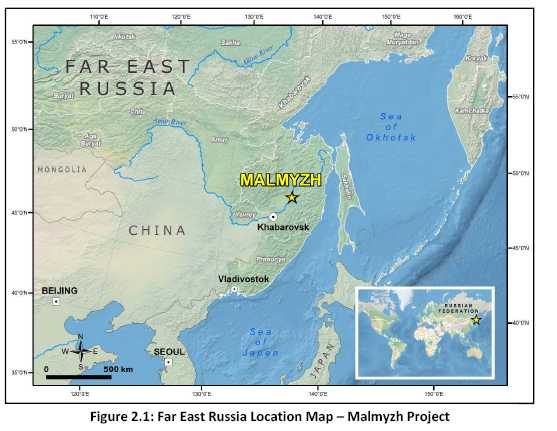
Malmyzh is a porphyry copper-gold exploration Project, located in the Russian Far East, and is approximately 210 km northeast of Khabarovsk, the administrative centre and largest city of Khabarovsk Krai (Figure 2.1). The Project is centred at latitude 49º55’30” North and longitude 136º55’00” East. The property consists of the Malmyzh and Malmyzh North exploration and mining licenses that in aggregate cover 152.8 km2.
| ZT 61-1442/MM998 | Final V1.0 | Page 9 |
| Report Date: July 10, 2015 |
| EURASIAN MINERALS INC AND IG COPPER LLC | |
| NI 43-101 TECHNICAL REPORT ON THE INITIAL MINERAL RESOURCE ESTIMATE FOR | |
| THE MALMYZH COPPER-GOLD PROJECT, KHABAROVSK KRAI, RUSSIAN FEDERATION |
Wardell Armstrong International (“WAI”), a UK based mining, engineering, and environmental consulting company, was engaged by EMX and IGC to prepare a first time statement of Mineral Resources for the Malmyzh Project.
| 2.2 |
Terms of Reference |
WAI prepared this Technical Report in accordance with National Instrument 43-101 Standards of Disclosure for Mineral Projects of the Canadian Securities Administrators (“NI 43-101”) and the Canadian Institute of Mining, Metallurgy and Petroleum (CIM) definition standards. The purpose of the report is to provide a statement of Malmyzh Project initial mineral resources as of May 1, 2015 and to propose future work programmes to advance this property of merit.
| 2.3 |
Scope of Work |
The scope of work is defined in a letter of engagement dated March 2, 2015 between EMX and IGC (the "Clients") and WAI. The report considers all exploration work completed to date on the Malmyzh licenses, as provided or summarised by the Clients. WAI's scope of work included:
| • |
Review the exploration and technical data related to the Project current up to the effective date of the report. | |
| • |
Conduct a field visit of the Malmyzh property and review the geology, sampling sites, drill site locations, sample preparation facilities, drill core, drill logs, assay certificates, and other original Project documentation. This review included the collection of independent check samples. | |
| • |
Independently prepare a statement of first time mineral resources and a technical report in accordance with NI 43-101 and CIM Best Practices reporting guidelines. | |
| • |
Provide interpretations and conclusions based upon the data and field reviews, and provide work recommendations for further exploration assessment of the property. |
FMEC did not participate in the completion of the Malmyzh resource estimate or this Technical Report. FMEC is subject to disclosure requirements that are different than IGC's and EMX's, and accordingly, future disclosures concerning the Malmyzh Project by FMEC, if any, may contain different or additional information as required by relevant laws, regulations and requirements.
| 2.4 |
Sources of Information |
This report is based on technical data and other information provided by IGC and EMX. IGC and EMX have provided access to all of the relevant data in their possession, and in the opinion of the author, enabled a thorough technical assessment of the Malmyzh Project. EMX and IGC have warranted to WAI that full disclosure has been made of all material information and that, to the best of their knowledge and understanding, such information is complete, accurate and true.
| ZT 61-1442/MM998 | Final V1.0 | Page 10 |
| Report Date: July 10, 2015 |
| EURASIAN MINERALS INC AND IG COPPER LLC | |
| NI 43-101 TECHNICAL REPORT ON THE INITIAL MINERAL RESOURCE ESTIMATE FOR | |
| THE MALMYZH COPPER-GOLD PROJECT, KHABAROVSK KRAI, RUSSIAN FEDERATION |
Additional relevant material was acquired independently by the author from a variety of sources. The references at the end of this report list the sources consulted. This material was used to expand on the information provided by IGC and EMX and, where appropriate, confirm or provide alternative assumptions to those made by IGC and EMX.
In summary, the principal sources of information used for this report include:
| • |
The Malmyzh 2014 Russian TEO report and supporting documents, | |
| • |
A memo from IGC’s Russian legal counsel, Olga Agabakyan on the status of the mineral concessions that constitute the Malmyzh and North Malmyzh exploration and mining licenses, | |
| • |
Public disclosures made by IGC and EMX, | |
| • |
A series of digital data files of various types representing IGC’s exploration database compilations, | |
| • |
Geological models and preliminary block models, | |
| • |
Internal, proprietary technical summaries and reports written by IGC and EMX personnel and consultants, | |
| • |
Various other IGC source documents, email correspondence, and verbal communications with IGC personnel, and | |
| • |
Government reports, and published technical and scientific literature in the public domain. |
WAI was given full access to all relevant data and conducted multiple discussions with IGC and EMX personnel to understand the procedures used to collect, record, store and analyse the Project exploration data.
The Mineral Resource statement reported herein was a collaborative effort between IGC and WAI personnel. The exploration database was compiled and maintained by IGC, and verified by WAI. The geological models and mineralised zone models that define the Malmyzh copper and gold mineralisation were constructed by IGC, and reviewed and verified by WAI. In the opinion of WAI, the models are a reasonable representation of the distribution of the copper-gold mineralisation at the current level of understanding. The statistical and geostatistical analysis, variography and grade models were completed under the supervision of WAI's Dr Phil Newall.
| 2.5 |
Personal Inspection |
The author undertook two visits to Far East Russia, the first from 10-12th March 2015 when bad weather prevented access to the site, and the second site visit, from 25-27th March 2015.
During the first visit, the Amur Minerals/IGC Khabarovsk offices were viewed as well as the core storage facility in the city, whilst for the second visit, the Malmyzh site, core storage and field office were the focus.
Additional details of the author’s personal inspection are given in Section 12 (Data Verification) of this report.
| ZT 61-1442/MM998 | Final V1.0 | Page 11 |
| Report Date: July 10, 2015 |
| EURASIAN MINERALS INC AND IG COPPER LLC | |
| NI 43-101 TECHNICAL REPORT ON THE INITIAL MINERAL RESOURCE ESTIMATE FOR | |
| THE MALMYZH COPPER-GOLD PROJECT, KHABAROVSK KRAI, RUSSIAN FEDERATION |
| 2.6 |
Units and Currency |
All units of weight and measurement in this report are metric, unless otherwise noted. Units of currency are in US dollars, unless otherwise specified. Specific abbreviations used include:
| Abbreviation | Unit |
| m | Metre |
| km | Kilometre |
| g | Gram |
| t | Tonne |
| oz | Ounce |
| lb | Pound |
| % | Percentage |
| cm | Centimetre |
| oC | Degrees centigrade |
| 2.7 |
Limitations, Reliance, and WAI Declaration |
WAI’s opinion contained herein is based on information collected throughout the course of WAI’s work, which in turn reflects various technical and economic conditions as of the effective date. Given the nature of the mining business, these conditions can change significantly over relatively short periods of time. Consequently, actual results may be significantly more or less favourable than assumed according to changes in metal prices or other variables.
This report may include technical information that requires subsequent calculations to derive subtotals, totals and weighted averages. Such calculations inherently involve a degree of rounding, and consequently introduce a margin of error. Where these occur, WAI does not consider them to be material.
WAI is not an insider, associate, or affiliate of IGC or EMX, nor has WAI acted as an advisor to these companies or their subsidiaries or affiliates in connection with this Project. The results of the technical review by WAI are not dependent on any prior agreements concerning the conclusions to be reached, nor are there any undisclosed understandings concerning any future business dealings.
Except as specifically required by law, WAI does not assume any responsibility and will not accept any liability to any other person for any loss suffered by any such other person as a result of, arising out of, or in connection with this Technical Report or statements contained herein, except required by and given solely for the purpose of complying with the mandate as outlined in this Technical Report and compliance with NI 43-101. WAI has no reason to believe that any relevant additional information or material facts have been withheld by IGC or EMX.
The author hereby acknowledges IGC and EMX for assistance with field review, core and pulp sampling, GIS and database technical support, and report preparation.
| ZT 61-1442/MM998 | Final V1.0 | Page 12 |
| Report Date: July 10, 2015 |
| EURASIAN MINERALS INC AND IG COPPER LLC | |
| NI 43-101 TECHNICAL REPORT ON THE INITIAL MINERAL RESOURCE ESTIMATE FOR | |
| THE MALMYZH COPPER-GOLD PROJECT, KHABAROVSK KRAI, RUSSIAN FEDERATION |
| 3 |
RELIANCE ON OTHER EXPERTS |
WAI’s opinion is based on information provided by IGC, EMX and their associates throughout the course of WAI’s work as described below, which in turn reflects various technical and economic conditions at the time of writing. WAI was wholly reliant upon the information and data provided by IGC and EMX. WAI has, however, where possible, independently verified the data and information provided, and completed site visits and independent sampling to verify the existence and nature of the copper-gold mineralised systems at Malmyzh.
The opinions expressed in this report are based on information supplied by IGC and EMX. WAI has exercised due care in reviewing, compiling, and reporting the supplied information, including a detailed review of the technical data for the Malmyzh Project. The accuracy of the results, and conclusions from this review, rely on the accuracy of the supplied data. WAI has relied on this information and has no reason to believe that any material facts have been withheld, or that a more detailed analysis may reveal additional material information. Technical reports, maps and data produced by IGC are of a reliable and relevant nature, and are supported by WAI’s property and data reviews. However, WAI does not accept responsibility for any errors or omissions in the supplied information, and does not accept any consequential liability arising from commercial decisions or actions resulting from them.
The title to, and status of, the Malmyzh Project as described in Section 4.0 of this report was researched and an opinion provided that was current as of May 1, 2015 by IGC’s legal counsel in Russia, Olga Agabakyan. From this review, the licenses that constitute the Malmyzh Project are in good standing as required by Russian Federation mining law.
The author is not qualified to provide comment on legal issues, including status of land tenure, joint venture agreements, royalties, or environmental compliance associated with the property referred to in this report. Assessment of these legal aspects has relied on information provided by IGC's President and CEO, Mr. T.E. Bowens, CPG. This report has been prepared with the understanding that the property is, or will be, contingent on government approvals, lawfully accessible for exploration, development, mining and processing, and this understanding is entirely based on information provided by IGC.
From the foregoing paragraph WAI offers no opinion: a) as to the validity of the mineral titles claimed and the description of the property, b) on the environmental status of the property, c) on whether the necessary permits are in place to carry out exploration and exploitation on the property, and d) on the legal status of the joint venture agreement.
WAI has been informed by IGC that there are no known litigations or other encumbrances potentially affecting the Malmyzh Project.
| ZT 61-1442/MM998 | Final V1.0 | Page 13 |
| Report Date: July 10, 2015 |
| EURASIAN MINERALS INC AND IG COPPER LLC | |
| NI 43-101 TECHNICAL REPORT ON THE INITIAL MINERAL RESOURCE ESTIMATE FOR | |
| THE MALMYZH COPPER-GOLD PROJECT, KHABAROVSK KRAI, RUSSIAN FEDERATION |
| 4 |
PROPERTY DESCRIPTION AND LOCATION |
| 4.1 |
Introduction |
The description of the Malmyzh Project is based upon information provided in reports from IGC, including the TEO report of temporary conditions prepared by OREOLL LLC (2014), as well as personal communications with IGC's Thomas E. Bowens, CPG (President and CEO) and Evgeney Ignatiev (Deputy General Director, Geologic Compliance and Permitting).
| 4.2 |
Legal Description and Location |
The Malmyzh Project is covered by two exploration and mining licenses issued to Amur Minerals LLC (IGC 51%, Freeport 49%; see Section 4.4) for the right to use the subsoil according to Russian Federation law:
| 1) |
HAB 02018, (bedrock prospecting, exploration and mining at the Malmyzh "ore field"), issued on September 18, 2006 and valid until December 31, 2026 ( extendable), and | |
| 2) |
HAB 02334 (bedrock prospecting, exploration and mining at the Northern Malmyzh "ore field"), issued on July 23, 2010, and valid until July 31, 2030 (extendable). |
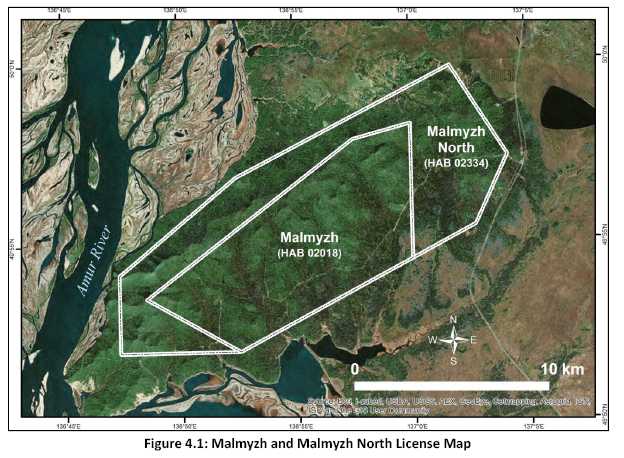
These "Subsoil Use" licenses total 152.8 km2, with HAB 02018 accounting for 79 km2 and HAB 02334 covering 73.8 km2 (Figure 4.1 and Table 4.1). IGC advises that the initial 20 year period for the license terms can be extended until the end of mining in accordance with Russian law. IGC also advises that the two Malmyzh licenses are currently valid and in good standing according to the rules, regulations, and laws of the Russian Federation.
| 4.3 |
Overview of Mining Law Requirements and Malmyzh License Status |
In the Russian Federation the government retains permanent mineral rights, whereas license holders and their business partners hold contractual rights for exploration and exploitation. Mineral exploration and development is controlled by legislation related to activities associated with the exploration for, and mining of, minerals including:
| • |
Federal Law “On Subsoil” dated February 21, 1992, | |
| • |
Federal Law “On Precious Metals and Precious Stones” dated March 26, 1998 and | |
| • |
Federal Law “On the Procedure for Making Foreign Investments in Business Entities of Strategic Importance for the National Defence and Security of the Russian Federation” dated May 7, 2008. |
| ZT 61-1442/MM998 | Final V1.0 | Page 14 |
| Report Date: July 10, 2015 |
| EURASIAN MINERALS INC AND IG COPPER LLC | |
| NI 43-101 TECHNICAL REPORT ON THE INITIAL MINERAL RESOURCE ESTIMATE FOR | |
| THE MALMYZH COPPER-GOLD PROJECT, KHABAROVSK KRAI, RUSSIAN FEDERATION |
| Table 4.1: Malmyzh and Malmyzh North Coordinates (Lat-Long, Pulkovo 42) | ||||||
| Malmyzh (HAB 02018) | ||||||
| Vertex | Longitude | Latitude | ||||
| Degrees | Minutes | Seconds | Degrees | Minutes | Seconds | |
| 1 | 136 | 48 | 30 | 49 | 53 | 30 |
| 2 | 136 | 57 | 30 | 49 | 57 | 50 |
| 3 | 137 | 0 | 0 | 49 | 58 | 15 |
| 4 | 137 | 0 | 0 | 49 | 54 | 30 |
| 5 | 136 | 52 | 30 | 49 | 52 | 0 |
| Malmyzh North (HAB 02334) | ||||||
| Vertex | Longitude | Latitude | ||||
| Degrees | Minutes | Seconds | Degrees | Minutes | Seconds | |
| 1 | 136 | 52 | 30 | 49 | 52 | 0 |
| 2 | 136 | 47 | 20 | 49 | 52 | 0 |
| 3 | 136 | 47 | 20 | 49 | 54 | 10 |
| 4 | 136 | 52 | 25 | 49 | 56 | 50 |
| 5 | 137 | 1 | 45 | 49 | 59 | 50 |
| 6 | 137 | 4 | 10 | 49 | 57 | 20 |
| 7 | 137 | 2 | 45 | 49 | 55 | 25 |
| 8 | 137 | 0 | 0 | 49 | 54 | 30 |
| 9 | 137 | 0 | 0 | 49 | 58 | 15 |
| 10 | 136 | 57 | 30 | 49 | 57 | 50 |
| 11 | 136 | 48 | 30 | 49 | 53 | 30 |
| ZT 61-1442/MM998 | Final V1.0 | Page 15 |
| Report Date: July 10, 2015 |
| EURASIAN MINERALS INC AND IG COPPER LLC | |
| NI 43-101 TECHNICAL REPORT ON THE INITIAL MINERAL RESOURCE ESTIMATE FOR | |
| THE MALMYZH COPPER-GOLD PROJECT, KHABAROVSK KRAI, RUSSIAN FEDERATION |
In summary, the above legislation stipulates:
| • |
Mineral resources are owned by the State, | |
| • |
The State grants a right to exploit resources in the form of a license, | |
| • |
The license document proscribes the scope and period of exploitation, | |
| • |
The license establishes the right to carry out mineral exploration, mine development, and mining waste management, | |
| • |
All mineral resources are subject to mandatory State technical audit, | |
| • |
The technical audit is carried out by the State GKZ Reserves Committee of Experts, | |
| • |
Mineral extraction is authorised only after GKZ verification of "reserve" estimates, | |
| • |
This verification is the basis for inclusion of the "reserves" on the State minerals "balance". |
The Malmyzh licenses are governed by the above laws and regulations. IGC has advised that the Malmyzh Joint Venture (51% IGC, 49% Freeport), through Russian subsidiary Amur Minerals LLC, has received approval of the “official on balance C1+C2 reserves” from the GKZ. The Malmyzh government approved "reserves" were estimated according to the rules and regulations of the Russian Federation, and are not the same as reserves under NI 43-101, but are relevant to meeting requirements for keeping the licenses in good standing. The GKZ “official reserves” have now been listed and added to the “State Balance of Reserves”. IGC has also advised that the Project's "Technical-Economic Justification (TEO) of Temporary Conditions" report has been accepted, and that the “prospecting phase” of the Malmyzh exploration and mining licenses has now been successfully completed. The GKZ and TEO approvals completed the requirements to keep the Malmyzh and Malmyzh North licenses in good standing for this phase of the Project's development.
The next requirement for Malmyzh's advancement relates to the 2008 Strategic Investment Law (“SIL”), which regulates foreign investment in industrial sectors that are considered of strategic importance to the Russian Federation. The relevant SIL stipulation is that mineral deposits exceeding certain thresholds for contained copper or contained gold are considered to be "strategically significant". Based on the applicable Russian "reserve" calculation methodologies, the Project surpasses these thresholds according to the approved "GKZ C1+C2 official on balance reserves”.
As a result, the Malmyzh Joint Venture must complete an application process, through the Federal Anti-Monopoly Service (FAS) and the Prime Minister-chaired Commission for Control over Foreign Investments, to obtain approval for on-going control of the Project. IGC has been advised by the Federal Agency for the Subsoil Use (Rosnedra) that, as an approximation, the process could take approximately up to a year given the specifics of the Malmyzh Project; there is no certainty to this general timeframe.
Contingent on SIL approval, the Joint Venture will proceed to the next level of Project advancement. This next phase will include additional technical work (i.e., drilling, exploration, metallurgy, engineering, etc.) and economic assessment culminating in a more detailed report termed the "TEO of Permanent Conditions". This report fulfils the criteria for a "fully explored" mineral deposit, and in the Russian system is considered to be a precursor to commencement of exploitation and mining.
| ZT 61-1442/MM998 | Final V1.0 | Page 16 |
| Report Date: July 10, 2015 |
| EURASIAN MINERALS INC AND IG COPPER LLC | |
| NI 43-101 TECHNICAL REPORT ON THE INITIAL MINERAL RESOURCE ESTIMATE FOR | |
| THE MALMYZH COPPER-GOLD PROJECT, KHABAROVSK KRAI, RUSSIAN FEDERATION |
In the case of withdrawal of a license under SIL, the Government of the Russian Federation is required to reimburse the expenses incurred in respect of the geological study of the subsoil plot and any tender fees paid by the license holder. In addition, the license holder may also be paid a finder’s fee by the Government of the Russian Federation at its discretion.
As of the effective date of this report, the Joint Venture was preparing to file documents for SIL approval, and was in the process of designing work programmes to continue to the Project's “advanced exploration” stage. Advanced exploration for the Malmyzh licenses is scheduled to commence by June 1, 2016, although this date may be extendable.
| 4.4 |
Joint Venture Agreement and Eurasian Minerals Interest |
The Malmyzh and Malmyzh North licenses are held in the name of Amur Minerals LLC, a wholly owned Russian subsidiary of offshore registered Khabarovsk Minerals LLC (the "Malmyzh Joint Venture"), which is jointly owned by IG Copper LLC (51%, through a wholly owned subsidiary) and by Freeport-McMoRan Exploration Corporation (49%, a wholly owned subsidiary of Freeport McMoRan Inc.). The Malmyzh Joint Venture is operated and managed by IGC. FMEC retains no claw-back or NSR provisions.
IGC and FMEC fund at their respective level of ownership interest, or dilute. Should either company dilute to less than a 10% interest in the Company, remaining ownership is converted to a US $0.005 (one-half cent) per pound copper equivalent reserve payment, which remains in effect through the life of mine.
The majority shareholder in IGC is Eurasian Minerals Inc. (TSX Venture: EMX; NYSE MKT: EMXX), with 42.2% of the issued and outstanding shares (40% on a fully diluted basis), resulting from private placement investments totalling approximately US $7.8 million.
| 4.5 |
License Fees and Royalties |
As the "prospecting phase" for the Malmyzh licenses has been completed, payments to the Russian Federation for the right to use the subsoil will commence on August 1, 2015 at rates enumerated in Table 4.2.
| Table 4.2: Malmyzh Federal Subsoil Usage License Fees | ||||
| Year | HAB 02018 (RUR) | HAB 02334 (RUR) | Total (RUR) | Total (USD)* |
| 1st | 237,000 | 874,530 | 1,111,530 | 21,420.89 |
| 2nd | 474,000 | 874,530 | 1,348,530 | 25,988.24 |
| 3rd | 711,000 | 874,530 | 1,585,530 | 30,555.60 |
| 4th | 948,000 | 874,530 | 1,822,530 | 35,122.95 |
| 5th | 1,422,000 | 874,530 | 2,296,530 | 44,257.66 |
| * Conversion rate as of May 1, 2015: 1 US Dollar = 51.89 Russian rubles | ||||
| ZT 61-1442/MM998 | Final V1.0 | Page 17 |
| Report Date: July 10, 2015 |
| EURASIAN MINERALS INC AND IG COPPER LLC | |
| NI 43-101 TECHNICAL REPORT ON THE INITIAL MINERAL RESOURCE ESTIMATE FOR | |
| THE MALMYZH COPPER-GOLD PROJECT, KHABAROVSK KRAI, RUSSIAN FEDERATION |
In accordance with Russian Federation mining law, once in production the Malmyzh licenses will be subject to a federal royalty, known as a Mineral Resources Extraction Tax ("MRET"). The MRET schedule for Khabarovsk Krai, and other administrative districts of the Russian Far East and Siberia, was reduced by a law that was put into effect on January 1, 2014 as an incentive to foster investment and development in the region.
The MRET schedule for Malmyzh is outlined below in Table 4.3.
| Table 4.3: Mineral Resource Extraction Tax | ||
| Production Years | MRET Copper | MRET Gold |
| 0 - 2 | 0.0 % | 0.0 % |
| 2 - 4 | 1.6 % | 1.2 % |
| 4 - 6 | 3.2 % | 2.4 % |
| 6 - 8 | 4.8 % | 3.6 % |
| 8 - 10 | 6.4 % | 4.8 % |
| Thereafter | 8.0 % | 6.0 % |
In addition to the MRET incentives, the new tax laws established lower rates for corporate income taxes ("CIT") for qualifying investment projects.
| 4.6 |
Surface, Access, and Community Agreements |
Surface agreements have been established providing the Joint Venture with access for exploration. The Joint Venture must pay Russian Federation "rental" fees for forested areas on the property that are cut for building drill pads, roads, and project infrastructure. The average payment is ~9,000 rubles per one hectare. On an annual basis, the company rents from 15 to 30 hectares, yielding forest rental payments of approximately 130,000 to 300,000 rubles per year, or at the exchange rate as of May 1, 2015 (51.89 RUR / 1 USD) approximately US $2500 to $5,800 per year.
The Joint Venture has also concluded an agreement with the local aboriginal Nanaisky district for providing social "assistance" in the amount of 0.5% (½ of one percent) of the annual field related exploration budget.
| 4.7 |
Other Agreements or Encumbrances |
There are no agreements with parties other than FMEC, and no back-in rights or other encumbrances on the Malmyzh Project.
| 4.8 |
Environmental Liabilities |
The Malmyzh Project has no known environmental liabilities.
| ZT 61-1442/MM998 | Final V1.0 | Page 18 |
| Report Date: July 10, 2015 |
| EURASIAN MINERALS INC AND IG COPPER LLC | |
| NI 43-101 TECHNICAL REPORT ON THE INITIAL MINERAL RESOURCE ESTIMATE FOR | |
| THE MALMYZH COPPER-GOLD PROJECT, KHABAROVSK KRAI, RUSSIAN FEDERATION |
| 4.9 |
Other Factors or Risks |
There are no protected territories, nature reserves, or wildlife preserves within, or nearby to Malmyzh. The faunal diversity of the property is "low" due to strong anthropogenic impact. There are no known archaeological sites or historical memorials which require preservation.
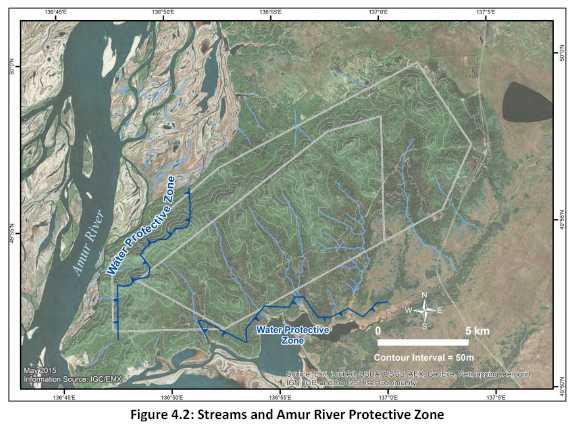
Locally, there are areas adjacent to streams (within a +-50 m buffer) where drill pads cannot be built without permission. As well, there is a "water protective" zone associated with the Amur River in the far west of the Project area that is set aside from development; this zone is outside of, and away from the main areas of exploration (Figure 4.2).
There are no additional factors or risks that affect the exploration programmes at the Malmyzh Project as given from the information provided by IGC.
| ZT 61-1442/MM998 | Final V1.0 | Page 19 |
| Report Date: July 10, 2015 |
| EURASIAN MINERALS INC AND IG COPPER LLC | |
| NI 43-101 TECHNICAL REPORT ON THE INITIAL MINERAL RESOURCE ESTIMATE FOR | |
| THE MALMYZH COPPER-GOLD PROJECT, KHABAROVSK KRAI, RUSSIAN FEDERATION |
| 5 |
ACCESSIBILITY, CLIMATE, LOCAL RESOURCES, INFRASTRUCTURE AND PHYSIOGRAPHY |
| 5.1 |
Introduction |
The accessibility, climate, local resources, infrastructure, and physiography of the Malmyzh Project is based upon information provided in reports from IGC and OREOLL (2014).
| 5.2 |
Accessibility |
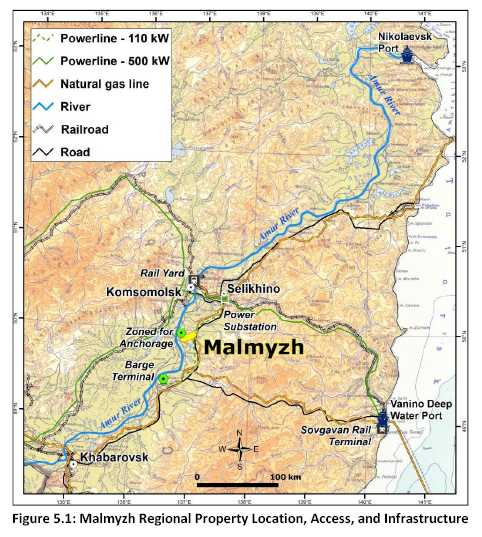
The Malmyzh Project is located in the Nanaisky district of Khabarovsk Krai (Figure 5.1), approximately 210 km northeast of the regional administrative centre of Khabarovsk (population 600,000), and the nearby international border with China (220 km), and 70 km south from the industrial centre of Komsomolsk (population 250,000). There are regularly scheduled international flights into Khabarovsk, principally from Beijing, Seoul, Tokyo, and connecting via Moscow and other transportation hubs within the Russian Federation. Komsomolsk also has a medium sized airport that services regional flights.
| ZT 61-1442/MM998 | Final V1.0 | Page 20 |
| Report Date: July 10, 2015 |
| EURASIAN MINERALS INC AND IG COPPER LLC | |
| NI 43-101 TECHNICAL REPORT ON THE INITIAL MINERAL RESOURCE ESTIMATE FOR | |
| THE MALMYZH COPPER-GOLD PROJECT, KHABAROVSK KRAI, RUSSIAN FEDERATION |
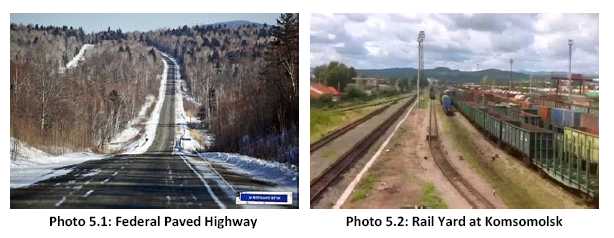
The Project has a paved, two lane "Khabarovsk-Komsomolsk-on-Amur" federal highway (Photo 5.1) that runs adjacent to the eastern boundary of the property. This well maintained highway connects Malmyzh to Khabarovsk (by road: 275 km, ~4 hours) and the important rail yard (Photo 5.2) at Komsomolsk (125 km, ~2.5 hours), and at marker 210 (km) there is an east bound paved road of regional significance to the port city of Vanino (~450 km) situated on the Sea of Japan coast. As well, the Project has a well maintained internal network of gravel and dirt roads that allow ready access to the prospects and targets on the property.
| 5.3 |
Climate |
The region has a dry-winter, humid-summer continental climate due to the effects of the Siberian High and East Asian Monsoons, respectively (Table 5.1). The average annual precipitation is 540 mm, with extreme years ranging from 268 to 798 mm. Summers generally extend from late May to early September, and are warm and humid, with monsoonal rains in late summer driven by cyclones formed in the Yellow and East-China seas.
| Table 5.1: Average Precipitation (mm) and Temperature by Month | ||||||||||||
| Jan | Feb | Mar | Apr | May | Jun | Jul | Aug | Sep | Oct | Nov | Dec | |
| Average
Precipitation (mm) |
17 | 11 | 16 | 31 | 53 | 61 | 93 | 99 | 72 | 46 | 23 | 18 |
| Average
Temperature (C) |
-25.6 | -20.3 | -10 | 1.3 | 8.7 | 15.6 | 19.9 | 18.7 | 12.6 | 3 | -10.7 | -22 |
The warmest month is July, with temperatures averaging 19.9 0‚, and ranging from 17.0 0‚ to 23.5 0‚. About 85% of precipitation occurs from April to October, in particular July-September. The winter season extends from early November through early March. The coldest month is January, with temperatures averaging -25.6 0‚, and ranging from -17.8 0‚ to -28.4 0‚. The ground freezes to depths of 1.5 to 2.0 m during the winter, but thaws completely during the summer months. Snow cover is established around mid-November, with melt-off occurring in March-April. The depth of the snow averages 20-25 cm, and locally accumulates to over 1 m.
| ZT 61-1442/MM998 | Final V1.0 | Page 21 |
| Report Date: July 10, 2015 |
| EURASIAN MINERALS INC AND IG COPPER LLC | |
| NI 43-101 TECHNICAL REPORT ON THE INITIAL MINERAL RESOURCE ESTIMATE FOR | |
| THE MALMYZH COPPER-GOLD PROJECT, KHABAROVSK KRAI, RUSSIAN FEDERATION |
| 5.4 | Local Resources |
The Malmyzh region is sparsely populated, and the principal economic activity in the region is logging. Currently, logging activities are limited and occur on a rotational basis.
The small villages of Malmyzh and Verhniy Nergen occur ~ 5-6 km west of the Malmyzh license boundary. Troitskoye village is the administrative centre of the Nanai district, and is located 50 km south of the Project. The nearest airport is in Komsomolsk, which is a hub of industrial activity on the Amur River. The local work force is adequate to support the Project’s exploration activities, and a labour force from the surrounding region could support a mining operation.
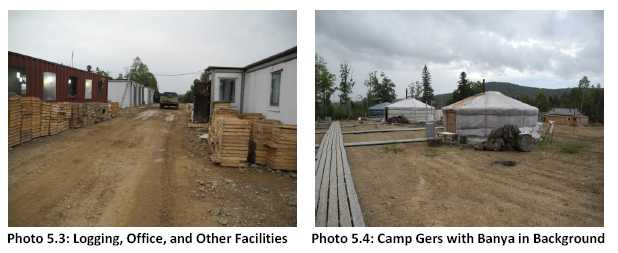
The Project has a well maintained and self-sufficient exploration camp. The camp has logging and sample preparation facilities (Photo 5.3), core storage, supply and fuel storage, offices (cargo containers), temporary housing (gers - Photo 5.4), and a camp kitchen. The camp is well maintained, operational year-round, and secured by Project staff 24 hours/day, 365 days/year.
| 5.5 |
Infrastructure |
The license area is located adjacent to the Amur River, the major shipping river in the Russian Far East. Product from potential mining operations could utilise barging northward to Nikolaevsk port (~680 km) at the mouth of the Amur River on the Sea of Japan. Alternatively, shipping could be directed southward to the border with China. Of note, the Amur River freezes over during the winter months, and may not be navigable from early November to mid-May.
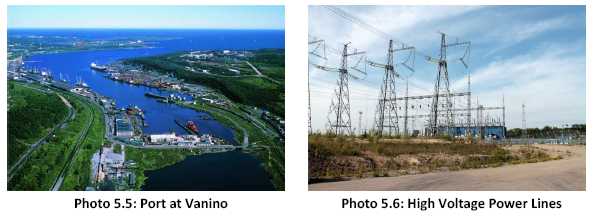
Railroad access on the BAM (Baikal-Amur-Mainline) is available at Selikhino, located ~65 km northeast of the Malmyzh licenses. The BAM railway parallels the Trans-Siberian railway to the Sea of Japan. The railroad connects about 390 km down the line from Selikhino to Vanino, with the main cargo being lumber transported from regional logging operations. Access to smelting operations and world markets for a mining operation at Malmyzh would readily be provided at Vanino, which is an all-year, deep-water port (Photo 5.5).
| ZT 61-1442/MM998 | Final V1.0 | Page 22 |
| Report Date: July 10, 2015 |
| EURASIAN MINERALS INC AND IG COPPER LLC | |
| NI 43-101 TECHNICAL REPORT ON THE INITIAL MINERAL RESOURCE ESTIMATE FOR | |
| THE MALMYZH COPPER-GOLD PROJECT, KHABAROVSK KRAI, RUSSIAN FEDERATION |
Parallel to the paved highway is the Sakhalin-Khabarovsk-Vladivostok natural gas pipeline, as well as LEP-110 kW electrical power line (Photo 5.6), which branches from the LEP-500 kW power line at the Selikhino transformer substation. The LEP power line is continuing to be developed, and could be upgraded and utilized to provide power for a mining operation at Malmyzh.
| 5.6 |
Physiography |
The Project physiography consists of low lying hills on the east bank of the Amur River valley (Figure 5.2). The Malmyzh topographic highs form a distinct northeast trending ridge 25 km long, with a series of southeast trending ridges and valleys. The highest elevation is ~360 m, but more commonly the elevations do not exceed 200 to 250 m elevation. Relief of the topographic highs above the valleys are on the order of 100 to 250 m (Photo 5.7). There are no outcrops except along the Amur River bank.
The hydrographic network of Malmyzh is distinctly asymmetrical relative to the trend of the ridge, and is most well developed on the southern and southeastern slopes. The streams, creeks and drainages of the region ultimately flow into the Amur River valley (Photo 5.8). The water supply in the area is sufficient to support future mining operations.
Forests cover approximately 95% of the Malmyzh property, and primarily occur as mixed, secondary growth in various stages of reforestation due to an ongoing history of fires and logging. The upper stage vegetation is represented by oak, maple, yellow birch, ash, aspen, cedar and spruce-fir trees, with woodreed and sedge undergrowth and grass cover.
| ZT 61-1442/MM998 | Final V1.0 | Page 23 |
| Report Date: July 10, 2015 |
| EURASIAN MINERALS INC AND IG COPPER LLC | |
| NI 43-101 TECHNICAL REPORT ON THE INITIAL MINERAL RESOURCE ESTIMATE FOR | |
| THE MALMYZH COPPER-GOLD PROJECT, KHABAROVSK KRAI, RUSSIAN FEDERATION |
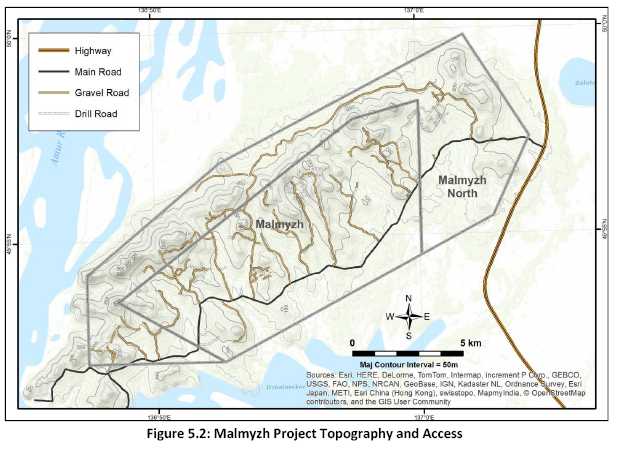
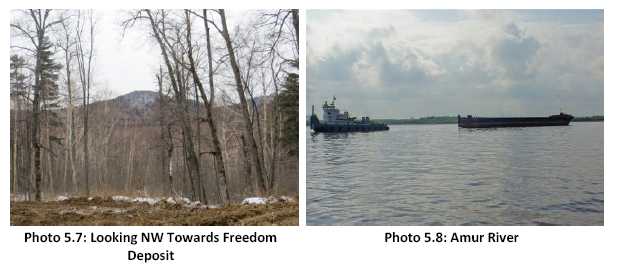
| 5.7 |
Comments on Accessibility, Climate and Infrastructure |
The Malmyzh Project has excellent logistics and infrastructure, with readily available sources of power, water, mining personnel, and multiple alternatives for transport and access including the Amur River, a paved federal highway, and a nearby rail line. The Project has ample area with favorable physiographic characteristics within its two exploration and mining licenses for potential processing plant sites, tailings storage, heap leach pads, waste disposal, and mining operation infrastructure. The climate of the region would allow year-round mining operations.
| ZT 61-1442/MM998 | Final V1.0 | Page 24 |
| Report Date: July 10, 2015 |
| EURASIAN MINERALS INC AND IG COPPER LLC | |
| NI 43-101 TECHNICAL REPORT ON THE INITIAL MINERAL RESOURCE ESTIMATE FOR | |
| THE MALMYZH COPPER-GOLD PROJECT, KHABAROVSK KRAI, RUSSIAN FEDERATION |
| 6 |
HISTORY |
| 6.1 |
Introduction |
This section on Malmyzh historical exploration substantially relies on the summaries by OREOLL (2014) and Ashleman (2010). Exploration work in the region dates back to 1894, with various government surveys conducted from the 1950s to early 1990s. The discovery of the Malmyzh porphyry copper-gold district resulted from initial exploration work conducted by Phelps Dodge/FMEC during 2006-2008, and follow-up work by Fortress Minerals Corp. in 2010. There has not been any significant historical resource or reserve estimates, nor any significant production from the Malmyzh property.
| 6.2 |
Early Prospecting and Government Surveys |
The initial reference to geological prospecting in the Malmyzh region dates back to 1894 regarding small scale gold placer operations. Subsequently, limited placer mining was conducted on an infrequent basis, with no documentation available for the time period of 1931-1950.
Starting in the 1950s, the government commenced regional scale geophysical and geological surveys in the region. This work identified a "large" magnetic anomaly at Malmyzh, and two pan concentrate gold anomalies near Malmyzh village. Regional scale geologic mapping at 1:500,000 scale outlined Cretaceous sedimentary rock sequences intruded by Late Cretaceous intrusives of intermediate composition, and stockworking was noted in the area from float samples.
In 1960, placer gold prospecting re-commenced, and zones of silicified and sulphidised rocks containing gold mineralisation were identified at Malmyzh. In addition, anomalous copper in surficial Quaternary sediments was identified. Further exploration in 1960-1961 included pitting and shallow churn drilling, and it was concluded that the area had a negative potential for identifying placers of economic interest.
In 1970, the government's Far Eastern Geological Enterprise conducted follow-up prospecting at Malmyzh to identify the bedrock sources of gold. Five zones of veinlet silicification with low level gold-copper and lead-zinc mineralisation were identified. Further prospecting work was recommended.
From 1975 through 1979, the area was covered by a combined geological-hydrogeological survey at a1:200,000 scale. This work served as the basis for compiling USSR State Geological Map sheets М-53-XXIII and М-XXIV that were published in 1989. A single gold occurrence was identified in the region of Bikha Mountain. Also during this time period, bedrock gold prospecting was conducted with trenching, geophysical surveying, channel sampling, grab sampling, pan concentrate sampling, and soil and stream sediment sampling. As a result of this work, modest gold mineralisation (to 5 g/t Au) was identified in linear bodies of secondary "quartzite" and quartz veinlet-stockwork zones. Despite the fact that the Malmyzh prospect received a negative assessment in terms of bedrock gold, an assumption was made about the possibility of identifying zones of secondary sulphide enrichment at depth, associated with stockwork (porphyry) gold-copper mineralisation.
| ZT 61-1442/MM998 | Final V1.0 | Page 25 |
| Report Date: July 10, 2015 |
| EURASIAN MINERALS INC AND IG COPPER LLC | |
| NI 43-101 TECHNICAL REPORT ON THE INITIAL MINERAL RESOURCE ESTIMATE FOR | |
| THE MALMYZH COPPER-GOLD PROJECT, KHABAROVSK KRAI, RUSSIAN FEDERATION |
A 1991 review of geochemical anomalies in the southern part of Khabarovsk Krai by V. Lovyagin identified Malmyzh as a target with high potential for copper-molybdenum (gold) porphyry mineralisation. Lovyagin’s recommendation was supported by later regional metallogenic studies in 1999 and 2000. However, follow-up government surveys were not undertaken.
| 6.3 |
Phelps Dodge/FMEC and Fortress Minerals |
In 2006, Phelps Dodge Corporation, through its Russian subsidiary Amur Minerals LLC, acquired a 79 km2 mining and exploration license (HAB 02018) at Malmyzh after concluding the region was prospective for porphyry copper (gold) exploration. At the time, no mineral deposits were recognised in the area.
Phelps Dodge was acquired by Freeport-McMoRan Inc. (NYSE: FCX) in 2007. From 2006-2008, Phelps Dodge/Freeport McMoRan Exploration Corp. (“FMEC”) conducted preliminary exploration assessments that included geochemical sampling, a ground magnetic survey, and eight diamond drill holes totalling 1,126 m. This early work established that the coincidence of magnetic and soil geochemical anomalies was effective in delineating porphyry targets concealed beneath Malmyzh's ubiquitous cover of soil and alluvium (Figure 6.1 and Figure 6.2). FMEC's drilling intersected copper-gold porphyry alteration and mineralisation, and identified the Central, Flats, North, and Stockwork prospect.
FMEC downsized worldwide exploration activities in late 2008, with Malmyzh being one of the only exploration projects retained in Eurasia. In September 2009, Fortress Minerals Corp. (“Fortress”) entered into a "Share Purchase" joint venture agreement with FMEC to acquire a 51% interest in the subsidiary (Amur) that controlled Malmyzh, as well as two other exploration projects in the Russian Far East (Fortress news release; September 29, 2009). The agreement required a nominal cash payment, the completion of 12,000 m of drilling, and the assumption of operational control by Fortress of the Malmyzh Project.
Fortress commenced a Malmyzh winter drill programme in late 2009, and completed 23 core holes totalling ~7,000 m (Fortress news releases; January 13, March 17, March 29, and May 25, 2010). This work followed-up on the targets drilled by FMEC, and also intersected copper-gold mineralisation at the ABV, Valley, Z, West, Sharga, and East targets (Figure 6.3). In July 2010, the joint venture acquired a second exploration and mining license (HAB 02334), known as North Malmyzh, and increased the total Project area to 152.8 km2.
| ZT 61-1442/MM998 | Final V1.0 | Page 26 |
| Report Date: July 10, 2015 |
| EURASIAN MINERALS INC AND IG COPPER LLC | |
| NI 43-101 TECHNICAL REPORT ON THE INITIAL MINERAL RESOURCE ESTIMATE FOR | |
| THE MALMYZH COPPER-GOLD PROJECT, KHABAROVSK KRAI, RUSSIAN FEDERATION |
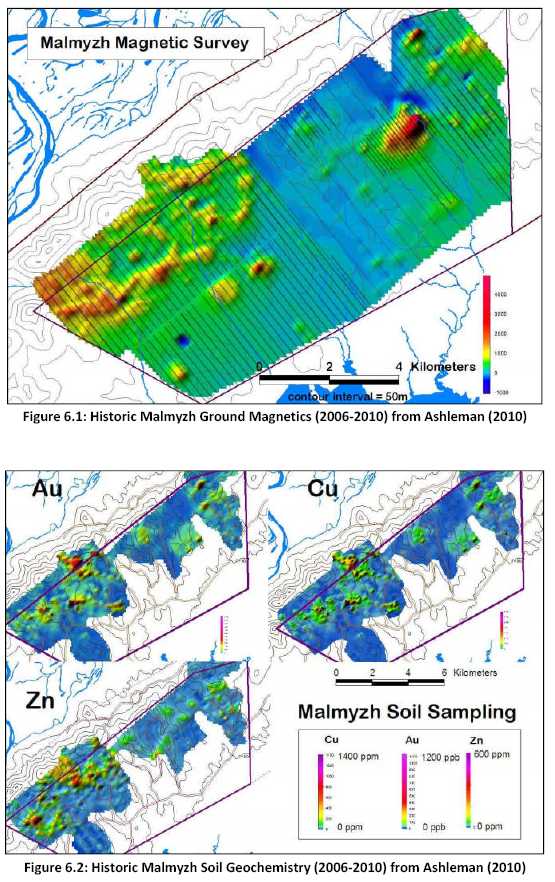
| ZT 61-1442/MM998 | Final V1.0 | Page 27 |
| Report Date: July 10, 2015 |
| EURASIAN MINERALS INC AND IG COPPER LLC | |
| NI 43-101 TECHNICAL REPORT ON THE INITIAL MINERAL RESOURCE ESTIMATE FOR | |
| THE MALMYZH COPPER-GOLD PROJECT, KHABAROVSK KRAI, RUSSIAN FEDERATION |
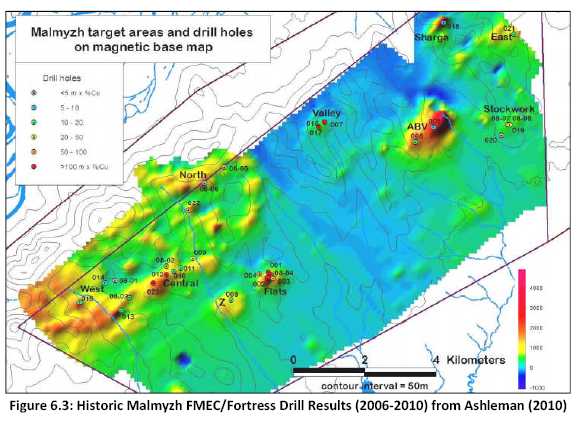
Subsequently, Fortress concluded a transaction in December, 2010 with IGC (through predecessor in name Intergeo Resources LLC), whereby IGC acquired Fortress's interests in the Russian Federation for an aggregate consideration of US $500,000 (Fortress news release; December 17, 2010). Fortress assigned IGC the option to “earn in” for a 51% interest in the Malmyzh Joint Venture by completing the drill requirements. IGC commenced a winter drill programme in late 2010-early 2011 that consisted of 16 holes for ~5,000 m. This drilling completed IGC's obligation to FMEC to earn IGC a 51% interest in the Malmyzh Joint Venture.
| 6.4 |
Comments on Historical Exploration Results |
The 2006-2010 Phelps Dodge/FMEC/Fortress exploration programmes were conducted utilising industry best practice standards. FMEC remains as a 49% Malmyzh Joint Venture partner, and their original exploration data has been reviewed, updated, and incorporated into the Malmyzh Project databases. The Fortress exploration programmes were managed by T. Bowens, CPG (former Fortress Chief Operating Officer) and J. Ashleman, LPG (former Fortress Chief Geologist). Bowens and Ashleman transitioned from Fortress to form IGC as President/CEO and Chief Geologist, respectively, and to assume ongoing operational management of the Malmyzh Project. The continuity of the Project management has resulted in consistent exploration protocols, sampling procedures, and QA/QC programmes as discussed in Sections 9.0, 10.0, and 11.0 of this report.
The government geologic mapping programmes conducted in the Malmyzh region are discussed in Section 7. There are no significant historic resources/reserves or production from the property.
| ZT 61-1442/MM998 | Final V1.0 | Page 28 |
| Report Date: July 10, 2015 |
| EURASIAN MINERALS INC AND IG COPPER LLC | |
| NI 43-101 TECHNICAL REPORT ON THE INITIAL MINERAL RESOURCE ESTIMATE FOR | |
| THE MALMYZH COPPER-GOLD PROJECT, KHABAROVSK KRAI, RUSSIAN FEDERATION |
| 7 |
GEOLOGICAL SETTING AND MINERALISATION |
| 7.1 |
Introduction |
Section 7 is principally based on summary information taken from Ashleman (2010), Westra (2012a,b), and OREOLL (2014); this work is hereby acknowledged.
| 7.2 |
Regional Geology |
The regional geologic setting of Malmyzh is a complex collage of accretionary complexes and magmatic arcs related to the subduction of the ancestral Pacific plate during the Cretaceous through early Tertiary (Figure 7.1).
Malmyzh is located in the Amur River Terrane, a package of Late Triassic to Early Cretaceous continental margin turbidites (flysch) that were accreted in the Cretaceous (Nokleberg et al., 2006). This package of sedimentary rocks was subjected to magmatic activity interpreted to be related to the East Sikhote-Alin continental-margin arc complex during the Late Cretaceous. It is within this regional tectonic and magmatic framework that the porphyry copper-gold systems of Malmyzh were formed. During Eocene time, the Sikhote-Alin active margin evolved to a transform margin characterised by northeast-trending, large-offset, left-lateral strike-slip faults (Natal’in, 2007; Nokleberg, 2010; Parfenov and others, 2011).
The sedimentary rocks of the Amur River Terrane and the plutonic-volcanic rocks of the East Sikhote-Alin overlap assemblage are now separated by the Amur Suture.
Early work by Zvezdov and others (1993) delineated what they termed the Sikhote-Alin porphyry copper province. In a subsequent analysis of lithotectonic schemes and metallogeny of the North Pacific orogenic collage, Yakubchuk (2002) identified a Cretaceous episode of porphyry Cu-(Au-Mo) formation in the Sikhote-Alin region. Sato and others (2004) noted a similar episode of metallogenesis, but also distinguished between earlier, reduced-type (with Sn) granitoid magmatism in the western region of Sikhote Alin (Khingan-Okhotsk continental arc) and later, oxidised-type (with Au) in the eastern region (East Sikhote-Alin continental arc). Although these earlier studies identified the region as prospective for copper-gold porphyry systems, it has for the most part remained under-explored (Figure 7.2).
| ZT 61-1442/MM998 | Final V1.0 | Page 29 |
| Report Date: July 10, 2015 |
| EURASIAN MINERALS INC AND IG COPPER LLC | |
| NI 43-101 TECHNICAL REPORT ON THE INITIAL MINERAL RESOURCE ESTIMATE FOR | |
| THE MALMYZH COPPER-GOLD PROJECT, KHABAROVSK KRAI, RUSSIAN FEDERATION |
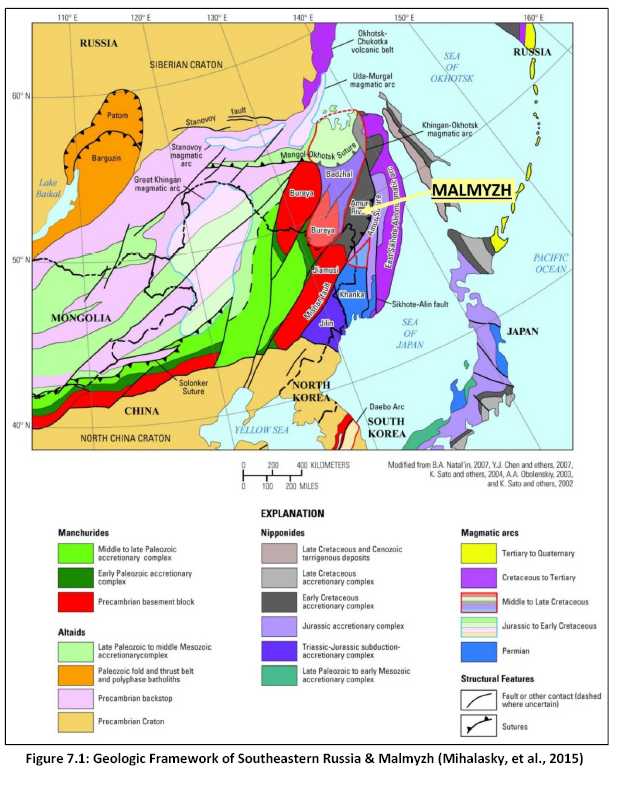
| ZT 61-1442/MM998 | Final V1.0 | Page 30 |
| Report Date: July 10, 2015 |
| EURASIAN MINERALS INC AND IG COPPER LLC | |
| NI 43-101 TECHNICAL REPORT ON THE INITIAL MINERAL RESOURCE ESTIMATE FOR | |
| THE MALMYZH COPPER-GOLD PROJECT, KHABAROVSK KRAI, RUSSIAN FEDERATION |
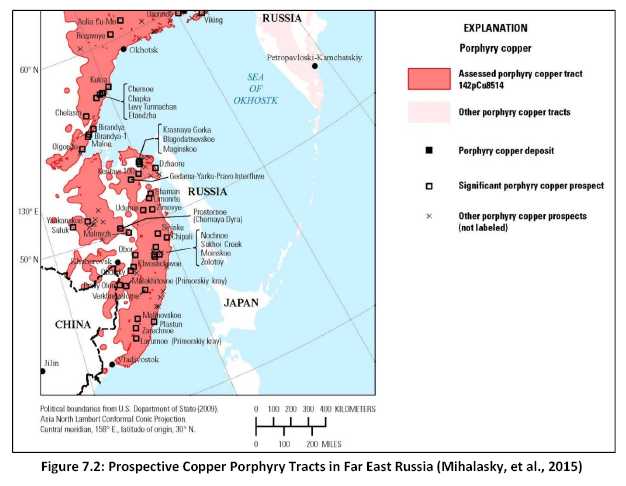
| 7.3 |
Property Geology |
| 7.3.1 | Introduction |
The geology of the Malmyzh Project area has been regionally mapped by various Russian government agencies. The Project area is covered by 1 to over 50 m of unconsolidated Quaternary soils and alluvium, and outcrop is practically non-existent. As a result, the regional scale geologic mapping has been supplemented largely based on drilling and magnetic anomalies. Accordingly, the Project geology is highly interpretative, but generally consists of Cretaceous siliciclastic sequences intruded by multiple Late Cretaceous stocks of diorite porphyry affinity (Figure 7.3).
| ZT 61-1442/MM998 | Final V1.0 | Page 31 |
| Report Date: July 10, 2015 |
| EURASIAN MINERALS INC AND IG COPPER LLC | |
| NI 43-101 TECHNICAL REPORT ON THE INITIAL MINERAL RESOURCE ESTIMATE FOR | |
| THE MALMYZH COPPER-GOLD PROJECT, KHABAROVSK KRAI, RUSSIAN FEDERATION |
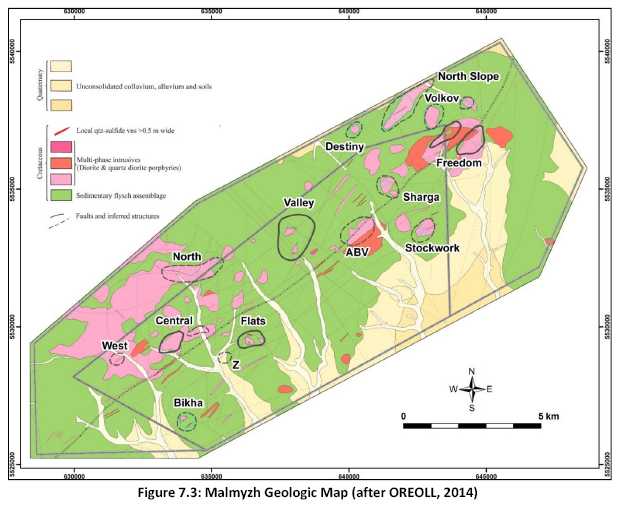
| 7.3.2 | Lithologies |
Malmyzh is underlain by Cretaceous flysch-like sequences consisting of arkosic sandstone, siltstone and shale. This folded sedimentary rock sequence has been intruded by Late Cretaceous hypabyssal stocks and dykes ranging in composition from diorite porphyry and quartz diorite porphyry to granodiorite porphyry. The dioritic intrusives are similar in texture and mineralogy, although alteration overprinting often makes it difficult to confidently differentiate individual porphyry units.
Photo 7.1 shows examples of the various rock types seen at the Project.
| ZT 61-1442/MM998 | Final V1.0 | Page 32 |
| Report Date: July 10, 2015 |
| EURASIAN MINERALS INC AND IG COPPER LLC | |
| NI 43-101 TECHNICAL REPORT ON THE INITIAL MINERAL RESOURCE ESTIMATE FOR | |
| THE MALMYZH COPPER-GOLD PROJECT, KHABAROVSK KRAI, RUSSIAN FEDERATION |
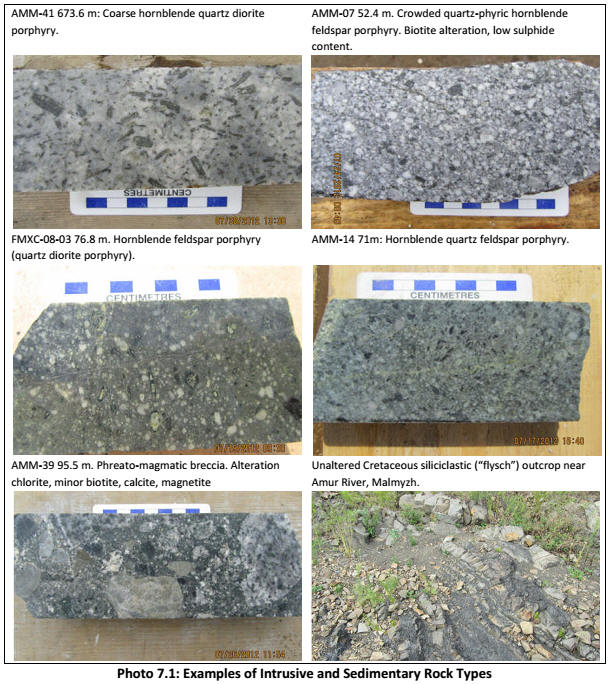
The following intrusive phases have been proposed by Westra (2012), from oldest to youngest:
| 1. |
Fine crystalline diorite as sills or dykes in hornfelsed sedimentary rocks. | |
| 2. |
Fine crystalline, crowded feldspar porphyry with rare hornblende phenocrysts. | |
| 3. |
Fine to medium crystalline “packed” hornblende plagioclase porphyry with high phenocryst- to-groundmass ratio. | |
| 4. |
Fine to medium crystalline hornblende plagioclase porphyry with rare small quartz phenocrysts. | |
| 5. |
Hornblende quartz feldspar porphyry similar to 4), but with larger well defined, rounded and resorbed quartz phenocrysts. |
| ZT 61-1442/MM998 | Final V1.0 | Page 33 |
| Report Date: July 10, 2015 |
| EURASIAN MINERALS INC AND IG COPPER LLC | |
| NI 43-101 TECHNICAL REPORT ON THE INITIAL MINERAL RESOURCE ESTIMATE FOR | |
| THE MALMYZH COPPER-GOLD PROJECT, KHABAROVSK KRAI, RUSSIAN FEDERATION |
| 6. |
Plagioclase porphyry with a granular groundmass that contains plagioclase and small biotite phenocrysts. Forms some late stage dykes. | |
| 7. |
Coarse hornblende-plagioclase porphyry. Poorly mineralised late to post-mineral intrusive. |
Some of the intrusives are associated with phreato-magmatic breccias, for example at Freedom, Bikha and ABV. Extensive hybridisation and contact brecciation occurs at Valley, Central and Bikha.
| 7.3.3 | Structure |
The lack of outcrop precludes a clear understanding of the property's detailed structural architecture, but the prevailing interpretation is of an overall east-northeast to northeast district-scale structural fabric. The Russian geologic maps also portray a predominance of northeast trending dykes, alteration zones, magnetic lineaments, and soil geochemistry anomalies. This broad corridor of structural preparation has been termed the "Malmyzh fault zone" by Russian workers.
A subsidiary set of northwest oriented faults has been inferred based on the trend of drainages along assumed zones of weakness. It has been postulated that the intersection of the northwest faults with the predominant northeast structural fabric provided a localised control on the emplacement of the Malmyzh porphyry systems. Fault zones logged in drill core as rubble zones often post-date alteration and mineralisation, and their occurrence varies significantly between the various deposits and prospects on the property. The most clearly recognisable structural deformation occurs at Freedom, and is manifest as intense, late stage brittle fracturing and fault truncation of mineralisation.
Bedding within the siliciclastic rock units has been masked by alteration, but where apparent in drill core, the bedding planes strike east-northeast with dips that range from shallow to steep, suggesting east-northeast trending folds within the area. Locally, bedding attitudes can steepen near faults and at the contacts with intrusive units.
| 7.3.4 | Alteration |
| 7.3.4.1 |
Introduction |
The following is an outline of the porphyry alteration assemblages and features of the Malmyzh copper-gold porphyry systems as taken from Westra (2012a,b) and updated by J. Ashleman.
| 7.3.4.2 |
Potassic Alteration |
This type of alteration (Photo 7.2) occurs as an early hydrothermal biotite-magnetite stage and a more localised K-feldspar alteration stage which also includes abundant biotite.
| ZT 61-1442/MM998 | Final V1.0 | Page 34 |
| Report Date: July 10, 2015 |
| EURASIAN MINERALS INC AND IG COPPER LLC | |
| NI 43-101 TECHNICAL REPORT ON THE INITIAL MINERAL RESOURCE ESTIMATE FOR | |
| THE MALMYZH COPPER-GOLD PROJECT, KHABAROVSK KRAI, RUSSIAN FEDERATION |
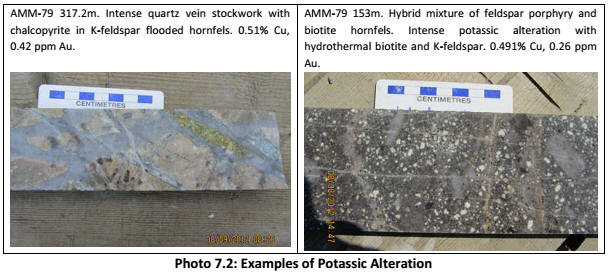
Potassic alteration in intrusive rocks is expressed as finely disseminated biotite and magnetite in the groundmass, as veinlets ± quartz, and as biotite-magnetite replacement of earlier mafic minerals. The intrusion of the porphyry stocks into the siliciclastic wall rocks developed contact alteration aureoles of early stage biotite hornfels. This early biotite alteration is commonly overprinted by K-feldspar alteration and local quartz vein stockwork development, particularly at Valley. Copper and gold mineralisation is commonly associated with potassic alteration.
| 7.3.4.3 |
Chlorite-Sericite Alteration |
This alteration facies occurs above and peripheral to, as well as overprinting the potassic alteration zone. It consists of chlorite, sericite and clays and may have associated magnetite and/or sulphides (Photo 7.3). It may be very intense and texture destructive, thereby masking earlier potassic alteration. Copper-gold mineralisation is commonly associated with chlorite-sericite alteration.
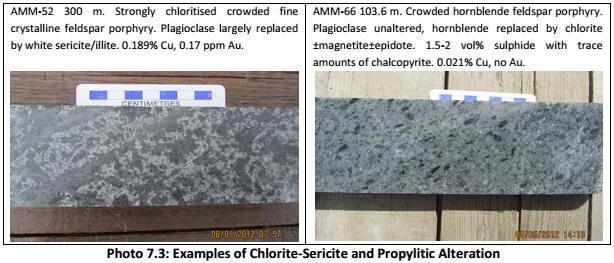
| ZT 61-1442/MM998 | Final V1.0 | Page 35 |
| Report Date: July 10, 2015 |
| EURASIAN MINERALS INC AND IG COPPER LLC | |
| NI 43-101 TECHNICAL REPORT ON THE INITIAL MINERAL RESOURCE ESTIMATE FOR | |
| THE MALMYZH COPPER-GOLD PROJECT, KHABAROVSK KRAI, RUSSIAN FEDERATION |
| 7.3.4.4 |
Propylitic Alteration (Chlorite-Epidote) |
This forms a peripheral alteration zone around the potassic zone, and occurs as chlorite, epidote, and variable magnetite (Photo 7.3). Total sulphide content is generally low and includes pyrite and minor chalcopyrite and/or sphalerite. Copper grades are typically low, except where it overprints earlier alteration zones.
| 7.3.4.5 |
Phyllic Alteration |
This type of alteration occurs as a quartz-sericite-pyrite assemblage with high pyrite and pyrite-to-chalcopyrite ratios (Photo 7.4). The alteration is typically texture destructive, and magmatic magnetite is mostly destroyed. Sulphides in outer phyllic halos largely occur as disseminations, whereas in the inner phyllic halos a network of pyritic veinlets cuts the rock. Phyllic alteration zones typically have lower grades of copper.
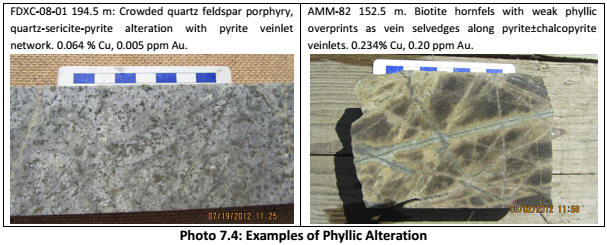
| 7.3.4.6 |
Quartz Veins |
These are common to abundant in several prospects, for example at Valley, Freedom, and Central (Photo 7.5). Several stages of quartz veining have been identified, including a) "A-type" quartz veins that form stockwork and sheeted vein zones, b) “B-type" veins that occur as coarse pyrite-sulphide veins that formed during the later stages of porphyry development, and c) “D-type” veins that occur in more peripheral zones of phyllic alteration.
| 7.3.4.7 |
Chlorite-rich Veinlets |
These are especially common at the Freedom prospect where they form high density sub-parallel vein and veinlet sets. Chlorite-rich veinlets are commonly associated with sulphide introduction, and can have significant chalcopyrite content.
| ZT 61-1442/MM998 | Final V1.0 | Page 36 |
| Report Date: July 10, 2015 |
| EURASIAN MINERALS INC AND IG COPPER LLC | |
| NI 43-101 TECHNICAL REPORT ON THE INITIAL MINERAL RESOURCE ESTIMATE FOR | |
| THE MALMYZH COPPER-GOLD PROJECT, KHABAROVSK KRAI, RUSSIAN FEDERATION |
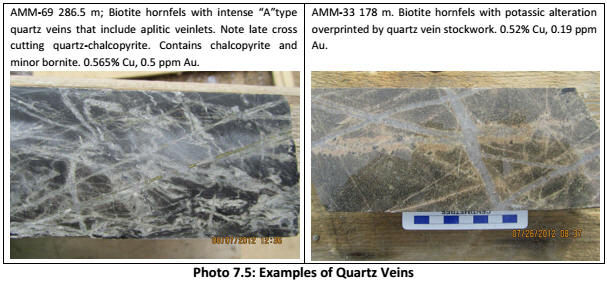
| 7.3.4.8 |
Magnetite |
Magnetite, which is abundant and widespread, was introduced early and occurs as diffuse magnetite replacement bands, or as early coarse quartz-magnetite veins and pure magnetite veinlets, as well as during potassic alteration. Magnetite is associated with copper mineralisation in the Central, Freedom and other target areas, but appears to be of lesser significance at Valley and Flats.
| 7.3.4.9 |
Gold:Copper Ratios |
Au:Cu ratios are generally constant within a given prospect, but vary between prospects. Higher gold contents and Au:Cu ratios occur at Freedom and Flats, and locally at Valley and Central. The highest ratios are often associated with potassic alteration of the porphyry systems.
| 7.3.4.10 |
Late Stage Alteration |
Late alteration stages are commonly hosted in zones of brittle fracturing. These fracture zones often contain coarse white calcite and pink or peach-coloured zeolite veins (Photo 7.6). A late alteration phase is associated with polymetallic epithermal veins that consist of quartz, abundant pyrite and sphalerite, and lesser amounts of galena and rarely sulphosalts. Both gold-copper-zinc-lead and gold-only vein/shear zones have been observed.
| 7.3.4.11 |
Argillic Alteration |
Argillic alteration is a minor component, occurring primarily as supergene argillisation located within, and just below the oxidation zone.
| ZT 61-1442/MM998 | Final V1.0 | Page 37 |
| Report Date: July 10, 2015 |
| EURASIAN MINERALS INC AND IG COPPER LLC | |
| NI 43-101 TECHNICAL REPORT ON THE INITIAL MINERAL RESOURCE ESTIMATE FOR | |
| THE MALMYZH COPPER-GOLD PROJECT, KHABAROVSK KRAI, RUSSIAN FEDERATION |
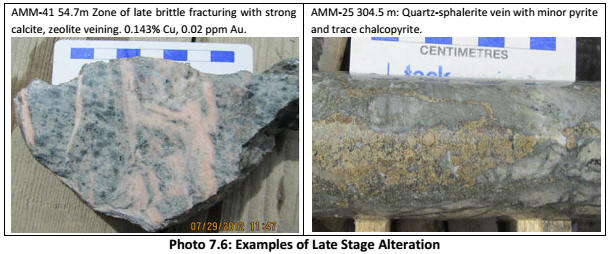
Advanced argillic alteration has generally not been recognised within the drilled prospects. However, there may be a broad area of quartz-alunite in the southern part of the property just east of Bikha. Also, diaspore has also been reported from this area. This area is poorly explored, but could be a lithocap or deeper level advanced argillic alteration associated with an undiscovered porphyry system.
| 7.3.4.12 |
Alteration Discussion |
The alteration environment that most closely fits the assemblages at Malmyzh is proximal, deeper potassic alteration transitioning outboard to broad outer propylitic halos. Several features of the Malmyzh alteration and geological setting suggest a relatively deep erosional level for the porphyry systems (Westra, 2012b):
| 1. |
A lack of co-magmatic or younger volcanics in the area. | |
| 2. |
A high temperature environment suggested by the hybrid biotite hornfels/intrusive contact zones and sediment assimilation. | |
| 3. |
Poorly developed phyllic alteration zones. | |
| 4. |
Preservation of magmatic plagioclase demonstrating a lack of argillic overprinting and suggesting a low permeability environment with little to no incursion of meteoric fluids until very late in the development of the hydrothermal systems. | |
| 5. |
Lack of advanced argillic alteration features. | |
| 6. |
Evidence of ductile deformation and presence of “A- type" quartz veining. |
According to Westra, the observed geologic and alteration features place the present-day erosional level at Malmyzh at over 3 km below the paleosurface. However, the relatively unexplored southern portion of the license with deeper overburden, and evidence of advanced argillic alteration (i.e., east of Bikha), may host higher level mineralisation representing the upper parts of a porphyry system.
| ZT 61-1442/MM998 | Final V1.0 | Page 38 |
| Report Date: July 10, 2015 |
| EURASIAN MINERALS INC AND IG COPPER LLC | |
| NI 43-101 TECHNICAL REPORT ON THE INITIAL MINERAL RESOURCE ESTIMATE FOR | |
| THE MALMYZH COPPER-GOLD PROJECT, KHABAROVSK KRAI, RUSSIAN FEDERATION |
| 7.4 |
Mineralisation |
| 7.4.1 |
General |
The Malmyzh Project hosts 14 porphyry copper-gold deposits, prospects, and targets within a district-scale area 16 by 5 km corridor (Figure 7.4). Most of the exploration work has focused on the Valley, Freedom, Central, and Flats deposits. However, exploration potential remains at the other prospects and targets, as well as undrilled areas with deeper overburden cover.
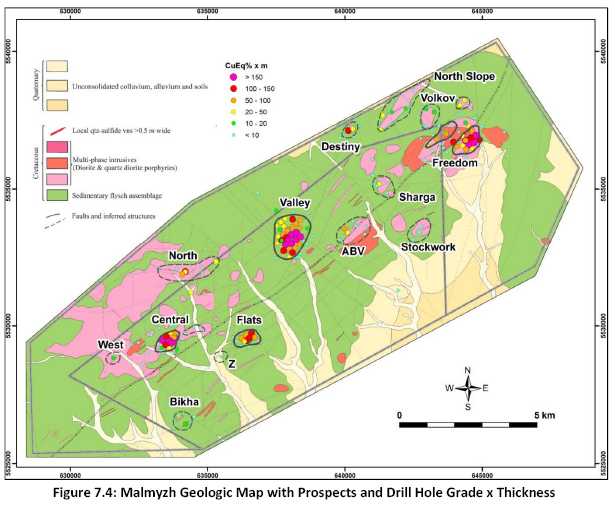
The multiple alteration and copper-gold mineralisation centres at Malmyzh are hosted by composite porphyritic stocks and adjacent hornfels altered sandstone and siltstone sedimentary sequences. Higher grades of mineralisation are often associated with potassic alteration, and biotite+magnetite are the dominate alteration minerals associated with the main stage of mineralisation. Mineralisation is also associated with the chlorite-sericite alteration, particularly in areas where there is an overprint of potassic alteration. Stockworks and veinlet networks locally control mineralisation. The potassic zones grade up into, or are overprinted by chlorite-sericite alteration and flanked by and locally overprinted by propylitic alteration zones.
| ZT 61-1442/MM998 | Final V1.0 | Page 39 |
| Report Date: July 10, 2015 |
| EURASIAN MINERALS INC AND IG COPPER LLC | |
| NI 43-101 TECHNICAL REPORT ON THE INITIAL MINERAL RESOURCE ESTIMATE FOR | |
| THE MALMYZH COPPER-GOLD PROJECT, KHABAROVSK KRAI, RUSSIAN FEDERATION |
Chalcopyrite and subordinate bornite are the principal copper species. Covellite, chalcocite, and digenite have been noted in local zones of enrichment, and malachite and copper wad locally occur in the oxidised zones. The phyllic zones encountered to date tend to be moderate to small in extent as is characteristic of copper-gold porphyry systems. In general, the oxide zone is fairly shallow and with the low pyrite content large supergene enrichment blankets have not been developed.
An interpretation of the development of porphyry copper-gold mineralisation at Malmyzh is as follows:
| 1. |
Intrusion of quartz diorite porphyry magmas with formation of a biotite hornfels contact aureole, formation of intrusion breccias and zones of assimilation, intrusion of small aplitic dykes and K-feldspar introduction in the hornfels zone. | |
| 2. |
Crystallisation of the magma with generation of magmatic hydrothermal fluids and early replacement of hornblende phenocrysts by biotite, as well as formation of quartz, quartz- magnetite and magnetite veins with minor chalcopyrite. | |
| 3. |
Early magmatic hydrothermal stage of potassic alteration dominated by biotite with K- feldspar largely confined to the hornfels aureole, local development of quartz vein stockworks with chalcopyrite-bornite mineralisation, but little pyrite. | |
| 4. |
Mineralisation stage with formation of complex veinlets with quartz-chlorite-sericite-clay- pyrite and chalcopyrite. | |
| 5. |
A later mineralisation stage with high total sulphide content (mainly pyrite) and varying volumes of vein quartz and associated sericite. | |
| 6. |
Sphalerite with minor galena, chalcopyrite, rare sulphosalts and abundant pyrite in epithermal quartz-carbonate veins and broad zones of clay-carbonate-Fe alteration. | |
| 7. |
Post-mineral calcite, anhydrite and zeolite veinlets. | |
| 8. |
Latest calcite fracture coatings. | |
| 9. |
Supergene gypsum veinlets. |
These generalised stages are variously developed in the different prospects, For example, at Valley the main stage of mineralisation is associated with potassic alteration. On the other hand, at Freedom later chloritic alteration is very strongly developed and is the main mineralisation stage.
The following sections provide a brief outline of the Malmyzh copper-gold mineralised deposits, prospects, and targets. Further discussion on mineralisation is given in Sections 9 (Exploration) and 10 (Drilling) of this report.
| 7.4.2 | Valley Deposit |
Valley is a 1,600 by 1,100 m deposit hosted in diorite porphyries and hornfelsed sedimentary rocks. Valley is the most well developed porphyry system at Malmyzh, with a shallow zone of intense biotite-rich and biotite-K-feldspar potassic alteration (> 0.3 -0.5% Cu, > 0.2 -0.3 g/t Au) and mineralisation occurring as chalcopyrite and local bornite (Photo 7.7). There are peripheral phyllic and propylitic zones (> 0.1 % Cu, > 0.05 g/t Au) with high total sulphide content and pyrite:chalcopyrite ratios. The deposit is distinguished by elevated copper-gold grades in extensive zones of assimilation and hybridisation at the intrusive-wall rock contact accompanied by the development of intense quartz vein stockworking in the hornfels. Mineralisation remains open to depth.
| ZT 61-1442/MM998 | Final V1.0 | Page 40 |
| Report Date: July 10, 2015 |
| EURASIAN MINERALS INC AND IG COPPER LLC | |
| NI 43-101 TECHNICAL REPORT ON THE INITIAL MINERAL RESOURCE ESTIMATE FOR | |
| THE MALMYZH COPPER-GOLD PROJECT, KHABAROVSK KRAI, RUSSIAN FEDERATION |
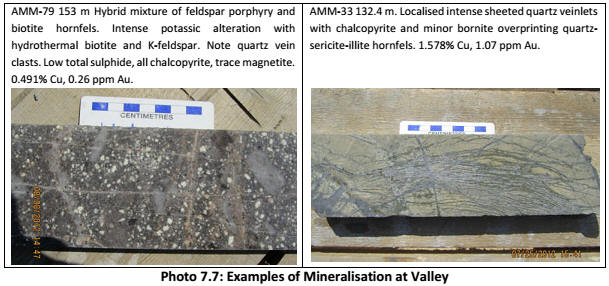
| 7.4.3 | Central Deposit |
Central copper-gold mineralisation is principally hosted in a N50°E striking 900 by 450 m zone of a potassically altered and chlorite-sericite overprinted composite porphyry of dioritic to quartz dioritic composition that dips steeply to the northwest.
The down-dip projection of mineralisation extends to over 600 m, and remains open at depth. Mineralisation also occurs in the footwall of hornfelsed fine-grained siliciclastic wall rocks.
The mineralisation at Central is characterised by low Au:Cu ratios. There is a higher grade (> 0.3 -0.5% Cu, > 0.1 -0.2 g/t Au) mineralisation in a northeast aligned potassically altered core to the porphyry system. This zone projects to depth, and includes a thick steeply dipping laminated quartz-feldspar zone with UST textures (AMM-41), abundant chalcopyrite and bornite, and high copper-gold grades (> 1% Cu, > 0.3 -1.0 g/t Au).
Examples of mineralisation are shown in Photo 7.8 below.
| ZT 61-1442/MM998 | Final V1.0 | Page 41 |
| Report Date: July 10, 2015 |
| EURASIAN MINERALS INC AND IG COPPER LLC | |
| NI 43-101 TECHNICAL REPORT ON THE INITIAL MINERAL RESOURCE ESTIMATE FOR | |
| THE MALMYZH COPPER-GOLD PROJECT, KHABAROVSK KRAI, RUSSIAN FEDERATION |
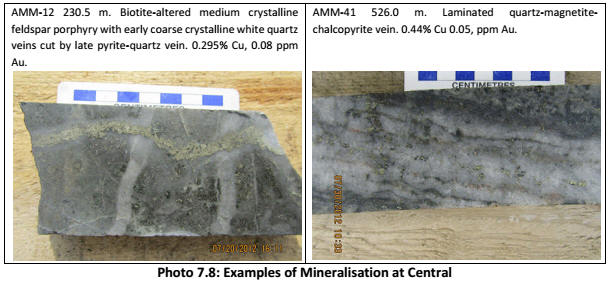
| 7.4.4 | Freedom Deposit |
Freedom's two northeast-trending zones are hosted in a complex assemblage of diorite porphyries, multi-stage breccias, and hornfels, and have lateral dimensions of 1000 by 600 m (Southeast deposit) and 1,200 by 300 m (Northwest prospect). Freedom has an early biotite-magnetite potassic alteration stage with weakly mineralised quartz and magnetite veins. Significant copper-gold mineralisation is hosted in a strong chlorite-rich alteration assemblage with the more intense alteration accompanied by steeply dipping, high-density sets of parallel quartz veins with higher grade copper-gold (> 0.4 -0.5% Cu, > 0.3 -0.5 g/t Au). The mineralisation has high Au:Cu ratios. Post mineral faulting and fracturing has affected much of the Freedom area. Examples of mineralisation from Freedom are shown in Photo 7.9.
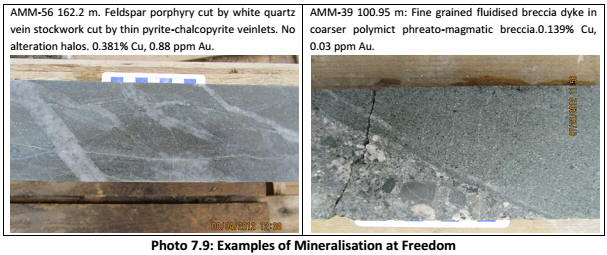
| 7.4.5 | Flats Deposit |
The Flats prospect is 800 by 500 m in dimension, with mineralisation hosted by potassically altered hornblende feldspar porphyry with adjacent hornfels altered sandstones. The potassic alteration is characterised by biotite and magnetite with subordinate K-feldspar, and relatively high Au:Cu ratios (Cu > 0.1 -0.4%, Au > 0.1 -0.4 g/t), with higher-grade gold intercepts intersected at the intrusive-hornfels contact. Copper-gold mineralisation remains open to depth.
| ZT 61-1442/MM998 | Final V1.0 | Page 42 |
| Report Date: July 10, 2015 |
| EURASIAN MINERALS INC AND IG COPPER LLC | |
| NI 43-101 TECHNICAL REPORT ON THE INITIAL MINERAL RESOURCE ESTIMATE FOR | |
| THE MALMYZH COPPER-GOLD PROJECT, KHABAROVSK KRAI, RUSSIAN FEDERATION |
| 7.4.6 | Other Prospects |
| 7.4.6.1 | Bikha |
Bikha mineralisation is hosted in diorite porphyry and granodiorite porphyry plugs and dykes, as well as hornfels. The alteration and mineralisation characteristics are compatible with a high temperature contact metasomatic/hydrothermal environment, with low level copper (> 0.1 -0.3%), variable gold grades (> 0.05 -0.4 g/t), and relatively high Au:Cu ratios.
| 7.4.6.2 |
North |
The North comprises an area of 2.5 (east-west) by 1.5 km (north-south) over a strong, east-west trending magnetic anomaly. Copper-in-soil values in excess of 50 ppm define a large anomaly that coincides with the main magnetic anomaly and extends beyond it. Gold-in-soil values define strong discrete anomalies with values ranging from < 5 to 100 ppb. The North system has a unique clay-calcite-Fe-carbonate overprint with associated sphalerite, galena and arsenic geochemistry. Copper mineralisation is hosted in diorites and diorite porphyries.
| 7.4.6.3 |
ABV |
The ABV prospect is a 1,500 (northeast) x 1,100 m (northwest) magnetic anomaly with anomalous copper and gold soil geochemistry. The zone of copper mineralisation at the hornfels-porphyry contact ranges from > 0.1 -0.5%, with gold > 0.05 -0.1 g/t.
| 7.4.6.4 |
Destiny |
The Destiny prospect consists of a 500 by 500 m magnetic anomaly with weak copper and gold soil anomalies over a small diorite porphyry stock. Mineralisation occurs in a chalcopyrite-bornite-quartz-magnetite assemblage. Thick and relatively higher grade copper and gold mineralised intervals with high Au:Cu ratios have been noted.
| 7.4.6.5 |
Sharga |
The Sharga prospect is along the western edge of a magnetic anomaly over a small quartz diorite porphyry stock. The area is highlighted by a weak copper-in-soil anomaly. The intrusive is weakly mineralised in copper and gold.
| ZT 61-1442/MM998 | Final V1.0 | Page 43 |
| Report Date: July 10, 2015 |
| EURASIAN MINERALS INC AND IG COPPER LLC | |
| NI 43-101 TECHNICAL REPORT ON THE INITIAL MINERAL RESOURCE ESTIMATE FOR | |
| THE MALMYZH COPPER-GOLD PROJECT, KHABAROVSK KRAI, RUSSIAN FEDERATION |
| 7.4.6.6 |
Stockwork |
The Stockwork prospect is centred on a weak magnetic anomaly and localised gold-in-soil anomaly, over a porphyry intrusive with a northeast axis of ~ 500 m, and width of ~ 200 m. As currently understood, the copper-gold mineralisation (0.1 -0.3% Cu, 0.05 -0.2 g/t Au) is open to the southeast.
| 7.4.6.7 |
North Slope |
North Slope is located along a northeast-trending magnetic high that parallels, and is similar in size and magnitude, as Freedom Northwest. The geology is interpreted as a northeast trending intrusive about 2,700 m long and up to 500 m wide, consisting of diorite porphyry with smaller bodies of granodiorite and diorite porphyry breccias. Copper and gold mineralisation is generally sporadic and weak.
| 7.4.6.8 |
Volkov |
The Volkov prospect (also known as Volker) area covers two strong magnetic anomalies northwest of Freedom. The geology is interpreted as fault bounded blocks of diorite porphyry. The copper mineralisation is modest (> 0.1 -0.3%) with gold grades > 0.1 g/t.
| 7.4.6.9 |
West |
The West target is southwest of the Central area with copper mineralisation associated with late stage breccias.
| 7.4.6.10 |
Z |
The Z target is a magnetic anomaly that was tested with one hole which had two low-grade intercepts in sandstone hornfels. There is over 50 m of overburden that could explain the lack of soil geochemical anomalies.
| ZT 61-1442/MM998 | Final V1.0 | Page 44 |
| Report Date: July 10, 2015 |
| EURASIAN MINERALS INC AND IG COPPER LLC | |
| NI 43-101 TECHNICAL REPORT ON THE INITIAL MINERAL RESOURCE ESTIMATE FOR | |
| THE MALMYZH COPPER-GOLD PROJECT, KHABAROVSK KRAI, RUSSIAN FEDERATION |
| 8 |
DEPOSIT TYPES |
The Malmyzh district hosts multiple copper-gold porphyry centres within a regional scale setting of arc terrane tectonism and magmatism. The Project's 14 porphyry deposits, prospects, and targets occur in a 16 by 5 km intrusive corridor, with copper and gold mineralisation hosted by composite diorite porphyry stocks and adjacent hornfels-altered sandstone and siltstone rock sequences; this typifies the description of the porphyry copper-gold deposit type given by Sillitoe (2010). Figure 8.1 shows a schematic porphyry system cross-section.
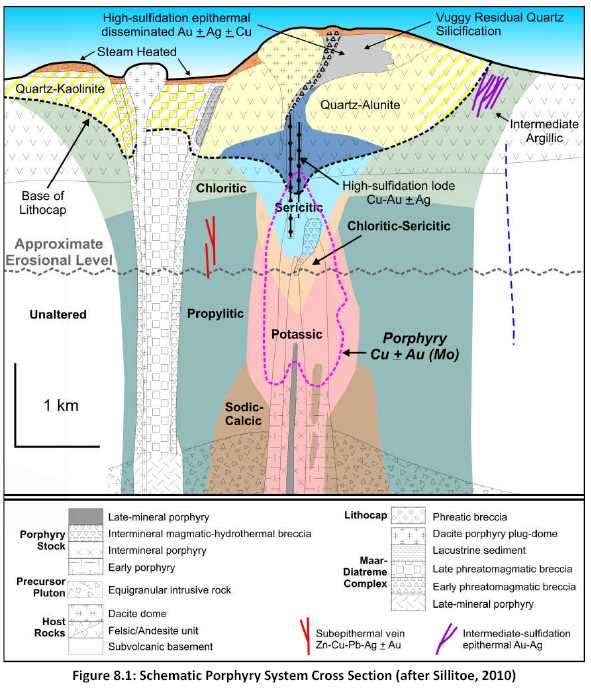
| ZT 61-1442/MM998 | Final V1.0 | Page 45 |
| Report Date: July 10, 2015 |
| EURASIAN MINERALS INC AND IG COPPER LLC | |
| NI 43-101 TECHNICAL REPORT ON THE INITIAL MINERAL RESOURCE ESTIMATE FOR | |
| THE MALMYZH COPPER-GOLD PROJECT, KHABAROVSK KRAI, RUSSIAN FEDERATION |
At Malmyzh, potassic alteration with biotite+magnetite is associated with the main stage of copper-gold mineralisation; secondary potassium feldspar is also sometimes present. The potassic alteration zones transition up into, or are overprinted by, chlorite-sericite alteration, which in turn is flanked by, or locally overprinted by propylitic alteration. Local areas have phyllic alteration and late stage D-veins (sericite+ quartz+pyrite).
Chalcopyrite and subordinate bornite are the principal copper phases observed at Malmyzh. Covellite, chalcocite, digenite, and copper wad have been noted in supergene enriched transition zones, and malachite and copper wad locally occur in the oxide zones. Pyrite content tends to be low within the porphyry systems, and the pyritic phyllic zones tend to be limited in extent, as is characteristic of copper-gold porphyry systems. In general the oxide zone is fairly shallow, and with the low overall pyrite content appears to preclude the development of large supergene enrichment blankets.
Westra (2012b) suggested that the porphyry systems at Malmyzh have been eroded to over 3 km depth below the paleosurface (see "approximate erosional level" in Figure 8.1). At this erosional depth the lithocap and associated mineralisation would have been removed from the stratigraphic section.
However, the high-sulphidation minerals alunite and diaspore have reportedly been noted from rock float in the poorly explored southern part of the license east of the Bikha prospect. This occurrence may represent the upper levels of a porphyry system as a down-faulted block that has not been as deeply eroded.
| ZT 61-1442/MM998 | Final V1.0 | Page 46 |
| Report Date: July 10, 2015 |
| EURASIAN MINERALS INC AND IG COPPER LLC | |
| NI 43-101 TECHNICAL REPORT ON THE INITIAL MINERAL RESOURCE ESTIMATE FOR | |
| THE MALMYZH COPPER-GOLD PROJECT, KHABAROVSK KRAI, RUSSIAN FEDERATION |
| 9 |
EXPLORATION |
| 9.1 |
Introduction |
Surface exploration at Malmyzh, other than geologic mapping discussed in Section 7.0 of this report, has included soil, “deep” soil, and rock float sampling geochemical programmes, and ground magnetic geophysical surveys. As the Project is covered by varying thicknesses of unconsolidated Quaternary overburden, the identification of concealed porphyry systems for drill follow-up relied almost exclusively on soil geochemical and magnetic anomalies. These indirect exploration techniques have been remarkably successful in delineating 14 separate target areas that have yielded copper-gold mineralisation and porphyry or porphyry related alteration over a 16 by 5 km area.
As described in Section 6.0 of this report Phelps Dodge/FMEC conducted all Malmyzh exploration activities from the start of the Project in 2006 to the spring of 2009. From the autumn of 2009 to late 2010, the Joint Venture's field activities were under the direction of Fortress, and subsequently from late 2010 to the present, the Malmyzh Joint Venture's exploration work has been operated and managed by IGC.
The Fortress and IGC programmes have been managed by Thomas E. Bowens and James C. Ashleman, and senior FMEC management has been consulted during the course of exploration from Project inception. This continuity of the Project's management has ensured that the exploration protocols and procedures have remained consistent over time. Accordingly, the results detailed here represent the combined results of exploration from 2006-present (see Section 6.2. for details of historical 2006-2010 exploration results).
| 9.2 |
Soil Geochemistry |
Approximately 5,300 soil samples have been collected along 500 line kilometers on a variety of grids with various sample densities (Figure 9.1). Soil surveys were conducted on the initial Malmyzh license (HAB 0218) from 2006-2008 on northwest oriented 200 by 100 m grids, with some areas covered by 100 by 50 m grids. These soil surveys resulted in 3,438 samples being collected, sieved to -60 mesh, and assayed. Soil surveys were conducted on the new Malmyzh North license (HAB 02334) in 2010 and 2011 on 400 by 100 m and 200 by 100 m grids, resulting in 1,856 samples being collected and assayed. The protocol was to collect the soil samples from the B horizon. Samples were sieved to -20 mesh in 2010 and to -80 mesh in 2011. Duplicate soil lines of the earlier soil surveys yielded similar results, and provided confidence in merging the results of the various programmes.
The sieved soil fractions were pulverised by the analytical laboratory and gold was fire assayed and a multi-element package was analysed utilising aqua regia digestion and ICP techniques. The majority (~92%) of the 2006-2008 soils were analysed by Alex Stewart Labs of Moscow, except for the 201 sample grid over the ABV prospect that was analysed by Dal Geophysical of Khabarovsk.
| ZT 61-1442/MM998 | Final V1.0 | Page 47 |
| Report Date: July 10, 2015 |
| EURASIAN MINERALS INC AND IG COPPER LLC | |
| NI 43-101 TECHNICAL REPORT ON THE INITIAL MINERAL RESOURCE ESTIMATE FOR | |
| THE MALMYZH COPPER-GOLD PROJECT, KHABAROVSK KRAI, RUSSIAN FEDERATION |
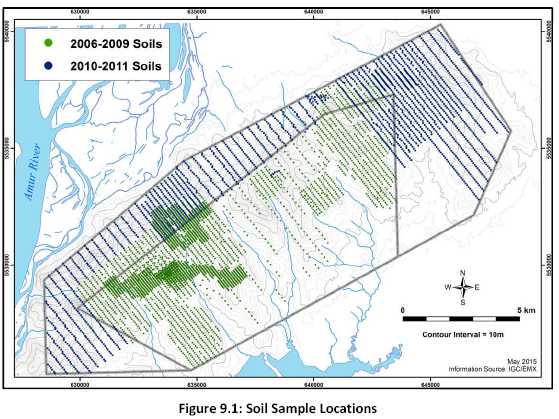
The 2010-2011 soil samples were analysed by Irgiredmet Labs of Irkutsk. The various laboratories had trace element packages with different detection limits and elemental suites, so caution was exercised when merging soil geochemical data other than the gold fire assays.
As soil depths on the property can range from less than a metre to over 50 m, the geochemical anomalies have been attenuated as a function of cover. Further, post-mineral alluvial sediments cover some areas of the Project. In general, areas with more than 15-20 m of cover rendered the surface soil geochemistry fairly ineffective (Figure 9.2).
However, the soil geochemistry has been a useful exploration tool in evaluating the property for concealed porphyry copper-gold systems with shallow cover. In particular, gold, copper, molybdenum and zinc soil geochemistry has been particularly effective for targeting, especially when the areas of deep cover have been masked from the sample population (Figure 9.3).
| ZT 61-1442/MM998 | Final V1.0 | Page 48 |
| Report Date: July 10, 2015 |
| EURASIAN MINERALS INC AND IG COPPER LLC | |
| NI 43-101 TECHNICAL REPORT ON THE INITIAL MINERAL RESOURCE ESTIMATE FOR | |
| THE MALMYZH COPPER-GOLD PROJECT, KHABAROVSK KRAI, RUSSIAN FEDERATION |
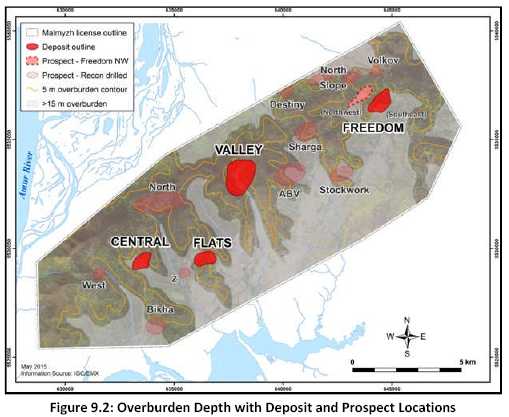
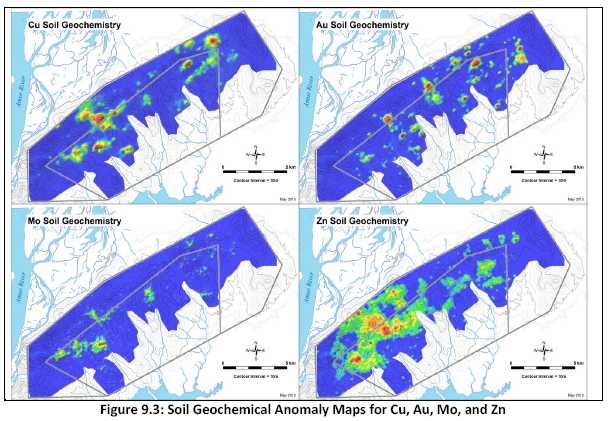
| ZT 61-1442/MM998 | Final V1.0 | Page 49 |
| Report Date: July 10, 2015 |
| EURASIAN MINERALS INC AND IG COPPER LLC | |
| NI 43-101 TECHNICAL REPORT ON THE INITIAL MINERAL RESOURCE ESTIMATE FOR | |
| THE MALMYZH COPPER-GOLD PROJECT, KHABAROVSK KRAI, RUSSIAN FEDERATION |
In summary, the characteristics of the soil geochemical anomalies include:
| • |
Gold was the most useful element for targeting, with all of the principal prospects having an associated anomaly. Gold-in-soil values were low, with the median value less than 5 ppb Au, and only in rare cases exceeding 100 ppb. Coherent gold anomalies of >10 ppb were significant, and often indicative of an underlying porphyry system. | |
| • |
Copper values ranged from < 2 ppm to > 2000 ppm, with a median value of ~20 ppm. However, copper is mobile in the weathering environment, and often yielded transported anomalies in areas that did not host significant porphyry mineralisation, or conversely was weak to non-existent over some of the principal porphyry prospects. | |
| • |
Molybdenum values are low in the mineralised systems at Malmyzh, and Mo values from the soil samples had a median of ≤2ppm Mo (the detection limit), and up to 12 ppm. A relatively strong molybdenum anomaly is associated with Central, and weak anomalies occur at Valley and in the Freedom area. | |
| • |
Zinc, as a distal pathfinder for porphyry systems, forms anomaly halos around Central, Valley and North, and is diffuse around Freedom. The Central and Valley zinc anomaly halos are incomplete due to deeper soil and post-mineral cover to the southeast. |
The geochemistry was most effective for targeting when integrated with the ground magnetics data (discussed in Section 9.4).
| 9.3 | Deep Soil Geochemical Sampling |
| 9.3.1 | Introduction |
In order to overcome the masking effect of the deep overburden covering most of the property, various methods were tried to obtain deeper, more representative samples, including digging pits with a backhoe, power augering, and core drilling overburden to the top-of-bedrock (deep mapping).
| 9.3.2 | Backhoe Soil Pit Sampling Orientation |
A limited programme of excavating pits > 2 m depth with a backhoe was conducted during the summer of 2012. Orientation lines were sampled in two areas: a) 20 pits at 50 m spacing were excavated north of Valley, and b) 40 pits at 50 m spacing were excavated at the Destiny prospect. These programmes yielded insignificant increases in the gold results when compared to soil samples, and were subsequently discontinued.
| 9.3.3 | Auger Soil Geochemical Sampling |
A soil auger programme was conducted during the winters of 2012-2013 and 2013-2014 to obtain deeper, more representative soil samples, and also to help satisfy a Russian requirement for trenching. A backhoe was outfitted with an auger capable of sampling to 8 m depth. A total of 406 holes was augured and sampled on 100 by 200 m grids in the Freedom and Valley areas (Figure 9.4 and Figure 9.5).
| ZT 61-1442/MM998 | Final V1.0 | Page 50 |
| Report Date: July 10, 2015 |
| EURASIAN MINERALS INC AND IG COPPER LLC | |
| NI 43-101 TECHNICAL REPORT ON THE INITIAL MINERAL RESOURCE ESTIMATE FOR | |
| THE MALMYZH COPPER-GOLD PROJECT, KHABAROVSK KRAI, RUSSIAN FEDERATION |
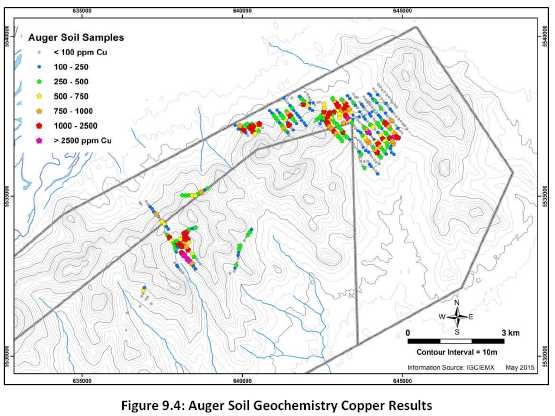
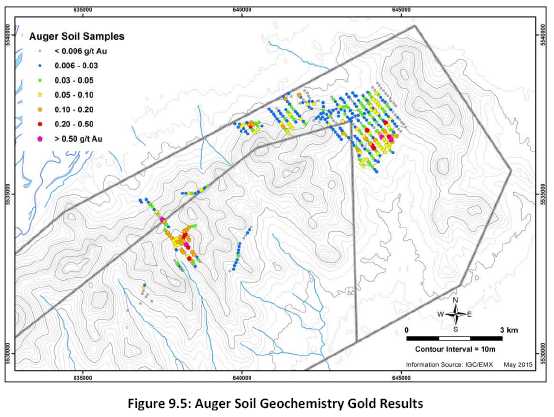
| ZT 61-1442/MM998 | Final V1.0 | Page 51 |
| Report Date: July 10, 2015 |
| EURASIAN MINERALS INC AND IG COPPER LLC | |
| NI 43-101 TECHNICAL REPORT ON THE INITIAL MINERAL RESOURCE ESTIMATE FOR | |
| THE MALMYZH COPPER-GOLD PROJECT, KHABAROVSK KRAI, RUSSIAN FEDERATION |
The deeper auger soil samples yielded significantly stronger gold anomalies when compared to the conventional shallow soil survey results over the two target areas. For example, Freedom which has deeper soil cover had a robust 50 to >500 ppb auger soil gold anomaly as compared to the 10-30 ppb anomaly resulting from the conventional soil samples. As these two target areas had undergone, or were undergoing significant resource drilling at the time, the auger soil samples have served more as an orientation study that illustrated the efficacy of this sampling technique.
| 9.3.4 | Deep Mapping |
A Longyear LF-70 diamond drill was mounted on tracks and utilised for deep mapping top-of-bedrock sampling programme in areas of thick overburden. The soil just above bedrock and the upper bedrock were sampled. The programme was started in June of 2013, but terminated in July as the drill was needed for resource drilling. An initial line of 35 holes at 50 m spacing was completed southwest of Valley and a second was started in the east Bikha area where 6 holes were drilled at 100 m spacing. Production rates were two to three holes a day depending on their depth and difficulty in getting water to the drill rig. This is a very effective exploration method, albeit more expensive than conventional geochemical sampling.
Regardless, the “deep mapping” method is recommended in the future for follow up of geologic trends and magnetic anomalies in the southern part of the license where overburden is deep.
| 9.4 |
Rock Geochemistry |
Surface rock geochemistry has not been a very useful tool for targeting at Malmyzh due to the lack of outcrop. However, float samples did provide some early indications of alteration and mineralisation in a given area, albeit transported to a greater or lesser extent. Approximately 650 grab samples of float have been collected during the various reconnaissance exploration and geologic mapping campaigns (Figure 9.6 and Figure 9.7).
| ZT 61-1442/MM998 | Final V1.0 | Page 52 |
| Report Date: July 10, 2015 |
| EURASIAN MINERALS INC AND IG COPPER LLC | |
| NI 43-101 TECHNICAL REPORT ON THE INITIAL MINERAL RESOURCE ESTIMATE FOR | |
| THE MALMYZH COPPER-GOLD PROJECT, KHABAROVSK KRAI, RUSSIAN FEDERATION |
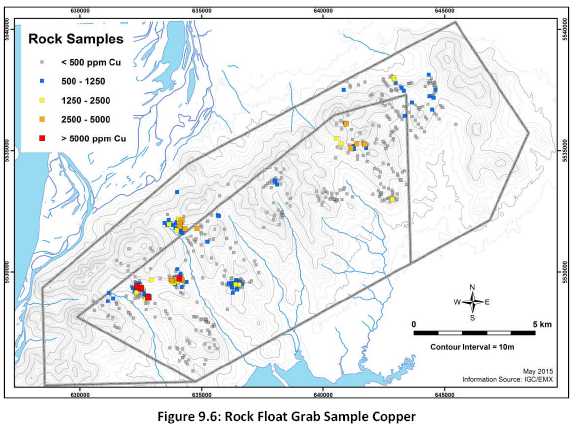
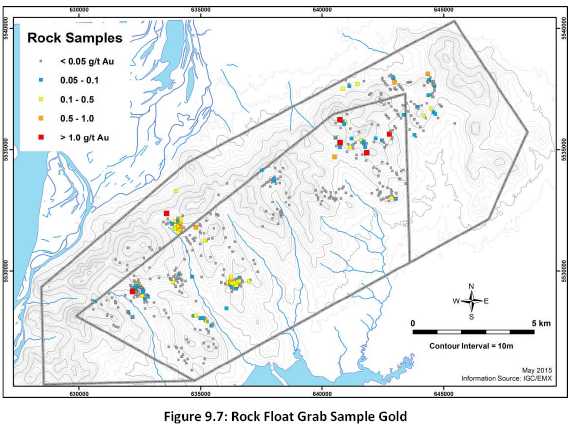
| ZT 61-1442/MM998 | Final V1.0 | Page 53 |
| Report Date: July 10, 2015 |
| EURASIAN MINERALS INC AND IG COPPER LLC | |
| NI 43-101 TECHNICAL REPORT ON THE INITIAL MINERAL RESOURCE ESTIMATE FOR | |
| THE MALMYZH COPPER-GOLD PROJECT, KHABAROVSK KRAI, RUSSIAN FEDERATION |
| 9.5 |
Ground Magnetic Survey |
The Malmyzh licenses have been covered with a series of ground magnetic surveys conducted from 2007-2012. Approximately 1,000 line kilometers have been completed on either a 400 by 20 m grid, or more commonly on a 200 by x 20 m grid. Most of the surveys were conducted with a base station, and readings were corrected to the base. The base was also used for quality control; if irregular readings were noted, the lines were subsequently reacquired in the field to ensure the recording of representative magnetic readings before they were merged into the final database.
The magnetic survey results have been critical for concealed target identification at Malmyzh. Copper-gold porphyry systems tend to be formed from more oxidised magmas and have oxidised (i.e., lower sulphide) alteration systems. In addition to the intrusive rocks containing accessory magnetite, there is abundant secondary magnetite within the potassic alteration zones of the porphyry systems that yield a positive magnetic response. Further, the surrounding weakly or unaltered siliciclastic rocks have a low magnetic response, which accentuates the contrast with the porphyry centers.
Figure 9.8 shows the total magnetic field reduced to pole (RTP), with blue depicting low values (54450-54800 teslas) and red representing higher values (56000 - >60000 teslas). Note that the earlier magnetic survey results from FMEC and Fortress are illustrated in Section 6, and primarily covered the initial Malmyzh license. Many of the earlier magnetic survey lines have been re-acquired by IGC, resulting in the final merged magnetics database shown in Figure 9.8.
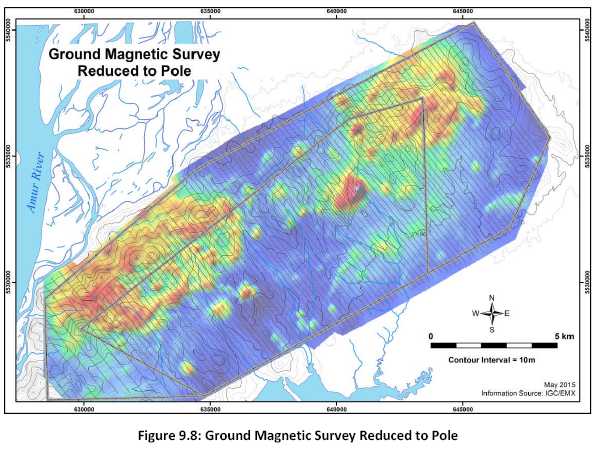
| ZT 61-1442/MM998 | Final V1.0 | Page 54 |
| Report Date: July 10, 2015 |
| EURASIAN MINERALS INC AND IG COPPER LLC | |
| NI 43-101 TECHNICAL REPORT ON THE INITIAL MINERAL RESOURCE ESTIMATE FOR | |
| THE MALMYZH COPPER-GOLD PROJECT, KHABAROVSK KRAI, RUSSIAN FEDERATION |
All of the mineralised prospect areas discovered to date at Malmyzh have some level of a positive magnetic response. However, the lower magnetic responses are also important in that not only can they result from areas underlain by clastic sedimentary rocks, but also can be due to attenuation by deep overburden. The latter point is especially important in light of the relatively unexplored southeastern area of the property.
| 9.6 |
Comments on Exploration |
Malmyzh surface exploration has identified fourteen copper-gold mineralised systems within a 15 by 5 km belt of diorite porphyry intrusives. There is virtually no outcrop on the property, and the porphyry centers are concealed by a cover of soil and alluvium ranging from one to over 50 m thick. A combination of soil geochemical (Au-Cu-Mo-Zn) and magnetic anomalies have been very effective in identifying the porphyry targets. In addition to traditional soil sampling techniques, the utilisation of top-of-bedrock drilling (i.e., "deep mapping") or power augering to collect more representative samples in areas of deeper cover show promise. In particular, exploration of the southern portion of the property with deeper cover would benefit from the utilisation of the deep mapping and auger techniques. Furthermore, in consideration of the ability of ground magnetic anomalies to successfully identify shallow porphyry targets, aeromagnetics, with an inherent ability to provide magnetic signatures of deeper features may be an effective tool for areas with thicker overburden cover.
| ZT 61-1442/MM998 | Final V1.0 | Page 55 |
| Report Date: July 10, 2015 |
| EURASIAN MINERALS INC AND IG COPPER LLC | |
| NI 43-101 TECHNICAL REPORT ON THE INITIAL MINERAL RESOURCE ESTIMATE FOR | |
| THE MALMYZH COPPER-GOLD PROJECT, KHABAROVSK KRAI, RUSSIAN FEDERATION |
| 10 |
DRILLING |
| 10.1 |
Introduction |
There have been six drill campaigns at Malmyzh, including Freeport's discovery holes in 2008, earn-in drilling initiated by Fortress in 2010 and completed by IGC in 2011, and a series of IGC drill programmes from 2012-2014 to assess the Project according to Russian Federation standards (Table 10.1 and Figure 10.1). All of the drilling has been HQ and NQ core, and totals 211 holes for 70,668 m. Most of the drilling has been conducted in the winter months to take advantage of easier access when the ground is frozen.
| Table 10.1: Drill Summary by Campaign | |||||
| Campaign | Holes Drilled | Number of
Holes |
Meters
Drilled |
Start Date | Finish Date |
| 2008 | FMXC-01-08 | 8 | 1,126.0 | 26-Oct-08 | 29-Dec-08 |
| 2010 | AMM-001-023 | 23 | 6,673.1 | 26-Dec-09 | 14-Apr-10 |
| 2011 | AMM-024-039 | 16 | 4,687.2 | 19-Nov-11 | 4-Apr-11 |
| 2012 | AMM-040-082 | 43 | 17,079.8 | 30-Sep-11 | 13-Apr-12 |
| 2013 | AMM-083-110 | 28 | 11,068.0 | 22-Oct-12 | 28-Mar-13 |
| 2014 | AMM-111-203 | 93 | 30,033.7 | 1-Jun-13 | 22-Feb-14 |
| Total | 211 | 70,667.8 | |||
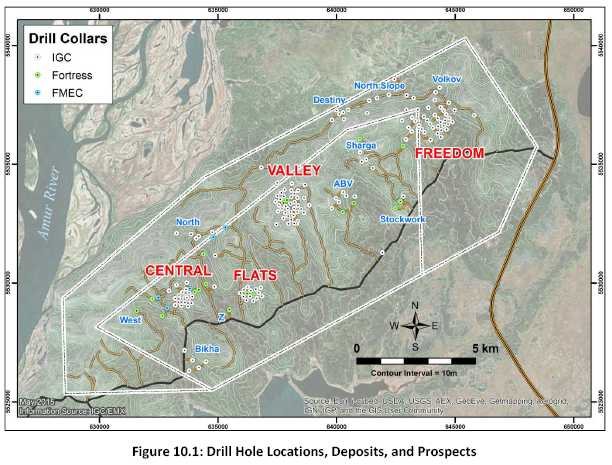
| ZT 61-1442/MM998 | Final V1.0 | Page 56 |
| Report Date: July 10, 2015 |
| EURASIAN MINERALS INC AND IG COPPER LLC | |
| NI 43-101 TECHNICAL REPORT ON THE INITIAL MINERAL RESOURCE ESTIMATE FOR | |
| THE MALMYZH COPPER-GOLD PROJECT, KHABAROVSK KRAI, RUSSIAN FEDERATION |
Due to the Project's extensive overburden cover, drilling has been a critical tool for exploration, in addition to deposit delineation. Fourteen concealed target areas identified by soil geochemistry, magnetic surveys and geologic mapping have been drill tested, with porphyry style alteration and mineralisation discovered at all of them (Table 10.2).
| Table 10.2: Drill Summary by Prospect | ||
| Prospect | Holes
Drilled |
Meters Drilled |
|
Main Prospects | ||
| Valley | 53 | 20557.8 |
| Freedom | 49 | 17481.7 |
| Central | 33 | 11631.7 |
| Flats | 18 | 5412.1 |
| Secondary Prospects | ||
| ABV | 9 | 2895.0 |
| Bikha | 7 | 2141.7 |
| Destiny | 6 | 1584.2 |
| North | 10 | 2982.8 |
| N Slope | 5 | 1232.9 |
| Stockwork | 5 | 887.5 |
| Sharga | 5 | 1275.6 |
| Other Targets | 11 | 2584.8 |
| Total | 211 | 70667.8 |
Four of the prospects, Valley, Central, Freedom Southeast, and Flats, were drilled systematically on 200 by 200 m grid patterns to delineate the copper-gold mineralisation in preparation for estimating C2 resources according to the Russian Federation's GKZ requirements. These drill grids were oriented N40°W, across the predominately northeast structural fabric of the district. Some infill drilling was completed at 100 by 200 m coverage to meet Russian requirements for C1 resources. The other prospects have undergone reconnaissance exploration drilling to confirm mineralisation identified from magnetic and geochemical anomalies.
Over half of the holes were drilled vertically and the majority of the angle holes drilled at an inclination of -60° along the azimuths of the drill fences. The total down-hole depth drilled averages ~330 m, with the deepest hole reaching 680.8 m at the Central deposit.
| 10.2 |
Drilling Contractors, Core Diameters and Recoveries |
The FMEC 2008 drill campaign was conducted by Russian contractor Componenta Trading. The Fortress and IGC managed campaigns were completed with Company owned rigs, which substantially decreased drilling expenses. Initially a single Longyear LF-90 drill rig was deployed during 2010-2011, and subsequently a second LF-90 was added during the 2012 drill campaign (Photo 10.1). A third rig, a track mounted Longyear LF-70, was added in 2013 to accelerate exploration and deposit drill-outs.
| ZT 61-1442/MM998 | Final V1.0 | Page 57 |
| Report Date: July 10, 2015 |
| EURASIAN MINERALS INC AND IG COPPER LLC | |
| NI 43-101 TECHNICAL REPORT ON THE INITIAL MINERAL RESOURCE ESTIMATE FOR | |
| THE MALMYZH COPPER-GOLD PROJECT, KHABAROVSK KRAI, RUSSIAN FEDERATION |
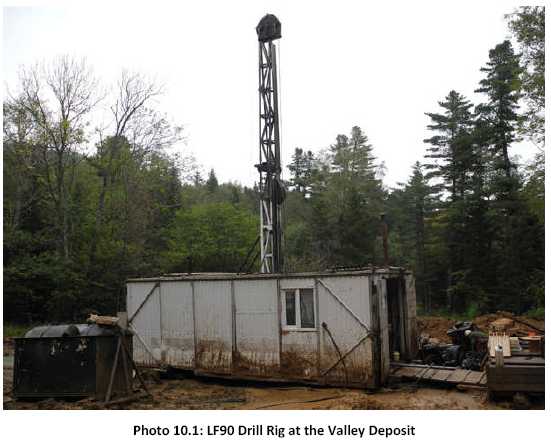
The initial drilling in 2008 was all NQ size core. In the 2010 campaign, 18% of the core was HQ; the holes were started in HQ to drill through overburden and oxide zones, then eventually reduced to NQ after the rock became competent. In the 2011 and 2012 drill campaigns, HQ was drilled to deeper depths accounting for 47% of the core. For the 2013 and 2014 drill campaigns, holes were drilled deeper with HQ (many are all HQ) to obtain larger sample sizes and better recoveries; 71% of the core was HQ diameter.
Core recovery has been excellent (Table 10.3), and averages 94% for all Project drilling. Lower recoveries were principally in overburden, with bedrock recoveries generally over 97%. On two holes, recovery was low in the upper part of the hole, so these holes were offset and the upper part re-drilled to maintain good overall recovery.
| Table 10.3: Drill Recoveries for 2010-2014 Drill Campaigns | |||||||
| 2010 | 2011 | 2012 | 2013 | 2014 | Total | ||
| HQ core | m | 1,196 | 2,217 | 8,091 | 7,830 | 21,283 | 40,616 |
| %HQ | 18 | 47 | 47 | 71 | 71 | 58 | |
| % recovery | 84 | 91 | 93 | 93 | 94 | 93 | |
| NQ core | m | 5,477 | 2,471 | 9,221 | 3,235 | 8,695 | 29,160 |
| %NQ | 82 | 53 | 53 | 29 | 29 | 42 | |
| % recovery | 97 | 97 | 97 | 97 | 96 | 96 | |
| Total | m | 6,673 | 4,688 | 17,311 | 11,066 | 29,978 | 69,776 |
| Overall | % recovery | 94% | 94% | 95% | 95% | 94% | 94% |
| ZT 61-1442/MM998 | Final V1.0 | Page 58 |
| Report Date: July 10, 2015 |
| EURASIAN MINERALS INC AND IG COPPER LLC | |
| NI 43-101 TECHNICAL REPORT ON THE INITIAL MINERAL RESOURCE ESTIMATE FOR | |
| THE MALMYZH COPPER-GOLD PROJECT, KHABAROVSK KRAI, RUSSIAN FEDERATION |
| 10.3 |
Drill Core Logging |
The initial, eight hole 2008 drilling campaign had an early logging format that was not as extensive and quantitative as was set up for subsequent campaigns.
For the 2010 through 2014 programmes (>98% of the drilling), a thorough and comprehensive core logging system was put in place. A quick log was done at camp on each hole as the core came in from the rig. A Niton (portable X-ray fluorescence spectrometer) was used during quick logging to assist with identification of mineralogy and estimate preliminary copper grades (Photo 10.2). Subsequently, detailed geologic and geotechnical logs were recorded for each drill hole (also Photo 10.2). The geologic core log was optimised for recording key features of a copper-gold porphyry system, and was in a format easily entered into the Project’s database.
Data from the paper log forms was entered into the Project database, cross checked, and then translated from Russian to English on site. Assay samples were marked by the logging geologist and are typically 2 m in length, but were locally reduced to adjust for lithologic, alteration or mineralisation contacts.
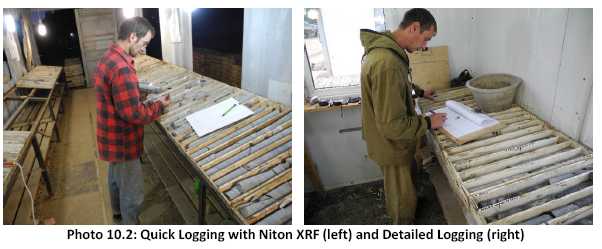
| 10.4 |
Drill Hole Collar and Down-Hole Surveys |
A handheld GPS was used to locate the 2008 reconnaissance holes, and starting in 2010 completed holes were surveyed using post processing differential GPS (Magellan ProMark 3). Five of the eight 2008 drill hole collars were later located and resurveyed with differential GPS (“DGPS”). Current practice is to mark all holes drilled with a wooden post cemented at the collar, and a DGPS survey of the collar locations is completed regularly during the drilling season (Photo 10.3).
| ZT 61-1442/MM998 | Final V1.0 | Page 59 |
| Report Date: July 10, 2015 |
| EURASIAN MINERALS INC AND IG COPPER LLC | |
| NI 43-101 TECHNICAL REPORT ON THE INITIAL MINERAL RESOURCE ESTIMATE FOR | |
| THE MALMYZH COPPER-GOLD PROJECT, KHABAROVSK KRAI, RUSSIAN FEDERATION |
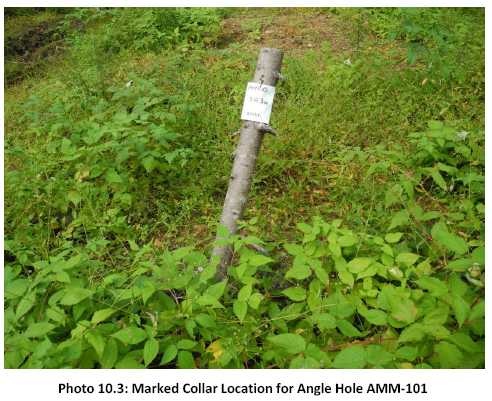
The survey control network was originally anchored on a point established in base camp by using over a hundred hours of averaged GPS readings. Two additional survey points were established from this control point using DGPS, one in the Freedom area and one at Central. All DGPS surveyed hole locations are tied to these control points. Hole locations are recorded in UTM Zone 53 east meters, WGS84 horizontal datum, and EGM96 vertical datum.
A component of the quality control programme for each round of DGPS surveying included resurveying earlier holes and comparing the results. The drill hole collar duplicate surveys have an average precision +-2 cm for horizontal coordinates and elevation, with maximum variances up to 10 cm. The horizontal and vertical differences are inconsequential, and result from minor inconsistencies in location measurement procedures in the field (i.e., which side of the drill hole marker the antenna shaft is placed for vertical holes, etc.). The accuracy and precision of the drill hole collar locations support work through the feasibility stage of project evaluation.
Down-hole surveys were completed for five of the eight holes drilled in 2008; the instrument type is unknown. For the 2010-2014 drill campaigns, a down-hole survey was conducted with readings taken every 20 m using a Reflex Easy Shot instrument. However, due to broken survey equipment, five holes do not have down-hole survey data.
An overall check of the down-hole surveys illustrates that even for deep holes the maximum deflection is generally only a few degrees and most holes have less than one degree of deflection. Thus, due to the relatively short hole lengths (40 to 300 m) and medium hole sizes, the holes without down-hole surveys are likely to have minimal deviations.
| ZT 61-1442/MM998 | Final V1.0 | Page 60 |
| Report Date: July 10, 2015 |
| EURASIAN MINERALS INC AND IG COPPER LLC | |
| NI 43-101 TECHNICAL REPORT ON THE INITIAL MINERAL RESOURCE ESTIMATE FOR | |
| THE MALMYZH COPPER-GOLD PROJECT, KHABAROVSK KRAI, RUSSIAN FEDERATION |
| 10.5 |
Drill Results |
The Malmyzh drill campaigns have outlined 14 concealed copper-gold porphyry systems (Figure 7.4). The Valley, Central, Freedom Southeast and Flats deposits have been systematically drilled for resource definition. Reconnaissance drilling at the other prospects has intersected porphyry alteration and copper-gold mineralisation. Note a) reported intercepts are approximate true widths in porphyry style mineralisation unless otherwise stated, b) CuEq% = Cu% + (0.5*Au g/t) (see Section 14.9.2.2), c) CuEq% grade*thickness (m) calculated at a 0.3% CuEq cut-off, and d) drill hole names with a prefix of "FMXC" were FMEC holes drilled in 2008.
| 10.5.1 | Valley Drill Results |
Valley is the largest deposit discovered to date as defined by 53 drill holes totaling 20,558 m. It is expressed as a bowl shaped topographic depression in the central part of the property and was discovered by drilling a weak soil anomaly and a weakly positive magnetic anomaly. The drilling has defined mineralisation over an area of ~1.6 by 1.1 km hosted in diorite porphyry and hornfelsed siliciclastic units (Figure 10.2 and Figure 10.3).
Valley has been drilled on a 200 x 200 m, N40oW oriented grid, with the central part of the grid covered by 2 or more holes from the 200 m grid points to achieve the equivalent of 200 m x 100 m coverage. Two holes were drilled along NE strike, to confirm continuity of the mineralised zone.
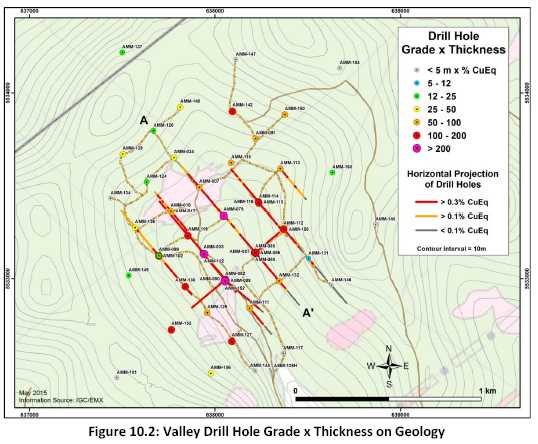
| ZT 61-1442/MM998 | Final V1.0 | Page 61 |
| Report Date: July 10, 2015 |
| EURASIAN MINERALS INC AND IG COPPER LLC | |
| NI 43-101 TECHNICAL REPORT ON THE INITIAL MINERAL RESOURCE ESTIMATE FOR | |
| THE MALMYZH COPPER-GOLD PROJECT, KHABAROVSK KRAI, RUSSIAN FEDERATION |
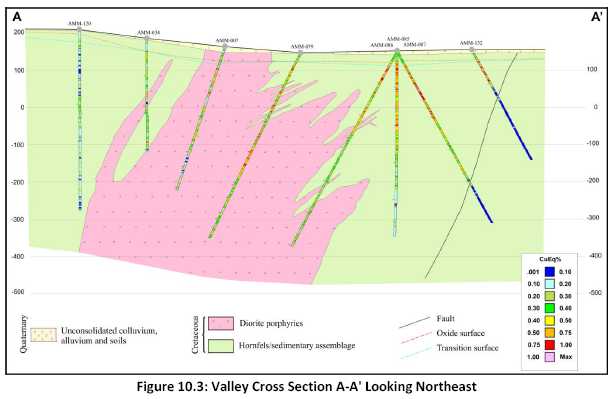
The area is covered by shallow to moderate overburden (2-20 m) and copper-gold mineralisation extends from the base of the oxide zone (20-40 m below the surface) to 300 to >500 m deep, and remains open at depth.
A northeast trending, steep northwest dipping fault limits mineralisation along the southeast side, but mineralisation gradually drops off along the other margins.
The higher grade copper-gold zones of the Valley system are hosted in shallow hornfels host rocks that occur from near-surface to depths of ~150 to 250 m. Copper-gold grades have also been locally enhanced with secondary enrichment. Table 10.4 lists selected intercepts from Valley drilling.
| ZT 61-1442/MM998 | Final V1.0 | Page 62 |
| Report Date: July 10, 2015 |
| EURASIAN MINERALS INC AND IG COPPER LLC | |
| NI 43-101 TECHNICAL REPORT ON THE INITIAL MINERAL RESOURCE ESTIMATE FOR | |
| THE MALMYZH COPPER-GOLD PROJECT, KHABAROVSK KRAI, RUSSIAN FEDERATION |
| Table 10.4: Valley Deposit Select Drill Intercepts | |||||||
| Hole | TD (m) | From (m) | To (m) | Width (m) | Cu % | Au g/t | CuEq % |
| AMM-033 | 337.9 | 39.4 | 315.6 | 276.2 | 0.39 | 0.13 | 0.45 |
| AMM-079 | 556 | 2.0 | 555.0 | 553.0 | 0.31 | 0.25 | 0.43 |
| AMM-082 | 404.8 | 46.0 | 403.0 | 357.0 | 0.45 | 0.21 | 0.55 |
| including | 217.0 | 298.0 | 81.0 | 0.53 | 0.31 | 0.68 | |
| AMM-085 | 497 | 5.0 | 282.0 | 277.0 | 0.44 | 0.20 | 0.54 |
| including | 172.8 | 207.4 | 34.6 | 0.57 | 0.26 | 0.70 | |
| AMM-086 | 602.7 | 5.8 | 277.4 | 271.6 | 0.38 | 0.22 | 0.50 |
| AMM-087 | 529.3 | 3.2 | 413.7 | 410.5 | 0.43 | 0.18 | 0.52 |
| including | 97.2 | 153.2 | 56.0 | 0.72 | 0.32 | 0.88 | |
| AMM-088 | 496.7 | 3.0 | 353.7 | 350.7 | 0.43 | 0.22 | 0.54 |
| including | 91.9 | 157.8 | 65.9 | 0.56 | 0.34 | 0.73 | |
| AMM-089 | 532 | 24.1 | 473.3 | 449.2 | 0.47 | 0.21 | 0.58 |
| including | 52.5 | 151.9 | 99.4 | 0.69 | 0.40 | 0.89 | |
| AMM-090 | 463.2 | 15.3 | 463.2 | 447.9 | 0.36 | 0.19 | 0.45 |
| including | 117.3 | 162.8 | 45.5 | 0.56 | 0.33 | 0.72 | |
| AMM-099 | 543.4 | 108.0 | 543.4 | 435.4 | 0.31 | 0.13 | 0.37 |
| AMM-114 | 469.8 | 10.0 | 350.5 | 340.5 | 0.47 | 0.26 | 0.60 |
| including | 24.0 | 175.8 | 151.8 | 0.64 | 0.35 | 0.82 | |
| AMM-115 | 457 | 10.2 | 457.0 | 446.8 | 0.33 | 0.22 | 0.44 |
| including | 30.2 | 169.6 | 139.4 | 0.48 | 0.37 | 0.66 | |
| AMM-116 | 422.8 | 7.9 | 422.8 | 414.9 | 0.37 | 0.20 | 0.46 |
| including | 27.4 | 109.3 | 81.9 | 0.55 | 0.33 | 0.71 | |
| AMM-122 | 533 | 70.7 | 533.0 | 462.3 | 0.41 | 0.19 | 0.51 |
| including | 199.4 | 333.9 | 134.5 | 0.57 | 0.28 | 0.71 | |
| AMM-130 | 418.7 | 20.4 | 287.9 | 267.5 | 0.49 | 0.19 | 0.58 |
| AMM-142 | 496.7 | 34.0 | 267.3 | 233.3 | 0.33 | 0.14 | 0.40 |
| AMM-152 | 581.9 | 16.0 | 449.0 | 433.0 | 0.39 | 0.24 | 0.52 |
| including | 40.0 | 105.0 | 65.0 | 0.67 | 0.43 | 0.88 | |
| AMM-158 | 349.6 | 4.6 | 345.5 | 340.9 | 0.45 | 0.18 | 0.54 |
| 10.5.2 | Central Drill Results |
The Central deposit is located in the west-central part of the license 6 km southwest of Valley. It has been evaluated with 33 drill holes totaling 11,632 m. Drilling has outlined a 900 by 450 m copper-gold mineralised zone trending N50E and dipping steeply northwest that is principally hosted in diorite porphyry (Figure 10.4 and Figure 10.5).
Central has been drilled on a 200 by 200 m N40W grid, with some infill holes to give the core area the equivalent of 100 by 200 m coverage.
There is 30 m of overburden over the main mineralised area, but it decreases to a few meters to the NW. Mineralisation starts from the base of oxidation (30 to 45 m below the surface) and extends down dip over 300 - 400 m. Higher grade mineralisation is hosted in a steeply plunging potassically altered core, and decreases rapidly towards the edges of the system. Of note is a high-grade copper-gold quartz-feldspar "vein-like" intercept deep down-dip (+600 m) in drill hole AMM-041 interpreted to have universal solidification textures (UST). This feature, as well as the potassically altered core remains open to depth. Table 10.5 lists select intercepts from the Central drilling.
| ZT 61-1442/MM998 | Final V1.0 | Page 63 |
| Report Date: July 10, 2015 |
| EURASIAN MINERALS INC AND IG COPPER LLC | |
| NI 43-101 TECHNICAL REPORT ON THE INITIAL MINERAL RESOURCE ESTIMATE FOR | |
| THE MALMYZH COPPER-GOLD PROJECT, KHABAROVSK KRAI, RUSSIAN FEDERATION |
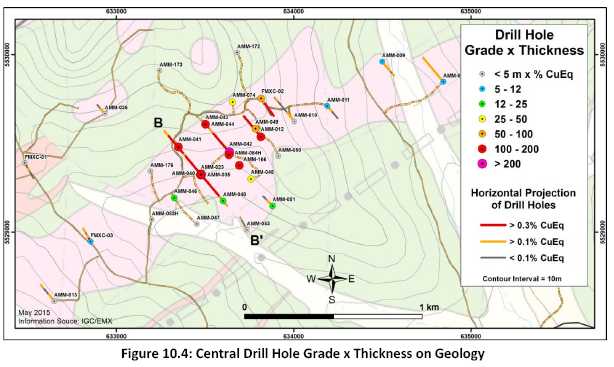
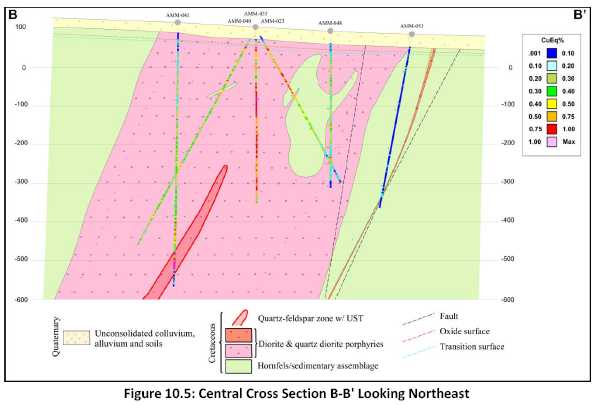
| ZT 61-1442/MM998 | Final V1.0 | Page 64 |
| Report Date: July 10, 2015 |
| EURASIAN MINERALS INC AND IG COPPER LLC | |
| NI 43-101 TECHNICAL REPORT ON THE INITIAL MINERAL RESOURCE ESTIMATE FOR | |
| THE MALMYZH COPPER-GOLD PROJECT, KHABAROVSK KRAI, RUSSIAN FEDERATION |
| Table 10.5: Central Deposit Select Drill Intercepts | |||||||
| Hole | TD (m) | From (m) | To (m) | Width (m) | Cu % | Au g/t | CuEq % |
| AMM-012 |
448.5 | 19.7 | 444.8 | 425.1 | 0.37 | 0.09 | 0.41 |
| including | 235.1 | 265.6 | 30.5 | 0.53 | 0.21 | 0.63 | |
| AMM-023 |
457.2 | 54.4 | 319.2 | 264.8 | 0.47 | 0.10 | 0.52 |
| including | 132.7 | 193.2 | 60.5 | 0.62 | 0.16 | 0.70 | |
| AMM-035 |
450.6 | 43.9 | 450.6 | 406.7 | 0.52 | 0.29 | 0.67 |
| including | 142.3 | 232.0 | 89.7 | 0.71 | 0.33 | 0.88 | |
| AMM-040 |
639.9 | 46.6 | 562.6 | 516.0 | 0.33 | 0.06 | 0.36 |
| including | 52.6 | 71.1 | 18.5 | 0.60 | 0.15 | 0.68 | |
| AMM-041 |
680.8 | 256.6 | 388.1 | 131.5 | 0.32 | 0.03 | 0.34 |
| 423.1 | 646.2 | 223.1 | 0.54 | 0.18 | 0.63 | ||
| including | 591.3 | 635.2 | 43.9* | 1.23 | 0.53 | 1.50 | |
| AMM-042 |
598.8 | 32.6 | 288.1 | 255.5 | 0.57 | 0.17 | 0.66 |
| 386.0 | 547.7 | 161.7 | 0.36 | 0.09 | 0.41 | ||
| AMM-044 | 432.7 | 122.3 | 388.2 | 265.9 | 0.48 | 0.09 | 0.53 |
| AMM-084 |
300 | 33.9 | 300.0 | 266.1 | 0.52 | 0.19 | 0.61 |
| including | 137.0 | 173.7 | 36.7 | 0.89 | 0.29 | 1.04 | |
| AMM-166 | 505 | 167.6 | 451.0 | 283.4 | 0.42 | 0.08 | 0.46 |
| * True width of AMM-041 high-grade intercept interpreted to be ~28.5 m | |||||||
| 10.5.3 | Freedom Drill Results |
The Freedom deposit encompasses a large area (i.e., > 4 km2) in the northeast portion of the license area. Drilling has defined two sub-parallel, northeast trending zones of mineralisation (Freedom Southeast and Northwest) hosted in a complex assemblage of diorite porphyries, multi-stage breccias, and hornfels that are coincident with two prominent magnetic high anomalies (Figure 10.6).
Freedom has been evaluated with 49 holes totaling 17,482 m. Freedom has been drilled on 200 by 200 m and 200 by 400 m, N40W grids, with some of the peripheral holes on 400 by 400 m spacing. Overburden at Freedom ranges from 1 to >40 m.
The Freedom Southeast deposit has been drilled on a 200 by 200 m grid with infill holes drilled from the 200 m grid points to give the equivalent of 100 by 200 m coverage in the core of the system. The drill defined mineralisation has an oval shape of about 1,000 m by 600 m with a NE trend. It is cut off along the eastern side by a post-mineralisation fault. Copper-gold mineralisation extends from the base of oxidation at 25-40 m below the surface to over 400 m depth (Figure 10.7). Table 10.6 lists select drill intercepts from Freedom SE.
| ZT 61-1442/MM998 | Final V1.0 | Page 65 |
| Report Date: July 10, 2015 |
| EURASIAN MINERALS INC AND IG COPPER LLC | |
| NI 43-101 TECHNICAL REPORT ON THE INITIAL MINERAL RESOURCE ESTIMATE FOR | |
| THE MALMYZH COPPER-GOLD PROJECT, KHABAROVSK KRAI, RUSSIAN FEDERATION |
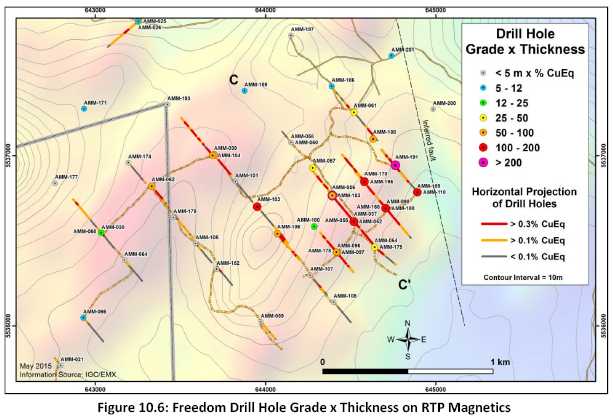
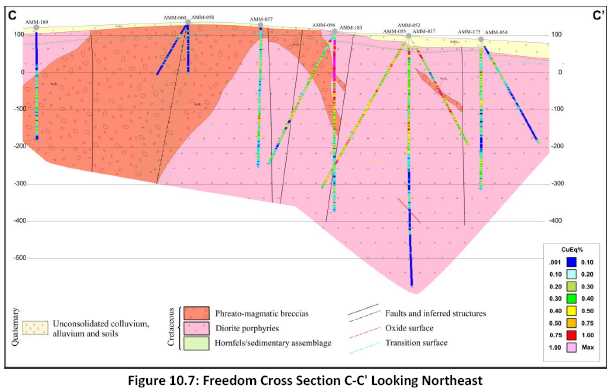
| ZT 61-1442/MM998 | Final V1.0 | Page 66 |
| Report Date: July 10, 2015 |
| EURASIAN MINERALS INC AND IG COPPER LLC | |
| NI 43-101 TECHNICAL REPORT ON THE INITIAL MINERAL RESOURCE ESTIMATE FOR | |
| THE MALMYZH COPPER-GOLD PROJECT, KHABAROVSK KRAI, RUSSIAN FEDERATION |
The mineralised zone at the Freedom Northwest prospect is not as well constrained, with a wide 200 by 400 m drill pattern. Additional drilling is necessary to define the geometry and grade distributions of copper-gold mineralisation. Table 10.7 lists select intercepts from the Freedom NW prospect.
| Table 10.6: Freedom Southeast Deposit Select Drill Intercepts | |||||||
| Hole | TD (m) | From (m) | To (m) | Width (m) | Cu % | Au g/t | CuEq % |
| AMM-037 |
334 | 33.8 | 334.0 | 300.2 | 0.36 | 0.37 | 0.54 |
| including | 48.0 | 73.2 | 25.2 | 0.78 | 0.33 | 0.94 | |
| including | 141.0 | 236.8 | 95.8 | 0.51 | 0.58 | 0.79 | |
| AMM-055 |
471.5 | 22.0 | 471.5 | 449.5 | 0.30 | 0.29 | 0.44 |
| including | 321.4 | 396.0 | 74.6 | 0.43 | 0.30 | 0.58 | |
| AMM-056 |
484.5 | 25.2 | 267.6 | 242.4 | 0.55 | 0.69 | 0.90 |
| including | 25.2 | 136.8 | 111.6 | 0.80 | 1.01 | 1.30 | |
| AMM-100 |
456.3 | 3.4 | 242.5 | 239.1 | 0.40 | 0.41 | 0.61 |
| including | 174.7 | 242.5 | 67.8 | 0.75 | 0.53 | 1.02 | |
| AMM-103 | 558.4 | 376.0 | 496.0 | 120.0 | 0.51 | 0.67 | 0.85 |
| AMM-110 | 571 | 291.0 | 453.1 | 162.1 | 0.42 | 0.16 | 0.50 |
| AMM-168 |
401 | 40.0 | 295.0 | 255.0 | 0.38 | 0.43 | 0.59 |
| including | 120.0 | 170.0 | 50.0 | 0.40 | 0.64 | 0.72 | |
| including | 190.0 | 255.0 | 65.0 | 0.51 | 0.43 | 0.73 | |
| AMM-170 |
412.8 | 38.8 | 66.8 | 28.0 | 0.51 | 0.02 | 0.52 |
| 230.8 | 340.8 | 110.0 | 0.43 | 0.31 | 0.59 | ||
| AMM-188 |
350 | 126.6 | 305.0 | 178.4 | 0.38 | 0.11 | 0.43 |
| including | 199.0 | 219.0 | 20.0 | 0.74 | 0.13 | 0.81 | |
| AMM-191 |
589 | 19.0 | 540.0 | 521.0 | 0.45 | 0.14 | 0.52 |
| including | 57.0 | 119.0 | 62.0 | 0.67 | 0.22 | 0.78 | |
| AMM-196 |
413 | 27.0 | 355.0 | 328.0 | 0.31 | 0.19 | 0.41 |
| including | 27.0 | 70.0 | 43.0 | 0.59 | 0.30 | 0.74 | |
| Table 10.7: Freedom Northwest Prospect Select Drill Intercepts | |||||||
| Hole | TD (m) | From (m) | To (m) | Width (m) | Cu % | Au g/t | CuEq % |
| AMM-039 |
313.0 | 81.4 | 313.0 | 231.6 | 0.39 | 0.17 | 0.48 |
| including | 129.4 | 177.7 | 48.3 | 0.70 | 0.52 | 0.96 | |
| AMM-062 |
307.0 | 74.1 | 187.8 | 113.7 | 0.42 | 0.60 | 0.72 |
| including | 114.1 | 166.0 | 51.9 | 0.47 | 0.85 | 0.90 | |
| AMM-104 |
502.0 | 49.5 | 95.6 | 46.1 | 0.67 | 0.10 | 0.72 |
| 183.0 | 339.0 | 156.0 | 0.29 | 0.05 | 0.31 | ||
| 391.0 | 443.0 | 52.0 | 0.38 | 0.07 | 0.41 | ||
| 10.5.4 | Flats Drill Results |
The Flats deposit is located about 3 km east of Central in the south-central portion of the property. It has been evaluated with 18 drill holes totaling 5,412 m (Figure 10.8 and Figure 10.9) which are mostly vertical. The drilling is on a 200 by 200 m N40W grid with a central fence of holes at 100 m spacing.
| ZT 61-1442/MM998 | Final V1.0 | Page 67 |
| Report Date: July 10, 2015 |
| EURASIAN MINERALS INC AND IG COPPER LLC | |
| NI 43-101 TECHNICAL REPORT ON THE INITIAL MINERAL RESOURCE ESTIMATE FOR | |
| THE MALMYZH COPPER-GOLD PROJECT, KHABAROVSK KRAI, RUSSIAN FEDERATION |
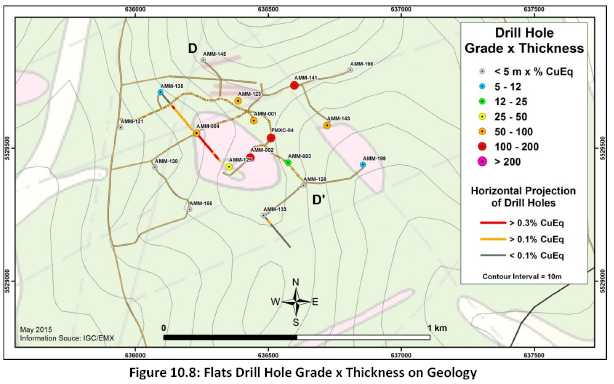
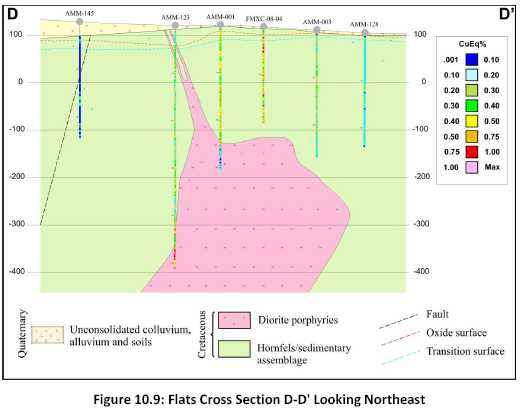
Flats is smaller than the other deposits, with an oval surface expression of ~500 by 800 m with an east-northeast trend that dips steeply to the northwest. Copper-gold mineralisation is hosted in diorite porphyry and hornfels, with locally high gold grades occurring at the diorite-hornfels contact.
| ZT 61-1442/MM998 | Final V1.0 | Page 68 |
| Report Date: July 10, 2015 |
| EURASIAN MINERALS INC AND IG COPPER LLC | |
| NI 43-101 TECHNICAL REPORT ON THE INITIAL MINERAL RESOURCE ESTIMATE FOR | |
| THE MALMYZH COPPER-GOLD PROJECT, KHABAROVSK KRAI, RUSSIAN FEDERATION |
Overburden is shallow (<1 to 10 m) and the base of oxidation is 10 to 15 m below the surface. Copper-gold mineralisation remains open to depth. Select drill intercepts from Flats are listed in Table 10.8.
| Table 10.8: Flats Deposit Select Drill Intercepts | |||||||
| Hole | TD (m) | From (m) | To (m) | Width (m) | Cu % | Au g/t | CuEq % |
| AMM-001 | 300.1 | 1.2 | 244.8 | 243.6 | 0.33 | 0.2 | 0.43 |
| AMM-002 |
475.7 | 43.5 | 161.4 | 117.9 | 0.27 | 0.36 | 0.45 |
| 213.3 | 377.9 | 164.6 | 0.33 | 0.41 | 0.54 | ||
| AMM-004 | 271.9 | 29.1 | 254.4 | 225.3 | 0.25 | 0.25 | 0.37 |
| AMM-141* | 365.0 | 17.0 | 351.0 | 334.0 | 0.28 | 0.21 | 0.38 |
| FMXC-004 | 197.6 | 2.0 | 197.6 | 195.6 | 0.39 | 0.29 | 0.53 |
| *Note: AMM-141: 73-75m 86 g/t Au sample capped at 3 g/t. | |||||||
| 10.5.5 | Drill Results for Other Prospects |
| 10.5.5.1 |
General |
Other targets at Malmyzh have been tested with reconnaissance drilling, and encouraging alteration and copper-gold mineralisation have been intersected (Table 10.9).
| Table 10.9: Other Prospects Select Drill Intercepts | ||||||||
| Hole | Area | TD (m) | From (m) | To (m) |
Width (m) |
Cu % | Au g/t | CuEq % |
| AMM-077 |
ABV |
461.1 | 188.1 | 331.0 | 142.9 | 0.40 | 0.09 | 0.45 |
| including | 188.1 | 278.5 | 90.4 | 0.44 | 0.10 | 0.49 | ||
| AMM-151 | ABV | 316.3 | 64.3 | 110.3 | 46.0 | 0.27 | 0.06 | 0.30 |
| AMM-075 | Bika | 484.2 | 176.0 | 280.6 | 104.6 | 0.20 | 0.20 | 0.30 |
| AMM-169 | Bika | 257.0 | 143.5 | 241.5 | 98.0 | 0.25 | 0.16 | 0.33 |
| AMM-069 | Destiny | 403.8 | 16.0 | 178.9 | 162.9 | 0.36 | 0.23 | 0.47 |
| AMM-092 |
Destiny |
277.3 | 2.5 | 138.9 | 136.4 | 0.28 | 0.17 | 0.37 |
| 164.9 | 232.1 | 67.2 | 0.24 | 0.11 | 0.29 | |||
| AMM-027 | Volkov | 262.8 | 93.7 | 146.3 | 52.6 | 0.35 | 0.10 | 0.39 |
| AMM-095 |
North Slope |
191.8 | 29.1 | 109.7 | 80.6 | 0.16 | 0.21 | 0.27 |
| AMM-030 |
North |
452.0 | 2.0 | 71.2 | 69.2 | 0.44 | 0.10 | 0.49 |
| 104.3 | 262.0 | 157.7 | 0.36 | 0.10 | 0.41 | |||
| 288.1 | 379.1 | 91.0 | 0.30 | 0.03 | 0.31 | |||
| AMM-032 |
North |
401.1 | 17.0 | 98.9 | 81.9 | 0.40 | 0.05 | 0.43 |
| 297.5 | 369.8 | 72.3 | 0.32 | 0.02 | 0.33 | |||
| FMXC-05 | North | 193.7 | 14.0 | 84.0 | 70.0 | 0.38 | 0.14 | 0.45 |
| AMM-159 | Sharga | 300.0 | 0.2 | 90.0 | 89.8 | 0.30 | 0.10 | 0.35 |
| AMM-019 |
Stockwork |
265.7 | 25.5 | 95.8 | 70.3 | 0.28 | 0.11 | 0.33 |
| 155.9 | 194.7 | 38.8 | 0.28 | 0.05 | 0.30 | |||
There is insufficient drilling to define the geometries and extents of these targets, but most still have compelling exploration potential. Their locations are shown in Figure 7.4 and discussed below. ABV is east of Valley, whilst Destiny, Sharga and Stockwork are along a northwest trending transverse between ABV and Freedom. North Slope and Volkov (with Destiny) lie along an easterly trending belt north of Freedom, whilst North and Bikha lie to the north and south of Central respectively.
| ZT 61-1442/MM998 | Final V1.0 | Page 69 |
| Report Date: July 10, 2015 |
| EURASIAN MINERALS INC AND IG COPPER LLC | |
| NI 43-101 TECHNICAL REPORT ON THE INITIAL MINERAL RESOURCE ESTIMATE FOR | |
| THE MALMYZH COPPER-GOLD PROJECT, KHABAROVSK KRAI, RUSSIAN FEDERATION |
| 10.5.5.2 |
ABV |
This prospect is marked by the strongest positive magnetic anomaly on the property, and is located 2 km east of Valley. It has been evaluated with 9 drill holes totaling 2,895 m (Figure 10.10). The magnetic anomaly highlights a diorite porphyry with accessory magnetite and containing abundant secondary magnetite as veinlets and disseminations. Three angle holes were drilled along a N40W profile across the contact zone of the magnetic anomaly and two were mineralised. The copper-gold mineralisation, strong magnetite bearing alteration, and phreato-magmatic breccias encountered by drilling suggests exploration potential remains within the area.
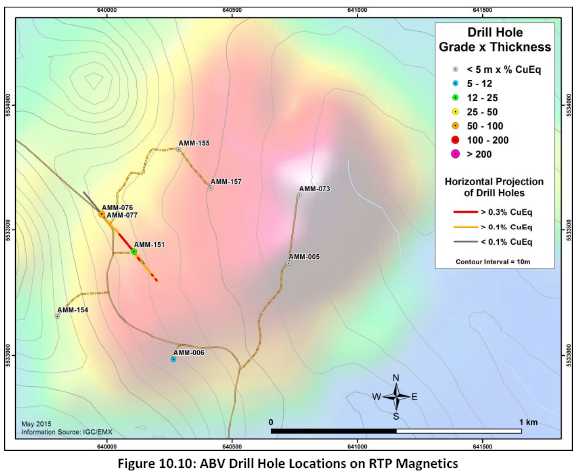
| 10.5.5.3 |
Destiny |
This prospect is located 4.5 km northeast of Valley and 4 km west-northwest of Freedom along the northern boundary of the property. It is part of a northwest trend of prospects between ABV and Freedom and was identified from a small magnetic anomaly with weak copper-gold soil anomalies, and tested with 6 vertical holes totaling 1,584.2 m (Figure 10.11).
| ZT 61-1442/MM998 | Final V1.0 | Page 70 |
| Report Date: July 10, 2015 |
| EURASIAN MINERALS INC AND IG COPPER LLC | |
| NI 43-101 TECHNICAL REPORT ON THE INITIAL MINERAL RESOURCE ESTIMATE FOR | |
| THE MALMYZH COPPER-GOLD PROJECT, KHABAROVSK KRAI, RUSSIAN FEDERATION |
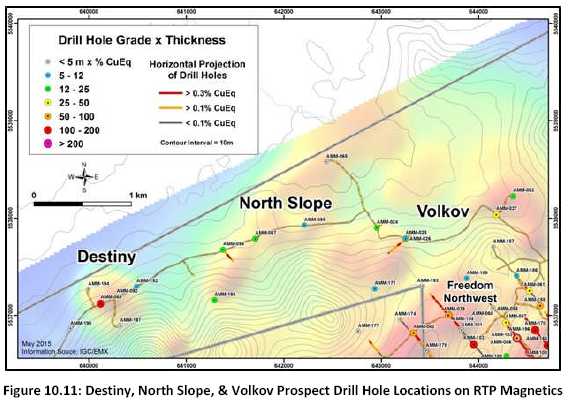
Two holes intersected copper-gold mineralisation in a weakly altered diorite porphyry stock and adjacent hornfels. Mineralisation consists of chalcopyrite and bornite associated with magnetite and quartz magnetite veins. They were offset ~400 m and no additional mineralisation was found.
| 10.5.5.4 |
North Slope |
This target starts about 1 km east of Destiny and has been drilled along a line of 5 widely spaced holes (~500 m) extending 2 km to the northeast along a magnetic anomaly (refer to Figure 10.11). Four of the holes intersected weak copper-gold mineralisation, including AMM-095 with 81m of 0.16% Cu and 0.21 g/t Au.
| 10.5.5.5 |
Volkov |
This is about 2 km east of North Slope and along the northeast margin of Freedom (refer to Figure 10.11). Two sets of two holes, spaced about 1 km apart on two discrete magnetic anomalies have been drilled in this area and intersected copper-gold mineralisation which is bounded on the east by the northerly fault that cuts off Freedom.
Due to the wide spaced reconnaissance drilling at Destiny, North Slope, and Volkov that intersected copper-gold mineralisation and porphyry alteration, these targets have remaining upside potential that require additional follow-up exploration.
| ZT 61-1442/MM998 | Final V1.0 | Page 71 |
| Report Date: July 10, 2015 |
| EURASIAN MINERALS INC AND IG COPPER LLC | |
| NI 43-101 TECHNICAL REPORT ON THE INITIAL MINERAL RESOURCE ESTIMATE FOR | |
| THE MALMYZH COPPER-GOLD PROJECT, KHABAROVSK KRAI, RUSSIAN FEDERATION |
| 10.5.5.6 |
Sharga |
This is located about 2 km southeast of Destiny, and has been evaluated with 5 drill holes totaling 1,276 m. Initially a copper-gold soil anomaly with a coincident magnetic high was drilled that intersected anomalous mineralisation. A second hole was drilled 1 km to the south-southeast on weaker soil and magnetic anomalies that encountered 224 m of alteration and copper mineralisation, including an upper zone of chalcocite enrichment. This hole was offset 400 m to the northwest and southeast, and 200 m to the southwest, but these holes intersected weak, sporadic copper-gold mineralisation. Sharga remains open along trend to the northeast towards Freedom.
| 10.5.5.7 |
Stockwork |
Stockwork is located about 2 km southeast of Sharga, and occurs in a bowl shaped valley with a weak magnetic high flanked by hills of hornfels with a quartz stockwork and phyllic and argillic alteration. The prospect has been evaluated with 5 drill holes totaling 888 m. Three of the holes are at the same collar location. The two initial holes were lost in the deep overburden. The third hole intersected copper mineralisation within a potassic altered feldspar porphyry, and was offset 400 m to the northeast and southwest with drilling that encountered weak and sporadic mineralisation. The target remains open under deep cover to the southeast.
| 10.5.5.8 |
North |
The North area consists of several targets within an area 2.5 km east-west by 1.5 km north-south, and is located 2.5 km north-northeast of Central. The North area has been evaluated with 10 drill holes totaling 2,983 m (Figure 10.12).
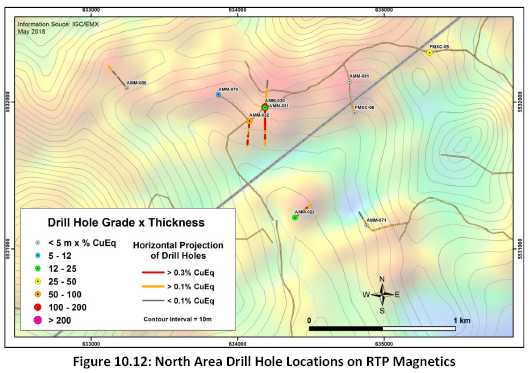
| ZT 61-1442/MM998 | Final V1.0 | Page 72 |
| Report Date: July 10, 2015 |
| EURASIAN MINERALS INC AND IG COPPER LLC | |
| NI 43-101 TECHNICAL REPORT ON THE INITIAL MINERAL RESOURCE ESTIMATE FOR | |
| THE MALMYZH COPPER-GOLD PROJECT, KHABAROVSK KRAI, RUSSIAN FEDERATION |
The principal target is on an easterly trending magnetic high with a copper-gold soil anomaly and rock float samples with copper and gold mineralisation. The main easterly trending magnetic anomaly was found to be a composite diorite porphyry stock with variable alteration and mineralisation.
Holes AMM-030 and AMM-031 were drilled south and north from the same location and define an alteration and mineralisation gradient that points to the south. AMM-030 had the best mineralisation and quartz-chlorite-magnetic alteration, and AMM-031 intersected quartz-sericite-pyrite alteration. AMM-021 and AMM-071, 800 m and 100 m to the south and south-southeast respectively, are propylitically altered with AMM-071 intersecting phreato-magmatic breccias. The North target area has significant remaining exploration potential.
| 10.5.5.9 |
Bikha |
This is located 3 km south of Central in the southern part of the area. It has been evaluated with 7 drill holes totaling 2,142 m. Two holes were drilled on a small but strong magnetic high anomaly and encountered copper-gold mineralisation within potassic altered hornfels. These were offset 400 m without encountering significant mineralisation. An area 1.7 km ENE of the drilled area has high sulphidation alteration (quartz-alunite and diaspore) and a weak soil gold anomaly and remains untested.
| 10.6 |
Comments on Drilling |
The Malmyzh drilling has been conducted in accordance with industry best practice standards. The drill hole collars and down-hole samples are accurately and precisely located. There are no known drilling, sampling, or recovery factors that materially impact the accuracy or reliability of the results.
The Project drilling has confirmed 14 concealed porphyry copper-gold centres initially identified from surface exploration. The Valley, Central, Freedom (SE) and Flats deposits have been drill delineated at a nominal 200 by 200 m grid spacing to support resource estimation. The remaining prospects are considered to be worthy of consideration for further exploration.
| ZT 61-1442/MM998 | Final V1.0 | Page 73 |
| Report Date: July 10, 2015 |
| EURASIAN MINERALS INC AND IG COPPER LLC | |
| NI 43-101 TECHNICAL REPORT ON THE INITIAL MINERAL RESOURCE ESTIMATE FOR | |
| THE MALMYZH COPPER-GOLD PROJECT, KHABAROVSK KRAI, RUSSIAN FEDERATION |
| 11 |
SAMPLE PREPARATION, ANALYSES AND SECURITY |
| 11.1 |
Introduction |
The Malmyzh Project protocols and procedures for sample preparation, analyses and security follow industry best practice guidelines. The sample preparation and analysis has been diligently monitored, and included a rigorous Quality Assurance/Quality Control (QA/QC) programme that included the utilisation of certified reference materials (CRM), blanks, and duplicate samples. The rigor of the QA/QC programmes has developed over time since initial grassroots exploration discovery (2007-2009) to drill delineation of resources (2010-2014). In parallel with the QA/QC programmes, procedures for the secure handling, shipment, and archiving of Project exploration samples has also been instituted.
| 11.2 |
Sample Preparation |
| 11.2.1 | Sampling and Sample Preparation (2006-2008) |
The FMEC soil samples for 2006-2008 were dried and sieved to -60 mesh on site, and the sieved samples packaged and securely delivered to the Alex Stewart Laboratory in Moscow via Khabarovsk. Drilling and sampling for the Project's initial eight hole 2008 drill programme was conducted by FMEC. The core was quick logged on site and split longitudinally along the core axis with a diamond saw. The core was sampled and delivered to the office in Khabarovsk by company personnel, and then shipped via a registered transportation carrier to Alex Stewart for sample preparation and analysis. The second half of the core and coarse rejects are now stored in the Joint Venture's secure warehouse in Khabarovsk.
| 11.2.2 | Sampling and Sample Preparation (late 2009-2014) |
Additional rigor and documentation was put in place for the late 2009-2014 Malmyzh exploration programmes, which included 98.4% of the Project's drill meters. Sample handling and preparation was continuously under the supervision of North American geologic staff. Photo 11.1 shows a selection of photographs of the facilities and procedures.
Soil samples were dried and sieved on site, QA samples were added into the sample stream, and preliminary Niton pXRF readings taken of the sieved samples. The soil samples were then boxed in cardboard cartons, securely shipped to Khabarovsk, and air freighted to Irgiredmet Laboratories in Irkutsk for analysis. Rock float samples were also boxed on site, sent to the Khabarovsk office, and securely shipped to Irgiredmet.
| ZT 61-1442/MM998 | Final V1.0 | Page 74 |
| Report Date: July 10, 2015 |
| EURASIAN MINERALS INC AND IG COPPER LLC | |
| NI 43-101 TECHNICAL REPORT ON THE INITIAL MINERAL RESOURCE ESTIMATE FOR | |
| THE MALMYZH COPPER-GOLD PROJECT, KHABAROVSK KRAI, RUSSIAN FEDERATION |
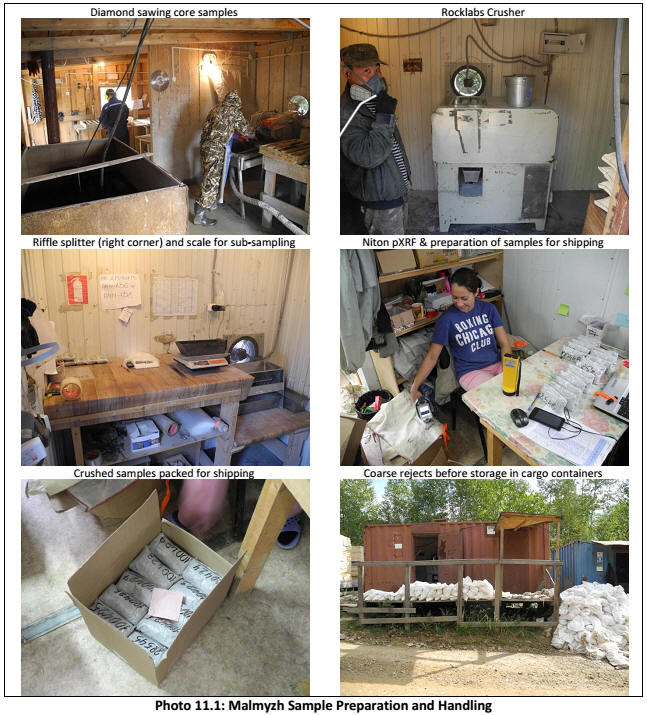
For drilling, the core was logged, sample numbers assigned, sample intervals marked, and a splitting mark placed longitudinally along the core by a geologist. The core was then sawn in half with a diamond saw on site. In addition, select samples of core, for example zones with “sooty” chalcocite that could be washed away in sawing, were split with a hydraulic core splitter. The hydraulic splitter was also used for brief periods when the diamond core saws were undergoing maintenance, or to relieve core saw backlogs during intense periods of delineation drilling conducted with three rigs. A single, trained, experienced and diligent technician was responsible for core movements and sampling, and this individual was under the constant supervision of the geologic staff. The second half of the core is securely stored on site in a wood storage building.
| ZT 61-1442/MM998 | Final V1.0 | Page 75 |
| Report Date: July 10, 2015 |
| EURASIAN MINERALS INC AND IG COPPER LLC | |
| NI 43-101 TECHNICAL REPORT ON THE INITIAL MINERAL RESOURCE ESTIMATE FOR | |
| THE MALMYZH COPPER-GOLD PROJECT, KHABAROVSK KRAI, RUSSIAN FEDERATION |
The majority of drill samples (84%) underwent the first stages of sample preparation, including sample crushing and splitting, utilising an on-site sample prep "line" designed and implemented by IGC’s Chief Geologist, J.C. Ashleman, LPG. The procedures and protocols for sample handling, drying, crushing and splitting, carefully planned to meet both Russian and Western best practice standards, were rigorously implemented under the supervision of the on-site Project geologist.
The split core sample was logged onto a sample preparation manifest, dried, weighed, crushed, and a sub-sample for analysis taken from a riffle split. Samples were crushed with a Rocklabs crusher to a nominal –2 mm, with most of the material at –1 mm (p80% < 1 mm). A split of every 10th sample was sieved and the size fractions weighed to QC the final size fraction to acceptable tolerances. The crushed sample was sub-sampled with a riffle splitter to a 500-600 g split, bagged, and delivered to the geology office for final organisation and shipment to the analytic lab. The analytic lab was given instructions to pulverize the entire 500-600 g sample.
Detailed records were maintained for each sample regarding the sample preparation process, including details on the number of splits and weights of each sample; these records are archived at the Project site. The crushing and splitting equipment was cleaned with brushes and compressed air between each sample to minimise cross contamination. The coarse rejects are securely stored on site in locked cargo containers.
An exception to the procedures described above occurred for ~15% of the drill core samples, and included secure shipment of sawn/split core to the analytical laboratory for sample preparation via Khabarovsk. This procedure was put in place to reduce turnaround time for on-site sample preparation, and primarily included samples for peripheral "unmineralised" holes drilled in 2013. The laboratory was instructed to follow the same procedures as used on site, which included crushing the samples to -2mm and then pulverizing a 500-600 g split for standard analysis.
| 11.3 |
Sample Analyses |
The Malmyzh Project has a total of ~34,670 drill core samples, more than 5,400 soil and deep mapping samples, and over 600 rock samples that have been analysed, in addition to blank, standard, and duplicate QA samples. The principal analytical lab for the Project has been Irgiredmet Laboratories in Irkutsk, Russia (GOST ISO/MEK 17025 accredited). Also, Alex Stewart Geo Analytical LLC of Moscow (now part of ALS) was used early in the programme, and ALS Laboratories of Chita (GOST ISO/IEC 17025 accredited) was utilised. All three of these labs are internationally established organisations, and independent of IGC, EMX, and FMEC.
The large majority of the drill core samples (92.4%) were analysed by Irgiredmet. The first holes drilled in 2008 were analysed by Alex Stewart (1.6% of the drill samples). In 2013 there was a back log with Irgiredmet, so overflow samples were sent to ALS; these peripheral exploration holes represent 6% of the total drill samples. All three laboratories performed a one assay-ton fire assay for gold with an AA or ICP finish, and analysed for copper and multi-element suites using an aqua regia digestion and ICP/AES techniques. The analytic laboratories all utilised internal standards, blanks and duplicate QA samples, and reported the results with the final assay certificates per Russian regulations.
| ZT 61-1442/MM998 | Final V1.0 | Page 76 |
| Report Date: July 10, 2015 |
| EURASIAN MINERALS INC AND IG COPPER LLC | |
| NI 43-101 TECHNICAL REPORT ON THE INITIAL MINERAL RESOURCE ESTIMATE FOR | |
| THE MALMYZH COPPER-GOLD PROJECT, KHABAROVSK KRAI, RUSSIAN FEDERATION |
The soil and rock samples taken from 2006-2008 were analysed by Alex Stewart with fire assay gold and aqua regia digestion and ICP/AES techniques for copper and a multi-element suite.
One limited subset of soil samples and rock samples were analysed by Dal Geophysical of Khabarovsk. These early exploration soil and rock samples were taken in the initial Malmyzh license (HAB 02018).
The 2010-2013 soil, auger, and deep mapping samples were analysed by Irgiredmet with a fire assay gold and aqua regia digestion and ICP/AES techniques for copper and a multi-element suite. These samples principally cover the Malmyzh North license (HAB 02334).
| 11.4 |
Quality Analysis/Quality Control |
| 11.4.1 | Introduction |
A QA/QC programme of standard, blank and duplicate samples has been consistently implemented for Malmyzh drill samples. Fortress and IGC were the Project managers from late 2009 through 2014, and a rigorous and well documented QC programme was introduced that included increasing the frequency of duplicate samples, as well as the utilisation of certified reference material for the rock, soil and auger samples in addition to drill samples. The QC programme (with the certified standards) covers 98.4% of the drill samples, and a rate of 15% QC samples has been maintained throughout the 2009-2014 exploration programmes. In addition to the duplicate samples included with the original assay batches, additional duplicate sampling has been subsequently performed, including umpire lab duplicate analyses.
| 11.4.2 | 2006-2008 QA/QC Programmes |
The 2006 through early 2008 exploration programmes only utilised QC samples for the initial drill programme. There were only eight holes drilled and this only represents 1.6% of the total Project drilling. The QC sample rate was 15% of the samples submitted for analysis, and included 5% blanks, 5% standards and 5% duplicates. An in-house FMEC standard was used (PDIS-1: 0.26±0.02 g/t Au, 0.258±0.005% Cu). The blank sample material was reported to be barren sandstone from a local quarry. There were no significant QC problems noted. QA samples were not included with the rock and soil exploration samples.
|
11.4.3 |
Late 2009-2014 QA/QC Programmes |
| 11.4.3.1 |
Introduction |
Starting in late 2009 the QA/QC programme was extended to all exploration samples including soil, rock and auger samples as well as drill samples. Certified Reference Material ("CRM") standards from Ore Research Pty. of Perth, Australia (OREAS) were introduced to the Project's QA/QC programme, and included high, moderate and low level copper and gold standards within expected grade ranges for Malmyzh mineralisation. Table 11.1 lists the standards used for the various drill campaigns.
| ZT 61-1442/MM998 | Final V1.0 | Page 77 |
| Report Date: July 10, 2015 |
| EURASIAN MINERALS INC AND IG COPPER LLC | |
| NI 43-101 TECHNICAL REPORT ON THE INITIAL MINERAL RESOURCE ESTIMATE FOR | |
| THE MALMYZH COPPER-GOLD PROJECT, KHABAROVSK KRAI, RUSSIAN FEDERATION |
| Table 11.1: Standards Used for Each Drill Campaign and Laboratory | |||||||||
| 2013-4 | 2013-4 | 2012 | 2011 | 2010 | 2009 | ||||
| Standard | Cu (%) | Au (g/t) | Irgir | ALS | Irgir | Irgir | Irgir | AS | Totals |
| OREAS 901 | 0.144 | 0.363 | 191 | 22 | 213 | ||||
| OREAS 501 | 0.267 | 0.204 | 100 | 190 | 290 | ||||
| OREAS 501b | 0.258 | 0.248 | 94 | 25 | 119 | ||||
| OREAS 502 | 0.743 | 0.491 | 202 | 26 | 228 | ||||
| OREAS 503 | 0.563 | 0.687 | 125 | 164 | 289 | ||||
| OREAS 503b | 0.523 | 0.695 | 85 | 26 | 111 | ||||
| OREAS 504 | 1.123 | 1.480 | 221 | 19 | 68 | 308 | |||
| OREAS 52c | 0.344 | 0.346 | 14 | 6 | 20 | ||||
| OREAS 52Pb | 0.334 | 0.307 | 36 | 57 | 93 | ||||
| OREAS 53Pb | 0.546 | 0.623 | 35 | 58 | 82 | 175 | |||
| OREAS 54Pa | 1.550 | 2.900 | 4 | 24 | 39 | 67 | |||
| PDIS 1 | 0.258 | 0.260 | 27 | 27 | |||||
| Totals | 1018 | 118 | 475 | 124 | 178 | 27 | |||
| Note: Irgir = Irgiredmet; ALS = ALS Chita; AS = Alex Stewart | |||||||||
The protocol was for an alternating standard or blank to be inserted approximately every tenth sample to yield five standards and five blanks per 100 samples sent to the lab for analysis. A check of the drill sample database for 2010 through 2014 shows that the target rate of 1 in 20 samples for both standards and blanks was achieved. The standards were designated by the geologist and inserted at site prior to sample shipment. Duplicate coarse reject samples were spaced out through a given sequence and run at the end of the sample batch. The procedure was to submit the samples from a complete drill hole, along with the QA samples, as a single work order to the laboratory with instructions to run the analyses in sample number sequence. Additional duplicate samples have also been analysed for different grade classes and between the different laboratories used.
The QA samples were promptly QC monitored upon receipt of each analytical report by the Project geologist. If problems were identified, the lab was contacted with a request to rerun samples. Overall, the labs performed consistently, yielding accurate and reproducible analyses; very few QC problems were identified.
| 11.4.3.2 |
CRM Standards |
CRM standards make up 5% of the total samples submitted for analysis (Table 11.2 and Table 11.3). The principal analytic laboratory, Irgiredmet, performed very well with no bias shown and only rare cases of samples reporting outside of the expected ranges for copper or gold. ALS was only used for a few exploration and peripheral drill holes, and demonstrated acceptable performance on the standards.
| ZT 61-1442/MM998 | Final V1.0 | Page 78 |
| Report Date: July 10, 2015 |
| EURASIAN MINERALS INC AND IG COPPER LLC | |
| NI 43-101 TECHNICAL REPORT ON THE INITIAL MINERAL RESOURCE ESTIMATE FOR | |
| THE MALMYZH COPPER-GOLD PROJECT, KHABAROVSK KRAI, RUSSIAN FEDERATION |
| Table 11.2: Copper Standard Performance for the Drilling Campaigns | |||||||||
| 2013-2014 | |||||||||
| Copper | Certified | Laboratory | Number | Average | Percent | >2 Std Dev | >3 Std Dev | ||
| Standard | Value | of Runs | Value | difference | number | % | number | % | |
| OREAS 901 | 0.144% Cu | Irgiredmet | 191 | 0.143 | -0.9% | 0 | |||
| ALS Chita | 22 | 0.141 | -2.3% | 0 | |||||
| OREAS 501 | 0.267% Cu | Irgiredmet | 100 | 0.270 | 1.1% | 0 | |||
| ALS Chita | 0 | ||||||||
| OREAS 501b | 0.258% Cu | Irgiredmet | 94 | 0.257 | -0.5% | 0 | |||
| ALS Chita | 25 | 0.262 | 1.6% | 0 | |||||
| OREAS 502 | 0.743% Cu | Irgiredmet | 202 | 0.745 | 0.3% | 0 | |||
| ALS Chita | 26 | 0.765 | 2.9% | 4 | 15% | 1 | 4% | ||
| OREAS 503 | 0.563% Cu | Irgiredmet | 125 | 0.565 | 0.4% | 0 | |||
| ALS Chita | 0 | ||||||||
| OREAS 503b | 0.523% Cu | Irgiredmet | 85 | 0.524 | 0.1% | 0 | |||
| ALS Chita | 26 | 0.513 | -1.9% | 1 | 4% | 0 | |||
| OREAS 504 | 1.123% Cu | Irgiredmet | 221 | 1.120 | -0.3% | 2 | 1% | 1 | 0% |
| ALS Chita | 19 | 1.123 | 0.0% | 0 | |||||
| Note: ALS reported 4 samples as >1% vs 1.123 | |||||||||
| 2010 - 2012 | |||||||||
| OREAS 52Pb | 0.334% Cu | Irgiredmet | 93 | 0.335 | 0.2% | 1 | 1.1% | ||
| OREAS 52c | 0.344% Cu | Irgiredmet | 20 | 0.340 | -1.1% | 1 | 5.0% | ||
| OREAS 53Pb | 0.546% Cu | Irgiredmet | 175 | 0.544 | -0.4% | 1 | 0.6% | 1 | 0.6% |
| OREAS 54Pa | 1.550% Cu | Irgiredmet | 67 | 1.548 | -0.1% | 1 | 1.5% | ||
| OREAS 501 | 0.267% Cu | Irgiredmet | 190 | 0.271 | 1.6% | 0 | 0.0% | ||
| OREAS 503 | 0.563% Cu | Irgiredmet | 164 | 0.566 | 0.5% | 0 | 0.0% | ||
| OREAS 504 | 1.123% Cu | Irgiredmet | 68 | 1.135 | 1.1% | 2 | 2.9% | 1 | 1.5% |
Figure 11.1 presents example control charts of OREAS 502 standard performance plotted in chronological order for 2013-2014 drill campaign samples (Note: performance gates of 1, 2 and 3 standard deviations are shown as green, orange, and red lines).
| ZT 61-1442/MM998 | Final V1.0 | Page 79 |
| Report Date: July 10, 2015 |
| EURASIAN MINERALS INC AND IG COPPER LLC | |
| NI 43-101 TECHNICAL REPORT ON THE INITIAL MINERAL RESOURCE ESTIMATE FOR | |
| THE MALMYZH COPPER-GOLD PROJECT, KHABAROVSK KRAI, RUSSIAN FEDERATION |
| Table 11.3: Gold Standard Performance for the Drilling Campaigns | |||||||||
| 2013-2014 Drilling | |||||||||
| Gold (g/t) | Certified | Laboratory | Number | Average | Percent | >2 Std Dev | >3 Std Dev | ||
| Standard | Value | of runs | Value | difference | number | % | number | % | |
| OREAS 901 | 0.363 g/t Au | Irgiredmet | 191 | 0.360 | -0.8% | 0 | |||
| ALS Chita | 22 | 0.378 | 4.0% | 0 | |||||
| OREAS 501 | 0.204 g/t Au | Irgiredmet | 100 | 0.202 | -0.8% | 2 | 2% | ||
| ALS Chita | 0 | ||||||||
| OREAS 501b | 0.248 g/t Au | Irgiredmet | 94 | 0.251 | 1.1% | 3 | 3% | 2 | 2% |
| ALS Chita | 25 | 0.251 | 1.0% | 0 | |||||
| OREAS 502 | 0.491 g/t Au | Irgiredmet | 202 | 0.492 | 0.2% | 1 | 0.5% | 1 | 0.5% |
| ALS Chita | 26 | 0.497 | 1.3% | 0 | |||||
| OREAS 503 | 0.687 g/t Au | Irgiredmet | 125 | 0.691 | 0.6% | 0 | |||
| ALS Chita | 0 | ||||||||
| OREAS 503b | 0.695 g/t Au | Irgiredmet | 85 | 0.69 | -0.7% | 0 | |||
| ALS Chita | 26 | 0.704 | 1.3% | 0 | |||||
| OREAS 504 | 1.48 g/t Au | Irgiredmet | 221 | 1.485 | 0.3% | 0 | |||
| ALS Chita | 23 | 1.490 | 0.7% | 0 | |||||
| 2010-2012 Drilling | |||||||||
| OREAS 52Pb | 0.307 g/t Au | Irgiredmet | 93 | 0.314 | 2.4% | 0 | |||
| OREAS 52c | 0.346 g/t Au | Irgiredmet | 20 | 0.338 | -2.3% | 2 | 10.0% | 0 | |
| OREAS 53Pb | 0.623g/t Au | Irgiredmet | 175 | 0.623 | 0.0% | 1 | 0.6% | 0 | |
| OREAS 54Pa | 2.900 g/t Au | Irgiredmet | 67 | 2.944 | 1.5% | 0 | |||
| OREAS 501 | 0.204 g/t Au | Irgiredmet | 190 | 0.200 | -2.0% | 0 | |||
| OREAS 503 | 0.687 g/t Au | Irgiredmet | 164 | 0.689 | 0.3% | 0 | |||
| OREAS 504 | 1.480 g/t Au | Irgiredmet | 68 | 1.469 | -0.7% | 1 | 1.5% | 0 | |
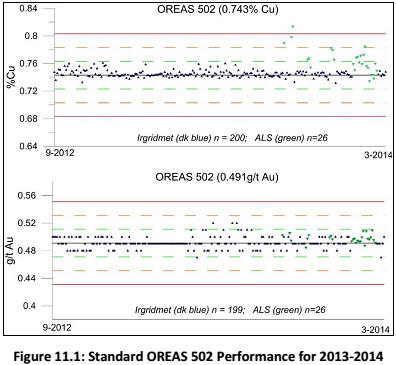
| ZT 61-1442/MM998 | Final V1.0 | Page 80 |
| Report Date: July 10, 2015 |
| EURASIAN MINERALS INC AND IG COPPER LLC | |
| NI 43-101 TECHNICAL REPORT ON THE INITIAL MINERAL RESOURCE ESTIMATE FOR | |
| THE MALMYZH COPPER-GOLD PROJECT, KHABAROVSK KRAI, RUSSIAN FEDERATION |
| 11.4.3.3 |
Blanks |
Blank samples constitute 5% of the drill samples submitted for analysis (Table 11.4). During 2010 a blank of barren sandstone from a local quarry was used (MSS in Table 11.4); it was from the same quarry reportedly used for the 2008-2009 drilling. IGC geologists obtained blank material from a different part of the quarry in 2011.
| Table 11.4: Blank Samples Used for the Various Drill Campaigns | |||||||
| Campaign | Laboratory | Korf | OREAS 22c |
OREAS 22d |
MS2 | MSS | PD |
| 2013-4 | Irgiredmet | 853 | 66 | 41 | |||
| 2013-4 | ALS | 104 | 5 | ||||
| 2012 | Irgiredmet | 292 | 124 | 38 | |||
| 2011 | Irgiredmet | 117 | |||||
| 2010 | Irgiredmet | 182 | |||||
| 2009 | Alex Stewart | 27 | |||||
| Total | 1249 | 190 | 46 | 38 | 299 | 27 | |
None of the blank samples returned detectable gold, but they did run variable low levels of copper; minor iron staining and calcite veining was noted in the samples. In 2012 sandstone from another quarry that had less copper variability was used as a blank (MS2 in Table 11.4).
A large amount of blank material was obtained from the Korf quarry near Khabarovsk in 2012. The Korf blank is a uniform granodiorite used for building stone, and has consistent low levels of copper and no detectable gold. The rock blank samples were inserted in the sample stream per the geologist's instructions, and crushed in sequence with the drill samples (see Section 11.1.2).
A certified pulp blank, OREAS 9C, was also introduced as a QA sample in 2012, and replaced with OREAS 9d in 2013. In 2012 the pulp blank was used at a ratio of 1:3 to the Korf blank, but decreased to a 1:8 ratio for the 2013-2014 drill programmes. Table 11.5 lists summary statistics for the blanks used in each drilling campaign, and Figure 11.2 is an example plot of blank analytical results for the 2013-2014 drill campaigns.
The blank QC results demonstrated good performance over time for both copper and gold. In only one case did Irgiredmet report detectable gold from a blank, and it turned out this resulted from a sample switch at the lab; the lab's re-run reported correctly.
ALS reported detectable gold in three Korf blanks, and one OREAS 9d blank; the reported gold levels were low (< 0.01g/t Au), and inconsequential. Of note, ALS was used for overflow work in 2013, and performed all of the sample preparation, including the crushing. As the OREAS pulp blank reported Au, it is considered an analytical issue with low level gold. Copper has been very stable and of a low level in the Korf and OREAS 9 series blanks which yield acceptable QC analytical performance. The low and consistent values in the Korf blank indicate no significant contamination problems in the sample preparation.
| ZT 61-1442/MM998 | Final V1.0 | Page 81 |
| Report Date: July 10, 2015 |
| EURASIAN MINERALS INC AND IG COPPER LLC | |
| NI 43-101 TECHNICAL REPORT ON THE INITIAL MINERAL RESOURCE ESTIMATE FOR | |
| THE MALMYZH COPPER-GOLD PROJECT, KHABAROVSK KRAI, RUSSIAN FEDERATION |
| Table 11.5: Blank Sample Statistics | |||||||||
| Blank | Laboratory | Drill
Campaign |
# of Runs |
Avg % Cu |
Standard
Dev |
Max % Cu |
Min % Cu |
w/
Detected Au |
Holes
(AMM) |
| Rock blanks | |||||||||
| PD | Irgiredmet | 2008 | 27 | 0.0022 | 0.0014 | 0.0060 | 0.0006 | 3 | FMXC 1-8 |
| MSS | Irgiredmet | 2010 | 182 | 0.0015 | 0.0012 | 0.0079 | 0.0004 | no | 001-023 |
| MSS | Irgiredmet | 2011 | 117 | 0.0035 | 0.0019 | 0.0073 | 0.0006 | no | 023-039 |
| MS2 | Irgiredmet | 2012 | 38 | 0.0015 | 0.0004 | 0.0027 | 0.0005 | no | 040-082 |
| Korf | Irgiredmet | 2012 | 292 | 0.0023 | 0.0005 | 0.0042 | 0.0011 | no | 040-082 |
| Korf | Irgiredmet | 2013-2014 | 852 | 0.0025 | 0.0005 | 0.0045 | 0.0003 | no | 083-203 |
| Korf | ALS | 2014 | 104 | 0.0030 | 0.0006 | 0.0049 | 0.0021 | 3 | 154-184 |
| Certified Pulp Blanks | |||||||||
| OREAS 22c | Irgiredmet | 2012 | 124 | 0.0010 | 0.0002 | 0.0017 | 0.0003 | no | 040-082 |
| OREAS 22c | Irgiredmet | 2013-2014 | 66 | 0.0009 | 0.0001 | 0.0011 | 0.0008 | no | 083-203 |
| OREAS 22d | Irgiredmet | 2014 | 41 | 0.0010 | 0.0002 | 0.0019 | 0.0008 | no | 148-203 |
| OREAS 22d | ALS | 2014 | 5 | 0.0007 | 0.0001 | 0.0009 | 0.0005 | 1 | 154-184 |
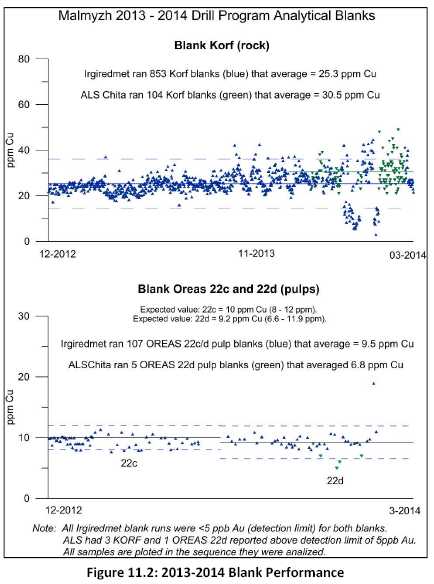
| ZT 61-1442/MM998 | Final V1.0 | Page 82 |
| Report Date: July 10, 2015 |
| EURASIAN MINERALS INC AND IG COPPER LLC | |
| NI 43-101 TECHNICAL REPORT ON THE INITIAL MINERAL RESOURCE ESTIMATE FOR | |
| THE MALMYZH COPPER-GOLD PROJECT, KHABAROVSK KRAI, RUSSIAN FEDERATION |
| 11.4.3.4 |
Coarse Reject Duplicates |
Duplicates were submitted at a rate of 5% for the drill samples. For the samples crushed on site (84%), two splits were taken from the coarse rejects for every 20th sample, and given unique sample numbers and submitted to the analytical laboratory as part of the batch for a given drill hole. For samples not crushed on site, duplicates were taken after the coarse rejects were returned from the lab, and subsequently submitted for analysis. The exception is a few of the 2013 peripheral holes analysed by ALS for which duplicates were not submitted.
Figure 11.3 is an example of scatter plots for copper and gold in duplicate pairs for the 2013 and early 2014 drill campaigns. The scatter plots demonstrate excellent correlation and analytic reproducibility, particularly as these are coarse reject duplicates, and not duplicates of homogenised pulp material.
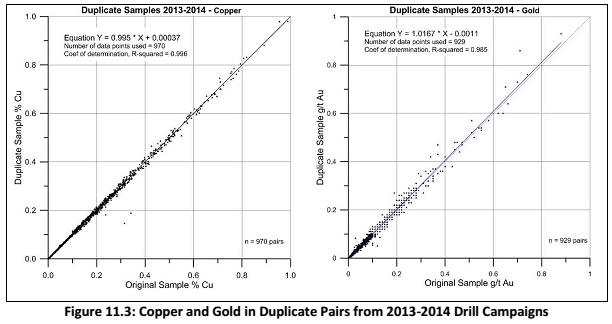
| 11.4.3.5 |
Grade Class Duplicates |
Additional duplicate samples were taken for each drill campaign as selected from three grade classes (0.1 -0.4, 0.4 -0.6, >0.6% Cu) and re-analysed both by the original laboratory, Irgiredmet, as well as by an external umpire laboratory. For 2010 through 2012, the class duplicates were sent to Alex Stewart, and for the 2013 and 2014 drill campaign they were sent to ALS. In total, Alex Stewart ran 210 class duplicates and ALS analysed 238 duplicates. The external labs re-analysed each duplicate sample twice, for both copper and gold.
The umpire lab duplicate performance for copper and gold is given in the scatter plots of Figure 11.4 and Figure 11.5. Overall the umpire duplicate analyses samples show good agreement, and do not indicate significant issues or laboratory biases. However for gold, both Alex Stewart and ALS duplicate analyses do vary (either higher or lower) from Irgiredmet at the lowest end of the range, suggesting minor issues of analytical precision at these two laboratories.
| ZT 61-1442/MM998 | Final V1.0 | Page 83 |
| Report Date: July 10, 2015 |
| EURASIAN MINERALS INC AND IG COPPER LLC | |
| NI 43-101 TECHNICAL REPORT ON THE INITIAL MINERAL RESOURCE ESTIMATE FOR | |
| THE MALMYZH COPPER-GOLD PROJECT, KHABAROVSK KRAI, RUSSIAN FEDERATION |
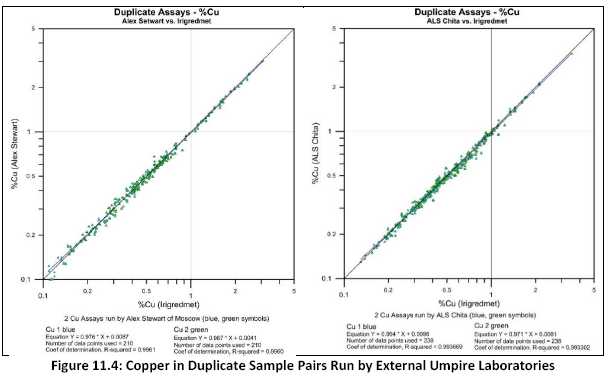
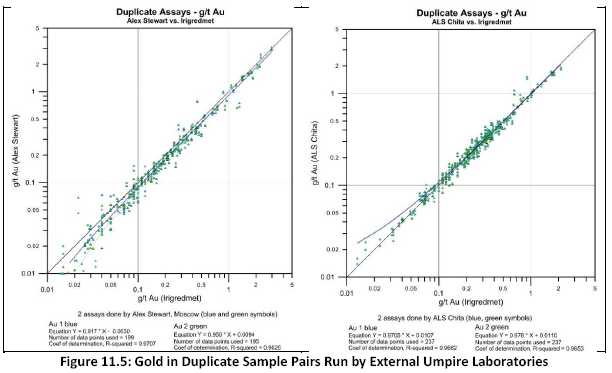
| 11.4.3.6 |
Half Core Duplicates |
The remaining half of the split core was submitted for duplicate analysis for 105 samples from the 2011-2012 drilling, and 203 samples from the 2013-2014 campaign. The samples were selected from the same three grade classes (i.e., 0.1 -0.4, 0.4 -0.6, >0.6% Cu) as with the duplicates sent to umpire labs. Irgiredmet performed both the original assays and the half core duplicate assays.
| ZT 61-1442/MM998 | Final V1.0 | Page 84 |
| Report Date: July 10, 2015 |
| EURASIAN MINERALS INC AND IG COPPER LLC | |
| NI 43-101 TECHNICAL REPORT ON THE INITIAL MINERAL RESOURCE ESTIMATE FOR | |
| THE MALMYZH COPPER-GOLD PROJECT, KHABAROVSK KRAI, RUSSIAN FEDERATION |
As a step in the ½ core duplicate sampling process, the weights of the second half of the core were recorded. The duplicates averaged 8% higher, with variability suggesting possible sampling inconsistencies (Figure 11.6). There are two weight populations representing NQ and HQ core sizes core. The variability is greater with the HQ core. The larger diameter HQ core was frequently used at shallower depths where broken and weathered rock was encountered.
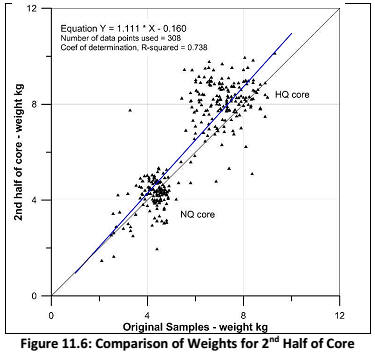
Several possible factors that contribute to the variability in weights include: 1) not getting an equal split of the fine and broken material, 2) inconsistent splitting for holes that were hydraulically split versus the normal practice of using a core saw, and 3) sample markers for the split core having been jostled after repeated moves of the core boxes.
It is recommended that in the future core sampling be monitored by spot checks of the weight of the second half of the core immediately after splitting and prior to the core boxes being moved. Notwithstanding, the variances in split core weights for NQ are not significant, and the HQ core samples in shallow and weathered zones do not impact the most important samples from zones of underlying mineralisation.
The correlation of assay grades for copper and gold grades for the ½ core duplicates is good (Figure 11.7), with high correlation coefficients and strong linear regression characteristics. This is especially so considering that core duplicates will inherently have the highest variability as compared to coarse reject or pulp duplicates.
| ZT 61-1442/MM998 | Final V1.0 | Page 85 |
| Report Date: July 10, 2015 |
| EURASIAN MINERALS INC AND IG COPPER LLC | |
| NI 43-101 TECHNICAL REPORT ON THE INITIAL MINERAL RESOURCE ESTIMATE FOR | |
| THE MALMYZH COPPER-GOLD PROJECT, KHABAROVSK KRAI, RUSSIAN FEDERATION |
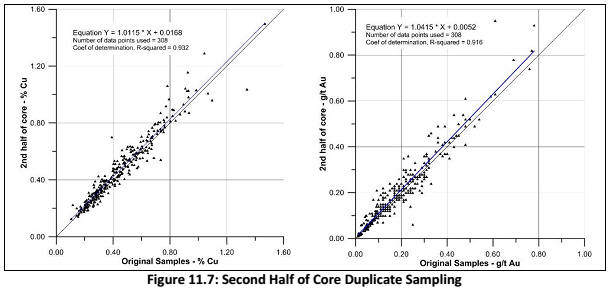
| 11.5 |
Sample Handling and Security |
Sample handling and security for the Project's exploration samples, particularly the drill samples, has been conducted with industry standard procedures. Malmyzh is a relatively "remote" site, and the property is constantly occupied by site staff and personnel responsible for security.
Drill samples were transported from the rig to camp by Project personnel for logging and sampling on a frequent basis (twice daily). Once logged, the core was transported to the nearby sample prep facility. The prepared samples were moved to the camp's geology office at the end of each shift for final organisation and packaging for shipment. This process included a) taking Niton pXRF readings on the prepared samples (which included blanks and duplicates) as a "rough" QC check for the final laboratory analyses and determining preliminary results for copper and other pathfinder/alteration elements, the b) insertion of CRM standards into the sample sequence, and c) final packaging for shipment.
The packaged samples were driven by Project personnel from site at least on a weekly basis to the Khabarovsk office, where they were securely stored until shipment to the analytic lab. Shipment to the lab was via registered air freight. The remaining pulp not utilised by the analytical lab was returned and is securely stored at the Project warehouse in Khabarovsk. In summary, the sample handling for the Malmyzh exploration samples had a continuous and secure chain of custody from the drill rig to the analytic lab.
| 11.6 |
Comments on Sample Preparation, Analyses, and Security |
The Project's on-site sample preparation facility performs crushing and splits the samples down to 500-600 g sub-samples. This process is effective in saving considerable sample shipment costs from site and speeding up turn-around time from the commercial laboratories. The QA/QC programme has established that the on-site crushing and splitting are providing material for subsequent analysis comparable to that provided by major commercial sample preparation facilities. Project personnel perform the sample preparation process, but IGC personnel including, Thomas Bowens, CPG and James Ashleman, LPG constantly monitor and manage the process. The coarse reject material and the split core are retained on site and can be used for future check and due diligence analyses.
| ZT 61-1442/MM998 | Final V1.0 | Page 86 |
| Report Date: July 10, 2015 |
| EURASIAN MINERALS INC AND IG COPPER LLC | |
| NI 43-101 TECHNICAL REPORT ON THE INITIAL MINERAL RESOURCE ESTIMATE FOR | |
| THE MALMYZH COPPER-GOLD PROJECT, KHABAROVSK KRAI, RUSSIAN FEDERATION |
The QA/QC programme has identified rare cases where sample-switching, or QC samples out of acceptable range occur. Corrective actions have included having the lab re-run the questionable samples. Duplicate samples sent to umpire laboratories do not show analytic bias or other issues with the Project's principal lab, Irgiredmet.
The Malmyzh Project sampling, sample preparation, and analytical procedures have been carried out in a manner that meets accepted industry best practices. The chain of custody maintained sample integrity, and was secure and well documented. The resulting Malmyzh analytical database is considered reliable, reproducible, and suitable for resource estimation.
| ZT 61-1442/MM998 | Final V1.0 | Page 87 |
| Report Date: July 10, 2015 |
| EURASIAN MINERALS INC AND IG COPPER LLC | |
| NI 43-101 TECHNICAL REPORT ON THE INITIAL MINERAL RESOURCE ESTIMATE FOR | |
| THE MALMYZH COPPER-GOLD PROJECT, KHABAROVSK KRAI, RUSSIAN FEDERATION |
| 12 |
DATA VERIFICATION |
| 12.1 |
Introduction |
The author undertook two visits to Far East Russia, the first from 10-12th March 2015 when bad weather prevented access to the site, and the second site visit, from 25-27th March 2015.
During the first visit, the Amur Minerals/IGC Khabarovsk offices were viewed, data analysed, and the core storage facility visited in the city from where check core and pulp samples were collected, whilst for the second visit, the Malmyzh site, sample preparation facility, core storage and field office were the focus.
The aim of the visit was to review the geology, mineralisation, exploration programmes, drill core, sample preparation facilities, terrain, access, infrastructure and overall project setting.
The drill holes chosen for data verification included those holes that represented the main mineralised zones present within the Valley, Freedom, Central and Flats deposits which in turn included mineralisation in hornfelsed siltstone, diorite porphyry, sandstone, siltstone, recrystallised sandstone and breccia.
Data verification work involved:
| • | Review and audit of sample database; | |
| • | Site overview including sample preparation facilities; | |
| • | Independent verification of 12 core samples, 12 pulp samples and 2 standard samples; and | |
| • | QA/QC review of the drill hole assay data. |
The site visit confirmed that the technical team is highly qualified and that the exploration programme undertaken on site was robust.
| 12.2 |
Assay Database versus Lab Certificates |
The Malmyzh Project has been managed in a very professional manner over the last few years and great care has been taken with sample collection, preparation, analysis and data recording.
As an example of this, during the site visit, the author of this report randomly selected approximately 30 assay values of gold and copper from the different deposits in the assay database and checked these against to the original laboratory assay results.
The check found zero errors or discrepancies for the drill assay records, and clearly demonstrated the high quality of the assay database. Therefore, WAI concludes that the current database is adequate for the Mineral Resource estimate.
| ZT 61-1442/MM998 | Final V1.0 | Page 88 |
| Report Date: July 10, 2015 |
| EURASIAN MINERALS INC AND IG COPPER LLC | |
| NI 43-101 TECHNICAL REPORT ON THE INITIAL MINERAL RESOURCE ESTIMATE FOR | |
| THE MALMYZH COPPER-GOLD PROJECT, KHABAROVSK KRAI, RUSSIAN FEDERATION |
| 12.3 |
Site Overview |
During the site visit, no exploration was taking place, with the result that WAI was not able to directly view logging and sample preparation methodologies. However, it was possible to verify the procedures as stipulated by the Company and described elsewhere in this report.
The camp at Malmyzh is well established with offices, mess room and garaging facilities fabricated from sea containers, and the accommodation units in gers, similar to yurts (Photo 12.1).
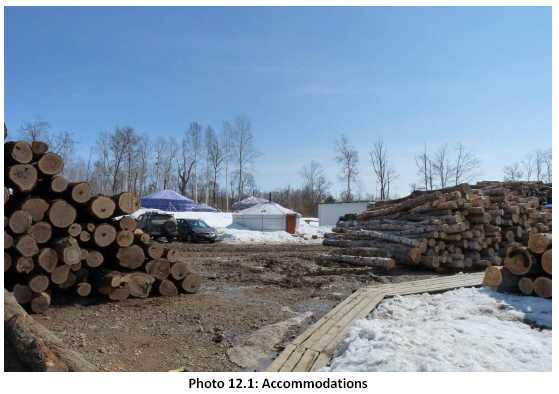
Samples from the field were brought to the camp for logging in a dedicated core log room which also had a good display of reference lithologies mounted on the wall (Photo 12.2) to aid logging. The Company used a standard logging sheet which follows industry best practice.
Core was marked up and then split using one of two diamond saws before being sent to the sample preparation facilities. This had not been used for some time, but comprises a drying oven with racked shelving, two parallel lines of a Rocklabs jaw crusher, which reduces the sample to 2mm, followed by sample reduction stages using a sample splitter to produce a 600g laboratory split and a 600g duplicate. Equipment was cleaned with compressed air between samples.
| ZT 61-1442/MM998 | Final V1.0 | Page 89 |
| Report Date: July 10, 2015 |
| EURASIAN MINERALS INC AND IG COPPER LLC | |
| NI 43-101 TECHNICAL REPORT ON THE INITIAL MINERAL RESOURCE ESTIMATE FOR | |
| THE MALMYZH COPPER-GOLD PROJECT, KHABAROVSK KRAI, RUSSIAN FEDERATION |
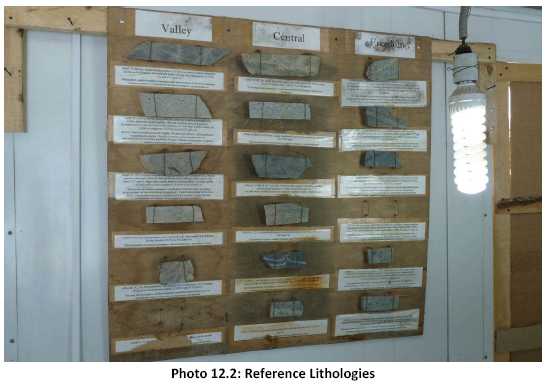
As part of the data verification process, an attempt was made to view some drill collars and to establish their position. However, due to very heavy snowfall (over 1 m), the logistics of verifying drill collar positions proved difficult, although it was possible to get to a few collars in the Valley area. In particular, hole AMM 102 was located and verified (Photo 12.3).
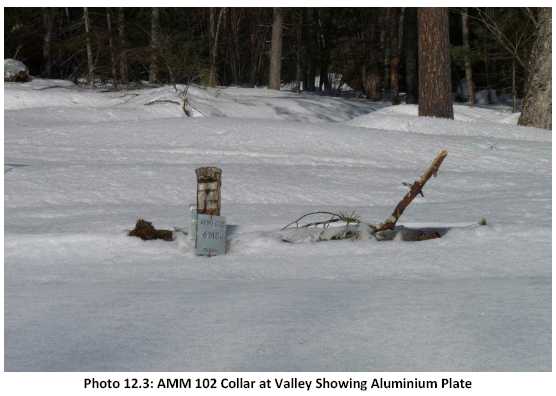
| ZT 61-1442/MM998 | Final V1.0 | Page 90 |
| Report Date: July 10, 2015 |
| EURASIAN MINERALS INC AND IG COPPER LLC | |
| NI 43-101 TECHNICAL REPORT ON THE INITIAL MINERAL RESOURCE ESTIMATE FOR | |
| THE MALMYZH COPPER-GOLD PROJECT, KHABAROVSK KRAI, RUSSIAN FEDERATION |
| 12.4 |
Core Inspection & Storage |
At the camp, core is stored in a dry, timber frame building (Photo 12.4), with core stacked in ordered piles, labelled by hole. Boxes are well labelled with hole number, from and to and box number. In addition, sample numbers were noted within the boxes as well as drill markers denoting depth.
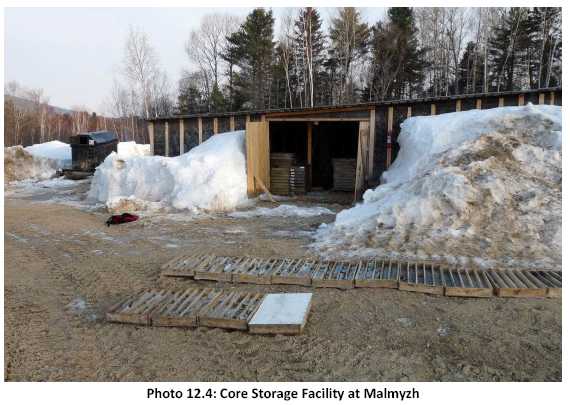
WAI inspected a selection of drill holes that represented the main mineralised zones present within the Valley, Freedom, Central and Flats deposits (Table 12.1) which in turn included mineralisation in hornfelsed siltstone, diorite porphyry, sandstone, siltstone, recrystallised sandstone and breccia.
| Table 12.1: Inspected Core Holes at Malmyzh | ||||
| Hole Number | From | To | Deposit | Lithologies |
| 42 | 120.9 | 141.8 | Central | Diorite porphyry |
| 42 | 168.9 | 186.0 | Central | Diorite porphyry |
| 49 | 75.9 | 105.9 | Central | Diorite |
| 56 | 119.3 | 134.8 | Freedom | Hornblende porphyry |
| 114 | 162.8 | 236.8 | Valley | Hornfels → diorite → breccia |
| 141 | 39.0 | 58.0 | Flats | Sandstone → breccia |
| 143 | 58.0 | 68.0 | Flats | Diorite porphyry |
| 152 | 152.8 | 201.4 | Valley | Diorite porphyry → hornfels sandstone |
| 191 | 87.0 | 97.0 | Freedom | Diorite porphyry |
| 196 | 194.0 | 204.0 | Freedom | Diorite porphyry |
WAI can confirm that the rock types and mineralisation identified and logged by the Company appear to be consistent and accurately conveys the provenance and style of mineralisation seen at Malmyzh.
| ZT 61-1442/MM998 | Final V1.0 | Page 91 |
| Report Date: July 10, 2015 |
| EURASIAN MINERALS INC AND IG COPPER LLC | |
| NI 43-101 TECHNICAL REPORT ON THE INITIAL MINERAL RESOURCE ESTIMATE FOR | |
| THE MALMYZH COPPER-GOLD PROJECT, KHABAROVSK KRAI, RUSSIAN FEDERATION |
Core was also viewed in Khabarovsk where it is stored in a large, dry warehouse. From here, samples were collected for independent analysis (see below).
| 12.5 |
Independent Check Samples |
| 12.5.1 | Independent Duplicate Core Samples |
The author conducted independent verification of drill core sampling results during the site visit. As part of this audit, 12 sample intervals were selected from nine core drill holes as being representative of the Project’s copper and gold mineralisation in the Valley, Freedom, Central and Flats deposits.
Drill holes were chosen from each deposit as follows: Valley Deposit (AMM007, AMM016 and AMM017), Freedom Deposit (AMM037 and AMM039), Central Deposit (AMM023) and Flats Deposit (AMM001, AMM003 and AMM004). The intervals were chosen to provide a variety of rock types, styles of mineralisation, and importantly, grade distributions.
For each intersection, the remaining ½ cores were placed in a heavy duty polythene bag with a sample tag noting sample number, then placed inside of another similar bag which was also labelled with the sample number. These were then sealed with cable ties (Photo 12.5).
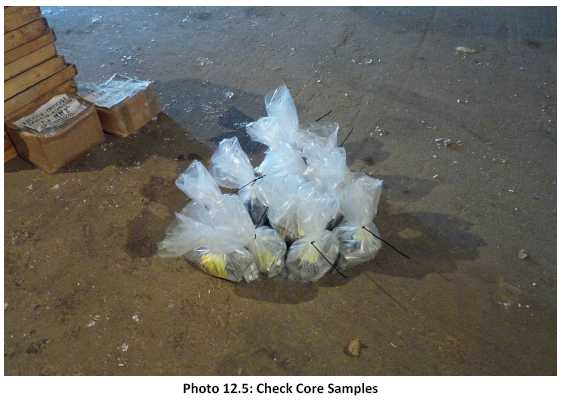
The bagged samples were then sent by courier to the ALS laboratory in Chita and submitted to the same assay procedures as the original samples which was fire assay for Au (Au-AA23) and aqua regia multi-element ICP (ME-ICP41).
| ZT 61-1442/MM998 | Final V1.0 | Page 92 |
| Report Date: July 10, 2015 |
| EURASIAN MINERALS INC AND IG COPPER LLC | |
| NI 43-101 TECHNICAL REPORT ON THE INITIAL MINERAL RESOURCE ESTIMATE FOR | |
| THE MALMYZH COPPER-GOLD PROJECT, KHABAROVSK KRAI, RUSSIAN FEDERATION |
The assay results for the independent duplicate core samples checks are listed in Table 12.2. The author noted that all results are returned within acceptable control limits with an exception of Sample ID 71190 (denoted in yellow in Table 12.2). Due to the generally very close correlation between original and check assays, WAI is of the opinion that sample ID 71190 is a spurious outlier, and therefore for the purposes of further comparisons, was removed from the dataset.
| Table 12.2: Original Core Samples vs Independent Check Analysis | |||||||||||
| Original Samples | Independent Samples | ||||||||||
| Deposit | Hole No. | From | To | Sample | Cu | Au | CuEq | Sample | ALS Au | ALS Cu | Description |
| No | (%) | (ppm) | % | No | (ppm) | (%) | |||||
| AMM007 | 90.3 | 92.3 | 71732 | 0.39 | 0.32 | 0.56 | PSN02 | 0.22 | 0.39 | Porphyry | |
| Valley | AMM016 | 214.2 | 216.1 | 73466 | 0.41 | 0.18 | 0.51 | PSN11 | 0.16 | 0.37 | Porphyry |
| AMM017 | 113.9 | 116 | 73553 | 0.39 | 0.09 | 0.44 | PSN04 | 0.11 | 0.39 | Hornfelsed Siltstone | |
| AMM037 | 159.1 | 161 | 76811 | 0.39 | 0.31 | 0.56 | PSN12 | 0.5 | 0.61 | Diorite Porphyry | |
| Freedom | AMM039 | 131.5 | 133.3 | 77093 | 0.58 | 0.12 | 0.65 | PSN06 | 0.14 | 0.61 | Hydrothermal Breccia |
| AMM039 | 152.6 | 154.5 | 77105 | 0.87 | 0.9 | 1.37 | PSN07 | 0.6 | 0.89 | Hornblende porphyry | |
| AMM023 | 100.4 | 102.6 | 74321 | 0.45 | 0.16 | 0.54 | PSN08 | 0.15 | 0.43 | Diorite porphyry | |
| Central | AMM023 | 178.8 | 180.8 | 74364 | 0.73 | 0.12 | 0.8 | PSN09 | 0.12 | 0.73 | Sandstone |
| AMM023 | 239.8 | 241.8 | 74397 | 0.41 | 0.04 | 0.44 | PSN10 | 0.04 | 0.4 | Siltstone | |
| AMM001 | 141.9 | 143.9 | 72076 | 0.3 | 0.17 | 0.39 | PSN01 | 0.36 | 0.4 | Recrystallised Sandstone | |
| Flats | AMM002 | 243.2 | 245.2 | 70833 | 0.59 | 0.38 | 0.8 | PSN05 | 0.26 | 0.5 | Porphyry |
| AMM004 | 125.4 | 127.4 | 71190 | 0.34 | 0.39 | 0.55 | PSN03 | <0.005 | 0.01 | Porphyry | |
The duplicate analysis for copper shows good correlation between the original sample results and the independent sample assays, with a correlation coefficient of 0.89 (Figure 12.1). The original samples on average assayed 0.50% versus 0.52% copper for the independent samples, which corresponds to a 4% difference. Ranked half absolute relative difference (HARD) plots show that 90% of the data are within an absolute relative error of 10%.
| ZT 61-1442/MM998 | Final V1.0 | Page 93 |
| Report Date: July 10, 2015 |
| EURASIAN MINERALS INC AND IG COPPER LLC | |
| NI 43-101 TECHNICAL REPORT ON THE INITIAL MINERAL RESOURCE ESTIMATE FOR | |
| THE MALMYZH COPPER-GOLD PROJECT, KHABAROVSK KRAI, RUSSIAN FEDERATION |
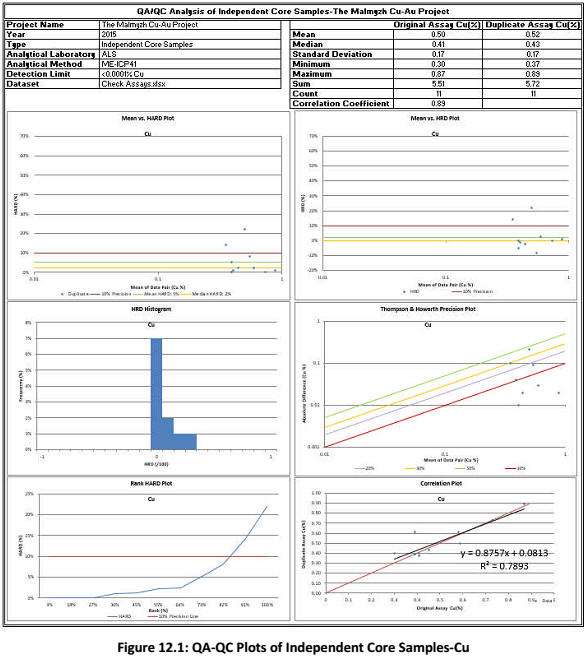
The duplicate analysis for gold, as expected, does not show as good a correlation between the original sample results and the independent sample assays as for Cu, with a correlation coefficient of 0.67 (Figure 12.2). The original samples on average assayed 0.19ppm versus 0.21ppm gold for the independent samples, which corresponds to a 10% difference. Ranked half absolute relative difference (HARD) plots show that 60% of the data are within an absolute relative error of 10%.
It should be noted that two outliers, Sample ID 77105 and 71190, were removed from the dataset as there is an influence in the final result.
| ZT 61-1442/MM998 | Final V1.0 | Page 94 |
| Report Date: July 10, 2015 |
| EURASIAN MINERALS INC AND IG COPPER LLC | |
| NI 43-101 TECHNICAL REPORT ON THE INITIAL MINERAL RESOURCE ESTIMATE FOR | |
| THE MALMYZH COPPER-GOLD PROJECT, KHABAROVSK KRAI, RUSSIAN FEDERATION |
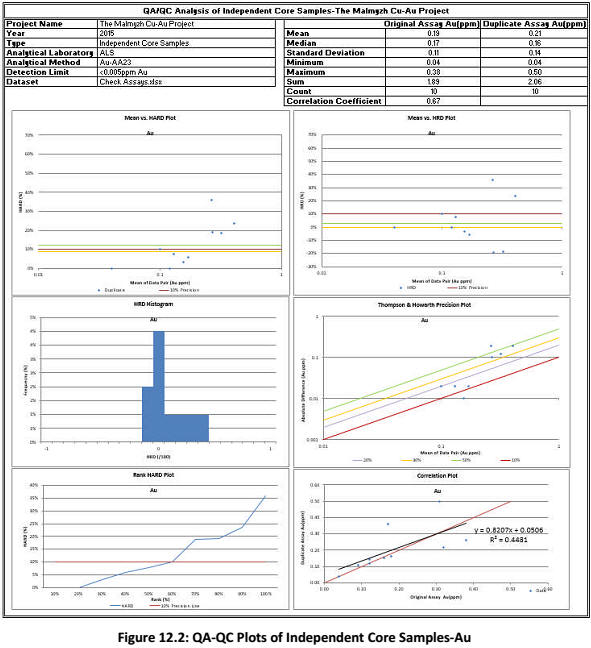
| 12.5.2 | Independent Duplicate Pulp Samples |
As a further check on the assay values, the author selected 12 pulp samples from each deposit as follows: Valley Deposit (AMM152 and AMM114), Freedom Deposit (AMM56, AMM191 and AMM196), Central Deposit (AMM42 and AMM49) and Flats Deposit (AMM143 and AMM41).
Approximately 200g of pulp sample was placed in a heavy duty polythene bag, with a sample tag inside, which was in turn placed inside a second bag with the sample number labelled on the outside. These were then fastened with cable ties and submitted for assay at ALS Chita for the same assay procedure as the core samples.
| ZT 61-1442/MM998 | Final V1.0 | Page 95 |
| Report Date: July 10, 2015 |
| EURASIAN MINERALS INC AND IG COPPER LLC | |
| NI 43-101 TECHNICAL REPORT ON THE INITIAL MINERAL RESOURCE ESTIMATE FOR | |
| THE MALMYZH COPPER-GOLD PROJECT, KHABAROVSK KRAI, RUSSIAN FEDERATION |
The results of the independent verification of pulp samples are listed in Table 12.3 below.
| Table 12.3: Original Pulp Samples vs Independent Check Analysis | |||||||||||
| Original Samples | Independent Samples | ||||||||||
| Deposit | Hole No. | From | To | Sample | Cu | Au | CuEq | Sample | ALS Au | ALS Cu | Description |
| No | (%) | (ppm) | % | No | (ppm) | (%) | |||||
| Valley | AMM152 | 180.5 | 182.5 | 103514 | 0.39 | 0.17 | 0.48 | PSN18 | 0.22 | 0.4 | Hornfelsed Sandstone |
| Valley | AMM152 | 71.2 | 73.2 | 103453 | 0.64 | 0.36 | 0.84 | PSN17 | 0.3 | 0.76 | Diorite Porphyry |
| Valley | AMM114 | 181.8 | 183.8 | 95477 | 0.39 | 0.24 | 0.52 | PSN16 | 0.22 | 0.39 | Hornfelsed Sandstone |
| Freedom | AMM56 | 113.3 | 115.3 | 84152 | 0.93 | 1.54 | 1.78 | PSN21 | 1.33 | 0.93 | Feldspathised Quartz Hornlende |
| Freedom | AMM191 | 93 | 95 | 107977 | 0.52 | 0.13 | 0.59 | PSN20 | 0.11 | 0.53 | Diorite Porphyry |
| Freedom | AMM196 | 212 | 214 | 110376 | 0.38 | 0.62 | 0.72 | PSN19 | 0.62 | 0.4 | Diorite Porphyry |
| Central | AMM42 | 84 | 86 | 78760 | 0.52 | 0.095 | 0.57 | PSN24 | 0.1 | 0.5 | Diorite |
| Central | AMM49 | 75.9 | 77.9 | 83254 | 0.45 | 0.12 | 0.52 | PSN23 | 0.13 | 0.45 | Diorite Porphyry |
| Central | AMM49 | 111.9 | 113.9 | 83274 | 0.59 | 0.032 | 0.61 | PSN22 | 0.03 | 0.57 | Diorite |
| Flats | AMM143 | 62 | 64 | 102077 | 0.28 | 0.43 | 0.52 | PSN15 | 0.42 | 0.28 | Diorite Porphyry |
| Flats | AMM41 | 49 | 51 | 99877 | 0.22 | 0.2 | 0.33 | PSN14 | 0.23 | 0.22 | Breccia |
| Flats | AMM41 | 67 | 69 | 99887 | 0.32 | 0.14 | 0.4 | PSN13 | 0.15 | 0.33 | Sandstone |
The duplicate analyses for copper show good correlation between the original sample results and the independent sample assays, with a correlation coefficient of 0.98 (Figure 12.3).
The original samples on average assayed 0.47% versus 0.48% copper for the independent samples, which corresponds to a 2% difference. Ranked half absolute relative difference (HARD) plots show that the data are within an absolute relative error of 10%
The duplicate analysis for gold also shows a good correlation between the original sample results and the independent sample assays, with a correlation coefficient of 0.99 (Figure 12.4).
The original samples on average assayed 0.23ppm versus 0.23ppm gold for the independent samples. An outlier value, Sample ID 84152, was removed from the dataset due to the high influence of this one result.
| ZT 61-1442/MM998 | Final V1.0 | Page 96 |
| Report Date: July 10, 2015 |
| EURASIAN MINERALS INC AND IG COPPER LLC | |
| NI 43-101 TECHNICAL REPORT ON THE INITIAL MINERAL RESOURCE ESTIMATE FOR | |
| THE MALMYZH COPPER-GOLD PROJECT, KHABAROVSK KRAI, RUSSIAN FEDERATION |
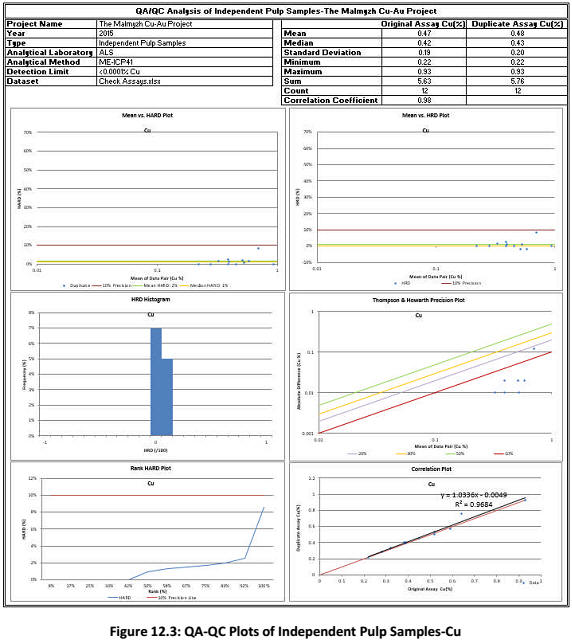
| 12.5.3 | Independent Standard Samples |
Two standard samples were sent to ALS for verification analysis and the analysis results are listed in Table 12.4. As can be seen in the table below, OREAS502 returned results within acceptable control limits.
| ZT 61-1442/MM998 | Final V1.0 | Page 97 |
| Report Date: July 10, 2015 |
| EURASIAN MINERALS INC AND IG COPPER LLC | |
| NI 43-101 TECHNICAL REPORT ON THE INITIAL MINERAL RESOURCE ESTIMATE FOR | |
| THE MALMYZH COPPER-GOLD PROJECT, KHABAROVSK KRAI, RUSSIAN FEDERATION |
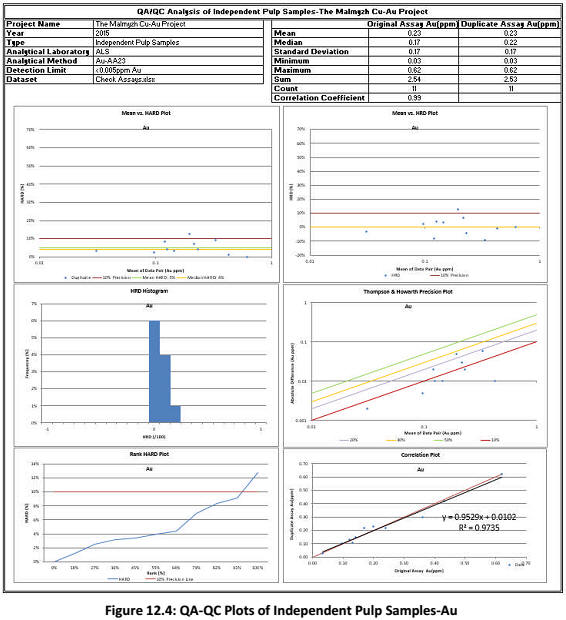
| Table 12.4: Independent Standard Sample Check Assays | ||||||
| Type | Standard
Name |
Standard Concentrations |
Standard Assays | |||
| Cu
(%) |
Au
(ppm) |
WAI
Sample Number |
ALS Cu
(%) |
ALS
Au (ppm) | ||
| Standards | OREAS501 | 0.27 | 0.2 | PSN25 | 0.29 | 0.20 |
| Standards | OREAS502 | 0.76 | 0.49 | PSN26 | 0.79 | 0.49 |
| ZT 61-1442/MM998 | Final V1.0 | Page 98 |
| Report Date: July 10, 2015 |
| EURASIAN MINERALS INC AND IG COPPER LLC | |
| NI 43-101 TECHNICAL REPORT ON THE INITIAL MINERAL RESOURCE ESTIMATE FOR | |
| THE MALMYZH COPPER-GOLD PROJECT, KHABAROVSK KRAI, RUSSIAN FEDERATION |
| 12.5.4 | Independent Verification Results |
Excluding gold core duplicates, correlation exceeds 0.89 for all other datasets. Ranked half absolute relative difference (HARD) plots show that 90% or more of the data are within an absolute relative error of 10%, with the exception of independent core duplicates for gold.
This is entirely to be expected given the gold distribution within the mineralisation and will be most prevalent within higher grade gold samples where two half cores may well give significantly different assays.
However, this effect is somewhat ameliorated when a comparison of pulp duplicates is made as the fine grained samples effectively smooth any grade inconsistencies.
Therefore, in the author’s opinion, the independent verification checks have been successful in demonstrating the accuracy and robustness of the existing database.
| ZT 61-1442/MM998 | Final V1.0 | Page 99 |
| Report Date: July 10, 2015 |
| EURASIAN MINERALS INC AND IG COPPER LLC | |
| NI 43-101 TECHNICAL REPORT ON THE INITIAL MINERAL RESOURCE ESTIMATE FOR | |
| THE MALMYZH COPPER-GOLD PROJECT, KHABAROVSK KRAI, RUSSIAN FEDERATION |
| 13 |
MINERAL PROCESS AND METALLURGICAL TESTING |
| 13.1 |
Introduction |
Malmyzh Project mineralogical studies and metallurgical test work have been conducted according to Russian requirements by Irgiredmet Laboratories (Irkutsk). This Section 13 summarises the results of this work as provided from OREOLL (2014) and internal IGC reports (2014).
Irgiredmet did test work on four composites of multiple drill core samples, of which three represented sulphide copper-gold mineralisation 1) MET-35-1 from Central, 2) ТП–02-S from Valley, and 3) ТП–03-S from Freedom, and a fourth was of oxide mineralisation 4) ТП–04-Ox from Valley and Freedom. No metallurgical test work was conducted on Flats material.
| 13.2 |
Mineralogical Characterisation |
Descriptions of the metallurgical samples and their copper and gold grades from drilling are as follows (refer to Photo 13.1):
| • | MET-35-1: diorite porphyry from Central (0.45% Cu, 0.17 g/t Au). | |
| • | ТП–02-S: hornfels from Valley (0.42% Cu, 0.18 g/t Au). | |
| • | ТП–03-S: diorite porphyry from Freedom (0.38% Cu, 0.32 g/t Au). | |
| • | ТП–04-0x: Composite oxidised material from Valley and Freedom (0.20% Cu, 0.22 g/t Au). |
In general, the sulphide minerals noted include pyrite, chalcopyrite, chalcocite, bornite and covellite, that occur as disseminations and in veinlets.
A more detailed accounting of the mineralogical composition of the samples was determined utilising a combination of X-ray diffraction, optical microscopy, and electronic scanning microscopy (Table 13.1).
The sulphide samples for a given deposit were composited from a mixture of rock and alteration types, as well as grade ranges to represent "average mineralisation" for each deposit. The composited samples broadly represent the Malmyzh copper-gold mineralisation as currently defined, but geometallurgical work to test for variability of different rock, alteration, and mineralisation types had not yet been done.
Nevertheless, the samples do provide a basis for initial metallurgical test work for the current stage of assessment.
The work on the oxide sample consisted of preliminary flotation and other testing. However, the thin oxide zones represent minor tonnages at Valley, Central, Freedom, and Flats and were considered as a waste domain during resource modelling. The oxide metallurgical work is not considered further in this report.
| ZT 61-1442/MM998 | Final V1.0 | Page 100 |
| Report Date: July 10, 2015 |
| EURASIAN MINERALS INC AND IG COPPER LLC | |
| NI 43-101 TECHNICAL REPORT ON THE INITIAL MINERAL RESOURCE ESTIMATE FOR | |
| THE MALMYZH COPPER-GOLD PROJECT, KHABAROVSK KRAI, RUSSIAN FEDERATION |
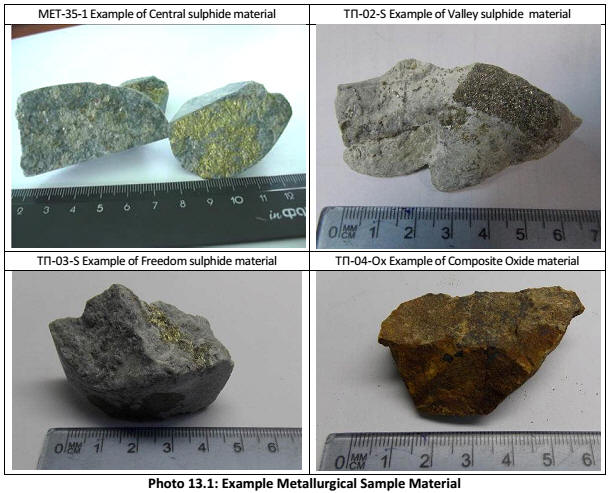
| Table 13.1: Mineralogy of Metallurgical Samples | ||||
| Mineralogy | ТП–02 | ТП–03 | ТП–04-ox | Met-035-1 |
| % | % | % | % | |
| Quartz | 22.0 | 35.0 | 20.4 | 54.2 |
| Plagioclase (albite-oligoclase, andesine) | 40.0 | 29.0 | 34.0 | 27.0 |
| Potassium feldspar | 18.0 | 0.5 | 16.0 | 2.0 |
| Clayey-micaceous minerals | 12.6 | 11.0 | 22.5 | 3.0 |
| Carbonate (dolomite-ankerite, siderite, calcite) | 3.3 | 2.2 | 0.4 | 1.4 |
| Chlorite | 1.0 | 15.0 | 1.5 | 6.0 |
| Amphibole, pyroxene | Rare | n/d | 0.3 | |
| Pyrite | 1.4 | 5.3 | Rare | 2.0 |
| Chalcopyrite | 1.0 | 0.9 | - | 1.0 |
| Chalcocite, bornite, covellite | 0.1 | 0.1 | 0.1 | 0.1 |
| Sphalerite, galena | Rare | Indiv.grains | ||
| Sulphate and carbonate of copper | Rare | 0.2 | n/d | |
| FeOx (Limonite, jarosite, goethite, hematite) | 0.4 | Rare | 5.0 | 2.0 |
| Magnetite | 0.2 | 1.0 | Rare | 1.0 |
| Accessory minerals (apatite, zircon, ilmenite) | Rare and indiv.grains | Rare | ||
| Total % : | 100.0 | 100.0 | 100.0 | 100.0 |
| ZT 61-1442/MM998 | Final V1.0 | Page 101 |
| Report Date: July 10, 2015 |
| EURASIAN MINERALS INC AND IG COPPER LLC | |
| NI 43-101 TECHNICAL REPORT ON THE INITIAL MINERAL RESOURCE ESTIMATE FOR | |
| THE MALMYZH COPPER-GOLD PROJECT, KHABAROVSK KRAI, RUSSIAN FEDERATION |
| 13.3 |
Metallurgical Testwork |
The metallurgical work focused on crushing, grinding and flotation testing of the sulphide composite samples, each weighing ~110-150 kg. The proposed flowsheet included a first stage SAG crush and a second stage ball mill grind. Irgiredmet's reporting of the Bond Abrasion Index and Bond Work Index physical properties of the mineralised material falls within expected norms (Table 13.2).
| Table 13.2: Bond Abrasion and Work Indices for Metallurgical Samples | |||
| Sample | Bond Abrasion
Index |
Bond Work Index
kW-h/t (crushing) |
Bond Work Index kW-
h/t (grinding) |
| Valley (ТП–02) | 0.21 | 11.48 | 14.73 |
| Freedom (ТП–03) | 0.18 | 13.96 | 16.00 |
The recovery testwork was conducted on material crushed and ground to a -1 mm size (p85-90%). Initially, a flotation scheme with five cleaner steps was designed from work conducted on the Central sulphide sample in 2012. Subsequently in 2013, the Valley and Freedom sulphide samples were submitted for metallurgical testing using the same flotation scenario developed for Central. The resulting metallurgical recoveries for copper and gold are summarised in Table 13.3.
| Table 13.3: Preliminary Flotation Recoveries for Sulphide Samples | ||
| Cu Recovery % | Au Recovery % | |
| Central (Met-035) | 92.1 | 73.9 |
| Valley (ТП–02) | 96.7 | 67.9 |
| Freedom (ТП–03) | 95.6 | 73.5 |
| Average | 94.8 | 71.8 |
This initial processing scheme resulted in average recoveries of 94.8% for copper and 71.8% for gold, but yielded low concentrate copper grades for Central (15.1%), and very low concentrate grades (< 8%) for Freedom and Valley. This led to two additional tests on the Valley and Freedom samples using alternative approaches to increase the concentrate grades.
The first test used different reagents and was based upon three cleaner stages; the recovery results are summarised in Table 13.4. This scheme did not significantly improve the copper concentrate grades (< 9%), and decreased the overall copper recoveries whilst significantly reducing the gold recoveries for Freedom.
| Table 13.4: Alternative Flotation Recoveries for Sulphide Samples | ||
| Cu Recovery % | Au Recovery % | |
| Valley (ТП–02) | 87.4 | 76.4 |
| Freedom (ТП–03) | 86.6 | 48.8 |
| Average | 87.0 | 62.6 |
The second flotation test was with two cleaner steps, and additional adjustments of reagents, pH, etc. The results of this metallurgical testwork significantly upgraded the copper concentrate grades (34.4% Valley, 26.3% Freedom), but at the expense of reducing the gold recovery. The results of this metallurgical testing are summarised in Table 13.5.
| ZT 61-1442/MM998 | Final V1.0 | Page 102 |
| Report Date: July 10, 2015 |
| EURASIAN MINERALS INC AND IG COPPER LLC | |
| NI 43-101 TECHNICAL REPORT ON THE INITIAL MINERAL RESOURCE ESTIMATE FOR | |
| THE MALMYZH COPPER-GOLD PROJECT, KHABAROVSK KRAI, RUSSIAN FEDERATION |
| Table 13.5: Flotation Recoveries for Sulphide Samples | ||
| Cu Recovery % | Au Recovery % | |
| Valley (ТП–02) | 94.5 | 47.4 |
| Freedom (ТП–03) | 90.4 | 44.0 |
| Average | 92.5 | 45.7 |
Irgiredment's metallurgical testwork has demonstrated that flotation of Malmyzh mineralised sulphide material can yield acceptable copper recoveries and concentrate grades. However, this early stage work has yet to be optimised for gold recoveries, and further studies need to be conducted. One approach to improve gold recovery could include an added process of cyanide leaching of the high pyrite tails.
| 13.4 |
Comments on Mineral Processing and Metallurgical Testing |
Given the current level of understanding, a conceptual flow sheet for mineral processing could be based upon the following known characteristics of Malmyzh copper-gold mineralised material:
| • | The host rocks are altered diorite porphyries and hornfelsed siliciclastics. | |
| • | Mineralisation occurs principally as chalcopyrite, but chalcocite, bornite and covellite can also be present. | |
| • | Copper is finely dispersed, and there is no significant free gold. | |
| • | Gold reports with copper and pyrite. | |
| • | Preliminary testwork indicates that flotation can yield an acceptable copper concentrate grade. | |
| • | There are no complex minerals or penalty elements. | |
| • | Oxide material should be considered in a separate processing study utilising hydrometallurgical methods. |
Principal steps for flotation processing suggested at this stage include:
| • | Crush (SAG mill) and grind (ball mill). | |
| • | Rougher flotation stage - maximise copper-gold extraction at coarse grind. | |
| • | Re-grind/cleaner flotation stages - grind smaller volumes to fine sizes. | |
| • | Cyanide leach the cleaner flotation tails to improve gold recovery. |
This conceptual processing scenario is outlined in Figure 13.1.
| ZT 61-1442/MM998 | Final V1.0 | Page 103 |
| Report Date: July 10, 2015 |
| EURASIAN MINERALS INC AND IG COPPER LLC | |
| NI 43-101 TECHNICAL REPORT ON THE INITIAL MINERAL RESOURCE ESTIMATE FOR | |
| THE MALMYZH COPPER-GOLD PROJECT, KHABAROVSK KRAI, RUSSIAN FEDERATION |
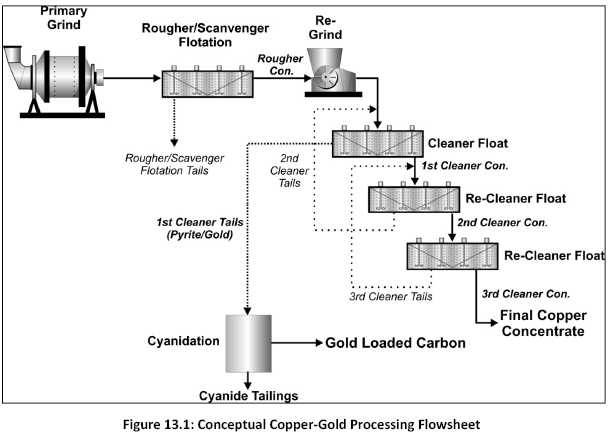
Irgiredmet's work suggests that standard crushing, grinding, and flotation processing methods, with project specific adjustments such as cyanidation of tails to improve gold recovery, could be beneficially applied to the Malmyzh mineralised material. At this stage of the Project's evaluation, and until more testwork is conducted, it is reasonable to assume that copper recoveries will be over 90%, and that gold recoveries will be in the range of 70%. It is recommended that further metallurgical testing be conducted to optimise copper-gold recoveries.
| ZT 61-1442/MM998 | Final V1.0 | Page 104 |
| Report Date: July 10, 2015 |
| EURASIAN MINERALS INC AND IG COPPER LLC | |
| NI 43-101 TECHNICAL REPORT ON THE INITIAL MINERAL RESOURCE ESTIMATE FOR | |
| THE MALMYZH COPPER-GOLD PROJECT, KHABAROVSK KRAI, RUSSIAN FEDERATION |
| 14 |
MINERAL RESOURCE ESTIMATES |
| 14.1 |
Introduction |
The Malmyzh mineral resource estimation process was a collaborative effort between WAI and IGC geologists. IGC provided WAI with Project exploration databases that included topography, drilling, density measurements, and geological interpretations. In addition, IGC provided preliminary block models that were reviewed by WAI, and adjusted and refined to produce the final mineral resource block models. The block model estimates, selection of metal prices, costs, metallurgical recoveries, copper equivalent calculations, cut-off determinations, optimised open pit generation, and mineral resource classification, verification and reporting were completed under the supervision of the author of this report, WAI's Managing Director, Dr Phil Newall.
The software used to estimate, verify, and report the Malmyzh mineral resources included LeapFrog, Vulcan, Snowden Supervisor, Datamine, and NPV Scheduler. The resulting mineral resource estimates meet the National Instrument 43-101 Standards of Disclosure for Mineral Projects of the Canadian Securities Administrators (“NI 43-101”) and Canadian Institute of Mining, Metallurgy and Petroleum (CIM) definition standards.
The Malmyzh geologic and resource models are supported by the author’s independent checks and assessment of the drill data, QA/QC results, and geologic interpretation of the porphyry copper-gold mineralised porphyry deposits.
| 14.2 |
Drill Hole Database |
The Malmyzh geologic models and resource estimates were based upon the drill hole database provided by IGC. The database includes 211 holes and over 70,600 m of core drilling, details of which are described in Section 10 of this report. The data provided included: 1) drill collars in UTM metres, 2) down-hole survey records, 3) assays consisting of copper, gold and multi-element geochemistry, and 4) geologic logs.
The Malmyzh Joint Venture has followed CIM Best Practice guidelines for drilling, sampling, assaying, QA/QC, and internal database verification. The veracity of the drill database has been independently verified. As a result, the quality of the drill database used to estimate the Malmyzh resources is judged to be reliable, accurate, and appropriate for mineral resource estimation. Figure 14.1 is a map representing the property-wide drill hole locations.
Mineral resources were estimated for the Valley, Central, Freedom Southeast, and Flats deposits from a subset of the Project drilling:
| • | Valley: | 53 holes totaling 20,557.8 m. | |
| • | Central: | 33 holes totaling 11,631.7 m. | |
| • | Freedom: | 49 holes totaling 17,481.7 m. | |
| • | Flats: | 18 holes totaling 5,412.1 m. |
| ZT 61-1442/MM998 | Final V1.0 | Page 105 |
| Report Date: July 10, 2015 |
| EURASIAN MINERALS INC AND IG COPPER LLC | |
| NI 43-101 TECHNICAL REPORT ON THE INITIAL MINERAL RESOURCE ESTIMATE FOR | |
| THE MALMYZH COPPER-GOLD PROJECT, KHABAROVSK KRAI, RUSSIAN FEDERATION |
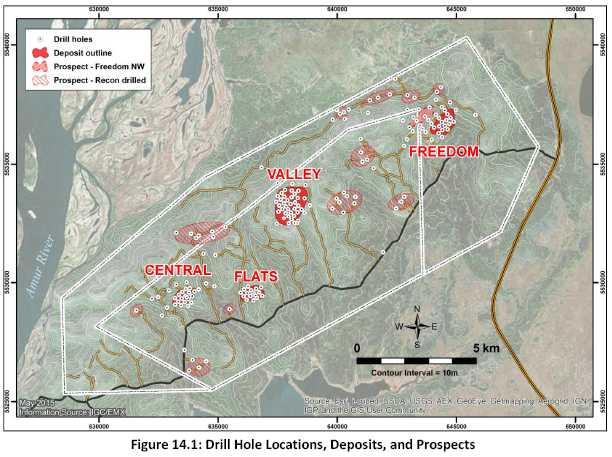
These four deposits were systematically drilled on 200 by 200 m grids, with select in-fill holes to fulfill Russian reporting requirements. The Freedom NW prospect was drilled on a 200 by 400 m grid, and was evaluated as a prospect for follow-up exploration as discussed in Section 14.11.
| 14.3 |
Topographic Surface Model |
The Malmyzh topographic surface was based on contours that were photogrammetrically produced at 1 m (minor) and 5 m (major) contour intervals from Geoeye-1 stereo satellite imagery. The imagery resulted from a custom tasking of the satellite. The collection date was October 6, 2011 which was both cloud and snow free, providing a 1 m resolution imagery base for Project mapping purposes. The orthorectification was controlled by placing DGPS surveyed ground panels across the property in order to provide precise tie points. The final planimetric contours were produced for a "bald earth" model by compensating for tree cover over the property.
| 14.4 |
Geologic and Mineralised Domain Models |
The Valley, Central, Freedom, and Flats geologic and mineralised domain models were principally developed from: a) logged lithology, alteration, and structure, and b) copper (gold) assays. In addition, down-hole multi-element geochemistry was reviewed to provide further context for defining the porphyry system domains. The data were integrated to develop models of a) overburden, b) oxide-transition-sulphide zones, c) diorite porphyry bodies, d) copper-gold mineralised envelopes and e) structures that truncated mineralisation.
| ZT 61-1442/MM998 | Final V1.0 | Page 106 |
| Report Date: July 10, 2015 |
| EURASIAN MINERALS INC AND IG COPPER LLC | |
| NI 43-101 TECHNICAL REPORT ON THE INITIAL MINERAL RESOURCE ESTIMATE FOR | |
| THE MALMYZH COPPER-GOLD PROJECT, KHABAROVSK KRAI, RUSSIAN FEDERATION |
IGC provided cross sectional interpretations for lithology and generalised alteration and structure on the N40°W oriented, 200 m spaced drill fences for each deposit. These interpretations were used to guide construction of 3D models of overburden and diorite porphyry, with the hornfels units assigned outside of these domains. In addition, surfaces representing oxide, transition, and sulphide mineralisation were modeled from the logged geology.
Exploratory data analysis of logged geology and alteration was conducted on the drill hole database. From this work, it was concluded that given the current drill spacing and relatively early stage of exploration assessment, that IGC's cross sections combined with copper and gold assay distributions provided the best approach to defining domains of porphyry copper-gold mineralisation for constraining grade estimation.
The frequency distributions were reviewed with Log10 histograms, probability plots, and univariate statistics (Table 14.1 and Figure 14.2). In general, the histograms are notable as distinct log symmetric distributions representing a majority of the population, with a second significant population defined by a negative tail representing weakly altered and mineralised holes drilled on the periphery of the porphyry deposits. Positive tail outlier populations are apparent, but minimal for Central (deep quartz-feldspar UST zone) and Freedom (higher-grade Au in postulated cross-cutting features). At Flats, there are notable high-grade gold outliers that form a positive tail (principally from the diorite porphyry-hornfels contact).
| Table 14.1: Cu & Au Drilling Statistics for Valley, Central, Freedom, and Flats | ||||||||
| Valley | Central | Freedom | Flats | |||||
| Cu % | Au g/t | Cu % | Au g/t | Cu % | Au g/t | Cu % | Au g/t | |
| N of Cases | 10,275 | 10,275 | 5,684 | 5,684 | 8,546 | 8,546 | 2,670 | 2,670 |
| Minimum | 0.001 | 0.003 | 0.001 | 0.003 | 0.001 | 0.003 | 0.002 | 0.005 |
| Maximum | 4.611 | 10.200 | 3.084 | 2.380 | 3.538 | 33.200 | 2.116 | 86.900 |
| Median | 0.221 | 0.090 | 0.190 | 0.025 | 0.128 | 0.057 | 0.164 | 0.080 |
| Arithmetic Mean | 0.255 | 0.121 | 0.233 | 0.056 | 0.179 | 0.126 | 0.180 | 0.162 |
| Standard Deviation | 0.206 | 0.167 | 0.203 | 0.095 | 0.196 | 0.415 | 0.126 | 1.706 |
| Coeff of Var (CV) | 0.807 | 1.377 | 0.870 | 1.708 | 1.092 | 3.281 | 0.702 | 10.512 |
For all four deposits, the main bodies of porphyry alteration and mineralisation generally correspond to the 0.1% copper threshold. Gold mineralisation variably occurs within the 0.1% copper envelopes, typically forming cohesive zones at a level of 0.05 -0.10 g/t Au. As a result, a 0.1% copper threshold was selected as a guideline to define the mineralised domains at Valley, Central, Freedom, and Flats, with minor adjustments to include higher gold grades at the margins of the systems.
| ZT 61-1442/MM998 | Final V1.0 | Page 107 |
| Report Date: July 10, 2015 |
| EURASIAN MINERALS INC AND IG COPPER LLC | |
| NI 43-101 TECHNICAL REPORT ON THE INITIAL MINERAL RESOURCE ESTIMATE FOR | |
| THE MALMYZH COPPER-GOLD PROJECT, KHABAROVSK KRAI, RUSSIAN FEDERATION |
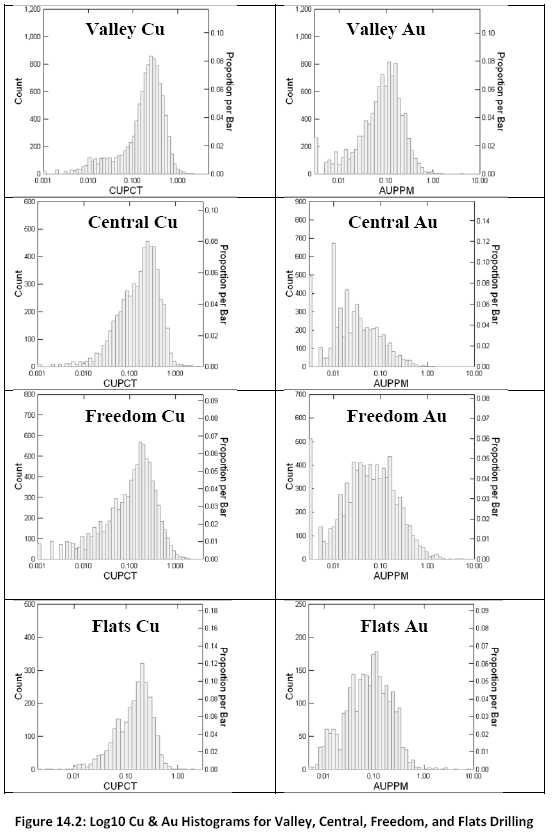
| ZT 61-1442/MM998 | Final V1.0 | Page 108 |
| Report Date: July 10, 2015 |
| EURASIAN MINERALS INC AND IG COPPER LLC | |
| NI 43-101 TECHNICAL REPORT ON THE INITIAL MINERAL RESOURCE ESTIMATE FOR | |
| THE MALMYZH COPPER-GOLD PROJECT, KHABAROVSK KRAI, RUSSIAN FEDERATION |
| 14.5 |
Compositing, Mineralised Domain Models, and Cap Grades |
Run length composites were calculated from the drill assay database at a 10 m interval length, representing an assumed bench height for a potential open pit mining operation. The nominal sample length was 2 m for all Project drilling, and as a result the composites are typically averaged from five drill intervals.
The drill composites and geologic sections were used to construct the porphyry mineralised domain solid models for Valley, Central, Freedom, and Flats. Initially 0.1% grade shell solids were generated with anisotropies defined by the overall strike and dip geologic controls for each deposit. The grade shells were then sliced as polygons on 25-50 m sections, and compared to the interpreted geologic sections. The polygons were then adjusted to reflect the trends of the diorite porphyry-hornfels contacts, as well as generalised interpretations of alteration envelopes from the cross sections. These manually adjusted polygons were used to control the generation of the final porphyry copper-gold mineralised domains solid models, and to code the assay composites in preparation for further analysis and block modeling (Figure 14.3).
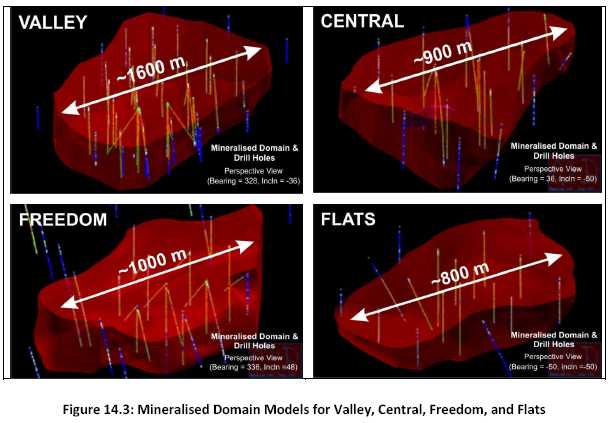
The composite frequency distributions for the copper-gold mineralised zones at Valley, Central, Freedom, and Flats were characterised with univariate statistical analysis and Log10 histograms (Table 14.2 and Figure 14.4). There are low coefficients of variation for copper, and higher coefficients of variation for gold. The mineralisation in the Malmyzh porphyry deposits appears consistent as defined by the mineralised domain envelopes, and reflected in the composite statistics.
| ZT 61-1442/MM998 | Final V1.0 | Page 109 |
| Report Date: July 10, 2015 |
| EURASIAN MINERALS INC AND IG COPPER LLC | |
| NI 43-101 TECHNICAL REPORT ON THE INITIAL MINERAL RESOURCE ESTIMATE FOR | |
| THE MALMYZH COPPER-GOLD PROJECT, KHABAROVSK KRAI, RUSSIAN FEDERATION |
| Table 14.2: Cu & Au Composite Statistics for Valley, Central, Freedom, and Flats | ||||||||
| Valley | Central | Freedom | Flats | |||||
| Cu % | Au g/t | Cu % | Au g/t | Cu % | Au g/t | Cu % | Au g/t | |
| N of Cases | 1,614 | 1,614 | 700 | 700 | 1,114 | 1,114 | 424 | 424 |
| Minimum | 0.039 | 0.012 | 0.022 | 0.003 | 0.002 | 0.003 | 0.031 | 0.015 |
| Maximum | 1.105 | 2.249 | 2.143 | 1.062 | 1.571 | 3.325 | 0.861 | 17.492 |
| Median | 0.272 | 0.114 | 0.284 | 0.046 | 0.206 | 0.103 | 0.191 | 0.109 |
| Arithmetic Mean | 0.303 | 0.137 | 0.318 | 0.077 | 0.249 | 0.166 | 0.208 | 0.193 |
| Standard Deviation | 0.155 | 0.108 | 0.180 | 0.094 | 0.165 | 0.229 | 0.101 | 0.859 |
| Coeff of Var (CV) | 0.510 | 0.792 | 0.566 | 1.224 | 0.663 | 1.380 | 0.488 | 4.458 |
From the composite histograms, the copper-gold domains generally define symmetric Log10 distributions. All four deposits have negative tail sub-populations that represent both internal dilution, as well as the inclusion of lower grades peripheral to the porphyry centres. The Valley mineralised domain in particular has "lognormal" distributions for both copper and gold, suggesting a single overall population, excepting a small number of higher-grade outliers. For Central, there are clearly polymodal distributions composed of higher grade quartz-feldspar-UST related mineralisation, a main population representing the potassically altered "core" of the system, and lower grades representing the margins of the system. Freedom is characterised by overall Log10 symmetric populations for both copper and gold, with positive tails representing cross-cutting higher grade zones. The Flats deposit has a higher grade positive tail, ascribed to the porphyry-hornfels contact, with a negatively skewed main population.
In order to restrict the influence of higher-grade outliers, the Log10 frequency distributions were reviewed and cap grades determined. In the case of Central, the "UST" zone was broken out as a distinctive geologic domain, modelled separately, and no cap grade applied. However, cap grades were determined for Central's main zone of copper-gold porphyry mineralisation. The copper and gold cap grades accounted for less than 0.5% (i.e., <½%) of the composite populations, except for Flats where 1.2% of the gold composites were capped. A summary of the cap grades is:
| • | Valley: | 0.85% copper and 0.62 g/t gold | |
| • | Central : | 0.80% copper and 0.50 g/t gold | |
| • | Freedom: | 1.00% copper and 1.50 g/t gold | |
| • | Flats: | 0.52% copper and 0.75 g/t gold |
Given the symmetric distributions within the mineralised domains, the relatively low coefficients of variation, and the capped composite outliers, the copper-gold mineralised domains and the composites contained therein provide a basis for block model grade estimation.
| ZT 61-1442/MM998 | Final V1.0 | Page 110 |
| Report Date: July 10, 2015 |
| EURASIAN MINERALS INC AND IG COPPER LLC | |
| NI 43-101 TECHNICAL REPORT ON THE INITIAL MINERAL RESOURCE ESTIMATE FOR | |
| THE MALMYZH COPPER-GOLD PROJECT, KHABAROVSK KRAI, RUSSIAN FEDERATION |
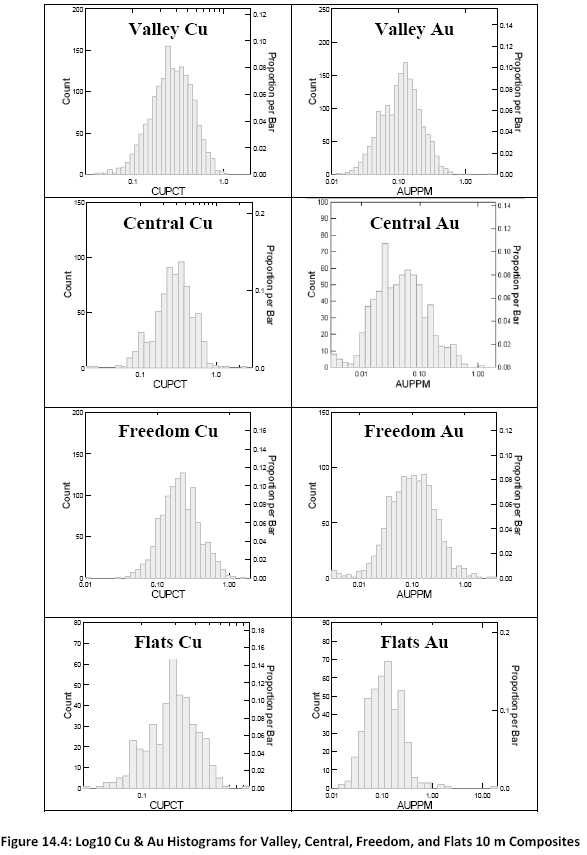
| ZT 61-1442/MM998 | Final V1.0 | Page 111 |
| Report Date: July 10, 2015 |
| EURASIAN MINERALS INC AND IG COPPER LLC | |
| NI 43-101 TECHNICAL REPORT ON THE INITIAL MINERAL RESOURCE ESTIMATE FOR | |
| THE MALMYZH COPPER-GOLD PROJECT, KHABAROVSK KRAI, RUSSIAN FEDERATION |
| 14.6 |
Correlograms and Variography |
Variography, in the form of correlogram analysis, was conducted on the 10 m composites for the copper-gold mineralised domains. The principal advantage of the correlogram over the variogram is that it renders a smoother, more coherent structure for fitting a semivariogram model. Correlogram (autocorrelation) studies are often referred to as variography due to the traditional emphasis on the variogram; this use of terminology is hereby adopted for subsequent discussion.
Initially, omni-directional correlograms were calculated for the mineralised zones at Valley, Central, Freedom and Flats. These correlograms provided a first-pass assessment of the spatial continuity of mineralisation by considering all directions of sample pairs simultaneously, including down-hole composite pair distances that start at 10 m as opposed to the 200 m distances of the nominal drill grid spacing. The correlograms and the corresponding double spherical model parameters are given in Table 14.3, Table 14.4 and Figure 14.5.
| Table 14.3: Copper Omni-Direction Correlogram Model Parameters | |||||
| Nugget | C1 | C2 | Range 1 (m) | Range 2 (m) | |
| Valley | 0.25 | 0.15 | 0.60 | 150 | 475 |
| Central | 0.15 | 0.55 | 0.30 | 150 | 300 |
| Freedom | 0.30 | 0.60 | 0.10 | 125 | 275 |
| Flats | 0.15 | 0.55 | 0.30 | 150 | 325 |
| Table 14.4: Gold Omni-Direction Correlogram Model Parameters | |||||
| Nugget | C1 | C2 | Range 1 (m) | Range 2 (m) | |
| Valley | 0.25 | 0.25 | 0.50 | 200 | 450 |
| Central | 0.12 | 0.40 | 0.48 | 150 | 250 |
| Freedom | 0.30 | 0.25 | 0.45 | 150 | 300 |
| Flats | 0.40 | 0.35 | 0.25 | 110 | 225 |
The four resource deposits have nugget to sill ratios for copper and gold that range from 15-30%, highlighting that over two-thirds of the variance has a spatial component, with the balance of the variance due to ‘nugget effect’. This relatively low nugget effect reflects the general consistency of the copper-gold zones at the deposit scale.
The primary model ranges (i.e., Range 1) are similar for copper and gold, and vary from 110 m at Flats to 200 m at Valley, and the secondary ranges (i.e., Range 2) vary from 225 m at Flats to 475 m at Valley. Valley's long ranges reflect the relative consistency of the mineralisation observed in the diorite porphyry and hornfels host rocks, as well as the relatively large size of this well-developed porphyry system. In contrast, at Flats, which is the smallest deposit at Malmyzh, an important local control on mineralisation is the diorite porphyry-hornfels contact which has restricted continuity and contributes to the shorter ranges. The ranges for Central and Freedom are similar to each other (i.e., Range 1 from 125-150 m, and Range 2 from 275-300 m), and intermediate in length as compared to Valley (long) and Flats (short).
| ZT 61-1442/MM998 | Final V1.0 | Page 112 |
| Report Date: July 10, 2015 |
| EURASIAN MINERALS INC AND IG COPPER LLC | |
| NI 43-101 TECHNICAL REPORT ON THE INITIAL MINERAL RESOURCE ESTIMATE FOR | |
| THE MALMYZH COPPER-GOLD PROJECT, KHABAROVSK KRAI, RUSSIAN FEDERATION |
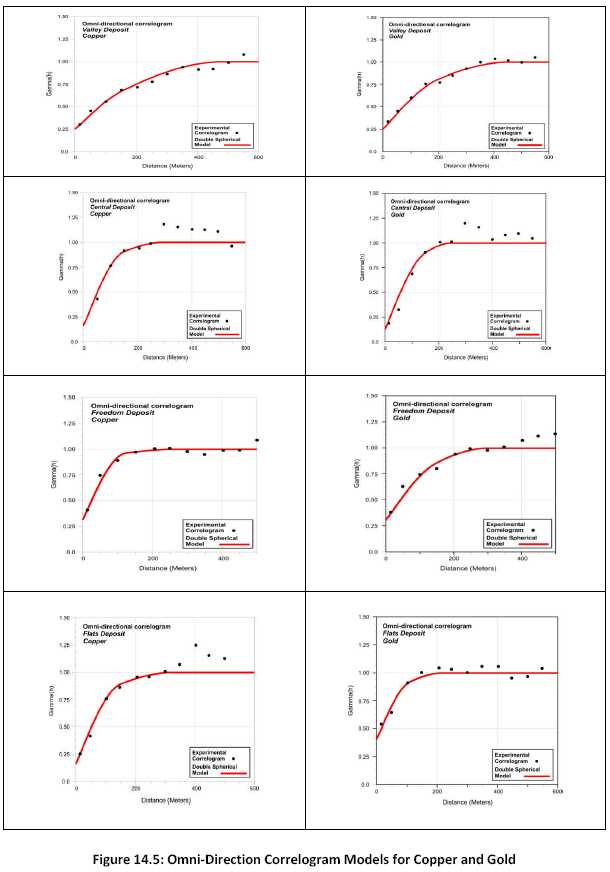
| ZT 61-1442/MM998 | Final V1.0 | Page 113 |
| Report Date: July 10, 2015 |
| EURASIAN MINERALS INC AND IG COPPER LLC | |
| NI 43-101 TECHNICAL REPORT ON THE INITIAL MINERAL RESOURCE ESTIMATE FOR | |
| THE MALMYZH COPPER-GOLD PROJECT, KHABAROVSK KRAI, RUSSIAN FEDERATION |
The definition of the omni-directional correlogram parameters provided a basis for proceeding with directional correlogram analysis. The Valley and Central correlograms exhibited variable degrees of spatial continuity in the strike and down-dip direction, but the correlograms were "noisey", and for Central in particular, the model structures were poorly defined. The directional copper and gold correlograms for Freedom and Flats did not define readily apparent spatial continuities that could be confidently fit with models.
Notwithstanding, from the correlogram work it is clear that there is overall spatial continuity of the porphyry deposits as given from the omni-directional models. However, much of the spatial variance and correlogram structure is given at ranges of 150-200 m, which is at or less than the drill grid spacing. In large measure this explains the difficulty in defining the directional correlogram models. As a result, the correlogram exercise was only useful for generally confirming overall ranges of grade continuity given the drill density at this stage of the Project's evaluation.
| 14.7 |
Block Model Definitions |
The Malmyzh block models were constructed to cover the extent of the copper-gold mineralised domains for Valley, Central, Freedom, and Flats. The models were oriented parallel to the axes of the Project’s UTM coordinate grid with a 25 m x 25 m x 10 m (x, y, z) parent block size, and a 12.5 m x 12.5 m x 5 m sub-block size. The parent block dimensions are based on the current drill hole spacing and a selective mining unit size suitable for a potential open pit operation. The sub-blocking scheme allowed a higher degree of precision in assigning geologic codes to blocks at solid model contacts. The parameters used for defining the block model extents are given in Table 14.5.
| Table 14.5: Block Model Extents | ||||||
| East Min | North Min | Elev Min | East Max | North Max | Elev Max* | |
| Valley | 636800 | 5531975 | -600 | 639150 | 5534500 | 350 |
| Central | 632500 | 5528450 | -600 | 635450 | 5530400 | 350 |
| Freedom | 642250 | 5535400 | -600 | 645400 | 5537800 | 350 |
| Flats | 635600 | 5528800 | -600 | 637250 | 5530250 | 350 |
| *Note, the topographic surfaces effectively limit the maximum elevation of each block model. | ||||||
Key variables coded into the block models included:
| • | Rock: | coded for unconsolidated overburden and bedrock. | |
| • | Domain: | coded for oxide and sulphide/transition zones. | |
| • | Zone: | coded by mineralised domains unique to each deposit. | |
| • | Density: | assigned by rock type. | |
| • | Cu %: | estimated within mineralised domain from composites. | |
| • | Au g/t: | estimated within mineralised domain from composites. | |
| • | CuEq: | calculated as Cu% + (0.5 * Au g/t). | |
| • | Class: | resource classification category. |
| ZT 61-1442/MM998 | Final V1.0 | Page 114 |
| Report Date: July 10, 2015 |
| EURASIAN MINERALS INC AND IG COPPER LLC | |
| NI 43-101 TECHNICAL REPORT ON THE INITIAL MINERAL RESOURCE ESTIMATE FOR | |
| THE MALMYZH COPPER-GOLD PROJECT, KHABAROVSK KRAI, RUSSIAN FEDERATION |
There were a number of additional variables included in the block model definitions (i.e., number of drill holes to estimate a block, number of composites to estimate a block, etc.) that were used for block model interpolation assessment, model checks, etc.
| 14.8 |
Specific Gravity Measurements and Density Assignments |
IGC provided a database of specific gravity measurements for various rock types. The specific gravity work was conducted on site, using a wax coated procedure setup by Chief Geologist, J.C. Ashleman. In total, there were over 2,300 measurements. After review of the database statistics (i.e., min, max, median, and average), and removing non-representative outliers, the following specific gravity values were selected:
| • | All deposits: | 2.45 for oxide material. | |
| • | Valley deposit: | 2.65 for diorite porphyry and 2.64 for hornfels. | |
| • | Central deposit: | 2.71 for diorite porphyry and 2.66 for hornfels. | |
| • | Freedom deposit: | 2.69 for all rocks types. | |
| • | Flats deposit: | 2.72 for diorite porphyry and 2.66 for hornfels. |
Specific gravity for unconsolidated sediments was not practical to measure, and as a result a Project wide assignment of 2.00 was used for overburden blocks.
| 14.9 |
Grade Estimation, Resource Classification and Reporting, and Model Validation |
| 14.9.1 | Grade Estimation |
Copper and gold grades were estimated for the Valley, Central, Freedom Southeast, and Flats deposits with inverse distance to the third power ("IDW"). This is a standard interpolation technique, and can be a good alternative to ordinary kriging. This is especially so considering the current drill hole spacing and the challenge of confidently defining directional correlogram models as discussed in Section 14.6.
The search ellipsoids were oriented according to the northeast striking and southwest dipping geologic controls evident at the deposit scale. The omni-directional correlogram ranges were used as a general guideline for the search ellipsoid distances. Anisotropic weighting factors were applied to control estimations for Freedom (postulated cross-cutting higher grade) and Flats (diorite porphyry-hornfels contact high grade), whereas at Valley and Central they were not. Two estimation passes were conducted, with the first pass restricted to, or just over the nominal drill grid spacing. The second pass search distances were extended to fill-in blocks along the margins of the deposits that were unestimated from the first pass.
A summary of the IDW search ellipsoid parameters is given in Table 14.6.
| ZT 61-1442/MM998 | Final V1.0 | Page 115 |
| Report Date: July 10, 2015 |
| EURASIAN MINERALS INC AND IG COPPER LLC | |
| NI 43-101 TECHNICAL REPORT ON THE INITIAL MINERAL RESOURCE ESTIMATE FOR | |
| THE MALMYZH COPPER-GOLD PROJECT, KHABAROVSK KRAI, RUSSIAN FEDERATION |
| Table 14.6: Search Ellipsoid Parameters | |||||||||
| Strike | Plunge | Dip | Maj (m) Pass 1 |
Semi (m) Pass 1 |
Minor (m) Pass 1 |
Maj (m) Pass 2 |
Semi (m) Pass 2 |
Minor (m) Pass 2 | |
| Valley | N50E | 0 | 60 NW | 250 | 250 | 125 | 400 | 400 | 200 |
| Central | N50E | 0 | 70 NW | 200 | 200 | 100 | 300 | 300 | 150 |
| Freedom SE | N55E | 0 | 80 NW | 200 | 200 | 100 | 300 | 300 | 150 |
| Flats | N55E | 0 | 75 NW | 200 | 200 | 100 | 300 | 300 | 150 |
The 10 m drill composites within the porphyry mineralised sulphide/transition domain models were used for resource estimation. The blocks estimated were also restricted to the mineralised domains. These restrictions controlled the "smearing" or extrapolation of grades into wall rock peripheral to the porphyry systems.
Further restrictions for higher-grade composites were imposed at Central, Freedom Southeast, and Flats. In the case of Central, a separate modelling domain for the deep zone of quartz-feldspar alteration and UST texture development was imposed; the impact of this zone on the resource was minimal (i.e., < 0.05% of the tonnes) and is more of interest from an exploration point of view. For Freedom and Flats, the influence of geologically distinct "high grade" composites (defined at the cap grade) was confined by search ellipsoid axes reduced to 50% of the first pass search range. At Freedom Southeast, this search range restriction had minimal impact, as less than 0.5% of the composites were affected. At Flats, 1.2% of the gold composites had restricted searches to control the influence of the outlier grades.
The number of composites to estimate a block was set to a minimum of three and a maximum of twelve. A maximum of five composites was allowed from a single drill hole. The minimum and maximum composite criteria ensured that block grades were typically estimated with 2-4 drill holes, while maintaining strong local control from the nearest hole.
In addition, blocks in the thin oxide zones overlying the sulphide deposits were also estimated, but not included as resources. Although oxide is currently considered to be waste, the oxide zone estimates provided a more complete geological characterisation of the copper-gold distributions for each deposit. Search ellipsoids oriented parallel to the general topographic slope for a given deposit were used, along with more relaxed estimation criteria (i.e., minimum of 1 composite for estimation, extended ranges, etc.) in order to fill in blocks from a limited number of oxide composites.
| 14.9.2 | Resource Classification and Optimised Open Pits |
| 14.9.2.1 |
Preliminary In Situ Classification |
The Malmyzh mineral resources were classified to reflect several factors that influenced the confidence in, and risks to, the estimates. These factors principally include the confidence of grade and tonnage estimates relative to the current drill hole spacing and the early stage of metallurgical characterisation.
| ZT 61-1442/MM998 | Final V1.0 | Page 116 |
| Report Date: July 10, 2015 |
| EURASIAN MINERALS INC AND IG COPPER LLC | |
| NI 43-101 TECHNICAL REPORT ON THE INITIAL MINERAL RESOURCE ESTIMATE FOR | |
| THE MALMYZH COPPER-GOLD PROJECT, KHABAROVSK KRAI, RUSSIAN FEDERATION |
At the broad deposit and global in situ scale, the porphyry copper-gold mineralisation is relatively continuous, yet there are localised controls evident that cannot be confidently defined at a 200 m spacing. Moreover, at Freedom complexities precluded the development of a coherent, 3D reconcilable model of the geology. Valley has the most continuous styles of copper-gold mineralisation, including potassically altered hornfels host rocks that are relatively elevated in copper and gold. However, the alteration logs were sometimes inconsistent in key areas, and it was not practical to construct alteration models to constrain grade estimation. Industry-wide, such inconsistencies are more common than not for early stage exploration projects such as Malmyzh.
The metallurgical testwork described in Section 13 underscores the critical necessity to develop a processing flow sheet that will establish confidence not only in copper recoveries, but as well gold recoveries. The testwork does present a reasonable range of copper recoveries, although the gold recoveries remain uncertain. Also, the geometallurgical characterisation of different types of mineralised material (i.e., high versus low pyrite, etc.) has yet to be determined.
In consideration of the foregoing, the Malmyzh in situ estimates were all preliminarily determined to be candidates for classification as Inferred resources.
| 14.9.2.2 |
Final Open Pit Constrained Classification |
In order to meet the criteria for "reasonable prospects for economic extraction", the Malmyzh in situ resource block models were constrained by Lerchs-Grossman ("LG") optimised open pit configurations for final resource classification. The LG open pit parameters were based upon metal prices, costs, and metallurgical recoveries taken from examples of potentially similar operations, as well as independent technical assessments conducted within the Russian Federation.
In preparation for LG pit optimisation and resource reporting, the sub-blocked models were regularised to blocks with dimensions of 25 x 25 x 15 m (X by Y by Z). The regularised block models more accurately represent a potential selective mining unit size that includes both internal and external edge dilution that would be encountered during mining.
The input parameters for LG open pit generation included:
| • | Copper price of $3.25/lb, | |
| • | Gold price of $1,400/oz, | |
| • | Metallurgical recovery of 90% for copper, | |
| • | Metallurgical recovery of 70% for gold, | |
| • | Mining cost of $2/tonne, | |
| • | Mining cost adjustment of $0.03/tonne/bench, | |
| • | Processing cost of $7/tonne, | |
| • | G & A cost of $2/tonne, | |
| • | Mining recovery of 95%, | |
| • | Pit wall slope angle of 45°. |
| ZT 61-1442/MM998 | Final V1.0 | Page 117 |
| Report Date: July 10, 2015 |
| EURASIAN MINERALS INC AND IG COPPER LLC | |
| NI 43-101 TECHNICAL REPORT ON THE INITIAL MINERAL RESOURCE ESTIMATE FOR | |
| THE MALMYZH COPPER-GOLD PROJECT, KHABAROVSK KRAI, RUSSIAN FEDERATION |
The LG open pit metal prices and metallurgical recoveries were also used as a basis for the copper equivalent calculation of CuEq = Cu % + (Au g/t x 0.5). For reference, the detailed CuEq calculation is given below:
CuEq% = Cu % + (Au g/t x factor), where the factor is defined as:
(($1400/oz Au) x (1 oz/31.1035 g)) ÷ (($3.25/lb Cu) x (1 lb/453.592 g)) x ((1 %) ÷ (10,000 g/t)) x ((70% Au rec) ÷ (90% Cu rec)).
The metal prices were based on long term consensus forecasts, and include some upside to reflect reasonable prospects for eventual extraction, which is a typical industry approach for mineral resources. Further, these are generally in line with industry assumptions for resource reporting current as of the effective date of this report.
The mining, processing, and G&A costs used are consistent with examples of similar scale porphyry copper (gold) projects. The mining cost adjustment of $0.03/tonne/bench is applied to each successively LG "mined" level in the resource open pit, and recognises the additional expense associated with hauling material from what could eventually be relatively deep open pits.
The metallurgical studies (see Section 13) suggest that copper recoveries could be higher than 90%. The 70% gold recovery is marginally lower than reported from the first set of flotation tests for Central, but higher than reported from subsequent testing for Valley and Freedom. However, none of the metallurgical processing scenarios included a potential step of cyanide leaching of tails to enhance gold recoveries. At this early stage of the Project's evaluation, it is reasonable to assume copper recoveries of 90% and gold recoveries of 70% until further metallurgical testing is conducted.
Figure 14.6 shows the Malmyzh LG resource open pits along with the porphyry copper-gold mineralised domain solids.
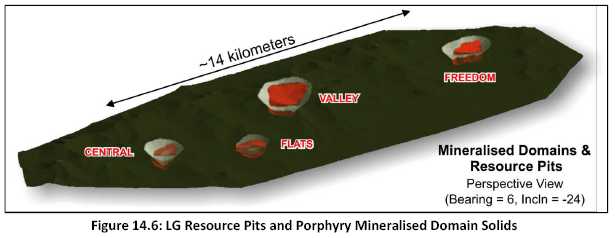
| ZT 61-1442/MM998 | Final V1.0 | Page 118 |
| Report Date: July 10, 2015 |
| EURASIAN MINERALS INC AND IG COPPER LLC | |
| NI 43-101 TECHNICAL REPORT ON THE INITIAL MINERAL RESOURCE ESTIMATE FOR | |
| THE MALMYZH COPPER-GOLD PROJECT, KHABAROVSK KRAI, RUSSIAN FEDERATION |
| 14.9.3 | Resource Reporting |
WAI's statement of the Malmyzh Inferred resources are reported for the Valley, Central, Freedom Southeast, and Flats block models within the LG open pits at a 0.30% copper equivalent cut-off (Table 14.7, Table 14.8 and Figure 14.7). The 0.30% copper equivalent (CuEq) cut-off is appropriate for a potential open pit operation in consideration of the metal price, recovery, and operating cost assumptions, as well as comparison with similar deposits that occur worldwide. The Inferred resources consist of sulphide/transition mineralisation, with sulphide material representing over 96% of the tonnes.
| Table 14.7: Malmyzh Inferred Resources at a 0.30% CuEq Cut-off | |||||||||
| Deposit | Million Tonnes |
CuEq % |
Cu % |
Au g/t |
CuEq Million Tonnes |
Cu Million Tonnes |
CuEq Billion lbs |
Cu Billion lbs |
Au Million Oz |
| Valley | 1,000 | 0.41 | 0.34 | 0.15 | 4.13 | 3.38 | 9.10 | 7.44 | 4.88 |
| Freedom (SE) | 334 | 0.46 | 0.34 | 0.24 | 1.54 | 1.13 | 3.40 | 2.50 | 2.63 |
| Central | 218 | 0.45 | 0.39 | 0.12 | 0.97 | 0.85 | 2.15 | 1.87 | 0.81 |
| Flats | 109 | 0.38 | 0.27 | 0.23 | 0.41 | 0.29 | 0.91 | 0.64 | 0.79 |
| TOTAL | 1,661 | 0.42 | 0.34 | 0.17 | 7.06 | 5.65 | 15.56 | 12.45 | 9.11 |
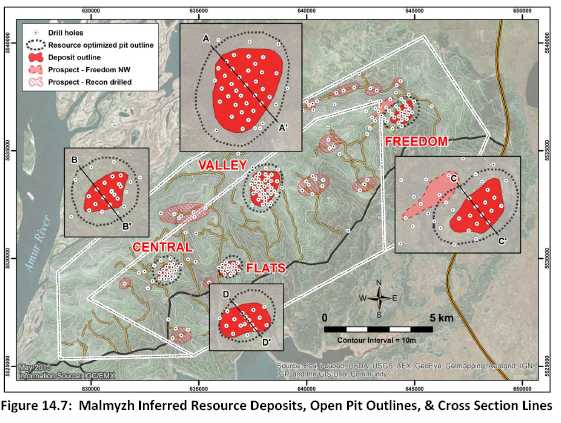
| ZT 61-1442/MM998 | Final V1.0 | Page 119 |
| Report Date: July 10, 2015 |
| EURASIAN MINERALS INC AND IG COPPER LLC | |
| NI 43-101 TECHNICAL REPORT ON THE INITIAL MINERAL RESOURCE ESTIMATE FOR | |
| THE MALMYZH COPPER-GOLD PROJECT, KHABAROVSK KRAI, RUSSIAN FEDERATION |
| Table 14.8: Malmyzh Inferred Resources at a Range of CuEq% Cut-offs | |||||||||
| Inferred Resource Base Case at 0.30% CuEq cut-off | |||||||||
| CuEq% Cut-off |
Million
Tonnes |
CuEq % |
Cu % |
Au g/t |
CuEq
Million Tonnes |
Cu Million Tonnes |
CuEq Billion Lbs |
Cu Billion Lbs |
Au Million Oz |
| 0.20 | 2,544 | 0.37 | 0.29 | 0.14 | 9.29 | 7.49 | 20.49 | 16.52 | 11.62 |
| 0.25 | 2,149 | 0.39 | 0.31 | 0.15 | 8.41 | 6.76 | 18.54 | 14.89 | 10.64 |
| 0.30 | 1,661 | 0.42 | 0.34 | 0.17 | 7.06 | 5.65 | 15.56 | 12.45 | 9.11 |
| 0.35 | 1,107 | 0.48 | 0.38 | 0.19 | 5.26 | 4.20 | 11.59 | 9.25 | 6.85 |
| 0.40 | 757 | 0.52 | 0.41 | 0.21 | 3.95 | 3.14 | 8.72 | 6.93 | 5.22 |
| 0.45 | 517 | 0.57 | 0.45 | 0.24 | 2.94 | 2.32 | 6.47 | 5.11 | 3.98 |
| 0.50 | 346 | 0.61 | 0.48 | 0.27 | 2.12 | 1.66 | 4.68 | 3.67 | 2.96 |
| 0.55 | 220 | 0.67 | 0.51 | 0.30 | 1.46 | 1.13 | 3.22 | 2.49 | 2.14 |
The principal variables used for reporting include: estimated copper grades in percent (%) and gold in grams/tonne (g/t), calculated copper equivalent in percent, tonnage reported as metric tonnes, contained copper equivalent and copper in metric tonnes and pounds, and contained gold in troy ounces. All figures are rounded to reflect the relative accuracy of the estimates, and the mineral resources are given on a 100% basis, with 51% attributable to IGC. Note that totals may not sum to 100% due to rounding; these rounding effects are not considered to be material.
The Malmyzh mineral resource estimates, whilst based on broadly spaced drill holes, are considered by WAI to be robust, though subject to revision in the future. In-fill drilling may lead to the delineation of discrete higher grade zones of copper-gold mineralisation, and will provide additional confidence for resource estimation.
The Malmyzh Inferred mineral resources were tabulated at a range of cut-offs as given in Table 14.8 above and represented as a grade-tonnage chart in Figure 14.8.
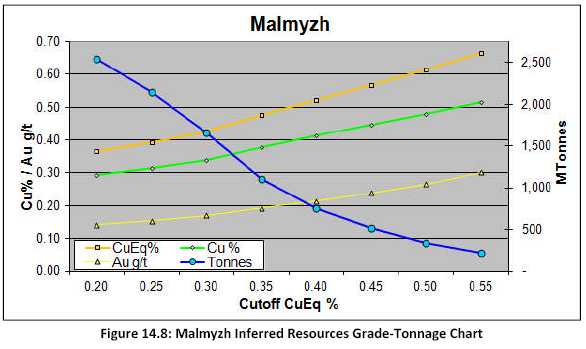
| ZT 61-1442/MM998 | Final V1.0 | Page 120 |
| Report Date: July 10, 2015 |
| EURASIAN MINERALS INC AND IG COPPER LLC | |
| NI 43-101 TECHNICAL REPORT ON THE INITIAL MINERAL RESOURCE ESTIMATE FOR | |
| THE MALMYZH COPPER-GOLD PROJECT, KHABAROVSK KRAI, RUSSIAN FEDERATION |
In total, the Inferred resources represent the copper-gold mineralisation of an important porphyry district as currently represented by four separate deposits. The tonnes and grades at the various cutoffs underscore that there are significant tonnages of higher grade copper-gold material available in these deposits.
| 14.9.4 | Resource Model Validation |
The estimated block model estimates for Valley, Central, Freedom, and Flats were verified by visual and statistical methods. Copper and gold block grades were compared with drill hole composites on cross and long section, as well as by bench level. From this review, there is a close correspondence between the composite grades and the estimated block grades. Cross section examples are illustrated for the four resource deposits in Section 14.10 of this report.
Also, nearest neighbour block models were estimated for Valley, Central, Freedom Southeast, and Flats in order to check for potential global biases in the estimated copper and gold grades. A global comparison between the Inverse Distance Weighted (IDW) resource grades and nearest neighbour (NN) grades at a zero cut-off was within 1.3% for both copper and gold, which is in close correspondence. The comparisons for copper ranged from within 0.0% (Flats) to 1.8% (Valley). For gold, the IDW and NN average grades ranged from within 0.8% (Valley) to 2.6% (Central and Flats). The comparisons between the IDW models and NN models at a zero cut-off establish that the Malmyzh Inferred resource estimates are globally unbiased.
As a further measure of resource model validation, Swath plots by level for copper and gold were generated for the four resource deposits. Examples for Valley are given in Figure 14.9.
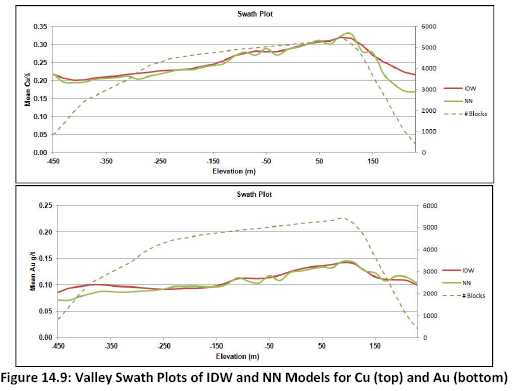
| ZT 61-1442/MM998 | Final V1.0 | Page 121 |
| Report Date: July 10, 2015 |
| EURASIAN MINERALS INC AND IG COPPER LLC | |
| NI 43-101 TECHNICAL REPORT ON THE INITIAL MINERAL RESOURCE ESTIMATE FOR | |
| THE MALMYZH COPPER-GOLD PROJECT, KHABAROVSK KRAI, RUSSIAN FEDERATION |
The swath plots further confirm that the Malmyzh resource models are globally unbiased and accurately represent the drill hole copper and gold grades.
| 14.10 |
Discussion of Malmyzh Resources |
| 14.10.1 | Valley Resource |
The Valley deposit is the largest, most well-developed porphyry system in the Malmyzh district, with mineralisation hosted in hornfels and diorite porphyry. At the 0.30% CuEq cut-off, the Inferred resources account for 60% of the total tonnes, 60% of the contained copper tonnes, and just under 54% of the contained gold ounces. Although mineralisation has been closed off laterally, Valley remains open at depth. The LG resource open pit flattens at the bottom where the mineralised domain was limited by the depth of current drilling. Also important to note are significant tonnages of higher grade copper-gold mineralisation hosted in the potassically altered hornfels on the southeastern flank of the deposit that occur from near-surface to depths of ~150-250 m (Table 14.9, Figure 14.10, and Figure 14.11).
| Table 14.9: Valley Inferred Resource at a Range of CuEq% Cut-offs | |||||||||
| Inferred Resource Base Case at 0.30% CuEq cut-off | |||||||||
| CuEq% Cut-off |
Million Tonnes |
CuEq % |
Cu % |
Au g/t |
CuEq Million Tonnes |
Cu Million Tonnes |
CuEq Billion Lbs |
Cu Billion Lbs |
Au Million Oz |
| 0.20 | 1,505 | 0.36 | 0.30 | 0.13 | 5.42 | 4.45 | 11.94 | 9.81 | 6.26 |
| 0.25 | 1,291 | 0.38 | 0.31 | 0.14 | 4.94 | 4.04 | 10.88 | 8.91 | 5.75 |
| 0.30 | 1,000 | 0.41 | 0.34 | 0.15 | 4.13 | 3.38 | 9.10 | 7.44 | 4.88 |
| 0.35 | 638 | 0.46 | 0.38 | 0.17 | 2.95 | 2.41 | 6.51 | 5.32 | 3.46 |
| 0.40 | 418 | 0.51 | 0.42 | 0.19 | 2.13 | 1.74 | 4.69 | 3.84 | 2.49 |
| 0.45 | 278 | 0.55 | 0.45 | 0.21 | 1.54 | 1.26 | 3.39 | 2.77 | 1.84 |
| 0.50 | 181 | 0.60 | 0.48 | 0.22 | 1.08 | 0.88 | 2.38 | 1.93 | 1.30 |
| 0.55 | 112 | 0.64 | 0.52 | 0.25 | 0.72 | 0.58 | 1.58 | 1.28 | 0.89 |
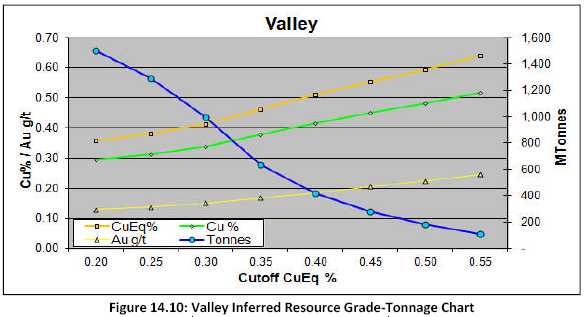
| ZT 61-1442/MM998 | Final V1.0 | Page 122 |
| Report Date: July 10, 2015 |
| EURASIAN MINERALS INC AND IG COPPER LLC | |
| NI 43-101 TECHNICAL REPORT ON THE INITIAL MINERAL RESOURCE ESTIMATE FOR | |
| THE MALMYZH COPPER-GOLD PROJECT, KHABAROVSK KRAI, RUSSIAN FEDERATION |
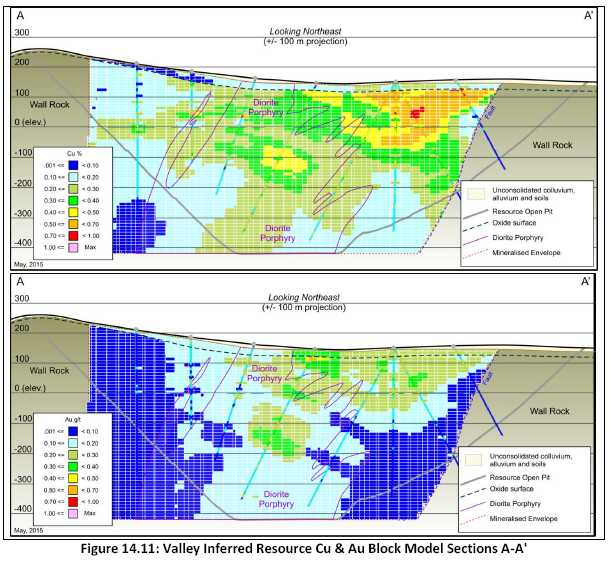
| 14.10.2 | Central Resource |
The Central deposit is principally hosted in diorite porphyries, and accounts for 13% of the Inferred resource tonnes, 15% of the contained copper, and 9% of the contained gold ounces at the 0.30% CuEq cut-off. Although Central has low overall Au:Cu ratios, these ratios improve in the higher grade mineralisation hosted in a pipe-shaped, steeply plunging, potassically altered core zone that projects to depth (Table 14.10, Figure 14.12 and Figure 14.13). Further, the high-grade zone of quartz-feldspar alteration with UST textures intersected by the deepest hole drilled to date projects into this core zone, and also remains unconstrained at depth.
| ZT 61-1442/MM998 | Final V1.0 | Page 123 |
| Report Date: July 10, 2015 |
| EURASIAN MINERALS INC AND IG COPPER LLC | |
| NI 43-101 TECHNICAL REPORT ON THE INITIAL MINERAL RESOURCE ESTIMATE FOR | |
| THE MALMYZH COPPER-GOLD PROJECT, KHABAROVSK KRAI, RUSSIAN FEDERATION |
| Table 14.10: Central Inferred
Resource at a Range of CuEq% Cut-offs Inferred Resource Base Case at 0.30% CuEq cut-off | |||||||||
| CuEq%
Cut-off |
Million
Tonnes |
CuEq % | Cu % | Au
g/t |
CuEq
Million Tonnes |
Cu
Million Tonnes |
CuEq
Billion Lbs |
Cu
Billion Lbs |
Au
Million Oz |
| 0.20 | 327 | 0.38 | 0.34 | 0.09 | 1.25 | 1.10 | 2.75 | 2.43 | 0.95 |
| 0.25 | 278 | 0.41 | 0.36 | 0.10 | 1.14 | 1.00 | 2.51 | 2.20 | 0.90 |
| 0.30 | 218 | 0.45 | 0.39 | 0.12 | 0.97 | 0.85 | 2.15 | 1.87 | 0.81 |
| 0.35 | 160 | 0.49 | 0.42 | 0.14 | 0.78 | 0.67 | 1.73 | 1.48 | 0.72 |
| 0.40 | 119 | 0.53 | 0.45 | 0.16 | 0.63 | 0.53 | 1.39 | 1.18 | 0.62 |
| 0.45 | 87 | 0.57 | 0.48 | 0.19 | 0.50 | 0.42 | 1.10 | 0.92 | 0.52 |
| 0.50 | 62 | 0.61 | 0.50 | 0.21 | 0.38 | 0.31 | 0.83 | 0.69 | 0.41 |
| 0.55 | 40 | 0.66 | 0.54 | 0.23 | 0.26 | 0.22 | 0.58 | 0.48 | 0.29 |
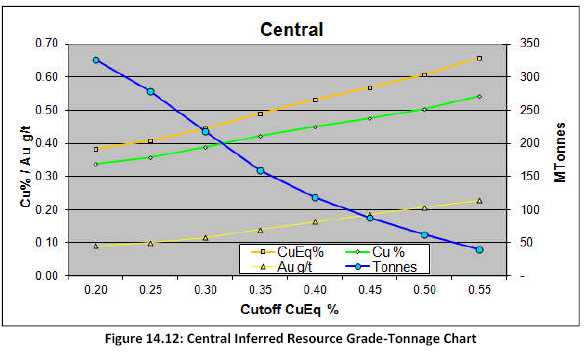
| ZT 61-1442/MM998 | Final V1.0 | Page 124 |
| Report Date: July 10, 2015 |
| EURASIAN MINERALS INC AND IG COPPER LLC | |
| NI 43-101 TECHNICAL REPORT ON THE INITIAL MINERAL RESOURCE ESTIMATE FOR | |
| THE MALMYZH COPPER-GOLD PROJECT, KHABAROVSK KRAI, RUSSIAN FEDERATION |
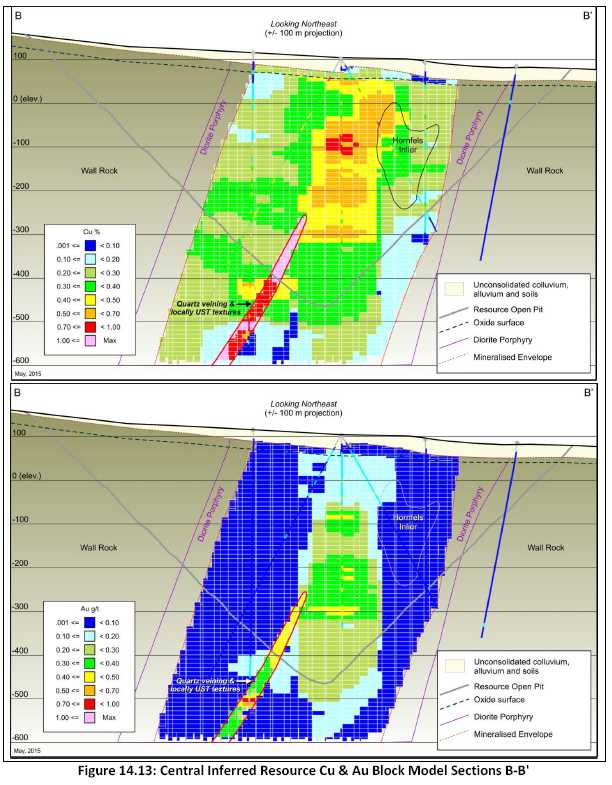
| ZT 61-1442/MM998 | Final V1.0 | Page 125 |
| Report Date: July 10, 2015 |
| EURASIAN MINERALS INC AND IG COPPER LLC | |
| NI 43-101 TECHNICAL REPORT ON THE INITIAL MINERAL RESOURCE ESTIMATE FOR | |
| THE MALMYZH COPPER-GOLD PROJECT, KHABAROVSK KRAI, RUSSIAN FEDERATION |
| 14.10.3 | Freedom Southeast Resource |
Freedom Southeast is a large, geologically complex deposit with mineralisation hosted in diorite porphyries, multi-stage breccias, and hornfels units, and has high Au:Cu ratios. At the 0.30% CuEq cutoff, the Inferred resource accounts for 20% of the total tonnes, 20% of the contained copper tonnes, and 29% of the contained gold ounces. The mineralising controls at Freedom are poorly understood, but there are cross-cutting, intensely altered, higher grade copper-gold zones within the system's overall alteration assemblage (Table 14.11, Figure 14.14 and Figure 14.15). Additional drilling is required to follow-up and geologically define these higher grade zones.
| Table 14.11: Freedom
Southeast Inferred Resource at a Range of CuEq% Cut-offs
Inferred Resource Base Case at 0.30% CuEq cut-off | |||||||||
| CuEq% Cut-off |
Million Tonnes |
CuEq % | Cu % | Au g/t |
CuEq Million Tonnes |
Cu Million Tonnes |
CuEq Billion Lbs |
Cu Billion Lbs |
Au Million Oz |
| 0.20 | 509 | 0.39 | 0.29 | 0.20 | 1.98 | 1.47 | 4.36 | 3.24 | 3.27 |
| 0.25 | 424 | 0.42 | 0.31 | 0.22 | 1.79 | 1.32 | 3.94 | 2.91 | 3.00 |
| 0.30 | 334 | 0.46 | 0.34 | 0.24 | 1.54 | 1.13 | 3.40 | 2.50 | 2.63 |
| 0.35 | 248 | 0.51 | 0.37 | 0.27 | 1.26 | 0.92 | 2.78 | 2.04 | 2.17 |
| 0.40 | 184 | 0.56 | 0.41 | 0.30 | 1.02 | 0.74 | 2.25 | 1.64 | 1.78 |
| 0.45 | 132 | 0.61 | 0.44 | 0.34 | 0.80 | 0.58 | 1.77 | 1.28 | 1.43 |
| 0.50 | 95 | 0.66 | 0.47 | 0.38 | 0.63 | 0.45 | 1.38 | 0.98 | 1.16 |
| 0.55 | 65 | 0.72 | 0.50 | 0.44 | 0.47 | 0.33 | 1.04 | 0.72 | 0.93 |
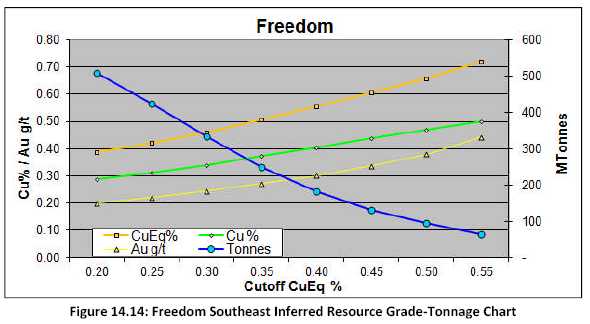
| ZT 61-1442/MM998 | Final V1.0 | Page 126 |
| Report Date: July 10, 2015 |
| EURASIAN MINERALS INC AND IG COPPER LLC | |
| NI 43-101 TECHNICAL REPORT ON THE INITIAL MINERAL RESOURCE ESTIMATE FOR | |
| THE MALMYZH COPPER-GOLD PROJECT, KHABAROVSK KRAI, RUSSIAN FEDERATION |
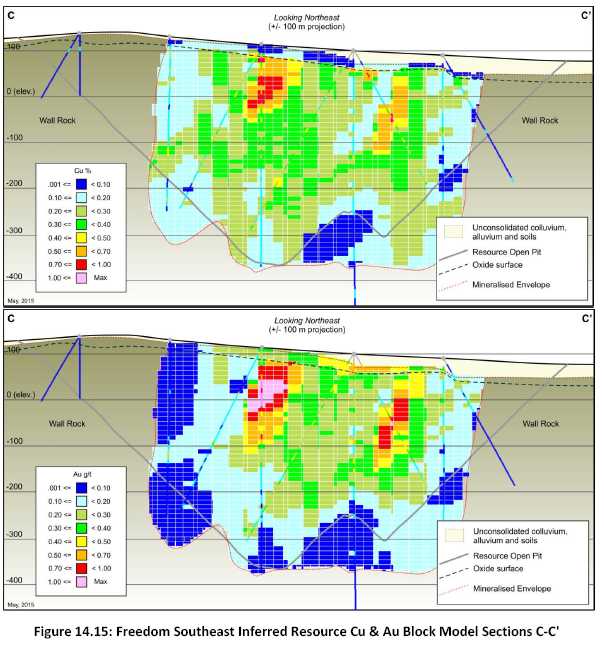
| 14.10.4 | Flats Resource |
The Flats deposit is the smallest of the porphyry deposits at Malmyzh, accounting for 7% of the Inferred resource tonnes, 5% of the contained copper, and 9% of the contained gold ounces at the 0.30% CuEq cut-off. Flats is relatively enriched in gold, but has low to moderate copper grades (Table 14.12, Figure 14.16 and Figure 14.17).
It is known that the diorite porphyry-hornfels contact locally hosts higher-grade gold, but the geometries and continuities of these zones is undefined with the current broad spaced drilling. Of note was the diligent effort taken during resource estimation to reduce the influence of these zones by capping and limiting the influence of high grade composites. As an example of the effect of these limitations, the high grade intercept illustrated at depth in Figure 14.17 and the near-by block grades were constrained and fall below the LG Inferred resource pit. The system remains open to depth.
| ZT 61-1442/MM998 | Final V1.0 | Page 127 |
| Report Date: July 10, 2015 |
| EURASIAN MINERALS INC AND IG COPPER LLC | |
| NI 43-101 TECHNICAL REPORT ON THE INITIAL MINERAL RESOURCE ESTIMATE FOR | |
| THE MALMYZH COPPER-GOLD PROJECT, KHABAROVSK KRAI, RUSSIAN FEDERATION |
| Table 14.12: Flats Inferred Resource at a Range of CuEq% Cut-offs | |||||||||
| CuEq% Cut-off |
Million
Tonnes |
CuEq % | Cu % | Au g/t |
CuEq
Million Tonnes |
Cu Million Tonnes |
CuEq Billion Lbs |
Cu Billion Lbs |
Au Million Oz |
| 0.20 | 202 | 0.32 | 0.23 | 0.18 | 0.65 | 0.47 | 1.43 | 1.04 | 1.14 |
| 0.25 | 157 | 0.35 | 0.25 | 0.20 | 0.55 | 0.39 | 1.21 | 0.87 | 1.00 |
| 0.30 | 109 | 0.38 | 0.27 | 0.23 | 0.41 | 0.29 | 0.91 | 0.64 | 0.79 |
| 0.35 | 61 | 0.43 | 0.30 | 0.25 | 0.26 | 0.18 | 0.57 | 0.40 | 0.50 |
| 0.40 | 37 | 0.46 | 0.33 | 0.28 | 0.17 | 0.12 | 0.38 | 0.27 | 0.33 |
| 0.45 | 20 | 0.50 | 0.35 | 0.30 | 0.10 | 0.07 | 0.22 | 0.15 | 0.19 |
| 0.50 | 8 | 0.54 | 0.37 | 0.34 | 0.04 | 0.03 | 0.09 | 0.06 | 0.09 |
| 0.55 | 3 | 0.58 | 0.40 | 0.36 | 0.02 | 0.01 | 0.03 | 0.02 | 0.03 |
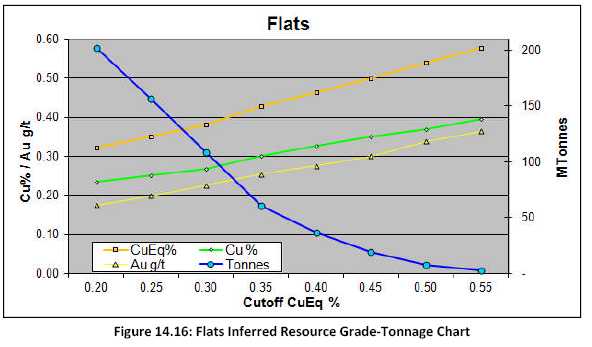
| ZT 61-1442/MM998 | Final V1.0 | Page 128 |
| Report Date: July 10, 2015 |
| EURASIAN MINERALS INC AND IG COPPER LLC | |
| NI 43-101 TECHNICAL REPORT ON THE INITIAL MINERAL RESOURCE ESTIMATE FOR | |
| THE MALMYZH COPPER-GOLD PROJECT, KHABAROVSK KRAI, RUSSIAN FEDERATION |
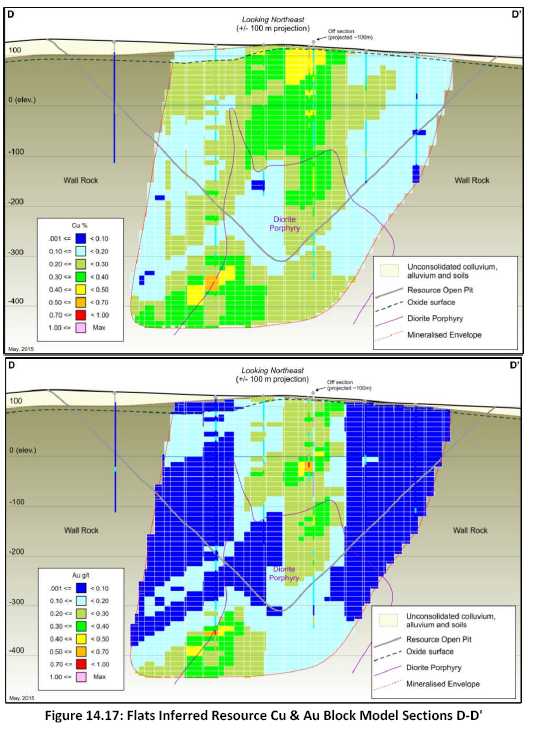
| 14.11 |
Discussion of Freedom Northwest Prospect |
The Freedom deposit is, as discussed in Sections 7.4.4 and 10.5.3, as well as elsewhere in this report, comprised of two distinct northeast trending bodies of copper-gold mineralisation. Freedom Southeast has an Inferred resource as described in Section 14.10.3, but there is also drilled mineralisation on 200 x 400 m fences at the Freedom Northwest (NW) prospect. The styles of alteration and mineralisation are similar between Freedom NW and SE. Although the Freedom NW prospect is not included as an Inferred resource, it has sufficient geologic (interpretation on cross sections) and drill control (six holes) to be defined as a “target for further exploration” according to NI 43-101 (2.3(2),(a -b))1, and as given in Table 14.13.
| ZT 61-1442/MM998 | Final V1.0 | Page 129 |
| Report Date: July 10, 2015 |
| EURASIAN MINERALS INC AND IG COPPER LLC | |
| NI 43-101 TECHNICAL REPORT ON THE INITIAL MINERAL RESOURCE ESTIMATE FOR | |
| THE MALMYZH COPPER-GOLD PROJECT, KHABAROVSK KRAI, RUSSIAN FEDERATION |
| Table 14.13: Freedom NW Target for Further Exploration | |||
| MTonnes | Cu % | Au g/t | |
| Freedom NW | 90-180 | 0.30-0.40 | 0.15-0.25 |
1 The potential quantity and grade for the Freedom NW prospect is conceptual in nature, as there has been insufficient exploration to define a mineral resource. It is uncertain if further exploration will result in the target being delineated as a mineral resource.
The tonnage and grade ranges in Table 14.13 reflect the uncertainty due to the widely spaced drill pattern, but also highlight the upside potential of this prospect that requires further drilling.
| 14.12 |
Comments on Mineral Resources |
The Malmyzh Inferred resource estimates are considered to be robust given the current drilling, and represent the copper-gold mineralisation at the Valley, Freedom, Central, and Flats deposits. The tonnes and grades at various cut-offs underscore that there are significant Inferred resource tonnages of higher grade copper-gold material potentially available in these deposits. Follow-up drilling will provide additional confidence for resource estimation, and may lead to the delineation and definition of discrete higher grade copper-gold zones.
Of note, during the course of data review at Valley the author noted anomalous Mo grades (i.e., 20-100 ppm) in the shallow hornfels zone. Although the absolute Mo grades are low, and have yet to be given consideration, it may be worth further review with additional drilling to model Mo as a possible by-product to accompany the copper-gold credits.
At this Inferred resource stage of the Malmyzh Project's evaluation, there are various risk factors that need to be assessed. Significant in-fill drilling and revised geologic models will be required to fully define the extents of mineralisation. Additional metallurgical testwork is needed to definitively establish both the copper and gold recoveries. Metal prices have continued to recede over the past year, and further reductions could adversely affect project economics. The author is generally aware that due to the Project's location, and the associated hydrographic and climatic conditions, the need for open pit de-watering must be taken into account with more advanced studies. Finally, from the permitting and legal vantage, it is an absolute requirement that the Project receive Russian Federation SIL approval in order to move forward, as discussed in Section 4.3 of this report.
The author emphasises that mineral resources are not mineral reserves and do not have demonstrated economic viability. There is no certainty that all or any part of the mineral resource will be converted into a mineral reserve.
| ZT 61-1442/MM998 | Final V1.0 | Page 130 |
| Report Date: July 10, 2015 |
| EURASIAN MINERALS INC AND IG COPPER LLC | |
| NI 43-101 TECHNICAL REPORT ON THE INITIAL MINERAL RESOURCE ESTIMATE FOR | |
| THE MALMYZH COPPER-GOLD PROJECT, KHABAROVSK KRAI, RUSSIAN FEDERATION |
WAI is not aware of any further environmental, permitting, legal, title, taxation, socio-economic, marketing, political, or other relevant factors associated with the Project that could materially affect the mineral resource estimates that are the subject of this report.
| ZT 61-1442/MM998 | Final V1.0 | Page 131 |
| Report Date: July 10, 2015 |
| EURASIAN MINERALS INC AND IG COPPER LLC | |
| NI 43-101 TECHNICAL REPORT ON THE INITIAL MINERAL RESOURCE ESTIMATE FOR | |
| THE MALMYZH COPPER-GOLD PROJECT, KHABAROVSK KRAI, RUSSIAN FEDERATION |
| 15 |
MINERAL RESERVE ESTIMATES |
Malmyzh is not an advanced property and therefore this section does not apply.
| ZT 61-1442/MM998 | Final V1.0 | Page 132 |
| Report Date: July 10, 2015 |
| EURASIAN MINERALS INC AND IG COPPER LLC | |
| NI 43-101 TECHNICAL REPORT ON THE INITIAL MINERAL RESOURCE ESTIMATE FOR | |
| THE MALMYZH COPPER-GOLD PROJECT, KHABAROVSK KRAI, RUSSIAN FEDERATION |
| 16 |
MINING METHODS |
Malmyzh is not an advanced property and therefore this section does not apply.
| ZT 61-1442/MM998 | Final V1.0 | Page 133 |
| Report Date: July 10, 2015 |
| EURASIAN MINERALS INC AND IG COPPER LLC | |
| NI 43-101 TECHNICAL REPORT ON THE INITIAL MINERAL RESOURCE ESTIMATE FOR | |
| THE MALMYZH COPPER-GOLD PROJECT, KHABAROVSK KRAI, RUSSIAN FEDERATION |
| 17 |
RECOVERY METHODS |
Malmyzh is not an advanced property and therefore this section does not apply.
| ZT 61-1442/MM998 | Final V1.0 | Page 134 |
| Report Date: July 10, 2015 |
| EURASIAN MINERALS INC AND IG COPPER LLC | |
| NI 43-101 TECHNICAL REPORT ON THE INITIAL MINERAL RESOURCE ESTIMATE FOR | |
| THE MALMYZH COPPER-GOLD PROJECT, KHABAROVSK KRAI, RUSSIAN FEDERATION |
| 18 |
PROJECT INFRASTRUCTURE |
Malmyzh is not an advanced property and therefore this section does not apply.
| ZT 61-1442/MM998 | Final V1.0 | Page 135 |
| Report Date: July 10, 2015 |
| EURASIAN MINERALS INC AND IG COPPER LLC | |
| NI 43-101 TECHNICAL REPORT ON THE INITIAL MINERAL RESOURCE ESTIMATE FOR | |
| THE MALMYZH COPPER-GOLD PROJECT, KHABAROVSK KRAI, RUSSIAN FEDERATION |
| 19 |
MARKET STUDIES AND CONTRACTS |
Malmyzh is not an advanced property and therefore this section does not apply.
| ZT 61-1442/MM998 | Final V1.0 | Page 136 |
| Report Date: July 10, 2015 |
| EURASIAN MINERALS INC AND IG COPPER LLC | |
| NI 43-101 TECHNICAL REPORT ON THE INITIAL MINERAL RESOURCE ESTIMATE FOR | |
| THE MALMYZH COPPER-GOLD PROJECT, KHABAROVSK KRAI, RUSSIAN FEDERATION |
| 20 |
ENVIRONMENTAL STUDIES, PERMITTING AND SOCIAL OR COMMUNITY IMPACT |
Malmyzh is not an advanced property and therefore this section does not apply.
| ZT 61-1442/MM998 | Final V1.0 | Page 137 |
| Report Date: July 10, 2015 |
| EURASIAN MINERALS INC AND IG COPPER LLC | |
| NI 43-101 TECHNICAL REPORT ON THE INITIAL MINERAL RESOURCE ESTIMATE FOR | |
| THE MALMYZH COPPER-GOLD PROJECT, KHABAROVSK KRAI, RUSSIAN FEDERATION |
| 21 |
CAPITAL AND OPERATING COSTS |
Malmyzh is not an advanced property and therefore this section does not apply.
| ZT 61-1442/MM998 | Final V1.0 | Page 138 |
| Report Date: July 10, 2015 |
| EURASIAN MINERALS INC AND IG COPPER LLC | |
| NI 43-101 TECHNICAL REPORT ON THE INITIAL MINERAL RESOURCE ESTIMATE FOR | |
| THE MALMYZH COPPER-GOLD PROJECT, KHABAROVSK KRAI, RUSSIAN FEDERATION |
| 22 |
ECONOMIC ANALYSIS |
Malmyzh is not an advanced property and therefore this section does not apply.
| ZT 61-1442/MM998 | Final V1.0 | Page 139 |
| Report Date: July 10, 2015 |
| EURASIAN MINERALS INC AND IG COPPER LLC | |
| NI 43-101 TECHNICAL REPORT ON THE INITIAL MINERAL RESOURCE ESTIMATE FOR | |
| THE MALMYZH COPPER-GOLD PROJECT, KHABAROVSK KRAI, RUSSIAN FEDERATION |
| 23 |
ADJACENT PROPERTIES |
The Malmyzh Project is a grassroots exploration discovery, and there are no adjacent properties. Although the region is situated in a geologic setting favourable for the development of porphyry copper-gold deposits, as discussed in Section 7.2, it has remained under-explored relative to its prospectivity. This makes the Malmyzh district-scale discovery all the more significant in what may develop into an emerging copper-gold porphyry belt.
| ZT 61-1442/MM998 | Final V1.0 | Page 140 |
| Report Date: July 10, 2015 |
| EURASIAN MINERALS INC AND IG COPPER LLC | |
| NI 43-101 TECHNICAL REPORT ON THE INITIAL MINERAL RESOURCE ESTIMATE FOR | |
| THE MALMYZH COPPER-GOLD PROJECT, KHABAROVSK KRAI, RUSSIAN FEDERATION |
| 24 |
OTHER RELEVANT DATA AND INFORMATION |
The Russian Federation has stringent requirements for exploring and developing mineral properties. These rules, regulations, and laws cover a comprehensive spectrum of project related work. The Malmyzh Joint Venture has diligently met these conditions, whilst also adhering to NI 43-101 requirements and CIM best practice standards.
IGC has advised that the Malmyzh Joint Venture, through its Russian subsidiary Amur Minerals LLC, received approval of the “official on balance C1+C2 reserves” from the GKZ (State Reserves Committee), the government agency authorised to approve resources and reserves in the Russian Federation (EMX news release, May 26, 2015). The Malmyzh “official government approved reserves” were estimated according to the rules and regulations of the Russian Federation, and are not the same as reserves under NI 43-101. These "reserves" do not meet NI 43-101 or CIM requirements for resource or reserve reporting, and accordingly the results are not given in this report. However, it is important to acknowledge them as their establishment met Russian requirements for keeping the Malmyzh licenses in good standing, and triggered additional requirements for moving the Project forward.
The GKZ “official reserves” are now listed and added to the “State Balance of Reserves” of the Russian Federation. The GKZ C1+C2 "on balance reserves" of copper and gold exceed thresholds that classify Malmyzh as a "strategically significant" mineral deposit under the Strategic Industries Law, or "SIL" (see Section 4.3). SIL requires that the Joint Venture receive approval through the relevant Russian Federation agencies to continue with its Malmyzh exploration and development programmes.
In addition, the "prospecting phase" of the Malmyzh license was completed with the approval and acceptance of the Project's TEO "preliminary conditions" report, which was based upon the GKZ "reserves". Contingent on receiving SIL approval, the Project will be required to move forward according to an "advanced exploration" work programme designed by the Joint Venture, and approved by the relevant Russian Federation agencies. The advanced exploration programme has not yet been formulated, but generally it will include in-fill drilling and advanced technical studies. This work will culminate in completion of a TEO "permanent conditions" report as a precursor to eventual mine development (T. Bowens, personal communication, 2015).
| ZT 61-1442/MM998 | Final V1.0 | Page 141 |
| Report Date: July 10, 2015 |
| EURASIAN MINERALS INC AND IG COPPER LLC | |
| NI 43-101 TECHNICAL REPORT ON THE INITIAL MINERAL RESOURCE ESTIMATE FOR | |
| THE MALMYZH COPPER-GOLD PROJECT, KHABAROVSK KRAI, RUSSIAN FEDERATION |
| 25 |
INTERPRETATION AND CONCLUSIONS |
The 152.8 km2 Malmyzh Project hosts porphyry deposits, prospects, and targets that occur within a district-scale 16 by 5 km intrusive corridor concealed beneath a shallow cover of alluvium, colluvium, and soil. Mineralisation extends from shallow subcrop (~1 to 50 m) to greater than 400 to 600 m depth. The porphyry centres occur as Cretaceous-age diorite porphyry stocks that intruded and hornfels-altered siltstone and sandstone sedimentary sequences. Copper-gold mineralisation occurs in the porphyry intrusives, as well as in the hornfels-altered sedimentary wall rocks.
The Joint Venture's exploration work has been carefully designed to meet Russian Federation and international reporting requirements. Surface exploration, principally consisting of property-wide soil and ground magnetics surveys has been effective at delineating concealed porphyry copper-gold targets for follow-up drill testing in areas where soil cover is less than ~15-20 m. Project drilling includes 211 HQ and NQ diamond drill holes totaling over 70,600 m. The majority of drill metres (~55,000 m) were concentrated on four principal deposits: Valley, Central, Freedom, and Flats. Reconnaissance drilling also included evaluation of porphyry prospects prioritised from additional target areas.
The Project's exploration sampling, sample preparation, analyses, and security have produced reliable and reproducible results as demonstrated by the Joint Venture's extensive QA/QC programme and verified by the author's independent property visit, core sampling, and data reviews. The drill database and supporting exploration data are judged to be suitable for resource estimation.
The Project’s initial Inferred mineral resources at a 0.30% CuEq cut-off are estimated as 1,661 Mt at average grades of 0.34% copper and 0.17 g/t gold, or 0.42% CuEq, containing 5.65 Mt (12.45 billion pounds) copper and 9.11 Moz gold, or 7.06 Mt (15.56 billion pounds) copper equivalent. The Inferred resources are constrained within open pit configurations to ensure reasonable prospects for economic extraction. The CuEq calculation (CuEq% = (Cu% + 0.5 * Au g/t)) and optimised open pit parameters are based upon reasonable assumptions of metal prices, costs, and metallurgical recoveries. The cutoff grade is also guided by these assumptions, as well as comparison with examples of other porphyry copper-gold deposits that occur worldwide.
In total, the Malmyzh Inferred resources represent the copper-gold mineralisation of an important porphyry district as currently represented by the four deposits drilled on nominal 200 m grids. The Valley deposit is the largest porphyry system in the Malmyzh district as currently understood, and at the 0.30% CuEq cut-off has Inferred resources that account for 60% of the total tonnes, 60% of the contained copper tonnes, and just under 54% of the contained gold ounces. Freedom Southeast has high Au:Cu ratios, and at the 0.30% CuEq cut-off the Inferred resource represents 20% of the total tonnes, 20% of the contained copper tonnes, and 29% of the contained gold ounces. The Central deposit accounts for 13% of the Inferred resource tonnes, 15% of the contained copper, and 9% of the contained gold ounces at the 0.30% CuEq cut-off, and the smaller Flats deposit contributes to the balance of the Inferred resources total.
| ZT 61-1442/MM998 | Final V1.0 | Page 142 |
| Report Date: July 10, 2015 |
| EURASIAN MINERALS INC AND IG COPPER LLC | |
| NI 43-101 TECHNICAL REPORT ON THE INITIAL MINERAL RESOURCE ESTIMATE FOR | |
| THE MALMYZH COPPER-GOLD PROJECT, KHABAROVSK KRAI, RUSSIAN FEDERATION |
The tonnes and grades at various cut-offs illustrate that there are tonnages of higher grade copper-gold material available at: a) Valley in the shallow, potassically altered hornfels on the southeastern flank of the deposit, b) Freedom Southeast as postulated cross-cutting features of intense chloritic alteration within a broader zone of potassic alteration, and c) Central within a steeply plunging core of potassic alteration. In-fill drilling is required to gain additional confidence in the geometries and tenors of these higher grade zones.
Although the model validations establish that the mineral resource estimates are globally unbiased, there are clearly localised controls that cannot be adequately defined at the current 200 m drill spacing. Further, the preliminary metallurgical testwork conducted to date yields wide ranges of potential gold recoveries, and to a lesser extent ranges of copper recoveries. These uncertainties led to the classification of the resources as Inferred, and can only be addressed by further drilling and definitive metallurgical testwork in order to potentially advance the resource estimates to a higher level of resource classification.
There is potential to add to the Malmyzh porphyry copper-gold resources at Freedom Northwest and to depth in the other deposits with additional drilling. As well there is exploration upside for new discoveries, particularly in the southern portion of the license beneath more extensive soil cover. An especially notable target for follow-up is in the area of east Bikha, where field reconnaissance has identified alteration that may be related to the upper levels of a porphyry system; successful follow-up of this exploration target could identify a new style of mineralisation on the property.
Although Malmyzh is at a relatively early stage of project evaluation, the author notes that the infrastructure and physiographic setting for a potential open pit mining operation are favourable. There are multiple options for transportation, power, water sources, and nearby population centres with candidate workforces. Regarding the water sources, consideration of the hydrogeologic groundwater conditions and the likelihood of open pit dewatering will need to be addressed with more advanced studies. The climate will support year-round mining operations. The property’s size and gentle topographic expression provide a suitable layout scenario for potential tailings storage, waste dumps, processing plant sites, and other infrastructure.
The most significant risk to Malmyzh is achieving Russian Federation SIL approval in order for the Joint Venture to continue advancing the Project. The results and timing of this process cannot be assured or predicted. Notwithstanding, there are examples of successful outcomes for western exploration and mining companies, including recent approvals for the Kun Manie deposit and the ongoing operations at Kupol. The author also notes the positive developments related to MRET and other investment incentives implemented by the Russian Federation in 2014 for developing projects in the Far East, including Khabarovsk Krai.
Contingent on gaining SIL approval, the Joint Venture will need to submit a plan for taking the Project through the "advanced exploration" stage. Although the final work programme has yet to be formulated, it will entail in-fill drilling and advanced technical studies. Securing adequate funding to proceed with this work given the current market conditions for exploration and mining companies may be a risk, but one that is faced in the normal course of business throughout the industry.
| ZT 61-1442/MM998 | Final V1.0 | Page 143 |
| Report Date: July 10, 2015 |
| EURASIAN MINERALS INC AND IG COPPER LLC | |
| NI 43-101 TECHNICAL REPORT ON THE INITIAL MINERAL RESOURCE ESTIMATE FOR | |
| THE MALMYZH COPPER-GOLD PROJECT, KHABAROVSK KRAI, RUSSIAN FEDERATION |
The Malmyzh exploration programmes have established a substantial porphyry copper-gold Inferred resource with potential for expansion in the 4 deposits that have been drill defined to date. Further, the a) potential for zones of higher grade copper-gold mineralisation, b) multiple concealed targets with limited or no drilling, and c) geologic setting with broad distributions of porphyry mineralisation and alteration highlight the Project's many exploration opportunities to upgrade and enhance the current resource base. These opportunities, coupled with a favourable infrastructure setting, underscore Malmyzh's promise for further advancement assuming the necessary government approvals are received.
| ZT 61-1442/MM998 | Final V1.0 | Page 144 |
| Report Date: July 10, 2015 |
| EURASIAN MINERALS INC AND IG COPPER LLC | |
| NI 43-101 TECHNICAL REPORT ON THE INITIAL MINERAL RESOURCE ESTIMATE FOR | |
| THE MALMYZH COPPER-GOLD PROJECT, KHABAROVSK KRAI, RUSSIAN FEDERATION |
| 26 |
RECOMMENDATIONS |
The Joint Venture's exploration programmes have established Malmyzh as a district scale project that has Inferred porphyry copper-gold resources at the Valley, Central, Freedom Southeast, and Flats deposits.
In addition to the Inferred resources that are the subject of this NI 43-101 Technical Report, the Project has official Russian Federation "on balance reserves" that exceed thresholds requiring government approvals for the Joint Venture to proceed with its Malmyzh programmes (see SIL discussion in Sections 4.3 and 24; these "reserves" do not meet NI 43-101 or CIM requirements for resource or reserve reporting). As a result, for the most part, technical advancement of the Project should be held in abeyance until SIL approval is granted. IGC advises that the relevant applications are currently being prepared for submission.
Assuming SIL approval is received, the Project must then move forward according to Russian Federation requirements for an "advanced exploration" work plan. This programme must be submitted by the Joint Venture for approval by the relevant Russian Federation agencies, as was the case with the earlier work plan for the now successfully completed "prospecting phase".
WAI cannot comment on the duration of these approval processes, as the timelines are undefined, nor on their ultimate outcomes. However, the immediate steps required for the Malmyzh Project are:
| • | Finalise and submit documents for SIL approval. | |
| • | Subject to SIL approval, prepare and submit an advanced exploration work programme for approval. |
The advanced exploration programme requirements will include in-fill drilling and further metallurgical, engineering, hydrogeological, environmental, socio-economic, and other work. WAI has not reviewed budgets for this work, as the final requirements have not yet been set.
There are early stage recommendations for technical work that can proceed:
|
a) |
Review the drill core for holes in areas of higher grade mineralisation to better understand the controls for follow-up drilling. As part of this review, re-log additional core to improve the geologic and alteration interpretations for the resource deposits and exploration targets ($125,000-$150,000). This could result in additional input for, and confidence in, future resource models, as well as highlight priority targets for follow-up. | |
|
b) |
Review and assess the potential for higher grade, shallow mineralisation at Valley (shallow hornfels), Freedom (postulated zones of cross-cutting high grade), and optionally Central (potassic core zone) ($30,000-$40,000). This work will help provide focus for follow-up drill programmes. |
| ZT 61-1442/MM998 | Final V1.0 | Page 145 |
| Report Date: July 10, 2015 |
| EURASIAN MINERALS INC AND IG COPPER LLC | |
| NI 43-101 TECHNICAL REPORT ON THE INITIAL MINERAL RESOURCE ESTIMATE FOR | |
| THE MALMYZH COPPER-GOLD PROJECT, KHABAROVSK KRAI, RUSSIAN FEDERATION |
| c) |
Review all exploration data to refine interpretations for exploration targeting. In addition, review the distribution of molybdenum mineralisation in the resource deposits to determine if there is the potential for low grade by-product credits ($20,000-$30,000). |
The above work can be accomplished from the exploration work completed to date, and totals $175,000-$220,000. It is recommended that this modest programme proceed as a first phase while awaiting Project approvals, so as to be prepared for the next phase of drilling and assessment.
Contingent on receiving the necessary Project approvals, the second phase of recommended work includes metallurgy, a focused in-fill drilling programme at the Valley and Freedom Southeast deposits to define higher grade copper-gold zones, and drilling at Freedom Northwest designed to potentially bring it to resource status:
| 1. |
Metallurgical testwork to further optimise copper and gold recoveries ($250,000-$350,000). | |
| 2. |
Valley and Freedom in-fill drilling: 46 holes @ 23,000 m ($2,300,000-$2,875,000). | |
| 3. |
Freedom Northwest drilling and other exploration drilling (i.e. east Bikha area, etc.): 18 holes @ 9000 m ($900,000-$1,125,000). |
The post-approval work totals $3.45 -4.35 million and could be completed in a 12 month period. The author notes that the projected drilling costs are low. However, the Joint Venture owns the drill rigs and advises that these are appropriate costs to use (T. Bowens personal communication, 2015).
In addition to drill defining Freedom Northwest, the above recommendations are designed to meet the following objectives:
| • | Prepare for (first phase), and contingent on Project approvals, subsequently initiate (second phase) the required advanced exploration work programme. | |
| • | Define an optimised metallurgical flow sheet for recovering copper and gold. | |
| • | Evaluate the possibilities for initially developing the Project with higher grades from shallower mineralisation. If a preliminary review is positive, then the groundwork has been provided to advance the Project with a PEA study. |
If designed and executed properly, the recommended Malmyzh work programmes will a) initially provide the background for making informed exploration decisions, and assuming SIL approval, b) commence the work to meet Russian Federation license requirements while providing the basis for a PEA study.
| ZT 61-1442/MM998 | Final V1.0 | Page 146 |
| Report Date: July 10, 2015 |
| EURASIAN MINERALS INC AND IG COPPER LLC | |
| NI 43-101 TECHNICAL REPORT ON THE INITIAL MINERAL RESOURCE ESTIMATE FOR | |
| THE MALMYZH COPPER-GOLD PROJECT, KHABAROVSK KRAI, RUSSIAN FEDERATION |
| 27 |
REFERENCES |
Agabakyan, O., 2015, IG Copper, LLC, Status of the mineral concessions that constitute the Malmyzh and North Malmyzh exploration and mining licenses, 1 p.
Ashleman, J.C., 2010, Malmyzh Project, Khabarovsk Krai, Russia, Project Overview, Internal Company Report, 23 p.
Bowens, T.E., 2015, IG Copper LLC, Malmyzh property legal, environmental, and tax matters, various internal company memos and personal communications
Ignatiev, Ye.K., 2015, IG Copper LLC, Malmyzh property description and location, various internal company memos and personal communications (translated from Russian)
Mihalasky, M.J., Ludington, S., Alexeiev, D.V., Frost, T.P., Light, T.D., Briggs, D.A., Hammarstrom, J.M., and Wallis,J.C., with contributions from Bookstrom, A.A., and Panteleyev, Andre, 2015, Porphyry copper assessment of northeast Asia—Far East Russia and Northeasternmost China: U.S. Geological Survey Scientific Investigations Report 2010–5090–W, 104 p.
Natal’in, B.A., 2007, Tectonic evolution of Mongolia, Northeastern China, and Southeastern Russia in the Paleozoic and early Mesozoic: The Third International Workshop and Field Excursion for IGCP-480, Beijing (China), August 6–15, 2007, 3 p.
Nokleberg, W.J., Miller, R.J. and Diggles, M.J. (ed), 2006, Geographic information systems (GIS) spatial data compilation of geodynamic, Tectonic, Metallogenic, Mineral Deposits and geophysical Maps and associated descriptive data for northeast Asia: U.S. Geological Survey Open-File Report 2006-1150, CD Rom
Nokleberg, W.J., ed., 2010, Metallogenesis and tectonics of Northeast Asia: U.S. Geological Survey, Professional Paper 1765, 624 p.
OREOLL LLC, 2014, TEO of temporary exploration conditions and estimate of reserves of copper and gold at the Malmyzh deposit, Licenses: HAB 02018 and HAB 02334, translated from Russian to English by IGC, 2 Volumes
Parfenov, L.M., Nokleberg, W.J., Berzin, N.A., Badarch, Gombosuren, Dril, S.I., Gerel, Ochir, Goryachev, N.A., Khanchuk, A.I., Kuz’min, M.I., Obolenskiy, A.A., Prokopiev, A.V., Ratkin, V.V., Rodionov, S.M., Scotese, C.R., Shpikerman, V.I., Timofeev, V.F., Tomurtogoo, Onongin, and Yan, Hongquan, 2011, Tectonic and metallogenic model for northeast Asia: U.S. Geological Survey Open-File Report 2011–1026, v. 1.0, 8 p.
Sato, K., Kovalenko, S.V., Romanovsky, N.P., Nedachi, M., Berdnikov, N.V., and Ishihara, T., 2004, Crustal control on the redox state of granitoid magmas—Tectonic implication from the granitoid and metallogenic provinces in the circum-Japan Sea Region: Transactions of the Royal Society of Edinburgh, Earth Sciences, v. 95, p. 319–337
| ZT 61-1442/MM998 | Final V1.0 | Page 147 |
| Report Date: July 10, 2015 |
| EURASIAN MINERALS INC AND IG COPPER LLC | |
| NI 43-101 TECHNICAL REPORT ON THE INITIAL MINERAL RESOURCE ESTIMATE FOR | |
| THE MALMYZH COPPER-GOLD PROJECT, KHABAROVSK KRAI, RUSSIAN FEDERATION |
Sillitoe, R.H., 2010, Porphyry Copper systems, Economic Geology, V. 105, 38 p.
Westra, G., 2012a, The Malmyzh Porphyry Copper Cluster, Khabarovsk Krai, Russian Far East; General Characteristics and Exploration Potential, Internal Company Report, 70 p.
Westra, G., 2012b, The Malmyzh Porphyry Copper Cluster, Khabarovsk Krai, Russian Far East; General Characteristics and Exploration Potential - Part II, Internal Company Report, 62 p.
Yakubchuk, A.S., 2002, The Baikalide-Altaid, Transbaikal Mongolian and North Pacific orogenic collage—Similarities and diversity of structural pattern and metallogenic zoning, in Blundell, D.J., Neubauer, F., and von Quadt, Albrecht, eds., The timing and location of major ore deposits in an evolving orogen: London, Geological Society, Special Publications, v. 204, p. 273–297
Zvezdov, V.S., Migachev, I.F., and Girfanov, M.M., 1993, Porphyry copper deposits of the CIS and the models of their formation: Ore Geology Reviews, v. 7, p. 511–549
| ZT 61-1442/MM998 | Final V1.0 | Page 148 |
| Report Date: July 10, 2015 |
APPENDIX 1: CERTIFICATE OF AUTHOR
CERTIFICATE OF AUTHOR
I, Phil Newall, BSc (ARSM), PhD (ACSM), CEng, FIMMM do hereby certify that as author of this NI 43-101 Technical Report on the Initial Mineral Resource Estimate for the Malmyzh Copper-Gold Project, Khabarovsk Krai, Russian Federation, with an effective date of 1 May 2015 and dated 10 July 2015, I hereby make the following statements:
| • | I am the Managing Director of: Wardell Armstrong International Ltd Baldhu House, Wheal Jane Earth Science Park, Baldhu, Truro, Cornwall, United Kingdom TR3 6EH; |
| • | I graduated with a Bachelor Degree in Geology from Imperial College, London, UK in 1983 and with PhD – “The use of lithogeochemistry as an exploration tool at the Redmoor sheeted vein Sn/W complex, east Cornwall”, Camborne School of Mines in 1991; |
| • | I am a Fellow and Chartered Engineer of the Institution of Materials, Minerals & Mining; |
| • | I have practised my profession as a Mining Geologist for the past 30 years in areas of gold and base metals evaluation in a number of countries around the world; |
| • | I have read the definition of “qualified person” set out in National Instrument 43-101 (“NI 43- 101”) and certify that I am a “qualified person” for the purposes of NI 43-101; |
| • | I take full responsibility for all of the items, “NI 43-101 Technical Report on the Initial Mineral Resource Estimate for the Malmyzh Copper-Gold Project, Khabarovsk Krai, Russian Federation” with and effective date of 1 May 2015 and dated 10 July 2015; |
| • | I visited the IGC office and warehouse in Khabarovsk from 10-12th March 2015 when bad weather prevented access to the site. I visited the Malmyzh property that is the subject of this report during a second site trip from 25-27th March 2015; |
| • | As of the effective date of this report and to the best of my knowledge, information and belief, the 2015 Report contains all scientific and technical information that is required to be disclosed to make the 2015 Report not misleading; |
| • | I have had no prior involvement with the Malmyzh Project, which is the subject of this Report; |
| • | I am independent of Eurasian Minerals Inc and IG Copper LLC as described in section 2.1 of NI 43-101; and |
| • | I have read the instrument NI-43-101 and the 2015 Report has been prepared in compliance with NI 43-101. |
Date: 10 July 2015
Name: P Newall, BSc (ARSM), PhD (ACSM), CEng, FIMMM

| Wardell Armstrong International Baldhu House, Wheal Jane Earth Science Park, Baldhu, Truro, Cornwall, TR3 6EH, United Kingdom Telephone: +44 (0)1872 560738 www.wardell-armstrong.com |
 |
TO: EURASIAN MINERALS INC
British Columbia Securities Commission
Alberta Securities
Commission
Dear Sirs:
CONSENT OF AUTHOR
I, Phil Newall BSc (ARSM), PhD (ACSM), CEng, FIMMM do hereby consent to the public filing on SEDAR (www.sedar.com) and with the securities regulatory authorities referred to above of the Technical Report prepared by Wardell Armstrong International for EURASIAN MINERALS INC (“EMX”) and IG COPPER LLC with an effective date of May 1, 2015 and dated July 10, 2015, and titled:
NI 43-101 Technical Report on the Initial Mineral Resource Estimate for the Malmyzh Copper-Gold Project, Khabarovsk Krai, Russian Federation
I confirm that I have read the written disclosure by EMX in its news release titled "Eurasian Minerals Reports Initial Resource Estimate and Project Approvals for the Malmyzh Copper-Gold Porphyry Project, Far East, Russia" dated May 26, 2015, and it fairly and accurately represents the information in the Technical Report, for which I am responsible, that supports the disclosure.
Dated this 10th day of July, 2015.
 |
|
| Signature of Qualified Person | |
| Phil Newall | |
| Name of Qualified Person |

Serious News for Serious Traders! Try StreetInsider.com Premium Free!
You May Also Be Interested In
- Atlantic County HVAC Firm Expands Emergency Services and AI Search
- Scottsdale Detox Caps Facility at 10 Clients for Personalized Care
- Peter Fife Combines Proven Results with Digital Innovation to Serve Greater Prescott Home Buyers and Sellers
Create E-mail Alert Related Categories
SEC FilingsSign up for StreetInsider Free!
Receive full access to all new and archived articles, unlimited portfolio tracking, e-mail alerts, custom newswires and RSS feeds - and more!
