



Form 6-K BROOKFIELD ASSET MANAGEM For: Nov 13
FREE Breaking News Alerts from StreetInsider.com!
StreetInsider.com Top Tickers, 6/12/2026
- Wall Street ends higher as SpaceX's market debut dominates
- SpaceX prices historic IPO at $135/share in largest ever new listing
- 'Ocean of opportunity': Wolfe initiates SpaceX at Buy ahead of historic IPO
- UBS cuts gold price forecasts on delayed Fed easing outlook
- Brent falls to lowest since March on expected peace deal
- NASDAQ adds five companies to NASDAQ-100 index in quarterly rebalance
- Adobe CFO Dan Durn to depart company in June 2026
- Oppenheimer Starts SpaceX (SPCX) at Outperform, PT $190, 'space infrastructure appears structurally advantaged'
- Pentagon reportedly locked down, hazmat teams responding
- Super Micro Computer establishes $1.25 billion stock sale agreement
 Tweet
Tweet Share
Share E-mail
�
�
SECURITIES AND EXCHANGE COMMISSION
Washington, D.C. 20549
�
�
FORM 6-K
�
�
Report of Foreign Private Issuer
Pursuant to Rule 13a-16 or 15d-16
of the Securities Exchange Act of 1934
For the month of November, 2014
Commission File Number: 033-97038
�
�
BROOKFIELD ASSET MANAGEMENT INC.
(Translation of Registrant�s Name into English)
�
�
Suite�300, Brookfield Place, 181 Bay Street, P.O. Box 762, Toronto, Canada M5J 2T3
(Address of Principal Executive Offices)
�
�
Indicate by check mark whether the registrant files or will file annual reports
under cover of Form�20-F or Form�40-F.
Form�20-F�������������� �Form�40-F��x
Indicate by check mark if the registrant is submitting the Form 6-K in paper
as permitted by Regulation S-T Rule 101(b)(1): ������
Indicate by check mark if the registrant is submitting the Form 6-K in paper
as permitted by Regulation S-T Rule 101(b)(7): ������
Indicate by check mark whether the registrant by furnishing the information
contained in this form is also thereby furnishing the information to the
Commission pursuant to Rule�12g3-2(b) under the Securities Exchange Act of 1934.
Yes���������������No� �x
(If �Yes� is marked, indicate below the file number assigned to the registrant
in connection with Rule�12g3-2(b): 82- ������.
�
�
�
DOCUMENTS FILED AS PART OF THIS FORM 6-K
See the Exhibit Index to this Form 6-K.
SIGNATURES
Pursuant to the requirements of the Securities Exchange Act of 1934, the registrant has duly caused this report to be signed on its behalf by the undersigned, thereunto duly authorized.
�
| � | � | BROOKFIELD ASSET MANAGEMENT INC. | ||||
| Date: November�13, 2014 | � | � | By: | � | /s/ A.J. Silber | |
| � | � | Name: | � | A.J. Silber | ||
| � | � | Title: | � | Corporate Secretary | ||
EXHIBIT INDEX
�
| Exhibit |
�� | Description |
| 1 | �� | Interim Report to Shareholders |
| �� | Interim Report to Shareholders of Brookfield Asset Management Inc. for the quarter ended September�30, 2014 | |
| 2 | �� | Certification of Chief Executive Officer pursuant to Canadian Law |
| 3 | �� | Certification of Chief Financial Officer pursuant to Canadian Law |
�
Exhibit 1
�

Interim Report Q3 2014
�
| � | �� | Three�Months�Ended�Sep.�30 | � | � | Nine�Months�Ended�Sep.�30 | � | ||||||||||
| FOR THE PERIODS ENDED (MILLIONS, EXCEPT PER SHARE AMOUNTS) |
�� | 2014� | � | �� | 2013� | � | � | 2014� | � | � | 2013� | � | ||||
| � |
� | |||||||||||||||
| Consolidated net income1 |
�� | $ | 1,109� | �� | �� | $ | 1,495� | �� | � | $ | 3,510� | �� | � | $ | 2,994� | �� |
| Funds from operations2,3 |
�� | � | 564� | �� | �� | � | 1,193� | �� | � | � | 1,625� | �� | � | � | 2,346� | �� |
| Per Brookfield share |
�� | �� | � | � | ||||||||||||
| Net income2 |
�� | $ | 1.09� | �� | �� | $ | 1.23� | �� | � | $ | 3.07� | �� | � | $ | 2.05� | �� |
| Funds from operations2,3 |
�� | � | 0.83� | �� | �� | � | 1.85� | �� | � | � | 2.39� | �� | � | � | 3.56� | �� |
| � 1.�������Consolidated basis � includes amounts attributable to non-controlling interests 2.�������Excludes amounts attributable to non-controlling interests 3.�������See basis of presentation on page 21 � |
���������� ���������� ���������� | |||||||||||||||
| � | �� | � | � | �� | � | � | � | As at | � | |||||||
| (MILLIONS, EXCEPT PER SHARE AMOUNTS) | � | �� | � | � | � | Sep.�30,�2014 | � | � | Dec.�31,�2013 | � | ||||||
| Assets under management |
�� |
�� | � | $ | �����192,863� | �� | � | $ | �����187,105� | �� | ||||||
| Consolidated balance sheet assets |
�� | �� | � | � | 118,232� | �� | � | � | 112,745� | �� | ||||||
| Fee bearing capital |
�� | �� | � | � | 84,369� | �� | � | � | 79,293� | �� | ||||||
| Diluted number of common shares outstanding |
�� | �� | � | � | 654.6� | �� | � | � | 651.1� | �� | ||||||
| Market trading price per share � NYSE |
�� | �� | � | $ | 44.96� | �� | � | $ | 38.83� | �� | ||||||
| � |
� | |||||||||||||||
�
| � | Q3 2014 INTERIM REPORT | � | 1 |
| � ��LETTER TO SHAREHOLDERS � |
Dear shareholders,
Overview
Financial results in the quarter were strong with net income of $1.1 billion or $1.09 per common share and FFO of $564 million or $0.83 per share. Both strong operations and value increases contributed to the results during the quarter.
Total assets under management were approximately $200 billion at quarter end, with $84 billion in fee bearing capital, up 14% over the same period last year. This capital is split $39 billion in our listed partnerships, $28 billion in private funds and $17 billion in our public markets business. Institutional investors continue to allocate increasing amounts of their portfolio to real assets.
Our flagship institutional funds for property and private equity are now virtually fully committed and we are in a position to launch a new generation of funds. We expect to raise approximately $20 billion for successor funds in the next few years, and each of these flagship funds should be substantially larger than its predecessor.
Our public markets group, which invests in real assets through portfolios of listed securities, grew assets under management by $4 billion compared to last year. The increase reflects both new mandates from clients and value increases.
Long-term Plans
Our long-term goal is to ensure Brookfield remains as one of the premier global brands for real asset investing. Today, we are among the largest in the world in our four real asset businesses � property, renewable energy, infrastructure and private equity. We continue to build out our franchise to keep it this way.
The environment has been particularly favourable to achieving growth over the past five years, as our clients� capital resources have been growing and they are allocating a greater percentage of their capital to real assets. In addition, virtually all real assets have increased in value over this period. This has enabled us to show excellent track records in our funds and therefore allowed us to attract increased allocations of capital from clients as our fund sizes grow.
Looking out 10 years, we believe that each of our strategies should be able to deploy on average $40 billion of capital, mixed between listed and unlisted strategies. As such, our objective is to increase fee bearing capital from the current level of approximately $85 billion to more than $200 billion in 10 years� time, representing a 10% annual growth rate. And if we are successful in achieving a 1.5% margin on this capital, which we consider to be attainable based on terms for funds currently in the market, we should be able to generate $3 billion of annual cash flow by the end of this period. Valued at 15x, consistent with valuations publicly ascribed to other alternative asset managers, this would represent $45 billion for a part of our business that was ascribed relatively minimal value five to 10 years ago. Furthermore, this value does not include the roughly $30 billion of capital on our balance sheet that we invest alongside clients. We believe we can continue to increase the value of this capital at attractive rates, which represents another source of potential growth in shareholder value. Finally, along the way there may be opportunities to repurchase shares back into treasury at attractive prices and therefore increase the per share compounding effect of the aforementioned increases in shareholder value. Of course, no plans are without risks but we believe we are firmly on this path and have a strong backdrop to work from.
We need three factors to be in our favour in order to achieve these results. The first is continued allocations by global institutional investors to real assets. To date, we see nothing stopping this. In fact, we see the opposite � allocations continue to increase.
The second factor is our ability to find transactions and invest capital at returns which meet our targets. This always seems to be the most undeterminable factor, but so far we have grown our business to $200 billion of assets under management over the past 20 years. We have built a company with a strong investment culture that cares about all of the funds we invest. While never easy, we don�t see any reason we cannot scale the business further.
The third item that plays into our long-term success is global conditions that are positive for business. This is not entirely in our control, but we do attempt to invest on a contrarian basis in order to give us a competitive advantage. We attempt to invest where capital is scarce, and this allows us to avoid many of the risks that can come from growth investing. During just the past 20 years, we invested through the crises of 1993, 1998, 2003 and 2008 and we have compounded returns at approximately 19% for our shareholders despite pretty brutal conditions in some of those years. There surely will also be some tough years ahead but we invest so we can, at a minimum, endure and possibly even move forward during these challenging periods.
Global Markets
One of our major competitive advantages is that we have operations in over 25 countries. These teams of investment and operating professionals enable us to act on market inefficiencies as they arise. Today, developed markets are generally flush with cash but a number of emerging markets are lacking capital. As a result, our recent focus has been on the latter.
�
�
| 2 | � | BROOKFIELD ASSET MANAGEMENT | � |
�
The U.S. economy continues to improve and has set a base for acceptable GDP growth and a strong currency looking forward. Due to our sheer scale in the United States we always find lots of opportunities to invest there; however we increased our allocation of capital over the last 18 months to Brazil, China, India and Europe. We believe that this will continue for years to come.
India saw a greater reversal of foreign capital over the past three years than any other major market. This forced yields up and the lack of capital changed asset values significantly. Whereas in 2007 it seemed like every investor in the world was targeting India; today it is very different. We have been in India for seven years but had a hard time reconciling the valuations of assets until recently. This change led to a number of acquisitions in the past 18 months and should lead to more. Shortly after the quarter, we closed on the acquisition of a portfolio of 17�million square feet of properties in India. The recent change in government appears to be positive for the country, although we believe it will be years until the robustness of capital markets return.
Brazil is currently in technical recession and most investors who only arrived in Brazil in the last five years have experienced stress as the currency is down, interest rates are high and valuations are generally lower. Thankfully we have a long association with Brazil and are therefore experienced with these markets. We have made significant new investments over the past 12 months, and will continue to make more. We acquired a rail and port business, expanded our toll road business, are privatizing our residential development operations, and have invested follow-on capital in many of our operations. As a result of the economic situation, we believe that we will find many more transactions over the next few years. With the federal elections now complete, we are hopeful that the country will work towards being back on the path to reasonable GDP growth. While we are positive on Brazil in the longer term, we also recognize that this change will probably not happen overnight.
China has slower GDP growth than most expected but one must remember the law of large numbers. The amount of growth in China�s GDP today at a low 7% rate is the same as the amount generated by an 8% growth rate only a few years ago. In addition, many of the measures which people have historically reviewed to gauge the health of the Chinese economy appear to be less relevant today with the evolving consumer-led economy. When one travels in China, one can see the sheer scale of this bustling entrepreneurial country. This region is poised for strong longer term growth, even though in the short term China may have issues like every economy sometimes does as they consolidate. We continue to widen our real estate investing in China, and while we are in the early stages of our engagement, we believe that this is a good time to expand our presence.
In Europe, the story is about �value� and �deleveraging,� not growth. There is significant deleveraging to still occur among most of the governments, banks and selective corporates. While we do not believe that the Eurozone will see what would have been historically normalized growth for a long time, we do believe that there is still a significant opportunity to put capital to work. On the economic front, our underwriting assumes extremely low interest rates and a declining Euro currency for a while. The vast savings of the individuals in the European countries will, slowly over time, be eroded with negative real rates of return. This, combined with modest growth and some expense discipline, will eventually ensure that the fiscal situations of the Eurozone will improve, but this will take time.
Investment Process
Our competitive advantages are size of capital, global scale and operating platforms. These three together enable us to move capital to where it is scarce and access opportunities that many cannot. As a result, this should enable us to continue to invest at stronger returns on capital than would otherwise be the case.
Our new investments usually fit into two categories. The first is a purchase for value, often measured as a discount to tangible value, and the second is a purchase of an asset that we can drive more value out of because of our operating platform. Ideally we can combine both.
Many of our initial investments are made as value purchases. Sometimes this occurs by us buying debt at discounts and converting it through a reorganization into equity, sometimes we bid in bankruptcy auctions, sometimes we buy stakes in public companies under stress and privatize them, and other times we assist entities with assets seeking liquidity to find a home for their operations. Examples of these are our purchases of General Growth Properties, Babcock�& Brown Infrastructure, Reliant Energy Hydro, and UCP India real estate.
The second form of investing we participate in are repeatable investments in areas where we already have scale and knowledge. For example, in the last 20 years we have acquired over 200 renewable power plants, 200 office properties, 150 regional malls and 30 ports. As a consequence, the next one that comes along is relatively easy for us to understand and value. We therefore can offer quick decisions to sellers, and as we are known in the business, we often get the first call, sometimes avoiding auctions. In either event, sellers can be confident dealing with us, as we know the assets well, and have been through the same process numerous times before. As a result, within very short timeframes, we can close transactions.
A recent example of a repeatable investment strategy is our district energy infrastructure business. We identified this as a sector, as we believed scale could be built, barriers to entry were high, and there were few significant competitors. Furthermore, we had a competitive advantage due to our vast real estate operations and knowledge from this business. In 2011, we acquired our first system in Toronto. Since then, we have acquired the systems in Chicago, Houston, New Orleans, Seattle and Las Vegas. This repeatable process of acquisition has allowed us to build scale, and our people know the intricacies of acquiring the additional systems, integrating them with our business, and growing the operations organically afterward to enhance returns.
�
| � | Q3 2014 INTERIM REPORT | � | 3 |
Operations
We continued to increase both the quantity and quality of our fee bearing capital, with the result that annualized base management fees based on the contractual terms of in-place funds increased to $630 million at quarter end, up 19% from the same date last year. Fee bearing capital totalled $84 billion, up 14% from the end of the 2013 quarter.
Total fee revenues including incentive distributions, public market performance fees and transaction fees increased by 21% on a last twelve months (�LTM�) basis to $721 million, resulting in $346 million of LTM fee related earnings after direct costs, representing a 50% operating margin, consistent with our near term objectives.
Two of our three flagship funds (property, infrastructure and renewable energy, and private equity) are more than 90% invested, which enables us to launch successor funds prior to the expiry of their original investment periods. We raised $4 billion of fund capital over the past twelve months and currently have four funds in the market, including two flagship funds, seeking to raise more than $12 billion of capital; which if successful would allow us to continue to build on our track record of expanding fee bearing capital.
We continue to look for alternatives to grow our overall asset management business. These opportunities generally fit into three categories. The first is that we are continuously increasing the scale of our operations so that we can prudently put larger amounts of capital to work. This enables us to raise larger private funds for clients. In this regard, our flagship funds are growing significantly and our expectation is that each of our flagship funds will nearly double in size, which we believe gives us a competitive advantage versus many others.
Second, we have been adding complementary listed and unlisted funds for our clients. Originally we found that some of our smaller clients were not set up to invest in our private funds due to a greater need for liquidity. This led to the creation of listed long-only and long/short strategies in infrastructure and real estate; and we have attracted significant assets under management in these strategies. More recently we have added other complementary products which will ultimately be offered to our clients.
Lastly, we may add region-specific sleeves of capital for some of our funds, such as an Asian or European focused fund. We have generally chosen to keep our mandates as flexible as possible to maximize the opportunity set of investments. But some of our institutional clients are interested in greater capital deployment in some specific markets and this will allow us to scale the business further, and also be attentive to the needs of some of our investors who may wish to either have greater exposure or alternatively limit their exposure to some markets.
Brookfield Property Group
Our property group had strong results and is moving forward with growth initiatives in our office, retail and multifamily businesses. FFO was $136 million, up 12% from the same quarter last year. With the North American economic recovery picking up, we are seeing occupancy rates rise and we are signing new leases in our office buildings and retail malls at significant uplifts over expiring rents.
Over the next five years, we believe we can increase FFO at Brookfield Property Partners (BPY) on average by 8% to 11% annually, due to increased rents on expiring leases, occupancy gains, new leases and new developments coming online. Based on this, we recently increased the distribution growth target for BPY to 5%-8% annually.
During the quarter, we expanded our portfolio with a number of acquisitions. We acquired 16�million square feet of U.S. net leased commercial properties for $4.3 billion, six apartment buildings in New York for $1.1 billion, shopping malls in Florida, Washington state and New York, a 270,000 square foot office building in S�o Paulo, and a hotel in Florida.
In London, we signed a 430,000 sq. ft. lease with online retailer Amazon for their European headquarters, and launched construction of both their office tower and an adjacent residential tower. At Brookfield Place New York, we signed a number of leases to increase occupancy to 95%.
Brookfield Infrastructure Group
During the quarter, FFO from our infrastructure group was $55 million, in line with expectations. We invested approximately $1 billion by completing acquisitions of a Brazilian railway network, three district energy businesses and a California natural gas storage facility. Our backlog of internal investment projects is approximately $1.2 billion, up from $700 million a year ago, with most of this capital earmarked for expansion of our toll roads, railways and ports in South America.
We continue to acquire assets from businesses in Europe, as many companies and financial institutions are selling infrastructure assets to recapitalize and focus their operations. Our investments in Europe to date have been focused on utilities and toll roads, although subsequent to quarter end, we committed to acquire a 50% interest in a portfolio of 6,700 telecommunications towers in France for $2.2 billion. These towers are essential infrastructure for broadcasters and telecom companies.
Brookfield Renewable Energy Group
Results for the year in our renewable energy group look to be on plan. During the quarter, FFO was $28 million, which was lower than the same quarter last year, reflecting lower-than-average water levels and wind generation in Canada. Generation is slightly below long-term averages on a LTM basis, however market pricing has been favourable.
�
�
| 4 | � | BROOKFIELD ASSET MANAGEMENT | � |
�
Growth in our renewable energy business will come from a combination of the inflation-linked escalations in electricity prices, long-term increases in energy prices, and development projects. Taken together, these three factors are expected to add up to $300 million to annual FFO over the next five years, without taking into account growth through acquisitions. Based on this growth, we increased the distribution growth target of Brookfield Renewable to 5%-9% annually.
During the quarter, we completed the acquisition of a Pennsylvania hydroelectric facility for $613 million and moved forward with developments in North America, Brazil and Ireland.
Brookfield Private Equity Group
FFO for our private equity business on a normalized basis was $110 million in the quarter. Our private equity group is harvesting capital from investments made in housing-related businesses, while investing in businesses that should benefit from a recovery of natural gas prices.
We added to our natural gas reserves in western Canada, acquiring assets for $540 million from a major energy company that wanted to exit their coal-bed methane business. This, combined with five acquisitions over the past four years, has enabled us to build one of North America�s largest coal-bed methane producers.
We hope to close on the acquisition of the balance of the shares of our Brazilian land development and homebuilding business shortly. During the quarter, we also announced an $846 million bid to acquire the other 30% of the shares in our similar North American entity, which should be completed in the first quarter of 2015. We are also working to close on the purchase of the Revel Casino in Atlantic City, which is being done jointly with the property group.
Summary
We remain committed to being a world-class alternative asset manager, and investing capital for you and our investment partners in high-quality, simple-to-understand assets which earn a solid cash return on equity, while emphasizing downside protection for the capital employed.
The primary objective of the company continues to be generating increased cash flows on a per share basis, and as a result, higher intrinsic value per share over the longer term.
And, while I personally sign this letter, I respectfully do on behalf of all of the members of the Brookfield team, who collectively generate the results for you. Please do not hesitate to contact any of us, should you have suggestions, questions, comments, or ideas you wish to share with us.
�
�
�
����

J. Bruce Flatt
Chief Executive Officer
November�7, 2014
�
| � | Q3 2014 INTERIM REPORT | � | 5 |
MANAGEMENT�S DISCUSSION AND ANALYSIS OF FINANCIAL RESULTS
Our Management�s Discussion and Analysis (�MD&A�) is provided to enable a reader to assess our results of operations and financial condition for the interim period ended September�30, 2014. This MD&A should be read in conjunction with our 2013 Annual Report. Unless the context indicates otherwise, references in this Report to the �Corporation� refer to Brookfield Asset Management Inc., and references to �Brookfield,� �us,� �we,� �our� or �the company� refer to the Corporation and its direct and indirect subsidiaries and consolidated entities. All amounts are in U.S. dollars, and are based on financial statements prepared in accordance with International Financial Reporting Standards (�IFRS�), as issued by the International Accounting Standards Board unless otherwise noted.
Additional information about the company, including our 2013 Annual Information Form, is available free of charge on our website at www.brookfield.com, on the Canadian Securities Administrators� website at www.sedar.com and on the EDGAR section of the U.S. Securities and Exchange Commission�s (�SEC�) website at www.sec.gov.
�
| Organization of the MD&A � | ||||||||||
| PART�1���Overview and Outlook |
� | � | PART 3 � Operating Segment Results |
� | PART 4 � Capitalization and Liquidity | |||||
| Our Business |
� | 7�� | � | Basis of Presentation |
� | 21�� | � | Capitalization |
� | 34�� |
| Economic and Market Review |
� | 8�� | � | Summary�of�Results�by�Operating |
� | � | Liquidity |
� | 38�� | |
| � | � | � | 22�� | � | Review�of�Consolidated�Statements |
� | ||||
| PART�2���Financial Performance Review |
� | � | Asset Management |
� | 24�� | � | � | 39�� | ||
| � | � | Property |
� | 26�� | � | � | ||||
| Selected Financial Information |
� | 10�� | � | Renewable Energy |
� | 28�� | � | PART 5 � Additional Information | ||
| Financial Performance |
� | 10�� | � | Infrastructure |
� | 30�� | � | Accounting Policies and Internal |
� | |
| Financial Profile |
� | 15�� | � | Private Equity |
� | 31�� | � | � | 40�� | |
| Summary of Quarterly Results |
� | 19�� | � | Residential Development |
� | 31�� | � | Management Representations |
� | |
| Corporate Dividends |
� | 20�� | � | Service Activities |
� | 32�� | � | � | 41�� | |
| � | � | Corporate Activities |
� | 33�� | � | � | ||||
We provide additional information on our basis of presentation of financial information contained in the MD&A and key financial measures on pages 34 and 35 of our December�31, 2013 Annual Report.
STATEMENT REGARDING FORWARD-LOOKING STATEMENTS AND USE OF NON-IFRS MEASURES
This Report to Shareholders contains �forward-looking information� within the meaning of Canadian provincial securities laws and �forward-looking statements� within the meaning of Section�27A of the U.S. Securities Act of 1933, as amended, Section�21E of the U.S. Securities Exchange Act of 1934, as amended, �safe harbor� provisions of the United States Private Securities Litigation Reform Act of 1995 and in any applicable Canadian securities regulations. We may provide such information and make such statements in the Report, in other filings with Canadian regulators or the U.S. Securities and Exchange Commission or in other communications. See �Cautionary Statement Regarding Forward-Looking Statements and Information� on page 42.
We disclose a number of financial measures in this Report that are calculated and presented using methodologies other than in accordance with IFRS. We utilize these measures in managing the business, including performance measurement, capital allocation and valuation purposes and believe that providing these performance measures on a supplemental basis to our IFRS results is helpful to investors in assessing the overall performance of our businesses. These financial measures should not be considered as a substitute for similar financial measures calculated in accordance with IFRS. We caution readers that these non-IFRS financial measures may differ from the calculations disclosed by other businesses, and as a result, may not be comparable to similar measures presented by others. Reconciliations of these non-IFRS financial measures to the most directly comparable financial measures calculated and presented in accordance with IFRS, where applicable, are included within this MD&A.
�
�
�
Information contained in or otherwise accessible through the websites mentioned does not form part of this Report. All references in this Report to websites are inactive textual references and are not incorporated by reference.
�
�
| 6 | � | BROOKFIELD ASSET MANAGEMENT | � |
�
PART 1 � OVERVIEW AND OUTLOOK
OUR BUSINESS
Brookfield is a global alternative asset manager with approximately $200 billion in assets under management. For more than 100 years we have owned and operated assets on behalf of shareholders and clients with a focus on property, renewable energy, infrastructure and private equity.
We manage a wide range of investment funds and other entities that enable institutional and retail clients to invest alongside us in these assets and earn fees, carried interests and other forms of performance income for doing so. As at September�30, 2014, our managed funds and listed partnerships represented $84 billion of invested and committed fee bearing capital. These products include publicly listed partnerships that are listed on major stock exchanges as well as private institutional partnerships that are available to accredited investors, typically pension funds, endowments and other institutional investors. We also manage portfolios of listed securities through a series of segregated accounts and mutual funds.
In addition, we have $26 billion of capital invested in our operations, based on IFRS carrying values, most of which is invested in our listed partnerships.
Our business model is simple: (i)�raise pools of capital from ourselves and clients that target attractive investment strategies (ii)�utilize our global reach to identify and acquire high quality assets at favourable valuations, (iii)�finance them on a long-term basis, (iv)�enhance the cash flows and values of these assets through our operating platforms to earn reliable, attractive long-term total returns, and (v)�realize capital from asset sales or refinancings when opportunities arise.
Organization Structure
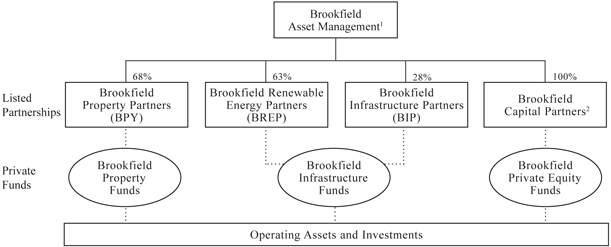
Our operations are organized into four principal groups (�operating platforms�): property, renewable energy, infrastructure and private equity. These platforms are responsible for operating the assets owned by our various funds and investee companies. The equity capital invested in these assets is provided by a series of listed partnerships and private funds which are managed by us and are funded with capital from ourselves and our clients. A fifth group operates our public markets business.
We have formed a large capitalization listed partnership in each of our property, renewable energy and infrastructure groups, which serves as the primary vehicle through which we will invest in each respective segment. As well as owning assets directly, these partnerships serve as the cornerstone investors in our private funds, alongside capital committed by institutional investors. This approach enables us to attract a broad range of public and private investment capital and the ability to match our various investment strategies with the most appropriate form of capital.
Our private equity business is conducted primarily through private funds with capital provided by institutions and ourselves. We do not currently envisage the formation of a listed partnership within these operations as we do not believe these investments would be properly valued in the capital markets on a standalone basis.
Our balance sheet capital is invested primarily in our three flagship listed partnerships, Brookfield Property Partners L.P. (�BPY� or �Brookfield Property Partners�); Brookfield Renewable Energy Partners L.P. (�BREP� or �Brookfield Renewable Energy�); and Brookfield Infrastructure Partners L.P. (�BIP� or �Brookfield Infrastructure Partners�), our private equity funds, and in several directly held investments and businesses.
The following chart is a condensed version of our organizational structure:
�
�
| 1. | Includes asset management and corporate activities |
� |
| 2. | Privately held, includes private equity, residential development and service activities |
� |
�
| � | Q3 2014 INTERIM REPORT | � | 7 |
ECONOMIC AND MARKET REVIEW
(As at October�30th, 2014)
Overview and Outlook
Real GDP growth in the U.S. is approaching the 3.0% run-rate that we have been expecting, despite the somewhat sluggish recovery in the housing sector. This bodes well for our positive outlook on the U.S., as we continue to believe that residential construction should return to more normal levels, suggesting a meaningful level of potential support for current growth momentum. Real GDP growth of 2.5% for the Canadian economy in the third quarter was consistent with our expectation, although the strength in the housing market has persisted longer and the increase in net exports has arrived a bit sooner than we anticipated. Nevertheless, we continue to believe Canada will underperform the U.S. slightly, which along with weaker commodity prices, should put additional downward pressure on the Canadian dollar. The recovery in the UK continues to be strong, with growth of 3.0% in the third quarter, as private consumption and business investment remained robust. However, the growing current account deficit raises concerns about the stability of the UK funding model moving forward. Eurozone real GDP growth was subdued again this quarter at 0.7%. As expected, weak growth and low inflation, together with the contraction of total credit, has prompted the European Central Bank to implement its own quantitative easing program. This will keep interest rates near historical lows in the Eurozone even as other central banks start to normalize policy rates next year. We expect the Eurozone will continue on a fairly modest growth path over the next few years but low interest rates and a weaker Euro should provide support as the deleveraging cycle plays out. Real GDP growth in Brazil stalled in the third quarter as dry conditions have pushed power prices to record highs, which has weighed on industrial production. While consumer and business confidence have both declined substantially in Brazil, the depreciation of the Real over the past few years and a return to normal hydrological conditions should provide a lift to industrial activity and help push Brazil�s economic growth closer to 3 � 4% over the medium term. In China, real GDP growth slowed to 7.3% as property markets remain under pressure. Longer term, rebalancing of the Chinese economy away from investment towards consumption will lead to slower growth rates, but this should be expected given the sheer size of this economy following 30+ years of rapid growth. Australian GDP growth slowed modestly to 3.0% in the third quarter as declining commodity prices has led to declines in mining investment, reducing the momentum in underlying growth.
United States
The U.S. economy grew 3.5% in the third quarter, as fiscal headwinds have abated and robust consumption growth and an increase in private business investment all contributed to strong real GDP growth. The pace of expansion is expected to moderate to about 3.0% for the rest of 2014 and into 2015. The labour market also continued to improve over the quarter with job creation averaging 224,000�per month and the unemployment rate falling to 5.9% in September. Despite slow wage growth, rising employment and gains in household wealth have led to increased consumption. Going forward, lower oil prices will be an additional source of support for U.S. consumers, with global oil benchmarks down 20�25% since early July. The decline in oil prices is due, in part, to stronger U.S. oil production, which continues to grow at a 1�million barrel per day pace. Housing starts remained slightly below 1�million units in the third quarter as first-time home buyers continue to experience difficulty in accessing credit. Encouragingly, we are starting to see a pickup in household formation and we expect that further economic recovery will see this pent-up demand return to the market. While demand-side weakness likely explains most of the sluggishness in residential construction so far, we would also note that some markets are seeing skilled labour shortages and experiencing difficulties in bringing lots to market. Commercial and industrial loans outstanding rose 12% on a year-over-year basis in the third quarter and non-residential business investment was up 6.8% last quarter. We have been expecting business investment to play a more important role in the growth story this year and are encouraged by these recent data-points. The U.S. dollar strengthened significantly against major currencies this quarter, gaining approximately 8% versus the Yen, Euro and Australian dollar and approximately 5% versus the Pound and Canadian dollar.
Canada
Economic activity in Canada grew by approximately 2.5% in the third quarter as export growth surprised to the upside. Exports were up 5.1% on a year-over-year basis last quarter and appear to be on pace for another strong result this quarter, which should continue to benefit from an improving U.S. economy. The housing sector remained stable, with housing starts at an annualized rate of 200,000 and house prices rising approximately 5% on a year-over-year basis. However, we expect to see the housing sector eventually slow as housing starts are running above demographic demand and households in Canada have significantly increased their debt levels over the past few years. The Bank of Canada is expected to remain cautious as the economy adjusts to lower commodity prices and weaker domestic demand, suggesting that increases in short-term interest rates in Canada will likely lag U.S. rate increases, despite starting from a higher base. This should put additional downward pressure on the Canadian dollar, which fell below US$0.90 this quarter.
United Kingdom
Growth and employment in the UK have been stronger than expected thus far in 2014, a trend which continued in the third quarter with GDP growth of 3.0% year-over-year, supported by both consumption and business investment. Retail sales growth remained strong at 2.6% in September while the 11.0% increase in business investment observed last quarter is expected to
�
�
| 8 | � | BROOKFIELD ASSET MANAGEMENT | � |
�
continue. The unemployment rate has fallen to 6.0%, down 1.7 percentage points since last year and is now at its lowest level since late 2008. The tightening labour market, however, has not yet translated into faster wage growth and the Bank of England has indicated that this will be one of the key indicators they will use to determine the timing of the first interest rate hike. The Purchasing Managers Index (PMI) for the construction and services sectors are still pointing to strong expansion while the PMI for the manufacturing sector has weakened over the quarter owing to concerns that the stronger Pound will reduce UK manufacturers� relative competitiveness. Over the past year the Pound has appreciated by 6.5% versus the Euro and while it had appreciated against the U.S. dollar earlier in the year, recent U.S. dollar strength has since erased those gains. The current account deficit in the UK is at record levels, and while it is difficult to foresee a scenario where London financial markets lose their attractiveness as a haven for global capital flows, this imbalance raises the risk of an external adjustment via a weaker Pound if this source of funding were to disappear.
Eurozone
Eurozone GDP growth remained subdued at 0.7% on a year-over-year basis in the third quarter with a modest improvement in peripheral countries offset by a deceleration in Germany. Over the period, France and Germany grew by 0.3% and 1.3%, respectively on a year-over-year basis while Portugal, Spain and Ireland each grew between 1.0% and 1.5%. German industrial production contracted by 4.0% month-over-month in August and the PMI suggests that activity has stalled. This has raised concerns that Germany may slip into a mild recession this quarter. Inflation continued to slow, with core inflation in nearly all Eurozone countries trending lower. For the Eurozone as a whole, the core inflation rate was only 0.8% year-over-year in September while domestic credit to the private sector has contracted 8.2% since 2009 and shows no signs of improving. In response to weak growth and low inflation, the European Central Bank has reduced its main lending rate to 0.05% and its deposit rate below 0.0%, and is implementing two quantitative easing programs that will target lending to firms and households as well as the direct purchase of asset backed securities. The key question for the Eurozone over the next several years is whether these programs will help ease the impact of deleveraging and help return growth and inflation to more sustainable levels.
Brazil
Brazil real GDP stalled in the third quarter following a contraction of 0.9% on a year-over-year basis in the previous quarter. Manufacturing and construction were the largest sources of weakness in GDP, with energy-intensive sectors such as metallurgy and the production of vehicles seeing outright declines. We believe that much of the weakness in energy-intensive industries is related to the fact that poor hydrological conditions and low reservoir levels have led to record high power prices. This has caused several energy-intensive industrial producers to curtail production as high power prices have made them uncompetitive with imports and, in some cases, they are taking advantage of high prices to sell contracted power back to the grid. In addition, reduced hydro generation has increased demand for thermal generation, which has led to an increase in fuel imports (oil and LNG). This has partly masked a positive trend in net exports due to a weaker Brazilian Real, which has depreciated significantly over the past few years. Real GDP growth will remain weak through the remainder of 2014 as short-term challenges persist. However, despite the near term challenges, we are less pessimistic than many commentators have become recently and see current growth rates as being far below Brazil�s long-term growth potential. We believe this potential will be underpinned by labour force growth of at least approximately 1.0% and productivity growth of 2.0% or higher if the newly-elected government pursues a more growth oriented agenda.
China
Chinese GDP growth slowed to 7.3% in the third quarter, as year-over-year retail sales growth of 10.3% and an unexpected lift from export volumes, which grew 9.0% year-over-year in August, were not enough to fully offset a further contraction in property sales and the moderation of oil, steel and electricity demand growth to between 2.0% and 4.0%. Residential property markets remain under pressure with housing sales declining 10.9% over the first eight months of the year. The government has responded to this weakness by relaxing home purchase restrictions on second buyers and increasing social housing construction but the extent to which the government will intervene remains unclear. Authorities have acknowledged, in part, that structural reforms are necessary and are likely associated with a lower growth target going forward. Somewhat slower growth should be expected given the size of the Chinese economy, second only to the United States and almost twice the size of Japan.
Australia
Australian GDP growth remains around 3.0% as declines in private investment are being offset by stronger residential construction, public investment and a positive contribution from exports as volumes continue to rise. Capital expenditures decreased in all three mining sectors last quarter and we expect an overall slowing trend due to declines in commodity prices and the completion of currently committed projects over the next few years. Iron ore, metallurgical coal and thermal coal prices are down 40%, 25% and 20%, respectively, year-over-year and by the end of next year, four of the six onshore mega gas projects will reach completion. Combined, these projects account for 51% of the $229 billion worth of resource projects currently committed. Overall growth, however, has been supported by a pickup in residential construction, which is on pace for 180,000 units to be built this year, a 11% increase over last year and a 20 year high. The Australian dollar was down to US$0.87 in this quarter, buffeted by U.S. dollar strength and weakness in commodity prices.
�
| � | Q3 2014 INTERIM REPORT | � | 9 |
PART 2 � FINANCIAL PERFORMANCE REVIEW
SELECTED FINANCIAL INFORMATION
�
| � | � | Three Months Ended | � | � | Nine Months Ended | � | ||||||||||||||||||
| CONDENSED ��STATEMENTS OF ��OPERATIONS |
� | 2014� | � | � | 2013� | � | � | Change� | � | � | 2014� | � | � | 2013� | � | � | Change� | � | ||||||
| FOR THE PERIODS ENDED SEP. 30 (MILLIONS, EXCEPT PER SHARE AMOUNTS) |
� | � | � | � | � | � | � | � | � | � | � | � | � | � | � | � | � | � | ||||||
| Revenues |
� | $ | ��������4,659� | �� | � | $ | ��������4,501� | �� | � | $ | ��������158� | �� | � | $ | ��������13,670� | �� | � | $ | ��������14,600� | �� | � | $ | ��������(930) | �� |
| Direct costs |
� | � | (3,467) | �� | � | � | (3,230) | �� | � | � | (237) | �� | � | � | (9,686) | �� | � | � | (10,256) | �� | � | � | 570� | �� |
| Other income and gains |
� | � | (7) | �� | � | � | 1,200� | �� | � | � | (1,207) | �� | � | � | 190� | �� | � | � | 1,218� | �� | � | � | (1,028) | �� |
| Equity accounted income |
� | � | 350� | �� | � | � | 194� | �� | � | � | 156� | �� | � | � | 969� | �� | � | � | 684� | �� | � | � | 285� | �� |
| Expenses |
� | � | � | � | � | � | ||||||||||||||||||
| Interest |
� | � | (645) | �� | � | � | (617) | �� | � | � | (28) | �� | � | � | (1,910) | �� | � | � | (1,940) | �� | � | � | 30� | �� |
| Corporate costs |
� | � | (27) | �� | � | � | (36) | �� | � | � | 9 | �� | � | � | (93) | �� | � | � | (116) | �� | � | � | 23� | �� |
| Fair value changes |
� | � | 637 | �� | � | � | 104 | �� | � | � | 533 | �� | � | � | 2,348 | �� | � | � | 630� | �� | � | � | 1,718� | �� |
| Depreciation and amortization |
� | � | (353) | �� | � | � | (357) | �� | � | � | 4 | �� | � | � | (1,100) | �� | � | � | (1,095) | �� | � | � | (5) | �� |
| Income taxes |
� | � | (38) | �� | � | � | (264) | �� | � | � | 226 | �� | � | � | (878) | �� | � | � | (731) | �� | � | � | (147) | �� |
| � | � |
� |
� | � | � |
� |
� | � | � |
� |
� | � | � |
� |
� | � | � |
� |
� | � | � |
� |
� | |
| Net income |
� | � | 1,109 | �� | � | � | 1,495 | �� | � | � | (386) | �� | � | � | 3,510 | �� | � | � | 2,994� | �� | � | � | 516� | �� |
| Non-controlling interests |
� | � | (375) | �� | � | � | (682) | �� | � | � | 307 | �� | � | � | (1,450) | �� | � | � | (1,591) | �� | � | � | 141� | �� |
| � | � |
� |
� | � | � |
� |
� | � | � |
� |
� | � | � |
� |
� | � | � |
� |
� | � | � |
� |
� | |
| Net income attributable to shareholders | � | $ | 734� | �� | � | $ | 813� | �� | � | $ | (79) | �� | � | $ | 2,060� | �� | � | $ | 1,403� | �� | � | $ | 657� | �� |
| � | � |
� |
� | � | � |
� |
� | � | � |
� |
� | � | � |
� |
� | � | � |
� |
� | � | � |
� |
� | |
| Net income per share |
� | $ | 1.09� | �� | � | $ | 1.23� | �� | � | $ | (0.14) | �� | � | $ | 3.07� | �� | � | $ | 2.05� | �� | � | $ | ��������1.02� | �� |
| � | � |
� |
� | � | � |
� |
� | � | � |
� |
� | � | � |
� |
� | � | � |
� |
� | � | � |
� |
� | |
| � BALANCE SHEET INFORMATION � |
� | � | � | � | � | � | � | � | � | � | ||||||||||||||
| (MILLIONS) | � | � | Sep.�30,�2014� | � | � | Dec.�31,�2013� | � | � | ������������Change� | � | ||||||||||||||
| Consolidated assets |
�� |
� | $ | 118,232� | �� | � | $ | 112,745� | �� | � | $ | 5,487� | �� | |||||||||||
| Borrowings and other non-current financial liabilities |
�� |
� | � | 56,220� | �� | � | � | 53,061� | �� | � | � | 3,159� | �� | |||||||||||
| Equity |
�� |
� | � | 48,933� | �� | � | � | 47,526� | �� | � | � | 1,407� | �� | |||||||||||
| � | � | � | � | � |
� |
� | � | � |
� |
� | � | � |
� |
� | ||||||||||
The relevant exchange rates that impact our business are shown in the following table:
�
| � | � | � | � | � | � | � | � | � | � | � | Average Rate | � | ||||||||||||||||||||||||
| AS AT SEP. 30, 2014 AND DEC. 31, 2013 AND FOR THE PERIODS ENDED SEP. 30 |
� | � | � | � | � | � | � | � | � | � | � | � | � | � | � | � | � | � | � | |||||||||||||||||
| � | � | Period-end Spot Rate | � | � | Three Months Ended | � | � | Nine Months Ended | � | |||||||||||||||||||||||||||
| � | � | ����2014� | � | � | ����2013� | � | � | �Change� | � | � | ����2014� | � | � | ����2013� | � | � | �Change� | � | � | ����2014� | � | � | ����2013� | � | � | �Change� | � | |||||||||
| Australian dollar |
� | � | 0.8746� | �� | � | � | 0.8918� | �� | � | � | (2)% | �� | � | � | 0.9250� | �� | � | � | 0.9161� | �� | � | � | 1% | �� | � | � | 0.9184� | �� | � | � | 0.9817� | �� | � | � | (6)% | �� |
| Brazilian real |
� | � | 2.4450� | �� | � | � | 2.3635� | �� | � | � | (3)% | �� | � | � | 2.2732� | �� | � | � | 2.2852� | �� | � | � | 1% | �� | � | � | 2.2862� | �� | � | � | 2.1124� | �� | � | � | (8)% | �� |
| Canadian dollar |
� | � | 0.8932� | �� | � | � | 0.9414� | �� | � | � | (5)% | �� | � | � | 0.9187� | �� | � | � | 0.9628� | �� | � | � | (5)% | �� | � | � | 0.9143� | �� | � | � | 0.9774� | �� | � | � | (6)% | �� |
| � | � |
� |
� | � | � |
� |
� | � | � |
� |
� | � | � |
� |
� | � | � |
� |
� | � | � |
� |
� | � | � |
� |
� | � | � |
� |
� | � | � |
� |
� | |
FINANCIAL PERFORMANCE
Overview
Three Months Ended September�30
Net income in the third quarter was $1,109 million, compared to $1,495 million recorded in the same period in the prior year. The largest variance related to �other income and gains� which totalled $1,200 million in the 2013 quarter whereas the current quarter included a small loss. The prior year gains included a $525 million gain on the settlement of a long-dated interest rate swap contract and a $664�million gain on the disposition of a private equity investment. These gains were partially offset by $206 million of associated deferred income tax expenses, resulting in an aggregate net variance in net income of $983 million after taxes. The year-over-year variance was partially offset by a $533 million increase in fair value changes over the 2013 quarter, primarily due to a large amount of appraisal gains in our property operations.
�
�
| 10 | � | BROOKFIELD ASSET MANAGEMENT | � |
�
Net income attributable to shareholders after deducting non-controlling interests decreased by $79 million to $734 million in the third quarter. The decline in net income attributable to shareholders was significantly less than the decline in net income because a large portion of private equity disposition gain accrued largely to non-controlling interests and, conversely, a larger portion of the fair value gains was attributable to shareholders due to our higher ownership interest in our office property portfolio.
Nine Months Ended September�30
Net income for the first nine months of 2014 was $3.5 billion, of which $2.1 billion was attributable to shareholders. On a per share basis net income for the nine months increased by $1.02 to $3.07 in the current year.
In addition to the variances discussed above for the three months, the first quarter of 2014 included a $230 million gain on the partial disposition of a forest products investment in our private equity operations, which is included within fair value changes, along with an additional $1,336 million of positive appraisal gains on consolidated investment properties. We also recorded a $320 million income tax expense in the first quarter of 2014 due to a change in tax legislation that increased the tax rate utilized in a key market for our property operations.
Net income attributable to shareholders increased by $657 million to $2,060 million for the nine months, due to the above mentioned positive variances.
Statements of Operations
Revenues and Direct Costs
The following tables present consolidated revenues and direct costs, which we have disaggregated into our operating segments in order to facilitate a review of year-over-year variances. Segmented revenue and direct costs are presented and reconciled to consolidated revenues and direct costs in the following tables.
�
| ��������������� | ��������������� | ��������������� | ��������������� | ��������������� | ��������������� | |||||||||||||||||||
| � | � | Revenues | � | � | Direct Costs | � | ||||||||||||||||||
| FOR THE THREE MONTHS ENDED SEP. 30 (MILLIONS) |
� | 2014� | � | � | 2013� | � | � | Change� | � | � | 2014� | � | � | 2013� | � | � | Change | � | ||||||
| Revenues |
� | � | � | � | � | � | ||||||||||||||||||
| Asset management |
� | $ | 194� | �� | � | $ | 175� | �� | � | $ | 19� | �� | � | $ | 90� | �� | � | $ | 79� | �� | � | $ | 11� | �� |
| Property |
� | � | 1,225� | �� | � | � | 1,133� | �� | � | � | 92�� | �� | � | � | 625� | �� | � | � | 563� | �� | � | � | 62� | �� |
| Renewable energy |
� | � | 345� | �� | � | � | 384� | �� | � | � | (39) | �� | � | � | 135� | �� | � | � | 144� | �� | � | � | (9) | �� |
| Infrastructure |
� | � | 553� | �� | � | � | 498� | �� | � | � | 55� | �� | � | � | 246� | �� | � | � | 227� | �� | � | � | 19� | �� |
| Private equity |
� | � | 622� | �� | � | � | 896� | �� | � | � | (274) | �� | � | � | 580� | �� | � | � | 753� | �� | � | � | (173) | �� |
| Residential development |
� | � | 920� | �� | � | � | 598� | �� | � | � | 322� | �� | � | � | 815� | �� | � | � | 540� | �� | � | � | 275� | �� |
| Service activities |
� | � | 942� | �� | � | � | 905� | �� | � | � | 37� | �� | � | � | 891� | �� | � | � | 866� | �� | � | � | 25� | �� |
| Corporate activities |
� | � | 9� | �� | � | � | 35� | �� | � | � | (26) | �� | � | � | 6� | �� | � | � | 16� | �� | � | � | (10) | �� |
| Eliminations and adjustments1 |
� | � | (151) | �� | � | � | (123) | �� | � | � | (28) | �� | � | � | 79� | �� | � | � | 42� | �� | � | � | 37� | �� |
| � | � |
� |
� | � | � |
� |
� | � | � |
� |
� | � | � |
� |
� | � | � |
� |
� | � | � |
� |
� | |
| Total consolidated revenues |
� | $ | ������4,659� | �� | � | $ | ������4,501� | �� | � | $ | ������158� | �� | � | $ | ������3,467� | �� | � | $ | ������3,230� | �� | � | $ | ������237� | �� |
| � | � |
� |
� | � | � |
� |
� | � | � |
� |
� | � | � |
� |
� | � | � |
� |
� | � | � |
� |
� | |
�
| 1. | Adjustment to eliminate base management fees and interest income earned from entities that we consolidate. See Note 3 to our Consolidated Financial Statements |
� |
�
| ��������������� | ��������������� | ��������������� | ��������������� | ��������������� | ��������������� | |||||||||||||||||||
| � | � | Revenues | � | � | Direct Costs | � | ||||||||||||||||||
| FOR THE NINE MONTHS ENDED SEP. 30 (MILLIONS) |
� | 2014� | � | � | 2013� | � | � | Change� | � | � | 2014� | � | � | 2013� | � | � | Change� | � | ||||||
| Revenues |
� | � | � | � | � | � | ||||||||||||||||||
| Asset management |
� | $ | 565� | �� | � | $ | 456� | �� | � | $ | ������109� | �� | � | $ | 283� | �� | � | $ | 225� | �� | � | $ | 58� | �� |
| Property |
� | � | 3,731� | �� | � | � | 3,418� | �� | � | � | 313� | �� | � | � | ������1,949� | �� | � | � | ������1,722� | �� | � | � | ������227� | �� |
| Renewable energy |
� | � | 1,310� | �� | � | � | 1,243� | �� | � | � | 67� | �� | � | � | 388� | �� | � | � | 413� | �� | � | � | (25) | �� |
| Infrastructure |
� | � | 1,676� | �� | � | � | 1,806� | �� | � | � | (130) | �� | � | � | 752� | �� | � | � | 879� | �� | � | � | (127) | �� |
| Private equity |
� | � | 1,919� | �� | � | � | 3,293� | �� | � | � | (1,374) | �� | � | � | 1,679� | �� | � | � | 2,639� | �� | � | � | (960) | �� |
| Residential development |
� | � | 2,041� | �� | � | � | 1,675� | �� | � | � | 366� | �� | � | � | 1,780� | �� | � | � | 1,542� | �� | � | � | 238� | �� |
| Service activities |
� | � | ������2,693� | �� | � | � | ������2,780� | �� | � | � | (87) | �� | � | � | 2,590� | �� | � | � | 2,688� | �� | � | � | (98) | �� |
| Corporate activities |
� | � | 139� | �� | � | � | 236� | �� | � | � | (97) | �� | � | � | 73� | �� | � | � | 46� | �� | � | � | 27� | �� |
| Eliminations and adjustments1 |
� | � | (404) | �� | � | � | (307) | �� | � | � | (97) | �� | � | � | 192� | �� | � | � | 102� | �� | � | � | 90� | �� |
| � | � |
� |
� | � | � |
� |
� | � | � |
� |
� | � | � |
� |
� | � | � |
� |
� | � | � |
� |
� | |
| Total consolidated revenues |
� | $ | 13,670� | �� | � | $ | 14,600� | �� | � | $ | (930) | �� | � | $ | 9,686� | �� | � | $ | 10,256� | �� | � | $ | (570) | �� |
| � | � |
� |
� | � | � |
� |
� | � | � |
� |
� | � | � |
� |
� | � | � |
� |
� | � | � |
� |
� | |
�
| 1. | Adjustment to eliminate base management fees and interest income earned from entities that we consolidate. See Note 3 to our Consolidated Financial Statements |
� |
�
| � | Q3 2014 INTERIM REPORT | � | 11 |
Revenues and direct costs increased by $158 million and $237 million in the quarter. On a nine-month basis, revenues and direct costs decreased by $930 million and $570 million, respectively. We sold and deconsolidated two forest products businesses within our private equity operations and non-core timberlands within our infrastructure segment over the past twelve months, which collectively reduced revenues and direct costs on a three-month basis by $299 million and $257 million and on a nine-month basis by $1,614 million and $1,284 million, respectively. After adjusting for these sales, revenues and direct costs increased on a three-month basis by $455 million and $494 million and on a nine-month basis by $684 million and $714 million, respectively. Notable variances in revenues and direct costs on a segmented basis for the three and nine months are described in the following paragraphs.
Asset management: Revenues increased by $19 million to $194 million for the third quarter of 2014. We recorded $160 million of base management fees, representing a 24% increase over the $129 million recognized in 2013, primarily due to $15 million of additional fees generated on BPY�s increased capitalization as well as fees earned from additional commitments to our real estate and infrastructure flagship private funds. These positive variances were partially offset, as the prior year included $18 million of catch-up fees as a result of capital called on the final close of our flagship property fund. Direct costs increased by $11 million, reflecting the expansion of our operations. Revenues for the first nine months of 2014 increased by $109 million to $565 million, due primarily to increased base management fees from a higher level of fee bearing capital under management. The formation of and subsequent unit issuances by Brookfield Property Partners contributed $47 million of the change with the remainder of the increase being primarily due to additional capital committed to our infrastructure and property private funds. Direct costs increased by $58 million to $283 million on a nine-month basis, due to the expansion of our asset management operations and $10 million being reallocated to this segment following the formation of Brookfield Property Partners in April 2013.
Property: Revenues and direct costs increased by $92 million and $62 million, respectively. The increase in revenue and costs were a result of assets acquired over the past year, including our industrial and logistics operations, which were acquired in the latter half of 2013. Lower occupancy levels in our U.S. office portfolio reduced revenues by $40 million in the quarter ($120 million for the nine months) following the expected expiry of a large lease in the fourth quarter of 2013, which was partially offset by the impact of higher rents on new leases entered into over the past year. On a year-to-date basis, revenues and direct costs increased $313 million and $227 million, respectively, and reflects a full period of contribution from the aforementioned industrial operations, as well as recently acquired multifamily, hotel and office properties.
Renewable energy: Revenues decreased by $39 million in the third quarter compared to the prior year. Generation of 4,383 GWh decreased by 15% over the prior year of 5,154 GWh, which resulted in a $69 million reduction in revenue. Newly acquired or commissioned assets generated $30 million of revenue. U.S. hydroelectric generation was in line with the long-term average but below the prior year which experienced stronger inflows. The Canadian hydroelectric portfolio was impacted by below average inflows resulting from the dry conditions. Direct costs are largely fixed and declined by $9 million over the prior year, due primarily to foreign exchange. On a year-to-date basis revenues were $67 million higher than the same period in the prior year, primarily due from $83 million of additional revenues in the first quarter on higher realized energy prices, particularly in New York and New England, and generation levels that were higher than the comparable period due to improved water levels and the contribution from net new assets.
Infrastructure: Revenues increased by $55 million compared to the 2013 quarter as a reduction in revenues of $23 million from the sale of our Pacific Northwest timberlands in July 2013 was more than offset by increased revenues of $78 million from recent capital expansions, acquisitions completed in the last twelve months and higher volumes across our transport businesses. Direct operating costs were higher by $19 million compared to prior year as a $32 million increase in costs due to acquisitions and capital expansion programs completed in the past year was partially offset by a decline in operating costs of $13�million from the sale of our Pacific Northwest timberlands. On a nine-month basis, revenues decreased by $130 million compared to the prior year due to a reduction in revenues of $304 million from the sale of our Pacific Northwest timberlands in July 2013 and a $30 million decrease from a 6% decline in the Australian dollar were partially offset by increased revenues generated from recently completed development projects and acquisitions.
Private equity: Revenues decreased by $274 million and direct costs decreased by $173 million in the quarter, primarily as a result of the sale of two forest products investments which contributed $276 million in revenues and $244 million in direct costs in the prior year. In addition, a 14% decline in our panelboard operations compared to the prior year, decreased revenues by a further $35 million. These decreases were partially offset by higher sales at our energy-related investments due to higher natural gas production compared to the prior year. On a nine-month basis revenues decreased by $1.37 billion and direct costs decreased by $960 million, primarily reflecting asset sales including the above-mentioned forest products investments, which collectively decreased revenues and direct costs by $1,326 million and $1,138 million, respectively. In addition, lower oriented panelboard pricing decreased revenues by $220 million on a nine-month basis.
Residential development: Revenues and direct costs increased by $322 million and $275 million, respectively, reflecting the completion and delivery of a large number of projects in our Brazilian operations which resulted in increases in both revenues and the associated cost of goods sold. Our North American operations revenues increased by $23 million due to increased U.S.�housing sales. Nine-month results reflect the higher level of deliveries in our Brazilian operations noted above, as well as an increase in volumes in North America primarily due to higher levels on our U.S. housing sales. We also sold two commercial properties within our North American operations in the first quarter of 2014, which generated revenues of $83 million.
�
�
| 12 | � | BROOKFIELD ASSET MANAGEMENT | � |
�
Service activities: Revenues increased by $37 million in the third quarter, as an increase in revenues within our construction operations offset lower activity levels in our relocation services. Year-to-date revenues and costs declined by $87 million and $98 million, respectively, as lower level of construction activity in the first quarter of 2014 more than offset the increase in the third quarter.
Corporate activities: Revenues in our investment portfolios decreased compared to 2013 by $26 million on a three-month basis and by $97 million year-to-date due to tempered capital market performance.
Other Income and Gains
Other income and gains were a loss of $7 million in the quarter compared to $1,200 million in the prior year. The prior period included a $525 million gain on the termination of a long-dated interest rate swap contract in August 2013 as well as a $664 million gain on the sale of a pulp and paper investment. On a year-to-date basis, other income and gains totalled $190 million and includes a $143 million gain on the repayment of a distressed debt investment in a European office portfolio.
Equity Accounted Income
Equity accounted income represents our share of the net income recorded by investments over which we exercise significant influence and is reported as a single line item in our consolidated statement of operations. The following table disaggregates consolidated equity accounted income to facilitate analysis:
�
| � | � | Three Months Ended | � | � | Nine Months Ended | � | ||||||||||||||||||
| FOR THE PERIODS ENDED SEP.�30 (MILLIONS) |
� | 2014� | � | � | 2013 | � | � | Change | � | � | 2014� | � | � | 2013� | � | � | Change� | � | ||||||
| General Growth Properties |
� | $ | 168� | �� | � | $ | 92� | �� | � | $ | 76� | �� | � | $ | 481� | �� | � | $ | 317� | �� | � | $ | 164� | �� |
| Other property operations |
� | � | 96� | �� | � | � | 61� | �� | � | � | 35� | �� | � | � | 316� | �� | � | � | 268� | �� | � | � | 48� | �� |
| Infrastructure operations |
� | � | 40� | �� | � | � | 20� | �� | � | � | 20� | �� | � | � | 73� | �� | � | � | 51� | �� | � | � | 22� | �� |
| Forest products business |
� | � | 5� | �� | � | � | �� | �� | � | � | 5� | �� | � | � | 24� | �� | � | � | �� | �� | � | � | 24� | �� |
| Other |
� | � | 41� | �� | � | � | 21� | �� | � | � | 20� | �� | � | � | 75� | �� | � | � | 48� | �� | � | � | 27� | �� |
| � | � |
� |
� | � | � |
� |
� | � | � |
� |
� | � | � |
� |
� | � | � |
� |
� | � | � |
� |
� | |
| � | $ | ����������350� | �� | � | $ | ����������194� | �� | � | $ | ����������156� | �� | � | $ | ����������969� | �� | � | $ | ����������684� | �� | � | $ | ����������285� | �� | |
| � | � |
� |
� | � | � |
� |
� | � | � |
� |
� | � | � |
� |
� | � | � |
� |
� | � | � |
� |
� | |
Equity accounted income from our investment in General Growth Properties (�GGP�) increased by $76 million in the current quarter and $164 million on a year-to-date basis due to an increased consolidated ownership interest in GGP from 22% to 29%, a higher level of appraisal gains on GGP�s investment properties, 5.4% same-store net operating income growth due to higher rents on new leases and a 20 bps increase in occupancy. Our share of GGP�s valuation gains on a year-to-date basis totalled $198 million, compared to $92 million in the same period in 2013, representing an increase of $106 million.
Equity accounted income from other property operations increased by $35 million from the third quarter of 2013, and by $48 million from the first nine months of 2013, due to the commencement of equity accounting for a Denver office property following the sale of a 50% interest in the second quarter of 2014 and an increased level of fair value gains within other deconsolidated investment properties. The increase also reflects the contribution from an equity accounted hotel portfolio, which was acquired in May�2014.
Equity accounted income from infrastructure operations increased compared to the prior year by $20 million for the third quarter, and by $22 million for the first nine months of 2014. The improved results are primarily due to earnings from our Texas transmission investment which was commissioned into operations during the fourth quarter of 2013, and the contribution from acquisitions completed over the past twelve months including Brazil logistics operations. These positive variances were partially offset by the sale of our Australasian regulated distribution utility, which was equity accounted.
We commenced equity accounting for a Forest Products operation in the first quarter of 2014 and generated $24 million of equity accounted income on a year-to-date basis. We subsequently disposed of this operation in September�2014.
Other equity accounted income includes $35 million of profit from our Brazilian residential operations upon delivery of projects which were held through joint ventures.
Interest Expense
The following table presents interest expense organized by the balance sheet classification of the associated liability:
�
| � | � | Three Months Ended | � | � | Nine Months Ended | � | ||||||||||||||||||
| FOR THE PERIODS ENDED SEP.�30 (MILLIONS) |
� | 2014� | � | � | 2013� | � | � | Change� | � | � | 2014� | � | � | 2013� | � | � | Change� | � | ||||||
| Corporate borrowings |
� | $ | 58� | �� | � | $ | 48� | �� | � | $ | 10� | �� | � | $ | ����������172� | �� | � | $ | ����������146� | �� | � | $ | 26� | �� |
| Non-recourse borrowings |
� | � | � | � | � | � | ||||||||||||||||||
| Property-specific mortgages |
� | � | 515� | �� | � | � | 459� | �� | � | � | 56� | �� | � | � | 1,508� | �� | � | � | 1,414� | �� | � | � | 94� | �� |
| Subsidiary borrowings |
� | � | 66� | �� | � | � | 99� | �� | � | � | (33) | �� | � | � | 204� | �� | � | � | 343� | �� | � | � | (139) | �� |
| Subsidiary equity obligations |
� | � | 6� | �� | � | � | 11� | �� | � | � | (5) | �� | � | � | 26� | �� | � | � | 37� | �� | � | � | (11) | �� |
| � | � |
� |
� | � | � |
� |
� | � | � |
� |
� | � | � |
� |
� | � | � |
� |
� | � | � |
� |
� | |
| � | $ | ����������645� | �� | � | $ | ����������617� | �� | � | �$ | ����������28� | �� | � | $ | 1,910� | �� | � | $ | 1,940� | �� | � | $ | ���������(30) | �� | |
| � | � |
� |
� | � | � |
� |
� | � | � |
� |
� | � | � |
� |
� | � | � |
� |
� | � | � |
� |
� | |
�
| � | Q3 2014 INTERIM REPORT | � | 13 |
The majority of our borrowings are fixed rate long-term financings. Accordingly, changes in interest rates are generally limited to the impact of refinancing activities or changes in the level of debt as a result of acquisitions and dispositions.
Interest expense from corporate borrowings increased on a three and nine-month basis compared to 2013 as a result of a higher level of borrowings. We refinanced high cost subsidiary borrowings in the third quarter of 2013 with lower coupon corporate debt, which decreased subsidiary borrowings interest expense by $21 million and $87 million on a three-month and year-to-date basis respectively.
Interest expense on property-specific borrowings increased by $56 million ($94 million year-to-date) over the prior year as the aggregate amount of borrowings from debt increased due to debt associated with acquisitions and refinancings. Interest expense on subsidiary borrowings decreased following the termination of a long-dated high coupon interest rate liability in the third quarter of 2013, the elimination of interest following the sale of previously consolidated private equity investments, and the repayment of subsidiary unsecured facilities.
Fair Value Changes
The following table disaggregate fair value changes into major components to facilitate analysis:
�
| � | �� | Three Months Ended | � | �� | Nine Months Ended | � | ||||||||||||||||||
| FOR THE PERIODS ENDED SEP. 30 (MILLIONS) |
�� | 2014� | � | �� | 2013� | � | �� | Change� | � | �� | 2014� | � | �� | 2013� | � | �� | Change� | � | ||||||
| Investment properties |
�� | $ | 661� | �� | �� | $ | 145� | �� | �� | $ | 516� | �� | �� | $ | 1,997� | �� | �� | $ | 754� | �� | �� | $ | 1,243� | �� |
| Investment in Canary Wharf |
�� | � | 178� | �� | �� | � | 57� | �� | �� | � | 121� | �� | �� | � | 319� | �� | �� | � | 103� | �� | �� | � | 216� | �� |
| Forest products investment |
�� | � | �� | �� | �� | � | �� | �� | �� | � | �� | �� | �� | � | 230� | �� | �� | � | �� | �� | �� | � | 230� | �� |
| Power contracts |
�� | � | (83) | �� | �� | � | 7� | �� | �� | � | (90) | �� | �� | � | (95) | �� | �� | � | (69) | �� | �� | � | (26) | �� |
| Other |
�� | � | (119) | �� | �� | � | (105) | �� | �� | � | (14)� | �� | �� | � | (103) | �� | �� | � | (158) | �� | �� | � | (55) | �� |
| �� | � |
� |
� | �� | � |
� |
� | �� | � |
� |
� | �� | � |
� |
� | �� | � |
� |
� | �� | � |
� |
� | |
| �� | $ | ����������637� | �� | �� | $ | ����������104� | �� | �� | $ | ����������533� | �� | �� | $ | ��������2,348� | �� | �� | $ | ����������630� | �� | �� | $ | ��������1,718� | �� | |
| �� | � |
� |
� | �� | � |
� |
� | �� | � |
� |
� | �� | � |
� |
� | �� | � |
� |
� | �� | � |
� |
� | |
Investment Properties
Fair value gains from changes in investment property values totalled $661 million in the third quarter of 2014 and $2.0 billion year-to-date. Most of these gains occurred within our U.S. office investment properties as valuations benefitted from positive leasing activities in New York City, downtown Los Angeles and London. Valuations benefitted from declines in discount rates and terminal capitalization rates, and improvements in projected cash flows based on tenant profile and rental markets. The overall decline in discount rates during the quarter contributed approximately 75% of the gains, while improvements in projected cash flows contributed approximately 25% of the gains.
Forest Products Investment
During the first quarter of 2014 we disposed of a partial interest in a private equity investee company, resulting in us deconsolidating the business from our results and revaluing our retained interest based on its quoted market price at the time of our loss of control. This gave rise to a $230 million revaluation gain relating to the excess of fair value over our IFRS book value of our retained interest.
Investment in Canary Wharf
Development activities, improved net operating income, and the impact of lower discount rates on projected cash flows gave rise to an increase in the value of our investment in Canary Wharf Group plc (�Canary Wharf�) of $178 million during the third quarter, and $319 million on a year-to-date basis, $216 million higher than the prior year-to-date basis.
Power Contracts
The valuation of our contracts for the future sale of electricity decreased by $90 million during the quarter and $26 million year-to-date. Certain of our long-term power contracts are accounted for as derivatives with changes in fair value recorded in net income. These contracts generally relate to the future sale of electricity at fixed prices and therefore increase in value when prices decline, and vice versa.
Other fair value changes primarily include the mark-to-market of subsidiary equity obligations and certain financial instruments. The current period and year-to-date loss primarily relates to increases in subsidiary equity obligations as a result of our partners share of increased appraisal gains on investment properties, which are discussed above.
�
�
| 14 | � | BROOKFIELD ASSET MANAGEMENT | � |
�
Depreciation and Amortization
Depreciation and amortization was consistent with the prior year on a three-month and nine-month basis and is summarized in the following table:
�
| � | �� | Three Months Ended | � | �� | Nine Months Ended | � | ||||||||||||||||||
| FOR THE PERIODS ENDED SEP.�30 (MILLIONS) |
�� | 2014� | � | �� | 2013� | � | �� | Change� | � | �� | 2014� | � | �� | 2013� | � | �� | Change | � | ||||||
| Renewable energy |
�� | $ | 151� | �� | �� | $ | 136� | �� | �� | $ | 15� | �� | �� | $ | 416� | �� | �� | $ | 411� | �� | �� | $ | 5� | �� |
| Infrastructure |
�� | � | 102� | �� | �� | � | 86� | �� | �� | � | ������������16� | �� | �� | � | 295� | �� | �� | � | 263� | �� | �� | � | 32� | �� |
| Property |
�� | � | 33� | �� | �� | � | 65� | �� | �� | � | (32) | �� | �� | � | 189� | �� | �� | � | 196� | �� | �� | � | (7) | �� |
| Private equity |
�� | � | 54� | �� | �� | � | 57� | �� | �� | � | (3) | �� | �� | � | 160� | �� | �� | � | 184� | �� | �� | � | (24) | �� |
| Other |
�� | � | 13� | �� | �� | � | 13� | �� | �� | � | �� | �� | �� | � | 40� | �� | �� | � | 41� | �� | �� | � | (1) | �� |
| �� | � |
� |
� | �� | � |
� |
� | �� | � |
� |
� | �� | � |
� |
� | �� | � |
� |
� | �� | � |
� |
� | |
| �� | $ | ����������353� | �� | �� | $ | ����������357� | �� | �� | $ | (4) | �� | �� | $ | ����������1,100� | �� | �� | $ | ����������1,095� | �� | �� | $ | ������������5� | �� | |
| �� | � |
� |
� | �� | � |
� |
� | �� | � |
� |
� | �� | � |
� |
� | �� | � |
� |
� | �� | � |
� |
� | |
Increases in depreciation and amortization expense at our renewable energy and infrastructure operations relate to the acquisition or commissioning of new assets during the period. The decrease in amortization at our property operations relates to the disposal of assets within our hospitality operations.
Income Taxes
Income tax expense decreased by $226 million to $38 million in the third quarter of 2013, whereas year-to-date income tax expense increased by $147 million to $878 million.
Income tax expense in the current quarter includes the recognition of previously generated losses as deferred income tax assets within our residential operations, offset by a higher level of deferred income taxes associated with the $661 million investment property valuation increases, which were significantly higher than the 2013 quarter. The prior year also includes the recognition of $206 million in deferred taxes on two large gains included in net income. The $147 million increase in income taxes on a nine-month basis, is due to the above variances, as well as a $320 million non-recurring deferred income tax expense that resulted from a change in tax laws that affected our North American office property operations in the first quarter of 2014. The prior year also included $134 million of deferred income taxes related to the formation of Brookfield Property Partners.
FINANCIAL PROFILE
Consolidated Assets
The following table presents our consolidated assets at September�30, 2014 and December�31, 2013:
�
| � | �� | Total Consolidated Assets | � | |||||||||
| AS AT SEP. 30, 2014 AND DEC.�31, 2013 (MILLIONS) |
�� | 2014� | � | � | 2013� | � | � | Change� | � | |||
| Investment properties |
�� | $ | 41,051� | �� | � | $ | 38,336� | �� | � | $ | 2,715� | �� |
| Property, plant and equipment |
�� | � | 32,512� | �� | � | � | 31,019� | �� | � | � | 1,493� | �� |
| Sustainable resources |
�� | � | 427� | �� | � | � | 502� | �� | � | � | (75) | �� |
| Equity accounted investments |
�� | � | 14,528� | �� | � | � | 13,277� | �� | � | � | 1,251� | �� |
| Cash and cash equivalents |
�� | � | 3,312� | �� | � | � | 3,663� | �� | � | � | (351) | �� |
| Financial assets |
�� | � | 6,265� | �� | � | � | 4,947� | �� | � | � | 1,318� | �� |
| Accounts receivable and other |
�� | � | 6,565� | �� | � | � | 6,666� | �� | � | � | (101) | �� |
| Inventory |
�� | � | 5,937� | �� | � | � | 6,291� | �� | � | � | (354) | �� |
| Intangible assets |
�� | � | 4,573� | �� | � | � | 5,044� | �� | � | � | (471) | �� |
| Goodwill |
�� | � | 1,594� | �� | � | � | 1,588� | �� | � | � | 6� | �� |
| Deferred income tax asset |
�� | � | 1,468� | �� | � | � | 1,412� | �� | � | � | 56� | �� |
| �� | � |
� |
� | � | � |
� |
� | � | � |
� |
� | |
| �� | $ | ��������118,232� | �� | � | $ | ��������112,745� | �� | � | $ | ��������5,487� | �� | |
| �� | � |
� |
� | � | � |
� |
� | � | � |
� |
� | |
Consolidated assets increased by $5.5�billion during past the nine months to $118.2�billion at September�30, 2014. We present our consolidated balance sheets on a non-classified basis, meaning that we do not distinguish between current and long-term assets or liabilities. We believe this classification is appropriate given the nature of our business strategy.
�
| � | Q3 2014 INTERIM REPORT | � | 15 |
Investment Properties
The following table presents the major contributors to the period-over-period variances for our investment properties:
�
| AS AT AND FOR THE NINE MONTHS ENDED SEP.�30, 2014 (MILLIONS) |
�� | � | � | |
| Balance, beginning of period |
�� | $ | 38,336� | �� |
| �� | � |
� |
� | |
| Acquisitions and additions |
�� | � | 3,280� | �� |
| Dispositions |
�� | � | (2,048) | �� |
| Fair value changes |
�� | � | 1,997� | �� |
| Foreign currency translation |
�� | � | (514) | �� |
| �� | � |
� |
� | |
| Net increase |
�� | � | 2,715� | �� |
| �� | � |
� |
� | |
| Balance, end of period |
�� | $ | ������������41,051� | �� |
| �� | � |
� |
� | |
Acquisitions and development activity increased our investment properties by approximately $3.3 billion, of which $0.8 billion occurred in the third quarter of 2014. In the first quarter we acquired an additional interest in a U.S. office property, which resulted in the acquisition of control and consolidation of this property valued at $650 million.
We disposed of properties with an aggregate carrying value of $2.0 billion, which included the partial sale and deconsolidation of a Denver office property in the U.S. and the sale of an office property in London which reduced investment properties by $480�million and $511 million. Fair value changes increased the carrying values of our investment properties by $2.0 billion as discussed on page�14.
The fair value of investment properties is generally determined by discounting the expected future cash flows of the properties, generally over a term of 10 years using discount and terminal capitalization rates reflective of the characteristics, location and market of each property. The key valuation metrics of our investment properties are presented in the following table on a weighted average basis, disaggregated into the principal operations of our property segment for analysis purposes. The valuations are most sensitive to changes in discount rates and terminal capitalization rates. It is important to note that changes in cash flows and discount/terminal capitalization rates are usually inversely correlated as the circumstances that typically give rise to increased interest rates (i.e., strong economic growth, inflation) usually give rise to increased cash flows although timing may vary.
�
| � | �� | Office | � | � | Retail | � | � | Industrial, Multifamily�and�Hotel |
� | � | Weighted Average |
� | ||||||||||||||||||||
| AS�AT�SEP.�30,�2014�AND�DEC.�31,�2013 | �� | ������2014� | � | � | ������2013� | � | � | ������2014� | � | � | ������2013� | � | � | ������2014� | � | � | ������2013� | � | � | ������2014� | � | � | ������2013� | � | ||||||||
| Discount rate |
�� | � | 7.2%� | �� | � | � | 7.4%� | �� | � | � | 9.1%� | �� | � | � | 9.2%� | �� | � | � | 7.3%� | �� | � | � | 8.6%� | �� | � | � | 7.3%� | �� | � | � | 7.7%� | �� |
| Terminal capitalization rate |
�� | � | 6.0%� | �� | � | � | 6.3%� | �� | � | � | 7.2%� | �� | � | � | 7.6%� | �� | � | � | 7.5%� | �� | � | � | 7.5%� | �� | � | � | 6.2%� | �� | � | � | 6.6%� | �� |
| Investment horizon (years) |
�� | � | 11� | �� | � | � | 11� | �� | � | � | 10� | �� | � | � | 10� | �� | � | � | 10� | �� | � | � | 10� | �� | � | � | 11� | �� | � | � | 11� | �� |
| �� | � |
� |
� | � | � |
� |
� | � | � |
� |
� | � | � |
� |
� | � | � |
� |
� | � | � |
� |
� | � | � |
� |
� | � | � |
� |
� | |
Property, Plant and Equipment
The following table presents the major components of the period-over-period variances for our property, plant and equipment (�PP&E�), disaggregated by operating platform for analysis purposes:
�
| AS AT AND FOR THE NINE�MONTHS�ENDED�SEP.�30,�2014 (MILLIONS) |
�� | Renewable ������Energy������ |
� | � | ��Infrastructure�� | � | � | ������Property������ | � | � | Private Equity�and ������Other������ |
� | � | ������Total������ | � | |||||
| Balance, beginning of period |
�� | $ | 16,611� | �� | � | $ | 8,564� | �� | � | $ | 3,042� | �� | � | $ | 2,802� | �� | � | $ | 31,019� | �� |
| �� | � |
� |
� | � | � |
� |
� | � | � |
� |
� | � | � |
� |
� | � | � |
� |
� | |
| Acquisitions and additions |
�� | � | 2,512� | �� | � | � | 735� | �� | � | � | 19� | �� | � | � | 413 | �� | � | � | 3,679� | �� |
| Dispositions |
�� | � | �� | �� | � | � | (2) | �� | � | � | (178) | �� | � | � | (144) | �� | � | � | (324) | �� |
| Depreciation |
�� | � | (409) | �� | � | � | (250) | �� | � | � | (112) | �� | � | � | (157) | �� | � | � | (928) | �� |
| Foreign currency translation |
�� | � | (506) | �� | � | � | (216) | �� | � | � | (74) | �� | � | � | (138) | �� | � | � | (934) | �� |
| �� | � |
� |
� | � | � |
� |
� | � | � |
� |
� | � | � |
� |
� | � | � |
� |
� | |
| Net increase (decrease) |
�� | � | 1,597� | �� | � | � | 267� | �� | � | � | (345) | �� | � | � | (26) | �� | � | � | 1,493� | �� |
| �� | � |
� |
� | � | � |
� |
� | � | � |
� |
� | � | � |
� |
� | � | � |
� |
� | |
| Balance, end of period |
�� | $ | 18,208� | �� | � | $ | 8,831� | �� | � | $ | 2,697� | �� | � | $ | 2,776� | �� | � | $ | 32,512� | �� |
| �� | � |
� |
� | � | � |
� |
� | � | � |
� |
� | � | � |
� |
� | � | � |
� |
� | |
We record PP&E in our renewable energy operations, our infrastructure operations and hotel properties within our property operations using the revaluation method, which results in these assets being revalued at the end of each fiscal year.
Acquisitions and additions increased PP&E by $3.7 billion, of which $2.5 billion related to purchases of wind and hydroelectric facilities within our renewable energy operations. Increases in the value of the U.S. dollar relative to the foreign currencies in which our assets are held resulted in a $0.9�billion decrease.
�
�
| 16 | � | BROOKFIELD ASSET MANAGEMENT | � |
�
Equity Accounted Investments
The following table presents the major components of the period-over-period variances for our equity accounted investments, disaggregated by operating platform for analysis purposes:
�
| � | � | Property | � | � | � | � | � | � | � | � | � | � | � | � | � | |||||||||
| AS�AT AND FOR THE NINE�MONTHS�ENDED�SEP.�30,�2014 (MILLIONS) |
� | ������GGP������ | � | � | ������Other������ | � | � | Renewable ������Energy������ |
� | � | ��Infrastructure�� | � | � | Private�Equity ������and�Other������ |
� | � | ������Total������ | � | ||||||
| Balance, beginning of period |
� | $ | 6,044� | �� | � | $ | 3,699� | �� | � | $ | 290� | �� | � | $ | 2,614� | �� | � | $ | 630� | �� | � | $ | 13,277� | �� |
| � | � |
� |
� | � | � |
� |
� | � | � |
� |
� | � | � |
� |
� | � | � |
� |
� | � | � |
� |
� | |
| Additions |
� | � | �� | �� | � | � | 392� | �� | � | � | 301� | �� | � | � | 1,291� | �� | � | � | 35� | �� | � | � | 2,019� | �� |
| Dispositions |
� | � | �� | �� | � | � | (357) | �� | � | � | (339) | �� | � | � | �� | �� | � | � | (168) | �� | � | � | (864) | �� |
| Share of net income |
� | � | 481� | �� | � | � | 316� | �� | � | � | 10� | �� | � | � | 73� | �� | � | � | 89� | �� | � | � | 969� | �� |
| Share of other comprehensive income |
� | � | (2) | �� | � | � | 17� | �� | � | � | �� | �� | � | � | (260) | �� | � | � | (40) | �� | � | � | (285) | �� |
| Distributions received |
� | � | (115) | �� | � | � | (326) | �� | � | � | (25) | �� | � | � | (26) | �� | � | � | (45) | �� | � | � | (537) | �� |
| Foreign currency translation and other |
� | � | 21� | �� | � | � | (63) | �� | � | � | (5) | �� | � | � | (34) | �� | � | � | 30� | �� | � | � | (51) | �� |
| � | � |
� |
� | � | � |
� |
� | � | � |
� |
� | � | � |
� |
� | � | � |
� |
� | � | � |
� |
� | |
| Net change |
� | � | 385� | �� | � | � | (21) | �� | � | � | (58) | �� | � | � | 1,044� | �� | � | � | (99) | �� | � | � | 1,251� | �� |
| � | � |
� |
� | � | � |
� |
� | � | � |
� |
� | � | � |
� |
� | � | � |
� |
� | � | � |
� |
� | |
| Balance, end of period |
� | $ | 6,429� | �� | � | $ | 3,678� | �� | � | $ | 232� | �� | � | $ | 3,658� | �� | � | $ | 531� | �� | � | $ | 14,528� | �� |
| � | � |
� |
� | � | � |
� |
� | � | � |
� |
� | � | � |
� |
� | � | � |
� |
� | � | � |
� |
� | |
Changes in the carrying values of equity accounted investments typically relate to the purchase or sale of shares of equity accounted investments and our share of their comprehensive income, including fair value changes, and are reduced by our share of any dividends or other distributions.
Equity accounted investments increased by $2.0 billion during the first nine months of 2014 due to the purchase of a Brazilian logistics business investment and a U.S. port operation in our infrastructure portfolio, a change in the basis of accounting for a Denver office property to equity accounting from consolidation, and the purchase of an equity accounted portfolio of hotels in our property operations.
Our largest equity accounted investment is a 29% interest in GGP with a carrying value at September�30, 2014 of $6.4 billion (December�31, 2013���$6.0 billion). Certain of our investee entities, including GGP, record their assets at fair value, and we record our proportionate share of any fair value adjustments.
GGP owns a large U.S. retail mall portfolio which at period end was valued on a discounted cash flow basis using a discount rate of 7.6% (2013���7.6%), a terminal capitalization rate of 5.8% (2013���5.8%), and an investment horizon of 10 years (2013���10�years).
Financial Assets
Financial assets increased $1.3 billion compared to year end due to an investment in a retail property company in Shanghai, China and the purchase of distressed debt investments in our private equity operations. The increase also reflects increases in fair value of our financial assets and an increase in the fair value of our investment in Canary Wharf, which is classified as a financial asset.
Intangible Assets and Goodwill
Intangible assets relate primarily to concession arrangements within our infrastructure operations, in particular our Australian coal terminal ($2.2�billion) and Chilean toll roads ($1.1�billion). Intangible assets declined by $471 million during the year due to amortization and the impact of lower foreign currency exchange rates, as well as the sale of a forest products business which included the elimination of $123 million of intangible assets.
Our goodwill primarily relates to our service activities ($761�million), Brazilian residential operations ($262�million) and our asset management business ($211�million). Our Brazilian residential development operations have been affected by weaker market fundamentals, which have resulted in both construction delays and a reduction in overall project launches. Our consolidated financial statements include goodwill of $262 million associated with these operations as at September�30, 2014, of which our share is $118�million, based on our 45% ownership interest. We are performing a valuation of the business to assess the carrying value of its operations, including goodwill. We anticipate completing this analysis in the fourth quarter of 2014, and the results of this assessment may impact the carrying value of our goodwill.
�
| � | Q3 2014 INTERIM REPORT | � | 17 |
Borrowings and Other Non-Current Financial Liabilities
Assets and liabilities are disaggregated into current and long-term components in the relevant note 6 of our consolidated financial statements.
�
| AS AT SEP. 30, 2014 AND DEC. 31, 2013 (MILLIONS) |
�� | �������������������2014� | � | �� | �������������������2013� | � | �� | ���������������Change� | � | |||
| Corporate borrowings |
�� | $ | 4,257� | �� | �� | $ | 3,975� | �� | �� | $ | 282� | �� |
| Non-recourse borrowings |
�� | �� | �� | |||||||||
| Property-specific borrowings |
�� | � | 37,291� | �� | �� | � | 35,495� | �� | �� | � | 1,796� | �� |
| Subsidiary borrowings |
�� | � | 8,395� | �� | �� | � | 7,392� | �� | �� | � | 1,003� | �� |
| Non-current accounts payable and other liabilities1 |
�� | � | 4,308� | �� | �� | � | 4,322� | �� | �� | � | (14 | )� |
| Subsidiary equity obligations |
�� | � | ������������������1,969� | �� | �� | � | ������������������1,877� | �� | �� | � | ���������������������92� | �� |
| �� | � |
� |
� | �� | � |
� |
� | �� | � |
� |
� | |
| �� | $ | ��������������56,220� | �� | �� | $ | ��������������53,061� | �� | �� | $ | ��������������3,159� | �� | |
| �� | � |
� |
� | �� | � |
� |
� | �� | � |
� |
� | |
�
| � | 1. | Excludes accounts payable and other liabilities that are due within one year. See Note 6 (d)�to our Interim Consolidated Financial Statements |
Corporate borrowings increased by $282 million primarily from the issuance of C$500 million medium-term notes in January 2014 completed to refinance the settlement of the long-dated interest swap contract in 2013, and an increased amount drawn on our corporate facilities. This increase was offset by a decrease in the translated value of our Canadian dollar borrowings.
The increase in property-specific borrowings of $1.8 billion during 2014 is due primarily to borrowings incurred or assumed in respect of acquisitions within our property and renewable energy operation. Borrowings are generally denominated in the same currencies as the assets they finance and therefore the overall increase in the value of the U.S. dollar during the period resulted in our non-U.S. dollar denominated borrowings decreasing in value.
Subsidiary borrowings increased by $1.0 billion during 2014 due to the partial debt funding of the privatization of Brookfield Office Properties Inc. (�BPO� or �Brookfield Office Properties�) by BPY, which purchased the majority of the shares of BPO that it did not already own in March 2014. Offsetting this was the deconsolidation of debt associated with a private equity investment sold during the period and the repayment of subsidiary unsecured facilities.
Subsidiary equity obligations consists of capital securities, limited life funds and redeemable fund units and increased by $92 million since year end. We redeemed our C$175 million Series 12 capital securities during the second quarter. Limited life fund obligations increased by $282 million to $1.4 billion due to increased fund valuations.
Equity
Equity consists of the following components:
�
| AS AT SEP. 30, 2014 AND DEC. 31, 2013 (MILLIONS) |
�� | �������������������2014� | � | �� | �������������������2013� | � | �� | ��������������Change� | � | |||
| Preferred equity |
�� | $ | 3,280� | �� | �� | $ | 3,098� | �� | �� | $ | 182� | �� |
| Non-controlling interests |
�� | � | 27,203� | �� | �� | � | 26,647� | �� | �� | � | 556� | �� |
| Common equity |
�� | � | ����������������18,450� | �� | �� | � | ����������������17,781� | �� | �� | � | ����������������������669� | �� |
| �� | � |
� |
� | �� | � |
� |
� | �� | � |
� |
� | |
| �� | $ | ��������������48,933� | �� | �� | $ | ��������������47,526� | �� | �� | $ | ����������������1,407� | �� | |
| �� | � |
� |
� | �� | � |
� |
� | �� | � |
� |
� | |
Common equity increased from year end by $669 million to $18.5 billion at September�30, 2014. Net income and other comprehensive income attributable to shareholders for the first nine months of 2014 totalled $1.6 billion, of which $406 million was distributed to shareholders as common and preferred share dividends resulting in a net increase of $1.2 billion. This was offset by a $615 million decrease in common equity due to changes in the ownership of consolidated subsidiaries, of which $558 million arose on the privatization of our office subsidiary in exchange for cash and units of BPY. The consideration paid represented a discount to the book value of the acquired subsidiary, resulting in a gain; however we also issued units of BPY at a discount to its book value resulting in a net overall charge to common equity and a corresponding increase in non-controlling interests.
Non-controlling interests increased by $556 million. Comprehensive income attributable to non-controlling interests totalled $807 million. In addition, net issuance of equity to non-controlling interest totalled $1.1 billion due to a $285 million equity issuance by BREP and by capital calls within our private funds. These increases were partially offset by the cash portion of the consideration to non-Brookfield shareholders of our office property subsidiary as part of its merger with BPY. Distributions to non-controlling interests totalled $1.3 billion, and included distributions to private fund partners and co-investors in our listed partnerships.
We issued C$500 million and redeemed C$300 million of preferred equity during the first nine months of 2014, which resulted in a net $182 million increase in preferred equity.
We provide a more detailed discussion of our capitalization in Part 4 of the MD&A.
�
�
| 18 | � | BROOKFIELD ASSET MANAGEMENT | � |
�
SUMMARY OF QUARTERLY RESULTS
Our summary of quarterly results for the eight most recently completed quarters are as follows:
�
| � | � | 2014 | � | � | 2013 | � | � | 2012 | � | |||||||||||||||||||||||
| FOR THE THREE MONTHS ENDED (MILLIONS EXCEPT PER SHARE AMOUNTS) |
� | Q3� | � | � | Q2� | � | � | Q1� | � | � | Q4� | � | � | Q3� | � | � | Q2� | � | � | Q1� | � | � | Q4� | � | ||||||||
| Revenues |
� | $ | ����4,659� | �� | � | $ | ����4,673� | �� | � | $ | ����4,338� | �� | � | $ | ����4,935� | �� | � | $ | ����4,501� | �� | � | $ | ����5,148� | �� | � | $ | ����4,951� | �� | � | $ | ����5,641� | �� |
| Net income for shareholders |
� | � | 734� | �� | � | � | 785� | �� | � | � | 541� | �� | � | � | 717� | �� | � | � | 813� | �� | � | � | 230� | �� | � | � | 360� | �� | � | � | 492� | �� |
| Per share |
� | � | � | � | � | � | � | � | ||||||||||||||||||||||||
| - diluted |
� | $ | 1.09� | �� | � | $ | 1.19� | �� | � | $ | 0.80� | �� | � | $ | 1.08� | �� | � | $ | 1.23� | �� | � | $ | 0.31� | �� | � | $ | 0.51� | �� | � | $ | 0.72� | �� |
| - basic |
� | $ | 1.12� | �� | � | $ | 1.21� | �� | � | $ | 0.82� | �� | � | $ | 1.11� | �� | � | $ | 1.26� | �� | � | $ | 0.31� | �� | � | $ | 0.52� | �� | � | $ | 0.74� | �� |
| � | � |
� |
� | � | � |
� |
� | � | � |
� |
� | � | � |
� |
� | � | � |
� |
� | � | � |
� |
� | � | � |
� |
� | � | � |
� |
� | |
Our property operations typically generate consistent results on a quarterly basis due to the long-term nature of contractual lease arrangements subject to the intermittent recognition of disposition and lease termination gains. Our office property results tend to exhibit the least amount of seasonally whereas our retail properties are typically strongest in the fourth quarter as retail sales are seasonally high during this period, and our resort hotels tend to see higher revenues and costs as a result of increased visits during the first quarter.
Renewable energy operations are seasonal in nature as the fall rainy season and spring thaw lead to higher generation; however this is mitigated to an extent by prices, which tend not to be as strong as they are in the summer and winter seasons due to the more moderate weather conditions and reductions in demand for electricity.
Our infrastructure operations are generally stable in nature, as a result of long-term sales contracts with our clients, certain of which guarantee minimum volumes. Over the last two years we have been deploying more capital within these portfolios into business that benefit from increasing volumes, to complement our investments rate-regulated assets.
Our private equity, residential development and service activities operations are seasonal in nature and a large portion are exposed to the ongoing U.S. housing recovery. Results in these businesses are typically higher in the third and fourth quarters compared to the first half of the year, as weather conditions are more favourable in the latter half of the year which tends to increase construction activity levels.
Over the last eight completed quarters, the following factors caused variations in revenues and net income to shareholders on a quarterly basis:
In the third quarter of 2014, we recorded a $637 million at fair value changes, which included $661 million of appraisal gains on consolidated investment properties, of which $489 million was attributable to shareholders.
In the second quarter of 2014, we recorded a $143 million gain on the repayment of a distressed debt investment in an European property portfolio within our property operations. This investment was held through a property private fund, and as a result, $30 million of this gain accrued to shareholders. In addition, increased valuations of consolidated investment properties resulted in the recognition of $982 million of fair value changes (pre-tax $556 million at share), primarily related to increased valuations within our U.S. office portfolio.
In the first quarter of 2014, we disposed of a partial interest in a forest products investment and recognized a $230 million revaluation gain within fair value changes. The entire gain was attributable to shareholders.
In the fourth quarter of 2013, we received $558 million of carried interest revenue as a result of the performance of our consortium investment in General Growth Properties, all of which was attributable to shareholders.
In the third quarter of 2013, we recognized a $664 million gain on the disposition of a pulp and paper investment, and $525 million of other income on the settlement of a long-dated interest rate swap contract, for net gains of $983 million after taxes of which $620 million was attributable to shareholders. Also beginning in Q3 2014, revenue decreased compared to prior quarters following the sale of the aforementioned pulp and paper investment, along with several timber investments.
In the fourth quarter of 2012, we acquired and commenced consolidating a number of businesses within our property and infrastructure business resulting in increased revenues and net income to shareholders.
�
| � | Q3 2014 INTERIM REPORT | � | 19 |
CORPORATE DIVIDENDS
The dividends paid by Brookfield on outstanding securities during the first nine months of 2014 and the same period in 2013 and 2012 are as follows:
�
| � | �� | Distribution�per�Security | � | |||||||||
| � | �� | 2014� | � | �� | 2013� | � | �� | 2012� | � | |||
| Class�A and B1 Shares |
�� | $ | ����������������0.472 | �� | �� | $ | ����������������0.44� | �� | �� | $ | ����������������0.41� | �� |
| Special distribution to Class�A and B Shares3 |
�� | � | �� | �� | �� | � | 1.47� | �� | �� | � | �� | �� |
| Class�A Preferred Shares |
�� | �� | �� | |||||||||
| Series 2 |
�� | � | 0.36� | �� | �� | � | 0.38� | �� | �� | � | 0.39� | �� |
| Series 4 + Series 7 |
�� | � | 0.36� | �� | �� | � | 0.38� | �� | �� | � | 0.39� | �� |
| Series 8 |
�� | � | 0.51� | �� | �� | � | 0.55� | �� | �� | � | 0.56� | �� |
| Series 9 |
�� | � | 0.65� | �� | �� | � | 0.70� | �� | �� | � | 0.71� | �� |
| Series 104 |
�� | � | �� | �� | �� | � | �� | �� | �� | � | 0.37� | �� |
| Series 115 |
�� | � | �� | �� | �� | � | �� | �� | �� | � | 1.02� | �� |
| Series 126 |
�� | � | 0.33� | �� | �� | � | 0.99� | �� | �� | � | 1.01� | �� |
| Series 13 |
�� | � | 0.34� | �� | �� | � | 0.38� | �� | �� | � | 0.39� | �� |
| Series 14 |
�� | � | 1.30� | �� | �� | � | 1.39� | �� | �� | � | 1.41� | �� |
| Series 15 |
�� | � | 0.29� | �� | �� | � | 0.31� | �� | �� | � | 0.31� | �� |
| Series 17 |
�� | � | 0.81� | �� | �� | � | 0.87� | �� | �� | � | 0.89� | �� |
| Series 18 |
�� | � | 0.81� | �� | �� | � | 0.87� | �� | �� | � | 0.89� | �� |
| Series 217 |
�� | � | �� | �� | �� | � | 0.62� | �� | �� | � | 0.93� | �� |
| Series 228 |
�� | � | 1.20� | �� | �� | � | 1.28� | �� | �� | � | 1.31� | �� |
| Series 24 |
�� | � | 0.93� | �� | �� | � | 0.99� | �� | �� | � | 1.01� | �� |
| Series 26 |
�� | � | 0.77� | �� | �� | � | 0.82� | �� | �� | � | 0.84� | �� |
| Series 28 |
�� | � | 0.79� | �� | �� | � | 0.84� | �� | �� | � | 0.86� | �� |
| Series 30 |
�� | � | 0.82� | �� | �� | � | 0.88� | �� | �� | � | 0.89� | �� |
| Series 329 |
�� | � | 0.77� | �� | �� | � | 0.82� | �� | �� | � | 0.61� | �� |
| Series 3410 |
�� | � | 0.72� | �� | �� | � | 0.77� | �� | �� | � | �� | �� |
| Series 3611 |
�� | � | 0.83� | �� | �� | � | 1.00� | �� | �� | � | �� | �� |
| Series 3712 |
�� | � | 0.84� | �� | �� | � | 0.35� | �� | �� | � | �� | �� |
| Series 3813 |
�� | � | 0.55� | �� | �� | � | �� | �� | �� | � | �� | �� |
| Series 4014 |
�� | � | 0.33� | �� | �� | � | �� | �� | �� | � | �� | �� |
�
| � | 1. | Class B Limited Voting Shares (�Class B Shares�) |
| � | 2. | Actual dividend per Class�A and B Share paid in Q1 2014 was $0.20 for the period from November to February, equivalent to $0.15 on a three-month basis |
| � | 3. | Distribution of a 7.6% interest in Brookfield Property Partners, paid April�15, 2013. Amount is based in IFRS values |
| � | 4. | Redeemed April�5, 2012 |
| � | 5. | Redeemed October�1, 2012 |
| � | 6. | Redeemed April�7, 2014 |
| � | 7. | Redeemed July�2, 2013 |
| � | 8. | Redeemed September�30, 2014 |
| � | 9. | Issued March�13, 2012 |
| � | 10. | Issued September�12, 2012 |
| � | 11. | Initial distribution in 2013 includes $0.11 for the period from November�27, 2012 to December�31, 2012 |
| � | 12. | Issued June�13, 2013 |
| � | 13. | Issued March�13, 2014 |
| � | 14. | Issued June�5, 2014 |
Dividends on the Class�A and B Shares are declared in U.S. dollars whereas Class�A Preferred Share dividends are declared in Canadian dollars.
�
�
| 20 | � | BROOKFIELD ASSET MANAGEMENT | � |
�
PART 3 � OPERATING SEGMENT RESULTS
BASIS OF PRESENTATION
How We Measure and Report Our Operating Segments
Our operations are organized into four operating platforms in addition to our corporate and asset management activities, which collectively represent eight operating segments. We measure performance primarily using funds from operations generated by each operating segment and the amount of capital invested by the Corporation in each segment.
Our operating segments are as follows:
�
| i. | Asset management operations consist of managing our listed partnerships, private funds and public markets on behalf of our clients and ourselves. We generate contractual base management fees for these activities and we also are entitled to earn performance fees, including incentive distributions, performance fees and carried interests. We also provide transaction and advisory services. |
� |
�
| ii. | Property operations include the ownership and operation of office, retail, industrial, multifamily, and hotel properties. |
� |
�
| iii. | Renewable energy operations include the ownership and operation of hydroelectric, and wind power generating facilities. |
� |
�
| iv. | Infrastructure operations include the ownership and operation of utilities, transport, energy, timberland and agricultural assets. |
� |
�
| v. | Private equity operations include the investments and operations overseen by our private equity group which include both direct investments and investments in our private equity funds. Our private equity funds have a mandate to invest in a broad range of industries. |
� |
�
| vi. | Residential development operations consist predominantly of homebuilding, condominium development and land development. |
� |
�
| vii. | Service activities include construction management and contracting services, and property services operations which include global corporate relocation, facilities management and residential brokerage services. |
� |
�
| viii. | Corporate activities include the investment of cash and financial assets, as well as the management of our corporate capitalization, including corporate borrowings and preferred equity which fund a portion of the capital invested in our other operations. Certain corporate costs such as technology and operations are incurred on behalf of all of our operating segments and allocated to each operating segment based on an internal pricing framework. |
� |
Segment Financial Measures
Funds from Operations (�FFO�) is a key measure of our financial performance and we use FFO to assess operating results and our businesses performance on a segmented basis. We define FFO as net income prior to fair value changes, depreciation and amortization, and deferred income taxes. When determining FFO, we include our proportionate share of the FFO of equity accounted investments and exclude transaction costs incurred on business combinations.
FFO includes gains or losses arising from transactions during the reporting period adjusted to include fair value changes and revaluation surplus recorded in prior periods net of taxes payable or receivable, as well as amounts that are recorded directly in equity, such as ownership changes, as opposed to net income because they result from a change in ownership of a consolidated entity (�realized disposition gains�). We include realized disposition gains in FFO because we consider the purchase and sale of assets to be a normal part of the company�s business.
Our definition of funds from operations may differ from the definition used by other organizations, as well as the definition of funds from operations used by the Real Property Association of Canada (�REALPAC�) and the National Association of Real Estate Investment Trusts, Inc. (�NAREIT�), in part because the NAREIT definition is based on U.S. GAAP, as opposed to IFRS. The key differences between our definition of funds from operations and the determination of funds from operations by REALPAC and/or NAREIT are that we include the following: realized disposition gains or losses that occur as normal part of our business and cash taxes payable on those gains, if any; foreign exchange gains or losses on monetary items not forming part of our net investment in foreign operations; and gains or losses on the sale of an investment in a foreign operation.
We derive funds from operations for each operating segment and reconcile total reportable segment FFO to net income in Note 3 of the interim consolidated financial statements and on page 23. We do not use FFO as a measure of cash generated from our operations.
In assessing results, we identify the portion of FFO that represents realized disposition gains or losses, as well as the FFO and segment equity that relates to our primary listed partnerships: Brookfield Property Partners, Brookfield Renewable Energy Partners and Brookfield Infrastructure Partners. We believe that identifying the segment FFO and segment equity attributable to our listed partnerships enables investors to understand how the results of these public entities are integrated into our financial results and that identifying realized disposition gains is helpful in understanding variances between reporting periods.
�
| � | Q3 2014 INTERIM REPORT | � | 21 |
The following sections also utilize segment operating measures that we employ to describe and assess performance on a segmented basis. The calculation of these measures may differ from others and as a result, may not be comparable to similar measures presented by others. These operating measures and their respective definitions are provided on pages 35 and 36 of our December�31, 2013 annual report.
SUMMARY OF RESULTS BY OPERATING SEGMENT
The following table presents segment FFO on a year-over-year basis for comparison purposes:
�
| � | �� | Three Months Ended | � | �� | Nine Months Ended | � | ||||||||||||||||||
| FOR THE PERIODS ENDED SEP. 30 (MILLIONS) |
�� | 2014� | � | �� | 2013� | � | �� | Variance� | � | �� | 2014� | � | �� | 2013� | � | �� | Variance� | � | ||||||
| Asset management |
�� | $ | 102� | �� | �� | $ | 96� | �� | �� | $ | 6� | �� | �� | $ | 284� | �� | �� | $ | 231� | �� | �� | $ | 53� | �� |
| Property |
�� | � | 147� | �� | �� | � | 102� | �� | �� | � | 45� | �� | �� | � | 611� | �� | �� | � | 401� | �� | �� | � | 210� | �� |
| Renewable energy |
�� | � | 28� | �� | �� | � | 61� | �� | �� | � | (33) | �� | �� | � | 275� | �� | �� | � | 388� | �� | �� | � | (113) | �� |
| Infrastructure |
�� | � | 55� | �� | �� | � | 216� | �� | �� | � | (161) | �� | �� | � | 167� | �� | �� | � | 384� | �� | �� | � | (217) | �� |
| Private equity |
�� | � | 212� | �� | �� | � | 308� | �� | �� | � | (96) | �� | �� | � | 342� | �� | �� | � | 582� | �� | �� | � | (240) | �� |
| Residential development |
�� | � | 46� | �� | �� | � | 15� | �� | �� | � | 31� | �� | �� | � | 97� | �� | �� | � | 9� | �� | �� | � | 88� | �� |
| Service activities |
�� | � | 43� | �� | �� | � | 49� | �� | �� | � | (6) | �� | �� | � | 92� | �� | �� | � | 113� | �� | �� | � | (21) | �� |
| Corporate activities |
�� | � | ��������(69) | �� | �� | � | ����������346� | �� | �� | � | ������(415) | �� | �� | � | ����������(243) | �� | �� | � | ����������238� | �� | �� | � | ����������(481) | �� |
| �� | � |
� |
� | �� | � |
� |
� | �� | � |
� |
� | �� | � |
� |
� | �� | � |
� |
� | �� | � |
� |
� | |
| �� | $ | 564� | �� | �� | $ | 1,193� | �� | �� | $ | (629) | �� | �� | $ | 1,625� | �� | �� | $ | 2,346� | �� | �� | $ | (721) | �� | |
| �� | � |
� |
� | �� | � |
� |
� | �� | � |
� |
� | �� | � |
� |
� | �� | � |
� |
� | �� | � |
� |
� | |
| The following table presents segment common equity by segment compared to year end basis for comparison purposes: |
�� | |||||||||||||||||||||||
| AS AT SEP. 30, 2014 AND DEC. 31, 2013 (MILLIONS) |
� | �� | 2014� | � | �� | 2013� | � | �� | Variance� | � | ||||||||||||||
| Asset management |
�� |
�� | $ | 211� | �� | �� | $ | 216� | �� | �� | $ | (5) | �� | |||||||||||
| Property |
�� |
�� | � | 13,874� | �� | �� | � | 13,339� | �� | �� | � | 535� | �� | |||||||||||
| Renewable energy |
�� |
�� | � | 4,114� | �� | �� | � | 4,428� | �� | �� | � | (314) | �� | |||||||||||
| Infrastructure |
�� |
�� | � | 2,009� | �� | �� | � | 2,171� | �� | �� | � | (162) | �� | |||||||||||
| Private equity |
�� |
�� | � | 1,186� | �� | �� | � | 1,105� | �� | �� | � | 81� | �� | |||||||||||
| Residential development |
�� |
�� | � | 1,871� | �� | �� | � | 1,435� | �� | �� | � | 436� | �� | |||||||||||
| Service activities |
�� |
�� | � | 1,261� | �� | �� | � | 1,286� | �� | �� | � | (25) | �� | |||||||||||
| Corporate activities |
�� |
�� | � | (6,076) | �� | �� | � | (6,199) | �� | �� | � | 123� | �� | |||||||||||
| �� | � |
� |
� | �� | � |
� |
� | �� | � |
� |
� | |||||||||||||
| �� | $ | ����������18,450� | �� | �� | $ | ����������17,781� | �� | �� | $ | ����������669� | �� | |||||||||||||
| �� | � |
� |
� | �� | � |
� |
� | �� | � |
� |
� | |||||||||||||
Funds From Operations
Three Months Ended September�30
We generated $564 million of FFO during the third quarter, compared to $1,193 million in the prior year. FFO included $202 million realized disposition gains in the current quarter compared to $851 million in the 2013 quarter. The high level of disposition gains in 2013 arose from several large monetization transactions. Excluding realized disposition gains, FFO increased by $20 million from $342 million in 2013 to $362 million.
FFO from our asset management operations was $102 million, representing an increase of $6 million over the same quarter in 2013. Fee revenues increased by 24% to $194 million, prior to $18 million of �catch-up� fees recognized in 2013 on the final close of our flagship property fund. Base management fees increased by $31 million to $160 million primarily from a higher amount of fee bearing capital, including the expansion of BPY�s equity following the privatization of our office property portfolio and the final close of our flagship infrastructure and property private funds. Operating margins were 53% for the quarter, compared to 50% in 2013, after adjusting for the catch-up fee. We estimate that unrealized carried interest generated during the quarter totalled $17 million based on investment performance of the related funds, however this amount was entirely deferred for accounting purposes as the final payment remains dependent on future investment performance.
Our property operations generated $147 million of FFO, compared to $102 million for the same quarter last year, and included $11 million of realized disposition gains. FFO benefitted from our increased ownership in our office portfolio and positive leasing spreads in our U.S. retail and office portfolios on a same-store basis. These favourable variances were partially offset by a reduced occupancy level following the expiry of a large lease in the fourth quarter of 2013 in Manhattan and an increased level of corporate costs. FFO in the 2013 quarter included $19 million of disposition losses.
Renewable energy FFO decreased by $33 million to $28 million compared to the 2013 quarter. Generation was 13% below long-term average compared to generation that was 4% above average in 2013 resulting in a $32 million decrease in FFO. The
�
�
| 22 | � | BROOKFIELD ASSET MANAGEMENT | � |
�
contribution from newly acquired or commissioned facilities totalled $2 million. In our Brazilian operations, FFO decreased by $6 million, following the shifting of generation to the first quarter of this year to capture higher energy prices. The prior year FFO also included a $4 million realized disposition gain on the partial sale of a hydroelectric facility.
FFO from our infrastructure operations was $55 million compared $216 million in the 2013 quarter, which included a $163 million realized disposition gain. Excluding the prior year gain, FFO increased by $2 million or 4%. FFO from new investments as well as organic growth initiatives and inflation indexation more than offset the elimination of FFO from assets that were sold in prior periods.
FFO from our private equity operations decreased by $96 million to $212 million. FFO included $191 million of realized disposition gains in the current quarter compared to $245 million in the 2013 quarter. FFO in the current quarter also reflected lower oriented strand board prices within our panelboard operations, and our reduced ownership in certain of our businesses, resulting from asset monetizations over the last year. These negative variances were partially offset by a $7 million positive contribution from our energy related businesses and contribution from capital deployed.
Our residential operations generated $46 million of FFO compared to $15 million in the prior year. We delivered 16 projects within our Brazilian operations, recognizing $13 million of FFO compared to a loss of $15 million in the prior year. Our North American operations continued to benefit from stable performance in Canada and improved margins in our U.S. business and contributed $33 million of FFO during the quarter compared to $30 million in the 2013 quarter.
FFO from our service businesses of $43 million decreased from the prior year by $6 million as a result of the impact of lower currency values for the Australian and Canadian dollars and slightly lower sales volume in our property services operations.
Corporate FFO was a loss of $69 million compared to an income of $346 million from the prior year, which included $458 million of disposition gains. Interest expense on corporate borrowings decreased by $11 million to $58 million, representing an overall 500 basis point reduction in our corporate cost of capital, and corporate costs decreased by $8 million to $30 million. We generated $19 million of investment income, reflecting stable market performance; compared to losses of $3 million in 2013.
Nine Months Ended September�30
FFO for the last nine months was $1,625 million compared to $2,346 million and decreased due to a $780 million reduction in the level of realized disposition gains from $1,234 million in 2013 to $454 million in 2014. Prior to realized disposition gains, FFO increased for the nine months ended September�30 by $59 million to $1,171 million primarily due to higher fees on increased amounts of fee bearing capital, higher power prices within our renewable energy operations in the first quarter of 2014, and a reduction in corporate interest expense, which benefitted from lower rates on reduced borrowing levels. These positive variances were partially offset by the impact of lower prices in cyclical private equity investments.
Common Equity by Segment
Common equity within our property segment increased by $535 million, due to a higher level of FFO and the impact of $1.2�billion (pre-tax) of positive appraisal gains, was partially offset by a $558 million equity reduction on the privatization of our office subsidiary. Private equity capital increased as a result of a $230 million gain recognized on the disposition of a forest products investment. We invested capital in our Brazilian residential operations during the second quarter and third quarters, which increased the amounts of common equity attributable to our residential development segment. Common equity in our renewable energy and infrastructure operations decreased as a result of quarterly depreciation on property, plant, and equipment and foreign currency revaluation. The majority of the assets in these platforms utilize the revaluation method for property, plant and equipment and accordingly are revalued at year end on an annual basis, however, are depreciated quarterly.
Reconciliation of Non-IFRS Measures
The following table reconciles total operating segment FFO to net income:
�
| � | �� | Three�Months�Ended | � | �� | Nine�Months�Ended | � | ||||||||||
| FOR PERIODS ENDED SEP. 30 (MILLIONS) |
�� | 2014 | � | �� | 2013 | � | �� | 2014 | � | �� | 2013� | � | ||||
| Total operating segment FFO |
�� | $ | 564� | �� | �� | $ | 1,193� | �� | �� | $ | 1,625� | �� | �� | $ | 2,346� | �� |
| Gains not recorded in net income |
�� | � | (209) | �� | �� | � | (70) | �� | �� | � | (366) | �� | �� | � | (377) | �� |
| Non-controlling interest in FFO |
�� | � | 413� | �� | �� | � | 846� | �� | �� | � | 1,625� | �� | �� | � | 2,006� | �� |
| Financial statement components not included in FFO |
�� | �� | �� | �� | ||||||||||||
| Equity accounted fair value changes and other non-FFO items |
�� | � | 75� | �� | �� | � | 8� | �� | �� | � | 163� | �� | �� | � | 99� | �� |
| Fair value changes |
�� | � | 637� | �� | �� | � | 104� | �� | �� | � | 2,348� | �� | �� | � | 630� | �� |
| Depreciation and amortization |
�� | � | (353) | �� | �� | � | (357) | �� | �� | � | (1,100) | �� | �� | � | (1,095) | �� |
| Deferred income taxes |
�� | � | (18) | �� | �� | � | (229) | �� | �� | � | (785) | �� | �� | � | (615) | �� |
| �� | � |
� |
� | �� | � |
� |
� | �� | � |
� |
� | �� | � |
� |
� | |
| Net income |
�� | $ | ��������1,109� | �� | �� | $ | ��������1,495� | �� | �� | $ | ��������3,510� | �� | �� | $ | ��������2,994� | �� |
| �� | � |
� |
� | �� | � |
� |
� | �� | � |
� |
� | �� | � |
� |
� | |
�
| � | Q3 2014 INTERIM REPORT | � | 23 |
ASSET MANAGEMENT
Overview
Our asset management operations consist of managing listed partnerships, private funds and portfolios of listed securities. As at September�30, 2014, we managed approximately $84 billion of fee bearing capital, of which approximately $55 billion was from clients and $29 billion was from Brookfield. We also provide transaction and other advisory services. The following table disaggregates segment FFO into fee related earnings and carried interests to facilitate analysis:
�
| FOR THE THREE MONTHS ENDED SEP. 30 (MILLIONS) |
�� | 2014� | � | �� | 2013� | � | ||
| Funds from operations |
�� | �� | ||||||
| Fee related earnings |
�� | $ | 102� | �� | �� | $ | 97� | �� |
| Carried interests |
�� | � | �� | �� | �� | � | (1) | �� |
| �� | � |
� |
� | �� | � |
� |
� | |
| �� | $ | ����������������102� | �� | �� | $ | ����������������96� | �� | |
| �� | � |
� |
� | �� | � |
� |
� | |
Revenues in this segment include fees earned by us in respect of capital managed for clients as well as the capital provided by Brookfield, with the exception of carried interests which exclude amounts earned on Brookfield capital. This is representative of how we manage the business and more appropriately measures the returns from our asset management activities and the returns from the capital invested in our funds.
We do not recognize carried interests until the end of any determination period, which typically occurs at or near the end of a fund term, however, we do provide supplemental information on the estimated amount of unrealized carried interests that have accumulated based on fund performance up to the date of the financial statements.
Fee Related Earnings
We generated the following fee related earnings during the period:
�
| FOR THE THREE MONTHS ENDED SEP. 30 (MILLIONS) |
�� | 2014� | � | �� | 2013� | � | ||
| Base management fees |
�� | $ | ����������������160 | �� | �� | $ | 129� | �� |
| Catch-up fee |
�� | � | �� | �� | �� | � | 18� | �� |
| Incentive distributions |
�� | � | 12� | �� | �� | � | 8� | �� |
| Performance fees |
�� | � | 3� | �� | �� | � | 2� | �� |
| Transaction and advisory fees |
�� | � | 19� | �� | �� | � | 18� | �� |
| �� | � |
� |
� | �� | � |
� |
� | |
| Fee revenues |
�� | � | 194� | �� | �� | � | 175� | �� |
| Direct costs and other |
�� | � | (92) | �� | �� | � | (78) | �� |
| �� | � |
� |
� | �� | � |
� |
� | |
| Fee related earnings |
�� | $ | 102� | �� | �� | $ | ����������������97� | �� |
| �� | � |
� |
� | �� | � |
� |
� | |
Fee related earnings increased by 5% to $102 million for the quarter, primarily as a result of increases in fee bearing capital and associated fee revenues.
Base management fees increased 24% to $160 million compared to $129 million in the prior year. Base management fees from our listed partnerships increased by $20 million (37%)�to $74 million. We recorded $15 million of additional base fees from BPY in the quarter due to fees generated on BPY�s increased capitalization level following the privatization of its office subsidiary. Our private funds contributed $7 million to the increase from additional commitments to our real estate and infrastructure flagship private funds. Base fees from our public markets activities increased by $4 million due to increased unit values and new and existing client commitments. We recorded $18 million of catch-up fees in the 2013 quarter in respect of prior years that was crystallized upon the final close of our flagship property fund.
We received $12 million of incentive distributions from Brookfield Infrastructure Partners and Brookfield Renewable Energy Partners during the third quarter of 2014, representing an increase of $4 million from 2013. The increase was the result of a 12% growth in BIP�s limited partnership unit distributions from $1.72 per unit during 2013 to an annualized rate of $1.92 per unit in 2014, and BREP�s increase in annualized distributions from $1.45 to $1.55, which now exceeds the first hurdle for incentive distributions.
In addition to $3 million of performance fees recorded during the quarter, we generated $18 million of unearned performance fees by our public market operations, which have not been recorded because they are dependent on performance over the remaining measurement period which consists of the final three months of 2014.
Our transaction and advisory operations are primarily focused on real estate and infrastructure transactions. These fees increased by $1 million to $19 million in the most recent quarter.
�
�
| 24 | � | BROOKFIELD ASSET MANAGEMENT | � |
�
Direct costs and other consist primarily of employee expenses and professional fees, as well as business related technology costs and other shared services. Operating margins, which are calculated as fee related earnings divided by fee revenues, were 53% for the quarter, compared to 50% in 2013, excluding the aforementioned $18 million catch-up fee. Direct costs increased by $14 million year-over-year due to expansion in our operations.
Carried Interests
We generated $17 million of unrealized carried interests during the quarter based on investment performance, increasing accumulated unrealized carried interest to $450 million at September�30, 2014. We estimate that direct expenses of approximately $159 million will arise on the realization of the amounts accumulated to date, of which $5 million relates to the carry generated in the quarter. The amount of unrealized carried interests and associated costs are shown in the following table:
�
| FOR THE THREE MONTHS ENDED SEP. 30, 2014 (MILLIONS) |
�� | Unrealized� Carried� Interest� |
� | �� | Direct� Costs� |
� | �� | Net� | � | |||
| Unrealized balance, beginning of period |
�� | $ | ����������������433 | �� | �� | $ | �������������������(154) | �� | �� | $ | �������������������279� | �� |
| In-period change |
�� | �� | �� | |||||||||
| Generated |
�� | � | 17 | �� | �� | � | (5) | �� | �� | � | 12� | �� |
| �� | � |
� |
� | �� | � |
� |
� | �� | � |
� |
� | |
| Unrealized balance, end of period |
�� | $ | ����������������450 | �� | �� | $ | �������������������(159) | �� | �� | $ | �������������������291� | �� |
| �� | � |
� |
� | �� | � |
� |
� | �� | � |
� |
� | |
Fee Bearing Capital
The following table summarizes our fee bearing capital:
�
| AS�AT�SEP.�30,�2014�AND�DEC.�31,�2013 (MILLIONS) |
�� | Listed� Partnerships1� |
� | �� | Private� Funds1� |
� | �� | Public� Markets� |
� | �� | Total� | � | �� | 2013� | � | |||||
| Property |
�� | $ | 19,761� | �� | �� | $ | ������������15,205� | �� | �� | $ | 4,204� | �� | �� | $ | ������������39,170� | �� | �� | $ | 30,313� | �� |
| Renewable energy |
�� | � | 10,988� | �� | �� | � | 2,169� | �� | �� | � | �� | �� | �� | � | 13,157� | �� | �� | � | 11,494� | �� |
| Infrastructure |
�� | � | 8,662� | �� | �� | � | 8,175� | �� | �� | � | 6,681� | �� | �� | � | 23,518� | �� | �� | � | 21,717� | �� |
| Private equity |
�� | � | �� | �� | �� | � | 2,606� | �� | �� | � | 5,918� | �� | �� | � | 8,524� | �� | �� | � | 15,769� | �� |
| �� | � |
� |
� | �� | � |
� |
� | �� | � |
� |
� | �� | � |
� |
� | �� | � |
� |
� | |
| September�30, 2014 |
�� | $ | ������������39,411� | �� | �� | $ | 28,155� | �� | �� | $ | 16,803� | �� | �� | $ | 84,369� | �� | �� | � | n/a� | �� |
| �� | � |
� |
� | �� | � |
� |
� | �� | � |
� |
� | �� | � |
� |
� | �� | � |
� |
� | |
| December�31, 2013 |
�� | $ | 32,997� | �� | �� | $ | 25,625� | �� | �� | $ | ������������20,671� | �� | �� | $ | 79,293� | �� | �� | $ | ������������79,293� | �� |
| �� | � |
� |
� | �� | � |
� |
� | �� | � |
� |
� | �� | � |
� |
� | �� | � |
� |
� | |
�
| 1. | Includes Brookfield capital of $21.2 billion (2013 � $19.7 billion) in listed partnerships and $6.9 billion (2013 � $6.0 billion) in private funds |
� |
Listed partnership capital includes the market capitalization of our listed issuers: BPY, BREP, BIP, Brookfield Canada Office Properties, Acadian Timber Corp. and several smaller listed entities, and also includes corporate debt and preferred shares issued by these entities to the extent these are included in determining base management fees.
Private fund capital includes $7.9 billion of third-party uncalled commitments, which are available to pursue acquisitions within each fund�s specific mandate, of which $1.9 billion are committed for investments. These uncalled commitments have an average term during which they can be called for approximately three years, of which $3.9 billion relates to property funds, $3.3 billion relates to infrastructure funds and $0.7 billion relates to private equity funds. Private fund fee bearing capital has a remaining average term of seven years (nine years with two one-year extension options).
Our flagship private property, infrastructure and private equity funds are approximately 70% invested or committed to investments in aggregate. We currently have four funds (two flagship and two niche funds) in the market seeking more than $12 billion of fee bearing capital, including $9 billion from third parties.
Public markets capital includes portfolios of fixed income and equity securities, with a particular focus on real estate and infrastructure, including high yield and distress securities. Fee bearing capital within our public markets is typically redeemable at our investors� option.
�
| � | Q3 2014 INTERIM REPORT | � | 25 |
The principal changes in fee bearing capital during the third quarter of 2014 are set out in the following table:
�
| FOR THE THREE MONTHS ENDED SEP. 30, 2014 (MILLIONS) |
�� | Listed� Partnerships� |
� | �� | Private� Funds� |
� | �� | Public� Markets� |
� | �� | Total� | � | ||||
| Balance, June�30, 2014 |
�� | $ | 38,644� | �� | �� | $ | 28,580� | �� | �� | $ | 16,624� | �� | �� | $ | 83,848� | �� |
| �� | � |
� |
� | �� | � |
� |
� | �� | � |
� |
� | �� | � |
� |
� | |
| Inflows |
�� | � | �� | �� | �� | � | 297� | �� | �� | � | 1,432� | �� | �� | � | 1,729� | �� |
| Outflows |
�� | � | �� | �� | �� | � | (39) | �� | �� | � | (840) | �� | �� | � | (879) | �� |
| Expired capital |
�� | � | �� | �� | �� | � | (533) | �� | �� | � | �� | �� | �� | � | (533) | �� |
| Distributions |
�� | � | (407) | �� | �� | � | �� | �� | �� | � | �� | �� | �� | � | (407) | �� |
| Market activity |
�� | � | 514� | �� | �� | � | �� | �� | �� | � | (413) | �� | �� | � | 101� | �� |
| Foreign exchange and other |
�� | � | 660� | �� | �� | � | (150) | �� | �� | � | �� | �� | �� | � | 510� | �� |
| �� | � |
� |
� | �� | � |
� |
� | �� | � |
� |
� | �� | � |
� |
� | |
| Change |
�� | � | 767� | �� | �� | � | (425) | �� | �� | � | 179� | �� | �� | � | 521� | �� |
| �� | � |
� |
� | �� | � |
� |
� | �� | � |
� |
� | �� | � |
� |
� | |
| Balance, September�30, 2014 |
�� | $ | ������������39,411� | �� | �� | $ | ������������28,155� | �� | �� | $ | ������������16,803� | �� | �� | $ | ������������84,369� | �� |
| �� | � |
� |
� | �� | � |
� |
� | �� | � |
� |
� | �� | � |
� |
� | |
Fee bearing capital increased by $521 million in the quarter to $84.4 billion. Listed partnership fee bearing capital increased by $0.8 billion to $39.4 billion due to increases in unit values and higher capitalization levels. Private funds capital decreased by $0.4 billion to $28.2 billion as a result of the expiration of investment periods for two niche private funds. Fee bearing capital within our public markets portfolios increased by $0.2 billion due to net inflows from new and existing clients.
PROPERTY
Overview
We own virtually all of our commercial property assets through our 68% interest in Brookfield Property Partners. BPY is listed on the New York and Toronto Stock Exchanges and had a market capitalization of $15.0 billion at September�30, 2014. We also own $1.3 billion of preferred shares of BPY which yield 6.2%, and a small number of other property assets.
BPY completed the privatization of its office subsidiary, Brookfield Office Properties, during the second quarter of 2014, acquiring all of the common shares that it did not own. Two-thirds of the transaction consideration was in the form of BPY equity units and the remaining one-third was cash, which resulted in a decrease of our ownership interest in BPY from 89% at December�31, 2013 to 68%.
BPY�s operations are principally organized as follows:
Office Properties: We own interests in and operate commercial office portfolios, consisting of 196 properties containing over 98�million square feet of commercial office space. The properties are located in major financial, energy, technology and government cities in North America, Europe, Australia and Brazil. We also develop office properties on a selective basis in close proximity to our existing properties and our office development assets consist of interests in 21 sites totalling approximately 19�million square feet. BPY also owns a 22% equity interest in Canary Wharf. Of the total properties in our office portfolio, 171 properties consisting of 84�million square feet are consolidated and the remaining interests are equity accounted under IFRS.
Retail Properties: Our retail portfolio consists of interests in 166 retail properties in the United States, Brazil and Australia, encompassing 155�million square feet. Our North American retail operations are held through our 33% fully diluted interest in GGP and a 34% interest in Rouse Properties, both of which are equity accounted. Our Brazilian operations are held through a 35% owned institutional fund managed by us, and we also own direct property interests in Australia. Of the total properties in our retail portfolio, 157 properties, consisting of 151�million square feet, are equity accounted investments and the remaining are consolidated under IFRS.
Industrial Properties: Our industrial portfolio consists of an interest in 192 operating properties in North America and Europe, containing 48�million square feet of space. We also have a land portfolio with the potential to build 63�million square feet of industrial properties. Of the total properties in our industrial portfolio, 137 properties, consisting of 28�million square feet, are consolidated and the remaining interests are equity accounted.
Multifamily and Hotels: We own 23,355 multifamily units in the United States and Canada and eleven hotels with 8,850 rooms.
�
�
| 26 | � | BROOKFIELD ASSET MANAGEMENT | � |
�
The following table disaggregates segment FFO and segment equity into the amounts attributable to our ownership interests in BPY, the amounts represented by other property assets and liabilities and realized disposition gains to facilitate analysis:
�
| � | �� | Funds from Operations |
� | �� | Common Equity by Segment |
� | ||||||||||
| FOR THE THREE MONTHS ENDED SEP. 30 AND AS AT SEP. 30, 2014 AND DEC. 31, 2013 (MILLIONS) |
�� | 2014� | � | �� | 2013� | � | �� | 2014� | � | �� | 2013� | � | ||||
| Brookfield Property Partners |
�� | �� | �� | �� | ||||||||||||
| Equity units1,2 |
�� | $ | 129� | �� | �� | $ | 111� | �� | �� | $ | 12,710� | �� | �� | $ | 12,180� | �� |
| Preferred shares |
�� | � | 19� | �� | �� | � | 19� | �� | �� | � | 1,275� | �� | �� | � | 1,275� | �� |
| �� | � |
� |
� | �� | � |
� |
� | �� | � |
� |
� | �� | � |
� |
� | |
| �� | � | 148� | �� | �� | � | 130� | �� | �� | � | 13,985� | �� | �� | � | 13,455� | �� | |
| Other |
�� | �� | �� | �� | ||||||||||||
| Property assets |
�� | � | 2� | �� | �� | � | 2� | �� | �� | � | 400� | �� | �� | � | 469� | �� |
| Liabilities and other carrying costs |
�� | � | (14) | �� | �� | � | (11) | �� | �� | � | (511) | �� | �� | � | (585) | �� |
| Realized disposition gains |
�� | � | 11� | �� | �� | � | (19) | �� | �� | � | �� | �� | �� | � | �� | �� |
| �� | � |
� |
� | �� | � |
� |
� | �� | � |
� |
� | �� | � |
� |
� | |
| �� | $ | ����������������147� | �� | �� | $ | ����������������102� | �� | �� | $ | ������������13,874� | �� | �� | $ | ������������13,339� | �� | |
| �� | � |
� |
� | �� | � |
� |
� | �� | � |
� |
� | �� | � |
� |
� | |
�
| 1. | Brookfield�s equity units in BPY consist of 432.6�million redemption-exchange units, 45.2�million Class�A LP units, 4.8�million special limited partnership units and 0.1�million general partnership units; together representing a 68% effective economic interest in BPY |
� |
| 2. | Represents our share of BPY�s company FFO for the third quarter of $199 million, adjusted to exclude $6 million of asset management and service activities. |
� |
FFO within our property segment was $147 million and increased from the $102 million recorded in 2013 due primarily to $11 million of realized disposition gains recorded in the current period compared to a loss of $19 million in 2013. FFO excluding realized disposition gains increased due to our increased ownership interest in our office and U.S. residential portfolio and positive leasing spreads. Realized disposition gains in the current period include a $11 million gain on the sale of a UK office property.
Brookfield Property Partners
BPY�s FFO during the third quarter of 2014 was $199 million, of which our share was $148 million. We received $129 million through our equity interest and an additional $19 million as dividends on preferred shares that were issued to us on the formation of BPY. This represents an increase of $18 million from the $130 million of FFO recorded during 2013.
Office Properties
BPY recorded FFO of $149 million from its office property operations in 2014 compared to $91 million 2013, of which our share was $101 million and $84 million, respectively. The $58 million increase in BPY�s office FFO was due primarily to an increase in the weighted average ownership in our office portfolio from 49% to 100%, following the privatization of our office subsidiary in the second quarter of 2014. Same store revenues at most of our United States and European properties increased due to higher occupancy levels and positive leasing on expiring leases, which was partially offset by a decrease in revenues following an expected large lease expiry at Brookfield Place, New York in October 2013, which decreased BPY�s FFO by $20 million.
Leasing activity during the three months ended September�30, 2014 consisted of 3.2�million square feet of new and renewal leases at an average in-place net rent of $36.33, which was 50% higher than expiring net rents. This resulted in an increase in average in-place net rents from $29.27 to $29.72 per square foot. Overall occupancy increased from year end to 89.1% (2013 � 88.0%). Our overall office portfolio in-place net rents are currently 20% below market net rents, which gives us confidence that we will be able to increase revenues in the coming years, as we sign new leases.
Brookfield Place New York is now 95% committed which will result in a meaningful increase in FFO in 2015 and 2016. This will offset the majority of the FFO reduction from the large lease expiry noted above.
Retail Properties
BPY�s FFO from retail operations, which is derived largely from its ownership interest in GGP, increased to $117 million in 2014 (2013 � $68 million). The $49 million increase in FFO from retail properties primarily is the result of a 7% increase in our ownership of GGP from 22% to 29%, and a 5% growth in same-store net rents. Retail FFO also benefitted from the contribution from our $500 million investment in a retail property company in Shanghai, China, in the first quarter of 2014, which contributed $3�million of FFO to BPY.
Our retail portfolio occupancy rate at September�30, 2014 was 95.5%. We leased approximately 2.5�million square feet during the quarter increasing in-place rents to $54.27 at September�30, 2014 from $53.22 (or $54.46 at June�30, 2014) at September�30, 2013, primarily as a result of strong leasing activity across our U.S. and Brazilian mall portfolios. At GGP, the same-property leased percentage increased 20 basis points compared to the prior year to 96.8% and suite-to-suite lease spreads increased by 17.6% at September�30, 2014.
�
| � | Q3 2014 INTERIM REPORT | � | 27 |
Industrial, Multifamily and Hotel Properties
BPY owns industrial, multifamily and hotel property assets primarily through funds that are managed by us. The carrying value of BPY�s investment in these operations is $1.1 billion as of September�30, 2014 (2013 � $925 million), and its share of the associated FFO increased to $24 million (2013 � $16 million). FFO from these operations increased by $8 million primarily from the contribution of a UK and a U.S. logistics and distribution companies acquired in the second and fourth quarters of 2013.
Common Equity by Segment
Common equity by segment increased by $0.6 billion to $13.9 billion (2013 � $13.3 billion) primarily due to our share of BPY�s earnings, including fair value gains which are further described on page 14. This was partially offset by distributions paid and a net equity reduction on the privatization of BPO of $0.6 billion.
RENEWABLE ENERGY
Overview
We hold our renewable energy operations primarily through a 63% interest in Brookfield Renewable Energy Partners. BREP is listed on both the NYSE and TSX and had a market capitalization of $8.4 billion at September�30, 2014. BREP operates renewable energy facilities and owns them both directly as well as through joint ventures and infrastructure private funds that we manage.
We arrange for the sale of power generated by BREP through our energy marketing business (�Brookfield Energy Marketing� or �BEMI�). We purchase a portion of BREP�s power pursuant to long-term contracts at pre-determined prices, providing a stable revenue profile for unitholders of BREP and providing us with continued participation in future increases (or decreases) in power prices.
The following table disaggregates segment FFO and segment equity into the amounts attributable to our ownership of BREP, and the operations of BEMI:
�
| FOR THE THREE MONTHS ENDED SEP. 30 AND AS AT SEP. 30, 2014 AND DEC. 31, 2013 (MILLIONS) |
�� | Funds from Operations |
� | �� | Common Equity by Segment |
� | ||||||||||
| � | �� | 2014� | � | �� | 2013� | � | �� | 2014� | � | �� | 2013� | � | ||||
| Brookfield Renewable Energy Partners1 |
�� | $ | 38� | �� | �� | $ | 70� | �� | �� | $ | 3,321� | �� | �� | $ | 3,534� | �� |
| Brookfield Energy Marketing |
�� | � | (10) | �� | �� | � | (13) | �� | �� | � | 793� | �� | �� | � | 894� | �� |
| Disposition gains |
�� | � | �� | �� | �� | � | 4� | �� | �� | � | �� | �� | �� | � | �� | �� |
| �� | � |
� |
� | �� | � |
� |
� | �� | � |
� |
� | �� | � |
� |
� | |
| �� | $ | ����������������28� | �� | �� | $ | ����������������61� | �� | �� | $ | ����������������4,114� | �� | �� | $ | ������������4,428� | �� | |
| �� | � |
� |
� | �� | � |
� |
� | �� | � |
� |
� | �� | � |
� |
� | |
�
| � | 1. | Brookfield�s interest in BREP consists of 129.7�million redemption-exchange units, 40.0�million Class�A LP units and 2.7�million general partnership units; together representing a 63% economic interest in BREP |
Our share of BREP�s FFO, excluding disposition gains, decreased by $32 million, primarily due to 13% below average generation compared to 4% above average generation in the third quarter of the prior year. Our energy marketing group incurred a $10 million loss during the quarter, representing an increase of $3 million over the prior year. FFO benefited from strong capacity sales and lower hydrology, resulting in decreased purchases from BREP. Reduced generation, particularly in Ontario, resulted in a larger proportion of uncontracted power being sold, lowering the per unit selling price by $4 per MWh.
Brookfield Renewable Energy Partners
We own one of the world�s largest, publicly traded, pure-play renewable energy portfolios with 6,700 megawatts (�MW�) of installed capacity, and long-term average annual generation of 24,000 gigawatt hours (�GWh�). Our portfolio includes 204 hydroelectric generating stations on 72 river systems and 28 wind facilities, diversified across 13 power markets in the United States, Canada, Brazil and Europe. We also have an approximate 2,000 MW development pipeline spread across all of our operating jurisdictions.
�
�
| 28 | � | BROOKFIELD ASSET MANAGEMENT | � |
�
�
| FOR THE THREE MONTHS SEP. 30 (GIGAWATT HOURS AND $MILLIONS) |
� | Actual Generation�(GWh) |
� | � | Long-Term Average�(GWh) |
� | � | Funds�from�Operations | � | |||||||||||||||
| � | � | 2014� | � | � | 2013� | � | � | 2014� | � | � | 2013� | � | � | 2014� | � | � | 2013� | � | ||||||
| Revenues |
� | � | � | � | � | � | ||||||||||||||||||
| Hydroelectric |
� | � | 3,803� | �� | � | � | 4,539� | �� | � | � | 4,280� | �� | � | � | 4,141� | �� | � | $ | ����������������275� | �� | � | $ | 322� | �� |
| Wind energy |
� | � | 566� | �� | � | � | 441� | �� | � | � | 739� | �� | � | � | 579� | �� | � | � | 65� | �� | � | � | 53� | �� |
| Co-generation |
� | � | 14� | �� | � | � | 174� | �� | � | � | 46� | �� | � | � | 240� | �� | � | � | 2� | �� | � | � | 17� | �� |
| � | � |
� |
� | � | � |
� |
� | � | � |
� |
� | � | � |
� |
� | � | � |
� |
� | � | � |
� |
� | |
| � | � | ����������4,383� | �� | � | � | �����������5,154� | �� | � | � | �����������5,065� | �� | � | � | �����������4,960� | �� | � | � | 342� | �� | � | � | 392� | �� | |
| � | � |
� |
� | � | � |
� |
� | � | � |
� |
� | � | � |
� |
� | � | � | |||||||
| Direct operating costs |
� | � | � | � | � | � | (132) | �� | � | � | (140) | �� | ||||||||||||
| Interest expense and other |
� | � | � | � | � | � | (112) | �� | � | � | (110) | �� | ||||||||||||
| Non-controlling interest |
� | � | � | � | � | � | (37) | �� | � | � | (34) | �� | ||||||||||||
| � | � | � | � | � | � |
� |
� | � | � |
� |
� | |||||||||||||
| BREP FFO |
� | � | � | � | � | $ | ������������61� | �� | � | $ | ������������108� | �� | ||||||||||||
| � | � | � | � | � | � |
� |
� | � | � |
� |
� | |||||||||||||
| Brookfield�s share |
� | � | � | � | � | $ | 38� | �� | � | $ | 70� | �� | ||||||||||||
| � | � | � | � | � | � |
� |
� | � | � |
� |
� | |||||||||||||
BREP�s FFO decreased by $47 million to $61 million, from $108 million in 2013, of which our share was $38 million and $70 million, respectively. The decrease in BREP�s FFO reflects reduced generation primarily as a result of lower water levels. Generation levels totalled 4,383 GWh, 13% below the long-term average of 5,065 GWh, and a decrease of 771 GWh (15%)�compared to the same period of the prior year.
Hydroelectric generation of 3,803 GWh was 11% below long-term average. Generation from hydroelectric assets held throughout both reporting periods was 3,677, 19% below the 4,539 GWh produced in the prior year resulting in a $50 million decline in FFO. Recently acquired and commissioned facilities produced 126 GWh resulting in a $2 million increase in FFO. The variance in year-over-year results from existing facilities reflects the return to more normal generation levels in the United States after experiencing very strong hydrological conditions across much of the portfolio in the prior year, as well as generation levels that were below long-term average in Canada in the current quarter. In Brazil, we experienced the expected offset from our strategy to increase generation in the first quarter to take advantage of favourable pricing, which resulted in additional earnings of $3 million on a year-to-date basis; however reduced the current quarter contribution by $10 million.
Generation from the wind portfolio of 566 GWh, was 23% below long-term average of 739 GWh. Our recent acquisition of a wind portfolio in Ireland contributed 174 GWh, partly offsetting the lower wind conditions across the rest of the wind portfolio in the United States and Canada.
Our 110 MW natural gas-fired co-generation plant in Ontario produced nominal generation in the period as a result of low power prices relative to gas market prices.
Revenues for the quarter totalled $342 million. Our recently acquired and commissioned assets contributed $30 million; however, this was offset primarily by the decrease in generation across the entire portfolio.
Direct operating costs totalled $132 million representing a year-over-year decrease of $8 million attributable to the savings achieved from the cost efficiencies at our operations and the reduction in power purchased in the open market for our co-generation facilities. The incremental expense related to the growth in the portfolio was $14 million.
Interest expense totalled $106 million representing a year-over-year increase of $1 million. The financing relating to the growth in our portfolio was partly offset by the decrease in borrowing costs due to repayments in the normal course on existing subsidiary borrowings and on our credit facilities.
Other expenses including management service costs of $14 million representing a year-over-year increase of $5 million primarily attributable to the increase in the market value of our LP Units and the issuance of LP Units in the second quarter of 2014.
Brookfield Energy Marketing
Our wholly-owned energy marketing group has entered into long-term purchase agreements and price guarantees with BREP as described below. We are entitled to sell the power as well as any ancillary revenues, such as capacity and renewable energy credits or premiums.
BEMI purchased approximately 1,633 gigawatt hours (2013 � 1,969 gigawatt hours) of electricity from BREP during 2014 at an average price of $70 per megawatt hour (2013 � $75 per megawatt hour) and sold this power at an average price, including ancillary revenues, of $64 per megawatt hour (2013 � $68 per megawatt hour), resulting in an FFO deficit of $10 million (2013 � deficit of $13 million). Approximately 527 gigawatt hours of BEMI power sales were pursuant to long-term contracts at an average price of $89 per megawatt hour (2013 � $87 per megawatt hour). The balance of 1,106 gigawatt hours was sold in the short-term market at an average price of $52 per megawatt hour, including ancillary revenues (2013 � $52 per megawatt hour).
�
| � | Q3 2014 INTERIM REPORT | � | 29 |
Common Equity by Segment
Common equity by segment decreased by $314 million to $4.1 billion during the period, primarily due to depreciation and amortization and negative foreign currency revaluation, which decreased the carrying value of our non-U.S. dollar operations. We recorded a $47 million dilution gain directly within equity on the reduction of our ownership interest in BREP following an equity issue in June 2014.
INFRASTRUCTURE
Overview
Our infrastructure operations are held primarily through our 28% interest in Brookfield Infrastructure Partners. BIP is listed on the New York and Toronto Stock Exchanges and had a market capitalization of $8.3 billion at September�30, 2014. BIP owns a number of these infrastructure businesses directly as well as through private funds and joint ventures that we manage. We also have direct investments in sustainable resources operations.
The following table disaggregates segment FFO and segment equity into the amounts attributable to our ownership of BIP, our directly held sustainable resources operations and realized disposition gains to facilitate analysis:
�
| FOR THE THREE MONTHS ENDED SEP. 30 AND AS AT SEP. 30, 2014 AND DEC. 31, 2013 (MILLIONS) |
�� | Funds from Operations |
� | �� | Common�Equity by Segment |
� | ||||||||||
| � | �� | 2014� | � | �� | 2013� | � | �� | 2014� | � | �� | 2013� | � | ||||
| Brookfield Infrastructure Partners1 |
�� | $ | ����������������47� | �� | �� | $ | ������������45� | �� | �� | $ | ������������1,334� | �� | �� | $ | ��������1,478� | �� |
| Sustainable resources |
�� | � | 8� | �� | �� | � | 8� | �� | �� | � | 675� | �� | �� | � | 693� | �� |
| Realized disposition gains |
�� | � | �� | �� | �� | � | 163� | �� | �� | � | �� | �� | �� | � | �� | �� |
| �� | � |
� |
� | �� | � |
� |
� | �� | � |
� |
� | �� | � |
� |
� | |
| �� | $ | 55� | �� | �� | $ | 216� | �� | �� | $ | 2,009� | �� | �� | $ | 2,171� | �� | |
| �� | � |
� |
� | �� | � |
� |
� | �� | � |
� |
� | �� | � |
� |
� | |
�
| � | 1. | ��������Brookfield�s interest in BIP consist of 59.8�million redemption-exchange units representing a 28% economic interest in BIP |
We disposed of our direct and indirectly held Pacific Northwest Timberlands in the prior year, generating $600 million of proceeds and a $163 million realized disposition gain.
Brookfield Infrastructure Partners
BIP�s operations are principally organized as follows:
Utilities operations: consist of our regulated distribution, regulated terminal and electricity transmission operations, located in Australasia, North and South America and Europe. These businesses typically earn a pre-determined return based on their asset base, invested capital or capacity and the applicable regulatory frameworks and long-term contracts. Accordingly, the returns tend to be highly predictable and typically not impacted to any great degree by short-term volume or price fluctuations.
Transport operations: are comprised of open access systems that provide transportation for freight, bulk commodities and passengers, for which we are paid an access fee. Profitability is based on the volume and price achieved for the provision of these services. These operations are comprised of businesses with regulated tariff structures, such as our rail and toll road operations, as well as unregulated businesses, such as our ports. Approximately 80% of our transport operations are supported by long-term contracts or regulation.
Energy operations: consist of systems that provide energy transmission, distribution and storage services. Profitability is based on the volume and price achieved for the provision of these services. These operations are comprised of businesses that are subject to light regulation, such as our natural gas transmission business whose services are subject to price ceilings, and businesses that are essentially unregulated like our district energy business. Approximately 80% of our energy operations are supported by long-term contractual revenues.
BIP recorded $178 million of FFO in the current quarter ($47 million at our share), representing a 7% increase from prior year as the benefit of organic growth and contribution from new investments more than offset the contribution from assets that were sold in prior periods as part of a capital recycling initiative.
FFO from BIP�s utilities operations was $93 million ($26 million at our share) slightly below the prior year FFO of $97 million, as the benefit from inflation indexation and contributions from organic growth investments over the past 12 months were offset by the elimination of FFO from the Australasian regulated distribution operation that we sold in the fourth quarter of 2013. Excluding the impact of sale, BIP�s utilities FFO increased by $13 million and benefitted from higher connections activity at our UK regulated distribution business, inflation indexation, a larger regulated asset base and lower costs resulting from margin improvement programs at a number of operations.
BIP�s transport FFO increased by $20 million to $102 million ($29 million at our share) during the quarter. Our South American toll roads contributed an additional $11 million of FFO compared to the prior year, primarily from our increased ownership in these operations and a 8% increase in toll revenues due by increased tariffs and volumes on a same-store basis. FFO also
�
�
| 30 | � | BROOKFIELD ASSET MANAGEMENT | � |
�
benefitted from the contribution from a Brazilian rail business acquired during the quarter, which generated $5 million of FFO; improved results at our UK port as economic conditions continue to improve in the region and at our Australian rail operation due to the benefits of a strong grain harvest.
Energy FFO decreased by $4 million to $10 million ($3 million at our share). The expansion of our North American district energy business increased FFO by $3 million; however this was offset by lower storage spreads and transportation volumes at our North American energy transmission business.
Sustainable Resources
Sustainable resource FFO of $8 million was consistent with the prior year. These investments include timberlands in the northeastern U.S. and Canada, and the capital invested by us in a number of timber and agriculture private funds we manage.
Common Equity by Segment
Infrastructure common equity was relatively consistent with year end, however the contribution from earnings was offset by negative currency revaluation and distributions paid to us.
PRIVATE EQUITY
Our private equity operations are conducted through a series of institutional private equity funds operated under the Brookfield Capital Partners brand with total committed capital of $3.3 billion, as well as direct investments in several private companies and public companies including Norbord Inc. (�Norbord�).
FFO for the quarter was $212 million and included a $191 million disposition gain on the sale of our investment in Western Forest Products. Excluding disposition gains, FFO decreased by $42 million to $21 million, primarily due to a 14% reduction in oriented strand board pricing in Norbord and a $9 million reduction in FFO following the sale of our investment in Western Forest Products in the middle of the current quarter, whereas the prior year included a full quarter�s contribution. Our private funds contributed $12�million of FFO, a $1 million increase from the 2013 quarter. Improved pricing and production in our natural gas businesses increased FFO by $7 million, however this was largely offset from the impact of reduced pricing and volumes and negative currency revaluation in our indirectly held wood products operations.
The following table disaggregates segment FFO and segment equity into the amounts attributable to the capital we have invested in the private funds that we manage, our investment in Norbord and other investments and realized disposition gains to facilitate analysis:
�
| FOR THE THREE MONTHS ENDED SEP. 30 AND AS AT SEP. 30, 2014 AND DEC. 31, 2013 (MILLIONS) |
� | Funds from Operations |
� | � | Common�Equity by Segment |
� | ||||||||||
| � | � | 2014� | � | � | 2013� | � | � | 2014� | � | � | 2013� | � | ||||
| Brookfield Capital Partners |
� | � | � | � | ||||||||||||
| Private funds |
� | $ | 12� | �� | � | $ | 11� | �� | � | $ | 799� | �� | � | $ | 474� | �� |
| Norbord |
� | � | 4� | �� | � | � | 23� | �� | � | � | 208� | �� | � | � | 246� | �� |
| Western Forest Products and other investments |
� | � | 5� | �� | � | � | 29� | �� | � | � | 179� | �� | � | � | 385� | �� |
| Realized disposition gains |
� | � | 191� | �� | � | � | 245� | �� | � | � | �� | �� | � | � | �� | �� |
| � | � |
� |
� | � | � |
� |
� | � | � |
� |
� | � | � |
� |
� | |
| � | $ | ����������������212� | �� | � | $ | ����������������308� | �� | � | $ | ����������������1,186� | �� | � | $ | ����������������1,105� | �� | |
| � | � |
� |
� | � | � |
� |
� | � | � |
� |
� | � | � |
� |
� | |
The private funds include 14 investments in a diverse range of industries. Our average investment is $56 million and our largest single exposure is $379 million using IFRS values and market prices. We concentrate our investing activities on businesses with tangible assets and cash flow streams in order to better protect our capital.
Our largest direct investment is a 52% interest in Norbord, which is one of the world�s largest producers of oriented strand board. The market value of our investment in Norbord at September�30, 2014 was approximately $570 million based on market prices, compared to our carrying value of $208 million.
Segment common equity increased by $81 million from year end to $1.2 billion, representing the contribution from earnings and capital invested in our private funds partially offset by the distribution of capital following asset monetization�s.
RESIDENTIAL DEVELOPMENT
Our residential development operations consist primarily of our direct investment in two companies: Brookfield Residential Properties Inc. (�BRP�) and Brookfield Incorpora��es S.A. (�BISA�), as well as directly held operations in Australia.
Our North American business is conducted through BRP. We hold approximately 70% of BRP, which is listed on the New York and Toronto stock exchanges. BRP is active in 11 principal markets located primarily in Canada, and the U.S., and controls over 110,000 lots in these markets. Our major focus is on entitling and developing land for building homes or for the sale of lots to other builders.
�
| � | Q3 2014 INTERIM REPORT | � | 31 |
We recently made a proposal to the Board of Directors of BRP to acquire the 36.8�million shares of BRP that we do not own at a price of $23.00 per share. The BRP Board is reviewing the proposal and has appointed a special committee of independent directors to commission an independent valuation of BRP�s shares. Once the valuation is available, we intend to enter into a definitive agreement with BRP with respect to the proposed transaction for presentation to shareholders.
Our Brazilian business is conducted through BISA. BISA is one of the leading developers in Brazil�s real estate industry. These operations include land acquisition and development, construction, and sales and marketing of a broad range of �for sale� residential and commercial office units, with a primary focus on middle income residential. The operations are conducted in Brazil�s main metropolitan areas, including S�o Paulo, Rio de Janeiro, the Brasilia Federal District, and the five other markets that collectively account for the majority of the Brazilian real estate market.
We previously announced our intention to privatize BISA which is to be voted on by BISA shareholders during the fourth quarter of 2014 at a price of R$1.60 per share. We invested $308 million into convertible debt of BISA during the first nine months of 2014, which if our proposal is successful, will be converted into equity of the company. BISA used a portion of these funds to repay short-term borrowings, stabilizing its balance sheet.
Our residential businesses are carried primarily at historical cost, or the lower of cost and market, notwithstanding the length of time that some of our assets have been held and the value created through the development process. Our Brazilian residential development operations have been affected by weaker market fundamentals, which have resulted in both construction delays and a reduction in overall project launches. Goodwill includes $262 million associated with these operations as at September�30, 2014. We are performing a valuation of the business to assess the carrying value of its operations, including goodwill. We anticipate completing this analysis in the fourth quarter of 2014, and the results of this assessment may impact the carrying value of our goodwill.
The following table disaggregates segment FFO and segment equity into the amounts attributable to our operations by region to facilitate analysis:
�
| FOR THE THREE MONTHS ENDED SEP. 30 AND AS AT SEP. 30, 2014 AND DEC. 31, 2013 (MILLIONS) |
�� | Funds from Operations |
� | �� | Common Equity by Segment |
� | ||||||||||
| � | �� | 2014� | � | �� | 2013� | � | �� | 2014� | � | �� | 2013� | � | ||||
| Residential |
�� | �� | �� | �� | ||||||||||||
| North America (BRP) |
�� | $ | 33� | �� | �� | $ | 30� | �� | �� | $ | 1,019� | �� | �� | $ | 960� | �� |
| Brazil (BISA) |
�� | � | 13� | �� | �� | � | (15) | �� | �� | � | 667� | �� | �� | � | 421� | �� |
| Australia and other |
�� | � | �� | �� | �� | � | �� | �� | �� | � | 185� | �� | �� | � | 54� | �� |
| �� | � |
� |
� | �� | � |
� |
� | �� | � |
� |
� | �� | � |
� |
� | |
| �� | $ | ������������������46� | �� | �� | $ | ������������������15� | �� | �� | $ | ������������1,871� | �� | �� | $ | ������������1,435� | �� | |
| �� | � |
� |
� | �� | � |
� |
� | �� | � |
� |
� | �� | � |
� |
� | |
Funds from operations from BRP increased by 10% to $33 million as a result of improved revenues and gross margins in our U.S. operations offsetting a lower contribution from Canada due to changes in product mix. Overall gross margins for land and housing were 30% for the quarter.
We delivered 16 projects in our Brazilian operation during the quarter, recognizing $506 million of revenue and $13 million of FFO. We continue to experience reduced level of launches and contracted sales in this business and we are focusing on operational efficiencies to increase margins.
SERVICE ACTIVITIES
The following table disaggregates segment FFO and segment equity into the amounts attributable to our construction services and property services businesses to facilitate analysis:
�
| FOR THE THREE MONTHS ENDED SEP. 30 AND AS AT SEP. 30, 2014 AND DEC. 31, 2013 (MILLIONS) |
�� | Funds from Operations |
� | �� | Common Equity by Segment |
� | ||||||||||
| � | �� | 2014� | � | �� | 2013� | � | �� | 2014� | � | �� | 2013� | � | ||||
| Service activities |
�� | �� | �� | �� | ||||||||||||
| Construction |
�� | $ | 24� | �� | �� | $ | 25� | �� | �� | $ | 950� | �� | �� | $ | 938� | �� |
| Property services |
�� | � | 19� | �� | �� | � | 24� | �� | �� | � | 311� | �� | �� | � | 348� | �� |
| �� | � |
� |
� | �� | � |
� |
� | �� | � |
� |
� | �� | � |
� |
� | |
| �� | $ | ������������������43� | �� | �� | $ | ������������������49� | �� | �� | $ | ������������1,261� | �� | �� | $ | ������������1,286� | �� | |
| �� | � |
� |
� | �� | � |
� |
� | �� | � |
� |
� | �� | � |
� |
� | |
Construction revenues were consistent with the third quarter of 2013. Work-in-hand continued to grow during the third quarter, increasing to $5.6 billion at the end of September�30, 2014 from $4.8 billion at June�30, 2014 primarily due to the successful contract of a large stadium in Perth, Australia. Our work book consists of 78 projects with an average project life of 2.6 years, of which 1.0 years are remaining.
�
�
| 32 | � | BROOKFIELD ASSET MANAGEMENT | � |
�
Property services fees include property and facilities management, leasing and project management and a range of real estate services. The decline from operations was due to the impact of lower currency values for the Australian and Canadian dollars and slightly lower sales volume.
CORPORATE ACTIVITIES
Our corporate operations primarily consist of allocating capital to our operating platforms, principally through our listed partnerships (BPY, BREP and BIP) and through directly held investments and interests in our private equity funds, as well as funding this capital through the issuance of corporate borrowings and preferred shares. We also invest capital in portfolios of financial assets and enter into financial contracts to manage our foreign currency and interest rate risks.
The following table disaggregates segment FFO and segment equity into the principal assets and liabilities within our corporate operations and associated FFO to facilitate analysis:
�
| FOR THE THREE MONTHS ENDED SEP. 30 AND AS AT SEP. 30, 2014 AND DEC. 31, 2013 (MILLIONS) |
�� | Funds from Operations |
� | �� | Common Equity by Segment |
� | ||||||||||
| � | �� | 2014� | � | �� | 2013� | � | �� | 2014� | � | �� | 2013� | � | ||||
| Cash and financial assets, net |
�� | $ | 19� | �� | �� | $ | (3)� | �� | �� | $ | 1,290� | �� | �� | $ | 814� | �� |
| Realized disposition gains |
�� | � | �� | �� | �� | � | 458� | �� | �� | � | �� | �� | �� | � | �� | �� |
| Corporate and subsidiary borrowings |
�� | � | (58) | �� | �� | � | (69) | �� | �� | � | (4,257) | �� | �� | � | (3,975) | �� |
| Capital securities and preferred equity1 |
�� | � | �� | �� | �� | � | (2) | �� | �� | � | (3,280) | �� | �� | � | (3,261) | �� |
| Corporate costs and taxes/net working capital |
�� | � | (30) | �� | �� | � | (38) | �� | �� | � | 171� | �� | �� | � | 223� | �� |
| �� | � |
� |
� | �� | � |
� |
� | �� | � |
� |
� | �� | � |
� |
� | |
| �� | $ | ����������������(69) | �� | �� | $ | ������������������346 | �� | �� | $ | ����������������(6,076) | �� | �� | $ | ��������������(6,199) | �� | |
| �� | � |
� |
� | �� | � |
� |
� | �� | � |
� |
� | �� | � |
� |
� | |
�
| 1. | FFO excludes preferred share distributions of $41 million (2013 � $37 million) |
� |
We invest capital within our corporate operations into a variety of financial assets and enter into financial contracts to manage our foreign currency and interest rate risks. Our financial assets consist of $1,976 million of cash and financial assets, representing an increase of $380 million over year end, which are partially offset by $686 million (2013 � $782 million) of deposits and other liabilities. The increase in financial assets was primarily due to a higher level of cash balances at quarter end and loans receivable, including a $260 million advance to Brookfield Property Partners. FFO from these activities includes dividends and interests from our financial assets, mark-to-market gains or losses and realized disposition gains or losses. We describe cash and financial assets, corporate borrowings and preferred shares in more detail within Part 4 � Capitalization and Liquidity. We closed interest rate and foreign currency contracts in the 2013 quarter and realized a cumulative $77 million loss in FFO.
Interest expense on corporate and subsidiary borrowings declined by $11 million compared to the 2013 quarter. We terminated a long-dated interest rate swap in the third quarter of 2013 through a one-time $905 million payment, which resulted in us no longer incurring interest expense in the current quarter (2013 � $21 million) and the recognition of at $525 million gain. We financed the repayment through a series of medium-term note issuances, which decreased our cost of capital by nearly 500 basis points.
We redeemed our remaining C$175 million capital securities on April�6, 2014, using the proceeds from the issuance of C$200 million, Series 38 4.4% preferred shares in the first quarter. We also issued and redeemed C$300 million, Series 40 4.5% preferred shares and C$300 million, Series 22 7% in the second and third quarter respectively. Subsequent to quarter end, we issued C$300 million, 4.5% rate reset preferred shares, Series 42.
Net working capital includes corporate accounts receivable, accounts payable, other assets and liabilities. Also included in net working capital is our corporate net deferred income tax asset of $595 million (2013 � $625 million). Net working capital was relatively unchanged since year end.
�
| � | Q3 2014 INTERIM REPORT | � | 33 |
PART 4 � CAPITALIZATION AND LIQUIDITY
CAPITALIZATION
Overview
We review key components of our consolidated capitalization in the following sections. In several instances we have disaggregated the balances into the amounts attributable to our operating segments in order to facilitate discussion and analysis.
The following table presents our capitalization on a corporate (i.e., deconsolidated), proportionally consolidated and consolidated basis.
�
| � | �� | Consolidated | � | �� | Corporate | � | �� | Proportionate | � | |||||||||||||||
| AS AT SEP. 30, 2014 AND DEC. 31, 2013 (MILLIONS) |
�� | 2014� | � | �� | 2013� | � | �� | 2014� | � | �� | 2013� | � | �� | 2014� | � | �� | 2013� | � | ||||||
| Corporate borrowings |
�� | $ | 4,257� | �� | �� | $ | 3,975� | �� | �� | $ | 4,257� | �� | �� | $ | 3,975� | �� | �� | $ | 4,257� | �� | �� | $ | 3,975� | �� |
| Non-recourse borrowings |
�� | �� | �� | �� | �� | �� | ||||||||||||||||||
| Property-specific mortgages |
�� | � | 37,291� | �� | �� | � | 35,495� | �� | �� | � | �� | �� | �� | � | �� | �� | �� | � | 21,752� | �� | �� | � | 20,319� | �� |
| Subsidiary borrowings |
�� | � | 8,395� | �� | �� | � | 7,392� | �� | �� | � | �� | �� | �� | � | �� | �� | �� | � | 5,247� | �� | �� | � | 3,998� | �� |
| �� | � |
� |
� | �� | � |
� |
� | �� | � |
� |
� | �� | � |
� |
� | �� | � |
� |
� | �� | � |
� |
� | |
| �� | � | 49,943� | �� | �� | � | 46,862� | �� | �� | � | 4,257� | �� | �� | � | 3,975� | �� | �� | � | 31,256� | �� | �� | � | 28,292� | �� | |
| �� | � |
� |
� | �� | � |
� |
� | �� | � |
� |
� | �� | � |
� |
� | �� | � |
� |
� | �� | � |
� |
� | |
| Accounts payable and other |
�� | � | 10,400� | �� | �� | � | 10,316� | �� | �� | � | 1,481� | �� | �� | � | 978� | �� | �� | � | 6,408� | �� | �� | � | 6,041� | �� |
| Deferred tax liabilities |
�� | � | 6,987� | �� | �� | � | 6,164� | �� | �� | � | 53� | �� | �� | � | 24� | �� | �� | � | 4,005� | �� | �� | � | 3,737� | �� |
| Subsidiary equity obligations |
�� | � | 1,969� | �� | �� | � | 1,877� | �� | �� | � | �� | �� | �� | � | 163� | �� | �� | � | 407� | �� | �� | � | 439� | �� |
| Equity |
�� | �� | �� | �� | �� | �� | ||||||||||||||||||
| Non-controlling interests |
�� | � | 27,203� | �� | �� | � | 26,647� | �� | �� | � | �� | �� | �� | � | �� | �� | �� | � | �� | �� | �� | � | �� | �� |
| Preferred equity |
�� | � | 3,280� | �� | �� | � | 3,098� | �� | �� | � | 3,280� | �� | �� | � | 3,098� | �� | �� | � | 3,280� | �� | �� | � | 3,098� | �� |
| Common equity |
�� | � | 18,450� | �� | �� | � | 17,781� | �� | �� | � | 18,450� | �� | �� | � | 17,781� | �� | �� | � | 18,450� | �� | �� | � | 17,781� | �� |
| �� | � |
� |
� | �� | � |
� |
� | �� | � |
� |
� | �� | � |
� |
� | �� | � |
� |
� | �� | � |
� |
� | |
| �� | � | 48,933� | �� | �� | � | 47,526� | �� | �� | � | 21,730� | �� | �� | � | 20,879� | �� | �� | � | 21,730� | �� | �� | � | 20,879� | �� | |
| �� | � |
� |
� | �� | � |
� |
� | �� | � |
� |
� | �� | � |
� |
� | �� | � |
� |
� | �� | � |
� |
� | |
| Total capitalization |
�� | $ | ��������118,232� | �� | �� | $ | ��������112,745� | �� | �� | $ | ��������27,521� | �� | �� | $ | ��������26,019� | �� | �� | $ | ��������63,806� | �� | �� | $ | ��������59,388� | �� |
| �� | � |
� |
� | �� | � |
� |
� | �� | � |
� |
� | �� | � |
� |
� | �� | � |
� |
� | �� | � |
� |
� | |
Consolidated Capitalization
Consolidated capitalization reflects the full consolidation of wholly owned and partially owned entities.
We note that in many cases our consolidated capitalization includes 100% of the debt of the consolidated entities, even though in most cases we only own a portion of the entity and therefore our pro rata exposure to this debt is much lower. In other cases, this basis of presentation excludes some or all of the debt of partially owned entities that are equity accounted or proportionately consolidated, such as our investment in General Growth Properties and several of our infrastructure businesses.
The increase in consolidated borrowings primarily reflects additional non-recourse asset-specific and subsidiary borrowings relating to newly acquired or consolidated assets and businesses.
Corporate Capitalization
Our corporate (deconsolidated) capitalization shows the amount of debt that is recourse to the Corporation. Corporate borrowings increased by $282 million. We issued C$500 million of medium-term notes and C$500 million of rate-reset preferred shares during the first nine months. We redeemed our remaining C$175 million capital securities on April�6, 2014 and C$300 million of rate-reset preferred shares on September�30, 2014.
Common and preferred equity totals $22 billion and represents approximately 80% of our corporate capitalization.
Corporate borrowings are further described on page 35.
Proportionate Capitalization
Proportionate consolidation, which reflects our proportionate interest in the underlying entities, depicts the extent to which our underlying assets are leveraged, which we believe is an important component of enhancing shareholder returns. We believe that the levels of debt relative to total capitalization are appropriate given the high quality of the assets, the stability of the associated cash flows and the level of financings that assets of this nature typically support, as well as our liquidity profile.
Our proportionate share of non-recourse borrowings and accounts payable and other liabilities increased since 2013 primarily as a result of our increased ownership of our office portfolio, which increased from 47% to 68% at September�30, 2014, upon completion of the privatization of our office subsidiary as well as our share of BPY�s $1.5 billion bridge facility which financed one-third of the acquisition.
�
�
| 34 | � | BROOKFIELD ASSET MANAGEMENT | � |
�
Cash and Financial Assets
The following table presents our cash and financial assets on a consolidated and corporate (i.e. deconsolidated) basis.
�
| � | �� | Consolidated | � | �� | Corporate | � | ||||||||||
| AS AT SEP. 30, 2014 AND DEC. 31, 2013 (MILLIONS) |
�� | 2014� | � | �� | 2013� | � | �� | 2014� | � | �� | 2013� | � | ||||
| Financial assets |
�� | �� | �� | �� | ||||||||||||
| Government bonds |
�� | $ | 120� | �� | �� | $ | 179� | �� | �� | $ | 81� | �� | �� | $ | 141� | �� |
| Corporate bonds and other |
�� | � | 976� | �� | �� | � | 498� | �� | �� | � | 121� | �� | �� | � | 303� | �� |
| Preferred shares |
�� | � | 615� | �� | �� | � | 33� | �� | �� | � | 18� | �� | �� | � | 18� | �� |
| Common shares |
�� | � | 3,833� | �� | �� | � | 2,758� | �� | �� | � | 907� | �� | �� | � | 730� | �� |
| Loans receivable/deposits |
�� | � | 721� | �� | �� | � | 1,479� | �� | �� | � | 288� | �� | �� | � | 43� | �� |
| �� | � |
� |
� | �� | � |
� |
� | �� | � |
� |
� | �� | � |
� |
� | |
| Total financial assets |
�� | � | 6,265� | �� | �� | � | 4,947� | �� | �� | � | 1,415� | �� | �� | � | 1,235� | �� |
| Cash and cash equivalents |
�� | � | 3,312� | �� | �� | � | 3,663� | �� | �� | � | 561� | �� | �� | � | 361� | �� |
| �� | � |
� |
� | �� | � |
� |
� | �� | � |
� |
� | �� | � |
� |
� | |
| �� | $ | ��������������9,577� | �� | �� | $ | ����������������8,610� | �� | �� | $ | ����������������1,976� | �� | �� | $ | ����������������1,596� | �� | |
| �� | � |
� |
� | �� | � |
� |
� | �� | � |
� |
� | �� | � |
� |
� | |
Consolidated Cash and Financial Assets
Consolidated cash and financial assets includes financial assets which are held by wholly owned and partially owned entities throughout our operations and include both publicly traded investments as well as investments in private entities. Common shares and loans receivable / deposits include investments that are allocated to certain of our business operating segments. For example, BPY�s 22% common share investment in Canary Wharf, which is carried at $1.3 billion within consolidated financial assets, is included in our property segment.
Corporate Cash and Financial Assets
We maintain a corporate portfolio of financial assets with the objective of generating favourable investment returns and providing additional liquidity.
Government and corporate bonds include short duration securities for liquidity purposes and longer dated securities that match $110 million of insurance liabilities that are included in net working capital within our corporate segment.
In addition to the carrying values of financial assets, we hold credit default swaps for which we have purchased protection against increases in credit spreads on debt securities with a notional value of $800 million (2013 � $1 billion). The carrying value of these derivative instruments reflected in our financial statements at September�30, 2014 was a liability of $11 million.
Corporate Borrowings
Corporate borrowings at September�30, 2014 included term debt of $3.6 billion (December 31, 2013 � $3.3 billion) and $643 million (December 31, 2013 � $662 million) of commercial paper and bank borrowings pursuant to, or backed by, $2.0 billion of committed revolving term credit facilities of which $1.7 billion have a five-year term and the remaining $300 million have a three-year term. As at September�30, 2014, approximately $140 million (December 31, 2013 � $170 million) of the facilities were utilized for letters of credit issued to support various business initiatives.
Term debt consists of public bonds all of which are fixed rate and have maturities ranging from 2016 until 2035. These financings provide an important source of long-term capital and an appropriate match to our long-term asset profile.
Our corporate term debt have an average term of nine years (December 31, 2013 � nine years). The average interest rate on our corporate borrowings was 4.6% at September�30, 2014 (December 31, 2013 � 5.2%).
�
| � | Q3 2014 INTERIM REPORT | � | 35 |
Property-Specific Borrowings
As part of our financing strategy, the majority of our debt capital is in the form of property-specific mortgages, denominated in local currencies that have recourse only to the assets being financed and have no recourse to the Corporation.
�
| � | �� | Average�Term | � | �� | Consolidated | � | ||||||||||
| AS AT SEP. 30, 2014 AND DEC. 31, 2013 ($ MILLIONS) |
�� | 2014� | � | �� | 2013� | � | �� | 2014� | � | �� | 2013� | � | ||||
| Property |
�� | � | 5� | �� | �� | � | 4� | �� | �� | $ | 22,709� | �� | �� | $ | 21,577� | �� |
| Renewable energy |
�� | � | 11� | �� | �� | � | 12� | �� | �� | � | 5,476� | �� | �� | � | 4,907� | �� |
| Infrastructure |
�� | � | 10� | �� | �� | � | 10� | �� | �� | � | 6,518� | �� | �� | � | 6,077� | �� |
| Residential development |
�� | � | 1� | �� | �� | � | 2� | �� | �� | � | 1,729� | �� | �� | � | 2,215� | �� |
| Private equity |
�� | � | 3� | �� | �� | � | 1� | �� | �� | � | 767� | �� | �� | � | 613� | �� |
| Corporate |
�� | � | 2� | �� | �� | � | 1� | �� | �� | � | 92� | �� | �� | � | 106� | �� |
| �� | � |
� |
� | �� | � |
� |
� | �� | � |
� |
� | �� | � |
� |
� | |
| Total |
�� | � | ������������������������6� | �� | �� | � | ������������������������6� | �� | �� | $ | ��������������37,291� | �� | �� | $ | ��������������35,495� | �� |
| �� | � |
� |
� | �� | � |
� |
� | �� | � |
� |
� | �� | � |
� |
� | |
The increase in property-specific borrowings of $1.8 billion during 2014 is due primarily to borrowings incurred or assumed in respect of acquisitions. We reduced the level of borrowings within our Brazilian residential development operations, which partially offset this increase. Borrowings are generally denominated in the same currencies as the assets they finance and therefore the overall increase in the value of the U.S. dollar during the period resulted in our non-U.S. dollar denominated borrowings decreasing in value.
Subsidiary Borrowings
We endeavour to capitalize our principal subsidiary entities to enable continuous access to the debt capital markets, usually on an investment-grade basis, thereby reducing the demand for capital from the Corporation and sharing the cost of financing equally among other equity holders in partially owned subsidiaries.
�
| � | �� | Average�Term | � | �� | Consolidated | � | ||||||||||
| AS AT SEP. 30, 2014 AND DEC. 31, 2013 ($ MILLIONS) |
�� | 2014� | � | �� | 2013� | � | �� | 2014� | � | �� | 2013� | � | ||||
| Subsidiary borrowings |
�� | �� | �� | �� | ||||||||||||
| Property |
�� | � | 2� | �� | �� | � | 2� | �� | �� | $ | 3,922� | �� | �� | $ | 3,074� | �� |
| Renewable energy |
�� | � | 7� | �� | �� | � | 7� | �� | �� | � | 1,846� | �� | �� | � | 1,717� | �� |
| Infrastructure |
�� | � | 4� | �� | �� | � | 4� | �� | �� | � | 746� | �� | �� | � | 436� | �� |
| Residential development |
�� | � | 7� | �� | �� | � | 8� | �� | �� | � | 1,075� | �� | �� | � | 1,080� | �� |
| Private equity |
�� | � | 3� | �� | �� | � | 3� | �� | �� | � | 503� | �� | �� | � | 899� | �� |
| Other |
�� | � | 1� | �� | �� | � | 1� | �� | �� | � | 303� | �� | �� | � | 186� | �� |
| �� | � |
� |
� | �� | � |
� |
� | �� | � |
� |
� | �� | � |
� |
� | |
| Total |
�� | � | ������������������������4� | �� | �� | � | ������������������������4� | �� | �� | $ | ����������������8,395� | �� | �� | $ | ����������������7,392� | �� |
| �� | � |
� |
� | �� | � |
� |
� | �� | � |
� |
� | �� | � |
� |
� | |
Subsidiary borrowings generally have no recourse to the Corporation. Property borrowings increased due to borrowings assumed on acquisitions and our bridge facility utilized to fund the cash portion of the privatization of BPO. Private equity borrowings decreased due to the sale of Western Forest Products.
Subsidiary Equity Obligations
Subsidiary equity obligations consists of capital securities, limited life funds and redeemable fund units.
Limited Life Funds and Redeemable Fund Units
Limited life funds and redeemable fund units increased by $282 million to $1.4 billion due to capital called in limited life funds and increased fund valuations.
Capital Securities
Capital securities are preferred shares that are mostly denominated in Canadian dollars and are classified as liabilities because the holders of the preferred shares have the right, after a fixed date, to convert the shares into common equity of the issuer based on the market price of the common shares at that time unless they are previously redeemed by the issuer. The dividends paid on these securities are recorded in interest expense. As at September�30, 2014, the balance are obligations of BPY and its subsidiaries.
The company redeemed all of its directly issued Class�A Series 12 preferred shares for cash effective April�7, 2014.
�
�
| 36 | � | BROOKFIELD ASSET MANAGEMENT | � |
�
Preferred Equity
Preferred equity is comprised of perpetual preferred shares and represents permanent non-participating equity that provides leverage to our common equity. The shares are categorized by their principal characteristics in the following table:
�
| � | �� | Average�Rate | � | �� | � | � | �� | � | � | |||||||
| AS AT SEP. 30, 2014 AND DEC. 31, 2013 (MILLIONS) |
�� | 2014� | � | �� | 2013� | � | �� | 2014� | � | �� | 2013� | � | ||||
| Floating rate |
�� | � | 2.12%� | �� | �� | � | 2.13%� | �� | �� | $ | 480� | �� | �� | $ | 480� | �� |
| Fixed rate |
�� | � | 4.82%� | �� | �� | � | 4.82%� | �� | �� | � | 753� | �� | �� | � | 753� | �� |
| Fixed rate-reset |
�� | � | 4.61%� | �� | �� | � | 5.00%� | �� | �� | � | 2,047� | �� | �� | � | 1,865� | �� |
| �� | � |
� |
� | �� | � |
� |
� | �� | � |
� |
� | �� | � |
� |
� | |
| �� | � | ������������4.29%� | �� | �� | � | ������������4.51%� | �� | �� | $ | ������������3,280� | �� | �� | $ | ������������3,098� | �� | |
| �� | � |
� |
� | �� | � |
� |
� | �� | � |
� |
� | �� | � |
� |
� | |
On September�30, 2014, the company redeemed C$300 million of Series 22 preferred shares.
On June�5, 2014, the company issued 12.0�million Series 40 fixed rate-reset preferred shares with an initial dividend rate of 4.5% for total gross proceeds of C$300 million.
On March�13, 2014, the company issued 8.0�million Series 38 fixed rate-reset preferred shares with an initial dividend rate of 4.4% for total gross proceeds of C$200 million and used the proceeds to redeem C$175 million of 5.4% capital securities.
Fixed rate-reset preferred shares are issued with an initial fixed rate coupon that is reset after an initial period, typically between five and seven years, at a predetermined spread over the Canadian five-year government bond yield.
Subsequent to quarter end, we issued C$300 million, 4.5% fixed rate-reset preferred shares, Series 42.
Non-controlling Interests
Non-controlling interests in our consolidated results primarily consist of co-investors interests in Brookfield Property Partners, Brookfield Renewable Energy Partners and Brookfield Infrastructure Partners, and their consolidated entities as well as other participating interests in our consolidated listed and unlisted investments as follows:
�
| AS AT SEP. 30, 2014 AND DEC. 31, 2013 (MILLIONS) |
�� | 2014� | � | �� | 2013� | � | ||
| Brookfield Property Partners |
�� | $ | 12,843� | �� | �� | $ | 12,810� | �� |
| Brookfield Renewable Energy Partners |
�� | � | 4,949� | �� | �� | � | 4,002� | �� |
| Brookfield Infrastructure Partners |
�� | � | 4,855� | �� | �� | � | 5,127� | �� |
| Other participating interests |
�� | �� | ||||||
| Private equity operations |
�� | � | 1,491� | �� | �� | � | 1,410� | �� |
| Residential development operations |
�� | � | 812� | �� | �� | � | 1,020� | �� |
| Other |
�� | � | 1,882� | �� | �� | � | 1,924� | �� |
| Other non-participating interests |
�� | � | 371� | �� | �� | � | 354� | �� |
| �� | � |
� |
� | �� | � |
� |
� | |
| �� | $ | ������������27,203� | �� | �� | $ | ������������26,647� | �� | |
| �� | � |
� |
� | �� | � |
� |
� | |
Common Equity
Issued and Outstanding Shares
Changes in the number of issued and outstanding Class�A Shares during the periods are as follows:
�
| � | �� | Three Months Ended | � | �� | Nine Months Ended | � | ||||||||||
| FOR THE PERIODS ENDED SEP. 30 (MILLIONS) |
�� | 2014� | � | �� | 2013� | � | �� | 2014� | � | �� | 2013� | � | ||||
| Outstanding at beginning of period |
�� | � | 616.5� | �� | �� | � | 615.4� | �� | �� | � | 615.5� | �� | �� | � | 619.6� | �� |
| Issued (repurchased) |
�� | �� | �� | �� | ||||||||||||
| Repurchases |
�� | � | �� | �� | �� | � | (2.4) | �� | �� | � | (1.3) | �� | �� | � | (8.6) | �� |
| Long-term share ownership plans1 |
�� | � | 1.3� | �� | �� | � | 0.3� | �� | �� | � | 3.5� | �� | �� | � | 2.2� | �� |
| Dividend reinvestment plan |
�� | � | 0.1� | �� | �� | � | �� | �� | �� | � | 0.2� | �� | �� | � | 0.1� | �� |
| �� | � |
� |
� | �� | � |
� |
� | �� | � |
� |
� | �� | � |
� |
� | |
| Outstanding at end of period |
�� | � | 617.9� | �� | �� | � | 613.3� | �� | �� | � | 617.9� | �� | �� | � | 613.3� | �� |
| Unexercised options2 |
�� | � | 36.7� | �� | �� | � | 37.5� | �� | �� | � | 36.7� | �� | �� | � | 37.5� | �� |
| �� | � |
� |
� | �� | � |
� |
� | �� | � |
� |
� | �� | � |
� |
� | |
| Total diluted shares at end of period |
�� | � | ������������654.6� | �� | �� | � | ������������650.8� | �� | �� | � | ������������654.6� | �� | �� | � | ������������650.8� | �� |
| �� | � |
� |
� | �� | � |
� |
� | �� | � |
� |
� | �� | � |
� |
� | |
�
| 1. | Includes management share option plan and restricted stock plan |
| 2. | Includes management share option plan and escrowed stock plan |
�
| � | Q3 2014 INTERIM REPORT | � | 37 |
We purchased 1.3�million Class�A Shares during 2014 for $51 million in respect of long-term share employee ownership programs.
The company holds 10.6�million Class�A Shares (December 31, 2013 � 9.6 million) for management long-term share ownership programs, which have been deducted from the total amount of shares outstanding at the date acquired. Included in diluted shares outstanding are 2.1�million (December 31, 2013 � 1.0 million) shares resulting in a net reduction of 8.5�million (December 31, 2013 � 8.6 million) diluted shares outstanding, based on the market value of the Class�A Shares at September�30, 2014 and December�31, 2013.
In calculating our book value per share, the cash value of our unexercised options of $940 million (2013 � $904 million) is added to the book value of our common equity of $18,450 million (December 31, 2013 � $17,781 million) prior to dividing by the total diluted shares presented above.
As of November�13, 2014, the Corporation had outstanding 618,017,218 Class�A Shares and 85,120 Class B Shares.
Basic and Diluted Earnings Per Share
The components of basic and diluted earnings per share are summarized in the following table:
�
| � | � | Three Months Ended | � | � | Nine Months Ended | � | ||||||||||
| FOR THE PERIODS ENDED SEP. 30 (MILLIONS) |
� | 2014� | � | � | 2013� | � | � | 2014� | � | � | 2013� | � | ||||
| Net income |
� | $ | 734� | �� | � | $ | 813� | �� | � | $ | 2,060� | �� | � | $ | 1,403� | �� |
| Preferred share dividends |
� | � | (41) | �� | � | � | (37) | �� | � | � | (117) | �� | � | � | (109) | �� |
| � | � |
� |
� | � | � |
� |
� | � | � |
� |
� | � | � |
� |
� | |
| � | � | 693� | �� | � | � | 776� | �� | � | � | 1,943� | �� | � | � | 1,294� | �� | |
| Capital securities dividends1 |
� | � | �� | �� | � | � | 2� | �� | � | � | 2� | �� | � | � | 11� | �� |
| � | � |
� |
� | � | � |
� |
� | � | � |
� |
� | � | � |
� |
� | |
| Net income available for shareholders |
� | $ | 693� | �� | � | $ | 778� | �� | � | $ | 1,945� | �� | � | $ | 1,305� | �� |
| � | � |
� |
� | � | � |
� |
� | � | � |
� |
� | � | � |
� |
� | |
| Weighted average shares |
� | � | 617.0� | �� | � | � | 614.4� | �� | � | � | 616.1� | �� | � | � | 616.5� | �� |
| Dilutive effect of the conversion of options and escrowed shares using treasury stock method |
� | � | 16.3� | �� | � | � | 11.6� | �� | � | � | 15.1� | �� | � | � | 12.7� | �� |
| Dilutive effect of the conversion of capital securities1,2 |
� | � | �� | �� | � | � | 5.3� | �� | � | � | 1.7� | �� | � | � | 8.7� | �� |
| � | � |
� |
� | � | � |
� |
� | � | � |
� |
� | � | � |
� |
� | |
| Shares and share equivalents |
� | � | ��������633.3� | �� | � | � | ��������631.3� | �� | � | � | ��������632.9� | �� | � | � | ��������637.9� | �� |
| � | � |
� |
� | � | � |
� |
� | � | � |
� |
� | � | � |
� |
� | |
�
| � | 1. | The Series 12 preferred shares were convertible into Class�A Shares at a price equal to the greater of 95% at the market price at the time of conversion and C$2.00, at the option of either the company or the holder. The Series 12 preferred shares were redeemed by the company effective April�7, 2014. |
| � | 2. | The number of shares is based on 95% of the quoted market price at period end |
LIQUIDITY
Overview
Our principal sources of short-term liquidity are corporate cash and financial assets together with undrawn committed credit facilities, which we refer to collectively as core liquidity. As at September�30, 2014, core liquidity at the corporate level was $2.5 billion, consisting of $1.3 billion in net cash and financial assets and $1.2 billion in undrawn credit facilities. Aggregate core liquidity includes the core liquidity of our principal subsidiaries, which consist for these purposes of BPY, BREP, and BIP, and was $5.1 billion at the end of the quarter, approximately $0.8 billion lower than at the end of 2013. The majority of the underlying assets and businesses in these asset classes are funded by these entities, and they will continue to fund our ongoing investments in these areas and, accordingly, we include the resources of these entities in assessing our liquidity. We continue to maintain elevated liquidity levels because we continue to pursue a number of attractive investment opportunities. Undrawn capital commitments by investors in our private funds totalled $7.9 billion at September�30, 2014.
The following table presents core liquidity and undrawn capital commitments on a corporate and consolidated basis:
�
| AS AT SEP. 30, 2014 AND DEC. 31, 2013 (MILLIONS) |
�� | Corporate | � | �� | Principal Subsidiaries |
� | �� | Total | � | |||||||||||||||
| � | �� | 2014� | � | �� | 2013� | � | �� | 2014� | � | �� | 2013� | � | �� | 2014� | � | �� | 2013� | � | ||||||
| Cash and financial assets, net |
�� | $ | 1,290� | �� | �� | $ | 814� | �� | �� | $ | 321� | �� | �� | $ | 913� | �� | �� | $ | 1,611� | �� | �� | $ | 1,727� | �� |
| Undrawn committed credit facilities |
�� | � | 1,182� | �� | �� | � | 1,405� | �� | �� | � | 2,293� | �� | �� | � | 2,733� | �� | �� | � | 3,475� | �� | �� | � | 4,138� | �� |
| �� | � |
� |
� | �� | � |
� |
� | �� | � |
� |
� | �� | � |
� |
� | �� | � |
� |
� | �� | � |
� |
� | |
| �� | $ | ��������2,472� | �� | �� | $ | ��������2,219� | �� | �� | $ | ��������2,614� | �� | �� | $ | ��������3,646� | �� | �� | $ | ��������5,086� | �� | �� | $ | ��������5,865� | �� | |
| �� | � |
� |
� | �� | � |
� |
� | �� | � |
� |
� | �� | � |
� |
� | �� | � |
� |
� | �� | � |
� |
� | |
�
�
| 38 | � | BROOKFIELD ASSET MANAGEMENT | � |
�
REVIEW OF CONSOLIDATED STATEMENTS OF CASH FLOWS
The following table summarizes the consolidated statement of cash flows within our consolidated financial statements:
�
| � | �� | Three�Months�Ended | � | �� | Nine�Months�Ended | � | ||||||||||
| FOR THE PERIODS ENDED SEP. 30 (MILLIONS) |
�� | 2014� | � | �� | 2013� | � | �� | 2014� | � | �� | 2013� | � | ||||
| Operating activities |
�� | $ | 319� | �� | �� | $ | 695� | �� | �� | $ | 1,579� | �� | �� | $ | 1,666� | �� |
| Financing activities |
�� | � | 2,051� | �� | �� | � | (731) | �� | �� | � | 2,839� | �� | �� | � | 1,151� | �� |
| Investing activities |
�� | � | (2,866) | �� | �� | � | 574� | �� | �� | � | (4,718) | �� | �� | � | (1,754) | �� |
| �� | � |
� |
� | �� | � |
� |
� | �� | � |
� |
� | �� | � |
� |
� | |
| Change in cash and cash equivalents |
�� | $ | ��������������(496) | �� | �� | $ | ��������������538� | �� | �� | $ | ��������������(300) | �� | �� | $ | ��������������1,063� | �� |
| �� | � |
� |
� | �� | � |
� |
� | �� | � |
� |
� | �� | � |
� |
� | |
Operating Activities
Cash flow from operating activities generated $319 million in the third quarter of 2014 and $1.6 billion year-to-date. These cash flows consist of net income, including the amount attributable to co-investors, less non-cash items such as undistributed equity accounted income, fair value changes, depreciation and deferred income taxes, and adjusted for changes in non-cash working capital. We also deduct other income and gains from net income, as the proceeds of these items are included within financing or investing activities. Cash flow from operating activities includes the net amount invested or recovered through the ongoing investment in, and subsequent sale of, residential land, houses and condominiums, which represented source of $159 million for the third quarter of 2014, or an outflow of $21 million on a year-to-date basis. Cash flow prior to non-cash working capital and residential inventory was $643 million during the 2014 quarter which was relatively unchanged from the $665 million in the 2013 quarter.
Financing Activities
The company generated $2.1 billion of liquidity in financing activities during the three months ended September 30, 2014 compared to the $731 million used in the comparative period. Property-specific financings for the quarter generated net cash proceeds of $626 million (2013 � $328 million) and our subsidiaries had draws of $1.3 billion on facility lines as temporary financing for acquisitions, prior to establishing long-term debt or calling capital from fund partners. We called $1.6�billion of capital from our institutional private fund partners (2013 � $1�billion) to fund their portion of acquisitions. We redeemed $268�million of corporate preferred shares using proceeds of a preferred equity offering during the second quarter of 2014. On a year-to-date basis financing activities generated liquidity of $2.8 billion, compared to the $1.2 billion generated in the prior year. The increase in the current period is primarily due to an increase in the volume of transactions and acquisitions completed and corresponding financings or capital calls arranged. Repayments and distributions to non-controlling were approximately $0.9�billion (2013 � $1.3�billion), relating to distributions of cash generated within our private funds and listed partnerships. The prior year included distributions of the proceeds and gains we made on two large asset sales, including the sale of a paper and packaging investment in a private equity fund and timberlands in a sustainable resource fund.
Investing Activities
During the third quarter of 2014 we invested $4.2 billion to expand our other operations while proceeds from dispositions totalled $1.4�billion for net cash deployed in investing activities of $2.9 billion. This compares to net proceeds from dispositions of $0.6�billion in the 2013 period. Investing activities increased as we continue to deploy capital raised in our listed partnerships and private funds. In our infrastructure and renewable power operations we invested $1.8 billion, including $850 million for a rail logistics operation in South America and $615 million for hydroelectric generation assets in the Northeastern U.S. Our real estate operations invested $1.3 billion, including $500 million of capital expenditures on our development projects along with investments in hotels in the U.S. and an office property in Brazil. Finally, our private equity funds invested approximately $500�million, including $400 million in distressed debt investments. Dispositions totalled approximately $1.4 billion, down from $3.1 billion in the comparative quarter last year. As discussed in financing activities above, the prior year included the disposition of two large consolidated operations for gross proceeds of approximately $2.8 billion, whereas in the current period the largest dispositions include an office property in the UK for proceeds of approximately $500 million and the sale of our remaining interest in a forest products investment in our private equity operations for approximately $240 million. On a year-to-date basis, we have made investments of approximately $9.7 billion and disposed of investments for proceeds of $5.0 billion, compared to acquisitions and dispositions of $6.1 billion and $4.6 billion in the prior year, respectively, as we continue to expand our asset management operation. Additionally, in the first half of 2014 we invested $5.0 billion in the privatization of BPO, of which $1.7 billion was funded through cash and $3.3 billion through the issuance of BPY equity units. BPY consolidates BPO, and therefore the cash portion of this purchase was classified as a payment to non-controlling interests and the equity portion is not reflected in this statement because it does not involve cash.
�
| � | Q3 2014 INTERIM REPORT | � | 39 |
PART 5 � ADDITIONAL INFORMATION
ACCOUNTING POLICIES AND INTERNAL CONTROLS
Accounting Policies and Critical Judgments and Estimates
The preparation of financial statements requires management to select appropriate accounting policies and to make judgments and estimates that affect the carried amounts of assets and liabilities and disclosure of contingent assets and liabilities at the date of the financial statements and the reported amounts of revenues and expenses during the reporting period. Actual amounts could differ from those estimates.
In making critical judgments and estimates, management relies on external information and observable conditions, where possible, supplemented by internal analysis as required. These estimates have been applied in a manner consistent with that in the prior year and there are no known trends, commitments, events or uncertainties that we believe will materially affect the methodology or assumptions utilized in this report. The estimates are impacted by, among other things, movements in interest rates and other factors, some of which are highly uncertain.
For further reference on accounting policies and critical judgments and estimates, see our significant accounting policies contained in Note 2 to the December�31, 2013 consolidated financial statements.
Adoption of Accounting Standards
IFRIC 21, Levies (�IFRIC 21�) provides guidance on when to recognize a liability for a levy imposed by a government, both for levies that are accounted for in accordance with IAS 37, Provisions, Contingent Liabilities and Contingent Assets, and those where the timing and amount of the levy is certain. IFRIC 21 identifies the obligating event for the recognition of a liability as the activity that triggers the payment of the levy in accordance with the relevant legislation. A liability is recognized progressively if the obligating event occurs over a period of time or, if an obligation is triggered on reaching a minimum threshold, the liability is recognized when that minimum threshold is reached. IFRIC 21 became effective on January�1, 2014. The adoption of IFRIC 21 did not have a material effect on the company�s consolidated financial statements.
Future Changes in Accounting Standards
Property, Plant, and Equipment and Intangible Assets
IAS 16 Property, Plant, and Equipment (�IAS 16�) and IAS 38 Intangible Assets (�IAS 38�) were both amended by the IASB as a result of clarifying the appropriate amortization method for intangible assets of service concession arrangements under IFRIC 12 Service Concession Arrangements (�SCA�s�). The IASB determined that the issue does not only relate to SCA�s but all tangible and intangible assets that have finite useful lives. Amendments to IAS 16 prohibit entities from using a revenue-based depreciation method for items of property, plant, and equipment. Similarly, the amendment to IAS 38 introduces a rebuttable presumption that revenue is not an appropriate basis for amortization of an intangible asset, with only limited circumstances where the presumption can be rebutted. Guidance is also introduced to explain that expected future reductions in selling prices could be indicative of a reduction of the future economic benefits embodied in an asset. The amendments apply prospectively and are effective for annual periods beginning on or after January�1, 2016, with earlier application permitted. The company has not yet determined the impact of the amendments to IAS 16 or IAS 38 on its consolidated financial statements.
Revenue from Contracts with Customers
IFRS 15, Revenue from Contracts with Customers (�IFRS 15�) specifies how and when revenue should be recognized as well as requiring more informative and relevant disclosures. This standard supersedes IAS 18 Revenue, IAS 11 Construction Contracts and a number of revenue-related interpretations. Application of the Standard is mandatory and it applies to nearly all contracts with customers: the main exceptions are leases, financial instruments and insurance contracts. IFRS 15 must be applied for periods beginning on or after January�1, 2017 with early application permitted. The company has not yet determined the impact of IFRS 15 on its consolidated financial statements.
Financial Instruments
In July 2014, the IASB issued the final publication of IFRS 9, Financial Instruments (�IFRS 9�), superseding IAS 39, Financial Instruments. IFRS 9 establishes principles for the financial reporting of financial assets and financial liabilities that will present relevant and useful information to users of financial statements for their assessment of the amounts, timing and uncertainty of an entity�s future cash flows. This new standard also includes a new general hedge accounting standard which will align hedge accounting more closely with risk management. It does not fully change the types of hedging relationships or the requirement to measure and recognize ineffectiveness, however, it will provide more hedging strategies that are used for risk management to qualify for hedge accounting and introduce more judgment to assess the effectiveness of a hedging relationship. The standard has a mandatorily effective date for annual periods beginning on or after January�1, 2018 with early adoption permitted. The company has not yet determined the impact of IFRS 9 on its consolidated financial statements.
�
�
| 40 | � | BROOKFIELD ASSET MANAGEMENT | � |
�
MANAGEMENT REPRESENTATIONS AND INTERNAL CONTROLS
Internal Control Over Financial Reporting
No changes were made in our internal control over financial reporting during the quarter ended September�30, 2014, that have materially affected, or are reasonably likely to materially affect, our internal control over financial reporting.
Declarations Under the Dutch Act of Financial Supervision
The members of the Corporate Executive Board, as defined in the Dutch Act of Financial Supervision (�Dutch Act�), as required by section 5:25d, paragraph 2, under c of the Dutch Act confirm that to the best of their knowledge:
The financial statements included in this Interim Report give a true and fair view of the assets, liabilities, financial position, and profit or loss of the Corporation and the undertakings included in the consolidation taken as whole; and
The management�s discussion and analysis included in this Interim Report includes a fair review of the information required under section 5:25d, paragraph 8 and, as far as applicable, paragraph 9 of the Dutch Act regarding the Corporation and the undertakings included in the consolidation taken as whole as of September�30, 2014.
�
| � | Q3 2014 INTERIM REPORT | � | 41 |
CAUTIONARY STATEMENT REGARDING FORWARD-LOOKING STATEMENTS AND INFORMATION
Note: This Report to Shareholders contains �forward-looking information� within the meaning of Canadian provincial securities laws and �forward-looking statements� within the meaning of Section�27A of the U.S. Securities Act of 1933, as amended, Section�21E of the U.S. Securities Exchange Act of 1934, as amended, �safe harbour� provisions of the United States Private Securities Litigation Reform Act of 1995 and in any applicable Canadian securities regulations. Forward-looking statements include statements that are predictive in nature, depend upon or refer to future events or conditions, include statements regarding the operations, business, financial condition, expected financial results, performance, prospects, opportunities, priorities, targets, goals, ongoing objectives, strategies and outlook of the company and its subsidiaries, as well as the outlook for North American and international economies for the current fiscal year and subsequent periods, and include words such as �expects,� �anticipates,� �plans,� �believes,� �estimates,� �seeks,� �intends,� �targets,� �projects,� �forecasts� or negative versions thereof and other similar expressions, or future or conditional verbs such as �may,� �will,� �should,� �would� and �could.�
Although we believe that our anticipated future results, performance or achievements expressed or implied by the forward-looking statements and information are based upon reasonable assumptions and expectations, the reader should not place undue reliance on forward-looking statements and information because they involve known and unknown risks, uncertainties and other factors, many of which are beyond our control, which may cause the actual results, performance or achievements of the company to differ materially from anticipated future results, performance or achievement expressed or implied by such forward-looking statements and information.
Factors that could cause actual results to differ materially from those contemplated or implied by forward-looking statements include, but are not limited to: the impact or unanticipated impact of general economic, political and market factors in the countries in which we do business; the behavior of financial markets, including fluctuations in interest and foreign exchange rates; global equity and capital markets and the availability of equity and debt financing and refinancing within these markets; strategic actions including dispositions; the ability to complete and effectively integrate acquisitions into existing operations and the ability to attain expected benefits; changes in accounting policies and methods used to report financial condition (including uncertainties associated with critical accounting assumptions and estimates); the effect of applying future accounting changes; business competition; operational and reputational risks; technological change; changes in government regulation and legislation within the countries in which we operate; changes in tax laws, catastrophic events, such as earthquakes and hurricanes; the possible impact of international conflicts and other developments including terrorist acts; and other risks and factors detailed from time to time in our documents filed with the securities regulators in Canada and the United States.
We caution that the foregoing list of important factors that may affect future results is not exhaustive. When relying on our forward-looking statements, investors and others should carefully consider the foregoing factors and other uncertainties and potential events. Except as required by law, the company undertakes no obligation to publicly update or revise any forward-looking statements or information, whether written or oral, that may be as a result of new information, future events or otherwise.
�
�
| 42 | � | BROOKFIELD ASSET MANAGEMENT | � |
�
CONSOLIDATED FINANCIAL STATEMENTS
CONSOLIDATED BALANCE SHEETS
�
| (UNAUDITED) (MILLIONS) |
�� | ��Note�� | � | Sep.�30,�2014 | � | � | Dec.�31,�2013 | � | ||
| Assets |
�� | � | � | |||||||
| Cash and cash equivalents |
�� | � | $ | 3,312� | �� | � | $ | 3,663� | �� | |
| Other financial assets |
�� | 5,�6 | � | � | 6,265� | �� | � | � | 4,947� | �� |
| Accounts receivable and other |
�� | 6 | � | � | 6,565� | �� | � | � | 6,666� | �� |
| Inventory |
�� | 6 | � | � | 5,937� | �� | � | � | 6,291� | �� |
| Equity accounted investments |
�� | � | � | 14,528� | �� | � | � | 13,277� | �� | |
| Investment properties |
�� | � | � | 41,051� | �� | � | � | 38,336� | �� | |
| Property, plant and equipment |
�� | 7 | � | � | 32,512� | �� | � | � | 31,019� | �� |
| Sustainable resources |
�� | � | � | 427� | �� | � | � | 502� | �� | |
| Intangible assets |
�� | � | � | 4,573� | �� | � | � | 5,044� | �� | |
| Goodwill |
�� | � | � | 1,594� | �� | � | � | 1,588� | �� | |
| Deferred income tax assets |
�� | � | � | 1,468� | �� | � | � | 1,412� | �� | |
| �� | � | � |
� |
� | � | � |
� |
� | ||
| Total Assets |
�� | � | $ | ��������118,232� | �� | � | $ | ��������112,745� | �� | |
| �� | � | � |
� |
� | � | � |
� |
� | ||
| Liabilities and Equity |
�� | � | � | |||||||
| Accounts payable and other |
�� | 6 | � | $ | 10,400� | �� | � | $ | 10,316� | �� |
| Corporate borrowings |
�� | � | � | 4,257� | �� | � | � | 3,975� | �� | |
| Non-recourse borrowings |
�� | � | � | |||||||
| Property-specific mortgages |
�� | 6 | � | � | 37,291� | �� | � | � | 35,495� | �� |
| Subsidiary borrowings |
�� | 6 | � | � | 8,395� | �� | � | � | 7,392� | �� |
| Deferred income tax liabilities |
�� | � | � | 6,987� | �� | � | � | 6,164� | �� | |
| Subsidiary equity obligations |
�� | � | � | 1,969� | �� | � | � | 1,877� | �� | |
| Equity |
�� | � | � | |||||||
| Preferred equity |
�� | � | � | 3,280� | �� | � | � | 3,098� | �� | |
| Non-controlling interests |
�� | � | � | 27,203� | �� | � | � | 26,647� | �� | |
| Common equity |
�� | 8 | � | � | 18,450� | �� | � | � | 17,781� | �� |
| �� | � | � |
� |
� | � | � |
� |
� | ||
| Total equity |
�� | � | � | 48,933� | �� | � | � | 47,526� | �� | |
| �� | � | � |
� |
� | � | � |
� |
� | ||
| Total Liabilities and Equity |
�� | � | $ | 118,232� | �� | � | $ | 112,745� | �� | |
| �� | � | � |
� |
� | � | � |
� |
� | ||
�
| � | Q3 2014 INTERIM REPORT | � | 43 |
CONSOLIDATED STATEMENTS OF OPERATIONS
�
| � | �� | � | �� | Three�Months�Ended | � | �� | Nine�Months�Ended | � | ||||||||||
| (UNAUDITED) FOR THE PERIODS ENDED SEP. 30 (MILLIONS, EXCEPT PER SHARE AMOUNTS) |
�� | ��Note�� | �� | 2014� | � | �� | 2013� | � | �� | 2014� | � | �� | 2013� | � | ||||
| Revenues |
�� | �� | $ | 4,659� | �� | �� | $ | 4,501� | �� | �� | $ | 13,670� | �� | �� | $ | 14,600� | �� | |
| Direct costs |
�� | �� | � | (3,467) | �� | �� | � | (3,230) | �� | �� | � | (9,686) | �� | �� | � | (10,256) | �� | |
| Other income and gains |
�� | 9 | �� | � | (7) | �� | �� | � | 1,200� | �� | �� | � | 190� | �� | �� | � | 1,218� | �� |
| Equity accounted income |
�� | �� | � | 350� | �� | �� | � | 194� | �� | �� | � | 969� | �� | �� | � | 684� | �� | |
| Expenses |
�� | �� | �� | �� | �� | |||||||||||||
| Interest |
�� | �� | � | (645) | �� | �� | � | (617) | �� | �� | � | (1,910) | �� | �� | � | (1,940) | �� | |
| Corporate costs |
�� | �� | � | (27) | �� | �� | � | (36) | �� | �� | � | (93) | �� | �� | � | (116) | �� | |
| Fair value changes |
�� | 10 | �� | � | 637� | �� | �� | � | 104� | �� | �� | � | 2,348� | �� | �� | � | 630� | �� |
| Depreciation and amortization |
�� | �� | � | (353) | �� | �� | � | (357) | �� | �� | � | (1,100) | �� | �� | � | (1,095) | �� | |
| Income taxes |
�� | �� | � | (38) | �� | �� | � | (264) | �� | �� | � | (878) | �� | �� | � | (731) | �� | |
| �� | �� | � |
� |
� | �� | � |
� |
� | �� | � |
� |
� | �� | � |
� |
� | ||
| Net income |
�� | �� | $ | 1,109� | �� | �� | $ | 1,495� | �� | �� | $ | 3,510� | �� | �� | $ | 2,994� | �� | |
| �� | �� | � |
� |
� | �� | � |
� |
� | �� | � |
� |
� | �� | � |
� |
� | ||
| Net income attributable to: |
�� | �� | �� | �� | �� | |||||||||||||
| Shareholders |
�� | �� | $ | 734� | �� | �� | $ | 813� | �� | �� | $ | 2,060� | �� | �� | $ | 1,403� | �� | |
| Non-controlling interests |
�� | �� | � | 375� | �� | �� | � | 682� | �� | �� | � | 1,450� | �� | �� | � | 1,591� | �� | |
| �� | �� | � |
� |
� | �� | � |
� |
� | �� | � |
� |
� | �� | � |
� |
� | ||
| �� | �� | $ | 1,109� | �� | �� | $ | 1,495� | �� | �� | $ | 3,510� | �� | �� | $ | 2,994� | �� | ||
| �� | �� | � |
� |
� | �� | � |
� |
� | �� | � |
� |
� | �� | � |
� |
� | ||
| Net income per share: |
�� | �� | �� | �� | �� | |||||||||||||
| Diluted |
�� | 8 | �� | $ | 1.09� | �� | �� | $ | 1.23� | �� | �� | $ | 3.07� | �� | �� | $ | 2.05� | �� |
| Basic |
�� | 8 | �� | $ | ������������1.12� | �� | �� | $ | ������������1.26� | �� | �� | $ | ������������3.15� | �� | �� | $ | ������������2.10� | �� |
| �� | �� | � |
� |
� | �� | � |
� |
� | �� | � |
� |
� | �� | � |
� |
� | ||
�
�
| 44 | � | BROOKFIELD ASSET MANAGEMENT | � |
�
CONSOLIDATED STATEMENTS OF COMPREHENSIVE INCOME (LOSS)
�
| � | �� | Three�Months�Ended | � | �� | Nine�Months�Ended | � | ||||||||||
| (UNAUDITED) FOR THE PERIODS ENDED SEP. 30 (MILLIONS) |
�� | 2014� | � | �� | 2013� | � | �� | 2014� | � | �� | 2013� | � | ||||
| Net income |
�� | $ | ���������1,109� | �� | �� | $ | ���������1,495� | �� | �� | $ | ���������3,510� | �� | �� | $ | ���������2,994� | �� |
| �� | � |
� |
� | �� | � |
� |
� | �� | � |
� |
� | �� | � |
� |
� | |
| Other comprehensive income (loss) |
�� | �� | �� | �� | ||||||||||||
| Items that may be reclassified to net income |
�� | �� | �� | �� | ||||||||||||
| Financial contracts and power sale agreements |
�� | � | (81) | �� | �� | � | 32� | �� | �� | � | (292) | �� | �� | � | 278� | �� |
| Available-for-sale securities |
�� | � | (66) | �� | �� | � | (25) | �� | �� | � | 41� | �� | �� | � | (38) | �� |
| Equity accounted investments |
�� | � | (176) | �� | �� | � | �� | �� | �� | � | (205) | �� | �� | � | 23� | �� |
| Foreign currency translation |
�� | � | (1,116) | �� | �� | � | 369� | �� | �� | � | (612) | �� | �� | � | (1,679) | �� |
| Income taxes |
�� | � | (51) | �� | �� | � | (11) | �� | �� | � | 56� | �� | �� | � | (74) | �� |
| �� | � |
� |
� | �� | � |
� |
� | �� | � |
� |
� | �� | � |
� |
� | |
| �� | � | (1,490) | �� | �� | � | 365� | �� | �� | � | (1,012) | �� | �� | � | (1,490) | �� | |
| �� | � |
� |
� | �� | � |
� |
� | �� | � |
� |
� | �� | � |
� |
� | |
| Items that will not be reclassified to net income |
�� | �� | �� | �� | ||||||||||||
| Revaluations of property, plant and equipment |
�� | � | 5� | �� | �� | � | (2) | �� | �� | � | 15� | �� | �� | � | (3) | �� |
| Revaluation of pension obligations |
�� | � | (5) | �� | �� | � | 10� | �� | �� | � | (10) | �� | �� | � | 16� | �� |
| Equity accounted investments |
�� | � | (73) | �� | �� | � | 8� | �� | �� | � | (80) | �� | �� | � | 6� | �� |
| Income taxes |
�� | � | 11� | �� | �� | � | (12) | �� | �� | � | 12� | �� | �� | � | 10� | �� |
| �� | � |
� |
� | �� | � |
� |
� | �� | � |
� |
� | �� | � |
� |
� | |
| �� | � | (62) | �� | �� | � | 4� | �� | �� | � | (63) | �� | �� | � | 29� | �� | |
| �� | � |
� |
� | �� | � |
� |
� | �� | � |
� |
� | �� | � |
� |
� | |
| Other comprehensive income (loss) |
�� | � | (1,552) | �� | �� | � | 369� | �� | �� | � | (1,075) | �� | �� | � | (1,461) | �� |
| �� | � |
� |
� | �� | � |
� |
� | �� | � |
� |
� | �� | � |
� |
� | |
| Comprehensive income (loss) |
�� | $ | (443) | �� | �� | $ | 1,864� | �� | �� | $ | 2,435� | �� | �� | $ | 1,533� | �� |
| �� | � |
� |
� | �� | � |
� |
� | �� | � |
� |
� | �� | � |
� |
� | |
| Attributable to: |
�� | �� | �� | �� | ||||||||||||
| Shareholders |
�� | �� | �� | �� | ||||||||||||
| Net income |
�� | $ | 734� | �� | �� | $ | 813� | �� | �� | $ | 2,060� | �� | �� | $ | 1,403� | �� |
| Other comprehensive income (loss) |
�� | � | (733) | �� | �� | � | 129� | �� | �� | � | (432) | �� | �� | � | (689) | �� |
| �� | � |
� |
� | �� | � |
� |
� | �� | � |
� |
� | �� | � |
� |
� | |
| Comprehensive income (loss) |
�� | $ | 1� | �� | �� | $ | 942� | �� | �� | $ | 1,628� | �� | �� | $ | 714� | �� |
| �� | � |
� |
� | �� | � |
� |
� | �� | � |
� |
� | �� | � |
� |
� | |
| Non-controlling interests |
�� | �� | �� | �� | ||||||||||||
| Net income |
�� | $ | 375� | �� | �� | $ | 682� | �� | �� | $ | 1,450� | �� | �� | $ | 1,591� | �� |
| Other comprehensive income (loss) |
�� | � | (819) | �� | �� | � | 240� | �� | �� | � | (643) | �� | �� | � | (772) | �� |
| �� | � |
� |
� | �� | � |
� |
� | �� | � |
� |
� | �� | � |
� |
� | |
| Comprehensive income (loss) |
�� | $ | (444) | �� | �� | $ | 922� | �� | �� | $ | 807� | �� | �� | $ | 819� | �� |
| �� | � |
� |
� | �� | � |
� |
� | �� | � |
� |
� | �� | � |
� |
� | |
�
| � | Q3 2014 INTERIM REPORT | � | 45 |
CONSOLIDATED STATEMENTS OF CHANGES IN EQUITY
�
| � | � | � | � | � | � | � | � | � | � | � | � | � | � | Accumulated Other Comprehensive Income |
� | � | � | � | � | � | � | � | � | � | � | � | � | |||||||||||||||||
| (UNAUDITED) FOR THE THREE MONTHS ENDED SEP. 30, 2014 (MILLIONS) |
� | Common Share Capital |
� | � | Contributed Surplus |
� | � | Retained Earnings |
� | � | Ownership Changes1 |
� | � | Revaluation Surplus |
� | � | Currency Translation |
� | � | Other Reserves2 |
� | � | Common Equity |
� | � | Preferred Equity |
� | � | Non- controlling Interests |
� | � | Total Equity |
� | |||||||||||
| Balance as at June�30, 2014 |
� | $ | �2,938� | �� | � | $ | �187� | �� | � | $ | �8,288� | �� | � | $ | �1,881� | �� | � | $ | �5,061� | �� | � | $ | �508� | �� | � | $ | (277) | �� | � | $ | �18,586� | �� | � | $ | �3,553� | �� | � | $ | �27,037� | �� | � | $ | �49,176� | �� |
| Changes in period |
� | � | � | � | � | � | � | � | � | � | � | |||||||||||||||||||||||||||||||||
| Net income |
� | � | �� | �� | � | � | �� | �� | � | � | 734� | �� | � | � | �� | �� | � | � | �� | �� | � | � | �� | �� | � | � | �� | �� | � | � | 734� | �� | � | � | �� | �� | � | � | 375� | �� | � | � | 1,109� | �� |
| Other comprehensive income |
� | � | �� | �� | � | � | �� | �� | � | � | �� | �� | � | � | �� | �� | � | � | 3� | �� | � | � | (516) | �� | � | � | (220) | �� | � | � | (733) | �� | � | � | �� | �� | � | � | (819) | �� | � | � | (1,552) | �� |
| � | � |
� |
� | � | � |
� |
� | � | � |
� |
� | � | � |
� |
� | � | � |
� |
� | � | � |
� |
� | � | � |
� |
� | � | � |
� |
� | � | � |
� |
� | � | � |
� |
� | � | � |
� |
� | |
| Comprehensive income |
� | � | �� | �� | � | � | �� | �� | � | � | 734� | �� | � | � | �� | �� | � | � | 3� | �� | � | � | (516) | �� | � | � | (220) | �� | � | � | 1� | �� | � | � | �� | �� | � | � | (444) | �� | � | � | (443) | �� |
| Shareholder distributions |
� | � | � | � | � | � | � | � | � | � | � | |||||||||||||||||||||||||||||||||
| Common equity |
� | � | �� | �� | � | � | �� | �� | � | � | (99) | �� | � | � | �� | �� | � | � | �� | �� | � | � | �� | �� | � | � | �� | �� | � | � | (99) | �� | � | � | �� | �� | � | � | �� | �� | � | � | (99) | �� |
| Preferred equity |
� | � | �� | �� | � | � | �� | �� | � | � | (41) | �� | � | � | �� | �� | � | � | �� | �� | � | � | �� | �� | � | � | �� | �� | � | � | (41) | �� | � | � | �� | �� | � | � | �� | �� | � | � | (41) | �� |
| Non-controlling interests |
� | � | �� | �� | � | � | �� | �� | � | � | �� | �� | � | � | �� | �� | � | � | �� | �� | � | � | �� | �� | � | � | �� | �� | � | � | �� | �� | � | � | �� | �� | � | � | (356) | �� | � | � | (356) | �� |
| Other items |
� | � | � | � | � | � | � | � | � | � | � | |||||||||||||||||||||||||||||||||
| Equity issuances, net of redemptions |
� | � | 37� | �� | � | � | �� | �� | � | � | 5� | �� | � | � | �� | �� | � | � | �� | �� | � | � | �� | �� | � | � | �� | �� | � | � | 42� | �� | � | � | (273) | �� | � | � | 1,022� | �� | � | � | 791� | �� |
| Share-based compensation |
� | � | �� | �� | � | � | 16� | �� | � | � | (2) | �� | � | � | �� | �� | � | � | �� | �� | � | � | �� | �� | � | � | �� | �� | � | � | 14� | �� | � | � | �� | �� | � | � | 2� | �� | � | � | 16� | �� |
| Ownership changes |
� | � | �� | �� | � | � | �� | �� | � | � | �� | �� | � | � | (53) | �� | � | � | �� | �� | � | � | �� | �� | � | � | �� | �� | � | � | (53) | �� | � | � | �� | �� | � | � | (58) | �� | � | � | (111) | �� |
| � | � |
� |
� | � | � |
� |
� | � | � |
� |
� | � | � |
� |
� | � | � |
� |
� | � | � |
� |
� | � | � |
� |
� | � | � |
� |
� | � | � |
� |
� | � | � |
� |
� | � | � |
� |
� | |
| Total change in period |
� | � | 37� | �� | � | � | 16� | �� | � | � | 597� | �� | � | � | (53) | �� | � | � | 3� | �� | � | � | (516) | �� | � | � | (220) | �� | � | � | (136) | �� | � | � | (273) | �� | � | � | 166� | �� | � | � | (243) | �� |
| � | � |
� |
� | � | � |
� |
� | � | � |
� |
� | � | � |
� |
� | � | � |
� |
� | � | � |
� |
� | � | � |
� |
� | � | � |
� |
� | � | � |
� |
� | � | � |
� |
� | � | � |
� |
� | |
| Balance as at September�30, 2014 |
� | $ | 2,975� | �� | � | $ | 203� | �� | � | $ | 8,885� | �� | � | $ | 1,828� | �� | � | $ | 5,064� | �� | � | $ | (8) | �� | � | $ | (497) | �� | � | $ | 18,450� | �� | � | $ | 3,280� | �� | � | $ | 27,203� | �� | � | $ | 48,933� | �� |
| � | � |
� |
� | � | � |
� |
� | � | � |
� |
� | � | � |
� |
� | � | � |
� |
� | � | � |
� |
� | � | � |
� |
� | � | � |
� |
� | � | � |
� |
� | � | � |
� |
� | � | � |
� |
� | |
�
| � | 1. | Includes gains or losses on changes in ownership interests of consolidated subsidiaries |
| � | 2. | Includes available-for-sale securities, cash flow hedges, actuarial changes on pension plans and equity accounted other comprehensive income, net of associated income taxes |
�
| � | � | � | � | � | � | � | � | � | � | � | � | � | � | Accumulated Other Comprehensive Income |
� | � | � | � | � | � | � | � | � | � | � | � | � | |||||||||||||||||
| (UNAUDITED) FOR�THE�THREE�MONTHS�ENDED SEP. 30, 2013 (MILLIONS) |
� | Common Share Capital |
� | � | Contributed Surplus |
� | � | Retained Earnings |
� | � | Ownership Changes1 |
� | � | Revaluation Surplus |
� | � | Currency Translation |
� | � | Other Reserves2 |
� | � | Common Equity |
� | � | Preferred Equity |
� | � | Non- controlling Interests |
� | � | Total Equity |
� | |||||||||||
| Balance as at June�30, 2013 |
� | $ | 2,851� | �� | � | $ | 148� | �� | � | $ | 5,976� | �� | � | $ | 2,503� | �� | � | $ | 5,082� | �� | � | $ | 415� | �� | � | $ | (287) | �� | � | $ | 16,688� | �� | � | $ | 3,098� | �� | � | $ | 24,308� | �� | � | $ | 44,094� | �� |
| Changes in period |
� | � | � | � | � | � | � | � | � | � | � | |||||||||||||||||||||||||||||||||
| Net income |
� | � | �� | �� | � | � | �� | �� | � | � | 813� | �� | � | � | �� | �� | � | � | �� | �� | � | � | �� | �� | � | � | �� | �� | � | � | 813� | �� | � | � | �� | �� | � | � | 682� | �� | � | � | 1,495� | �� |
| Other comprehensive income |
� | � | �� | �� | � | � | �� | �� | � | � | �� | �� | � | � | �� | �� | � | � | �� | �� | � | � | 101� | �� | � | � | 28� | �� | � | � | 129� | �� | � | � | �� | �� | � | � | 240� | �� | � | � | 369� | �� |
| � | � |
� |
� | � | � |
� |
� | � | � |
� |
� | � | � |
� |
� | � | � |
� |
� | � | � |
� |
� | � | � |
� |
� | � | � |
� |
� | � | � |
� |
� | � | � |
� |
� | � | � |
� |
� | |
| Comprehensive income |
� | � | �� | �� | � | � | �� | �� | � | � | 813� | �� | � | � | �� | �� | � | � | �� | �� | � | � | 101� | �� | � | � | 28� | �� | � | � | 942� | �� | � | � | �� | �� | � | � | 922� | �� | � | � | 1,864� | �� |
| Shareholder distributions |
� | � | � | � | � | � | � | � | � | � | � | |||||||||||||||||||||||||||||||||
| Common equity |
� | � | �� | �� | � | � | �� | �� | � | � | (93) | �� | � | � | �� | �� | � | � | �� | �� | � | � | �� | �� | � | � | �� | �� | � | � | (93) | �� | � | � | �� | �� | � | � | �� | �� | � | � | (93) | �� |
| Preferred equity |
� | � | �� | �� | � | � | �� | �� | � | � | (37) | �� | � | � | �� | �� | � | � | �� | �� | � | � | �� | �� | � | � | �� | �� | � | � | (37) | �� | � | � | �� | �� | � | � | �� | �� | � | � | (37) | �� |
| Non-controlling interests |
� | � | �� | �� | � | � | �� | �� | � | � | �� | �� | � | � | �� | �� | � | � | �� | �� | � | � | �� | �� | � | � | �� | �� | � | � | �� | �� | � | � | �� | �� | � | � | (232) | �� | � | � | (232) | �� |
| Other items |
� | � | � | � | � | � | � | � | � | � | � | |||||||||||||||||||||||||||||||||
| Equity issuances, net of redemptions |
� | � | 2� | �� | � | � | �� | �� | � | � | (76) | �� | � | � | �� | �� | � | � | �� | �� | � | � | �� | �� | � | � | �� | �� | � | � | (74) | �� | � | � | �� | �� | � | � | (137) | �� | � | � | (211) | �� |
| Share-based compensation |
� | � | �� | �� | � | � | 10� | �� | � | � | (2) | �� | � | � | �� | �� | � | � | �� | �� | � | � | �� | �� | � | � | �� | �� | � | � | 8� | �� | � | � | �� | �� | � | � | 6� | �� | � | � | 14� | �� |
| Ownership changes |
� | � | �� | �� | � | � | �� | �� | � | � | �� | �� | � | � | (61) | �� | � | � | �� | �� | � | � | �� | �� | � | � | �� | �� | � | � | (61) | �� | � | � | �� | �� | � | � | 286� | �� | � | � | 225� | �� |
| � | � |
� |
� | � | � |
� |
� | � | � |
� |
� | � | � |
� |
� | � | � |
� |
� | � | � |
� |
� | � | � |
� |
� | � | � |
� |
� | � | � |
� |
� | � | � |
� |
� | � | � |
� |
� | |
| Total change in period |
� | � | 2� | �� | � | � | 10� | �� | � | � | 605� | �� | � | � | (61) | �� | � | � | �� | �� | � | � | 101� | �� | � | � | 28� | �� | � | � | 685� | �� | � | � | �� | �� | � | � | 845� | �� | � | � | 1,530� | �� |
| � | � |
� |
� | � | � |
� |
� | � | � |
� |
� | � | � |
� |
� | � | � |
� |
� | � | � |
� |
� | � | � |
� |
� | � | � |
� |
� | � | � |
� |
� | � | � |
� |
� | � | � |
� |
� | |
| Balance as at September�30, 2013 |
� | $ | 2,853� | �� | � | $ | 158� | �� | � | $ | 6,581� | �� | � | $ | 2,442� | �� | � | $ | 5,082� | �� | � | $ | 516� | �� | � | $ | (259) | �� | � | $ | 17,373� | �� | � | $ | 3,098� | �� | � | $ | 25,153� | �� | � | $ | 45,624� | �� |
| � | � |
� |
� | � | � |
� |
� | � | � |
� |
� | � | � |
� |
� | � | � |
� |
� | � | � |
� |
� | � | � |
� |
� | � | � |
� |
� | � | � |
� |
� | � | � |
� |
� | � | � |
� |
� | |
�
| � | 1. | Includes gains or losses on changes in ownership interests of consolidated subsidiaries |
| � | 2. | Includes available-for-sale securities, cash flow hedges, actuarial changes on pension plans and equity accounted other comprehensive income, net of associated income taxes |
�
�
| 46 | � | BROOKFIELD ASSET MANAGEMENT | � |
�
CONSOLIDATED STATEMENTS OF CHANGES IN EQUITY
�
| � | � | � | � | � | � | � | � | � | � | � | � | � | � | Accumulated Other Comprehensive Income |
� | � | � | � | � | � | � | � | � | � | � | � | � | |||||||||||||||||
| (UNAUDITED) FOR THE NINE MONTHS ENDED SEP. 30, 2014 (MILLIONS) |
� | Common Share Capital |
� | � | Contributed Surplus |
� | � | Retained Earnings |
� | � | Ownership Changes1 |
� | � | Revaluation Surplus |
� | � | Currency Translation |
� | � | Other Reserves2 |
� | � | Common Equity |
� | � | Preferred Equity |
� | � | Non- controlling Interests |
� | � | Total Equity |
� | |||||||||||
| Balance as at December�31, 2013 |
� | $ | 2,899� | �� | � | $ | 159� | �� | � | $ | 7,159� | �� | � | $ | 2,354� | �� | � | $ | 5,165� | �� | � | $ | 190� | �� | � | $ | (145) | �� | � | $ | 17,781� | �� | � | $ | 3,098� | �� | � | $ | 26,647� | �� | � | $ | 47,526� | �� |
| Changes in period |
� | � | � | � | � | � | � | � | � | � | � | |||||||||||||||||||||||||||||||||
| Net income |
� | � | �� | �� | � | � | �� | �� | � | � | 2,060� | �� | � | � | �� | �� | � | � | �� | �� | � | � | �� | �� | � | � | �� | �� | � | � | 2,060� | �� | � | � | �� | �� | � | � | 1,450� | �� | � | � | 3,510� | �� |
| Other comprehensive income |
� | � | �� | �� | � | � | �� | �� | � | � | �� | �� | � | � | �� | �� | � | � | 12� | �� | � | � | (201) | �� | � | � | (243) | �� | � | � | (432) | �� | � | � | �� | �� | � | � | (643) | �� | � | � | (1,075) | �� |
| � | � |
� |
� | � | � |
� |
� | � | � |
� |
� | � | � |
� |
� | � | � |
� |
� | � | � |
� |
� | � | � |
� |
� | � | � |
� |
� | � | � |
� |
� | � | � |
� |
� | � | � |
� |
� | |
| Comprehensive income |
� | � | �� | �� | � | � | �� | �� | � | � | 2,060� | �� | � | � | �� | �� | � | � | 12� | �� | � | � | (201) | �� | � | � | (243) | �� | � | � | 1,628� | �� | � | � | �� | �� | � | � | 807� | �� | � | � | 2,435� | �� |
| Shareholder distributions |
� | � | � | � | � | � | � | � | � | � | � | |||||||||||||||||||||||||||||||||
| Common equity |
� | � | �� | �� | � | � | �� | �� | � | � | (289) | �� | � | � | �� | �� | � | � | �� | �� | � | � | �� | �� | � | � | �� | �� | � | � | (289) | �� | � | � | �� | �� | � | � | �� | �� | � | � | (289) | �� |
| Preferred equity |
� | � | �� | �� | � | � | �� | �� | � | � | (117) | �� | � | � | �� | �� | � | � | �� | �� | � | � | �� | �� | � | � | �� | �� | � | � | (117) | �� | � | � | �� | �� | � | � | �� | �� | � | � | (117) | �� |
| Non-controlling interests |
� | � | �� | �� | � | � | �� | �� | � | � | �� | �� | � | � | �� | �� | � | � | �� | �� | � | � | �� | �� | � | � | �� | �� | � | � | �� | �� | � | � | �� | �� | � | � | (1,259) | �� | � | � | (1,259) | �� |
| Other items |
� | � | � | � | � | � | � | � | � | � | � | |||||||||||||||||||||||||||||||||
| Equity issuances, net of redemptions |
� | � | 76� | �� | � | � | �� | �� | � | � | (52) | �� | � | � | �� | �� | � | � | �� | �� | � | � | �� | �� | � | � | �� | �� | � | � | 24� | �� | � | � | 182� | �� | � | � | 1,143� | �� | � | � | 1,349� | �� |
| Share-based compensation |
� | � | �� | �� | � | � | 44� | �� | � | � | (6) | �� | � | � | �� | �� | � | � | �� | �� | � | � | �� | �� | � | � | �� | �� | � | � | 38� | �� | � | � | �� | �� | � | � | 12� | �� | � | � | 50� | �� |
| Ownership changes |
� | � | �� | �� | � | � | �� | �� | � | � | 130� | �� | � | � | (526) | �� | � | � | (113) | �� | � | � | 3� | �� | � | � | (109) | �� | � | � | (615) | �� | � | � | �� | �� | � | � | (147) | �� | � | � | (762) | �� |
| � | � |
� |
� | � | � |
� |
� | � | � |
� |
� | � | � |
� |
� | � | � |
� |
� | � | � |
� |
� | � | � |
� |
� | � | � |
� |
� | � | � |
� |
� | � | � |
� |
� | � | � |
� |
� | |
| Total change in period |
� | � | 76� | �� | � | � | 44� | �� | � | � | 1,726� | �� | � | � | (526) | �� | � | � | (101) | �� | � | � | (198) | �� | � | � | (352) | �� | � | � | 669� | �� | � | � | 182� | �� | � | � | 556� | �� | � | � | 1,407� | �� |
| � | � |
� |
� | � | � |
� |
� | � | � |
� |
� | � | � |
� |
� | � | � |
� |
� | � | � |
� |
� | � | � |
� |
� | � | � |
� |
� | � | � |
� |
� | � | � |
� |
� | � | � |
� |
� | |
| Balance as at September�30, 2014 |
� | $ | ����2,975� | �� | � | $ | ����203� | �� | � | $ | ����8,885� | �� | � | $ | 1,828� | �� | � | $ | 5,064� | �� | � | $ | (8) | �� | � | $ | (497) | �� | � | $ | 18,450� | �� | � | $ | 3,280� | �� | � | $ | 27,203� | �� | � | $ | 48,933� | �� |
| � | � |
� |
� | � | � |
� |
� | � | � |
� |
� | � | � |
� |
� | � | � |
� |
� | � | � |
� |
� | � | � |
� |
� | � | � |
� |
� | � | � |
� |
� | � | � |
� |
� | � | � |
� |
� | |
�
| 1. | Includes gains or losses on changes in ownership interests of consolidated subsidiaries |
� |
| 2. | Includes available-for-sale securities, cash flow hedges, actuarial changes on pension plans and equity accounted other comprehensive income, net of associated income taxes |
� |
�
| � | � | � | � | � | � | � | � | � | � | � | � | � | � | Accumulated Other Comprehensive Income |
� | � | � | � | � | � | � | � | � | � | � | � | � | |||||||||||||||||
| (UNAUDITED) FOR THE NINE MONTHS ENDED SEP. 30, 2013 (MILLIONS) |
� | Common Share Capital |
� | � | Contributed Surplus |
� | � | Retained Earnings |
� | � | Ownership Changes1 |
� | � | Revaluation Surplus |
� | � | Currency Translation |
� | � | Other Reserves2 |
� | � | Common Equity |
� | � | Preferred Equity |
� | � | Non- controlling Interests |
� | � | Total Equity |
� | |||||||||||
| Balance as at December�31, 2012 |
� | $ | 2,855� | �� | � | $ | 149� | �� | � | $ | 6,813� | �� | � | $ | 2,088� | �� | � | $ | 5,289� | �� | � | $ | 1,405� | �� | � | $ | (449) | �� | � | $ | 18,150� | �� | � | $ | 2,901� | �� | � | $ | 23,287� | �� | � | $ | 44,338� | �� |
| Changes in period |
� | � | � | � | � | � | � | � | � | � | � | |||||||||||||||||||||||||||||||||
| Net income |
� | � | �� | �� | � | � | �� | �� | � | � | 1,403� | �� | � | � | �� | �� | � | � | �� | �� | � | � | �� | �� | � | � | �� | �� | � | � | 1,403� | �� | � | � | �� | �� | � | � | 1,591� | �� | � | � | 2,994� | �� |
| Other comprehensive loss |
� | � | �� | �� | � | � | �� | �� | � | � | �� | �� | � | � | �� | �� | � | � | (5) | �� | � | � | (857) | �� | � | � | 173� | �� | � | � | (689) | �� | � | � | �� | �� | � | � | (772) | �� | � | � | (1,461) | �� |
| � | � |
� |
� | � | � |
� |
� | � | � |
� |
� | � | � |
� |
� | � | � |
� |
� | � | � |
� |
� | � | � |
� |
� | � | � |
� |
� | � | � |
� |
� | � | � |
� |
� | � | � |
� |
� | |
| Comprehensive income |
� | � | �� | �� | � | � | �� | �� | � | � | 1,403� | �� | � | � | �� | �� | � | � | (5) | �� | � | � | (857) | �� | � | � | 173� | �� | � | � | 714� | �� | � | � | �� | �� | � | � | 819� | �� | � | � | 1,533� | �� |
| Shareholder distributions |
� | � | � | � | � | � | � | � | � | � | � | |||||||||||||||||||||||||||||||||
| Common equity |
� | � | �� | �� | � | � | �� | �� | � | � | (1,162) | �� | � | � | �� | �� | � | � | �� | �� | � | � | (32) | �� | � | � | 17� | �� | � | � | (1,177) | �� | � | � | �� | �� | � | � | 906� | �� | � | � | (271) | �� |
| Preferred equity |
� | � | �� | �� | � | � | �� | �� | � | � | (109) | �� | � | � | �� | �� | � | � | �� | �� | � | � | �� | �� | � | � | �� | �� | � | � | (109) | �� | � | � | �� | �� | � | � | �� | �� | � | � | (109) | �� |
| Non-controlling interests |
� | � | �� | �� | � | � | �� | �� | � | � | �� | �� | � | � | �� | �� | � | � | �� | �� | � | � | �� | �� | � | � | �� | �� | � | � | �� | �� | � | � | �� | �� | � | � | (633) | �� | � | � | (633) | �� |
| Other items |
� | � | � | � | � | � | � | � | � | � | � | |||||||||||||||||||||||||||||||||
| Equity issuances, net of redemptions |
� | � | (2) | �� | � | � | �� | �� | � | � | (331) | �� | � | � | �� | �� | � | � | �� | �� | � | � | �� | �� | � | � | �� | �� | � | � | (333) | �� | � | � | 197� | �� | � | � | 788� | �� | � | � | 652� | �� |
| Share-based compensation |
� | � | �� | �� | � | � | 9� | �� | � | � | (30) | �� | � | � | �� | �� | � | � | �� | �� | � | � | �� | �� | � | � | �� | �� | � | � | (21) | �� | � | � | �� | �� | � | � | 16� | �� | � | � | (5) | �� |
| Ownership changes |
� | � | �� | �� | � | � | �� | �� | � | � | (3) | �� | � | � | 152� | �� | � | � | �� | �� | � | � | �� | �� | � | � | �� | �� | � | � | 149� | �� | � | � | �� | �� | � | � | (30) | �� | � | � | 119� | �� |
| � | � |
� |
� | � | � |
� |
� | � | � |
� |
� | � | � |
� |
� | � | � |
� |
� | � | � |
� |
� | � | � |
� |
� | � | � |
� |
� | � | � |
� |
� | � | � |
� |
� | � | � |
� |
� | |
| Total change in period |
� | � | (2) | �� | � | � | 9� | �� | � | � | (232) | �� | � | � | 152� | �� | � | � | (5) | �� | � | � | (889) | �� | � | � | 190� | �� | � | � | (777) | �� | � | � | 197� | �� | � | � | 1,866� | �� | � | � | 1,286� | �� |
| � | � |
� |
� | � | � |
� |
� | � | � |
� |
� | � | � |
� |
� | � | � |
� |
� | � | � |
� |
� | � | � |
� |
� | � | � |
� |
� | � | � |
� |
� | � | � |
� |
� | � | � |
� |
� | |
| Balance as at September�30, 2013 |
� | $ | ����2,853� | �� | � | $ | ����158� | �� | � | $ | 6,581� | �� | � | $ | 2,240� | �� | � | $ | 5,284� | �� | � | $ | 516� | �� | � | $ | (259) | �� | � | $ | 17,373� | �� | � | $ | 3,098� | �� | � | $ | 25,153� | �� | � | $ | 45,624� | �� |
| � | � |
� |
� | � | � |
� |
� | � | � |
� |
� | � | � |
� |
� | � | � |
� |
� | � | � |
� |
� | � | � |
� |
� | � | � |
� |
� | � | � |
� |
� | � | � |
� |
� | � | � |
� |
� | |
�
| 1. | Includes gains or losses on changes in ownership interests of consolidated subsidiaries |
� |
| 2. | Includes available-for-sale securities, cash flow hedges, actuarial changes on pension plans and equity accounted other comprehensive income, net of associated income taxes |
� |
�
| � | Q3 2014 INTERIM REPORT | � | 47 |
CONSOLIDATED STATEMENTS OF CASH FLOWS
�
| (UNAUDITED) FOR THE PERIODS ENDED SEP. 30 (MILLIONS) |
�� | Three�Months�Ended | � | �� | Nine�Months�Ended | � | ||||||||||
| � | �� | 2014� | � | �� | 2013� | � | �� | 2014� | � | �� | 2013� | � | ||||
| Operating activities |
�� | �� | �� | �� | ||||||||||||
| Net income |
�� | $ | ������������1,109� | �� | �� | $ | ���������������1,495� | �� | �� | $ | ������������3,510� | �� | �� | $ | ������������2,994� | �� |
| Gains and other income |
�� | � | 7� | �� | �� | � | (1,200) | �� | �� | � | (190) | �� | �� | � | (1,218) | �� |
| Share of undistributed equity accounted earnings |
�� | � | (207) | �� | �� | � | (112) | �� | �� | � | (394) | �� | �� | � | (408) | �� |
| Fair value changes |
�� | � | (637) | �� | �� | � | (104) | �� | �� | � | (2,348) | �� | �� | � | (630) | �� |
| Depreciation and amortization |
�� | � | 353� | �� | �� | � | 357� | �� | �� | � | 1,100� | �� | �� | � | 1,095� | �� |
| Deferred income taxes |
�� | � | 18� | �� | �� | � | 229� | �� | �� | � | 785� | �� | �� | � | 615� | �� |
| Investments in residential inventory |
�� | � | 159� | �� | �� | � | (90) | �� | �� | � | (21) | �� | �� | � | (388) | �� |
| Net change in non-cash working capital balances |
�� | � | (483) | �� | �� | � | 120� | �� | �� | � | (863) | �� | �� | � | (394) | �� |
| �� | � |
� |
� | �� | � |
� |
� | �� | � |
� |
� | �� | � |
� |
� | |
| �� | � | 319� | �� | �� | � | 695� | �� | �� | � | 1,579� | �� | �� | � | 1,666� | �� | |
| �� | � |
� |
� | �� | � |
� |
� | �� | � |
� |
� | �� | � |
� |
� | |
| Financing activities |
�� | �� | �� | �� | ||||||||||||
| Corporate borrowings arranged |
�� | � | �� | �� | �� | � | 405� | �� | �� | � | 454� | �� | �� | � | 755� | �� |
| Corporate borrowings repaid |
�� | � | �� | �� | �� | � | (4) | �� | �� | � | �� | �� | �� | � | (149) | �� |
| Commercial paper and bank borrowings, net |
�� | � | (140) | �� | �� | � | 20� | �� | �� | � | 16� | �� | �� | � | (170) | �� |
| Property-specific mortgages arranged |
�� | � | 2,757� | �� | �� | � | 2,097� | �� | �� | � | 7,568� | �� | �� | � | 8,805� | �� |
| Property-specific mortgages repaid |
�� | � | (2,131) | �� | �� | � | (1,769) | �� | �� | � | (7,171) | �� | �� | � | (7,879) | �� |
| Other debt of subsidiaries arranged |
�� | � | 1,411� | �� | �� | � | 1,868� | �� | �� | � | 4,247� | �� | �� | � | 4,767� | �� |
| Other debt of subsidiaries repaid |
�� | � | (151) | �� | �� | � | (2,649) | �� | �� | � | (1,872) | �� | �� | � | (4,318) | �� |
| Subsidiary equity obligations issued |
�� | � | 23� | �� | �� | � | 18� | �� | �� | � | 114� | �� | �� | � | 51� | �� |
| Subsidiary equity obligations redeemed |
�� | � | (14) | �� | �� | � | (142) | �� | �� | � | (201) | �� | �� | � | (343) | �� |
| Capital provided from non-controlling interests |
�� | � | 1,611� | �� | �� | � | 957� | �� | �� | � | 4,017� | �� | �� | � | 2,160� | �� |
| Capital repaid to non-controlling interests |
�� | � | (589) | �� | �� | � | (1,094) | �� | �� | � | (2,874) | �� | �� | � | (1,372) | �� |
| Preferred equity issuances |
�� | � | �� | �� | �� | � | �� | �� | �� | � | 443� | �� | �� | � | 191� | �� |
| Preferred equity redemption |
�� | � | (268) | �� | �� | � | �� | �� | �� | � | (268) | �� | �� | � | �� | �� |
| Common shares issued |
�� | � | 38� | �� | �� | � | 9� | �� | �� | � | 84� | �� | �� | � | 51� | �� |
| Common shares repurchased |
�� | � | �� | �� | �� | � | (85) | �� | �� | � | (53) | �� | �� | � | (385) | �� |
| Distributions to non-controlling interests |
�� | � | (356) | �� | �� | � | (232) | �� | �� | � | (1,259) | �� | �� | � | (633) | �� |
| Distributions to shareholders |
�� | � | (140) | �� | �� | � | (130) | �� | �� | � | (406) | �� | �� | � | (380) | �� |
| �� | � |
� |
� | �� | � |
� |
� | �� | � |
� |
� | �� | � |
� |
� | |
| �� | � | 2,051� | �� | �� | � | (731) | �� | �� | � | 2,839� | �� | �� | � | 1,151� | �� | |
| �� | � |
� |
� | �� | � |
� |
� | �� | � |
� |
� | �� | � |
� |
� | |
| Investing activities |
�� | �� | �� | �� | ||||||||||||
| Acquisitions |
�� | �� | �� | �� | ||||||||||||
| Investment properties |
�� | � | (928) | �� | �� | � | (606) | �� | �� | � | (2,262) | �� | �� | � | (2,097) | �� |
| Property, plant and equipment |
�� | � | (1,066) | �� | �� | � | (463) | �� | �� | � | (2,500) | �� | �� | � | (1,287) | �� |
| Sustainable resources |
�� | � | (8) | �� | �� | � | (42) | �� | �� | � | (18) | �� | �� | � | (50) | �� |
| Equity accounted investments |
�� | � | (1,349) | �� | �� | � | (628) | �� | �� | � | (1,934) | �� | �� | � | (1,015) | �� |
| Other financial assets |
�� | � | (882) | �� | �� | � | (820) | �� | �� | � | (3,065) | �� | �� | � | (1,699) | �� |
| Cash assumed on acquisition of subsidiaries |
�� | � | 16� | �� | �� | � | 2� | �� | �� | � | 110� | �� | �� | � | 91� | �� |
| Dispositions |
�� | �� | �� | �� | ||||||||||||
| Investment properties |
�� | � | 619� | �� | �� | � | 697� | �� | �� | � | 1,362� | �� | �� | � | 1,229� | �� |
| Property, plant and equipment |
�� | � | 60� | �� | �� | � | 519� | �� | �� | � | 324� | �� | �� | � | 573� | �� |
| Sustainable resources |
�� | � | �� | �� | �� | � | 1,561� | �� | �� | � | �� | �� | �� | � | 1,736� | �� |
| Equity accounted investments |
�� | � | 308� | �� | �� | � | �� | �� | �� | � | 523� | �� | �� | � | 206� | �� |
| Other financial assets |
�� | � | 439� | �� | �� | � | 364� | �� | �� | � | 2,757� | �� | �� | � | 910� | �� |
| Cash disposed on disposition of subsidiaries |
�� | � | �� | �� | �� | � | �� | �� | �� | � | (5) | �� | �� | � | (70) | �� |
| Restricted cash and deposits |
�� | � | (75) | �� | �� | � | (10) | �� | �� | � | (10) | �� | �� | � | (281) | �� |
| �� | � |
� |
� | �� | � |
� |
� | �� | � |
� |
� | �� | � |
� |
� | |
| �� | � | (2,866) | �� | �� | � | 574� | �� | �� | � | (4,718) | �� | �� | � | (1,754) | �� | |
| �� | � |
� |
� | �� | � |
� |
� | �� | � |
� |
� | �� | � |
� |
� | |
| Cash and cash equivalents |
�� | �� | �� | �� | ||||||||||||
| Change in cash and cash equivalents |
�� | � | (496) | �� | �� | � | 538� | �� | �� | � | (300) | �� | �� | � | 1,063� | �� |
| Foreign exchange revaluation |
�� | � | (109) | �� | �� | � | (3) | �� | �� | � | (51) | �� | �� | � | (114) | �� |
| Balance, beginning of period |
�� | � | 3,917� | �� | �� | � | 3,264� | �� | �� | � | 3,663� | �� | �� | � | 2,850� | �� |
| �� | � |
� |
� | �� | � |
� |
� | �� | � |
� |
� | �� | � |
� |
� | |
| Balance, end of period |
�� | $ | 3,312� | �� | �� | $ | 3,799� | �� | �� | $ | 3,312� | �� | �� | $ | 3,799� | �� |
| �� | � |
� |
� | �� | � |
� |
� | �� | � |
� |
� | �� | � |
� |
� | |
�
�
| 48 | � | BROOKFIELD ASSET MANAGEMENT | � |
�
NOTES TO THE CONSOLIDATED FINANCIAL STATEMENTS
�
| 1. | CORPORATE INFORMATION |
Brookfield Asset Management Inc. (�Brookfield� or the �company�) is a global alternative asset management company. The company owns and operates assets with a focus on property, renewable energy, infrastructure and private equity. The company is listed on the New York, Toronto and Euronext stock exchanges under the symbols BAM, BAM.A and BAMA, respectively. The company was formed by articles of amalgamation under the Business Corporations Act (Ontario) and is registered in Ontario, Canada. The registered office of the company is Brookfield Place, 181 Bay Street, Suite 300, Toronto, Ontario, M5J 2T3.
�
| 2. | SIGNIFICANT ACCOUNTING POLICIES |
�
| a) | Statement of Compliance |
The condensed interim consolidated financial statements have been prepared in accordance with International Accounting Standard (�IAS�) 34, Interim Financial Reporting on a basis consistent with the accounting policies disclosed in the audited consolidated financial statements for the fiscal year ended December�31, 2013, except as noted in Note 2(b) below.
The interim financial statements should be read in conjunction with the most recently issued Annual Report of the company which includes information necessary or useful to understanding the company�s businesses and financial statement presentation. In particular, the company�s significant accounting policies were presented as Note 2 to the Consolidated Financial Statements for the fiscal year ended December�31, 2013 included in that report.
The interim consolidated financial statements are unaudited and reflect any adjustments (consisting of normal recurring adjustments) that are, in the opinion of management, necessary to a fair statement of results for the interim periods in accordance with International Financial Reporting Standards (�IFRS�) as issued by the International Accounting Standards Board (�IASB�).
The results reported in these interim consolidated financial statements should not be regarded as necessarily indicative of results that may be expected for the entire year. Certain comparative figures have been reclassified to conform to the current period�s presentation.
The consolidated interim financial statements were authorized by the Board of Directors of the company for issuance on November�6, 2014.
�
| b) | Adoption of Accounting Standards |
IFRIC 21, Levies (�IFRIC 21�) provides guidance on when to recognize a liability for a levy imposed by a government, both for levies that are accounted for in accordance with IAS 37, Provisions, Contingent Liabilities and Contingent Assets, and those where the timing and amount of the levy is certain. IFRIC 21 identifies the obligating event for the recognition of a liability as the activity that triggers the payment of the levy in accordance with the relevant legislation. A liability is recognized progressively if the obligating event occurs over a period of time or, if an obligation is triggered on reaching a minimum threshold, the liability is recognized when that minimum threshold is reached. IFRIC 21 became effective on January�1, 2014. The adoption of IFRIC 21 did not have a material effect on the company�s consolidated financial statements.
�
| c) | Future Changes in Accounting Standards |
Property, Plant, and Equipment and Intangible Assets
IAS 16 Property, Plant, and Equipment (�IAS 16�) and IAS 38 Intangible Assets (�IAS 38�) were both amended by the IASB as a result of clarifying the appropriate amortization method for intangible assets of service concession arrangements under IFRIC 12 Service Concession Arrangements (�SCA�s�). The IASB determined that the issue does not only relate to SCA�s but all tangible and intangible assets that have finite useful lives. Amendments to IAS 16 prohibit entities from using a revenue-based depreciation method for items of property, plant, and equipment. Similarly, the amendment to IAS 38 introduces a rebuttable presumption that revenue is not an appropriate basis for amortization of an intangible asset, with only limited circumstances where the presumption can be rebutted. Guidance is also introduced to explain that expected future reductions in selling prices could be indicative of a reduction of the future economic benefits embodied in an asset. The amendments apply prospectively and are effective for annual periods beginning on or after January�1, 2016, with earlier application permitted. The company has not yet determined the impact of amendments to IAS 16 or IAS 38 on its consolidated financial statements.
Revenue from Contracts with Customers
IFRS 15, Revenue from Contracts with Customers (�IFRS 15�) specifies how and when revenue should be recognized as well as requiring more informative and relevant disclosures. This standard supersedes IAS 18 Revenue, IAS 11 Construction Contracts and a number of revenue-related interpretations. Application of the standard is mandatory and it applies to nearly all contracts with customers: the main exceptions are leases, financial instruments and insurance contracts. IFRS 15 must be applied for periods beginning on or after January�1, 2017 with early application permitted. The company has not yet determined the impact of IFRS 15 on its consolidated financial statements.
�
| � | Q3 2014 INTERIM REPORT | � | 49 |
Financial Instruments
In July 2014, the IASB issued the final publication of IFRS 9, Financial Instruments (�IFRS 9�), superseding IAS 39, Financial Instruments. IFRS 9 establishes principles for the financial reporting of financial assets and financial liabilities that will present relevant and useful information to users of financial statements for their assessment of the amounts, timing and uncertainty of an entity�s future cash flows. This new standard also includes a new general hedge accounting standard which will align hedge accounting more closely with risk management. It does not fully change the types of hedging relationships or the requirement to measure and recognize ineffectiveness, however, it will provide more hedging strategies that are used for risk management to qualify for hedge accounting and introduce more judgment to assess the effectiveness of a hedging relationship. The standard has a mandatorily effective date for annual periods beginning on or after January�1, 2018 with early adoption permitted. The company has not yet determined the impact of IFRS 9 on its consolidated financial statements.
�
| � | 3. | SEGMENTED INFORMATION |
�
| � | a) | Operating Segments |
Our operations are organized into eight operating segments which are regularly reported to our Chief Executive Officer (our Chief Operating Decision Maker). We measure performance primarily using the funds from operations generated by each operating segment and the amount of capital attributable to each segment.
Our operating segments are described below:
�
| � | i. | Asset management operations consist of managing our listed partnerships, private funds and public markets on behalf of our clients and ourselves. We generate contractual base management fees for these activities and we also are entitled to earn performance fees, including incentive distributions, performance fees and carried interests. We also provide transaction and advisory services. |
�
| � | ii. | Property operations include the ownership and operation of office, retail, industrial, multifamily, and hotel properties. |
�
| � | iii. | Renewable energy operations include the ownership and operation of hydroelectric and wind power generating facilities. |
�
| � | iv. | Infrastructure operations include the ownership and operation of utilities, transport, energy, timberland and agricultural operations. |
�
| � | v. | Private equity operations include the investments and operations overseen by our private equity group which include both direct investments and investments in our private equity funds. Our private equity funds have a mandate to invest in a broad range of industries. |
�
| � | vi. | Residential development operations consist predominantly of homebuilding, condominium development and land development. |
�
| � | vii. | Service activities include construction management and contracting services, and property services operations which include global corporate relocation, facilities management and residential brokerage services. |
�
| � | viii. | Corporate activities include the investment of cash and financial assets, as well as the management of our corporate capitalization, including corporate borrowings, capital securities and preferred equity which fund a portion of the capital invested in our other operations. Certain corporate costs such as technology and operations are incurred on behalf of all of our operating segments and allocated to each operating segment based on an internal pricing framework. |
�
| � | b) | Basis of Measurement |
�
| � | i. | Funds from Operations |
Funds from Operations (�FFO�) is the key measure of our financial performance. We define FFO as net income prior to fair value changes, depreciation and amortization, and deferred income taxes. FFO also includes gains or losses arising from transactions during the reporting period adjusted to include fair value changes and revaluation surplus recorded in prior periods net of taxes payable or receivable, as well as amounts that are recorded directly in equity, such as ownership changes, as opposed to net income because they result from a change in ownership of a consolidated entity (�realized disposition gains�). We include realized disposition gains in FFO because we consider the purchase and sale of assets to be a normal part of the company�s business. When determining FFO, we include our proportionate share of the FFO of equity accounted investments and exclude transaction costs incurred on business combinations.
We use FFO to assess operating results and our business. We do not use FFO as a measure of cash generated from our operations. We derive funds from operations for each segment and reconcile total segmented FFO to net income in Note 3(c)(v) of the consolidated financial statements.
Our definition of FFO may differ from the definition used by other organizations, as well as the definition of funds from operations used by the Real Property Association of Canada (�REALPAC�) and the National Association of Real Estate Investment Trusts, Inc. (�NAREIT�), in part because the NAREIT definition is based on U.S. generally accepted accounting principles, as opposed to IFRS. The key differences between our definition of FFO and the determination of funds from operations by REALPAC and/ or NAREIT, are that we include the following: realized disposition gains or losses that occur as normal part of our business
�
�
| 50 | � | BROOKFIELD ASSET MANAGEMENT | � |
�
and cash taxes payable on those gains, if any; foreign exchange gains or losses on monetary items not forming part of our net investment in foreign operations; and gains or losses on the sale of an investment in a foreign operation.
�
| ii. | Segment Balance Sheet Information |
The company uses common equity by operating segment as its measure of segment assets, because it is utilized by the company�s Chief Operating Decision Maker for capital allocation decisions.
�
| iii. | Segment Allocation and Measurement |
Segment measures include amounts earned from consolidated entities that are eliminated on consolidation. The principal adjustment is to include asset management revenues charged to consolidated entities as revenues within the company�s asset management segment with the corresponding expense recorded as corporate costs within the relevant segment. These amounts are based on the in-place terms of the asset management contracts amongst the consolidated entities. Inter-segment revenues are made under terms that approximate market value.
The company allocates the costs of shared functions, which would otherwise be included within its corporate activities segment such as information technology and internal audit, pursuant to formal policies.
�
| c) | Reportable Segment Measures |
�
| AS AT AND FOR THE | � | � | � | � | � | � | � | � | � | � | � | � | � | � | � | � | � | � | � | � | � | � | � | � | � | � | � | � | � | |||||||||
| THREE MONTHS | � | � | � | � | � | � | � | � | � | � | � | � | � | � | � | � | � | � | � | � | � | � | � | � | � | � | � | � | � | |||||||||
| ENDED SEP. 30, 2014 | � | Asset | � | � | � | � | � | ��Renewable | � | � | � | � | � | ������Private | � | � | Residential | � | � | Service | � | � | Corporate | � | � | Total | � | � | � | |||||||||
| (MILLIONS) | � | Management | � | � | ��Property | � | � | Energy | � | � | �Infrastructure | � | � | Equity | � | � | ��Development | � | � | ��Activities | � | � | ��Activities | � | � | ��Segments | � | � | Notes | |||||||||
| External revenues |
� | $ | 45� | �� | � | $ | 1,225� | �� | � | $ | 345� | �� | � | $ | 553� | �� | � | $ | 622� | �� | � | $ | 920� | �� | � | $ | 942� | �� | � | $ | 7� | �� | � | $ | 4,659� | �� | � | |
| Inter-segment revenues |
� | � | 149� | �� | � | � | �� | �� | � | � | �� | �� | � | � | �� | �� | � | � | �� | �� | � | � | �� | �� | � | � | �� | �� | � | � | 2� | �� | � | � | 151� | �� | � | i |
| � | � |
� |
� | � | � |
� |
� | � | � |
� |
� | � | � |
� |
� | � | � |
� |
� | � | � |
� |
� | � | � |
� |
� | � | � |
� |
� | � | � |
� |
� | � | ||
| Segmented revenues |
� | � | 194� | �� | � | � | 1,225� | �� | � | � | 345� | �� | � | � | 553� | �� | � | � | 622� | �� | � | � | 920� | �� | � | � | 942� | �� | � | � | 9� | �� | � | � | 4,810� | �� | � | |
| � | � |
� |
� | � | � |
� |
� | � | � |
� |
� | � | � |
� |
� | � | � |
� |
� | � | � |
� |
� | � | � |
� |
� | � | � |
� |
� | � | � |
� |
� | � | ||
| Equity accounted income |
� | � | �� | �� | � | � | 118� | �� | � | � | 10� | �� | � | � | 102� | �� | � | � | 7� | �� | � | � | 38� | �� | � | � | 2� | �� | � | � | (2) | �� | � | � | 275� | �� | � | ii |
| Interest expense |
� | � | �� | �� | � | � | (317) | �� | � | � | (105) | �� | � | � | (94) | �� | � | � | (21) | �� | � | � | (52) | �� | � | � | (3) | �� | � | � | (55) | �� | � | � | (647) | �� | � | iii |
| Current income taxes |
� | � | �� | �� | � | � | (3) | �� | � | � | (6) | �� | � | � | (5) | �� | � | � | 1� | �� | � | � | (6) | �� | � | � | �� | �� | � | � | (1) | �� | � | � | (20) | �� | � | iv |
| Funds from operations |
� | � | 102� | �� | � | � | 147� | �� | � | � | 28� | �� | � | � | 55� | �� | � | � | 212� | �� | � | � | 46� | �� | � | � | 43� | �� | � | � | (69) | �� | � | � | 564� | �� | � | v |
| Common equity |
� | � | 211� | �� | � | � | 13,874� | �� | � | � | 4,114� | �� | � | � | 2,009� | �� | � | � | 1,186� | �� | � | � | 1,871� | �� | � | � | 1,261� | �� | � | � | (6,076) | �� | � | � | 18,450� | �� | � | |
| Equity accounted investments |
� | � | �� | �� | � | � | 10,107� | �� | � | � | 232� | �� | � | � | 3,658� | �� | � | � | �� | �� | � | � | 335� | �� | � | � | 157� | �� | � | � | 39� | �� | � | � | 14,528� | �� | � | |
| Additions to non-current assets1 |
� | � | �� | �� | � | � | 1,091� | �� | � | � | 1,106� | �� | � | � | 1,447� | �� | � | � | 97� | �� | � | � | 1� | �� | � | � | 10� | �� | � | � | �� | �� | � | � | 3,752� | �� | � | |
| � | � |
� |
� | � | � |
� |
� | � | � |
� |
� | � | � |
� |
� | � | � |
� |
� | � | � |
� |
� | � | � |
� |
� | � | � |
� |
� | � | � |
� |
� | � | ||
1. Includes equity accounted investments, investment properties, property, plant and equipment, sustainable resources, intangible assets and goodwill
�
| AS AT DEC. 31, 2013 AND | � | � | � | � | � | � | � | � | � | � | � | � | � | � | � | � | � | � | � | � | � | � | � | � | � | � | � | � | � | |||||||||
| FOR THE THREE MONTHS | � | � | � | � | � | � | � | � | � | � | � | � | � | � | � | � | � | � | � | � | � | � | � | � | � | � | � | � | � | |||||||||
| ENDED SEP. 30, 2013 | � | Asset | � | � | � | � | � | ��Renewable | � | � | � | � | � | ������Private | � | � | Residential | � | � | Service | � | � | Corporate | � | � | Total | � | � | � | |||||||||
| (MILLIONS) | � | Management | � | � | ��Property | � | � | Energy | � | � | �Infrastructure | � | � | Equity | � | � | ��Development | � | � | ��Activities | � | � | ��Activities | � | � | ��Segments | � | � | Notes | |||||||||
| External revenues |
� | $ | 52� | �� | � | $ | 1,133� | �� | � | $ | 384� | �� | � | $ | 498� | �� | � | $ | 896� | �� | � | $ | 598� | �� | � | $ | 905� | �� | � | $ | 35� | �� | � | $ | 4,501� | �� | � | |
| Inter-segment revenues |
� | � | 123� | �� | � | � | �� | �� | � | � | �� | �� | � | � | �� | �� | � | � | �� | �� | � | � | �� | �� | � | � | �� | �� | � | � | �� | �� | � | � | 123� | �� | � | i |
| � | � |
� |
� | � | � |
� |
� | � | � |
� |
� | � | � |
� |
� | � | � |
� |
� | � | � |
� |
� | � | � |
� |
� | � | � |
� |
� | � | � |
� |
� | � | ||
| Segmented revenues |
� | � | 175� | �� | � | � | 1,133� | �� | � | � | 384� | �� | � | � | 498� | �� | � | � | 896� | �� | � | � | 598� | �� | � | � | 905� | �� | � | � | 35� | �� | � | � | 4,624� | �� | � | |
| � | � |
� |
� | � | � |
� |
� | � | � |
� |
� | � | � |
� |
� | � | � |
� |
� | � | � |
� |
� | � | � |
� |
� | � | � |
� |
� | � | � |
� |
� | � | ||
| Equity accounted income |
� | � | �� | �� | � | � | 77� | �� | � | � | 7� | �� | � | � | 84� | �� | � | � | 1� | �� | � | � | 2� | �� | � | � | 10� | �� | � | � | 5� | �� | � | � | 186� | �� | � | ii |
| Interest expense |
� | � | �� | �� | � | � | (279) | �� | � | � | (105) | �� | � | � | (92) | �� | � | � | (28) | �� | � | � | (38) | �� | � | � | �� | �� | � | � | (75) | �� | � | � | (617) | �� | � | iii |
| Current income taxes |
� | � | �� | �� | � | � | (19) | �� | � | � | (4) | �� | � | � | (3) | �� | � | � | �� | �� | � | � | (6) | �� | � | � | �� | �� | � | � | (3) | �� | � | � | (35) | �� | � | iv |
| Funds from operations |
� | � | 96� | �� | � | � | 102� | �� | � | � | 61� | �� | � | � | 216� | �� | � | � | 308� | �� | � | � | 15� | �� | � | � | 49� | �� | � | � | 346� | �� | � | � | 1,193� | �� | � | |
| Common equity |
� | � | 216� | �� | � | � | 13,339� | �� | � | � | 4,428� | �� | � | � | 2,171� | �� | � | � | 1,105� | �� | � | � | 1,435� | �� | � | � | 1,286� | �� | � | � | (6,199) | �� | � | � | 17,781� | �� | � | |
| Equity accounted investments |
� | � | �� | �� | � | � | 9,732� | �� | � | � | 290� | �� | � | � | 2,615� | �� | � | � | 21� | �� | � | � | 273� | �� | � | � | 211� | �� | � | � | 135� | �� | � | � | 13,277� | �� | � | |
| Additions to non-current assets1 |
� | � | �� | �� | � | � | 148� | �� | � | � | 68� | �� | � | � | 739� | �� | � | � | 72� | �� | � | � | 11� | �� | � | � | 3� | �� | � | � | �� | �� | � | � | 1,041� | �� | � | |
| � | � |
� |
� | � | � |
� |
� | � | � |
� |
� | � | � |
� |
� | � | � |
� |
� | � | � |
� |
� | � | � |
� |
� | � | � |
� |
� | � | � |
� |
� | � | ||
1. Includes equity accounted investments, investment properties, property, plant and equipment, sustainable resources, intangible assets and goodwill
�
| � | Q3 2014 INTERIM REPORT | � | 51 |
| FOR THE NINE MONTHS ENDED SEP. 30, 2014 (MILLIONS) |
� | Asset Management |
� | � | ����Property | � | � | ����Renewable Energy |
� | � | �Infrastructure | � | � | ����Private Equity |
� | � | Residential �Development |
� | � | Service ����Activities |
� | � | ����Corporate Activities |
� | � | Total ����Segments |
� | � | Notes | |||||||||
| External revenues |
� | $ | 163� | �� | � | $ | 3,731� | �� | � | $ | 1,310� | �� | � | $ | 1,676� | �� | � | $ | 1,919� | �� | � | $ | 2,041� | �� | � | $ | 2,693� | �� | � | $ | 137� | �� | � | $ | 13,670� | �� | � | |
| Inter-segment revenues |
� | � | 402� | �� | � | � | �� | �� | � | � | �� | �� | � | � | �� | �� | � | � | �� | �� | � | � | �� | �� | � | � | �� | �� | � | � | 2� | �� | � | � | 404� | �� | � | i |
| � | � |
� |
� | � | � |
� |
� | � | � |
� |
� | � | � |
� |
� | � | � |
� |
� | � | � |
� |
� | � | � |
� |
� | � | � |
� |
� | � | � |
� |
� | � | ||
| Segmented revenues |
� | � | 565� | �� | � | � | 3,731� | �� | � | � | 1,310� | �� | � | � | 1,676� | �� | � | � | 1,919� | �� | � | � | 2,041� | �� | � | � | 2,693� | �� | � | � | 139� | �� | � | � | 14,074� | �� | � | |
| � | � |
� |
� | � | � |
� |
� | � | � |
� |
� | � | � |
� |
� | � | � |
� |
� | � | � |
� |
� | � | � |
� |
� | � | � |
� |
� | � | � |
� |
� | � | ||
| Equity accounted income |
� | � | �� | �� | � | � | 395� | �� | � | � | 25� | �� | � | � | 284� | �� | � | � | 31� | �� | � | � | 57� | �� | � | � | 15� | �� | � | � | (1) | �� | � | � | 806� | �� | � | ii |
| Interest expense |
� | � | �� | �� | � | � | (936) | �� | � | � | (309) | �� | � | � | (282) | �� | � | � | (57) | �� | � | � | (150) | �� | � | � | (6) | �� | � | � | (172) | �� | � | � | (1,912) | �� | � | iii |
| Current income taxes |
� | � | �� | �� | � | � | (22) | �� | � | � | (19) | �� | � | � | (22) | �� | � | � | (5) | �� | � | � | (15) | �� | � | � | (1) | �� | � | � | (9) | �� | � | � | (93) | �� | � | iv |
| Funds from operations |
� | � | 284� | �� | � | � | 611� | �� | � | � | 275� | �� | � | � | 167� | �� | � | � | 342� | �� | � | � | 97� | �� | � | � | 92� | �� | � | � | (243) | �� | � | � | 1,625� | �� | � | v |
| Additions to non-current assets1 |
� | � | �� | �� | � | � | 3,488� | �� | � | � | 2,813� | �� | � | � | 2,108� | �� | � | � | 335� | �� | � | � | 63� | �� | � | � | 12� | �� | � | � | 80� | �� | � | � | 8,899� | �� | � | |
| � | � |
� |
� | � | � |
� |
� | � | � |
� |
� | � | � |
� |
� | � | � |
� |
� | � | � |
� |
� | � | � |
� |
� | � | � |
� |
� | � | � |
� |
� | � | ||
| � �1. Includes equity accounted investments, investment properties, property, plant and equipment, sustainable resources, intangible assets and goodwill � | ||||||||||||||||||||||||||||||||||||||
| FOR THE NINE MONTHS ENDED SEP. 30, 2013 (MILLIONS) |
� | Asset Management |
� | � | ����Property | � | � | ����Renewable Energy |
� | � | �Infrastructure | � | � | ����Private Equity |
� | � | Residential �Development |
� | � | Service ����Activities |
� | � | ����Corporate Activities |
� | � | Total ����Segments |
� | � | Notes | |||||||||
| External revenues |
� | $ | 149� | �� | � | $ | 3,418� | �� | � | $ | 1,243� | �� | � | $ | 1,806� | �� | � | $ | 3,293� | �� | � | $ | 1,675� | �� | � | $ | 2,780� | �� | � | $ | 236� | �� | � | $ | 14,600� | �� | � | |
| Inter-segment revenues |
� | � | 307� | �� | � | � | �� | �� | � | � | �� | �� | � | � | �� | �� | � | � | �� | �� | � | � | �� | �� | � | � | �� | �� | � | � | �� | �� | � | � | 307� | �� | � | i |
| � | � |
� |
� | � | � |
� |
� | � | � |
� |
� | � | � |
� |
� | � | � |
� |
� | � | � |
� |
� | � | � |
� |
� | � | � |
� |
� | � | � |
� |
� | � | ||
| Segmented revenues |
� | � | 456� | �� | � | � | 3,418� | �� | � | � | 1,243� | �� | � | � | 1,806� | �� | � | � | 3,293� | �� | � | � | 1,675� | �� | � | � | 2,780� | �� | � | � | 236� | �� | � | � | 14,907� | �� | � | |
| � | � |
� |
� | � | � |
� |
� | � | � |
� |
� | � | � |
� |
� | � | � |
� |
� | � | � |
� |
� | � | � |
� |
� | � | � |
� |
� | � | � |
� |
� | � | ||
| Equity accounted income |
� | � | �� | �� | � | � | 289� | �� | � | � | 19� | �� | � | � | 236� | �� | � | � | 4� | �� | � | � | 8� | �� | � | � | 21� | �� | � | � | 8� | �� | � | � | 585� | �� | � | ii |
| Interest expense |
� | � | �� | �� | � | � | (837) | �� | � | � | (312) | �� | � | � | (316) | �� | � | � | (93) | �� | � | � | (131) | �� | � | � | �� | �� | � | � | (251) | �� | � | � | (1,940) | �� | � | iii |
| Current income taxes |
� | � | �� | �� | � | � | (46) | �� | � | � | (15) | �� | � | � | (16) | �� | � | � | (9) | �� | � | � | (14) | �� | � | � | �� | �� | � | � | (16) | �� | � | � | (116) | �� | � | iv |
| Funds from operations |
� | � | 231� | �� | � | � | 401� | �� | � | � | 388� | �� | � | � | 384� | �� | � | � | 582� | �� | � | � | 9� | �� | � | � | 113� | �� | � | � | 238� | �� | � | � | 2,346� | �� | � | v |
| Additions to non-current assets1 |
� | � | �� | �� | � | � | 1,769� | �� | � | � | 1,559� | �� | � | � | 1,009� | �� | � | � | 517� | �� | � | � | 54� | �� | � | � | 71� | �� | � | � | �� | �� | � | � | 4,979� | �� | � | |
| � | � |
� |
� | � | � |
� |
� | � | � |
� |
� | � | � |
� |
� | � | � |
� |
� | � | � |
� |
� | � | � |
� |
� | � | � |
� |
� | � | � |
� |
� | � | ||
�1. Includes equity accounted investments, investment properties, property, plant and equipment, sustainable resources, intangible assets and goodwill
Goodwill includes $262 million associated with our Brazilian residential development operations as at September�30, 2014. We are performing a valuation of the business to assess the carrying value of its operations, including goodwill. We anticipate completing this analysis in the fourth quarter of 2014, and the results of this assessment may impact the carrying value of our goodwill.
�
| � | i. | Inter-Segment Revenues |
For the three months ended September�30, 2014, the adjustment to external revenues, when determining segmented revenues, consists of management fees earned from consolidated entities totalling $149 million (2013 � $123 million), and interest income on loans between consolidated entities totalling $2 million (2013 � $nil) which were eliminated on consolidation to arrive at the company�s consolidated revenues. For the nine months ended September�30, 2014, the adjustment to external revenues, when determining segmented revenues, consists of management fees earned from consolidated entities totalling $402 million (2013 � $307 million), and interest income on loans between consolidated entities totalling $2 million (2013 � $nil) which were eliminated on consolidation to arrive at the company�s consolidated revenues.
�
| � | ii. | Equity Accounted Income |
The company defines equity accounted profit or loss to be the company�s share of FFO from its investments in associates (equity accounted investments), determined by applying the same methodology utilized in adjusting net income of consolidated entities. The following table reconciles equity accounted income on a segmented basis to the company�s Consolidated Statements of Operations.
�
| � | �� | Three Months Ended | � | �� | Nine Months Ended | � | ||||||||||
| FOR THE PERIODS ENDED SEP. 30 (MILLIONS) � |
�� | 2014 | � | �� | 2013 | � | �� | 2014 | � | �� | 2013 | � | ||||
| Segmented equity accounted income |
�� | $ | 275 | �� | �� | $ | 186 | �� | �� | $ | 806 | �� | �� | $ | 585 | �� |
| Fair value changes and other non-FFO items |
�� | � | 75 | �� | �� | � | 8 | �� | �� | � | 163 | �� | �� | � | 99 | �� |
| �� | � |
� |
� | �� | � |
� |
� | �� | � |
� |
� | �� | � |
� |
� | |
| Equity accounted income |
�� | $ | ������������350 | �� | �� | $ | ������������194 | �� | �� | $ | ������������969 | �� | �� | $ | ������������684 | �� |
| �� | � |
� |
� | �� | � |
� |
� | �� | � |
� |
� | �� | � |
� |
� | |
�
�
| 52 | � | BROOKFIELD ASSET MANAGEMENT | � |
�
�
| iii. | Interest Expense |
Interest expense includes interest on loans between consolidated entities totalling $2 million (2013 � $nil) for the three and nine months ended September�30, 2014.
�
| iv. | Current Income Taxes |
Current income taxes are included in segmented FFO, but are aggregated with deferred income taxes in income tax expense on the company�s Consolidated Statements of Operations. The following table reconciles segment current tax expense to consolidated income taxes:
�
| � | �� | Three Months Ended | � | �� | Nine Months Ended | � | ||||||||||
| FOR THE PERIODS ENDED SEP. 30 (MILLIONS) � |
�� | 2014� | � | �� | 2013 | � | �� | 2014 | � | �� | 2013 | � | ||||
| Segment current tax expense |
�� | $ | �������������������20� | �� | �� | $ | �������������������35 | �� | �� | $ | �������������������93 | �� | �� | $ | �����������������116 | �� |
| Deferred income tax |
�� | � | 18� | �� | �� | � | 229 | �� | �� | � | 785 | �� | �� | � | 615 | �� |
| �� | � |
� |
� | �� | � |
� |
� | �� | � |
� |
� | �� | � |
� |
� | |
| Income tax expense |
�� | $ | �������������������38� | �� | �� | $ | �����������������264 | �� | �� | $ | �����������������878 | �� | �� | $ | �����������������731 | �� |
| �� | � |
� |
� | �� | � |
� |
� | �� | � |
� |
� | �� | � |
� |
� | |
�
| v. | Reconciliation of FFO to Net Income |
The following table reconciles total reportable segment FFO to net income:
�
| � | �� | Three Months Ended | � | �� | Nine Months Ended | � | ||||||||||
| FOR THE PERIODS ENDED SEP. 30 (MILLIONS) � |
�� | 2014� | � | �� | 2013� | � | �� | 2014� | � | �� | 2013� | � | ||||
| Total operating segment FFO |
�� | $ | 564� | �� | �� | $ | 1,193� | �� | �� | $ | 1,625� | �� | �� | $ | 2,346� | �� |
| Realized disposition gains not recorded in net income |
�� | � | (209) | �� | �� | � | (70) | �� | �� | � | (366) | �� | �� | � | (377) | �� |
| Non-controlling interests in FFO |
�� | � | 413� | �� | �� | � | 846� | �� | �� | � | 1,625� | �� | �� | � | 2,006� | �� |
| Financial statement components not included in FFO |
�� | �� | �� | �� | ||||||||||||
| Equity accounted fair value changes and other non-FFO items |
�� | � | 75� | �� | �� | � | 8� | �� | �� | � | 163� | �� | �� | � | 99� | �� |
| Fair value changes |
�� | � | 637� | �� | �� | � | 104� | �� | �� | � | 2,348� | �� | �� | � | 630� | �� |
| Depreciation and amortization |
�� | � | (353) | �� | �� | � | (357) | �� | �� | � | (1,100) | �� | �� | � | (1,095) | �� |
| Deferred income taxes |
�� | � | (18) | �� | �� | � | (229) | �� | �� | � | (785) | �� | �� | � | (615) | �� |
| �� | � |
� |
� | �� | � |
� |
� | �� | � |
� |
� | �� | � |
� |
� | |
| Net income |
�� | $ | ������������1,109� | �� | �� | $ | ������������1,495� | �� | �� | $ | ������������3,510� | �� | �� | $ | ��������������2,994� | �� |
| �� | � |
� |
� | �� | � |
� |
� | �� | � |
� |
� | �� | � |
� |
� | |
�
| vi. | Realized Disposition Gains |
Realized disposition gains include gains and losses recorded in net income arising from transactions during the current period adjusted to include fair value changes and revaluation surplus recorded in prior periods. Realized disposition gains also include amounts that are recorded directly in equity as changes in ownership as opposed to net income because they result from a change in ownership of a consolidated entity.
The adjustment to realized disposition gains consists of amounts that are included in the following components of the company�s consolidated financial statements:
�
| � | �� | Three Months Ended | � | �� | Nine Months Ended | � | ||||||||||
| FOR THE PERIODS ENDED SEP. 30 (MILLIONS) |
�� | 2014� | � | �� | 2013� | � | �� | 2014� | � | �� | 2013� | � | ||||
| Ownership changes in common equity |
�� | $ | �� | �� | �� | $ | 49� | �� | �� | $ | �� | �� | �� | $ | 152� | �� |
| Prior period fair value changes and revaluation surplus |
�� | � | 209� | �� | �� | � | 21� | �� | �� | � | 366� | �� | �� | � | 225� | �� |
| �� | � |
� |
� | �� | � |
� |
� | �� | � |
� |
� | �� | � |
� |
� | |
| �� | $ | �����������������209� | �� | �� | $ | �����������������70� | �� | �� | $ | �����������������366� | �� | �� | $ | �����������������377� | �� | |
| �� | � |
� |
� | �� | � |
� |
� | �� | � |
� |
� | �� | � |
� |
� | |
�
| � | Q3 2014 INTERIM REPORT | � | 53 |
| � | d) | Geographic Allocation |
The company�s revenue by location of operations are as follows:
�
| � | �� | Three Months Ended | � | �� | Nine Months Ended | � | ||||||||||
| FOR THE PERIODS ENDED SEP. 30 (MILLIONS) |
�� | 2014� | � | �� | 2013� | � | �� | 2014� | � | �� | 2013� | � | ||||
| United States |
�� | $ | 1,538� | �� | �� | $ | 1,300� | �� | �� | $ | 4,522� | �� | �� | $ | 4,984� | �� |
| Canada |
�� | � | 642� | �� | �� | � | 1,041� | �� | �� | � | 2,318� | �� | �� | � | 2,707� | �� |
| Australia |
�� | � | 875� | �� | �� | � | 1,060� | �� | �� | � | 2,503� | �� | �� | � | 3,181� | �� |
| Brazil |
�� | � | 697� | �� | �� | � | 361� | �� | �� | � | 1,483� | �� | �� | � | 1,216� | �� |
| Europe |
�� | � | 557� | �� | �� | � | 295� | �� | �� | � | 1,616� | �� | �� | � | 1,153� | �� |
| Other |
�� | � | 350� | �� | �� | � | 444� | �� | �� | � | 1,228� | �� | �� | � | 1,359� | �� |
| �� | � |
� |
� | �� | � |
� |
� | �� | � |
� |
� | �� | � |
� |
� | |
| �� | $ | ������������4,659� | �� | �� | $ | ������������4,501� | �� | �� | $ | ����������13,670� | �� | �� | $ | ����������14,600� | �� | |
| �� | � |
� |
� | �� | � |
� |
� | �� | � |
� |
� | �� | � |
� |
� | |
The company�s consolidated assets by location of assets are as follows:
�
| (MILLIONS) | �� | Sep. 30, 2014� | � | �� | Dec. 31, 2013� | � | ||
| United States |
�� | $ | 55,890� | �� | �� | $ | 49,020� | �� |
| Canada |
�� | � | 19,688� | �� | �� | � | 21,669� | �� |
| Australia |
�� | � | 13,300� | �� | �� | � | 14,258� | �� |
| Brazil |
�� | � | 12,890� | �� | �� | � | 13,074� | �� |
| Europe |
�� | � | 10,302� | �� | �� | � | 9,099� | �� |
| Other |
�� | � | 6,162� | �� | �� | � | 5,625� | �� |
| �� | � |
� |
� | �� | � |
� |
� | |
| �� | $ | �����118,232� | �� | �� | $ | �����112,745� | �� | |
| �� | � |
� |
� | �� | � |
� |
� | |
�
| � | e) | Revenues Allocation |
Total external revenues by product or service are as follows:
�
| � | �� | Three Months Ended | � | �� | Nine Months Ended | � | ||||||||||
| FOR THE PERIODS ENDED SEP. 30 (MILLIONS) |
�� | 2014� | � | �� | 2013� | � | �� | 2014� | � | �� | 2013� | � | ||||
| Asset management |
�� | $ | 45� | �� | �� | $ | 52� | �� | �� | $ | 163� | �� | �� | $ | 149� | �� |
| Property |
�� | �� | �� | �� | ||||||||||||
| Office properties |
�� | � | 636� | �� | �� | � | 645� | �� | �� | � | 1,938� | �� | �� | � | 1,913� | �� |
| Retail properties |
�� | � | 54� | �� | �� | � | 54� | �� | �� | � | 160� | �� | �� | � | 151� | �� |
| Industrial, multifamily, and hotel |
�� | � | 535� | �� | �� | � | 434� | �� | �� | � | 1,633� | �� | �� | � | 1,354� | �� |
| Renewable energy |
�� | �� | �� | �� | ||||||||||||
| Hydroelectric |
�� | � | 278� | �� | �� | � | 315� | �� | �� | � | 1,075� | �� | �� | � | 991� | �� |
| Wind energy |
�� | � | 65� | �� | �� | � | 52� | �� | �� | � | 221� | �� | �� | � | 196� | �� |
| Co-generation and other |
�� | � | 2� | �� | �� | � | 17� | �� | �� | � | 14� | �� | �� | � | 56� | �� |
| Infrastructure |
�� | �� | �� | �� | ||||||||||||
| Utilities |
�� | � | 254� | �� | �� | � | 222� | �� | �� | � | 732� | �� | �� | � | 670� | �� |
| Transport |
�� | � | 179� | �� | �� | � | 166� | �� | �� | � | 541� | �� | �� | � | 514� | �� |
| Energy |
�� | � | 61� | �� | �� | � | 48� | �� | �� | � | 200� | �� | �� | � | 164� | �� |
| Sustainable resources and other |
�� | � | 59� | �� | �� | � | 62� | �� | �� | � | 203� | �� | �� | � | 458� | �� |
| Private equity |
�� | � | 622� | �� | �� | � | 896� | �� | �� | � | 1,919� | �� | �� | � | 3,293� | �� |
| Residential development |
�� | � | 920� | �� | �� | � | 598� | �� | �� | � | 2,041� | �� | �� | � | 1,675� | �� |
| Service activities |
�� | � | 942� | �� | �� | � | 905� | �� | �� | � | 2,693� | �� | �� | � | 2,780� | �� |
| Corporate activities |
�� | � | 7� | �� | �� | � | 35� | �� | �� | � | 137� | �� | �� | � | 236� | �� |
| �� | � |
� |
� | �� | � |
� |
� | �� | � |
� |
� | �� | � |
� |
� | |
| Total revenues |
�� | $ | ������������4,659� | �� | �� | $ | ������������4,501� | �� | �� | $ | ������������13,670� | �� | �� | $ | ������������14,600� | �� |
| �� | � |
� |
� | �� | � |
� |
� | �� | � |
� |
� | �� | � |
� |
� | |
�
�
| 54 | � | BROOKFIELD ASSET MANAGEMENT | � |
�
�
| 4. | ACQUISITIONS OF CONSOLIDATED ENTITIES |
The company accounts for business combinations using the acquisition method of accounting, pursuant to which the cost of acquiring a business is allocated to its identifiable tangible and intangible assets and liabilities on the basis of the estimated fair values at the date of acquisition.
The following table summarizes the balance sheet impact as a result of business combinations that occurred in the nine months ended September�30, 2014:
�
| (MILLIONS) | �� | Renewable� Energy� |
� | �� | Property� | � | �� | Other� | � | �� | Total� | � | ||||
| Cash and cash equivalents |
�� | $ | 57� | �� | �� | $ | 63� | �� | �� | $ | �� | �� | �� | $ | 120� | �� |
| Accounts receivable and other |
�� | � | 45� | �� | �� | � | 19� | �� | �� | � | 54� | �� | �� | � | 118� | �� |
| Equity accounted investments |
�� | � | �� | �� | �� | � | �� | �� | �� | � | �� | �� | �� | � | �� | �� |
| Investment properties |
�� | � | �� | �� | �� | � | 1,643� | �� | �� | � | �� | �� | �� | � | 1,643� | �� |
| Property, plant and equipment |
�� | � | 2,315� | �� | �� | � | �� | �� | �� | � | 437� | �� | �� | � | 2,752� | �� |
| Intangible assets |
�� | � | �� | �� | �� | � | 4� | �� | �� | � | 6� | �� | �� | � | 10� | �� |
| Goodwill |
�� | � | �� | �� | �� | � | �� | �� | �� | � | 76� | �� | �� | � | 76� | �� |
| Deferred income tax assets |
�� | � | 6� | �� | �� | � | �� | �� | �� | � | �� | �� | �� | � | 6� | �� |
| �� | � |
� |
� | �� | � |
� |
� | �� | � |
� |
� | �� | � |
� |
� | |
| Total assets |
�� | � | 2,423� | �� | �� | � | 1,729� | �� | �� | � | 573� | �� | �� | � | 4,725� | �� |
| Less: |
�� | �� | �� | �� | ||||||||||||
| Accounts payable and other |
�� | � | (120) | �� | �� | � | (8) | �� | �� | � | (18) | �� | �� | � | (146) | �� |
| Non-recourse borrowings |
�� | � | (309) | �� | �� | � | (742) | �� | �� | � | (185) | �� | �� | � | (1,236) | �� |
| Deferred income tax liabilities |
�� | � | (134) | �� | �� | � | �� | �� | �� | � | (145) | �� | �� | � | (279) | �� |
| �� | � |
� |
� | �� | � |
� |
� | �� | � |
� |
� | �� | � |
� |
� | |
| �� | � | (563) | �� | �� | � | (750) | �� | �� | � | (348) | �� | �� | � | (1,661) | �� | |
| Non-controlling interests1 |
�� | � | �� | �� | �� | � | (3) | �� | �� | � | (88) | �� | �� | � | (91) | �� |
| �� | � |
� |
� | �� | � |
� |
� | �� | � |
� |
� | �� | � |
� |
� | |
| Net assets acquired |
�� | $ | 1,860� | �� | �� | $ | 976� | �� | �� | $ | 137� | �� | �� | $ | 2,973� | �� |
| �� | � |
� |
� | �� | � |
� |
� | �� | � |
� |
� | �� | � |
� |
� | |
| Consideration2 |
�� | $ | ������������1,860� | �� | �� | $ | ������������976� | �� | �� | $ | ������������137� | �� | �� | $ | ������������2,973� | �� |
| �� | � |
� |
� | �� | � |
� |
� | �� | � |
� |
� | �� | � |
� |
� | |
�
| 1. | Includes non-controlling interests recognized on business combinations measured as the proportionate share of fair value of the assets and liabilities on the date of acquisition |
� |
| 2. | Total consideration, including amounts paid by non-controlling interests. Property consideration includes $159 million of cash paid and $817 million of previously held interests |
� |
In January 2014, a subsidiary of Brookfield purchased an additional investment in a U.S. office property company that was previously equity accounted. The incremental interest was purchased for total consideration of $57 million and resulted in the acquisition of control and consolidation of this company and its investment properties carried at approximately $650 million.
In June 2014, a subsidiary of Brookfield purchased a wind portfolio which consisted of 326 MW of capacity across 17 wind projects in Ireland for the total cash consideration of $712 million. The purchase price allocation has been done on a preliminary basis.
In March 2014, a subsidiary of Brookfield purchased a 33% economic and 50% voting interest in a 417 MW hydroelectric generation facility in Pennsylvania for total cash consideration of $295 million and commenced equity accounting for this interest at the time. In August 2014, this subsidiary acquired the remaining 67% economic and 50% voting interest in the facility for additional cash consideration of $614 million, and began consolidating the operating results, cash flows and net assets. Prior to the acquisition of the remaining interest, Brookfield re-measured its previously held 33% economic interest to fair value, and determined the net impact of this re-measurement was not material. The purchase price allocation has been done on a preliminary basis.
�
| � | Q3 2014 INTERIM REPORT | � | 55 |
| � | 5. | FAIR VALUE OF FINANCIAL INSTRUMENTS |
The following table provides the carrying values and fair values of financial instruments as at September�30, 2014 and December�31, 2013:
�
| � | � | Sep. 30, 2014 | � | � | Dec. 31, 2013 | � | ||||||||||
| (MILLIONS) | � | Carrying� Value� |
� | � | Fair�Value� | � | � | Carrying� Value� |
� | � | Fair�Value� | � | ||||
| Financial assets |
� | � | � | � | ||||||||||||
| Cash and cash equivalents |
� | $ | 3,312� | �� | � | $ | 3,312� | �� | � | $ | 3,663� | �� | � | $ | 3,663� | �� |
| Other financial assets |
� | � | � | � | ||||||||||||
| Government bonds |
� | � | 120� | �� | � | � | 120� | �� | � | � | 179� | �� | � | � | 179� | �� |
| Corporate bonds |
� | � | 907� | �� | � | � | 907� | �� | � | � | 319� | �� | � | � | 319� | �� |
| Fixed income securities and other |
� | � | 878� | �� | � | � | 878� | �� | � | � | 212� | �� | � | � | 212� | �� |
| Common shares and warrants |
� | � | 3,639� | �� | � | � | 3,639� | �� | � | � | 2,758� | �� | � | � | 2,758� | �� |
| Loans and notes receivable |
� | � | 721� | �� | � | � | 721� | �� | � | � | 1,479� | �� | � | � | 1,479� | �� |
| � | � |
� |
� | � | � |
� |
� | � | � |
� |
� | � | � |
� |
� | |
| � | � | 6,265� | �� | � | � | 6,265� | �� | � | � | 4,947� | �� | � | � | 4,947� | �� | |
| Accounts receivable and other |
� | � | 5,326� | �� | � | � | 5,326� | �� | � | � | 5,176� | �� | � | � | 5,176� | �� |
| � | � |
� |
� | � | � |
� |
� | � | � |
� |
� | � | � |
� |
� | |
| � | $ | 14,903� | �� | � | $ | 14,903� | �� | � | $ | 13,786� | �� | � | $ | 13,786� | �� | |
| � | � |
� |
� | � | � |
� |
� | � | � |
� |
� | � | � |
� |
� | |
| Financial liabilities |
� | � | � | � | ||||||||||||
| Corporate borrowings |
� | $ | 4,257� | �� | � | $ | 4,555� | �� | � | $ | 3,975� | �� | � | $ | 4,323� | �� |
| Property-specific mortgages |
� | � | 37,291� | �� | � | � | 39,363� | �� | � | � | 35,495� | �� | � | � | 36,389� | �� |
| Subsidiary borrowings |
� | � | 8,395� | �� | � | � | 8,631� | �� | � | � | 7,392� | �� | � | � | 7,225� | �� |
| Accounts payable and other |
� | � | 10,400� | �� | � | � | 10,400� | �� | � | � | 10,316� | �� | � | � | 10,316� | �� |
| Subsidiary equity obligations |
� | � | 1,969� | �� | � | � | 2,013� | �� | � | � | 1,877� | �� | � | � | 1,898� | �� |
| � | � |
� |
� | � | � |
� |
� | � | � |
� |
� | � | � |
� |
� | |
| � | $ | �������������62,312� | �� | � | $ | �������������64,962� | �� | � | $ | �������������59,055� | �� | � | $ | �������������60,151� | �� | |
| � | � |
� |
� | � | � |
� |
� | � | � |
� |
� | � | � |
� |
� | |
Fair Value Hierarchy Levels
Assets and liabilities measured at fair value on a recurring basis include $3,959 million (2013 � $2,729 million) of financial assets and $1,362 million (2013 � $1,089 million) of financial liabilities which are measured at fair value using unobservable valuation inputs or based on management�s best estimates. The following table categorizes financial assets and liabilities, which are carried at fair value, based upon the fair value hierarchy levels:
�
| � | � | Sep. 30, 2014 | � | � | Dec. 31, 2013 | � | ||||||||||||||||||
| (MILLIONS) | � | Level�1� | � | � | Level�2� | � | � | Level�3 | � | � | Level 1 | � | � | Level 2 | � | � | Level 3 | � | ||||||
| Financial assets |
� | � | � | � | � | � | ||||||||||||||||||
| Other financial assets |
� | � | � | � | � | � | ||||||||||||||||||
| Government bonds |
� | $ | 9� | �� | � | $ | 111� | �� | � | $ | �� | �� | � | $ | 41� | �� | � | $ | 138� | �� | � | $ | �� | �� |
| Corporate bonds |
� | � | 540� | �� | � | � | 73� | �� | � | � | 294� | �� | � | � | 20� | �� | � | � | 299� | �� | � | � | �� | �� |
| Fixed income securities and other |
� | � | 29� | �� | � | � | 87� | �� | � | � | 762� | �� | � | � | 44� | �� | � | � | 55� | �� | � | � | 113� | �� |
| Common shares and warrants |
� | � | 1,122� | �� | � | � | 7� | �� | � | � | 2,510� | �� | � | � | 838� | �� | � | � | 1� | �� | � | � | 1,919� | �� |
| Loans and notes receivables |
� | � | �� | �� | � | � | 18� | �� | � | � | 8� | �� | � | � | �� | �� | � | � | 23� | �� | � | � | 8� | �� |
| Accounts receivable and other |
� | � | �� | �� | � | � | 976� | �� | � | � | 385� | �� | � | � | 131� | �� | � | � | 343� | �� | � | � | 689� | �� |
| � | � |
� |
� | � | � |
� |
� | � | � |
� |
� | � | � |
� |
� | � | � |
� |
� | � | � |
� |
� | |
| � | $ | ��������1,700� | �� | � | $ | 1,272� | �� | � | $ | 3,959� | �� | � | $ | ��������1,074� | �� | � | $ | 859� | �� | � | $ | 2,729� | �� | |
| � | � |
� |
� | � | � |
� |
� | � | � |
� |
� | � | � |
� |
� | � | � |
� |
� | � | � |
� |
� | |
| Financial liabilities |
� | � | � | � | � | � | ||||||||||||||||||
| Accounts payable and other |
� | $ | �� | �� | � | $ | 1,625� | �� | � | $ | 249� | �� | � | $ | 117� | �� | � | $ | 1,046� | �� | � | $ | 142� | �� |
| Subsidiary equity obligations |
� | � | �� | �� | � | � | 255� | �� | � | � | 1,113� | �� | � | � | �� | �� | � | � | 139� | �� | � | � | 947� | �� |
| � | � |
� |
� | � | � |
� |
� | � | � |
� |
� | � | � |
� |
� | � | � |
� |
� | � | � |
� |
� | |
| � | $ | �� | �� | � | $ | ��������1,880� | �� | � | $ | ��������1,362� | �� | � | $ | 117� | �� | � | $ | ��������1,185� | �� | � | $ | ��������1,089� | �� | |
| � | � |
� |
� | � | � |
� |
� | � | � |
� |
� | � | � |
� |
� | � | � |
� |
� | � | � |
� |
� | |
There were no transfers between levels 1, 2 or 3 in the three and nine-month periods ended September 30, 2014 and 2013.
Fair values for financial instruments are determined by reference to quoted bid or ask prices, as appropriate. Where bid and ask prices are unavailable, the closing price of the most recent transaction of that instrument is used. In the absence of an active market, fair values are determined based on prevailing market rates for instruments with similar characteristics and risk profiles or internal or external valuation models, such as option pricing models and discounted cash flow analysis, using observable market inputs.
�
�
| 56 | � | BROOKFIELD ASSET MANAGEMENT | � |
�
Level 2 financial assets and financial liabilities include foreign currency forward contracts, interest rate swap agreements, energy derivatives, interests of others in consolidated funds and equity derivatives.
The following table summarizes the valuation techniques and key inputs used in the fair value measurement of level 2 financial instruments:
�
| Type of asset/liability |
�� | Valuation technique(s) and key input(s) |
| Foreign currency forward contracts | �� | Discounted cash flow model � forward exchange rates (from observable forward exchange rates at the end of the reporting period) and discounted at credit adjusted rate |
| Interest rate contracts | �� | Discounted cash flow model � forward interest rates (from observable yield curves) and applicable credit spreads discounted at a credit adjusted rate |
| Energy derivatives | �� | Quoted market prices, or in their absence internal valuation models corroborated with observable market data |
| Subsidiary equity obligations | �� | Adjusted public pricing |
Fair values determined using valuation models (level 3 financial assets and liabilities) require the use of assumptions concerning the amount and timing of estimated future cash flows and discount rates. In determining those assumptions, the company looks primarily to readily observable external market inputs such as interest rate yield curves, currency rates, and price and rate volatilities, as applicable.
The following table summarizes the valuation techniques and significant unobservable inputs used in the fair value measurement level 3 financial instruments:
�
| Type of asset/liability |
�� | Valuation technique(s) |
�� | Significant unobservable input(s) |
�� | Relationship of unobservable | ||||
| Investment in common shares | �� | Net asset valuation | �� | � | �� | Forward exchange rates (from observable forward exchange rates at the end of the reporting period) | �� | � | �� | Increases (decreases) in the forward exchange rate would increase (decrease) fair value |
| �� | �� | � | �� | Discount rate | �� | � | �� | Increases (decreases) in discount rate will decrease (increase) the fair value | ||
| Warrants | �� | Black-Scholes model | �� | � | �� | Volatility | �� | � | �� | Increases (decreases) in volatility would increase (decrease) fair value |
| Subsidiary equity obligations | �� | Discounted cash flows | �� | � | �� | Future cash flows | �� | � | �� | Increases (decreases) in future cash flows increase (decrease) fair value |
| �� | �� | � | �� | Discount rate | �� | � | �� | Increases (decreases) in discount rate will decrease (increase) the fair value | ||
| �� | �� | � | �� | Terminal capitalization rate | �� | � | �� | Increases (decreases) in terminal capitalization rate will decrease (increase) the fair value | ||
| �� | �� | � | �� | Investment horizon | �� | � | �� | Increases (decreases) in the investment horizon will increase (decrease) the fair value | ||
The following table presents the change in the balance of financial assets and liabilities classified as Level 3 as at September�30, 2014:
�
| � | �� | Three Months Ended | � | �� | Nine Months Ended | � | ||||||||||
| � | �� | Financial� | � | �� | Financial� | � | �� | Financial� | � | �� | � Financial� |
� | ||||
| (MILLIONS) | �� | Assets� | � | �� | Liabilities� | � | �� | Assets� | � | �� | Liabilities� | � | ||||
| Balance at beginning of period |
�� | $ | ������������3,540� | �� | �� | $ | ������������1,317� | �� | �� | $ | ������������2,729� | �� | �� | $ | ��������������1,089� | �� |
| Fair value changes in net income |
�� | � | 163� | �� | �� | � | 70� | �� | �� | � | 476� | �� | �� | � | 155� | �� |
| Fair value changes in other comprehensive income1 |
�� | � | (32) | �� | �� | � | (19) | �� | �� | � | (96) | �� | �� | � | 11� | �� |
| Additions, net of disposals |
�� | � | 288� | �� | �� | � | (6) | �� | �� | � | 850� | �� | �� | � | 107� | �� |
| �� | � |
� |
� | �� | � |
� |
� | �� | � |
� |
� | �� | � |
� |
� | |
| Balance at end of period |
�� | $ | ������������3,959� | �� | �� | $ | ������������1,362� | �� | �� | $ | ������������3,959� | �� | �� | $ | ������������1,362� | �� |
| �� | � |
� |
� | �� | � |
� |
� | �� | � |
� |
� | �� | � |
� |
� | |
1. Includes foreign currency translation
�
| � | Q3 2014 INTERIM REPORT | � | 57 |
| � | 6. | CURRENT AND NON-CURRENT PORTION OF ACCOUNT BALANCES |
�
| � | a) | Other Financial Assets |
�
| (MILLIONS) | �� | Sep. 30, 2014� | � | �� | Dec. 31, 2013� | � | ||
| Current portion |
�� | $ | ������������1,425� | �� | �� | $ | ����������������942� | �� |
| Non-current portion |
�� | � | 4,840� | �� | �� | � | 4,005� | �� |
| �� | � |
� |
� | �� | � |
� |
� | |
| �� | $ | ������������6,265� | �� | �� | $ | �������������4,947� | �� | |
| �� | � |
� |
� | �� | � |
� |
� | |
�
| � | b) | Accounts Receivable and Other |
�
| (MILLIONS) | �� | Sep. 30, 2014� | � | �� | Dec. 31, 2013� | � | ||
| Current portion |
�� | $ | ������������4,512� | �� | �� | $ | ������������4,840� | �� |
| Non-current portion |
�� | � | 2,053� | �� | �� | � | 1,826� | �� |
| �� | � |
� |
� | �� | � |
� |
� | |
| �� | $ | ������������6,565� | �� | �� | $ | ������������6,666� | �� | |
| �� | � |
� |
� | �� | � |
� |
� | |
�
| � | c) | Inventory |
�
| (MILLIONS) | �� | Sep. 30, 2014� | � | �� | Dec. 31, 2013� | � | ||
| Current portion |
�� | $ | ������������2,776� | �� | �� | $ | ������������2,839� | �� |
| Non-current portion |
�� | � | 3,161� | �� | �� | � | 3,452� | �� |
| �� | � |
� |
� | �� | � |
� |
� | |
| �� | $ | ������������5,937� | �� | �� | $ | ������������6,291� | �� | |
| �� | � |
� |
� | �� | � |
� |
� | |
�
| � | d) | Accounts Payable and Other |
�
| (MILLIONS) | �� | Sep. 30, 2014� | � | �� | Dec. 31, 2013� | � | ||
| Current portion |
�� | $ | ������������6,092� | �� | �� | $ | ������������5,994� | �� |
| Non-current portion |
�� | � | 4,308� | �� | �� | � | 4,322� | �� |
| �� | � |
� |
� | �� | � |
� |
� | |
| �� | $ | ����������10,400� | �� | �� | $ | ����������10,316� | �� | |
| �� | � |
� |
� | �� | � |
� |
� | |
�
| � | e) | Property-Specific Mortgages |
�
| (MILLIONS) | �� | Sep. 30, 2014� | � | �� | Dec. 31, 2013� | � | ||
| Current portion |
�� | $ | ������������4,028� | �� | �� | $ | ������������6,288� | �� |
| Non-current portion |
�� | � | 33,263� | �� | �� | � | 29,207� | �� |
| �� | � |
� |
� | �� | � |
� |
� | |
| �� | $ | ����������37,291� | �� | �� | $ | ����������35,495� | �� | |
| �� | � |
� |
� | �� | � |
� |
� | |
�
| � | f) | Subsidiary Borrowings |
�
| (MILLIONS) | �� | Sep. 30, 2014� | � | �� | Dec. 31, 2013� | � | ||
| Current portion |
�� | $ | ���������������522� | �� | �� | $ | ������������1,854� | �� |
| Non-current portion |
�� | � | 7,873� | �� | �� | � | 5,538� | �� |
| �� | � |
� |
� | �� | � |
� |
� | |
| �� | $ | ������������8,395� | �� | �� | $ | ������������7,392� | �� | |
| �� | � |
� |
� | �� | � |
� |
� | |
�
| � | 7. | PROPERTY, PLANT AND EQUIPMENT |
�
| (MILLIONS) | �� | Sep. 30, 2014� | � | �� | Dec. 31, 2013� | � | ||
| Renewable power |
�� | $ | ����������18,208� | �� | �� | $ | ����������16,611� | �� |
| Infrastructure |
�� | �� | ||||||
| Utilities |
�� | � | 3,592� | �� | �� | � | 3,624� | �� |
| Transport and energy |
�� | � | 4,407� | �� | �� | � | 4,139� | �� |
| Sustainable resources |
�� | � | 832� | �� | �� | � | 801� | �� |
| Property |
�� | � | 2,697� | �� | �� | � | 3,042� | �� |
| Private equity and other |
�� | � | 2,776� | �� | �� | � | 2,802� | �� |
| �� | � |
� |
� | �� | � |
� |
� | |
| �� | $ | ����������32,512� | �� | �� | $ | ����������31,019� | �� | |
| �� | � |
� |
� | �� | � |
� |
� | |
�
�
| 58 | � | BROOKFIELD ASSET MANAGEMENT | � |
�
�
| 8. | COMMON EQUITY |
The company�s common equity is comprised of the following:
�
| (MILLIONS) | �� | Sep.�30,�2014� | � | �� | Dec.�31,�2013� | � | ||
| Common shares |
�� | $ | 2,975� | �� | �� | $ | 2,899� | �� |
| Contributed surplus |
�� | � | 203� | �� | �� | � | 159� | �� |
| Retained earnings |
�� | � | 8,885� | �� | �� | � | 7,159� | �� |
| Ownership changes |
�� | � | 1,828� | �� | �� | � | 2,354� | �� |
| Accumulated other comprehensive income |
�� | � | 4,559� | �� | �� | � | 5,210� | �� |
| �� | � |
� |
� | �� | � |
� |
� | |
| Common equity |
�� | $ | 18,450� | �� | �� | $ | 17,781� | �� |
| �� | � |
� |
� | �� | � |
� |
� | |
The company is authorized to issue an unlimited number of Class�A Shares and 85,120 Class B Shares, together referred to as common shares. The company�s common shares have no stated par value. The holders of Class�A Shares and Class B Shares rank on parity with each other with respect to the payment of dividends and the return of capital on the liquidation, dissolution or winding up of the company or any other distribution of the assets of the company among its shareholders for the purpose of winding up its affairs. Holders of the Class�A Shares are entitled to elect one-half of the Board of Directors of the company and holders of the Class B Shares are entitled to elect the other one-half of the Board of Directors. With respect to the Class�A and Class B Shares, there are no dilutive factors, material or otherwise, that would result in different diluted earnings per share between the classes. This relationship holds true irrespective of the number of dilutive instruments issued in either one of the respective classes of common stock, as both classes of shares participate equally, on a pro rata basis, in the dividends, earnings and net assets of the company, whether taken before or after dilutive instruments, regardless of which class of shares are diluted.
The holders of the company�s common shares received cash dividends during the third quarter of 2014 of $0.16 per share (2013 � $0.15 per share).
The number of issued and outstanding common shares and unexercised options at September�30, 2014 and December�31, 2013 are as follows:
�
| � | �� | Sep.�30,�2014� | � | �� | Dec.�31,�2013� | � | ||
| Class�A Shares1 |
�� | � | 617,792,051� | �� | �� | � | 615,386,476� | �� |
| Class B Shares |
�� | � | 85,120� | �� | �� | � | 85,120� | �� |
| �� | � |
� |
� | �� | � |
� |
� | |
| Shares outstanding1 |
�� | � | 617,877,171� | �� | �� | � | 615,471,596� | �� |
| Unexercised options2 |
�� | � | 36,704,989� | �� | �� | � | 35,603,974� | �� |
| �� | � |
� |
� | �� | � |
� |
� | |
| Total diluted shares |
�� | � | 654,582,160� | �� | �� | � | 651,075,570� | �� |
| �� | � |
� |
� | �� | � |
� |
� | |
�
| 1. | Net of 10,550,000 (2013 � 9,550,000) Class�A Shares held by the company to satisfy long-term compensation agreements |
� |
| 2. | Includes management share option plan and escrowed stock plan |
� |
The authorized common share capital consists of an unlimited number of shares. Shares issued and outstanding changed as follows:
�
| � | �� | Three Months Ended | � | �� | Nine Months Ended | � | ||||||||||
| FOR THE PERIODS ENDED SEP. 30 | �� | 2014� | � | �� | 2013� | � | �� | 2014� | � | �� | 2013� | � | ||||
| Outstanding at beginning of period |
�� | � | 616,456,097� | �� | �� | � | 615,370,785� | �� | �� | � | 615,471,596� | �� | �� | � | 619,599,349� | �� |
| Issued (repurchased) |
�� | �� | �� | �� | ||||||||||||
| Repurchases |
�� | � | �� | �� | �� | � | (2,427,559) | �� | �� | � | (1,245,491) | �� | �� | � | (8,700,426) | �� |
| Long-term share ownership plans1 |
�� | � | 1,378,243� | �� | �� | � | 313,175� | �� | �� | � | 3,492,105� | �� | �� | � | 2,170,763� | �� |
| Dividend reinvestment plan |
�� | � | 42,831� | �� | �� | � | 54,936� | �� | �� | � | 158,425� | �� | �� | � | 152,399� | �� |
| Other |
�� | � | �� | �� | �� | � | 42,198� | �� | �� | � | 536� | �� | �� | � | 131,450� | �� |
| �� | � |
� |
� | �� | � |
� |
� | �� | � |
� |
� | �� | � |
� |
� | |
| Outstanding at end of period2 |
�� | � | 617,877,171� | �� | �� | � | 613,353,535� | �� | �� | � | 617,877,171� | �� | �� | � | 613,353,535� | �� |
| �� | � |
� |
� | �� | � |
� |
� | �� | � |
� |
� | �� | � |
� |
� | |
�
| 1. | Includes management share option plan and restricted stock plan |
� |
| 2. | Net of 10,550,000 (2013 � 9,550,000) Class�A shares held by the company to satisfy long-term compensation agreements |
� |
�
| � | Q3 2014 INTERIM REPORT | � | 59 |
| � | i. | Earnings Per Share |
The components of basic and diluted earnings per share are summarized in the following table:
�
| � | �� | Three Months Ended | � | �� | Nine Months Ended | � | ||||||||||
| FOR THE PERIODS ENDED SEP. 30 (MILLIONS) � |
�� | 2014� | � | �� | 2013� | � | �� | 2014� | � | �� | 2013� | � | ||||
| Net income attributable to shareholders |
�� | $ | 734� | �� | �� | $ | 813� | �� | �� | $ | 2,060� | �� | �� | $ | 1,403� | �� |
| Preferred share dividends |
�� | � | (41) | �� | �� | � | (37) | �� | �� | � | (117) | �� | �� | � | (109) | �� |
| �� | � |
� |
� | �� | � |
� |
� | �� | � |
� |
� | �� | � |
� |
� | |
| Net income available to shareholders � basic |
�� | � | 693� | �� | �� | � | 776� | �� | �� | � | 1,943� | �� | �� | � | 1,294� | �� |
| Capital securities dividends1 |
�� | � | �� | �� | �� | � | 2� | �� | �� | � | 2� | �� | �� | � | 11� | �� |
| �� | � |
� |
� | �� | � |
� |
� | �� | � |
� |
� | �� | � |
� |
� | |
| Net income available for shareholders � diluted |
�� | $ | ������������693� | �� | �� | $ | ������������778� | �� | �� | $ | ������������1,945� | �� | �� | $ | ������������1,305� | �� |
| �� | � |
� |
� | �� | � |
� |
� | �� | � |
� |
� | �� | � |
� |
� | |
�
| � | 1. | The Series 12 preferred shares were convertible into Class�A Shares at a price equal to the greater of 95% at the market price at the time of conversion and C$2.00, at the option of either the company or the holder. The Series 12 preferred shares were redeemed by the company effective April�7, 2014. The Series 21 preferred shares were redeemed by the company during 2013 |
�
| � | �� | Three Months Ended | � | �� | Nine Months Ended | � | ||||||||||
| FOR THE PERIODS ENDED SEP. 30 (MILLIONS) � |
�� | 2014� | � | �� | 2013� | � | �� | 2014� | � | �� | 2013� | � | ||||
| Weighted average � common shares |
�� | � | 617.0� | �� | �� | � | 614.4� | �� | �� | � | 616.1� | �� | �� | � | 616.5� | �� |
| Dilutive effect of the conversion of options and escrowed shares using treasury stock method |
�� | � | 16.3� | �� | �� | � | 11.6� | �� | �� | � | 15.1� | �� | �� | � | 12.7� | �� |
| Dilutive effect of the conversion of capital securities1,2 |
�� | � | �� | �� | �� | � | 5.3� | �� | �� | � | 1.7� | �� | �� | � | 8.7� | �� |
| �� | � |
� |
� | �� | � |
� |
� | �� | � |
� |
� | �� | � |
� |
� | |
| Common shares and common share equivalents |
�� | � | ������������633.3� | �� | �� | � | ������������631.3� | �� | �� | � | ������������632.9� | �� | �� | � | ������������637.9� | �� |
| �� | � |
� |
� | �� | � |
� |
� | �� | � |
� |
� | �� | � |
� |
� | |
�
| � | 1. | The Series 12 preferred shares were convertible into Class�A Shares at a price equal to the greater of 95% at the market price at the time of conversion and C$2.00, at the option of either the company or the holder. The Series 12 preferred shares were redeemed by the company effective April�7, 2014. The Series 21 preferred shares were redeemed by the company during 2013 |
| � | 2. | The number of shares is based on 95% of the quoted market price at period end |
�
| � | ii. | Stock-Based Compensation |
The company and its consolidated subsidiaries account for stock options using the fair value method. Under the fair value method, compensation expense for stock options that are direct awards of stock is measured at fair value at the grant date using an option pricing model and recognized over the vesting period. Options issued under the company�s Management Share Option Plan (�MSOP�) vest proportionately over five years and expire ten years after the grant date. The exercise price is equal to the market price at the close of business on the day prior to the grant date, or under certain conditions, the volume-weighted average price for the five business days prior to the grant date. During the first quarter of 2014 , the company granted 3.6�million stock options at a weighted average exercise price of $40.15 per share. The compensation expense was calculated using the Black-Scholes method of valuation, assuming an average 7.5 year term, 31.4% volatility, a weighted average expected dividend yield of 1.5% annually, a risk free rate of 2.3% and a liquidity discount of 25%.
The company previously established an Escrowed Stock Plan whereby a private company is capitalized with preferred shares issued to Brookfield for cash proceeds and common shares (the �escrowed shares�) that are granted to executives. The proceeds are used to purchase Brookfield Class�A Shares and therefore the escrowed shares represent an interest in the underlying Brookfield Class�A Shares. The escrowed shares vest on and must be held until the fifth anniversary of the grant date. At a date at least five years from and no more than ten years from the grant date, all escrowed shares held will be exchanged for a number of Class�A Shares issued from treasury of the company, based on the market value of Class�A Shares at the time of exchange. During the first quarter of 2014 , the company granted 2.75�million escrowed shares at a weighted average exercise price of $40.15 per share. The compensation expense was calculated using the Black-Scholes method of valuation, assuming an average 7.5 year term, 31.4% volatility, a weighted average expected dividend yield of 1.5% annually, a risk free rate of 2.3% and a liquidity discount of 30%.
�
�
| 60 | � | BROOKFIELD ASSET MANAGEMENT | � |
�
�
| 9. | OTHER INCOME AND GAINS |
Other income in 2013 included a $525 million gain on the settlement of a long-dated interest rate swap contract. In August 2013, the company paid $905 million to terminate the contract, which had accrued to $1,440 million in our Consolidated Financial Statements at the time of settlement. The gain was determined based on the difference between the accrued liability immediately prior to termination and the termination payment amount, adjusted for associated transaction costs.
�
| 10. | FAIR VALUE CHANGES |
Fair value changes recorded in net income represent gains or losses arising from changes in the fair value of assets and liabilities, including derivative financial instruments, accounted for using the fair value method and are comprised of the following:
�
| � | �� | Three Months Ended | � | �� | Nine Months Ended | � | ||||||||||
| FOR THE PERIODS ENDED SEP. 30 (MILLIONS) |
�� | 2014� | � | �� | 2013� | � | �� | 2014� | � | �� | 2013� | � | ||||
| Investment properties |
�� | $ | 661� | �� | �� | $ | 145� | �� | �� | $ | 1,997� | �� | �� | $ | 754� | �� |
| Forest products investment |
�� | � | �� | �� | �� | � | �� | �� | �� | � | 230� | �� | �� | � | �� | �� |
| Investment in Canary Wharf |
�� | � | 178� | �� | �� | � | 57� | �� | �� | � | 319� | �� | �� | � | 103� | �� |
| Other private equity investments |
�� | � | 35� | �� | �� | � | (37) | �� | �� | � | 11� | �� | �� | � | (131) | �� |
| Power contracts |
�� | � | (83) | �� | �� | � | 7� | �� | �� | � | (95) | �� | �� | � | (69) | �� |
| Subsidiary equity obligations |
�� | � | (181) | �� | �� | � | 3� | �� | �� | � | (213) | �� | �� | � | 7� | �� |
| Other |
�� | � | 27� | �� | �� | � | (71) | �� | �� | � | 99� | �� | �� | � | (34) | �� |
| �� | � |
� |
� | �� | � |
� |
� | �� | � |
� |
� | �� | � |
� |
� | |
| �� | $ | ��������������637� | �� | �� | $ | ��������������104� | �� | �� | $ | ��������������2,348� | �� | �� | $ | ��������������630� | �� | |
| �� | � |
� |
� | �� | � |
� |
� | �� | � |
� |
� | �� | � |
� |
� | |
�
| � | Q3 2014 INTERIM REPORT | � | 61 |
SHAREHOLDER INFORMATION
�
Shareholder Inquiries
Shareholder inquiries should be directed to our
Investor Relations group at:
Brookfield Asset Management Inc.
Suite 300, Brookfield Place, Box 762, 181 Bay Street
Toronto, Ontario M5J 2T3
T:��416-363-9491�or�toll�free�in�North�America:�1-866-989-0311
F:��416-363-2856
www.brookfield.com
Shareholder inquiries relating to dividends, address changes and share certificates should be directed to our Transfer Agent:
CST Trust Company
P.O. Box 700, Station B
Montreal, Quebec H3B 3K3
T:��416-682-3860�or�toll�free�in�North� America:�1-800-387-0825
F:��1-888-249-6189
www.canstockta.com
Stock Exchange Listings
�
| � | �� | Symbol | �� | Stock Exchange |
| � | ||||
| Class A Limited Voting Shares | �� | BAM | �� | New York |
| �� | BAM.A | �� | Toronto | |
| �� | BAMA | �� | Euronext��Amsterdam | |
| Class A Preference Shares | �� | �� | ||
| Series 2 |
�� | BAM.PR.B | �� | Toronto |
| Series 4 |
�� | BAM.PR.C | �� | Toronto |
| Series 8 |
�� | BAM.PR.E | �� | Toronto |
| Series 9 |
�� | BAM.PR.G | �� | Toronto |
| Series 13 |
�� | BAM.PR.K | �� | Toronto |
| Series 14 |
�� | BAM.PR.L | �� | Toronto |
| Series 17 |
�� | BAM.PR.M | �� | Toronto |
| Series 18 |
�� | BAM.PR.N | �� | Toronto |
| Series 24 |
�� | BAM.PR.R | �� | Toronto |
| Series 26 |
�� | BAM.PR.T | �� | Toronto |
| Series 28 |
�� | BAM.PR.X | �� | Toronto |
| Series 30 |
�� | BAM.PR.Z | �� | Toronto |
| Series 32 |
�� | BAM.PF.A | �� | Toronto |
| Series 34 |
�� | BAM.PF.B | �� | Toronto |
| Series 36 |
�� | BAM.PF.C | �� | Toronto |
| Series 37 |
�� | BAM.PF.D | �� | Toronto |
| Series 38 |
�� | BAM.PF.E | �� | Toronto |
| Series 40 |
�� | BAM.PF.F | �� | Toronto |
| Series 42 |
�� | BAM.PF.G���� | �� | Toronto |
Investor Relations and Communications
We are committed to informing our shareholders of our progress through our comprehensive communications program which includes publication of materials such as our annual report, quarterly interim reports and news releases. We also maintain a website that provides ready access to these materials, as well as statutory filings, stock and dividend information and other presentations.
Meeting with shareholders is an integral part of our communications program. Directors and management meet with Brookfield�s shareholders at our annual meeting and are available to respond to questions. Management is also available to investment analysts, financial advisors and media.
The text of our 2013 Annual Report is available in French on request from the company and is filed with and available through SEDAR at www.sedar.com.
Dividend Reinvestment Plan
The Corporation has a Dividend Reinvestment Plan (�DRIP�) which enables registered holders of Class�A Shares who are resident in Canada and the United States to receive their dividends in the form of newly issued Class�A Shares, and increase their investment in the Corporation free of commissions.
Shareholders of our Class�A Shares who are resident in the United States may elect to receive their dividends in the form of newly issued Class�A Shares at a price equal to the volume-weighted average price (in U.S. dollars) at which the shares traded on the New York Stock Exchange based on the average closing price during each of the five trading days immediately preceding the relevant dividend payment date (the �NYSE VWAP�).
Shareholders of our Class�A Shares who are resident in Canada may also elect to receive their dividends in the form of newly issued Class�A Shares at a price equal to the NYSE VWAP multiplied by an exchange factor which is calculated as the average noon exchange rate as reported by the Bank of Canada during each of the five trading days immediately preceding the relevant dividend payment date.
Further details on our Dividend Reinvestment Plan and a Participation Form can be obtained from our Toronto office, our transfer agent or from our website.
�
�
Dividend Record and Payment Dates
�
| � | � | Record Date | � | Payment Date | � | � |
| � |
� | |||||
| Class�A and Class B Shares 1 | � | Last day of February, May, August and November2 | � | Last day of March, June, September and December3 | � | |
| Class�A Preference Shares 1 | � | � | � | |||
| Series 2, 4, 13, 17, 18 |
� | � | � | |||
| � 24, 26, 28, 30, 32, 34, 36, 37, 38, 40 and 42 |
� | 15th day of March, June, September and December | � | Last day of March, June, September and December | � | |
| � Series 8 and 14 |
� | � Last day of each month |
� | � 12th day of following month |
� | |
| � Series 9 � |
� | � 5th day of January, April, July and October � |
� | � First day of February, May, August and November � |
� | |
| � |
� | |||||
�
| � | 1. | All dividend payments are subject to declaration by the Board of Directors |
| � | 2. | Beginning May�31, 2014 |
| � | 3. | Beginning June�30, 2014 |
�
�
| 62 | � | BROOKFIELD ASSET MANAGEMENT | � |
�
�
�
�
�
| www.brookfield.com���� | � | NYSE: BAM����TSX: BAM.A����EURONEXT: BAMA | ||||
| BROOKFIELD ASSET MANAGEMENT INC. | ||||||
| CORPORATE OFFICES | � | REGIONAL OFFICES | � | � | ||
| New York � United States | � | Sydney � Australia | � | Hong Kong | � | Dubai � UAE |
| Brookfield Place | � | Level 22 | � | Suite 2302, Prosperity Tower | � | Level 1, Al Manara Building |
| 250 Vesey Street, 15th Floor | � | 135 King Street | � | 39 Queens Road Central | � | Sheikh Zayed Road |
| New York, New York | � | Sydney, NSW 2001 | � | Central, Hong Kong | � | Dubai, UAE |
| 10281-1023 | � | T����61.2.9322.2000 | � | T����852.2143.3003 | � | T����971.4.3158.500 |
| T����212.417.7000 | � | F����61.2.9322.2001 | � | F����852.2537.6948 | � | F����971.4.3158.600 |
| F����212.417.7196 | � | � | � | |||
| Toronto � Canada | � | London � United Kingdom | � | Rio de Janeiro � Brazil | � | Mumbai |
| Brookfield Place, Suite 300 | � | 99 Bishopsgate, 2nd Floor | � | Rua Lauro M�ller 116, 21� andar, | � | Unit 203, 2nd Floor |
| Bay Wellington Tower | � | London����EC2M 3XD | � | Botafogo - Rio de Janeiro - Brasil | � | Tower A, Peninsula Business Park |
| 181 Bay Street, Box 762 | � | United Kingdom | � | 22290 - 160 | � | Senapati Bapat Marg, Lower Parel |
| Toronto, Ontario����M5J 2T3 | � | T����44 (0) 20.7659.3500 | � | CEP: 71.635.250 | � | Mumbai - 400013 |
| T����416.363.9491 | � | F����44 (0) 20.7659.3501 | � | T����55 (21) 3527.7800 | � | T����91 (22) 6600.0400 |
| F����416.365.9642 | � | � | F����55 (21) 3527.7799 | � | F����91 (22) 6600.0401 | |
Exhibit 2
�

FORM 52-109F2
CERTIFICATION OF INTERIM FILINGS
FULL CERTIFICATE
�
I, J. Bruce Flatt, Chief Executive Officer, Brookfield Asset Management Inc., certify the following:
�
| 1. | Review: I have reviewed the interim financial report and interim MD&A (together, the �interim filings�) of Brookfield Asset Management Inc. (the �issuer�) for the interim period ended September�30, 2014. |
�
| 2. | No misrepresentations: Based on my knowledge, having exercised reasonable diligence, the interim filings do not contain any untrue statement of a material fact or omit to state a material fact required to be stated or that is necessary to make a statement not misleading in light of the circumstances under which it was made, with respect to the period covered by the interim filings. |
�
| 3. | Fair presentation: Based on my knowledge, having exercised reasonable diligence, the interim financial report together with the other financial information included in the interim filings fairly present in all material respects the financial condition, financial performance and cash flows of the issuer, as of the date of and for the periods presented in the interim filings. |
�
| 4. | Responsibility: The issuer�s other certifying officer(s) and I are responsible for establishing and maintaining disclosure controls and procedures (DC&P) and internal control over financial reporting (ICFR), as those terms are defined in National Instrument 52-109 Certification of Disclosure in Issuers� Annual and Interim Filings, for the issuer. |
�
| 5. | Design: Subject to the limitations, if any, described in paragraphs 5.2 and 5.3, the issuer�s other certifying officer(s) and I have, as at the end of the period covered by the interim filings |
�
| � | 1. | designed DC&P, or caused it to be designed under our supervision, to provide reasonable assurance that |
�
| � | 1. | material information relating to the issuer is made known to us by others, particularly during the period in which the interim filings are being prepared; and |
�
| � | 2. | information required to be disclosed by the issuer in its annual filings, interim filings or other reports filed or submitted by it under securities legislation is recorded, processed, summarized and reported within the time periods specified in securities legislation; and |
�
| � | 2. | designed ICFR, or caused it to be designed under our supervision, to provide reasonable assurance regarding the reliability of financial reporting and the preparation of financial statements for external purposes in accordance with the issuer�s GAAP. |
�
| 5.1 | Control framework: The control framework the issuer�s other certifying officer(s) and I used to design the issuer�s ICFR is the Internal Control � Integrated Framework (1992)�published by The Committee of Sponsoring Organizations of the Treadway Commission (COSO). |
�
| 5.2 | ICFR � material weakness relating to design: N/A |
��
�
| 5.3 | Limitation on scope of design: N/A |
�
| 6. | Reporting changes in ICFR: The issuer has disclosed in its interim MD&A any change in the issuer�s ICFR that occurred during the period beginning July�1, 2014 and ended on September�30, 2014 that has materially affected, or is reasonably likely to materially affect, the issuer�s ICFR. |
Date: November�13, 2014
�
| /s/ J. Bruce Flatt |
| J. Bruce Flatt |
| Chief Executive Officer |
Exhibit 3
�
FORM 52-109F2
CERTIFICATION OF INTERIM FILINGS
FULL CERTIFICATE
�
I, Brian D. Lawson, Chief Financial Officer, Brookfield Asset Management Inc., certify the following:
�
| 1. | Review: I have reviewed the interim financial report and interim MD&A (together, the �interim filings�) of Brookfield Asset Management Inc. (the �issuer�) for the interim period ended September�30, 2014. |
�
| 2. | No misrepresentations: Based on my knowledge, having exercised reasonable diligence, the interim filings do not contain any untrue statement of a material fact or omit to state a material fact required to be stated or that is necessary to make a statement not misleading in light of the circumstances under which it was made, with respect to the period covered by the interim filings. |
�
| 3. | Fair presentation: Based on my knowledge, having exercised reasonable diligence, the interim financial report together with the other financial information included in the interim filings fairly present in all material respects the financial condition, financial performance and cash flows of the issuer, as of the date of and for the periods presented in the interim filings. |
�
| 4. | Responsibility: The issuer�s other certifying officer(s) and I are responsible for establishing and maintaining disclosure controls and procedures (DC&P) and internal control over financial reporting (ICFR), as those terms are defined in National Instrument 52-109 Certification of Disclosure in Issuers� Annual and Interim Filings, for the issuer. |
�
| 5. | Design: Subject to the limitations, if any, described in paragraphs 5.2 and 5.3, the issuer�s other certifying officer(s) and I have, as at the end of the period covered by the interim filings |
�
| � | 1. | designed DC&P, or caused it to be designed under our supervision, to provide reasonable assurance that |
�
| � | 1. | material information relating to the issuer is made known to us by others, particularly during the period in which the interim filings are being prepared; and |
�
| � | 2. | information required to be disclosed by the issuer in its annual filings, interim filings or other reports filed or submitted by it under securities legislation is recorded, processed, summarized and reported within the time periods specified in securities legislation; and |
�
| � | 2. | designed ICFR, or caused it to be designed under our supervision, to provide reasonable assurance regarding the reliability of financial reporting and the preparation of financial statements for external purposes in accordance with the issuer�s GAAP. |
�
| 5.1 | Control framework: The control framework the issuer�s other certifying officer(s) and I used to design the issuer�s ICFR is the Internal Control � Integrated Framework (1992)�published by The Committee of Sponsoring Organizations of the Treadway Commission (COSO). |
��
�
| 5.2 | ICFR � material weakness relating to design: N/A |
�
| 5.3 | Limitation on scope of design: N/A |
�
| 6. | Reporting changes in ICFR: The issuer has disclosed in its interim MD&A any change in the issuer�s ICFR that occurred during the period beginning July�1, 2014 and ended on September�30, 2014 that has materially affected, or is reasonably likely to materially affect, the issuer�s ICFR. |
Date: November�13, 2014
�
| /s/ Brian D. Lawson |
| Brian D. Lawson |
| Chief Financial Officer |
Serious News for Serious Traders! Try StreetInsider.com Premium Free!
You May Also Be Interested In
- Scout Clean Energy Moves into New Ottawa Office and Celebrates Trail Road BESS Construction Start
- Press Release: Sanofi’s Tzield approved in the US as the first disease-modifying therapy for patients recently diagnosed with stage 3 type 1 diabetes
- Whirlpool Announces Cash Tender Offer Early Results
Create E-mail Alert Related Categories
SEC FilingsSign up for StreetInsider Free!
Receive full access to all new and archived articles, unlimited portfolio tracking, e-mail alerts, custom newswires and RSS feeds - and more!
