SUMMARY PROSPECTUS
OCTOBER 1, 2019
VALIC COMPANY I INTERNATIONAL GOVERNMENT BOND FUND
(TICKER: VCIFX)
The Fund’s Statutory Prospectus and Statement of Additional Information dated October 1, 2019,
and the most recent shareholder reports are incorporated into and made part of this Summary Prospectus by reference. The Fund is offered only to registered and unregistered separate accounts of The Variable Annuity Life Insurance Company and its
affiliates and to qualifying retirement plans and IRAs and is not intended for use by other investors.
Before you invest, you may want to review
the Fund’s Statutory Prospectus, which contains more information about the Fund and its risks. You can find the Statutory Prospectus and the above-incorporated information online at www.valic.com/onlineprospectus. You can also get this
information at no cost by calling 800-448-2542 or by sending an e-mail request to [email protected].
The Securities and
Exchange Commission has not approved or disapproved these securities, nor has it determined that this Prospectus is accurate or complete. It is a criminal offense to state otherwise.
The following disclosure does not apply to investors who own fund shares beneficially through a variable insurance contract. Each applicable
insurance company will provide information regarding delivery of fund shareholder reports to its contract owners.
Beginning on January 1, 2021,
as permitted by regulations adopted by the Securities and Exchange Commission, paper copies of the Registrant’s shareholder reports will no longer be sent by mail, unless you specifically request paper copies of the reports from the Registrant.
Instead, the reports will be made available on a website, and you will be notified by mail each time a report is posted and provided with a website link to access the report. If you already elected to receive shareholder reports electronically, you
will not be affected by this change and you need not take any action. You may elect to receive shareholder reports and other communications from the Registrant or VALIC Retirement Services Company (VRSCO), as your retirement plan recordkeeper,
electronically by contacting us at 1-800-448-2542 or logging into your account at VALIC Online at www.valic.com.
You may elect to receive all
future reports in paper free of charge. You can inform the Registrant or VRSCO that you wish to continue receiving paper copies of your shareholder reports by contacting 1-866-345-5954 or visiting FundReports.com and providing the 20-digit unique ID
located above or below your mailing address. Your election to receive reports in paper will apply to all funds held within your employer-sponsored retirement plan account with VRSCO.
Investment Objective
The Fund seeks high current income
through investments primarily in investment grade debt securities issued or guaranteed by foreign governments.
Fees and Expenses of the Fund
This table describes the fees and
expenses that you may pay if you buy and hold shares of the Fund. The Fund’s annual operating expenses do not reflect the separate account fees charged in the variable annuity or variable life insurance policy (“Variable Contracts”)
in which the Fund is offered. If separate account fees were shown, the Fund’s annual operating expenses would be higher. Please see your Variable Contract prospectus for more details on the separate account fees.
Annual Fund Operating Expenses (expenses that you pay each year as a percentage of the value of your investment)
|
|
|
|
|
| Management Fees |
|
|
0.50 |
% |
| Other Expenses |
|
|
0.15 |
% |
| Total Annual Fund Operating Expenses |
|
|
0.65 |
% |
Expense Example
This Example is intended to help you compare the cost of investing in the Fund with the cost of investing in other mutual funds. The Example assumes
that you invest $10,000 in the Fund for the time periods indicated and then redeem all of your shares at the end of those periods. The Example also assumes that your investment has a 5% return each year and that the Fund’s operating expenses
remain the same. The Example does not reflect charges imposed by the Variable Contract. If the Variable Contract fees were reflected, the expenses would be higher. See the Variable Contract prospectus for information on such charges. Although your
actual costs may be higher or lower, based on these assumptions and the net expenses shown in the fee table, your costs would be:
|
|
|
|
|
|
|
|
|
|
|
|
|
|
|
| 1 Year |
|
|
3 Years |
|
|
5 Years |
|
|
10 Years |
|
| $ |
66 |
|
|
$ |
208 |
|
|
$ |
362 |
|
|
$ |
810 |
|
Portfolio Turnover
The Fund pays transaction costs, such as commissions, when it buys and sells securities (or “turns over” its
FUND SUMMARY: INTERNATIONAL GOVERNMENT
BOND FUND
portfolio). These costs, which are not reflected in annual fund operating expenses or in the Example,
affect the Fund’s performance.
During the most recent fiscal year, the Fund’s portfolio turnover rate was 94% of the average value of its portfolio.
Principal Investment Strategies of the Fund
The Fund aims to give you foreign
investment opportunities primarily in investment grade government and government sponsored debt securities. Also, the Fund attempts to have all of its investments payable in foreign currencies. The Fund may also convert its cash to foreign currency.
Under normal circumstances, at least 80% of net assets of the Fund must be government issued, sponsored, or guaranteed. The Fund invests at least
65% of total assets in investment grade debt securities. The Fund may invest up to 35% of total assets in below investment grade securities (“junk bonds”). Examples of Fund investments include foreign debt and foreign money market
securities, high quality domestic money market securities and debt obligations issued or guaranteed by the U.S. Government, and foreign currency exchange transactions.
Additionally, the Subadviser may attempt to hedge currency exposure, and may invest up to 50% of total assets in futures and options (derivatives), for
currency hedging purposes. The Fund may invest significantly in government securities of emerging market countries.
The Fund is a non-diversified
fund, which means that it may invest in a smaller number of issuers than a diversified fund.
In order to generate additional income, the Fund may
lend portfolio securities to broker-dealers and other financial institutions provided that the value of the loaned securities does not exceed 30% of the Fund’s total assets. These loans earn income for the Fund and are collateralized by cash
and securities issued or guaranteed by the U.S. Government or its agencies or instrumentalities. Investors will be given at least 60 days’ written notice in advance of any change to the Fund’s 80% investment policy set forth above.
Principal Risks of Investing in the Fund
As with any mutual fund, there can
be no assurance that the Fund’s investment objective will be met or that the net return on an investment in the Fund will exceed what could have been obtained through other investment or savings vehicles. Shares of the Fund are not bank
deposits and are not guaranteed or insured by any bank, government entity or the Federal Deposit Insurance Corporation. If the value of the assets of the Fund goes down, you could lose money.
The following is a summary of the principal risks of investing in the Fund.
Call or Prepayment Risk. During periods of falling interest rates, a bond issuer may
“call” a bond to repay it before its maturity date. The Fund may only be able to invest the bond’s proceeds at lower interest rates, resulting in a decline in the Fund’s income.
Credit Risk. The Fund may suffer losses if the issuer of a fixed income security owned by the Fund is unable to make interest or principal
payments.
Currency Risk. Because the Fund’s foreign investments are generally held in foreign currencies, the Fund could experience
gains or losses based solely on changes in the exchange rate between foreign currencies and the U.S. dollar. Such gains or losses may be substantial.
Derivatives Risk. The prices of derivatives may move in unexpected ways due to the use of leverage and other factors and may result in increased
volatility or losses. The Fund may not be able to terminate or sell derivative positions, and a liquid secondary market may not always exist for derivative positions.
Hedging Risk. A hedge is an investment made in order to reduce the risk of adverse price movements in a security, by taking an offsetting
position (often through a derivative instrument, such as an option or a short sale). While hedging strategies can be very useful and inexpensive ways of reducing risk, they are sometimes ineffective due to unexpected changes in the market. Hedging
also involves the risk that changes in the value of the related security will not match those of the instruments being hedged as expected, in which case any losses on the instruments being hedged may not be reduced.
Foreign Investment Risk. Investment in foreign securities involves risks due to several factors, such as illiquidity, the lack of public
information, changes in the exchange rates between foreign currencies and the U.S. dollar, unfavorable political, social and legal developments, or economic and financial instability. Foreign companies are not subject to the U.S. accounting and
financial reporting standards and may have riskier settlement procedures. U.S. investments that are denominated in foreign currencies or that are traded in foreign markets, or securities of U.S. companies that have significant foreign operations may
be subject to foreign investment risk.
Emerging Markets Risk. In addition to the risks associated with investments in foreign securities,
emerging market securities are subject to additional risks, which cause these securities generally to be more volatile than securities of issuers located in developed countries.
Foreign Sovereign Debt Risk. Foreign sovereign debt securities are subject to the risk that a governmental entity may delay or refuse to pay
interest or to repay principal on its sovereign debt, due, for example, to cash flow problems, insufficient foreign currency reserves, political, social and economic considerations, the relative size of the governmental entity’s debt position
in relation to the
FUND SUMMARY: INTERNATIONAL GOVERNMENT
BOND FUND
economy or the failure to put in place economic reforms required by the International Monetary Fund or
other multilateral agencies. If a governmental entity defaults, it may ask for more time in which to pay or for further loans.
Interest Rate
Risk. The value of fixed-income securities may decline when interest rates go up or increase when interest rates go down. The interest earned on fixed-income securities may decline when interest rates go down or increase when interest rates go
up. Longer-term and lower coupon bonds tend to be more sensitive to changes in interest rates. The Fund may be subject to a greater risk of rising interest rates due to the current period of historically low rates and the effect of potential
government fiscal policy initiatives and resulting market reaction to these initiatives. The Fund may be subject to a greater risk of rising interest rates due to the current period of historically low rates and the effect of potential government
fiscal policy initiatives and resulting market reaction to these initiatives.
Junk Bond Risk. High yielding, high risk fixed-income
securities (often referred to as “junk bonds”) may involve significantly greater credit risk, market risk and interest rate risk compared to higher rated fixed-income securities. Issuers of junk bonds are less secure financially and their
securities are more sensitive to downturns in the economy. The market for junk bonds may not be as liquid as that for more highly rated securities.
Market Risk. The Fund’s share price can fall because of weakness in the broad market, a particular industry, or specific holdings or due to
adverse political or economic developments here or abroad, changes in investor psychology, or heavy institutional selling. The prices of individual securities may fluctuate, sometimes dramatically, from day to day. The prices of stocks and other
equity securities tend to be more volatile than those of fixed-income securities.
Non-Diversification Risk. Because the Fund may invest in a
smaller number of issuers, its value may be affected to a greater extent by the performance of any one of those issuers or by any single economic, political, market or regulatory event affecting any one of those issues than a fund that invests in a
larger number of issuers.
Risk of Investing in Money Market Securities. An investment in the Fund is subject to the risk that the value of
its investments may be subject to changes in interest rates, changes in the rating of any money market security and in the ability of an issuer to make payments of interest and principal.
U.S. Government Obligations Risk. U.S. Treasury obligations are backed by the “full faith and credit” of the U.S. Government and are
generally considered to have low credit risk. Unlike U.S. Treasury obligations, securities issued or guaranteed by federal agencies or authorities and U.S. Government-sponsored instrumentalities or enterprises may or may not be backed by the full
faith and credit of the
U.S. Government and are therefore subject to greater credit risk than securities issued or guaranteed by the U.S. Treasury.
Securities Lending Risk. Engaging in securities lending could increase the market and credit risk for Fund investments. The Fund may lose money
if it does not recover borrowed securities, the value of the collateral falls, or the value of investments made with cash collateral declines. If the value of either the cash collateral or the Fund’s investments of the cash collateral falls
below the amount owed to a borrower, the Fund also may incur losses that exceed the amount it earned on lending the security. Securities lending also involves the risks of delay in receiving additional collateral or possible loss of rights in the
collateral if the borrower fails. Another risk of securities lending is the risk that the loaned portfolio securities may not be available to the Fund on a timely basis and the Fund may therefore lose the opportunity to sell the securities at a
desirable price.
Performance Information
The following Risk/Return Bar Chart
and Table illustrate the risks of investing in the Fund by showing changes in the Fund’s performance from calendar year to calendar year and comparing the Fund’s average annual returns to those of the FTSE World Government Bond Index
(WGBI) (unhedged), the JPMorgan Emerging Markets Bond Index (EMBI), JPMorgan EMBI Global Diversified Index and a blended index, which is composed of the FTSE WGBI (unhedged) (70%) and the JP Morgan EMBI Global Diversified Index (30%). Fees and
expenses incurred at the contract level are not reflected in the bar chart or table. If these amounts were reflected, returns would be less than those shown. Of course, past performance is not necessarily an indication of how the Fund will perform
in the future.
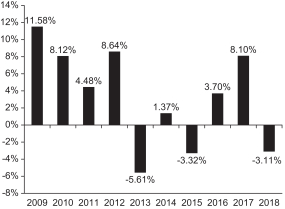
During the 10-year period shown in the bar chart, the highest return for a quarter was 9.12% (quarter ended
September 30, 2010) and the lowest return for a quarter was -7.18% (quarter ended December 31, 2016). The year-to-date calendar return as of June 30, 2019 was 6.98%.
FUND SUMMARY: INTERNATIONAL GOVERNMENT
BOND FUND
Average Annual Total Returns (For the periods ended December 31, 2018)
|
|
|
|
|
|
|
|
|
|
|
|
|
| |
|
1
Year |
|
|
5
Years |
|
|
10
Years |
|
|
|
|
|
| Fund |
|
|
-3.11 |
% |
|
|
1.26 |
% |
|
|
3.24 |
% |
| Blended Index |
|
|
-1.85 |
% |
|
|
1.99 |
% |
|
|
3.52 |
% |
| FTSE WGBI (unhedged) |
|
|
-0.84 |
% |
|
|
0.78 |
% |
|
|
1.52 |
% |
| JPMorgan EMBI Global Diversified Index |
|
|
-4.26 |
% |
|
|
4.80 |
% |
|
|
8.20 |
% |
Investment Adviser
The Fund’s investment adviser is The Variable
Annuity Life Insurance Company.
The Fund is subadvised by PineBridge Investments LLC.
Portfolio Managers
|
|
|
| Name and Title |
|
Portfolio
Manager of the
Fund
Since |
|
|
| Anders Faergemann
Managing Director and Senior Sovereign Portfolio Manager, Emerging Markets Fixed
Income |
|
2009 |
| Dmitri Savin, CFA
Senior Vice President and Portfolio Manager, Emerging Markets Fixed Income |
|
2016 |
Purchases and Sales of Portfolio Shares
Shares of the Funds may only be
purchased or redeemed through Variable Contracts offered by the separate accounts of VALIC or other participating life insurance companies and through qualifying retirement plans (“Plans”) and IRAs. Shares of each Fund may be purchased and
redeemed each day the New York Stock Exchange is open, at the Fund’s net asset value determined after receipt of a request in good order.
The
Funds do not have any initial or subsequent investment minimums. However, your insurance company may impose investment or account value minimums. The prospectus (or other offering document) for your Variable Contract may contain additional
information about purchases and redemptions of the Funds’ shares.
Tax Information
The Funds will not be subject to
U.S. federal income tax on the net investment company taxable income or net capital gains distributed to shareholders as ordinary income dividends or capital gain dividends and the separate accounts that receive the dividends are not subject to tax.
However, contractholders may be subject to federal income tax (and a federal Medicare tax of 3.8% that applies to net
income, including taxable annuity payments, if applicable) upon withdrawal from a Variable Contract. Contractholders should consult the prospectus (or other offering document) for the Variable
Contract for additional information regarding taxation.
Payments to Broker-Dealers and Other Financial Intermediaries
The Funds are not sold directly to
the general public but instead are offered to registered and unregistered separate accounts of VALIC and its affiliates and to Plans and IRAs. The Funds and their related companies may make payments to the sponsoring insurance company or its
affiliates for recordkeeping and distribution. These payments may create a conflict of interest as they may be a factor that the insurance company considers in including the Funds as underlying investment options in a variable contract. Visit your
sponsoring insurance company’s website for more information.




 Tweet
Tweet Share
Share E-mail