




Form 497K PRUDENTIAL INVESTMENT
 Tweet
Tweet Share
Share E-mail
PGIM
INVESTMENTS | Bringing you the investment managers of Prudential Financial, Inc.
PGIM
International Bond Fund
Formerly, Prudential
International Bond Fund
| A: PXBAX | C: PXBCX | Z: PXBZX | R6†: PXBQX |
SUMMARY PROSPECTUS
| February 23, 2018 (AS REISSUED JUNE 11, 2018)
Before you invest, you may want
to review the Fund’s Prospectus, which contains more information about the Fund and its risks. You can find the Fund's Prospectus, Statement of Additional Information (SAI), Annual Report and other
information about the Fund online at www.pgiminvestments.com/prospectus. You can also get this information at no cost by calling 1-800-225-1852 or by sending an e-mail to: [email protected]. The Fund’s
Prospectus and SAI, both dated February 23, 2018, as supplemented and amended from time to time, are all incorporated by reference into (legally made a part of) this Summary Prospectus.
INVESTMENT OBJECTIVE
The Fund's investment objective is to seek total return, made up of current income and capital appreciation.
FUND FEES AND EXPENSES
The tables below describe the sales charges, fees
and expenses that you may pay if you buy and hold shares of the Fund. You may qualify for sales charge discounts if you and an eligible group of related investors purchase, or agree to purchase in the future, $50,000
or more in shares of the Fund or other funds in the PGIM Funds family. More information about these discounts as well as other waivers or discounts is available from your financial professional and is explained in
Reducing or Waiving Class A's and Class C’s Sales Charges on page 33 of the Fund's Prospectus, Appendix A: Waivers and Discounts Available From Certain Financial Intermediaries on page 53 of the Fund's Prospectus and in Rights of Accumulation on page 58 of the Fund's Statement of Additional Information (SAI).
| Shareholder Fees (fees paid directly from your investment) | ||||
| Class A | Class C | Class Z | Class R6† | |
| Maximum sales charge (load) imposed on purchases (as a percentage of offering price) | 4.50% | None | None | None |
| Maximum deferred sales charge (load) (as a percentage of the lower of original purchase price or net asset value at redemption) | 1.00% | 1.00% | None | None |
| Maximum sales charge (load) imposed on reinvested dividends and other distributions | None | None | None | None |
| Redemption fees | None | None | None | None |
| Exchange fee | None | None | None | None |
| Maximum account fee (accounts under $10,000) | $15 | $15 | None* | None |
* Direct Transfer Agent
Accounts holding under $10,000 of Class Z shares are subject to the $15 fee.
†Formerly known as Class Q.
| Annual Fund Operating Expenses (expenses that you pay each year as a percentage of the value of your investment) | ||||
| Class A | Class C | Class Z | Class R6(1) | |
| Management fees | 0.50% | 0.50% | 0.50% | 0.50% |
| Distribution and service (12b-1) fees | 0.25% | 1.00% | None | None |
| Other expenses(2) | 14.31% | 116.17% | 115.14% | 1.01% |
| Total annual Fund operating expenses | 15.06% | 117.67% | 115.64% | 1.51% |
| Fee waiver and/or expense reimbursement | (14.07)% | (115.93)% | (114.90)% | (0.77)% |
| Total annual Fund operating expenses after fee waiver and/or expense reimbursement(3) | 0.99% | 1.74% | 0.74% | 0.74% |
(1) Formerly known as Class Q.
(2) Other expenses are based on estimates.
(3) PGIM Investments LLC (PGIM Investments) has contractually agreed, through February 28, 2019, to limit Total Annual Fund Operating Expenses after fee waivers and/or expense
reimbursements to 0.99% of average daily net assets for Class A shares, 1.74% of average daily net assets for Class C shares, 0.74% of average daily net assets for Class R6 shares, and 0.74% of average daily net
assets for Class Z shares. This contractual waiver excludes interest, brokerage, taxes (such as income and foreign withholding taxes, stamp duty and deferred tax expenses), acquired fund fees and expenses,
extraordinary expenses, and certain other Fund expenses such as dividend and interest expense and broker charges on short sales. Fees and/or expenses waived and/or reimbursed by PGIM Investments may be recouped by
PGIM Investments within the same fiscal year during which such waiver and/or reimbursement is made if such recoupment can be realized without exceeding the expense limit in effect at the time of the recoupment for
that fiscal year. This waiver may not be terminated prior to February 28, 2019 without the prior approval of the Fund’s Board of Trustees.

Example. The following hypothetical example is intended to help you compare the cost of investing in the Fund with the cost of investing in other mutual funds. It assumes that you invest $10,000 in
the Fund for the time periods indicated and then, except as indicated, redeem all your shares at the end of those periods. It assumes a 5% return on your investment each year, that the Fund's operating expenses remain
the same (except that fee waivers or reimbursements, if any, are only reflected in the 1-Year figures) and that all dividends and distributions are reinvested. Your actual costs may be higher or lower.
| If Shares Are Redeemed | If Shares Are Not Redeemed | |||||||
| Share Class | 1 Year | 3 Years | 5 Years | 10 Years | 1 Year | 3 Years | 5 Years | 10 Years |
| Class A | $546 | $3,245 | $5,428 | $9,230 | $546 | $3,245 | $5,428 | $9,230 |
| Class C | $277 | $10,503 | $10,503 | $10,503 | $177 | $10,503 | $10,503 | $10,503 |
| Class Z | $76 | $10,502 | $10,502 | $10,502 | $76 | $10,502 | $10,502 | $10,502 |
| Class R6† | $76 | $402 | $751 | $1,736 | $76 | $402 | $751 | $1,736 |
†Formerly known as Class Q.
Portfolio Turnover. The Fund pays transaction costs, such as commissions, when it buys and sells securities (or “turns over” its portfolio). A higher portfolio turnover rate may indicate higher
transaction costs and may result in higher taxes when Fund shares are held in a taxable account. These costs, which are not reflected in annual fund operating expenses or in the example, affect the Fund's performance.
During the Fund's most recent fiscal period, the Fund's portfolio turnover rate was 66% of the average value of its portfolio.
INVESTMENTS, RISKS AND
PERFORMANCE
Principal Investment Strategies. The Fund seeks investments that will increase over time in value, as well as pay the Fund interest and other income. Under normal market conditions, the Fund will invest at least 80% of
its investable assets in bonds with varying maturities. For the purposes of this policy, bonds include all fixed income instruments, including debentures, notes, commercial paper and other similar types of debt
instruments, mortgage-related securities, asset-backed securities, currencies, loan assignments and participations, money market instruments, and derivatives related to or referencing these types of securities and
instruments. The term “investable assets” refers to the Fund’s net assets plus any borrowings for investment purposes. The Fund’s investable assets will be less than its total assets to the
extent that the Fund has borrowed money for non-investment purposes, such as to meet redemptions.
In managing the Fund’s
assets, the subadviser uses a combination of top-down economic analysis and bottom-up research in conjunction with proprietary quantitative models and risk management systems. In the top-down economic analysis, the
subadviser develops views on economic, policy and market trends. In its bottom-up research, the subadviser develops an internal rating and outlook on issuers. The rating and outlook is determined based on a complete
review of the financial health and trends of the issuer. The subadviser may also consider investment factors such as expected total return, yield, spread and potential for price appreciation as well as credit quality,
maturity and risk. The Fund may invest in a security based upon the expected total return rather than the yield of such security.
The Fund will primarily invest in
fixed or floating rate fixed income instruments of foreign corporations and governments that are denominated in US dollars or foreign currencies. Under normal market conditions the Fund will invest in at least three
foreign countries. Foreign government fixed income instruments include securities issued by quasi-governmental entities, government agencies, supranational entities and other governmental entities denominated in
foreign currencies or US dollars. The Fund invests in securities of emerging market countries.
The Fund may invest up to 35% of
its total assets in high yield fixed income instruments (commonly referred to as “junk” bonds). Lower-rated securities tend to offer higher yields, but also offer greater risks, than higher-rated
securities.
The subadviser currently expects to
hedge all or a portion of the Fund’s foreign currency exposure, although the subadviser has no obligation to do so. The Fund’s currency exposure will include investments in derivatives, subject to the
Fund’s derivatives investment restrictions noted below.
The Fund may invest up to 25% of
its net assets in derivative instruments, including futures, options, options on futures, foreign currency forward contracts, and swaps, to try to enhance return or to reduce (“hedge”) investment risks.
Asset-backed securities in which
the Fund may invest are issued in the form of debt instruments that may include collateralized debt obligations (“CDOs”), which may include collateralized bond obligations (“CBOs”) and
collateralized loan obligations (“CLOs”). Privately issued mortgage-related securities that are not guaranteed by governmental entities generally have one or more types of credit enhancement to ensure
timely receipt of payments and to protect against default. Private issuer mortgage-backed securities may include loans on commercial or residential properties.
The Fund is non-diversified.
Segregation of Assets. As an open-end investment company registered with the SEC, the Fund is subject to the federal securities laws, including the Investment Company Act of 1940, the rules thereunder, and
various interpretive positions of the Securities and Exchange Commission (“SEC”) and the staff of the SEC. In accordance with these laws, rules and positions, the Fund must set aside unencumbered cash or
liquid securities, or engage in other measures, to “cover” open
positions with respect to certain kinds of
derivative instruments. This practice is often referred to as “asset segregation.” In the case of futures contracts that are not contractually required to cash settle, for example, the Fund must set aside
liquid assets equal to such contracts’ full notional value while the positions are open, except as described below. With respect to futures contracts that are contractually required to cash settle, however, the
Fund is permitted to set aside liquid assets in an amount equal to the Fund’s daily mark-to-market net obligations (i.e., the Fund’s daily net liability) under the contracts, if any, rather than such
contracts’ full notional value. Futures contracts and forward contracts that settle physically will be treated as cash settled for asset segregation purposes when the Fund has entered into contractual
arrangements with third party futures commission merchants or other counterparties or brokers that provide for cash settlement of these obligations. The Fund reserves the right to modify its asset segregation policies
in the future to comply with any changes in the positions from time to time articulated by the SEC or its staff regarding asset segregation.
The Fund generally will use its
unencumbered cash and cash equivalents to cover its obligations as required by the 1940 Act, the rules thereunder, and applicable SEC and SEC staff interpretive positions. The manager and the subadviser will monitor
the Fund’s use of derivatives or other investments that require asset segregation and will take action as necessary for the purpose of complying with the asset segregation policy stated above. Such actions may
include the sale of the Fund’s portfolio investments.
Principal Risks. All investments have risks to some degree. An investment in the Fund is not guaranteed to achieve its investment objective; is not a deposit with a bank; is not insured, endorsed or
guaranteed by the Federal Deposit Insurance Corporation or any other government agency; and is subject to investment risks, including possible loss of your original investment.
Fixed Income Risk. As with credit risk, market risk and interest rate risk, the Fund's holdings, share price, yield and total return may fluctuate in response to bond market movements. The value of bonds may
decline for issuer-related reasons, including management performance, financial leverage and reduced demand for the issuer’s goods and services. Certain types of fixed income obligations also may be subject to
call and redemption risk, which is the risk that the issuer may call a bond held by the Fund for redemption before it matures and the Fund may lose income.
Foreign Securities Risk. The Fund’s investments in securities of foreign issuers or issuers with significant exposure to foreign markets involve additional risk. Foreign countries in which the Fund may
invest may have markets that are less liquid, less regulated and more volatile than US markets. The value of the Fund’s investments may decline because of factors affecting the particular issuer as well as
foreign markets and issuers generally, such as unfavorable government actions, and political or financial instability. Lack of information may also affect the value of these securities.
Emerging Markets Risk. The risks of foreign investments are greater for investments in or exposed to emerging markets. Emerging market countries typically have economic and political systems that are less fully
developed, and can be expected to be less stable, than those of more developed countries. For example, the economies of such countries can be subject to rapid and unpredictable rates of inflation or deflation. Low
trading volumes may result in a lack of liquidity and price volatility. Emerging market countries may have policies that restrict investment by non-US investors, or that prevent non-US investors from withdrawing their
money at will. Countries with emerging markets can be found in regions such as Asia, Latin America, Eastern Europe and Africa.
Sovereign Debt Risk. The Fund may invest in sovereign debt issued by governments, their agencies or instrumentalities, or other government-related entities. Holders of sovereign debt may be requested to
participate in the rescheduling of such debt and to extend further loans to governmental entities. In addition, there is no bankruptcy proceeding by which defaulted sovereign debt may be collected.
Currency Risk. The Fund's net asset value could decline as a result of changes in exchange rates, which could adversely affect the Fund’s investments in currencies, or in securities that trade in,
and receive revenues related to currencies, or in derivatives that provide exposure to currencies. Certain foreign countries may impose restrictions on the ability of issuers of foreign securities to make payment of
principal and interest or dividends to investors located outside the country, due to blockage of foreign currency exchanges or otherwise.
Futures and Forward Contracts
Risk. The primary risks associated with the use of futures or forward contracts are (a) the imperfect correlation between the change in market value of the instruments held by the Fund and the
price of the futures or forward contract; (b) possible lack of a liquid secondary market for a futures or forward contract and the resulting inability to close a futures or forward contract when desired; (c) losses
caused by unanticipated market movements, which are potentially unlimited; (d) the failure to predict correctly the direction of securities or commodities prices, interest rates, currency exchange rates and other
economic factors; and (e) the possibility that the counterparty to the futures or forward contract will default in the performance of its obligations. Additionally, not all forward contracts require a counterparty to
post collateral, which may expose the Fund to greater losses in the event of a default by a counterparty.
Junk Bonds Risk. High-yield, high-risk bonds have predominantly speculative characteristics, including particularly high credit risk. Junk bonds tend to be less liquid than higher-rated securities. The
liquidity of particular issuers or industries within a particular investment category may shrink or disappear suddenly and without warning. The non-investment grade bond market can experience sudden and sharp price
swings and become illiquid due to a variety of factors, including
changes in economic forecasts, stock market
activity, large sustained sales by major investors, a high profile default or a change in the market's psychology.
Mortgage-Backed and Asset-Backed
Securities Risk. Mortgage-backed and asset-backed investments tend to increase in value less than other debt securities when interest rates decline, but are subject to similar risk of decline in market
value during periods of rising interest rates. The values of mortgage-backed and asset-backed securities become more volatile as interest rates rise. In a period of declining interest rates, the Fund may be required
to reinvest more frequent prepayments on mortgage-backed and asset-backed investments in lower-yielding investments. In addition to interest rate risk, investments in mortgage-backed securities composed of subprime
mortgages may be subject to a higher degree of credit risk, valuation risk and liquidity risk.
Credit Risk. This is the risk that the issuer, the guarantor or the insurer of a fixed-income security, or the counterparty to a contract may be unable or unwilling to make timely principal and interest
payments or to otherwise honor its obligations. Additionally, the securities could lose value due to a loss of confidence in the ability of the issuer, guarantor, insurer or counterparty to pay back debt. The longer
the maturity and the lower the credit quality of a bond, the more sensitive it is to credit risk.
Derivatives Risk. Derivatives involve special risks and costs and may result in losses to the Fund. The successful use of derivatives requires sophisticated management, and, to the extent that derivatives
are used, the Fund will depend on the subadviser’s ability to analyze and manage derivatives transactions. The prices of derivatives may move in unexpected ways, especially in abnormal market conditions. Some
derivatives are “leveraged” and therefore may magnify or otherwise increase investment losses to the Fund. The Fund’s use of derivatives may also increase the amount of taxes payable by shareholders.
Other risks arise from the potential inability to terminate or sell derivatives positions. A liquid secondary market may not always exist for the Fund’s derivatives positions. In fact, many over-the-counter
derivative instruments will not have liquidity beyond the counterparty to the instrument. Over-the-counter derivative instruments also involve the risk that the other party will not meet its obligations to the
Fund.
The US Government and foreign
governments are in the process of adopting and implementing regulations governing derivatives markets, including mandatory clearing of certain derivatives, margin and reporting requirements. The ultimate impact of the
regulations remains unclear. Additional regulation of derivatives may make derivatives more costly, limit their availability or utility, or otherwise adversely affect their performance or disrupt markets.
Leverage Risk. Certain transactions in which the Fund may engage may give rise to leverage. The use of leverage exaggerates the effect of any increase or decrease in the value of the Fund’s
holdings, and makes any change in the Fund’s net asset value (“NAV”) greater than it would be without the use of leverage. This could result in increased volatility of investment return. There is a
possibility that segregation involving a large percentage of the assets of the Fund could impede portfolio management or the Fund’s ability to meet redemption requests or other current obligations or that the
Fund may be required to dispose of some of its investments at unfavorable prices or times.
Short Position Risk. The Fund may take short positions in derivative instruments that present various risks, including credit/counterparty risk and leverage risk. A short position on a derivative instrument
involves the risk of a theoretically unlimited increase in the value of the underlying security or instrument and, thus, the risk of a theoretically unlimited loss for the Fund. Short positions also involve
transaction and other costs that will reduce potential Fund gains and increase potential Fund losses.
Interest Rate Risk. The value of your investment may go down when interest rates rise. A rise in rates tends to have a greater impact on the prices of longer term or duration securities. When interest rates
fall, the issuers of debt obligations may prepay principal more quickly than expected, and the Fund may be required to reinvest the proceeds at a lower interest rate. This is referred to as “prepayment
risk.” When interest rates rise, debt obligations may be repaid more slowly than expected, and the value of the Fund's holdings may fall sharply. This is referred to as
“extension risk.” The Fund may face a heightened level of interest rate risk since the US Federal Reserve Board has ended its quantitative easing program and may continue to raise rates. The Fund
may lose money if short-term or long-term interest rates rise sharply or in a manner not anticipated by the subadviser.
Liquidity Risk. The Fund may invest in instruments that trade in lower volumes and are less liquid than other investments. Liquidity risk exists when particular investments made by the Fund are difficult
to purchase or sell. Liquidity risk also includes the risk that the Fund may make investments that may become less liquid in response to market developments or adverse investor perceptions. If the Fund is forced to
sell these investments to pay redemption proceeds or for other reasons, the Fund may lose money. In addition, when there is no willing buyer and investments cannot be readily sold at the desired time or price, the
Fund may have to accept a lower price or may not be able to sell the instrument at all. The reduction in dealer market-making capacity in the fixed-income markets that has occurred in recent years also has the
potential to reduce liquidity. An inability to sell a portfolio position can adversely affect the Fund's value or prevent the Fund from being able to take advantage of other investment opportunities.
Market Risk. Securities markets may be volatile and the market prices of the Fund’s securities may decline. Securities fluctuate in price based on changes in an issuer’s financial condition
and overall market and economic conditions. If the market prices of the securities owned by the Fund fall, the value of your investment in the Fund will decline.
Management Risk. The value of your investment may decrease if judgments by the subadviser about the attractiveness, value or market trends affecting a particular security, industry or sector or about market
movements are incorrect.
Credit Risk/Counterparty Risk. The ability, or perceived ability, of the issuer or guarantor of a debt security, or the counterparty (the party on the other side of the transaction) to a derivatives contract or other
financial contract, to meet its financial obligations will affect the value of the security or derivative. Counterparty risk is especially important in the context of privately negotiated instruments. The Fund expects
to enter into certain privately negotiated agreements where the counterparty assumes the physical settlement obligations of the Fund under such transactions. Under this type of arrangement, there is a risk that the
relevant counterparty or intermediary would, due to insolvency or other reasons, be unable to or fail to assume the physical settlement obligations of the Fund, in which case the Fund could be required to sell
portfolio instruments at unfavorable times or prices or could have insufficient assets to satisfy its physical settlement obligations.
Non-diversification Risk. The Fund is non-diversified for purposes of the Investment Company Act of 1940 (the “1940 Act”). This means that the Fund may invest a greater percentage of its assets in the
securities of a single company or other issuer than a diversified fund. Investing in a non-diversified fund involves greater risk than investing in a diversified fund because a loss resulting from the decline in value
of any one security may represent a greater portion of the total assets of a non-diversified fund.
Economic and Market Events Risk. Events in the US and global financial markets, including actions taken by the US Federal Reserve or foreign central banks to stimulate or stabilize economic growth, may at times result in
unusually high market volatility, which could negatively impact performance. Reduced liquidity in credit and fixed income markets could adversely affect issuers worldwide.
Risk of Increase in Expenses. Your actual cost of investing in the Fund may be higher than the expenses shown in the expense table for a variety of reasons. For example, expense ratios may be higher than those shown if
average net assets decrease. Net assets are more likely to decrease and Fund expense ratios are more likely to increase when markets are volatile. Active and frequent trading of Fund securities can increase
expenses.
Performance. The following bar chart shows the Fund's performance for Class Z shares for each full calendar year of operations or for the last 10 calendar years, whichever is shorter. The
following table shows the average annual returns of each of the Fund’s share classes and also compares the Fund’s performance with the average annual total returns of an index or other benchmark and a
group of similar mutual funds. The bar chart and table demonstrate the risk of investing in the Fund by showing how returns can change from year to year.
Past performance (before and after
taxes) does not mean that the Fund will achieve similar results in the future. Updated Fund performance information is available online at www.pgiminvestments.com.
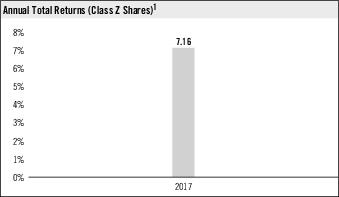
1 Without the contractual expense limitation, the annual returns would have been lower.
| Average Annual Total Returns % (including sales charges) (as of 12-31-17) | ||
| Return Before Taxes | One Year | Since Inception |
| Class A Shares | 2.07% | 2.60% (12-14-16) |
| Class C Shares | 4.99% | 6.32% (12-14-16) |
| Class R6 Shares† | 7.14% | 7.46% (12-14-16) |
| Class Z Shares % | ||
| Return Before Taxes | 7.16% | 7.48% (12-14-16) |
| Return After Taxes on Distributions | 7.00% | 7.30% (12-14-16) |
| Return After Taxes on Distribution and Sale of Fund Shares | 4.05% | 4.24% (12-14-16) |
° After-tax returns are
calculated using the historical highest individual federal marginal income tax rates and do not reflect the impact of state and local taxes. Actual after-tax returns depend on an investor's tax situation and may
differ from those shown. After-tax returns shown are not relevant to investors who hold their Fund shares through tax-deferred arrangements, such as 401(k) plans or individual retirement accounts. After-tax returns
are shown only for Class Z shares. After-tax returns for other classes will vary due to differing sales charges and expenses.
†Formerly known as Class Q shares.
| Index % (reflects no deduction for fees, expenses or taxes) | ||
| Bloomberg Barclays Global Aggregate ex-USD (USD Hedged) Index | 2.48% | 2.64% |
| Lipper Average % (reflects no deduction for sales charges or taxes) | ||
| Lipper International Income Funds Average | 7.86% | 7.71% |
MANAGEMENT OF THE FUND
| Investment Manager | Subadviser | Portfolio Managers | Title | Service Date |
| PGIM Investments LLC | PGIM Fixed Income PGIM Limited | Arvind Rajan, PhD | Managing Director & Head of Global & Macro | December 2016 |
| Robert Tipp, CFA | Managing Director, Chief Investment Strategist and Head of Global Bonds | December 2016 | ||
| Michael J. Collins, CFA | Managing Director & Senior Portfolio Manager | December 2016 |
BUYING AND SELLING FUND
SHARES
| Class A* | Class C* | Class Z* | Class R6† | |
| Minimum initial investment | $2,500 | $2,500 | Institutions: $5 million Group Retirement Plans: None | Institutions: $5 million Group Retirement Plans: None |
| Minimum subsequent investment | $100 | $100 | None | None |
* Certain share classes were
generally closed to investments by new group retirement plans effective on or about June 1, 2018. Please see “How to Buy, Sell and Exchange Fund Shares—Closure of Certain Share Classes to New
Group Retirement Plans” in the Prospectus for more information.
†Formerly known as Class Q shares.
†Formerly known as Class Q shares.
For Class A and Class C shares, the
minimum initial investment for retirement accounts and custodial accounts for minors is $1,000 and the minimum subsequent investment is $100. For Class A and Class C shares, the minimum initial and subsequent
investment for Automatic Investment Plan purchases is $50. Class R6 shares are generally not available for purchase by individuals. Class Z shares may be purchased by certain individuals, subject to minimum investment
and/or other requirements. Please see “How to Buy, Sell and Exchange Fund Shares—How to Buy Shares—Qualifying for Class Z Shares,” and “—Qualifying for Class R6 Shares” in the
Prospectus for purchase eligibility requirements.
Your financial intermediary may
impose different investment minimums. You can purchase or redeem shares on any business day that the Fund is open through the Fund's transfer agent or through servicing agents, including brokers, dealers and other
financial intermediaries appointed by the distributor to receive purchase and redemption orders. Current shareholders may also purchase or redeem shares through the Fund's website or by calling (800) 225-1852.
TAX INFORMATION
Dividends, Capital Gains and Taxes. The Fund's dividends and distributions are taxable and will be taxed as ordinary income or capital gains, unless you are investing through a tax-deferred arrangement, such as a 401(k) plan
or an individual retirement account. Such tax-deferred arrangements may be taxed later upon withdrawal of monies from those arrangements.
PAYMENTS TO FINANCIAL
INTERMEDIaries
If you purchase Fund shares through a financial
intermediary such as a broker-dealer, bank, retirement recordkeeper or other financial services firm, the Fund or its affiliates may pay the financial intermediary for the sale of Fund shares and/or for services to
shareholders. This may create a conflict of interest by influencing the financial intermediary or its representatives to recommend the Fund over another investment. Ask your financial intermediary or representative or
visit your financial intermediary’s website for more information.
Notes

| ||
| By Mail: | Prudential Mutual Fund Services LLC, PO Box 9658, Providence, RI 02940 | |
| By Telephone: | 800-225-1852 or 973-367-3529 (outside the US) | |
| On the Internet: | www.pgiminvestments.com |
MF234A

FREE Breaking News Alerts from StreetInsider.com!
StreetInsider.com Top Tickers, 10/22/2026
- Nasdaq futures sink as AI doubts resurface, oil jumps
- Oil jumps on escalating Middle East conflict
- Meta beats Q3 estimates, approves new nonvoting share class as AI spending surges
- Tesla stock up as automotive gross margin improves, free cash flow turns positive
- SpaceX, Tesla shares rise after Musk says committees exploring possible merger
Serious News for Serious Traders! Try StreetInsider.com Premium Free!
You May Also Be Interested In
- Fogo de Chão to Debut Protein Plates November 3rd Starting at $45
- Issue of Equity
- The End of the Flat White? Oatly’s Future of Taste Report Identifies Four Key Trends Shaping Café Menus
Create E-mail Alert Related Categories
SEC FilingsSign up for StreetInsider Free!
Receive full access to all new and archived articles, unlimited portfolio tracking, e-mail alerts, custom newswires and RSS feeds - and more!
