



Form 497K ETF Series Solutions
 Tweet
Tweet Share
Share E-mail
 |
Vident Core U.S. Bond Strategy ETF®
Trading Symbol: VBND
Listed on: NYSE Arca, Inc.
Summary Prospectus
December 31, 2018
www.videntfinancialsolutions.com
|
Before you invest, you may want to review the Fund's Prospectus and Statement of Additional Information ("SAI"), which contain more information about the Fund and its risks. The current Prospectus and SAI, each dated December 31, 2018, are incorporated by reference into this Summary Prospectus. You can find the Fund's Prospectus, SAI and other information about the Fund online at www.videntfinancialsolutions.com/VBND. You can also get this information at no cost by calling 1-800-617-0004 or by sending an e-mail request to [email protected].
IMPORTANT NOTE: Beginning on January 1, 2021, paper copies of the Fund's shareholder reports will no longer be sent by mail, unless you specifically request paper copies of the shareholder reports from your financial intermediary, such as a broker-dealer or bank. Instead, the shareholder reports will be made available on a website, and you will be notified by mail each time a report is posted and provided with a website link to access the report.
You may elect to receive all future Fund shareholder reports in paper, free of charge. If you already elected to receive shareholder reports electronically, you will not be affected by this change and you need not take any action. Please contact your financial intermediary to inform them that you wish to continue receiving paper copies of Fund shareholder reports and for details about whether your election to receive reports in paper will apply to all funds held with your financial intermediary.
Investment Objective
The Vident Core U.S. Bond Strategy ETF (the "Fund" or the "U.S. Bond Fund") seeks to track the performance, before fees and expenses, of the Vident Core U.S. Bond IndexTM (the "Index" or the "U.S. Bond Index").
Fees and Expenses of the Fund
The following table describes the fees and expenses you may pay if you buy and hold shares of the Fund ("Shares"). This table and the Example below do not include the brokerage commissions that investors may pay on their purchases and sales of Shares.
|
Annual Fund Operating Expenses (expenses that you pay each year as a percentage of the value of your investment)
|
|
|
Management Fees1
|
0.41%
|
|
Distribution and/or Service (12b-1) Fees
|
None
|
|
Other Expenses
|
0.00%
|
|
Acquired Fund Fees and Expenses2
|
0.02%
|
|
Total Annual Fund Operating Expenses
|
0.43%
|
1 Restated to reflect the Fund's contractual management fee effective January 31, 2018.
2 Total Annual Fund Operating Expenses do not correlate to the ratio of expenses to average net assets provided in the Financial Highlights section of the Prospectus, which reflects only the operating expenses of the Fund and does not include acquired fund fees and expenses.
Expense Example
The following example is intended to help retail investors compare the cost of investing in the Fund with the cost of investing in other funds. It illustrates the hypothetical expenses that such investors would incur over various periods if they were to invest $10,000 in the Fund for the time periods indicated and then redeem all of the Shares at the end of those periods. This example assumes that the Fund provides a return of 5% a year and that operating expenses remain the same. Although your actual costs may be higher or lower, based on these assumptions, your costs would be:
|
1 Year
|
3 Years
|
5 Years
|
10 Years
|
|
$44
|
$138
|
$241
|
$542
|
Portfolio Turnover
The Fund pays transaction costs, such as commissions, when it buys and sells securities (or "turns over" its portfolio). A higher portfolio turnover rate may indicate higher transaction costs and may result in higher taxes when Shares are held in a taxable account. These costs, which are not reflected in annual fund operating expenses or in the example, affect the Fund's performance. For the fiscal year ended August 31, 2018, the Fund's portfolio turnover rate was 324% of the average value of its portfolio.
1
Principal Investment Strategies of the Fund
The Fund employs a "passive management" – or indexing – investment approach designed to track the performance of the Index.
The Vident Core U.S. Bond IndexTM
The Vident Core U.S. Bond IndexTM (Bloomberg:VUBDX) seeks to improve the overall mix of credit quality, interest rate and yield as compared to traditional U.S. core bond indices. The Index diversifies interest rate and credit risks across all core U.S. bond sectors, including U.S. Treasuries, U.S. agency securities, mortgage backed securities ("MBS"), and investment-grade corporate bonds, as well as non-core fixed income sectors such as high-yield corporate bonds (also known as "junk bonds") and Treasury Inflation-Protected Securities ("TIPS"). While diversification among sectors is an important factor that will drive the risk/return profile of the strategy, another source of risk management is derived from the rules-based process that systematically over- or under-weights each sector based on valuations of each sector, historical relative valuations across sectors, sector default rates, macroeconomics and other quantitative factors. Within the investment grade and high yield corporate sectors, the strategy seeks to improve corporate bond exposures by screening for companies with relatively stronger leadership, governance, and creditworthiness factors. Within each sector, individual bonds are weighted based on a combination of yield, duration (i.e., interest rate sensitivity), creditworthiness, leadership, and governance factors, rather than amount of debt/bonds outstanding, a common approach of traditional bond indices. The Index also seeks to improve liquidity by eliminating small issues and non-U.S. issuers.
The Index limits exposure to each of the high-yield corporate bonds and TIPS sectors to 20% and 15% of the Index, respectively. The Index will generally have an effective duration of three to seven years and will generally have an average credit quality of investment grade.
All rules are systematized and rely on data available at the end of each rebalancing period. The Index is rebalanced monthly and reconstituted quarterly in January, April, July, and October.
The Index was created in 2015 by Vident Financial, LLC, the Index Provider, for use by the Fund.
The Fund's Investment Strategy
The Fund attempts to invest all, or substantially all, of its assets in the bonds that make up the Index. The Fund expects to use a "replication" strategy to achieve its investment objective, meaning it may invest in all of the component securities of the Index, but may, when the sub-adviser believes it is in the best interests of the Fund, use a "representative sampling" strategy, meaning it may invest in a sample of the securities in the Index whose risk, return and other characteristics closely resemble the risk, return and other characteristics of the Index as a whole.
The Fund may utilize the "To Be Announced" ("TBA") market for MBS investments. The TBA market allows investors to gain exposure to MBS with certain broad characteristics (maturity, coupon, age) without taking delivery of the actual securities until the settlement day which is once every month. In addition, the Fund may utilize the TBA roll market, in which one sells, in the TBA market, the security for current month settlement, while simultaneously committing to buy the same TBA security for next month settlement. The Fund may utilize the TBA roll market for extended periods of time without taking delivery of the physical securities.
Under normal circumstances, at least 80% of the Fund's total assets (exclusive of collateral held from securities lending) will be invested in the component securities of the Index and investments that have economic characteristics that are substantially identical to the economic characteristics of such component securities (such as TBA securities). Exchange Traded Concepts, LLC ("ETC" or the "Adviser"), the Fund's investment adviser, expects that, over time, the correlation between the Fund's performance and that of the Index, before fees and expenses, will be 95% or better.
To the extent the Index concentrates (i.e., holds more than 25% of its total assets) in the securities of a particular industry or group of related industries, the Fund will concentrate its investments to approximately the same extent as the Index.
Principal Risks of Investing in the Fund
The principal risks of investing in the Fund are summarized below. As with any investment, there is a risk that you could lose all or a portion of your investment in the Fund. The following risks could affect the value of your investment in the Fund:
|
n
|
Call Risk. During periods of falling interest rates, an issuer of a callable bond held by the Fund may "call" or repay the security before its stated maturity, and the Fund may have to reinvest the proceeds at lower interest rates, resulting in a decline in the Fund's income.
|
|
n
|
Cash Redemption Risk. The Fund's investment strategy may require it to redeem shares for cash or to otherwise include cash as part of its redemption proceeds. The Fund may be required to sell or unwind portfolio investments to obtain the cash needed to distribute redemption proceeds. This may cause the Fund to recognize a capital gain that it might not have recognized if it had made a redemption in-kind. As a result, the Fund may pay out higher annual capital gain distributions than if the in-kind redemption process was used.
|
|
n
|
Credit Risk. Debt issuers and other counterparties may not honor their obligations or may have their debt downgraded by ratings agencies.
|
2
|
n
|
Extension Risk. During periods of rising interest rates, certain debt obligations will be paid off substantially more slowly than originally anticipated and the value of those securities may fall sharply, resulting in a decline in the Fund's income and potentially in the value of the Fund's investments.
|
|
n
|
Government Obligations Risk. No assurance can be given that the U.S. government will provide financial support to U.S. government-sponsored agencies or instrumentalities where it is not obligated to do so by law, such as the Federal National Mortgage Association ("Fannie Mae") and the Federal Home Loan Mortgage Corporation ("Freddie Mac"). Securities issued by Fannie Mae and Freddie Mac have historically been supported only by the discretionary authority of the U.S. government. While the U.S. government provides financial support to various U.S. government-sponsored agencies and instrumentalities, such as Fannie Mae and Freddie Mac, no assurance can be given that it will always do so. In September 2008, at the direction of the U.S. Department of the Treasury, Fannie Mae and Freddie Mac were placed into conservatorship under the Federal Housing Finance Agency ("FHFA"), an independent regulator, and they remain in such status as of the date of this Prospectus. The U.S. government also took steps to provide additional financial support to Fannie Mae and Freddie Mac.
|
|
n
|
High-Yield Securities Risk. High-yield securities (also known as "junk bonds") carry a greater degree of risk and are considered speculative by the major credit rating agencies. High-yield securities may be issued by companies that are restructuring, are smaller and less creditworthy, or are more highly indebted than other companies. This means that they may have more difficulty making scheduled payments of principal and interest. Changes in the value of high-yield securities are influenced more by changes in the financial and business position of the issuing company than by changes in interest rates when compared to investment grade securities. High-yield securities have greater volatility because there is less certainty that principal and interest payments will be made as scheduled. The Fund's investments in high-yield securities expose it to a substantial degree of credit risk. These investments are considered speculative under traditional investment standards. Prices of high-yield securities will rise and fall primarily in response to actual or perceived changes in the issuer's financial health, although changes in market interest rates also will affect prices. High-yield securities may experience reduced liquidity and sudden and substantial decreases in price.
|
|
n
|
Interest Rate Risk. An increase in interest rates may cause the value of fixed-income securities held by the Fund to decline. The Fund may be subject to a greater risk of rising interest rates due to the current period of historically low rates and the effect of potential government fiscal policy initiatives and resulting market reaction to those initiatives.
|
|
n
|
Issuer-Specific Risk. Issuer-specific events, including changes in the financial condition of an issuer, can have a negative impact on the value of the Fund.
|
|
n
|
Liquidity Risk. Liquidity risk exists when particular investments are difficult to purchase or sell. This can reduce the Fund's returns because the Fund may be unable to transact at advantageous times or prices.
|
|
n
|
Market Risk. The trading prices of debt securities and other instruments fluctuate in response to a variety of factors. The Fund's net asset value ("NAV") and market price may fluctuate significantly in response to these and other factors. As a result, an investor could lose money over short or long periods of time.
|
|
n
|
Mortgage- and Asset-Backed Securities Risk. The Fund may invest in U.S. government agency-backed mortgage- and asset-backed securities. Mortgage- and asset-backed securities are subject to interest rate risk. Modest movements in interest rates (both increases and decreases) may quickly and significantly reduce the value of certain types of these securities. When interest rates fall, mortgage- and asset-backed securities may be subject to prepayment risk. When interest rates rise, certain types of mortgage- and asset-backed securities are subject to extension risk. Mortgage- and asset-backed securities can also be subject to the risk of default on the underlying residential or commercial mortgage(s) or other assets.
|
|
n
|
Passive Investment Risk. The Fund invests in the securities included in, or representative of, its Index regardless of their investment merit. The Fund does not attempt to outperform its Index or take defensive positions in declining markets. As a result, the Fund's performance may be adversely affected by a general decline in the market segments relating to its Index.
|
|
n
|
Portfolio Turnover Risk. The Fund may trade all or a significant portion of the securities in its portfolio in connection with each rebalance and reconstitution of its Index. A high portfolio turnover rate increases transaction costs, which may increase the Fund's expenses. Frequent trading may also cause adverse tax consequences for investors in the Fund due to an increase in short-term capital gains.
|
|
n
|
Prepayment Risk. This is the risk that a borrower will prepay some or the entire principal owed to the Fund. If that happens, the Fund may have to replace the security by investing the proceeds in a security with a lower yield. This could reduce the share price and income distributions of the Fund.
|
|
n
|
Sector Risk. To the extent the Fund invests more heavily in particular sectors of the economy, its performance will be especially sensitive to developments that significantly affect those sectors.
|
|
n
|
Shares May Trade at Prices Other Than NAV. As with all exchange traded funds ("ETFs"), Shares may be bought and sold in the secondary market at market prices. Although it is expected that the market price of Shares will approximate the Fund's NAV, there may be times when the market price of Shares is more than the NAV intra-day (premium) or less than the NAV intra-day (discount) due to supply and demand of Shares or during periods of market volatility. This risk is heightened in times of market volatility, periods of steep market declines, and periods when there is limited trading activity for Shares in the secondary market, in which case such premiums or discounts may be significant.
|
3
|
n
|
TBA Securities and Rolls Risk. TBA transactions are subject to increased credit risk and increased overall investment exposure. TBA rolls involve the risk that the Fund's counterparty will be unable to deliver the mortgage-backed securities underlying the TBA roll at the fixed time. If the buyer files for bankruptcy or becomes insolvent, the buyer or its representative may ask for and receive an extension of time to decide whether to enforce the Fund's repurchase obligation. In addition, the Fund earns interest by investing the transaction proceeds during the roll period. TBA roll transactions may have the effect of creating leverage in the Fund's portfolio.
|
|
n
|
Tracking Error Risk. As with all index funds, the performance of the Fund and its Index may differ from each other for a variety of reasons. For example, the Fund incurs operating expenses and portfolio transaction costs not incurred by the Index. In addition, the Fund may not be fully invested in the securities of the Index at all times or may hold securities not included in the Index.
|
Performance
The following performance information indicates some of the risks of investing in the Fund. The bar chart shows the Fund's performance for the calendar years ended December 31. The table illustrates how the Fund's average annual returns for the 1‑year and since inception periods compare with those of a broad measure of market performance and the Index. The Fund's past performance, before and after taxes, does not necessarily indicate how it will perform in the future. Performance information is also available on the Fund's website at www.videntfinancialsolutions.com or by calling the Fund toll free at 1‑800‑617‑0004.
Calendar Year Total Returns
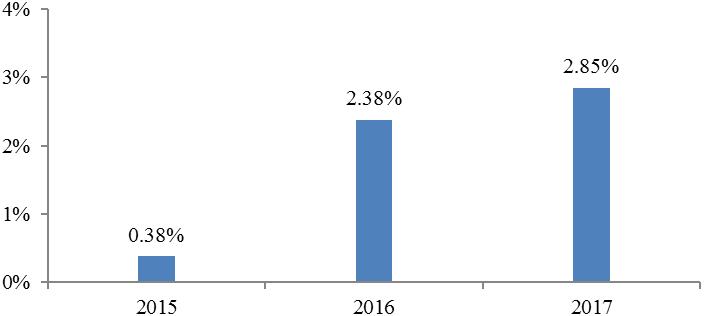
For the year-to-date period ended September 30, 2018, the Fund's total return was -2.14%.
During the period of time shown in the bar chart, the Fund's highest quarterly return was 3.06% for the quarter ended March 31, 2016, and the lowest quarterly return was -3.45% for the quarter ended December 31, 2016.
Average Annual Total Returns
For the Periods Ended December 31, 2017
|
1 Year
|
Since Inception
(10/15/2014) |
|
|
Return Before Taxes
|
2.85%
|
1.56%
|
|
Return After Taxes on Distributions
|
1.96%
|
0.67%
|
|
Return After Taxes on Distributions and Sale of Shares
|
1.61%
|
0.80%
|
|
Vident Core U.S. Bond Index/Vident Core U.S. Bond Strategy Index1
(reflects no deduction for fees, expenses, or taxes)
|
3.59%
|
2.53%
|
|
FTSE Broad Investment Grade Bond Index
(reflects no deduction for fees, expenses, or taxes)
|
3.60%
|
2.09%
|
1 Effective January 6, 2016, the Fund's investment objective changed to track the performance, before fees and expenses, of the Vident Core U.S. Bond Index. Prior to January 6, 2016, the Fund's investment objective was to track the price and total return performance, before fees and expenses, of the Vident Core U.S. Bond Strategy Index. Performance shown for periods prior to January 6, 2016 is that of the Vident Core U.S. Bond Strategy Index.
After-tax returns are calculated using the historical highest individual federal marginal income tax rates during the period covered by the table above and do not reflect the impact of state and local taxes. Actual after-tax returns depend on an investor's tax situation and may differ from those shown. In certain cases, the figure representing "Return After Taxes on Distributions and Sale of Shares" may be higher than the other return figures for the same period. A higher after-tax return results when a capital loss occurs upon redemption and provides an assumed tax deduction that benefits the investor. After-tax returns shown are not relevant to investors who hold their Shares through tax-deferred arrangements such as an individual retirement account ("IRA") or other tax-advantaged accounts.
4
Management
Investment Adviser and Sub-Adviser
Exchange Traded Concepts, LLC serves as investment adviser to the Fund.
Vident Investment Advisory, LLC ("VIA" or the "Sub-Adviser") serves as sub-adviser to the Fund.
Portfolio Managers
Denise M. Krisko, CFA, President of VIA, has been a portfolio manager of the Fund since April 2015.
Jim Iredale, CFA, Senior Portfolio Manager – Fixed Income at VIA, has been a portfolio manager of the Fund since April 2015.
Purchase and Sale of Shares
Shares are listed on a national securities exchange, such as the NYSE Arca, Inc. (the "Exchange"), and most investors will buy and sell Shares through brokers at market prices, rather than NAV. Because the Shares trade at market prices rather than NAV, Shares may trade at a price greater than NAV (premium) or less than NAV (discount).
The Fund issues and redeems Shares at NAV only in large blocks known as "Creation Units," which only Authorized Participants ("APs") (typically, broker-dealers) may purchase or redeem. Creation Units generally consist of 100,000 shares, though this may change from time to time. The Fund generally issues and redeems Creation Units in exchange for a portfolio of securities closely approximating the holdings of the Fund (the "Deposit Securities") and/or a designated amount of U.S. cash.
Tax Information
Fund distributions are generally taxable as ordinary income or capital gains (or a combination), unless your investment is in an individual retirement account ("IRA") or other tax-advantaged account. Distributions on investments made through tax-deferred arrangements may be taxed later upon withdrawal of assets from those accounts.
Financial Intermediary Compensation
If you purchase Shares of the Fund through a broker-dealer or other financial intermediary (such as a bank) (an "Intermediary"), the Adviser, the Sub-Adviser or their affiliates may pay Intermediaries for certain activities related to the Fund, including participation in activities that are designed to make Intermediaries more knowledgeable about exchange traded products, including the Fund, or for other activities, such as marketing, educational training or other initiatives related to the sale or promotion of Shares. These payments may create a conflict of interest by influencing the Intermediary and your salesperson to recommend the Fund over another investment. Any such arrangements do not result in increased Fund expenses. Ask your salesperson or visit the Intermediary's website for more information.
5
Serious News for Serious Traders! Try StreetInsider.com Premium Free!
You May Also Be Interested In
- LiveNexus Pairs AI Call Center Tools with On-Demand Agents
- Opening Ceremony of the 25th Chinese Bridge-Chinese Proficiency Competition for Foreign College Students Held in Pingtan, Fujian
- The ONE Music outlines a practical digital piano selection framework for advancing players
Create E-mail Alert Related Categories
SEC FilingsSign up for StreetInsider Free!
Receive full access to all new and archived articles, unlimited portfolio tracking, e-mail alerts, custom newswires and RSS feeds - and more!
