




Form 485BPOS VANGUARD VARIABLE INSURA
 Tweet
 Share
 E-mail
| SECURITIES AND EXCHANGE COMMISSION |
| Washington, D.C. 20549 |
| Form N-1A |
| REGISTRATION STATEMENT (NO. 33-32216) UNDER |
| THE SECURITIES ACT OF 1933 |
| Pre-Effective Amendment No. |
| Post-Effective Amendment No. 78 |
| and |
| REGISTRATION STATEMENT (NO. 811-05962) UNDER THE INVESTMENT COMPANY |
| ACT OF 1940 |
| Amendment No. 81 |
| VANGUARD VARIABLE INSURANCE FUNDS |
| (Exact Name of Registrant as Specified in Declaration of Trust) |
| P.O. Box 2600, Valley Forge, PA 19482 |
| (Address of Principal Executive Office) |
| Registrant’s Telephone Number (610) 669-1000 |
| Heidi Stam, Esquire |
| P.O. Box 876 |
| Valley Forge, PA 19482 |
| It is proposed that this filing will become effective (check appropriate box) |
| [ ] immediately upon filing pursuant to paragraph (b) |
| [x] on April 29, 2016 pursuant to paragraph (b) |
| [ ] 60 days after filing pursuant to paragraph (a)(1) |
| [ ] on (date) pursuant to paragraph (a)(1) |
| [ ] 75 days after filing pursuant to paragraph (a)(2) |
| [ ] on (date) pursuant to paragraph (a)(2) of rule 485 |
| If appropriate, check the following box: |
| [ ] This post-effective amendment designates a new effective date for a previously filed |
| post-effective amendment. |
VANGUARD VARIABLE INSURANCE FUNDS
Contents of Registration Statement
This Registration Statement consists of the following paper and documents:
Part A — Prospectus
All series of the Registrant
Part B — Statement of Additional Information
All series of the Registrant
Part C — Other Information
Signature Page Exhibits
Vanguard Variable Insurance Fund
Prospectus
April 29, 2016

| Money Market Portfolio | Total Stock Market Index Portfolio |
| Short-Term Investment-Grade Portfolio | Equity Index Portfolio |
| Total Bond Market Index Portfolio | Mid-Cap Index Portfolio |
| High Yield Bond Portfolio | Growth Portfolio |
| Conservative Allocation Portfolio | Capital Growth Portfolio |
| Moderate Allocation Portfolio | Small Company Growth Portfolio |
| Balanced Portfolio | International Portfolio |
| Equity Income Portfolio | REIT Index Portfolio |
| Diversified Value Portfolio |
This prospectus contains financial data for the Portfolios through the fiscal year ended December 31, 2015.
The Securities and Exchange Commission (SEC) has not approved or disapproved these securities or passed upon the adequacy of this prospectus. Any representation to the contrary is a criminal offense.
| Contents | |||
| Portfolio Summaries | An Introduction to Vanguard Variable Insurance Fund | 44 | |
| Money Market Portfolio | 1 | Investing in the Money Market Portfolio | 45 |
| Short-Term Investment-Grade Portfolio | 3 | More on the Portfolios | 46 |
| Total Bond Market Index Portfolio | 6 | More on the Money Market Portfolio | 46 |
| High Yield Bond Portfolio | 9 | More on the Bond Portfolios | 48 |
| Conservative Allocation Portfolio | 11 | More on the Balanced Portfolios | 55 |
| Moderate Allocation Portfolio | 14 | More on the Stock Portfolios | 57 |
| Balanced Portfolio | 17 | Additional Information | 67 |
| Equity Income Portfolio | 19 | Turnover Rate | 70 |
| Diversified Value Portfolio | 22 | The Portfolios and Vanguard | 70 |
| Total Stock Market Index Portfolio | 24 | Investment Advisors | 71 |
| Equity Index Portfolio | 26 | Taxes | 77 |
| Mid-Cap Index Portfolio | 29 | Share Price | 78 |
| Growth Portfolio | 31 | Financial Highlights | 79 |
| Capital Growth Portfolio | 33 | General Information | 88 |
| Small Company Growth Portfolio | 36 | Glossary of Investment Terms | 90 |
| International Portfolio | 38 | ||
| REIT Index Portfolio1 | 41 | ||
1

1
Money Market Portfolio
Investment Objective
The Portfolio seeks to provide current income while maintaining liquidity and a stable share price of $1.
Fees and Expenses
The following table describes the fees and expenses you may pay if you buy and hold shares of the Portfolio. The expenses shown in the table and in the example that follow do not reflect additional fees and expenses associated with the annuity or life insurance program through which you invest. If those additional fees and expenses were included, overall expenses would be higher.
| Annual Portfolio Operating Expenses | |
| (Expenses that you pay each year as a percentage of the value of your investment) | |
| Management Fees | 0.13% |
| 12b-1 Distribution Fee | None |
| Other Expenses | 0.03% |
| Total Annual Portfolio Operating Expenses1 | 0.16% |
1 Vanguard and the Portfolio’s Board have voluntarily agreed to temporarily limit certain net operating expenses in excess of the Portfolio’s daily yield so as to maintain a zero or positive yield for the Portfolio. Vanguard and the Portfolio’s Board may terminate the temporary expense limitation at any time.
Example
The following example is intended to help you compare the cost of investing in the Portfolio with the cost of investing in other mutual funds. It illustrates the hypothetical expenses that you would incur over various periods if you invested $10,000 in the Portfolio’s shares. This example assumes that the Portfolio provides a return of 5% each year and that total annual portfolio operating expenses remain as stated in the preceding table. You would incur these hypothetical expenses whether or not you redeem your investment at the end of the given period. Although your actual costs may be higher or lower, based on these assumptions your costs would be:
| 1 Year | 3 Years | 5 Years | 10 Years |
| $16 | $52 | $90 | $205 |
Principal Investment Policies
The Portfolio invests primarily in high-quality, short-term money market instruments, including certificates of deposit, banker’s acceptances, commercial paper, Eurodollar and Yankee obligations, and other money market securities. To be considered high quality, a security generally must be rated in one of the two highest credit-quality categories for short-term securities by at least two nationally recognized rating services (or by one, if only one rating service has rated the security). If unrated, the security must be determined by Vanguard to be of quality equivalent to securities in the two highest credit-quality categories. The Portfolio invests more than 25% of its assets in securities issued by companies in the financial services industry. The Portfolio maintains a dollar-weighted average maturity of 60 days or less and a dollar-weighted average life of 120 days or less.
Principal Risks
The Portfolio is designed for investors with a low tolerance for risk; however, the Portfolio is subject to the following risks, which could affect the Portfolio’s performance:
• Income risk, which is the chance that the Portfolio’s income will decline because of falling interest rates. Because the Portfolio’s income is based on short-term interest rates—which can fluctuate significantly over short periods—income risk is expected to be high.
• Manager risk, which is the chance that poor security selection will cause the Portfolio to underperform relevant benchmarks or other funds with a similar investment objective.
• Credit risk, which is the chance that the issuer of a security will fail to pay interest or principal in a timely manner, or that negative perceptions of the issuer’s ability to make such payments will cause the price of that security to decline. Credit risk should be very low for the Portfolio because it invests primarily in securities that are considered to be of high quality.
2
• Foreign investment risk. The Portfolio’s investment in Eurodollar and Yankee obligations, which include certificates of deposit issued in U.S. dollars by foreign banks and foreign branches of U.S. banks, subjects it to the same risks as U.S. money market instruments, such as income risk and credit risk. Additional risks of Eurodollar and Yankee obligations include the chance that a foreign government will not let U.S. dollar-denominated assets leave the country, the chance that the banks that issue Eurodollar obligations may not be subject to the same regulations as U.S. banks, and the chance that adverse political or economic developments will affect investments in a foreign country.
• Industry concentration risk, which is the chance that there will be overall problems affecting a particular industry. Because the Portfolio invests more than 25% of its assets in securities issued by companies in the financial services industry, the Portfolio’s performance depends to a greater extent on the overall condition of that industry and is more susceptible to events affecting that industry.
An investment in the Portfolio is not a deposit of a bank and is not insured or guaranteed by the Federal Deposit Insurance Corporation or any other government agency. Although the Portfolio seeks to preserve the value of your investment at $1 per share, it is possible to lose money by investing in the Portfolio.
Annual Total Returns
The following bar chart and table are intended to help you understand the risks of investing in the Portfolio. The bar chart shows how the performance of the Portfolio has varied from one calendar year to another over the periods shown. The table shows how the average annual total returns of the Portfolio compare with those of a relevant market index and a comparative benchmark, which have investment characteristics similar to those of the Portfolio. The Portfolio’s returns are net of its expenses but do not reflect additional fees and expenses that are deducted by the annuity or life insurance program through which you invest. If such fees and expenses were included in the calculation of the Portfolio’s returns, the returns would be lower. Returns for the Variable Insurance Money Market Funds Average are derived from data provided by Lipper, a Thomson Reuters Company. Keep in mind that the Portfolio’s past performance does not indicate how the Portfolio will perform in the future. Updated performance information is available on our website for Financial Advisors at advisors.vanguard.com or by calling Vanguard toll-free at 800-522-5555.

During the periods shown in the bar chart, the highest return for a calendar quarter was 1.32% (quarter ended December 31, 2006), and the lowest return for a quarter was 0.02% (quarter ended September 30, 2014).
| Average Annual Total Returns for Periods Ended December 31, 2015 | |||
| 1 Year | 5 Years | 10 Years | |
| Money Market Portfolio | 0.15% | 0.13% | 1.44% |
| Comparative Benchmarks | |||
| (reflect no deduction for fees or expenses) | |||
| Citigroup 3-Month U.S. Treasury Bill Index | 0.03% | 0.04% | 1.16% |
| Variable Insurance Money Market Funds Average | 0.00 | –0.01 | 1.15 |
Investment Advisor
The Vanguard Group, Inc. (Vanguard)
Portfolio Manager
John C. Lanius, Portfolio Manager at Vanguard. He has managed the Portfolio since 2004.
3
Tax Information
The Portfolio normally distributes its net investment income and net realized capital gains, if any, to its shareholders, which are the insurance company separate accounts that sponsor your variable annuity or variable life insurance contract. The tax consequences to you of your investment in the Portfolio depend on the provisions of the annuity or life insurance contract through which you invest. For more information on taxes, please refer to the prospectus of the annuity or life insurance contract through which Portfolio shares are offered.
Payments to Financial Intermediaries
The Portfolio and its investment advisor do not pay financial intermediaries for sales of Portfolio shares.
Short-Term Investment-Grade Portfolio
Investment Objective
The Portfolio seeks to provide current income while maintaining limited price volatility.
Fees and Expenses
The following table describes the fees and expenses you may pay if you buy and hold shares of the Portfolio. The expenses shown in the table and in the example that follow do not reflect additional fees and expenses associated with the annuity or life insurance program through which you invest. If those additional fees and expenses were included, overall expenses would be higher.
| Annual Portfolio Operating Expenses | |
| (Expenses that you pay each year as a percentage of the value of your investment) | |
| Management Fees | 0.13% |
| 12b-1 Distribution Fee | None |
| Other Expenses | 0.03% |
| Total Annual Portfolio Operating Expenses | 0.16% |
Example
The following example is intended to help you compare the cost of investing in the Portfolio with the cost of investing in other mutual funds. It illustrates the hypothetical expenses that you would incur over various periods if you invested $10,000 in the Portfolio’s shares. This example assumes that the Portfolio provides a return of 5% each year and that total annual portfolio operating expenses remain as stated in the preceding table. You would incur these hypothetical expenses whether or not you redeem your investment at the end of the given period. Although your actual costs may be higher or lower, based on these assumptions your costs would be:
| 1 Year | 3 Years | 5 Years | 10 Years |
| $16 | $52 | $90 | $205 |
Portfolio Turnover
The Portfolio pays transaction costs, such as commissions, when it buys and sells securities (or “turns over” its portfolio). A higher portfolio turnover rate may indicate higher transaction costs. These costs, which are not reflected in annual portfolio operating expenses or in the previous expense example, reduce the Portfolio’s performance. During the most recent fiscal year, the Portfolio’s turnover rate was 74% of the average value of its portfolio.
4
Principal Investment Strategies
The Portfolio invests in a variety of high-quality and, to a lesser extent, medium-quality fixed income securities. Under normal circumstances, at least 80% of the Portfolio’s assets will be invested in short- and intermediate-term investment-grade securities. The Portfolio’s 80% policy may be changed only upon 60 days’ notice to shareholders. High-quality fixed income securities are those rated the equivalent of A3 or better by Moody’s Investors Service, Inc. (Moody’s), or by another independent rating agency or, if unrated, are determined to be of comparable quality by the Portfolio’s advisor; medium-quality fixed income securities are those rated the equivalent of Baa1, Baa2, or Baa3 by Moody’s or another independent rating agency, or, if unrated, are determined to be of comparable quality by the Portfolio’s advisor. (Investment-grade fixed income securities are those rated the equivalent of Baa3 and above by Moody’s.) The Portfolio is expected to maintain a dollar-weighted average maturity of 1 to 4 years.
Principal Risks
The Portfolio is designed for investors with a low tolerance for risk; however, you could still lose money by investing in it. The Portfolio is subject to the following risks, which could affect the Portfolio’s performance:
• Income risk, which is the chance that the Portfolio’s income will decline because of falling interest rates. Income risk is generally high for short-term bond funds, so investors should expect the Portfolio’s monthly income to fluctuate.
• Interest rate risk, which is the chance that bond prices will decline because of rising interest rates. Interest rate risk should be low for the Portfolio because it invests primarily in short-term bonds, whose prices are less sensitive to interest rate changes than are the prices of longer-term bonds.
• Credit risk, which is the chance that a bond issuer will fail to pay interest or principal in a timely manner, or that negative perceptions of the issuer’s ability to make such payments will cause the price of that bond to decline. Although the Portfolio invests a limited portion of its assets in low-quality bonds, credit risk should be low for the Portfolio because it invests primarily in bonds that are considered high-quality and, to a lesser extent, in bonds that are considered medium-quality.
• Call risk, which is the chance that during periods of falling interest rates, issuers of callable bonds may call (redeem) securities with higher coupon rates or interest rates before their maturity dates. The Portfolio would then lose any price appreciation above the bond’s call price and would be forced to reinvest the unanticipated proceeds at lower interest rates, resulting in a decline in the Portfolio’s income. Such redemptions and subsequent reinvestments would also increase the Portfolio’s turnover rate. Call risk should be low for the Portfolio.
• Extension risk, which is the chance that during periods of rising interest rates, certain debt securities will be paid off substantially more slowly than originally anticipated, and the value of those securities may fall. Extension risk is generally low for short-term bond funds.
• Liquidity risk, which is the chance that the Portfolio may not be able to sell a security in a timely manner at a desired price.
Liquidity risk is generally low for short-term corporate bonds.
• Manager risk, which is the chance that poor security selection will cause the Portfolio to underperform relevant benchmarks or other funds with a similar investment objective.
An investment in the Portfolio is not a deposit of a bank and is not insured or guaranteed by the Federal Deposit Insurance Corporation or any other government agency.
5
Annual Total Returns
The following bar chart and table are intended to help you understand the risks of investing in the Portfolio. The bar chart shows how the performance of the Portfolio has varied from one calendar year to another over the periods shown. The table shows how the average annual total returns of the Portfolio compare with those of a relevant market index, which has investment characteristics similar to those of the Portfolio. The Portfolio’s returns are net of its expenses but do not reflect additional fees and expenses that are deducted by the annuity or life insurance program through which you invest. If such fees and expenses were included in the calculation of the Portfolio’s returns, the returns would be lower. Keep in mind that the Portfolio’s past performance does not indicate how the Portfolio will perform in the future. Updated performance information is available on our website for Financial Advisors at advisors.vanguard.com or by calling Vanguard toll-free at 800-522-5555.

During the periods shown in the bar chart, the highest return for a calendar quarter was 5.92% (quarter ended June 30, 2009), and the lowest return for a quarter was –2.98% (quarter ended September 30, 2008).
Average Annual Total Returns for Periods Ended December 31, 2015
| 1 Year | 5 Years | 10 Years | |
| Short-Term Investment-Grade Portfolio | 1.12% | 2.07% | 3.60% |
| Barclays U.S. 1-5 Year Credit Bond Index | |||
| (reflects no deduction for fees or expenses) | 1.06% | 2.55% | 4.07% |
Investment Advisor
The Vanguard Group, Inc. (Vanguard)
Portfolio Manager
Gregory S. Nassour, CFA, Principal of Vanguard. He has managed the Portfolio since 2002.
Tax Information
The Portfolio normally distributes its net investment income and net realized capital gains, if any, to its shareholders, which are the insurance company separate accounts that sponsor your variable annuity or variable life insurance contract. The tax consequences to you of your investment in the Portfolio depend on the provisions of the annuity or life insurance contract through which you invest. For more information on taxes, please refer to the prospectus of the annuity or life insurance contract through which Portfolio shares are offered.
Payments to Financial Intermediaries
The Portfolio and its investment advisor do not pay financial intermediaries for sales of Portfolio shares.
6
Total Bond Market Index Portfolio
Investment Objective
The Portfolio seeks to track the performance of a broad, market-weighted bond index.
Fees and Expenses
The following table describes the fees and expenses you may pay if you buy and hold shares of the Portfolio. The expenses shown in the table and in the example that follow do not reflect additional fees and expenses associated with the annuity or life insurance program through which you invest. If those additional fees and expenses were included, overall expenses would be higher.
| Annual Portfolio Operating Expenses | |
| (Expenses that you pay each year as a percentage of the value of your investment) | |
| Management Fees | 0.12% |
| 12b-1 Distribution Fee | None |
| Other Expenses | 0.03% |
| Total Annual Portfolio Operating Expenses | 0.15% |
Example
The following example is intended to help you compare the cost of investing in the Portfolio with the cost of investing in other mutual funds. It illustrates the hypothetical expenses that you would incur over various periods if you invested $10,000 in the Portfolio’s shares. This example assumes that the Portfolio provides a return of 5% each year and that total annual portfolio operating expenses remain as stated in the preceding table. You would incur these hypothetical expenses whether or not you redeem your investment at the end of the given period. Although your actual costs may be higher or lower, based on these assumptions your costs would be:
| 1 Year | 3 Years | 5 Years | 10 Years |
| $15 | $48 | $85 | $192 |
Portfolio Turnover
The Portfolio pays transaction costs, such as commissions, when it buys and sells securities (or “turns over” its portfolio). A higher portfolio turnover rate may indicate higher transaction costs. These costs, which are not reflected in annual portfolio operating expenses or in the previous expense example, reduce the Portfolio’s performance. During the most recent fiscal year, the Portfolio’s turnover rate was 149% of the average value of its portfolio.
Principal Investment Strategies
The Portfolio employs an indexing investment approach designed to track the performance of the Barclays U.S. Aggregate Float Adjusted Index. This Index represents a wide spectrum of public, investment-grade, taxable, fixed income securities in the United States—including government, corporate, and international dollar-denominated bonds, as well as mortgage-backed and asset-backed securities—all with maturities of more than 1 year.
The Portfolio invests by sampling the Index, meaning that it holds a broadly diversified collection of securities that, in the aggregate, approximates the full Index in terms of key risk factors and other characteristics. All of the Portfolio’s investments will be selected through the sampling process, and under normal circumstances, at least 80% of the Portfolio’s assets will be invested in bonds held in the Index. The Portfolio maintains a dollar-weighted average maturity consistent with that of the Index, which generally ranges between 5 and 10 years.
7
Principal Risks
An investment in the Portfolio could lose money over short or even long periods. You should expect the Portfolio’s share price and total return to fluctuate within a wide range. The Portfolio is subject to the following risks, which could affect the Portfolio’s performance:
• Interest rate risk, which is the chance that bond prices will decline because of rising interest rates. Interest rate risk should be moderate for the Portfolio because it invests primarily in short- and intermediate-term bonds, whose prices are less sensitive to interest rate changes than are the prices of long-term bonds.
• Income risk, which is the chance that the Portfolio’s income will decline because of falling interest rates. Income risk is generally high for short-term bond funds and moderate for intermediate-term bond funds, so investors should expect the Portfolio’s monthly income to fluctuate accordingly.
• Call risk, which is the chance that during periods of falling interest rates, issuers of callable bonds may call (redeem) securities with higher coupon rates or interest rates before their maturity dates. The Portfolio would then lose any price appreciation above the bond’s call price and would be forced to reinvest the unanticipated proceeds at lower interest rates, resulting in a decline in the Portfolio’s income. Such redemptions and subsequent reinvestments would also increase the Portfolio’s turnover rate. Call risk should be moderate for the Portfolio because it invests only a portion of its assets in callable bonds.
• Prepayment risk, which is the chance that during periods of falling interest rates, homeowners will refinance their mortgages before their maturity dates, resulting in prepayment of mortgage-backed securities held by the Portfolio. The Portfolio would then lose any price appreciation above the mortgage’s principal and would be forced to reinvest the unanticipated proceeds at lower interest rates, resulting in a decline in the Portfolio’s income. Such prepayments and subsequent reinvestments would also increase the Portfolio’s turnover rate. Prepayment risk is moderate for the Portfolio because it invests only a portion of its assets in mortgage-backed securities.
• Extension risk, which is the chance that during periods of rising interest rates, certain debt securities will be paid off substantially more slowly than originally anticipated, and the value of those securities may fall. For funds that invest in mortgage-backed securities, extension risk is the chance that during periods of rising interest rates, homeowners will prepay their mortgages at slower rates. Extension risk is generally moderate for intermediate-term bond funds.
• Credit risk, which is the chance that a bond issuer will fail to pay interest or principal in a timely manner, or that negative perceptions of the issuer’s ability to make such payments will cause the price of that bond to decline. Credit risk should be low for the Portfolio because it purchases only bonds that are of investment-grade quality.
• Index sampling risk, which is the chance that the securities selected for the Portfolio, in the aggregate, will not provide investment performance matching that of the Portfolio’s target index. Index sampling risk for the Portfolio should be low.
An investment in the Portfolio is not a deposit of a bank and is not insured or guaranteed by the Federal Deposit Insurance Corporation or any other government agency.
8
Annual Total Returns
The following bar chart and table are intended to help you understand the risks of investing in the Portfolio. The bar chart shows how the performance of the Portfolio has varied from one calendar year to another over the periods shown. The table shows how the average annual total returns of the Portfolio compare with those of its target index and other comparative indexes, which have investment characteristics similar to those of the Portfolio. The Portfolio’s returns are net of its expenses, but do not reflect additional fees and expenses that are deducted by the annuity or life insurance program through which you invest. If such fees and expenses were included in the calculation of the Portfolio’s returns, the returns would be lower. Keep in mind that the Portfolio’s past performance does not indicate how the Portfolio will perform in the future. Updated performance information is available on our website for Financial Advisors at advisors.vanguard.com or by calling Vanguard toll-free at 800-522-5555.

During the periods shown in the bar chart, the highest return for a calendar quarter was 4.40% (quarter ended December 31, 2008), and the lowest return for a quarter was –2.50% (quarter ended June 30, 2013).
| Average Annual Total Returns for Periods Ended December 31, 2015 | |||
| 1 Year | 5 Years | 10 Years | |
| Total Bond Market Index Portfolio | 0.33% | 3.06% | 4.41% |
| Comparative Indexes | |||
| (reflect no deduction for fees or expenses) | |||
| Barclays U.S. Aggregate Bond Index | 0.55% | 3.25% | 4.51% |
| Barclays U.S. Aggregate Float Adjusted Index | 0.44 | 3.25 | — |
| Spliced Barclays U.S. Aggregate Float Adjusted Index | 0.44 | 3.25 | 4.52 |
Investment Advisor
The Vanguard Group, Inc. (Vanguard)
Portfolio Managers
William D. Baird, Portfolio Manager at Vanguard. He has co-managed the Portfolio since 2008.
Joshua C. Barrickman, CFA, Principal of Vanguard and co-head of Vanguard’s Fixed Income Indexing Americas. He has co-managed the Portfolio since 2013.
Tax Information
The Portfolio normally distributes its net investment income and net realized capital gains, if any, to its shareholders, which are the insurance company separate accounts that sponsor your variable annuity or variable life insurance contract. The tax consequences to you of your investment in the Portfolio depend on the provisions of the annuity or life insurance contract through which you invest. For more information on taxes, please refer to the prospectus of the annuity or life insurance contract through which Portfolio shares are offered.
Payments to Financial Intermediaries
The Portfolio and its investment advisor do not pay financial intermediaries for sales of Portfolio shares.
9
High Yield Bond Portfolio
Investment Objective
The Portfolio seeks to provide a high level of current income.
Fees and Expenses
The following table describes the fees and expenses you may pay if you buy and hold shares of the Portfolio. The expenses shown in the table and in the example that follow do not reflect additional fees and expenses associated with the annuity or life insurance program through which you invest. If those additional fees and expenses were included, overall expenses would be higher.
| Annual Portfolio Operating Expenses | |
| (Expenses that you pay each year as a percentage of the value of your investment) | |
| Management Fees | 0.25% |
| 12b-1 Distribution Fee | None |
| Other Expenses | 0.03% |
| Total Annual Portfolio Operating Expenses | 0.28% |
Example
The following example is intended to help you compare the cost of investing in the Portfolio with the cost of investing in other mutual funds. It illustrates the hypothetical expenses that you would incur over various periods if you invested $10,000 in the Portfolio’s shares. This example assumes that the Portfolio provides a return of 5% each year and that total annual portfolio operating expenses remain as stated in the preceding table. You would incur these hypothetical expenses whether or not you redeem your investment at the end of the given period. Although your actual costs may be higher or lower, based on these assumptions your costs would be:
| 1 Year | 3 Years | 5 Years | 10 Years |
| $29 | $90 | $157 | $356 |
Portfolio Turnover
The Portfolio pays transaction costs, such as commissions, when it buys and sells securities (or “turns over” its portfolio). A higher portfolio turnover rate may indicate higher transaction costs. These costs, which are not reflected in annual portfolio operating expenses or in the previous expense example, reduce the Portfolio’s performance. During the most recent fiscal year, the Portfolio’s turnover rate was 38% of the average value of its portfolio.
Principal Investment Strategies
The Portfolio invests primarily in a diversified group of high-yielding, higher-risk corporate bonds—commonly known as “junk bonds”—with medium- and lower-range credit-quality ratings. Under normal circumstances, the Portfolio invests at least 80% of its assets in corporate bonds that are rated below Baa by Moody’s Investors Service, Inc. (Moody’s); have an equivalent rating by any other independent bond-rating agency; or, if unrated, are determined to be of comparable quality by the Portfolio’s advisor. The Portfolio’s 80% policy may be changed only upon 60 days’ notice to shareholders.
The Portfolio may not invest more than 20% of its assets in any of the following, taken as a whole: bonds with credit ratings lower than B or the equivalent, convertible securities, preferred stocks, and fixed and floating rate loans of medium- to lower-range credit quality. The loans in which the Portfolio may invest will be rated Baa or below by Moody’s; have an equivalent rating by any other independent bond-rating agency; or, if unrated, are determined to be of comparable quality by the Portfolio’s advisor. The Portfolio’s high-yield bonds and loans have mostly short- and intermediate-term maturities.
10
Principal Risks
An investment in the Portfolio could lose money over short or even long periods. You should expect the Portfolio’s share price and total return to fluctuate within a wide range. The Portfolio is subject to the following risks, which could affect the Portfolio’s performance:
• Credit risk, which is the chance that a bond or loan issuer will fail to pay interest or principal in a timely manner, or that negative perceptions of the issuer’s ability to make such payments will cause the price of that bond to decline. Credit risk should be high for the Portfolio because it invests primarily in bonds and loans with medium- and lower-range credit-quality ratings.
• Income risk, which is the chance that the Portfolio’s income will decline because of falling interest rates. Income risk is generally high for short-term bond funds and moderate for intermediate-term bond funds, so investors should expect the Portfolio’s monthly income to fluctuate accordingly.
• Call risk, which is the chance that during periods of falling interest rates, issuers of callable bonds may call (redeem) securities with higher coupon rates or interest rates before their maturity dates. The Portfolio would then lose any price appreciation above the bond’s call price and would be forced to reinvest the unanticipated proceeds at lower interest rates, resulting in a decline in the Portfolio’s income. Such redemptions and subsequent reinvestments would also increase the Portfolio’s turnover rate. Call risk should be moderate for the Portfolio because it invests only a portion of its assets in callable bonds.
• Interest rate risk, which is the chance that bond or loan prices will decline because of rising interest rates. Interest rate risk should be moderate for the Portfolio because it invests primarily in short- and intermediate-term bonds, whose prices are less sensitive to interest rate changes than are the prices of long-term bonds.
• Liquidity risk, which is the chance that the Portfolio may not be able to sell a security in a timely manner at a desired price.
Liquidity risk should be low to moderate for the Portfolio.
• Manager risk, which is the chance that poor security selection will cause the Portfolio to underperform relevant benchmarks or other funds with a similar investment objective.
Because of the speculative nature of junk bonds, you should carefully consider the risks associated with this portfolio.
An investment in the Portfolio is not a deposit of a bank and is not insured or guaranteed by the Federal Deposit Insurance Corporation or any other government agency.
Annual Total Returns
The following bar chart and table are intended to help you understand the risks of investing in the Portfolio. The bar chart shows how the performance of the Portfolio has varied from one calendar year to another over the periods shown. The table shows how the average annual total returns of the Portfolio compare with those of a relevant market index and a composite index, which have investment characteristics similar to those of the Portfolio. The Portfolio’s returns are net of its expenses but do not reflect additional fees and expenses that are deducted by the annuity or life insurance program through which you invest. If such fees and expenses were included in the calculation of the Portfolio’s returns, the returns would be lower. Keep in mind that the Portfolio’s past performance does not indicate how the Portfolio will perform in the future. Updated performance information is available on our website for Financial Advisors at advisors.vanguard.com or by calling Vanguard toll-free at 800-522-5555.

During the periods shown in the bar chart, the highest return for a calendar quarter was 14.41% (quarter ended June 30, 2009), and the lowest return for a quarter was –14.60% (quarter ended December 31, 2008).
11
| Average Annual Total Returns for Periods Ended December 31, 2015 | |||
| 1 Year | 5 Years | 10 Years | |
| High Yield Bond Portfolio | –1.58% | 5.56% | 5.80% |
| Comparative Indexes | |||
| (reflect no deduction for fees or expenses) | |||
| Barclays U.S. Corporate High Yield Bond Index | –4.47% | 5.04% | 6.96% |
| High-Yield Corporate Composite Index | –2.53 | 5.23 | 6.41 |
Investment Advisor
Wellington Management Company LLP (Wellington Management)
Portfolio Manager
Michael L. Hong, CFA, Managing Director and Fixed Income Portfolio Manager of Wellington Management. He has managed the Portfolio since 2008.
Tax Information
The Portfolio normally distributes its net investment income and net realized capital gains, if any, to its shareholders, which are the insurance company separate accounts that sponsor your variable annuity or variable life insurance contract. The tax consequences to you of your investment in the Portfolio depend on the provisions of the annuity or life insurance contract through which you invest. For more information on taxes, please refer to the prospectus of the annuity or life insurance contract through which Portfolio shares are offered.
Payments to Financial Intermediaries
The Portfolio and its investment advisor do not pay financial intermediaries for sales of Portfolio shares.
Conservative Allocation Portfolio
Investment Objective
The Portfolio seeks to provide current income and low to moderate capital appreciation.
Fees and Expenses
The following table describes the fees and expenses you may pay if you buy and hold shares of the Portfolio. The expenses shown in the table and in the example that follow do not reflect additional fees and expenses associated with the annuity or life insurance program through which you invest. If those additional fees and expenses were included, overall expenses would be higher.
| Annual Portfolio Operating Expenses | |
| (Expenses that you pay each year as a percentage of the value of your investment) | |
| Management Fees | None |
| 12b-1 Distribution Fee | None |
| Other Expenses | None |
| Acquired Fund Fees and Expenses | 0.16% |
| Total Annual Portfolio Operating Expenses | 0.16% |
12
Example
The following example is intended to help you compare the cost of investing in the Portfolio (based on the fees and expenses of the underlying funds) with the cost of investing in other mutual funds. It illustrates the hypothetical expenses that you would incur over various periods if you invested $10,000 in the Portfolio’s shares. This example assumes that the Portfolio provides a return of 5% each year and that total annual operating expenses of the Portfolio and its underlying funds remain as stated in the preceding table. You would incur these hypothetical expenses whether or not you redeem your investment at the end of the given period. Although your actual costs may be higher or lower, based on these assumptions your costs would be:
| 1 Year | 3 Years | 5 Years | 10 Years |
| $16 | $52 | $90 | $205 |
Portfolio Turnover
The Portfolio may pay transaction costs, such as purchase fees, when it buys and sells securities (or “turns over” its portfolio). A higher portfolio turnover rate may indicate higher transaction costs. These costs, which are not reflected in annual portfolio operating expenses or in the previous expense example, reduce the Portfolio’s performance. During the most recent fiscal year, the Portfolio’s turnover rate was 15% of the average value of its portfolio.
Principal Investment Strategies
The Portfolio invests in a mix of Vanguard mutual funds and other portfolios of Vanguard Variable Insurance Fund (collectively, the underlying funds) according to an asset-allocation strategy that reflects an allocation of approximately 60% of the Portfolio’s assets to fixed-income securities and 40% to common stocks. The targeted percentage of the Portfolio’s assets allocated to the underlying asset classes is:
| • | U.S. fixed-income securities | 48% |
| • | Large-cap U.S. stocks | 22% |
| • | Foreign stocks | 12% |
| • | Foreign fixed-income securities | 12% |
| • | Small- and mid-cap U.S. stocks | 6% |
The Portfolio’s indirect fixed-income holdings are a diversified mix of short-, intermediate-, and long-term U.S. government, U.S. agency, and investment-grade U.S corporate bonds; mortgage-backed and asset-backed securities; and government, agency, corporate, and investment-grade foreign bonds issued in currencies other than the U.S. dollar (but hedged by Vanguard, typically with foreign currency exchange forward contracts, to minimize foreign currency exposure). The Portfolio’s indirect stock holdings are a diversified mix of U.S. and foreign large-, mid-, and small-capitalization stocks.
The Portfolio uses its investment in large-cap U.S. stocks and small- and mid-cap U.S. stocks to gain exposure to the overall domestic stock market. While the percentage of the Portfolio’s assets invested in either of these two asset classes may deviate slightly from the target allocation, the combination of the two asset classes will equal approximately 28% of the Portfolio’s assets in the aggregate.
The Portfolio’s board of trustees may change the targeted allocation to the underlying asset classes without shareholder approval.
Principal Risks
The Portfolio is subject to the risks associated with the stock and bond markets, any of which could cause an investor to lose money. However, because fixed-income securities such as bonds usually are less volatile than stocks and because the Portfolio invests more than half of its assets in fixed-income securities, the Portfolio’s overall level of risk should be low to moderate.
• With a target allocation of approximately 60% of its assets to fixed-income securities, the Portfolio is proportionately subject to bond risks, including the following: interest rate risk, which is the chance that bond prices will decline because of rising interest rates; credit risk, which is the chance that the issuer of a security will fail to pay interest or principal in a timely manner, or that negative perceptions of the issuer’s ability to make such payments will cause the price of that security to decline, thus reducing the underlying fund’s return; and income risk, which is the chance that an underlying fund’s income will decline because of falling interest rates. If an underlying fund holds securities that are callable, the underlying fund’s income may decline because of call risk, which is the chance that during periods of falling interest rates, issuers of callable bonds may call (redeem) securities with higher coupon rates or interest rates before their maturity dates. An underlying fund
13
would then lose any price appreciation above the bond’s call price and would be forced to reinvest the unanticipated proceeds at lower interest rates, resulting in a decline in the underlying fund’s income. Such redemptions and subsequent reinvestments would also increase the Portfolio’s turnover rate. For mortgage-backed securities, this risk is known as prepayment risk. The Portfolio is also subject to the following risks associated with investments in currency-hedged foreign bonds: country/regional risk, which is the chance that world events—such as political upheaval, financial troubles, or natural disasters—will adversely affect the value and/or liquidity of securities issued by foreign governments, government agencies, or companies; and currency hedging risk, which is the chance that the currency hedging transactions entered into by the underlying foreign fixed-income securities fund may not perfectly offset the fund’s foreign currency exposure.
• With approximately 40% of its assets allocated to stocks, the Portfolio is proportionately subject to stock market risk, which is the chance that stock prices overall will decline. Stock markets tend to move in cycles, with periods of rising prices and periods of falling prices. The Portfolio is also subject to the following risks associated with investments in foreign stocks: country/regional risk, which is the chance that world events—such as political upheaval, financial troubles, or natural disasters—will adversely affect the value of securities issued by companies in foreign countries or regions; and currency risk, which is the chance that the value of a foreign investment, measured in U.S. dollars, will decrease because of unfavorable changes in currency exchange rates. Country/regional risk and currency risk are especially high in emerging markets.
An investment in the Portfolio is not a deposit of a bank and is not insured or guaranteed by the Federal Deposit Insurance Corporation or any other government agency.
Annual Total Returns
The following bar chart and table are intended to help you understand the risks of investing in the Portfolio. The bar chart shows how the performance of the Portfolio has varied from one calendar year to another over the periods shown. The table shows how the average annual total returns of the Portfolio compare with those of a relevant market index and other comparative benchmarks, which have investment characteristics similar to those of the Portfolio. The Portfolio’s returns are net of its expenses, but do not reflect additional fees and expenses that are deducted by the annuity or life insurance program through which you invest. If such fees and expenses were included in the calculation of the Portfolio’s returns, the returns would be lower. Returns for the Variable Insurance Mixed-Asset Target Allocation Conservative Funds Average are derived from data provided by Lipper, a Thomson Reuters Company. Keep in mind that the Portfolio’s past performance does not indicate how the Portfolio will perform in the future. Updated performance information is available on our website for Financial Advisors at advisors.vanguard.com or by calling Vanguard toll-free at 800-522-5555.

During the periods shown in the bar chart, the highest return for a calendar quarter was 5.03% (quarter ended March 31, 2012), and the lowest return for a quarter was –2.63% (quarter ended September 30, 2015).
| Average Annual Total Returns for Periods Ended December 31, 2015 | ||
| Since | ||
| Inception | ||
| (Oct. 19, | ||
| 1 Year | 2011) | |
| Conservative Allocation Portfolio | 0.20% | 6.53% |
| Comparative Benchmarks | ||
| (reflect no deduction for fees or expenses) | ||
| Barclays U.S. Aggregate Float Adjusted Index | 0.44% | 2.39% |
| Conservative Allocation Composite Index | 0.32 | 6.70 |
| Variable Insurance Mixed-Asset Target Allocation Conservative Funds Average | –1.28 | 5.05 |
14
Investment Advisor
The Vanguard Group, Inc. (Vanguard)
Portfolio Managers
William Coleman, Portfolio Manager at Vanguard. He has co-managed the Portfolio since 2013.
Walter Nejman, Portfolio Manager at Vanguard. He has co-managed the Portfolio since 2013.
Tax Information
The Portfolio normally distributes its net investment income and net realized capital gains, if any, to its shareholders, which are the insurance company separate accounts that sponsor your variable annuity or variable life insurance contract. The tax consequences to you of your investment in the Portfolio depend on the provisions of the annuity or life insurance contract through which you invest. For more information on taxes, please refer to the prospectus of the annuity or life insurance contract through which Portfolio shares are offered.
Payments to Financial Intermediaries
The Portfolio and its investment advisor do not pay financial intermediaries for sales of Portfolio shares.
Moderate Allocation Portfolio
Investment Objective
The Portfolio seeks to provide capital appreciation and a low to moderate level of current income.
Fees and Expenses
The following table describes the fees and expenses you may pay if you buy and hold shares of the Portfolio. The expenses shown in the table and in the example that follow do not reflect additional fees and expenses associated with the annuity or life insurance program through which you invest. If those additional fees and expenses were included, overall expenses would be higher.
| Annual Portfolio Operating Expenses | |
| (Expenses that you pay each year as a percentage of the value of your investment) | |
| Management Fees | None |
| 12b-1 Distribution Fee | None |
| Other Expenses | None |
| Acquired Fund Fees and Expenses | 0.16% |
| Total Annual Portfolio Operating Expenses | 0.16% |
Example
The following example is intended to help you compare the cost of investing in the Portfolio (based on the fees and expenses of the underlying funds) with the cost of investing in other mutual funds. It illustrates the hypothetical expenses that you would incur over various periods if you invested $10,000 in the Portfolio’s shares. This example assumes that the Portfolio provides a return of 5% each year and that total annual operating expenses of the Portfolio and its underlying funds remain as stated in the preceding table. You would incur these hypothetical expenses whether or not you redeem your investment at the end of the given period. Although your actual costs may be higher or lower, based on these assumptions your costs would be:
| 1 Year | 3 Years | 5 Years | 10 Years |
| $16 | $52 | $90 | $205 |
15
Portfolio Turnover
The Portfolio may pay transaction costs, such as purchase fees, when it buys and sells securities (or “turns over” its portfolio). A higher portfolio turnover rate may indicate higher transaction costs. These costs, which are not reflected in annual portfolio operating expenses or in the previous expense example, reduce the Portfolio’s performance. During the most recent fiscal year, the Portfolio’s turnover rate was 12% of the average value of its portfolio.
Principal Investment Strategies
The Portfolio invests in a mix of Vanguard mutual funds and other portfolios of Vanguard Variable Insurance Fund (collectively, the underlying funds) according to an asset-allocation strategy that reflects an allocation of approximately 60% of the Portfolio’s assets to common stocks and 40% to fixed-income securities. The targeted percentage of the Portfolio’s assets allocated to the underlying asset classes is:
| • | Large-cap U.S. stocks | 34% |
| • | U.S. fixed-income securities | 32% |
| • | Foreign stocks | 18% |
| • | Foreign fixed-income securities | 8% |
| • | Small- and mid-cap U.S. stocks | 8% |
The Portfolio’s indirect stock holdings are a diversified mix of U.S. and foreign large-, mid-, and small-capitalization stocks. The Portfolio’s indirect fixed-income holdings are a diversified mix of short-, intermediate-, and long-term U.S. government, U.S. agency, and investment-grade U.S. corporate bonds; mortgage-backed and asset-backed securities; and government, agency, corporate, and investment-grade foreign bonds issued in currencies other than the U.S. dollar (but hedged by Vanguard, typically with foreign currency exchange forward contracts, to minimize foreign currency exposure).
The Portfolio uses its investment in large-cap U.S. stocks and small- and mid-cap U.S. stocks to gain exposure to the overall domestic stock market. While the percentage of the Portfolio’s assets invested in either of these two asset classes may deviate slightly from the target allocation, the combination of the two asset classes will equal approximately 42% of the Portfolio’s assets in the aggregate.
The Portfolio’s boad of trustees may change the targeted allocation to the underlying asset classes without shareholder approval.
Principal Risks
The Portfolio is subject to the risks associated with the stock and bond markets, any of which could cause an investor to lose money. However, because fixed-income securities such as bonds usually are less volatile than stocks and because the Portfolio invests a significant portion of its assets in fixed-income securities, the Portfolio’s overall level of risk should be moderate.
• With approximately 60% of its assets allocated to stocks, the Portfolio is proportionately subject to stock market risk, which is the chance that stock prices overall will decline. Stock markets tend to move in cycles, with periods of rising prices and periods of falling prices. The Portfolio is also subject to the following risks associated with investments in foreign stocks: country/regional risk, which is the chance that world events—such as political upheaval, financial troubles, or natural disasters—will adversely affect the value of securities issued by companies in foreign countries and regions; and currency risk, which is the chance that the value of a foreign investment, measured in U.S. dollars, will decrease because of unfavorable changes in currency exchange rates. Country/regional risk and currency risk are especially high in emerging markets.
• With a target allocation of approximately 40% of its assets to fixed-income securities, the Portfolio is proportionately subject to bond risks, including the following: interest rate risk, which is the chance that bond prices will decline because of rising interest rates; credit risk, which is the chance that the issuer of a security will fail to pay interest or principal in a timely manner, or that negative perceptions of the issuer’s ability to make such payments will cause the price of that security to decline, thus reducing the underlying fund’s return; and income risk, which is the chance that an underlying fund’s income will decline because of falling interest rates. If an underlying fund holds securities that are callable, the underlying fund’s income may decline because of call risk, which is the chance that during periods of falling interest rates, issuers of callable bonds may call (redeem) securities with higher coupon rates or interest rates before their maturity dates. An underlying fund would then lose any price appreciation above the bond’s call price and would be forced to reinvest the unanticipated proceeds at lower interest rates, resulting in a decline in the underlying fund’s income. Such redemptions and subsequent reinvestments would also increase the Portfolio’s turnover rate. For mortgage-backed securities, this risk is known as prepayment risk. The Portfolio is also subject to the following risks associated with investments in currency-hedged foreign bonds: country/regional risk, which is the chance that world events—such as political upheaval, financial troubles, or natural disasters—will adversely affect the value and/or liquidity of securities issued by foreign governments, government agencies,
16
or companies; and currency hedging risk, which is the chance that the currency hedging transactions entered into by the underlying foreign fixed-income securities fund may not perfectly offset the fund’s foreign currency exposure.
An investment in the Portfolio is not a deposit of a bank and is not insured or guaranteed by the Federal Deposit Insurance Corporation or any other government agency.
Annual Total Returns
The following bar chart and table are intended to help you understand the risks of investing in the Portfolio. The bar chart shows how the performance of the Portfolio has varied from one calendar year to another over the periods shown. The table shows how the average annual total returns of the Portfolio compare with those of a relevant market index and other comparative benchmarks, which have investment characteristics similar to those of the Portfolio. The Portfolio’s returns are net of its expenses, but do not reflect additional fees and expenses that are deducted by the annuity or life insurance program through which you invest. If such fees and expenses were included in the calculation of the Portfolio’s returns, the returns would be lower. Returns for the Variable Insurance Mixed-Asset Target Allocation Moderate Funds Average are derived from data provided by Lipper, a Thomson Reuters Company. Keep in mind that the Portfolio’s past performance does not indicate how the Portfolio will perform in the future. Updated performance information is available on our website for Financial Advisors at advisors.vanguard.com or by calling Vanguard toll-free at 800-522-5555.

During the periods shown in the bar chart, the highest return for a calendar quarter was 7.52% (quarter ended March 31, 2012), and the lowest return for a quarter was –4.64% (quarter ended September 30, 2015).
| Average Annual Total Returns for Periods Ended December 31, 2015 | ||
| Since | ||
| Inception | ||
| (Oct. 19, | ||
| 1 Year | 2011) | |
| Moderate Allocation Portfolio | –0.16% | 8.46% |
| Comparative Benchmarks | ||
| (reflect no deduction for fees or expenses) | ||
| Dow Jones U.S. Total Stock Market Float Adjusted Index | 0.44% | 15.56% |
| Moderate Allocation Composite Index | 0.03 | 8.66 |
| Variable Insurance Mixed-Asset Target Allocation Moderate Funds Average | –1.43 | 7.38 |
Investment Advisor
The Vanguard Group, Inc. (Vanguard)
Portfolio Managers
William Coleman, Portfolio Manager at Vanguard. He has co-managed the Portfolio since 2013.
Walter Nejman, Portfolio Manager at Vanguard. He has co-managed the Portfolio since 2013.
17
Tax Information
The Portfolio normally distributes its net investment income and net realized capital gains, if any, to its shareholders, which are the insurance company separate accounts that sponsor your variable annuity or variable life insurance contract. The tax consequences to you of your investment in the Portfolio depend on the provisions of the annuity or life insurance contract through which you invest. For more information on taxes, please refer to the prospectus of the annuity or life insurance contract through which Portfolio shares are offered.
Payments to Financial Intermediaries
The Portfolio and its investment advisor do not pay financial intermediaries for sales of Portfolio shares.
Balanced Portfolio
Investment Objective
The Portfolio seeks to provide long-term capital appreciation and reasonable current income.
Fees and Expenses
The following table describes the fees and expenses you may pay if you buy and hold shares of the Portfolio. The expenses shown in the table and in the example that follow do not reflect additional fees and expenses associated with the annuity or life insurance program through which you invest. If those additional fees and expenses were included, overall expenses would be higher.
| Annual Portfolio Operating Expenses | |
| (Expenses that you pay each year as a percentage of the value of your investment) | |
| Management Fees | 0.21% |
| 12b-1 Distribution Fee | None |
| Other Expenses | 0.02% |
| Total Annual Portfolio Operating Expenses | 0.23% |
Example
The following example is intended to help you compare the cost of investing in the Portfolio with the cost of investing in other mutual funds. It illustrates the hypothetical expenses that you would incur over various periods if you invested $10,000 in the Portfolio’s shares. This example assumes that the Portfolio provides a return of 5% each year and that total annual portfolio operating expenses remain as stated in the preceding table. You would incur these hypothetical expenses whether or not you redeem your investment at the end of the given period. Although your actual costs may be higher or lower, based on these assumptions your costs would be:
| 1 Year | 3 Years | 5 Years | 10 Years |
| $24 | $74 | $130 | $293 |
Portfolio Turnover
The Portfolio pays transaction costs, such as commissions, when it buys and sells securities (or “turns over” its portfolio). A higher portfolio turnover rate may indicate higher transaction costs. These costs, which are not reflected in annual portfolio operating expenses or in the previous expense example, reduce the Portfolio’s performance. During the most recent fiscal year, the Portfolio’s turnover rate was 45% of the average value of its portfolio.
Principal Investment Strategies
The Portfolio invests 60% to 70% of its assets in dividend-paying and, to a lesser extent, non-dividend-paying common stocks of established large companies. In choosing these companies, the advisor seeks those that appear to be undervalued but have prospects for improvement. These stocks are commonly referred to as value stocks. The remaining 30% to 40% of Portfolio assets are invested mainly in fixed income securities that the advisor believes will generate a reasonable level of current income. These securities include investment-grade corporate bonds, with some exposure to U.S. Treasury and government agency bonds, and mortgage-backed securities.
18
Principal Risks
The Portfolio is subject to the risks associated with the stock and bond markets, any of which could cause an investor to lose money. However, because stock and bond prices can move in different directions or to different degrees, the Portfolio’s bond holdings may counteract some of the volatility experienced by the Portfolio’s stock holdings.
• With approximately 60% to 70% of its assets allocated to stocks, the Portfolio is proportionately subject to the following stock risks: stock market risk, which is the chance that stock prices overall will decline; and investment style risk, which is the chance that returns from large-capitalization value stocks will trail returns from the overall stock market. Large-cap stocks tend to go through cycles of doing better—or worse—than other segments of the stock market or the stock market in general. These periods have, in the past, lasted for as long as several years.
• With approximately 30% to 40% of its assets allocated to bonds, the Portfolio is proportionately subject to the following bond risks: interest rate risk, which is the chance that bond prices will decline because of rising interest rates; income risk, which is the chance that the Portfolio’s income will decline because of falling interest rates; credit risk, which is the chance that a bond issuer will fail to pay interest or principal in a timely manner or that negative perceptions of the issuer’s ability to make such payments will cause the price of that bond to decline; liquidity risk, which is the chance that Portfolio may not be able to sell a security in a timely manner at a desired price; and call risk, which is the chance that during periods of falling interest rates, issuers of callable bonds may call (redeem) securities with higher coupon rates or interest rates before their maturity dates. The Portfolio would then lose any price appreciation above the bond’s call price and would be forced to reinvest the unanticipated proceeds at lower interest rates, resulting in a decline in the Portfolio’s income. Such redemptions and subsequent reinvestments would also increase the Portfolio’s turnover rate. For mortgage-backed securities, this risk is known as prepayment risk.
• The Portfolio is also subject to manager risk, which is the chance that poor security selection will cause the Portfolio to underperform relevant benchmarks or other funds with a similar investment objective. In addition, significant investment in the financial sector subjects the Portfolio to proportionately higher exposure to the risks of this sector.
An investment in the Portfolio is not a deposit of a bank and is not insured or guaranteed by the Federal Deposit Insurance Corporation or any other government agency.
Annual Total Returns
The following bar chart and table are intended to help you understand the risks of investing in the Portfolio. The bar chart shows how the performance of the Portfolio has varied from one calendar year to another over the periods shown. The table shows how the average annual total returns of the Portfolio compare with those of a relevant market index and a composite stock/bond index, which have investment characteristics similar to those of the Portfolio. The Portfolio’s returns are net of its expenses but do not reflect additional fees and expenses that are deducted by the annuity or life insurance program through which you invest. If such fees and expenses were included in the calculation of the Portfolio’s returns, the returns would be lower. Keep in mind that the Portfolio’s past performance does not indicate how the Portfolio will perform in the future. Updated performance information is available on our website for Financial Advisors at advisors.vanguard.com or by calling Vanguard toll-free at 800-522-5555.

During the periods shown in the bar chart, the highest return for a calendar quarter was 13.60% (quarter ended June 30, 2009), and the lowest return for a quarter was –10.86% (quarter ended December 31, 2008).
19
| Average Annual Total Returns for Periods Ended December 31, 2015 | |||
| 1 Year | 5 Years | 10 Years | |
| Balanced Portfolio | 0.09% | 9.00% | 7.31% |
| Comparative Indexes | |||
| (reflect no deduction for fees or expenses) | |||
| Standard & Poor’s 500 Index | 1.38% | 12.57% | 7.31% |
| Composite Stock/Bond Index | 1.38 | 9.76 | 6.71 |
Investment Advisor
Wellington Management Company LLP (Wellington Management)
Portfolio Managers
Edward P. Bousa, CFA, Senior Managing Director and Equity Portfolio Manager of Wellington Management. He has managed the stock portion of the Portfolio since 2003.
John C. Keogh, Senior Managing Director and Fixed Income Portfolio Manager of Wellington Management. He has managed the bond portion of the Portfolio since 2003.
Tax Information
The Portfolio normally distributes its net investment income and net realized capital gains, if any, to its shareholders, which are the insurance company separate accounts that sponsor your variable annuity or variable life insurance contract. The tax consequences to you of your investment in the Portfolio depend on the provisions of the annuity or life insurance contract through which you invest. For more information on taxes, please refer to the prospectus of the annuity or life insurance contract through which Portfolio shares are offered.
Payments to Financial Intermediaries
The Portfolio and its investment advisor do not pay financial intermediaries for sales of Portfolio shares.
Equity Income Portfolio
Investment Objective
The Portfolio seeks to provide an above-average level of current income and reasonable long-term capital appreciation.
Fees and Expenses
The following table describes the fees and expenses you may pay if you buy and hold shares of the Portfolio. The expenses shown in the table and in the example that follow do not reflect additional fees and expenses associated with the annuity or life insurance program through which you invest. If those additional fees and expenses were included, overall expenses would be higher.
| Annual Portfolio Operating Expenses | |
| (Expenses that you pay each year as a percentage of the value of your investment) | |
| Management Fees | 0.29% |
| 12b-1 Distribution Fee | None |
| Other Expenses | 0.02% |
| Total Annual Portfolio Operating Expenses | 0.31% |
20
Example
The following example is intended to help you compare the cost of investing in the Portfolio with the cost of investing in other mutual funds. It illustrates the hypothetical expenses that you would incur over various periods if you invested $10,000 in the Portfolio’s shares. This example assumes that the Portfolio provides a return of 5% each year and that total annual portfolio operating expenses remain as stated in the preceding table. You would incur these hypothetical expenses whether or not you redeem your investment at the end of the given period. Although your actual costs may be higher or lower, based on these assumptions your costs would be:
| 1 Year | 3 Years | 5 Years | 10 Years |
| $32 | $100 | $174 | $393 |
Portfolio Turnover
The Portfolio pays transaction costs, such as commissions, when it buys and sells securities (or “turns over” its portfolio). A higher portfolio turnover rate may indicate higher transaction costs. These costs, which are not reflected in annual portfolio operating expenses or in the previous expense example, reduce the Portfolio’s performance. During the most recent fiscal year, the Portfolio’s turnover rate was 36% of the average value of its portfolio.
Principal Investment Strategies
The Portfolio invests mainly in common stocks of mid-size and large companies whose stocks pay above-average levels of dividend income and are considered to have the potential for capital appreciation. In addition, the advisors generally look for companies that they believe are committed to paying dividends consistently. Under normal circumstances, the Portfolio will invest at least 80% of its assets in equity securities. The Portfolio’s 80% policy may be changed only upon 60 days’ notice to shareholders. The Portfolio uses multiple investment advisors.
Principal Risks
An investment in the Portfolio could lose money over short or even long periods. You should expect the Portfolio’s share price and total return to fluctuate within a wide range. The Portfolio is subject to the following risks, which could affect the Portfolio’s performance:
• Stock market risk, which is the chance that stock prices overall will decline. Stock markets tend to move in cycles, with periods of rising prices and periods of falling prices.
• Investment style risk, which is the chance that returns from mid- and large-capitalization dividend-paying value stocks will trail returns from the overall stock market. Mid- and large-cap stocks each tend to go through cycles of doing better—or worse—than other segments of the stock market or the stock market in general. These periods have, in the past, lasted for as long as several years. Historically, mid-cap stocks have been more volatile in price than large-cap stocks because, among other things, mid-size companies are more sensitive to changing economic conditions.
• Manager risk, which is the chance that poor security selection will cause the Portfolio to underperform relevant benchmarks or other funds with a similar investment objective.
An investment in the Portfolio is not a deposit of a bank and is not insured or guaranteed by the Federal Deposit Insurance Corporation or any other government agency.
21
Annual Total Returns
The following bar chart and table are intended to help you understand the risks of investing in the Portfolio. The bar chart shows how the performance of the Portfolio has varied from one calendar year to another over the periods shown. The table shows how the average annual total returns of the Portfolio compare with those of a relevant market index and other comparative benchmarks, which have investment characteristics similar to those of the Portfolio. The Portfolio’s returns are net of its expenses but do not reflect additional fees and expenses that are deducted by the annuity or life insurance program through which you invest. If such fees and expenses were included in the calculation of the Portfolio’s returns, the returns would be lower. Returns for the Variable Insurance Equity Income Funds Average are derived from data provided by Lipper, a Thomson Reuters Company. Keep in mind that the Portfolio’s past performance does not indicate how the Portfolio will perform in the future. Updated performance information is available on our website for Financial Advisors at advisors.vanguard.com or by calling Vanguard toll-free at 800-522-5555.

During the periods shown in the bar chart, the highest return for a calendar quarter was 15.14% (quarter ended September 30, 2009), and the lowest return for a quarter was –17.99% (quarter ended December 31, 2008).
Average Annual Total Returns for Periods Ended December 31, 2015
| 1 Year | 5 Years | 10 Years | |
| Equity Income Portfolio | 0.85% | 12.81% | 7.87% |
| Comparative Benchmarks | |||
| (reflect no deduction for fees or expenses) | |||
| FTSE High Dividend Yield Index | 0.39% | 13.14% | 7.58% |
| Spliced Equity Income Index | 0.39 | 13.14 | 7.66 |
| Variable Insurance Equity Income Funds Average | –4.02 | 9.27 | 5.48 |
Investment Advisors
Wellington Management Company LLP (Wellington Management)
The Vanguard Group, Inc. (Vanguard)
Portfolio Managers
W. Michael Reckmeyer, III, CFA, Senior Managing Director and Equity Portfolio Manager of Wellington Management. He has managed a portion of the Portfolio since 2007.
Michael R. Roach, CFA, Portfolio Manager at Vanguard. He has co-managed a portion of the Portfolio since 2012.
James P. Stetler, Principal of Vanguard. He has managed a portion of the Portfolio since 2003 (co-managed since 2012).
Binbin Guo, Ph.D., Principal of Vanguard and Head of Equity Research and Portfolio Strategies of Vanguard’s Quantitative Equity Group. He has co-managed a portion of the Portfolio since 2016.
22
Tax Information
The Portfolio normally distributes its net investment income and net realized capital gains, if any, to its shareholders, which are the insurance company separate accounts that sponsor your variable annuity or variable life insurance contract. The tax consequences to you of your investment in the Portfolio depend on the provisions of the annuity or life insurance contract through which you invest. For more information on taxes, please refer to the prospectus of the annuity or life insurance contract through which Portfolio shares are offered.
Payments to Financial Intermediaries
The Portfolio and its investment advisors do not pay financial intermediaries for sales of Portfolio shares.
Diversified Value Portfolio
Investment Objective
The Portfolio seeks to provide long-term capital appreciation and income.
Fees and Expenses
The following table describes the fees and expenses you may pay if you buy and hold shares of the Portfolio. The expenses shown in the table and in the example that follow do not reflect additional fees and expenses associated with the annuity or life insurance program through which you invest. If those additional fees and expenses were included, overall expenses would be higher.
| Annual Portfolio Operating Expenses | |
| (Expenses that you pay each year as a percentage of the value of your investment) | |
| Management Fees | 0.25% |
| 12b-1 Distribution Fee | None |
| Other Expenses | 0.03% |
| Total Annual Portfolio Operating Expenses | 0.28% |
Example
The following example is intended to help you compare the cost of investing in the Portfolio with the cost of investing in other mutual funds. It illustrates the hypothetical expenses that you would incur over various periods if you invested $10,000 in the Portfolio’s shares. This example assumes that the Portfolio provides a return of 5% each year and that total annual portfolio operating expenses remain as stated in the preceding table. You would incur these hypothetical expenses whether or not you redeem your investment at the end of the given period. Although your actual costs may be higher or lower, based on these assumptions your costs would be:
| 1 Year | 3 Years | 5 Years | 10 Years |
| $29 | $90 | $157 | $356 |
Portfolio Turnover
The Portfolio pays transaction costs, such as commissions, when it buys and sells securities (or “turns over” its portfolio). A higher portfolio turnover rate may indicate higher transaction costs. These costs, which are not reflected in annual portfolio operating expenses or in the previous expense example, reduce the Portfolio’s performance. During the most recent fiscal year, the Portfolio’s turnover rate was 13% of the average value of its portfolio.
Principal Investment Strategies
The Portfolio invests mainly in large- and mid-capitalization companies whose stocks are considered by the advisor to be undervalued. Undervalued stocks are generally those that are out of favor with investors and that the advisor feels are trading at prices that are below average in relation to such measures as earnings and book value. These stocks often have above-average dividend yields.
23
Principal Risks
An investment in the Portfolio could lose money over short or even long periods. You should expect the Portfolio’s share price and total return to fluctuate within a wide range. The Portfolio is subject to the following risks, which could affect the Portfolio’s performance:
• Stock market risk, which is the chance that stock prices overall will decline. Stock markets tend to move in cycles, with periods of rising prices and periods of falling prices.
• Investment style risk, which is the chance that returns from large- and mid-capitalization value stocks will trail returns from the overall stock market. Large- and mid-cap stocks each tend to go through cycles of doing better—or worse—than other segments of the stock market or the stock market in general. These periods have, in the past, lasted for as long as several years. Historically, mid-cap stocks have been more volatile in price than large-cap stocks because, among other things, mid-size companies are more sensative to changing economic conditions.
• Asset concentration risk, which is the chance that the Portfolio’s performance may be hurt disproportionately by the poor performance of relatively few stocks. The Portfolio tends to invest a high percentage of assets in its ten largest holdings.
• Manager risk, which is the chance that poor security selection will cause the Portfolio to underperform relevant benchmarks or other funds with a similar investment objective. In addition, significant investment in the financial sector subjects the Portfolio to proportionately higher exposure to the risks of this sector.
An investment in the Portfolio is not a deposit of a bank and is not insured or guaranteed by the Federal Deposit Insurance Corporation or any other government agency.
Annual Total Returns
The following bar chart and table are intended to help you understand the risks of investing in the Portfolio. The bar chart shows how the performance of the Portfolio has varied from one calendar year to another over the periods shown. The table shows how the average annual total returns of the Portfolio compare with those of a relevant market index, which has investment characteristics similar to those of the Portfolio. The Portfolio’s returns are net of its expenses but do not reflect additional fees and expenses that are deducted by the annuity or life insurance program through which you invest. If such fees and expenses were included in the calculation of the Portfolio’s returns, the returns would be lower. Keep in mind that the Portfolio’s past performance does not indicate how the Portfolio will perform in the future. Updated performance information is available on our website for Financial Advisors at advisors.vanguard.com or by calling Vanguard toll-free at 800-522-5555.

During the periods shown in the bar chart, the highest return for a calendar quarter was 18.07% (quarter ended June 30, 2009), and the lowest return for a quarter was –20.32% (quarter ended December 31, 2008).
Average Annual Total Returns for Periods Ended December 31, 2015
| 1 Year | 5 Years | 10 Years | |
| Diversified Value Portfolio | –2.45% | 10.91% | 6.27% |
| Russell 1000 Value Index | |||
| (reflects no deduction for fees or expenses) | –3.83% | 11.27% | 6.16% |
24
Investment Advisor
Barrow, Hanley, Mewhinney & Strauss, LLC (Barrow, Hanley)
Portfolio Managers
Jeff G. Fahrenbruch, CFA, Managing Director of Barrow, Hanley. He has served as a co-manager of the Portfolio since 2013.
David W. Ganucheau, CFA, Managing Director of Barrow, Hanley. He has served as a co-manager of the Portfolio since 2013.
Tax Information
The Portfolio normally distributes its net investment income and net realized capital gains, if any, to its shareholders, which are the insurance company separate accounts that sponsor your variable annuity or variable life insurance contract. The tax consequences to you of your investment in the Portfolio depend on the provisions of the annuity or life insurance contract through which you invest. For more information on taxes, please refer to the prospectus of the annuity or life insurance contract through which Portfolio shares are offered.
Payments to Financial Intermediaries
The Portfolio and its investment advisor do not pay financial intermediaries for sales of Portfolio shares.
Total Stock Market Index Portfolio
Investment Objective
The Portfolio seeks to track the performance of a benchmark index that measures the investment return of the overall stock market.
Fees and Expenses
The following table describes the fees and expenses you may pay if you buy and hold shares of the Portfolio. The expenses shown in the table and in the example that follow do not reflect additional fees and expenses associated with the annuity or life insurance program through which you invest. If those additional fees and expenses were included, overall expenses would be higher.
| Annual Portfolio Operating Expenses | |
| (Expenses that you pay each year as a percentage of the value of your investment) | |
| Management Fees | None |
| 12b-1 Distribution Fee | None |
| Other Expenses | None |
| Acquired Fund Fees and Expenses | 0.16% |
| Total Annual Portfolio Operating Expenses | 0.16% |
Example
The following example is intended to help you compare the cost of investing in the Portfolio (based on the fees and expenses of the underlying funds) with the cost of investing in other mutual funds. It illustrates the hypothetical expenses that you would incur over various periods if you invested $10,000 in the Portfolio’s shares. This example assumes that the Portfolio provides a return of 5% each year and that total annual operating expenses of the Portfolio and its underlying funds remain as stated in the preceding table. You would incur these hypothetical expenses whether or not you redeem your investment at the end of the given period. Although your actual costs may be higher or lower, based on these assumptions your costs would be:
| 1 Year | 3 Years | 5 Years | 10 Years |
| $16 | $52 | $90 | $205 |
25
Portfolio Turnover
The Portfolio may pay transaction costs, such as purchase fees, when it buys and sells securities (or “turns over” its portfolio). A higher portfolio turnover rate may indicate higher transaction costs. These costs, which are not reflected in annual portfolio operating expenses or in the previous expense example, reduce the Portfolio’s performance. During the most recent fiscal year, the Portfolio’s turnover rate was 5% of the average value of its portfolio.
Principal Investment Strategies
The Portfolio employs an indexing investment approach designed to track the performance of the Standard & Poor’s (S&P) Total Market Index by investing all, or substantially all, of its assets in two Vanguard funds—Vanguard Variable Insurance Fund Equity Index Portfolio and Vanguard Extended Market Index Fund. The S&P Total Market Index consists of substantially all of the U.S. common stocks regularly traded on the New York Stock Exchange and the Nasdaq over-the-counter market.
Principal Risks
An investment in the Portfolio could lose money over short or even long periods. You should expect the Portfolio’s share price and total return to fluctuate within a wide range. Though the Portfolio seeks to track the Index, its performance typically can be expected to fall short by a small percentage representing operating costs of the underlying funds. The Portfolio is subject to the following risk, which could affect the Portfolio’s performance:
• Stock market risk, which is the chance that stock prices overall will decline. Stock markets tend to move in cycles, with periods of rising prices and periods of falling prices. In addition, the Portfolio’s target index may, at times, become focused in stocks of a particular market sector, which would subject the Portfolio to proportionately higher exposure to the risks of that sector.
An investment in the Portfolio is not a deposit of a bank and is not insured or guaranteed by the Federal Deposit Insurance Corporation or any other government agency.
Annual Total Returns
The following bar chart and table are intended to help you understand the risks of investing in the Portfolio. The bar chart shows how the performance of the Portfolio has varied from one calendar year to another over the periods shown. The table shows how the average annual total returns of the Portfolio compare with those of its target index and other comparative indexes, which have investment characteristics similar to those of the Portfolio. The Portfolio’s returns are net of its expenses but do not reflect additional fees and expenses that are deducted by the annuity or life insurance program through which you invest. If such fees and expenses were included in the calculation of the Portfolio’s returns, the returns would be lower. Keep in mind that the Portfolio’s past performance does not indicate how the Portfolio will perform in the future. Updated performance information is available on our website for Financial Advisors at advisors.vanguard.com or by calling Vanguard toll-free at 800-522-5555.

During the periods shown in the bar chart, the highest return for a calendar quarter was 16.95% (quarter ended June 30, 2009), and the lowest return for a quarter was –22.75% (quarter ended December 31, 2008).
| 26 | |||
| Average Annual Total Returns for Periods Ended December 31, 2015 | |||
| 1 Year | 5 Years | 10 Years | |
| Total Stock Market Index Portfolio | 0.37% | 12.00% | 7.27% |
| Comparative Indexes | |||
| (reflect no deduction for fees or expenses) | |||
| Dow Jones U.S. Total Stock Market Float Adjusted Index | 0.44% | 12.14% | 7.48% |
| S&P Total Market Index | 0.47 | 12.11 | 7.35 |
| Spliced Total Market Index | 0.47 | 12.11 | 7.35 |
Investment Advisor
The Vanguard Group, Inc. (Vanguard)
Portfolio Managers
William Coleman, Portfolio Manager at Vanguard. He has co-managed the Portfolio since 2013.
Walter Nejman, Portfolio Manager at Vanguard. He has co-managed the Portfolio since 2013.
Tax Information
The Portfolio normally distributes its net investment income and net realized capital gains, if any, to its shareholders, which are the insurance company separate accounts that sponsor your variable annuity or variable life insurance contract. The tax consequences to you of your investment in the Portfolio depend on the provisions of the annuity or life insurance contract through which you invest. For more information on taxes, please refer to the prospectus of the annuity or life insurance contract through which Portfolio shares are offered.
Payments to Financial Intermediaries
The Portfolio and its investment advisor do not pay financial intermediaries for sales of Portfolio shares.
Equity Index Portfolio
Investment Objective
The Portfolio seeks to track the performance of a benchmark index that measures the investment return of large-capitalization stocks.
Fees and Expenses
The following table describes the fees and expenses you may pay if you buy and hold shares of the Portfolio. The expenses shown in the table and in the example that follow do not reflect additional fees and expenses associated with the annuity or life insurance program through which you invest. If those additional fees and expenses were included, overall expenses would be higher.
| Annual Portfolio Operating Expenses | |
| (Expenses that you pay each year as a percentage of the value of your investment) | |
| Management Fees | 0.12% |
| 12b-1 Distribution Fee | None |
| Other Expenses | 0.03% |
| Total Annual Portfolio Operating Expenses | 0.15% |
27
Example
The following example is intended to help you compare the cost of investing in the Portfolio with the cost of investing in other mutual funds. It illustrates the hypothetical expenses that you would incur over various periods if you invested $10,000 in the Portfolio’s shares. This example assumes that the Portfolio provides a return of 5% each year and that total annual portfolio operating expenses remain as stated in the preceding table. You would incur these hypothetical expenses whether or not you redeem your investment at the end of the given period. Although your actual costs may be higher or lower, based on these assumptions your costs would be:
| 1 Year | 3 Years | 5 Years | 10 Years |
| $15 | $48 | $85 | $192 |
Portfolio Turnover
The Portfolio pays transaction costs, such as commissions, when it buys and sells securities (or “turns over” its portfolio). A higher portfolio turnover rate may indicate higher transaction costs. These costs, which are not reflected in annual portfolio operating expenses or in the previous expense example, reduce the Portfolio’s performance. During the most recent fiscal year, the Portfolio’s turnover rate was 4% of the average value of its portfolio.
Principal Investment Strategies
The Portfolio employs an indexing investment approach designed to track the performance of the Standard & Poor’s 500 Index, a widely recognized benchmark of U.S. stock market performance that is dominated by the stocks of large U.S. companies. The Portfolio attempts to replicate the target index by investing all, or substantially all, of its assets in the stocks that make up the Index, holding each stock in approximately the same proportion as its weighting in the Index.
Principal Risks
An investment in the Portfolio could lose money over short or even long periods. You should expect the Portfolio’s share price and total return to fluctuate within a wide range. The Portfolio is subject to the following risks, which could affect the Portfolio’s performance:
• Stock market risk, which is the chance that stock prices overall will decline. Stock markets tend to move in cycles, with periods of rising prices and periods of falling prices. The Portfolio’s target index tracks a subset of the U.S. stock market, which could cause the Portfolio to perform differently from the overall stock market. In addition, the Portfolio’s target index may, at times, become focused in stocks of a particular market sector, which would subject the Portfolio to proportionately higher exposure to the risks of that sector.
• Investment style risk, which is the chance that returns from large-capitalization stocks will trail returns from the overall stock market. Large-cap stocks tend to go through cycles of doing better—or worse—than other segments of the stock market or the stock market in general. These periods have, in the past, lasted for as long as several years.
An investment in the Portfolio is not a deposit of a bank and is not insured or guaranteed by the Federal Deposit Insurance Corporation or any other government agency.
28
Annual Total Returns
The following bar chart and table are intended to help you understand the risks of investing in the Portfolio. The bar chart shows how the performance of the Portfolio has varied from one calendar year to another over the periods shown. The table shows how the average annual total returns of the Portfolio compare with those of its target index, which has investment characteristics similar to those of the Portfolio. The Portfolio’s returns are net of its expenses, but do not reflect additional fees and expenses that are deducted by the annuity or life insurance program through which you invest. If such fees and expenses were included in the calculation of the Portfolio’s returns, the returns would be lower. Keep in mind that the Portfolio’s past performance does not indicate how the Portfolio will perform in the future. Updated performance information is available on our website for Financial Advisors at advisors.vanguard.com or by calling Vanguard toll-free at 800-522-5555.

During the periods shown in the bar chart, the highest return for a calendar quarter was 15.95% (quarter ended June 30, 2009), and the lowest return for a quarter was –21.84% (quarter ended December 31, 2008).
| Average Annual Total Returns for Periods Ended December 31, 2015 | |||
| 1 Year | 5 Years | 10 Years | |
| Equity Index Portfolio | 1.27% | 12.40% | 7.20% |
| Standard & Poor’s 500 Index | |||
| (reflects no deduction for fees or expenses) | 1.38% | 12.57% | 7.31% |
Investment Advisor
The Vanguard Group, Inc. (Vanguard)
Portfolio Managers
Donald M. Butler, CFA, Principal of Vanguard. He has co-managed the Portfolio since 2016.
Scott E. Geiger, Portfolio Manager at Vanguard. He has co-managed the Portfolio since 2016.
Tax Information
The Portfolio normally distributes its net investment income and net realized capital gains, if any, to its shareholders, which are the insurance company separate accounts that sponsor your variable annuity or variable life insurance contract. The tax consequences to you of your investment in the Portfolio depend on the provisions of the annuity or life insurance contract through which you invest. For more information on taxes, please refer to the prospectus of the annuity or life insurance contract through which Portfolio shares are offered.
Payments to Financial Intermediaries
The Portfolio and its investment advisor do not pay financial intermediaries for sales of Portfolio shares.
29
Mid-Cap Index Portfolio
Investment Objective
The Portfolio seeks to track the performance of a benchmark index that measures the investment return of mid-capitalization stocks.
Fees and Expenses
The following table describes the fees and expenses you may pay if you buy and hold shares of the Portfolio. The expenses shown in the table and in the example that follow do not reflect additional fees and expenses associated with the annuity or life insurance program through which you invest. If those additional fees and expenses were included, overall expenses would be higher.
| Annual Portfolio Operating Expenses | |
| (Expenses that you pay each year as a percentage of the value of your investment) | |
| Management Fees | 0.16% |
| 12b-1 Distribution Fee | None |
| Other Expenses | 0.03% |
| Total Annual Portfolio Operating Expenses | 0.19% |
Example
The following example is intended to help you compare the cost of investing in the Portfolio with the cost of investing in other mutual funds. It illustrates the hypothetical expenses that you would incur over various periods if you invested $10,000 in the Portfolio’s shares. This example assumes that the Portfolio provides a return of 5% each year and that total annual portfolio operating expenses remain as stated in the preceding table. You would incur these hypothetical expenses whether or not you redeem your investment at the end of the given period. Although your actual costs may be higher or lower, based on these assumptions your costs would be:
| 1 Year | 3 Years | 5 Years | 10 Years |
| $19 | $61 | $107 | $243 |
Portfolio Turnover
The Portfolio pays transaction costs, such as commissions, when it buys and sells securities (or “turns over” its portfolio). A higher portfolio turnover rate may indicate higher transaction costs. These costs, which are not reflected in annual portfolio operating expenses or in the previous expense example, reduce the Portfolio’s performance. During the most recent fiscal year, the Portfolio’s turnover rate was 23% of the average value of its portfolio.
Principal Investment Strategies
The Portfolio employs an indexing investment approach designed to track the performance of the CRSP US Mid Cap Index, a broadly diversified index of stocks of mid-size U.S. companies. The Portfolio attempts to replicate the target index by investing all, or substantially all, of its assets in the stocks that make up the Index, holding each stock in approximately the same proportion as its weighting in the Index.
30
Principal Risks
An investment in the Portfolio could lose money over short or even long periods. You should expect the Portfolio’s share price and total return to fluctuate within a wide range. The Portfolio is subject to the following risks, which could affect the Portfolio’s performance:
• Stock market risk, which is the chance that stock prices overall will decline. Stock markets tend to move in cycles, with periods of rising prices and periods of falling prices. The Portfolio’s target index tracks a subset of the U.S. stock market, which could cause the Portfolio to perform differently from the overall stock market. In addition, the Portfolio’s target index may, at times, become focused in stocks of a particular market sector, which would subject the Portfolio to proportionately higher exposure to the risks of that sector.
• Investment style risk, which is the chance that returns from mid-capitalization stocks will trail returns from the overall stock market. Historically, mid-cap stocks have been more volatile in price than the large-cap stocks that dominate the overall market, and they often perform quite differently.
An investment in the Portfolio is not a deposit of a bank and is not insured or guaranteed by the Federal Deposit Insurance Corporation or any other government agency.
Annual Total Returns
The following bar chart and table are intended to help you understand the risks of investing in the Portfolio. The bar chart shows how the performance of the Portfolio has varied from one calendar year to another over the periods shown. The table shows how the average annual total returns of the Portfolio compare with those of the Portfolio’s target index and other comparative indexes, which have investment characteristics similar to those of the Portfolio. The Portfolio’s returns are net of its expenses but do not reflect additional fees and expenses that are deducted by the annuity or life insurance program through which you invest. If such fees and expenses were included in the calculation of the Portfolio’s returns, the returns would be lower. Keep in mind that the Portfolio’s past performance does not indicate how the Portfolio will perform in the future. Updated performance information is available on our website for Financial Advisors at advisors.vanguard.com or by calling Vanguard toll-free at 800-522-5555.

During the periods shown in the bar chart, the highest return for a calendar quarter was 21.44% (quarter ended September 30, 2009), and the lowest return for a quarter was –25.65% (quarter ended December 31, 2008).
Average Annual Total Returns for Periods Ended December 31, 2015
| 1 Year | 5 Years | 10 Years | |
| Mid-Cap Index Portfolio | –1.43% | 11.38% | 7.80% |
| Comparative Indexes | |||
| (reflect no deduction for fees or expenses) | |||
| MSCI US Mid Cap 450 Index | –0.55% | 11.84% | 8.07% |
| Spliced Mid Cap Index | –1.28 | 11.58 | 7.94 |
| CRSP US Mid Cap Index | –1.28 | — | — |
31
Investment Advisor
The Vanguard Group, Inc. (Vanguard)
Portfolio Managers
Donald M. Butler, CFA, Principal of Vanguard. He has managed the Portfolio since its inception in 1999 (co-managed since 2016).
Michael A. Johnson, Portfolio Manager at Vanguard. He has co-managed the Portfolio since 2016.
Tax Information
The Portfolio normally distributes its net investment income and net realized capital gains, if any, to its shareholders, which are the insurance company separate accounts that sponsor your variable annuity or variable life insurance contract. The tax consequences to you of your investment in the Portfolio depend on the provisions of the annuity or life insurance contract through which you invest. For more information on taxes, please refer to the prospectus of the annuity or life insurance contract through which Portfolio shares are offered.
Payments to Financial Intermediaries
The Portfolio and its investment advisor do not pay financial intermediaries for sales of Portfolio shares.
Growth Portfolio
Investment Objective
The Portfolio seeks to provide long-term capital appreciation.
Fees and Expenses
The following table describes the fees and expenses you may pay if you buy and hold shares of the Portfolio. The expenses shown in the table and in the example that follow do not reflect additional fees and expenses associated with the annuity or life insurance program through which you invest. If those additional fees and expenses were included, overall expenses would be higher.
| Annual Portfolio Operating Expenses | |
| (Expenses that you pay each year as a percentage of the value of your investment) | |
| Management Fees | 0.41% |
| 12b-1 Distribution Fee | None |
| Other Expenses | 0.03% |
| Total Annual Portfolio Operating Expenses | 0.44% |
Example
The following example is intended to help you compare the cost of investing in the Portfolio with the cost of investing in other mutual funds. It illustrates the hypothetical expenses that you would incur over various periods if you invested $10,000 in the Portfolio’s shares. This example assumes that the Portfolio provides a return of 5% each year and that total annual portfolio operating expenses remain as stated in the preceding table. You would incur these hypothetical expenses whether or not you redeem your investment at the end of the given period. Although your actual costs may be higher or lower, based on these assumptions your costs would be:
| 1 Year | 3 Years | 5 Years | 10 Years |
| $45 | $141 | $246 | $555 |
Portfolio Turnover
The Portfolio pays transaction costs, such as commissions, when it buys and sells securities (or “turns over” its portfolio). A higher portfolio turnover rate may indicate higher transaction costs. These costs, which are not reflected in annual portfolio operating expenses or in the previous expense example, reduce the Portfolio’s performance. During the most recent fiscal year, the Portfolio’s turnover rate was 38% of the average value of its portfolio.
32
Principal Investment Strategies
The Portfolio invests mainly in large-capitalization stocks of U.S. companies considered to have above-average earnings growth potential and reasonable stock prices in comparison with expected earnings. The Portfolio uses multiple investment advisors.
Principal Risks
An investment in the Portfolio could lose money over short or even long periods. You should expect the Portfolio’s share price and total return to fluctuate within a wide range. The Portfolio is subject to the following risks, which could affect the Portfolio’s performance:
• Stock market risk, which is the chance that stock prices overall will decline. Stock markets tend to move in cycles, with periods of rising prices and periods of falling prices.
• Investment style risk, which is the chance that returns from large-capitalization growth stocks will trail returns from the overall stock market. Large-cap growth stocks tend to go through cycles of doing better—or worse—than other segments of the stock market or the stock market in general. These periods have, in the past, lasted for as long as several years.
• Asset concentration risk, which is the chance that the Portfolio’s performance may be hurt disproportionately by the poor performance of relatively few stocks. The Portfolio tends to invest a high percentage of assets in its ten largest holdings.
• Manager risk, which is the chance that poor security selection will cause the Portfolio to underperform relevant benchmarks or other funds with a similar investment objective. In addition, significant investment in the information technology sector subjects the Portfolio to proportionately higher exposure to the risks of this sector.
An investment in the Portfolio is not a deposit of a bank and is not insured or guaranteed by the Federal Deposit Insurance Corporation or any other government agency.
Annual Total Returns
The following bar chart and table are intended to help you understand the risks of investing in the Portfolio. The bar chart shows how the performance of the Portfolio has varied from one calendar year to another over the periods shown. The table shows how the average annual total returns of the Portfolio compare with those of relevant market indexes, which have investment characteristics similar to those of the Portfolio. The Portfolio’s returns are net of its expenses but do not reflect additional fees and expenses that are deducted by the annuity or life insurance program through which you invest. If such fees and expenses were included in the calculation of the Portfolio’s returns, the returns would be lower. Keep in mind that the Portfolio’s past performance does not indicate how the Portfolio will perform in the future. Updated performance information is available on our website for Financial Advisors at advisors.vanguard.com or by calling Vanguard toll-free at 800-522-5555.

During the periods shown in the bar chart, the highest return for a calendar quarter was 18.12% (quarter ended March 31, 2012), and the lowest return for a quarter was –21.54% (quarter ended December 31, 2008).
Average Annual Total Returns for Periods Ended December 31, 2015
| 1 Year | 5 Years | 10 Years | |
| Growth Portfolio | 7.98% | 14.31% | 7.51% |
| Comparative Indexes | |||
| (reflect no deduction for fees or expenses) | |||
| Russell 1000 Growth Index | 5.67% | 13.53% | 8.53% |
| Standard & Poor’s 500 Index | 1.38 | 12.57 | 7.31 |
33
Investment Advisors
Jackson Square Partners, LLC (Jackson Square)
Wellington Management Company LLP (Wellington Management)
William Blair Investment Management, LLC (William Blair)
Portfolio Managers
Christopher J. Bonavico, CFA, Portfolio Manager and Equity Analyst at Jackson Square. He has co-managed a portion of the Portfolio since 2010.
Christopher M. Ericksen, CFA, Portfolio Manager and Equity Analyst at Jackson Square. He has co-managed a portion of the Portfolio since 2010.
Daniel J. Prislin, CFA, Portfolio Manager and Equity Analyst at Jackson Square. He has co-managed a portion of the Portfolio since 2010.
Jeffrey S. Van Harte, CFA, Chairman and Chief Investment Officer at Jackson Square. He has co-managed a portion of the Portfolio since 2010.
Andrew J. Shilling, CFA, Senior Managing Director and Equity Portfolio Manager of Wellington Management. He has managed a portion of the Portfolio since 2010.
James Golan, CFA, Partner and Portfolio Manager of William Blair. He has co-managed a portion of the Portfolio since 2010.
David Ricci, CFA, Partner and Portfolio Manager of William Blair. He has co-managed a portion of the Portfolio since 2011.
Tax Information
The Portfolio normally distributes its net investment income and net realized capital gains, if any, to its shareholders, which are the insurance company separate accounts that sponsor your variable annuity or variable life insurance contract. The tax consequences to you of your investment in the Portfolio depend on the provisions of the annuity or life insurance contract through which you invest. For more information on taxes, please refer to the prospectus of the annuity or life insurance contract through which Portfolio shares are offered.
Payments to Financial Intermediaries
The Portfolio and its investment advisors do not pay financial intermediaries for sales of Portfolio shares.
Capital Growth Portfolio
Investment Objective
The Portfolio seeks to provide long-term capital appreciation.
Fees and Expenses
The following table describes the fees and expenses you may pay if you buy and hold shares of the Portfolio. The expenses shown in the table and in the example that follow do not reflect additional fees and expenses associated with the annuity or life insurance program through which you invest. If those additional fees and expenses were included, overall expenses would be higher.
| Annual Portfolio Operating Expenses | |
| (Expenses that you pay each year as a percentage of the value of your investment) | |
| Management Fees | 0.33% |
| 12b-1 Distribution Fee | None |
| Other Expenses | 0.03% |
| Total Annual Portfolio Operating Expenses | 0.36% |
34
Example
The following example is intended to help you compare the cost of investing in the Portfolio with the cost of investing in other mutual funds. It illustrates the hypothetical expenses that you would incur over various periods if you invested $10,000 in the Portfolio’s shares. This example assumes that the Portfolio provides a return of 5% each year and that total annual portfolio operating expenses remain as stated in the preceding table. You would incur these hypothetical expenses whether or not you redeem your investment at the end of the given period. Although your actual costs may be higher or lower, based on these assumptions your costs would be:
| 1 Year | 3 Years | 5 Years | 10 Years |
| $37 | $116 | $202 | $456 |
Portfolio Turnover
The Portfolio pays transaction costs, such as commissions, when it buys and sells securities (or “turns over” its portfolio). A higher portfolio turnover rate may indicate higher transaction costs. These costs, which are not reflected in annual portfolio operating expenses or in the previous expense example, reduce the Portfolio’s performance. During the most recent fiscal year, the Portfolio’s turnover rate was 5% of the average value of its portfolio.
Principal Investment Strategies
The Portfolio invests in stocks considered to have above-average earnings growth potential that is not reflected in their current market prices. The Portfolio consists predominantly of large- and mid-capitalization stocks.
Principal Risks
An investment in the Portfolio could lose money over short or even long periods. You should expect the Portfolio’s share price and total return to fluctuate within a wide range. The Portfolio is subject to the following risks, which could affect the Portfolio’s performance:
• Stock market risk, which is the chance that stock prices overall will decline. Stock markets tend to move in cycles, with periods of rising prices and periods of falling prices.
• Investment style risk, which is the chance that returns from mid- and large-capitalization growth stocks will trail returns from the overall stock market. Mid- and large-cap stocks each tend to go through cycles of doing better—or worse—than other segments of the stock market or the stock market in general. These periods have, in the past, lasted for as long as several years. Historically, mid-cap stocks have been more volatile in price than large-cap stocks.
• Asset concentration risk, which is the chance that the Portfolio’s performance may be hurt disproportionately by the poor performance of relatively few stocks. The Portfolio tends to invest a high percentage of assets in its ten largest holdings.
• Manager risk, which is the chance that poor security selection will cause the Portfolio to underperform relevant benchmarks or other funds with a similar investment objective. In addition, significant investments in the health care and information technology sectors subject the Portfolio to proportionately higher exposure to the risks of these sectors.
An investment in the Portfolio is not a deposit of a bank and is not insured or guaranteed by the Federal Deposit Insurance Corporation or any other government agency.
35
Annual Total Returns
The following bar chart and table are intended to help you understand the risks of investing in the Portfolio. The bar chart shows how the performance of the Portfolio has varied from one calendar year to another over the periods shown. The table shows how the average annual total returns of the Portfolio compare with those of a relevant market index, which has investment characteristics similar to those of the Portfolio. The Portfolio’s returns are net of its expenses, but do not reflect additional fees and expenses that are deducted by the annuity or life insurance program through which you invest. If such fees and expenses were included in the calculation of the Portfolio’s returns, the returns would be lower. Keep in mind that the Portfolio’s past performance does not indicate how the Portfolio will perform in the future. Updated performance information is available on our website for Financial Advisors at advisors.vanguard.com or by calling Vanguard toll-free at 800-522-5555.

During the periods shown in the bar chart, the highest return for a calendar quarter was 14.43% (quarter ended September 30, 2009), and the lowest return for a quarter was –21.64% (quarter ended December 31, 2008).
Average Annual Total Returns for Periods Ended December 31, 2015
| 1 Year | 5 Years | 10 Years | |
| Capital Growth Portfolio | 2.62% | 14.00% | 9.84% |
| Standard & Poor’s 500 Index | |||
| (reflects no deduction for fees or expenses) | 1.38% | 12.57% | 7.31% |
Investment Advisor
PRIMECAP Management Company (PRIMECAP)
Portfolio Managers
Theo A. Kolokotrones, Chairman of PRIMECAP. He has co-managed the Portfolio since its inception in 2002.
Joel P. Fried, President of PRIMECAP. He has co-managed the Portfolio since its inception in 2002.
Alfred W. Mordecai, Vice Chairman of PRIMECAP. He has co-managed the Portfolio since its inception in 2002.
M. Mohsin Ansari, Executive Vice President of PRIMECAP. He has co-managed the Portfolio since 2007.
James Marchetti, Senior Vice President, Portfolio Manager, and Principal of PRIMECAP. He has co-managed the Portfolio since 2015.
Tax Information
The Portfolio normally distributes its net investment income and net realized capital gains, if any, to its shareholders, which are the insurance company separate accounts that sponsor your variable annuity or variable life insurance contract. The tax consequences to you of your investment in the Portfolio depend on the provisions of the annuity or life insurance contract through which you invest. For more information on taxes, please refer to the prospectus of the annuity or life insurance contract through which Portfolio shares are offered.
Payments to Financial Intermediaries
The Portfolio and its investment advisor do not pay financial intermediaries for sales of Portfolio shares.
36
Small Company Growth Portfolio
Investment Objective
The Portfolio seeks to provide long-term capital appreciation.
Fees and Expenses
The following table describes the fees and expenses you may pay if you buy and hold shares of the Portfolio. The expenses shown in the table and in the example that follow do not reflect additional fees and expenses associated with the annuity or life insurance program through which you invest. If those additional fees and expenses were included, overall expenses would be higher. “Acquired Fund Fees and Expenses” are expenses incurred indirectly by the Portfolio through its ownership of shares in other investment companies, such as business development companies. Business development company expenses are similar to the expenses paid by any operating company held by the Portfolio. They are not direct costs paid by Portfolio shareholders and are not used to calculate the Portfolio’s net asset value. They have no impact on the costs associated with portfolio operations.
| Annual Portfolio Operating Expenses | |
| (Expenses that you pay each year as a percentage of the value of your investment) | |
| Management Fees | 0.34% |
| 12b-1 Distribution Fee | None |
| Other Expenses | 0.03% |
| Acquired Fund Fees and Expenses1 | 0.01% |
| Total Annual Portfolio Operating Expenses | 0.38% |
1 Acquired Fund Fees and Expenses are not included in the Portfolio’s financial statements, which provide a clearer picture of a portfolio’s actual operating costs.
Example
The following example is intended to help you compare the cost of investing in the Portfolio with the cost of investing in other mutual funds. It illustrates the hypothetical expenses that you would incur over various periods if you invested $10,000 in the Portfolio’s shares. This example assumes that the Portfolio provides a return of 5% each year and that total annual portfolio operating expenses remain as stated in the preceding table. You would incur these hypothetical expenses whether or not you redeem your investment at the end of the given period. Although your actual costs may be higher or lower, based on these assumptions your costs would be:
| 1 Year | 3 Years | 5 Years | 10 Years |
| $39 | $122 | $213 | $480 |
Portfolio Turnover
The Portfolio pays transaction costs, such as commissions, when it buys and sells securities (or “turns over” its portfolio). A higher portfolio turnover rate may indicate higher transaction costs. These costs, which are not reflected in annual portfolio operating expenses or in the previous expense example, reduce the Portfolio’s performance. During the most recent fiscal year, the Portfolio’s turnover rate was 57% of the average value of its portfolio.
Principal Investment Strategies
Under normal circumstances the Portfolio invests at least 80% of its assets primarily in common stocks of small companies. These companies tend to be unseasoned but are considered by the Portfolio’s advisors to have superior growth potential. Also, these companies often provide little or no dividend income. The Portfolio’s 80% policy may be changed only upon 60 days’ notice to shareholders. The Portfolio uses multiple investment advisors.
37
Principal Risks
An investment in the Portfolio could lose money over short or even long periods. You should expect the Portfolio’s share price and total return to fluctuate within a wide range. The Portfolio is subject to the following risks, which could affect the Portfolio’s performance:
• Stock market risk, which is the chance that stock prices overall will decline. Stock markets tend to move in cycles, with periods of rising prices and periods of falling prices.
• Investment style risk, which is the chance that returns from small-capitalization growth stocks will trail returns from the overall stock market. Historically, small-cap stocks have been more volatile in price than the large-cap stocks that dominate the overall market, and they often perform quite differently. Small companies tend to have greater stock volatility because, among other things, these companies are more sensitive to changing economic conditions.
• Manager risk, which is the chance that poor security selection will cause the Portfolio to underperform relevant benchmarks or other funds with a similar investment objective. In addition, significant investment in the information technology sector subjects the Portfolio to proportionately higher exposure to the risks of this sector.
An investment in the Portfolio is not a deposit of a bank and is not insured or guaranteed by the Federal Deposit Insurance Corporation or any other government agency.
Annual Total Returns
The following bar chart and table are intended to help you understand the risks of investing in the Portfolio. The bar chart shows how the performance of the Portfolio has varied from one calendar year to another over the periods shown. The table shows how the average annual total returns of the Portfolio compare with those of a relevant market index, which has investment characteristics similar to those of the Portfolio. The Portfolio’s returns are net of its expenses but do not reflect additional fees and expenses that are deducted by the annuity or life insurance program through which you invest. If such fees and expenses were included in the calculation of the Portfolio’s returns, the returns would be lower. Keep in mind that the Portfolio’s past performance does not indicate how the Portfolio will perform in the future. Updated performance information is available on our website for Financial Advisors at advisors.vanguard.com or by calling Vanguard toll-free at 800-522-5555.

During the periods shown in the bar chart, the highest return for a calendar quarter was 20.18% (quarter ended June 30, 2009), and the lowest return for a quarter was –25.40% (quarter ended December 31, 2008).
Average Annual Total Returns for Periods Ended December 31, 2015
| 1 Year | 5 Years | 10 Years | |
| Small Company Growth Portfolio | –2.75% | 11.35% | 8.09% |
| Russell 2500 Growth Index | |||
| (reflects no deduction for fees or expenses) | –0.19% | 11.43% | 8.49% |
38
Investment Advisors
Arrowpoint Asset Management, LLC (Arrowpoint Partners)
Granahan Investment Management, Inc. (Granahan)
The Vanguard Group, (Vanguard)
Portfolio Managers
Chad Meade, Partner and Portfolio Manager of Arrowpoint Partners. He has co-managed a portion of the Portfolio since January 2016.
Brian Schaub, CFA, Partner and Portfolio Manager of Arrowpoint Partners. He has co-managed a portion of the Portfolio since January 2016.
Gary C. Hatton, CFA, co-Founder and Chief Investment Officer of Granahan. He has co-managed a portion of the Portfolio since its inception in 1996.
Jane M. White, co-Founder, President, and Chief Executive Officer of Granahan. She has co-managed a portion of the Portfolio since its inception in 1996.
Jennifer M. Pawloski, Vice President of Granahan. She has co-managed a portion of the Portfolio since 2014.
Michael R. Roach, CFA, Portfolio Manager at Vanguard. He has co-managed a portion of the Portfolio since 2012.
James P. Stetler, Principal of Vanguard. He has managed a portion of the Portfolio since 2008 (co-managed since 2012).
Binbin Guo, Ph.D., Principal of Vanguard and head of Equity Research and Portfolio Strategies of Vaguard’s Quantitative Equity Group. He has co-managed a portion of the Portfolio since 2016.
Tax Information
The Portfolio normally distributes its net investment income and net realized capital gains, if any, to its shareholders, which are the insurance company separate accounts that sponsor your variable annuity or variable life insurance contract. The tax consequences to you of your investment in the Portfolio depend on the provisions of the annuity or life insurance contract through which you invest. For more information on taxes, please refer to the prospectus of the annuity or life insurance contract through which Portfolio shares are offered.
Payments to Financial Intermediaries
The Portfolio and its investment advisors do not pay financial intermediaries for sales of Portfolio shares.
International Portfolio
Investment Objective
The Portfolio seeks to provide long-term capital appreciation.
Fees and Expenses
The following table describes the fees and expenses you may pay if you buy and hold shares of the Portfolio. The expenses shown in the table and in the example that follow do not reflect additional fees and expenses associated with the annuity or life insurance program through which you invest. If those additional fees and expenses were included, overall expenses would be higher.
| Annual Portfolio Operating Expenses | |
| (Expenses that you pay each year as a percentage of the value of your investment) | |
| Management Fees | 0.37% |
| 12b-1 Distribution Fee | None |
| Other Expenses | 0.03% |
| Total Annual Portfolio Operating Expenses | 0.40% |
39
Example
The following example is intended to help you compare the cost of investing in the Portfolio with the cost of investing in other mutual funds. It illustrates the hypothetical expenses that you would incur over various periods if you invested $10,000 in the Portfolio’s shares. This example assumes that the Portfolio provides a return of 5% each year and that total annual portfolio operating expenses remain as stated in the preceding table. You would incur these hypothetical expenses whether or not you redeem your investment at the end of the given period. Although your actual costs may be higher or lower, based on these assumptions your costs would be:
| 1 Year | 3 Years | 5 Years | 10 Years |
| $41 | $128 | $224 | $505 |
Portfolio Turnover
The Portfolio pays transaction costs, such as commissions, when it buys and sells securities (or “turns over” its portfolio). A higher portfolio turnover rate may indicate higher transaction costs. These costs, which are not reflected in annual portfolio operating expenses or in the previous expense example, reduce the Portfolio’s performance. During the most recent fiscal year, the Portfolio’s turnover rate was 23% of the average value of its portfolio.
Principal Investment Strategies
The Portfolio invests predominantly in the stocks of companies located outside the United States and is expected to diversify its assets in countries across developed and emerging markets. In selecting stocks, the Portfolio’s advisors evaluate foreign markets around the world and choose large-, mid-, and small-capitalization companies considered to have above-average growth potential. The Portfolio uses multiple investment advisors.
Principal Risks
An investment in the Portfolio could lose money over short or even long periods. You should expect the Portfolio’s share price and total return to fluctuate within a wide range. The Portfolio is subject to the following risks, which could affect the Portfolio’s performance:
• Investment style risk, which is the chance that returns from non-U.S. growth stocks, and, to the extent that the Portfolio is invested in them, small- and mid-capitalization stocks, will trail returns from global stock markets. Historically, non-U.S. small-and mid-cap stocks have been more volatile in price than the large-cap stocks that dominate the global markets, and they often perform quite differently.
• Stock market risk, which is the chance that stock prices overall will decline. Stock markets tend to move in cycles, with periods of rising prices and periods of falling prices. In addition, investments in foreign stocks can be riskier than U.S. stock investments. Foreign stocks tend to be more volatile and less liquid than U.S. stocks. The prices of foreign stocks and the prices of U.S. stocks may move in opposite directions.
• Country/regional risk, which is the chance that world events—such as political upheaval, financial troubles, or natural disasters—will adversely affect the value of securities issued by companies in foreign countries or regions. Because the Portfolio may invest a large portion of its assets in securities of companies located in any one country or region, including emerging markets, the Portfolio’s performance may be hurt disproportionately by the poor performance of its investments in that area. Country/regional risk is especially high in emerging markets.
• Currency risk, which is the chance that the value of a foreign investment, measured in U.S. dollars, will decrease because of unfavorable changes in currency exchange rates. Currency risk is especially high in emerging markets.
• Manager risk, which is the chance that poor security selection will cause the Portfolio to underperform relevant benchmarks or other funds with a similar investment objective. In addition, significant investment in the financial sector subjects the Portfolio to proportionately higher exposure to the risks of this sector.
An investment in the Portfolio is not a deposit of a bank and is not insured or guaranteed by the Federal Deposit Insurance Corporation or any other government agency.
40
Annual Total Returns
The following bar chart and table are intended to help you understand the risks of investing in the Portfolio. The bar chart shows how the performance of the Portfolio has varied from one calendar year to another over the periods shown. The table shows how the average annual total returns of the Portfolio compare with those of a relevant market index and a comparative index, which have investment characteristics similar to those of the Portfolio. Returns for the Indexes shown are adjusted for withholding taxes. The Portfolio’s returns are net of its expenses but do not reflect additional fees and expenses that are deducted by the annuity or life insurance program through which you invest. If such fees and expenses were included in the calculation of the Portfolio’s returns, the returns would be lower. Keep in mind that the Portfolio’s past performance does not indicate how the Portfolio will perform in the future. Updated performance information is available on our website for Financial Advisors at advisors.vanguard.com or by calling Vanguard toll-free at 800-522-5555.

During the periods shown in the bar chart, the highest return for a calendar quarter was 27.23% (quarter ended June 30, 2009), and the lowest return for a quarter was –23.31% (quarter ended December 31, 2008).
| Average Annual Total Returns for Periods Ended December 31, 2015 | |||
| 1 Year | 5 Years | 10 Years | |
| International Portfolio | –0.77% | 3.60% | 4.92% |
| Comparative Indexes | |||
| (reflect no deduction for fees or expenses) | |||
| MSCI ACWI ex USA Index | –5.66% | 1.06% | 2.92% |
| Spliced International Index | –5.66 | 1.06 | 1.79 |
Investment Advisors
Baillie Gifford Overseas Ltd. (Baillie Gifford)
M&G Investment Management Limited (M&G)
Schroder Investment Management North America Inc. (Schroders)
Portfolio Managers
James K. Anderson, Partner of Baillie Gifford & Co., which is the 100% owner of Baillie Gifford, and Head of Global Equities. He has managed a portion of the Portfolio since 2003 (co-managed since 2013).
Kave Sigaroudinia, Partner of Baillie Gifford & Co., which is the 100% owner of Baillie Gifford. He has co-managed a portion of the Portfolio since 2013.
Charles Anniss, CFA, Portfolio Manager at M&G. He has managed a portion of the Portfolio since 2014.
Simon Webber, CFA, Portfolio Manager at Schroders. He has managed a portion of the Portfolio since 2009.
41
Tax Information
The Portfolio normally distributes its net investment income and net realized capital gains, if any, to its shareholders, which are the insurance company separate accounts that sponsor your variable annuity or variable life insurance contract. The tax consequences to you of your investment in the Portfolio depend on the provisions of the annuity or life insurance contract through which you invest. For more information on taxes, please refer to the prospectus of the annuity or life insurance contract through which Portfolio shares are offered.
Payments to Financial Intermediaries
The Portfolio and its investment advisors do not pay financial intermediaries for sales of Portfolio shares.
REIT Index Portfolio
Investment Objective
The Portfolio seeks to provide a high level of income and moderate long-term capital appreciation by tracking the performance of a benchmark index that measures the performance of publicly traded equity REITs.
Fees and Expenses
The following table describes the fees and expenses you may pay if you buy and hold shares of the Portfolio. The expenses shown in the table and in the example that follow do not reflect additional fees and expenses associated with the annuity or life insurance program through which you invest. If those additional fees and expenses were included, overall expenses would be higher.
| Annual Portfolio Operating Expenses | |
| (Expenses that you pay each year as a percentage of the value of your investment) | |
| Management Fees | 0.24% |
| 12b-1 Distribution Fee | None |
| Other Expenses | 0.03% |
| Total Annual Portfolio Operating Expenses | 0.27% |
Example
The following example is intended to help you compare the cost of investing in the Portfolio with the cost of investing in other mutual funds. It illustrates the hypothetical expenses that you would incur over various periods if you invested $10,000 in the Portfolio’s shares. This example assumes that the Portfolio provides a return of 5% each year and that total annual portfolio operating expenses remain as stated in the preceding table. You would incur these hypothetical expenses whether or not you redeem your investment at the end of the given period. Although your actual costs may be higher or lower, based on these assumptions your costs would be:
| 1 Year | 3 Years | 5 Years | 10 Years |
| $28 | $87 | $152 | $343 |
Portfolio Turnover
The Portfolio pays transaction costs, such as commissions, when it buys and sells securities (or “turns over” its portfolio). A higher portfolio turnover rate may indicate higher transaction costs. These costs, which are not reflected in annual portfolio operating expenses or in the previous expense example, reduce the Portfolio’s performance. During the most recent fiscal year, the Portfolio’s turnover rate was 21% of the average value of its portfolio.
Principal Investment Strategies
The Portfolio employs an indexing investment approach designed to track the performance of the MSCI US REIT Index. The Index is composed of stocks of publicly traded equity real estate investment trusts (known as REITs). The Portfolio attempts to replicate the Index by investing all, or substantially all, of its assets in the stocks that make up the Index, holding each stock in approximately the same proportion as its weighting in the Index.
42
Principal Risks
An investment in the Portfolio could lose money over short or even long periods. You should expect the Portfolio’s share price and total return to fluctuate within a wide range. The Portfolio is subject to the following risks, which could affect the Portfolio’s performance:
• Industry concentration risk, which is the chance that the stocks of REITs will decline because of adverse developments affecting the real estate industry and real property values. Because the Portfolio concentrates its assets in REIT stocks, industry concentration risk is high.
• Stock market risk, which is the chance that stock prices overall will decline. Stock markets tend to move in cycles, with periods of rising prices and periods of falling prices. The Portfolio’s target index may, at times, become focused in stocks of a limited number of companies, which could cause the Portfolio to underperform the overall stock market.
• Interest rate risk, which is the chance that REIT stock prices overall will decline, and that the cost of borrowing for REITs will increase because of rising interest rates. Interest rate risk is high for the Portfolio.
• Investment style risk, which is the chance that returns from REIT stocks—which typically are small- or mid-capitalization stocks—will trail returns from the overall stock market. Historically, REIT stocks have performed quite differently from the overall market.
• Derivatives risk. The Portfolio may invest in derivatives, which may involve risks different from, and possibly greater than, those of investments directly in the underlying securities or assets.
An investment in the Portfolio is not a deposit of a bank and is not insured or guaranteed by the Federal Deposit Insurance Corporation or any other government agency.
Annual Total Returns
The following bar chart and table are intended to help you understand the risks of investing in the Portfolio. The bar chart shows how the performance of the Portfolio has varied from one calendar year to another over the periods shown. The table shows how the average annual total returns of the Portfolio compare with those of its target index and a comparative index, which have investment characteristics similar to those of the Portfolio. The Portfolio’s returns are net of its expenses but do not reflect additional fees and expenses that are deducted by the annuity or life insurance program through which you invest. If such fees and expenses were included in the calculation of the Portfolio’s returns, the returns would be lower. Keep in mind that the Portfolio’s past performance does not indicate how the Portfolio will perform in the future. Updated performance information is available on our website for Financial Advisors at advisors.vanguard.com or by calling Vanguard toll-free at 800-522-5555.

During the periods shown in the bar chart, the highest return for a calendar quarter was 34.45% (quarter ended September 30, 2009), and the lowest return for a quarter was –38.26% (quarter ended December 31, 2008).
Average Annual Total Returns for Periods Ended December 31, 2015
| 1 Year | 5 Years | 10 Years | |
| REIT Index Portfolio | 2.22% | 11.63% | 7.32% |
| Comparative Indexes | |||
| (reflect no deduction for fees or expenses) | |||
| MSCI US REIT Index | 2.52% | 11.88% | 7.35% |
| REIT Spliced Index | 2.52 | 11.88 | 7.53 |
43
Investment Advisor
The Vanguard Group, Inc. (Vanguard)
Portfolio Managers
Walter Nejman, Portfolio Manager at Vanguard. He has co-managed the Portfolio since 2016.
Gerard C. O’Reilly, Principal of Vanguard. He has managed the Portfolio since its inception in 1999 (co-managed since 2016).
Tax Information
The Portfolio normally distributes its net investment income and net realized capital gains, if any, to its shareholders, which are the insurance company separate accounts that sponsor your variable annuity or variable life insurance contract. The tax consequences to you of your investment in the Portfolio depend on the provisions of the annuity or life insurance contract through which you invest. For more information on taxes, please refer to the prospectus of the annuity or life insurance contract through which Portfolio shares are offered.
Payments to Financial Intermediaries
The Portfolio and its investment advisor do not pay financial intermediaries for sales of Portfolio shares.
44
An Introduction to Vanguard Variable Insurance Fund
This prospectus explains the investment objectives, policies, strategies, and risks associated with the 17 Portfolios that make up Vanguard Variable Insurance Fund (the Fund). The Portfolios are mutual funds used solely as investment options for annuity or life insurance contracts offered by insurance companies. This means that you cannot purchase shares of the Portfolios directly, but only through a contract offered by an insurance company.
Each Portfolio of Vanguard Variable Insurance Fund is separate from any other Vanguard mutual fund, even when a Portfolio and a fund have the same investment objective and advisor. Each Portfolio’s investment performance will differ from the performance of any other Vanguard fund because of differences in the securities held and because of administrative and insurance costs associated with the annuity or life insurance program through which you invest.
| Vanguard Portfolio | CUSIP Number | Vanguard Portfolio | CUSIP Number |
| Balanced | 921925400 | Mid-Cap Index | 921925855 |
| Capital Growth | 921925822 | Moderate Allocation | 921925780 |
| Conservative Allocation | 921925798 | Money Market | 921925103 |
| Diversified Value | 921925871 | REIT Index | 921925848 |
| Equity Income | 921925608 | Short-Term Investment-Grade | 921925863 |
| Equity Index | 921925301 | Small Company Growth | 921925889 |
| Growth | 921925509 | Total Bond Market Index | 921925202 |
| High Yield Bond | 921925806 | Total Stock Market Index | 921925814 |
| International | 921925707 |
45
Investing in the Money Market Portfolio
What is Money Market Reform?
In July 2014, the Securities and Exchange Commission (SEC) implemented a number of regulatory changes designed to enhance the stability and resilience of all money market funds. The reforms have created three categories of money market funds:
• Retail money market funds, which may maintain a stable net asset value (NAV) but are subject to liquidity fees and redemption gates.
• Government money market funds, which may maintain a stable NAV but are not required to implement liquidity fees and redemption gates.
• Institutional money market funds, which are required to have a floating NAV and are subject to liquidity fees and redemption gates.
The board of trustees of Vanguard Variable Insurance Fund Money Market Portfolio (the Board), in accordance with the best interest of the shareholders, approved a number of changes in response to the SEC’s 2014 amendments to the rules governing money market funds. The changes will become effective on or before October 14, 2016 (Compliance Date). Additional approvals are expected to be made, as needed, on or before the Compliance Date.
How Does This Affect Vanguard Money Market Funds?
The money market fund reforms adopted by the SEC in July 2014 will take effect during 2015 and 2016 on or before the Compliance Date. The reforms will impact money market funds differently, depending on the types of investors permitted to invest in the fund and the types of securities in which the fund may invest.
Vanguard Variable Insurance Fund Money Market Portfolio
Vanguard has designated Vanguard Variable Insurance Fund Money Market Portfolio as a retail money market fund.
Retail money market funds are defined as prime or tax-exempt money market funds that have policies and procedures reasonably designed to limit all beneficial owners of such money market funds to natural persons. Retail money market funds will be allowed to continue to maintain a stable NAV through the use of amortized cost accounting. If a retail money market fund’s weekly assets fall below a certain threshold, retail money market funds are subject to fees and gates.
There are two types of liquidity fees: discretionary liquidity fees and default liquidity fees.
Discretionary liquidity fee. The Portfolio may impose a liquidity fee of up to 2% on all redemptions in the event that the Portfolio’s weekly liquid assets fall below 30% of its total assets if the Board determines that it is in the best interest of the Portfolio. Once the Portfolio has restored its weekly liquidity asset to 30% of total assets, any liquidity fee must be suspended.
Default liquidity fee. The Portfolio is required to impose a liquidity fee of 1% on all redemptions in the event that the Portfolio’s weekly liquid assets fall below 10% of its total assets unless the Board determines that (1) the fee is not in the best interest of the Portfolio or (2) a lesser/higher fee (up to 2%) is in the best interest of the Portfolio.
In addition to, or in lieu of, the liquidity fee, the Portfolio is permitted to implement temporarily a redemption gate (i.e., suspend redemptions) if the Portfolio’s weekly liquid assets fall below 30% of its total assets. The gate could remain in effect for no longer than 10 days in any 90-day period. Once the Portfolio has restored its weekly liquidity assets to 30% of total assets, the gate must be lifted.
The Portfolio is subject to money market fund reform regulatory risk, which is the chance that 2014 SEC reforms will affect the Portfolio’s investment strategy, fees and expenses, portfolio, share liquidity, and return potential as the rules are implemented in 2015 and 2016.
46
More on the Portfolios
This prospectus describes the principal risks you would face as an investor in any of the Portfolios of Vanguard Variable Insurance Fund. It is important to keep in mind one of the main axioms of investing: generally, the higher the risk of losing money, the higher the potential reward. The reverse, also, is generally true: the lower the risk, the lower the potential reward. As you consider an investment in any mutual fund, you should take into account your personal tolerance for fluctuations in the securities markets. Look for this
 symbol throughout the prospectus. It is used to mark detailed information about the more significant risks that you would confront as a Portfolio investor. To highlight terms and concepts important to mutual fund investors, we have provided Plain Talk® explanations along the way. Reading the prospectus will help you decide which portfolio, if any, is the right investment for you. We suggest that you keep this prospectus for future reference.
This part of the prospectus is divided into four main sections: More on the Money Market Portfolio, More on the Bond Portfolios, More on the Balanced Portfolios, and More on the Stock Portfolios. These sections explain the principal investment strategies and policies that each Portfolio uses in pursuit of its objective. Following these sections is additional information that applies to some or all of the Portfolios.
As you read the prospectus, be aware that the Fund’s board of trustees, which oversees the management of the Portfolios, may change investment strategies or policies in the interest of shareholders without a shareholder vote, unless those strategies or policies are designated as fundamental.
More on the Money Market Portfolio
The Money Market Portfolio’s primary policy is to invest in very high-quality money market instruments. Also known as cash equivalent investments, these instruments are considered short term (i.e., they usually mature in 397 days or less). Portfolio maintains a dollar-weighted average maturity of 60 days or less and has a dollar-weighted average life of 120 days less. The Portfolio invests more than 25% of its assets in money market instruments issued by companies in the financial services industry.
| Plain Talk About Weighted Average Maturity and Weighted Average Life |
| A money market fund will maintain a dollar-weighted average maturity (WAM) of 60 days or less and a dollar-weighted |
| average life (WAL) of 120 days or less. For purposes of calculating a fund’s WAM, the maturity of certain longer-term |
| adjustable-rate securities held in the portfolio will generally be the period remaining until the next interest rate |
| adjustment. When calculating its WAL, the maturity for these adjustable-rate securities will generally be the final |
| maturity date—the date on which principal is expected to be returned in full. Maintaining a WAL of 120 days or less |
| limits a fund’s ability to invest in longer-term adjustable-rate securities, which are generally more sensitive to changes in |
| interest rates, particularly in volatile markets. |
| Plain Talk About Money Market Instruments |
| The term “money market instruments” refers to a variety of short-term, liquid investments, usually with |
| maturities of 397 days or less. Some common types are U.S. Treasury bills and notes, which are securities issued |
| by the U.S. government; commercial paper, which is a promissory note issued by a large company or financial |
| firm; banker’s acceptances, which are credit instruments guaranteed by banks; and negotiable certificates of |
| deposit, which are promissory notes issued by banks in large denominations. Money market securities can pay |
| fixed, variable, or floating rates of interest. |

The Portfolio is subject to income risk, which is the chance that the Portfolio’s income will decline because of falling interest rates. The Portfolio’s income declines when interest rates fall because the Portfolio then must invest new cash flow and cash from maturing instruments in lower-yielding instruments. Because the Portfolio’s income is based on short-term interest rates—which can fluctuate significantly over short periods—income risk is expected to be high.
47
The Vanguard Group, Inc. (Vanguard), advisor to the Money Market Portfolio, selects high-quality money market instruments. The Portfolio invests in commercial paper, U.S. Treasury and agency securities, certificates of deposit, banker’s acceptances, and other money market securities. Commercial paper must be rated at least Prime-1 by Moody’s Investors Service, Inc. (Moody’s), or A-1 by Standard & Poor’s. Securities that are unrated must be issued by a company with a debt rating of A3 or better by Moody’s or A– or better by Standard & Poor’s. The Portfolio also invests in short-term corporate, state, and municipal obligations rated A3 or better by Moody’s or A– or better by Standard & Poor’s, as well as in securities issued by U.S. government agencies and instrumentalities whose interest and principal payments are neither guaranteed by the U.S. Treasury nor backed by the full faith and credit of the U.S. government. In addition, the Portfolio invests in securities issued by U.S. government agencies and instrumentalities that are backed by the full faith and credit of the U.S. government.

The Portfolio is subject to manager risk, which is the chance that poor security selection will cause the Portfolio to underperform relevant benchmarks or other funds with a similar investment objective.

The Portfolio is subject, to a limited extent, to credit risk, which is the chance that the issuer of a security will fail to pay interest or principal in a timely manner, or that negative perceptions of the issuer’s ability to make such payments will cause the price of that security to decline. Credit risk should be very low for the Portfolio because it invests in securities that are considered to be of high quality.

The Portfolio is subject to foreign investment risk, which is the chance that the Portfolio’s investment in Eurodollar and Yankee obligations, which include certificates of deposit issued in U.S. dollars by foreign banks and foreign branches of U.S. banks, subjects it to the same risks as U.S. money market instruments, such as income risk and credit risk. Additional risks of Eurodollar and Yankee obligations include the chance that a foreign government will not let U.S. dollar-denominated assets leave the country, the chance that the banks that issue Eurodollar obligations may not be subject to the same regulations as U.S. banks, and the chance that adverse political or economic developments will affect investments in a foreign country.

The Portfolio is subject to industry concentration risk, which is the chance that the Portfolio’s performance will be significantly affected, for better or for worse, by developments in the financial services industry.
More than 25% of the Portfolio’s assets will be invested in instruments issued by companies in the financial services industry, such as banks, insurance companies, real estate-related companies, securities firms, leasing companies, and other companies principally engaged in providing financial services to consumers and industry. These investments include, among others, bank obligations, high-quality asset-backed securities, and securities issued by the automobile finance industry. Changes in economic, regulatory, and political conditions that affect financial services companies could have a significant effect on the Portfolio. These conditions include changes in interest rates and defaults in payments by borrowers.
The Money Market Portfolio may also invest in Eurodollar and Yankee obligations, which include certificates of deposit issued in U.S. dollars by foreign banks and foreign branches of U.S. banks. Eurodollar and Yankee obligations have the same risks as U.S. money market instruments, such as income risk and credit risk. Additional risks of Eurodollar and Yankee obligations include the chance that a foreign government will not let U.S. dollar-denominated assets leave the country, the chance that the banks that issue Eurodollar obligations may not be subject to the same regulations as U.S. banks, and the chance that adverse political or economic developments will affect investments in a foreign country. Before the Portfolio’s advisor selects a Eurodollar or Yankee obligation, however, any foreign issuer undergoes the same credit-quality analysis and tests of financial strength as those for the issuers of domestic securities.
Investing in Repurchase Agreements
The Portfolio may also invest in repurchase agreements, which carry several risks. For instance, if the seller is unable to repurchase the securities as promised, the Portfolio may experience a loss when trying to sell the securities to another buyer. Also, if the seller becomes insolvent, a bankruptcy court may determine that the securities do not belong to the Portfolio and order that the securities be used to pay off the seller’s debts. The Portfolio’s advisor believes that these risks can be controlled through careful security and counterparty selection and monitoring.
| Plain Talk About Repurchase Agreements |
| Repurchase agreements are contracts in which a bank or securities dealer sells government securities and agrees to |
| repurchase the securities on a specific date (normally the next business day) at a specific price. |

The Portfolio reserves the right to invest, to a limited extent, in adjustable-rate securities, which are a type of derivative.
An adjustable-rate security’s interest rate, as the name implies, is not set; instead, it fluctuates periodically. Generally, the security’s yield is based on a U.S. dollar-based interest-rate benchmark such as the federal funds rate, the 90-day Treasury bill rate, or the London Interbank Offered Rate (LIBOR). Adjustable-rate securities reset their yields on a periodic basis (e.g., daily, weekly, or quarterly) or upon a change in the benchmark interest rate. These yields are closely correlated to changes in money market interest rates. The Portfolio will not use derivatives for speculation or for the purpose of leveraging (magnifying) investment returns.
| Plain Talk About Derivatives |
| A derivative is a financial contract whose value is based on the value of a financial asset (such as a stock, a bond, or a |
| currency), a money market benchmark (such as U.S. Treasury bill rates or the federal funds effective rate), a physical |
| asset (such as gold, oil, or wheat), a market index (such as the Barclays U.S. Aggregate Bond Index), or a reference rate |
| (such as LIBOR). |
In addition, the Portfolio may invest up to 5% of its net assets in illiquid securities. These are securities that the Portfolio may not be able to sell within seven days in the ordinary course of business at approximately the price at which they are valued.
More on the Bond Portfolios
The Short-Term Investment-Grade, Total Bond Market Index, and High Yield Bond Portfolios each invest mainly in bonds.
| Plain Talk About Types of Bonds |
| Bonds are issued (sold) by many sources: Corporations issue corporate bonds; the federal government issues U.S. |
| Treasury bonds; agencies of the federal government issue agency bonds; financial institutions issue asset-backed |
| bonds; and mortgage holders issue “mortgage-backed” pass-through certificates. Each issuer is responsible for paying |
| back the bond’s initial value as well as for making periodic interest payments. Many bonds issued by government |
| agencies and entities are neither guaranteed nor insured by the U.S. government. |

The bond Portfolios are subject to varying levels of interest rate risk, which is the chance that bond prices will decline because of rising interest rates.
Although bonds are often thought to be less risky than stocks, there have been periods when bond prices have fallen significantly because of rising interest rates. For instance, prices of long-term bonds fell by almost 48% between December 1976 and September 1981.
To illustrate the relationship between bond prices and interest rates, the following table shows the effect of a 1% and a 2% change (both up and down) in interest rates on the values of three noncallable bonds (i.e., bonds that cannot be redeemed by the issuer) of different maturities, each with a face value of $1,000.
| How Interest Rate Changes Affect the Value of a $1,000 Bond1 | ||||
| After a 1% | After a 1% | After a 2% | After a 2% | |
| Type of Bond (Maturity) | Increase | Decrease | Increase | Decrease |
| Short-Term (2.5 years) | $977 | $1,024 | $954 | $1,049 |
| Intermediate-Term (10 years) | 922 | 1,086 | 851 | 1,180 |
| Long-Term (20 years) | 874 | 1,150 | 769 | 1,328 |
| 1 Assuming a 4% coupon rate. | ||||
These figures are for illustration only; you should not regard them as an indication of future performance of the bond market as a whole or the Portfolios in particular.
49
| Plain Talk About Bonds and Interest Rates |
| As a rule, when interest rates rise, bond prices fall. The opposite is also true: Bond prices go up when interest rates fall. |
| Why do bond prices and interest rates move in opposite directions? Let’s assume that you hold a bond offering a 4% |
| yield. A year later, interest rates are on the rise and bonds of comparable quality and maturity are offered with a 5% |
| yield. With higher-yielding bonds available, you would have trouble selling your 4% bond for the price you paid—you |
| would probably have to lower your asking price. On the other hand, if interest rates were falling and 3% bonds were |
| being offered, you should be able to sell your 4% bond for more than you paid. |
| How mortgage-backed securities are different: In general, declining interest rates will not lift the prices of mortgage- |
| backed securities—such as GNMAs—as much as the prices of comparable bonds. Why? Because when interest rates |
| fall, the bond market tends to discount the prices of mortgage-backed securities for prepayment risk—the possibility |
| that homeowners will refinance their mortgages at lower rates and cause the bonds to be paid off prior to maturity. In |
| part to compensate for this prepayment possibility, mortgage-backed securities tend to offer higher yields than other |
| bonds of comparable credit quality and maturity. In contrast, when interest rates rise, prepayments tend to slow down, |
| subjecting mortgage-backed securities to extension risk – the possibility that homeowners will prepay their mortgages |
| at slower rates. This will lengthen the duration or average life of mortgage-backed securities, delaying a fund’s ability to |
| reinvest proceeds at higher interest rates. |
In general, interest rate fluctuations widen as a bond portfolio’s average maturity lengthens. The Short-Term Investment-Grade Portfolio is expected to have a low level of interest rate risk. The Total Bond Market Index and High Yield Bond Portfolios are expected to have a moderate level of interest rate risk because their holdings have an intermediate-term average maturity.

Each bond Portfolio is subject to income risk, which is the chance that the Portfolio’s income will decline because of falling interest rates. A Portfolio’s income declines when interest rates fall because the Portfolio then must invest new cash flow and cash from maturing bonds in lower-yielding bonds.
In general, income risk is higher for short-term bond portfolios and lower for long-term bond portfolios. Accordingly, the Short-Term Investment-Grade Portfolio should have a high level of income risk.
| Plain Talk About Bond Maturities |
| A bond is issued with a specific maturity date—the date when the issuer must pay back the bond’s principal (face value). |
| Bond maturities range from less than 1 year to more than 30 years. Typically, the longer a bond’s maturity, the more price |
| risk you, as a bond investor, will face as interest rates rise—but also the higher the potential yield you could receive. |
| Longer-term bonds are more suitable for investors willing to take a greater risk of price fluctuations to get higher and |
| more stable interest income. Shorter-term bond investors should be willing to accept lower yields and greater income |
| variability in return for less fluctuation in the value of their investment. |

Each bond Portfolio is also subject to credit risk, which is the chance that a bond issuer will fail to pay interest or principal in a timely manner, or that negative perceptions of the issuer’s ability to make such payments will cause the price of that bond to decline.
| Plain Talk About Credit Quality |
| A bond’s credit-quality rating is an assessment of the issuer’s ability to pay interest on the bond and, ultimately, to repay |
| the principal. Credit quality is evaluated by one of the nationally recognized statistical rating organizations (for example, |
| Moody’s Investors Service, Inc. or Standard & Poor’s) or through independent analysis conducted by a fund’s advisor. The |
| lower the rating, the greater the chance—in the rating agency’s or advisor’s opinion—that the bond issuer will default, or |
| fail to meet its payment obligations. All things being equal, the lower a bond’s credit rating, the higher its yield should be |
| to compensate investors for assuming additional risk. Investment-grade bonds are those rated in one of the four highest |
| ratings categories. A portfolio may treat an unrated bond as investment grade if warranted by the advisor’s analysis. |
50
Credit risk should be low for the Short-Term Investment-Grade and Total Bond Market Index Portfolios because they invest mainly in fixed income securities with high credit-quality ratings. Credit risk is expected to be high for the High Yield Bond Portfolio because it invests primarily in bonds and loans with medium- and lower-range credit-quality ratings.
The bond Portfolios may enter into mortgage-dollar-roll transactions, in which a Portfolio sells mortgage-backed securities to a dealer and simultaneously agrees to purchase similar securities in the future at a predetermined price. These transactions simulate an investment in mortgage-backed securities and have the potential to enhance the Portfolio’s returns and reduce its administrative burdens, compared with holding mortgage-backed securities directly. These transactions may increase a Portfolio’s turnover rate. Mortgage dollar rolls will be used only to the extent that they are consistent with a Portfolio’s investment objective and risk profile.
Each of the bond Portfolios may invest in international U.S. dollar-denominated bonds issued by foreign governments, government agencies, and companies. To the extent that a Portfolio owns foreign bonds, it is subject to country risk, which is the chance that world events—such as political upheaval, financial troubles, or natural disasters—will adversely affect the value or liquidity of securities issued by governments, government agencies, and companies in foreign countries. Because the bond’s value is designated in dollars rather than in the currency of the issuer’s country, the Portfolios are not exposed to currency risk; rather, the issuer assumes the risk, usually to attract U.S. investors.
The High Yield Bond Portfolio may invest in foreign currency bonds, which are bonds denominated in the local currency of a non-U.S. country and issued by foreign governments, government agencies, and companies. To the extent that the Portfolio owns foreign currency bonds, it intends to hedge its foreign currency exposure to those bonds back to the U.S. dollar. In addition to country risk, the Portfolio is subject to currency hedging risk. Currency hedging risk is the chance that the currency hedging transactions entered into by the Portfolio may not perfectly offset the Portfolio’s foreign currency exposures.
Short-Term Investment-Grade Portfolio
The Short-Term Investment-Grade Portfolio invests in a variety of high-quality and, to a lesser extent, medium-quality fixed income securities, at least 80% of which will be short- and intermediate-term investment-grade fixed income securities. The Portfolio’s 80% policy may be changed only upon 60 days’ notice to shareholders. The Portfolio is expected to maintain a dollar-weighted average maturity of 1 to 4 years.
The Portfolio may invest no more than 30% of its assets in medium-quality fixed income securities, preferred stocks, and convertible securities and no more than 5% of its assets in non-investment-grade fixed income securities, preferred stocks, and convertible securities. Non-investment-grade fixed income securities are those rated the equivalent of Moody’s Ba1 or below or, if unrated, are determined to be of comparable quality by the advisor.

The Portfolio is subject to call risk. Call risk is the chance that during periods of falling interest rates, issuers of callable bonds may call (redeem) securities with higher coupon rates or interest rates before their maturity dates. The Portfolio would then lose any price appreciation above the bond’s call price and would be forced to reinvest the unanticipated proceeds at lower interest rates, resulting in a decline in the Portfolio’s income. Such redemptions and subsequent reinvestments would also increase the Portfolio’s turnover rate. Call risk should be low for the Portfolio.

The Portfolio is subject to extension risk. Extension risk is the chance that during periods of rising interest rates, certain debt securities will be paid off substantially more slowly than originally anticipated, and the value of those securities may fall. Extension risk is generally low for short-term bond funds.
| Plain Talk About Callable Bonds |
| Although bonds are issued with clearly defined maturities, in some cases the bond issuer has a right to call in (redeem) |
| the bond earlier than its maturity date. When a bond is called, the bondholder must replace it with another bond that |
| may have a lower yield than the original bond. One way for bond investors to protect themselves against call risk is to |
| purchase a bond early in its lifetime, long before its call date. Another way is to buy bonds with lower coupon rates or |
| interest rates, which make them less likely to be called. |
51
To a limited extent, the Portfolio is exposed to event risk, which is the chance that corporate fixed income securities held by the Portfolio may suffer a substantial decline in credit quality or market value because of a restructuring of the companies that issued the securities, or because of other factors negatively affecting issuers.
The types of financial instruments that may be purchased by the Portfolio are identified and explained below.
• Corporate debt obligations—usually called bonds—represent loans by an investor to a corporation.
• U.S. government and agency bonds represent loans by investors to the U.S. Treasury Department or a wide variety of
government agencies and instrumentalities. Securities issued by most U.S. government entities are neither guaranteed by the U.S. Treasury nor backed by the full faith and credit of the U.S. government. These entities include, among others, the Federal Home Loan Banks (FHLBs), the Federal National Mortgage Association (FNMA), and the Federal Home Loan Mortgage Corporation (FHLMC). Securities issued by the U.S. Treasury and a small number of U.S. government agencies, such as the Government National Mortgage Association (GNMA), are backed by the full faith and credit of the U.S. government. The market values of U.S. government and agency securities and U.S. Treasury securities are subject to fluctuation.
| Plain Talk About U.S. Government-Sponsored Entities |
| A variety of U.S. government-sponsored entities (GSEs), such as the Federal Home Loan Mortgage Corporation |
| (FHLMC), the Federal National Mortgage Association (FNMA), and the Federal Home Loan Banks (FHLBs), issue debt |
| and mortgage-backed securities. Although GSEs may be chartered or sponsored by acts of Congress, they are not |
| funded by congressional appropriations. In September of 2008, the U.S. Treasury placed FNMA and FHLMC under |
| conservatorship and appointed the Federal Housing Finance Agency (FHFA) to manage their daily operations. In addition, |
| the U.S. Treasury entered into purchase agreements with FNMA and FHLMC to provide them with capital in exchange |
| for senior preferred stock. Generally, their securities are neither issued by nor guaranteed by the U.S. Treasury and are |
| not backed by the full faith and credit of the U.S. government. In most cases, these securities are supported only by the |
| credit of the GSE, standing alone. In some cases, a GSE’s securities may be supported by the ability of the GSE to |
| borrow from the Treasury, or may be supported by the U.S. government in some other way. Securities issued by the |
| Government National Mortgage Association (GNMA), however, are backed by the full faith and credit of the U.S. |
| government. |
• State and municipal bonds represent loans by an investor to a state or municipal government, or to one of its agencies or instrumentalities.
• Mortgage dollar rolls are transactions in which the Portfolio sells mortgage-backed securities to a dealer and simultaneously agrees to purchase similar securities in the future at a predetermined price. These transactions simulate an investment in mortgage-backed securities and have the potential to enhance the Portfolio’s returns and reduce its administrative burdens, compared with holding mortgage-backed securities directly. These transactions may increase the Portfolio’s turnover rate. Mortgage dollar rolls will be used only if consistent with the Portfolio’s investment objective and risk profile.
• Cash equivalent investments is a blanket term that describes a variety of short-term fixed income investments, including money market instruments, commercial paper, bank certificates of deposit, banker’s acceptances, and repurchase agreements. Repurchase agreements represent short-term (normally overnight) loans by the Portfolio to banks or large securities dealers.
• Asset-backed securities are bonds that represent partial ownership in pools of consumer or commercial loans—most often credit card, automobile, or trade receivables. Asset-backed securities, which can be types of corporate fixed income obligations, are issued by entities formed solely for that purpose, but their value ultimately depends on repayments by underlying borrowers. A primary risk of asset-backed securities is that their maturity is difficult to predict, being driven by borrowers’ prepayments.
• International dollar- denominated bonds are bonds denominated in U.S. dollars and issued by foreign governments and companies. To the extent that the Portfolio owns foreign bonds, it is subject to country risk, which is the chance that world events—such as political upheaval, financial troubles, or natural disasters—will adversely affect the value and/or liquidity of securities issued by companies in foreign countries. Because the bond’s value is designated in dollars rather than in the currency of the issuer’s country, the Portfolio is not exposed to currency risk; rather, the issuer assumes the risk, usually to attract U.S. investors. Although currency movements do not affect the value of international dollar-denominated bonds directly, they could affect the value indirectly by adversely affecting the issuer’s ability (or the market’s perception of the issuer’s ability) to pay interest or repay principal.
52
• Foreign currency bonds are bonds denominated in the local currency of a non-U.S. country and issued by foreign governments, government agencies, and companies. To the extent that the Portfolio owns foreign currency bonds, it will hedge its exposure to those bonds back to the U.S. dollar. In addition to country risk, the Portfolio is subject to currency hedging risk. Currency hedging risk is the chance that the currency hedging transactions entered into by the Portfolio may not perfectly offset the Portfolio’s foreign currency exposures.
• Preferred stocks distribute set dividends from the issuer. The preferred-stock holder’s claim on the issuer’s income and assets ranks before that of common-stock holders, but after that of bond holders.
• Convertible securities are bonds or preferred stocks that are convertible into, or exchangeable for, common stocks.
• Collateralized mortgage obligations (CMOs) are special bonds that are collateralized by mortgages or mortgage pass-
through securities. Cash-flow rights on underlying mortgages—the rights to receive principal and interest payments—are divided up and prioritized to create short-, intermediate-, and long-term bonds. CMOs rely on assumptions about the timing of cash flows on the underlying mortgages, including expected prepayment rates. The primary risk of a CMO is that these assumptions are wrong, which would either shorten or lengthen the bond’s maturity. The Portfolio will invest only in CMOs that are believed to be consistent with its maturity and credit-quality standards.
The Portfolio may invest up to 15% of its net assets in illiquid securities. Illiquid securities are securities that the Portfolio may not be able to sell within seven business days in the ordinary course of business at approximately the price at which they are valued. Restricted securities are a special type of illiquid security; these securities have not been publicly issued and legally can be resold only to qualified buyers. From time to time, the Fund’s board of trustees may determine that particular restricted securities are not illiquid, and those securities may then be purchased by the Portfolio without limit.
The Portfolio may also invest in fixed income futures contracts, fixed income options, interest rate swaps, total return swaps, currency swaps, credit default swaps, foreign currency exchange forwards, or other derivatives only if the expected risks and rewards of the derivatives are consistent with the investment objective, policies, strategies, and risks of the Portfolio as disclosed in this prospectus. In particular, derivatives will be used for the Portfolio only when they may help the advisor: invest in eligible asset classes with greater efficiency and lower cost than is possible through direct investment; add value when these instruments are attractively priced; adjust sensitivity to changes in interest rates; adjust the overall credit risk of the portfolio or to actively overweight or underweight credit risk to specific bond issuers; hedge foreign currency exposure; or hedge foreign interest rate exposure.

The Portfolio is subject to manager risk, which is the chance that poor security selection will cause the Portfolio to underperform relevant benchmarks or other funds with a similar investment objective.
Total Bond Market Index Portfolio
Because it would be very expensive and inefficient to buy and sell all securities held in its target index, the Total Bond Market Index Portfolio uses index “sampling” techniques to select securities. Using computer programs, the Portfolio’s advisor generally selects a representative sample of securities that approximates the full target index in terms of key risk factors and other characteristics. These factors include duration, cash flow, quality, and callability of the underlying bonds. In addition, the Portfolio keeps industry sector and subsector exposure within tight boundaries relative to its target index. Because the Portfolio does not hold all of the issues in its target index, some of the securities (and issuers) that are held will likely be overweighted (or underweighted) compared with the target index. The maximum overweight (or underweight) is constrained at the issuer level with the goal of producing well-diversified credit exposure in the Portfolio.

The Portfolio is subject to index sampling risk, which is the chance that the securities selected for the Portfolio, in the aggregate, will not provide investment performance matching that of the Portfolio’s target index. Index sampling risk for the Portfolio should be low.
53
The Barclays U.S. Aggregate Float Adjusted Index represents a wide spectrum of public, investment-grade, taxable, fixed income securities in the United States—including government, corporate, and international dollar-denominated bonds, as well as mortgage-backed and asset-backed securities—all with maturities of more than 1 year. As of December 31, 2015, the Portfolio was composed of the following types of bonds:
| Type of Bond | Portion of Portfolio’s Net Assets |
| Treasury/Agency | 42.6% |
| Government Mortgage-Backed | 21.1 |
| Industrial | 16.5 |
| Finance | 8.5 |
| Foreign | 6.0 |
| Asset-Backed/Commercial Mortgage-Backed | 2.8 |
| Utilities | 2.1 |
| Other | 0.4 |
The Portfolio’s policy of investing at least 80% of its assets in bonds in its target index may be changed only upon 60 days’ notice to shareholders.
Up to 20% of the Portfolio’s assets may be used to purchase nonpublic, investment-grade securities, generally referred to as 144A securities, as well as smaller public issues or medium-term notes not included in the Index because of the small size of the issue. The vast majority of these securities will have characteristics and risks similar to those in the target index. Subject to the same 20% limit, the Portfolio may also purchase other investments that are outside of its target index or may hold bonds that, when acquired, were included in the index but subsequently were removed. The Portfolio may invest a portion of its assets in callable bonds.

The Portfolio is subject to call risk. Call risk is the chance that during periods of falling interest rates, issuers of callable bonds may call (redeem) securities with higher coupon rates or interest rates before their maturity dates. The Portfolio would then lose any price appreciation above the bond’s call price and would be forced to reinvest the unanticipated proceeds at lower interest rates, resulting in a decline in the Portfolio’s income. Such redemptions and subsequent reinvestments would also increase the Portfolio’s turnover rate. Call risk should be moderate for the Portfolio because it invests only a portion of its assets in callable bonds.
The Total Bond Market Index Portfolio may also invest in conventional mortgage-backed securities—which are packaged by private corporations and are not guaranteed by the U.S. government—and enter into mortgage-dollar-roll transactions.

The Portfolio is subject to prepayment risk. Prepayment risk is the chance that during periods of falling interest rates, homeowners will refinance their mortgages before their maturity dates, resulting in prepayment of mortgage-backed securities held by the Portfolio. The Portfolio would then lose any price appreciation above the mortgage’s principal and would be forced to reinvest the unanticipated proceeds at lower interest rates, resulting in a decline in the Portfolio’s income. Such prepayments and subsequent reinvestments would also increase the Portfolio’s turnover rate. Prepayment risk is moderate for the Portfolio because it invests only a portion of its assets in mortgage-backed securities.

The Portfolio is subject to extension risk. Extension risk is the chance that during periods of rising interest rates, certain debt securities will be paid off substantially more slowly than originally anticipated, and the value of those securities may fall. For funds that invest in mortgage-backed securities, extension risk is the chance that during periods of rising interest rates, homeowners will prepay their mortgages at slower rates. This will lengthen the duration or average life of mortgage-backed securities held by the Portfolio and delay the Portfolio’s ability to reinvest proceeds at higher interest rates. Extension risk is generally moderate for intermediate-term bond funds.
High Yield Bond Portfolio
The High Yield Bond Portfolio invests primarily in a diversified group of high-yielding, higher-risk corporate bonds, commonly known as “junk bonds,” with medium- and lower-range credit-quality ratings. The Portfolio also invests in fixed and floating rate loans of medium- to lower-range credit quality; which have mostly short- and intermediate-term maturities. As a result of this investment strategy, the Portfolio is subject to certain risks.

Because of its investment in junk bonds and loans, the Portfolio is subject to high credit risk, which is the chance that a bond or loan issuer will fail to pay interest or principal in a timely manner, or that negative perceptions of the issuer’s ability to make such payments will cause the price of that bond or loan to decline.
54
| Plain Talk About High-Yield Bonds |
| High-yield bonds, or “junk bonds,” are issued by companies or other entities whose ability to pay interest and principal |
| on the debt in a timely manner is considered questionable. Such bonds are rated “below investment-grade” by |
| independent rating agencies. Because they are riskier than investment-grade bonds, high-yield bonds typically must pay |
| more interest to attract investors. Some high-yield bonds are issued by smaller, less-seasoned companies, while others |
| are issued as part of a corporate restructuring, such as an acquisition, a merger, or a leveraged buyout. Some high-yield |
| bonds were once rated as investment-grade but have been downgraded to junk-bond status because of financial |
| difficulties experienced by their issuers. Conversely, an issuer’s improving financial condition may result in an upgrading |
| of its junk bonds to investment-grade status. |
The Portfolio may invest up to 10% of its assets in trust-preferred securities, which are preferred securities issued by a special purpose trust that holds subordinated debt of the trust’s corporate parent. The interest received by the trust from the debt issued by the corporate parent is distributed to the holders of the trust-preferred securities. A trust-preferred security has characteristics of both a debt security and an equity security and generally will have the same risks as these types of securities, including market, credit, interest rate, and call risks. Trust-preferred securities typically are subordinated to the bonds and other obligations of the parent company and, therefore, may be subject to greater credit risk than such bonds and obligations.
The Portfolio may invest up to 20% of its assets in government securities and/or bonds that are rated Baa or above by Moody’s or have an equivalent rating from any other independent bond-rating agency, or, if unrated, are determined to be of comparable quality by the advisor. These are commonly referred to as investment-grade securities.
The Portfolio will only invest in bonds and loans that, at the time of initial investment, are rated Caa or higher by Moody’s or have an equivalent rating from any other independent bond-rating agency, or, if unrated, are determined to be of comparable quality by the advisor. However, the Portfolio may continue to hold bonds that have been downgraded, even if they would no longer be eligible for purchase by the Portfolio.
The Portfolio’s advisor selects bonds on a company-by-company basis, emphasizing fundamental research and a long-term investment horizon. The analysis focuses on the nature of a company’s business, its strategy, and the quality of its management. Based on this analysis, the advisor looks for companies whose prospects are stable or improving and whose bonds offer an attractive yield. Companies with improving prospects are normally more attractive because they offer better assurance of debt repayment and greater potential for capital appreciation.

The Portfolio is subject to manager risk, which is the chance that poor security selection will cause the Portfolio to underperform relevant benchmarks or other funds with a similar investment objective.
As of December 31, 2015, the Portfolio’s holdings had the following credit-quality characteristics:
| Credit Quality | Percentage of Portfolio’s Net Assets |
| U.S. Government | 1.9% |
| Aaa | 1.2 |
| Baa | 4.7 |
| Ba | 49.3 |
| B | 36.3 |
| Below B/Other | 6.6 |
Bonds that are rated below Moody’s Baa or have an equivalent rating, such as those held by the Portfolio, are classified as non-investment grade. These bonds carry a high degree of risk and are considered speculative by the major rating agencies. Because of the speculative nature of junk bonds, you should carefully consider the risks associated with the Portfolio before you purchase shares.
To minimize credit risk, the Portfolio normally diversifies its holdings among debt of 150–200 separate issuers, representing many industries. As of December 31, 2015, the Portfolio held debt of 192 issuers. This diversification should lessen the negative impact to the Portfolio of a particular issuer’s failure to pay either principal or interest.

The Portfolio is subject to liquidity risk, which is the chance that the Portfolio may not be able to sell a security in a timely manner at a desired price. Liquidity risk should be low to moderate for the Portfolio.
55
Although it has no present plans to do so, the Portfolio may invest up to 5% of its assets in non-cash-flow-producing high-yield bonds, such as zero-coupon bonds (which pay interest only at maturity) or payment-in-kind bonds (which pay interest in the form of additional securities).

The Portfolio is subject to call risk, which is the chance that during periods of falling interest rates, issuers of callable bonds may call (redeem) securities with higher coupon rates or interest rates before their maturity dates. The Portfolio would then lose any price appreciation above the bond’s call price and would be forced to reinvest the unanticipated proceeds at lower interest rates, resulting in a decline in the Portfolio’s income. Such redemptions and subsequent reinvestments would also increase the Portfolio’s turnover rate.
The Portfolio may enter into foreign currency exchange forward contracts, which are a type of derivative. A foreign currency exchange forward contract is an agreement to buy or sell a country’s currency at a specific price on a specific date, usually 30, 60, or 90 days in the future. In other words, the contract guarantees an exchange rate on a given date. Managers of funds that invest in foreign securities can use these contracts to guard against unfavorable changes in currency exchange rates. These contracts, however, would not prevent the Portfolio’s securities from falling in value as a result of risks other than unfavorable currency exchange movements.
More on the Balanced Portfolios
The Balanced Portfolio invests in both stocks and bonds. The Conservative and Moderate Allocation Portfolios invest in a mix of Vanguard mutual funds and other portfolios of Vanguard Variable Insurance Fund (collectively, the underlying funds) to achieve exposure to stocks and bonds. The stock portion of the Balanced Portfolio is subject to investment style risk. The stock portion of each Portfolio is subject to stock market risk, while the bond portion of each Portfolio is subject to interest rate risk, income risk, credit risk, call risk, and prepayment risk. The bond portions of the Conservative and Moderate Allocation Portfolios are also subject to risks associated with investments in currency-hedged foreign bonds, including country/regional risk and currency hedging risk. Both portions of the Balanced Portfolio are subject to manager risk. Each Portfolio’s bond holdings help to reduce—but not eliminate—some of the stock market volatility experienced by the Portfolio. Likewise, changes in interest rates may not have as dramatic an effect on the Portfolios as they would on a portfolio made up entirely of bonds. Each Portfolio’s balanced holdings, in the long run, should result in less investment risk—and a lower investment return—than those of a portfolio investing exclusively in common stocks.
| Plain Talk About Balanced Funds |
| Balanced funds are generally investments that seek to provide some combination of income and capital appreciation by |
| investing in a mix of stocks and bonds. Because prices of stocks and bonds can respond differently to economic events |
| and influences, a balanced fund should experience less volatility than a fund investing exclusively in stocks. |
Balanced Portfolio
Roughly 60% to 70% of the Portfolio’s assets are invested in stocks and the remaining 30% to 40% are invested in bonds.
For the stock portion of the Portfolio, the advisor uses extensive research to find what it considers to be undervalued stocks of established large and mid-size companies. The advisor considers a stock to be undervalued if company earnings, or potential earnings, are not fully reflected in the stock’s share price. The advisor’s goal is to identify and purchase these securities before their value is recognized by other investors. The advisor emphasizes stocks that, on average, provide a higher level of dividend income than generally provided by stocks in the overall market. By adhering to this stock selection strategy and by investing in a wide variety of companies and industries, the advisor expects to moderate overall risk. The asset-weighted median market capitalization of the Portfolio’s stock holdings as of December 31, 2015, was $109.6 billion.
For the bond portion of the Portfolio, the advisor selects investment-grade bonds that it believes will generate a moderate level of current income. These may include short-, intermediate-, and long-term corporate and U.S. Treasury, government agency, and asset-backed bonds, as well as mortgage-backed securities. The advisor does not generally make large adjustments in the average maturity of the Portfolio’s bond holdings in anticipation of changes in interest rates. Although the Portfolio does not have specific maturity guidelines, the average duration of the Portfolio’s bond holdings as of December 31, 2015, was 6.4 years.
56
A breakdown of the Portfolio’s bond holdings (which amounted to 33.8% of the Portfolio’s net assets) as of December 31, 2015, follows:
| Type of Bond | Percentage of Portfolio’s Bond Holdings |
| Industrial | 34.1% |
| Finance | 25.9 |
| Treasury | 18.3 |
| Utilities | 6.1 |
| Asset-Backed/Commercial Mortgage-Backed | 5.2 |
| Other | 5.2 |
| Foreign | 2.9 |
| Government Mortgage-Backed | 2.3 |
The advisor purchases bonds that are of investment-grade quality—that is, bonds rated at least Baa3 by Moody’s Investors Service, Inc., or BBB– by Standard & Poor’s—or, if unrated, are determined to be of comparable credit quality by the advisor.
Although the mix of stocks and bonds varies from time to time, depending on the advisor’s view of economic and market conditions, the stock portion can be expected to represent at least 60% of the Portfolio’s holdings under normal circumstances.
The Portfolio may invest up to 25% of its assets in foreign securities, which may include depositary receipts. Foreign securities may be traded on U.S. or foreign markets. To the extent that it owns foreign securities, the Portfolio is subject to country risk and currency risk. Country risk is the chance that world events—such as political upheaval, financial troubles, or natural disasters—will adversely affect the value and/or liquidity of securities issued by foreign companies, governments, or government agencies. In addition, the prices of foreign securities and the prices of U.S. securities have, at times, moved in opposite directions. Currency risk is the chance that the value of a foreign investment, measured in U.S. dollars, will decrease because of unfavorable changes in currency exchange rates.
Conservative and Moderate Allocation Portfolios
The Allocation Portfolios are “funds of funds,” which means that each Portfolio seeks to achieve its objective by investing in underlying funds rather than in individual securities. Each Portfolio separately invests in a mix of Vanguard mutual funds and other portfolios of Vanguard Variable Insurance Fund (collectively, the underlying funds). The trustees of the Fund allocate each Portfolio’s assets among the underlying funds. The trustees may authorize a Portfolio to invest in additional Vanguard funds without shareholder approval. Additionally, the trustees may increase or decrease the percentage of a Portfolio’s assets invested in any particular underlying fund without advance notice to shareholders.
Through its investments in underlying funds, each of the Allocation Portfolios indirectly owns a diversified portfolio of stocks and fixed-income securities.
Each Allocation Portfolio invests in a mix of underlying funds to pursue a target allocation of stocks and fixed-income securities. As of the date of this prospectus, each Portfolio invested in Investor Shares of each underlying Vanguard fund. Share class changes may be made without prior notice to shareholders.The table that follows illustrates the asset allocation range for each Portfolio:
| Asset Allocation | Stocks | Fixed-Income Securities |
| Conservative Allocation Portfolio | 40% | 60% |
| Moderate Allocation Portfolio | 60% | 40% |
By owning shares of underlying funds, each of the Allocation Portfolios indirectly invests, to varying degrees, in U.S. stocks, with an emphasis on large-cap stocks. To a lesser extent, each of the Allocation Portfolios also invests in foreign stocks.
| Plain Talk About Fund of Funds |
| The term “fund of funds” is used to describe a mutual fund that pursues its objective by investing in other mutual funds. |
| A fund of funds may charge for its own direct expenses, in addition to bearing a proportionate share of the expenses |
| charged by the underlying funds in which it invests. A fund of funds is best suited for long-term investors. |
57
The following paragraphs briefly describe the underlying funds in which the Portfolios currently intend to invest.
Through their investments in one underlying fund (Vanguard Variable Insurance Fund Equity Index Portfolio), each Portfolio holds a representative sample of the stocks that make up the S&P 500 Index, which is dominated by large-cap stocks.
Through another underlying fund (Vanguard Extended Market Index Fund), each Portfolio holds a representative sample of the stocks that make up the S&P Completion Index, which represents mid- and small-capitalization stocks. Historically, mid-and small-cap stocks have been more volatile than—and at times have performed quite differently from—large-cap stocks. This volatility is due to several factors, including the fact that smaller companies often have fewer customers and financial resources than larger firms. These characteristics can make mid-size and small companies more sensitive to economic conditions, leading to less certain growth and dividend prospects.
Stocks of publicly traded companies and funds that invest in stocks are often classified according to market value, or market capitalization. These classifications typically include small-cap, mid-cap, and large-cap. It’s important to understand that, for both companies and stock funds, market-capitalization ranges change over time. Also, interpretations of size vary, and there are no “official” definitions of small-, mid-, and large-cap, even among Vanguard fund advisors. As of the calendar year ended December 31, 2015, the stocks in the underlying U.S. equity funds had asset-weighted median market capitalizations of approximately $66.6 billion. The stocks in the underlying foreign equity fund had asset-weighted median market capitalizations of approximately $21.7 billion.
Because each Allocation Portfolio invests in Vanguard Variable Insurance Fund Equity Index Portfolio and Vanguard Extended Market Index Fund so as to gain exposure to the overall U.S. stock market, an Allocation Portfolio may shift its holdings between these two underlying funds to remain proportionate with the overall U.S. stock market.
By owning shares of Vanguard Total International Stock Index Fund, each Allocation Portfolio is subject to risks associated with investments in foreign stocks. For more detail on the risks associated with investing in stocks, see More on the Portfolios: More on the Stock Portfolios. For additional discussion on the risks associated with investing in stocks issued by companies located in emerging markets, see More on the Portfolios: More on the Stock Portfolios: International Portfolio.
By owning shares of Vanguard Variable Insurance Fund Total Bond Market Index Portfolio, each Allocation Portfolio indirectly invests, to varying degrees, in U.S. government and U.S. corporate bonds, as well as in mortgage-backed and asset-backed securities. For more detail on the risks associated with investing in fixed-income securities, see More on the Portfolios: More on the Bond Portfolios.
By owning shares of Vanguard Total International Bond Index Fund, each Allocation Portfolio indirectly invests in currency-hedged foreign bonds and is therefore subject to the risks associated with such investments, including country/regional risk and currency hedging risk.

The Conservative Allocation and Moderate Allocation Portfolios are subject to country/regional risk and currency hedging risk. Country/regional risk is the chance that world events—such as political upheaval, financial troubles, or natural disasters—will adversely affect the value and/or liquidity of securities issued by foreign governments, government agencies, or companies. Currency hedging risk is the chance that the currency hedging transactions entered into by the underlying foreign bond fund may not perfectly offset the fund’s foreign currency exposure.
Through their investments in the underlying index funds, each Allocation Portfolio is subject, to a limited extent, to index sampling risk. Index sampling risk is the chance that the securities selected for an underlying fund, in the aggregate, will not provide investment performance matching that of the underlying fund’s target index.
More on the Stock Portfolios
The Equity Income, Diversified Value, Equity Index, Mid-Cap Index, Growth, Capital Growth, Small Company Growth,
International, and REIT Index Portfolios invest mainly in common stocks, although each has its own strategies and types of holdings. To achieve exposure to common stocks, the Total Stock Market Index Portfolio invests in shares of other mutual funds.

Each stock Portfolio is subject to stock market risk, which is the chance that stock prices overall will decline. Stock markets tend to move in cycles, with periods of rising prices and periods of falling prices. In addition, a Portfolio’s target index may, at times, become focused in stocks of a particular market sector, which would subject the Portfolio to proportionately higher exposure to the risks of that sector.
58
Other than the International Portfolio, each Portfolio invests mainly in, or has exposure mainly to, stocks of U.S. companies. To illustrate the volatility of stock prices, the following table shows the best, worst, and average annual total returns for the U.S. stock market over various periods as measured by the S&P 500 Index, a widely used barometer of U.S. stock market activity. Total returns consist of dividend income plus change in market price. Note that the returns shown in the table do not include the costs of buying and selling stocks or other expenses that a real-world investment portfolio would incur. (You will find a chart illustrating the volatility of the foreign stock market on page 62.)
| U.S. Stock Market Returns (1926–2015) | ||||
| 1 Year | 5 Years | 10 Years | 20 Years | |
| Best | 54.2% | 28.6% | 19.9% | 17.8% |
| Worst | –43.1 | –12.4 | –1.4 | 3.1 |
| Average | 11.9 | 10.0 | 10.4 | 11.1 |
The table covers all of the rolling 1-, 5-, 10-, and 20-year periods from 1926 through 2015. You can see, for example, that although the average annual return on common stocks for all of the 5-year periods was 10%, average annual returns for individual 5-year periods ranged from –12.4% (from 1928 through 1932) to 28.6% (from 1995 through 1999). These average annual returns reflect past performance of common stocks; you should not regard them as an indication of future performance of either the stock market as a whole or the Portfolios in particular.
Actively Managed Portfolios
Six of the stock Portfolios are actively managed, meaning that their investment advisors buy and sell securities based on research, judgment, and analysis in an attempt to outperform the market. These six Portfolios are the Equity Income, Diversified Value, Growth, Capital Growth, Small Company Growth, and International Portfolios.

Each actively managed stock Portfolio is subject to manager risk, which is the chance that poor security selection or focus on securities in a particular sector, category, or group of companies will cause the Portfolio to underperform relevant benchmarks or other funds with a similar investment objective.

Because the Diversified Value, Growth, Capital Growth, and Equity Income Portfolios each tend to invest a high percentage of assets in their ten largest holdings, the Portfolios are subject to asset concentration risk, which is the chance that a Portfolio’s performance may be hurt disproportionately by the poor performance of relatively few stocks.
Investment Styles
Mutual funds that invest in stocks are often classified according to market value or market capitalization. These classifications typically include small-cap, mid-cap, and large-cap. It’s important to understand that, for both companies and stock funds, market-capitalization ranges change over time. Also, interpretations of size vary, and there are no “official” definitions of small-, mid-, and large-cap, even among Vanguard fund advisors. The asset-weighted median market capitalization of each of the stock Portfolios as of December 31, 2015, was:
| Portfolio | Asset-Weighted Median Market Capitalization |
| Total Stock Market Index | $51.4 billion |
| Equity Income | 114.5 |
| Diversified Value | 85.5 |
| Equity Index | 81.0 |
| Mid-Cap Index | 10.8 |
| Growth | 56.1 |
| Capital Growth | 68.3 |
| Small Company Growth | 1.5 |
| International | 30.3 |
| REIT Index | 11.1 |
Stock funds can also be categorized according to whether the stocks they hold are value or growth stocks or a blend of both.
59
| Plain Talk About Growth Funds and Value Funds |
| Growth investing and value investing are two styles employed by stock-fund managers. Growth funds generally focus on |
| stocks of companies believed to have above-average potential for growth in revenue, earnings, cash flow, or other |
| similar criteria. These stocks typically have low dividend yields and above-average prices in relation to measures such as |
| earnings and book value. Value funds typically emphasize stocks whose prices are below average in relation to those |
| measures; these stocks often have above-average dividend yields. Value stocks also may remain undervalued by the market |
| for long periods of time. Growth and value stocks have historically produced similar long-term returns, though each style |
| has periods when it outperforms the other. |

Each stock Portfolio (other than the Total Stock Market Index Portfolio) is subject to investment style risk, which is the chance that returns from the types of stocks in which the Portfolio invests will trail returns from the overall stock market. Specific types of stocks tend to go through cycles of doing better—or worse—than the stock market in general. These periods have, in the past, lasted for as long as several years. Likewise, international stocks go through cycles of doing better—or worse—than U.S. stocks.
The following illustration shows how each of the nine Portfolios that invest in U.S. stocks generally fits into these categories. (The International Portfolio invests primarily in large-capitalization growth stocks of companies located outside the United States.)

Foreign Securities
The International Portfolio invests primarily in foreign securities. None of the other stock Portfolios typically makes significant investments in securities of companies based outside the United States. For the Equity Index, Mid-Cap Index, and REIT Index Portfolios, foreign securities will be held only to the extent that they are represented in each Portfolio’s target index. The Equity Income, Capital Growth, Diversified Value, and Small Company Growth Portfolios may each invest up to 25% of their assets in foreign securities, and the Growth Portfolio may invest up to 20% of its assets in foreign securities.
To the extent that a Portfolio owns foreign securities, it is subject to country risk and currency risk. Country risk is the chance that world events—such as political upheaval, financial troubles, or natural disasters—will adversely affect the value of securities issued by companies in foreign countries. In addition, the prices of foreign stocks and the prices of U.S. stocks have, at times, moved in opposite directions. Currency risk is the chance that the value of a foreign investment, measured in U.S. dollars, will decrease because of unfavorable changes in currency exchange rates.
Equity Income Portfolio
The Equity Income Portfolio invests mainly in common stocks of mid-size and large companies whose stocks typically pay above-average dividends. At the time of purchase by the Portfolio, a stock can be out of favor with the investment community. Stocks purchased by the Portfolio are generally expected to produce an above-average level of current income and to have the potential for long-term capital appreciation.
The Portfolio uses multiple investment advisors. Each investment advisor independently selects and maintains a portfolio of common stocks for the Portfolio. These advisors employ active investment management methods, which means that securities are bought and sold according to the advisors’ evaluations of companies and their financial prospects, the prices of the securities, and the stock market and the economy in general. Each advisor will sell a security when, in the view of the
60
advisor, it is no longer as attractive as an alternative investment or if the advisor deems it to be in the best interest of the Portfolio. Different advisors may reach different conclusions on the same security. Each advisor uses a different process to select securities for its portion of the Portfolio’s assets; however, each is committed to buying stocks that it believes will produce above-average income and that, in the advisor’s opinion, have the potential for long-term capital appreciation.
Wellington Management Company LLP (Wellington Management) employs a fundamental security analysis approach to identify desirable individual stocks, seeking those that typically offer above-average dividend yields, below-average valuations, and the potential for dividend increases in the future.
The Vanguard Group, Inc. (Vanguard) constructs a diversified portfolio of dividend-paying stocks based on its assessment of the relative return potential of the securities. The advisor selects securities that it believes offer an appropriate balance between strong growth prospects and reasonable valuations relative to their industry peers. Vanguard manages the portfolio through the use of a quantitative process to evaluate all of the securities in the Portfolio’s benchmark, the FTSE High Dividend Yield Index, while seeking to maintain a risk profile similar to that of the Index. This process was developed by a team of Vanguard researchers, and this process is continually evolving. All potential enhancements to the process go through rigorous peer vetting and validation before being implemented. A team of portfolio managers utilizes the resulting process to determine which securities to buy and sell in the portfolio.
Diversified Value Portfolio
The Diversified Value Portfolio invests mainly in common stocks of large- and mid-cap companies (although the advisor will occasionally select stocks with lower market capitalizations) whose stocks are considered by the advisor to be undervalued. The advisor uses traditional methods of stock selection—research and analysis—to identify undervalued securities. These stocks (called “value” stocks) often have above-average dividend yields. Undervalued stocks are generally those that are out of favor with investors and that the advisor feels are trading at prices that are below average in relation to measures such as earnings and book value.
To keep the Portfolio well diversified, the advisor generally invests no more than 15% of the Portfolio’s assets in a single industry group. The Portfolio’s overall makeup is expected to differ from that of the broad stock market in terms of industry weightings and market capitalization. Therefore, the Portfolio’s performance is likely to differ from the performance of the overall market or of broad indexes such as the S&P 500 Index.
Total Stock Market Index Portfolio
The Total Stock Market Index Portfolio is a fund of funds. The trustees of the Fund allocate the Total Stock Market Index Portfolio’s assets among the underlying funds. The trustees may authorize the Portfolio to invest in additional Vanguard funds without shareholder approval. Additionally, the trustees may increase or decrease the percentage of assets invested in any particular fund without advance notice to shareholders. Under normal circumstances, the Portfolio will invest at least 80%, and usually all or substantially all, of its assets in Vanguard Variable Insurance Fund Equity Index Portfolio and Vanguard Extended Market Index Fund, which together seek to track the Portfolio’s target index. The Portfolio’s 80% investment policy may be changed only upon 60 days’ notice to shareholders.
The Total Stock Market Index Portfolio is a stock index fund that seeks to track the performance of the S&P Total Market Index by investing all, or substantially all, of its assets in two Vanguard funds—Vanguard Variable Insurance Fund Equity Index Portfolio, which seeks to track the S&P 500 Index, and Vanguard Extended Market Index Fund, which seeks to track the S&P Completion Index. The S&P Total Market Index is a combination of the S&P 500 Index and the S&P Completion Index; it consists of substantially all of the U.S. common stocks regularly traded on the New York Stock Exchange and the Nasdaq over-the-counter market. The S&P 500 Index is dominated by stocks of large U.S. companies, and the S&P Completion Index represents mid- and small-capitalization stocks. As of December 31, 2015, the Portfolio allocated 81.4% of its assets to Vanguard Variable Insurance Fund Equity Index Portfolio and the remaining 18.6% of its assets to Vanguard Extended Market Index Fund. As of the date of this prospectus, the Portfolio invested in Investor Shares of each underlying Vanguard fund. Share class changes may be made without prior notice to shareholders. Through its investments in underlying funds, the Portfolio indirectly owns a diversified portfolio of stocks.
Equity Index Portfolio
The Equity Index Portfolio is a stock index fund that seeks to track the performance of a benchmark index that measures the investment return of large-capitalization stocks. The Portfolio employs an indexing investment approach designed to track the performance of the Standard & Poor’s 500 Index, a widely recognized benchmark of U.S. stock market performance that is dominated by the stocks of large U.S. companies. As of December 31, 2015, these stocks represented approximately 79% of the market value of all U.S. common stocks. In seeking to fully replicate the Index’s performance, the Portfolio intends to hold each of the stocks in the Index in approximately the same proportion as its weighting in the Index. For example, if 3% of the
61
Standard & Poor’s 500 Index were made up of the stock of a specific company, the Portfolio would invest approximately 3% of its assets in that company. All, or substantially all (but in no event less than 80%), of the Portfolio’s assets will be invested in stocks that make up the Index. The Portfolio’s 80% policy may be changed only upon 60 days’ notice to shareholders.
The actual stocks that make up the Index are chosen by Standard & Poor’s. The Index is weighted according to the market capitalization of the stocks it holds, so that the stocks with the highest market values represent the largest portion of the Index and have the heaviest influence on its performance.
Mid-Cap Index Portfolio
The Mid-Cap Index Portfolio is a stock index fund that seeks to track the performance of a benchmark index that measures the investment return of mid-capitalization stocks. The Portfolio employs an indexing investment approach designed to track the performance of the CRSP US Mid Cap Index, a broadly diversified index of stocks of mid-size U.S. companies. In seeking to replicate the Index’s performance, the Portfolio intends to hold each of the stocks in the Index in approximately the same proportion as its weighting in the Index. For example, if 3% of the CRSP US Mid Cap Index were made up of the stock of a specific company, the Portfolio would invest approximately 3% of its assets in that company. All, or substantially all (but in no event less than 80%), of the Portfolio’s assets will be invested in stocks that make up the Index. The actual stocks that make up the Index are chosen by CRSP. The Portfolio’s 80% policy may be changed only upon 60 days’ notice to shareholders.
Historically, mid-cap stocks have been more volatile than—and at times have performed quite differently from—the large-cap stocks that dominate the overall stock market. There is no certainty, however, that this pattern will continue in the future.
Growth Portfolio
The Growth Portfolio invests mainly in common stocks of companies that, in the advisors’ opinions, offer favorable prospects for capital appreciation. These stocks tend to produce little current income. The Portfolio generally focuses on companies that are considered large-cap by the Portfolio’s investment advisors. The Growth Portfolio uses multiple investment advisors. Each advisor independently selects and maintains a portfolio of common stocks for the Portfolio.
Each advisor employs active investment management methods, which means that securities are bought and sold according to the advisor’s evaluations of companies and their financial prospects, the prices of securities, and the stock market and the economy in general. Each advisor will sell a security when, in the view of the advisor, it is no longer as attractive as an alternative investment or if the advisor deems it to be in the best interest of the Fund. Different advisors may reach different conclusions on the same security.
Jackson Square Partners, LLC (Jackson Square) invests primarily in common stocks of large-capitalization, growth-oriented companies that it believes have long-term capital appreciation potential and are expected to grow faster than the U.S. economy. The advisor uses a bottom-up approach, seeking companies that have large end-market potential, dominant business models, and strong free-cash-flow generation, and are attractively priced compared with the intrinsic value of their securities. Jackson Square tends to hold a relatively focused portfolio with a limited number of stocks.
Wellington Management Company LLP (Wellington Management) employs a traditional, bottom-up fundamental research approach to identify securities that possess sustainable growth at reasonable valuations. Wellington Management identifies companies that have demonstrated above-average growth in the past, then conducts a thorough review of each company’s business model. The goal of this review is to identify companies that can sustain above-average growth because of their superior business models as represented by high returns on capital, strong management, and quality balance sheets. A disciplined valuation analysis follows to determine which securities are attractively priced.
William Blair Investment Management, LLC (William Blair) uses an investment process that relies on thorough, in-depth fundamental analysis. William Blair invests in companies that it believes are high quality and have sustainable, above-average growth. In selecting stocks, the advisor considers some or all of the following company criteria: leadership position within the markets served, quality of the products or services provided, marketing capability, return on equity, accounting policies/ financial transparency, and quality/depth of the management team.
Capital Growth Portfolio
The Capital Growth Portfolio invests mainly in common stocks of companies that the advisor expects to have favorable prospects for capital appreciation and that sell at attractive prices, but typically produce little current income. PRIMECAP, the Portfolio’s advisor, selects common stocks that it believes have above-average earnings growth potential that is not reflected in the current market price. Companies selected for stock purchases typically have strong positions within their industries, increasing sales, improving profitability, good long-term prospects for above-average growth in earnings, and strong management teams.
62
Using careful analysis, the advisor attempts to quantify a company’s “fundamental value,” which is the advisor’s estimate of the financial value of the company. The advisor compares the fundamental value with the market price of the company’s stock. The advisor then decides whether or not to purchase the stock mainly on the basis of how attractive its market price is in relation to its fundamental value. Although the Portfolio invests with a long-term horizon of three to five years, the advisor may sell a stock if its market price appears to have risen above its fundamental value, if other securities appear to be more favorably priced, or if the reasons for which the stock was purchased no longer hold true.
PRIMECAP does not try to make investment decisions based on short-term trends in the stock market. If attractively priced stocks cannot be found, the Portfolio’s cash levels will increase. Because PRIMECAP’s selections are determined by an analysis of each individual stock, the Portfolio’s makeup may differ substantially from the overall market’s characteristics. For example, the proportion of the Portfolio’s assets invested in a particular market sector or industry may be significantly larger or smaller than that sector or industry’s proportion in the overall stock market.
Small Company Growth Portfolio
The Portfolio focuses on companies that are considered small-cap by the Portfolio’s advisor. The asset-weighted median market capitalization of the Portfolio’s stock holdings as of December 31, 2015, was $1.5 million.
The Portfolio uses multiple investment advisors. Each advisor independently selects and maintains a portfolio of common stocks for the Portfolio. Each advisor employs active investment management methods, which means that securities are bought and sold according to the advisors’ evaluations of companies and their financial prospects, the prices of the securities, and the stock market and the economy in general. Each advisor will sell a security when, in the view of the advisor, it is no longer as attractive as an alternative investment or if the advisor deems it to be in the best interest of the Portfolio. Different advisors may reach different conclusions on the same security. Each advisor uses a different process to select securities for its portion of the Portfolio’s assets; however, each is committed to buying stocks of small companies that, in the advisor’s opinion, have strong growth potential.
Arrowpoint Asset Management, LLC (Arrowpoint Partners), uses in-depth, fundamental research to uncover companies that, in its opinion, can control their own economic destiny. Arrowpoint Partners starts by identifying businesses with strong competitive advantages in industries with high barriers to entry. Arrowpoint Partners then narrows its focus to companies with large potential markets and high-quality business models focused on the future. Finally, Arrowpoint Partners minimizes potential downside risk, resulting in a diversified portfolio of stable growth companies, cyclical share gainers, and to a lesser extent, game-changing growth businesses that Arrowpoint Partners feels will deliver returns beyond those of the benchmark index over time.
Granahan Investment Management, Inc. (Granahan) groups securities into three categories as part of its selection process. The first category, “core growth,” emphasizes companies that have a well-known or established product or service and, as a result, have a proven record of growth and a strong market position. The second category, “pioneers,” is made up of companies that offer unique products or services, technologies that may lead to new products, or expansion into new markets. Granahan judges “pioneer” stocks based on their estimated growth potential compared with market value. The third category, “special situation,” includes companies that lack a record of strong growth but that, in Granahan’s view, are both undervalued in the market and likely to grow in the next few years. “Core growth” stocks generally make up 35% to 70% of the advisor’s share of Portfolio assets, with the other two categories generally at 10% to 35% each.
The Vanguard Group, Inc. (Vanguard) constructs a broadly diversified portfolio of small-cap domestic growth stocks based on its assessment of the relative return potential of the securities. The advisor selects securities that it believes offer an appropriate balance between strong growth prospects and reasonable valuations relative to their industry peers. Vanguard manages the portfolio through the use of a quantitative process to evaluate all of the securities in the Portfolio’s benchmark, the Russell 2500 Growth Index, while seeking to maintain a risk profile similar to that of the Index. This process was developed by a team of Vanguard researchers, and this process is continually evolving. All potential enhancements to the process go through rigorous peer vetting and validation before being implemented. A team of portfolio managers utilizes the resulting process to determine which securities to buy and sell in the portfolio.
63
| Plain Talk About Business Development Companies and Acquired Fund Fees and Expenses |
| A portfolio may invest in business development companies (BDCs), a special type of closed-end investment company |
| that generally invests in small, developing, and often private companies. Like an automaker, retailer, or any other |
| operating company, many BDCs incur expenses such as employee salaries. These costs are not paid directly by a |
| portfolio that owns shares in a BDC, just as the costs of labor and steel are not paid directly by a portfolio that owns |
| shares in an automaker. |
| SEC rules nevertheless require that any expenses incurred by a BDC be included in a portfolio’s expense ratio as |
| “Acquired Fund Fees and Expenses.” The expense ratio of a portfolio that holds a BDC will thus overstate what the |
| portfolio actually spends on portfolio management, administrative services, and other shareholder services by an |
| amount equal to these Acquired Fund Fees and Expenses. The Acquired Fund Fees and Expenses are not included in a |
| portfolio’s financial statements, which provide a clearer picture of a portfolio’s actual operating expenses. |
International Portfolio
The International Portfolio invests mainly in common stocks of non-U.S. companies that are considered to have above-average potential for growth. The Portfolio uses multiple investment advisors. Each advisor independently selects and maintains a portfolio of common stocks for the Portfolio. Each advisor employs active investment management methods, which means that securities are bought and sold according to the advisor’s evaluations of companies and their financial prospects, the prices of the securities, and the stock market and the economy in general. Each advisor will sell a security when, in the view of the advisor, it is no longer as attractive as an alternative investment or if the advisor deems it to be in the best interest of the Fund. Different advisors may reach different conclusions on the same security.
Baillie Gifford Overseas Ltd. (Baillie Gifford) follows an investment approach based on making long-term investments in well-researched and well-managed businesses with above average growth potential.
Baillie Gifford analyzes a company’s ability to grow at an above average rate by considering the industry in which it operates, any sustainable competitive advantages the company has within that industry, the ability of management to execute on the market opportunity before them, and whether the company can fund growth with internally generated cash flows. Baillie Gifford also considers the valuation of the company to understand the extent to which the market has already appreciated these factors. Historically, Baillie Gifford has been willing to pay a premium for companies it believes can deliver superior growth.
Schroder Investment Management North America Inc. (Schroders) seeks to invest in securities of international companies where it has identified a significant growth gap, which is defined as forward earnings growth that is not yet recognized by the market. Schroders leverages the extensive knowledge of, and recommendations generated by, approximately 70 regional analysts located across the globe. The strongest ideas of these local analysts are then overlaid with the global perspective of an international team of global sector specialists. In Schroders’ view, this combination of local expertise and global analysis provides an optimal framework for identifying strong investment candidates and building high-quality efficient portfolios across multiple regions and sectors.
M&G Investment Management Limited (M&G) uses a long-term, bottom-up approach to portfolio management that focuses on attractively valued quality companies with (1) competitive advantages that may protect their profitability, and (2) positive internal and external dynamics helping to grow the value of the business.
The team seeks to identify companies that fall into one of two categories: ‘sustainable returns’—high quality companies with competitive advantages that may support sustainable superior returns; ‘improving returns’—companies that are in the process of becoming ‘sustainable returns’ businesses, but have the potential to further optimize returns and grow the value of the business.
Because it invests mainly in international stocks, the Portfolio is subject to:

Currency risk, which is the chance that the value of a foreign investment, measured in U.S. dollars, will decrease because of unfavorable changes in currency exchange rates. Currency risk is especially high in emerging markets.
Conversely, when the U.S. dollar falls in value versus other currencies, returns from international stocks are enhanced because a given sum in foreign currency translates into more U.S. dollars.
64
The Portfolio is also subject to:

Country/regional risk, which is the chance that world events—such as political upheaval, financial troubles, or natural disasters—will adversely affect the value of securities issued by companies in foreign countries or regions. Because the Portfolio may invest a large portion of its assets in securities of companies located in any one country or region, including emerging markets, its performance may be hurt disproportionately by the poor performance of its investments in that area. Country/regional risk is especially high in emerging markets.
| Plain Talk About International Investing |
| U.S. investors who invest abroad will encounter risks not typically associated with U.S. companies because foreign |
| stock and bond markets operate differently from the U.S. markets. For instance, foreign companies and governments |
| are not subject to the same accounting, auditing, legal, tax, and financial-reporting standards and practices as U.S. |
| companies and the U.S. government, and their stocks and bonds may not be as liquid as those of similar U.S. entities. In |
| addition, foreign stock exchanges, brokers, companies, bond markets, and dealers may be subject to less government |
| supervision and regulation than their counterparts in the United States. These factors, among others, could negatively |
| affect the returns U.S. investors receive from foreign investments. |
Returns of international stocks can be as volatile as—or more volatile than—returns of U.S. stocks. To illustrate the volatility of foreign stock market prices for the U.S. dollar-based investor, the following table shows the best, worst, and average annual total returns for foreign stock markets over various periods as measured by the MSCI EAFE Index, a widely used barometer of foreign stock market activity. Total returns consist of dividend income plus change in market price. Note that the returns shown in the table do not include the costs of buying and selling stocks or other expenses that a real-world investment portfolio would incur.
| Foreign Stock Market Returns | ||||
| (1970–2015) | ||||
| 1 Year | 5 Years | 10 Years | 20 Years | |
| Best | 69.4% | 36.1% | 22.0% | 15.5% |
| Worst | –43.4 | –4.7 | 0.8 | 3.1 |
| Average | 11.0 | 9.5 | 10.0 | 10.1 |
The table covers all of the rolling 1-, 5-, 10-, and 20-year periods from 1970 through 2015. These average annual returns reflect past performance of foreign stocks; you should not regard them as an indication of future performance of either foreign markets as a whole or the Portfolio in particular.
The Portfolio may invest in foreign issuers through American Depositary Receipts (ADRs), European Depositary Receipts (EDRs), Global Depositary Receipts (GDRs), or similar investment vehicles. The Portfolio may also invest in convertible securities.
REIT Index Portfolio
The REIT Index Portfolio uses an indexing investment approach. The Portfolio attempts to replicate the MSCI US REIT Index by investing all, or substantially all, of its assets in the stocks that make up the Index.
| Plain Talk About REITs |
| Rather than directly owning properties—which can be costly and difficult to convert into cash when needed—some |
| investors buy shares in a company that owns and manages real estate. Such a company is known as a real estate |
| investment trust, or REIT. Unlike corporations, REITs do not have to pay income taxes if they meet certain Internal |
| Revenue Code requirements. To qualify, a REIT must distribute at least 90% of its taxable income to its shareholders |
| and receive at least 75% of that income from rents, mortgages, and sales of property. REITs offer investors greater |
| liquidity and diversification than direct ownership of a handful of properties. REITs also offer the potential for higher |
| income than an investment in common stocks would provide. As with any investment in real estate, however, a REIT’s |
| performance depends on several factors, such as the company’s ability to find tenants for its properties, to renew |
| leases, and to finance property purchases and renovations. That said, returns from REITs may not correspond to returns |
| from direct property ownership. |
65
The Portfolio holds each stock contained in the MSCI US REIT Index in approximately the same proportion as its weighting in the Index. For example, if 5% of the MSCI US REIT Index were made up of the stock of a specific REIT, the Portfolio would invest 5% of its assets in that stock.
Because it invests in stocks of REITs, the Portfolio is subject to several risks in addition to general stock market risk. These risks include:

Industry concentration risk, which is the chance that the stocks of REITs will decline because of adverse developments affecting the real estate industry and real property values. Because the Portfolio concentrates its assets in REIT stocks, industry concentration risk is high.

Interest rate risk, which is the chance that REIT stock prices overall will decline, and that the cost of borrowing for REITs will increase because of rising interest rates. Interest rate risk is high for the Portfolio.
In general, during periods of high interest rates, REITs may lose some of their appeal for investors who may be able to obtain higher yields from other income-producing investments, such as long-term bonds. Higher interest rates also mean that financing for property purchases and improvements are more costly and difficult to obtain.
| Plain Talk About Types of REITs |
| An equity REIT generally owns properties directly. Equity REITs typically generate income from rental and lease |
| payments, and they offer the potential for growth from property appreciation as well as occasional capital gains from the |
| sale of property. A mortgage REIT makes loans to commercial real estate developers. Mortgage REITs earn interest |
| income and are subject to credit risk (i.e., the chance that a developer will fail to repay a loan). A hybrid REIT holds |
| properties and mortgages. The Portfolio invests in equity REITs only, and not in other types of REITs. |
Because of its emphasis on REIT stocks, the Portfolio’s performance may, at times, be linked to the ups and downs of the real estate market. In general, real estate values can be affected by a variety of factors, including, but not limited to, supply and demand for properties, the economic health of the nation as well as different regions, and the strength of specific industries that rent properties. Ultimately, an individual REIT’s performance depends on the types and locations of the properties it owns and on how well the REIT manages its properties. For instance, rental income could decline because of extensive vacancies, increased competition from nearby properties, tenants’ failure to pay rent, regulatory limitations on rents, fluctuations in rental income, variations in market rental rates, or incompetent management. Property values could decrease because of overbuilding in the area, environmental liabilities, uninsured damages caused by natural disasters, a general decline in the neighborhood, losses because of casualty or condemnation, increases in property taxes, or changes in zoning laws. Loss of IRS status as a qualified REIT may also affect an individual REIT’s performance. In addition, many real estate issuers, including REITs, utilize leverage (and some may be highly leveraged), which increases investment risk and could adversely affect the issuer’s operations and market value in periods of rising interest rates.
The MSCI US REIT Index is made up of the stocks of publicly traded equity REITs that meet certain criteria. For example, to be included in the Index, a REIT must meet a minimum market capitalization threshold and have enough shares and trading volume to be considered liquid. In line with the Index, the Portfolio invests in equity REITs only.
As of December 31, 2015, 151 equity REITs were included in the Index. The Index is rebalanced quarterly, except when a merger, acquisition, or similar corporate action dictates same-day rebalancing. On a quarterly basis, current stocks are tested for continued compliance with the guidelines of the Index. A REIT may be removed from the Index because of a decline in market capitalization, because it becomes illiquid, or because of other changes in its status. REITs in the MSCI US REIT Index tend to be small- and mid-capitalization stocks. Like small- and mid-cap stocks in general, REIT stocks tend to be more volatile than the large-cap stocks that dominate the overall stock market. REIT stocks tend to have a significant amount of dividend income, which can reduce the impact of this volatility. However, the Portfolio is subject to additional risk because of the concentration in the real estate sector. This focus on a single sector may result in more risk than that for a more diversified, multi-sector portfolio.
66
Stocks in the MSCI US REIT Index represent a broadly diversified range of property types. The makeup of the Portfolio, as of December 31, 2015, was as follows.
| Portfolio Allocation by | |
| REIT type | Percentage of Portfolio |
| Retail | 24.7% |
| Residential | 17.1 |
| Specialized | 14.8 |
| Office | 13.7 |
| Health Care | 12.3 |
| Diversified | 7.3 |
| Hotel & Resort | 5.6 |
| Industrial | 4.5 |
67
Additional Information
Substituting Target Indexes
Each index Portfolio reserves the right to substitute a different index for the index it currently tracks if the current index is discontinued, if the Portfolio’s agreement with the sponsor of its target index is terminated, or for any other reason determined in good faith by the Fund’s board of trustees. In any such instance, the substitute index would represent the same market segment as the current index.
Mortgage-Backed Securities and Prepayment Risk
Prepayment risk is the chance that during periods of falling interest rates, homeowners will refinance their mortgages before their maturity dates, resulting in prepayment of mortgage-back securities held by a portfolio. The portfolio would then lose any price appreciation above the mortgage’s principal and would be forced to reinvest the unanticipated proceeds at lower interest rates, resulting in a decline in the Portfolio’s income. Such prepayments and subsequent reinvestments would also increase the Portfolio’s turnover rate.
The Total Bond Market Index Portfolio may invest a portion of its assets in mortgage-backed securities that represent interests in underlying pools of mortgages. Unlike ordinary bonds, which generally pay a fixed rate of interest at regular intervals and then repay principal upon maturity, mortgage-backed securities pass through both interest and principal from underlying mortgages as part of their regular payments. Because the mortgages underlying the securities can be prepaid at any time by homeowners or corporate borrowers, mortgage-backed securities are subject to prepayment risk. These types of securities are issued by a number of government agencies, including the GNMA, the FHLMC, and the FNMA. Mortgage-backed securities issued by the GNMA are guaranteed by the full faith and credit of the U.S. government as to the timely payment of principal and interest; those issued by other government agencies or private corporations are not.
The Portfolio may also invest in conventional mortgage-backed securities—which are packaged by private corporations and are not guaranteed by the U.S. government—and enter into mortgage-dollar-roll transactions. In a mortgage-dollar-roll transaction, the Portfolio sells mortgage-backed securities to a dealer and simultaneously agrees to purchase similar securities in the future at a predetermined price. These transactions simulate an investment in mortgage-backed securities and have the potential to enhance the Portfolio’s returns and reduce its administrative burdens, compared with holding mortgage-backed securities directly. These transactions may increase the Portfolio’s turnover rate. Mortgage dollar rolls will be used only to the extent that they are consistent with the Portfolio’s investment objective and risk profile.
Because the Conservative and Moderate Allocation Portfolios invest approximately 60% and 40%, respectively, of their assets in the fixed-income securities portfolio, the Allocation Portfolios are indirectly subject to prepayment risk.
The Short-Term Investment-Grade and Balanced Portfolios may invest a portion of their assets in mortgage-backed securities. Prepayment risk should be low for both Portfolios. The High-Yield Bond Portfolio is subject to prepayment risk on fixed and floating rate loans.
Other Investment Policies and Risks
Collateralized Mortgage Obligations
The Balanced and Total Bond Market Index Portfolios may also invest in relatively conservative classes of collateralized mortgage obligations (CMOs), which offer a high degree of cash-flow predictability and a low level of vulnerability to mortgage prepayment risk. To reduce credit risk, these less-risky classes of CMOs are purchased only if they are issued by agencies of the U.S. government or issued by private companies that carry high-quality investment-grade ratings.
Convertible Securities
The Short-Term Investment-Grade, International, and Balanced Portfolios may also invest in convertible securities.
Exchange-Traded Funds and ETF Shares
Vanguard may invest a small portion of the Balanced Index, Diversified Value, Total Stock Market Index, Equity Income, Growth, Small Company Growth, and International Portfolios’ assets in stock index futures and may invest a small portion of the Balanced Index, Short-Term Investment-Grade, and Total Bond Market Index Portfolios’ assets in U.S. Treasury futures. Stock index futures and U.S. Treasury futures are types of derivatives. Vanguard may also invest a small portion of these Portfolios’ assets in shares of stock or bond exchange-traded funds (ETFs), including ETF Shares issued by Vanguard funds. These stock index futures, U.S. Treasury futures, and stock or bond ETFs typically provide returns similar to those of the stocks or bonds listed in an index or in a subset of an index tracked by a Portfolio. Vanguard may also purchase ETFs, stock
68
index futures, or U.S. Treasury futures when doing so will facilitate cash management, reduce a Portfolio’s transaction costs, or potentially add value because the instruments are favorably priced. Vanguard receives no additional revenue from Portfolio assets invested in ETF Shares of other Vanguard funds. Portfolio assets invested in ETF Shares are excluded when allocating to the Portfolio its share of the costs of Vanguard operations.
Derivatives
Generally speaking, a derivative is a financial contract whose value is based on the value of a financial asset (such as a stock, a bond, or a currency), a physical asset (such as gold, oil, or wheat), a market index (such as the S&P 500 Index), or a reference rate (such as LIBOR).

Each Portfolio may invest in derivatives. In general, derivatives may involve risks different from, and possibly greater than, those of investments directly in the underlying securities or assets.
| Plain Talk About Derivatives |
| Derivatives can take many forms. Some forms of derivatives—such as exchange-traded futures and options on |
| securities, commodities, or indexes—have been trading on regulated exchanges for decades. These types of derivatives |
| are standardized contracts that can easily be bought and sold and whose market values are determined and published |
| daily. Non-exchange-traded derivatives (such as certain swap agreements and foreign currency exchange forward |
| contracts), on the other hand, tend to be more specialized or complex and may be more difficult to accurately value. |
Total Bond Market Index, Short-Term Investment-Grade, and High Yield Bond Portfolios
The Total Bond Market Index, Short-Term Investment-Grade, and High Yield Bond Portfolios may invest in derivatives only if the expected risks and rewards of the derivatives are consistent with the investment objective, policies, strategies, and risks of each Portfolio as disclosed in this prospectus. In particular, derivatives will be used only where they may help the advisor invest in eligible asset classes with greater efficiency and lower cost than is possible through direct investment; add value when these instruments are attractively priced; or adjust sensitivity to changes in interest rates; and in addition, for the Short-Term Investment-Grade and High Yield Bond Portfolios only, hedge foreign currency exposure, hedge foreign interest rate exposure, adjust the overall credit risk of the Portfolios or actively overweight or underweight credit risk to specific bond issuers. The Portfolios’ derivative investments may include fixed income futures contracts; fixed income options, including options on swaps; interest rate swaps; total return swaps; credit default swaps; currency swaps; foreign currency exchange forwards; or other derivatives. Losses (or gains) involving futures contracts can sometimes be substantial—in part because a relatively small price movement in a futures contract may result in an immediate and substantial loss (or gain) for a portfolio. Similar risks exist for other types of derivatives.
Balanced Portfolio
The Balanced Portfolio may invest a portion of its total assets in bond futures contracts, options, straddles, credit swaps, interest rate swaps, total rate of return swaps, and other types of derivatives. The Portfolio will not use derivatives for speculation or for the purpose of leveraging (magnifying) investment returns.
Other Portfolios (Excluding the Money Market Portfolio)
All of the other Portfolios (excluding the Money Market Portfolio) may invest, to a limited extent, in futures, total return swaps, and options contracts, which are types of derivatives. These Portfolios will not use derivatives for speculation or for the purpose of leveraging (magnifying) investment returns. The Total Stock Market Index, Equity Index, Mid-Cap Index, and REIT Index Portfolios use futures only for the purpose of tracking their target indexes.
The Balanced, Equity Income, Diversified Value, Growth, Small Company Growth, Capital Growth, and International Portfolios may enter into foreign currency exchange forward contracts, which are a type of derivative. A foreign currency exchange forward contract is an agreement to buy or sell a currency at a specific price on a specific date, usually 30, 60, or 90 days in the future. In other words, the contract guarantees an exchange rate on a given date. Advisors of funds that invest in foreign securities can use these contracts to guard against unfavorable changes in currency exchange rates. These contracts, however, would not prevent a Portfolio’s securities from falling in value as a result of risks other than unfavorable currency exchange movements.
69
Cash Management
Each Portfolio’s daily cash balance may be invested in one or more Vanguard CMT Funds, which are very low-cost money market funds. When investing in a Vanguard CMT Fund, each Portfolio bears its proportionate share of the at-cost expenses of the CMT Fund in which it invests. Vanguard receives no additional revenue from Portfolio assets invested in a Vanguard CMT Fund.
Temporary Investment Measures
Each Portfolio (except the Money Market Portfolio and the Allocation Portfolios) may temporarily depart from its normal investment policies and strategies when an advisor believes that doing so is in the Portfolio’s best interest, so long as the alternative is consistent with the Portfolio’s investment objective. For instance, the Portfolio may invest beyond its normal limits in derivatives or exchange-traded funds that are consistent with the Portfolio’s objective when those instruments are more favorably priced or provide needed liquidity, as might be the case when the Portfolio receives large cash flows that it cannot prudently invest immediately (applicable to all Portfolios other than the Allocation Portfolios) or if the Portfolio is transitioning assets from one advisor to another (applicable to all Portfolios except the Total Bond Market Index, Total Stock Market Index, Equity Index, Mid-Cap Index, REIT Index, and Allocation Portfolios).
In addition, each Portfolio, other than the five index Portfolios and the Allocation Portfolios, may take temporary defensive positions that are inconsistent with its normal investment policies and strategies—for instance, by allocating substantial assets to cash equivalent investments or other less volatile instruments—in response to adverse or unusual market, economic, political, or other conditions. In doing so, the Portfolio may succeed in avoiding losses but may otherwise fail to achieve its investment objective.
Frequent Trading or Market-Timing
Background
Some investors try to profit from strategies involving frequent trading of mutual fund shares, such as market-timing. For funds holding foreign securities, investors may try to take advantage of an anticipated difference between the price of a fund’s shares and price movement in overseas markets, a practice also known as time-zone arbitrage. Investors also may try to engage in frequent trading of funds holding investments such as small-cap stocks and high-yield bonds. As money is shifted into and out of a fund by an investor engaging in frequent trading, the fund incurs costs for buying and selling securities, resulting in increased brokerage and administrative costs. These costs are borne by all fund investors, including the long-term investors who do not generate the costs. In addition, frequent trading may interfere with an advisor’s ability to efficiently manage the fund.
Policies to Address Frequent Trading
The Vanguard funds (other than money market funds and short-term bond funds, but including Vanguard Short-Term Inflation-Protected Securities Index Fund) do not knowingly accommodate frequent trading. The board of trustees of each Vanguard fund (other than money market funds and short-term bond funds, but including Vanguard Short-Term Inflation-Protected Securities Index Fund) has adopted policies and procedures reasonably designed to detect and discourage frequent trading and, in some cases, to compensate the fund for the costs associated with it. These policies and procedures do not apply to Vanguard ETF® Shares because frequent trading in ETF Shares generally does not disrupt portfolio management or otherwise harm fund investors. Although there is no assurance that Vanguard will be able to detect or prevent frequent trading or market-timing in all circumstances, the following policies have been adopted to address these issues:
• Each Vanguard fund reserves the right to reject any purchase request—including exchanges from other Vanguard funds—without notice and regardless of size. For example, a purchase request could be rejected because the investor has a history of frequent trading or if Vanguard determines that such purchase may negatively affect a fund’s operation or performance.
• Certain Vanguard funds charge investors purchase and/or redemption fees on transactions.
You may purchase or sell Portfolio shares through a contract offered by an insurance company. When insurance companies establish omnibus accounts in a Portfolio for their clients, we cannot monitor the individual clients’ trading activity. However, we review trading activity at the omnibus account level, and we look for activity that may indicate potential frequent trading or market-timing. If we detect suspicious trading activity, we will seek the assistance of the insurance company to investigate that trading activity and take appropriate action, including prohibiting additional purchases of portfolio shares by a client. Insurance companies may apply frequent-trading policies that differ from one another. Please read the insurance company contract and program materials carefully to learn of any rules or fees that may apply.
See the accompanying prospectus for the annuity or insurance program through which Portfolio shares are offered for further details on transaction policies.
70
Each Portfolio (other than the Money Market Portfolio), in determining its net asset value, will use fair-value pricing when appropriate, as described in the Share Price section of this prospectus and the prospectuses of the underlying funds of the funds of funds, respectively. Fair-value pricing may reduce or eliminate the profitability of certain frequent-trading strategies.
Do not invest with Vanguard if you are a market-timer.
Turnover Rate
A mutual fund’s turnover rate is a measure of its trading activity. The Portfolios may sell securities regardless of how long they have been held. The turnover rates for the Portfolios can be found in the Financial Highlights section of this prospectus, except for the Money Market Portfolio, whose turnover rate is not meaningful because of the very short-term nature of its holdings. A turnover rate of 100% would occur, for example, if a Portfolio sold and replaced securities valued at 100% of its net assets within a one-year period.
| Plain Talk About Turnover Rate |
| Before investing in a mutual fund, you should review its turnover rate. This gives an indication of how transaction costs, |
| which are not included in a fund’s expense ratio, could affect the fund’s future returns. In general, the greater the volume |
| of buying and selling by the fund, the greater the impact that brokerage commissions, and other transaction costs will |
| have on its return. Also, funds with high turnover rates may be more likely to generate capital gains, including short-term |
| capital gains, that must be distributed to shareholders. |
The Portfolios and Vanguard
Vanguard Variable Insurance Fund is a member of The Vanguard Group, a family of more than 190 mutual funds holding assets of approximately $3 trillion. All of the funds that are members of The Vanguard Group (other than funds of funds) share in the expenses associated with administrative services and business operations, such as personnel, office space, and equipment.
Vanguard Marketing Corporation provides marketing services to the funds. Although shareholders do not pay sales commissions or 12b-1 distribution fees, each fund (other than a fund of funds) or each share class of a fund (in the case of a fund with multiple share classes) pays its allocated share of the Vanguard funds’ marketing costs.
The Conservative Allocation, Moderate Allocation, and Total Stock Market Index Portfolios are funds of funds. According to an agreement applicable to these Portfolios and Vanguard, each Portfolio’s direct expenses will be offset by Vanguard for (1) the Portfolio’s contributions to the costs of operating the underlying Vanguard funds in which the Portfolio invests and (2) certain savings in administrative and marketing costs that Vanguard expects to derive from the Portfolio’s operation.
The Portfolios’ trustees believe that the offsets should be sufficient to cover most, if not all, of the direct expenses incurred by the Portfolios. As a result, each Portfolio is expected to operate at a very low or zero direct expense ratio. Since their inceptions, the Portfolios, in fact, have incurred no direct net expenses. Although the Portfolios are not expected to incur any net expenses directly, the Portfolios’ shareholders indirectly bear the expenses of the underlying Vanguard funds.
| Plain Talk About Vanguard’s Unique Corporate Structure |
| The Vanguard Group is truly a mutual mutual fund company. It is owned jointly by the funds it oversees and thus |
| indirectly by the shareholders in those funds. Most other mutual funds are operated by management companies that |
| may be owned by one person, by a private group of individuals, or by public investors who own the management |
| company’s stock. The management fees charged by these companies include a profit component over and above the |
| companies’ cost of providing services. By contrast, Vanguard provides services to its member funds on an at-cost basis, |
| with no profit component, which helps to keep the funds’ expenses low. |
71
Investment Advisors
The Vanguard Group, Inc.
The Vanguard Group, Inc. (Vanguard), P.O. Box 2600, Valley Forge, PA 19482, which began operations in 1975, provides investment advisory services on an at-cost basis to 11 of the Portfolios of Vanguard Variable Insurance Fund. As of December 31, 2015, Vanguard managed approximately $2.6 trillion in assets.
Vanguard, through its Fixed Income Group, provides investment advisory services for the Money Market, Short-Term Investment-Grade, and Total Bond Market Index Portfolios. The managers primarily responsible for the day-to-day management of these Portfolios are: William D. Baird, Portfolio Manager at Vanguard. He has worked in investment management since 1988, has managed investment portfolios since 1993, and has co-managed the Total Bond Market Index Portfolio since joining Vanguard in 2008. Education: B.A., Rutgers University; M.B.A., Stern School of Business at New York University.
Joshua C. Barrickman, CFA, Principal of Vanguard and co-head of Vanguard’s Fixed Income Indexing Americas. He has been with Vanguard since 1998, has worked in investment management since 1999, has managed investment portfolios since 2005, and has co-managed the Total Bond Market Index Portfolio since 2013. Education: B.S., Ohio Northern University; M.B.A., Lehigh University.
John C. Lanius, Portfolio Manager at Vanguard. He has been with Vanguard since 1996, has worked in investment management since 1997, and has managed investment portfolios, including the Money Market Portfolio, since 2004. Education: B.A., Middlebury College.
Gregory S. Nassour, CFA, Principal of Vanguard. He has been with Vanguard since 1992, has worked in investment management since 1994, has managed investment portfolios since 2001, and has managed the Short-Term Investment-Grade Portfolio since 2002. Education: B.S., West Chester University; M.B.A., St. Joseph’s University.
For the fiscal year ended December 31, 2015, the Money Market Portfolio’s advisory expenses represented an effective annual rate of less than 0.01% of the Portfolio’s average net assets.
For the fiscal year ended December 31, 2015, the Short-Term Investment-Grade Portfolio’s advisory expenses represented an effective annual rate of 0.01% of the Portfolio’s average net assets.
For the fiscal year ended December 31, 2015, the Total Bond Market Index Portfolio’s advisory expenses represented an effective annual rate of 0.01% of the Portfolio’s average net assets.
Vanguard, through its Equity Index Group, provides investment advisory services for the Equity Index, Mid-Cap Index, and REIT Index Portfolios. The Equity Index Group also provides investment advisory services for the Conservative Allocation, Moderate Allocation, and Total Stock Market Index Portfolios, the funds of funds, by (1) maintaining each Portfolio’s allocation to its underlying investments, and (2) providing investment advisory services to those underlying funds. The managers primarily responsible for the day-to-day management of these Portfolios are: Donald M. Butler, CFA, Principal of Vanguard. He has been with Vanguard since 1992, has managed investment portfolios since 1997, has managed the Mid-Cap Index Portfolio since its inception in 1999 (co-managed since 2016), and has co-managed the Equity Index Portfolio since 2016. Education: B.S.B.A., Shippensburg University.
William Coleman, Portfolio Manager at Vanguard. He has worked in investment management since joining Vanguard in 2006, and has co-managed the Conservative Allocation, Moderate Allocation, and Total Stock Market Index Portfolios since 2013. Education: B.S., King’s College; M.S., Saint Joseph’s University.
Scott E. Geiger, Portfolio Manager at Vanguard. He has been with Vanguard since 2006, has managed investment portfolios and has co-managed the Equity Index Portfolio since 2016. Education: B.S., Millersville University.
Michael A. Johnson, Portfolio Manager at Vanguard. He has been with Vanguard since 1999, has managed investment portfolios since 2010, and has co-managed the Mid-Cap Index Portfolio since 2016. Education: B.S.B.A., Shippensburg University.
Walter Nejman, Portfolio Manager at Vanguard. He has been with Vanguard since 2005, has worked in investment management since 2008, has co-managed the Conservative Allocation, Moderate Allocation, and Total Stock Market Index Portfolios since 2013, and has co-managed the REIT Index Portfolio since 2016. Education: B.A., Arcadia University; M.B.A., Villanova University.
72
Gerard C. O’Reilly, Principal of Vanguard. He has been with Vanguard since 1992, has managed investment portfolios since 1994, and has managed the REIT Index Portfolio since its inception in 1999 (co-managed since 2016). Education: B.S., Villanova University.
Vanguard, through its Quantitative Equity Group, provides investment advisory services for the Equity Income and Small Company Growth Portfolios. The managers primarily responsible for the day-to-day management of these Portfolios are:
Michael R. Roach, CFA, Portfolio Manager at Vanguard. He has been with Vanguard since 1998, has worked in investment management since 2001, and has co-managed a portion of the Equity Income and Small Company Growth Portfolios since 2012. Education: B.S., Bloomsburg University; M.S., Drexel University.
James P. Stetler, Principal of Vanguard. He has been with Vanguard since 1982; has worked in investment management since 1996; has managed investment portfolios, including a portion of the Equity Income Portfolio, since 2003 (co-managed since 2012); and has managed a portion of the Small Company Growth Portfolio since 2008 (co-managed since 2012). Education: B.S., Susquehanna University; M.B.A., Saint Joseph’s University.
Binbin Guo, Ph.D., Principal of Vanguard and head of Equity Research and Portfolio Strategies of Vanguard’s Quantitative Equity Group. He has oversight responsibility for the quantitative research team and develops portfolio strategies for equity and alternative asset classes. He has been with Vanguard since 2007 and has co-managed a portion of the Equity Income and Small Company Growth Portfolios since 2016. Education: B.S. and M.S., Tsinghua University (China); Ph.D. and M.Phil., Yale University.
For the fiscal year ended December 31, 2015, the Equity Index Portfolio’s advisory expenses represented an effective annual rate of 0.02% of the Portfolio’s average net assets.
For the fiscal year ended December 31, 2015, the Mid-Cap Index Portfolio’s advisory expenses represented an effective annual rate of 0.01% of the Portfolio’s average net assets.
For the fiscal year ended December 31, 2015, the REIT Index Portfolio’s advisory expenses represented an effective annual rate of 0.02% of the Portfolio’s average net assets.
Vanguard employs ten independent investment advisors to manage eight of the Portfolios of Vanguard Variable Insurance Fund.
Wellington Management Company LLP
Wellington Management Company LLP (Wellington Management), 280 Congress Street, Boston, MA 02210, provides investment advisory services for the High Yield Bond, Balanced, Equity Income, and Growth Portfolios. Wellington Management, a Delaware limited liability partnership, and an investment counseling firm that provides investment services to investment companies, employee benefit plans, endowments, foundations, and other institutions. Wellington Management and its predecessor organizations have provided investment advisory services for over 80 years. Wellington Management is owned by the partners of Wellington Management Group LLP, a Massachusetts limited liability company. As of December 31, 2015, Wellington Management had investment management authority with respect to approximately $927 billion in assets. The firm manages each Portfolio subject to the supervision and oversight of Vanguard and the Fund’s board of trustees.
The managers primarily responsible for the day-to-day management of these Portfolios are:
Edward P. Bousa, CFA, Senior Managing Director and Equity Portfolio Manager of Wellington Management. He has worked in investment management since 1984, has managed assets for Wellington Management and has assisted in the management of the Balanced Portfolio since 2000, and has managed the stock portion of the Balanced Portfolio since 2003. Education: B.A., Williams College; M.B.A., Harvard Business School.
Michael L. Hong, CFA, Managing Director and Fixed Income Portfolio Manager of Wellington Management. He has been a member of the high yield team at Wellington since 1998 and has managed the High Yield Bond Portfolio since 2008. Education: A.B., Harvard College.
John C. Keogh, Senior Managing Director and Fixed Income Portfolio Manager of Wellington Management. He has worked in investment management since 1979, has been with Wellington Management since 1983, and has managed the bond portion of the Balanced Portfolio since 2003. Education: B.A., Tufts University.
W. Michael Reckmeyer, III, CFA, Senior Managing Director and Equity Portfolio Manager of Wellington Management. He has worked in investment management since 1984, has been with Wellington Management since 1994, and has managed a portion of the Equity Income Portfolio since 2007. Education: B.S. and M.B.A., University of Wisconsin.
73
Andrew J. Shilling, CFA, Senior Managing Director and Equity Portfolio Manager of Wellington Management. He has worked in investment management for Wellington Management since 1994, has managed investment portfolios since 2000, and has managed a portion of the Growth Portfolio since 2010. Education: B.A., Amherst College; M.B.A., Tuck School of Business, Dartmouth College.
Wellington Management’s advisory fee for the High Yield Bond Portfolio is paid quarterly and is a percentage of average daily net assets under management during the most recent fiscal quarter.
The Balanced Portfolio pays Wellington Management a base fee plus or minus a performance adjustment. The base fee, which is paid quarterly, is a percentage of average daily net assets under management during the most recent fiscal quarter. The base fee has breakpoints, which means that the percentage declines as assets go up. The performance adjustment, also paid quarterly, is based on the cumulative total return of the Portfolio relative to that of a Composite Stock/Bond Index over the preceding 36-month period. The Index is a composite benchmark, weighted 65% in the Standard & Poor’s 500 Index and 35% in the Barclays U.S. Credit A or Better Bond Index. When the performance adjustment is positive, the Portfolio’s expenses increase; when it is negative, expenses decrease.
For the fiscal year ended December 31, 2015, the advisory fee paid to Wellington Management with respect to the High Yield Bond Portfolio represented an effective annual rate of 0.06% of the Portfolio’s average net assets.
For the fiscal year ended December 31, 2015, the advisory fee paid to Wellington Management with respect to the Balanced Portfolio represented an effective annual rate of 0.06% of the Portfolio’s average net assets, before a performance-based decrease of less than 0.01%.
Wellington Management Company LLP, and The Vanguard Group, Inc.
Wellington Management and Vanguard’s Equity Investment Group each provide investment advisory services for the Equity Income Portfolio. The Portfolio uses a multimanager approach. Each advisor independently manages its assigned portion of the Portfolio’s assets, subject to the supervision and oversight of Vanguard and the Fund’s board of trustees. The board of trustees designates the proportion of Portfolio assets to be managed by each advisor and may change these proportions at any time.
The Portfolio pays Wellington Management a base fee plus or minus a performance adjustment. The base fee, which is paid quarterly, is a percentage of average daily net assets managed by the advisor during the most recent fiscal quarter. The performance adjustment, also paid quarterly, is based on the cumulative total return of the advisor’s portion of the Portfolio relative to that of the FTSE High Dividend Yield Index over the preceding 36-month period. When the performance adjustment is positive, the Portfolio’s expenses increase; when it is negative, expenses decrease. The Portfolio pays Vanguard on an at-cost basis for the investment advisory and other services Vanguard provides.
For the fiscal year ended December 31, 2015, the aggregate advisory fees and expenses represented an effective annual rate of 0.09% of the Equity Income Portfolio’s average net assets, before a performance-based decrease of 0.01%.
Barrow, Hanley, Mewhinney & Strauss, LLC
Barrow, Hanley, Mewhinney & Strauss, LLC (Barrow, Hanley), 2200 Ross Avenue, 31st Floor, Dallas, TX 75201, provides investment advisory services for the Diversified Value Portfolio. Barrow, Hanley, an investment advisory firm founded in 1979, managed approximately $89 billion in stock and bond portfolios as of December 31, 2015. Barrow, Hanley manages the Portfolio subject to the supervision and oversight of Vanguard and the Fund’s board of trustees.
The managers primarily responsible for the day-to-day management of the Diversified Value Portfolio are:
Jeff G. Fahrenbruch, CFA, Managing Director of Barrow, Hanley. He has worked in investment management since 1997, has been with Barrow, Hanley since 2002, has managed investment portfolios since 2012, and has served as a co-manager of the Portfolio since 2013. Education: B.B.A., University of Texas.
David W. Ganucheau, CFA, Managing Director of Barrow, Hanley. He has worked in investment management since 1996, has been with Barrow, Hanley since 2004, has managed investment portfolios since 2012, and has served as a co-manager of the Portfolio since 2013. Education: B.B.A., Southern Methodist University.
The Portfolio pays the advisor a base fee plus or minus a performance adjustment. The base fee, which is paid quarterly, is a percentage of average daily net assets under management during the most recent fiscal quarter. The performance adjustment, also paid quarterly, is based on the cumulative total return of the Portfolio relative to that of the MSCI US Prime Market 750 Index over the preceding 36-month period. When the performance adjustment is positive, the Portfolio’s expenses increase; when it is negative, expenses decrease.
74
For the fiscal year ended December 31, 2015, the advisory fee paid to Barrow, Hanley represented an effective annual rate of 0.13% of the Diversified Value Portfolio’s average net assets, before a performance-based decrease of 0.03%.
Jackson Square Partners, LLC
Jackson Square Partners, LLC (Jackson Square), 101 California Street, Suite 3750, San Francisco, CA 94111, provides investment advisory services for the Growth Portfolio. As of December 31, 2015, Jackson Square’s Focus Growth Team managed approximately $28.9 billion in assets.
The managers primarily responsible for the day-to-day management of the Growth Portfolio are:
Christopher J. Bonavico, CFA, Portfolio Manager and Equity Analyst at Jackson Square. He has worked in investment management since 1988, has managed investment portfolios since joining Jackson Square in 2005, and has co-managed a portion of the Portfolio since 2010. Education: B.S., University of Delaware.
Christopher M. Ericksen, CFA, Portfolio Manager and Equity Analyst at Jackson Square. He has worked in investment management since 1994, has managed investment portfolios since 2004, has been with Jackson Square since 2005, and has co-managed a portion of the Portfolio since 2010. Education: B.S., Carnegie Mellon University.
Daniel J. Prislin, CFA, Portfolio Manager and Equity Analyst at Jackson Square. He has worked in investment management since 1994, has managed investment portfolios since 1996, has been with Jackson Square since 2005, and has co-managed a portion of the Portfolio since 2010. Education: B.S. and M.B.A., University of California at Berkeley.
Jeffrey S. Van Harte, CFA, Chairman and Chief Investment Officer at Jackson Square. He has worked in investment management since 1980, has managed investment portfolios since 1984, has been with Jackson Square since 2005, and has co-managed a portion of the Portfolio since 2010. Education: B.A., California State University at Fullerton.
William Blair Investment Management, LLC
William Blair Investment Management, LLC (William Blair), 222 West Adams Street, Chicago, IL 60606, provides investment advisory services for the Growth Portfolio. William Blair is an independently owned investment management firm affiliated with William Blair & Company, L.L.C., and is a full-service investment management firm founded in 1935. It manages assets for mutual funds, public and private employee benefits plans, foundations, endowments, institutions, and separate accounts. William Blair and the Investment Management division of William Blair & Company, L.L.C. managed approximately $65 billion in assets as of December 31, 2015.
The managers primarily responsible for the day-to-day management of the Growth Portfolio are:
James Golan, CFA, Partner and Portfolio Manager of William Blair. He has worked in investment management since 1988, has been with William Blair since 2000, has managed investment portfolios since 2005, and has co-managed a portion of the Portfolio since 2010. Education: B.A., DePauw University; M.B.A., J.L. Kellogg Graduate School of Management, Northwestern University.
David Ricci, CFA, Partner and Portfolio Manager of William Blair. He has worked in investment management at William Blair since 1994, has managed investment portfolios since 2005, and has co-managed a portion of the Portfolio since 2011. Education: Sc. B., Brown University; M.B.A., Harvard Business School.
Jackson Square Partners, LLC, Wellington Management Company LLP, and William Blair Investment Management, LLC
Jackson Square, Wellington Management, and William Blair each provide investment advisory services for the Growth Portfolio. The Portfolio uses a multimanager approach. Each advisor independently manages its assigned portion of the Portfolio’s assets, subject to the supervision and oversight of Vanguard and the Fund’s board of trustees. The board of trustees designates the proportion of Portfolio assets to be managed by each advisor and may change these proportions at any time.
The Portfolio pays each of its investment advisors a base fee plus or minus a performance adjustment. Each base fee, which is paid quarterly, is a percentage of average daily net assets managed by the advisor during the most recent fiscal quarter. The performance adjustment, also paid quarterly, is based on the cumulative total return of each advisor’s portion of the Portfolio relative to that of the Russell 1000 Growth Index over the preceding 36-month period (60-month period for William Blair). When the performance adjustment is positive, the Portfolio’s expenses increase; when it is negative, expenses decrease.
For the fiscal year ended December 31, 2015, the aggregate advisory fees represented an effective annual rate of 0.14% of the Growth Portfolio’s average net assets, before a performance-based increase of 0.03%.
75
PRIMECAP Management Company
PRIMECAP Management Company (PRIMECAP), 225 South Lake Avenue, Suite 400, Pasadena, CA 91101, provides investment advisory services to the Capital Growth Portfolio. An investment advisory firm founded in 1983, PRIMECAP also provides investment advisory services to endowment funds, employee benefits plans, mutual funds, and foundations unrelated to Vanguard. PRIMECAP managed approximately $103 billion in assets as of December 31, 2015. PRIMECAP manages the Portfolio subject to the supervision and oversight of Vanguard and the Fund’s board of trustees.
The managers primarily responsible for the day-to-day management of the Capital Growth Portfolio are:
Theo A. Kolokotrones, Chairman of PRIMECAP. He has worked in investment management since 1970, has managed assets since 1979, has been with PRIMECAP since 1983, and has co-managed the Portfolio since its inception in 2002. Education: B.A., University of Chicago; M.B.A., Harvard Business School.
Joel P. Fried, President of PRIMECAP. He has worked in investment management since 1985, has been with PRIMECAP since 1986, has managed assets since 1987, and has co-managed the Portfolio since its inception in 2002. Education: B.S., University of California, Los Angeles; M.B.A., Anderson Graduate School of Business, University of California, Los Angeles.
Alfred W. Mordecai, Vice Chairman of PRIMECAP. He has worked in investment management and has been with PRIMECAP since 1997, has managed assets since 1999, and has co-managed the Portfolio since its inception in 2002. Education: B.S.E., Duke University; M.E.A., Virginia Polytechnic Institute and State University; M.B.A., Harvard Business School.
M. Mohsin Ansari, Executive Vice President of PRIMECAP. He has worked in investment management and has been with PRIMECAP since 2000; has managed assets since 2007, and has co-managed the Portfolio since 2007. Education: B.A., Colgate University; B.S., Washington University; M.B.A., Harvard Business School.
James Marchetti, Senior Vice President, Portfolio Manager, and Principal of PRIMECAP. He has worked in investment management and has been with PRIMECAP since 2005, has managed assets since 2014, and has co-managed the Portfolio since 2015. Education: B.S., Massachusetts Institute of Technology; M.B.A., MIT Sloan School of Management.
Each of these five individuals manages his portion of the Portfolio autonomously; there is no decision-making by committee. A small portion of the Portfolio’s assets is co-managed by individuals in PRIMECAP’s research department.
PRIMECAP’s advisory fee is paid quarterly and is a percentage of average daily net assets under management during the most recent fiscal quarter.
For the fiscal year ended December 31, 2015, the advisory fee paid to PRIMECAP represented an effective annual rate of 0.15% of the Capital Growth Portfolio’s average net assets.
Arrowpoint Asset Management, LLC, Granahan Investment Management, Inc. and The Vanguard Group, Inc.
Arrowpoint Asset Management, LLC, (Arrowpoint Partners), 100 Fillmore Street, Suite 325, Denver, CO 80206; Granahan Investment Management, Inc. (Granahan), 404 Wyman Street, Suite 460, Waltham, MA 02451; and Vanguard’s Quantitative Equity Group each provide investment advisory services for the Small Company Growth Portfolio.
Arrowpoint Partners, is an investment advisory firm founded in 2007. As of December 31, 2015, Arrowpoint Partners managed approximately $7.7 billion in assets.
Granahan, an investment advisory firm founded in 1985, is a Massachusetts corporation. Granahan managed approximately $3 billion in assets as of December 31, 2015.
The Portfolio uses a multimanager approach. Each advisor independently manages its assigned portion of the Portfolio’s assets subject to the supervision and oversight of Vanguard and the Fund’s board of trustees. The board of trustees designates the proportion of Portfolio assets to be managed by each advisor and may change these proportions at any time.
The managers primarily responsible for the day-to-day management of the Arrowpoint Partners and Granahan portions of the Small Company Growth Portfolio are:
Chad Meade, Partner and Portfolio Manager of Arrowpoint Partners. He has worked in investment management since 1998, has managed investment portfolios since 2006, has been with Arrowpoint Partners since 2013, and has co-managed a portion of the Portfolio since January 2016. Education: B.S., Virginia Tech.
Brian Schaub, CFA, Partner and Portfolio Manager of Arrowpoint Partners. He has worked in investment management since 2000, has managed investment portfolios since 2006, has been with Arrowpoint Partners since 2013, and has co-managed a portion of the Portfolio since January 2016. Education: B.A., Williams College.
76
Gary C. Hatton, CFA, co-Founder and Chief Investment Officer of Granahan. He has worked in investment management since 1982, has been with Granahan since 1985, and has co-managed a portion of the Portfolio since its inception in 1996. Education: B.S., University of Rhode Island; M.S., University of Wisconsin.
Jane M. White, co-Founder, President, and Chief Executive Officer of Granahan. She has worked in investment management since 1980, has been with Granahan since 1985, and has co-managed a portion of the Portfolio since its inception in 1996. Education: B.A., Boston University.
Jennifer M. Pawloski, Vice President of Granahan. She has worked in investment management since 1993, has been with Granahan since 2007, has managed investment portfolios since 2008, and has co-managed a portion of the Portfolio since 2014. Education: B.S., Bentley College.
The Portfolio pays each of its investment advisors (other than Vanguard) a base fee plus or minus a performance adjustment. The base fee, which is paid quarterly, is a percentage of average daily net assets managed by each advisor during the most recent fiscal quarter. The performance adjustment, also paid quarterly, is based on the cumulative total return of each advisor’s portion of the Portfolio relative to that of the Russell 2500 Growth Index over the preceding 60-month period for Arrowpoint Partners, and the Russell 2000 Growth Index over the preceeding 36-month period for Granahan. When the performance adjustment is positive, the Portfolio’s expenses increase; when it is negative, expenses decrease. The Portfolio pays Vanguard on an at-cost basis for the investment advisory services Vanguard provides.
For the fiscal year ended December 31, 2015, the aggregate advisory fees and expenses represented an effective annual rate of 0.16% of the Small Company Growth Portfolio’s average net assets, before a performance-based decrease of 0.01%.
Baillie Gifford Overseas Ltd., M&G Investment Management Limited, and Schroder Investment Management North America Inc.
Baillie Gifford Overseas Ltd. (Baillie Gifford), Calton Square, 1 Greenside Row, Edinburgh, EH1 3AN, Scotland; M&G Investment Management Limited (M&G), Laurence Pountney Hill, London, EC4R 0HH, England; and Schroder Investment Management North America Inc. (Schroders), 875 Third Avenue, 22nd Floor, New York, NY 10022-6225 each provide investment advisory services for the International Portfolio.
Baillie Gifford is an investment advisory firm founded in 1983. It is wholly owned by a Scottish investment company, Baillie Gifford & Co., which was founded in 1908. Baillie Gifford & Co. is one of the largest independently owned investment management firms in the United Kingdom and manages money primarily for institutional clients. Baillie Gifford began managing a portion of the Portfolio in 2003. As of December 31, 2015, Baillie Gifford & Co. had assets under management that totaled approximately $181 billion.
M&G is an advisory firm and wholly owned subsidiary of the Prudential plc. M&G is a company incorporated in the United Kingdom, based in London, England, and is not affiliated in any manner with Prudential Financial, Inc., a company whose principal place of business is in the United States. M&G, a separate business unit within the Prudential Group, launched Great Britain’s first unit trust (mutual fund) in 1931. M&G began managing a portion of the Portfolio in 2008. As of December 31, 2015, M&G managed approximately $363 billion in assets.
Schroders is a registered investment advisor that is part of a worldwide group of financial services companies that are wholly owned by Schroders plc. Schroders currently serves as investment advisor to the Portfolio, other mutual funds, and a broad range of institutional investors. As of December 31, 2015, Schroders plc, together with its affiliated companies, managed approximately $462 billion in assets. Schroder Investment Management North America Ltd. (Schroder Limited), 31 Gresham Street, London, EC2V 7QA, England, serves as the sub-advisor for the Schroders portion of the Portfolio.
The Portfolio uses a multimanager approach to investing its assets. Each advisor independently manages its assigned portion of the Portfolio’s assets, subject to the supervision and oversight of Vanguard and the Fund’s board of trustees. The board of trustees designates the proportion of Portfolio assets to be managed by each advisor and may change these proportions at any time.
The managers primarily responsible for the day-to-day management of the International Portfolio are:
James K. Anderson, Partner of Baillie Gifford & Co., which is the 100% owner of Baillie Gifford, and Head of Global Equities. He has managed assets with Baillie Gifford since 1985 and has managed a portion of the Portfolio since 2003 (co-managed since 2013). Education: B.A., University College, Oxford; Diploma, Bologna Center of Johns Hopkins University; M.A., Carleton Ottawa University.
Kave Sigaroudinia, Partner of Baillie Gifford & Co., which is the 100% owner of Baillie Gifford. He has worked in investment management with Baillie Gifford since 1999, has managed investment portfolios since 2001, and has co-managed a portion of the Portfolio since 2013. Education: M.A., University of Edinburgh.
77
Charles Anniss, CFA, Portfolio Manager at M&G. He has been with M&G since 2000, has worked in investment management since 2003, has managed investment portfolios since 2006, and has managed a portion of the Portfolio since 2014. Education: B.A., Bristol University.
Simon Webber, CFA, Portfolio Manager at Schroders. He has worked in investment management since 1999, has managed assets for Schroders since 2001, and has managed a portion of the Portfolio since 2009. Education: B.Sc. University of Manchester.
The Portfolio pays each of its investment advisors a base fee plus or minus a performance adjustment. Each base fee, which is paid quarterly, is a percentage of average daily net assets managed by the advisor during the most recent fiscal quarter. The performance adjustment, also paid quarterly, is based on the cumulative total return of each advisor’s portion of the Portfolio relative to that of the MSCI ACWI ex USA Index over the preceding 36-month period. When the performance adjustment is positive, the Portfolio’s expenses increase; when it is negative, expenses decrease.
Schroders pays 59% of its advisory fee to Schroder Limited for providing sub-advisory services.
For the fiscal year ended December 31, 2015, the aggregate advisory fees represented an effective annual rate of 0.15% of the International Portfolio’s average net assets, before a performance-based increase of 0.03%.
All Investment Advisors
Under the terms of an SEC exemption, the Fund’s board of trustees may, without prior approval from shareholders, change the terms of an advisory agreement or hire a new investment advisor—either as a replacement for an existing advisor or as an additional advisor. Any significant change in a Portfolio’s advisory arrangements will be communicated to shareholders in writing. In addition, as the Fund’s sponsor and overall manager, The Vanguard Group may provide additional investment advisory services to any Portfolio, on an at-cost basis, at any time. Vanguard may also recommend to the board of trustees that an advisor be hired, terminated, or replaced, or that the terms of an existing investment advisory agreement be revised.
For a discussion of why the board of trustees approved each Portfolio’s investment advisory arrangements, see the Vanguard Variable Insurance Fund’s most recent semiannual report to shareholders covering the fiscal period ended June 30.
The Fund’s Statement of Additional Information provides information about each portfolio manager’s compensation, other accounts under management, and ownership of shares of the Portfolios.
Taxes
Each Portfolio normally distributes its net investment income and net realized short-term or long-term capital gains, if any, to its shareholders, which are the insurance company separate accounts that fund your variable annuity or variable life insurance contract. The tax consequences to you of your investment in a Portfolio depend on the provisions of the annuity or life insurance contract through which you invest; please refer to the prospectus of such contract for more information.
Each Portfolio intends to operate in such a manner that a separate account investing only in Portfolio shares will result in the variable annuity and variable life insurance contracts supported by that account receiving favorable tax treatment. This favorable treatment means that you will generally not be taxed on Portfolio distributions or proceeds on dispositions of Portfolio shares received by the separate account funding your contract. In order to qualify for this favorable treatment, the insurance company separate accounts that invest in the Portfolios must satisfy certain requirements. If a Portfolio funding your contract does not meet such requirements, your contract could lose its favorable tax treatment and income and gain allocable to your contract could be taxable currently to you. Also, if the IRS were to determine that contract holders have an impermissible level of control over the investments funding their contracts, your contract could lose its favorable tax treatment and income and gain allocable to your contract could be taxable currently to you. Please see the Vanguard Variable Insurance Funds’ Statement of Additional Information for more information.
78
Share Price
Share price, also known as net asset value (NAV), is calculated each business day as of the close of regular trading on the New York Stock Exchange (NYSE), generally 4 p.m., Eastern time. The NAV per share is computed by dividing the total assets, minus liabilities, of a Portfolio by the number of Portfolio shares outstanding. On U.S. holidays or other days when the NYSE is closed, the NAV is not calculated, and the Portfolios do not sell or redeem shares. However, on those days the value of a Portfolio’s assets may be affected to the extent that the Portfolio holds securities that change in value on those days (such as foreign securities that trade on foreign markets that are open). The underlying Vanguard funds in which the Total Stock Market Index and Allocation Portfolios invest also do not calculate their NAV on days when the NYSE is closed but the value of their assets may be affected to the extent that they hold securities that change in value on those days (such as foreign securities that trade on foreign markets that are open).
Stocks held by a Vanguard portfolio are valued at their market value when reliable market quotations are readily available from the principal exchange or market on which they are traded. Such securities are generally valued at their official closing price, the last reported sales price, or if there were no sales that day, the mean between the closing bid and asking prices. Debt securities held by a Vanguard portfolio are valued based on information furnished by an independent pricing service or market quotations. Certain short-term debt instruments used to manage a portfolio’s cash (except for the Money Market Portfolio) may be valued at amortized cost when it approximates fair value. The investments held by the Money Market Portfolio are valued on the basis of amortized cost. The values of any foreign securities held by a portfolio are converted into U.S. dollars using an exchange rate obtained from an independent third party as of the close of regular trading on the NYSE. The values of any mutual fund shares held by a portfolio are based on the NAVs of the shares. The values of any ETF or closed-end fund shares held by a portfolio are based on the market value of the shares.
When a portfolio determines that pricing-service information or market quotations either are not readily available or do not accurately reflect the value of a security, the security is priced at its fair value (the amount that the owner might reasonably expect to receive upon the current sale of the security). A portfolio also will use fair-value pricing if the value of a security it holds has been materially affected by events occurring before the portfolio’s pricing time but after the close of the principal exchange or market on which the security is traded. This most commonly occurs with foreign securities, which may trade on foreign exchanges that close many hours before the portfolio’s pricing time. Intervening events might be company-specific (e.g., earnings report, merger announcement), or country-specific or regional/global (e.g., natural disaster, economic or political news, act of terrorism, interest rate change). Intervening events include price movements in U.S. markets that exceed a specified threshold or that are otherwise deemed to affect the value of foreign securities. Fair-value pricing may be used for domestic securities—for example, if (1) trading in a security is halted and does not resume before the portfolio’s pricing time or if a security does not trade in the course of a day, and (2) the portfolio holds enough of the security that its price could affect the portfolio’s NAV. A portfolio may use fair-value pricing with respect to its fixed income securities on bond market holidays when the portfolio is open for business (such as Columbus Day and Veterans Day).
Fair-value prices are determined by Vanguard according to procedures adopted by the board of trustees. When fair-value pricing is employed, the prices of securities used by a Portfolio to calculate its NAV may differ from quoted or published prices for the same securities. Fair-value pricing is not used by the Money Market Portfolio. The prospectuses for the underlying funds in which the Conservative Allocation, Moderate Allocation, and Total Stock Market Index Portfolios invest explain the circumstances under which the underlying funds will use fair-value pricing and the effects of doing so.
Although the stable share price is not guaranteed, the NAV of Vanguard Money Market Portfolio is expected to remain at $1 per share. Instruments are purchased and managed with that goal in mind.
Each Portfolio’s NAV is used to determine the unit value for the annuity or life insurance program through which you invest. For more information on unit values, please refer to the accompanying prospectus of the insurance company that offers your annuity or life insurance program.
79
Financial Highlights
The following financial highlights tables are intended to help you understand each Portfolio’s financial performance for the periods shown, and certain information reflects financial results for a single Portfolio share. The total returns in each table represent the rate that an investor would have earned or lost each period on an investment in the Portfolio (assuming reinvestment of all distributions). This information has been obtained from the financial statements audited by PricewaterhouseCoopers LLP, an independent registered public accounting firm, whose report, along with the Portfolios’ financial statements, is included in the Vanguard Variable Insurance Fund’s most recent annual report to shareholders. You may obtain a free copy of the latest annual or semiannual report by visiting vanguard.com or by contacting Vanguard by telephone or mail.
Yields and total returns presented for the Portfolios are net of the Portfolios’ operating expenses, but do not take into account charges and expenses attributable to the annuity or life insurance program through which you invest. The expenses of the annuity or life insurance program reduce the returns and yields you ultimately receive, so you should bear those expenses in mind when evaluating the performance of the Portfolios and when comparing the yields and returns of the Portfolios with those of other mutual funds.
| Plain Talk About How to Read the Financial Highlights Tables |
| This explanation uses the Money Market Portfolio as an example. The Portfolio began fiscal year 2015 with a net asset |
| value (share price) of $1.00 per share. During the year, the Portfolio earned $0.001 per share from investment income |
| (interest). Shareholders received $0.001 per share in the form of dividend distributions. |
| The earnings ($0.001 per share) minus the distributions ($0.001 per share) resulted in a share price of $1.00 at the end of |
| the year. For a shareholder who reinvested the distributions in the purchase of more shares, the total return from the |
| Portfolio was 0.15% for the year. |
| As of December 31, 2015, the Portfolio had approximately $1.2 billion in net assets. For the year, its expense ratio was |
| 0.06% ($0.60 per $1,000 of net assets), and its net investment income amounted to 0.15% of its net assets. |
| Money Market Portfolio | |||||
| Year Ended December 31, | |||||
| For a Share Outstanding Throughout Each Period | 2015 | 2014 | 2013 | 2012 | 2011 |
| Net Asset Value, Beginning of Period | $1.00 | $1.00 | $1.00 | $1.00 | $1.00 |
| Investment Operations | |||||
| Net Investment Income | .001 | .001 | .001 | .001 | .002 |
| Net Realized and Unrealized Gain (Loss) | |||||
| on Investments | — | — | — | — | — |
| Total from Investment Operations | .001 | .001 | .001 | .001 | .002 |
| Distributions | |||||
| Dividends from Net Investment Income | (.001) | (.001) | (.001) | (.001) | (.002) |
| Distributions from Realized Capital Gains | — | — | — | — | — |
| Total Distributions | (.001) | (.001) | (.001) | (.001) | (.002) |
| Net Asset Value, End of Period | $1.00 | $1.00 | $1.00 | $1.00 | $1.00 |
| Total Return | 0.15% | 0.10% | 0.11% | 0.14% | 0.17% |
| Ratios/Supplemental Data | |||||
| Net Assets, End of Period (Millions) | $1,217 | $1,197 | $1,308 | $1,108 | $1,218 |
| Ratio of Total Expenses to | |||||
| Average Net Assets1 | 0.06% | 0.06% | 0.06% | 0.06% | 0.06% |
| Ratio of Net Investment Income to | |||||
| Average Net Assets | 0.15% | 0.10% | 0.11% | 0.14% | 0.17% |
1 The ratios of total expenses to average net assets before an expense reduction were 0.16% for 2015, 0.16% for 2014, 0.16% for 2013, 0.16% for 2012, and 0.18% for 2011. For additional information, see Note B in the Notes to Financial Statements section of the Portfolio’s current annual report to shareholders dated December 31, 2015.
| 80 | |||||
| Short-Term Investment-Grade Portfolio | |||||
| Year Ended December 31, | |||||
| For a Share Outstanding Throughout Each Period | 2015 | 2014 | 2013 | 2012 | 2011 |
| Net Asset Value, Beginning of Period | $10.63 | $10.68 | $10.89 | $10.71 | $10.97 |
| Investment Operations | |||||
| Net Investment Income | .207 | .187 | .190 | .233 | .258 |
| Net Realized and Unrealized Gain (Loss) | |||||
| on Investments | (.088) | (.002) | (.075) | .232 | (.043) |
| Total from Investment Operations | .119 | .185 | .115 | .465 | .215 |
| Distributions | |||||
| Dividends from Net Investment Income | (.197) | (.180) | (.235) | (.285) | (.370) |
| Distributions from Realized Capital Gains | (.002) | (.055) | (.090) | — | (.105) |
| Total Distributions | (.199) | (.235) | (.325) | (.285) | (.475) |
| Net Asset Value, End of Period | $10.55 | $10.63 | $10.68 | $10.89 | $10.71 |
| Total Return | 1.12% | 1.76% | 1.08% | 4.42% | 2.02% |
| Ratios/Supplemental Data | |||||
| Net Assets, End of Period (Millions) | $1,303 | $1,265 | $1,121 | $1,059 | $991 |
| Ratio of Total Expenses to | |||||
| Average Net Assets | 0.16% | 0.20% | 0.20% | 0.20% | 0.20% |
| Ratio of Net Investment Income to | |||||
| Average Net Assets | 1.94% | 1.88% | 1.81% | 2.18% | 2.51% |
| Portfolio Turnover Rate | 74% | 83% | 112% | 79% | 50% |
| Total Bond Market Index Portfolio | |||||
| Year Ended December 31, | |||||
| For a Share Outstanding Throughout Each Period | 2015 | 2014 | 2013 | 2012 | 2011 |
| Net Asset Value, Beginning of Period | $12.07 | $11.73 | $12.46 | $12.43 | $12.06 |
| Investment Operations | |||||
| Net Investment Income | .276 | .281 | .305 | .301 | .357 |
| Net Realized and Unrealized Gain (Loss) | |||||
| on Investments | (.233) | .397 | (.580) | .183 | .528 |
| Total from Investment Operations | .043 | .678 | (.275) | .484 | .885 |
| Distributions | |||||
| Dividends from Net Investment Income | (.272) | (.295) | (.315) | (.341) | (.405) |
| Distributions from Realized Capital Gains | (.051) | (.043) | (.140) | (.113) | (.110) |
| Total Distributions | (.323) | (.338) | (.455) | (.454) | (.515) |
| Net Asset Value, End of Period | $11.79 | $12.07 | $11.73 | $12.46 | $12.43 |
| Total Return | 0.33% | 5.89% | –2.29% | 4.02% | 7.65% |
| Ratios/Supplemental Data | |||||
| Net Assets, End of Period (Millions) | $2,799 | $2,619 | $2,305 | $2,666 | $2,488 |
| Ratio of Total Expenses to | |||||
| Average Net Assets | 0.15% | 0.19% | 0.19% | 0.20% | 0.21% |
| Ratio of Net Investment Income to | |||||
| Average Net Assets | 2.43% | 2.47% | 2.36% | 2.49% | 3.06% |
| Portfolio Turnover Rate1 | 149% | 118% | 106% | 105% | 113% |
| 1 Includes 61%, 61%, 69%, 66%, and 53% attributable to mortgage-dollar-roll activity. | |||||
81
| High Yield Bond Portfolio | |||||
| Year Ended December 31, | |||||
| For a Share Outstanding Throughout Each Period | 2015 | 2014 | 2013 | 2012 | 2011 |
| Net Asset Value, Beginning of Period | $8.14 | $8.24 | $8.33 | $7.72 | $7.78 |
| Investment Operations | |||||
| Net Investment Income | .427 | .416 | .458 | .420 | .516 |
| Net Realized and Unrealized Gain (Loss) | |||||
| on Investments | (.541) | (.061) | (.108) | .641 | .004 |
| Total from Investment Operations | (.114) | .355 | .350 | 1.061 | .520 |
| Distributions | |||||
| Dividends from Net Investment Income | (.423) | (.455) | (.440) | (.451) | (.580) |
| Distributions from Realized Capital Gains | (.013) | — | — | — | — |
| Total Distributions | (.436) | (.455) | (.440) | (.451) | (.580) |
| Net Asset Value, End of Period | $7.59 | $8.14 | $8.24 | $8.33 | $7.72 |
| Total Return | –1.58% | 4.40% | 4.35% | 14.30% | 6.93% |
| Ratios/Supplemental Data | |||||
| Net Assets, End of Period (Millions) | $521 | $534 | $509 | $546 | $397 |
| Ratio of Total Expenses to | |||||
| Average Net Assets | 0.28% | 0.29% | 0.29% | 0.29% | 0.29% |
| Ratio of Net Investment Income to | |||||
| Average Net Assets | 5.41% | 5.24% | 5.51% | 6.10% | 6.85% |
| Portfolio Turnover Rate | 38% | 35% | 37% | 29% | 37% |
| Conservative Allocation Portfolio | |||||
| Oct. 19, | |||||
| 20111 to | |||||
| Year Ended Dec. 31, | |||||
| Dec. 31, | |||||
| For a Share Outstanding Throughout the Period | 2015 | 2014 | 2013 | 2012 | 2011 |
| Net Asset Value, Beginning of Period | $24.44 | $23.86 | $22.27 | $20.44 | $20.00 |
| Investment Operations | |||||
| Net Investment Income | .4702 | .4952 | .5142 | .4242 | .1722 |
| Capital Gain Distributions Received | .2012 | .1302 | .2522 | .1972 | — |
| Net Realized and Unrealized Gain (Loss) | |||||
| on Investments | (.611) | .971 | 1.229 | 1.268 | .268 |
| Total from Investment Operations | .060 | 1.596 | 1.995 | 1.889 | .440 |
| Distributions | |||||
| Dividends from Net Investment Income | (.387) | (.386) | (.215) | (.041) | — |
| Distributions from Realized Capital Gains | (.393) | (.630) | (.190) | (.018) | — |
| Total Distributions | (.780) | (1.016) | (.405) | (.059) | — |
| Net Asset Value, End of Period | $23.72 | $24.44 | $23.86 | $22.27 | $20.44 |
| Total Return | 0.20% | 6.91% | 9.06% | 9.25% | 2.20% |
| Ratios/Supplemental Data | |||||
| Net Assets, End of Period (Millions) | $199 | $160 | $102 | $61 | $11 |
| Ratio of Total Expenses to | |||||
| Average Net Assets | — | — | — | — | — |
| Acquired Fund Fees and Expenses | 0.16% | 0.19% | 0.19% | 0.20% | 0.25%3 |
| Ratio of Net Investment Income to | |||||
| Average Net Assets | 1.95% | 2.07% | 2.23% | 1.97% | 0.75%3 |
| Portfolio Turnover Rate | 15% | 13% | 37% | 17% | 20% |
1 Inception.
2 Calculated based on average shares outstanding.
3 Annualized.
| 82 | |||||
| Moderate Allocation Portfolio | |||||
| Oct. 19, | |||||
| 20111 to | |||||
| Year Ended Dec. 31, | |||||
| Dec. 31, | |||||
| For a Share Outstanding Throughout the Period | 2015 | 2014 | 2013 | 2012 | 2011 |
| Net Asset Value, Beginning of Period | $26.63 | $25.72 | $22.82 | $20.47 | $20.00 |
| Investment Operations | |||||
| Net Investment Income | .4992 | .5212 | .5052 | .4872 | .3002 |
| Capital Gain Distributions Received | .2822 | .1722 | .2632 | .2762 | — |
| Net Realized and Unrealized Gain (Loss) | |||||
| on Investments | (.809) | 1.066 | 2.612 | 1.657 | .170 |
| Total from Investment Operations | (.028) | 1.759 | 3.380 | 2.420 | .470 |
| Distributions | |||||
| Dividends from Net Investment Income | (.417) | (.370) | (.245) | (.064) | — |
| Distributions from Realized Capital Gains | (.385) | (.479) | (.235) | (.006) | — |
| Total Distributions | (.802) | (.849) | (.480) | (.070) | — |
| Net Asset Value, End of Period | $25.80 | $26.63 | $25.72 | $22.82 | $20.47 |
| Total Return | –0.16% | 7.03% | 15.02% | 11.84% | 2.35% |
| Ratios/Supplemental Data | |||||
| Net Assets, End of Period (Millions) | $257 | $198 | $133 | $63 | $13 |
| Ratio of Total Expenses to | |||||
| Average Net Assets | — | — | — | — | — |
| Acquired Fund Fees and Expenses | 0.16% | 0.19% | 0.19% | 0.20% | 0.20%3 |
| Ratio of Net Investment Income to | |||||
| Average Net Assets | 1.89% | 2.00% | 2.08% | 2.21% | 1.24%3 |
| Portfolio Turnover Rate | 12% | 9% | 21% | 12% | 2% |
1 Inception.
2 Calculated based on average shares outstanding.
3 Annualized.
| Balanced Portfolio | |||||
| Year Ended December 31, | |||||
| For a Share Outstanding Throughout Each Period | 2015 | 2014 | 2013 | 2012 | 2011 |
| Net Asset Value, Beginning of Period | $23.99 | $23.66 | $20.70 | $18.90 | $18.70 |
| Investment Operations | |||||
| Net Investment Income | .576 | .569 | .540 | .547 | .552 |
| Net Realized and Unrealized Gain (Loss) | |||||
| on Investments | (.548) | 1.613 | 3.450 | 1.800 | .143 |
| Total from Investment Operations | .028 | 2.182 | 3.990 | 2.347 | .695 |
| Distributions | |||||
| Dividends from Net Investment Income | (.570) | (.555) | (.550) | (.547) | (.495) |
| Distributions from Realized Capital Gains | (1.128) | (1.297) | (.480) | — | — |
| Total Distributions | (1.698) | (1.852) | (1.030) | (.547) | (.495) |
| Net Asset Value, End of Period | $22.32 | $23.99 | $23.66 | $20.70 | $18.90 |
| Total Return | 0.09% | 9.84% | 19.88% | 12.56% | 3.70% |
| Ratios/Supplemental Data | |||||
| Net Assets, End of Period (Millions) | $2,312 | $2,334 | $2,089 | $1,691 | $1,430 |
| Ratio of Total Expenses to | |||||
| Average Net Assets1 | 0.23% | 0.25% | 0.27% | 0.26% | 0.29% |
| Ratio of Net Investment Income to | |||||
| Average Net Assets | 2.53% | 2.50% | 2.52% | 2.86% | 2.95% |
| Portfolio Turnover Rate2 | 45% | 70% | 31% | 24% | 36% |
1 Includes performance-based investment advisory fee increases (decreases) of 0.00%, 0.00%, 0.00%, (0.01%), and 0.00%.
2 Includes 14%, 15%, 19%, 18%, and 9% attributable to mortgage-dollar-roll activity.
83
| Equity Income Portfolio | |||||
| Year Ended December 31, | |||||
| For a Share Outstanding Throughout Each Period | 2015 | 2014 | 2013 | 2012 | 2011 |
| Net Asset Value, Beginning of Period | $23.04 | $22.36 | $17.63 | $15.93 | $14.78 |
| Investment Operations | |||||
| Net Investment Income | .597 | .603 | .532 | .481 | .417 |
| Net Realized and Unrealized Gain (Loss) | |||||
| on Investments | (.437) | 1.782 | 4.681 | 1.632 | 1.088 |
| Total from Investment Operations | .160 | 2.385 | 5.213 | 2.113 | 1.505 |
| Distributions | |||||
| Dividends from Net Investment Income | (.596) | (.555) | (.483) | (.413) | (.355) |
| Distributions from Realized Capital Gains | (1.384) | (1.150) | — | — | — |
| Total Distributions | (1.980) | (1.705) | (.483) | (.413) | (.355) |
| Net Asset Value, End of Period | $21.22 | $23.04 | $22.36 | $17.63 | $15.93 |
| Total Return | 0.85% | 11.41% | 30.04% | 13.40% | 10.27% |
| Ratios/Supplemental Data | |||||
| Net Assets, End of Period (Millions) | $940 | $978 | $911 | $672 | $563 |
| Ratio of Total Expenses to | |||||
| Average Net Assets1 | 0.31% | 0.32% | 0.32% | 0.33% | 0.33% |
| Ratio of Net Investment Income to | |||||
| Average Net Assets | 2.76% | 2.69% | 2.71% | 2.99% | 2.92% |
| Portfolio Turnover Rate | 36% | 31% | 34% | 28% | 27% |
1 Includes performance-based investment advisory fee increases (decreases) of (0.01%), 0.00%, 0.00%, 0.00%, and 0.01%.
| Diversified Value Portfolio | |||||
| Year Ended December 31, | |||||
| For a Share Outstanding Throughout Each Period | 2015 | 2014 | 2013 | 2012 | 2011 |
| Net Asset Value, Beginning of Period | $18.65 | $18.10 | $14.31 | $12.57 | $12.33 |
| Investment Operations | |||||
| Net Investment Income | .471 | .447 | .412 | .358 | .315 |
| Net Realized and Unrealized Gain (Loss) | |||||
| on Investments | (.901) | 1.248 | 3.731 | 1.702 | .175 |
| Total from Investment Operations | (.430) | 1.695 | 4.143 | 2.060 | .490 |
| Distributions | |||||
| Dividends from Net Investment Income | (.466) | (.415) | (.353) | (.320) | (.250) |
| Distributions from Realized Capital Gains | (1.204) | (.730) | — | — | — |
| Total Distributions | (1.670) | (1.145) | (.353) | (.320) | (.250) |
| Net Asset Value, End of Period | $16.55 | $18.65 | $18.10 | $14.31 | $12.57 |
| Total Return | –2.45% | 9.83% | 29.40% | 16.50% | 3.92% |
| Ratios/Supplemental Data | |||||
| Net Assets, End of Period (Millions) | $1,060 | $1,213 | $1,116 | $868 | $732 |
| Ratio of Total Expenses to | |||||
| Average Net Assets1 | 0.28% | 0.34% | 0.35% | 0.35% | 0.39% |
| Ratio of Net Investment Income to | |||||
| Average Net Assets | 2.55% | 2.50% | 2.50% | 2.65% | 2.41% |
| Portfolio Turnover Rate | 13% | 16% | 20% | 14% | 14% |
1 Includes performance-based investment advisory fee increases (decreases) of (0.03%), (0.01%), (0.01%), (0.01%), and (0.01%).
| 84 | |||||
| Total Stock Market Index Portfolio | |||||
| Year Ended December 31, | |||||
| For a Share Outstanding Throughout Each Period | 2015 | 2014 | 2013 | 2012 | 2011 |
| Net Asset Value, Beginning of Period | $33.46 | $32.01 | $25.32 | $23.63 | $24.44 |
| Investment Operations | |||||
| Net Investment Income | .480 | .5061 | .454 | .442 | .3641 |
| Capital Gain Distributions Received | .672 | .4621 | .560 | .858 | .6491 |
| Net Realized and Unrealized Gain (Loss) | |||||
| on Investments | (1.019) | 2.717 | 7.116 | 2.488 | (.753) |
| Total from Investment Operations | .133 | 3.685 | 8.130 | 3.788 | .260 |
| Distributions | |||||
| Dividends from Net Investment Income | (.433) | (.450) | (.435) | (.428) | (.340) |
| Distributions from Realized Capital Gains | (1.100) | (1.785) | (1.005) | (1.670) | (.730) |
| Total Distributions | (1.533) | (2.235) | (1.440) | (2.098) | (1.070) |
| Net Asset Value, End of Period | $32.06 | $33.46 | $32.01 | $25.32 | $23.63 |
| Total Return | 0.37% | 12.29% | 33.28% | 16.33% | 0.83% |
| Ratios/Supplemental Data | |||||
| Net Assets, End of Period (Millions) | $1,699 | $1,629 | $1,209 | $903 | $786 |
| Ratio of Total Expenses to | |||||
| Average Net Assets | — | — | — | — | — |
| Acquired Fund Fees and Expenses | 0.16% | 0.17% | 0.18% | 0.18% | 0.18% |
| Ratio of Net Investment Income to | |||||
| Average Net Assets | 1.53% | 1.61% | 1.62% | 1.83% | 1.52% |
| Portfolio Turnover Rate | 5% | 9% | 17% | 8% | 12% |
1 Calculated based on average shares outstanding.
| Equity Index Portfolio | |||||
| Year Ended December 31, | |||||
| For a Share Outstanding Throughout Each Period | 2015 | 2014 | 2013 | 2012 | 2011 |
| Net Asset Value, Beginning of Period | $34.44 | $31.50 | $24.93 | $22.85 | $23.51 |
| Investment Operations | |||||
| Net Investment Income | .7591 | .587 | .545 | .512 | .466 |
| Net Realized and Unrealized Gain (Loss) | |||||
| on Investments | (.338) | 3.522 | 7.235 | 3.062 | .034 |
| Total from Investment Operations | .421 | 4.109 | 7.780 | 3.574 | .500 |
| Distributions | |||||
| Dividends from Net Investment Income | (.569) | (.555) | (.505) | (.474) | (.390) |
| Distributions from Realized Capital Gains | (1.042) | (.614) | (.705) | (1.020) | (.770) |
| Total Distributions | (1.611) | (1.169) | (1.210) | (1.494) | (1.160) |
| Net Asset Value, End of Period | $33.25 | $34.44 | $31.50 | $24.93 | $22.85 |
| Total Return | 1.27% | 13.51% | 32.18% | 15.86% | 1.93% |
| Ratios/Supplemental Data | |||||
| Net Assets, End of Period (Millions) | $3,985 | $3,784 | $3,199 | $2,418 | $2,132 |
| Ratio of Total Expenses to | |||||
| Average Net Assets | 0.15% | 0.16% | 0.16% | 0.17% | 0.17% |
| Ratio of Net Investment Income to | |||||
| Average Net Assets | 2.31%1 | 1.88% | 1.96% | 2.13% | 1.92% |
| Portfolio Turnover Rate | 4% | 7% | 8% | 9% | 8% |
1 Net investment income per share and the ratio of net investment income to average net assets include $0.13 and 0.35%, respectively, resulting from a special dividend from Medtronic plc in January 2015.
85
| Mid-Cap Index Portfolio | |||||
| Year Ended December 31, | |||||
| For a Share Outstanding Throughout Each Period | 2015 | 2014 | 2013 | 2012 | 2011 |
| Net Asset Value, Beginning of Period | $22.49 | $20.77 | $16.13 | $14.49 | $14.93 |
| Investment Operations | |||||
| Net Investment Income | .291 | .266 | .203 | .205 | .172 |
| Net Realized and Unrealized Gain (Loss) | |||||
| on Investments | (.552) | 2.446 | 5.262 | 2.071 | (.462) |
| Total from Investment Operations | (.261) | 2.712 | 5.465 | 2.276 | (.290) |
| Distributions | |||||
| Dividends from Net Investment Income | (.268) | (.200) | (.200) | (.178) | (.150) |
| Distributions from Realized Capital Gains | (1.201) | (.792) | (.625) | (.458) | — |
| Total Distributions | (1.469) | (.992) | (.825) | (.636) | (.150) |
| Net Asset Value, End of Period | $20.76 | $22.49 | $20.77 | $16.13 | $14.49 |
| Total Return | –1.43% | 13.59% | 34.93% | 15.82% | –2.04% |
| Ratios/Supplemental Data | |||||
| Net Assets, End of Period (Millions) | $1,363 | $1,364 | $1,172 | $820 | $750 |
| Ratio of Total Expenses to | |||||
| Average Net Assets | 0.19% | 0.24% | 0.25% | 0.26% | 0.26% |
| Ratio of Net Investment Income to | |||||
| Average Net Assets | 1.35% | 1.29% | 1.15% | 1.30% | 1.11% |
| Portfolio Turnover Rate | 23% | 16% | 35% | 23% | 27% |
| Growth Portfolio | |||||
| Year Ended December 31, | |||||
| For a Share Outstanding Throughout Each Period | 2015 | 2014 | 2013 | 2012 | 2011 |
| Net Asset Value, Beginning of Period | $23.24 | $20.62 | $15.32 | $12.99 | $13.18 |
| Investment Operations | |||||
| Net Investment Income | .127 | .140 | .089 | .082 | .072 |
| Net Realized and Unrealized Gain (Loss) | |||||
| on Investments | 1.632 | 2.676 | 5.296 | 2.312 | (.177) |
| Total from Investment Operations | 1.759 | 2.816 | 5.385 | 2.394 | (.105) |
| Distributions | |||||
| Dividends from Net Investment Income | (.141) | (.090) | (.085) | (.064) | (.085) |
| Distributions from Realized Capital Gains | (2.278) | (.106) | — | — | — |
| Total Distributions | (2.419) | (.196) | (.085) | (.064) | (.085) |
| Net Asset Value, End of Period | $22.58 | $23.24 | $20.62 | $15.32 | $12.99 |
| Total Return | 7.98% | 13.79% | 35.28% | 18.43% | –0.84% |
| Ratios/Supplemental Data | |||||
| Net Assets, End of Period (Millions) | $506 | $446 | $411 | $321 | $260 |
| Ratio of Total Expenses to | |||||
| Average Net Assets1 | 0.44% | 0.43% | 0.41% | 0.41% | 0.40% |
| Ratio of Net Investment Income to | |||||
| Average Net Assets | 0.57% | 0.65% | 0.50% | 0.58% | 0.54% |
| Portfolio Turnover Rate | 38% | 39% | 38% | 43% | 45% |
1 Includes performance-based investment advisory fee increases (decreases) of 0.03%, 0.01%, (0.01%), (0.01%), and (0.01%).
| 86 | |||||
| Capital Growth Portfolio | |||||
| Year Ended December 31, | |||||
| For a Share Outstanding Throughout Each Period | 2015 | 2014 | 2013 | 2012 | 2011 |
| Net Asset Value, Beginning of Period | $27.15 | $23.60 | $17.68 | $15.69 | $16.38 |
| Investment Operations | |||||
| Net Investment Income (Loss) | .310 | .304 | .219 | .255 | .154 |
| Net Realized and Unrealized Gain (Loss) | |||||
| on Investments | .391 | 3.945 | 6.421 | 2.152 | (.274) |
| Total from Investment Operations | .701 | 4.249 | 6.640 | 2.407 | (.120) |
| Distributions | |||||
| Dividends from Net Investment Income | (.301) | (.218) | (.250) | (.165) | (.145) |
| Distributions from Realized Capital Gains | (.910) | (.481) | (.470) | (.252) | (.425) |
| Total Distributions | (1.211) | (.699) | (.720) | (.417) | (.570) |
| Net Asset Value, End of Period | $26.64 | $27.15 | $23.60 | $17.68 | $15.69 |
| Total Return | 2.62% | 18.43% | 38.48% | 15.47% | –0.93% |
| Ratios/Supplemental Data | |||||
| Net Assets, End of Period (Millions) | $894 | $829 | $631 | $395 | $370 |
| Ratio of Total Expenses to | |||||
| Average Net Assets | 0.36% | 0.40% | 0.41% | 0.41% | 0.42% |
| Ratio of Net Investment Income to | |||||
| Average Net Assets | 1.21% | 1.31% | 1.13% | 1.48% | 1.03% |
| Portfolio Turnover Rate | 5% | 11% | 7% | 6% | 11% |
| Small Company Growth Portfolio | |||||
| Year Ended December 31, | |||||
| For a Share Outstanding Throughout Each Period | 2015 | 2014 | 2013 | 2012 | 2011 |
| Net Asset Value, Beginning of Period | $24.14 | $26.90 | $20.08 | $17.89 | $17.68 |
| Investment Operations | |||||
| Net Investment Income | .078 | .085 | .073 | .155 | .039 |
| Net Realized and Unrealized Gain (Loss) | |||||
| on Investments | (.577) | .610 | 8.674 | 2.462 | .204 |
| Total from Investment Operations | (.499) | .695 | 8.747 | 2.617 | .243 |
| Distributions | |||||
| Dividends from Net Investment Income | (.087) | (.075) | (.160) | (.045) | (.033) |
| Distributions from Realized Capital Gains | (2.764) | (3.380) | (1.767) | (.382) | — |
| Total Distributions | (2.851) | (3.455) | (1.927) | (.427) | (.033) |
| Net Asset Value, End of Period | $20.79 | $24.14 | $26.90 | $20.08 | $17.89 |
| Total Return | –2.75% | 3.38% | 46.54% | 14.65% | 1.36% |
| Ratios/Supplemental Data | |||||
| Net Assets, End of Period (Millions) | $1,256 | $1,329 | $1,406 | $910 | $834 |
| Ratio of Total Expenses to | |||||
| Average Net Assets1 | 0.37% | 0.39% | 0.38% | 0.38% | 0.41% |
| Ratio of Net Investment Income to | |||||
| Average Net Assets | 0.33% | 0.34% | 0.32% | 0.78% | 0.23% |
| Portfolio Turnover Rate | 57% | 43% | 64% | 61% | 59% |
1 Includes performance-based investment advisory fee increases (decreases) of (0.01%), 0.01%, 0.01%, 0.02%, and 0.04%. Excludes the Acquired Fund Fees and Expenses shown under Annual Portfolio Operating Expenses, which are not direct costs paid by Portfolio shareholders.
87
| International Portfolio | |||||
| Year Ended December 31, | |||||
| For a Share Outstanding Throughout Each Period | 2015 | 2014 | 2013 | 2012 | 2011 |
| Net Asset Value, Beginning of Period | $20.63 | $22.28 | $18.35 | $15.58 | $18.29 |
| Investment Operations | |||||
| Net Investment Income | .278 | .4011 | .301 | .324 | .352 |
| Net Realized and Unrealized Gain (Loss) | |||||
| on Investments | (.394) | (1.736) | 3.909 | 2.792 | (2.782) |
| Total from Investment Operations | (.116) | (1.335) | 4.210 | 3.116 | (2.430) |
| Distributions | |||||
| Dividends from Net Investment Income | (.392) | (.315) | (.280) | (.346) | (.280) |
| Distributions from Realized Capital Gains | (.322) | — | — | — | — |
| Total Distributions | (.714) | (.315) | (.280) | (.346) | (.280) |
| Net Asset Value, End of Period | $19.80 | $20.63 | $22.28 | $18.35 | $15.58 |
| Total Return | –0.77% | –6.05% | 23.26% | 20.14% | –13.54% |
| Ratios/Supplemental Data | |||||
| Net Assets, End of Period (Millions) | $2,253 | $2,203 | $2,284 | $1,754 | $1,507 |
| Ratio of Total Expenses to | |||||
| Average Net Assets2 | 0.40% | 0.46% | 0.47% | 0.49% | 0.51% |
| Ratio of Net Investment Income to | |||||
| Average Net Assets | 1.37% | 1.89%1 | 1.63% | 1.89% | 1.97% |
| Portfolio Turnover Rate | 23% | 24% | 22% | 29% | 33% |
1 Net investment income per share and the ratio of net investment income to average net assets include $0.061 and 0.28%, respectively, resulting from income received from Vodafone Group plc in the form of cash and shares in Verizon Communications Inc. in February 2014.
2 Includes performance-based investment advisory fee increases (decreases) of 0.03%, 0.03%, 0.03%, 0.04%, and 0.04%.
| REIT Index Portfolio | |||||
| Year Ended December 31, | |||||
| For a Share Outstanding Throughout Each Period | 2015 | 2014 | 2013 | 2012 | 2011 |
| Net Asset Value, Beginning of Period | $14.17 | $11.87 | $12.12 | $10.90 | $10.35 |
| Investment Operations | |||||
| Net Investment Income | .358 | .307 | .308 | .264 | .231 |
| Net Realized and Unrealized Gain (Loss) | |||||
| on Investments | (.032) | 3.061 | .002 | 1.594 | .634 |
| Total from Investment Operations | .326 | 3.368 | .310 | 1.858 | .865 |
| Distributions | |||||
| Dividends from Net Investment Income | (.251) | (.367) | (.255) | (.233) | (.185) |
| Distributions from Realized Capital Gains | (.475) | (.701) | (.305) | (.405) | (.130) |
| Total Distributions | (.726) | (1.068) | (.560) | (.638) | (.315) |
| Net Asset Value, End of Period | $13.77 | $14.17 | $11.87 | $12.12 | $10.90 |
| Total Return | 2.22% | 30.11% | 2.33% | 17.46% | 8.44% |
| Ratios/Supplemental Data | |||||
| Net Assets, End of Period (Millions) | $990 | $1,009 | $655 | $644 | $516 |
| Ratio of Total Expenses to | |||||
| Average Net Assets | 0.27% | 0.27% | 0.27% | 0.28% | 0.28% |
| Ratio of Net Investment Income to | |||||
| Average Net Assets | 2.60% | 3.96% | 2.50% | 2.36% | 2.21% |
| Portfolio Turnover Rate | 21% | 11% | 19% | 8% | 13% |
88
General Information
Each Portfolio of the Vanguard Variable Insurance Fund offers its shares to insurance companies to fund both annuity and life insurance contracts. Because of differences in tax treatment or other considerations, the best interests of various contract owners participating in a Portfolio might at some time be in conflict. The Fund’s board of trustees will monitor for any material conflicts and determine what action, if any, should be taken.
If the board of trustees determines that continued offering of shares would be detrimental to the best interests of a Portfolio’s shareholders, the Portfolio may suspend the offering of shares for a period of time. If the board of trustees determines that a specific purchase acceptance would be detrimental to the best interests of the Portfolio’s shareholders (for example, because of the size of the purchase request or a history of frequent trading by the investor), the Portfolio may reject such a purchase request.
If you wish to redeem money from a Portfolio, please refer to the instructions provided in the accompanying prospectus for the annuity or life insurance program. Shares of the Portfolio may be redeemed on any business day. The redemption price of shares will be at the next-determined net asset value (NAV) per share. Redemption proceeds will be wired to the administrator generally on the day following receipt of the redemption request, but no later than seven calendar days. Contract owners will receive their redemption checks from the administrator.
A Portfolio may suspend the redemption right or postpone payment at times when the New York Stock Exchange is closed or during any emergency circumstances, as determined by the SEC. In connection with a determination by the board of trustees, in accordance with Rule 22e-3 under the Investment Company Act of 1940, a money market fund may suspend redemptions and postpone payment of redemption proceeds in order to facilitate an orderly liquidation of the fund.
The exchange privilege (your ability to redeem shares from one Portfolio to purchase shares of another Portfolio) may be available to you through your contract. Although we make every effort to maintain the exchange privilege, Vanguard reserves the right to revise or terminate this privilege, limit the amount of an exchange, or reject any exchange, at any time, without notice.
If the board of trustees determines that it would be detrimental to the best interests of a Portfolio’s remaining shareholders to make payment in cash, the Portfolio may pay redemption proceeds, in whole or in part, by an in-kind distribution of readily marketable securities.
For certain categories of investors, the Portfolio has authorized one or more brokers to accept on its behalf purchase and redemption orders. The brokers are authorized to designate other intermediaries to accept purchase and redemption orders on the Portfolio’s behalf. A Portfolio will be deemed to have received a purchase or redemption order when an authorized broker, or a broker’s authorized designee, accepts the order in accordance with the Portfolio’s instructions. In most cases, for these categories of investors, a contract owner’s properly transmitted order will be priced at the Portfolio’s next-determined NAV after the order is accepted by the authorized broker or the broker’s designee. The contract owner should review the authorized broker’s policies relating to trading in the Vanguard funds.
Please consult the Vanguard Variable Insurance Fund’s Statement of Additional Information or our website for a description of the policies and procedures that govern disclosure of the Fund’s portfolio holdings.
89
CFA® is a registered trademark owned by CFA Institute.
Vanguard funds are not sponsored, endorsed, sold, or promoted by the University of Chicago or its Center for Research in Security Prices, and neither the University of Chicago nor its Center for Research in Security Prices makes any representation regarding the advisability of investing in the funds.
THESE FUNDS ARE NOT SPONSORED, ENDORSED, SOLD OR PROMOTED BY MSCI INC. (“MSCI”), ANY OF ITS AFFILIATES, ANY OF ITS DIRECT OR INDIRECT INFORMATION PROVIDERS OR ANY OTHER THIRD PARTY INVOLVED IN, OR RELATED TO, COMPILING, COMPUTING OR CREATING ANY MSCI INDEX (COLLECTIVELY, THE “MSCI PARTIES”). THE MSCI INDEXES ARE THE EXCLUSIVE PROPERTY OF MSCI. MSCI AND THE MSCI INDEX NAMES ARE SERVICE MARK(S) OF MSCI OR ITS AFFILIATES AND HAVE BEEN LICENSED FOR USE FOR CERTAIN PURPOSES BY VANGUARD. NONE OF THE MSCI PARTIES MAKES ANY REPRESENTATION OR WARRANTY, EXPRESS OR IMPLIED, TO THE OWNERS OF THESE FUNDS OR ANY MEMBER OF THE PUBLIC REGARDING THE ADVISABILITY OF INVESTING IN FUNDS GENERALLY OR IN THESE FUNDS PARTICULARLY OR THE ABILITY OF ANY MSCI INDEX TO TRACK CORRESPONDING STOCK MARKET PERFORMANCE. MSCI OR ITS AFFILIATES ARE THE LICENSORS OF CERTAIN TRADEMARKS, SERVICE MARKS AND TRADE NAMES AND OF THE MSCI INDEXES WHICH ARE DETERMINED, COMPOSED AND CALCULATED BY MSCI WITHOUT REGARD TO THESE FUNDS OR THE ISSUER OR OWNER OF THESE FUNDS. NONE OF THE MSCI PARTIES HAS ANY OBLIGATION TO TAKE THE NEEDS OF THE ISSUERS OR OWNERS OF THESE FUNDS INTO CONSIDERATION IN DETERMINING, COMPOSING OR CALCULATING THE MSCI INDEXES. NONE OF THE MSCI PARTIES IS RESPONSIBLE FOR OR HAS PARTICIPATED IN THE DETERMINATION OF THE TIMING OF, PRICES AT, OR QUANTITIES OF THESE FUNDS TO BE ISSUED OR IN THE DETERMINATION OR CALCULATION OF THE CONSIDERATION INTO WHICH THESE FUNDS ARE REDEEMABLE. NONE OF THE MSCI PARTIES HAS ANY OBLIGATION OR LIABILITY TO THE OWNERS OF THESE FUNDS IN CONNECTION WITH THE ADMINISTRATION, MARKETING OR OFFERING OF THESE FUNDS.
ALTHOUGH MSCI SHALL OBTAIN INFORMATION FOR INCLUSION IN OR FOR USE IN THE CALCULATION OF THE MSCI INDEXES FROM SOURCES WHICH MSCI CONSIDERS RELIABLE, NONE OF THE MSCI PARTIES WARRANTS OR GUARANTEES THE ORIGINALITY, ACCURACY AND/OR THE COMPLETENESS OF ANY MSCI INDEX OR ANY DATA INCLUDED THEREIN. NONE OF THE MSCI PARTIES MAKES ANY WARRANTY, EXPRESS OR IMPLIED, AS TO RESULTS TO BE OBTAINED BY LICENSEE, LICENSEE’S CUSTOMERS OR COUNTERPARTIES, ISSUERS OF THE FUNDS, OWNERS OF THE FUNDS, OR ANY OTHER PERSON OR ENTITY, FROM THE USE OF ANY MSCI INDEX OR ANY DATA INCLUDED THEREIN IN CONNECTION WITH THE RIGHTS LICENSED HEREUNDER OR FOR ANY OTHER USE. NONE OF THE MSCI PARTIES SHALL HAVE ANY LIABILITY FOR ANY ERRORS, OMISSIONS OR INTERRUPTIONS OF OR IN CONNECTION WITH ANY MSCI INDEX OR ANY DATA INCLUDED THEREIN. FURTHER, NONE OF THE MSCI PARTIES MAKES ANY EXPRESS OR IMPLIED WARRANTIES OF ANY KIND, AND THE MSCI PARTIES HEREBY EXPRESSLY DISCLAIM ALL WARRANTIES OF MERCHANTABILITY OR FITNESS FOR A PARTICULAR PURPOSE, WITH RESPECT TO ANY MSCI INDEX AND ANY DATA INCLUDED THEREIN. WITHOUT LIMITING ANY OF THE FOREGOING, IN NO EVENT SHALL ANY OF THE MSCI PARTIES HAVE ANY LIABILITY FOR ANY DIRECT, INDIRECT, SPECIAL, PUNITIVE, CONSEQUENTIAL OR ANY OTHER DAMAGES (INCLUDING WITHOUT LIMITATION LOST PROFITS) EVEN IF NOTIFIED OF THE POSSIBILITY OF SUCH DAMAGES.
The “S&P 500 Index” (the “Index”) is a product of S&P Dow Jone Indices LLC (“SPDJI”), and has been licensed for use by Vanguard. Standard & Poor’s® and S&P® are registered trademarks of Standard & Poor’s Financial Services LLC (“S&P”); Dow Jones® is a registered trademark of Dow Jones Trademark Holdings LLC (“Dow Jones”); S&P® and S&P 500® are trademarks of S&P; and these trademarks have been licensed for use by SPDJI and sublicensed for certain purposes by Vanguard. Vanguard Equity Index Portfolio is not sponsored, endorsed, sold or promoted by SPDJI, Dow Jones, S&P, or any of their respective affiliates (collectively, “S&P Dow Jones Indices”). S&P Dow Jones Indices make no representation or warranty, express or implied, to the owners of the Vanguard Equity Index Portfolio or any member of the public regarding the advisability of investing in securities generally or in Vanguard Equity Index Portfolio particularly or the ability of the S&P 500 Index to track general market performance. S&P Dow Jones Indices’ only relationship to Vanguard with respect to the S&P 500 Index is the licensing of the Index and certain trademarks, service marks and/or trade names of S&P Dow Jones Indices and/or its licensors. The S&P 500 Index is determined, composed and calculated by S&P Dow Jones Indices without regard to Vanguard or the Vanguard Equity Index Portfolio. S&P Dow Jones Indices have no obligation to take the needs of Vanguard or the owners of Vanguard Equity Index Portfolio into consideration in determining, composing or calculating the S&P 500 Index. S&P Dow Jones Indices are not responsible for and have not participated in the determination of the prices, and amount of Vanguard Equity Index Portfolio or the timing of the issuance or sale of Vanguard Equity Index Portfolio or in the determination or calculation of the equation by which Vanguard Equity Index Portfolio is to be converted into cash, surrendered or redeemed, as the case may be. S&P Dow Jones Indices has no obligation or liability in connection with the administration, marketing or trading of Vanguard Equity Index Portfolio. There is no assurance that investment products based on the S&P 500 Index will accurately track index performance or provide positive investment returns. S&P Dow Jones Indices LLC is not an investment advisor. Inclusion of a security within an index is not a recommendation by S&P Dow Jones Indices to buy, sell, or hold such security, nor is it considered to be investment advice.
S&P DOW JONES INDICES DOES NOT GUARANTEE THE ADEQUACY, ACCURACY, TIMELINESS AND/OR THE COMPLETENESS OF THE INDEX OR ANY DATA RELATED THERETO OR ANY COMMUNICATION, INCLUDING BUT NOT LIMITED TO, ORAL OR WRITTEN COMMUNICATION (INCLUDING ELECTRONIC COMMUNICATIONS) WITH RESPECT THERETO. S&P DOW JONES INDICES SHALL NOT BE SUBJECT TO ANY DAMAGES OR LIABILITY FOR ANY ERRORS, OMISSIONS, OR DELAYS THEREIN. S&P DOW JONES INDICES MAKES NO EXPRESS OR IMPLIED WARRANTIES, AND EXPRESSLY DISCLAIMS ALL WARRANTIES OR CONDITIONS OF MERCHANTABILITY OR FITNESS FOR A PARTICULAR PURPOSE OR USE OR AS TO RESULTS TO BE OBTAINED BY VANGUARD, OWNERS OF THE VANGUARD EQUITY INDEX PORTFOLIO, OR ANY OTHER PERSON OR ENTITY FROM THE USE OF THE INDEX OR WITH RESPECT TO ANY DATA RELATED THERETO. WITHOUT LIMITING ANY OF THE FOREGOING, IN NO EVENT WHATSOEVER SHALL S&P DOW JONES INDICES BE LIABLE FOR ANY INDIRECT, SPECIAL, INCIDENTAL, PUNITIVE, OR CONSEQUENTIAL DAMAGES INCLUDING BUT NOT LIMITED TO, LOSS OF PROFITS, TRADING LOSSES, LOST TIME OR GOODWILL, EVEN IF THEY HAVE BEEN ADVISED OF THE POSSIBILITY OF SUCH DAMAGES, WHETHER IN CONTRACT, TORT, STRICT LIABILITY, OR OTHERWISE. THERE ARE NO THIRD PARTY BENEFICIARIES OF ANY AGREEMENTS OR ARRANGEMENTS BETWEEN S&P DOW JONES INDICES AND VANGUARD, OTHER THAN THE LICENSORS OF S&P DOW JONES INDICES.
Vanguard Total Bond Market Index Portfolio is not sponsored, endorsed, issued, sold or promoted by Barclays Capital Inc. or any of its affiliates (“Barclays”). Barclays makes no representation or warranty, express or implied, to the owners or purchasers of Vanguard Total Bond Market Index Portfolio or any member of the public regarding the advisability of investing in securities generally or in Vanguard Total Bond Market Index Portfolio particularly or the ability of the Barclays Index to track general bond market performance. Barclays has not passed on the legality or suitability of the Vanguard Total Bond Market Index Portfolio with respect to any person or entity. Barclays’ only relationship to Vanguard and Vanguard Total Bond Market Index Portfolio is the licensing of the Barclays Index which is determined, composed and calculated by Barclays without regard to Vanguard or the Vanguard Total Bond Market Index Portfolio or any owners or purchasers of the Vanguard Total Bond Market Index Portfolio. Barclays has no obligation to take the needs of Vanguard, Vanguard Total Bond Market Index Portfolio or the owners of Vanguard Total Bond Market Index Portfolio into consideration in determining, composing or calculating the Barclays Index. Barclays is not responsible for and has not participated in the determination of the timing of, prices at, or quantities of Vanguard Total Bond Market Index Portfolio to be issued. Barclays has no obligation or liability in connection with the administration, marketing or trading of the Vanguard Total Bond Market Index Portfolio.
BARCLAYS SHALL HAVE NO LIABILITY TO THIRD PARTIES FOR THE QUALITY, ACCURACY AND/OR COMPLETENESS OF THE INDEX OR ANY DATA INCLUDED THEREIN OR FOR INTERRUPTIONS IN THE DELIVERY OF THE INDEX. BARCLAYS MAKES NO WARRANTY, EXPRESS OR IMPLIED, AS TO RESULTS TO BE OBTAINED BY OWNERS OF THE VANGUARD TOTAL BOND MARKET INDEX PORTFOLIO OR ANY OTHER PERSON OR ENTITY FROM THE USE OF THE INDEX OR ANY DATA INCLUDED THEREIN IN CONNECTION WITH THE RIGHTS LICENSED HEREUNDER OR FOR ANY OTHER USE. BARCLAYS RESERVES THE RIGHT TO CHANGE THE METHODS OF CALCULATION OR PUBLICATION, OR TO CEASE THE CALCULATION OR PUBLICATION OF THE BARCLAYS INDEX, AND BARCLAYS SHALL NOT BE LIABLE FOR ANY MISCALCULATION OF OR ANY INCORRECT, DELAYED OR INTERRUPTED PUBLICATION WITH RESPECT TO ANY OF THE BARCLAYS INDICES. BARCLAYS MAKES NO EXPRESS OR IMPLIED WARRANTIES, AND HEREBY EXPRESSLY DISCLAIMS ALL WARRANTIES OF MERCHANTABILITY OR FITNESS FOR A PARTICULAR PURPOSE OR USE WITH RESPECT TO THE INDEX OR ANY DATA INCLUDED THEREIN. BARCLAYS SHALL NOT BE LIABLE FOR ANY DAMAGES, INCLUDING, WITHOUT LIMITATION, ANY INDIRECT OR CONSEQUENTIAL DAMAGES RESULTING FROM THE USE OF THE INDEX OR ANY DATA INCLUDED THEREIN.
©2016 Barclays. Used with Permission.
Source: Barclays Global Family of Indices. Copyright 2016, Barclays. All rights reserved.
90
Glossary of Investment Terms
Acquired Fund. Any mutual fund, business development company, closed-end investment company, or other pooled investment vehicle whose shares are owned by a portfolio.
Active Management. An investment approach that seeks to exceed the average returns of a particular financial market or market segment. In selecting securities to buy and sell, active managers may rely on, among other things, research, market forecasts, quantitative models, and their own judgment and experience.
Average Maturity. The average length of time until bonds held by a portfolio reach maturity and are repaid. In general, the longer the average maturity, the more a portfolio’s share price fluctuates in response to changes in market interest rates. In calculating average maturity, a portfolio uses a bond’s maturity or, if applicable, an earlier date on which the advisor believes it is likely that a maturity-shortening device (such as a call, put, refunding, prepayment or redemption provision, or an adjustable coupon rate) will cause the bond to be repaid.
Barclays U.S. 1–5 Year Credit Bond Index. An index that includes investment-grade corporate and international dollar-denominated bonds with maturities of 1 to 5 years.
Barclays U.S. Aggregate Bond Index. An index that is the broadest measure of the taxable U.S. bond market, including most Treasury, agency, corporate, mortgage-backed, asset-backed, and international dollar-denominated issues, all with investment-grade ratings (rated Baa3 or above by Moody’s) and maturities of 1 year or more.
Barclays U.S. Aggregate Float Adjusted Index. An index that is the broadest representation of the taxable U.S. bond market, including most U.S. Treasury, agency, corporate, mortgage-backed, asset-backed, and international dollar-denominated issues, all with investment-grade ratings and maturities of 1 year or more. This Index weights its constituent securities based on the value of the constituent securities that are available for public trading, rather than the value of all constituent securities.
Barclays U.S. Corporate High Yield Bond Index. An index that includes mainly corporate bonds with credit ratings at or below Ba1 (Moody's) or BB+ (Standard & Poor’s); these issues are considered below investment grade.
Bond. A debt security (IOU) issued by a corporation, government, or government agency in exchange for the money the bondholder lends it. In most instances, the issuer agrees to pay back the loan by a specific date and to make regular interest payments until that date.
Capital Gains Distribution. Payment to portfolio shareholders of gains realized on securities that a portfolio has sold at a profit, minus any realized losses.
Cash Equivalent Investments. Cash deposits, short-term bank deposits, and money market instruments that include U.S. Treasury bills and notes, bank certificates of deposit (CDs), repurchase agreements, commercial paper, and banker’s acceptances.
Citigroup 3-Month U.S. Treasury Bill Index. An index that measures the performance of short-term U.S. government debt securities.
Common Stock. A security representing ownership rights in a corporation.
Composite Stock/Bond Index. An index that is weighted 65% S&P 500 Index and 35% Barclays U.S. Credit A or Better Bond Index.
Conservative Allocation Composite Index. An index that is weighted 48% Barclays U.S. Aggregate Float Adjusted Index, 28% S&P Total Market Index, 12% Barclays Global Aggregate ex-USD Float Adjusted RIC Capped Index, and 12% FTSE Global All Cap ex US Index as of June 3, 2013. Previously, the composite was weighted 60% Barclays U.S. Aggregate Float Adjusted Index, 28% S&P Total Market Index, and 12% MSCI ACWI ex USA IMI Index through June 2, 2013.
Corporate Bond. An IOU issued by a business that wants to borrow money. As with other types of bonds, the issuer promises to repay the borrowed money by a specific date and generally to make interest payments in the meantime.
Coupon Rate. The interest rate paid by the issuer of a debt security until its maturity. It is expressed as an annual percentage of the face value of the security.
CRSP US Mid Cap Index. A broadly diversified index of stocks of mid-size U.S. Companies.
Distributions. Payments to portfolio shareholders of dividend income, capital gains, and return of capital generated by the portfolio’s investment activities and distribution policies, after expenses.
91
Dividend Distribution. Payment to portfolio shareholders of income from interest or dividends generated by a portfolio’s investments.
Dow Jones U.S. Total Stock Market Float Adjusted Index. An index that represents the entire U.S. stock market and tracks more than 5,000 stocks, excluding shares of securities not available for public trading.
Duration. A measure of the sensitivity of bond—and bond fund—prices to interest rate movements. For example, if a bond has a duration of two years, its price would fall by approximately 2% when interest rates rise by 1%. On the other hand, the bond’s price would rise by approximately 2% when interest rates fall by 1%.
Expense Ratio. A portfolio’s total annual operating expenses expressed as a percentage of the portfolio’s average net assets. The expense ratio includes management and administrative expenses, but does not include the transaction costs of buying and selling portfolio securities.
Face Value. The amount to be paid at a bond’s maturity; also known as the par value or principal.
Fixed Income Security. An investment, such as a bond, representing a debt that must be repaid by a specific date, and on which the borrower must pay a fixed, variable, or floating rate of interest.
Float-Adjusted Index. An index that weights its constituent securities based on the value of the constituent securities that are available for public trading, rather than the value of all constituent securities. Some portion of an issuer’s securities may be unavailable for public trading because, for example, those securities are owned by company insiders on a restricted basis or by a government agency. By excluding unavailable securities, float-adjusted indexes can produce a more accurate picture of the returns actually experienced by investors in the measured market.
FTSE High Dividend Yield Index. An index that tracks common stocks of U.S. companies that have paid above-average dividends for the previous 12 months, excluding REITs.
Fund of Funds. A mutual fund that pursues its objective by investing in other mutual funds.
High-Yield Corporate Composite Index. An index weighted 95% Barclays U.S. High Yield BA/B 2% Issuer Capped Index and 5% Barclays U.S. 1–5 Year Treasury Bond Index.
Inception Date. The date on which the assets of a portfolio are first invested in accordance with the portfolio’s investment objective. For portfolios with a subscription period, the inception date is the day after that period ends. Investment performance is generally measured from the inception date.
Indexing. A low-cost investment strategy in which a mutual fund attempts to track—rather than outperform—a specified market benchmark, or “index.”
Investment-Grade Bond. A debt security whose credit quality is considered by independent bond-rating agencies, or through independent analysis conducted by a portfolio’s advisor, to be sufficient to ensure timely payment of principal and interest under current economic circumstances. Debt securities rated in one of the four highest rating categories are considered investment-grade. Other debt securities may be considered by an advisor to be investment-grade.
Liquidity. The degree of a security’s marketability (i.e., how quickly the security can be sold at a fair price and converted to cash).
Median Market Capitalization. An indicator of the size of companies in which a portfolio invests; the midpoint of market capitalization (market price x shares outstanding) of a portfolio’s stocks, weighted by the proportion of the portfolio’s assets invested in each stock. Stocks representing half of the portfolio’s assets have market capitalizations above the median, and the rest are below it.
Moderate Allocation Composite Index. An index that is weighted 42% S&P Total Market Index, 32% Barclays U.S. Aggregate Float Adjusted Index, 18% FTSE Global All Cap ex US Index, and 8% Barclays Global Aggregate ex-USD Float Adjusted RIC Capped Index as of June 3, 2013. Previously the composite was weighted 42% S&P Total Market Index, 40% Barclays U.S. Aggregate Float Adjusted Index, and 18% MSCI ACWI ex USA IMI Index.
Money Market Instruments. Short-term, liquid investments (usually with a maturity of 397 days or less) that include U.S. Treasury bills and notes, bank certificates of deposit (CDs), repurchase agreements, commercial paper, and banker’s acceptances.
Mortgage-Backed Security. A bond or pass-through certificate that represents an interest in an underlying pool of mortgages and is issued by various government agencies or private corporations. Unlike ordinary fixed income securities, mortgage-backed securities include both interest and principal as part of their regular payments.
92
MSCI ACWI ex USA Index. An index that tracks stock markets in countries included in the MSCI EAFE Index plus Canada and a number of emerging markets, but excluding the United States.
MSCI EAFE Index. An index that tracks more than 1,000 stocks from more than 20 developed markets in Europe and the Pacific Rim.
MSCI US Mid-Cap 450 Index. An index that tracks the stocks of approximately 450 mid-capitalization companies in the U.S. market.
MSCI US REIT Index. An index that represents approximately 85% of the U.S. real estate investment trust market.
Mutual Fund. An investment company that pools the money of many people and invests it in a variety of securities in an effort to achieve a specific objective over time.
Non-Investment-Grade Bond. A debt security whose credit quality is considered by independent bond-rating agencies, or through independent analysis conducted by a portfolio’s advisor, to be below investment-grade. These high-risk corporate bonds have a credit-quality rating equivalent to or below Moody’s Ba or Standard & Poor’s BB and are commonly referred to as “junk bonds.”
Principal. The face value of a debt instrument or the amount of money put into an investment.
Quantitative Process. An assessment of specific measurable factors, such as cost of capital; value of assets; and projections of sales, costs, earnings, and profits. The use of a quantitative process provides a systematic approach to investment decisions and portfolios.
Real Estate Investment Trust (REIT). A company that owns and manages a group of properties, mortgages, or both.
REIT Spliced Index. An index that reflects performance of the MSCI US REIT Index adjusted to include a 2% cash position (Lipper Money Market Average) through April 30, 2009, and performance of the MSCI US REIT Index thereafter.
Russell 1000 Growth Index. An index that measures the performance of those Russell 1000 Index companies with higher price/book ratios and higher predicted growth rates.
Russell 1000 Value Index. An index that measures the performance of those Russell 1000 Index companies with lower price/book ratios and lower predicted growth rates.
Russell 2500 Growth Index. An index that measures the performance of those Russell 2500 Index companies with higher price/book ratios and higher predicted growth rates.
S&P Total Market Index. An index that reflects the entire U.S. stock market by combining the S&P 500 and the S&P Completion Index to form a benchmark for the full U.S. equity market.
Securities. Stocks, bonds, money market instruments, and other investments.
Spliced Barclays U.S. Aggregate Float Adjusted Index. An index that reflects performance of the Barclays U.S. Aggregate Bond Index (not float-adjusted) through December 31, 2009, and the Barclays U.S. Aggregate Float Adjusted Index thereafter.
Spliced Equity Income Index. An index that reflects performance of the Russell 1000 Value Index through July 31, 2007, and the FTSE High Dividend Yield Index thereafter.
Spliced International Index. An index that reflects performance of the MSCI EAFE Index through May 31, 2010, and the MSCI ACWI ex USA thereafter.
Spliced Mid Cap Index. An index that reflects performance of the MSCI US Mid Cap 450 Index through January 30, 2013, and the CRSP US Mid Cap Index thereafter.
Spliced Total Market Index. An index that reflects performance of the Dow Jones U.S. Total Stock Market Index (formerly known as the Dow Jones Wilshire 5000 Index) through June 17, 2005, and the S&P Total Market Index thereafter.
Standard & Poor’s 500 Index. A widely recognized benchmark of U.S. stock market performance that is dominated by the stocks of large U.S. companies.
Total Return. A percentage change, over a specified time period, in a portfolio’s net asset value, assuming the reinvestment of all distributions of dividends and capital gains.
Variable Insurance Equity Income Funds Average. The average performance of open-end investment companies classified as variable annuity funds by Lipper that, by prospectus language and portfolio practice, seek relatively high current income and growth of income by investing at least 65% of their portfolio in dividend-paying equity securities.
93
Variable Insurance Mixed-Asset Target Allocation Conservative Funds Average. The average performance of open-end investment companies classified as variable annuity funds by Lipper that, by portfolio practice, maintain a mix of between 20%-40% equity securities, with the remainder invested in bonds, cash, and cash equivalents.
Variable Insurance Mixed-Asset Target Allocation Moderate Funds Average. The average performance of open-end investment companies classified as variable annuity funds by Lipper that, by portfolio practice, maintain a mix of between 40%-60% equity securities, with the remainder invested in bonds, cash, and cash equivalents.
Variable Insurance Money Market Funds Average. The average performance of open-end investment companies classified as variable annuity funds by Lipper that invest in high-quality financial instruments rated in the top two grades with dollar-weighted average maturities of less than 90 days. These funds intend to keep constant net asset value.
Volatility. The fluctuations in value of a mutual fund or other security. The greater a portfolio’s volatility, the wider the fluctuations in its returns.
Yield. Income (interest or dividends) earned by an investment, expressed as a percentage of the investment’s price.

P.O. Box 2600
Valley Forge, PA 19482-2600
| Connect with Vanguard® > Vanguard.com |
| For More Information | Information Provided by the Securities and Exchange |
| If you would like more information about Vanguard Variable | Commission (SEC) |
| Insurance Fund, the following documents are available free | You can review and copy information about the Fund (including the |
| upon request: | SAI) at the SEC’s Public Reference Room in Washington, DC. To find |
| out more about this public service, call the SEC at 202-551-8090. | |
| Annual/Semiannual Reports to Shareholders | |
| Reports and other information about the Fund are also available in | |
| Additional information about the Fund’s investments is available in | |
| the EDGAR database on the SEC’s website at www.sec.gov, or you | |
| the Fund’s annual and semiannual reports to shareholders. In the | |
| can receive copies of this information, for a fee, by electronic | |
| annual reports, you will find a discussion of the market conditions | |
| request at the following email address: [email protected], or by | |
| and investment strategies that significantly affected the Fund’s | |
| writing the Public Reference Section, Securities and Exchange | |
| performance during its last fiscal year. | |
| Commission, Washington, DC 20549-1520. | |
| Statement of Additional Information (SAI) | |
| The SAI provides more detailed information about the Fund and is | |
| Fund’s Investment Company Act file number: 811-05962 | |
| incorporated by reference into (and thus legally a part of) this | |
| prospectus. | |
| To receive a free copy of the latest annual or semiannual reports or | |
| the SAI, or to request additional information about the Fund or other | |
| Vanguard funds, please visit vanguard.com or contact us | |
| as follows: | |
| Vanguard Annuity and Insurance Services | |
| P.O. Box 2600 | |
| Valley Forge, PA 19482-2600 | |
| Telephone: 800-522-5555 | |
| Text Telephone for the hearing impaired: 800-749-7273 | |
© 2016 The Vanguard Group, Inc.
All rights reserved.
Vanguard Marketing Corporation, Distributor.
P 064 052016
PART B
VANGUARD® VARIABLE INSURANCE FUNDS
STATEMENT OF ADDITIONAL INFORMATION
April 29, 2016
This Statement of Additional Information is not a prospectus but should be read in conjunction with the Fund’s current prospectus (dated April 29, 2016). To obtain, without charge, a prospectus or the most recent Annual Report to Shareholders, which contains the Fund’s financial statements as hereby incorporated by reference, please contact The Vanguard Group, Inc. (Vanguard), or the insurance company sponsoring the accompanying variable life insurance or variable annuity contract.
| TABLE OF CONTENTS | |
| Description of the Trust | B-1 |
| Fundamental Policies | B-3 |
| Investment Strategies, Risks, and Nonfundamental Policies | B-5 |
| Share Price | B-34 |
| Purchase and Redemption of Shares | B-35 |
| Management of the Fund | B-36 |
| Investment Advisory Services | B-51 |
| Portfolio Transactions | B-71 |
| Proxy Voting Guidelines | B-74 |
| Financial Statements | B-80 |
| Description of Bond Ratings | B-80 |
DESCRIPTION OF THE TRUST
Vanguard Variable Insurance Funds (hereinafter the Trust or the Fund) currently offers the following Portfolios:
| Balanced Portfolio | Mid-Cap Index Portfolio |
| Capital Growth Portfolio | Moderate Allocation Portfolio |
| Conservative Allocation Portfolio | Money Market Portfolio |
| Diversified Value Portfolio | REIT Index Portfolio |
| Equity Income Portfolio | Short-Term Investment-Grade Portfolio |
| Equity Index Portfolio | Small Company Growth Portfolio |
| Growth Portfolio | Total Bond Market Index Portfolio |
| High Yield Bond Portfolio | Total Stock Market Index Portfolio |
| International Portfolio |
(individually, a Portfolio; collectively, the Portfolios)
Each Portfolio offers only one class of shares (Investor Shares). Throughout this document, any references to “class” indicate how a Portfolio would operate if, in the future, the Portfolio issued more than one class of shares. The Fund has the ability to offer additional portfolios or classes of shares. There is no limit on the number of full and fractional shares that the Fund may issue for a single portfolio or class of shares.
B-1
Organization
The Trust was organized as a Maryland corporation in 1989 before becoming a Pennsylvania business trust later in 1989, and was reorganized as a Delaware statutory trust in 1998. Prior to its reorganization as a Delaware statutory trust, the Trust was known by the same name as is currently used. The Trust is registered with the United States Securities and Exchange Commission (SEC) under the Investment Company Act of 1940 (the 1940 Act) as an open-end management investment company. All Portfolios within the Trust are classified as diversified within the meaning of the 1940 Act.
Each Portfolio offers its shares to insurance companies that sponsor both annuity and life insurance contracts. An insurance company might offer some, but not necessarily all, of the Portfolios.
Service Providers
Custodians. The Bank of New York Mellon, One Wall Street, New York, NY 10286 (for the Capital Growth, Growth, Money Market, and Short-Term Investment-Grade Portfolios); Brown Brothers Harriman & Co., 50 Post Office Square, Boston, MA 02110-1548 (for the Conservative Allocation, Equity Income, International, Moderate Allocation, and Total Stock Market Index Portfolios); State Street Bank and Trust Company, One Lincoln Street, Boston, MA 02111 (for the Balanced, Diversified Value, Equity Index, High Yield Bond, Mid-Cap Index, REIT Index, and Small Company Growth Portfolios); and JPMorgan Chase Bank, 270 Park Avenue, New York, NY 10017-2070 (for the Total Bond Market Index Portfolio), serve as the Portfolios’ custodians. The custodians are responsible for maintaining the Portfolios’ assets, keeping all necessary accounts and records of Portfolio assets, and appointing any foreign subcustodians or foreign securities depositories.
Independent Registered Public Accounting Firm. PricewaterhouseCoopers LLP, Two Commerce Square, Suite 1800, 2001 Market Street, Philadelphia, PA 19103-7042, serves as the Portfolios‘ independent registered public accounting firm. The independent registered public accounting firm audits the Portfolios‘ annual financial statements and provides other related services.
Transfer and Dividend-Paying Agent. The Portfolios‘ transfer agent and dividend-paying agent is Vanguard, P.O. Box 2600, Valley Forge, PA 19482.
Characteristics of the Fund‘s Shares
Restrictions on Holding or Disposing of Shares. There are no restrictions on the right of shareholders to retain or dispose of a Portfolio’s shares, other than those described in the Fund’s current prospectus and elsewhere in this Statement of Additional Information. The Portfolio or class may be terminated by reorganization into another mutual fund or class or by liquidation and distribution of the assets of the Portfolio or class. Unless terminated by reorganization or liquidation, each Portfolio and share class will continue indefinitely.
Shareholder Liability. The Trust is organized under Delaware law, which provides that shareholders of a statutory trust are entitled to the same limitations of personal liability as shareholders of a corporation organized under Delaware law. This means that a shareholder of a Portfolio generally will not be personally liable for payment of the Portfolio’s debts. Some state courts, however, may not apply Delaware law on this point. We believe that the possibility of such a situation arising is remote.
Dividend Rights. The shareholders of each class of a Portfolio are entitled to receive any dividends or other distributions declared by the Portfolio for each such class. No shares of a Portfolio have priority or preference over any other shares of the Portfolio with respect to distributions. Distributions will be made from the assets of the Portfolio, and will be paid ratably to all shareholders of a particular class according to the number of shares of the class held by shareholders on the record date. The amount of dividends per share may vary between separate share classes of the Portfolio based upon differences in the net asset values of the different classes and differences in the way that expenses are allocated between share classes pursuant to a multiple class plan approved by the Fund’s board of trustees.
Voting Rights. Shareholders are entitled to vote on a matter if (1) the matter concerns an amendment to the Declaration of Trust that would adversely affect to a material degree the rights and preferences of the shares of a Portfolio or class; (2) the trustees determine that it is necessary or desirable to obtain a shareholder vote; (3) a merger or consolidation, share conversion, share exchange, or sale of assets is proposed and a shareholder vote is required by the 1940 Act to approve the transaction; or (4) a shareholder vote is required under the 1940 Act. The 1940 Act requires a shareholder vote under various circumstances, including to elect or remove trustees upon the written request of shareholders
B-2
representing 10% or more of a Portfolio’s net assets, to change any fundamental policy of a Portfolio, and to enter into certain merger transactions. Unless otherwise required by applicable law, shareholders of each Portfolio receive one vote for each dollar of net asset value owned on the record date, and a fractional vote for each fractional dollar of net asset value owned on the record date. However, only the shares of the Portfolio or class affected by a particular matter are entitled to vote on that matter. Voting rights are noncumulative and cannot be modified without a majority vote by the shareholders.
Liquidation Rights. In the event that a Portfolio is liquidated, shareholders will be entitled to receive a pro rata share of the Portfolio’s net assets. Shareholders may receive cash, securities, or a combination of the two.
Preemptive Rights. There are no preemptive rights associated with the Portfolios’ shares.
Conversion Rights. There are no conversion rights associated with the Portfolios’ shares.
Redemption Provisions. Each Portfolio’s redemption provisions are described in the current annuity or life insurance program prospectus and elsewhere in this Statement of Additional Information.
Sinking Fund Provisions. The Portfolios have no sinking fund provisions.
Calls or Assessment. Each Portfolio’s shares, when issued, are fully paid and non-assessable.
Tax Status of the Portfolios
Each Portfolio expects to qualify each year for treatment as a “regulated investment company” under Subchapter M of the Internal Revenue Code of 1986, as amended (the IRC). This special tax status means that the Portfolios will not be liable for federal tax on income and capital gains distributed to shareholders. In order to preserve its tax status, each Portfolio must comply with certain requirements. If a Portfolio fails to meet these requirements in any taxable year, the Portfolio will, in some cases, be able to cure such failure, including by paying a portfolio-level tax, paying interest, making additional distributions, or disposing of certain assets. If the Portfolio is ineligible to or otherwise does not cure such failure for any year, it will be subject to tax on its taxable income at corporate rates, and each insurance company’s separate account invested in the Portfolio would fail to satisfy the diversification requirements under the IRC, with the result that income and gain allocable to the variable annuity and variable life insurance contracts supported by that account could be taxable to you currently. See “Tax Matters—Federal Tax Requirements Applicable to Variable Annuity and Variable Life Insurance Contracts”. In addition, the Portfolio could be required to recognize unrealized gains, pay substantial taxes and interest, and make substantial distributions before regaining its tax status as a regulated investment company.
FUNDAMENTAL POLICIES
Each Portfolio is subject to the following fundamental investment policies, which cannot be changed in any material way without the approval of the holders of a majority of the affected Portfolio’s shares. For these purposes, a “majority” of shares means shares representing the lesser of (1) 67% or more of the Portfolio’s net assets voted, so long as shares representing more than 50% of the Portfolio’s net assets are present or represented by proxy or (2) more than 50% of the Portfolio’s net assets.
Borrowing. Each Portfolio may borrow money only as permitted by the 1940 Act or other governing statute, by the Rules thereunder, or by the SEC or other regulatory agency with authority over the Fund.
Commodities. Each Portfolio may invest in commodities only as permitted by the 1940 Act or other governing statute, by the Rules thereunder, or by the SEC or other regulatory agency with authority over the Fund.
Diversification. With respect to 75% of its total assets, each Portfolio (other than the Conservative Allocation, Moderate Allocation, and Total Stock Market Index Portfolios) may not: (1) purchase more than 10% of the outstanding voting securities of any one issuer; or (2) purchase securities of any issuer if, as a result, more than 5% of the Portfolio’s total assets would be invested in that issuer’s securities. This limitation does not apply to obligations of the U. S. government or its agencies or instrumentalities. Additionally, each Portfolio (except the Conservative Allocation, Moderate Allocation, and Total Stock Market Index Portfolios) will limit the aggregate value of its holdings of a single issuer (other than U.S. government securities, as defined in the IRC), to a maximum of 25% of the Portfolio’s total assets as of the end of each quarter of the taxable year.
B-3
The Total Stock Market Index Portfolio will limit the aggregate value of its holdings (other than U.S. government securities, cash, and cash items, as defined under subchapter M of the IRC, and securities of other regulated investment companies), for each holding that exceeds 5% of the Portfolio’s total assets or 10% of the issuer’s outstanding voting securities, to an aggregate of 50% of the Portfolio’s total assets as of the end of each quarter of the taxable year. Additionally, the Portfolio will limit the aggregate value of its holdings of a single issuer (other than U.S. government securities, as defined in the IRC, or the securities of other regulated investment companies) to a maximum of 25% of the Portfolio’s total assets as of the end of each quarter of the taxable year.
Industry Concentration. Each Portfolio (other than those indicated in the following exceptions) will not concentrate its investments in the securities of issuers whose principal business activities are in the same industry.
The Money Market Portfolio will concentrate its assets in the securities of issuers whose principal business activities are in the financial services industry. For the purposes of this policy, the financial services industry is deemed to include the group of industries within the financial services sector. In addition, the Portfolio reserves the right to concentrate its investments in government securities, as defined in the 1940 Act.
The REIT Index Portfolio will concentrate its investments in the securities of issuers whose principal business activities are in the real estate industry, as defined in the prospectus.
For the Equity Index, Mid-Cap Index, Total Bond Market Index, and Total Stock Market Index Portfolios: Each Portfolio will not concentrate its investments in the securities of issuers whose principal business activities are in the same industry, except as may be necessary to approximate the composition of its target index.
Investment Objective. The investment objective of each Portfolio may not be materially changed without a shareholder vote.
Loans. Each Portfolio may make loans to another person only as permitted by the 1940 Act or other governing statute, by the Rules thereunder, or by the SEC or other regulatory agency with authority over the Fund.
Real Estate. Each Portfolio may not invest directly in real estate unless it is acquired as a result of ownership of securities or other instruments. This restriction shall not prevent the Fund from investing in securities or other instruments (1) issued by companies that invest, deal, or otherwise engage in transactions in real estate or (2) backed or secured by real estate or interests in real estate.
Senior Securities. Each Portfolio may not issue senior securities except as permitted by the 1940 Act or other governing statute, by the Rules thereunder, or by the SEC or other regulatory agency with authority over the Fund.
Underwriting. Each Portfolio may not act as an underwriter of another issuer’s securities, except to the extent that the Portfolio may be deemed to be an underwriter within the meaning of the Securities Act of 1933 (the 1933 Act), in connection with the purchase and sale of portfolio securities.
Compliance with the fundamental policies previously described is generally measured at the time the securities are purchased. Unless otherwise required by the 1940 Act (as is the case with borrowing), if a percentage restriction is adhered to at the time the investment is made, a later change in percentage resulting from a change in the market value of assets will not constitute a violation of such restriction. All fundamental policies must comply with applicable regulatory requirements. For more details, see Investment Strategies, Risks, and Nonfundamental Policies.
None of these policies prevents the Fund from having an ownership interest in Vanguard. As a part owner of Vanguard, the Fund may own securities issued by Vanguard, make loans to Vanguard, and contribute to Vanguard’s costs or other financial requirements. See Management of the Fund for more information.
B-4
INVESTMENT STRATEGIES, RISKS, AND NONFUNDAMENTAL POLICIES
Some of the investment strategies and policies described on the following pages and in the Fund’s prospectus set forth percentage limitations on a Portfolio’s investment in, or holdings of, certain securities or other assets. Unless otherwise required by law, compliance with these strategies and policies will be determined immediately after the acquisition of such securities or assets by the Portfolio. Subsequent changes in values, net assets, or other circumstances will not be considered when determining whether the investment complies with the Portfolios’ investment strategies and policies.
The following investment strategies, risks, and policies supplement each Portfolio’s investment strategies, risks, and policies set forth in the prospectus. With respect to the different investments discussed as follows, a Portfolio may acquire such investments to the extent consistent with its investment strategies and policies. The Conservative Allocation, Moderate Allocation, and Total Stock Market Index Portfolios are indirectly exposed to the investment strategies and policies of the underlying Vanguard funds in which they invest and are therefore subject to all risks associated with the investment strategies and policies of the underlying Vanguard funds. The investment strategies and policies and associated risks detailed in this section also include those to which the Allocation Portfolios and the Total Stock Market Index Portfolio indirectly may be exposed through their investment in the underlying Vanguard funds.
Asset-Backed Securities. Asset-backed securities represent a participation in, or are secured by and payable from, pools of underlying assets such as debt securities, bank loans, motor vehicle installment sales contracts, installment loan contracts, leases of various types of real and personal property, receivables from revolving credit (i.e., credit card) agreements, and other categories of receivables. These underlying assets are securitized through the use of trusts and special purpose entities. Payment of interest and repayment of principal on asset-backed securities may be largely dependent upon the cash flows generated by the underlying assets backing the securities and, in certain cases, may be supported by letters of credit, surety bonds, or other credit enhancements. The rate of principal payments on asset-backed securities is related to the rate of principal payments, including prepayments, on the underlying assets. The credit quality of asset-backed securities depends primarily on the quality of the underlying assets, the level of credit support, if any, provided for the securities, and the credit quality of the credit-support provider, if any. The value of asset-backed securities may be affected by the various factors described above and other factors, such as changes in interest rates, the availability of information concerning the pool and its structure, the creditworthiness of the servicing agent for the pool, the originator of the underlying assets, or the entities providing the credit enhancement.
Asset-backed securities are often subject to more rapid repayment than their stated maturity date would indicate, as a result of the pass-through of prepayments of principal on the underlying assets. Prepayments of principal by borrowers or foreclosure or other enforcement action by creditors shortens the term of the underlying assets. The occurrence of prepayments is a function of several factors, such as the level of interest rates, the general economic conditions, the location and age of the underlying obligations, and other social and demographic conditions. A fund’s ability to maintain positions in asset-backed securities is affected by the reductions in the principal amount of the underlying assets because of prepayments. A fund’s ability to reinvest prepayments of principal (as well as interest and other distributions and sale proceeds) at a comparable yield is subject to generally prevailing interest rates at that time. The value of asset-backed securities varies with changes in market interest rates generally and the differentials in yields among various kinds of U.S. government securities, mortgage-backed securities, and asset-backed securities. In periods of rising interest rates, the rate of prepayment tends to decrease, thereby lengthening the average life of the underlying securities. Conversely, in periods of falling interest rates, the rate of prepayment tends to increase, thereby shortening the average life of such assets. Because prepayments of principal generally occur when interest rates are declining, an investor, such as a fund, generally has to reinvest the proceeds of such prepayments at lower interest rates than those at which the assets were previously invested. Therefore, asset-backed securities have less potential for capital appreciation in periods of falling interest rates than other income-bearing securities of comparable maturity.
Because asset-backed securities generally do not have the benefit of a security interest in the underlying assets that is comparable to a mortgage, asset-backed securities present certain additional risks that are not present with mortgage-backed securities. For example, revolving credit receivables are generally unsecured and the debtors on such receivables are entitled to the protection of a number of state and federal consumer credit laws, many of which give debtors the right to set off certain amounts owed, thereby reducing the balance due. Automobile receivables generally are secured, but by automobiles rather than by real property. Most issuers of automobile receivables permit loan servicers to retain possession of the underlying assets. If the servicer of a pool of underlying assets sells them to another party, there is the risk that the purchaser could acquire an interest superior to that of holders of the asset-backed securities. In addition,
B-5
because of the large number of vehicles involved in a typical issue of asset-backed securities and technical requirements under state law, the trustee for the holders of the automobile receivables may not have a proper security interest in the automobiles. Therefore, there is the possibility that recoveries on repossessed collateral may not be available to support payments on these securities. Asset-backed securities have been, and may continue to be, subject to greater liquidity risks because of the deterioration of worldwide economic and liquidity conditions that became acute in 2008. In addition, government actions and proposals that affect the terms of underlying home and consumer loans, thereby changing demand for products financed by those loans, as well as the inability of borrowers to refinance existing loans, have had and may continue to have a negative effect on the valuation and liquidity of asset-backed securities.
Borrowing. A fund’s ability to borrow money is limited by its investment policies and limitations; by the 1940 Act; and by applicable exemptions, no-action letters, interpretations, and other pronouncements issued from time to time by the SEC and its staff or any other regulatory authority with jurisdiction. Under the 1940 Act, a fund is required to maintain continuous asset coverage (that is, total assets including borrowings, less liabilities exclusive of borrowings) of 300% of the amount borrowed, with an exception for borrowings not in excess of 5% of the fund’s total assets made for temporary or emergency purposes. Any borrowings for temporary purposes in excess of 5% of the fund’s total assets must maintain continuous asset coverage. If the 300% asset coverage should decline as a result of market fluctuations or for other reasons, a fund may be required to sell some of its portfolio holdings within three days (excluding Sundays and holidays) to reduce the debt and restore the 300% asset coverage, even though it may be disadvantageous from an investment standpoint to sell securities at that time.
Borrowing will tend to exaggerate the effect on net asset value of any increase or decrease in the market value of a fund’s portfolio. Money borrowed will be subject to interest costs that may or may not be recovered by earnings on the securities purchased with the proceeds of such borrowing. A fund also may be required to maintain minimum average balances in connection with a borrowing or to pay a commitment or other fee to maintain a line of credit; either of these requirements would increase the cost of borrowing over the stated interest rate.
The SEC takes the position that transactions that have a leveraging effect on the capital structure of a fund or are economically equivalent to borrowing can be viewed as constituting a form of borrowing by the fund for purposes of the 1940 Act. These transactions can include entering into reverse repurchase agreements; engaging in mortgage-dollar-roll transactions; selling securities short (other than short sales “against-the-box”); buying and selling certain derivatives (such as futures contracts); selling (or writing) put and call options; engaging in sale-buybacks; entering into firm-commitment and standby-commitment agreements; engaging in when-issued, delayed-delivery, or forward-commitment transactions; and participating in other similar trading practices. (Additional discussion about a number of these transactions can be found on the following pages.) A borrowing transaction will not be considered to constitute the issuance, by a fund, of a “senior security,” as that term is defined in Section 18(g) of the 1940 Act, and therefore such transaction will not be subject to the 300% asset coverage requirement otherwise applicable to borrowings by a fund, if the fund maintains an offsetting financial position; segregates liquid assets (with such liquidity determined by the advisor in accordance with procedures established by the board of trustees) equal (as determined on a daily mark-to-market basis) in value to the fund’s potential economic exposure under the borrowing transaction; or otherwise “covers” the transaction in accordance with applicable SEC guidance (collectively, “covers” the transaction). A fund may have to buy or sell a security at a disadvantageous time or price in order to cover a borrowing transaction. In addition, segregated assets may not be available to satisfy redemptions or to fulfill other obligations.
Common Stock. Common stock represents an equity or ownership interest in an issuer. Common stock typically entitles the owner to vote on the election of directors and other important matters, as well as to receive dividends on such stock. In the event an issuer is liquidated or declares bankruptcy, the claims of owners of bonds, other debt holders, and owners of preferred stock take precedence over the claims of those who own common stock.
Convertible Securities. Convertible securities are hybrid securities that combine the investment characteristics of bonds and common stocks. Convertible securities typically consist of debt securities or preferred stock that may be converted (on a voluntary or mandatory basis) within a specified period of time (normally for the entire life of the security) into a certain amount of common stock or other equity security of the same or a different issuer at a predetermined price. Convertible securities also include debt securities with warrants or common stock attached and derivatives combining the features of debt securities and equity securities. Other convertible securities with features and risks not specifically referred to herein may become available in the future. Convertible securities involve risks similar to those of both fixed income and equity securities. In a corporation’s capital structure, convertible securities are senior to common stock but are usually subordinated to senior debt obligations of the issuer.
B-6
The market value of a convertible security is a function of its “investment value” and its “conversion value.” A security’s “investment value” represents the value of the security without its conversion feature (i.e., a nonconvertible debt security). The investment value may be determined by reference to its credit quality and the current value of its yield to maturity or probable call date. At any given time, investment value is dependent upon such factors as the general level of interest rates, the yield of similar nonconvertible securities, the financial strength of the issuer, and the seniority of the security in the issuer’s capital structure. A security’s “conversion value” is determined by multiplying the number of shares the holder is entitled to receive upon conversion or exchange by the current price of the underlying security. If the conversion value of a convertible security is significantly below its investment value, the convertible security will trade like nonconvertible debt or preferred stock and its market value will not be influenced greatly by fluctuations in the market price of the underlying security. In that circumstance, the convertible security takes on the characteristics of a bond, and its price moves in the opposite direction from interest rates. Conversely, if the conversion value of a convertible security is near or above its investment value, the market value of the convertible security will be more heavily influenced by fluctuations in the market price of the underlying security. In that case, the convertible security’s price may be as volatile as that of common stock. Because both interest rates and market movements can influence its value, a convertible security generally is not as sensitive to interest rates as a similar debt security, nor is it as sensitive to changes in share price as its underlying equity security. Convertible securities are often rated below investment grade or are not rated, and they are generally subject to a high degree of credit risk.
Although all markets are prone to change over time, the generally high rate at which convertible securities are retired (through mandatory or scheduled conversions by issuers or through voluntary redemptions by holders) and replaced with newly issued convertible securities may cause the convertible securities market to change more rapidly than other markets. For example, a concentration of available convertible securities in a few economic sectors could elevate the sensitivity of the convertible securities market to the volatility of the equity markets and to the specific risks of those sectors. Moreover, convertible securities with innovative structures, such as mandatory-conversion securities and equity-linked securities, have increased the sensitivity of the convertible securities market to the volatility of the equity markets and to the special risks of those innovations, which may include risks different from, and possibly greater than, those associated with traditional convertible securities. A convertible security may be subject to redemption at the option of the issuer at a price set in the governing instrument of the convertible security. If a convertible security held by a fund is subject to such redemption option and is called for redemption, the fund must allow the issuer to redeem the security, convert it into the underlying common stock, or sell the security to a third party.
Debt Securities. A debt security, sometimes called a fixed income security, consists of a certificate or other evidence of a debt (secured or unsecured) on which the issuing company or governmental body promises to pay the holder thereof a fixed, variable, or floating rate of interest for a specified length of time and to repay the debt on the specified maturity date. Some debt securities, such as zero-coupon bonds, do not make regular interest payments but are issued at a discount to their principal or maturity value. Debt securities include a variety of fixed income obligations, including, but not limited to, corporate bonds, government securities, municipal securities, convertible securities, mortgage-backed securities, and asset-backed securities. Debt securities include investment-grade securities, non-investment-grade securities, and unrated securities. Debt securities are subject to a variety of risks, such as interest rate risk, income risk, call risk, prepayment risk, extension risk, inflation risk, credit risk, liquidity risk, and (in the case of foreign securities) country risk and currency risk. The reorganization of an issuer under the federal bankruptcy laws may result in the issuer’s debt securities being cancelled without repayment, repaid only in part, or repaid in part or in whole through an exchange thereof for any combination of cash, debt securities, convertible securities, equity securities, or other instruments or rights in respect to the same issuer or a related entity.
Debt Securities—Bank Obligations. Time deposits are non-negotiable deposits maintained in a banking institution for a specified period of time at a stated interest rate. Certificates of deposit are negotiable short-term obligations of commercial banks. Variable rate certificates of deposit have an interest rate that is periodically adjusted prior to their stated maturity based upon a specified market rate. As a result of these adjustments, the interest rate on these obligations may be increased or decreased periodically. Frequently, dealers selling variable rate certificates of deposit to a fund will agree to repurchase such instruments, at the fund’s option, at par on or near the coupon dates. The dealers’ obligations to repurchase these instruments are subject to conditions imposed by various dealers; such conditions typically are the continued credit standing of the issuer and the existence of reasonably orderly market conditions. A fund is also able to sell variable rate certificates of deposit on the secondary market. Variable rate certificates of deposit normally carry a higher interest rate than comparable fixed-rate certificates of deposit. A banker’s acceptance is a time
B-7
draft drawn on a commercial bank by a borrower usually in connection with an international commercial transaction (to finance the import, export, transfer, or storage of goods). The borrower is liable for payment, as is the bank, which unconditionally guarantees to pay the draft at its face amount on the maturity date. Most acceptances have maturities of 6 months or less and are traded in the secondary markets prior to maturity.
Debt Securities—Commercial Paper. Commercial paper refers to short-term, unsecured promissory notes issued by corporations to finance short-term credit needs. It is usually sold on a discount basis and has a maturity at the time of issuance not exceeding 9 months. Commercial paper rated A-1 by Standard & Poor’s has the following characteristics: (1) liquidity ratios are adequate to meet cash requirements; (2) long-term senior debt is rated “A” or better; (3) the issuer has access to at least two additional channels of borrowing; (4) basic earnings and cash flow have an upward trend with allowance made for unusual circumstances; (5) typically, the issuer’s industry is well established and the issuer has a strong position within the industry; and (6) the reliability and quality of management are unquestioned. Relative strength or weakness of the above factors determines whether the issuer’s commercial paper is A-1, A-2, or A-3. The rating Prime-1 is the highest commercial paper rating assigned by Moody’s Investors Service, Inc. (Moody’s). Among the factors considered by Moody’s in assigning ratings are the following: (1) evaluation of the management of the issuer, (2) economic evaluation of the issuer’s industry or industries and the appraisal of speculative-type risks that may be inherent in certain areas, (3) evaluation of the issuer’s products in relation to competition and customer acceptance, (4) liquidity, (5) amount and quality of long-term debt, (6) trend of earnings over a period of ten years, (7) financial strength of a parent company and the relationships that exist with the issuer, and (8) recognition by the management of obligations that may be present or may arise as a result of public-interest questions and preparations to meet such obligations.
Variable-amount master-demand notes are demand obligations that permit the investment of fluctuating amounts at varying market rates of interest pursuant to an arrangement between the issuer and a commercial bank acting as agent for the payees of such notes, whereby both parties have the right to vary the amount of the outstanding indebtedness on the notes. Because variable-amount master-demand notes are direct lending arrangements between a lender and a borrower, it is not generally contemplated that such instruments will be traded, and there is no secondary market for these notes, although they are redeemable (and thus immediately repayable by the borrower) at face value, plus accrued interest, at any time. In connection with a fund’s investment in variable-amount master-demand notes, Vanguard’s investment management staff will monitor, on an ongoing basis, the earning power, cash flow, and other liquidity ratios of the issuer, along with the borrower’s ability to pay principal and interest on demand.
Debt Securities—Inflation-Indexed Securities. Inflation-indexed securities are debt securities, the principal value of which is periodically adjusted to reflect the rate of inflation as indicated by the Consumer Price Index (CPI). Inflation-indexed securities may be issued by the U.S. government, by agencies and instrumentalities of the U.S. government, and by corporations. Two structures are common. The U.S. Treasury and some other issuers use a structure that accrues inflation into the principal value of the bond. Most other issuers pay out the CPI accruals as part of a semiannual coupon payment.
The periodic adjustment of U.S. inflation-indexed securities is tied to the CPI, which is calculated monthly by the U.S. Bureau of Labor Statistics. The CPI is a measurement of changes in the cost of living, made up of components such as housing, food, transportation, and energy. Inflation-indexed securities issued by a foreign government are generally adjusted to reflect a comparable inflation index, calculated by that government. There can be no assurance that the CPI or any foreign inflation index will accurately measure the real rate of inflation in the prices of goods and services. Moreover, there can be no assurance that the rate of inflation in a foreign country will correlate to the rate of inflation in the United States.
Inflation—a general rise in prices of goods and services—erodes the purchasing power of an investor’s portfolio. For example, if an investment provides a “nominal” total return of 5% in a given year and inflation is 2% during that period, the inflation-adjusted, or real, return is 3%. Inflation, as measured by the CPI, has generally occurred during the past 50 years, so investors should be conscious of both the nominal and real returns of their investments. Investors in inflation-indexed securities funds who do not reinvest the portion of the income distribution that is attributable to inflation adjustments will not maintain the purchasing power of the investment over the long term. This is because interest earned depends on the amount of principal invested, and that principal will not grow with inflation if the investor fails to reinvest the principal adjustment paid out as part of a fund’s income distributions. Although inflation-indexed securities are expected to be protected from long-term inflationary trends, short-term increases in inflation may lead to a decline in value. If interest rates
B-8
rise because of reasons other than inflation (e.g., changes in currency exchange rates), investors in these securities may not be protected to the extent that the increase is not reflected in the bond’s inflation measure.
If the periodic adjustment rate measuring inflation (i.e., the CPI) falls, the principal value of inflation-indexed securities will be adjusted downward, and consequently the interest payable on these securities (calculated with respect to a smaller principal amount) will be reduced. Repayment of the original bond principal upon maturity (as adjusted for inflation) is guaranteed in the case of U.S. Treasury inflation-indexed securities, even during a period of deflation. However, the current market value of the inflation-indexed securities is not guaranteed and will fluctuate. Other inflation-indexed securities include inflation-related bonds, which may or may not provide a similar guarantee. If a guarantee of principal is not provided, the adjusted principal value of the bond repaid at maturity may be less than the original principal.
The value of inflation-indexed securities should change in response to changes in real interest rates. Real interest rates, in turn, are tied to the relationship between nominal interest rates and the rate of inflation. Therefore, if inflation were to rise at a faster rate than nominal interest rates, real interest rates might decline, leading to an increase in value of inflation-indexed securities. In contrast, if nominal interest rates were to increase at a faster rate than inflation, real interest rates might rise, leading to a decrease in value of inflation-indexed securities.
Coupon payments that a fund receives from inflation-indexed securities are included in the fund’s gross income for the period during which they accrue. Any increase in principal for an inflation-indexed security resulting from inflation adjustments is considered by Internal Revenue Service (IRS) regulations to be taxable income in the year it occurs. For direct holders of an inflation-indexed security, this means that taxes must be paid on principal adjustments, even though these amounts are not received until the bond matures. By contrast, a fund holding these securities distributes both interest income and the income attributable to principal adjustments each quarter in the form of cash or reinvested shares (which, like principal adjustments, are taxable to shareholders). It may be necessary for the fund to liquidate portfolio positions, including when it is not advantageous to do so, in order to make required distributions.
Debt Securities—Non-Investment-Grade Securities. Non-investment-grade securities, also referred to as “high-yield securities” or “junk bonds,” are debt securities that are rated lower than the four highest rating categories by a nationally recognized statistical rating organization (e.g., lower than Baa3/P-2 by Moody’s Investors Service, Inc. (Moody’s) or below BBB–/A-2 by Standard & Poor’s) or, if unrated, are determined to be of comparable quality by the fund’s advisor. These securities are generally considered to be, on balance, predominantly speculative with respect to capacity to pay interest and repay principal in accordance with the terms of the obligation, and they will generally involve more credit risk than securities in the investment-grade categories. Non-investment-grade securities generally provide greater income and opportunity for capital appreciation than higher quality securities, but they also typically entail greater price volatility and principal and income risk.
Analysis of the creditworthiness of issuers of high-yield securities may be more complex than for issuers of investment-grade securities. Thus, reliance on credit ratings in making investment decisions entails greater risks for high-yield securities than for investment-grade securities. The success of a fund’s advisor in managing high-yield securities is more dependent upon its own credit analysis than is the case with investment-grade securities.
Some high-yield securities are issued by smaller, less-seasoned companies, while others are issued as part of a corporate restructuring such as an acquisition, a merger, or a leveraged buyout. Companies that issue high-yield securities are often highly leveraged and may not have more traditional methods of financing available to them. Therefore, the risk associated with acquiring the securities of such issuers generally is greater than is the case with investment-grade securities. Some high-yield securities were once rated as investment-grade but have been downgraded to junk-bond status because of financial difficulties experienced by their issuers.
The market values of high-yield securities tend to reflect individual issuer developments to a greater extent than do investment-grade securities, which in general react to fluctuations in the general level of interest rates. High-yield securities also tend to be more sensitive to economic conditions than are investment-grade securities. An actual or anticipated economic downturn or sustained period of rising interest rates, for example, could cause a decline in junk-bond prices because the advent of a recession could lessen the ability of a highly leveraged company to make principal and interest payments on its debt securities. If an issuer of high-yield securities defaults, in addition to risking payment of all or a portion of interest and principal, a fund investing in such securities may incur additional expenses to seek recovery.
B-9
The secondary market on which high-yield securities are traded may be less liquid than the market for investment-grade securities. Less liquidity in the secondary trading market could adversely affect the ability of a fund’s advisor to sell a high-yield security or the price at which a fund’s advisor could sell a high-yield security, and it could also adversely affect the daily net asset value of fund shares. When secondary markets for high-yield securities are less liquid than the market for investment-grade securities, it may be more difficult to value the securities because such valuation may require more research, and elements of judgment may play a greater role in the valuation of the securities.
Except as otherwise provided in a fund’s prospectus, if a credit-rating agency changes the rating of a portfolio security held by a fund, the fund may retain the portfolio security if the advisor deems it in the best interests of shareholders.
Debt Securities—Structured and Indexed Securities. Structured securities (also called “structured notes”) and indexed securities are derivative debt securities, the interest rate or principal of which is determined by an unrelated indicator. Indexed securities include structured notes as well as securities other than debt securities. The value of the principal of and/or interest on structured and indexed securities is determined by reference to changes in the value of a specific asset, reference rate, or index (the reference) or the relative change in two or more references. The interest rate or the principal amount payable upon maturity or redemption may be increased or decreased, depending upon changes in the applicable reference. The terms of the structured and indexed securities may provide that, in certain circumstances, no principal is due at maturity and, therefore, may result in a loss of invested capital. Structured and indexed securities may be positively or negatively indexed, so that appreciation of the reference may produce an increase or a decrease in the interest rate or value of the security at maturity. In addition, changes in the interest rate or the value of the structured or indexed security at maturity may be calculated as a specified multiple of the change in the value of the reference; therefore, the value of such security may be very volatile. Structured and indexed securities may entail a greater degree of market risk than other types of debt securities because the investor bears the risk of the reference. Structured or indexed securities may also be more volatile, less liquid, and more difficult to accurately price than less complex securities or more traditional debt securities, which could lead to an overvaluation or an undervaluation of the securities.
Debt Securities—U.S. Government Securities. The term “U.S. government securities” refers to a variety of debt securities that are issued or guaranteed by the U.S. Treasury, by various agencies of the U.S. government, or by various instrumentalities that have been established or sponsored by the U.S. government. The term also refers to repurchase agreements collateralized by such securities.
U.S. Treasury securities are backed by the full faith and credit of the U.S. government, meaning that the U.S. government is required to repay the principal in the event of default. Other types of securities issued or guaranteed by federal agencies and U.S. government-sponsored instrumentalities may or may not be backed by the full faith and credit of the U.S. government. The U.S. government, however, does not guarantee the market price of any U.S. government securities. In the case of securities not backed by the full faith and credit of the U.S. government, the investor must look principally to the agency or instrumentality issuing or guaranteeing the obligation for ultimate repayment and may not be able to assert a claim against the United States itself in the event the agency or instrumentality does not meet its commitment.
Some of the U.S. government agencies that issue or guarantee securities include the Government National Mortgage Association, the Export-Import Bank of the United States, the Federal Housing Administration, the Maritime Administration, the Small Business Administration, and the Tennessee Valley Authority. An instrumentality of the U.S. government is a government agency organized under federal charter with government supervision. Instrumentalities issuing or guaranteeing securities include, among others, the Federal Deposit Insurance Corporation, the Federal Home Loan Banks, and the Federal National Mortgage Association.
Debt Securities—Variable and Floating Rate Securities. Variable and floating rate securities are debt securities that provide for periodic adjustments in the interest rate paid on the security. Variable rate securities provide for a specified periodic adjustment in the interest rate, while floating rate securities have interest rates that change whenever there is a change in a designated benchmark rate or the issuer’s credit quality. There is a risk that the current interest rate on variable and floating rate securities may not accurately reflect current market interest rates or adequately compensate the holder for the current creditworthiness of the issuer. Some variable or floating rate securities are structured with liquidity features such as (1) put options or tender options that permit holders (sometimes subject to conditions) to demand payment of the unpaid principal balance plus accrued interest from the issuers or certain financial intermediaries or (2) auction-rate features, remarketing provisions, or other maturity-shortening devices designed to enable the issuer to
B-10
refinance or redeem outstanding debt securities (market-dependent liquidity features). Variable or floating rate securities that include market-dependent liquidity features may have greater liquidity risk than other securities. The greater liquidity risk may exist, for example, because of the failure of a market-dependent liquidity feature to operate as intended (as a result of the issuer’s declining creditworthiness, adverse market conditions, or other factors) or the inability or unwillingness of a participating broker-dealer to make a secondary market for such securities. As a result, variable or floating rate securities that include market-dependent liquidity features may lose value, and the holders of such securities may be required to retain them until the later of the repurchase date, the resale date, or the date of maturity. A demand instrument with a demand notice exceeding seven days may be considered illiquid if there is no secondary market for such security.
Debt Securities—Zero-Coupon and Pay-in-Kind Securities. Zero-coupon and pay-in-kind securities are debt securities that do not make regular cash interest payments. Zero-coupon securities generally do not pay interest. Zero-coupon Treasury bonds are U.S. Treasury notes and bonds that have been stripped of their unmatured interest coupons, or the coupons themselves, and also receipts or certificates representing an interest in such stripped debt obligations and coupons. The timely payment of coupon interest and principal on these instruments remains guaranteed by the full faith and credit of the U.S. government. Pay-in-kind securities pay interest through the issuance of additional securities. These securities are generally issued at a discount to their principal or maturity value. Because such securities do not pay current cash income, the price of these securities can be volatile when interest rates fluctuate. Although these securities do not pay current cash income, federal income tax law requires the holders of zero-coupon and pay-in-kind securities to include in income each year the portion of the original issue discount and other noncash income on such securities accrued during that year. Each fund that holds such securities intends to pass along such interest as a component of the fund’s distributions of net investment income. It may be necessary for the fund to liquidate portfolio positions, including when it is not advantageous to do so, in order to make required distributions.
Depositary Receipts. Depositary receipts (also sold as participatory notes) are securities that evidence ownership interests in a security or a pool of securities that have been deposited with a “depository.” Depositary receipts may be sponsored or unsponsored and include American Depositary Receipts (ADRs), European Depositary Receipts (EDRs), and Global Depositary Receipts (GDRs). For ADRs, the depository is typically a U.S. financial institution, and the underlying securities are issued by a foreign issuer. For other depositary receipts, the depository may be a foreign or a U.S. entity, and the underlying securities may have a foreign or a U.S. issuer. Depositary receipts will not necessarily be denominated in the same currency as their underlying securities. Generally, ADRs are issued in registered form, denominated in U.S. dollars, and designed for use in the U.S. securities markets. Other depositary receipts, such as GDRs and EDRs, may be issued in bearer form and denominated in other currencies, and they are generally designed for use in securities markets outside the United States. Although the two types of depositary receipt facilities (sponsored and unsponsored) are similar, there are differences regarding a holder’s rights and obligations and the practices of market participants.
A depository may establish an unsponsored facility without participation by (or acquiescence of) the underlying issuer; typically, however, the depository requests a letter of nonobjection from the underlying issuer prior to establishing the facility. Holders of unsponsored depositary receipts generally bear all the costs of the facility. The depository usually charges fees upon the deposit and withdrawal of the underlying securities, the conversion of dividends into U.S. dollars or other currency, the disposition of noncash distributions, and the performance of other services. The depository of an unsponsored facility frequently is under no obligation to distribute shareholder communications received from the underlying issuer or to pass through voting rights to depositary receipt holders with respect to the underlying securities.
Sponsored depositary receipt facilities are created in generally the same manner as unsponsored facilities, except that sponsored depositary receipts are established jointly by a depository and the underlying issuer through a deposit agreement. The deposit agreement sets out the rights and responsibilities of the underlying issuer, the depository, and the depositary receipt holders. With sponsored facilities, the underlying issuer typically bears some of the costs of the depositary receipts (such as dividend payment fees of the depository), although most sponsored depositary receipt holders may bear costs such as deposit and withdrawal fees. Depositories of most sponsored depositary receipts agree to distribute notices of shareholder meetings, voting instructions, and other shareholder communications and information to the depositary receipt holders at the underlying issuer’s request.
B-11
For purposes of a fund’s investment policies, investments in depositary receipts will be deemed to be investments in the underlying securities. Thus, a depositary receipt representing ownership of common stock will be treated as common stock. Depositary receipts do not eliminate all of the risks associated with directly investing in the securities of foreign issuers.
Derivatives. A derivative is a financial instrument that has a value based on—or “derived from”—the values of other assets, reference rates, or indexes. Derivatives may relate to a wide variety of underlying references, such as commodities, stocks, bonds, interest rates, currency exchange rates, and related indexes. Derivatives include futures contracts and options on futures contracts, certain forward-commitment transactions, options on securities, caps, floors, collars, swap agreements, and certain other financial instruments. Some derivatives, such as futures contracts and certain options, are traded on U.S. commodity and securities exchanges, while other derivatives, such as swap agreements, may be privately negotiated and entered into in the over-the-counter market (OTC Derivatives) or may be cleared through a clearinghouse (Cleared Derivatives) and traded on an exchange or swap execution facility. As a result of the Dodd-Frank Wall Street Reform and Consumer Protection Act (the Dodd-Frank Act), certain swap agreements, such as certain standardized credit default and interest rate swap agreements, must be cleared through a clearinghouse and traded on an exchange or swap execution facility. This could result in an increase in the overall costs of such transactions. While the intent of derivatives regulatory reform is to mitigate risks associated with derivatives markets, the new regulations could, among other things, increase liquidity and decrease pricing for more standardized products while decreasing liquidity and increasing pricing for less standardized products. The risks associated with the use of derivatives are different from, and possibly greater than, the risks associated with investing directly in the securities or assets on which the derivatives are based.
Derivatives are used by some investors for speculative purposes. Derivatives also may be used for a variety of purposes that do not constitute speculation, such as hedging, managing risk, seeking to stay fully invested, seeking to reduce transaction costs, seeking to simulate an investment in equity or debt securities or other investments, and seeking to add value by using derivatives to more efficiently implement portfolio positions when derivatives are favorably priced relative to equity or debt securities or other investments. There is no assurance that any derivatives strategy used by a fund’s advisor will succeed. The other parties to the funds’ OTC Derivatives contracts (usually referred to as “counterparties”) will not be considered the issuers thereof for purposes of certain provisions of the 1940 Act and the IRC, although such OTC Derivatives may qualify as securities or investments under such laws. The funds’ advisors, however, will monitor and adjust, as appropriate, the funds’ credit risk exposure to OTC Derivative counterparties.
Derivative products are highly specialized instruments that require investment techniques and risk analyses different from those associated with stocks, bonds, and other traditional investments. The use of a derivative requires an understanding not only of the underlying instrument but also of the derivative itself, without the benefit of observing the performance of the derivative under all possible market conditions.
When the fund enters into a Cleared Derivative, an initial margin deposit with a Futures Commission Merchant (FCM) is required. Initial margin deposits are typically calculated as an amount equal to the volatility in market value of a Cleared Derivative over a fixed period. If the value of the fund’s Cleared Derivatives declines, the fund will be required to make additional “variation margin” payments to the FCM to settle the change in value. If the value of the fund’s Cleared Derivatives increases, the FCM will be required to make additional “variation margin” payments to the fund to settle the change in value. This process is known as “marking-to-market” and is calculated on a daily basis.
For OTC Derivatives, the fund is subject to the risk that a loss may be sustained as a result of the insolvency or bankruptcy of the counterparty or the failure of the counterparty to make required payments or otherwise comply with the terms of the contract. Additionally, the use of credit derivatives can result in losses if a fund’s advisor does not correctly evaluate the creditworthiness of the issuer on which the credit derivative is based.
Derivatives may be subject to liquidity risk, which exists when a particular derivative is difficult to purchase or sell. If a derivative transaction is particularly large or if the relevant market is illiquid (as is the case with certain OTC Derivatives), it may not be possible to initiate a transaction or liquidate a position at an advantageous time or price.
Derivatives may be subject to pricing or “basis” risk, which exists when a particular derivative becomes extraordinarily expensive relative to historical prices or the prices of corresponding cash market instruments. Under certain market conditions, it may not be economically feasible to initiate a transaction or liquidate a position in time to avoid a loss or take advantage of an opportunity.
B-12
Because certain derivatives have a leverage component, adverse changes in the value or level of the underlying asset, reference rate, or index can result in a loss substantially greater than the amount invested in the derivative itself. Certain derivatives have the potential for unlimited loss, regardless of the size of the initial investment. A derivative transaction will not be considered to constitute the issuance, by a fund, of a “senior security,” as that term is defined in Section 18(g) of the 1940 Act, and therefore such transaction will not be subject to the 300% asset coverage requirement otherwise applicable to borrowings by a fund, if the fund covers the transaction in accordance with the requirements described under the heading “Borrowing.”
Like most other investments, derivative instruments are subject to the risk that the market value of the instrument will change in a way detrimental to a fund’s interest. A fund bears the risk that its advisor will incorrectly forecast future market trends or the values of assets, reference rates, indexes, or other financial or economic factors in establishing derivative positions for the fund. If the advisor attempts to use a derivative as a hedge against, or as a substitute for, a portfolio investment, the fund will be exposed to the risk that the derivative will have or will develop imperfect or no correlation with the portfolio investment. This could cause substantial losses for the fund. Although hedging strategies involving derivative instruments can reduce the risk of loss, they can also reduce the opportunity for gain or even result in losses by offsetting favorable price movements in other fund investments. Many derivatives (in particular, OTC Derivatives) are complex and often valued subjectively. Improper valuations can result in increased cash payment requirements to counterparties or a loss of value to a fund.
Eurodollar and Yankee Obligations. Eurodollar bank obligations are dollar-denominated certificates of deposit and time deposits issued outside the U.S. capital markets by foreign branches of U.S. banks and by foreign banks. Yankee bank obligations are dollar-denominated obligations issued in the U.S. capital markets by foreign banks.
Eurodollar and Yankee obligations are subject to the same risks that pertain to domestic issuers, most notably income risk (and, to a lesser extent, credit risk, market risk, and liquidity risk). Additionally, Eurodollar (and, to a limited extent, Yankee) obligations are subject to certain sovereign risks. One such risk is the possibility that a sovereign country might prevent capital, in the form of dollars, from flowing across its borders. Other risks include adverse political and economic developments, the extent and quality of government regulation of financial markets and institutions, the imposition of foreign withholding taxes, and expropriation or nationalization of foreign issuers. However, Eurodollar and Yankee obligations will undergo the same type of credit analysis as domestic issuers in which a Vanguard fund invests, and they will have at least the same financial strength as the domestic issuers approved for the fund.
Exchange-Traded Funds. A fund may purchase shares of exchange-traded funds (ETFs), including ETF Shares issued by other Vanguard funds. Typically, a fund would purchase ETF shares for the same reason it would purchase (and as an alternative to purchasing) futures contracts: to obtain exposure to all or a portion of the stock or bond market. ETF shares enjoy several advantages over futures. Depending on the market, the holding period, and other factors, ETF shares can be less costly and more tax-efficient than futures. In addition, ETF shares can be purchased for smaller sums, offer exposure to market sectors and styles for which there is no suitable or liquid futures contract, and do not involve leverage.
An investment in an ETF generally presents the same principal risks as an investment in a conventional fund (i.e., one that is not exchange-traded) that has the same investment objective, strategies, and policies. The price of an ETF can fluctuate within a wide range, and a fund could lose money investing in an ETF if the prices of the securities owned by the ETF go down. In addition, ETFs are subject to the following risks that do not apply to conventional funds: (1) the market price of an ETF’s shares may trade at a discount or a premium to their net asset value; (2) an active trading market for an ETF’s shares may not develop or be maintained; and (3) trading of an ETF’s shares may be halted by the activation of individual or marketwide trading halts (which halt trading for a specific period of time when the price of a particular security or overall market prices decline by a specified percentage). Trading of an ETF’s shares may also be halted if the shares are delisted from the exchange without first being listed on another exchange or if the listing exchange’s officials determine that such action is appropriate in the interest of a fair and orderly market or for the protection of investors.
Most ETFs are investment companies. Therefore, a fund’s purchases of ETF shares generally are subject to the limitations on, and the risks of, a fund’s investments in other investment companies, which are described under the heading “Other Investment Companies.”
Vanguard ETF®* Shares are exchange-traded shares that represent an interest in an investment portfolio held by Vanguard funds. A fund’s investments in Vanguard ETF Shares are also generally subject to the descriptions, limitations, and risks described under the heading “Other Investment Companies,” except as provided by an exemption granted by the SEC
B-13
that permits registered investment companies to invest in a Vanguard fund that issues ETF Shares beyond the limits of Section 12(d)(1) of the 1940 Act, subject to certain terms and conditions.
* U.S. Patent Nos. 6,879,964; 7,337,138; 7,720,749; 7,925,573; 8,090,646; and 8,417,623.
Foreign Securities. Typically, foreign securities are considered to be equity or debt securities issued by entities organized, domiciled, or with a principal executive office outside the United States, such as foreign corporations and governments. Securities issued by certain companies organized outside the United States may not be deemed to be foreign securities if the company’s principal operations are conducted from the United States or when the company’s equity securities trade principally on a U.S. stock exchange. Foreign securities may trade in U.S. or foreign securities markets. A fund may make foreign investments either directly by purchasing foreign securities or indirectly by purchasing depositary receipts or depositary shares of similar instruments (depositary receipts) for foreign securities. Direct investments in foreign securities may be made either on foreign securities exchanges or in the over-the-counter (OTC) markets. Investing in foreign securities involves certain special risk considerations that are not typically associated with investing in securities of U.S. companies or governments.
Because foreign issuers are not generally subject to uniform accounting, auditing, and financial reporting standards and practices comparable to those applicable to U.S. issuers, there may be less publicly available information about certain foreign issuers than about U.S. issuers. Evidence of securities ownership may be uncertain in many foreign countries. As a result, there are multiple risks that could result in a loss to the fund, including, but not limited to, the risk that a fund’s trade details could be incorrectly or fraudulently entered at the time of the transaction. Securities of foreign issuers are generally more volatile and less liquid than securities of comparable U.S. issuers, and foreign investments may be effected through structures that may be complex or confusing. In certain countries, there is less government supervision and regulation of stock exchanges, brokers, and listed companies than in the United States. The risk that securities traded on foreign exchanges may be suspended, either by the issuers themselves, by an exchange, or by government authorities, is also heightened. In addition, with respect to certain foreign countries, there is the possibility of expropriation or confiscatory taxation, political or social instability, war, terrorism, nationalization, limitations on the removal of funds or other assets, or diplomatic developments that could affect U.S. investments in those countries. Additionally, economic or other sanctions imposed on the United States by a foreign country, or imposed on a foreign country or issuer by the United States, could impair a fund’s ability to buy, sell, hold, receive, deliver, or otherwise transact in certain investment securities. Sanctions could also affect the value and/or liquidity of a foreign security.
Although an advisor will endeavor to achieve the most favorable execution costs for a fund’s portfolio transactions in foreign securities under the circumstances, commissions and other transaction costs are generally higher than those on U.S. securities. In addition, it is expected that the custodian arrangement expenses for a fund that invests primarily in foreign securities will be somewhat greater than the expenses for a fund that invests primarily in domestic securities. Additionally, bankruptcy laws vary by jurisdiction and cash deposits may be subject to a custodian’s creditors. Certain foreign governments levy withholding or other taxes against dividend and interest income from, capital gains on the sale of, or transactions in foreign securities. Although in some countries a portion of these taxes is recoverable by the fund, the nonrecovered portion of foreign withholding taxes will reduce the income received from such securities.
The value of the foreign securities held by a fund that are not U.S. dollar-denominated may be significantly affected by changes in currency exchange rates. The U.S. dollar value of a foreign security generally decreases when the value of the U.S. dollar rises against the foreign currency in which the security is denominated, and it tends to increase when the value of the U.S. dollar falls against such currency (as discussed under the heading “Foreign Securities—Foreign Currency Transactions,” a fund may attempt to hedge its currency risks). In addition, the value of fund assets may be affected by losses and other expenses incurred in converting between various currencies in order to purchase and sell foreign securities, as well as by currency restrictions, exchange control regulation, currency devaluations, and political and economic developments.
Foreign Securities—China A-shares Risk. China A-shares (A-shares) are shares of mainland Chinese companies that are traded locally on the Shanghai and Shenzhen stock exchanges. In order to invest in A-shares, a foreign investor must have access to an investment quota through a Qualified Foreign Institutional Investor (QFII) or a Renminbi QFII (RQFII) license holder. A-shares are also available through the Shanghai-Hong Kong Stock Connect program, subject to separate quota limitations. The developing state of the investment and banking systems of the People’s Republic of China (China, or the PRC) subjects the settlement, clearing, and registration of securities transactions to heightened risks. Additionally, there are foreign ownership limitations that may result in limitations on investment or the return of profits if a fund
B-14
purchases and sells shares of an issuer in which it owns 5% or more of the shares issued within a six-month period. It is unclear if the 5% ownership will be determined by aggregating the holdings of a fund with affiliated funds.
Due to these restrictions, it is possible that the A-shares quota available to a fund as a foreign investor may not be sufficient to meet the fund’s investment needs. In this situation, a fund may seek an alternative method of economic exposure, such as by purchasing other classes of securities or depositary receipts or by utilizing derivatives. Any of these options could increase a fund’s index sampling risk (for index funds) or investment cost. Additionally, investing in A-shares generally increases emerging markets risk due in part to government and issuer market controls and the developing settlement and legal systems.
Investing in China A-shares through Stock Connect. The Shanghai-Hong Kong Stock Connect program (Stock Connect) is a mutual market access program designed to, among other things, enable foreign investment in the PRC via brokers in Hong Kong. A QFII/RQFII license is not required to trade via Stock Connect. There are significant risks inherent in investing in A-shares through Stock Connect. Specifically, trading can be affected by a number of issues. Stock Connect can only operate when both PRC and Hong Kong markets are open for trading and when banking services are available in both markets on the corresponding settlement days. As such, if one or both markets are closed on a U.S. trading day, a fund may not be able to dispose of its shares in a timely manner, which could adversely affect the fund’s performance. Trading through Stock Connect generally requires pre-delivery of cash or securities to a broker. If the cash or securities are not in the broker’s possession before the market opens on the day of selling, the sell order will be rejected. This requirement may limit a fund’s ability to dispose of its A-shares purchased through Stock Connect in a timely manner.
Additionally, Stock Connect is subject to daily quota limitations on purchases into the PRC. Once the daily quota is reached, orders to purchase additional A-shares through Stock Connect will be rejected. In addition, a fund’s purchase of A-shares through Stock Connect may only be subsequently sold through Stock Connect and is not otherwise transferable. Stock Connect utilizes an omnibus clearing structure, and the fund’s shares will be registered in its custodian’s name on the Central Clearing and Settlement System. This may limit an advisor’s ability to effectively manage a fund.
Foreign Securities—Emerging Market Risk. Investing in emerging market countries involves certain risks not typically associated with investing in the United States, and it imposes risks greater than, or in addition to, risks of investing in more developed foreign countries. These risks include, but are not limited to, the following: nationalization or expropriation of assets or confiscatory taxation; currency devaluations and other currency exchange rate fluctuations; greater social, economic, and political uncertainty and instability (including amplified risk of war and terrorism); more substantial government involvement in the economy; less government supervision and regulation of the securities markets and participants in those markets and possible arbitrary and unpredictable enforcement of securities regulations and other laws; controls on foreign investment and limitations on repatriation of invested capital and on the fund’s ability to exchange local currencies for U.S. dollars; unavailability of currency-hedging techniques in certain emerging market countries; generally smaller, less seasoned, or newly organized companies; difference in, or lack of, auditing and financial reporting standards, which may result in unavailability of material information about issuers; difficulty in obtaining and/or enforcing a judgment in a court outside the United States; and greater price volatility, substantially less liquidity, and significantly smaller market capitalization of securities markets. Also, any change in the leadership or politics of emerging market countries, or the countries that exercise a significant influence over those countries, may halt the expansion of or reverse the liberalization of foreign investment policies now occurring and adversely affect existing investment opportunities. Furthermore, high rates of inflation and rapid fluctuations in inflation rates have had, and may continue to have, negative effects on the economies and securities markets of certain emerging market countries. Custodial services and other investment-related costs are often more expensive in emerging market countries, which can reduce a fund’s income from investments in securities or debt instruments of emerging market country issuers.
Foreign Securities—Foreign Currency Transactions. The value in U.S. dollars of a fund’s non-dollar-denominated foreign securities may be affected favorably or unfavorably by changes in foreign currency exchange rates and exchange control regulations, and the fund may incur costs in connection with conversions between various currencies. To seek to minimize the impact of such factors on net asset values, a fund may engage in foreign currency transactions in connection with its investments in foreign securities. A fund will enter into foreign currency transactions only to attempt to “hedge” the currency risk associated with investing in foreign securities. Although such transactions tend to minimize the risk of loss that would result from a decline in the value of the hedged currency, they also may limit any potential gain that might result should the value of such currency increase.
B-15
Currency exchange transactions may be conducted either on a spot (i.e., cash) basis at the rate prevailing in the currency exchange market or through forward contracts to purchase or sell foreign currencies. A forward currency contract involves an obligation to purchase or sell a specific currency at a future date, which may be any fixed number of days from the date of the contract agreed upon by the parties, at a price set at the time of the contract. These contracts are entered into with large commercial banks or other currency traders who are participants in the interbank market. Currency exchange transactions also may be effected through the use of swap agreements or other derivatives.
Currency exchange transactions may be considered borrowings. A currency exchange transaction will not be considered to constitute the issuance, by a fund, of a “senior security,” as that term is defined in Section 18(g) of the 1940 Act, and therefore such transaction will not be subject to the 300% asset coverage requirement otherwise applicable to borrowings by a fund, if the fund covers the transaction in accordance with the requirements described under the heading “Borrowing.”
By entering into a forward contract for the purchase or sale of foreign currency involved in underlying security transactions, a fund may be able to protect itself against part or all of the possible loss between trade and settlement dates for that purchase or sale resulting from an adverse change in the relationship between the U.S. dollar and such foreign currency. This practice is sometimes referred to as “transaction hedging.” In addition, when the advisor reasonably believes that a particular foreign currency may suffer a substantial decline against the U.S. dollar, a fund may enter into a forward contract to sell an amount of foreign currency approximating the value of some or all of its portfolio securities denominated in such foreign currency. This practice is sometimes referred to as “portfolio hedging.” Similarly, when the advisor reasonably believes that the U.S. dollar may suffer a substantial decline against a foreign currency, a fund may enter into a forward contract to buy that foreign currency for a fixed dollar amount.
A fund may also attempt to hedge its foreign currency exchange rate risk by engaging in currency futures, options, and “cross-hedge” transactions. In cross-hedge transactions, a fund holding securities denominated in one foreign currency will enter into a forward currency contract to buy or sell a different foreign currency (one that the advisor reasonably believes generally tracks the currency being hedged with regard to price movements). The advisor may select the tracking (or substitute) currency rather than the currency in which the security is denominated for various reasons, including in order to take advantage of pricing or other opportunities presented by the tracking currency or to take advantage of a more liquid or more efficient market for the tracking currency. Such cross-hedges are expected to help protect a fund against an increase or decrease in the value of the U.S. dollar against certain foreign currencies.
A fund may hold a portion of its assets in bank deposits denominated in foreign currencies, so as to facilitate investment in foreign securities as well as protect against currency fluctuations and the need to convert such assets into U.S. dollars (thereby also reducing transaction costs). To the extent these assets are converted back into U.S. dollars, the value of the assets so maintained will be affected favorably or unfavorably by changes in foreign currency exchange rates and exchange control regulations.
The forecasting of currency market movement is extremely difficult, and whether any hedging strategy will be successful is highly uncertain. Moreover, it is impossible to forecast with precision the market value of portfolio securities at the expiration of a forward currency contract. Accordingly, a fund may be required to buy or sell additional currency on the spot market (and bear the expense of such transaction) if its advisor’s predictions regarding the movement of foreign currency or securities markets prove inaccurate. In addition, the use of cross-hedging transactions may involve special risks and may leave a fund in a less advantageous position than if such a hedge had not been established. Because forward currency contracts are privately negotiated transactions, there can be no assurance that a fund will have flexibility to roll over a forward currency contract upon its expiration if it desires to do so. Additionally, there can be no assurance that the other party to the contract will perform its services thereunder.
Foreign Securities—Foreign Investment Companies. Some of the countries in which a fund may invest may not permit, or may place economic restrictions on, direct investment by outside investors. Fund investments in such countries may be permitted only through foreign government-approved or authorized investment vehicles, which may include other investment companies. Such investments may be made through registered or unregistered closed-end investment companies that invest in foreign securities. Investing through such vehicles may involve layered fees or expenses and may also be subject to the limitations on, and the risks of, a fund’s investments in other investment companies, which are described under the heading “Other Investment Companies.”
B-16
Foreign Securities—Russian Market Risk. There are significant risks inherent in investing in Russian securities. The underdeveloped state of Russia’s banking system subjects the settlement, clearing, and registration of securities transactions to significant risks. In March of 2013, the National Settlement Depository (NSD) began acting as a central depository for the majority of Russian equity securities; the NSD is now recognized as the Central Securities Depository in Russia.
For Russian issuers with fewer than 50 shareholders, ownership records are maintained only by registrars who are under contract with the issuers and are currently not settled with the NSD. Although a Russian subcustodian will maintain copies of the registrar’s records (Share Extracts) on its premises, such Share Extracts are not recorded with the NSD and may not be legally sufficient to establish ownership of securities. The registrars may not be independent from the issuer, are not necessarily subject to effective state supervision, and may not be licensed with any governmental entity. A fund will endeavor to ensure by itself or through a custodian or other agent that the fund’s interest continues to be appropriately recorded for Russian issuers with fewer than 50 shareholders by inspecting the share register and by obtaining extracts of share registers through regular confirmations. However, these extracts have no legal enforceability, and the possibility exists that a subsequent illegal amendment or other fraudulent act may deprive the fund of its ownership rights or may improperly dilute its interest. In addition, although applicable Russian regulations impose liability on registrars for losses resulting from their errors, a fund may find it difficult to enforce any rights it may have against the registrar or issuer of the securities in the event of loss of share registration.
Futures Contracts and Options on Futures Contracts. Futures contracts and options on futures contracts are derivatives. A futures contract is a standardized agreement between two parties to buy or sell at a specific time in the future a specific quantity of a commodity at a specific price. The commodity may consist of an asset, a reference rate, or an index. A security futures contract relates to the sale of a specific quantity of shares of a single equity security or a narrow-based securities index. The value of a futures contract tends to increase and decrease in tandem with the value of the underlying commodity. The buyer of a futures contract enters into an agreement to purchase the underlying commodity on the settlement date and is said to be “long” the contract. The seller of a futures contract enters into an agreement to sell the underlying commodity on the settlement date and is said to be “short” the contract. The price at which a futures contract is entered into is established either in the electronic marketplace or by open outcry on the floor of an exchange between exchange members acting as traders or brokers. Open futures contracts can be liquidated or closed out by physical delivery of the underlying commodity or payment of the cash settlement amount on the settlement date, depending on the terms of the particular contract. Some financial futures contracts (such as security futures) provide for physical settlement at maturity. Other financial futures contracts (such as those relating to interest rates, foreign currencies, and broad-based securities indexes) generally provide for cash settlement at maturity. In the case of cash-settled futures contracts, the cash settlement amount is equal to the difference between the final settlement or market price for the relevant commodity on the last trading day of the contract and the price for the relevant commodity agreed upon at the outset of the contract. Most futures contracts, however, are not held until maturity but instead are “offset” before the settlement date through the establishment of an opposite and equal futures position.
The purchaser or seller of a futures contract is not required to deliver or pay for the underlying commodity unless the contract is held until the settlement date. However, both the purchaser and seller are required to deposit “initial margin” with a futures commission merchant (FCM) when the futures contract is entered into. Initial margin deposits are typically calculated as an amount equal to the volatility in market value of a contract over a fixed period. If the value of the fund’s position declines, the fund will be required to make additional “variation margin” payments to the FCM to settle the change in value. If the value of the fund’s position increases, the FCM will be required to make additional “variation margin” payments to the fund to settle the change in value. This process is known as “marking-to-market” and is calculated on a daily basis. A futures transaction will not be considered to constitute the issuance, by a fund, of a “senior security,” as that term is defined in Section 18(g) of the 1940 Act, and therefore such transaction will not be subject to the 300% asset coverage requirement otherwise applicable to borrowings by a fund, if the fund covers the transaction in accordance with the requirements described under the heading “Borrowing.”
An option on a futures contract (or futures option) conveys the right, but not the obligation, to purchase (in the case of a call option) or sell (in the case of a put option) a specific futures contract at a specific price (called the “exercise” or “strike” price) any time before the option expires. The seller of an option is called an option writer. The purchase price of an option is called the premium. The potential loss to an option buyer is limited to the amount of the premium plus transaction costs. This will be the case, for example, if the option is held and not exercised prior to its expiration date. Generally, an option writer sells options with the goal of obtaining the premium paid by the option buyer. If an option sold
B-17
by an option writer expires without being exercised, the writer retains the full amount of the premium. The option writer, however, has unlimited economic risk because its potential loss, except to the extent offset by the premium received when the option was written, is equal to the amount the option is “in-the-money” at the expiration date. A call option is in-the-money if the value of the underlying futures contract exceeds the exercise price of the option. A put option is in-the-money if the exercise price of the option exceeds the value of the underlying futures contract. Generally, any profit realized by an option buyer represents a loss for the option writer.
A fund that takes the position of a writer of a futures option is required to deposit and maintain initial and variation margin with respect to the option, as previously described in the case of futures contracts. A futures option transaction will not be considered to constitute the issuance, by a fund, of a “senior security,” as that term is defined in Section 18(g) of the 1940 Act, and therefore such transaction will not be subject to the 300% asset coverage requirement otherwise applicable to borrowings by a fund, if the fund covers the transaction in accordance with the requirements described under the heading “Borrowing.”
The Fund intends to comply with Rule 4.5 under the Commodity Exchange Act (CEA), under which a mutual fund may be excluded from the definition of the term Commodity Pool Operator (CPO) if the fund meets certain conditions such as limiting its investments in certain CEA-regulated instruments (e.g., futures, options, or swaps) and complying with certain marketing restrictions. Accordingly, Vanguard is not subject to registration or regulation as a CPO with respect to the Fund under the CEA. The Fund will only enter into futures contracts and futures options that are traded on a U.S. or foreign exchange, board of trade, or similar entity or that are quoted on an automated quotation system.
Futures Contracts and Options on Futures Contracts—Risks. The risk of loss in trading futures contracts and in writing futures options can be substantial because of the low margin deposits required, the extremely high degree of leverage involved in futures and options pricing, and the potential high volatility of the futures markets. As a result, a relatively small price movement in a futures position may result in immediate and substantial loss (or gain) for the investor. For example, if at the time of purchase, 10% of the value of the futures contract is deposited as margin, a subsequent 10% decrease in the value of the futures contract would result in a total loss of the margin deposit, before any deduction for the transaction costs, if the account were then closed out. A 15% decrease would result in a loss equal to 150% of the original margin deposit if the contract were closed out. Thus, a purchase or sale of a futures contract, and the writing of a futures option, may result in losses in excess of the amount invested in the position. In the event of adverse price movements, a fund would continue to be required to make daily cash payments to maintain its required margin. In such situations, if the fund has insufficient cash, it may have to sell portfolio securities to meet daily margin requirements (and segregation requirements, if applicable) at a time when it may be disadvantageous to do so. In addition, on the settlement date, a fund may be required to make delivery of the instruments underlying the futures positions it holds.
A fund could suffer losses if it is unable to close out a futures contract or a futures option because of an illiquid secondary market. Futures contracts and futures options may be closed out only on an exchange that provides a secondary market for such products. However, there can be no assurance that a liquid secondary market will exist for any particular futures product at any specific time. Thus, it may not be possible to close a futures or option position. Moreover, most futures exchanges limit the amount of fluctuation permitted in futures contract prices during a single trading day. The daily limit establishes the maximum amount that the price of a futures contract may vary either up or down from the previous day’s settlement price at the end of a trading session. Once the daily limit has been reached in a particular type of contract, no trades may be made on that day at a price beyond that limit. The daily limit governs only price movement during a particular trading day and therefore does not limit potential losses, because the limit may prevent the liquidation of unfavorable positions. Futures contract prices have occasionally moved to the daily limit for several consecutive trading days with little or no trading, thereby preventing prompt liquidation of future positions and subjecting some futures traders to substantial losses. The inability to close futures and options positions also could have an adverse impact on the ability to hedge a portfolio investment or to establish a substitute for a portfolio investment.
U.S. Treasury futures are generally not subject to such daily limits.
A fund bears the risk that its advisor will incorrectly predict future market trends. If the advisor attempts to use a futures
contract or a futures option as a hedge against, or as a substitute for, a portfolio investment, the fund will be exposed to the risk that the futures position will have or will develop imperfect or no correlation with the portfolio investment. This could cause substantial losses for the fund. Although hedging strategies involving futures products can reduce the risk of loss, they can also reduce the opportunity for gain or even result in losses by offsetting favorable price movements in other fund investments.
B-18
A fund could lose margin payments it has deposited with its FCM if, for example, the FCM breaches its agreement with the fund or becomes insolvent or goes into bankruptcy. In that event, the fund may be entitled to return of margin owed to it only in proportion to the amount received by the FCM’s other customers, potentially resulting in losses to the fund.
Hybrid Instruments. A hybrid instrument, or hybrid, is an interest in an issuer that combines the characteristics of an equity security, a debt security, a commodity, and/or a derivative. A hybrid may have characteristics that, on the whole, more strongly suggest the existence of a bond, stock, or other traditional investment, but a hybrid may also have prominent features that are normally associated with a different type of investment. Moreover, hybrid instruments may be treated as a particular type of investment for one regulatory purpose (such as taxation) and may be simultaneously treated as a different type of investment for a different regulatory purpose (such as securities or commodity regulation). Hybrids can be used as an efficient means of pursuing a variety of investment goals, including increased total return, duration management, and currency hedging. Because hybrids combine features of two or more traditional investments and may involve the use of innovative structures, hybrids present risks that may be similar to, different from, or greater than those associated with traditional investments with similar characteristics.
Examples of hybrid instruments include convertible securities, which combine the investment characteristics of bonds and common stocks; perpetual bonds, which are structured like fixed income securities, have no maturity date, and may be characterized as debt or equity for certain regulatory purposes; contingent convertible securities, which are fixed income securities that, under certain circumstances, either convert into common stock of the issuer or undergo a principal write-down by a predetermined percentage if the issuer’s capital ratio falls below a predetermined trigger level; and trust-preferred securities, which are preferred stocks of a special-purpose trust that holds subordinated debt of the corporate parent. Another example of a hybrid is a commodity-linked bond, such as a bond issued by an oil company that pays a small base level of interest with additional interest that accrues in correlation to the extent to which oil prices exceed a certain predetermined level. Such a hybrid would be a combination of a bond and a call option on oil.
In the case of hybrids that are structured like fixed income securities (such as structured notes), the principal amount or the interest rate is generally tied (positively or negatively) to the price of some commodity, currency, securities index, interest rate, or other economic factor (each, a benchmark). For some hybrids, the principal amount payable at maturity or the interest rate may be increased or decreased, depending on changes in the value of the benchmark. Other hybrids do not bear interest or pay dividends. The value of a hybrid or its interest rate may be a multiple of a benchmark and, as a result, may be leveraged and move (up or down) more steeply and rapidly than the benchmark, thus magnifying movements within the benchmark. These benchmarks may be sensitive to economic and political events, such as commodity shortages and currency devaluations, which cannot be readily foreseen by the purchaser of a hybrid. Under certain conditions, the redemption value of a hybrid could be zero. Thus, an investment in a hybrid may entail significant market risks that are not associated with a similar investment in a traditional, U.S. dollar-denominated bond with a fixed principal amount that pays a fixed rate or floating rate of interest. The purchase of hybrids also exposes a fund to the credit risk of the issuer of the hybrids. Depending on the level of a fund’s investment in hybrids, these risks may cause significant fluctuations in the fund’s net asset value. Hybrid instruments may also carry liquidity risk since the instruments are often “customized” to meet the needs of an issuer or, sometimes, the portfolio needs of a particular investor, and therefore the number of investors that are willing and able to buy such instruments in the secondary market may be smaller than that for more traditional debt securities.
Certain issuers of hybrid instruments known as structured products may be deemed to be investment companies as defined in the 1940 Act. As a result, the funds’ investments in these products may be subject to the limitations described under the heading “Other Investment Companies.”
Interfund Borrowing and Lending. The SEC has granted an exemption permitting registered open-end Vanguard funds to participate in Vanguard’s interfund lending program. This program allows the Vanguard funds to borrow money from and lend money to each other for temporary or emergency purposes. The program is subject to a number of conditions, including, among other things, the requirements that (1) no fund may borrow or lend money through the program unless it receives a more favorable interest rate than is typically available from a bank for a comparable transaction, (2) no fund may lend money if the loan would cause its aggregate outstanding loans through the program to exceed 15% of its net assets at the time of the loan, and (3) a fund’s interfund loans to any one fund shall not exceed 5% of the lending fund’s net assets. In addition, a Vanguard fund may participate in the program only if and to the extent that such participation is consistent with the fund’s investment objective and investment policies. The boards of trustees of the Vanguard funds
B-19
are responsible for overseeing the interfund lending program. Any delay in repayment to a lending fund could result in a lost investment opportunity or additional borrowing costs.
Investing for Control. Each Vanguard fund invests in securities and other instruments for the sole purpose of achieving a specific investment objective. As such, a Vanguard fund does not seek to acquire, individually or collectively with any other Vanguard fund, enough of a company’s outstanding voting stock to have control over management decisions. A Vanguard fund does not invest for the purpose of controlling a company’s management.
Loan Interests and Direct Debt Instruments. Loan interests and direct debt instruments are interests in amounts owed by a corporate, governmental, or other borrower to lenders or lending syndicates (in the case of loans and loan participations); to suppliers of goods or services (in the case of trade claims or other receivables); or to other parties. These investments involve a risk of loss in case of the default, the insolvency, or the bankruptcy of the borrower and may offer less legal protection to the purchaser in the event of fraud or misrepresentation, or there may be a requirement that a purchaser supply additional cash to a borrower on demand.
Purchasers of loans and other forms of direct indebtedness depend primarily upon the creditworthiness of the borrower for payment of interest and repayment of principal. Direct debt instruments may not be rated by a rating agency. If scheduled interest or principal payments are not made, or are not made in a timely manner, the value of the instrument may be adversely affected. Loans that are fully secured provide more protections than unsecured loans in the event of failure to make scheduled interest or principal payments. However, there is no assurance that the liquidation of collateral from a secured loan would satisfy the borrower’s obligation or that the collateral could be liquidated. Indebtedness of borrowers whose creditworthiness is poor involves substantially greater risks and may be highly speculative. Borrowers that are in bankruptcy or restructuring may never pay off their indebtedness, or they may pay only a small fraction of the amount owed. Direct indebtedness of developing countries also involves a risk that the governmental entities responsible for the repayment of the debt may be unable, or unwilling, to pay interest and repay principal when due.
Corporate loans and other forms of direct corporate indebtedness in which a fund may invest generally are made to finance internal growth, mergers, acquisitions, stock repurchases, refinancing of existing debt, leveraged buyouts, and other corporate activities. A significant portion of the corporate indebtedness purchased by a fund may represent interests in loans or debt made to finance highly leveraged corporate acquisitions (known as “leveraged buyout” transactions), leveraged recapitalization loans, and other types of acquisition financing. Another portion may also represent loans incurred in restructuring or “work-out” scenarios, including super-priority debtor-in-possession facilities in bankruptcy and acquisition of assets out of bankruptcy. Loans in restructuring or work-out scenarios may be especially vulnerable to the inherent uncertainties in restructuring processes. In addition, the highly leveraged capital structure of the borrowers in any such transactions, whether in acquisition financing or restructuring, may make such loans especially vulnerable to adverse or unusual economic or market conditions.
Loans and other forms of direct indebtedness generally are subject to restrictions on transfer, and only limited opportunities may exist to sell them in secondary markets. As a result, a fund may be unable to sell loans and other forms of direct indebtedness at a time when it may otherwise be desirable to do so or may be able to sell them only at a price that is less than their fair value.
Investments in loans through direct assignment of a financial institution’s interests with respect to a loan may involve additional risks. For example, if a loan is foreclosed, the purchaser could become part owner of any collateral and would bear the costs and liabilities associated with owning and disposing of the collateral. In addition, it is at least conceivable that, under emerging legal theories of lender liability, a purchaser could be held liable as a co-lender. Direct debt instruments may also involve a risk of insolvency of the lending bank or other intermediary.
A loan is often administered by a bank or other financial institution that acts as agent for all holders. The agent administers the terms of the loan, as specified in the loan agreement. Unless the purchaser has direct recourse against the borrower, the purchaser may have to rely on the agent to apply appropriate credit remedies against a borrower under the terms of the loan or other indebtedness. If assets held by the agent for the benefit of a purchaser were determined to be subject to the claims of the agent’s general creditors, the purchaser might incur certain costs and delays in realizing payment on the loan or loan participation and could suffer a loss of principal and/or interest.
Direct indebtedness may include letters of credit, revolving credit facilities, or other standby financing commitments that obligate purchasers to make additional cash payments on demand. These commitments may have the effect of requiring a purchaser to increase its investment in a borrower when it would not otherwise have done so, even if the borrower’s condition makes it unlikely that the amount will ever be repaid.
B-20
A fund’s investment policies will govern the amount of total assets that it may invest in any one issuer or in issuers within the same industry. For purposes of these limitations, a fund generally will treat the borrower as the “issuer” of indebtedness held by the fund. In the case of loan participations in which a bank or other lending institution serves as financial intermediary between a fund and the borrower, if the participation does not shift to the fund the direct debtor-creditor relationship with the borrower, SEC interpretations require the fund, in some circumstances, to treat both the lending bank or other lending institution and the borrower as “issuers” for purposes of the fund’s investment policies. Treating a financial intermediary as an issuer of indebtedness may restrict a fund’s ability to invest in indebtedness related to a single financial intermediary, or a group of intermediaries engaged in the same industry, even if the underlying borrowers represent many different companies and industries.
Money Market Fund Reform. The money market fund reforms adopted by the SEC in July 2014 will take effect during 2015 and 2016 with a final compliance date of October 14, 2016. The reforms will impact money market funds differently depending on the types of investors permitted to invest in a fund, the types of securities in which a fund may invest, and the principal investments of a money market fund. The reforms will impose new liquidity-related requirements on money market funds (including the potential implementation of liquidity fees and redemption gates). Other changes required by the reforms relate to diversification, disclosure, and stress testing requirements. A money market fund’s designation as institutional, retail, or government will determine whether the fund is required to have a floating net asset value (NAV) or is permitted to have a stable NAV. Money market funds will be required to implement changes that will impact and may have significant adverse effects upon a money market fund’s investment strategy, fees and expenses, portfolio (including the liquidity of investments), and return potential.
Mortgage-Backed Securities. Mortgage-backed securities represent direct or indirect participation in, or are collateralized by and payable from, mortgage loans secured by real property or instruments derived from such loans and may be based on different types of mortgages, including those on residential properties or commercial real estate. Mortgage-backed securities include various types of securities, such as government stripped mortgage-backed securities, adjustable rate mortgage-backed securities, and collateralized mortgage obligations.
Generally, mortgage-backed securities represent partial interests in pools of mortgage loans assembled for sale to investors by various governmental agencies, such as the Government National Mortgage Association (GNMA); by government-related organizations, such as the Federal National Mortgage Association (FNMA) and the Federal Home Loan Mortgage Corporation (FHLMC); and by private issuers, such as commercial banks, savings and loan institutions, and mortgage bankers. The average maturity of pass-through pools of mortgage-backed securities in which a fund may invest varies with the maturities of the underlying mortgage instruments. In addition, a pool’s average maturity may be shortened by unscheduled payments on the underlying mortgages. Factors affecting mortgage prepayments include the level of interest rates, the general economic and social conditions, the location of the mortgaged property, and the age of the mortgage. Because prepayment rates of individual mortgage pools vary widely, the average life of a particular pool cannot be predicted accurately.
Mortgage-backed securities may be classified as private, government, or government-related, depending on the issuer or guarantor. Private mortgage-backed securities represent interest in pass-through pools consisting principally of conventional residential or commercial mortgage loans created by nongovernment issuers, such as commercial banks, savings and loan associations, and private mortgage insurance companies. Private mortgage-backed securities may not be readily marketable. In addition, mortgage-backed securities have been subject to greater liquidity risk because of the deterioration of worldwide economic and liquidity conditions that became especially severe in 2008. U.S. government mortgage-backed securities are backed by the full faith and credit of the U.S. government. GNMA, the principal U.S. guarantor of these securities, is a wholly owned U.S. government corporation within the Department of Housing and Urban Development. Government-related mortgage-backed securities are not backed by the full faith and credit of the U.S. government. Issuers include FNMA and FHLMC, which are congressionally chartered corporations. In September 2008, the U.S. Treasury placed FNMA and FHLMC under conservatorship and appointed the Federal Housing Finance Agency (FHFA) to manage their daily operations. In addition, the U.S. Treasury entered into purchase agreements with FNMA and FHLMC to provide them with capital in exchange for senior preferred stock. Pass-through securities issued by FNMA are guaranteed as to timely payment of principal and interest by FNMA. Participation certificates representing interests in mortgages from FHLMC’s national portfolio are guaranteed as to the timely payment of interest and principal by FHLMC. Private, government, or government-related entities may create mortgage loan pools offering pass-through investments in addition to those described above. The mortgages underlying these securities may be alternative
B-21
mortgage instruments (i.e., mortgage instruments whose principal or interest payments may vary or whose terms to maturity may be shorter than customary).
Mortgage-backed securities are often subject to more rapid repayment than their stated maturity date would indicate as a result of the pass-through of prepayments of principal on the underlying loans. Prepayments of principal by mortgagors or mortgage foreclosures shorten the term of the mortgage pool underlying the mortgage-backed security. A fund’s ability to maintain positions in mortgage-backed securities is affected by the reductions in the principal amount of such securities resulting from prepayments. A fund’s ability to reinvest prepayments of principal at comparable yield is subject to generally prevailing interest rates at that time. The values of mortgage-backed securities vary with changes in market interest rates generally and the differentials in yields among various kinds of government securities, mortgage-backed securities, and asset-backed securities. In periods of rising interest rates, the rate of prepayment tends to decrease, thereby lengthening the average life of a pool of mortgages supporting a mortgage-backed security. Conversely, in periods of falling interest rates, the rate of prepayment tends to increase, thereby shortening the average life of such a pool. Because prepayments of principal generally occur when interest rates are declining, an investor, such as a fund, generally has to reinvest the proceeds of such prepayments at lower interest rates than those at which its assets were previously invested. Therefore, mortgage-backed securities have less potential for capital appreciation in periods of falling interest rates than other income-bearing securities of comparable maturity.
Mortgage-Backed Securities—Adjustable Rate Mortgage-Backed Securities. Adjustable rate mortgage-backed securities (ARMBSs) have interest rates that reset at periodic intervals. Acquiring ARMBSs permits a fund to participate in increases in prevailing current interest rates through periodic adjustments in the coupons of mortgages underlying the pool on which ARMBSs are based. Such ARMBSs generally have higher current yield and lower price fluctuations than is the case with more traditional fixed income debt securities of comparable rating and maturity. However, because the interest rates on ARMBSs are reset only periodically, changes in market interest rates or in the issuer’s creditworthiness may affect their value. In addition, when prepayments of principal are made on the underlying mortgages during periods of rising interest rates, a fund can reinvest the proceeds of such prepayments at rates higher than those at which they were previously invested. Mortgages underlying most ARMBSs, however, have limits on the allowable annual or lifetime increases that can be made in the interest rate that the mortgagor pays. Therefore, if current interest rates rise above such limits over the period of the limitation, a fund holding an ARMBS does not benefit from further increases in interest rates. Moreover, when interest rates are in excess of coupon rates (i.e., the rates being paid by mortgagors) of the mortgages, ARMBSs behave more like fixed income securities and less like adjustable rate securities and are thus subject to the risks associated with fixed income securities. In addition, during periods of rising interest rates, increases in the coupon rate of adjustable rate mortgages generally lag current market interest rates slightly, thereby creating the potential for capital depreciation on such securities.
Mortgage-Backed Securities—Collateralized Mortgage Obligations. Collateralized mortgage obligations (CMOs) are mortgage-backed securities that are collateralized by whole loan mortgages or mortgage pass-through securities. The bonds issued in a CMO transaction are divided into groups, and each group of bonds is referred to as a “tranche.” Under the traditional CMO structure, the cash flows generated by the mortgages or mortgage pass-through securities in the collateral pool are used to first pay interest and then pay principal to the CMO bondholders. The bonds issued under a traditional CMO structure are retired sequentially as opposed to the pro-rata return of principal found in traditional pass-through obligations. Subject to the various provisions of individual CMO issues, the cash flow generated by the underlying collateral (to the extent it exceeds the amount required to pay the stated interest) is used to retire the bonds. Under a CMO structure, the repayment of principal among the different tranches is prioritized in accordance with the terms of the particular CMO issuance. The “fastest-pay” tranches of bonds, as specified in the prospectus for the issuance, would initially receive all principal payments. When those tranches of bonds are retired, the next tranche (or tranches) in the sequence, as specified in the prospectus, receives all of the principal payments until that tranche is retired. The sequential retirement of bond groups continues until the last tranche is retired. Accordingly, the CMO structure allows the issuer to use cash flows of long-maturity, monthly pay collateral to formulate securities with short, intermediate, and long final maturities and expected average lives and risk characteristics.
In recent years, new types of CMO tranches have evolved. These include floating rate CMOs, planned amortization classes, accrual bonds, and CMO residuals. These newer structures affect the amount and timing of principal and interest received by each tranche from the underlying collateral. Under certain of these new structures, given classes of CMOs have priority over others with respect to the receipt of prepayments on the mortgages. Therefore, depending on
B-22
the type of CMOs in which a fund invests, the investment may be subject to a greater or lesser risk of prepayment than other types of mortgage-backed securities.
CMOs may include real estate mortgage investment conduits (REMICs). REMICs, which were authorized under the Tax Reform Act of 1986, are private entities formed for the purpose of holding a fixed pool of mortgages secured by an interest in real property. A REMIC is a CMO that qualifies for special tax treatment under the IRC and invests in certain mortgages principally secured by interests in real property. Investors may purchase beneficial interests in REMICs, which are known as “regular” interests, or “residual” interests. Guaranteed REMIC pass-through certificates (REMIC Certificates) issued by FNMA or FHLMC represent beneficial ownership interests in a REMIC trust consisting principally of mortgage loans or FNMA, FHLMC, or GNMA-guaranteed mortgage pass-through certificates. For FHLMC REMIC Certificates, FHLMC guarantees the timely payment of interest and also guarantees the payment of principal, as payments are required to be made on the underlying mortgage participation certificates. FNMA REMIC Certificates are issued and guaranteed as to timely distribution of principal and interest by FNMA.
The primary risk of CMOs is the uncertainty of the timing of cash flows that results from the rate of prepayments on the underlying mortgages serving as collateral and from the structure of the particular CMO transaction (i.e., the priority of the individual tranches). An increase or decrease in prepayment rates (resulting from a decrease or increase in mortgage interest rates) will affect the yield, the average life, and the price of CMOs. The prices of certain CMOs, depending on their structure and the rate of prepayments, can be volatile. Some CMOs may also not be as liquid as other securities.
Mortgage-Backed Securities—Hybrid ARMs. A hybrid adjustable rate mortgage (hybrid ARM) is a type of mortgage in which the interest rate is fixed for a specified period and then resets periodically, or floats, for the remaining mortgage term. Hybrid ARMs are usually referred to by their fixed and floating periods. For example, a 5/1 ARM refers to a mortgage with a 5-year fixed interest rate period, followed by a 1-year interest rate adjustment period. During the initial interest period (i.e., the initial five years for a 5/1 hybrid ARM), hybrid ARMs behave more like fixed income securities and are thus subject to the risks associated with fixed income securities. All hybrid ARMs have reset dates. A reset date is the date when a hybrid ARM changes from a fixed interest rate to a floating interest rate. At the reset date, a hybrid ARM can adjust by a maximum specified amount based on a margin over an identified index. Like ARMBSs, hybrid ARMs have periodic and lifetime limitations on the increases that can be made to the interest rates that mortgagors pay. Therefore, if during a floating rate period interest rates rise above the interest rate limits of the hybrid ARM, a fund holding the hybrid ARM does not benefit from further increases in interest rates.
Mortgage-Backed Securities—Mortgage Dollar Rolls. A mortgage dollar roll is a transaction in which a fund sells a mortgage-backed security to a dealer and simultaneously agrees to purchase a similar security (but not the same security) in the future at a predetermined price. A mortgage-dollar-roll program may be structured to simulate an investment in mortgage-backed securities at a potentially lower cost, or with potentially reduced administrative burdens, than directly holding mortgage-backed securities. For accounting purposes, each transaction in a mortgage dollar roll is viewed as a separate purchase and sale of a mortgage-backed security. These transactions may increase a fund’s portfolio turnover rate. The fund receives cash for a mortgage-backed security in the initial transaction and enters into an agreement that requires the fund to purchase a similar mortgage-backed security in the future.
The counterparty with which a fund enters into a mortgage-dollar-roll transaction is obligated to provide the fund with similar securities to purchase as those originally sold by the fund. These securities generally must (1) be issued by the same agency and be part of the same program; (2) have similar original stated maturities; (3) have identical net coupon rates; and (4) satisfy “good delivery” requirements, meaning that the aggregate principal amounts of the securities delivered and received back must be within a certain percentage of the initial amount delivered. Mortgage dollar rolls will be used only if consistent with a fund’s investment objective and strategies and will not be used to change a fund’s risk profile.
Mortgage-Backed Securities—Stripped Mortgage-Backed Securities. Stripped mortgage-backed securities (SMBSs) are derivative multiclass mortgage-backed securities. SMBSs may be issued by agencies or instrumentalities of the U.S. government or by private originators of, or investors in, mortgage loans, including savings and loan associations, mortgage banks, commercial banks, investment banks, and special purpose entities formed or sponsored by any of the foregoing.
SMBSs are usually structured with two classes that receive different proportions of the interest and principal distributions on a pool of mortgage assets. A common type of SMBS will have one class receiving some of the interest and most of the principal from the mortgage assets, while the other class will receive most of the interest and the remainder of the principal. In the most extreme case, one class will receive all of the interest (the “IO” class), while the other class will
B-23
receive all of the principal (the principal-only or “PO” class). The price and yield to maturity on an IO class are extremely sensitive to the rate of principal payments (including prepayments) on the related underlying mortgage assets, and a rapid rate of principal payments may have a material adverse effect on a fund’s yield to maturity from these securities. If the underlying mortgage assets experience greater than anticipated prepayments of principal, a fund may fail to recoup some or all of its initial investment in these securities, even if the security is in one of the highest rating categories.
Although SMBSs are purchased and sold by institutional investors through several investment banking firms acting as brokers or dealers, these securities were only recently developed. As a result, established trading markets have not yet developed, and accordingly, these securities may be deemed “illiquid” and thus subject to a fund’s limitations on investment in illiquid securities.
Municipal Bonds. Municipal bonds are debt obligations issued by states, municipalities, U.S. jurisdictions or territories, and other political subdivisions and by agencies, authorities, and instrumentalities of states and multistate agencies or authorities (collectively, municipalities). Typically, the interest payable on municipal bonds is, in the opinion of bond counsel to the issuer at the time of issuance, exempt from federal income tax. Municipal bonds include securities from a variety of sectors, each of which has unique risks. Municipal bonds include, but are not limited to, general obligation bonds, limited obligation bonds, and revenue bonds, including industrial development bonds issued pursuant to federal tax law.
General obligation bonds are secured by the issuer’s pledge of its full faith, credit, and taxing power for the payment of principal and interest. Limited obligation bonds are payable only from the revenues derived from a particular facility or class of facilities or, in some cases, from the proceeds of a special excise or other specific revenue source. Revenue or special tax bonds are payable only from the revenues derived from a particular facility or class of facilities or, in some cases, from the proceeds of a special excise or other tax, but not from general tax revenues.
Revenue bonds involve the credit risk of the underlying project or enterprise (or its corporate user) rather than the credit risk of the issuing municipality. Under the IRC, certain limited obligation bonds are considered “private activity bonds,” and interest paid on such bonds is treated as an item of tax preference for purposes of calculating federal alternative minimum tax liability. Tax-exempt private activity bonds and industrial development bonds generally are also classified as revenue bonds and thus are not payable from the issuer’s general revenues. The credit and quality of private activity bonds and industrial development bonds are usually related to the credit of the corporate user of the facilities. Payment of interest on and repayment of principal of such bonds are the responsibility of the corporate user (and/or any guarantor). Some municipal bonds may be issued as variable or floating rate securities and may incorporate market-dependent liquidity features (see discussion of “Debt Securities—Variable and Floating Rate Securities”). A tax-exempt fund will generally invest only in securities deemed tax-exempt by a nationally recognized bond counsel, but there is no guarantee that the interest payments on municipal bonds will continue to be tax-exempt for the life of the bonds.
Some longer-term municipal bonds give the investor a “put option,” which is the right to sell the security back to the issuer at par (face value) prior to maturity, within a specified number of days following the investor’s request—usually one to seven days. This demand feature enhances a security’s liquidity by shortening its maturity and enables it to trade at a price equal to or very close to par. If a demand feature terminates prior to being exercised, a fund would hold the longer-term security, which could experience substantially more volatility. Municipal bonds that are issued as variable or floating rate securities incorporating market-dependent liquidity features may have greater liquidity risk than other municipal bonds (see discussion of “Debt Securities—Variable and Floating Rate Securities”).
Some municipal bonds feature credit enhancements, such as lines of credit, letters of credit, municipal bond insurance, and standby bond purchase agreements (SBPAs). SBPAs include lines of credit that are issued by a third party, usually a bank, to enhance liquidity and ensure repayment of principal and any accrued interest if the underlying municipal bond should default. Municipal bond insurance (which is usually purchased by the bond issuer from a private, nongovernmental insurance company) provides an unconditional and irrevocable guarantee that the insured bond’s principal and interest will be paid when due. Insurance does not guarantee the price of the bond or the share price of any fund. The credit rating of an insured bond reflects the higher of the credit rating of the insurer, based on its claims-paying ability, or the credit rating of the underlying bond issuer or obligor. The obligation of a municipal bond insurance company to pay a claim extends over the life of each insured bond. Although defaults on insured municipal bonds have been historically low and municipal bond insurers historically have met their claims, there is no assurance this will continue. A higher-than-expected default rate could strain the insurer’s loss reserves and adversely affect its ability to pay claims to bondholders. The number of municipal bond insurers is relatively small, and not all of them have the highest credit rating.
B-24
An SBPA can include a liquidity facility that is provided to pay the purchase price of any bonds that cannot be remarketed. The obligation of the liquidity provider (usually a bank) is only to advance funds to purchase tendered bonds that cannot be remarketed and does not cover principal or interest under any other circumstances. The liquidity provider’s obligations under the SBPA are usually subject to numerous conditions, including the continued creditworthiness of the underlying borrower or bond issuer.
Municipal bonds also include tender option bonds, which are municipal derivatives created by dividing the income stream provided by an underlying municipal bond to create two securities issued by a special-purpose trust, one short-term and one long-term. The interest rate on the short-term component is periodically reset. The short-term component has negligible interest rate risk, while the long-term component has all of the interest rate risk of the original bond. After income is paid on the short-term securities at current rates, the residual income goes to the long-term securities. Therefore, rising short-term interest rates result in lower income for the longer-term portion, and vice versa. The longer-term components can be very volatile and may be less liquid than other municipal bonds of comparable maturity. These securities have been developed in the secondary market to meet the demand for short-term, tax-exempt securities.
Municipal securities also include a variety of structures geared toward accommodating municipal-issuer short-term cash-flow requirements. These structures include, but are not limited to, general market notes, commercial paper, put bonds, and variable-rate demand obligations (VRDOs). VRDOs comprise a significant percentage of the outstanding debt in the short-term municipal market. VRDOs can be structured to provide a wide range of maturity options (1 day to over 360 days) to the underlying issuing entity and are typically issued at par. The longer the maturity option, the greater the degree of liquidity risk (the risk of not receiving an asking price of par or greater) and reinvestment risk (the risk that the proceeds from maturing bonds must be reinvested at a lower interest rate).
Although most municipal bonds are exempt from federal income tax, some are not. Taxable municipal bonds include Build America Bonds (BABs). The borrowing costs of BABs are subsidized by the federal government, but BABs are subject to state and federal income tax. BABs were created pursuant to the American Recovery and Reinvestment Act of 2009 (ARRA) to offer an alternative form of financing to state and local governments whose primary means for accessing the capital markets had been through the issuance of tax-exempt municipal bonds. BABs also include Recovery Zone Economic Development Bonds, which are subsidized more heavily by the federal government than other BABs and are designed to finance certain types of projects in distressed geographic areas.
Under ARRA, an issuer of a BAB is entitled to receive payments from the U.S. Treasury over the life of the BAB equal to 35% of the interest paid (or 45% of the interest paid in the case of a Recovery Zone Economic Development Bond). For example, if a state or local government were to issue a BAB at a taxable interest rate of 10% of the par value of the bond, the U.S. Treasury would make a payment directly to the issuing government of 35% of that interest (3.5% of the par value of the bond) or 45% of the interest (4.5% of the par value of the bond) in the case of a Recovery Zone Economic Development Bond. Thus, the state or local government’s net borrowing cost would be 6.5% or 5.5%, respectively, on BABs that pay 10% interest. In other cases, holders of a BAB receive a 35% or 45% tax credit, respectively. The BAB program expired on December 31, 2010. BABs outstanding prior to the expiration of the program continue to be eligible for the federal interest rate subsidy or tax credit, which continues for the life of the BABs; however, the federal interest rate subsidy or tax credit has been reduced by the government sequester. Additionally, no bonds issued following expiration of the program would be eligible for federal payment or tax credit. In addition to BABs, a fund may invest in other municipal bonds that pay taxable interest.
The reorganization under the federal bankruptcy laws of an issuer of, or payment obligor with respect to, municipal bonds may result in the municipal bonds being cancelled without repayment; repaid only in part; or repaid in part or whole through an exchange thereof for any combination of cash, municipal bonds, debt securities, convertible securities, equity securities, or other instruments or rights in respect to the same issuer or payment obligor or a related entity. Certain issuers are not eligible to file for bankruptcy.
The yields of municipal bonds depend on, among other things, general money market conditions, conditions in the municipal bond market, size of a particular offering, maturity of the obligation, and rating of the issue. The ratings of Moody’s Investors Service, Inc., Standard & Poor’s, and other nationally recognized statistical rating organizations (NRSROs) represent their opinions of the quality of the municipal bonds rated by them. It should be emphasized that such ratings are general and are not absolute standards of quality. Consequently, municipal bonds with the same maturity, coupon, and rating may have different yields, while municipal bonds of the same maturity and coupon, but with
B-25
different ratings, may have the same yield. It is the responsibility of a fund’s investment management staff to appraise independently the fundamental quality of bonds held by the fund.
Municipal Bonds—Risks. Municipal bonds are subject to credit risk. Like other debt securities, municipal bonds include investment-grade, non-investment-grade, and unrated securities. Rated municipal bonds that may be held by a fund include those rated investment grade at the time of investment or those issued by issuers whose senior debt is rated investment grade at the time of investment. In the case of any unrated municipal bonds, the advisor to a fund will assign a credit rating based upon criteria that include an analysis of factors similar to those considered by NRSROs. Information about the financial condition of an issuer of municipal bonds may not be as extensive as that which is made available by corporations whose securities are publicly traded. Obligations of issuers of municipal bonds are generally subject to the provisions of bankruptcy, insolvency, and other laws affecting the rights and remedies of creditors.
Congress, state legislatures, or other governing authorities may seek to extend the time for payment of principal or interest, or both, or to impose other constraints upon enforcement of such obligations. For example, from time to time, proposals have been introduced before Congress to restrict or eliminate the federal income tax exemption for interest on municipal bonds. Also, from time to time, proposals have been introduced before state and local legislatures to restrict or eliminate the state and local income tax exemption for interest on municipal bonds. Similar proposals may be introduced in the future. If any such proposal were enacted, it might restrict or eliminate the ability of a fund to achieve its respective investment objective. In that event, the fund’s trustees and officers would reevaluate its investment objective and policies and consider recommending to its shareholders changes in such objective and policies.
There is also the possibility that, as a result of litigation or other conditions, the power or ability of issuers to meet their obligations for the payment of interest and principal on their municipal bonds may be materially affected or their obligations may be found to be invalid or unenforceable. Such litigation or conditions may, from time to time, have the effect of introducing uncertainties in the market for municipal bonds or certain segments thereof or of materially affecting the credit risk with respect to particular bonds. Adverse economic, business, legal, or political developments might affect all or a substantial portion of a fund’s municipal bonds in the same manner. For example, a state specific tax-exempt fund is subject to state-specific risk, which is the chance that the fund, because it invests primarily in securities issued by a particular state and its municipalities, is more vulnerable to unfavorable developments in that state than are funds that invest in municipal securities of many states. Unfavorable developments in any economic sector may have far-reaching ramifications on a state’s overall municipal market. In the event that a particular obligation held by a fund is downgraded below the minimum investment level permitted by the investment policies of such fund, the trustees and officers of the fund will carefully assess the creditworthiness of the obligation to determine whether it continues to meet the policies and objective of the fund.
Municipal bonds are subject to interest rate risk, which is the chance that bond prices will decline over short or even long periods because of rising interest rates. Interest rate risk is higher for long-term bonds, whose prices are much more sensitive to interest rate changes than are the prices of shorter-term bonds. Generally, prices of longer-maturity issues tend to fluctuate more than prices of shorter-maturity issues. Prices and yields on municipal bonds are dependent on a variety of factors, such as the financial condition of the issuer, the general conditions of the municipal bond market, the size of a particular offering, the maturity of the obligation, and the rating of the issue. A number of these factors, including the ratings of particular issues, are subject to change from time to time.
Municipal bonds are subject to call risk, which is the chance that during periods of falling interest rates, issuers of callable bonds may call (redeem) securities with higher coupons or interest rates before their maturity dates. A fund would then lose any price appreciation above the bond’s call price and would be forced to reinvest the unanticipated proceeds at lower interest rates, resulting in a decline in the fund’s income. Call risk is generally high for long-term bonds. Conversely, municipal bonds are also subject to extension risk, which is the chance that during periods of rising interest rates, certain debt obligations will be paid off substantially more slowly than originally anticipated, and the value of those securities may fall. Extension risk is generally high for long-term bonds.
Municipal bonds may be deemed to be illiquid as determined by or in accordance with methods adopted by a fund’s board of trustees. In determining the liquidity and appropriate valuation of a municipal bond, a fund’s advisor may consider the following factors relating to the security, among others: (1) the frequency of trades and quotes; (2) the number of dealers willing to purchase or sell the security; (3) the willingness of dealers to undertake to make a market; (4) the nature of the marketplace trades, including the time needed to dispose of the security, the method of soliciting offers, and the mechanics of transfer; and (5) the factors unique to a particular security, including general
B-26
creditworthiness of the issuer and the likelihood that the marketability of the securities will be maintained throughout the time the security is held by the fund.
Options. An option is a derivative. An option on a security (or index) is a contract that gives the holder of the option, in return for the payment of a “premium,” the right, but not the obligation, to buy from (in the case of a call option) or sell to (in the case of a put option) the writer of the option the security underlying the option (or the cash value of the index) at a specified exercise price prior to the expiration date of the option. The writer of an option on a security has the obligation upon exercise of the option to deliver the underlying security upon payment of the exercise price (in the case of a call option) or to pay the exercise price upon delivery of the underlying security (in the case of a put option). The writer of an option on an index has the obligation upon exercise of the option to pay an amount equal to the cash value of the index minus the exercise price, multiplied by the specified multiplier for the index option. The multiplier for an index option determines the size of the investment position the option represents. Unlike exchange-traded options, which are standardized with respect to the underlying instrument, expiration date, contract size, and strike price, the terms of over-the-counter (OTC) options (options not traded on exchanges) generally are established through negotiation with the other party to the option contract. Although this type of arrangement allows the purchaser or writer greater flexibility to tailor an option to its needs, OTC options generally involve greater credit risk than exchange-traded options, which are guaranteed by the clearing organization of the exchanges where they are traded.
The buyer (or holder) of an option is said to be “long” the option, while the seller (or writer) of an option is said to be “short” the option. A call option grants to the holder the right to buy (and obligates the writer to sell) the underlying security at the strike price, which is the predetermined price at which the option may be exercised. A put option grants to the holder the right to sell (and obligates the writer to buy) the underlying security at the strike price. The purchase price of an option is called the “premium.” The potential loss to an option buyer is limited to the amount of the premium plus transaction costs. This will be the case if the option is held and not exercised prior to its expiration date. Generally, an option writer sells options with the goal of obtaining the premium paid by the option buyer, but that person could also seek to profit from an anticipated rise or decline in option prices. If an option sold by an option writer expires without being exercised, the writer retains the full amount of the premium. The option writer, however, has unlimited economic risk because its potential loss, except to the extent offset by the premium received when the option was written, is equal to the amount the option is “in-the-money” at the expiration date. A call option is in-the-money if the value of the underlying position exceeds the exercise price of the option. A put option is in-the-money if the exercise price of the option exceeds the value of the underlying position. Generally, any profit realized by an option buyer represents a loss for the option writer. The writing of an option will not be considered to constitute the issuance, by a fund, of a “senior security,” as that term is defined in Section 18(g) of the 1940 Act, and therefore such transaction will not be subject to the 300% asset coverage requirement otherwise applicable to borrowings by a fund, if the fund covers the transaction in accordance with the requirements described under the heading “Borrowing.”
If a trading market, in particular options, were to become unavailable, investors in those options (such as the funds) would be unable to close out their positions until trading resumes, and they may be faced with substantial losses if the value of the underlying instrument moves adversely during that time. Even if the market were to remain available, there may be times when options prices will not maintain their customary or anticipated relationships to the prices of the underlying instruments and related instruments. Lack of investor interest, changes in volatility, or other factors or conditions might adversely affect the liquidity, efficiency, continuity, or even the orderliness of the market for particular options.
A fund bears the risk that its advisor will not accurately predict future market trends. If the advisor attempts to use an option as a hedge against, or as a substitute for, a portfolio investment, the fund will be exposed to the risk that the option will have or will develop imperfect or no correlation with the portfolio investment, which could cause substantial losses for the fund. Although hedging strategies involving options can reduce the risk of loss, they can also reduce the opportunity for gain or even result in losses by offsetting favorable price movements in other fund investments. Many options, in particular OTC options, are complex and often valued based on subjective factors. Improper valuations can result in increased cash payment requirements to counterparties or a loss of value to a fund.
OTC Swap Agreements. An over-the-counter (OTC) swap agreement, which is a type of derivative, is an agreement between two parties (counterparties) to exchange payments at specified dates (periodic payment dates) on the basis of a specified amount (notional amount) with the payments calculated with reference to a specified asset, reference rate, or index.
B-27
Examples of OTC swap agreements include, but are not limited to, interest rate swaps, credit default swaps, equity swaps, commodity swaps, foreign currency swaps, index swaps, excess return swaps, and total return swaps. Most OTC swap agreements provide that when the periodic payment dates for both parties are the same, payments are netted, and only the net amount is paid to the counterparty entitled to receive the net payment. Consequently, a fund’s current obligations (or rights) under an OTC swap agreement will generally be equal only to the net amount to be paid or received under the agreement, based on the relative values of the positions held by each counterparty. OTC swap agreements allow for a wide variety of transactions. For example, fixed rate payments may be exchanged for floating rate payments; U.S. dollar-denominated payments may be exchanged for payments denominated in a different currency; and payments tied to the price of one asset, reference rate, or index may be exchanged for payments tied to the price of another asset, reference rate, or index.
An OTC option on an OTC swap agreement, also called a “swaption,” is an option that gives the buyer the right, but not the obligation, to enter into a swap on a future date in exchange for paying a market-based “premium.” A receiver swaption gives the owner the right to receive the total return of a specified asset, reference rate, or index. A payer swaption gives the owner the right to pay the total return of a specified asset, reference rate, or index. Swaptions also include options that allow an existing swap to be terminated or extended by one of the counterparties.
The use of OTC swap agreements by a fund entails certain risks, which may be different from, or possibly greater than, the risks associated with investing directly in the securities and other investments that are the referenced asset for the swap agreement. OTC swaps are highly specialized instruments that require investment techniques, risk analyses, and tax planning different from those associated with stocks, bonds, and other traditional investments. The use of an OTC swap requires an understanding not only of the referenced asset, reference rate, or index but also of the swap itself, without the benefit of observing the performance of the swap under all possible market conditions.
OTC swap agreements may be subject to liquidity risk, which exists when a particular swap is difficult to purchase or sell. If an OTC swap transaction is particularly large or if the relevant market is illiquid (as is the case with many OTC swaps), it may not be possible to initiate a transaction or liquidate a position at an advantageous time or price, which may result in significant losses. In addition, OTC swap transactions may be subject to a fund’s limitation on investments in illiquid securities.
OTC swap agreements may be subject to pricing risk, which exists when a particular swap becomes extraordinarily expensive or inexpensive relative to historical prices or the prices of corresponding cash market instruments. Under certain market conditions, it may not be economically feasible to initiate a transaction or liquidate a position in time to avoid a loss or take advantage of an opportunity or to realize the intrinsic value of the OTC swap agreement.
Because certain OTC swap agreements have a leverage component, adverse changes in the value or level of the underlying asset, reference rate, or index can result in a loss substantially greater than the amount invested in the swap itself. Certain OTC swaps have the potential for unlimited loss, regardless of the size of the initial investment. A leveraged OTC swap transaction will not be considered to constitute the issuance, by a fund, of a “senior security,” as that term is defined in Section 18(g) of the 1940 Act, and therefore such transaction will not be subject to the 300% asset coverage requirement otherwise applicable to borrowings by a fund, if the fund covers the transaction in accordance with the requirements described under the heading “Borrowing.”
Like most other investments, OTC swap agreements are subject to the risk that the market value of the instrument will change in a way detrimental to a fund’s interest. A fund bears the risk that its advisor will not accurately forecast future market trends or the values of assets, reference rates, indexes, or other economic factors in establishing OTC swap positions for the fund. If the advisor attempts to use an OTC swap as a hedge against, or as a substitute for, a portfolio investment, the fund will be exposed to the risk that the OTC swap will have or will develop imperfect or no correlation with the portfolio investment. This could cause substantial losses for the fund. Although hedging strategies involving OTC swap instruments can reduce the risk of loss, they can also reduce the opportunity for gain or even result in losses by offsetting favorable price movements in other fund investments. Many OTC swaps are complex and often valued subjectively. Improper valuations can result in increased cash payment requirements to counterparties or a loss of value to a fund.
The use of an OTC swap agreement also involves the risk that a loss may be sustained as a result of the insolvency or bankruptcy of the counterparty or the failure of the counterparty to make required payments or otherwise comply with the terms of the agreement. Additionally, the use of credit default swaps can result in losses if a fund’s advisor does not correctly evaluate the creditworthiness of the issuer on which the credit swap is based.
B-28
The market for OTC swaps and swaptions is a relatively new market. It is possible that developments in the market could adversely affect a fund, including its ability to terminate existing OTC swap agreements or to realize amounts to be received under such agreements. As previously noted under the heading “Derivatives,” under the Dodd-Frank Act, certain swaps that may be used by a fund may be cleared through a clearinghouse and traded on an exchange or swap execution facility.
Other Investment Companies. A fund may invest in other investment companies to the extent permitted by applicable law or SEC exemption. Under Section 12(d)(1) of the 1940 Act, a fund generally may invest up to 10% of its assets in shares of investment companies and up to 5% of its assets in any one investment company, as long as no investment represents more than 3% of the voting stock of an acquired investment company. In addition, no funds for which Vanguard acts as an advisor may, in the aggregate, own more than 10% of the voting stock of a closed-end investment company. The 1940 Act and related rules provide certain exemptions from these restrictions, for example, funds that invest in other funds within the same group of investment companies. If a fund invests in other investment companies, shareholders will bear not only their proportionate share of the fund’s expenses (including operating expenses and the fees of the advisor), but they also may indirectly bear the similar expenses of the underlying investment companies. Certain investment companies, such as business development companies (BDCs), are more akin to operating companies and, as such, their expenses are not direct expenses paid by fund shareholders and are not used to calculate the fund’s net asset value. SEC rules nevertheless require that any expenses incurred by a BDC be included in a fund’s expense ratio as “Acquired Fund Fees and Expenses.” The expense ratio of a fund that holds a BDC will thus overstate what the fund actually spends on portfolio management, administrative services, and other shareholder services by an amount equal to these Acquired Fund Fees and Expenses. The Acquired Fund Fees and Expenses are not included in a fund’s financial statements, which provide a clearer picture of a fund’s actual operating expenses. Shareholders would also be exposed to the risks associated not only with the investments of the fund but also with the portfolio investments of the underlying investment companies. Certain types of investment companies, such as closed-end investment companies, issue a fixed number of shares that typically trade on a stock exchange or over-the-counter at a premium or discount to their net asset value. Others are continuously offered at net asset value but also may be traded on the secondary market.
Preferred Stock. Preferred stock represents an equity or ownership interest in an issuer. Preferred stock normally pays dividends at a specified rate and has precedence over common stock in the event the issuer is liquidated or declares bankruptcy. However, in the event an issuer is liquidated or declares bankruptcy, the claims of owners of bonds take precedence over the claims of those who own preferred and common stock. Preferred stock, unlike common stock, often has a stated dividend rate payable from the corporation’s earnings. Preferred stock dividends may be cumulative or noncumulative, participating, or auction rate. “Cumulative” dividend provisions require all or a portion of prior unpaid dividends to be paid before dividends can be paid to the issuer’s common stock. “Participating” preferred stock may be entitled to a dividend exceeding the stated dividend in certain cases. If interest rates rise, the fixed dividend on preferred stocks may be less attractive, causing the price of such stocks to decline. Preferred stock may have mandatory sinking fund provisions, as well as provisions allowing the stock to be called or redeemed, which can limit the benefit of a decline in interest rates. Preferred stock is subject to many of the risks to which common stock and debt securities are subject. In addition, preferred stock may be subject to more abrupt or erratic price movements than common stock or debt securities because preferred stock may trade with less frequency and in more limited volume.
Private Equity. Private equity is equity capital that is not quoted on a public exchange. It consists of investors and funds that make investments directly into private companies or conduct buyouts of public companies that result in a delisting of public equity. Capital for private equity is raised from retail and institutional investors, and can be used to fund new technologies, expand working capital within an owned company, make acquisitions, or to strengthen a balance sheet. Private equity securities should be regarded as illiquid, as they are not listed on an exchange and are generally not transferable. By their nature, investments in privately held companies tend to be riskier than investments in publicly traded companies. Generally, there will be no readily available market for private equity investments and, accordingly, most such investments are difficult to value and can be difficult to exit.
Real Estate Investment Trusts (REITs). An equity REIT owns real estate properties directly and generates income from rental and lease payments. Equity REITs also have the potential to generate capital gains as properties are sold at a profit. A mortgage REIT makes construction, development, and long-term mortgage loans to commercial real estate developers and earns interest income on these loans. A hybrid REIT holds both properties and mortgages. To avoid taxation at the corporate level, REITs must distribute most of their earnings to shareholders.
B-29
Investments in REITs are subject to many of the same risks as direct investments in real estate. In general, real estate values can be affected by a variety of factors, including, but not limited to, supply and demand for properties, general or local economic conditions, and the strength of specific industries that rent properties. Ultimately, a REIT’s performance depends on the types and locations of the properties it owns and on how well the REIT manages its properties. For example, rental income could decline because of extended vacancies, increased competition from nearby properties, tenants’ failure to pay rent, regulatory limitations on rents, fluctuations in rental income, variations in market rental rates, or incompetent management. Property values could decrease because of overbuilding in the area, environmental liabilities, uninsured damages caused by natural disasters, a general decline in the neighborhood, losses because of casualty or condemnation, increases in property taxes, or changes in zoning laws.
The value of a REIT may also be affected by changes in interest rates. Rising interest rates generally increase the cost of financing for real estate projects, which could cause the value of an equity REIT to decline. During periods of declining interest rates, mortgagors may elect to prepay mortgages held by mortgage REITs, which could lower or diminish the yield on the REIT. REITs are also subject to heavy cash-flow dependency, default by borrowers, and changes in tax and regulatory requirements. In addition, a REIT may fail to qualify for tax-exempt status under the IRC and/or fail to maintain exemption from the 1940 Act.
Repurchase Agreements. A repurchase agreement is an agreement under which a fund acquires a debt security (generally a security issued by the U.S. government or an agency thereof, a banker’s acceptance, or a certificate of deposit) from a bank, a broker, or a dealer and simultaneously agrees to resell such security to the seller at an agreed-upon price and date (normally, the next business day). Because the security purchased constitutes collateral for the repurchase obligation, a repurchase agreement may be considered a loan that is collateralized by the security purchased. The resale price reflects an agreed-upon interest rate effective for the period the instrument is held by a fund and is unrelated to the interest rate on the underlying instrument. In these transactions, the securities acquired by a fund (including accrued interest earned thereon) must have a total value in excess of the value of the repurchase agreement and be held by a custodian bank until repurchased. When entering into a repurchase agreement with the Federal Reserve, the collateral received will equal 100% of the value of the repurchase agreement. In addition, the investment advisor will monitor a fund’s repurchase agreement transactions generally and will evaluate the creditworthiness of any bank, broker, or dealer party to a repurchase agreement relating to a fund. The aggregate amount of any such agreements is not limited, except to the extent required by law.
The use of repurchase agreements involves certain risks. One risk is the seller’s ability to pay the agreed-upon repurchase price on the repurchase date. If the seller defaults, the fund may incur costs in disposing of the collateral, which would reduce the amount realized thereon. If the seller seeks relief under the bankruptcy laws, the disposition of the collateral may be delayed or limited. For example, if the other party to the agreement becomes insolvent and subject to liquidation or reorganization under the bankruptcy or other laws, a court may determine that the underlying security is collateral for a loan by the fund not within its control, and therefore the realization by the fund on such collateral may be automatically stayed. Finally, it is possible that the fund may not be able to substantiate its interest in the underlying security and may be deemed an unsecured creditor of the other party to the agreement.
Restricted and Illiquid Securities. Illiquid securities are securities that cannot be sold or disposed of within seven days in the ordinary course of business at approximately the price at which they are valued. The SEC generally limits aggregate holdings of illiquid securities by a mutual fund to 15% of its net assets (5% for money market funds). A fund may experience difficulty valuing and selling illiquid securities and, in some cases, may be unable to value or sell certain illiquid securities for an indefinite period of time. Illiquid securities may include a wide variety of investments, such as (1) repurchase agreements maturing in more than seven days (unless the agreements have demand/redemption features), (2) OTC options contracts and certain other derivatives (including certain swap agreements), (3) fixed time deposits that are not subject to prepayment or do not provide for withdrawal penalties upon prepayment (other than overnight deposits), (4) certain loan interests and other direct debt instruments, (5) certain municipal lease obligations, (6) private equity investments, (7) commercial paper issued pursuant to Section 4(a)(2) of the 1933 Act, and (8) securities whose disposition is restricted under the federal securities laws. Illiquid securities include restricted, privately placed securities that, under the federal securities laws, generally may be resold only to qualified institutional buyers. If a substantial market develops for a restricted security held by a fund, it may be treated as a liquid security, in accordance with procedures and guidelines approved by the board of trustees. This generally includes securities that are unregistered, that can be sold to qualified institutional buyers in accordance with Rule 144A under the 1933 Act, or that are exempt from registration under the 1933 Act, such as commercial paper. Although a fund’s advisor monitors the
B-30
liquidity of restricted securities, the board of trustees oversees and retains ultimate responsibility for the advisor’s liquidity determinations. Several factors that the trustees consider in monitoring these decisions include the valuation of a security; the availability of qualified institutional buyers, brokers, and dealers that trade in the security; and the availability of information about the security’s issuer.
Reverse Repurchase Agreements. In a reverse repurchase agreement, a fund sells a security to another party, such as a bank or broker-dealer, in return for cash and agrees to repurchase that security at an agreed-upon price and time. Under a reverse repurchase agreement, the fund continues to receive any principal and interest payments on the underlying security during the term of the agreement. Reverse repurchase agreements involve the risk that the market value of securities retained by the fund may decline below the repurchase price of the securities sold by the fund that it is obligated to repurchase. In addition to the risk of such a loss, fees charged to the fund may exceed the return the fund earns from investing the proceeds received from the reverse repurchase agreement transaction. A reverse repurchase agreement may be considered a borrowing transaction for purposes of the 1940 Act. A reverse repurchase agreement transaction will not be considered to constitute the issuance, by a fund, of a “senior security,” as that term is defined in Section 18(g) of the 1940 Act, and therefore such transaction will not be subject to the 300% asset coverage requirement otherwise applicable to borrowings by a fund, if the fund covers the transaction in accordance with the requirements described under the heading “Borrowing.” A fund will enter into reverse repurchase agreements only with parties whose creditworthiness has been reviewed and found satisfactory by the advisor. If the buyer in a reverse repurchase agreement becomes insolvent or files for bankruptcy, a fund’s use of proceeds from the sale may be restricted while the other party or its trustee or receiver determines if it will honor the fund’s right to repurchase the securities. If the fund is unable to recover the securities it sold in a reverse repurchase agreement, it would realize a loss equal to the difference between the value of the securities and the payment it received for them.
Securities Lending. A fund may lend its investment securities to qualified institutional investors (typically brokers, dealers, banks, or other financial institutions) who may need to borrow securities in order to complete certain transactions, such as covering short sales, avoiding failures to deliver securities, or completing arbitrage operations. By lending its investment securities, a fund attempts to increase its net investment income through the receipt of interest on the securities lent. Any gain or loss in the market price of the securities lent that might occur during the term of the loan would be for the account of the fund. If the borrower defaults on its obligation to return the securities lent because of insolvency or other reasons, a fund could experience delays and costs in recovering the securities lent or in gaining access to the collateral. These delays and costs could be greater for foreign securities. If a fund is not able to recover the securities lent, the fund may sell the collateral and purchase a replacement investment in the market. The value of the collateral could decrease below the value of the replacement investment by the time the replacement investment is purchased. Cash received as collateral through loan transactions may be invested in other eligible securities. Investing this cash subjects that investment to market appreciation or depreciation. Currently, Vanguard funds that lend securities invest the cash collateral received in one or more Vanguard CMT Funds, which are very low-cost money market funds.
The terms and the structure of the loan arrangements, as well as the aggregate amount of securities loans, must be consistent with the 1940 Act and the rules or interpretations of the SEC thereunder. These provisions limit the amount of securities a fund may lend to 33 1/3% of the fund’s total assets and require that (1) the borrower pledge and maintain with the fund collateral consisting of cash, an irrevocable letter of credit, or securities issued or guaranteed by the U.S. government having at all times not less than 100% of the value of the securities lent; (2) the borrower add to such collateral whenever the price of the securities lent rises (i.e., the borrower “marks to market” on a daily basis); (3) the loan be made subject to termination by the fund at any time; and (4) the fund receives reasonable interest on the loan (which may include the fund’s investing any cash collateral in interest-bearing short-term investments), any distribution on the lent securities, and any increase in their market value. Loan arrangements made by each fund will comply with all other applicable regulatory requirements, including the rules of the New York Stock Exchange, which presently require the borrower, after notice, to redeliver the securities within the normal settlement time of three business days. The advisor will consider the creditworthiness of the borrower, among other things, in making decisions with respect to the lending of securities, subject to oversight by the board of trustees. At the present time, the SEC does not object if an investment company pays reasonable negotiated fees in connection with lent securities, so long as such fees are set forth in a written contract and approved by the investment company’s trustees. In addition, voting rights pass with the lent securities, but if a fund has knowledge that a material event will occur affecting securities on loan, and in respect to which the holder of the securities will be entitled to vote or consent, the lender must be entitled to call the loaned
B-31
securities in time to vote or consent. A fund bears the risk that there may be a delay in the return of the securities, which may impair the fund’s ability to vote on such a matter.
Pursuant to Vanguard’s securities lending policy, Vanguard’s fixed income and money market funds are not permitted to, and do not, lend their investment securities.
Tax Matters—Federal Tax Requirements Applicable to Variable Annuity and Variable Life Insurance Contracts.
Discussion herein of U.S. federal income tax matters summarizes some of the important, generally applicable U.S. federal tax considerations relevant to the Portfolios and the insurance company separate accounts investing in the Portfolios on the IRC, U.S. Treasury regulations, and other applicable authority. These authorities are subject to change by legislative, administrative, or judicial action, possibly with retroactive effect. The discussion assumes that the shares of each Portfolio will be respected as owned by the insurance company separate accounts that invest in such Portfolio to fund the insurance company’s obligations under a variable life or variable annuity contract. For information concerning the federal income tax consequences to a holder of such a contract, refer to the prospectus for the particular contract. A shareholder should consult his or her tax professional for information regarding the particular situation and the possible application of U.S. federal, state, local, foreign, and other taxes.
Tax Matters—Federal Tax Treatment of Bonds Issued or Purchased at a Discount. Any investment in zero-coupon bonds, deferred interest bonds, payment-in-kind bonds, certain inflation-adjusted debt instruments, certain stripped securities, and certain securities purchased at a market discount (including certain high yield debt obligations) will cause a Portfolio to recognize income prior to the receipt of cash payments with respect to those securities. To distribute this income and avoid a tax on the Portfolio, the Portfolio may be required to liquidate portfolio securities that it might otherwise have continued to hold.
Tax Matters—Federal Tax Treatment of Derivatives, Foreign Currency, Hedging, and Related Transactions. A Portfolio’s transactions in derivative instruments (including, but not limited to, options, futures, forward contracts, and swap agreements), as well as any of the Portfolio’s hedging, short sale, securities loan, or similar transactions, may be subject to one or more special tax rules that accelerate income to the Portfolio, defer losses to the Portfolio, cause adjustments in the holding periods of the Portfolio’s securities, convert long-term capital gains into short-term capital gains, or convert short-term capital losses into long-term capital losses. These rules could therefore affect the amount, timing, and character of distributions to shareholders.
Because these and other tax rules applicable to these types of transactions are in some cases uncertain under current law, an adverse determination or future guidance by the IRS with respect to these rules (which determination or guidance could be retroactive) may affect whether a Portfolio has made sufficient distributions, and otherwise satisfied the relevant requirements, to maintain its qualification as a regulated investment company and avoid a fund-level tax.
Tax Matters—Federal Tax Treatment of Investments in REITs and Certain Mortgage-Related Investments. Under a notice issued by the IRS in 2006 and U.S. Treasury regulations that have yet to be issued but may apply retroactively, a portion of a Portfolio’s income (including income allocated to a Portfolio from a REIT or other pass-through entity) that is attributable to a residual interest in real estate mortgage conduits (REMICs) or taxable mortgage pools (excess inclusion) will be subject to federal income tax in all events. This notice also provides, and the regulations are expected to provide, that excess inclusion income of a regulated investment company will be allocated to shareholders of the regulated investment company in proportion to the dividends received by such shareholders, with the same consequences as if the shareholders held the related residual interest directly. As a result, a life insurance company separate account funding a variable contract may be taxed currently to the extent of its share of a Portfolio’s excess inclusion income. In general, where excess inclusion income is allocated to a life insurance company separate account funding a variable life insurance or variable annuity contract, such income cannot be offset by an adjustment to the reserves and thus is currently taxed notwithstanding the more general tax deferral available to insurance company separate accounts funding such contracts.
Tax Matters—Passive Foreign Investment Companies. Special tax considerations apply with respect to investments by a Portfolio in certain passive foreign investment companies (PFICs). A foreign company is generally a PFIC if 75% or more of its gross income is passive or if 50% or more of its assets produce passive income. Capital gains on the sale of an interest in a PFIC will be deemed ordinary income regardless of how long the Fund held it. Also, each Portfolio may be subject to corporate income tax and an interest charge on certain dividends and capital gains earned in respect to PFICs interests, whether or not such amounts are distributed to shareholders. To avoid such tax and interest, a Portfolio may elect to “mark to market” its PFIC interests, that is, to treat such interests as sold on the last day of the Portfolio’s fiscal year and to recognize any unrealized gains (or losses, to the extent of previously recognized gains) as ordinary income
B-32
each year. This election may cause the Portfolio to recognize income prior to the receipt of cash payments with respect to those investments; in order to distribute this income and avoid a tax on the Portfolio, the Portfolio may be required to liquidate portfolio securities that it might otherwise have continued to hold, potentially resulting in additional taxable gain or loss to the Portfolio. Distributions from the Portfolio that are attributable to income or gains earned in respect to PFIC interests are characterized as ordinary income. Each Portfolio (other than the Money Market, Short-Term Investment-Grade, Total Bond Market Index, and High Yield Bond Portfolios) may invest in PFICs.
Time Deposits. The Money Market Portfolio may invest in U.S. dollar-denominated time deposits of U.S. banks, foreign branches of U.S. banks, and foreign branches of foreign banks. Time deposits are interest-bearing, non-negotiable deposits at a bank with a specific maturity date. A time deposit earns a negotiated rate of interest over a definite period of time. For the Money Market Portfolio, time deposits are typically no longer than overnight.
Time deposits are subject to the same risks that pertain to domestic issuers of money market instruments, most notably credit risk (and, to a lesser extent, income risk, market risk, and liquidity risk). Additionally, time deposits of foreign branches of U.S. banks and foreign branches of foreign banks may be subject to certain sovereign risks. One such risk is the possibility that a sovereign country might prevent capital, in the form of U.S. dollars, from flowing across its borders. Other risks include adverse political and economic developments, the extent and quality of government regulation of financial markets and institutions, the imposition of foreign withholding taxes, and expropriation or nationalization of foreign issuers. However, time deposits of such issuers will undergo the same type of credit analysis as domestic issuers in which a Vanguard fund invests and will have at least the same financial strength as the domestic issuers approved for the fund.
Trust Preferred Securities. Trust preferred securities are a type of hybrid security in which a parent company issues subordinated debt to an affiliated special purpose trust, which will in turn issue limited-life preferred securities to investors and common securities to the parent company. Investors will receive distributions of the interest the trust receives on the debt issued by the parent company during the term of the preferred securities. The underlying subordinated debt may be secured or unsecured, and it generally ranks slightly higher in terms of payment priority than both common and preferred securities of the issuer, but below its other debt securities. Trust preferred securities generally have a yield advantage over traditional preferred stocks, but unlike preferred stocks, distributions generally are treated as interest rather than dividends for federal income tax purposes and, therefore, are not eligible for the dividends-received deduction available to U.S. corporations for dividends paid by U.S. corporations or the lower federal tax rate applicable to qualified dividends. Trust preferred securities typically have maturities of 30 years or more, may be subject to prepayment by the issuer under certain circumstances, and have periodic fixed or variable interest payments and maturities at face value. In addition, trust preferred securities may allow for deferral of interest payments for up to 5 years or longer. However, during any deferral period, interest will accrue and be taxable for holders of the trust preferred securities. Furthermore, if an issuer of trust preferred securities exercised its right to defer interest payments, the securities would be treated as issued with original issue discount (OID) at that time and all interest on the securities would thereafter be treated as OID as long as the securities remained outstanding. Unlike typical asset-backed securities, trust preferred securities have only one underlying obligor and are not over-collateralized. For that reason, the market may effectively treat trust preferred securities as subordinate corporate debt of the parent company issuer. The risks associated with trust preferred securities typically include those relating to the financial condition of the parent company, as the trust typically has no business operations other than holding the subordinated debt issued by the parent company. Holders of trust preferred securities have limited voting rights to control the activities of the trust and no voting rights with respect to the parent company. There can be no assurance as to the liquidity of trust preferred securities or the ability of holders of the trust preferred securities to sell their holdings.
Warrants. Warrants are instruments that give the holder the right, but not the obligation, to buy an equity security at a specific price for a specific period of time. Changes in the value of a warrant do not necessarily correspond to changes in the value of its underlying security. The price of a warrant may be more volatile than the price of its underlying security, and a warrant may offer greater potential for capital appreciation as well as capital loss. Warrants do not entitle a holder to dividends or voting rights with respect to the underlying security and do not represent any rights in the assets of the issuing company. A warrant ceases to have value if it is not exercised prior to its expiration date. These factors can make warrants more speculative than other types of investments.
When-Issued, Delayed-Delivery, and Forward-Commitment Transactions. When-issued, delayed-delivery, and forward-commitment transactions involve a commitment to purchase or sell specific securities at a predetermined price or yield in which payment and delivery take place after the customary settlement period for that type of security. Typically,
B-33
no interest accrues to the purchaser until the security is delivered. When purchasing securities pursuant to one of these transactions, payment for the securities is not required until the delivery date. However, the purchaser assumes the rights and risks of ownership, including the risks of price and yield fluctuations and the risk that the security will not be issued as anticipated. When a fund has sold a security pursuant to one of these transactions, the fund does not participate in further gains or losses with respect to the security. If the other party to a delayed-delivery transaction fails to deliver or pay for the securities, the fund could miss a favorable price or yield opportunity or suffer a loss. A fund may renegotiate a when-issued or forward-commitment transaction and may sell the underlying securities before delivery, which may result in capital gains or losses for the fund. When-issued, delayed-delivery, and forward-commitment transactions will not be considered to constitute the issuance, by a fund, of a “senior security,” as that term is defined in Section 18(g) of the 1940 Act, and therefore such transaction will not be subject to the 300% asset coverage requirement otherwise applicable to borrowings by the fund, if the fund covers the transaction in accordance with the requirements described under the heading “Borrowing.”
Regulatory restrictions in India. Shares of Vanguard Variable Insurance Fund International Portfolio have not been, and will not be, registered under the laws of India and are not intended to benefit from any laws in India promulgated for the protection of shareholders. As a result of regulatory requirements in India, shares of the International Portfolio shall not be knowingly offered to (directly or indirectly) or sold or delivered to (within India); transferred to or purchased by; or held by, for, on the account of, or for the benefit of (i) a “person resident in India” (as defined under applicable Indian law), (ii) an “overseas corporate body” or a “person of Indian origin” (as defined under applicable Indian law), or (iii) any other entity or person disqualified or otherwise prohibited from accessing the Indian securities market under applicable laws, as may be amended from time to time. Investors, prior to purchasing shares of the International Portfolio, must satisfy themselves regarding compliance with these requirements.
SHARE PRICE
Each Portfolio’s share price, called its net asset value, or NAV, is calculated each business day after the close of regular trading on the New York Stock Exchange (the Exchange), generally 4 p.m., Eastern time. NAV per share is computed by dividing the total assets, minus liabilities, of the Portfolio by the number of Portfolio shares outstanding. On U.S. holidays or other days when the Exchange is closed, the NAV is not calculated, and the Portfolios do not sell or redeem shares. However, on those days the value of a Portfolio’s assets may be affected to the extent that the Portfolio holds securities that change in value on those days (such as foreign securities that trade on foreign markets that are open). The underlying Vanguard funds in which the Conservative Allocation, Moderate Allocation, and Total Stock Market Index Portfolios invest also do not calculate their NAV on days when the Exchange is closed but the value of their assets may be affected to the extent that they hold securities that change in value on those days (such as foreign securities that trade on foreign markets that are open).
The Exchange typically observes the following holidays: New Year’s Day; Martin Luther King, Jr., Day; Presidents’ Day (Washington’s Birthday); Good Friday; Memorial Day; Independence Day; Labor Day; Thanksgiving Day; and Christmas Day. Although the Fund expects the same holidays to be observed in the future, the Exchange may modify its holiday schedule or hours of operation at any time.
It is the policy of the Money Market Portfolio to attempt to maintain a net asset value of $1 per share for sales and redemptions. The instruments held by the Portfolio are valued on the basis of amortized cost, which does not take into account unrealized capital gains or losses. This involves valuing an instrument at its cost and thereafter assuming a constant amortization to maturity of any discount or premium, regardless of the impact of fluctuating interest rates on the market value of the instrument. While this method provides certainty in valuation, it may result in periods during which value, as determined by amortized cost, is higher or lower than the price which the Portfolio would receive if it sold the instrument. The Portfolio’s holdings will be reviewed by the trustees, at such intervals as they may deem appropriate, to determine whether the Portfolio’s net asset value calculated by using available market quotations deviates from $1 per share based on amortized cost. The extent of any deviation will be examined by the trustees. If such deviation exceeds 1/2 of 1%, the trustees will promptly consider what action, if any, will be initiated. In the event the trustees determine that a deviation exists which may result in material dilution or other unfair results to investors or existing shareholders, they have agreed to take such corrective action as they regard as necessary and appropriate, including selling fund instruments prior to maturity to realize capital gains or losses or to shorten average portfolio
B-34
maturity; withholding dividends; making a special capital distribution; redeeming shares in kind; or establishing a net asset value per share by using available market quotations.
The use of amortized cost and the maintenance of the Money Market Portfolio’s net asset value at $1 is based on its election to operate under Rule 2a-7 under the 1940 Act. As a condition of operating under that rule, the Portfolio must maintain a dollar-weighted average portfolio maturity of 60 days or less; maintain a dollar-weighted average life of 120 days or less; purchase only instruments having remaining maturities of 397 days or less; meet applicable daily, weekly, and general liquidity requirements; and invest only in securities that are determined by methods approved by the trustees to present minimal credit risks and that are of high quality as determined by the requisite rating services, or in the case of an instrument not so rated, determined to be of comparable quality by methods approved by the trustees.
Each Portfolio’s NAV is used to determine the unit value for the separate account that invests in that Portfolio. For more information on unit values, please refer to the prospectus of the insurance company separate account that offers your annuity or life insurance contract.
PURCHASE AND REDEMPTION OF SHARES
Purchase of Shares
The purchase price of shares of each Portfolio is the NAV next determined after the purchase request is received in good order, as defined in the Portfolio’s prospectus.
The Total Bond Market Index Portfolio reserves the right to impose a transaction fee of 0.25% on any purchase that, in the opinion of the advisor, would disrupt efficient management of the Portfolio. The advisor may impose this transaction fee if an investor’s aggregate purchases into the Portfolio over a 12-month period exceed, or are expected to exceed, $50 million. The Portfolio may incur substantial transaction costs in absorbing very large investments, and the fee (paid directly to the Portfolio) is intended to protect existing shareholders from being unfairly impacted by such costs. The Portfolio’s advisor will consider several factors in determining whether to apply the fee, including the following:
- The transaction costs of buying securities, determined in part by the availability of securities at that time.
- The offsetting effect of any Portfolio redemptions occurring at that time.
- The Portfolio’s then-current rate of growth.
Exchange of Securities for Shares of a Portfolio. Shares of a Portfolio may be purchased “in kind” (i.e., in exchange for securities, rather than for cash) at the discretion of the Portfolio’s portfolio manager. Such securities must not be restricted as to transfer and must have a value that is readily ascertainable. Securities accepted by the Portfolio will be valued, as set forth in the Portfolio’s prospectus, as of the time of the next determination of NAV after such acceptance. All dividend, subscription, or other rights that are reflected in the market price of accepted securities at the time of valuation become the property of the Portfolio and must be delivered to the Portfolio by the investor upon receipt from the issuer. A gain or loss for federal income tax purposes, depending upon the cost of the securities tendered, would be realized by the investor upon the exchange. Investors interested in purchasing portfolio shares in kind should contact Vanguard.
Redemption of Shares
The redemption price of shares of each Portfolio is the NAV next determined after the redemption request is received in good order, as defined in the Portfolio’s prospectus.
Each Portfolio can postpone payment of redemption proceeds for up to seven calendar days. In addition, each Portfolio can suspend redemptions and/or postpone payments of redemption proceeds beyond seven calendar days (1) during any period that the Exchange is closed or trading on the Exchange is restricted as determined by the SEC; (2) during any period when an emergency exists, as defined by the SEC, as a result of which it is not reasonably practicable for the Portfolio to dispose of securities it owns or to fairly determine the value of its assets; or (3) for such other periods as the SEC may permit, including in connection with a determination by the board of a money market fund under Rule 22e-3 under the 1940 Act to suspend redemptions and postpone payment of redemption proceeds in order to facilitate an orderly liquidation of a money market fund.
B-35
The Trust has filed a notice of election with the SEC to pay in cash all redemptions requested by any shareholder of record limited in amount during any 90-day period to the lesser of $250,000 or 1% of the net assets of a Portfolio at the beginning of such period.
If Vanguard determines that it would be detrimental to the best interests of the remaining shareholders of a Portfolio to make payment wholly or partly in cash, the Portfolio may pay the redemption price in whole or in part by a distribution in kind of readily marketable securities held by the Portfolio in lieu of cash in conformity with applicable rules of the SEC. Investors may incur brokerage charges on the sale of such securities received in payment of redemptions.
The Portfolios do not charge redemption fees. Shares redeemed may be worth more or less than what was paid for them, depending on the market value of the securities held by the Portfolio.
Right to Change Policies
Vanguard reserves the right, without notice, to (1) alter, add, or discontinue any conditions of purchase (including eligibility requirements), redemption, exchange, service, or privilege at any time; (2) accept initial purchases by telephone; (3) freeze any account and/or suspend account services if Vanguard has received reasonable notice of a dispute regarding the assets in an account, including notice of a dispute between the registered or beneficial account owners, or if Vanguard reasonably believes a fraudulent transaction may occur or has occurred; (4) temporarily freeze any account and/or suspend account services upon initial notification to Vanguard of the death of the shareholder until Vanguard receives required documentation in good order; (5) alter, impose, discontinue, or waive any purchase fee, redemption fee, account service fee, or other fees charged to a group of shareholders; and (6) redeem an account or suspend account privileges, without the owner’s permission to do so, in cases of threatening conduct or activity Vanguard believes to be suspicious, fraudulent, or illegal. Changes may affect any or all investors. These actions will be taken when, at the sole discretion of Vanguard management, Vanguard reasonably believes they are deemed to be in the best interest of a fund.
MANAGEMENT OF THE FUND
Vanguard
The Fund is part of the Vanguard group of investment companies, which consists of more than 190 funds. Each fund is a series of a Delaware statutory trust, and through the trusts’ jointly owned subsidiary, Vanguard, the funds obtain at cost virtually all of their corporate management, administrative, and distribution services. Vanguard also provides investment advisory services on an at-cost basis to several of the Vanguard funds.
Vanguard was established and operates under an Amended and Restated Funds’ Service Agreement (the Agreement). Vanguard employs a supporting staff of management and administrative personnel needed to provide the requisite services to the funds and also furnishes the funds with necessary office space, furnishings, and equipment. The funds’ officers are also employees of Vanguard.
Vanguard, Vanguard Marketing Corporation (VMC), the funds, and the funds’ advisors have adopted codes of ethics designed to prevent employees who may have access to nonpublic information about the trading activities of the funds (access persons) from profiting from that information. The codes of ethics permit access persons to invest in securities for their own accounts, including securities that may be held by a fund, but place substantive and procedural restrictions on the trading activities of access persons. For example, the codes of ethics require that access persons receive advance approval for most securities trades to ensure that there is no conflict with the trading activities of the funds.
For all Portfolios except the Conservative Allocation, Moderate Allocation, and Total Stock Market Index Portfolios. Vanguard provides corporate management, administrative, and distribution services at cost. Each Portfolio pays its share of Vanguard’s total expenses, which are allocated among the Portfolios under methods approved by the board of trustees of each Portfolio. In addition, each Portfolio bears its own direct expenses, such as legal, auditing, and custodial fees. The Agreement provides that each Vanguard Portfolio may be called upon to invest up to 0.40% of its net assets in Vanguard. The amounts that each Portfolio has invested are adjusted from time to time in order to maintain the proportionate relationship between each Portfolio’s relative net assets and its contribution to Vanguard’s capital.
B-36
| As of December 31, 2015, each Portfolio had contributed capital to Vanguard as follows: | |||
| Percentage of | |||
| Capital | Portfolio’s | Percent of | |
| Contribution to | Average | Vanguard’s | |
| Vanguard Variable Insurance Fund Portfolio | Vanguard | Net Assets | Capitalization |
| Balanced Portfolio | $ 204,000 | 0.01% | 0.08% |
| Capital Growth Portfolio | 79,000 | 0.01 | 0.03 |
| Diversified Value Portfolio | 95,000 | 0.01 | 0.04 |
| Equity Income Portfolio | 83,000 | 0.01 | 0.03 |
| Equity Index Portfolio | 352,000 | 0.01 | 0.14 |
| Growth Portfolio | 44,000 | 0.01 | 0.02 |
| High Yield Bond Portfolio | 47,000 | 0.01 | 0.02 |
| International Portfolio | 204,000 | 0.01 | 0.08 |
| Mid-Cap Index Portfolio | 123,000 | 0.01 | 0.05 |
| Money Market Portfolio | 102,000 | 0.01 | 0.04 |
| REIT Index Portfolio | 85,000 | 0.01 | 0.03 |
| Short-Term Investment-Grade Portfolio | 115,000 | 0.01 | 0.05 |
| Small Company Growth Portfolio | 114,000 | 0.01 | 0.05 |
| Total Bond Market Index Portfolio | 243,000 | 0.01 | 0.10 |
For the Conservative Allocation, Moderate Allocation, and Total Stock Market Index Portfolios. The Agreement provides that each Portfolio will not contribute to Vanguard’s capitalization or pay for corporate management, administrative, and distribution services provided by Vanguard. However, each Portfolio will bear its own direct expenses, such as legal, auditing, and custodial fees. In addition, the Agreement further provides that each Portfolio’s direct expenses will be offset, in whole or in part, by a reimbursement from Vanguard for (1) the Portfolio’s contributions to the cost of operating the underlying Vanguard funds in which the Portfolio invests, and (2) certain savings in administrative and marketing costs that Vanguard expects to derive from the Portfolio’s operations. Each Portfolio expects that the reimbursements should be sufficient to offset most or all of the direct expenses incurred by the Portfolio. Therefore, each Portfolio is expected to operate at a very low—or zero—direct expense ratio. Of course, there is no guarantee that this will always be the case.
Although each Portfolio is not expected to incur any net expenses directly, the Portfolio’s shareholders indirectly bear the expenses of the underlying Vanguard funds. As of December 31, 2015, the Acquired Fund Fees and Expenses of the Total Stock Market Index Portfolio were 0.16%. For the Conservative Allocation and Moderate Allocation Portfolios, the Acquired Fund Fees and Expenses were 0.16% each.
Management. Corporate management and administrative services include (1) executive staff, (2) accounting and financial, (3) legal and regulatory, (4) shareholder account maintenance, (5) monitoring and control of custodian relationships, (6) shareholder reporting, and (7) review and evaluation of advisory and other services provided to the funds by third parties.
Distribution. Vanguard Marketing Corporation, 400 Devon Park Drive A39, Wayne, PA 19087, a wholly owned subsidiary of Vanguard, is the principal underwriter for the funds and in that capacity performs and finances marketing, promotional, and distribution activities (collectively, marketing and distribution activities) that are primarily intended to result in the sale of the funds’ shares. VMC offers shares of each fund for sale on a continuous basis and will use all reasonable efforts in connection with the distribution of shares of the funds. VMC performs marketing and distribution activities at cost in accordance with the conditions of a 1981 SEC exemptive order that permits the Vanguard funds to internalize and jointly finance the marketing, promotion, and distribution of their shares. The funds’ trustees review and approve the marketing and distribution expenses incurred by the funds, including the nature and cost of the activities and the desirability of each fund’s continued participation in the joint arrangement.
B-37
To ensure that each fund’s participation in the joint arrangement falls within a reasonable range of fairness, each fund contributes to VMC’s marketing and distribution expenses in accordance with an SEC-approved formula. Under that formula, one half of the marketing and distribution expenses are allocated among the funds based upon their relative net assets. The remaining half of those expenses are allocated among the funds based upon each fund’s sales for the preceding 24 months relative to the total sales of the funds as a group, provided, however, that no fund’s aggregate quarterly rate of contribution for marketing and distribution expenses shall exceed 125% of the average marketing and distribution expense rate for Vanguard and that no fund shall incur annual marketing and distribution expenses in excess of 0.20% of its average month-end net assets. Each fund’s contribution to these marketing and distribution expenses helps to maintain and enhance the attractiveness and viability of the Vanguard complex as a whole, which benefits all of the funds and their shareholders.
VMC’s principal marketing and distribution expenses are for advertising, promotional materials, and marketing personnel. Other marketing and distribution activities of an administrative nature that VMC undertakes on behalf of the funds may include, but are not limited to:
- Conducting or publishing Vanguard-generated research and analysis concerning the funds, other investments, the financial markets, or the economy.
- Providing views, opinions, advice, or commentary concerning the funds, other investments, the financial markets, or the economy.
- Providing analytical, statistical, performance, or other information concerning the funds, other investments, the financial markets, or the economy.
- Providing administrative services in connection with investments in the funds or other investments, including, but not limited to, shareholder services, recordkeeping services, and educational services.
- Providing products or services that assist investors or financial service providers (as defined below) in the investment decision-making process.
- Providing promotional discounts, commission-free trading, fee waivers, and other benefits to clients of Vanguard Brokerage Services® who maintain qualifying investments in the funds.
- Sponsoring, jointly sponsoring, financially supporting, or participating in conferences, programs, seminars, presentations, meetings, or other events involving fund shareholders, financial service providers, or others concerning the funds, other investments, the financial markets, or the economy, such as industry conferences, prospecting trips, due diligence visits, training or education meetings, and sales presentations.
VMC performs most marketing and distribution activities itself. Some activities may be conducted by third parties pursuant to shared marketing arrangements under which VMC agrees to share the costs and performance of marketing and distribution activities in concert with a financial service provider. Financial service providers include, but are not limited to, investment advisors, broker-dealers, financial planners, financial consultants, banks, and insurance companies. Under these cost- and performance-sharing arrangements, VMC may pay or reimburse a financial service provider (or a third party it retains) for marketing and distribution activities that VMC would otherwise perform. VMC’s cost- and performance-sharing arrangements may be established in connection with Vanguard investment products or services offered or provided to or through the financial service providers. VMC’s arrangements for shared marketing and distribution activities may vary among financial service providers, and its payments or reimbursements to financial service providers in connection with shared marketing and distribution activities may be significant. VMC participates in an offshore arrangement established with a third party to provide marketing, promotional, and other services to qualifying Vanguard funds that are distributed in certain foreign countries on a private-placement basis to government-sponsored and other institutional investors. In exchange for such services, the third party receives an annual base (fixed) fee and may also receive discretionary fees or performance adjustments.
In connection with its marketing and distribution activities, VMC may give financial service providers (or their representatives) (1) promotional items of nominal value that display Vanguard’s logo, such as golf balls, shirts, towels, pens, and mouse pads; (2) gifts that do not exceed $100 per person annually and are not preconditioned on achievement of a sales target; (3) an occasional meal, a ticket to a sporting event or the theater, or comparable entertainment that is neither so frequent nor so extensive as to raise any question of propriety and is not preconditioned on achievement of a sales target; and (4) reasonable travel and lodging accommodations to facilitate participation in marketing and distribution activities.
B-38
VMC, as a matter of policy, does not pay asset-based fees, sales-based fees, or account-based fees to financial service providers in connection with its marketing and distribution activities for the Vanguard funds. VMC policy also prohibits marketing and distribution activities that are intended, designed, or likely to compromise suitability determinations by, or the fulfillment of any fiduciary duties or other obligations that apply to, financial service providers. Nonetheless, VMC’s marketing and distribution activities are primarily intended to result in the sale of the funds’ shares, and as such, its activities, including shared marketing and distribution activities, may influence participating financial service providers (or their representatives) to recommend, promote, include, or invest in a Vanguard fund or share class. In addition, Vanguard or any of its subsidiaries may retain a financial service provider to provide consulting or other services, and that financial service provider also may provide services to investors. Investors should consider the possibility that any of these activities or relationships may influence a financial service provider’s (or its representatives’) decision to recommend, promote, include, or invest in a Vanguard fund or share class. Each financial service provider should consider its suitability determinations, fiduciary duties, and other legal obligations (or those of its representatives) in connection with any decision to consider, recommend, promote, include, or invest in a Vanguard fund or share class.
The following table describes the expenses of Vanguard and VMC that are incurred by the Portfolios on an at-cost basis. Amounts captioned “Management and Administrative Expenses” include the Portfolio’s allocated share of expenses associated with the management, administrative, and transfer agency services Vanguard provides to the funds. Amounts captioned “Marketing and Distribution Expenses” include the Portfolio’s allocated share of expenses associated with the marketing and distribution activities that VMC conducts on behalf of the Vanguard funds.
As is the case with all mutual funds, transaction costs incurred by the Portfolios for buying and selling securities are not reflected in the table. Annual Shared Fund Operating Expenses are based on expenses incurred in the fiscal years ended December 31, 2013, 2014, and 2015, and are presented as a percentage of each Portfolio‘s average month-end net assets.
| Annual Shared Fund Operating Expenses | |||
| (Shared Expenses Deducted From Portfolio Assets) | |||
| Vanguard Variable Insurance Fund Portfolio | 2013 | 2014 | 2015 |
| Balanced Portfolio | |||
| Management and Administrative Expenses | 0.19% | 0.18% | 0.16% |
| Marketing and Distribution Expenses | 0.02 | 0.01 | 0.02 |
| Capital Growth Portfolio | |||
| Management and Administrative Expenses | 0.23% | 0.22% | 0.18% |
| Marketing and Distribution Expenses | 0.02 | 0.02 | 0.02 |
| Diversified Value Portfolio | |||
| Management and Administrative Expenses | 0.21% | 0.20% | 0.16% |
| Marketing and Distribution Expenses | 0.02 | 0.02 | 0.02 |
| Equity Income Portfolio | |||
| Management and Administrative Expenses | 0.20% | 0.20% | 0.20% |
| Marketing and Distribution Expenses | 0.02 | 0.02 | 0.01 |
| Equity Index Portfolio | |||
| Management and Administrative Expenses | 0.14% | 0.14% | 0.13% |
| Marketing and Distribution Expenses | 0.02 | 0.02 | 0.02 |
| Growth Portfolio | |||
| Management and Administrative Expenses | 0.25% | 0.25% | 0.24% |
| Marketing and Distribution Expenses | 0.01 | 0.01 | 0.01 |
| High Yield Bond Portfolio | |||
| Management and Administrative Expenses | 0.20% | 0.20% | 0.19% |
| Marketing and Distribution Expenses | 0.02 | 0.02 | 0.02 |
| International Portfolio | |||
| Management and Administrative Expenses | 0.25% | 0.24% | 0.19% |
| Marketing and Distribution Expenses | 0.02 | 0.02 | 0.02 |
| Mid-Cap Index Portfolio | |||
| Management and Administrative Expenses | 0.22% | 0.21% | 0.16% |
| Marketing and Distribution Expenses | 0.02 | 0.02 | 0.02 |
B-39
| Annual Shared Fund Operating Expenses | |||
| (Shared Expenses Deducted From Portfolio Assets) | |||
| Vanguard Variable Insurance Fund Portfolio | 2013 | 2014 | 2015 |
| Money Market Portfolio | |||
| Management and Administrative Expenses | 0.13% | 0.13% | 0.03% |
| Marketing and Distribution Expenses | 0.03 | 0.02 | 0.03 |
| REIT Index Portfolio | |||
| Management and Administrative Expenses | 0.24% | 0.24% | 0.24% |
| Marketing and Distribution Expenses | 0.02 | 0.02 | 0.02 |
| Short-Term Investment-Grade Portfolio | |||
| Management and Administrative Expenses | 0.17% | 0.18% | 0.13% |
| Marketing and Distribution Expenses | 0.02 | 0.01 | 0.02 |
| Small Company Growth Portfolio | |||
| Management and Administrative Expenses | 0.21% | 0.19% | 0.19% |
| Marketing and Distribution Expenses | 0.02 | 0.02 | 0.02 |
| Total Bond Market Index Portfolio | |||
| Management and Administrative Expenses | 0.16% | 0.17% | 0.12% |
| Marketing and Distribution Expenses | 0.02 | 0.02 | 0.02 |
The Growth Portfolio’s investment advisors may direct certain security trades, subject to obtaining the best price and execution, to brokers who have agreed to rebate to the Portfolio part of the commissions generated. Such rebates are used solely to reduce the Portfolio’s management and administrative expenses and are not reflected in these totals.
Officers and Trustees
Each Vanguard fund is governed by the board of trustees of its trust and a single set of officers. Consistent with the board’s corporate governance principles, the trustees believe that their primary responsibility is oversight of the management of each fund for the benefit of its shareholders, not day-to-day management. The trustees set broad policies for the funds; select investment advisors; monitor fund operations, regulatory compliance, performance, and costs; nominate and select new trustees; and elect fund officers. Vanguard manages the day-to-day operations of the funds under the direction of the board of trustees.
The trustees play an active role, as a full board and at the committee level, in overseeing risk management for the funds. The trustees delegate the day-to-day risk management of the funds to various groups, including portfolio review, investment management, risk management, compliance, legal, fund accounting, and fund financial services. These groups provide the trustees with regular reports regarding investment, valuation, liquidity, and compliance, as well as the risks associated with each. The trustees also oversee risk management for the funds through regular interactions with the funds’ internal and external auditors.
The full board participates in the funds’ risk oversight, in part, through the Vanguard funds’ compliance program, which covers the following broad areas of compliance: investment and other operations; recordkeeping; valuation and pricing; communications and disclosure; reporting and accounting; oversight of service providers; fund governance; and codes of ethics, insider trading controls, and protection of nonpublic information. The program seeks to identify and assess risk through various methods, including through regular interdisciplinary communications between compliance professionals and business personnel who participate on a daily basis in risk management on behalf of the funds. The funds’ chief compliance officer regularly provides reports to the board in writing and in person.
The audit committee of the board, which is composed of all independent trustees, oversees management of financial risks and controls. The audit committee serves as the channel of communication between the independent auditors of the funds and the board with respect to financial statements and financial-reporting processes, systems of internal control, and the audit process. Vanguard’s head of internal audit reports directly to the audit committee and provides reports to the committee in writing and in person on a regular basis. Although the audit committee is responsible for overseeing the management of financial risks, the entire board is regularly informed of these risks through committee reports.
B-40
All of the trustees bring to each fund’s board a wealth of executive leadership experience derived from their service as executives (in many cases chief executive officers), board members, and leaders of diverse public operating companies, academic institutions, and other organizations. In determining whether an individual is qualified to serve as a trustee of the funds, the board considers a wide variety of information about the trustee, and multiple factors contribute to the board’s decision. Each trustee is determined to have the experience, skills, and attributes necessary to serve the funds and their shareholders because each trustee demonstrates an exceptional ability to consider complex business and financial matters, evaluate the relative importance and priority of issues, make decisions, and contribute effectively to the deliberations of the board. The board also considers the individual experience of each trustee and determines that the trustee’s professional experience, education, and background contribute to the diversity of perspectives on the board. The business acumen, experience, and objective thinking of the trustees are considered invaluable assets for Vanguard management and, ultimately, the Vanguard funds’ shareholders. The specific roles and experience of each board member that factor into this determination are presented on the following pages. The mailing address of the trustees and officers is P.O. Box 876, Valley Forge, PA 19482.
| Principal Occupation(s) | Number of | |||
| Vanguard | and Outside Directorships | Vanguard Funds | ||
| Position(s) | Funds’ Trustee/ | During the Past Five Years | Overseen by | |
| Name, Year of Birth | Held With Fund | Officer Since | and Other Experience | Trustee/Officer |
| Interested Trustee1 | ||||
| F. William McNabb III | Chairman of the | July 2009 | Mr. McNabb has served as Chairman of the Board of | 198 |
| (1957) | Board, Chief | Vanguard and of each of the investment companies | ||
| Executive Officer, | served by Vanguard, since January 2010; Trustee of | |||
| and President | each of the investment companies served by | |||
| Vanguard, since 2009; Director of Vanguard since | ||||
| 2008; and Chief Executive Officer and President of | ||||
| Vanguard and of each of the investment companies | ||||
| served by Vanguard, since 2008. Mr. McNabb also | ||||
| serves as a Director of Vanguard Marketing | ||||
| Corporation. Mr. McNabb served as a Managing | ||||
| Director of Vanguard from 1995 to 2008. | ||||
| 1 Mr. McNabb is considered an “interested person,” as defined in the 1940 Act, because he is an officer of the Trust. | ||||
| Independent Trustees | ||||
| Emerson U. Fullwood | Trustee | January 2008 | Mr. Fullwood is the former Executive Chief Staff and | 198 |
| (1948) | Marketing Officer for North America and Corporate | |||
| Vice President (retired 2008) of Xerox Corporation | ||||
| (document management products and services). | ||||
| Previous positions held at Xerox by Mr. Fullwood include | ||||
| President of the Worldwide Channels Group, President | ||||
| of Latin America, Executive Chief Staff Officer of | ||||
| Developing Markets, and President of Worldwide | ||||
| Customer Services. Mr. Fullwood is the Executive in | ||||
| Residence and 2009–2010 Distinguished Minett | ||||
| Professor at the Rochester Institute of Technology. | ||||
| Mr. Fullwood serves as Lead Director of SPX FLOW, Inc. | ||||
| (multi-industry manufacturing) and also serves as a | ||||
| Director of the University of Rochester Medical Center, | ||||
| Monroe Community College Foundation, the United | ||||
| Way of Rochester, North Carolina A&T University, and | ||||
| Roberts Wesleyan College. | ||||
B-41
| Principal Occupation(s) | Number of | |||
| Vanguard | and Outside Directorships | Vanguard Funds | ||
| Position(s) | Funds’ Trustee/ | During the Past Five Years | Overseen by | |
| Name, Year of Birth | Held With Fund | Officer Since | and Other Experience | Trustee/Officer |
| Rajiv L. Gupta | Trustee | December 2001 | Mr. Gupta is the former Chairman and Chief Executive | 198 |
| (1945) | Officer (retired 2009) and President (2006–2008) of | |||
| Rohm and Haas Co. (chemicals). Mr. Gupta serves as a | ||||
| Director of Tyco International PLC (diversified | ||||
| manufacturing and services), HP Inc. (printer and | ||||
| personal computer manufacturing), and Delphi | ||||
| Automotive PLC (automotive components) and as | ||||
| Senior Advisor at New Mountain Capital. | ||||
| Amy Gutmann | Trustee | June 2006 | Dr. Gutmann has served as the President of the | 198 |
| (1949) | University of Pennsylvania since 2004. She is the | |||
| Christopher H. Browne Distinguished Professor of | ||||
| Political Science, School of Arts and Sciences, and | ||||
| Professor of Communication, Annenberg School for | ||||
| Communication, with secondary faculty appointments | ||||
| in the Department of Philosophy, School of Arts and | ||||
| Sciences, and at the Graduate School of Education, | ||||
| University of Pennsylvania. Dr. Gutmann also serves | ||||
| as a Trustee of the National Constitution Center. | ||||
| Dr. Gutmann is Chair of the Presidential Commission | ||||
| for the Study of Bioethical Issues. | ||||
| JoAnn Heffernan Heisen | Trustee | July 1998 | Ms. Heisen is the former Corporate Vice President | 198 |
| (1950) | and Chief Global Diversity Officer (retired 2008) | |||
| and a former member of the Executive Committee | ||||
| (1997–2008) of Johnson & Johnson (pharmaceuticals/ | ||||
| medical devices/consumer products). Ms. Heisen | ||||
| served as Vice President and Chief Information Officer | ||||
| of Johnson & Johnson from 1997 to 2005. Ms. Heisen | ||||
| serves as a Director of Skytop Lodge Corporation | ||||
| (hotels) and the Robert Wood Johnson Foundation and | ||||
| as a member of the Advisory Board of the Institute for | ||||
| Women’s Leadership at Rutgers University. | ||||
| F. Joseph Loughrey | Trustee | October 2009 | Mr. Loughrey is the former President and Chief | 198 |
| (1949) | Operating Officer (retired 2009) and Vice Chairman of | |||
| the Board (2008–2009) of Cummins Inc. (industrial | ||||
| machinery). Mr. Loughrey serves as Chairman of the | ||||
| Board of Hillenbrand, Inc. (specialized consumer | ||||
| services) and of Oxfam America; as a Director of | ||||
| SKF AB (industrial machinery), Hyster-Yale Materials | ||||
| Handling, Inc. (forklift trucks), the Lumina Foundation | ||||
| for Education, and the V Foundation for Cancer | ||||
| Research; and as a member of the Advisory Council for | ||||
| the College of Arts and Letters and of the Advisory | ||||
| Board to the Kellogg Institute for International Studies, | ||||
| both at the University of Notre Dame. | ||||
B-42
| Principal Occupation(s) | Number of | |||
| Vanguard | and Outside Directorships | Vanguard Funds | ||
| Position(s) | Funds’ Trustee/ | During the Past Five Years | Overseen by | |
| Name, Year of Birth | Held With Fund | Officer Since | and Other Experience | Trustee/Officer |
| Mark Loughridge | Lead Independent | March 2012 | Mr. Loughridge is the former Senior Vice President and | 198 |
| (1953) | Trustee | Chief Financial Officer (retired 2013) at IBM | ||
| (information technology services). Mr. Loughridge also | ||||
| served as a fiduciary member of IBM’s Retirement Plan | ||||
| Committee (2004–2013). Previous positions held by Mr. | ||||
| Loughridge at IBM include Senior Vice President and | ||||
| General Manager of Global Financing (2002–2004), | ||||
| Vice President and Controller (1998–2002), and a | ||||
| variety of management roles. Mr. Loughridge serves as | ||||
| a Director of The Dow Chemical Company and as a | ||||
| member of the Council on Chicago Booth. | ||||
| Scott C. Malpass | Trustee | March 2012 | Mr. Malpass has served as Chief Investment Officer | 198 |
| (1962) | since 1989 and Vice President since 1996 at the | |||
| University of Notre Dame. Mr. Malpass serves as an | ||||
| Assistant Professor of Finance at the Mendoza College | ||||
| of Business at the University of Notre Dame and is a | ||||
| member of the Notre Dame 403(b) Investment | ||||
| Committee. Mr. Malpass also serves on the boards of | ||||
| TIFF Advisory Services, Inc., and Catholic Investment | ||||
| Services, Inc. (investment advisors); as a member of | ||||
| the board of advisors for Spruceview Capital Partners; | ||||
| and as a member of the investment advisory | ||||
| committee of Major League Baseball. | ||||
| André F. Perold | Trustee | December 2004 | Dr. Perold is the George Gund Professor of Finance | 198 |
| (1952) | and Banking, Emeritus at the Harvard Business School | |||
| (retired 2011). Dr. Perold serves as Chief Investment | ||||
| Officer and Managing Partner of HighVista Strategies | ||||
| LLC (private investment firm). Dr. Perold also serves as | ||||
| a Director of Rand Merchant Bank and as an Overseer | ||||
| of the Museum of Fine Arts Boston. | ||||
| Peter F. Volanakis | Trustee | July 2009 | Mr. Volanakis is the retired President and Chief | 198 |
| (1955) | Operating Officer (retired 2010) of Corning | |||
| Incorporated (communications equipment) and a | ||||
| former Director of Corning Incorporated (2000–2010) | ||||
| and of Dow Corning (2001–2010). Mr. Volanakis served | ||||
| as a Director of SPX Corporation (multi-industry | ||||
| manufacturing) in 2012 and as an Overseer of the | ||||
| Amos Tuck School of Business Administration at | ||||
| Dartmouth College from 2001 to 2013. Mr. Volanakis | ||||
| serves as a Trustee of Colby-Sawyer College and | ||||
| Chairman of Colby-Sawyer’s Finance and Enrollment | ||||
| Committee, and also serves as a member of the | ||||
| Advisory Board of the Norris Cotton Cancer Center. | ||||
| Executive Officers | ||||
| Glenn Booraem | Treasurer | July 2010 | Mr. Booraem, a Principal of Vanguard, has served as | 198 |
| (1967) | Treasurer of each of the investment companies served | |||
| by Vanguard, since May 2015. Mr. Booraem served as | ||||
| Controller of each of the investment companies served | ||||
| by Vanguard, from 2010 to 2015, and as Assistant | ||||
| Controller of each of the investment companies served | ||||
| by Vanguard, from 2001 to 2010. | ||||
B-43
| Principal Occupation(s) | Number of | |||
| Vanguard | and Outside Directorships | Vanguard Funds | ||
| Position(s) | Funds’ Trustee/ | During the Past Five Years | Overseen by | |
| Name, Year of Birth | Held With Fund | Officer Since | and Other Experience | Trustee/Officer |
| Thomas J. Higgins | Chief Financial | September 2008 | Mr. Higgins, a Principal of Vanguard, has served as Chief | 198 |
| (1957) | Officer | Financial Officer of each of the investment companies | ||
| served by Vanguard, since 2008. Mr. Higgins served as | ||||
| Treasurer of each of the investment companies served | ||||
| by Vanguard, from 1998 to 2008. | ||||
| Peter Mahoney | Controller | May 2015 | Mr. Mahoney, head of Global Fund Accounting at | 198 |
| (1974) | Vanguard, has served as Controller of each of the | |||
| investment companies served by Vanguard, since | ||||
| May 2015. Mr. Mahoney served as head of International | ||||
| Fund Services at Vanguard from 2008 to 2014. | ||||
| Heidi Stam | Secretary | July 2005 | Ms. Stam has served as a Managing Director of | 198 |
| (1956) | Vanguard since 2006; General Counsel of Vanguard | |||
| since 2005; Secretary of Vanguard and of each of the | ||||
| investment companies served by Vanguard, since | ||||
| 2005; and Director and Senior Vice President of | ||||
| Vanguard Marketing Corporation since 2005. Ms. Stam | ||||
| served as a Principal of Vanguard from 1997 to 2006. | ||||
All but one of the trustees are independent. The independent trustees designate a lead independent trustee. The lead independent trustee is a spokesperson and principal point of contact for the independent trustees and is responsible for coordinating the activities of the independent trustees, including calling regular executive sessions of the independent trustees; developing the agenda of each meeting together with the chairman; and chairing the meetings of the independent trustees, including the meetings of the audit, compensation, and nominating committees. The board also has two investment committees, which consist of independent trustees and the sole interested trustee.
The independent trustees appoint the chairman of the board. The roles of chairman of the board and chief executive officer currently are held by the same person; as a result, the chairman of the board is an “interested” trustee. The independent trustees generally believe that the Vanguard funds’ chief executive officer is best qualified to serve as chairman and that fund shareholders benefit from this leadership structure through accountability and strong day-to-day leadership.
Board Committees: The Trust‘s board has the following committees:
- Audit Committee: This committee oversees the accounting and financial reporting policies, the systems of internal controls, and the independent audits of each fund. All independent trustees serve as members of the committee. The committee held five meetings during the Portfolios‘ fiscal year ended December 31, 2015.
- Compensation Committee: This committee oversees the compensation programs established by each fund for the benefit of its trustees. All independent trustees serve as members of the committee. The committee held two meetings during the Portfolios‘ fiscal year ended December 31, 2015.
- Investment Committees: These committees assist the board in its oversight of investment advisors to the funds and in the review and evaluation of materials relating to the board’s consideration of investment advisory agreements with the funds. Each trustee serves on one of two investment committees. Each investment committee held four meetings during the Portfolios‘ fiscal year ended December 31, 2015.
- Nominating Committee: This committee nominates candidates for election to the board of trustees of each fund. The committee also has the authority to recommend the removal of any trustee. All independent trustees serve as members of the committee. The committee held three meetings during the Portfolios‘ fiscal year ended December 31, 2015.
The Nominating Committee will consider shareholder recommendations for trustee nominees. Shareholders may send recommendations to Mr. Loughridge, chairman of the committee.
B-44
Trustee Compensation
The same individuals serve as trustees of all Vanguard funds and each fund pays a proportionate share of the trustees’ compensation. The funds employ their officers on a shared basis; however, officers are compensated by Vanguard, not the funds. The trustees and officers of the Conservative Allocation, Moderate Allocation, and Total Stock Market Index Portfolios will receive no remuneration directly from the Portfolios. However, the Portfolios’ underlying funds pay their proportionate share of the trustees’ compensation and the officers’ salaries and benefits.
Independent Trustees. The funds compensate their independent trustees (i.e., the ones who are not also officers of the funds) in three ways:
- The independent trustees receive an annual fee for their service to the funds, which is subject to reduction based on absences from scheduled board meetings.
- The independent trustees are reimbursed for the travel and other expenses that they incur in attending board meetings.
- Upon retirement (after attaining age 65 and completing five years of service), the independent trustees who began their service prior to January 1, 2001, receive a retirement benefit under a separate account arrangement. As of January 1, 2001, the opening balance of each eligible trustee’s separate account was generally equal to the net present value of the benefits he or she had accrued under the trustees’ former retirement plan. Each eligible trustee’s separate account will be credited annually with interest at a rate of 7.5% until the trustee receives his or her final distribution. Those independent trustees who began their service on or after January 1, 2001, are not eligible to participate in the plan.
“Interested” Trustee. Mr. McNabb serves as trustee but is not paid in this capacity. He is, however, paid in his role as an officer of Vanguard.
Compensation Table. The following table provides compensation details for each of the trustees. We list the amounts paid as compensation and accrued as retirement benefits by the Fund for each trustee. In addition, the table shows the total amount of benefits that we expect each trustee to receive from all Vanguard funds upon retirement and the total amount of compensation paid to each trustee by all Vanguard funds.
VANGUARD VARIABLE INSURANCE FUNDS
TRUSTEES’ COMPENSATION TABLE
| Aggregate | Pension or Retirement | Accrued Annual | Total Compensation | |
| Compensation | Benefits Accrued as Part | Retirement Benefit at | from All Vanguard | |
| Trustee | from the Fund1 | of the Fund’s Expenses1 | January 1, 20162 | Funds Paid to Trustees3 |
| F. William McNabb III | — | — | — | — |
| Emerson U. Fullwood | $2,160 | — | — | $230,000 |
| Rajiv L. Gupta | 2,160 | — | — | 223,500 |
| Amy Gutmann | 2,160 | — | — | 230,000 |
| JoAnn Heffernan Heisen | 2,160 | $39 | $6,985 | 230,000 |
| F. Joseph Loughrey | 2,160 | — | — | 230,000 |
| Mark Loughridge | 2,410 | — | — | 260,000 |
| Scott C. Malpass | 2,160 | — | — | 223,500 |
| André F. Perold | 2,160 | — | — | 230,000 |
| Alfred M. Rankin, Jr.4 | 200 | 6 | — | — |
| Peter F. Volanakis | 2,160 | — | — | 230,000 |
1 The amounts shown in this column are based on the Fund’s fiscal year ended December 31, 2015. Each Portfolio of the Fund is responsible for a proportionate share of these amounts.
2 Each trustee is eligible to receive retirement benefits only after completing at least 5 years (60 consecutive months) of service as a trustee for the Vanguard funds. The annual retirement benefit will be paid in monthly installments, beginning with the month following the trustee’s retirement from service, and will cease after 10 years of payments (120 monthly installments). Trustees who began their service on or after January 1, 2001, are not eligible to participate in the retirement benefit plan.
3 The amounts reported in this column reflect the total compensation paid to each trustee for his or her service as trustee of 194 Vanguard funds for the 2015 calendar year.
4 Mr. Rankin retired from the Funds’ board of trustees effective December 31, 2014.
B-45
Ownership of Fund Shares
All trustees allocate their investments among the various Vanguard funds based on their own investment needs. The Portfolios are mutual funds used solely as investment options for annuity or life insurance contracts offered by insurance companies, which can only be purchased through a contract offered by an insurance company. Accordingly, the trustees cannot directly own shares of the Portfolios. The following table shows each trustee’s ownership of shares of all Vanguard funds served by the trustee as of December 31, 2015.
| Aggregate Dollar Range | |
| of Vanguard Fund | |
| Trustee | Shares Owned By Trustee |
| Emerson U. Fullwood | Over $100,000 |
| Rajiv L. Gupta | Over $100,000 |
| Amy Gutmann | Over $100,000 |
| JoAnn Heffernan Heisen | Over $100,000 |
| F. Joseph Loughrey | Over $100,000 |
| Mark Loughridge | Over $100,000 |
| Scott C. Malpass | Over $100,000 |
| F. William McNabb III | Over $100,000 |
| André F. Perold | Over $100,000 |
| Peter F. Volanakis | Over $100,000 |
As of March 31, 2016, the trustees and officers of the funds owned, in the aggregate, less than 1% of each class of each fund’s outstanding shares.
As of March 31, 2016, the following owned of record 5% or more of the outstanding shares of each Portfolio:
Money Market Portfolio: Transamerica Premier Life Insurance Company (62.32%), Nationwide Life Insurance Company (14.81%).
Balanced Portfolio: Transamerica Premier Life Insurance Company (78.41%), Transamerica Financial Life Insurance Company (5.10%).
Equity Index Portfolio: Brown Brothers Harriman & Co. (34.78%), Transamerica Premier Life Insurance Company (29.76%), Transamerica Life Insurance Company (5.74%).
Equity Income Portfolio: Transamerica Premier Life Insurance Company (72.53%), Transamerica Financial Life Insurance Company (5.09%).
Growth Portfolio: Transamerica Premier Life Insurance Company (78.56%), Transamerica Financial Life Insurance Company (6.30%).
International Portfolio: Transamerica Premier Life Insurance Company (37.94%), Mutual of America (18.57%), Hartford Life Insurance Company (9.51%), Nationwide Life Insurance Company (6.32%).
Small Company Growth Portfolio: Transamerica Premier Life Insurance Company (48.28%), AUL Group Retirement Annuity (9.89%), Nationwide Life Insurance Company (9.47%).
Total Bond Market Index Portfolio: Transamerica Premier Life Insurance Company (49.64%), Nationwide Life Insurance Company (13.15%), Transamerica Life Insurance Company (5.08%).
High Yield Bond Portfolio: Transamerica Premier Life Insurance Company (58.09%), Nationwide Life Insurance Company (9.33%), Transamerica Financial Life Insurance Company (5.34%).
Short-Term Investment-Grade Portfolio: Transamerica Premier Life Insurance Company (70.53%), Jefferson National Life Company (7.51%).
Capital Growth Portfolio: Transamerica Premier Life Insurance Company (62.90%), Nationwide Life Insurance Company (6.08%), American Family Variable (5.23%).
Diversified Value Portfolio: Transamerica Premier Life Insurance Company (37.79%), Mutual of America (23.10%), Voya Retirement Insurance Company (12.80%), Nationwide Life Insurance Company (7.32%).
B-46
Total Stock Market Index Portfolio: Transamerica Premier Life Insurance Company (54.36%), American Fidelity Assurance (12.27%), Hartford Life Insurance Company (10.41%), Nationwide Life Insurance Company (5.19%).
Mid-Cap Index Portfolio: Transamerica Premier Life Insurance Company (47.81%), Nationwide Life Insurance Company (10.45%).
REIT Index Portfolio: Transamerica Premier Life Insurance Company (52.12%), Mutual of America (10.38%).
Conservative Allocation Portfolio: Transamerica Premier Life Insurance Company (91.30%), Transamerica Financial Life Insurance Company (8.48%).
Moderate Allocation Portfolio: Transamerica Premier Life Insurance Company (91.20%), Transamerica Financial Life Insurance Company (8.80%).
A shareholder who owns more than 25% of a Portfolio’s voting shares may be considered a controlling person. Transamerica Premier Life Insurance Company (a wholly owned subsidiary of Transamerica Corporation, which is indirectly owned by Aegon N.V. of The Netherlands) owns the indicated percentage of each Portfolio. Under current law, Transamerica Premier Life Insurance Company must vote these shares in accordance with instructions received by underlying contract holders.
Portfolio Holdings Disclosure Policies and Procedures
Introduction
Vanguard and the boards of trustees of the Vanguard funds (Boards) have adopted Portfolio Holdings Disclosure Policies and Procedures (Policies and Procedures) to govern the disclosure of the portfolio holdings of each Vanguard fund. Vanguard and the Boards considered each of the circumstances under which Vanguard fund portfolio holdings may be disclosed to different categories of persons under the Policies and Procedures. Vanguard and the Boards also considered actual and potential material conflicts that could arise in such circumstances between the interests of Vanguard fund shareholders, on the one hand, and those of the fund’s investment advisor, distributor, or any affiliated person of the fund, its investment advisor, or its distributor, on the other. After giving due consideration to such matters and after the exercise of their fiduciary duties and reasonable business judgment, Vanguard and the Boards determined that the Vanguard funds have a legitimate business purpose for disclosing portfolio holdings to the persons described in each of the circumstances set forth in the Policies and Procedures and that the Policies and Procedures are reasonably designed to ensure that disclosure of portfolio holdings and information about portfolio holdings is in the best interests of fund shareholders and appropriately addresses the potential for material conflicts of interest.
The Boards exercise continuing oversight of the disclosure of Vanguard fund portfolio holdings by (1) overseeing the implementation and enforcement of the Policies and Procedures, the Code of Ethics, and the Policies and Procedures Designed to Prevent the Misuse of Inside Information (collectively, the portfolio holdings governing policies) by the chief compliance officer of Vanguard and the Vanguard funds; (2) considering reports and recommendations by the chief compliance officer concerning any material compliance matters (as defined in Rule 38a-1 under the 1940 Act and Rule 206(4)-7 under the Investment Advisers Act of 1940) that may arise in connection with any portfolio holdings governing policies; and (3) considering whether to approve or ratify any amendment to any portfolio holdings governing policies. Vanguard and the Boards reserve the right to amend the Policies and Procedures at any time and from time to time without prior notice at their sole discretion. For purposes of the Policies and Procedures, the term “portfolio holdings” means the equity and debt securities (e.g., stocks and bonds) held by a Vanguard fund and does not mean the cash investments, derivatives, and other investment positions (collectively, other investment positions) held by the fund.
Online Disclosure of Ten Largest Stock Holdings
Each actively managed Vanguard fund generally will seek to disclose the fund’s ten largest stock portfolio holdings and the percentages of the fund’s total assets that each of these holdings represents as of the end of the most recent calendar quarter (quarter-end ten largest stock holdings with weightings) online at vanguard.com, in the “Portfolio” section of the fund’s Portfolio & Management page, 15 calendar days after the end of the calendar quarter. Each Vanguard index fund generally will seek to disclose the fund’s ten largest stock portfolio holdings and the percentage of the fund’s total assets that each of these holdings represents as of the end of the most recent month (month-end ten largest stock holdings with weightings) online at vanguard.com, in the “Portfolio” section of the fund’s Portfolio & Management page, 15 calendar days after the end of the month. In addition, Vanguard funds generally will seek to disclose the fund’s ten largest stock
B-47
portfolio holdings and the aggregate percentage of the fund’s total assets (and, for balanced funds, the aggregate percentage of the fund’s equity securities) that these holdings represent as of the end of the most recent month (month-end ten largest stock holdings) online at vanguard.com, in the “Portfolio” section of the fund’s Portfolio & Management page, 10 business days after the end of the month. Together, the quarter-end and month-end ten largest stock holdings are referred to as the ten largest stock holdings. Online disclosure of the ten largest stock holdings is made to all categories of persons, including individual investors, institutional investors, intermediaries, third-party service providers, rating and ranking organizations, affiliated persons of a Vanguard fund, and all other persons.
The Vanguard Variable Insurance Fund Portfolios will also disclose the top ten stock holdings of the portfolios online at vanguard.com.
Online Disclosure of Complete Portfolio Holdings
Each actively managed Vanguard fund, unless otherwise stated, generally will seek to disclose the fund’s complete portfolio holdings as of the end of the most recent calendar quarter online at vanguard.com, in the “Portfolio” section of the fund’s Portfolio & Management page, 30 calendar days after the end of the calendar quarter. In accordance with Rule 2a-7 under the 1940 Act, each of the Vanguard money market funds will disclose the fund’s complete portfolio holdings as of the last business day of the prior month online at vanguard.com, in the “Portfolio” section of the fund’s Portfolio & Management page, no later than the fifth business day of the current month. The complete portfolio holdings information for money market funds will remain available online for at least six months after the initial posting. Vanguard Market Neutral Fund and Vanguard Alternative Strategies Fund generally will seek to disclose the Fund’s complete portfolio holdings as of the end of the most recent calendar quarter online at vanguard.com, in the “Portfolio” section of the Fund’s Portfolio & Management page, 60 calendar days after the end of the calendar quarter. Each Vanguard index fund generally will seek to disclose the fund’s complete portfolio holdings as of the end of the most recent month online at vanguard.com, in the “Portfolio” section of the fund’s Portfolio & Management page, 15 calendar days after the end of the month. Online disclosure of complete portfolio holdings is made to all categories of persons, including individual investors, institutional investors, intermediaries, third-party service providers, rating and ranking organizations, affiliated persons of a Vanguard fund, and all other persons. Vanguard’s Portfolio Review Department will review complete portfolio holdings before disclosure is made and, except with respect to the complete portfolio holdings of the Vanguard money market funds, may withhold any portion of the fund’s complete portfolio holdings from disclosure when deemed to be in the best interests of the fund after consultation with a Vanguard fund’s investment advisor.
The Vanguard Variable Insurance Fund Portfolios will also disclose the complete holdings of the portfolios online at vanguard.com.
Disclosure of Complete Portfolio Holdings to Service Providers Subject to Confidentiality and Trading Restrictions
Vanguard, for legitimate business purposes, may disclose Vanguard fund complete portfolio holdings at times it deems necessary and appropriate to rating and ranking organizations; financial printers; proxy voting service providers; pricing information vendors; issuers of guaranteed investment contracts for stable value portfolios; third parties that deliver analytical, statistical, or consulting services; and other third parties that provide services (collectively, Service Providers) to Vanguard, Vanguard subsidiaries, and/or the Vanguard funds. Disclosure of complete portfolio holdings to a Service Provider is conditioned on the Service Provider being subject to a written agreement imposing a duty of confidentiality, including a duty not to trade on the basis of any material nonpublic information.
The frequency with which complete portfolio holdings may be disclosed to a Service Provider, and the length of the lag, if any, between the date of the information and the date on which the information is disclosed to the Service Provider, is determined based on the facts and circumstances, including, without limitation, the nature of the portfolio holdings information to be disclosed, the risk of harm to the funds and their shareholders, and the legitimate business purposes served by such disclosure. The frequency of disclosure to a Service Provider varies and may be as frequent as daily, with no lag. Disclosure of Vanguard fund complete portfolio holdings by Vanguard to a Service Provider must be authorized by a Vanguard fund officer or a Principal in Vanguard’s Portfolio Review or Legal Department. Any disclosure of Vanguard fund complete portfolio holdings to a Service Provider as previously described may also include a list of the other investment positions that make up the fund, such as cash investments and derivatives.
B-48
Currently, Vanguard fund complete portfolio holdings are disclosed to the following Service Providers as part of ongoing arrangements that serve legitimate business purposes: Abel/Noser Corporation; Advisor Software, Inc.; Alcom Printing Group Inc.; Apple Press, L.C.; Bloomberg L.P.; Brilliant Graphics, Inc.; Broadridge Financial Solutions, Inc.; Brown Brothers Harriman & Co.; Canon Business Process Services; FactSet Research Systems Inc.; Innovation Printing & Communications; Institutional Shareholder Services, Inc.; Intelligencer Printing Company; Investment Technology Group, Inc.; Lipper, Inc.; Markit WSO Corporation; McMunn Associates Inc.; Reuters America Inc.; R.R. Donnelley, Inc.; State Street Bank and Trust Company; Trade Informatics LLC; Triune Color Corporation; and Tursack Printing Inc.
Disclosure of Complete Portfolio Holdings to Vanguard Affiliates and Certain Fiduciaries Subject to Confidentiality and Trading Restrictions
Vanguard fund complete portfolio holdings may be disclosed between and among the following persons (collectively, Affiliates and Fiduciaries) for legitimate business purposes within the scope of their official duties and responsibilities, subject to such persons’ continuing legal duty of confidentiality and legal duty not to trade on the basis of any material nonpublic information, as such duties are imposed under the Code of Ethics, the Policies and Procedures Designed to Prevent the Misuse of Inside Information, by agreement, or under applicable laws, rules, and regulations: (1) persons who are subject to the Code of Ethics or the Policies and Procedures Designed to Prevent the Misuse of Inside Information; (2) an investment advisor, distributor, administrator, transfer agent, or custodian to a Vanguard fund; (3) an accounting firm, an auditing firm, or outside legal counsel retained by Vanguard, a Vanguard subsidiary, or a Vanguard fund; (4) an investment advisor to whom complete portfolio holdings are disclosed for due diligence purposes when the advisor is in merger or acquisition talks with a Vanguard fund’s current advisor; and (5) a newly hired investment advisor or sub-advisor to whom complete portfolio holdings are disclosed prior to the time it commences its duties.
The frequency with which complete portfolio holdings may be disclosed between and among Affiliates and Fiduciaries, and the length of the lag, if any, between the date of the information and the date on which the information is disclosed between and among the Affiliates and Fiduciaries, is determined by such Affiliates and Fiduciaries based on the facts and circumstances, including, without limitation, the nature of the portfolio holdings information to be disclosed, the risk of harm to the funds and their shareholders, and the legitimate business purposes served by such disclosure. The frequency of disclosure between and among Affiliates and Fiduciaries varies and may be as frequent as daily, with no lag. Any disclosure of Vanguard fund complete portfolio holdings to any Affiliates and Fiduciaries as previously described may also include a list of the other investment positions that make up the fund, such as cash investments and derivatives. Disclosure of Vanguard fund complete portfolio holdings or other investment positions by Vanguard, Vanguard Marketing Corporation, or a Vanguard fund to Affiliates and Fiduciaries must be authorized by a Vanguard fund officer or a Principal of Vanguard.
Currently, Vanguard fund complete portfolio holdings are disclosed to the following Affiliates and Fiduciaries as part of ongoing arrangements that serve legitimate business purposes: Vanguard and each investment advisor, custodian, and independent registered public accounting firm identified in each fund’s Statement of Additional Information.
Disclosure of Portfolio Holdings to Broker-Dealers in the Normal Course of Managing a Fund’s Assets
An investment advisor, administrator, or custodian for a Vanguard fund may, for legitimate business purposes within the scope of its official duties and responsibilities, disclose portfolio holdings (whether partial portfolio holdings or complete portfolio holdings) and other investment positions that make up the fund to one or more broker-dealers during the course of, or in connection with, normal day-to-day securities and derivatives transactions with or through such broker-dealers subject to the broker-dealer’s legal obligation not to use or disclose material nonpublic information concerning the fund’s portfolio holdings, other investment positions, securities transactions, or derivatives transactions without the consent of the fund or its agents. The Vanguard funds have not given their consent to any such use or disclosure and no person or agent of Vanguard is authorized to give such consent except as approved in writing by the Boards of the Vanguard funds. Disclosure of portfolio holdings or other investment positions by Vanguard to broker-dealers must be authorized by a Vanguard fund officer or a Principal of Vanguard.
B-49
Disclosure of Nonmaterial Information
The Policies and Procedures permit Vanguard fund officers, Vanguard fund portfolio managers, and other Vanguard representatives (collectively, Approved Vanguard Representatives) to disclose any views, opinions, judgments, advice, or commentary, or any analytical, statistical, performance, or other information, in connection with or relating to a Vanguard fund or its portfolio holdings and/or other investment positions (collectively, commentary and analysis) or any changes in the portfolio holdings of a Vanguard fund that occurred after the end of the most recent calendar quarter (recent portfolio changes) to any person if (1) such disclosure serves a legitimate business purpose, (2) such disclosure does not effectively result in the disclosure of the complete portfolio holdings of any Vanguard fund (which can be disclosed only in accordance with the Policies and Procedures), and (3) such information does not constitute material nonpublic information. Disclosure of commentary and analysis or recent portfolio changes by Vanguard, Vanguard Marketing Corporation, or a Vanguard fund must be authorized by a Vanguard fund officer or a Principal of Vanguard.
An Approved Vanguard Representative must make a good faith determination whether the information constitutes material nonpublic information, which involves an assessment of the particular facts and circumstances. Vanguard believes that in most cases recent portfolio changes that involve a few or even several securities in a diversified portfolio or commentary and analysis would be immaterial and would not convey any advantage to a recipient in making an investment decision concerning a Vanguard fund. Nonexclusive examples of commentary and analysis about a Vanguard fund include (1) the allocation of the fund’s portfolio holdings and other investment positions among various asset classes, sectors, industries, and countries; (2) the characteristics of the stock and bond components of the fund’s portfolio holdings and other investment positions; (3) the attribution of fund returns by asset class, sector, industry, and country; and (4) the volatility characteristics of the fund. Approved Vanguard Representatives may, at their sole discretion, deny any request for information made by any person, and may do so for any reason or for no reason. Approved Vanguard Representatives include, for purposes of the Policies and Procedures, persons employed by or associated with Vanguard or a subsidiary of Vanguard who have been authorized by Vanguard’s Portfolio Review Department to disclose recent portfolio changes and/or commentary and analysis in accordance with the Policies and Procedures.
Disclosure of Portfolio Holdings to Enable Insurance Company Compliance with Federal Income Tax Requirements or Other Applicable Law
Vanguard may disclose the complete portfolio holdings of a Portfolio of Vanguard Variable Insurance Fund (VVIF Portfolio) at times it deems necessary and appropriate to any insurance company that invests in the VVIF Portfolio and requests such information for the legitimate business purpose of enabling the insurance company to determine its compliance with federal income tax requirements or other applicable laws, rules, and regulations. Disclosure is conditioned on the insurance company being subject to a written agreement imposing a duty of confidentiality, including a duty not to trade on the basis of any material nonpublic information. The frequency of disclosure to an insurance company varies and may be as frequent as quarterly, with no lag. Disclosure must be authorized by a Vanguard fund officer or a Principal in Vanguard’s Portfolio Review or Legal Department. Any disclosure of a VVIF Portfolio’s complete portfolio holdings to an insurance company as previously described may also include a list of the other investment positions that make up the Portfolio, such as cash investments and derivatives.
Currently, VVIF Portfolios’ complete portfolio holdings are disclosed to Chase Life and Annuity Company, Kemper Investors Life Insurance Company, and PricewaterhouseCoopers LLP.
Disclosure of Portfolio Holdings Related Information to the Issuer of a Security for Legitimate Business Purposes
Vanguard, at its sole discretion, may disclose portfolio holdings information concerning a security held by one or more Vanguard funds to the issuer of such security if the issuer presents, to the satisfaction of Vanguard’s Fund Financial Services unit, convincing evidence that the issuer has a legitimate business purpose for such information. Disclosure of this information to an issuer is conditioned on the issuer being subject to a written agreement imposing a duty of confidentiality, including a duty not to trade on the basis of any material nonpublic information. The frequency with which portfolio holdings information concerning a security may be disclosed to the issuer of such security, and the length of the lag, if any, between the date of the information and the date on which the information is disclosed to the issuer, is determined based on the facts and circumstances, including, without limitation, the nature of the portfolio holdings information to be disclosed, the risk of harm to the funds and their shareholders, and the legitimate business purposes
B-50
served by such disclosure. The frequency of disclosure to an issuer cannot be determined in advance of a specific request and will vary based upon the particular facts and circumstances and the legitimate business purposes, but in unusual situations could be as frequent as daily, with no lag. Disclosure of portfolio holdings information concerning a security held by one or more Vanguard funds to the issuer of such security must be authorized by a Vanguard fund officer or a Principal in Vanguard’s Portfolio Review or Legal Department.
Disclosure of Portfolio Holdings as Required by Applicable Law
Vanguard fund portfolio holdings (whether partial portfolio holdings or complete portfolio holdings) and other investment positions that make up a fund shall be disclosed to any person as required by applicable laws, rules, and regulations. Examples of such required disclosure include, but are not limited to, disclosure of Vanguard fund portfolio holdings (1) in a filing or submission with the SEC or another regulatory body, (2) in connection with seeking recovery on defaulted bonds in a federal bankruptcy case, (3) in connection with a lawsuit, or (4) as required by court order. Disclosure of portfolio holdings or other investment positions by Vanguard, Vanguard Marketing Corporation, or a Vanguard fund as required by applicable laws, rules, and regulations must be authorized by a Vanguard fund officer or a Principal of Vanguard.
Prohibitions on Disclosure of Portfolio Holdings
No person is authorized to disclose Vanguard fund portfolio holdings or other investment positions (whether online at vanguard.com, in writing, by fax, by e-mail, orally, or by other means) except in accordance with the Policies and Procedures. In addition, no person is authorized to make disclosure pursuant to the Policies and Procedures if such disclosure is otherwise unlawful under the antifraud provisions of the federal securities laws (as defined in Rule 38a-1 under the 1940 Act). Furthermore, Vanguard’s management, at its sole discretion, may determine not to disclose portfolio holdings or other investment positions that make up a Vanguard fund to any person who would otherwise be eligible to receive such information under the Policies and Procedures, or may determine to make such disclosures publicly as provided by the Policies and Procedures.
Prohibitions on Receipt of Compensation or Other Consideration
The Policies and Procedures prohibit a Vanguard fund, its investment advisor, and any other person or entity from paying or receiving any compensation or other consideration of any type for the purpose of obtaining disclosure of Vanguard fund portfolio holdings or other investment positions. “Consideration” includes any agreement to maintain assets in the fund or in other investment companies or accounts managed by the investment advisor or by any affiliated person of the investment advisor.
INVESTMENT ADVISORY SERVICES
The Trust currently uses eleven investment advisors:
- Arrowpoint Asset Management, LLC (Arrowpoint Partners) provides investment advisory services for a portion of the assets in the Small Company Growth Portfolio.
- Baillie Gifford Overseas Ltd. (Baillie Gifford) provides investment advisory services for a portion of the assets in the International Portfolio.
- Barrow, Hanley, Mewhinney & Strauss, LLC (Barrow, Hanley) provides investment advisory services to the Diversified Value Portfolio.
- Jackson Square Partners, LLC. (Jackson Square) provides investment advisory services for a portion of the assets in the Growth Portfolio.
- Granahan Investment Management, Inc. (Granahan) provides investment advisory services for a portion of the assets in the Small Company Growth Portfolio.
- M&G Investment Management Limited (M&G) provides investment advisory services for a portion of the assets in the International Portfolio.
- PRIMECAP Management Company (PRIMECAP) provides investment advisory services to the Capital Growth Portfolio.
- Schroder Investment Management North America Inc. (Schroders) provides investment advisory services for a portion of the assets in the International Portfolio.
- Wellington Management Company LLP (Wellington Management) provides investment advisory services to the High Yield Bond and Balanced Portfolios, and for a portion of the assets in the Equity Income and Growth Portfolios.
B-51
- William Blair Investment Management, LLC (William Blair) provides investment advisory services for a portion of the assets in the Growth Portfolio.
- Vanguard provides investment advisory services to the Conservative Allocation, Equity Index, Mid-Cap Index, Moderate Allocation, Money Market, REIT Index, Short-Term Investment-Grade, Total Bond Market Index, and Total Stock Market Index Portfolios, and for a portion of the assets in the Equity Income and Small Company Growth Portfolios.
Independent Third-Party Advisors
For funds that are advised by independent third-party advisory firms unaffiliated with Vanguard, the board of trustees of each fund hires investment advisory firms, not individual portfolio managers, to provide investment advisory services to such funds. Vanguard negotiates each advisory agreement, which contains advisory fee arrangements, on an arm’s length basis with the advisory firm. Each advisory agreement is reviewed annually by each fund’s board of trustees, taking into account numerous factors, which include, without limitation, the nature, extent, and quality of the services provided; investment performance; and the fair market value of the services provided. Each advisory agreement is between the Trust and the advisory firm, not between the Trust and the portfolio manager. The structure of the advisory fee paid to each unaffiliated investment advisory firm is described in the following sections. In addition, each firm has established policies and procedures designed to address the potential for conflicts of interest. Each firm’s compensation structure and management of potential conflicts of interest are summarized by the advisory firm in the following sections for the fiscal year ended December 31, 2015.
A fund is party to an investment advisory agreement with each of its independent third-party advisors whereby the advisor manages the investment and reinvestment of the portion of the fund’s assets that the fund’s board of trustees determines to assign to the advisor. In this capacity, each advisor continuously reviews, supervises, and administers the investment program for its portion of the fund’s assets. Hereafter, each portion is referred to as the advisor’s Portfolio. Each advisor discharges its responsibilities subject to the supervision and oversight of Vanguard’s Portfolio Review Group and the officers and trustees of the fund. Vanguard’s Portfolio Review Group is responsible for recommending changes in a fund’s advisory arrangements to the fund’s board of trustees, including changes in the amount of assets allocated to each advisor, and recommendations to hire, terminate, or replace an advisor.
I. Capital Growth Portfolio
PRIMECAP Management Company (PRIMECAP), an investment advisory services firm founded in 1983, is a California corporation whose outstanding shares are owned by its directors and officers. The directors of the corporation and the offices they currently hold are Mitchell J. Milias, Chairman Emeritus; Theo A. Kolokotrones, Chairman; Joel P. Fried, President; Alfred W. Mordecai, Vice Chairman; and M. Mohsin Ansari, Executive Vice President. PRIMECAP provides investment advisory services to endowment funds, employee benefit plans, and foundations unrelated to Vanguard.
The Portfolio pays PRIMECAP on a quarterly basis. The advisory fee is a percentage of average daily net assets under management during the most recent fiscal quarter.
During the fiscal years ended December 31, 2013, 2014, and 2015, the Capital Growth Portfolio incurred investment advisory fees of approximately $794,000, $1,073,000, and $1,313,000, respectively.
1. Other Accounts Managed
Theo A. Kolokotrones, Joel P. Fried, Alfred W. Mordecai, M. Mohsin Ansari, and James Marchetti jointly manage the Capital Growth Portfolio; as of December 31, 2015, the Portfolio held assets of $893.8 million. As of December 31, 2015, the named portfolio managers also jointly managed 6 other registered investment companies with total assets of $86 billion (none of which had advisory fees based on account performance). As of December 31, 2015, the named portfolio managers also jointly managed 1 other pooled investment vehicle with total assets of $2.2 billion (advisory fee not based on account performance). As of December 31, 2015, the managers also individually managed other accounts as follows: Mr. Kolokotrones, 35 other accounts with total assets of $13.5 billion; Mr. Fried, 32 other accounts with total assets of $13.5 billion; Mr. Mordecai, 27 other accounts with total assets of $13.5 billion; Mr. Ansari, 29 other accounts with total assets of $13.5 billion and Mr. Marchetti, 33 other accounts with total assets of $13.5 billion (none of which had advisory fees based on account performance).
B-52
2. Material Conflicts of Interest
PRIMECAP employs a multimanager approach to managing its clients’ portfolios. In addition to mutual funds, a portfolio manager may also manage separate accounts for institutional clients. Conflicts of interest may arise with aggregation or allocation of securities trades amongst the Portfolio and other accounts. The investment objective of the Portfolio and strategies used to manage the Portfolio may differ from other accounts, and the performance may be impacted as well. Portfolio managers who have day-to-day management responsibilities with respect to more than one fund or other account may be presented with several potential or actual conflicts of interest. For example, the management of multiple funds and/or other accounts may result in a portfolio manager devoting unequal time and attention to the management of each fund and/or other account. If a portfolio manager identifies a limited investment opportunity that may be suitable for more than one fund or other account, a fund may not be able to take full advantage of the opportunity because of an allocation of filled purchase or sale orders across all eligible funds and other accounts managed by the portfolio managers. PRIMECAP has adopted best execution and trade allocation policies and procedures to prevent potential conflicts of interest that may arise between mutual funds and separate accounts, whereby a client or clients may be disadvantaged by trades executed in other clients’ portfolios on the same security. These policies and procedures are strictly monitored and are reviewed by PRIMECAP. Investment personnel of the firm or its affiliates may be permitted to be commercially or professionally involved with an issuer of securities. Any potential conflicts of interest from such involvement would be monitored for compliance with the firm’s Code of Ethics.
3. Description of Compensation
Compensation is paid solely by PRIMECAP. Each portfolio manager receives a fixed salary that is in part based on industry experience as well as contribution to the firm. On an annual basis, each portfolio manager’s compensation may be adjusted according to market conditions and/or to reflect his past performance.
In addition, each portfolio manager may receive a bonus partially based on the Portfolio’s pre-tax return and the total value of assets managed by that portfolio manager. Performance is measured on a relative basis, using the S&P 500 Index as the benchmark, and the bonuses are earned only when performance exceeds that of the S&P 500. The value of assets managed by PRIMECAP is not a factor in determination of a portfolio manager’s bonus. Bonuses earned are accrued and paid ratably according to the following schedule over rolling three-year periods: 50% in year one, 33% in year two, and 17% in year three. Although the bonus is determined by pre-tax returns, each portfolio manager considers tax consequences in taxable accounts as part of his decision-making process.
The portfolio managers do not receive deferred compensation but participate in a profit-sharing plan available to all employees of PRIMECAP; amounts are determined as a percentage of the employee’s eligible compensation for a calendar year based on IRS limitations.
Each portfolio manager is a principal of PRIMECAP and receives quarterly dividends based on his or her equity in the company.
II. Diversified Value Portfolio
Barrow, Hanley, Mewhinney & Strauss, LLC (Barrow, Hanley), a Delaware limited liability company, is an investment management firm founded in 1979 that provides investment advisory services to separately managed U.S. and non-U.S. equity, fixed income, and balanced portfolios for large institutional clients, mutual funds, employee benefit plans, endowments, foundations, insurance companies, limited liability companies, and other institutions and individuals. Barrow, Hanley is a subsidiary of Old Mutual Asset Management (US) LLC, which is a subsidiary of OM Asset Management plc (OMAM), a publicly held company traded on the New York Stock Exchange.
The Portfolio pays the advisor a base fee plus or minus a performance adjustment. The base fee, which is paid quarterly, is a percentage of average daily net assets under management during the most recent fiscal quarter. The performance adjustment, also paid quarterly, is based on the cumulative total return of the Portfolio relative to that of the MSCI Prime Market 750 Index over the preceding 36-month period.
During the fiscal years ended December 31, 2013, 2014, and 2015, the Diversified Value Portfolio incurred investment advisory fees of approximately $1,277,000 (before a performance-based decrease of $57,000), $1,449,000 (before a performance-based decrease of $115,000), and $1,419,000 (before a performance-based decrease of $335,000), respectively.
B-53
1. Other Accounts Managed
Jeff G. Fahrenbruch is a portfolio manager of the Diversified Value Portfolio; as of December 31, 2015, the Portfolio held assets of $1.1 billion. As of December 31, 2015, Mr. Fahrenbruch also co-managed 2 other registered investment companies with total assets of $13.4 billion (advisory fees based on account performance for 1 of these accounts with total assets of $12.9 billion), 1 other pooled investment vehicle with total assets of $134 million (advisory fees not based on account performance), and 17 other accounts with total assets of $1.6 billion (none of which had advisory fees based on account performance).
David W. Ganucheau is a portfolio manager of the Diversified Value Portfolio; as of December 31, 2015, the Portfolio held assets of $1.1 billion. As of December 31, 2015, Mr. Ganucheau also co-managed 2 other registered investment companies with total assets of $13.4 billion (advisory fees based on account performance for 1 of these accounts with total assets of $12.9 billion), 1 other pooled investment vehicle with total assets of $134 million (advisory fees not based on account performance), and 17 other accounts with total assets of $1.6 billion (none of which had advisory fees based on account performance).
2. Material Conflicts of Interest
Actual or potential conflicts of interest may arise when a portfolio manager has management responsibilities to more than one account (including the Portfolio). Barrow, Hanley manages potential conflicts between funds or with other types of accounts through allocation policies and procedures, internal review processes, and oversight by directors and independent third parties to ensure that no client, regardless of type or fee structure, is intentionally favored or disfavored at the expense of another. Barrow Hanley’s investment management and trading policies are designed to address potential conflicts in situations where two or more funds or accounts participate in investment decisions involving the same securities.
3. Description of Compensation
In addition to base salary, all portfolio managers and analysts share in a bonus pool that is distributed semiannually. Portfolio managers and analysts are rated on their value added to the team-oriented investment process. Overall compensation applies with respect to all accounts managed and compensation does not differ with respect to distinct accounts managed by a portfolio manager. Compensation is not tied to a published or private benchmark. It is important to understand that contributions to the overall investment process may include not recommending securities in an analyst’s sector if there are no compelling opportunities in the industries covered by that analyst.
The compensation of portfolio managers is not directly tied to fund performance or growth in assets for any fund or other account managed by a portfolio manager and portfolio managers are not compensated for bringing in new business. Of course, growth in assets from the appreciation of existing assets and/or growth in new assets will increase revenues and profit. The consistent, long-term growth in assets at any investment firm is, to a great extent, dependent upon the success of the portfolio management team. The compensation of the portfolio management team at Barrow, Hanley will increase over time if and when assets continue to grow through competitive performance. Lastly, many of the key investment personnel have a long-term incentive compensation plan in the form of an equity interest in Barrow, Hanley.
III. Growth Portfolio
The Portfolio pays each of its independent third-party investment advisors a base fee plus or minus a performance adjustment. Each base fee, which is paid quarterly, is a percentage of average daily net assets managed by the advisor during the most recent fiscal quarter. The performance adjustment, also paid quarterly, is based on the cumulative total return of each advisor’s portion of the Portfolio relative to that of the Russell 1000 Growth Index over the preceding 36-month period (60-month period for William Blair & Company).
During the fiscal years ended December 31, 2013, 2014, and 2015, the Growth Portfolio incurred aggregate investment advisory fees of approximately $499,000 (before a performance-based decrease of $43,000), $588,000 (before a performance-based increase of $22,000), and $665,000 (before a performance-based increase of $134,000), respectively.
B-54
A. Jackson Square Partners, LLC (Jackson Square)
Jackson Square Partners, LLC, is an investment management firm founded in 2014. Jackson Square is organized as a Delaware limited-liability company with principal offices at 101 California Street, Suite 3750, San Francisco, CA 94111.
1. Other Accounts Managed
Christopher J. Bonavico co-manages a portion of the Growth Portfolio; as of December 31, 2015, the Portfolio held assets of $505.6 million. As of December 31, 2015, Mr. Bonavico also managed 24 other registered investment companies with total assets of $11.9 billion (advisory fees based on account performance for 2 of these accounts with total assets of $2.7 billion), 13 other pooled investment vehicles with total assets of $3.8 billion (advisory fees not based on account performance), and 56 other accounts with total assets of $9.5 billion (advisory fees based on account performance for 4 of these accounts with total assets of $908 million).
Christopher M. Ericksen co-manages a portion of the Growth Portfolio; as of December 31, 2015, the Portfolio held assets of $505.6 million. As of December 31, 2015, Mr. Ericksen also managed 18 other registered investment companies with total assets of $9.5 billion (advisory fees based on account performance for 2 of these accounts with total assets of $2.7 billion), 6 other pooled investment vehicles with total assets of $749 million (advisory fees not based on account performance), and 42 other accounts with total assets of $7.2 billion (advisory fees based on account performance for 2 of these accounts with total assets of $438 million).
Daniel J. Prislin co-manages a portion of the Growth Portfolio; as of December 31, 2015, the Portfolio held assets of $505.6 million. As of December 31, 2015, Mr. Prislin also co-managed 19 other registered investment companies with total assets of $9.6 billion (advisory fees based on account performance for 2 of these accounts with total assets of $2.7 billion), 8 other pooled investment vehicles with total assets of $952 million (advisory fees not based on account performance), and 45 other accounts with total assets of $8 billion (advisory fees based on account performance for 4 of these accounts with total assets of $908 million).
Jeffrey S. Van Harte co-manages a portion of the Growth Portfolio; as of December 31, 2015, the Portfolio held assets of $505.6 million. As of December 31, 2015, Mr. Van Harte also co-managed 19 other registered investment companies with total assets of $9.5 billion (advisory fees based on account performance for 2 of these accounts with total assets of $2.7 billion), 8 other pooled investment vehicles with total assets of $952 million (advisory fees not based on account performance), and 45 other accounts with total assets of $8 billion (advisory fees based on account performance for 4 of these accounts with total assets of $908 million).
2. Material Conflicts of Interest
Individual portfolio managers may perform investment management services for other funds or accounts similar to those provided to the Jackson Square Portfolio, and the investment action for each other fund or account and the Jackson Square Portfolio may differ. For example, one fund or account may be selling a security, while another fund or account may be purchasing or holding the same security. As a result, transactions executed for one fund or account or the Jackson Square Portfolio may adversely affect the value of securities held by another fund or account or the Jackson Square Portfolio. In addition, the management of multiple other funds or accounts and the Jackson Square Portfolio may give rise to potential conflicts of interest, as a portfolio manager must allocate time and effort to multiple funds or accounts and the Jackson Square Portfolio. A portfolio manager may discover an investment opportunity that may be suitable for more than one fund or account. The investment opportunity may be limited, however, so that all funds or accounts for which the investment would be suitable may not be able to participate. Jackson Square has adopted procedures designed to allocate investments fairly across multiple funds or accounts. Certain of the accounts managed by the portfolio managers have performance-based fees. This compensation structure presents a potential conflict of interest. The portfolio managers have an incentive to manage such accounts so as to enhance their performance, to the possible detriment of other accounts for which the investment manager does not receive a performance-based fee. A portfolio manager’s management of personal accounts also may present certain conflicts of interest. Although Jackson Square’s code of ethics is designed to address these potential conflicts, there is no guarantee that it will do so. Investment personnel of the firm or its affiliates may be permitted to be commercially or professionally involved with an issuer of securities. Any potential conflicts of interest from such involvement would be monitored for compliance with the firm’s Code of Ethics.
B-55
3. Description of Compensation
Jackson Square’s investment professionals have remained together, bound by culture and the unique nature of the team’s research/portfolio manager role, for over a decade on average. Through various market and organizational circumstances over the years, the group has maintained a meritocracy and very strong pay-for-performance ethos that rewards positive impact to client portfolios. Each stock in each portfolio has two or more “sponsors” who have mathematical ownership of those names for performance attribution purposes (e.g., 60/40 or 50/50 responsibility splits). This stock-by-stock attribution can then be aggregated and the individual contributions of team members measured, down to the basis point, for each performance period measured: 1-, 3-, and 5-year, and since inception.
Aggregate compensation is ultimately driven by revenues. These in turn are correlated with assets under management (AUM), which ultimately correlates with performance over the long term, in a self-reinforcing cycle of better performance leading to more AUM (both via flows and appreciation) and greater revenues/compensation. Additionally, qualitative factors such as contribution to debates of other team members’ ideas are also considered in determining compensation. Certain employees, including all eight members of the investment team, have equity ownership as part of their compensation.
In terms of the composition of compensation paid to the investment team, it is expected to be a combination of base salary, partnership equity distributions, and discretionary annual bonuses. Jackson Square believes this combination will have the proper incentives to award prudent long-term focus on building a stable and sustainable business while also rewarding professionals for superior relative interim results.
B. Wellington Management Company LLP (Wellington Management)
Wellington Management is a Delaware limited liability partnership with principal offices at 280 Congress Street, Boston, MA 02210. Wellington Management is a professional investment counseling firm that provides investment services to investment companies, employee benefit plans, endowments, foundations, and other institutions. Wellington Management and its predecessor organizations have provided investment advisory services for over 80 years. Wellington Management is owned by the partners of Wellington Management Group LLP, a Massachusetts limited liability partnership.
1. Other Accounts Managed
Andrew J. Shilling manages a portion of the Growth Portfolio; as of December 31, 2015, the Portfolio held assets of $505.6 million. As of December 31, 2015, Mr. Shilling also managed 2 other registered investment companies with total assets of $3 billion (advisory fee based on account performance for 1 of these accounts with total assets of $2.5 billion), 7 other pooled investment vehicles with total assets of $1.5 billion (advisory fees not based on account performance), and 19 other accounts with total assets of $4 billion (advisory fees not based on account performance).
2. Material Conflicts of Interest
Please refer to Wellington Management’s discussion beginning on page B-66.
3. Description of Compensation
Wellington Management receives a fee based on the assets under management of the Wellington Management Portfolio as set forth in the Investment Advisory Agreement between Wellington Management and the Trust on behalf of the Portfolio. Wellington Management pays its investment professionals out of its total revenues, including the advisory fees earned with respect to the Wellington Management Portfolio. The following relates to the fiscal year ended December 31, 2015.
Wellington Management’s compensation structure is designed to attract and retain high-caliber investment professionals necessary to deliver high-quality investment management services to its clients. Wellington Management’s compensation of the portfolio manager listed in the prospectus, who is primarily responsible for the day-to-day management of the Wellington Management Portfolio (the “Portfolio Manager”) includes a base salary and incentive components. The base salary for the Portfolio Manager, who is a partner (a “Partner”) of Wellington Management Group LLP, the ultimate holding company of Wellington Management, is generally a fixed amount that is determined by the managing partners of Wellington Management Group LLP.
B-56
The Portfolio Manager is eligible to receive an incentive payment based on the revenues earned by Wellington Management from the Wellington Management Portfolio and generally each other account managed by the Portfolio Manager. The Portfolio Manager’s incentive payment relating to the Wellington Management Portfolio is linked to the net pre-tax performance of the portion of the Wellington Management Portfolio managed by the Portfolio Manager compared to the Russell 1000 Growth Index over one- and three-year periods, with an emphasis on three-year results. In 2012, Wellington Management began placing increased emphasis on long-term performance and is phasing in a five-year performance comparison period, which will be fully implemented by December 31, 2016. Wellington Management applies similar incentive compensation structures (although the benchmarks or peer groups, time periods and rates may differ) to other accounts managed by the Portfolio Manager, including accounts with performance fees.
Portfolio-based incentives across all accounts managed by an investment professional can, and typically do, represent a significant portion of an investment professional’s overall compensation; incentive compensation varies significantly by individual and can vary significantly from year to year. The Portfolio Manager may also be eligible for bonus payments based on his overall contribution to Wellington Management’s business operations. Senior management at Wellington Management may reward individuals as it deems appropriate based on other factors. Each Partner of Wellington Management is eligible to participate in a Partner-funded tax-qualified retirement plan, the contributions to which are made pursuant to an actuarial formula. Mr. Shilling is a Partner.
C. William Blair Investment Management, LLC. (William Blair)
William Blair is an independently owned investment advisory firm and is affiliated with William Blair & Company, L.L.C., a full-service investment advisory firm founded in 1935. William Blair is investment manager to institutional clients such as mutual funds, corporate pension plans, endowments, and foundations. William Blair is organized as a Delaware limited liability company.
1. Other Accounts Managed
James Golan co-manages a portion of the Growth Portfolio; as of December 31, 2015, the Portfolio held assets of $505.6 million. As of December 31, 2015, Mr. Golan also managed 2 other registered investment companies with total assets of $944 million (advisory fees based on account performance for 1 of these accounts with total assets of $875 million), 1 other pooled investment vehicle with total assets of $23.5 million (advisory fees not based on account performance), and 11 other accounts with total assets of $80 million (advisory fees not based on account performance).
David Ricci co-manages a portion of the Growth Portfolio; as of December 31, 2015, the Portfolio held assets of $505.6 million. As of December 31, 2015, Mr. Ricci also managed 6 other registered investment companies with total assets of $4.8 billion (advisory fees based on account performance for 3 of these accounts with total assets of $3 billion), 4 other pooled investment vehicles with total assets of $207 million (advisory fees not based on account performance), and 30 other accounts with total assets of $1.3 billion (advisory fees not based on account performance).
2. Material Conflicts of Interest
Because each portfolio manager manages other accounts in addition to the William Blair Portfolio, conflicts of interest may arise in connection with the portfolio manager’s management of the William Blair Portfolio’s investments on the one hand and the investments of such other accounts on the other hand. However, William Blair has adopted policies and procedures designed to address such conflicts, including, among others, policies and procedures relating to allocation of investment opportunities, soft dollars, and aggregation of trades. Investment personnel of the firm or its affiliates may be permitted to be commercially or professionally involved with an issuer of securities. Any potential conflicts of interest from such involvement would be monitored for compliance with the firm’s Code of Ethics.
3. Description of Compensation
The compensation of William Blair portfolio managers is based on the firm’s mission: “to achieve success for its clients.” The portfolio managers are partners of William Blair, and each portfolio manager’s compensation consists of a fixed base salary, a share of the firm’s profits, and, in some instances, a discretionary bonus. The discretionary bonus, as well as any potential changes to the principals’ ownership stakes, is determined by the head of William Blair’s Investment Management division, subject to the approval of the firm’s Executive Committee, and is based entirely on a qualitative assessment rather than a formula. The discretionary bonus rewards the specific accomplishments in the prior year,
B-57
including short-term and long-term investment performance, quality of research ideas, and other contributions to the firm and its clients. Changes in ownership stake are based upon the portfolio manager’s sustained, multi-year contribution to long-term investment performance and to the firm’s revenue, profitability, intellectual capital, and brand reputation. The compensation process is a subjective one that takes into account the factors described in this section. Portfolio managers do not receive any direct compensation based upon the performance of any individual client account, and no indices are used to measure performance. In addition, there is no particular weighting or formula for evaluating the factors.
IV. International Portfolio
The Portfolio pays each of its independent third-party investment advisors a base fee plus or minus a performance adjustment. Each base fee, which is paid quarterly, is a percentage of average daily net assets managed by the advisor during the most recent fiscal quarter. The performance adjustment, also paid quarterly, is based on the cumulative total return of each advisor’s portion of the Portfolio relative to that of the MSCI ACWI ex USA Index over the preceding 36-month period.
During the fiscal years ended December 31, 2013, 2014, and 2015, the International Portfolio incurred aggregate investment advisory fees of $2,955,000 (before a performance-based increase of $627,000), $3,337,000 (before a performance-based increase of $754,000), and $3,501,000 (before a performance-based increase of $745,000), respectively.
A. Baillie Gifford Overseas Ltd. (Baillie Gifford)
Baillie Gifford is an investment advisory firm founded in 1983. Baillie Gifford is wholly owned by a Scottish investment company, Baillie Gifford & Co. Founded in 1908, Baillie Gifford & Co., which is one of the largest independently owned investment management firms in the United Kingdom, manages money primarily for institutional clients.
1. Other Accounts Managed
James K. Anderson co-manages a portion of the International Portfolio; as of December 31, 2015, the Portfolio held assets of $2.3 billion. As of December 31, 2015, Mr. Anderson also led investment teams responsible for managing 5 other registered investment companies with total assets of $15.5 billion (advisory fee based on account performance for 1 of these accounts with total assets of $12.1 billion), 7 other pooled investment vehicles with total assets of $9.7 billion (advisory fees not based on account performance), and 91 other accounts with total assets of $37 billion (advisory fees based on account performance for 7 of these accounts with total assets of $3.6 billion).
Kave Sigaroudinia co-manages a portion of Vanguard International Portfolio; as of December 31, 2015, the Fund held assets of $2.3 billion. As of December 31, 2015, Mr. Sigaroudinia also managed 4 other registered investment companies with total assets of $15.4 billion (advisory fee based on account performance for 1 of these accounts with total assets of $12.1 billion), 4 other pooled investment vehicles with total assets of $1.3 billion (advisory fees not based on account performance), and 31 other accounts with total assets of $11.9 billion (none of which had advisory fees based on account performance).
2. Material Conflicts of Interest
At Baillie Gifford, individual portfolio managers may manage multiple accounts for multiple clients. In addition to mutual funds, these other accounts may include separate accounts, collective investment schemes, or offshore funds. Baillie Gifford manages potential conflicts between funds or with other types of accounts by implementing effective organizational and administrative arrangements to ensure that reasonable steps are taken to prevent the conflict giving rise to a material risk of damage to the interests of clients.
One area where a conflict of interest potentially arises is in the placing of orders for multiple clients and subsequent allocation of trades. Unless client-specific circumstances dictate otherwise, investment teams normally implement transactions in individual stocks for all clients with similar mandates at the same time. This aggregation of individual transactions can, of course, operate to the advantage or disadvantage of the clients involved in the order. When receiving orders from investment managers, traders at Baillie Gifford will generally treat order priority on a “first come, first served” basis, and any exceptions to this are permitted only in accordance with established policies. Baillie Gifford has also developed trade allocation systems and controls to ensure that no one client, regardless of type, is intentionally favored at the expense of another. Allocation policies are designed to address potential conflicts in situations where two
B-58
or more funds or accounts participate in investment decisions involving the same securities. Investment personnel of the firm or its affiliates may be permitted to be commercially or professionally involved with an issuer of securities. Any potential conflicts of interest from such involvement would be monitored for compliance with the firm’s Code of Ethics.
3. Description of Compensation
Mr. Anderson and Mr. Sigaroudinia are Partners of Baillie Gifford & Co. Their remuneration comprises a base salary and a share of the partnership profits. The profit share is calculated as a percentage of total partnership profits based on seniority, role within Baillie Gifford, and length of service. The basis for the profit share is detailed in the Baillie Gifford Partnership Agreement. The main staff benefits, such as pension benefits, are not available to Partners, and therefore Partners provide for benefits from their own personal funds.
B. M&G Investment Management Limited (M&G)
M&G is a wholly owned subsidiary of Prudential plc (an English insurance company not affiliated in any manner with Prudential Financial, Inc., a company whose principal place of business is in the United States). M&G, founded in 1931, launched Great Britain’s first unit trust (mutual fund).
1. Other Accounts Managed
Charles Anniss manages a portion of the International Portfolio; as of December 31, 2015, the Portfolio held assets of $2.3 billion. As of December 31, 2015, Mr. Anniss also managed 1 other pooled investment vehicle with total assets of $255 million (advisory fees not based on account performance).
2. Material Conflicts of Interest
At M&G, individual portfolio managers may manage multiple accounts for multiple clients. In addition to mutual funds, these other accounts may include non-US collective investment schemes, insurance companies, and segregated pension funds. M&G manages potential conflicts between funds or with other types of accounts through allocation policies and procedures, internal review processes, and oversight by directors. M&G has developed trade allocation procedures and controls to ensure that no one client, regardless of type, is intentionally favored at the expense of another. Allocation policies are designed to address potential conflicts in situations where two or more funds participate in investment decisions involving the same securities. Investment personnel of the firm or its affiliates may be permitted to be commercially or professionally involved with an issuer of securities. Any potential conflicts of interest from such involvement would be monitored for compliance with the firm’s Code of Ethics.
3. Description of Compensation
Mr. Anniss is compensated in line with standard M&G practice, which is outlined in this section. M&G has a strong and integrated set of compensation practices designed to reflect the logic, internally within M&G, of people’s value as well as their outputs. Each component of the remuneration package has a role to play in the effective and appropriate reward of individuals in order to attract, retain, and motivate. M&G believes it is also important to ensure that in total the components are coherent and relate appropriately to each other, delivering the reward levels that M&G wants to make available for different levels of performance. The components are as follows:
- Base pay is used to reward inputs, reflecting the values of people’s knowledge, skills, aptitudes, and track records. It progresses in line with personal growth, general contribution, and potential.
- Bonus payment levels are closely aligned with “outputs,” chiefly investment performance but also other results. Bonuses are discretionary, variable year on year and reflect personal, team, and company performance. Depending on the portfolio’s objective, M&G uses either a representative index or a representative group of competitor funds as a benchmark against which to measure performance. In the case of the International Portfolio, the performance factor of the portfolio managers’ bonus is dependent on the Portfolio’s performance over one- and three-year periods compared with the MSCI ACWI ex USA. The actual bonus, which is paid on an annual basis, may be up to a multiple of base salary, depending on the achieved percentile ranking in this peer group over these time periods.
B-59
- M&G’s long-term incentive plan, combining phantom equity and options over phantom equity in M&G, is designed to provide a meaningful stake in the future growth of the company’s value to those who have a significant role to play in its growth. The long-term incentive plan consists of phantom shares, normally awarded on an annual basis, with each award having a three-year performance cycle. The value of an award at vesting, and consequently the payment a participant receives, is dependent on its initial value and the change in operating profit for the M&G Retail business over the performance cycle. While the exit price is based on actual business performance, the shares awarded are phantom shares as M&G is not a listed company.
- The method used to determine the compensation for portfolio managers who are responsible for the management of multiple accounts is the same for all funds.
In addition, the portfolio managers are eligible for the standard retirement benefits and health benefits generally available to all M&G employees.
M&G’s remuneration package is regularly reviewed by outside consultants to ensure that it is competitive in the London investment management market.
C. Schroder Investment Management North America Inc. (Schroders)
Each of Schroders and Schroder Investment Management North America Limited (Schroder Limited), 31 Gresham Street, London, EC2V 7QA, England, is an indirect wholly owned subsidiary of Schroders plc, the ultimate parent of a large worldwide group of financial service companies with subsidiaries and branches and representative offices located in 27 countries. Schroders plc is a publicly owned holding company organized under the laws of England. Schroders and its affiliates specialize in providing investment management services.
Schroders Sub-advisory Agreement
On behalf of the Fund, Schroders has entered into a sub-advisory agreement with Schroder Limited pursuant to which Schroder Limited has primary responsibility for choosing investments for the International Portfolio. Under the terms of the sub-advisory agreement with the Fund, Schroders pays Schroder Limited fees equal to 59% of the management fee payable to Schroders under its management contract with the Fund.
1. Other Accounts Managed
Simon Webber manages a portion of the International Portfolio; as of December 31, 2015, the Portfolio held assets of $2.3 billion. As of December 31, 2015, Mr. Webber also managed 4 other registered investment companies with total assets of $1.2 billion (advisory fees not based on account performance), 9 other pooled investment vehicles with total assets of $1.9 billion (advisory fees not based on account performance) and 27 other accounts with total assets of $4.7 billion (advisory fees based on account performance for 4 of these accounts with total assets of $679 million).
2. Material Conflicts of Interest
Whenever a portfolio manager of the Schroders Portfolio manages other accounts, potential conflicts of interest exist, including potential conflicts between the investment strategy of the Schroders Portfolio and the investment strategy of the other accounts. For example, in certain instances, a portfolio manager may take conflicting positions in a particular security for different accounts by selling a security for one account and continuing to hold it for another account. In addition, the fact that other accounts require the portfolio manager to devote less than all of his or her time to the Schroders Portfolio may be seen itself to constitute a conflict with the interest of the Schroders Portfolio.
A portfolio manager may also execute transactions for another fund or account at the direction of such fund or account that may adversely impact the value of securities held by the Schroders Portfolio. Securities selected for funds or accounts other than the Schroders Portfolio may outperform the securities selected for the Schroders Portfolio. Finally, if a portfolio manager identifies a limited investment opportunity that may be suitable for more than one fund or other account, the Schroders Portfolio may not be able to take full advantage of that opportunity because of an allocation of that opportunity across all eligible funds and accounts.
At Schroders, individual portfolio managers may manage multiple accounts for multiple clients. In addition to mutual funds, these other accounts may include separate accounts, collective trusts, or offshore funds. Certain of these accounts may pay a performance fee, and portfolio managers may have an incentive to allocate investment to these accounts.
B-60
Schroders manages potential conflicts between funds or with other types of accounts through allocation policies and procedures, internal review processes, and oversight by client directors. Schroders has developed trade allocation and client order priority systems and controls to ensure that no one client, regardless of type, is intentionally favored at the expense of another. Allocation policies are designed to address potential conflicts in situations where two or more funds or accounts participate in investment decisions involving the same securities.
The structure of each portfolio manager’s compensation may give rise to potential conflicts of interest. Each portfolio manager’s base pay tends to increase with additional and more complex responsibilities that include increased assets under management, which indirectly links compensation to sales.
Schroders has adopted certain compliance procedures that are designed to address these, and other, types of conflicts. However, there is no guarantee that such procedures will detect each and every situation where a conflict arises. Investment personnel of the firm or its affiliates may be permitted to be commercially or professionally involved with an issuer of securities. Any potential conflicts of interest from such involvement would be monitored for compliance with the firm’s Code of Ethics.
3. Description of Compensation
Schroders’ fund managers are paid a combination of base salary and annual bonus, as well as the standard retirement, health, and welfare benefits available to all of our employees. Certain of the most senior managers also participate in a long-term incentive program. Mr. Webber receives compensation based on the factors discussed in this section.
Base salary is determined by reference to the level of responsibility inherent in the role and the experience of the incumbent, and is benchmarked annually against market data to ensure that Schroders is paying competitively. The base salary is subject to an annual review, and will increase if market movements make this necessary and/or if there has been an increase in the employee’s responsibilities. At more senior levels, base salaries tend to move less as the emphasis is increasingly on the discretionary bonus.
Bonuses for fund managers may be composed of an agreed contractual floor, a revenue component, and/or a discretionary component. Any discretionary bonus is determined by a number of factors. At a macro level the total amount available to spend is a function of the compensation to revenue ratio achieved by the firm globally. Schroders then assesses the performance of the division and of the team to determine the share of the aggregate bonus pool that is spent in each area. This focus on “team” maintains consistency and minimizes internal competition that may be detrimental to the interests of our clients. For individual fund managers, Schroders assesses the performance of its funds against the relevant benchmarks (which may be internally- and/or externally-based and are considered over a range of performance periods), the level of funds under management, and the level of performance fees generated. Schroders also reviews “softer” factors such as leadership, contribution to other parts of the business, and adherence to our corporate values of excellence, integrity, teamwork, passion, and innovation.
For those employees receiving significant bonuses, a part may be deferred in the form of Schroders plc stock. These employees may also receive part of the deferred award in the form of notional cash investments in a range of Schroders’ funds. These deferrals vest over a period of three years and ensure that the interests of the employee are aligned both with those of the shareholders and with those of investors. Over recent years Schroders has increased the level of deferred awards, and as a consequence these key employees have an increasing incentive to remain with Schroders as their store of unvested awards grows over time.
V. Small Company Growth Portfolio
The Portfolio pays each of its independent third-party investment advisors a base fee plus or minus a performance adjustment. Each base fee, which is paid quarterly, is a percentage of average daily net assets managed by each advisor during the most recent fiscal quarter. The performance adjustment, also paid quarterly, is based on the cumulative total return of each advisor’s portion of the Portfolio relative to that of the Russell 2500 Growth Index over the preceding 60-month period for Arrowpoint Partners, and the Russell 2500 Growth Index through September 30, 2013, and the Russell 2000 Growth Index thereafter, over the preceding 36-month period for Granahan. The Portfolio pays Vanguard on an at-cost basis with respect to its portion of the Small Company Growth Portfolio’s assets.
B-61
Prior to the appointment of Arrowpoint Partners, and during the fiscal years ended December 31, 2013, 2014, and 2015, the Small Company Growth Portfolio incurred aggregate investment advisory fees and expenses of approximately $1,593,000 (before a performance-based increase of $65,000), $2,176,000 (before a performance-based increase of $69,000), and $2,099,000 (before a performance-based decrease of $97,000), respectively.
Of the aggregate fees and expenses previously described, the investment advisory expenses paid to Vanguard for the fiscal year ended December 31, 2015, were approximately $321,000 (representing an effective annual rate of 0.02%). The investment advisory fees paid to Granahan for the fiscal year ended December 31, 2015, were $1,681,000 (representing an effective annual rate of 0.13%).
A. Arrowpoint Asset Management, LLC (Arrowpoint Partners)
Arrowpoint Partners, located in Denver, Colorado, is an investment advisory firm founded in 2007.
1. Other Accounts Managed
Chad Meade co-manages a portion of the Small Company Growth Portfolio; as of December 31, 2015, the Portfolio held assets of $1.3 billion. As of December 31, 2015, Mr. Meade also co-managed 7 other registered investment companies with total assets of $2.9 billion (advisory fees based on account performance for 1 of these accounts with total assets of $532.7 million), 2 other pooled investment vehicles with total assets of $207.4 million (advisory fees not based on account performance), and 5 other accounts with total assets of $64.6 million (advisory fees not based on account performance).
Brian Schaub co-manages a portion of the Small Company Growth Portfolio; as of December 31, 2015, the Portfolio held assets of $1.3 billion. As of December 31, 2015, Mr. Schaub also co-managed 7 other registered investment companies with total assets of $2.9 billion (advisory fees based on account performance for 1 of these accounts with total assets of $532.7 million), 2 other pooled investment vehicles with total assets of $207.4 million (advisory fees not based on account performance), and 5 other accounts with total assets of $64.6 million (advisory fees not based on account performance).
2. Material Conflicts of Interest
Potential conflicts could include a portfolio manager’s knowledge about the size, timing, and possible market impact of a fund’s trades, whereby the portfolio manager could use this information to the advantage or disadvantage of another fund. A fund’s portfolio managers may be able to select or otherwise influence the selection of the brokers and dealers that are used to execute securities transactions for a fund. In addition to executing trades, some brokers and dealers provide managers with brokerage research services, which may result in the payment of higher brokerage fees than might have otherwise been available. These services may be more beneficial to certain funds or accounts than to others. Although the payment of brokerage commissions is subject to the requirement that the portfolio manager determine in good faith that the commissions are reasonable in relation to the value of the brokerage and research services provided to a fund, a portfolio manager’s decision as to the selection of brokers and dealers could potentially yield disproportionate costs and benefits among the individual funds.
A fund’s portfolio managers and analysts may also face other potential conflicts of interest in managing the funds, and the description above is not a complete description of every conflict that could be deemed to exist in managing both the funds and other accounts. In addition, the portfolio managers or analysts may also manage other accounts (including their personal assets or the assets of family members) in their personal capacity. The management of these accounts may also involve certain of the potential conflicts described above. Investment personnel, including the portfolio managers and analysts, are subject to restrictions on engaging in personal securities transactions pursuant to a Code of Ethics adopted by Arrowpoint Partners and the funds. Although the potential for conflicts of interest may exist, the funds and Arrowpoint Partners believe that they have established policies and procedures that seek to minimize potential conflicts of interest and to ensure that the purchase and sale of securities among all managed accounts are fairly and equitably executed and allocated.
B-62
3. Description of Compensation
The portfolio manager’s compensation is a combination of a fixed rate salary and annual bonus. Total compensation is based on a combination of the performance of each fund managed by the portfolio manager against a fund’s benchmark(s) as well as against its relevant peer group. Peer groups may include Lipper Inc.; Morningstar, Inc.; and other customized universes of funds managed. Bonus compensation is based on a rolling three-year comparison versus Lipper Small/Mid Cap peer group and outperformance versus the Russell 2500 Growth Index. Total compensation takes into account the level of assets in the funds, but the primary consideration is the performance of each fund against a benchmark and peer group. All employees share the same group benefits.
B. Granahan Investment Management, Inc. (Granahan)
Granahan is a Massachusetts corporation.
1. Other Accounts Managed
Gary C. Hatton, Jane M. White, and Jennifer M Pawloski jointly manage a portion of the Small Company Growth Portfolio; as of December 31, 2015, the Portfolio held assets of $1.3 billion. As of December 31, 2015, the Granahan Portfolio’s managers also jointly managed 2 other registered investment companies with total assets of $2 billion (advisory fee based on account performance for 1 of these accounts with total assets of $1.7 billion). In addition, Mr. Hatton also managed 1 other registered investment company with total assets of $266 million, 2 other pooled investment vehicles with total assets of $142 million, and 2 other accounts with total assets of $12.4 million (none of which had advisory fees based on account performance).
2. Material Conflicts of Interest
The portfolio management team responsible for managing the Granahan Portfolio has similar responsibilities to other clients of Granahan. The firm has established policies and procedures to address the potential conflicts of interest inherent in managing portfolios for multiple clients. These policies and procedures are designed to prevent and detect favorable treatment of one account over another, and include policies for allocating trades equitably across multiple accounts, monitoring the composition of client portfolios to ensure that each reflects the profile of that client, and reviewing the performance of accounts of similar styles. Additionally, each employee of Granahan is bound by its Code of Ethics, which establishes policies and procedures designed to ensure that clients’ interests are placed before those of an individual or the firm. Investment personnel of the firm or its affiliates may be permitted to be commercially or professionally involved with an issuer of securities. Any potential conflicts of interest from such involvement would be monitored for compliance with the firm’s Code of Ethics.
3. Description of Compensation
The Granahan Portfolio is managed by the portfolio management team of Gary C. Hatton, Jane M. White, and Jennifer M. Pawloski. The portfolio managers’ compensation is made up of a base salary plus a performance bonus. Base salary for portfolio managers varies, depending on qualitative and quantitative factors such as salary levels in the industry, experience, length of employment, and the nature and number of other duties for which he or she has responsibility. The performance bonus is based on a number of factors including the one- and three- year returns, before management fees and taxes, of each account managed relative to its benchmark (an equal combination of the Russell 2500 Growth Index and the Russell 2000 Growth Index for the Granahan Portfolio); the one- and three-year returns, before management fees and taxes, of each account managed relative to the benchmark sector for which that manager has responsibility; and the value of the assets managed by that manager. Additionally, members of the portfolio management team receive a share of Granahan’s profits either in the form of dividends, for shareholders, or via the company’s profit-sharing program for non-shareholders.
C. Vanguard
Vanguard, through its Quantitative Equity Group, provides investment advisory services on an at-cost basis with respect to a portion of the Small Company Growth Portfolio’s assets. The compensation and other expenses of Vanguard’s advisory staff are allocated among the funds utilizing Vanguard’s advisory services.
B-63
1. Other Accounts Managed
Michael R. Roach, James P. Stetler, and Binbin Guo co-manage a portion of the Small Company Growth Portfolio; as of December 31, 2015, the Portfolio held assets of $1.3 billion. As of December 31, 2015, Mr. Roach also co-managed 11 other registered investment companies with total asset of $56 billion and 1 other pooled investment vehicle with total assets of $131 million (none of which had advisory fees based on account performance). As of December 31, 2015, Mr. Stetler also co-managed 13 other registered investment companies with total asset of $112 billion (none of which had advisory fees based on account performance). As of December 31, 2015, Mr. Guo also co-managed 15 other registered investment companies with total asset of $113 billion and 1 other pooled investment vehicle with total assets of $131 million (none of which had advisory fees based on account performance).
2. Material Conflicts of Interest
Please refer to Vanguard’s discussion on page B-69.
3. Description of Compensation
Please refer to Vanguard’s discussion beginning on page B-69.
VI. Equity Income Portfolio
The Portfolio pays Wellington Management a base fee plus or minus a performance adjustment. The base fee, which is paid quarterly, is a percentage of average daily net assets managed by the advisor during the most recent fiscal quarter. The performance adjustment, also paid quarterly, is based on the cumulative total return of the advisor’s portion of the Portfolio relative to that of the FTSE High Dividend Yield Index over the preceding 36-month period. The Portfolio pays Vanguard on an at-cost basis with respect to its portion of the Equity Income Portfolio’s assets.
During the fiscal years ended December 31, 2013, 2014, and 2015, the Portfolio incurred aggregate investment advisory fees and expenses of approximately $742,000 (before a performance-based increase of $3,000), $903,000 (before a performance-based decrease of $34,000), and $882,000 (before a performance-based decrease of $59,000), respectively.
Of the aggregate fees and expenses previously described, the investment advisory expenses paid to Vanguard for the fiscal year ended December 31, 2015, were approximately $279,000 (representing an effective annual rate of 0.03%). The investment advisory fees paid to Wellington Management for the fiscal year ended December 31, 2015, were $544,000 (representing an effective annual rate of 0.05%).
A. Wellington Management
Wellington Management is a Delaware limited liability partnership with principal offices at 280 Congress Street, Boston, MA 02210. Wellington Management is a professional investment counseling firm that provides investment services to investment companies, employee benefit plans, endowments, foundations, and other institutions. Wellington Management and its predecessor organizations have provided investment advisory services for over 80 years. Wellington Management is owned by the partners of Wellington Management Group LLP, a Massachusetts limited liability partnership.
1. Other Accounts Managed
W. Michael Reckmeyer, III, manages a portion of the Equity Income Portfolio; as of December 31, 2015, the Portfolio held assets of $940.3 million. As of December 31, 2015, Mr. Reckmeyer also managed 12 other registered investment companies with total assets of $38 billion (advisory fees based on account performance for 2 of these accounts with total assets of $27.6 billion) and 5 other accounts with total assets of $1.4 billion (advisory fees not based on account performance).
2. Material Conflicts of Interest
Please refer to Wellington Management’s discussion beginning on page B-66.
B-64
3. Description of Compensation
Wellington Management receives a fee based on the assets under management of the Wellington Management Portfolio as set forth in the Investment Advisory Agreement between Wellington Management and the Trust on behalf of the Portfolio. Wellington Management pays its investment professionals out of its total revenues, including the advisory fees earned with respect to the Wellington Management Portfolio. The following relates to fiscal year ended December 31, 2015.
Wellington Management’s compensation structure is designed to attract and retain high-caliber investment professionals necessary to deliver high quality investment management services to its clients. Wellington Management’s compensation of the portfolio manager listed in the prospectus, who is primarily responsible for the day-to-day management of the Wellington Management Portfolio (the “Portfolio Manager”) includes a base salary and incentive components. The base salary for the Portfolio Manager, who is a partner (a “Partner”) of Wellington Management Group LLP, the ultimate holding company of Wellington Management, is generally a fixed amount that is determined by the managing partners of Wellington Management Group LLP.
The Portfolio Manager is eligible to receive an incentive payment based on the revenues earned by Wellington Management from the Wellington Management Portfolio and generally each other account managed by the Portfolio Manager. The Portfolio Manager’s incentive payment relating to the Wellington Management Portfolio is linked to the net pre-tax performance of the portion of the Wellington Management Portfolio managed by the Portfolio Manager compared to the FTSE High Dividend Yield Index over one- and three- year periods, with an emphasis on three-year results. In 2012, Wellington Management began placing increased emphasis on long-term performance and is phasing in a five-year performance comparison period, which will be fully implemented by December 31, 2016. Wellington Management applies similar incentive compensation structures (although the benchmarks or peer groups, time periods and rates may differ) to other accounts managed by the Portfolio Manager, including accounts with performance fees.
Portfolio-based incentives across all accounts managed by an investment professional can, and typically do, represent a significant portion of an investment professional’s overall compensation; incentive compensation varies significantly by individual and can vary significantly from year to year. The Portfolio Manager may also be eligible for bonus payments based on his overall contribution to Wellington Management’s business operations. Senior management at Wellington Management may reward individuals as it deems appropriate based on other factors. Each Partner of Wellington Management is eligible to participate in a Partner-funded tax-qualified retirement plan, the contributions to which are made pursuant to an actuarial formula. Mr. Reckmeyer is a Partner.
B. Vanguard
Vanguard, through its Quantitative Equity Group, provides investment advisory services on an at-cost basis with respect to a portion of the Equity Income Portfolio’s assets. The compensation and other expenses of Vanguard’s advisory staff are allocated among the funds utilizing Vanguard’s advisory services.
1. Other Accounts Managed
Michael R. Roach, James P. Stetler, and Binbin Guo co-manage the Equity Income Portfolio; as of December 31, 2015, the Portfolio held assets of $940.3 million. As of December 31, 2015, Mr. Roach also co-managed 11 other registered investment companies with total asset of $56 billion and 1 other pooled investment vehicle with total assets of $131 million (none of which had advisory fees based on account performance). As of December 31, 2015, Mr. Stetler also co-managed 13 other registered investment companies with total asset of $112 billion (none of which had advisory fees based on account performance). As of December 31, 2015, Mr. Guo also co-managed 15 other registered investment companies with total asset of $114 billion and 1 other pooled investment vehicle with total assets of $131 million (none of which had advisory fees based on account performance).
2. Material Conflicts of Interest
Please refer to Vanguard’s discussion on page B-69.
3. Description of Compensation
Please refer to Vanguard’s discussion beginning on page B-69.
B-65
VII. Balanced and High Yield Bond Portfolios
Wellington Management is a Delaware limited liability partnership with principal offices at 280 Congress Street, Boston, MA 02210. Wellington Management is a professional investment counseling firm that provides investment services to investment companies, employee benefit plans, endowments, foundations, and other institutions. Wellington Management and its predecessor organizations have provided investment advisory services for over 80 years. Wellington Management is owned by the partners of Wellington Management Group LLP, a Massachusetts limited liability partnership.
The Balanced Portfolio pays Wellington Management a base fee plus or minus a performance adjustment. The base fee, which is paid quarterly, is a percentage of average daily net assets under management during the most recent fiscal quarter. The base fee has breakpoints, which means that the percentage declines as assets go up. The performance adjustment, also paid quarterly, is based on the cumulative total return of the Portfolio relative to that of a Composite Stock/Bond Index over the preceding 36-month period. The Index is a composite benchmark, weighted 65% in the Standard & Poor’s 500 Index and 35% in the Barclays U.S. Credit A or Better Bond Index.
During the fiscal years ended December 31, 2013, 2014, and 2015, the Balanced Portfolio incurred investment advisory fees of $1,113,000 (before a performance-based decrease of $47,000), $1,230,000 (before a performance-based decrease of $47,000), and $1,285,000 (before a performance-based decrease of $66,000), respectively.
The High Yield Bond Portfolio pays Wellington Management a base fee. The base fee, which is paid quarterly, is a percentage of average daily net assets under management during the most recent fiscal quarter.
During the fiscal years ended December 31, 2013, 2014, and 2015, the High Yield Bond Portfolio incurred investment advisory fees of approximately $316,000, $326,000, and $326,000, respectively.
1. Other Accounts Managed
Edward P. Bousa manages the stock portion of the Balanced Portfolio; as of December 31, 2015, the Portfolio held assets of $2.3 billion. As of December 31, 2015, Mr. Bousa also managed 5 other registered investment companies with total assets of $72 billion (advisory fee based on account performance for 1 of these accounts with total assets of $56 billion), 11 other pooled investment vehicles with total assets of $3.2 billion (advisory fees not based on account performance), and 20 other accounts with total assets of $4.7 billion (advisory fees based on account performance for 2 of these accounts with total assets of $1 billion).
John C. Keogh manages the bond portion of the Balanced Portfolio; as of December 31, 2015, the Portfolio held assets of $2.3 billion. As of December 31, 2015, Mr. Keogh also managed 4 other registered investment companies with total assets of $57 billion (advisory fees based on account performance for 2 of these accounts with total assets of $56 billion) and 1 other account with total assets of $2.1 million (advisory fees not based on account performance).
Michael L. Hong manages the High Yield Bond Portfolio; as of December 31, 2015, the Portfolio held assets of $520.6 million. As of December 31, 2015, Mr. Hong also managed 12 other registered investment companies with total assets of $17.3 billion, 5 other pooled investment vehicles with total assets of $161 million, and 16 other accounts with total assets of $4.3 billion (none of which had advisory fees based on account performance).
2. Material Conflicts of Interest
Individual investment professionals at Wellington Management manage multiple accounts for multiple clients. These accounts may include mutual funds, separate accounts (assets managed on behalf of institutions, such as pension funds, insurance companies, foundations, or separately managed account programs sponsored by financial intermediaries), bank common trust accounts, and hedge funds. The Portfolios’ managers listed in the prospectus, who are primarily responsible for the day-to-day management of each Portfolio (Portfolio Managers), generally manage accounts in several different investment styles. These accounts may have investment objectives, strategies, time horizons, tax considerations, and risk profiles that differ from those of the relevant Portfolio. The Portfolio Managers make investment decisions for each account, including the relevant Portfolio, based on the investment objective, policies, practices, benchmarks, cash flows, tax, and other relevant investment considerations applicable to that account. Consequently, the Portfolio Managers may purchase or sell securities, including IPOs, for one account and not another account, and the performance of securities purchased for one account may vary from the performance of securities purchased for other accounts. Alternatively, these accounts may be managed in a similar fashion to the
B-66
relevant Portfolio and thus the accounts may have similar, and in some cases nearly identical, objectives, strategies and/or holdings to that of the relevant Portfolio.
The Portfolio Managers or other investment professionals at Wellington Management may place transactions on behalf of other accounts that are directly or indirectly contrary to investment decisions made on behalf of the relevant Portfolio, or make investment decisions that are similar to those made for the relevant Portfolio, both of which have the potential to adversely impact the relevant Portfolio depending on market conditions. For example, an investment professional may purchase a security in one account while appropriately selling that same security in another account. Similarly, a Portfolio Manager may purchase the same security for the relevant Portfolio and one or more other accounts at or about the same time, and in those instances the other accounts will have access to their respective holdings prior to the public disclosure of the relevant Portfolio’s holdings. In addition, some of these accounts have fee structures, including performance fees, which are or have the potential to be higher, in some cases significantly higher, than the fees Wellington Management receives for managing the Portfolios. Messrs. Bousa, Keogh, Reckmeyer, and Shilling also manage accounts which pay performance allocations to Wellington Management or its affiliates. Because incentive payments paid by Wellington Management to the Portfolio Managers are tied to revenues earned by Wellington Management and, where noted, to the performance achieved by the manager in each account, the incentives associated with any given account may be significantly higher or lower than those associated with other accounts managed by a given Portfolio Manager. Finally, the Portfolio Managers may hold shares or investments in other pooled investment vehicles and/or other previously identified.
Wellington Management’s goal is to meet its fiduciary obligation to treat all clients fairly and provide high quality investment services to all of its clients. Wellington Management has adopted and implemented policies and procedures, including brokerage and trade allocation policies and procedures, that it believes address the conflicts associated with managing multiple accounts for multiple clients. In addition, Wellington Management monitors a variety of areas, including compliance with primary account guidelines, the allocation of IPOs, and compliance with the firm’s Code of Ethics, and places additional investment restrictions on investment professionals who manage hedge funds and certain other accounts. Furthermore, senior investment and business personnel at Wellington Management periodically review the performance of Wellington Management’s investment professionals. Although Wellington Management does not track the time an investment professional spends on a single account, Wellington Management does periodically assess whether an investment professional has adequate time and resources to effectively manage the investment professional’s various client mandates.
3. Description of Compensation
Wellington Management receives a fee based on the assets under management of each Portfolio as set forth in the Investment Advisory Agreements between Wellington Management and the Trust on behalf of each Portfolio. Wellington Management pays its investment professionals out of its total revenues, including the advisory fees earned with respect to each Portfolio. The following information relates to the fiscal year ended December 31, 2015.
Wellington Management’s compensation structure is designed to attract and retain high-caliber investment professionals necessary to deliver high quality investment management services to its clients. Wellington Management’s compensation of the portfolio managers listed in the prospectus, who are primarily responsible for the day-to-day management of the Portfolios (“Portfolio Managers”) includes a base salary and incentive components. The base salary for each Portfolio Manager who is a partner (a “Partner”) of Wellington Management Group LLP, the ultimate holding company of Wellington Management, is generally a fixed amount that is determined by the managing partners of Wellington Management Group LLP. The base salary for Mr. Hong is determined by his experience and performance in his role as a Portfolio Manager. Base salaries for Wellington Management’s employees are reviewed annually and may be adjusted based on the recommendation of a Portfolio Manager’s manager, using guidelines established by Wellington Management’s Compensation Committee, which has final oversight responsibility for base salaries of employees of the firm.
Each Portfolio Manager is eligible to receive an incentive payment based on the revenues earned by Wellington Management from the Portfolio managed by the Portfolio Manager and generally each other account managed by such Portfolio Manager. Mr. Bousa’s incentive payment relating to the Balanced Portfolio is linked to the net pre-tax performance of his portion of the Portfolio compared to the Standard & Poor’s 500 Index over one- and three-year periods, with an emphasis on three-year results. In 2012, Wellington Management began placing increased emphasis on long-term performance and is phasing in a five-year performance comparison period, which will be fully implemented by
B-67
December 31, 2016. Wellington Management applies similar incentive compensation structures (although the benchmarks or peer groups, time periods and rates may differ) to other accounts managed by Mr. Bousa, including accounts with performance fees. The incentive paid to the other Portfolio Managers, which has no performance-related component, is based on the revenues earned by Wellington Management.
Portfolio-based incentives across all accounts managed by an investment professional can, and typically do, represent a significant portion of an investment professional’s overall compensation; incentive compensation varies significantly by individual and can vary significantly from year to year. The Portfolio Managers may also be eligible for bonus payments based on their overall contribution to Wellington Management’s business operations. Senior management at Wellington Management may reward individuals as it deems appropriate based on other factors. Each Partner of Wellington Management is eligible to participate in a Partner-funded tax-qualified retirement plan, the contributions to which are made pursuant to an actuarial formula. Messrs. Bousa and Keogh are Partners.
VIII. Conservative Allocation, Equity Index, Mid-Cap Index, Moderate Allocation, Money Market, REIT Index, Short-Term Investment-Grade, Total Bond Market Index, and Total Stock Market Index Portfolios
Vanguard, through its Equity Investment Group, provides investment advisory services on an at-cost basis to the Equity Index, Mid-Cap Index, and REIT Index Portfolios. Vanguard, through its Fixed Income Group, provides investment advisory services on an at-cost basis to the Money Market, Short-Term Investment-Grade, and Total Bond Market Index Portfolios. The compensation and other expenses of Vanguard’s advisory staff are allocated among the funds utilizing these services.
During the fiscal years ended December 31, 2013, 2014, and 2015, the Portfolios incurred the following approximate investment advisory expenses:
| Vanguard Variable Insurance Fund Portfolio | 2013 | 2014 | 2015 |
| Equity Index Portfolio | $263,000 | $538,000 | $621,000 |
| Mid-Cap Index Portfolio | 129,000 | 205,000 | 203,000 |
| Money Market Portfolio | 37,000 | 30,000 | 29,000 |
| REIT Index Portfolio | 106,000 | 131,000 | 153,000 |
| Short-Term Investment-Grade Portfolio | 104,000 | 112,000 | 130,000 |
| Total Bond Market Index Portfolio | 242,000 | 227,000 | 278,000 |
Vanguard also provides advisory services to the Conservative Allocation, Moderate Allocation, and Total Stock Market Index Portfolios, each a fund of funds, by (1) maintaining each Portfolio’s allocation to its underlying investments, and (2) providing advisory services to those underlying funds. The Portfolios benefit from the investment advisory services provided to the underlying funds and, as shareholders of those funds, indirectly bear a proportionate share of those funds’ at-cost advisory expenses. For more information about the investment advisory services provided to the underlying funds, please refer to each fund’s Statement of Additional Information.
1. Other Accounts Managed
Scott Geiger and Donald E. Butler co-manage the Equity Index Portfolio; as of December 31, 2015, the Portfolio held assets of $4 billion. As of December 31, 2015, Mr. Geiger also co-managed 18 other registered investment companies with total assets of $493 billion (none of which had advisory fees based on account performance). As of December 31, 2015, Mr. Butler also co-managed all or a portion of 15 other registered investment companies with total assets of $554 billion, and managed 2 other pooled investment vehicles with total assets of $15.9 billion (none of which had advisory fees based on account performance).
Donald M. Butler and Michael A. Johnson co-manage the Mid-Cap Index Portfolio; as of December 31, 2015, the Portfolio held assets of $1.4 billion. As of December 31, 2015, Mr. Butler also co-managed all or a portion of 15 other registered investment companies with total assets of $557 billion, and managed 2 other pooled investment vehicles with total assets of $15.9 billion (none of which had advisory fees based on account performance). As of December 31, 2015, Mr. Johnson also co-managed 17 other registered investment companies with total assets of $115 billion, managed 2 other pooled investment vehicles with total assets of $4 billion, and managed 1 other account with total assets of $2.1 billion (none of which had advisory fees based on account performance).
B-68
John C. Lanius manages the Money Market Portfolio; as of December 31, 2015, the Portfolio held assets of $1.2 billion. As of December 31, 2015, Mr. Lanius also managed 2 other registered investment companies with total assets of $49 billion (neither of which had advisory fees based on account performance).
Gerard C. O’Reilly and Walter Nejman co-manage the REIT Index Portfolio; as of December 31, 2015, the Portfolio held assets of $990.4 million. As of December 31, 2015, Mr. O’Reilly also co-managed all or a portion of 15 other registered investment companies with total assets of $738 billion and managed 1 other pooled investment vehicle with total assets of $487.2 million (none of which had advisory fees based on account performance). As of December 31, 2015, Mr. Nejman also co-managed 51 other registered investment companies with total assets of $959 billion and managed 2 other pooled investment vehicles with total assets of $2 billion (none of which had advisory fees based on account performance).
Gregory S. Nassour manages the Short-Term Investment-Grade Portfolio; as of December 31, 2015, the Portfolio held assets of $1.3 billion. As of December 31, 2015, Mr. Nassour also managed 2 other registered investment companies with total assets of $74 billion, and 1 other pooled investment vehicle with total assets of $10.2 billion, and co-managed 4 other registered investment companies with total assets of $33 billion (none of which had advisory fees based on account performance).
Joshua C. Barrickman and William D. Baird co-manage the Total Bond Market Index Portfolio; as of December 31, 2015, the Portfolio held assets of $2.8 billion. As of December 31, 2015, Mr. Barrickman also managed 6 other registered investment companies with total assets of $264 billion and co-managed all or a portion of 11 other registered investment companies with total assets of $160 billion (none of which had advisory fees based on account performance). As of December 31, 2015, Mr. Baird also co-managed 2 other registered investment companies with total assets of $3.4 billion and 2 other pooled investment vehicles with total assets of $1.9 billion (none of which had advisory fees based on account performance).
William Coleman and Walter Nejman co-manage the Conservative Allocation, Moderate Allocation, and Total Stock Market Index Portfolios; as of December 31, 2015, the Conservative Allocation Portfolio held assets of $199.1 million, the Moderate Allocation Portfolio held assets of $257.1 million, and the Total Stock Market Index Portfolio held assets of $1.7 billion. As of December 31, 2015, Mr. Coleman also co-managed all or a portion of 72 other registered companies with total assets of $433 billion, managed 1 other pooled investment vehicle with total assets of $5.4 billion, and managed 1 other account with total assets of $3.9 billion (none of which had advisory fees based on account performance). As of December 31, 2015, Mr. Nejman also co-managed 49 other registered companies with total assets of $922 billion, and managed 2 other pooled investment vehicles with total assets of $2 billion (none of which had advisory fees based on account performance).
2. Material Conflicts of Interest
At Vanguard, individual portfolio managers may manage multiple accounts for multiple clients. In addition to mutual funds, these accounts may include separate accounts, collective trusts, or offshore funds. Managing multiple funds or accounts may give rise to potential conflicts of interest including, for example, conflicts among investment strategies and conflicts in the allocation of investment opportunities. Vanguard manages potential conflicts between funds or accounts through allocation policies and procedures, internal review processes and oversight by trustees and independent third parties. Vanguard has developed trade allocation procedures and controls to ensure that no one client, regardless of type, is intentionally favored at the expense of another. Allocation policies are designed to address potential conflicts in situations where two or more funds or accounts participate in investment decisions involving the same securities.
3. Description of Compensation
All named Vanguard portfolio managers are Vanguard employees. This section describes the compensation of the Vanguard employees who manage Vanguard mutual funds. As of December 31, 2015, a Vanguard portfolio manager’s compensation generally consists of base salary, bonus, and payments under Vanguard’s long-term incentive compensation program. In addition, portfolio managers are eligible for the standard retirement benefits and health and welfare benefits available to all Vanguard employees. Also, certain portfolio managers may be eligible for additional retirement benefits under several supplemental retirement plans that Vanguard adopted in the 1980s to restore dollar-for-dollar the benefits of management employees that had been cut back solely as a result of tax law changes. These plans are structured to provide the same retirement benefits as the standard retirement plans.
B-69
In the case of portfolio managers responsible for managing multiple Vanguard funds or accounts, the method used to determine their compensation is the same for all funds and investment accounts. A portfolio manager’s base salary is determined by the manager’s experience and performance in the role, taking into account the ongoing compensation benchmark analyses performed by Vanguard’s Human Resources Department. A portfolio manager’s base salary is generally a fixed amount that may change as a result of an annual review, upon assumption of new duties, or when a market adjustment of the position occurs.
A portfolio manager’s bonus is determined by a number of factors. One factor is gross, pre-tax performance of a fund relative to expectations for how the fund should have performed, given the fund’s investment objective, policies, strategies, and limitations, and the market environment during the measurement period. This performance factor is not based on the amount of assets held in the fund’s portfolio. For the Short-Term Investment-Grade Portfolio, the performance factor depends on how successfully the portfolio manager outperforms these expectations and maintains the risk parameters of the fund over a three-year period. For the Conservative Allocation and Moderate Allocation Portfolios, the performance factor depends on how successfully the portfolio manager outperforms each Portfolio’s composite index and maintains the risk parameters of the Portfolio over a three-year period. For the Equity Index, Mid-Cap Index, REIT Index, Total Bond Market Index, and Total Stock Market Index Portfolios, the performance factor depends on how closely the portfolio manager tracks the Portfolio’s benchmark index over a one-year period. For the Equity Income and Small Company Growth Portfolios, the performance factor depends on how successfully the portfolio manager maintains the risk parameters of the fund and outperforms the relevant peer group that invests in the market sectors in which the fund is permitted to invest over a three-year period. For the Money Market Portfolio, the performance factor depends on how successfully the portfolio manager maintains the credit quality of the fund and, consequently, how the fund performs relative to the expectations described above over a one-year period. Additional factors include the portfolio manager’s contributions to the investment management functions within the sub-asset class, contributions to the development of other investment professionals and supporting staff, and overall contributions to strategic planning and decisions for the investment group. The target bonus is expressed as a percentage of base salary. The actual bonus paid may be more or less than the target bonus, based on how well the manager satisfies the objectives previously described. The bonus is paid on an annual basis.
Under the long-term incentive compensation program, all full-time employees receive a payment from Vanguard’s long-term incentive compensation plan based on their years of service, job level, and, if applicable, management responsibilities. Each year, Vanguard’s independent directors determine the amount of the long-term incentive compensation award for that year based on the investment performance of the Vanguard funds relative to competitors and Vanguard’s operating efficiencies in providing services to the Vanguard funds.
Ownership of Securities in the Portfolios
The Portfolios are mutual funds used solely as investment options for annuity or life insurance contracts offered by insurance companies, which can only be purchased through a contract offered by an insurance company. Accordingly, the Portfolios that make up the Fund are suitable investments for only a limited subset of investors. As of December 31, 2015, Mr. Keogh, through investing in Vanguard Variable Annuity, indirectly had investments in the Balanced Portfolio within the $100,001-$500,000 range. No other named portfolio managers had indirect investments with any of the Portfolios.
Duration and Termination of Investment Advisory Agreements
The current investment advisory agreements with the unaffiliated advisors (other than Arrowpoint Partners and Jackson Square) are renewable for successive one-year periods, only if (1) each renewal is specifically approved by a vote of the Fund’s board of trustees, including the affirmative votes of a majority of the trustees who are not parties to the agreement or “interested persons” (as defined in the 1940 Act) of any such party, cast in person at a meeting called for the purpose of considering such approval, or (2) each renewal is specifically approved by a vote of a majority of the Portfolio’s outstanding voting securities.
The initial investment advisory agreements with Arrowpoint Partners and Jackson Square are binding for a two-year period. At the end of that time, the agreements will become renewable for successive one-year periods, subject to the above conditions.
B-70
An agreement is automatically terminated if assigned, and may be terminated without penalty at any time either (1) by vote of the board of trustees of the Fund upon sixty (60) days’ written notice to the advisor (thirty (30) days’ written notice for Arrowpoint Partners; Barrow, Hanley; Jackson Square; M&G; PRIMECAP; William Blair and Wellington Management (for the Balanced, Equity Income, and Growth Portfolios); (2) by a vote of a majority of the Portfolio’s outstanding voting securities upon 60 days’ written notice to the advisor (30 days’ written notice for Arrowpoint Partners; Barrow, Hanley; Jackson Square; M&G; PRIMECAP; William Blair and Wellington Management (for the Balanced, Equity Income, and Growth Portfolios); or (3) by the advisor upon ninety (90) days’ written notice to the Portfolio.
Vanguard provides at-cost investment advisory services to the Conservative Allocation, Equity Index, Mid-Cap Index, Moderate Allocation, Money Market, REIT Index, Short-Term Investment-Grade, Total Bond Market Index, and Total Stock Market Index Portfolios, and for a portion of the assets in the Equity Income and Small Company Growth Portfolios, pursuant to the terms of the Fifth Amended and Restated Funds’ Service Agreement. This agreement will continue in full force and effect until terminated or amended by mutual agreement of the Vanguard funds and Vanguard.
PORTFOLIO TRANSACTIONS
The advisors decide which securities to buy and sell on behalf of a Portfolio and then selects the brokers or dealers that will execute the trades on an agency basis or the dealers with whom the trades will be effected on a principal basis. For each trade, the advisor must select a broker-dealer that it believes will provide “best execution.” Best execution does not necessarily mean paying the lowest spread or commission rate available. In seeking best execution, the SEC has said that an advisor should consider the full range of a broker-dealer’s services. The factors considered by the advisor in seeking best execution include, but are not limited to, the broker-dealer’s execution capability; clearance and settlement services; commission rate; trading expertise; willingness and ability to commit capital; ability to provide anonymity; financial responsibility; reputation and integrity; responsiveness; access to underwritten offerings and secondary markets; and access to company management, as well as the value of any research provided by the broker-dealer. In assessing which broker-dealer can provide best execution for a particular trade, the advisor also may consider the timing and size of the order and available liquidity and current market conditions. Subject to applicable legal requirements, the advisor may select a broker based partly on brokerage or research services provided to the advisor and its clients, including the Portfolio. The advisor may cause the Portfolio to pay a higher commission than other brokers would charge if the advisor determines in good faith that the amount of the commission is reasonable in relation to the value of services provided. An advisor also may receive brokerage or research services from broker-dealers that are provided at no charge in recognition of the volume of trades directed to the broker. To the extent research services or products may be a factor in selecting brokers, services and products may include written research reports analyzing performance or securities; discussions with research analysts; meetings with corporate executives to obtain oral reports on company performance; market data; and other products and services that will assist the advisor in its investment decision-making process. The research services provided by brokers through which a Portfolio effects securities transactions may be used by the advisor in servicing all of its accounts, and some of the services may not be used by the advisor in connection with the Portfolio.
The Conservative Allocation, Moderate Allocation, and Total Stock Market Index Portfolios each will purchase and sell conventional shares (i.e., not exchange-traded) of the underlying Vanguard funds by dealing directly with the issuer of the underlying funds. The Portfolios will incur no brokerage commissions for these transactions. To the extent a Portfolio purchases and sells ETF Shares of an underlying fund, the Portfolio will pay brokerage commissions.
Balanced (bond portion only), High Yield Bond, Money Market, Short-Term Investment-Grade, and Total Bond Market Index Portfolios
The types of securities in which the money market and bond Portfolios invest are generally purchased and sold through principal transactions, meaning that the Portfolios normally purchase securities directly from the issuer or a primary market-maker acting as principal for the securities on a net basis. Explicit brokerage commissions are not paid on these transactions, although purchases of new issues from underwriters of bonds typically include a commission or concession paid by the issuer to the underwriter, and purchases from dealers serving as market-makers typically include a dealer’s markup (i.e., a spread between the bid and the asked prices).
B-71
As previously explained, the types of securities that the Portfolios purchase do not normally involve the payment of explicit brokerage commissions. If any such brokerage commissions are paid, however, the advisor will evaluate their reasonableness by considering (1) historical commission rates; (2) rates which other institutional investors are paying, based upon publicly available information; (3) rates quoted by brokers and dealers; (4) the size of a particular transaction, in terms of the number of shares, dollar amount, and number of clients involved; (5) the complexity of a particular transaction in terms of both execution and settlement; (6) the level and type of business done with a particular firm over a period of time; and (7) the extent to which the broker or dealer has capital at risk in the transaction.
All Portfolios
During the fiscal years ended December 31, 2013, 2014, and 2015, the Portfolios paid the following approximate amounts in brokerage commissions:
| Portfolio | 2013 | 2014 | 2015 |
| Balanced Portfolio1 | $344,000 | $268,000 | $456,000 |
| Capital Growth Portfolio2, 3 | 103,000 | 152,000 | 109,000 |
| Conservative Allocation Portfolio | 0 | 0 | 0 |
| Diversified Value Portfolio | 264,000 | 208,000 | 160,000 |
| Equity Income Portfolio2, 4, 5 | 135,000 | 88,000 | 189,000 |
| Equity Index Portfolio | 21,000 | 27,000 | 30,000 |
| Growth Portfolio | 86,000 | 103,000 | 116,000 |
| High Yield Bond Portfolio | 0 | 0 | Less than 1,000 |
| International Portfolio | 844,000 | 959,000 | 781,000 |
| Mid-Cap Index Portfolio4, 6 | 64,000 | 18,000 | 31,000 |
| Moderate Allocation Portfolio | 0 | 0 | 0 |
| Money Market Portfolio | 0 | 0 | 0 |
| REIT Index Portfolio | 37,000 | 43,000 | 47,000 |
| Short-Term Investment-Grade Portfolio | 53,000 | 49,000 | 43,000 |
| Small Company Growth Portfolio7 | 2,774,000 | 680,000 | 1,188,000 |
| Total Bond Market Index Portfolio | 0 | 0 | 0 |
| Total Stock Market Index Portfolio8 | 0 | 1,000 | 0 |
1 The increase in brokerage commissions for the Portfolio in 2015 was the result of a modest increase in trading activity and a rise in non-electronic trading directly with the trading desk.
2 The fluctuations in brokerage commissions for the Portfolio for the years shown are a result of changing market conditions during those years, which impacted the frequency of portfolio transactions.
3 Significant cash flow into the Portfolio during the 2014 fiscal year resulted in more frequent portfolio transactions and led to an increase in brokerage commissions for the year.
4 The increase in brokerage commissions for the Portfolio in 2015 was the result of an increase in trading activity.
5 Decreased trading activity in the Portfolio during 2014 resulted in lower turnover which led to a decrease in brokerage commissions for the year.
6 An increase in brokerage commissions in 2013 for the Portfolio was the result of the Index transition from MSCI to CRSP. The decrease in brokerage commissions in 2014 for the Portfolio was the result of the completion of the Index transition from MSCI to CRSP.
7 Trading activity returned to more normalized levels after declining in 2014.
8 The increase in brokerage commissions in 2014 for the Portfolio was the result of an ETF trade to equitize cash.
The Balanced Portfolio’s turnover rate increased in 2014 as a result of modifications to the method by which the rate is calculated.
Some securities that are considered for investment by a Portfolio may also be appropriate for other Vanguard funds or for other clients served by the advisors. If such securities are compatible with the investment policies of the Portfolio and one or more of an advisor’s other clients, and are considered for purchase or sale at or about the same time, then transactions in such securities may be aggregated by that advisor and the purchased securities or sale proceeds may be allocated among the participating Vanguard funds and the other participating clients of the advisor in a manner deemed equitable by the advisor. Although there may be no specified formula for allocating such transactions, the allocation methods used, and the results of such allocations, will be subject to periodic review by the Fund’s board of trustees.
B-72
The ability of Vanguard and external advisors to purchase or dispose of investments in regulated industries, certain derivatives markets, certain international markets, and certain issuers that limit ownership by a single shareholder or group of related shareholders, or to exercise rights on behalf of a Portfolio, may be restricted or impaired because of limitations on the aggregate level of investment unless regulatory or corporate consents or ownership waivers are obtained. As a result, Vanguard and external advisors on behalf of a Portfolio may be required to limit purchases, sell existing investments, or otherwise restrict or limit the exercise of shareholder rights by the Portfolio, including voting rights. If a Portfolio is required to limit its investment in a particular issuer, the Portfolio may seek to obtain economic exposure to that issuer through alternative means, such as through a derivative, which may be more costly than owning securities of the issuer directly.
As of December 31, 2015, each Portfolio held securities of its “regular brokers or dealers,” as that term is defined in Rule 10b-1 of the 1940 Act, as follows:
| Vanguard Variable Insurance Fund Portfolio | Regular Broker or Dealer (or Parent) | Aggregate Holdings |
| Balanced Portfolio | Banc of America Securities LLC | $33,005,000 |
| Citigroup Global Markets Inc. | 26,828,000 | |
| Credit Suisse Securities (USA) LLC | 7,831,000 | |
| Goldman, Sachs & Co. | 15,503,000 | |
| J.P. Morgan Securities Inc. | 54,121,000 | |
| Morgan Stanley | 12,923,000 | |
| UBS Securities LLC | 9,444,000 | |
| Capital Growth Portfolio | J.P. Morgan Securities Inc. | 5,758,000 |
| Conservative Allocation Portfolio | — | — |
| Diversified Value Portfolio | J.P. Morgan Securities Inc. | 41,351,000 |
| Equity Income Portfolio | J.P. Morgan Securities Inc. | 30,618,000 |
| Equity Index Portfolio | Goldman, Sachs & Co. | 15,908,000 |
| J.P. Morgan Securities Inc. | 54,041,000 | |
| Morgan Stanley | 10,663,000 | |
| Wells Fargo Securities, LLC | 56,174,000 | |
| Growth Portfolio | Banc of America Securities LLC | 500,000 |
| High Yield Bond Portfolio | Banc of America Securities LLC | 14,300,000 |
| Credit Suisse Securities (USA) LLC | 3,531,000 | |
| International Portfolio | Barclays Inc. | — |
| Deutsche Bank Securities Inc. | 4,320,000 | |
| Societe Generale | 7,511,000 | |
| Toronto Dominion Securities Inc. | 16,540,000 | |
| Mid-Cap Index Portfolio | — | — |
| Moderate Allocation Portfolio | — | — |
| Money Market Portfolio | Banc of America Securities LLC | 23,250,000 |
| Citigroup Global Markets Inc. | — | |
| J.P. Morgan Securities Inc. | — | |
| Lloyds Bank NY | 7,250,000 | |
| Rabobank International | — | |
B-73
| Vanguard Variable Insurance Fund Portfolio | Regular Broker or Dealer (or Parent) | Aggregate Holdings |
| REIT Index Portfolio | — | — |
| Short-Term Investment-Grade Portfolio | Banc of America Securities LLC | 37,714,000 |
| Barclays Inc. | 2,413,000 | |
| Citigroup Global Markets Inc. | 17,208,000 | |
| Deutsche Bank Securities Inc. | 2,568,000 | |
| Goldman, Sachs & Co. | 16,242,000 | |
| HSBC Securities (USA) Inc. | 9,317,000 | |
| J.P. Morgan Securities Inc. | 40,665,000 | |
| Morgan Stanley | 33,198,000 | |
| UBS Securities LLC | 8,718,000 | |
| Wells Fargo Securities, LLC | 24,869,000 | |
| Small Company Growth Portfolio | ITG, Inc. | — |
| Total Bond Market Index Portfolio | Banc of America Securities LLC | 17,744,000 |
| Barclays Inc. | 2,798,000 | |
| Citigroup Global Markets Inc. | 16,570,000 | |
| Credit Suisse Securities (USA) LLC | 4,821,000 | |
| Deutsche Bank Securities Inc. | 2,068,000 | |
| Goldman, Sachs & Co. | 17,613,000 | |
| J.P. Morgan Securities Inc. | 21,485,000 | |
| Morgan Stanley | 18,636,000 | |
| RBC Capital Markets | 4,364,000 | |
| Wells Fargo Securities, LLC | 14,282,000 | |
| Total Stock Market Index Portfolio | — | — |
PROXY VOTING GUIDELINES
The Board of Trustees (the Board) of each Vanguard fund has adopted proxy voting procedures and guidelines to govern proxy voting by the fund. The Board has delegated responsibility for monitoring proxy voting activities to the Proxy Oversight Committee (the Committee), made up of senior officers of Vanguard and subject to the operating procedures and guidelines described below. The Committee reports directly to the Board. Vanguard is subject to these procedures and guidelines to the extent that they call for Vanguard to administer the voting process and implement the resulting voting decisions, and for these purposes the guidelines have also been approved by the Board of Directors of Vanguard.
The overarching objective in voting is simple: to support proposals and director nominees that maximize the value of a fund’s investments—and those of fund shareholders—over the long term. Although the goal is simple, the proposals the funds receive are varied and frequently complex. As such, the guidelines adopted by the Board provide a rigorous framework for assessing each proposal. Under the guidelines, each proposal must be evaluated on its merits, based on the particular facts and circumstances as presented.
For ease of reference, the procedures and guidelines often refer to all funds. However, our processes and practices seek to ensure that proxy voting decisions are suitable for individual funds. For most proxy proposals, particularly those involving corporate governance, the evaluation will result in the same position being taken across all of the funds and the funds voting as a block. In some cases, however, a fund may vote differently, depending upon the nature and objective of the fund, the composition of its portfolio, and other factors.
The guidelines do not permit the Board to delegate voting responsibility to a third party that does not serve as a fiduciary for the funds. Because many factors bear on each decision, the guidelines incorporate factors the Committee should consider in each voting decision. A fund may refrain from voting some or all of its shares or vote in a particular way if doing so would be in the fund’s and its shareholders’ best interests. These circumstances may arise, for example, if the
B-74
expected cost of voting exceeds the expected benefits of voting, if exercising the vote would result in the imposition of trading or other restrictions, or if a fund (or all Vanguard funds in the aggregate) were to own more than the permissible maximum percentage of a company’s stock (as determined by the company’s governing documents or by applicable law, regulation, or regulatory agreement).
In evaluating proxy proposals, we consider information from many sources, including, but not limited to, the investment advisor for the fund, the management or shareholders of a company presenting a proposal, and independent proxy research services. We will give substantial weight to the recommendations of the company’s board, absent guidelines or other specific facts that would support a vote against management. In all cases, however, the ultimate decision rests with the members of the Committee, who are accountable to the fund’s Board.
While serving as a framework, the following guidelines cannot contemplate all possible proposals with which a fund may be presented. In the absence of a specific guideline for a particular proposal (e.g., in the case of a transactional issue or contested proxy), the Committee will evaluate the issue and cast the fund’s vote in a manner that, in the Committee’s view, will maximize the value of the fund’s investment, subject to the individual circumstances of the fund.
I. The Board of Directors
A. Election of directors
Good governance starts with a majority-independent board, whose key committees are made up entirely of independent directors. As such, companies should attest to the independence of directors who serve on the Compensation, Nominating, and Audit committees. In any instance in which a director is not categorically independent, the basis for the independence determination should be clearly explained in the proxy statement.
Although the funds will generally support the board’s nominees, the following factors will be taken into account in determining each fund’s vote:
| Factors For Approval | Factors Against Approval |
| Nominated slate results in board made up of a majority of | Nominated slate results in board made up of a majority of |
| independent directors. | non-independent directors. |
| All members of Audit, Nominating, and Compensation | Audit, Nominating, and/or Compensation committees include |
| committees are independent of management. | non-independent members. |
| Incumbent board member failed to attend at least 75% of meetings | |
| in the previous year. | |
| Actions of committee(s) on which nominee serves are inconsistent with | |
| other guidelines (e.g., excessive equity grants, substantial non-audit fees, | |
| lack of board independence). | |
| Actions of committee(s) on which nominee serves demonstrate serious | |
| failures of governance (e.g., unilaterally acting to significantly reduce | |
| shareholder rights, failure to respond to previous vote results for directors | |
| and shareholder proposals). |
B. Contested director elections
In the case of contested board elections, we will evaluate the nominees’ qualifications, the performance of the incumbent board, and the rationale behind the dissidents’ campaign, to determine the outcome that we believe will maximize shareholder value.
C. Classified boards
The funds will generally support proposals to declassify existing boards (whether proposed by management or shareholders), and will block efforts by companies to adopt classified board structures in which only part of the board is elected each year.
D. Proxy access
We believe that long-term investors may benefit from having proxy access, or the opportunity to place director nominees on a company’s proxy ballot. In our view, this improves shareholders’ ability to participate in director elections while potentially enhancing boards’ accountability and responsiveness to shareholders.
B-75
That said, we also believe that proxy access provisions should be appropriately limited to avoid abuse by investors who lack a meaningful long-term interest in the company. As such, we generally believe that a shareholder or group of shareholders representing 3% of a company’s outstanding shares held for at least three years should be able to nominate directors for up to 20% of the seats on the board.
We will review proposals regarding proxy access case by case. The funds will be most likely to support access provisions with the terms described above, but they may support different thresholds based on a company’s other governance provisions, as well as other relevant factors.
II. Approval of Independent Auditors
The relationship between the company and its auditors should be limited primarily to the audit, although it may include certain closely related activities that do not, in the aggregate, raise any appearance of impaired independence. The funds will generally support management’s recommendation for the ratification of the auditor, except in instances in which audit and audit-related fees make up less than 50% of the total fees paid by the company to the audit firm. We will evaluate on a case-by-case basis instances in which the audit firm has a substantial non-audit relationship with the company (regardless of its size relative to the audit fee) to determine whether independence has been compromised.
III. Compensation Issues
A. Stock-based compensation plans
Appropriately designed stock-based compensation plans, administered by an independent committee of the board and approved by shareholders, can be an effective way to align the interests of long-term shareholders with the interests of management, employees, and directors. The funds oppose plans that substantially dilute their ownership interest in the company, provide participants with excessive awards, or have inherently objectionable structural features.
An independent compensation committee should have significant latitude to deliver varied compensation to motivate the company’s employees. However, we will evaluate compensation proposals in the context of several factors (a company’s industry, market capitalization, competitors for talent, etc.) to determine whether a particular plan or proposal balances the perspectives of employees and the company’s other shareholders. We will evaluate each proposal on a case-by-case basis, taking all material facts and circumstances into account.
The following factors will be among those considered in evaluating these proposals:
| Factors For Approval | Factors Against Approval |
| Company requires senior executives to hold a minimum amount | Total potential dilution (including all stock-based plans) exceeds 15% of |
| of company stock (frequently expressed as a multiple of salary). | shares outstanding. |
| Company requires stock acquired through equity awards to be | Annual equity grants have exceeded 2% of shares outstanding. |
| held for a certain period of time. | |
| Compensation program includes performance-vesting awards, | Plan permits repricing or replacement of options without |
| indexed options, or other performance-linked grants. | shareholder approval. |
| Concentration of equity grants to senior executives is limited | Plan provides for the issuance of reload options. |
| (indicating that the plan is very broad-based). | |
| Stock-based compensation is clearly used as a substitute for | Plan contains automatic share replenishment (evergreen) feature. |
| cash in delivering market-competitive total pay. |
B. Bonus plans
Bonus plans, which must be periodically submitted for shareholder approval to qualify for deductibility under Section 162(m) of the IRC, should have clearly defined performance criteria and maximum awards expressed in dollars. Bonus plans with awards that are excessive, in both absolute terms and relative to a comparative group, generally will not be supported.
C. Employee stock purchase plans
The funds will generally support the use of employee stock purchase plans to increase company stock ownership by employees, provided that shares purchased under the plan are acquired for no less than 85% of their market value and that shares reserved under the plan amount to less than 5% of the outstanding shares.
B-76
D. Advisory votes on executive compensation (Say on Pay)
In addition to proposals on specific equity or bonus plans, the funds are required to cast advisory votes approving many companies’ overall executive compensation plans (so-called Say on Pay votes). In evaluating these proposals, we consider a number of factors, including the amount of compensation that is at risk, the amount of equity-based compensation that is linked to the company’s performance, and the level of compensation as compared to industry peers. The funds will generally support pay programs that demonstrate effective linkage between pay and performance over time and that provide compensation opportunities that are competitive relative to industry peers. On the other hand, pay programs in which significant compensation is guaranteed or insufficiently linked to performance will be less likely to earn our support.
E. Executive severance agreements (golden parachutes)
Although executives’ incentives for continued employment should be more significant than severance benefits, there are instances—particularly in the event of a change in control—in which severance arrangements may be appropriate. Severance benefits payable upon a change of control AND an executive’s termination (so-called “double trigger” plans) are generally acceptable to the extent that benefits paid do not exceed three times salary and bonus. Arrangements in which the benefits exceed three times salary and bonus should be justified and submitted for shareholder approval. We do not generally support guaranteed severance absent a change in control or arrangements that do not require the termination of the executive (so-called “single trigger” plans).
IV. Corporate Structure and Shareholder Rights
The exercise of shareholder rights, in proportion to economic ownership, is a fundamental privilege of stock ownership that should not be unnecessarily limited. Such limits may be placed on shareholders’ ability to act by corporate charter or by-law provisions, or by the adoption of certain takeover provisions. In general, the market for corporate control should be allowed to function without undue interference from these artificial barriers.
The funds’ positions on a number of the most commonly presented issues in this area are as follows:
A. Shareholder rights plans (poison pills)
A company’s adoption of a so-called poison pill effectively limits a potential acquirer’s ability to buy a controlling interest
without the approval of the target’s board of directors. Such a plan, in conjunction with other takeover defenses, may serve to entrench incumbent management and directors. However, in other cases, a poison pill may force a suitor to negotiate with the board and result in the payment of a higher acquisition premium.
In general, shareholders should be afforded the opportunity to approve shareholder rights plans within a year of their adoption. This provides the board with the ability to put a poison pill in place for legitimate defensive purposes, subject to subsequent approval by shareholders. In evaluating the approval of proposed shareholder rights plans, we will consider the following factors:
| Factors For Approval | Factors Against Approval |
| Plan is relatively short-term (3-5 years). | Plan is long term (>5 years). |
| Plan requires shareholder approval for renewal. | Renewal of plan is automatic or does not require shareholder approval. |
| Plan incorporates review by a committee of independent | Board with limited independence. |
| directors at least every three years (so-called TIDE provisions). | |
| Ownership trigger is reasonable (15-20%). | Ownership trigger is less than 15%. |
| Highly independent, non-classified board. | Classified board. |
| Plan includes permitted-bid/qualified-offer feature (chewable | |
| pill) that mandates a shareholder vote in certain situations. |
B. Increase in authorized shares
The funds are supportive of companies seeking to increase authorized share amounts that do not potentially expose shareholders to excessive dilution. We will generally approve increases of up to 50% of the current share authorization, but will also consider a company’s specific circumstances and market practices.
B-77
C. Cumulative voting
The funds are generally opposed to cumulative voting under the premise that it allows shareholders a voice in director elections that is disproportionate to their economic investment in the corporation.
D. Supermajority vote requirements
The funds support shareholders’ ability to approve or reject matters presented for a vote based on a simple majority. Accordingly, the funds will support proposals to remove supermajority requirements and oppose proposals to impose them.
E. Right to call meetings and act by written consent
The funds support shareholders’ right to call special meetings of the board (for good cause and with ample representation) and to act by written consent. The funds will generally vote for proposals to grant these rights to shareholders and against proposals to abridge them.
F. Confidential voting
The integrity of the voting process is enhanced substantially when shareholders (both institutions and individuals) can vote without fear of coercion or retribution based on their votes. As such, the funds support proposals to provide confidential voting.
G. Dual classes of stock
We are opposed to dual class capitalization structures that provide disparate voting rights to different groups of shareholders with similar economic investments. We will oppose the creation of separate classes with different voting rights and will support the dissolution of such classes.
V. Corporate and Social Policy Issues
Proposals in this category, initiated primarily by shareholders, typically request that the company disclose or amend certain business practices. The Board generally believes that these are “ordinary business matters” that are primarily the responsibility of management and should be evaluated and approved solely by the corporation’s board of directors. Often, proposals may address concerns with which the Board philosophically agrees, but absent a compelling economic impact on shareholder value (e.g., proposals to require expensing of stock options), the funds will typically abstain from voting on these proposals. This reflects the belief that regardless of our philosophical perspective on the issue, these decisions should be the province of company management unless they have a significant, tangible impact on the value of a fund’s investment and management is not responsive to the matter.
VI. Voting in Foreign Markets
Corporate governance standards, disclosure requirements, and voting mechanics vary greatly among the markets outside the United States in which the funds may invest. Each fund’s votes will be used, where applicable, to advocate for improvements in governance and disclosure by each fund’s portfolio companies. We will evaluate issues presented to shareholders for each fund’s foreign holdings in the context with the guidelines described above, as well as local market standards and best practices. The funds will cast their votes in a manner believed to be philosophically consistent with these guidelines, while taking into account differing practices by market. In addition, there may be instances in which the funds elect not to vote, as described below.
Many foreign markets require that securities be “blocked” or reregistered to vote at a company’s meeting. Absent an issue of compelling economic importance, we will generally not subject the fund to the loss of liquidity imposed by these requirements.
The costs of voting (e.g., custodian fees, vote agency fees) in foreign markets may be substantially higher than for U.S. holdings. As such, the fund may limit its voting on foreign holdings in instances in which the issues presented are unlikely to have a material impact on shareholder value.
B-78
VII. Voting Shares of a Company that has an Ownership Limitation
Certain companies have provisions in their governing documents that restrict stock ownership in excess of a specified limit. Typically, these ownership restrictions are included in the governing documents of real estate investment trusts, but may be included in other companies’ governing documents.
A company’s governing documents normally allow the company to grant a waiver of these ownership limits, which would allow a fund (or all Vanguard-advised funds) to exceed the stated ownership limit. Sometimes a company will grant a waiver without restriction. From time to time, a company may grant a waiver only if a fund (or funds) agrees to not vote the company’s shares in excess of the normal specified limit. In such a circumstance, a fund may refrain from voting shares if owning the shares beyond the company’s specified limit is in the best interests of the fund and its shareholders.
In addition, applicable law may require prior regulatory approval to permit ownership of certain regulated issuer’s voting securities above certain limits or may impose other restrictions on owners of more than a certain percentage of a regulated issuer’s voting shares. The Board has authorized the funds to vote shares above these limits in the same proportion as votes cast by the issuer’s entire shareholder base (i.e., mirror vote) or to refrain from voting excess shares if mirror voting is not practicable. For example, rules administered by the Board of Governors of the Federal Reserve System (the FRB) generally require that a person seeking to own more than 10% of a bank regulated by the FRB seek prior approval. Vanguard has obtained regulatory approval that allows Vanguard funds to own up to 15% of a class of a bank’s outstanding voting shares without seeking prior regulatory approval, provided the funds’ shares in excess of 10% are mirror voted or not voted at all.
These ownership limits may be applied at the individual fund level, across all Vanguard-advised funds, or across all Vanguard funds, regardless of whether they are advised by Vanguard.
VIII. Voting on a Fund’s Holdings of Other Vanguard Funds
Certain Vanguard funds (owner funds) may, from time to time, own shares of other Vanguard funds (underlying funds). If an underlying fund submits a matter to a vote of its shareholders, votes for and against such matters on behalf of the owner funds will be cast in the same proportion as the votes of the other shareholders in the underlying fund.
IX. The Proxy Voting Group
The Board has delegated the day-to-day operations of the funds’ proxy voting process to the Proxy Voting Group, which the Committee oversees. Although most votes will be determined, subject to the individual circumstances of each fund, by reference to the guidelines as separately adopted by each of the funds, there may be circumstances when the Proxy Voting Group will refer proxy issues to the Committee for consideration. In addition, at any time, the Board has the authority to vote proxies, when, at the Board’s or the Committee’s discretion, such action is warranted.
The Proxy Voting Group performs the following functions: (1) managing and conducting due diligence of proxy voting vendors; (2) reconciling share positions; (3) analyzing proxy proposals using factors described in the guidelines; (4) determining and addressing potential or actual conflicts of interest that may be presented by a particular proxy; and (5) voting proxies. The Proxy Voting Group also prepares periodic and special reports to the Board, and any proposed amendments to the procedures and guidelines.
X. The Proxy Oversight Committee
The Board, including a majority of the independent trustees, appoints the members of the Committee who are senior officers of Vanguard.
The Committee does not include anyone whose primary duties include external client relationship management or sales. This clear separation between the proxy voting and client relationship functions is intended to eliminate any potential conflict of interest in the proxy voting process. In the unlikely event that a member of the Committee believes he or she might have a conflict of interest regarding a proxy vote, that member must recuse himself or herself from the committee meeting at which the matter is addressed, and not participate in the voting decision.
B-79
The Committee works with the Proxy Voting Group to provide reports and other guidance to the Board regarding proxy voting by the funds. The Committee has an obligation to conduct its meetings and exercise its decision-making authority subject to the fiduciary standards of good faith, fairness, and Vanguard’s Code of Ethics. The Committee shall authorize proxy votes that the Committee determines, at its sole discretion, to be in the best interests of each fund’s shareholders. In determining how to apply the guidelines to a particular factual situation, the Committee may not take into account any interest that would conflict with the interest of fund shareholders in maximizing the value of their investments.
The Board may review these procedures and guidelines and modify them from time to time. A summary of the procedures and guidelines is available on Vanguard’s website at vanguard.com.
You may obtain a free copy of a report that details how the funds voted the proxies relating to the portfolio securities held by the funds for the prior 12-month period ended June 30 by logging on to Vanguard’s website at vanguard.com or the SEC’s website at www.sec.gov.
FINANCIAL STATEMENTS
The Fund’s Financial Statements for the fiscal year ended December 31, 2015, appearing in the Portfolios‘ 2015 Annual Report to Shareholders, and the reports thereon of PricewaterhouseCoopers LLP, an independent registered public accounting firm, also appearing therein, are incorporated by reference into this Statement of Additional Information. For a more complete discussion of the Fund’s performance, please see the Portfolios‘ Annual and Semiannual Reports to Shareholders, which may be obtained without charge.
DESCRIPTION OF BOND RATINGS
Moody’s Rating Symbols
The following describe characteristics of the global long-term (original maturity of 1 year or more) bond ratings provided by Moody’s Investors Service, Inc. (Moody’s):
Aaa—Judged to be obligations of the highest quality, they are subject to the lowest level of credit risk.
Aa—Judged to be obligations of high quality, they are subject to very low credit risk. Together with the Aaa group, they make up what are generally known as high-grade bonds.
A—Judged to be upper-medium-grade obligations, they are subject to low credit risk.
Baa—Judged to be medium-grade obligations, subject to moderate credit risk, they may possess certain speculative characteristics.
Ba—Judged to be speculative obligations, they are subject to substantial credit risk.
B—Considered to be speculative obligations, they are subject to high credit risk.
Caa—Judged to be speculative obligations of poor standing, they are subject to very high credit risk.
Ca—Viewed as highly speculative obligations, they are likely in, or very near, default, with some prospect of recovery of principal and interest.
C—Viewed as the lowest rated obligations, they are typically in default, with little prospect for recovery of principal and interest.
Moody’s also supplies numerical indicators (1, 2, and 3) to rating categories. The modifier 1 indicates that the security is in the higher end of its rating category, the modifier 2 indicates a mid-range ranking, and the modifier 3 indicates a ranking toward the lower end of the category.
The following describe characteristics of the global short-term (original maturity of 13 months or less) bond ratings provided by Moody’s. This ratings scale also applies to U.S. municipal tax-exempt commercial paper.
Prime-1 (P-1)—Judged to have a superior ability to repay short-term debt obligations.
Prime-2 (P-2)—Judged to have a strong ability to repay short-term debt obligations.
B-80
Prime-3 (P-3)—Judged to have an acceptable ability to repay short-term debt obligations.
Not Prime (NP)—Cannot be judged to be in any of the prime rating categories.
The following describe characteristics of the U.S. municipal short-term bond ratings provided by Moody’s:
Moody’s ratings for state and municipal notes and other short-term (up to 3 years) obligations are designated Municipal Investment Grade (MIG).
MIG 1—Indicates superior quality, enjoying the excellent protection of established cash flows, liquidity support, and broad-based access to the market for refinancing.
MIG 2—Indicates strong credit quality with ample margins of protection, although not as large as in the preceding group.
MIG 3—Indicates acceptable credit quality, with narrow liquidity and cash-flow protection and less well-established market access for refinancing.
SG—Indicates speculative credit quality with questionable margins of protection.
Standard and Poor’s Rating Symbols
The following describe characteristics of the long-term (original maturity of 1 year or more) bond ratings provided by Standard and Poor’s:
AAA—These are the highest rated obligations. The capacity to pay interest and repay principal is extremely strong.
AA—These also qualify as high-grade obligations. They have a very strong capacity to pay interest and repay principal, and they differ from AAA issues only in small degree.
A—These are regarded as upper-medium-grade obligations. They have a strong capacity to pay interest and repay principal although they are somewhat more susceptible to the adverse effects of changes in circumstances and economic conditions than debt in higher rated categories.
BBB—These are regarded as having an adequate capacity to pay interest and repay principal. However, adverse economic conditions or changing circumstances are more likely to lead to a weakened capacity in this regard. This group is the lowest that qualifies for commercial bank investment.
BB, B, CCC, CC, and C—These obligations range from speculative to significantly speculative with respect to the capacity to pay interest and repay principal. BB indicates the lowest degree of speculation and C the highest.
D—These obligations are in default, and payment of principal and/or interest is likely in arrears.
The ratings from AA to CCC may be modified by the addition of a plus (+) or minus (–) sign to show relative standing within the major rating categories.
The following describe characteristics of short-term (original maturity of 365 days or less) bond and commercial paper ratings designations provided by Standard and Poor’s:
A-1—These are the highest rated obligations. The capacity of the obligor to pay interest and repay principal is strong. The addition of a plus sign (+) would indicate a very strong capacity.
A-2—These obligations are somewhat susceptible to changing economic conditions. The obligor has a satisfactory capacity to pay interest and repay principal.
A-3—These obligations are more susceptible to the adverse effects of changing economic conditions, which could lead to a weakened capacity to pay interest and repay principal.
B—These obligations are vulnerable to nonpayment and are significantly speculative, but the obligor currently has the capacity to meet its financial commitments.
C—These obligations are vulnerable to nonpayment, but the obligor must rely on favorable economic conditions to meet its financial commitment.
D—These obligations are in default, and payment of principal and/or interest is likely in arrears.
B-81
The following describe characteristics of U.S. municipal short-term (original maturity of 3 years or less) note ratings provided by Standard and Poor’s:
SP-1—This designation indicates a strong capacity to pay principal and interest.
SP-2—This designation indicates a satisfactory capacity to pay principal and interest.
SP-3—This designation indicates a speculative capacity to pay principal and interest.
SAI064 042016
B-82
PART C
VANGUARD VARIABLE INSURANCE FUNDS
OTHER INFORMATION
Item 28. Exhibits
| (a) | Articles of Incorporation, Amended and Restated Agreement and Declaration of Trust, |
| is filed herewith. | |
| (b) | By-Laws, filed on October 7, 2010, Post-Effective Amendment No. 51, are hereby |
| incorporated by reference. | |
| (c) | Instruments Defining Rights of Security Holders, reference is made to Articles III and V |
| of the Registrant’s Amended and Restated Agreement and Declaration of Trust, refer to | |
| Exhibit (a) above. | |
| (d) | Investment Advisory Contracts, for M&G Investment Management Limited, filed on |
| February 26, 2008, Post-Effective Amendment No. 46; for Wellington Management | |
| Company LLP (with respect to the Equity Income Portfolio), filed on April 28, 2009, Post- | |
| Effective Amendment No. 48; for William Blair & Company, L.L.C., filed on April 28, 2010, | |
| Post-Effective Amendment No. 50; for Wellington Management Company LLP (with | |
| respect to the Growth Portfolio), filed on December 6, 2010, Post-Effective Amendment | |
| No. 52; for Baillie Gifford Overseas Ltd., and Schroder Investment Management North | |
| America, Inc., filed on May 3, 2011, Post- Effective Amendment No. 54; for the Sub- | |
| Advisory Agreement for Schroder Investment Management North America Limited, filed | |
| on January 31, 2013, Post-Effective Amendment No. 64; for Barrow, Hanley, Mewhinney | |
| & Strauss, LLC, PRIMECAP Management Company, and Wellington Management | |
| Company LLP (with respect to the Balanced and High Yield Bond Portfolios), filed on | |
| April 27, 2012, Post-Effective Amendment No. 62; and for Granahan Investment | |
| Management, Inc., (with respect to the Small Company Growth Portfolio), filed with | |
| Post-Effective Amendment No. 70 dated September 30, 2013, for Jackson Square | |
| Partners, LLC, filed with Post-Effective Amendment No. 74 dated April 30, 2015, are | |
| hereby incorporated by reference. For Arrowpoint Asset Management, LLC, is filed | |
| herewith. The Vanguard Group, Inc., provides investment advisory services to the Fund | |
| pursuant to the Fifth Amended and Restated Funds’ Service Agreement, refer to Exhibit | |
| (h) below. | |
| (e) | Underwriting Contracts, not applicable. |
| (f) | Bonus or Profit Sharing Contracts, reference is made to the section entitled |
| “Management of the Fund” in Part B of this Registration Statement. | |
| (g) | Custodian Agreements, for State Street Bank and Trust Company, filed on December 6, |
| 2010, Post-Effective Amendment No. 52; for JPMorgan Chase Bank, filed with Post- | |
| Effective Amendment No. 70 dated September 30, 2013; for The Bank of New York | |
| Mellon, and for Brown Brothers Harriman & Co., filed with Post-Effective Amendment | |
| No. 72 dated April 30, 2014, are hereby incorporated by reference. | |
| (h) | Other Material Contracts, Fifth Amended and Restated Funds’ Service Agreement, filed |
| on April 27, 2012, Post-Effective Amendment No. 62, is hereby incorporated by | |
| reference. | |
| (i) | Legal Opinion, not applicable. |
| (j) | Other Opinions, Consent of Independent Registered Public Accounting Firm, is filed |
| herewith. | |
| (k) | Omitted Financial Statements, not applicable. |
| (l) | Initial Capital Agreements, not applicable. |
| (m) | Rule 12b-1 Plan, not applicable. |
| (n) | Rule 18f-3 Plan, is filed herewith. |
| (o) | Reserved. |
C-1
| (p) | Codes of Ethics, for Barrow, Hanley, Mewhinney & Strauss, LLC, filed on February 26, 2008, Post-Effective Amendment No. 46; for Schroder Investment Management North America, Inc., Schroder Investment Management North America Limited, and Granahan Investment Management, Inc., filed with Post-Effective Amendment No. 72 dated April 30, 2014; and for Wellington Management Company LLP, Jackson Square Partners, LLC, and The Vanguard Group, Inc., filed with Post-Effective Amendment No. 74 dated April 30, 2015, are hereby incorporated by reference. For PRIMECAP Management Company, William Blair & Company L.L.C., Baillie Gifford Overseas Ltd., M&G Investment Management Limited, and Arrowpoint Asset Management, LLC, are filed herewith. |
Item 29. Persons Controlled by or under Common Control with Registrant
Registrant is not controlled by or under common control with any person.
Item 30. Indemnification
The Registrant’s organizational documents contain provisions indemnifying Trustees and officers against liability incurred in their official capacities. Article VII, Section 2 of the Amended and Restated Agreement and Declaration of Trust provides that the Registrant may indemnify and hold harmless each and every Trustee and officer from and against any and all claims, demands, costs, losses, expenses, and damages whatsoever arising out of or related to the performance of his or her duties as a Trustee or officer. Article VI of the By-Laws generally provides that the Registrant shall indemnify its Trustees and officers from any liability arising out of their past or present service in that capacity. Among other things, this provision excludes any liability arising by reason of willful misfeasance, bad faith, gross negligence, or the reckless disregard of the duties involved in the conduct of the Trustee’s or officer’s office with the Registrant.
Insofar as indemnification for liabilities arising under the Securities Act of 1933 (the Securities Act) may be permitted for directors, officers, or persons controlling the registrant pursuant to the foregoing provisions, the Registrant has been informed that in the opinion of the Securities and Exchange Commission, such indemnification is against public policy as expressed in the Securities Act and is therefore unenforceable.
Item 31. Business and Other Connections of Investment Adviser
Investment advisory services are provided to the Conservative Allocation, Equity Income, Equity Index, Mid-Cap Index, Moderate Allocation, Money Market, REIT Index, Short-Term Investment-Grade, Small Company Growth, Total Bond Market Index, and Total Stock Market Index Portfolios by The Vanguard Group, Inc. (Vanguard). Vanguard is an investment adviser registered under the Investment Advisers Act of 1940, as amended (the Advisors Act). The list required by this Item 31 of officers and directors of Vanguard, together with any information as to any business, profession, vocation, or employment of a substantial nature engaged in by such officers and directors during the past two years, is incorporated herein by reference from Form ADV filed by Vanguard pursuant to the Advisers Act (SEC File No. 801-11953).
Investment advisory services are provided to the Balanced, Equity Income, Growth, and High Yield Bond Portfolios by Wellington Management Company LLP (Wellington Management). Wellington Management is an investment adviser registered under the Advisers Act. The list required by this Item 31 of officers and partners of Wellington Management, together with any information as to any business, profession, vocation, or employment of a substantial nature engaged in by such officers and partners during the past two years, is incorporated herein by reference from Form ADV filed by Wellington Management pursuant to the Advisers Act (SEC File No. 801-15908).
C-2
Investment advisory services are provided to the Capital Growth Portfolio by PRIMECAP Management Company (PRIMECAP). PRIMECAP is an investment adviser registered under the Advisers Act. The list required by this Item 31 of officers and directors of PRIMECAP, together with any information as to any business, profession, vocation, or employment of a substantial nature engaged in by such officers and partners during the past two years, is incorporated herein by reference from Form ADV filed by PRIMECAP pursuant to the Advisers Act (SEC File No. 801-19765).
Investment advisory services are provided to the Growth Portfolio by Jackson Square Partners, LLC (Jackson Square). Jackson Square is an investment adviser registered under the Advisers Act. The list required by this Item 31 of officers and directors of Jackson Square, together with any information as to any business, profession, vocation, or employment of a substantial nature engaged in by such officers and directors during the past two years, is incorporated herein by reference to Form ADV filed by Jackson Square pursuant to the Advisers Act (SEC File No. 801-79255).
Investment advisory services are provided to the Growth Portfolio by William Blair & Company, L.L.C. (William Blair & Company). William Blair & Company is an investment adviser registered under the Advisers Act. The list required by this Item 31 of officers and directors of William Blair & Company, together with any information as to any business, profession, vocation, or employment of a substantial nature engaged in by such officers and directors during the past two years, is incorporated herein by reference from Form ADV filed by William Blair & Company pursuant to the Advisers Act (SEC File No. 801-688).
Investment advisory services are provided to the Small Company Growth Portfolio by Arrowpoint Asset Management, LLC (Arrowpoint Partners). Arrowpoint Partners is an investment adviser registered under the Advisers Act. The list required by this Item 31 of officers and directors of Arrowpoint Partners, together with any information as to any business, profession, vocation, or employment of a substantial nature engaged in by such officers and directors during the past two years, is incorporated herein by reference from Form ADV filed by Arrowpoint Partners pursuant to the Advisers Act (SEC File no. 801-69868).
Investment advisory services are provided to the Small Company Growth Portfolio by Granahan Investment Management, Inc. (Granahan). Granahan is an investment adviser registered under the Advisers Act. The list required by this Item 31 of officers and directors of Granahan, together with any information as to any business, profession, vocation, or employment of a substantial nature engaged in by such officers and directors during the past two years, is incorporated herein by reference from Form ADV filed by Granahan pursuant to the Advisers Act (SEC File No. 801-23705).
Investment advisory services are provided to the International Portfolio by Schroder Investment Management North America Inc. (Schroders). Schroders is an investment adviser registered under the Advisers Act. The list required by this Item 31 of officers and directors of Schroders, together with any information as to any business, profession, vocation, or employment of a substantial nature engaged in by such officers and directors during the past two years, is incorporated herein by reference from Form ADV filed by Schroders pursuant to the Advisers Act (SEC File No. 801-15834).
Investment advisory services are provided to the International Portfolio by Schroder Investment Management North America Limited (Schroder Limited). Schroder Limited is an investment adviser registered under the Advisers Act. The list required by this Item 31 of officers and directors of Schroder Limited, together with any information as to any business, profession, vocation, or employment of a substantial nature engaged in by such officers and directors during the past two years, is incorporated herein by reference from Form ADV filed by Schroder Limited pursuant to the Advisers Act (SEC File No. 801-37163).
C-3
Investment advisory services are provided to the International Portfolio by Baillie Gifford Overseas Ltd. (Baillie Gifford). Baillie Gifford is an investment adviser registered under the Advisers Act. The list required by this Item 31 of officers and directors of Baillie Gifford, together with any information as to any business, profession, vocation, or employment of a substantial nature engaged in by such officers and directors during the past two years, is incorporated herein by reference from Form ADV filed by Baillie Gifford pursuant to the Advisers Act (SEC File No. 801-21051).
Investment advisory services are provided to the International Portfolio by M&G Investment Management Limited (M&G). M&G is an investment advisor registered under the Advisers Act. This list required by this Item 31 of officers and directors of M&G, together with any information as to any business, profession, vocation, or employment of substantial nature engaged in by such officers and directors during the past two years, is incorporated herein by reference from Form ADV filed by M&G pursuant to the Advisers Act (SEC File No. 801-21981).
Investment advisory services are provided to the Diversified Value Portfolio by Barrow, Hanley, Mewhinney & Strauss, LLC (Barrow, Hanley). Barrow, Hanley is an investment adviser registered under the Advisers Act. The list required by this Item 31 of officers and directors of Barrow, Hanley, together with any information as to any business, profession, vocation, or employment of a substantial nature engaged in by such officers and directors during the past two years, is incorporated herein by reference from Form ADV filed by Barrow, Hanley pursuant to the Advisers Act (SEC File No. 801-31237).
Item 32. Principal Underwriters
| (a) | Vanguard Marketing Corporation, a wholly owned subsidiary of The Vanguard Group, Inc., is the principal underwriter of each fund within the Vanguard group of investment companies, a family of more than 190 mutual funds. |
| (b) | The principal business address of each named director and officer of Vanguard Marketing Corporation is 100 Vanguard Boulevard, Malvern, PA 19355. |
| Name | Positions and Office with Underwriter | Positions and Office with Funds |
| F. William McNabb III | Director and Chairman | Chairman and Chief Executive Officer |
| Glenn W. Reed | Director | None |
| Mortimer J. Buckley | Director and Senior Vice President | None |
| Martha G. King | Director and Senior Vice President | None |
| Chris D. McIsaac | Director and Senior Vice President | None |
| Heidi Stam | Director and Senior Vice President | Secretary |
| Karin Risi | Director and Managing Director | None |
| Thomas Rampulla | Director and Senior Vice President | None |
| Natalie Bej | Chief Compliance Officer | Chief Compliance Officer |
| Matthew Benchener | Principal | None |
| Jack Brod | Principal | None |
| John C. Heywood | Principal | None |
| Timothy P. Holmes | Principal | None |
| Sarah Houston | Principal | None |
| Mike Lucci | Principal | None |
| Alba E. Martinez | Principal | None |
| Brian McCarthy | Principal | None |
C-4
| Name | Positions and Office with Underwriter | Positions and Office with Funds | |
| Christopher Sicilia | Principal | None | |
| Tammy Virnig | Principal | None | |
| Salvatore L. Pantalone | Financial and Operations Principal and Treasurer | None | |
| Amy M. Laursen | Financial and Operations Principal | None | |
| Frank Satterthwaite | Principal | None | |
| Jack T. Wagner | Principal | None | |
| Michael L. Kimmel | Assistant Secretary | None | |
| Marc P. Lindsay | Assistant Secretary | None | |
| Caroline Cosby | Secretary | None | |
| (c) | Not applicable. | ||
Item 33. Location of Accounts and Records
The books, accounts, and other documents required to be maintained by Section 31(a) of the Investment Company Act of 1940, as amended, and the rules promulgated thereunder will be maintained at the offices of the Registrant, 100 Vanguard Boulevard, Malvern, PA 19355; the Registrant’s Transfer Agent, The Vanguard Group, Inc., 100 Vanguard Boulevard, Malvern, PA 19355; the Registrant’s Custodians, Brown Brothers Harriman & Co., 50 Post Office Square, Boston, MA 02110-1548; The Bank of New York Mellon, One Wall Street, New York, NY 10286; JPMorgan Chase Bank, 270 Park Avenue, New York, NY 10017-2070; and State Street Bank and Trust Company, One Lincoln Street, Boston, MA 02111; and the Registrant’s investment advisors at their respective locations identified in Part B of this Registration Statement.
Item 34. Management Services
Other than as set forth in the section entitled “Management of the Fund” in Part B of this Registration Statement, the Registrant is not a party to any management-related service contract.
Item 35. Undertakings
Not applicable.
C-5
SIGNATURES
Pursuant to the requirements of the Securities Act of 1933 and the Investment Company Act of 1940, the Registrant hereby certifies that it meets all requirements for effectiveness of this Registration Statement pursuant to Rule 485(b) under the Securities Act of 1933 and has duly caused this Registration Statement to be signed on its behalf by the undersigned, thereunto duly authorized, in the Town of Valley Forge and the Commonwealth of Pennsylvania, on the 28th day of April, 2016.
VANGUARD VARIABLE INSURANCE FUNDS
BY:_________/s/ F. William McNabb III*____________
F. William McNabb III
Chairman and Chief Executive Officer
Pursuant to the requirements of the Securities Act of 1933, this Post-Effective Amendment to the Registration Statement has been signed below by the following persons in the capacities and on the date indicated:
| Signature | Title | Date |
| /s/ F. William McNabb III* | Chairman and Chief Executive | April 28, 2016 |
| Officer | ||
| F. William McNabb | ||
| /s/ Emerson U. Fullwood* | Trustee | April 28, 2016 |
| Emerson U. Fullwood | ||
| /s/ Rajiv L. Gupta* | Trustee | April 28, 2016 |
| Rajiv L. Gupta | ||
| /s/ Amy Gutmann* | Trustee | April 28, 2016 |
| Amy Gutmann | ||
| /s/ JoAnn Heffernan Heisen* | Trustee | April 28, 2016 |
| JoAnn Heffernan Heisen | ||
| /s/ F. Joseph Loughrey* | Trustee | April 28, 2016 |
| F. Joseph Loughrey | ||
| /s/ Mark Loughridge* | Trustee | April 28, 2016 |
| Mark Loughridge | ||
| /s/ Scott C. Malpass* | Trustee | April 28, 2016 |
| Scott C. Malpass | ||
| /s/ André F. Perold* | Trustee | April 28, 2016 |
| André F. Perold | ||
| /s/ Peter F. Volanakis* | Trustee | April 28, 2016 |
| Peter F. Volanakis | ||
| /s/ Thomas J. Higgins* | Chief Financial Officer | April 28, 2016 |
| Thomas J. Higgins | ||
*By: /s/ Heidi Stam
Heidi Stam, pursuant to a Power of Attorney filed on April 22, 2014, see File Number 2-17620, Incorporated by Reference.
INDEX TO EXHIBITS
| Articles of Incorporation, Amended and Restated Agreement and Declarationof Trust | Ex-99.A |
| Investment Advisory Contracts, Arrowpoint Asset Management, LLC | Ex-99.D |
| Other Opinions, Consent of Independent Registered Public Accounting Firm | Ex-99.J |
| Rule 18f-3 Plan | Ex-99.N |
| Codes of Ethics, PRIMECAP Management Company | Ex-99.P |
| Codes of Ethics, William Blair & Company L.L.C | Ex-99.P |
| Codes of Ethics, Baillie Gifford Overseas Ltd | Ex-99.P |
| Codes of Ethics, M&G Investment Management Limited | Ex-99.P |
| Codes of Ethics, Arrowpoint Asset Management, LLC | Ex-99.P |
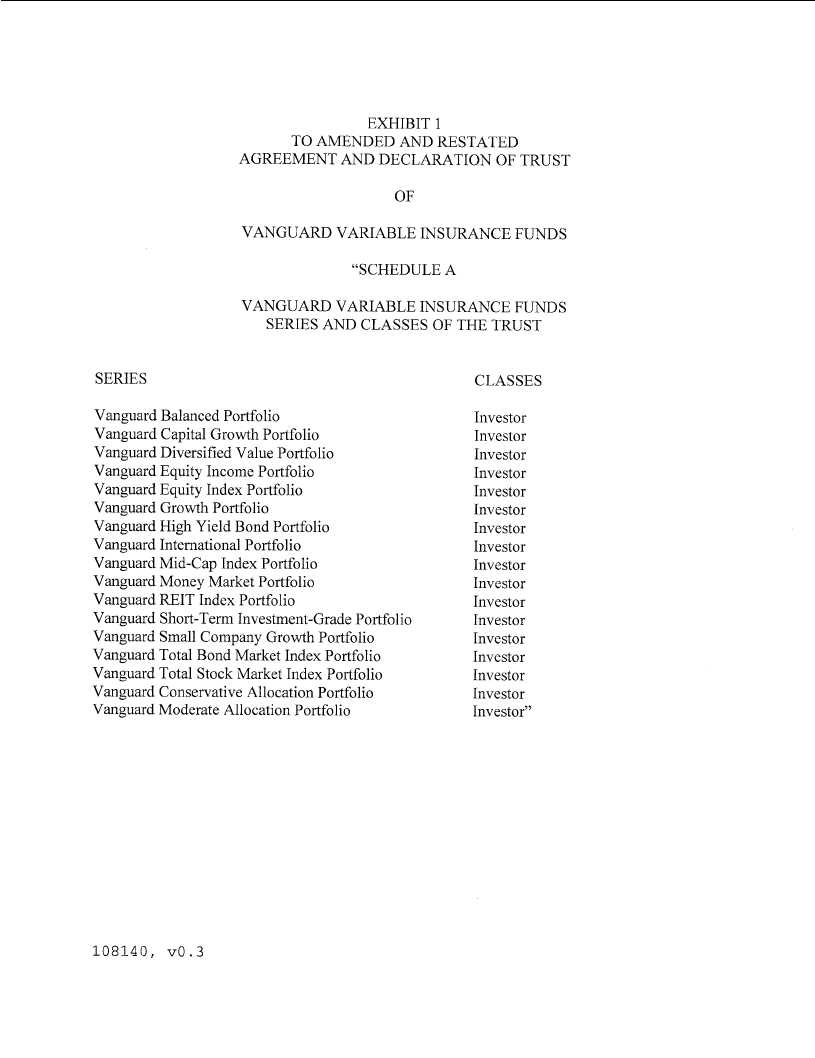
AMENDED AND RESTATED
AGREEMENT AND DECLARATION OF TRUST
OF
VANGUARD VARIABLE INSURANCE FUNDS
WHEREAS, this AMENDED AND RESTATED AGREEMENT AND DECLARATION OF TRUST of Vanguard Variable Insurance Funds (the “Trust”) is made and entered into as of the date set forth below by the Trustees named hereunder for the purpose of continuing the Trust as a Delaware statutory trust in accordance with the provisions hereinafter set forth;
WHEREAS, the Trust was formed upon the filing of a certificate of trust in the Office of the Secretary of State of the State of Delaware on January 28, 1998 pursuant to a declaration of trust dated January 23, 1998 (the “Original Declaration of Trust”);
WHEREAS, the Original Declaration of Trust was amended on July 19, 2002 (as so amended, the “Amended Declaration of Trust”); and
WHEREAS, the Trustees consider it appropriate to amend and restate the Amended Declaration of Trust in accordance with the terms of the Amended Declaration of Trust and the Delaware Act.
NOW, THEREFORE, the Amended Declaration of Trust is hereby amended and restated as follows and the Trustees do hereby declare that the Trustees will hold IN TRUST all cash, securities and other assets that the Trust now possesses or may hereafter acquire from time to time in any manner and manage and dispose of the same upon the following terms and conditions.
ARTICLE I.
Name and Definitions
Section 1. Name. The name of the Trust is “VANGUARD VARIABLE INSURANCE FUNDS” and the Trustees shall conduct the business of the Trust under that name or any other name as they may from time to time determine. If the Trustees determine to change the name of the Trust, they may adopt such other name for the Trust as they deem proper. Any name change shall become effective upon approval by the Trustees of such change and the filing of a certificate of amendment under the Delaware Act. Any such action shall have the status of an amendment to this Declaration of Trust.
Section 2. Definitions. Whenever used herein, unless otherwise required by the context or specifically provided:
108140, v0.4 #108140 v2 1/25/2012
(a) “Amended Declaration of Trust” shall have the meaning set forth in the recitals to this Declaration of Trust;
(b) “By-Laws” shall mean the By-Laws of the Trust as amended from time to time;
(c) “Commission” shall have the respective meanings given it in
Section 2(a)(7) and Section (2)(a)(29) of the 1940 Act;
(d) “Declaration of Trust” shall mean this Amended and Restated Agreement and Declaration of Trust, as amended or restated from time to time;
(e) “Delaware Act” refers to Delaware Statutory Trust Act, 12 Del. C.
§ 3801 et. seq. (as amended and in effect from time to time);
(f) “Interested Person” shall have the meaning given it in Section
2(a)(19) of the 1940 Act;
(g) “Investment Adviser” or “Adviser” means a party furnishing services to the Trust pursuant to any contract described in Article IV, Section 6(a) hereof;
(h) “1940 Act” refers to the Investment Company Act of 1940 and the Rules and Regulations thereunder, all as amended from time to time. References herein to specific sections of the 1940 Act shall be deemed to include such Rules and Regulations as are applicable to such sections as determined by the Trustees or their designees;
(i) “Original Declaration of Trust” shall have the meaning set forth in the recitals to this Declaration of Trust;
(j) “Principal Underwriter” shall have the respective meanings given it in Section 2(a)(7) and Section (2)(a)(29) of the 1940 Act;
(k) “Prior Declaration of Trust” refers to the original Declaration of Trust and the Amended Declaration of Trust, each as from time to time in effect prior to the date hereof;
(l) “Person” means and includes individuals, corporations, partnerships, trusts, foundations, plans, associations, joint ventures, estates and other entities, whether or not legal entities, and governments and agencies and political subdivisions thereof, whether domestic or foreign;
(m) “Series” refers to each Series of Shares referenced in, or established under or in accordance with, the provisions of Article III.
108140, v0.4 2
| (n) | “Shareholder” means a record owner of outstanding Shares; |
| (o) | “Shares” means the shares of beneficial interest into which the |
beneficial interest in the Trust shall be divided from time to time and includes fractions of Shares as well as whole Shares;
(p) “Trust” shall have the meaning set forth in the recitals to this
Declaration of Trust;
(q) “Trustees” or “Board of Trustees” refers to the persons who have signed this Declaration of Trust and all other persons who were or may from time to time be duly elected or appointed to serve on the Board of Trustees in accordance with the provisions hereof or of the Prior Declaration of Trust, so long as they continue in office in accordance with the terms hereof and reference herein to a Trustee or the Trustees shall refer to such person or persons in their capacity as trustees hereunder; and
(r) “Trust Property” means any and all property, real or personal, tangible or intangible, which is owned or held by or for the account of the Trust.
ARTICLE II.
Purpose of Trust
The purpose of the Trust is to conduct, operate and carry on the business of a management investment company registered under the 1940 Act through one or more Series investing primarily in securities.
ARTICLE III.
Shares
Section 1. Division of Beneficial Interest. The beneficial interest in the Trust shall at all times be divided into an unlimited number of Shares, with a par value of $ .001 per Share unless the Trustees shall designate another par value in connection with the issuance of Shares or with respect to outstanding Shares as provided in Section 5 of this Article III. The Trustees may authorize the division of Shares into separate Series and the division of Series into separate classes of Shares. The different Series shall be established and designated, and the variations in the relative rights and preferences as between the different Series shall be fixed and determined, by the Trustees. If no Series shall be established or if only one Series shall be established, the Shares shall have the rights and preferences provided for herein and in Article III, Section 6 hereof to the extent relevant and not otherwise provided for herein.
Subject to the provisions of Section 6 of this Article III, each Share shall have voting rights as provided in Article V hereof, and holders of the Shares of any Series shall be entitled to receive dividends, when, if and as declared with respect thereto in the manner
108140, v0.4 3
provided in Article VI, Section 1 hereof. No Share shall have any priority or preference over any other Share of the same Series with respect to dividends or distributions of the Trust or otherwise. All dividends and distributions shall be made ratably among all Shareholders of a Series (or class) from the assets held with respect to such Series according to the number of Shares of such Series (or class) held of record by such Shareholders on the record date for any dividend or distribution. Shareholders shall have no preemptive or other right to subscribe to any additional Shares or other securities issued by the Trust or any Series. The Trustees may from time to time divide or combine the Shares of a Series into a greater or lesser number of Shares of such Series without thereby materially changing the proportionate beneficial interest of such Shares in the assets held with respect to that Series or materially affecting the rights of Shares of any other Series.
All references to Shares in this Declaration of Trust shall be deemed to be Shares of the Trust and of any or all Series or classes thereof, as the context may require. All provisions herein relating to the Trust shall apply equally to each Series of the Trust and each class thereof, except as the context otherwise requires.
All Shares issued hereunder, including Shares issued in connection with a dividend in Shares or a split or reverse split of Shares, shall be fully paid and non-assessable.
Section 2. Ownership of Shares. The ownership of Shares shall be recorded on the books of the Trust or a transfer or similar agent for the Trust, which books shall be maintained separately for the Shares of each Series (and class). No certificates evidencing the ownership of Shares shall be issued except as the Board of Trustees may otherwise determine from time to time. The Trustees may make such rules as they consider appropriate for the transfer of Shares of each Series (and class) and similar matters. The record books of the Trust as kept by the Trust or any transfer or similar agent, as the case may be, shall be conclusive as to the identity of the Shareholders of each Series (and class) and as to the number of Shares of each Series (and class) held from time to time by each Shareholder.
Section 3. Investments in the Trust. Investments may be accepted by the Trust from such Persons, at such times, on such terms, and for such consideration as the Trustees from time to time may authorize. Each investment shall be credited to the Shareholder’s account in the form of full and fractional Shares of the Trust, in such Series (or class) as the purchaser shall select, at the net asset value per Share next determined for such Series (or class) after receipt of the investment; provided, however, that the Trustees may, in their sole discretion, impose a sales charge or reimbursement fee upon investments in the Trust.
Section 4. Status of Shares and Limitation of Personal Liability. Shares shall be deemed to be personal property giving only the rights provided in this Declaration of Trust and the By-Laws of the Trust. Every Shareholder by virtue of having become a Shareholder shall be held to have expressly assented and agreed to the terms hereof. The death, incapacity, dissolution, termination or bankruptcy of a Shareholder during the existence of the Trust shall not operate to terminate the Trust, nor entitle the representative of any such Shareholder to an accounting or to take any action in court or elsewhere against the Trust or the Trustees, but shall
108140, v0.4 4
entitle such representative only to the rights of such Shareholder under this Declaration of Trust. Ownership of Shares shall not entitle a Shareholder to any title in or to the whole or any part of the Trust Property or right to call for a partition or division of the same or for an accounting, nor shall the ownership of Shares constitute the Shareholders as partners or joint venturers. Neither the Trust nor the Trustees, nor any officer, employee nor agent of the Trust shall have any power to bind personally any Shareholder, or to call upon any Shareholder for the payment of any sum of money or assessment whatsoever other than such as the Shareholder may at any time agree to pay.
Section 5. Power of Board of Trustees to Change Provisions Relating to Shares. Notwithstanding any other provision of this Declaration of Trust to the contrary, and without limiting the power of the Board of Trustees to amend the Declaration of Trust as provided elsewhere herein, the Board of Trustees shall have the power to amend this Declaration of Trust, at any time and from time to time, in such manner as the Board of Trustees may determine in their sole discretion, without the need for Shareholder action, so as to add to, delete, replace or otherwise modify any provisions relating to the Shares contained in this Declaration of Trust, provided that before adopting any such amendment without Shareholder approval the Board of Trustees shall determine that it is consistent with the fair and equitable treatment of all Shareholders and that Shareholder approval is not required by the 1940 Act or other applicable federal law. If Shares have been issued, Shareholder approval shall be required to adopt any amendments to this Declaration of Trust which would adversely affect to a material degree the rights and preferences of the Shares of any Series (or class) or to increase or decrease the par value of the Shares of any Series (or class).
Section 6. Establishment and Designation of Shares. The Series and classes of Shares existing as of the date of this Declaration of Trust are those Series and classes that have been established under the Prior Declaration of Trust and not heretofore terminated which are indicated on Schedule A attached hereto and made a part hereof (“Schedule A”). The establishment of any additional Series (or class) of Shares shall be effective upon the adoption by the Trustees of a resolution that sets forth the designation of, or otherwise identifies, such Series (or class), whether directly in such resolution or by reference to, or approval of, another document that sets forth the designation of, or otherwise identifies, such Series (or class) including any registration statement of the Trust or such Series (or class), any amendment and/or restatement of this Declaration of Trust and/or Schedule A or as otherwise provided in such resolution. Upon the establishment of any additional Series (or class) of Shares or the termination of any existing Series (or class) of Shares, Schedule A shall be amended to reflect the addition or termination of such Series (or class) and any officer of the Trust is hereby authorized to make such amendment; provided that amendment of Schedule A shall not be a condition precedent to the establishment or termination of any Series (or class) in accordance with this Declaration of Trust. The relative rights and preferences of the Shares of the Trust and each Series and each class thereof shall be as set forth herein and as set forth in any registration statement relating thereto, unless otherwise provided in the resolution establishing such Series or class.
Shares of each Series (or class) established pursuant to this Section 6, unless
108140, v0.4 5
otherwise provided in the resolution establishing such Series (or class) or in any registration statement relating thereto, shall have the following relative rights and preferences:
(a) Assets Held with Respect to a Particular Series. All consideration received by the Trust for the issue or sale of Shares of a Series, including dividends and distributions paid by, and reinvested in, such Series, together with all assets in which such consideration is invested or reinvested, all income, earnings, profits, and proceeds thereof from whatever source derived, including any proceeds derived from the sale, exchange or liquidation of such assets, and any funds or payments derived from any reinvestment of such proceeds in whatever form the same may be, shall irrevocably be held with respect to that Series for all purposes, and shall be so recorded upon the books of account of the Trust. Such consideration, assets, income, earnings, profits and proceeds thereof, from whatever source derived, including any proceeds derived from the sale, exchange or liquidation of such assets, and any funds or payments derived from any reinvestment of such proceeds, in whatever form the same may be, are herein referred to as ”assets held with respect to” that Series. In the event that there are any assets, income, earnings, profits and proceeds thereof, funds or payments that are not readily identifiable as assets held with respect to the Trust or any particular Series (collectively ”General Assets”), the Trustees shall allocate such General Assets to, between or among the Trust and/or any one or more of the Series in such manner and on such basis as the Trustees, in their sole discretion, deem fair and equitable, and any General Asset so allocated to a particular Series shall be held with respect to that Series. Each such allocation by the Trustees shall be conclusive and binding upon the Shareholders of all Series for all purposes in absence of manifest error.
(b) Liabilities Held with Respect to a Particular Series. The assets of the Trust held with respect to each Series shall be charged with the liabilities of the Trust with respect to such Series and all expenses, costs, charges and reserves attributable to such Series, and any general liabilities of the Trust that are not readily identifiable as being held in respect of a Series shall be allocated and charged by the Trustees to and among the Trust and/or any one or more Series in such manner and on such basis as the Trustees in their sole discretion deem fair and equitable. The liabilities, expenses, costs, charges, and reserves so charged to a Series are herein referred to as “liabilities held with respect to” that Series. Each allocation of liabilities, expenses, costs, charges and reserves by the Trustees shall be conclusive and binding upon the Shareholders of all Series for all purposes in absence of manifest error. All liabilities held with respect to a particular Series shall be enforceable against the assets held with respect to such Series only and not against the assets of the Trust generally or against the assets held with respect to any other Series and, except as otherwise provided in this Declaration of Trust, none of the debts, liabilities, obligations and expenses incurred, contracted for or otherwise existing with respect to the Trust generally or any other Series thereof shall be enforceable against the assets of such Series. As and to the extent provided in Section 3804(a) of the Delaware Act, separate and distinct records shall be maintained for each Series and the assets held with respect to each Series shall be held in such separate and distinct records (directly or indirectly, including through a nominee or otherwise) and accounted for in such separate and distinct records separately from the assets held with respect to all other Series and the General Assets of the Trust not allocated to such Series. Notice of this limitation on inter-Series liabilities shall be set forth in the certificate of trust of the Trust (whether originally or by amendment).
108140, v0.4 6
(c) Dividends, Distributions, Redemptions, and Repurchases. No dividend or distribution including any distribution paid in connection with termination of the Trust or of any Series (or class) with respect to, or any redemption or repurchase of, the Shares of any Series (or class) shall be effected by the Trust other than from the assets held with respect to such Series, nor shall any Shareholder of any Series otherwise have any right or claim against the assets held with respect to any other Series except to the extent that such Shareholder has such a right or claim hereunder as a Shareholder of such other Series. The Trustees shall have full discretion to determine which items shall be treated as income and which items as capital; and each such determination and allocation shall be conclusive and binding upon the Shareholders in absence of manifest error.
(d) Voting. All Shares entitled to vote on a matter shall vote without differentiation between the separate Series on a one-vote-per-each dollar (and a fractional vote for each fractional dollar) of the net asset value of each Share (including fractional shares) basis; provided however, if a matter to be voted on affects only the interests of one or more but not all Series (or one or more but not all of a class of a Series), then only the Shareholders of such affected Series (or class) shall be entitled to vote on the matter.
(e) Equality. All the Shares of each Series shall represent an equal proportionate undivided interest in the assets held with respect to such Series (subject to the liabilities of such Series and such rights and preferences as may have been established and designated with respect to classes of Shares within such Series), and each Share of a Series shall be equal to each other Share of such Series.
(f) Fractions. Any fractional Share of a Series shall have proportionately all the rights and obligations of a whole share of such Series, including rights with respect to voting, receipt of dividends and distributions and redemption of Shares.
(g) Exchange Privilege. The Trustees shall have the authority to provide that the Shareholders of any Series shall have the right to exchange such Shares for Shares of one or more other Series in accordance with such requirements and procedures as may be established by the Trustees.
(h) Combination of Series. The Trustees shall have the authority, without the approval of the Shareholders of any Series unless otherwise required by applicable federal law, to combine the assets and liabilities held with respect to any two or more Series into assets and liabilities held with respect to a single Series.
(i) Elimination of Series. At any time that there are no Shares outstanding of a Series (or class), the Trustees may abolish such Series (or class).
108140, v0.4 7
ARTICLE IV.
The Board of Trustees
Section 1. Number, Election and Tenure. The number of Trustees constituting the Board of Trustees shall be fixed from time to time by a written instrument signed, or by resolution approved at a duly constituted meeting, by a majority of the Board of Trustees, provided, however, that the number of Trustees shall at all times be at least one (1). Subject to the requirements of Section 16(a) of the 1940 Act, the Board of Trustees, by action of a majority of the then Trustees at a duly constituted meeting, may fill vacancies in the Board of Trustees and remove Trustees with or without cause. Each Trustee shall serve during the continued lifetime of the Trust until he or she dies, resigns, is declared bankrupt or incompetent by a court of competent jurisdiction, or is removed. Any Trustee may resign at any time by written instrument signed by him and delivered to any officer of the Trust or to a meeting of the Trustees. Such resignation shall be effective upon receipt unless specified to be effective at some other time. Except to the extent expressly provided in a written agreement with the Trust, no Trustee resigning and no Trustee removed shall have any right to any compensation for any period following his or her resignation or removal, or any right to damages or other payment on account of such removal. Any Trustee may be removed at any meeting of Shareholders by a vote of two-thirds of the total combined net asset value of all Shares of the Trust issued and outstanding. A meeting of Shareholders for the purpose of electing or removing one or more Trustees may be called (i) by the Trustees upon their own vote, or (ii) upon the demand of Shareholders owning 10% or more of the Shares entitled to vote.
Section 2. Effect of Death, Resignation, etc. of a Trustee. The death, declination, resignation, retirement, removal, or incapacity of one or more Trustees, or all of them, shall not operate to annul the Trust or to revoke any existing agency created pursuant to the terms of this Declaration of Trust. Whenever a vacancy in the Board of Trustees shall occur, until such vacancy is filled as provided in Article IV, Section 1, the Trustees in office, regardless of their number, shall have all the powers granted to the Trustees and shall discharge all the duties imposed upon the Trustees by this Declaration of Trust.
Section 3. Powers. Subject to the provisions of this Declaration of Trust, the business of the Trust shall be managed by the Board of Trustees, and such Board of Trustees shall have all powers necessary or convenient to carry out that responsibility including the power to engage in transactions of all kinds on behalf of the Trust. Trustees, in all instances, shall act as principals and are and shall be free from the control of the Shareholders. The Trustees shall have full power and authority to do any and all acts and to make and execute any and all contracts, documents and instruments that they may consider desirable, necessary or appropriate in connection with the administration of the Trust. Without limiting the foregoing, the Trustees may: adopt, amend and repeal By-Laws not inconsistent with this Declaration of Trust providing for the regulation and management of the affairs of the Trust; elect and remove such officers and appoint and terminate such agents as they consider appropriate; appoint from their own number and establish and terminate one or more committees consisting of one or more Trustees who may exercise the powers and authority of the Board of Trustees to the extent that the Trustees
108140, v0.4 8
determine; employ one or more custodians of the assets of the Trust and may authorize such custodians to employ subcustodians and to deposit all or any part of such assets in a system or systems for the central handling of securities or with a Federal Reserve Bank, retain a transfer agent or a shareholder servicing agent, or both; provide for the issuance and distribution of Shares by the Trust directly or through one or more Principal Underwriters or otherwise; redeem, repurchase and transfer Shares pursuant to applicable federal law; set record dates for the determination of Shareholders with respect to various matters; declare and pay dividends and distributions to Shareholders of each Series from the assets of such Series; establish from time to time, in accordance with the provisions of Article III, Section 6 hereof, any Series of Shares, each such Series to operate as a separate and distinct investment medium and with separately defined investment objectives and policies and distinct investment purpose; and in general delegate such authority as they consider desirable to any officer of the Trust, to any committee of the Trustees and to any agent or employee of the Trust or to any such custodian, transfer or shareholder servicing agent, Investment Adviser or Principal Underwriter. Any determination as to what is in the interests of the Trust made by the Trustees in good faith shall be conclusive. In construing the provisions of this Declaration of Trust, the presumption shall be in favor of a grant of power to the Trustees.
Without limiting the foregoing, the Trust shall have power and authority:
(a) To invest and reinvest cash and cash items, to hold cash uninvested, and to subscribe for, invest in, reinvest in, purchase or otherwise acquire, own, hold, pledge, sell, assign, transfer, exchange, distribute, write options on, lend or otherwise deal in or dispose of contracts for the future acquisition or delivery of all types of securities, futures contracts and options thereon, and forward currency contracts of every nature and kind, including all types of bonds, debentures, stocks, preferred stocks, negotiable or non-negotiable instruments, obligations, evidences of indebtedness, certificates of deposit or indebtedness, commercial paper, repurchase agreements, bankers’ acceptances, and other securities of any kind, issued, created, guaranteed, or sponsored by any and all Persons, including states, territories, and possessions of the United States and the District of Columbia and any political subdivision, agency, or instrumentality thereof, any foreign government or any political subdivision of the U.S. Government or any foreign government, or any international instrumentality or organization, or by any bank or savings institution, or by any corporation or organization organized under the laws of the United States or of any state, territory, or possession thereof, or by any corporation or organization organized under any foreign law, or in "when issued" contracts for any such securities, futures contracts and options thereon, and forward currency contracts, to change the investments of the assets of the Trust; and to exercise any and all rights, powers, and privileges of ownership or interest in respect of any and all such investments of every kind and description, including the right to consent and otherwise act with respect thereto, with power to designate one or more Persons, to exercise any of said rights, powers, and privileges in respect of any of said instruments;
(b) To sell, exchange, lend, pledge, mortgage, hypothecate, lease, or write options with respect to or otherwise deal in any property rights relating to any or all of the assets of the Trust or any Series;
108140, v0.4 9
(c) To vote or give assent, or exercise any rights of ownership, with respect to stock or other securities or property; and to execute and deliver proxies or powers of attorney to such person or persons as the Trustees shall deem proper, granting to such person or persons such power and discretion with relation to securities or property as the Trustees shall deem proper;
(d) To exercise powers and right of subscription or otherwise which in any manner arise out of ownership of securities;
(e) To hold any security or property in a form not indicating that it is trust property, whether in bearer, unregistered or other negotiable form, or in its own name or in the name of a custodian or subcustodian or a nominee or nominees or otherwise or to authorize the custodian or a subcustodian or a nominee or nominees to deposit the same in a securities depository, subject in each case to the applicable provisions of the 1940 Act;
(f) To consent to, or participate in, any plan for the reorganization, consolidation or merger of any corporation or issuer of any security which is held in the Trust; to consent to any contract, lease, mortgage, purchase or sale of property by such corporation or issuer; and to pay calls or subscriptions with respect to any security held in the Trust;
(g) To join with other security holders in acting through a committee, depository, voting trustee or otherwise, and in that connection to deposit any security with, or transfer any security to, any such committee, depository or trustee, and to delegate to them such power and authority with relation to any security (whether or not so deposited or transferred) as the Trustees shall deem proper, and to agree to pay, and to pay, such portion of the expenses and compensation of such committee, depository or trustee as the Trustees shall deem proper;
(h) To litigate, compromise, arbitrate, settle or otherwise adjust claims in favor of or against the Trust or a Series, or any matter in controversy, including but not limited to claims for taxes;
(i) To enter into joint ventures, general or limited partnerships and any other combinations or associations;
(j) To borrow funds or other property in the name of the Trust or Series exclusively for Trust (or such Series) purposes;
(k) To endorse or guarantee the payment of any notes or other obligations of any Person; to make contracts of guaranty or suretyship, or otherwise assume liability for payment thereof;
(l) To purchase and pay for entirely out of Trust Property such insurance as the Trustees may deem necessary, desirable or appropriate for the conduct of the business, including insurance policies insuring the assets of the Trust or payment of distributions
108140, v0.4 10
and principal on its portfolio investments, and insurance policies insuring the Shareholders, Trustees, officers, employees, agents, Investment Adviser, principal underwriters, or independent contractors of the Trust, individually against all claims and liabilities of every nature arising by reason of holding Shares, holding, being or having held any such office or position, or by reason of any action alleged to have been taken or omitted by any such Person as Trustee, officer, employee, agent, Investment Adviser, Principal Underwriter, or independent contractor, including any action taken or omitted that may be determined to constitute negligence, whether or not the Trust would have the power to indemnify such Person against liability;
(m) To adopt, establish and carry out pension, profit-sharing, share bonus, share purchase, savings, thrift and other retirement, incentive and benefit plans, trusts and provisions, including the purchasing of life insurance and annuity contracts as a means of providing such retirement and other benefits, for any or all of the Trustees, officers, employees and agents of the Trust; and
(n) Subject to the 1940 Act, to engage in any other lawful act or activity in which a statutory trust organized under the Delaware Act may engage.
The Trust shall not be limited to investing in obligations maturing before the possible termination of the Trust or one or more of its Series. The Trust shall not in any way be bound or limited by any present or future law or custom in regard to investment by fiduciaries. The Trust shall not be required to obtain any court order to deal with any assets of the Trust or take any other action hereunder.
Section 4. Payment of Expenses by the Trust. Subject to the provisions of Article III, Section 6(b), the Trustees are authorized to pay or cause to be paid out of the principal or income of the Trust or Series, or partly out of the principal and partly out of income, and to charge or allocate the same to, between or among such one or more of the Series that may be established or designated pursuant to Article III, Section 6, all expenses, fees, charges, taxes and liabilities incurred or arising in connection with the Trust or Series, or in connection with the management thereof, including, but not limited to, the Trustees’ compensation and such expenses and charges for the services of the Trust’s officers, employees, Investment Adviser, Principal Underwriter, auditors, counsel, custodian, transfer agent, Shareholder servicing agent, and such other agents or independent contractors and such other expenses and charges as the Trustees may deem necessary or proper to incur.
Section 5. Ownership of Assets of the Trust. Title to all of the assets of the Trust shall at all times be considered as vested in the Trust, except that the Trustees shall have power to cause legal title to any Trust Property to be held by or in the name of one or more of the Trustees, or in the name of the Trust, or in the name of any other Person as nominee, on such terms as the Trustees may determine. Upon the resignation, incompetency, bankruptcy, removal, or death of a Trustee he or she shall automatically cease to have any such title in any of the Trust Property, and the title of such Trustee in the Trust Property shall vest automatically in the remaining Trustees. Such vesting and cessation of title shall be effective whether or not conveyancing documents have been executed and delivered. The Trustees may determine that
108140, v0.4 11
the Trust or the Trustees, acting for and on behalf of the Trust, shall be deemed to hold beneficial ownership of any income earned on the securities owned by the Trust, whether domestic or foreign.
Section 6.
Service Contracts.
(a) The Trustees may, at any time and from time to time, contract for exclusive or nonexclusive advisory, management and/or administrative services for the Trust or for any Series with any Person; and any such contract may contain such other terms as the Trustees may determine, including authority for the Investment Adviser to determine from time to time without prior consultation with the Trustees what investments shall be purchased, held, sold or exchanged and what portion, if any, of the assets of the Trust shall be held uninvested and to make changes in the Trust’s investments, and such other responsibilities as may specifically be delegated to such Person.
(b) The Trustees may also, at any time and from time to time, contract with any Persons, appointing such Persons exclusive or nonexclusive distributor or Principal Underwriter for the Shares of one or more of the Series or other securities to be issued by the Trust. Every such contract may contain such other terms as the Trustees may determine.
(c) The Trustees are also empowered, at any time and from time to time, to contract with any Persons, appointing such Person(s) to serve as custodian(s), transfer agent and/or shareholder servicing agent for the Trust or one or more of its Series. Every such contract shall comply with such terms as may be required by the Trustees.
(d) The Trustees are further empowered, at any time and from time to time, to contract with any Persons to provide such other services to the Trust or one or more of the Series, as the Trustees determine to be in the best interests of the Trust and the applicable Series.
| (e) | The fact that: |
| (i) any of the Shareholders, Trustees, or officers of the Trust is |
a shareholder, director, officer, partner, trustee, employee, Investment Adviser, Principal Underwriter, distributor, or affiliate or agent of or for any Person with which an advisory, management or administration contract, or Principal
Underwriter’s or distributor’s contract, or transfer, shareholder servicing or other type of service contract may be made, or that
(ii) any Person with which an advisory, management or administration contract or Principal Underwriter’s or distributor’s contract, or transfer, shareholder servicing or other type of service contract may be made also has an advisory, management or administration contract, or principal underwriter’s or distributor’s contract, or transfer, shareholder servicing or other service contract, or has other business or interests with any other Person,
108140, v0.4 12
shall not affect the validity of any such contract or disqualify any Shareholder, Trustee or officer of the Trust from voting upon or executing the same, or create any liability or accountability to the Trust or its Shareholders, provided approval of each such contract is made pursuant to the applicable requirements of the 1940 Act.
ARTICLE V.
Shareholders’ Voting Powers and Meetings
Subject to the provisions of Article III, Sections 5 and 6(d), the Shareholders shall have right to vote only (i) for the election or removal of Trustees as provided in Article IV, Section 1, and (ii) with respect to such additional matters relating to the Trust as may be required by the applicable provisions of the 1940 Act, including Section 16(a) thereof, and (iii) on such other matters as the Trustees may consider necessary or desirable. Provisions relating to meetings, quorum, required vote, record date and other matters relating to Shareholder voting rights are as provided in the By-Laws.
ARTICLE VI.
Net Asset Value, Distributions, and Redemptions
Section 1. Determination of Net Asset Value, Net Income, and Distributions. Subject to Article III, Section 6 hereof, the Trustees, in their absolute discretion, may prescribe and shall set forth in the By-Laws or in a duly adopted resolution of the Trustees such bases and time for determining the per Share net asset value of the Shares of the Trust or any Series (or class) and the declaration and payment of dividends and distributions on the Shares of the Trust or any Series (or class), as they may deem necessary or desirable.
Section 2. Redemptions and Repurchases. The Trust shall purchase such Shares as are offered by any Shareholder for redemption, upon receipt by the Trust or a Person designated by the Trust that the Trust redeem such Shares or in accordance with such procedures for redemption as the Trustees may from time to time authorize; and the Trust will pay therefor the net asset value thereof, in accordance with the By-Laws and the applicable provisions of the 1940 Act. Payment for said Shares shall be made by the Trust to the Shareholder within seven days after the date on which the request for redemption is received in proper form. The obligation set forth in this Section 2 is subject to the provision that in the event that any time the
New York Stock Exchange (the “Exchange”) is closed for other than weekends or holidays, or if permitted by the Rules of the Commission during periods when trading on the Exchange is restricted or during any emergency which makes it impracticable for the Trust to dispose of the investments of the applicable Series or to determine fairly the value of the net assets held with respect to such Series or during any other period permitted by order of the Commission for the protection of investors, such obligations may be suspended or postponed by the Trustees.
The redemption price may in any case or cases be paid in cash or wholly or partly
108140, v0.4 13
in kind in accordance with Rule 18f-1 under the 1940 Act if the Trustees determine that such payment is advisable in the interest of the remaining Shareholders of the Series of which the Shares are being redeemed. Subject to the foregoing, the selection and quantity of securities or other property so paid or delivered as all or part of the redemption price shall be determined by or under authority of the Trustees. In no case shall the Trust be liable for any delay of any corporation or other Person in transferring securities selected for delivery as all or part of any payment in kind.
Section 3. Redemptions at the Option of the Trust. The Trust shall have the right, at its option, upon 30 days notice to the affected Shareholder at any time to redeem Shares of any Shareholder at the net asset value thereof as described in Section 1 of this Article VI: (i) if at such time such Shareholder owns Shares of any Series having an aggregate net asset value of less than a minimum value determined from time to time by the Trustees; or (ii) to the extent that such Shareholder owns Shares of a Series equal to or in excess of a maximum percentage of the outstanding Shares of such Series determined from time to time by the Trustees; or (iii) to the extent that such Shareholder owns Shares equal to or in excess of a maximum percentage, determined from time to time by the Trustees, of the outstanding Shares of the Trust.
Section 4. Transfer of Shares. The Trust shall transfer shares held of record by any Person to any other Person upon receipt by the Trust or a Person designated by the Trust of a written request therefore in such form and pursuant to such procedures as may be approved by the Trustees.
ARTICLE VII.
Compensation and Limitation of Liability
Section 1. Compensation of Trustees. Any Trustee, whether or not he is a salaried officer or employee of the Trust, may be compensated for his services as Trustee or as a member of a committee of Trustees, or as chairman of a committee by fixed periodic payments or by fees for attendance at meetings, by both or otherwise, and in addition may be reimbursed for transportation and other expenses, all in such manner and amounts as the Board of Trustees may from time to time determine. Nothing herein shall in any way prevent the employment of any Trustee to provide advisory, management, legal, accounting, investment banking or other services to the Trust and to be specially compensated for such services by the Trust.
Section 2. Limitation of Liability and Indemnification. A Trustee, when acting in such capacity, shall not be personally liable to any Person, other than the Trust or a Shareholder to the extent provided in this Article VII, for any act, omission or obligation of the Trust, of such Trustee or of any other Trustee. The Trustees shall not be responsible or liable in any event for any neglect or wrong-doing of any officer, agent, employee, Investment Adviser or Principal Underwriter of the Trust, nor shall any Trustee be responsible for the act or omission of any other Trustee, and, subject to the provisions of the By-Laws, the Trust out of its assets may indemnify and hold harmless each and every Trustee and officer of the Trust from and against any and all claims, demands, costs, losses, expenses, and damages whatsoever arising out of or
108140, v0.4 14
related to such Trustee’s or officer’s performance of his or her duties as a Trustee or officer of the Trust.
Every note, bond, contract, instrument, certificate or undertaking and every other act or thing whatsoever issued, executed or done by or on behalf of the Trust or the Trustees or any of them in connection with the Trust shall be conclusively deemed to have been issued, executed or done only in or with respect to their or his or her capacity as Trustees or Trustee, and such Trustees or Trustee shall not be personally liable thereon.
Section 3. Trustee’s Good Faith Action, Expert Advice, No Bond or Surety. The exercise by the Trustees of their powers hereunder shall be binding upon everyone interested in or dealing with the Trust. A Trustee shall be liable to the Trust and to any Shareholder solely for his or her own willful misfeasance, bad faith, gross negligence or reckless disregard of the duties involved in the conduct of the office of Trustee, and shall not be liable for errors of judgment or mistakes of fact or law. The Trustees may take advice of counsel or other experts with respect to the meaning and operation of this Declaration of Trust, and shall be under no liability for any act or omission in accordance with such advice nor for failing to follow such advice. The Trustees shall not be required to give any bond as such, nor any surety if a bond is required.
Section 4. Insurance. The Trustees shall be entitled and empowered to the fullest extent permitted by law to purchase with Trust assets insurance for liability and for all expenses reasonably incurred or paid or expected to be paid by a Trustee or officer in connection with any claim, action, suit or proceeding in which he or she becomes involved by virtue of his or her capacity or former capacity with the Trust, whether or not the Trust would have the power to indemnify him or her against such liability under the provisions of this Article.
ARTICLE VIII.
Miscellaneous
Section 1. Liability of Third Persons Dealing with Trustees. No Person dealing with the Trustees shall be bound to make any inquiry concerning the validity of any transaction made or to be made by the Trustees or to see to the application of any payments made or property transferred to the Trust or upon its order.
Section 2. Termination of the Trust or Any Series. Unless terminated as provided herein, the Trust shall continue without limitation of time. The Trust may be dissolved at any time by the Trustees upon 60 days prior written notice to the Shareholders. Any Series of Shares may be dissolved at any time by the Trustees upon 60 days prior written notice to the Shareholders of such Series. Any action to dissolve the Trust shall be deemed to also be an action to dissolve each Series and each class thereof.
In accordance with Section 3808 of the Delaware Act, upon dissolution of the Trust or any Series, as the case may be, after paying or otherwise providing for all charges, taxes,
108140, v0.4 15
expenses and liabilities held, severally, with respect to each Series or the applicable Series, as the case may be, whether due or accrued or anticipated as may be determined by the Trustees, the Trust shall, in accordance with such procedures as the Trustees consider appropriate, reduce the remaining assets held, severally, with respect to each Series or the applicable Series, as the case may be, to distributable form in cash or shares or other securities, and any combination thereof, and distribute the proceeds held with respect to each Series or the applicable Series, as the case may be, to the Shareholders of that Series, as a Series, ratably according to the number of Shares of that Series held by the several Shareholders on the date of termination.
Section 3.
Reorganization and Master/Feeder.
(a) Notwithstanding anything else herein, the Trustees may, without Shareholder approval unless such approval is required by the 1940 Act, (i) cause the Trust to convert or merge, reorganize or consolidate with or into one or more trusts, partnerships, limited liability companies, associations, corporations or other business entities (or a series of any of the foregoing to the extent permitted by law) (including trusts, partnerships, limited liability companies, associations, corporations or other business entities created by the Trustees to accomplish such conversion, merger, reorganization or consolidation) so long as the surviving or resulting entity is an open-end management investment company under the 1940 Act, or is a series thereof, to the extent permitted by law, and that, in the case of any trust, partnership, limited liability company, association, corporation or other business entity created by the Trustees to accomplish such conversion, merger, reorganization or consolidation, may succeed to or assume the Trust’s registration under the 1940 Act and that, in any case, is formed, organized or existing under the laws of the United States or of a state, commonwealth, possession or colony of the United States, (ii) cause the Shares to be exchanged under or pursuant to any state or federal statute to the extent permitted by law, (iii) cause the Trust to incorporate under the laws of a state, commonwealth, possession or colony of the United States (iv) sell or convey all or substantially all of the assets of the Trust or any Series or Class to another Series or Class of the Trust or to another trust, partnership, limited liability company, association, corporation or other business entity (or a series of any of the foregoing to the extent permitted by law) (including a trust, partnership, limited liability company, association, corporation or other business entity created by the Trustees to accomplish such sale and conveyance), organized under the laws of the United States or of any state, commonwealth, possession or colony of the United States so long as such trust, partnership, limited liability company, association, corporation or other business entity is an open-end management investment company under the 1940 Act and, in the case of any trust, partnership, limited liability company, association, corporation or other business entity created by the Trustees to accomplish such sale and conveyance, may succeed to or assume the Trust’s registration under the 1940 Act, for adequate consideration as determined by the Trustees which may include the assumption of all outstanding obligations, taxes and other liabilities, accrued or contingent of the Trust or any affected Series or Class, and which may include Shares of such other Series or Class of the Trust or shares of beneficial interest, stock or other ownership interest of such trust, partnership, limited liability company, association, corporation or other business entity (or series thereof) or (v) at any time sell or convert into money all or any part of the assets of the Trust or any Series or Class thereof. Any agreement of merger, reorganization, consolidation or conversion or exchange or certificate of merger,
108140, v0.4 16
certificate of conversion or other applicable certificate may be signed by a majority of the Trustees and facsimile signatures conveyed by electronic or telecommunication means shall be valid.
(b) Pursuant to and in accordance with the provisions of Section 3815(f) of the Delaware Act, and notwithstanding anything to the contrary contained in this Declaration of Trust, an agreement of merger or consolidation approved by the Trustees in accordance with this Section 3 may effect any amendment to this Declaration of Trust or effect the adoption of a new governing instrument of the Trust if the Trust is the surviving or resulting entity in the merger or consolidation.
(c) Notwithstanding anything else herein, the Trustees may, without Shareholder approval unless such approval is required by the 1940 Act, invest all or a portion of the Trust Property of any Series, or dispose of all or a portion of the Trust Property of any Series, and invest the proceeds of such disposition in interests issued by one or more other investment companies registered under the 1940 Act. Any such other investment company may (but need not) be a trust (formed under the laws of the State of Delaware or any other state or jurisdiction) (or subtrust thereof) which is classified as a partnership for federal income tax purposes. Notwithstanding anything else herein, the Trustees may, without Shareholder approval unless such approval is required by the 1940 Act, cause a Series that is organized in the master/feeder fund structure to withdraw or redeem its Trust Property from the master fund and cause such Series to invest its Trust Property directly in securities and other financial instruments or in another master fund.
Section 4. Amendments. Subject to the provisions of Section 5 of Article III relating to the requirement of Shareholder approval for certain amendments to this Declaration of Trust or requirements for certain determinations by the Board of Trustees for certain amendments hereto without Shareholder approval and any requirements under the 1940 Act requiring Shareholder approval of an amendment to this Declaration of Trust, the Trustees may, without any Shareholder vote or approval, amend this Declaration of Trust by making an amendment to this Declaration of Trust (including Schedule A), an agreement supplemental hereto, or an amended and restated trust instrument. Unless otherwise provided by the Trustees, any such amendment will be effective (i) upon the adoption by a majority of the Trustees then holding office of a resolution specifying the amendment, supplemental agreement or amendment and restatement or (ii) upon the execution in writing of an instrument signed by a majority of the Trustees then holding office specifying the amendment, supplemental agreement or amended and restated trust instrument. A certification signed by an officer of the Trust setting forth an amendment to this Declaration of Trust and reciting that it was duly adopted by the Trustees as aforesaid, or a copy of the instrument referenced above executed by the Trustees as aforesaid, shall be conclusive evidence of such amendment when lodged among the records of the Trust. The certificate of trust of the Trust may be restated and/or amended by any Trustee as necessary or desirable to reflect any change in the information set forth therein, and any such restatement and/or amendment shall be effective immediately upon filing with the Office of the Secretary of State of the State of Delaware or upon such future date as may be stated therein.
108140, v0.4 17
Section 5. Filing of Copies, References, Headings. The original or a copy of this Declaration of Trust shall be kept at the office of the Trust where it may be inspected by any Shareholder. Anyone dealing with the Trust may rely on a certificate by an officer of the Trust as to any matters in connection with the Trust hereunder; and, with the same effect as if it were the original, may rely on a copy certified by an officer of the Trust to be a copy of this Declaration of Trust. In this Declaration of Trust, references to this Declaration of Trust, and all expressions like “herein,” “hereof” and “hereunder,” shall be deemed to refer to this Declaration of Trust. Headings are placed herein for convenience of reference only and shall not be taken as a part hereof or control or affect the meaning, construction or effect of this Declaration of Trust. Whenever the singular number is used herein, the same shall include the plural; and the neuter, masculine and feminine genders shall include each other, as applicable. This Declaration of Trust may be executed in any number of counterparts each of which shall be deemed an original but all of which together will constitute one and the same instrument. To the extent permitted by the 1940 Act, (i) any document, consent, instrument or notice referenced in or contemplated by this Declaration of Trust or the By-Laws that is to be executed by one or more Trustees may be executed by means of original, facsimile or electronic signature and (ii) any document, consent, instrument or notice referenced in or contemplated by this Declaration of Trust or the By-Laws that is to be delivered by one or more Trustees may be delivered by facsimile or electronic means (including e-mail), unless, in the case of either clause (i) or (ii), otherwise expressly provided herein or in the By-Laws or determined by the Trustees. The terms “include,” “includes” and “including” and any comparable terms shall be deemed to mean “including, without limitation.”
Section 6. Applicable Law. This Agreement and Declaration of Trust is created under and is to be governed by and construed and administered according to the laws of the State of Delaware and the Delaware Act. The Trust shall be a Delaware statutory trust pursuant to the Delaware Act, and without limiting the provisions hereof, the Trust may exercise all powers which are ordinarily exercised by such a statutory trust.
Section 7. Provisions in Conflict with Law or Regulations.
(a) The provisions of the Declaration of Trust are severable, and if the Trustees shall determine, with the advice of counsel, that any of such provisions is in conflict with the 1940 Act, the regulated investment company provisions of the Internal Revenue Code or with other applicable federal laws and regulations, the conflicting provision shall be deemed never to have constituted a part of the Declaration of Trust; provided, however, that such determination shall not affect any of the remaining provisions of the Declaration of Trust or render invalid or improper any action taken or omitted prior to such determination.
(b) If any provision of the Declaration of Trust shall be held invalid or unenforceable in any jurisdiction, such invalidity or unenforceability shall attach only to such provision in such jurisdiction and shall not in any manner affect such provision in any other jurisdiction or any other provision of the Declaration of Trust in any jurisdiction.
108140, v0.4 18
Section 8. Statutory Trust Only. It is the intention of the Trustees to create a statutory trust pursuant to the Delaware Act, and thereby to create only the relationship of trustee and beneficial owners within the meaning of such Act between the Trustees and each Shareholder. It is not the intention of the Trustees to create a general partnership, limited partnership, joint stock association, corporation, bailment, joint venture, or any form of legal relationship other than a statutory trust pursuant to the Delaware Act. Nothing in this Declaration of Trust shall be construed to make the Shareholders, either by themselves or with the Trustees, partners or members of a joint stock association.
Section 9. Use of the Name “The Vanguard Group, Inc.”. The name “The Vanguard Group, Inc.” and any variants thereof and all rights to the use of the name “The Vanguard Group, Inc.” or any variants thereof shall be the sole and exclusive property of The Vanguard Group, Inc. (“VGI”). VGI has permitted the use by the Trust of the identifying word “Vanguard” and the use of the name “Vanguard” as part of the name of the Trust and the name of any Series of Shares. Upon the Trust’s withdrawal from the Amended and Restated Funds’
Service Agreement among the Trust, the other investment companies within the Vanguard Group of Investment Companies and VGI, and upon the written request of VGI, the Trust and any
Series of Shares thereof shall cease to use or in any way to refer to itself as related to “The Vanguard Group, Inc.” or any variant thereof.
Section 10. Derivative Actions. In addition to the requirements set forth in Section 3816 of the Delaware Act, a Shareholder may bring a derivative action on behalf of the Trust only if the following conditions are met:
(a) The Shareholder or Shareholders must make a pre-suit demand upon the Trustees to bring the subject action unless an effort to cause the Trustees to bring such an action is not likely to succeed. For purposes of this Section 10(a), a demand on the Trustees shall only be deemed not likely to succeed and therefore excused if a majority of the Board of Trustees, or a majority of any committee established to consider the merits of such action, is composed of Trustees who are not “independent trustees” (as that term is defined in the
Delaware Act).
(b) Unless a demand is not required under paragraph (a) of this Section 10, Shareholders eligible to bring such derivative action under the Delaware Act who collectively hold at least 10% of the outstanding Shares of the Trust, or who collectively hold at least 10% of the outstanding Shares of the Series or class to which such action relates, shall join in the request for the Trustees to commence such action; and
(c) Unless a demand is not required under paragraph (a) of this Section 10, the Trustees must be afforded a reasonable amount of time to consider such Shareholder request and to investigate the basis of such claim. The Trustees shall be entitled to retain counsel or other advisors in considering the merits of the request and shall require an undertaking by the Shareholders making such request to reimburse the Trust for the expense of any such advisors in the event that the Trustees determine not to bring such action.
108140, v0.4 19
SCHEDULE A
VANGUARD VARIABLE INSURANCE FUNDS
SERIES AND CLASSES OF THE TRUST
| SERIES | CLASSES |
| Vanguard Balanced Portfolio | Investor |
| Vanguard Capital Growth Portfolio | Investor |
| Vanguard Diversified Value Portfolio | Investor |
| Vanguard Equity Income Portfolio | Investor |
| Vanguard Equity Index Portfolio | Investor |
| Vanguard Growth Portfolio | Investor |
| Vanguard High Yield Bond Portfolio | Investor |
| Vanguard International Portfolio | Investor |
| Vanguard Mid-Cap Index Portfolio | Investor |
| Vanguard Money Market Portfolio | Investor |
| Vanguard REIT Index Portfolio | Investor |
| Vanguard Short-Term Investment-Grade Portfolio | Investor |
| Vanguard Small Company Growth Portfolio | Investor |
| Vanguard Total Bond Market Index Portfolio | Investor |
| Vanguard Total Stock Market Index Portfolio | Investor |
108140, v0.4
| TABLE OF CONTENTS | ||
| Page | ||
| ARTICLE I. Name and Definitions | 1 | |
| Section 1. | Name | 1 |
| Section 2. | Definitions | 1 |
| (a) | Amended Declaration of Trust | 2 |
| (b) | By-Laws | 2 |
| (c) | Commission | 2 |
| (d) | Declaration of Trust | 2 |
| (e) | Delaware Act | 2 |
| (f) | Interested Person | 2 |
| (g) | Investment Adviser or Adviser | 2 |
| (h) | 1940 Act | 2 |
| (i) | Original Declaration of Trust | 2 |
| (j) | Principal Underwriter | 2 |
| (k) | Prior Declaration of Trust | 2 |
| (l) | Person | 2 |
| (m) | Series | 2 |
| (n) | Shareholder | 2 |
| (o) | Shares | 3 |
| (p) | Trust | 3 |
| (q) | Trustees or Board of Trustees | 3 |
| (r) | Trust Property | 3 |
| ARTICLE II. Purpose of Trust | 3 | |
| ARTICLE III. Shares | 3 | |
| Section 1. | Division of Beneficial Interest | 3 |
| Section 2. | Ownership of Shares | 4 |
| Section 3. | Investments in the Trust | 4 |
| Section 4. | Status of Shares and Limitation of Personal | |
| Liability | 4 | |
| Section 5. | Power of Board of Trustees to Change | |
| Provisions Relating to Shares | 5 | |
| Section 6. | Establishment and Designation of Shares | 5 |
| (a) | Assets Held with Respect to a Particular Series | 6 |
| (b) | Liabilities Held with Respect to a | |
| Particular Series | 6 | |
| (c) | Dividends, Distributions, Redemptions, and | |
| Repurchases | 7 | |
| (d) | Voting | 7 |
| (e) | Equality | 7 |
| (f) | Fractions | 7 |
| (g) | Exchange Privilege | 7 |
108140, v0.4 i
| (h) | Combination of Series | 7 | |
| (i) | Elimination of Series | 7 | |
| ARTICLE IV. | The Board of Trustees | 8 | |
| Section 1. | Number, Election and Tenure | 8 | |
| Section 2. | Effect of Death, Resignation, etc. | ||
| of a Trustee | 8 | ||
| Section 3. | Powers | 8 | |
| Section 4. | Payment of Expenses by the Trust | 11 | |
| Section 5. | Ownership of Assets of the Trust | 11 | |
| Section 6. | Service Contracts | 12 | |
| ARTICLE V. Shareholders’ Voting Powers and Meetings | 13 | ||
| ARTICLE VI. | Net Asset Value, Distributions, and Redemptions | 13 | |
| Section 1. | Determination of Net Asset Value, Net | ||
| Income, and Distributions | 13 | ||
| Section 2. | Redemptions and Repurchases | 13 | |
| Section 3. | Redemptions at the Option of the Trust | 14 | |
| Section 4. | Transfer of Shares | 14 | |
| ARTICLE VII. Compensation and Limitation of Liability | 14 | ||
| Section 1. | Compensation of Trustees | 14 | |
| Section 2. | Limitation of Liability and Indemnification | 14 | |
| Section 3. | Trustee’s Good Faith Action, Expert | ||
| Advice, No Bond or Surety | 15 | ||
| Section 4. | Insurance | 15 | |
| ARTICLE VIII. Miscellaneous | 15 | ||
| Section 1. | Liability of Third Persons Dealing | ||
| with Trustees | 15 | ||
| Section 2. | Termination of the Trust or Any Series | 15 | |
| Section 3. | Reorganization and Master/Feeder | 16 | |
| Section 4. | Amendments | 17 | |
| Section 5. | Filing of Copies, References, Headings | 18 | |
| Section 6. | Applicable Law | 18 | |
| Section 7. | Provisions in Conflict with Law or Regulations | 18 | |
| Section 8. | Statutory Trust Only | 19 | |
| Section 9. | Use of the Name “The Vanguard Group, Inc.” | 19 | |
| Section 10. | Derivatives Actions | 19 | |
108140, v0.4 ii
INVESTMENT ADVISORY AGREEMENT
THIS AGREEMENT is made as of this 25th day of January, 2016, between Vanguard Variable Insurance Fund, a Delaware statutory trust (the “Trust”), and Arrowpoint Asset Management, LLC
(the “Advisor”), a Delaware limited liability company.
W I T N E S S E T H
WHEREAS, the Trust is an open-end, diversified management investment company registered under the Investment Company Act of 1940, as amended (the “1940 Act”); and
WHEREAS, the Trust offers a series of shares known as Small Company Growth Portfolio (the “Fund”); and
WHEREAS, the Trust desires to retain the Advisor to render investment advisory services to the Fund, and the Advisor is willing to render such services.
NOW THEREFORE, in consideration of the mutual promises and undertakings set forth in this “Agreement,” the Trust and the Advisor hereby agree as follows:
1. Appointment of Advisor. The Trust hereby employs the Advisor as investment advisor, on the terms and conditions set forth herein, for the portion of the assets of the Fund that the Trust’s Board of Trustees (the “Board of Trustees”) determines in its sole discretion to assign to the Advisor from time to time (referred to in this Agreement as the “Arrowpoint Portfolio”), as communicated to the Advisor on behalf of the Board of Trustees by The Vanguard Group, Inc. (“Vanguard”). The Board of Trustees may, from time to time, make additions to, and withdrawals from, the assets of the Fund assigned to the Advisor. The Advisor accepts such employment and agrees to render the services herein set forth, for the compensation herein provided.
2. Duties of Advisor. The Trust employs the Advisor to manage the investment and reinvestment of the assets of the Arrowpoint Portfolio; to continuously review, supervise, and administer an investment program for the Arrowpoint Portfolio; to determine in its discretion the securities to be purchased or sold and the portion of such assets to be held uninvested; to provide the Fund with all records concerning the activities of the Advisor that the Fund is required to maintain; and to render regular reports to the Trust’s officers and the Board of Trustees concerning the discharge of the foregoing responsibilities. The Advisor will discharge the foregoing responsibilities subject to the supervision and oversight of the Trust’s officers and the Board of Trustees, and in compliance with the objective, policies, and limitations set forth in the Fund’s prospectus and Statement of Additional Information, any additional operating policies or procedures that the Fund communicates to the Advisor in writing, and applicable laws and regulations. The Advisor agrees to provide, at its own expense, the office space, furnishings and equipment, and personnel required by it to perform the services on the terms and for the compensation provided herein.
3. Securities Transactions. The Advisor is authorized to select the brokers or dealers that will execute purchases and sales of securities for the Arrowpoint Portfolio, and is directed to seek to obtain best execution for such transactions, consistent with Section 28(e) of the Securities Exchange Act of 1934. In selecting brokers or dealers to execute trades for the Arrowpoint Portfolio, the Advisor will comply with all applicable statutes, rules, interpretations by the U.S. Securities and Exchange Commission or its staff, other applicable law, and the written policies and procedures established by the Board of Trustees and communicated to the Advisor in writing.
1
4. Compensation of Advisor. For services to be provided by the Advisor pursuant to this Agreement, the Fund will pay to the Advisor, and the Advisor agrees to accept as full compensation therefor, an investment advisory fee consisting of a base fee plus a performance adjustment at the rates specified in Schedule A to this Agreement, payable quarterly in arrears.
5. Reports. The Fund and the Advisor agree to furnish to each other current prospectuses, proxy statements, reports to shareholders, and such other information with regard to their affairs as each may reasonably request, including, but not limited to, information about changes in investment officers of the Advisor who are responsible for managing the Arrowpoint Portfolio.
6. Compliance. The Advisor agrees to comply in all material respects with all Applicable Law and all policies, procedures or reporting requirements that the Board of Trustees reasonably adopts and communicates to the Advisor in writing, including, without limitation, any such policies, procedures, or reporting requirements relating to soft dollar or other brokerage arrangements. “Applicable Law” means (i) the “federal securities laws” as defined in Rule 38a-1(e)(1) under the 1940 Act, as amended from time to time, and (ii) any and all other laws, rules, and regulations, whether foreign or domestic, in each case applicable at any time and from time to time to the investment management operations of the Advisor in relation to the Arrowpoint Portfolio.
7. Status of Advisor. The services of the Advisor to the Fund are not to be deemed exclusive, and the Advisor will be free to render similar services to others so long as its services to the Fund are not impaired thereby. The Advisor will be deemed to be an independent contractor and will, unless otherwise expressly provided or authorized, have no authority to act for or represent the Fund in any way or otherwise be deemed an agent of the Fund or the Trust.
8. Liability of Advisor. No provision of this Agreement will be deemed to protect the Advisor against any liability to the Fund or its shareholders to which it might otherwise be subject by reason of any willful misfeasance, bad faith, or negligence in the performance of its duties or the reckless disregard of its obligations under this Agreement.
9. Limitations on Consultations. The Advisor is prohibited from consulting with other advisors of the Fund, except Vanguard, concerning transactions for the Fund in securities or other assets.
10. Duration; Termination; Notices; Amendment. This Agreement will become effective on the date hereof and will continue in effect for a period of two years thereafter, and shall continue in effect for successive twelve-month periods thereafter, only so long as each such continuance specifically is approved at least annually by the Board of Trustees, including a majority of those Trustees who are not parties to such Agreement or interested persons of any such party, cast in person at a meeting called for the purpose of voting on such approval. In addition, the question of continuance of the Agreement may be presented to the shareholders of the Fund; in such event, such continuance will be effected only if approved by the affirmative vote of a majority of the outstanding voting securities of the Fund.
Notwithstanding the foregoing, however, (i) this Agreement may at any time be terminated without payment of any penalty either by vote of the Board of Trustees or by vote of a majority of the outstanding voting securities of the Fund, on thirty days’ written notice to the Advisor, (ii) this Agreement will automatically terminate in the event of its assignment, and (iii) this Agreement may be terminated by the Advisor on ninety days’ written notice to the Fund. Any notice under this Agreement will be given in writing, addressed and delivered, or mailed postpaid, to the other party as follows:
2
If to the Fund, at:
Small Company Growth Portfolio
P.O. Box 2600
Valley Forge, PA 19482
Attention: Sean P. Hagerty
Telephone: 610-669-4617
Facsimile: 610-503-5855
If to the Advisor, at:
Arrowpoint Asset Management LLC
100 Fillmore Street
Suite 325
Denver, CO 80206
Attention: Rick Grove
Telephone: 303-398-2929
This Agreement may be amended by mutual consent, but the consent of the Trust must be approved (i) by a majority of those members of the Board of Trustees who are not parties to this Agreement or interested persons of any such party, cast in person at a meeting called for the purpose of voting on such amendment, and (ii) to the extent required by the 1940 Act, by a vote of a majority of the outstanding voting securities of the Fund.
As used in this Section 10, the terms “assignment,” “interested persons,” and “vote of a majority of the outstanding voting securities” will have the respective meanings set forth in Section 2(a)(4), Section 2(a)(19) and Section 2(a)(42) of the 1940 Act.
11. Severability. If any provision of this Agreement will be held or made invalid by a court decision, statute, rule, or otherwise, the remainder of this Agreement will not be affected thereby.
12. Confidentiality. The Advisor shall keep confidential any and all information obtained in connection with the services rendered hereunder and relating directly or indirectly to the Fund, the Trust, or Vanguard and shall not disclose any such information to any person other than the Trust, the Board of Trustees, Vanguard, and any director, officer, or employee of the Trust or Vanguard, except (i) with the prior written consent of the Trust, (ii) as required by law, regulation, court order or the rules or regulations of any self-regulatory organization, governmental body, or official having jurisdiction over the Advisor, or (iii) for information that is publicly available other than due to disclosure by the Advisor or its affiliates or becomes known to the Advisor from a source other than the Trust, the Board of Trustees, or Vanguard.
13. Proxy Policy. The Advisor acknowledges that Vanguard, at the direction of the Fund, will vote the shares of all securities that are held by the Fund. In addition, the Trust acknowledges and agrees that the Advisor shall not have any responsibility to initiate, consider, or participate in any bankruptcy, class action, or other litigation against or involving any issue or securities held in or formerly held in the Arrowpoint Portfolio or to advise or take any action on behalf of the Fund with respect to any such actions or litigation. The Advisor will forward any important information received by it about such actions to the Fund.
3
14. Governing Law. All questions concerning the validity, meaning, and effect of this Agreement shall be determined in accordance with the laws (without giving effect to the conflict-of-law principles thereof) of the State of Delaware applicable to contracts made and to be performed in that state.
IN WITNESS WHEREOF, the parties hereto have caused this Investment Advisory Agreement to be executed as of the date first set forth herein.
| Arrowpoint Asset Management LLC | Vanguard Variable Insurance Fund |
| /s/ David Corkins | /s/ F. William McNabb |
| Signature | Signature |
| DAVID CORKINS | F. WILLIAM MCNABB |
| Print Name | Print Name |
4
CONSENT OF INDEPENDENT REGISTERED PUBLIC ACCOUNTING FIRM
We hereby consent to the incorporation by reference in the Prospectus and Statement of Additional Information constituting parts of this Post-Effective Amendment No. 78 to the Registration Statement on Form N-1A (the “Registration Statement”) of our reports dated February 11, 2016, relating to the financial statements and financial highlights appearing in the December 31, 2015 Annual Report to Shareholders of Balanced Portfolio, Capital Growth Portfolio, Conservative Allocation Portfolio, Diversified Value Portfolio, Equity Income Portfolio, Equity Index Portfolio, Growth Portfolio, High Yield Bond Portfolio, International Portfolio, Mid-Cap Index Portfolio, Moderate Allocation Portfolio, Money Market Portfolio, REIT Index Portfolio, Short-Term Investment-Grade Portfolio, Small Company Growth Portfolio, Total Bond Market Index Portfolio and Total Stock Market Index Portfolio (comprising Vanguard Variable Insurance Funds), which reports are also incorporated by reference into the Registration Statement. We also consent to the references to us under the heading “Financial Highlights” in the Prospectus and under the headings “Financial Statements” and “Service Providers—Independent Registered Public Accounting Firm” in the Statement of Additional Information.
/s/PricewaterhouseCoopers LLP
Philadelphia, PA
April 25, 2016
VANGUARD FUNDS
MULTIPLE CLASS PLAN
I. INTRODUCTION
This Multiple Class Plan (the “Plan”) describes seven separate classes of shares that may be offered by investment company members of The Vanguard Group (collectively the “Funds,” individually a “Fund”). The Plan explains the separate arrangements for each class, how expenses are allocated to each class, and the conversion features of each class. Each Fund may offer any one or more of the specified classes.
The Plan has been approved by the Board of Directors of The Vanguard Group (“Vanguard”). In addition, the Plan has been adopted by a majority of the Board of Trustees of each Fund, including a majority of the Trustees who are not interested persons of each Fund. The classes of shares offered by each Fund are designated in Schedule A hereto, as such Schedule may be amended from time to time.
II. SHARE CLASSES
A Fund may offer any one or more of the following share classes:
Investor Shares
AdmiralShares
Institutional Shares
Institutional Plus Shares
Institutional Select Shares
ETF Shares
Transition Shares
III. DISTRIBUTION, AVAILABILITY AND ELIGIBILITY
Distribution arrangements for all classes are described below. Distribution arrangements vary by Vanguard business line depending on the eligibility of the client segments to whom they market. Vanguard retains sole discretion in determining share class availability, and whether Fund shares shall be offered either directly or through certain financial intermediaries, or on certain financial intermediary platforms. Eligibility requirements for purchasing shares of each class will differ, as follows:
A. Investor Shares
Investor Shares generally will be available to investors who are not permitted to purchase other classes of shares, subject to the eligibility requirements specified in Schedule B hereto, as such Schedule may be amended
1
from time to time. It is expected that the minimum investment amount for Investor Shares will be substantially lower than the amount required for any other class of shares. Investor Shares are typically distributed by all Vanguard business lines.
B. Admiral Shares
Admiral Shares generally will be available to individual, institutional, and other investors who meet the eligibility requirements specified in Schedule B hereto, as such Schedule may be amended from time to time. These eligibility requirements may include, but are not limited to the following factors: (i) the total amount invested the Fund; or (ii) any other factors deemed appropriate by a Fund’s Board of Trustees. Admiral Shares are typically distributed by all Vanguard business lines.
C. Institutional Shares
Institutional Shares generally will be available to institutional and other investors who meet the eligibility requirements specified in Schedule B hereto, as such Schedule may be amended from time to time. It is expected that the minimum investment amount per account for Institutional Shares will be substantially higher than the amounts required for Investor Shares or Admiral Shares. Institutional Shares are typically distributed by Vanguard’s financial advisory services and institutional business lines.
D. Institutional Plus Shares
Institutional Plus Shares generally will be available to institutional and other investors who meet the eligibility requirements specified in Schedule B hereto, as such Schedule may be amended from time to time. It is expected that the minimum investment amount for Institutional Plus Shares will be substantially higher than the amount required for Institutional Shares. Institutional Plus Shares are typically distributed by Vanguard’s financial advisory services and institutional business lines.
E. Institutional Select Shares
Institutional Select Shares generally will be available to institutional investors who meet the eligibility requirements specified in Schedule B hereto, as such Schedule may be amended from time to time. It is expected that the minimum investment amount for Institutional Select Shares will be the highest among all Vanguard share classes. Institutional Select Shares are typically distributed by Vanguard’s institutional business line.
2
F. ETF Shares
A Fund will sell ETF Shares to investors that are (or who purchase through) Authorized Participants, and who pay for their ETF shares by depositing a prescribed basket of securities rather than paying cash. An Authorized Participant is an institution, usually a broker-dealer, that is a participant in the Depository Trust Company (DTC) and that has executed a Participant Agreement with the Fund’s distributor. Additional eligibility requirements may be specified in Schedule B hereto, as such Schedule may be amended from time to time. Investors who are not Authorized Participants may buy and sell ETF shares through various exchanges and market centers. ETF Shares are typically distributed by all Vanguard business lines.
G. Transition Shares
Transition Shares generally will be available solely to Vanguard funds-of-funds that meet the eligibility requirements specified in Schedule B hereto, as such Schedule may be amended from time to time. Transition Shares are only internally distributed.
IV. SERVICE ARRANGEMENTS
All share classes will receive a range of services provided by Vanguard on a per account basis. These “account-based” services may include transaction processing and shareholder recordkeeping, as well as the mailing of updated prospectuses, shareholder reports, tax statements, confirmation statements, quarterly portfolio summaries, and other items. It is expected that the aggregate amount of account-based services provided to Investor Shares will materially exceed the amount of such services provided to any other class, due to the existence of many more accounts holding Investor Shares. In addition to this difference in the volume of services provided, arrangements will differ among the classes as follows:
A. Investor Shares
Investor Shares generally will receive the most basic level of service from Vanguard. Investor Shares generally will be serviced through a pool of Vanguard client service representatives.
B. Admiral Shares
Admiral Shares will receive a different level of service from Vanguard as compared to Investor Shares. Special client service representatives may be assigned to service Admiral Shares, and holders of such shares may from time to time receive special mailings and unique additional services.
3
C. Institutional Shares
Institutional Shares will receive from Vanguard a level of service that differs from the service provided to the holders of shares of other classes. Such services may include special client service representatives who will be assigned to service Institutional Shares. Most holders of Institutional Shares periodically will receive special investment updates from Vanguard’s investment staff. Holders of Institutional Shares also may receive unique additional services from Vanguard, and generally will be permitted to transact with Vanguard through the National Securities Clearing Corporation’s FundSERV system and other special servicing platforms for institutional investors.
D. Institutional Plus Shares
Institutional Plus Shares generally will receive a very high level of service from Vanguard as compared to any other share classes. Special client service representatives will be assigned to service Institutional Plus Shares, and most holders of such shares periodically, but more than the holders of all other shares, will receive special updates from Vanguard’s investment staff. Holders of Institutional Plus Shares may receive unique additional services from Vanguard, and generally will be permitted to transact with Vanguard through the National Securities Clearing Corporation’s FundSERV system and other special servicing platforms for institutional investors.
E. Institutional Select Shares
Institutional Select Shares generally will receive a customized level of service. Holders of Institutional Select Shares may receive unique additional services from Vanguard, and generally will be permitted to transact with Vanguard through the National Securities Clearing Corporation’s FundSERV system and other special servicing platforms for institutional investors.
F. ETF Shares
A Fund is expected to maintain only one shareholder of record for ETF
Shares-DTC or its nominee. Special client service representatives will be assigned to the DTC account, and all transactions on this account will be handled electronically. Due to the nature and purpose of the DTC account, ETF Shares will not receive any special updates from Vanguard’s investment staff.
G. Transition Shares
The only investors eligible to own Transition Shares are Vanguard funds-of-funds, and it is expected that such funds, because of the nature of Transition Shares, will own the shares only for the brief periods necessary to complete the relevant portfolio transitions. The level of service provided will be commensurate
4
with the needs of a fund-of-funds transitioning from one underlying fund to another.
V. CONVERSION FEATURES
A. Self-Directed Conversions
1. Conversion into Investor Shares, Admiral Shares, Institutional Shares, Institutional Plus Shares, and Institutional Select Shares. Shareholders may conduct self-directed conversions from one share class into another share class of the same fund for which they are eligible. Self-directed conversions may be initiated by the shareholder; however, depending upon the particular share class and the complexity of the shareholder’s accounts, such conversions may require the assistance of a Vanguard representative. Shareholders may convert from one share class into another share class provided that following the conversion the shareholder: (i) meets the then applicable eligibility requirements for the share class into which they are converting; and (ii) receives services consistent with such new share class. Any such conversion will occur at the respective net asset values of the share classes next calculated after Vanguard’s receipt of the shareholder’s request in good order.
2. Conversion into ETF Shares. Except as otherwise provided, a shareholder may convert Investor Shares, Admiral Shares, or Institutional Shares into ETF Shares of the same fund (if available), provided that: (i) the share class out of which the shareholder is converting and the ETF Shares declare and distribute dividends on the same schedule; (ii) the shares to be converted are not held through an employee benefit plan; and (iii) following the conversion, the shareholder will hold ETF Shares through a brokerage account. Any such conversion will occur at the respective net asset values of the share classes next calculated after Vanguard’s receipt of the shareholder’s request in good order. Vanguard or the Fund may charge an administrative fee to process conversion transactions.
B. Automatic Conversions
1. Automatic conversion into Admiral Shares. Vanguard may automatically convert Investor Shares into Admiral Shares of the same fund (if available), provided that following the conversion the shareholder: (i) meets the eligibility requirements for Admiral Shares; and (ii) receives services consistent with Admiral Shares. Any such conversion will occur at the respective net asset values of the share classes next calculated after Vanguard’s conversion without the imposition of any charge. Such automatic conversions may occur on a periodic, or one-time basis. Automatic conversions may occur at different times due to the differing
5
mechanisms through which an account is funded or meets the required investment minimum. Automatic conversions do not apply to certain types of accounts (e.g., accounts held through certain intermediaries, or other accounts as may be excluded by Vanguard management).
2. Automatic conversion into Institutional Shares, Institutional Plus Shares, or Institutional Select Shares. Vanguard may conduct automatic conversions of any share class into either Institutional Shares, Institutional Plus Shares, or Institutional Select Shares in accordance with then-current eligibility requirements.
C. Involuntary Conversions and Cash Outs
1. Cash Outs. If a shareholder in any class of shares no longer meets the eligibility requirements for such shares, the Fund may cash out the shareholder’s remaining account balance. Any such cash out will be preceded by written notice to the shareholder and will be subject to the Fund’s normal redemption fees, if any.
2. Conversion of Admiral Shares, Institutional Shares, and Institutional Plus Shares. If a shareholder no longer meets the eligibility requirements for the share class currently held, the Fund may convert the shareholder’s holdings into the share class for which such shareholder is eligible. Any such conversion will be preceded by written notice to the shareholder, and will occur at the respective net asset values of the share classes without the imposition of any sales load, fee, or other charge.
3. Conversions of Transition Shares. When a Fund that issues Transition Shares has completed the relevant portfolio transition, the Fund will convert the Transition Shares to another share class of the same Fund as appropriate, based on the eligibility requirements of such class as specified in Schedule B hereto, as such Schedule may be amended from time to time.
VI. EXPENSE ALLOCATION AMONG CLASSES
A. Background
Vanguard is a jointly-owned subsidiary of the Funds. Vanguard provides the Funds, on an at-cost basis, virtually all of their corporate management, administrative and distribution services. Vanguard also may provide investment advisory services on an at-cost basis to the Funds. Vanguard was established and operates pursuant to a Funds’ Service Agreement between itself and the Funds (the “Agreement”), and pursuant to certain exemptive orders granted by the U.S. Securities and Exchange Commission (“Exemptive Orders”). Vanguard’s direct and indirect expenses of providing corporate management, administrative and
6
distribution services to the Funds are allocated among such funds in accordance with methods specified in the Agreement.1
B. Class Specific Expenses
1. Expenses for Account-Based Services. Expenses associated with Vanguard’s provision of account-based services to the Funds will be allocated among the share classes of each Fund on the basis of the amount incurred by each such class as follows:
(a) Account maintenance expenses. Expenses
associated with the maintenance of investor accounts will be
proportionately allocated among each Fund’s share classes based
upon a monthly determination of the costs to service each class of
shares. Factors considered in this determination are (i) the
percentage of total shareholder accounts represented by each class;
(ii) the percentage of total account transactions performed by
Vanguard for each class; and (iii) the percentage of new accounts
opened for each class.
(b) Expenses of special servicing arrangements.
Expenses relating to any special servicing arrangements for a
specific class will be proportionally allocated among each eligible
Fund’s share classes primarily based on their percentage of total
shareholder accounts receiving the special servicing arrangements.
(c) Literature production and mailing expenses.
Expenses associated with shareholder reports, proxy materials and
other literature will be allocated among each Fund’s share classes
based upon the number of such items produced and mailed for
each class.
2. Other Class Specific Expenses. Expenses for the primary benefit of a particular share class will be allocated to that share class. Such expenses would include any legal fees attributable to a particular class.
C. Fund-Wide Expenses
1. Marketing and Distribution Expenses. Each share class will bear marketing and distribution expenses proportionate to the marketing and distribution expenses of the business lines that distribute that share class. Retail and institutional businesses expenses will be allocated based
1 In accordance with the Agreement and Board approved methodologies, the expenses that would otherwise have been allocated to each Vanguard Fund of Funds are reallocated to the approve share class of the underlying funds in the Fund of Funds’ portfolio on a pro rata basis based on that Fund of Funds relative net assets invested in the underlying fund’s share class.
7
on the percentage of client accounts in each share class serviced by the respective business. Financial advisory service expenses will be apportioned based on the percentage of assets in each share class.
Expenses associated with each share class will be allocated only among the Funds that have such share class according to the “Vanguard Modified Formula,” with each share class or each Fund treated as if it were a separate Fund. The Vanguard Modified Formula is set forth in the Agreement and in certain of the SEC Exemptive Orders. This allocation has been deemed an appropriate allocation methodology by each Fund’s Board of Trustees under paragraph (c)(1)(v) of Rule 18f-3 under the Investment Company Act of 1940.
2. Asset Management Expenses. Expenses associated with management of a Fund’s assets (including all advisory, tax preparation and custody fees) will be allocated among the Fund’s share classes on the basis of their relative net assets.
3. Other Fund Expenses. Any other Fund expenses not described above will be allocated among the share classes on the basis of their relative net assets.
VII. ALLOCATION OF INCOME, GAINS AND LOSSES
Income, gains and losses will be allocated among each Fund’s share classes on the basis of their relative net assets. As a result of differences in allocated expenses, it is expected that the net income of, and dividends payable to, each class of shares will vary. Dividends and distributions paid to each class of shares will be calculated in the same manner, on the same day and at the same time.
VIII. VOTING AND OTHER RIGHTS
Each share class will have: (i) exclusive voting rights on any matter submitted to shareholders that relates solely to its service or distribution arrangements; and (ii) separate voting rights on any matter submitted to shareholders in which the interests of one class differ from the interests of the other class; and (iii) in all other respects the same rights, obligations and privileges as each other, except as described in the Plan.
8
IX. AMENDMENTS
All material amendments to the Plan must be approved by a majority of the Board of Trustees of each Fund, including a majority of the Trustees who are not interested persons of the Fund. In addition, any material amendment to the Plan must be approved by the Board of Directors of Vanguard.
Original Board Approval: July 21, 2000
Last Approved by Board: December 18, 2015
9
SCHEDULE A to
VANGUARD FUNDS MULTIPLE CLASS PLAN
Note: Transition Shares, when offered by a Fund, are available for a limited period of time and are then converted into another share class. For this reason, Transition Shares are not shown on Schedule A.
| Vanguard Fund | Share Classes Authorized | |
| Vanguard Admiral Funds | ||
| · | Treasury Money Market Fund | Investor |
| · | S&P 500 Value Index Fund | Institutional, ETF |
| · | S&P 500 Growth Index Fund | Institutional, ETF |
| · | S&P MidCap 400 Index Fund | Institutional, ETF |
| · | S&P MidCap 400 Value Index Fund | Institutional, ETF |
| · | S&P MidCap 400 Growth Index Fund | Institutional, ETF |
| · | S&P SmallCap 600 Index Fund | Institutional, ETF |
| · | S&P SmallCap 600 Value Index Fund | Institutional, ETF |
| · | S&P SmallCap 600 Growth Index Fund | Institutional, ETF |
| Vanguard Bond Index Funds | ||
| · | Short-Term Bond Index Fund | Investor, Admiral, Institutional, |
| Institutional Plus, ETF | ||
| · | Intermediate-Term Bond Index Fund | Investor, Admiral, Institutional, Institutional |
| Plus, ETF | ||
| · | Long-Term Bond Index Fund | Investor, Institutional, Institutional Plus, |
| ETF | ||
| · | Total Bond Market Index Fund | Investor, Admiral, Institutional, Institutional |
| Plus, Institutional Select, ETF | ||
| · | Total Bond Market II Index Fund | Investor, Institutional |
| · | Inflation-Protected Securities Fund | Investor, Admiral, Institutional |
| Vanguard California Tax-Free Funds | ||
| · | Tax-Exempt Money Market Fund | Investor |
| · | Intermediate-Term Tax-Exempt Fund | Investor, Admiral |
| · | Long-Term Tax-Exempt Fund | Investor, Admiral |
| Vanguard Charlotte Funds | ||
| · | Total International Bond Index Fund | Investor, Admiral, Institutional, |
| Institutional Select, ETF | ||
1
| Vanguard Fund | Share Classes Authorized | |
| Vanguard Chester Funds | ||
| · | PRIMECAP Fund | Investor, Admiral |
| · | Target Retirement Income Fund | Investor |
| · | Target Retirement 2010 Fund | Investor |
| · | Target Retirement 2015 Fund | Investor |
| · | Target Retirement 2020 Fund | Investor |
| · | Target Retirement 2025 Fund | Investor |
| · | Target Retirement 2030 Fund | Investor |
| · | Target Retirement 2035 Fund | Investor |
| · | Target Retirement 2040 Fund | Investor |
| · | Target Retirement 2045 Fund | Investor |
| · | Target Retirement 2050 Fund | Investor |
| · | Target Retirement 2055 Fund | Investor |
| · | Target Retirement 2060 Fund | Investor |
| · | Institutional Target Retirement Income Fund | Institutional |
| · | Institutional Target Retirement 2010 Fund | Institutional |
| · | Institutional Target Retirement 2015 Fund | Institutional |
| · | Institutional Target Retirement 2020 Fund | Institutional |
| · | Institutional Target Retirement 2025 Fund | Institutional |
| · | Institutional Target Retirement 2030 Fund | Institutional |
| · | Institutional Target Retirement 2035 Fund | Institutional |
| · | Institutional Target Retirement 2040 Fund | Institutional |
| · | Institutional Target Retirement 2045 Fund | Institutional |
| · | Institutional Target Retirement 2050 Fund | Institutional |
| · | Institutional Target Retirement 2055 Fund | Institutional |
| · | Institutional Target Retirement 2060 Fund | Institutional |
| Vanguard Convertible Securities Fund | Investor | |
| Vanguard Explorer Fund | Investor, Admiral | |
| Vanguard Fenway Funds | ||
| · | Equity Income Fund | Investor, Admiral |
| · | Growth Equity Fund | Investor |
| · | PRIMECAP Core Fund | Investor |
| Vanguard Fixed Income Securities Funds | ||
| · | Ultra-Short-Term Bond Fund | Investor, Admiral |
| · | Short-Term Treasury Fund | Investor, Admiral |
| · | Short-Term Federal Fund | Investor, Admiral |
| · | Short-Term Investment-Grade Fund | Investor, Admiral, Institutional |
| · | Intermediate-Term Treasury Fund | Investor, Admiral |
| · | Intermediate-Term Investment-Grade Fund | Investor, Admiral |
| · | GNMA Fund | Investor, Admiral |
| · | Long-Term Treasury Fund | Investor, Admiral |
| · | Long-Term Investment-Grade Fund | Investor, Admiral |
| · | High-Yield Corporate Fund | Investor, Admiral |
2
| Vanguard Fund | Share Classes Authorized | |
| Vanguard Horizon Funds | ||
| · | Capital Opportunity Fund | Investor, Admiral |
| · | Global Equity Fund | Investor |
| · | Strategic Equity Fund | Investor |
| · | Strategic Small-Cap Equity Fund | Investor |
| Vanguard Index Funds | ||
| · | 500 Index Fund | Investor, Admiral, Institutional Select, ETF |
| · | Extended Market Index Fund | Investor, Admiral, Institutional, |
| Institutional Plus, Institutional Select, ETF | ||
| · | Growth Index Fund | Investor, Admiral, Institutional, ETF |
| · | Large-Cap Index Fund | Investor, Admiral, Institutional, ETF |
| · | Mid-Cap Growth Index Fund | Investor, Admiral, ETF |
| · | Mid-Cap Index Fund | Investor, Admiral, Institutional, |
| Institutional Plus, ETF | ||
| · | Mid-Cap Value Index Fund | Investor, Admiral, ETF |
| · | Small-Cap Growth Index Fund | Investor, Admiral, Institutional, ETF |
| · | Small-Cap Index Fund | Investor, Admiral, Institutional, |
| Institutional Plus, ETF | ||
| · | Small-Cap Value Index Fund | Investor, Admiral, Institutional, ETF |
| · | Total Stock Market Index Fund | Investor, Admiral, Institutional, Institutional |
| Plus, Institutional Select, ETF | ||
| · | Value Index Fund | Investor, Admiral, Institutional, ETF |
| Vanguard International Equity Index Funds | ||
| · | Emerging Markets Stock Index Fund | Investor, Admiral, Institutional, |
| Institutional Plus | ||
| FTSE Emerging Markets ETF | ETF | |
| · | European Stock Index Fund | Investor, Admiral, Institutional, |
| Institutional Plus | ||
| FTSE Europe ETF | ETF | |
| · | FTSE All-World ex US Index Fund | Investor, Admiral, Institutional, Institutional |
| Plus, ETF | ||
| · | Pacific Stock Index Fund | Investor, Admiral, Institutional, |
| Institutional Plus | ||
| FTSE Pacific ETF | ETF | |
| · | Total World Stock Index Fund | Investor, Institutional, ETF |
| · | FTSE All World ex-US Small-Cap Index Fund | Investor, Institutional, ETF |
| · | Global ex-U.S. Real Estate Index Fund | Investor, Admiral, Institutional, ETF |
3
| Vanguard Fund | Share Classes Authorized | |
| Vanguard Malvern Funds | ||
| · | Capital Value Fund | Investor |
| · | Short-Term Inflation-Protected Securities | |
| Index Fund | Investor, Admiral, Institutional, ETF | |
| · | U.S. Value Fund | Investor |
| · | Institutional Short-Term Bond Fund | Institutional Plus |
| · | Institutional Intermediate-Term Bond Fund | Institutional Plus |
| · | Core Bond Fund | Investor, Admiral |
| · | Emerging Markets Bond Fund | Investor, Admiral |
| Vanguard Massachusetts Tax-Exempt Funds | ||
| · | Massachusetts Tax-Exempt Fund | Investor |
| Vanguard Money Market Funds | ||
| · | Prime Money Market Fund | Investor, Admiral |
| · | Federal Money Market Fund | Investor |
| Vanguard Morgan Growth Fund | Investor, Admiral | |
| Vanguard Montgomery Funds | ||
| · | Market Neutral Fund | Investor, Institutional |
| Vanguard Municipal Bond Funds | ||
| · | Tax-Exempt Money Market Fund | Investor |
| · | Short-Term Tax-Exempt Fund | Investor, Admiral |
| · | Limited-Term Tax-Exempt Fund | Investor, Admiral |
| · | Intermediate-Term Tax-Exempt Fund | Investor, Admiral |
| · | Long-Term Tax-Exempt Fund | Investor, Admiral |
| · | High-Yield Tax-Exempt Fund | Investor, Admiral |
| · | Tax-Exempt Bond Index Fund | Investor, Admiral, ETF |
| Vanguard New Jersey Tax-Free Funds | ||
| · | Tax-Exempt Money Market Fund | Investor |
| · | Long-Term Tax-Exempt Fund | Investor, Admiral |
| Vanguard New York Tax-Free Funds | ||
| · | Tax-Exempt Money Market Fund | Investor |
| · | Long-Term Tax-Exempt Fund | Investor, Admiral |
| Vanguard Ohio Tax-Free Funds | ||
| · | Tax-Exempt Money Market Fund | Investor |
| · | Long-Term Tax-Exempt Fund | Investor |
| Vanguard Pennsylvania Tax-Free Funds | ||
| · | Tax-Exempt Money Market Fund | Investor |
| · | Long-Term Tax-Exempt Fund | Investor, Admiral |
4
| Vanguard Fund | Share Classes Authorized | |
| Vanguard Quantitative Funds | ||
| · | Growth and Income Fund | Investor, Admiral |
| Vanguard Scottsdale Funds | ||
| · | Short-Term Government Bond Index Fund | Institutional, Admiral, ETF |
| · | Intermediate-Term Government Bond Index Fund | Institutional, Admiral, ETF |
| · | Long-Term Government Bond Index Fund | Institutional, Admiral, ETF |
| · | Short-Term Corporate Bond Index Fund | Institutional, Admiral, ETF |
| · | Intermediate-Term Corporate Bond Index Fund | Institutional, Admiral, ETF |
| · | Long-Term Corporate Bond Index Fund | Institutional, Admiral, ETF |
| · | Mortgage-Backed Securities Index Fund | Institutional, Admiral, ETF |
| · | Explorer Value Fund | Investor |
| · | Russell 1000 Index Fund | Institutional, ETF |
| · | Russell 1000 Value Index Fund | Institutional, ETF |
| · | Russell 1000 Growth Index Fund | Institutional, ETF |
| · | Russell 2000 Index Fund | Institutional, ETF |
| · | Russell 2000 Value Index Fund | Institutional, ETF |
| · | Russell 2000 Growth Index Fund | Institutional, ETF |
| · | Russell 3000 Index Fund | Institutional, ETF |
| Vanguard Specialized Funds | ||
| · | Energy Fund | Investor, Admiral |
| · | Precious Metals Fund | Investor |
| · | Health Care Fund | Investor, Admiral |
| · | Dividend Growth Fund | Investor |
| · | REIT Index Fund | Investor, Admiral, Institutional, ETF |
| · | Dividend Appreciation Index Fund | Investor, Admiral, ETF |
| Vanguard STAR Funds | ||
| · | LifeStrategy Conservative Growth Fund | Investor |
| · | LifeStrategy Growth Fund | Investor |
| · | LifeStrategy Income Fund | Investor |
| · | LifeStrategy Moderate Growth Fund | Investor |
| · | STAR Fund | Investor |
| · | Total International Stock Index Fund | Investor, Admiral, Institutional, |
| Institutional Plus, Institutional Select, | ||
| ETF | ||
| Vanguard Tax-Managed Funds | ||
| · | Tax-Managed Balanced Fund | Admiral |
| · | Tax-Managed Capital Appreciation Fund | Admiral, Institutional |
| · | Developed Markets Index Fund | Investor, Admiral, Institutional, |
| Institutional Plus | ||
| FTSE Developed Markets ETF ETF | ||
| · | Tax-Managed Small-Cap Fund | Admiral, Institutional |
5
| Vanguard Fund | Share Classes Authorized | |
| Vanguard Trustees’ Equity Fund | ||
| · | International Value Fund | Investor |
| · | Diversified Equity Fund | Investor |
| · | Emerging Markets Select Stock Fund | Investor |
| · | Alternative Strategies Fund | Investor |
| Vanguard Valley Forge Funds | ||
| · | Balanced Index Fund | Investor, Admiral, Institutional |
| · | Managed Payout Fund | Investor |
| Vanguard Variable Insurance Funds | ||
| · | Balanced Portfolio | Investor |
| · | Conservative Allocation Portfolio | Investor |
| · | Diversified Value Portfolio | Investor |
| · | Equity Income Portfolio | Investor |
| · | Equity Index Portfolio | Investor |
| · | Growth Portfolio | Investor |
| · | Total Bond Market Index Portfolio | Investor |
| · | High Yield Bond Portfolio | Investor |
| · | International Portfolio | Investor |
| · | Mid-Cap Index Portfolio | Investor |
| · | Moderate Allocation Portfolio | Investor |
| · | Money Market Portfolio | Investor |
| · | REIT Index Portfolio | Investor |
| · | Short-Term Investment Grade Portfolio | Investor |
| · | Small Company Growth Portfolio | Investor |
| · | Capital Growth Portfolio | Investor |
| · | Total Stock Market Index Portfolio | Investor |
| Vanguard Wellesley Income Fund | Investor, Admiral | |
| Vanguard Wellington Fund | Investor, Admiral | |
| Vanguard Whitehall Funds | ||
| · | Selected Value Fund | Investor |
| · | Mid-Cap Growth Fund | Investor |
| · | International Explorer Fund | Investor |
| · | High Dividend Yield Index Fund | Investor, ETF |
| · | Emerging Markets Government | |
| Bond Index Fund | Investor, Admiral, Institutional, ETF | |
| · | Vanguard Global Minimum Volatility Fund | Investor, Admiral |
| · | International Dividend Appreciation Index Fund | Investor, Admiral, ETF |
| · | International High Dividend Yield Index Fund | Investor, Admiral, ETF |
| Vanguard Windsor Funds | ||
| · | Windsor Fund | Investor, Admiral |
| · | Windsor II | Investor, Admiral |
6
| Vanguard Fund | Share Classes Authorized | |
| Vanguard World Fund | ||
| · | Extended Duration Treasury Index Fund | Institutional, Institutional Plus, ETF |
| · | FTSE Social Index Fund | Investor, Institutional |
| · | International Growth Fund | Investor, Admiral |
| · | Mega Cap Index Fund | Institutional, ETF |
| · | Mega Cap Growth Index Fund | Institutional, ETF |
| · | Mega Cap Value Index Fund | Institutional, ETF |
| · | U.S. Growth Fund | Investor, Admiral |
| · | Consumer Discretionary Index Fund | Admiral, ETF |
| · | Consumer Staples Index Fund | Admiral, ETF |
| · | Energy Index Fund | Admiral, ETF |
| · | Financials Index Fund | Admiral, ETF |
| · | Health Care Index Fund | Admiral, ETF |
| · | Industrials Index Fund | Admiral, ETF |
| · | Information Technology Index Fund | Admiral, ETF |
| · | Materials Index Fund | Admiral, ETF |
| · | Telecommunication Services Index Fund | Admiral, ETF |
| · | Utilities Index Fund | Admiral, ETF |
Original Board Approval: July 21, 2000 Last Updated: March 10, 2016
7
SCHEDULE B to
VANGUARD FUNDS MULTIPLE CLASS PLAN
Vanguard has policies and procedures designed to ensure consistency and compliance with the offering of multiple classes of shares within this Multiple Class Plan’s eligibility requirements.2 These policies are reviewed and monitored on an ongoing basis in conjunction with Vanguard’s Compliance Department.
Investor Shares - Eligibility Requirements
Investor Shares generally require a minimum initial investment and ongoing account balance of $3,000. A Vanguard Fund may, from time to time, establish higher or lower minimum amounts for Investor Shares. Vanguard also reserves the right to establish higher or lower minimum amounts for certain investors or a group of investors.
Admiral Shares – Eligibility Requirements
Admiral Shares generally are intended for clients who meet the required minimum initial investment and ongoing account balance of $10,000 for retail clients in index funds and $50,000 for retail clients in actively managed funds. Retail managed clients and financial intermediary and other institutional clients may hold Admiral Shares of both index and actively managed funds without restriction. Vanguard Funds may, from time to time, establish higher or lower minimum amounts for Admiral Shares and Vanguard reserves the right to establish higher or lower minimum amounts for certain investors or a group of investors. Admiral Share class eligibility also is subject to the following rule:
· Certain Retirement Plans – Admiral Shares generally are not available for SIMPLE IRAs, Vanguard Individual 401(k) Plans, and retail serviced Individual 403(b)(7) custodial accounts held directly with Vanguard.
Institutional Shares – Eligibility Requirements
Institutional Shares generally require a minimum initial investment and ongoing account balance of $5,000,000. However, Vanguard also reserves the right to establish higher or lower minimum amounts for certain investors or a group of investors. Institutional Share class eligibility also is subject to the following special rules:
· Individual clients. Individual clients may hold Institutional Shares by aggregating up to 3 accounts held by the same client (same tax I.D. number) in a single Fund.
2 The eligibility of a Vanguard Fund of Funds to invest in a particular share class of an underlying Vanguard fund is determined by Vanguard and the Board in accordance with the allocation methodology referenced in Section VI.
1
· Financial intermediary clients. Financial intermediaries generally may hold Institutional Shares for the benefit of their underlying clients provided that:
(1) each underlying investor individually meets the investment minimum amount described above; and (2) the financial intermediary agrees to monitor ongoing compliance of the underlying investor accounts with the investment minimum amount; or (3) a sub-accounting arrangement between Vanguard and the financial intermediary allows Vanguard to monitor compliance with the eligibility requirements established by Vanguard.
· Institutional clients. Institutional clients, including but not limited to defined benefit and contribution plan clients, endowments, and foundations may hold Institutional Shares if the total amount aggregated among all accounts held by such client (including accounts held through financial intermediaries) and invested in the Fund is at least $5 million (or such higher minimum required by the individual fund). Such institutional clients must disclose to Vanguard on behalf of their accounts the following: (1) that each account has a common decision-maker; and (2) the total balance in each account held by the client in the Fund.
· Investment by Vanguard Target Retirement Collective Trust. A Vanguard Target Retirement Trust that is a collective trust exempt from regulation under the Investment Company Act and that seeks to achieve its investment objective by investing in underlying Vanguard Funds (a “TRT”) may hold Institutional Shares of an underlying Fund whether or not its investment meets the minimum investment threshold specified above.
· Accumulation Period¾ Accounts funded through regular contributions (e.g. employer sponsored participant contribution plans), whose assets are expected to quickly achieve eligibility levels, may qualify for Institutional Shares upon account creation, rather than undergoing the conversion process shortly after account set-up if Vanguard management determines that the account will become eligible for Institutional Shares within a limited period of time (generally 90 days). The accumulation period eligibility is subject to the discretion of Vanguard management.
Institutional Plus Shares - Eligibility Requirements
Institutional Plus Shares generally require a minimum initial investment and ongoing account balance of $100,000,000. However, Vanguard also reserves the right to establish higher or lower minimum amounts for certain investors or a group of investors.
Institutional Plus Share class eligibility also is subject to the following special rules:
· Individual clients. Individual clients may hold Institutional Plus Shares by aggregating up to 3 accounts held by the same client (same tax I.D. number) in a single Fund. For purposes of this rule, Vanguard management is
2
authorized to permit aggregation of a greater number of accounts in the case of clients whose aggregate assets within the Vanguard Funds are expected to generate substantial economies in the servicing of their accounts.
· Institutional clients. Institutional clients, including but not limited to defined benefit and contribution plan clients, endowments, and foundations may hold Institutional Plus Shares if the total amount aggregated among all accounts held by such client (including accounts held through financial intermediaries) and invested in the Fund is at least $100 million (or such higher or lower minimum required by the individual fund). Such institutional clients must disclose to Vanguard on behalf of their accounts the following: (1) that each account has a common decision-maker; and (2) the total balance in each account held by the client in the Fund.
· Financial intermediary clients. Financial intermediaries generally may hold Institutional Plus Shares for the benefit of their underlying clients provided that:
(1) each underlying investor individually meets the investment minimum amount described above; and (2) the financial intermediary agrees to monitor ongoing compliance of the underlying investor accounts with the investment minimum amount; or (3) a sub-accounting arrangement between Vanguard and the financial intermediary allows Vanguard to monitor compliance with the eligibility requirements established by Vanguard.
· Accumulation Period - Accounts funded through regular contributions e.g. employer sponsored participant contribution plans), whose assets are expected to quickly achieve eligibility levels, may qualify for Institutional Plus Shares upon account creation, rather than undergoing the conversion process shortly after account set-up if Vanguard management determines that the account will become eligible for Institutional Plus Shares within a limited period of time (generally 90 days). The accumulation period eligibility is subject to the discretion of Vanguard management.
· Asset Allocation Models - Vanguard clients with defined asset allocation models whose assets meet eligibility requirements may qualify for Institutional Plus Shares if such models comply with policies and procedures that have been approved by Vanguard management.
Institutional Select Shares - Eligibility Requirements
Institutional Select Shares generally require a minimum initial investment and ongoing account balance of $3,000,000,000. However, Vanguard also reserves the right to establish higher or lower minimum amounts for certain investors or a group of investors. Institutional Select Share class eligibility also is subject to the following special rules:
3
· Institutional clients. Institutional clients, including but not limited to defined benefit and contribution plan clients, endowments, foundations, and Section 529 college savings plans may hold Institutional Select Shares if the total amount aggregated among all accounts held by such client (including accounts held through financial intermediaries) and invested in the Fund is at least $3 billion (or such higher or lower minimum required by the individual fund).
Such institutional clients must disclose to Vanguard on behalf of their accounts the following: (1) that each account has a common decision-maker; and (2) the total balance in each account held by the client in the Fund.
· Financial intermediary clients. Financial intermediaries generally may hold Institutional Select Shares for the benefit of their underlying clients provided that:
(1) each underlying investor individually meets the investment minimum amount described above; and (2) the financial intermediary agrees to monitor ongoing compliance of the underlying investor accounts with the investment minimum amount; or (3) a sub-accounting arrangement between Vanguard and the financial intermediary allows Vanguard to monitor compliance with the eligibility requirements established by Vanguard.
· Accumulation Period - Accounts funded through regular contributions (e.g. employer sponsored participant contribution plans), whose assets are expected to quickly achieve eligibility levels, may qualify for Institutional Select Shares upon account creation, rather than undergoing the conversion process shortly after account set-up, if Vanguard management determines that the account will become eligible for Institutional Select Shares within a limited period of time (generally 90 days). The accumulation period eligibility is subject to the discretion of Vanguard management.
· Investment by Vanguard collective investment trusts with a similar mandate.
A Vanguard collective investment trust exempt from regulation under the Investment Company Act and that seeks to achieve its investment objective by investing in an underlying Fund with an index-based mandate may hold Institutional Select Shares of an underlying Fund with a similar index-based mandate whether or not its investment meets the minimum investment threshold specified above.
ETF Shares – Eligibility Requirements
The eligibility requirements for ETF Shares will be set forth in the Fund’s Registration Statement. To be eligible to purchase ETF Shares directly from a Fund, an investor must be (or must purchase through) an Authorized DTC Participant, as defined in Paragraph III.D of the Multiple Class Plan. Investors purchasing ETF Shares from a Fund must purchase a minimum number of shares, known as a Creation Unit. The number of ETF Shares in a Creation Unit may vary from Fund to Fund, and will be set forth in the
4
relevant prospectus. The value of a Fund's Creation Unit will vary with the net asset value of the Fund’s ETF Shares, but is expected to be several million dollars. An eligible investor generally must purchase a Creation Unit by depositing a prescribed basket of securities with the Fund, rather than paying cash.
Transition Shares – Eligibility Requirements
Transition Shares will be offered only to Vanguard funds-of-funds and only by an underlying fund of a Vanguard fund-of-funds (i) that is receiving assets in kind from one or more funds-of-funds and (ii) that will “transition” those in-kind assets by selling some or all of them and using the proceeds to purchase different assets. There is no minimum investment amount for Transition Shares.
Original Board Approval: July 21, 2000
Last Approved by Board: January 29, 2016
5
CODE OF ETHICS FOR EMPLOYEES OF
PRIMECAP MANAGEMENT COMPANY
The following Code of Ethics, as required by Rule 204A-1 under the Investment Advisers Act of 1940, shall apply to all employees of PRIMECAP Management Company. Rue 204A-1 requires the SEC registered investment advisers to establish, maintain and enforce a written code of ethics that, at a minimum, sets the standard of business conduct that the Adviser requires of its employees, requires employees to comply with applicable federal securities laws, and sets forth provisions regarding personal securities transaction by the employees.
This Code of Ethics is based on the principle that all PRIMECAP employees owe a fiduciary duty to the firm’s clients to conduct their affairs. At no time shall an employee (i) defraud a client through any scheme or artifice; (ii) mislead a client by making untrue statements or omit material information; or (iii) engage in any fraudulent or manipulative act, practice or course of business that operates or would operate as a fraud or deceit on the clients. All PRIMECAP employees are to adhere to policies and procedures pertaining to their personal securities transactions, in such a manner as to avoid: (i) serving their own personal interests ahead of clients; (ii) taking advantage of their position; and (iii) any actual or potential conflicts of interest. It is also the responsibility of PRIMECAP employees to protect the confidentiality of all proprietary, sensitive or other confidential information communicated to PRIMECAP or such employees by its client. These policies and procedures are developed to ensure proper compliance monitoring and that each employee is held to the highest ethical standards.
All PRIMECAP employees are considered access persons as defined under Rule 204A-1 of the Advisers Act. An access person is presumed to be a beneficial owner of securities that are held by his or her immediate family members sharing the access person’s household. An employee is also considered to have beneficial ownership if the employee has a direct or indirect beneficial interest (e.g. joint accounts, trustee accounts, partnerships, investment clubs, estates or closely held corporations in which the employee has a beneficial interest).
Securities held or traded in an account where the employee has beneficial ownership are required to be included in the employee’s initial, annual, and quarterly reports, please refer to Exhibits A & B. The initial holdings report is due within 10 days of the new employee’s start date. The annual holdings report is due within 30 days after each calendar year end. The quarterly transaction report is due within 30 days after each calendar quarter end. The securities need not to be listed if a duplicate copy of the employee’s annual holdings is received from the broker. Any actual or appearance of a conflict of interest in the trading in the employee’s account may render these accounts subject to all of the provisions of this Code.
“Beneficial Ownership” is interpreted in the same manner as it would be under Rule 16a-1(a)(2) in determining whether a person has beneficial ownership of a security for purposes of Section 16 of the 1934 Act. In general, beneficial ownership means that a person, directly, or indirectly, through any contract, arrangement, understanding, relationship or otherwise, has or shares a direct or indirect pecuniary interest in the securities. A pecuniary interest means the opportunity, directly or indirectly, to profit or share in any profit derived from a transaction in the securities. An indirect pecuniary interest includes (i) securities held by a member of a person’s immediate family sharing the same household, (ii) securities held in accounts managed by a third party in which the employee has beneficial ownership (iii) a persons’ interest in securities held by a trust, and (iv) a person’s right to acquire securities through the exercise of a derivative security. The definition of “beneficial ownership” is complex, and if you have any question whether you have a beneficial interest in a security, please consult with the Chief Compliance Officer. Any report filed under this Code may state that the report is not to be construed as an admission that the person making the report has any direct or indirect beneficial ownership in the security to which the report relates."
If an employee certifies in writing that (1) the certifying employee does not influence the investment decisions for any specified account of a spouse, child or dependent person and (2) the person or persons making the investment decisions for such account do not make such decisions, in whole or in part, upon information that the certifying employee has provided, the Chief Compliance Officer may, in his or her
19
discretion, determine that such an account is not the employee’s Personal Account and that purchases and sales of Publicly Traded Securities for such account are not subject to the pre-clearance requirements of this Code set forth below. Please refer to Exhibit C.
Similarly, if an employee certifies in writing that trading in an account in which he or she has direct or indirect beneficial ownership is managed by someone other than the employee, such as a third party who exercises complete investment discretion in managing the account, the Chief Compliance Officer, may, in his or her discretion, determine that purchases and sales of Publicly Traded Securities for such account are not subject to the pre-clearance requirements of this Code set forth below. In addition, written verification by the third party involved in the management of the account may also be required in certain circumstances. If the employee has any role in the managing the account, then this exception does not apply. Please refer to Exhibit D.
I. CODE OF CONDUCT FOR SECURITIES TRADING AND RELATIONS WITH BROKERS/ DEALERS
1. It is basic policy that no PRIMECAP employee shall be permitted to profit from the firm’s securities activities. Accordingly, no employee shall purchase or sell, directly or indirectly, any security in which he or she has, or by reason of such transactions acquires, any direct or indirect beneficial ownership, (including, but not limited to, securities held by an employee’s spouse or minor children or any trust in which an employee serves as trustee, custodian, or beneficiary) and which to his or her actual knowledge at the time of such purchase or sale:
(i) is being considered for purchase or sale by any client accounts; or
(ii) is being purchased or sold by a client account.
2. No employee shall disclose to anyone outside the firm the securities activities engaged in or contemplated for the various portfolios managed by the firm, including any mutual funds managed or sub-advised by PRIMECAP (collectively, “Funds”), or the securities held by the various portfolios of the firm, except for the following disclosures:
(i) to persons providing services to PRIMECAP or the Funds who have a need to know such information in order to fulfill their obligations to PRIMECAP or the Funds, such as portfolio managers, administrators, custodians, and the Funds’ Boards of Directors/Trustees;
(ii) in connection with periodic reports that are available to shareholders and the public;
(1) to mutual fund rating or statistical agencies or persons performing similar functions who have signed a confidentiality agreement with PRIMECAP or a Fund;
(2) pursuant to a regulatory request or as otherwise required by law; or
(3) to persons approved in writing by the Chief Compliance Officer of PRIMECAP or a Fund.
3. No employee shall seek or accept anything of value, either directly or indirectly, from broker-dealers or other persons providing services to the firm because of such person’s association with the firm.
4. No employee shall acquire any securities in an initial public offering.
5. No employee shall purchase or sell a security within at least three calendar days after any client account trades in that security. The first of the 3 calendar days starts on the day after the trade was made in the client’s portfolio. For example, if a client trades ABC stock on 3/15, the person is prohibited from trading that security from 3/16-3/18. The employee will be permitted to purchase or sell ABC security starting on 3/19. The person must unwind the trade, or any profits improperly
20
realized on trades within the proscribed periods will be subject to disgorgement and shall relinquish the gain to a non-profit organization. A proof of document must be submitted to the Chief Compliance Officer.
6. No employee shall purchase any securities in a private placement or a limited partnership (including hedge funds) in a client’s account, without prior approval of the Investment Committee. An employee must seek pre-clearance from the Chief Compliance Officer if he or she intends to purchase any securities in a private placement or a limited partnership (including hedge funds) in his or her personal account.
7. No employee shall profit from the purchase and sale, or sale and purchase, of the same or equivalent reportable securities within 60 calendar days. Any profits realized on such short-term trades shall be subject to disgorgement. Investments in affiliated mutual funds including the Vanguard/PRIMECAP, PRIMECAP Core and Capital Opportunity Funds and the PRIMECAP Odyssey Funds are considered reportable securities, but are subject to the exceptions and restrictions set forth in provision 8 below.
8. If an employee purchases a security within seven calendar days before any client account purchases the same security, the person is prohibited from selling the security for a gain for a period of six months following the client’s trade. If the person trades within the six-month period, the person shall relinquish the gain to a non-profit organization. A proof of document must be submitted to the Chief Compliance Officer. The count of the seven calendar days starts on the day the purchase was made in the employee’s account. For example, if an employee purchases ABC stock on 3/9 and a purchase was made in a client’s account on 3/15, the person is subject to the 6-month blackout period; however, if an employee purchases ABC stock on 3/9 and a purchase was made in a client’s account on 3/16, the person is NOT subject to the 6-month blackout period.
9. If an employee sells a security within seven calendar days before any client account sells the same security, the person must relinquish the differences between the access person’s sale price and the client’s sale price to a non-profit organization. A proof of document must be submitted to the Chief Compliance Officer. For example, if an employee sells ABC stock on 3/9 and a sale was made in a client’s account on 3/15, the person is required to disgorge the difference between the person’s sale price and the client’s sale price; however, if an employee sells ABC stock on 3/9 and a sale was made in a client’s account on 3/16, the person is NOT required to disgorge any price differences.
10. If an employee unknowingly buys or sells a security within seven calendar days before a client buys or sells the same security due to client contributions or withdrawals/cash calls, the employee is not required to adhere to the six-month blackout period if the transaction is a purchase and the same security is purchased in the client’s portfolio, or the employee is not required relinquish the differences between the access person’s sale price and the client’s sale price to a non-profit organization; however, the employee is required to sign the “No Prior Knowledge” Statement as shown on page 31.
11. All employees must comply in all respects with the policies and standards set forth in the Vanguard/PRIMECAP, PRIMECAP Core and Capital Opportunity Funds, and the PRIMECAP
Odyssey Funds (collectively, the Funds) prospectuses, including specifically the restrictions on market timing activities and exchanges. All employees who redeem shares of any of the Funds purchased within the preceding 30 days (a “short-term affiliated mutual fund trade”) must report the short-term affiliated mutual fund trade to the Compliance Officer no more than two business days after the redemption. The Compliance Officer will monitor the affiliated mutual fund trading activity of all employees through the quarterly reports submitted by all employees. An employee may be required to relinquish any profit made on a short-term affiliated mutual fund trade and will be subject to disciplinary action if (a) they fail to report the short-term affiliated mutual fund trade, or (b) the Compliance Officer determines that the short-term affiliated mutual fund trade was
21
detrimental to the interests of the fund or its shareholders. For purposes of this paragraph (a) a redemption includes a redemption by any means, including an exchange out of the Funds; and (b) this policy does not cover purchases and redemptions/sales effected on a regular periodic basis by automated means, such as monthly purchases or redemptions to a checking or savings account.
12. No employee shall serve on the board of directors of any publicly traded company without prior authorization of the Investment Committee.
II. PRIOR APPROVAL REQUIRED BEFORE MAKING ANY SECURITIES TRANSACTIONS
1. All employees shall receive prior approval from the Compliance Officer before purchasing or selling the reportable securities set forth in provision 2 and 3 below.
2. A “reportable security” means any type of investment (excluding non-affiliated mutual funds, commodities and direct obligations of the United States Government) normally handled by stockbrokers. Private placements are also reportable securities. All options and fixed income securities are subject to this policy, but special provisions apply in those cases (see 4 below).
3. Options are governed by the same procedures outlined above, including the requirement to check in advance of purchase. (Be sure to mention your interest is in an option.) Options may not be purchased whose underlying security is on the Action List. If, after the option is purchased, the stock underlying the option has been presented as a candidate for purchase (or if you have reason to believe it may be so presented) by a client account, then you must close out your option immediately.
4. Investments in affiliated mutual funds, including the Vanguard/PRIMECAP, PRIMECAP Core and Capital Opportunity Funds, and the PRIMECAP Odyssey Funds are considered reportable securities subject to the firm’s quarterly and annual reporting requirements. Prior approval from the Chief Compliance Officer before purchasing or selling is not required, but such transactions are subject to the specific requirements set forth in Provision 11, Part I of this Code of Ethics.
5. A “reportable security” does not include shares of money market funds and money market instruments with maturities of one year of less and debt instruments rated “A” or higher by Moody’s Investor Service, Inc. or Standard & Poor’s Corporation. However, debt instruments (other than U.S. Government obligations, bankers acceptances, CD’s and commercial paper) are subject to the firm’s quarterly and annual reporting requirements.
6. If the stock to be purchased or sold is not on the Action List, the Chief Compliance Officer will give you an approval, and the Chief Compliance Officer will record this in her records. Your quarterly report of personal security transactions will be checked against her records.
7. If the stock to be purchased or sold is on the Action List, the Chief Compliance Officer will check with all of the portfolio managers and the primary coverage analyst in order to determine if you can obtain approval.
8. Clearance is good for three trading day unless the clearance is revoked, including the day the clearance was given. If you have not executed your transaction, you need to recheck and obtain clearance from the Chief Compliance Officer.
9. Employees should inform their securities broker that they are employed by an investment adviser. The broker is subject to certain rules designed to prevent favoritism toward such accounts.
III. INSIDER TRADING
22
1. Under no circumstances will a PRIMECAP employee engage in insider trading. This means that no PRIMECAP employee may (1) purchase or sell a security on the basis of material, nonpublic information or (2) communicate material, nonpublic information about a company to another person where the communication leads to, or is intended to lead to, a purchase or sale of securities of such company.
(i) The definition of “insider” includes, but not limited to, officers, directors, partners, employees and controlling shareholders of a company or other entity. Attorneys, accountants, consultants, investment bankers, and any individual who has entered into a contract with the entity is also considered an insider during the time the contract is valid. Additionally, an analyst can become a temporary insider if a representative from the entity that the analyst follows discloses information that the analyst deems to be confidential or nonpublic.
(ii) Material information is generally defined as information that an investor might consider important in making his or her investment decision, or information that might have a significant influence on the movement of the price of a company’s securities. Material information includes, but not limited to, dividend changes, earning estimates, changes in previously released earnings estimates, significant merger or acquisition proposals or agreements, major litigation, liquidity problems and extraordinary management developments.
(iii) Nonpublic information is information that has not been disclosed to the market place. A reasonable form of public disclosure includes articles in newspapers, television and radio broadcasts, circulation on the internet. Market rumors are not considered nonpublic information.
2. An employee who breaches the “Insider Trading” policy is subject to disciplinary action or dismissal from the company. The person is also subject to the following penalties:
(i) Civil injunctions;
(ii) Disgorgement of profits;
(iii) Jail sentences;
(iv) Fines for the person who committed the violation of up to three times the profit gained or loss avoided (per violation or illegal trade), whether or not the person actually benefited from the violation; and
(v) Fines for the employer or other controlling person of the person who committed the violation of up to the greater of $1,000,000 or three times the amount of the profit gained or loss avoided (per violation or illegal trade).
3. If any employee receives any information which may constitute material, nonpublic information, the Employee (1) may not buy or sell any securities, including options or other securities convertible into or exchangeable for such securities, for a Personal Account or a client account, (2) may not communicate such information to any other person, including family members and friends (other than the Chief Compliance Officer) and (3) must discuss promptly such information with the Chief Compliance Officer.
4. An employee should identify himself as associated with PRIMECAP when engaging in conversations with issuers, analysts, or any other interested third party, and inform such person that PRIMECAP is an investment management firm. It is recommended that the employee records and or summarizes the conversation in a written form.
23
IV. REPORTING REQUIREMENTS
1. All employees shall disclose to the Chief Compliance Officer all personal securities holdings within 10 days upon commencement of employment and thereafter on an annual basis as of December 31. Such annual report shall include a listing of owned securities and either market value or number of shares owned for each security.
2. All employees shall direct their brokers to supply to the Chief Compliance Officer, on a timely basis, duplicate copies of the confirmation of all personal securities transactions.
3. All employees shall certify annually that:
(i) they have read and understand the Code of Ethics and recognize that they are subject thereto;
(ii) they have complied with the requirements of the Code of Ethics; and
(iii) they have reported all personal securities transactions required to be reported pursuant to the requirement of the Code of Ethics.
4. All employees shall make quarterly reports to the Chief Compliance Officer, which shall be made no later than 30 days after the end of each calendar quarter (including those periods on which no securities transactions were effected). A report shall be made on the form attached hereto as Exhibit A, containing the following information:
(i) the date of transaction, the title and the number of shares, and the principal amount of each security involved;
(ii) the nature of the transactions (i.e., purchase, sale, or any other type of acquisition);
(iii) the price at which the transaction was effected; and,
(iv) the name of the broker, dealer or bank with or through whom the transaction was effected.
5. The Chief Compliance Officer shall notify each employee that he or she is subject to these reporting requirements, and shall deliver a copy of this Code of Ethics to each such person upon request.
6. If an employee has any economic interest in a security held by a client account (or considered for acquisition), he or she shall so notify the Investment Committee.
7. All of the foregoing reports shall be retained for five years.
V. OTHER BUSINESS CONDUCT
1. All employees must discuss with the Chief Compliance Officer any invitations to serve on the board of directors for any for-profit public or private entities to prevent any potential conflict of interest as the employee may come into contact with material nonpublic information which might influence their investment decisions on the clients’ portfolios.
2. From time to time, employees may give or receive gifts to or from clients, prospective clients, broker-dealers, third-party service providers, or any person or entity who does or hope to conduct business with PRIMECAP. To prevent a conflict of interest between the interest of the employees and their responsibilities to PRIMECAP and its employees, each PRIMECAP employee must follow the gift policies and procedures.
24
(i) Each employee may provide or accept a business entertainment event, such as an occasional meal or a sporting event, of reasonable value, if the person or entity providing the entertainment is present. Additionally, a holiday gift of fruit or other goods are acceptable if such a gift is made available to all PRIMECAP employees.
(ii) It is acceptable if an employee attends a conference where the meals and entertainment are provided to all attendees and no preferential treatment is given to PRIMECAP.
(iii) Each employee is responsible for assessing the value of the gifts received in a reasonable but conservative manner. The Chief Compliance Officer will evaluate the gifts when deemed necessary.
VI. CLIENT REQUESTS
PRIMECAP is committed to its fiduciary duty to the clients. It is PRIMECAP’s policy that we honor every client’s request for a copy of the Code of Ethics and that it will be delivered promptly.
25
PREVENTION OF USE OF NONPUBLIC INFORMATION
Section 204A of the Investment Advisers Act of 1940 requires us to establish, maintain, and enforce the written policy shown below. While the policy uses the term “financial analyst”, for our purposes it will include all employees of PRIMECAP Management Company.
Prevention of Use of Nonpublic Information1
The financial analyst shall comply with all laws and regulations relating to the use and communication of material nonpublic information. The financial analyst’s duty is generally defined as to not trade while in possession of, nor communicate, material nonpublic information in breach of a duty, or if the information is in breach of a duty, or if the information is misappropriated.
Duties under the Standard include the following: (1) If the analyst acquires such information as a result of a special or confidential relationship with the issuer or others, he shall not communicate the information (other than within the relationship), or take investment action on the basis of such information, if it violates that relationship, (2) If the analyst is not in a special or confidential relationship with the issuer or others, he shall not communicate or act on material nonpublic information if he knows or should have known, that such information (a) was disclosed to him, or would result, in a breach of duty, or (b) was misappropriated.
If such a breach of duty exists, the analyst shall make reasonable efforts to achieve public dissemination of such information.
1 As excerpted from the Association for Investment Management and Research.
26
STATEMENT OF FACT
- I am not purchasing an Initial Public Offering.
- I am not making a private-placement purchase, unless I receive prior approval.
- I am not effecting a transaction which would result in a trading profit (of the same or equivalent security) with a holding period of 60 days or less.
- I am not purchasing or selling a security within at least 3 calendar days after any client account trades in that security.
- I have received prior approval from the Compliance Officer to make this trade. Approval (which is revocable at any time) is good for only 3 trading days, and is granted if the stock is not on PRIMECAP’s Action List. If the stock is on the Action List, I hereby confirm that prior approval has also been received from all portfolio managers and the primary coverage analyst.
· If you wish to take a position contrary to PRIMECAP’s clients, please explain below:
_________________________________
Signature
_________________________
Date

27
NO PRIOR KNOWLEDGE STATEMENT
I certify that I did not have prior knowledge of a contribution or withdrawal/cash call in the __________________ account that occurred on _______________, 2005.
_________________________________
Signature
_________________________
Date

28
Exhibit A
QUARTERLY TRANSACTION REPORT

Since the law requires that these reports be filed, please complete the above.
You may exclude transactions in accounts over which you had no direct or indirect control or influence, transactions involving direct obligations of the United States Government, shares of PRIMECAP Management Company, money market instruments and funds, and unaffiliated mutual funds. Report all other transactions, including transactions in mutual funds managed or advised by PRIMECAP, namely Vanguard PRIMECAP, Vanguard Capital Opportunity, Vanguard PRIMECAP Core, Vanguard U.S. Opportunity, Vanguard VVIF Capital Growth, PRIMECAP Odyssey Stock, PRIMECAP Odyssey Growth, and PRIMECAP Odyssey Aggressive Growth Funds. You must also report any transactions involving PRIMECAP managed or advised funds in the PRIMECAP Profit Sharing Plan.
If you had no security transactions during this period, enter “NONE” under the “Security” column.
____________________
Date
________________________________
Signature
________________________________
Please print or type name
29
Exhibit B
INITIAL/ANNUAL HOLDINGS REPORT

INSTRUCTIONS
Prepared for the year ended December 31, 2005.
You may exclude holding in accounts over which you had no direct or indirect control or influence, holdings involving direct obligations of the United States Government, shares of PRIMECAP Management Company, Money Market Instruments and funds, and unaffiliated mutual funds. Report all other holdings, including holdings in mutual funds managed or advised by PRIMECAP, namely Vanguard PRIMECAP, Vanguard Capital Opportunity, Vanguard PRIMECAP Core, Vanguard U.S. Opportunity, Vanguard, VVIF Capital Growth, PRIMECAP Odyssey Stock, PRIMECAP Odyssey Growth, and PRIMECAP Odyssey Aggressive Growth Funds. You must also report any holdings of PRIMECAP managed or advised funds in the PRIMECAP Profit Sharing Plan.
If you do not have security holdings to report during this period, enter "NONE" under the "Security" column.
____________________
Date
________________________________
Signature
________________________________
Please print or type name
30
EXHIBIT C
EMPLOYEE PERSONAL ACCOUNT DISCLAIMER
Name of Employee: Brokerage: Account #:
Name(s) on the Account: ____________________________________________________________________________________
I certify that I do not have investment discretion, including providing investment advice and/or making investment decisions, on the specified account of my spouse, child, or dependent person sharing the same household, and that the person making the investment decisions for the account does not make such decisions, in whole or in part, upon information that I have provided.
Signature: ______________________________ Date: ___________________________
31
EXHIBIT D
EMPLOYEE ACCOUNT DISCLAIMER – THIRD PARTY MANAGEMENT
Name of Employee:
Brokerage: Account #:
Name(s) on the Account: ____________________________________________________________________________________
I certify that I do not have investment discretion, including providing investment advice and/or making investment decisions, on the specified account managed by someone other than myself in which I have direct or indirect beneficial ownership.
Signature: ______________________________ Date: ___________________________
32
CODE OF ETHICS
WILLIAM BLAIR FUNDS
WILLIAM BLAIR INVESTMENT MANAGEMENT, LLC
AND
WILLIAM BLAIR & COMPANY, L.L.C.
The objective of William Blair Investment Management, LLC and William Blair & Company, L.L.C.’s Investment Management Department as the investment adviser to individual and institutional clients, including the William Blair Funds, and as a sub-adviser to other registered investment companies (together with the William Blair Funds, individually, a “Fund” and collectively, the “Funds”), and of William Blair & Company, L.L.C. as the principal underwriter and distributor of the Funds (collectively “William Blair”), is to provide the highest level of professional conduct and service to these clients and Funds. One of the most important requirements that William Blair’s goal of professional service imposes is that all transactions for the Funds and other clients of William Blair have priority over the personal transactions of those individuals involved with the Funds and their operations and other clients of William Blair.
William Blair recognizes that, as a fiduciary to its clients, it owes a duty to all of its clients to avoid conflicts of interest and act solely in the best interests of its clients. Accordingly, each principal and officer (or other person occupying a similar status or performing similar functions), and employee of William Blair, and any other person who provides advice on behalf of William Blair and is subject to William Blair’s supervision and control (each, a “supervised person”), is required to comply will all applicable federal securities laws.
Consequently, it is imperative that any information that any person obtains regarding the Funds’ and other clients’ investment plans be held in strictest confidence, and never be used to the advantage of anyone but the Funds and the other clients, respectively. This obligation to avoid personal advantage from such information extends to all of the Funds’ officers and trustees, as well as to all of William Blair’s principals and employees. In carrying out their obligation to monitor the Funds’ pursuit of their respective investment objectives, the Funds’ respective trustees may, on occasion, acquire “inside” information regarding the Funds’ portfolio transactions. Any such knowledge would impose upon the Funds’ trustees the obligation to avoid personal use of such information.
This Code of Ethics is applicable to William Blair Funds and to William Blair with regard to its activities for all of its investment management clients, including the Funds and William Blair & Company, L.L.C. as the principal underwriter and distributor of the Funds. William Blair will provide each supervised person with a copy of this Code of Ethics and any amendments thereto. Each supervised person will provide a written acknowledgement of their receipt and review of the Code of Ethics and any amendments to William Blair’s Chief Compliance Officer (the “CCO”). Each supervised person will promptly report any known violations of the Code of Ethics to the CCO.
1. Definitions.
1
| a. | The “President” is the President of William Blair Funds. | |
| b. | An “Access Person” means: | |
| i. | Each principal and officer of William Blair(or other person occupying a similar status or performing similar functions); | |
| ii. | Any supervised person of William Blair (i) who has access to nonpublic information regarding any clients’ purchase or sale of securities, or nonpublic information regarding the portfolio holdings of any Fund, or (ii) is involved in securities recommendations to clients or who has access to nonpublic recommendations. | |
| iii. | An officer or trustee of the William Blair Funds who is an “interested person” of the William Blair Funds as defined in Section 2(a)(19) of the Investment Company Act of 1940; | |
| iv. | A principal, an officer (or other person occupying a similar status or performing similar functions), or employee of the William Blair Funds or William Blair (or of any company in a control relationship to the William Blair Funds or William Blair) (other than an Independent Trustee) who, in connection with his or her regular functions or duties, makes, participates in, or obtains information regarding, the purchase or sale of Covered Securities by a Fund, or whose functions relate to the making of any recommendations with respect to such purchases or sales; and | |
| v. | A natural person in a control relationship to the William Blair Funds or William Blair (other than an Independent Trustee) who obtains information concerning recommendations made to a Fund with regard to the purchase or sale of Covered Securities by a Fund. | |
For purposes of this Code, an account which is managed by William Blair or any of its affiliates, which is not a registered investment company and in which Access Persons or other principals of William Blair hold interests (“Private Fund Account”) will not be deemed an Access Person hereunder if the aggregate beneficial ownership of all Access Persons and principals of William Blair in such Private Fund Account represents less than 10% of the total interests in the Private Fund Account. c. An “Independent Trustee” is any trustee of William Blair Funds who is not an “interested person” of the Fund as defined in Section 2(a) (19) of the Investment Company Act of 1940.
| d. | A person does not become an Access Person simply by virtue of the following: | |
| i. | normally assisting in the preparation of public reports, or receiving public reports, but not receiving information about nonpublic recommendations or trading; or | |
2
| ii. | a single instance of obtaining knowledge of nonpublic recommendations or trading activity, or infrequently and inadvertently obtaining such knowledge. |
e. A Covered Security is “being purchased or sold” by a Fund from the time when
the person or persons with the authority to make investment decisions for the Fund decides to
purchase or sell a specified amount of the Covered Security within a specified price range until
the earlier of the time when the sale or purchase has been completed or the time when the price
range is first exceeded.
f. A Covered Security is “being considered for purchase or sale” when a
recommendation to purchase or sell a security has been made and communicated and, with
respect to the person making the recommendation, when such person seriously considers making
such a recommendation.
g. The “beneficial ownership” of a Covered Security shall be determined hereunder
in the same manner as under Section 16 of the Securities Exchange Act of 1934 and the rules and
regulations thereunder, except that the determination of direct or indirect beneficial ownership
shall apply to all securities which the person has or acquires. Specifically, a person will be
regarded as having beneficial ownership of (i) any Covered Security, title to which can vest or
revest in that person, (ii) any Covered Security held in another’s name, if, by reason of any
contract, understanding, relationship, agreement or other arrangement, the person obtains
therefrom benefits substantially equivalent to those of ownership, and (iii) any Covered Security
owned by (A) the person’s spouse or minor children, (B) a trust of which the person, or the
person’s spouse or minor children, is or are named (individually or by class) as beneficiaries and
have a present beneficial interest, or (C) relatives of the person who share the person’s home.
h. “Control” shall have the same meaning as that set forth in Section 2(a) (9) of the
Investment Company Act of 1940.
i. The term “purchase or sale of a Covered Security” includes, inter alia, the buying
or writing of an option to purchase or sell a Covered Security and any security convertible into or
exchangeable for such Covered Security.
j. The term “Covered Security” shall mean a “security” as that term is defined in
Section 2(a)(36) of the Investment Company Act of 1940, as well as futures and commodities,
except that it does not include direct obligations of the Government of the United States,
bankers’ acceptances, bank and savings and loan association accounts, high quality short-term
debt instruments (including repurchase agreements), certificates of deposit, commercial paper, or
shares of registered open-end investment companies. However, for Access Persons the term
“Covered Security” shall also mean shares of a Fund.
| k. | A “Securities Account” is any account that holds or can hold a Covered Security. |
| l. | A person will “indirectly” effect a transaction if, but only if the person knowingly |
causes or influences another person to effect the transaction.
3
m. The “Supervisory Committee” shall consist of the President, the department
manager of William Blair Investment Management, LLC and the CCO and such other persons as
are designated by the President, the department manager of William Blair Investment
Management, LLC and the CCO.
n. “Initial Public Offering” means an offering of securities registered under the
Securities Act of 1933, the issuer of which, immediately before the registration, was not subject
to the reporting requirements of Section 13 or 15(d) of the Securities Exchange Act of 1934.
o. “Limited Offering” means an offering that is exempt from registration under the
Securities Act of 1933 pursuant to Section 4(2) or Section 4(6) or pursuant to rule 504, rule 505
or rule 506 thereunder.
p. “Portfolio management team” includes the portfolio manager(s) with investment
management responsibilities for specific clients, as well as any dedicated analyst(s) and portfolio
assistant(s) who support such portfolio manager(s).
q. “Compliance Department” means William Blair Investment Management, LLC’s
Compliance Department.
2. Exempted Transactions.
The prohibitions and reporting requirements of Sections 3, 4 and 5 of this Code do not apply
to the following items:
a. Transactions effected or securities held in any account over which a person has no
direct or indirect influence or control.
b. Transactions effected pursuant to an automatic investment plan.1
3. Prohibitions.
a. Except as provided in Section 2 of this Code, no Access Person may purchase or
sell, directly or indirectly, a Covered Security in which such Person has, or by reason of such
transaction acquires or sells, any beneficial ownership, if the Person knew or reasonably should
have known at the time of such purchase or sale that the security was being purchased or sold by
a Fund or other client2, or was being considered for such purchase or sale.
b. No Access Person may disclose to any person any non-public information
regarding transactions in any Covered Security being purchased or sold by a Fund or other client,
or being considered for such purchase or sale. This prohibition does not apply to disclosures
among such Persons in connection with their performance of duties for a Fund or other client.
1 However, any transaction that overrides the pre-set schedule or allocations of the automatic investment plan is not exempt (i.e., it must be pre-cleared and reported).
2 The definition of “client” shall not include participants in a wrap fee program or manager selection program for the purposes of the prohibitions set forth in Sections 3.a, 3.e and 3.g of this Code.
4
c. The purchase and sale, or the sale and purchase, by an Access Person of the same
Covered Security (other than a Fund) within thirty (30) calendar days and at a net profit is
prohibited. This prohibition applies without regard to tax lot considerations3. Involuntary calls
of an option written by an Access Person are excluded; however, purchases and sales of options
occurring within 30 days resulting in profits are prohibited. Profits from trading within any 30-
day period will require disgorgement. For purposes of counting the 30 days, multiple
transactions in the same Covered Security will be counted in such a manner as to produce the
shortest time period between transactions. This prohibition includes short sales. Sales at original
purchase price or at a loss are not prohibited. All other exceptions require advance written
approval from the CCO (or designee). Access Persons are responsible for ensuring that the 30-
day rule is observed when preclearance requests are made.
d. Purchases of the Funds, other than the William Blair Ready Reserves Fund and
the William Blair fixed income Funds, are required to be held by Access Persons at least sixty
(60) calendar days.4 This prohibition applies without regard to tax lot considerations and without
regard to profitability. Profits from any sale before the 60-day period expires will require
disgorgement. Any applicable redemption fees will also apply. Any exceptions require advance
written approval from the CCO (or designee).
e. No Access Person may trade in a Covered Security (other than a Fund) if a client
order for that security is open except where an open client limit order is away from the current
market price at the time the Access Person’s order is received.
f. No Access Person may trade a Covered Security (other than a Fund) for two (2)
business days from the time William Blair initiates coverage or changes a rating of a Covered
Security, or otherwise has a Covered Security under review. If the announcement of the initiation
of coverage, rating change or other review of a Covered Security occurs after the opening of the
market on a given day, the security will be restricted for the remainder of that trading day plus
the following 2 business days.
g. No Access Person who is a member of a portfolio management team may trade in
a Covered Security within 7 calendar days prior to any of the advisory or discretionary clients of
that portfolio management team in that same security. Further, no member of that portfolio
management team may trade a Covered Security in the opposite direction of a client within two
(2) business days after any of the clients of that portfolio management team. However, unless
restricted by other sections of this Code of Ethics, a trade by the portfolio management team may
immediately follow the client trade so long as the portfolio management team trade is consistent
with the client trade (i.e. the trades for both the client and the member of the portfolio
management team are both buys or both sells).
h. No Access Person may accept or give any gift or other thing of more than de
minimus value from any person or entity that does business with or on behalf of a Fund or other
client. For purposes of this Code, de minimus is defined, as reasonable and customary business
entertainment, such as lunch, dinner or tickets to sporting or cultural events, but does not include
| 3 | Multiple purchases (or short sales) within the preceding 30 days will be averaged to determine if there is a profit |
| 4 | Purchases of the Funds made pursuant to an automatic investment plan are also exempt. |
5
trips or similar activities. Any solicitation of gifts or entertainment is unprofessional and is
strictly prohibited.
i. No Access Person may personally or beneficially acquire for his or her account
any security in an Initial Public Offering.
j. No Access Person may personally or beneficially acquire any security described
by an underwriter as a “hot issue” public offering or “new issue”.
k. No Access Person may purchase any security offered in a Limited Offering
without prior approval from the Compliance Department. Consideration will take into account
whether or not the investment opportunity should be reserved for a Fund.
l. No Access Person may purchase foreign Covered Securities without prior
approval from the Supervisory Committee. This restriction does not apply to Access Persons
residing abroad so long as all other restrictions and reporting requirements set forth herein are
followed.
m. No Access Person may serve on Boards of Directors of publicly traded companies
without prior authorization from the Supervisory Committee, which would base its determination
upon whether the board service would be consistent with the interests of William Blair or the
Funds.
n. Notwithstanding the prohibitions set forth above in Sections 3.e, 3.f and 3.g,
preclearance requests for transactions in individual securities contained in the Standard & Poor’s
500 Index, not to exceed 500 shares, will be approved unless they conflict with the 30-day short-
term profit restriction in Section 3.c.
4. Reporting.
a. Except as provided in Section 2 of the Code, each Access Person must report to
the Supervisory Committee (or to such person as the Supervisory Committee may designate from
time to time) the information described in Section 4.c of this Code with respect to any
transaction in which the Access Person has, or by reason of such transaction acquires, any
beneficial ownership.
b. Except as provided in Section 2 of this Code, each Independent Trustee must
report to the Supervisory Committee the information described in Section 4.c of this Code with
respect to any transaction of which the Independent Trustee is aware in a Covered Security in
which the Independent Trustee has, or by reason of such transaction acquires, any beneficial
ownership if such Independent Trustee at the time of the transaction knew, or in the ordinary
course of fulfilling the Independent Trustee’s official duties as a trustee of the Fund should have
known, that, during the fifteen-day period immediately preceding or after the date of the
transaction, the security was purchased or sold by a Fund, or was being considered for such
purchase or sale.
6
c. Every such required report must be made no later than thirty days after the end of
the calendar quarter in which the transaction with respect to which the report relates is effected
and must contain the following information:
| i. | the date of the transaction, the title, and as applicable the exchange ticker symbol or CUSIP number, interest rate and maturity date and number of shares, and the principal amount of each Covered Security involved; |
| ii. | the nature of the transaction (i.e., purchase, sale or any other type of acquisition or disposition); |
| iii. | the price at which the transaction was effected; |
| iv. | the name of the broker, dealer, bank or other party with or through whom the transaction was effected; and |
| v. | the date of the report. |
d. Each Access Person shall arrange to have duplicate brokerage statements and
confirmations for each account in which the Access Person has beneficial ownership sent
directly to the Compliance Department and such other person(s) as may be designated by the
Supervisory Committee from time to time. If a confirmation for the reporting Access Person’s
transaction includes the required information, the form of report under 4.c may be a copy of the
confirmation involved.
e. Each Access Person will, no later than 30 days after the end of a calendar quarter,
provide to the Supervisory Committee (or to such person as the Supervisory Committee may
designate from time to time) a report with respect to accounts established with any broker during
the quarter in which the Access Person has beneficial ownership. Such report will contain the
name in which the account is maintained, the name of the broker, dealer or bank where the
account was established, the date the account was established and the date the report is
submitted.
f. Access Persons who have obtained prior authorization to acquire securities in a
Limited Offering, or who otherwise hold securities previously acquired in a Limited Offering,
are required to disclose that investment in any subsequent consideration of a Fund of an
investment in the private placement issuer.
g. Each Access Person shall provide the Supervisory Committee with a schedule of
all personal securities holdings upon commencement of employment (or upon becoming an
Access Person) and annually thereafter. The initial report shall be made within 10 calendar days
after commencement of employment (or upon becoming an Access Person) and shall include the
following information (which information must be current as of a date no more than 45 days
before the date the person becomes an Access Person). Annually thereafter, the report shall
include the following information as of a date no more than 45 days prior to the date the report
was submitted.
7
| i. | the title, and as applicable the exchange ticker symbol or CUSIP numbers, number of shares and principal amount of each Covered Security in which such Access Person has any direct or indirect beneficial ownership; |
| ii. | the name of any broker, dealer or bank with whom the Access Person maintains an account in which any securities are held for the direct or indirect benefit of such Person, the name in which the account is maintained and the number of the account (or if no such account is maintained, a statement to that effect); and |
| iii. | the date the report is submitted by the Access Person. |
Annual reports shall be submitted within ten calendar days after the last day of each
calendar year. Unless otherwise required by the Supervisory Committee, this obligation may be
fulfilled by providing the Supervisory Committee with a copy of such Access Person’s brokerage
account statements, provided that (1) such statements contain in the aggregate all of the
information called for above and (2) that such Access Person indicates that he or she has
reviewed the statements for accuracy and completeness by signing the copy of each statement
submitted to the Supervisory Committee.
h. Any report made pursuant to this Section 4 may contain a statement that the report
may not be construed as an admission by the Access Person making the report that the Access
Person has any beneficial ownership interest in the Covered Security to which the report relates.
i. The CCO shall establish procedures to enforce this Code of Ethics and shall
designate one or more persons who shall be responsible for reviewing the transaction and
holding reports made pursuant to this Section 4. No member of the Compliance Department shall
review his own reports and such reports shall be reviewed by a compliance or management
person who is senior to such person.
5. Maintenance of Securities Accounts and Preclearance of Personal Securities Transactions.
a. All Securities Accounts in which an Access Person has beneficial ownership must
be maintained at William Blair or another brokerage firm approved by the Compliance
Department. Under limited circumstances, the Compliance Department may grant exceptions to
this requirement upon written request from the Access Person. Any such request must be in
writing and shall set forth in reasonable detail the facts and circumstances to support the request.
b. All Access Persons must ‘preclear’ their personal purchases or sales of Covered
Securities (other than Funds) prior to their execution with the person or persons designated by
the Supervisory Committee to perform the preclearance function.5 All preclearance requests
must be made between 9:00 a.m. (Central time) and the close of regular trading hours of the New
5 The Supervisory Committee currently has designated the CCO and the other members of the Compliance
Department to pre-approve all transactions by Access Persons. Access persons are currently required to submit their
preclearance requests, as well as the reports described in Section 4, via the Compliance 11 automated compliance
monitoring system. The CCO, the other members of the Compliance Department and such other persons as may be
designated by the CCO shall be responsible for administering Compliance11.
8
York Stock Exchange (which is generally 3:00 p.m. Central time) on each day when the
Exchange is open. If authorization is granted, it is effective until the earlier of: (1) its revocation;
or (2) the close of business of the same trading day that the authorization is granted. If the order
for the transaction is not executed within that period, a new advance authorization must be
obtained before the transaction is placed.
c. Access Persons shall execute all transactions in Covered Securities subject to the
reporting requirements of Section 4.a for an account in which the person has beneficial
ownership through William Blair or another brokerage firm approved by the Compliance
Department, unless an exemption is obtained from the Compliance Department.
6. Violations.
Upon discovering a violation of this Code, William Blair shall impose the penalties described
below upon Access Persons who are officers, principals or employees of William Blair. William
Blair shall inform the Fund’s Board of Trustees of any discovered violations by members of the
Fund’s Board of Trustees, and the Board of Trustees shall have the authority and power to
discipline its members for such violations.
Penalties against William Blair personnel will be assessed according to the following penalty
chart.
| Minor Offenses : | ||
| First minor offense – Verbal warning; | ||
| Second minor offense – Written notice; | ||
| Third minor offense – $1,000 fine to be donated to charity.6 | ||
| offenses include (but are not limited to) the following: failure or late | ||
| of quarterly transaction reports and other certifications, and | ||
| pre-clearance request dates versus actual trade dates. | ||
| Substantive Offenses: | ||
| First substantive offense – Written notice (in addition to disgorgement of profits); | ||
| Second substantive offense - $1,000 fine (in addition to disgorgement of profits) to be donated to charity; | ||
| Third substantive offense – $2,500 fine (in addition to disgorgement of profits) to be donated to charity. | ||
| offenses include (but are not limited to) the following: violations | ||
| the prohibitions described in Section 3 above, including but not limited to | ||
| unauthorized purchase/sale of restricted investments, material violations of | ||
6 All fines will be made payable to the “United Way” or the Access Person’s other charity of choice (reasonably acceptable to William Blair) and turned over to William Blair, which in turn will mail the donation check on behalf of the Access Person.
9
-
trading blackouts, failure to request trade pre-clearance, and violations of the short-term trading prohibitions.
-
Serious Offenses
Trading with insider information and/or “front running” a client is considered a “serious offense”. William Blair will take appropriate steps, which may include suspension or termination of employment. The Fund’s board of trustees will be informed immediately of any serious offense.
If a Minor or Substantive offense occurs two or more years after a prior such offense, it will be considered a first offense unless determined otherwise by the Supervisory Committee. William Blair may deviate from the penalties listed above where the Supervisory Committee determines that a more or less severe penalty is appropriate based on the specific circumstances of that situation. For instance, repeated minor or substantive offenses may result in suspension or termination.
7. Miscellaneous.
a. No knowledge or information regarding a Fund’s portfolio transactions will be
imputed to an Independent Trustee by reason of a meeting of the Board of Trustees if the trustee
did not attend the portion of the meeting at which the information was discussed.
b. No report is required under Section 4.c of this Code to the extent that the
information therein would duplicate information recorded under subsections 12 or 13 of Rule
204-2(a) under the Investment Advisers Act of 1940, provided that such information shall be
provided automatically to the Supervisory Committee.
c. Covered Securities, and transactions in Covered Securities, may be exempted
(individually or by class) from Section 3.a hereof by the Supervisory Committee on a finding
that the purchase or sale involved is only remotely potentially harmful to the Fund or other client
because, e.g., the purchase or sale would be very unlikely to affect a highly institutional market.
The Supervisory Committee may also exempt the sale of a Covered Security by an Access
Person under unusual circumstances, such as a personal financial emergency, which shall be
reported to the Board of Trustees of the Fund as part of the annual report on the Code of Ethics.
d. The fact that a Covered Security has been the subject of a formal or informal
research report shall not, in and of itself, indicate that the Covered Security is under
consideration for purchase or sale. For purposes hereof, it shall not be considered that any
Access Person knew or should have known, that a Covered Security was under consideration for
purchase or sale, or that the Covered Security had been purchased or sold, solely on the basis of
receipt of a research report thereon.
e. No Covered Security purchase or sale by an Access Person will prevent the
President (or other person controlling investments) from purchasing or selling the Covered
Security for a Fund or other client.
10
f. William Blair and the Funds shall submit this Code to the Board ofTrustees of the
Funds for approval within the time frames required by Rule 17j- 1 of the Investment Company
Act of 1940. Any material changes to this Code shall be submitted to such Board within six
months of such change.
g. On an annual basis, William Blair and the Funds shall provide a written report
that summarizes existing procedures concerning personal investing and any additional
procedures adopted during the year; describes any material issues arising under the Code or such
procedures since the last report, including but not limited to any material violations of the Code
or such procedures and any sanctions imposed in response thereto; identifies material conflicts
that arose during the year; and identifies any recommended changes in restrictions or procedures
based upon the companies’ experience under this Code, evolving industry practices, or
developments in applicable law or regulations. Such report must include any certification
required by Rule 17j-l.
h. William Blair shall maintain all records required to be kept under Rule 17j-l and
Rule 204-2 on its own behalf and on behalf of the Funds.
AMENDED: May 9, 2007, February 18, 2010, April 29, 2014 and July 1, 2015
11

CONFIDENTIAL
Internal Use Only
CMP_v1 (Amended: December 2014)
1
CONFIDENTIAL
Internal Use Only
CMP_v1 (Amended: December 2014)
2
CONFIDENTIAL
Internal Use Only
CMP_v1 (Amended: December 2014)
3

CONFIDENTIAL
Internal Use Only
CMP_v1 (Amended: December 2014)
WILLIAM BLAIR INVESTMENT MANAGEMENT, LLC
GIFTS & ENTERTAINMENT POLICIES & PROCEDURES
I. General Principle
During the regular course of business, principals and employees of William Blair Investment Management, LLC (“WBIM”) may occasionally engage in the giving and/or receiving of gifts and entertainment. The purpose of such entertainment and gifts is a common business practice to create goodwill and sound working relationships. However, principals and employees should never give nor receive gifts and entertainment for the purpose of gaining an advantage or as reciprocation for favors related to business activities. Therefore, WBIM has adopted these Policies and Procedures, which apply to all Access Persons under the WBIM Code of Ethics.
II. Policies and Procedures
Gifts. On occasion, because of an Access Person’s position with WBIM, the Access Person may be offered, or may receive, gifts from Clients1, Securities Firms2, vendors or other persons not affiliated with WBIM. Extraordinary or extravagant gifts are not permissible and must be declined or returned, absent approval by the Chief Compliance Officer (“CCO”). Gifts with an aggregate value that does not exceed $100 per calendar year may be accepted from any one single giver.
Likewise, Access Persons may not give any gift(s) with a value in excess of $100 per year to any Client, Securities Firm or vendor. Gifts must be aggregated per person. For example, if two Access Persons each provide a gift to the same Client, the value of the two gifts must be aggregated.
In order to calculate the value of each gift, the greater of the retail value or current market value will be used.
Prohibited Gifts. The giving or receiving of any gifts to or from any one person with an aggregate value exceeding $100 is strictly prohibited. Access Persons receiving such gifts should refuse or return it. If it would be inappropriate to refuse or return a gift, the Access Person may, alternatively, donate the gift to an appropriate charitable organization.
Exceptions. Promotional items of a de minimis value (e.g., logo merchandise, pens, and mugs) with a value that does not exceed $25 may be given or accepted and are not subject to the reporting requirements described below. Further, the CCO may, from time to time, identify certain items that may be excluded from reporting, such as the receipt of food items shared with other members of the firm and consumed on the firm’s premises.
Entertainment. Customary business lunches, dinners and entertainment at which both the Access Person and the giver are present (e.g., sporting or cultural events) may be accepted from Clients, Securities Firms or vendors so long as participation in such entertainment is neither so frequent nor so extravagant as to raise any question of propriety.
1 For purposes of these Policies and Procedures, “Client” or “Clients” shall include client(s) or prospective client(s) of William Blair, or such persons’ employees, agents or representatives (e.g. consultants, attorneys, accountants, etc.).
2 For purposes of these Policies and Procedures, “Securities Firm” or “Securities Firms” shall include broker-dealers, investment management firms, custodians, transfer agents, investment research providers, securities exchanges and alternative trading networks, or any person associated with such entities.
Access Persons may provide reasonable entertainment to Clients, Securities Firms or vendors provided that both the Access Person and the recipient are present and there is a business purpose for the entertainment.
Note: If the host is not present, then the meal or entertainment (theater, sporting event, etc.) must be considered to be a gift and will be subject to the gift limits discussed above. For example, if an Access Person gives tickets to a client and the Access Person does not attend the event, it is considered a gift. The same rule applies if an Access Person receives the tickets from a vendor and the vendor does not attend the event.
Exceptions. Meals and beverages provided during in-office meetings with Clients, Securities Firms or vendors, or meals and beverages generally made available in connection with a business conference, are acceptable and are not subject to the reporting requirements described below. The CCO may, from time to time, identify additional items that may be excluded from reporting.
It is the Access Person’s responsibility to exercise good judgment when accepting or giving gifts and entertainment. If there is any doubt about the appropriateness of a particular gift or entertainment, Access Persons should consult the CCO.
ERISA and Public Fund Clients. Access Persons are prohibited from providing gifts to, or receiving gifts from, any fiduciary with respect to a Client that is subject to the Employee Retirement Income Security Act of 1974, as amended. Also, state and local laws often prohibit or restrict gifts and entertainment to public fund officials and Access Persons must adhere to such restrictions. Additionally, the Department of Labor requires gifts and entertainment in excess of $250 per year to Taft-Hartley officials to be reported on an annual basis. Before exceeding this amount with respect to Taft-Hartley officials, Access Persons must consult the CCO.
Client Gift and Business Entertainment Policies. Clients may have internal policies relating to gifts or entertainment. If a Client has notified WBIM of its gift or entertainment policy, then Access Persons must consider that gift or entertainment policy in providing gifts or entertainment to that Client. Further, when conducting business in other countries, an Access Person must be particularly careful that gifts and entertainment are not construed as bribes, kickbacks or other improper payments.
Solicitation of Gifts or Entertainment. Any solicitation of gifts or entertainment is unprofessional and is strictly prohibited. Any gift or entertainment given or received as an inducement to or reward for any particular business decision is also prohibited.
Reporting Requirements and Procedures. Access Persons are required to report any gifts or entertainment they receive or provide within 30 days3 of the event. Reporting is done by submitting a disclosure form via the Compliance11 system or via other forms as may be permitted from time to time by IM Compliance. Access Persons will be required to certify annually that they have accurately reported any and all gifts and entertainment they have received and/or provided.
3 There may be circumstances in which meeting this deadline may not be practical due to, for example, business travel. In such circumstances, the Access Person is expected to provide any required report as soon as he or she is reasonably able to do so.
III. Administration and Review
WBIM’s CCO is responsible for administering these policies and procedures.
On an annual basis and at such other times as the CCO deems appropriate, the CCO will review (or oversee the review of) these policies and procedures for (i) their adequacy and (ii) the effectiveness of their implementation. Events that might trigger off-anniversary reviews include (i) significant compliance events, (ii) material changes in business arrangements, and (iii) relevant regulatory developments.
Adopted: December 5, 2014
William Blair Investment Management, LLC
Political Contributions Policies and Procedures
I. Introduction.
Pursuant to the Federal securities laws as well various state and local rules and regulations, William Blair Investment Management, LLC in its capacity as a registered investment adviser (“WBIM”), and certain of its principals and employees (“Covered Associates”) are restricted in making political contributions to certain candidates or elected Officials of a Government Entity (as defined below), as well as certain other related activities. These policies and procedures set forth the applicable rules and guidelines for political contributions by Covered Associates.
II. Definitions.
“Contribution” means a gift, subscription, loan, advance, deposit of money, or anything of value made for the purpose of influencing an election for a federal, state or local office, including any payments for debts incurred in such an election. This includes amounts given to individual political candidates as well as certain political action committees and other similar organizations. It also includes transition or inaugural expenses incurred by a successful candidate for state or local office.
“Covered Associate” means (i) any WBIM principal or executive officer, or other individual with a similar status or function; (ii) any WBIM employee who solicits a government entity for the investment adviser and any person who supervises, directly or indirectly, such employee; and (iii) any political action committee controlled by WBIM or by any of its Covered Associates. For purposes of this Policy, all Access Persons as defined in the WBIM Code of Ethics constitute Covered Associates.
“Government Entity” means all state and local governments, their agencies and instrumentalities, and all public pension plans and other collective government funds, including participant-directed plans such as 403(b), 457, and 529 plans.
“Official of a Government Entity” means an incumbent, candidate or successful candidate for elective office of a Government Entity if the office is directly or indirectly responsible for, or can influence the outcome of, the hiring of an investment adviser or has authority to appoint any person who is directly or indirectly responsible for, or can influence the outcome of, the hiring of an investment adviser.
III. Policies and Procedures.
General Policy. Covered Associates may not make political contributions for the purpose of seeking to obtain or retain business with Governmental Entities. While this policy is not intended to infringe on or restrict the political or civil rights of any WBIM employee, political contributions by such persons can easily be misconstrued as an attempt to curry favor, particularly if the contribution is made to a political candidate: (i) for whom the WBIM employee cannot vote; or (ii) who does not reside in or represent a district where a WBIM office
is located. Therefore, WBIM has adopted these Policies and Procedures, which apply to all Access Persons under the WBIM Code of Ethics.
Reporting Requirements and Procedures. Covered Associates are strongly encouraged to report any proposed political contributions to the IM Legal and Compliance Department (“IM Compliance”) in advance of making any such contributions. Covered Associates must report all political contributions they have made within 10 days of the contribution via the Compliance11 system or via other forms as may be permitted from time to time by IM Compliance. Access Persons will be required to certify at least annually that they have accurately reported any and all political contributions they were required to report.
Contribution Limits. No Covered Associate shall make any political contribution to any Official of a Government Entity unless the Covered Associate is entitled to vote for such Official of a Government Entity without prior approval from IM Compliance. If a Covered Associate is entitled to vote for an Official of a Government Entity, the maximum contribution to such Official of a Government Entity is limited to $250 per election unless approved in advance by IM Compliance.
“Look Back” Period for Covered Associates. No individual may become a Covered Associate if such individual has made a contribution to any Official of a Government Entity in excess of the limits described above (or, in the event the individual’s prior employer has established a higher limit, which limit is in compliance with Section 206(4)-5 under the Investment Advisers Act of 1940, or any regulation or guidance issued thereunder, in excess of such higher limit) less than two years (or, pursuant to the exception described below for non-solicitors, six months) prior to the individual becoming a Covered Associate. The “look back” period will be:
- two years for any individual who becomes a Covered Associate and solicits clients on behalf of William Blair; and
- six months for any individual who becomes a Covered Associate and does not solicit clients on behalf of William Blair.
This section will apply to any individual who becomes a covered associate, including a current employee who is transferred or promoted to a position covered by the rule. For purposes of this policy, the term “solicit”, with respect to investment advisory services, means to communicate, directly or indirectly, for the purpose of obtaining or retaining a client for, or referring a client to, William Blair.
Coordinating or Soliciting Political Contributions. No Covered Associate shall solicit a contribution, or coordinate the solicitation of contributions to, any Official of a Government Entity. Soliciting or coordinating the solicitation of political contributions includes “bundling” of contributions from individuals not considered Covered Associates. You should consult with IM Compliance prior to engaging in activity that could constitute solicitation activities.
Use of Placement Agents. No Covered Associate shall pay any third-party placement agent, solicitor, finder or similar third party to solicit a government plan unless such third party is an SEC Registered broker-dealer or investment adviser that is subject to policies and procedures
restricting political contributions. A Covered Associate should contact IM Compliance for approval prior to engaging the services of any such third party.
Use of WBIM Resources. No Covered Associate may utilize WBIM’s resources (including, but not limited to, printing supplies, email or other computer systems) or incur expenses to be paid by WBIM in connection with work performed on behalf of a candidate for public office or anyone in a position to exert influence over a candidate for public office.
Use of WBIM’s Name. WBIM’s name should not appear on any fundraising literature for a candidate for public office without the prior written approval of IM Compliance.
IV. Administration and Review.
WBIM’s CCO is responsible for administering these policies and procedures. On an annual basis and at such other times as the CCO deems appropriate, the CCO will review (or oversee the review of) these policies and procedures for (i) their adequacy and (ii) the effectiveness of their implementation. Events that might trigger off-anniversary reviews include: (i) significant compliance events; (ii) material changes in business arrangements; and (iii) relevant regulatory developments.
Adopted: December 5, 2014
CONFIDENTIAL
Internal Use Only
CMP_v1 (Amended: December 2014)
Policy on Electronic Communication | April 2015
William Blair & Company | 222 West Adams Street | Chicago, IL 60606 | Pg 1
Policy on Electronic Communication | April 2015
William Blair & Company | 222 West Adams Street | Chicago, IL 60606 | Pg 2
Policy on Electronic Communication | April 2015
William Blair & Company | 222 West Adams Street | Chicago, IL 60606 | Pg 3
Policy on Electronic Communication | April 2015
William Blair & Company | 222 West Adams Street | Chicago, IL 60606 | Pg 4
CONFIDENTIAL
Internal Use Only
Criminal Complaints Policy | December 2014
222 West Adams Street | Chicago, IL 60606 | williamblair.com
Code of Ethics Manual
1 Introduction
1.1 Application
The Code of Ethics Manual applies to
• All members of staff of Baillie Gifford
• Partners of Baillie Gifford
• Directors of Group companies
Each of these individuals, and in some specified cases, persons who are connected to the individual, are required to comply with the Code of Ethics which forms part of the "Compliance - Personal Responsibilities" section of the Group Compliance Manual (located in the online Document Library) and their employment contract. These individuals are known as “access persons” for the purposes of US securities laws.
1.2 Scope
The Code covers all firms within the Baillie Gifford Group and has been adopted by the relevant Boards of the SEC regulated firms and investment companies within the Group and the Group’s Compliance Committee. It is designed to ensure compliance with relevant regulatory requirements applicable to the Baillie Gifford Group and in particular UK FCA and US SEC requirements.
The Code of Ethics covers:
(a) guiding ethical principles which apply to all staff
(b) managing conflicts of interest which may occur between Baillie Gifford
and the personal interests of members of staff
(c) personal dealings in shares
(d) receiving and giving of gifts, hospitality and other forms of inducement.
1.3 Staff obligations
As a member of staff you are obliged to comply with your regulatory obligations under the various regulatory systems to which the Group is subject, including applicable federal securities laws. You are required to: (a) read and adhere to the Code of Ethics. If you have any questions please consult the Head of Compliance; and
(b) complete, sign and date a Holdings Report and submit a Certificate of Compliance on first becoming a member of staff and annually thereafter.
You will be provided with details of any changes to the Code at the time these are made. Training will be provided on the terms of the Code as part of your staff induction and annually thereafter in the event of a material change.
1.4 Violations
Failure on the part of members of staff or their Connected Persons (where applicable) to follow these procedures will be taken seriously and regarded as a disciplinary matter under the rules and procedures set out in the Staff Handbook. If it is determined that gross misconduct has taken place, the member of staff may be subject to instant dismissal without payment in lieu of notice.
Any member of staff who becomes aware of a violation of the Code of Ethics must promptly report that violation to the Head of Compliance, who may, at his discretion, refer the violation to the Legal and Compliance Partner as well as the relevant Board and Compliance Committee for resolution in terms of section 1.5 below.
1.5 Interpretation and Waiver
With respect to matters of interpretation or dispute arising under the Code of Ethics, the Head of Compliance may refer to the Compliance Committee of Baillie Gifford who may, exercising their reasonable judgment, make determinations as to the meaning and effect of the Code of Ethics. The Head of Compliance may, in consultation with the Compliance Committee, grant written waivers of the provisions of the Code in appropriate instances. However, waivers will be granted only in rare instances and some provisions of the Code that are mandated by law or regulation cannot be waived. The Head of Compliance is responsible for maintaining appropriate records of and preparing any reports required with respect to, any waivers of provisions of the Code.
1.6 Monitoring
Adherence by staff to the terms of the Code will be monitored by the Compliance Department. The issue, receipt and content of Holdings Reports and Certificates will be co-ordinated and monitored by that Department. Regular monitoring of personal account dealing, gifts and entertainment records and other forms of inducements will also be undertaken to ensure there are no actions which are contrary to our regulatory obligations and that we always act in the best interests of clients. The results of this monitoring will be reported to the relevant Boards and Compliance Committee.
1.7 Material Changes
Material changes to the Code of Ethics must be ratified by the relevant Boards of the SEC regulated firms and investment companies within the Group and the Group’s Compliance Committee.
2 Ethical Principles 2.1 Introduction
Baillie Gifford’s reputation and success is based upon its professionalism and maintenance of high ethical standards. It is expected and indeed demanded from our clients that we adhere to robust ethical standards in all aspects of our activities.
This section of the Code of Ethics sets out guiding principles which apply to all staff relating to ethical conduct. It also provides some guidance on addressing and resolving ethical issues.
In addition, many individuals within the Group will be subject to ethical principles and codes of conduct which are adopted by various professional organisations to which they are members. Baillie Gifford’s Code of Ethics is designed to be complementary to, and consistent, with these other standards.
The Code of Ethics Manual cannot cover every ethical situation that might arise at Baillie Gifford. After having read and understood the content of the Code of Ethics Policy, all members of staff will be responsible for complying not only with its letter, but also with its spirit and principles. These are set out in the Guiding Ethical Principles below.
2.2 Guiding Ethical Principles
Each member of staff must follow these guiding principles:
2.2.1 Fairness
To act fairly at all times when dealing with clients and counterparties of Baillie Gifford. Fairness requires impartiality, objectivity, and honesty.
For example, when communicating with clients you should make every reasonable effort to provide full, fair and accurate information and should avoid withholding any relevant information.
2.2.2 Honesty and integrity
To act honestly and with integrity in fulfilling the responsibilities of your role and seek to avoid any acts or omissions or business practices which damage Baillie Gifford’s reputation or which are deceitful, oppressive, or improper.
For example, Baillie Gifford should only employ fair methods to win or retain business for the firm. Staff should avoid offering unduly lavish or overly frequent gifts and hospitality and should avoid 'pay to play' practices, i.e. making political contributions to those in a position to influence the selection
of Baillie Gifford. Baillie Gifford is committed to carrying on business fairly, honestly and openly and has a zero tolerance approach to bribery.
2.2.3 Adherence to law and regulation
To observe applicable law, regulations and professional conduct standards when carrying out your activities and to interpret and apply them to the best of your knowledge and ability according to these guiding ethical principles.
For example, you must familiarise yourself with, and adhere to at all times, the requirements contained in the Anti-Financial Crime Policy, the Anti-Money Laundering Policy, the Anti Bribery Policy, the Code of Ethics Manual and the Market Abuse and Insider Dealing Manual. These policies set out your personal compliance responsibilities and are available to all staff in the "Compliance - Personal Responsibilities" section of the Group Compliance Manual (located in the online Document Library).
2.2.4 Market conduct
When executing transactions or engaging in any form of market dealings, to observe the standards of market integrity, good practice and conduct required by, or expected of, participants in that market.
2.2.5 Loyalty to Clients
To place the interests of our clients ahead of your own interests and to manage fairly and effectively, and to the best of your ability, any relevant conflict of interest. To the extent feasible, conflicts of interest should be avoided or at least appropriately managed and disclosed in accordance with Baillie Gifford’s conflicts procedures.
For example, when conducting personal dealing, it is not sufficient to merely obtain permission to deal. You must also consider how your personal dealing would look to a client and should not proceed if you think there may be a conflict with a client order or the perception of one. If in doubt, refer to the Compliance Department for guidance.
2.2.6 Maintaining Confidentiality
To respect the confidentiality of information on current, former and prospective clients which is obtained through your work and refrain from using or disclosing this for unethical purposes or illegal advantage.
For example, you must be extremely careful when sharing confidential client data with an outside party and should only do so if it is absolutely necessary. Authorisation may be required from your Head of Department for this. If in doubt, you should refer to the Information Security and Electronic Communications Policy (located in the online Document Library) which includes the three levels of data security classification and rules on how to handle this data.
2.2.7 Transparency
If you are in any doubt that you may have a conflict of interest, or if you think that there could be a perception of one, you should disclose the details to your Head of Department, to the Compliance Department or to the relevant chairperson of the board, committee or group concerned, as appropriate.
For example, consider the situation where you have a personal shareholding in a company and you are contributing to an investment discussion on whether to buy this company for clients. It may be appropriate to disclose this potential conflict to the chairperson of that decision making group.
2.3 Resolving Ethical Issues
In business life we will be confronted from time to time with ethical issues to determine. In dealing with these, think about how it would be perceived by your colleagues, senior management or clients. Equally how would it be perceived by a journalist and would you be comfortable to see the act or decision in a news item? An example here may be the decision to accept or reject an offer of hospitality or entertainment from a third party.
Another important consideration is any impact the decision may have on clients. Also, has the process of coming to the decision been fair, with full consideration of the facts, issues and alternatives? Has it involved all stakeholders with an interest? These questions would be relevant where considering the implications of an incident.
3 Conflicts of Interest
3.1 Introduction
Inherent throughout the Code of Ethics is the principle that all members of staff have a responsibility to place the interests of the Group’s clients ahead of their own and resolve conflicts in favour of the Group’s clients. In order to achieve this, all activities undertaken by members of staff must be conducted in such a manner as to avoid any actual or potential conflicts of interest or any abuse of an individual’s position of trust and responsibility. Furthermore, all action taken by staff must be undertaken in a manner which does not interfere with the interests of Baillie Gifford’s clients or take unfair advantage of Baillie Gifford’s relationship with its clients.
3.2 Identification and types of conflict of interest
3.2.1 What is a conflict of interest?
A conflict of interest arises when personal matters or obligations interfere with
business activities and influence the decisions made by members of staff, which have or could have a detrimental effect on the firm’s clients. When considering conflicts of interest it is important to consider how the situation would be viewed by an independent party.
3.2.2 Identification of conflicts of interest
Conflicts of interests which require to be identified by members of staff are those which arise between:
• the Group, its connected persons and a client of the Group; or • one client of the Group and another client of the Group.
3.2.3 Types of Conflicts of Interest
When identifying whether a conflict of interest arises in the course of business and whether the existence of this conflict may adversely affect the interests of a client, staff should consider whether the individual, firm or certain persons connected with the firm: • are likely to make a financial gain or avoid a financial loss at the expense of a client;
• has an interest in the outcome of the service provided to the client or of a transaction carried out on behalf of the client; • has a financial or other incentive to favour the interest of another client
or group of clients over the interests of the client;
• carries on the same business as the client; or
• receives or will receive from a person (other than the client) an
inducement in relation to the service provided, in the form of monies, goods or services, other than the standard commission or fee.
The "Compliance Systems and Controls" section of the Group Compliance Manual (located in the online Document Library) contains Baillie Gifford’s conflicts policy and matrix. This matrix details potential and actual conflicts of interest which have been recognised by the firm. Please refer to this document for further information regarding the types of conflict which have been identified.
If you are in doubt about whether a conflict has arisen please consult the Head of Compliance.
3.3 Duty to disclose
All members of staff have in the first instance an obligation to manage or avoid all conflicts of interest. If it is not possible to manage or avoid a conflict of interest then the potential or actual conflict which may impair their objectivity when undertaking their daily activities must be disclosed. All disclosures should be made to your Head of Department and the Head of Compliance.
3.4 Outside Business Interests and Personal Associations
In order to ensure that staff do not engage in any activities that would detract, divert from or conflict with, the proper performance of their Baillie Gifford employment or would be in conflict with the interests of the firm, staff must inform the Human Resources department of any work they undertake where they receive any kind of remuneration if this is for anyone other than Baillie Gifford. In addition, staff must obtain prior written approval from the Legal and Compliance Partner or Head of Compliance for any appointment as a Director of a listed company or any business - related directorships. The Staff Handbook (located in the online Document Library) contains the firm’s policy regarding disclosure of outside business interests.
We also must take steps to ensure that any personal interest or personal association does not affect, or reasonably appear to affect, our conduct or actions in Baillie Gifford and therefore conflict with our duties to clients or the firm. Any Significant Relationship with another person working in a relevant business connected to Baillie Gifford may need to be disclosed to the Compliance Department. Relevant businesses would include:
• Investment managers
• Brokers
• Clients of Baillie Gifford
• Consultants/advisers to clients of Baillie Gifford or investors in Baillie
Gifford funds
• Companies in which Baillie Gifford invests on behalf of our clients
• Other organisations with which Baillie Gifford has a contractual
relationship.
A relationship with another person would be deemed significant if an independent third party might reasonably consider that it could affect your actions or those of a personal associate (whether or not it does so affect your conduct). If you have a relationship with an associated person that could potentially give rise to a conflict of interest, or the perception of one, then this should be disclosed to the Compliance Department. The Compliance Department will determine if the relationship needs to be recorded and whether any action needs to be taken to manage the conflict.
These disclosures are designed to ensure that our work is carried out on behalf of clients in an environment that is free from any suggestion of improper influence. If you are in any doubt as to whether a business interest or personal association or relationship needs to be disclosed, please contact a member of the Compliance Department for guidance.
4 Personal Account Dealing Policy
4.1 High Level Overview
4.1.1 Baillie Gifford’s first priority is in ensuring that in all
circumstances, the firm’s clients’ interests are placed first and
each client obtains the best execution of trades which we can arrange on their behalf. In order to ensure that this priority is consistently met, all staff have a responsibility to ensure that in no circumstances will clients be disadvantaged by employee PA Dealing.
The basic premise of Baillie Gifford’s PA Dealing Policy is that PA Dealing is permitted subject to a number of restrictions. All employees, partners and directors of group companies are required to abide by the Policy. Baillie Gifford & Co therefore gives general permission to all members of staff and to their Connected Persons (defined later) to carry out investment transactions in designated investments in accordance with the following procedures. All staff must ensure that undertaking PA Dealing activities does not distract them from their day-to-day responsibilities.
4.2 General Rule on PA dealing
A member of staff or their Connected Persons are prohibited from
1. entering into a PA deal where
a. that person is prohibited from entering into it under the law and
regulations governing market abuse and insider dealing as set
out in the Baillie Gifford Market Abuse Manual. The Manual
requires that no member of staff make personal use of material
non-public information or engage in a securities transaction
available only by reason of his or her position within Baillie
Gifford. If a member of staff is aware that an investment
opportunity is being actively considered by Baillie Gifford, they
must first ensure that this is made available to Baillie Gifford
before taking personal advantage of the opportunity. It is the
personal responsibility of the member of staff to ensure that
they are familiar with the provisions of that Manual.
b. it involves the misuse or improper disclosure of confidential
information relating to clients or transactions for clients.
c. it conflicts or is likely to conflict with a regulatory obligation
which Baillie Gifford owes to its clients.
2. advising or procuring any other person to enter into a transaction
which would be precluded under 1. above.
3. disclosing any information or opinion to any other person where it is
reasonably likely that the result of that disclosure will lead to an
activity precluded under 1. or 2. above.
4. entering into a PA deal or purchasing a contract of insurance, the
purpose of which is to hedge away the risk of any downward
adjustment in deferred remuneration which that member of staff
may be entitled to receive under the firm’s remuneration policy.
A person will be considered to have undertaken such personal
hedging if:
a. The staff member enters into a contract with a third party; and
b. The contract requires the third party to make payments directly
or indirectly to the staff member that are linked to or
commensurate with the amounts by which the staff member’s
variable remuneration has been reduced.
Failure on the part of members of staff or their Connected Persons to follow these procedures will be regarded as a disciplinary matter under the rules and procedures set out in the Code. If it is determined that gross misconduct has taken place, the member of staff may be subject to instant dismissal without payment in lieu of notice (If you are in any doubt as to whether an intended transaction for yourself or for a Connected Person is subject to the rules of the Manual you should check with the Compliance Department beforehand).
The remainder of this policy details the following information:
4.3 Application of Baillie Gifford’s Personal Account Dealing Policy
4.4 Prohibited and Exempt Securities and Transactions
4.5 Practical procedures for obtaining permission
4.6 Practical procedures to be followed in special circumstances
4.7 Reporting requirements
4.3 Application of Personal Account Dealing Policy
The PA dealing rules apply to the following:
Members of staff, Partners, and Directors of Group companies Or “Connected Persons” which include:
• Immediate family (immediate family includes spouses, co-habitees, children under the age of 18 and immediate family members sharing the same household. It would also include parents/in-laws or other persons where decision making as to their investments is taken by them under advice from the member of staff);
• Organisations for whom members of staff have an active investment advisory input (this could include charities, churches, clubs etc);
• Trusts where as trustee the member of staff exercises investment influence (i.e. as sole trustee or a trustee exercising a considerable influence. In this case the trust must be made aware of the connection with Baillie Gifford & Co and must be requested to report transactions in securities of companies under our management to the member of staff serving as a trustee. He should then report the transaction to the Head of Compliance); and
• Syndicates where friends/family group together for the purpose of purchasing shares
Throughout this Manual, the above categories are referred to as Connected Persons.
The Manual applies to the following types of instruments:
• securities (including Exchange Traded Funds "ETFs");
• bonds;
• derivatives;
• BG Unit Trusts/OEICS;
• Investment Trusts;
• unquoted investments; and
• spread betting on financial instruments.
It also applies to any investment in any of the above instruments through a wrapper product such as an ISA, SIPP, share plan or Variable Insurance Product. Please note that permission is not required for any deals through the Baillie Gifford Group Personal Pension Plan ("GPPP").
If a member of staff is in any doubt as to whether an instrument is included or not in the Manual he should contact the Compliance Department.
4.4 Prohibited and exempt Securities and Transactions
4.4.1 Prohibited Securities and Transactions
No member of staff is permitted to purchase or sell, directly or indirectly, any security in which he or she acquires any direct or indirect personal holding and which, to his or her knowledge, is currently being purchased or sold by Baillie Gifford or which, to his or her knowledge, Baillie Gifford is actively considering recommending for purchase or sale. These prohibitions shall continue until the time that Baillie Gifford decides not to recommend such purchase or sale, or if this recommendation is made, until the time that Baillie Gifford completes, or decides not to enter into, the recommended purchase or sale. These prohibitions also apply to any purchase and sale by any member of staff of any convertible security, option, warrant or other derivative security, or any private placement of any issuer whose underlying securities are being actively considered for recommendation to, or are currently being purchased or sold by, Baillie Gifford. Any profits realised on trades made by members of staff within the proscribed period may require to be disgorged, particularly where the member of staff had, or was in a position to have had, knowledge of the fact that securities were being purchased or sold on behalf of Baillie Gifford’s clients.
4.4.2 Exempt Securities and Transactions
4.4.2.1 Securities exempt from pre-clearance requirements
The pre-clearance and reporting obligations shall not apply to the following exempt securities: (a)purchases or sales of securities that are direct obligations of the government of the United States or United Kingdom, bankers' acceptances, bank certificates of deposit, commercial paper, high-quality short-term debt instruments (including repurchase agreements); (b)shares of money market mutual funds; (c)shares of registered open-end management investment companies other than the Baillie Gifford sponsored OEICS, Unit Trusts and mutual funds; (d)shares of US unit investment trusts (i.e., variable insurance contracts that are funded by insurance company separate accounts organised as unit investment trusts) that are invested exclusively in one or more registered investment companies. Please note that UK Investment Trusts are not exempt securities and that pre-clearance requirements apply.
The pre-clearance requirements shall not apply to the following transactions (although they will need to be disclosed in the Annual Holdings Report):-
4.4.2.2 Transactions exempt from pre-clearance requirements
(a)purchases effected upon the exercise of rights (e.g. automatic reinvestment of dividends) provided by an issuer pro rata to all holders of a class of its securities to the extent such rights were acquired from such issuer, and sales of such rights so acquired; (b)personal transactions effected under a discretionary portfolio management service where there is no prior communication in connection with the transaction between the portfolio manager and the relevant member of staff or other person for whose account the transaction is executed.
4.4.3 Prohibition on Short-term Profits
No member of staff may engage in the purchase and sale, or sale and purchase, of the same (or equivalent) securities within 60 calendar days. All profits realised on such short-term trades will normally require to be disgorged. Subject to pre-clearance a securities transaction which occurs within the 60 day period as a result of a change in personal circumstances which takes place or becomes known during the period may not be considered a violation of this section or subject to the disgorgement rule upon review and approval of the Head of Compliance.
4.4.4 Portfolio Manager Trades
No Portfolio Manager of the Baillie Gifford Mutual Funds or any other US registered investment company may buy or sell a security within at least seven calendar days before or after a Fund that he or she manages trades in that security. All profits realised on trades by Portfolio Managers within the proscribed period will normally require to be disgorged.
4.5 Procedures for obtaining permission
Prior to undertaking a PA Deal, members of staff are required to:
• obtain permission to use their desired broker (It is only necessary to follow this procedure on the first occasion of using a particular stockbroker); and
• to obtain internal pre-clearance from certain members of staff (every time a PA deal is undertaken).
It is important that members of staff take all reasonable steps to ensure that these procedures are followed by whoever is dealing. The onus is on the member of staff to obtain permission and ensure that contract notes are sent to the Head of Compliance where the dealing is for a Connected Person.
4.5.1 Procedures for obtaining broker permission
Note: No broker confirmation letters are required for transactions undertaken in an automatic investment plan. Furthermore, no Independent Director (of US registered Mutual Funds or Non – Executive Director of a Baillie Gifford company) shall be required to report or provide broker confirmation unless the Independent Director knew or should have known that during the 15 calendar days before and after such Director’s transaction in any security, Baillie Gifford purchased or sold the same security, or Baillie Gifford considered purchasing or selling the same security.
Before a member of staff or a Connected Person begins to effect a transaction with a particular firm of stockbrokers permission must be obtained to use that broker. It should be noted that this also applies to on-line dealing. The reason for this permission is to inform the Broker that the member of staff works for Baillie Gifford and to ensure that brokers supply to the Head of Compliance, no later than 30 days after the end of the quarter in which the trading activity occurred, duplicate copies of confirmations of all personal securities transactions. Such confirmations may also contain a statement declaring that the reporting or recording of any such transaction shall not be construed as an admission that the member of staff making the report has any direct or indirect beneficial ownership in the security.
Each confirmation received from the broker shall be treated confidentially and will be maintained on file by the Compliance Department. The reports are, however, available for inspection by authorised members of the staff of regulatory authorities supervising Baillie Gifford’s investment business.
Every member of staff must (for their own dealing and that of a Connected Person):
• Notify the firm of stockbrokers that they work at Baillie Gifford & Co;
• Not accept or request any credit or special dealing facilities in
connection with his dealings (The only exception to this rule is that
the Management Committee may give special dispensation for
members of staff to agree on rates. Where this permission is given the details must be supplied to the Head of Compliance);
• Notify the Head of Compliance that they or their Connected Person proposes to deal with the particular firm of stockbrokers and obtain his permission to do so;
• Prepare the relevant Broker Authorisation letter (either member of staff letter or Connected Person). Take two copies of the letter, both copies must be signed by the Head of Compliance with one being sent to the stockbroker and the other copy sent to the Head of Compliance; and
• Ensure that a copy of the contract note is sent by the stockbroker to the Head of Compliance or an electronic confirmation if provided through an on-line dealing service.
Click on the appropriate link to obtain a copy of the Baillie Gifford Broker Notification Letter:
Letter 1 (Broker authorisation for member of staff)
Letter 2 (Broker authorisation for Connected Persons)
4.5.2 Procedures for obtaining internal permission
In addition to broker permission being obtained, members of staff are also
required to obtain internal pre-clearance from either:
(a) an authorised Investment Manager for PA deals in a BG Managed OEIC,
Unit Trust or Investment Trust; or
(b) the Dealing Department for all other PA Deals.
Pre-clearance of a PA deal will remain valid for only 24 hours from the time
permission is obtained. If the proposed transaction is not completed during
the period in which the pre-clearance is granted, the member of staff must
seek additional pre-clearance prior to completing the transaction. In the case
of postal deals; this 24 hour rule does not apply, however, the date and time
of posting must be recorded.
Note: Non-Executive Directors of Baillie Gifford Life Ltd are not required to
obtain pre-clearance for PA deals with the following exceptions:
Pre-clearance is required for all transactions in BG managed Unit Trusts,
OEICs and Investment Trusts.
Pre-clearance is required for all PA deals within 7 calendar days before and
after a board meeting.
The above policy is on condition that the Non-Executive Director does not
have access to non public information on client’s securities transactions or
recommendations that are non-public.
The links below are designed to allow members of staff to identify the type of PA deal they are undertaking and inform them of the procedure which they are required to follow.
Dealing in Securities other than Baillie Gifford & Co Ltd Unit Trusts/OEICs & Baillie Gifford & Co managed Investment Trusts.
Link to procedures for dealing
Link to personal dealing slip
Procedures for dealing in Baillie Gifford & Co Ltd Unit Trusts/OEICs/Monthly Savings Plan
Link to procedures for dealing
Link to personal dealing slip for In-house funds
Procedures for dealing in any Investment Trusts managed by Baillie Gifford & Co (Lump Sum)
Link to procedures for dealing
Link to personal dealing slip for In-house funds
Procedures for dealing through Pensions
Link to procedures for dealing
PA Dealing information will be reviewed and monitored by the Compliance Department. Should the monitoring conducted by the Compliance Department detect a potential violation of this Code or any apparent trading irregularity, that Department shall take whatever steps deemed appropriate under the circumstances to investigate said potential violation or trading irregularity. If the Compliance Department reasonably believes a violation or trading irregularity to exist, said violation or trading irregularity shall be reported to the Legal and Compliance Partner.
4.6 Practical procedures to be followed in special circumstances
New Issues/IPOs/Private Placement: Where a member of staff or a Connected Person wishes to apply for stock in a new issue, initial public offer or private placement he must obtain pre-clearance from the Dealing Department as per the standard procedures (section 4.5.2), however there will be no need to complete a broker notification letter (section 4.5.1). Staff who hold securities acquired in a private placement must disclose that investment when they take part in any way in a subsequent consideration of any investment transaction with respect to the issuer of the private placement.
Bonus (or Scrip) Issues: Where a member of staff or a Connected Person receives a bonus issue in relation to his holding in a stock no advance permission is necessary. However, disclosure will be required as part of his Annual Holdings Report.
Rights Issues: Where a member of staff or a Connected Person is invited to purchase additional shares in a company which he owns, no advance permission is necessary. Similarly, no advance permission is required for the sale of nil-paid rights or the part sale of nil-paid rights to fund a partial take up of new shares. However, disclosure will be required as part of his Annual Holdings Report.
Derivatives: Where a member of staff or a Connected Person wishes to deal in any form of derivative instrument he must first obtain permission. In this case permission must be obtained from the Dealing Department as per the normal procedures.
Incentive Share Schemes: Where a Connected Person of a member of staff is a participant in an employer’s incentive share scheme it will not be necessary to obtain permission merely if he is putting money aside towards a future purchase of shares from the scheme. However, once he actually purchases shares, or subsequently sells them, he must first obtain permission.
Mutual Conversions: Where a member of staff or a Connected Person receives free shares as a result of a de-mutualisation he must obtain permission before selling the shares or adding to them. He must also notify the Head of Compliance of his holding as part of his Annual Holdings Report.
Family Trusts: Where a member of staff is the beneficiary of a family trust there will be no need to obtain permission prior to any deals provided that the member of staff has no active involvement in determining stock selection. Otherwise normal personal dealing rules apply.
Transfers: Where a stock is being transferred from, for example, a member of staff to his spouse, whether for financial consideration or not, there is no need to obtain permission as the stock is not being traded on the market. However, the member of staff must notify the Compliance Department of the name of the stock and the number of shares being transferred at the time of
transfer for audit trail purposes and must reflect the revised shareholding on their next annual personal holdings report.
Investment Clubs/Syndicates: Any member of staff or Connected Person who is a participant in an investment club or syndicate must obtain permission prior to dealing except that there is no need to send a letter to the broker first.
Unquoted: Any member of staff or Connected Person who wishes to deal in unquoted stocks must first obtain permission. This would include Venture Capital Trusts (VCTs), The Enterprise Investment Scheme (EIS), business angel investments or any other investments in unquoted stocks.
What if discretionary management is passed to another manager?: If a member of staff or a Connected Person chooses to hand over discretion for all investment decisions relating to his portfolio to another manager then there is no need to obtain permission. To avoid any future queries he should notify the Head of Compliance in writing of his intention and the details of the manager to be used. Please note that details of securities within such a portfolio must be disclosed as part of the Annual Holdings Report.
Self Invested Personal Pensions: This applies to both the Baillie Gifford Select Pension and also any other third party SIPP. The SIPP wrapper itself does not fall within the terms of the Manual and prior approval is not required to establish the SIPP. However, if any of the holdings within the SIPP are investments or securities under the Manual, then prior approval will be required for any such investment in accordance with the procedure. For example, in the case of the Baillie Gifford Select Pension, prior permission would be required if you were to invest in a Baillie Gifford managed investment trust in the SIPP.
Baillie Gifford Group Personal Pension Plan ("GPPP"): Transactions through the GPPP are exempt from the requirement to obtain permission to deal. There is also no requirement to disclose GPPP holdings on the Annual Holdings Report.
Takeover Offers/Corporate Reorganisations: Any situation which is not covered by any of the special circumstances noted above must be looked at on a case-by-case basis and the Head of Compliance consulted to determine whether permission is required prior to taking any action.
Exchange Traded Funds (“ETFs”): Where a member of staff or a Connected Person wishes to deal in ETFs he must first obtain permission. The standard procedures for obtaining internal permission (section 4.5.2) should be followed.
Limit Orders: The use of buy or sell limit orders is not prohibited under this policy, however, these must be carefully managed by members of staff as pre-clearance is only valid for 24 hours from the time permission is obtained. If, upon expiry of the 24 hour period, the limit price has not been met, the member of staff must obtain fresh permission or ensure the limit instruction is cancelled.
Away on holiday?: If a member of staff or a Connected Person is away from the office (e.g. on holiday) and wishes to deal he may telephone the office and ask a colleague to complete a Personal Dealing Slip as appropriate and have it authorised on his behalf. Alternatively, where he knows prior to going on holiday that he will want to deal he may obtain permission from relevant fund managers. If the fund manager is satisfied that the firm will not be dealing in that stock for the duration of his holiday then permission will last for the duration of the member of staff’s or Connected Person’s holiday.
4.7 Reporting Requirements
4.7.1 Initial reporting requirements
All members of staff are required to disclose all personal securities holdings in which they have any direct or indirect holdings to either, the Administration & Finance Partner, or to the Head of Compliance, within 10 days of commencing employment. The information provided must be current and no more than 45 days prior to the date the person joined the firm.
4.7.2 Annual reporting requirements
Each member of staff is also required to file a report disclosing all personal securities holdings by 1 February of each year. The information must be current as of a date no more than 45 days prior to the date the report was submitted. Holdings reports must include shares owned through an automatic investment plan.
All holdings reports must contain:
- the title and type of security;
- the exchange ticker, CUSIP or SEDOL number, where known and as applicable;
- the number of shares and principal amount of the security involved;
- the name of any broker, dealer or bank with whom the member of staff maintained an account in which any securities were held for the direct or indirect benefit of the member of staff; and
- the date the member of staff submitted the report.
All holdings shall be reported on the Baillie Gifford Personal Holdings Report.
Note: Holdings reports must include shares owned through an automatic investment plan. Each holdings report may also contain a statement declaring that the reporting or recording of any such transaction shall not be construed as an admission that the member of staff making the report has any direct or indirect beneficial ownership in the security. Independent Directors of US registered mutual funds or Non – Executive Directors of Baillie Gifford companies are not required to provide initial or annual holdings reports.
5 Inducements Policy
An area where a conflict of interest may arise is in the context of the giving or receipt of a gift or hospitality which may be viewed as a form of inducement.
Baillie Gifford must take reasonable steps to ensure that it and any person acting on its behalf does not pay or accept any fee or commission, or provide or receive any non-monetary benefit if it is likely to conflict to a material extent with any duty that Baillie Gifford owes to its customers or any duty which the recipient firm owes to its customers.
This Inducements Policy sets out the principles and procedures which all members of staff within Baillie Gifford must adhere to with regard to the giving or receipt of a gift or hospitality or anything else which may be viewed as an inducement, such as donations or political contributions.
The overriding principle is that all members of staff should not accept gifts, favours, entertainment, hospitality or other inducements of material value that could be seen as likely to influence their decision-making or make them feel beholden to a person or other firm.
Similarly Baillie Gifford and its members of staff should not offer gifts, favours, entertainment, hospitality or other inducements of value that could be viewed as overly generous or aimed at influencing decision-making or making the recipient feel beholden to Baillie Gifford or that member of staff.
Note: These general principles apply in addition to the more specific guidelines set out below. However, the guidelines do not attempt to cover every situation and must be interpreted in the light of the particular circumstances of each case. If you are in any doubt about any particular situation, you should consult with your Head of Department or the Compliance Department.
The remainder of this policy details the following information: 5.1 Guidelines for Gifts & Entertainment, Donations and Political Contributions.
5.2 Restrictions in connection with the sale of package products, i.e. life policies, OEICs, Unit Trusts and ISAs.
5.3 Packaged products guidance on acceptable indirect benefits
5.4 Gifts & entertainment recording procedures
5.1 Guidelines
5.1.1 Application to all staff
The general principles and guidelines apply to all staff within Baillie Gifford irrespective of whether they are in direct contact with clients or potential clients or not.
5.1.2 Application to all third parties
Whilst the FCA requirements relate to managing or minimising conflicts which affect the services provided to our clients and to firms who in turn are advising clients, our principles also apply to other third parties who supply goods or
services, whether these are supplied to clients or on the clients’ behalf or are supplied to Baillie Gifford itself. This ensures that the standards set are consistently applied by all staff and for all relationships.
5.1.3 No Solicitation
Baillie Gifford expressly prohibits staff from soliciting for themselves or for members of their family or for the firm itself, gifts, hospitality, entertainment or anything of value from a client, potential client, supplier or any other entity with which Baillie Gifford does business (other than fees and expenses properly due and payable).
5.1.4 No Cash Gifts
No member of staff may give or accept any financial instruments, including cash gifts to or from a client, potential client, or any entity that does business with or on behalf of Baillie Gifford. This applies equally to the giving or receiving of promotional competition prizes.
5.1.5 Donations
As a general rule, no cash donations should be made in connection with our clients or prospective clients. Donations of non cash prizes are acceptable, providing they meet the criteria in the Inducements policy. Cash donations are more likely to be viewed as giving rise to a conflict and our general policy is that these should be avoided. Any cash donations which are proposed, as an exception to the general rule, should be pre-cleared with the Head of Compliance. For example it may be permissible to make a cash donation to a charity on the death of a long standing contact as a client, although the amount of the donation should be carefully considered.
Please note that this does not affect charitable donations, approved via our Sponsorship Committee, which are not connected with our clients or prospects.
5.1.6 Political Contributions Policy
Political contributions by financial services firms and their personnel have come under increased regulatory scrutiny in the US. Regulators have expressed concern that some in the financial services industry are inappropriately influencing the awarding of business for state and local government entities by making political contributions to officials holding or running for office. These "pay-to-play" activities are now restricted by numerous federal, state, and local laws. The Securities and Exchange Commission (SEC) has enacted a pay-to-play rule for investment advisors. This rule restricts the political contributions and political fundraising activities that may be engaged in by investment advisors and their personnel. The consequences for violations of the SEC rule and other state and local laws are significant. In the event of a violation, Baillie Gifford could be prohibited or restricted from doing business with certain government entities.
Given the scale of our activities in the US, the following procedures apply to all staff within Baillie Gifford, irrespective of whether they are in direct contact
with clients or potential clients or not, and to their “connected persons” (see section 4.3 of the Code of Ethics Manual for a definition of connected persons). There will also be additional reporting obligations for US based staff. The requirements are as follows:
(1) All members of staff are required to obtain preclearance from the Compliance Department before either they or a connected person:
- make any political contributions, either directly or indirectly, to US federal, state or local officials; or
- participate in any political fund raising activity in the US.
Preclearance should be obtained by contacting the Head of Compliance.
(2) All members of staff must confirm on an annual basis, that they have disclosed to the Compliance Department any political contributions made to US federal, state or local officials and any political fund raising activity in the US. This disclosure will form part of the existing Personal Compliance Responsibilities Certificate that staff already submit on an annual basis.
(3) In addition to requirement (2) above, US based staff must confirm on a quarterly basis that they have disclosed to the Compliance Department any political contributions made to US federal, state or local officials and any political fund raising activity in the US. The disclosure should be submitted by e-mail upon request from the Compliance Department.
(4) Upon joining the firm, all new members of staff must disclose to the Compliance Department any political contributions made to US federal, state or local officials and any political fund raising activity in the US within the previous two years. This disclosure will form part of the existing Personal Compliance Responsibilities Certificate that all new staff are required to submit upon joining the firm.
Whilst strictly speaking the above requirements apply to US political contributions only, members of staff should also give due consideration to all other political contributions (UK or otherwise) from a general conflicts of interest and transparency perspective. Staff should disclose to the Compliance Department, any political contributions that may give rise to an actual conflict of interest, a potential conflict of interest or the perception of one.
5.1.7 De Minimis Gifts
Gifts given or received which are of a de minimis nature due to their characteristics or likely cost are unlikely to give grounds for suggestions of undue influence and are therefore exempt from the inducements procedures set out below. Typical examples of de minimis gifts would include umbrellas, diaries and pens with advertising logos for the donor company.
The Compliance Department should be consulted in any questionable situation.
5.1.8 Gifts which are not De Minimis
All gifts given or received which are not de minimis will fall within the inducements procedures below. Baillie Gifford does not specify any maximum cash value for a gift which could be given or retained by a member of staff. However, in the case of gifts received above £50 in value, the member of staff concerned should consult with their Head of Department as to the appropriate course of action. In the majority of cases gifts above £50 which are received should be:
| 1. | surrendered to the Finance Department for use for charitable purposes or distribution as part of the firm’s annual Christmas raffle; or |
| 2. | returned to the third party concerned. |
Where the member of staff wishes to retain the gift then he or she should pay for the estimated cost of the gift and this amount given to the Finance Department for use for charitable purposes.
Similarly, gifts above £50 in value should generally not be given by a member of staff/
5.1.9 Promotional Competition/Prizes
In offering any promotional competition or prizes, the member of staff responsible should:
| 1. | consider the likely impact or influence the prize would have on the recipient; and |
| 2. | consult with a Partner or the relevant Board on the likely impact of the competition on the brand of Baillie Gifford. |
In all cases the prize offered should be of reasonable value, i.e. it should not be excessive or inappropriate.
5.1.10 Business Lunches/ Dinners
The establishment and maintenance of strong relationships with our clients, suppliers, intermediaries and consultants is integral to our ability to provide effective investment management services. Routine business lunches or dinners are good mechanisms for building and maintaining relationships and are unlikely to give grounds for suggestion of undue influence unless they become overly frequent or are unduly lavish.
Generally, routine business lunches and dinners do not require to be reported under our inducements procedures set out below. The Business Expense Claims procedure will provide an adequate control over the magnitude of costs incurred by Baillie Gifford when giving such lunches and dinners.
However, many of Baillie Gifford’s US clients (particularly those covered by ERISA) are subject to specific reporting requirements regarding their acceptance of business lunches and dinners. In order for Baillie Gifford to ensure that it is able to provide clients with their required information, the
following additional information should be recorded on the Business Expense Claim Form, with respect to any US clients for whom we have hosted a business lunch or dinner:
The name of the client being entertained;
The names of the individuals being entertained; and
The total cost of the lunch or dinner.
5.1.11 Entertainment/ Hospitality Given
All members of staff must exercise discretion in offering hospitality. Members of staff should not provide extravagant or excessive entertainment to a client, prospective client, or any person or entity that does or seeks to do business with or on behalf of Baillie Gifford or our clients. Similarly, a member of staff should not provide entertainment to such parties with undue frequency.
Members of staff may provide entertainment or hospitality, such as a dinner (unconnected with business), sporting, charitable or cultural event of reasonable value provided that the person or Baillie Gifford is present at the event. If the person or Baillie Gifford is not present, then the entertainment becomes a gift and the procedures in section 5.1.8 apply, i.e. gifts above £50 should generally not be given by a member of staff.
In considering the hospitality or entertainment event, you should note that attending expensive or exclusive sporting or cultural events can draw criticism. Invitations should not be offered if they could be construed as being unusual or risk creating a sense of obligation to the host or bias in their favour.
In situations of any doubt, consult with your Head of Department.
All entertainment or hospitality must be recorded in accordance with the inducements procedures set out below.
In many cases the value of an event will not be clear. Here, you should give your best estimate of the value at the time the decision is taken, considering the street value of the event in the eyes of a third party.
5.1.12 Entertainment/ Hospitality Received
All members of staff must exercise discretion in accepting hospitality. Members of staff should not accept extravagant or excessive entertainment from a client, prospective client, a business in which Baillie Gifford invests, or any person or entity that does or seeks to do business with or on behalf of Baillie Gifford or our clients. Similarly, a member of staff should not accept entertainment from such parties with undue frequency.
Members of staff may accept entertainment or hospitality, such as a dinner (unconnected with business), sporting, charitable or cultural event of reasonable value provided that the person or firm providing the entertainment is present at the event. If the person or firm is not present, then the entertainment becomes a gift and the procedures in section 5.1.8 apply, i.e. gifts above £50 should generally not be accepted by a member of staff.
In considering the hospitality or entertainment event, you should note that attending expensive or exclusive sporting or cultural events can draw criticism. Invitations should not be accepted if they could be construed as being unusual or risk creating a sense of obligation to the host or bias in their favour.
In situations of any doubt, consult with your Head of Department.
All entertainment or hospitality must be recorded in accordance with the Inducements procedures set out below.
In many cases the value of an event will not be clear. Here, you should give your best estimate of the value at the time the decision is taken, considering the street value of the event in the eyes of a third party.
Do not hesitate to ask the host for further information about the event (e.g. cost) in order to reach a decision.
5.1.13 Travel/Accommodation Costs
In the case of a member of staff receiving hospitality or entertainment, travel and accommodation costs should be paid for by that member of staff or a request made to the organiser of the event that the individual member of staff be invoiced for these costs. Where the third party has arranged a discounted hotel rate or other reduction in the cost of the accommodation or travel, it is reasonable for the member of staff to accept this reduced rate. Likewise where the host provides communal transport which is not excessive or unduly lavish, for example the use of a mini bus.
In the case of Baillie Gifford offering hospitality, travel expenses will ordinarily be paid for by the recipient of the entertainment or hospitality. However, there may be occasions where reasonable accommodation costs can be provided by Baillie Gifford subject to this meeting the general principles of this Policy.
Further guidance is set out later in this policy on indirect benefits which are permitted to be given to authorised intermediaries in connection with Baillie Gifford’s OEIC and investment trust wrapper business.
These requirements may also be extended to our institutional business, although consideration must be given to overseas clients with specific code of ethics requirements on inducements.
5.1.14 Disclosure
A key aspect of Baillie Gifford’s Inducements Policy is disclosure. Under our procedures, all gifts (other than de minimis) and hospitality (other than routine business lunches or dinners) which are given or received are recorded in the Gifts and Entertainment Recording System. Please refer to Section 5.4 for details of the recording procedures.
Likewise, all members of staff should consider if an inducement which has been offered or received should be disclosed to a client, or potential client. This will depend upon the circumstances of each case. As an example,
where a fee is paid to a third party consultant in order to place details of Baillie Gifford on a consultant database, we should disclose this payment to any potential client of the consultant who considers us for an investment mandate.
5.1.15 Client Specific Code of Ethics Requirements
A small number of Baillie Gifford’s US clients have client agreements that contain local state or client specific code of ethics requirements. For these clients, the requirements go beyond Baillie Gifford’s Inducements Policy. Members of staff, and Client Contacts in particular, should consider these additional requirements when giving gifts and/or entertainment to these clients.
Click on this link to access the current list of US clients with specific requirements.
5.2 Restrictions in connection with the sale of package products, i.e. life policies, OEICs, Units Trusts and ISAs.
If a firm is required to disclose commission (or commission equivalent) (under COBS 6.4) to a client in relation to the sale of a packaged product, a member of staff should not enter into any of the following arrangements:
- volume overrides where commission (or commission equivalent) paid in respect of several transactions is more than a simple multiple of the commission (or commission equivalent) payable in respect of one transaction of the same kind; and
- an agreement to indemnify the payment of commission (or commission equivalent) on terms that would or might confer an additional financial benefit on the recipient in the event of the commission (or commission equivalent) becoming repayable.
5.3 Packaged products guidance on reasonable indirect benefit
The general principles at the beginning of this section are particularly important in relation to packaged products. Staff must not pay or accept any fee or commission, or provide or receive any non-monetary benefit if it is likely to conflict to a material extent with any duty the firm owes to its customers or any duty which the recipient firm (which includes independent intermediaries) owes to its customers.
In relation to the sale of packaged products, the list of reasonable non-monetary benefits below indicates the kind of benefits that are capable of enhancing the quality of the service provided to a client and, depending on the circumstances, are capable of being given or received without conflicting with client’s best interests. However, these need to be considered on a case by case basis.
Benefits are unlikely to give rise to conflicts if they are:
- reasonable and proportionate,
- of a limited scale and nature,
• do not need to be relied upon by the intermediary,
• could reasonably not be expected to result in the channelling of business from the intermediary to Baillie Gifford, and • do not result in the intermediary recovering more than its reasonable costs.
The list below summarises the kind of reasonable non-monetary benefits which the provider firm can give or receive. This list is summary only and any member of staff should contact the Compliance Department for further guidance before deciding whether to give or accept the benefit (* = only if available to independent intermediaries generally): (1) Gifts, hospitality and promotional competition prizes of a reasonable value.
Gifts and corporate hospitality given to intermediaries must not exceed an aggregate limit of £1,000 per intermediary firm, per calendar year. This limit applies to gifts and corporate hospitality only and excludes conferences, seminars and training events. For large intermediary firms, the £1,000 limit can be applied at regional office level.
In addition, events must be designed for business purposes that result in advisers being able to provide a better service to their customers.
(2) A product provider can assist another firm to promote its packaged products so that the quality of its service to clients is enhanced.
Points (3) to (6) in relation to joint marketing exercises:
(3) Generic product literature (letterheading, leaflets, forms and envelopes) as long as the literature enhances the quality of the service to the client and is not primarily of promotional benefit to the product provider, and the distribution cost is borne by the intermediary
(4) Freepost envelopes*
(5) Product specific literature (for example, key features, minimum information) subject to specific conditions
(6) Draft articles, news items and financial promotions for publication in the intermediary’s magazine as long as any cost borne by the provider firm is not more than market rate and excludes any distribution costs.
(7) Take part or pay towards the cost of seminars and conferences organised by another firm as long as it is:
• For a genuine business purpose
• Reasonable and proportionate
Any costs paid should be associated with the level of Baillie Gifford’s participation and by reference to the time that Baillie Gifford staff have played an active role. Baillie Gifford should not be paying all an advisory firm’s costs incurred in running a seminar or conference.
| (8) | Freephone link * | |
| (9) | Technical services | |
| Quotations and projections relating to its packaged products and advice on completion of forms or other documents | ||
| Access to data processing facilities or to data related to the firm’s business | ||
| Access to 3rd party electronic dealing or quotation systems | ||
| Software giving information about the firm’s packaged products. Any payments to an intermediary that go beyond that which is required to operate software supplied by Baillie Gifford would not be permitted. Likewise, any payments to develop an intermediary’s general IT systems would not be permitted. | ||
(10) Generic technical information in writing, not necessarily related to the
firm’s business* or if it is of a specialist nature is made available to a particular
class of intermediary
(11) Training facilities (lectures, venues, written material, software)*
If Baillie Gifford is giving an advisory firm training on the features and benefits
of its products or services, the training should be made reasonably available
to all advisory firms that could recommend Baillie Gifford’s products, even if
only on a first-come, first-served basis.
(12) Reimbursement of travel and accommodation expenses if the
intermediary:
- Participates in market research
- Attends an annual national event of a UK trade association, hosted or co-hosted by the firm
- participates in the firm’s training facilities*
- Visits the firm’s UK office to receive information on the firm’s administration systems or attends a meeting with the firm and an existing or prospective customer of the intermediary.
Please note, that whilst this section applies to packaged products, the arrangements in (12) above can also be applied to our institutional business, although consideration must be given to overseas clients with specific code of ethics requirements on inducements.
5.4 Gifts & Entertainment Recording Procedures
Link to Procedures for Recording Gifts and Entertainment
Link to User Guide for Inputters
Link to User Guide for Heads of Departments
6 Acknowledgement & Certification
6.1 Receipt and Acknowledgement of the Code.
All members of staff are required to receive a copy of the Code of Ethics and any amendments to the Code of Ethics. All members of staff are required to complete an annual certification, confirming that they have read the Code of Ethics and acknowledging that they are subject to its requirements. Further, all members of staff confirm through the annual certification that they have complied with the Code and that they have disclosed or reported all information required to be disclosed or reported according to the requirements of the Code.
All certifications of receipt of the Code shall be filed with the Compliance Department by submitting a Certificate of Compliance.
6.2 Annual Report to Baillie Gifford Boards
The Head of Compliance will prepare and submit to the appropriate Baillie Gifford Boards an annual report which:
- certifies that the firm or investment company as appropriate has adopted procedures designed to prevent Access Persons from violating the Code;
- identifies any violations of the current procedures for personal securities investing and management’s recommended response; and
- makes any recommended changes in the procedures, as appropriate, based on operating experience under the Code, evolving industry practices or amendments to applicable laws or regulations.

Code of Ethics
For internal use only
| James Hudson, Head of Assurance – Asset Management Compliance | |
| Contact: | |
| +44 (0) 20 7548 3356 | |
| Owner: | Anthony Ashplant, Group Legal & Compliance Director |
| Table 1 - Financial instruments and their reporting requirements | 20 |
| NB – Spread betting on Financial Instruments is strictly prohibited | 22 |
| Appendix 1: | 25 |
| Appendix 2: | 27 |
| Personal Association Form | 27 |
| Version Control | 28 |
2
| 1. | OVERVIEW |
| 1.1 | Structure |
The M&G Code of Ethics (‘the Code’) document sets out the following:
- Why M&G has a Code of Ethics;
- Personal account dealing requirements;
- Investment reporting requirements;
- Personal association requirements; and
- Gifts and hospitality requirements.
- Why M&G has a Code of Ethics
Firstly, we are required to have a Code of Ethics by the United States Securities and Exchange Commission (SEC), which regulates M&G Investment Management Ltd (‘MAGIM’) as an Investment Adviser in relation to the US clients of MAGIM. Secondly and more generally, as an Employee of the M&G Group, comprising M&G Limited and its subsidiaries (‘M&G’), you are expected to maintain the highest ethical and professional standards. Amongst other things this means that you should do nothing to gain advantage for yourself to the detriment of M&G or its clients. Where you identify a situation that puts your interests in conflict with those of a client you should:
- Put the client’s interests first; or
- Declare yourself conflicted and ask someone else who you believe to be not conflicted to deal with the particular matter; or
- Refer the matter to your senior manager for guidance.
In relation to conflicts of interest, perception is as important as fact. You must therefore take care to ensure that you do not do anything that looks as if it is gaining you or M&G an advantage at the expense of its clients.
If you are involved in the investment process, you must refrain from personal business activity that could conflict with the proper execution and management of our investment business, or that could impair your ability to make impartial decisions with respect to that business. You also must comply with US federal securities laws as set out in the Code (see Appendix 1).
That said, M&G recognises that it is perfectly acceptable for you to receive business hospitality or conduct a personal investment transaction as long as you do so in accordance with the requirements set out in the Code. However, failure to act in accordance with the Code will be regarded as a serious matter and could in certain circumstances result in disciplinary action, including dismissal.
If at any time you realise you have not complied with the requirements of the Code, you should immediately contact Asset Management Compliance or the Retail or M&G Real Estate Compliance teams as appropriate. If you observe another person’s behaviour which is not compliant with the Code you must report this. You may choose to report to your Compliance team or in confidence directly to the Legal and Compliance Director, Anthony Ashplant.
M&G may waive certain provisions of this Code in rare circumstances, and will consider, among other things, whether the person requesting the waiver is an employee or a Connected Person, whether there is any perceived harm to clients, and other factors as appropriate.
1.3 How the Code applies to you
The Code applies to you in full if:
- You are an M&G, M&G Real Estate or M&G Real Estate Asia Employee;
- You work in M&G Compliance;
3
- You are an Financial Conduct Authority (‘FCA’) Approved Person carrying out any controlled function for M&G; or
- You are none of the above but are expected to have an M&G systems log on for more than thirty days.
The Code applies to you in part if:
- You are a PGDS Employee with access to FODB, Quasar, LatentZero, Thinkfolio, CAMS or PRIME/YARDI Voyager. You are subject to sections 2 and 3 of the Code.
M&G Real Estate staff are subject to the Code but are required to report gifts and hospitality to M&G Real Estate Compliance rather than to Asset Management Compliance. Further guidance should be sought from M&G Real Estate Compliance personnel in London or Singapore. M&G Real Estate Asia staff should also refer to their local Personal Dealing Policy in the first instance for full details of what investments are reportable under the Code.
In addition to the guidance in this Code, Business Units such as M&G Retail, M&G Real Estate and PruCap may, from time to time, implement additional local rules at any of its office locations.
Staff on long-term sick leave or maternity leave are exempt while on leave from the obligation to seek preclearance for, or to lodge quarterly or annual reports of personal account dealing provided that they do not have access while on leave to certain systems which contain details of transactions undertaken by M&G on behalf of its clients, which include but are not limited to; FODB, Quasar, LatentZero, Thinkfolio, CAMS and PRIME. The first annual or quarterly report on return to work however must include all transactions undertaken while the person was on long-term sick leave or maternity leave.
1.4 Confirmation of understanding
M&G is required to ensure that each person covered by the Code receives and understands its contents. M&G is also required to review any personal dealing reports submitted by employees under this Code.
This means that when you join M&G you will be requested to complete a declaration on the PTA System, the firm’s automated Code of Ethics system (“PTA System”) confirming that you have received and understood those aspects of the Code which apply to you.
Each time an amendment is made to the Code, M&G must ensure that you are issued with a copy of the revised Code, that you acknowledge receipt of the revised Code and that you understand those aspects of the Code which apply to you. To evidence this process you will be requested to complete a declaration on the PTA System confirming that you have received and understood those aspects of the Code which apply to you.
It is imperative that Code of Ethics returns are completed within the given deadlines. Failure to comply with the Code may result in disciplinary action which could have an impact on the level of any discretionary bonus that may be awarded in the future.
1.5 General – other policies
Whilst this Code sets out certain matters in relation to your conduct whilst employed by M&G, there are a number of other policies which you should also be aware of and comply with including, but not limited to:
- The M&G Group Conflicts Policy;
- The M&G Group Anti-bribery and Corruption Policy;
- The M&G Public Interest Disclosure Code;
- The M&G Employment Code of Conduct;
- The M&G Counter Fraud Policy;
- The M&G Information Security Code of Practice;
- The M&G Group AML/CFT Policy; and
- The M&G U.S. Political Contributions Policy (“Pay to Play”).
4
Each of these is available on the M&G Central Risk site: http://thesource.mandg.local/Sites/Teams/CentralRisk/Policies/SitePages/Default.aspx
· The Prudential Group Code of Business Conduct.
This is available on the Prudential Intranet site: http://www.group.local/~/media/Files/Group/Policy%20and%20Procedures/Group%20Governance%20Manual/ Group%20Code%20of%20Business/COBC%20October%20Board%202014%20FINAL%20%20for%20GGM.p df If you require further information on these or other policies you should ask either your line manager or your HR representative. M&G Real Estate Compliance in London or Singapore can advise as to how M&G Group policies apply to Real Estate staff.
1.6 Definitions
Employee
Any person to whom the Code applies, in full or in part.
Beneficial Interest
Generally includes ownership of securities from which a person enjoys some economic benefits which are substantially equivalent to ownership regardless of who is the registered owner. You are considered to have a Beneficial Interest in:
- Securities which you hold for your own benefit in bearer form, registered in your own name or otherwise, whether or not the securities are owned individually or jointly;
- Securities held where you have instructed/arranged/influenced others e.g. your spouse, minor children, or other dependent relatives to hold securities in their name for you; (see also Connected Person section)
- Securities held by others for your benefit, such as securities held by a Trustee, executor, or administrator or by custodians, brokers, or relatives, or by Share clubs of which you are a member;
- Securities owned by a partnership of which you are a member, unless that partnership has delegated fund management to an independent manager to whom full discretion is granted;
- Securities held by a corporation which can be regarded as your personal holding company; and
- Securities recently purchased by you and awaiting transfer into your name.
‘Beneficial Interest’ does not include ownership of securities over which you have a substantial measure of control but in which neither you nor your family have any direct or indirect beneficial interest (i.e. securities held by a Trust of which you are Trustee but not a direct or indirect beneficiary). If you have a financial interest in the success of the account you control, such as a performance-based fee, then you would have a beneficial interest in the account.
Code of Market Conduct
The Code of Market Conduct (published by the FCA) sets out, amongst other matters, behaviours that are likely to constitute market abuse. The full text can be found on the FCA website at –http://fshandbook.info/FS/html/FCA/MAR
Connected Person
Anyone whose investment decisions the Employee influences (other than as a customer of M&G).
If you do not exercise any influence on the investment decisions or receive any Beneficial Interest then that person need not be considered a Connected Person.
5
If as an Employee you have influence over that person’s judgment or advise that person as to how to invest his/her property or procure any rights or Beneficial Interest attached to their investments then that person is deemed to be a Connected Person and you will need to seek pre-clearance for any relevant transactions undertaken by the Connected Person. In addition you will also be required to seek to ensure that the Connected Person adheres to the reporting requirements set out in Section 4.
Examples of a Connected Person are your spouse, partner, cohabiter, or child, stepchild or adopted child under the age of 18.
A Connected Person may also be any of the following:
- A company in which one or more Employees and/or any Connected Person has an interest in 20% or more of the equity capital or is entitled to exercise or control more than 20% of the voting power;
- A Trustee of a trust under which an Employee, his/her spouse, child, stepchild or adopted child under the age of 18, or a company as defined above, is a beneficiary or a discretionary object; and
- A trust of which an Employee or Connected Person is a settlor.
Note: Whether you have influence over or procure any rights or benefits from a Connected Person is dependent on your judgement. The point you must take very seriously as an Employee, is that if it subsequently becomes clear that you did have influence and have exerted it, or have received benefit from the investment, and if the Code has not been complied with then that will be considered as a breach of the Code.
There is an assumption that people in your household, meaning any person who lives in the same household as you may be influenced by you and therefore their holdings and trades will need reporting. Due to German law this assumption does not apply to M&G staff in the German office. Unrelated people in your household such as an employee or people to whom you do not provide financial support, and who do not financially support you, such as your tenant, flat mate, lodger or boarder, do not need to report their trades.
Equities Investment Professional
An Equities Investment Professional (EIP) is a person who works within the Equities Business Unit.
Security
A Security is defined very broadly for the purposes of this Code. It means any ordinary share note, stock, bond, debenture, investment contract or limited partnership interest and includes any rights to acquire or dispose of any security (i.e. options, warrants, futures contracts) and investments in investment funds and hedge funds. Investments in commodity derivatives, currency derivatives, SIPPs, AVCs, FSAVCs and FURBs are to be treated as a Security.
A Security does not include contributions by salary deductions to M&G or Prudential staff pension schemes or any contribution to your AVC accounts linked to either of these schemes. Neither does it include investments in UK authorised Unit Trusts, UK authorised OEICs and unitised savings products not managed by Prudential or M&G and nor does it include any product issued by National Savings and Investments.
A Security does include, but only for reporting purposes, investments in Unit Trusts, OEICs, and unitised savings products managed by Prudential or M&G. Table 1 sets this information out in detail, but if you have any uncertainty as to whether an investment falls within scope, please contact Asset Management Compliance for guidance.
6
| 2. | PERSONAL ACCOUNT DEALING |
| 2.1 | General |
This section applies to all Employees. As an Employee you are required to seek pre-clearance from M&G before undertaking a personal account deal.
The next sections set out in detail:
- What constitutes a personal account deal;
- What you have to consider before undertaking a personal account deal;
- What you need to do when undertaking a personal account deal; and
- What you have to do once you have completed your personal account deal.
- What constitutes a personal account deal?
- personal account deal is a transaction undertaken by either you or a Connected Person in an investment
that requires you to seek pre-clearance from M&G before undertaking the transaction – see Table 1.
The reason for this requirement is that M&G is required to have procedures to control your personal account dealing so that there is an assurance that these do not:
- Conflict with investment transactions being undertaken by M&G; and/or
- Breach any restrictions on dealing which M&G may have in place at that time.
- What you have to consider before undertaking a personal account deal
Employees and their Connected Persons are strictly prohibited from:
| Dealing in a security on the M&G Restricted Dealing Lists (RDLs); | ||
| Dealing when in possession of information which if publicly known would materially impact the price of the security, commonly known as material non-public information (‘MNPI’) or price sensitive information | ||
| (‘PSI’), | see for example the M&G Real Estate Chinese Wall Policy; | |
| Dealing in contravention of The FCA’s Code of Market Conduct; | ||
| Dealing in contravention of US Federal Securities Laws – see appendix 1; | ||
| Undertaking bear or short transactions – that is the sale of an investment not already owned; | ||
| ‘Taking’ money for conventional options and undertaking sales of traded options unless they are fully covered by stock or cash margin; | ||
| Trading options on considerations of a short-term nature on Prudential plc. shares; | ||
| Acquiring any security in a privatisation or new issue (for example an IPO or an offer for subscription of new shares), though this is subject to two exceptions: | ||
| o | the application in relation to a privatisation or IPO is made on a public application form which does not show that the applicant is associated with M&G; and | |
| o | the offering of new shares by Venture Capital Trusts or Enterprise Investment Schemes, in which M&G would not invest client assets. | |
| In these two exceptions pre-clearance is not required. In the case of limited (i.e. non-public) offerings, these are generally permitted but must be pre-cleared. Multiple applications by an individual for privatisations or new issues are prohibited; | ||
| Buying and selling the same (or equivalent) securities within 30 calendar days. Selling and buying to transfer assets between accounts e.g. “Bed and ISA trades” is permitted; | ||
7
- Unless otherwise agreed, seeking and obtaining credit or special dealing facilities with a broker or counterparty; and
- Spread betting and contracts for difference in financial instruments.
It should be noted that Employees and Connected Persons are discouraged from short term and frequent dealing. Normally M&G would expect investments to be held for a minimum of sixty days and that an employee would have no more than sixty trades in a quarter. If repeated short term trades or an excessive number of trades are identified then the individual concerned may be required to explain to Compliance in writing, with supporting evidence, the reasons for the trades and may in future be required to document those reasons before dealing.
The ban on spread betting and contracts for difference in financial instruments does not apply to such betting in relation to sporting events but such bets should be placed in an Employees own time and not from the office or using company equipment.
| 2.4 | What you need to do when undertaking a personal account deal |
| 2.4.1 | All Employees and Connected Persons other than Equity Investment Professionals |
After considering the matters in the preceding section and having satisfied yourself that in requesting permission to undertake a personal account deal, you will not breach those requirements, you should complete a pre-clearance request using the PTA System. If the system is not available, manual forms are available from the Asset Management Compliance Team, but these are only to be used in the event of systems failure.
Your pre-clearance request should as closely replicate your intended trade as possible (specifically the nominal of shares/value of trade), and you must never trade without a valid pre-clearance. The pre-clearance is required, regardless of the value of your trade.
If your transaction is approved you are free to either complete the transaction within 24 hours or to place your instruction, which includes posting it, within 24 hours. If you want to make any changes to a limit order once placed with your broker, the change must be pre-cleared.
If your transaction is greater than the current ISA limit it will be checked against the firm’s open orders and the firm’s trades from the previous five days before being approved. This might result in your pre-clearance request being delayed for a short time. If you have any concerns please contact [email protected]
2.4.2 All Equity Investment Professionals
An EIP or Connected Person should not undertake a personal transaction in a financial instrument about which the EIP has made a recommendation until at least two business days after the issue of the formal recommendation. To evidence that a formal recommendation has been made it must be issued on a recognised means of internal communication, i.e. on ‘The Source’, or emailed to the wider investment team. For the sake of clarity, a recommendation made at the morning meeting will be deemed to meet this requirement when the minutes of that meeting are issued.
An EIP or Connected Person should not undertake a personal account transaction in the financial instrument if he/she is about to make a recommendation or is aware that another EIP is about to make a recommendation about that company.
2.4.3 Other Restrictions
Officers and employees must refrain from undertaking personal investment transactions with the same individual employee at a broker-dealer firm with whom business is conducted on behalf of certain US clients. A current list of broker accounts which are affected by this can be located on the Dashboard of the PTA system
8
under “Documents”.
The individuals impacted by this requirement receive separate guidance from Compliance on how to meet their obligations in this area.
2.5 What you have to do once you have completed your personal account deal
When you have instructed your broker and been notified of the execution price you must:
- Post-clear your trade on the PTA system.
- Upload a Contract note to the Pre-clearance request.
The PTA system will review this and create a ‘Broker Confirm’ automatically. You do not need to create a ‘Broker’ Confirm’ yourself.
Instructions on how to do this are available on the PTA System.
9
| 3. | SECURITIES REPORTING |
| 3.1 | General |
As an Employee you are required to report at defined points in time, using the PTA system, details of certain investment holdings and related transactions as specified in Table 1.
It should be noted that the reporting requirements are extended to encompass those individuals who are considered by you to be a Connected Person.
All Employees are encouraged to keep detailed records of their personal securities holdings and transactions. Compliance may, from time to time, request that the Employee provides a reconciliation of their holdings based on the information provided to Compliance during the period. The types and content of each report are set out in 3.2 and 3.3 below.
You are required to report details of any discretionary managed accounts held in your name or in the name of a connected person. A discretionary account is defined as an account where (i) the portfolio is individually managed by a reputable independent manager to whom full investment discretion is granted (ii) you have no direct or indirect influence or control over the investment decisions (iii) you are not aware of such decisions until after the transactions are effected.
Any such accounts must be reported, however the holdings and transactions within such accounts are not reportable. All other accounts and transactions remain reportable.
3.2 Initial Statement of Investments Held
Upon joining the company as an Employee you are required to complete an on-line declaration to confirm that you have read and understood the M&G Code of Ethics and p r o v i d e a n Initial Statement of accounts and holdings using the PTA System.
You are required to complete this requirement no later than 10 calendar days after becoming an Employee.
The Statement of Investments Held must be current as of a date no more than 45 calendar days prior to the date you became an Employee.
You should note that even if you do not hold any securities which require reporting you are still required to complete the declaration using the PTA System.
You are also required to confirm that you have read and understood the U.S. Political Contributions Policy
(“Pay to Play”).
3.3 Quarterly Statement of Investments
Within 30 calendar days of each quarter end you are required to complete:
An on-line declaration via the PTA System confirming that the records held on the PTA System of your accounts, holdings and transactions are correct, up-to date and in compliance with the Code of Ethics;
That you have read, understood and complied with the Code;
That you either have none or have declared all personal associations to Compliance;
That you either have not received or have declared all gifts and Hospitality to Compliance;
10
And that you have read, understood and complied with the U.S. Political Contributions Policy
(“Pay to Play”).
3.4 Additional requirement for Equity Dealers and Fund Managers of US-based Clients registered as a CF30 with the FCA
All Equity Dealers and Fund Managers of US-based clients are additionally required to report, at the end of each quarter, all personal trades in ALL (not just M&G) Authorised Unit Trusts and Open Ended Investment Companies irrespective of who the Authorised Fund Manager is.
11
| 4. | PERSONAL ASSOCIATIONS |
| 4.1 | General |
| This section does not apply to PGDS Employees, as per section 1.3. | |
| A | conflict of interest may arise when you have a business or personal interest that influences or may appear to |
influence your independent and objective judgement at work.
4.2 Guidelines
M&G, and indeed Prudential, require that if an Employee has a close association with a person or organisation that could compromise impartial business dealings, then this should be declared.
4.3 Criteria
There is no hard definition of what constitutes a close association but it is normally where an Employee is:
- Actively involved with a company which either seeks or undertakes business with M&G;
- Actively involved with a company which competes for business where M&G would be a competitor;
- Actively involved with a business which has an impact on the Employee’s ability to fulfil their role within M&G;
- Related to a person who the Employee is able to direct business to, for example:
- a buyer of print places business with a printer which is owned by the buyer’s brother;
- a dealer places orders for an equity with a trader at an investment bank where the trader is the dealer’s sister;
- legal advice is sought from a law firm where the wife of the Employee seeking the advice is a senior partner;
- an IT contract is awarded to a firm where the Employee’s son is an influential Employee.
- Connected in any way to a business or person, which if scrutinised by a third party could give the view that the relationship was contrary to what is considered to be acceptable business practice.
If you are in doubt you should contact your Business Unit Director.
4.4 What to do
If you consider you have a personal association which meets the criteria you should complete the form at Appendix 2 and submit the form to your Business Unit Risk Coordinator, and then to your Business Unit Head for approval, with a completed copy to Asset Management Compliance.
Any M&G Real Estate personnel should report any relevant personal associations directly to Real Estate Compliance in London or Singapore.
12
5. GIFTS & HOSPITALITY
This section of the Code describes the requirements applicable to M&G personnel in relation to the giving and receiving of gifts & hospitality.
5.1 INTRODUCTION
M&G must always act honestly, fairly and professionally in the best interests of its Clients. Employees must not do anything in relation to Clients, Intermediaries, Counterparties, Service Providers or Other Business Contacts which could cause them to act improperly.
All M&G Employees must act in accordance with:
- the requirements set out in the Code of Ethics (“the Code”);
- the FCA’s detailed rules on Inducements set out in the FCA’s Conduct of Business Sourcebook (“COBS”) at section 2.3;
- the FCA’s detailed rules on Adviser Charging set out in COBS at section 6.1A (M&G Employees involved in the provision of retail investment products);
- the FCA’s “Finalised Guidance on Supervising retail investment advice: inducements and conflicts of interest” (M&G Employees involved in the provision of retail investment products);
- the Bribery Act 2010;
- M&G’s Anti-Bribery and Corruption Policy (Link to M&G ABC Policy); and
- M&G’s Conflicts of Interest Policy.
Section 1.2 of the Code provides further information in relation the compliance obligations of all M&G Employees.
This section of the Code describes the requirements applicable to all M&G Employees in relation to the giving and receiving of Gifts and Hospitality.
Section 5.2 defines the applicable terms and outlines the high level requirements of this Policy.
Section 5.3 covers the giving and receiving of Gifts and Hospitality, as defined below, unconnected to a conference, seminar or other training event.
Section 5.4 covers attendance at seminars, conferences and training events whether provided by M&G or to M&G and related Gifts and Hospitality.
Section 5.5 covers controls, reporting and compliance with the Policy.
M&G Real Estate
For the purposes of this policy, the following are noted:
- Certain personnel of M&G Real Estate conduct real estate asset management, property management, asset sourcing, leasing and development activities which do not constitute designated investment business directly within scope of FSMA and the FCA’s rules
- It is recognised that physical real estate is a very different asset class from equities or bonds. There is no liquid “market” as such for physical real estate; there are no “quotes”. While many properties may be “advertised” for sale, many are bought or sold “off market”; through contacts with real estate market participants, M&G Real Estate is often the first port of call for
http://thesource.mandg.local/Sites/Teams/Compliance/MAGIMCompliance/MAGIMComplianceTeamSite/All documents/CODE of ETHICS/Code of Ethics Document/Code of Ethics.docx
13
-
sellers or buyers who know that M&G Real Estate can carry out due diligence and complete within agreed (often tight) timeframes. This deal flow is recognised by Clients as being very beneficial to them
- For such real estate personnel, the maintenance of business relationships with counterparts in the real estate sector through non-extravagant business entertaining is recognised as important. Consequently, to maintain the necessary relationships to retain that deal flow, relevant M&G Real Estate employees may apply for exemptions from certain detailed Hospitality rules where they can be shown to be beneficial to Clients
-
Those exemptions must be submitted in writing for pre-approval by the CEO of M&G Real Estate and Real Estate Compliance. (In the case of his/her own Hospitality, the CEO of M&G
Real Estate must apply for an exemption to the CEO of the M&G Group.) As with any Hospitality, exemptions must be properly justified and documented and will be subject to monitoring review - For the avoidance of doubt, activities conducted by all personnel of M&G Real Estate are within scope of the UK Bribery Act, and the monetary limits and approval thresholds set out in this policy apply to all Gifts and Hospitality. Hospitality in particular must be reasonable and proportionate
Fixed Income – Private Asset Sourcing
Considerations similar to those affecting M&G Real Estate arise in Fixed Income in relation to non-MiFID assets, which include not only real estate assets but also a number of private fixed income and infrastructure assets. Consequently exemptions to the Hospitality rules may be granted where it can be shown to enhance the quality of the service to the client. Exemptions to the Hospitality Rules may be granted if approved by the CEO of Fixed Income and by Compliance. (In the case of his/her own Hospitality, the CEO of Fixed Income must apply for an exemption to the CEO of the M&G Group.) As with any Hospitality, exemptions must be properly justified and documented and will be subject to monitoring review.
Retail Non-MIFID jurisdictions
Where M&G is operating in a regulated market which is not subject to MIFID rules on Inducements, exemptions to the policy may be permitted where these reflect local market practices and are in line with local regulation, provided that these do not place M&G in a conflict with its Clients, Service Providers, Intermediaries, Counterparties or Other Business Contacts or with the Code of Ethics. Exemptions to the Hospitality rules may be granted if approved by the Business Unit CEO and by Compliance. Contact Compliance for details of countries subject to the MiFID Rules.
http://thesource.mandg.local/Sites/Teams/Compliance/MAGIMCompliance/MAGIMComplianceTeamSite/All documents/CODE of ETHICS/Code of Ethics Document/Code of Ethics.docx
14
5.2 DEFINITIONS AND HIGH LEVEL REQUIREMENTS
The definitions below apply to all sections.
| a) | Definition of Relationship Type - please note that the below definitions apply equally whether the relationship is prospective, current or historic. Where an entity may be acting in more than one capacity and may therefore be simultaneously defined in multiple roles the highest burden of proof must be applied. For example if an entity is a Client and an Intermediary (as with a Fiduciary relationship) then the rules relating to an Intermediary must be followed. |
| Client | M&G Securities | Any shareholder or unitholder | ||
| (“MGSL”) | in a UCITS fund or AIF | |||
| managed by MGSL | ||||
| MAGIM/MAGAIM | Any shareholder, unitholder, | |||
| limited partner or similar in any | ||||
| fund to | which MAGIM or | |||
| MAGAIM acts or has acted as | ||||
| investment | manager, | |||
| alternative | investment fund | |||
| manager or promoter. | ||||
| The Trustees, Directors or | ||||
| members of any other sort of | ||||
| governing | body of any | |||
| segregated Client. | ||||
| The day to day administrators | ||||
| of any segregated Client. | ||||
| M&G Real Estate (UK, Europe and | Any shareholder, unitholder, | |||
| Asia) | limited partner or similar in an | |||
| AIF or other type of fund | ||||
| operated by an M&G Real | ||||
| Estate company to which any | ||||
| M&G company acts or has | ||||
| acted as investment manager, | ||||
| alternative | investment fund | |||
| manager | or promoter. e.g. | |||
| MAP, MEP, UKPF, RESI , | ||||
| ESPIF. | ||||
| The Trustees, Directors or | ||||
| members of any other sort of | ||||
| governing | body of any | |||
| segregated mandate. | ||||
| The day to day administrators | ||||
| of any segregated Client. | ||||
| M&G Asia Singapore | Because these firms are solely | |||
| M&G Asia Hong Kong | distributors of the funds and | |||
| investment expertise of other | ||||
| M&G International | companies in the M&G Group | |||
| http://thesource.mandg.local/Sites/Teams/Compliance/MAGIMCompliance/MAGIMComplianceTeamSite/All documents/CODE | of | |||
| ETHICS/Code of Ethics Document/Code of Ethics.docx | ||||
15
| they have no Clients of their | ||
| own. | ||
| They should treat Clients of | ||
| other M&G Group Companies | ||
| as if they were their own | ||
| Clients. | ||
| Prudential Trustee Company Limited Any Client. | ||
| Counterparty | Any regulated firm through which an M&G Group Company buys or | |
| sells or arranges investments of any sort, whether or not they are | ||
| financial instruments. To the extent M&G deals with a company, for | ||
| example in the origination of loans, that company is a Counterparty. | ||
| Employees | Employees of any M&G Group Company. | |
| Anyone seconded to an M&G Group Company. | ||
| Intermediary | Any regulated or unregulated firm that introduces Clients to any M&G | |
| Group Company. This includes placement agents who are employed | ||
| by an M&G Group Company. | ||
| Service Provider | Any firm or individual that provides services to an M&G Group | |
| Company and that does not also introduce Clients to an M&G Group | ||
| Company. E.g. Solicitors, Accountants, | Business/Regulatory/IT | |
| Consultancies, Third Party Administrators, Media Company. | ||
| Firms or individuals who would otherwise be regarded as Service | ||
| Providers but who do introduce Clients to M&G and in doing so owe a | ||
| duty to act in the best interest of those Clients must be regarded as | ||
| Intermediaries. | ||
| Other Business | Any firm or individual who does not provide services to an M&G Group | |
| Contacts | Company and that does not introduce Clients to an M&G Group | |
| Company but with whom an Employee will meet for business purposes | ||
| e.g. Industry professionals, Press, Investee Companies. | ||
b) Definition of Activity
| Definitions | |||
| Connected | Broadly defined as the provision or receipt of: | ||
| Hospitality | Breakfast, lunch, dinner or a drinks reception or some form of | ||
| Hospitality connected to a formal business meeting (i.e. where there is | |||
| a proper business agenda), conference, seminar or other training | |||
| event which takes place in the either in the UK or internationally with a | |||
| Client, Counterparty, Intermediary Service Provider or Other Business | |||
| Contact and which is greater than reasonable sustenance: | |||
| HOWEVER, where: | |||
| (1) a spouse, partner or family member is invited; and/or | |||
| (2) no-one from the firm providing the Hospitality attends; | |||
| http://thesource.mandg.local/Sites/Teams/Compliance/MAGIMCompliance/MAGIMComplianceTeamSite/All | documents/CODE | of | |
| ETHICS/Code of Ethics Document/Code of Ethics.docx | |||
16
| then the Hospitality is treated as a Gift for the purposes of this policy. | |
| Gift | Anything above £20 given to a recipient who gives nothing of value in |
| return. | |
| Hospitality | When the type of Hospitality is not specified, includes Connected |
| Hospitality and Simple Hospitality above de minimis levels. | |
| Simple Hospitality | Broadly defined as the provision or receipt either in-house or at a |
| restaurant, cafe etc. of: | |
| Breakfast, lunch, dinner, a drinks reception or some Hospitality | |
| unconnected to a formal business meeting (i.e. where there is a proper | |
| business agenda), conference, seminar or other training event | |
| HOWEVER, where: | |
| (1) a spouse, partner or family member is invited and/or | |
| (2) no-one from the firm providing the Hospitality attends | |
| then the Hospitality is treated as a Gift for the purposes of this policy. | |
| Promotional Gifts | M&G branded promotional items e.g. pens, notebooks or umbrellas or |
| items of similar low value. |
| Line Management | The documented | process(es) in each M&G Business Unit | (including |
| BAU processy | where relevant PPMG and PruCap) reasonably designed | to ensure | |
| Employees of that Business Unit comply with this Policy. | |||
If you are unclear into which category a firm or individual falls or whether or not something is a Gift, Simple Hospitality or Connected Hospitality, then please discuss with your line manager. If after such discussion you are still unclear then you should ask Compliance for advice.
High Level Requirements
The following high level requirements apply to all Gifts and Hospitality:
- Gifts or Hospitality given to or received from Intermediaries or Counterparties must be designed to enhance the quality of service to clients and this must be demonstrable and documented;
- Where the enhancement of the quality of service to the Client is not demonstrable but it is believed that there is an intangible benefit to the Client then both M&G and the Intermediary, Counterparty or Service Provider must pay their true fair shares of the actual cost;
- Gifts or Hospitality given to or received from Clients, Service Providers or Other Business Contacts must be shown to be beneficial to our business relationship without creating unmanageable conflicts of interest;
- The reported cost of Gifts or Hospitality must represent the actual cost paid or the estimated market value (whichever is the higher) not the face value of the Gift or Hospitality;
- Where an Employee is entertained the individual is required to make an honest estimate of the cost of that Hospitality; good practice is to request confirmation of the cost from the provider of the Hospitality which should be recorded;
http://thesource.mandg.local/Sites/Teams/Compliance/MAGIMCompliance/MAGIMComplianceTeamSite/All documents/CODE of ETHICS/Code of Ethics Document/Code of Ethics.docx
17
- Irrespective of who pays for the Gifts or Hospitality, steps must be taken to ensure that the frequency of Hospitality is not excessive. Consequently, Employees should not meet for Simple Hospitality with a representative of a Client, Service Provider, Intermediary or Counterparty in their capacity as such more than once a quarter and no more than four times a year. Where any Employee has multiple contact points at any of the above for different issues, for example different asset classes, then once the Client, Intermediary, Counterparty, Service Provider or Other Business Contact has been the subject of Simple Hospitality (given or received) four times in a year in relation to that Employee, further meetings must be specifically signed off in advance by an M&G Limited Director or the Global Head of Institutional Distribution or the Global Head of Retail Sales as appropriate . This is in addition to any formal business meetings or training courses where Connected Hospitality is provided and which do not include any form of Hospitality over £20 per head;
- The value of a Gift or Hospitality, given or received, must not exceed the limits set out in the Policy, must be in proportion to the relationship and must not be designed to induce the recipient to place business with or favour the person giving the Hospitality;
- Gifts and Hospitality must never be of a nature that could result in adverse publicity for M&G and/or its Employees;
- Where Gifts and Hospitality relate to a Service Provider operating under an outsourcing contract, care must be taken to ensure that staff carrying out their obligations to oversee any of the outsourced activities are not likely to be influenced in any way;
- Where a personal friend or family member happens to work for a Client, Intermediary, Counterparty, Service Provider or Other Business Contact and there is an exchange of gifts or hospitality that would have occurred in any event i.e. whether the staff member worked at M&G or not, such Gifts and Hospitality fall outside this Policy. Employees are reminded of the requirement in Section 4 of the Code to declare close personal associations which might cause a conflict of interest;
- Employees must be especially mindful of how any Gift or Hospitality could be perceived when the Client, Intermediary, Counterparty, Service Provider or Other Business Contact is in the process of agreeing an investment in M&G funds or contract for services; and
- Employees must also be mindful that some events may have a greater value to certain individuals than others and hence donors may attempt to structure their entertainment based on the knowledge of the recipient’s interests.
http://thesource.mandg.local/Sites/Teams/Compliance/MAGIMCompliance/MAGIMComplianceTeamSite/All documents/CODE of ETHICS/Code of Ethics Document/Code of Ethics.docx
18
| 5.3 | GIFTS AND HOSPITALITY |
| a) | Gifts |
The general requirements relating to the giving and receiving of Gifts are as follows:
- Any Gift given or received should be treated in accordance with the sterling limits below or the local currency equivalent, as approved at 1 January each year. Management may impose lower country local limits at their discretion;
- The giving or receiving of Gifts in the form of cash or vouchers is strictly prohibited;
- Where a Gift is received which can be broken down into smaller lots the total value of the Gift as received by the named individual should be recorded. For example, where a manager of a team receives as a Gift a case of wine, they need to consider the total cost of the case of wine, even where they may break the case down into individual bottles and distribute these amongst their team;
-
M&G branded promotional items e.g. pens, notebooks or umbrellas or items of similar low value
(“Promotional Gifts”) do not need to be logged separately; - No Gift should be given to any form of government official (elected or unelected) without preclearance from your Business Unit CEO and Compliance;
- M&G is prohibited from making political donations. You are prohibited from making political Gifts or donations on behalf of M&G;
- If an Employee provides tickets to an event, for example because M&G has a sponsorship arrangement which provides M&G with a number of tickets, and the Employee is present when the tickets are used by a third party then this is Hospitality, not a Gift. If the Employee provides tickets only and does not attend, then this is a Gift; and
- It is generally not permitted for an employee to make a charitable Gift on behalf of M&G. If in any circumstance you feel the giving of a charitable Gift by M&G to a charity you know to be favoured by a Client, Intermediary, Counterparty or Service Provider would be appropriate without causing a conflict of interest or if you otherwise intend to provide support to a charity in reliance upon M&G (e.g. through the provision via M&G of items to be used as raffle prizes or other promotional consideration) then you must receive pre-clearance from an M&G Limited Director and a designated member of the Compliance team. However, you should first check with the Charity and Community Relations Manager that M&G would wish to support the charity in question.
- Approval Requirements for Gifts
The Approval requirements for Gifts depend upon:
- the value of the Gift;
- whether the Gift is being given or received; and
- the type of entity giving or receiving the Gift.
| These are summarised in the tables below: | |||||||
| Gift Approval Requirements (Received) | |||||||
| Up | to | and | Over £20 – £50 | Over £50- £100 | Over 100 | ||
| including £20 | |||||||
| Does not need to | Recorded on a Gifts | Recorded on a Gifts & | No gifts | may | be | ||
http://thesource.mandg.local/Sites/Teams/Compliance/MAGIMCompliance/MAGIMComplianceTeamSite/All documents/CODE of ETHICS/Code of Ethics Document/Code of Ethics.docx
19
| be approved or | & Hospitality | Form | Hospitality Form | and | received | above | |||
| recorded | and subject | to - | subject to approval by | this value | |||||
| approval via | the | your | Business | Unit | |||||
| local | line | CEO | or | an | M&G | ||||
| management | BAU | Limited | Director | and | |||||
| process | and | by | the M&G Group Legal | ||||||
| Compliance | and | Compliance | |||||||
| Director or appropriate | |||||||||
| delegates | |||||||||
| Gift Approval Requirements (Given) | ||||||||||
| Up | to | and | Over £20 – £50 | Over £50 - £100 | Over 100 | |||||
| including £20 | ||||||||||
| Does not need to | Recorded on a Gifts | Recorded on a Gifts & | No gifts may | be | ||||||
| be approved or | & Hospitality | Form | Hospitality Form and | given above | this | |||||
| recorded | and subject to pre- | subject to pre-approval | value | |||||||
| approval via | the | by an M&G Limited | ||||||||
| local | line | Director and the M&G | ||||||||
| management | BAU | Group | Legal | and | ||||||
| process | and | by | Compliance Director or | |||||||
| Compliance | appropriate delegates | |||||||||
NB: Gifts of a total value of more than £100 in aggregate must not be given to or received from the same party in a calendar year.
Gift Approvals Requirements by Entity Type
| i) | Gifts to or from | Gifts to Clients are subject to stringent conflicts of | |
| Clients | interest and anti-bribery considerations. You must | ||
| not give or accept a Gift which might put you or the | |||
| Client into a conflicted situation or which might be | |||
| regarded as a bribe. | |||
| For example, you must consider why the giving of a | |||
| Gift to the Trustee of a segregated fund that we | |||
| manage is demonstrably beneficial to M&G while | |||
| not causing a conflict of interest for that Trustee. | |||
| M&G’s rules on expenses and your department’s | |||
| local procedures for the approval of customer - | |||
| related expenditure must also be followed in all | |||
| cases. | |||
| ii) | Gifts to or from | The same considerations and limits apply as for | |
| Intermediaries | Clients. | ||
| and | However, in all cases where the Gift is not a | ||
| Counterparties | Promotional Gift or is valued in excess of £20, the | ||
| giving or receiving of the Gift must be designed to | |||
| demonstrably enhance the quality of service to | |||
| Clients, which must be documented on the Gifts & | |||
| Hospitality Form. | |||
| iii) | Gifts to or from | The same considerations and limits apply as for | |
http://thesource.mandg.local/Sites/Teams/Compliance/MAGIMCompliance/MAGIMComplianceTeamSite/All documents/CODE of ETHICS/Code of Ethics Document/Code of Ethics.docx
20
| Service Providers | Clients. | ||
| or | Other | However, in all cases where the Gift is not a | |
| Business | Promotional Gift or is valued in excess of £20 the | ||
| Contacts | giving of the Gift must be designed to be | ||
| demonstrably beneficial to our working relationship | |||
| with the Service Provider or Other Business | |||
| Contact, without giving rise to unmanageable | |||
| conflicts of interest. This must be documented on | |||
| the Gifts & Hospitality Form. | |||
c) Hospitality
Hospitality provided by M&G above de minimis values set out in the table below must meet the following requirements:
- The required approvals are obtained in line with the limits set out below;
- An M&G host must be present at all M&G - hosted Hospitality events;
- The cost is reasonable and proportionate taking into account the location of the venue;
- To ensure that the opportunity for genuine business dialogue to enhance the quality of service to Clients exists the following ratios of Employees to invitees must not be exceeded for Intermediaries and Counterparties:
- Formal Dinner – a minimum of one M&G Employee per 5 guests
- Drinks or Buffet Reception – a minimum of one M&G Employee per 20 guests
- To ensure that the opportunity for genuine business dialogue that is beneficial to the proper working of our business relationship exists the following ratios of Employees to invitees must not be exceeded for Clients, Service Providers and Other Business Contacts:
- Formal dinner a minimum of one M&G employee per 5 guests
- Drinks or Buffet Reception – a minimum of one M&G employee per 20 guests
- The location of the venue must be appropriate for business discussions to take place or the type of event must permit business discussions to take place and for drinks and buffet receptions then the appropriateness must be documented in advance.
- The cost of Hospitality must represent the actual cost paid or the estimated market value (whichever is the higher) not the face value of tickets of a sporting event or the like.
- The instigator of a Hospitality event has responsibility for ensuring that the details are recorded and, where necessary, approval is received.
- Hospitality Approval and Reporting Requirements
The Hospitality approval and recording requirements are as follows for all Relationship Types in 5.2
DEFINITIONS AND HIGH LEVEL REQUIREMENTS:
| Hospitality (given or received) Approval Requirements Per Head Costs including VAT | |||||||
| and Service | |||||||
| Type | Up | to | and | Over £20 - £100 | Over £100 - £200 per | ||
| including £20 | per | per head | head | ||||
| head | |||||||
| http://thesource.mandg.local/Sites/Teams/Compliance/MAGIMCompliance/MAGIMComplianceTeamSite/All | documents/CODE | of | |||||
| ETHICS/Code of Ethics Document/Code of Ethics.docx | |||||||
21
| • | Breakfasts/Coffees | Does not need | to | Will need to | be | Will | need | to | be |
| • | Lunches | be approved | or | recorded on | the | recorded | on | the | |
| • | Dinner | recorded | appropriate Gifts | appropriate Gifts | and | ||||
| • | Drinks receptions | and Hospitality | Hospitality | form | and | ||||
| form | and | approved | via | the | |||||
| approved via | the | local | line | ||||||
| local | line | management | BAU | ||||||
| management | process | and | by | ||||||
| BAU process | Compliance | ||||||||
You should note that there are additional requirements set out below.
NB:
Hospitality should be pre-approved except in exceptional circumstances e.g. you attend a business meeting and at the meeting are invited to lunch
Where post event approval is sought and refused then the Employee must pay the cost from the
Employee’s personal resources.
Where Hospitality is given or received which is valued at over £200 per head then the balance must be paid from the Employee’s personal resources to the charity chosen at the beginning of each year by the Charity and Community Relations Manager. Payment will be made via the Charity and Community Relations Manager who will provide regular management information to the relevant compliance team.
In all cases local expense claim procedures must be followed.
Additional requirements apply depending on the type of Hospitality provided and Relationship Type:
| Additional Requirements applying to Hospitality and Relationship Types | |||||
| Simple Hospitality covers breakfasts, coffees, lunches, | |||||
| i) | Simple | dinners and drinks receptions held in-house or in a | |||
| Hospitality | restaurant, cafe bar etc. | ||||
| Simple Hospitality does not cover Hospitality preceding or | |||||
| following on from “formal” business meetings, which is dealt | |||||
| with below as “Connected Hospitality”, and it does not cover | |||||
| “Events” which are dealt with in 5.4 of this Section of the | |||||
| Code. | |||||
| The following additional requirements apply to Simple | |||||
| Hospitality given to or received from Clients, Intermediaries, | |||||
| Counterparties, Connected Parties, Service Providers and | |||||
| Other Business Contacts: | |||||
| Clients: The giving or receiving of | Hospitality must be | ||||
| demonstrably beneficial to our business relationship with the | |||||
| Client without causing a conflict of interest to either party; and | |||||
| Intermediaries and Counterparties: The giving or receiving of | |||||
| Hospitality must be designed to enhance the quality of service | |||||
| to M&G’s Clients. | |||||
| http://thesource.mandg.local/Sites/Teams/Compliance/MAGIMCompliance/MAGIMComplianceTeamSite/All | documents/CODE | of | |||
| ETHICS/Code of Ethics Document/Code of Ethics.docx | |||||
22
| Additional Requirements applying to Hospitality and Relationship Types | ||||||
| Connected Parties, Service Providers, and Other Business | ||||||
| Contacts: | The giving or receiving of Hospitality must be | |||||
| beneficial to our business relationship without creating | ||||||
| unmanageable conflicts of interest; | ||||||
| ii) | Connected | The limit of 1 permitted Hospitality event per quarter does not | ||||
| Hospitality | apply to Connected Hospitality provided that: | |||||
| There is clear link to a formal business meeting, conference, | ||||||
| seminar or other training event | ||||||
| It is provided in the same location or within reasonable | ||||||
| distance of the business meeting, conference, seminar or | ||||||
| training event | ||||||
| Meets the Hospitality requirements | ||||||
| iii) | Sports, | The following additional requirements apply to Hospitality in | ||||
| concerts, | the form of sport, concerts, arts events and the like | |||||
| arts, events | depending on the Relationship Type: | |||||
| and the like | Intermediaries and Counterparties: If you are invited by an | |||||
| Intermediary or Counterparty then you must justify in writing | ||||||
| to your Line Manager why your attendance will demonstrably | ||||||
| enhance the quality of service for Clients. Your justification | ||||||
| must set out how this is the case without giving rise to | ||||||
| unmanageable conflicts of interest taking into account the | ||||||
| nature and location of the venue. Only if your Line Manager | ||||||
| approves can you attend the event provided that M&G pays | ||||||
| the true and full cost of your attendance upon receipt of an | ||||||
| invoice. | ||||||
| If the invitation is extended beyond M&G Employees then the | ||||||
| event should be treated as a Gift for both you and the non- | ||||||
| M&G Employee e.g. spouse, partner or Family member with | ||||||
| the total amount subject to the Gift limits set out above. | ||||||
| Clients, Service Providers or Other Business Contacts: If you | ||||||
| are invited by a Client, Service Provider or Other Business | ||||||
| Contact then you must justify in writing to your Line Manager | ||||||
| why your attendance will be beneficial for the business | ||||||
| relationship concerned. Your justification must set out how | ||||||
| this is the case without giving rise to unmanageable conflicts | ||||||
| of interest taking into account the nature and location of the | ||||||
| venue. Only if your Line Manager approves can you attend | ||||||
| the event. | ||||||
| If the invitation is extended beyond M&G Employees then | ||||||
| the event should be treated as a Gift in relation to the | ||||||
| spouse, partner or Family member and may be paid for by | ||||||
| M&G if there is Line Manager approval. | ||||||
| The above applies when you are attending as an Employee. | ||||||
| If an Employee is attending in a purely social capacity then | ||||||
| the cost must be paid from the Employee’s personal | ||||||
| http://thesource.mandg.local/Sites/Teams/Compliance/MAGIMCompliance/MAGIMComplianceTeamSite/All | documents/CODE | of | ||||
| ETHICS/Code of Ethics Document/Code of Ethics.docx | ||||||
23
| Additional Requirements applying to Hospitality and Relationship Types | |
| resources. | |
| The same rules apply if you host such an event. | |
http://thesource.mandg.local/Sites/Teams/Compliance/MAGIMCompliance/MAGIMComplianceTeamSite/All documents/CODE of ETHICS/Code of Ethics Document/Code of Ethics.docx
24
5.4 ATTENDANCE AT SEMINARS, CONFERENCES AND TRAINING EVENTS (“events”) PROVIDED BY OR TO M&G AND RELATED HOSPITALITY AND GIFTS
This section of the Code describes the requirements as regards travel, accommodation and other costs associated with events and is applicable to:
| i) | events organised for or by Clients; |
| ii) | events organised for or by Intermediaries; and |
| iii) | events organised for or by Counterparties, Service Providers or Other Business Contacts. |
a) General Requirements for Employees
· When considering hosting an event (especially a Hospitality event) in a country other than one in which
a Client, Intermediary, Counterparty or Service Provider resides the Employee must ensure that it can
be provided in line with the Hospitality approval limits in 5.3 Gifts and Hospitality. Any proposal to do so
must be discussed with Compliance before any arrangements are made.
· Travel, accommodation and expenses for days without a definite work agenda and which may not be
beneficial for the working of the business relationship must be paid for by the M&G Employee out of his
own resources and may not be paid for by M&G. It is understood that it can be difficult to calculate an
exact split of costs between business and non-business activity. Employees must ensure that they can
demonstrate that they have considered this requirement and have used best endeavours to ensure
they do not receive Hospitality that is not related to business activity.
For example: if an Employee attends a day long business event organised by a Client, which is
followed by a second day of social activity, such as Golf, where there is no planned business agenda
for discussions which will benefit M&G or its Clients then the cost of the second day must be borne by
the Employee. If however, it can be demonstrated that the second day provides benefit to M&G in the
proper working of the business relationship with the Client, then M&G may pay the cost. This would
still be classed as Simple Hospitality and need to follow both the limits on cost and take place no more
than once per quarter.
· In cases where Hospitality has been received by an M&G Employee that would not be allowable under
this Policy, the Employee must repay the provider.
· Employees can organise their travel arrangements so that, for example, they travel home from a
business conference on a Sunday rather than a Friday, in order to spend the weekend in the location
of the conference provided that this is not at any additional cost to M&G for the travel arrangements
and this is approved by the Employee’s Line Manager. However, a comparison between the expected
cost of the travel arrangements and the actual travel costs must be undertaken and any additional
costs (in relation to flights, accommodation etc.) must be met by the Employee.
b) Events
Investment Seminars and Conferences
M&G or Employees may arrange or attend investment seminars, conferences and training events. M&G staff arranging such seminars and conferences must ensure that the Gift and Hospitality limits in Parts 1 and 2 are met. No Hospitality or Gifts should be provided which if offered to Employees would need to be refused under the terms of the Code. Any queries should be referred to your relevant Compliance team.
The table below sets out the requirements relating to attendance at events by Relationship Type. NB: Specific requirements relate to participation/contribution to Seminars and Conferences which are dealt with separately below.
http://thesource.mandg.local/Sites/Teams/Compliance/MAGIMCompliance/MAGIMComplianceTeamSite/All documents/CODE of ETHICS/Code of Ethics Document/Code of Ethics.docx
25
Requirements relating to Attendance at Investment Seminars and Conferences by Relationship Type
| i) | Events | Events organised by M&G: | ||
| organised for | When Clients attend such events the Gift and Hospitality limits | |||
| or by Clients | set out in Parts 1 and 2 apply in terms of pre-clearance and | |||
| reporting. | ||||
| The events should be designed to give demonstrable benefit to | ||||
| the working of our business relationship without creating | ||||
| unmanageable conflicts of interest. | ||||
| Where Clients are travelling to visit infrastructure or real estate | ||||
| assets or other assets agreed between the business and | ||||
| Compliance which may be situated outside the the country | ||||
| where the Client is based, (or to local M&G Real Estate offices | ||||
| as part of such visits) M&G may pay travel expenses as set out | ||||
| below. | ||||
| Where Clients are travelling to our London or Singapore | ||||
| Regional Head Offices and the Client is not located within | ||||
| London or Singapore, M&G may pay travel expenses. | ||||
| M&G pays travel expenses and provides in-house lunches for | ||||
| the attendance of the Board members of the M&G High Income | ||||
| Investment Trust plc and members of the Boards of Charibond | ||||
| and NAACIF and the advisory committee of Charifund. It may | ||||
| also pay such expenses and provide in-house lunches for the | ||||
| advisory committees of other funds it manages. | ||||
| M&G may pay travel expenses as follows: | ||||
| · | For Clients visiting London who live outside of the M25 | |||
| · | For Clients visiting Singapore who do not reside in | |||
| Singapore | ||||
| · | For journeys of more than 1 hour from a Client’s place | |||
| of work to an Infrastructure or Real Estate Asset or | ||||
| other assets agreed withCompliance. | ||||
| · | M&G will pay for travel in a manner consistent with the | |||
| M&G Travel Policy | ||||
| · | The cost of a taxi from the appropriate public transport | |||
| location to the London or Singapore office or Real | ||||
| Estate or infrastructure location | ||||
| · | On the receipt of an invoice for any of the above | |||
| · | M&G will not pay any toll or enforcement tickets | |||
| The level of Hospitality, accommodation and travel expenditure | ||||
| must not be such that it could be regarded as able to influence | ||||
| the Client or likely result in the Client acting improperly in | ||||
| relation to its dealings with M&G. | ||||
| Events organised by Clients: | ||||
| Where Employees attend such events then the Gifts and | ||||
| http://thesource.mandg.local/Sites/Teams/Compliance/MAGIMCompliance/MAGIMComplianceTeamSite/All | documents/CODE | of | ETHICS/Code | of |
| Ethics Document/Code of Ethics.docx |
26
Requirements relating to Attendance at Investment Seminars and Conferences by Relationship Type
| Hospitality limits set out in Parts 1 and 2 apply. | ||||
| Employees should accept neither travel expenses nor | ||||
| accommodation. | ||||
| Attendance must be able to demonstrably enhance the quality | ||||
| of service to the Client and our business relationship. | ||||
| ii) Events | Events organised by Intermediaries: | |||
| organised for | ||||
| or | by | The cost of travel and accommodation must be paid for by | ||
| Intermediarie | M&G. | |||
| s | Events organised by M&G: | |||
| M&G may pay travel expenses to Intermediaries as follows: | ||||
| · | For Intermediaries visiting London who live outside of | |||
| the M25 | ||||
| · | For Intermediaries visiting Singapore who do not | |||
| reside in Singapore | ||||
| · | For journeys of more than 1 hour from an | |||
| Intermediaries’ place of work to an Infrastructure or | ||||
| Real Estate asset | ||||
| · | M&G will pay for travel in a manner consistent with the | |||
| M&G Travel Policy. | ||||
| · | The cost of a taxi from public transport to the London | |||
| or Singapore office or Real Estate or Infrastructure | ||||
| location or the location of other assets agreed between | ||||
| the business and Compliance | ||||
| · | On the receipt of an invoice for any of the above | |||
| · | M&G will not pay any toll, or enforcement tickets | |||
| iii) Events | Employee attendance at conferences, forums, seminars and | |||
| organised by | research trips (including travel) | |||
| Counterpartie | This section relates to conferences, forums, seminars and | |||
| s or Service | research trips organised by Counterparties or Service | |||
| Providers or | Providers or Other Business Contacts and attended by M&G | |||
| Other | Employees. | |||
| Business | You are permitted to attend these events on the basis that the | |||
| Contacts | event has a definite work agenda i.e. the majority of the day | |||
| will be spent on work - related activities and meetings, which | ||||
| in turn enhance the quality of service to Clients. | ||||
| M&G must pay for travel and accommodation | ||||
| Any Hospitality provided above £20 per head must be | ||||
| recorded. For example, M&G invest in Company A which has | ||||
| global mining interests. As part of a research trip to Company | ||||
| A’s overseas operations an M&G employee may receive basic | ||||
| Hospitality during a working day, but should record an evening | ||||
http://thesource.mandg.local/Sites/Teams/Compliance/MAGIMCompliance/MAGIMComplianceTeamSite/All documents/CODE of ETHICS/Code of Ethics Document/Code of Ethics.docx
27
| Requirements relating to | Attendance at Investment Seminars and Conferences by |
| Relationship Type | |
| dinner as Connected Hospitality. | |
Sponsored Corporate Hospitality Events
M&G may provide Corporate Sponsorship and Branding to events such as the Chelsea Flower Show. All Hospitality or Gifts provided in association with the sponsored event must meet the requirements as set out in
5.2 DEFINITIONS AND HIGH LEVEL REQUIREMENTS and the Hospitality Reporting and Approvals in 5.3 Gifts and Hospitality or such other requirements as are set by the M&G Limited Board.
Where the Sponsorship package provides M&G with access to the Sponsored event for example, a number of tickets to an Art exhibition are included in the package, the provision of these tickets will either be a Gift, where an M&G Employee or Employees in the ratios set our above will not be present when the tickets are used, or must meet the Hospitality requirements where an Employee will be using the tickets to host a Client, Intermediary, Counterparty or Other Business Contact.
In both scenarios, the requirements in Section 5.2 and 5.3 must be met.
Distribution Agreements
A Distribution Agreement is an arrangement whereby M&G will agree with a third party firm to provide a range of services for a fee. The services provided and how they should be treated will fall into one of the descriptions in the table below and each element of the Distribution Agreement needs to be assessed under the relevant criteria for that component.
M&G will not normally agree Distribution Agreements in respect of retail investment products greater than one year in duration to minimise conflicts of interest.
The detailed requirements below do not generally apply to activities conducted which do not relate to retail investment products, but for the avoidance of doubt individuals involved in participating in and/or organising such activities are required to have consideration to the general requirements of this policy (particularly the guidance related to Seminars and Events above) and of M&G’s Conflicts of Interest Policy.
| Requirements relating to Distribution Agreement Components | ||
| Accommodation | M&G may pay accommodation costs where: | |
| · | The client is visiting M&G’s Head Office in London or | |
| Singapore from another country; | ||
| · | Where a training event or conference requires an overnight | |
| stay, M&G will not pay accommodation costs for a London | ||
| based event for anyone living within the M25 or for a non- | ||
| London based event, to anyone living less than 1 hour from | ||
| the venue; | ||
| · | A standard room only is taken, including incidentals costs up | |
| to £20 i.e water from the mini-bar; | ||
| · | Where agreed in advance and on receipt of an invoice; and | |
http://thesource.mandg.local/Sites/Teams/Compliance/MAGIMCompliance/MAGIMComplianceTeamSite/All documents/CODE of ETHICS/Code of Ethics Document/Code of Ethics.docx
28
| · M&G may organise a hotel for overnight accommodation for | ||
| and negotiate a preferential pricing rate which is the price that | ||
| we record for Reporting purposes. | ||
| Training | Training on M&G’s products and on generic business issues may | |
| be provided if it meets the requirements in relation to client benefit | ||
| or business benefit set out in this policy. | ||
| Hospitality during the training event may be provided and does | ||
| not need to be recorded where this is regarded as sustenance or | ||
| is below the £20 per head Hospitality limit in 5.3 Gifts and | ||
| Hospitality. | ||
| However, any Connected Hospitality will need to meet the | ||
| Hospitality Approval Limits in 5.3 Gifts and Hospitality. | ||
| Where M&G is invited to provide training at a venue hosted by a | ||
| third party, M&G may contribute to the costs of hosting the event | ||
| provided such contribution is reasonable and in proportion to | ||
| M&G’s active participation in the event. Payment must be made | ||
| only against an authorised invoice following the event. | ||
| M&G should be prepared to provide training to all Intermediaries | ||
| rather than limiting it to a selection. This can be achieved by | ||
| making appropriate presentations and other training material | ||
| available on the M&G website or via iView. | ||
| Participation | and | M&G or Employees may participate at a Seminar or Conference |
| contribution | to | where the participation is for genuine business purposes and |
| Seminars | and | enhances the quality of service to clients. |
| Conferences | ||
| Where an element of a seminar is classed as training, then this is | ||
| dealt with as per the section on Training above and paid at cost. | ||
| For all other elements of a seminar or conference which are not | ||
| classed as training, M&G are able to pay, at market rates, a | ||
| proportionate contribution based on M&G’s active participation at | ||
| the Seminar or Conference. However, M&G must be able to | ||
| demonstrate that such a contribution would not create potential | ||
| conflicts of interest or impair the organising firm’s duty to act in | ||
| the best interests of its clients. | ||
| Such contributions should be based on the overall cost of the | ||
| event to the organising firm, the time M&G spends | ||
| participating/presenting at the event and the number of people | ||
| from the organising firm attending the event. | ||
| Costs should cover a portion only of the overall costs incurred by | ||
| the firm organising the Seminar or Conference and if the | ||
| organising firm is an Intermediary they are to pay the significant | ||
| majority of the cost. | ||
http://thesource.mandg.local/Sites/Teams/Compliance/MAGIMCompliance/MAGIMComplianceTeamSite/All documents/CODE of ETHICS/Code of Ethics Document/Code of Ethics.docx
29
| In circumstances where it is not possible to determine the above | ||
| then payment should not be made. | ||
| Promotional | M&G may provide other M&G promotional support, which is | |
| Support | neither training nor marketing assistance to be used at a seminar | |
| or conference. For Example, an M&G branded entrance banner. | ||
| M&G may pay at market rate. | ||
| Marketing | M&G may provide supplying draft articles, news items and | |
| Assistance | financial promotions for publication in another firm's magazine, | |
| only if in each case any costs paid by the product provider for | ||
| placing the articles and financial promotions are not more than | ||
| market rate, and exclude distribution costs. | ||
| Prize Draws | and | Prizes Draws and Competition prizes can be provided where the |
| Competitions | value of the Prize is within the Gift Limits, the prize is reported as | |
| a Gift and there are clearly defined criteria as to how the prize can | ||
| be won, ensuring that all entrants have an equal chance of | ||
| winning. | ||
| A promotional prize does not need to be M&G - related, for | ||
| example a Red Letter Day experience is permissible, however it | ||
| must not have the potential to improperly influence the recipient in | ||
| its dealings with M&G. | ||
http://thesource.mandg.local/Sites/Teams/Compliance/MAGIMCompliance/MAGIMComplianceTeamSite/All documents/CODE of ETHICS/Code of Ethics Document/Code of Ethics.docx
30
5.5 CONTROLS
Individuals’ responsibilities
Individuals are responsible for:
- Having read, understood and confirmed their understanding of this Code via the Quarterly Code of Ethics declaration;
- Ensuring they act in accordance with the Policy at all times;
- Reporting all required Gifts and Hospitality in a timely manner; and obtaining the relevant approvals, where appropriate.
The name of the person from whom an Employee is receiving, or to whom an Employee is giving, a Gift or Hospitality must be recorded not just the name of the firm.
Business Unit CEOs’ responsibilities
Business Unit CEOs are responsible for the adherence by their Business Unit to this Code. They need to ensure that through the receipt of relevant MI they are:
- Ensuring that processes are operating correctly and that controls are effective;
- Aware of the activities being undertaken;
- Analysing the aggregate expenditure on all Gifts and Hospitality across their Business Unit; and
- Raising any concerns with the relevant Employee, Line Manager and Compliance.
Line Managers’ responsibilities
Prior to approving a Gift or Hospitality, Line Managers should review the Gifts and Hospitality form request taking the following points into account:
- Has the Employee clearly justified that the hospitality will be reasonably capable of being able to enhance the quality of service to the client or that it benefits the working relationship between M&G and the firm without creating unmanageable conflicts of interest? This justification should include the rationale for the event, an assessment of end customer benefit or M&G working relationship benefit, attendee selection criteria and an assessment of the cost of the hospitality in line with limits set out in this policy;
- Whether acceptance or provision of the Gift or Hospitality presents a perceived or actual conflict of interest (as described in this policy and in the M&G Group Conflicts Policy);
- The frequency of Gifts and Hospitality accepted or provided by the employee from or to the third party concerned in a given period;
- The frequency of Gifts and Hospitality offered to or by the Client, Intermediary, Counterparty or Service Provider or Other Business Contact in a given period; and
- Consistency with other line managers, particularly in regard to group events and whether annual leave was used to attend.
Where it is unclear whether or not it is appropriate to approve Gifts or Hospitality the Line Manager should consult with Senior Management. Any decisions made should be documented so that an audit trail is available and consistency can be achieved when similar questions are asked later.
Compliance responsibilities
http://thesource.mandg.local/Sites/Teams/Compliance/MAGIMCompliance/MAGIMComplianceTeamSite/All documents/CODE of ETHICS/Code of Ethics Document/Code of Ethics.docx
31
| Compliance is responsible for: | ||
| ensuring the approval process has been followed; | ||
| checking on the value of Gifts/Hospitality given and received; | ||
| reviewing the cumulative value and frequency of all Gifts and Hospitality in relation both to M&G Employees and those giving or receiving Gifts and Hospitality to or from M&G; and | ||
| providing MI to Boards and their committees as required | ||
| Failure to comply | ||
| Failure to act in accordance with the Code of Ethics will be regarded as a serious matter and could in certain circumstances result in disciplinary action, including dismissal. | ||
| If at any time you realise you have not complied with the requirements of the Code, you should immediately contact Asset Management Compliance or the Retail or M&G Real Estate Compliance teams as appropriate. If you observe another person’s behaviour which is not compliant with the Code you must report this. You may choose to report to your Compliance team or in confidence directly to the Legal and Compliance Director. | ||
| Rejections | ||
| Gifts or Hospitality which are refused because they are considered inappropriate, and/or excessive (e.g. in terms of value and/or frequency), must be reported to Compliance via the Gifts and Hospitality System. | ||
| Record keeping | ||
| The following record keeping requirements apply to Gifts and Hospitality: | ||
| Gifts and Hospitality that have been pre-approved must be recorded within 5 days of the event taking place with final values included | ||
| Gifts and Hospitality that have not been pre-approved must be submitted for approval within 5 days of the event | ||
| Payments to the M&G approved charity where the maximum Hospitality value has been exceeded or non- approved Hospitality has been refused must be paid within 5 days of the event taking place | ||
| Receipt of Gifts and Hospitality: the Gifts and Hospitality form (or Salesforce record for M&G Retail Sales) must be completed and will be retained for at least five years; and | ||
| Provision of Gifts and Hospitality: M&G is required to retain records of all reportable Gifts and Hospitality provided to third parties. Thus records of all benefits provided to third parties including entertaining, training, travelling and accommodation costs etc. will be retained for a period of five years. This will normally be satisfied by the proper completion of the monthly expense returns (or appropriate Salesforce record for M&G | ||
| Sales Teams) or, when an event is organised by the Events Team, by having a full record of attendees | ||
| costs. The Gifts and Hospitality form (or Salesforce record for M&G Retail Sales) must be completed and | ||
| be retained for at least five years. | ||
http://thesource.mandg.local/Sites/Teams/Compliance/MAGIMCompliance/MAGIMComplianceTeamSite/All documents/CODE of ETHICS/Code of Ethics Document/Code of Ethics.docx
32
| 6. | ADMINISTRATION |
| 6.1 | Controls |
M&G’s Chief Compliance Officer will arrange for an annual review of this Code to determine that it remains relevant and has been adhered to in the preceding twelve months, and make any recommendations for improvement.
The Chief Compliance Officer will ensure that the Code is subject to proper version control and maintain records to show the issue of new versions to all affected Employees.
6.2 Records
Asset Management Compliance will maintain, on a secure computer file, in accordance with the M&G Information Security Policy, sufficient details of all personal account dealing transactions. Personal Investment Reporting and any other associated documentation provided with these returns will be held in a secure cabinet with access restricted to members of Asset Management Compliance.
A copy of the Code, a record of any violations of the Code, a record of all persons currently or within the past 5 years who are or were required to make reports, a copy of each report provided to a fund board of directors, and a record of any decisions to approve the acquisition by investment personnel of IPOs and limited offerings will be maintained.
Records will be securely stored and maintained for a period of 5 years, after which time they will be destroyed via a high security certified document destruction company. Records will be maintained in an easily accessible place.
Gifts and Hospitality forms will likewise be securely maintained but by the relevant Compliance Team (Asset Management, Retail, M&G Real Estate and PruCap).
http://thesource.mandg.local/Sites/Teams/Compliance/MAGIMCompliance/MAGIMComplianceTeamSite/All documents/CODE of ETHICS/Code of Ethics Document/Code of Ethics.docx
33
Table 1 - Financial instruments and their reporting requirements
| Item | Action | |
| Before dealing | After dealing | |
| 1. Pensions (including SIPPs, FURBs, | Dependent on underlying investments follow appropriate line below. | |
| AVCs, FSAVCs etc.) holding securities | ||
| – look through to underlying security. See | ||
| also 4, 5, 6 and 9D for pensions holding | ||
| funds. | ||
| 2. Tax wrappers i.e. PEPs, ISAs, JISAs, | ||
| Child Trust Funds (CTFs), holding | ||
| securities – look through to underlying | ||
| security. | ||
| 3. Securities Any Securities (including | Submit a “pre- | Enter your “post clearance” information |
| Equities or Bonds) whether Private, Public | clearance” request | onto the PTA System. |
| or Unlisted (and any derivatives thereof), | using the PTA System | |
| (other than individually described in the | and receive approval. | Attach your contract note to the pre- |
| table below), e.g. common equity shares, | clearance request. | |
| preference shares, ETFs, Government | ||
| bonds (and any derivatives thereof), | ||
| corporate bonds, warrants and investment | ||
| trusts. | ||
| For VCT and EIS see item 8, below. | ||
| Shares arising from the Prudential | ||
| Savings Related Share Option Scheme | ||
| (SAYE), SIP, SharePlus, and other share | ||
| based incentive schemes must be | ||
| reported as an initial holding or | ||
| adjustment as soon as the shares are | ||
| registered in the individual employee’s | ||
| name. Any sales of shares from such | ||
| schemes must be pre-cleared. Any | ||
| decision to take cash instead of shares as | ||
| a result of a Prudential deferred bonus | ||
| plan must also be pre-cleared. Sales | ||
| simply to cover tax liabilities in respect of | ||
| shares received need not be pre-cleared. | ||
| 4. Transactions and holdings in M&G | Nothing | Enter details of new (or existing) holdings |
| Funds NOT through or held in the M&G | as an Initial Holding. | |
| direct book DO need to be reported. | ||
| 5. UK Authorised Unit Trusts and OEICS | Thereafter, any purchases or sales should | |
| where Prudential or any of its affiliates | be referenced using the “adjustment” | |
| are not involved in the management of | function. | |
| the fund. | ||
| This only applies to Equity Dealers and | ||
| US Client Managers. (For everyone | ||
| else, no reporting necessary, see 10B.) | ||
| 6. Unit Trusts, OEICs (including M&G | ||
| Offshore Funds), SICAVs, etc. which | ||
| are not UK authorised. | ||
| 7. Commodity derivatives (exchange | ||
| traded or OTC), exchange traded | ||
| currency derivatives and Index Trades | ||
| (i.e. Index ETF, Index Exchange Trades | ||
| Commodities). | ||
24
| Item | Action | |
| Before dealing | After dealing | |
| 8. Purchases of new shares as part of an | Nothing | Add as an Initial Holding in the PTA System. |
| IPO, including those relating to VCTs and | ||
| EIS. | Pre-clearance must be obtained to sell. | |
| Sales are treated as sales of equities (See | ||
| For secondary market trades, see item 3, | item 3). | |
| above. | ||
| 9A. The acceptance of an offer to | Nothing | Update your holdings on the PTA System |
| subscribe for securities under a rights | using the “adjustment” function promptly and | |
| issue or a scrip issue on an existing | no later than the end of each quarter. | |
| holding. | ||
| Please note – if you choose to update this at | ||
| 9B. The disposal of such rights in nil-paid | the end of the quarter, you must enter every | |
| form. | adjustment as a separate transaction. | |
| 9C. The acceptance of a take-over offer. | You must NOT aggregate the amount and | |
| 9D. Purchases or sales which are | make a single adjustment. | |
| automatic in nature, including automatic | Pre-clearance must be obtained to sell. | |
| investment plans, regular savings plans | Sales are treated as sales of equities (See | |
| (including regular investments in the | item 3). | |
| Prudential SIP or SharePlus Plan) and | ||
| buy-outs. | ||
| 9E. Part of an automatic dividend or tax | ||
| reclaim reinvestment plan including the | ||
| setting up of such a plan. | ||
| 9F. Tender Offers – the acceptance of a | ||
| tender offer in which all existing | ||
| shareholders are treated equally. | ||
| 10A. Contributions by salary deductions | Nothing | Nothing |
| to the staff pension schemes of either | ||
| Prudential or M&G and any contribution | ||
| to your AVC accounts to either of these | ||
| schemes. | ||
| 10B. UK Authorised Unit Trusts and UK | ||
| Authorised OEICS where Prudential or | ||
| any of its affiliates is not involved in the | ||
| management of the fund, and the fund is | ||
| forward rather than historically priced. | ||
| NB: This exemption does not apply to | ||
| Equity Dealers and Fund Managers of US | ||
| based funds – see section 3.5 of the | ||
| Code. | ||
| 10C. Unit-Linked funds (including those | ||
| within pensions) invested solely in UK | ||
| Authorised Unit Trusts and UK Authorised | ||
| OEICS (i.e. 10B). | ||
| 10D. Transactions and holdings in | ||
| M&G UK Funds through or held in | ||
| the M&G direct book do not need | ||
| to be reported. | ||
| 10E. Cash ISAs. | ||
24
| Item | Action | |
| Before dealing | After dealing | |
| 10F. Bankers acceptances, bank | Nothing | Nothing |
| certificates of deposit, commercial paper | ||
| and high quality short-term debt | ||
| instruments, including repurchase | ||
| agreements. | ||
| 10G. Any holdings or transactions held | ||
| within (an) account(s) over which you | ||
| have no direct or indirect influence or | ||
| control | ||
| i.e. purely discretionary managed | ||
| account. However, the account | ||
| itself is reportable. | ||
| 10H. M&G LTIP. | ||
| 10I. With profits endowment policies. | ||
| 10J. Prudence bond, or equivalent with | ||
| profits product. | ||
| 10K. Any product issued by the National | ||
| Savings and Investments. | ||
| 10L. Child bonds, but note CTFs are | ||
| covered under item 2. | ||
| 10M. Prudential Savings Related Share | ||
| Option Scheme (SAYE) until you exercise | ||
| your option (thereafter treat as equities). | ||
| 10N. Spread betting on non-financials, | ||
| for example cricket. | ||
NB – Spread betting on Financial Instruments is strictly prohibited
24

| Transactions | What do I do on the PTA System? |
| Acceptance of takeover offer | Adjustment |
| Automatic Dividend Re- | Adjustment |
| Investment | |
| Automatic investment plans | Adjustment |
| Cash ISA | Nothing |
| NS&I Children Bonds | Nothing |
| Child Trust Funds | Depends what is held in it – see list |
| Commodity Derivative | Initial Holding |
| Corporate bonds | Pre-clear, Post Clear, upload contract note |
| Discretionary Account | Account details are reportable |
| Discretionary Account holdings and | Nothing |
| transactions | |
| EIS when buying in a primary market | Initial Holding |
| EIS when trading in a secondary | Pre-clear, Post Clear, upload contract note |
| market | |
| Equity | Pre-clear, Post Clear, upload contract note, unless IPO (see |
| below) | |
| ETF – other than index linked (see | Pre-clear, Post Clear, upload contract note |
| below) | |
| ETF – Index linked | Initial Holding or adjustment if already an existing holding |
| Exchange traded currency | Nothing |
| derivative | |
| Financial Spread Betting | Strictly Prohibited |
| Government Bonds | Pre-clear, Post Clear, upload contract note |
| Index Trades | Initial Holding or adjustment if already an existing holding |
| Investment Trust | Pre-clear, Post Clear, upload contract note |
| IPO (buy) | Initial Holding |
| IPO (sell) | Pre-clear, Post Clear, upload contract note |
| Private offerings | Pre-clear, Post Clear, upload contract note |
| M&G Funds held directly with M&G | Nothing |
| M&G Funds not held directly with M&G | Initial Holding, or adjustment |
| M&G LTIP | Nothing |
| Regular Savings Plans | Adjustment |
| Rights Issue/Scrip on existing | Adjustment |
| holding | |
| Prudential Savings Related Share | Initial Holding, or adjustment |
| Option Scheme (SAYE) when you | |
| exercise option to hold shares, or | When selling; Pre-clear, Post Clear, upload contract note |
| prior to selling shares | |
| Prudential SIP/SharePlus Plan | Initial Holding, or adjustment |
| When selling; Pre-clear, Post Clear, upload contract note | |
| Sport Spread Betting | Nothing |
| Staff Pension Scheme salary | Nothing |
| deductions | |
| UK Authorised Unit Trust/UK | Nothing, unless you are an Equity Dealer or U.S. Client Manager |
| Authorised OEICS | |
| Non UK Authorised Unit Trusts/ | Initial Holding or adjustment if already an existing holding |
| OEICS/SICAVs | |
| VCT when buying in a primary market | Initial Holding |
| VCT when trading in a secondary | Pre-clear, Post Clear, upload contract note |
| market | |
25
| With Profits endowment Policies | Nothing |
Please contact the Asset Management Compliance team by emailing [email protected] for more help.
25
Appendix 1:
Federal Securities Laws
The following are considered to be the Federal Securities Laws:
Securities Act of 1933
Often referred to as the “truth in securities” law, the Securities Act of 1933 has two basic objectives:
Require that investors receive financial and other significant information concerning securities being offered for public sale; and Prohibit deceit, misrepresentations, and other fraud in the sale of securities.
Securities Exchange Act of 1934
With this Act, Congress created the Securities and Exchange Commission. The Act empowers the SEC with broad authority over all aspects of the securities industry. This includes the power to register, regulate, and oversee brokerage firms, transfer agents, and clearing agencies as well as the nation’s securities self-regulatory organisations (SROs). The various stock exchanges, such as the New York Stock Exchange, and American Stock Exchange are SROs. The National Association of Securities Dealers, which ope rates the NASDAQ system, is also an SRO.
The Act also identifies and prohibits certain types of conduct in the markets and provides the Commission with disciplinary powers over regulated entities and persons associated with them.
The Act also empowers the SEC to require periodic reporting of information by companies with publicly traded securities.
Trust Indenture Act of 1939
This Act applies to debt securities such as bonds, debentures, and notes that are offered for public sale. Even though such securities may be registered under the Securities Act, they may not be offered for sale to the public unless a formal agreement between the issuer of bonds and the bondholder, known as the trust indenture, conforms to the standards of this Act.
Investment Company Act of 1940
This Act regulates the organisation of companies, including mutual funds, that engage primarily in investing, reinvesting, and trading in securities, and whose own securities are offered to the investing public. The regulation is designed to minimise conflicts of interest that arise in thes e complex operations. The Act requires these companies to disclose their financial condition and investment policies to investors when stock is initially sold and, subsequently, on a regular basis. The focus of this Act is on disclosure to the investing public of information about the fund and its investment objectives, as well as on investment company structure and operations. It is important to remember that the Act does not permit the SEC to directly supervise the investment decisions or activities of these companies or judge the merits of their investments.
Investment Advisers Act of 1940
This law regulates investment advisers. With certain exceptions, this Act requires that firms or sole practitioners compensated for advising others about securities investments must register with the SEC and conform to regulations designed to protect investors. Since the Act was amended in 2010, generally only advisers who have at least $100 million of assets under management or advise a registered investment company must register with the Commission.
29
Sarbanes-Oxley Act of 2002
On July 30, 2002, President Bush signed into law the Sarbanes-Oxley Act of 2002, which he characterized as
“the most far reaching reforms of American business practices since the time of Franklin Delano Roosevelt.”
The Act mandated a number of reforms to enhance corporate responsibility, enhance financial disclosures and combat corporate and accounting fraud, and created the ‘Public Company Accounting Oversight Board,’ also known as the PCAOB, to oversee the activities of the auditing profession.
29
Appendix 2:
Personal Association Form
This form must be completed in full for each reportable Personal Association you have or wish to enter into.
1. This section to be completed by person declaring Personal Association:
2. This section to be completed by Business Unit Risk Coordinator (for M&G Real Estate, to be completed by Real Estate Compliance):
3. This section to be completed by Business Unit CEO:

Please submit the approved copy to Asset Management Compliance.
For M&G Real Estate personnel, original copy will be retained by Real Estate Compliance.
29
| Version Control | |||
| Version | Owner | Detail of Change | Date |
| Number | |||
| 2008/01 | AJA | A Draft for circulation to the M&G Board | 26.09.08 |
| 2008/T | AJA | Updated for comments, version for Training development | 21.10.08 |
| Updated to include further comments from Asset Management | 17.12.08 | ||
| Compliance (Anthony Ashplant, Claire Higgins and Tom Spender). To be | |||
| circulated to MAGIM Board for | |||
| 2008/12 | AJA | final Review and approval. | |
| 2009/01 | AJA | Final version for review by Board 13.02. | 13.02.09 |
| 2009/02 | LE | Final version updated for typos etc. | 16.03.09 |
| 2009/03 | LE | Changes made to Gifts form, Table 2, RFPTD form etc. | 23.06.09 |
| 2009/04 | LE | Numbering put back in. Changed date to 1 July 09 | 09 29.06 |
| Page 16 – CEO instead of Director. Amendments to Table 2 Appendix E | 15.09.09 | ||
| 2009/05 | SC | changed | |
| 2010/01 | SC | Changes made to pages 7, 8, 15 and 26 | 10.03.10 |
| 2010/02 | SC | Changes made to pages 7 and 30 | |
| 2010/09 | SC | Changes made to cover and page 25 | |
| 2011/01 | JH | Page 6 – Change to Access Person Definition | March 2011 |
| Page 20 – Table 2 Section 2 and 3 changed for New Fetter Lane | March 2011 | ||
| JH | employees | ||
| JH | Page 25 – Approving Signatures changed on Appendix B | March 2011 | |
| 2011/06 | LK | Page 5 – Changes to Section 1.2 and 1.3 | July 2011 |
| Page 6 – Changes to Section 1.5 July 2011 | July 2011 | ||
| Page 9 – Changes to supervised person wording July 2011 Page 15 – | July 2011 | ||
| Footnote added July 2011 | July 2011 | ||
| Page 16 – Gifts and Benefit guidance changed July 2011 Page 22 – | July 2011 | ||
| Changes to Section 7.2 wording July 2011 Page 27 and 28 – | July 2011 | ||
| Changes to Appendix B form July 2011 | July 2011 | ||
| Page 33 – Changes to Appendix F form July 2011 | July 2011 | ||
| 2012/08 | LK | Page 6 – Grammar amendment | August 2012 |
| Page 6 – Paragraph added to 1.4 ‘Confirmation of | |||
| Understanding’ | August 2012 | ||
| Page 28 – ‘Broker details’ added to Appendix C | August 2012 | ||
| Page 29 – Appendix D amended to reflect SEC Rule 204A-1, and to | |||
| reference table 1 | August 2012 | ||
| Page 33 – Version control amended to accurately reflect | |||
| page references | August 2012 | ||
| December | |||
| 2012/12 | LK | Page 9 – 2.3 section I updated | 2012 |
| December | |||
| Page 13 – 4.4 Personal Association wording clarified Page 17 – New | 2012 | ||
| section added at 5.10 to confirm how to report gifts/hospitality | December | ||
| Page 20 – 6.2 new paragraph added around document filing and | 2012 | ||
| destruction thereafter | December | ||
| 2012 | |||
| 2013/04 | LK | Page 1 – Change of version on front cover Page 10 – | April 2013 |
| new restriction to PA dealing | April 2013 | ||
| Page 13 – New rule added to personal association | |||
| declarations | April 2013 | ||
| Page 15 – New text added to gifts & hospitality declarations Page 21 – | April 2013 | ||
| Reporting requirements for SIP added to Table 1 | April 2013 | ||
29
| Version | Owner | Detail of Change | Date | |
| Number | ||||
| Page 24 – Amendments made to instructions on Appendix B | April 2013 | |||
| Page 26 - Updates and re-wording to Appendix C | April 2013 | |||
| Page 30 - Appendix F revamped. | April 2013 | |||
| 2013/06 | LK | - | Separate Code of Ethics and appendices for ease of | |
| management | ||||
| - | Changes to Section 5 – Gifts & Hospitality to consider | |||
| changes in COBS, brought in as a result of implementing | June 2013 | |||
| RDR, along with the Changes in the Retail Inducements sign- | June 2013 | |||
| off process as a result of the FSA Dear CEO letter on | ||||
| Inducements | ||||
| - | Update Aggregate Value Exemption to £11,520 | |||
| - | Removal of ‘Request for Broker Details’ on Appendix C | June 2013 | ||
| - | Footnote on Appendix D replaced for clarification | June 2013 | ||
| - | Text updated on Appendix F in order to tighten reporting | June 2013 | ||
| rules. | June 2013 | |||
| 2013/08 | MD | - | References to FSA updated to FCA | |
| - | References to PRUPIM updates to M&G Real Estate | |||
| - | Reference to PRUPIM Compliance Director in section 1.3 | August 2013 | ||
| updated to M&G Real Estate Risk Management & | August 2013 | |||
| Compliance Director | ||||
| - | Slight amendment to reporting requirements at Table 1, | August 2013 | ||
| section 4 | August 2013 | |||
| 2013/09 | NW | September | ||
| - | References to MAGIM Compliance updated to Asset | 2013 | ||
| Management Compliance | ||||
| - | Section 1.5 - Added new policy which M&G staff must be | September | ||
| aware of and comply with – The M&G Group AML/CFT | 2013 | |||
| Policy | ||||
| - | Change to section 3.1 – Applies to all employees, with | September | ||
| exception of some PGDS employees (those with access to | 2013 | |||
| relevant systems) | September | |||
| - | Lucy Kirby Updated to Nicholas Wright | 2013 | ||
| 2013/12 | NW | - | Page 5 – Confirmation of understanding of the code will now | December |
| be performed through the PTA System instead of The-i. | 2013 | |||
| - | Page 6 - Approving Signatory is no longer needed so has | |||
| been deleted. | ||||
| - | Page 7 assumption of household being connected persons | |||
| - | Page 8 – Discretionary Accounts no longer need to be | |||
| reported. | ||||
| - | Page 9 – Buying and selling the same securities within 7 | |||
| business days is only permitted if doing so to transfer assets | ||||
| between accounts (bed and ISA trades) | ||||
| - | Page 9 &10 – PA dealing pre-clearance procedure has | |||
| changed to reflect the introduction of the PTA system | ||||
| - | New starters Initial statement of holdings shall be made using | |||
| the PTA system rather than on an Appendix C. | ||||
| - | Quarterly statements shall be made using the PTA system | |||
| rather than on an Appendix D. | ||||
| - | Quarterly declarations shall be made using the PTA system | |||
| rather than on The-i. | ||||
| - | Annual Statements of holdings will no longer be required. | |||
| - | Table 1 has been edited to reflect the introduction of the PTA | |||
| system. | ||||
| 2014/02 | NW | - | Table 1 – Reporting requirements amended comply with the | Feb 2014 |
| new Code of Ethics system | ||||
| - | Page 22 – New Page added - PA Dealing Quick Reference | Feb 2014 | ||
| Guide has been added to assist staff with PA Dealing | ||||
| queries. | Feb 2014 | |||
| - | References of MAGIM updated to reflect the new entity – | |||
| MAGAIM | ||||
| 2014/03 | NW | Mar 2014 | ||
| - | Amendment to Table 1 | |||
| 2014/04 | NW | - | Updated Aggregate Value Exemption from £11,520 – | April 2014 |
| £11,880 | ||||
30
| Version | Own | Detail of Change | Date | |
| Number | er | |||
| 2014/05 | NW | May 2014 | ||
| - | Appendix E Personal Association form re-designed | |||
| 2014/09 | NW | - | Page 3 – M&G have the discretion to waive a breach having | Sept 2014 |
| considered all the circumstances. | ||||
| - | Page 4 – M&G is required to review any personal dealing reports | Sept 2014 | ||
| submitted by employees. | ||||
| - | Page 4 – Thinkfolio added to the list of sensitive systems. | Sept 2014 | ||
| - | Page 5 – Further guidance on beneficial interest. | Sept 2014 | ||
| - | Page 5 – Updated Aggregate Value Exemption from | Sept 2014 | ||
| £11,880 to £15,000 for consistency with new ISA limit. | ||||
| - | Page 6 – Further guidance on connected person. | Sept 2014 | ||
| - | Page 7 – Clarification provided regarding the purchase of | Sept 2014 | ||
| shares through a privatisation or new issue. | ||||
| - | Page 8 – Further guidance on frequent dealing. | Sept 2014 | ||
| 2014/11 | NW | Nov 2014 | ||
| - | Table 1 – Prudential Share Plus plan added | |||
| 2015/01 | NW | - | References to STP removed from Code. | Jan 2015 |
| - | Section 1.3 - M&G Real Estate Asia subject to the Code. | Jan 2015 | ||
| - | Section 1.6 – Exemption for German office staff from | Jan 2015 | ||
| reporting certain connected persons holdings and | ||||
| - | transactions. | Jan 2015 | ||
| Table 1, Item 3 – Explicit language regarding reporting of | ||||
| - | private securities. | Jan 2015 | ||
| Table 1, Item 4 and 10E – M&G Funds no longer | ||||
| - | reportable if held directly with M&G Direct book. | Jan 2015 | ||
| Table1, Item 9F – Clarification regarding Tender offers. | ||||
| 2015/02 | LK | - | Section 4 – Update to Personal Association to clarify reporting | Feb 2015 |
| requirements. Form also updated. | ||||
| - | Section 1.2 – Text inserted for the Florida Mandate | Feb 2015 | ||
| - | Section 2.4.3 – New section to detail restrictions arising from a U.S. | Feb 2015 | ||
| Mandate | ||||
| - | Table 1 Item 7 – Additional example added (ETC) | Feb 2015 | ||
| 2015/03 | LK | - | Section 2.3 – Change to minimum holding period from 7 to 30 days. | Jul 2015 |
| This is also referenced in Item 8 of Table 1. | ||||
| - | Section 1.5 – M&G U.S. Political Contributions Policy (“Pay to Play”) | Jul 2015 | ||
| added to the list of policies that employees must be aware of. | ||||
| - | Section 1.6 – Removal of the Aggregate Value Exemption definition | Jul 2015 | ||
| - | Section 2.4.1 – Refer to “the current ISA limit” as a term, rather than a | Jul 2015 | ||
| specific figure. | ||||
| - | Section 2.4.1 – To provide reference to the open orders test on trades | Jul 2015 | ||
| valued above the ISA limit. | ||||
| - | Section 1.3 – To add a reference to YARDI Voyager as a sensitive | Jul 2015 | ||
| system. | ||||
| - | Section 2.4.1 – Update to confirm pre-clearance requirements for | Jul 2015 | ||
| changes to limit order trades. | ||||
| - | Section 2.3 – Update to confirm pre-clearance requirements for | Jul 2015 | ||
| private offerings. | ||||
| - | Table 1, Item 3 – Update to clarify pre-clearance requirements for | Jul 2015 | ||
| share based incentive schemes. | ||||
| - | Section 1.6 – text adjustment to provide reasoning behind employees | Jul 2015 | ||
| in the German office not being required to report connected person’s | ||||
| accounts. | ||||
| - | Version Control – Update to Version Control to give better | Jul 2015 | ||
| understanding to the reason for the change to section 2.4.3 in the | ||||
| February version of the Code. | ||||
| - | Section 1.6 – Add “flat mate” to the list of examples of non-connected | Jul 2015 | ||
| person accounts. | ||||
| - | Section 3.2 – Updates to the initial certification requirements. | Jul 2015 | ||
| - | Section 3.3 – Updates to the quarterly certification requirements. | Jul 2015 | ||
| - | Sections 5.9 and 5.10 – Text updated to clarify the reporting | Jul 2015 | ||
| requirements of rejected and declined gifts and hospitality. | ||||
32
| 2015/08 | LK | - | Section 1.2 – Sentence added to ensure compliance with US federal | |
| securities laws, and to clarify reporting requirements of non- | ||||
| compliance with the Code of Ethics. | ||||
| - | Section 1.6, Security – “UK authorized OEIC” added for clarity, | |||
| - | Section 2.4.1 – New paragraph added to highlight the importance of a | |||
| pre-clearance request closely replicating the intended trade. | ||||
| - | Section 2.4.3 – To remove the reference to a US client and to remove | |||
| the names of the brokers used for US clients. | ||||
| - | Section 3.1 – To include the SEC requirement for the reporting of | |||
| discretionary accounts. | ||||
| - | Section 5 – Gifts & Hospitality section entirely updated to reflect | |||
| guidance from the FCA around inducements. | ||||
| - | Section 6.4 – Updated to correctly reference the administration | |||
| controls. | ||||
| - | Table 1 – Government Bonds – updated within the table to correctly | |||
| reference the reporting requirements. | ||||
| - | Table 1 – various other updates to provide clarity and consistency. | |||
| - | PA Dealing Quick Reference Guide – various updates to provide | |||
| clarity and consistency. | ||||
| - | Appendix 1 – Updated to reflect the amendments to the Investment | |||
| Advisors Act. | ||||
| 2015/11 | JH | - | New Gifts & Hospitality Policy | Nov 2015 |
| 2015/12 | LK | - | Removal of reference to discretionary accounts in section 2.2 | Dec 2015 |
| - | Additional clarity around the definition and reporting requirements of | |||
| discretionary accounts, section 3.1. | ||||
| - | Items 3 and 8 in Table 1 updated to clarify the reporting requirements | |||
| of IPOs in VCTs and EIS. | ||||
| - | EIS reporting requirements updated in PTA Quick Reference Guide | |||
| - | VCT reporting requirements updated in PTA Quick Reference Guide | |||
32
Arrowpoint Asset Management, LLC
(“Arrowpoint”)
&
Meridian Funds, Inc
(“Meridian”)
Code of Ethics
October 2015
INTRODUCTION
The policy of Arrowpoint is to avoid any conflict of interest, or the appearance of any conflict of interest, between the interests of its clients and the interests of Arrowpoint, its officers, directors and employees. This Code of Ethics (the “Code”) is based on the principle that Arrowpoint owes a fiduciary duty to any person or institution it serves as an adviser or sponsor to ensure that the personal securities transactions of the firms and their employees do not interfere with, or take unfair advantage of, their relationship with clients.
Rule 204A-1 under the Investment Advisers Act of 1940 (“Advisers Act”) and Section l7(j) of the
Investment Company Act of 1940 (the “1940 Act”) and Rule l7j-1 thereunder are intended to address the potential conflicts arising from the personal investment activities of advisory and investment company personnel. This Code has been adopted by Arrowpoint and Meridian to meet those concerns and legal requirements.
The Code also addresses procedures designed to prevent the misuse of inside information by Arrowpoint and persons subject to this Code. The business of Arrowpoint depends on investor confidence in the fairness and integrity of the securities markets. Insider trading poses a significant threat to that confidence. Trading securities on the basis of inside information or improperly communicating that information to others may expose Arrowpoint or its employees to stringent penalties.
The Code is drafted broadly; it will be applied and interpreted in a similar manner. You may legitimately be uncertain about the application of the Code in a particular circumstance. Arrowpoint encourages each of you to raise questions regarding compliance. Often, a single question can forestall disciplinary action or complex legal problems.
The Code applies to all Arrowpoint employees, directors and officers unless otherwise noted in particular sections. Each person subject to the Code (other than Independent Trustees) must acknowledge that he or she has received, read and agrees to be bound by the Code. Any questions with respect to this Code of
Ethics should be directed to Arrowpoint’s CCO, Rick Grove. As discussed in greater detail below,
Employees must promptly report any violations of the Code of Ethics to the CCO. All reported Code of Ethics violations will be treated as being made on an anonymous basis.
Definitions
The following defined terms are used throughout this Code of Ethics:
1. 34 Act – Securities Exchange Act of 1934
2. 33 Act – Securities Act of 1933
3. Access Person – An Access Person is an Employee/Supervised Person who has access to non-
public information regarding any Client’s trading or any Reportable Fund’s holdings, who is
involved in making securities recommendations to Clients, or who has access to non-public
securities recommendations.
4. Advisers Act – Investment Advisers Act of 1940
5. Automatic Investment Plan - A program in which regular periodic purchases (or withdrawals)
are made automatically in (or from) investment accounts in accordance with a predetermined
schedule and allocation. An automatic investment plan includes a dividend reinvestment plan.
6. Beneficial Ownership - As set forth under Rule 16a-1(a)(2), determines whether a person is subject
to the provision of Section 16 of the 34 Act, and the rules and regulations thereunder, which
generally encompasses those situations in which the beneficial owner has the right to enjoy some
direct or indirect “pecuniary interest” (i.e., some economic benefit) from the ownership of a
security. This may also include securities held by members of an Employee’s immediate family
sharing the same household; provided however, this presumption may be rebutted. The term
immediate family means any child, stepchild, grandchild, parent, stepparent, grandparent, spouse,
sibling, mother-in-law, father-in-law, son-in-law, daughter-in-law, brother-in-law, or sister-in-law
and includes adoptive relationships. Any report of beneficial ownership required thereunder shall
not be construed as an admission that the person making the report has any direct or indirect
beneficial ownership in the securities to which the report relates.
7. CCO – Rick Grove, Chief Compliance Officer
8. Client - Arrowpoint’s separate accounts, unregistered investment funds and registered investment
companies.
9. Schwab Compliance Technologies, Inc. (“SchwabCT”) – On-line compliance management
application used to manage employee disclosures, employee personal trading and certain reporting
requirements. SchwabCT can be accessed at https://client.schwabct.com.
10. Employees – Officers, directors and employees of Arrowpoint.
11. Executive Management – David Corkins, Karen Reidy and Minyoung Sohn.
12. Federal Securities Laws – Means the 33 Act, 34 Act, the Sarbanes-Oxley Act of 2002, IC Act,
Advisers Act, Title V of the Gramm-Leach-Bliley Act, any rules adopted by the Commission under
any of these statutes, the Bank Secrecy Act as it applies to funds and investment advisers, and any
rules adopted thereunder by the Commission or the Department of the Treasury.
13. Front-Running – A practice generally understood to be investment advisory personnel personally
trading ahead of a pending trade for client accounts.
14. Investors – Limited partners and/or shareholders in Arrowpoint funds.
15. IC Act – Investment Company Act of 1940
16. IPO – An “Initial public offering” is an offering of securities registered under the 33 Act, the issuer
of which, immediately before the registration, was not subject to the reporting requirements of
section 13 or 15(d) of the 34 Act.
17. Independent Trustee. A trustee of an open-end or closed-end fund which is an Investment
Company Client who is not an “interested person” of the open-end or closed-end fund within the
meaning of Section 2(a)(19) of the 1940 Act.
18. Insider Trading – Although not defined in securities laws, insider trading is generally thought to
be described as trading either personally or on behalf of others on the basis of material non-public
information or communicating material non-public information to others in violation of the law.
19. Limited Offering – An offering that is exempt from registration under the 33 Act pursuant to
section 4(2) or section 4(6) or pursuant to Rules 504, 505, or 506 of Regulation D.
20. Material Information – Information for which there is a substantial likelihood that an investor
would consider it important in making his or her investment decisions, or information that is
reasonably certain to have a substantial effect on the price of a company’s securities.
21. Mutual Funds – Meridian Growth Fund, Meridian Contrarian Fund, Meridian Equity Income Fund
and Meridian Small Cap Fund.
22. Non-Public Information – Information that has not been available to the investing public.
23. Non-Public Personal Information – Personally identifiable financial information, including any
information a client provides to obtain a financial product or service; any information about a client
resulting from any transaction involving a financial product or service; or any information
otherwise obtained about a client in connection with providing a financial product or service to that
client; and any list, description, or other grouping of clients (and publicly available information
pertaining to them) that is derived using any personally identifiable financial information that is
not publicly available information. Examples of Non-public Personal Information include: name,
address, phone number (if unlisted), social security and tax identification numbers, financial
circumstances and income, and account balances.
24. Private Funds – Unregistered privately offered funds sponsored or managed by Arrowpoint.
25. Reportable Security – Any Security (including ETFs), with five (5) exceptions: 1) Transactions
and holdings in direct obligations of the Government of the United States; 2) Money market
instruments — bankers' acceptances, bank certificates of deposit, commercial paper, repurchase
agreements and other high quality short-term debt instruments; 3) Shares of money market funds;
4) Transactions and holdings in shares of other types of mutual funds, unless the adviser or a control
affiliate acts as the investment adviser or principal underwriter for the fund; and 5) transactions in
units of a unit investment trust if the unit investment trust is invested exclusively in unaffiliated
mutual funds.
26. RIC – An investment company registered under the IC Act
27. Scalping – A practice generally understood to be investment advisory personnel personally
benefiting from small gains in short-term personal trades in securities being traded in advisory
accounts.
28. Security – Means any note, stock, treasury stock, security future, bond, debenture, evidence of
indebtedness, certificate of interest or participation in any profit-sharing agreement, collateral-trust
certificate, preorganization certificate or subscription, transferable share, investment contract,
voting-trust certificate, certificate of deposit for a security, fractional undivided interest in oil, gas,
or other mineral rights, any put, call, straddle, option, or privilege on any security (including a
certificate of deposit) or on any group or index of securities (including any interest therein or based
on the value thereof), or any put, call, straddle, option, or privilege entered into on a national
securities exchange relating to foreign currency, or, in general, any interest or instrument
commonly known as a "security", or any certificate of interest or participation in, temporary or
interim certificate for, receipt for, guaranty of, or warrant or right to subscribe to or purchase any
of the foregoing.
29. Supervised Person – Any partner, officer, director (or other person occupying a similar status or
performing similar functions), or employee of Arrowpoint, or other person who provides
investment advice on behalf of Arrowpoint and is subject to Arrowpoint’s supervision and control.
GENERAL STANDARDS
The Code is predicated on the principle that Arrowpoint owes a fiduciary duty to its clients. 1 Accordingly, Employees must avoid activities, interests and relationships that run contrary (or appear to run contrary) to the best interests of clients. At all times, Arrowpoint will:
- Place client interests ahead of Arrowpoint’s – As a fiduciary, Arrowpoint will serve in its clients’ best interests. In other words, Employees may not benefit at the expense of advisory clients. This concept is particularly relevant when Employees are making personal investments in securities traded by advisory clients.
-
Engage in personal investing that is in full compliance with Arrowpoint’s Code of Ethics –
Employees must review and abide by Arrowpoint’s Personal Securities Transaction and Insider
Trading Policies. - Avoid taking advantage of your position – Employees must not accept investment opportunities, gifts or other gratuities from individuals seeking to conduct business with Arrowpoint, or on behalf of an advisory client, unless in compliance with the Gift Policy below.
-
Maintain full compliance with the Federal Securities Laws – Employees must abide by the standards set forth in Rule 204A-1 under the Advisers Act and Rule 17j-1 under the IC Act. In addition, Arrowpoint's employees who are Officers of a RIC must also abide by the Fund’s Officer
Code of Conduct that is established by the investment company.
Risks
In developing this policy and procedures, Arrowpoint considered the below material risks associated with administering the Code.
- Access person engages in various personal trading practices that wrongly make use of non-public information resulting in harm to clients or unjust enrichment to access person. (These practices include trading ahead of clients and passing non-public information on to spouses and other persons over whose accounts the access person has control.)
- Access persons are able to cherry pick clients' trades and systematically move profitable trades to a personal account and let less profitable trades remain in clients’ accounts.
- One or more Employees engage in an excessive volume of personal trading (as determined by the CCO) that detracts from their ability to perform services for clients.
- Employees take advantage of their position by accepting excessive gifts or other gratuities (including access to IPO investments or early stage investments) from individuals seeking to do business with Arrowpoint.
- The personal trading of Employees does not comply with certain provisions of Rule 204A-1 under the Advisers Act (and Rule 17j-1 of the IC Act).
- Access persons are not aware of what constitutes insider information.
- Employees serve as trustees and/or directors of outside organizations. (This could present a conflict in a number of ways; for example, if Arrowpoint wants to recommend the organization for investment or if the organization is one of its service providers.)
The following guidelines have been established to effectuate and monitor this Code of Ethics.
| 1 | S.E.C. v. Capital Gains Research, Inc., 375 U.S. at 191-192 (1963). |
Guiding Principles & Standards of Conduct
All Employees will act with competence, dignity and integrity, in an ethical manner, when dealing with clients, the public, prospects, third-party service providers and fellow Employees. The following set of principles frame the professional and ethical conduct that Arrowpoint expects from its Employees:
- Act with integrity, competence, diligence, respect, and in an ethical manner with the public, clients, prospective clients, employers, Employees, colleagues in the investment profession, and other participants in the global capital markets;
- Place the integrity of the investment profession, the interests of clients, and the interests of Arrowpoint above one’s own personal interests;
- Adhere to the fundamental standard that you should not take inappropriate advantage of your position;
- Avoid and disclose any actual or potential conflict of interest;
- Conduct all personal securities transactions in a manner consistent with this policy;
- Use reasonable care and exercise independent professional judgment when conducting investment analysis, making investment recommendations, taking investment actions, and engaging in other professional activities;
- Practice and encourage others to practice in a professional and ethical manner that will reflect favorably on you and the profession;
- Promote the integrity of, and uphold the rules governing, capital markets;
- Maintain and improve your professional competence and strive to maintain and improve the competence of other investment professionals; and
- Comply with applicable provisions of the federal securities laws.
Independent Directors of Meridian Fund, Inc.
Notwithstanding any other provisions hereof, Independent Directors of Meridian are not subject to the trading restriction or reporting requirements. However, an Independent Director would be subject to the trading restrictions and reporting requirements if the Independent Director knew or, in the ordinary course of fulfilling his or her official duties as a trustee, should have known that during the 15-day period immediately preceding or after the date of the director's transaction in a security that such security was or was to be purchased or sold by a Mutual Fund or such purchase or sale was considered by the Mutual Fund.
Non-supervised individuals
On occasion, Arrowpoint will share office space with individuals that are not employed by Arrowpoint. Such individuals will not have access to the file servers or secure file rooms. In such circumstances, the individual will enter into a non-disclosure agreement with Arrowpoint and provide quarterly representations certifying that they have not violated the spirit of the code of ethics among other things.
Temporary employees performing administrative services will not be subject to the trading restrictions and reporting requirements under the Code of Ethics.
PERSONAL SECURITY TRANSACTION POLICY
Employees may not purchase or sell any security in which the Employee has a beneficial ownership unless the transaction occurs in an exempted security or the Employee has complied with the Personal Security Transaction Policy set forth below.
Schwab Compliance Technologies, Inc. (“SchwabCT”)
Arrowpoint utilizes SchwabCT to manage employee disclosures, employee personal trading and other reporting requirements. SchwabCT is an automated, cloud-based technology solutions for a full range of employee-monitoring tasks—including personal trade monitoring; management of affirmations, disclosures, and compliance activities; a case management tool to help keep compliance projects on track; and gifts, entertainment, and contributions tracking. Proactive trade-blocking capabilities block prohibited trades before they’re placed and alert compliance staff when they’re attempted. Employee-monitoring technology which automates pre-clearance and transaction review, gift and contribution logs, and email alerts for employees.
All related reporting and approval forms are located on the SchwabCT portal. Access the portal by clicking on the below link.
https://client.schwabct.com
Pre-Clearance Procedures
Employees must have clearance for all personal securities transactions before completing the transactions.
Arrowpoint reserves the right to disapprove any proposed transaction that may have the appearance of improper conduct.
Employees must receive approval for personal trades from the CCO or his designee by submitting a trading request in SchwabCT under the "Pre-clearance Approval" section. Once pre-clearance is granted to an Employee, such pre-clearance will remain valid for two (2) business days following the date of the approval.2 If the Employee wishes to transact in that security after the lapse of the two (2) day window, he or she must again obtain pre-clearance from the CCO or his designee. Unless otherwise noted, no pre-clearance is required for transactions taking place in the exempted securities noted below.
Employees must request approval for all personal trades in Meridian Funds, ETFs, IPOs and private placements. Open-end funds for which Arrowpoint is not the investment adviser or sub-adviser are considered exempt securities.
Reportable and Exempt Securities
Employees are required to provide periodic reports (See Reporting section below) regarding transactions and holdings in any security (i.e. a Reportable Security), except for the following:
- Direct obligations of the Government of the United States;
- Bankers’ acceptances, bank certificates of deposit, commercial paper and high quality short-term debt instruments, including repurchase agreements;
2 Employees may preclear a reportable transaction at a specified price (i.e. a limit order) and the outstanding order may be good until canceled by the Employee. In such instances, the transaction may occur on a day other than the two day trading window in which the preclearance is granted. If the Employee alters any aspect of the order (most notably the limit price), the Employee must again seek pre-clearance for the transaction. These types of transactions must be reported on a quarterly basis similar to all of the Employee’s other reportable transactions.
- Shares issued by money market funds;
- Interests in 529 college savings plans other than those managed by Arrowpoint or including the Meridian Mutual Funds;
- Shares issued by open-end funds other than mutual funds advised or sub-advised by Arrowpoint; and
- Shares issued by unit investment trusts that are invested exclusively in one or more open-end funds, none of which are Meridian Mutual Funds.
Commodities, futures and options traded on a commodities exchange, including currency futures are not considered securities. However, futures and options on any group or index of securities shall be considered securities.
Employees may have a beneficial interest in accounts managed by Arrowpoint under an investment management agreement. Such accounts must comply with the reporting requirements of the Code but are exempt from the below trading restriction.
Trading Restrictions
No Employee shall engage in a personal securities transaction in a security which the person knows or has reason to believe (i) is currently being purchased or sold (i.e., a pending “buy” or “sell” order), (ii) has been purchased or sold for a client within the last seven (7) calendar days, or (iii) is being considered for imminent purchase or sale by a client, until that client’s transactions have been completed or consideration of such transactions has been abandoned. A security will be treated as “under consideration” for a client, if the portfolio manager or investment team responsible for the management of the account of that client intends to purchase or sell the security in the next seven (7) calendar days. Employee-Related Accounts, accounts managed for principals, employees and their families are not subject to the 7 day restriction provided they trade in-line with other similarly managed accounts.
Beneficial Ownership
Employees are considered to have beneficial ownership of securities if they have or share a direct or indirect pecuniary interest in the securities. Employees have a pecuniary interest in securities if they have the ability to directly or indirectly profit from a securities transaction.
The following are examples of indirect pecuniary interests in securities:
-
Securities held by members of Employees’ immediate family sharing the same household.
Immediate family means any child, stepchild, grandchild, parent, stepparent, grandparent, spouse, sibling, mother-in-law, father-in-law, son-in-law, daughter-in-law, brother-in-law or sister-in-law. Adoptive relationships are included; - Employees’ interests as a general partner in securities held by a general or limited partnership; and
- Employees’ interests as a manager/member in the securities held by a limited liability company.
Employees do not have an indirect pecuniary interest in securities held by entities in which they hold an equity interest unless they are a controlling equity holder or they share investment control over the securities held by the entity.
The following circumstances constitute beneficial ownership by Employees of securities held by a trust:
- Ownership of securities as a trustee where either the Employee or members of the Employees’ immediate family have a vested interest in the principal or income of the trust;
- Ownership of a vested beneficial interest in a trust; and
- An Employee’s status as a settlor/grantor of a trust, unless the consent of all of the beneficiaries is required in order for the Employee to revoke the trust.
Reporting
In order to provide Arrowpoint with information to enable it to determine with reasonable assurance any indications of Scalping, Front-Running or the appearance of a conflict of interest with the trading by Arrowpoint clients, each Employee shall submit the following reports in the forms attached hereto (or equivalent reports) to the CCO showing all transactions in securities in which the person has, or by reason of such transaction acquires, any direct or indirect Beneficial Ownership except for exempt transactions listed in the section below entitled “Exceptions from Reporting Requirements”.
| EMPLOYEES ARE REMINDED THAT THEY MUST ALSO REPORT |
| TRANSACTIONS BY MEMBERS OF THE EMPLOYEE’S IMMEDIATE FAMILY |
| INCLUDING SPOUSE, CHILDREN AND OTHER MEMBERS OF THE |
| HOUSEHOLD IN ACCOUNTS OVER WHICH THE EMPLOYEE HAS DIRECT |
| OR INDIRECT INFLUENCE OR CONTROL. |
Initial and Annual Holdings Reports
New Employees are required to report all of their personal securities holdings not later than 10 days after the commencement of their employment. All brokerage accounts must be entered into SchwabCT and appropriately authenticated. Duplicate brokerage statements or data feeds into SchwabCT may serve this purpose unless determined otherwise by the CCO. The initial holdings report must be current as of a date not more than 45 days prior to the date the person becomes subject to this Code.
Existing Employees are required to provide a complete list of securities holdings on an annual basis. Duplicate brokerage statements or data feeds into SchwabCT may serve this purpose unless determined otherwise by the CCO.
Each holdings report (both the initial and annual) must contain, at a minimum: (a) the title and type of security, and as applicable the exchange ticker symbol or CUSIP number, number of shares, and principal amount of each Reportable Security in which the Employee has any direct or indirect beneficial ownership; (b) the name of any broker, dealer or bank with which the Employee maintains an account in which any securities are held for the Employee's direct or indirect benefit; and (c) the date the Employee submits the report. In the event that Employee submits brokerage or custodial statements or data feeds into SchwabCT to satisfy the initial and/or annual holdings report requirement, Employee must be certain that such statements include the information listed above.
| AS NOTED ABOVE, EMPLOYEES MUST REPORT THE NAME OF ANY |
| BROKER, DEALER OR BANK WITH WHICH THE EMPLOYEE |
| MAINTAINS AN ACCOUNT IN WHICH ANY SECURITIES ARE HELD |
| FOR THE EMPLOYEE’S DIRECT OR INDIRECT BENEFIT. PLEASE |
| NOTE THAT THIS REQUIREMENT DOES NOT PROVIDE FOR ANY |
| EXEMPTIONS TO THE DEFINITION OF A SECURITY. THUS, IF |
| EMPLOYEES HAVE A BENEFICIAL INTEREST IN A NON- |
| REPORTABLE SECURITY IN AN ACCOUNT THAT HAS NOT |
| PREVIOUSLY BEEN REPORTED, THE NAME OF THE BROKER, |
| DEALER OR BANK WHERE THESE ACCOUNTS ARE MAINTAINED |
| MUST BE REPORTED. |
Duplicate Copies
In order to help ensure trading activity is received, Employees will be required to provide direct links to brokerage accounts within SchwabCT. This may require entering your user name and password for such account. Duplicate brokerage confirmations may also be requested via an Arrowpoint request letter to each bank, broker or dealer maintaining an account on behalf of the Employee.
| NOTWITHSTANDING ANYTHING TO THE CONTRARY SET FORTH HEREIN, |
| EMPLOYEES MAY CHOOSE TO INSTRUCT THEIR BROKER-DEALER TO |
| PROVIDE DIRECTELY TO ARROWPOINT (1) DUPLICATE BROKERAGE |
| STATEMENTS AND/OR (2) DUPLICATE TRADING CONFIRMATIONS FOR |
| ALL TRADES (OF ANY AND ALL TYPES WHATSOEVER) BE SUBMITTED AS |
| THEY ARE PROCESSED, IN FULFILLMENT OF THE QUARTERLY |
| TRANSACTION REPORTING OBLIGATIONS SET FORTH IN THIS POLICY, |
| PROVIDED HOWEVER THAT TRADING IN ANY SECURITIES THAT ARE NOT |
| REFLECTED IN THE STATEMENTS AND/OR CONFIRMATIONS SET FORTH |
| ABOVE MUST BE PROVIDED IN THE FORMAT, TIME AND MANNER SET |
| FORTH BELOW. |
Quarterly Transaction Reports
Employees shall be required to provide a direct data link within SchwabCT. Employees may also be required to instruct their broker-dealers to send to Arrowpoint duplicate broker trade confirmations and/or account statements. If an Employee’s trades do not occur through a broker-dealer Employees shall be required to instruct their broker-dealers to send to Arrowpoint duplicate broker trade confirmations and/or account statements of the Employee. If an Employee’s trades do not occur through a broker-dealer (i.e., purchase of a private investment fund), such transactions shall be reported separately on the quarterly personal securities transaction report found in SchwabCT. The quarterly transaction reports shall contain at least the following information for each transaction in a Reportable Security in which the Employee had, or as a result of the transaction acquired, any direct or indirect beneficial ownership3: (a) the date of the transaction, the title, and as applicable the exchange ticker symbol or CUSIP number, the interest rate and maturity date (if applicable), the number of shares and the principal amount of each Reportable Security involved; (b) the nature of the transaction (i.e., purchase, sale or any other type of acquisition or disposition); (c) the price of the Reportable Security at which the transaction was effected; (d) the name of the broker, dealer or bank with or through which the transaction was effected; and (e) the date that the report is submitted.
Employees shall also report on a quarterly basis, not later than 30 days after the end of the calendar quarter, the name of any account established by the Employee during the quarter in which any securities were held during the quarter for the direct or indirect benefit of the Employee, the date the account was established, and the date the report was submitted.
Exceptions from Reporting Requirements
An Employee is not required to submit: 1) a transaction or initial and annual holdings report with respect to securities held in accounts over which the Employee had no direct or indirect influence or control (i.e., any transactions occurring in an account that is managed on a fully-discretionary basis by an unaffiliated money manager and over which such employee has no direct or indirect influence or control), and 2) a transaction report with respect to transactions effected pursuant to an Automatic Investment Plan. The CCO will determine on a case-by-case basis whether an account qualifies for either of these exceptions. In addition, from time to time, the CCO may exempt certain transactions on a fully documented trade-by-
3 Any report of beneficial ownership required thereunder shall not be construed as an admission that the person making the report has any direct or indirect beneficial ownership in the Reportable Securities to which the report relates.
trade basis. All accounts for which an Employee does not have any direct or indirect influence or control over must be reported on appropriate disclosure form found in SchwabCT.
Trading and Review
Arrowpoint strictly forbids Front-Running client accounts, which is a practice generally understood to be Employees personally trading ahead of a pending client transactions. The CCO will monitor Employees’ investment patterns to detect these abuses. Jill Jepson or Jennifer Chaney will monitor the CCO’s personal securities transactions for compliance with the Personal Security Transaction Policy.
Employee trading activity will be reviewed against the firms’ trading activity to identify and abuses. In addition, Arrowpoint may question, though does not prohibit, trading activity reported by Employees’ within the most recent 15 days in which a security or option, not limited to the same direction of trade, is or has been held for by a RIC.
The reason for the post transaction review process is to ensure that Arrowpoint has developed procedures to supervise the activities of its associated persons. The comparison of Employee trades to those of advisory clients will identify potential conflicts of interest or the appearance of a potential conflict.
If it’s discovered that an Employee is personally trading contrary to the policies set forth above, the Employee shall meet with the CCO or Executive Management to review the facts surrounding the transactions. This meeting shall help determine the appropriate course of action.
Reporting Violations and Remedial Actions
Arrowpoint takes the potential for conflicts of interest caused by personal investing very seriously. As such, all Employees are required to promptly report any violations of the Code of Ethics to the CCO. You may also report any concerns anonymously via the Confidential Reporting Form located on the SchwabCT site. Arrowpoint’s management is aware of the potential matters that may arise as a result of this requirement, and shall take action against any Employee that seeks retaliation against another for reporting violations of the Code of Ethics.
If any violation of our Personal Security Transaction Policy is determined to have occurred, the CCO may impose sanctions and take such other actions as he deems appropriate, including, without limitation, requiring that the trades in question be reversed, requiring the disgorgement of profits or gifts, disgorgement of profits in excess of the execution price received by the Client, issuing a letter of caution or warning, issuing a suspension of personal trading rights or suspension of employment (with or without compensation), imposing a fine, making a civil referral to the SEC, making a criminal referral, and/or terminating employment for cause or any combination of the foregoing. All sanctions and other actions taken shall be in accordance with applicable employment laws and regulations. Any profits or gifts forfeited shall be paid to the applicable client(s), if any, or given to a charity, as the CCO shall determine is appropriate.
The following consequences may be enforced for violations of Arrowpoint’s personal trading policy.
| 1) | First Violation – The initial violation of Arrowpoint’s personal trading policy may result in a re-training with the CCO. |
| 2) | Second Violation – The second violation of Arrowpoint’s personal trading policy may result in a formal disciplinary letter to the employee’s file and a two-week suspension of personal trading privileges. |
| 3) | Third Violation – The third violation of Arrowpoint’s personal trading policy may result in a disciplinary meeting with the Partners and a four-week suspension of personal trading privileges. |
No person shall participate in a determination of whether he or she has committed a violation of this Policy or in the imposition of any sanction against himself or herself.
INSIDER TRADING POLICY
Section 204A of the Advisers Act requires every investment adviser to establish, maintain, and enforce written policies and procedures reasonably designed, taking into consideration the nature of such investment adviser's business, to prevent the misuse of material, non-public information by such investment adviser or any person associated with such investment adviser. In accordance with Section 204A, Arrowpoint has instituted procedures to prevent the misuse of non-public information.
In the past, securities laws have been interpreted to prohibit the following activities:
- Trading by an insider while in possession of material non-public information; or
- Trading by a non-insider while in possession of material non-public information, where the information was disclosed to the non-insider in violation of an insider’s duty to keep it confidential; or
- Communicating material non-public information to others in breach of a fiduciary duty.
Whom Does the Policy Cover?
This policy covers all Employees as well as any transactions in any securities participated in by family members, trusts or corporations directly or indirectly controlled by such persons. In addition, the policy applies to transactions engaged in by corporations in which the Employee is an officer, director or 10% or greater stockholder and a partnership of which the Employee is a partner unless the Employee has no direct or indirect control over the partnership.
What Information is Material?
Individuals may not be held liable for trading on inside information unless the information is material.
Advance knowledge of the following types of information is generally regarded as Material:
- Dividend or earnings announcements
- Write-downs or write-offs of assets
- Additions to reserves for bad debts or contingent liabilities
- Expansion or curtailment of company or major division operations
- Merger, joint venture announcements
- New product/service announcements
- Discovery or research developments
- Criminal, civil and government investigations and indictments
- Pending labor disputes
- Debt service or liquidity problems
- Bankruptcy or insolvency problems
- Tender offers, stock repurchase plans, etc.
- Recapitalization
Information provided by a company could be material because of its expected effect on a particular class of a company’s securities, all of the company’s securities, the securities of another company, or the securities of several companies. The misuse of material non-public information applies to all types of securities, including equity, debt, commercial paper, government securities and options.
Material information does not have to relate to a company’s business. For example, material information about the contents of an upcoming newspaper column may affect the price of a security, and therefore be considered material.
What Information is Non-Public?
In order for issues concerning Insider Trading to arise, information must not only be material, but also Non-Public.
Once material, non-public information has been effectively distributed to the investing public, it is no longer classified as material, non-public information. However, the distribution of non-public information must occur through commonly recognized channels for the classification to change. In addition, the information must not only be publicly disclosed, there must be adequate time for the public to receive and digest the information. Lastly, non-public information does not change to public information solely by selective dissemination.
Employees must be aware that even where there is no expectation of confidentiality, a person may become an insider upon receiving material, non-public information. Whether the “tip” made to the Employee makes him/her a “tippee” depends on whether the corporate insider expects to benefit personally, either directly or indirectly, from the disclosure.
The “benefit” is not limited to a present or future monetary gain; it could be a reputational benefit or an expectation of a quid pro quo from the recipient by a gift of the information. Employees may also become insiders or tippees if they obtain material, non-public information by happenstance, at social gatherings, by overhearing conversations, etc.
Selective Disclosure
Employees must never disclose proposed/pending trades to any client or other individual/entity outside of
Arrowpoint. Additionally, Employees must be careful when disclosing the composition of Clients’ portfolios without obtaining consent from the CCO. Federal Securities Laws may specifically prohibit the dissemination of such information and doing so may be construed as a violation of Arrowpoint’s fiduciary duty to clients. Selectively disclosing the portfolio holdings of a client’s portfolio to certain Investors/outside parties may also be viewed as Arrowpoint engaging in a practice of favoritism. Including information regarding clients’ portfolio holdings in marketing materials and our website is subject to the CCO’s approval in accordance with our Marketing policy and procedures. All inquiries that are received by Employees to disclose portfolio holdings must be immediately reported to the CCO. In determining whether or not to approve the dissemination of holdings information, the CCO will consider, among other things, how current the holdings information is and the Fund's disclosure policy.
Relationships with Clients/Investors
Given Arrowpoint’s standing in the investment community, it has retained executives of public companies and other well connected individuals as advisory clients/investors. While Employees may occasionally converse with these individuals as part of the normal course of its research/due diligence process, Portfolio Managers and Analysts must be aware that the relationship could incentivize those individuals to divulge additional information (including material non-public information) to Arrowpoint. Accordingly, Employees need to be cognizant of this potential conflict and take extra precautions when discussing investment matters with such clients/investors or industry contacts.
“Value-Added” Investors
Certain of Arrowpoint’s Investors may be deemed to be “value-added” investors; an investor who may provide some benefit to Arrowpoint (such as industry expertise or access to individuals in the investor’s network) beyond just the value of their investment. Examples of such investors generally include executive-level officers or directors of a company, or personnel that are affiliated with other investment advisers and/or private funds. Due to the nature of their position, such investors may possess material non-public information. As such, Employees should refrain from discussing potentially sensitive topics (e.g., specific information about the investor’s employer) with a known value-added investor. If there is any question as to whether information received from an Investor could be material non-public information, you are expected to notify the CCO immediately and act in accordance with the procedures described above.
Arrowpoint will maintain a list of Investors it perceives to be “value-added”.
Paid Research Providers
Arrowpoint may compensate third-parties and/or individuals for research specific to certain industries, issuers and world markets. Portfolio Managers and Analysts must pay particular attention to the type of information conveyed by such sources. In the event that Portfolio Managers and Analysts suspect their receipt of non-public information, they must inform the CCO of the information to determine the appropriate course of action.
Penalties for Trading on Insider Information
Severe penalties exist for firms and individuals that engage in the act of insider trading, including civil injunctions, treble damages, disgorgement of profits and jail sentences. Further, fines for individuals and firms found guilty of insider trading are levied in amounts up to three times the profit gained or loss avoided, and up to the greater of $1,000,000 or three times the profit gained or loss avoided, respectively.
Procedures to follow if an Employee Believes that he/she Possesses Material, Non-Public Information
If an Employee has questions as to whether they are in possession of material, non-public information, they must inform the CCO and Executive Management as soon as possible. From this point, the Employee, CCO and Executive Management will conduct research to determine if the information is likely to be considered important to investors in making investment decisions, and whether the information has been publicly disseminated.
Given the severe penalties imposed on individuals and firms engaging in insider trading, Employees:
- Shall not trade the securities of any company in which they are deemed insiders who may possess material, non-public information about the company.4
-
Shall not engage in securities transactions of any company, except in accordance with Arrowpoint’s
Personal Security Transaction Policy and the securities laws. - Shall submit personal security trading reports in accordance with the Personal Security Transaction Policy.
- Shall not discuss any potentially material, non-public information with colleagues, except as specifically required by their position.
4 Please refer to the Trading Policy for a discussion of instances in which trades are conducted in reliance on
“Big Boy Letters”.
- Shall immediately report the potential receipt of non-public information to the CCO and Executive Management.
- Shall not proceed with any research, trading, etc. until the CCO and Executive Management inform the Employee of the appropriate course of action.
Employees may access private side information from an issuer, creditor, bank, or other third party related to a proposed lending transaction. Typically such information is provided after a confidentiality agreement has been signed, which sometimes occurs electronically when investment staff access information via a web portal. Generally speaking, the CCO shall review, sign or otherwise approve (in the case of electronic access) confidentiality agreements. Employees should ensure that they notify the CCO of any confidentiality agreements signed that may relate to issuers of publicly traded securities. In all cases, regardless of the source, Employees should immediately inform the CCO if they have or believe they have received material non-public information regarding an issuer, especially if the issuer is known to have publicly traded securities.
Information received privately through a confidentiality agreement, shall only be used and discussed by members of Arrowpoint’s direct lending team based in the New York Office. No private information may be shared with employees conducted trading of public securities. Only the CCO may be privy to the nature of the information gained by the New York personnel.
If the CCO determines that the information is material and non-public, or in the case of a non-disclosure agreement, the CCO will identify the security in the restricted log and update the pre-trade compliance rules in the order management system.
Trading in affected securities may resume, and other responses may be adjusted or eliminated, when the CCO determines that the information has become public and/or immaterial. At such time, the CCO will amend the restricted log to indicate the date that trading was allowed to resume and the reason for the resumption.
SERVING AS OFFICERS, TRUSTEES AND/OR DIRECTORS OF OUTSIDE ORGANIZATIONS
Employees may, under certain circumstances, be granted permission to serve as directors, trustees or officers of outside organizations by completing an outside employment form. These organizations can include public or private corporations, partnerships, charitable foundations and other not-for-profit institutions. Employees may also receive compensation for such activities.
At certain times, Arrowpoint may determine that it is in its clients’ best interests for an Employee(s) to serve as an officer or on the board of directors of an outside organization. For example, a company held in clients’ portfolios may be undergoing a reorganization that may affect the value of the company’s outstanding securities and the future direction of the company. Service with organizations outside of Arrowpoint can, however, raise serious regulatory issues and concerns, including conflicts of interests and access to material non-public information.
As an outside board member or officer, an Employee may come into possession of material non-public information about the outside company, or other public companies. It is critical that a proper information barrier be in place between Arrowpoint and the outside organization, and that the Employee does not communicate such information to other Employees in violation of the information barrier.
Similarly, Arrowpoint may have a business relationship with the outside organization or may seek a relationship in the future. In those circumstances, the Employee must not be involved in the decision to retain or hire the outside organization.
Employees are prohibited from engaging in such outside activities without the prior written approval from the CCO. Approval will be granted on a case by case basis, subject to proper resolution of potential conflicts
of interest. Outside activities will be approved only if any conflict of interest issues can be satisfactorily resolved and all of the necessary disclosures are made on Part II of Form ADV.
DIVERSION OF FIRM BUSINESS OR INVESTMENT OPPORTUNITY
No Employee may acquire, or receive personal gain or profit from, any business opportunity that comes to his or her attention as a result of his or her association with Arrowpoint and in which he or she knows Arrowpoint might be expected to participate or have an interest, without disclosing in writing all necessary facts to the CCO, offering the particular opportunity to Arrowpoint, and obtaining written authorization to participate from the CCO.
Any personal or family interest of an Employee in any Arrowpoint business activity or transaction must be immediately disclosed to the CCO. For example, if an Employee becomes aware that a transaction being considered or undertaken by Arrowpoint may benefit, either directly or indirectly, an Employee or a family member thereof, the Employee must immediately disclose this possibility to the CCO.
DEALINGS WITH GOVERNMENT AND INDUSTRY REGULATORS
Arrowpoint’s policy forbids payments of any kind by it, its Employees or any agent or other intermediary to any government official, self-regulatory official, corporation or other similar person or entity, within the United States or abroad, for the purpose of obtaining or retaining business, or for the purpose of influencing favorable consideration of any application for a business activity or other matter. This policy covers all types of payments, even to minor government officials and industry regulators, regardless of whether the payment would be considered legal under the circumstances. This policy encourages Employees to avoid even the appearance of impropriety in their dealings with industry and government regulators and officials.
It is expected and required that all Employees fulfill their personal obligations to governmental and regulatory bodies. Those obligations include the filing of appropriate federal, state and local tax returns, as well as the filing of any applicable forms or reports required by regulatory bodies.
All Employees are required to cooperate fully with management in connection with any internal or independent investigation and any claims, actions, arbitrations, litigations, investigations or inquiries brought by or against Arrowpoint. Employees are expected, if requested, to provide Arrowpoint with reasonable assistance, including, but not limited to, meeting or consulting with Arrowpoint and its representatives, reviewing documents, analyzing facts and appearing or testifying as witnesses or interviewees or otherwise.
POLITICAL CONTRIBUTIONS AND PUBLIC OFFICE
The following outlines Arrowpoint’s policies with respect to political contributions and public office:
- Political contributions, gifts, subscription, loans, advance, or deposit of money or anything of value are not to exceed $350.00 per candidate whom you are entitled to vote, per election;
- Political contributions, gifts, subscription, loans, advance, or deposit of money or anything of value are not to exceed $150.00 per candidate whom you are not entitled to vote, per election;
- Contributions by Arrowpoint and/or Employees to politically connected individuals/entities who may have the ability, in some way, to influence clients to Arrowpoint are strictly prohibited;
- An Employee is permitted to make a contribution to a candidate only if the Employee is entitled to vote for him/her at the time of the contribution (though contributions to Presidential candidates are excluded from this requirement);
- No Employee is permitted to make any soft dollar contributions; and
- No Employee can hold a public office if it in any way conflicts with Arrowpoint’s business.
Employees must report their intent to make a contribution submitting a “political contribution” entry in SchwabCT.
IMPROPER USE OF ARROWPOINT PROPERTY
No Employee may utilize property of Arrowpoint or utilize the services of Arrowpoint, its principals or employees, for his or her personal benefit or the benefit of another person or entity, without approval of the
CCO. For this purpose, “property” means both tangible and intangible property, including Arrowpoint and
Employee funds, premises, equipment, supplies, information, business plans, business opportunities, confidential research, intellectual property or proprietary processes, and ideas for new research or services.
PROTECTION OF ARROWPOINT’S NAME
Employees should at all times be aware that Arrowpoint’s name, reputation and credibility are valuable assets and must be safeguarded from any potential misuse. Care should be exercised to avoid the unauthorized use of Arrowpoint’s name in any manner that could be misinterpreted to indicate a relationship between Arrowpoint and any other entity or activity.
EMPLOYEE INVOLVEMENT IN LITIGATION OR PROCEEDINGS
Employees must advise the CCO immediately if they become involved in or threatened with litigation or an administrative investigation or proceeding of any kind, are subject to any judgment, order or arrest, or are contacted by any regulatory authority.
GIFTS AND ENTERTAINMENT
Employees’ Receipt of Business Meals, Sporting Events and Other Entertainment - Employees may attend business meals, sporting events and other entertainment events at the expense of a giver, as long as the expense is reasonable, not lavish or extravagant in nature and the Employee is accompanied by the giver. In the event that the estimated cost of the meal, event, etc. is greater than $100.00, the Employee must report his/her attendance at the meal, event, etc. to the CCO. If the event is highly publicized such that the tickets may be selling in excess of their face value, the Employee must consider the mark-up for the reporting requirements.
Employees’ Receipt of Gifts - Employees must report their intent to accept gifts over $100.00 (either one single gift, or in aggregate on an annual basis) to the CCO by submitting a gift receipt in SchwabCT. Reasonable gifts received on behalf of the Company shall not require reporting. Examples of reasonable gifts include holiday gift baskets and lunches brought to the offices by service providers.
Arrowpoint’s Gift Giving Policy – Arrowpoint and its Employees are prohibited from giving gifts that may be deemed as excessive, and must obtain approval to give all gifts in excess of $100.00 to any client, prospective client or any individual or entity that Arrowpoint is seeking to do business with.
Gifts Given to Taft-Hartley Funds - Employees are reminded that notwithstanding this policy, since Arrowpoint may manages Taft-Hartley funds, any gratuity provided by Arrowpoint to labor unions or union representatives that have an “interest” in the Taft-Hartley fund (including the members covered by the Taft-Hartley fund) in excess of $25 are required to be reported to CCO and Department Labor Form LM-10.
Accordingly, Arrowpoint will monitor all gratuities as discussed and make the appropriate filings on DOL
Form LM-10.
The CCO shall track all reportable entertainment and gifts via SchwabCT gifts portal.
Foreign Corrupt Practice Act Policy
The Foreign Corrupt Practices Act (“FCPA”) prohibits the direct or indirect giving of, or a promise to give, “things of value” in order to corruptly obtain a business benefit from an officer, employee, or other “instrumentality” of a foreign government (collectively, “Foreign Officials”). Companies that are owned, even partly, by a foreign government may be considered an “instrumentality” of that government. In particular, government investments in foreign financial institutions may make the FCPA applicable to those institutions. Individuals acting in an official capacity on behalf of a foreign government or a foreign political party may also be “instrumentalities” of a foreign government.
The FCPA includes provisions that may permit the giving of gifts and entertainment under certain circumstances, including certain gifts and entertainment that are lawful under the written laws and regulations of the recipient’s country, as well as bona-fide travel costs for certain legitimate business purposes. However, the availability of these exceptions is limited and is dependent on the relevant facts and circumstances. The FCPA does permit certain small “facilitating” or “expediting” payments to Foreign
Officials to ensure that they perform routine, non-discretionary governmental duties (e.g., obtaining permits, licenses, or other official documents; processing governmental papers, such as visas and work orders; providing police protection, mail pickup and delivery; providing phone service, power and water supply, loading and unloading cargo, or protecting perishable products; and scheduling inspections associated with contract performance or transit of goods across country).
The FCPA prohibits payments to third parties, such as a placement agent, with knowledge, whether actual or inferred, that all or a portion of the payment will be passed on to Foreign Officials.
Risks
In developing these policies and procedures, Arrowpoint considered the risk that Employees would try to use gifts or entertainment, directly or indirectly through placement agents, to exert improper influence on Foreign Officials. Arrowpoint established the following guidelines to mitigate these risks.
Foreign Official Gifts and Entertainment
Arrowpoint and its Employees must comply with the spirit and the letter of the FCPA at all times. Employees must obtain written pre-clearance from the CCO prior to giving anything of value that might be subject to the FCPA except food and beverages that are provided during a legitimate business meeting and that are clearly not lavish or excessive.
Employees must complete the Gifts and Entertainment Report in SchwabCT to disclose all gifts and entertainment that may be subject to the FCPA, irrespective of value and including food and beverages provided during a legitimate business meeting.
Employees must consult with the CCO if there is any question as to whether gifts or entertainment need to be pre-cleared and/or reported in connection with this policy.
TRAVEL EXPENSES
Employees may charge normal and reasonable travel and travel-related expenses incurred for an Arrowpoint business purpose. Such expenses may include meals and incidentals, travel costs (air, train, etc.), lodging expenses, business phone calls and other miscellaneous travel related expenses. When incurring such expenses, Employees must use reasonable judgment and generally be aware of escalating
travel costs. While Arrowpoint has not prescribed limits on such expenses, Arrowpoint may reiterate its policy with Employees as necessary.
Arrowpoint will pay for all travel expenses (airline, hotel, meals and incidentals) related to Employees’ attendance at conferences, company visits, etc. In the event that any such expenses are included as part of the event, Employees shall report the approximate value of such expense to the CCO. The CCO will evaluate such covered expenses to determine whether reasonable and appropriate. Arrowpoint has adopted this policy in order to monitor any potential conflicts of interest associated with our relationships with outside service providers.
DISCLOSURE
Arrowpoint shall describe its Code of Ethics in Part II of Form ADV and, upon request, furnish clients with a copy of the Code of Ethics. All client requests for Arrowpoint’s Code of Ethics shall be directed to the CCO.
If the CCO determines that a material violation of this Code has occurred, he or she shall promptly report the violation, and any enforcement action taken, to Arrowpoint’s senior management. If Arrowpoint’s senior management determines that such material violation appears to involve a fraudulent, deceptive or manipulative act, Arrowpoint will report its findings to the Fund’s Board of Directors or Trustees pursuant to Rule 17j-1. No less frequently than annually, the board must be furnished a written report that (i) describes any issues arising under the code or procedures since the last report to the board, including, but not limited to, information about material violations of the code or procedures and sanctions imposed in response to the material violations; and (ii) certifies that the fund and adviser has adopted procedures reasonably necessary to prevent access persons from violating the code.
RECORDKEEPING
Arrowpoint shall maintain records in the manner and to the extent set forth below, which records shall be available for appropriate examination by representatives of regulatory authorities or Arrowpoint’s management.
- A copy of this Code of Ethics and any other code which is, or at any time within the past five years has been, in effect shall be preserved in an easily accessible place;
- A record of any violation of this Code of Ethics and of any action taken as a result of such violation shall be preserved in an easily accessible place for a period of not less than five years following the end of the fiscal year in which the violation occurs;
- A record of all written acknowledgements (annual certifications) for each person who is currently, or with the past five years was, an Employee of Arrowpoint.
- A copy of each report made pursuant to this Code of Ethics by an Employee, including any information provided in lieu of reports, shall be preserved by the Company for at least five years after the end of the fiscal year in which the report is made or the information is provided, the first two years in an easily accessible place;
- A list of all persons who are, or within the past five years have been, required to make reports pursuant to this Code of Ethics, or who are or were responsible for reviewing these reports, shall be maintained in an easily accessible place;
- The Company shall preserve a record of any decision, and the reasons supporting the decision, to approve the acquisition of any limited offering or IPO by Employees for at least five years after the end of the fiscal year in which the approval is granted, the first two years in an easily accessible place.
- A copy of each finding presented to the Board of a Fund shall be preserved by Arrowpoint for at least five years after the end of the fiscal year in which the record is made, the first two years in an easily accessible place.
RESPONSIBILITY
The CCO will be responsible for administering the Code of Ethics. All questions regarding the policy should be directed to the CCO. All Employees must acknowledge their receipt and understanding of the Code of Ethics upon commencement of their employment.
In the event a material change is made to the Personal Trading Policy of the Code of Ethics, the CCO shall ensure that such material change is approved by the Fund's Board no later than six months after adoption of the material change.
EMPLOYEE ACKNOWLEDGEMENT
You are required to complete the Code of Ethics Acknowledgement, both initially upon the commencement of your employment with Arrowpoint and annually thereafter, to acknowledge and certify that you have received, reviewed, understand and shall comply, or have complied with, the policies and procedures as set forth in the Code of Ethics. In addition, all Employees must be aware of and comply with the following undertakings:
- be thoroughly familiar with the policies and procedures set forth in this Code of Ethics;
- upon the request of the CCO, provide initial and annual written certification that you have read and understand, and will comply with, the policies and procedures set forth in this Code of Ethics and any other compliance materials distributed to you by the CCO;
- notify the CCO promptly in the event you have any reason to believe that you may have failed to comply with (or become aware of another person’s failure to comply with) the policies and procedures set forth in this Code of Ethics;
- notify the CCO promptly if you become aware of any practice that arguably involves Arrowpoint in a conflict of interest with any of its advisory accounts including unregistered investment funds;
- cooperate to the fullest extent reasonably requested by the CCO so as to enable: (i) the CCO to discharge his respective duties under the Code of Ethics and (ii) Arrowpoint to comply with the securities laws to which it is subject; and
- notify the CCO promptly if you become aware of any part of any disclosure document that you believe may be inaccurate, incomplete or out of date in any respect.
FREE Breaking News Alerts from StreetInsider.com!
StreetInsider.com Top Tickers, 11/4/2026
- Wall Street ends higher after Democrats win Congress; data center stocks tumble
- What the Democratic sweep in the midterms means for markets
- SpaceX, Tesla slide as election risks mount, Morgan Stanley turns bullish
- CVS Health plans to split into two public companies by 2028
- AI sector outlook darkens as Democrat wins threaten $900B capex cycle
Create E-mail Alert Related Categories
SEC FilingsRelated Entities
VanguardSign up for StreetInsider Free!
Receive full access to all new and archived articles, unlimited portfolio tracking, e-mail alerts, custom newswires and RSS feeds - and more!
