




Form 485BPOS SPARROW FUNDS
 Tweet
Tweet Share
Share E-mail
As filed with the Securities and Exchange Commission
on
UNITED STATES
SECURITIES AND EXCHANGE COMMISSION
Washington, D.C. 20549
FORM
| REGISTRATION STATEMENT UNDER THE SECURITIES ACT OF 1933 | o |
| Pre-Effective Amendment No. | o |
| Post-Effective Amendment No. 48 | x |
| and/or |
REGISTRATION STATEMENT UNDER THE INVESTMENT COMPANY ACT OF 1940 x
Post-Effective Amendment No. 50
(Exact Name of Registrant as Specified In Charter)
8500 Maryland Avenue
Suite 743
St. Louis, Missouri 63105
(Address of Principal Executive Offices) (Zip Code)
Registrant’s Telephone Number, Including Area Code: (314) 725-6161
Gerald R. Sparrow
President
8500 Maryland Avenue
Suite 743
St. Louis, Missouri 63105
(Name and Address of Agent for Service)
Copies to:
Philip B. Sineneng
Thompson Hine LLP
41 S. High Street, Suite 1700
Columbus, Ohio 43215
It is proposed that this filing will become effective:
| ¨ | immediately upon filing pursuant to paragraph (b) | |
| ý | on December 31, 2024 pursuant to paragraph (b) | |
| ¨ | 60 days after filing pursuant to paragraph (a)(1) | |
| o | on (date) pursuant to paragraph (a)(1) | |
| o | 75 days after filing pursuant to paragraph (a)(2) | |
| o | on (date) pursuant to paragraph (a)(2) of rule 485 |
If appropriate check this box: o this post-effective amendment designates a new effective date for a previously filed post-effective amendment
Sparrow Growth Fund
No-Load Class
(SGNFX)
Prospectus
INVESTMENT OBJECTIVE:
Long term capital appreciation
The Securities and Exchange Commission has not approved or disapproved these securities or passed upon the adequacy of this prospectus. Any representation to the contrary is a criminal offense.
| TABLE OF CONTENTS | |
| SPARROW GROWTH FUND SUMMARY | 1 |
| INVESTMENT OBJECTIVE | 1 |
| FEES AND EXPENSES OF THE FUND'S NO-LOAD CLASS | 1 |
| PORTFOLIO TURNOVER | 1 |
| PRINCIPAL INVESTMENT STRATEGIES OF THE FUND | 2 |
| PRINCIPAL RISKS OF INVESTING IN THE FUND | 2 |
| IS THE FUND RIGHT FOR YOU? | 3 |
| PERFORMANCE | 3 |
| MANAGEMENT | 5 |
| PURCHASE AND SALE OF FUND NO-LOAD CLASS SHARES | 6 |
| TAX INFORMATION | 6 |
| FINANCIAL INTERMEDIARY COMPENSATION | 6 |
| ADDITIONAL INFORMATION ABOUT THE FUND'S PRINCIPAL INVESTMENT STRATEGIES | |
| AND RELATED RISKS | 7 |
| INVESTMENT OBJECTIVE | 7 |
| PRINCIPAL INVESTMENT STRATEGIES OF THE FUND | 7 |
| TEMPORARY DEFENSIVE POSITIONS | 7 |
| PRINCIPAL RISKS OF INVESTING IN THE FUND | 8 |
| PORTFOLIO HOLDINGS | 9 |
| MANAGEMENT OF THE FUND | 10 |
| DETERMINATION OF NET ASSET VALUE | 10 |
| HOW TO BUY NO-LOAD CLASS SHARES | 11 |
| AUTOMATIC INVESTMENT PLAN | 12 |
| ADDITIONAL INVESTMENTS | 13 |
| TAX SHELTERED RETIREMENT PLANS | 13 |
| OTHER PURCHASE INFORMATION | 13 |
| HOW TO EXCHANGE SHARES | 14 |
| HOW TO REDEEM SHARES | 14 |
| DIVIDENDS, DISTRIBUTIONS AND TAXES | 17 |
| FINANCIAL HIGHLIGHTS | 18 |
| PRIVACY POLICY | 19 |
| FOR MORE INFORMATION | 20 |
SPARROW GROWTH FUND SUMMARY
The investment objective of the Sparrow Growth Fund is long-term capital appreciation.
This table describes the fees and expenses that you may pay if you buy, sell and hold No-Load Class shares of the Fund.
| No-Load Class | |
| Maximum Sales Charge (Load) Imposed on Purchases | |
| Maximum Sales Charge (Load) Imposed on Reinvested Dividends |
| No-Load Class | |
| Management Fees | |
| Distribution (12b-1) Fees | |
| Other Expenses | |
| Total Annual Fund Operating Expenses |
The Example below is intended to help you compare the cost of investing in the Fund’s No-Load Class with the cost of investing in other mutual funds. The Example assumes that you invest $10,000 in the Fund’s No-Load Class for the time periods indicated and hold or redeem all of your shares at the end of those periods. The Example also assumes that your investment has a 5% return each year and that the Fund’s No-Load Class’s operating expenses remain the same. Although your actual costs may be higher or lower, based on these assumptions your costs would be:
| 1 year | 3 years | 5 years | 10 years |
| $ |
$ |
$ |
$ |
The Fund pays transaction costs, such as commissions,
when it buys and sells securities (or “turns over” its portfolio). A higher portfolio turnover rate may indicate higher transaction
costs and may result in higher taxes when Fund shares are held in a taxable account. These costs, which are not reflected in annual fund
operating expenses or in the example, affect the Fund’s performance. During the most recent fiscal year, the Fund’s portfolio
turnover rate was
| 1 |
The Fund typically invests in a broad range of U.S. common stocks which Sparrow Capital Management, Inc., the Fund’s adviser, believes have above-average prospects for appreciation, based on a proprietary investment model developed by the adviser. The model looks at a variety of factors to select stocks that the adviser believes demonstrate strong earnings momentum. These growth momentum factors include expanding profit margins, accelerating earnings, positive earnings surprises, positive earnings estimate
revisions, and positive relative price strength. At times, the Fund may focus its investments in the healthcare and/or technology sector.
The Fund may invest in stocks of all market capitalization ranges based on the adviser’s assessment of the relative opportunities and risks of each category. Stocks are sold when there is a significant decline in earnings momentum, a better stock is found, or a significant breakdown in relative price performance occurs.
Principal Risks of Investing in the Fund
All mutual funds carry a certain amount of risk. The Fund is not a complete
investment program.
| · | Market Risk. Overall stock market risks may affect the value of the Fund. Factors such as domestic economic growth and market conditions, interest rate levels, climate-change and climate-related events, global pandemics and political events affect the securities markets and could cause the Fund’s share price to fall. |
| · | Company Risk. The value of the Fund may decrease in response to the activities and financial prospects of an individual company in the Fund’s portfolio. The value of an individual company can be more volatile than the market as a whole. |
| · | Management Risk. If the adviser’s assessment of the prospects for individual securities or a company’s growth potential is incorrect, the securities purchased may not perform as expected and could result in significant losses in the Fund’s investment in those securities and in possible losses overall for the Fund. |
| · | Mid Cap Risk. Stocks of mid-cap companies are riskier than stocks of larger companies. Many of these companies are young and have a limited track record. Their securities may trade less frequently and in more limited volume than those of more mature companies. Mid-cap companies also may lack the managerial, financial or other resources necessary to implement their business plans or succeed in the face of competition. |
| · | Small Cap Risk. To the extent the Fund invests in small-cap companies, the Fund will be subject to additional risks. These include: |
| · | The earnings and prospects of smaller companies are more volatile than larger companies. |
| · | Smaller companies may experience higher failure rates than do larger companies. |
| · | The trading volume of securities of smaller companies is normally less than that of larger companies and, therefore, may disproportionately affect their market price, tending to make them fall more in response to selling pressure than is the case with larger companies. |
| · | Smaller companies may have limited markets, product lines or financial resources and may lack management experience. |
| 2 |
| · | Sector Risk. If the Fund’s portfolio is overweighted in a certain industry sector, any negative development affecting that sector will have a greater impact on the Fund than a fund that is not overweighted in that sector. |
Healthcare Sector Risk. The profitability of companies in the healthcare sector may be affected by government regulations and government healthcare programs, increases or decreases in the cost of medical products and services, an increased emphasis on outpatient services, demand for medical products and services and product liability claims, among other factors.
Is the Fund Right for You?
The Fund may be suitable for:
| · | Long-term investors seeking a mutual fund with a growth investment strategy |
| · | Investors willing to accept price fluctuations in their investment |
| · | Investors who can tolerate the risks associated with common stocks |
The following bar chart and table provide some indication
of the risks of investing in the Fund’s No-Load Class by showing changes in the No-Load Class’s performance from year to year
and by showing how the average annual returns of the No-Load Class shares for the 1-year, 5-year and 10-year periods and for the life
of the Fund compare with those of a broad measure of market performance. To obtain updated performance information, please call
| 3 |
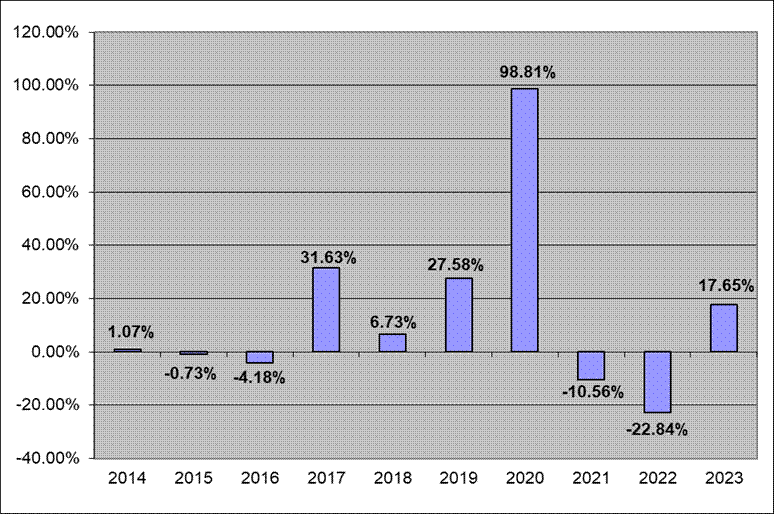
| 2014 | 1.07% |
| 2015 | -0.73% |
| 2016 | -4.18% |
| 2017 | 31.63% |
| 2018 | 6.73% |
| 2019 | 27.58% |
| 2020 | 98.81% |
| 2021 | -10.56% |
| 2022 | -22.84% |
| 2023 | 17.65% |
* The Fund’s No-Load Class year-to-date performance as of September 30, 2024 was 25.53%.
During the period shown in the chart for the No-Load
Class, the
| 4 |
Average Annual Total Returns
(For the periods ended December 31, 2023)
| 1 Year | 5 Year | 10 Year | |
| No-Load Class | |||
| Return Before Taxes | |||
| Return After Taxes on Distributions | |||
|
Return After Taxes on Distributions and Sale of Fund Shares |
|||
| S&P 500 Index (reflects no deduction for fees, expenses or taxes) |
The S&P 500 Index (the “Index”) is an unmanaged benchmark that assumes reinvestment of all distributions and excludes the effect of taxes and fees. The Index is a widely recognized unmanaged index of equity prices and is representative of a broader market and range of securities than is found in the Fund’s portfolio. Individuals cannot invest directly in the Index.
Management
Investment Adviser: Sparrow Capital Management, Inc., is the Fund’s investment adviser.
Portfolio Manager: Gerald Sparrow, the President and Chief Investment Officer of the adviser, has been the Fund’s sole portfolio manager since its inception in 1998.
| 5 |
Purchase and Sale of Fund No-Load Class Shares
The minimum initial and subsequent investment in the Fund’s No-Load Class is set forth in the table below.
| Account Type | Minimum Investment |
| Initial Investment: | |
| · Taxable Accounts | $2,500 |
| · Qualified Retirement Accounts | |
| without Automatic Investment Plan | $250 |
| with Automatic Investment Plan | None |
| · Educational IRAs | |
| without Automatic Investment Plan | $500 |
| with Automatic Investment Plan | None |
| Subsequent Investments: | |
| · Taxable Accounts | $100 |
| · Qualified Retirement Accounts | |
| without Automatic Investment Plan | $50 |
| with Automatic Investment Plan | $50 for minimum of 12 consecutive months |
| · Educational IRAs | |
| without Automatic Investment Plan | None |
| with Automatic Investment Plan | $50 for minimum of 12 consecutive months |
You may purchase and redeem shares of the Fund on any day that the New York Stock Exchange is open. Redemption requests may be made in writing, by telephone or through a financial intermediary and will be paid by check or wire transfer.
Tax Information
Dividends and capital gain distributions you receive from the Fund are taxable to you at either ordinary income or capital gains tax rates unless you are investing through a tax-deferred account such as an IRA or 401(k).
Financial Intermediary Compensation
If you purchase the Fund through a broker-dealer or other financial intermediary (such as a bank), the Fund and its related companies may pay the intermediary for the sale of Fund shares and related services. These payments may create a conflict of interest by influencing the broker-dealer or other intermediary and your salesperson to recommend the Fund over another investment. Ask your salesperson or visit your financial intermediary’s website for more information.
| 6 |
ADDITIONAL INFORMATION ABOUT THE FUND'S PRINCIPAL INVESTMENT STRATEGIES AND RELATED RISKS
Investment Objective
The investment objective of the Sparrow Growth Fund (the “Fund”) is long-term capital appreciation. The Fund’s investment objective may be changed without shareholder approval.
Principal Investment Strategies of the Fund
The Fund typically invests in a broad range of U.S. common stocks which Sparrow Capital Management, Inc., the Fund’s adviser, believes have above-average prospects for appreciation, based on a proprietary investment model developed by the adviser. The model looks at a variety of factors to select stocks that the adviser believes demonstrate strong earnings momentum. These growth momentum factors include expanding profit margins, accelerating earnings, positive earnings surprises, positive earnings estimate revisions, and positive relative price strength.
The adviser believes that buying stocks of good businesses with strong earnings-per-share growth prospects at reasonable prices is the best formula for long-term success, rather than chasing hot sectors. In determining whether prices are reasonable, the adviser attempts to determine value by comparing a company’s assets and business strengths to the current price of the company’s stock. In valuing a company, the adviser takes a long-term approach, with an emphasis on management strength and the fundamental profitability of the company’s business. To assess management strength, the adviser looks for characteristics such as a long-term record of success or positive opinions from industry observers. The adviser also may select stocks of companies whose businesses it expects to be impacted in a favorable manner by new products, services or contracts, regulatory action and/or trends in the economy. At time, the Fund may focus its investments in the healthcare and/or technology sector.
The Fund may invest in stocks of all market capitalization ranges based on the adviser’s assessment of the relative opportunities and risks of each category. This means the Fund may invest in companies of all sizes, which includes large-, mid-, and small-cap securities. Small-cap companies are defined by the adviser has those having market capitalization of less than $1 billion. Mid-cap companies are defined by the adviser as those having market capitalization between $1 billion and $5 billion. Large-cap companies are defined by the adviser as those having market capitalization in excess of $5 billion.
Temporary Defensive Positions
From time to time, the Fund may take temporary defensive positions, which are inconsistent with the Fund’s principal investment strategies, in attempting to respond to adverse market, economic, political, or other conditions. For example, the Fund may hold all or a portion of its assets in money market funds, investment grade short-term money market instruments including U.S. Government and agency securities, commercial paper, certificates of deposit, repurchase agreements and other cash equivalents. As a result of engaging in these temporary measures, the Fund may not achieve its investment objective. The Fund may also invest in these money market instruments at any time to maintain liquidity or pending selection of investments in accordance with its policies.
| 7 |
Principal Risks of Investing in the Fund
| · | Market Risk. Overall stock market risks may affect the value of the Fund. Factors such as domestic economic growth and market conditions, interest rate levels, climate-change and climate-related events, global pandemics and political events affect the securities markets and could cause the Fund’s share price to fall. |
| · | Company Risk. The value of the Fund may decrease in response to the activities and financial prospects of an individual company in the Fund’s portfolio. The value of an individual company can be more volatile than the market as a whole. |
| · | Management Risk. The Fund typically invests in companies that appear to be growth-oriented companies. Growth companies are companies that the adviser believes will have revenue and earnings that grow faster than the economy as a whole, offering above-average prospectus for capital appreciation and little or no emphasis on dividend income. The adviser’s skill in choosing appropriate investments will play a large part in determining whether the Fund is able to achieve its investment objective. If the adviser’s assessment of the prospects for individual securities is incorrect, it could result in significant losses in the Fund’s investment in those securities, which can also result in possible losses overall for the Fund. |
| · | Mid Cap Risk. Stocks of mid-cap companies are riskier than stocks of larger companies. Many of these companies are young and have a limited track record. Their securities may trade less frequently and in more limited volume than those of more mature companies. Mid-cap companies also may lack the managerial, financial or other resources necessary to implement their business plans or succeed in the face of competition. The prospects for a company or its industry may deteriorate because of a variety of factors, including disappointing operating results or changes in the competitive environment. |
| · | Small Cap Risk. To the extent the Fund invests in small-cap companies, the Fund will be subject to additional risks. These include: |
| · | The earnings and prospects of smaller companies are more volatile than larger companies. |
| · | Smaller companies may experience higher failure rates than do larger companies. |
| · | The trading volume of securities of smaller companies is normally less than that of larger companies and, therefore, may disproportionately affect their market price, tending to make them fall more in response to selling pressure than is the case with larger companies. |
| · | Smaller companies may have limited markets, product lines or financial resources and may lack management experience. |
| · | Sector Risk. If the Fund’s portfolio is overweighted in a certain industry sector, any negative development affecting that sector will have a greater impact on the Fund than a fund that is not overweighted in that sector. |
Healthcare Sector Risk. The profitability of companies in the healthcare sector may be affected by government regulations and government healthcare programs, increases or decreases in the cost of medical products and services, an increased emphasis on outpatient services, demand for medical products and services and product liability claims, among other factors. Many healthcare companies are heavily dependent on patent protection, and the expiration of a company’s patent may adversely affect that company’s profitability. Healthcare companies are subject to competitive forces that may result in price discounting, and may be thinly capitalized and susceptible to product obsolescence.
| 8 |
Portfolio Holdings
A description of the Fund’s policies regarding the release of portfolio holdings information is available in the Fund’s Statement of Additional Information. Shareholders may request the Fund’s most recently quarterly portfolio holdings schedule at no charge by calling (888) 727-3301.
Cybersecurity
The computer systems, networks and devices used by the Fund and its service providers to carry out routine business operations employ a variety of protections designed to prevent damage or interruption from computer viruses, network failures, computer and telecommunication failures, infiltration by unauthorized persons and security breaches. Despite the various protections utilized by the Fund and its service providers, systems, networks, or devices potentially can be breached. The Fund and shareholders could be negatively impacted as a result of a cybersecurity breach.
Cybersecurity breaches can include unauthorized access to systems, networks, or devices; infection from computer viruses or other malicious software code; and attacks that shut down, disable, slow, or otherwise disrupt operations, business processes, or website access or functionality. Cybersecurity breaches may cause disruptions and impact the Fund's business operations, potentially resulting in: financial losses; interference with the Fund's ability to calculate NAV; impediments to trading; the inability of the Fund, the Adviser, and other service providers to transact business; violations of applicable privacy and other laws; regulatory fines, penalties, reputational damage, reimbursement or other compensation costs, or additional compliance costs; as well as the inadvertent release of confidential information.
Similar adverse consequences could result from cybersecurity breaches affecting issuers of securities in which the Fund invests; counterparties with which the Fund engages in transactions; governmental and other regulatory authorities; exchange and other financial market operators, banks, brokers, dealers, insurance companies, and other financial institutions (including financial intermediaries and service providers for the Fund's shareholders); and other parties. In addition, substantial costs may be incurred by these entities in order to prevent any cybersecurity breaches in the future.
MANAGEMENT OF THE FUND
Investment Adviser: Sparrow Capital Management, Inc., 8500 Maryland Avenue, Suite 743, St. Louis, Missouri 63105, manages the Fund’s investments. The adviser is an independent registered investment adviser and, as of November 30, 2024, had $224,227,607 of equity and fixed income assets under management. Clients primarily include high net worth individuals and families, but also include a number of institutional clients such as pension funds. The firm was founded in 1988 by President Gerald R. Sparrow.
Mr.
Sparrow controls the adviser.
For the fiscal year ended August 31, 2024, the Fund paid the adviser a management fee equal to 1.00% of the Fund’s average daily net assets.
| 9 |
The Fund’s annual report for the year ended August 31, 2024 contains information about the factors that the Board of Trustees considered in renewing the Fund’s management agreement with Sparrow Capital Management on July 25, 2024.
Portfolio Manager:
Mr. Gerald Sparrow is the Fund’s sole portfolio manager, with day-to-day responsibility for managing the Fund’s portfolio and selecting its portfolio securities. Mr. Sparrow is the President and Chief Investment Officer of the adviser and guides the growth, development, and overall investment philosophy of the adviser. Mr. Sparrow has over 20 years of investment management experience. In addition to his responsibilities at the adviser, Mr. Sparrow also serves as the general partner of a private investment partnership. Mr. Sparrow graduated summa cum laude from the University of Missouri with a BS in Business in 1985 and he received an MBA from Washington University in 1987. Mr. Sparrow has served as a portfolio manager for the Fund since its inception in 1998.
The Fund’s Statement of Additional Information provides additional information about the portfolio manager, including his compensation, other accounts that he manages, and his ownership of shares of the Fund.
DETERMINATION OF NET ASSET VALUE
The price you pay for your shares of the Fund is based on the net asset value per share (“NAV”). The No-Load Class NAV is calculated as of the close of trading (normally 4:00 p.m. Eastern time) on each business day on which the New York Stock Exchange is open for trading (“Business Day”). The Stock Exchange is closed on weekends, most federal holidays, and during some emergencies. The No-Load Class NAV is calculated separately by dividing the value of the total assets of the class (including dividends and interest accrued but not yet received) minus liabilities of the class (including accrued expenses) by the total number of outstanding shares of the class. Purchases and redemptions of No-Load Class shares of the Fund will be made at the NAV next calculated after an order is received by the Fund, or a person authorized by the Fund, in proper form. Because the value of the Fund’s investment portfolio changes every Business Day, the NAV usually changes as well.
Securities held by the Fund generally are valued at market value. Short-term securities with maturities of 60 days or less are valued based on amortized cost. If market quotations are not readily available or are deemed unreliable, the security will be valued at a fair value determined in good faith by the adviser, in accordance with policies and procedures adopted and regularly reviewed for appropriateness and accuracy by the Board of Trustees. Fair valuation also is permitted if, in the adviser’s opinion, the validity of market quotations appears to be questionable based on factors such as evidence of a thin market in the security based on a small number of quotations, a significant event occurs after the close of a market but before the Fund’s NAV calculation that may affect a security’s value, or the adviser is aware of any other data that calls into question the reliability of market quotations. Without fair valuation, short-term traders could take advantage of the arbitrage opportunity and dilute the NAV of long-term investors. Investments in foreign securities or other thinly traded securities are more likely to trigger fair valuation than other securities. Fair valuation of the Fund’s portfolio securities can serve to reduce arbitrage opportunities available to short-term traders, but there is no assurance that fair value pricing policies will prevent dilution of the Fund’s NAV by short-term traders, or that the Fund will realize fair valuation upon the sale of a security.
| 10 |
HOW TO BUY NO-LOAD CLASS SHARES
The Fund offers three classes of shares. Only No-Load Class shares are offered in this prospectus. In addition to the No-Load Class shares, Class A and Class C shares are offered through a different prospectus and each have a different fee structure and sales charge. There are many factors to consider when choosing the share class that is appropriate for your investment needs. Some of these include the amount of your initial investment, the total amount you intend to invest over time, and how long you intend to hold your investment before redeeming your shares of the Fund. You may wish to consult with your financial adviser for advice with regard to which share class would be most appropriate for you.
The No-Load Class shares are sold to clients of registered investment advisers, financial planners or other institutional investors or other platform offered by any 401(k) plan, bank, trust company or broker-dealer that has entered into a selling agreement with the Fund’s distributor. The No-Load Class shares may also be purchased directly from the Fund through the distributor or the Fund’s adviser. For more information, call Mutual Shareholder Services, LLC (“Shareholder Services”) at (888) 727-3301. The No-Load shares are purchased at net asset value without deducting a sales charge. You do not pay an initial sales charge on purchases of No-Load shares and all of your purchase payment is immediately invested in the Fund.
You may purchase No-Load Class shares of the Fund by investing the minimum amount required for the type of shares you are purchasing, and the type of account that you open, as described below. The adviser may waive these minimum investments in its sole discretion. If your investment is aggregated into an omnibus account established by an investment adviser, broker-dealer or other financial intermediary, the investment minimums apply to the omnibus account, not to your individual account; however, the financial intermediary may also impose minimum requirements that are different from those set forth in this prospectus. If you purchase or redeem shares through a financial intermediary, you may be charged a fee by that intermediary.
| Account Type | Minimum Investment |
| Initial Investment: | |
| · Taxable Accounts | $2,500 |
| · Qualified Retirement Accounts | |
| without Automatic Investment Plan | $250 |
| with Automatic Investment Plan | None |
| · Educational IRAs | |
| without Automatic Investment Plan | $500 |
| with Automatic Investment Plan | None |
| Subsequent Investments: | |
| · Taxable Accounts | $100 |
| · Qualified Retirement Accounts | |
| without Automatic Investment Plan | $50 |
| with Automatic Investment Plan | $50 for minimum of 12 consecutive months |
| · Educational IRAs | |
| without Automatic Investment Plan | None |
| with Automatic Investment Plan | $50 for minimum of 12 consecutive months |
| 11 |
Initial Purchase: You may open an account and make an initial investment through securities dealers having a sales agreement with the Fund’s distributor. You may also invest directly by mail or by wire:
By Mail: To be in proper form, your initial purchase request must include:
| · | a completed and signed investment application form which accompanies this Prospectus; and |
| · | a check (subject to the minimum amounts) made payable to the Fund. |
Mail the completed application and check to:
via U.S. Mail or Overnight
Sparrow Growth Fund
c/o Mutual Shareholder Services, LLC
8000 Town Centre Drive, Suite 400
Broadview Heights, Ohio 44147
By Wire: You may also purchase shares of the Fund by wiring federal funds from your bank, which may charge you a fee for doing so. To wire money, you must call Shareholder Services at (888) 727-3301 to obtain instructions on how to set up your account and to obtain an account number. You should be prepared at that time to provide the information on the application.
You must mail a signed application to Mutual Shareholder Services, LLC (the Fund’s transfer agent), at the above address in order to complete your initial wire purchase. Wire orders will be accepted only on a day on which the Fund, custodian and transfer agent are open for business. A wire purchase will not be considered made until the wired money is received and the purchase is accepted by the Fund. Any delays which may occur in wiring money, including delays which may occur in processing by the banks, are not the responsibility of the Fund or the transfer agent. There is presently no fee for the receipt of wired funds, but the Fund may charge shareholders for this service in the future.
Automatic Investment Plan
You may make regular investments in the Fund with an Automatic Investment Plan by completing the appropriate section of the account application and attaching a voided personal check, and mailing to Mutual Shareholder Services, LLC, the Fund’s transfer agent. Investments may be made monthly to allow dollar-cost averaging by automatically deducting the applicable minimum set forth in the table above from your bank checking account. You may change the amount of your monthly purchase at any time. If an Automatic Investment Plan purchase is rejected by your bank, your shareholder account will be charged a fee of $35 to defray bank charges.
Additional Investments
You may purchase additional shares of the Fund at any time (subject to minimum investment requirements) by mail, wire, or automatic investment. Each additional mail purchase request must contain:
-your name -the name of your account(s)
-your account number(s) -a check made payable to Sparrow Growth Fund
| 12 |
Checks should be sent to the Sparrow Growth Fund at the address listed under “Initial Purchase – By Mail.” A bank wire should be sent as outlined under “Initial Purchase – By Wire.”
Tax Sheltered Retirement Plans
The Fund may be an appropriate investment medium for tax-sheltered retirement plans, including: individual retirement plans (IRAs); simplified employee pensions (SEPs); 401(k) plans; qualified corporate pension and profit-sharing plans (for employees); tax deferred investment plans (for employees of public school systems and certain types of charitable organizations); and other qualified retirement plans. You should contact the Fund’s transfer agent at (888) 727-3301 for the procedure to open an IRA or SEP plan, as well as more specific information regarding these retirement plan options. Please consult with an attorney or tax adviser regarding these plans. You must pay custodial fees for your IRA by redemption of sufficient shares of the Fund from the IRA unless you pay the fees directly to the IRA custodian. Call Shareholder Services about the IRA custodial fees at (888) 727-3301.
Other Purchase Information
No-Load shares of the Fund are sold on a continuous basis at the net asset value next determined after receipt of a purchase order by the Fund or person authorized by the Fund. The Fund has authorized certain broker-dealers and other financial institutions (including their designated intermediaries) to accept on its behalf purchase and sell orders. The Fund is deemed to have received an order when the authorized person or designee receives the order, and the order is processed at the net asset value next calculated thereafter. It is the responsibility of the broker-dealer or other financial institution to transmit orders promptly to the Fund’s transfer agent. If you choose to purchase shares directly from the Fund, you will not incur charges on purchases and redemptions. However, if you purchase or redeem shares through an intermediary, you may be charged a fee by that intermediary.
The Fund may limit the number of purchases and refuse to sell shares to any person. If your check or wire does not clear, you will be responsible for any loss incurred by the Fund. You may be prohibited or restricted from making future purchases in the Fund. Checks should be made payable to the Fund. The Fund and its transfer agent may refuse any purchase order for any reason. Cash, third party checks (except for properly endorsed IRA rollover checks), counter checks, starter checks, traveler’s checks, money orders, (other than money orders issued by a bank), credit card checks, and checks drawn on non-U.S. financial institutions will not be accepted. Cashier’s checks, bank official checks, and bank money orders may be accepted in amounts greater than $10,000. In such cases, a fifteen (15) business day hold will be applied to the funds (which means that you may not redeem your shares until the holding period has expired).
HOW TO EXCHANGE SHARES
You may exchange your No-Load Class shares of the Fund for another class of the Fund. In general, the same rules and procedures that apply to sales and purchases apply to exchanges. You may call Shareholder Services at (888) 727-3301 to exchange shares. An exchange may also be made by written request signed by all registered owners of the account mailed to the address listed above. Requests for exchanges will be processed at the next calculated NAV after receipt of the request (e.g., prior to close of trading on the New York Stock Exchange (4:00 p.m. Eastern time)).
An exchange is made by selling your No-Load Class shares of Fund and using the proceeds to buy shares of another class at the NAV next calculated after your request, plus any applicable sales charge.
| 13 |
For more information about the Class A shares and Class C shares and the sales charges imposed on purchases of such shares, call Shareholder Services at (888) 727-3301. An exchange results in a sale of shares for federal income tax purposes. If you make use of the exchange privilege, you may realize either a long-term or short-term capital gain or loss on the shares sold.
If your exchange creates a new account, you must satisfy the requirements of the Class in which shares are being purchased. You may make an exchange to a new account or an existing account; however, the account ownership must be identical. Exchanges may be made only in states where an exchange may legally be made. The Fund reserves the right to terminate or modify the exchange privilege at any time.
HOW TO REDEEM SHARES
The Fund typically expects that it will take between 5 business days following the receipt of your redemption request to pay out redemption proceeds by check or electronic transfer. The Fund typically expects to pay redemptions from cash, cash equivalents, proceeds from the sale of Fund shares, any lines of credit, and then from the sale of portfolio securities. These redemption payment methods will be used in regular and stressed market conditions. The proceeds may be more or less than the purchase price of your shares, depending on the market value of the Fund’s securities at the time of your redemption. A wire transfer fee of $15 is charged to defray custodial charges for redemptions paid by wire transfer. The fee is subject to change. Any charges for wire redemptions will be deducted from your Fund account by redemption of shares. If you redeem your shares through a broker/dealer or other institution, you may be charged a fee by that institution.
By Mail: You may redeem any part of your account in the Fund by mail. Your request should be addressed to:
via U.S. Mail or Overnight:
Sparrow Growth Fund
c/o Mutual Shareholder Services, LLC
8000 Town Centre Drive, Suite 400
Broadview Heights, Ohio 44147
Your request for a redemption must include your letter of instruction, including the Fund name, account number, account name(s), the address, and the dollar amount or number of shares you wish to redeem. Requests to sell shares that are received in proper form are processed at the net asset value next calculated after we receive your order in proper form. To be in proper form, your request must be signed by all registered share owner(s) in the exact name(s) and any special capacity in which they are registered. The Fund may require that signatures be guaranteed if you request the redemption check be made payable to any person other than the shareholder(s) of record or mailed to an address other than the address of record, or if the mailing address has been changed within 30 days of the redemption request. The Fund may also require a signature guarantee for redemptions of $25,000 or more. Signature guarantees are for the protection of shareholders. All documentation requiring a signature guarantee stamp must utilize a New Technology Medallion stamp, generally available from the bank where you maintain a checking or savings account. You can obtain a signature guarantee from most banks and securities dealers, but not from a notary public. For joint accounts, both signatures must be guaranteed. Please call Shareholder Services at (888) 727-3301 if you have questions. At the discretion of the Fund or the Fund’s transfer agent, you may be required to furnish additional legal documents to insure proper authorization.
| 14 |
By Telephone: You may redeem any part of your account in the Fund by calling Shareholder Services at (888) 727-3301. You must first complete the Telephone Redemption section of the investment application to institute this option. Telephone redemption requests are subject to the signature guarantee requirements set forth in the previous paragraph. The Fund, the transfer agent and the custodian are not liable for following redemption instructions communicated by telephone that they reasonably believe to be genuine. However, if they do not employ reasonable procedures to confirm that telephone instructions are genuine, they may be liable for any losses due to unauthorized or fraudulent instructions. Procedures employed may include recording telephone instructions and requiring a form of personal identification from the caller.
The Fund or the transfer agent may terminate the telephone redemption procedures at any time. During periods of extreme market activity, it is possible that shareholders may encounter some difficulty in telephoning the Fund, although neither the Fund nor the transfer agent has ever experienced difficulties in receiving, and in a timely fashion, responding to telephone requests for redemptions. If you are unable to reach the Fund by telephone, you may request a redemption by mail.
Policy on Market Timing: The Fund discourages market timing. Market timing is an investment strategy using frequent purchases, redemptions and/or exchanges in an attempt to profit from short term market movements. Market timing may result in dilution of the value of Fund shares held by long term shareholders, disrupt portfolio management and increase Fund expenses for all shareholders. The Board of Trustees will not permit the Fund to enter into any arrangements with any person to permit frequent purchases and redemptions of Fund shares.
Upon identification of any investor who makes two trades into and out of the Fund (each a “roundtrip”) within one year, the Fund will send a written warning to such investor that if such trading continues, they will be forbidden from any further trading in the Fund. Should any roundtrip take place after the investor has received such warning, the investor will be forbidden from making future purchases of Fund shares.
While the Fund attempts to deter market timing, there is no assurance that the Fund will be able to identify and eliminate all market timers. For example, certain accounts called “omnibus accounts” include multiple shareholders. Despite the Fund’s efforts to detect and prevent abusive trading activities, it may be difficult to identify such activity in certain omnibus accounts traded through a financial intermediary. Omnibus accounts typically provide the Fund with a net purchase or redemption request on any given day where purchasers of Fund shares and redeemers of Fund shares are netted against one another and the identity of individual purchasers and redeemers whose orders are aggregated is not known by the Fund. Consequently, the Fund may not have knowledge of the identity of investors and their transactions. Under a Securities and Exchange Commission rule, the Fund is required to have an agreement with its intermediaries obligating the intermediaries to provide, upon the Fund’s request, information regarding the intermediaries’ customers and their transactions. However, there can be no guarantee that all excessive, short-term or other abusive trading activities will be detected, even if such an agreement is in place. Certain intermediaries, in particular retirement plan sponsors and administrators, may have less restrictive policies regarding short-term trading. The Fund reserves the right to reject any purchase order for any reason, including purchase orders that it does not think are in the best interest of the Fund or its shareholders or if the Fund thinks that trading is abusive.
Additional Information: If you are not certain of the requirements for a redemption please call Shareholder Services at (888) 727-3301. Redemptions specifying a certain date or share price cannot be accepted and will be returned. You will be mailed the proceeds on or before the fifth business day following the redemption. However, payment for redemption made against shares purchased by check will be made only after the check has been collected, which normally may take up to fifteen calendar days.
| 15 |
Also, when the New York Stock Exchange is closed (or when trading is restricted) for any reason other than its customary weekend or holiday closing, or under any emergency circumstances (as determined by the Securities and Exchange Commission) the Fund may suspend redemptions or postpone payment dates. You may be assessed a fee if the Fund incurs bank charges because you direct the Fund to re-issue a redemption check.
Redemption proceeds sent by check by the Fund and not cashed within 180 days will be reinvested in the Fund at the current day’s NAV. Redemption proceeds that are reinvested are subject to the risk of loss like any other investment in the Fund.
In addition to paying redemption proceeds in cash, the Fund reserves the right to make payment for a redemption in securities rather than cash, which is known as a “redemption in kind.” Redemptions in kind will be made only under extraordinary circumstances and if the Fund deems it advisable for the benefit of all shareholders, such as a very large redemption that could affect Fund operations (for example, more than 1% of the Fund’s net assets). A redemption in kind will consist of securities equal in market value to the Fund shares being redeemed, using the same valuation procedures that the Fund uses to compute its NAV. If the Fund redeems your shares in kind, you will bear the market risks associated with maintaining or selling the securities that are transferred as redemption proceeds. In addition, when you sell these securities, you will pay taxes and brokerage charges, if any, associated with selling the securities.
All shares of the Fund are also subject to involuntary redemption if the Board of Trustees determines to liquidate the Fund. The Board may close the Fund upon notice to shareholders but without having to obtain shareholder approval. An involuntary redemption will create a capital gain or a capital loss which may have tax consequences about which you should consult a tax adviser.
DIVIDENDS, DISTRIBUTIONS AND TAXES
Dividends and Distributions. The Fund typically distributes to its shareholders as dividends substantially all of its net investment income and any realized net capital gains. These distributions are automatically reinvested in the Fund unless you request cash distributions on your application or through a written request. The Fund expects that its distributions will consist primarily of capital gains.
Taxes. Net investment income distributed by the Fund generally will consist of interest income and dividends received on investments, less expenses. The dividends you receive, whether or not reinvested, will be taxed as ordinary income. Dividends normally will be distributed by the Fund on an annual basis.
The Fund typically distributes net realized capital gains (i.e., the difference between the net long-term capital gain and net short-term capital loss) to shareholders at least once a year. Capital gains are generated when the Fund sells its capital assets for a profit. Capital gains are taxed differently depending on how long the Fund held the capital asset sold. You may want to avoid making a substantial investment when the Fund is about to make a taxable distribution because you would be responsible for any taxes on the distribution regardless of how long you have owned your shares. Any amount the Fund distributes in excess of its income and gains is generally treated as a non-taxable return of capital.
Unless you indicate another option on your account application, any dividends and capital gain distributions paid to you by the Fund automatically will be invested in additional Fund shares.
| 16 |
Alternatively, you may elect to have: (1) dividends paid to you in cash and the amount of any capital gain distributions reinvested; or (2) the full amount of any dividends and capital gain distributions paid to you in cash. The Fund will send dividends and capital gain distributions elected to be received as cash to the address of record or bank of record on the applicable account. Your distribution option will automatically be converted to having all dividends and other distributions reinvested in additional shares if any of the following occur:
| · | Postal or other delivery service is unable to deliver checks to the address of record; |
| · | Dividends and capital gain distributions are not cashed within 180 days; or |
| · | Bank account of record is no longer valid. |
Dividends and capital gain distribution checks issued by the Fund that are not cashed within 180 days will be reinvested in the Fund at the current day’s NAV. When reinvested, those amounts are subject to the risk of loss like any other investment in the Fund.
Selling shares (including redemptions) and receiving distributions (whether reinvested or taken in cash) usually are taxable events to the Fund’s shareholders.
Because your tax situation is unique, you should consult your tax professional about federal, state and local tax consequences.
| 17 |
FINANCIAL HIGHLIGHTS
The financial highlights table is intended to help you understand the Fund’s financial performance for the past 5 years. The total returns in the table represent the rate that you would have earned (or lost) on an investment in the Fund’s No-Load Class (assuming reinvestment of all dividends and distributions). Certain information reflects financial results for a single No-Load Class share. This information has been audited by the Fund’s independent registered public accounting firm, Cohen & Company, Ltd., whose report, along with the Fund’s financial statements, are included in the Fund’s Form N-CSR for the fiscal year ended August 31, 2024, which is available upon request and without charge by calling Shareholder Services at (888) 727-3301.
Selected data for a share outstanding throughout each year.
| Years Ended | ||||||
| 8/31/2024 | 8/31/2023 | 8/31/2022 | 8/31/2021 | 8/31/2020 | ||
| Net Asset Value, at Beginning of Year | $ 32.66 | $ 33.96 | $ 50.62 | $ 40.08 | $ 25.35 | |
| Income (Loss) From Investment Operations: | ||||||
| Net Investment Loss (a) | (0.23) | (0.03) | (0.23) | (0.60) | (0.43) | |
|
Net Gain (Loss) on Investments (Realized and Unrealized) |
9.68 |
4.28 |
(16.43) | 11.48 | 15.51 | |
| Total from Investment Operations | 9.45 | 4.25 | (16.66) | 10.88 | 15.08 | |
| Distributions: | ||||||
| Realized Gains | - | (5.55) | - | (0.34) | (0.35) | |
| Total from Distributions | - | (5.55) | - | (0.34) | (0.35) | |
| Net Asset Value, at End of Year | $ 42.11 | $ 32.66 | $ 33.96 | $ 50.62 | $ 40.08 | |
| Total Return (b) | 28.93% | 14.55% | (32.91)% | 27.14% | 60.27% | |
| Ratios/Supplemental Data: | ||||||
| Net Assets at End of Year (Thousands) | $ 32,560 | $ 24,719 | $ 20,008 | $ 48,818 | $ 22,345 | |
| Ratio of Expenses to Average Net Assets | 1.35% | 1.44% | 1.39% | 1.30% | 1.57% | |
| Ratio of Net Investment Loss to Average Net Assets |
(0.63)% |
(0.09)% |
(0.56)% | (1.23)% | (1.54)% | |
| Portfolio Turnover (c) | 20.81% | 55.79% | 192.58% | 44.86% | 13.14% | |
(a) Per share net investment loss has been determined on the basis of average shares outstanding during the period.
(b) Total return represents the rate that the investor would have earned or lost on an investment in the Fund assuming reinvestment of dividends.
(c) Portfolio turnover is calculated on the basis of the Fund as a whole without distinguishing between the classes.
| 18 |
PRIVACY POLICY
The following is a description of the Fund’s policies regarding disclosure of nonpublic personal information that you provide to the Fund or that the Fund collects from other sources. In the event that you hold shares of the Fund through a broker-dealer or other financial intermediary, the privacy policy of your financial intermediary would govern how your nonpublic personal information would be shared with nonaffiliated third parties.
Categories of Information the Fund Collects. The Fund collects the following nonpublic personal information about you:
| · | Information the Fund receives from you on applications or other forms, correspondence, or conversations (such as your name, address, phone number, social security number and date of birth); and |
| · | Information about your transactions with the Fund, its affiliates, or others (such as your account number and balance, payment history, parties to transactions, cost basis information, and other financial information). |
Categories of Information the Fund Discloses. The Fund does not disclose any nonpublic personal information about its current or former shareholders to affiliated or unaffiliated third parties, except as required or permitted by law. The Fund is permitted by law to disclose all of the information it collects, as described above, to its service providers (such as the Fund’s custodian, administrator and transfer agent) to process your transactions and otherwise provide services to you.
Confidentiality and Security. The Fund restricts access to your nonpublic personal information to those persons who require such information to provide products or services to you. The Fund maintains physical, electronic, and procedural safeguards that comply with federal standards to guard your nonpublic personal information.
Disposal of Information. The Fund, through its transfer agent, has taken steps to reasonably ensure that the privacy of your nonpublic personal information is maintained at all times, including in connection with the disposal of information that is no longer required to be maintained by the Fund. Such steps shall include, whenever possible, shredding paper documents and records prior to disposal, requiring off-site storage vendors to shred documents maintained in such locations prior to disposal, and erasing and/or obliterating any data contained on electronic media in such a manner that the information can no longer be read or reconstructed.
| 19 |
FOR MORE INFORMATION
Several additional sources of information are available to you. The Statement of Additional Information (SAI), incorporated into this prospectus by reference, contains detailed information on Fund policies and operations, including policies and procedures relating to the disclosure of Fund portfolio holdings by the Fund’s affiliates. Additional information about the Fund’s investments is available in the Fund’s annual and semi-annual reports to shareholders. In the Fund’s annual report, you will find a discussion of the market conditions and investment strategies that significantly affected the Fund’s performance during its last fiscal year. Call Shareholder Services at (888) 727-3301 to request free copies of the SAI and the Fund’s annual and semi-annual reports, to request other information about the Fund and to make shareholder inquiries. The Fund will send the requested documents within 3 business days of receipt of the request. Due to the costs of maintaining www.sparrowcapital.com, the Sparrow Growth Fund’s SAI or annual and semi-annual reports cannot currently be downloaded from its website.
You may review and obtain information about the Fund (including the SAI and other reports) on the EDGAR Database on the SEC’s Internet site at http://www.sec.gov, and copies of this information may be obtained, after paying a duplicating fee, by electronic request at the following e-mail address: [email protected], or by writing the SEC’s Public Reference Section, Washington, D.C. 20549-0102.
Investment Company Act File No. 811-08897
| 20 |
Sparrow Growth Fund
Class A
(SGFFX)
Class C
(SGFCX)
Prospectus
December 31, 2024
INVESTMENT OBJECTIVE:
Long term capital appreciation
The Securities and Exchange Commission has not approved or disapproved these securities or determined if this prospectus is truthful or complete. Any representation to the contrary is a criminal offense.
| TABLE OF CONTENTS | |
| SPARROW GROWTH FUND SUMMARY | 1 |
| Investment Objective | 1 |
| Fees and Expenses of the Fund | 1 |
| Portfolio Turnover | 2 |
| Principal Investment Strategies of the Fund | 2 |
| Principal Risks of Investing in the Fund | 2 |
| Is the Fund Right for You? | 3 |
| Performance | 3 |
| Management | 5 |
| Purchase and Sale of Fund Shares | 5 |
| Tax Information | 6 |
| Financial Intermediary Compensation | 6 |
| ADDITIONAL INFORMATION ABOUT THE FUND’S PRINCIPAL INVESTMENT | |
| STRATEGIES AND RELATED RISKS | 7 |
| Investment Objective | 7 |
| Principal Investment Strategies of the Fund | 7 |
| Temporary Defensive Positions | 7 |
| Principal Risks of Investing in the Fund | 8 |
| Portfolio Holdings | 9 |
| Cybersecurity | 9 |
| MANAGEMENT OF THE FUND | 10 |
| DETERMINATION OF NET ASSET VALUE | 10 |
| HOW TO BUY SHARES | 11 |
| Sales Charges Applicable to Class A Shares | 13 |
| Sales Charge Reduction and Waivers | 13 |
| Automatic Investment Plan | 17 |
| Distribution Plans | 17 |
| Additional Investments | 17 |
| Tax Sheltered Retirement Plans | 18 |
| Other Purchase Information | 18 |
| HOW TO EXCHANGE SHARES | 18 |
| HOW TO REDEEM SHARES | 19 |
| DIVIDENDS, DISTRIBUTIONS AND TAXES | 22 |
| FINANCIAL HIGHLIGHTS | 23 |
| PRIVACY POLICY | 25 |
| FOR MORE INFORMATION | 26 |
SPARROW GROWTH FUND SUMMARY
The investment objective of the Sparrow Growth Fund is long-term capital appreciation.
This table describes the fees and expenses that you may pay if you buy, sell and hold shares of the Fund. You may qualify for sales charge discounts if you and or your family invest, or agree to invest in the future, at least $50,000 in Class A shares of the Fund. More information about these and other discounts is available from your financial professional, in the section entitled “Sales Charge Reduction and Waivers” on page 13 of this prospectus, in the attached Appendix A and in the section entitled “Determination of Net Asset Value” on page 22 of the Fund’s Statement of Additional Information.
| Class A | Class C | |
| Maximum Sales Charge (Load) Imposed on Purchases (as a percentage of offering price) | ||
| Maximum Deferred Sales Charge (Load) (as a percentage of the lower of original purchase or redemption proceeds) |
| Class A | Class C | |
| Management Fees | ||
| Distribution (12b-1) Fees | ||
| Other Expenses | ||
| Total Annual Fund Operating Expenses |
The Example below is intended to help you compare the cost of investing in the Fund’s Class A and Class C shares with the cost of investing in other mutual funds. The Example assumes that you invest $10,000 in the Fund’s Class A and Class C shares for the time periods indicated and hold or redeem all of your shares at the end of those periods. The Example also assumes that your investment has a 5% return each year and that the Fund’s Class A and Class C operating expenses remain the same. Although your actual costs may be higher or lower, based on these assumptions your costs would be:
| 1 year | 3 years | 5 years | 10 years | |
| Class A | $ |
$ |
$ |
$ |
| Class C | $ |
$ |
$ |
$ |
| 1 |
The Fund pays transaction
costs, such as commissions, when it buys and sells securities (or “turns over” its portfolio). A higher portfolio turnover
rate may indicate higher transaction costs and may result in higher taxes when Fund shares are held in a taxable account. These costs,
which are not reflected in annual fund operating expenses or in the example, affect the Fund’s performance. During the most recent
fiscal year, the Fund’s portfolio turnover rate was
The Fund typically invests in a broad range of U.S. common stocks which Sparrow Capital Management, Inc., the Fund’s adviser, believes have above-average prospects for appreciation based on a proprietary investment model developed by the adviser. The model looks at a variety of factors to select stocks that the adviser believes demonstrate strong earnings momentum. These growth momentum factors include expanding profit margins, accelerating earnings, positive earnings surprises, positive earnings estimate revisions, and positive relative price strength. At times, the Fund may focus its investments in the healthcare and/or technology sector.
The Fund may invest in stocks of all market capitalization ranges based on the adviser’s assessment of the relative opportunities and risks of each category. Stocks are sold when there is a significant decline in earnings momentum, a better stock is found, or a significant breakdown in relative price performance occurs.
Principal Risks of Investing in the Fund
All mutual funds carry a certain amount of risk. The
Fund is not a complete investment program.
| · | Market Risk. Overall stock market risks may affect the value of the Fund. Factors such as domestic economic growth and market conditions, interest rate levels, climate-change and climate-related events, global pandemics and political events affect the securities markets and could cause the Fund’s share price to fall. |
| · | Company Risk. The value of the Fund may decrease in response to the activities and financial prospects of an individual company in the Fund’s portfolio. The value of an individual company can be more volatile than the market as a whole. |
| · | Management Risk. If the adviser’s assessment of the prospects for individual securities or a company’s growth potential is incorrect, the securities purchased may not perform as expected and could result in significant losses in the Fund’s investment in those securities and possible losses overall for the Fund. |
| · | Mid Cap Risk. Stocks of mid-cap companies are riskier than stocks of larger companies. Many of these companies are young and have a limited track record. Their securities may trade less frequently and in more limited volume than those of more mature companies. Mid-cap companies also may lack the managerial, financial or other resources necessary to implement their business plans or succeed in the face of competition. |
| · | Small Cap Risk. To the extent the Fund invests in small-cap companies, the Fund will be subject to additional risks. These include: |
| 2 |
| · | The earnings and prospects of smaller companies are more volatile than larger companies. |
| · | Smaller companies may experience higher failure rates than do larger companies. |
| · | The trading volume of securities of smaller companies is normally less than that of larger companies and, therefore, may disproportionately affect their market price, tending to make them fall more in response to selling pressure than is the case with larger companies. |
| · | Smaller companies may have limited markets, product lines or financial resources and may lack management experience. |
| · | Sector Risk. If the Fund’s portfolio is overweighted in a certain industry sector, any negative development affecting that sector will have a greater impact on the Fund than a fund that is not overweighted in that sector. |
Healthcare Sector Risk. The profitability of companies in the healthcare sector may be affected by government regulations and government healthcare programs, increases or decreases in the cost of medical products and services, an increased emphasis on outpatient services, demand for medical products and services and product liability claims, among other factors.
Is the Fund Right for You?
The Fund may be suitable for:
| · | Long-term investors seeking a mutual fund with a growth investment strategy |
| · | Investors willing to accept price fluctuations in their investment |
| · | Investors who can tolerate the risks associated with common stocks |
The following bar chart and table provide some indication
of the risks of investing in the Fund’s Class A shares by showing changes in the Class A shares’ performance from year to
year and by showing how the average annual returns of the Class A and Class shares for the 1-year, 5-year and 10-year periods compare
with those of a broad measure of market performance. To obtain updated performance information, please call
| 3 |

| 2014 | 0.87% |
| 2015 | -0.97% |
| 2016 | -4.42% |
| 2017 | 31.28% |
| 2018 | 6.56% |
| 2019 | 27.23% |
| 2020 | 97.82% |
| 2021 | -11.00% |
| 2022 | -23.21% |
| 2023 | 17.02% |
The Fund’s Class A Share year-to-date performance as of September 30, 2024 was 25.06%.
During the period shown in the chart for Class A,
the
| 4 |
Average Annual Total Returns
(For the periods ended December 31, 2023)
| 1 Year | 5 Year | 10 Year | |
| Class A Shares | |||
| Return Before Taxes | |||
| Return After Taxes on Distributions | |||
| Return After Taxes on Distributions and Sale of Fund Shares | |||
| Class C Shares | |||
| S&P 500 Index (reflects no deduction for fees, expenses or taxes) |
The S&P 500 Index (the “Index”) is an unmanaged benchmark that assumes reinvestment of all distributions and excludes the effect of taxes and fees. The Index is a widely recognized unmanaged index of equity prices and is representative of a broader market and range of securities than is found in the Fund’s portfolio. Individuals cannot invest directly in the Index.
Management
Investment Adviser: Sparrow Capital Management, Inc. is the Fund’s investment adviser.
Portfolio Manager: Gerald Sparrow, the President and Chief Investment Officer of the adviser, has been the Fund’s sole portfolio manager since its inception in 1998.
Purchase and Sale of Fund Shares
The minimum initial and subsequent investment in the Fund is set forth in the table below.
| Account Type | Minimum Investment |
| Initial Investment: | |
| · Taxable Accounts | $1,000 |
| · Qualified Retirement Accounts | |
| without Automatic Investment Plan | $100 |
| with Automatic Investment Plan | None |
| · Educational IRAs | |
| without Automatic Investment Plan | $200 |
| 5 |
| with Automatic Investment Plan | None |
| Subsequent Investments: | |
| · Taxable Accounts | $50 |
| · Qualified Retirement Accounts | |
| without Automatic Investment Plan | $25 |
| with Automatic Investment Plan | $25 for minimum of 12 consecutive months |
| · Educational IRAs | |
| without Automatic Investment Plan | None |
| with Automatic Investment Plan | $25 for minimum of 12 consecutive months |
You may purchase and redeem shares of the Fund on any day that the New York Stock Exchange is open. Redemption requests may be made in writing, by telephone or through a financial intermediary and will be paid by check or wire transfer.
Tax Information
Dividends and capital gain distributions you receive from the Fund are taxable to you at either ordinary income or capital gains tax rates unless you are investing through a tax-deferred account such as an IRA or 401(k).
Financial Intermediary Compensation
If you purchase the Fund through a broker-dealer or other financial intermediary (such as a bank), the Fund and its related companies may pay the intermediary for the sale of Fund shares and related services. These payments may create a conflict of interest by influencing the broker-dealer or other intermediary and your salesperson to recommend the Fund over another investment. Ask your salesperson or visit your financial intermediary’s website for more information.
| 6 |
ADDITIONAL INFORMATION ABOUT THE FUND’S PRINCIPAL INVESTMENT STRATEGIES AND RELATED RISKS
Investment Objective
The investment objective of the Sparrow Growth Fund (the “Fund”) is long-term capital appreciation. The Fund’s investment objective may be changed without shareholder approval.
Principal Investment Strategies of the Fund
The Fund typically invests in a broad range of U.S. common stocks which Sparrow Capital Management, Inc., the Fund’s adviser, believes have above-average prospects for appreciation, based on a proprietary investment model developed by the adviser. The model looks at a variety of factors to select stocks that the adviser believes demonstrate strong earnings momentum. These growth momentum factors include expanding profit margins, accelerating earnings, positive earnings surprises, positive earnings estimate revisions, and positive relative price strength.
The adviser believes that buying stocks of good businesses with strong earnings-per-share growth prospects at reasonable prices is the best formula for long-term success, rather than chasing hot sectors. In determining whether prices are reasonable, the adviser attempts to determine value by comparing a company’s assets and business strengths to the current price of the company’s stock. In valuing a company, the adviser takes a long-term approach, with an emphasis on management strength and the fundamental profitability of the company’s business. To assess management strength, the adviser looks for characteristics such as a long-term record of success or positive opinions from industry observers. The adviser also may select stocks of companies whose businesses it expects to be impacted in a favorable manner by new products, services or contracts, regulatory action and/or trends in the economy. At times, the Fund may focus its investments in the healthcare and/or technology sector.
The Fund may invest in stocks of all market capitalization ranges based on the adviser’s assessment of the relative opportunities and risks of each category. This means the Fund may invest in companies of all sizes, which includes large-, mid-, and small-cap securities. Small-cap companies are defined by the adviser has those having market capitalization of less than $1 billion. Mid-cap companies are defined by the adviser as those having market capitalization between $1 billion and $5 billion. Large-cap companies are defined by the adviser as those having market capitalization in excess of $5 billion.
Temporary Defensive Positions
From time to time, the Fund may take temporary defensive positions, which are inconsistent with the Fund’s principal investment strategies, in attempting to respond to adverse market, economic, political, or other conditions. For example, the Fund may hold all or a portion of its assets in money market funds, investment grade short-term money market instruments including U.S. Government and agency securities, commercial paper, certificates of deposit, repurchase agreements and other cash equivalents. As a result of engaging in these temporary measures, the Fund may not achieve its investment objective. The Fund may also invest in these money market instruments at any time to maintain liquidity or pending selection of investments in accordance with its policies.
| 7 |
Principal Risks of Investing in the Fund
| · | Market Risk. Overall stock market risks may affect the value of the Fund. Factors such as domestic economic growth and market conditions, interest rate levels, climate-change and climate-related events, global pandemics and political events affect the securities markets and could cause the Fund’s share price to fall. |
| · | Company Risk. The value of the Fund may decrease in response to the activities and financial prospects of an individual company in the Fund’s portfolio. The value of an individual company can be more volatile than the market as a whole. |
| · | Management Risk. The Fund typically invests in companies that appear to be growth-oriented companies. Growth companies are companies that the adviser believes will have revenue and earnings that grow faster than the economy as a whole, offering above-average prospects for capital appreciation and little or no emphasis on divided income. The adviser’s skill in choosing appropriate investments will play a large part in determining whether the Fund is able to achieve its investment objective. If the adviser’s assessment of the prospects for individual securities is incorrect, it could result in significant losses in the Fund’s investment in those securities, which can also result in possible losses overall for the Fund. |
| · | Mid Cap Risk. Stocks of mid-cap companies are riskier than stocks of larger companies. Many of these companies are young and have a limited track record. Their securities may trade less frequently and in more limited volume than those of more mature companies. Mid-cap companies also may lack the managerial, financial or other resources necessary to implement their business plans or succeed in the face of competition. The prospects for a company or its industry may deteriorate because of a variety of factors, including disappointing operating results or changes in the competitive environment. |
| · | Small Cap Risk. To the extent the Fund invests in small-cap companies, the Fund will be subject to additional risks. These include: |
| · | The earnings and prospects of smaller companies are more volatile than larger companies. |
| · | Smaller companies may experience higher failure rates than do larger companies. |
| · | The trading volume of securities of smaller companies is normally less than that of larger companies and, therefore, may disproportionately affect their market price, tending to make them fall more in response to selling pressure than is the case with larger companies. |
| · | Smaller companies may have limited markets, product lines or financial resources and may lack management experience. |
| · | Sector Risk. If the Fund’s portfolio is overweighted in a certain industry sector, any negative development affecting that sector will have a greater impact on the Fund than a fund that is not overweighted in that sector. |
Healthcare Sector Risk. The profitability of companies in the healthcare sector may be affected by government regulations and government healthcare programs, increases or decreases in the cost of medical products and services, an increased emphasis on outpatient services, demand for medical products and services and product liability claims, among other factors.
| 8 |
Many healthcare companies are heavily dependent on patent protection, and the expiration of a company’s patent may adversely affect that company’s profitability. Healthcare companies are subject to competitive forces that may result in price discounting, and may be thinly capitalized and susceptible to product obsolescence.
Portfolio Holdings
A description of the Fund’s policies regarding the release of portfolio holdings information is available in the Fund’s Statement of Additional Information. Shareholders may request the Fund’s most recent quarterly portfolio holdings schedule at no charge by calling (888) 727-3301.
Cybersecurity
The computer systems, networks and devices used by the Fund and its service providers to carry out routine business operations employ a variety of protections designed to prevent damage or interruption from computer viruses, network failures, computer and telecommunication failures, infiltration by unauthorized persons and security breaches. Despite the various protections utilized by the Fund and its service providers, systems, networks, or devices potentially can be breached. The Fund and shareholders could be negatively impacted as a result of a cybersecurity breach.
Cybersecurity breaches can include unauthorized access to systems, networks, or devices; infection from computer viruses or other malicious software code; and attacks that shut down, disable, slow, or otherwise disrupt operations, business processes, or website access or functionality. Cybersecurity breaches may cause disruptions and impact the Fund's business operations, potentially resulting in: financial losses; interference with the Fund's ability to calculate NAV; impediments to trading; the inability of the Fund, the Adviser, and other service providers to transact business; violations of applicable privacy and other laws; regulatory fines, penalties, reputational damage, reimbursement or other compensation costs, or additional compliance costs; as well as the inadvertent release of confidential information.
Similar adverse consequences could result from cybersecurity breaches affecting issuers of securities in which the Fund invests; counterparties with which the Fund engages in transactions; governmental and other regulatory authorities; exchange and other financial market operators, banks, brokers, dealers, insurance companies, and other financial institutions (including financial intermediaries and service providers for the Fund's shareholders); and other parties. In addition, substantial costs may be incurred by these entities in order to prevent any cybersecurity breaches in the future.
MANAGEMENT OF THE FUND
Investment Adviser: Sparrow Capital Management, Inc., 8500 Maryland Avenue, Suite 743, St. Louis, Missouri 63105, manages the Fund’s investments. The adviser is an independent registered investment adviser and, as of November 30, 2024 had $224,227,607of equity and fixed income assets under management. Clients primarily include high net worth individuals and families, but also include a number of institutional clients such as pension funds. The firm was founded in 1988 by President Gerald R. Sparrow. Mr. Sparrow controls the adviser.
| 9 |
For the fiscal year ended August 31, 2024, the Fund paid the adviser a management fee equal to 1.00% of the Fund’s average daily net assets.
The Fund’s annual report for the year ended August 31, 2024 contains information about the factors that the Board of Trustees considered in renewing the Fund’s management agreement with Sparrow Capital Management on July 25, 2024.
Portfolio Manager:
Mr. Gerald Sparrow is the Fund’s sole portfolio manager, with day-to-day responsibility for managing the Fund’s portfolio and selecting its portfolio securities. Mr. Sparrow is the President and Chief Investment Officer of the adviser and guides the growth, development, and overall investment philosophy of the adviser. Mr. Sparrow has over 20 years of investment management experience. In addition to his responsibilities at the adviser, Mr. Sparrow also serves as the general partner of a private investment partnership. Mr. Sparrow graduated summa cum laude from the University of Missouri with a BS in Business in 1985 and he received an MBA from Washington University in 1987. Mr. Sparrow has served as a portfolio manager for the Fund since its inception in 1998.
The Fund’s Statement of Additional Information provides additional information about the portfolio manager, including his compensation, other accounts that he manages, and his ownership of shares of the Fund.
DETERMINATION OF NET ASSET VALUE
The price you pay for your shares of the Fund is based on the net asset value per share (“NAV”). The NAV is calculated as of the close of trading (normally 4:00 p.m. Eastern time) on each business day on which the New York Stock Exchange is open for trading (“Business Day”). The Stock Exchange is closed on weekends, most federal holidays, and during some emergencies. The NAV is calculated separately by dividing the value of the total assets of the class (including dividends and interest accrued but not yet received) minus liabilities of the class (including accrued expenses) by the total number of outstanding shares of the class. Purchases and redemptions of shares of the Fund, or a person authorized by the Fund, will be made at the NAV next calculated after an order is received by the Fund in proper form. Because the value of the Fund’s investment portfolio changes every Business Day, the NAV usually changes as well.
Securities held by the Fund generally are valued at market value. Short-term securities with maturities of 60 days or less are valued based on amortized cost. If market quotations are not readily available or are deemed unreliable, the security will be valued at a fair value determined in good faith by the adviser, in accordance with policies and procedures adopted and regularly reviewed for appropriateness and accuracy by the Board of Trustees. Fair valuation also is permitted if, in the adviser’s opinion, the validity of market quotations appears to be questionable based on factors such as evidence of a thin market in the security based on a small number of quotations, a significant event occurs after the close of a market but before the Fund’s NAV calculation that may affect a security’s value, or the adviser is aware of any other data that calls into question the reliability of market quotations. Without fair valuation, short-term traders could take advantage of the arbitrage opportunity and dilute the NAV of long-term investors. Investments in foreign securities or other thinly traded securities are more likely to trigger fair valuation than other securities. Fair valuation of the Fund’s portfolio securities can serve to reduce arbitrage opportunities available to short-term traders, but there is no assurance that fair value pricing policies will prevent dilution of the Fund’s NAV by short-term traders, or that the Fund will realize fair valuation upon the sale of a security.
| 10 |
HOW TO BUY SHARES
The Fund offers three classes of shares. Only Class A and Class C shares are offered in this prospectus. In addition to the Class A and Class C shares, the Fund also offers No-Load Class shares through a different prospectus, which are subject to a different fee structure and have no sales charge. There are many factors to consider when choosing the share class that is appropriate for your investment needs. Some of these include the amount of your initial investment, the total amount you intend to invest over time, and how long you intend to hold your investment before redeeming your shares of the Fund. To help you make a determination whether to buy Class A or Class C shares of the Fund, please refer back to the examples of each Fund's expenses over time in the Fees and Expenses of this Prospectus. You also may wish to consult with your financial adviser for advice with regard to which share class would be most appropriate for you.
The availability of certain sales charge waivers and discounts may depend on whether you purchase your shares directly from the Fund or through a financial intermediary. Intermediaries may impose different sales charges other than those listed below for Class A shares and may have different policies and procedures regarding the availability of sales load and waivers or reductions. Such intermediary specific sales charge variations are described in Appendix A to this prospectus, titled “Intermediary Specific Sales Charge Reductions and Waivers.” Appendix A is incorporated by reference into (or legally considered part of) this prospectus.
To help the government fight the funding of terrorism and money laundering activities, federal law requires all financial institutions to obtain, verify, and record information that identifies each person who opens an account. When you open an account, we will ask for your name, address, date of birth, and other information that will allow us to identify you. We may also ask for other identifying documents or information.
Shares of the Fund are purchased at the public offering price and are sold primarily through broker-dealers and other financial institutions and are subject to 12b-1 fees discussed in more detail below under “Distribution Plan.” Shares may also be purchased directly from the Fund through the distributor or the Fund’s adviser - for more information, call Mutual Shareholder Services, LLC (“Shareholder Services”) at (888) 727-3301.
You may purchase shares of the Fund by investing the minimum amount required for the type of shares you are purchasing, and the type of account that you open, as described below. The adviser may waive these minimum investments in its sole discretion. If your investment is aggregated into an omnibus account established by an investment adviser, broker-dealer or other financial intermediary, the investment minimums apply to the omnibus account, not to your individual account; however, the financial intermediary may also impose minimum requirements that are different from those set forth in this prospectus. If you purchase or redeem shares through a financial intermediary, you may be charged a fee by that intermediary.
| 11 |
| Account Type | Minimum Investment |
| Initial Investment: | |
| · Taxable Accounts | $1,000 |
| · Qualified Retirement Accounts | |
| without Automatic Investment Plan | $100 |
| with Automatic Investment Plan | None |
| · Educational IRAs | |
| without Automatic Investment Plan | $200 |
| with Automatic Investment Plan | None |
| Subsequent Investments: | |
| · Taxable Accounts | $50 |
| · Qualified Retirement Accounts | |
| without Automatic Investment Plan | $25 |
| with Automatic Investment Plan | $25 for minimum of 12 consecutive months |
| · Educational IRAs | |
| without Automatic Investment Plan | None |
| with Automatic Investment Plan | $25 for minimum of 12 consecutive months |
Initial Purchase: You may open an account and make an initial investment through securities dealers having a sales agreement with the Fund’s distributor. You may also invest directly by mail or by wire:
By Mail: To be in proper form, your initial purchase request must include:
| · | a completed and signed investment application form which accompanies this Prospectus; and |
| · | a check (subject to the minimum amounts) made payable to the Fund. |
Mail the completed application and check to:
via U.S. Mail or Overnight:
Sparrow Growth Fund
c/o Mutual Shareholder Services, LLC
8000 Town Centre Drive, Suite 400
Broadview Heights, Ohio 44147
By Wire: You may also purchase shares of the Fund by wiring federal funds from your bank, which may charge you a fee for doing so. To wire money, you must call Shareholder Services at (888) 727-3301 to obtain instructions on how to set up your account and to obtain an account number. You should be prepared at that time to provide the information on the application.
You must mail a signed application to Mutual Shareholder Services, LLC (the Fund’s transfer agent), at the above address in order to complete your initial wire purchase. Wire orders will be accepted only on a day on which the Fund, custodian and transfer agent are open for business. A wire purchase will not be considered made until the wired money is received and the purchase is accepted by the Fund. Any delays which may occur in wiring money, including delays which may occur in processing by the banks, are not the responsibility of the Fund or the transfer agent. There is presently no fee for the receipt of wired funds, but the Fund may charge shareholders for this service in the future.
| 12 |
Sales Charges Applicable to Class A Shares
Class A shares of the Fund are purchased at the public offering price through broker-dealers and other financial institutions. The public offering price for the Class A shares is the next determined net asset value per share plus a sales charge as shown in the table below. Certain persons may be entitled to purchase shares of the Fund without paying a sales commission. See “Purchases Without a Sales Charge.” The portion of the initial sales charge the Distributor pays as a dealer re-allowance or placement fee to the dealer is shown in the far-right column:
|
Amount of Investment |
Sales Charge as a % of: Public Net Offering Amount Price Invested |
Dealer Re-allowance as % of Public Offering Price |
|
Less than $50,000 $50,000 but less than $100,000 $100,000 but less than $250,000 $250,000 but less than $500,000 $500,000 but less than $1,000,000 $1,000,000 or more |
5.75% 6.10% 4.50% 4.71% 3.50% 3.63% 2.50% 2.56% 2.00% 2.04% None None |
5.25% 4.00% 3.00% 2.15% 1.75% None |
Sales Charge Reduction and Waivers
Breakpoint Discounts. As the table above shows, the larger your investment in the Fund’s Class A shares, the lower the initial sales charge imposed on your purchase. Each investment threshold that qualifies for a lower sales charge is known as a “breakpoint.” Please contact your financial adviser or the Fund at (888) 727-3301 to determine whether you qualify for a breakpoint. You may be able to qualify for a breakpoint on the basis of a single purchase, or by aggregating the amounts of more than one purchase in the following ways:
| · | Right of Accumulation. To qualify for the lower sales charge rates that apply to larger purchases of Class A shares, you may combine your new purchases of Class A shares with Class A shares of each Fund that you already own. The applicable initial sales charge for the new purchase is based on the total of your current purchase and the current value of all other Class A shares that you, your spouse or your children under the age of 21 own. The discount also applies to a trustee or other fiduciary purchasing shares for a single fiduciary account (although more than one beneficiary may be involved) or to an employer purchasing shares on behalf of its employees. The reduced sales charge will apply only to current purchases and must be requested in writing to the Fund when the shares are bought c/o Mutual Shareholder Services, LLC, 8000 Town Centre Drive, Suite 400, Broadview Heights, Ohio 44147. The right of accumulation is subject to modification or discontinuance at any time with respect to all Class A shares purchased thereafter. |
| · | Letter of Intent. You may qualify for a reduced front-end sales charge immediately by signing a “Letter of Intent” stating the your intention to make a purchase of $50,000 in Class A shares within the next 13 months which would, if bought all at once, qualify for a reduced sales charge: You must refer to such Letter of Intent when placing orders. As an alternative, you may begin computing the 13-month period as early as 90 days before the execution date of the Letter of Intent so that the Class A shares you owned 90 days before signing of the Letter of Intent will count towards the $50,000. |
| 13 |
Each investment made during the period receives the reduced sales charge applicable to the total amount of the investment goal. If the goal is not achieved within the period, you must pay the difference between the sales charges applicable to the purchases made and the charges previously paid, or an appropriate number of escrowed shares will be redeemed. Please contact the Fund’s transfer agent at (888) 727-3301 to obtain a Letter of Intent application.
Shareholder’s Responsibility With Respect to Breakpoint Discounts. To obtain any of the sales charge discounts set forth above, you must inform your financial adviser or the Fund of the existence of any eligible amounts under any Rights of Accumulation or Letter of Intent, in accounts held by Family Members or other beneficiaries or participants at the time of purchase. You must inform your financial adviser of all shares of the Fund held (i) in your account(s) at the financial adviser, (ii) in your account(s) by another financial intermediary, and (iii) in any other accounts held at any financial intermediary belonging to Family Members. IF YOU FAIL TO INFORM YOUR FINANCIAL ADVISER OR THE FUND OF ALL ELIGIBLE HOLDINGS OR PLANNED PURCHASES, YOU MAY NOT RECEIVE A SALES CHARGE DISCOUNT TO WHICH YOU WOULD OTHERWISE BE ENTITLED. The Fund will require the names and account numbers of all accounts claimed in connection with a request for a sales charge discount. You may also be required to provide verification of holdings (such as account statements and/or copies of documents that reflect the original purchase cost of your holdings) that qualify you for a sales charge reduction. As such, it is very important that you retain all records that may be needed to substantiate an original purchase price of your holdings, as the Fund, its transfer agent, and financial intermediaries may not maintain this information.
Purchases Without a Sales Charge. The persons described below may purchase and redeem Class A shares of the Fund without paying a sales charge. In order to purchase Class A shares without paying a sales charge, you must notify the Fund’s transfer agent at (888) 727-3301 to determine whether any of the following conditions apply.
| · | Trustees, directors, officers and employees of the Fund or other Sparrow Funds, the adviser and service providers of the Fund, including members of the immediate family of such individuals and employee benefit plans of such entities; |
| · | Broker-dealers with selling agreements with the Fund’s distributor or otherwise entitled to be compensated under the Fund’s 12b-1 Class A Distribution Plan (and employees, their immediate family members and employee benefit plans of such entities); |
| · | Registered representatives (and their immediate family members) of broker-dealers with selling agreements with the Fund’s distributor; |
| · | Tax-qualified plans when proceeds from repayments of loans to participants are invested (or reinvested) in the Fund; |
| · | Financial planners, registered investment advisers, bank trust departments and other financial intermediaries with service agreements with the Fund’s distributor (and employees, their immediate family members and employee benefit plans of such entities); |
| · | Clients (who pay a fee to the relevant administrator or financial intermediary) of administrators of tax-qualified plans, financial planners, registered investment advisers, bank trust departments and other financial intermediaries, provided the administrator or financial intermediary has an agreement with the Fund’s distributor or the Fund for this purpose; |
| 14 |
| · | Clients of the Fund’s adviser who were not introduced to the adviser by a financial intermediary and, prior to the effective date of the Fund, executed investment management agreements with the adviser; |
| · | Separate accounts of insurance companies, provided the insurance company has an agreement with the Fund’s distributor or the Fund for this purpose; |
| · | Participants in wrap account programs, provided the broker-dealer, registered investment adviser or bank offering the program has an agreement with the Fund’s distributor or the Fund for this purpose; |
| · | Clients solicited by employees of the Fund’s adviser and who were not otherwise introduced to the Fund or the adviser by a financial intermediary within one year of the purchase. |
All classes of shares of the Fund may be purchased at net asset value through processing organizations (broker-dealers, banks or other financial institutions) that have a sales agreement or have made special arrangements with the Fund’s distributor. When shares are purchased this way, the processing organization, rather than its customer, may be the shareholder of record of the shares. The minimum initial and subsequent investments in the Fund for shareholders who invest through a processing organization generally will be set by the processing organization. Processing organizations may also impose other charges and restrictions in addition to, or different from, those applicable to investors who remain the shareholder of record of their shares. Thus, an investor contemplating investing with the Fund through a processing organization should read materials provided by the processing organization in conjunction with this Prospectus.
Website Disclosure. Information about sales charges, including sales load breakpoints, the Right of Accumulation and Letters of Intent, is fully disclosed in this prospectus which is also available free of charge through a hyperlink at www.sparrowcapital.com. The Fund believes that it is very important that an investor fully consider all aspects of their investment.
Contingent Deferred Sales Charge and Dealer Re-allowance. There is no initial sales charge on purchases of Class A shares of $1 million or more, or purchases by qualified retirement plans with at least 200 employees; however, a contingent deferred sales charge (“CDSC”) of 1.00% will be imposed if such Class A shares are redeemed within 18 months of their purchase, based on the lower of the shares’ cost or current net asset value. Any shares acquired by reinvestment of distributions will be redeemed without a CDSC.
In determining whether a CDSC is payable, the Fund will first redeem shares not subject to any charge. The CDSC will be waived on redemptions of shares arising out of the death or post-purchase disability of a shareholder or settlor of a living trust account, and on redemptions in connection with certain withdrawals from IRA or other retirement plans. The Fund’s distributor receives the entire amount of any CDSC you pay. Contact the Fund’s transfer agent at (888) 727-3301 to determine whether a CDSC is applicable. See the SAI for additional information about the CDSC.
Except as stated below, the dealer of record receives commissions on sales of $1 million or more based on an investor’s cumulative purchases during the one-year period beginning with the date of the initial purchase at net asset value.
| 15 |
Each subsequent one-year measuring period for these purposes will begin with the first net asset value purchase following the end of the prior period. Such commissions are paid at the rate of 1.00% of the amount under $3 million, 0.50% of the next $47 million and 0.25% thereafter.
On sales to qualified retirement plans for which no sales charge was paid because the plan had at least 200 eligible employees, the dealer of record receives commissions during each one-year measuring period, determined as described above, at the rate of 1.00% of the first $2 million, 0.80% of the next $1 million, 0.50% of the next $16 million and 0.25% thereafter.
Under certain circumstances, the Fund’s distributor may change the re-allowance to dealers and may also compensate dealers out of its own assets. Dealers engaged in the sale of shares of the Fund may be deemed to be underwriters under the Securities Act of 1933. The Fund’s distributor retains the entire sales charge on all direct initial investments in the Fund and on all investments in accounts with no designated dealer of record.
Automatic Investment Plan
You may make regular investments in the Fund with an Automatic Investment Plan by completing the appropriate section of the account application and attaching a voided personal check, and mailing to Mutual Shareholder Services, LLC, the Fund’s transfer agent. Investments may be made monthly to allow dollar-cost averaging by automatically deducting the applicable minimum set forth in the table above from your bank checking account. You may change the amount of your monthly purchase at any time. If an Automatic Investment Plan purchase is rejected by your bank, your shareholder account will be charged a fee of $ 35 to defray bank charges.
Distribution Plans
The Fund has adopted a distribution plans for its Class A and Class C shares offered through this prospectus in accordance with Rule 12b-1 under the Investment Company Act of 1940.
Under the Plans, the Fund pays an annual fee of up to 0.50% of the average daily net assets of the Fund invested in Class A shares and up to 1.00% of the average daily net assets of the Fund invested in Class C shares to help defray the cost of distributing shares. The 12b-1 fees are used by the distributor to compensate qualifying financial institutions (such as banks, brokers-dealers and other industry professionals) who sell shares and provide distribution-related and other services to the Fund's shareholders to the extent these institutions are allowed to do so by applicable statutes, rules or regulations. The Fund may also pay no more than 0.25% of these amounts directly to the Fund’s adviser, to be used by the adviser to compensate any entity, including registered broker-dealers, custodians, investment advisers, financial planners, 401(k) administrators, etc., that perform certain administrative or other servicing functions for the Fund’s shareholders.
Because 12b-1 fees are an ongoing expense, over time they reduce the net investment results of the Fund and may cost you more than paying other types of sales charges. Depending on the amount of your investment and the length of time you hold your shares, your investment results will not equal the results of a different class of shares having a different sales charge and 12b-1 fee structure. The Fund may from time to time purchase securities issued by financial institutions that provide such services; however, in selecting investments for the Fund, no preference will be shown for such securities.
| 16 |
Additional Investments
You may purchase additional shares of the Fund at any time (subject to minimum investment requirements) by mail, wire, or automatic investment. Each additional mail purchase request must contain:
-your name -the name of your account(s)
-your account number(s) -a check made payable to Sparrow Growth Fund
Checks should be sent to the Sparrow Growth Fund at the address listed under “Initial Purchase – By Mail.” A bank wire should be sent as outlined under “Initial Purchase – By Wire.”
Tax Sheltered Retirement Plans
The Fund may be an appropriate investment medium for tax-sheltered retirement plans, including: individual retirement plans (IRAs); simplified employee pensions (SEPs); 401(k) plans; qualified corporate pension and profit-sharing plans (for employees); tax deferred investment plans (for employees of public school systems and certain types of charitable organizations); and other qualified retirement plans. You should contact the Fund’s transfer agent at (888) 727-3301 for the procedure to open an IRA or SEP plan, as well as more specific information regarding these retirement plan options. Please consult with an attorney or tax adviser regarding these plans. You must pay custodial fees for your IRA by redemption of sufficient shares of the Fund from the IRA unless you pay the fees directly to the IRA custodian. Call Shareholder Services about the IRA custodial fees at (888) 727-3301.
Other Purchase Information
Shares of the Fund are sold on a continuous basis at the public offering price next determined after receipt of a purchase order by the Fund or person authorized by the Fund. The Fund has authorized certain broker-dealers and other financial institutions (including their designated intermediaries) to accept on its behalf purchase and sell orders. The Fund is deemed to have received an order when the authorized person or designee receives the order, and the order is processed at the net asset value next calculated thereafter. It is the responsibility of the broker-dealer or other financial institution to transmit orders promptly to the Fund’s transfer agent.
The Fund may limit the number of purchases and refuse to sell shares to any person. If your check or wire does not clear, you will be responsible for any loss incurred by the Fund. You may be prohibited or restricted from making future purchases in the Fund. Checks should be made payable to the Fund. The Fund and its transfer agent may refuse any purchase order for any reason. Cash, third party checks (except for properly endorsed IRA rollover checks), counter checks, starter checks, traveler’s checks, money orders, (other than money orders issued by a bank), credit card checks, and checks drawn on non-U.S. financial institutions will not be accepted. Cashier’s checks, bank official checks, and bank money orders may be accepted in amounts greater than $10,000. In such cases, a fifteen (15) business day hold will be applied to the funds (which means that you may not redeem your shares until the holding period has expired).
| 17 |
HOW TO EXCHANGE SHARES
You may exchange your shares of the Fund for another class of Fund. In general, the same rules and procedures that apply to sales and purchases apply to exchanges. You may call Shareholder Services at (888) 727-3301 to exchange shares. An exchange may also be made by written request signed by all registered owners of the account mailed to the address listed above. Requests for exchanges will be processed at the next calculated NAV after receipt of the request (e.g., prior to close of trading on the New York Stock Exchange (4:00 p.m. Eastern time)).
An exchange is made by selling your current class of shares of Fund and using the proceeds to buy shares of another class at the NAV next calculated after your request. For more information about the No-Load Class and its fee structure, call Shareholder Services at (888) 727-3301. An exchange results in a sale of shares for federal income tax purposes. If you make use of the exchange privilege, you may realize either a long-term or short-term capital gain or loss on the shares sold.
If your exchange creates a new account, you must satisfy the requirements of the Class in which shares are being purchased. You may make an exchange to a new account or an existing account; however, the account ownership must be identical. Exchanges may be made only in states where an exchange may legally be made. The Fund reserves the right to terminate or modify the exchange privilege at any time.
HOW TO REDEEM SHARES
The Fund typically expects that it will take between 5 business days following the receipt of your redemption request to pay out redemption proceeds by check or electronic transfer. The Fund typically expects to pay redemptions from cash, cash equivalents, proceeds from the sale of Fund shares, any lines of credit, and then from the sale of portfolio securities. These redemption payment methods will be used in regular and stressed market conditions. The proceeds may be more or less than the purchase price of your shares, depending on the market value of the Fund’s securities at the time of your redemption. A wire transfer fee of $15 is charged to defray custodial charges for redemptions paid by wire transfer. The fee is subject to change. Any charges for wire redemptions will be deducted from your Fund account by redemption of shares. If you redeem your shares through a broker/dealer or other institution, you may be charged a fee by that institution.
By Mail: You may redeem any part of your account in the Fund by mail. Your request should be addressed to:
via U.S. Mail or Overnight:
Sparrow Growth Fund
c/o Mutual Shareholder Services, LLC
8000 Town Centre Drive, Suite 400
Broadview Heights, Ohio 44147
Your request for a redemption must include your letter of instruction, including the Fund name, account number, account name(s), the address, and the dollar amount or number of shares you wish to redeem. Requests to sell shares that are received in proper form are processed at the net asset value next calculated after we receive your order in proper form, less any applicable CDSC. To be in proper form, your request must be signed by all registered share owner(s) in the exact name(s) and any special capacity in which they are registered.
| 18 |
The Fund may require that signatures be guaranteed if you request the redemption check be made payable to any person other than the shareholder(s) of record or mailed to an address other than the address of record, or if the mailing address has been changed within 30 days of the redemption request. The Fund may also require a signature guarantee for redemptions of $25,000 or more. Signature guarantees are for the protection of shareholders. All documentation requiring a signature guarantee stamp must utilize a New Technology Medallion stamp, generally available from the bank where you maintain a checking or savings account. You can obtain a signature guarantee from most banks and securities dealers, but not from a notary public. For joint accounts, both signatures must be guaranteed. Please call Shareholder Services at (888) 727-3301 if you have questions. At the discretion of the Fund or the Fund’s transfer agent, you may be required to furnish additional legal documents to insure proper authorization.
By Telephone: You may redeem any part of your account in the Fund by calling Shareholder Services at (888) 727-3301. You must first complete the Telephone Redemption section of the investment application to institute this option. Telephone redemption requests are subject to the signature guarantee requirements set forth in the previous paragraph. The Fund, the transfer agent and the custodian are not liable for following redemption instructions communicated by telephone that they reasonably believe to be genuine. However, if they do not employ reasonable procedures to confirm that telephone instructions are genuine, they may be liable for any losses due to unauthorized or fraudulent instructions. Procedures employed may include recording telephone instructions and requiring a form of personal identification from the caller.
The Fund or the transfer agent may terminate the telephone redemption procedures at any time. During periods of extreme market activity, it is possible that shareholders may encounter some difficulty in telephoning the Fund, although neither the Fund nor the transfer agent has ever experienced difficulties in receiving, and in a timely fashion, responding to telephone requests for redemptions. If you are unable to reach the Fund by telephone, you may request a redemption by mail.
Policy on Market Timing: The Fund discourages market timing. Market timing is an investment strategy using frequent purchases, redemptions and/or exchanges in an attempt to profit from short term market movements. Market timing may result in dilution of the value of Fund shares held by long term shareholders, disrupt portfolio management and increase Fund expenses for all shareholders. The Board of Trustees will not permit the Fund to enter into any arrangements with any person to permit frequent purchases and redemptions of Fund shares.
Upon identification of any investor who makes two trades into and out of the Fund (each a “roundtrip”) within one year, the Fund will send a written warning to such investor that if such trading continues, they will be forbidden from any further trading in the Fund. Should any roundtrip take place after the investor has received such warning, the investor will be forbidden from making future purchases of Fund shares.
While the Fund attempts to deter market timing, there is no assurance that the Fund will be able to identify and eliminate all market timers. For example, certain accounts called “omnibus accounts” include multiple shareholders. Despite the Fund’s efforts to detect and prevent abusive trading activities, it may be difficult to identify such activity in certain omnibus accounts traded through a financial intermediary. Omnibus accounts typically provide the Fund with a net purchase or redemption request on any given day where purchasers of Fund shares and redeemers of Fund shares are netted against one another and the identity of individual purchasers and redeemers whose orders are aggregated is not known by the Fund.
| 19 |
Consequently, the Fund may not have knowledge of the identity of investors and their transactions. Under a Securities and Exchange Commission rule, the Fund is required to have an agreement with its intermediaries obligating the intermediaries to provide, upon the Fund’s request, information regarding the intermediaries’ customers and their transactions. However, there can be no guarantee that all excessive, short-term or other abusive trading activities will be detected, even if such an agreement is in place. Certain intermediaries, in particular retirement plan sponsors and administrators, may have less restrictive policies regarding short-term trading. The Fund reserves the right to reject any purchase order for any reason, including purchase orders that it does not think are in the best interest of the Fund or its shareholders or if the Fund thinks that trading is abusive.
Converting Shares: Class C shares convert automatically to Class A shares after five years (unless stated otherwise by your financial intermediary), provided that the financial intermediary through which you purchased Class C shares has records verifying that the Class C shares have been held for at least five years. Under the Fund’s Plan related to Class A shares, the Fund may pay an annual fee of up to 0.50% of the average daily net assets of its Class A shares (the “Class A 12b-1 Fee”) for shareholder services and distribution related expenses (Class C shares presently pay a 1.00% 12b-1 fee). Because these fees are paid out of the Fund’s assets on an on-going basis, over time these fees will increase the cost of your investment and may cost you more than paying other types of sales charges.
Additional Information: If you are not certain of the requirements for a redemption please call Shareholder Services at (888) 727-3301. Redemptions specifying a certain date or share price cannot be accepted and will be returned. You will be mailed the proceeds on or before the fifth business day following the redemption. However, payment for redemption made against shares purchased by check will be made only after the check has been collected, which normally may take up to fifteen calendar days. Also, when the New York Stock Exchange is closed (or when trading is restricted) for any reason other than its customary weekend or holiday closing, or under any emergency circumstances (as determined by the Securities and Exchange Commission) the Fund may suspend redemptions or postpone payment dates. You may be assessed a fee if the Fund incurs bank charges because you direct the Fund to re-issue a redemption check.
Redemption proceeds sent by check by the Fund and not cashed within 180 days will be reinvested in the Fund at the current day’s NAV. Redemption proceeds that are reinvested are subject to the risk of loss like any other investment in the Fund.
In addition to paying redemption proceeds in cash, the Fund reserves the right to make payment for a redemption in securities rather than cash, which is known as a “redemption in kind.” Redemptions in kind will be made only under extraordinary circumstances and if the Fund deems it advisable for the benefit of all shareholders, such as a very large redemption that could affect Fund operations (for example, more than 1% of the Fund’s net assets). A redemption in kind will consist of securities equal in market value to the Fund shares being redeemed, using the same valuation procedures that the Fund uses to compute its NAV. If the Fund redeems your shares in kind, you will bear the market risks associated with maintaining or selling the securities that are transferred as redemption proceeds. In addition, when you sell these securities, you will pay taxes and brokerage charges, if any, associated with selling the securities.
| 20 |
All shares of the Fund are also subject to involuntary redemption if the Board of Trustees determines to liquidate the Fund. The Board may close the Fund upon notice to shareholders but without having to obtain shareholder approval. An involuntary redemption will create a capital gain or a capital loss which may have tax consequences about which you should consult a tax adviser.
DIVIDENDS, DISTRIBUTIONS AND TAXES
Dividends and Distributions. The Fund typically distributes to its shareholders as dividends substantially all of its net investment income and any realized net capital gains. These distributions are automatically reinvested in the Fund unless you request cash distributions on your application or through a written request. The Fund expects that its distributions will consist primarily of capital gains.
Taxes. Net investment income distributed by the Fund generally will consist of interest income and dividends received on investments, less expenses. The dividends you receive, whether or not reinvested, will be taxed as ordinary income. Dividends normally will be distributed by the Fund on an annual basis.
The Fund typically distributes net realized capital gains (i.e., the difference between the net long-term capital gain and net short-term capital loss) to shareholders at least once a year. Capital gains are generated when the Fund sells its capital assets for a profit. Capital gains are taxed differently depending on how long the Fund held the capital asset sold. You may want to avoid making a substantial investment when the Fund is about to make a taxable distribution because you would be responsible for any taxes on the distribution regardless of how long you have owned your shares. Any amount the Fund distributes in excess of its income and gains is generally treated as a non-taxable return of capital.
| 21 |
Unless you indicate another option on your account application, any dividends and capital gain distributions paid to you by the Fund automatically will be invested in additional Fund shares. Alternatively, you may elect to have: (1) dividends paid to you in cash and the amount of any capital gain distributions reinvested; or (2) the full amount of any dividends and capital gain distributions paid to you in cash. The Fund will send dividends and capital gain distributions elected to be received as cash to the address of record or bank of record on the applicable account. Your distribution option will automatically be converted to having all dividends and other distributions reinvested in additional shares if any of the following occur:
| · | Postal or other delivery service is unable to deliver checks to the address of record; |
| · | Dividends and capital gain distributions are not cashed within 180 days; or |
| · | Bank account of record is no longer valid. |
Dividends and capital gain distribution checks issued by the Fund that are not cashed within 180 days will be reinvested in the Fund at the current day’s NAV. When reinvested, those amounts are subject to the risk of loss like any other investment in the Fund.
Selling shares (including redemptions) and receiving distributions (whether reinvested or taken in cash) usually are taxable events to the Fund’s shareholders.
Because your tax situation is unique, you should consult your tax professional about federal, state and local tax consequences.
| 22 |
FINANCIAL HIGHLIGHTS
The financial highlights tables are intended to help you understand the Fund’s financial performance for Class A and Class C shares for the past 5 years. The tables below contain information regarding the Fund’s Class A and Class C shares. The total returns in the table represent the rate that you would have earned (or lost) on an investment in the Class A shares or Class C shares (assuming reinvestment of all dividends and distributions). Certain information reflects financial results for a single Class A or Class C share. The information has been audited by the Fund’s independent registered public accounting firm, Cohen & Company, Ltd., whose report, along with the Fund’s financial statements, are included in the Fund’s Form N-CSR for the fiscal year ended August 31, 2024, which is available upon request and without charge by calling Shareholder Services at (888) 727-3301.
Class A Shares
Selected data for a share outstanding throughout each year.
| Years Ended | ||||||
| 8/31/2024 | 8/31/2023 | 8/31/2022 | 8/31/2021 | 8/31/2020 | ||
| Net Asset Value, at Beginning of Year | $ 33.21 | $ 34.59 | $ 51.83 | $ 41.23 | $ 26.18 | |
| Income (Loss) From Investment Operations: | ||||||
| Net Investment Loss (a) | (0.42) | (0.19) | (0.43) | (0.87) | (0.57) | |
|
Net Gain (Loss) on Investments (Realized and Unrealized) |
9.83 | 4.36 | (16.81) | 11.81 | 15.97 | |
| Total from Investment Operations | 9.41 | 4.17 | (17.24) | 10.94 | 15.40 | |
| Distributions: | ||||||
| Realized Gains | - | (5.55) | - | (0.34) | (0.35) | |
| Total from Distributions | - | (5.55) | - | (0.34) | (0.35) | |
| Net Asset Value, at End of Year | $ 42.62 | $ 33.21 | $ 34.59 | $ 51.83 | $ 41.23 | |
| Total Return (b) | 28.33% | 14.00% | (33.26)% | 26.53% | 59.58% | |
| Ratios/Supplemental Data: | ||||||
| Net Assets at End of Year (Thousands) | $ 18,880 | $ 14,872 | $ 13,312 | $ 22,671 | $ 16,622 | |
| Ratio of Expenses to Average Net Assets | 1.85% | 1.94% | 1.90% | 1.81% | 2.02% | |
| Ratio of Net Investment Loss to Average Net Assets |
(1.13)% |
(0.59)% |
(1.02)% | (1.73)% | (1.99)% | |
| Portfolio Turnover (c) | 20.81% | 55.79% | 192.58% | 44.86% | 13.14% | |
(a) Per share net investment loss has been determined on the basis of average shares outstanding during the period.
(b) Total return represents the rate that the investor would have earned or lost on an investment in the Fund assuming reinvestment of dividends. Total return does not reflect load.
(c) Portfolio turnover is calculated on the basis of the Fund as a whole without distinguishing between the classes.
| 23 |
Class C Shares
Selected data for a share outstanding throughout each year.
| Years Ended | ||||||
| 8/31/2024 | 8/31/2023 | 8/31/2022 | 8/31/2021 | 8/31/2020 | ||
| Net Asset Value, at Beginning of Year | $ 29.85 | $ 31.79 | $ 47.86 | $ 38.29 | $ 24.50 | |
| Income (Loss) From Investment Operations: | ||||||
| Net Investment Loss (a) | (0.54) | (0.32) | (0.61) | (1.03) | (0.67) | |
|
Net Gain (Loss) on Investments (Realized and Unrealized) |
8.81 | 3.93 | (15.46) | 10.94 | 14.81 | |
| Total from Investment Operations | 8.27 | 3.61 | (16.07) | 9.91 | 14.14 | |
| Distributions: | ||||||
| Realized Gains | - | (5.55) | - | (0.34) | (0.35) | |
| Total from Distributions | - | (5.55) | - | (0.34) | (0.35) | |
| Net Asset Value, at End of Year | $ 38.12 | $ 29.85 | $ 31.79 | $ 47.86 | $ 38.29 | |
| Total Return (b) | 27.71% | 13.39% | (33.58)% | 25.87% | 58.51% | |
| Ratios/Supplemental Data: | ||||||
| Net Assets at End of Year (Thousands) | $3,388 | $ 2,644 | $ 2,625 | $ 6,122 | $ 5,301 | |
| Ratio of Expenses to Average Net Assets | 2.35% | 2.44% | 2.39% | 2.31% | 2.51% | |
| Ratio of Net Investment Loss to Average Net Assets | (1.63)% | (1.09)% | (1.57)% | (2.24)% | (2.48)% | |
| Portfolio Turnover (c) | 20.81% | 55.79% | 192.58% | 44.86% | 13.14% | |
(a) Per share net investment loss has been determined on the basis of average shares outstanding during the period.
(b) Total return represents the rate that the investor would have earned or lost on an investment in the Fund assuming reinvestment of dividends.
(c) Portfolio turnover is calculated on the basis of the Fund as a whole without distinguishing between the classes.
| 24 |
PRIVACY POLICY
The following is a description of the Fund’s policies regarding disclosure of nonpublic personal information that you provide to the Fund or that the Fund collects from other sources. In the event that you hold shares of the Fund through a broker-dealer or other financial intermediary, the privacy policy of your financial intermediary would govern how your nonpublic personal information would be shared with nonaffiliated third parties.
Categories of Information the Fund Collects. The Fund collects the following nonpublic personal information about you:
| · | Information the Fund receives from you on applications or other forms, correspondence, or conversations (such as your name, address, phone number, social security number and date of birth); and |
| · | Information about your transactions with the Fund, its affiliates, or others (such as your account number and balance, payment history, parties to transactions, cost basis information, and other financial information). |
Categories of Information the Fund Discloses. The Fund does not disclose any nonpublic personal information about its current or former shareholders to affiliated or unaffiliated third parties, except as required or permitted by law. The Fund is permitted by law to disclose all of the information it collects, as described above, to its service providers (such as the Fund’s custodian, administrator and transfer agent) to process your transactions and otherwise provide services to you.
Confidentiality and Security. The Fund restricts access to your nonpublic personal information to those persons who require such information to provide products or services to you. The Fund maintains physical, electronic, and procedural safeguards that comply with federal standards to guard your nonpublic personal information.
Disposal of Information. The Fund, through its transfer agent, has taken steps to reasonably ensure that the privacy of your nonpublic personal information is maintained at all times, including in connection with the disposal of information that is no longer required to be maintained by the Fund. Such steps shall include, whenever possible, shredding paper documents and records prior to disposal, requiring off-site storage vendors to shred documents maintained in such locations prior to disposal, and erasing and/or obliterating any data contained on electronic media in such a manner that the information can no longer be read or reconstructed.
| 25 |
FOR MORE INFORMATION
Several additional sources of information are available to you. The Statement of Additional Information (SAI), incorporated into this prospectus by reference, contains detailed information on Fund policies and operations, including policies and procedures relating to the disclosure of Fund portfolio holdings by the Fund’s affiliates. Additional information about the Fund’s investments is available in the Fund’s annual and semi-annual reports to shareholders. In the Fund’s annual report, you will find a discussion of the market conditions and investment strategies that significantly affected the Fund’s performance during its last fiscal year. Call Shareholder Services at (888) 727-3301 to request free copies of the SAI and the Fund’s annual and semi-annual reports, to request other information about the Fund and to make shareholder inquiries. The Fund will send the requested documents within 3 business days of receipt of the request. Due to the costs of maintaining www.sparrowcapital.com, the Sparrow Growth Fund’s SAI or annual and semi-annual reports cannot currently be downloaded from its website.
You may review and obtain information about the Fund (including the SAI and other reports) on the EDGAR Database on the SEC’s Internet site at http://www.sec.gov, and copies of this information may be obtained, after paying a duplicating fee, by electronic request at the following e-mail address: [email protected], or by writing the SEC’s Public Reference Section, Washington, D.C. 20549-0102.
Investment Company Act File No. 811-08897
| 26 |
APPENDIX A:
INTERMEDIARY-SPECIFIC SALES CHARGE REDUCTIONS AND WAIVERS
Oppenheimer & Co., Inc.
Effective June 10, 2020, shareholders purchasing Fund shares through an Oppenheimer & Co. Inc. (“OPCO”) platform or account are eligible only for the following load waivers (front-end sales charge waivers and contingent deferred, or back-end, sales charge waivers) and discounts, which may differ from those disclosed elsewhere in the Fund’s prospectus or SAI.
Front-end Sales Load Waivers on Class A Shares available at OPCO
| - | Employer-sponsored retirement, deferred compensation and employee benefit plans (including health savings accounts) and trusts used to fund those plans, provided that the shares are not held in a commission-based brokerage account and shares are held for the benefit of the plan |
| - | Shares purchased by or through a 529 Plan |
| - | Shares purchased through an OPCO affiliated investment advisory program |
| - | Shares purchased through reinvestment of capital gains distributions and dividend reinvestment when purchasing shares of the same fund (but not any other fund within the fund family) |
| - | Shares purchased from the proceeds of redemptions within the same fund family, provided (1) the repurchase occurs within 90 days following the redemption, (2) the redemption and purchase occur in the same account, and (3) redeemed shares were subject to a front-end or deferred sales load (known as Rights of Restatement). |
| - | A shareholder in a Fund’s Class C shares will have their shares converted at net asset value to Class A shares (or the appropriate share class) of the Fund if the shares are no longer subject to a CDSC, or the Class C shares have been held for 5 years or more, and the conversion is in line with the policies and procedures of OPCO |
| - | Employees and registered representatives of OPCO or its affiliates and their family members |
| - | Directors or Trustees of a Fund, and employees of a Fund’s investment adviser or any of its affiliates, as described in this prospectus |
CDSC Waivers on A, B and C Shares available at OPCO
| - | Death or disability of the shareholder |
| - | Shares sold as part of a systematic withdrawal plan as described in the Funds’ prospectus |
| - | Return of excess contributions from an IRA Account |
| - | Shares sold as part of a required minimum distribution for IRA and retirement accounts due to the shareholder reaching the qualified age based on applicable IRS regulations as described in the prospectus |
| - | Shares sold to pay OPCO fees but only if the transaction is initiated by OPCO |
| - | Shares acquired through a right of reinstatement |
Front-end load Discounts Available at OPCO: Breakpoints, Rights of Accumulation & Letters of Intent
| - | Breakpoints as described in this prospectus. |
| - | Rights of Accumulation (ROA) which entitle shareholders to breakpoint discounts will be automatically calculated based on the aggregated holding of fund family assets held by accounts within the purchaser’s household at OPCO. Eligible fund family assets not held at OPCO may be included in the ROA calculation only if the shareholder notifies his or her financial advisor about such assets.” |
SPARROW GROWTH FUND
Class A (SGFFX)
Class C Shares (SGFCX)
No-Load Class (SGNFX)
STATEMENT OF ADDITIONAL INFORMATION
December 31, 2024
This Statement of Additional Information (“SAI”) is not a prospectus. It should be read in conjunction with the Class A and Class C Prospectus of Sparrow Growth Fund and the No Load Class Prospectus of Sparrow Growth Fund, each dated December 31, 2024. This SAI incorporates by reference the Fund’s Annual Report to Shareholders for the fiscal year ended August 31, 2024 and its Form N-CSR. A free copy of the Prospectus or Annual Report can be obtained by writing the Transfer Agent at 8000 Town Centre Drive, Suite 300, Broadview Heights, Ohio 44147, or by calling Mutual Shareholder Services, LLC (“Shareholder Services”) at (888) 727-3301.
TABLE OF CONTENTS
| Description of the Trust and the Fund | 3 |
| Additional Information About Fund Investments and Risk Considerations | 5 |
| Contingent Deferred Sales Charge | 8 |
| Investment Limitations | 9 |
| The Investment Adviser | 10 |
| Trustees and Officers | 13 |
| Anti-Money Laundering Compliance Program | 16 |
| Portfolio Transactions and Brokerage | 17 |
| Disclosure of Portfolio Holdings | 18 |
| Distribution Plans | 19 |
| Proxy Voting Policy | 21 |
| Determination of Net Asset Value | 22 |
| Status and Taxation of the Fund | 23 |
| Custodian | 25 |
| Transfer Agent, Administrator and Fund Accounting Agent | 25 |
| Compliance Services | 26 |
| Independent Registered Public Accounting Firm | 26 |
| Distributor | 26 |
| Financial Statements | 27 |
DESCRIPTION OF THE TRUST AND FUND
Sparrow Growth Fund (the “Fund”) was organized as a series of Sparrow Funds (the “Trust”) on July 14, 1998. The Trust is an open-end diversified management investment company established under the laws of Ohio by an Agreement and Declaration of Trust dated July 14, 1998 (the “Trust Agreement”). The Trust Agreement permits the Trustees to issue an unlimited number of shares of beneficial interest of separate series without par value. The Fund is the only series currently authorized by the Trustees. Sparrow Capital Management Inc. serves as the Fund’s investment adviser (the “Adviser”).
The shares of the Fund are divided into three classes, designated Class A, Class C and No-Load Class shares. No-Load Class shares are offered by a separate prospectus. The differing sales charges and other expenses applicable to different classes of the Fund’s shares may affect the performance of those classes. Prior to October 1, 2008, the No-Load Class shares were classified as “Class C” shares, and were subject to different fee structure. The current Class C share class commenced operations on January 5, 2012. Broker/dealers and others entitled to receive compensation for selling or servicing Fund shares may receive more with respect to one class than another. The Board of Trustees of the Trust does not anticipate that there will be any conflicts among the interests of the holders of the different classes of Fund shares. On an ongoing basis, the Board will consider whether any such conflict exists and, if so, take appropriate action. More information concerning the classes of shares of the Fund may be obtained by calling Shareholder Services at (888) 727-3301. The Fund may offer additional classes of shares in the future.
The Fund does not issue share certificates. All shares are held in non-certificate form registered on the books of the Fund and the Fund’s transfer agent for the account of the shareholder. Each share of a series represents an equal proportionate interest in the assets and liabilities belonging to that series with each other share of that series and is entitled to such dividends and distributions out of income belonging to the series as are declared by the Trustees. The shares do not have cumulative voting rights or any preemptive or conversion rights, and the Trustees have the authority from time to time to divide or combine the shares of any series into a greater or lesser number of shares of that series so long as the proportionate beneficial interest in the assets belonging to that series and the rights of shares of any other series are in no way affected. In case of any liquidation of a series, the holders of shares of the series being liquidated will be entitled to receive as a class a distribution out of the assets, net of the liabilities, belonging to that series. Expenses attributable to any series are borne by that series. Any general expenses of the Trust not readily identifiable as belonging to a particular series are allocated by or under the direction of the Trustees in such manner as the Trustees determine to be fair and equitable. No shareholder will be required to contribute additional monies to the Fund.
Any Trustee of the Trust may be removed by vote of the shareholders holding not less than two-thirds of the outstanding shares of the Trust. The Trust does not hold an annual meeting of shareholders. When matters are submitted to shareholders for a vote, each shareholder is entitled to one vote for each whole share he owns and fractional votes for fractional shares he owns. All shares of the Fund have equal voting rights and liquidation rights.
| 3 |
The Trust Agreement can be amended by the Trustees, except that certain amendments that could adversely affect the rights of shareholders must be approved by the shareholders affected. Each share of the Fund is subject to involuntary redemption if the Trustees determine to liquidate the Fund. An involuntary redemption will create a capital gain or a capital loss, which may have tax consequences about which you should consult your tax adviser.
Upon sixty days prior written notice to shareholders, the Fund may make redemption payments in whole or in part in securities or other property if the Trustees determine that existing conditions make cash payments undesirable. Redemptions in kind will be made only under extraordinary circumstances and if the Fund deems it advisable for the benefit of all shareholders, such as a very large redemption that could affect Fund operations (for example, more than 1% of the Fund’s net assets). A redemption in kind will consist of securities equal in market value to the Fund shares being redeemed, using the same valuation procedures that the Fund uses to compute its NAV. If the Fund redeems your shares in kind, you will bear the market risks associated with maintaining or selling the securities that are transferred as redemption proceeds. In addition, when you sell these securities, you will pay taxes and brokerage charges, if any, associated with selling the securities. For other information concerning the purchase and redemption of shares of the Fund, see “How to Buy Shares” and “How to Redeem Shares” in the Fund’s Prospectus. For a description of the methods used to determine the share price and value of the Fund’s assets, see “Determination of Net Asset Value” in the Fund’s Prospectus and in this SAI.
Controlling and Principal Shareholders. A principal shareholder is any person who owns (either of record or beneficially) 5% or more of the outstanding shares of the Fund. A control person is one who owns, either directly or indirectly, more than 25% of the voting securities of the Fund or acknowledges the existence of such control. As a controlling or principal shareholder, each of these persons could control the outcome of any proposal submitted to the shareholders for approval, including changes to the Fund’s fundamental policies or the terms of the management agreement with the Adviser.
As of December 6, 2024 the following persons owned five percent (5%) or more of the Class A shares of the Fund:
| Name and Address | Percentage of Ownership | Type of Ownership |
|
Charles Schwab & Company, Inc. 211 Main Street San Francisco, CA 94105 |
19.99% | Record |
|
Gerald R. Sparrow 8500 Maryland Avenue, Suite 743 Saint Louis, MO 63105 |
12.72% | Record |
|
Wells Fargo Clearing Services, LLC One North Jefferson Avenue Saint Louis, MO 63103 |
5.80% | Record |
|
First Clearing, LLC One North Jefferson, H0005-072 Saint Louis, MO 63103 |
7.52% | Record |
| 4 |
|
Stifel, Nicolaus & Co., Inc. 501 North Broadway Saint Louis, MO 63102 |
5.54% | Record |
As of December 6, 2024, the following persons owned five percent (5%) or more of the Class C shares of the Fund:
| Name | Percentage of Ownership | Type of Ownership |
|
Wells Fargo Clearing Services, LLC One North Jefferson Avenue Saint Louis, MO 63103 |
54.77% | Record |
|
Stifel, Nicolaus & Co., Inc. 501 North Broadway Saint Louis, MO 63102 |
17.91% | Record |
|
LPL Financial Services 4707 Executive Drive San Diego, CA 92121 |
14.99% | Record |
|
First Clearing, LLC One North Jefferson, H0005-072 Saint Louis, MO 63103 |
9.95% | Record |
As of December 6, 2024, the following persons owned five percent (5%) or more of the No-Load Class shares of the Fund:
| Name | Percentage of Ownership | Type of Ownership |
|
Charles Schwab & Company, Inc. 211 Main Street San Francisco, CA 94105 |
47.13% | Record |
|
LPL Financial Services 4707 Executive Drive San Diego, CA 92121 |
6.34% | Record |
As of December 6, 2024, the officers and Trustees as a group beneficially owned 21.57% of the Class A shares of the Fund and 0.00% of the Class C shares of the Fund and 2.72% of the No-Load Class shares of the Fund.
ADDITIONAL INFORMATION ABOUT FUND INVESTMENTS AND RISK CONSIDERATIONS
This section contains a discussion of some of the investments the Fund may make and some of the techniques it may use.
Corporate Debt Securities. The Fund may invest in corporate debt securities. These are bonds or notes issued by corporations and other business organizations, including business trusts, in order to finance their credit needs.
| 5 |
Corporate debt securities include commercial paper which consists of short term (usually from 1 to 270 days) unsecured promissory notes issued by corporations in order to finance their current operations. The Adviser considers corporate debt securities to be of investment grade quality if they are rated at the time of purchase BBB/Baa or higher by Standard & Poor’s Ratings Group (“S&P”) or Moody’s Investors Service, Inc. (“Moody’s”), or, if unrated, determined by the Adviser to be of comparable quality. Investment grade debt securities generally have adequate to strong protection of principal and interest payments. In the lower end of this category, credit quality may be more susceptible to potential future changes in circumstances and the securities have some speculative elements. If the rating of a security subsequently drops below investment grade and is speculative grade (i.e., junk bonds), the Adviser will dispose of the security as soon as practicable (depending on market conditions) unless the Adviser determines based on its own credit analysis that the security provides the opportunity of meeting the Fund’s objective without presenting excessive risk.
Equity Securities. The Fund invests in common stock and other types of equity securities. Equity securities consist of common stocks, preferred stocks, convertible preferred stocks, convertible debentures, American Depositary Receipts, rights and warrants, and investment companies which invest primarily in the above. Convertible preferred stock is preferred stock that can be converted into common stock pursuant to its terms. Convertible debentures are debt instruments that can be converted into common stock pursuant to their terms. Warrants are options to purchase equity securities at a specified price for a specified time period. Rights are similar to warrants, but normally have a short duration and are distributed by the issuer to its shareholders. Equity securities also include common stocks and common stock equivalents of domestic real estate investment trusts and other companies which operate as real estate corporations or which have a significant portion of their assets in real estate. The Fund will not acquire any direct ownership of real estate.
Foreign Securities Risk. The Fund may invest in foreign equity securities directly, or by purchasing American Depositary Receipts (“ADRs”). An ADR is a certificate evidencing ownership of shares of a foreign-based issuer held in trust by a bank or similar financial institution. They are alternatives to the direct purchase of the underlying securities in their national markets and currencies. To the extent that the Fund does invest in foreign securities, such investments may be subject to special risks. Such risks include:
1. General Foreign Securities Risk. When the Fund invests in foreign securities, including investments in other investment companies that hold a portfolio of foreign securities, it will be subject to additional risks not typically associated with investing in U.S. Government securities and securities of domestic companies. There may be less publicly available information about a foreign issuer than a domestic one, and foreign companies are not generally subject to uniform accounting, auditing and financial standards and requirements comparable to those applicable to U.S. companies. In addition, the value of securities denominated in foreign currency can change when foreign currencies strengthen or weaken relative to the U.S. dollar. These currency movements may negatively impact the value of the Fund’s portfolio even when there is no change in the value of the related security in the issuer’s home country.
| 6 |
Other risks associated with investments in foreign securities include changes in restrictions on foreign currency transactions and rates of exchanges, changes in the administrations or economic and monetary policies of foreign governments, the imposition of exchange control regulations, the possibility of expropriation decrees and other adverse foreign governmental action, the imposition of foreign taxes, less liquid markets, less government supervision of exchanges, brokers and issuers, difficulty in enforcing contractual obligations, delays in settlement of securities transactions and greater price volatility. In addition, investing in foreign securities will generally result in higher commissions than investing in similar domestic securities.
Foreign investments also may be riskier than U.S. investments because of fluctuations in currency exchange rates. Securities of foreign companies may be denominated in foreign currencies. Exchange rate fluctuations may reduce or eliminate gains or create losses. The Adviser does not hedge against currency movements in the various markets in which the Fund invests so the value of the Fund is subject to the risk of adverse changes in currency exchange rates.
2. Emerging Market Risk. To the extent that the Fund invests in securities of foreign companies in emerging markets, the Fund will be subject to additional risks that may be different from, or greater than, risks of investing in securities of foreign companies based in developed countries. These risks include: illiquidity, significant price volatility; restrictions on foreign investment; possible repatriation of investment income and capital; currency declines and inflation (including rapid fluctuations in inflation rates).
Investment Companies Securities. The Fund will invest in the securities of other investment companies, primarily exchange-traded funds (“ETFs”) (also called underlying funds). When the Fund invests in ETFs, it will indirectly bear its proportionate share of any fees and expenses payable directly by the investment company. In connection with its investments in other investment companies, the Fund will incur higher expenses, many of which may be duplicative.
Popular ETFs include iShares, SPDRs and DIAMONDS. SPDRs are S&P Depositary Receipts that represent ownership in the SPDR Trust, a unit investment trust that holds a portfolio of securities that closely tracks the price performance and dividend yield of the S&P 500 Composite Price Index. SPDRs trade under the symbol SPY. A MidCap SPDR is similar to a SPDR except that it tracks the performance of the S&P MidCap 400 Index and trades on the American Stock Exchange under the symbol MDY. DIAMONDS represent ownership in the DIAMONDS Trust, a unit investment trust that serves as an index to the Dow Jones Industrial Average (the “Dow”) in that its holding consists of the 30 component stocks of the Dow. DIAMONDS trade under the symbol DIA. Exchange-traded products also include iShares, HOLDRs, Fidelity Select Portfolios, Select Sector SPDRs, Fortune e-50, Fortune 500, streetTRACKS and Vanguard ETFs.
The Fund may also invest in various sector ETFs such as the Basic Industries Select Sector Index, Consumer Services Select Sector Index, Consumer Staples Select Sector Index, Cyclical/Transportation Select Sector Index, Energy Select Sector Index, Financial Select Sector Index, Industrial Select Sector Index, Technology Select Sector Index, and Utilities Select Sector Index. Additionally, the Fund may invest in new exchange traded shares as they become available.
| 7 |
Repurchase Agreements. A repurchase agreement is a short term investment in which the purchaser (i.e., the Fund) acquires ownership of an obligation issued by the U.S. Government or by an agency of the U.S. Government (which may be of any maturity) and the seller agrees to repurchase the obligation at a future time at a set price, thereby determining the yield during the purchaser’s holding period (usually not more than seven days from the date of purchase). Any repurchase transaction in which the Fund engages will require full collateralization of the seller’s obligation during the entire term of the repurchase agreement. In the event of a bankruptcy or other default of the seller, the Fund could experience both delays in liquidating the underlying security and losses in value. However, the Fund intends to enter into repurchase agreements only with Huntington Bank, the Fund’s Custodian, other banks with assets of $1 billion or more and registered securities dealers determined by the Fund’s Adviser to be creditworthy. The Fund’s Adviser monitors the creditworthiness of the banks and securities dealers with which the Fund engages in repurchase transactions.
Portfolio Turnover. The Fund may sell portfolio securities without regard to the length of time they have been held when, in the opinion of the Adviser, investment considerations warrant such action. The Fund’s portfolio turnover rate is the percentage of its portfolio that is bought and sold to exchange for other securities and is expressed as a percentage of its total assets. A high rate of portfolio turnover (100% or more) generally leads to higher transaction costs and may result in a greater number of taxable transactions. The Fund’s portfolio turnover rate for the fiscal years ended August 31, 2023 and August 31, 2024 were 55.79% and 20.81%, respectively, of the average value of its portfolio. The Fund’s decrease in portfolio turnover over the past fiscal year was due to the Fund investing in more established businesses with positive cash flow and positive earnings.
CONTINGENT DEFERRED SALES CHARGE
For Class A shares, a contingent deferred sales charge (“CDSC”) of 1.00%, based on the lower of the shares’ cost and current net asset value, will be imposed on shares redeemed within 18 months if the shares were purchased without an initial sales charge because they were purchases of $1 million or more, or purchases by qualified retirement plans with at least 200 eligible employees. No CDSC is imposed on shares redeemed after 18 months, or which were acquired reinvestment of dividends and other distributions relating to the shares. In determining whether the CDSC applies to a redemption of shares, shares that are not subject to a CDSC are the first redeemed.
The Fund will waive any CDSC on redemptions of applicable shares, (a) in the case of individual, joint or Uniform Transfers to Minors Act accounts, in the event of death or post-purchase disability of a shareholder, (b) for the purpose of paying benefits pursuant to tax-qualified retirement plans (“Benefit Payments”), or, (c) in the case of living trust accounts, in the event of death or post-purchase disability of the settlor of the trust. Benefit payments currently include, without limitation, (1) distributions from an IRA due to death or disability, (2) a return of excess contributions to an IRA or 401(k) plan, and (3) distributions from retirement plans qualified under Section 401(a) of the Code or from a 403(b) plan due to death, disability, retirement or separation from service. These waivers may be changed at any time.
| 8 |
Class C shares are not subject to a CDSC. Dealer reallowances are discussed in the Prospectus.
As an incentive to invest in the Fund, Trustees, directors, officers and employees of the Fund or other Sparrow Funds and the adviser of the Fund, including members of the immediate family of such individuals and employee benefit plans of such entities may purchase and redeem shares of the Fund without paying a sales charge.
INVESTMENT LIMITATIONS
Fundamental. The investment limitations described below have been adopted by the Trust with respect to the Fund and are fundamental (“Fundamental”), i.e., they may not be changed without the affirmative vote of a majority of the outstanding shares of the Fund. As used in the Prospectus and this SAI, the term “majority” of the outstanding shares of the Fund means the lesser of (1) 67% or more of the outstanding shares of the Fund present at a meeting, if the holders of more than 50% of the outstanding shares of the Fund are present or represented at such meeting; or (2) more than 50% of the outstanding shares of the Fund. Other investment practices which may be changed by the Board of Trustees without the approval of shareholders to the extent permitted by applicable law, regulation or regulatory policy are considered non-fundamental (“Non-Fundamental”).
1. Borrowing Money. The Fund will not borrow money, except (a) from a bank, provided that immediately after such borrowing there is an asset coverage of 300% for all borrowings of the Fund; or (b) from a bank or other persons for temporary purposes only, provided that such temporary borrowings are in an amount not exceeding 5% of the Fund’s total assets at the time when the borrowing is made. This limitation does not preclude the Fund from entering into reverse repurchase transactions, provided that the Fund has an asset coverage of 300% for all borrowings and repurchase commitments of the Fund pursuant to reverse repurchase transactions.
2. Senior Securities. The Fund will not issue senior securities. This limitation is not applicable to activities that may involve the issuance or sale of a senior security by the Fund, so long as the Fund’s engagement in such activities is consistent with or permitted by the Investment Company Act of 1940, as amended (the “1940 Act”), the rules and regulations promulgated thereunder or interpretations of the Securities and Exchange Commission or its staff. Section 18(f) of the 1940 Act generally prohibits a fund from issuing any senior security, except that a fund may borrow from a bank if the Fund has asset coverage of at least 300%. The SEC has described certain types of fund portfolio transactions that it believes involve leverage, and therefore, could be deemed to create senior securities. The SEC has stated, however, that a senior security will not be created if a fund either “covers” its obligations under these portfolio transactions by either owning or having the right to obtain the security underlying the transaction, or by maintaining a segregated asset account on the books of its custodian containing liquid assets equal in value to the fund’s potential exposure to the leveraged transaction.
| 9 |
3. Underwriting. The Fund will not act as underwriter of securities issued by other persons. This limitation is not applicable to the extent that, in connection with the disposition of portfolio securities (including restricted securities), the Fund may be deemed an underwriter under certain federal securities laws.
4. Real Estate. The Fund will not purchase or sell real estate. This limitation is not applicable to investments in marketable securities which are secured by or represent interests in real estate. This limitation does not preclude the Fund from investing in mortgage-related securities or investing in companies engaged in the real estate business or that have a significant portion of their assets in real estate (including real estate investment trusts).
5. Commodities. The Fund will not purchase or sell commodities unless acquired as a result of ownership of securities or other investments. This limitation does not preclude the Fund from purchasing or selling options or futures contracts, from investing in securities or other instruments backed by commodities or from investing in companies which are engaged in a commodities business or have a significant portion of their assets in commodities.
6. Loans. The Fund will not make loans to other persons, except (a) by loaning portfolio securities, (b) by engaging in repurchase agreements, or (c) by purchasing nonpublicly offered debt securities. For purposes of this limitation, the term “loans” shall not include the purchase of a portion of an issue of publicly distributed bonds, debentures or other securities.
With respect to the percentages adopted by the Trust as maximum limitations on its investment policies and limitations, an excess above the fixed percentage will not be a violation of the policy or limitation unless the excess results immediately and directly from the acquisition of any security or the action taken. This paragraph does not apply to the borrowing policy set forth in paragraph 1 above.
Notwithstanding any of the foregoing limitations, any investment company, whether organized as a trust, association or corporation, or a personal holding company, may be merged or consolidated with or acquired by the Trust, provided that if such merger, consolidation or acquisition results in an investment in the securities of any issuer prohibited by said paragraphs, the Trust shall, within ninety days after the consummation of such merger, consolidation or acquisition, dispose of all of the securities of such issuer so acquired or such portion thereof as shall bring the total investment therein within the limitations imposed by said paragraphs above as of the date of consummation.
THE INVESTMENT ADVISER
The Fund’s investment adviser is Sparrow Capital Management, Inc. Gerald R. Sparrow is the controlling shareholder of the Adviser.
| 10 |
Under the Fund’s advisory agreement with the Adviser, the Adviser is responsible for providing the Fund with such investment advice as it in its discretion deems advisable and for furnishing a continuous investment program for the Fund consistent with the Fund’s investment objectives and policies as set forth in its Prospectus and Statement of Additional Information. The Adviser will determine the securities to be purchased for the Fund, the portfolio securities to be held or sold by the Fund and the portion of the Fund’s assets to be held uninvested, subject always to the Fund’s investment objectives, policies and restrictions, as each of the same is from time to time in effect, and subject further to the policies and instructions as the Board of Trustees for the Trust may from time to time establish. The Adviser will also advise and assist the officers of the Trust in taking such steps as are necessary or appropriate to carry out the decisions of the Board and committees of the Board regarding the conduct of the business of the Fund. The Adviser is also responsible for voting proxies with respect to securities held by the Fund and reporting the Fund’s proxy voting record to the Fund’s administrator in the form required by the SEC or its staff on Form N-PX.
The Fund has paid the following advisory fees for the years indicated in the table below:
|
Fiscal Year Ended August 31, 2024 |
Fiscal Year Ended August 31, 2023 |
Fiscal Year Ended August 31, 2022 |
| $472,964 | $379,784 | $558,146 |
The Fund pays the Adviser a management fee at the annual rate of 1.00% of the Fund’s average daily net assets, and the Fund pays all of its operating expenses.
The Adviser retains the right to use the name “Sparrow” in connection with another investment company or business enterprise with which the Adviser is or may become associated. The Trust’s right to use the name “Sparrow” automatically ceases ninety days after termination of the Agreement and may be withdrawn by the Adviser on ninety days written notice.
The Adviser may make payments to banks or other financial institutions that provide shareholder services and administer shareholder accounts. Banks may charge their customers fees for offering these services to the extent permitted by applicable regulatory authorities, and the overall return to those shareholders availing themselves of the bank services will be lower than to those shareholders who do not. The Fund may from time to time purchase securities issued by banks which provide such services; however, in selecting investments for the Fund, no preference will be shown for such securities.
About the Portfolio Manager
Gerry Sparrow is the Fund’s sole portfolio manager, responsible for the day-to-day management of the Fund. As of August 31, 2024, Mr. Sparrow was responsible for the management of the following types of other accounts in addition to the Fund:
| 11 |
|
Total Accounts By Type |
Total Assets By Account Type | Number of Accounts by Type Subject to a Performance Fee | Total Assets By Account Type Subject to a Performance Fee |
|
Investment Companies: 0
Pooled Investment Vehicles: 2
Other Accounts: 65 |
Investment Companies: N/A
Pooled Investment Vehicles: $55 million
Other Accounts: $162 million |
Investment Companies: N/A
Pooled Investment Vehicles: 1
Other Accounts: 0 |
Investment Companies: N/A
Pooled Investment Vehicles: $8.5 million
Other Accounts: $0
|
Mr. Sparrow is compensated for his services by the Adviser. During the fiscal year ended August 31, 2024, Mr. Sparrow received a fixed salary and a quarterly discretionary bonus based on the profitability of the Adviser. The quarterly discretionary bonus is paid out of Adviser’s profits, if any, but is otherwise not specifically tied to the performance of any particular account. The quarterly bonus is paid from profits realized by the Adviser in the relevant quarter as compared to the previous quarter (on a post-tax basis), and after retaining a fixed percentage of the profits for reinvestment in the firm. Mr. Sparrow also participated in the Adviser’s retirement plan.
Mr. Sparrow also provides management services to a private investment partnership. The private investment partnership has a similar investment objective and is managed using a similar strategy to that used to manage the Fund, except that the private fund also may use strategies that are unavailable to the Fund (e.g., short sales). In addition, the private investment partnership is less diversified than the Fund. The Adviser receives a performance-based incentive fee from the private fund which may result in a higher management fee than the fee received from the Fund. The performance fee is based on the appreciation in each limited partner’s capital account as of the last day of the fiscal year (after giving effect to the management fees and all other expenses) over the higher of (i) the beginning value of the account on the first day of the fiscal year or (ii) the high-water mark (i.e., the highest account value for which a performance fee was awarded during the preceding fiscal years). This performance fee is in addition to the asset-based management fee that the Adviser receives for managing the private investment partnership’s portfolio. The performance fee may create a potential conflict of interest by providing an incentive for the Adviser to allocate more volatile stocks with greater capital appreciation opportunity to the private fund rather the Fund.
In addition to managing the Fund and the other accounts set forth above, Mr. Sparrow may carry on investment activities for his own account(s) and/or the accounts of family members. These other activities may cause him to have differing economic interests that the Fund, such as with respect to allocating his time and/or investment opportunities. There may be circumstances under which the portfolio manager causes one or more other accounts to commit a larger percentage of their assets to an investment opportunity than the percentage of the Fund’s assets that the portfolio manager commits to such investment.
| 12 |
There also may be circumstances under which he may purchase or sell an investment for the other accounts and does not purchase or sell the same investment for the Fund, or purchases or sells an investment for the Fund and does not purchase or sell the same investment for the other accounts. It is generally the Adviser’s policy that investment decisions for all accounts managed by the portfolio manager be made based on a consideration of the accounts’ respective investment objectives and policies, and other needs and requirements affecting the accounts; and that investment transactions and opportunities be fairly allocated among the Fund and other accounts. For example, the Adviser has written policies and procedures with respect to allocation of block trades and/or investment opportunities among the Fund and other clients of the Adviser. When feasible, the portfolio manager will group or block various orders to more efficiently execute orders and receive reduced commissions in order to benefit the Fund and other client accounts. In the event that more than one client wants to purchase or sell the same security on a given date and limited quantities are available, the purchases and sales will normally be made on a pro rata, average price per share basis.
As of August 31, 2024, Mr. Sparrow beneficially owned Fund shares valued over $3,800,000. This amount includes shares owned by the Adviser. Mr. Sparrow could be deemed to beneficially own these shares, due to his controlling interest in the Adviser.
TRUSTEES AND OFFICERS
The Board of Trustees supervises the business activities of the Trust. The names of the Trustees and executive officers of the Trust are shown below.
The following table provides information regarding each Trustee who is not an “interested person” of the Trust (such, “Independent Trustees”), as defined in the 1940 Act.
| Name, Address*, and Age | Position(s) Held with Fund | Term of Office and Length of Time Served |
Principal Occupation(s) During Past 5 Years |
Number of Portfolios in Fund Complex Overseen by Trustee | Other Directorships Held by Trustee During the Past 5 Years |
|
Donald E. Hake Age: 59 |
Trustee | Indefinite Term; since 2020 | Vice-President and Assistant Controller, Aegion Corporation, an infrastructure solutions company (from 2018 through present); Controller, Krey Distributing Co. (from 2016 through 2018); Corporate Controller and Treasurer, Huttig Building Products (from 2005 through 2017). | 1 | None |
| 13 |
|
Donald D. Woodruff Age: 66 |
Trustee | Indefinite Term; Since inception. | President of Robinson, Inc. a hearing aid retail company (from June 1992 through present). | 1 | None |
*The address of each Trustee is c/o Sparrow Capital Management, Inc., 8500 Maryland Avenue, Suite 743, St. Louis, Missouri 63105.
| 14 |
The following table provides information regarding each Trustee who is an “interested person” of the Trust, as defined in the 1940 Act (such, “Non-Independent Trustees), and each officer of the Trust.
| Name, Address, and Age | Position(s) Held with Fund | Term of Office and Length of Time Served |
Principal Occupation(s) During Past 5 Years |
Number of Portfolios in Fund Complex Overseen by Trustee | Other Directorships Held by Trustee During the Past 5 Years |
|
Gerald R. Sparrow* Age: 64 |
Trustee, President, Secretary, and Treasurer | Indefinite Term; since inception | Director and President of Sparrow Capital Management, Inc. (since 2004); General partner of Sparrow Fund L.P., an advisory company (since 2004). | 1 | None |
|
Brandon Pokersnik** Age: 45 |
Chief Compliance Officer | Indefinite Term; since 2021 | Accountant, Mutual Shareholder Services, LLC (since 2008); Attorney, Mutual Shareholder Services, LLC (since June 2016); Owner/President, Empirical Administration, LLC (since September 2012). | N/A | N/A |
*Mr. Sparrow is an “interested person” because he is President of the Adviser. His address is c/o Sparrow Capital Management, Inc., 8500 Maryland Avenue, Suite 743, St. Louis, Missouri 63105.
** Mr. Pokersnik’s address is 8000 Town Centre Drive, Suite 400, Broadview Heights, Ohio 44147
Beneficial Ownership of Securities
The following table contains information for each Trustee regarding equity securities beneficially owned by a Trustee in the Fund or in any registered investment companies overseen by the Trustee within the same family of investment companies as the Fund determined as of December 31, 2023.
|
Name of Independent Trustee |
Dollar Range of Equity Securities in the Fund | Aggregate Dollar Range of Equity Securities in All Registered Investment Companies Overseen by Director in Family of Investment Companies |
| Donald E. Hake | None | None |
| Donald D. Woodruff | None | None |
|
Name of Interested Trustee |
Dollar Range of Equity Securities in the Fund |
Aggregate Dollar Range of Equity Securities in All Registered Investment Companies Overseen by Director in Family of Investment Companies |
| Gerald R. Sparrow | over $100,000 | over $100,000 |
| 15 |
Trustee Compensation
The compensation paid to the Trustees and officers of the Trust by the Fund for the fiscal year ended August 31, 2024* is set forth in the following table.
| Name of Independent Trustee | Aggregate Compensation From Fund | Pension or Retirement Benefits Accrued As Part of Fund Expenses | Estimated Annual Benefits Upon Retirement | Total Compensation From Trust (the Trust is not a Fund Complex) | |
| Donald E. Hake | $2,000 | $0 | $0 | $2,000 | |
| Donald D. Woodruff, Trustee | $2,000 | $0 | $0 | $2,000 | |
| Name of Non-Independent Trustee or Officer | Aggregate Compensation From Fund | Pension or Retirement Benefits Accrued As Part of Fund Expenses | Estimated Annual Benefits Upon Retirement | Total Compensation From Trust (the Trust is not a Fund Complex) | |
| Gerald R. Sparrow, Trustee, President, and Treasurer | $0 | $0 | $0 | $0 | |
*Fees and expenses of Independent Trustees are Fund expenses. Effective April 30, 2020, the Fund pays Trustees $500 per each board meeting, or $2,000 per Independent Trustee per year.
Board Leadership Structure. The Trust is led by Mr. Gerald Sparrow, who has served as the President of the Board since its inception. Mr. Sparrow is an interested person by virtue of his position as President of Fund’s Adviser. The Board of Trustees is comprised of Mr. Sparrow and 2 persons who are not “interested persons” of the Trust, as defined under the 1940 Act (each an “Independent Trustee,” together the “Independent Trustees”). The Trust does not have a lead Independent Trustee, but governance guidelines provide that Independent Trustees will have an opportunity to meet in executive session at each Board meeting. The President of the Trust is generally responsible for (a) chairing board meetings, (b) setting the agendas for these meetings, and (c) providing information to board members in advance of each board meeting and between board meetings. The Trust believes it best to have a single leader who is seen by shareholders, business partners, and other stakeholders as providing strong leadership. The Board believes that the Trust President, together with the Audit Committee and the full Board of Trustees, provides effective leadership that is in the best interests of the Trust and each shareholder. Given the size of the Board and the frequent communication between the Fund’s Adviser and the Trustees outside the context of Board meetings, the Board has determined that the leadership structure is appropriate.
| 16 |
Board Risk Oversight. The Board is responsible for overseeing risk management, and the full Board regularly engages in discussions of risk management and receives compliance reports that inform its oversight of risk management from its Chief Compliance Officer at quarterly meetings and on an ad hoc basis when and if necessary. The Audit Committee, which has a separate chair, considers financial risks and reporting risks within its area of responsibilities. The Board believes that its oversight of material risks is adequately maintained through the compliance-reporting chain where the Chief Compliance Officer is the primary recipient and communicator of such risk-related information.
Trustee Qualifications. The Board collectively believes that each Trustee is competent to serve because of their individual overall merits including: (i) experience, (ii) qualifications, (iii) attributes, and (iv) skills. Mr. Sparrow has more than 20 years of experience in the investment advisory business. His experience as a portfolio manager and his institutional knowledge of the Fund since its inception is valuable to the Board in understanding the operations of the Fund. Mr. Hake has served for over 15 years as a corporate controller. His significant accounting experience provides the Trust with financial expertise that no other Trustee provides. Mr. Woodruff has more than 10 years of experience in the investment advisory business and more than 15 years of experience as the President of the Robinson Hearing Center, Inc. His background in business and in the investment advisory business more specifically, contributes to the Board’s oversight of the adviser.
Board Committees
The Trust’s Audit Committee consists of independent trustees Donald E. Hake and Donald D. Woodruff. The Audit Committee is responsible for overseeing the Fund’s accounting and financial reporting policies and practices, its internal controls and, as appropriate, the internal controls of certain service providers; overseeing the quality and objectivity of the Fund’s financial statements and the independent audit of the financial statements; and acting as a liaison between the Fund’s independent registered public accounting firm and the full Board of Trustees. The Audit Committee held 2 meetings during the fiscal year ended August 31, 2024.
ANTI-MONEY LAUNDERING COMPLIANCE PROGRAM
Customer identification and verification is part of the Fund’s overall obligation to prevent money laundering under federal law. The Trust has, on behalf of the Fund, adopted an anti-money laundering compliance program designed to prevent the Fund from being used for money laundering or financing of terrorist activities (the “AML Compliance Program”). The Trust has delegated the responsibility to implement the AML Compliance Program to the Fund’s transfer agent, Mutual Shareholder Services, LLC, subject to oversight by the Trust’s Chief Compliance Officer and, ultimately, by the Board of Trustees.
When you open an account with the Fund, the Fund’s transfer agent will request that you provide your name, physical address, date of birth, and Social Security number or tax identification number. You may also be asked for other information that, in the transfer agent’s discretion, will allow the Fund to verify your identity. Entities are also required to provide additional documentation. This information will be verified to ensure the identity of all persons opening an account with the Fund.
| 17 |
The Fund reserves the right to (i) refuse, cancel or rescind any purchase or exchange order, (ii) freeze any account and/or suspend account activities, or (iii) involuntarily redeem your account in cases of threatening conduct or suspected fraudulent or illegal activity. These actions will be taken when, in the sole discretion of the Fund’s transfer agent, they are deemed to be in the best interest of the Fund, or in cases where the Fund is requested or compelled to do so by governmental or law enforcement authority.
PORTFOLIO TRANSACTIONS AND BROKERAGE
Subject to policies established by the Board of Trustees of the Trust, the Adviser is responsible for the Fund’s portfolio decisions and the placing of the Fund’s portfolio transactions. In placing portfolio transactions, the Adviser seeks the best qualitative execution for the Fund, taking into account such factors as price (including the applicable brokerage commission or dealer spread), the execution capability, financial responsibility and responsiveness of the broker or dealer and the brokerage and research services provided by the broker or dealer. The Adviser generally seeks favorable prices and commission rates that are reasonable in relation to the benefits received.
Over-the-counter transactions will be placed either directly with principal market makers or with broker-dealers, if the same or a better price, including commissions and executions, is available. Fixed income securities are normally purchased directly from the issuer, an underwriter or a market maker.
To the extent that the Fund and another of the Adviser’s clients seek to acquire the same security at about the same time, the Fund may not be able to acquire as large a position in such security as it desires or it may have to pay a higher price for the security. Similarly, the Fund may not be able to obtain as large an execution of an order to sell or as high a price for any particular portfolio security if the other client desires to sell the same portfolio security at the same time. On the other hand, if the same securities are bought or sold at the same time by more than one client, the resulting participation in volume transactions could produce better executions for the Fund. In the event that more than one client wants to purchase or sell the same security on a given date, the purchases and sales will normally be made by random client selection.
The Fund paid the following brokerage commissions for the years indicated in the table below:
|
Fiscal Year Ended August 31, 2024 |
Fiscal Year Ended August 31, 2023 |
Fiscal Year Ended August 31, 2022 |
| $6,831 | $ 7,188 | $ 48,280 |
The Trust, the Adviser, and the Fund’s Distributor have each adopted a Code of Ethics (each a “Code of Ethics”) under Rule 17j-1 of the 1940 Act. The personnel subject to a Code of Ethics are permitted to invest in securities, including securities that may be purchased or held by the Fund. The Codes of Ethics were filed with the Securities and Exchange Commission with the Registrant’s Post-Effective Amendment Nos. 6 and 14 dated December 30, 2003 and December 31, 2009, respectively and can be obtained at www.sec.gov.
| 18 |
DISCLOSURE OF PORTFOLIO HOLDINGS
The Fund is required to include a schedule of portfolio holdings in its annual and semi-annual reports to shareholders, which are sent to shareholders within 60 days of the end of the second and fourth fiscal quarters and filed with the Securities and Exchange Commission (the “SEC”) on Form N-CSR within 70 days of the end of the second and fourth fiscal quarters. The Fund also is required to file a schedule of portfolio holdings with the SEC on Form N-PORT within 60 days of the end of each quarter. The Fund must provide a copy of the schedule of portfolio holdings as filed with the SEC to any shareholder of the Fund, upon request, free of charge. This policy is applied uniformly to all shareholders of the Fund without regard to the type of requesting shareholder (i.e., regardless of whether the shareholder is an individual or institutional investor).
From time to time, the Fund may disclose its portfolio holdings to third-parties who provide services to the Fund if such information is necessary to the provision of the services (e.g., to a rating agency for use in developing a rating or to data reporting platforms). The Fund also may disclose portfolio holdings, as needed, to auditors, legal counsel, fund administrators, proxy voting services (if applicable), pricing services, parties to merger and reorganization agreements and their agents, and prospective or newly hired investment advisers or sub-advisers. The lag between the date of the information and the date on which the information is disclosed will vary based on the identity of the party to whom the information is disclosed. For instance, the information may be provided to auditors within days of the end of an annual period, while the information may be given to legal counsel or prospective sub-advisors at any time. This information is disclosed to all such third parties under conditions of confidentiality. “Conditions of confidentiality” include (i) confidentiality clauses in written agreements, (ii) confidentiality implied by the nature of the relationship (e.g., attorney-client relationship), (iii) confidentiality required by fiduciary or regulatory principles (e.g., custody relationships) or (iv) understandings or expectations between the parties that the information will be kept confidential. To the extent that such third parties are fiduciaries of the Fund, they will be subject to an independent obligation not to trade on confidential information; however, the Fund does not require any confirmation from third parties that they will not trade on the confidential information.
Additionally, the Fund may enter into ongoing arrangements to release portfolio holdings to Morningstar, Inc., Lipper, Inc., Bloomberg, Standard & Poor’s, Thompson Financial and Vickers-Stock (“Rating Agencies”) in order for those organizations to assign a rating or ranking to the Fund. In these instances portfolio holdings will be supplied within approximately 25 days after the end of the month. The Rating Agencies may make the Fund’s top portfolio holdings available on their websites and may make the Fund’s complete portfolio holdings available to their subscribers for a fee. Neither the Fund, the Adviser, nor any of their affiliates receive any portion of this fee. Information released to Rating Agencies is not released under conditions of confidentiality nor is it subject to prohibitions on trading based on the information.
Except as described above, the Fund is prohibited from entering into any arrangements with any person to make available information about the Fund’s portfolio securities without the specific approval of the Board. Except as provided above, the Fund has not entered into any arrangements with any person to disclose its portfolio holdings.
| 19 |
The Adviser will submit any arrangement pursuant to which the Adviser intends to disclose the Fund’s portfolio holdings to the Board, which will review such arrangement to determine that it is in the best interest of Fund shareholders.
In addition, the policies and procedures adopted by the Trustees on behalf of the Fund prohibit the Adviser or any other affiliated person from receiving compensation or other consideration, for themselves or on behalf of the Fund, as a result of disclosing the Fund’s portfolio holdings.
DISTRIBUTION PLANS
The Fund has adopted Plans pursuant to Rule 12b-1 under the 1940 Act, with regard to Class A and Class C shares.
Under the Class A Plan, the Fund pays an annual fee up to 0.50% of the average daily net assets of the Fund invested in Class A shares to help defray the cost of distributing Class A shares. Of this amount, up to 0.25% will be paid to the Fund’s distributor, and will be used by the distributor to compensate qualifying financial institutions (such as banks, brokers-dealers and other industry professionals) who sell Class A shares that sell Class A shares and provide distribution-related services to the Class A shareholders to the extent these institutions are allowed to do so by applicable statute, rule or regulation. The remaining 0.25% will be paid directly to the Fund’s adviser, and will be used by the adviser to compensate any entity, including registered broker-dealers, custodians, investment advisers, financial planners, 401(k) administrators, etc., that perform certain administrative or other servicing functions for the Fund’s Class A shareholders.
Under the Class C Plan, the Fund pays an annual fee of 1.00% (0.25% for shareholder servicing and 0.75% for distribution) of the average daily net assets of the Fund invested in Class C shares. The Adviser will use these fees to compensate entities that that perform certain administrative or other servicing functions for the Fund’s Class C shares, including registered broker-dealers, custodians, mutual fund platform sponsors, investment advisers, financial planners, 401(k) administrators, etc.
Because 12b-1 fees are an ongoing expense, over time they reduce the net investment results of the Fund and may cost you more than paying other types of sales charges. Depending on the amount of your investment and the length of time you hold your shares, your investment results will not equal the results of a different class of shares having a different sales charge and 12b-1 fee structure. The Fund may from time to time purchase securities issued by financial institutions that provide such services; however, in selecting investments for the Fund, no preference will be shown for such securities.
For purposes of the Plans, eligible shareholder services include (a) processing and issuing confirmations concerning customer orders to purchase, redeem and exchange shares of the Fund; (b) receiving and transmitting funds representing the purchase price or redemption proceeds of shares of the Fund; (c) forwarding shareholder communications such as prospectus updates, proxies and shareholder reports; (d) acting, or arranging for another party to act, as record-holder
| 20 |
and nominee of all shares of the Fund beneficially owned by its customers; (e) providing sub-accounting with respect to shares the Fund beneficially owned by its customers or the information necessary for sub-accounting, including establishing and maintaining individual accounts and records with respect to shares of the Fund owned by each customer; (f) providing periodic statements to each customer showing account balances and transactions during the relevant period; (g) processing dividend payments; (h) receiving, tabulating and transmitting proxies; (i) responding to customer inquiries relating to the Fund; (j) advertising, marketing or otherwise promoting shares of the of the Fund, and/or (k) providing sweep services which may include: (1) providing the necessary computer hardware and software which links the service organization’s systems to the Fund’s account management system; (2) providing software that aggregates the customers’ orders and establishes an order to purchase or redeem shares of the Fund based on established target levels for the customer’s demand deposit accounts; (3) providing periodic statements showing a customer’s account balance and, to the extent practicable, integrating such information with other customer transactions otherwise effected through or with the service organization; and (4) furnishing (either separately or on an integrated basis with other reports sent to a customer by the service organization) monthly and year-end statements and confirmations of purchases, exchanges and redemptions.
During the fiscal year ended August 31, 2024, the Fund’s 12b-1 fees were $81,263 for the Class A Shares and $31,306 for the Class C Shares relating to the following types of activities:
| Activity | Class A | Class C |
| Advertising/Marketing | $0 | $0 |
| Printing and Mailing Prospectuses to Potential Investors | $0 | $0 |
| Compensation to Underwriter | $79,930 | $23,573 |
| Compensation to Broker Dealers | $27,100 | $14,548 |
| Compensation to Sales Personnel | $0 | $0 |
| Interest, Carrying, or Other Financing Charges | $0 | $0 |
The Trustees expect that each Plan will significantly enhance the Fund’s ability to distribute its shares. These Plans are compensation plans, which means that compensation is provided irrespective of actual 12b-1 fees incurred. The Plans have been approved by the Trust’s’ Board of Trustees, including a majority of the Trustees who are not “interested persons” of the Fund and who have no direct or indirect financial interest in the Plan or any related agreement, by a vote cast in person. Continuation of each Plans and the related agreements must be approved by the Trustees annually, in the same manner, and the Plans or any related agreement may be terminated at any time without penalty by a majority of such independent Trustees or by a majority of the outstanding shares of the Fund. Any amendment increasing the maximum percentage payable under a Plan must be approved by a majority of the outstanding shares of the
| 21 |
applicable class of the Fund, and all other material amendments to a Plan or any related agreement must be approved by a majority of the independent Trustees.
PROXY VOTING POLICY
The Fund and the Adviser have adopted a Proxy Voting Policy reasonably designed to ensure that proxies are voted in shareholders’ best interests. As a brief summary, the Policy adopted by the Fund delegates proxy voting to the Adviser, subject to the supervision of the Board of Trustees.
The Adviser’s policy provides that the Adviser will review proxy issues on a company-by-company basis and analyze the economic impact these issues may have on the Fund’s investment objective. The Policy also states that the Adviser will give great weight to the views of management only when the issues involved will not have a negative impact on investor values. The policy outlines specific factors that the Adviser will consider in deciding how to vote proxies relating to, among other things, director elections, corporate governance, executive compensation, shareholder rights and social and environmental issues. For example, the Adviser’s policy provides that it will vote in favor of director nominees, especially nominees that are independent of management, that have expressed and/or demonstrated a commitment to the interest of the company’s shareholders. The Adviser’s policy provides that it will not vote to re-elect a board if the company has had consistent poor performance relative to its peers in the industry, unless the Adviser believes that the board has demonstrated that it is taking or proposes to take measures designed to improve the company’s poor performance, nor will the Adviser vote to elect directors who fail to attend at least 75% of board meetings or who are involved in SEC or criminal enforcement actions to the Adviser’s knowledge. The policy also provides that the Adviser generally will vote against management proposals that (a) seek to insulate management from all threats of change in control, (b) provide the board with veto power against all takeover bids, (c) allow management or the board of the company to buy shares from particular shareholders at a premium at the expense of the majority of shareholders, or (d) allow management to increase or decrease the size of the board at its own discretion.
Under the Fund’s and Adviser’s policies, if any potential conflict of interest between the Adviser or its affiliates and the Fund arises with respect to any proxy, the Adviser must disclose the conflict to the Fund’s Board of Trustees and vote the proxy in accordance with the Board’s instructions.
You may obtain a copy of the Proxy Voting Policy free of charge by calling Shareholder Services at (888) 727-3301 to request a copy, or by writing to the Fund’s Adviser at Sparrow Capital Management, Inc., 8500 Maryland Avenue, Suite 743, St. Louis, Missouri 63105, Attn: Chief Compliance Officer. A copy of the Policy will be mailed to you within three days of receipt of your request. A copy of the votes cast by the Fund with respect to portfolio securities for each year ended June 30 will be filed by the Fund with the SEC on Form N-PX. You may obtain a copy of the Proxy Voting Policy or the Fund’s proxy voting record free of charge upon request to the Fund, at the toll free number and address above, or from Fund documents filed with the SEC and available on the SEC’s web site at www.sec.gov.
| 22 |
DETERMINATION OF NET ASSET VALUE
The price you pay for your shares of the Fund is based on the net asset value per share (“NAV”). The NAV of each class is calculated as of the close of trading (normally 4:00 p.m. Eastern time) on each business day on which the New York Stock Exchange is open for trading (“Business Day”). The NAV of each class is calculated separately by dividing the value of the total assets of the class (including dividends and interest accrued but not yet received) minus liabilities of the class (including accrued expenses) by the total number of outstanding shares of the class. Purchases and redemptions of shares of the Fund will be made at the NAV next calculated after an order is received by the Fund in proper form, plus any applicable sales charge. Because the value of the Fund's investment portfolio changes every Business Day, the NAV usually changes as well.
Equity securities generally are valued by using market quotations furnished by a pricing service when the Adviser believes such prices accurately reflect the fair market value of such securities. Securities that are traded on any stock exchange are generally valued by the pricing service at the last quoted sale price. Lacking a last sale price, an exchange traded security is generally valued by the pricing service at its last bid price. Securities traded in the NASDAQ over-the-counter market are generally valued by the pricing service at the NASDAQ Official Closing Price. When market quotations are not readily available, when the Adviser determines that the market quotation or the price provided by the pricing service does not accurately reflect the current market value or when restricted or illiquid securities are being valued, such securities are valued at a fair price as determined by the Adviser in good faith, in accordance with guidelines adopted by and subject to review of the Board of Trustees. Manually priced securities (i.e., securities whose prices are adjusted by the Adviser) held by the Fund (if any) are reviewed by the Board of Trustees on a quarterly basis.
Fixed income securities are valued by a pricing service when the Adviser believes such prices are accurate and reflect the fair market value of such securities. If the Adviser decides that a price provided by the pricing service does not accurately reflect the fair market value of the securities, when prices are not readily available from a pricing service, or when restricted or illiquid securities are being valued, securities are valued at fair value as determined in good faith by the Adviser. Short-term investments in fixed income securities with maturities of less than 60 days when acquired, or which subsequently are within 60 days of maturity, are valued by using the amortized cost method of valuation.
The Fund’s Prospectus, in the section “How to Buy Shares” and in Appendix A, describes certain types of investors for whom sales charges will be waived. The Trustees have determined that the Fund incurs no appreciable distribution expenses in connection with sales to these investors and that it is therefore appropriate to waive sales charges for these investors.
The Fund’s net asset value per share is computed by dividing the value of the securities held by the Fund plus any cash or other assets (including interest and dividends accrued but not yet received) minus all liabilities (including accrued expenses) by the total number of shares in the Fund outstanding at such time.
| 23 |
STATUS AND TAXATION OF THE FUND
The Fund was organized as a series of a business trust, but intends to continue to qualify for treatment as an regulated investment company (“RIC”) under the Internal Revenue Code of 1986, as amended (the “Code”) in each taxable year. There can be no assurance that it actually will so qualify. If the Fund qualifies as a RIC, its dividend and capital gain distributions generally are subject only to a single level of taxation, to the shareholders. This differs from distributions of a regular business corporation which, in general, are taxed first as taxable income of the distributing corporation, and then again as dividend income of the shareholder.
If the Fund does qualify as a RIC but (in a particular tax year) distributes less than 98% of its ordinary income and its capital gain net income (as the Code defines each such term), the Fund is subject to an excise tax. The excise tax, if applicable, is 4% of the excess of the amount required to have been distributed over the amount actually distributed for the applicable year. If the Fund does not qualify as a RIC, its income will be subject to taxation as a regular business corporation, without reduction by dividends paid to shareholders of the Fund. In such event, dividend distributions would be taxable to shareholders to the extent of the applicable Fund’s earnings and profits, and would be eligible for the dividends-received deduction for corporations.
To continue to qualify for treatment as a RIC under Subchapter M of the Code, the Fund must, among other requirements:
| · | Derive at least 90% of its gross income each taxable year from dividends, interest, payments with respect to securities loans, gains from the sale or other disposition of stock or securities or foreign currencies, and certain other income (including gains from options, futures, or forward contracts derived with respect to the RIC’s business of investing in stock, securities, or foreign currencies) (the “Income Requirement”); |
| · | Diversify its investments in securities within certain statutory limits; and |
| · | Distribute annually to its shareholders at least 90% of its investment company taxable income (generally, taxable net investment income less net capital gain) (the “Distribution Requirement”). |
The Fund may acquire zero coupon or other securities issued with original issue discount (including pay-in-kind securities). If it does so, the Fund will have to include in its income its share of the original issue discount that accrues on the securities during the taxable year, even if the Fund receives no corresponding payment on the securities during the year. Because the Fund annually must distribute (a) 98% of its ordinary income in order to avoid imposition of a 4% excise tax, and (b) 90% of its investment company taxable income, including any original issue discount, to satisfy the Distribution Requirement, the Fund may be required in a particular year to distribute as a dividend an amount that is greater than the total amount of cash it actually receives. Those distributions would be made from the Fund’s cash assets, if any, or from the sales of portfolio securities, if necessary. The Fund might realize capital gains or losses from any such sales, which would increase or decrease the Fund’s investment company taxable income and/or net capital gain (the excess of net long-term capital gain over net short-term capital loss).
| 24 |
Fund distributions received by your qualified retirement plan, such as a 401(k) plan or IRA, are generally tax-deferred; this means that you are not required to report Fund distributions on your income tax return when paid to your plan, but, rather, when your plan makes payments to you or your beneficiary. Special rules apply to payouts from Roth and Education IRAs.
The portion of the dividends the Fund pays (other than capital gain distributions) that does not exceed the aggregate dividends it receives from U.S. corporations will be eligible for the dividends received deduction allowed to corporations; however, dividends received by a corporate shareholder and deducted by it pursuant to the dividends received deduction are generally subject indirectly to the federal alternative minimum tax.
Payments to a shareholder that is either a foreign financial institution (“FFI”) or a non-financial foreign entity (“NFFE”) within the meaning of the Foreign Account Tax Compliance Act (“FATCA”) may be subject to a generally nonrefundable 30% withholding tax on: (a) income dividends paid by a Fund after June 30, 2014 and (b) certain capital gain distributions and the proceeds arising from the sale of Fund shares paid by the Fund after December 31, 2016. FATCA withholding tax generally can be avoided: (a) by an FFI, subject to any applicable intergovernmental agreement or other exemption, if it enters into a valid agreement with the IRS to, among other requirements, report required information about certain direct and indirect ownership of foreign financial accounts held by U.S. persons with the FFI and (b) by an NFFE, if it: (i) certifies that it has no substantial U.S. persons as owners or (ii) if it does have such owners, reports information relating to them. A Fund may disclose the information that it receives from its shareholders to the IRS, non-U.S. taxing authorities or other parties as necessary to comply with FATCA. Withholding also may be required if a foreign entity that is a shareholder of a Fund fails to provide the Fund with appropriate certifications or other documentation concerning its status under FATCA.
The Fund’s net realized capital gains from securities transactions will be distributed only after reducing such gains by the amount of any available capital loss carryforwards. Capital losses may be carried forward to offset any capital gains for eight years, after which any capital loss remaining is lost as a deduction. Under the Regulated Investment Company Act of 2010 (the “Act”), funds are permitted to carryforward capital losses incurred in taxable years for an unlimited period of time. The short-term and long-term characters of such losses are retained rather than being treated as short-term as under previous law. Pre-enactment losses are eligible to be carried forward for a maximum period of eight years. Pursuant to the Act, post-enactment capital loss carryforwards must be utilized before pre-enactment losses and therefore pre-enactment losses may be more likely to expire unused.
If you are a non-retirement plan holder, the Fund will send you a Form 1099 each year that tells you the amount of distributions you received for the prior calendar year, the tax status of those distributions, and a list of reportable sale transactions. Generally, the Fund’s distributions are taxable to you in the year you received them. However, any dividends that are declared in October, November or December but paid in January are taxable as if received in December of the year they are declared. Investors should be careful to consider the tax
| 25 |
consequences of buying shares shortly before a distribution. The price of shares purchased at that time may reflect the amount of the anticipated distribution. However, any such distribution will be taxable to the purchaser of the shares and may result in a decline in the share value by the amount of the distribution.
If shares of the Fund are sold at a loss after being held by a shareholder for six months or less, the loss will be treated as long-term, instead of a short-term, capital loss to the extent of any capital gain distributions received on such shares.
The foregoing is only a summary of some of the important federal income tax considerations affecting the Fund and its shareholders and is not intended as a substitute for careful tax planning. Accordingly, prospective investors should consult their own tax advisors for more detailed information regarding the above and for information regarding federal, state, local and foreign taxes.
CUSTODIAN
Huntington Bank, N.A., 41 South High Street, Columbus, OH 43287, is Custodian of the Fund’s investments. The Custodian acts as the Fund’s depository, safekeeps its portfolio securities, collects all income and other payments with respect thereto, disburses funds at the Fund’s request and maintains records in connection with its duties.
TRANSFER AGENT, ADMINISTRATOR AND FUND ACCOUNTING AGENT
Mutual Shareholder Services, LLC (“MSS”), 8000 Town Centre Drive, Suite 400, Broadview Heights, Ohio 44147-4003, acts as the transfer agent for the Fund. MSS maintains the records of the shareholder’s account, answers shareholders’ inquiries concerning their accounts, processes purchases and redemptions of the Fund’s shares, acts as dividend and distribution disbursing agent and performs other transfer agent and shareholder service functions. MSS receives an annual fee from the Trust of $11.50 per shareholder (subject to a minimum monthly fee of $775.00 per Fund) for these transfer agency services.
In addition, MSS provides the Fund with fund accounting services, which includes certain monthly reports, record-keeping and other management-related services. For its services as fund accountant, MSS receives monthly fee of $500 in addition to an annual fee from the Trust based on the average value of the Fund. These fees are described in the table below:
| Asset Level | Annual Fee |
| Up to $25 million | $21,000 |
| $25,000,000 to $49,999,999 | $30,500 |
| $50,000,000 to $74,999,999 | $36,250 |
| $75,000,000 to $99,999,999 | $42,000 |
| $100,000,000 to $124,999,999 | $47,750 |
| $125,000,000 to $149,999,999 | $53,500 |
| $150,000,000 to $199,999,999 | $49,250 |
| $200,000,000 to $299,999,999 | $59,250 plus 0.01% on assets above $200,000,000 |
| $300,000,000 and above | $59,250 plus 0.005% on assets above $300,000,000 |
| 26 |
MSS received the following amounts for its services as transfer agent, administrator and fund accounting agent in the years indicated in the table below:
| Fiscal Year Ended | Fiscal Year Ended | Fiscal Year Ended |
| August 31, 2024 | August 31, 2023 | August 31, 2022 |
| $54,014 | $52,894 | $60,852 |
COMPLIANCE SERVICES
Since July 29, 2021, Empirical Administration, LLC (“Empirical”), 8000 Town Centre Drive, Suite 400, Broadview Heights, Ohio, 44147, provides administration and compliance services to the Fund. Empirical is paid $1,000 a month for its administration and compliance services. Brandon Pokersnik of Empirical is also the CCO of the Trust.
During the fiscal year ended August 31, 2024, the Fund paid $5,958 for compliance services. During the fiscal year ended August 31, 2023, the Fund paid $6,293 for compliance services to Empirical.
INDEPENDENT REGISTERED PUBLIC ACCOUNTING FIRM
The firm of Cohen & Company, Ltd., 342 North Water St., Suite 830, Milwaukee, WI 53202, has been selected as independent registered public accounting firm for the Fund for the fiscal year ending August 31, 2025. Cohen & Company, Ltd. performs an annual audit of the Fund’s financial statements and provides financial, tax and accounting consulting services as requested.
DISTRIBUTOR
Since March 7, 2022, Foreside Fund Services, LLC, Three Canal Plaza, 3rd Floor, Portland, Maine 04101 (the “Distributor”), serves as the principal underwriter and exclusive agent for distribution of shares of the Fund. The Distributor is obligated to sell shares of the Fund on a best efforts basis only against purchase orders for the shares. Shares of the Fund are offered to the public on a continuous basis. Prior to March 7, 2022, Rafferty Capital Markets, LLC, 59 Hilton Avenue, Garden City, New York 11530 served as the Fund’s principal underwriter. The amounts paid by the Fund for distribution services for the past three fiscal years are indicated in the table below. The amounts not retained by the Distributor were paid out to selling broker-dealers.
| Fiscal Year Ended | Amount Paid To | Amount Retained By |
| August 31, | Distributor | Distributor |
| 2024 | $ 104,598 | $ 104,598 |
| 2023 | $33,332 | $33,332 |
| 2022 | $11,637 | $11,637 |
| 2021 | $10,843 | $10,843 |
| 27 |
FINANCIAL STATEMENTS
The financial statements and the report of the independent registered public accountant required to be included in the statement of additional information are hereby incorporated by reference to the Fund’s Form N-CSR, which includes the Fund’s Annual Report to Shareholders for the fiscal year ended August 31, 2024. The Trust will provide these reports without charge upon request to Shareholder Services at (888) 727-3301.
PART C. OTHER INFORMATION
| Item 28. | Exhibits |
| (a) | Articles of Incorporation. |
| (i) | Copy of Registrant’s Agreement and Declaration of Trust is incorporated by reference to Registrant’s Post-Effective Amendment No. 40 filed on July 8, 2020. | |
| (ii) | Copy of Registrant’s Amendment to Agreement and Declaration of Trust is incorporated by reference to Registrant’s Post-Effective Amendment No. 14 filed on December 31, 2009. |
| (b) | By-laws. Copy of Registrant’s By-Laws is incorporated by reference to Registrant’s Post-Effective Amendment No. 40 filed on July 8, 2020. |
| (c) | Instruments Defining Rights of Security Holders. None, other than the Declaration of Trust. |
| (d) | Investment Advisory Contracts. |
| (i) | Copy of Registrant’s revised Management Agreement with Sparrow Capital Management, Inc. (“Sparrow”), which was filed as an Exhibit to Registrant’s Post-Effective Amendment No. 13 on January 2, 2009, is hereby incorporated by reference. |
| (ii) | Copy of Registrant’s Letter Agreement with Sparrow, which was filed as an Exhibit to Registrant’s Post-Effective Amendment No. 13 on January 2, 2009, is hereby incorporated by reference. |
| (e) | Underwriting Contracts. |
| (i) | Copy of Registrant’s Distribution Agreement with Foreside Fund Services, LLC, which was filed as an Exhibit to the Registrant’s Post-Effective Amendment No. 46 on December 28, 2022, is hereby incorporated by reference. |
| (ii) | Copy of Registrant’s Distribution Services Agreement with Foreside Fund Services, LLC was filed as an Exhibit to the Registrant’s Post-Effective Amendment No. 46 on December 28, 2022, is hereby incorporated by reference. |
| (f) | Bonus or Profit Sharing Contracts. None. |
| (g) | Custodian Agreement. Copy of Registrant’s Agreement with the Custodian, Huntington National Bank. is filed herewith. |
| (h) |
Other Material Contracts.
(i) Copy of Registrant’s Transfer Agent Agreement with Mutual Shareholder Services, LLC (“MSS”) is incorporated by reference to Registrant’s Post-Effective Amendment No. 14 filed on December 31, 2009.
(ii) Copy of Registrant’s Fund Accounting Agreement with MSS is incorporated by reference to Registrant’s Post-Effective Amendment No. 14 filed on December 31, 2009.
(iii) Copy of Registrant’s Administration Agreement with Empirical Administration, LLC is incorporated by reference to Registrant’s Post-Effective Amendment No. 45 filed on December 22, 2021.
| |
| (iv) Copy of Registrant’s Chief Compliance Officer Agreement with Empirical Administration, LLC is incorporated by reference to Registrant’s Post-Effective Amendment No. 45 filed on December 22, 2021. | ||
| (i) |
Legal Opinion and Consent. Legal opinion of Thompson Hine LLP is incorporated by reference to Registrant’s Post-Effective Amendment No. 14 filed on December 31, 2009.
(i) Consent to legal opinion is filed herewith. |
| (j) | Other Consents. Consent of Independent Auditor Cohen & Company, Ltd. is filed herewith. |
| (k) | Omitted Financial Statements. None. |
| (l) | Initial Capital Agreements. Copy of Letter of Initial Stockholder is incorporated by reference to Registrant’s Post-Effective Amendment No. 40 filed on July 8, 2020. | ||
|
|
(m) |
12b-1 Plan. | |
| (i) | Copy of Registrant’s Class A Distribution and Shareholder Servicing Plan is incorporated by reference to Registrant’s Post-Effective Amendment No. 14 filed on December 31, 2009. |
| (ii) | Copy of Registrant’s Class C Distribution and Shareholder Servicing Plan is incorporated by reference to Registrant’s Post-Effective Amendment No. 18 filed on December 30, 2011. |
| (n) | Rule 18f-3 Plan. Copy of Registrant’s updated Multiple Class Plan pursuant to Rule 18f-3 is incorporated by reference to Registrant’s Post-Effective Amendment No. 18 filed on December 30, 2011. |
| (o) | Reserved. |
| (p) | Code of Ethics. |
| (i) | Copy of the amended Code of Ethics for Registrant and Sparrow Capital Management is incorporated by reference to Registrant’s Post-Effective Amendment No. 14 filed on December 31, 2009. |
| (ii) | Copy of the Code of Ethics for Senior Executive Officers, which was filed as an Exhibit to Registrant’s Post Effective Amendment No. 6 filed on December 30, 2003. | |
| (iii) | Copy of the Code of Ethics for Rafferty Capital Markets, LLC is incorporated by reference to Registrant’s Post-Effective Amendment No. 14 filed on December 31, 2009. |
| (q) | Powers of Attorney. |
| (i) | Powers of Attorney for the Registrant, and a certificate with respect thereto, and Gerald R. Sparrow and Donald D. Woodruff are incorporated by reference to Registrant’s Post-Effective Amendment No. 14 filed on December 31, 2009. | |
| (ii) | Power of Attorney for Donald E. Hake is incorporated by reference to Registrant’s Post-Effective Amendment No. 43 filed on December 28, 2020. |
Item 29. Persons Controlled by or Under Common Control with the Registrant
| None. |
Item 30. Indemnification
| (a) | Article VI of the Registrant’s Agreement and Declaration of Trust provides for indemnification of officers and Trustees as follows: |
Section 6.4 Indemnification of Trustees, Officers, etc. Subject to and except as otherwise provided in the Securities Act of 1933, as amended, and the 1940 Act, the Trust shall indemnify each of its Trustees and officers (including persons who serve at the Trust’s request as directors, officers or trustees of another organization in which the Trust has any interest as a shareholder, creditor or otherwise (hereinafter referred to as a “Covered Person”)) against all liabilities, including but not limited to amounts paid in satisfaction of judgments, in compromise or as fines and penalties, and expenses, including reasonable accountants’ and counsel fees, incurred by any Covered Person in connection with the defense or disposition of any action, suit or other proceeding, whether civil or criminal, before any court or administrative or legislative body, in which such Covered Person may be or may have been involved as a party or otherwise or with which such person may be or may have been threatened, while in office or thereafter, by reason of being or having been such a Trustee or officer, director or trustee, and except that no Covered Person shall be indemnified against any liability to the Trust or its Shareholders to which such Covered Person would otherwise be subject by reason of willful misfeasance, bad faith, gross negligence or reckless disregard of the duties involved in the conduct of such Covered Person’s office.
Section 6.5 Advances of Expenses. The Trust shall advance attorneys’ fees or other expenses incurred by a Covered Person in defending a proceeding to the full extent permitted by the Securities Act of 1933, as amended, the 1940 Act, and Ohio Revised Code Chapter 1707, as amended. In the event any of these laws conflict with Ohio Revised Code Section 1701.13(E), as amended, these laws, and not Ohio Revised Code Section 1701.13(E), shall govern.
Section 6.6 Indemnification Not Exclusive, etc. The right of indemnification provided by this Article VI shall not be exclusive of or affect any other rights to which any such Covered Person may be entitled.
As used in this Article VI, “Covered Person” shall include such person’s heirs, executors and administrators. Nothing contained in this article shall affect any rights to indemnification to which personnel of the Trust, other than Trustees and officers, and other persons may be entitled by contract or otherwise under law, nor the power of the Trust to purchase and maintain liability insurance on behalf of any such person.
| (b) |
The Registrant may not pay for insurance which protects the Trustees and officers against liabilities rising from action involving willful misfeasance, bad faith, gross negligence or reckless disregard of the duties involved in the conduct of their offices.
|
| (c) | The Registrant may maintain a standard mutual fund and investment advisory professional and directors and officers liability policy. The policy, if maintained, would provide coverage to the Registrant, its Trustees and officers, and could cover its Advisers, among others. Coverage under the policy would include losses by reason of any act, error, omission, misstatement, misleading statement, neglect or breach of duty. |
| (d) | Insofar as indemnification for liabilities arising under the Securities Act of 1933 may be permitted to trustees, officers and controlling persons of the Registrant pursuant to the provisions of Ohio law and the Agreement and Declaration of the Registrant or the By-Laws of the Registrant, or otherwise, the Registrant has been advised that in the opinion of the Securities and Exchange Commission such indemnification is against public policy as expressed in the Act and is, therefore, unenforceable. In the event that a claim for indemnification against such liabilities (other than the payment by the Registrant of expenses incurred or paid by a trustee, officer or controlling person of the Trust in the successful defense of any action, suit or proceeding) is asserted by such trustee, officer or controlling person in connection with the securities being registered, the Registrant will, unless in the opinion of its counsel the matter has been settled by controlling precedent, submit to a court of appropriate jurisdiction the question whether such indemnification by it is against public policy as expressed in the Act and will be governed by the final adjudication of such issue. |
Item 31. Business and Other Connections of Investment Adviser
Sparrow Capital Management, Inc., 8500 Maryland Avenue, Suite 743, St. Louis, MO 63105, adviser to Registrant, is a registered investment adviser. Information with respect to each officer and director of Sparrow is incorporated by reference to Schedule A of Part I of Form ADV filed by it with the NASD’s CRD/IARD system under the Investment Advisers Act of 1940, as amended (File No. 801-42906).
Item 32. Principal Underwriters
(a) Foreside Fund Services, LLC (“the Distributor”) is registered with the Securities and Exchange Commission as a broker-dealer and is a member of FINRA. The Distributor acts as principal underwriter for the following investment companies in addition to the Sparrow Funds: .ABS Long/Short Strategies Fund, Absolute Shares Trust, Active Weighting Funds ETF Trust, AdvisorShares Trust, AmericaFirst Quantitative Funds, American Century ETF Trust, ARK ETF Trust, Avenue Mutual Funds Trust, BP Capital TwinLine Energy Fund, BP Capital TwinLine MLP Fund, Braddock Multi-Strategy Income Fund, Bridgeway Funds, Inc., Brinker Capital Destinations Trust, Calvert Ultra-Short Duration Income NextShares, Center Coast MLP & Infrastructure Fund, Center Coast MLP Focus Fund, Context Capital Funds, CornerCap Group of Funds, Davis Fundamental ETF Trust, Direxion Shares ETF Trust, Eaton Vance NextShares Trust, Eaton Vance NextShares Trust II, EIP Investment Trust, Elkhorn ETF Trust, EntrepreneurShares Series Trust, Evanston Alternative Opportunities Fund, Exchange Listed Funds Trust, FEG Absolute Access Fund I LLC, Fiera Capital Series Trust, FlexShares Trust, Forum Funds, Forum Funds II, FQF Trust, Fitness Small Cap Growth Fund, GraniteShares ETF Trust, Guinness Atkinson Funds, Horizons ETF Trust I, Infinity Core Alternative Fund, Innovator IBD 50 ETF, Innovator IBD ETF Leaders ETF, Ironwood Institutional Multi-Strategy Fund, Ironwood Multi-Strategy Fund LLC, John Hancock Exchange-Traded Fund Trust, Manor Investment Funds, Miller/Howard Funds Trust, Miller/Howard High Income Equity Fund, Moerus Worldwide Value Fund, MProved Systematic Long-Short Fund, MProved Systematic Merger Arbitrage Fund, MProvied Systematic Multi-Strategy Fund, NYSE Pickens Oil Response ETF, OSI ETF Trust, Palmer Square Opportunistic Income Fund, Partners Group Private Income Opportunities, LLC, PENN Capital Funds Trust, Performance Trust Mutual Funds, Pine Grove Alternative Institutional Fund, Plan Investment Fund, Inc., PMC Funds, Point Bridge GOP Stock Tracker ETF, Quaker Investment Trust, Ranger Funds Investment Trust, Renaissance Capital Greenwich Funds, RMB Investors Trust, Robinson Opportunistic Income Fund, Robinson Tax Advantaged Income Fund, Salient MF Trust, SharesPost 100 Fund, Sound Shore Fund, Inc., Steben Alternative Investment Funds, Steben Select Multi-Strategy Fund, Strategy Shares, The 504 Fund, The Chartwell Funds, The Community Development Fund, The Relative Value Fund, Third Avenue Trust, Third Avenue Variable Series Trust, TIFF Investment Program, Transamerica ETF Trust, U.S. Global Investors Funds, VictoryShares Developed Enhanced Volatility Wtd ETF, VictoryShares Dividend Accelerator ETF, VictoryShares Emerging Market High Div Volatility Wtd ETF, VictoryShares Emerging Market Volatility Wtd ETF, Victory Shares International High Div Volatility Wtd ETF, VictoryShares International Volatility Wtd ETF, Victory Shares US 500 Enhanced Volatility Wtd ETF, VictoryShares US 500 Volatility Wtd ETF, Victory Shares US Discovery Enhanced Volatility Wtd ETF, Victory Shares US EQ Income Enahnced Volatility Wtd ETF, VictoryShares US Large Cap High Div Volatility Wtd ETF, VictoryShares US Multi-Factor Minimum Volatility ETF, VictoryShares US Small Cap High Div Volatility Wtd ETF, VictoryShares US Small Cap Volatility Wtd ETF, Vivaldi Opportunities Fund, West Loop Realty Fund, Wintergreen Fund, WisdomTree Trust, and WST Investment Trust,
(b) The Distributor is a Delaware Limited Liability Company located at Three Canal Plaza, Suite 100, Portland, ME 04101.
The following is a list of the officers (none of whom hold a position with Sparrow Funds) of the Distributor:
Name Address Position with Distributor
Richard J. Berthy Three Canal Plaza, Suite 100 President, Treasurer and Manager
Portland, ME 04101
Mark A. Fairbanks Three Canal Plaza, Suite 100 Vice President
Portland, ME 04101
Jennifer K. DiValerio 899 Cassatt Road Vice President
400 Berwyn Park, Suite 100
Berwyn, PA 19312
Susan K. Moscaritolo 899 Cassatt Road Vice President and Chief
400 Berwyn Park, Suite 100 Compliance Officer
Berwyn, PA 19312
Jennifer E. Hoopes Three Canal Plaza, Suite 100 Secretary
Portland, ME 04101
| (c) Not applicable. |
Item 33. Location of Accounts and Records
| Mutual Shareholder Services, LLC | |||
| 8000 Town Centre Drive, Suite 400 | |||
| Broadview Heights, OH 44147 | |||
Will maintain physical possession of the accounts, books, and other documents required to be maintained by Rule 31a-(b)(1), 31a-1(b)(2), and 31a-1(b)(4) through 31a-1(b)(11).
| US Bank, N.A. | |||
| 25 Walnut Street | |||
| Cincinnati, OH 45202 | |||
Will maintain physical possession of accounts, books, and other documents required to be maintained by Rule 31(b)(3).
| Foreside Fund Services, LLC | |||
| Three Canal Plaza, Suite 100 | |||
| Portland, ME 04101 | |||
Will maintain physical possession of the accounts, books, and other documents required to be maintained by a principal underwriter by Rule 31a-1(d).
| Sparrow Capital Management, Inc. | |||
| 8500 Maryland Avenue, Suite 743 | |||
| St. Louis, MO 63105 | |||
Will maintain physical possession of the accounts, books and other documents required to be maintained by Rule 31a-1(f).
Item 34. Management Services Not Discussed in Parts A or B
| None. |
Item 35. Undertakings.
Registrant hereby undertakes, if requested by the holders of at least 10% of the Registrant’s outstanding shares, to call a meeting of shareholders for the purpose of voting upon the question of removal of a director(s) and to assist in communications with other shareholders in accordance with Section 16(c) of the 1940 Act, as though Section 16(c) applied.
Registrant hereby undertakes to furnish each person to whom a prospectus is delivered with a copy of its latest annual report to shareholders, upon request and without charge. Registrant hereby undertakes to carry out all indemnification provisions of its Articles of Incorporation in accordance with Investment Company Act Release No. 11330 (Sept. 4, 1980) and successor releases. Insofar as indemnifications for liability arising under the Securities Act of 1933, as amended (“1933 Act”), may be permitted to directors, officers and controlling person of the Registrant pursuant to the provision under Item 27 herein, or otherwise, the Registrant has been advised that in the opinion of the SEC such indemnification is against public policy as expressed in the 1933 Act and is, therefore, unenforceable. In the event that a claim for indemnification against such liabilities (other than the payment by the Registrant of expenses incurred or paid by a director, officer or controlling person of the Registrant in the successful defense of any action, suit or proceeding) is asserted by such director, officer or controlling person in connection with the securities being registered, the Registrant will, unless in the opinion of its counsel the matter has been settled by controlling precedent, submit to a court of appropriate jurisdiction the question whether such indemnification by it is against public policy as expressed in the 1933 Act and will be governed by the final adjudication.
SIGNATURES
Pursuant to the requirements of the Securities Act and the Investment Company Act, the Fund certifies that it meets all of the requirements for effectiveness of this Registration Statement under Rule 485(b) under the Securities Act and has duly caused this Registration Statement to be signed on its behalf by the undersigned, duly authorized, in the City of Columbus, State of Ohio, on the 23rd day of December, 2024.
Sparrow Funds
By: Gerald R. Sparrow, President*
Pursuant to the requirements of the Securities Act, this Registration Statement has been signed below by the following persons in the capacities indicated on the 23rd day of December 2024.
Gerald R. Sparrow*
Trustee, President (Principal Executive Officer), and Treasurer (Principal Financial Officer/Principal Accounting Officer)
Donald E. Hake*
Trustee
Donald D. Woodruff*
Trustee
By: /s/ JoAnn M. Strasser
JoAnn M. Strasser, Attorney-in-Fact
*Signed pursuant to Powers of Attorney filed with Post-Effective Amendment No. 14 to the Registrant's Registration Statement filed on December 31, 2009 and with Post-Effective Amendment No. 43 to the Registrant’s Registration Statement filed on December 28, 2020.
EXHIBIT INDEX
| 28(g) | Custodian Agreement | |
| 28(i)(i) | Consent of Thompson Hine LLP | |
| 28(j) | Consent of Independent Auditors |
ATTACHMENTS / EXHIBITS

FREE Breaking News Alerts from StreetInsider.com!
StreetInsider.com Top Tickers, 10/10/2026
- Wall Street posts weekly gains with earnings, inflation data on tap
- Oil prices settle higher as more production shut ahead of hurricane
- Apple cuts iPhone 18 Pro orders due to soft demand, Nikkei Asia reports
- UBS flags level in gold prices where dip buyers will likely emerge
- Telecom stocks tumble on SpaceX spectrum acquisition news
Serious News for Serious Traders! Try StreetInsider.com Premium Free!
You May Also Be Interested In
- Champagne Glass & Door Works with Local Retailers on Aluminum and Storefront Upgrades in Guelph
- Planning a Fall Road Trip With Oxygen? VARON Highlights Portable Oxygen Concentrators for Car Travel
- T-Mobile Crews and Teams Restore Connectivity as Gulf Coast Communities Recover from Hurricane Isaias
Create E-mail Alert Related Categories
SEC FilingsSign up for StreetInsider Free!
Receive full access to all new and archived articles, unlimited portfolio tracking, e-mail alerts, custom newswires and RSS feeds - and more!
