| 1933 Act File No. |
33-54445 |
| 1940 Act File No. |
811-7193 |
Form N-1A
SECURITIES AND EXCHANGE COMMISSION
Washington, DC 20549
| REGISTRATION STATEMENT UNDER THE SECURITIES ACT OF 1933 |
|
| |
|
|
|
| |
Pre-Effective Amendment No. |
|
|
| |
|
|
|
| |
Post-Effective Amendment No. |
|
102 |
| |
| and/or |
| |
|
| REGISTRATION STATEMENT UNDER THE INVESTMENT COMPANY ACT OF 1940 |
|
| |
|
|
|
| |
Amendment No. |
|
103 |
| |
|
|
|
|
FEDERATED INSTITUTIONAL TRUST
(Exact Name of Registrant as Specified in Charter)
Federated Investors Funds
4000 Ericsson Drive
Warrendale, PA 15086-7561
(Address of Principal Executive Offices)
(412) 288-1900
(Registrant’s Telephone Number, including
Area Code)
Peter J. Germain, Esquire
Federated Investors Tower
Pittsburgh, Pennsylvania 15222-3779
(Name and Address of Agent for Service)
| It is proposed that this filing will become effective (check appropriate box): |
| |
|
| X |
immediately upon filing pursuant to paragraph (b) |
| |
on pursuant to paragraph (b) |
| |
60 days after filing pursuant to paragraph (a)(1) |
| |
on |
|
pursuant to paragraph (a)(1) |
| |
75 days after filing pursuant to paragraph (a)(2) |
| |
on |
|
pursuant to paragraph (a)(2) of Rule 485 |
| |
| If appropriate, check the following box: |
| |
|
| |
This post-effective amendment designates a new effective date for a previously filed post-effective amendment. |

Prospectus
December 31, 2019
| Share Class | Ticker
| Institutional | FIHBX
| R6 | FIHLX
|
|
|
Federated Institutional
High Yield Bond Fund
A Portfolio of Federated
Institutional Trust
A mutual fund seeking
high current income by investing primarily in lower-rated corporate fixed-income securities, including debt securities issued by U.S. or foreign businesses.
As with all mutual funds,
the Securities and Exchange Commission (SEC) has not approved or disapproved these securities or passed upon the adequacy of this Prospectus. Any representation to the contrary is a criminal offense.
IMPORTANT
NOTICE TO SHAREHOLDERS
Beginning on January 1,
2021, as permitted by regulations adopted by the Securities and Exchange Commission, paper copies of the Fund's shareholder reports will no longer be sent by mail, unless you specifically request paper copies of the
reports from the Fund or from your financial intermediary, such as a broker-dealer or bank. Instead, the reports will be made available on a website, and you will be notified by mail each time a report is posted and
provided with a website link to access the report.
If you already elected to
receive shareholder reports electronically, you will not be affected by this change and you need not take any action. You may elect to receive shareholder reports and other communications from the Fund or your
financial intermediary electronically by contacting your financial intermediary (such as a broker-dealer or bank); other shareholders may call the Fund at 1-800-341-7400, Option 4.
You may elect to receive
all future reports in paper free of charge. You can inform the Fund or your financial intermediary that you wish to continue receiving paper copies of your shareholder reports by contacting your financial intermediary
(such as a broker-dealer or bank); other shareholders may call the Fund at 1-800-341-7400, Option 4. Your election to receive reports in paper will apply to all funds held with the Fund complex or your financial
intermediary.
Not FDIC Insured ■ May
Lose Value ■ No Bank Guarantee
CONTENTS
| 1
|
| 5
|
| 5
|
| 10
|
| 13
|
| 15
|
| 16
|
| 17
|
| 19
|
| 22
|
| 23
|
| 25
|
| 26
|
| 29
|
Fund Summary
Information
Federated Institutional High Yield
Bond Fund (the “Fund”)
RISK/RETURN SUMMARY: INVESTMENT
OBJECTIVE
The
Fund's investment objective is to seek high current income.
RISK/RETURN SUMMARY: FEES AND
EXPENSES
This
table describes the fees and expenses that you may pay if you buy and hold the Fund's Institutional Shares (IS) and Class R6 Shares (R6). If you purchase the Fund's Shares through a broker acting as an agent on behalf
of its customers, you may be required to pay a commission to such broker; such commissions, if any, are not reflected in the Example below.
| Shareholder Fees (fees paid directly from your investment)
| IS
| R6
|
Maximum Sales Charge (Load) Imposed on Purchases (as a percentage of offering price)
| None
| None
|
Maximum Deferred Sales Charge (Load) (as a percentage of original purchase price or redemption proceeds, as applicable)
| None
| None
|
Maximum Sales Charge (Load) Imposed on Reinvested Dividends (and other Distributions) (as a percentage of offering price)
| None
| None
|
Redemption Fee (as a percentage of amount redeemed, if applicable)
| None
| None
|
Exchange Fee
| None
| None
|
Annual Fund Operating Expenses (expenses that you pay each year as a percentage of the value of your investment)
|
|
|
Management Fee
| 0.40%
| 0.40%
|
Distribution (12b-1) Fee
| None
| None
|
Other Expenses
| 0.15%
| 0.11%
|
Total Annual Fund Operating Expenses
| 0.55%
| 0.51%
|
Fee Waivers and/or Expense Reimbursements1
| (0.05)%
| (0.02)%
|
Total Annual Fund Operating Expenses After Fee Waivers and/or Expense Reimbursements
| 0.50%
| 0.49%
|
| 1
| The Adviser and certain of its affiliates on their own initiative have agreed to waive certain amounts of their respective fees and/or reimburse expenses. Total annual fund operating expenses (excluding
acquired fund fees and expenses, interest expense, extraordinary expenses and proxy-related expenses paid by the Fund, if any) paid by the Fund's IS class and R6 shares (after the voluntary waivers and/or
reimbursements) will not exceed 0.49% and 0.48% (the “Fee Limit”), respectively, up to but not including the later of (the “Termination Date”): (a) January 1, 2021; or (b) the date of the
Fund's next effective Prospectus. While the Adviser and its affiliates currently do not anticipate terminating or increasing these arrangements prior to the Termination Date, these arrangements may only be terminated
or the Fee Limit increased prior to the Termination Date with the agreement of the Fund's Board of Trustees.
|
Example
This
Example is intended to help you compare the cost of investing in the Fund with the cost of investing in other mutual funds.
The
Example assumes that you invest $10,000 for the time periods indicated and then redeem all of your Shares at the end of those periods. The Example also assumes that your investment has a 5% return each year and that
operating expenses are as shown in the table above and remain the same. Although your actual costs and returns may be higher or lower, based on these assumptions your costs would be:
| Share Class
| 1 Year
| 3 Years
| 5 Years
| 10 Years
|
| IS
| $56
| $176
| $307
| $689
|
| R6
| $52
| $164
| $285
| $640
|
Portfolio Turnover
The Fund pays transaction costs, such as commissions, when it buys and sells securities (or “turns over” its portfolio). A higher portfolio turnover rate may indicate higher
transaction costs and may result in higher taxes when Fund Shares are held in a taxable account. These costs, which are not reflected in Annual Fund Operating Expenses or in the Example, affect the Fund's performance.
During the most recent fiscal year, the Fund's portfolio turnover rate was 26% of the average value of its portfolio.
RISK/RETURN SUMMARY: INVESTMENTS,
RISKS and PERFORMANCE
What are the Fund's Main
Investment Strategies?
The
Fund pursues its investment objective by investing primarily in a diversified portfolio of high yield corporate bonds (also known as “junk bonds”), which include debt securities issued by U.S. or foreign
businesses (including emerging market debt securities). The Fund's investment adviser (the “Adviser”) selects securities that it believes have attractive risk-return characteristics. The Adviser's
securities selection process includes an analysis of the issuer's financial condition, business and product strength, competitive position and management expertise. The Adviser does not limit the Fund's investments to
securities of a particular maturity range.
The
Fund may invest in derivative contracts (for example, futures contracts, option contracts and swap contracts) to implement its investment strategies as more fully described in the Fund's Prospectus. There can be no
assurance that the Fund's use of derivative contracts or hybrid instruments will work as intended. Derivative investments made by the Fund are included within the Fund's 80% policy (as described below) and are
calculated at market value.
The
Fund will invest its assets so that at least 80% of its net assets (plus any borrowings for investment purposes) are invested in investments rated below investment-grade. The Fund will notify shareholders in advance
of any change in its investment policy that would enable the Fund to invest, under normal circumstances, less than 80% of its net assets in investments rated below investment-grade.
What are the Main Risks of
Investing in the Fund?
All
mutual funds take investment risks. Therefore, it is possible to lose money by investing in the Fund. The primary factors that may reduce the Fund's returns include:
| ■
| Risk Associated with Noninvestment-Grade Securities. Securities rated below investment-grade may be subject to greater interest rate, credit and liquidity risks than investment-grade securities. These securities are considered speculative
with respect to the issuer's ability to pay interest and repay principal.
|
| ■
| Issuer Credit Risk. It is possible that interest or principal on securities will not be paid when due. Noninvestment-grade securities generally have a higher default risk than investment-grade securities. Such
non-payment or default may reduce the value of the Fund's portfolio holdings, its share price and its performance.
|
| ■
| Counterparty Credit Risk. Credit risk includes the possibility that a party to a transaction involving the Fund will fail to meet its obligations. This could cause the Fund to lose money or to lose the benefit of
the transaction or prevent the Fund from selling or buying other securities to implement its investment strategy.
|
| ■
| Risk Related to the Economy. The value of the Fund's portfolio may decline in tandem with a drop in the overall value of the markets in which the Fund invests and/or other markets. Economic, political and financial
conditions, or industry or economic trends and developments, may, from time to time, and for varying periods of time, cause the Fund to experience volatility, illiquidity, shareholder redemptions, or other potentially
adverse effects. Among other investments, lower-grade bonds and loans may be particularly sensitive to changes in the economy.
|
| ■
| Liquidity Risk. Liquidity of individual corporate bonds varies considerably. Low-grade corporate bonds have less liquidity than investment-grade securities, which means that it may be more difficult to
sell or buy a security at a favorable price or time.
|
| ■
| Interest Rate Risk. Prices of fixed-income securities generally fall when interest rates rise. The longer the duration of a fixed-income security, the more susceptible it is to interest-rate risk. Recent and
potential future changes in monetary policy made by central banks and/or their governments are likely to affect the level of interest rates.
|
| ■
| Risk of Foreign Investing. Because the Fund invests in securities issued by foreign companies and national governments, the Fund's Share price may be more affected by foreign economic and political conditions,
taxation policies and accounting and auditing standards than could otherwise be the case.
|
| ■
| Currency Risk. Exchange rates for currencies fluctuate daily. The value of the Fund's foreign investments and the value of the shares may be affected favorably or unfavorably by changes in currency
exchange rates relative to the U.S. dollar.
|
| ■
| Eurozone Related Risk. A number of countries in the European Union (EU) have experienced, and may continue to experience, severe economic and financial difficulties. Additional EU member countries may also fall
subject to such difficulties. These events could negatively affect the value and liquidity of the Fund's investments in euro-denominated securities and derivatives contracts, securities of issuers located in the EU or
with significant exposure to EU issuers or countries.
|
| ■
| Leverage Risk. Leverage risk is created when an investment exposes the Fund to a level of risk that exceeds the amount invested.
|
| ■
| Risk of Investing in Emerging Market Countries. Securities issued or traded in emerging markets generally entail greater risks than securities issued or traded in developed markets.
|
| ■
| Risk of Investing in Derivative Contracts and Hybrid Instruments. Derivative contracts and hybrid instruments involve risks different from, or possibly greater than, risks associated with investing directly in securities and other traditional
investments. Specific risk issues related to the use of such contracts and instruments include valuation and tax issues, increased potential for losses and/or costs to the Fund, and a potential reduction in gains to
the Fund. Each of these issues is described in greater detail in this prospectus.
|
| ■
| Risk of Loss after Redemption. The Fund may also invest in trade finance loan instruments primarily by investing in other investment companies (which are not available for general investment by the public) that own those
instruments, is advised by an affiliate of the Adviser and is structured as an extended payment fund.
|
| ■
| Technology Risk. The Adviser uses various technologies in managing the Fund, consistent with its investment objective and strategy described in this Prospectus. For example, proprietary and third party data
and systems are utilized to support decision making for the Fund. Data imprecision, software or other technology malfunctions, programming inaccuracies and similar circumstances may impair the performance of these
systems, which may negatively affect Fund performance.
|
The
Shares offered by this Prospectus are not deposits or obligations of any bank, are not endorsed or guaranteed by any bank and are not insured or guaranteed by the U.S. government, the Federal Deposit Insurance
Corporation, the Federal Reserve Board or any other government agency.
Performance: Bar Chart and
Table
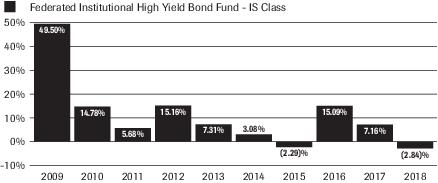
Risk/Return Bar Chart
The bar
chart and performance table below reflects historical performance data for the Fund and are intended to help you analyze the Fund's investment risks in light of its historical returns. The bar chart shows the
variability of the Fund's IS class total returns on a calendar year-by-year basis. The Average Annual Total Return Table shows returns averaged over the stated periods, and includes comparative performance information. The Fund's performance will fluctuate, and past performance (before and after taxes) is not necessarily an indication of future results. Updated performance information for the Fund
is available under the “Products” section at FederatedInvestors.com or by calling 1-800-341-7400.
The Fund's IS
class total return for the nine-month period from January 1, 2019 to September 30, 2019, was 11.86%.
Within the periods shown in the
bar chart, the Fund's IS class highest quarterly return was 18.11% (quarter ended June 30, 2009). Its lowest quarterly return was (4.97)% (quarter ended September 30, 2011).
Average Annual Total Return
Table
The
Fund's R6 class commenced operations on June 29, 2016. For the periods prior to the commencement of operations of the Fund's R6 class, the performance information shown below is for the Fund's IS class. The
performance of the IS class has not been adjusted to reflect the expenses applicable to the R6 class since the R6 class has a lower expense ratio than the expense ratio of the IS class. The performance of the IS class
has been adjusted to remove any voluntary waiver of Fund expenses related to the IS class that may have occurred during the periods prior to the commencement of operations of the R6 class, which would have caused the
IS class expenses to be lower than the gross expenses of the R6 class. The Fund's R6 class would have annual returns substantially similar to those of the IS class because the shares are invested in the same portfolio
of securities and the annual returns would differ only to the extent that the classes do not have the same expenses. In addition to Return Before Taxes, Return After Taxes is shown for the Fund's IS class to
illustrate the effect of federal taxes on Fund returns. After-tax returns are shown only for the IS class, and after-tax returns for the R6 class will differ from those shown for the IS class. Actual after-tax returns depend on each investor's personal tax situation, and are likely to differ from those shown. After-tax returns are calculated using a standard set of
assumptions. The stated returns assume the highest historical federal income and capital gains tax rates. These after-tax returns do not reflect the effect of any applicable state and local taxes. After-tax returns are not relevant to investors holding Shares through a 401(k) plan, an Individual Retirement Account or other tax-advantaged investment plan.
(For the
Period Ended December 31, 2018)
|
| 1 Year
| 5 Years
| 10 Years
|
| IS:
|
|
|
|
| Return Before Taxes
| (2.84)%
| 3.83%
| 10.46%
|
| Return After Taxes on Distributions
| (5.14)%
| 1.24%
| 7.41%
|
| Return After Taxes on Distributions and Sale of Fund Shares
| (1.64)%
| 1.76%
| 7.08%
|
| R6:
|
|
|
|
| Return Before Taxes
| (2.82)%
| 3.83%
| 10.41%
|
Bloomberg Barclays U.S. Corporate High Yield 2% Issuer Capped Index1
(reflects no deduction for fees, expenses or taxes)
| (2.08)%
| 3.84%
| 11.14%
|
| Lipper High Yield Funds Average2
| (2.99)%
| 2.73%
| 9.19%
|
| 1
| The Bloomberg Barclays U.S. Corporate High Yield 2% Issuer Capped Index is an issuer-constrained version of the Bloomberg Barclays U.S. Corporate High-Yield Index that measures the
market of USD-denominated, noninvestment-grade, fixed-rate, taxable corporate bonds. The index follows the same rules as the uncapped index but limits the exposure of each issuer to 2% of the total market value and
redistributes any excess market value index-wide on a pro-rata basis.
|
| 2
| Lipper figures represent the average of the total returns reported by all mutual funds designated by Lipper, Inc., as falling into the respective category and is
not adjusted to reflect any sales charges.
|
FUND MANAGEMENT
The
Fund's Investment Adviser is Federated Investment Management Company.
Mark E.
Durbiano, CFA, Senior Portfolio Manager, has been the Fund's portfolio manager since its inception November of 2002.
Steven
J. Wagner, Senior Portfolio Manager, has been the Fund's portfolio manager since December of 2017.
purchase and sale of fund
shares
You may
purchase, redeem or exchange Shares of the Fund on any day the New York Stock Exchange is open. Shares may be purchased through a financial intermediary firm that has entered into a Fund selling and/or servicing
agreement with the Distributor or an affiliate (“Financial Intermediary”) or directly from the Fund, by wire or by check. Please note that certain purchase restrictions may apply. Redeem or exchange Shares
through a financial intermediary or directly from the Fund by telephone at 1-800-341-7400 or by mail.
IS Class
The
minimum initial investment amount for the Fund's Institutional Shares is generally $1,000,000 and there is no minimum subsequent investment amount. Certain types of accounts are eligible for lower minimum investments.
The minimum investment amount for Systematic Investment Programs is $50.
R6 Class
There
are no minimum initial or subsequent investment amounts required. The minimum investment amount for Systematic Investment Programs is $50.
Tax Information
IS Class
The
Fund's distributions are taxable as ordinary income or capital gains except when your investment is through a 401(k) plan, an Individual Retirement Account or other tax-advantaged investment plan.
R6 Class
The
Fund's distributions are taxable as ordinary income or capital gains except when your investment is through a tax-advantaged investment plan.
Payments to Broker-Dealers and
Other Financial Intermediaries
IS Class
If you
purchase the Fund through a broker-dealer or other financial intermediary (such as a bank), the Fund and/or its related companies may pay the intermediary for the sale of Fund Shares and related services. These
payments may create a conflict of interest by influencing the broker-dealer or other intermediary and your salesperson to recommend the Fund over another investment. Ask your salesperson or visit your financial
intermediary's website for more information.
Payments to Broker-Dealers and
Other Financial Intermediaries
R6 Class
Class
R6 Shares do not make any payments to financial intermediaries, either from Fund assets or from the investment adviser and its affiliates.
What are the Fund's
Investment Strategies?
The
Fund's investment objective is to seek high current income. While there is no assurance that the Fund will achieve its investment objective, it endeavors to do so by following the strategies and policies described in
this Prospectus.
The
Fund provides exposure to the high-yield corporate bond market. The Fund's investment adviser (the “Adviser”) actively manages the Fund's portfolio seeking to realize the potentially higher returns of
high-yield bonds (also known as “junk bonds”), compared to returns of high-grade securities by seeking to minimize default risk and other risks through careful security selection and diversification. The
Fund primarily invests in domestic high-yield bonds but may invest a portion of its portfolio in securities of issuers based outside of the United States (including emerging markets). A description of the various
types of securities in which the Fund invests, and their risks, immediately follows the strategy discussion.
The Adviser selects securities that it believes have attractive risk-return characteristics. The securities in which the Fund invests have high yields primarily because of the market's greater
uncertainty about the issuer's ability to make all required interest and principal payments, and therefore about the returns that will in fact be realized by the Fund.
The
Adviser attempts to select bonds for investment by the Fund which offer high potential returns for the default risks being assumed. The Adviser's securities selection process consists of a credit-intensive,
fundamental analysis of the issuing firm. The Adviser's analysis focuses on the financial condition of the issuing firm together with the issuer's business and product strength, competitive position and management
expertise. Further, the Adviser considers current economic, financial market and industry factors, which may affect the issuer.
The
Adviser attempts to minimize the Fund's portfolio credit risk through diversification. The Adviser selects securities to maintain broad portfolio diversification both by company and industry. The Adviser does not
target an average maturity for the Fund's portfolio.
The
Fund may use derivative contracts and/or hybrid instruments to implement elements of its investment strategy. For example, the Fund may use derivative contracts or hybrid instruments to increase or decrease the
portfolio's exposure to the investment(s) underlying the derivative or hybrid instrument in an attempt to benefit from changes in the value of the underlying investment(s). Additionally, by way of example, the Fund
may use derivative contracts in an attempt to:
| ■
| increase or decrease the effective duration of the Fund portfolio;
|
| ■
| obtain premiums from the sale of derivative contracts;
|
| ■
| realize gains from trading a derivative contract; or
|
| ■
| hedge against potential losses.
|
There
can be no assurance that the Fund's use of derivative contracts or hybrid instruments will work as intended. Derivative investments made by the Fund are included within the Fund's 80% policy (as described below) and
are calculated at market value.
The
Fund will invest its assets so that at least 80% of its net assets (plus any borrowings for investment purposes) are invested in investments rated below investment-grade. The Fund will notify shareholders in advance
of any change in its investment policy that would enable the Fund to invest, under normal circumstances, less than 80% of its net assets in investments rated below investment-grade.
TEMPORARY INVESTMENTS
The
Fund may temporarily depart from its principal investment strategies by investing its assets in shorter-term debt securities and similar obligations or holding cash. It may do this in response to unusual
circumstances, such as: adverse market, economic or other conditions (for example, to help avoid potential losses, or during periods when there is a shortage of appropriate securities); to maintain liquidity to meet
shareholder redemptions; or to accommodate cash inflows. It is possible that such investments could affect the Fund's investment returns and/or the ability to achieve the Fund's investment objectives.
What are the Fund's
Principal Investments?
The
following provides general information on the Fund's principal investments. The Fund's Statement of Additional Information (SAI) provides information about the Fund's non-principal investments and may provide
additional information about the Fund's principal investments.
Fixed-Income Securities
Fixed-income securities pay interest, dividends or distributions at a specified rate. The rate may be a fixed percentage of the principal or may be adjusted periodically. In addition, the issuer of a fixed-income
security must repay the principal amount of the security, normally within a specified time. Fixed-income securities provide more regular income than equity securities. However, the returns on fixed-income securities
are limited and normally do not increase with the issuer's earnings. This limits the potential appreciation of fixed-income securities as compared to equity securities.
A
security's yield measures the annual income earned on a security as a percentage of its price. A security's yield will increase or decrease depending upon whether it costs less (a “discount”) or more (a
“premium”) than the principal amount. If the issuer may redeem the security before its scheduled maturity, the price and yield on a discount or premium security may change based upon the probability of an
early redemption. Securities with higher risks generally have higher yields.
The
following describes the fixed-income securities in which the Fund principally invests:
Preferred Stocks
Preferred stocks have the right to receive specified dividends or distributions before the issuer makes payments on its common stock. Some preferred stocks also participate in dividends and distributions paid on
common stock. Preferred stocks may also permit the issuer to redeem the stock. The Fund may also treat such redeemable preferred stock as a fixed-income security.
Corporate Debt Securities (A Type
of Fixed-Income Security)
Corporate debt securities are fixed-income securities issued by businesses. Notes, bonds, debentures and commercial paper are the most prevalent types of corporate debt securities. The Fund may also purchase
interests in bank loans to companies. The credit risks of corporate debt securities vary widely among issuers.
In
addition, the credit risk of an issuer's debt security may vary based on its priority for repayment. For example, higher ranking (“senior”) debt securities have a higher priority than lower ranking
(“subordinated”) securities. This means that the issuer might not make payments on subordinated securities while continuing to make payments on senior securities. In addition, in the event of bankruptcy,
holders of senior securities may receive amounts otherwise payable to the holders of subordinated securities. Some subordinated securities, such as trust-preferred and capital-securities notes, also permit the issuer
to defer payments under certain circumstances. For example, insurance companies issue securities known as surplus notes that permit the insurance company to defer any payment that would reduce its capital below
regulatory requirements.
Lower-Rated, Fixed-Income
Securities
Lower-rated, fixed-income securities are securities rated below investment grade (i.e., BB or lower) by a nationally recognized statistical rating organization (NRSRO). There is no minimal acceptable rating for a
security to be purchased or held by the Fund and the Fund may purchase or hold unrated securities and securities whose issuers are in default.
Zero-Coupon Securities (A Type of
Fixed-Income Security)
Zero-coupon securities do not pay interest or principal until final maturity unlike debt securities that provide periodic payments of interest (referred to as a coupon payment). Investors buy zero-coupon securities
at a price below the amount payable at maturity. The difference between the purchase price and the amount paid at maturity represents interest on the zero-coupon security. Investors must wait until maturity to receive
interest and principal, which increases the interest rate and credit risks of a zero-coupon security.
There
are many forms of zero-coupon securities. Some are issued at a discount and are referred to as zero coupon or capital appreciation bonds. Others are created from interest-bearing bonds by separating the right to
receive the bond's coupon payments from the right to receive the bond's principal due at maturity, a process known as coupon stripping. In addition, some securities give the issuer the option to deliver additional
securities in place of cash interest payments, thereby increasing the amount payable at maturity. These are referred to as pay-in-kind, PIK securities or toggle securities.
Demand Instruments (A Type of
Corporate Debt Security)
Demand
instruments are corporate debt securities that require the issuer or a third party, such as a dealer or bank (the “Demand Provider”), to repurchase the security for its face value upon demand. Some demand
instruments are “conditional,” so that the occurrence of certain conditions relieves the Demand Provider of its obligation to repurchase the security. Other demand instruments are
“unconditional,” so that there are no conditions under which the Demand Provider's obligation to repurchase the security can terminate. The Fund treats demand instruments as short-term securities, even
though their stated maturity may extend beyond one year.
Convertible Securities (A
Fixed-Income Security)
Convertible securities are fixed-income securities that the Fund has the option to exchange for equity securities at a specified conversion price. The option allows the Fund to realize additional returns if the
market price of the equity securities exceeds the conversion price. For example, the Fund may hold fixed-income securities that are convertible into shares of common stock at a conversion price of $10 per share. If
the market value of the shares of common stock reached $12, the Fund could realize an additional $2 per share by converting its fixed-income securities.
Convertible securities have lower yields than comparable fixed-income securities. In addition, at the time a convertible security is issued, the conversion price exceeds the market value of the underlying equity
securities. Thus, convertible securities may provide lower returns than non-convertible, fixed-income securities or equity securities depending upon changes in the price of the underlying equity securities. However,
convertible securities permit the Fund to realize some of the potential appreciation of the underlying equity securities with less risk of losing its initial investment.
To the
extent the Fund invests in convertible securities, it typically invests in securities that can be exchanged for instruments that are publically traded or listed on a centralized market or stock exchange. The Fund may
receive securities not publically traded or listed on a centralized market or stock exchange in connection with bankruptcies, restructurings, or other unusual circumstances.
The
Fund treats convertible securities as fixed-income securities for purposes of its investment policies and limitations, because of their unique characteristics.
FOREIGN SECURITIES
Foreign
securities are securities of issuers based outside the United States. To the extent a Fund invests in securities included in its applicable broad-based securities market index, the Fund may consider an issuer to be
based outside the United States if the applicable index classifies the issuer as based outside the United States. Accordingly, the Fund may consider an issuer to be based outside the United States if the issuer
satisfies at least one, but not necessarily all, of the following:
| ■
| it is organized under the laws of, or has its principal office located in, another country;
|
| ■
| the principal trading market for its securities is in another country;
|
| ■
| it (directly or through its consolidated subsidiaries) derived in its most current fiscal year at least 50% of its total assets, capitalization, gross revenue or profit from goods produced, services
performed or sales made in another country; or
|
| ■
| it is classified by an applicable index as based outside the United States.
|
While
the Fund typically invests in U.S. dollar denominated foreign securities, the Fund may also invest in foreign securities that are denominated in foreign currencies Along with the risks normally associated with
domestic securities of the same type, foreign securities are subject to currency risks and risks of foreign investing. Trading in certain foreign markets is also subject to liquidity risks.
Foreign Exchange Contracts
In
order to convert U.S. dollars into the currency needed to buy a foreign security, or to convert foreign currency received from the sale of a foreign security into U.S. dollars, or to decrease or eliminate the Fund's
exposure to foreign currencies in which a portfolio security is denominated, the Fund may enter into spot currency trades. In a spot trade, the Fund agrees to exchange one currency for another at the current
exchange rate. The Fund may also enter into derivative contracts in which a foreign currency is an underlying asset. The exchange rate for currency derivative contracts may be higher or lower than the spot exchange
rate. Use of these derivative contracts may increase or decrease the Fund's exposure to currency risks.
Derivative Contracts
Derivative contracts are financial instruments that require payments based upon changes in the values of designated securities, commodities, currencies, indices, or other assets or instruments including other
derivative contracts, (each a “Reference Instrument” and collectively, “Reference Instruments”). Each party to a derivative contract may sometimes be referred to as a counterparty. Some
derivative contracts require payments relating to an actual, future trade involving the Reference Instrument. These types of derivatives are frequently referred to as “physically settled” derivatives.
Other derivative contracts require payments relating to the income or returns from, or changes in the market value of, a Reference Instrument. These types of derivatives are known as “cash-settled”
derivatives, since they require cash payments in lieu of delivery of the Reference Instrument.
Many
derivative contracts are traded on securities or commodities exchanges. In this case, the exchange sets all the terms of the contract except for the price. Investors make payments due under their contracts through the
exchange. Most exchanges require investors to maintain margin accounts through their brokers to cover their potential obligations to the exchange. Parties to the contract make (or collect) daily payments to the margin
accounts to reflect losses (or gains) in the value of their contracts. This protects investors against potential defaults by the other party to the contract. Trading contracts on an exchange also allows investors to
close out their contracts by entering into offsetting contracts.
The
Fund may also trade derivative contracts over-the-counter (OTC) in transactions negotiated directly between the Fund and a financial institution. OTC contracts do not necessarily have standard terms, so they may be
less liquid and more difficult to close out than exchange-traded contracts. In addition, OTC contracts with more specialized terms may be more difficult to value than exchange-traded contracts, especially in times of
financial stress.
The
market for swaps and other OTC derivatives was largely unregulated prior to the enactment of federal legislation known as the Dodd-Frank Wall Street Reform and Consumer Protection Act (the “Dodd-Frank
Act”). Regulations enacted by the Commodity Futures Trading Commission (the CFTC) under the Dodd-Frank Act require the Fund to clear certain swap contracts through a clearing house or central counterparty (a
CCP).
To
clear a swap through the CCP, the Fund will submit the contract to, and post margin with, a futures commission merchant (FCM) that is a clearing house member. The Fund may enter into the swap with a financial
institution other than the FCM and arrange for the contract to be transferred to the FCM for clearing, or enter into the contract with the FCM itself. If the Fund must centrally clear a transaction, the CFTC's
regulations also generally require that the swap be executed on a registered exchange or through a market facility that is known as a swap execution facility or SEF. Central clearing is presently required only for
certain swaps; the CFTC is expected to impose a mandatory central clearing requirement for additional derivative instruments over time.
The
CCP, SEF and FCM are all subject to regulatory oversight by the CFTC. In addition, most derivative market participants are now regulated as swap dealers or major swap participants and are subject to certain minimum
capital and margin requirements and business conduct standards. Similar regulatory requirements are expected to apply to derivative contracts that are subject to the jurisdiction of the SEC, although the SEC has not
yet finalized its regulations. In addition, uncleared OTC swaps will be subject to regulatory collateral requirements that could adversely affect the Fund's ability to enter into swaps in the OTC market. These
developments could cause the Fund to terminate new or existing swap agreements or to realize amounts to be received under such instruments at an inopportune time.
Until
the mandated rulemaking and regulations are implemented completely, it will not be possible to determine the complete impact of the Dodd-Frank Act and related regulations on the Fund.
Depending on how the Fund uses derivative contracts and the relationships between the market value of a derivative contract and the Reference Instrument, derivative contracts may increase or decrease the Fund's
exposure to the risks of the Reference Instrument, and may also expose the Fund to liquidity and leverage risks. OTC contracts also expose the Fund to credit risks in the event that a counterparty defaults on the
contract, although this risk may be mitigated by submitting the contract for clearing through a CCP.
Payment
obligations arising in connection with derivative contracts are frequently required to be secured with margin (which is commonly called “collateral”). To the extent necessary to meet such requirements, the
Fund may purchase U.S. Treasury and/or government agency securities.
The
Fund may invest in a derivative contract if it is permitted to own, invest in, or otherwise have economic exposure to the Reference Instrument. The Fund is not required to own a Reference Instrument in order to buy or
sell a derivative contract relating to that Reference Instrument. The Fund may trade in the following specific types and/or combinations of derivative contracts:
Futures Contracts (A Type of
Derivative)
Futures
contracts provide for the future sale by one party and purchase by another party of a specified amount of a Reference Instrument at a specified price, date and time. Entering into a contract to buy a Reference
Instrument is commonly referred to as buying a contract or holding a long position in the asset. Entering into a contract to sell a Reference Instrument is commonly referred to as selling a contract or holding a short
position in the Reference Instrument. Futures contracts are considered to be commodity contracts. The Adviser has claimed an exclusion from the definition of the term “commodity pool operator” under the
Commodity Exchange Act with respect to the Fund and, therefore, is not subject to registration or regulation with respect to the Fund. Futures contracts traded OTC are frequently referred to as forward contracts. The
Fund can buy or sell financial futures (such as interest rate futures, index futures and security futures), as well as, currency futures and currency forward contracts.
Option Contracts (A Type of
Derivative)
Option
contracts (also called “options”) are rights to buy or sell a Reference Instrument for a specified price (the “exercise price”) during, or at the end of, a specified period. The seller (or
“writer”) of the option receives a payment, or premium, from the buyer, which the writer keeps regardless of whether the buyer uses (or exercises) the option. A call option gives the holder (buyer) the
right to buy the Reference Instrument from the seller (writer) of the option. A put option gives the holder the right to sell the Reference Instrument to the writer of the option. Options may be bought or sold on a
wide variety of Reference Instruments. Options that are written on futures contracts will be subject to margin requirements similar to those applied to futures contracts.
Swap Contracts (A Type of
Derivative)
A swap
contract (also known as a “swap”) is a type of derivative contract in which two parties agree to pay each other (swap) the returns derived from Reference Instruments. Swaps do not always involve the
delivery of the Reference Instruments by either party, and the parties might not own the Reference Instruments underlying the swap. The payments are usually made on a net basis so that, on any given day, the Fund
would receive (or pay) only the amount by which its payment under the contract is less than (or exceeds) the amount of the other party's payment. Swap agreements are sophisticated instruments that can take many
different forms and are known by a variety of names. Common types of swaps in which the Fund may invest include interest rate swaps, caps and floors, total return swaps, credit default swaps and currency swaps.
OTHER INVESTMENTS, TRANSACTIONS,
TECHNIQUES
Hybrid Instruments
Hybrid
instruments combine elements of two different kinds of securities or financial instruments (such as a derivative contract). Frequently, the value of a hybrid instrument is determined by reference to changes in the
value of a Reference Instrument (that is a designated security, commodity, currency, index or other asset or instrument including a derivative contract). The Fund may use hybrid instruments only in connection with
permissible investment activities. Hybrid instruments can take on many forms including, but not limited to, the following forms. First, a common form of a hybrid instrument combines elements of a derivative contract
with those of another security (typically a fixed-income security). In this case all or a portion of the interest or principal payable on a hybrid security is determined by reference to changes in the price of a
Reference Instrument. Second, hybrid instruments may include convertible securities with conversion terms related to a Reference Instrument.
Depending on the type and terms of the hybrid instrument, its risks may reflect a combination of the risks of investing in the Reference Instrument with the risks of investing in other securities, currencies and
derivative contracts. Thus, an investment in a hybrid instrument may entail significant risks in addition to those associated with traditional securities or the Reference Instrument. Hybrid instruments are also
potentially more volatile than traditional securities or the Reference Instrument. Moreover, depending on the structure of the particular hybrid, it may expose the Fund to leverage risks or carry liquidity risks.
Asset Segregation
In order to cover its obligations in connection with derivative contracts or special transactions, the Fund will either own the underlying assets, enter into offsetting transactions or set aside
cash or readily marketable securities in each case, as provided by the SEC or SEC staff guidance. This requirement may cause the Fund to miss favorable trading opportunities, due to a lack of sufficient cash or
readily marketable securities. This requirement may also cause the Fund to realize losses on offsetting or terminated derivative contracts or special transactions.
Investing in Securities of Other
Investment Companies
The
Fund may invest its assets in securities of other investment companies, including the securities of affiliated money market funds, as an efficient means of implementing its investment strategies and/or managing its
uninvested cash. The Fund may also invest in high yield and loan instruments, including trade finance loan instruments, primarily by investing in another investment company (which is not available for general
investment by the public) that owns those securities and that is advised by an affiliate of the Adviser. The Fund's investment in the trade finance instruments through these other investment vehicles may expose the
Fund to risks of loss after redemption. The Fund may also invest in such securities directly. These other investment companies are managed independently of the Fund and incur additional fees and/or expenses which
would, therefore, be borne indirectly by the Fund in connection with any such investment. However, the Adviser believes that the benefits and efficiencies of this approach should outweigh the potential additional fees
and/or expenses.
What are the Specific
Risks of Investing in the Fund?
The
following provides general information on the risks associated with the Fund's principal investments. Any additional risks associated with the Fund's non-principal investments are described in the Fund's SAI. The
Fund's SAI also may provide additional information about the risks associated with the Fund's principal investments.
Risk Associated with
Noninvestment-Grade Securities
Securities rated below investment grade, also known as junk bonds, generally entail greater economic, credit and liquidity risks than investment-grade securities. For example, their prices are more volatile,
economic downturns and financial setbacks may affect their prices more negatively, and their trading market may be more limited. These securities are considered speculative with respect to the issuer's ability to pay
interest and repay principal.
ISSUER Credit Risk
It is
possible that interest or principal on securities will not be paid when due. Noninvestment-grade securities generally have a higher default risk than investment-grade securities. Such non-payment or default may reduce
the value of the Fund's portfolio holdings, its share price and its performance.
Many
fixed-income securities receive credit ratings from nationally recognized statistical rating organizations (NRSROs) such as Fitch Rating Service, Moody's Investor Services, Inc. and Standard & Poor's that assign
ratings to securities by assessing the likelihood of an issuer and/or guarantor default. Higher credit ratings correspond to lower perceived credit risk and lower credit ratings correspond to higher perceived credit
risk. Credit ratings may be upgraded or downgraded from time to time as an NRSRO's assessment of the financial condition of a party obligated to make payments with respect to such securities and credit risk changes.
The impact of any credit rating downgrade can be uncertain. Credit rating downgrades may lead to increased interest rates and volatility in financial markets, which in turn could negatively affect the value of the
Fund's portfolio holdings, its share price and its investment performance. Credit ratings are not a guarantee of quality. Credit ratings may lag behind the current financial conditions of the issuer and/or guarantor
and do not provide assurance against default or other loss of money. Credit ratings do not protect against a decline in the value of a security. If a security has not received a rating, the Fund must rely entirely
upon the Adviser's credit assessment.
Fixed-income securities generally compensate for greater credit risk by paying interest at a higher rate. The difference between the yield of a security and the yield of a U.S. Treasury security or other appropriate
benchmark with a comparable maturity (the “spread”) measures the additional interest paid for risk. Spreads may increase generally in response to adverse economic or market conditions. A security's spread
may also increase if the security's rating is lowered, or the security is perceived to have an increased credit risk. An increase in the spread will cause the price of the security to decline if interest rates remain
unchanged.
Counterparty Credit Risk
Credit
risk includes the possibility that a party to a transaction involving the Fund will fail to meet its obligations. This could cause the Fund to lose money or to lose the benefit of the transaction or prevent the Fund
from selling or buying other securities to implement its investment strategy.
RISK RELATED TO THE ECONOMY
The
value of the Fund's portfolio may decline in tandem with a drop in the overall value of the markets in which the Fund invests and/or other markets based on negative developments in the U.S. and global economies.
Economic, political and financial conditions, or industry or economic trends and developments, may, from time to time, and for varying periods of time, cause volatility, illiquidity or other potentially adverse
effects in the financial markets, including the fixed-income market. The commencement, continuation or ending of government policies and economic stimulus programs, changes in monetary policy, increases or decreases
in interest rates, or other factors or events that affect the financial markets, including the fixed-income markets, may contribute to the development of or increase in volatility, illiquidity, shareholder redemptions
and other adverse effects, which could negatively impact the Fund's performance. For example, the value of certain portfolio securities may rise or fall in response to changes in interest rates, which could result
from a change in government policies, and has the potential to cause investors to move out of certain portfolio securities, including fixed-income securities, on a large scale. This may increase redemptions from funds
that hold large amounts of certain securities and may result in decreased liquidity and increased volatility in the financial markets. Market factors, such as the demand for particular portfolio securities, may cause
the price of certain portfolio securities to fall while the prices of other securities rise or remain unchanged. Among other investments, lower-grade bonds and loans may be particularly sensitive to changes in the
economy.
LIQUIDITY RISK
Trading
opportunities are more limited for fixed-income securities that have not received any credit ratings, have received any credit ratings below investment grade or are not widely held. These features may make it more
difficult to sell or buy a security at a favorable price or time. Consequently, the Fund may have to accept a lower price to sell a security, sell other securities to raise cash or give up an investment opportunity,
any of which could have a negative effect on the Fund's performance. Infrequent trading of securities may also lead to an increase in their price volatility.
Liquidity risk also refers to the possibility that the Fund may not be able to sell a security or close out a derivative contract when it wants to. If this happens, the Fund will be required to continue to hold the
security or keep the position open, and the Fund could incur losses.
OTC
derivative contracts generally carry greater liquidity risk than exchange-traded contracts. This risk may be increased in times of financial stress, if the trading market for OTC derivative contracts becomes
restricted.
Interest Rate Risk
Prices
of fixed-income securities rise and fall in response to changes in interest rates. Generally, when interest rates rise, prices of fixed-income securities fall. However, market factors, such as the demand for
particular fixed-income securities, may cause the price of certain fixed-income securities to fall while the prices of other securities rise or remain unchanged.
The
longer the duration of a fixed-income security, the more susceptible it is to interest rate risk. The duration of a fixed-income security may be equal to or shorter than the stated maturity of a fixed-income security.
Recent and potential futures changes in monetary policy made by central banks and/or their governments are likely to affect the level of interest rates. Duration measures the price sensitivity of a fixed-income
security given a change in interest rates. For example, if a fixed-income security has an effective duration of three years, a 1% increase in general interest rates would be expected to cause the security's value to
decline about 3% while a 1% decrease in general interest rates would be expected to cause the security's value to increase about 3%.
Risk of Foreign Investing
Foreign
securities pose additional risks because foreign economic or political conditions may be less favorable than those of the United States. Securities in foreign markets may also be subject to taxation policies that
reduce returns for U.S. investors.
Foreign
companies may not provide information (including financial statements) as frequently or to as great an extent as companies in the United States. Foreign companies may also receive less coverage than U.S. companies by
market analysts and the financial press. In addition, foreign countries may lack uniform accounting, auditing and financial reporting standards or regulatory requirements comparable to those applicable to U.S.
companies. These factors may prevent the Fund and its Adviser from obtaining information concerning foreign companies that is as frequent, extensive and reliable as the information available concerning companies in
the United States.
Foreign
countries may have restrictions on foreign ownership of securities or may impose exchange controls, capital flow restrictions or repatriation restrictions which could adversely affect the liquidity of the Fund's
investments.
Since
many loan instruments involve parties (for example, lenders, borrowers and agent banks) located in multiple jurisdictions outside of the United States, there is a risk that a security interest in any related
collateral may be unenforceable and obligations under the related loan agreements may not be binding.
Currency Risk
Exchange rates for currencies fluctuate daily. The combination of currency risk and market risks tends to make securities traded in foreign markets more volatile than securities traded exclusively in the United
States. The Adviser attempts to manage currency risk by limiting the amount the Fund invests in securities denominated in a particular currency. However, diversification will not protect the Fund against a general
increase in the value of the U.S. dollar relative to other currencies.
Investing in currencies or securities denominated in a foreign currency, entails risk of being exposed to a currency that may not fully reflect the strengths and weaknesses of the economy of the country or region
utilizing the currency. Currency risk includes both the risk that currencies in which the Fund's investments are traded, or currencies in which the Fund has taken an active investment position, will decline in value
relative to the U.S. dollar and, in the case of hedging positions, that the U.S. dollar will decline in value relative to the currency being hedged. In addition, it is possible that a currency (such as, for example,
the euro) could be abandoned in the future by countries that have already adopted its use, and the effects of such an abandonment on the applicable country and the rest of the countries utilizing the currency are
uncertain but could negatively affect the Fund's investments denominated in the currency. If a currency used by a country or countries is replaced by another currency, the Fund's Adviser would evaluate whether to
continue to hold any investments denominated in such currency, or whether to purchase investments denominated in the currency that replaces such currency, at the time. Such investments may continue to be held, or
purchased, to the extent consistent with the Fund's investment objective(s) and permitted under applicable law.
Many countries rely heavily upon export-dependent businesses and any strength in the exchange rate between a currency and the U.S. dollar or other currencies can have either a positive or a
negative effect upon corporate profits and the performance of investments in the country or region utilizing the currency. Adverse economic events within such country or region may increase the volatility of exchange
rates against other currencies, subjecting the Fund's investments denominated in such country's or region's currency to additional risks. In addition, certain countries, particularly emerging market countries, may
impose foreign currency exchange controls or other restrictions on the transferability, repatriation or convertibility of currency.
eurozone Related risk
A
number of countries in the European Union (EU) have experienced, and may continue to experience, severe economic and financial difficulties. Additional EU member countries may also fall subject to such difficulties.
These events could negatively affect the value and liquidity of the Fund's investments in euro-denominated securities and derivatives contracts, securities of issuers located in the EU or with significant exposure to
EU issuers or countries. If the euro is dissolved entirely, the legal and contractual consequences for holders of euro-denominated obligations and derivative contracts would be determined by laws in effect at such
time. Such investments may continue to be held, or purchased, to the extent consistent with the Fund's investment objective(s) and permitted under applicable law. These potential developments, or market perceptions
concerning these and related issues, could adversely affect the value of the Shares.
Certain
countries in the EU have had to accept assistance from supra-governmental agencies such as the International Monetary Fund, the European Stability Mechanism (the ESM) or other supra-governmental agencies. The European
Central Bank has also been intervening to purchase Eurozone debt in an attempt to stabilize markets and reduce borrowing costs. There can be no assurance that these agencies will continue to intervene or provide
further assistance and markets may react adversely to any expected reduction in the financial support provided by these agencies. Responses to the financial problems by European governments, central banks and others
including austerity measures and reforms, may not work, may result in social unrest and may limit future growth and economic recovery or have other unintended consequences.
In
addition, one or more countries may abandon the euro and/or withdraw from the EU. The impact of these actions, especially if they occur in a disorderly fashion, could be significant and far-reaching. In June 2016, the
United Kingdom (U.K.) approved a referendum to leave the EU, commonly referred to as “Brexit,” which sparked depreciation in the value of the British pound, short-term declines in global stock markets and
heightened risk of continued worldwide economic volatility. As a result of Brexit, there is considerable uncertainty as to the arrangements that will apply to the U.K.'s relationship with the EU and other countries
leading up to, and following, its withdrawal. This long-term uncertainty may affect other countries in the EU and elsewhere. Further, the U.K.'s departure from the EU may cause volatility within the EU, triggering
prolonged economic downturns in certain European countries or sparking additional member states to contemplate departing the EU. In addition, Brexit can create actual or perceived additional economic stresses for the
U.K., including potential for decreased trade, capital outflows, devaluation of the British pound, wider corporate bond spreads due to uncertainty and possible declines in business and consumer spending as well as
foreign direct investment.
Leverage Risk
Leverage risk is created when an investment, which includes, for example, an investment in a derivative contract, exposes the Fund to a level of risk that exceeds the amount invested. Changes in the value of such an
investment magnify the Fund's risk of loss and potential for gain. Investments can have these same results if their returns are based on a multiple of a specified index, security or other benchmark.
Risk of Investing in Emerging
Market Countries
Securities issued or traded in emerging markets generally entail greater risks than securities issued or traded in developed countries. For example, their prices may be significantly more volatile than prices in
developed countries. Emerging market economies may also experience more severe down-turns (with corresponding currency devaluations) than developed economies.
Emerging market countries may have relatively unstable governments and may present the risk of nationalization of businesses, expropriation, confiscatory taxation or, in certain instances, reversion to closed
market, centrally planned economies.
Risk of Investing in Derivative
Contracts and Hybrid Instruments
The
Fund's exposure to derivative contracts and hybrid instruments (either directly or through its investment in another investment company) involves risks different from, or possibly greater than, the risks associated
with investing directly in securities and other traditional investments. First, changes in the value of the derivative contracts and hybrid instruments in which the Fund invests may not be correlated with changes in
the value of the underlying Reference Instruments or, if they are correlated, may move in the opposite direction than originally anticipated. Second, while some strategies involving
derivatives may reduce the risk of loss,
they may also reduce potential gains or, in some cases, result in losses by offsetting favorable price movements in portfolio holdings. Third, there is a risk that derivative contracts and hybrid instruments may be
erroneously priced or improperly valued and, as a result, the Fund may need to make increased cash payments to the counterparty. Fourth, exposure to derivative contracts and hybrid instruments may have tax
consequences to the Fund and its shareholders. For example, derivative contracts and hybrid instruments may cause the Fund to realize increased ordinary income or short-term capital gains (which are treated as
ordinary income for Federal income tax purposes) and, as a result, may increase taxable distributions to shareholders. In addition, under certain circumstances certain derivative contracts and hybrid instruments may
cause the Fund to: (a) incur an excise tax on a portion of the income related to those contracts and instruments; and/or (b) reclassify, as a return of capital, some or all of the distributions previously made to
shareholders during the fiscal year as dividend income. Fifth, a common provision in OTC derivative contracts permits the counterparty to terminate any such contract between it and the Fund, if the value of the Fund's
total net assets declines below a specified level over a given time period. Factors that may contribute to such a decline (which usually must be substantial) include significant shareholder redemptions and/or a marked
decrease in the market value of the Fund's investments. Any such termination of the Fund's OTC derivative contracts may adversely affect the Fund (for example, by increasing losses and/or costs, and/or preventing the
Fund from fully implementing its investment strategies). Sixth, the Fund may use a derivative contract to benefit from a decline in the value of a Reference Instrument. If the value of the Reference Instrument
declines during the term of the contract, the Fund makes a profit on the difference (less any payments the Fund is required to pay under the terms of the contract). Any such strategy involves risk. There is no
assurance that the Reference Instrument will decline in value during the term of the contract and make a profit for the Fund. The Reference Instrument may instead appreciate in value creating a loss for the Fund.
Seventh, a default or failure by a CCP or an FCM (also sometimes called a “futures broker”), or the failure of a contract to be transferred from an Executing Dealer to the FCM for clearing, may expose the
Fund to losses, increase its costs, or prevent the Fund from entering or exiting derivative positions, accessing margin, or fully implementing its investment strategies. The central clearing of a derivative and
trading of a contract over a SEF could reduce the liquidity in, or increase costs of entering into or holding, any contracts. Finally, derivative contracts and hybrid instruments may also involve other risks described
in this Prospectus, such as interest rate, credit, currency, liquidity and leverage risks.
RISK OF LOSS AFTER REDEMPTION
The
Fund may also invest in trade finance loan instruments primarily by investing in other investment companies (which are not available for general investment by the public) that owns those instruments, and that are
advised by an affiliate of the Adviser and is structured as an extended payment fund (EPF). In the EPF, the Fund, as shareholder, will bear the risk of investment loss during the period between when shares of such EPF
are presented to the transfer agent of the EPF for redemption and when the net asset value of the EPF is determined for payment of the redeemed EPF shares (the “Redemption Pricing Date”). The time between
when EPF shares are presented for redemption and the Redemption Pricing Date will be at least twenty-four (24) calendar days. EPF shares tendered for redemption will participate proportionately in the EPF's gains and
losses during between when EPF shares are presented for redemption and the Redemption Pricing Date. During this time the value of the EPF shares will likely fluctuate and EPF shares presented for redemption could be
worth less on the Redemption Pricing Date than on the day the EPF shares were presented to the transfer agent of the EPF for redemption. The EPF has adopted a fundamental policy that may only be changed by shareholder
vote, that the Redemption Pricing Date will fall no more than twenty-four (24) days after the date the Fund, as shareholder, presents EPF shares for redemption in good order. If such date is a weekend or holiday, the
Redemption Pricing Date will be on the preceding business day.
technology Risk
The
Adviser uses various technologies in managing the Fund, consistent with its investment objective(s) and strategy described in this Prospectus. For example, proprietary and third-party data and systems are utilized to
support decision-making for the Fund. Data imprecision, software or other technology malfunctions, programming inaccuracies and similar circumstances may impair the performance of these systems, which may negatively
affect Fund performance.
What Do Shares Cost?
CALCULATION OF NET ASSET
VALUE
When
the Fund receives your transaction request in proper form (as described in this Prospectus under the sections entitled “How to Purchase Shares” and “How to Redeem and Exchange Shares”), it is
processed at the next calculated net asset value of a Share (NAV). A Share's NAV is determined as of the end of regular trading on the New York Stock Exchange (NYSE) (normally 4:00 p.m. Eastern time) each day the NYSE
is open. The Fund calculates the NAV of each class by valuing the assets allocated to each class and dividing the balance by the number of Shares of the class outstanding.
The NAV for each class of Shares may
differ due to the level of expenses allocated to each class as well as a result of the variance between the amount of accrued investment income and capital gains or losses allocated to each class and the amount
actually distributed to shareholders of each class. The Fund's current NAV and/or public offering price may be found at FederatedInvestors.com, via online news sources and in certain newspapers.
You
can purchase, redeem or exchange Shares any day the NYSE is open.
When
the Fund holds securities that trade principally in foreign markets on days the NYSE is closed, the value of the Fund's assets may change on days you cannot purchase or redeem Shares. This may also occur when the U.S.
markets for fixed-income securities are open on a day the NYSE is closed.
In
calculating its NAV, the Fund generally values investments as follows:
| ■
| Fixed-income securities are fair valued using price evaluations provided by a pricing service approved by the Board of Trustees (“Board”).
|
| ■
| Derivative contracts listed on exchanges are valued at their reported settlement or closing price, except that options are valued at the mean of closing bid and asked quotations.
|
| ■
| Over-the-counter (OTC) derivative contracts are fair valued using price evaluations provided by a pricing service approved by the Board.
|
If any
price, quotation, price evaluation or other pricing source is not readily available when the NAV is calculated, if the Fund cannot obtain price evaluations from a pricing service or from more than one dealer for an
investment within a reasonable period of time as set forth in the Fund's valuation policies and procedures, or if information furnished by a pricing service, in the opinion of the Valuation Committee, is deemed not
representative of the fair value of such security, the Fund uses the fair value of the investment determined in accordance with the procedures generally described below. There can be no assurance that the Fund could
obtain the fair value assigned to an investment if it sold the investment at approximately the time at which the Fund determines its NAV per share.
Shares
of other mutual funds are valued based upon their reported NAVs. The prospectuses for these mutual funds explain the circumstances under which they will use fair value pricing and the effects of using fair value
pricing.
Fair Valuation and Significant
Events Procedures
The
Board has ultimate responsibility for determining the fair value of investments for which market quotations are not readily available. The Board has appointed a Valuation Committee comprised of officers of the Fund,
the Adviser and certain of the Adviser's affiliated companies to assist in determining fair value and in overseeing the calculation of the NAV. The Board has also authorized the use of pricing services recommended by
the Valuation Committee to provide fair value evaluations of the current value of certain investments for purposes of calculating the NAV. In the event that market quotations and price evaluations are not available
for an investment, the Valuation Committee determines the fair value of the investment in accordance with procedures adopted by the Board. The Board periodically reviews and approves the fair valuations made by the
Valuation Committee and any changes made to the procedures. The Fund's SAI discusses the methods used by pricing services and the Valuation Committee to assist the Board in valuing investments.
Using
fair value to price investments may result in a value that is different from an investment's most recent closing price and from the prices used by other mutual funds to calculate their NAVs. The application of the
fair value procedures to an investment represent a good faith determination of such investment's fair value. There can be no assurance that the Fund could obtain the fair value assigned to an investment if it sold the
investment at approximately the time at which the Fund determines its NAV per share.
The
Board also has adopted procedures requiring an investment to be priced at its fair value whenever the Adviser determines that a significant event affecting the value of the investment has occurred between the time as
of which the price of the investment would otherwise be determined and the time as of which the NAV is computed. An event is considered significant if there is both an affirmative expectation that the investment's
value will change in response to the event and a reasonable basis for quantifying the resulting change in value.
Examples of significant events that may occur after the close of the principal market on which a security is traded, or after the time of a price evaluation provided by a pricing service or a dealer, include:
| ■
| With respect to securities traded principally in foreign markets, significant trends in U.S. equity markets or in the trading of foreign securities index futures contracts;
|
| ■
| Political or other developments affecting the economy or markets in which an issuer conducts its operations or its securities are traded; and
|
| ■
| Announcements concerning matters such as acquisitions, recapitalizations or litigation developments or a natural disaster affecting the issuer's operations or regulatory changes or
market developments affecting the issuer's industry.
|
The Board has adopted procedures whereby the Valuation Committee uses a pricing service to provide factors to update the fair value of equity securities traded principally in foreign markets from
the time of the close of their respective foreign stock exchanges to the pricing time of the Fund. For other significant events, the Fund may seek to obtain more current quotations or price evaluations from
alternative pricing sources. If a reliable alternative pricing source is not available, the Valuation Committee will determine the fair value of the investment using another method approved by the Board. The Board has
ultimate responsibility for any fair valuations made in response to a significant event.
The
fair valuation of securities following a significant event can serve to reduce arbitrage opportunities for short-term traders to profit at the expense of long-term investors in the Fund. For example, such arbitrage
opportunities may exist when the market on which portfolio securities are traded closes before the Fund calculates its NAV, which is typically the case with Asian and European markets. However, there is no assurance
that these significant event procedures will prevent dilution of the NAV by short-term traders. See “Account and Share Information–Frequent Trading Policies” for other procedures the Fund employs to deter such short-term trading.
COMMISSIONS ON SHARES
The
Fund does not charge any front-end load, deferred sales charge or other asset-based fee for sales or distribution of Shares. However, if you purchase Shares through a broker acting solely as an agent on behalf of its
customers, you may be required to pay a commission to the broker in an amount determined and separately disclosed to you by the broker.
Because
the Fund is not a party to any such commission arrangement between you and your broker, any purchases and redemptions of Shares will be made at the applicable net asset value (before imposition of the sales
commission). Any such commissions charged by a broker are not reflected in the fees and expenses listed in the “Risk/Return Summary: Fees and Expenses” section of the Fund's Prospectus and described above
nor are they reflected in the “Performance: Bar Chart and Table,” because they are not charged by the Fund.
How is the Fund Sold?
The
Fund offers the following Share classes: Institutional Shares (IS) and Class R6 Shares (R6), each representing interests in a single portfolio of securities. All Share classes have different expenses which affect
their performance. Please note that certain purchase restrictions may apply.
Under
the Distributor's Contract with the Fund, the Distributor, Federated Securities Corp., offers Shares on a continuous, best-efforts basis. The Distributor is a subsidiary of Federated Investors, Inc.
(“Federated”).
IS Class
The
Fund's Distributor markets the IS class to Eligible Investors, as described below. In connection with a request to purchase the IS class, you should provide documentation sufficient to verify your status as an
Eligible Investor. As a general matter, the IS class is not available for direct investment by natural persons.
The
following categories of Eligible Investors are not subject to any minimum initial investment amount for the purchase of the IS class (however, such accounts remain subject to the Fund's policy on “Accounts with
Low Balances” as discussed later in this Prospectus):
| ■
| An investor participating in a no-load platform, network or other fee-based program offered by a financial intermediary, for example, a wrap-account or retirement platform where Federated has entered
into an agreement with the intermediary;
|
| ■
| A trustee/director, employee or former employee of the Fund, the Adviser, the Distributor and their affiliates; an immediate family member of these individuals or a trust, pension or profit-sharing plan
for these individuals;
|
| ■
| An employer-sponsored retirement plan;
|
| ■
| A trust institution investing on behalf of its trust customers;
|
| ■
| Additional sales to an investor (including a natural person) who owned the IS class of the Fund as of December 31, 2008;
|
| ■
| A Federated Fund;
|
| ■
| An investor (including a natural person) who acquired the IS class of a Federated fund pursuant to the terms of an agreement and plan of reorganization which permits the investor to acquire such shares;
and
|
| ■
| In connection with an acquisition of an investment management or advisory business, or related investment services, products or assets, by Federated or its investment advisory
subsidiaries, an investor (including a natural person) who: (1) becomes a client of an investment advisory subsidiary of Federated; or (2) is a shareholder or interest holder of a pooled investment vehicle or product
that becomes advised or subadvised by a Federated investment advisory subsidiary as a result of such an acquisition other than as a result of a fund reorganization transaction pursuant to an agreement and plan of
reorganization.
|
The
following categories of Eligible Investors are subject to applicable minimum initial investment amounts for the purchase of the IS class (see “How to Purchase Shares” below):
| ■
| An investor, other than a natural person, purchasing the IS class directly from the Fund; and
|
| ■
| In connection with an initial purchase of the IS class through an exchange, an investor (including a natural person) who owned the IS class of another Federated fund as of December
31, 2008.
|
R6 Class
The
Fund's Distributor markets the R6 class to Eligible Investors, as described below. The R6 Shares are sold at net asset value and are not subject to any minimum initial or subsequent investment amounts. In connection
with a request to purchase the R6 class, you should provide documentation sufficient to verify your status as an Eligible Investor.
R6
Shares do not carry sales commissions or pay Rule 12b-1 fees, or make similar payments to financial intermediaries. As a general matter, the R6 class is not available for direct investment by natural persons.
Individual shareholders who purchase R6 Shares through retirement platforms or other intermediaries will not be eligible to hold R6 Shares outside of their respective plan or intermediary platform.
Following are categories of Eligible Investors:
| ■
| An investor participating in a no-load platform, network or other fee-based program offered by a financial intermediary, for example, a wrap-account or retirement platform where Federated has entered
into an agreement with the intermediary;
|
| ■
| A trustee/director, employee or former employee of the Fund, the Adviser, the Distributor and their affiliates; an immediate family member of these individuals or a trust, pension or profit-sharing plan
for these individuals;
|
| ■
| An employer-sponsored retirement plan;
|
| ■
| A trust institution investing on behalf of its trust customers;
|
| ■
| An investor, other than a natural person, purchasing Shares directly from the Fund;
|
| ■
| A Federated Fund;
|
| ■
| An investor (including a natural person) who acquired the R6 class of a Federated fund pursuant to the terms of an agreement and plan of reorganization which permits the investor to acquire such shares;
and
|
| ■
| In connection with an acquisition of an investment management or advisory business, or related investment services, products or assets, by Federated or its investment advisory
subsidiaries, an investor (including a natural person) who: (1) becomes a client of an investment advisory subsidiary of Federated; or (2) is a shareholder or interest holder of a pooled investment vehicle or product
that becomes advised or subadvised by a Federated investment advisory subsidiary as a result of such an acquisition other than as a result of a fund reorganization transaction pursuant to an agreement and plan of
reorganization.
|
Intra-Fund Share Conversion
Program
A
shareholder in the Fund's Shares may convert their Shares at net asset value to any other share class of the Fund if the shareholder meets the investment minimum and eligibility requirements for the share class into
which the conversion is sought, as applicable. Such conversion of classes should not result in a realization event for tax purposes. Contact your financial intermediary or call 1-800-341-7400 to convert your
Shares.
Payments to Financial
Intermediaries
The
Fund and its affiliated service providers may pay fees as described below to financial intermediaries (such as broker-dealers, banks, investment advisers or third-party administrators) whose customers are shareholders
of the Fund.
The
Fund's Class R6 Shares do not make any payments to financial intermediaries, either from Fund assets or from the investment adviser and its affiliates.
RECORDKEEPING FEES
IS Class
The
Fund may pay Recordkeeping Fees on an average-net-assets basis or on a per-account-per-year basis to financial intermediaries for providing recordkeeping services to the Fund and its shareholders. If a financial
intermediary receives Recordkeeping Fees on an account, it is not eligible to also receive Networking Fees on that same account.
networking fees
IS Class
The
Fund may reimburse Networking Fees on a per-account-per-year basis to financial intermediaries for providing administrative services to the Fund and its shareholders on certain non-omnibus accounts. If a financial
intermediary receives Networking Fees on an account, it is not eligible to also receive Recordkeeping Fees on that same account.
ADDITIONAL PAYMENTS TO FINANCIAL
INTERMEDIARIES
IS Class
The
Distributor may pay out of its own resources amounts to certain financial intermediaries, including broker-dealers, banks, registered investment advisers, independent financial planners and retirement plan
administrators, that support the sale of Shares or provide services to Fund shareholders. The amounts of these payments could be significant, and may create an incentive for the financial intermediary or its employees
or associated persons to recommend or sell Shares of the Fund to you. Not all financial intermediaries receive such payments, and the amount of compensation may vary by intermediary. In some cases, such payments may
be made by or funded from the resources of companies affiliated with the Distributor (including the Adviser). These payments are not reflected in the fees and expenses listed in the fee table section of the Fund's
Prospectus and described above because they are not paid by the Fund.
These
payments are negotiated and may be based on such factors as: the number or value of Shares that the financial intermediary sells or may sell; the value of client assets invested; the level and types of services or
support furnished by the financial intermediary; or the Fund's and/or other Federated funds' relationship with the financial intermediary. These payments may be in addition to payments, as described above, made by the
Fund to the financial intermediary. In connection with these payments, the financial intermediary may elevate the prominence or profile of the Fund and/or other Federated funds, within the financial intermediary's
organization by, for example, placement on a list of preferred or recommended funds and/or granting the Distributor preferential or enhanced opportunities to promote the funds in various ways within the financial
intermediary's organization. In addition, as discussed above in “Commissions on Shares,” if you purchase Shares through a broker acting solely as an agent on behalf of its customers, you may be required to
pay a commission to the broker in an amount determined and separately disclosed to you by the broker. You can ask your financial intermediary for information about any payments it receives from the Distributor or the
Fund and any services provided, as well as about fees and/or commissions it charges.
How to Purchase
Shares
You may
purchase Shares of the Fund any day the NYSE is open. Shares will be purchased at the NAV next calculated after your investment is received by the Fund, or its agent, in proper form. The Fund reserves the right to
reject any request to purchase or exchange Shares. New investors must submit a completed New Account Form. All accounts, including those for which there is no minimum initial investment amount required, are subject to
the Fund's policy on “Accounts with Low Balances” as discussed later in this Prospectus.
For
important account information, see the section “Security and Privacy Protection.”
IS Class
Eligible investors may purchase Shares through a financial intermediary, directly from the Fund or through an exchange from another Federated fund in the manner described above under “How is the Fund
Sold?”
Where
applicable, the required minimum initial investment for the IS class is generally $1,000,000. There is no minimum subsequent investment amount.
R6 Class
Eligible Investors may purchase Shares through a financial intermediary, directly from the Fund or through an exchange from another Federated fund in the manner described above under “How is the Fund
Sold?”
There
is no minimum initial or subsequent investment amount required.
THROUGH A FINANCIAL
INTERMEDIARY
| ■
| Establish an account with the financial intermediary; and
|
| ■
| Submit your purchase order to the financial intermediary before the end of regular trading on the NYSE (normally 4:00 p.m. Eastern time).
|
The
Fund has authorized certain intermediaries to accept share purchase orders on its behalf. When authorized intermediaries receive an order in proper form, the order is considered as being placed with the Fund, and
shares will be bought at the NAV next calculated after such an order is received by the authorized intermediary. If your financial intermediary is not an authorized intermediary, the Fund or its agent must receive the
purchase order in proper form from
your financial intermediary by the end of
regular trading on the NYSE (normally, 4:00 p.m. Eastern time) in order for your transaction to be priced at that day's NAV. In addition, your financial intermediary must forward your payment by the prescribed trade
settlement date (typically within one to three business days) to the Fund's transfer agent, State Street Bank and Trust Company (“Transfer Agent”). You will become the owner of Shares and receive dividends
when your payment is received in accordance with these time frames (provided that, if payment is received in the form of a check, the check clears). If your payment is not received in accordance with these time
frames, or a check does not clear, your purchase will be canceled and you could be liable for any losses, fees or expenses incurred by the Fund or the Fund's Transfer Agent.
Financial intermediaries should send payments according to the instructions in the sections “By Wire” or “By Check.”
Financial intermediaries may impose higher or lower minimum investment requirements on their customers than those imposed by the Fund. Keep in mind that financial intermediaries may charge you fees for their
services in connection with your Share transactions.
Shareholders are encouraged to ask their financial intermediary if they are an authorized agent for the Fund and about any fees that may be charged by the financial intermediary.
DIRECTLY FROM THE FUND
| ■
| Establish your account with the Fund by submitting a completed New Account Form; and
|
| ■
| Send your payment to the Fund by Federal Reserve wire or check.
|
You
will become the owner of Shares and your Shares will be priced at the next calculated NAV after the Fund receives your wire or your check. If your check does not clear, your purchase will be canceled and you could be
liable for any losses or fees incurred by the Fund or the Fund's Transfer Agent.
By Wire
To
facilitate processing your order, please call the Fund before sending the wire. Send your wire to:
State
Street Bank and Trust Company
Boston, MA
Dollar Amount of Wire
ABA Number 011000028
BNF: 23026552
Attention: Federated EDGEWIRE
Wire Order Number, Dealer Number or Group Number
Nominee/Institution Name
Fund Name and Number and Account Number
You
cannot purchase Shares by wire on holidays when wire transfers are restricted.
By Check
Make
your check payable to The Federated Funds, note your account number on the check, and send it to:
The
Federated Funds
P.O. Box 219318
Kansas City, MO 64121-9318
If you
send your check by a private courier or overnight delivery service that requires a street address, send it to:
The
Federated Funds
430 W 7th Street
Suite 219318
Kansas City, MO 64105-1407
Payment
should be made in U.S. dollars and drawn on a U.S. bank. The Fund reserves the right to reject any purchase request. For example, to protect against check fraud the Fund may reject any purchase request involving a check that is not made payable to The Federated Funds (including, but not limited to, requests to purchase Shares using third-party checks) or involving temporary checks or credit card checks.
By Direct Deposit
You may establish Payroll Deduction/Direct Deposit arrangements for investments into the Fund by either calling a Client Service Representative at 1-800-341-7400; or by completing the Payroll
Deduction/Direct Deposit Form, which is available on FederatedInvestors.com under “Resources” and then “Literature and Forms,” then “Forms.” You will receive a confirmation when
this service is available.
THROUGH AN EXCHANGE
You
may purchase Fund Shares through an exchange from another Federated fund. To do this you must:
| ■
| meet any applicable shareholder eligibility requirements;
|
| ■
| ensure that the account registrations are identical;
|
| ■
| meet any applicable minimum initial investment requirements; and
|
| ■
| receive a prospectus for the fund into which you wish to exchange.
|
An
exchange is treated as a redemption and a subsequent purchase, and is a taxable transaction. The Fund reserves the right to reject any request to purchase or exchange Shares. The Fund may modify or terminate the
exchange privilege at any time.
IS & R6 Classes
You may
purchase Shares through an exchange from any Federated fund or share class that does not have a stated sales charge or contingent deferred sales charge, except Shares of Federated Institutional Money Market
Management, Federated Institutional Tax-Free Cash Trust, Federated Institutional Prime Obligations Fund, Federated Institutional Prime Value Obligations Fund, Class A Shares of Federated Government Reserves Fund and
Class R Shares of any Fund.
By Online Account Services
You may access your accounts online to purchase shares through Federated's Shareholder Account Access system once you have registered for access. Online transactions may be subject to certain
limitations including limitations as to the amount of the transaction. For more information about the services available through Shareholder Account Access, please visit www.FederatedInvestors.com and select
“Sign In” and “Access and Manage Investments,” or call (800) 245-4770 to speak with a Client Service Representative.
BY SYSTEMATIC INVESTMENT PROGRAM
(SIP)
Once
you have opened an account, you may automatically purchase additional Shares on a regular basis by completing the SIP section of the New Account Form or by contacting the Fund or your financial intermediary. The
minimum investment amount for SIPs is $50.
BY AUTOMATED CLEARING HOUSE
(ACH)
Once
you have opened an account, you may purchase additional Shares through a depository institution that is an ACH member. This purchase option can be established by completing the appropriate sections of the New Account
Form.
RETIREMENT INVESTMENTS
R6 Class
You may
purchase Shares as retirement investments (such as qualified plans or transfer of assets). Call your financial intermediary or the Fund for information on retirement investments. We suggest that you discuss retirement
investments with your tax adviser. You may be subject to an account fee charged by your financial intermediary.
How to Redeem and
Exchange Shares
You
should redeem or exchange Shares:
| ■
| through a financial intermediary if you purchased Shares through a financial intermediary; or
|
| ■
| directly from the Fund if you purchased Shares directly from the Fund.
|
Shares
of the Fund may be redeemed for cash, or exchanged for shares of other Federated funds as described herein, on days on which the Fund computes its NAV. Redemption requests may be made by telephone or in writing.
Shares may be redeemed at the NAV next determined after the Fund receives the redemption request.
Redemption proceeds normally are wired or mailed within one business day for each method of payment after receiving a timely request in proper form. Depending upon the method of payment, when shareholders receive
redemption proceeds can differ. Payment may be delayed for up to seven days under certain circumstances (see “Limitations on Redemption Proceeds”).
For
important account information, see the section “Security and Privacy Protection.”
THROUGH A FINANCIAL
INTERMEDIARY
Submit
your redemption or exchange request to your financial intermediary by the end of regular trading on the NYSE (normally 4:00 p.m. Eastern time). The redemption amount you will receive is based upon the next calculated
NAV after the Fund receives the order from your financial intermediary.
DIRECTLY FROM THE FUND
By Telephone
You
may redeem or exchange Shares by simply calling the Fund at 1-800-341-7400.
If you
call before the end of regular trading on the NYSE (normally 4:00 p.m. Eastern time), you will receive a redemption amount based on that day's NAV.
By Mail
You
may redeem or exchange Shares by sending a written request to the Fund.
You
will receive a redemption amount based on the next calculated NAV after the Fund receives your written request in proper form.
Send
requests by mail to:
The
Federated Funds
P.O. Box 219318
Kansas City, MO 64121-9318
Send
requests by private courier or overnight delivery service to:
The
Federated Funds
430 W 7th Street
Suite 219318
Kansas City, MO 64105-1407
All
requests must include:
| ■
| Fund name and Share class, account number and account registration;
|
| ■
| amount to be redeemed or exchanged;
|
| ■
| signatures of all shareholders exactly as registered; and
|
| ■
| if exchanging, the Fund name and Share class, account number and account registration into which you are exchanging.
|
Call
your financial intermediary or the Fund if you need special instructions.
Signature Guarantees
Signatures must be guaranteed by a financial institution which is a participant in a Medallion signature guarantee program if:
| ■
| your redemption will be sent to an address other than the address of record;
|
| ■
| your redemption will be sent to an address of record that was changed within the last 30 days;
|
| ■
| a redemption is payable to someone other than the shareholder(s) of record; or
|
| ■
| transferring into another fund with a different shareholder registration.
|
A
Medallion signature guarantee is designed to protect your account from fraud. Obtain a Medallion signature guarantee from a bank or trust company, savings association, credit union or broker, dealer or securities
exchange member. A notary public cannot provide a signature guarantee.
By Online Account Services
You may access your accounts online to redeem or exchange shares through Federated's Shareholder Account Access system once you have registered for access. Online transactions may be subject to
certain limitations including limitations as to the amount of the transaction. For more information about the services available through Shareholder Account Access, please visit www.FederatedInvestors.com and select
“Sign In” and “Access and Manage Investments,” or call (800) 245-4770 to speak with a Client Service Representative.
PAYMENT METHODS FOR
REDEMPTIONS
Your
redemption proceeds will be mailed by check to your address of record. The following payment options are available if you complete the appropriate section of the New Account Form or an Account Service Options Form.
These payment options require a signature guarantee if they were not established when the account was opened:
| ■
| An electronic transfer to your account at a financial institution that is an ACH member; or
|
| ■
| Wire payment to your account at a domestic commercial bank that is a Federal Reserve System member.
|
Methods the Fund May Use to Meet
Redemption Requests
The
Fund intends to pay Share redemptions in cash. To ensure that the Fund has cash to meet Share redemptions on any day, the Fund typically expects to hold a cash or cash equivalent reserve or sell portfolio
securities.
In
unusual or stressed circumstances, the Fund may generate cash in the following ways:
| ■
| Inter-fund Borrowing and Lending. The SEC has granted an exemption that permits the Fund and all other funds advised by subsidiaries of Federated Investors, Inc. (“Federated funds”) to lend and borrow money for
certain temporary purposes directly to and from other Federated funds. Inter-fund borrowing and lending is permitted only: (a) to meet shareholder redemption requests; (b) to meet commitments arising from
“failed” trades; and (c) for other temporary purposes. All inter-fund loans must be repaid in seven days or less.
|
| ■
| Committed Line of Credit. The Fund participates with certain other Federated funds, on a joint basis, in an up to $500,000,000 unsecured, 364-day, committed, revolving line of credit (LOC) agreement. The LOC was
made available to finance temporarily the repurchase or redemption of shares of the funds, failed trades, payment of dividends, settlement of trades and for other short-term, temporary or emergency general business
purposes. The Fund cannot borrow under the LOC if an inter-fund loan is outstanding.
|
| ■
| Redemption in Kind. Although the Fund intends to pay Share redemptions in cash, it reserves the right to pay the redemption price in whole or in part by an “in-kind” distribution of the Fund's
portfolio securities. Because the Fund has elected to be governed by Rule 18f-1 under the 1940 Act, the Fund is obligated to pay Share redemptions to any one shareholder in cash only up to the lesser of $250,000 or 1%
of the net assets represented by such Share class during any 90-day period. Redemptions in kind are made consistent with the procedures adopted by the Fund's Board, which generally include distributions of a pro rata
share of the Fund's portfolio assets. Redemption in kind is not as liquid as a cash redemption. If redemption is made in kind, securities received may be subject to market risk and the shareholder could incur taxable
gains and brokerage or other charges in converting the securities to cash.
|
LIMITATIONS ON REDEMPTION
PROCEEDS
Redemption proceeds normally are wired or mailed within one business day after receiving a request in proper form. Payment may be delayed for up to seven days:
| ■
| to allow your purchase to clear (as discussed below);
|
| ■
| during periods of market volatility;
|
| ■
| when a shareholder's trade activity or amount adversely impacts the Fund's ability to manage its assets; or
|
| ■
| during any period when the Federal Reserve wire or applicable Federal Reserve banks are closed, other than customary weekend and holiday closings.
|
If you
request a redemption of Shares recently purchased by check (including a cashier's check or certified check), money order, bank draft or ACH, your redemption proceeds may not be made available for up to seven calendar
days to allow the Fund to collect payment on the instrument used to purchase such Shares. If the purchase instrument does not clear, your purchase order will be canceled and you will be responsible for any losses
incurred by the Fund as a result of your canceled order.
In
addition, the right of redemption may be suspended, or the payment of proceeds may be delayed (including beyond seven days), during any period:
| ■
| when the NYSE is closed, other than customary weekend and holiday closings;
|
| ■
| when trading on the NYSE is restricted, as determined by the SEC;
|
| ■
| in which an emergency exists, as determined by the SEC, so that disposal of the Fund's investments or determination of its NAV is not reasonably practicable; or
|
| ■
| as the SEC may by order permit for the protection of Fund shareholders.
|
You
will not accrue interest or dividends on uncashed redemption checks from the Fund when checks are undeliverable and returned to the Fund.
redemptions from retirement
accounts
R6 Class
In the
absence of your specific instructions, 10% of the value of your redemption from a retirement account in the Fund may be withheld for taxes. This withholding only applies to certain types of retirement accounts.
EXCHANGE PRIVILEGE
You
may exchange Shares of the Fund. To do this, you must:
| ■
| meet any applicable shareholder eligibility requirements;
|
| ■
| ensure that the account registrations are identical;
|
| ■
| meet any applicable minimum initial investment requirements; and
|
| ■
| receive a prospectus for the fund into which you wish to exchange.
|
An
exchange is treated as a redemption and a subsequent purchase, and is a taxable transaction. The Fund reserves the right to reject any request to purchase or exchange Shares. The Fund may modify or terminate the
exchange privilege at any time.
In
addition, the Fund may terminate your exchange privilege if your exchange activity is found to be excessive under the Fund's frequent trading policies. See “Account and Share Information–Frequent Trading Policies.”
IS & R6 Classes
You may
exchange Shares of the Fund for shares of any Federated fund or share class that does not have a stated sales charge or contingent deferred sales charge, except Shares of Federated Institutional Money Market
Management, Federated Institutional Tax-Free Cash Trust, Federated Institutional Prime Obligations Fund, Federated Institutional Prime Value Obligations Fund, Class A Shares of Federated Government Reserves Fund and
Class R Shares of any Fund.
Systematic Withdrawal/Exchange
Program
You may
automatically redeem or exchange Shares. The minimum amount for all new or revised systematic redemptions or exchanges of Shares is $50 per transaction per fund. Complete the appropriate section of the New Account
Form or an Account Service Options Form or contact your financial intermediary or the Fund. Your account value must meet the minimum initial investment amount at the time the program is established. This program may
reduce, and eventually deplete, your account. Payments should not be considered yield or income.
ADDITIONAL CONDITIONS
Telephone Transactions
The
Fund will record your telephone instructions. If the Fund does not follow reasonable procedures, it may be liable for losses due to unauthorized or fraudulent telephone instructions.
Share Certificates
The
Fund no longer issues share certificates. If you are redeeming or exchanging Shares represented by certificates previously issued by the Fund, you must return the certificates with your written redemption or exchange
request. For your protection, send your certificates by registered or certified mail, but do not endorse them.
Security and Privacy
Protection
ONLINE ACCOUNT and TELEPHONE
ACCESS SECURITY
Federated Investors, Inc. will not be responsible for losses that result from unauthorized transactions, unless Federated does not follow procedures designed to verify your identity. When initiating a transaction by
telephone or online, shareholders should be aware that any person with access to your account and other personal information including PINs (Personal Identification Numbers) may be able to submit instructions by
telephone or online. Shareholders are responsible for protecting their identity by using strong usernames and complex passwords which utilize combinations of mixed case letters, numbers and symbols, and change
passwords and PINs frequently.
Using
Federated's Account Access website means you are consenting to sending and receiving personal financial information over the Internet, so you should be sure you are comfortable with the risks. You will be required to
accept the terms of an online agreement and to establish and utilize a password in order to access online account services. The Transfer Agent has adopted security procedures to confirm that internet instructions are
genuine. The Transfer Agent will also send you written confirmation of share transactions. The Transfer Agent, the Fund and any of its affiliates will not be liable for losses or expenses that occur from fraudulent
Internet instructions reasonably believed to be genuine.
The
Transfer Agent or the Fund will employ reasonable procedures to confirm that telephone transaction requests are genuine, which may include recording calls, asking the caller to provide certain personal identification
information, sending you written confirmation, or requiring other confirmation security procedures. The Transfer Agent, the Fund and any of its affiliates will not be liable for relying on instructions submitted by
telephone that the Fund reasonably believes to be genuine.
ANTI-MONEY LAUNDERING
COMPLIANCE
To help
the government fight the funding of terrorism and money laundering activities, federal law requires financial institutions to obtain, verify, and record information that identifies each new customer who opens a Fund
account and to determine whether such person's name appears on governmental lists of known or suspected terrorists or terrorist organizations. Pursuant to the requirements under the USA PATRIOT Act, the information
obtained will be used for compliance with the USA PATRIOT Act or other applicable laws, regulations and rules in connection with money laundering, terrorism or other illicit activities.
Information required includes your name, residential or business address, date of birth (for an individual), and other information that identifies you, including your social security number, tax identification
number or other identifying number. The Fund cannot waive these requirements. The Fund is required by law to reject your Account Application if the required information is not provided. If, after reasonable effort,
the Fund is unable to verify your identity or that of any other person(s) authorized to act on your behalf, or believes it has identified potentially suspicious, fraudulent or criminal activity, the Fund reserves the
right to close your account and redeem your shares at the next calculated NAV without your permission. Any applicable contingent deferred sales charge (CDSC) will be assessed upon redemption of your shares.
The
Fund has a strict policy designed to protect the privacy of your personal information. A copy of Federated Investors' privacy policy notice was given to you at the time you opened your account. The Fund sends a copy
of the privacy notice to you annually. You may also obtain the privacy notice by calling the Fund, or through Federated Investors' website.
Account and Share
Information
CONFIRMATIONS AND ACCOUNT
STATEMENTS
You
will receive confirmation of purchases, redemptions and exchanges (except for systematic transactions). In addition, you will receive periodic statements reporting all account activity, including systematic
transactions, dividends and capital gains paid.
DIVIDENDS AND CAPITAL GAINS
The
Fund declares any dividends daily and pays them monthly to shareholders. If you purchase Shares by wire, you begin earning dividends on the day your wire is received. If you purchase Shares by check, you begin earning
dividends on the business day after the Fund receives your check. In either case, you earn dividends through the day your redemption request is received.
In
addition, the Fund pays any capital gains at least annually, and may make such special distributions of dividends and capital gains as may be necessary to meet applicable regulatory requirements. Your dividends and
capital gains distributions will be automatically reinvested in additional Shares without a sales charge, unless you elect cash payments. Dividends may also be reinvested without sales charges in shares of any class
of any other Federated fund of which you are already a shareholder.
If you
purchase Shares just before the record date for a capital gain distribution, you will pay the full price for the Shares and then receive a portion of the price back in the form of a taxable distribution, whether or
not you reinvest the distribution in Shares. Therefore, you should consider the tax implications of purchasing Shares shortly before the record date for a capital gain. Contact your financial intermediary or the Fund
for information concerning when dividends and capital gains will be paid.
Under
the federal securities laws, the Fund is required to provide a notice to shareholders regarding the source of distributions made by the Fund if such distributions are from sources other than ordinary investment
income. In addition, important information regarding the Fund's distributions, if applicable, is available via the link to the Fund and share class name at www.FederatedInvestors.com/FundInformation.
Small Distributions and Uncashed
Checks
Generally, dividend and/or capital gain distributions payable by check in an amount of less than $25 will be automatically reinvested in additional shares. This policy does not apply if you have elected to receive
cash distributions that are directly deposited into your bank account via wire or ACH.
Additionally, if one or more dividend or capital gain distribution checks are returned as “undeliverable,” or remain uncashed for 180 days, all subsequent dividend and capital gain distributions will be
reinvested in additional shares. No interest will accrue on amounts represented by uncashed distribution checks. For questions on whether reinvestment applies to your distributions, please contact a Client Service
Representative at 1-800-341-7400.
Certain
states, including the state of Texas, have laws that allow shareholders to designate a representative to receive abandoned or unclaimed property (“escheatment”) notifications by completing and submitting a
designation form that generally can be found on the official state website. If a shareholder resides in an applicable state, and elects to designate a representative to receive escheatment notifications, escheatment
notices generally will be delivered as required by such state laws, including, as applicable, to both the shareholder and the designated representative. A completed designation form may be mailed to the Fund (if
Shares are held directly with the Fund) or to the shareholder's financial intermediary (if Shares are not held directly with the Fund). Shareholders should refer to relevant state law for the shareholder's specific
rights and responsibilities under his or her state's escheatment law(s), which can generally be found on a state's official website.
ACCOUNTS WITH LOW BALANCES
Federated reserves the right to close accounts if redemptions or exchanges cause the account balance to fall below $25,000 for the IS Class. Before an account is closed, you will be notified and allowed at least 30
days to purchase additional Shares to meet the minimum.
TAX INFORMATION
The
Fund sends an IRS Form 1099 and an annual statement of your account activity to assist you in completing your federal, state and local tax returns. Fund distributions of dividends and capital gains are taxable to you
whether paid in cash or reinvested in the Fund. Dividends are taxable at different rates depending on the source of dividend income. Distributions of net short-term capital gains are taxable to you as ordinary income.
Distributions of net long-term capital gains are taxable to you as long-term capital gains regardless of how long you have owned your Shares.
Fund
distributions are expected to be primarily dividends. Redemptions and exchanges are taxable sales. Please consult your tax adviser regarding your federal, state and local tax liability.
FREQUENT TRADING POLICIES
Frequent or short-term trading into and out of the Fund can have adverse consequences for the Fund and shareholders who use the Fund as a long-term investment vehicle. Such trading in significant amounts can disrupt
the Fund's investment strategies (e.g., by requiring it to sell investments at inopportune times or maintain excessive short-term or cash positions to support redemptions), increase brokerage and administrative costs
and affect the timing and amount of taxable gains distributed by the Fund. Investors engaged in such trading may also seek to profit by anticipating changes in the Fund's NAV in advance of the time as of which NAV is
calculated or through an overall strategy to buy and sell Shares in response to incremental changes in the Fund's NAV.
The Fund's Board has approved policies and procedures intended to discourage excessive frequent or short-term trading of the Fund's Shares. The Fund's fair valuation procedures are intended in
part to discourage short-term trading strategies by reducing the potential for these strategies to succeed. See “What Do Shares Cost?” The Fund also monitors trading in Fund Shares in an effort to identify
disruptive trading activity. The Fund monitors trades into and out of the Fund within a period of 30 days or less. The Fund may also monitor trades into and out of the Fund for potentially disruptive trading activity
over periods longer than 30 days. The size of Share transactions subject to monitoring varies. Where it is determined that a shareholder has exceeded the detection amounts twice within a period of 12 months, the Fund
will temporarily prohibit the shareholder from making further purchases or exchanges of Fund Shares. If the shareholder continues to exceed the detection amounts for specified periods the Fund will impose lengthier
trading restrictions on the shareholder, up to and including permanently prohibiting the shareholder from making any further purchases or exchanges of Fund Shares. Whether or not the specific monitoring limits are
exceeded, the Fund's management or the Adviser may determine from the amount, frequency or pattern of purchases and redemptions or exchanges that a shareholder is engaged in excessive trading that is or could be
detrimental to the Fund and other shareholders and may prohibit the shareholder from making further purchases or exchanges of Fund Shares. No matter how the Fund defines its limits on frequent trading of Fund Shares,
other purchases and sales of Fund Shares may have adverse effects on the management of the Fund's portfolio and its performance.
The
Fund's frequent trading restrictions do not apply to purchases and sales of Fund Shares by other Federated funds. These funds impose the same frequent trading restrictions as the Fund at their shareholder level. In
addition, allocation changes of the investing Federated fund are monitored, and the managers of the recipient fund must determine that there is no disruption to their management activity. The intent of this exception
is to allow investing fund managers to accommodate cash flows and other activity that result from non-abusive trading in the investing fund, without being stopped from such trading because the aggregate of such trades
exceeds the monitoring limits. Nonetheless, as with any trading in Fund Shares, purchases and redemptions of Fund Shares by other Federated funds could adversely affect the management of the Fund's portfolio and its
performance.
The
Fund will not restrict transactions made on a non-discretionary basis by certain asset allocation programs, wrap programs, fund of funds, collective funds or other similar accounts that have been pre-approved by
Federated (“Approved Accounts”). The Fund will continue to monitor transactions by the Approved Accounts and will seek to limit or restrict even non-discretionary transactions by Approved Accounts that are
determined to be disruptive or harmful to the Fund.
The Fund's objective is that its restrictions on short-term trading should apply to all shareholders that are subject to the restrictions, regardless of the number or type of accounts in which
Shares are held. However, the Fund anticipates that limitations on its ability to identify trading activity to specific shareholders, including where shares are held through intermediaries in multiple or omnibus
accounts, will mean that these restrictions may not be able to be applied uniformly in all cases.
Other
funds in the Federated family of funds may impose different monitoring policies or in some cases, may not monitor for frequent or short-term trading. Under normal market conditions such monitoring policies are
designed to protect the funds being monitored and their shareholders and the operation of such policies and shareholder investments under such monitoring are not expected to have materially adverse impact on the
Federated funds or their shareholders. If you plan to exchange your fund shares for shares of another Federated fund, please read the prospectus of that other Federated fund for more information.
PORTFOLIO HOLDINGS INFORMATION
Information concerning the Fund's portfolio holdings is available via the link to the Fund and share class name at www.FederatedInvestors.com/FundInformation. A complete listing of the Fund's portfolio holdings as
of the end of each month is posted on the website 15 days (or the next business day) after the end of the month and remains posted for six months thereafter. Summary portfolio composition information as of the close
of each month is posted on the website 15 days (or the next business day) after month-end and remains posted until replaced by the information for the succeeding month. The summary portfolio composition information
may include identification of the Fund's top 10 holdings and a percentage breakdown of the portfolio by sector.
You may also access portfolio information as of the end of the Fund's fiscal quarters via the link to the Fund and share class name at www.FederatedInvestors.com. The Fund's Annual and
Semi-Annual Shareholder Reports contain complete listings of the Fund's portfolio holdings as of the end of the Fund's second and fourth fiscal quarters. Fiscal quarter information is made available on the website
within 70 days after the end of the fiscal quarter. This information is also available in reports filed with the SEC at the SEC's website at www.sec.gov.
Each
fiscal quarter, the Fund will file with the SEC a complete schedule of its monthly portfolio holdings on “Form N-PORT.” The Fund's holdings as of the end of the third month of every fiscal quarter, as
reported on Form N-PORT, will be publicly available on the SEC's website at www.sec.gov within 60 days of the end of the fiscal quarter upon filing. You may also access this information via the link to the Fund and
share class name at www.FederatedInvestors.com.
In
addition, from time to time (for example, during periods of unusual market conditions), additional information regarding the Fund's portfolio holdings and/or composition may be posted to Federated's website. If and
when such information is posted, its availability will be noted on, and the information will be accessible from, the home page of the website.
Who Manages the Fund?
The
Board governs the Fund. The Board selects and oversees the Adviser, Federated Investment Management Company. The Adviser manages the Fund's assets, including buying and selling portfolio securities. Federated Advisory
Services Company (FASC), an affiliate of the Adviser, provides certain support services to the Adviser. The fee for these services is paid by the Adviser and not by the Fund. The address of the Adviser and FASC is
Federated Investors Tower, 1001 Liberty Avenue, Pittsburgh, PA 15222-3779.
The Adviser and other subsidiaries of Federated advise approximately 102 equity, fixed-income and money market mutual funds as well as a variety of other pooled investment vehicles, private
investment companies and customized separately managed accounts (including non-U.S./offshore funds) which totaled approximately $459.9 billion in assets as of December 31, 2018. Federated was established in 1955 and
is one of the largest investment managers in the United States with nearly 1,900 employees. Federated provides investment products to approximately 9,500 investment professionals and institutions.
The
Adviser advises approximately 76 fixed-income and money market mutual funds (including sub-advised funds) and private investment companies, which totaled approximately $264.8 billion in assets as of December 31,
2018.
PORTFOLIO MANAGEMENT
INFORMATION
Mark E. Durbiano
Mark E.
Durbiano, CFA, Senior Portfolio Manager, has been the Fund's portfolio manager since its inception November of 2002.
Mr. Durbiano is a Senior Portfolio Manager, Head of the Domestic High Yield Group and Chairman of the Bond Sector Committee. He is responsible for day to day management of the Fund focusing on
asset allocation and security selection. He has been with Federated since 1982; has worked in investment management since 1982; has managed investment portfolios since 1984. Education: B.A., Dickinson College; M.B.A.,
University of Pittsburgh.
Steven J. Wagner
Steven
J. Wagner, Senior Portfolio Manager, has been the Fund's portfolio manager since December of 2017.
Mr. Wagner, a Senior Portfolio Manager, is responsible for providing research and advice on sector allocation and security selection. He has been with Federated since 1997; has worked in
investment management since 1997; has managed investment portfolios since 2011. Education; B.S., Boston College; M.B.A., University of Pittsburgh.
The
Fund's SAI provides additional information about the Portfolio Manager's compensation, management of other accounts and ownership of securities in the Fund.
ADVISORY FEES
The
Fund's investment advisory contract provides for payment to the Adviser of an annual investment advisory fee of 0.40% of the Fund's average daily net assets. The Adviser may voluntarily waive a portion of its fee or
reimburse the Fund for certain operating expenses. The Adviser and its affiliates have also agreed to certain “Fee Limits” as described in the “Risks/Return Summary Fees and Expenses” table
found in the “Fund Summary” section of the Prospectus.
A
discussion of the Board's review of the Fund's investment advisory contract is available in the Fund's annual and semi-annual shareholder reports for the periods ended October 31 and April 30, respectively.
Financial Information
FINANCIAL HIGHLIGHTS
The
Financial Highlights will help you understand the Fund's financial performance for its past five fiscal years. Some of the information is presented on a per Share basis. Total returns represent the rate an investor
would have earned (or lost) on an investment in the Fund, assuming reinvestment of any dividends and capital gains.
This
information has been audited by Ernst & Young LLP, an independent registered public accounting firm, whose report, along with the Fund's audited financial statements, is included in the Annual Report.
Financial Highlights–Institutional Shares
(For a Share Outstanding
Throughout Each Period)
| Year Ended October 31
| 2019
| 2018
| 2017
| 2016
| 2015
|
| Net Asset Value, Beginning of Period
| $9.56
| $10.09
| $9.84
| $9.61
| $10.18
|
| Income From Investment Operations:
|
|
|
|
|
|
| Net investment income (loss)
| 0.56
| 0.56
| 0.56
| 0.57
| 0.59
|
| Net realized and unrealized gain (loss)
| 0.24
| (0.52)
| 0.25
| 0.23
| (0.55)
|
| TOTAL FROM INVESTMENT OPERATIONS
| 0.80
| 0.04
| 0.81
| 0.80
| 0.04
|
| Less Distributions:
|
|
|
|
|
|
| Distributions from net investment income
| (0.58)
| (0.57)
| (0.56)
| (0.57)
| (0.59)
|
| Distributions from net realized gain
| —
| —
| —
| —
| (0.02)
|
| TOTAL DISTRIBUTIONS
| (0.58)
| (0.57)
| (0.56)
| (0.57)
| (0.61)
|
| Redemption Fees
| 0.001
| 0.001
| 0.001
| 0.001
| 0.001
|
| Net Asset Value, End of Period
| $9.78
| $9.56
| $10.09
| $9.84
| $9.61
|
| Total Return2
| 8.60%
| 0.39%
| 8.38%
| 8.76%
| 0.47%
|
| Ratios to Average Net Assets:
|
|
|
|
|
|
| Net expenses
| 0.49%
| 0.49%
| 0.49%
| 0.49%
| 0.49%
|
| Net investment income
| 5.77%
| 5.66%
| 5.62%
| 6.01%
| 5.81%
|
| Expense waiver/reimbursement3
| 0.05%
| 0.06%
| 0.08%
| 0.08%
| 0.07%
|
| Supplemental Data:
|
|
|
|
|
|
| Net assets, end of period (000 omitted)
| $5,773,584
| $5,037,890
| $5,588,643
| $5,411,907
| $4,276,989
|
| Portfolio turnover
| 26%
| 22%
| 23%
| 23%
| 24%
|
| 1
| Represents less than $0.01.
|
| 2
| Based on net asset value.
|
| 3
| This expense decrease is reflected in both the net expense and the net investment income ratios shown above.
|
Further information about the Fund's
performance is contained in the Fund's Annual Report, dated October 31, 2019, which can be obtained free of charge.
Financial Highlights–Class R6 Shares
(For a Share Outstanding
Throughout Each Period)
|
| Year Ended October 31,
| Period
Ended
10/31/20161
|
| 2019
| 2018
| 2017
|
| Net Asset Value, Beginning of Period
| $9.56
| $10.10
| $9.84
| $9.44
|
| Income From Investment Operations:
|
|
|
|
|
| Net investment income (loss)
| 0.56
| 0.56
| 0.55
| 0.19
|
| Net realized and unrealized gain (loss)
| 0.25
| (0.53)
| 0.27
| 0.40
|
| TOTAL FROM INVESTMENT OPERATIONS
| 0.81
| 0.03
| 0.82
| 0.59
|
| Less Distributions:
|
|
|
|
|
| Distributions from net investment income
| (0.58)
| (0.57)
| (0.56)
| (0.19)
|
| Redemption Fees
| 0.002
| 0.002
| 0.002
| 0.002
|
| Net Asset Value, End of Period
| $9.79
| $9.56
| $10.10
| $9.84
|
| Total Return3
| 8.72%
| 0.30%
| 8.49%
| 6.27%
|
| Ratios to Average Net Assets:
|
|
|
|
|
| Net expenses
| 0.48%
| 0.48%
| 0.49%
| 0.48%4
|
| Net investment income
| 5.80%
| 5.67%
| 5.56%
| 5.75%4
|
| Expense waiver/reimbursement5
| 0.02%
| 0.02%
| 0.03%
| 0.04%4
|
| Supplemental Data:
|
|
|
|
|
| Net assets, end of period (000 omitted)
| $1,142,761
| $1,491,634
| $1,272,467
| $46,470
|
| Portfolio turnover
| 26%
| 22%
| 23%
| 23%6
|
| 1
| Reflects operations for the period from June 29, 2016 (date of initial investment) to October 31, 2016.
|
| 2
| Represents less than $0.01.
|
| 3
| Based on net asset value. Total returns for periods of less than one year are not annualized.
|
| 4
| Computed on an annualized basis.
|
| 5
| This expense decrease is reflected in both the net expense and the net investment income ratios shown above.
|
| 6
| Portfolio turnover is calculated at the Fund level. Percentage indicated was calculated for the year ended October 31, 2016.
|
Further
information about the Fund's performance is contained in the Fund's Annual Report, dated October 31, 2019, which can be obtained free of charge.
Appendix A: Hypothetical Investment and
Expense Information
The following charts provide additional hypothetical information about the effect of the Fund's expenses, including investment advisory fees and other Fund costs, on the Fund's assumed returns
over a 10-year period. The charts show the estimated expenses that would be incurred in respect of a hypothetical investment, of $10,000, assuming a 5% return each year, and no redemption of Shares. Each chart also
assumes that the Fund's annual expense ratio stays the same throughout the 10-year period and that all dividends and distributions are reinvested. The annual expense ratio used in each chart is the same as stated in
the “Fees and Expenses” table of this Prospectus (and thus may not reflect any fee waiver or expense reimbursement currently in effect). The maximum amount of any sales charge that might be imposed on the
purchase of Shares (and deducted from the hypothetical initial investment of $10,000; the “Front-End Sales Charge”) is reflected in the “Hypothetical Expenses”
column. The hypothetical investment information does not reflect the effect of charges (if any) normally applicable to redemptions of Shares (e.g., deferred sales charges, redemption fees). Mutual fund returns, as well as fees and expenses, may fluctuate over time, and your actual investment returns
and total expenses may be higher or lower than those shown below.
| FEDERATED INSTITUTIONAL HIGH YIELD BOND FUND - IS CLASS
|
| ANNUAL EXPENSE RATIO: 0.55%
|
| MAXIMUM FRONT-END SALES CHARGE: NONE
|
| Year
| Hypothetical
Beginning
Investment
| Hypothetical
Performance
Earnings
| Investment
After
Returns
| Hypothetical
Expenses
| Hypothetical
Ending
Investment
|
| 1
| $10,000.00
| $500.00
| $10,500.00
| $56.22
| $10,445.00
|
| 2
| $10,445.00
| $522.25
| $10,967.25
| $58.73
| $10,909.80
|
| 3
| $10,909.80
| $545.49
| $11,455.29
| $61.34
| $11,395.29
|
| 4
| $11,395.29
| $569.76
| $11,965.05
| $64.07
| $11,902.38
|
| 5
| $11,902.38
| $595.12
| $12,497.50
| $66.92
| $12,432.04
|
| 6
| $12,432.04
| $621.60
| $13,053.64
| $69.90
| $12,985.27
|
| 7
| $12,985.27
| $649.26
| $13,634.53
| $73.01
| $13,563.11
|
| 8
| $13,563.11
| $678.16
| $14,241.27
| $76.26
| $14,166.67
|
| 9
| $14,166.67
| $708.33
| $14,875.00
| $79.65
| $14,797.09
|
| 10
| $14,797.09
| $739.85
| $15,536.94
| $83.19
| $15,455.56
|
| Cumulative
|
| $6,129.82
|
| $689.29
|
|
| FEDERATED INSTITUTIONAL HIGH YIELD BOND FUND - R6 CLASS
|
| ANNUAL EXPENSE RATIO: 0.51%
|
| MAXIMUM FRONT-END SALES CHARGE: NONE
|
| Year
| Hypothetical
Beginning
Investment
| Hypothetical
Performance
Earnings
| Investment
After
Returns
| Hypothetical
Expenses
| Hypothetical
Ending
Investment
|
| 1
| $10,000.00
| $500.00
| $10,500.00
| $52.14
| $10,449.00
|
| 2
| $10,449.00
| $522.45
| $10,971.45
| $54.49
| $10,918.16
|
| 3
| $10,918.16
| $545.91
| $11,464.07
| $56.93
| $11,408.39
|
| 4
| $11,408.39
| $570.42
| $11,978.81
| $59.49
| $11,920.63
|
| 5
| $11,920.63
| $596.03
| $12,516.66
| $62.16
| $12,455.87
|
| 6
| $12,455.87
| $622.79
| $13,078.66
| $64.95
| $13,015.14
|
| 7
| $13,015.14
| $650.76
| $13,665.90
| $67.87
| $13,599.52
|
| 8
| $13,599.52
| $679.98
| $14,279.50
| $70.91
| $14,210.14
|
| 9
| $14,210.14
| $710.51
| $14,920.65
| $74.10
| $14,848.18
|
| 10
| $14,848.18
| $742.41
| $15,590.59
| $77.43
| $15,514.86
|
| Cumulative
|
| $6,141.26
|
| $640.47
|
|
An SAI
dated December 31, 2019, is incorporated by reference into this Prospectus. Additional information about the Fund and its investments is contained in the Fund's SAI and Annual and Semi-Annual Reports to shareholders
as they become available. The Annual Report's Management's Discussion of Fund Performance discusses market conditions and investment strategies that significantly affected the Fund's performance during its last fiscal
year. The SAI contains a description of the Fund's policies and procedures with respect to the disclosure of its portfolio securities. To obtain the SAI, Annual Report, Semi-Annual Report and other information without
charge, and to make inquiries, call your financial intermediary or the Fund at 1-800-341-7400.
These documents, as well
as additional information about the Fund (including portfolio holdings, performance and distributions), are also available on Federated's website at FederatedInvestors.com.
You can obtain
information about the Fund (including the SAI) by accessing Fund information from the EDGAR Database on the SEC's website at www.sec.gov. You can purchase copies of this information by contacting the SEC by email at
[email protected].
Federated Institutional High Yield
Bond Fund
Federated Investors Funds
4000 Ericsson Drive
Warrendale, PA 15086-7561
Contact us at FederatedInvestors.com
or call 1-800-341-7400.
Federated Securities Corp.,
Distributor
Investment Company Act File No.
811-7193
CUSIP 31420B300
CUSIP 31420B847
27831 (12/19)
Federated is a registered trademark
of Federated Investors, Inc.
2019 ©Federated Investors, Inc.
Statement of Additional
Information
December 31, 2019
| Share Class | Ticker
| Institutional | FIHBX
| R6 | FIHLX
|
|
|
Federated Institutional
High Yield Bond Fund
A Portfolio of Federated
Institutional Trust
This
Statement of Additional Information (SAI) is not a Prospectus. Read this SAI in conjunction with the Prospectus for Federated Institutional High Yield Bond Fund (the “Fund”), dated December 31, 2019.
This SAI incorporates by
reference the Fund's Annual Report. Obtain the Prospectus or the Annual Report without charge by calling 1-800-341-7400.
Federated Institutional High Yield
Bond Fund
Federated Investors Funds
4000 Ericsson Drive
Warrendale, PA 15086-7561
Contact us at FederatedInvestors.com
or call 1-800-341-7400.
Federated Securities Corp.,
Distributor
27914 (12/19)
Federated is a registered
trademark
of Federated Investors, Inc.
2019 ©Federated Investors, Inc.
How is
the Fund Organized?
The
Fund is a diversified portfolio of Federated Institutional Trust (the “Trust”). The Trust is an open-end, management investment company that was established under the laws of the Commonwealth of
Massachusetts on June 9, 1994. The Trust may offer separate series of shares representing interests in separate portfolios of securities. The Fund's shares were redesignated as Institutional Shares effective December
31, 2007.
The
Board of Trustees has established two classes of shares of the Fund, known as Institutional Shares and Class R6 Shares (“Shares”). This SAI relates to both classes of Shares. The Fund's investment adviser
is Federated Investment Management Company (the “Adviser”).
Securities in Which the
Fund Invests
The
principal securities or other investments in which the Fund invests are described in the Fund's Prospectus. The Fund also may invest in securities or other investments as non-principal investments for any purpose that
is consistent with its investment objective. The following information is either additional information in respect of a principal security or other investment referenced in the Prospectus or information in respect of
a non-principal security or other investment (in which case there is no related disclosure in the Prospectus).
Securities Descriptions and
Techniques
Fixed-Income Securities
Fixed-income securities pay interest, dividends or distributions at a specified rate. The rate may be a fixed percentage of the principal or may be adjusted periodically. In addition, the issuer of a fixed-income
security must repay the principal amount of the security, normally within a specified time. Fixed-income securities provide more regular income than equity securities. However, the returns on fixed-income securities
are limited and normally do not increase with the issuer's earnings. This limits the potential appreciation of fixed-income securities as compared to equity securities.
A
security's yield measures the annual income earned on a security as a percentage of its price. A security's yield will increase or decrease depending upon whether it costs less (a “discount”) or more (a
“premium”) than the principal amount. If the issuer may redeem the security before its scheduled maturity, the price and yield on a discount or premium security may change based upon the probability of an
early redemption. Securities with higher risks generally have higher yields.
The
following describes the types of fixed-income securities in which the Fund invests.
Loan Instruments (A Fixed-Income
Security)
The
Fund may invest in loans and loan-related instruments, which are generally interests in amounts owed by a corporate, governmental, or other borrower to lenders or groups of lenders known as lending syndicates (loans
and loan participations). Such instruments include, but are not limited to, interests in trade finance loan transactions, pre-export/import finance transactions, factoring, syndicated loan transactions and forfaiting
transactions.
Trade
finance refers generally to loans made to producers, sellers, importers and/or exporters in relation to commodities, goods, or services. Such loans typically have short-to-medium term maturities and will generally be
self-liquidating (i.e., as the goods or commodities are sold, proceeds from payments for such goods or commodities are used to pay the principal on the loan prior to being distributed to the borrower). These trade
finance structures are subject to significant individual variation but typical structures may include but not be limited to the following:
Buyer's
credit. An extension of credit typically made by a bank to a buyer of goods (i.e.: importer) to finance the purchase of goods under a commercial contract of sale.
Contract
frustration and trade credit indemnity. An insurance policy issued by an insurer in favor of an insured (typically a supplier or a bank) that provides conditional coverage to the insured against loss incurred as a result of
non-payment/non delivery by an obligor involved in a trade transaction.
Cross
border leases. Cross border leases, often structured with insignificant residual value.
Export
credit agency financing. A loan where an export credit agency acts as lender, co-lender or guarantor.
Import
finance. An extension of credit made to an importer that finances his imports.
Inventory
finance. An extension of credit made to a borrowing entity (be it an importer or exporter) secured against the physical inventory held and owned by that borrower. The inventory may be held in a
warehouse.
Letter of
Credit (L/C). A written undertaking, or obligation, of a bank made at the request of its customer (usually an importer) to honor or pay an exporter against presentation of trade documents that comply
with terms specified in the letter of credit.
Multilateral agency financing. A loan where a multilateral agency acts as either a lender or a co-lender. Such a loan may benefit from preferred creditor status in the event of shortages of foreign exchange that may be
experienced by sovereign governments.
Pre-export finance. An extension of credit to an exporter before export of the goods has taken place. This can be secured against the subject goods or sales proceeds, or unsecured.
Prepayment agreement. An extension of credit to an exporter where the source of pay-back is through the future export of goods. The difference between Pre-export finance and a Prepayment agreement is that the
latter arrangement may involve the buyer of the goods as a contractual party and is in effect a payment for goods in advance of delivery.
Promissory notes, bills of exchange and other forms of negotiable instrument. A written promise to pay issued by (or drawn on) an obligor in favor of a beneficiary.
Receivables. Receivables or flows of receivables created in consideration for the transfer of goods and services.
Supplier
Credit. An extension of credit made by a supplier (or exporter) to an importer to finance a purchase of goods. Banks or other lenders may purchase or participate in the credit instrument if the
instrument permits transfer.
Trade
finance related loans and other loan assignments and participations. The Fund expects primarily to purchase trade finance loans and other loans by assignment, transfer or novation from a participant in the original syndicate of lenders or from subsequent
holders of such interests. The Fund may also purchase participations on a primary basis from a mandated lead arranger during the formation of the original syndicate making such loans. See the headings “Loan
Assignments” and “Loan Participations” below for a complete description of such loan assignments and loan participations.
Investments in certain loans have additional risks that result from the use of agents and other interposed financial institutions. Such loans are structured and administered by a financial institution (e.g., a
commercial bank) that acts as the agent of the lending syndicate. The agent bank, which may or may not also be a lender, typically administers and enforces the loan on behalf of the lenders in the lending syndicate.
In addition, an institution, typically but not always the agent bank, holds the collateral, if any, on behalf of the lenders. A financial institution's employment as an agent bank might be terminated for a number of
reasons, for example, in the event that it fails to observe a requisite standard of care or becomes insolvent. A successor agent bank would generally be appointed to replace the terminated agent bank, and assets held
by the agent bank under the loan agreement likely would remain available to holders of such indebtedness. However, if assets held by the agent bank for the benefit of the Fund were determined to be subject to the
claims of the agent bank's general creditors, the Fund might incur certain costs and delays in realizing payment on a loan or loan participation and could suffer a loss of principal and/or interest. In situations
involving other interposed financial institutions (e.g., an insurance company or government agency) similar risks may arise.
Loan
instruments may be secured or unsecured. If secured, then the lenders have been granted rights to specific property, which is commonly referred to as collateral. The purpose of securing loans is to allow the lenders
to exercise rights over the collateral if a loan is not repaid as required by the terms of the loan agreement. Collateral may include security interests in receivables, goods, commodities, or real property. With
regard to trade finance loan transactions the collateral itself may be the source of proceeds to repay the loan (i.e., the borrower's ability to repay the loan will be dependent on the borrower's ability to sell, and
the purchaser's ability to buy, the goods or commodities that are collateral for the loan). Interests in loan instruments may also be tranched or tiered with respect to collateral rights. Unsecured loans expose the
lenders to increased credit risk.
The
loan instruments in which the Fund may invest may involve borrowers, agent banks, co-lenders and collateral located both in the United States and outside of the United States (in both developed and emerging
markets).
The
Fund treats loan instruments as a type of fixed-income security. Investments in loan instruments may expose the Fund to interest rate risk, risks of investing in foreign securities, credit risk, liquidity risk, risks
of non-investment grade securities, risks of emerging markets, and leverage risk. (For purposes of the descriptions in this SAI of these various risks, references to “issuer,” include borrowers under loan
instruments.) Many loan instruments incorporate risk mitigation, credit enhancement (e.g., standby letters of credit) and insurance products into their structures, in order to manage these risks. There is no guarantee
that these risk management techniques will work as intended.
Loans
and loan-related instruments are generally considered to be illiquid due to the length of time required to transfer an interest in a loan or a related instrument. Additionally, in the case of some loans, such as those
related to trade finance, there is a limited secondary market. The liquidity of a particular loan will be determined by the Adviser under guidelines adopted by the Fund's board.
Loan Assignments (A Type of Loan
Instruments)
The
Fund may purchase a loan assignment from the agent bank or other member of the lending syndicate. Investments in loans through an assignment may involve additional risks to the Funds. For example, if a loan is
foreclosed, a Fund could become part owner of any collateral, and would bear the costs and liabilities associated with owning and disposing of the collateral. In addition, it is conceivable that under emerging legal
theories of lender liability, a Fund could be held liable as co-lender. It is unclear whether loans and other forms of direct indebtedness offer securities law protections against fraud and misrepresentation. In the
absence of definitive regulatory guidance, the Funds rely on the Adviser's research in an attempt to avoid situations where fraud or misrepresentation could adversely affect the Funds.
Loan Participations (A Type of
Loan Instrument)
The
Fund may purchase a funded participation interest in a loan, by which the Fund has the right to receive payments of principal, interest and fees from an intermediary (typically a bank, financial institution or lending
syndicate) that has a direct contractual relationship with a borrower. In loan participations, the Fund does not have a direct contractual relationship with the borrower.
The
Fund may also purchase a type of a participation interest, known as risk participation interest. In this case, the Fund will receive a fee in exchange for the promise to make a payment to a lender if a borrower fails
to make a payment of principal, interest, or fees, as required by the loan agreement.
When
purchasing loan participations, the Fund will be exposed to credit risk of the borrower and, in some cases, the intermediary offering the participation. A participation agreement also may limit the rights of the Fund
to vote on changes that may be made to the underlying loan agreement, such as waiving a breach of a covenant. The participation interests in which a Fund intends to invest may not be rated by any nationally recognized
rating service or, if rated, may be below investment grade and expose the Fund to the risks of noninvestment-grade securities.
Collateralized
Loan Obligations
A
collateralized loan obligation (CLO) is an asset-backed security whose underlying collateral is a pool of loans. Such loans may include domestic and foreign senior secured loans, senior unsecured loans and subordinate
corporate loans, some of which may be below investment grade or equivalent unrated loans. Investments in CLOs carry the same risks as investments in loans directly, such as interest rate risk, issuer credit and
liquidity risks. These investments are also subject to the risks associated with a decrease of market value due to collateral defaults and disappearance of subordinate tranches, market anticipation of defaults and
investor aversion to these types of securities as a class. CLOs issue classes or “tranches” that vary in risk and yield. Losses caused by defaults on underlying assets are borne first by the holders of
subordinate tranches. A CLO may experience substantial losses attributable to loan defaults. A Fund's investment in a CLO may decrease in market value because of: (i) loan defaults or credit impairment; (ii) the
disappearance of subordinate tranches; (iii) market anticipation of defaults; and (iv) investor aversion to CLO securities as a class. These risks may be magnified depending on the tranche of CLO securities in which a
Fund invests. For example, investments in a junior tranche of CLO securities will likely be more sensitive to loan defaults or credit impairment than investments in more senior tranches.
Floating Rate Loans
Floating rate loans are debt instruments issued by companies or other entities with floating interest rates that reset periodically. Most floating rate loans are secured by specific collateral of the borrower and
are senior to most other instruments of the borrower (e.g., common stock or debt instruments) in the event of bankruptcy. Floating rate loans are often issued in connection with recapitalizations, acquisitions,
leveraged buyouts and refinancing. Floating rate loans are typically structured and administered by a financial institution that acts as the agent of the lenders participating in the floating rate loan. Floating rate
loans may be acquired directly through the agent, as an assignment from another lender who holds a direct interest in the floating rate loan, or as a participation interest in another lender's portion of the floating
rate loan.
Commercial Paper (A Type of
Corporate-Debt Security)
Commercial paper is an issuer's obligation with a maturity of less than nine months. Companies typically issue commercial paper to pay for current expenditures. Most issuers constantly reissue their commercial paper
and use the proceeds (or “bank loans”) to repay maturing paper. If the issuer cannot continue to obtain liquidity in this fashion, its commercial paper may default. The short maturity of commercial paper
generally reduces both the market and credit risks as compared to other debt securities of the same issuer.
Demand Instruments (A Type of
Corporate-Debt Security)
Demand
instruments are corporate securities that require the issuer or a third party, such as a dealer or bank (the Demand Provider), to repurchase the security for its face value upon demand. Some demand instruments are
“conditional,” so that the occurrence of certain conditions relieves the Demand Provider of its obligation to repurchase the security. Other demand instruments are “unconditional,” so that
there are no conditions under which the Demand Provider's obligation to repurchase the security can terminate. The fund treats demand instruments as short-term securities, even though their stated maturity may extend
beyond one year.
Treasury Securities (A
Fixed-Income Security)
Treasury securities are direct obligations of the federal government of the United States. Treasury securities are generally regarded as having minimal credit risks.
Government Securities (A
Fixed-Income Security)
Government securities are issued or guaranteed by a federal agency or instrumentality acting under federal authority. Some government securities, including those issued by Government National Mortgage Association
(Ginnie Mae), are supported by the full faith and credit of the United States and are guaranteed only as to the timely payment of interest and principal.
Other
government securities receive support through federal subsidies, loans or other benefits but are not backed by the full faith and credit of the United States. For example, the U.S. Treasury is authorized to purchase
specified amounts of securities issued by (or otherwise make funds available to) the Federal Home Loan Bank System, Federal Home Loan Mortgage Corporation (“Freddie Mac”) and Federal National Mortgage
Association (“Fannie Mae”) in support of such obligations.
Some
government agency securities have no explicit financial support and are supported only by the credit of the applicable agency, instrumentality or corporation. The U.S. government has provided financial support to
Freddie Mac and Fannie Mae, but there is no assurance that it will support these or other agencies in the future.
Investors regard government securities as having minimal credit risks, but not as low as Treasury securities.
The
Fund treats mortgage-backed securities guaranteed by a federal agency or instrumentality as government securities. Although such a guarantee helps protect against credit risk, it does not eliminate it entirely or
reduce other risks.
Additional Information Related To Freddie Mac And Fannie Mae. The extreme and unprecedented volatility and disruption that impacted the capital and credit markets beginning in 2008 led to market concerns regarding the ability of
Freddie Mac and Fannie Mae to withstand future credit losses associated with securities held in their investment portfolios, and on which they provide guarantees, without the direct support of the federal government.
On September 7, 2008, Freddie Mac and Fannie Mae were placed under the conservatorship of the Federal Housing Finance Agency (FHFA). Under the plan of conservatorship, the FHFA assumed control of, and generally has
the power to direct, the operations of Freddie Mac and Fannie Mae, and is empowered to exercise all powers collectively held by their respective shareholders, directors and officers, including the power to: (1) take
over the assets of and operate Freddie Mac and Fannie Mae with all the powers of the shareholders, the directors and the officers of Freddie Mac and Fannie Mae and conduct all business of Freddie Mac and Fannie Mae;
(2) collect all obligations and money due to Freddie Mac and Fannie Mae; (3) perform all functions of Freddie Mac and Fannie Mae which are consistent with the conservator's appointment; (4) preserve and conserve the
assets and property of Freddie Mac and Fannie Mae; and (5) contract for assistance in fulfilling any function, activity, action or duty of the conservator.
In
connection with the actions taken by the FHFA, the Treasury has entered into certain preferred stock purchase agreements (SPAs) with each of Freddie Mac and Fannie Mae which establish the Treasury as the holder of a
new class of senior preferred stock in each of Freddie Mac and Fannie Mae. The senior preferred stock was issued in connection with financial contributions from the Treasury to Freddie Mac and Fannie Mae. Although the
SPAs are subject to amendment from time to time, currently the Treasury is obligated to provide such financial contributions up to an aggregate maximum amount determined by a formula set forth in the SPAs, and until
such aggregate maximum amount is reached, there is not a specific end date to the Treasury's obligations.
The
future status and role of Freddie Mac and Fannie Mae could be impacted by (among other things) the actions taken and restrictions placed on Freddie Mac and Fannie Mae by the FHFA in its role as conservator, the
restrictions placed on Freddie Mac's and Fannie Mae's operations and activities under the SPAs, market responses to developments at Freddie Mac and Fannie Mae, downgrades or upgrades in the credit ratings assigned to
Freddie Mac and Fannie Mae by nationally recognized statistical rating organizations (NRSROs) or ratings services, and future legislative and regulatory action that alters the operations, ownership, structure and/or
mission of these institutions, each of which may, in turn, impact the value of, and cash flows on, any securities guaranteed by Freddie Mac and Fannie Mae.
In
addition, the future of Freddie Mac and Fannie Mae, and other U.S. government-sponsored enterprises that are not backed by the full faith and credit of the U.S. government (GSEs), remains in question as the U.S.
government continues to consider options ranging from structural reform, nationalization, privatization, or consolidation, to outright elimination. The issues that have led to significant U.S. government support for
Freddie Mac and Fannie Mae have sparked serious debate regarding the continued role of the U.S. government in providing mortgage loan liquidity.
IOs and POs (Types of Asset
Backed-Securities)
CMOs
may allocate interest payments to one class (Interest Only or IOs) and principal payments to another class (Principal Only or POs). POs increase in value when prepayment rates increase. In contrast, IOs decrease in
value when prepayments increase, because the underlying mortgages generate less interest payments. However, IOs tend to increase in value when interest rates rise (and prepayments decrease), making IOs a useful hedge
against interest rate risks.
Floaters and Inverse Floaters
(Types of Asset-Backed Securities)
Another
variant allocates interest payments between two classes of CMOs. One class (Floaters) receives a share of interest payments based upon a market index such as the London Interbank Offered Rate (LIBOR). The other class
(Inverse Floaters) receives any remaining interest payments from the underlying mortgages. Floater classes receive more interest (and Inverse Floater classes receive correspondingly less interest) as interest rates
rise. This shifts prepayment and interest rate risks from the Floater to the Inverse Floater class, reducing the price volatility of the Floater class and increasing the price volatility of the Inverse Floater
class.
Bank Instruments (A Fixed-Income
Security)
Bank
instruments are unsecured interest bearing deposits with banks. Bank instruments include, but are not limited to, bank accounts, time deposits, certificates of deposit and banker's acceptances. Yankee instruments are
denominated in U.S. dollars and issued by U.S. branches of foreign banks. Eurodollar instruments are denominated in U.S. dollars and issued by non-U.S. branches of U.S. or foreign banks.
Credit Enhancement
Credit
enhancement consists of an arrangement in which a company agrees to pay amounts due on a fixed-income security if the issuer defaults. In some cases the company providing credit enhancement makes all payments directly
to the security holders and receives reimbursement from the issuer. Normally, the credit enhancer may have greater financial resources and liquidity than the issuer. For this reason, the Adviser may evaluate the
credit risk of a fixed-income security based solely upon its credit enhancement.
Common
types of credit enhancement include guarantees, letters of credit, bond insurance and surety bonds. Credit enhancement also includes arrangements where securities or other liquid assets secure payment of a
fixed-income security. If a default occurs, these assets may be sold and the proceeds paid to security's holders. Either form of credit enhancement reduces credit risks by providing another source of payment for a
fixed-income security.
Equity Securities
Equity
securities represent a share of an issuer's earnings and assets, after the issuer pays its liabilities. The Fund cannot predict the income it will receive from equity securities because issuers generally have
discretion as to the payment of any dividends or distributions. However, equity securities offer greater potential for appreciation than many other types of securities, because their value increases directly with the
value of the issuer's business.
The
following describes the types of equity securities in which the Fund may invest.
Common Stocks
Common
stocks are the most prevalent type of equity security. Common stocks receive the issuer's earnings after the issuer pays its creditors and any preferred stockholders. As a result, changes in an issuer's earnings
directly influence the value of its common stock.
Interests in Other Limited
Liability Companies
Entities such as limited partnerships, limited liability companies, business trusts and companies organized outside the United States may issue securities comparable to common or preferred stock.
Real Estate Investment Trusts
(REITs)
REITs are real estate investment trusts that lease, operate and finance commercial real estate. REITs are exempt from federal corporate income tax if they limit their operations and distribute
most of their income. Such tax requirements limit a REIT's ability to respond to changes in the commercial real estate market.
Warrants
Warrants give the Fund the option to buy the issuer's equity securities at a specified price (the “exercise price”) at a specified future date (the “expiration date”). The Fund may buy the
designated securities by paying the exercise price before the expiration date. Warrants may become worthless if the price of the stock does not rise above the exercise price by the expiration date. This increases the
market risks of warrants as compared to the underlying security. Rights are the same as warrants, except companies typically issue rights to existing stockholders.
Asset-Backed Securities (A Type of
Fixed-Income Security)
Asset-backed securities are payable from pools of obligations other than mortgages. Most asset-backed securities involve consumer or commercial debts with maturities of less than 10 years. However, almost any type
of fixed-income assets (including other fixed-income securities) may be used to create an asset-backed security. Asset-backed securities may take the form of notes or pass-through certificates.
Foreign Government Securities (A
Type of Foreign Fixed-Income Security)
Foreign
government securities generally consist of fixed-income securities supported by national, state or provincial governments or similar political subdivisions. Foreign government securities also include debt obligations
of supranational entities, such as international organizations designed or supported by governmental entities to promote economic reconstruction or development, international banking institutions and related
government agencies. Examples of these include, but are not limited to, the International Bank for Reconstruction and Development (the “World Bank”), the Asian Development Bank, the European Investment
Bank and the Inter-American Development Bank.
Foreign
government securities also include fixed-income securities of quasi-governmental agencies that are either issued by entities owned by a national, state or equivalent government or are obligations of a political unit
that are not backed by the national government's full faith and credit. Further, foreign government securities include mortgage-related securities issued or guaranteed by national, state or provincial governmental
instrumentalities, including quasi-governmental agencies.
Depositary Receipts (A Type of
Foreign Equity Security)
Depositary receipts represent interests in underlying securities issued by a foreign company. Depositary receipts are not traded in the same market as the underlying security. The foreign securities underlying
American Depositary Receipts (ADRs) are traded outside the United States. ADRs provide a way to buy shares of foreign-based companies in the United States rather than in overseas markets. ADRs are also traded in U.S.
dollars, eliminating the need for foreign exchange transactions. The foreign securities underlying European Depositary Receipts (EDRs), Global Depositary Receipts (GDRs) and International Depositary Receipts (IDRs),
are traded globally or outside the United States. Depositary receipts involve many of the same risks of investing directly in foreign securities, including currency risks and risks of foreign investing.
Derivative Contracts
Derivative contracts are financial instruments that require payments based upon changes in the values of designated securities, commodities, currencies, indices, or other assets or instruments including other
derivative contracts, (each a “Reference Instrument” and collectively, “Reference Instruments”). Each party to a derivative contract may sometimes be referred to as a counterparty. Some
derivative contracts require payments relating to an actual, future trade involving the Reference Instrument. These types of derivatives are frequently referred to as “physically settled” derivatives.
Other derivative contracts require payments relating to the income or returns from, or changes in the market value of, a Reference Instrument. These types of derivatives are known as “cash-settled”
derivatives, since they require cash payments in lieu of delivery of the Reference Instrument.
Many
derivative contracts are traded on securities or commodities exchanges. In this case, the exchange sets all the terms of the contract except for the price. Investors make payments due under their contracts through the
exchange. Most exchanges require investors to maintain margin accounts through their brokers to cover their potential obligations to the exchange. Parties to the contract make (or collect) daily payments to the margin
accounts to reflect losses (or gains) in the value of their contracts. This protects investors against potential defaults by the other party to the contract. Trading contracts on an exchange also allows investors to
close out their contracts by entering into offsetting contracts.
For
example, the Fund could close out an open contract to buy an asset at a future date by entering into an offsetting contract to sell the same asset on the same date. If the offsetting sale price is more than the
original purchase price, the Fund realizes a gain; if it is less, the Fund realizes a loss. Exchanges may limit the amount of open contracts permitted at any one time. Such limits may prevent the Fund from closing out
a position. If this happens, the Fund will be required to keep the contract open (even if it is losing money on the contract), and to make any payments required under the contract (even if it has to sell portfolio
securities at unfavorable prices to do so). Inability to close out a contract could also harm the Fund by preventing it from disposing of or trading any assets it has been using to secure its obligations under the
contract.
The
Fund may also trade derivative contracts over-the-counter (OTC) in transactions negotiated directly between the Fund and a financial institution. OTC contracts do not necessarily have standard terms, so they may be
less liquid and more difficult to close-out than exchange-traded contracts. In addition, OTC contracts with more specialized terms may be more difficult to value than exchange-traded contracts, especially in times of
financial stress.
The
market for swaps and other OTC derivatives was largely unregulated prior to the enactment of federal legislation known as the Dodd-Frank Wall Street Reform and Consumer Protection Act (the “Dodd-Frank
Act”). Regulations enacted by the Commodity Futures Trading Commission (the CFTC) under the Dodd-Frank Act require the Fund to clear certain swap contracts through a clearing house or central counterparty (a
CCP).
To
clear a swap through the CCP, the Fund will submit the contract to, and post margin with, a futures commission merchant (FCM) that is a clearing house member. The Fund may enter into the swap with a financial
institution other than the FCM and arrange for the contract to be transferred to the FCM for clearing, or enter into the contract with the FCM itself. If the Fund must centrally clear a transaction, the CFTC's
regulations also generally require that the swap be executed on a registered exchange or through a market facility that is known as a swap execution facility or SEF. Central clearing is presently required only for
certain swaps, and the CFTC is expected to impose a mandatory central clearing requirement for additional derivative instruments over time.
The
CCP, SEF and FCM are all subject to regulatory oversight by the CFTC. In addition, most derivative market participants are now regulated as swap dealers or major swap participants and are subject to certain minimum
capital and margin requirements and business conduct standards. Similar regulatory requirements are expected to apply to derivative contracts that are subject to the jurisdiction of the SEC, although the SEC has not
yet finalized its regulations. In addition, uncleared OTC swaps will be subject to regulatory collateral requirements that could adversely affect the Fund's ability to enter into swaps in the OTC market. These
developments could cause the Fund to terminate new or existing swap agreements or to realize amounts to be received under such instruments at an inopportune time.
Until
the mandated rulemaking and regulations are implemented completely, it will not be possible to determine the complete impact of the Dodd-Frank Act and related regulations on the Fund.
Depending on how the Fund uses derivative contracts and the relationships between the market value of a derivative contract and the Reference Instrument, derivative contracts may increase or decrease the Fund's
exposure to the risks of the Reference Instrument, and may also expose the Fund to liquidity and leverage risks. OTC contracts also expose the Fund to credit risks in the event that a counterparty defaults on the
contract, although this risk may be mitigated by submitting the contract for clearing through a CCP.
The
Fund may invest in a derivative contract if it is permitted to own, invest in, or otherwise have economic exposure to the Reference Instrument. The Fund is not required to own a Reference Instrument in order to buy or
sell a derivative contract relating to that Reference Instrument. The Fund may trade in the following specific types and/or combinations of derivative contracts:
Futures Contracts (A Type of
Derivative)
Futures
contracts provide for the future sale by one party and purchase by another party of a specified amount of a Reference Instrument at a specified price, date and time. Entering into a contract to buy a Reference
Instrument is commonly referred to as buying a contract or holding a long position in the asset. Entering into a contract to sell a Reference Instrument is commonly referred to as selling a contract or holding a short
position in the Reference Instrument. Futures contracts are considered to be commodity contracts. The Adviser has claimed an exclusion from the definition of the term “commodity pool operator” under the
Commodity Exchange Act with respect to the Fund and, therefore, is not subject to registration or regulation with respect to the Fund. Futures contracts traded OTC are frequently referred to as forward contracts. The
Fund can buy or sell financial futures (such as interest rate futures, index futures and security futures), as well as, currency futures and currency forward contracts.
Interest Rate Futures
An
interest-rate futures contract is an exchange-traded contract for which the Reference Instrument is an interest-bearing fixed income security or an inter-bank deposit. Two examples of common interest rate futures
contracts are U.S. Treasury futures contracts and Eurodollar futures contracts. The Reference Instrument for a U.S. Treasury futures contract is a U.S. Treasury security. The Reference Instrument for a Eurodollar
futures contract is the London Interbank Offered Rate (commonly referred to as LIBOR); Eurodollar futures contracts enable the purchaser to obtain a fixed rate for the lending of funds over a stated period of time and
the seller to obtain a fixed rate for a borrowing of funds over that same period.
Index Futures
An
index futures contract is an exchange-traded contract to make or receive a payment based upon changes in the value of an index. An index is a statistical composite that measures changes in the value of designated
Reference Instruments within the index.
Security Futures
A
security futures contract is an exchange-traded contract to purchase or sell in the future a specific quantity of a security (other than a Treasury security) or a narrow-based securities index at a certain price.
Presently, the only available security futures contracts use shares of a single equity security as the Reference Instrument. However, it is possible that in the future security futures contracts will be developed that
use a single fixed-income security as the Reference Instrument.
Currency Futures and Currency
Forward Contracts (Types of Futures Contracts)
A
currency futures contract is an exchange-traded contract to buy or sell a particular currency at a specific price at some time in the future (commonly three months or more). A currency forward contract is not an
exchange-traded contract and an OTC derivative that represents an obligation to purchase or sell a specific currency at a future date, at a price set at the time of the contract and for a period agreed upon by the
parties which may be either a window of time or a fixed number of days from the date of the contract. Currency futures and forward contracts are highly volatile, with a relatively small price movement potentially
resulting in substantial gains or losses to the Fund. Additionally, the Fund may lose money on currency futures and forward contracts if changes in currency rates do not occur as anticipated or if the Fund's
counterparty to the contract were to default.
Option Contracts (A Type of
Derivative)
Option
contracts (also called “options”) are rights to buy or sell a Reference Instrument for a specified price (the “exercise price”) during, or at the end of, a specified period. The seller (or
writer) of the option receives a payment, or premium, from the buyer, which the writer keeps regardless of whether the buyer uses (or exercises) the option. Options may be bought or sold on a wide variety of Reference
Instruments. Options that are written on futures contracts will be subject to margin requirements similar to those applied to futures contracts.
The
Fund may buy and/or sell the following types of options:
Call Options
A call
option gives the holder (buyer) the right to buy the Reference Instrument from the seller (writer) of the option. The Fund may use call options in the following ways:
| ■
| Buy call options on a Reference Instrument in anticipation of an increase in the value of the Reference Instrument; and
|
| ■
| Write call options on a Reference Instrument to generate income from premiums, and in anticipation of a decrease or only limited increase in the value of the Reference Instrument. If
the Fund writes a call option on a Reference Instrument that it owns and that call option is exercised, the Fund foregoes any possible profit from an increase in the market price of the Reference Instrument over the
exercise price plus the premium received.
|
Put Options
A put
option gives the holder the right to sell the Reference Instrument to the writer of the option. The Fund may use put options in the following ways:
| ■
| Buy put options on a Reference Instrument in anticipation of a decrease in the value of the Reference Instrument; and
|
| ■
| Write put options on a Reference Instrument to generate income from premiums, and in anticipation of an increase or only limited decrease in the value of the Reference Instrument. In
writing puts, there is a risk that the Fund may be required to take delivery of the Reference Instrument when its current market price is lower than the exercise price.
|
The
Fund may also buy or write options, as needed, to close out existing option positions.
Finally, the Fund may enter into combinations of options contracts in an attempt to benefit from changes in the prices of those options contracts (without regard to changes in the value of the Reference
Instrument).
Swap Contracts (A Type of
Derivative)
A swap
contract (also known as a “swap”) is a type of derivative contract in which two parties agree to pay each other (swap) the returns derived from Reference Instruments. Most swaps do not involve the delivery
of the underlying assets by either party, and the parties might not own the Reference Instruments. The payments are usually made on a net basis so that, on any given day, the Fund would receive (or pay) only the
amount by which its payment under the contract is less than (or exceeds) the amount of the other party's payment. Swap agreements are sophisticated instruments that can take many different forms and are known by a
variety of names. Common swap agreements that the Fund may use include:
Interest Rate Swaps
Interest rate swaps are contracts in which one party agrees to make regular payments equal to a fixed or floating interest rate times a stated principal amount (commonly referred to as a “notional principal
amount”) in return for payments equal to a different fixed or floating rate times the same principal amount, for a specific period. For example, a $10 million London Interbank Offered Rate (commonly referred to
as LIBOR) swap would require one party to pay the equivalent of the London Interbank Offered Rate of interest (which fluctuates) on $10 million principal amount in exchange for the right to receive the equivalent of a
stated fixed rate of interest on $10 million principal amount.
Caps and Floors (A Type of Swap
Contract)
Caps
and Floors are contracts in which one party agrees to make payments only if an interest rate or index goes above (Cap) or below (Floor) a certain level in return for a fee from the other party.
Total Return Swaps
A total
return swap is an agreement between two parties whereby one party agrees to make payments of the total return from a Reference Instrument (or a basket of such instruments) during the specified period, in return for
payments equal to a fixed or floating rate of interest or the total return from another Reference Instrument. Alternately, a total return swap can be structured so that one party will make payments to the other party
if the value of a Reference Instrument increases, but receive payments from the other party if the value of that instrument decreases.
Credit Default Swaps
A
credit default swap (CDS) is an agreement between two parties whereby one party (the “Protection Buyer”) agrees to make payments over the term of the CDS to the other party (the “Protection
Seller”), provided that no designated event of default, restructuring or other credit related event (each a “Credit Event”) occurs with respect to Reference Instrument that is usually a particular
bond, loan or the unsecured credit of an issuer, in general (the “Reference Obligation”). Many CDS are physically settled, which means that if a Credit Event occurs, the Protection Seller must pay the
Protection Buyer the full notional value, or “par value,” of the Reference Obligation in exchange for delivery by the Protection Buyer of the Reference Obligation or another similar obligation issued by
the issuer of the Reference Obligation (the “Deliverable Obligation”). The Counterparties agree to the characteristics of the Deliverable Obligation at the time that they enter into the CDS. Alternately, a
CDS can be “cash settled,” which means that upon the occurrence of a Credit Event, the Protection Buyer will receive a payment from the Protection Seller equal to the difference between the par amount of
the Reference Obligation and its market value at the time of the Credit Event. The Fund may be either the Protection Buyer or the Protection Seller in a CDS. If the Fund is a Protection Buyer and no Credit Event
occurs, the Fund will lose its entire investment in the CDS (i.e., an amount equal to the payments made to the Protection Seller over the term of the CDS). However, if a Credit Event occurs, the Fund (as Protection
Buyer) will deliver the Deliverable Obligation and receive a payment equal to the full notional value of the Reference Obligation, even though the Reference Obligation may have little or no value. If the Fund is the
Protection Seller and no Credit Event occurs, the Fund will receive a fixed rate of income throughout the term of the CDS. However, if a Credit Event occurs, the Fund (as Protection Seller) will pay the Protection
Buyer the full notional value of the Reference Obligation and receive the Deliverable Obligation from the Protection Buyer. A CDS may involve greater risks than if the Fund invested directly in the Reference
Obligation. For example, a CDS may increase credit risk since the Fund has exposure to both the issuer of the Reference Obligation and the Counterparty to the CDS.
Currency Swaps
Currency swaps are contracts which provide for interest payments in different currencies. The parties might agree to exchange the notional principal amounts of the currencies as well (commonly called a
“foreign exchange swap”).
Other Investments, Transactions,
Techniques
Repurchase Agreements
Repurchase agreements are transactions in which the Fund buys a security from a dealer or bank and agrees to sell the security back at a mutually agreed-upon time and price. The repurchase price exceeds the sale
price, reflecting the Fund's return on the transaction. This return is unrelated to the interest rate on the underlying security. The Fund will enter into repurchase agreements only with banks and other recognized
financial institutions, such as securities dealers, deemed creditworthy by the Adviser.
The
Fund's custodian or sub-custodian will take possession of the securities subject to repurchase agreements. The Adviser or sub-custodian will monitor the value of the underlying security each day to ensure that the
value of the security always equals or exceeds the repurchase price.
Repurchase agreements are subject to credit risks.
Reverse Repurchase Agreements
Reverse
repurchase agreements (which are considered a type of special transaction for asset segregation or asset coverage purposes) are repurchase agreements in which the Fund is the seller (rather than the buyer) of the
securities, and agrees to repurchase them at an agreed upon time and price. A reverse repurchase agreement may be viewed as a type of borrowing by the Fund. Reverse repurchase agreements are subject to credit risks.
In addition, reverse repurchase agreements create leverage risks because the Fund must repurchase the underlying security at a higher price, regardless of the market value of the security at the time of repurchase.
Delayed Delivery Transactions
Delayed
delivery transactions, including when issued transactions, are arrangements in which the Fund buys securities for a set price, with payment and delivery of the securities scheduled for a future time. During the period
between purchase and settlement, no payment is made by the Fund to the issuer and no interest accrues to the Fund. The Fund records the transaction when it agrees to buy the securities and reflects their value in
determining the price of its shares. Settlement dates may be a month or more after entering into these transactions so that the market values of the securities bought may vary from the purchase prices. Therefore,
delayed delivery transactions create interest rate risks for the Fund. Delayed delivery transactions also involve credit risks in the event of a counterparty default.
Securities Lending
The
Fund may lend portfolio securities to borrowers that the Adviser deems creditworthy. In return, the Fund receives cash or liquid securities from the borrower as collateral. The borrower must furnish additional
collateral if the market value of the loaned securities increases. Also, the borrower must pay the Fund the equivalent of any dividends or interest received on the loaned securities.
The
Fund will reinvest cash collateral in securities that qualify as an acceptable investment for the Fund. However, the Fund must pay interest to the borrower for the use of cash collateral. An acceptable investment into
which the Fund may reinvest cash collateral includes, among other acceptable investments, securities of affiliated money market funds (including affiliated institutional prime money market funds with a
“floating” net asset value that can impose redemption fees and liquidity gates, impose certain operational impediments to investing cash collateral, and, if net asset value decreases, result in the Fund
having to cover the decrease in the value of the cash collateral).
Loans
are subject to termination at the option of the Fund or the borrower. The Fund will not have the right to vote on securities while they are on loan. However, the Fund will attempt to terminate a loan in an effort to
reacquire the securities in time to vote on matters that are deemed to be material by the Adviser. There can be no assurance that the Fund will have sufficient notice of such matters to be able to terminate the loan
in time to vote thereon. The Fund may pay administrative and custodial fees in connection with a loan and may pay a negotiated portion of the interest earned on the cash collateral to a securities lending agent or
broker.
Securities lending activities are subject to interest rate risks and credit risks.
Hedging
Hedging
transactions are intended to reduce specific risks. For example, to protect the Fund against circumstances that would normally cause the Fund's portfolio securities to decline in value, the Fund may buy or sell a
derivative contract that would normally increase in value under the same circumstances. The Fund may also attempt to hedge by using combinations of different derivative contracts, or derivative contracts and
securities. The Fund's ability to hedge may be limited by the costs of the derivative contracts. The Fund may attempt to lower the cost of hedging by entering into transactions that provide only limited protection,
including transactions that: (1) hedge only a portion of its portfolio; (2) use derivative contracts that cover a narrow range of circumstances or; (3) involve the sale of derivative contracts with different terms.
Consequently, hedging transactions will not eliminate risk even if they work as intended. In addition, hedging strategies are not always successful, and could result in increased expenses and losses to the Fund.
Hybrid Instruments
Hybrid
instruments combine elements of two different kinds of securities or financial instruments (such as a derivative contract). Frequently, the value of a hybrid instrument is determined by reference to changes in the
value of a Reference Instrument (that is a designated security, commodity, currency, index or other asset or instrument including a derivative contract). Hybrid instruments can take on many forms including, but not
limited to, the following forms. First, a common form of a hybrid instrument combines elements of a derivative contract with those of another security (typically a fixed-income security). In this case all or a portion
of the interest or principal payable on a hybrid security is determined by reference to changes in the price of a Reference Instrument. Second, a hybrid instrument may also combine elements of a fixed-income security
and an equity security. Third, hybrid instruments may include convertible securities with conversion terms related to a Reference Instrument.
Depending on the type and terms of the hybrid instrument, its risks may reflect a combination of the risks of investing in the Reference Instrument with the risks of investing in other securities, currencies and
derivative contracts. Thus, an investment in a hybrid instrument may entail significant risks in addition to those associated with traditional securities or the Reference Instrument. Hybrid instruments are also
potentially more volatile than traditional securities or the Reference Instrument. Moreover, depending on the structure of the particular hybrid, it may expose the Fund to leverage risks or carry liquidity risks.
Credit Linked Note (A Type of
Hybrid Instrument)
A
credit linked note (CLN) is a type of hybrid instrument in which a special purpose entity issues a structured note (the “Note Issuer”) with respect to which the Reference Instrument is a single bond, a
portfolio of bonds, or the unsecured credit of an issuer, in general (each a “Reference Credit”). The purchaser of the CLN (the “Note Purchaser”) invests a par amount and receives a payment
during the term of the CLN that equals a fixed or floating rate of interest equivalent to a high rated funded asset (such as a bank certificate of deposit) plus an additional premium that relates to taking on the
credit risk of the Reference Credit. Upon maturity of the CLN, the Note Purchaser will receive a payment equal to: (i) the original par amount paid to the Note Issuer, if there is no occurrence of a designated event
of default, restructuring or other credit event (each, a “Credit Event”) with respect to the issuer of the Reference Credit or; (ii) the market value of the Reference Credit, if a Credit Event has
occurred. Depending upon the terms of the CLN, it is also possible that the Note Purchaser may be required to take physical delivery of the Reference Credit in the event of a Credit Event. Most credit linked notes use
a corporate bond (or a portfolio of corporate bonds) as the Reference Credit. However, almost any type of fixed-income security (including foreign government securities), index or derivative contract (such as a credit
default swap) can be used as the Reference Credit.
Equity Linked Note (A Type of
Hybrid Instrument)
An
equity linked note (ELN) is a type of hybrid instrument that provides the noteholder with exposure to a single equity security, a basket of equity securities, or an equity index (the “Reference Equity
Instrument”). Typically, an ELN pays interest at agreed rates over a specified time period and, at maturity, either converts into shares of a Reference Equity Instrument or returns a payment to the noteholder
based on the change in value of a Reference Equity Instrument.
Investing in Exchange-Traded
Funds
The
Fund may invest in exchange-traded funds (ETFs) as an efficient means of gaining broad exposure to the high yield bond market. As with traditional mutual funds, ETFs charge asset-based fees, although these fees tend
to be relatively low. ETFs are traded on stock exchanges or on the over-the-counter market. ETFs do not charge initial sales charges or redemption fees and investors pay only customary brokerage fees to buy and sell
ETF shares.
Asset Segregation
In
accordance with the Securities and Exchange Commission (SEC) and SEC staff positions regarding the interpretation of the Investment Company Act of 1940 (“1940 Act”), with respect to derivatives that create
a future payment obligation of the Fund, the Fund must “set aside” (referred to sometimes as “asset segregation”) liquid assets, or engage in other SEC- or staff-approved measures, while the
derivative contracts are open. For example, with respect to forwards and futures contracts that are not contractually required to “cash-settle,” the Fund must cover its open positions by setting aside cash
or readily marketable securities equal to the contracts' full, notional value. With respect to forwards and futures that are contractually required to “cash-settle,” however, the Fund is permitted to set
aside cash or readily marketable securities in an amount equal to the Fund's daily marked-to-market (net) obligations, if any (i.e., the Fund's daily net liability, if any), rather than the notional value.
The
Fund will employ another approach to segregating assets to cover options that it sells. If the Fund sells a call option, the Fund will set aside either the Reference Instrument subject to the option, cash or readily
marketable securities with a value that equals or exceeds the current market value of the Reference Instrument. In no event, will the value of the cash or readily marketable securities set aside by the Fund be less
than the exercise price of the call option. If the Fund sells a put option, the Fund will set aside cash or readily marketable securities with a value that equals or exceeds the exercise price of the put option.
The
Fund's asset segregation approach for swap agreements varies among different types of swaps. For example, if the Fund enters into a credit default swap as the Protection Buyer, then it will set aside cash or readily
marketable securities necessary to meet any accrued payment obligations under the swap. By comparison, if the Fund enters into a credit default swap as the Protection Seller, then the Fund will set aside cash or
readily marketable securities equal to the full notional amount of the swap that must be paid upon the occurrence of a Credit Event. For some other types of swaps, such as interest rate swaps, the Fund will calculate
the obligations of the counterparties to the swap on a net basis. Consequently, the Fund's current obligation (or rights) under this type of swap will equal only the net amount to be paid or received based on the
relative values of the positions held by each counterparty to the swap (the “net amount”). The net amount currently owed by or to the Fund will be accrued daily and the Fund will set aside cash or readily
marketable securities equal to any accrued but unpaid net amount owed by the Fund under the swap.
The
Fund may reduce the liquid assets segregated to cover obligations under a derivative contract by entering into an offsetting derivative contract. For example, if the Fund sells a put option for the same Reference
Instrument as a call option the Fund has sold, and the exercise price of the call option is the same as or higher than the exercise price of the put option, then the Fund may net its obligations under the options and
set aside cash or readily marketable securities (including any margin deposited for the options) with a value equal to the greater: of (a) the current market value of the Reference Instrument deliverable under the
call option; or (b) the exercise price of the put option.
By
setting aside cash or readily marketable securities equal to only its net obligations under swaps and certain cash-settled derivative contracts, the Fund will have the ability to employ leverage to a greater extent
than if the Fund were required to segregate cash or readily marketable securities equal to the full notional value of such contracts. The use of leverage involves certain risks. See “Risk Factors.” Unless
the Fund has other cash or readily marketable securities to set aside, it cannot trade assets set aside in connection with derivative contracts or special transactions without entering into an offsetting derivative
contract or terminating a special transaction. This may cause the Fund to miss favorable trading opportunities or to realize losses on derivative contracts or special transactions. The Fund reserves the right to
modify its asset segregation policies in the future to comply with any changes in the positions articulated from time to time by the SEC and its staff.
Generally, special transactions do not cash-settle on a net basis. Consequently, with respect to special transactions, the Fund will set aside cash or readily marketable securities with a value that equals or
exceeds the Fund's obligations.
Inter-Fund Borrowing and
Third-Party Lending Arrangements
Inter-Fund Borrowing
The
Securities and Exchange Commission (SEC) has granted an exemption that permits the Fund and all other funds advised by subsidiaries of Federated Investors, Inc. (“Federated funds”) to lend and borrow money
for certain temporary purposes directly to and from other Federated funds. Participation in this inter-fund lending program is voluntary for both borrowing and lending Federated funds, and an inter-fund loan is only
made if it benefits each participating Federated fund. Federated Investors, Inc. (“Federated”) administers the program according to procedures approved by the Fund's Board, and the Board monitors the
operation of the program. Any inter-fund loan must comply with certain conditions set out in the exemption, which are designed to assure fairness and protect all participating Federated funds.
For
example, inter-fund lending is permitted only: (a) to meet shareholder redemption requests; (b) to meet commitments arising from “failed” trades; and (c) for other temporary purposes. All inter-fund loans
must be repaid in seven days or less. The Fund's participation in this program must be consistent with its investment policies and limitations, and must meet certain percentage tests. Inter-fund loans may be made only
when the rate of interest to be charged is more attractive to the lending Federated fund than market-competitive rates on overnight repurchase agreements (“Repo Rate”) and more attractive to the borrowing Federated fund than the rate of interest that would be charged by an unaffiliated bank for short-term borrowings (“Bank Loan Rate”),
as determined by the Board. The interest rate imposed on inter-fund loans is the average of the Repo Rate and the Bank Loan Rate.
Third-Party Line of Credit
The
Fund participates with certain other Federated Funds, on a several basis, in an up to $500,000,000 unsecured, 364-day, committed, revolving line of credit (LOC) agreement. The LOC was made available to finance
temporarily the repurchase or redemption of shares of the Fund, failed trades, payment of dividends, settlement of trades and for other short-term, temporary or emergency general business purposes. The Fund cannot
borrow under the LOC if an inter-fund loan is outstanding. The Fund's ability to borrow under the LOC also is subject to the limitations of the 1940 Act and various conditions precedent that must be satisfied before
the Fund can borrow. Loans under the LOC are charged interest at a fluctuating rate per annum equal to the highest, on any day, of: (a) (i) the federal funds effective rate; (ii) the one month London Interbank Offered
Rate (LIBOR); and (iii) 0.0%; plus (b) a margin. The LOC also requires the Fund to pay, quarterly in arrears and at maturity, its pro rata share of a commitment fee based on the amount of the lenders' commitment that
has not been utilized. As of the date of this Statement of Additional Information, there were no outstanding loans. During the most recently ended fiscal year, the Fund did not utilize the LOC.
Investment Risks
There
are many risk factors which may affect an investment in the Fund. The Fund's principal risks are described in its Prospectus. The following information is either additional information in respect of a principal risk
factor referenced in the Prospectus or information in respect of a non-principal risk factor applicable to the Fund (in which case there is no related disclosure in the Prospectus).
Call Risk
Call
risk is the possibility that an issuer may redeem a fixed-income security before maturity (a “call”) at a price below its current market price. An increase in the likelihood of a call may reduce the
security's price.
If a
fixed-income security is called, the Fund may have to reinvest the proceeds in other fixed-income securities with lower interest rates, higher credit risks, or other less favorable characteristics.
Credit Enhancement Risk
The
securities in which the Fund invests may be subject to credit enhancement (for example, guarantees, letters of credit or bond insurance). Credit enhancement is designed to help assure timely payment of the security;
it does not protect the Fund against losses caused by declines in a security's value due to changes in market conditions. Securities subject to credit enhancement generally would be assigned a lower credit rating if
the rating were based primarily on the credit quality of the issuer without regard to the credit enhancement. If the credit quality of the credit enhancement provider (for example, a bank or bond insurer) is
downgraded, the rating on a security credit enhanced by such credit enhancement provider also may be downgraded.
A
single enhancement provider may provide credit enhancement to more than one of the Fund's investments. Having multiple securities credit enhanced by the same enhancement provider will increase the adverse effects on
the Fund that are likely to result from a downgrading of, or a default by, such an enhancement provider. Adverse developments in the banking or bond insurance industries also may negatively affect the Fund, as the
Fund may invest in securities credit enhanced by banks or by bond insurers without limit. Bond insurers that provide credit enhancement for large segments of the fixed income markets, including the municipal bond
market, may be more susceptible to being downgraded or defaulting during recessions or similar periods of economic stress.
Stock Market Risk
The
value of equity securities in the Fund's portfolio will rise and fall over time. These fluctuations could be a sustained trend or a drastic movement. Historically, the equity market has moved in cycles, and the value
of the Fund's securities may fluctuate from day to day. The Fund's portfolio will reflect changes in prices of individual portfolio stocks or general changes in stock valuations. Consequently, the Fund's Share price
may decline. The Adviser attempts to manage market risk by limiting the amount the Fund invests in each company's equity securities. However, diversification will not protect the Fund against widespread or prolonged
declines in the stock market. Information publicly available about a company, whether from the company's financial statements or other disclosures or from third parties, or information available to some but not all
market participants, can affect the price of a company's shares in the market. The price of a company's shares depends significantly on the information publicly available about the company. The reporting of poor
results by a company, the restatement of a company's financial statements or corrections to other information regarding a company or its business may adversely affect the price of its shares, as would allegations of
fraud or other misconduct by the company's management. The Fund may also be disadvantaged if some market participants have access to material information not readily available to other market participants, including
the Fund.
Risk of Investing in Loans
In
addition to the risks generally associated with debt instruments, such as credit, market, interest rate, liquidity and derivatives risks, bank loans are also subject to the risk that the value of the collateral
securing a loan may decline, be insufficient to meet the obligations of the borrower or be difficult to liquidate. The Fund's access to the collateral may be limited by bankruptcy, other insolvency laws or by the type
of loan the Fund has purchased. For example, if the Fund purchases a participation instead of an assignment, it would not have direct access to collateral of the borrower. As a result, a floating rate loan may not be
fully collateralized and can decline significantly in value. Additionally, collateral on loan instruments may consist of assets that may not be readily liquidated, and there is no assurance that the liquidation of
such assets will satisfy a borrower's obligations under the instrument. Loans generally are subject to legal or contractual restrictions on resale.
Loans
and other forms of indebtedness may be structured such that they are not securities under securities laws. As such, it is unclear whether loans and other forms of direct indebtedness offer securities law protections,
such as those against fraud and misrepresentation. In the absence of definitive regulatory guidance, while there can be no assurance that fraud or misrepresentation will not occur with respect to the loans and other
investments in which the Fund invests, the Fund relies on the Adviser's research in an attempt to seek to avoid situations where fraud or misrepresentation could adversely affect the Fund.
Agent Insolvency Risk
In a
syndicated loan, the agent bank is the bank that undertakes the bulk of the administrative duties involved in the day-to-day administration of the loan. In the event of the insolvency of an agent bank, a loan could be
subject to settlement risk as well as the risk of interruptions in the administrative duties performed in the day-to-day administration of the loan (such as processing LIBOR calculations, processing draws, etc.).
Loan Prepayment Risk
During
periods of declining interest rates or for other purposes, borrowers may exercise their option to prepay principal earlier than scheduled which may force the Fund to reinvest in lower-yielding debt instruments.
Loan Liquidity Risk
Loan
instruments generally are subject to legal or contractual restrictions on resale. The liquidity of loans, including the volume and frequency of secondary market trading in such loans, varies significantly over time
and among individual loans. For example, if the credit quality of a loan unexpectedly declines significantly, secondary market trading in that loan can also decline for a period of time. During periods of infrequent
trading, valuing a loan can be more difficult and buying and selling a loan at an acceptable price can be more difficult and delayed. Difficulty in selling a loan can result in a loss.
Loans
may not be readily marketable and may be subject to restrictions on resale. In some cases, negotiations involved in disposing of loans may require weeks to complete. Thus, transactions in loan instruments may take
longer than seven days to settle. This could pose a liquidity risk to the Fund and, if the Fund's exposure to such investments is substantial, could impair the Fund's ability to meet shareholder redemptions in a
timely manner.
Collateralized
Loan Obligations Risk
Collateralized loan obligations (CLOs) bear many of the same risks as other forms of asset-backed securities, including interest rate risk and issuer credit risk. As they are backed solely by pools of loans, CLOs
also bear similar risks to investing in loans directly. CLOs issue classes or “tranches” that vary in risk and yield. The risks of an investment in a CLO depend largely on the type of collateral securities
and the class of the CLO in which the Fund invests. CLOs may experience substantial losses attributable to loan defaults. Losses caused by defaults on underlying assets are borne first by the holders of subordinate
tranches. The Fund's investment in CLOs may decrease in market value if the CLO experiences loan defaults or credit impairment, the disappearance of a subordinate tranche, or due to market anticipation of defaults and
investor aversion to CLO securities as a class.
Risk of Investing in Derivative
Contracts and Hybrid Instruments
The
Fund's exposure to derivative contracts and hybrid instruments (either directly or through its investment in another investment company) involves risks different from, or possibly greater than, the risks associated
with investing directly in securities and other traditional investments. First, changes in the value of the derivative contracts and hybrid instruments in which the Fund invests may not be correlated with changes in
the value of the underlying Reference Instruments or, if they are correlated, may move in the opposite direction than originally anticipated. Second, while some strategies involving derivatives may reduce the risk of
loss, they may also reduce potential gains or, in some cases, result in losses by offsetting favorable price movements in portfolio holdings. Third, there is a risk that derivative contracts and hybrid instruments may
be erroneously priced or improperly valued and, as a result, the Fund may need to make increased cash payments to the counterparty. Fourth, exposure to derivative contracts and hybrid instruments may have tax
consequences to the Fund and its shareholders. For example, derivative contracts and hybrid instruments may cause the Fund to realize increased ordinary income or short-term capital gains (which are treated as
ordinary income for Federal income tax purposes) and, as a result, may increase taxable distributions to shareholders. In addition, under certain circumstances certain derivative contracts and hybrid instruments may
cause the Fund to: (a) incur an excise tax on a portion of the income related to those contracts and instruments; and/or (b) reclassify, as a return of capital, some or all of the distributions previously made to
shareholders during the fiscal year as dividend income. Fifth, a common provision in OTC derivative contracts permits the counterparty to terminate any such contract between it and the Fund, if the value of the Fund's
total net assets declines below a specified level over a given time period. Factors that may contribute to such a decline (which usually must be substantial) include significant shareholder redemptions and/or a marked
decrease in the market value of the Fund's investments. Any such termination of the Fund's OTC derivative contracts may adversely affect the Fund (for example, by increasing losses and/or costs, and/or preventing the
Fund from fully implementing its investment strategies). Sixth, the Fund may use a derivative contract to benefit from a decline in the value of a Reference Instrument. If the value of the Reference Instrument
declines during the term of the contract, the Fund makes a profit on the difference (less any payments the Fund is required to pay under the terms of the contract). Any such strategy involves risk. There is no
assurance that the Reference Instrument will decline in value during the term of the contract and make a profit for the Fund. The Reference Instrument may instead appreciate in value creating a loss for the Fund.
Seventh, a default or failure by a CCP or an FCM (also sometimes called a “futures broker”), or the failure of a contract to be transferred from an Executing Dealer to the FCM for clearing, may expose the
Fund to losses, increase its costs, or prevent the Fund from entering or exiting derivative positions, accessing margin or fully implementing its investment strategies. The central clearing of a derivative and trading
of a contract over a SEF could reduce the liquidity in, or increase costs of entering into or holding, any contracts. Finally, derivative contracts and hybrid instruments may also involve other risks described herein
or in the Fund's prospectus, such as stock market, interest rate, credit, currency, liquidity and leverage risks.
Real Estate Investment Trust
(REIT) Risk
Real
estate investment trusts (REITs) including foreign REITs and REIT-like entities, are subject to risks associated with the ownership of real estate. Some REITs experience market risk due to investment in a limited
number of properties, in a narrow geographic area, or in a single property type, which increases the risk that such REIT could be unfavorably affected by the poor performance of a single investment or investment type.
These companies are also sensitive to factors such as changes in real estate values and property taxes, interest rates, cash flow of underlying real estate assets, supply and demand and the management skill and
creditworthiness of the issuer. Borrowers could default on or sell investments that a REIT holds, which could reduce the cash flow needed to make distributions to investors. In addition, REITs may also be affected by
tax and regulatory requirements impacting the REITs' ability to qualify for preferential tax treatments or exemptions. REITs require specialized management and pay management expenses. REITs also are subject to
physical risks to real property, including weather, natural disasters, terrorist attacks, war, or other events that destroy real property. Foreign REITs and REIT-like entities can also be subject to currency risk,
emerging market risk, limited public information, illiquid trading and the impact of local laws.
REITs
include equity REITs and mortgage REITs. Equity REITs may be affected by changes in the value of the underlying property owned by the trusts, while mortgage REITs may be affected by the quality of any credit extended.
Further, equity and mortgage REITs are dependent upon management skills and generally may not be diversified. Equity and mortgage REITs are also subject to heavy cash flow dependency, defaults by borrowers and
self-liquidations. In addition, equity and mortgage REITs could possibly fail to qualify for tax-free pass-through of income under applicable tax laws or to maintain their exemptions from registration under the 1940
Act. The above factors may also adversely affect a borrower's or a lessee's ability to meet its obligations to the REIT. In the event of a default by a borrower or lessee, the REIT may experience delays in enforcing
its rights as a mortgagee or lessor and may incur substantial costs associated with protecting its investments. In addition, even many of the larger REITs in the industry tend to be small to medium-sized companies in
relation to the equity markets as a whole.
Effective for taxable years beginning after December 31, 2017, the Tax Cuts and Jobs Act generally allows individuals and certain non-corporate entities, such as partnerships, a deduction for 20%
of qualified REIT dividends. Recently issued proposed regulations allow a RIC to pass the character of its qualified REIT dividends through to its shareholders provided certain holding period requirements are met.
Risk Associated with the
Investment Activities of Other Accounts
Investment decisions for the Fund are made independently from those of other accounts managed by the Adviser and accounts managed by affiliates of the Adviser. Therefore, it is possible that investment-related
actions taken by such other accounts could adversely impact the Fund with respect to, for example, the value of Fund portfolio holdings, and/or prices paid to or received by the Fund on its portfolio transactions,
and/or the Fund's ability to obtain or dispose of portfolio securities. Related considerations are discussed elsewhere in this SAI under “Brokerage Transactions and Investment Allocation.”
Exchange-Traded Funds Risk
An
investment in an ETF generally presents the same primary risks as an investment in a conventional fund (i.e., one that is not exchange traded) that has the same investment objectives, strategies and policies. The
price of an ETF can fluctuate up or down, and the Fund could lose money investing in an ETF if the prices of the securities owned by the ETF go down. In addition, ETFs may be subject to the following risks that do not
apply to conventional funds: (i) the market price of an ETF's shares may trade above or below their net asset value; (ii) an active trading market for an ETF's shares may not develop or be maintained; or (iii) trading
of an ETF's shares may be halted if the listing exchange's officials deem such action appropriate, the shares are delisted from the exchange or the activation of market-wide “circuit breakers” (which are
tied to large decreases in stock prices) halts stock trading generally.
Cybersecurity Risk
Like
other funds and business enterprises, Federated's business relies on the security and reliability of information and communications technology, systems and networks. Federated uses digital technology, including, for
example, networked systems, email and the Internet, to conduct business operations and engage clients, customers, employees, products, accounts, shareholders, and relevant service providers, among others. Federated,
as well as its funds and certain service providers, also generate, compile and process information for purposes of preparing and making filings or reports to governmental agencies, and a cybersecurity attack or
incident that impacts that information, or the generation and filing processes, may prevent required regulatory filings and reports from being made. The use of the Internet and other electronic media and technology
exposes the Fund, the Fund's shareholders, and the Fund's service providers, and their respective operations, to potential risks from cybersecurity attacks or incidents (collectively, “cyber-events”).
Cyber-events can result from intentional (or deliberate) attacks or unintentional events by insiders or third parties, including cybercriminals, competitors, nation-states and
“hacktivists,” among others. Cyber-events may include, for example, phishing, use of stolen access credentials, unauthorized access to systems, networks or devices (such as, for example, through
“hacking” activity), structured query language attacks, infection from or spread of malware, ransomware, computer viruses or other malicious software code, corruption of data, and attacks (including, but
not limited to, denial of service attacks on websites) which shut down, disable, slow, impair or otherwise disrupt operations, business processes, technology, connectivity or website or internet access, functionality
or performance. Like other funds and business enterprises, the Fund and its service providers have experienced, and will continue to experience, cyber-events on a daily basis. In addition to intentional cyber-events,
unintentional cyber-events can occur, such as, for example, the inadvertent release of confidential information. To date, cyber-events have not had a material adverse effect on the Fund's business operations or
performance.
Cyber-events can affect, potentially in a material way, Federated's relationships with its customers, employees, products, accounts, shareholders and relevant service providers. Any cyber-event could adversely
impact the Fund and its shareholders and cause the Fund to incur financial loss and expense, as well as face exposure to regulatory penalties, reputational damage and additional compliance costs associated with
corrective measures. A cyber-event may cause the Fund, or its service providers, to lose proprietary information, suffer data corruption, lose operational capacity (such as, for example, the loss of the ability to
process transactions, calculate the Fund's NAV, or allow shareholders to transact business or other disruptions to operations), and/or fail to comply with applicable privacy and other laws. Among other potentially
harmful effects, cyber-events also may result in theft, unauthorized monitoring and failures in the physical infrastructure or operating systems that support the Fund and its service providers. In addition,
cyber-events affecting issuers in which the Fund invests could cause the Fund's investments to lose value.
The
Fund's Adviser and its relevant affiliates have established risk management systems reasonably designed to seek to reduce the risks associated with cyber-events. The Fund's Adviser employs various measures aimed at
mitigating cybersecurity risk, including, among others, use of firewalls, system segmentation, system monitoring, virus scanning, periodic penetration testing, employee phishing training and an employee cybersecurity
awareness campaign. Among other vendor management efforts, Federated also conducts due diligence on key service providers (or vendors) relating to cybersecurity. Federated has established a committee to oversee
Federated's information security and data governance efforts, and updates on cyber-events and risks are reviewed with relevant committees, as well as Federated's and the Fund's Boards of Directors or Trustees (or a
committee thereof), on a periodic (generally quarterly) basis (and more frequently when circumstances warrant) as part of risk management oversight responsibilities. However, there is no guarantee that the efforts of
Federated, the Fund's Adviser or its affiliates, or other service providers, will succeed, either entirely or partially as there are limits on Federated's and the Fund's ability to prevent, detect or mitigate
cyber-events. Among other reasons, the cybersecurity landscape is constantly evolving, the nature of malicious cyber-events is becoming increasingly sophisticated and the Fund's Adviser, and its relevant affiliates,
cannot control the cyber systems and cybersecurity systems of issuers or third-party service providers.
Investment Objective and
Investment Limitations
The
Fund's investment objective is to seek high current income. The investment objective may not be changed by the Fund's Board without shareholder approval.
Investment Limitations
Diversification
With
respect to securities comprising 75% of the value of its total assets, the Fund will not purchase securities of any one issuer (other than cash; cash items; securities issued or guaranteed by the government of the
United States or its agencies or instrumentalities and repurchase agreements collateralized by such U.S. government securities; and securities of other investment companies) if, as a result, more than 5% of the value
of its total assets would be invested in the securities of that issuer, or the Fund would own more than 10% of the outstanding voting securities of that issuer.
Concentration
The
Fund will not purchase securities if, as a result of such purchase, more than 25% of the value of its assets would be invested in any one industry. However, the Fund may invest more than 25% of the value of its total
assets in cash or cash items (not including certificates of deposit), securities issued or guaranteed by the U.S. government, its agencies or instrumentalities, or instruments secured by these instruments, such as
repurchase agreements.
Investing in Commodities
The
Fund will not purchase or sell commodities. The Fund reserves the right to purchase financial futures and put options on financial futures, not including stock index futures.
Investing in Real Estate
The
Fund will not purchase or sell real estate, although it will invest in the securities of companies whose business involves the purchase or sale of real estate or in securities which are secured by real estate or
interests therein.
Buying on Margin
The
Fund will not purchase on margin, but may obtain such short-term credits as are necessary for the clearance of transactions and may make margin payments in connection with buying financial futures and put options on
financial futures, not including stock index futures.
Selling Short
The
Fund will not sell securities short, unless at all times when a short position is open it owns an equal amount of such securities or securities convertible into or exchangeable, without payment of any future
consideration, for securities of the same issue as, and equal in amount to, the securities sold short, and unless not more than 10% of the value of the Fund's net assets (taken at current value) are held as collateral
for such sales at any one time. It is the present intention of the Fund to make such sales only for the purpose of deferring realization of gain or loss for Federal income tax purposes.
Borrowing Money
The
Fund will not issue senior securities, except as permitted by the Fund's investment objective and policies and except that the Fund may borrow money and engage in reverse repurchase agreements for investment leverage,
but rather as a temporary, extraordinary or emergency measure or to facilitate management of the portfolio by enabling the Fund to meet redemption requests when the liquidation of portfolio securities is deemed to be
inconvenient or disadvantageous.
Lending
The
Fund will not lend any of its assets except portfolio securities (this shall not prevent the purchase or holding of corporate or government bonds, debentures, notes, certificates of indebtedness or other debt
securities of an issuer, repurchase agreements or other transactions which are permitted by the Fund's investment objective and policies or Declaration of Trust).
Underwriting
The
Fund will not underwrite any issue of securities, except as it may be deemed to be an underwriter under the Securities Act of 1933 in connection with the sale of securities in accordance with its investment objective,
policies and limitations.
The above
limitations cannot be changed unless authorized by the Board and by the “vote of a majority of the Fund's outstanding voting securities,” as defined by the Investment Company Act of 1940 (“1940
Act”). The following limitations, however, may be changed by the Board without shareholder approval. Shareholders will be notified before any material change in these limitations becomes effective.
Illiquid Securities
The
Fund will not purchase securities for which there is no readily available market, or enter into repurchase agreements or purchase time deposits that the Fund cannot dispose of within seven days, if immediately after
and as a result, the value of such securities would exceed, in the aggregate, 15% of the Fund's net assets.
Investing in Other Investment
Companies
The
Fund may invest its assets in securities of other investment companies as an efficient means of carrying out its investment policies. It should be noted that investment companies incur certain expenses, such as
management fees, and, therefore, any investment by the Fund in shares of other investment companies may be subject to such additional expenses. At the present time, the Fund expects that its investments in other
investment companies may include shares of money market funds, including funds affiliated with the fund's investment adviser.
The
Fund may invest in the securities of affiliated money market funds as an efficient means of managing the Fund's uninvested cash.
Pledging Assets
The
Fund will not mortgage, pledge, or hypothecate any of its assets, provided that this shall not apply to the transfer of securities in connection with any permissible borrowing or to collateral arrangements in
connection with permissible activities.
Additional Information
Except
with respect to borrowing money, if a percentage limitation is adhered to at the time of investment, a later increase or decrease in percentage resulting from any change in value or net assets will not result in a
violation of such restriction.
For
purposes of its policies and limitations, the Fund considers certificates of deposit and demand and time deposits issued by the U.S. branch of a domestic bank or savings associations having capital, surplus, and
undivided profits in excess of $100,000,000 at the time of investment, to be “cash items.”
As a matter of non-fundamental policy, for purposes of the illiquid securities policy, illiquid securities are securities that the Fund reasonably expects cannot be sold or disposed of in current
market conditions in seven calendar days or less without the sale or disposition significantly changing the market value of the investment.
Non-Fundamental Names Rule
Policy
The
Fund will invest its assets so that at least 80% of its net assets (plus any borrowings for investment purposes) are invested in investments rated below investment-grade. The Fund will notify shareholders in advance
of any change in its investment policy that would enable the Fund to invest, under normal circumstances, less than 80% of its net assets in investments rated below investment-grade.
What Do Shares Cost?
Determining Market Value of
Securities
A
Share's net asset value (NAV) is determined as of the end of regular trading on the New York Stock Exchange (NYSE) (normally 4:00 p.m. Eastern time) each day the NYSE is open. The Fund calculates the NAV of each class
by valuing the assets allocated to the Share's class, subtracting the liabilities allocated to each class and dividing the balance by the number of Shares of the class outstanding. The NAV for each class of Shares may
differ due to the level of expenses allocated to each class as well as a result of the variance between the amount of accrued investment income and capital gains or losses allocated to each class and the amount
actually distributed to shareholders of each class. The NAV is calculated to the nearest whole cent per Share.
In
calculating its NAV, the Fund generally values investments as follows:
| ■
| Equity securities listed on a U.S. securities exchange or traded through the U.S. national market system are valued at their last reported sale price or official closing price in their principal
exchange or market. If a price is not readily available, such equity securities are valued based upon the mean of closing bid and asked quotations from one or more dealers.
|
| ■
| Other equity securities traded primarily in the United States are valued based upon the mean of closing bid and asked quotations from one or more dealers.
|
| ■
| Equity securities traded primarily through securities exchanges and regulated market systems outside the United States are valued at their last reported sale price or official closing price in their
principal exchange or market. These prices may be adjusted for significant events occurring after the closing of such exchanges or market systems as described below. If a price is not readily available, such equity
securities are valued based upon the mean of closing bid and asked quotations from one or more dealers.
|
| ■
| Fixed-income securities are fair valued using price evaluations provided by a pricing service approved by the Board. The methods used by pricing services to determine such price evaluations are
described below. If a price evaluation from a pricing service is not readily available, such fixed-income securities are fair valued based upon price evaluations from one or more dealers.
|
| ■
| Futures contracts listed on exchanges are valued at their reported settlement price. Option contracts listed on exchanges are valued based upon the mean of closing bid and asked
quotations reported by the exchange or from one or more futures commission merchants.
|
| ■
| OTC derivative contracts are fair valued using price evaluations provided by a pricing service approved by the Board. The methods used by pricing services to determine such price evaluations are
described below. If a price evaluation from a pricing service is not readily available, such derivative contracts may be fair valued based upon price evaluations from one or more dealers or using a recognized pricing
model for the contract.
|
| ■
| Shares of other mutual funds or non-exchange-traded investment companies are valued based upon their reported NAVs. The prospectuses for these mutual funds explain the circumstances under which they
will use fair value pricing and the effects of using fair value pricing.
|
If any
price, quotation, price evaluation or other pricing source is not readily available when the NAV is calculated, if the Fund cannot obtain price evaluations from a pricing service or from more than one dealer for an
investment within a reasonable period of time as set forth in the Fund's valuation policies and procedures, or if information furnished by a pricing service, in the opinion of the Valuation Committee, is deemed not
representative of the fair value of such security, the Fund will use the fair value of the investment determined in accordance with the procedures described below. There can be no assurance that the Fund could
purchase or sell an investment at the price used to calculate the Fund's NAV. The Fund will not use a pricing service or dealer who is an affiliated person of the Adviser to value investments.
Noninvestment assets and liabilities are valued in accordance with U.S. Generally Accepted Accounting Principles (GAAP). The NAV calculation includes expenses, dividend income, interest income, other income and
realized and unrealized investment gains and losses through the date of the calculation. Changes in holdings of investments and in the number of outstanding Shares are included in the calculation not later than the
first business day following such change. Any assets or liabilities denominated in foreign currencies are converted into U.S. dollars using an exchange rate obtained from one or more currency dealers.
The
Fund follows procedures that are common in the mutual fund industry regarding errors made in the calculation of its NAV. This means that, generally, the Fund will not correct errors of less than one cent per Share or
errors that did not result in net dilution to the Fund.
Fair Valuation and Significant
Events Procedures
The
Board has ultimate responsibility for determining the fair value of investments for which market quotations are not readily available. The Board has appointed a Valuation Committee comprised of officers of the Fund,
the Adviser and certain of the Adviser's affiliated companies to assist in determining fair value and in overseeing the calculation of the NAV. The Board has also authorized the use of pricing services recommended by
the Valuation Committee to provide price evaluations of the current fair value of certain investments for purposes of calculating the NAV.
Pricing
Service Valuations. Based on the recommendations of the Valuation Committee, the Board has authorized the Fund, subject to Board oversight, to use pricing services that provide daily fair
value evaluations of the current value of certain investments, primarily fixed-income securities and OTC derivatives contracts. Different pricing services may provide different price evaluations for the same security
because of differences in their methods of evaluating market values. Factors considered by pricing services in evaluating an investment include the yields or prices of investments of comparable quality, coupon,
maturity, call rights and other potential prepayments, terms and type, reported transactions, indications as to values from dealers and general market conditions. A pricing service may find it more difficult to apply
these and other factors to relatively illiquid or volatile investments, which may result in less frequent or more significant changes in the price evaluations of these investments. If a pricing service determines that
it does not have sufficient information to use its standard methodology, it may evaluate an investment based on the present value of what investors can reasonably expect to receive from the issuer's operations or
liquidation.
Special
valuation considerations may apply with respect to the Fund's “odd-lot” positions, if any, as the Fund may receive lower prices when it sells such positions than it would receive for sales of institutional
round lot positions. Typically, these securities are valued assuming orderly transactions of institutional round lot sizes, but the Fund may hold or, from time to time, transact in such securities in smaller, odd lot
sizes.
The
Valuation Committee engages in oversight activities with respect to the Fund's pricing services, which includes, among other things, monitoring significant or unusual price fluctuations above predetermined tolerance
levels from the prior day, back-testing of pricing services' prices against actual sale transactions, conducting periodic due diligence meetings and reviews, and periodically reviewing the inputs, assumptions and
methodologies used by these pricing services. If information furnished by a pricing service is not readily available or, in the opinion of the Valuation Committee, is deemed not representative of the fair value of
such security, the security will be fair valued by the Valuation Committee in accordance with procedures established by the Trustees as discussed below in “Fair Valuation Procedures.”
Some
pricing services provide a single price evaluation reflecting the bid-side of the market for an investment (a “bid” evaluation). Other pricing services offer both bid evaluations and price evaluations
indicative of a price between the prices bid and asked for the investment (a “mid” evaluation). The Fund normally uses bid evaluations for any U.S. Treasury and Agency securities, mortgage-backed
securities and municipal securities. The Fund normally uses mid evaluations for any other types of fixed-income securities and any OTC derivative contracts.
Fair
Valuation Procedures. The Board has established procedures for determining the fair value of investments for which price evaluations from pricing services or dealers and market quotations are
not readily available. The procedures define an investment's “fair value” as the price that the Fund might reasonably expect to receive upon its current sale. The procedures assume that any sale would be
made to a willing buyer in the ordinary course of trading. The procedures require consideration of factors that vary based on the type of investment and the information available. Factors that may be considered in
determining an investment's fair value include: (1) the last reported price at which the investment was traded; (2) information provided by dealers or investment analysts regarding the investment or the issuer; (3)
changes in financial conditions and business prospects disclosed in the issuer's financial statements and other reports; (4) publicly announced transactions (such as tender offers and mergers) involving the issuer;
(5) comparisons to other investments or to financial indices that are correlated to the investment; (6) with respect to fixed-income investments, changes in market yields and spreads; (7) with respect to investments
that have been suspended from trading, the circumstances leading to the suspension; and (8) other factors that might affect the investment's value.
The
Valuation Committee is responsible for the day-to-day implementation of these procedures subject to Board oversight. The Valuation Committee may also authorize the use of a financial valuation model to determine the
fair value of a specific type of investment. The Board periodically reviews and approves the fair valuations made by the Valuation Committee and any changes made to the procedures.
Using
fair value to price investments may result in a value that is different from an investment's most recent closing price and from the prices used by other mutual funds to calculate their NAVs. The application of the
fair value procedures to an investment represent a good faith determination of an investment's fair value. There can be no assurance that the Fund could obtain the fair value assigned to an investment if it sold the
investment at approximately the time at which the Fund determines its NAV per share.
Significant Events. The Board has adopted procedures requiring an investment to be priced at its fair value whenever the Adviser determines that a significant event affecting the value of
the investment has occurred between the time as of which the price of the investment would otherwise be determined and the time as of which the NAV is computed. An event is considered significant if there is both an
affirmative expectation that the investment's value will change in response to the event and a reasonable basis for quantifying the resulting change in value. Examples of significant events that may occur after the
close of the principal market on which a security is traded, or the time of a price evaluation provided by a pricing service or a dealer, include:
| ■
| With respect to securities traded principally in foreign markets, significant trends in U.S. equity markets or in the trading of foreign securities index futures contracts;
|
| ■
| Political or other developments affecting the economy or markets in which an issuer conducts its operations or its securities are traded; and
|
| ■
| Announcements concerning matters such as acquisitions, recapitalizations or litigation developments, or a natural disaster affecting the issuer's operations or regulatory changes or
market developments affecting the issuer's industry.
|
The Board has adopted procedures whereby the Valuation Committee uses a pricing service to provide factors to update the fair value of equity securities traded principally in foreign markets from
the time of the close of their respective foreign stock exchanges to the pricing time of the Fund. The pricing service uses models that correlate changes between the closing and opening price of equity securities
traded primarily in non-U.S. markets to changes in prices in U.S.-traded securities and derivative contracts. The pricing service seeks to employ the model that provides the most significant correlation based on a
periodic review of the results. The model uses the correlation to adjust the reported closing price of a foreign equity security based on information available up to the close of the NYSE.
For
other significant events, the Fund may seek to obtain more current quotations or price evaluations from alternative pricing sources. If a reliable alternative pricing source is not available, the fair value of the
investment is determined using the methods discussed above in “Fair Valuation Procedures.” The Board has ultimate responsibility for any fair valuations made in response to a significant event.
How is the Fund Sold?
Under
the Distributor's Contract with the Fund, the Distributor (“Federated Securities Corp.”) offers Shares on a continuous, best-efforts basis.
Additional Payments To Financial
Intermediaries
IS Class Only
The
Distributor may pay out of its own resources amounts to certain financial intermediaries, including broker-dealers, banks, registered investment advisers, independent financial planners and retirement plan
administrators. In some cases, such payments may be made by, or funded from the resources of, companies affiliated with the Distributor (including the Adviser). While Financial Industry Regulatory Authority, Inc.
(FINRA) regulations limit the sales charges that you may bear, there are no limits with regard to the amounts that the Distributor may pay out of its own resources. In addition to the payments which are generally
described herein and in the Prospectus, the financial intermediary also may receive Service Fees. In connection with these payments, the financial intermediary may elevate the prominence or profile of the Fund and/or
other Federated funds within the financial intermediary's organization by, for example, placement on a list of preferred or recommended funds and/or granting the Distributor preferential or enhanced opportunities to
promote the funds in various ways within the financial intermediary's organization. The same financial intermediaries may receive payments under more than one or all categories. These payments assist in the
Distributor's efforts to support the sale of Shares. These payments are negotiated and may be based on such factors as: the number or value of Shares that the financial intermediary sells or may sell; the value of
client assets invested; the level and types of
services or support furnished by the
financial intermediary; or the Fund's and/or other Federated funds' relationship with the financial intermediary. Not all financial intermediaries receive such payments and the amount of compensation may vary by
intermediary. You should ask your financial intermediary for information about any payments it receives from the Distributor or the Federated funds and any services it provides, as well as the fees and/or commissions
it charges.
The
categories of additional payments are described below.
Supplemental Payments
The
Distributor may make supplemental payments to certain financial intermediaries that are holders or dealers of record for accounts in one or more of the Federated funds. These payments may be based on such factors as:
the number or value of Shares the financial intermediary sells or may sell; the value of client assets invested; or the type and nature of services or support furnished by the financial intermediary.
Processing Support Payments
The
Distributor may make payments to certain financial intermediaries that sell Federated fund shares to help offset their costs associated with client account maintenance support, statement processing and transaction
processing. The types of payments that the Distributor may make under this category include: payment of ticket charges on a per-transaction basis; payment of networking fees; and payment for ancillary services such as
setting up funds on the financial intermediary's mutual fund trading system.
Retirement Plan Program Servicing
Payments
The
Distributor may make payments to certain financial intermediaries who sell Federated fund shares through retirement plan programs. A financial intermediary may perform retirement plan program services itself or may
arrange with a third party to perform retirement plan program services. In addition to participant recordkeeping, reporting or transaction processing, retirement plan program services may include: services rendered to
a plan in connection with fund/investment selection and monitoring; employee enrollment and education; plan balance rollover or separation; or other similar services.
Marketing Support Payments
From time to time, the Distributor, at its expense, may provide additional compensation to financial intermediaries that sell or arrange for the sale of Shares. Such compensation, provided by the
Distributor, may include financial assistance to financial intermediaries that enable the Distributor to participate in or present at conferences or seminars, sales or training programs for invited registered
representatives and other employees, client entertainment, client and investor events and other financial intermediary-sponsored events. Such compensation may also be used for the provision of sales-related data to
the Adviser and/or its affiliates.
The
Distributor also may hold or sponsor, at its expense, sales events, conferences and programs for employees or associated persons of financial intermediaries and may pay the travel and lodging expenses of attendees.
The Distributor also may provide, at its expense, meals and entertainment in conjunction with meetings with financial intermediaries. Other compensation may be offered to the extent not prohibited by applicable
federal or state law or regulations, or the rules of any self-regulatory agency, such as FINRA. These payments may vary depending on the nature of the event or the relationship.
For the year ended December 31, 2018, the following is a list of FINRA member firms that received additional payments from the Distributor or an affiliate. Additional payments may also be made to
certain other financial intermediaries that are not FINRA member firms that sell Federated fund shares or provide services to the Federated funds and shareholders. These firms are not included in this list. Any
additions, modifications or deletions to the member firms identified in this list that have occurred since December 31, 2018, are not reflected. You should ask your financial intermediary for information about any
additional payments it receives from the Distributor.
9259 Wealth Management LLC
ADP Broker-Dealer, Inc.
American Enterprise Investment Services Inc.
American Portfolios Financial Services, Inc.
Ascensus Financial Services, LLC
AXA Advisors, LLC
B.C. Ziegler and Company
Banc of America Investment Services, Inc.
BB&T Securities, LLC
BMO Harris Financial Advisors, Inc.
Broadridge Business Process Outsourcing, LLC
Brown Brothers Harriman & Company
Callan LLC
Cambridge Investment Research, Inc.
Cetera Advisor Networks LLC
Cetera Advisors LLC
Cetera Financial Specialists LLC
Cetera Investment Services LLC
Charles Schwab & Company, Inc.
CIBC Asset Management Inc.
Citigroup Global Markets Inc.
Citizens Securities, Inc.
Comerica Securities, Inc.
Commonwealth Financial Network
Concord
Wealth Partners
D.A. Davidson & Co.
Davenport & Company LLC
David Lerner Associates, Inc.
Deutsche Bank Securities Inc.
Edward D. Jones & Co., LP
Emerald Advisors LLC
FBL Marketing Services, LLC
Fendz Asset Management Inc.
Fidelity Brokerage Services LLC
Fidelity Investments Institutional Operations Company, Inc.
Fiducia Group, LLC
Fifth Third Securities, Inc.
First Allied Securities, Inc.
FIS Brokerage & Securities Services LLC
Folger Nolan Fleming Douglas Incorporated
FSC Securities Corporation
Global Financial Private Capital, LLC
Goldman, Sachs, & Co. LLC
GWFS Equities, Inc.
H.D. Vest Investment Securities, Inc.
Hancock Investment Services, Inc.
Hand Securities, Inc.
Hefren Tillotson, Inc.
HighTower Securities LLC
Hilltop Securities Inc.
Independent Financial Group, LLC
Infinex Investments, Inc.
Institutional Cash Distributors, LLC
INTL FCStone Financial Inc.
J.J.B. Hilliard, W.L. Lyons, LLC
J.P. Morgan Securities LLC
Janney Montgomery Scott LLC
Kestra Investment Services, LLC
Key Investment Services, LLC
KeyBanc Capital Markets, Inc.
Keystone Financial Planning
KMS Financial Services, Inc.
Lincoln Financial Securities Corporation
Lincoln Investment Planning, LLC
Lockton Financial Advisors LLC
LPL Financial LLC
M&T Securities Inc.
Mercer Global Advisors Inc.
Merrill Lynch, Pierce, Fenner and Smith Incorporated
Mid Atlantic Capital Corp.
MML Investors Services, LLC
Morgan Stanley Smith Barney LLC
National Financial Services LLC
Nationwide Investment Services Corporation
New England Investment & Retirement Group Inc.
NYLIFE Distributors LLC
Oneamerica Securities, Inc.
Oppenheimer & Company, Inc.
Paychex Securities Corp.
Pensionmark Financial Group LLC
People's Securities, Inc.
Pershing LLC
Pitcairn Trust Company
Planmember Securities Corporation
PNC Investments LLC
Principium Investments LLC
Prospera Financial Services, Inc.
Prudential Investment Management Services, LLC
Purshe Kaplan Sterling Investments
Raymond James & Associates, Inc.
RBC Capital Markets, LLC
Resources Investment Advisors, Inc.
Robert W. Baird & Co. Inc.
Royal Alliance Associates Inc.
SagePoint Financial, Inc.
Sanford C. Bernstein & Company, LLC
Securian Financial Services, Inc.
Securities America, Inc.
Securities Service Network, Inc.
Security Distributors LLC
Segal Advisors, Inc.
Sentry Advisors, LLC
Sigma Financial Corporation
Signature Securities Group Corp.
Soltis Investment Advisors, LLC
Spire Securities LLC
State Street Global Markets, LLC
Stephens Inc.
Stifel, Nicolaus & Company, Incorporated
Strategic Benefit Consultants
Summit Brokerage Services, Inc.
Suntrust Robinson Humphrey, Inc.
Symphonic Securities, LLC
Synovus Securities, Inc.
TD Ameritrade, Inc.
The Huntington Investment Company
Thrivent Investment Management, Inc.
TIAA CREF Individual & Institutional Services LLC
Transamerica Capital Inc.
Transamerica Financial Advisors, Inc.
Triad Advisors, Inc.
U.S. Bancorp Investments, Inc.
UBS Financial Services Inc.
UBS Securities LLC
UMB Financial Services, Inc.
Vanguard Marketing Corporation
Vining-Sparks IBG, Limited Partnership
Vision Financial Markets, LLC
Voya Financial Advisors, Inc.
Voya Retirement Advisors, LLC
Waddell & Reed, Inc.
Wealthplan Advisors LLC
Wedbush
Morgan Securities Inc.
Wells Fargo Clearing Services LLC
WestPark Capital, Inc.
Wintrust Investments LLC
Woloshin Investment Management LLC
Woodbury Financial Services, Inc.
XML Financial, LLC
Purchases
In-Kind
You may contact the Distributor to request a purchase of Shares using securities you own. The Fund reserves the right to determine whether to accept your securities and the minimum market value to accept. The Fund
will value your securities in the same manner as it values its assets. An in-kind purchase may be treated as a sale of your securities for federal tax purposes; please consult your tax adviser regarding potential tax
liability.
Redemption
In-Kind
Although the Fund generally intends to pay Share redemptions in cash, it reserves the right, on its own initiative or in response to a shareholder request, to pay the redemption price in whole or in part by a
distribution of the Fund's portfolio securities.
Because the Fund has elected to be governed by Rule 18f-1 under the 1940 Act, the Fund is obligated to pay Share redemptions to any one shareholder in cash only up to the lesser of $250,000 or 1% of the net assets
represented by such Share class during any 90-day period.
Any Share redemption payment greater than this amount will also be in cash unless the Fund elects to pay all or a portion of the remainder of the redemption in portfolio securities, valued in the same way as the
Fund determines its NAV.
Redemption in-kind is not as liquid as a cash redemption. Shareholders receiving the portfolio securities could have difficulty selling them, may incur related transaction costs and would be subject to risks of
fluctuations in the securities' values prior to sale.
Massachusetts
Partnership Law
Under certain circumstances, shareholders may be held personally liable as partners under Massachusetts law for obligations of the Trust. To protect its shareholders, the Trust has filed legal documents with
Massachusetts that expressly disclaim the liability of its shareholders for acts or obligations of the Trust.
In the unlikely event a shareholder is held personally liable for the Trust's obligations, the Trust is required by the Declaration of Trust to use its property to protect or compensate the shareholder. On request,
the Trust will defend any claim made and pay any judgment against a shareholder for any act or obligation of the Trust. Therefore, financial loss resulting from liability as a shareholder will occur only if the Trust
itself cannot meet its obligations to indemnify shareholders and pay judgments against them.
Account and
Share Information
Voting Rights
Each Share of the Fund gives the shareholder one vote in Trustee elections and other matters submitted to shareholders for vote.
All Shares of the Fund have equal voting rights, except that in matters affecting only a particular class, only Shares of that class are entitled to vote.
Trustees may be removed by the Board or by shareholders at a special meeting. A special meeting of shareholders will be called by the Board upon the written request of shareholders who own at least 10% of the
Trust's outstanding Shares of all series entitled to vote.
As of December 9, 2019, the following shareholders owned of record, beneficially, or both, 5% or more of outstanding Institutional Shares: Goldman Sachs & Co., Salt Lake City, UT, owned
approximately 98,776,304 Shares (16.45%); National Financial Services LLC, Jersey City, NJ, owned approximately 84,662,472 Shares (14.10%); Pershing LLC, Jersey City, NJ, owned approximately 42,942,340 Shares (7.15%);
Charles Schwab & Co. Inc., San Francisco, CA, owned approximately 42,159,532 Shares (7.02%); Band & Co., Milwaukee, WI, owned approximately 41,427,170 Shares (6.90%); and Raymond James, St. Petersburg, FL,
owned approximately 38,885,216 Shares (6.47%).
As of December 9, 2019, the following shareholders owned of record, beneficially, or both, 5% or more of outstanding R6 Shares: J. P. Morgan Securities LLC, Brooklyn, NY, owned approximately 32,179,153 Shares
(26.98%); Edward D. Jones & Co., Saint Louis, MO, owned approximately 17,030,034 Shares (14.28%); National Financial Services LLC, Jersey City, NJ, owned approximately 11,220,759 (9.40%); and NFS LLC FEBO,
Columbus, OH, owned approximately 6,109,395 Shares (5.12%).
Shareholders owning 25% or more of outstanding Shares may be in control and be able to affect the outcome of certain matters presented for a vote of shareholders.
J.P.
Morgan Securities LLC is organized in the state of Delaware.
Tax Information
Federal Income Tax
The Fund intends to meet requirements of Subchapter M of the Internal Revenue Code (the “Code”) applicable to regulated investment companies. If these requirements are not met, it
will not receive special tax treatment and will be subject to federal corporate income tax.
The
Fund will be treated as a single, separate entity for federal income tax purposes so that income earned and capital gains and losses realized by the Trust's other portfolios will be separate from those realized by the
Fund.
The
Fund is entitled to a loss carryforward, which may reduce the taxable income or gain that the Fund would realize, and to which the shareholder would be subject, in the future.
Tax Basis Information
The
Fund's Transfer Agent is required to provide you with the cost basis information on the sale of any of your Shares in the Fund, subject to certain exceptions.
Foreign Investments
If the
Fund purchases foreign securities, its investment income may be subject to foreign withholding or other taxes that could reduce the return on these securities. Tax treaties between the United States and foreign
countries, however, may reduce or eliminate the amount of foreign taxes to which the Fund would be subject. The effective rate of foreign tax cannot be predicted since the amount of Fund assets to be invested within
various countries is uncertain. However, the Fund intends to operate so as to qualify for treaty-reduced tax rates when applicable.
Distributions from the Fund may be based on estimates of book income for the year. Book income generally consists solely of the income generated by the securities in the portfolio, whereas tax-basis income includes,
in addition, gains or losses attributable to currency fluctuation. Due to differences in the book and tax treatment of fixed-income securities denominated in foreign currencies, it is difficult to project currency
effects on an interim basis. Therefore, to the extent that currency fluctuations cannot be anticipated, a portion of distributions to shareholders could later be designated as a return of capital, rather than income,
for income tax purposes, which may be of particular concern to certain trusts.
Certain
foreign corporations may qualify as Passive Foreign Investment Companies (PFIC). There are special rules prescribing the tax treatment of such an investment by the Fund, which could subject the Fund to federal income
tax.
If more
than 50% of the value of the Fund's assets at the end of the tax year is represented by stock or securities of foreign corporations, the Fund will qualify for certain Code provisions that allow its shareholders to
claim a foreign tax credit or deduction on their U.S. income tax returns. The Code may limit a shareholder's ability to claim a foreign tax credit. Shareholders who elect to deduct their portion of the Fund's foreign
taxes rather than take the foreign tax credit must itemize deductions on their income tax returns.
Who Manages and Provides
Services to the Fund?
Board of Trustees
The Board of Trustees is responsible for managing the Trust's business affairs and for exercising all the Trust's powers except those reserved for the shareholders. The following tables give
information about each Trustee and the senior officers of the Fund. Where required, the tables separately list Trustees who are “interested persons” of the Fund (i.e., “Interested” Trustees)
and those who are not (i.e., “Independent” Trustees). Unless otherwise noted, the address of each person listed is Federated Investors Tower, 1001 Liberty Avenue, Pittsburgh, PA 15222-3779. The address of
all Independent Trustees listed is 4000 Ericsson Drive, Warrendale, PA 15086-7561; Attention: Mutual Fund Board. As of December 31, 2018, the Trust comprised three portfolios, and the Federated Fund Complex consisted
of 40 investment companies (comprising 102 portfolios). Unless otherwise noted, each Officer is elected annually. Unless otherwise noted, each Trustee oversees all portfolios in the Federated Fund Complex and serves
for an indefinite term.
As of
December 9, 2019, the Fund's Board and Officers as a group owned less than 1% of the Fund's outstanding Shares.
qualifications of Independent
Trustees
Individual Trustee qualifications are noted in the “Independent Trustees Background and Compensation” chart. In addition, the following characteristics are among those that were considered for each
existing Trustee and will be considered for any Nominee Trustee.
| ■
| Outstanding skills in disciplines deemed by the Independent Trustees to be particularly relevant to the role of Independent Trustee and to the Federated funds, including legal, accounting, business
management, the financial industry generally and the investment industry particularly.
|
| ■
| Desire and availability to serve for a substantial period of time, taking into account the Board's current mandatory retirement age of 75 years.
|
| ■
| No conflicts which would interfere with qualifying as independent.
|
| ■
| Appropriate interpersonal skills to work effectively with other Independent Trustees.
|
| ■
| Understanding and appreciation of the important role occupied by Independent Trustees in the regulatory structure governing regulated investment companies.
|
| ■
| Diversity of background.
|
interested Trustees Background
and Compensation
Name
Birth Date
Positions Held with Trust
Date Service Began
| Principal Occupation(s) for Past Five Years,
Other Directorships Held and Previous Position(s)
| Aggregate
Compensation
From Fund
(past fiscal year)
| Total Compensation
From Fund and
Federated Fund Complex
(past calendar year)
|
J. Christopher Donahue*
Birth Date: April 11, 1949
President and Trustee
Indefinite Term
Began serving: April 1999
| Principal Occupations: Principal Executive Officer and President of certain of the Funds in the Federated Fund Complex; Director or Trustee of the Funds in the Federated Fund Complex; President, Chief Executive
Officer and Director, Federated Investors, Inc.; Chairman and Trustee, Federated Investment Management Company; Trustee, Federated Investment Counseling; Chairman and Director, Federated Global Investment Management
Corp.; Chairman and Trustee, Federated Equity Management Company of Pennsylvania; Trustee, Federated Shareholder Services Company; Director, Federated Services Company.
Previous Positions: President, Federated Investment Counseling; President and Chief Executive Officer, Federated Investment Management Company, Federated Global Investment Management Corp. and Passport
Research, Ltd.; Chairman, Passport Research, Ltd.
| $0
| $0
|
John B. Fisher*
Birth Date: May 16, 1956
Trustee
Indefinite Term
Began serving: May 2016
| Principal Occupations: Principal Executive Officer and President of certain of the Funds in the Federated Fund Complex; Director or Trustee of certain of the Funds in the Federated Fund Complex; Vice President,
Federated Investors, Inc.; President, Director/Trustee and CEO, Federated Advisory Services Company, Federated Equity Management Company of Pennsylvania, Federated Global Investment Management Corp., Federated
Investment Counseling, Federated Investment Management Company; President of some of the Funds in the Federated Fund Complex and Director, Federated Investors Trust Company.
Previous Positions: President and Director of the Institutional Sales Division of Federated Securities Corp.; President and Director of Federated Investment Counseling; President and CEO of Passport Research,
Ltd.; Director, Edgewood Securities Corp.; Director, Federated Services Company; Director, Federated Investors, Inc.; Chairman and Director, Southpointe Distribution Services, Inc. and President, Technology, Federated
Services Company.
| $0
| $0
|
| *
| Reasons for “interested” status: J. Christopher Donahue and John B. Fisher are interested due to their beneficial ownership of shares of Federated Investors, Inc. and due to positions they hold with
Federated and its subsidiaries.
|
Independent Trustees Background,
Qualifications and Compensation
Name
Birth Date
Positions Held with Trust
Date Service Began
| Principal Occupation(s) and Other Directorships Held for
Past Five Years, Previous Position(s) and Qualifications
| Aggregate
Compensation
From Fund
(past fiscal year)
| Total Compensation
From Trust and
Federated Fund Complex
(past calendar year)
|
John T. Collins
Birth Date: January 24, 1947
Trustee
Indefinite Term
Began serving: October 2013
| Principal Occupations: Director or Trustee of the Federated Fund Complex; formerly, Chairman and CEO, The Collins Group, Inc. (a private equity firm) (Retired).
Other Directorships Held: Director, Chairman of the Compensation Committee, KLX Energy Services Holdings, Inc. (oilfield services); former Director of KLX Corp (aerospace).
Qualifications: Mr. Collins has served in several business and financial management roles and directorship positions throughout his career. Mr. Collins previously served as Chairman and CEO of The Collins Group, Inc. (a private equity firm) and as a Director of KLX Corp. Mr. Collins serves as Chairman Emeriti, Bentley University. Mr. Collins previously served as Director and
Audit Committee Member, Bank of America Corp.; Director, FleetBoston Financial Corp.; and Director, Beth Israel Deaconess Medical Center (Harvard University Affiliate Hospital).
| $7,782.84
| $275,000
|
G. Thomas Hough
Birth Date: February 28, 1955
Trustee
Indefinite Term
Began serving: August 2015
| Principal Occupations: Director or Trustee of the Federated Fund Complex; formerly, Vice Chair, Ernst & Young LLP (public accounting firm) (Retired).
Other Directorships Held: Director, Member of Governance and Compensation Committees, Publix Super Markets, Inc.; Director, Chair of the Audit Committee, Equifax, Inc.; Director, Member of the Audit Committee, Haverty Furniture Companies, Inc.
Qualifications: Mr. Hough has served in accounting, business management and directorship positions throughout his career. Mr. Hough most recently held the position of Americas Vice Chair of Assurance with
Ernst & Young LLP (public accounting firm). Mr. Hough serves on the President's Cabinet and Business School Board of Visitors for the University of Alabama and is on the Business School Board of Visitors for Wake
Forest University. Mr. Hough previously served as an Executive Committee member of the United States Golf Association.
| $6,435.04
| $275,000
|
Maureen Lally-Green
Birth Date: July 5, 1949
Trustee
Indefinite Term
Began serving: August 2009
| Principal Occupations: Director or Trustee of the Federated Fund Complex; Adjunct Professor of Law, Duquesne University School of Law; formerly, Dean of the Duquesne University School of Law and Professor of Law
and Interim Dean of the Duquesne University School of Law; formerly, Associate General Secretary and Director, Office of Church Relations, Diocese of Pittsburgh.
Other Directorships Held: Director, CNX Resources Corporation (formerly known as CONSOL Energy Inc.).
Qualifications: Judge Lally-Green has served in various legal and business roles and directorship positions throughout her career. Judge Lally-Green previously held the position of Dean of the School of
Law of Duquesne University (as well as Interim Dean). Judge Lally-Green previously served as a member of the Superior Court of Pennsylvania and as a Professor of Law, Duquesne University School of Law. Judge
Lally-Green also currently holds the positions on not for profit or for profit boards of directors as follows: Director and Chair, UPMC Mercy Hospital; Director and Vice Chair, Our Campaign for the Church Alive!, Inc.;
Regent, Saint Vincent Seminary; Member, Pennsylvania State Board of Education (public); and Director CNX Resources Corporation (formerly known as CONSOL Energy Inc.). Judge Lally-Green has held the positions of:
Director, Auberle; Director, Epilepsy Foundation of Western and Central Pennsylvania; Director, Ireland Institute of Pittsburgh; Director, Saint Thomas More Society; Director and Chair, Catholic High Schools of the
Diocese of Pittsburgh, Inc.; Director, Pennsylvania Bar Institute; Director, Saint Vincent College; and Director and Chair, North Catholic High School, Inc.
| $6,435.04
| $275,000
|
Name
Birth Date
Positions Held with Trust
Date Service Began
| Principal Occupation(s) and Other Directorships Held for
Past Five Years, Previous Position(s) and Qualifications
| Aggregate
Compensation
From Fund
(past fiscal year)
| Total Compensation
From Trust and
Federated Fund Complex
(past calendar year)
|
Charles F. Mansfield, Jr.
Birth Date: April 10, 1945
Trustee
Indefinite Term
Began serving: April 1999
| Principal Occupations: Director or Trustee of the Federated Fund Complex; Management Consultant and Author.
Other Directorships Held: None.
Qualifications: Mr. Mansfield has served as a Marine Corps officer and in several banking, business management, educational roles and directorship positions throughout his long career. He remains active
as a Management Consultant and Author.
| $5,850.05
| $250,000
|
Thomas M. O'Neill
Birth Date: June 14, 1951
Trustee
Indefinite Term
Began serving: August 2006
| Principal Occupations: Director or Trustee, Chair of the Audit Committee of the Federated Fund Complex; Sole Proprietor, Navigator Management Company (investment and strategic consulting).
Other Directorships Held: None.
Qualifications: Mr. O'Neill has served in several business, mutual fund and financial management roles and directorship positions throughout his career. Mr. O'Neill serves as Director, Medicines for
Humanity and Director, The Golisano Children's Museum of Naples, Florida. Mr. O'Neill previously served as Chief Executive Officer and President, Managing Director and Chief Investment Officer, Fleet Investment
Advisors; President and Chief Executive Officer, Aeltus Investment Management, Inc.; General Partner, Hellman, Jordan Management Co., Boston, MA; Chief Investment Officer, The Putnam Companies, Boston, MA; Credit
Analyst and Lending Officer, Fleet Bank; Director and Consultant, EZE Castle Software (investment order management software); and Director, Midway Pacific (lumber).
| $7,230.89
| $310,000
|
P. Jerome Richey
Birth Date: February 23, 1949
Trustee
Indefinite Term
Began serving: October 2013
| Principal Occupations: Director or Trustee of the Federated Fund Complex; Management Consultant; Retired; formerly, Senior Vice Chancellor and Chief Legal Officer, University of Pittsburgh and Executive Vice
President and Chief Legal Officer, CNX Resources Corporation (formerly known as CONSOL Energy Inc.).
Other Directorships Held: None.
Qualifications: Mr. Richey has served in several business and legal management roles and directorship positions throughout his career. Mr. Richey most recently held the positions of Senior Vice Chancellor
and Chief Legal Officer, University of Pittsburgh. Mr. Richey previously served as Chairman of the Board, Epilepsy Foundation of Western Pennsylvania and Chairman of the Board, World Affairs Council of Pittsburgh. Mr.
Richey previously served as Chief Legal Officer and Executive Vice President, CNX Resources Corporation (formerly known as CONSOL Energy Inc.) and Board Member, Ethics Counsel and Shareholder, Buchanan Ingersoll &
Rooney PC (a law firm).
| $5,850.05
| $250,000
|
John S. Walsh
Birth Date: November 28, 1957
Trustee
Indefinite Term
Began serving: April 1999
| Principal Occupations: Director or Trustee and Chair of the Board of Directors or Trustees, of the Federated Fund Complex; President and Director, Heat Wagon, Inc. (manufacturer of construction temporary heaters);
President and Director, Manufacturers Products, Inc. (distributor of portable construction heaters); President, Portable Heater Parts, a division of Manufacturers Products, Inc.
Other Directorships Held: None.
Qualifications: Mr. Walsh has served in several business management roles and directorship positions throughout his career. Mr. Walsh previously served as Vice President, Walsh & Kelly, Inc. (paving
contractors).
| $7,782.84
| $335,000
|
OFFICERS*
Name
Birth Date
Positions Held with Trust
Date Service Began
| Principal Occupation(s) and Previous Position(s)
|
Lori A. Hensler
Birth Date: January 6, 1967
Treasurer
Officer since: April 2013
| Principal Occupations: Principal Financial Officer and Treasurer of the Federated Fund Complex; Senior Vice President, Federated Administrative Services; Financial and Operations Principal for Federated
Securities Corp. and Edgewood Services, Inc.; and Assistant Treasurer, Federated Investors Trust Company. Ms. Hensler has received the Certified Public Accountant designation.
Previous Positions: Controller of Federated Investors, Inc.; Senior Vice President and Assistant Treasurer, Federated Investors Management Company; Treasurer, Federated Investors Trust Company; Assistant
Treasurer, Federated Administrative Services, Federated Administrative Services, Inc., Federated Securities Corp., Edgewood Services, Inc., Federated Advisory Services Company, Federated Equity Management Company of
Pennsylvania, Federated Global Investment Management Corp., Federated Investment Counseling, Federated Investment Management Company, Passport Research, Ltd. and Federated MDTA, LLC; Financial and Operations Principal
for Federated Securities Corp., Edgewood Services, Inc. and Southpointe Distribution Services, Inc.
|
Peter J. Germain
Birth Date: September 3, 1959
CHIEF LEGAL OFFICER, SECRETARY and EXECUTIVE VICE PRESIDENT
Officer since: January 2005
| Principal Occupations: Mr. Germain is Chief Legal Officer, Secretary and Executive Vice President of the Federated Fund Complex. He is General Counsel, Chief Legal Officer, Secretary and Executive Vice
President, Federated Investors, Inc.; Trustee and Senior Vice President, Federated Investors Management Company; Trustee and President, Federated Administrative Services; Director and President, Federated
Administrative Services, Inc.; Director and Vice President, Federated Securities Corp.; Director and Secretary, Federated Private Asset Management, Inc.; Secretary, Federated Shareholder Services Company; and
Secretary, Retirement Plan Service Company of America. Mr. Germain joined Federated in 1984 and is a member of the Pennsylvania Bar Association.
Previous Positions: Deputy General Counsel, Special Counsel, Managing Director of Mutual Fund Services, Federated Investors, Inc.; Senior Vice President, Federated Services Company; and Senior Corporate
Counsel, Federated Investors, Inc.
|
Stephen Van Meter
Birth Date: June 5, 1975
CHIEF COMPLIANCE OFFICER AND SENIOR VICE PRESIDENT
Officer since: July 2015
| Principal Occupations: Senior Vice President and Chief Compliance Officer of the Federated Fund Complex; Vice President and Chief Compliance Officer of Federated Investors, Inc. and Chief Compliance Officer of
certain of its subsidiaries. Mr. Van Meter joined Federated in October 2011. He holds FINRA licenses under Series 3, 7, 24 and 66.
Previous Positions: Mr. Van Meter previously held the position of Compliance Operating Officer, Federated Investors, Inc. Prior to joining Federated, Mr. Van Meter served at the United States Securities and
Exchange Commission in the positions of Senior Counsel, Office of Chief Counsel, Division of Investment Management and Senior Counsel, Division of Enforcement.
|
Robert J. Ostrowski
Birth Date: April 26, 1963
Chief Investment Officer
Officer since: May 2004
| Principal Occupations: Robert J. Ostrowski joined Federated in 1987 as an Investment Analyst and became a Portfolio Manager in 1990. He was named Chief Investment Officer of Federated's taxable fixed-income
products in 2004 and also serves as a Senior Portfolio Manager. Mr. Ostrowski became an Executive Vice President of the Fund's Adviser in 2009 and served as a Senior Vice President of the Fund's Adviser from 1997 to
2009. Mr. Ostrowski has received the Chartered Financial Analyst designation. He received his M.S. in Industrial Administration from Carnegie Mellon University.
|
| *
| Officers do not receive any compensation from the Fund.
|
In addition, the Fund has appointed
an Anti-Money Laundering Compliance Officer.
DIRECTOR/TRUSTEE EMERITUS
PROGRAM
The
Board has created a position of Director/Trustee Emeritus, whereby an incumbent Director/Trustee who has attained the age of 75 and completed a minimum of five years of service as a director/trustee, may, in the sole
discretion of the Committee of Independent Directors/Trustees (“Committee”), be recommended to the full Board of Directors/Trustees of the Fund to serve as Director/Trustee Emeritus.
A Director/Trustee Emeritus that has been approved as such receives an annual fee in an amount equal to a percent of the annual base compensation paid to a Director/Trustee. In the case of a
Director/Trustee Emeritus who had previously served at least five years but less than 10 years as a Director/Trustee, the percent will be 10%. In the case of a Director/Trustee Emeritus who had previously served at
least 10 years as a Director/Trustee, the percent will be 20%. The Director/Trustee Emeritus will be reimbursed for any expenses incurred in connection with their service, including expenses of travel and lodging
incurred in attendance at Board meetings. Director/Trustee Emeritus will continue to receive relevant materials concerning the Funds, will be expected to attend at least one regularly scheduled quarterly meeting of
the Board of Directors/Trustees each year and will be available to consult with the Committees or its representatives at reasonable times as requested by the Chairman; however, a Director/Trustee Emeritus does not
have any voting rights at Board meetings and is not subject to election by shareholders of the Funds.
The
Director/Trustee Emeritus will be permitted to serve in such capacity at the pleasure of the Committee, but the annual fee will cease to be paid at the end of the calendar year during which he or she has attained the
age of 80 years, thereafter the position will be honorary.
The
following table shows the fees paid to each Director/Trustee Emeritus for the Fund's most recently ended fiscal year and the portion of that fee paid by the Fund or Trust.1
EMERITUS Trustees and
Compensation
Director/Trustee Emeritus
| Compensation
From Fund
(past fiscal year)
| Total
Compensation
Paid to
Director/Trustee
Emeritus1
|
| Nicholas Constantakis
| $1,248.93
| $50,000.00
|
| Peter E. Madden
| $1,248.93
| $50,000.00
|
| 1
| The
fees paid to each Director/Trustee are allocated among the funds that were in existence at the time the Director/Trustee elected Emeritus status, based on each fund's net assets at that time.
|
BOARD LEADERSHIP STRUCTURE
As
required under the terms of certain regulatory settlements, the Chairman of the Board is not an interested person of the Fund and neither the Chairman, nor any firm with which the Chairman is affiliated, has a prior
relationship with Federated or its affiliates or (other than his position as a Trustee) with the Fund.
Committees of the Board
Board
Committee
| Committee
Members
| Committee Functions
| Meetings Held
During Last
Fiscal Year
|
| Executive
| J. Christopher Donahue
John T. Collins
John S. Walsh
| In between meetings of the full Board, the Executive Committee generally may exercise all the powers of the full Board in the
management and direction of the business and conduct of the affairs of the Trust in such manner as the Executive Committee shall deem to be in the best interests of the Trust. However, the Executive Committee cannot
elect or remove Board members, increase or decrease the number of Trustees, elect or remove any Officer, declare dividends, issue shares or recommend to shareholders any action requiring shareholder approval.
| One
|
| Audit
| John T. Collins
G. Thomas Hough
Maureen Lally-Green
Thomas M. O'Neill
| The purposes of the Audit Committee are to oversee the accounting and financial reporting process of the Fund, the Fund's
internal control over financial reporting and the quality, integrity and independent audit of the Fund's financial statements. The Committee also oversees or assists the Board with the oversight of compliance with
legal requirements relating to those matters, approves the engagement and reviews the qualifications, independence and performance of the Fund's independent registered public accounting firm, acts as a liaison between
the independent registered public accounting firm and the Board and reviews the Fund's internal audit function.
| Seven
|
| Nominating
| John T. Collins
G. Thomas Hough
Maureen Lally-Green
Charles F. Mansfield, Jr.
Thomas M. O'Neill
P. Jerome Richey
John S. Walsh
| The Nominating Committee, whose members consist of all Independent Trustees, selects and nominates persons for election to the
Fund's Board when vacancies occur. The Committee will consider candidates recommended by shareholders, Independent Trustees, officers or employees of any of the Fund's agents or service providers and counsel to the
Fund. Any shareholder who desires to have an individual considered for nomination by the Committee must submit a recommendation in writing to the Secretary of the Fund, at the Fund's address appearing on the back
cover of this SAI. The recommendation should include the name and address of both the shareholder and the candidate and detailed information concerning the candidate's qualifications and experience. In identifying and
evaluating candidates for consideration, the Committee shall consider such factors as it deems appropriate. Those factors will ordinarily include: integrity, intelligence, collegiality, judgment, diversity, skill,
business and other experience, qualification as an “Independent Trustee,” the existence of material relationships which may create the appearance of a lack of independence, financial or accounting
knowledge and experience and dedication and willingness to devote the time and attention necessary to fulfill Board responsibilities.
| One
|
BOARD'S ROLE IN RISK OVERSIGHT
The
Board's role in overseeing the Fund's general risks includes receiving performance reports for the Fund and risk management reports from Federated's Chief Risk Officer at each regular Board meeting. The Chief Risk
Officer is responsible for enterprise risk management at Federated, which includes risk management committees for investment management and for investor services. The Board also receives regular reports from the
Fund's Chief Compliance Officer regarding significant compliance risks.
On
behalf of the Board, the Audit Committee plays a key role overseeing the Fund's financial reporting and valuation risks. The Audit Committee meets regularly with the Fund's Principal Financial Officer and outside
auditors, as well as with Federated's Chief Audit Executive to discuss financial reporting and audit issues, including risks relating to financial controls.
Board Ownership
Of Shares In The Fund And In The Federated Family Of Investment Companies As Of December 31, 2018
Interested Board
Member Name
| Dollar Range of
Shares Owned in
Federated Institutional High Yield Bond Fund
| Aggregate
Dollar Range of
Shares Owned in
Federated Family of
Investment Companies
|
| J. Christopher Donahue
| $50,001-$100,000
| Over $100,000
|
| John B. Fisher
| None
| Over $100,000
|
Independent Board
Member Name
|
|
|
| John T. Collins
| None
| Over $100,000
|
| G. Thomas Hough
| None
| Over $100,000
|
| Maureen Lally-Green
| None
| Over $100,000
|
| Charles F. Mansfield, Jr.
| None
| $50,001-$100,000
|
| Thomas M. O'Neill
| None
| Over $100,000
|
| P. Jerome Richey
| None
| Over $100,000
|
| John S. Walsh
| $10,001-$50,000
| Over $100,000
|
Investment Adviser
The
Adviser conducts investment research and makes investment decisions for the Fund.
The
Adviser is a wholly owned subsidiary of Federated.
The
Adviser shall not be liable to the Trust or any Fund shareholder for any losses that may be sustained in the purchase, holding or sale of any security or for anything done or omitted by it, except acts or omissions
involving willful misfeasance, bad faith, gross negligence or reckless disregard of the duties imposed upon it by its contract with the Trust.
In December 2017, Federated Investors, Inc. became a signatory to the Principles for Responsible Investment (PRI). The PRI is an investor initiative in partnership with the United Nations
Environment Programme Finance Initiative and the United Nations Global Compact. Commitments made as a signatory to the PRI are not legally binding, but are voluntary and aspirational. They include efforts, where
consistent with our fiduciary responsibilities, to incorporate environmental, social and corporate governance (ESG) issues into investment analysis and investment decision making, to be active owners and incorporate
ESG issues into our ownership policies and practices, to seek appropriate disclosure on ESG issues by the entities in which we invest, to promote acceptance and implementation of the PRI within the investment
industry, to enhance our effectiveness in implementing the PRI, and to report on our activities and progress towards implementing the PRI. Being a signatory to the PRI does not obligate Federated to take, or not take,
any particular action as it relates to investment decisions or other activities.
In July
2018, Federated acquired a 60% interest in Hermes Fund Managers Limited (Hermes), which operates as Hermes Investment Management, a pioneer of integrated ESG investing. Hermes' experience with ESG issues contributes
to Federated's understanding of material risks and opportunities these issues may present.
Portfolio Manager Information
As a
general matter, certain conflicts of interest may arise in connection with a portfolio manager's management of a fund's investments, on the one hand, and the investments of other funds/pooled investment vehicles or
accounts (collectively, including the Fund, as applicable, “accounts”) for which the portfolio manager is responsible, on the other. For example, it is possible that the various accounts managed could have
different investment strategies that, at times, might conflict with one another to the possible detriment of the Fund. Alternatively, to the extent that the same investment opportunities might be desirable for more
than one account, possible conflicts could arise in determining how to allocate them. Other potential conflicts can include, for example, conflicts created by specific portfolio manager compensation arrangements
(including, for example, the allocation or weighting given to the performance of the Fund or other accounts or activities for which the portfolio manager is responsible in calculating the portfolio manager's
compensation), and conflicts relating to selection of brokers or dealers to execute Fund portfolio trades and/or specific uses of commissions from Fund portfolio trades (for example, research or “soft
dollars”). The Adviser has adopted policies and procedures and has structured the portfolio managers' compensation in a manner reasonably designed to safeguard the Fund from being negatively affected as a result
of any such potential conflicts.
The
following information about the Fund's Portfolio Managers is provided as of the end of the Fund's most recently completed fiscal year unless otherwise indicated.
Mark Durbiano, Portfolio
Manager
Types of Accounts Managed
by Mark Durbiano
| Total Number of Additional Accounts
Managed/Total Assets*
| Additional Accounts/Assets Managed
that are Subject to Advisory Fee
Based on Account Performance
|
| Registered Investment Companies
| 20/$7.3 billion
| 0/$0
|
| Other Pooled Investment Vehicles
| 3/$270.1 million
| 0/$0
|
| Other Accounts
| 5/$261.9 million
| 1/$89.5 million
|
| *
| None of the Accounts has an advisory fee that is based on the performance of the account.
|
Dollar value range of shares owned
in the Fund: Over $1,000,000.
Mark
Durbiano is paid a fixed base salary and a variable annual incentive. Base salary is determined within a market competitive, position-specific salary range, based on the portfolio manager's experience and performance.
The annual incentive amount is determined based primarily on Investment Product Performance (IPP) and may also include a discretionary component based on a variety of factors deemed relevant, such as financial
measures and performance and may be paid entirely in cash, or in a combination of cash and restricted stock of Federated Investors, Inc. (“Federated”). The total combined annual incentive opportunity is
intended to be competitive in the market for this portfolio manager role.
IPP is
measured on a rolling one, three and five calendar year pre-tax gross total return basis versus the Fund's benchmark (i.e., Bloomberg Barclays U.S. Corporate High Yield 2% Issuer Capped Index) and versus the Fund's
designated peer group of comparable accounts. Performance periods are adjusted if a portfolio manager has been managing an account for less than five years; accounts with less than one year of performance history
under a portfolio manager may be excluded.
As
noted above, Mr. Durbiano is also the portfolio manager for other accounts in addition to the Fund. Such other accounts may have different benchmarks and performance measures. The allocation or weighting given to the
performance of the Fund or other accounts or activities for which Mr. Durbiano is responsible when his compensation is calculated may be equal or can vary.
In
addition, Mr. Durbiano has oversight responsibility for other portfolios that he does not personally manage and serves on one or more Investment Teams that establish guidelines on various performance drivers (e.g.,
currency, duration, sector, volatility and/or yield curve) for taxable, fixed-income accounts. A portion of the IPP score is based on Federated's senior management's assessment of team contributions.
For
purposes of calculating the annual incentive amount, each account managed by the portfolio manager currently is categorized into one IPP group (which may be adjusted periodically). Within each performance measurement
period and IPP group, IPP currently is calculated on the basis of an assigned weighting to each account managed or activity engaged in by the portfolio manager and included in the IPP group. At the account level, the
weighting assigned to the Fund is lesser than or equal to the weighting assigned to other accounts or activities used to determine IPP (but can be adjusted periodically). A portion of the bonus tied to the IPP score
may be adjusted based on management's assessment of overall contributions to account performance and any other factors as deemed relevant. Pursuant to the terms of a business agreement, Mr. Durbiano's annual
incentives may include certain guaranteed amounts.
Any
individual allocations from the discretionary pool may be determined, by executive management on a discretionary basis using various factors, such as, for example, on a product, strategy or asset class basis, and
considering overall contributions and any other factors deemed relevant (and may be adjusted periodically).
Steven J. Wagner, Portfolio
Manager
Types of Accounts Managed
by Steven J. Wagner
| Total Number of Additional Accounts
Managed/Total Assets*
|
| Registered Investment Companies
| 10/$4.7 billion
|
| Other Pooled Investment Vehicles
| 0/$0
|
| Other Accounts
| 2/$79.8 million
|
| *
| None of the Accounts has an advisory fee that is based on the performance of the account.
|
Dollar value range of shares owned
in the Fund: $100,001-$500,000.
Steven
J. Wagner is paid a fixed base salary and a variable annual incentive. Base salary is determined within a market competitive, position-specific salary range, based on the portfolio manager's experience and
performance. The annual incentive amount is determined based primarily on Investment Product Performance (IPP) and may also include a discretionary component based on a variety of factors deemed relevant, such as
financial measures and performance and may be paid entirely in cash, or in a combination of cash and restricted stock of Federated Investors, Inc. (“Federated”). The total combined annual incentive
opportunity is intended to be competitive in the market for this portfolio manager role.
IPP is
measured on a rolling one, three and five calendar year pre-tax gross total return basis versus the Fund's benchmark (i.e., Bloomberg Barclays U.S. Corporate High Yield 2% Issuer Capped Index) and versus the Fund's
designated peer group of comparable accounts. Performance periods are adjusted if a portfolio manager has been managing an account for less than five years; accounts with less than one year of performance history
under a portfolio manager may be excluded.
As noted above, Mr. Wagner is also the portfolio manager for other accounts in addition to the Fund. Such other accounts may have different benchmarks and performance measures. The allocation or
weighting given to the performance of the Fund or other accounts or activities for which Mr. Wagner is responsible when his compensation is calculated may be equal or can vary.In addition, Mr. Wagner serves on one or
more Investment Teams that establish guidelines on various performance drivers (e.g., currency, duration, sector, volatility and/or yield curve) for taxable, fixed-income accounts. A portion of the IPP score is based
on Federated's senior management's assessment of team contributions.For purposes of calculating the annual incentive amount, each account managed by the portfolio manager currently is categorized into one of two IPP
groups (which may be adjusted periodically). Within each performance measurement period and IPP group, IPP currently is calculated on the basis of an assigned weighting to each account managed or activity engaged in
by the portfolio manager and included in the IPP groups. At the account level, the weighting assigned to the Fund is lesser than or equal to the weighting assigned to other accounts or activities used to determine IPP
(but can be adjusted periodically). Additionally, a portion of Mr. Wagner's IPP score is based on the performance for which he provides research and analytic support. A portion of the bonus tied to the IPP score may
be adjusted based on management's assessment of overall contributions to account performance and any other factors as deemed relevant.
Any
individual allocations from the discretionary pool may be determined, by executive management on a discretionary basis using various factors, such as, for example, on a product, strategy or asset class basis, and
considering overall contributions and any other factors deemed relevant (and may be adjusted periodically).
Services Agreement
Federated Advisory Services Company, an affiliate of the Adviser, provides certain support services to the Adviser. The fee for these services is paid by the Adviser and not by the Fund.
Other Related Services
Affiliates of the Adviser may, from time to time, provide certain electronic equipment and software to institutional customers in order to facilitate the purchase of Fund Shares offered by the Distributor.
Code Of Ethics Restrictions On
Personal Trading
As
required by Rule 17j-1 of the Investment Company Act of 1940 and Rule 204A-1 under the Investment Advisers Act (as applicable), the Fund, its Adviser and its Distributor have adopted codes of ethics. These codes
govern securities trading activities of investment personnel, Fund Trustees and certain other employees. Although they do permit these people to trade in securities, including those that the Fund could buy, as well as
Shares of the Fund, they also contain significant safeguards designed to protect the Fund and its shareholders from abuses in this area, such as requirements to obtain prior approval for, and to report, particular
transactions.
Voting Proxies On Fund Portfolio
Securities
The
Board has delegated to the Adviser authority to vote proxies on the securities held in the Fund's portfolio. The Board has also approved the Adviser's policies and procedures for voting the proxies, which are
described below.
Proxy Voting Policies
The Adviser's general policy is to cast proxy votes in favor of management proposals and shareholder proposals that the Adviser anticipates will enhance the long-term value of the securities
being voted. Generally, this will mean voting for proposals that the Adviser believes will improve the management of a company, increase the rights or preferences of the voted securities, or increase the chance that a
premium offer would be made for the company or for the voted securities. This approach to voting proxy proposals will be referred to hereafter as the “General Policy.”
The
following examples illustrate how the General Policy may apply to management proposals and shareholder proposals submitted for approval or ratification by holders of the company's voting securities. However, whether
the Adviser supports or opposes a proposal will always depend on the specific circumstances described in the proxy statement and other available information.
On
matters related to the board of directors, generally the Adviser will vote to elect nominees to the board in uncontested elections except in certain circumstances, such as where the director: (1) had not attended at
least 75% of the board meetings during the previous year; (2) serves as the company's chief financial officer; (3) has committed himself or herself to service on a large number of boards, such that we deem it unlikely
that the director would be able to commit sufficient focus and time to a particular company; (4) is the chair of the nominating or governance committee when the roles of chairman of the board and CEO are combined and
there is no lead independent director; (5) served on the compensation committee during a period in which compensation appears excessive relative to performance and peers; or (6) served on a board that did not
implement a shareholder proposal that Federated supported and received more than 50% shareholder support the previous year. In addition, the Adviser will generally vote in favor of; (7) a full slate of directors,
where the directors are elected as a group and not individually, unless more than half of the nominees are not independent; (8) shareholder proposals to declassify the board of directors; (9) shareholder proposals to
require a majority voting standard in the election of directors; (10) shareholder proposals to separate the roles of chairman of the board and CEO; and (11) a proposal to require a company's audit committee to be
comprised entirely of independent directors.
On other matters of corporate governance, generally the Adviser will vote in favor of: (1) proposals to grant shareholders the right to call a special meeting if owners of at least 25% of the
outstanding stock agree; (2) a proposal to require independent tabulation of proxies and/or confidential voting of shareholders; (3) a proposal to ratify the board's selection of auditors, unless: (a) compensation for
non-audit services exceeded 50% of the total compensation received from the company; or (b) the previous auditor was dismissed because of a disagreement with the company; (4) a proposal to repeal a shareholder rights
plan (also known as a “poison pill”) and against the adoption of such a plan, unless the plan is designed to facilitate, rather than prevent, unsolicited offers for the company; (5) shareholder proposals
to eliminate supermajority requirements in company bylaws; and (6) shareholder proposals calling for “Proxy Access,” that is, a bylaw change allowing shareholders owning at least 3% of the outstanding
common stock for at least three years to nominate candidates for election to the board of directors. The Adviser will generally withhold support from shareholder proposals to grant shareholders the right to act by
written consent, especially if they already have the right to call a special meeting.
On
environmental and social matters, generally the Adviser will vote in favor of shareholder proposals calling for: (1) enhanced disclosure of the company's approach to mitigating climate change and other environmental
risks; (2) managing risks related to manufacturing or selling certain products, such as guns and opioids; (3) monitoring gender pay equity; and (4) achieving and maintaining diversity on the board of directors.
Generally, the Adviser will not support shareholder proposals calling for limitations on political activity by the company, including political contributions, lobbying and memberships in trade associations.
On
matters of capital structure, generally the Adviser will vote against a proposal to authorize or issue shares that are senior in priority or voting rights to the voted securities, and in favor of a proposal to: (1)
reduce the amount of shares authorized for issuance (subject to adequate provisions for outstanding convertible securities, options, warrants, rights and other existing obligations to issue shares); (2) grant
authorities to issue shares with and without pre-emptive rights unless the size of the authorities would threaten to unreasonably dilute existing shareholders; and (3) authorize a stock repurchase program.
On
matters relating to management compensation, generally the Adviser will vote in favor of stock incentive plans (including plans for directors) that align the recipients of stock incentives with the interests of
shareholders, without creating undue dilution, and against: (1) the advisory vote on executive compensation plans (“Say On Pay”) when the plan has failed to align executive compensation with corporate
performance; (2) the advisory vote on the frequency of the Say On Pay vote when the frequency is other than annual; (3) proposals that would permit the amendment or replacement of outstanding stock incentives having
more favorable terms (e.g., lower purchase prices or easier vesting requirements); and (4) executive compensation plans that do not disclose the maximum amounts of compensation that may be awarded or the criteria for
determining awards.
On matters relating to corporate transactions, the Adviser will generally vote in favor of mergers, acquisitions and sales of assets if the Adviser's analysis of the proposed business strategy
and the transaction price would have a positive impact on the total return for shareholders.
In
addition, the Adviser will not vote any proxy if it determines that the consequences or costs of voting outweigh the potential benefit of voting. For example, if a foreign market requires shareholders voting proxies
to retain the voted shares until the meeting date (thereby rendering the shares “illiquid” for some period of time), the Adviser will not vote proxies for such shares. In addition, the Adviser is not
obligated to incur any expense to send a representative to a shareholder meeting or to translate proxy materials into English.
To the
extent that the Adviser is permitted to loan securities, the Adviser will not have the right to vote on securities while they are on loan. However, the Adviser will take all reasonable steps to recall shares prior to
the record date when the meeting raises issues that the Adviser believes materially affect shareholder value, including, but not limited to, excessive compensation, mergers and acquisitions, contested elections and
weak oversight by the audit committee. However, there can be no assurance that the Adviser will have sufficient notice of such matters to be able to terminate the loan in time to vote thereon.
If
proxies are not delivered in a timely or otherwise appropriate basis, the Adviser may not be able to vote a particular proxy.
For an
Adviser that employs a quantitative investment strategy for certain funds or accounts that does not make use of qualitative research (“Non-Qualitative Accounts”), the Adviser may not have the kind of
research to make decisions about how to vote proxies for them. Therefore, the Adviser will vote the proxies of these Non-Qualitative Accounts as follows: (a) in accordance with the Standard Voting Instructions
(defined below) adopted by the Adviser with respect to issues subject to the proxies; (b) if the Adviser is directing votes for the same proxy on behalf of a regular qualitative account and a Non-Qualitative Account,
the Non-Qualitative Account would vote in the same manner as the regular qualitative account; (c) if neither of the first two conditions apply, as the proxy voting service is recommending; and (d) if none of the
previous conditions apply, as recommended by the Proxy Voting Committee (“Proxy Committee”).
Proxy Voting Procedures
The Adviser has established a Proxy Voting Committee (“Proxy Committee”), to exercise all voting discretion granted to the Adviser by the Board in accordance with the proxy voting
policies. To assist it in carrying out the day-to-day operations related to proxy voting, the Proxy Committee has created the Proxy Voting Management Group (PVMG). The day-to-day operations related to proxy voting are
carried out by the Proxy Voting Operations Team (PVOT) and overseen by the PVMG. Besides voting the proxies, this work includes engaging with investee companies on corporate governance matters, managing the proxy
voting service, soliciting voting recommendations from the Adviser's investment professionals, bringing voting recommendations to the Proxy Committee for approval, filing with regulatory agencies any required proxy
voting reports, providing proxy voting reports to clients and investment companies as they are requested from time to time, and keeping the Proxy Committee informed of any issues related to corporate governance and
proxy voting.
The
Adviser has compiled a list of specific voting instructions based on the General Policy (the “Standard Voting Instructions”). The Standard Voting Instructions and any modifications to them are approved by
the Committee. The Standard Voting Instructions sometimes call for an investment professional to review the ballot question and provide a voting recommendation to the Committee (a “case-by-case vote”). In
some situations, such as when the Fund owning the shares to be voted is managed according to a quantitative or index strategy, the investment professionals may not have the kind of research necessary to develop a
voting recommendation. In those cases, the final vote would be determined as follows. If the investment professionals managing another fund or account are able to develop a voting recommendation for the ballot
question, that final voting decision would also apply to the quantitative or index fund's proxy. Otherwise, the final voting decision would follow the voting recommendation of the proxy voting service (see below). The
foregoing notwithstanding, the Committee always has the authority to determine a final voting decision.
The
Adviser has hired a proxy voting service to obtain, vote and record proxies in accordance with the directions of the Proxy Committee. The Proxy Committee has supplied the proxy voting services with the Standard Voting
Instructions. The Proxy Committee retains the right to modify the Standard Voting Instructions at any time or to vote contrary to them at any time in order to cast proxy votes in a manner that the Proxy Committee
believes is in accordance with the General Policy. The proxy
voting
service may vote any proxy as directed in the Standard Voting Instructions without further direction from the Proxy Committee. However, if the Standard Voting Instructions require case-by-case handling for a proposal,
the PVOT will work with the investment professionals and the proxy voting service to develop a voting recommendation for the Proxy Committee and to communicate the Proxy Committee's final voting decision to the proxy
voting service. Further, if the Standard Voting Instructions require the PVOT to analyze a ballot question and make the final voting decision, the PVOT will report such votes to the Proxy Committee on a quarterly
basis for review.
Conflicts of Interest
The
Adviser has adopted procedures to address situations where a matter on which a proxy is sought may present a potential conflict between the interests of the Fund (and its shareholders) and those of the Adviser or
Distributor. This may occur where a significant business relationship exists between the Adviser (or its affiliates) and a company involved with a proxy vote.
A
company that is a proponent, opponent, or the subject of a proxy vote, and which to the knowledge of the Proxy Committee has this type of significant business relationship, is referred to below as an “Interested
Company.”
The Adviser has implemented the following procedures in order to avoid concerns that the conflicting interests of the Adviser or its affiliates have influenced proxy votes. Any employee of the
Adviser or its affiliates who is contacted by an Interested Company regarding proxies to be voted by the Adviser must refer the Interested Company to a member of the Proxy Committee, and must inform the Interested
Company that the Proxy Committee has exclusive authority to determine how the proxy will be voted. Any Proxy Committee member contacted by an Interested Company must report it to the full Proxy Committee and provide a
written summary of the communication. Under no circumstances will the Proxy Committee or any member of the Proxy Committee make a commitment to an Interested Company regarding the voting of proxies or disclose to an
Interested Company how the Proxy Committee has directed such proxies to be voted. If the Standard Voting Instructions already provide specific direction on the proposal in question, the Proxy Committee shall not alter
or amend such directions. If the Standard Voting Instructions require the Proxy Committee to provide further direction, the Proxy Committee shall do so in accordance with the proxy voting policies, without regard for
the interests of the Adviser with respect to the Interested Company. If the Proxy Committee provides any direction as to the voting of proxies relating to a proposal affecting an Interested Company, it must disclose
annually to the Fund's Board information regarding: the significant business relationship; any material communication with the Interested Company; the matter(s) voted on; and how, and why, the Adviser voted as it did.
In certain circumstances it may be appropriate for the Adviser to vote in the same proportion as all other shareholders, so as to not affect the outcome beyond helping to establish a quorum at the shareholders'
meeting. This is referred to as “proportional voting.” If the Fund owns shares of another Federated mutual fund, generally the Adviser will proportionally vote the client's proxies for that fund or seek
direction from the Board or the client on how the proposal should be voted. If the Fund owns shares of an unaffiliated mutual fund, the Adviser may proportionally vote the Fund's proxies for that fund depending on the
size of the position. If the Fund owns shares of an unaffiliated exchange-traded fund, the Adviser will proportionally vote the Fund's proxies for that fund.
Downstream Affiliates
If the
Proxy Committee gives further direction, or seeks to vote contrary to the Standard Voting Instructions, for a proxy relating to a portfolio company in which the Fund owns more than 10% of the portfolio company's
outstanding voting securities at the time of the vote (Downstream Affiliate), the Proxy Committee must first receive guidance from counsel to the Proxy Committee as to whether any relationship between the Adviser and
the portfolio company, other than such ownership of the portfolio company's securities, gives rise to an actual conflict of interest. If counsel determines that an actual conflict exists, the Proxy Committee must
address any such conflict with the executive committee of the board of directors or trustees of any investment company client prior to taking any action on the proxy at issue.
Proxy Advisers' Conflicts of
Interest
Proxy
advisory firms may have significant business relationships with the subjects of their research and voting recommendations. For example, a proxy voting service client may be a public company with an upcoming
shareholders' meeting and the proxy voting service has published a research report with voting recommendations. In another example, a proxy voting service board member also sits on the board of a public company for
which the proxy voting service will write a research report. These and similar situations give rise to an actual or apparent conflict of interest.
In
order to avoid concerns that the conflicting interests of the engaged proxy voting service have influenced proxy voting recommendations, the Adviser will take the following steps:
| ■
| A due diligence team made up of employees of the Adviser and/or its affiliates will meet with the proxy voting service on an annual basis and determine through a review of their policies and procedures
and through inquiry that the proxy voting service has established a system of internal controls that provide reasonable assurance that their voting recommendations are not influenced by the business relationships they
have with the subjects of their research.
|
| ■
| Whenever the standard voting guidelines call for voting a proposal in accordance with the proxy voting service recommendation and the proxy voting service has disclosed that they have a conflict of
interest with respect to that issuer, the PVOT will take the following steps: (a) the PVOT will obtain a copy of the research report and recommendations published by another proxy voting service for that issuer; (b)
the Head of the PVOT, or his designee, will review both the engaged proxy voting service research report and the research report of the other proxy voting service and determine what vote will be cast. The PVOT will
report all proxies voted in this manner to the Proxy Committee on a quarterly basis. Alternatively, the PVOT may seek direction from the Committee on how the proposal shall be voted.
|
Proxy Voting Report
A
report on “Form N-PX” of how the Fund voted any proxies during the most recent 12-month period ended June 30 is available via the Proxy Voting Record (Form N-PX) link associated with the Fund and share
class name at www.FederatedInvestors.com/FundInformation. Form N-PX filings are also available at the SEC's website at www.sec.gov.
Portfolio Holdings Information
Information concerning the Fund's portfolio holdings is available via the link to the Fund and share class name at www.FederatedInvestors.com/FundInformation. A complete listing of the Fund's portfolio holdings as
of the end of each month is posted on the website 15 days (or the next business day) after the end of the month and remains posted for six months thereafter. Summary portfolio composition information as of the close
of each month is posted on the website 15 days (or the next business day) after month-end and remains posted until replaced by the information for the succeeding month. The summary portfolio composition information
may include: identification of the Fund's top 10 holdings and a percentage breakdown of the portfolio by sector.
You may also access portfolio information as of the end of the Fund's fiscal quarters via the link to the Fund and share class name at www.FederatedInvestors.com. The Fund's Annual Shareholder
Report and Semi-Annual Shareholder Report contain complete listings of the Fund's portfolio holdings as of the end of the Fund's second and fourth fiscal quarters. Fiscal quarter information is made available on the
website within 70 days after the end of the fiscal quarter. This information is also available in reports filed with the SEC at the SEC's website at www.sec.gov.
Each
fiscal quarter, the Fund will file with the SEC a complete schedule of its monthly portfolio holdings on “Form N-PORT.” The Fund's holdings as of the end of the third month of every fiscal quarter, as
reported on Form N-PORT, will be publicly available on the SEC's website at www.sec.gov within 60 days of the end of the fiscal quarter upon filing. You may also access this information via the link to the Fund and
share class name at www.FederatedInvestors.com.
The
disclosure policy of the Fund and the Adviser prohibits the disclosure of portfolio holdings information to any investor or intermediary before the same information is made available to other investors. Employees of
the Adviser or its affiliates who have access to nonpublic information concerning the Fund's portfolio holdings are prohibited from trading securities on the basis of this information. Such persons must report all
personal securities trades and obtain pre-clearance for all personal securities trades other than mutual fund shares.
Firms
that provide administrative, custody, financial, accounting, legal or other services to the Fund may receive nonpublic information about Fund portfolio holdings for purposes relating to their services. The Fund may
also provide portfolio holdings information to publications that rate, rank or otherwise categorize investment companies. Traders or portfolio managers may provide “interest” lists to facilitate portfolio
trading if the list reflects only that subset of the portfolio for which the trader or portfolio manager is seeking market interest. A list of service providers, publications and other third parties who may receive
nonpublic portfolio holdings information appears in the Appendix to this SAI.
The
furnishing of nonpublic portfolio holdings information to any third party (other than authorized governmental or regulatory personnel) requires the prior approval of the President of the Adviser and of the Chief
Compliance Officer of the Fund. The President of the Adviser and the Chief Compliance Officer will approve the furnishing of nonpublic portfolio holdings information to a third party only if they consider the
furnishing of such information to be in the best interests of the Fund and its shareholders. In that regard, and to address possible conflicts between the interests of Fund shareholders and those of the Adviser and
its affiliates, the following procedures apply. No consideration may be received by the Fund, the Adviser, any affiliate of the Adviser or any of their employees in connection with the disclosure of portfolio holdings
information. Before information is furnished, the third party must sign a written agreement that it will safeguard the confidentiality of the information, will use it only for the purposes for which it is furnished
and will not use it in connection with the trading of any security. Persons approved to receive nonpublic portfolio holdings information will receive it as often as necessary for the purpose for which it is provided.
Such information may be furnished as frequently as daily and often with no time lag between the date of the information and the date it is furnished. The Board receives and reviews annually a list of the persons who
receive nonpublic portfolio holdings information and the purposes for which it is furnished.
Brokerage Transactions And
Investment Allocation
Equity
securities may be traded in the over-the-counter market through broker/dealers acting as principal or agent, or in transactions directly with other investors. Transactions may also be executed on a securities exchange
or through an electronic communications network. The Adviser seeks to obtain best execution of trades in equity securities by balancing the costs inherent in trading, including opportunity costs, market impact costs
and commissions. As a general matter, the Adviser seeks to add value to its investment management by using market information to capitalize on market opportunities, actively seek liquidity and discover price. The
Adviser continually monitors its trading results in an effort to improve execution. Fixed-income securities are generally traded in an over-the-counter market on a net basis (i.e., without commission) through dealers
acting as principal or in transactions directly with the issuer. Dealers derive an undisclosed amount of compensation by offering securities at a higher price than they bid for them. Some fixed-income securities may
have only one primary market maker. The Adviser seeks to use dealers it believes to be actively and effectively trading the security being purchased or sold, but may not always obtain the lowest purchase price or
highest sale price with respect to a fixed-income security. The Adviser's receipt of research services (as described below) may also be a factor in the Adviser's selection of brokers and dealers. The Adviser may also
direct certain portfolio trades to a broker that, in turn, pays a portion of the Fund's operating expenses. The Adviser makes decisions on portfolio transactions and selects brokers and dealers subject to review by
the Fund's Board.
Investment decisions for the Fund are made independently from those of other accounts managed by the Adviser and accounts managed by affiliates of the Adviser. Except as noted below, when the Fund and one or more of
those accounts invests in, or disposes of, the same security, available investments or opportunities for sales will be allocated among the Fund and the account(s) in a manner believed by the Adviser to be equitable.
While the coordination and ability to participate in volume transactions may benefit the Fund, it is possible that this procedure could adversely impact the price paid or received and/or the position obtained or
disposed of by the Fund. Investments for Federated Kaufmann Fund and other accounts managed by that fund's portfolio managers in initial public offerings (IPO) are made independently from any other accounts, and much
of their non-IPO trading may also be conducted independently from other accounts. Trading and allocation of investments, including IPOs, for accounts managed by Federated MDTA LLC are also made independently from the
Fund. Investment decisions and trading for certain separately managed or wrap-fee accounts, and other accounts, of the Adviser and/or certain investment adviser affiliates of the Adviser also are generally made and
conducted independently from the Fund. It is possible that such independent trading activity could adversely impact the prices paid or received and/or positions obtained or disposed of by the Fund.
Brokerage and Research Services
Brokerage services include execution of trades and products and services that relate to the execution of trades, including communications services related to trade execution, clearing and settlement, trading
software used to route orders to market centers, software that provides algorithmic trading strategies and software used to transmit orders to direct market access (DMA) systems. Research services may include: advice
as to the advisability of investing in securities; security analysis and reports; economic studies; industry studies; receipt of quotations for portfolio evaluations; and similar services. Research services assist the
Adviser and its affiliates in terms of their overall investment responsibilities to funds and investment accounts for which they have investment discretion. However, particular brokerage and research services received
by the Adviser and its affiliates may not be used to service every fund or account, and may not benefit the particular funds and accounts that generated the brokerage commissions. In addition, brokerage and research
services paid for with commissions generated by the Fund may be used in managing other funds and accounts. To the extent that receipt of these services may replace services for which the Adviser or its affiliates
might otherwise have paid, it would tend to reduce their expenses. The Adviser and its affiliates exercise reasonable business judgment in selecting brokers to execute securities transactions where receipt of research
services is a factor. They determine in good faith that commissions charged by such persons are reasonable in relationship to the value of the brokerage and research services provided.
For the fiscal year ended October 31, 2019, the Fund's Adviser directed brokerage transactions to certain brokers in connection with the Adviser's receipt of research services. The total amount
of these transactions was $1,807,607 for which the Fund paid $13,792 in brokerage commissions.
Administrator
Federated Administrative Services (FAS), a subsidiary of Federated, provides administrative personnel and services, including certain legal, compliance, recordkeeping and financial reporting services
(“Administrative Services”), necessary for the operation of the Fund. FAS provides Administrative Services for a fee based upon the rates set forth below paid on the average daily net assets of the Fund.
For purposes of determining the appropriate rate breakpoint, “Investment Complex” is defined as all of the Federated Funds subject to a fee under the Administrative Services Agreement with FAS. FAS is also
entitled to reimbursement for certain out-of-pocket expenses incurred in providing Administrative Services to the Fund.
Administrative Services
Fee Rate
| Average Daily Net Assets
of the Investment Complex
|
| 0.100 of 1%
| on assets up to $50 billion
|
| 0.075 of 1%
| on assets over $50 billion
|
Custodian
State
Street Bank and Trust Company, Boston, Massachusetts, is custodian for the securities and cash of the Fund. Foreign instruments purchased by the Fund are held by foreign banks participating in a network coordinated by
State Street Bank and Trust Company.
Transfer Agent And Dividend
Disbursing Agent
State
Street Bank and Trust Company, the Fund's registered transfer agent, maintains all necessary shareholder records.
Independent Registered Public
Accounting Firm
The
independent registered public accounting firm for the Fund, Ernst & Young LLP, conducts its audits in accordance with the standards of the Public Company Accounting Oversight Board (United States), which require
it to plan and perform its audits to provide reasonable assurance about whether the Fund's financial statements and financial highlights are free of material misstatement.
Fees Paid by the Fund for
Services
| For the Year Ended October 31
| 2019
| 2018
| 2017
|
| Advisory Fee Earned
| $25,908,154
| $27,112,174
| $25,048,315
|
| Advisory Fee Waived
| $1,111,098
| $1,251,322
| $1,794,725
|
| Advisory Fee Reimbursed
| $119,710
| $134,220
| $205,768
|
| Net Administrative Fee
| $5,148,987
| $5,432,608
| $4,939,375
|
| Brokerage Commission
| $13,792
| $—
| $—
|
Securities Lending Activities
The
services provided to the Fund by Citibank, N.A. as securities lending agent may include the following: selecting securities previously identified by the Fund as available for loan to be loaned; locating borrowers
identified in the securities lending agency agreement; negotiating loan terms; monitoring daily the value of the loaned securities and collateral; requiring additional collateral as necessary; marking to market
non-cash collateral; instructing the Fund's custodian with respect to the transfer of loaned securities; indemnifying the Fund in the event of a borrower default; and arranging for return of loaned securities to the
Fund at loan termination.
The
Fund did not participate in any securities lending activities during the Fund's most recently completed fiscal year.
| Gross income from securities lending activities
| $00.00
|
| Fees and/or compensation for securities lending activities and related services
|
|
| Fees paid to securities lending agent from a revenue split
| $00.00
|
| Fees paid for any cash collateral management service (including fees deducted from a pooled cash collateral reinvestment
vehicle) that are not included in the revenue split
| —
|
| Administrative fees not included in revenue split
| —
|
| Indemnification fee not included in revenue split
| —
|
| Rebate (paid to borrower)
| $00.00
|
| Other fees not included in revenue split (specify)
| —
|
| Aggregate fees/compensation for securities lending activities
| $00.00
|
| Net income from securities lending activities
| $00.00
|
Financial Information
The Financial Statements for the Fund for the fiscal year ended October 31, 2019, are incorporated herein by reference to the Annual Report to Shareholders of Federated Institutional High Yield
Bond Fund dated October 31, 2019.
Investment Ratings
Standard & Poor's Rating
Services (S&P) LONG-TERM Issue RATINGS
Issue
credit ratings are based, in varying degrees, on S&P's analysis of the following considerations: the likelihood of payment-capacity and willingness of the obligor to meet its financial commitment on an obligation
in accordance with the terms of the obligation; the nature of and provisions of the obligation; and the protection afforded by, and relative position of, the obligation in the event of bankruptcy, reorganization, or
other arrangement under the laws of bankruptcy and other laws affecting creditors' rights.
AAA—An obligation rated “AAA” has the highest rating assigned by S&P. The obligor's capacity to meet its financial commitment on the obligation is extremely
strong.
AA—An obligation rated “AA” differs from the highest rated obligations only to a small degree. The obligor's capacity to meet its financial commitment on the obligation is
very strong.
A—An obligation rated “A” is somewhat more susceptible to the adverse effects of changes in circumstances and economic conditions than obligations in higher-rated
categories. However, the obligor's capacity to meet its financial commitment on the obligation is still strong.
BBB—An obligation rated “BBB” exhibits adequate protection parameters. However, adverse economic conditions or changing circumstances are more likely to lead to a weakened
capacity of the obligor to meet its financial commitment on the obligation.
Obligations rated “BB,” “B,” “CCC,” “CC” and “C” are regarded as having significant speculative characteristics. “BB” indicates the least
degree of speculation and “C” the highest. While such obligations will likely have some quality and protective characteristics, these may be outweighed by large uncertainties or major exposures to adverse
conditions.
BB—An obligation rated “BB” is less vulnerable to nonpayment than other speculative issues. However, it faces major ongoing uncertainties or exposure to adverse business,
financial, or economic conditions which could lead to the obligor's inadequate capacity to meet its financial commitment on the obligation.
B—An obligation rated “B” is more vulnerable to nonpayment than obligations rated “BB,” but the obligor currently has the capacity to meet its financial
commitment on the obligation. Adverse business, financial or economic conditions will likely impair the obligor's capacity or willingness to meet its financial commitment on the obligation.
CCC—An obligation rated “CCC” is currently vulnerable to nonpayment, and is dependent upon favorable business, financial and economic conditions for the obligor to meet its
financial commitment on the obligation. In the event of adverse business, financial or economic conditions, the obligor is not likely to have the capacity to meet its financial commitment on the obligation.
CC—An obligation rated “CC” is currently highly vulnerable to nonpayment.
C—A “C” rating is assigned to obligations that are currently highly vulnerable to nonpayment, obligations that have payment arrearages allowed by the terms of the
documents, or obligations of an issuer that is the subject of a bankruptcy petition or similar action which have not experienced a payment default. Among others, the “C” rating may be assigned to
subordinated debt, preferred stock or other obligations on which cash payments have been suspended in accordance with the instrument's terms or when preferred stock is the subject of a distressed exchange offer,
whereby some or all of the issue is either repurchased for an amount of cash or replaced by other instruments having a total value that is less than par.
D—An obligation rated “D” is in payment default. The “D” rating category is used when payments on an obligation are not made on the date due, unless S&P
believes that such payments will be made within five business days, irrespective of any grace period. The “D” rating also will be used upon the filing of a bankruptcy petition or the taking of similar
action if payments on an obligation are jeopardized. An obligation's rating is lowered to “D” upon completion of a distressed exchange offer, whereby some or all of the issue is either repurchased for an
amount of cash or replaced by other instruments having a total value that is less than par.
The
ratings from “AA” to “CCC” may be modified by the addition of a plus (+) or minus (-) sign to show relative standing within the major rating categories.
S&P Rating Outlook
An S&
P rating outlook assesses the potential direction of a long-term credit rating over the intermediate term (typically six months to two years). In determining a rating outlook, consideration is given to any changes in
the economic and/or fundamental business conditions.
Positive—Positive means that a rating may be raised.
Negative—Negative means that a rating may be lowered.
Stable—Stable means that a rating is not likely to change.
Developing—Developing means a rating may be raised or lowered.
N.M.—N.M. means not meaningful.
S&P Short-Term Issue
RATINGS
Short-term ratings are generally assigned to those obligations considered short-term in the relevant market. In the United States, for example, that means obligations with an original maturity of no more than 365
days–including commercial paper.
A-1—A short-term obligation rated “A-1” is rated in the highest category by S&P. The obligor's capacity to meet its financial commitment on the obligation is strong.
Within this category, certain obligations are designated with a plus sign (+). This indicates that the obligor's capacity to meet its financial commitment on these obligations is extremely strong.
A-2—A short-term obligation rated “A-2” is somewhat more susceptible to the adverse effects of changes in circumstances and economic conditions than obligations in higher
rating categories. However, the obligor's capacity to meet its financial commitment on the obligation is satisfactory.
A-3—A short-term obligation rated “A-3” exhibits adequate protection parameters. However, adverse economic conditions or changing circumstances are more likely to lead to a
weakened capacity of the obligor to meet its financial commitment on the obligation.
B—A short-term obligation rated “B” is regarded as vulnerable and has significant speculative characteristics. The obligor currently has the capacity to meet its financial
commitments; however, it faces major ongoing uncertainties which could lead to the obligor's inadequate capacity to meet its financial commitments.
C—A short-term obligation rated “C” is currently vulnerable to nonpayment and is dependent upon favorable business, financial and economic conditions for the obligor to
meet its financial commitment on the obligation.
D—A short-term obligation rated “D” is in payment default. The “D” rating category is used when payments on an obligation are not made on the date due, unless
S&P believes that such payments will be made within any stated grace period. However, any stated grace period longer than five business days will be treated as five business days. The “D” rating also
will be used upon the filing of a bankruptcy petition or the taking of a similar action if payments on an obligation are jeopardized.
MOODY'S Investor Services, Inc.
(MOODY's) LONG-TERM RATINGS
Moody's
long-term ratings are assigned to issuers or obligations with an original maturity of one year or more and reflect both on the likelihood of a default on contractually promised payments and the expected financial loss
suffered in the event of default.
Aaa—Obligations rated Aaa are judged to be of the highest quality, subject to the lowest level of credit risk.
Aa—Obligations rated Aa are judged to be of high quality and are subject to very low credit risk.
A—Obligations rated A are judged to be upper-medium grade and are subject to low credit risk.
Baa—Obligations rated Baa are judged to be medium-grade and subject to moderate credit risk and as such may possess certain speculative characteristics.
Ba—Obligations rated Ba are judged to be speculative and are subject to substantial credit risk.
B—Obligations rated B are considered speculative and are subject to high credit risk.
Caa—Obligations rated Caa are judged to be speculative of poor standing and are subject to very high credit risk.
Ca—Obligations rated Ca are highly speculative and are likely in, or very near, default, with some prospect of recovery of principal and interest.
C—Obligations rated C are the lowest rated and are typically in default, with little prospect for recovery of principal or interest.
Moody's
appends numerical modifiers 1, 2 and 3 to each generic rating classification from Aaa through Caa. The modifier 1 indicates that the obligation ranks in the higher end of its generic rating category; the modifier 2
indicates a mid-range ranking; and the modifier 3 indicates a ranking in the lower end of that generic rating category.
MOODY'S Short-Term RATINGS
Moody's
short-term ratings are assigned to obligations with an original maturity of 13 months or less and reflect the likelihood of a default on contractually promised payments.
P-1—Issuers (or supporting institutions) rated P-1 have a superior ability to repay short-term debt obligations.
P-2—Issuers (or supporting institutions) rated P-2 have a strong ability to repay short-term debt obligations.
P-3—Issuers (or supporting institutions) rated P-3 have an acceptable ability to repay short-term obligations.
NP—Issuers (or supporting institutions) rated Not Prime do not fall within any of the Prime rating categories.
FITCH, INC. (Fitch) LONG-TERM
Debt RATINGs
Fitch
long-term ratings report Fitch's opinion on an entity's relative vulnerability to default on financial obligations. The “threshold” default risk addressed by the rating is generally that of the financial
obligations whose non-payment would best reflect the uncured failure of that entity. As such, Fitch long-term ratings also address relative vulnerability to bankruptcy, administrative receivership or similar concepts,
although the agency recognizes that issuers may also make pre-emptive and therefore voluntary use of such mechanisms.
AAA: Highest Credit Quality—“AAA” ratings denote the lowest expectation of default risk. They are assigned only in cases of exceptionally strong capacity for payment of financial commitments. This
capacity is highly unlikely to be adversely affected by foreseeable events.
AA: Very High Credit
Quality—“AA” ratings denote expectations of very low default risk. They indicate very strong capacity for payment of financial commitments. This capacity is not significantly
vulnerable to foreseeable events.
A: High Credit
Quality—“A” ratings denote expectations of low default risk. The capacity for payment of financial commitments is considered strong. This capacity may, nevertheless, be more
vulnerable to adverse business or economic conditions than is the case for higher ratings.
BBB: Good Credit
Quality—“BBB” ratings indicate that expectations of default risk are currently low. The capacity for payment of financial commitments is considered adequate, but adverse business
or economic conditions are more likely to impair this capacity.
BB: Speculative—“BB” ratings indicate an elevated vulnerability to default risk, particularly in the event of adverse changes in business or economic conditions over time; however,
business or financial flexibility exists which supports the servicing of financial commitments.
B: Highly Speculative—“B” ratings indicate that material default risk is present, but a limited margin of safety remains. Financial commitments are currently being met; however, capacity for
continued payment is vulnerable to deterioration in the business and economic environment.
CCC: Substantial Credit
Risk—Default is a real possibility.
CC: Very High Levels of
Credit Risk—Default of some kind appears probable.
C: Exceptionally High
Levels of Credit Risk—Default is imminent or inevitable, or the issuer is in standstill. Conditions that are indicative of a “C” category rating for an issuer include: (a) the issuer has
entered into a grace or cure period following non-payment of a material financial obligation; (b) the issuer has entered into a temporary negotiated waiver or standstill agreement following a payment default on a
material financial obligation; or (c) Fitch otherwise believes a condition of “RD” or “D” to be imminent or inevitable, including through the formal announcement of a distressed debt
exchange.
RD: Restricted
Default—“RD” ratings indicate an issuer that in Fitch's opinion has experienced an uncured payment default on a bond, loan or other material financial obligation but which has
not entered into bankruptcy filings, administration, receivership, liquidation or other formal winding-up procedure, and which has not otherwise ceased operating. This would include: (a) the selective payment default
on a specific class or currency of debt; (b) the uncured expiry of any applicable grace period, cure period or default forbearance period following a payment default on a bank loan, capital markets security or other
material financial obligation; (c) the extension of multiple waivers or forbearance periods upon a payment default on one or more material financial obligations, either in series or in parallel; or (d) execution of a
distressed debt exchange on one or more material financial obligations.
D: Default—“D” ratings indicate an issuer that in Fitch's opinion has entered into bankruptcy filings, administration, receivership, liquidation or other formal winding-up
procedure, or which has otherwise ceased business.
Default
ratings are not assigned prospectively to entities or their obligations; within this context, non-payment on an instrument that contains a deferral feature or grace period will generally not be considered a default
until after the expiration of the deferral or grace period, unless a default is otherwise driven by bankruptcy or other similar circumstance, or by a distressed debt exchange.
“Imminent” default typically refers to
the occasion where a payment default has been intimated by the issuer, and is all but inevitable. This may, for example, be where an issuer has missed a scheduled payment, but (as is typical) has a grace period during
which it may cure the payment default. Another alternative would be where an issuer has formally announced a distressed debt exchange, but the date of the exchange still lies several days or weeks in the immediate
future.
In all
cases, the assignment of a default rating reflects the agency's opinion as to the most appropriate rating category consistent with the rest of its universe of ratings, and may differ from the definition of default
under the terms of an issuer's financial obligations or local commercial practice.
FITCH SHORT-TERM DEBT RATINGs
A Fitch short-term issuer or obligation rating is based in all cases on the short-term vulnerability to default of the rated entity or security stream and relates to the capacity to meet
financial obligations in accordance with the documentation governing the relevant obligation. Short-Term Ratings are assigned to obligations whose initial maturity is viewed as “short-term” based on market
convention. Typically, this means up to 13 months for corporate, sovereign and structured obligations, and up to 36 months for obligations in U.S. public finance markets.
F1: Highest Short-Term Credit
Quality—Indicates the strongest intrinsic capacity for timely payment of financial commitments; may have an added “+” to denote any exceptionally strong credit feature.
F2: Good Short-Term Credit
Quality—Good intrinsic capacity for timely payment of financial commitments.
F3: Fair Short-Term Credit
Quality—The intrinsic capacity for timely payment of financial commitments is adequate.
B: Speculative Short-Term
Credit Quality—Minimal capacity for timely payment of financial commitments, plus heightened vulnerability to near-term adverse changes in financial and economic conditions.
C: High Short-Term Default
Risk—Default is a real possibility.
RD: Restricted
Default—Indicates an entity that has defaulted on one or more of its financial commitments, although it continues to meet other financial obligations. Applicable to entity ratings
only.
D: Default—Indicates a broad-based default event for an entity, or the default of a short-term obligation.
A.M. BEST Company, Inc. (a.m.
best) LONG-TERM DEBT and Preferred Stock RATINGS
A
Best's long-term debt rating is Best's independent opinion of an issuer/entity's ability to meet its ongoing financial obligations to security holders when due.
aaa: Exceptional—Assigned to issues where the issuer has an exceptional ability to meet the terms of the obligation.
aa: Very Strong—Assigned to issues where the issuer has a very strong ability to meet the terms of the obligation.
a: Strong—Assigned to issues where the issuer has a strong ability to meet the terms of the obligation.
bbb: Adequate—Assigned to issues where the issuer has an adequate ability to meet the terms of the obligation; however, the issue is more susceptible to changes in economic or other
conditions.
bb: Speculative—Assigned to issues where the issuer has speculative credit characteristics, generally due to a modest margin or principal and interest payment protection and vulnerability to
economic changes.
b: Very Speculative—Assigned to issues where the issuer has very speculative credit characteristics, generally due to a modest margin of principal and interest payment protection and extreme
vulnerability to economic changes.
ccc, cc, c: Extremely
Speculative—Assigned to issues where the issuer has extremely speculative credit characteristics, generally due to a minimal margin of principal and interest payment protection and/or limited
ability to withstand adverse changes in economic or other conditions.
d: In Default—Assigned to issues in default on payment of principal, interest or other terms and conditions, or when a bankruptcy petition or similar action has been filed.
Ratings
from “aa” to “ccc” may be enhanced with a “+” (plus) or “-” (minus) to indicate whether credit quality is near the top or bottom of a category.
A.M. BEST SHORT-TERM DEBT
RATINGS
A
Best's short-term debt rating is Best's opinion of an issuer/entity's ability to meet its financial obligations having original maturities of generally less than one year, such as commercial paper.
AMB-1+ Strongest—Assigned to issues where the issuer has the strongest ability to repay short-term debt obligations.
AMB-1 Outstanding—Assigned to issues where the issuer has an outstanding ability to repay short-term debt obligations.
AMB-2 Satisfactory—Assigned to issues where the issuer has a satisfactory ability to repay short-term debt obligations.
AMB-3 Adequate—Assigned to issues where the issuer has an adequate ability to repay short-term debt obligations; however, adverse economic conditions likely will reduce the issuer's capacity to
meet its financial commitments.
AMB-4 Speculative—Assigned to issues where the issuer has speculative credit characteristics and is vulnerable to adverse economic or other external changes, which could have a marked impact on the
company's ability to meet its financial commitments.
d: In Default—Assigned to issues in default on payment of principal, interest or other terms and conditions, or when a bankruptcy petition or similar action has been filed.
A.M. Best Rating Modifiers
Both
long- and short-term credit ratings can be assigned a modifier.
u—Indicates the rating may change in the near term, typically within six months. Generally is event-driven, with positive, negative or developing implications.
pd—Indicates ratings assigned to a company that chose not to participate in A.M. Best's interactive rating process. (Discontinued in 2010).
i—Indicates rating assigned is indicative.
A.M. BEST RATING OUTLOOK
A.M.
Best Credit Ratings are assigned a Rating Outlook that indicates the potential direction of a credit rating over an intermediate term, generally defined as the next 12 to 36 months.
Positive—Indicates possible ratings upgrade due to favorable financial/market trends relative to the current trading level.
Negative—Indicates possible ratings downgrade due to unfavorable financial/market trends relative to the current trading level.
Stable—Indicates low likelihood of rating change due to stable financial/market trends.
Not Rated
Certain
nationally recognized statistical rating organizations (NRSROs) may designate certain issues as NR, meaning that the issue or obligation is not rated.
Addresses
Federated Institutional High
Yield Bond Fund
Institutional Shares
Class R6 Shares
Federated Investors
Funds
4000 Ericsson Drive
Warrendale, PA 15086-7561
Distributor
Federated Securities
Corp.
Federated Investors Tower
1001 Liberty Avenue
Pittsburgh, PA 15222-3779
Investment Adviser
Federated Investment
Management Company
Federated Investors Tower
1001 Liberty Avenue
Pittsburgh, PA 15222-3779
Custodian
State Street Bank and
Trust Company
1 Iron Street
Boston, MA 02110
Transfer Agent and Dividend
Disbursing Agent
State Street Bank and
Trust Company
P.O. Box 219318
Kansas City, MO 64121-9318
Independent Registered Public
Accounting Firm
Ernst & Young LLP
200 Clarendon Street
Boston, MA 02116-5072
Appendix
The following is a list
of persons, other than the Adviser and its affiliates, that have been approved to receive nonpublic portfolio holdings information concerning the Federated Fund Complex; however, certain persons below might not
receive such information concerning the Fund:
CUSTODIAN(S)
State Street Bank and Trust Company
INDEPENDENT REGISTERED PUBLIC
ACCOUNTING FIRM
Ernst & Young LLP
LEGAL COUNSEL
Goodwin Procter LLP
K&L Gates LLP
Financial Printer(S)
Donnelley Financial Solutions
Proxy Voting Administrator
Glass Lewis & Co., LLC
SECURITY PRICING SERVICES
Bloomberg L.P.
IHS Markit (Markit North America)
ICE Data Pricing & Reference Data, LLC
JPMorgan PricingDirect
Refinitiv US Holdings Inc.
RATINGS AGENCIES
Fitch, Inc.
Moody's Investors Service, Inc.
Standard & Poor's Financial Services LLC
Other SERVICE PROVIDERS
Other types of service providers that
have been approved to receive nonpublic portfolio holdings information include service providers offering, for example, trade order management systems, portfolio analytics, or performance and accounting systems, such
as:
Bank of
America Merrill Lynch
Barclays Inc.
Bloomberg L.P.
Citibank, N.A.
Electra Information Systems
FactSet Research Systems Inc.
FISGlobal
Informa Investment Solutions, Inc.
Institutional Shareholder Services
Investortools, Inc.
MSCI ESG Research LLC
Sustainalytics U.S. Inc.
The Yield Book, Inc.
Wolters Kluwer N.V.
Item 28. Exhibits
| (a) |
|
|
| 1 |
Conformed copy of Amended and Restated Declaration of Trust of the Registrant; |
(2) |
| 2 |
Amendment No. 3 |
(10) |
| 3 |
Amendment No. 4 |
(7) |
| 4 |
Amendment No. 5 |
(8) |
| 5 |
Amendment No. 6 |
(10) |
| 6 |
Amendment No. 7 |
(11) |
| 7 |
Amendment No. 8 |
(12) |
| 8 |
Amendment No. 9 |
(17) |
| 9 |
Amendment No. 10 |
(25) |
| 10 |
Amendment No. 11 |
(32) |
| 11 |
Amendment No. 12 |
(41) |
| 12 |
Amendment No. 13 |
(44) |
| 13 |
Amendment No. 14 |
(47) |
| (b) |
|
|
| 1 |
Copy of By-Laws of the Registrant; |
(2) |
| 2 |
Amendment Nos. 1-4 |
(7) |
| 3 |
Amendment No. 5 |
(11) |
| 4 |
Amendment No. 6 |
(13) |
| 5 |
Amendment No. 7 |
(15) |
| 6 |
Amendment No. 8 |
(18) |
| 7 |
Amendment No. 9 |
(19) |
| 8 |
Amendment No. 10 |
(35) |
| 9 |
Amendment No. 11 |
(51) |
| (c) |
Copy of Specimen Certificate for Shares of Beneficial Interest
of the Registrant;
As of September 1, 1997, Federated Securities Corp. stopped
issuing share certificates. |
(2) |
| (d) |
|
|
| 1 |
Conformed copy of Investment Advisory Contract of the Registrant (including Exhibit A) of the Registrant; |
(3) |
| |
|
|
| 2 |
Conformed copy of Amendment to the Investment Advisory Contract of the Registrant; |
(9) |
| 2(a) |
Conformed copy of Amendment 1 to Exhibit A to the Investment Advisory Contract of the Registrant |
(49) |
| 2(b) |
Conformed Copy of Amendment #2 to Exhibit A to the Investment Advisory Contract dated June 1, 2018. |
(51) |
| |
|
|
| 3 |
Conformed copy of Exhibit B to the Investment Advisory Contract of the Registrant; |
(10) |
| 3(a) |
Conformed copy of Exhibit C to the Investment Advisory Contract of the Registrant; |
(16) |
| |
|
|
| 4 |
Conformed copy of Investment Advisory Contract of the Registrant revised June 2013; |
(34) |
| 4(a) |
Conformed copy of Investment Advisory Contract of the Registrant revised January 31, 2014; |
(37) |
| (e) |
|
|
| 1 |
Conformed copy of Distributor's Contract of the Registrant (including Exhibit A) of the Registrant; |
(3) |
| 1(b) |
Conformed copy of Amendment to the Distributor’s Contract of the Registrant; |
(9) |
| 1(c) |
Amendment to the Distributor’s Contact of the Registrant; |
(13) |
| 1(d) |
Conformed copy of Amendment #1 to Exhibit B and Exhibit F to the Distributor’s Contract of the Registrant; |
(25) |
| 1(e) |
Conformed copy of Distributor's Contract of the Registrant of the Registrant revised January 31, 2014; |
(37) |
| |
|
|
| 2 |
Conformed copy of Exhibit B to the Distributor’s Contract of the Registrant: |
(6) |
| 2(a) |
Conformed copy of Exhibit C and Exhibit D to the Distributor’s Contract of the Registrant; |
(12) |
| 2(b) |
Conformed copy of Exhibits E and F to the Distributor’s Contract of the Registrant; |
(16) |
| 2(c) |
Conformed copy of Exhibit J to the Distributor's Contract of the Registrant of the Registrant; |
(47) |
| 2(d) |
Conformed copy of Exhibit K to the Distributor's Contract of the Registrant of the Registrant |
(49) |
| (g) |
|
|
| 1 |
Conformed copy of Custodian Contract of the Registrant; |
(3) |
| 1(a) |
Conformed copy of Amendments to the Custodian Contract of the Registrant; |
(31) |
| 1(b) |
Conformed copy of Amendment to the Custodian Contract of the Registrant; |
(10) |
| |
|
|
| 2 |
Conformed copy of Custodian Fee Schedule; |
(5) |
| |
|
|
| 3 |
Copy of Exhibit 1 to the Custodian Contract (Revised 9/19/14)of the Registrant; |
(37) |
| 3(a) |
Copy of Exhibit 1 to the Custodian Contract (Revised 6/26/15) of the Registrant; |
(39) |
| |
|
|
| 4 |
Conformed copy of Appendix A to the Amended and Restated Master Custodian Agreement (State Street Bank and Trust Company), as amended on August 1, 2017 |
(49) |
| 4(a) |
Conformed copy of Appendix A to the Amended and Restated Master Custodian Agreement (State Street Bank and Trust Company), as amended on December 10, 2017 |
(51) |
| (h) |
|
|
| 1 |
Conformed copy of Amended and Restated Agreement for Fund Accounting Services, Administrative Services, Transfer Agency Services, and Custody Services Procurement; |
(7) |
| 2 |
Conformed copy of Amendment to the Agreement for Fund Accounting Services, Administrative Services, Transfer Agency Services, and Custody Services Procurement; |
(9) |
| 3 |
The responses described in Item 23(e)(iv) are hereby incorporated by reference. |
|
| 4 |
The Registrant hereby incorporates by reference the conformed copy of the Agreement for Administrative Services, with Exhibit 1 and Amendments 1 and 2 attached, between Federated Administrative Services and the Registrant from Item 23(h)(iv) of the Federated Total Return Series, Inc. Registration Statement on Form N-1A, filed with the Commission on November 29, 2004. (File Nos. 33-50773 and 811-7115); |
|
| 5 |
The Registrant hereby incorporates the conformed copy of the Second Amended and Restated Services Agreement, with attached Schedule 1 revised 6/30/04, from Item (h) (vii) of the Cash Trust Series, Inc. Registration Statement on Form N-1A, filed with the Commission on July 29, 2004. (Files Nos. 33-29838 and 811-5843); |
|
| 6 |
The Registrant hereby incorporates the conformed copy of the Financial Administration and Accounting Services Agreement, with attached Exhibit A revised 6/30/04, from Item (h)(viii) of the Cash Trust Series, Inc. Registration Statement on Form N-1A filed with the Commission on July 29, 2004. (File Nos. 33-29838 and 811-5843) |
|
| 7 |
The Registrant hereby incorporates the conformed copy of Transfer Agency and Service Agreement between the Federated Funds and State Street Bank and Trust Company from Item 23(h)(ix)of the Federated Total Return Government Bond Fund Registration Statement on Form N-1A, filed with the Commission on April 28, 2005. (File Nos. 33-60411 and 811-07309) |
|
| 8 |
The Registrant hereby incorporates by reference the conformed copy of Amendment No. 3 to the Agreement for Administrative Services between Federated Administrative Services Company and the Registrant dated June 1, 2005, from Item 23 (h) (ii) of the Cash Trust Series, Inc. Registration Statement on Form N-1A, filed with the Commission on July 27, 2005. (File Nos. 33-29838 and 811-5843) |
|
| 9 |
Copy of Schedule 1, revised 9/1/05, to the Second Amended and Restated Services Agreement; |
(17) |
| 10 |
Copy of Exhibit A, revised 9/1/05, to the Financial Administration and Accounting Services Agreement; |
(17) |
| 11 |
Copy of Exhibit A, revised 6/1/05, to the Transfer Agency Agreement between the Federated Funds and State Street Bank and Trust Company; |
(17) |
| 12 |
The Registrant hereby incorporates the conformed copy of Transfer Agency and Service Agreement between the Federated Funds and State Street Bank and Trust Company from Item 23(h)(viii)of the Federated Total Return Government Bond Fund Registration Statement on Form N-1A, filed with the Commission on April 28, 2006. (File Nos. 33-60411 and 811-07309) |
|
| 13 |
Conformed copy of Financial Administration Accounting and Services Agreement, dated January 1, 2007; |
(23) |
| 14 |
Conformed copy of Amendment to Transfer Agency and Services Agreement, dated January 1, 2008; |
(26) |
| 15 |
Conformed copy of Agreement for Administrative Services dated 11/1/2003 with Amendments 1 through 5 and Exhibit 1 attached |
(30) |
| 16 |
Conformed copy of Transfer Agency and Service Agreement dated 7/1/2004 with Amendment dated 1/1/2008, Amendment 1 dated 10/10/2005 and Schedules 2.1, 2.2(f), 2.2(g), 2.2(h) and 2.4 attached |
(30) |
| 17 |
Conformed copy of Second Amended and Restated Service Agreement dated 12/1/2001 with Schedule 1 attached |
(30) |
| 18 |
Conformed copy of Financial Administration and Accounting Services Agreement, dated March 25, 2011; |
(31) |
| 19 |
Conformed copy of Amended and Restated Agreement for Administrative Services dated 09/01/2012; |
(33) |
| 20 |
Conformed copy of First Amendment to the Amended and Restated Agreement for Administrative Services dated 09/01/2012; |
(34) |
| 21 |
Conformed copy of Second Amended and Restated Service Agreement dated 9/1/2014 with Schedule 1 attached; |
(37) |
| 22 |
Copy of Exhibit A, revised 9/19/14, to the Financial Administration and Accounting Services Agreement; |
(37) |
| 23 |
Copy of Exhibit 1, revised 9/19/14, to the Agreement for Administrative Services. |
(37) |
| 24 |
Conformed copy of Schedule A to Transfer Agency and Services Agreement, dated July 1, 2004 (Revised 9/1/14); |
(37) |
| 25 |
Copy of Exhibit 1, revised 9/1/15, to the Agreement for Administrative Services; |
(39) |
| 26 |
Copy of Exhibit A, revised 3/1/15, to the Financial Administration and Accounting Services Agreement; |
(39) |
| 27 |
Copy of Schedule 1 to the Second Amended and Restated Services Agreement, revised 9/1/15; |
(39) |
| 28 |
Conformed copy of Amendments to the Financial Administration and Accounting Services Agreement Dated March 1, 2015 and October 14, 2015; |
(41) |
| 29 |
Conformed copy of Second Amended and Restated Agreement for Administrative Services dated September 1, 2017 |
(48) |
| 30 |
Copy of Schedule 1 to the Second Amended and Restated Services Agreement revised August 1, 2017; |
(49) |
| 31 |
Copy of Exhibit A to the Financial Administration Accounting and Services Agreement (revised September 1, 2017); |
(49) |
| 32 |
Conformed copy of Services Agreement between FIMCO and FASC, revised August 1, 2017 |
(49) |
| 33 |
Conformed copy of Exhibit A to the Transfer Agency and Services Agreement (revised August 1, 2017) |
(49) |
| 34 |
Copy of Exhibit A and Exhibit B to the Second Amended and Restated Agreement for Administrative Services, revised as of September 1, 2018 |
(51) |
| 35 |
Copy of Schedule 1 to Second Amended and Restated Services Agreement, revised September 1, 2018 |
(51) |
| 36 |
Copy of Exhibit A to the Financial Administration Accounting and Services Agreement (revised September 1, 2018) Includes conformed copy of the Amendment to Financial Administration and Accounting Services Agreement dated March 5, 2018 with Schedule A, Exhibit 1/Schedule B, Schedule B1, Schedule B2, Schedule B6, and conformed copy of Annex I to Schedule B6 |
(51) |
| 37 |
Conformed copy of Exhibit A to the Transfer Agency and Services Agreement (revised June 1, 2018) |
(51) |
| 38 |
Conformed Copy of Exhibit A to the Financial Administration Accounting and Services Agreement (revised October 1, 2018) |
(52) |
| 39 |
Conformed copy of Exhibit A to Second Amended and Restated Agreement for Administrative Services dated (revised October 1, 2018) |
(52) |
| 40 |
Copy of Schedule 1 to Second Amended and Restated Services Agreement, revised June 1, 2019 |
(54) |
| 41 |
Copy of Schedule 1 to Second Amended and Restated Services Agreement, revised December 1, 2019 |
(+) |
| (i) |
Conformed copy of Opinion and Consent of Counsel as to legality of shares being registered; |
(2) |
| (j) |
|
|
| 1 |
Conformed copy of Consent of Independent Registered Public Accounting Firm Ernst & Young LLP; |
(+) |
| 2 |
Conformed copy of Consent of Independent Registered Public Accounting Firm KPMG LLP |
(55) |
| (l) |
Conformed copy of Initial Capital Understanding; |
(2) |
| (m) |
|
|
| 1 |
Conformed copy of Distribution Plan (including Exhibits A and B) of the Registrant; |
(14) |
| 2 |
The responses described in Item 23(e)(iv) are hereby incorporated by reference. |
|
| 3 |
Conformed copy of Exhibit C to the Distribution Plan of the Registrant; |
(17) |
| 4 |
Conformed copy of Amendment #1 to Exhibit A and Exhibit C to the Distributor’s Plan of the Registrant; |
(25) |
| 5 |
Conformed copy of Distribution Plan (including Exhibits D and E)of the Registrant revised January 31, 2014; |
(37) |
| (n) |
|
|
| 1 |
Copy of the Multiple Class Plan and attached Exhibits of the Registrant; |
(17) |
| |
|
|
| 2 |
Copy of Class A Shares Exhibit to Multiple Class Plan; |
(24) |
| 2(a) |
Copy of Class A Shares Exhibit to Multiple Class Plan (revised 2/21/11) |
(31) |
| 2(b) |
Copy of Class A Shares Exhibit to Multiple Class Plan (revised 9/1/13) |
(34) |
| 2(c) |
Copy of Class A Shares Exhibit to Multiple Class Plan (revised 9/1/14); |
(37) |
| 2(d) |
Copy of Class A Shares Exhibit to Multiple Class Plan (revised 9/1/15); |
(39) |
| 2(e) |
Copy of Class A Shares Exhibit to Multiple Class Plan (revised 12/31/15); |
(42) |
| 2(f) |
Copy of Class A Shares Exhibit to Multiple Class Plan (revised 6/1/17; |
(48) |
| 2(g) |
Copy of Class A Shares Exhibit to Multiple Class Plan (revised 10/1/2017); |
(49) |
| 2(h) |
Copy of Class A Shares Exhibit to the Multiple Class Plan (revised 9/1/2018); |
(51) |
| 2(i) |
Copy of Class A Shares Exhibit to the Multiple Class Plan (revised 12/1/2018); |
(53) |
| 2(j) |
Copy of Class A Shares Exhibit to the Multiple Class Plan (revised 6/1/2019); |
(54) |
| |
|
|
| 3 |
Copy of Class B Shares Exhibit to Multiple Class Plan; |
(24) |
| 3(a) |
Copy of Class B Shares Exhibit to Multiple Class Plan (revised 4/22/13); |
(34) |
| |
|
|
| 4 |
Copy of Class C Shares Exhibit to Multiple Class Plan; |
(24) |
| 4(a) |
Copy of Class C Shares Exhibit to Multiple Class Plan (revised 4/22/13); |
(34) |
| |
|
|
| 5 |
Copy of Class F Shares Exhibit to Multiple Class Plan (revised 12/1/12); |
(34) |
| |
|
|
| 6 |
Copy of Class R Shares Exhibit to Multiple Class Plan (revised 9/1/14); |
(37) |
| 6(a) |
Copy of Class R Shares Exhibit to Multiple Class Plan (revised 12/1/15); |
(41) |
| 6(b) |
Copy of Class R6 Shares Exhibit to Multiple Class Plan (revised 2/8/16); |
(43) |
| 6(c) |
Copy of Class R6 Shares Exhibit to Multiple Class Plan (revised 4/7/16); |
(44) |
| 6(d) |
Copy of Class R6 Shares Exhibit to Multiple Class Plan (revised 10/1/16); |
(46) |
| 6(e) |
Copy of Class R6 Shares Exhibit to Multiple Class Plan (revised 9/1/17); |
(48) |
| 6(f) |
Copy of Class R6 Shares Exhibit to Multiple Class Plan (revised 10/1/2017); |
(49) |
| 6(g) |
Copy of Class R6 Shares Exhibit to the Multiple Class Plan (revised 9/1/2018); |
(51) |
| 6(h) |
Copy of Class R6 Shares Exhibit to the Multiple Class Plan (revised 12/1/2018); |
(53) |
| 6(i) |
Copy of Class R6 Shares Exhibit to the Multiple Class Plan (revised 6/1/2019); |
(54) |
| |
|
|
| 7 |
Copy of Institutional Shares Exhibit to the Multiple Class Plan; |
(26) |
| 7(a) |
Copy of Institutional Shares Exhibit to the Multiple Class Plan (revised 4/7/2009); |
(27) |
| 7(b) |
Copy of Institutional Shares Exhibit to Multiple Class Plan (revised 1/31/11); |
(31) |
| 7(c) |
Copy of Institutional Shares Exhibit to Multiple Class Plan (revised 9/1/13); |
(35) |
| 7(d) |
Copy of Institutional Shares Exhibit to Multiple Class Plan (revised 9/1/14); |
(37) |
| 7(e) |
Copy of Institutional Shares Exhibit to Multiple Class Plan (revised 9/1/15); |
(39) |
| 7(f) |
Copy of Institutional/Wealth Shares Exhibit to Multiple Class Plan (revised 12/1/15); |
(41) |
| 7(g) |
Copy of Institutional Shares/Wealth Shares Exhibit to Multiple Class Plan (revised 10/1/16); |
(46) |
| 7(h) |
Copy of Institutional Shares/Wealth Shares Exhibit to Multiple Class Plan (revised 9/1/17); |
(48) |
| 7(i) |
Copy of Institutional Shares/Wealth Shares Exhibit to the Multiple Class Plan (revised 10/1/2017); |
(49) |
| 7(j) |
Copy of Institutional Shares/Wealth Shares Exhibit to the Multiple Class Plan (revised 11/1/2017); |
(50) |
| 7(k) |
Copy of Institutional Shares/Wealth Shares Exhibit to the Multiple Class Plan (revised 9/1/2018); |
(51) |
| 7(l) |
Copy of Institutional Shares/Wealth Shares Exhibit to the Multiple Class Plan (revised 12/1/2018) |
(53) |
| 7(m) |
Copy of Institutional Shares/Wealth Shares Exhibit to the Multiple Class Plan (revised 6/1/2019) |
(54) |
| 7(n) |
Copy of Institutional Shares/Wealth Shares Exhibit to the Multiple Class Plan (revised 12/1/2019) |
(+) |
| |
|
|
| 8 |
Copy Institutional Service Shares to the Multiple Class Plan; |
(26) |
| 8(a) |
Copy of Institutional Service Shares Exhibit to the Multiple Class Plan (revised 4/7/2009); |
(27) |
| 8(b) |
Copy of Service Shares Exhibit to Multiple Class Plan (revised 9/30/11); |
(31) |
| 8(c) |
Copy of Service Shares Exhibit to Multiple Class Plan (revised 6/1/13); |
(35) |
| 8(d) |
Copy of Service Shares Exhibit to Multiple Class Plan (revised 9/1/14); |
(37) |
| 8(e) |
Copy of Service Shares Exhibit to Multiple Class Plan (revised 2/8/16); |
(43) |
| 8(f) |
Copy of Service Shares Exhibit to Multiple Class Plan (revised 6/1/17; |
(48) |
| 8(g) |
Copy of Service Shares Exhibit to Multiple Class Plan (revised 10/1/16); |
(46) |
| 8(h) |
Copy of Service Shares Exhibit to the Multiple Class Plan (revised 10/1/2017); |
(49) |
| 8(i) |
Copy of Service Shares Exhibit to the Multiple Class Plan (revised 9/1/2018); |
(51) |
| 8(j) |
Copy of Service Shares Exhibit to the Multiple Class Plan (revised 12/1/2018); |
(53) |
| (o) |
|
|
| 1 |
Conformed copy of Power of Attorney of the Registrant; |
(8) |
| 2 |
Conformed copy of Power of Attorney of Trustees and Chief Investment Officer of the Registrant; |
(9) |
| 3 |
Conformed copy of the Power of Attorney of the Trustees and Treasurer of the Registrant; |
(19) |
| 4 |
Conformed copy of the Power of Attorney of the Trustee of the Registrant; |
(20) |
| 5 |
Conformed copy of the Power of Attorney of Trustee, Maureen E. Lally-Green, of the Registrant; |
(27) |
| 6 |
Conformed copy of the Power of Attorney of Trustee, Lori A. Hensler, of the Registrant; |
(34) |
| 7 |
Conformed copy of Power of Attorney of Trustee John T. Collins, dated October 28, 2013 |
(36) |
| 8 |
Conformed copy of Power of Attorney of Trustee P. Jerome Richey, dated October 28, 2013 |
(36) |
| 9 |
Conformed copy of Power of Attorney of Trustee G. Thomas Hough, dated August 11, 2015 |
(39) |
| 10 |
Conformed copy of Power of Attorney of Trustee John B. Fisher, dated May 11, 2016 |
(80) |
| (p) |
|
|
| 1 |
The Registrant hereby incorporates the copy of the Code of Ethics for Access Persons from Item 23(p) of the Money Market Obligations Trust Registration Statement on Form N-1A filed with the Commission on February 26, 2004. (File Nos. 33-31602 and 811-5950). |
|
| 2 |
The Registrant hereby incorporates the copy of the Federated Investors, Inc. Code of Ethics for Access Persons, effective 1/1/2005, from Item 23(p) of the Money Market Obligations Trust Registration Statement on Form N-1A filed with the Commission on February 25, 2005. (File Nos. 33-31602 and 811-5950). |
|
| 3 |
Copy of the Code of Ethics for Access Persons effective 10/1/2008; |
(27) |
| 4 |
Conformed copy of the Federated Investors, Inc. Code of Ethics
for Access Persons Effective 09/01/2010
|
(30) |
| 5 |
Conformed copy of the Federated Investors, Inc. Code of Ethics
for Access Persons Effective 12/06/2010
|
(31) |
| 6 |
Conformed copy of the Federated Investors, Inc. Code of Ethics for Access Persons Effective 9/30/2012 |
(35) |
| 7 |
Conformed copy of the Federated Investors, Inc. Code of Ethics for Access Persons Effective 01/01/2016 |
(49) |
| + |
Exhibit is being filed electronically with registration statement; indicate by footnote |
|
| |
ALL RESPONSES ARE INCORPORATED BY REFERENCE TO A POST-EFFECTIVE
AMENDMENT (PEA) OF THE REGISTRANT FILED ON FORM N-1A (FILE NOS. 33-54445 and 811-7193)
|
|
| 2 |
Initial Registration Statement filed August 26, 1994. |
|
| 3 |
PEA No. 1 filed September 22, 1995. |
|
| 5 |
PEA No. 5 filed February 27, 1998. |
|
| 6 |
PEA No. 6 filed March 30, 1998. |
|
| 7 |
PEA No. 7 filed September 25, 1998. |
|
| 8 |
PEA No. 9 filed September 28, 1999. |
|
| 9 |
PEA No. 11 filed September 14, 2001. |
|
| 10 |
PEA No. 13 filed September 27, 2002. |
|
| 11 |
PEA No. 16 filed January 2, 2003. |
|
| 12 |
PEA No. 17 filed September 30, 2003. |
|
| 13 |
PEA No. 18 filed October 31, 2003. |
|
| 14 |
PEA No. 20 filed September 29, 2004. |
|
| 15 |
PEA No. 22 filed December 29, 2004. |
|
| 16 |
PEA No. 23 filed June 15, 2005. |
|
| 17 |
PEA No. 24 filed September 28, 2005. |
|
| 18 |
PEA No. 26 filed December 29, 2005. |
|
| 19 |
PEA No. 27 filed September 28, 2006. |
|
| 20 |
PEA No. 28 filed October 27, 2006. |
|
| 21 |
PEA No. 30 filed September 28, 2007. |
|
| 22 |
PEA No. 30 filed September 28, 2007. |
|
| 23 |
PEA No. 32 filed October 29, 2007. |
|
| 24 |
PEA No. 31 filed October 22, 2007. |
|
| 25 |
PEA No. 34 filed December 28, 2007. |
|
| 26 |
PEA No. 36 filed December 30, 2008 |
|
| 27 |
PEA No. 37 filed September 28, 2009 |
|
| 28 |
PEA No. 39 filed October 29, 2009 |
|
| 29 |
PEA No. 41 filed December 30, 2009 |
|
| 30 |
PEA No. 42 filed October 27, 2010 |
|
| 31 |
PEA No. 44 filed September 37, 2011 |
|
| 32 |
PEA No. 46 filed October 28, 2011 |
|
| 33 |
PEA No. 50 filed September 25, 2012 |
|
| 34 |
PEA No. 56 filed September 25, 2013 |
|
| 35 |
PEA No. 58 filed October 25, 2013 |
|
| 36 |
PEA No. 60 filed November 25, 2013 |
|
| 37 |
PEA No. 64 filed September 25, 2014 |
|
| 38 |
PEA No. 66 filed on October 27, 2014 |
|
| 39 |
PEA No. 70 filed on September 25, 2015 |
|
| 40 |
PEA No. 72 filed on October 27, 2015 |
|
| 41 |
PEA No. 74 filed on December 28, 2015 |
|
| 42 |
PEA No. 76 filed on January 29, 2016 |
|
| 43 |
PEA No. 77 filed on March 28, 2016 |
|
| 44 |
PEA No. 79 filed on April 13, 2016 |
|
| 45 |
PEA No. 80 filed on June 23, 2016 |
|
| 46 |
PEA No. 82 filed on October 26, 2016 |
|
| 47 |
PEA No. 84 filed on December 27, 2016 |
|
| 48 |
PEA No. 86 filed on September 26, 2017 |
|
| 49 |
PEA No. 88 filed on October 25, 2017 |
|
| 50 |
PEA No. 90 filed on December 27, 2017 |
|
| 51 |
PEA No. 92 filed on September 25, 2018 |
|
| 52 |
PEA No. 94 filed on October 25, 2018 |
|
| 53 |
PEA No. 96 filed on December 28, 2018 |
|
| 54 |
PEA No. 98 filed on July 26, 2019 |
|
| 55 |
PEA No. 100 filed on November 25, 2019 |
|
| Item 29 Persons Controlled by or Under Common Control with the Fund: |
| None |
| Item 30. Indemnification |
|
Indemnification is provided to Officers and Trustees of
the Registrant pursuant to the Registrant's By-Laws, as amended. This includes indemnification against: (a) any liabilities or
expenses incurred in connection with the defense or disposition of any action, suit or proceeding in which an Officer or Trustee
may be or may have been involved; and (b) any liabilities and expenses incurred by an Officer or Trustee as a result of having
provided personally identifiable information to a regulator or counterparty by or with whom the Registrant (or its series, as applicable)
is regulated or engages in business to satisfy a legal or procedural requirement of such regulator or counterparty.
The Investment Advisory Contract, and Sub-advisory Agreement
as applicable, (collectively, “Advisory Contracts”) between the Registrant and the investment adviser, and sub-adviser
as applicable, (collectively, “Advisers”) of its series, provide that, in the absence of willful misfeasance, bad faith,
gross negligence, or reckless disregard of the obligations or duties under the Advisory Contracts on the part of the Advisers,
Advisers shall not be liable to the Registrant or to any shareholder for any act or omission in the course of or connected in any
way with rendering services or for any losses that may be sustained in the purchase, holding, or sale of any security.
The Registrant’s distribution contract contains provisions
limiting the liability, and providing for indemnification, of the Officers and Trustees under certain circumstances.
Registrant's Trustees and Officers are covered by an Investment
Trust Errors and Omissions Policy.
Insofar as indemnification for liabilities arising under
the Securities Act of 1933 may be permitted to Trustees, Officers, and controlling persons of the Registrant by the Registrant
pursuant to the By-Laws, as amended, or otherwise, the Registrant is aware that in the opinion of the Securities and Exchange Commission,
such indemnification is against public policy as expressed in the Act and, therefore, is unenforceable. In the event that a claim
for indemnification against such liabilities (other than the payment by the Registrant of expenses incurred or paid by Trustees),
Officers, or controlling persons of the Registrant in connection with the successful defense of any act, suit, or proceeding) is
asserted by such Trustees, Officers, or controlling persons in connection with the shares being registered, the Registrant will,
unless in the opinion of its counsel the matter has been settled by controlling precedent, submit to a court of appropriate jurisdiction
the question whether such indemnification by it is against public policy as expressed in the Act and will be governed by the final
adjudication of such issues.
Insofar as indemnification for liabilities may be permitted pursuant
to Section 17 of the Investment Company Act of 1940 for Trustees, Officers, and controlling persons of the Registrant by the Registrant
pursuant to the By-Laws, as amended, or otherwise, the Registrant is aware of the position of the Securities and Exchange Commission
as set forth in Investment Company Act Release No. IC-11330. Therefore, the Registrant undertakes that in addition to complying
with the applicable provisions of the By-Laws, as amended, or otherwise, in the absence of a final decision on the merits by a
court or other body before which the proceeding was brought, that an indemnification payment will not be made unless in the absence
of such a decision, a reasonable determination based upon factual review has been made (i) by a majority vote of a quorum of non-party
Trustees who are not interested persons of the Registrant or (ii) by independent legal counsel in a written opinion that the indemnitee
was not liable for an act of willful misfeasance, bad faith, gross negligence, or reckless disregard of duties. The Registrant
further undertakes that advancement of expenses incurred in the defense of a proceeding (upon undertaking for repayment unless
it is ultimately determined that indemnification is appropriate) against an Officer, Trustee or controlling person of the Registrant
will not be made absent the fulfillment of at least one of the following conditions: (i) the indemnitee provides security for his
undertaking; (ii) the Registrant is insured against losses arising by reason of any lawful advances; or (iii) a majority of a quorum
of disinterested non-party Trustees or independent legal counsel in a written opinion makes a factual determination that there
is reason to believe the indemnitee will be entitled to indemnification.
|
| Item 31 Business and Other Connections of Investment Adviser: Federated Investment Management Company |
| For a description of the other business of the Investment Adviser, see the section entitled “Who Manages the Fund?” in Part A. The affiliations with the Registrant of two of the Trustees and two of the Officers of the Investment Adviser are included in Part B of this Registration Statement under "Who Manages and Provides Services to the Fund?" The remaining Trustees of the Investment Adviser and, in parentheses, their principal occupations are: Thomas R. Donahue, (Chief Financial Officer, Federated Investors, Inc.), 1001 Liberty Avenue, Pittsburgh, PA, 15222-3779, John B. Fisher, (Vice Chairman, Federated Investors, Inc.) 1001 Liberty Avenue, Pittsburgh, PA, 15222-3779 and James J. Gallagher, II, Partner, Morris James LLP, 500 Delaware Avenue, Suite 1500, Wilmington, DE 19801-1494. The business address of each of the Officers of the Investment Adviser is Federated Investors Tower, 1001 Liberty Avenue, Pittsburgh, Pennsylvania 15222-3779. These individuals are also officers of a majority of the Investment Advisers to the investment companies in the Federated Fund Complex described in Part B of this Registration Statement. |
| The Officers of the Investment Adviser are: |
| Chairman: |
J. Christopher Donahue |
| President/ Chief Executive Officer: |
John B. Fisher |
| Executive Vice Presidents: |
Deborah A. Cunningham
Robert J. Ostrowski |
| Senior Vice Presidents: |
Todd Abraham
J. Scott Albrecht
Randall S. Bauer
Jonathan C. Conley
Mark E. Durbiano
Donald T. Ellenberger
Eamonn G. Folan
Richard J. Gallo
John T. Gentry
Susan R. Hill
William R. Jamison
Jeffrey A. Kozemchak
Anne H. Kruczek
Marian R. Marinack
Mary Jo Ochson
Jeffrey A. Petro
Ihab Salib
Michael W. Sirianni, Jr.
Steven J. Wagner
Paige Wilhelm
|
| Vice Presidents: |
Christopher S. Bodamer
G. Andrew Bonnewell
Hanan Callas
David B. Catalane, Jr.
Leslie Ciferno
Jerome Conner
Lee R. Cunningham, II
Gregory Czamara, V
B. Anthony Delserone, Jr.
Joseph A. Delvecchio
Jason DeVito
Bryan Dingle
William Ehling
Ann Ferentino
Kevin M. Fitzpatrick
Timothy P. Gannon
Kathryn P. Glass
James L. Grant
Patricia L. Heagy
Nathan H. Kehm
John C. Kerber
J. Andrew Kirschler
Allen J. Knizner
Tracey Lusk
Karen Manna
Daniel James Mastalski
Robert J. Matthews
Christopher McGinley
Keith E. Michaud
Karl Mocharko
Joseph M. Natoli
Gene Neavin
Bob Nolte
Liam O’Connell
Mary Kay Pavuk
John Polinski
Rae Ann Rice
Brian Ruffner
Thomas C. Scherr
John Sidawi
Kyle Stewart
Patrick J. Strollo, III
Mary Ellen Tesla
James Damen Thompson
Timothy G. Trebilcock
Nicholas S. Tripodes
Anthony A. Venturino
Mark Weiss
George B. Wright
Christopher Wu
|
| Assistant Vice Presidents: |
John Badeer
Ian Paul Bangor
Patrick Benacci
Nicholas Cecchini
James Chelmu
Joseph Engel
Brandon Ray Hochstetler
Jeff J. Ignelzi
Nick Navari
Bradley Payne
Braden Rotberg
John W. Scullion
Steven J. Slanika
Peter Snook
Randal Stuckwish
Michael S. Wilson
|
| Secretary: |
G. Andrew Bonnewell |
| Assistant Secretaries: |
Edward C. Bartley
George F. Magera
|
| Treasurer: |
Thomas R. Donahue |
| Assistant Treasurers: |
Jeremy D. Boughton
Richard A. Novak |
| Chief Compliance Officer: |
Stephen Van Meter |
| Item 32 Principal Underwriters: |
| (a) |
Federated Securities Corp., the Distributor for shares of the Registrant, acts as principal underwriter for the following investment companies, including the Registrant: |
| |
Federated Adjustable Rate Securities Fund |
| |
Federated Adviser Series |
| |
Federated Core Trust |
| |
Federated Core Trust III |
| |
Federated Equity Funds |
| |
Federated Equity Income Fund, Inc. |
| |
Federated Fixed Income Securities, Inc. |
| |
Federated Global Allocation Fund |
| |
Federated Government Income Securities, Inc. |
| |
Federated Government Income Trust |
| |
Federated High Income Bond Fund, Inc. |
| |
Federated High Yield Trust |
| |
Federated Income Securities Trust |
| |
Federated Index Trust |
| |
Federated Institutional Trust |
| |
Federated Insurance Series |
| |
Federated International Series, Inc. |
| |
Federated Investment Series Funds, Inc. |
| |
Federated Managed Pool Series |
| |
Federated MDT Series |
| |
Federated Municipal Bond Fund, Inc. |
| |
Federated Municipal Securities Income Trust |
| |
Federated Premier Municipal Income Fund |
| |
Federated Project and Trade Finance Tender Fund |
| |
Federated Short-Intermediate Duration Municipal Trust |
| |
Federated Total Return Government Bond Fund |
| |
Federated Total Return Series, Inc. |
| |
Federated U.S. Government Securities Fund: 1-3 Years |
| |
Federated U.S. Government Securities Fund: 2-5 Years |
| |
Federated World Investment Series, Inc. |
| |
Intermediate Municipal Trust |
| |
Money Market Obligations Trust |
| (b) |
|
|
|
(1)
Positions and Offices with Distributor |
(2)
Name
|
(3)
Positions and Offices With Registrant |
| Executive Vice President, Assistant Secretary and Director: |
Thomas R. Donahue |
|
| President and Director: |
Paul Uhlman |
|
| Vice President and Director: |
Peter J. Germain |
|
| Director: |
Frank C. Senchak |
|
|
(1)
Positions and Offices with Distributor |
(2)
Name
|
(3)
Positions and Offices With Registrant |
| Executive Vice Presidents: |
Michael Bappert
Peter W. Eisenbrandt
Solon A. Person, IV |
|
|
Senior Vice Presidents:
|
Irving Anderson
Daniel G. Berry
Jack Bohnet
Edwin J. Brooks, III
Bryan Burke
Scott J. Charlton
Steven R. Cohen
James S. Conley
Stephen R. Cronin
Charles L. Davis, Jr.
Michael T. Dieschborg
Michael T. DiMarsico
Jack C. Ebenreiter
James Getz, Jr.
Scott A. Gunderson
Dayna C. Haferkamp
Vincent L. Harper, Jr.
Bruce E. Hastings
Donald Jacobson
Jeffrey S. Jones
Scott D. Kavanagh
Harry J. Kennedy
Michael Koenig
Edwin C. Koontz
Anne H. Kruczek
Jane E. Lambesis
Jerry Landrum
Hans W. Lange, Jr.
Michael Liss
Diane Marzula
Amy Michaliszyn
Richard C. Mihm
Vincent T. Morrow
Alec H. Neilly
Keith Nixon
James E. Ostrowski
Stephen Otto
Richard P. Paulson
Richard A. Recker
Diane M. Robinson
Brian S. Ronayne
Timothy A. Rosewicz
Eduardo G. Sanchez
Tom Schinabeck
Edward L. Smith
John Staley
William C. Tustin
Michael N. Vahl
G. Walter Whalen
Lewis C. Williams
Michael Wolff
Daniel R. Wroble
Erik Zettlemayer
Paul Zuber |
|
| Vice Presidents: |
Frank Amato
Catherine M. Applegate
Kenneth C. Baber
Raisa E. Barkaloff
Robert W. Bauman
Marc Benacci
Christopher D. Berg
Bill Boarts
Matthew A. Boyle
Edward R. Bozek
Thomas R. Brown
Mark Carroll
Dan Casey
Stephen J. Costlow
Mary Ellen Coyne
Kevin J. Crenny
David G. Dankmyer
Christopher T. Davis
Donald Edwards
Mark A. Flisek
Stephen Francis
David D. Gregoire
Raymond J. Hanley
George M. Hnaras
Scott A. Holick
Robert Hurbanek
Ryan W. Jones
Todd Jones
Patrick Kelly
Nicholas R. Kemerer
Robert H. Kern
Shawn E. Knutson
Crystal C. Kwok
David M. Larrick
John P. Liekar
Jonathan Lipinski
Paul J. Magan
Margaret M. Magrish
Meghan McAndrew
Martin J. McCaffrey
Samuel McGowan
Daniel McGrath
Brian McInis
John C. Mosko
Mark J. Murphy
Catherine M. Nied
Ted Noethling
John A. O’Neill
Mark Patsy
Marcus Persichetti
Max E. Recker
Emory Redd
Matt Ryan |
|
| |
John Shrewsbury
Peter Siconolfi
Neal Siena
Justin Slomkowski
Bradley Smith
John R. Stanley
Mark Strubel
Jonathan Sullivan
David Wasik
Theodore Williams
Brian R. Willer
Littell L. Wilson
James J. Wojciak |
|
| Assistant Vice Presidents: |
Debbie Adams-Marshall
Zachary J. Bono
Edward R. Costello
Chris Jackson
Kristen C. Kiesling
Anthony W. Lennon
Stephen R. Massey
Carol McEvoy McCool
John K. Murray
Melissa R. Ryan
Carol Anne Sheppard
Scott A. Vallina
Laura Vickerman |
|
| Secretary: |
Kary A. Moore |
|
| Assistant Secretaries: |
Edward C. Bartley |
|
| |
Thomas R. Donahue |
|
| |
George F. Magera |
|
| Treasurer: |
Richard A. Novak |
|
| Assistant Treasurer: |
Jeremy D. Boughton |
|
| Chief Compliance Officer: |
Stephen Van Meter |
|
| Item 33 Location of Accounts and Records: |
| All accounts and records required to be maintained by Section 31(a) of the Investment Company Act of 1940 and Rules 31a-1 through 31a-3 promulgated thereunder are maintained at one of the following locations: |
| Federated Institutional Trust (“Registrant”) |
Federated Investors Funds
4000 Ericsson Drive
Warrendale, PA 15086-7561
(Notices should be sent to the Agent for Service at the address listed on the facing page of this filing.) |
| State Street Bank and Trust Company ("Custodian, Transfer Agent and Dividend Disbursing Agent”) |
P.O. Box 219318
Kansas City, MO 64121-9318 |
|
Federated Administrative Services
("Administrator") |
Federated Investors Tower
1001 Liberty Avenue
Pittsburgh, PA 15222-3779 |
| Federated Investment Management Company ("Adviser") |
Federated Investors Tower
1001 Liberty Avenue
Pittsburgh, PA 15222-3779 |
| Item 34 Management Services: Not applicable. |
| |
| Item 35 Undertakings: |
| Registrant hereby undertakes to comply with the provisions of Section 16(c) of the 1940 Act with respect to the removal of Trustees and the calling of special shareholder meetings by shareholders. |
|
SIGNATURES
Pursuant to the requirements of the Securities Act of 1933,
and the Investment Company Act of 1940, the Registrant, FEDERATED INSTITUTIONAL TRUST, certifies
that it meets all of the requirements for effectiveness of this Amendment to its Registration Statement pursuant to Rule 485(b)
under the Securities Act of 1933 and has duly caused this Amendment to its Registration Statement to be signed on its
behalf by the undersigned, duly authorized, in the City of Pittsburgh and Commonwealth of Pennsylvania, on the 27th
day of December, 2019. |
| FEDERATED INSTITUTIONAL TRUST |
|
BY: /s/ George F. Magera
George F. Magera, Assistant Secretary
|
| Pursuant to the requirements of the Securities Act of 1933, this Amendment to its Registration Statement has been signed below by the following person in the capacity and on the date indicated: |
| NAME |
TITLE |
DATE |
|
BY:
/s/ George F. Magera
George F. Magera, Assistant Secretary |
Attorney In Fact For the Persons Listed Below |
December 27, 2019 |
|
J. Christopher Donahue*
|
President and Trustee (Principal Executive Officer) |
|
| John B. Fisher* |
Trustee |
|
| Lori A. Hensler* |
Treasurer (Principal Financial Officer/Principal Accounting Officer) |
|
| John T. Collins* |
Trustee |
|
| G. Thomas Hough* |
Trustee |
|
| Maureen E. Lally-Green* |
Trustee |
|
| Charles F. Mansfield, Jr.* |
Trustee |
|
| Thomas O’Neill* |
Trustee |
|
| P. Jerome Richey* |
Trustee |
|
| John S. Walsh* |
Trustee |
|
| *By Power of Attorney |
|
|
Exhibit 28 (h)(41) under Form N-1A
Exhibit 10 under Item 601/Reg. S-K
SCHEDULE 1
TO SECOND AMENDED AND RESTATED SERVICES AGREEMENT
(revised 12/1/2019)
The following lists the Funds and Shares subject to the Second Amended
and Restated Services Agreement (“Agreement”) which have the ability to charge the maximum 0.25% Service Fee payable
by the Funds pursuant to the Agreement.
| FEDERATED ADJUSTABLE RATE SECURITIES FUND |
Institutional Shares |
| |
|
Service Shares |
| |
| FEDERATED ADVISER SERIES |
| |
Federated Emerging Markets Equity Fund |
Class A Shares |
| |
|
Class C Shares |
| |
|
Institutional Shares |
| |
Federated Hermes Absolute Credit Fund |
Class A Shares |
| |
|
Class C Shares |
| |
|
Institutional Shares |
| |
Federated Hermes Global Equity Fund |
Class A Shares |
| |
|
Class C Shares |
| |
|
Institutional Shares |
| |
Federated Hermes Global Small Cap Fund |
Class A Shares |
| |
|
Class C Shares |
| |
|
Institutional Shares |
| |
Federated Hermes International Equity Fund |
Class A Shares |
| |
|
Class C Shares |
| |
|
Institutional Shares |
| |
Federated Hermes SDG Engagement Equity Fund |
Class A Shares |
| |
|
Class C Shares |
| |
|
Institutional Shares |
| |
Federated Hermes SDG Engagement High Yield Credit Fund |
Class A Shares |
| |
|
Class C Shares |
| |
|
Institutional Shares |
| |
Federated Hermes Unconstrained Credit Fund |
Class A Shares |
| |
|
Class C Shares |
| |
|
Institutional Shares |
| |
Federated International Equity Fund |
Class A Shares |
| |
|
Class C Shares |
| |
|
Institutional Shares |
| |
Federated International Growth Fund |
Class A Shares |
| |
|
Class C Shares |
| |
|
Institutional Shares |
| |
|
|
| |
|
|
| |
Federated MDT Large Cap Value Fund |
Service Shares |
| |
|
Class A Shares |
| |
|
Class C Shares |
| |
|
Class T Shares |
| |
|
|
| FEDERATED EQUITY FUNDS |
| |
Federated Clover Small Value Fund |
Class A Shares |
| |
|
Class C Shares |
| |
|
Class T Shares |
| |
Federated Global Strategic Value Dividend Fund |
Class A Shares |
| |
|
Class C Shares |
| |
Federated International Strategic Value Dividend Fund |
Class A Shares |
| |
|
Class C Shares |
| |
|
Class T Shares |
| |
Federated Kaufmann Fund |
Class A Shares |
| |
|
Class C Shares |
| |
|
Class R Shares |
| |
|
Class T Shares |
| |
Federated Kaufmann Large Cap Fund |
Class A Shares |
| |
|
Class C Shares |
| |
|
Class T Shares |
| |
Federated Kaufmann Small Cap Fund |
Class A Shares |
| |
|
Class C Shares |
| |
|
Class T Shares |
| |
Federated MDT Mid Cap Growth Fund |
Class A Shares |
| |
|
Class C Shares |
| |
|
Class T Shares |
| |
Federated Prudent Bear Fund |
Class A Shares |
| |
|
Class C Shares |
| |
|
Class T Shares |
| |
Federated Strategic Value Dividend Fund |
Class A Shares |
| |
|
Class C Shares |
| |
|
Class T Shares |
| |
| FEDERATED EQUITY INCOME FUND, INC. |
Class A Shares |
| |
|
Class C Shares |
| |
|
Class F Shares |
| |
|
Class T Shares |
| FEDERATED FIXED INCOME SECURITIES, INC. |
| |
Federated Municipal Ultrashort Fund |
Class A Shares |
| |
|
|
| |
Federated Strategic Income Fund |
Class A Shares |
| |
|
Class C Shares |
| |
|
Class F Shares |
| |
|
Class T Shares |
| |
|
|
| FEDERATED GLOBAL ALLOCATION FUND |
Class A Shares |
| |
|
Class C Shares |
| |
Class T Shares |
| |
|
| FEDERATED GOVERNMENT INCOME SECURITIES, INC. |
Class A Shares |
| |
|
Class C Shares |
| |
|
Class F Shares |
| |
|
Class T Shares |
| |
|
|
| FEDERATED GOVERNMENT INCOME TRUST |
| |
Federated Government Income Trust |
Institutional Shares |
| |
|
Service Shares |
| |
|
|
| FEDERATED HIGH INCOME BOND FUND, INC. |
Class A Shares |
| |
|
Class C Shares |
| |
|
Class T Shares |
| FEDERATED HIGH YIELD TRUST |
|
| |
Federated High Yield Trust |
Service Shares |
| |
|
Class A Shares |
| |
|
Class C Shares |
| |
|
Class T Shares |
| |
Federated Equity Advantage Fund |
Class A Shares
|
| FEDERATED INCOME SECURITIES TRUST |
| |
Federated Capital Income Fund |
Class A Shares |
| |
|
Class C Shares |
| |
|
Class F Shares |
| |
|
Class T Shares |
| |
Federated Floating Rate Strategic Income Fund |
Class A Shares |
| |
|
Class C Shares |
| |
Federated Fund for U.S. Government Securities |
Class A Shares |
| |
|
Class C Shares |
| |
|
Class T Shares |
| |
Federated Intermediate Corporate Bond Fund |
Institutional Shares |
| |
|
Service Shares |
| |
Federated Muni and Stock Advantage Fund |
Class A Shares |
| |
|
Class C Shares |
| |
|
Class F Shares |
| |
|
Class T Shares |
| |
Federated Real Return Bond Fund |
Class A Shares |
| |
|
Class C Shares |
| |
|
Institutional Shares |
| |
Federated Short-Term Income Fund |
Class A Shares |
| |
|
Service Shares |
| |
|
|
| FEDERATED INDEX TRUST |
| |
Federated Max-Cap Index Fund |
Class C Shares |
| |
|
Institutional Shares |
| |
|
Service Shares |
| |
Federated Mid-Cap Index Fund |
Service Shares |
| |
|
|
| FEDERATED INSTITUTIONAL TRUST |
| |
Federated Government Ultrashort Duration Fund |
Class A Shares |
| |
|
Service Shares |
| |
Federated Institutional High Yield Bond Fund |
|
| |
|
|
| |
Federated Short-Intermediate Total Return Bond Fund |
Class A Shares |
| |
|
Service Shares |
| |
| FEDERATED INSURANCE SERIES |
| |
Federated Fund for US Government Securities II |
|
| |
Federated High Income Bond Fund II |
Primary Shares |
| |
|
Service Shares |
| |
Federated Kaufmann Fund II |
Primary Shares |
| |
|
Service Shares |
| |
Federated Managed Volatility Fund II |
|
| |
Federated Government Money Fund II |
Primary Shares |
| |
Service Shares |
| |
|
| FEDERATED INTERNATIONAL SERIES, INC. |
| |
Federated Global Total Return Bond Fund |
Class A Shares |
| |
|
Class C Shares |
| |
|
|
| FEDERATED INVESTMENT SERIES FUNDS, INC. |
| |
Federated Bond Fund |
Class A Shares |
| |
|
Class C Shares |
| |
|
Class F Shares |
| |
|
Class T Shares |
| FEDERATED MDT SERIES |
| |
Federated MDT All Cap Core Fund |
Class A Shares |
| |
|
Class C Shares |
| |
|
Class T Shares |
| |
Federated MDT Large Cap Growth Fund |
Class A Shares |
| |
|
Class C Shares |
| |
|
Class T Shares |
| |
Federated MDT Small Cap Core Fund |
Class A Shares |
| |
|
Class C Shares |
| |
|
Class T Shares |
| |
Federated MDT Small Cap Growth Fund |
Class A Shares |
| |
|
Class C Shares |
| |
|
Class T Shares |
| |
Federated MDT Balanced Fund |
Class A Shares |
| |
|
Class C Shares |
| |
|
Class T Shares |
| |
|
| |
|
|
| |
|
|
| FEDERATED MUNICIPAL BOND FUND, INC. |
Class A Shares |
| |
|
Class C Shares |
| |
|
Class F Shares |
| |
|
Class T Shares |
| |
|
Institutional Shares |
| FEDERATED MUNICIPAL SECURITIES INCOME TRUST |
| |
Federated Michigan Intermediate Municipal Trust |
Class A Shares |
| |
Federated Municipal High Yield Advantage Fund |
Class A Shares |
| |
|
Class C Shares |
| |
|
Class F Shares |
| |
|
Class T Shares |
| |
Federated Ohio Municipal Income Fund |
Class A Shares |
| |
|
Class F Shares |
| |
Federated Pennsylvania Municipal Income Fund |
Class A Shares |
| |
|
Class A Shares |
| |
|
Class T Shares |
| FEDERATED SHORT-INTERMEDIATE DURATION MUNICIPAL TRUST |
Class A Shares |
| |
|
Institutional Shares |
| |
|
Service Shares |
| |
|
|
| FEDERATED TOTAL RETURN GOVERNMENT BOND FUND |
Service Shares |
| |
|
|
FEDERATED TOTAL RETURN SERIES, INC. |
| |
Federated Select Total Return Bond Fund (formerly Federated Mortgage Fund) |
Institutional Shares |
| |
|
Service Shares |
| |
|
|
| |
Federated Total Return Bond Fund |
Class A Shares |
| |
|
Class C Shares |
| |
|
Service Shares |
| |
|
Class T Shares |
| |
Federated Ultrashort Bond Fund |
Class A Shares |
| |
|
Institutional Shares |
| |
|
Service Shares |
| |
| FEDERATED U.S. GOVERNMENT SECURITIES FUND: 1-3 YEARS |
Institutional Shares |
| |
|
Service Shares |
| |
|
|
| FEDERATED U.S. GOVERNMENT SECURITIES FUND: 2-5 YEARS |
Institutional Shares |
| |
|
Service Shares |
| |
|
|
| FEDERATED WORLD INVESTMENT SERIES, INC. |
| |
Federated Emerging Market Debt Fund |
Class A Shares |
| |
|
Class C Shares |
| |
|
|
| |
Federated International Leaders Fund |
Class A Shares |
| |
|
Class C Shares |
| |
|
Class T Shares |
| |
Federated International Small-Mid Company Fund |
Class A Shares |
| |
|
Class C Shares |
| |
|
Class T Shares |
| INTERMEDIATE MUNICIPAL TRUST |
| |
Federated Intermediate Municipal Trust |
Institutional Shares |
| |
|
|
| MONEY MARKET OBLIGATIONS TRUST |
| |
Federated California Municipal Cash Trust |
Capital Shares |
| |
|
Cash II Shares |
| |
|
Cash Series Shares |
| |
|
Wealth Shares |
| |
|
Service Shares |
| |
Federated Capital Reserves Fund |
|
| |
Federated Georgia Municipal Cash Trust |
|
| |
Federated Government Obligations Fund |
Advisor Shares |
| |
|
Capital Shares |
| |
|
Cash II Shares |
| |
|
Cash Series Shares |
| |
|
Institutional Shares |
| |
|
Select Shares |
| |
|
Service Shares |
| |
|
Trust Shares |
| |
Federated Government Obligations Tax-Managed Fund |
Automated Shares |
| |
|
Institutional Shares |
| |
|
Service Shares |
| |
Federated Government Reserves Fund |
Class A Shares |
| |
|
Class C Shares |
| |
|
Class F Shares |
| |
|
Class P Shares |
| |
Federated Massachusetts Municipal Cash Trust |
Cash Series Shares |
| |
|
Service Shares |
| |
|
|
| |
Federated Institutional Money Market Management |
Capital Shares |
| |
|
Eagle Shares |
| |
|
Institutional Shares |
| |
|
Service Shares |
| |
Federated Municipal Obligations Fund |
Automated Shares |
| |
|
Capital Shares |
| |
|
Cash II Shares |
| |
|
Cash Series Shares |
| |
|
Wealth Shares |
| |
|
Investment Shares |
| |
|
Service Shares |
| |
Federated New York Municipal Cash Trust |
Cash II Shares |
| |
|
Cash Series Shares |
| |
|
Service Shares |
| |
|
Wealth Shares |
| |
Federated Pennsylvania Municipal Cash Trust |
Cash Series Shares |
| |
|
Wealth Shares |
| |
|
Service Shares |
| |
Federated Prime Cash Obligations Fund |
Advisor Shares |
| |
|
Automated Shares |
| |
|
Capital Shares |
| |
|
Cash II Shares |
| |
|
Cash Series Shares |
| |
|
Class R Shares |
| |
|
Wealth Shares |
| |
|
Service Shares |
| |
|
Trust Shares |
| |
Federated Institutional Prime Obligations Fund |
Capital Shares |
| |
|
Institutional Shares |
| |
|
Service Shares |
| |
Federated Institutional Prime Value Obligations Fund |
Capital Shares |
| |
|
Institutional Shares |
| |
|
Service Shares |
| |
Federated Tax-Free Obligations Fund |
Advisor Shares |
| |
|
Service Shares |
| |
|
Wealth Shares |
| |
Federated Institutional Tax-Free Cash Trust |
Institutional Shares |
| |
|
Premier Shares |
| |
Federated Treasury Obligations Fund |
Automated Shares |
| |
|
Capital Shares |
| |
|
Institutional Shares |
| |
|
Service Shares |
| |
|
Trust Shares |
| |
Federated Trust for U.S. Treasury Obligations |
Cash II Shares |
| |
|
Cash Series Shares |
| |
|
Institutional Shares |
| |
Federated U.S. Treasury Cash Reserves |
Institutional Shares |
| |
|
Service Shares |
| |
Federated Virginia Municipal Cash Trust |
Cash Series Shares |
| |
|
Service Shares |
Exhibit 28 (j)(1) under Form N-1A
Exhibit 23 under Item 601/Reg. S-K
CONSENT OF ERNST & YOUNG LLP, INDEPENDENT
REGISTERED PUBLIC ACCOUNTING FIRM
We consent to the references to our firm under
the captions “Financial Highlights” in the Prospectus and “Independent Registered Public Accounting Firm”
in the Statement of Additional Information in Post-Effective Amendment Number 102 to the Registration Statement (Form N-1A, No.
33-54445) of Federated Institutional Trust, and to the incorporation by reference of our report, dated December 20, 2019, on Federated
Institutional High Yield Bond Fund (one of the portfolios constituting Federated Institutional Trust) included in the Annual Shareholder
Report for the fiscal year ended October 31, 2019.
/s/ ERNST &
YOUNG LLP
Boston, Massachusetts
December 20, 2019
Exhibit 28 (n) 7n Under
Form N-1A
Exhibit 99 Under Item
601/Reg. S-K
Institutional/WEALTH
Shares Exhibit
To
Multiple
Class Plan
(REVISED
12/01/2019)
1. Separate
Arrangement And Expense Allocation
For purposes of Rule 18f-3 under the Act, the basic distribution
and shareholder servicing arrangement of the Institutional and Wealth Shares will consist of
| (i) |
with respect to money market funds, sales and shareholder servicing by financial intermediaries; and |
| |
|
| (ii) |
with respect to fluctuating NAV funds, sales and shareholder servicing by financial intermediaries to the following categories of investors (“Eligible Investors”); |
| · |
An investor participating in a no-load platform, network or other fee-based program offered by a financial intermediary, for example, a wrap-account or retirement platform, where Federated has entered into an agreement with the intermediary; |
| · |
A trustee/director, employee or former employee of the Fund, the Adviser, the Distributor and their affiliates; an immediate family member of these individuals, or a trust, pension or profit-sharing plan for these individuals; |
| · |
An employer-sponsored retirement plan; |
| · |
A trust institution investing on behalf of its trust customers; |
| · |
A Federated Fund; |
| · |
An investor, other than a natural person, purchasing Shares directly from the Fund; |
| · |
An investor (including a natural person) who owned Shares as of December 31, 2008; |
| · |
Without regard to the initial investment minimum, an investor who acquired Institutional and/or Wealth Shares pursuant to the terms of an agreement and plan of reorganization which permits the investor to acquire such Shares; and |
| · |
Without regard to the initial investment minimum, in connection with an acquisition of an investment management or advisory business, or related investment services, products or assets, by Federated or its investment advisory subsidiaries, an investor (including a natural person) who (1) becomes a client of an investment advisory subsidiary of Federated or (2) is a shareholder or interest holder of a pooled investment vehicle or product that becomes advised or subadvised by a Federated investment advisory subsidiary as a result of such an acquisition other than as a result of a fund reorganization transaction pursuant to an agreement and plan of reorganization. |
The principal underwriter and financial intermediaries
may receive payments for distribution and/or administrative services under a Rule 12b-1 Plan and financial intermediaries may also
receive shareholder service fees for services provided. In connection with this basic arrangement, Institutional and Wealth Shares
will bear the following fees and expenses:
| Fees and Expenses |
Maximum Amount Allocated Institutional and Wealth Shares |
| Sales Load |
None |
|
Contingent Deferred
Sales Charge ("CDSC") |
None |
| Shareholder Service Fee |
As set forth in the attached Schedule |
| 12b-1 Fee |
As set forth in the attached Schedule |
| Other Expenses |
Itemized expenses incurred by the Fund with respect to holders of Institutional and/or Wealth Shares as described in Section 3 of the Plan |
2. Conversion
and Exchange Privileges
For purposes of Rule 18f-3, Institutional and Wealth
Shares have the following conversion rights and exchange privileges at the election of the shareholder:
| Conversion Rights: |
At the election of the shareholder, Shares may be converted into any other Share Class of the same Fund, provided that the shareholder meets the eligibility requirements for the Share Class into which the conversion is sought, as applicable. |
| Exchange Privilege: |
Institutional and/or Wealth Shares may be exchanged into any Federated fund or share class that does not have a stated sales charge or contingent deferred sales charge, except Shares of Federated Institutional Money Market Management, Federated Institutional Prime Obligations Fund, Federated Institutional Tax-Free Cash Trust, Federated Institutional Prime Value Obligations Fund, Class A Shares of Federated Government Reserves Fund and Class R Shares of any Fund, provided that the shareholder meets any shareholder eligibility and minimum initial investment requirements for the Shares to be purchased, (if applicable), both accounts have identical registrations, and the shareholder receives a prospectus for the fund in which the shareholder wishes to exchange. |
In any exchange, the shareholder shall receive shares having the
same aggregate net asset value as the shares surrendered. Exchanges to any other Class shall be treated in the same manner as a
redemption and purchase.
3. REDEMPTION FEE.
For purposes of Rule 11a-3 under the Act, any redemption fee received
upon the redemption or exchange of Institutional and/or Wealth Shares will be applied to fees incurred or amount expended in connection
with such redemption or exchange. The balance of any redemption fees shall be paid to the Fund.
A Fund shall waive any redemption fee with respect to (i) non-participant
directed redemptions or exchanges involving Institutional and/or Wealth Shares held in retirement plans established under Section
401(a) or 401(k) of the Internal Revenue Code (the “Code”), custodial plan accounts established under Section 493(b)(7)
of the Code, or deferred compensation plans established under Section 457 of the Code; (ii) redemptions or exchanges involving
Institutional and/or Wealth Shares held in plans administered as college savings programs under Section 529 of the Code; and (iii)
Institutional and/or Wealth Shares redeemed due to the death of the last surviving shareholder on the account.
Schedule
of Funds
Offering institutional Shares
The Funds set forth on this Schedule each offer Institutional Shares
on the terms set forth in the Institutional/-Wealth Shares Exhibit to the Multiple Class Plan, in each case as indicated below.
The 12b-1 fees indicated are the maximum amounts authorized based on the average daily net asset value. Actual amounts accrued
may be less.
|
Multiple Class Company
Series |
12b-1 Fee |
Shareholder
Service Fee |
Redemption Fee |
| |
|
|
|
| Federated Adjustable Rate Securities Fund |
None |
None |
None |
| |
|
|
|
| Federated Adviser Series |
|
|
|
| Federated Emerging Markets Equity Fund |
0.00% |
0.25% |
None |
| Federated Hermes Absolute Return Credit Fund |
0.00% |
0.00% |
None |
| Federated Hermes Global Equity Fund |
None |
0.00% |
None |
| Federated Hermes Global Small Cap Fund |
None |
0.00% |
None |
| Federated Hermes International Equity Fund |
None |
0.25% |
None |
| Federated Hermes SDG Engagement Equity Fund |
0.00% |
0.00% |
None |
| Federated Hermes SDG Engagement High Yield Credit Fund |
0.00% |
0.25% |
None |
| Federated Hermes Unconstrained Credit Fund |
None |
0.00% |
None |
| Federated International Equity Fund |
0.00% |
0.25% |
None |
| Federated International Growth Fund |
0.00% |
0.25% |
None |
| Federated MDT Large Cap Value Fund |
0.00% |
0.25% |
None |
| |
|
|
|
| Federated Equity Funds: |
|
|
|
| Federated Absolute Return Fund |
None |
None |
None |
| Federated Clover Small Value Fund |
None |
None |
None |
| Federated Global Strategic Value Dividend Fund |
None |
None |
None |
| Federated International Strategic Value Dividend Fund |
None |
None |
None |
| Federated Kaufmann Fund |
None |
None |
None |
| Federated Kaufmann Large Cap Fund |
None |
None |
None |
| Federated Kaufmann Small Cap Fund |
None |
None |
None |
| Federated MDT Mid-Cap Growth Fund |
None |
None |
None |
| Federated Prudent Bear Fund |
None |
None |
None |
| Federated Strategic Value Dividend Fund |
None |
None |
None |
| |
|
|
|
| Federated Equity Income Fund, Inc. |
None |
None |
None |
| |
|
|
|
| Federated Fixed Income Securities, Inc.: |
|
|
|
| Federated Municipal Ultrashort Fund |
None |
None |
None |
| Federated Strategic Income Fund |
None |
None |
None |
| |
|
|
|
| Federated Global Allocation Fund) |
None |
None |
None |
| |
|
|
|
| Federated Government Income Trust |
None |
0.25% |
None |
| |
|
|
|
| Federated High Income Bond Fund |
None |
None |
None |
| |
|
|
|
| Federated High Yield Trust |
|
|
|
| Federated High Yield Trust |
None |
None |
None |
| Federated Equity Advantage Fund |
None |
None |
None |
| |
|
|
|
|
Multiple Class Company
Series |
12b-1 Fee |
Shareholder
Service Fee |
Redemption Fee |
| Federated Income Securities Trust: |
|
|
|
| Federated Capital Income Fund |
None |
None |
None |
| Federated Floating Rate Strategic Income Fund |
None |
None |
None |
| Federated Intermediate Corporate Bond Fund |
None |
0.25% |
None |
| Federated Muni and Stock Advantage Fund |
None |
None |
None |
| Federated Real Return Bond Fund |
None |
0.25% |
None |
| Federated Short-Term Income Fund |
None |
None |
None |
| |
|
|
|
| Federated Index Trust: |
|
|
|
| Federated Max-Cap Index Fund |
None |
0.25% |
None |
| Federated Mid-Cap Index Fund |
None |
None |
None |
| |
|
|
|
| Federated Institutional Trust: |
|
|
|
| Federated Government Ultrashort Duration Fund |
None |
None |
None |
| Federated Short-Intermediate Total Return Bond Fund |
None |
None |
None |
| |
|
|
|
| Federated International Series, Inc. |
|
|
|
| Federated Global Total Return Bond Fund (formerly Federated International Bond Fund) |
None |
None |
None |
| |
|
|
|
| Federated Investment Series Fund, Inc. |
|
|
|
| Federated Bond Fund |
None |
None |
None |
| |
|
|
|
| Federated MDT Series: |
|
|
|
| Federated MDT All Cap Core Fund |
None |
None |
None |
| Federated MDT Balanced Fund |
None |
None |
None |
| Federated MDT Large Cap Growth Fund |
None |
None |
None |
| Federated MDT Small Cap Core Fund |
None |
None |
None |
| Federated MDT Small Cap Growth Fund |
None |
None |
None |
| |
|
|
|
| Federated Municipal Bond Fund, Inc. |
None |
None |
None |
| |
|
|
|
| Federated Municipal Securities Income Trust |
|
|
|
| Federated Municipal High Yield Advantage Fund |
None |
None |
None |
| |
|
|
|
| Federated Short-Intermediate Duration Municipal Trust |
None |
0.25% |
None |
| |
|
|
|
| Federated Total Return Government Bond Fund |
None |
None |
None |
|
|
|
|
|
| Federated Total Return Series, Inc.: |
|
|
|
|
Federated Select Total Return Bond Fund (formerly Federated Mortgage
Fund) |
None |
0.25% |
None |
| Federated Total Return Bond Fund |
None |
None |
None |
| Federated Ultrashort Bond Fund |
None |
0.25% |
None |
| |
|
|
|
| Federated U.S. Government Securities Fund: 1-3 Years |
None |
0.25% |
None |
| |
|
|
|
| Federated U.S. Government Securities Fund: 2-5 Years |
None |
0.25% |
None |
|
Multiple Class Company
Series |
12b-1 Fee |
Shareholder
Service Fee |
Redemption Fee |
| |
|
|
|
| Federated World Investment Series, Inc. |
|
|
|
| Federated Emerging Market Debt Fund |
None |
None |
None |
| Federated International Leaders Fund |
None |
None |
None |
| Federated International Small-Mid Company Fund |
None |
None |
2% on shares redeemed or exchanged within 90 days of purchase |
| |
|
|
|
| Intermediate Municipal Trust: |
|
|
|
| Federated Intermediate Municipal Trust |
None |
0.25% |
None |
| |
|
|
|
| Money Market Obligations Trust: |
|
|
|
| Federated Government Obligations Fund |
None |
0.25% |
None |
| Federated Government Obligations Tax-Managed Fund |
None |
0.25% |
None |
| Federated Money Market Management |
None |
0.25% |
None |
| Federated Institutional Prime Obligations Fund |
None |
0.25% |
None |
| Federated Institutional Tax-Free Cash Trust |
None |
0.25% |
None |
| Federated Treasury Obligations Fund |
None |
0.25% |
None |
| Federated Trust for U.S. Treasury Obligations |
None |
None |
None |
| Federated U.S. Treasury Cash Reserves |
None |
0.25% |
None |
Schedule
of Funds
Offering WEALTH Shares
The Retail Money Market Funds set forth on this Schedule each offer
Wealth Shares on the terms set forth in the Institutional/Wealth Shares Exhibit to the Multiple Class Plan, in each case as indicated
below. The 12b-1 fees indicated are the maximum amounts authorized based on the average daily net asset value. Actual amounts accrued
may be less.
|
Multiple Class Company
Series |
12b-1 Fee |
Shareholder
Service Fee |
Redemption Fee |
| |
|
|
|
| Money Market Obligations Trust: |
|
|
|
| Federated California Municipal Cash Trust |
None |
0.25% |
None |
| Federated Massachusetts Municipal Cash Trust |
None |
0.25% |
None |
| Federated Municipal Obligations Fund |
None |
0.25% |
None |
| Federated New York Municipal Cash Trust |
None |
0.25% |
None |
| Federated Pennsylvania Municipal Cash Trust |
None |
0.25% |
None |
| Federated Prime Cash Obligations Fund |
None |
0.25% |
None |
| Federated Tax-Free Obligations Fund |
None |
0.25% |
None |




 Tweet
Tweet Share
Share E-mail