




Form 485BPOS ANCORA TRUST
 Tweet
Tweet Share
Share E-mail
SECURITIES AND EXCHANGE COMMISSION
Washington, D.C. 20549
FORM N-1A
REGISTRATION STATEMENT UNDER THE SECURITIES ACT OF 1933 /___/
Pre-Effective Amendment No. /__ /
Post-Effective No. 32 / X /
and/or
REGISTRATION STATEMENT UNDER THE INVESTMENT COMPANY ACT OF 1940 /___/
Amendment No. 35 / X /
(Check appropriate box or boxes)
Ancora Trust
(Exact Name of Registrant as Specified in Charter)
6060 Parkland Blvd.,
Cleveland, Ohio 44124
(Address of Principal Executive Offices)
(216) 825-4000
(Registrant’s Telephone Number, including Area Code)
Bradley A. Zucker
c/o Ancora Trust
6060 Parkland Blvd.,
Cleveland, Ohio 44124
(Name and Address of Agent for Service)
With copy to:
Andrew J. Davalla, Thompson Hine, LLP
3900 Key Tower, 127 Public Square, Cleveland Ohio 44114
Approximate Date of Proposed Public Offering:
It is proposed that this filing will become effective:
/_ x_/ immediately upon filing pursuant to paragraph (b)
/ / on [ ] pursuant to paragraph (b)
/___/ 60 days after filing pursuant to paragraph (a)(1)
/_ _/ on (date) pursuant to paragraph (a)(1)
/_ _ / 75 days after filing pursuant to paragraph (a)(2)
/___/ on (date) pursuant to paragraph (a)(2) of Rule 485
If appropriate, check the following box:
/__/ this post-effective amendment designates a new effective date for a previously filed
post-effective amendment.
| TABLE OF CONTENTS | |
| Page | |
| FUND SUMMARIES | 2 |
| ANCORA INCOME FUND | 2 |
| ANCORA/THELEN SMALL-MID CAP FUND | 7 |
| ANCORA DIVIDEND VALUE EQUITY FUND | 11 |
| FUND DETAILS | 15 |
| ADDITIONAL INFORMATION ABOUT PRINCIPAL RISKS | 15 |
| TEMPORARY DEFENSIVE POSITIONS | 17 |
| DISCLOSURE OF PORTFOLIO HOLDINGS INFORMATION | 17 |
| INVESTMENT ADVISOR | 17 |
| PORTFOLIO MANAGERS | 18 |
| CHOOSING A CLASS OF SHARES | 18 |
| PURCHASING YOUR SHARES | 19 |
| SELLING (REDEEMING) YOUR SHARES | 21 |
| EXCESSIVE TRADING PRACTICES | 23 |
| DIVIDENDS, DISTRIBUTIONS AND TAXES | 24 |
| GENERAL INFORMATION | 24 |
| FINANCIAL HIGHLIGHTS | 24 |
| DESCRIPTION OF BOND RATINGS | Appendix A |
-i-
FUND SUMMARIES
ANCORA INCOME FUND
(Class I and Class S Shares)
Ancora Income Fund (the “Fund”) has an investment objective of obtaining a high level of income, with a secondary objective of capital appreciation in the value of its shares.
The tables below describe the fees and expenses that you may pay if you buy and hold shares of the Fund.
| Class I | Class S | |
| Maximum Sales Charge (Load) Imposed on Purchases (as a percentage of offering price) | ||
| Maximum Sales Charge (Load) Imposed on Reinvested Dividends | ||
| Redemption Fee (as a percentage of amount redeemed on shares held less than 90 days) |
| Class I | Class S(3) | |
| Management Fees | ||
| Distribution/Service (12b-1) Fees | ||
| Other Expenses | ||
| Class I Class S | ||
| Shareholder Service Fees 0.01% 0.00% | ||
| Remainder of Other Expenses 0.35% 0.35% | ||
| Acquired Fund Fees and Expenses(1) | ||
| Total Annual Fund Operating Expenses | ||
| Fee Waiver(2) | ||
| Total Annual Fund Operating Expenses After Fee Waiver(2) |
| (1) |
| (2) |
| (3) |
This Example is intended to help you compare the cost of investing in the Fund with the cost of investing in other mutual funds. This Example assumes that you invest $10,000 in the Fund for the time periods indicated and then redeem all of your shares at the end of those periods. This Example also assumes that your investment has a 5% annual return, maximum sales charges are applied and the Fund’s operating expenses remain the same. Although your actual costs may be higher or lower, based on these assumptions your costs would be:
|
Ancora Income Fund |
1 Year | 3 Years | 5 Years | 10 Years |
| Class I Shares | $ |
$ |
$ |
$ |
| Class S Shares | $ |
$ |
$ |
$ |
The Fund pays transaction costs, such as commissions,
when it buys and sells securities (or “turns over” its portfolio). A higher portfolio turnover may indicate higher transaction
costs and may result in higher taxes where fund shares are held in a taxable account. These costs, which are not reflected in annual fund
operating expenses or in the example, affect the Fund’s performance. During the most recent fiscal year, the Fund’s portfolio
turnover rate was
| 1 |
The Fund pursues its income objective by investing primarily in income-producing securities (such as debt securities, preferred stocks, high dividend-bearing common shares, common and preferred shares of closed-end investment companies (also known as “closed-end funds”) and shares of exchange-traded funds (“ETFs”) having portfolios consisting primarily of income-producing securities). Under normal circumstances, at least 80% of the assets of the Fund will be invested in income-producing securities. Certain of the debt securities and preferred stocks in which the Fund invests may be convertible into common shares (“convertible securities”). In addition, certain of the debt securities in which the Fund invests are bonds the issuers of which are real estate investment trusts and business development companies. The Fund will pursue its capital appreciation objective by investing in shares of closed-end funds and convertible securities of large, small and mid-sized companies. The Fund will invest only in securities of companies with market capitalizations of more than $500 million, except that the Fund may invest in closed-end funds with market capitalizations of less than that amount.
The Fund will alter the composition of its portfolio as economic and market trends change. The Advisor will increase its investment in short-term debt securities during periods when it believes interest rates will rise and will increase its investment in long-term debt securities when it believes interest rates will decline. The Fund may invest in debt securities of any maturity, but average maturity generally will not exceed 15 years.
In selecting corporate debt securities for the Fund, the Advisor intends to invest principally in securities rated BBB or better by Standard & Poor’s Corporation rating service, but may invest in securities rated as low as BB, B, CCC or CC or unrated securities when these investments are believed by the Advisor to be sound. The Fund will not invest more than 20% of its portfolio in (i) securities rated BB or lower by Standard & Poor’s Corporation and/or (ii) unrated securities which, in the opinion of the Advisor, are of quality comparable to those rated BB or lower. Securities rated lower than BBB by Standard & Poor’s, sometimes referred to as “junk bonds,” are usually considered lower-rated securities and have speculative characteristics. Please refer to Appendix A of this Prospectus for a description of these ratings.
In selecting closed-end funds for the Fund, the Advisor will invest in closed-end funds which, in choosing corporate debt securities in which they invest, adhere to ratings criteria no less strict than those followed by the Fund in selecting its direct investments that incorporate debt securities. Such closed-end funds may invest in debt securities of United States or foreign issuers.
Principal Risks
The Fund’s share price and yield may change daily
because of changes in interest rates and other market conditions and factors. Therefore,
The principal risks that apply to the Fund are:
| · |
| · |
| · |
| · |
| · |
| · |
| 2 |
| · |
| · |
| · |
ETFs may trade in the secondary market at prices below the value of their underlying portfolios and may not be liquid. ETFs that track an index are subject to tracking error and may be unable to sell poorly performing assets that are included in their index or other benchmark.
The closed-end funds and ETFs in which the Fund invests typically pay an advisory fee for the management of their portfolios, as well as other expenses. Therefore, the investment by the Fund in closed-end funds or ETFs often results in a duplication of advisory fees and other expenses, thereby resulting in a lower return for the Fund than would be the case in the absence of such duplication. Transactions in shares of closed-end funds and ETFs are also subject to brokerage commission costs, resulting in greater expenses for the Fund.
In addition, because these closed-end funds and ETFs invest in debt securities, they are subject to the same risks applicable to debt securities described above.
Also, certain of the closed-end funds in which the Fund invests may invest part or all of their assets in debt securities of foreign issuers. Such investments involve the following additional risks:
| o | Because foreign securities ordinarily are denominated in currencies other than the U.S. dollar, changes in foreign currency exchange rates will affect the closed-end fund’s net asset value, the value of dividends and interest earned, gains and losses realized on the sale of securities and net investment income and capital gain, if any, to be distributed to shareholders by the closed-end fund. If the value of a foreign currency declines against the U.S. dollar, the value of the closed-end fund’s assets denominated in that currency will decrease. Although these closed-end funds may enter into “hedging” transactions intended to minimize the risk of loss due to a decline in the value of the subject foreign currency, in some cases all or a portion of the closed-end fund’s portfolio remains subject to this risk of loss. |
| o | There are additional risks relating to political, economic, or regulatory conditions in foreign countries; withholding or other taxes; trading, settlement, custodial, and other operational risks; and the potentially less stringent investor protection and disclosure standards of foreign markets. All of these factors can make foreign investments of such closed-end funds more volatile and potentially less liquid than U.S. investments. |
| · |
| · |
| · |
| · |
| 3 |
| · |
| · |
| · |
| · |
| 4 |
The bar chart and table provide some indication of the
risks of an investment in the Fund by showing its performance from year to year and how Fund returns compare to a broad measure of market
performance.
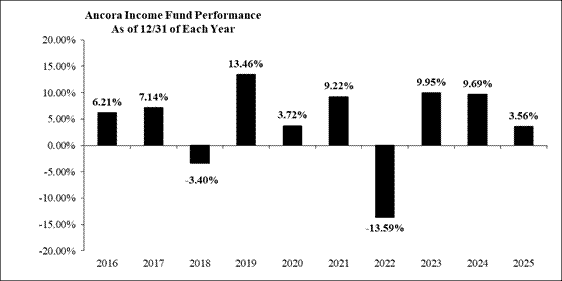
During the period shown in the bar chart, the
| 1 Year | 5 Years | 10 Years | |
| Class I Shares | |||
| Return Before Taxes | |||
| Return After Taxes on Distributions | |||
|
Return After Taxes on Distributions and Sale of Fund Shares |
|||
| Bloomberg US Aggregate Index (reflects no deduction for fees, expenses, or taxes) | - |
Performance information for Class S shares is not shown because Class S shares were not offered prior to the date of this prospectus. Class S would have substantially similar returns to those shown above because the shares are invested in the same portfolio of securities and the annual returns would differ only to the extent that the Classes do not have the same expenses.
Investment Advisor
Ancora Advisors LLC (the “Advisor”) is the investment advisor of this Fund.
Portfolio Manager
Kevin Gale has managed the Fund since May 1, 2020.
| 5 |
Purchase and Sale of Fund Shares
| Minimum Initial Investment |
|
Class I: $5,000 Class S $1,500,000*
Minimum Additional Investment All Classes: $1,000
|
Class I shares are available only through fee-based programs and certain retirement plans, and to other limited categories of investors as described in the prospectus.
You may buy and sell (redeem) shares in the Fund on a day when the New York Stock Exchange is open for regular trading. Shares may be purchased and sold directly from the Fund or through your financial advisor or financial institution. For more information about buying and selling shares, see the sections “Purchasing Your Shares” and “Selling (Redeeming) Your Shares” in the Fund’s Prospectus or call 1-866-626-2672.
* Investors that do not meet the $1,500,000 minimum will nonetheless be permitted to purchase Class S shares if such investors participate in a financial intermediary platform that has committed to aggregate investments in the Fund in excess of $250,000,000 (or such lesser amount permitted by the Trust with respect to such platform), as further described in the prospectus.
Dividends, Capital Gains, and Taxes
The Fund’s distributions are taxable, and will be taxable as ordinary income or capital gains, unless you are investing through a tax-deferred arrangement, such as a 401(k) plan or an individual retirement account. Shares that are held in a tax-deferred account may be taxed when they are withdrawn from the tax-deferred account.
Payments to Broker-Dealers and other Financial Intermediaries
If you purchase the Fund through a broker-dealer or other financial intermediary (such as a bank), the Advisor and its related companies may pay the intermediary for the sale of Fund shares and related services. These payments may create a conflict of interest by influencing the broker-dealer or other intermediary and your salesperson to recommend the Fund over another investment. Ask your salesperson or visit your financial intermediary’s Web site for more information.
| 6 |
ANCORA/THELEN SMALL-MID CAP FUND
(Class I and Class S Shares)
The investment objective of Ancora/Thelen Small-Mid Cap Fund (the “Fund”) is to obtain capital appreciation.
The tables below describe the fees and expenses that you may pay if you buy and hold shares of the Fund.
| Class I | Class S | |
| Maximum Sales Charge (Load) Imposed on Purchases (as a percentage of offering price) | ||
| Maximum Sales Charge (Load) Imposed on Reinvested Dividends | ||
| Redemption Fee (as a percentage of amount redeemed on shares held less than 90 days) |
| Class I | Class S | |
| Management Fees | ||
| Distribution/Service (12b-1) Fees | ||
| Other Expenses | ||
| Class I Class S | ||
| Shareholder Service Fees 0.01% 0.00% | ||
| Remainder of Other Expenses 0.19% 0.19% | ||
| Acquired Fund Fees and Expenses(1) | ||
| Total Annual Fund Operating Expenses | ||
| Fee Waiver(2) | ( | |
| Total Annual Fund Operating Expenses After Fee Waiver(2) |
| (1) |
| (2) |
This Example is intended to help you compare the cost of investing in the Fund with the cost of investing in other mutual funds. This Example assumes that you invest $10,000 in the Fund for the time periods indicated and then redeem all of your shares at the end of those periods. This Example also assumes that your investment has a 5% annual return, maximum sales charges are applied and the Fund’s operating expenses remain the same. Although your actual costs may be higher or lower, based on these assumptions your costs would be:
|
Ancora/Thelen Small-Mid Cap Fund |
1 Year | 3 Years | 5 Years | 10 Years |
| Class I Shares | $ |
$ |
$ |
$ |
| Class S Shares | $ |
$ |
$ |
$ |
The Fund pays transaction costs, such as commissions,
when it buys and sells securities (or “turns over” its portfolio). A higher portfolio turnover may indicate higher transaction
costs and may result in higher taxes where fund shares are held in a taxable account. These costs, which are not reflected in annual fund
operating expenses or in the example, affect the Fund’s performance. During the most recent fiscal year, the Fund’s portfolio
turnover rate was
The Fund normally will invest at least 80% of its net assets in the equity securities of “small to mid cap” companies. Currently, the Fund defines a small to mid-cap company to be one whose market capitalization either falls within the capitalization range of the Russell 2500 Index, an index that tracks stocks of 2,500 of the smallest U.S. companies, or is $10 billion or less at the time of investment. Equity securities include common stocks, preferred stocks, warrants, securities convertible into common or preferred stocks and other equity-like interests in an entity.
In deciding which securities to buy and sell, the Advisor seeks to identify securities of smaller companies that it believes are undervalued by the market. The Advisor will consider, among other things, price-to-earnings, price-to-book and price-to-cash flow ratios.
| 7 |
The Fund’s investments may include companies that are going through a corporate restructuring, companies that have recently been spun off from a parent, companies that the Advisor believes have a competitive advantage but the stock is temporarily mispriced and companies that do not have significant research written or are considered to be underfollowed by Wall Street firms. In addition to considering the research analysts’ sector-specific recommendations and other factors, the Advisor employs quantitative analysis to evaluate the analysts’ recommendations and construct the Fund’s investment portfolio. Sell decisions are made when there is deterioration in fundamentals, a stock reaches a target price or a more attractive opportunity is found.
Principal Risks
The share price of the Fund may change daily based on
market conditions and other factors. Therefore,
The principal risks that apply to the Fund are:
| · |
| · |
| · |
| · |
| · |
| · |
| · |
| · |
| · |
| · |
| · |
| · |
| · |
| 8 |
The bar chart and table gives some indication of the
risks of an investment in the Fund by showing its performance from year to year and how Fund returns compare to a broad measure of market
performance.
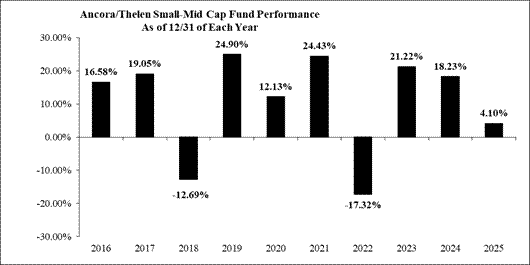
During the period shown in the bar chart, the
| 1 Year | 5 years | 10 Years | |
| Class I Shares | |||
| Return Before Taxes | |||
| Return After Taxes on Distributions | |||
|
Return After Taxes on Distributions and Sale of Fund Shares |
|||
| Russell 2500 Index (reflects no deduction for fees, expenses, or taxes) | |||
|
|
|||
| 1 Year | 5 years | Life of Fund* | |
| Class S Shares | |||
| Return Before Taxes | |||
| Russell 2500 Index (reflects no deduction for fees, expenses, or taxes) |
* From June 19, 2015 (inception of class)
| 9 |
Investment Advisor
Ancora Advisors LLC (the “Advisor”) is the investment advisor of this Fund.
Portfolio Manager
Dan Thelen, a portfolio manager with Ancora Advisors LLC, has managed the Fund since its inception in 2013.
Purchase and Sale of Fund Shares
| Minimum Initial Investment |
|
Class I: $5,000 Class S: $1,500,000*
Minimum Additional Investment All Classes: $1,000
|
Class I shares are available only through fee-based programs and certain retirement plans, and to other limited categories of investors as described in the prospectus.
You may buy and sell (redeem) shares in the Fund on a day when the New York Stock Exchange is open for regular trading. Shares may be purchased and sold directly from the Fund or through your financial advisor or financial institution. For more information about buying and selling shares, see the sections “Purchasing Your Shares” and “Selling (Redeeming) Your Shares” in the Fund’s Prospectus or call 1.866.626.2672.
* Investors that do not meet the $1,500,000 minimum will nonetheless be permitted to purchase Class S shares if such investors participate in a financial intermediary platform that has committed to aggregate investments in the Fund in excess of $250,000,000 (or such lesser amount permitted by the Trust with respect to such platform), as further described in the prospectus.
Dividends, Capital Gains, and Taxes
The Fund’s distributions are taxable, and will be taxable as ordinary income or capital gains, unless you are investing through a tax-deferred arrangement, such as a 401(k) plan or an individual retirement account. Shares that are held in a tax-deferred account may be taxed when they are withdrawn from the tax-deferred account.
Payments to Broker-Dealers and other Financial Intermediaries
If you purchase the Fund through a broker-dealer or other financial intermediary (such as a bank), the Advisor and its related companies may pay the intermediary for the sale of Fund shares and related services. These payments may create a conflict of interest by influencing the broker-dealer or other intermediary and your salesperson to recommend the Fund over another investment. Ask your salesperson or visit your financial intermediary’s Web site for more information.
Fund in excess of $250,000,000 (or such lesser amount permitted by the Trust with respect to such platform), as further described in the prospectus.
| 10 |
ANCORA DIVIDEND VALUE EQUITY FUND
(Class I and Class S Shares)
The investment objective of Ancora Dividend Value Equity Fund (the “Fund”) is to provide growth of income and long-term capital appreciation.
The tables below describe the fees and expenses that you may pay if you buy and hold shares of the Fund.
| Class I | Class S | |
| Maximum Sales Charge (Load) Imposed on Purchases (as a percentage of offering price) | ||
| Maximum Sales Charge (Load) Imposed on Reinvested Dividends | ||
| Redemption Fee (as a percentage of amount redeemed on shares held less than 90 days) |
| Class I | Class S(3) | |
| Management Fees | ||
| Distribution/Service (12b-1) Fees | ||
| Other Expenses | ||
| Class I Class S | ||
| Shareholder Service Fees 0.01% 0.00% | ||
| Remainder of Other Expenses 0.32% 0.32% | ||
| Acquired Fund Fees and Expenses(1) | ||
| Total Annual Fund Operating Expenses(2) | ||
| Fee Waiver | ( |
( |
| Total Annual Fund Operating Expenses After Fee Waiver(2) |
| (1) |
| (2) |
| (3) |
This Example is intended to help you compare the cost of investing in the Fund with the cost of investing in other mutual funds. This Example assumes that you invest $10,000 in the Fund for the time periods indicated and then redeem all of your shares at the end of those periods. This Example also assumes that your investment has a 5% annual return, maximum sales charges are applied and the Fund’s operating expenses remain the same. Although your actual costs may be higher or lower, based on these assumptions your costs would be:
|
Ancora Dividend Value Equity Fund |
1 Year | 3 Years | 5 Years | 10 Years |
| Class I Shares | $ |
$ |
$ |
$ |
| Class S Shares | $ |
$ |
$ |
$ |
The Fund pays transaction costs, such as commissions,
when it buys and sells securities (or “turns over” its portfolio). A higher portfolio turnover may indicate higher transaction
costs and may result in higher taxes where fund shares are held in a taxable account. These costs, which are not reflected in annual fund
operating expenses or in the example, affect the Fund’s performance. During the most recent fiscal year, the Fund’s portfolio
turnover rate was
Under normal circumstances, at least 80% of the assets of the Fund will be invested in dividend paying equity securities with attractive dividend growth potential that are selling at discounted valuations at the time of purchase. Equity securities consist of common stock, preferred stock and securities convertible into common or preferred stock. The Fund will invest predominantly in equity securities of large companies.
| 11 |
In deciding which securities to buy and sell, the Advisor utilizes in-depth, proprietary bottoms-up company research, seeking to identify high quality dividend paying companies with strong competitive positions in their key markets. The Advisor will target companies trading at an attractive dividend yield, sustainable cash flow streams and the ability to grow their dividend consistently. The strategy utilizes various research and screening tools to identify potential catalysts to unlock value and gain an attractive return relative to our intrinsic valuation while maintaining a margin of safety. The Fund will seek to be diversified across industry sectors as well as issuers. The Advisor may select companies not domiciled in the U.S. by investing in ADRs limited to 25% of the Fund.
Principal Risks
The share price of the Fund may change daily based on market conditions and
other factors. Therefore,
The principal risks that apply to the Fund are:
| · |
| · |
| · |
| · |
| · |
| · |
| · |
| · |
| · |
| · |
| · |
| · |
| · |
| 12 |
The bar chart and table give some indication of the
risks of an investment in the Fund by comparing the Fund’s performance with a broad measure of market performance.
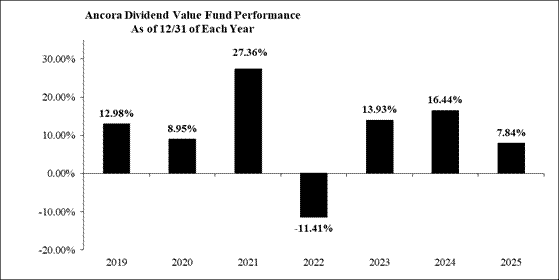
During the period shown in the bar chart, the
| 1 Year | 5 Years | Life of Fund* | |
| Class I Shares | |||
| Return Before Taxes | |||
| Return After Taxes on Distributions | |||
|
Return After Taxes on Distributions and Sale of Fund Shares |
|||
| Russell 1000 Value Index (reflects no deduction for fees, expenses, or taxes) |
* From May 7, 2019 (inception of operations).
Performance information for Class S shares is not shown because Class S shares were not offered prior to the date of this prospectus. Class S would have substantially similar returns to those shown above because the shares are invested in the same portfolio of securities and the annual returns would differ only to the extent that the Classes do not have the same expenses.
| 13 |
Investment Advisor
Ancora Advisors LLC (the “Advisor”) is the investment advisor of this Fund.
Portfolio Managers
The portfolio managers for this Fund are Sonia Mintun and David Sowerby. They have managed the Fund since its inception on April 30, 2019.
Purchase and Sale of Fund Shares
| Minimum Initial Investment |
|
Class I: $5,000 Class S: $1,500,000*
Minimum Additional Investment All Classes: $1,000
|
Class I shares are available only through fee-based programs and certain retirement plans, and to other limited categories of investors as described in the prospectus.
You may buy and sell (redeem) shares in the Fund on a day when the New York Stock Exchange is open for regular trading. Shares may be purchased and sold directly from the Fund or through your financial advisor or financial institution. For more information about buying and selling shares, see the sections “Purchasing Your Shares” and “Selling (Redeeming) Your Shares” in the Fund’s Prospectus or call 1.866.626.2672.
* Investors that do not meet the $1,500,000 minimum will nonetheless be permitted to purchase Class S shares if such investors participate in a financial intermediary platform that has committed to aggregate investments in the Fund in excess of $250,000,000 (or such lesser amount permitted by the Trust with respect to such platform), as further described in the prospectus.
Dividends, Capital Gains, and Taxes
The Fund’s distributions are taxable, and will be taxable as ordinary income or capital gains, unless you are investing through a tax-deferred arrangement, such as a 401(k) plan or an individual retirement account. Shares that are held in a tax-deferred account may be taxed when they are withdrawn from the tax-deferred account.
Payments to Broker-Dealers and other Financial Intermediaries
If you purchase the Fund through a broker-dealer or other financial intermediary (such as a bank), the Advisor and its related companies may pay the intermediary for the sale of Fund shares and related services. These payments may create a conflict of interest by influencing the broker-dealer or other intermediary and your salesperson to recommend the Fund over another investment. Ask your salesperson or visit your financial intermediary’s Web site for more information.
| 14 |
FUND DETAILS
ADDITIONAL INFORMATION ABOUT PRINCIPAL RISKS
Unless otherwise noted, in this section, references to a single Fund apply equally to all of the Funds. The principal risks of investing in each Fund of Funds are summarized in the description of that Fund above. These risks are more fully described below. The Funds’ Statement of Additional Information (the “SAI”) dated the same date as this prospectus contains further details about these risks as well as information about additional risks.
Market Risk
Events in certain sectors historically have resulted, and may in the future result, in an unusually high degree of volatility in the financial markets, both domestic and foreign. These events have included, but are not limited to: bankruptcies, corporate restructurings, and other similar events; governmental efforts to limit short selling and high frequency trading; measures to address U.S. federal and state budget deficits; social, political, and economic instability in Europe; economic stimulus by the Japanese central bank; dramatic changes in energy prices and currency exchange rates; and China’s economic slowdown. Interconnected global economies and financial markets increase the possibility that conditions in one country or region might adversely impact issuers in a different country or region. Both domestic and foreign equity markets have experienced increased volatility and turmoil, with issuers that have exposure to the real estate, mortgage, and credit markets particularly affected. Financial institutions could suffer losses as interest rates rise or economic conditions deteriorate.
In addition, relatively high market volatility and reduced liquidity in credit and fixed-income markets may adversely affect many issuers worldwide. Actions taken by the U.S. Federal Reserve (Fed) or foreign central banks to stimulate or stabilize economic growth, such as interventions in currency markets, could cause high volatility in the equity and fixed-income markets. Reduced liquidity may result in less money being available to purchase raw materials, goods, and services from emerging markets, which may, in turn, bring down the prices of these economic staples. It may also result in emerging-market issuers having more difficulty obtaining financing, which may, in turn, cause a decline in their securities prices. In addition, while interest rates have been historically low in recent years in the United States and abroad, any decision by the Fed to adjust the target Fed Funds rate, among other factors, could cause markets to experience continuing high volatility. A significant increase in interest rates may cause a decline in the market for equity securities. Also, regulators have expressed concern that rate increases may contribute to price volatility. These events and the possible resulting market volatility may have an adverse effect on the Fund.
Political turmoil within the United States and abroad may also impact the Fund. Although the U.S. government has honored its credit obligations, it remains possible that the United States could default on its obligations. While it is impossible to predict the consequences of such an unprecedented event, it is likely that a default by the United States would be highly disruptive to the U.S. and global securities markets and could significantly impair the value of the Fund’s investments. Similarly, political events within the United States at times have resulted, and may in the future result, in a shutdown of government services, which could negatively affect the U.S. economy, decrease the value of many Fund investments, and increase uncertainty in or impair the operation of the U.S. or other securities markets. In recent years, the U.S. renegotiated many of its global trade relationships and imposed or threatened to impose significant import tariffs. These actions could lead to price volatility and overall declines in U.S. and global investment markets.
As the Fed “tapers” or reduces the amount of securities it purchases pursuant to quantitative easing, and/or if the Fed raises the federal Funds rate, there is a risk that interest rates will rise, which could expose fixed-income and related markets to heightened volatility and could cause the value of a Fund’s investments, and the Fund’s net asset value (NAV), to decline, potentially suddenly and significantly. As a result, the Fund may experience high redemptions and, as a result, increased portfolio turnover, which could increase the costs that the Fund incurs and may negatively impact the Fund’s performance.
Political and military events, including in Ukraine, North Korea, Venezuela, Iran, Syria, and other areas of the Middle East, and nationalist unrest in Europe and South America, also may cause market disruptions. As a result of continued political tensions and armed conflicts, including the Russian invasion of Ukraine commencing in February of 2022, the extent and ultimate result of which are unknown at this time, the United States and the European Union, along with the regulatory bodies of a number of countries, have imposed economic sanctions on certain Russian corporate entities and individuals, and certain sectors of Russia’s economy, which may result in, among other things, the continued devaluation of Russian currency, a downgrade in the country’s credit rating, and/or a decline in the value and liquidity of Russian securities, property or interests. These sanctions could also result in the immediate freeze of Russian securities and/or Funds invested in prohibited assets, impairing the ability of a Fund to buy, sell, receive or deliver those securities and/or assets. These sanctions or the threat of additional sanctions could also result in Russia taking counter measures or retaliatory actions, which may further impair the value and liquidity of Russian securities. The United States and other nations or international organizations may also impose additional economic sanctions or take other actions that may adversely affect Russia-exposed issuers and companies in various sectors of the Russian economy. Any or all of these potential results could lead Russia’s economy into a recession. Economic sanctions and other actions against Russian institutions, companies, and individuals resulting from the ongoing conflict may also have a substantial negative impact on other economies and securities markets both regionally and globally, as well as on companies with operations in the conflict region, the extent to which is unknown at this time.
In addition, there is a risk that the prices of goods and services in the United States and many foreign economies may decline over time, known as deflation. Deflation may have an adverse effect on stock prices and creditworthiness and may make defaults on debt more likely. If a country’s economy slips into a deflationary pattern, it could last for a prolonged period and may be difficult to reverse. Further, there is a risk that the present value of assets or income from investments will be less in the future, known as inflation. Inflation rates may change frequently and drastically as a result of various factors, including unexpected shifts in the domestic or global economy, and a Fund’s investments may be affected, which may reduce a Fund’s performance. Further, inflation may lead to the rise in interest rates, which may negatively affect the value of debt instruments held by the Fund, resulting in a negative impact on a Fund’s performance.
| 15 |
Generally, securities issued in emerging markets are subject to a greater risk of inflationary or deflationary forces, and more developed markets are better able to use monetary policy to normalize markets.
Geopolitical and Pandemic Risk
A widespread health crisis such as a global pandemic could cause substantial market volatility, exchange trading suspensions and closures, which may lead to less liquidity in certain instruments, industries, sectors or the markets generally, and may ultimately affect Fund performance. For example, the coronavirus (COVID-19) pandemic has resulted and may continue to result in significant disruptions to global business activity and market volatility due
to disruptions in market access, resource availability, facilities operations, imposition of tariffs, export controls and supply chain disruption, among others. The impact of a health crisis and other epidemics and pandemics that may arise in the future, could affect the global economy in ways that cannot necessarily be foreseen at the present time. A health crisis may exacerbate other pre-existing political, social and economic risks. Any such impact could adversely affect the Fund’s performance, resulting in losses to your investment.
The United States responded to the coronavirus (COVID-19) pandemic and resulting economic distress with fiscal and monetary stimulus packages. In late March 2020, the government passed the Coronavirus Aid, Relief, and Economic Security Act, a stimulus package providing for over $2.2 trillion in resources to small businesses, state and local governments, and individuals adversely impacted by the coronavirus (COVID-19) pandemic. In late December 2020, the government also passed a spending bill that included $900 billion in stimulus relief for the coronavirus (COVID-19) pandemic.
Further, in March 2021, the government passed the American Rescue Plan Act of 2021, a $1.9 trillion stimulus bill to accelerate the United States’ recovery from the economic and health effects of the coronavirus (COVID-19) pandemic. In addition, in mid-March 2020 the Fed cut interest rates to historically low levels and promised unlimited and open-ended quantitative easing, including purchases of corporate and municipal government bonds. The Fed also enacted various programs to support liquidity operations and Funding in the financial markets, including expanding its reverse repurchase agreement operations, adding $1.5 trillion of liquidity to the banking system, establishing swap lines with other major central banks to provide dollar Funding, establishing a program to support money market Funds, easing various bank capital buffers, providing Funding backstops for businesses to provide bridging loans for up to four years, and providing Funding to help credit flow in asset-backed securities markets. The Fed also extended credit to small- and medium-sized businesses.
Equity Securities Risk
Common and preferred stocks represent equity ownership in a company. Stock markets are volatile. The price of equity securities will fluctuate, and can decline and reduce the value of a Fund investing in equities. The price of equity securities fluctuates based on changes in a company’s financial condition and overall market and economic conditions. The value of equity securities purchased by a Fund could decline if the financial condition of the companies in which the Fund is invested declines, or if overall market and economic conditions deteriorate. An issuer’s financial condition could decline as a result of poor management decisions, competitive pressures, technological obsolescence, undue reliance on suppliers, labor issues, shortages, corporate restructurings, fraudulent disclosures, irregular and/or unexpected trading activity among retail investors, or other factors. Changes in the financial condition of a single issuer can impact the market as a whole.
Even a Fund that invests in high-quality, or blue chip, equity securities, or securities of established companies with large market capitalizations (which generally have strong financial characteristics), can be negatively impacted by poor overall market and economic conditions. Companies with large market capitalizations may also have less growth potential than smaller companies and may be less able to react quickly to changes in the marketplace.
A Fund generally does not attempt to time the market. Because of its exposure to equities, the possibility that stock market prices in general will decline over short or extended periods subjects the Fund to unpredictable declines in the value of its investments, as well as periods of poor performance.
Interest Rate Risk
Fixed-income securities are affected by changes in interest rates. When interest rates decline, the market value of the fixed-income securities generally can be expected to rise. Conversely, when interest rates rise, the market value of fixed-income securities generally can be expected to decline. Recent and potential future changes in government monetary policy may affect the level of interest rates.
The longer a fixed-income security’s duration, the more sensitive it will be to changes in interest rates. Similarly, a Fund with a longer average portfolio duration will be more sensitive to changes in interest rates than a Fund with a shorter average portfolio duration. Duration is a measure used to determine the sensitivity of a security’s price to changes in interest rates that incorporates a security’s yield, coupon, final maturity, and call features, among other characteristics. All other things remaining equal, for each one percentage point increase in interest rates, the value of a portfolio of fixed-income investments would generally be expected to decline by one percent for every year of the portfolio’s average duration above zero. For example, the price of a bond Fund with an average duration of eight years would be expected to fall approximately 8% if interest rates rose by one percentage point. The maturity of a security, another commonly used measure of price sensitivity, measures only the time until final payment is due, whereas duration takes into account the pattern of all payments of interest and principal on a security over time, including how these payments are affected by prepayments and by changes in interest rates, as well as the time until an interest rate is reset (in the case of variable-rate securities).
Operational and Cybersecurity Risk
With the increased use of technologies, such as mobile devices and “cloud”-based service offerings and the dependence on the internet and computer systems to perform necessary business functions, the Fund’s service providers are susceptible to operational and information or cybersecurity risks that could result in losses to the Fund and its shareholders. Intentional cybersecurity breaches include unauthorized access to systems, networks, or devices (such as through “hacking” activity or “phishing”);
| 16 |
infection from computer viruses or other malicious software code; and attacks that shut down, disable, slow, or otherwise disrupt operations, business processes, or website access or functionality. Cyber-attacks can also be carried out in a manner that does not require gaining unauthorized access, such as causing denial-of-service attacks on the service providers’ systems or websites rendering them unavailable to intended users or via “ransomware” that renders the systems inoperable until appropriate actions are taken. In addition, unintentional incidents can occur, such as the inadvertent release of confidential information (possibly resulting in the violation of applicable privacy laws.)
A cybersecurity breach could result in the loss or theft of customer data or Funds, loss or theft of proprietary information or corporate data, physical damage to a computer or network system, or costs associated with system repairs. Such incidents could cause a Fund, the advisor, a manager, or other service providers to incur regulatory penalties, reputational damage, additional compliance costs, litigation costs or financial loss. In addition, such incidents could affect issuers in which a Fund invests, and thereby cause the Fund’s investments to lose value.
Cyber-events have the potential to materially affect the Fund and the Advisor’s relationships with accounts, shareholders, clients, customers, employees, products, and service providers. The Fund has established risk management systems reasonably designed to seek to reduce the risks associated with cyber-events. There is no guarantee that the Fund will be able to prevent or mitigate the impact of any or all cyber-events. The Fund is exposed to operational risk arising from a number of factors, including, but not limited to, human error, processing and communication errors, errors of the Fund’s service providers, counterparties, or other third parties, failed or inadequate processes and technology or system failures.
In addition, other disruptive events, including (but not limited to) natural disasters and public health crises (such as the coronavirus (COVID-19) pandemic), may adversely affect the Fund’s ability to conduct business, in particular if the Fund’s employees or the employees of its service providers are unable or unwilling to perform their responsibilities as a result of any such event. Even if the Fund’s employees and the employees of its service providers are able to work remotely, those remote work arrangements could result in the Fund’s business operations being less efficient than under normal circumstances, could lead to delays in its processing of transactions, and could increase the risk of cyber-events.
TEMPORARY DEFENSIVE POSITIONS
In attempting to respond to adverse market, economic, political or other conditions, or in anticipation of the liquidation of a Fund, each of the Funds, at the discretion of the Advisor, may take temporary defensive positions for up to 100% of the Fund’s assets that are inconsistent with such Fund’s principal investment strategies, such as investing in cash or cash equivalents, high-quality short-term debt securities, money market instruments and money market mutual funds. The taking of such a defensive position may adversely affect the ability of such Fund to achieve its investment objective.
DISCLOSURE OF PORTFOLIO HOLDINGS INFORMATION
A description of the Fund's policies and procedures with respect to disclosure of the Fund's portfolio holdings information is available in the Statement of Additional Information.
The Fund will disclose complete portfolio holdings information on the Fund’s internet site at www.ancora.net approximately 10 days after the end of each fiscal quarter, which information is current as of the end of such fiscal quarter. The portfolio holdings information will be located through a prominent hyperlink on the right-hand side of such page on the Fund's internet site. Such portfolio holdings information may then be disclosed to any person no earlier than one day after the day on which the information is posted on the Fund's internet site. The complete portfolio information for each fiscal quarter will remain available on the Fund's internet site at least until the date on which the Fund files its Form N-Q or Form N-CSR with the Securities and Exchange Commission for the period that includes the date as of which the portfolio holdings information located on the Fund's internet site is current.
INVESTMENT ADVISOR
Each Fund since its inception has retained as its investment advisor Ancora Advisors LLC (the “Advisor”), located at 6060 Parkland Blvd., Suite 200, Cleveland, Ohio 44124, an investment advisor established in 2003. The Ancora Income Fund, the Ancora/Thelen Small-Mid Cap Fund and the Ancora Dividend Value Equity Fund are referred to collectively as the “Funds” and individually as the “Fund.” The Advisor also manages investments for individually managed accounts comprised of high net worth individuals, pension and profit sharing plans, charitable organizations and businesses. The Advisor is also the advisor to numerous hedge funds.
Subject to the supervision and direction of the Fund’s Board of Trustees, the Advisor, as investment advisor, manages each Fund’s assets in accordance with the stated policies of such Fund. The Advisor makes investment decisions for each Fund and places the purchase and sale order for portfolio transactions.
For its services, the Advisor receives from each of the Ancora/Thelen Small-Mid Cap Fund an annual investment management fee of 1.00% of each Fund’s average net assets. The Advisor’s annual investment management fee for managing the Ancora Dividend Value Equity Fund is 0.75% of such Fund’s average net assets. The Advisor’s annual investment management fee for managing the Ancora Income Fund is 0.50% of such Fund’s average net assets. For the fiscal year ended December 31, 2025, Ancora Income Fund, Ancora/Thelen Small-Mid Cap Fund and Ancora Dividend Value Equity Fund paid the Adviser 0.50%, [0.93 ]%, and 0.67% of average net daily net assets, respectively.
The Advisor has contractually agreed to waive its fees to the extent necessary to limit the Fund’s total annual fund operating expenses (excluding dividend expenses relating to short sales, interest, taxes, brokerage commissions, and the cost of “Acquired Fund Fees and Expenses,” if any) to the amounts set forth below. Fee waivers are calculated and applied at least monthly,
| 17 |
based on each Fund’s average net assets during such month. These fee waivers are expected to continue indefinitely but shall remain in effect until at least April 30, 2027 (subject to termination prior to such date only by a vote of the Trustees if they deem the termination to be beneficial to the Fund shareholders). The terms of the Advisor’s waiver agreement provide that the Advisors are entitled to recover such waived amounts within the same fiscal year in which the Advisors reduced their fees. No recoupment will occur except to the extent that the Fund’s operating expenses, together with the amount recovered, do not exceed the applicable expense limitation amount. The Advisor is not obligated to reimburse a Fund for amounts in excess of the fee waiver.
|
Fund |
Contractual Limit on Total Operating Expenses
|
| Ancora Income Fund | |
| Class I | 1.285% |
|
Class S
|
1.00% |
| Ancora/Thelen Small-Mid Cap Fund | |
| Class I | 1.39% |
|
Class S
|
1.00% |
| Ancora Dividend Value Equity Fund | |
| Class I | 1.00% |
| Class S | 0.75% |
A discussion regarding the basis for the Board of Trustees’ approval of the management agreement between each Fund and the Advisor is available in the Funds’ semi-annual report for the period ended June 30, 2025.
PORTFOLIO MANAGERS
Kevin Gale has been a portfolio manager of the Ancora Income Fund since May 1, 2020. Mr. Gale joined Ancora Advisors in 2019 as part of the firm’s Fixed Income Team. Mr. Gale leads the team managing the firm’s various fixed income strategies as well as the individual portfolios for institutional and high net worth accounts. Prior to joining Ancora Advisors, Mr. Gale worked in various positions with increasing responsibility at KeyBank since 2000. Mr. Gale has a Bachelor of Science degree in Family Financial Management from The Ohio State University, and a Master of Business Administration from Cleveland State University.
Dan Thelen, a portfolio manager with the Advisor, has managed the Ancora/Thelen Small-Mid Cap Fund since its inception in 2013. From 2000 to the end of 2011, Dan was a vice president and portfolio manager at Loomis Sayles & Co, and a member of its small/mid cap value team. He was the lead manager of the Loomis Sayles Small Cap Value Fund from 2000 to 2011. From 1996 to 2000, he was an analyst at Loomis Sayles & Co.
Sonia Mintun, a portfolio manager with the Advisor since 2008, is lead portfolio manager of the Ancora Dividend Value Equity Fund. From 1983 until 1989, Ms. Mintun worked with Bernstein-Macaulay in New York City as an Assistant Vice President and Portfolio Manager. Then Ms. Mintun worked as portfolio manager and head trader for Westinghouse Credit Corp, followed by her position as portfolio manager and analyst for Proper Analysis Corp., and subsequently followed by her role as Chief Compliance Officer, Vice President and Portfolio Manager at First Fiduciary Investment Counsel.
David Sowerby, a portfolio manager with the Advisor since 2017, is a portfolio manager of the Ancora Dividend Value Equity Fund. Prior to joining the Advisor, Mr. Sowerby was most recently a portfolio manager at Loomis, Sayles & Company, where he worked since 1998 and held multiple senior positions. At Loomis, Mr. Sowerby worked directly with institutional clients on asset allocation strategies and multi-product accounts. Earlier in his career, he was Senior Portfolio Manager for Beacon Investment Management Company. Mr. Sowerby began his industry career in 1986 providing investment strategy as an economist for Comerica Bank.
The Statement of Additional Information provides additional information about each portfolio manager’s (i) compensation, (ii) other accounts managed and (iii) ownership of securities in each Fund.
CHOOSING A CLASS OF SHARES
Each of the Funds offers Class I shares and Class S shares. No class has a front-end sales charge.
Class I Shares
Class I shares are not subject to distribution fees but are subject to a shareholder service fee of .01% of the average daily net assets of the applicable Fund.
Class I shares are available for purchase by clients of financial intermediaries who charge such clients an ongoing fee for advisory, investment, consulting or related services. Such client may include individuals, corporations, endowments and foundations. Class I shares are also available for purchase by family offices and their clients. A family office is a company that provides certain financial and other services to a high net worth family or families.
Class I shares are also available for purchase by the following categories of investors:
| · | Certain employer-sponsored retirement plans. |
| 18 |
| · | Certain bank or broker-affiliated trust departments. |
| · | Advisory accounts of the Advisor and its affiliates. |
| · | Current and former trustees of any Ancora Fund, and their immediate family members (as defined in the statement of additional information). |
| · | Officers, directors and former directors of Ancora Group, LLC and its affiliates, and their immediate family members. |
| · | Full-time and retired employees of Ancora Group, LLC and its affiliates, and their immediate family members. |
| · | Certain financial intermediary personnel, and their immediate family members. |
Class S Shares
Class S shares are not subject to distribution or servicing fees.
The ordinary minimum investment amount for Class S shares is $1,500,000. However, Class S shares of each Fund may be purchased by investors who do not meet the $1,500,000 minimum investment amount if such investors participate in certain financial intermediary platforms, including but not limited to mutual fund wrap fee programs, bank trust platforms, retirement platforms, asset allocation platforms, managed account programs, and other discretionary or nondiscretionary fee-based investment advisory programs, each of which has committed to aggregate investments in such Fund in excess of $250,000,000 (or such lesser amount permitted by the Trust with respect to such platform).
Shareholders of each Fund may convert their shares into another class of shares of the same Fund upon the satisfaction of any then-applicable eligibility requirements.
Please refer to the statement of additional information for more information about Class I and Class S shares, including more detailed program descriptions and eligibility requirements. Additional information is also available from your financial advisor, who can also help you prepare any necessary application forms.
PURCHASING YOUR SHARES
You may purchase shares directly from the Fund or through your financial advisor or financial institution. You may purchase shares on any day when the New York Stock Exchange is open for trading.
Opening an Account
In order to open an account you must complete an investment application. You can obtain an investment application from your financial advisor, your financial institution, or by visiting our website at www.ancora.net. For more information about how to purchase shares, call the Ancora Funds at 1.866.626.2672.
Federal law requires all financial institutions to obtain, verify and record information that identifies each person who opens an account. When you open an account, we will ask for your name, residential address, date of birth, government identification number and other information that will allow us to identify you. We may also ask to see your driver’s license or other identifying documents. If we do not receive these required pieces of information, there will be a delay in processing your investment request, which could subject your investment to market risk. If we are unable to immediately verify your identify, the Fund may restrict further investment until your identity is verified. However, if we are unable to completely verify your identity through our verification process, the Fund reserves the right to close your account without notice and return your investment to you at the price determined at the end of business (usually 4:00 p.m. eastern time (“ET”)), on the day that your account is closed. If we close your account because we are unable to completely verify your identify, your investment will be subject to market fluctuation, which could result in a loss of a portion of your principal investment.
Directly from the Fund
| · | Please make your check (drawn on a U.S. bank and payable in U.S. dollars) payable to the Ancora Funds. We do not accept third party checks for initial investments. |
| · | Send your check with the completed investment application by regular mail to Ancora Funds, 8000 Town Center Drive, Suite 400, Broadview Heights, Ohio 44147. |
| · | Your application will be processed subject to your check clearing. If your check is returned for insufficient funds or uncollected funds, you may be charged a fee and you will be responsible for any resulting loss to the Fund. |
| · | You may also open a fund-direct account through your financial advisor. |
Through Your Financial Institution
| · | You may invest in certain share classes by establishing an account through financial institutions that have appropriate selling agreements with Arbor Court Capital, LLC. |
| · | Your financial institution will act as the shareholder of record of your shares. |
| · | Financial institutions may set different minimum initial and additional investment requirements, may impose other restrictions or may charge you fees for their services. |
| · | Financial institutions may designate intermediaries to accept purchase and sales orders on the Fund’s behalf. |
| · | Your financial institution may receive compensation from the Fund, the Advisor, the Distributor or their affiliates. |
| · | Before investing in the Fund through your financial institution, you should read any materials provided by your financial institution together with this Prospectus. |
Through Retirement Plans
You may invest in the Funds through various retirement plans. These include individual retirement plans and employer sponsored retirement plans.
| 19 |
For further information about any of the plans, agreements, applications and annual fees, contact the Fund at 1.866.626.2672 or contact your financial advisor.
Through a Processing Organization
You may also purchase shares of the Fund through a “processing organization,” (e.g., a mutual fund supermarket) which is a broker-dealer, bank or other financial institution that purchases shares for its customers. Some of the Funds have authorized certain processing organizations (“Authorized Processing Organizations”) to receive purchase and sales orders on their behalf. Before investing in the Fund through a processing organization, you should read any materials provided by the processing organization together with this Prospectus. You should also ask the processing organization if they are authorized by the Fund to receive purchase and sales orders on their behalf. If the processing organization is not authorized, then your purchase order could be rejected which could subject your investment to market risk. When shares are purchased with an Authorized Processing Organization, there may be various differences compared to investing directly with the Fund. The Authorized Processing Organization may:
| · | Charge a fee for its services |
| · | Act as the shareholder of record of the shares |
| · | Set different minimum initial and additional investment requirements |
| · | Impose other charges and restrictions |
| · | Designate intermediaries to accept purchase and sales orders on the Fund’s behalf |
The Fund considers a purchase or sales order as received when an Authorized Processing Organization or its authorized designee receives the order in proper form. These orders will be priced based on the Fund’s NAV next computed after such order is received in proper form by an Authorized Processing Organization or its authorized designee.
Shares held through an Authorized Processing Organization may be transferred into your name following procedures established by your Authorized Processing Organization and the Fund. Certain Authorized Processing Organizations may receive compensation from the Fund, the Advisor, the Distributor, or their affiliates.
It is the responsibility of an Authorized Processing Organization to transmit properly completed orders so that they will be received by the Fund in a timely manner.
Pricing of Purchases
Purchase orders received by the Fund, an Authorized Processing Organization, financial advisor or financial institution, by the close of the regular session of trading on the New York Stock Exchange (“NYSE”), generally 4:00 p.m. ET, are processed at that day’s NAV. Purchase orders received by the Fund, an Authorized Processing Organization, financial advisor or financial institution, after the close of the regular session of trading on the NYSE, generally 4:00 p.m. ET, are processed at the NAV next determined on the following business day. It is the responsibility of the financial institution, financial advisor or Authorized Processing Organization to transmit orders that will be received by the Fund in proper form and in a timely manner.
Adding to Your Account
By Check
| · | Complete the investment form provided at the bottom of a recent account statement. |
| · | Make your check (drawn on a U.S. bank and payable in U.S. dollars) payable to the Ancora Funds. |
| · | Write your account number on the check. |
| · | Either: (1) Mail the check with the investment form from the bottom of a recent statement to the Fund; or (2) Mail the check directly to your financial advisor or financial institution at the address printed on your account statement. Your financial advisor or financial institution is responsible for forwarding payment promptly to the Fund. |
| · | If your check is returned for insufficient funds or uncollected funds, you may be charged a fee and you will be responsible for any resulting loss to the Fund. |
By Wire
| · | Contact the Fund, your financial advisor or your financial institution for further instructions. |
| · | Contact your bank and ask it to wire federal funds to the Fund. Specify your name and account number when remitting the funds. |
| · | Your bank may charge a fee for handling wire transfers. |
| · | Purchases in the Fund will be processed at that day’s NAV (or public offering price, if applicable) if the Fund receives a properly executed wire by the close of the regular session of trading on the NYSE, generally 4:00 p.m. ET, on a day when the NYSE is open for regular trading. |
Automatic Investment Plan
You can pre-authorize monthly investments in a Fund of $100 or more to be processed electronically from a checking or savings account. You will need to complete the appropriate section in the investment application to do this. Amounts that are automatically invested in a Fund will not be available for redemption until three business days after the automatic reinvestment. For further details, call the Funds at 1.866.626.2672.
| 20 |
SELLING (REDEEMING) YOUR SHARES
You may sell some or all of your shares on any day that the NYSE is open for regular trading. If your request is received by the Fund, an Authorized Processing Organization, financial advisor or financial institution, in proper form by the close of regular trading on the NYSE (usually 4:00 p.m. ET), you will receive a price based on that day’s NAV for the shares you sell. Otherwise, the price you receive will be based on the NAV that is next calculated.
Directly from the Fund – By Telephone
| · | You can sell or exchange your shares over the telephone, unless you have specifically declined this option. If you do not wish to have this ability, you must mark the appropriate section of the investment application. You may only sell shares over the telephone if the amount is at least $1,000 and not more than $100,000. |
| · | To sell your Fund shares by telephone, call the Funds at 1.866.626.2672. |
| · | Shares held in IRA accounts and qualified retirement plans cannot be sold by telephone. |
| · | If we receive your sale request by the close of the regular session of trading on the NYSE, generally 4:00p.m. ET, on a day when the NYSE is open for regular trading, the sale of your shares will be processed at the next determined NAV on that day. Otherwise it will occur on the next business day. |
| · | Interruptions in telephone service could prevent you from selling your shares by telephone when you want to. When you have difficulty making telephone sales, you should mail to the Fund (or send by overnight delivery), a written request for the sale of your shares. |
| · | In order to protect your investment assets, the Fund will only follow instructions received by telephone that it reasonably believes to be genuine. However, there is no guarantee that the instructions relied upon will always be genuine and the Fund will not be liable in those cases. The Fund has certain procedures to confirm that telephone instructions are genuine. If it does not follow such procedures in a particular case, it may be liable for any losses due to unauthorized or fraudulent instructions. |
Directly from the Fund – By Mail
| · | Write to the Fund at Ancora Funds, 8000 Town Center Drive, Suite 400, Broadview Heights, Ohio 44147. |
| · | Indicate the number of shares or dollar amount to be sold. |
| · | Include your name and account number. |
| · | Sign your request exactly as your name appears on your investment application. |
| · | You may be required to have your signature guaranteed. |
Directly from the Fund – By Wire
| · | Complete the appropriate information on the investment application. |
| · | You may be charged a fee by the Fund or Fund’s Authorized Processing Organization for wiring redemption proceeds. You may also be charged a fee by your bank. |
| · | Redemption proceeds will only be wired to a commercial bank or brokerage firm in the United States in the name of the shareholder. Third party wires are prohibited. |
| · | Your redemption proceeds may be deposited without a charge directly into your bank account through an ACH transaction. For more information, call the Funds at 1.866.626.2672. |
Directly from the Fund – Through a Systematic Withdrawal Plan
| · | You may elect to receive withdrawals of $100 or more if your account value is at least $5,000. |
| · | Withdrawals can be made monthly or quarterly. |
| · | There is no fee for this service. |
| · | There is no minimum account balance required for retirement plans. |
Through Your Financial Advisor, Financial Institution or Authorized Processing Organization
| · | You may also sell shares by contacting your financial advisor, financial institution or Authorized Processing Organization, which may charge you a fee for this service. Shares held in street name must be sold through your financial advisor, financial institution or, if applicable, the Authorized Processing Organization. |
| · | Your financial advisor, financial institution or Authorized Processing Organization is responsible for making sure that sale requests are transmitted to the Fund in proper form and in a timely manner. |
| · | Your financial institution may charge you a fee for selling your shares. |
| · | Sale proceeds will only be wired to a commercial bank or brokerage firm in the United States. |
Short Term Redemption Fee
If you sell (redeem) your shares after holding them less than 90 days, a 2.00% short-term redemption fee may be deducted from the redemption amount. For this purpose, shares held longest will be treated as being redeemed first and shares held shortest as being redeemed last. The fees are paid to the Fund, not the Distributor or the Advisor, and are designed to help offset the brokerage commissions, market impact, and other costs associated with short-term shareholder trading.
The short-term redemption fee does not apply to: (i) redemptions of shares acquired by reinvesting dividends and distributions; or (ii) rollovers, transfers, and changes of account registration within the Fund, or transfers between classes of a Fund as long as the money never leaves the Fund.
The Fund also permits waivers of the short-term redemption fee for the following transactions:
| 21 |
| · | Redemptions related to death or due to a divorce decree; |
| · | Certain types of IRA account transactions, including redemptions pursuant to systematic withdrawal programs, withdrawals due to disability, return of excess contribution amounts, and redemptions related to payment of custodian fees; and |
| · | Certain types of employer-sponsored and 403(b) retirement plan transactions, including: loans or hardship withdrawals, minimum required distributions, redemptions pursuant to systematic withdrawal programs, forfeiture of assets, return of excess contribution amounts, redemptions related to payment of plan fees, and redemptions related to death, disability, or qualified domestic relations order. |
The application of short-term redemption fees and waivers may vary among intermediaries and certain intermediaries may not apply the waivers listed above. If you purchase or sell fund shares through an intermediary, you should contact your intermediary for more information on whether the short-term redemption fee will be applied to redemptions of your shares.
The Fund reserves the right to modify or eliminate the short-term redemption fee or waivers at any time. Investment advisors or their affiliates may pay short-term redemption fees on behalf of investors in managed accounts. Unitized group accounts consisting of qualified plan assets may be treated as a single account for redemption fee purposes.
The Fund seeks to identify intermediaries that hold fund shares in omnibus accounts and will refuse their purchase orders if they do not agree to track and remit short-term redemption fees based on the transactions of underlying investors. There are no assurances that the Fund will successfully identify all intermediaries or that the intermediaries will properly assess short-term redemption fees.
Other Information Concerning Redemption
Each Fund reserves the right to take up to seven days to make payment if, in the judgment of the Advisor, such Fund could be affected adversely by immediate payment. In addition, the right of redemption for a Fund may be suspended or the date of payment postponed (a) for any period during which the NYSE is closed (other than for customary week-end and holiday closings), (b) when trading in the markets that the Fund normally utilizes is restricted, or when an emergency, as defined by the rules and regulations of the SEC, exists, making disposal of that Fund's investments or determination of its net asset value not reasonably practicable, or (c) for any other periods as the SEC by order may permit for protection of that Fund's shareholders.
Due to the high cost of maintaining accounts, each Fund has the right to redeem, upon not less than 30 days written notice, all of the Class I shares of any shareholder if, through redemptions, the shareholder's account has a net asset value of less than $5,000. Each Fund also has the right to convert into Class I shares, upon not less than 30 days written notice, all of the Class S shares of any shareholder if, through redemptions, the shareholder's account has a net asset value of less than $1,500,000 or, in the case of a Class S shareholder who was permitted to purchase shares through a financial intermediary platform that committed to aggregate investments in such Fund in excess of $250,000,000 (or such lesser amount permitted by the Trust with respect to such platform), if the relevant financial intermediary platform fails to or ceases to maintain aggregate investments in such Fund with an aggregate net asset value of $250,000,000 or such lesser amount as permitted by the Trust. A shareholder will be given at least 30 days written notice prior to any involuntary redemption or conversion and during such period will be allowed to purchase additional shares to bring his account up to the applicable minimum before the redemption or conversion is processed.
When a conversion occurs, the shareholder receives Class I shares in place of Class S shares of the same Fund. At the time of conversion, the dollar value of the “new” shares received by the shareholder equals the dollar value of the “old” shares that were converted. In other words, the conversion has no effect on the value of a shareholder’s investment in the Fund at the time of conversion. However, the number of Class I shares owned by a shareholder after the conversion may be greater than or less than the number of Class S shares owned before the conversion, depending on the net asset values of the two share classes. A conversion between share classes of the same Fund is a nontaxable event.
Pricing of Fund Shares
The Fund’s share price (also called “NAV”) is determined as of the close of trading (normally 4:00 p.m. ET) every day the NYSE is open. Each Fund calculates its NAV per share, generally using market prices, by dividing the total value of its net assets by the number of shares outstanding. Shares are purchased or sold at the next offering price determined after your purchase or sale order is received in proper form by the Fund, an Authorized Processing Organization or financial institution.
The Funds’ equity investments are valued based on market value or, if no market value is available, based on fair value as determined by the Board of Trustees (or under their direction). The Funds may use pricing services to determine market value for investments.
Securities held by the Fund that do not have readily available market quotations, or securities for which the available market quotation is not reliable, are priced at their fair value using procedures approved by the Board of Trustees. Any debt securities held by a Fund for which market quotations are not readily available are generally priced at their most recent bid prices as obtained from one or more of the major market makers for such securities. The Fund may use fair value pricing under the following circumstances, among others:
| · | If the value of a security has been materially affected by events occurring before the Fund’s pricing time but after the close of the primary markets on which the security is traded. |
| · | If a security, such as a small cap or micro cap security, is so thinly traded that reliable market quotations are unavailable due to infrequent trading. |
| · | If the exchange on which a portfolio security is principally traded closes early or if trading in a particular portfolio security was halted during the day and did not resume prior to the Fund’s NAV calculation. |
The use of fair value pricing has the effect of valuing a security based upon the price the Fund might reasonably expect to receive if it sold that security but does not guarantee that the security can be sold at the fair value price. The Fund’s determination of a security’s fair value price often involves the consideration of a number of subjective factors, and is therefore subject to the
| 22 |
unavoidable risk that the value that the Fund assigns to a security may be higher or lower than the security’s value would be if a reliable market quotation for the security was readily available.
Policies Concerning the Redemption of Fund Shares
If your account is held directly with a Fund, the length of time that a Fund typically expects to pay redemption proceeds depends on the method you have elected to receive such proceeds. A Fund typically expects to make payment of redemption proceeds by wire, automated clearing house (ACH) or by issuing a check by the next business day following receipt of a redemption order in proper form.
If your account is held through an intermediary, the length of time that a fund typically expects to pay redemption proceeds depends, in part, on the terms of the agreement in place between the intermediary and a Fund. For redemption proceeds that are paid either directly to you from a Fund or to your intermediary for transmittal to you, a Fund typically expects to make payments by wire, by ACH or by issuing a check on the next business day following receipt of a redemption order in proper form from the intermediary by a Fund. Redemption orders that are processed through investment professionals that utilize the National Securities Clearing Corporation will generally settle one to three business days following receipt of a redemption order in proper form.
As noted elsewhere, payment of redemption proceeds may take longer than the time a Fund typically expects and may take up to seven days from the date of receipt of the redemption order as permitted by applicable law.
Multiple Accounts In Same Household
To avoid sending duplicate copies of materials to households, the Fund will mail only one copy of each prospectus, annual and semi-annual report to shareholders having the same last name and address on the Fund’s records. The consolidation of these mailings, called householding, benefits the Fund through reduced mailing expense.
If you want to receive multiple copies of these materials, you may call the Fund at 1.866.626.2672. You may also notify the Fund in writing. Individual copies of prospectuses, reports and privacy notices will be sent to you commencing within 30 days after the Fund receives your request to stop householding.
Systematic Withdrawal Plan
Shareholders who own shares of a Fund valued at $5,000 or more per Fund may elect to receive a monthly or quarterly check in a stated amount (minimum check amount is $100 per month or quarter). These investment minimums may be waived in the discretion of the Fund. Shares will be redeemed at net asset value as may be necessary to meet the withdrawal payments. If withdrawal payments exceed reinvested dividends and distributions, the investor’s shares will be reduced and eventually depleted. A withdrawal plan may be terminated at any time by the shareholder or the applicable Fund. Costs associated with a withdrawal plan are borne by the applicable Fund. Additional information regarding systematic withdrawal plans may be obtained by calling the Ancora Funds at 1.866.626.2672.
Redemption Methods
Generally a Fund expects to pay redemption proceeds in cash. To do so, a Fund typically expects to satisfy redemption requests either by using available cash (or cash equivalents) or by selling portfolio securities. On a less regular basis, a Fund may also satisfy redemption requests by utilizing one or more of the following sources, if permitted: borrowing from another Ancora Fund; drawing on an available line or lines of credit from a bank or banks; or using reverse repurchase agreements. These methods may be used during both normal and stressed market conditions.
In addition to paying redemption proceeds in cash, a Fund reserves the right to pay part or all of your redemption proceeds in readily marketable securities instead of cash (redemption in-kind). Redemption in-kind proceeds will typically be made by delivering the selected securities to the redeeming shareholder within seven days after the receipt of the redemption order in proper form by a Fund.
EXCESSIVE TRADING PRACTICES
Excessive trading in the Funds may disrupt portfolio investment strategies, may increase brokerage and administrative costs, and may negatively impact investment returns for all shareholders, including long-term shareholders who do not generate these costs. The Funds will take reasonable steps to discourage excessive short-term trading and will not knowingly accommodate frequent purchases and redemptions by shareholders. The Board of Trustees has adopted the following policies and procedures with respect to excessive short-term trading by shareholders. The Funds will monitor selected trades on a daily basis in an effort to deter excessive short-term trading. If a Fund has reason to believe that a shareholder has engaged in excessive short-term trading, the Fund may ask the shareholder to stop such activities or restrict or refuse to process purchases or exchanges in the shareholder’s accounts. While a Fund cannot assure the prevention of all excessive trading, by making these judgments the Fund believes it is acting in a manner that is in the best interests of its shareholders. However, because the Funds cannot prevent all excessive trading, shareholders may be subject to the risks described above.
A shareholder may be considered as engaged in excessive trading if he or she has (i) requested an exchange or redemption out of any Fund within 2 weeks of an earlier purchase or exchange into such Fund, or (ii) made more than 2 “round-trip” exchanges within a rolling 90 day period. A “round-trip” exchange occurs when a shareholder exchanges from one Fund to another Fund and back to the original Fund. If a shareholder exceeds these limits, the Funds may restrict or suspend that shareholder’s exchange privileges and subsequent exchange requests during the suspension will not be processed. The Funds may also restrict or refuse to process purchases by the shareholder.
Financial intermediaries (such as investment advisors and broker-dealers) often establish omnibus accounts in the Funds for their customers through which transactions are placed. If a Fund identifies excessive trading in such an account, the Fund may instruct
| 23 |
the intermediary to restrict the investor responsible for the excessive trading from further trading in the Fund. The Funds have entered into information sharing agreements with certain financial intermediaries. Under these agreements, a financial intermediary is obligated to: (1) furnish the Funds, upon their request, with information regarding customer trading activities in shares of the Funds; and (2) enforce the Funds’ excessive trading policy with respect to customers identified by the Funds as having engaged in excessive trading.
The Funds apply these policies and procedures uniformly to all shareholders believed to be engaged in excessive trading.
DIVIDENDS, DISTRIBUTIONS AND TAXES
Ancora Income Fund has adopted a policy of paying a monthly dividend and Ancora Dividend Value Equity Fund has adopted a policy of paying a quarterly dividend. This policy is subject to change at any time. Each other Fund declares and pays any dividends annually to shareholders. Dividends are paid to all shareholders invested in the Fund on the record date. The record date is the date on which a shareholder must officially own shares in order to earn a dividend.
In addition, each Fund pays any capital gains at least annually. Your dividends and capital gains distributions will be automatically reinvested in additional shares without a sales charge, unless you elect cash payments.
If you purchase shares just before any Fund declares a dividend or capital gain distribution, you will pay the full price for the shares and then receive a portion of the price back in the form of a distribution, whether or not you reinvest the distribution in shares. Therefore, you should consider the tax implications of purchasing shares shortly before the Fund declares a dividend or capital gain. Contact your investment professional or the Fund for information concerning when dividends and capital gains will be paid.
Each Fund sends an annual statement of your account activity to assist you in completing your federal, state and local tax returns. Fund distributions of dividends and capital gains are taxable to you whether paid in cash or reinvested in the Fund (unless shares are held in a tax-deferred account). Dividends are taxable as ordinary income; capital gains are taxable at different rates depending upon the length of time the Fund holds its assets.
Fund distributions may be both dividends and capital gains. Generally, distributions from Ancora Income Fund are expected to be primarily ordinary income dividends, while distributions from the other Funds are expected to be primarily capital gains distributions. Redemptions and exchanges are taxable sales. Please consult your tax adviser regarding your federal, state, and local tax liability.
GENERAL INFORMATION
The distributor for shares of the Funds is Arbor Court Capital, LLC (the “Distributor”). The Distributor’s address is 8000 Town Centre Drive, Suite 400, Broadview Heights, Ohio 44147.
Argent Institutional Trust Company, 4343 Easton Commons, Suite 120, Columbus, Ohio 43219, is the custodian for each Fund’s securities and cash. Mutual Shareholder Services, LLC, 8000 Town Centre Drive, Suite 400, Broadview Heights, Ohio 44147 is each Fund’s transfer, redemption and dividend distributing agent.
FINANCIAL HIGHLIGHTS
The financial highlights tables are intended to help you understand the Funds’ financial performance for the past 5 years or, if shorter, the period of the Funds’ operations. Certain information reflects financial results for a single Fund share. The total returns in the tables represent the rate that an investor would have earned (or lost) on an investment in a Fund (assuming reinvestment of all dividends and distributions). The information has been audited by the Funds’ Independent Registered Public Accounting Firm, Cohen & Company, Ltd., whose report, along with the Funds’ financial statements, are included in the Funds’ Annual Report for the year ended December 31, 2025, which is available upon request.
| 24 |
FINANCIAL HIGHLIGHTS FOR A FUND SHARE OUTSTANDING – throughout each year

| 25 |
FINANCIAL HIGHLIGHTS FOR A FUND SHARE OUTSTANDING – throughout each year

| 26 |

| 27 |
FINANCIAL HIGHLIGHTS FOR A FUND SHARE OUTSTANDING – throughout each period

| 28 |
.Appendix A
Description of Bond Ratings
AAA: Bonds rated AAA have the highest rating assigned by Standard & Poor’s to a debt obligation. Capacity to pay interest and repay principal is extremely strong.
AA: Bonds rated AA have very strong capacity to pay interest and repay principal and differ from the highest rated issues only in small degree.
A: Bonds rated A have a strong capacity to pay interest and repay principal although they are somewhat more susceptible to the adverse effects of changes in circumstances and economic conditions than bonds in the higher rated categories.
BBB: Bonds rated BBB are regarded as having an adequate capacity to pay interest and repay principal. Whereas they normally exhibit adequate protection parameters, adverse economic conditions or changing circumstances are more likely to lead to a weakened capacity to pay interest and repay principal for bonds in this category than for the bonds in higher rated categories.
BB, B, CCC and CC: Bonds rated BB, B, CCC and CC are regarded on balance as predominantly speculative with respect to capacity to pay interest and repay principal in accordance with the terms of the obligation. BB indicates the lowest degree of speculation and CC the highest degree of speculation. While such debt will likely have some quality and protective characteristics, these are outweighed by large uncertainties or major risk exposures to adverse conditions.
| 29 |
[back cover]
The following additional information about the Funds is available without charge upon request:
Statement of Additional Information. Additional information about the Funds has been filed with the Securities and Exchange Commission (“SEC”) in a Statement of Additional Information dated April 30, 2026. This document includes additional information about the Funds’ investment policies, risks and operations. It is incorporated by reference into this Prospectus.
Annual and Semi-Annual Reports. Additional information about each Fund’s investments is available in the Funds’ annual and semi-annual reports to shareholders. The annual reports contain a discussion of market conditions and investment strategies that affected each Fund’s performance during its last fiscal year.
HOW TO GET MORE INFORMATION
As permitted by regulations adopted by the Securities and Exchange Commission, paper copies of the Funds’ shareholder reports will no longer be sent by mail, unless you specifically request paper copies of the reports from the Funds. Instead, the reports will be made available on www.ancora.net, and you will be notified by mail each time a report is posted and provided with a website link to access the report.
If you have previously elected to receive shareholder reports electronically, you will not be affected by this change and you need not take any action. You may elect to receive shareholder reports and other communications from the Funds electronically by calling the Funds at 1.866.626.2672, making a request to such effect and following the instructions provided.
You may elect to receive all future reports in paper free of charge. You can inform the Funds that you wish to continue receiving paper copies of your shareholder reports by calling the Funds at 1.866.626.2672. Your election to receive reports in paper will apply to all funds held with Ancora Trust.
To obtain the Statement of Additional Information (“SAI”) without charge, call the Funds at 1.866.626.2672. You may also call this number to request the Funds’ annual report, to request the Funds’ semi-annual report, to request other information about the Funds, and to make shareholder inquiries. The Funds make available its SAI and annual and semi-annual reports, free of charge, on the Ancora Fund’s internet site at www.ancora.net.
Information about each Fund (including the SAI) can be reviewed and copied at the Public Reference Room of the SEC in Washington, D.C., and information on the operation of the Public Reference Room can be obtained by calling 1.202.551.8090. Information about the Funds is also available on the EDGAR Database on the SEC’s internet site at www.sec.gov, and copies of this information may be obtained, upon payment of a duplicating fee, by electronic request at the following e-mail address: [email protected], or by writing the SEC’s Public Reference Section, Washington, D.C. 20549-1520.
Investment Company Act File No. 811-21418
STATEMENT OF ADDITIONAL INFORMATION
April 30, 2026
| CLASS I | CLASS S | |
| Ancora Income Fund | AAIIX | ANISX |
| Ancora/Thelen Small Mid Cap Fund | AATIX | AATSX |
| Ancora Dividend Value Equity Fund | ADEIX | ADESX |
This Statement of Additional Information (the “SAI”) relates to the Prospectus of the above-referenced funds (the “Funds”) of Ancora Trust (the “Trust”) dated April 30, 2026.
This SAI is not a prospectus. The SAI is incorporated in its entirety into the Prospectus of the Funds. This SAI should be read with the Prospectus of the Funds.
To receive a copy of the Prospectus, you may write to the Trust or call toll free 1.866.626.2672.
Ancora Trust
6060 Parkland Blvd., Suite 200
Cleveland, Ohio 44124
TABLE OF CONTENTS
| CAPTION | PAGE | LOCATION IN PROSPECTUS | |
| TRUST HISTORY | 3 | Not Applicable | |
| INVESTMENTS AND RISKS | 3 | Fund Summaries | |
| Classification | 3 | Fund Summaries | |
| Investment Strategies and Risks | 3 | Fund Summaries | |
| Policies of the Funds | 10 | Fund Summaries | |
| Defensive Investments | 11 | Fund Summaries | |
| Portfolio Turnover | 11 | Fund Summaries | |
| MANAGEMENT OF THE FUNDS | 11 | Not Applicable | |
| Management Information | 11 | Not Applicable | |
| Board Composition and Leadership Structure | 13 | Not Applicable | |
| Audit Committee | 13 | Not Applicable | |
| Board’s Role in Risk Oversight | 13 | Not Applicable | |
| Mandatory Retirement Age | 14 | Not Applicable | |
| Board Interest In the Funds | 14 | Not Applicable | |
| Beneficial Ownership of Affiliates by Independent Trustees | 14 | Not Applicable | |
| Other Disclosures Related to Independent Trustees | 14 | Not Applicable | |
| Compensation | 14 | Not Applicable | |
| Code of Ethics | 15 | Not Applicable | |
| Proxy Voting Policy | 15 | Not Applicable | |
| Principal Holders of Securities | 15 | Not Applicable | |
| INVESTMENT ADVISORY AND OTHER SERVICES | 16 | Investment Advisor | |
| Investment Advisor | 16 | Investment Advisor | |
| Other Service Providers | 18 | General Information | |
| PORTFOLIO MANAGERS | 18 | Portfolio Manager | |
| Other Accounts Managed | 18 | Portfolio Manager | |
| Compensation | 20 | Not Applicable | |
| Ownership of Shares | 20 | Not Applicable | |
| PORTFOLIO HOLDINGS DISCLOSURE POLICY | 20 | Disclosure of Portfolio Holdings Information | |
| BROKERAGE ALLOCATION | 20 | Not Applicable | |
| CAPITAL STOCK AND OTHER SECURITIES | 21 | Not Applicable | |
| PURCHASE, REDEMPTION AND PRICING OF SHARES | 21 | Purchasing Your Shares and Selling (Redeeming) Your Shares | |
| TAXATION | 22 | Dividends, Distributions and Taxes | |
| DISTRIBUTOR | 22 | Distribution Arrangements | |
| PERFORMANCE | 22 | Fund Performance | |
| FINANCIAL STATEMENTS | 22 | Financial Highlights | |
| Proxy Voting Policy | Appendix A | ||
TRUST HISTORY
Each of Ancora Income Fund, Ancora/Thelen Small-Mid Cap Fundand Ancora Dividend Value Equity Fund (each, a “Fund” and collectively, the “Funds”) is a separate series of Ancora Trust (the “Trust”), an Ohio business trust under a Declaration of Trust dated August 20, 2003. The Trust’s Declaration of Trust permits the Trust to issue an unlimited number of shares of beneficial interest representing interests in separate funds of securities, and it permits the Trust to offer separate classes of each such series.
Currently, the Trust offers shares of the following Funds and shares of the following classes of each Fund:
| FUND | I | S |
| Ancora Income Fund | X | X |
| Ancora/Thelen Small-Mid Cap Fund | X | X |
| Ancora Dividend Value Equity Fund | X | X |
INVESTMENTS AND RISKS
Classification
Each Fund is an “open-end” management investment company as defined in the Investment Company Act of 1940, as amended (the “1940 Act”). Each Fund is a “diversified” company as defined in the 1940 Act. Among other things, a diversified Fund must, with respect to 75% of its total assets, not invest more than 5% of its total assets in any one issuer.
Investment Strategies and Risks
Ancora Income Fund has an investment objective of obtaining a high level of income, with a secondary objective of capital appreciation in the value of its shares. Ancora/Thelen Small-Mid Cap Fund has an investment objective of obtaining capital appreciation. Ancora Dividend Value Equity Fund has an objective of providing growth of income and long-term capital appreciation. The principal investment strategies used by each of the Funds to pursue its objective, together with the principal risks of investing in the Fund, are described in the Fund Summaries at the beginning of the Prospectus. Each Fund’s investment objective is fundamental and may not be changed without shareholder approval.
Each Fund from its inception until the date of this prospectus has retained as its investment advisor Ancora Advisors LLC (the “Advisor”), located at 6060 Parkland Blvd., Suite 200, Cleveland, OH 44124. The Advisor was established as an investment advisor in 2003.
In addition to its principal strategies, each Fund may engage in any of the following investment strategies which are not principal strategies of such Fund. Those investment strategies and the risks of such strategies are described below.
Equity Securities. A Fund may invest in equity securities, including common stock, preferred stock, convertible preferred stock and convertible bonds.
In selecting equity securities for a Fund, the Advisor will utilize both fundamental research and technical analysis.
Ancora Income Fund anticipates that the majority of its equity investments will be made in convertible bonds and convertible preferred stock, since these securities generally have a higher yield and a lesser risk of capital depreciation than the common stocks into which they are convertible. While these securities will generally be chosen for their ability to pay dividends, there can be no assurance that the dividends will be continued.
Individual market values of equity securities will fluctuate based on individual corporate developments as well as general economic conditions. As a result of these factors, the share price of a Fund could decline to the extent that the Fund is invested in such equity securities.
Debt Securities. A Fund may invest in debt securities. A Fund’s portfolio will be exposed to the following additional risks in connection with each of its investments in debt securities:
| · | Prices of debt securities rise and fall in response to interest rate changes for similar securities. Generally, when interest rates rise, prices of debt securities fall. To the extent that a Fund invests in debt securities, the net asset value of the Fund may decrease during periods of rising interest rates. |
| · | An issuer of debt securities may default (fail to repay interest and principal when due). If an issuer defaults or the risk of such default is perceived to have increased, the Fund will lose all or part of its investment. To the extent that a Fund invests in debt securities, the net asset value of the Fund may fall during periods of economic downturn when such defaults or risk of defaults increases. |
| · | Securities rated below investment grade, also known as junk bonds, generally entail greater risks than investment grade securities. For example, their prices are more volatile, their values are more negatively impacted by economic downturns, and their trading market may be more limited. |
Restricted Securities. A Fund may invest in restricted securities, including securities issued pursuant to SEC Rule 144A. Restricted Securities are subject to legal restrictions on their sale. Difficulty in selling securities may result in a loss or be costly to a fund. Restricted securities generally can be sold in privately negotiated transactions, pursuant to an exemption from registration under the Securities Act of 1933, or in a registered public offering. Where registration is required, the holder of a registered security may be obligated to pay all or part of the registration expense and a considerable period may elapse between the time it decides to seek registration and the time it may be permitted to sell a security under an effective registration statement. If, during such a period, adverse market conditions were to develop, the holder might obtain a less favorable price than prevailed when it decided to seek registration of the security.
| 3 |
Derivatives. The Funds may invest in various instruments that are commonly known as derivatives. Generally, a derivative is a financial arrangement, the value of which is based on, or “derived” from, a traditional security, asset, or market index. Some “derivatives” such as certain mortgage-related and other asset-backed securities are in many respects like any other investment, although they may be more volatile or less liquid than more traditional debt securities. There are, in fact, many different types of derivatives and many different ways to use them. There is a range of risks associated with those uses. Futures and options are commonly used for traditional hedging purposes to attempt to protect a Fund from exposure to changing interest rates, securities prices, or currency exchange rates and as a low cost method of gaining exposure to a particular securities market without investing directly in those securities. However, some derivatives are used for leverage, which tends to magnify the effects of an instrument’s price changes as market conditions change. Leverage involves the use of a small amount of money to control a large amount of financial assets, and can in some circumstances, lead to significant losses. A Fund may, but is not required to, use derivative instruments for any of the following purposes:
| · | To hedge against adverse changes - caused by changing interest rates, stock market prices or currency exchange rates - in the market value of securities held by or to be bought for the Fund; |
| · | As a substitute for purchasing or selling securities; |
| · | To shorten or lengthen the effective portfolio maturity or duration; |
| · | To enhance the Fund’s potential gain in non-hedging or speculative situations; or |
| · | To lock in a substantial portion of the unrealized appreciation in a stock without selling it. |
The use of derivatives for non-hedging purposes may be considered speculative. Additional information regarding derivatives that the Funds may use and some of their associated risks is found above below.
Forward Foreign Currency Contracts. The Funds may enter into forward foreign currency contracts to manage foreign currency exposure and as a hedge against possible variations in foreign exchange rates. A Fund may enter into forward foreign currency contracts to hedge a specific security transaction or to hedge a portfolio position. These contracts may be bought or sold to protect the Funds, to some degree, against possible losses resulting from an adverse change in the relationship between foreign currencies and the U.S. dollar. A Fund also may invest in foreign currency futures and in options on currencies.
A forward contract involves an obligation to purchase or sell a specific currency amount at a future date, agreed upon by the parties, at a price set at the time of the contract. A Fund may enter into a contract to sell, for a fixed amount of U.S. dollars or other appropriate currency, the amount of foreign currency approximating the value of some or all of a Fund’s securities denominated in such foreign currency. These contracts are transferable in the interbank market conducted directly between currency traders (usually large commercial banks) and their customers. A forward currency contract generally has no deposit requirement and is traded at a net price without commission. A Fund will place assets in a segregated account, otherwise earmark assets or otherwise “cover” its position in a manner consistent with the 1940 Act or the rules and SEC interpretations thereunder to assure that its obligations under forward foreign currency contracts are covered. Neither spot transactions nor forward currency contracts eliminate fluctuations in the prices of the Fund’s securities or in foreign exchange rates, or prevent loss if the prices of these securities should decline.
By entering into forward foreign currency contracts, a Fund will seek to protect the value of its investment securities against a decline in the value of a currency. However, these forward foreign currency contracts will not eliminate fluctuations in the underlying prices of the securities. Rather, they simply establish a rate of exchange which one can obtain at some future point in time. Although such contracts tend to minimize the risk of loss due to a decline in the value of the hedged currency, they also tend to limit any potential gain which might result should the value of such currency increase. At the maturity of a forward contract, a Fund may either sell a portfolio security and make delivery of the foreign currency, or it may retain the security and terminate its contractual obligation to deliver the foreign currency by purchasing an “offsetting” contract with the same currency trader, obligating it to purchase, on the same maturity date, the same amount of the foreign currency. A Fund may realize a gain or loss from currency transactions.
With respect to any such forward foreign currency contract, it will not generally be possible to match precisely the amount covered by that contract and the value of the securities involved due to changes in the values of such securities resulting from market movements between the date the forward contract is entered into and the date it matures. A Fund will also incur costs in connection with forward foreign currency contracts and conversions of foreign currencies into U.S. dollars. The projection of currency market movements is extremely difficult, and the successful execution of a hedging strategy is highly uncertain.
When entering into a contract for the purchase or sale of a security in a foreign currency, a Fund may enter into a forward foreign currency contract for the amount of the purchase or sale price to protect against variations, between the date the security is purchased or sold and the date on which payment is made or received, in the value of the foreign currency relative to the U.S. dollar or other foreign currency.
Also, when a Fund’s portfolio manager anticipates that a particular foreign currency may decline substantially relative to the U.S. dollar or other leading currencies, in order to reduce risk, a Fund may enter into a forward contract to sell, for a fixed amount, the amount of foreign currency approximating the value of its securities denominated in such foreign currency. its obligations under forward foreign currency contracts are covered.
Since consideration of the prospect for currency parities will be incorporated into a sub-advisor’s long-term investment decisions, each Fund will not routinely enter into foreign currency hedging transactions with respect to security transactions; however, the sub-advisors believe that it is important to have the flexibility to enter into foreign currency hedging transactions when they determine that the transactions would be in a Fund’s best interest.
In addition, a Fund may engage in cross-hedging. Cross-hedging involves the use of forward contracts to shift currency exposure from one non-U.S. dollar currency to another non-U.S. dollar currency. Also, with regard to a Fund’s use of cross-hedges, there can be no assurance that historical correlations between the movements of certain foreign currencies relative to the U.S. dollar will continue. Thus, at any time poor correlation may exist between movements in the exchange rates of the foreign currencies underlying a Fund’s cross-hedges and the movements in the exchange rates of the foreign currencies in which the Fund’s assets that are the subject of such cross-hedges are denominated.
| 4 |
Futures Contracts and Options on Futures Contracts. Futures contracts provide for the future sale by one party and purchase by another party of a specified amount of a specific security at a specified future time and at a specified price. An option on a futures contract gives the purchaser the right, in exchange for a premium, to assume a position in a futures contract at a specified exercise price during the term of the option. A Fund may use futures contracts and related options for bona fide hedging purposes, to offset changes in the value of securities held or expected to be acquired or be disposed of, to minimize fluctuations in foreign currencies, or to gain exposure to a particular market or instrument. A Fund will minimize the risk that it will be unable to close out a futures contract by only entering into futures contracts which are traded on national futures exchanges. In addition, a Fund will only sell covered futures contracts and options on futures contracts.
Stock and bond index futures are futures contracts for various stock and bond indices that are traded on registered securities exchanges. Stock and bond index futures contracts obligate the seller to deliver (and the purchaser to take) an amount of cash equal to a specific dollar amount times the difference between the value of a specific stock or bond index at the close of the last trading day of the contract and the price at which the agreement is made.
Stock and bond index futures contracts are bilateral agreements pursuant to which two parties agree to take or make delivery of an amount of cash equal to a specified dollar amount times the difference between the stock or bond index value at the close of trading of the contract and the price at which the futures contract is originally struck. No physical delivery of the stocks or bonds comprising the index is made; generally contracts are closed out prior to the expiration date of the contracts.
No price is paid upon entering into futures contracts. Instead, a Fund would be required to deposit an amount of cash or U.S. Treasury securities known as “initial margin.” Subsequent payments, called “variation margin,” to and from the broker, would be made on a daily basis as the value of the futures position varies (a process known as “marking to market”). The margin is in the nature of a performance bond or good-faith deposit on a futures contract.
There are risks associated with these activities, including the following: (1) the success of a hedging strategy may depend on an ability to predict movements in the prices of individual securities, fluctuations in markets and movements in interest rates; (2) there may be an imperfect or no correlation between the changes in market value of the securities held by a Fund and the prices of futures and options on futures; (3) there may not be a liquid secondary market for a futures contract or option; (4) trading restrictions or limitations may be imposed by an exchange; and (5) government regulations may restrict trading in futures contracts and futures options.
A Fund may buy and sell futures contracts and related options to manage its exposure to changing interest rates and securities prices. Some strategies reduce a Fund’s exposure to price fluctuations, while others tend to increase its market exposure. Futures and options on futures can be volatile instruments and involve certain risks that could negatively impact a Fund’s return. In order to avoid leveraging and related risks, when a Fund purchases futures contracts, it will collateralize its position by depositing an amount of cash or liquid securities, equal to the market value of the futures positions held, less margin deposits, in a segregated account with its custodian, otherwise earmark assets as cover or otherwise “cover” its position in a manner consistent with the 1940 Act or the rules and SEC interpretations thereunder. Collateral equal to the current market value of the futures position will be marked to market on a daily basis. See “Derivatives” above.
Options. A put option gives the purchaser of the option the right to sell, and the writer of the option the obligation to buy, the underlying security at any time during the option period. A call option gives the purchaser of the option the right to buy, and the writer of the option the obligation to sell, the underlying security at any time during the option period. The initial purchase (sale) of an option contract is an “opening transaction.” In order to close out an option position, a Fund may enter into a “closing transaction,” which is simply the sale (purchase) of an option contract on the same security with the same exercise price and expiration date as the option contract originally opened. If a Fund is unable to effect a closing purchase transaction with respect to an option it has written, it will not be able to sell the underlying security until the option expires or the Fund delivers the security upon exercise.
A Fund will pay a premium when purchasing put and call options. A Fund may purchase call and put options on any securities in which it may invest. If price movements in the underlying securities are such that exercise of the options would not be profitable for a Fund, loss of the premium paid may be offset by an increase in the value of the Fund’s securities or by a decrease in the cost of acquisition of securities by the Fund.
A Fund would normally purchase a call option in anticipation of an increase in the market value of such securities. A Fund would normally purchase put options in anticipation of a decline in the market value of securities in its portfolio (“protective puts”) or securities of the type in which it is permitted to invest. The purchase of a put option would entitle the Fund, in exchange for the premium paid, to sell a security, which may or may not be held in the Fund’s portfolio, at a specified price during the option period. The purchase of protective puts is designed merely to offset or hedge against a decline in the market value of the Fund’s portfolio securities. Put options also may be purchased by a Fund for the purpose of affirmatively benefiting from a decline in the price of securities which the Fund does not own. The Fund would ordinarily recognize a gain if the value of the securities decreased below the exercise price sufficiently to cover the premium and would recognize a loss if the value of the securities remained at or above the exercise price. Gains and losses on the purchase of protective put options would tend to be offset by countervailing changes in the value of underlying portfolio securities.
Each Fund may write (sell) covered call and put options (“covered options”). A Fund may write (sell), to a limited extent, only covered options in an attempt to increase income. However, a Fund may forego the benefits of appreciation on securities sold or may pay more than the market price on securities acquired pursuant to call and put options written by the Fund. A Fund may write (sell) covered call options as a means of increasing the yield on its portfolio and as a means of providing limited protection against decreases in its market value.
When a Fund writes a covered call option, it gives the purchaser of the option the right to buy the underlying security at the price specified in the option (the “exercise price”) by exercising the option at any time during the option period. If the option expires unexercised, the Fund will realize income in an amount equal to the premium received for writing the option. If the option is exercised, a decision over which the Fund has no control, the Fund must sell the underlying security to the option holder at the exercise price. By writing a covered call option, the Fund foregoes, in exchange for the premium less the commission (“net premium”), the opportunity to profit during the option period from an increase in the market value of the underlying security above the exercise price.
| 5 |
When a Fund writes a covered put option, it gives the purchaser of the option the right to sell the underlying security to the Fund at the specified exercise price at any time during the option period. If the option expires unexercised, the Fund will realize income in the amount of the premium received for writing the option. If the put option is exercised, a decision over which the Fund has no control, the Fund must purchase the underlying security from the option holder at the exercise price. By writing a covered put option, the Fund, in exchange for the net premium received, accepts the risk of a decline in the market value of the underlying security below the exercise price.
The hours of trading for options on securities may not conform to the hours during which the underlying securities are traded. To the extent that the option markets close before the markets for the underlying securities, significant price and rate movements can take place in the underlying securities markets that cannot be reflected in the option markets. It is impossible to predict the volume of trading that may exist in such options, and there can be no assurance that viable exchange markets will develop or continue.
A Fund may purchase and write options on an exchange or over-the-counter. Over-the-counter options (“OTC options”) differ from exchange-traded options in several respects. They are transacted directly with dealers and not with a clearing corporation, and therefore entail the risk of non-performance by the dealer. OTC options are available for a greater variety of securities and for a wider range of expiration dates and exercise prices than are available for exchange-traded options. Because OTC options are not traded on an exchange, pricing is done normally by reference to information from a market maker. It is the position of the SEC that OTC options are generally illiquid.
A Fund’s activities in options may also be restricted by the requirements of the IRC, for qualification as a regulated investment company.
Options on Stocks
A Fund may write or purchase options on stocks. A call option gives the purchaser of the option the right to buy, and obligates the writer to sell, the underlying stock at the exercise price at any time during the option period. Similarly, a put option gives the purchaser of the option the right to sell, and obligates the writer to buy the underlying stock at the exercise price at any time during the option period.
A covered call option with respect to which a Fund owns the underlying stock sold by the Fund exposes the Fund during the term of the option to possible loss of opportunity to realize appreciation in the market price of the underlying stock or to possible continued holding of a stock which might otherwise have been sold to protect against depreciation in the market price of the stock. A covered put option sold by a Fund exposes the Fund during the term of the option to a decline in price of the underlying stock.
To close out a position when writing covered options, a Fund may make a “closing purchase transaction” which involves purchasing an option on the same stock with the same exercise price and expiration date as the option which it has previously written on the stock. A Fund will realize a profit or loss for a closing purchase transaction if the amount paid to purchase an option is less or more, as the case may be, than the amount received from the sale thereof. To close out a position as a purchaser of an option, a Fund may make a “closing sale transaction” which involves liquidating the Fund’s position by selling the option previously purchased.
Options on Foreign Currencies
Options on foreign currencies are used for hedging purposes in a manner similar to that in which futures contracts on foreign currencies, or forward contracts, are utilized. For example, a decline in the dollar value of a foreign currency in which portfolio securities are denominated will reduce the dollar value of such securities, even if their value in the foreign currency remains constant. In order to protect against such diminutions in the value of portfolio securities, a Fund may purchase put options on the foreign currency. If the value of the currency does decline, a Fund will have the right to sell such currency for a fixed amount in dollars and will thereby offset, in whole or in part, the adverse effect on its portfolio which otherwise would have resulted.
Conversely, where a rise in the dollar value of a currency in which securities to be acquired are denominated is projected, thereby increasing the cost of such securities, a Fund may purchase call options thereon. The purchase of such options could offset, at least partially, the effects of the adverse movements in exchange rates. As in the case of other types of options, however, the benefit to the Fund derived from purchases of foreign currency options will be reduced by the amount of the premium and related transaction costs. In addition, where currency exchange rates do not move in the direction or to the extent anticipated, the Fund could sustain losses on transactions in foreign currency options that would require it to forego a portion or all of the benefits of advantageous changes in such rates.
Options on foreign currencies may be written for the same types of hedging purposes. For example, if a Fund anticipates a decline in the dollar value of foreign currency denominated securities due to adverse fluctuations in exchange rates, it could, instead of purchasing a put option, write a call option on the relevant currency. If the expected decline occurs, the options will most likely not be exercised, and the diminution in value of portfolio securities will be offset by the amount of the premium received.
Similarly, instead of purchasing a call option to hedge against an anticipated increase in the dollar cost of securities to be acquired, a Fund could write a put option on the relevant currency, which, if rates move in the manner projected, will expire unexercised and allow the Fund to hedge such increased cost up to the amount of the premium. As in the case of other types of options, however, the writing of a foreign currency option will constitute only a partial hedge up to the amount of the premium, and only if rates move in the expected direction. If this does not occur, the option may be exercised and the Fund would be required to purchase or sell the underlying currency at a loss that may not be offset by the amount of the premium. Through the writing of options on foreign currencies, the Fund also may be required to forego all or a portion of the benefits that might otherwise have been obtained from favorable movements in exchange rates.
The Funds may write covered call options on foreign currencies. A call option written on a foreign currency by a Fund is “covered” if the Fund owns the underlying foreign currency covered by the call or has an absolute and immediate right to acquire that foreign currency without additional cash consideration (or, if additional cash consideration is required, the Fund will segregate or otherwise earmark cash or other liquid securities) upon conversion or exchange of other foreign currency held in its portfolio. A call option is also covered if the Fund has a call on the same foreign currency and in the same principal amount as the call written where the
| 6 |
exercise price of the call held (a) is equal to or less than the exercise price of the call written, or (b) is greater than the exercise price of the call written, provided the difference is maintained by the Fund in a segregated account in cash and liquid securities or the Fund otherwise earmarks cash and other liquid securities. A call option is also covered if a Fund “covers” its position in a manner consistent with the 1940 Act or the rules and SEC interpretations thereunder.
A Fund may also write call options on foreign currencies that are not covered for cross-hedging purposes. A call option on a foreign currency is for cross-hedging purposes if it is not covered, but is designed to provide a hedge against a decline in the U.S. dollar value of a security which the Fund owns or has the right to acquire and which is denominated in the currency underlying the option due to an adverse change in the exchange rate. In such circumstances, the Fund collateralizes the option by maintaining in a segregated account with its custodian, cash or liquid securities in an amount not less than the value of the underlying foreign currency in U.S. dollars marked to market daily, the Fund otherwise earmarks assets as cover or otherwise “cover” its position in a manner consistent with the 1940 Act or the rules and SEC interpretations thereunder.
A Fund may purchase and write put and call options on foreign currencies (traded on U.S. and foreign exchanges or over-the-counter markets) to manage its exposure to exchange rates. Call options on foreign currencies written by a Fund will be “covered,” which means that the Fund will own an equal amount of the underlying foreign currency. With respect to put options on foreign currency written by a Fund will establish a segregated account with its custodian consisting of cash or liquid, high grade debt securities in an amount equal to the amount the Fund would be required to pay upon exercise of the put, otherwise earmark assets as cover or otherwise “cover” its position in a manner consistent with the 1940 Act or the rules and SEC interpretations thereunder.
A Fund may write covered put and call options and purchase put and call options on foreign currencies for the purpose of protecting against declines in the dollar value of portfolio securities and against increases in the dollar cost of securities to be acquired. A Fund may use options on currency to cross-hedge, which involves writing or purchasing options on one currency to hedge against changes in exchange rates for a different, but related currency.
As with other types of options, however, the writing of an option on foreign currency will constitute only a partial hedge up to the amount of the premium received, and a Fund could be required to purchase or sell foreign currencies at disadvantageous exchange rates, thereby incurring losses. The purchase of an option on foreign currency may be used to hedge against fluctuations in exchange rates although, in the event of exchange rate movements adverse to a Fund’s position, it may not forfeit the entire amount of the premium plus related transaction costs. In addition, a Fund may purchase call options on currency when the sub-advisor anticipates that the currency will appreciate in value. There is no assurance that a liquid secondary market on an options exchange will exist for any particular option, or at any particular time. If a Fund is unable to effect a closing purchase transaction with respect to covered options it has written, the Fund will not be able to sell the underlying currency or dispose of assets held in a segregated account until the options expire. Similarly, if a Fund is unable to effect a closing sale transaction with respect to options it has purchased, it would have to exercise the options in order to realize any profit and will incur transaction costs upon the purchase or sale of underlying currency. Each Fund pays brokerage commissions or spreads in connection with its options transactions.
As in the case of forward contracts, certain options on foreign currencies are traded over-the-counter and involve liquidity and credit risks that may not be present in the case of exchange-traded currency options. A Fund’s ability to terminate OTC Options will be more limited than the exchange-traded options. It is also possible that broker-dealers participating in OTC Options transactions will not fulfill their obligations. Until such time as the staff of the SEC changes its position, the Fund will treat purchased OTC Options and assets used to cover written OTC Options as illiquid securities. With respect to options written with primary dealers in U.S. Government securities pursuant to an agreement requiring a closing purchase transaction at a formula price, the amount of illiquid securities may be calculated with reference to the repurchase formula.
Options on Securities Indices
A Fund may purchase and write put and call options on indices and enter into related closing transactions. A Fund may purchase and write put and call options on securities indices listed on domestic and, in the case of those Funds which may invest in foreign securities, on foreign exchanges. A securities index fluctuates with changes in the market values of the securities included in the index.
Put and call options on indices are similar to options on securities except that options on an index give the holder the right to receive, upon exercise of the option, an amount of cash if the closing level of the underlying index is greater than (or less than, in the case of puts) the exercise price of the option. This amount of cash is equal to the difference between the closing price of the index and the exercise price of the option, expressed in dollars multiplied by a specified number. Thus, unlike options on individual securities, all settlements are in cash, and gain or loss depends on price movements in the particular market represented by the index generally, rather than the price movements in individual securities. A Fund may choose to terminate an option position by entering into a closing transaction. Options on securities indices entail risks in addition to the risks of options on securities. The absence of a liquid secondary market to close out options positions on securities indices is more likely to occur, although a Fund generally will only purchase or write such an option if the sub-advisor believes the option can be closed out. Use of options on securities indices also entails the risk that trading in such options may be interrupted if trading in certain securities included in the index is interrupted. The Funds will not purchase such options unless the respective sub-advisor believes the market is sufficiently developed such that the risk of trading in such options is no greater than the risk of trading in options on securities. Such options will be used for the purposes described above under “Options” or, to the extent allowed by law, as a substitute for investment in individual securities.
Price movements in a Fund’s portfolio may not correlate precisely with movements in the level of an index and, therefore, the use of options on indices cannot serve as a complete hedge. Because options on securities indices require settlement in cash, the sub-advisor may be forced to liquidate portfolio securities to meet settlement obligations. Successful use by a Fund of options on security indices will be subject to the sub-advisor’s ability to predict correctly movement in the direction of that securities market generally or of a particular industry. This requires different skills and techniques than predicting changes in the price of individual securities.
All options written on indices must be covered. When a Fund writes an option on an index, it will establish a segregated account containing cash or liquid securities with its custodian in an amount at least equal to the market value of the option and will maintain
| 7 |
the account while the option is open or will otherwise “cover” its position in a manner consistent with the 1940 Act or the rules and SEC interpretations thereunder.
Interest Rate Futures
A Fund will not engage in transactions involving interest rate futures contracts for speculation but only as a hedge against changes in the market values of debt securities held or intended to be purchased by the Fund and where the transactions are appropriate to reduce the Fund’s interest rate risks. There can be no assurance that hedging transactions will be successful. A Fund also could be exposed to risks if it cannot close out its futures or options positions because of any illiquid secondary market.
Futures and options have effective durations that, in general, are closely related to the effective duration of the securities that underlie them. Holding purchased futures or call option positions (backed by segregated cash or other liquid securities) will lengthen the duration of a Fund’s portfolio.
Additional Information Regarding Investments in Options and Futures
A Fund may purchase and write options in combination with each other, or in combination with futures or forward contracts, to adjust the risk and return characteristics of the overall position. For example, a Fund could construct a combined position whose risk and return characteristics are similar to selling a futures contract by purchasing a put option and writing a call option on the same underlying instrument. Alternatively, a Fund could write a call option at one strike price and buy a call option at a lower price to reduce the risk of the written call option in the event of a substantial price increase. Because combined options positions involve multiple trades, they result in higher transaction costs and may be more difficult to open and close out.
Risks associated with options transactions include: (1) the success of a hedging strategy may depend on an ability to predict movements in the prices of individual securities, fluctuations in markets and movements in interest rates; (2) there may be an imperfect correlation between the movement in prices of options and the securities underlying them; (3) there may not be a liquid secondary market for options; and (4) while a Fund will receive a premium when it writes covered call options, it may not participate fully in a rise in the market value of the underlying security.
Caps, Collars and Floors. Caps and floors have an effect similar to buying or writing options. In a typical cap or floor agreement, one party agrees to make payments only under specified circumstances, usually in return for payment of a fee by the other party. For example, the buyer of an interest rate cap obtains the right to receive payments to the extent that a specified interest rate exceeds an agreed-upon level. The seller of an interest rate floor is obligated to make payments to the extent that a specified interest rate falls below an agreed-upon level. An interest rate collar combines elements of buying a cap and selling a floor.
Inverse Floaters. Inverse floaters are derivative securities whose interest rates vary inversely to changes in short-term interest rates and whose values fluctuate inversely to changes in long-term interest rates. The value of certain inverse floaters will fluctuate substantially more in response to a given change in long-term rates than would a traditional debt security. These securities have investment characteristics similar to leverage, in that interest rate changes have a magnified effect on the value of inverse floaters.
Warrants. A Fund may invest in warrants, which are options to purchase a specified security, usually an equity security such as common stock, at a specified price (usually representing a premium over the applicable market value of the underlying equity security at the time of the warrant’s issuance) and usually during a specified period of time. Moreover, they are usually issued by the issuer of the security to which they relate. While warrants may be traded, there is often no secondary market for them. The prices of the warrants do not necessarily move parallel to the prices of the underlying securities. Holders of warrants have no voting rights, receive no dividends and have no rights with respect to the assets of the issuer. To the extent that the market value of the security that may be purchased upon exercise of the warrant rises above the exercise price, the value of the warrant will tend to rise. To the extent that the exercise price equals or exceeds the market value of such security, the warrant is not exercised within the specified time period, it will become worthless and the fund will lose the purchase price paid for the warrant and the right to purchase the underlying security.
Closed-End Funds. A Fund may invest in closed-end investment companies (also known as “closed-end funds”). Typically, the common shares of closed-end funds are offered to the public in a one-time initial public offering by a group of underwriters who retain a spread or underwriting commission. Such securities are then listed for trading on a national securities exchange or in the over-the-counter markets. Because the common shares of closed-end funds cannot be redeemed upon demand to the issuer like the shares of open-end investment companies (such as the Funds), investors seek to buy and sell common shares of closed-end funds in the secondary market. The common shares of many closed-end funds, after their initial public offering, frequently trade at a price per share which is less than the net asset value per share, the difference representing the “market discount” of such common shares. The Funds purchase common shares of closed-end funds which trade at a market discount and which the Advisor believes presents the opportunity for capital appreciation or increased income due in part to such market discount.
However, there can be no assurance that the market discount on common shares of any closed-end fund will ever decrease. In fact, it is possible that this market discount may increase and the Funds holding such shares may suffer realized or unrealized capital losses due to further decline in the market price of the securities of such closed-end funds, thereby adversely affecting the net asset value of the Funds’ shares. Similarly, there can be no assurance that the common shares of closed-end funds which trade at a premium will continue to trade at a premium or that the premium will not decrease subsequent to a purchase of such shares by the Funds. The Funds may also invest in preferred shares of closed-end funds.
A Fund will structure its investments in the securities of closed-end funds to comply with applicable provisions of the 1940 Act. The presently applicable provisions require that (i) a Fund and affiliated person of such Fund not own together more than 3% of the total outstanding stock of any one investment company, (ii) such Fund not offer its shares at a public offering price that includes a sales load of more than 1 ½%, and (iii) such Fund either seek instructions from its shareholders with regard to the voting of all proxies with respect to its investment in the securities of closed-end funds and vote such instructions, or vote the shares held by it in the same proportion as the vote of all other holders of such securities.
A Fund will not invest directly in the securities of open-end investment companies, other than exchange traded funds. However, a Fund may retain the securities of a closed-end investment company that has converted to an open-end fund status subsequent to
| 8 |
the Fund’s investment in the securities of such closed-end fund. Generally, shares of an open-end investment company can be redeemed, at their net asset value, upon demand to the issuer. However, pursuant to applicable provisions of the 1940 Act, a Fund holding securities of an open-end investment company may not obligate such investment company to redeem more than 1% of the investment company’s outstanding redeemable securities during any period of less than 30 days. Consequently, if a Fund should own more than 1% of the outstanding redeemable securities of an open-end investment company after such fund’s conversion from closed-end fund status, the amount in excess of 1% may be treated as an investment in illiquid securities. Because a Fund may not hold at any time more than 10% of the value of its net assets in illiquid securities (e.g. securities that are not readily marketable within seven days), such Fund may seek to divest itself, prior to any such conversion, of securities in excess of 1% of the outstanding redeemable securities of a converting fund. A Fund may, however, retain such securities and any amount in excess of 1% of the open-end fund and thereby subject to the limits on redemption would be treated as an investment in illiquid securities subject to the aggregate limit of 10% of such Fund’s total assets.
A Fund may invest in the securities of closed-end funds which (i) concentrate their portfolios in issuers in specific industries or in specific geographic areas and (ii) are non-diversified for purposes of the 1940 Act. However, because none of the Funds intends to concentrate its investments in any single industry and because the closed-end funds in which the Funds invest generally satisfy the diversification requirements applicable to a regulated investment company under the Internal Revenue Code, none of the Funds believes that its investments in closed-end funds which concentrate in specific industries or geographic areas or which are non-diversified for purposes of the 1940 Act will represent special risks to the shareholders of such Fund. Each of the Funds will treat its entire investment in the securities of a closed-end fund that concentrates in a specific industry as an investment in securities of an issuer in such industry.
Some of the closed-end funds in which the Funds invest may incur more risks than others. For example, some of these closed-end funds may have policies that permit them to invest up to 100% of their assets in securities of foreign issuers and to engage in foreign currency transactions with respect to their investments; invest up to 100% of their assets in corporate bonds which are not considered investment grade bonds by Standard & Poor’s Corporation or Moody’s Investor Services, Inc., or which are unrated; invest some portion of their net assets in illiquid securities; invest some portion of their net assets in warrants; lend their portfolio securities; sell securities short; borrow money in amounts up to some designated percentage of their assets for investment purposes; write (sell) or purchase call or put options on securities or on stock indexes; concentrate 25% or more of their total assets in one industry; enter into future contracts; and write (sell) or purchase options on futures contracts.
Like the Funds, closed-end funds frequently pay an advisory fee for the management of their portfolios, as well as other expenses. Therefore, investment by the Funds in such funds often results in a “duplication” of advisory fees and other expenses, thereby increasing the overall charge to the net asset value of each of the Funds’ shares.
Exchange Traded Funds. A Fund may invest in exchange traded funds (also known as “ETFs”) and leveraged exchanged traded funds (also known as “leveraged ETFs”). ETFs are registered investment companies whose shares represent an interest in a portfolio of securities that typically track an underlying benchmark or index. Leveraged ETFs seek to deliver multiples of the performance of the index or benchmark that they track. To accomplish their objective, leveraged ETFs pursue a range of investment strategies through the use of swaps, futures contracts, and other derivative instruments. Particularly when used to create leverage, the use of derivatives may expose leveraged ETFs to potentially dramatic losses or gains. Unlike traditional mutual funds, shares of ETFs typically trade throughout the day on a securities exchange, such as the American Stock Exchange or New York Stock Exchange, at prices established by the market.
Investing in ETFs may involve the duplication of advisory fees and certain other expenses. Fund shareholders indirectly bear the Fund’s proportionate share of the fees and expenses paid by the shareholders of the ETF, in addition to the fees and expenses the Fund Shareholders directly bear in connection with the Fund’s own operations. If an ETF (or leveraged ETF) fails to achieve its investment objective, the value of the Fund’s investment will decline, adversely affecting the Fund’s performance. Because the value of ETF shares depends on the demand in the market, the Advisor may not be able to liquidate a Fund’s holdings in an ETF at the most optimal time.
A Fund will structure its investments in the securities of ETFs to comply with applicable provisions of the 1940 Act. The presently applicable provisions require that (i) a Fund and affiliated person of such Fund not own together more than 3% of the total outstanding stock of any one investment company, (ii) such Fund not offer its shares at a public offering price that includes a sales load of more than 1 ½%, and (iii) such Fund either seek instructions from its shareholders with regard to the voting of all proxies with respect to its investment in the securities of closed-end funds and vote such instructions, or vote the shares held by it in the same proportion as the vote of all other holders of such securities.
Real Estate Investment Trusts. Equity real estate investment trusts own real estate properties, while mortgage real estate investment trusts make construction, development, and long-term mortgage loans. Their value may be affected by changes in the value of the underlying property of the trusts, the creditworthiness of the issuer, property taxes, interest rates, and tax and regulatory requirements, such as those relating to the environment. Both types of trusts are dependent upon management skill, are not diversified, and are subject to heavy cash flow dependency, defaults by borrowers, self-liquidation, and the possibility of failing to qualify for tax-free status of income under the Internal Revenue Code and failing to maintain exemption from the 1940 Act.
Foreign Securities. The Funds may invest their assets in securities of foreign issuers directly or through American Depository Receipts (“ADRs”). Foreign investments may be affected favorably or unfavorably by changes in currency rates and exchange control regulations. There may be less information available about a foreign company than about a U.S. company and foreign companies may not be subject to reporting standards and requirements comparable to those applicable to U.S. companies. Foreign securities may not be as liquid as U.S. securities. Securities of foreign companies may involve greater market risk than securities of U.S. companies, and foreign brokerage commissions and custody fees are generally higher than in the United States. Investments in foreign securities may also be subject to local economic or political risks, political instability and possible nationalization of issuers.
The risks of foreign investing may be magnified for investments in emerging markets. Security prices in emerging markets can be significantly more volatile than those in more developed markets, reflecting the greater uncertainties of investing in less established markets and economies. In particular, countries with emerging markets may have relatively unstable governments, may present the
| 9 |
risks of nationalization of businesses, restrictions on foreign ownership and prohibitions on the repatriation of assets, and may have less protection of property rights than more developed countries. The economies of countries with emerging markets may be based on only a few industries, may be highly vulnerable to change in local or global trade conditions, and may suffer from extreme and volatile debt burdens or inflation rates. Local securities markets may trade a small number of securities and may be unable to respond effectively to increases in trading volume, potentially making prompt liquidation of holdings difficult or impossible at times.
Lending of Portfolio Securities. Consistent with applicable regulatory requirements, a Fund may lend its respective portfolio securities (principally to broker-dealers) in amounts up to one-third of the Fund’s total asset value where such loans are callable at any time and are continuously secured by collateral (cash or government securities) equal to no less than the market value, determined daily, of the securities loaned. As an operating policy which may be changed without shareholders vote, the Advisor will limit such lending to not more than one-third of the value of a Fund’s total assets. The Fund will receive amounts equal to dividends or interest on the securities loaned. It will also earn income for having made the loan. Any cash collateral pursuant to these loans will be invested in money market instruments. Where voting or consent right with respect to loaned securities pass to the borrower, management will follow the policy of calling the loan, in whole or in part as may be appropriate, to permit the exercise of such voting or consent rights if the issues involved have a material effect on the Fund’s investment in the securities loaned.
As with any extensions of credit, there are risks of delay in recovery and in some cases even loss of rights in the collateral should the borrower of the securities fail financially. Also, any securities purchased with cash collateral are subject to market fluctuations while the loan is outstanding. Cash collateral received from loaning portfolio securities creates the effect of leverage which magnifies the potential for gain or loss on monies invested and, therefore, results in an increase in the speculative nature of a Fund’s outstanding securities and an increase in the volatility of the Fund’s net asset value.
Repurchase Agreements. None of the Funds will invest more than 5% of its assets in repurchase agreements. A repurchase agreement is an instrument under which a Fund acquires ownership of an obligation but the seller agrees, at the time of sale, to repurchase the obligation at a mutually agreed-upon time and price. The resale price is in excess of the purchase price and reflects an agreed-upon market rate unrelated to the interest rate on the purchased security. The Fund will make payments for repurchase agreements only upon physical delivery or evidence of book entry transfer to the account of the custodian or bank acting as agent. In the event of bankruptcy or other default of a seller of a repurchase agreement, a Fund holding such repurchase agreement could experience both delays in liquidating the underlying securities and losses including: (a) possible decline in the value of the underlying securities during the period while the Fund seeks to enforce its rights thereto; (b) possible subnormal levels of income and lack of access to income during this period; and (c) expenses of enforcing its rights.
Policies of the Funds
Each of the Funds has adopted fundamental investment policies and restrictions. These policies cannot be changed without approval by the holders of a majority of the outstanding voting securities of such Fund. As defined in the 1940 Act, the “vote of a majority of the outstanding voting securities” of a Fund means the lesser of the vote of (a) 67% of the shares of the Fund at a meeting where more than 50% of the outstanding shares are present in person or by proxy or (b) more than 50% of the outstanding shares of the Fund.
The following are each Fund’s fundamental investment policies set forth in their entirety. A Fund may not:
| 1. | purchase the securities of any issuer (other than securities issued or guaranteed by the U.S. government or any of its agencies or instrumentalities) if, as a result, more than 25% of the Fund’s total assets would be invested in the securities of companies whose principal business activities are in the same industry; |
| 2. | purchase the securities of any issuer if such purchase, at the time thereof, would cause the Fund to fail to satisfy the requirements of the Internal Revenue Code Section 851(b)(3) (or any successor provision), as amended; |
| 3. | issue senior securities, except as permitted under the 1940 Act, the rules and regulations promulgated thereunder or interpretations of the Securities and Exchange Commission (“SEC”) or its staff; |
| 4. | borrow money, except that the Fund may borrow money for temporary or emergency purposes (not for leveraging or investment) provided that immediately after such borrowing, the Fund has asset coverage (as defined in the 1940 Act) of at least 300%; |
| 5. | act as an underwriter or securities issued by others, except to the extent the Fund may be deemed to be an underwriter in connection with the disposition of portfolio securities; |
| 6. | invest in securities or other assets that the Board of Trustees determines to be illiquid if more than 15% of the Fund’s net assets would be invested in such securities; |
| 7. | (a) purchase or sell physical commodities unless acquired as a result of ownership of securities or other instruments, (b) invest in oil, gas, or mineral exploration or development programs or leases, or (c) purchase securities on margin; |
| 8. | purchase or sell real estate or make real estate mortgage loans or invest in real estate limited partnerships, except that the Fund may purchase and sell securities issued by entities engaged in the real estate industry or instruments backed by real estate; or |
| 9. | make loans, except as described above in “Investment Strategies, Risks – Lending of Portfolio Securities.” |
In addition, it is a fundamental investment policy of each of the Funds to satisfy the requirements for classification of the Funds as “diversified” management companies within the meaning of the 1940 Act.
In addition, it is a fundamental policy of Ancora Income Fund to invest, under normal circumstances, at least 80% of the assets of the Fund in income-producing securities. It is a fundamental policy of Ancora/Thelen Small-Mid Cap Fund to invest at least 80% of its assets in equity securities of companies whose market capitalization is either within the capitalization range of the Russell 2500 Index or is $10 billion or less at the time of investment. It is a fundamental policy of Ancora Dividend Value Equity Fund to invest,
| 10 |
under normal circumstances, at least 80% of the assets of the Fund in dividend paying equity securities. For purposes of these tests, the term “assets” means net assets plus any borrowings for investment purposes.
If a percentage restriction is adhered to at the time of investment, a later increase or decrease in percentage beyond the specified limit resulting from a change in values or net assets will not be considered a violation; provided, that a change in value that causes a Fund to exceed its 300% asset coverage requirements for borrowing will require a Fund to increase its asset coverage to 300% within three days (excluding Sundays and holidays).
Defensive Investments
In attempting to respond to adverse market, economic, political or other conditions, or in anticipation of the liquidation of a Fund, each of the Funds, at the discretion of the Advisor, may take temporary defensive positions for up to 100% of the Fund’s assets that are inconsistent with such Fund’s principal investment strategies, such as investing in cash or cash equivalents, high-quality short-term debt securities, money market instruments and money market mutual funds. The taking of such a defensive position may adversely impact the ability of such Fund to achieve its investment objective.
Portfolio Turnover
The Funds are not restricted with regard to portfolio turnover and each Fund will make changes in its investment portfolios from time to time as business and economic conditions and market prices may dictate and its investment policies may require. A high rate of portfolio turnover in any year will increase transaction charges and could result in high amounts of realized investment gain subject to the payment of taxes by shareholders. For 2025, the portfolio turnover rates for the Ancora Income Fund, Ancora Thelen Small-Mid Cap Fund, and Ancora Dividend Value Equity Fund were 32.03%, 94.92%, and 13.01%, respectively. For 2024, the portfolio turnover rates for the Ancora Income Fund, Ancora Thelen Small-Mid Cap Fund, and Ancora Dividend Value Equity Fund were 24.32%, 83.19%, and 16.86%, respectively.
MANAGEMENT OF THE FUNDS
Management Information
The Board of Trustees (the “Board”) is responsible for managing the Funds’ business affairs and for exercising each Fund’s powers except those reserved for the shareholders. The day-to-day operations of the Funds are conducted by its officers. The following table provides biographical information with respect to each person that is a Trustee and officer of the Trust as of April 30, 2026.
| 11 |
| Name, Address and Age | Position(s) Held with the Fund | Term of Office(1) and Length of Time Served | Principal Occupation(s) During the Past 5 Years | Number of Portfolios in Fund Complex Overseen by Trustee | Other Directorships(2) | |
| Independent Trustees: | ||||||
|
Frank J. Roddy c/o Ancora Advisors LLC 6060 Parkland Blvd. Cleveland, Ohio 44124
Age: 65 |
Trustee | Since April 2019 | Retired Executive Vice President of Finance and Administration at Swagelok Company from 2012 until 2018. |
3
|
Member of: Board of Cleveland Central Catholic High School. Former member of: Northeast Ohio Alumni Advisory Board for Ernst & Young; former Member of Cleveland Advisory Board of FM Global; former Conrad Companies Board of Advisors; former VEC Inc. Advisory Board; and former Swagelok Company Advisory Board.
| |
|
Jennifer A. Rasmussen c/o Ancora Advisors LLC 6060 Parkland Blvd. Cleveland, Ohio 44124
Age: 52
|
Trustee
|
Since April 2019 | Tax Director at Thornhill Financial LLC since November 2022; previously, Chief Operating Officer of FSM Capital Management, LLC, since July 2007. | 3 | None. | |
|
Frank DeFino c/o Ancora Advisors LLC 6060 Parkland Blvd. Cleveland, Ohio 44124
Age: 72
|
Trustee |
Since 2014
|
President and owner of AJD Holding Co. (private equity firm) from 1976 to the present.
|
3 |
None.
| |
|
Interested Trustee
|
||||||
|
Cindy Flynn c/o Ancora Advisors LLC 6060 Parkland Blvd. Cleveland, Ohio 44124
Age: 62 |
Trustee | Since April 2019 |
Chief Experience Officer, Ancora Advisors LLC since 2024; President of Arrowhead Consulting since 2023; previously, Chief Marketing and Communications Officer of Union Home Mortgage Corp., and Executive Vice President and Chief Administrative Officer of New York Community Bancorp, Inc.
|
3 |
Board Member of Greater Cleveland Sports Commission; University Hospitals Cleveland Medical Center; Rainbow Babies & Children’s Foundation; Western Reserve Historical Society; and the Recreation League of Cleveland
| |
|
Officers:
|
||||||
|
Jason Geers c/o Ancora Advisors LLC 6060 Parkland Blvd. Cleveland, Ohio 44124
Age: 52 |
Chief Compliance Officer | Since 2023 | Chief Corporate Officer of Ancora Holdings Group, LLC since 2025; Chief Compliance Officer of Terza Partners LLC since 2021; Chief Compliance Officer of Ancora Holdings Group, LLC since 2017; Chief Compliance Officer of Ancora Advisors LLC since 2016; | 3 | None. | |
|
Bradley A. Zucker c/o Ancora Advisors LLC 6060 Parkland Blvd. Cleveland, Ohio 44124
Age: 53 |
President, Treasurer and Secretary | Secretary Since 2003; President and Treasurer Since 2017 | Chief Administrative Officer of Ancora Alternatives, LLC since 2021; Chief Administrative Officer of Ancora Holdings, Inc. 2020 to 2021; Chief Financial Officer of Ancora Holdings, Inc. from 2003 to 2020 | 3 | None. | |
| (1) | Each trustee holds office for an indefinite term until the earlier of (i) the election of his or her successor of (ii) the date the trustee dies, resigns or is removed. |
| (2) | Table specifies current directorships. No other directorships have been held in the past five years. |
| (3) | Cindy Flynn may be considered an “interested person” as defined in Section 2(a)(19) of the 1940 Act by virtue of being an employee of the Advisor. |
The Board determined that each of the Trustees is qualified to serve as a Trustee of the Trust based on a review of the experience, qualifications, attributes and skills of each Trustee. Information indicating the specific experience, skills, attributes and qualifications of each Trustee which led to the Board’s determination that the Trustee should serve in this capacity is provided below.
Frank DeFino. Mr. DeFino has been a Trustee since 2014. Mr. DeFino has significant business leadership experience, having served as President and owner of AJD Holding Co. (private equity firm) since 1976. He also has considerable experience in investing through the management of the company’s funds for the last 25 years.
Frank J. Roddy. Mr. Roddy served as the Executive Vice President of Finance and Administration at Swagelok Company from 2012 until the end of 2018. In such capacity Mr. Roddy oversaw the financial, customer service, supply chain, legal, global sourcing and logistics, risk management and information services operations of the organization. Before taking on such role, Mr. Roddy was the Vice President and Chief Financial Officer of Swagelok from 2000 until 2012.
Jennifer Rasmussen, Esq. Ms. Rasmussen has been the Tax Director of Sikich LLP, an accounting, tax and advisory firm, and its predecessor Thornhill Financial LLC, an accounting firm, since November 2022. In such capacity, she advises clients on succession planning, serves as a senior member of the firm’s high net worth family practice and provides financial, tax, estate and retirement planning. Prior to joining Thornhill Financial LLC, Ms. Rasmussen was the Chief Operating Officer of FSM Capital Management LLC from 2007 until 2022.
| 12 |
Cindy Flynn. Since 2024, Ms. Flynn has been the Chief Experience Officer at the Advisor. Since 2023, Ms. Flynn has been President of Arrowhead Consulting. In such capacity, she partners with senior executives and their leadership teams to provide strategic and tactical consulting services to achieve revenue and profit growth objectives, focusing on strategic planning, branding, media mix optimization, market execution and corporate alignment. From 2019 to 2023, Ms. Flynn was Chief Marketing and Communications Officer of Union Home Mortgage Corp., a full service mortgage company with annual lending over $13 billion. Previously, Ms. Flynn was the Executive Vice President and Chief Administrative Officer of New York Community Bancorp., Inc., one of the largest 25 largest bank holding companies in the nation and a leading producer of multi-family loans in New York City. As the Executive Vice President of New York Community Bancorp, Ms. Flynn was responsible for overseeing the day-to-day operations of the bank’s consumer banking business. Ms. Flynn joined New York Community Bancorp., Inc. in December, 2009. Prior to that, she was Chief Marketing Officer for AmTrust/Ohio Savings Bank from 2007 until 2009.
Specific details regarding each Trustee’s principal occupations during the past five years are included in the table above.
Board Composition and Leadership Structure
Effective as of the effective date of the Prospectus accompanying the SAI, the Board consists of four individuals, only one of whom, Cindy Flynn, is an interested Trustee. The Chairperson of the Board, Frank DeFino, is an independent Trustee.
The Board believes that its structure facilitates the orderly and efficient flow of information to the Trustees from the Advisor and other service providers with respect to services provided to the Trust, potential conflicts of interest that could arise from these relationships and other risks that the Trust may face. The Board further believes that its structure allows all of the Trustees to participate in the full range of the Board’s oversight responsibilities. The Board believes that the orderly and efficient flow of information and the ability to bring each Trustee’s talents to bear in overseeing the Trust’s operations is important, in light of the size and complexity of the Fund and the risks that the Fund faces.
Currently, the Board has only one committee, an Audit Committee. The responsibilities of the Audit Committee and its members are described below.
Audit Committee
The Board has appointed a standing Audit Committee comprised solely of the non-interested Trustees. The members of the Audit Committee are Frank DeFino, Jennifer Rasmussen, and Frank J. Roddy. The Audit Committee has the responsibility, among other things (i) to select, oversee and set the compensation of the Trust’s independent auditors; (ii) to oversee the Trust’s accounting and financial reporting policies and practices, its internal controls and, as appropriate, the internal controls of certain service providers; (iii) to oversee the quality and objectivity of the Funds’ financial statements and the independent audit(s) thereof; and (iv) to act as a liaison between the Trust’s independent registered public accountants and the full Board. The Audit Committee meets at least once per year. During 2025 the Audit Committee met twice.
Board’s Role in Risk Oversight
The Board oversees risk management for the Trust directly and, as to certain matters, through its Audit Committee. The Board exercises its oversight in this regard primarily through requesting and receiving reports from and otherwise working with the Trust’s senior officers (including the Trust’s Chief Compliance Officer), portfolio management and other personnel of the Advisor, the Trust’s independent, auditor, legal counsel and personnel from the Trust’s other service providers. The Board also relies on regular discussions with the Advisor at Board meetings regarding the sources of risk applicable to the Fund and an understanding of the appropriate level of risk acceptable on behalf of the Fund. The Board has adopted, on behalf of the Trust, and periodically reviews with the assistance of the Trust’s Chief Compliance Officer, policies and procedures designed to address certain risks associated with the Trust’s activities. In addition, the independent trustees meet quarterly to discuss matters of interest, which may include risk oversight.
| 13 |
Mandatory Retirement Age
The Board has adopted a mandatory retirement age of seventy-five (75) for all Trustees.
Board Interest In the Funds
As of December 31, 2025, the Trustees owned the following amounts of shares of the Funds:
| Name of Trustee |
Dollar Range of Equity Securities in Each Fund |
Aggregate Dollar Range of Equity Securities in All Registered Investment Companies Overseen by Trustee in Family of Investment Companies | |
| Frank DeFino | Ancora Income Fund | None | None |
| Ancora/Thelen Small-Mid Cap Fund | None | ||
| Ancora Dividend Value Equity Fund | None | ||
| Frank J. Roddy | Ancora Income Fund | None | None |
| Ancora/Thelen Small-Mid Cap Fund | None | ||
| Ancora Dividend Value Equity Fund | None | ||
|
Jennifer A. Rasmussen
|
Ancora Income Fund | None | None |
| Ancora/Thelen Small-Mid Cap Fund | None | ||
| Ancora Dividend Value Equity Fund | None | ||
|
Cindy Flynn
|
Ancora Income Fund | None | None |
| Ancora/Thelen Small-Mid Cap Fund | None | ||
| Ancora Dividend Value Equity Fund | None | ||
Except as otherwise disclosed above as it relates to the Funds, none of the independent Trustees or their immediately family members own (beneficially or of record) any other securities in the Funds or the Trust. Although certain Trustees have an ownership interest in the Funds as indicated above, they do not receive any extra or special benefits from such interests that is not shared on a pro rata basis by all holders of the class of securities.
Beneficial Ownership of Affiliates by Independent Trustees
None of the independent Trustees or their immediately family members own (beneficially or of record) any securities in Ancora Advisors, the principal underwriter of the Funds, or any other person directly or indirectly controlling, controlled by or under common control with Ancora Advisors or the principal underwriter.
Other Disclosures Related to Independent Trustees
Until 2022, Jennifer A Rasmussen was the Chief Operating Officer of FSM Capital Management, LLC (“FSM”). FSM has a Solicitor’s Agreement with the Advisor under which FSM may earn a portion of the fee collected by the Advisor for referral of its accounting clients. In 2022 and 2021, the Advisor paid fees under such agreement in the amounts of $313,231 and $254,583, respectively. Ms. Rasmussen was not an owner of FSM and did not derive any direct personal benefit from such relationship. Ms. Rasmussen is currently an employee of Sikich, who acquired her prior employer, Thornhill Financial, LLC, in 2023 and who has a Solicitor’s Agreement with the Advisor under which they may earn a portion of the fee collected by the Advisor for referral of its accounting clients. Ms. Rasmussen was not an owner of Sikich and does not derive any direct personal benefit from such relationship.
Compensation
No officer, director or employee of the Advisor or of any parent or subsidiary receives any compensation from the Funds for serving as an officer or Trustee of the Funds. Each Trustee who is not an interested person of the Advisor receives an annual payment of $20,000 as compensation from the Funds for serving as a Trustee of the Funds. Such fee shall be paid every quarter in $5,000 installments.
The fees paid to the Trustees for the 2025 fiscal year, which are the only compensation or benefits payable to Trustees, are summarized in the following table:
| Name of Person, Position | Aggregate Compensation from the Funds | Pension or Retirement Benefits Accrued as Part of Fund Expenses | Estimated Annual Benefits Upon Retirement | Total Compensation from the Funds Paid to Directors |
| Frank DeFino, Trustee | $20,000 | $0 | $0 | $20,000 |
| Frank J. Roddy, Trustee | $20,000 | $0 | $0 | $20,000 |
| Jennifer A. Rasmussen, Trustee | $20,000 | $0 | $0 | $20,000 |
| 14 |
Code of Ethics
Each of the Trust and the Advisor has adopted a code of ethics pursuant to Rule 17j-1 under the 1940 Act. Each code permits personnel subject to the code to invest in securities that may be purchased or held by the Funds.
Proxy Voting Policy
The Board has adopted a proxy voting policy (the “Proxy Voting Policy”).
The Proxy Voting Policy is attached as Appendix A to this SAI. Information regarding how the Funds voted proxies relating to portfolio securities during the most recent 12-month period ending June 30 is available (1) without charge, upon request, by calling the Funds at 1-866-626-2672 or on the Funds’ internet site at www.ancora.net, and (2) on the SEC’s internet site at www.sec.gov.
Principal Holders of Securities
Ancora Income Fund
As of April 1, 2026, the following persons were known to be the record or beneficial owners of more than 5% of the outstanding shares of the following classes of shares of Ancora Income Fund:
| Class I Shares | |
| Name and Address | Percentage of Ownership |
| CHARLES SCHWAB & CO. INC. | 12.32% |
| SPECIAL CUSTODY A/C FBO CUSTOMERS | |
| SAN FRANCISCO, CA 94105 | |
| NFS LLC | 85.11% |
| 200 LIBERTY STREET | |
| NEW YORK, NY 10281 | |
As of April 1, 2026, officers and Trustees as a group beneficially owned approximately 0% of the outstanding Class I shares of the Fund.
Ancora/Thelen Small-Mid Cap Fund
As of April 1, 2026, the following persons were known to be the beneficial owners of more than 5% of the outstanding shares of the following classes of shares of Ancora/Thelen Small-Mid Cap Fund:
| Class I Shares | |
| Name and Address | Percentage of Ownership |
| CHARLES SCHWAB & CO. INC. | 24.46% |
| SPECIAL CUSTODY A/C FBO CUSTOMERS | |
| SAN FRANCISCO, CA 94105 | |
| NFS LLC | 57.19% |
| 200 LIBERTY STREET | |
| NEW YORK, NY 10281 | |
| OPPENHEIMER & CO. | 7.22% |
| 125 BROAD ST. 16TH FLOOR | |
| NEW YORK, NY 10004 | |
| Class S Shares | |
| Name and Address | Percentage of Ownership |
| RELIANCE TRUST COMPANY | 10.57% |
| 3300 N.E. EXPRESSWAY | |
| ATLANTA, GA 30341 | |
| MORGAN STANLEY SMITH BARNEY LLC | 24.61% |
| 1 NEW YORK PLAZA 12TH FL | |
| NEW YORK, NY 10004 | |
| FIFTH THIRD BANK | 10.61% |
| 5001 KINGSLEY DRIVE | |
| CINCINNATI, OH 45263 | |
| 15 |
| NFS LLC | 47.80% |
| 200 LIBERTY STREET | |
| NEW YORK, NY 10281 | |
| JOHN HANCOCK TRUST COMPANY, LLC | 6.33% |
| 200 BERKELEY STREET | |
| BOSTON, MA 02116 |
As of April 1, 2026, all officers and Trustees as a group beneficially owned approximately 0% of the outstanding Class I shares of the Fund.
Ancora Dividend Value Equity Fund
As of April 1, 2026, the following persons were known to be the beneficial owners of more than 5% of the outstanding shares of the following classes of shares of Ancora Dividend Value Equity Fund:
| Class I Shares | |
| Name and Address | Percentage of Ownership |
| CHARLES SCHWAB & CO. INC. | 22.36% |
| SPECIAL CUSTODY A/C FBO CUSTOMERS | |
| SAN FRANCISCO, CA 94105 | |
| NFS LLC | 71.49% |
| 200 LIBERTY STREET | |
| NEW YORK, NY 10281 | |
| ASCENSUS TRUST COMPANY | 5.83% |
| FBO ANCORA - MEP 403936 | |
| P.O. BOX 10758 RD | |
| FARGOER, OH 58106 | |
As of April 6, 2025, all officers and Trustees as a group beneficially owned approximately 0% of the outstanding Class I shares of the Fund.
INVESTMENT ADVISORY AND OTHER SERVICES
Investment Advisor
The advisor for each of the Funds is Ancora Advisors LLC. The Advisor is part of the Focus Financial Partners, LLC (“Focus LLC”) partnership. Specifically, the Advisor is a wholly-owned subsidiary of Focus Operating, LLC (“Focus Operating”), which is, directly and indirectly, a wholly-owned subsidiary of Focus LLC. Focus Financial Partners Inc. (“Focus Inc.”) is the sole managing member of Focus LLC and has 100% of its governance rights. Accordingly, all governance is conducted through the voting rights and the Board of Directors at Focus Inc. Focus Inc. is the managing member of and owns, directly and indirectly, approximately 99% of the economic interests in Focus LLC. Focus Inc. is majority-owned, indirectly, and collectively, by funds affiliated with Clayton, Dubilier & Rice, LLC.
Bradley Zucker and Jason Geers are both officers of the Advisor and officers of the Trust.
As compensation for the Advisor’s services rendered to the Funds, Ancora/Thelen Small-Mid Cap Fund pays a fee, computed and paid monthly, at an annual rate of 1.00% of such Fund’s average daily net assets, Ancora Dividend Value Equity Fund pays a fee, computed and paid monthly, at an annual rate of 0.75% of such Fund’s average daily net assets and Ancora Income Fund pays a fee, computed and paid monthly, at an annual rate of 0.50% of such Fund’s daily net assets. The fees paid to the Advisor is governed by investment advisory agreements (“Advisory Agreements”) between the Trust, on behalf of the Funds, and the Advisor. The Advisory Agreements with regard to the Funds were initially approved by the Board, including by a majority of the Independent Trustees, at a meeting held on May 25, 2023 and were subsequently approved by each Fund’s shareholders on August 24, 2023. The Advisory Agreements were most recently renewed at a meeting held on May 29, 2025. A discussion of matters considered by the Board in connection with the renewal of the Advisory Agreements with regard to the Funds is available in the Funds’ semi-annual report to shareholders dated June 30, 2025.
The Advisor has contractually agreed to waive fees to the extent necessary to limit the Fund’s total annual fund operating expenses (excluding dividend expenses relating to short sales, interest, taxes, brokerage commissions, and the cost of “Acquired Fund Fees and Expenses,” if any) to the amounts set forth below. Fee waivers are calculated and applied at least monthly, based on each
| 16 |
Fund’s average net assets during such month. These fee waivers are expected to continue indefinitely but shall remain in effect until at least April 30, 2027 (subject to termination prior to such date only by a vote of the Trustees of a Fund if they deem the termination to be beneficial to the Fund shareholders). The terms of each Advisor’s waiver agreement provide that the Advisor is entitled to recover such waived amounts waived within the same fiscal year in which the Advisor reduced its fee. No recoupment will occur except to the extent that a Fund’s operating expenses, together with the amount recovered, do not exceed the applicable expense limitation amount. The Advisor is not obligated to reimburse the Fund for amounts in excess of the fee waiver.
| Fund |
Limit on Total Operating Expenses
|
| Ancora Income Fund | |
| Class I | 1.285% |
|
Class S
|
1.00% |
| Ancora/Thelen Small-Mid Cap Fund | |
| Class I | 1.39% |
|
Class S
|
1.00% |
| Ancora Dividend Value Equity Fund | |
| Class I | 1.00% |
|
Class S
|
0.75% |
For 2025, 2024, and 2023, respectively, the Advisor did not waive any management fees for Ancora Income Fund. For 2025, 2024, and 2023, respectively, the Advisor waived management fees of $143,503, $115,381 and $101,594, for the Ancora/Thelen Small-Mid Cap Fund. For 2025, 2024, and 2023, respectively, the Advisor waived management fees of $38,434, $44,913 and $58,486 for the Ancora Dividend Value Equity Fund.
For 2025, 2024, and 2023, the following amounts of management fees were paid by the Funds to the Advisor: Ancora Income Fund, $ 224,503, $193,738 and $171,513; Ancora/Thelen Small-Mid Cap Fund, $2,028,704, $1,791,231, and $1,428,760; and Ancora Dividend Value Equity Fund, $343,839, $313,780 and $278,934.
Subject to the supervision and direction of the Board, the Advisor manages each Fund’s assets in accordance with the stated policies of such Fund. The Advisor makes investment decisions for the Funds and places the purchase and sale orders for portfolio transactions.
Other expenses are borne by the Funds and include administration fees, brokerage fees and commissions, fees of Trustees not affiliated with the Advisor, expenses of registration of the Funds and of the shares of the Funds with the SEC and the various states, charges of the custodian, dividend and transfer agent, outside auditing and legal expenses, liability insurance premiums on property or personnel (including officers and trustees), maintenance of business trust existence, any taxes payable by the Funds, interest payments relating to Fund borrowings, costs of preparing, printing and mailing registration statements, prospectuses, periodic reports and other documents furnished to shareholders and regulatory authorities, costs of printing share certificates, portfolio pricing services and meetings of the Funds and costs incurred pursuant to each Fund’s Distribution and Shareholder Servicing Plan described below.
| 17 |
Other Service Providers
The Funds have entered into an Administration Agreement with Ancora Group, LLC, an affiliate of the Advisor. Pursuant to this Agreement, each of the Funds pays an administration fee equal to 0.10% of average net assets of such Fund monthly. Under the Administration Agreement, Ancora Group, LLC assists in maintaining office facilities, furnishing clerical services, preparing and filing documents with the Securities Exchange Commission, coordinates the filing of tax returns, assists with the preparation of the Funds’ Annual and Semi-Annual Reports to shareholders, monitors the Funds’ expense accruals and pays all expenses, monitors the Funds’ Subchapter M status, maintains the Funds’ fidelity bond, monitors each Fund’s compliance with such Fund’s policies and limitations as set forth in the Prospectus and Statement of Additional Information and generally assists in the Funds’ operations. For 2025, 2024, and 2023, respectively, the Funds paid the following amounts to Ancora Group, LLC: Ancora Income Fund, $44,901, $38,748, and $34,120; Ancora/Thelen Small-Mid Cap Fund, $202,871, $179,123, and $142,876; Ancora Dividend Value Equity Fund $45,845, $41,837 and $37,191.
The Funds have entered into an Agreement with Mutual Shareholder Services, LLC (the “Transfer Agent”), located at 8000 Town Centre Drive, Suite 400, Broadview Heights, Ohio 44147. The Transfer Agent has agreed to act as the Funds’ transfer, redemption and dividend disbursing agent. For its transfer agency services, the Transfer Agent is paid fees based upon the number of accounts, with a minimum monthly fee of $775 per month. The Funds also retain the Transfer Agent to act as the Funds’ fund accountant. An affiliate of the Transfer Agent also receives $540 per month, per Fund, in accounting software fees. For its services as fund accountant, Mutual Shareholder Services, LLC receives the following annual fees in respect of each Fund: $21,000 if the value of the Fund is under $25,000,000 (subject to discount if the value of the Fund is under $10,000,000); $30,500 if the value of the Fund is between $25,000,000 and $50,000,000; $36,250 if the value of the Fund is between $50,000,000 and $75,000,000; $42,000 if the value of the Fund is between $75,000,000 and $100,000,000; $47,750 if the value of the Fund is between $100,000,000 and $125,000,000; $53,500 if the value of the Fund is between $125,000,000 and $150,000,000; and $59,250 if the value of the Fund is in excess of $150,000,000, but is less than $200,000,000. For values greater than $200,000,000 but less than $300,000,000 the fee is $59,250+ .0001*(net assets)-200,000,000. For values greater than $300,000,000 the fee is $69,250+ .00005*(net assets)-300,000,000
The Funds have entered into a Shareholder Services Agreement with Ancora Group, LLC under which the Funds pay Ancora Group, LLC a fee equal to 0.01% of average net assets of the Class I Shares of each fund.
Argent Institutional Trust Company, 4343 Easton Commons, Suite 120, Columbus, Ohio 43219 serves as each Fund’s custodian. As custodian, Argent Institutional Trust Company maintains custody of each of the Funds’ cash and portfolio securities.
Cohen & Company, Ltd., located at 1350 Euclid Avenue, Suite 800, Cleveland, OH 44115, has been selected as the Independent Registered Public Accounting Firm for the Funds. In such capacity, Cohen & Company, Ltd. periodically reviews the accounting and financial records of each of the Funds and audits each of the Funds’ financial statements.
PORTFOLIO MANAGERS
Other Accounts Managed
Kevin Gale is portfolio manager of the Ancora Income Fund and is responsible for the day-to-day management of such Fund. As of December 31, 2025, Mr. Gale was primarily responsible for the day-to-day management of the following accounts other than such Fund:
| 18 |
| Number of Accounts | Total Assets Managed | |
| Registered investment companies | 0 | $0 |
| Other pooled investment vehicles | 0 | $0 |
| Other accounts | 66* | $727,861,691 |
*None of these accounts has fees based on performance. Fees on all accounts are based on a percentage of assets under management.
Dan Thelen is, and has been 2013, the portfolio manager of Ancora/Thelen Small-Mid Cap Fund and is responsible for the day-to-day management of such Fund. As of December 31, 2025, Mr. Thelen was primarily responsible for the day-to-day management of the following accounts other than such Fund:
| Number of Accounts | Total Assets Managed | |
| Registered investment companies | 1* | $202,733,543 |
| Other pooled investment vehicles | 10* | $454,731,998 |
| Other accounts | 64* | $486,318,849 |
*None of these accounts has fees based on performance. Fees on all accounts are based on a percentage of assets under management.
Sonia Mintun, a portfolio manager with the Advisor since 2008, is lead portfolio manager of the Ancora Dividend Value Equity Fund. Ms. Mintun is responsible for the day-to-day management of such Fund together with Mr. Sowerby. As of December 31, 2025, Ms. Mintun was primarily responsible for the day-to-day management of the following accounts other than such Fund:
| Number of Accounts | Total Assets Managed | |
| Registered investment companies | 0 | $0 |
| Other pooled investment vehicles | 0 | $0 |
| Other accounts | 292* | $800,130,680 |
*None of these accounts has fees based on performance. Fees on all accounts are based on a percentage of assets under management.
David Sowerby, a portfolio manager with the Advisor since 2017, is a portfolio manager of the Ancora Dividend Value Equity Fund. Mr. Sowerby is responsible for the day-to-day management of such Fund together with Ms. Mintun. As of December 31, 2025, Mr. Sowerby was primarily responsible for the day-to-day management of the following accounts other than such Fund:
| Number of Accounts | Total Assets Managed | |
| Registered investment companies | 0 | $0 |
| Other pooled investment vehicles | 0 | $0 |
| Other accounts | 162* | $547,879,551 |
*None of these accounts has fees based on performance. Fees on all accounts are based on a percentage of assets under management.
Conflicts of interest may arise in connection with the Portfolio Manager’s management of investments of the Fund and of other accounts managed by the Portfolio Manager. Specifically, conflicts of interest may arise in connection with the allocation of investment opportunities between the Fund and other accounts managed by the Portfolio Manager. If such conflict of interest occurs, each Advisor’s policy is that the Fund has priority over such other accounts.
| 19 |
Compensation
Kevin Gale, Dan Thelen, Sonia Mintun and David Sowerby are paid an overall compensation amount for all services they perform for the Advisor. None of the portfolio managers receives any specific compensation for acting as a portfolio manager for the Funds.
Ownership of Shares
As of December 31, 2024, Kevin Gale owned shares of (i) Ancora Income Fund having a dollar value between $100,001 and $500,000, (ii) Ancora Dividend Value Fund having a dollar value between $100,001 and $500,000, and (iv) Ancora/Thelen Small-Mid Cap Fund having a dollar value between $100,001 and $500,000. As of December 31, 2024, Daniel Thelen beneficially owned shares of Ancora/Thelen Small-Mid Cap Fund having a dollar value of over $1,000,000. As of December 31, 2024, Sonia Mintun beneficially owned shares of (i) Ancora/Thelen Small-Mid Cap Fund having a dollar value between $100,001 and $500,000, and (ii) Ancora Dividend Value Equity Fund having a dollar value between $500,001 and $1,000,000. As of December 31, 2024, David Sowerby beneficially owned shares of (i) Ancora/Thelen Small-Mid Cap Fund having a dollar value over $1,000,000, and (ii) Ancora Dividend Value Equity Fund having a dollar value over $1,000,000.
PORTFOLIO HOLDINGS DISCLOSURE POLICY
Generally, the Funds disclose their portfolio holdings only (i) in annual and semi-annual reports to shareholders, (ii) in Form N-Q filings made within 60 days after the end of the first and third fiscal quarters with the SEC and (iii) on the Funds' internet site www.ancora.net approximately 10 days after the end of each fiscal quarter, which information is current as of the end of such fiscal quarter. Such portfolio holdings information may then be disclosed to any person no earlier than one day after the day on which the information is posted on Ancora Funds' internet site.
In addition to portfolio holdings disclosure made to the public, designated executive officers of the Funds authorize the disclosure of portfolio holdings information prior to the date of public disclosure to affiliates of the fund and to third party service providers who require the portfolio holdings information for legitimate business and fund oversight purposes. The Funds have ongoing relationships with the following service providers to provide portfolio holdings information as frequent as on a daily basis: the Funds' distributor, accounting and transfer agent, custodian, legal counsel, EDGAR filing service, independent public accounting firm, and printer. Also, on occasion the Funds disclose one or more individual holdings to pricing or valuation services for assistance in considering the valuation of the relevant holdings.
The Funds do not believe that disclosure of portfolio holdings information as described in the preceding paragraph creates any conflict between the interests of Fund shareholders and the interests of the Advisor (or its affiliates). Any potential conflicts of interest which do arise will be resolved by the Board in the best interests of Fund shareholders. The entities to whom each Fund provides portfolio holdings information, either by explicit agreement or by virtue of their respective duties to each Fund, are required to maintain the confidentiality of the information disclosed and refrain from trading on such information. Neither the Funds nor the Advisor (or its affiliates) receives any compensation in connection with any disclosure of portfolio holdings information.
These policies and procedures will be reviewed by the Board of Trustees on an annual basis, for adequacy and effectiveness, in connection with the Funds' compliance program under Rule 38a-1 under the 1940 Act. In addition, the Chairman will make a quarterly report to the Board regarding compliance with these policies and procedures.
BROKERAGE ALLOCATION
Decisions to buy and sell securities for the Funds are made by the Advisor subject to the overall supervision and review by the Funds’ Trustees. Portfolio security transactions for the Funds are effected by or under the supervision of the Advisor.
Transactions on stock exchanges involve the payment of negotiated brokerage commissions. There is generally no stated commission in the case of securities traded in the over-the-counter markets, but the price of those securities includes an undisclosed commission or markup. The cost of securities purchased from underwriters includes an underwriting commission or concession, and the prices at which securities are purchased from and sold to dealers include a dealer’s markup or markdown. In executing portfolio transactions and selecting brokers and dealers, it is the Funds’ policy to seek the best overall terms available.
The Board periodically reviews the commissions paid by the Funds to determine if the commissions paid over representative periods of time were reasonable in relation to the benefits inuring to the Funds. It is possible that certain of the services received will primarily benefit one or more other accounts for which investment discretion is exercised. Conversely, the Funds may be the primary beneficiaries of services received as a result of portfolio transactions effected for other accounts. The Advisor’s fee under the Advisory Agreement is not reduced by reason of the Advisor’s receiving such brokerage and research services.
Under the 1940 Act, with respect to transactions effected on a securities exchange, a mutual fund may not pay brokerage commissions to an affiliate which exceed the usual and customary broker’s commissions. A commission is deemed as not exceeding the usual and customary broker’s commission if (i) the commission is reasonable and fair compared to the commission received by other brokers in connection with comparable transactions involving similar securities being purchased or sold during a comparable period of time and (ii) the Board of Trustees, including a majority of the Trustees who are not interested persons of the mutual fund, have adopted procedures reasonably designed to provide that such commission is consistent with the above-described standard, review these procedures annually for their continuing appropriateness and determine quarterly that all commissions paid during the preceding quarter were in compliance with these procedures.
During 2025, 2024, and 2023, respectively, the aggregate amounts of brokerage commissions paid by each Fund were: Ancora Income Fund, $[ [, $4,892 and $9,455; Ancora/Thelen Small-Mid Cap Fund, $[ ], $311,322,and $236,536; Ancora Dividend Value Equity Fund, $[ ], $3,459, and $4,801.
Even though investment decisions for the Funds are made independently from those of the other accounts managed by the Advisor, investments of the kind made by the Funds may also be made by those other accounts. When the Funds and one or more accounts managed by the Advisor are prepared to invest in, or desire to dispose of, the same security, available investments or opportunities for sales will be allocated in a manner believed by the applicable Advisor to be equitable. In some cases, this procedure may adversely affect the price paid or received by the Funds or the size of the position obtained for or disposed of by the Funds.
| 20 |
CAPITAL STOCK AND OTHER SECURITIES
The Declaration of Trust provides for an unlimited number of authorized shares of beneficial interest representing interests in separate series of securities, and it permits the Trust to offer classes of each such series. Shares of each of the Funds are divided into Class I shares and Class S shares. Each share of a Fund represents an equal proportionate interest in such Fund with other shares of the same class, and is entitled to such dividends and distributions out of the income earned on the assets belonging to such Fund as are declared at the discretion of the Trustees.
Shareholders are entitled to one vote per share (with proportional voting for fractional shares) on such matters as shareholders are entitled to vote. Shareholders vote in the aggregate and not by class on all matters except that (i) shares shall be voted by individual class when required by the 1940 Act or when the Trustees have determined that the matter affects only the interests of a particular class, and (ii) only the holders of Investor Shares will be entitled to vote on matters submitted to shareholder vote with regard to the Distribution Plan applicable to such class. Whenever the approval of a majority of the outstanding shares of a Fund is required in connection with shareholder approval of an investment advisory contract, changes in the investment objective and policies or the investment restrictions, or approval of a distribution expense plan, a “majority” shall mean the vote of (i) 67% or more of the shares of such Fund present at a meeting, if the holders of more than 50% of the outstanding shares of such Fund are present in person or by proxy, or (ii) more than 50% of the outstanding shares of such Fund, whichever is less.
Upon issuance and sale in accordance with the terms of the Prospectus, each share will be fully paid and non-assessable. Shares of the Fund have no preemptive or subscription rights. The Declaration of Trust also provides that shareholders shall not be subject to any personal liability for the acts or obligations of the Fund and that every agreement, obligation or instrument entered into or executed by the Fund shall contain a provision to the effect that the shareholders are not personally liable thereunder.
Shareholders of each Fund may convert their shares into another class of shares of the same Fund upon the satisfaction of any then-applicable eligibility requirements.
PURCHASE, REDEMPTION AND PRICING OF SHARES
The information pertaining to the purchase and redemption of the Fund’s shares appearing in the Prospectus under the captions “Purchasing Your Shares” and “Selling (Redeeming) Your Shares” is hereby incorporated by reference.
The price paid for shares of a certain class of a Fund is the net asset value per share of such class next determined after receipt by the Transfer Agent of properly identified purchase funds, except that the price for shares purchased by telephone is the net asset value per share next determined after receipt of telephone instructions. Net asset value per share is computed for each class of a Fund as of the close of business (currently 4:00 P.M., Eastern time) each day the New York Stock Exchange is open for trading.
For purposes of pricing sales and redemptions, net asset value per share of a class of a Fund is calculated by determining the value of the class’s proportional interest in the assets of such Fund, less (i) such class’s proportional share of general liabilities and (ii) the liabilities allocable only to such class; and dividing such amount by the number of shares of such class outstanding.
Each of the Funds offers Class I shares and Class S shares. No class has a front-end sales charge.
Class I Shares
Class I shares are available for purchase by clients of financial intermediaries who charge such clients an ongoing fee for advisory, investment, consulting or related services. Such clients may include individuals, corporations, endowments and foundations.
Class I shares are also available for purchase by family offices and their clients. A family office is a company that provides certain financial and other services to a high net worth family or families.
Class I shares also are available for purchase by the following categories of investors:
| · | employer-sponsored retirement plans, except SEPs, SAR-SEPs, SIMPLE IRAs and KEOGH plans; |
| · | bank or broker-affiliated trust departments investing funds over which they exercise exclusive discretionary investment authority and that are held in a fiduciary, agency, advisory, custodial or similar capacity; |
| · | advisory accounts of the Advisor and its affiliates, including other Ancora Funds whose investment policies permit investments in other investment companies; |
| · | current and former trustees of any Ancora Fund, and their immediate family members (“immediate family member” are defined as spouses or domestic partners, parents, children, grandparents, grandchildren, parents-in-law, sons-in-law and daughters-in-law, siblings, a sibling’s spouse and spouse’s siblings); |
| · | officers, directors and former directors of Ancora Group, LLC and its affiliates, and their immediate family members; |
| · | full-time and retired employees of Ancora Group, LLC and its affiliates, and their immediate family members; and |
| · | any person who, for at least the last 90 days, has been an officer, director or employee of any financial intermediary, and their immediate family members. |
Any shares purchased by investors falling within any of the last four categories listed above must be acquired for investment purposes and on the condition that they will not be transferred or resold except through redemption by a Fund.
Holders of Class I shares may purchase additional Class I shares using dividends and capital gains distributions on their shares.
Class I shares are subject to an annual service fee of .01% of the average daily net assets of the applicable Fund to compensate financial intermediaries for providing you with ongoing account services.
| 21 |
Class S Shares
The ordinary minimum investment amount for Class S shares is $1,500,000. However, Class S shares of each Fund may be purchased by investors who do not meet the $1,500,000 minimum investment amount if such investors participate in certain financial intermediary platforms, including but not limited to mutual fund wrap fee programs, bank trust platforms, retirement platforms, asset allocation platforms, managed account programs, and other discretionary or nondiscretionary fee-based investment advisory programs, each of which has committed to aggregate investments in such Fund in excess of $250,000,000 (or such lesser amount permitted by the Trust with respect to such platform).
Class I shares are subject to an annual service fee of .01% of the average daily net assets of the applicable Fund to compensate financial intermediaries for providing you with ongoing account services. Class S shares are not subject to a distribution or service fee and, consequently, holders of Class S shares may not receive the same types or levels of services from financial intermediaries. In choosing between Class I shares and Class S shares, you should weigh the benefits of the services to be provided by financial intermediaries against the annual service fee imposed upon the Class I shares.
TAXATION
The Trust intends to qualify each year as a “regulated investment company” under the requirements of Subchapter M of the Internal Revenue Code of 1986, as amended (the “Code”). Qualification as a regulated investment company will result in the Trust paying no taxes on net income and net realized capital gains distributed to shareholders. If these requirements are not met, the Trust will not receive special tax treatment and will pay federal income tax, thus reducing the total return of each of the Funds.
Statements as to the tax status of each shareholder’s dividends and distributions will be mailed annually by the Funds’ transfer agent. Shareholders are urged to consult their own tax advisers regarding specific questions as to Federal, state or local taxes.
DISTRIBUTOR
Shares of the Funds are offered continuously on a best-efforts basis by Arbor Court Capital, LLC (the “Distributor”), 8000 Town Centre Drive, Broadview Heights, OH 44147. Pursuant to the Distribution Agreement between the Funds and the Distributor, the Distributor has agreed to hold itself available to receive orders, satisfactory to the Distributor, for the purchase of shares of the Funds, to accept such orders on behalf of the Funds as of the time of receipt of such orders and to transmit such orders to the Transfer Agent as promptly as practicable.
The Distribution Agreement provides that the Distributor shall arrange to sell the Funds’ Shares as agent for the Funds and may enter into agreements with registered broker-dealers as it may select to arrange for the sale of such shares. The Distributor is not obligated to sell any certain number of shares.
PERFORMANCE
From time to time, the Funds may advertise performance data represented by a cumulative total return or an average annual total return. Total returns are based on the overall or percentage change in value of a hypothetical investment in a Fund and assume all of such Fund’s dividends and capital gain distributions are reinvested. A cumulative total return reflects a Fund’s performance over a stated period of time. An average annual total return reflects the hypothetical annually compounded return that would have produced the same cumulative total return if a Fund’s performance had been constant over the entire period. Because average annual returns tend to smooth out variations in a Fund’s returns, it should be recognized that they are not the same as actual year-by-year results.
Performance may be compared to well-known indices such as the Dow Jones Industrial Average or alternative investments such as Treasury Bills. Also, the Funds may include published editorial comments compiled by independent organizations such as Lipper Analytical Services or Morningstar, Inc. All performance information is historical in nature and is not intended to represent or guarantee future results. The value of Fund shares when redeemed may be more or less than their original cost.
FINANCIAL STATEMENTS
The financial statements in the December 31, 2025 Annual Report of the Funds are incorporated in the SAI by reference. The financial statements in the Annual Report have been audited by Cohen & Company, Ltd., the Funds’ independent registered public accounting firm, whose report thereon appears in the Annual Report. You can obtain additional copies of the Annual Report at no charge by writing or telephoning the Funds at the address or number on the front page of the SAI or by visiting the Funds’ internet site at www.ancora.net.
| 22 |
APPENDIX A
PROXY VOTING POLICY
Ancora Funds
PROXY VOTING
Background
Proxy voting is an important right of shareholders and reasonable care and diligence must be undertaken to ensure that such rights are properly and timely exercised. Rule 30b1-4 under the Company Act requires mutual funds to file with the SEC an annual record of proxies voted by a fund on Form N-PX. Form N-PX must be filed each year no later than August 31 and must contain a fund’s proxy voting record for the most recent twelve-month period ending June 30.
The Trust considers proxies assets of shareholders that must be voted with diligence, care, and loyalty. The Trust has retained ISS Governance Services (“ISS”) to provide a proxy voting system for casting votes, reporting (i.e., Form N-PX filings), and for the retention of proxy statements and votes cast. The Trust will generally utilize ISS’s voting guidelines and recommendations when casting votes. However, the Trust may also override such guidelines and recommendations on a case by case basis if it believes the change to be in its shareholders’ best interests.
Conflicts of Interests
If the Trust detects a material conflict of interest in connection with a proxy solicitation, the Trust will abide by the following procedures:
| · | A Portfolio Manager will describe the proxy vote under consideration and identify the perceived conflict of interest. The Portfolio Manager will also propose the course of action that the Portfolio Manager believes is in the shareholders’ best interests. |
| · | The Portfolio Manager will inform the CCO why the Portfolio Manager believes that this course of action is most appropriate. |
| · | The CCO will review any documentation associated with the proxy vote and evaluate the Portfolio Manager’s proposal. The CCO may wish to consider, among other things: |
| o | A vote’s likely short-term and long-term |
| o | impact on the Issuer; |
| o | Whether the Issuer has responded to the subject of the proxy vote in some other manner; |
| o | Whether the issues raised by the proxy vote would be better handled by some other action by the government or the Issuer; |
| o | Whether implementation of the proxy proposal appears likely to achieve the proposal’s stated objectives; and |
| o | Whether the Portfolio Manager’s proposal appears consistent with shareholders’ best interests. |
| · | After taking a reasonable amount of time to consider the Portfolio Manager’s proposal, the CCO will make a recommendation regarding the proxy vote. Operations will record each individual’s recommendation, and will then vote the proxy accordingly. If the CCO and Portfolio Manager are unable to reach a unanimous decision regarding the proxy vote, the Trust will defer to the recommendation of ISS. Operations will retain documentation of ISS’s recommendation and will vote shareholders’ proxies in accordance with that recommendation. |
| · | The Trust will not neglect its proxy voting responsibilities, but the Trust may abstain from voting if it deems that abstaining is in its shareholders’ best interests. For example, the Trust may be unable to vote securities that have been lent by the custodian. Also, proxy voting in certain countries involves “share blocking,” which limits the Trust’s ability to sell the affected security during a blocking period that can last for several weeks. The Trust believes that the potential consequences of being unable to sell a security usually outweigh the benefits of participating in a proxy vote, so the Trust generally abstains from voting when share blocking is required. Operations will prepare and maintain memoranda describing the rationale for any instance in which the Trust does not vote a proxy. |
Any attempt to influence the proxy voting process by issuers or others not identified in these policies and procedures should be promptly reported to the CCO. Similarly, any shareholder’s attempt to influence proxy voting with respect to other securities should be promptly reported to the CCO.
The Trust has adopted this voting policy which we believe is reasonably designed to ensure that we vote proxies in the best interests of each Fund and its shareholders, consistently with stated investment objectives.
The Trust uses what it believes are reasonable efforts to identify circumstances in which there is a conflict of interest in voting proxies between the interests of Fund shareholders, on the one hand, and those of the Advisor or any affiliated person of the Advisor, on the other hand.
Where there is no relevant, consistent stated investment objective, The Trust votes proxies relating to the following substantive matters as described with respect to each matter listed in the ISS Voting Guidelines. Where a proxy proposal is presented which is not listed in the ISS Voting Guidelines, the Trust will vote in accordance with the most similar applicable policy which is stated below, or on a case-by-case basis.
| 23 |
Form N-PX
The Advisor is responsible for ensuring that appropriate documentation and controls for voting and reporting of proxy votes is maintained in order to file Form N-PX. The Advisor shall work with the Administrator in filing the Form N-PX with the SEC.
In addition to the Form N-PX filing, the Funds must also state in its disclosure documents (in its SAI and shareholder reports) that information regarding how the Fund voted proxies relating to portfolio securities during the most recent 12-month period ended June 30 is available (1) without charge, upon request, by calling a specified toll-free (or collect) telephone number; or through the Trust’s website at a specified Internet address; or both; and (2) on the SEC’s website at http://www.sec.gov. Such disclosure must also include procedures used when a vote presents a conflict between the interests of Fund shareholders, on the one hand, and those of the Advisor or any affiliated person of the Fund or the Advisor, on the other; and a description of the proxy voting guidelines used by the Advisor to vote proxies relating to portfolio securities.
If a Fund discloses that the Fund’s proxy voting record is available by calling a toll-free (or collect) telephone number, and the Fund (or financial intermediary through which shares of the Fund may be purchased or sold) receives a request for this information, the Fund (or financial intermediary) must send the information disclosed in the Fund’s most recently filed report on Form N-PX, within three business days of receipt of the request, by first-class mail or other means designed to ensure equally prompt delivery.
If a Fund discloses that the Fund’s proxy voting record is available on or through its website, the Fund must make available free of charge the information disclosed in the Fund’s most recently filed report on Form N-PX on or through its website as soon as reasonably practicable after filing the report with the SEC. The information disclosed in the Fund’s most recently filed report on Form N-PX must remain available on or through the Fund’s website for as long as the Fund remains subject to the requirements of Rule 30b1-4 and discloses that the Fund’s proxy voting record is available on or through its website.
Reports to the Board
The Advisors shall annually review the Fund’s registration statement to ensure that disclosures in the registration statement adequately and accurately describe the Advisor’s proxy voting policy and procedures. Updated policies and procedures for the voting of proxies shall be provided to the Board upon any material change and in any event, no less frequently than annually.
Recordkeeping
The Funds rely upon the Advisors and respective Fund Administrator to prepare and make filings on Form N-PX. The Advisor shall assist the Administrator by providing information regarding any proxy votes made for the Funds within the most recent 12-month period ending June 30. The Advisor shall retain records of any such votes with sufficient information to make annual Form N-PX filings.
OTHER INFORMATION
Item 28. Exhibits
Exhibit Number Description
b(1) By-Laws1
b(2) Amendment to By-Laws4
c None
d(1) Investment Advisory Agreement8
e(2) Amendment No. 1 to Distribution Agreement
f None
h(1) Administration Agreement7
h(2) Transfer Agent Agreement3
h(3) Accounting Services Agreement3
h(4) Fee Waiver Agreement8
h(5) First Amendment to Fee Waiver Agreement
h(6) Shareholder Services Agreement8
i Consent9
j Consent of Independent Auditors9
k None
m None
n Fifth Amended Multiple Class Plan5
p(1) Code of Ethics of the Funds7
p(2) Code of Ethics of the Advisor2
| 1 | Incorporated by reference to the corresponding exhibit to the Registration Statement filed August 25, 2003. |
| 2 | Incorporated by reference to the corresponding exhibit to the Post-Effective Amendment No. 1 to the Registration Statement filed March 2, 2005. |
| 3 | Incorporated by reference to the corresponding exhibit to the Post-Effective Amendment No. 3 to the Registration Statement filed April 28, 2006. |
| 4 | Incorporated by reference to the corresponding exhibit to the Post-Effective Amendment No. 4 to the Registration Statement filed April 27, 2007. |
| 5 | Incorporated by reference to the corresponding exhibit to the Post-Effective Amendment No. 23 to the Registration Statement filed February 1, 2019. |
| 6 | Incorporated by reference to the corresponding exhibit to the Pre-Effective Amendment No. 3 to the Registration Statement filed November 26, 2003. |
| 7 | Incorporated by reference to the corresponding exhibit to the Post-Effective Amendment No. 28 to the Registration Statement filed April 29, 2022. |
| 8 | Incorporated by reference to the corresponding exhibit to the Post-Effective Amendment No. 30 to the Registration Statement filed April 29, 2024. |
| 9 | Filed herewith. |
Item 29. Persons Controlled by or Under Common Control with Registrant.
Not applicable.
Item 30. Indemnification
Reference is made to Article VIII of the Registrant’s Declaration of Trust filed as Exhibit a. The application of these provisions is limited by Article 10 of the Registrant’s By-laws filed as Exhibit b and by the following undertaking set forth in the rules promulgated by the Securities and Exchange Commission: Insofar as indemnification for liabilities arising under the Securities Act of 1933 may be permitted to trustees, officers and controlling persons of the registrant pursuant to the foregoing provisions, or otherwise, the registrant has been advised that in the opinion of the Securities and Exchange Commission such indemnification is against public policy as expressed in such Act and is, therefore, unenforceable. In the event that a claim for indemnification against such liabilities (other than the payment by the registrant of expenses incurred or paid by a trustee, officer or controlling person of the registrant in the successful defense of any action, suit or proceeding) is asserted by such trustee, officer or controlling person in connection with the securities being registered, the registrant will, unless in the opinion of its counsel the matter has been settled by controlling precedent, submit to a court of appropriate jurisdiction the question whether such indemnification by it is against public policy as expressed in such Act and will be governed by the final adjudication of such issue.
Item 31. Business and Other Connections of the Investment Advisors.
Ancora Advisors LLC, a registered investment advisor, is a wholly-owned subsidiary of Ancora Group, LLC. Ancora Advisors LLC and Ancora Group, LLC share a principal place of business at 6060 Parkland Blvd., Mayfield Heights, Ohio 44124.
The table below lists the names, addresses and any other business, profession, vocation or employment of a substantial nature of each director, officer or partner of Ancora Advisors:
| Name and Address |
Principal Occupation(s)
|
|
Frederick D. DiSanto 6060 Parkland Blvd., Suite 200, Mayfield Heights, Ohio 44124 |
Chairman and Chief Executive Officer of Terza Partners LLC, Ancora Holdings Group, LLC and The Ancora Group LLC. Chairman and Chief Executive Officer of Ancora Advisors LLC. Member of the Executive Committee of the Ancora entities. |
|
Bradley A. Zucker 6060 Parkland Blvd., Suite 200, Mayfield Heights, Ohio 44124 |
Chief Administrative Officer of Ancora Holdings Group, LLC and The Ancora Group LLC. Chief Administrative Officer of Ancora Advisors LLC. |
|
John P. Micklitsch 6060 Parkland Blvd., Suite 200, Mayfield Heights, Ohio 44214 |
President of Terza Partners LLC, Ancora Holdings Group, LLC and The Ancora Group LLC. President of Ancora Advisors LLC. Member of the Executive Committee of the Ancora entities. |
|
Jason Geers 6060 Parkland Blvd., Suite 200, Mayfield Heights, Ohio 44214 |
Chief Compliance Officer of Terza Partners LLC, Ancora Holdings Group, LLC and The Ancora Group, LLC. Chief Compliance Officer of Ancora Advisors LLC. |
Item 32. Principal Underwriters.
(a) Arbor Court Capital, LLC, the principal underwriter to the Funds, also acts as principal underwriter for the following investment companies: Ancora Trust, Archer Investment Series Trust, Berkshire Focus Fund, Clark Fork Trust, Collaborative Investment Series Trust, DSS AmericaFirst Quantitative Funds, Frank Funds, Monteagle Funds, MP63 Fund, Inc., Neiman Funds, Parvin Hedged Equity Solari World Fund, PFS Fund Trust, Ranger Funds, WP Trust.
(b) Arbor Court Capital, LLC (“Arbor Court”) is registered with Securities and Exchange Commission as a broker-dealer and is a member of the Financial Industry Regulatory Authority, Inc. The principal business address of Arbor Court is 8000 Town Centre Drive, Broadview Heights, Ohio. To the best of Registrant’s knowledge, the following are the members and officers of Arbor Court:
| Name |
Positions and Offices with Underwriter
|
Positions and Offices with the Fund |
|
Gregory B. Getts
|
President, Member, Financial Principal and CFO | None |
|
David W. Kuhr
|
Chief Compliance Officer | None |
| Steven A. Milcinovic | Chief Operating Officer | None |
Item 33. Location of Accounts and Records.
All accounts, books and documents required to be maintained by the Registrant pursuant to Section 31(a) of the Investment Company Act of 1940 and Rules 31a-1 through 31a-3 thereunder are maintained at the office of the Registrant 6060 Parkland Blvd., Mayfield Heights, Ohio 44124, or at the offices of Arbor Court Capital, LLC, 8000 Town Centre Drive, Broadview Heights, Ohio 44147., except that all records relating to the activities of the Funds’ custodian are maintained at the office of the custodian, U.S. Bank N.A., 425 Walnut Street, M.L. CN-WN-06TC, Cincinnati, Ohio 45202.
Item 34. Management Services.
Not Applicable.
Item 35. Undertakings.
Not Applicable.
SIGNATURES
Pursuant to the requirements of the Securities Act of 1933 and the Investment Company Act of 1940, the Registrant certifies that it meets all requirements of effectiveness of registration statement under Rule 485(b) under the Securities Act and has duly caused this Amendment to be signed on its behalf by the undersigned, thereunto duly authorized, in the City of Cleveland, State of Ohio, on April 29, 2026.
ANCORA TRUST
By: /s/ Bradley A. Zucker
Name: Bradley A. Zucker
Its: President, Treasurer and Secretary of Ancora Trust
Pursuant to the requirements of the Securities Act of 1933, this Amendment has been signed below by the following persons in the capacities and on the dates indicated.
| Signature | Title | Date |
| /s/ Frank DeFino | ||
| Frank DeFino | Trustee | April 29, 2026 |
| /s/ Cindy Flynn | ||
| Cindy Flynn | Trustee | April 29, 2026 |
| /s/ Jennifer A. Rasmussen | ||
| Jennifer A. Rasmussen | Trustee | April 29, 2026 |
| /s/ Frank J. Roddy | ||
| Frank J. Roddy | Trustee | April 29, 2026 |
Exhibits:
(i) Opinion and consent of Counsel
(j) Consent of Auditor
ATTACHMENTS / EXHIBITS

FREE Breaking News Alerts from StreetInsider.com!
StreetInsider.com Top Tickers, 10/10/2026
- Wall Street posts weekly gains with earnings, inflation data on tap
- Oil prices settle higher as more production shut ahead of hurricane
- Apple cuts iPhone 18 Pro orders due to soft demand, Nikkei Asia reports
- UBS flags level in gold prices where dip buyers will likely emerge
- Telecom stocks tumble on SpaceX spectrum acquisition news
Serious News for Serious Traders! Try StreetInsider.com Premium Free!
You May Also Be Interested In
- NOARK Combines Global Scale with Local Execution for Data Center Power Infrastructure
- Cryptocurrency News: CFTC Drafts Its First Federal Trading Rules as Pepeto Eyes 100x Gains Over Cardano
- New Opportunities for Global Cooperation: Kexing Biopharm Shines at CPHI Milan 2026
Create E-mail Alert Related Categories
SEC FilingsSign up for StreetInsider Free!
Receive full access to all new and archived articles, unlimited portfolio tracking, e-mail alerts, custom newswires and RSS feeds - and more!
