




Form 485APOS Northern Lights Fund
 Tweet
 Share
 E-mail
Securities Act File No. 333-122917
ICA No. 811- 21720
As filed with the Securities and Exchange Commission on November 28, 2025
SECURITIES AND EXCHANGE COMMISSION
Washington, D.C. 20549
FORM N-1A
REGISTRATION STATEMENT UNDER THE SECURITIES ACT OF 1933
| Pre-Effective Amendment No. | ☐ | |
| Post-Effective Amendment No. 1511 | ☒ |
and/or
REGISTRATION STATEMENT UNDER THE INVESTMENT COMPANY ACT OF 1940
| Amendment No. 1513 | ☒ |
(Check Appropriate Box or Boxes)
Northern Lights Fund Trust
(Exact Name of Registrant as Specified in Charter)
225 Pictoria Drive, Suite 450
Cincinnati, OH 45246
Attention: Kevin Wolf
(Address of Principal Executive Offices) (Zip Code)
(631)490-4300
(Registrant’s Telephone Number, Including Area Code)
The Corporation Trust Company
Corporate Trust Center
251 Little Falls Drive
Wilmington, DE 19808
(Name and Address of Agent for Service)
With a copy to:
| JoAnn M. Strasser, Esq. Thompson Hine LLP 41 South High Street, Suite 1700 Columbus, Ohio 43215 614-469-3265 (phone) 513-241-4771 (fax) |
Timothy Burdick Ultimus Fund Solutions, LLC 225 Pictoria Drive, Suite 450 Cincinnati, Ohio 45246 (631) 470-2649 |
Approximate Date of Proposed Public Offering: As Soon As Practical, After Effectiveness of Registration Statement
It is proposed that this filing will become effective (check appropriate box):
| ☐ | immediately upon filing pursuant to paragraph (b). |
| ☐ | on (date) pursuant to paragraph (b). |
| ☒ | 60 days after filing pursuant to paragraph (a)(1). |
| ☐ | on (date) pursuant to paragraph (a)(1). |
| ☐ | 75 days after filing pursuant to paragraph (a)(2). |
| ☐ | on (date) pursuant to paragraph (a)(2) of Rule 485. |
If appropriate, check the following box:
| ☐ | this post-effective amendment designates a new effective date for a previously filed post-effective amendment. |
Title of Securities Being Registered: Shares of Beneficial Interest
 |
1-866-RETI-FND 1-866-738-4363 www.OceanParkMutualFunds.com |
| Ocean Park Tactical All Asset Fund | Ocean Park Tactical Core Income Fund | ||||||
| Class A Shares | SIRAX | Class A Shares | SSIZX | ||||
| Class C Shares | SIRCX | Class C Shares | SSICX | ||||
| Investor Class | SIRIX | Investor Class | SSIIX | ||||
| Instl Class | SIRRX | Instl Class | SSIRX | ||||
| Class A1 Shares | SIRZX | ||||||
| Class I1 Shares | SIRJX | ||||||
| Ocean Park Tactical Municipal Fund | Ocean Park Tactical Bond Fund | ||||||
| Class A Shares | STMKX | Class A Shares | STBKX | ||||
| Class C Shares | STMHX | Class C Shares | STBDX | ||||
| Special Shares | STMYX | Investor Class | STBNX | ||||
| Investor Class | STMNX | Instl Class | STBJX | ||||
| Instl Class | STMEX | ||||||
| Ocean Park Tactical Risk Spectrum 30 Fund | Ocean Park Tactical Risk Spectrum 50 Fund | ||||||
| Class A Shares | SRTAX | Class A Shares | SRFQX | ||||
| Class C Shares | SRTKX | Class C Shares | SRFKX | ||||
| Investor Class | SRTNX | Investor Class | SRFNX | ||||
| Instl Class | SRTJX | Instl Class | SRFJX | ||||
| Ocean Park Tactical Risk Spectrum 70 Fund | Ocean Park Tactical Core Growth Fund | ||||||
| Class A Shares | SRSBX | Investor Class | STENX | ||||
| Class C Shares | SRSKX | Instl Class | STEJX | ||||
| Investor Class | SRSNX | ||||||
| Instl Class | SRSJX | ||||||
Prospectus
[ ], 2026
Advised by:
Ocean Park Asset Management, LLC
3420 Ocean Park Boulevard
Suite 3060
Santa Monica, CA 90405
The prospectus provides important information about the Fund that you should know before investing. Please read it carefully and keep it for future reference.
These securities have not been approved or disapproved by the Securities and Exchange Commission nor has the Securities and Exchange Commission passed upon the accuracy or adequacy of this Prospectus.
Any representation to the contrary is a criminal offense.
TABLE OF CONTENTS
| FUND SUMMARY: Ocean Park Tactical All Asset Fund | 1 | |
| FUND SUMMARY: Ocean Park Tactical Core Income Fund | 7 | |
| FUND SUMMARY: Ocean Park Tactical Municipal Fund | 14 | |
| FUND SUMMARY: Ocean Park Tactical Bond Fund | 19 | |
| FUND SUMMARY: Ocean Park Tactical Risk Spectrum 30 Fund | 24 | |
| FUND SUMMARY: Ocean Park Tactical Risk Spectrum 50 Fund | 30 | |
| FUND SUMMARY: Ocean Park Tactical Risk Spectrum 70 Fund | 36 | |
| FUND SUMMARY: Ocean Park Tactical Core Growth Fund | 42 | |
| ADDITIONAL INFORMATION ABOUT INVESTMENT STRATEGIES AND RELATED RISKS | 47 | |
| Investment Objectives | 47 | |
| Principal Investment Strategies | 47 | |
| Principal Investment Risks | 56 | |
| Temporary Investments | 59 | |
| Portfolio Holdings Disclosure | 59 | |
| Cybersecurity | 59 | |
| MANAGEMENT | 60 | |
| Investment Adviser | 60 | |
| Adviser Portfolio Managers: | 62 | |
| HOW SHARES ARE PRICED | 63 | |
| HOW TO PURCHASE SHARES | 64 | |
| Factors to Consider When Choosing a Share Class | 70 | |
| Minimum and Additional Investment Amounts | 72 | |
| When Order is Processed | 72 | |
| Retirement Plans | 72 | |
| HOW TO REDEEM SHARES | 73 | |
| Redeeming Shares | 73 | |
| Redemptions in Kind | 74 | |
| When Redemptions are Sent | 74 | |
| When You Need Medallion Signature Guarantees | 75 | |
| Retirement Plans | 75 | |
| Low Balances | 75 | |
| TAX STATUS, DIVIDENDS AND DISTRIBUTIONS | 76 | |
| FREQUENT PURCHASES AND REDEMPTION OF FUND SHARES | 77 | |
| DISTRIBUTION OF SHARES | 78 | |
| Distributor | 78 | |
| Distribution Fees | 78 | |
| Additional Compensation to Financial Intermediaries | 79 | |
| Householding | 79 | |
| FINANCIAL HIGHLIGHTS | 80 | |
| Appendix A | A-1 |
FUND SUMMARY: Ocean Park Tactical All Asset Fund
Investment Objectives: The Fund has two objectives, to provide total return and to limit exposure to downside risk.
Fees and Expenses of the Fund: This table describes the fees and expenses that you may pay if you buy, hold and sell shares of the Fund. You may pay other fees, such as brokerage commissions and other fees to financial intermediaries, which are not reflected in the tables and examples below. You may qualify for sales charge discounts on purchases of Class A and Class A1 shares if you and your family invest, or agree to invest in the future, at least $250,000 in the Fund. More information about these and other discounts is available from your financial intermediary and in How to Purchase Shares on page 64 of the Fund’s Prospectus and Purchase, Redemption and Pricing of Share on page 62 of the Statement of Additional Information.
| Shareholder Fees (fees paid directly from your investment) |
Class A |
Class A1 |
Class C |
Investor Class |
Class I1 |
Instl Class |
| Maximum Sales Charge (Load) Imposed on Purchases (as a % of offering price) |
3.75% | 3.75% | None | None | None | None |
| Maximum Deferred Sales Charge (Load) (as a % of the lower of original purchase price or redemption proceeds) |
1.00% | 1.00% | None | None | None | None |
| Maximum Sales Charge (Load) Imposed on Reinvested Dividends and other Distributions |
None | None | None | None | None | None |
|
Redemption Fee (as a % of amount redeemed, if applicable) |
None | None | None | None | None | None |
| Annual Fund Operating Expenses (expenses that you pay each year as a percentage of the value of your investment) |
||||||
| Management Fees | 1.25% | 1.25% | 1.25% | 1.25% | 1.25% | 1.25% |
| Distribution and/or Service (12b-1) Fees | 0.25% | 0.40% | 1.00% | 0.25% | 0.40% | None |
| Other Expenses | [ ]% | [ ]% | [ ]% | [ ]% | [ ]% | [ ]% |
| Acquired Fund Fees and Expenses(1) | [ ]% | [ ]% | [ ]% | [ ]% | [ ]% | [ ]% |
| Total Annual Fund Operating Expenses | [ ]% | [ ]% | [ ]% | [ ]% | [ ]% | [ ]% |
| (1) | Acquired Fund Fees and Expenses are the estimated average indirect costs of investing in other investment companies. The operating expenses in this fee table will not correlate to the expense ratio in the Fund’s financial highlights because the financial statements include only the direct operating expenses incurred by the Fund. |
Example: This Example is intended to help you compare the cost of investing in the Fund with the cost of investing in other mutual funds.
The Example assumes that you invest $10,000 in the Fund for the time periods indicated and then redeem all of your shares at the end of those periods. The Example also assumes that your investment has a 5% return each year and that the Fund’s operating expenses remain the same. Although your actual costs may be higher or lower, based upon these assumptions your costs would be:
| Class | 1 Year | 3 Years | 5 Years | 10 Years | ||||
| Class A | $[ ] | $[ ] | $[ ] | $[ ] | ||||
| Class A1 | $[ ] | $[ ] | $[ ] | $[ ] | ||||
| Class C | $[ ] | $[ ] | $[ ] | $[ ] | ||||
| Investor Class | $[ ] | $[ ] | $[ ] | $[ ] | ||||
| Class I1 | $[ ] | $[ ] | $[ ] | $[ ] | ||||
| Institutional Class | $[ ] | $[ ] | $[ ] | $[ ] |
1
Portfolio Turnover: The Fund pays transaction costs, such as commissions, when it buys and sells securities (or “turns over” its portfolio). A higher portfolio turnover may indicate higher transaction costs and may result in higher taxes when Fund shares are held in a taxable account. These costs, which are not reflected in annual fund operating expenses or in the Example, affect the Fund’s performance. During the most recent fiscal year, the Fund’s portfolio turnover rate was [ ]% of the average value of its portfolio.
Principal Investment Strategies: The Fund utilizes a ‘fund of funds” structure to access a wide variety of underlying asset classes and strategies. Ocean Park Asset Management, LLC (“the Adviser”) seeks to achieve the Fund’s investment objectives by investing in mutual funds and exchange-traded funds (“ETFs”) (collectively, “Underlying Funds”). The Adviser constructs the Fund’s broadly-diversified investment portfolio by investing at various times in a wide range of Underlying Funds that invest in various security and investment categories (each an “Asset Class”).
Underlying Funds include those that invest in:
| ● | equity securities (common and preferred stock) of both domestic and foreign companies of various sizes; |
| ● | fixed-income securities of domestic and foreign corporate and government issuers, without restriction as to maturity or credit quality, including “high yield” securities; |
| ● | physical commodities, such as crude oil, copper and wheat, through mutual funds and ETFs that invest in commodity-linked derivatives; |
| ● | currencies and the Dollar Index, and its inverse; |
| ● | funds that rise in value when interest rates rise; and |
| ● | money-market instruments. |
The Fund defines high yield securities, also known as “junk bonds,” as fixed-income securities rated below investment grade and whose issuers generally have a non-investment grade rating or are not rated. The Fund may purchase Treasury securities directly.
The Adviser employs a proprietary trend following strategy to generate buy and sell signals for Underlying Funds. The Adviser calculates upper and lower bands for each Underlying Fund. The upper and lower bands are offset above and below a short-term exponential moving average. A “buy” signal, which identifies a potential uptrend for an Underlying Fund candidate, is determined by a security’s price rising above both the recent low of its upper band and a secondary moving average. The Adviser uses quantitative analysis to determine which Underlying Funds to purchase.
An Underlying Fund is sold when a security’s price falls below the recent high of its lower band (a “sell” signal), the goal being to limit drawdowns of the overall Fund. When a position is sold, the proceeds may be invested in an alternative Underlying Fund or temporarily invested in cash equivalents. Cash equivalents may include, but are not limited to, U.S. Treasury bills, money market funds and Funds that primarily invest in investment grade short-term bonds. The Adviser periodically reviews the allocation of the Underlying Funds and may make adjustments to the Underlying Fund holdings, including adding or removing Underlying Funds.
The overall asset allocation of the Fund is not fixed. It can and does change significantly over time as the Adviser decides to re-allocate portions of the portfolio in response to changes in price trends of Underlying Funds. The Adviser may engage in frequent buying and selling of portfolio securities to achieve the Fund’s investment objectives.
The Fund may engage in securities lending.
2
Principal Investment Risks: As with all mutual funds, there is the risk that you could lose money through your investment in the Fund. The Fund is not intended to be a complete investment program. Many factors affect the Fund’s net asset value and performance.
| ● | Commodity-Linked Derivative Risk. When the Fund invests in commodities through Underlying Funds that invest in commodity-linked derivative instruments the Fund is exposed to risks affecting a particular industry or commodity, such as drought, floods, and adverse regulatory developments. Commodity-linked derivatives may also have leverage risk, which amplifies the effect of a small movement in commodity prices on the Fund. |
| ● | Emerging Markets Risk. Underlying Funds may invest in emerging market countries. Investing in emerging markets involves not only the risks described below with respect to investing in foreign securities, but also other risks, including exposure to economic structures that are generally less diverse and mature, limited availability and reliability of information material to an investment decision, and exposure to political systems that can be expected to have less stability than those of developed countries. The market for the securities of issuers in emerging market typically is small, and a low or nonexistent trading volume in those securities may result in a lack of liquidity and price volatility. |
| ● | Equity Risk. The net asset value of the Fund will fluctuate based on changes in the value of the equity securities held by those Underlying Funds that invest in U.S. and/or foreign stocks. Equity prices can fall rapidly in response to developments affecting a specific company or industry, or to changing economic, political or market conditions. |
| ● | ETF Risk. Shares of ETFs may trade at a discount or a premium in market price if there is a limited market in such shares and are also subject to brokerage and other trading costs, which could result in greater expenses to the Fund. The index-tracking ETFs in which the Fund invests will not be able to replicate exactly the performance of the indices they track because the total return generated by the securities will be reduced by transaction costs incurred in adjusting the actual balance of the securities. |
| ● | Fixed-Income Risk. When the Fund invests in Underlying Funds that invest in fixed-income securities, the value of your investment in the Fund will generally decline when interest rate rise, as well as other factors. Defaults by fixed income issuers in which the Underlying Funds invest may also harm performance. |
| ● | Foreign Risk. Foreign markets can be more volatile than the U.S. market due to increased risks of adverse issuer, political, regulatory, market, economic developments or currency exchange rates and can perform differently from the U.S. market. The net asset value of the Fund will fluctuate based on changes in the value of the foreign securities held by any Underlying Funds that invest in such securities. |
| ● | Government Securities Risk. It is possible that the U.S. Government would not provide financial support to its agencies or instrumentalities if it is not required to do so by law. The ability of foreign governments to repay their obligations is adversely impacted by default, insolvency, bankruptcy or by political instability, including authoritarian and/or military involvement in governmental decision-making, armed conflict, civil war, social instability and the impact of these events and circumstances on a country’s economy and its government’s revenues. |
| ● | High Yield (Junk Bond) Risk. Underlying Fund investments in lower quality bonds, also known as “junk” bonds, present greater risk than bonds of higher quality, including an increased risk of default. An economic downturn or period of rising interest rates could adversely affect the market for these bonds and reduce liquidity in these bonds. High yield bonds are considered speculative and issuers are more sensitive to economic conditions than high quality issuers and more likely to seek bankruptcy protection which will delay resolution of bondholder claims and may eliminate liquidity. |
| ● | Interest Rate Risk. Fixed income securities are subject to the risk that securities could lose value because of interest rate changes. Fixed income securities with longer maturities are subject to greater price shifts as a result of interest rate changes than fixed income securities with shorter maturities. |
| ● | Inverse Risk. The Fund engages in hedging or declining-market strategies by investing in inverse Underlying Funds. Any strategy that includes inverse securities could cause the Fund to suffer significant losses. The Fund will not participate in market gains to the extent it holds inverse Underlying Funds. |
| ● | Large Capitalization Company Risk. Large-cap companies may be unable to respond quickly to new competitive challenges, such as changes in technology and consumer tastes, and also may not be able to attain the high growth rate of successful smaller companies, especially during extended periods of economic expansion. |
| ● | Management Risk. The Adviser’s dependence on its investment strategy and judgments about the attractiveness, value and potential appreciation of particular mutual funds and ETFs in which the Fund invests will in some cases prove to be incorrect and have negative impacts on performance. The Fund is actively managed using proprietary investment strategies and processes. There can be no guarantee that these strategies and processes will be successful. |
3
| ● | Market and Geopolitical Risk. The increasing interconnectivity between global economies and financial markets increases the likelihood that events or conditions in one region or financial market may adversely impact issuers in a different country, region or financial market. Securities in the Fund may underperform due to inflation (or expectations for inflation), interest rates, global demand for particular products or resources, natural disasters, pandemics, epidemics, climate change or climate change related events, terrorism, international conflicts, regulatory events and governmental or quasi-governmental actions. The occurrence of global events similar to those in recent years, such as a worldwide pandemic, terrorist attacks, natural disasters, social and political discord or debt crises and downgrades, among others, may result in market volatility and may have long term effects on both the U.S. and global financial markets. It is difficult to predict when similar events affecting the U.S. or global financial markets may occur, the effects that such events may have and the duration of those effects. Any such event(s) could have a significant adverse impact on the value and risk profile of the Fund. For example, the COVID-19 global pandemic had negative impacts, and in many cases severe negative impacts, on markets worldwide. It is not known how long the impacts of the significant events described above, will last, but there could be a prolonged period of global economic slowdown, which may impact your investment. Therefore, the Fund could lose money over short periods due to short-term market movements and over longer periods during more prolonged market downturns. During a general market downturn, multiple asset classes may be negatively affected. Changes in market conditions and interest rates can have the same impact on all types of securities and instruments. In times of severe market disruptions you could lose your entire investment. |
| ● | Master Limited Partnership (“MLP”) Risk. Investments in MLPs involve risks different from those of investing in common stock including risks related to limited control and limited rights to vote on matters affecting the MLP, risks related to potential conflicts of interest between an MLP and the MLP’s general partner, cash flow risks, dilution risks and risks related to the general partner’s limited call right. MLPs are generally considered interest-rate sensitive investments. During periods of interest rate volatility, these investments may not provide attractive returns. MLPs, typically, do not pay U.S. federal income tax at the partnership level. Instead, each partner is allocated a share of the partnership’s income, gains, losses, deductions and expenses. A change in current tax law or in the underlying business mix of a given MLP could result in an MLP being treated as a corporation for U.S. federal income tax purposes, which would result in such MLP being required to pay U.S. federal income tax on its taxable income. The classification of an MLP as a corporation for U.S. federal income tax purposes would have the effect of reducing the amount of cash available for distribution by the MLP. Thus, if any of the MLPs owned by the Fund were treated as corporations for U.S. federal income tax purposes, it could result in a reduction of the value of your investment in the Fund and lower income, as compared to an MLP that is not taxed as a corporation |
| ● | Municipal Risk. Municipal securities are subject to the risk that legislative changes and local and business developments may adversely affect the yield or value of the Fund’s investments in such securities. |
| ● | Preferred Stock Risk. The value of preferred stocks will fluctuate with changes in interest rates. Typically, a rise in interest rates causes a decline in the value of preferred stock. Preferred stocks are also subject to credit risk, which is the possibility that an issuer of preferred stock will fail to make its dividend payments. |
| ● | Portfolio Turnover Risk. As to the portion of the portfolio invested in ETFs and other investment companies, turnover may result in higher brokerage commissions, dealer mark-ups and other transaction costs. The Fund’s investment style will result in most capital gains within the portfolio being realized as short-term capital gains. |
| ● | Small and Mid-Capitalization Company Risk. Investments in Underlying Funds that own securities of small- and mid-capitalization companies may be more vulnerable than larger, more established organizations to adverse business or economic developments. These companies often have narrower markets, fewer products, or services to offer and more limited managerial and financial resources than do larger, more established companies. |
| ● | REIT Risk. The Fund’s investment exposure to REITs may subject the Fund to risks of declines in the value of real estate, changes in interest rates, lack of available mortgage funds or other limits on obtaining capital, overbuilding, extended vacancies of properties, increases in property taxes and operating expenses, changes in zoning laws and regulations, casualty or condemnation losses and tax consequences of the failure of a REIT to comply with tax law requirements. The Fund will bear a proportionate share of the REIT’s ongoing operating fees and expenses, which may include management, operating and administrative expenses in addition to the expenses of the Fund. |
| ● | Treasury Securities Risk. U.S. Treasury obligations may differ from other securities in their interest rates, maturities, times of issuance and other characteristics and may provide relatively lower returns than those of other securities. Similar to other issuers, changes to the financial condition or credit rating of the U.S. government may cause the value of the Fund’s investment exposure to U.S. Treasury obligations to decline. |
| ● | Underlying Fund Risk. Each Underlying Fund is subject to specific risks, depending on its investments. Underlying Funds are also subject to investment advisory fees and other expenses, which are indirectly borne by the Fund. As a result, your overall cost of investing in the underlying securities and other assets will be higher than the cost of investing directly in them and may be higher than other mutual funds that invest directly in securities. |
4
Performance: The bar chart and performance table below show the variability of the Fund’s returns, which is some indication of the risks of investing in the Fund. The bar chart shows performance of Institutional Class shares of the Fund for each of the last ten full calendar years. The performance table compares the performance of the share classes of the Fund over time to the performance of a broad-based securities market index and a supplement index. You should be aware that the Fund’s past performance (before and after taxes) may not be an indication of how the Fund will perform in the future. Updated performance information is available at no cost by calling 1-866-738-4363 or visiting www.OceanParkMutualFunds.com.
Institutional Class Annual Total Return For Calendar Years Ended December 311

| 1 | The returns are for Institutional Class, which would have substantially similar annual returns as the other share classes because the shares are invested in the same portfolio of securities and the returns for each class would differ only to the extent that the classes do not have the same expenses. |
| Best Quarter: | 4th Quarter 2023 | 5.18% |
| Worst Quarter: | 2nd Quarter 2022 | (4.33)% |
Performance Table
Average Annual Total Returns
(For periods ended December 31, 2024)
| One Year |
Five Year |
Ten Years |
Since Inception | |
| Institutional Class shares* | ||||
| Return before taxes | 5.30% | 1.64% | 2.11% | 3.99% |
| Return after taxes on distributions | 4.08% | 0.79% | 1.16% | 2.77% |
| Return after taxes on distributions and sale of Fund shares | 3.25% | 0.97% | 1.25% | 2.68% |
| Class A shares* | ||||
| Return before taxes with sales load | 1.10% | 0.19% | 1.26% | 3.39% |
| Class C shares** | ||||
| Return before taxes | 4.26% | 0.63% | 1.10% | 1.78% |
| Investor Class | ||||
| Return before taxes | 5.04% | 1.40% | 1.86% | 3.74% |
| Class A1 shares*** | ||||
| Return before taxes with sales load | 0.92% | 0.04% | 1.11% | 1.47% |
| Class I1 shares*** | ||||
| Return before taxes | 4.88% | 1.23% | 1.71% | 1.96% |
| Morningstar Conservative Target Risk Index | 3.57% | 1.69% | 2.86% | 3.49% |
| * | Class A, Investor Class and Institutional Class shares commenced operations December 24, 2007. |
| ** | Class C shares commenced operations February 5, 2010. |
| *** | Class A1 and I1 shares commenced operations June 7, 2012. |
5
The Morningstar Conservative Target Risk Index is an index comprised of a diversified mix of equities, bonds and cash. The Morningstar Conservative Target Risk Index seeks approximately 20% exposure to global equity markets.
After-tax returns were calculated using the historical highest individual federal marginal income tax rates and do not reflect the impact of state and local taxes. Actual after-tax returns depend on an investor’s tax situation and may differ from those shown, and after-tax returns shown are not relevant to investors who hold shares of the Fund through tax-deferred arrangements, such as 401(k) plans or Individual Retirement Accounts (IRAs). After tax returns are not shown for Class A, C, I, A1 and I1 shares and would differ from those of Institutional Class shares.
Investment Adviser: Ocean Park Asset Management, LLC is the Fund’s investment adviser.
Investment Adviser Portfolio Managers: Kenneth L. Sleeper, MBA, PhD, Managing Director, James St. Aubin, CFA®, CAIA®, Chief Investment Officer Ryan Harder, CFA®, Chief Investment Strategist and Marshall Quan, Portfolio Manager, are the portfolio managers of the Fund. Dr. Sleeper has served the Fund as portfolio manager since it commenced operations in October 2019. Mr. Quan has served the Fund as portfolio manager since January 2022. Mr. Harder has served the Fund as portfolio manager since January 2023. Mr. St. Aubin has served the Fund as portfolio manager since July 2024. Each portfolio manager is jointly and primarily responsible for the day-to-day management of the Fund.
Purchase and Sale of Fund Shares: For all Classes, the minimum initial investment is $10,000 and the minimum subsequent investment is $1,000. You may purchase and redeem shares of the Fund on any day that the New York Stock Exchange (“NYSE”) is open. Redemption requests may be made in writing, by telephone, or through a financial intermediary and will be paid by ACH, check or wire transfer. The Fund reserves the right to waive any investment minimum.
Tax Information: Dividends and capital gain distributions you receive from the Fund, whether you reinvest your distributions in additional Fund shares or receive them in cash, are taxable to you at either ordinary income or capital gains tax rates unless you are investing through a tax-deferred account such as an IRA or 401(k).
Payments to Broker-Dealers and Other Financial Intermediaries: If you purchase Class A, Class C or Investor Class shares of the Fund through a broker-dealer or other financial intermediary (such as a bank), the Fund and its related companies may pay the intermediary for the sale of Fund shares and related services. These payments may create a conflict of interest by influencing the broker-dealer or other intermediary and your salesperson to recommend the Fund over another investment. Ask your salesperson or visit your financial intermediary’s website for more information.
6
FUND SUMMARY: Ocean Park Tactical Core Income Fund
Investment Objectives: The Fund has two objectives, to provide total return and to limit exposure to downside risk.
Fees and Expenses of the Fund: This table describes the fees and expenses that you may pay if you buy, hold and sell shares of the Fund. You may pay other fees, such as brokerage commissions and other fees to financial intermediaries, which are not reflected in the tables and examples below. You may qualify for sales charge discounts on purchases of Class A shares if you and your family invest, or agree to invest in the future, at least $250,000 in the Fund. More information about these and other discounts is available from your financial intermediary and in How to Purchase Shares on page 64 in this Prospectus and in Purchase, Redemption and Pricing of Shares on page 62 of the Statement of Additional Information.
| Shareholder Fees (fees paid directly from your investment) |
Class A |
Class C |
Investor Class |
Instl Class |
| Maximum Sales Charge (Load) Imposed on Purchases (as a % of offering price) |
3.75% | None | None | None |
| Maximum Deferred Sales Charge (Load) (as a % of the lower of purchase price or redemption proceeds) |
1.00% | None | None | None |
| Maximum Sales Charge (Load) Imposed on Reinvested Dividends and other Distributions |
None | None | None | None |
| Redemption Fee (as a % of amount redeemed, if applicable) |
None | None | None | None |
| Annual Fund Operating Expenses (expenses that you pay each year as a percentage of the value of your investment) |
||||
| Management Fees | 0.75% | 0.75% | 0.75% | 0.75% |
| Distribution and/or Service (12b-1) Fees | 0.40% | 1.00% | 0.40% | None |
| Other Expenses | [ ]% | [ ]% | [ ]% | [ ]% |
| Acquired Fund Fees and Expenses(1) | [ ]% | [ ]% | [ ]% | [ ]% |
| Net Annual Fund Operating Expenses | [ ]% | [ ]% | [ ]% | [ ]% |
| Fee Waiver and Reimbursement(2) | [ ]% | [ ]% | [ ]% | [ ]% |
| Total Annual Fund Operating Expenses | [ ]% | [ ]% | [ ]% | [ ]% |
| (1) | Acquired Fund Fees and Expenses are the estimated average indirect costs of investing in other investment companies (the “Underlying Funds”). The operating expenses in this fee table will not correlate to the expense ratio in the Fund’s financial highlights because the financial statements include only the direct operating expenses incurred by the Fund. |
| (2) | Ocean Park Asset Management, LLC (the “Adviser”) has contractually agreed to waive its management fees and to make payments to limit Fund expenses, until January 31, 2026 so that the total annual operating expenses “(i) any front-end or contingent deferred loads; (ii) brokerage fees and commissions; (iii) acquired fund fees and expenses; (iv) fees and expenses associated with investments in other collective investment vehicles or derivative instruments (including for example options and swap fees and expenses); (v) borrowing costs (such as interest and dividend expense on securities sold short); (vi) taxes; and (vii) extraordinary expenses, such as litigation expenses (which may include indemnification of Fund officers and Trustees, contractual indemnification of Fund service providers (other than the Adviser)) of the Fund do not exceed 1.35%, 1.95%, 1.35% and 1.00%, for Class A, Class C, Investor Class and Institutional Class, respectively. These fee waivers and expense reimbursements are subject to possible recoupment from the Fund in future years (within the three years from the date when the amount is waived or reimbursed) if such recoupment can be achieved within the lesser of the foregoing expense limits or the then-current expense limits. This agreement may be terminated only by the Fund’s Board of Trustees, on 60 days’ written notice to the Adviser. |
Example: This Example is intended to help you compare the cost of investing in the Fund with the cost of investing in other mutual funds.
The Example assumes that you invest $10,000 in the Fund for the time periods indicated and then redeem all of your shares at the end of those periods. The Example also assumes that your investment has a 5% return each year and that the Fund’s operating expenses remain the same. Although your actual costs may be higher or lower, based upon these assumptions your costs would be:
| Class | 1 Year | 3 Years | 5 Years | 10 Years | ||||
| Class A | $[ ] | $[ ] | $[ ] | $[ ] | ||||
| Class C | $[ ] | $[ ] | $[ ] | $[ ] | ||||
| Investor Class | $[ ] | $[ ] | $[ ] | $[ ] | ||||
| Institutional Class | $[ ] | $[ ] | $[ ] | $[ ] |
7
Portfolio Turnover: The Fund pays transaction costs, such as commissions, when it buys and sells securities (or “turns over” its portfolio). A higher portfolio turnover may indicate higher transaction costs and may result in higher taxes when Fund shares are held in a taxable account. These costs, which are not reflected in annual fund operating expenses or in the Example, affect the Fund’s performance. During the most recent fiscal period, the Fund’s portfolio turnover rate was [ ]% of the average value of its portfolio.
Principal Investment Strategies: The Fund utilizes a ‘fund of funds” structure to access a wide variety of underlying asset classes and strategies. The Adviser seeks to achieve the Fund’s investment objectives by investing in mutual funds and exchange-traded funds (“ETFs”) (collectively, “Underlying Funds”). The Adviser constructs the Fund’s broadly-diversified investment portfolio by investing at various times in a wide range of Underlying Funds that invest in various security and investment categories (each an “Asset Class”).
The Adviser seeks to achieve the Fund’s investment objectives by investing primarily in Underlying Funds that in turn invest in a wide variety of fixed-income instruments of any maturity, including domestic and foreign bonds, some of which are hedged against currency risk, funds that are designed to have returns that are inverse to the 10-year U.S. Treasury note or the 30-year U.S. Treasury bond, as well as real estate investment trusts (“REITs”) and other income-generating underlying assets. The Fund may purchase U.S. Treasury securities directly.
Among the types of underlying instruments in which this Fund will invest, through Underlying Funds, are the following:
| ● | Ultra-short-term bonds |
| ● | U.S. government bonds and agency instruments |
| ● | Floating rate instruments |
| ● | Municipal bonds |
| ● | High-yield corporate bonds |
| ● | High-grade corporate bonds |
| ● | Bonds of emerging market countries |
| ● | Bonds of European countries |
| ● | REIT common and preferred stocks |
| ● | Preferred Securities |
| ● | Master-Limited partnerships (“MLPs”) |
| ● | Mutual funds that have their own special strategies, such as combining asset classes and tactical strategies |
On occasion, a portion of the Fund’s portfolio may be hedged with positions that move inversely to the 10-year U.S. Treasury note and/or the 30-year Treasury bond to improve returns when the interest-rate environment is moving adversely to long positions in the major bond markets (that is, when interest rates are in a rising trend) or to hedge other positions, and/or positions that hedge currency risk. Additionally, on occasion, the Fund will use Underlying Funds that are moderately leveraged, although the portfolio as a whole will not use leverage extensively, since one of the goals of the Fund is to limit downside volatility.
The Fund defines high yield securities, also known as “junk bonds,” as fixed-income securities rated below investment grade and whose issuers generally have a non-investment grade rating or are not rated.
8
The Adviser’s investment strategy is a tactical style that includes analysis and use of a wide variety of income-producing investment categories, such as fixed-income securities and dividend-paying REITs of issuers from various markets and industries (“Asset Classes”) in an effort to limit overall volatility and downside risk as well as to seek opportunities to enhance return through income and capital appreciation (total return). The current yield of the Fund is not a separate goal, and the monthly dividend yield will fluctuate significantly given the Fund’s tactical approach of seeking various bond categories from time to time that the Adviser’s portfolio managers feel will contribute to total return.
The Fund defines high yield securities, also known as “junk bonds,” as fixed-income securities rated below investment grade and whose issuers generally have a non-investment grade rating or are not rated. The Fund may purchase Treasury securities directly.
The Adviser employs a proprietary trend following strategy to generate “buy” and “sell” signals for Underlying Funds. The Adviser calculates upper and lower bands for each Underlying Fund. The upper and lower bands are offset above and below a short-term exponential moving average. A “buy” signal, which identifies a potential uptrend for an Underlying Fund candidate, is determined by a security’s price rising above both the recent low of its upper band and a secondary moving average. The Adviser uses quantitative analysis to determine which Underlying Funds to purchase.
An Underlying Fund is sold when a security’s price falls below the recent high of its lower band (a “sell” signal), the goal being to limit drawdowns of the overall Fund. When a position is sold, the proceeds may be invested in an alternative Underlying Fund or temporarily invested in cash equivalents. Cash equivalents may include, but are not limited to, U.S. Treasury bills, money market funds and Funds that primarily invest in investment grade short-term bonds. The Adviser periodically reviews the allocation of the Underlying Funds and may make adjustments to the Underlying Fund holdings, including adding or removing Underlying Funds.
The overall asset allocation of the Fund is not fixed. It can and does change significantly over time as the Adviser decides to re-allocate portions of the portfolio in response to changes in price trends of Underlying Funds. The Adviser may engage in frequent buying and selling of portfolio securities to achieve the Fund’s investment objectives.
The Fund may engage in securities lending.
9
Principal Investment Risks: As with all mutual funds, there is the risk that you could lose money through your investment in the Fund. The Fund is not intended to be a complete investment program. Many factors affect the Fund’s net asset value and performance.
Performance of the Fund during future periods will definitely vary. Some months and some quarters will result in negative performance; indeed, some future years may have negative performance.
| ● | Emerging Markets Risk. Underlying Funds may invest in emerging market countries. Investing in emerging markets involves not only the risks described below with respect to investing in foreign securities, but also other risks, including exposure to economic structures that are generally less diverse and mature, limited availability and reliability of information material to an investment decision, and exposure to political systems that can be expected to have less stability than those of developed countries. The market for the securities of issuers in emerging market typically is small, and a low or nonexistent trading volume in those securities may result in a lack of liquidity and price volatility. |
| ● | ETF Risk. Shares of ETFs may trade at a discount or a premium in market price if there is a limited market in such shares and are also subject to brokerage and other trading costs, which could result in greater expenses to the Fund. The index-tracking ETFs in which the Fund invests will not be able to replicate exactly the performance of the indices they track because the total return generated by the securities will be reduced by transaction costs and other fees/expenses incurred in adjusting the actual balance of the securities. |
| ● | Fixed-Income Risk. When the Fund invests in Underlying Funds that invest in fixed-income securities, the value of your investment in the Fund will fluctuate with changes in interest rates. Defaults by fixed income issuers in which the Underlying Funds invest may also harm performance. |
| ● | Inverse Risk. The Fund engages in hedging or declining-market strategies by investing in inverse Underlying Funds. Any strategy that includes inverse securities could cause the Fund to suffer significant losses. The Fund will not participate in market gains to the extent it holds inverse Underlying Funds. |
| ● | High Yield (Junk Bond) Risk. Underlying Fund investments in lower-quality bonds, also known as ‘junk” bonds, present greater risk than bonds of higher quality, including an increased risk of default. An economic downturn or period of rising interest rates could adversely affect the market for these bonds and reduce liquidity in these bonds. High yield bonds are considered speculative and issuers are more sensitive to economic conditions than high quality issuers and more likely to seek bankruptcy protection which, will delay resolution of bondholder claims and may eliminate liquidity. |
| ● | Foreign Risk. Foreign markets can be more volatile than the U.S. market due to increased risks of adverse issuer, political, regulatory, market, economic developments or currency exchange rates and can perform differently from the U.S. market. The net asset value of the Fund will fluctuate based on changes in the value of the foreign securities held by any Underlying Funds that invest in such securities. |
| ● | Government Securities Risk. It is possible that the U.S. Government would not provide financial support to its agencies or instrumentalities if it is not required to do so by law. The ability of foreign governments to repay their obligations is adversely impacted by default, insolvency, bankruptcy or by political instability, including authoritarian and/or military involvement in governmental decision-making, armed conflict, civil war, social instability and the impact of these events and circumstances on a country’s economy and its government’s revenues. |
| ● | Interest Rate Risk. Fixed income securities are subject to the risk that securities could lose value because of interest rate changes. Fixed income securities with longer maturities are subject to greater price shifts as a result of interest rate changes than fixed income securities with shorter maturities. |
| ● | Management Risk. The Adviser’s dependence on its investment strategy and judgments about the attractiveness, value and potential appreciation of particular mutual funds and ETFs in which the Fund invests will in some cases prove to be incorrect and have negative impacts on performance. The Fund is actively managed using proprietary investment strategies and processes. There can be no guarantee that these strategies and processes will be successful. |
10
| ● | Market and Geopolitical Risk. The increasing interconnectivity between global economies and financial markets increases the likelihood that events or conditions in one region or financial market may adversely impact issuers in a different country, region or financial market. Securities in the Fund may underperform due to inflation (or expectations for inflation), interest rates, global demand for particular products or resources, natural disasters, pandemics, epidemics, climate change or climate change related events, terrorism, international conflicts, regulatory events and governmental or quasi-governmental actions. The occurrence of global events similar to those in recent years such as a worldwide pandemic, terrorist attacks, natural disasters, social and political discord or debt crises and downgrades, among others, may result in market volatility and may have long term effects on both the U.S. and global financial markets. It is difficult to predict when similar events affecting the U.S. or global financial markets may occur, the effects that such events may have and the duration of those effects. Any such event(s) could have a significant adverse impact on the value and risk profile of the Fund. For example, the COVID-19 global pandemic had negative impacts, and in many cases severe negative impacts, on markets worldwide. It is not known how long the impacts of the events described above, will or would last, but there could be a prolonged period of global economic slowdown, which may impact your investment. Therefore, the Fund could lose money over short periods due to short-term market movements and over longer periods during more prolonged market downturns. During a general market downturn, multiple asset classes may be negatively affected. Changes in market conditions and interest rates can have the same impact on all types of securities and instruments. In times of severe market disruptions you could lose your entire investment. |
| ● | MLP Risk. Investments in MLPs involve risks different from those of investing in common stock including risks related to limited control and limited rights to vote on matters affecting the MLP, risks related to potential conflicts of interest between an MLP and the MLP’s general partner, cash flow risks, dilution risks and risks related to the general partner’s limited call right. MLPs are generally considered interest-rate sensitive investments. During periods of interest rate volatility, these investments may not provide attractive returns. MLPs, typically, do not pay U.S. federal income tax at the partnership level. Instead, each partner is allocated a share of the partnership’s income, gains, losses, deductions and expenses. A change in current tax law or in the underlying business mix of a given MLP could result in an MLP being treated as a corporation for U.S. federal income tax purposes, which would result in such MLP being required to pay U.S. federal income tax on its taxable income. The classification of an MLP as a corporation for U.S. federal income tax purposes would have the effect of reducing the amount of cash available for distribution by the MLP. Thus, if any of the MLPs owned by the Fund were treated as corporations for U.S. federal income tax purposes, it could result in a reduction of the value of your investment in the Fund and lower income, as compared to an MLP that is not taxed as a corporation. |
| ● | Municipal Risk. Municipal securities are subject to the risk that legislative changes and local and business developments may adversely affect the yield or value of the Fund’s investments in such securities. |
| ● | Portfolio Turnover Risk. As to the portion of the portfolio invested in ETFs and other investment companies, turnover may result in higher brokerage commissions, dealer mark-ups and other transaction costs. The Fund’s investment style will result in most capital gains within the portfolio being realized as short-term capital gains. |
| ● | Preferred Stock Risk. The value of preferred stocks will fluctuate with changes in interest rates. Typically, a rise in interest rates causes a decline in the value of preferred stock. Preferred stocks are also subject to credit risk, which is the possibility that an issuer of preferred stock will fail to make its dividend payments. |
| ● | REIT Risk. The Fund’s investment exposure to REITs may subject the Fund to risks of declines in the value of real estate, changes in interest rates, lack of available mortgage funds or other limits on obtaining capital, overbuilding, extended vacancies of properties, increases in property taxes and operating expenses, changes in zoning laws and regulations, casualty or condemnation losses and tax consequences of the failure of a REIT to comply with tax law requirements. The Fund will bear a proportionate share of the REIT’s ongoing operating fees and expenses, which may include management, operating and administrative expenses in addition to the expenses of the Fund. |
| ● | Treasury Securities Risk. U.S. Treasury obligations may differ from other securities in their interest rates, maturities, times of issuance and other characteristics and may provide relatively lower returns than those of other securities. Similar to other issuers, changes to the financial condition or credit rating of the U.S. government may cause the value of the Fund’s investment exposure to U.S. Treasury obligations to decline. |
| ● | Underlying Fund Risk. Each Underlying Fund is subject to specific risks, depending on its investments. Underlying Funds are also subject to investment advisory fees and other expenses, which are indirectly borne by the Fund. As a result, your overall cost of investing in the underlying securities and other assets will be higher than the cost of investing directly in them, and may be higher than other mutual funds that invest directly in securities. |
11
Performance: The bar chart and performance table below show the variability of the Fund’s returns, which is some indication of the risks of investing in the Fund. The bar chart shows performance of Institutional Class of the Fund for each of the last ten full calendar years. The performance table compares the performance of the share classes of the Fund over time to the performance of a broad-based securities market index. You should be aware that the Fund’s past performance (before and after taxes) may not be an indication of how the Fund will perform in the future. Updated performance information is available at no cost by calling 1-866-738-4363 or visiting www.OceanParkMutualFunds.com.
Institutional Class Annual Total Return For Calendar Years Ended December 311

| 1 | The returns are for Institutional Class, which would have substantially similar annual returns as the other share classes because the shares are invested in the same portfolio of securities and the returns for each class would differ only to the extent that the classes have different expenses. |
| Best Quarter: | 4th Quarter 2023 | 5.41% |
| Worst Quarter: | 1st Quarter 2020 | (3.04)% |
Performance Table
Average Annual Total Returns
(For periods ended December 31, 2024)
| One Year |
Five Years |
Ten Years |
Since Inception | |
| Institutional Class | ||||
| Return before taxes | 4.29% | 1.77% | 2.70% | 3.36% |
| Return after taxes on distributions | 2.50% | 0.61% | 1.42% | 2.04% |
| Return after taxes on distributions and sale of Fund shares | 2.71% | 0.95% | 1.56% | 2.06% |
| Class A shares | ||||
| Return before taxes with sales load | (0.03)% | 0.17% | 1.70% | 2.52% |
| Class C shares | ||||
| Return before taxes | 3.20% | 0.76% | 1.70% | 2.37% |
| Investor Class | ||||
| Return before taxes | 3.84% | 1.37% | 2.31% | 3.00% |
| Bloomberg US Aggregate Index (reflects no deduction for fees, expenses or taxes) |
1.25% | (0.33)% | 1.35% | 1.69% |
After-tax returns were calculated using the historical highest individual federal marginal income tax rates and do not reflect the impact of state and local taxes. Actual after-tax returns depend on an investor’s tax situation and may differ from those shown, and after-tax returns shown are not relevant to investors who hold shares of the Fund through tax-deferred arrangements, such as 401(k) plans or Individual Retirement Accounts (IRAs). After tax returns are not shown for Class A, C and Investor shares and would differ from those of Institutional Class.
12
The Bloomberg US Aggregate Index, an unmanaged, broad-based market capitalization weighted index, has been selected as the Fund’s benchmark index. The Bloomberg US Aggregate Bond Index is commonly used as a benchmark by both passive and active investors to measure portfolio performance relative to the U.S. dollar-denominated investment grade fixed-rate taxable bond market. The index includes Treasuries, government-related and corporate securities, MBS (agency fixed-rate pass-throughs), ABS and CMBS (agency and non-agency). The index does not take into account charges, fees and other expenses, and investors cannot invest directly in an index.
Investment Adviser: Ocean Park Asset Management, LLC (the “Adviser”) is the Fund’s investment adviser.
Investment Adviser Portfolio Managers: Kenneth L. Sleeper, MBA, PhD, Managing Director; James St. Aubin, CFA®, CAIA®, Chief Investment Officer; and Ryan Harder, CFA®, Chief Investment Strategist; are the portfolio managers of the Fund. Dr. Sleeper has served the Fund as portfolio manager since it commenced operations in October 2019. Mr. Harder has served the Fund as portfolio manager since January 2023. Mr. St. Aubin has served the Fund as portfolio manager since July 2024. Each portfolio manager is jointly and primarily responsible for the day-to-day management of the Fund.
Purchase and Sale of Fund Shares: For all Classes, the minimum initial investment is $10,000 and the minimum subsequent investment is $1,000. You may purchase and redeem shares of the Fund on any day that the New York Stock Exchange is open. Redemption requests may be made in writing, by telephone, or through a financial intermediary and will be paid by Automatic Clearing House (“ACH”), check or wire transfer. The Fund reserves the right to waive any investment minimum.
Tax Information: Dividends and capital gain distributions you receive from the Fund, whether you reinvest your distributions in additional Fund shares or receive them in cash, are taxable to you at either ordinary income or capital gains tax rates unless you are investing through a tax-deferred account such as an IRA or 401(k). However, these dividend and capital gain distributions may be taxable upon their eventual withdrawal from tax-deferred plans.
Payments to Broker-Dealers and Other Financial Intermediaries: If you purchase shares of the Fund through a broker-dealer or other financial intermediary (such as a bank), the Fund and its related companies may pay the intermediary for the sale of Fund shares and related services. These payments may create a conflict of interest by influencing the broker-dealer or other intermediary and your salesperson to recommend the Fund over another investment. Ask your salesperson or visit your financial intermediary’s website for more information.
13
FUND SUMMARY: Ocean Park Tactical Municipal Fund
Investment Objectives: The Fund has two objectives, to provide total return and to limit exposure to downside risk.
Fees and Expenses of the Fund: This table describes the fees and expenses that you may pay if you buy, hold and sell shares of the Fund. You may pay other fees, such as brokerage commissions and other fees to financial intermediaries, which are not reflected in the tables and examples below. You may qualify for sales charge discounts on purchases of Class A shares if you and your family invest, or agree to invest in the future, at least $250,000 in the Fund. More information about these and other discounts is available from your financial intermediary and in How to Purchase Shares on page 64 the Fund’s Prospectus and in Purchase, Redemption and Pricing of Shares on page 62 of the Statement of Additional Information.
| Shareholder Fees (fees paid directly from your investment) |
Class A |
Class C |
Special Shares |
Investor Class |
Instl Class |
| Maximum Sales Charge (Load) Imposed on Purchases (as a % of offering price) |
3.75% | None | None | None | None |
| Maximum Deferred Sales Charge (Load) (as a % of the lower of purchase price or redemption proceeds) |
1.00% | None | None | None | None |
| Maximum Sales Charge (Load) Imposed on Reinvested Dividends and other Distributions |
None | None | None | None | None |
| Redemption Fee (as a % of amount redeemed, if applicable) |
None | None | None | None | None |
| Annual Fund Operating Expenses (expenses that you pay each year as a percentage of the value of your investment) |
|||||
| Management Fees | 0.75% | 0.75% | 0.75% | 0.75% | 0.75% |
| Distribution and/or Service (12b-1) Fees | 0.25% | 1.00% | None | 0.40% | None |
| Other Expenses | [ ]% | [ ]% | [ ]% | [ ]% | [ ]% |
| Acquired Fund Fees and Expenses(1) | [ ]% | [ ]% | [ ]% | [ ]% | [ ]% |
| Total Annual Fund Operating Expenses | [ ]% | [ ]% | [ ]% | [ ]% | [ ]% |
| Fee Waiver and Reimbursement(2) | [ ]% | [ ]% | [ ]% | [ ]% | [ ]% |
| Total Annual Fund Operating Expenses after Fee Waiver and Reimbursement | [ ]% | [ ]% | [ ]% | [ ]% | [ ]% |
| (1) | Acquired Fund Fees and Expenses are the estimated average indirect costs of investing in other investment companies (the “Underlying Funds”). The operating expenses in this fee table will not correlate to the expense ratio in the Fund’s financial highlights because the financial statements include only the direct operating expenses incurred by the Fund. |
| (2) | Ocean Park Asset Management, LLC (the “Adviser”) has contractually agreed to waive its management fees and to make payments to limit Fund expenses, until January 31, 2026 so that the total annual operating expenses “(i) any front-end or contingent deferred loads; (ii) brokerage fees and commissions; (iii) acquired fund fees and expenses; (iv) fees and expenses associated with investments in other collective investment vehicles or derivative instruments (including for example options and swap fees and expenses); (v) borrowing costs (such as interest and dividend expense on securities sold short); (vi) taxes; and (vii) extraordinary expenses, such as litigation expenses (which may include indemnification of Fund officers and Trustees, contractual indemnification of Fund service providers (other than the Adviser)) of the Fund do not exceed 1.23%, 1.98%, 0.92%, 1.38%, and 1.05%, for Class A, Class C, Special Shares, Investor Class and Institutional Class, respectively. These fee waivers and expense reimbursements are subject to possible recoupment from the Fund in future years (within the three years from the date when the amount is waived or reimbursed) if such recoupment can be achieved within the lesser of the foregoing expense limits or the then-current expense limits. This agreement may be terminated only by the Fund’s Board of Trustees, on 60 days’ written notice to the Adviser. |
14
Example: This Example is intended to help you compare the cost of investing in the Fund with the cost of investing in other mutual funds.
The Example assumes that you invest $10,000 in the Fund for the time periods indicated and then redeem all of your shares at the end of those periods. The Example also assumes that your investment has a 5% return each year and that the Fund’s operating expenses remain the same, and that the Adviser’s fee waiver is only in effect for the term of the waiver. Although your actual costs may be higher or lower, based upon these assumptions your costs would be:
| Class | 1 Year | 3 Years | 5 Years | 10 Years | ||||
| Class A | $[ ] | $[ ] | $[ ] | $[ ] | ||||
| Class C | $[ ] | $[ ] | $[ ] | $[ ] | ||||
| Special Shares | $[ ] | $[ ] | $[ ] | $[ ] | ||||
| Investor | $[ ] | $[ ] | $[ ] | $[ ] | ||||
| Institutional | $[ ] | $[ ] | $[ ] | $[ ] |
Portfolio Turnover: The Fund pays transaction costs, such as commissions, when it buys and sells securities (or “turns over” its portfolio). A higher portfolio turnover may indicate higher transaction costs and may result in higher taxes when Fund shares are held in a taxable account. These costs, which are not reflected in annual fund operating expenses or in the Example, affect the Fund’s performance. During the most recent fiscal year, the Fund’s portfolio turnover rate was [ ]% of the average value of its portfolio.
Principal Investment Strategies: The Fund utilizes a “fund of funds” structure. The Adviser seeks to achieve the Fund’s investment objectives by investing in mutual funds and exchange-traded funds (“ETFs”) that invest primarily invest in tax-exempt municipal bonds (“Underlying Municipal Bond Funds”), as well as municipal money market funds. “Tax exempt” refers to the exemption from federal income taxes of the dividends paid by the Underlying Funds, a benefit that will be passed through to shareholders as to ordinary dividends from the Fund.
Under normal circumstances, the Fund invests at least 80% of its net assets (defined as net assets plus the amount of any borrowing for investment purposes) in funds that primarily invest in municipal bonds or other municipal debt instruments.
The Adviser employs a proprietary trend following strategy to generate buy and sell signals for Underlying Municipal Bond Funds. The Adviser calculates upper and lower bands for each Underlying Municipal Bond Fund. The upper and lower bands are offset above and below a short-term exponential moving average. A “buy” signal, which identifies a potential uptrend for an Underlying Fund candidate, is determined by a security’s price rising above both the recent low of its upper band and a secondary moving average. The Adviser uses quantitative analysis to determine which Underlying Municipal Bond Funds to purchase.
An Underlying Municipal Bond Fund is sold when a security’s price falls below the recent high of its lower band (a “sell” signal), the goal being to limit drawdowns of the overall Fund. When a position is sold, the proceeds may be invested in an alternative Underlying Municipal Bond Fund or tax-free money market fund. The Adviser periodically reviews the allocation of the Underlying Municipal Bond Funds and may make adjustments to the Underlying Municipal Bond Fund holdings, including adding or removing Underlying Municipal Bond Funds.
The Fund invests in Underlying Municipal Bond Funds that may invest in high-yield municipal bonds as well as those that invest in investment-grade municipal bonds. The Fund does not have maturity or duration limitations with respect to holdings of the Underlying Municipal Bond Funds in which it invests. The Fund defines high yield (also known as “junk bonds”) municipal bonds as fixed-income securities rated below investment grade and whose issuers generally have a non-investment grade rating or are not rated.
The Adviser may engage in frequent buying and selling of portfolio securities to achieve the Fund’s investment objectives.
It should be noted that (1) purchases and sales of municipal bonds by the Underlying Municipal Bond Funds will result in capital gains and losses, as to which net capital gains will be distributed to the Fund (typically at or near the end of each calendar year), distributed by the Fund to shareholders, and will not be tax exempt, and (2) that purchases and sales of Underlying Municipal Bond Funds by the Fund will also result in capital gains and losses, as to which net capital gains will be distributed to shareholders of the Fund at or near the end of each calendar year, and will not be tax exempt.
The Fund may engage in securities lending.
15
Principal Investment Risks: As with all mutual funds, there is the risk that you could lose money through your investment in the Fund. The Fund is not intended to be a complete investment program. Many factors affect the Fund’s net asset value and performance.
Performance of the Fund during future periods will definitely vary. Some months and some quarters will result in negative performance; indeed, some future years may have negative performance.
| ● | ETF Risk. Shares of ETFs may trade at a discount or a premium in market price if there is a limited market in such shares and are also subject to brokerage and other trading costs, which could result in greater expenses to the Fund. The index-tracking ETFs in which the Fund invests will not be able to replicate exactly the performance of the indices they track because the total return generated by the securities will be reduced by transaction costs incurred in adjusting the actual balance of the securities. |
| ● | Fixed Income Risk. When the Fund invests in Underlying Funds that invest in fixed income securities, the value of your investment in the Fund will generally decline when interest rates rise. Defaults by fixed income issuers in which the Underlying Funds invest may also harm performance. |
| ● | High Yield (Junk Bond) Risk. Underlying Fund investments in lower quality bonds, also known as “junk” bonds, present greater risk than bonds of higher quality, including an increased risk of default. An economic downturn or period of rising interest rates could adversely affect the market for these bonds and reduce liquidity in these bonds. High yield bonds are considered speculative and issuers are more sensitive to economic conditions than high quality issuers and more likely to seek bankruptcy protection which will delay resolution of bondholder claims and may eliminate liquidity. |
| ● | Interest Rate Risk. Fixed income securities are subject to the risk that securities could lose value because of interest rate changes. Fixed income securities with longer maturities are subject to greater price shifts as a result of interest rate changes than fixed income securities with shorter maturities. |
| ● | Management Risk. The Adviser’s dependence on its investment strategy and judgments about the attractiveness, value and potential appreciation of particular mutual funds and ETFs in which the Fund invests will in some cases prove to be incorrect and have negative impacts on performance. The Fund is actively managed using proprietary investment strategies and processes. There can be no guarantee that these strategies and processes will be successful. |
| ● | Market and Geopolitical Risk. The increasing interconnectivity between global economies and financial markets increases the likelihood that events or conditions in one region or financial market may adversely impact issuers in a different country, region or financial market. Securities in the Fund may underperform due to inflation (or expectations for inflation), interest rates, global demand for particular products or resources, natural disasters, pandemics, epidemics, terrorism, international conflicts, regulatory events and governmental or quasi-governmental actions. The occurrence of global events similar to those in recent years, such as a worldwide pandemic, terrorist attacks, natural disasters, social and political discord or debt crises and downgrades, among others, may result in market volatility and may have long term effects on both the U.S. and global financial markets. It is difficult to predict when similar events affecting the U.S. or global financial markets may occur, the effects that such events may have and the duration of those effects. Any such event(s) could have a significant adverse impact on the value and risk profile of the Fund. For example, the COVID-19 global pandemic had negative impacts, and in many cases severe negative impacts, on markets worldwide. It is not known how long the impacts, of the events described above, will last, but there could be a prolonged period of global economic slowdown, which may impact your investment. Therefore, the Fund could lose money over short periods due to short-term market movements and over longer periods during more prolonged market downturns. During a general market downturn, multiple asset classes may be negatively affected. Changes in market conditions and interest rates can have the same impact on all types of securities and instruments. In times of severe market disruptions you could lose your entire investment. |
| ● | Municipal Risk. Municipal securities are subject to the risk that legislative changes and local and business developments may adversely affect the yield or value of the Fund’s investments in such securities. Municipal general obligation debt issuers may not be able to levy or collect enough taxes as necessary to make full and timely payments to investors. Municipal revenue obligation debt issuers may experience shortfalls in revenues, such as sales taxes, fuel taxes, or hotel occupancy taxes, generated by the particular project being financed. The Fund may be more sensitive to adverse economic, business or political developments if it invests a substantial portion of its assets in Underlying Municipal Bond Funds that invest in the bonds of similar projects (such as those relating to education, health care, housing, transportation, and utilities), industrial development bonds, or in bonds from issuers in a single state. |
16
| ● | Portfolio Turnover Risk. As to the portion of the portfolio invested in ETFs and other investment companies, turnover may result in higher brokerage commissions, dealer mark-ups and other transaction costs. The Fund’s investment style will result in most capital gains within the portfolio being realized as short-term capital gains. | |
| ● | Tax Risk. Unlike funds that invest on a buy-and-hold basis, the Fund may incur a higher level of capital gains due to the Adviser’s tactical strategy of purchasing and selling underlying municipal bond funds. Distributions of the Fund’s realized capital gains will not be tax-exempt, and the Fund expects that most of its capital gains will be short-term, rather than long-term gains. |
| ● | Underlying Fund Risk. Each Underlying Fund is subject to specific risks, depending on its investments. Underlying Funds are also subject to investment advisory fees and other expenses, which are indirectly borne by the Fund. As a result, your overall cost of investing in the underlying securities and other assets will be higher than the cost of investing directly in them and may be higher than other mutual funds that invest directly in securities. |
Performance: The bar chart and performance table below show the variability of the Fund’s returns, which is some indication of the risks of investing in the Fund. The bar chart shows performance of Institutional Class shares of the Fund for each full calendar year since the Fund’s inception. The performance table compares the performance of the share classes of the Fund over time to the performance of a broad-based securities market index. You should be aware that the Fund’s past performance (before and after taxes) may not be an indication of how the Fund will perform in the future. Updated performance information is available at no cost by calling 1-866-738-4363 or visiting www.Ocean ParkMutualFunds.com.
Institutional Class Annual Total Return For Calendar Years Ended December 311

| 1 | The returns are for Institutional Class, which would have substantially similar annual returns as the other share classes because the shares are invested in the same portfolio of securities and the returns for each class would differ only to the extent that the classes have different expenses. |
| Best Quarter: | 4th Quarter 2023 | 7.22% |
| Worst Quarter: | 1st Quarter 2020 | (4.69)% |
17
Performance Table
Average Annual Total Returns
(For periods ended December 31, 2024)
| One Year |
Five Years |
Since Inception (12-27-18) | |
| Institutional Class | |||
| Return before taxes | 1.87% | 2.06% | 2.99% |
| Return after taxes on distributions | 1.67% | 1.65% | 2.57% |
| Return after taxes on distributions and sale of Fund shares | 2.12% | 1.82% | 2.53% |
| Class A shares | |||
| Return before taxes with sales load | (2.11)% | 0.64% | 1.80% |
| Class C shares* | |||
| Return before taxes | 0.91% | 1.08% | 1.03% |
| Special Class shares | |||
| Return before taxes | 2.04% | 2.17% | 3.12% |
| Investor Class | |||
| Return before taxes | 1.55% | 1.69% | 2.62% |
| Bloomberg Municipal Bond Index | 1.05% | 0.99% | 2.06% |
| * | Class C commenced operations on September 10, 2019. |
After-tax returns were calculated using the historical highest individual federal marginal income tax rates and do not reflect the impact of state and local taxes. Actual after-tax returns depend on an investor’s tax situation and may differ from those shown, and after-tax returns shown are not relevant to investors who hold shares of the Fund through tax-deferred arrangements, such as 401(k) plans or Individual Retirement Accounts (IRAs). After tax returns are not shown for Class A, I, A1 and I1 shares and would differ from those of Institutional Class shares.
The Bloomberg Municipal Bond Index, an unmanaged, broad-based market capitalization weighted index, has been selected as the Fund’s benchmark index. The Bloomberg Barclays Municipal Bond Index is a market-value-weighted index for the long-term tax-exempt bond market. To be included in the index, bonds must have a minimum credit rating of Baa. They must have an outstanding par value of at least $7 million and be issued as part of a transaction of at least $75 million. The bonds must be fixed rate, have a dated-date after December 31, 1990, and must be at least one year from their maturity date. The index does not take into account charges, fees, and other expenses, and investors cannot invest directly in an index.
Investment Adviser: Ocean Park Asset Management, LLC (the “Adviser”) is the Fund’s investment adviser.
Investment Adviser Portfolio Managers: Kenneth L. Sleeper, MBA, PhD, Managing Director; James St. Aubin, CFA®, CAIA®, Chief Investment Officer; and Ryan Harder, CFA®, Chief Investment Strategist, Portfolio Manager, are the portfolio managers of the Fund. Dr. Sleeper has served the Fund as portfolio manager since it commenced operations in December 2018. Mr. Harder has served the Fund as portfolio manager since January 2023. Mr. St. Aubin has served the Fund as portfolio manager since July 2024. Each portfolio manager is jointly and primarily responsible for the day-to-day management of the Fund.
Purchase and Sale of Fund Shares: For all Classes, the minimum initial investment is $10,000 and the minimum subsequent investment is $1,000. You may purchase and redeem shares of the Fund on any day that the New York Stock Exchange is open. Redemption requests may be made in writing, by telephone, or through a financial intermediary and will be paid by Automatic Clearing House (“ACH”), check or wire transfer. The Fund reserves the right to waive any investment minimum.
Tax Information: Dividends and capital gain distributions you receive from the Fund, whether you reinvest your distributions in additional Fund shares or receive them in cash, are taxable to you at either ordinary income or capital gains tax rates unless you are investing through a tax-deferred account such as an IRA or 401(k). However, these dividend and capital gain distributions may be taxable upon their eventual withdrawal from tax-deferred plans.
Payments to Broker-Dealers and Other Financial Intermediaries: If you purchase shares of the Fund through a broker-dealer or other financial intermediary (such as a bank), the Fund and its related companies may pay the intermediary for the sale of Fund shares and related services. These payments may create a conflict of interest by influencing the broker-dealer or other intermediary and your salesperson to recommend the Fund over another investment. Ask your salesperson or visit your financial intermediary’s website for more information.
18
FUND SUMMARY: Ocean Park Tactical Bond Fund
Investment Objectives: The Fund has two objectives, to provide total return and to limit exposure to downside risk.
Fees and Expenses of the Fund: This table describes the fees and expenses that you may pay if you buy, hold and sell shares of the Fund. You may pay other fees, such as brokerage commissions and other fees to financial intermediaries, which are not reflected in the tables and examples below. You may qualify for sales charge discounts on purchases of Class A shares if you and your family invest, or agree to invest in the future, at least $250,000 in the Fund. More information about these and other discounts is available from your financial intermediary and in How to Purchase Shares on page 64 of this Prospectus and in Purchase, Redemption and Pricing of Shares on page 62 of the Statement of Additional Information.
| Shareholder Fees (fees paid directly from your investment) |
Class A |
Class C |
Instl Class |
Investor Class |
| Maximum Sales Charge (Load) Imposed on Purchases (as a % of offering price) |
3.75% | None | None | None |
| Maximum Deferred Sales Charge (Load) (as a % of the lower of purchase price or redemption proceeds) |
1.00% | None | None | None |
| Maximum Sales Charge (Load) Imposed on Reinvested Dividends and other Distributions |
None | None | None | None |
| Redemption Fee (as a % of amount redeemed, if applicable) |
None | None | None | None |
| Annual Fund Operating Expenses (expenses that you pay each year as a percentage of the value of your investment) |
||||
| Management Fees | 1.05% | 1.05% | 1.05% | 1.05% |
| Distribution and/or Service (12b-1) Fees | 0.25% | 1.00% | None | 0.40% |
| Other Expenses | [ ]% | [ ]% | [ ]% | [ ]% |
| Acquired Fund Fees and Expenses(1) | [ ]% | [ ]% | [ ]% | [ ]% |
| Total Annual Fund Operating Expenses | [ ]% | [ ]% | [ ]% | [ ]% |
| (1) | Acquired Fund Fees and Expenses are the average indirect costs of investing in other investment companies (the “Underlying Funds”). The operating expenses in this fee table will not correlate to the expense ratio in the Fund’s financial highlights because the financial statements include only the direct operating expenses incurred by the Fund. |
Example: This Example is intended to help you compare the cost of investing in the Fund with the cost of investing in other mutual funds.
The Example assumes that you invest $10,000 in the Fund for the time periods indicated and then redeem all of your shares at the end of those periods. The Example also assumes that your investment has a 5% return each year and that the Fund’s operating expenses remain the same. Although your actual costs may be higher or lower, based upon these assumptions your costs would be:
| Class | 1 Year | 3 Years | 5 Years | 10 Years | ||||
| Class A | $[ ] | $[ ] | $[ ] | $[ ] | ||||
| Class C | $[ ] | $[ ] | $[ ] | $[ ] | ||||
| Institutional Class | $[ ] | $[ ] | $[ ] | $[ ] | ||||
| Investor Class | $[ ] | $[ ] | $[ ] | $[ ] |
19
Portfolio Turnover: The Fund pays transaction costs, such as commissions, when it buys and sells securities (or “turns over” its portfolio). A higher portfolio turnover may indicate higher transaction costs and may result in higher taxes when Fund shares are held in a taxable account. These costs, which are not reflected in annual fund operating expenses or in the Example, affect the Fund’s performance. During the most recent fiscal year, the Fund’s portfolio turnover rate was [ ]% of the average value of its portfolio.
Principal Investment Strategies: The Fund utilizes a “fund of funds” structure to access a wide variety of underlying asset classes and strategies. Ocean Park Asset Management, LLC (“the Adviser”) seeks to achieve the Fund’s investment objectives by investing in mutual funds and exchange-traded funds (“ETFs”) (collectively “Underlying Funds”). The Adviser constructs the Fund’s broadly-diversified investment portfolio by investing at various times in a wide range of Underlying Funds that invest in various security and investment categories (each an “Asset Class”).
The Fund primarily invest in high-yield corporate bonds or long-duration U.S. Treasury securities (“Treasury Bond Funds”). For the purposes of this Prospectus, HYCB Funds and Treasury Bond Funds are collectively referred to as “Underlying Bond Funds.” The Fund defines high yield securities, also known as “junk bonds,” as fixed-income securities rated below investment grade and whose issuers generally have a non-investment grade rating or are not rated.
Under normal circumstances, the Fund invests at least 80% of its net assets (defined as net assets plus the amount of any borrowing for investment purposes) in Underlying Bond Funds. The Adviser expects the Fund to be at least 80% invested in HYCB Funds under most market conditions. The Fund does not have maturity or duration limitations with respect to the holdings of the Underlying Bond Funds in which it invests.
The overall asset allocation of the Fund is not fixed. It can and does change significantly over time as the Adviser decides to re-allocate portions of the portfolio in response to trend changes in the U.S. and global economy and in various fixed income investment markets using the tactical style described above.
The Adviser constructs the Fund’s portfolio by quantitatively analyzing Underlying Bond Funds to identify those that exhibit the most attractive positive trends and have been given a “buy” signal under the Adviser’s proprietary investment process.
The Adviser does not employ a “buy and hold” strategy. As part of its integrated risk-management disciplines, the Adviser monitors each Underlying Bond Fund holding daily and applies a trailing stop discipline (a form of sell signal) to each Underlying Bond Fund within the Fund’s portfolio. The Adviser employs a trailing stop discipline which adjusts the sell signal level as the price of a holding rises and is calculated as a percentage or dollar amount below the market price.
When any Underlying Bond Fund holding declines in price enough to generate a “sell” signal under the Adviser’s trailing-stop discipline, the Fund will sell that Underlying Bond Fund and will invest the proceeds in Treasuries, directly or through mutual funds and ETFs, or money-market mutual funds and/or ultra-short-term bond funds. Conversely, when prices of Underlying Bond Funds begin trending upward sufficient to give “buy signals”, the Adviser will sell part or all of its holdings in Treasuries and select and purchase one or more Underlying Bond Funds.
The same type of buy and sell disciplines are also applied to Treasuries. If price movements have generated sell signals, the proceeds will temporarily be held in cash (money-market mutual funds and/or ultra-short-term bond mutual funds or ETFs) until price movements of either Underlying Bond Funds or Treasuries trigger buy signals.
The Buy and Sell Disciplines are not designed to attempt to buy at lows or to sell at highs, but to seek to participate in a substantial part of any sustained uptrend in the equity market as well as to limit participation in any sustained downtrend. When invested in Treasuries, the Fund also seeks to participate in a substantial part of any sustained uptrend in the Treasury bond market. The Adviser employs a “reactive” approach as distinct from a “predictive” approach. The Adviser does not consider its approach to be a “trading” style in terms of frequency and does not expect to average more than two sell signals per year in each Underlying Fund.
The Adviser may engage in frequent buying and selling of portfolio securities to achieve the Fund’s investment objectives.
20
Principal Investment Risks: As with all mutual funds, there is the risk that you could lose money through your investment in the Fund. The Fund is not intended to be a complete investment program. Many factors affect the Fund’s net asset value and performance.
Performance of the Fund during future periods will definitely vary. Some months and some quarters will result in negative performance; indeed, some future years may have negative performance.
| ● | ETF Risk. Shares of ETFs may trade at a discount or a premium in market price if there is a limited market in such shares and are also subject to brokerage and other trading costs, which could result in greater expenses to the Fund. The index-tracking ETFs in which the Fund invests will not be able to replicate exactly the performance of the indices they track because the total return generated by the securities will be reduced by transaction costs incurred in adjusting the actual balance of the securities. |
| ● | Fixed-Income Risk. When the Fund invests in Underlying Bond Funds, the value of your investment in the Fund will generally decline when interest rates rise or when other factors cause declines in the high-yield bond market generally or in a specific Underlying Bond Fund. Defaults by high-yield bond issuers in which the Underlying Bond Funds invest may also harm performance. |
| ● | High Yield (Junk Bond) Risk. Underlying Fund investments in lower quality bonds, also known as “junk” bonds, present greater risk than bonds of higher quality, including an increased risk of default. An economic downturn or period of rising interest rates could adversely affect the market for these bonds and reduce liquidity in these bonds. High yield bonds are considered speculative and issuers are more sensitive to economic conditions than high quality issuers and more likely to seek bankruptcy protection which will delay resolution of bondholder claims and may eliminate liquidity. |
| ● | Interest Rate Risk. Fixed income securities are subject to the risk that securities could lose value because of interest rate changes. Fixed income securities with longer maturities are subject to greater price shifts as a result of interest rate changes than fixed income securities with shorter maturities. |
| ● | Management Risk. The Adviser’s dependence on its investment strategy and judgments about the attractiveness, value and potential appreciation of particular mutual funds and ETFs in which the Fund invests will in some cases prove to be incorrect and have negative impacts on performance. The Fund is actively managed using proprietary investment strategies and processes. There can be no guarantee that these strategies and processes will be successful. |
| ● | Market and Geopolitical Risk. The increasing interconnectivity between global economies and financial markets increases the likelihood that events or conditions in one region or financial market may adversely impact issuers in a different country, region or financial market. Securities in the Fund may underperform due to inflation (or expectations for inflation), interest rates, global demand for particular products or resources, natural disasters, pandemics, epidemics, climate change or climate change related events, terrorism, international conflicts, regulatory events and governmental or quasi-governmental actions. The occurrence of global events similar to those in recent years such as a worldwide pandemic, terrorist attacks, natural disasters, social and political discord or debt crises and downgrades, among others, may result in market volatility and may have long term effects on both the U.S. and global financial markets. It is difficult to predict when similar events affecting the U.S. or global financial markets may occur, the effects that such events may have and the duration of those effects. Any such event(s) could have a significant adverse impact on the value and risk profile of the Fund. For example, the COVID-19 global pandemic had negative impacts, and in many cases severe negative impacts, on markets worldwide. It is not known how the impacts of the events described above, will last, but there could be a prolonged period of global economic slowdown, which may impact your investment. Therefore, the Fund could lose money over short periods due to short-term market movements and over longer periods during more prolonged market downturns. During a general market downturn, multiple asset classes may be negatively affected. Changes in market conditions and interest rates can have the same impact on all types of securities and instruments. In times of severe market disruptions you could lose your entire investment. |
| ● | Portfolio Turnover Risk. As to the portion of the portfolio invested in ETFs and other investment companies, turnover may result in higher brokerage commissions, dealer mark-ups and other transaction costs. The Fund’s investment style will result in most capital gains within the portfolio being realized as short-term capital gains. |
| ● | Treasury Securities Risk. U.S. Treasury obligations may differ from other securities in their interest rates, maturities, times of issuance and other characteristics and may provide relatively lower returns than those of other securities. Similar to other issuers, changes to the financial condition or credit rating of the U.S. government may cause the value of the Fund’s investment exposure to U.S. Treasury obligations to decline. |
| ● | Underlying Fund Risk. Each Underlying Fund is subject to specific risks, depending on its investments. Underlying Funds are also subject to investment advisory fees and other expenses, which are indirectly borne by the Fund. As a result, your overall cost of investing in the underlying securities and other assets will be higher than the cost of investing directly in them and may be higher than other mutual funds that invest directly in securities. |
21
Performance: The bar chart and performance table below show the variability of the Fund’s returns, which is some indication of the risks of investing in the Fund. The bar chart shows performance of Institutional Class shares of the Fund for each full calendar year since the Fund’s inception. The performance table compares the performance of the share classes of the Fund over time to the performance of a broad-based securities market index and two supplemental indicies. You should be aware that the Fund’s past performance (before and after taxes) may not be an indication of how the Fund will perform in the future. Updated performance information is available at no cost by calling 1-866-738-4363 or visiting www.Ocean ParkMutualFunds.com.
Institutional Class Annual Total Return For Calendar Years Ended December 311
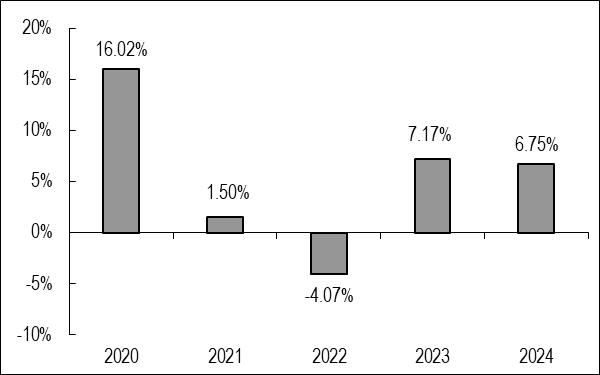
| 1 | The returns are for Institutional Class, which would have substantially similar annual returns as the other share classes because the shares are invested in the same portfolio of securities and the returns for each class would differ only to the extent that the classes do not have the same expenses. |
| Best Quarter: | 1st Quarter 2020 | 7.03% |
| Worst Quarter: | 1st Quarter 2022 | (2.16)% |
Performance Table
Average Annual Total Returns
(For periods ended December 31, 2024)
| One Year |
Five Years |
Since Inception (10-01-19) | |
| Institutional Class shares | |||
| Return before taxes | 6.75% | 5.27% | 5.50% |
| Return after taxes on distributions | 4.37% | 3.40% | 3.64% |
| Return after taxes on distributions and sale of Fund shares | 3.97% | 3.25% | 3.44% |
| Class A shares | |||
| Return before taxes with sales load | 2.52% | 3.77% | 4.06% |
| Class C shares** | |||
| Return before taxes | 5.74% | 4.24% | 4.51% |
| Investor Class | |||
| Return before taxes | 6.35% | 4.85% | 5.09% |
| Bloomberg US Aggregate Index | 1.25% | (0.33)% | (0.31)% |
| Bloomberg US Corporate High Yield Bond Index | 8.19% | 4.21% | 4.54% |
22
After-tax returns were calculated using the historical highest individual federal marginal income tax rates and do not reflect the impact of state and local taxes. Actual after-tax returns depend on an investor’s tax situation and may differ from those shown, and after-tax returns shown are not relevant to investors who hold shares of the Fund through tax-deferred arrangements, such as 401(k) plans or Individual Retirement Accounts (IRAs). After tax returns are not shown for Class A, C and Investor shares and would differ from those of Institutional Class shares.
The Bloomberg US Aggregate Index, an unmanaged, broad-based market capitalization weighted index, has been selected as the Fund’s benchmark index. The Bloomberg US Aggregate Index is commonly used as a benchmark by both passive and active investors to measure portfolio performance relative to the U.S. dollar-denominated investment grade fixed-rate taxable bond market. It is also an informational measure of broad market returns commonly applied to fixed income instruments. The index contains approximately 10,100 fixed income issues and is valued at around $20 trillion, representing 43% of the total U.S. bond market. The index does not take into account charges, fees and other expenses, and investors cannot invest directly in an index.
The Bloomberg US Corporate High Yield Bond Index measures the USD-denominated, high yield, fixed-rate corporate bond market. Securities are classified as high yield if the middle rating of Moody’s, Fitch and S&P is Ba1/BB+/BB+ or below. Bonds from issuers with an emerging markets country of risk, based on the indices’ EM country definition, are excluded.
Investment Adviser: Ocean Park Asset Management, LLC is the Fund’s investment adviser.
Investment Adviser Portfolio Managers: Kenneth L. Sleeper, MBA, PhD, Managing Director, James St. Aubin, CFA®, CAIA®, Chief Investment Officer; Ryan Harder, CFA®, Chief Investment Strategist and Marshall Quan, Portfolio Manager, are the portfolio managers of the Fund. Dr. Sleeper has served the Fund as portfolio manager since it commenced operations in October 2019. Mr. Quan have served the Fund as portfolio manager since January 2022. Mr. Harder has served the Fund as portfolio manager since January 2023. Mr. St. Aubin has served the Fund as portfolio manager since July 2024. Each portfolio manager is jointly and primarily responsible for the day-to-day management of the Fund.
Purchase and Sale of Fund Shares: For all Classes, the minimum initial investment is $10,000 and the minimum subsequent investment is $1,000. You may purchase and redeem shares of the Fund on any day that the New York Stock Exchange is open. Redemption requests may be made in writing, by telephone, or through a financial intermediary and will be paid by ACH, check or wire transfer. The Fund reserves the right to waive any investment minimum.
Tax Information: Dividends and capital gain distributions you receive from the Fund, whether you reinvest your distributions in additional Fund shares or receive them in cash, are taxable to you at either ordinary income or capital gains tax rates unless you are investing through a tax-deferred account such as an IRA or 401(k). However, these dividend and capital gain distributions may be taxable upon their eventual withdrawal from tax-deferred plans.
Payments to Broker-Dealers and Other Financial Intermediaries: If you purchase shares of the Fund through a broker-dealer or other financial intermediary (such as a bank), the Fund and its related companies may pay the intermediary for the sale of Fund shares and related services. These payments may create a conflict of interest by influencing the broker-dealer or other intermediary and your salesperson to recommend the Fund over another investment. Ask your salesperson or visit your financial intermediary’s website for more information.
23
FUND SUMMARY: Ocean Park Tactical Risk Spectrum 30 Fund
Investment Objectives: The Fund has two objectives, to provide total return and to limit exposure to downside risk.
Fees and Expenses of the Fund: This table describes the fees and expenses that you may pay if you buy and hold shares of the Fund. You may pay other fees, such as brokerage commissions and other fees to financial intermediaries, which are not reflected in the tables and examples below. You may qualify for sales charge discounts on purchases of Class A shares if you and your family invest, or agree to invest in the future, at least $250,000 in the Fund. More information about these and other discounts is available from your financial intermediary and in How to Purchase Shares on page 64 of this Prospectus and in Purchase, Redemption and Pricing of Shares on page 62 of the Statement of Additional Information.
| Shareholder Fees (fees paid directly from your investment) |
Class A |
Class C |
Investor Class |
Instl Class |
| Maximum Sales Charge (Load) Imposed on Purchases (as a % of offering price) |
3.75% | None | None | None |
| Maximum Deferred Sales Charge (Load) (as a % of the lower of purchase price or redemption proceeds) |
1.00% | None | None | None |
| Maximum Sales Charge (Load) Imposed on Reinvested Dividends and other Distributions |
None | None | None | None |
| Redemption Fee (as a % of amount redeemed, if applicable) |
None | None | None | None |
| Annual Fund Operating Expenses (expenses that you pay each year as a percentage of the value of your investment) |
||||
| Management Fees | 1.05% | 1.05% | 1.05% | 1.05% |
| Distribution and/or Service (12b-1) Fees | 0.25% | 1.00% | 0.40% | None |
| Other Expenses | [ ]% | [ ]% | [ ]% | [ ]% |
| Acquired Fund Fees and Expenses(1) | [ ]% | [ ]% | [ ]% | [ ]% |
| Total Annual Fund Operating Expenses | [ ]% | [ ]% | [ ]% | [ ]% |
| Fee Waiver and/or Expense Reimbursement(2) | [ ]% | [ ]% | [ ]% | [ ]% |
| Total Annual Fund Operating Expenses After Fee Waiver and/or Expenses Reimbursement |
[ ]% | [ ]% | [ ]% | [ ]% |
| (1) | Acquired Fund Fees and Expenses are the estimated average indirect costs of investing in other investment companies (the “Underlying Funds”). The operating expenses in this fee table will not correlate to the expense ratio in the Fund’s financial highlights because the financial statements include only the direct operating expenses incurred by the Fund. |
| (2) | Ocean Park Asset Management, LLC (the “Adviser”), has contractually agreed to waive management fees and to make payments to limit Fund expenses, until at least January 31, 2026 so that the total annual operating expenses (exclusive of any (i) front end or contingent deferred loads, (ii) brokerage fees and commissions, (iii) acquired fund fees and expenses, (iv) fees and expenses associated with investments including investments in other collective investment vehicles or derivative instruments (for example options fees and expenses); (v) borrowing costs (such as interest and dividend expense on securities sold short); (vi) taxes; and (vii) extraordinary expenses, such as litigation expenses (which may include indemnification of Fund officers and Trustees, contractual indemnification of Fund service providers (other than the Adviser))) do not exceed 1.56%, 2.31%, 1.71% and 1.31% of average daily net assets attributable to Class A, Class C, Investor Class and Institutional Class, respectively. These fee waivers and expense reimbursements are subject to possible recoupment from the Fund in future years on a rolling three-year basis (within the three years from the date when the amount is waived or reimbursed) if such recoupment can be achieved within the lesser of the foregoing expense limits or the then-current expense limits. This agreement may be terminated only by the Fund’s Board of Trustees, on 60 days written notice to the Adviser. |
Example: This Example is intended to help you compare the cost of investing in the Fund with the cost of investing in other mutual funds.
The Example assumes that you invest $10,000 in the Fund for the time periods indicated and then redeem all of your shares at the end of those periods. The Example also assumes that your investment has a 5% return each year and that the Fund’s operating expenses remain the same. The Example assumes the impact of the fee waiver in 1 Year example. Although your actual costs may be higher or lower, based upon these assumptions your costs would be:
| Class | 1 Year | 3 Years | 5 Years | 10 Years | ||||
| Class A | $[ ] | $[ ] | $[ ] | $[ ] | ||||
| Class C | $[ ] | $[ ] | $[ ] | $[ ] | ||||
| Investor Class | $[ ] | $[ ] | $[ ] | $[ ] | ||||
| Institutional Class | $[ ] | $[ ] | $[ ] | $[ ] |
24
Portfolio Turnover: The Fund pays transaction costs, such as commissions, when it buys and sells securities (or “turns over” its portfolio). A higher portfolio turnover may indicate higher transaction costs and may result in higher taxes when Fund shares are held in a taxable account. These costs, which are not reflected in annual fund operating expenses or in the Example, affect the Fund’s performance. During the most recent fiscal year, the Fund’s portfolio turnover rate was [ ]% of the average value of its portfolio.
Principal Investment Strategies: The Fund utilizes a ‘fund of funds” structure to access a wide variety of underlying asset classes and strategies. The Adviser seeks to achieve the Fund’s investment objectives by investing in mutual funds and exchange-traded funds (“ETFs”) (collectively, “Underlying Funds”). The Adviser constructs the Fund’s broadly-diversified investment portfolio by investing at various times in a wide range of Underlying Funds that invest in various security and investment categories (each an “Asset Class”).
Among the types of underlying instruments in which this Fund will invest, through Underlying Funds, are the following:
| ● | U.S. common stocks |
| ● | Foreign common stocks, including from emerging markets |
| ● | U.S. fixed income securities |
| ● | Foreign fixed income securities, including from emerging markets |
| ● | High yield (or “junk) corporate bonds |
| ● | Preferred stock |
| ● | Municipal bonds |
| ● | Physical commodities, such as crude oil, copper and wheat, through mutual funds and ETFs that invest in commodity-linked derivatives |
Under normal market conditions, the Fund’s target exposure over a three-year period to equity securities, of any market capitalization, through the Underlying Funds will average between 15%-30% of the Fund’s assets. The Fund does not have a target allocation for non-equity securities exposure and may invest in underlying fixed income funds without constraint as to maturity or credit quality. The Fund may purchase Treasury securities directly. The Adviser may make changes in the target allocations across asset classes and fund categories, and the specific Underlying Funds in the Fund’s portfolio that in its view would be in the best interest of the Fund.
The Fund defines high yield securities, also known as “junk bonds,” as fixed-income securities rated below investment grade and whose issuers generally have a non-investment grade rating or are not rated.
The Adviser employs a proprietary trend following strategy to generate buy and sell signals for Underlying Funds. The Adviser calculates upper and lower bands for each Underlying Fund. The upper and lower bands are offset above and below a short-term exponential moving average. A “buy” signal, which identifies a potential uptrend for an Underlying Fund candidate, is determined by a security’s price rising above both the recent low of its upper band and a secondary moving average. The Adviser uses quantitative analysis to determine which Underlying Funds to purchase.
An Underlying Fund is sold when a security’s price falls below the recent high of its lower band (a “sell” signal), the goal being to limit drawdowns of the overall Fund. When a position is sold, the proceeds may be invested in an alternative Underlying Fund or temporarily invested in cash equivalents. Cash equivalents may include, but are not limited to, U.S. Treasury bills, money market funds and funds that primarily invest in investment grade short-term bonds. The Adviser periodically reviews the allocation of the Underlying Funds and may make adjustments to the Underlying Fund holdings, including adding or removing Underlying Funds.
The overall asset allocation of the Fund is not fixed. It can and does change significantly over time as the Adviser decides to re-allocate portions of the portfolio in response to changes in price trends of Underlying Funds. The Adviser may engage in frequent buying and selling of portfolio securities to achieve the Fund’s investment objectives.
The Fund may engage in securities lending.
25
Principal Investment Risks: As with all mutual funds, there is the risk that you could lose money through your investment in the Fund. The Fund is not intended to be a complete investment program. Many factors affect the Fund’s net asset value and performance.
Performance of the Fund during future periods will definitely vary. Some months and some quarters will result in negative performance; indeed, some future years may have negative performance.
| ● | Commodity-Linked Derivative Risk. When the Fund invests in commodities through Underlying Funds that invest in commodity-linked derivative instruments the Fund is exposed to risks affecting a particular industry or commodity, such as drought, floods, and adverse regulatory developments. Commodity-linked derivatives may also have leverage risk, which amplifies the effect of a small movement in commodity prices on the Fund. |
| ● | Emerging Markets Risk. Underlying Funds may invest in emerging market countries. Investing in emerging markets involves not only the risks described below with respect to investing in foreign securities, but also other risks, including exposure to economic structures that are generally less diverse and mature, limited availability and reliability of information material to an investment decision, and exposure to political systems that can be expected to have less stability than those of developed countries. The market for the securities of issuers in emerging market typically is small, and a low or nonexistent trading volume in those securities may result in a lack of liquidity and price volatility. |
| ● | Equity Risk. The net asset value of the Fund will fluctuate based on changes in the value of the equity securities held by those Underlying Funds that invest in U.S. and/or foreign stocks. Equity prices can fall rapidly in response to developments affecting a specific company or industry, or to changing economic, political or market conditions. |
| ● | ETF Risk. Shares of ETFs may trade at a discount or a premium in market price if there is a limited market in such shares and are also subject to brokerage and other trading costs, which could result in greater expenses to the Fund. The index-tracking ETFs in which the Fund invests will not be able to replicate exactly the performance of the indices they track because the total return generated by the securities will be reduced by transaction costs incurred in adjusting the actual balance of the securities. |
| ● | Fixed Income Risk. When the Fund invests in Underlying Funds that invest in fixed-income securities, the value of your investment in the Fund will generally decline when interest rates rise. Defaults by fixed income issuers in which the Underlying Funds invest may also harm performance. |
| ● | Foreign Risk. Foreign markets can be more volatile than the U.S. market due to increased risks of adverse issuer, political, regulatory, market, economic developments or currency exchange rates and can perform differently from the U.S. market. The net asset value of the Fund will fluctuate based on changes in the value of the foreign securities held by any Underlying Funds that invest in such securities. |
| ● | Government Securities Risk. It is possible that the U.S. Government would not provide financial support to its agencies or instrumentalities if it is not required to do so by law. The ability of foreign governments to repay their obligations is adversely impacted by default, insolvency, bankruptcy or by political instability, including authoritarian and/or military involvement in governmental decision-making, armed conflict, civil war, social instability and the impact of these events and circumstances on a country’s economy and its government’s revenues. |
| ● | High Yield (Junk Bond) Risk. Underlying Fund investments in lower-quality bonds, also known as “junk” bonds, present greater risk than bonds of higher quality, including an increased risk of default. An economic downturn or period of rising interest rates could adversely affect the market for these bonds and reduce liquidity in these bonds. High yield bonds are considered speculative and issuers are more sensitive to economic conditions than high quality issuers and more likely to seek bankruptcy protection which, will delay resolution of bondholder claims and may eliminate liquidity. |
| ● | Interest Rate Risk. Fixed income securities are subject to the risk that securities could lose value because of interest rate changes. Fixed income securities with longer maturities are subject to greater price shifts as a result of interest rate changes than fixed income securities with shorter maturities. |
| ● | Inverse Risk. The Fund engages in hedging or declining-market strategies by investing in inverse Underlying Funds. Any strategy that includes inverse securities could cause the Fund to suffer significant losses. The Fund will not participate in market gains to the extent it holds inverse Underlying Funds. |
26
| ● | Large Capitalization Company Risk. Large-cap companies may be unable to respond quickly to new competitive challenges, such as changes in technology and consumer tastes, and also may not be able to attain the high growth rate of successful smaller companies, especially during extended periods of economic expansion. |
| ● | Management Risk. The Adviser’s dependence on its investment strategy and judgments about the attractiveness, value and potential appreciation of particular asset classes in which the Fund invests will in some cases prove to be incorrect and have negative impacts on performance. |
| ● | Market and Geopolitical Risk. The increasing interconnectivity between global economies and financial markets increases the likelihood that events or conditions in one region or financial market may adversely impact issuers in a different country, region or financial market. Securities in the Fund may underperform due to inflation (or expectations for inflation), interest rates, global demand for particular products or resources, natural disasters, pandemics, epidemics, climate change or climate change related events, terrorism, international conflicts, regulatory events and governmental or quasi-governmental actions. The occurrence of global events similar to those in recent years, such as a worldwide pandemic, terrorist attacks, natural disasters, social and political discord or debt crises and downgrades, among others, may result in market volatility and may have long term effects on both the U.S. and global financial markets. It is difficult to predict when similar events affecting the U.S. or global financial markets may occur, the effects that such events may have and the duration of those effects. Any such event(s) could have a significant adverse impact on the value and risk profile of the Fund. For example, the COVID-19 global pandemic had negative impacts, and in many cases severe negative impacts, on markets worldwide. It is not known how long the impacts of the events described above, will or would last, but there could be a prolonged period of global economic slowdown, which may impact your investment. Therefore, the Fund could lose money over short periods due to short-term market movements and over longer periods during more prolonged market downturns. During a general market downturn, multiple asset classes may be negatively affected. Changes in market conditions and interest rates can have the same impact on all types of securities and instruments. In times of severe market disruptions you could lose your entire investment. |
| ● | Municipal Risk. Municipal securities are subject to the risk that legislative changes and local and business developments may adversely affect the yield or value of the Fund’s investments in such securities. |
| ● | Portfolio Turnover Risk. As to the portion of the portfolio invested in Underlying Funds, turnover may result in higher brokerage commissions, dealer mark-ups and other transaction costs. The Fund’s investment style will result in most capital gains within the portfolio being realized as short-term capital gains. |
| ● | Preferred Stock Risk. The value of preferred stocks will fluctuate with changes in interest rates. Typically, a rise in interest rates causes a decline in the value of preferred stock. Preferred stocks are also subject to credit risk, which is the possibility that an issuer of preferred stock will fail to make its dividend payments. |
| ● | Small and Mid-Capitalization Company Risk. Investments in Underlying Funds that own securities of small- and mid-capitalization companies may be more vulnerable than larger, more established organizations to adverse business or economic developments. These companies often have narrower markets, fewer products, or services to offer and more limited managerial and financial resources than do larger, more established companies. |
| ● | Treasury Securities Risk. U.S. Treasury obligations may differ from other securities in their interest rates, maturities, times of issuance and other characteristics and may provide relatively lower returns than those of other securities. Similar to other issuers, changes to the financial condition or credit rating of the U.S. government may cause the value of the Fund’s investment exposure to U.S. Treasury obligations to decline. |
| ● | Underlying Fund Risk. Each Underlying Fund is subject to specific risks, depending on its investments. Underlying Funds are also subject to investment advisory fees and other expenses, which are indirectly borne by the Fund. As a result, your overall cost of investing in the underlying stocks, bonds and other basic assets will be higher than the cost of investing directly in them and may be higher than other mutual funds that invest directly in securities. |
27
Performance: The bar chart and performance table below show the variability of the Fund’s returns, which is some indication of the risks of investing in the Fund. The bar chart shows performance of Institutional Class shares of the Fund for each full calendar year since the Fund’s inception. The performance table compares the performance of the share classes of the Fund over time to the performance of a broad-based securities market index and a supplement index. You should be aware that the Fund’s past performance (before and after taxes) may not be an indication of how the Fund will perform in the future. Updated performance information is available at no cost by calling 1-866-738-4363 or visiting www.OceanParkMutualFunds.com.
Institutional Class Annual Total Return For Calendar Years Ended December 311

| 1 | The returns are for Institutional Class, which would have substantially similar annual returns as the other share classes because the shares are invested in the same portfolio of securities and the returns for each class would differ only to the extent that the classes do not have the same expenses. |
| Best Quarter: | 4th Quarter 2023 | 4.91% |
| Worst Quarter: | 3rd Quarter 2023 | (1.50)% |
Performance Table
Average Annual Total Returns
(For periods ended December 31, 2024)
| One Year |
Since Inception (09-30-22) | |
| Institutional Class shares* | ||
| Return before taxes | 6.70% | 5.90% |
| Return after taxes on distributions | 5.19% | 4.49% |
| Return after taxes on distributions and sale of Fund shares | 4.13% | 4.00% |
| Investor Class* | ||
| Return before taxes | 5.21% | 5.24% |
| Morningstar Conservative Target Risk Index* | 3.57% | 6.95% |
| * | The Morningstar Conservative Target Risk Index is an index comprised of a diversified mix of equities, bonds and cash. The Morningstar Conservative Target Risk Index seeks approximately 20% exposure to global equity markets. |
28
After-tax returns were calculated using the historical highest individual federal marginal income tax rates and do not reflect the impact of state and local taxes. Actual after-tax returns depend on an investor’s tax situation and may differ from those shown, and after-tax returns shown are not relevant to investors who hold shares of the Fund through tax-deferred arrangements, such as 401(k) plans or Individual Retirement Accounts (IRAs). After tax returns are not shown for Class A, C, and Investor shares and would differ from those of Institutional Class shares.
Investment Adviser: Ocean Park Asset Management, LLC is the Fund’s investment adviser.
Investment Adviser Portfolio Managers: Kenneth L. Sleeper, MBA, PhD, Managing Director; James St. Aubin, CFA®, CAIA®, Chief Investment Officer; Ryan Harder, CFA®, Chief Investment Strategist; and Marshall Quan, Portfolio Manager, are the portfolio managers of the Fund. Dr. Sleeper and Mr. Quan have served the Fund as portfolio manager since it commenced operations in September 2022. Mr. Harder has served the Fund as portfolio manager since January 2023. Mr. St. Aubin has served the Fund as portfolio manager since July 2024. Each portfolio manager is jointly and primarily responsible for the day-to-day management of the Fund.
Purchase and Sale of Fund Shares: For all Classes, the minimum initial investment is $10,000 and the minimum subsequent investment is $1,000. You may purchase and redeem shares of the Fund on any day that the New York Stock Exchange is open. Redemption requests may be made in writing, by telephone, or through a financial intermediary and will be paid by Automatic Clearing House (“ACH”), check or wire transfer. The Fund reserves the right to waive any investment minimum.
Tax Information: Dividends and capital gain distributions you receive from the Fund, whether you reinvest your distributions in additional Fund shares or receive them in cash, are taxable to you at either ordinary income or capital gains tax rates unless you are investing through a tax-deferred account such as an IRA or 401(k). However, these dividend and capital gain distributions may be taxable upon their eventual withdrawal from tax-deferred plans.
Payments to Broker-Dealers and Other Financial Intermediaries: If you purchase shares of the Fund through a broker-dealer or other financial intermediary (such as a bank), the Fund and its related companies may pay the intermediary for the sale of Fund shares and related services. These payments may create a conflict of interest by influencing the broker-dealer or other intermediary and your salesperson to recommend the Fund over another investment. Ask your salesperson or visit your financial intermediary’s website for more information.
29
FUND SUMMARY: Ocean Park Tactical Risk Spectrum 50 Fund
Investment Objectives: The Fund has two objectives, to provide total return and to limit exposure to downside risk.
Fees and Expenses of the Fund: This table describes the fees and expenses that you may pay if you buy, hold and sell shares of the Fund. You may pay other fees, such as brokerage commissions and other fees to financial intermediaries, which are not reflected in the tables and examples below. You may qualify for sales charge discounts on purchases of Class A shares if you and your family invest, or agree to invest in the future, at least $250,000 in the Fund. More information about these and other discounts is available from your financial intermediary and in How to Purchase Shares on page 64 of this Prospectus and in Purchase, Redemption and Pricing of Shares on page 62 of the Statement of Additional Information.
| Shareholder Fees (fees paid directly from your investment) |
Class A |
Class C |
Investor Class |
Instl Class |
| Maximum Sales Charge (Load) Imposed on Purchases (as a % of offering price) |
3.75% | None | None | None |
| Maximum Deferred Sales Charge (Load) (as a % of the lower of purchase price or redemption proceeds) |
1.00% | None | None | None |
| Maximum Sales Charge (Load) Imposed on Reinvested Dividends and other Distributions |
None | None | None | None |
| Redemption Fee (as a % of amount redeemed, if applicable) |
None | None | None | None |
| Annual Fund Operating Expenses (expenses that you pay each year as a percentage of the value of your investment) |
||||
| Management Fees | 1.05% | 1.05% | 1.05% | 1.05% |
| Distribution and/or Service (12b-1) Fees | 0.25% | 1.00% | 0.40% | None |
| Other Expenses | [ ]% | [ ]% | [ ]% | [ ]% |
| Acquired Fund Fees and Expenses(1) | [ ]% | [ ]% | [ ]% | [ ]% |
| Total Annual Fund Operating Expenses | [ ]% | [ ]% | [ ]% | [ ]% |
| (1) | Acquired Fund Fees and Expenses are the estimated average indirect costs of investing in other investment companies (the “Underlying Funds”). The operating expenses in this fee table will not correlate to the expense ratio in the Fund’s financial highlights because the financial statements include only the direct operating expenses incurred by the Fund. |
Example: This Example is intended to help you compare the cost of investing in the Fund with the cost of investing in other mutual funds.
The Example assumes that you invest $10,000 in the Fund for the time periods indicated and then redeem all of your shares at the end of those periods. The Example also assumes that your investment has a 5% return each year and that the Fund’s operating expenses remain the same. The Example assumes the impact of the fee waiver in 1 Year example. Although your actual costs may be higher or lower, based upon these assumptions your costs would be:
| Class | 1 Year | 3 Years | 5 Years | 10 Years | ||||
| Class A | $[ ] | $[ ] | $[ ] | $[ ] | ||||
| Class C | $[ ] | $[ ] | $[ ] | $[ ] | ||||
| Investor Class | $[ ] | $[ ] | $[ ] | $[ ] | ||||
| Institutional Class | $[ ] | $[ ] | $[ ] | $[ ] |
Portfolio Turnover: The Fund pays transaction costs, such as commissions, when it buys and sells securities (or “turns over” its portfolio). A higher portfolio turnover may indicate higher transaction costs and may result in higher taxes when Fund shares are held in a taxable account. These costs, which are not reflected in annual fund operating expenses or in the Example, affect the Fund’s performance. During the most recent fiscal year, the Fund’s portfolio turnover rate was [ ]% of the average value of its portfolio.
30
Principal Investment Strategies: The Fund utilizes a “fund of funds” structure to access a wide variety of underlying asset classes and strategies. Ocean Park Asset Management, LLC (the “Adviser”), seeks to achieve the Fund’s investment objectives by investing in mutual funds and exchange-traded funds (“ETFs”) (collectively, “Underlying Funds”). The Adviser constructs the Fund’s broadly diversified investment portfolio by investing at various times in a wide range of Underlying Funds that invest in various security and investment categories (each an “Asset Class”).
Among the types of underlying instruments in which this Fund will invest, through Underlying Funds, are the following:
| ● | U.S. common stocks |
| ● | Foreign common stocks, including from emerging markets |
| ● | U.S. fixed income securities |
| ● | Foreign fixed income securities, including from emerging markets |
| ● | High yield (or “junk) corporate bonds |
| ● | Preferred stock |
| ● | Municipal bonds |
| ● | Physical commodities, such as crude oil, copper and wheat, through mutual funds and ETFs that invest in commodity-linked derivatives |
Under normal market conditions, the Fund’s target exposure over a three-year period to equity securities, of any market capitalization, through the Underlying Funds will average between 30%-50% of the Fund’s assets. The Fund does not have a target allocation for non-equity securities exposure and may invest in underlying fixed income funds without constraint as to maturity or credit quality. The Fund may purchase Treasury securities directly. The Adviser may make changes in the target allocations across asset classes and fund categories, and the specific Underlying Funds in the Fund’s portfolio that in its view would be in the best interest of the Fund. The Fund defines high yield securities, also known as “junk bonds,” as fixed-income securities rated below investment grade and whose issuers generally have a non-investment grade rating or are not rated.
The Adviser employs a proprietary trend following strategy to generate buy and sell signals for Underlying Funds. The Adviser calculates upper and lower bands for each Underlying Fund. The upper and lower bands are offset above and below a short-term exponential moving average. A “buy” signal, which identifies a potential uptrend for an Underlying Fund candidate, is determined by a security’s price rising above both the recent low of its upper band and a secondary moving average. The Adviser uses quantitative analysis to determine which Underlying Funds to purchase.
An Underlying Fund is sold when a security’s price falls below the recent high of its lower band (a “sell” signal), the goal being to limit drawdowns of the overall Fund. When a position is sold, the proceeds may be invested in an alternative Underlying Fund or temporarily invested in cash equivalents. Cash equivalents may include, but are not limited to, U.S. Treasury bills, money market funds and Funds that primarily invest in investment grade short-term bonds. The Adviser periodically reviews the allocation of the Underlying Funds and may make adjustments to the Underlying Fund holdings, including adding or removing Underlying Funds.
The overall asset allocation of the Fund is not fixed. It can and does change significantly over time as the Adviser decides to re-allocate portions of the portfolio in response to changes in price trends of Underlying Funds. The Adviser may engage in frequent buying and selling of portfolio securities to achieve the Fund’s investment objectives.
The Fund may engage in securities lending.
31
Principal Investment Risks: As with all mutual funds, there is the risk that you could lose money through your investment in the Fund. The Fund is not intended to be a complete investment program. Many factors affect the Fund’s net asset value and performance.
Performance of the Fund during future periods will definitely vary. Some months and some quarters will result in negative performance; indeed, some future years may have negative performance.
| ● | Commodity-Linked Derivative Risk. When the Fund invests in commodities through Underlying Funds that invest in commodity-linked derivative instruments the Fund is exposed to risks affecting a particular industry or commodity, such as drought, floods, and adverse regulatory developments. Commodity-linked derivatives may also have leverage risk, which amplifies the effect of a small movement in commodity prices on the Fund. |
| ● | Emerging Markets Risk. Underlying Funds may invest in emerging market countries. Investing in emerging markets involves not only the risks described below with respect to investing in foreign securities, but also other risks, including exposure to economic structures that are generally less diverse and mature, limited availability and reliability of information material to an investment decision, and exposure to political systems that can be expected to have less stability than those of developed countries. The market for the securities of issuers in emerging market typically is small, and a low or nonexistent trading volume in those securities may result in a lack of liquidity and price volatility. |
| ● | Equity Risk. The net asset value of the Fund will fluctuate based on changes in the value of the equity securities held by those Underlying Funds that invest in U.S. and/or foreign stocks. Equity prices can fall rapidly in response to developments affecting a specific company or industry, or to changing economic, political or market conditions. |
| ● | ETF Risk. Shares of ETFs may trade at a discount or a premium in market price if there is a limited market in such shares and are also subject to brokerage and other trading costs, which could result in greater expenses to the Fund. The index-tracking ETFs in which the Fund invests will not be able to replicate exactly the performance of the indices they track because the total return generated by the securities will be reduced by transaction costs incurred in adjusting the actual balance of the securities. |
| ● | Fixed Income Risk. When the Fund invests in Underlying Funds that invest in fixed-income securities, the value of your investment in the Fund will generally decline when interest rates rise, as well as other factors. Defaults by fixed income issuers in which the Underlying Funds invest may also harm performance. |
| ● | Foreign Risk. Foreign markets can be more volatile than the U.S. market due to increased risks of adverse issuer, political, regulatory, market, economic developments or currency exchange rates and can perform differently from the U.S. market. The net asset value of the Fund will fluctuate based on changes in the value of the foreign securities held by any Underlying Funds that invest in such securities. |
| ● | Government Securities Risk. It is possible that the U.S. Government would not provide financial support to its agencies or instrumentalities if it is not required to do so by law. The ability of foreign governments to repay their obligations is adversely impacted by default, insolvency, bankruptcy or by political instability, including authoritarian and/or military involvement in governmental decision-making, armed conflict, civil war, social instability and the impact of these events and circumstances on a country’s economy and its government’s revenues. |
| ● | High Yield (Junk Bond) Risk. Underlying Fund investments in lower quality bonds, also known as “junk” bonds, present greater risk than bonds of higher quality, including an increased risk of default. An economic downturn or period of rising interest rates could adversely affect the market for these bonds and reduce liquidity in these bonds. High yield bonds are considered speculative and issuers are more sensitive to economic conditions than high quality issuers and more likely to seek bankruptcy protection which will delay resolution of bondholder claims and may eliminate liquidity. |
| ● | Interest Rate Risk. Fixed income securities are subject to the risk that securities could lose value because of interest rate changes. Fixed income securities with longer maturities are subject to greater price shifts as a result of interest rate changes than fixed income securities with shorter maturities. |
| ● | Inverse Risk. The Fund engages in hedging or declining-market strategies by investing in inverse Underlying Funds. Any strategy that includes inverse securities could cause the Fund to suffer significant losses. The Fund will not participate in market gains to the extent it holds inverse Underlying Funds. |
| ● | Large Capitalization Risk. Large-cap companies may be unable to respond quickly to new competitive challenges, such as changes in technology and consumer tastes, and also may not be able to attain the high growth rate of successful smaller companies, especially during extended periods of economic expansion. |
| ● | Management Risk. The Adviser’s dependence on its investment strategy and judgments about the attractiveness, value and potential appreciation of particular mutual funds and ETFs in which the Fund invests will in some cases prove to be incorrect and have negative impacts on performance. |
32
| ● | Market and Geopolitical Risk. The increasing interconnectivity between global economies and financial markets increases the likelihood that events or conditions in one region or financial market may adversely impact issuers in a different country, region or financial market. Securities in the Fund may underperform due to inflation (or expectations for inflation), interest rates, global demand for particular products or resources, natural disasters, pandemics, epidemics, climate change or climate change related events, terrorism, international conflicts, regulatory events and governmental or quasi-governmental actions. The occurrence of global events similar to those in recent years, such as a worldwide pandemic, terrorist attacks, natural disasters, social and political discord or debt crises and downgrades, among others, may result in market volatility and may have long term effects on both the U.S. and global financial markets. It is difficult to predict when similar events affecting the U.S. or global financial markets may occur, the effects that such events may have and the duration of those effects. Any such event(s) could have a significant adverse impact on the value and risk profile of the Fund. For example, the COVID-19 global pandemic had negative impacts, and in many cases severe negative impacts, on markets worldwide. It is not known how long the impacts of the events described above, will last, but there could be a prolonged period of global economic slowdown, which may impact your investment. Therefore, the Fund could lose money over short periods due to short-term market movements and over longer periods during more prolonged market downturns. During a general market downturn, multiple asset classes may be negatively affected. Changes in market conditions and interest rates can have the same impact on all types of securities and instruments. In times of severe market disruptions you could lose your entire investment. |
| ● | Master Limited Partnership (“MLP”) Risk. Investments in MLPs involve risks different from those of investing in common stock including risks related to limited control and limited rights to vote on matters affecting the MLP, risks related to potential conflicts of interest between an MLP and the MLP’s general partner, cash flow risks, dilution risks and risks related to the general partner’s limited call right. MLPs are generally considered interest-rate sensitive investments. During periods of interest rate volatility, these investments may not provide attractive returns. MLPs, typically, do not pay U.S. federal income tax at the partnership level. Instead, each partner is allocated a share of the partnership’s income, gains, losses, deductions and expenses. A change in current tax law or in the underlying business mix of a given MLP could result in an MLP being treated as a corporation for U.S. federal income tax purposes, which would result in such MLP being required to pay U.S. federal income tax on its taxable income. The classification of an MLP as a corporation for U.S. federal income tax purposes would have the effect of reducing the amount of cash available for distribution by the MLP. Thus, if any of the MLPs owned by the Fund were treated as corporations for U.S. federal income tax purposes, it could result in a reduction of the value of your investment in the Fund and lower income, as compared to an MLP that is not taxed as a corporation. |
| ● | Municipal Risk. Municipal securities are subject to the risk that legislative changes and local and business developments may adversely affect the yield or value of the Fund’s investments in such securities. |
| ● | Portfolio Turnover Risk. As to the portion of the portfolio invested in ETFs and other investment companies, turnover may result in higher brokerage commissions, dealer mark-ups and other transaction costs. The Fund’s investment style may result in most capital gains within the portfolio being realized as short-term capital gains. |
| ● | Preferred Stock Risk. The value of preferred stocks will fluctuate with changes in interest rates. Typically, a rise in interest rates causes a decline in the value of preferred stock. Preferred stocks are also subject to credit risk, which is the possibility that an issuer of preferred stock will fail to make its dividend payments. |
| ● | REIT Risk. The Fund’s investment exposure to REITs may subject the Fund to risks of declines in the value of real estate, changes in interest rates, lack of available mortgage funds or other limits on obtaining capital, overbuilding, extended vacancies of properties, increases in property taxes and operating expenses, changes in zoning laws and regulations, casualty or condemnation losses and tax consequences of the failure of a REIT to comply with tax law requirements. The Fund will bear a proportionate share of the REIT’s ongoing operating fees and expenses, which may include management, operating and administrative expenses in addition to the expenses of the Fund. |
| ● | Small and Mid-Capitalization Company Risk. Investments in Underlying Funds that own securities of small- and mid-capitalization companies may be more vulnerable than larger, more established organizations to adverse business or economic developments. These companies often have narrower markets, fewer products, or services to offer and more limited managerial and financial resources than do larger, more established companies. |
| ● | Treasury Securities Risk. U.S. Treasury obligations may differ from other securities in their interest rates, maturities, times of issuance and other characteristics and may provide relatively lower returns than those of other securities. Similar to other issuers, changes to the financial condition or credit rating of the U.S. government may cause the value of the Fund’s investment exposure to U.S. Treasury obligations to decline. |
| ● | Underlying Fund Risk. Each Underlying Fund is subject to specific risks, depending on its investments. Underlying Funds are also subject to investment advisory fees and other expenses, which are indirectly borne by the Fund. As a result, your overall cost of investing in the underlying stocks, bonds and other basic assets will be higher than the cost of investing directly in them and may be higher than other mutual funds that invest directly in securities. |
33
Performance: The bar chart and performance table below show the variability of the Fund’s returns, which is some indication of the risks of investing in the Fund. The bar chart shows performance of Institutional Class shares of the Fund for each full calendar year since the Fund’s inception. The performance table compares the performance of the share classes of the Fund over time to the performance of a broad-based securities market index and a supplement index. You should be aware that the Fund’s past performance (before and after taxes) may not be an indication of how the Fund will perform in the future. Updated performance information is available at no cost by calling 1-866-738-4363 or visiting www.Ocean ParkMutualFunds.com.
Institutional Class Annual Total Return For Calendar Years Ended December 311

| 1 | The returns are for Institutional Class, which would have substantially similar annual returns as the other share classes because the shares are invested in the same portfolio of securities and the returns for each class would differ only to the extent that the classes do not have the same expenses. |
| Best Quarter: | 4th Quarter 2023 | 5.13% |
| Worst Quarter: | 2nd Quarter 2022 | (6.13)% |
Performance Table
Average Annual Total Returns
(For periods ended December 31, 2024)
| One Year |
Since Inception (5/26/2021) | |
| Institutional Class | ||
| Return before taxes | 7.85% | 1.10% |
| Return after taxes on distributions | 6.78% | 0.28% |
| Return after taxes on distributions and sale of Fund shares | 4.82% | 0.56% |
| Class A shares | ||
| Return before taxes with sales load | 3.54% | (0.80)% |
| Class C shares | ||
| Return before taxes | 6.76% | 0.12% |
| Investor Class | ||
| Return before taxes | 7.50% | 0.74% |
| Morningstar Moderately Conservative Target Risk Index | 6.40% | 1.23% |
34
The Morningstar Moderately Conservative Target Risk Index is an index comprised of a diversified mix of equities, bonds and cash. The Morningstar US Moderately Conservative Target Allocation Index seeks 40% exposure to global equity markets.
After-tax returns were calculated using the historical highest individual federal marginal income tax rates and do not reflect the impact of state and local taxes. Actual after-tax returns depend on an investor’s tax situation and may differ from those shown, and after-tax returns shown are not relevant to investors who hold shares of the Fund through tax-deferred arrangements, such as 401(k) plans or Individual Retirement Accounts (IRAs). After tax returns are not shown for Class A, C and Investor shares and would differ from those of Institutional Class.
Investment Adviser: Ocean Park Asset Management, LLC is the Fund’s investment adviser.
Investment Adviser Portfolio Managers: Kenneth L. Sleeper, MBA, PhD, Managing Director, James St. Aubin, CFA®, CAIA®, Chief Investment Officer, Ryan Harder, CFA®, Chief Investment Strategist and Marshall Quan, Portfolio Manager, are the portfolio managers of the Fund. Dr. Sleeper has served the Fund as portfolio manager since it commenced operations in May 2021. Mr. Quan has served the Fund as portfolio manager since January 2022. Mr. Harder has served the Fund as portfolio manager since January 2023. Mr. St. Aubin has served the Fund as portfolio manager since July 2024. Each portfolio manager is jointly and primarily responsible for the day-to-day management of the Fund.
Purchase and Sale of Fund Shares: For all Classes, the minimum initial investment is $10,000 and the minimum subsequent investment is $1,000. You may purchase and redeem shares of the Fund on any day that the New York Stock Exchange is open. Redemption requests may be made in writing, by telephone, or through a financial intermediary and will be paid by Automatic Clearing House (“ACH”), check or wire transfer. The Fund reserves the right to waive any investment minimum.
Tax Information: Dividends and capital gain distributions you receive from the Fund, whether you reinvest your distributions in additional Fund shares or receive them in cash, are taxable to you at either ordinary income or capital gains tax rates unless you are investing through a tax-deferred account such as an IRA or 401(k). However, these dividend and capital gain distributions may be taxable upon their eventual withdrawal from tax-deferred plans.
Payments to Broker-Dealers and Other Financial Intermediaries: If you purchase shares of the Fund through a broker-dealer or other financial intermediary (such as a bank), the Fund and its related companies may pay the intermediary for the sale of Fund shares and related services. These payments may create a conflict of interest by influencing the broker-dealer or other intermediary and your salesperson to recommend the Fund over another investment. Ask your salesperson or visit your financial intermediary’s website for more information.
35
FUND SUMMARY: Ocean Park Tactical Risk Spectrum 70 Fund
Investment Objectives: The Fund has two objectives, to provide total return and to limit exposure to downside risk.
Fees and Expenses of the Fund: This table describes the fees and expenses that you may pay if you buy and hold shares of the Fund. You may pay other fees, such as brokerage commissions and other fees to financial intermediaries, which are not reflected in the tables and examples below. You may qualify for sales charge discounts on purchases of Class A shares if you and your family invest, or agree to invest in the future, at least $250,000 in the Fund. More information about these and other discounts is available from your financial intermediary and in How to Purchase Shares on page 64 of this Prospectus and in Purchase, Redemption and Pricing of Shares on page 62 of the Statement of Additional Information.
| Shareholder Fees (fees paid directly from your investment) |
Class A |
Class C |
Investor Class |
Instl Class |
| Maximum Sales Charge (Load) Imposed on Purchases (as a % of offering price) |
3.75% | None | None | None |
| Maximum Deferred Sales Charge (Load) (as a % of the lower of purchase price or redemption proceeds) |
1.00% | None | None | None |
| Maximum Sales Charge (Load) Imposed on Reinvested Dividends and other Distributions |
None | None | None | None |
| Redemption Fee (as a % of amount redeemed, if applicable) |
None | None | None | None |
| Annual Fund Operating Expenses (expenses that you pay each year as a percentage of the value of your investment) |
||||
| Management Fees | 1.05% | 1.05% | 1.05% | 1.05% |
| Distribution and/or Service (12b-1) Fees | 0.25% | 1.00% | 0.40% | None |
| Other Expenses | [ ]% | [ ]% | [ ]% | [ ]% |
| Acquired Fund Fees and Expenses(1) | [ ]% | [ ]% | [ ]% | [ ]% |
| Total Annual Fund Operating Expenses | [ ]% | [ ]% | [ ]% | [ ]% |
| Fee Waiver and/or Expense Reimbursement(2) | [ ]% | [ ]% | [ ]% | [ ]% |
| Total Annual Fund Operating Expenses After Fee Waiver and/or Expenses Reimbursement |
[ ]% | [ ]% | [ ]% | [ ]% |
| (1) | Acquired Fund Fees and Expenses are the estimated average indirect costs of investing in other investment companies (the “Underlying Funds”). The operating expenses in this fee table will not correlate to the expense ratio in the Fund’s financial highlights because the financial statements include only the direct operating expenses incurred by the Fund. |
| (2) | Ocean Park Asset Management, LLC (the “Adviser”), has contractually agreed to waive management fees and to make payments to limit Fund expenses, until at least January 31, 2026 so that the total annual operating expenses (exclusive of any (i) front end or contingent deferred loads, (ii) brokerage fees and commissions, (iii) acquired fund fees and expenses, (iv) fees and expenses associated with investments including investments in other collective investment vehicles or derivative instruments (for example options fees and expenses); (v) borrowing costs (such as interest and dividend expense on securities sold short); (vi) taxes; and (vii) extraordinary expenses, such as litigation expenses (which may include indemnification of Fund officers and Trustees, contractual indemnification of Fund service providers (other than the Adviser))) do not exceed 1.56%, 2.31%, 1.71% and 1.31% of average daily net assets attributable to Class A, Class C, Investor Class and Institutional Class, respectively. These fee waivers and expense reimbursements are subject to possible recoupment from the Fund in future years on a rolling three-year basis (within the three years from the date when the amount is waived or reimbursed) if such recoupment can be achieved within the lesser of the foregoing expense limits or the then-current expense limits. This agreement may be terminated only by the Fund’s Board of Trustees, on 60 days’ written notice to the Adviser. |
Example: This Example is intended to help you compare the cost of investing in the Fund with the cost of investing in other mutual funds.
The Example assumes that you invest $10,000 in the Fund for the time periods indicated and then redeem all of your shares at the end of those periods. The Example also assumes that your investment has a 5% return each year and that the Fund’s operating expenses remain the same. The Example assumes the impact of the fee waiver in 1 Year example. Although your actual costs may be higher or lower, based upon these assumptions your costs would be:
| Class | 1 Year | 3 Years | 5 Years | 10 Years | ||||
| Class A | $[ ] | $[ ] | $[ ] | $[ ] | ||||
| Class C | $[ ] | $[ ] | $[ ] | $[ ] | ||||
| Investor Class | $[ ] | $[ ] | $[ ] | $[ ] | ||||
| Institutional Class | $[ ] | $[ ] | $[ ] | $[ ] |
36
Portfolio Turnover: The Fund pays transaction costs, such as commissions, when it buys and sells securities (or “turns over” its portfolio). A higher portfolio turnover may indicate higher transaction costs and may result in higher taxes when Fund shares are held in a taxable account. These costs, which are not reflected in annual fund operating expenses or in the Example, affect the Fund’s performance. During the most recent fiscal period, the Fund’s portfolio turnover rate was [ ]% of the average value of its portfolio.
Principal Investment Strategies: The Fund is a “fund of funds.” The Adviser seeks to achieve the Fund’s investment objective by investing in a combination of unaffiliated mutual funds and exchange traded funds (“ETFs”), (collectively, “Underlying Funds”).
Among the types of underlying instruments in which this Fund will invest, through Underlying Funds, are the following:
| ● | U.S. common stocks |
| ● | Foreign common stocks, including from emerging markets |
| ● | U.S. fixed income securities |
| ● | Foreign fixed income securities, including from emerging markets |
| ● | High yield (or “junk) corporate bonds |
| ● | Preferred stock |
| ● | Municipal bonds |
| ● | Physical commodities, such as crude oil, copper and wheat, through mutual funds and ETFs that invest in commodity-linked derivatives |
Under normal market conditions, the Fund’s target exposure over a three-year period to equity securities, of any market capitalization, through the Underlying Funds will average between 50%-70% of the Fund’s assets. The Fund does not have a target allocation for non-equity securities exposure and may invest in underlying fixed income funds without constraint as to maturity or credit quality. The Fund may purchase Treasury securities directly. The Adviser may make changes in the target allocations across asset classes and fund categories, and the specific Underlying Funds in the Fund’s portfolio that in its view would be in the best interest of the Fund.
The Fund defines high yield securities, also known as “junk bonds,” as fixed-income securities rated below investment grade and whose issuers generally have a non-investment grade rating or are not rated.
The Adviser employs a proprietary trend following strategy to generate buy and sell signals for Underlying Funds. The Adviser calculates upper and lower bands for each Underlying Fund. The upper and lower bands are offset above and below a short-term exponential moving average. A “buy” signal, which identifies a potential uptrend for an Underlying Fund candidate, is determined by a security’s price rising above both the recent low of its upper band and a secondary moving average. The Adviser uses quantitative analysis to determine which Underlying Funds to purchase.
An Underlying Fund is sold when a security’s price falls below the recent high of its lower band (a “sell” signal), the goal being to limit drawdowns of the overall Fund. When a position is sold, the proceeds may be invested in an alternative Underlying Fund or temporarily invested in cash equivalents. Cash equivalents may include, but are not limited to, U.S. Treasury bills, money market funds and funds that primarily invest in investment grade short-term bonds. The Adviser periodically reviews the allocation of the Underlying Funds and may make adjustments to the Underlying Fund holdings, including adding or removing Underlying Funds.
The Fund may engage in securities lending.
37
Principal Investment Risks: As with all mutual funds, there is the risk that you could lose money through your investment in the Fund. The Fund is not intended to be a complete investment program. Many factors affect the Fund’s net asset value and performance.
Performance of the Fund during future periods will definitely vary. Some months and some quarters will result in negative performance; indeed, some future years may have negative performance.
| ● | Commodity-Linked Derivative Risk. When the Fund invests in commodities through Underlying Funds that invest in commodity-linked derivative instruments the Fund is exposed to risks affecting a particular industry or commodity, such as drought, floods, and adverse regulatory developments. Commodity-linked derivatives may also have leverage risk, which amplifies the effect of a small movement in commodity prices on the Fund. |
| ● | Emerging Markets Risk. Underlying Funds may invest in emerging market countries. Investing in emerging markets involves not only the risks described below with respect to investing in foreign securities, but also other risks, including exposure to economic structures that are generally less diverse and mature, limited availability and reliability of information material to an investment decision, and exposure to political systems that can be expected to have less stability than those of developed countries. The market for the securities of issuers in emerging market typically is small, and a low or nonexistent trading volume in those securities may result in a lack of liquidity and price volatility. |
| ● | Equity Risk. The net asset value of the Fund will fluctuate based on changes in the value of the equity securities held by those Underlying Funds that invest in U.S. and/or foreign stocks. Equity prices can fall rapidly in response to developments affecting a specific company or industry, or to changing economic, political or market conditions. |
| ● | ETF Risk. Shares of ETFs may trade at a discount or a premium in market price if there is a limited market in such shares and are also subject to brokerage and other trading costs, which could result in greater expenses to the Fund. The index-tracking ETFs in which the Fund invests will not be able to replicate exactly the performance of the indices they track because the total return generated by the securities will be reduced by transaction costs incurred in adjusting the actual balance of the securities. |
| ● | Fixed Income Risk. When the Fund invests in Underlying Funds that invest in fixed-income securities, the value of your investment in the Fund will generally decline when interest rates rise. Defaults by fixed income issuers in which the Underlying Funds invest may also harm performance. |
| ● | Foreign Risk. Foreign markets can be more volatile than the U.S. market due to increased risks of adverse issuer, political, regulatory, market, economic developments or currency exchange rates and can perform differently from the U.S. market. The net asset value of the Fund will fluctuate based on changes in the value of the foreign securities held by any Underlying Funds that invest in such securities. |
| ● | Government Securities Risk. It is possible that the U.S. Government would not provide financial support to its agencies or instrumentalities if it is not required to do so by law. The ability of foreign governments to repay their obligations is adversely impacted by default, insolvency, bankruptcy or by political instability, including authoritarian and/or military involvement in governmental decision-making, armed conflict, civil war, social instability and the impact of these events and circumstances on a country’s economy and its government’s revenues. |
| ● | High Yield (Junk Bond) Risk. Underlying Fund investments in lower quality bonds, also known as “junk” bonds, present greater risk than bonds of higher quality, including an increased risk of default. An economic downturn or period of rising interest rates could adversely affect the market for these bonds and reduce liquidity in these bonds. High yield bonds are considered speculative and issuers are more sensitive to economic conditions than high quality issuers and more likely to seek bankruptcy protection which will delay resolution of bondholder claims and may eliminate liquidity. Underlying Fund investments in lower-quality bonds, known as high yield or junk bonds, present greater risk than bonds of higher quality, including an increased risk of default. An economic downturn or period of rising interest rates could adversely affect the market for these bonds and reduce liquidity in these bonds. Junk bonds are considered speculative and issuers are more sensitive to economic conditions than high quality issuers and more likely to seek bankruptcy protection which will delay resolution of bondholder claims and may eliminate liquidity. |
| ● | Interest Rate Risk. Fixed income securities are subject to the risk that securities could lose value because of interest rate changes. Fixed income securities with longer maturities are subject to greater price shifts as a result of interest rate changes than fixed income securities with shorter maturities. |
| ● | Inverse Risk. The Fund engages in hedging or declining-market strategies by investing in inverse Underlying Funds. Any strategy that includes inverse securities could cause the Fund to suffer significant losses. The Fund will not participate in market gains to the extent it holds inverse Underlying Funds. |
| ● | Large Capitalization Company Risk. Large-cap companies may be unable to respond quickly to new competitive challenges, such as changes in technology and consumer tastes, and also may not be able to attain the high growth rate of successful smaller companies, especially during extended periods of economic expansion. |
38
| ● | Management Risk. The Adviser’s dependence on its investment strategy and judgments about the attractiveness, value and potential appreciation of particular mutual funds and ETFs in which the Fund invests will in some cases prove to be incorrect and have negative impacts on performance. |
| ● | Market and Geopolitical Risk. The increasing interconnectivity between global economies and financial markets increases the likelihood that events or conditions in one region or financial market may adversely impact issuers in a different country, region or financial market. Securities in the Fund may underperform due to inflation (or expectations for inflation), interest rates, global demand for particular products or resources, natural disasters, pandemics, epidemics, climate change or climate change related events, terrorism, international conflicts, regulatory events and governmental or quasi-governmental actions. The occurrence of global events similar to those in recent years, such as a worldwide pandemic, terrorist attacks, natural disasters, social and political discord or debt crises and downgrades, among others, may result in market volatility and may have long term effects on both the U.S. and global financial markets. It is difficult to predict when similar events affecting the U.S. or global financial markets may occur, the effects that such events may have and the duration of those effects. Any such event(s) could have a significant adverse impact on the value and risk profile of the Fund. For example, the COVID-19 global pandemic had negative impacts, and in many cases severe negative impacts, on markets worldwide. It is not known how long the impacts of the events described above, will last, but there could be a prolonged period of global economic slowdown, which may impact your investment. Therefore, the Fund could lose money over short periods due to short-term market movements and over longer periods during more prolonged market downturns. During a general market downturn, multiple asset classes may be negatively affected. Changes in market conditions and interest rates can have the same impact on all types of securities and instruments. In times of severe market disruptions you could lose your entire investment. |
| ● | Master Limited Partnership (“MLP”) Risk. Investments in MLPs involve risks different from those of investing in common stock including risks related to limited control and limited rights to vote on matters affecting the MLP, risks related to potential conflicts of interest between an MLP and the MLP’s general partner, cash flow risks, dilution risks and risks related to the general partner’s limited call right. MLPs are generally considered interest-rate sensitive investments. During periods of interest rate volatility, these investments may not provide attractive returns. MLPs, typically, do not pay U.S. federal income tax at the partnership level. Instead, each partner is allocated a share of the partnership’s income, gains, losses, deductions and expenses. A change in current tax law or in the underlying business mix of a given MLP could result in an MLP being treated as a corporation for U.S. federal income tax purposes, which would result in such MLP being required to pay U.S. federal income tax on its taxable income. The classification of an MLP as a corporation for U.S. federal income tax purposes would have the effect of reducing the amount of cash available for distribution by the MLP. Thus, if any of the MLPs owned by the Fund were treated as corporations for U.S. federal income tax purposes, it could result in a reduction of the value of your investment in the Fund and lower income, as compared to an MLP that is not taxed as a corporation. |
| ● | Municipal Risk. Municipal securities are subject to the risk that legislative changes and local and business developments may adversely affect the yield or value of the Fund’s investments in such securities. |
| ● | Portfolio Turnover Risk. As to the portion of the portfolio invested in ETFs and other investment companies, turnover may result in higher brokerage commissions, dealer mark-ups and other transaction costs. The Fund’s investment style may result in most capital gains within the portfolio being realized as short-term capital gains. |
| ● | Preferred Stock Risk. The value of preferred stocks will fluctuate with changes in interest rates. Typically, a rise in interest rates causes a decline in the value of preferred stock. Preferred stocks are also subject to credit risk, which is the possibility that an issuer of preferred stock will fail to make its dividend payments. |
| ● | REIT Risk. The Fund’s investment exposure to REITs may subject the Fund to risks of declines in the value of real estate, changes in interest rates, lack of available mortgage funds or other limits on obtaining capital, overbuilding, extended vacancies of properties, increases in property taxes and operating expenses, changes in zoning laws and regulations, casualty or condemnation losses and tax consequences of the failure of a REIT to comply with tax law requirements. The Fund will bear a proportionate share of the REIT’s ongoing operating fees and expenses, which may include management, operating and administrative expenses in addition to the expenses of the Fund. |
| ● | Small and Mid-Capitalization Company Risk. Investments in Underlying Funds that own securities of small- and mid-capitalization companies may be more vulnerable than larger, more established organizations to adverse business or economic developments. These companies often have narrower markets, fewer products, or services to offer and more limited managerial and financial resources than do larger, more established companies. |
| ● | Treasury Securities Risk. U.S. Treasury obligations may differ from other securities in their interest rates, maturities, times of issuance and other characteristics and may provide relatively lower returns than those of other securities. Similar to other issuers, changes to the financial condition or credit rating of the U.S. government may cause the value of the Fund’s investment exposure to U.S. Treasury obligations to decline. |
39
| ● | Underlying Fund Risk. Each Underlying Fund is subject to specific risks, depending on its investments. Underlying Funds are also subject to investment advisory fees and other expenses, which are indirectly borne by the Fund. As a result, your overall cost of investing in the underlying stocks, bonds and other basic assets will be higher than the cost of investing directly in them, and may be higher than other mutual funds that invest directly in securities. |
Performance: The bar chart and performance table below show the variability of the Fund’s returns, which is some indication of the risks of investing in the Fund. The bar chart shows performance of Instl Class shares of the Fund for each full calendar year since the Fund’s inception. The performance table compares the performance of the share classes of the Fund over time to the performance of a broad-based securities market index and a supplement index. You should be aware that the Fund’s past performance (before and after taxes) may not be an indication of how the Fund will perform in the future. Updated performance information is available at no cost by calling 1-866-738-4363 or visiting www.Ocean ParkMutualFunds.com.
Institutional Class Annual Total Return For Calendar Years Ended December 311

| 1 | The returns are for Institutional Class, which would have substantially similar annual returns as the other share classes because the shares are invested in the same portfolio of securities and the returns for each class would differ only to the extent that the classes do not have the same expenses. |
| Best Quarter: | 1st Quarter 2024 | 5.83% |
| Worst Quarter: | 4th Quarter 2024 | (2.07)% |
Performance Table
Average Annual Total Returns
(For periods ended December 31, 2024)
| One Year |
Since Inception (3/31/2023) | |
| Institutional Class | ||
| Return before taxes | 8.32% | 8.22% |
| Return after taxes on distributions | 7.68% | 7.49% |
| Return after taxes on distributions and sale of Fund shares | 5.19% | 6.10% |
| Investor Class | ||
| Return before taxes | 7.73% | 7.69% |
| Morningstar Moderate Target Risk Index* | 8.27% | 9.63% |
| * | The Morningstar Moderate Target Risk Index (Total Return) is an index designed to meet the benchmarking needs of target risk investors by offering an objective yardstick for performance comparison. The index invests in 60% global equity exposure and 40% global bond exposure. Investors cannot invest directly in an index. |
40
After-tax returns were calculated using the historical highest individual federal marginal income tax rates and do not reflect the impact of state and local taxes. Actual after-tax returns depend on an investor’s tax situation and may differ from those shown, and after-tax returns shown are not relevant to investors who hold shares of the Fund through tax-deferred arrangements, such as 401(k) plans or Individual Retirement Accounts (IRAs). After tax returns are not shown for Investor shares and would differ from those of Instl Class.
Investment Adviser: Ocean Park Asset Management, LLC (the “Adviser”) is the Fund’s investment adviser.
Investment Adviser Portfolio Managers: Kenneth L. Sleeper, MBA, PhD, Managing Director, James St. Aubin, CFA®, CAIA®, Chief Investment Officer, Ryan Harder, CFA®, Chief Investment Strategist and Marshall Quan, Portfolio Manager, are the portfolio managers of the Fund. Dr. Sleeper, Messrs. Harder and Quan have served the Fund as portfolio manager since it commenced operations in March 2023. Mr. St. Aubin has served the Fund as portfolio manager since July 2024. Each portfolio manager is jointly and primarily responsible for the day-to-day management of the Fund.
Purchase and Sale of Fund Shares: For all Classes, the minimum initial investment is $10,000 and the minimum subsequent investment is $1,000. You may purchase and redeem shares of the Fund on any day that the New York Stock Exchange is open. Redemption requests may be made in writing, by telephone, or through a financial intermediary and will be paid by Automatic Clearing House (“ACH”), check or wire transfer. The Fund reserves the right to waive any investment minimum.
Tax Information: Dividends and capital gain distributions you receive from the Fund, whether you reinvest your distributions in additional Fund shares or receive them in cash, are taxable to you at either ordinary income or capital gains tax rates unless you are investing through a tax-deferred account such as an IRA or 401(k). However, these dividend and capital gain distributions may be taxable upon their eventual withdrawal from tax-deferred plans.
Payments to Broker-Dealers and Other Financial Intermediaries: If you purchase shares of the Fund through a broker-dealer or other financial intermediary (such as a bank), the Fund and its related companies may pay the intermediary for the sale of Fund shares and related services. These payments may create a conflict of interest by influencing the broker-dealer or other intermediary and your salesperson to recommend the Fund over another investment. Ask your salesperson or visit your financial intermediary’s website for more information.
41
FUND SUMMARY: Ocean Park Tactical Core Growth Fund
Investment Objectives: The Fund has two objectives, to provide total return and to limit exposure to downside risk.
Fees and Expenses of the Fund: This table describes the fees and expenses that you may pay if you buy, hold and sell shares of the Fund. You may pay other fees, such as brokerage commissions and other fees to financial intermediaries, which are not reflected in the tables and examples below. For information about discounts is available from your financial intermediary and in How to Purchase Shares on page 64 in this Prospectus and in Purchase, Redemption and Pricing of Shares on page 62 of the Statement of Additional Information.
| Shareholder Fees (fees paid directly from your investment) |
Investor Class |
Instl Class |
| Maximum Sales Charge (Load) Imposed on Purchases (as a % of offering price) |
None | None |
| Maximum Deferred Sales Charge (Load) (as a % of the lower of purchase price or redemption proceeds) |
None | None |
| Maximum Sales Charge (Load) Imposed on Reinvested Dividends and other Distributions |
None | None |
| Redemption Fee | None | None |
| Annual Fund Operating Expenses (expenses that you pay each year as a percentage of the value of your investment) |
||
| Management Fees | 0.75% | 0.75% |
| Distribution and/or Service (12b-1) Fees | 0.40% | 0.00% |
| Other Expenses(1) | [ ]% | [ ]% |
| Acquired Fund Fees and Expenses(1) | [ ]% | [ ]% |
| Total Annual Fund Operating Expenses | [ ]% | [ ]% |
| Fee Waiver and Reimbursement(2) | [ ]% | [ ]% |
| Total Annual Fund Operating Expenses after Fee Waiver and Reimbursement | [ ]% | [ ]% |
| (1) | Acquired Fund Fees and Expenses are the estimated average indirect costs of investing in other investment companies (the “Underlying Funds”). The operating expenses in this fee table will not correlate to the expense ratio in the Fund’s financial highlights because the financial statements include only the direct operating expenses incurred by the Fund. |
| (2) | Ocean Park Asset Management, LLC (the “Adviser”) has contractually agreed to waive its management fees and to make payments to limit Fund expenses, until January 31, 2026 so that the total annual operating expenses “(i) any front-end or contingent deferred loads; (ii) brokerage fees and commissions; (iii) acquired fund fees and expenses; (iv) fees and expenses associated with investments in other collective investment vehicles or derivative instruments (including for example options and swap fees and expenses); (v) borrowing costs (such as interest and dividend expense on securities sold short); (vi) taxes; and (vii) extraordinary expenses, such as litigation expenses (which may include indemnification of Fund officers and Trustees, contractual indemnification of Fund service providers (other than the Adviser)) of the Fund do not exceed 1.39%, and 0.99%, for Investor Class and Institutional Class, respectively. These fee waivers and expense reimbursements are subject to possible recoupment from the Fund in future years (within the three years from the date when the amount is waived or reimbursed) if such recoupment can be achieved within the lesser of the foregoing expense limits or the then-current expense limits (after taking into account the recoupment amount). This agreement may be terminated only by the Fund’s Board of Trustees, on 60 days’ written notice to the Adviser. |
Example: This Example is intended to help you compare the cost of investing in the Fund with the cost of investing in other mutual funds.
The Example assumes that you invest $10,000 in the Fund for the time periods indicated and then redeem all of your shares at the end of those periods. The Example also assumes that your investment has a 5% return each year and that the Fund’s operating expenses remain the same, and that the Adviser’s fee waiver is only in effect for the term of the waiver. Although your actual costs may be higher or lower, based upon these assumptions your costs would be:
| Class | 1 Year | 3 Years | ||
| Investor | $[ ] | $[ ] | ||
| Institutional | $[ ] | $[ ] |
42
Portfolio Turnover: The Fund pays transaction costs, such as commissions, when it buys and sells securities (or “turns over” its portfolio). A higher portfolio turnover may indicate higher transaction costs and may result in higher taxes when Fund shares are held in a taxable account. These costs, which are not reflected in annual fund operating expenses or in the Example, affect the Fund’s performance. During the most recent fiscal year, the Fund’s portfolio turnover rate was [ ]% of the average value of its portfolio.
Principal Investment Strategies: The Fund utilizes a “fund of funds” structure. The Adviser seeks to achieve the Fund’s investment objectives by investing in mutual funds and exchange-traded funds (“ETFs”) that primarily invest in domestic and international equities, including emerging markets (“Equity Funds”). The Fund can also invest in U.S. Treasuries, directly or through mutual funds and ETFs (collectively, “Treasuries”), ultra-short-term bond mutual funds and ETFs, and money market funds. Through its investment in Equity Funds, the Fund will seek investment exposure to domestic, foreign and emerging market common stocks of any capitalization, real estate investment trusts (“REITs”) and master limited partnerships (MLPs). The Fund defines emerging market issuers as those found in the MSCI Emerging Markets Index.
Under normal market conditions, the Fund invests at least 80% of its net assets in Equity Funds. However, there will be times when the Fund temporarily owns less than 80% in Equity Funds.
The Adviser constructs the Fund’s portfolio by quantitatively analyzing Equity Funds to identify those that exhibit the most attractive positive trends that have reached a “buy” signal under the Adviser’s proprietary investment process.
The Adviser does not employ a “buy and hold” strategy. As part of its integrated risk-management disciplines, the Adviser monitors each Equity Fund holding daily and applies a trailing stop discipline (a form of sell signal) to each Equity Fund within the Fund’s portfolio. The Adviser employs a trailing stop discipline which adjusts the sell signal level as the price of a holding rises and is calculated as a percentage or dollar amount below the market price.
When any Equity Fund holding declines in price enough to generate a “sell signal” under the Adviser’s trailing-stop discipline, the Fund will sell that Equity Fund and may invest the proceeds in Treasuries, directly or through mutual funds and ETFs, or money-market mutual funds and/or ultra-short-term bond funds. Conversely, when prices of Equity Funds begin trending upward sufficient to give “buy” signals, the Adviser will sell part or all of its holdings in Treasuries and select and purchase one or more Equity Funds.
The same type of buy and sell disciplines are also applied to Treasuries in the absence of “buy” signals to fully invest the Fund’s assets in Equity Funds. If price movements have generated sell signals, the proceeds will temporarily be held in money-market mutual funds and/or ultra-short-term bond mutual funds or ETFs until price movements of either Equity Funds or Treasuries trigger buy signals.
The Buy and Sell Disciplines are not designed to attempt to buy at lows or to sell at highs, but to seek to participate in a substantial part of any sustained uptrend in the equity market as well as to limit participation in any sustained downtrend. When invested in Treasuries, the Fund also seeks to participate in a substantial part of any sustained uptrend in the Treasury bond market. The Adviser employs a “reactive” approach as distinct from a “predictive” approach. The Adviser does not consider its approach to be a “trading” style in terms of frequency and does not expect to average more than two sell signals per year in each Underlying Fund.
The Adviser may engage in frequent buying and selling of portfolio securities to achieve the Fund’s investment objectives.
The Fund may engage in securities lending.
43
Principal Investment Risks: As with all mutual funds, there is the risk that you could lose money through your investment in the Fund. The Fund is not intended to be a complete investment program. Many factors affect the Fund’s net asset value and performance.
Performance of the Fund during future periods will definitely vary. Some months and some quarters will result in negative performance; indeed, some future years may have negative performance.
| ● | Equity Risk. The net asset value of the Fund will fluctuate based on changes in the value of the equity securities held by those Underlying Funds that invest in U.S. and/or foreign stocks. Equity prices can fall rapidly in response to developments affecting a specific company or industry, or to changing economic, political or market conditions. |
| ● | Treasury Securities Risk. U.S. Treasury obligations may differ from other securities in their interest rates, maturities, times of issuance and other characteristics and may provide relatively lower returns than those of other securities. Similar to other issuers, changes to the financial condition or credit rating of the U.S. government may cause the value of the Fund’s investment exposure to U.S. Treasury obligations to decline. |
| ● | Small and Mid-Capitalization Company Risk. Investments in Underlying Funds that own securities of small- and mid-capitalization companies may be more vulnerable than larger, more established organizations to adverse business or economic developments. These companies often have narrower markets, fewer products, or services to offer and more limited managerial and financial resources than do larger, more established companies. |
| ● | Large Capitalization Company Risk. Large-cap companies may be unable to respond quickly to new competitive challenges, such as changes in technology and consumer tastes, and also may not be able to attain the high growth rate of successful smaller companies, especially during extended periods of economic expansion. |
| ● | REIT Risk. The Fund’s investment exposure to REITs may subject the Fund to risks of declines in the value of real estate, changes in interest rates, lack of available mortgage funds or other limits on obtaining capital, overbuilding, extended vacancies of properties, increases in property taxes and operating expenses, changes in zoning laws and regulations, casualty or condemnation losses and tax consequences of the failure of a REIT to comply with tax law requirements. The Fund will bear a proportionate share of the REIT’s ongoing operating fees and expenses, which may include management, operating and administrative expenses in addition to the expenses of the Fund. |
| ● | MLP Risk. Investments in MLPs and MLP related securities involve risks different from those of investing in common stock including risks related to limited control and limited rights to vote on matters affecting the MLP or MLP-related security, risks related to potential conflicts of interest between an MLP and the MLP’s general partner, cash flow risks, dilution risks and risks related to the general partner’s limited call right. MLPs and MLP-related securities are generally considered interest-rate sensitive investments. During periods of interest rate volatility, these investments may not provide attractive returns. Depending on the state of interest rates in general, exposure to MLPs or MLP-related securities could enhance or harm the overall performance of the Fund. |
| ● | Foreign Risk. Foreign markets can be more volatile than the U.S. market due to increased risks of adverse issuer, political, regulatory, market, economic developments or currency exchange rates and can perform differently from the U.S. market. The net asset value of the Fund will fluctuate based on changes in the value of the foreign securities held by any Underlying Funds that invest in such securities. |
| ● | Emerging Market Risk. Underlying Funds may invest in emerging market countries. Investing in emerging markets involves not only the risks described below with respect to investing in foreign securities, but also other risks, including exposure to economic structures that are generally less diverse and mature, limited availability and reliability of information material to an investment decision, and exposure to political systems that can be expected to have less stability than those of developed countries. The market for the securities of issuers in emerging market typically is small, and a low or nonexistent trading volume in those securities may result in a lack of liquidity and price volatility. |
| ● | Interest Rate Risk. Fixed income securities are subject to the risk that securities could lose value because of interest rate changes. Fixed income securities with longer maturities are subject to greater price shifts as a result of interest rate changes than fixed income securities with shorter maturities. |
| ● | Management Risk. The Adviser’s dependence on its investment strategy and judgments about the attractiveness, value and potential appreciation of particular asset classes in which the Fund invests will in some cases prove to be incorrect and have negative impacts on performance. The Fund is actively managed using proprietary investment strategies and processes. There can be no guarantee that these strategies and processes will be successful. |
44
| ● | Market and Geopolitical Risk. The increasing interconnectivity between global economies and financial markets increases the likelihood that events or conditions in one region or financial market may adversely impact issuers in a different country, region or financial market. Securities in the Fund may underperform due to inflation (or expectations for inflation), interest rates, global demand for particular products or resources, natural disasters, pandemics, epidemics, terrorism, international conflicts, regulatory events and governmental or quasi-governmental actions. The occurrence of global events similar to those in recent years, such as a worldwide pandemic, terrorist attacks, natural disasters, social and political discord or debt crises and downgrades, among others, may result in market volatility and may have long term effects on both the U.S. and global financial markets. It is difficult to predict when similar events affecting the U.S. or global financial markets may occur, the effects that such events may have and the duration of those effects. Any such event(s) could have a significant adverse impact on the value and risk profile of the Fund. For example, the COVID-19 global pandemic had negative impacts, and in many cases severe negative impacts, on markets worldwide. It is not known how long the impacts of the significant events described above, will last, but there could be a prolonged period of global economic slowdown, which may impact your investment. Therefore, the Fund could lose money over short periods due to short-term market movements and over longer periods during more prolonged market downturns. During a general market downturn, multiple asset classes may be negatively affected. Changes in market conditions and interest rates can have the same impact on all types of securities and instruments. In times of severe market disruptions, you could lose your entire investment. |
| ● | Portfolio Turnover Risk. As to the portion of the portfolio invested in ETFs and other investment companies, turnover may result in higher brokerage commissions, dealer mark-ups and other transaction costs. The Fund’s investment style may result in most capital gains within the portfolio being realized as short-term capital gains. |
| ● | Underlying Fund Risk. Each Underlying Fund is subject to specific risks, depending on its investments. Underlying Funds are also subject to investment advisory fees and other expenses, which are indirectly borne by the Fund. As a result, your overall cost of investing in the underlying securities and other assets will be higher than the cost of investing directly in them and may be higher than other mutual funds that invest directly in securities. |
| ● | ETF Risk. Shares of ETFs may trade at a discount or a premium in market price if there is a limited market in such shares and are also subject to brokerage and other trading costs, which could result in greater expenses to the Fund. The index-tracking ETFs in which the Fund invests will not be able to replicate exactly the performance of the indices they track because the total return generated by the securities will be reduced by transaction costs incurred in adjusting the actual balance of the securities. |
Performance: The bar chart and performance table below show the variability of the Fund’s returns, which is some indication of the risks of investing in the Fund. The bar chart shows performance of Institutional Class shares of the Fund for each full calendar year since the Fund’s inception. The performance table compares the performance of the share classes of the Fund over time to the performance of a broad-based securities market index and a supplement index. You should be aware that the Fund’s past performance (before and after taxes) may not be an indication of how the Fund will perform in the future. Updated performance information is available at no cost by calling 1-866-738-4363 or visiting www.Ocean ParkMutualFunds.com.
Institutional Class Annual Total Return For Calendar Years Ended December 311

| 1 | The returns are for Institutional Class, which would have substantially similar annual returns as the other share classes because the shares are invested in the same portfolio of securities and the returns for each class would differ only to the extent that the classes do not have the same expenses. |
| Best Quarter: | 1st Quarter 2024 | 7.47% |
| Worst Quarter: | 4th Quarter 2024 | (1.93)% |
45
Performance Table
Average Annual Total Returns
(For periods ended December 31, 2024)
| One Year |
Since Inception (9/29/2023) | |
| Institutional Class | ||
| Return before taxes | 10.41% | 12.64% |
| Return after taxes on distributions | 9.76% | 11.74% |
| Return after taxes on distributions and sale of Fund shares | 6.38% | 9.38% |
| Investor Class | ||
| Return before taxes | 9.95% | 12.20% |
| Morningstar US Market Index* | 24.09% | 30.07% |
| Morningstar Global Markets ex-US NR Index** | 5.16% | 12.07% |
| 70% - Morningstar US Market TR USD/ 30% - Morningstar Global Markets ex US NR USD Blended Index*** |
18.21% | 24.50% |
| * | Morningstar US Market Index: The index measures the performance of US securities and targets 97% market capitalization coverage of the investable universe. It is a diversified broad market index. |
| ** | Morningstar Global Markets ex-US NR Index: The index measures the performance of the stocks located in the developed and emerging countries across the world (excluding the United States) as defined by Morningstar. Stocks in the index are weighted by their float capital, which removes corporate cross ownership, government holdings and other locked-in shares. |
| *** | The Blended Benchmark Index represents a blend of 70% Morningstar US Market Index and 30% Morningstar Global Markets ex-US NR Index. The index is unmanaged and its results do not reflect the effect of sales charges, commissions, account fees, expenses or taxes. Investors cannot invest directly in an index. |
After-tax returns were calculated using the historical highest individual federal marginal income tax rates and do not reflect the impact of state and local taxes. Actual after-tax returns depend on an investor’s tax situation and may differ from those shown, and after-tax returns shown are not relevant to investors who hold shares of the Fund through tax-deferred arrangements, such as 401(k) plans or Individual Retirement Accounts (IRAs). After tax returns are not shown for Investor shares and would differ from those of Institutional Class.
Investment Adviser: Ocean Park Asset Management, LLC is the Fund’s investment adviser.
Investment Adviser Portfolio Managers: Kenneth L. Sleeper, MBA, PhD, Managing Director; Ryan Harder, CFA, Chief Investment Strategist; James St. Aubin, CFA®, CAIA®, Chief Investment Officer; and Marshall Quan are portfolio managers of the Fund. Dr. Sleeper, Mr. Harder and Mr. Quan have each served the Fund as portfolio manager since it commenced operations in October 2023. Mr. St. Aubin has served the Fund as portfolio manager since July 2024. Each portfolio manager is jointly and primarily responsible for the day-to-day management of the Fund.
Purchase and Sale of Fund Shares: For all Classes, the minimum initial investment is $10,000 and the minimum subsequent investment is $1,000. You may purchase and redeem shares of the Fund on any day that the New York Stock Exchange is open. Redemption requests may be made in writing, by telephone, or through a financial intermediary and will be paid by Automatic Clearing House (“ACH”), check or wire transfer.
Tax Information: Dividends and capital gain distributions you receive from the Fund, whether you reinvest your distributions in additional Fund shares or receive them in cash, are taxable to you at either ordinary income or capital gains tax rates unless you are investing through a tax-deferred account such as an IRA or 401(k). However, these dividend and capital gain distributions may be taxable upon their eventual withdrawal from tax-deferred plans.
Payments to Broker-Dealers and Other Financial Intermediaries: If you purchase shares of the Fund through a broker-dealer or other financial intermediary (such as a bank), the Fund and its related companies may pay the intermediary for the sale of Fund shares and related services. These payments may create a conflict of interest by influencing the broker-dealer or other intermediary and your salesperson to recommend the Fund over another investment. Ask your salesperson or visit your financial intermediary’s website for more information.
46
ADDITIONAL INFORMATION ABOUT INVESTMENT STRATEGIES AND RELATED RISKS
Investment Objectives
| Fund | Investment Objective |
| Ocean Park Tactical All Asset Fund | The Fund has two objectives, to provide total return and to limit exposure to downside risk. |
| Ocean Park Tactical Core Income Fund | The Fund has two objectives, to provide total return and to limit exposure to downside risk. |
| Ocean Park Tactical Municipal Fund | The Fund has two objectives, to provide total return and to limit exposure to downside risk. |
| Ocean Park Tactical Bond Fund | The Fund has two objectives, to provide total return and to limit exposure to downside risk. |
| Ocean Park Tactical Risk Spectrum 30 Fund | The Fund has two objectives, to provide total return and to limit exposure to downside risk. |
| Ocean Park Tactical Risk Spectrum 50 Fund | The Fund has two objectives, to provide total return and to limit exposure to downside risk. |
| Ocean Park Tactical Risk Spectrum 70 Fund | The Fund has two objectives, to provide total return and to limit exposure to downside risk. |
| Ocean Park Tactical Core Growth Fund | The Fund has two objectives, to provide total return and to limit exposure to downside risk. |
The investment objectives of Ocean Park Tactical All Asset Fund, Ocean Park Tactical Core Income Fund, Ocean Park Tactical Municipal Fund, Ocean Park Tactical Bond Fund, Ocean Park Tactical Risk Spectrum 30 Fund, Ocean Park Tactical Risk Spectrum 50 Fund, Ocean Park Tactical Risk Spectrum 70 Fund and Ocean Park Tactical Core Growth Fund (collectively, the “Funds”) may be changed without shareholder approval by the Board of Trustees (the “Board) upon 60 days written notice to shareholders.
Principal Investment Strategies
Ocean Park Tactical All Asset Fund (“Tactical All Asset Fund”)
To access a wide variety of underlying asset classes and strategies, Ocean Park Asset Management, LLC (the “Adviser”) seeks to achieve the Fund’s investment objectives by investing primarily in (1) open-end investment companies mutual funds and exchange-traded funds (“ETFs”) (collectively, “Underlying Funds”), using the Adviser’s multi-asset diversification strategy. The Adviser maintains and updates a broadly diversified investment portfolio for the Fund by investing in a range of Underlying Funds that invest in various security and investment categories (each an “Asset Class”). Underlying Funds include those that invest in:
| ● | equity securities (of both domestic and foreign companies of various sizes; |
| ● | fixed-income securities of domestic and foreign corporate and government issuers, without restriction as to maturity or credit quality, and preferred securities; |
| ● | physical commodities, such as crude oil, copper and wheat, through mutual funds and ETFs that invest in commodity-linked derivatives; |
| ● | currencies and the Dollar Index, and its inverse; |
| ● | funds that rise in value when interest rates rise; and |
| ● | money-market instruments. |
The Fund defines high yield securities, also known as “junk bonds,” as fixed-income securities rated below investment grade and whose issuers generally have a non-investment grade rating or are not rated. The Fund may purchase Treasury securities directly.
47
Adviser’s Investment Process
The Adviser employs a proprietary trend following strategy to generate buy and sell signals for Underlying Municipal Bond Funds. A “buy” signal, which identifies a potential uptrend for an Underlying Municipal Bond Fund, is determined by a security’s price rising above both the recent low of its upper band and a secondary moving average. Each Underlying Municipal Bond Fund has its own upper and lower band, which are related to its historical volatility and are offset above and below a short-term exponential moving average. The Adviser uses quantitative analysis to determine which Underlying Municipal Bond Funds to purchase. The Fund has no limits or constraints on the number or type of Underlying Municipal Bond Funds in which it can invest.
An Underlying Municipal Bond Fund is sold when a security’s price falls below the recent high of its lower band (a “Sell signal”), with the goal being to limit drawdowns of the overall Fund. When a position is sold, the proceeds may be invested in an alternative Underlying Municipal Bond Funds or temporarily invested in tax-free money market fund. An Underlying Municipal Bond Fund may also be sold if the Adviser identifies a more attractive Underlying Municipal Bond Funds to buy. The Adviser’s investment process is not designed to attempt to buy at lows, but to seek to participate in a substantial part of any sustained uptrend.
The investment process is also not designed to attempt to sell at highs, but to seek to limit participation in any sustained downtrend. The investment process can range from being 100% invested in Underlying Municipal Bond Funds to being 100% invested in cash equivalents. When there are sufficient “buy” signals, the investment process may invest up to 100% of its total assets in Underlying Municipal Bond Funds. When there is a lack of “buy” signals, the investment process may have 100% of its total assets in cash equivalents. The percentage of Underlying Municipal Bond Funds can range anywhere from 0% to 100% of Fund assets depending on the level of “buy” signals.
Ocean Park Tactical Core Income Fund (“Tactical Core Income Fund”)
To access a wide variety of underlying asset classes and special strategies of unaffiliated mutual funds, the Fund invests in (1) open-end investment companies (mutual funds) and (2) exchange-traded funds (“ETFs”) (collectively, “Underlying Funds”). The Adviser seeks to achieve the Fund’s investment objectives by investing primarily in Underlying Funds that in turn invest in a wide variety of fixed-income instruments of any maturity. The Fund may purchase U.S. Treasury securities directly.
The Fund invests in Underlying Funds without restriction as to issuer credit quality (including “high-yield” or “junk bonds”), capitalization, country or the individual security maturity of the securities held by the Underlying Funds. The Fund defines high yield securities, also known as “junk bonds,” as fixed-income securities rated below investment grade and whose issuers generally have a non-investment grade rating or are not rated.
Among the types of underlying instruments in which this Fund will invest, through Underlying Funds, are the following:
| ● | Ultra-short-term bonds |
| ● | U.S. government bonds and agency instruments |
| ● | Floating rate instruments |
| ● | Municipal bonds |
| ● | High-yield corporate bonds |
| ● | High-grade corporate bonds |
| ● | Bonds of emerging market countries |
| ● | Bonds of European countries |
| ● | REIT common and preferred stocks |
| ● | Preferred securities |
| ● | Master-Limited partnerships (“MLPs”) |
48
On occasion, a portion of the Fund’s portfolio may be invested in Underlying Funds that move inversely to the U.S. Treasury 10-year U.S. Treasury note and/or the 30-year Treasury bond.
The Adviser’s investment strategy is a tactical style that includes analysis and use of a wide variety of income-producing investment categories, such as fixed-income securities and dividend-paying REITs of issuers from various markets and industries (“Asset Classes”) in an effort to limit overall volatility and downside risk as well as to seek opportunities to enhance return through income and capital appreciation (total return). The current yield of the Fund is not a separate goal, and the monthly dividend yield will fluctuate significantly given the Fund’s tactical approach of seeking various bond categories from time to time that the Adviser’s portfolio managers feel will contribute to total return.
Adviser’s Investment Process
The Adviser employs a proprietary trend following strategy to generate buy and sell signals for Underlying Funds. A “buy” signal, which identifies a potential uptrend for an Underlying Fund, is determined by a security’s price rising above both the recent low of its upper band and a secondary moving average. Each Underlying Fund has its own upper and lower band, which are related to its historical volatility and are offset above and below a short-term exponential moving average. The Adviser uses quantitative analysis to determine which Underlying Funds to purchase. The Fund has no limits or constraints on the number or type of Underlying Funds in which it can invest.
An Underlying Fund is sold when a security’s price falls below the recent high of its lower band (a “sell” signal), with the goal being to limit drawdowns of the overall Fund. When a position is sold, the proceeds may be invested in an alternative Underlying Fund or temporarily invested in cash equivalents. Cash equivalents may include, but are not limited to, U.S. Treasury bills, money market funds and ETFs that primarily invest in investment grade short-term bonds. An Underlying Fund may also be sold if the Adviser identifies a more attractive Underlying Funds to buy. The Adviser’s investment process is not designed to attempt to buy at lows, but to seek to participate in a substantial part of any sustained uptrend.
The investment process is also not designed to attempt to sell at highs, but to seek to limit participation in any sustained downtrend. The investment process can range from being 100% invested in Underlying Funds to being 100% invested in cash equivalents. When there are sufficient “buy” signals, the investment process may invest up to 100% of its total assets in Underlying Funds. When there is a lack of “Buy signals”, the investment process may have 100% of its total assets in cash equivalents. The percentage of Underlying Funds can range anywhere from 0% to 100% of Fund assets depending on the level of “buy” signals.
The Adviser may engage in frequent buying and selling of portfolio securities to achieve the Fund’s investment objectives.
Ocean Park Tactical Municipal Fund (“Tactical Municipal Fund”)
The Fund utilizes a “fund of funds” structure. The Adviser seeks to achieve the Fund’s investment objective by investing in mutual funds and exchange-traded funds (“ETFs”) that primarily invest in tax-exempt municipal bonds (“Underlying Municipal Bond Funds”), as well as municipal money market funds.
“Tax exempt” refers to the exemption from federal income taxes of the dividends paid by the Underlying Municipal Bond Funds, a benefit that will be passes through to shareholders as to ordinary dividends from the Fund.
Under normal circumstances, the Fund invests at least 80% of its net assets (defined as net assets plus the amount of any borrowing for investment purposes) in funds that primarily invest in municipal bonds or other municipal debt instruments.
The Fund invests in Underlying Municipal Bond Funds that may invest in high-yield municipal bonds (commonly known as “junk” bonds) as well as those that invest in investment-grade municipal bonds. The Fund does not have maturity or duration limitations with respect to holdings of the Underlying Municipal Bond Funds in which it invests. The Fund defines high yield (also known as "junk bonds") municipal bonds as fixed-income securities rated below investment grade and whose issuers generally have a non-investment grade rating or are not rated.
Adviser’s Investment Process
The Adviser employs a proprietary trend following strategy to generate buy and sell signals for Underlying Municipal Bond Funds. A “buy” signal, which identifies a potential uptrend for an Underlying Fund, is determined by a security’s price rising above both the recent low of its upper band and a secondary moving average. Each Underlying Fund has its own upper and lower band, which are related to its historical volatility and are offset above and below a short-term exponential moving average. The Adviser uses quantitative analysis to determine which Underlying Funds to purchase. The Funds have no limits or constraints on the number or type of Underlying Funds in which it can invest.
49
An Underlying Municipal Fund is sold when a security’s price falls below the recent high of its lower band (a “sell” signal), with the goal being to limit drawdowns of the overall Fund. When a position is sold, the proceeds may be invested in an alternative Underlying Funds or temporarily tax-free money market funds. An Underlying Fund may also be sold if the Adviser identifies a more attractive Underlying Funds to buy. The Adviser’s investment process is not designed to attempt to buy at lows, but to seek to participate in a substantial part of any sustained uptrend.
The investment process is also not designed to attempt to sell at highs, but to seek to limit participation in any sustained downtrend. The investment process can range from being 100% invested in Underlying Funds to being 100% invested in cash equivalents. When there are sufficient “buy” signals, the investment process may invest up to 100% of its total assets in Underlying Funds. When there is a lack of “buy” signals, the investment process may have 100% of its total assets in cash equivalents. The percentage of Underlying Funds can range anywhere from 0% to 100% of Fund assets depending on the level of “buy” signals.
It should be noted that (1) purchases and sales of municipal bonds by the Underlying Funds will result in capital gains and losses, as to which net capital gains will be distributed to the Fund (typically at or near the end of each calendar year), distributed by the Fund to shareholders, and will not be tax exempt, and (2) that purchases and sales of Underlying Funds by the Fund will also result in capital gains and losses, as to which net capital gains will be distributed to shareholders of the Fund at or near the end of each calendar year, and will not be tax exempt.
The Adviser may engage in frequent buying and selling of portfolio securities to achieve the Fund’s investment objectives.
Ocean Park Tactical Bond Fund (“Tactical Bond Fund”)
The Fund utilizes a 'fund of funds" structure. The Adviser seeks to achieve the Fund’s investment objectives by investing in mutual funds and exchange-traded funds (“ETFs”) (collectively, “Underlying Funds”). The Fund primarily invest in high-yield corporate bonds or long-duration U.S. Treasury securities (“Treasury Bond Funds”). For the purposes of this prospectus, HYCB Funds and Treasury Bond Funds are collectively referred to as “Underlying Bond Funds.” The Fund defines high yield securities, also known as “junk bonds,” as fixed-income securities rated below investment grade and whose issuers generally have a non-investment grade rating or are not rated.
Under normal circumstances, the Fund invests at least 80% of its net assets (defined as net assets plus the amount of any borrowing for investment purposes) in Underlying Bond Funds. The Adviser expects the Fund to be at least 80% invested in HYCB Funds under most market conditions. The Fund does not have maturity or duration limitations with respect to the holdings of the Underlying Bond Funds in which it invests.
Adviser’s Investment Process
The Adviser employs a proprietary trend following strategy to generate buy and sell signals for Underlying Bond Funds. A “buy” signal, which identifies a potential uptrend for an Underlying Bond Funds, is determined by a security’s price rising above both the recent low of its upper band and a secondary moving average. Each Underlying Bond Fund has its own upper and lower band, which are related to its historical volatility and are offset above and below a short-term exponential moving average. The Adviser uses quantitative analysis to determine which Underlying Bond Funds to purchase. The Fund has no limits or constraints on the number or type of Underlying Bond Funds in which it can invest.
An Underlying Fund is sold when a security’s price falls below the recent high of its lower band (a “Sell signal”), with the goal being to limit drawdowns of the overall Fund. When a position is sold, the proceeds may be invested in an alternative Underlying Fund or temporarily invested in cash equivalents. Cash equivalents may include, but are not limited to, U.S. Treasury bills, money market funds and ETFs that primarily invest in investment grade short-term bonds. An Underlying Funds may also be sold if the Adviser identifies a more attractive Underlying Funds to buy. The Adviser’s investment process is not designed to attempt to buy at lows, but to seek to participate in a substantial part of any sustained uptrend.
The Adviser’s Trailing Stop Discipline has the objective of limiting the magnitude for portfolio drawdowns by using quantitative decision rules to identify a downtrend in the price of a security. The Trailing Stop Discipline defines sell levels/signals for Underlying Bond Funds in decline, as measured by the Underlying Bond Fund’s price falling below the recent high of its lower band.
The same type of buy and sell disciplines are also applied to Treasuries. The Fund may purchase Treasury securities directly. If both types of Underlying Bond funds have given Sell signals, the proceeds will temporarily be held in cash equivalents which may include, but are not limited to, U.S. Treasury bills, money market funds and Funds that primarily invest in investment grade short-term bonds, until either HYCB Funds or Treasury Bond Funds give “buy” signals. The buy and sell disciplines described above are a proprietary approach (“Buy and Sell Disciplines”) that seek to limit the impact on the overall Fund portfolio of any sustained decline in the high-yield corporate bond and Treasury bond markets.
50
The investment process is also not designed to attempt to sell at highs, but to seek to limit participation in any sustained downtrend. The investment process can range from being 100% invested in Underlying Bond Funds to being 100% invested in cash equivalents. When there are sufficient “buy” signals, the investment process may invest up to 100% of its total assets in Underlying Bond Funds. When there is a lack of “Buy signals”, the investment process may have 100% of its total assets in cash equivalents. The percentage of Underlying Funds can range anywhere from 0% to 100% of Fund assets depending on the level of “buy” signals.
The Adviser may engage in frequent buying and selling of portfolio securities to achieve the Fund’s investment objectives.
Ocean Park Tactical Risk Spectrum 30 Fund (“Tactical Risk Spectrum 30 Fund”)
The Fund utilizes a “fund of funds” structure. The Adviser seeks to achieve the Fund’s investment objective by investing in a combination of unaffiliated mutual funds and exchange traded funds (“ETFs”), (collectively, “Underlying Funds”).
Among the types of underlying instruments in which the Fund will invest, through Underlying Funds, are the following:
| ● | U.S. common stocks, |
| ● | Foreign common stocks, including from emerging markets, |
| ● | U.S. fixed income securities, |
| ● | Foreign fixed income securities, including from emerging markets, |
| ● | High yield (or “junk) corporate bonds, |
| ● | Preferred stock, |
| ● | Municipal bonds, or |
| ● | Physical commodities, such as crude oil, copper and wheat, through mutual funds and ETFs that invest in commodity-linked derivatives. |
Under normal market conditions, the Fund’s target exposure over a three-year period to equity securities through the Underlying Funds will average between 15%-30%.
51
The Fund does not have a target allocation for non-equity securities exposure. The Adviser may make changes in the target allocations across asset classes and fund categories, and the specific Underlying Funds in a Fund’s portfolio that in its view would be in the best interest of a Fund. The Fund may purchase Treasury securities directly.
The Adviser constructs the Fund’s portfolio by quantitatively analyzing all Underlying Funds to identify those that exhibit the most attractive trends and have been given a “buy” signal under the Adviser’s proprietary investment process.
Adviser’s Investment Process
The Adviser employs a proprietary trend following strategy to generate buy and sell signals for Underlying Funds. A “buy” signal, which identifies a potential uptrend for an Underlying Fund, is determined by a security’s price rising above both the recent low of its upper band and a secondary moving average. Each Underlying Fund has its own upper and lower band, which are related to its historical volatility and are offset above and below a short-term exponential moving average. The Adviser uses quantitative analysis to determine which Underlying Funds to purchase. The Fund has no limits or constraints on the number or type of Underlying Funds in which it can invest.
An Underlying Fund is sold when a security’s price falls below the recent high of its lower band (a “sell” signal), with the goal being to limit drawdowns of the overall Fund. When a position is sold, the proceeds may be invested in an alternative Underlying Fund or temporarily invested in cash equivalents. Cash equivalents may include, but are not limited to, U.S. Treasury bills, money market funds and Underlying Funds that primarily invest in investment grade short-term bonds. An Underlying Fund may also be sold if the Adviser identifies a more attractive Underlying Funds to buy. The Adviser’s investment process is not designed to attempt to buy at lows, but to seek to participate in a substantial part of any sustained uptrend.
The investment process is also not designed to attempt to sell at highs, but to seek to limit participation in any sustained downtrend. The investment process can range from being 100% invested in Underlying Funds to being 100% invested in cash equivalents. When there are sufficient “buy” signals, the investment process may invest up to 100% of its total assets in Underlying Funds. When there is a lack of “buy” signals, the investment process may have 100% of its total assets in cash equivalents. The percentage of Underlying Funds can range anywhere from 0% to 100% of Fund assets depending on the level of “buy” signals.
The Adviser may engage in frequent buying and selling of portfolio securities to achieve the Fund’s investment objectives.
Ocean Park Tactical Risk Spectrum 50 Fund (“Tactical Risk Spectrum 50 Fund”)
The Fund is a “fund of funds”. The Adviser seeks to achieve the Fund’s investment objective by investing in a combination of unaffiliated mutual funds and exchange traded funds (“ETFs”), (collectively, “Underlying Funds”).
Among the types of underlying instruments in which the Fund will invest, through Underlying Funds, are the following:
| ● | U.S. common stocks, |
| ● | Foreign common stocks, including from emerging markets, |
| ● | U.S. fixed income securities, |
| ● | Foreign fixed income securities, including from emerging markets, |
52
| ● | High yield (or “junk) corporate bonds, |
| ● | Preferred stock, |
| ● | Municipal bonds, or |
| ● | Physical commodities, such as crude oil, copper and wheat, through mutual funds and ETFs that invest in commodity-linked derivatives. |
Under normal market conditions, the Fund’s target exposure over a three-year period to equity securities through the Underlying Funds will average between 30%-50%. The Fund may purchase Treasury securities directly.
The Fund does not have a target allocation for non-equity securities exposure. The Adviser may make changes in the target allocations across asset classes and fund categories, and the specific Underlying Funds in a Fund’s portfolio that in its view would be in the best interest of a Fund.
The Adviser constructs the Fund’s portfolio by quantitatively analyzing all Underlying Funds to identify those that exhibit the most attractive trends and have been given a “buy” signal under the Adviser’s proprietary investment process.
Adviser’s Investment Process
The Adviser employs a proprietary trend following strategy to generate buy and sell signals for Underlying Funds. A “Buy signal”, which identifies a potential uptrend for an Underlying Fund, is determined by a security’s price rising above both the recent low of its upper band and a secondary moving average. Each Underlying Fund has its own upper and lower band, which are related to its historical volatility and are offset above and below a short-term exponential moving average. The Adviser uses quantitative analysis to determine which Underlying Funds to purchase. The Fund has no limits or constraints on the number or type of Underlying Funds in which it can invest.
An Underlying Fund is sold when a security’s price falls below the recent high of its lower band (a “sell” signal), with the goal being to limit drawdowns of the overall Fund. When a position is sold, the proceeds may be invested in an alternative Underlying Fund or temporarily invested in cash equivalents. Cash equivalents may include, but are not limited to, U.S. Treasury bills, money market funds and Underlying Funds that primarily invest in investment grade short-term bonds. An Underlying Fund may also be sold if the Adviser identifies a more attractive Underlying Fund to buy. The Adviser’s investment process is not designed to attempt to buy at lows, but to seek to participate in a substantial part of any sustained uptrend.
The investment process is also not designed to attempt to sell at highs, but to seek to limit participation in any sustained downtrend. The investment process can range from being 100% invested in Underlying Funds to being 100% invested in cash equivalents. When there are sufficient “buy” signals, the investment process may invest up to 100% of its total assets in Underlying Funds. When there is a lack of “buy” signals, the investment process may have 100% of its total assets in cash equivalents. The percentage of Underlying Funds can range anywhere from 0% to 100% of Fund assets depending on the level of “buy” signals.
The Adviser may engage in frequent buying and selling of portfolio securities to achieve the Fund’s investment objectives.
Ocean Park Tactical Risk Spectrum 70 Fund (“Tactical Risk Spectrum 70 Fund”)
The Fund is a “fund of funds”. The Adviser seeks to achieve the Fund’s investment objective by investing in a combination of unaffiliated mutual funds and exchange traded funds (“ETFs”), (collectively, “Underlying Funds”).
Among the types of underlying instruments in which each Fund will invest, through Underlying Funds, are the following:
| ● | U.S. common stocks, |
| ● | Foreign common stocks, including from emerging markets, |
| ● | U.S. fixed income securities, |
| ● | Foreign fixed income securities, including from emerging markets, |
53
| ● | High yield (or “junk) corporate bonds, |
| ● | Preferred stock, |
| ● | Municipal bonds, |
| ● | Physical commodities, such as crude oil, copper and wheat, through mutual funds and ETFs that invest in commodity-linked derivatives. |
Under normal market conditions, the Fund’s target exposure over a three-year period to equity securities through the Underlying Funds will average between 50%-70%. The Fund may purchase Treasury securities directly.
The Fund does not have a target allocation for non-equity securities exposure. The Adviser may make changes in the target allocations across asset classes and fund categories, and the specific Underlying Funds in the Fund’s portfolio that in its view would be in the best interest of a Fund.
The Adviser constructs the Fund’s portfolio by quantitatively analyzing all Underlying Funds to identify those that exhibit the most attractive trends and have been given a “buy” signal under the Adviser’s proprietary investment process
Adviser’s Investment Process
The Adviser employs a proprietary trend following strategy to generate buy and sell signals for Underlying Funds. A “buy” signal, which identifies a potential uptrend for an Underlying Fund, is determined by a security’s price rising above both the recent low of its upper band and a secondary moving average. Each Underlying Fund has its own upper and lower band, which are related to its historical volatility and are offset above and below a short-term exponential moving average. The Adviser uses quantitative analysis to determine which Underlying Funds to purchase. The Fund has no limits or constraints on the number or type of Underlying Funds in which it can invest.
An Underlying Fund is sold when a security’s price falls below the recent high of its lower band (a “sell” signal), with the goal being to limit drawdowns of the overall Fund. When a position is sold, the proceeds may be invested in an alternative Underlying Fund or temporarily invested in cash equivalents. Cash equivalents may include, but are not limited to, U.S. Treasury bills, money market funds and Underlying Funds that primarily invest in investment grade short-term bonds. An Underlying Fund may also be sold if the Adviser identifies a more attractive Underlying Fund to buy. The Adviser’s investment process is not designed to attempt to buy at lows, but to seek to participate in a substantial part of any sustained uptrend.
The investment process is also not designed to attempt to sell at highs, but to seek to limit participation in any sustained downtrend. The investment process can range from being 100% invested in Underlying Funds to being 100% invested in cash equivalents. When there are sufficient “buy” signals, the investment process may invest up to 100% of its total assets in Underlying Funds. When there is a lack of “buy” signals, the investment process may have 100% of its total assets in cash equivalents. The percentage of Underlying Funds can range anywhere from 0% to 100% of Fund assets depending on the level of “buy” signals.
The Adviser may engage in frequent buying and selling of portfolio securities to achieve the Fund’s investment objectives.
Ocean Park Tactical Core Growth Fund (“Tactical Core Growth Fund”)
The Fund utilizes a “fund of funds” structure. The Adviser seeks to invest in mutual funds and exchange-traded funds (“ETFs”) that primarily invest in domestic and international equities, including emerging markets (“Equity Funds”). The Fund can also invest in U.S. Treasury securities directly or through mutual funds and ETFs (collectively, “Treasuries”), ultra-short-term bond mutual funds and ETFs, and money market funds.
The types of underlying instruments in which this Fund will invest, through Equity Funds, are the following:
| ● | U.S. common stocks |
| ● | Foreign common stocks, including from emerging markets |
54
| ● | Real Estate Investment Trusts (“REITS”) |
| ● | Master Limited Partnerships (“MLPs”) |
As described below, the Fund may also invest directly in U.S. Treasury securities, ETFs or mutual funds that primarily invest in Treasury securities, ultra-short term bond mutual funds and ETFs, and money market funds
Under normal market conditions, the Fund invests at least 80% of its net assets in Equity Funds. However, there will be times when the Fund temporarily owns less than 80% in Equity Funds. At times when the Fund is not fully invested in Equity Funds, the Fund may purchase Treasuries, ultra-short term bond mutual funds and ETFs, or money market funds. Depending on market conditions and the Adviser’s tactical strategy, the Fund may hold Treasuries, ultra-short-term bond mutual funds or ETFs, or money-market funds for several months. The Fund does not have maturity or duration limitations with respect to the holdings of the Treasuries in which it invests.
The Adviser may make changes in the target allocations across asset classes, fund categories, and the specific Underlying Funds in the Fund’s portfolio that in its view would be in the best interest of the Fund and its investors.
Adviser’s Investment Process
The Adviser employs a proprietary trend following strategy to generate buy and sell signals for Equity Funds. A “buy” signal, which identifies a potential uptrend for an Equity Funds, is determined by a security’s price rising above both the recent low of its upper band and a secondary moving average. Each Equity Fund has its own upper and lower band, which are related to its historical volatility and are offset above and below a short-term exponential moving average. The Adviser uses quantitative analysis to determine which Equity Funds to purchase. The Fund has no limits or constraints on the number or type of Equity Funds in which it can invest.
An Underlying Fund is sold when a security’s price falls below the recent high of its lower band (a “sell” signal), with the goal being to limit drawdowns of the overall Fund. When a position is sold, the proceeds may be invested in an alternative Underlying Fund or temporarily invested in cash equivalents. Cash equivalents may include, but are not limited to, U.S. Treasury bills, money market funds and ETFs that primarily invest in investment grade short-term bonds. An Underlying Fund may also be sold if the Adviser identifies a more attractive Underlying Funds to buy. The Adviser’s investment process is not designed to attempt to buy at lows, but to seek to participate in a substantial part of any sustained uptrend.
The Adviser’s Trailing Stop Discipline has the objective of limiting the magnitude for portfolio drawdowns, by using our quantitative decision rules to identify a downtrend in the price of a security. The Trailing Stop Discipline is based on a manual process that defines sell levels/signals for security holdings in decline, as measured by a security’s price falling below the recent high of its lower band.
The same type of buy and sell disciplines are also applied to Treasuries. The Fund may purchase Treasury securities directly or through Mutual Funds and ETFs. If Equity Funds have generated Sell signals, the proceeds will temporarily be held in cash equivalents which may include, but are not limited to, U.S. Treasury bills, money market funds and ultra-short-term bond mutual funds and ETFs, until either Equity Funds or Treasuries have “buy” signals. The buy and sell disciplines described above are a proprietary approach (“Buy and Sell Disciplines”) that seek to limit the impact on the overall Fund portfolio of any sustained decline in the Equity and Treasuries markets.
The investment process is also not designed to attempt to sell at highs, but to seek to limit participation in any sustained downtrend. The investment process can range from being 100% invested in Underlying Funds to being 100% invested in cash equivalents. When there are sufficient “buy” signals, the investment process may invest up to 100% of its total assets in Underlying Funds. When there is a lack of “buy” signals, the investment process may have 100% of its total assets in cash equivalents. The percentage of Underlying Funds can range anywhere from 0% to 100% of Fund assets depending on the level of “buy” signals.
The Adviser may engage in frequent buying and selling of portfolio securities to achieve the Fund’s investment objectives.
55
Principal Investment Risks:
| ● | Commodity-Linked Derivative Risk (Tactical All Asset Fund, Tactical Risk Spectrum 30 Fund, Tactical Risk Spectrum 50 Fund, Tactical Risk Spectrum 70 Fund) - The Fund may seek exposure to the commodity markets through Underlying Funds which invest in leveraged or unleveraged commodity-linked or index-linked notes, which are derivative debt instruments with principal and/or coupon payments linked to the value of commodities, commodities futures contracts or the performance of commodity indices. These notes are sometimes referred to as “structured notes” because the terms of these notes may be structured by the issuer and the purchaser of the note. The value of a commodity-linked derivative generally is based upon the price movements of a physical commodity. The Fund’s occasional and partial allocations to the commodities markets may subject the Fund to greater volatility for those positions than investments in traditional securities. The value of commodity-linked derivative instruments, commodity based exchange traded trusts and commodity based ETFs may be affected by changes in overall market movements, commodity index volatility, changes in interest rates, or sectors affecting a particular industry or commodity, such as drought, floods, weather, livestock disease, embargoes, tariffs and international economic, political and regulatory developments, and investor sentiment. |
| ● | Emerging Markets Risk (Tactical All Asset Fund, Tactical Core Income Fund, Tactical Municipal Fund, Tactical Risk Spectrum 30 Fund, Tactical Risk Spectrum 50 Fund, Tactical Risk Spectrum 70 Fund & Tactical Core Growth Fund) - Underlying Funds may invest in emerging market countries. Investing in emerging markets involves not only the risks described below with respect to investing in foreign securities, but also other risks, including exposure to economic structures that are generally less diverse and mature, limited availability and reliability of information material to an investment decision, and exposure to political systems that can be expected to have less stability than those of developed countries. The market for the securities of issuers in emerging market typically is small, and a low or nonexistent trading volume in those securities may result in a lack of liquidity and price volatility. |
| ● | Equity Risk (Tactical All Asset Fund, Tactical Risk Spectrum 30 Fund, Tactical Risk Spectrum 50 Fund, Tactical Risk Spectrum 70 Fund & Tactical Core Growth Fund) - The net asset value of the Fund will fluctuate based on changes in the value of the Underlying Funds in which the Fund invests. The Fund will invest in some Underlying Funds that invest in equity securities, which are more volatile and carry more risk than some other forms of investment. The price of equity securities may rise or fall because of fluctuations in the economy, specific industries and investor sentiment. Stock prices in general will periodically decline over short and even extended periods of time. Market prices of equity securities in broad market segments may be adversely affected by a prominent issuer having experienced losses or a decline in earnings or such an issuer’s failure to meet the market’s expectations with respect to new products or services, or even by factors wholly unrelated to the value or condition of the issuer, such as changes in interest rates or investor attitudes, among other factors. |
| ● | ETF Risk (All Funds) - Shares of ETFs may trade at a discount or a premium in market price if there is a limited market in such shares and are also subject to brokerage and other trading costs, which could result in greater expenses to the Fund. The index-tracking ETFs in which the Fund invests will not be able to replicate exactly the performance of the indices they track because the total return generated by the securities will be reduced by transaction costs incurred in adjusting the actual balance of the securities. |
| ● | Fixed Income Risk (Tactical All Asset Fund, Tactical Core Income Fund, Tactical Municipal Fund, Tactical Bond Fund, Tactical Risk Spectrum 30 Fund, Tactical Risk Spectrum 50 Fund, Tactical Risk Spectrum 70 Fund) - When the Fund invests in fixed income Underlying Funds, the value of your investment in the Fund will generally decline when interest rates rise, as well as other factors. In general, the market price of debt securities with longer maturities will increase or decrease more in response to changes in interest rates than shorter-term securities. Other risk factors impacting fixed income securities include credit risk, maturity risk, market risk, extension risk, illiquid security risks, foreign securities risk and prepayment risk. These risks could affect the value of a particular investment by the Fund possibly causing the Fund’s share price and total return to be reduced and fluctuate more than other types of investments. In addition, some of the Underlying Funds in which the Fund will invest from time to time invest in what are sometimes referred to as “high yield” or “junk” bonds. Such securities are considered speculative investments that carry greater risk of default and are more susceptible to real or perceived adverse economic and competitive industry conditions than higher quality debt securities. |
| ● | Foreign Risk (Tactical All Asset Fund, Tactical Core Income Fund, Tactical Risk Spectrum 30 Fund, Tactical Risk Spectrum 50 Fund, Tactical Risk Spectrum 70 Fund & Tactical Core Growth Fund) - Foreign markets can be more volatile than the U.S. market due to increased risks of adverse issuer, political, regulatory, market, economic developments or currency exchange rates and can perform differently from the U.S. market. The net asset value of the Fund will fluctuate based on changes in the value of the foreign securities held by any Underlying Funds that invest in such securities. |
56
| ● | Government Securities Risk (Tactical All Asset Fund, Tactical Core Income Fund, Tactical Risk Spectrum 30 Fund, Tactical Risk Spectrum 50 Fund, Tactical Risk Spectrum 70 Fund) - It is possible that the U.S. Government would not provide financial support to its agencies or instrumentalities if it is not required to do so by law. The ability of foreign governments to repay their obligations is adversely impacted by default, insolvency, bankruptcy or by political instability, including authoritarian and/or military involvement in governmental decision-making, armed conflict, civil war, social instability and the impact of these events and circumstances on a country’s economy and its government’s revenues. |
| ● | High Yield (Junk Bond) Risk (Tactical All Asset Fund, Tactical Core Income Fund, Tactical Municipal Fund, Tactical Bond Fund, Tactical Risk Spectrum 30 Fund, Tactical Risk Spectrum 50 Fund, Tactical Risk Spectrum 70 Fund) - Fund investments in Underlying Funds that invest in lower-quality fixed income securities, known as high yield bonds, present a significant risk for loss of principal and interest. These bonds are considered speculative and offer the potential for higher return, but also involve greater risk than bonds of higher quality, including an increased possibility that the bond’s issuer, obligor or guarantor may not be able to make its payments of interest and principal (credit quality risk). If that happens, the value of the bond may decrease, and the Fund’s share price may decrease and its income distribution may be reduced. An economic downturn or period of rising interest rates (interest rate risk) could adversely affect the market for these bonds and reduce the Fund’s ability to sell its bonds (liquidity risk). Such securities may also include “Rule 144A” securities, which are subject to resale restrictions. The lack of a liquid market for these bonds could decrease the Fund’s share price. |
| ● | Interest Rate Risk (All Funds) - Fixed income securities are subject to the risk that securities could lose value because of interest rate changes. Fixed income securities with longer maturities are subject to greater price shifts as a result of interest rate changes than fixed income securities with shorter maturities. |
| ● | Inverse Risk (Tactical All Asset Fund, Tactical Core Income Fund, Tactical Risk Spectrum 30 Fund, Tactical Risk Spectrum 50 Fund, Tactical Risk Spectrum 70 Fund) - The Fund engages in hedging or declining-market strategies by investing in inverse Underlying Funds. Any strategy that includes inverse securities could cause the Fund to suffer significant losses. The Fund will not participate in market gains to the extent it holds inverse Underlying Funds. |
| ● | Large Capitalization Company Risk (Tactical All Asset Fund, Tactical Risk Spectrum 30 Fund, Tactical Risk Spectrum 50 Fund, Tactical Risk Spectrum 70 Fund & Tactical Core Growth Fund) - Large-cap companies may be unable to respond quickly to new competitive challenges, such as changes in technology and consumer tastes, and also may not be able to attain the high growth rate of successful smaller companies, especially during extended periods of economic expansion. |
| ● | Management Risk (All Funds) - The Adviser’s dependence on its investment strategy and judgments about the attractiveness, value and potential appreciation of particular mutual funds and ETFs in which the Fund invests will in some cases prove to be incorrect and have negative impacts on performance. The Fund is actively managed using proprietary investment strategies and processes. There can be no guarantee that these strategies and processes will be successful. |
| ● | Market and Geopolitical Risk (All Funds) - The increasing interconnectivity between global economies and financial markets increases the likelihood that events or conditions in one region or financial market may adversely impact issuers in a different country, region or financial market. Securities in the Fund may underperform due to inflation (or expectations for inflation), interest rates, global demand for particular products or resources, natural disasters, climate change and climate-related events, pandemics, epidemics, terrorism, international conflicts, regulatory events and governmental or quasi-governmental actions. The occurrence of global events similar to those in recent years, such as a worldwide pandemic, terrorist attacks, natural disasters, social and political discord or debt crises and downgrades, among others, may result in market volatility and may have long term effects on both the U.S. and global financial markets. It is difficult to predict when similar events affecting the U.S. or global financial markets may occur, the effects that such events may have and the duration of those effects. Any such event(s) could have a significant adverse impact on the value and risk profile of the Fund. For example, the COVID-19 global pandemic had negative impacts, and in many cases severe negative impacts, on markets worldwide. It is not known how long the impacts of the events described above, will last, but there could be a prolonged period of global economic slowdown, which may impact your investment. Therefore, the Fund could lose money over short periods due to short-term market movements and over longer periods during more prolonged market downturns. During a general market downturn, multiple asset classes may be negatively affected. Changes in market conditions and interest rates can have the same impact on all types of securities and instruments. In times of severe market disruptions you could lose your entire investment. |
57
| ● | Master Limited Partnership (“MLP”) Risk (Tactical All Asset Fund, Tactical Core Income Fund, Tactical Risk Spectrum 50 Fund, Tactical Risk Spectrum 70 Fund & Tactical Core Growth Fund) - Investments in MLPs involve risks different from those of investing in common stock including risks related to limited control and limited rights to vote on matters affecting the MLP, risks related to potential conflicts of interest between an MLP and the MLP’s general partner, cash flow risks, dilution risks and risks related to the general partner’s limited call right. MLPs are generally considered interest-rate sensitive investments. During periods of interest rate volatility, these investments may not provide attractive returns. MLPs, typically, do not pay U.S. federal income tax at the partnership level. Instead, each partner is allocated a share of the partnership’s income, gains, losses, deductions and expenses. A change in current tax law or in the underlying business mix of a given MLP could result in an MLP being treated as a corporation for U.S. federal income tax purposes, which would result in such MLP being required to pay U.S. federal income tax on its taxable income. The classification of an MLP as a corporation for U.S. federal income tax purposes would have the effect of reducing the amount of cash available for distribution by the MLP. Thus, if any of the MLPs owned by the Fund were treated as corporations for U.S. federal income tax purposes, it could result in a reduction of the value of your investment in the Fund and lower income, as compared to an MLP that is not taxed as a corporation. |
| ● | Municipal Risk (Tactical All Asset Fund, Tactical Core Income Fund, Tactical Municipal Fund, Tactical Risk Spectrum 30 Fund, Tactical Risk Spectrum 50 Fund, Tactical Risk Spectrum 70 Fund) - Municipal securities are subject to the risk that legislative changes and local and business developments may adversely affect the yield or value of the Fund’s investments in such securities. Municipal general obligation debt issuers may not be able to levy or collect enough taxes as necessary to make full and timely payments to investors. Municipal revenue obligation debt issuers may experience shortfalls in revenues, such as sales taxes, fuel taxes, or hotel occupancy taxes, generated by the particular project being financed. |
| ● | Preferred Stock Risk (Tactical All Asset Fund, Tactical Core Income Fund, Tactical Risk Spectrum 30 Fund, Tactical Risk Spectrum 50 Fund, Tactical Risk Spectrum 70 Fund) - The value of preferred stocks will fluctuate with changes in interest rates. Typically, a rise in interest rates causes a decline in the value of preferred stock. Preferred stocks are also subject to credit risk, which is the possibility that an issuer of preferred stock will fail to make its dividend payments. |
| ● | Portfolio Turnover Risk (All Funds) - Increased portfolio turnover may result in higher brokerage commissions, dealer mark-ups and other transaction costs and may result in taxable capital gains. Portfolio turnover refers to the rate at which the Underlying Funds held by the Fund are bought and sold. The higher the rate, the higher the transactional and brokerage costs associated with turnover, which may reduce the Fund’s returns, unless the securities traded can be bought and sold without significant transaction or commission costs or redemption fees. Because the Fund will seldom hold an Underlying Fund for 12 months or more, investors who own the Fund in taxable accounts will be subject to federal income tax at short-term rates. |
| ● | REIT Risk (Tactical All Asset Fund, Tactical Core Income Fund, Tactical Risk Spectrum 50 Fund, Tactical Risk Spectrum 70 Fund & Tactical Core Growth Fund) - The Fund’s investment exposure to REITs may subject the Fund to risks of declines in the value of real estate, changes in interest rates, lack of available mortgage funds or other limits on obtaining capital, overbuilding, extended vacancies of properties, increases in property taxes and operating expenses, changes in zoning laws and regulations, casualty or condemnation losses and tax consequences of the failure of a REIT to comply with tax law requirements. The Fund will bear a proportionate share of the REIT’s ongoing operating fees and expenses, which may include management, operating and administrative expenses in addition to the expenses of the Fund. |
| ● | Tax Risk (Tactical Municipal Fund) - Unlike funds that invest on a buy-and-hold basis, the Fund may incur a higher level of capital gains due to the Adviser’s tactical strategy of purchasing and selling underlying municipal bond funds. Distributions of the Fund’s realized capital gains will not be tax-exempt, and the Fund expects that most of its capital gains will be short-term, rather than long-term gains. |
| ● | Treasury Securities Risk (Tactical All Asset Fund, Tactical Core Income Fund, Tactical Bond Fund, Tactical Risk Spectrum 30 Fund, Tactical Risk Spectrum 50 Fund, Tactical Risk Spectrum 70 Fund & Tactical Core Growth Fund) - U.S. Treasury obligations may differ from other securities in their interest rates, maturities, times of issuance and other characteristics and may provide relatively lower returns than those of other securities. Similar to other issuers, changes to the financial condition or credit rating of the U.S. government may cause the value of the Fund’s investment exposure to U.S. Treasury obligations to decline. |
58
| ● | Small and Mid-Capitalization Company Risk (Tactical All Asset Fund, Tactical Risk Spectrum 30 Fund, Tactical Risk Spectrum 50 Fund, Tactical Risk Spectrum 70 Fund & Tactical Core Growth Fund) - Investments in Underlying Funds that own securities of small- and mid-capitalization companies may be more vulnerable than larger, more established organizations to adverse business or economic developments. Companies with small and medium size market capitalization often have narrower markets, fewer products or services to offer and more limited managerial and financial resources than do larger, more established companies. Investing in lesser-known, small and medium capitalization companies involves greater risk of volatility of the Fund’s net asset value than is customarily associated with larger, more established companies. Often smaller and medium capitalization companies and the industries in which they are focused are still evolving and, while this may offer better growth potential than larger, more established companies, it also may make them more sensitive to changing market conditions. Small and mid-cap companies may have returns that can vary, occasionally significantly, from the market in general. |
| ● | Underlying Fund Risk (All Funds) - Each Underlying Fund is subject to specific risks, depending on its investments. Underlying Funds are also subject to investment advisory fees and other expenses, which are indirectly borne by the Fund. As a result, your overall cost of investing in the underlying securities and other assets will be higher than the cost of investing directly in them and may be higher than other mutual funds that invest directly in securities. |
Temporary Investments: To respond to adverse market, economic, political or other conditions, the Funds may invest up to 100% of its total assets, without limitation, in high-quality short-term debt securities and money-market instruments. These short-term debt securities and money market instruments include: shares of money-market mutual funds, commercial paper, certificates of deposit, bankers’ acceptances, U.S. Government securities and repurchase agreements. When the Fund is partly or fully in a defensive position, the opportunity to achieve its performance objective will be limited.
Portfolio Holdings Disclosure: A description of the Funds’ policies regarding the release of portfolio holdings information is available in the Fund’s Statement of Additional Information.
Cybersecurity: The computer systems, networks and devices used by the Funds and their service providers to carry out routine business operations employ a variety of protections designed to prevent damage or interruption from computer viruses, network failures, computer and telecommunication failures, infiltration by unauthorized persons and security breaches. Despite the various protections utilized by the Funds and their service providers, systems, networks, or devices potentially can be breached. The Funds and their shareholders could be negatively impacted as a result of a cybersecurity breach.
Cybersecurity breaches can include unauthorized access to systems, networks, or devices; infection from computer viruses or other malicious software code; and attacks that shut down, disable, slow, or otherwise disrupt operations, business processes, or website access or functionality. Cybersecurity breaches may cause disruptions and impact the Funds’ business operations, potentially resulting in financial losses; interference with the Funds’ ability to calculate their net asset value (“NAV”);; impediments to trading; the inability of the Funds, the Adviser, and other service providers to transact business; violations of applicable privacy and other laws; regulatory fines, penalties, reputational damage, reimbursement or other compensation costs, or additional compliance costs; as well as the inadvertent release of confidential information.
Similar adverse consequences could result from cybersecurity breaches affecting issuers of securities in which the Funds invest; counterparties with which the Funds engage in transactions; governmental and other regulatory authorities; exchange and other financial market operators, banks, brokers, dealers, insurance companies, and other financial institutions (including financial intermediaries and service providers for each Fund’s shareholders); and other parties. In addition, substantial costs may be incurred by these entities in order to prevent any cybersecurity breaches in the future.
59
MANAGEMENT
Investment Adviser: Ocean Park Asset Management, LLC, located at 3420 Ocean Park Boulevard, Suite 3060, Santa Monica, CA 90405, serves as investment adviser to the Funds.
Subject to the authority of the Board of Trustees (“Board”), the Adviser is responsible for management of each Fund’s investment portfolio. The Adviser is responsible for selecting a Fund’s investments according to the Fund’s investment objective, policies and restrictions. The Adviser was established in 2007. As of September 30, 2024, the Adviser and its affiliated advisory firms had total assets under management and advisement of greater than $8.4 billion. On October 1, 2024, the Adviser and its affiliate, Ocean Park Asset Management, Inc., consolidated its operations and advisory services under the single registered entity of Ocean Park Asset Management, LLC.
Pursuant to an investment advisory agreement between the Trust, on behalf of each Fund, and the adviser (the “Investment Advisory Agreement”), each Fund pays the adviser, on a monthly basis, an annual advisory fee based on a percentage of the respective Fund’s average daily net assets. A discussion regarding the basis for the Board renewal of the Investment Advisory Agreement for the Funds is available in the annual Financial Statements report dated September 30, 2024.
The Adviser has contractually agreed to reduce its fees and to reimburse expenses for Tactical All Asset Fund, Tactical Core Income Fund, Tactical Municipal Fund, Tactical Bond Fund, Tactical Risk Spectrum 30 Fund, Tactical Risk Spectrum 50 Fund, Tactical Risk Spectrum 70 Fund and Ocean Park Tactical Core Growth Fund, at least until January 31, 2026, to ensure that total annual fund operating expenses after fee waiver and/or reimbursement (excluding any front-end or contingent deferred loads; brokerage fees and commissions, acquired fund fees and expenses, borrowing costs (such as interest and dividend expense on securities sold short), taxes, expenses incurred in connection with any merger or reorganization, and extraordinary expenses, such as litigation expenses (which may include indemnification of Fund officers and Trustees, contractual indemnification of Fund service providers (other than the Adviser)) will not exceed: (i) 1.75%, 2.50, 1.50%, 1.75%, 1.90% and 1.90% of average daily net assets attributable to Class A, Class C, Institutional, Investor, Class AI and Class I1 shares, respectively, of the Tactical All Asset Fund; (ii) 1.35%, 1.95%, 1.00% and 1.35% of the average daily net assets attributable to Class A, Class C, Institutional and Investor shares, respectively of the Tactical Core Income Fund, (iii)1.23%, 1.98%, 0.92%, 1.38% and 1.05% of the average daily net assets attributable to Class A, Class C, Special. Investor and Institutional shares, respectively of the Tactical Municipal Fund; (iv) 1.54%, 2.29%, 1.29% and 1.69% of the average daily net assets attributable to Class A, Class C, Institutional and Investor shares, respectively of the Tactical Municipal Fund; (v) 1.56%, 2.31%, 1.71% and 1.31% of the average daily net assets attributable to Class A, Class C, Investor and Institutional shares, respectively of the Tactical Risk Spectrum 30 Fund; (vi) 1.56%, 2.31%, 1.71% and 1.31% of the average daily net assets attributable to Class A, Class C, Investor and Institutional shares, respectively of the Tactical Risk Spectrum 50 Fund; (vii) 1.56%, 2.31%, 1.71% and 1.31% of the average daily net assets attributable to Class A, Class C, Investor and Institutional shares, respectively of the Tactical Risk Spectrum 70 Fund and (vii) 1.39% and 0.99% of the average daily net assets attributable to Investor and Institutional shares, respectively of the Tactical Core Growth Fund.
| FUND | ADVISORY FEE |
| Ocean Park Tactical All Asset Fund | 1.25%* |
| Ocean Park Tactical Core Income Fund | 0.75% |
| Ocean Park Tactical Municipal Fund | 0.72%** |
| Ocean Park Tactical Bond Fund | 1.05%*** |
| Ocean Park Tactical Risk Spectrum 30 Fund | 1.05% |
| Ocean Park Tactical Risk Spectrum 50 Fund | 1.05% |
| Ocean Park Tactical Risk Spectrum 70 Fund | 1.05% |
| Ocean Park Tactical Core Growth Fund | 0.75% |
60
Advisory Fee Breakpoint Table
Ocean Park Tactical All Asset Fund*
| Portion of Net Assets | Advisory Fee |
| Greater than $1 billion | 1.00% |
Advisory Fee Breakpoint Table
Ocean Park Tactical Municipal Fund**
| Portion of Net Assets | Advisory Fee |
| Greater than $1 billion | 0.72% |
Advisory Fee Breakpoint Table
Ocean Park Tactical Bond Fund***
| Portion of Net Assets | Advisory Fee |
| Greater than $2.5 billion | 1.02% |
For the fiscal year ended September 30, 2024, the adviser received a net advisory fee from each Fund in an amount below
(as a percentage of each Fund’s average daily net assets):
| FUND | FEE RECEIVED |
| Ocean Park Tactical All Asset Fund | 1.25% |
| Ocean Park Tactical Core Income Fund | 0.75% |
| Ocean Park Tactical Municipal Fund | 0.74% |
| Ocean Park Tactical Bond Fund | 1.05% |
| Ocean Park Tactical Risk Spectrum 30 Fund | 0.70% |
| Ocean Park Tactical Risk Spectrum 50 Fund | 1.05% |
| Ocean Park Tactical Risk Spectrum 70 Fund | 0.64% |
| Ocean Park Tactical Core Growth Fund | 0.00% |
Waivers and expense payments may be recouped by the Adviser from a Fund, to the extent that overall expenses fall below the specified limits, within three years of when the amounts were waived or recouped. Fee waiver and reimbursement arrangements can decrease a Fund’s expenses and thereby increase its net performance to shareholders.
In addition to advisory fees, the Fund pays other expenses including costs incurred in connection with the maintenance of its securities law registration, printing and mailing prospectuses and Statements of Additional Information to shareholders, certain financial accounting services, taxes or governmental fees, custodial, transfer and shareholder servicing agent costs, expenses of outside counsel and independent accountants, preparation of shareholder reports and expenses of trustee and shareholder meetings.
61
Adviser Portfolio Managers:
Kenneth L. Sleeper, MBA, PhD
Portfolio Manager for all the Funds
Dr. Sleeper has been one of the principals of Ocean Park Asset Management, LLC, for more than thirty-five years, specializing in developing and implementing managed-risk, low-volatility portfolio management disciplines for separate accounts for clients who are primarily retirees and other conservative investors. Dr. Sleeper, together with the other portfolio managers, currently manages $3.6 billion in strategies available on various Turnkey Asset Management Platforms (TAMPs) as of the date of this prospectus.
James St. Aubin, CFA®, CAIA®
Portfolio Manager for all the Funds
Mr. St. Aubin is Chief Investment Officer at the Adviser. He joined the Adviser in July 2022. He has oversight of all Investment Management department activities, in collaboration with Ocean Park co-founders David Wright and Dr. Sleeper. His career of more than 25 years includes leadership roles in asset allocation, manager research and portfolio construction. Mr. St. Aubin earned a B.S. in Finance from DePaul University and is a CFA® and CAIA® Charterholder.
Ryan Harder, CFA®
Portfolio Manager for all the Funds
Mr. Harder is Chief Investment Strategist at the Adviser. He joined the Adviser in July 2022. He oversees research, trading, and portfolio management for the firm. His career of more than 25 years includes roles as portfolio manager, equity research analyst and managing director. Mr. Harder earned a B.A. in Economics, with honors, from Brock University in Ontario, Canada and a M.Sc. in International Securities, Investment and Banking from the ICMA Centre, University of Reading, in the United Kingdom. He is a CFA® Charterholder.
Marshall Quan
Portfolio Manager Ocean Park Tactical Core Income Fund, Ocean Park Tactical Bond Fund, Ocean Park Tactical Risk Spectrum 30 Fund, Ocean Park Tactical Risk Spectrum 50 Fund, Ocean Park Tactical Risk Spectrum 70 Fund and Ocean Park Tactical Core Growth Fund
Mr. Quan is Portfolio Manager at the Adviser. He joined the Adviser in 1999 and is responsible for portfolio management, investment monitoring & analysis, securities screening execution & reporting, technical analysis and portfolio construction among other investment management and operational duties. Marshall earned his B.S. degree in Business Administration: Classical Management – Finance from Cal State University at Dominguez Hills.
The Funds’ Statement of Additional Information provides additional information about the portfolio managers’ compensation structure, other accounts managed by the portfolio managers, and the portfolio managers’ ownership of shares of the Funds.
62
HOW SHARES ARE PRICED
The NAV and offering price (NAV plus any applicable sales charges) of each class of shares is determined as of the close of the NYSE (normally 4:00 p.m. Eastern Time) on each day the NYSE is open for business. NAV is computed by determining the aggregate market value of all assets of the Fund less its liabilities divided by the total number of a Fund’s shares outstanding (Assets minus liabilities)/number of shares=NAV. The NYSE is closed on weekends and New Year’s Day, Martin Luther King, Jr. Day, Presidents’ Day, Good Friday, Memorial Day, Juneteenth National Independence Day, Independence Day, Labor Day, Thanksgiving Day and Christmas Day. The NAV takes into account the expenses and fees of the Fund, including investment advisory, administration, and distribution fees, which are accrued daily. The determination of NAV of a Fund for a particular day is applicable to all applications for the purchase of shares, as well as all requests for the redemption of shares, received by the Fund (or an authorized broker or agent, or its authorized designee) before the close of trading on the NYSE on that day.
Generally, ETFs and other traded securities are valued each day at the last quoted sales price on each security’s principal exchange. Securities traded or dealt in on one or more securities exchanges (whether domestic or foreign) for which market quotations are readily available and not subject to restrictions against resale shall be valued at the last quoted sales price on the primary exchange or, in the absence of a sale on the primary exchange, at the mean between the current bid and ask prices on such exchange. Securities primarily traded in the National Association of Securities Dealers’ Automated Quotation System (“NASDAQ”) National Market System for which market quotations are readily available shall be valued using the NASDAQ Official Closing Price. Securities that are not traded or dealt in any securities exchange (whether domestic or foreign) and for which over-the-counter market quotations are readily available generally shall be valued at the last sale price or, in the absence of a sale, at the mean between the current bid and ask price on such over-the- counter market. Debt securities not traded on an exchange may be valued at prices supplied by a pricing agent(s) based on broker or dealer supplied valuations or matrix pricing, a method of valuing securities by reference to the value of other securities with similar characteristics, such as rating, interest rate and maturity.
If market quotations are not readily available, securities will be valued at their fair market value as determined using the “fair value” procedures approved by the Board. Fair value pricing involves subjective judgments, and it is possible that the fair value determined for a security may be materially different than the value that could be realized upon the sale of that security. The fair value prices can differ from market prices when they become available or when a price becomes available. The Board designated the Adviser as its “Valuation Designee” to execute these procedures. The Adviser may also enlist third party consultants such as an audit firm or financial officer of a security issuer on an as-needed basis to assist in determining a security-specific fair value. The Board reviews and ratifies the execution of this process and the resultant fair value prices at least quarterly to assure the process produces reliable results.
The Funds may use independent pricing services to assist in calculating the value of the Funds’ investments. Although not part of the Adviser’s principal investment strategy, since a Fund may invest in foreign securities that are primarily listed on foreign exchanges that may trade on weekends or other days when the Fund does not price its shares, the value of the Fund’s portfolio may change on days when you may not be able to buy or sell Fund shares. In computing the NAV of the Fund, the Adviser values foreign securities held by a Fund at the latest closing price on the exchange in which they are traded immediately prior to closing of the NYSE. Prices of foreign securities quoted in foreign currencies are translated into U.S. dollars at current rates. If events materially affecting the value of a security in a Fund’s portfolio occur before the Fund prices its shares, the security will be valued at fair value. For example, if trading in a portfolio security is halted and does not resume before the Fund calculates its NAV, the Adviser may need to price the security using a Fund’s fair value pricing guidelines. Without a fair value price, short-term traders could take advantage of the arbitrage opportunity and dilute the NAV of long-term investors. Fair valuation of the Fund’s portfolio securities can serve to reduce arbitrage opportunities available to short-term traders, but there is no assurance that fair value pricing policies will prevent dilution of a Fund’s NAV by short-term traders.
With respect to any portion of a Fund’s assets that are invested in one or more open-end management investment companies that are registered under the Investment Company Act of 1940, as amended (the “1940 Act”), the Fund’s NAV is calculated based upon the NAV of the mutual funds in which the Fund invests, and the prospectuses for these companies explain the circumstances under which those companies will use fair value pricing and the effects of using fair value pricing.
63
HOW TO PURCHASE SHARES
Share Classes: This Prospectus describes six classes of shares offered by the Funds: Class A, Class A1, Class C, Investor Class, Class I1 and Institutional Class. Not all share classes are offered by each Fund. Refer to the information below so that you can choose the class that best suits your investment needs. The main differences between each class are sales charges, ongoing fees and minimum investment amounts. In choosing which class of shares to purchase, you should consider which will be most beneficial to you, given the amount of your purchase and the length of time you expect to hold the shares. Each class of shares in a Fund represents interest in the same portfolio of investments within the Fund. Each Fund reserves the right to waive sales charges or permit share class transfers at the Fund’s or the Adviser’s discretion. All share classes may not be available for purchase in all states.
Class A Shares and Class A1 Shares (Tactical All Asset Fund): Class A and Class A1 shares are offered at their public offering price, which is NAV plus the applicable sales charge and is subject to 12b-1 distribution fees of up to 0.25% of the average daily net assets of Class A shares and up to 0.40% of the average daily net assets of the Class A1 shares. The minimum initial investment in the Class A and Class A1 shares is $10,000 and the minimum subsequent investment is $1,000. The sales charge varies, depending on how much you invest. There are no sales charges on reinvested distributions. The following sales charges apply to your purchases of Class A and Class A1 shares of each Fund:
Class A and Class A1 Shares:
| Amount Invested | Sales Charge as a % of Offering Price(1) |
Sales Charge as a % of Amount Invested |
Dealer Reallowance |
| Under $100,000 | 3.75% | 3.90% | 3.50% |
| $100,000 to $249,999 | 3.00% | 3.09% | 2.75% |
| $250,000 to $499,999 | 2.00% | 2.04% | 1.75% |
| $500,000 and above | None | None | See Below |
| (1) | Offering price includes the front-end sales load. The sales charge you pay may differ slightly from the amount set forth above because of rounding that occurs in the calculations used to determine your sales charge. |
The Adviser shall reimburse the Fund in connection with commissions retained by authorized broker-dealers on purchases of Class A and Class A1 shares over $500,000 calculated as follows: 0.75% on purchases between $500,000 and $2 million, 0.50% on amounts over $2 million but less than $5 million, and 0.25% on amounts over $5 million. The commission rate is determined based on the purchase amount combined with the current market value of existing investments in Class A and Class A1 shares.
As shown, investors that purchase $500,000 or more Class A or Class A1 will not pay any initial sales charge on the purchase. However, purchases of $500,000 or more of Class A or Class A1 shares may be subject to a Contingent Deferred Sales Charge (“CDSC”) on shares redeemed within the first 12 months after their purchase in the amount of the commissions paid on those shares redeemed. Shares held longest will be treated as being redeemed first and shares held shortest as being redeemed last. Shares held for 12 months or more are not subject to the CDSC.
64
Class A Shares (Tactical Core Income Fund): Class A shares are offered at their public offering price, which is NAV plus the applicable sales charge and are subject to 12b-1 distribution and shareholder servicing fees of up to 0.50% of the average daily net assets of Class A shares. However, the Board has determined to limit 12b-1 fees to 0.40%. The Fund may pay up to 0.25% of the average daily net assets of Class A shares in 12b-1 fees for compensation for shareholder servicing and the balance of 12b-1 fees for distribution related activities. The minimum initial investment in the Class A shares is $10,000 and the minimum subsequent investment is $1,000. The sales charge varies, depending on how much you invest. There are no sales charges on reinvested distributions. The following sales charges apply to your purchases of Class A shares of the Fund:
| Amount Invested | Sales Charge as a % of Offering Price(1) |
Sales Charge as a % of Amount Invested |
Dealer Reallowance |
| Under $100,000 | 3.75% | 3.90% | 3.50% |
| $100,000 to $249,999 | 3.00% | 3.09% | 2.75% |
| $250,000 to $499,999 | 2.00% | 2.04% | 1.75% |
| $500,000 and above | None | None | See Below |
| (1) | Offering price includes the front-end sales load. The sales charge you pay may differ slightly from the amount set forth above because of rounding that occurs in the calculations used to determine your sales charge. |
The Adviser shall reimburse the Fund in connection with commissions retained by authorized broker-dealers on purchases of Class A shares over $500,000 calculated as follows: 0.75% on purchases between $500,000 and $2 million, 0.50% on amounts over $2 million but less than $5 million, and 0.25% on amounts over $5 million. The commission rate is determined based on the purchase amount combined with the current market value of existing investments in Class A shares.
As shown, investors that purchase $500,000 or more Class A shares will not pay any initial sales charge on the purchase. However, purchases of $500,000 or more of Class A shares may be subject to a Contingent Deferred Sales Charge (“CDSC”) on shares redeemed within the first 12 months after their purchase in the amount of the commissions paid on those shares redeemed. Shares held longest will be treated as being redeemed first and shares held shortest as being redeemed last. Shares held for 12 months or more are not subject to the CDSC.
Class A Shares (Tactical Municipal Fund): Class A shares are offered at their public offering price, which is NAV plus the applicable sales charge and is subject to 12b-1 distribution fees of up to 0.25% of the average daily net assets of Class A shares. The Fund may pay up to 0.25% of the average daily net assets of Class A shares in 12b-1 fees for compensation for shareholder servicing and the balance of 12b-1 fees for distribution related activities. Because the 12b-1 fee is paid out of the Fund’s assets on an ongoing basis, over time the fee may increase the costs of your investment and may cost you more than paying other types of service charges. The minimum initial investment in the Class A shares is $10,000 and the minimum subsequent investment is $1,000. The sales charge varies, depending on how much you invest. There are no sales charges on reinvested distributions. The following sales charges apply to your purchases of Class A shares of the Fund:
| Amount Invested | Sales Charge as a % of Offering Price(1) |
Sales Charge as a % of Amount Invested |
Dealer Reallowance(2) |
| Under $100,000 | 3.75% | 3.90% | 3.50% |
| $100,000 to $249,999 | 3.00% | 3.09% | 2.75% |
| $250,000 to $499,999 | 2.00% | 2.04% | 1.75% |
| $500,000 and above | None | None | See Below |
| (1) | Offering price includes the front-end sales load. The sales charge you pay may differ slightly from the amount set forth above because of rounding that occurs in the calculations used to determine your sales charge. |
| (2) | Represents the amount of the sales charge retains by the selling broker-dealer |
65
The Adviser shall reimburse the Fund in connection with commissions retained by authorized broker-dealers on purchases of Class A shares over $500,000 calculated as follows: 0.75% on purchases between $500,000 and $2 million, 0.50% on amounts over $2 million but less than $5 million, and 0.25% on amounts over $5 million. The commission rate is determined based on the purchase amount combined with the current market value of existing investments in Class A shares.
As shown, investors that purchase $500,000 or more Class A shares will not pay any initial sales charge on the purchase. However, purchases of $500,000 or more of Class A shares may be subject to a Contingent Deferred Sales Charge (“CDSC”) on shares redeemed within the first 12 months after their purchase in the amount of the commissions paid on those shares redeemed. Shares held longest will be treated as being redeemed first and shares held shortest as being redeemed last. Shares held for 12 months or more are not subject to the CDSC.
Class A Shares (Tactical Bond Fund): Class A shares are offered at their public offering price, which is NAV plus the applicable sales charge and is subject to 12b-1 distribution fees of up to 0.25% of the average daily net assets of Class A shares. The Fund may pay up to 0.25% of the average daily net assets of Class A shares in 12b-1 fees for compensation for shareholder servicing and the balance of 12b-1 fees for distribution related activities. Because the 12b-1 fee is paid out of the Fund’s assets on an ongoing basis, over time the fee may increase the costs of your investment and may cost you more than paying other types of service charges. The minimum initial investment in the Class A shares is $10,000 and the minimum subsequent investment is $1,000. The sales charge varies, depending on how much you invest. There are no sales charges on reinvested distributions. The following sales charges apply to your purchases of Class A shares of each Fund:
| Amount Invested | Sales Charge as a % of Offering Price(1) |
Sales Charge as a % of Amount Invested |
Dealer Reallowance(2) |
| Under $100,000 | 3.75% | 3.90% | 3.50% |
| $100,000 to $249,999 | 3.00% | 3.09% | 2.75% |
| $250,000 to $499,999 | 2.00% | 2.04% | 1.75% |
| $500,000 and above | None | None | See Below |
| (1) | Offering price includes the front-end sales load. The sales charge you pay may differ slightly from the amount set forth above because of rounding that occurs in the calculations used to determine your sales charge. |
| (2) | Represents the amount of the sales charge retains by the selling broker-dealer |
The Adviser shall reimburse the Fund in connection with commissions retained by authorized broker-dealers on purchases of Class A shares over $500,000 calculated as follows: 0.75% on purchases between $500,000 and $2 million, 0.50% on amounts over $2 million but less than $5 million, and 0.25% on amounts over $5 million. The commission rate is determined based on the purchase amount combined with the current market value of existing investments in Class A shares.
As shown, investors that purchase $500,000 or more Class A shares will not pay any initial sales charge on the purchase. However, purchases of $500,000 or more of Class A shares may be subject to a Contingent Deferred Sales Charge (“CDSC”) on shares redeemed within the first 12 months after their purchase in the amount of the commissions paid on those shares redeemed. Shares held longest will be treated as being redeemed first and shares held shortest as being redeemed last. Shares held for 12 months or more are not subject to the CDSC.
66
Class A Shares (Spectrum 30 & 50 Funds): Class A shares are offered at their public offering price, which is NAV plus the applicable sales charge and is subject to 12b-1 distribution fees of up to 0.25% of the average daily net assets of Class A shares. The Fund may pay up to 0.25% of the average daily net assets of Class A shares in 12b-1 fees for compensation for shareholder servicing and the balance of 12b-1 fees for distribution related activities. Because the 12b-1 fee is paid out of the Fund’s assets on an ongoing basis, over time the fee may increase the costs of your investment and may cost you more than paying other types of service charges. The minimum initial investment in the Class A shares is $10,000 and the minimum subsequent investment is $1,000. The sales charge varies, depending on how much you invest. There are no sales charges on reinvested distributions. The following sales charges apply to your purchases of Class A shares of each Fund:
Class A Shares (Spectrum 70): Class A shares are offered at their public offering price, which is NAV plus the applicable sales charge and are subject to 12b-1 distribution and shareholder servicing fees of up to 0.40% of the average daily net assets of Class A shares. The Fund may pay up to 0.25% of the average daily net assets of Class A shares in 12b-1 fees for compensation for shareholder servicing and the balance of 12b-1 fees for distribution related activities. The minimum initial investment in the Class A shares is $10,000 and the minimum subsequent investment is $1,000. The sales charge varies, depending on how much you invest. There are no sales charges on reinvested distributions. The following sales charges apply to your purchases of Class A shares of the Fund:
| Amount Invested | Sales Charge as a % of Offering Price(1) |
Sales Charge as a % of Amount Invested |
Dealer Reallowance |
| Under $250,000 | 3.75% | 3.90% | 3.50% |
| $250,000 to $499,999 | 3.00% | 3.09% | 2.75% |
| $500,000 to $999,999 | 2.00% | 2.04% | 1.75% |
| $1,000,000 and above | None | None | See Below |
| (1) | Offering price includes the front-end sales load. The sales charge you pay may differ slightly from the amount set forth above because of rounding that occurs in the calculations used to determine your sales charge. |
The Adviser shall reimburse the Funds in connection with commissions retained by authorized broker-dealers on purchases of Class A and Class A1 shares over $1 million calculated as follows: 1.00% on purchases between $1 million and $3 million, 0.50% on amounts over $3 million but less than $5 million, and 0.25% on amounts over $5 million. The commission rate is determined based on the purchase amount combined with the current market value of existing investments in Class A and Class A1 shares.
As shown, investors that purchase $1,000,000 or more Class A shares or Class A1 shares will not pay any initial sales charge on the purchase. However, purchases of $1,000,000 or more of Class A or Class A1 shares may be subject to a Contingent Deferred Sales Charge (“CDSC”) on shares redeemed within the first 12 months after their purchase in the amount of the commissions paid on those shares redeemed. Shares held longest will be treated as being redeemed first and shares held shortest as being redeemed last. Shares held for 12 months or more are not subject to the CDSC.
You may be able to buy Class A and Class A1 shares without a sales charge when you are:
| ● | Current and retired directors and officers of the Fund, their families (e.g., spouse, children, mother or father) and any purchases referred through the Adviser. |
| ● | Employees of the Adviser and their families, or any full-time employee or registered representative of the distributor or of broker-dealers having dealer agreements with the Adviser (a “Selling Broker”) and their immediate families (or any trust, pension, profit sharing or other benefit plan for the benefit of such persons). |
67
| ● | Any full-time employee of a bank, savings and loan, credit union or other financial institution that utilizes a Selling Broker to clear purchases of the Fund’s shares and their immediate families. |
| ● | Participants in certain “wrap-fee” or asset allocation programs or other fee-based arrangements sponsored by broker-dealers and other financial institutions that have entered into agreements with the Adviser. |
| ● | Clients of registered investment advisors that have entered into arrangements with the Adviser providing for the shares to be used in particular investment products made available to such clients and for which such registered investment advisors may charge a separate fee, including third party administrators. |
| ● | Institutional investors (which may include bank trust departments and registered investment advisors). |
| ● | Any accounts established on behalf of registered investment Advisers or their clients by broker-dealers that charge a transaction fee and that have entered into agreements with the Adviser. |
| ● | Separate accounts used to fund certain unregistered variable annuity contracts or Section 403(b) or 401(a) or (k) accounts. |
| ● | Employer-sponsored retirement or benefit plans with total plan assets in excess of $5 million where the plan’s investments in the Fund are part of an omnibus account. A minimum initial investment of $1 million in the Fund is required. The Adviser, in its sole discretion, may waive these minimum dollar requirements. |
The availability of certain sales charge waivers and discounts to Class A Shares of a Fund will depend on whether you purchase your Class A Shares directly from the Fund or through a financial intermediary. Intermediaries may have different policies and procedures (from those described above for Class A Shares generally) regarding the availability of front-end sales load waivers or contingent deferred (back-end) sales load (“CDSC”) waivers, which are discussed below. In all instances, it is the purchaser’s responsibility to notify a Fund or the purchaser’s financial intermediary at the time of purchase of any relationship or other facts qualifying the purchaser for sales charge waivers or discounts. For waivers and discounts not available through a particular intermediary, shareholders will have to purchase the Fund shares directly from the Fund or through another intermediary to receive such waivers or discounts.
Effective July 1, 2018, shareholders purchasing Class A Shares of a Fund through a Morgan Stanley Wealth Management transactional brokerage account will be eligible only for the following front-end sales charge waivers with respect to Class A shares, which may differ from and may be more limited than disclosed elsewhere in this Prospectus.
Front-end Sales Charge Waivers on Class A Shares available at Morgan Stanley Wealth Management
| ● | Employer-sponsored retirement plans (e.g., 401(k) plans, 457 plans, employer-sponsored 403(b) plans, profit sharing and money purchase pension plans and defined benefit plans). For purposes of this provision, employer-sponsored retirement plans do not include SEP IRAs, Simple IRAs, SAR-SEPs or Keogh plans |
| ● | Morgan Stanley employee and employee-related accounts according to Morgan Stanley’s account linking rules |
| ● | Shares purchased through reinvestment of dividends and capital gains distributions when purchasing shares of the same fund |
| ● | Shares purchased through a Morgan Stanley self-directed brokerage account |
| ● | Class C (i.e., level-load) shares that are no longer subject to a contingent deferred sales charge and are converted to Class A shares of the same fund pursuant to Morgan Stanley Wealth Management’s share class conversion program |
| ● | Shares purchased from the proceeds of redemptions within the same fund family, provided (i) the repurchase occurs within 90 days following the redemption, (ii) the redemption and purchase occur in the same account, and (iii) redeemed shares were subject to a front-end or deferred sales charge. |
68
The sales charge on purchases of Class A shares is waived for certain types of investors, including:
| ● | Current and retired directors and officers of the Fund, or the Adviser, or any of their subsidiaries or affiliates, or their families (e.g., spouse, children, mother or father). |
| ● | Employees of the Adviser and their families, or any full-time employee or registered representative of the distributor or of broker-dealers (each a “Selling Broker”) and their affiliates having dealer agreements with the distributor and their immediate families (or any trust, pension, profit-sharing or other benefit plan for the benefit of such persons). |
| ● | Any full-time employee of a bank, savings and loan, credit union or other financial institution that utilizes a Selling Broker to clear purchases of the fund’s shares and their immediate families. |
| ● | Participants in certain “wrap-fee” or asset allocation programs or other fee-based arrangements sponsored by broker-dealers and other financial institutions that have entered into agreements with the distributor. |
| ● | Clients of financial intermediaries that have entered into an agreement with the distributor providing for the shares to be used in particular investment products made available to such clients and for which such registered investment advisers may charge a separate fee. |
| ● | Clients of financial intermediaries that have entered into an agreement with the distributor to offer shares to self-directed investment brokerage accounts, whether or not such accounts are subject to transaction fees. |
| ● | Institutional investors (which may include bank trust departments and registered investment advisers). |
| ● | Any accounts established on behalf of registered investment advisers or their clients by broker-dealers that charge a transaction fee and that have entered into agreements with the distributor. |
| ● | Separate accounts used to fund certain unregistered variable annuity contracts or Section 403(b) or 401(a) or (k) accounts. |
The Funds do not waive sales charges for the reinvestment of proceeds from the sale of shares of a different fund where those shares were subject to a front-end sales charge (sometimes called “NAV transfer”). Whether a sales charge waiver is available for your retirement plan or charitable account depends upon the policies and procedures of your intermediary. Please consult your financial adviser for further information.
Please see Appendix A, found on page A-1, for more information on Class A Shares Front-End Sales Charge Waivers for clients of Raymond James and Morgan Stanley.
Right of Accumulation: For the purposes of determining the applicable reduced sales charge on the Class A and Class A1 shares, the right of accumulation allows you to include Greater of Net Purchases or Total Shares multiplied by Current NAV of Fund shares as part of your current investment as well as reinvested dividends. To qualify for this option, you must be either:
| ● | an individual, |
| ● | an individual and spouse purchasing shares for your own account or trust or custodial accounts for your minor children, or |
| ● | a fiduciary purchasing for any one trust, estate or fiduciary account, including employee benefit plans created under Sections 401, 403 or 457 of the Internal Revenue Code, including related plans of the same employer. |
If you plan to rely on this right of accumulation, you must notify the Funds’ distributor, Northern Lights Distributors, LLC (the “Distributor”), at the time of your purchase. You will need to give the distributor your account numbers. Existing holdings of family members or other related accounts of a shareholder may be combined for purposes of determining eligibility. If applicable, you will need to provide the account numbers of your spouse and your minor children as well as the ages of your minor children.
Letter of Intent: The letter of intent allows you to count all investments within a 13-month period in Class A and Class A1 shares of the Fund as if you were making them all at once for the purposes of calculating the applicable reduced sales charges. The minimum initial investment under a letter of intent is 5% of the total letter of intent amount. The letter of intent does not preclude the Fund from discontinuing sales of its Class A or Class A1 shares. You may include a purchase not originally made pursuant to a letter of intent under a letter of intent entered into within 90 days of the original purchase. To determine the applicable sales charge reduction, you may also include the cost of shares of the Fund that were previously purchased at a price including a front-end sales charge during the 90-day period prior to the Distributor receiving the letter of intent. You may combine purchases by family members (limited to spouse and children, under the age of 21, living in the same household). You should retain any records necessary to substantiate historical costs because the Fund, the transfer agent and any financial intermediaries may not maintain this information. Shares acquired through reinvestment of dividends are not aggregated to achieve the stated investment goal.
69
Class C Shares: Class C shares of the Fund are offered at their NAV without an initial sales charge. This means that 100% of your initial investment is placed into shares of the Fund. Class C shares pay up to 1.00% on an annualized basis of the average daily net assets as reimbursement or compensation for service and distribution-related activities with respect to the Fund and/or shareholder services. Over time, fees paid under this distribution and service plan will increase the cost of a Class C shareholder’s investment and may cost more than other types of sales charges. The minimum initial investment in the Class C shares is $10,000 and the minimum subsequent investment is $1,000.
Special Shares (Tactical Municipal Fund): Special Shares of the Fund are offered at their NAV without an initial sales charge. This means that 100% of your initial investment is placed into shares of the Fund. Special Shares do not pay any 12b-1 fees. The minimum initial investment in the Special Shares is $10,000 and the minimum subsequent investment is $1,000. Investors transacting in Special Shares may be subject to brokerage commissions for purchases and redemptions of Special Shares.
Investor Class (Tactical All Asset Fund): Investor Class of the Fund are sold at NAV without an initial sales charge and are subject to 12b-1 distribution fees of up to 0.25% of the average daily net assets of Investor Class. This means that 100% of your initial investment is placed into shares of the Fund. Investor Class require a minimum initial investment of $10,000.
Investor Class (Tactical Core Income Fund): Investor Class shares of the Fund are offered at their NAV without an initial sales charge. This means that 100% of your initial investment is placed into shares of the Fund. Investor Class shares pay up to 0.50% on an annualized basis of the average daily net assets as 12b-1 fees. However, the Fund’s Board of Trustees has determined to limit 12b-1 fees to 0.40%. Investor Class shares may pay up to 0.25% of the average daily net assets of Investor Class in 12b-1 fees for compensation for shareholder servicing and the balance of 12b-1 fees for distribution related activities. Investor Class shares require a minimum initial investment of $10,000.
Investor Class (Tactical Municipal, Tactical Bond and Tactical Core Growth): Investor Class shares of the Fund are offered at their NAV without an initial sales charge. This means that 100% of your initial investment is placed into shares of the Fund. Investor Class shares pay 0.40% on an annualized basis of the average daily net assets as 12b-1 fees. Because the 12b-1 fee is paid out of the Fund’s assets on an ongoing basis, over time the fee may increase the costs of your investment and may cost you more than paying other types of service charges. Investor Class shares require a minimum initial investment of $10,000 and the minimum subsequent investment is $1,000.
Investor Class (Spectrum 30, 50 and 70): Investor Class shares of a Fund are offered at their NAV without an initial sales charge. This means that 100% of your initial investment is placed into shares of the Fund. Investor Class shares pay up to 0.40% on an annualized basis of the average daily net assets as 12b-1 fees. Investor Class shares may pay up to 0.25% of the average daily net assets of Investor Class in 12b-1 fees for compensation for shareholder servicing and the balance of 12b-1 fees for distribution related activities. Investor Class shares require a minimum initial investment of $10,000.
Class I1 Shares (Tactical All Asset): Class I1 shares of the Fund are sold at NAV without an initial sales charge and are subject to 12b-1 distribution fees of up to 0.40% of the average daily net assets of Class I1 shares. This means that 100% of your initial investment is placed into shares of the Fund. Class I1 shares require a minimum initial investment of $10,000 and the minimum subsequent investment is $1,000.
Institutional Class: Institutional Class shares of the Funds are sold at NAV without an initial sales charge and are not subject to 12b-1 distribution fees. This means that 100% of your initial investment is placed into shares of the Fund. Institutional Class requires a minimum initial investment of $10,000 and the minimum subsequent investment is $1,000. Registered investment advisers and broker/dealer firms that have omnibus accounts with the Fund may achieve the required initial minimum by aggregating an initial purchase on behalf of multiple clients and may thereafter make purchases in lesser amounts. Institutional Class shares may also be available on certain brokerage platforms. An investor transacting in Institutional Class shares through a broker acting as an agent for the investor may be required to pay a commission and/or other forms of compensation to the broker.
Factors to Consider When Choosing a Share Class: When deciding which class of shares of the Funds to purchase, you should consider your investment goals, present and future amounts you may invest in the Funds, and the length of time you intend to hold your shares. To help you make a determination as to which class of shares to buy, please refer back to the examples of the Funds’ expenses over time in the Fees and Expenses section for the Funds in this Prospectus. You also may wish to consult with your financial adviser for advice with regard to which share class would be most appropriate for you.
Purchasing Shares: You may purchase shares of the Fund by sending a completed application form to:
| via Regular Mail: | or Overnight Mail: |
|
Ocean Park Tactical Funds c/o Ultimus Fund Solutions, LLC P.O. Box 46707 Cincinnati, OH 45246 |
Ocean Park Tactical Funds c/o Ultimus Fund Solutions, LLC 225 Pictoria Drive, Suite 450, Cincinnati, OH 45246 |
70
The USA PATRIOT Act requires financial institutions, including the Funds, to adopt certain policies and programs to prevent money-laundering activities, including procedures to verify the identity of customers opening new accounts. As requested on the Application, you should supply your full name, date of birth, social security number and permanent street address. Mailing addresses containing a P.O. Box will not be accepted. This information will assist the Funds in verifying your identity. Until such verification is made, the Funds may temporarily limit additional share purchases. In addition, the Funds may limit additional share purchases or close an account if it is unable to verify a shareholder’s identity. As required by law, the Funds may employ various procedures, such as comparing the information to fraud databases or requesting additional information or documentation from you, to ensure that the information supplied by you is correct.
The Funds, however, reserve the right, in their sole discretion, to reject any application to purchase shares. Applications will not be accepted unless they are accompanied by a check drawn on a U.S. bank, thrift institutions, or credit union in U.S. funds for the full amount of the shares to be purchased. After you open an account, you may purchase additional shares by sending a check together with written instructions stating the name(s) on the account and the account number, to the above address. Make all checks payable to the name of the Fund in which you wish to invest. The Funds will not accept payment in cash, including cashier’s checks or money orders. Cashier’s checks bank official checks, and bank money orders are reviewed on a case-by-case basis and may be accepted under certain circumstances. Also, to prevent check fraud, the Funds will not accept third party checks, counter checks, traveler’s checks. U.S. Treasury checks, credit card checks, starter checks, and checks drawn on non-U.S. financial institutions for the purchase of shares.
Redemptions of Shares of the Funds purchased by check may be subject to a hold period until the check has been cleared by the issuing bank. To avoid such holding periods, Shares may be purchased through a broker or by wire, as described in this section.
Note: Ultimus Fund Solutions, LLC, the Funds’ transfer agent, will charge a $25 fee against a shareholder’s account, in addition to any loss sustained by the Fund, for any check or electronic payment returned to the transfer agent for insufficient funds.
Purchase through Brokers: You may invest in the Funds through brokers or agents who have entered into selling agreements with the Distributor. The brokers and agents are authorized to receive purchase and redemption orders on behalf of the Fund. The Fund will be deemed to have received a purchase or redemption order when an authorized broker or its designee receives the order. The broker or agent may set their own initial and subsequent investment minimums. You may be charged a fee if you use a broker or agent to buy or redeem shares of the Funds. Finally, various servicing agents use procedures and impose restrictions that may be in addition to, or different from those applicable to investors purchasing shares directly from the Funds. You should carefully read the program materials provided to you by your servicing agent. Such brokers are authorized to designate other financial intermediaries to receive purchase and redemption orders on the fund’s behalf.
Purchase by Wire: If you wish to wire money to make an investment in the Funds, please call the Funds at 1-800-738-4363 for wiring instructions and to notify the Funds that a wire transfer is coming. Any commercial bank can transfer same-day funds via wire. The Funds will normally accept wired funds for investment on the day received if they are received by the Funds’ designated bank before the close of regular trading on the NYSE. Your bank may charge you a fee for wiring same-day funds.
Automated Clearing House Purchase: Current shareholders may purchase additional shares via Automated Clearing House (“ACH”). To have this option added to your account, please send a letter to the Funds requesting this option and supply a voided check for the bank account. Only bank accounts held at domestic institutions that are ACH members may be used for these transactions.
You may not use ACH transactions for your initial purchase of Fund shares. ACH purchases will be effective at the closing price per share on the business day after the order is placed. The Fund may alter, modify or terminate this purchase option at any time.
Shares purchased by ACH will not be available for redemption until the transactions have cleared. Shares purchased via ACH transfer may take up to 15 days to clear.
Transactions through www.OceanParkMutualFunds.com: You may purchase a Fund’s shares and redeem the Fund’s shares through the Fund’s website www.OceanParkMutualFunds.com. To establish Internet transaction privileges you must enroll through the website. You automatically have the ability to establish Internet transaction privileges unless you decline the privileges on your New Account Application or IRA Application. You will be required to enter into a user’s agreement through the website in order to enroll in these privileges. In order to conduct Internet transactions, you must have telephone transaction privileges. To purchase shares through the website you must also have ACH instructions on your account.
71
Redemption proceeds may be sent to you by check to the address of record, or if your account has existing bank information, by wire or ACH. Only bank accounts held at domestic financial institutions that are ACH members can be used for transactions through the Funds’ website. Transactions through the website are subject to the same minimums as other transaction methods.
You should be aware that the Internet is an unsecured, unstable, unregulated and unpredictable environment. Your ability to use the website for transactions is dependent upon the Internet and equipment, software, systems, data and services provided by various vendors and third parties. While the Fund and its service providers have established certain security procedures, the Fund, its Distributor and its transfer agent cannot assure you that trading information will be completely secure.
There may also be delays, malfunctions, or other inconveniences generally associated with this medium. There also may be times when the web site is unavailable for Fund transactions or other purposes. Should this happen, you should consider purchasing or redeeming shares by another method. Neither the Funds nor their transfer agent, the Distributor nor the Adviser will be liable for any such delays or malfunctions or unauthorized interception or access to communications or account information.
Automatic Investment Plan: You may participate in a Fund’s Automatic Investment Plan, an investment plan that automatically moves money from your bank account and invests it in the Fund through the use of electronic funds transfers or automatic bank drafts. You may elect to make subsequent investments by transfers of a minimum of $100 on a periodic basis into your established Fund account. Please contact the Funds at 1-866-738-4363 for more information about the their Automatic Investment Plan.
Minimum and Additional Investment Amounts: For all Classes, the minimum initial investment is $10,000 and the minimum subsequent investment is $1,000. You may purchase and redeem shares of a Fund on any day that the New York Stock Exchange is open. Redemption requests may be made in writing, by telephone, or through a financial intermediary and will be paid by ACH, check or wire transfer. There is no minimum investment requirement when you are buying shares by reinvesting dividends and distributions from a Fund. Each Fund reserves the right to waive any investment minimum.
Redemptions of Shares of a Fund purchased by check may be subject to a hold period until the check has been cleared by the issuing bank. To avoid such holding periods, Shares may be purchased through a broker or by wire, as described in this section.
When Order is Processed: All shares will be purchased at the NAV per share (plus applicable sales charges, if any) next determined after the Fund receives your application or request in good order. All requests received in good order by the Fund before 4:00 p.m. (Eastern Time) will be processed on that same day. Requests received after 4:00 p.m. will be processed on the next business day. If you purchase shares using a check and soon after request a redemption, your redemption proceeds, which are payable at the next determined NAV following the receipt your redemption request in “good order”, as described below, will not be sent until the check used for your purchase has cleared your bank.
|
Good Order: When making a purchase request, make sure your request is in good order. “Good order” means your purchase request includes:
● the name of the Fund and share class,
● the dollar amount of shares to be purchased,
● a completed purchase application or investment stub, and
● check payable to the Fund |
Retirement Plans: You may purchase shares of the Funds for your individual retirement plans. Please call the Funds at 1-866-738-4363 for the most current listing and appropriate disclosure documentation on how to open a retirement account.
Inactive Accounts: If shareholder-initiated contact does not occur on your account within the timeframe specified by the law in your state of record, or if Fund mailings are returned as undeliverable during that timeframe, the assets of your account (shares and/or any uncashed checks) may be transferred to your last known recorded state of residence as unclaimed property, in accordance with specific state law.
NOTE: If you fail to initiate such contact, your property will be escheated to your last known state of residency after which you will need to claim the property from that state. Investors who are residents of the state of Texas may designate a representative to receive legislatively required unclaimed property due diligence notifications. A Texas Designation of Representative Form is available for making such an election.
72
HOW TO REDEEM SHARES
Redeeming Shares: You may redeem all or any portion of the shares credited to your account by submitting a written request for redemption to:
| via Regular Mail: | or Overnight Mail: |
|
Ocean Park Tactical Funds c/o Ultimus Fund Solutions, LLC P.O. Box 46707 Cincinnati, OH 45246 |
Ocean Park Tactical Funds c/o Ultimus Fund Solutions, LLC 225 Pictoria Drive, Suite 450, Cincinnati, OH 45246 |
Redemptions by Telephone: The telephone redemption privilege is automatically available to all new accounts. If you do not want the telephone redemption privilege, you must indicate this in the appropriate area on your account application or you must write to the Funds and instruct it to remove this privilege from your account.
The proceeds, which are equal to number of shares times NAV less any applicable deferred sales charges or redemption fees, will be sent by mail to the address designated on your account or sent electronically, via ACH or wire, directly to your existing account in a bank or brokerage firm in the United States as designated on your application. To redeem by telephone, call 1-866-738-4363. If you own an IRA account and wish to redeem by telephone, you will be asked whether or not the Fund should withhold federal income tax.
During periods of high market activity, you may encounter higher than usual wait times. Please allow sufficient time to ensure that you will be able to complete your telephone transaction prior to market close. Neither the Funds nor their transfer agent will be held liable if you are unable to place your trade due to high call volume.
The redemption proceeds normally will be sent by mail or electronically within three business days after receipt of your telephone instructions.
Each Fund reserves the right to suspend the telephone redemption privileges with respect to your account if the name(s) or the address on the account has been changed within the previous 30 days. Neither the Funds, the transfer agent, nor their respective affiliates will be liable for complying with telephone instructions they reasonably believe to be genuine or for any loss, damage, cost or expenses in acting on such telephone instructions and you will be required to bear the risk of any such loss. The Funds or the transfer agent, or both, will employ reasonable procedures to determine that telephone instructions are genuine. If the Funds and/or the transfer agent do not employ these procedures, they may be liable to you for losses due to unauthorized or fraudulent instructions. These procedures may include, among others, requiring forms of personal identification prior to acting upon telephone instructions, providing written confirmation of the transactions recording telephone instructions.
Redemptions through Broker: If shares of the Funds are held by a broker-dealer, financial institution or other servicing agent, you must contact that servicing agent to redeem shares of the Funds. The servicing agent may charge a fee for this service.
Redemptions by Wire: You may request that your redemption proceeds be wired directly to your bank account. The Funds’ transfer agent imposes a $15 fee for each wire redemption and deducts the fee directly from your account. Your bank may also impose a fee for the incoming wire.
Redemptions through www.OceanParkMutualFunds.com: You may redeem your shares through the Funds’ website www.OceanParkMutualFunds.com. Shares from a tax-sheltered retirement account cannot be redeemed through the Funds’ website. For complete information regarding Internet transactions, please see the section above entitled “Transactions through www.OceanParkMutualFunds.com.” A redemption request through the website will not be honored if a medallion signature guarantee is required as described below.
Systematic Withdrawal Plan: If your individual account, IRA or other qualified plan account has a current account value of at least $10,000; you may participate in a Fund’s Systematic Withdrawal Plan, and an investment plan that automatically moves money to your bank account from the Fund through the use of electronic funds transfers. You may elect to make subsequent withdrawals by transfers of a minimum of $100 on a periodic basis into your established bank account. Please contact the Funds at 1-866-738-4363 for more information about a Fund’s Systematic Withdrawal Plan.
Additional Information: The Funds typically expect that it will take up to 3 business days following the receipt of your redemption request to pay out redemption proceeds by check or electronic transfer. The Funds typically expect to pay redemptions from cash, cash equivalents, proceeds from the sale of Fund shares, any lines of credit, and then from the sale of portfolio securities. These redemption payment methods will be used in regular and stressed market conditions.
73
Redemptions in Kind: Each Fund reserves the right to honor requests for redemption or repurchase orders by making payment in whole or in part in readily marketable securities (“redemption in kind”) if the amount is greater than $250,000 or 1% of the Fund’s assets. The securities will be chosen by the Fund and valued at the Fund’s NAV. A shareholder will be exposed to market risk until these securities are converted to cash and may incur transaction expenses in converting these securities to cash.
When Redemptions are Sent: Once a Fund receives your redemption request in “good order” as described below, it will issue a check based on the next determined NAV following your redemption request. The redemption proceeds normally will be sent by mail or by wire within three business days after receipt of a request in “good order.” If you purchase shares using a check and soon after request redemption, your redemption proceeds will not be sent until the check used for your purchase has cleared your bank.
|
Good Order: Your redemption request will be processed if it is in “good order.” To be in good order, the following conditions must be satisfied:
● The request should be in writing, unless redeeming by telephone, indicating the number of shares or dollar amount to be redeemed.
● The request must identify your account number.
● The request should be signed by you and any other person listed on the account, exactly as the shares are registered.
● If you request that the redemption proceeds be sent to a person, bank or an address other than that of record or paid to someone other than the record owner(s), or if the address was changed within the last 30 days, or if the proceeds of a requested redemption exceed $100,000, the signature(s) on the request must be medallion signature guaranteed by an eligible signature guarantor.
|
Exchanging Shares: Shares of the Funds may be exchanged without payment of any exchange fee for shares of another Fund (including those in a different prospectus) of the same class at their respective NAV, given that the accounts have the same registration. Minimums to establish or subsequent purchase minimums apply.
An exchange of shares is treated for federal income tax purposes as a redemption (sale) of shares given in exchange by the shareholder, and an exchanging shareholder may, therefore, realize a taxable gain or loss in connection with the exchange.
With regard to redemptions and exchanges made by telephone, the Funds’ Transfer Agent will request personal or other identifying information to confirm that the instructions received from shareholders or their account representatives are genuine. Calls may be recorded. For your protection, we may delay a transaction or not implement one if we are not reasonably satisfied that the instructions are genuine. If this occurs, we will not be liable for any loss. The Distributor and the transfer agent also will not be liable for any losses if they follow instruction by phone that they reasonably believe are genuine or if an investor is unable to execute a transaction by phone.
Limitations on Exchanges. The Funds believe that use of the exchange privilege by investors utilizing market-timing strategies adversely affects the Fund and its shareholders. Therefore, the Funds generally will not honor requests for exchanges by shareholders who identify themselves or are identified as “market timers”. Market timers are investors who repeatedly make exchanges within a short period of time. The Funds reserve the right to suspend, limit or terminate the exchange privilege of an investor who uses the exchange privilege more than six times during any twelve month period, or in the Funds’ opinion, engages in excessive trading that would be disadvantageous to the Funds or their shareholders. In those emergency circumstances wherein the SEC authorizes funds to do so, the Funds reserve the right to change or temporarily suspend the exchange privilege.
Exchanges Between Share Classes. Class A, Class A1 and Investor Class and Class I1 shares of a Fund may be exchanged for Institutional Class shares of the Fund, provided a shareholder has accumulated a sufficient amount of Class A and/or Investor Class shares to meet the investment minimum for Institutional Class shares, respectively. An exchange between share classes within the Fund is not treated as a redemption or sale for federal income tax purposes and therefore, is not a taxable event.
74
When You Need Medallion Signature Guarantees: If you wish to change the bank or brokerage account that you have designated on your account, you may do so at any time by writing to the Fund with your signature guaranteed. A medallion signature guarantee assures that a signature is genuine and protects you from unauthorized account transfers. You will need your signature guaranteed if:
| ● | you request a redemption to be made payable to a person not on record with the Fund, |
| ● | you request that a redemption be mailed to an address other than that on record with the Fund, |
| ● | the proceeds of a requested redemption exceed $100,000, |
| ● | any redemption is transmitted to a bank other than the bank of record, or |
| ● | your address was changed within 30 days of your redemption request. |
Signatures may be guaranteed by any eligible guarantor institution (including banks, brokers and dealers, credit unions, national securities exchanges, registered securities associations, clearing agencies and savings associations). Further documentation will be required to change the designated account if shares are held by a corporation, fiduciary or other organization. A notary public cannot guarantee signatures.
Retirement Plans: If you own an IRA or other retirement plan, you must indicate on your redemption request whether the Fund should withhold federal income tax. Unless you elect in your redemption request that you do not want to have federal tax withheld, the redemption will be subject to withholding.
Low Balances: If at any time your account balance in a Fund’s Class A, Class A1, Class C, Investor Class and Class I1 falls below $5,000, the Fund may notify you that, unless the account is brought up to at least $10,000 within 60 days of the notice; your account could be closed. After the notice period, the Fund may redeem all of your shares and close your account by sending you a check to the address of record. Your account will not be closed if the account balance drops below $5,000 due to a decline in NAV. For Institutional Class shares, unless the account is brought up to at least $100,000 within 60 days of the notice; your account could be closed The Fund will not charge any redemption fee on involuntary redemptions.
75
TAX STATUS, DIVIDENDS AND DISTRIBUTIONS
Any sale or exchange of a Fund’s shares may generate tax liability, unless you are a tax-exempt investor or your investment is in a qualified retirement account such as an IRA or a 401(k). When you redeem your shares in a taxable account, you may realize a taxable gain or loss. This is measured by the difference between the proceeds of the sale and the tax basis for the shares you sold. (To aid in computing your tax basis, you generally should retain your account statements for the period that you hold shares in the Fund.)
Each Fund intends to distribute substantially all of its net investment income quarterly and net capital gains annually in December. All such distributions will be reinvested in shares of the Funds unless you elect to receive cash. Dividends from net investment income (including any excess of net short-term capital gain over net long-term capital loss) are taxable to investors as ordinary income, while distributions of net capital gain (the excess of net long-term capital gain over net short-term capital loss) are generally taxable as long-term capital gain, regardless of your holding period for the shares. Any dividends or capital gain distributions you receive from the Fund will normally be taxable to you when made, regardless of whether you reinvest dividends or capital gain distributions or receive them in cash. Certain dividends or distributions declared in October, November or December will be taxed to shareholders as if received in December if they are paid during the following January. Each year the Funds will inform you of the amount and type of your distributions. IRAs and other qualified retirement plans are exempt from federal income taxation until retirement proceeds are paid out to the participant.
The Funds very seldom holds portfolio positions for 12 months or longer, and thus typically realizes net short-term capital gains by selling shares of Underlying Funds that have appreciated in value. Therefore, for taxable accounts, investing in the Funds rather than directly in the Underlying Funds (and for long-term holding periods) will result in increased tax liability to you since the Fund must distribute its realized gains annually in accordance with certain rules under the Internal Revenue Code.
The Funds must report to the IRS and furnish to shareholders the cost basis information for shares purchased and sold. The Funds have chosen average cost as its standing (default) tax lot identification method for all shareholders, which means this is the method the Funds will use to determine which specific shares are deemed to be sold when there are multiple purchases on different dates at differing NAVs, and the entire position is not sold at one time. Shareholders may, however, choose a method other than the Funds’ standing method at the time of their purchase or upon sale of covered shares. Shareholders should consult their tax advisors to determine the best IRS-accepted cost basis method for their tax situation and to obtain more information about how cost basis reporting applies to them. Shareholders also should carefully review the cost basis information provided to them by the Fund and make any additional basis, holding period or other adjustments that are required when reporting these amounts on their federal income tax returns.
On the account application, you will be asked to certify that your social security number or taxpayer identification number is correct and that you are not subject to backup withholding for failing to report income to the IRS. If you are subject to backup withholding or you did not certify your taxpayer identification number, the IRS requires the Funds to withhold a percentage of any dividend, redemption or exchange proceeds. Each Fund reserves the right to reject any application that does not include a certified social security or taxpayer identification number. If you do not have a social security number, you should indicate on the purchase form that your application to obtain a number is pending. Each Fund is required to withhold taxes if a number is not delivered to the Fund within seven days.
This summary is not intended to be and should not be construed to be legal or tax advice. You should consult your own tax advisors to determine the tax consequences of owning the Fund’s shares.
76
FREQUENT PURCHASES AND REDEMPTION OF FUND SHARES
The Funds discourage and do not accommodate market timing. Frequent trading into and out of a Fund can harm all Fund shareholders by disrupting the Fund’s investment strategies, increasing Fund expenses, decreasing tax efficiency and diluting the value of shares held by long-term shareholders. Each Fund is designed for long-term investors and is not intended for market timing or other disruptive trading activities. Accordingly, the Funds’ Board has approved policies that seek to curb these disruptive activities while recognizing that shareholders may have a legitimate need to adjust their Fund investments as their financial needs or circumstances change. The Funds commit a staff to review, on a continuing basis, recent trading activity in order to identify trading activity that may be contrary to the Fund’s “Market Timing Trading Policy.”
The Funds currently use several methods to reduce the risk of market timing. These methods include committing staff to review, on a continuing basis, recent trading activity in order to identify trading activity that may be contrary to the Funds’ “Market Timing Trading Policy”. Though these methods involve judgments that are inherently subjective and involve some selectivity in their application, the Funds seek to make judgments and applications that are consistent with the interests of the Fund’s shareholders.
Based on the frequency of redemptions in your account, the Adviser or transfer agent may in its sole discretion determine that your trading activity is detrimental to the Funds as described in the Funds’ Market Timing Trading Policy and elect to reject or limit the amount, number, frequency or method for requesting future purchases or exchanges into the Funds.
Each Fund reserves the right to reject or restrict purchase or exchange requests for any reason, particularly when a shareholder’s trading activity suggests that the shareholder may be engaged in market timing or other disruptive trading activities. Neither a Fund nor the Adviser will be liable for any losses resulting from rejected purchase or exchange orders. The Adviser may also bar an investor who has violated these policies (and the investor’s financial Adviser) from opening new accounts with the Fund.
Although the Funds attempt to limit disruptive trading activities, some investors use a variety of strategies to hide their identities and their trading practices. There can be no guarantee that the Funds will be able to identify or limit these activities. Omnibus account arrangements are common forms of holding shares of funds. While the Funds will encourage financial intermediaries to apply the Funds’ Market Timing Trading Policy to their customers who invest indirectly in the Funds, a Fund is limited in its ability to monitor the trading activity or enforce the Funds’ Market Timing Trading Policy with respect to customers of financial intermediaries. For example, should it occur, a Fund may not be able to detect market timing that may be facilitated by financial intermediaries or made difficult to identify in the omnibus accounts used by those intermediaries for aggregated purchases, exchanges and redemptions on behalf of all their customers. More specifically, unless the financial intermediaries have the ability to apply the Funds’ Market Timing Trading Policy to their customers through such methods as implementing short-term trading limitations or restrictions, assessing the Fund’s redemption fee and monitoring trading activity for what might be market timing, the Fund may not be able to determine whether trading by customers of financial intermediaries is contrary to the Funds’ Market Timing Trading Policy. However, a Fund will ensure that financial intermediaries maintaining omnibus accounts on behalf of the Fund enter into an agreement with the Fund to provide shareholder transaction information, to the extent known to the financial intermediary, to the Fund upon request.
77
DISTRIBUTION OF SHARES
Distributor: Northern Lights Distributors, LLC, 4221 North 203rd Street, Suite 100, Elkhorn, NE 68022, is the distributor for the shares of the Fund. The Distributors is a registered broker-dealer and member of the Financial Industry Regulatory Authority, Inc. (“FINRA”). Shares of the Fund are offered on a continuous basis.
Distribution Fees (Tactical All Asset Fund): The Trust, with respect to the Funds, has adopted the Trust’s Master Distribution and Shareholder Servicing Plans (“12b-1 Plans” or “Plans”), pursuant to Rule 12b-1 of the 1940 Act which allows the Funds to pay the Distributor an annual fee for distribution and shareholder servicing expenses of up to 0.25% of the Fund’s average daily net assets attributable to Class A, Class C, Institutional Class and Investor Class shares, 0.40% of the Fund’s average daily net assets attributable to Class A1 and Class I1 and 1.00% of the Fund’s average daily net assets attributable to Class C shares. With respect to the Fund’s Class A1 shares, a portion of the fee payable to financial intermediaries pursuant to the Plan, up to 0.25% of the average daily net assets, is currently characterized as a service fee as such term is defined under Rule 2830 of the FINRA Conduct Rules and it may be paid directly to entities for providing support services. A service fee is a payment made for personal service and/or the maintenance of shareholder accounts. The fee is treated by the Fund as an expense in the year it is accrued. Because the fee is paid out of the Fund’s assets on an ongoing basis, over time the fee may increase the costs of your investment and may cost you more than paying other types of service charges. Any service fee paid by the Fund’s Class A1 shares on an ongoing basis to financial intermediaries for shareholder support services shall be limited to no more than 0.25% of the average daily net assets, as described above.
Distribution Fees (Tactical Bond Fund, Tactical Core Income Fund, Tactical Municipal Fund, Tactical Risk Spectrum 30 Fund, Tactical Risk Spectrum 50 Fund, Tactical Risk Spectrum 70 Fund): The Trust, with respect to the Fund, has adopted the Trust’s Master Distribution and Shareholder Servicing Plans with respect to each of Class A, Investor Class, Class C and Institutional Class (“Plans”), pursuant to Rule 12b-1 of the 1940 Act which allows the Fund to pay the Fund’s distributor an annual fee for distribution and shareholder servicing expenses of up to 0.40% of the Fund’s average daily net assets attributable to Class A shares, 0.40% of Investor Class, 1.00% of the Fund’s average daily net assets attributable to Class C shares and 0.15% of the Fund’s average daily net assets attributable to Institutional Class. However though, December 31, 2013, the Board has determined that there will be no 12b-1 fees with regard to Institutional Class. With respect to the Fund’s Class A shares, a portion of the fee payable to financial intermediaries pursuant to the Plan, up to 0.25% of the average daily net assets, is currently characterized as a service fee as such term is defined under Rule 2830 of the FINRA Conduct Rules and it may be paid directly to entities for providing support services. A service fee is a payment made for personal service and/or the maintenance of shareholder accounts. The fee is treated by the Fund as an expense in the year it is accrued. Because the fee is paid out of the Fund’s assets on an ongoing basis, over time the fee may increase the costs of your investment and may cost you more than paying other types of service charges. Any service fee paid by the Fund’s Class A shares on an ongoing basis to financial intermediaries for shareholder support services shall be limited to no more than 0.25% of the average daily net assets, as described above.
Distribution Fees (Tactical Core Growth Fund): The Trust, with respect to the Fund, has adopted the Trust’s Master Distribution and Shareholder Servicing Plans with respect to Investor Class (“Plans”), pursuant to Rule 12b-1 of the 1940 Act which allows the Fund to pay the Fund’s distributor an annual fee for distribution and shareholder servicing expenses of up to 0.40% of the Fund’s average daily net assets attributable to Investor Class. With respect to the Fund’s Investor Class shares, a portion of the fee payable to financial intermediaries pursuant to the Plan, up to 0.25% of the average daily net assets, is currently characterized as a service fee as such term is defined under Rule 2830 of the FINRA Conduct Rules and it may be paid directly to entities for providing support services. A service fee is a payment made for personal service and/or the maintenance of shareholder accounts. The fee is treated by the Fund as an expense in the year it is accrued. Because the fee is paid out of the Fund’s assets on an ongoing basis, over time the fee may increase the costs of your investment and may cost you more than paying other types of service charges. Any service fee paid by the Fund’s Investor Class shares on an ongoing basis to financial intermediaries for shareholder support services shall be limited to no more than 0.25% of the average daily net assets, as described above.
The Distributor, the Adviser, financial intermediaries and other entities are paid pursuant to the Plans for distribution and shareholder servicing provided and the expenses borne by Distributor and others in the distribution of Fund shares, including the payment of commissions for sales of the shares and incentive compensation to and expenses of dealers and others who engage in or support distribution of shares or who service shareholder accounts, including overhead and telephone expenses; printing and distribution of prospectuses and reports used in connection with the offering of the Fund’s shares to other than current shareholders; and preparation, printing and distribution of sales literature and advertising materials. In addition, the distributor or other entities may utilize fees paid pursuant to the Plan to compensate dealers or other entities for their opportunity costs in advancing such amounts, which compensation would be in the form of a carrying charge on any un-reimbursed expenses.
You should be aware that if you hold your shares for a substantial period of time, you may indirectly pay more than the economic equivalent of the maximum front-end sales charge allowed by FINRA due to the recurring nature of distribution (12b-1) fees.
78
Additional Compensation to Financial Intermediaries: The Distributor, its affiliates, and the Adviser may each, at its own expense and out of its own legitimate profits, provide additional cash payments to financial intermediaries who sell shares of the Funds. Financial intermediaries include brokers, financial planners, banks, insurance companies, retirement or 401(k) plan administrators and others. These payments may be in addition to the Rule 12b-1 fees and any sales charges that are disclosed elsewhere in this Prospectus. These payments are generally made to financial intermediaries that provide shareholder or administrative services, or marketing support. Marketing support may include access to sales meetings, sales representatives and financial intermediary management representatives, inclusion of the Funds on a sales list, including a preferred or select sales list, or other sales programs. These payments also may be made as an expense reimbursement in cases where the financial intermediary provides shareholder services to Fund shareholders. The Distributor may, from time to time, provide promotional incentives, including reallowance and/or payment of up to the entire sales charge, to certain investment firms. Such incentives may, at the Distributor’s discretion, be limited to investment firms who allow their individual selling representatives to participate in such additional commissions.
Householding: To reduce expenses, we mail only one copy of the prospectus and each annual and semi-annual report to those addresses share by two or more accounts. If you wish to receive individual copies of these documents, please call the Funds at 1-866-738-4363 between the hours of 8:30 a.m. and 6:00 p.m. Eastern Time on days the Funds are open for business or contact your financial institution. We will begin sending you individual copies thirty days after receiving your request.
79
FINANCIAL HIGHLIGHTS
The financial highlights table is intended to help you understand the Funds’ financial performance for the period of the Funds’ operations. Certain information reflects financial results for a single Fund share. The total returns in the table represent the rate that an investor would have earned (or lost) on an investment in one of the Fund (assuming reinvestment if all dividends and distributions). The information for the fiscal year ended September 30, 2024 has been audited by Cohen & Company, Ltd., independent registered public accounting firm to the Funds, whose report, along with the Funds’ financial statements, are available upon request. Prior to the fiscal year ended September 30, 2023, the financial statements were audited by BBD, LLP.
[TO BE PROVIDED BY SUBSEQUENT AMENDMENT]
80
Appendix A
Financial Intermediary Sales Charge Variations
The availability of certain sales charge waivers and discounts will depend on whether you purchase your Class A shares directly from the Fund or through a financial intermediary. Specific intermediaries may have different policies and procedures regarding the availability of front-end sales charge waivers or CDSC waivers. In all instances, it is the shareholder’s responsibility to notify the Fund or the shareholder’s financial intermediary at the time of purchase of any relationship or other facts qualifying the purchaser for sales charge waivers or discounts. This Appendix will be updated based on information provided by the financial intermediaries. Neither the Fund, the adviser nor the distributor supervises the implementation of financial intermediary sales charge waivers, discounts, policies or procedures nor do they verify the intermediaries’ administration of such waivers, discounts, policies or procedures.
For waivers and discounts not available through a particular intermediary listed below, shareholders will have to purchase Class A shares directly from the Fund or through another intermediary to receive Fund imposed waivers or discounts. Please see How to Purchase Shares: Class A Shares starting on page 64 of this Prospectus for information about such waivers and discounts.
Raymond James & Associates, Inc., Raymond James Financial Services, Inc., & Raymond James affiliates (“Raymond James”)
Intermediary-Defined Sales Charge Waiver Policies
The availability of certain initial or deferred sales charge waivers and discounts may depend on the particular financial intermediary or type of account through which you purchase or hold Fund shares.
Intermediaries may have different policies and procedures regarding the availability of front-end sales load waivers or contingent deferred (back-end) sales load (“CDSC”) waivers, which are discussed below. In all instances, it is the purchaser’s responsibility to notify the fund or the purchaser’s financial intermediary at the time of purchase of any relationship or other facts qualifying the purchaser for sales charge waivers or discounts. For waivers and discounts not available through a particular intermediary, shareholders will have to purchase fund shares directly from the fund or through another intermediary to receive these waivers or discounts.
Effective March 1, 2019, shareholders purchasing fund shares through a Raymond James platform or account will be eligible only for the following load waivers (front-end sales charge waivers and contingent deferred, or back-end, sales charge waivers) and discounts, which may differ from those disclosed elsewhere in this fund’s prospectus or SAI.
Front-end sales load waivers on Class A shares available at Raymond James
| ● | Shares purchased in an investment advisory program. |
| ● | Shares purchased through reinvestment of capital gains distributions and dividend reinvestment when purchasing shares of the same fund (but not any other fund within the fund family). |
| ● | Employees and registered representatives of Raymond James or its affiliates and their family members as designated by Raymond James. |
| ● | Shares purchased from the proceeds of redemptions within the same fund family, provided (1) the repurchase occurs within 90 days following the redemption, (2) the redemption and purchase occur in the same account, and (3) redeemed shares were subject to a front-end or deferred sales load (known as Rights of Reinstatement). |
| ● | A shareholder in the Fund’s Class A shares will have their shares converted at net asset value to Class I shares (or the appropriate share class) of the Fund if the shares are no longer subject to a CDSC and the conversion is in line with the policies and procedures of Raymond James. |
A-1
CDSC Waivers on Classes A, B and C shares available at Raymond James
| ● | Death or disability of the shareholder. |
| ● | Shares sold as part of a systematic withdrawal plan as described in the fund’s prospectus. |
| ● | Return of excess contributions from an IRA Account. |
| ● | Shares sold as part of a required minimum distribution for IRA and retirement accounts due to the shareholder reaching the qualified age based on applicable IRS regulations as described in the fund’s prospectus. |
| ● | Shares sold as part of a required minimum distribution for IRA and retirement accounts due to the shareholder reaching age 70½ as described in the fund’s prospectus. |
| ● | Shares sold to pay Raymond James fees but only if the transaction is initiated by Raymond James. |
| ● | Shares acquired through a right of reinstatement. |
Front-end load discounts available at Raymond James: breakpoints, and/or rights of accumulation
| ● | Breakpoints as described in this prospectus. |
| ● | Rights of accumulation which entitle shareholders to breakpoint discounts will be automatically calculated based on the aggregated holding of fund family assets held by accounts within the purchaser’s household at Raymond James. Eligible fund family assets not held at Raymond James may be included in the rights of accumulation only if the shareholder notifies his or her financial advisor about such assets. |
Effective July 1, 2018, shareholders purchasing Class A Shares of a Fund through a Morgan Stanley Wealth Management transactional brokerage account will be eligible only for the following front-end sales charge waivers with respect to Class A shares, which may differ from and may be more limited than disclosed elsewhere in this Prospectus.
Front-end Sales Charge Waivers on Class A Shares available at Morgan Stanley Wealth Management
| ● | Employer-sponsored retirement plans (e.g., 401(k) plans, 457 plans, employer-sponsored 403(b) plans, profit sharing and money purchase pension plans and defined benefit plans). For purposes of this provision, employer-sponsored retirement plans do not include SEP IRAs, Simple IRAs, SAR-SEPs or Keogh plans |
| ● | Morgan Stanley employee and employee-related accounts according to Morgan Stanley’s account linking rules |
| ● | Shares purchased through reinvestment of dividends and capital gains distributions when purchasing shares of the same fund |
| ● | Shares purchased through a Morgan Stanley self-directed brokerage account |
| ● | Class C (i.e., level-load) shares that are no longer subject to a contingent deferred sales charge and are converted to Class A shares of the same fund pursuant to Morgan Stanley Wealth Management’s share class conversion program |
| ● | Shares purchased from the proceeds of redemptions within the same fund family, provided (i) the repurchase occurs within 90 days following the redemption, (ii) the redemption and purchase occur in the same account, and (iii) redeemed shares were subject to a front-end or deferred sales charge. |
A-2
OCEAN PARK FUNDS
| Adviser | Ocean Park Asset Management, LLC 3420 Ocean Park Boulevard, Suite 3060 Santa Monica, CA 90405 |
| Custodian | U.S. Bank, N.A. 60 Livingston Avenue St. Paul, MN 55107-14 |
| Transfer Agent | Ultimus Fund Solutions, LLC 4221 North 203rd Street, Suite 100 Elkhorn, NE 68022 |
| Distributor | Northern Lights Distributors, LLC 4221 North 203rd Street, Suite 100 Elkhorn, NE 68022 |
| Legal Counsel | Thompson Hine LLP 41 South High Street, Suite 1700 Columbus, OH 43215 |
| Independent Registered Public Accounting Firm |
[XXX] |
Additional information about the Funds is included in the Funds Statement of Additional Information dated [ ], 2026 (the “SAI”). The SAI is incorporated into this Prospectus by reference (i.e., legally made a part of this Prospectus). The SAI provides more details about the Funds’ policies and management. Additional information about the Funds’ investments will also be available in the Funds’ Annual and Semi-Annual Reports to Shareholders. In the Funds’ Annual Report, you will find a discussion of the market conditions and investment strategies that significantly affected the Funds’ performance during its last fiscal year.
To obtain a free copy of the SAI and the Annual and Semi-Annual Reports to Shareholders, or other information about the Funds, or to make shareholder inquiries about the Funds, please call 1-866-738-4363 or visit www.OceanParkMutualFunds.com. You may also write to:
Ocean Park Tactical Funds
c/o Ultimus Fund Solutions, LLC
225 Pictoria Drive, Suite 450,
Cincinnati, OH 45246
Reports and other information about the Funds are available on the EDGAR Database on the SEC’s Internet site at http://www.sec.gov. Copies of the information may be obtained, after paying a duplicating fee, by electronic request at the following E-mail address: [email protected].
Investment Company Act File # 811-21720
| Ocean Park Tactical All Asset Fund | Ocean Park Tactical Bond Fund | ||||||
| Class A Shares | SIRAX | Class A Shares | STBKX | ||||
| Class C Shares | SIRCX | Instl Class | STBJX | ||||
| Investor Class | SIRIX | Class C Shares | STBDX | ||||
| Instl Class | SIRRX | Investor Class | STBNX | ||||
| Class A1 Shares | SIRZX | ||||||
| Class I1 Shares | SIRJX | ||||||
| Ocean Park Tactical Core Growth Fund | Ocean Park Tactical Core Income Fund | ||||||
| Class A Shares | STEBX | Class A Shares | SSIZX | ||||
| Class C Shares | STEKX | Class C Shares | SSICX | ||||
| Investor Class | STENX | Investor Class | SSIIX | ||||
| Instl Class | STEJX | Instl Class | SSIRX | ||||
| Ocean Park Tactical Municipal Fund | Ocean Park Tactical Risk Spectrum 30 Fund | ||||||
| Class A Shares | STMKX | Class A Shares | SRTAX | ||||
| Class C Shares | STMHX | Class C Shares | SRTKX | ||||
| Special Shares | STMYX | Investor Class | SRTNX | ||||
| Investor Class | STMNX | Instl Class | SRTJX | ||||
| Instl Class | STMEX | ||||||
| Ocean Park Tactical Risk Spectrum 50 Fund | Ocean Park Tactical Risk Spectrum 70 Fund | ||||||
| Class A Shares | SRFQX | Class A Shares | SRSBX | ||||
| Class C Shares | SRFKX | Class C Shares | SRSKX | ||||
| Investor Class | SRFNX | Investor Class | SRSNX | ||||
| Instl Class | SRFJX | Instl Class | SRSJX | ||||
each a Series of Northern Lights Fund Trust
STATEMENT OF ADDITIONAL INFORMATION
[January 28, 2026]
This Statement of Additional Information (“SAI”) is not a Prospectus and should be read in conjunction with the Prospectuses of the Ocean Park Tactical All Asset Fund, Ocean Park Tactical Bond Fund, Ocean Park Tactical Core Growth Fund, Ocean Park Tactical Core Income Fund, Ocean Park Tactical Municipal Fund, Ocean Park Tactical Risk Spectrum 30 Fund, Ocean Park Tactical Risk Spectrum 50 Fund and Ocean Park Tactical Risk Spectrum 70 Fund (each a “Fund” and collectively the “Funds”) dated [January 28, 2026]). You can obtain copies of the Funds’ prospectus, annual or semi-annual report without charge by contacting the Funds’ Transfer Agent, Ultimus Fund Solutions, LLC, 225 Pictoria Drive, Suite 450, Cincinnati, Ohio 45246 or by calling 1-866-738-4363 or 1-866-RETI-FND. You may also obtain a prospectus by visiting our website at www.OceanparkFunds.com.
TABLE OF CONTENTS
| THE FUNDS | 1 |
| TYPES OF INVESTMENTS | 1 |
| INVESTMENT RESTRICTIONS | 17 |
| POLICIES AND PROCEDURES FOR DISCLOSURE OF PORTFOLIO HOLDINGS | 18 |
| MANAGEMENT | 20 |
| CONTROL PERSONS AND PRINCIPAL HOLDERS | 28 |
| INVESTMENT ADVISER | 36 |
| DISTRIBUTION OF SHARES | 40 |
| PORTFOLIO MANAGERS | 48 |
| ALLOCATION OF PORTFOLIO BROKERAGE | 52 |
| PORTFOLIO TURNOVER | 53 |
| OTHER SERVICE PROVIDERS | 55 |
| DESCRIPTION OF SHARES | 61 |
| ANTI-MONEY LAUNDERING PROGRAM | 62 |
| PURCHASE, REDEMPTION AND PRICING OF SHARES | 62 |
| TAX STATUS | 65 |
| INDEPENDENT REGISTERED PUBLIC ACCOUNTING FIRM | 69 |
| LEGAL COUNSEL | 69 |
| FINANCIAL STATEMENTS | 70 |
| APPENDIX A – DESCRIPTION OF BOND RATINGS | A-1 |
| APPENDIX B – PROXY VOTING POLICIES AND PROCEDURES OF THE ADVISER | B-1 |
i
THE FUNDS
The Funds are each a series of Northern Lights Fund Trust, a Delaware statutory trust organized on January 19, 2005 (the “Trust”). The Trust is registered as an open-end management investment company. The Trust is governed by its Board of Trustees (the “Board” or “Trustees”).
The Funds may issue an unlimited number of shares of beneficial interest. All shares of each Fund have equal rights and privileges. Each share of a Fund is entitled to one vote on all matters as to which shares are entitled to vote. In addition, each share of a Fund is entitled to participate equally with other shares (i) in dividends and distributions declared by the Funds and (ii) on liquidation to its proportionate share of the assets remaining after satisfaction of outstanding liabilities. Shares of each Fund are fully paid, non-assessable and fully transferable when issued and have no pre-emptive, conversion or exchange rights. Fractional shares have proportionately the same rights, including voting rights, as are provided for a full share.
Each Fund is a diversified investment management company. Ocean Park Asset Management, LLC (the “Adviser”) is the investment adviser to the Funds. Each Fund’s investment objectives, restrictions and policies are more fully described here and in each Prospectus. The Board may start other series and offer shares of a new fund under the Trust at any time.
The Ocean Park Tactical All Asset Fund offers six classes of shares: Class A shares, Class C shares, Investor Class, Institutional Class, Class A1 shares and Class I1 shares. The Ocean Park Tactical Bond Fund offers four classes of shares: Class A shares, Class C shares, Institutional Class shares and Investor Class shares. The Ocean Park Tactical Core Growth Fund offers four classes of shares Class A shares, Class C shares, Investor Class shares and Institutional Class shares, but as of the date of this SAI only Investor Class shares and Institutional Class shares are available for purchase. The Ocean Park Tactical Core Income Fund offers four classes of shares: Class A shares, Class C shares, Investor Class and Institutional Class shares. The Ocean Park Tactical Municipal Fund offers five classes of shares: Class A shares, Class C shares, Special Shares, Investor Shares and Institutional Shares, but the Fund no longer accepts purchase orders from any investor for the Special Shares. The Ocean Park Tactical Risk Spectrum 30 Fund offers four classes of shares: Class A shares, Class C shares, Investor Class and Institutional Class shares. The Ocean Park Tactical Risk Spectrum 50 Fund offers four classes of shares: Class A shares, Class C shares, Investor Class and Institutional Class shares. Ocean Park Tactical Risk Spectrum 70 Fund offers four share classes: Class A shares, Class C shares, Investor Class and Institutional Class shares. Each share class represents an interest in the same assets of the Funds, has the same rights and is identical in all material respects except that (i) each class of shares may be subject to different (or no) sales loads, (ii) each class of shares may bear different (or no) distribution fees; (iii) each class of shares may have different shareholder features, such as minimum investment amounts; (iv) certain other class-specific expenses will be borne solely by the class to which such expenses are attributable, including transfer agent fees attributable to a specific class of shares, printing and postage expenses related to preparing and distributing materials to current shareholders of a specific class, registration fees paid by a specific class of shares, the expenses of administrative personnel and services required to support the shareholders of a specific class, litigation or other legal expenses relating to a class of shares, Trustees’ fees or expenses paid as a result of issues relating to a specific class of shares and accounting fees and expenses relating to a specific class of shares and (v) each class has exclusive voting rights with respect to matters relating to its own distribution arrangements. The Board may classify and reclassify the shares of the Funds into additional classes of shares at a future date.
Under the Trust’s Agreement and Declaration of Trust, each Trustee will continue in office until the termination of the Trust or his/her earlier death, incapacity, resignation or removal. Shareholders can remove a Trustee to the extent provided by the Investment Company Act of 1940, as amended (the “1940 Act”) and the rules and regulations promulgated thereunder. Vacancies may be filled by a majority of the remaining Trustees, except insofar as the 1940 Act may require the election by shareholders. As a result, normally no annual or regular meetings of shareholders will be held unless matters arise requiring a vote of shareholders under the Agreement and Declaration of Trust or the 1940 Act.
TYPES OF INVESTMENTS
The investment objectives of each Fund and a description of its principal investment strategies are set forth under “Risk/Return Summary” in its Prospectus. Each Fund’s investment objectives are not “fundamental” and may be changed without the approval of a majority of its outstanding voting securities.
The following pages contain more detailed information about the types of instruments (Underlying Funds) in which each Fund may invest.
1
Equity Securities
Equity securities in which an Underlying Fund invests include common stocks, preferred stocks and securities convertible into common stocks, such as convertible bonds, warrants, rights and options. The value of equity securities varies in response to many factors, including the activities and financial condition of individual companies, the business market in which individual companies compete and general market and economic conditions. Equity securities fluctuate in value, often based on factors unrelated to the value of the issuer of the securities, and such fluctuations can be significant.
Common Stock
Common stock represents an equity (ownership) interest in a company, and usually possesses voting rights and earns dividends. Dividends on common stock are not fixed but are declared at the discretion of the issuer. Common stock generally represents the riskiest investment in a company. In addition, common stock generally has the greatest appreciation and depreciation potential because increases and decreases in earnings are usually reflected in a company’s stock price.
Preferred Stock
An Underlying Fund may invest in preferred stock with a minimum credit rating of investment grade. Preferred stock is a class of stock having a preference over common stock as to the payment of dividends and the recovery of investment should a company be liquidated, although preferred stock is usually junior to the debt securities of the issuer. Preferred stock typically does not possess voting rights and its market value may change based on changes in interest rates.
The fundamental risk of investing in common and preferred stock is the risk that the value of the stock might decrease. Stock values fluctuate in response to the activities of an individual company or in response to general market and/or economic conditions. Historically, common stocks have provided greater long-term returns and have entailed greater short-term risks than preferred stocks, fixed-income securities and money market investments. The market value of all securities, including common and preferred stocks, is based upon the market’s perception of value and not necessarily the book value of an issuer or other objective measures of a company’s worth.
Convertible Securities
An Underlying Fund may invest in convertible securities and non-investment grade convertible securities. Convertible securities include fixed income securities that may be exchanged or converted into a predetermined number of shares of the issuer’s underlying common stock at the option of the holder during a specified period. Convertible securities may take the form of convertible preferred stock, convertible bonds or debentures, units consisting of “usable” bonds and warrants or a combination of the features of several of these securities. Convertible securities are senior to common stocks in an issuer’s capital structure, but are usually subordinated to similar non-convertible securities. While providing a fixed-income stream (generally higher in yield than the income derivable from common stock but lower than that afforded by a similar nonconvertible security), a convertible security also gives an investor the opportunity, through its conversion feature, to participate in the capital appreciation of the issuing company depending upon a market price advance in the convertible security’s underlying common stock.
Publicly Traded Partnerships / Master Limited Partnerships
Certain Funds may invest in publicly traded partnerships, including Master Limited Partnerships. These are limited partnerships the interests in which (known as “units”) are traded on public exchanges, just like corporate stock. Such limited partnerships that provide an investor with a direct interest in a group of assets (generally, oil and gas properties). Publicly traded partnership units typically trade publicly, like stock, and thus may provide the investor more liquidity than ordinary limited partnerships. Publicly traded partnerships are also called master limited partnerships and public limited partnerships. A limited partnership has one or more general partners (they may be individuals, corporations, partnerships or another entity) which manage the partnership, and limited partners, which provide capital to the partnership but have no role in its management. When an investor buys units in a publicly traded partnership, he or she becomes a limited partner. Publicly traded partnerships are formed in several ways. A non-traded partnership may decide to go public. Several non-traded partnerships may “roll up” into a single publicly traded partnership. A corporation may spin off a group of assets or part of its business into a partnership of which it is the general partner, either to realize what it believes to be the assets’ full value or as an alternative to issuing debt. A corporation may fully convert to a partnership, although since 1986 the tax consequences have made this an unappealing; or, a newly formed company may operate as a publicly traded partnership from its inception.
2
There are different types of risks to investing in publicly traded partnerships including regulatory risks and interest rate risks. Currently most partnerships enjoy pass through taxation of their income to partners, which avoids double taxation of earnings. If the government were to change publicly traded partnerships business tax structure, unitholders would not be able to enjoy the relatively high yields in the sector for long. In addition, publicly traded partnerships which charge government-regulated fees for transportation of oil and gas products through their pipelines are subject to unfavorable changes in government-approved rates and fees, which would affect a publicly traded partnerships revenue stream negatively. Publicly traded partnerships also carry some interest rate risks. During increases in interest rates, publicly traded partnerships may not produce decent returns to shareholders.
Warrants
An Underlying Fund may invest in warrants. Warrants are options to purchase common stock at a specific price (usually at a premium above the market value of the optioned common stock at issuance) valid for a specific period of time. Warrants may have a life ranging from less than one year to twenty years, or they may be perpetual. However, most warrants have expiration dates after which they are worthless. In addition, a warrant is worthless if the market price of the common stock does not exceed the warrant’s exercise price during the life of the warrant. Warrants have no voting rights, pay no dividends, and have no rights with respect to the assets of the corporation issuing them. The percentage increase or decrease in the market price of the warrant may tend to be greater than the percentage increase or decrease in the market price of the optioned common stock.
Foreign Securities
General. An Underlying Fund may invest in ETFs and other investment companies that hold a portfolio of foreign securities. Investing in securities of foreign companies and countries involves certain considerations and risks that are not typically associated with investing in U.S. government securities and securities of domestic companies. There may be less publicly available information about a foreign issuer than a domestic one, and foreign companies are not generally subject to uniform accounting, auditing and financial standards and requirements comparable to those applicable to U.S. companies. There may also be less government supervision and regulation of foreign securities exchanges, brokers and listed companies than exists in the United States. Interest and dividends paid by foreign issuers may be subject to withholding and other foreign taxes, which may decrease the net return on such investments as compared to dividends and interest paid to the Funds by domestic companies or the U.S. government. There may be the possibility of expropriations, seizure or nationalization of foreign deposits, confiscatory taxation, political, economic or social instability or diplomatic developments that could affect assets of the Fund held in foreign countries. Finally, the establishment of exchange controls or other foreign governmental laws or restrictions could adversely affect the payment of obligations.
To the extent the Underlying Fund’s currency exchange transactions do not fully protect the Underlying Fund against adverse changes in currency exchange rates, decreases in the value of currencies of the foreign countries in which the Underlying Fund will invest relative to the U.S. dollar will result in a corresponding decrease in the U.S. dollar value of the Underlying Fund’s assets denominated in those currencies (and possibly a corresponding increase in the amount of securities required to be liquidated to meet distribution requirements). Conversely, increases in the value of currencies of the foreign countries in which the Underlying Fund invests relative to the U.S. dollar will result in a corresponding increase in the U.S. dollar value of the Underlying Fund’s assets (and possibly a corresponding decrease in the amount of securities to be liquidated).
Emerging Markets Securities. An Underlying Fund may purchase ETFs that invest in emerging market securities. Investing in emerging market securities imposes risks different from, or greater than, risks of investing in foreign developed countries. These risks include: smaller market capitalization of securities markets, which may suffer periods of relative illiquidity; significant price volatility; restrictions on foreign investment; possible repatriation of investment income and capital. In addition, foreign investors may be required to register the proceeds of sales; future economic or political crises could lead to price controls, forced mergers, expropriation or confiscatory taxation, seizure, nationalization, or creation of government monopolies. The currencies of emerging market countries may experience significant declines against the U.S. dollar, and devaluation may occur subsequent to investments in these currencies by the Underlying Fund. Inflation and rapid fluctuations in inflation rates have had, and may continue to have, negative effects on the economies and securities markets of certain emerging market countries.
Additional risks of emerging markets securities may include: greater social, economic and political uncertainty and instability; more substantial governmental involvement in the economy; less governmental supervision and regulation; unavailability of currency hedging techniques; companies that are newly organized and small; differences in auditing and financial reporting standards, which may result in unavailability of material information about issuers; and less developed legal systems. In addition, emerging securities markets may have different clearance and settlement procedures, which may be unable to keep pace with the volume of securities transactions or otherwise make it difficult to engage in such transactions. Settlement problems may cause a Fund to miss attractive investment opportunities, hold a portion of its assets in cash pending investment, or be delayed in disposing of a portfolio security. Such a delay could result in possible liability to a purchaser of the security.
3
Depositary Receipts
An Underlying Fund may invest in sponsored and unsponsored American Depositary Receipts (“ADRs”), which are receipts issued by an American bank or trust company evidencing ownership of underlying securities issued by a foreign issuer. ADRs, in registered form, are designed for use in U.S. securities markets. Unsponsored ADRs may be created without the participation of the foreign issuer. Holders of these ADRs generally bear all the costs of the ADR facility, whereas foreign issuers typically bear certain costs in a sponsored ADR. The bank or trust company depositary of an unsponsored ADR may be under no obligation to distribute shareholder communications received from the foreign issuer or to pass through voting rights. Many of the risks described above regarding foreign securities apply to investments in ADRs.
Debt Securities
An Underlying Fund may invest in debt securities, including non-investment grade debt securities. The following describes some of the risks associated with fixed income debt securities:
Interest Rate Risk. Debt securities have varying levels of sensitivity to changes in interest rates. In general, the price of a debt security can fall when interest rates rise and can rise when interest rates fall. Securities with longer maturities and mortgage securities can be more sensitive to interest rate changes although they usually offer higher yields to compensate investors for the greater risks. The longer the maturity of the security, the greater the impact a change in interest rates could have on the security’s price. In addition, short-term and long-term interest rates do not necessarily move in the same amount or the same direction. Short-term securities tend to react to changes in short-term interest rates and long-term securities tend to react to changes in long-term interest rates.
Credit Risk. Fixed income securities have speculative characteristics and changes in economic conditions or other circumstances are more likely to lead to a weakened capacity of those issuers to make principal or interest payments, as compared to issuers of more highly rated securities.
Extension Risk. An Underlying Fund is subject to the risk that an issuer will exercise its right to pay principal on an obligation held by the Underlying Fund (such as mortgage-backed securities) later than expected. This may happen when there is a rise in interest rates. These events may lengthen the duration (i.e. interest rate sensitivity) and potentially reduce the value of these securities.
Prepayment Risk. Certain types of debt securities, such as mortgage-backed securities, have yield and maturity characteristics corresponding to underlying assets. Unlike traditional debt securities, which may pay a fixed rate of interest until maturity when the entire principal amount comes due, payments on certain mortgage-backed securities may include both interest and a partial payment of principal. Besides the scheduled repayment of principal, payments of principal may result from the voluntary prepayment, refinancing, or foreclosure of the underlying mortgage loans.
Securities subject to prepayment are less effective than other types of securities as a means of “locking in” attractive long-term interest rates. One reason is the need to reinvest prepayments of principal; another is the possibility of significant unscheduled prepayments resulting from declines in interest rates. These prepayments would have to be reinvested at lower rates. As a result, these securities may have less potential for capital appreciation during periods of declining interest rates than other securities of comparable maturities, although they may have a similar risk of decline in market value during periods of rising interest rates. Prepayments may also significantly shorten the effective maturities of these securities, especially during periods of declining interest rates. Conversely, during periods of rising interest rates, a reduction in prepayments may increase the effective maturities of these securities, subjecting them to a greater risk of decline in market value in response to rising interest rates than traditional debt securities, and, therefore, potentially increasing the volatility of the Underlying Fund.
At times, some of the mortgage-backed securities in which the Funds may invest will have higher than market interest rates and therefore will be purchased at a premium above their par value. Prepayments may cause losses in securities purchased at a premium, as unscheduled prepayments, which are made at par, will cause the Underlying Fund to experience a loss equal to any unamortized premium.
4
Certificates of Deposit and Bankers’ Acceptances
An Underlying Fund may invest in certificates of deposit and bankers’ acceptances, which are considered to be short-term money market instruments.
Certificates of deposit are receipts issued by a depository institution in exchange for the deposit of funds. The issuer agrees to pay the amount deposited plus interest to the bearer of the receipt on the date specified on the certificate. The certificate usually can be traded in the secondary market prior to maturity. Bankers’ acceptances typically arise from short-term credit arrangements designed to enable businesses to obtain funds to finance commercial transactions. Generally, an acceptance is a time draft drawn on a bank by an exporter or an importer to obtain a stated amount of funds to pay for specific merchandise. The draft is then “accepted” by a bank that, in effect, unconditionally guarantees to pay the face value of the instrument on its maturity date. The acceptance may then be held by the accepting bank as an earning asset or it may be sold in the secondary market at the going rate of discount for a specific maturity. Although maturities for acceptances can be as long as 270 days, most acceptances have maturities of six months or less.
Commercial Paper
An Underlying Fund may purchase commercial paper. Commercial paper consists of short-term (usually from 1 to 270 days) unsecured promissory notes issued by corporations in order to finance their current operations. It may be secured by letters of credit, a surety bond or other forms of collateral. Commercial paper is usually repaid at maturity by the issuer from the proceeds of the issuance of new commercial paper. As a result, investment in commercial paper is subject to the risk the issuer cannot issue enough new commercial paper to satisfy its outstanding commercial paper, also known as rollover risk. Commercial paper may become illiquid or may suffer from reduced liquidity in certain circumstances. Like all fixed income securities, commercial paper prices are susceptible to fluctuations in interest rates. If interest rates rise, commercial paper prices will decline. The short-term nature of a commercial paper investment makes it less susceptible to interest rate risk than many other fixed income securities because interest rate risk typically increases as maturity lengths increase. Commercial paper tends to yield smaller returns than longer-term corporate debt because securities with shorter maturities typically have lower effective yields than those with longer maturities. As with all fixed income securities, there is a chance that the issuer will default on its commercial paper obligation.
Time Deposits and Variable Rate Notes
An Underlying Fund may invest in fixed time deposits, whether or not subject to withdrawal penalties.
Time deposits are issued by a depository institution in exchange for the deposit of funds. The issuer agrees to pay the amount deposited plus interest to the depositor on the date specified with respect to the deposit. Time deposits do not trade in the secondary market prior to maturity. However, some time deposits may be redeemable prior to maturity and may be subject to withdrawal penalties.
The commercial paper obligations, which the Underlying Fund may buy are unsecured and may include variable rate notes. The nature and terms of a variable rate note (i.e., a “Master Note”) permit the Underlying Fund to invest fluctuating amounts at varying rates of interest pursuant to a direct arrangement between the Underlying Fund as Lender, and the issuer, as borrower. It permits daily changes in the amounts borrowed. The Underlying Fund has the right at any time to increase, up to the full amount stated in the note agreement, or to decrease the amount outstanding under the note. The issuer may prepay at any time and without penalty any part of or the full amount of the note. The note may or may not be backed by one or more bank letters of credit. Because these notes are direct lending arrangements between the Underlying Fund and the issuer, it is not generally contemplated that they will be traded; moreover, there is currently no secondary market for them. Except as specifically provided in the Prospectus, there is no limitation on the type of issuer from whom these notes may be purchased; however, in connection with such purchase and on an ongoing basis, the Underlying Fund’s advisor will consider the earning power, cash flow and other liquidity ratios of the issuer, and its ability to pay principal and interest on demand, including a situation in which all holders of such notes made demand simultaneously. Variable rate notes are subject to the Underlying Fund’s investment restriction on illiquid securities unless such notes can be put back to the issuer on demand within seven days.
5
Insured Bank Obligations
The Underlying Fund may invest in insured bank obligations. The Federal Deposit Insurance Corporation (“FDIC”) insures the deposits of federally insured banks and savings and loan associations (collectively referred to as “banks”) up to $250,000. An Underlying Fund may purchase bank obligations that are fully insured as to principal by the FDIC. Currently, to remain fully insured as to principal, these investments must be limited to $250,000 per bank; if the principal amount and accrued interest together exceed $250,000, the excess principal and accrued interest will not be insured. Insured bank obligations may have limited marketability.
United States Government Obligations
These consist of various types of marketable securities issued by the United States Treasury, i.e., bills, notes and bonds. Such securities are direct obligations of the United States government and differ mainly in the length of their maturity. Treasury bills, the most frequently issued marketable government security, have a maturity of up to one year and are issued on a discount basis. An Underlying Fund may also invest in Treasury Inflation-Protected Securities (“TIPS”). TIPS are special types of treasury bonds that were created in order to offer bond investors protection from inflation. The values of the TIPS are automatically adjusted to the inflation rate as measured by the Consumer Price Index (“CPI”). If the CPI goes up by half a percent, the value of the bond (the TIPS) would also go up by half a percent. If the CPI falls, the value of the bond does not fall because the government guarantees that the original investment will stay the same. TIPS decline in value when real interest rates rise. However, in certain interest rate environments, such as when real interest rates are rising faster than nominal interest rates, TIPS may experience greater losses than other fixed income securities with similar duration.
United States Government Agencies
These consist of debt securities issued by agencies and instrumentalities of the United States government, including the various types of instruments currently outstanding or which may be offered in the future. Agencies include, among others, the Federal Housing Administration, Government National Mortgage Association (“Ginnie Mae”), Farmer’s Home Administration, Export-Import Bank of the United States, Maritime Administration, and General Services Administration. Instrumentalities include, for example, each of the Federal Home Loan Banks, the National Bank for Cooperatives, the Federal Home Loan Mortgage Corporation (“Freddie Mac”), the Farm Credit Banks, the Federal National Mortgage Association (“Fannie Mae”), and the United States Postal Service. These securities are either: (i) backed by the full faith and credit of the United States government (e.g., United States Treasury Bills); (ii) guaranteed by the United States Treasury (e.g., Ginnie Mae mortgage-backed securities); (iii) supported by the issuing agency’s or instrumentality’s right to borrow from the United States Treasury (e.g., Fannie Mae Discount Notes); or (iv) supported only by the issuing agency’s or instrumentality’s own credit (e.g., Tennessee Valley Association).
Government-related guarantors (i.e. not backed by the full faith and credit of the United States Government) include Fannie Mae and Freddie Mac. Fannie Mae is a government-sponsored corporation owned entirely by private stockholders. It is subject to general regulation by the Secretary of Housing and Urban Development. FNMA purchases conventional (i.e., not insured or guaranteed by any government agency) residential mortgages from a list of approved seller/servicers which include state and federally chartered savings and loan associations, mutual savings banks, commercial banks and credit unions and mortgage bankers. Pass-through securities issued by Fannie Mae are guaranteed as to timely payment of principal and interest by Fannie Mae but are not backed by the full faith and credit of the United States Government.
Freddie Mac was created by Congress in 1970 for the purpose of increasing the availability of mortgage credit for residential housing. It is a government-sponsored corporation formerly owned by the twelve Federal Home Loan Banks and now owned entirely by private stockholders. Freddie Mac issues participation certificates (“PCs”), which represent interests in conventional mortgages from Freddie Mac’s national portfolio. Freddie Mac guarantees the timely payment of interest and ultimate collection of principal, but PCs are not backed by the full faith and credit of the United States Government. Commercial banks, savings and loan institutions, private mortgage insurance companies, mortgage bankers and other secondary market issuers also create pass-through pools of conventional residential mortgage loans. Such issuers may, in addition, be the originators and/or servicers of the underlying mortgage loans as well as the guarantors of the mortgage-related securities. Pools created by such nongovernmental issuers generally offer a higher rate of interest than government and government-related pools because there are no direct or indirect government or agency guarantees of payments in the former pools. However, timely payment of interest and principal of these pools may be supported by various forms of insurance or guarantees, including individual loan, title, pool and hazard insurance and letters of credit. The insurance and guarantees are issued by governmental entities, private insurers and the mortgage poolers.
6
Mortgage Pass-Through Securities
Interests in pools of mortgage pass-through securities differ from other forms of debt securities (which normally provide periodic payments of interest in fixed amounts and the payment of principal in a lump sum at maturity or on specified call dates). Instead, mortgage pass-through securities provide monthly payments consisting of both interest and principal payments. In effect, these payments are a “pass-through” of the monthly payments made by the individual borrowers on the underlying residential mortgage loans, net of any fees paid to the issuer or guarantor of such securities. Unscheduled payments of principal may be made if the underlying mortgage loans are repaid or refinanced or the underlying properties are foreclosed, thereby shortening the securities’ weighted average life. Some mortgage pass-through securities (such as securities guaranteed by Ginnie Mae) are described as “modified pass-through securities.” These securities entitle the holder to receive all interest and principal payments owed on the mortgage pool, net of certain fees, on the scheduled payment dates regardless of whether the mortgagor actually makes the payment.
The principal governmental guarantor of mortgage pass-through securities is Ginnie Mae. Ginnie Mae is authorized to guarantee, with the full faith and credit of the U.S. Treasury, the timely payment of principal and interest on securities issued by lending institutions approved by Ginnie Mae (such as savings and loan institutions, commercial banks and mortgage bankers) and backed by pools of mortgage loans. These mortgage loans are either insured by the Federal Housing Administration or guaranteed by the Veterans Administration. A “pool” or group of such mortgage loans is assembled and after being approved by Ginnie Mae, is offered to investors through securities dealers.
Government-related guarantors of mortgage pass-through securities (i.e., not backed by the full faith and credit of the U.S. Treasury) include Fannie Mae and Freddie Mac. Fannie Mae is a government-sponsored corporation owned entirely by private stockholders. It is subject to general regulation by the Secretary of Housing and Urban Development. Fannie Mae purchases conventional (i.e., not insured or guaranteed by any government agency) residential mortgages from a list of approved sellers/servicers which include state and federally chartered savings and loan associations, mutual savings banks, commercial banks and credit unions and mortgage bankers. Mortgage pass-through securities issued by Fannie Mae are guaranteed as to timely payment of principal and interest by Fannie Mae but are not backed by the full faith and credit of the U.S. Treasury.
On September 7, 2008, the U.S. Treasury Department and the Federal Housing Finance Authority (the “FHFA”) announced that Fannie Mae and Freddie Mac had been placed into conservatorship, a statutory process designed to stabilize a troubled institution with the objective of returning the entity to normal business operations. The U.S. Treasury Department and the FHFA at the same time established a secured lending facility and a Secured Stock Purchase Agreement with both Fannie Mae and Freddie Mac to ensure that each entity had the ability to fulfill its financial obligations. The FHFA announced that it does not anticipate any disruption in pattern of payments or ongoing business operations of Fannie Mae or Freddie Mac.
Resets. The interest rates paid on the Adjustable Rate Mortgage Securities (“ARMs”) in which the Funds may invest generally are readjusted or reset at intervals of one year or less to an increment over some predetermined interest rate index. There are two main categories of indices: those based on U.S. Treasury securities and those derived from a calculated measure, such as a cost of funds index or a moving average of mortgage rates. Commonly utilized indices include the one-year and five-year constant maturity Treasury Note rates, the three-month Treasury Bill rate, the 180-day Treasury Bill rate, rates on longer-term Treasury securities, the National Median Cost of Funds, the one-month or three-month London Interbank Offered Rate (LIBOR), the prime rate of a specific bank, or commercial paper rates. Some indices, such as the one-year constant maturity Treasury Note rate, closely mirror changes in market interest rate levels. Others tend to lag changes in market rate levels and tend to be somewhat less volatile.
Caps and Floors. The underlying mortgages which collateralize the ARMs in which the Funds invest will frequently have caps and floors which limit the maximum amount by which the loan rate to the residential borrower may change up or down: (1) per reset or adjustment interval, and (2) over the life of the loan. Some residential mortgage loans restrict periodic adjustments by limiting changes in the borrower’s monthly principal and interest payments rather than limiting interest rate changes. These payment caps may result in negative amortization. The value of mortgage securities in which the Fund invests may be affected if market interest rates rise or fall faster and farther than the allowable caps or floors on the underlying residential mortgage loans. Additionally, even though the interest rates on the underlying residential mortgages are adjustable, amortization and prepayments may occur, thereby causing the effective maturities of the mortgage securities in which the Funds invests to be shorter than the maturities stated in the underlying mortgages.
7
High Yield Securities
An Underlying Fund may invest in high yield securities. High yield, high risk bonds are securities that are generally rated below investment grade by the primary rating agencies (BB+ or lower by S&P and Ba1 or lower by Moody’s). Other terms used to describe such securities include “lower rated bonds,” “non-investment grade bonds,” “below investment grade bonds,” and “junk bonds.” These securities are considered to be high-risk investments. The risks include the following:
Greater Risk of Loss. These securities are regarded as predominately speculative. There is a greater risk that issuers of lower rated securities will default than issuers of higher rated securities. Issuers of lower rated securities generally are less creditworthy and may be highly indebted, financially distressed, or bankrupt. These issuers are more vulnerable to real or perceived economic changes, political changes or adverse industry developments. In addition, high yield securities are frequently subordinated to the prior payment of senior indebtedness. If an issuer fails to pay principal or interest, the Funds would experience a decrease in income and a decline in the market value of its investments.
Sensitivity to Interest Rate and Economic Changes. The income and market value of lower-rated securities may fluctuate more than higher rated securities. Although non-investment grade securities tend to be less sensitive to interest rate changes than investment grade securities, non-investment grade securities are more sensitive to short-term corporate, economic and market developments. During periods of economic uncertainty and change, the market price of the investments in lower-rated securities may be volatile. The default rate for high yield bonds tends to be cyclical, with defaults rising in periods of economic downturn. For example, in 2000, 2001 and 2002, the default rate for high yield securities was significantly higher than in the prior or subsequent years.
Valuation Difficulties. It is often more difficult to value lower rated securities than higher rated securities. If an issuer’s financial condition deteriorates, accurate financial and business information may be limited or unavailable. In addition, the lower rated investments may be thinly traded and there may be no established secondary market. Because of the lack of market pricing and current information for investments in lower rated securities, valuation of such investments is much more dependent on judgment than is the case with higher rated securities.
Liquidity. There may be no established secondary or public market for investments in lower rated securities. Such securities are frequently traded in markets that may be relatively less liquid than the market for higher rated securities. In addition, relatively few institutional purchasers may hold a major portion of an issue of lower-rated securities at times. As a result, an Underlying Fund may be required to sell investments at substantial losses or retain them indefinitely when an issuer’s financial condition is deteriorating.
Credit Quality. Credit quality of non-investment grade securities can change suddenly and unexpectedly, and even recently-issued credit ratings may not fully reflect the actual risks posed by a particular high-yield security.
New Legislation. Future legislation may have a possible negative impact on the market for high yield, high risk bonds. As an example, in the late 1980’s, legislation required federally-insured savings and loan associations to divest their investments in high yield, high risk bonds. New legislation, if enacted, could have a material negative effect on the Funds’ investments in lower rated securities.
High yield, high risk investments may include the following:
Straight fixed-income debt securities. These include bonds and other debt obligations that bear a fixed or variable rate of interest payable at regular intervals and have a fixed or resettable maturity date. The particular terms of such securities vary and may include features such as call provisions and sinking funds.
Zero-coupon debt securities. These bear no interest obligation but are issued at a discount from their value at maturity. When held to maturity, their entire return equals the difference between their issue price and their maturity value.
Zero-fixed-coupon debt securities. These are zero-coupon debt securities that convert on a specified date to interest-bearing debt securities.
Pay-in-kind bonds. These are bonds which allow the issuer, at its option, to make current interest payments on the bonds either in cash or in additional bonds. These are bonds sold without registration under the Securities Act of 1933, as amended (the “Securities Act”), usually to a relatively small number of institutional investors.
Convertible Securities. These are bonds or preferred stock that may be converted to common stock.
Preferred Stock. These are stocks that generally pay a dividend at a specified rate and have preference over common stock in the payment of dividends and in liquidation.
8
Loan Participations and Assignments. These are participations in, or assignments of all or a portion of loans to corporations or to governments, including governments of less developed countries.
Securities issued in connection with Reorganizations and Corporate Restructurings. In connection with reorganizing or restructuring of an issuer, an issuer may issue common stock or other securities to holders of its debt securities. The Funds may hold such common stock and other securities even if they do not invest in such securities.
Investment Companies
The Funds may invest in investment companies such as open-end funds (mutual funds), and exchange traded funds (also referred to as “Underlying Funds”). The 1940 Act provides that the mutual funds may not: (1) purchase more than 3% of an investment company’s outstanding shares; (2) invest more than 5% of its assets in any single such investment company (the “5% Limit”), and (3) invest more than 10% of its assets in investment companies overall (the “10% Limit”), unless: (i) the underlying investment company and/or the Fund has received an order for exemptive relief from such limitations from the Securities and Exchange Commission (“SEC”); and (ii) the underlying investment company and the Fund take appropriate steps to comply with any conditions in such order.
The Funds may exceed these statutory limits when permitted by SEC order or other applicable law or regulatory guidance, such as is the case with many ETFs. The SEC recently adopted certain regulatory changes and took other actions related to the ability of an investment company to invest in the securities of another investment company. These changes include, among other things, the rescission of certain SEC exemptive orders permitting investments in excess of the statutory limits and the withdrawal of certain related SEC staff no-action letters, and the adoption of Rule 12d1-4 under the 1940 Act. Rule 12d1-4 permits the Fund to invest in other investment companies beyond the statutory limits, subject to certain conditions. The rescission of the applicable exemptive orders and the withdrawal of the applicable no-action letters is effective on January 19, 2022. After such time, an investment company will no longer be able to rely on the aforementioned exemptive orders and no-action letters, and will be subject instead to Rule 12d1-4 and other applicable rules under Section 12(d)(1).
In addition, Section 12(d)(1)(F) of the Investment Company Act of 1940, as amended provides that the provisions of paragraph 12(d)(1) shall not apply to securities purchased or otherwise acquired by the Fund if (i) immediately after such purchase or acquisition not more than 3% of the total outstanding stock of such registered investment company is owned by the Fund and all affiliated persons of the Fund; and (ii) the Fund has not, and is not proposing to offer or sell any security issued by it through a principal underwriter or otherwise at a public or offering price which includes a sales load of more than 1 ½% percent. An investment company that issues shares to the Fund pursuant to paragraph 12(d)(1)(F) shall not be required to redeem its shares in an amount exceeding 1% of such investment company’s total outstanding shares in any period of less than thirty days. The Fund (or the Adviser acting on behalf of the Fund) must comply with the following voting restrictions: when the Fund exercises voting rights, by proxy or otherwise, with respect to investment companies owned by the Fund, the Fund will either seek instruction from the Fund’s shareholders with regard to the voting of all proxies and vote in accordance with such instructions, or vote the shares held by the Fund in the same proportion as the vote of all other holders of such security.
Further, the Fund may rely on Rule 12d1-3, which allows unaffiliated mutual funds to exceed the 5% Limitation and the 10% Limitation pursuant to Section 12(d)(1)(F), provided the aggregate sales loads any investor pays (i.e., the combined distribution expenses of both the acquiring fund and the acquired funds) does not exceed the limits on sales loads established by the FINRA for funds of funds.
Under certain circumstances an Underlying Fund may determine to make payment of a redemption by the Funds wholly or partly by a distribution in kind of securities from its portfolio, in lieu of cash, in conformity with the rules of the SEC. In such cases, the Funds may hold securities distributed by an Underlying Fund until the Adviser determines that it is appropriate to dispose of such securities.
Investment decisions by the investment advisors of the Underlying Funds are made independently of the Funds and its Adviser. Therefore, the investment advisor of one Underlying Fund may be purchasing shares of the same issuer whose shares are being sold by the investment advisor of another such funds. The result would be an indirect expense to the Funds without accomplishing any investment purpose.
Exchange Traded Funds
ETFs are registered investment companies and provide the investor with diversification, cost and tax efficiency, liquidity, marginability, are useful for hedging, have the ability to go long and short, and some provide quarterly dividends. ETFs generally have two markets. The primary market is where institutions swap “creation units” in block-multiples of shares
9
for in-kind securities and cash in the form of dividends. The secondary market is where individual investors can trade as little as a single share during trading hours on the exchange. This is different from open-ended mutual funds that are traded after hours once the net asset value (“NAV”) is calculated. ETFs share many similar risks with open-end and closed-end funds.
REITs
An Underlying Fund may invest in securities of real estate investment trusts (“REITs”). REITs are publicly traded corporations or trusts that specialize in acquiring, holding and managing residential, commercial or industrial real estate. A REIT is not taxed at the entity level on income distributed to its shareholders or unitholders if it distributes to shareholders or unitholders at least 95% of its taxable income for each taxable year and complies with regulatory requirements relating to its organization, ownership, assets and income.
REITs generally can be classified as “Equity REITs,” “Mortgage REITs” and “Hybrid REITs.” An Equity REIT invests the majority of its assets directly in real property and derives its income primarily from rents and from capital gains on real estate appreciation, which are realized through property sales. A Mortgage REIT invests the majority of its assets in real estate mortgage loans and services its income primarily from interest payments. A Hybrid REIT combines the characteristics of an Equity REIT and a Mortgage REIT. Although the Funds can invest in all three kinds of REITs, its emphasis is expected to be on investments in Equity REITs.
Investments in the real estate industry involve particular risks. The real estate industry has been subject to substantial fluctuations and declines on a local, regional and national basis in the past and may continue to be in the future. Real property values and income from real property continue to be in the future. Real property values and income from real property may decline due to general and local economic conditions, overbuilding and increased competition, increases in property taxes and operating expenses, changes in zoning laws, casualty or condemnation losses, regulatory limitations on rents, changes in neighborhoods and in demographics, increases in market interest rates, or other factors. Factors such as these may adversely affect companies that own and operate real estate directly, companies that lend to such companies, and companies that service the real estate industry.
Investments in REITs also involve risks. Equity REITs will be affected by changes in the values of and income from the properties they own, while Mortgage REITs may be affected by the credit quality of the mortgage loans they hold. In addition, REITs are dependent on specialized management skills and on their ability to generate cash flow for operating purposes and to make distributions to shareholders or unitholders REITs may have limited diversification and are subject to risks associated with obtaining financing for real property, as well as to the risk of self-liquidation. REITs also can be adversely affected by their failure to qualify for tax-free pass-through treatment of their income under the Internal Revenue Code of 1986, as amended, or their failure to maintain an exemption from registration under the 1940 Act. By investing in REITs indirectly through a Fund, a shareholder bears not only a proportionate share of the expenses of the Funds, but also may indirectly bear similar expenses of some of the REITs in which it invests.
Securities Options
An Underlying Fund may purchase and write (i.e., sell) put and call options. Such options may relate to particular securities or stock indices, and may or may not be listed on a domestic or foreign securities exchange and may or may not be issued by the Options Clearing Corporation. Options trading is a highly specialized activity that entails greater than ordinary investment risk. Options may be more volatile than the underlying instruments, and therefore, on a percentage basis, an investment in options may be subject to greater fluctuation than an investment in the underlying instruments themselves.
A call option for a particular security gives the purchaser of the option the right to buy, and the writer (seller) the obligation to sell, the underlying security at the stated exercise price at any time prior to the expiration of the option, regardless of the market price of the security. The premium paid to the writer is in consideration for undertaking the obligation under the option contract. A put option for a particular security gives the purchaser the right to sell the security at the stated exercise price at any time prior to the expiration date of the option, regardless of the market price of the security.
Stock index options are put options and call options on various stock indices. In most respects, they are identical to listed options on common stocks. The primary difference between stock options and index options occurs when index options are exercised. In the case of stock options, the underlying security, common stock, is delivered. However, upon the exercise of an index option, settlement does not occur by delivery of the securities comprising the index. The option holder who exercises the index option receives an amount of cash if the closing level of the stock index upon which the option is based is greater than, in the case of a call, or less than, in the case of a put, the exercise price of the option. This amount of cash is equal to the difference between the closing price of the stock index and the exercise price of the option expressed in dollars times a specified multiple. A stock index fluctuates with changes in the market value of the stocks
10
included in the index. For example, some stock index options are based on a broad market index, such as the Standard & Poor’s 500® Index or the Value Line Composite Index or a narrower market index, such as the Standard & Poor’s 100®. Indices may also be based on an industry or market segment, such as the NYSE Arca Oil and Gas Index or the Business Equipment Quota Index. Options on stock indices are currently traded on the Chicago Board Options Exchange, the New York Stock Exchange and the Philadelphia Stock Exchange.
An Underlying Fund’s obligation to sell an instrument subject to a call option written by it, or to purchase an instrument subject to a put option written by it, may be terminated prior to the expiration date of the option by the Underlying Fund’s execution of a closing purchase transaction, which is effected by purchasing on an exchange an option of the same series (i.e., same underlying instrument, exercise price and expiration date) as the option previously written. A closing purchase transaction will ordinarily be effected to realize a profit on an outstanding option, to prevent an underlying instrument from being called, to permit the sale of the underlying instrument or to permit the writing of a new option containing different terms on such underlying instrument. The cost of such a liquidation purchase plus transactions costs may be greater than the premium received upon the original option, in which event the Underlying Fund will have paid a loss in the transaction. There is no assurance that a liquid secondary market will exist for any particular option. An option writer unable to effect a closing purchase transaction will not be able to sell the underlying instrument until the option expires or the optioned instrument is delivered upon exercise. In such circumstances, the writer will be subject to the risk of market decline or appreciation in the instrument during such period.
If an option purchased by an Underlying Fund expires unexercised, that Underlying Fund realizes a loss equal to the premium paid. If the Underlying Fund enters into a closing sale transaction on an option purchased by it, the Underlying Fund will realize a gain if the premium received by the Underlying Fund on the closing transaction is more than the premium paid to purchase the option or a loss if it is less. If an option written by an Underlying Fund expires on the stipulated expiration date or if the Underlying Fund enters into a closing purchase transaction, it will realize a gain (or loss if the cost of a closing purchase transaction exceeds the net premium received when the option is sold). If an option written by an Underlying Fund is exercised, the proceeds of the sale will be increased by the net premium originally received and the Underlying Fund will realize a gain or loss.
Certain Risks Regarding Options
There are several risks associated with transactions in options. For example, there are significant differences between the securities and options markets that could result in an imperfect correlation between these markets, causing a given transaction not to achieve its objectives. In addition, a liquid secondary market for particular options, whether traded over-the-counter or on an exchange, may be absent for reasons which include the following: there may be insufficient trading interest in certain options; restrictions may be imposed by an exchange on opening transactions or closing transactions or both; trading halts, suspensions or other restrictions may be imposed with respect to particular classes or series of options or underlying securities or currencies; unusual or unforeseen circumstances may interrupt normal operations on an exchange; the facilities of an exchange or the Options Clearing Corporation may not at all times be adequate to handle current trading value; or one or more exchanges could, for economic or other reasons, decide or be compelled at some future date to discontinue the trading of options (or a particular class or series of options), in which event the secondary market on that exchange (or in that class or series of options) would cease to exist, although outstanding options that had been issued by the Options Clearing Corporation as a result of trades on that exchange would continue to be exercisable in accordance with their terms.
Successful use by an Underlying Fund of options on stock indices will be subject to the ability of the advisor to correctly predict movements in the directions of the stock market. This requires different skills and techniques than predicting changes in the prices of individual securities. In addition, the Underlying Fund’s ability to effectively hedge all or a portion of the securities in its portfolio, in anticipation of or during a market decline, through transactions in put options on stock indices, depends on the degree to which price movements in the underlying index correlate with the price movements of the securities held by the Underlying Fund. Inasmuch as the Underlying Fund’s securities will not duplicate the components of an index, the correlation will not be perfect. Consequently, the Underlying Fund bears the risk that the prices of its securities being hedged will not move in the same amount as the prices of its put options on the stock indices. It is also possible that there may be a negative correlation between the index and the Underlying Fund’s securities that would result in a loss on both such securities and the options on stock indices acquired by the Underlying Fund.
The hours of trading for options may not conform to the hours during which the underlying securities are traded. To the extent that the options markets close before the markets for the underlying securities, significant price and rate movements can take place in the underlying markets that cannot be reflected in the options markets. The purchase of options is a highly specialized activity that involves investment techniques and risks different from those associated with ordinary portfolio securities transactions. The purchase of stock index options involves the risk that the premium and transaction costs paid by the Underlying Fund in purchasing an option will be lost as a result of unanticipated movements in prices of the securities comprising the stock index on which the option is based.
11
There is no assurance that a liquid secondary market on an options exchange will exist for any particular option, or at any particular time, and for some options no secondary market on an exchange or elsewhere may exist. If the Underlying Fund is unable to close out a call option on securities that it has written before the option is exercised, the Underlying Fund may be required to purchase the optioned securities in order to satisfy its obligation under the option to deliver such securities. If the Underlying Fund was unable to effect a closing sale transaction with respect to options on securities that it has purchased, it would have to exercise the option in order to realize any profit and would incur transaction costs upon the purchase and sale of the underlying securities.
Cover for Options Positions
Transactions using options (other than options that an Underlying Fund has purchased) expose the Underlying Fund to an obligation to another party. The Underlying Fund will not enter into any such transactions unless it owns either (i) an offsetting (“covered”) position in securities or other options or (ii) cash or liquid securities with a value sufficient at all times to cover its potential obligations not covered as provided in (i) above.
Options on Futures Contracts
An Underlying Fund may purchase and sell options on the same types of futures in which it may invest. Options on futures are similar to options on underlying instruments except that options on futures give the purchaser the right, in return for the premium paid, to assume a position in a futures contract (a long position if the option is a call and a short position if the option is a put), rather than to purchase or sell the futures contract, at a specified exercise price at any time during the period of the option. Upon exercise of the option, the delivery of the futures position by the writer of the option to the holder of the option will be accompanied by the delivery of the accumulated balance in the writer’s futures margin account which represents the amount by which the market price of the futures contract, at exercise, exceeds (in the case of a call) or is less than (in the case of a put) the exercise price of the option on the futures contract. Purchasers of options who fail to exercise their options prior to the exercise date suffer a loss of the premium paid.
Dealer Options
An Underlying Fund may engage in transactions involving dealer options as well as exchange-traded options. Certain additional risks are specific to dealer options. While the Funds might look to a clearing corporation to exercise exchange-traded options, if the Underlying Fund were to purchase a dealer option it would need to rely on the dealer from which it purchased the option to perform if the option were exercised. Failure by the dealer to do so would result in the loss of the premium paid by the Underlying Fund as well as loss of the expected benefit of the transaction.
Exchange-traded options generally have a continuous liquid market while dealer options may not. Consequently, the Underlying Fund may generally be able to realize the value of a dealer option it has purchased only by exercising or reselling the option to the dealer who issued it. Similarly, when the Underlying Fund writes a dealer option, the Fund may generally be able to close out the option prior to its expiration only by entering into a closing purchase transaction with the dealer to whom the Underlying Fund originally wrote the option. While the Underlying Fund will seek to enter into dealer options only with dealers who will agree to and which are expected to be capable of entering into closing transactions with the Underlying Fund, there can be no assurance that the Fund will at any time be able to liquidate a dealer option at a favorable price at any time prior to expiration. Unless the Underlying Fund, as a covered dealer call option writer, is able to effect a closing purchase transaction, it will not be able to liquidate securities (or other assets) used as cover until the option expires or is exercised. In the event of insolvency of the other party, the Underlying Fund may be unable to liquidate a dealer option. With respect to options written by the Underlying Fund, the inability to enter into a closing transaction may result in material losses to the Underlying Fund.
The Staff of the SEC has taken the position that purchased dealer options are illiquid securities. In such cases, the dealer option would be considered illiquid only to the extent the maximum purchase price under the formula exceeds the intrinsic value of the option. Accordingly, the Fund will treat dealer options as subject to the Underlying Fund’s limitation on illiquid securities. If the SEC changes its position on the liquidity of dealer options, an Underlying Fund will change its treatment of such instruments accordingly.
12
Spread Transactions
An Underlying Fund may purchase covered spread options from securities dealers. These covered spread options are not presently exchange-listed or exchange-traded. The purchase of a spread option gives the Underlying Fund the right to put securities that it owns at a fixed dollar spread or fixed yield spread in relationship to another security that the Underlying Fund does not own, but which is used as a benchmark. The risk to the Underlying Fund, in addition to the risks of dealer options described above, is the cost of the premium paid as well as any transaction costs. The purchase of spread options will be used to protect the Underlying Fund against adverse changes in prevailing credit quality spreads, i.e., the yield spread between high quality and lower quality securities. This protection is provided only during the life of the spread options.
Repurchase Agreements
An Underlying Fund may enter into repurchase agreements. In a repurchase agreement, an investor (such as the Underlying Fund) purchases a security (known as the “underlying security”) from a securities dealer or bank. Any such dealer or bank must be deemed creditworthy by the Adviser. At that time, the bank or securities dealer agrees to repurchase the underlying security at a mutually agreed upon price on a designated future date. The repurchase price may be higher than the purchase price, the difference being income to the Underlying Fund, or the purchase and repurchase prices may be the same, with interest at an agreed upon rate due to the Underlying Fund on repurchase. In either case, the income to the Underlying Fund generally will be unrelated to the interest rate on the underlying securities. Repurchase agreements must be “fully collateralized,” in that the market value of the underlying securities (including accrued interest) must at all times be equal to or greater than the repurchase price. Therefore, a repurchase agreement can be considered a loan collateralized by the underlying securities.
Repurchase agreements are generally for a short period of time, often less than a week, and will generally be used by the Underlying Fund to invest excess cash or as part of a temporary defensive strategy. Repurchase agreements that do not provide for payment within seven days will be treated as illiquid securities. In the event of a bankruptcy or other default by the seller of a repurchase agreement, the Underlying Fund could experience both delays in liquidating the underlying security and losses. These losses could result from: (a) possible decline in the value of the underlying security while the Underlying Fund is seeking to enforce its rights under the repurchase agreement; (b) possible reduced levels of income or lack of access to income during this period; and (c) expenses of enforcing its rights.
Futures Contracts
A futures contract provides for the future sale by one party and purchase by another party of a specified amount of a specific financial instrument (e.g., units of a stock index) for a specified price, date, time and place designated at the time the contract is made. Brokerage fees are paid when a futures contract is bought or sold and margin deposits must be maintained. Entering into a contract to buy is commonly referred to as buying or purchasing a contract or holding a long position. Entering into a contract to sell is commonly referred to as selling a contract or holding a short position.
Unlike when an Underlying Fund purchases or sells a security, no price would be paid or received by the Underlying Fund upon the purchase or sale of a futures contract. Upon entering into a futures contract, and to maintain the Underlying Fund’s open positions in futures contracts, the Underlying Fund would be required to deposit with its custodian or futures broker in a segregated account in the name of the futures broker an amount of cash, U.S. government securities, suitable money market instruments, or other liquid securities, known as “initial margin.” The margin required for a particular futures contract is set by the exchange on which the contract is traded, and may be significantly modified from time to time by the exchange during the term of the contract. Futures contracts are customarily purchased and sold on margins that may range upward from less than 5% of the value of the contract being traded.
If the price of an open futures contract changes (by increase in underlying instrument or index in the case of a sale or by decrease in the case of a purchase) so that the loss on the futures contract reaches a point at which the margin on deposit does not satisfy margin requirements, the broker will require an increase in the margin. However, if the value of a position increases because of favorable price changes in the futures contract so that the margin deposit exceeds the required margin, the broker will pay the excess to the Underlying Fund.
13
These subsequent payments, called “variation margin,” to and from the futures broker, are made on a daily basis as the price of the underlying assets fluctuate making the long and short positions in the futures contract more or less valuable, a process known as “marking to the market.” An Underlying Fund expects to earn interest income on its margin deposits.
Although certain futures contracts, by their terms, require actual future delivery of and payment for the underlying instruments, in practice most futures contracts are usually closed out before the delivery date. Closing out an open futures contract purchase or sale is effected by entering into an offsetting futures contract sale or purchase, respectively, for the same aggregate amount of the identical underlying instrument or index and the same delivery date. If the offsetting purchase price is less than the original sale price, the Fund realizes a gain; if it is more, the Underlying Fund realizes a loss. Conversely, if the offsetting sale price is more than the original purchase price, the Underlying Fund realizes a gain; if it is less, the Underlying Fund realizes a loss. The transaction costs must also be included in these calculations. There can be no assurance, however, that the Underlying Fund will be able to enter into an offsetting transaction with respect to a particular futures contract at a particular time. If the Underlying Fund is not able to enter into an offsetting transaction, the Underlying Fund will continue to be required to maintain the margin deposits on the futures contract.
For example, one contract in the Financial Times Stock Exchange 100 Index future is a contract to buy 25 pounds sterling multiplied by the level of the UK Financial Times 100 Share Index on a given future date. Settlement of a stock index futures contract may or may not be in the underlying instrument or index. If not in the underlying instrument or index, then settlement will be made in cash, equivalent over time to the difference between the contract price and the actual price of the underlying asset at the time the stock index futures contract expires.
Regulation as a Commodity Pool Operator
The Trust, on behalf of each Fund, has filed with the National Futures Association, a notice claiming an exclusion from the definition of the term “commodity pool operator” under the Commodity Exchange Act, as amended, and the rules of the Commodity Futures Trading Commission promulgated thereunder, with respect to each Fund’s operations. Accordingly, the Funds are not subject to registration or regulation as a commodity pool operator.
When-Issued, Forward Commitments and Delayed Settlements
An Underlying Fund may purchase and sell securities on a when-issued, forward commitment or delayed settlement basis.
An Underlying Fund does not intend to engage in these transactions for speculative purposes but only in furtherance of its investment objectives.
An Underlying Fund will purchase securities on a when-issued, forward commitment or delayed settlement basis only with the intention of completing the transaction. If deemed advisable as a matter of investment strategy, however, the Underlying Fund may dispose of or renegotiate a commitment after it is entered into, and may sell securities it has committed to purchase before those securities are delivered to the Underlying Fund on the settlement date. In these cases, the Underlying Fund may realize a taxable capital gain or loss. When the Underlying Fund engages in when-issued, forward commitment and delayed settlement transactions, it relies on the other party to consummate the trade. Failure of such party to do so may result in the Underlying Fund incurring a loss or missing an opportunity to obtain a price credited to be advantageous.
The market value of the securities underlying a when-issued purchase, forward commitment to purchase securities, or a delayed settlement and any subsequent fluctuations in their market value is taken into account when determining the market value of the Underlying Fund starting on the day the Underlying Fund agrees to purchase the securities. The Underlying Fund does not earn interest on the securities it has committed to purchase until it has paid for and delivered on the settlement date.
14
Illiquid and Restricted Securities
Each Underlying Fund may invest up to 15% of its net assets in illiquid securities. Illiquid securities include securities subject to contractual or legal restrictions on resale (e.g., because they have not been registered under the Securities Act) and securities that are otherwise not readily marketable (e.g., because trading in the security is suspended or because market makers do not exist or will not entertain bids or offers). Securities that have not been registered under the Securities Act are referred to as private placements or restricted securities and are purchased directly from the issuer or in the secondary market. Foreign securities that are freely tradable in their principal markets are not considered to be illiquid.
Restricted and other illiquid securities may be subject to the potential for delays on resale and uncertainty in valuation. The Underlying Fund might be unable to dispose of illiquid securities promptly or at reasonable prices and might thereby experience difficulty in satisfying redemption requests from shareholders. The Underlying Fund might have to register restricted securities in order to dispose of them, resulting in additional expense and delay. Adverse market conditions could impede such a public offering of securities.
A large institutional market exists for certain securities that are not registered under the Securities Act, including foreign securities. The fact that there are contractual or legal restrictions on resale to the general public or to certain institutions may not be indicative of the liquidity of such investments. Rule 144A under the Securities Act allows such a broader institutional trading market for securities otherwise subject to restrictions on resale to the general public. Rule 144A establishes a “safe harbor” from the registration requirements of the Securities Act for resale of certain securities to qualified institutional buyers. Rule 144A has produced enhanced liquidity for many restricted securities, and market liquidity for such securities may continue to expand as a result of this regulation and the consequent existence of the PORTAL system, which is an automated system for the trading, clearance and settlement of unregistered securities of domestic and foreign issuers sponsored by the Financial Industry Regulatory Authority, Inc. (“FINRA”).
Under guidelines adopted by the Trust’s Board, the adviser of an Underlying Fund may determine that particular Rule 144A securities, and commercial paper issued in reliance on the private placement exemption from registration afforded by Section 4(a)(2) of the Securities Act, are liquid even though they are not registered. A determination of whether such a security is liquid or not is a question of fact. In making this determination, the adviser will consider, as it deems appropriate under the circumstances and among other factors: (1) the frequency of trades and quotes for the security; (2) the number of dealers willing to purchase or sell the security; (3) the number of other potential purchasers of the security; (4) dealer undertakings to make a market in the security; (5) the nature of the security (e.g., debt or equity, date of maturity, terms of dividend or interest payments, and other material terms) and the nature of the marketplace trades (e.g., the time needed to dispose of the security, the method of soliciting offers, and the mechanics of transfer); and (6) the rating of the security and the financial condition and prospects of the issuer. In the case of commercial paper, the Adviser will also determine that the paper (1) is not traded flat or in default as to principal and interest, (2) is rated in one of the two highest rating categories by at least two National Statistical Rating Organization (“NRSRO”) or, if only one NRSRO rates the security, by that NRSRO, or, if the security is unrated, the Adviser determines that it is of equivalent quality, and (3) the Adviser’s decision takes into account all relevant factors of the trading market for the specific security.
Rule 144A securities and Section 4(a)(2) commercial paper that have been deemed liquid as described above will continue to be monitored by the Underlying Fund adviser to determine if the security is no longer liquid as the result of changed conditions. Investing in Rule 144A securities or Section 4(a)(2) commercial paper could have the effect of increasing the amount of the Underlying Fund’s assets invested in illiquid securities if institutional buyers are unwilling to purchase such securities.
Lending Portfolio Securities
For the purpose of achieving income, each Fund may lend its portfolio securities, provided (1) the loan is secured continuously by collateral consisting of U.S. Government securities or cash or cash equivalents (cash, U.S. Government securities, negotiable certificates of deposit, bankers’ acceptances or letters of credit) maintained on a daily mark-to-market basis in an amount at least equal to the current market value of the securities loaned, (2) the Fund may at any time call the loan and obtain the return of securities loaned, (3) the Fund will receive any interest or dividends received on the loaned securities, and (4) the aggregate value of the securities loaned will not at any time exceed one-third of the total assets of the Fund.
15
Short Sales
The Funds may sell securities short involving the use of derivative instruments and to offset potential declines in long positions in similar securities. A short sale is a transaction in which the Funds sell a security it does not own or have the right to acquire (or that it owns but does not wish to deliver) in anticipation that the market price of that security will decline.
When a Fund makes a short sale, the broker-dealer through which the short sale is made must borrow the security sold short and deliver it to the party purchasing the security. The Funds are required to make a margin deposit in connection with such short sales; the Funds may have to pay a fee to borrow particular securities and will often be obligated to pay over any dividends and accrued interest on borrowed securities.
If the price of the security sold short increases between the time of the short sale and the time the Fund covers its short position, the Fund will incur a loss; conversely, if the price declines, the Funds will realize a capital gain. Any gain will be decreased, and any loss increased, by the transaction costs described above. The successful use of short selling may be adversely affected by imperfect correlation between movements in the price of the security sold short and the securities being hedged.
To the extent a Fund sells securities short, it will provide collateral to the broker-dealer.
Swap Agreements
An Underlying Fund may enter into interest rate, index and currency exchange rate swap agreements in an attempt to obtain a particular desired return at a lower cost to the Underlying Fund than if it had invested directly in an instrument that yielded that desired return. Swap agreements are two-party contracts entered into primarily by institutional investors for periods ranging from a few weeks to more than one year. In a standard “swap” transaction, two parties agree to exchange the returns (or differentials in rates of returns) earned or realized on particular predetermined investments or instruments. The gross returns to be exchanged or “swapped” between the parties are calculated with respect to a “notional amount,” i.e., the return on or increase in value of a particular dollar amount invested at a particular interest rate, in a particular foreign currency, or in a “basket” of securities representing a particular index. The “notional amount” of the swap agreement is only a fictive basis on which to calculate the obligations the parties to a swap agreement have agreed to exchange. The Underlying Fund’s obligations (or rights) under a swap agreement will generally be equal only to the amount to be paid or received under the agreement based on the relative values of the positions held by each party to the agreement (the “net amount”).
The net amount of the excess, if any, of the Underlying Fund’s obligations over its entitlements with respect to a swap agreement entered into on a net basis will be accrued daily and an amount of cash or liquid asset having an aggregate NAV at least equal to the accrued excess will be maintained in an account with the Fund’s custodian that satisfies the 1940 Act. The Underlying Fund also will establish and maintain such accounts with respect to its total obligations under any swaps that are not entered into on a net basis.
Whether the Underlying Fund’s use of swap agreements enhance the Underlying Fund’s total return will depend on the adviser’s ability correctly to predict whether certain types of investments are likely to produce greater returns than other investments. Because they are two-party contracts and may have terms of greater than seven days, swap agreements may be considered to be illiquid. Moreover, the Underlying Fund bears the risk of loss of the amount expected to be received under a swap agreement in the event of the default or bankruptcy of a swap agreement counterparty. The Underlying Fund’s adviser will cause the Underlying Fund to enter into swap agreements only with counterparties that would be eligible for consideration as repurchase agreement counterparties under the Underlying Funds’ repurchase agreement guidelines. The swap market is a relatively new market and is largely unregulated. It is possible that developments in the swaps market, including potential government regulation, could adversely affect the Underlying Fund’s ability to terminate existing swap agreements or to realize amounts to be received under such agreements.
Certain swap agreements are exempt from most provisions of the Commodity Exchange Act (“CEA”) and, therefore, are not regulated as futures or commodity option transactions under the CEA, pursuant to regulations of the Commodities Futures Trading Commission. To qualify for this exemption, a swap agreement must be entered into by “eligible participants,” which include the following, provided the participants’ total assets exceed established levels: a bank or trust company, savings association or credit union, insurance company, investment company subject to regulation under the 1940 Act, commodity pool, corporation, partnership, proprietorship, organization, trust or other entity, employee benefit plan, governmental entity, broker-dealer, futures commission merchant, natural person, or regulated foreign person. To be eligible, natural persons and most other entities must have total assets exceeding $10 million; commodity pools and employees benefit plans must have assets exceeding $5 million. In addition, an eligible swap transaction must meet three conditions. First, the swap agreement may not be part of a fungible class of agreements that are standardized as to their material economic terms. Second, the creditworthiness of parties with actual or potential obligations under the swap agreement must be a material consideration in entering into or
16
determining the terms of the swap agreement, including pricing, cost or credit enhancement terms. Third, swap agreements may not be entered into and traded on or through a multilateral transaction execution facility.
Certain Investment Techniques and Derivatives Risk
When the adviser of an Underlying Fund uses investment techniques such as margin, leverage and short sales, and forms of financial derivatives, such as options and futures, an investment in the Underlying Fund may be more volatile than investments in other mutual funds. Although the intention is to use such investment techniques and derivatives to minimize risk to the Underlying Fund, as well as for speculative purposes, there is the possibility that improper implementation of such techniques and derivative strategies or unusual market conditions could result in significant losses to the Underlying Fund. Derivatives are used to limit risk in the Underlying Fund or to enhance investment return and have a return tied to a formula based upon an interest rate, index, price of a security, or other measurement. Derivatives involve special risks, including: (1) the risk that interest rates, securities prices and currency markets will not move in the direction that a portfolio manager anticipates; (2) imperfect correlation between the price of derivative instruments and movements in the prices of the securities, interest rates or currencies being hedged; (3) the fact that skills needed to use these strategies are different than those needed to select portfolio securities; (4) the possible absence of a liquid secondary market for any particular instrument and possible exchange imposed price fluctuation limits, either of which may make it difficult or impossible to close out a position when desired; (5) the risk that adverse price movements in an instrument can result in a loss substantially greater than a Fund’s initial investment in that instrument (in some cases, the potential loss in unlimited); (6) particularly in the case of privately-negotiated instruments, the risk that the counterparty will not perform its obligations, or that penalties could be paid for positions held less than the required minimum holding period, which could leave the Fund worse off than if it had not entered into the position; and (7) the inability to close out certain hedged positions to avoid adverse tax consequences. In addition, the use of derivatives for non-hedging purposes (that is, to seek to increase total return) is considered a speculative practice and may present an even greater risk of loss than when used for hedging purposes.
INVESTMENT RESTRICTIONS
The Funds have each adopted the following investment restrictions that may not be changed without approval by a “majority of the outstanding shares” of the Fund which, as used in this SAI, means the vote of the lesser of (a) 67% or more of the shares of the Fund represented at a meeting, if the holders of more than 50% of the outstanding shares of the Fund are present or represented by proxy, or (b) more than 50% of the outstanding shares of the Fund.
1. Borrowing Money. The Fund will not borrow money, except: (a) from a bank, provided that immediately after such borrowing there is an asset coverage of 300% for all borrowings of the Fund; or (b) from a bank or other persons for temporary purposes only, provided that such temporary borrowings are in an amount not exceeding 5% of the Fund’s total assets at the time when the borrowing is made.
2. Senior Securities. The Fund will not issue senior securities. This limitation is not applicable to activities that may be deemed to involve the issuance or sale of a senior security by the Fund, provided that the Fund’s engagement in such activities is consistent with or permitted by the 1940 Act, the rules and regulations promulgated thereunder or interpretations of the SEC or its staff.
3. Underwriting. The Fund will not act as underwriter of securities issued by other persons. This limitation is not applicable to the extent that, in connection with the disposition of portfolio securities (including restricted securities); the Fund may be deemed an underwriter under certain federal securities laws.
4. Real Estate. The Fund will not purchase or sell real estate. This limitation is not applicable to investments in marketable securities that are secured by or represent interests in real estate. This limitation does not preclude the Fund from investing in mortgage-related securities or investing in companies engaged in the real estate business or that have a significant portion of their assets in real estate (including real estate investment trusts).
5. Commodities. The Fund will not purchase or sell commodities unless acquired as a result of ownership of securities or other investments. This limitation does not preclude the Fund from purchasing or selling options or futures contracts, from investing in securities or other instruments backed by commodities or from investing in companies which are engaged in a commodities business or have a significant portion of their assets in commodities.
6. Loans. The Fund will not make loans to other persons, except: (a) by loaning portfolio securities; (b) by engaging in repurchase agreements; or (c) by purchasing nonpublicly offered debt securities. For purposes of this limitation, the term “loans” shall not include the purchase of a portion of an issue of publicly distributed bonds, debentures or other securities.
17
7. Concentration. The Fund will not invest 25% or more of its total assets in a particular industry or group of industries. The Fund will not invest 25% or more of its total assets in any investment company that concentrates. This limitation is not applicable to investments in obligations issued or guaranteed by the U.S. government, its agencies and instrumentalities or repurchase agreements with respect thereto.
THE FOLLOWING ARE ADDITIONAL INVESTMENT LIMITATIONS OF EACH FUND. THE FOLLOWING RESTRICTIONS ARE DESIGNATED AS NON-FUNDAMENTAL AND MAY BE CHANGED BY THE BOARD WITHOUT THE APPROVAL OF SHAREHOLDERS.
1. Pledging. The Fund will not mortgage, pledge, hypothecate or in any manner transfer, as security for indebtedness, any assets of the Fund except as may be necessary in connection with borrowings described in limitation (1) above. Margin deposits, security interests, liens and collateral arrangements with respect to transactions involving options, futures contracts, short sales and other permitted investments and techniques are not deemed to be a mortgage, pledge or hypothecation of assets for purposes of this limitation.
2. Borrowing. The Fund will not purchase any security while borrowings representing more than one third of its total assets are outstanding. The Fund will generally not borrow for investment purposes. However, the Fund will borrow money if a redemption exceeds available cash.
3. Margin Purchases. The Fund will not purchase securities or evidences of interest thereon on “margin.” This limitation is not applicable to short-term credit obtained by a Fund for the clearance of purchases and sales or redemption of securities, or to arrangements with respect to transactions involving options, futures contracts, short sales and other permitted investment techniques.
It should be noted that the Fund will from time to time invest in some Underlying Funds which are in effect leveraged, meaning that the values of those investments will fluctuate, for example, twice as fast as an underlying index or asset class – such leverage involving the same kind of risk as investing on margin, but without the interest cost.
4. Illiquid Investments. The Fund will not invest 15% or more of its net assets in securities for which there are legal or contractual restrictions on resale and other illiquid securities.
If a restriction on a Fund’s investments is adhered to at the time an investment is made, a subsequent change in the percentage of Fund assets invested in certain securities or other instruments, or change in average duration of the Fund’s investment portfolio, resulting from changes in the value of the Fund’s total assets, will not be considered a violation of the restriction; provided, however, that the asset coverage requirement applicable to borrowings shall be maintained in the manner contemplated by applicable law.
POLICIES AND PROCEDURES FOR DISCLOSURE OF PORTFOLIO HOLDINGS
The Trust has adopted policies and procedures that govern the disclosure of the Funds’ portfolio holdings. These policies and procedures are designed to ensure that such disclosure is in the best interests of Fund shareholders.
It is the Trust’s policy to: (1) ensure that any disclosure of portfolio holdings information is in the best interest of Trust shareholders; (2) protect the confidentiality of portfolio holdings information; (3) have procedures in place to guard against personal trading based on the information; and (4) ensure that the disclosure of portfolio holdings information does not create conflicts between the interests of the Trust’s shareholders and those of the Trust’s affiliates.
The Funds may also disclose its portfolio holdings by mailing a quarterly report to its shareholders. In addition, the Funds will disclose its portfolio holdings reports on Forms N-CSR and Forms N-PORT two months after the end of each quarter/semi-annual period.
The Funds may, from time to time, make available month end portfolio holdings information on the Funds’ website at www.OceanParkMutualFunds.com. The month end portfolio holdings are generally posted to the website on the third business day of each month and will remain available until new information for the next month is posted. Portfolio holdings representing less than 0.10% of a Fund’s net assets may not be shown. Each Fund’s portfolio allocations (based on asset class) will generally be posted to the Funds’ website at the beginning of the month based on the Fund’s holdings as of the previous month-end. Such Fund portfolio allocation information may be updated intra-month from time to time on the Funds’ website.
18
The Funds expect to make complete holdings available to data providers such as Lipper, Morningstar, Bloomberg, FactSet, Lipper and S&P once the portfolio holdings have been made public. Portfolio holdings may be sent to additional firms as needed once the portfolio holdings have been posted to the Ocean Park Mutual Fund website.
Under limited circumstances, as described below, the Funds’ portfolio holdings may be disclosed to, or known by, certain third parties in advance of their filing with the SEC on Form N-CSR or Form N-PORT. In each case, a determination has been made that such advance disclosure is supported by a legitimate business purpose and that the recipient is subject to a duty to keep the information confidential.
| ● | The Adviser. Personnel of the Adviser, including personnel responsible for managing the Funds’ portfolios, may have full daily access to Fund portfolio holdings because that information is necessary in order for the Adviser to provide its management, administrative, and investment services to the Funds. As required for purposes of analyzing the impact of existing and future market changes on the prices, availability, demand and liquidity of such securities, as well as for the assistance of portfolio managers in the trading of such securities, Adviser personnel may also release and discuss certain portfolio holdings with various broker-dealers. |
| ● | Ultimus Fund Solutions, LLC. Ultimus Fund Solutions, LLC is the transfer agent, fund accountant, administrator and custody administrator for the Funds; therefore, its personnel have full daily access to the Funds’ portfolio holdings because that information is necessary in order for them to provide the agreed-upon services for the Trust. |
| ● | U.S. Bank, N.A. U.S. Bank, N.A. is the custodian for each Fund; therefore, its personnel have full daily access to the Funds’ portfolio holdings because that information is necessary in order for them to provide the agreed-upon services for the Funds. |
| ● | [XXX] [XXX] is the Funds’ independent registered public accounting firm; therefore, its personnel have access to the Funds’ portfolio holdings in connection with auditing of the Funds’ annual financial statements. Prior to March of 2023, the financial statements were audited by the Fund’s previous independent registered public accounting firm. |
| ● | Thompson Hine LLP. Thompson Hine LLP is counsel to the Funds; therefore its personnel have access to the Funds’ portfolio holdings in connection with the review of the Funds’ annual and semi-annual shareholder reports and SEC filings. |
| ● | Counsel to the Trust and Counsel to the Independent Trustees. Counsel to the Independent Trustees and its respective personnel have access to the Funds’ portfolio holdings in connection with the review of the Funds’ annual and semi-annual shareholder reports and SEC filings. |
| ● | Derivatives Risk Consultant. The Trust has engaged a derivatives risk consultant (“Consultant”) to consult with the Board, and the Adviser regarding the effectiveness of derivatives risk management. The Consultant therefore may have access to the Fund’s portfolio holdings in order to provide such services to the Trust. |
Additions to List of Approved Recipients. The Trust’s Chief Compliance Officer is the person responsible, and whose prior approval is required, for any disclosure of the Funds’ portfolio securities at any time or to any persons other than those described above. In such cases, the recipient must have a legitimate business need for the information and must be subject to a duty to keep the information confidential. There are no ongoing arrangements in place with respect to the disclosure of portfolio holdings. In no event shall the Funds, the Adviser or any other party receive any direct or indirect compensation in connection with the disclosure of information about each Fund’s portfolio holdings.
Compliance with Portfolio Holdings Disclosure Procedures. The Trust’s Chief Compliance Officer will report periodically to the Board with respect to compliance with each Fund’s portfolio holdings disclosure procedures, and from time to time will provide the Board any updates to the portfolio holdings disclosure policies and procedures.
There is no assurance that the Trust’s policies on disclosure of portfolio holdings will protect the Funds from the potential misuse of holdings information by individuals or firms in possession of that information.
19
MANAGEMENT
The business of the Trust is managed under the direction of the Board in accordance with the Agreement and Declaration of Trust and the Trust’s By-laws (the “Governing Documents”), which have been filed with the SEC and are available upon request. The Board consists of six (6) individuals all of whom are not “interested persons” (as defined under the 1940 Act) of the Trust, an adviser of a fund in the Trust (“Independent Trustees”). Pursuant to the Governing Documents of the Trust, the Trustees shall elect officers including a President, a Secretary, a Treasurer, a Principal Executive Officer and a Principal Accounting Officer. The Board retains the power to conduct, operate and carry on the business of the Trust and has the power to incur and pay any expenses, which, in the opinion of the Board, are necessary or incidental to carry out any of the Trust’s purposes. The Trustees, officers, employees and agents of the Trust, when acting in such capacities, shall not be subject to any personal liability except for his or her own bad faith, willful misfeasance, gross negligence or reckless disregard of his or her duties.
Board Leadership Structure
The Trust is led by Anthony Hertl, an Independent Trustee, who has served as the Chairman of the Board since July 2013. The Board is comprised of Mr. Hertl and five (5) additional Independent Trustees. Additionally, under certain 1940 Act governance guidelines that apply to the Trust, the Independent Trustees will meet in executive session, at least quarterly. Under the Governing Documents, the Chairman of the Board is responsible for (a) presiding at Board meetings, (b) calling special meetings on an as-needed basis, (c) execution and administration of Trust policies including (i) setting the agendas for Board meetings and (ii) providing information to Board members in advance of each Board meeting and between Board meetings. Generally, the Trust believes it best to have a non-executive Chairman of the Board, who together with the President (principal executive officer), are seen by its shareholders, business partners and other stakeholders as providing strong leadership. The Trust believes that its Chairman, the independent chair of the Audit Committee, and, as an entity, the full Board, provide effective leadership that is in the best interests of the Trust, its funds and each shareholder.
Board Risk Oversight
The Board has a standing independent Audit Committee with a separate chair, Mark H. Taylor. The Board is responsible for overseeing risk management, and the full Board regularly engages in discussions of risk management and receives compliance reports that inform its oversight of risk management from its Chief Compliance Officer at quarterly meetings and on an ad hoc basis, when and if necessary. The Audit Committee considers financial and reporting risk within its area of responsibilities. Generally, the Board believes that its oversight of material risks is adequately maintained through the compliance-reporting chain where the Chief Compliance Officer is the primary recipient and communicator of such risk-related information.
Trustee Qualifications
Generally, the Trust believes that each Trustee is competent to serve because of their individual overall merits including: (i) experience, (ii) qualifications, (iii) attributes and (iv) skills.
Anthony J. Hertl has over 20 years of business experience in the financial services industry and related fields including serving as chair of the finance committee for the Borough of Interlaken, New Jersey and Vice President-Finance and Administration of Marymount College, holds a Certified Public Accountant designation, serves or has served as a member of other mutual fund boards outside of the group of Funds managed by the Adviser (the “Fund Complex”) and possesses a strong understanding of the regulatory framework under which investment companies must operate based on his years of service to this Board and other fund boards.
Gary W. Lanzen has over 20 years of business experience in the financial services industry, holds a Master’s degree in Education Administration, is a Certified Financial Planner, serves as a member of two other mutual fund boards outside of the Fund Complex and possesses a strong understanding of the regulatory framework under which investment companies must operate based on his years of service to this Board and other mutual fund boards.
20
Mark H. Taylor holds PhD, Masters and Bachelors degrees in Accountancy, is a licensed Certified Public Accountant and has over 30 years of academic and professional experience in the accounting and auditing fields, all of which make him particularly qualified to chair the Trust’s Audit Committee. Dr. Taylor is the Director of the Lynn Pippenger School of Accountancy at the Muma College of Business at the University of South Florida and is serving a three-year term as President of the American Accounting Association (AAA) since August 2022 (President-Elect 2022-2023, President 2023-2024; Past President 2024-2025). Dr. Taylor previously served as AAA Vice President-Finance, and as President of the Auditing Section of the AAA. Dr. Taylor serves as a member of three other mutual fund boards within the Northern Lights Fund Complex. He served a three-year term on the AICPA’s Auditing Standards Board (2010-2012) and previously completed a fellowship in the Professional Practice Group of the Office of the Chief Accountant at the headquarters of the United States Securities Exchange Commission. Dr. Taylor is a member of two research teams that have received grants from the Center for Audit Quality to study how accounting firms’ tone-at-the top messaging impacts audit performance and how auditors manage the process of auditing fair value measurements and other complex estimates in financial statements. Dr. Taylor has published extensively in leading academic accounting journals, has teaching interests in corporate governance and accounting policy as well as auditing and assurance services at the graduate and undergraduate levels, and possesses a strong understanding of the regulatory framework under which investment companies operate.
John V. Palancia has over 30 years of business experience in financial services industry including serving as the Director of Futures Operations for Merrill Lynch, Pierce, Fenner & Smith, Inc. (“Merrill Lynch”). Mr. Palancia holds a Bachelor of Science degree in Economics. He also possesses a strong understanding of risk management, balance sheet analysis and the regulatory framework under which regulated financial entities must operate based on service to Merrill Lynch. Additionally, he is well versed in the regulatory framework under which investment companies must operate and serves as a member of three other fund boards.
Mark D. Gersten has more than 30 years of experience in the financial services industry, having served in executive roles at AllianceBernstein LP and holding key industry positions at Prudential-Bache Securities and PriceWaterhouseCoopers. He also serves as a member of two other mutual fund boards outside of the Fund Complex. Mr. Gersten is a certified public accountant and holds an MBA in accounting. Like other Trustees, his experience has given him a strong understanding of the regulatory framework under which investment companies operate.
Mark S. Garbin has more than 30 years of experience in corporate balance sheet and income statement risk management for large asset managers, serving as Managing Principal of Coherent Capital Management LLC since 2007. Mr. Garbin has extensive derivatives experience and has provided consulting services to alternative asset managers. He is both a Chartered Financial Analyst and Professional Risk Manager charterholder and holds advanced degrees in international business. The Trust does not believe any one factor is determinative in assessing a Trustee’s qualifications, but that the collective experience of each Trustee makes them each highly qualified.
21
The Trustees and the executive officers of the Trust are listed below with their present positions with the Trust and principal occupations over at least the last five years. The business address of each Trustee and Officer is 225 Pictoria Drive, Suite 450, Cincinnati, OH 45246. All correspondence to the Trustees and Officers should be directed to c/o Ultimus Fund Solutions, LLC, P.O. Box 46707, Cincinnati, Ohio 45246.
Independent Trustees
| Name, Address and Year of Birth |
Position/ Term of Office* |
Principal Occupation During the Past Five Years |
Number of Portfolios in Fund Complex** Overseen by Trustee |
Other Directorships held by Trustee During the Past Five Years |
| Mark Garbin Born in 1951 |
Trustee Since 2013 |
Managing Principal, Coherent Capital Management LLC (since 2007). | 12 | Northern Lights Fund Trust (for series not affiliated with the Funds since 2013); Two Roads Shared Trust (since 2012); Forethought Variable Insurance Trust (since 2013); Northern Lights Variable Trust (since 2013); Carlyle Tactical Private Credit Fund (since March 2018); Caryle Credit Income Fund (September 2023); Independent Director OHA CLO Enhanced Equity II Genpar LLP (since June 2021); Caryle Credit Income Fund (since July 2023); and iDirect Private Markets Fund (2014-2025). |
| Mark D. Gersten Born in 1950 |
Trustee Since 2013 |
Independent Consultant (since 2012). | 12 | Northern Lights Fund Trust (for series not affiliated with the Funds since 2013); Northern Lights Variable Trust (since 2013); Two Roads Shared Trust (since 2012); iDirect Private Markets Fund (since 2014); previously, Ramius Archview Credit and Distressed Fund (2015-2017); TPG Private Markets Fund (since 2025); iDirect Multi-Strategy Fund, LLC (since 2025); Morgan Stanley Private Markets and Alternatives Fund (since 2025) Distressed Fund (2015-2017); and Schroder Global Series Trust (2012 to 2017). |
| Anthony J. Hertl Born in 1950 |
Trustee Since 2005; Chairman of the Board since 2013 |
Retired, previously held several positions in a major Wall Street firm including Capital Markets Controller, Director of Global Taxation, and CFO of the Specialty Finance Group. | 12 | Northern Lights Fund Trust (for series not affiliated with the Funds since 2005); Northern Lights Variable Trust (since 2006); Alternative Strategies Fund (since 2010); Satuit Capital Management Trust (2007-2019). |
| Gary W. Lanzen Born in 1954 |
Trustee Since 2005 |
Retired (since 2012). Formerly, Founder, President, and Chief Investment Officer, Orizon Investment Counsel, Inc. (2000-2012). | 12 | Northern Lights Fund Trust (for series not affiliated with the Funds since 2005) Northern Lights Variable Trust (since 2006); AdvisorOne Funds (since 2003); Alternative Strategies Fund (2010-2025); and previously, CLA Strategic Allocation Fund (2014-2015). |
22
| Name, Address and Year of Birth |
Position/ Term of Office* |
Principal Occupation During the Past Five Years |
Number of Portfolios in Fund Complex** Overseen by Trustee |
Other Directorships held by Trustee During the Past Five Years |
| John V. Palancia Born in 1954 |
Trustee Since 2011 |
Retired (since 2011). Formerly, Director of Futures Operations, Merrill Lynch, Pierce, Fenner & Smith Inc. (1975-2011). | 12 | Northern Lights Fund Trust (for series not affiliated with the Funds since 2011); Northern Lights Fund Trust III (since February 2012); Northern Lights Variable Trust (since 2011); and Alternative Strategies Fund (since 2012-2025). |
| Mark H. Taylor Born in 1964 |
Trustee Since 2007; Chairman of the Audit Committee since 2013 |
PhD (Accounting), CPA; Professor and Director, Lynn Pippenger School of Accountancy, Muma College of Business, University of South Florida (2019 – present); Professor and Department of Accountancy Chair, Case Western Reserve University (2009-2019); President, American Accounting Association (AAA) since August 2022 (President-Elect 2022-2023, President 2023-2024; Past President 2024-2025). AAA Vice President-Finance (2017-2020); President, Auditing Section of the AAA; Member, AICPA Auditing Standards Board (2009-2012); Academic Fellow, Office of the Chief Accountant, United States Securities Exchange Commission (2005-2006); Center for Audit Quality research grants (2014, 2012). | 12 | Northern Lights Fund Trust (for series not affiliated with the Funds since 2007); Northern Lights Fund Trust III (since 2012); Northern Lights Variable Trust (since 2007); and Alternative Strategies Fund (since 2010-2025). |
23
Officers
| Name, Address and Year of Birth |
Position/ Term of Office* |
Principal Occupation During the Past Five Years |
Number of Portfolios in Fund Complex** Overseen by Trustee |
Other Directorships held by Trustee During the Past Five Years |
| Kevin E. Wolf Born in 1969 |
President, Principal Executive Officer Since June 2017 |
Executive Vice President, Head of Client Strategies (since 2025); Executive Vice President, Head of Fund Administration, and Product; Ultimus Fund Solutions, LLC (2020- April 2025); Vice President of The Ultimus Group, LLC (since 2019); Executive Vice President, Gemini Fund Services, LLC (2019-2020); President, Gemini Fund Services, LLC (2012-2019); Treasurer of the Trust (2006-June 2017). | N/A | N/A |
| Timothy Burdick Born in 1986 |
Vice President Since November 2023 |
Vice President and Senior Managing Counsel, Ultimus Fund Solutions, LLC (since 2023); Vice President and Managing Counsel, Ultimus Fund Solutions, LLC (2022-2023); Assistant Vice President and Counsel, Ultimus Fund Solutions, LLC (2019-2022). | N/A | N/A |
| James Colantino Born in 1969 |
Treasurer, Principal Accounting Officer Since June 2017 |
Senior Vice President Fund Administration, Ultimus Fund Solutions (since 2020); Senior Vice President Fund Administration, Gemini Fund Services, LLC (2012-2020); Assistant Treasurer of the Trust (2006-June 2017). |
N/A | N/A |
24
| Name, Address and Year of Birth |
Position/ Term of Office* |
Principal Occupation During the Past Five Years |
Number of Portfolios in Fund Complex** Overseen by Trustee |
Other Directorships held by Trustee During the Past Five Years |
| Stephanie Shearer Born in 1979 |
Secretary Since February 2017 |
Assistant Secretary of the Trust (2012-February 2017); Director, Ultimus Fund Solutions (since 2024); Associate Director, Ultimus Fund Solutions, LLC (2022- 2024); Manager of Legal Administration, Ultimus Fund Solutions (2020-2022); Manager of Legal Administration, Gemini Fund Services, LLC (2018-2020); Senior Paralegal, Gemini Fund Services, LLC | N/A | N/A |
| Michael J. Nanosky Born in 1966 |
Chief Compliance Officer Since January 2021 |
Chief Compliance Officer, of the Trust (since January 2021); Vice President-Senior Compliance Officer, NLCS (since 2020); Vice President, Chief Compliance Officer for Williamsburg Investment Trust (2020-current); Senior Vice President- Chief Compliance Officer, PNC Funds (2014-2019). | N/A | N/A |
| * | The term of office for each Trustee and officer listed above will continue indefinitely until the individual resigns or is removed. |
| ** | As of [December 31, 2025], the Trust was comprised of [69] active funds managed by unaffiliated investment advisers. The term “Fund Complex” applies only to the Fund’s in the Trust advised by the Fund’s Adviser. The Funds do not hold themselves out as related to any other series within the Trust that is not advised by the Fund’s Adviser. |
Audit Committee
The Board has an Audit Committee that consists of all Independent Trustees. The Audit Committee’s responsibilities include: (i) recommending to the Board the selection, retention or termination of the Trust’s independent auditors; (ii) reviewing with the independent auditors the scope, performance and anticipated cost of their audit; (iii) discussing with the independent auditors certain matters relating to the Trust’s financial statements, including any adjustment to such financial statements recommended by such independent auditors, or any other results of any audit; (iv) reviewing on a periodic basis a formal written statement from the independent auditors with respect to their independence, discussing with the independent auditors any relationships or services
25
disclosed in the statement that may impact the objectivity and independence of the Trust’s independent auditors and recommending that the Board take appropriate action in response thereto to satisfy itself of the auditor’s independence; and (v) considering the comments of the independent auditors and management’s responses thereto with respect to the quality and adequacy of the Trust’s accounting and financial reporting policies and practices and internal controls. The Audit committee operates pursuant to an Audit Committee Charter. The Audit Committee is responsible for seeking and reviewing nominee candidates for consideration as Independent Trustees as is from time to time considered necessary or appropriate. The Audit Committee generally will not consider shareholder nominees. The Audit Committee is also responsible for reviewing and setting Independent Trustee compensation from time to time when considered necessary or appropriate. During the past fiscal year, the Audit Committee held twelve meetings.
Compensation
Effective January 1, 2025, each Trustee who is not affiliated with the Trust or an investment adviser to any series of the Trust will receive a quarterly fee of $51,250, allocated among each of the various portfolios comprising the Trust and Northern Lights Variable Trust (together, the “Trusts”), a separate registrant that shares a common board with the Trust, for his attendance at the regularly scheduled meetings of the Board, to be paid in advance of each calendar quarter, as well as reimbursement for any reasonable expenses incurred. In addition to which, the Chairman of the Board receives a quarterly fee of $13,750 and the Audit Committee Chairman receives a quarterly fee of $10,000.
Prior to January 1, 2025, each Trustee who was not affiliated with the Trusts or an investment adviser to any series of the Trusts received a quarterly fee of $50,000, allocated among each of the various portfolios comprising the Trusts. In addition to the quarterly fees and reimbursements, the Chairman of the Board previously received a quarterly fee of $13,750 and the Audit Committee Chairman receives a quarterly fee of $10,000.
Additionally, in the event a meeting of the Board other than its regularly scheduled meetings (a “Special Meeting”) is required, each Independent Trustee will receive a fee of $2,500 per Special Meeting, as well as reimbursement for any reasonable expenses incurred, to be paid by the relevant series of the Trust or its investment adviser depending on the circumstances necessitating the Special Meeting.
The tables below detail the amount of compensation the Trustees received from the Funds during the fiscal year ended September 30, 2025. Each Independent Trustee attended all quarterly meetings during the period. The Trust does not have a bonus, profit sharing, pension or retirement plan. [to be updated by subsequent amendment]
| Name and Position |
Ocean Park Tactical All Asset Fund |
Ocean Park Tactical Bond Fund |
Ocean Park Tactical Municipal Fund |
Ocean Park Tactical Risk Spectrum 30 Fund |
Ocean Park Tactical Core Income Fund |
| Anthony J. Hertl | |||||
| Gary Lanzen | |||||
| Mark Taylor | |||||
| John V. Palancia | |||||
| Mark D. Gersten | |||||
| Mark Garbin |
26
| Name and Position |
Ocean Park Tactical Risk Spectrum 50 Fund |
Ocean Park Tactical Risk Spectrum 70 Fund |
Ocean Park Tactical Core Growth Fund |
Pension or Retirement Benefits Accrued as Part of Fund Expenses |
Estimated Annual Benefits Upon Retirement |
Total Compensation from Fund Complex* Paid to Trustees |
| Anthony J. Hertl | ||||||
| Gary Lanzen | ||||||
| Mark Taylor | ||||||
| John V. Palancia | ||||||
| Mark D. Gersten | ||||||
| Mark Garbin |
| * | The term “Fund Complex” includes the Trusts’ funds that are advised by the adviser. |
Trustee Ownership
The following table indicates the dollar range of equity securities that each Trustee beneficially owned in the Fund as of December 31, 2025: . [to be updated by subsequent amendment]
| Name of Trustee | Dollar Range of Equity Securities in the Funds |
Aggregate Dollar Range of Equity Securities in All Registered Investment Companies Overseen by Trustee in Family of Investment Companies |
| Anthony J. Hertl | None | |
| Gary Lanzen | None | |
| John V. Palancia | None | |
| Mark Taylor | None | |
| Mark D. Gersten | None | |
| Mark Garbin | None |
Management Ownership
As of [January 2, 2026], the Trustees and officers, as a group, owned less than 1.00% of the Fund’s outstanding shares and less than 1.00% of the Fund Complex’s outstanding shares. . [to be updated by subsequent amendment]
27
CONTROL PERSONS AND PRINCIPAL HOLDERS
A principal shareholder is any person who owns of record or beneficially 5% or more of the outstanding shares of a Fund. A control person is one who owns beneficially or through controlled companies more than 25% of the voting securities of a company or acknowledged the existence of control.
Persons controlling a Fund can determine the outcome of any proposal submitted to the shareholders for approval, including changes to the Fund’s fundamental policies or the terms of the management agreement with the Adviser.
As [January 2, 2026], the following shareholders of record owned 5% or more of the outstanding shares of each Fund's shares. [to be updated by subsequent amendment]
Ocean Park Tactical All Asset Fund
| Class A Shares | Shares | Percentage of Fund Share Class |
| Pershing LLC 1 Pershing Plaza Jersey City, NJ 07399-0002 |
||
| LPL Financial 4707 Executive Drive San Diego, CA 92121 |
| Class A1 Shares | Shares | Percentage of Fund Share Class |
| National Financial Services, LLC 499 Washington Blvd Jersey City, NJ 07310 |
||
| National Financial Services, LLC 499 Washington Blvd Jersey City, NJ 07310 |
||
| National Financial Services, LLC 499 Washington Blvd Jersey City, NJ 07310 |
||
| Constellation Trust Co Cust FBO/Sandra K Hughes R/O IRA 3126 Tournament Dr Palmdale, CA 93551-5617 |
||
| National Financial Services, LLC 499 Washington Blvd Jersey City, NJ 07310 |
||
| PERSHING LLC PO BOX 2052 JERSEY CITY, NJ 07303 |
28
| Class C Shares | Shares | Percentage of Fund Share Class |
| Pershing LLC 1 Pershing Plaza Jersey City, NJ 07399-0002 |
||
| LPL Financial 4707 Executive Drive San Diego, CA 92121 |
| Investor Class | Shares | Percentage of Fund Share Class |
| Schwab 101 Montgomery St San Francisco, CA 94104 |
||
| Pershing LLC 1 Pershing Plaza Jersey City, NJ 07399-0002 |
| Investor 1 Shares | Shares | Percentage of Fund Share Class |
| Pershing LLC 1 Pershing Plaza Jersey City, NJ 07399-0002 |
||
| Constellation Trust Co Cust FBO/Kelly D Payne R/O IRA 43221 33RD St. West Lancaster, CA 93536 |
||
| Redfield, Scott Redfield Jtten Tod AZ Subject To Sta Tod Rules 28417 N 44th Way Cave Creek, AZ 85331 |
||
| Savino, Michael NY/Subject To Sta Tod Rules 24 Gaymor Rd Hauppauge, NY 11788-3015 |
||
| Zampariello, Frank Deborah TEN TOD / NY Subject To Sta Tod Rules 420 S Country Rd Patchogue, NY 11772 |
||
| Charles Schwab Special Custody A/C FBO Customers Attn: Mutual Funds 211 Main Street San Francisco, CA 94105 |
29
| Institutional Class | Shares | Percentage of Fund Share Class |
| Charles Schwab Special Custody A/C FBO Customers Attn: Mutual Funds 211 Main Street San Francisco, CA 94105 |
||
| Pershing LLC 1 Pershing Plaza Jersey City, NJ 07399-0002 |
||
| Charles Schwab Special Custody A/C FBO Customers Attn: Mutual Funds 211 Main Street San Francisco, CA 94105 |
Ocean Park Tactical Bond Fund
| Class A Shares | Shares | Percentage of Fund Share Class |
| LPL Financial 4707 Executive Drive San Diego, CA 92121 |
||
| Pershing LLC PO Box 2052 Jersey City, NJ 07303 |
| Class C Shares | Shares | Percentage of Fund Share Class |
| Pershing LLC Po Box 2052 Jersey City, NJ 07303 |
||
| LPL Financial 4707 Executive Drive San Diego, CA 92121 |
| Investor Class | Shares | Percentage of Fund Share Class |
| Pershing LLC PO Box 2052 Jersey City, NJ 07303 |
||
| Charles Schwab Special Custody A/C FBO Customers Attn: Mutual Funds 211 Main Street San Francisco, CA 94105 |
||
| Charles Schwab Special Custody A/C FBO Customers Attn: Mutual Funds 211 Main Street San Francisco, CA 94105 |
30
| Institutional Class | Shares | Percentage of Fund Share Class |
| Charles Schwab Special Custody A/C FBO Customers Attn: Mutual Funds 211 Main Street San Francisco, CA 94105 |
||
| Pershing LLC PO Box 2052 Jersey City, NJ 07303 |
||
| Charles Schwab Special Custody A/C FBO Customers Attn: Mutual Funds 211 Main Street San Francisco, CA 94105 |
||
| LPL FINANCIAL 4707 EXECUTIVE DRIVE SAN DIEGO, CA 92121 |
Ocean Park Tactical Core Growth Fund
| Investor Class | Shares | Percentage of Fund Share Class |
| Pershing LLC PO Box 2052 Jersey City, NJ 07303 |
||
| National Financial Services, LLC 499 Washington Blvd Jersey City, NJ 07310 |
||
| National Financial Services, LLC 499 Washington Blvd Jersey City, NJ 07310 |
||
| Charles Schwab Special Custody A/C FBO Customers Attn: Mutual Funds 211 Main Street San Francisco, CA 94105 |
| Institutional Class | Shares | Percentage of Fund Share Class |
| Pershing LLC PO Box 2052 Jersey City, NJ 07303 |
||
| Charles Schwab Special Custody A/C FBO Customers Attn: Mutual Funds 211 Main Street San Francisco, CA 94105 |
31
Ocean Park Tactical Core Income Fund
| Class A Shares | Shares | Percentage of Fund Share Class |
| Pershing LLC PO Box 2052 Jersey City, NJ 07303 |
||
| National Financial Services, LLC 499 Washington Blvd Jersey City, NJ 07310 |
||
| LPL Financial 4707 Executive Drive San Diego, CA 92121 |
||
| RAYMOND JAMES & ASSOC INC/FBO RJ 390P8269 880 CARILLON PARKWAY SAINT PETERSBURG FL 33716-1102808 |
| Class C Shares | Shares | Percentage of Fund Share Class |
| Pershing LLC 1 Pershing Plaza Jersey City, NJ 07399 |
||
| LPL Financial 4707 Executive Drive San Diego, CA 92121 |
| Investor Class | Shares | Percentage of Fund Share Class |
| Charles Schwab Special Custody A/C FBO Customers Attn: Mutual Funds 211 Main Street San Francisco, CA 94105 |
||
| Pershing LLC PO Box 2052 Jersey City, NJ 07303 |
| Institutional Class | Shares | Percentage of Fund Share Class |
| Charles Schwab Special Custody A/C FBO Customers Attn: Mutual Funds 211 Main Street San Francisco, CA 94105 |
||
| Pershing LLC PO Box 2052 Jersey City, NJ 07303 |
||
| LPL Financial 4707 Executive Drive San Diego, CA 92121 |
||
| Charles Schwab Special Custody A/C FBO Customers Attn: Mutual Funds 211 Main Street San Francisco, CA 94105 |
32
Ocean Park Tactical Municipal Fund
| Class A Shares | Shares | Percentage of Fund Share Class |
| Pershing LLC PO Box 2052 Jersey City, NJ 07303 |
||
| LPL Financial 4707 Executive Drive San Diego, CA 92121 |
| Class C Shares | Shares | Percentage of Fund Share Class |
| Pershing LLC PO Box 2052 Jersey City, NJ 07303 |
||
| LPL Financial 4707 Executive Drive San Diego, CA 92121 |
||
| JEANETTE COOPER PO BOX 58 NEW SUFFOLK, NY 11956 |
| Special Shares | Shares | Percentage of Fund Share Class |
| Pershing LLC PO Box 2052 JERSEY CITY, NJ 07303 |
||
| Charles Schwab & Co FBO Customers Attn Mutual Funds 211 Main St San Francisco, CA 94105 |
| Investor Shares | Shares | Percentage of Fund Share Class |
| Pershing LLC PO Box 2052 JERSEY CITY, NJ 07303 |
||
| Charles Schwab & Co FBO Customers Attn Mutual Funds 211 Main St San Francisco, CA 94105 |
33
| Institutional Class | Shares | Percentage of Fund Share Class |
| LPL Financial 4707 Executive Drive San Diego, CA 92121 |
||
| Charles Schwab & Co FBO Customers Attn Mutual Funds 211 Main St San Francisco, CA 94105 |
||
| Pershing LLC PO Box 2052 Jersey City, NJ 07303 |
||
| Charles Schwab & Co FBO Customers Attn Mutual Funds 211 Main St San Francisco, CA 94105 |
Ocean Park Tactical Risk Spectrum 30 Fund
| Investor Shares | Shares | Percentage of Fund Share Class |
| Wright Fund Management/ David C Wright & Kenneth L Sleeper Portfolio Managers 3420 Ocean Park Blvd Suite 3060 Santa Monica, CA 90405 |
| Institutional Class | Shares | Percentage of Fund Share Class |
| Charles Schwab & Co FBO Customers Attn Mutual Funds 211 Main St San Francisco, CA 94105 |
Ocean Park Tactical Risk Spectrum 50 Fund
| Class A Shares | Shares | Percentage of Fund Share Class |
| International Research SEC/Auth Michael Holland 3010 LBJ Freeway F11200 Dallas, TC 75234 |
| Class C Shares | Shares | Percentage of Fund Share Class |
| Handsaker Family Trust UA DTD 01/18/1993 213 Calle De Sirenas Redondo Beach, CA 90277 |
||
| Pershing LLC PO Box 2052 Jersey City, NJ 07303 |
34
| Investor Class | Shares | Percentage of Fund Share Class |
| Charles Schwab & Co FBO Customers Attn Mutual Funds 211 Main St San Francisco, CA 94105 |
| Institutional Class | Shares | Percentage of Fund Share Class |
| Charles Schwab & Co FBO Customers Attn Mutual Funds 211 Main St San Francisco, CA 94105 |
||
| Pershing LLC PO BOX 2052 JERSEY CITY, NJ 07303 |
||
| Charles Schwab & Co FBO Customers Attn Mutual Funds 211 Main St San Francisco, CA 94105 |
Ocean Park Tactical Risk Spectrum 70 Fund
| Investor Class | Shares | Percentage of Fund Share Class |
| National Financial Services, LLC 499 Washington Blvd Jersey City, NJ 07310 |
||
| Charles Schwab & Co FBO Customers Attn Mutual Funds 211 Main St San Francisco, CA 94105 |
| Institutional Class | Shares | Percentage of Fund Share Class |
| Charles Schwab & Co FBO Customers Attn Mutual Funds 211 Main St San Francisco, CA 94105 |
||
| PERSHING LLC PO BOX 2052 JERSEY CITY, NJ 07303 |
||
| LPL FINANCIAL 4707 EXECUTIVE DRIVE SAN DIEGO, CA 92121 |
35
INVESTMENT ADVISER
The adviser to each Fund is Ocean Park Asset Management, LLC, located at 3420 Ocean Park Boulevard, Suite 3060, Santa Monica, California 90405. Kenneth L. Sleeper is one of the controlling beneficial owners of the Adviser.
Under the Advisory Agreement, the Adviser, under the supervision of the Board, agrees to invest the assets of the Funds in accordance with applicable law and the investment objective, policies and restrictions set forth in each Fund’s current Prospectus and Statement of Additional Information, and subject to such further limitations as the Trust may from time to time impose by written notice to the Adviser. The Adviser shall act as the investment advisor to the Funds and, as such shall (i) obtain and evaluate such information relating to the economy, industries, business, securities markets and securities as it may deem necessary or useful in discharging its responsibilities here under, (ii) formulate a continuing program for the investment of the assets of the Funds in a manner consistent with its investment objective, policies and restrictions, and (iii) determine from time to time securities to be purchased, sold, retained or lent by the Funds, and implement those decisions, including the selection of entities with or through which such purchases, sales or loans are to be effected; provided, that the Adviser will place orders pursuant to its investment determinations either directly with the issuer or with a broker or dealer, and if with a broker or dealer, (a) will attempt to obtain the best price and execution of its orders, and (b) may nevertheless in its discretion purchase and sell portfolio securities from and to brokers who provide the Adviser with research, analysis, advice and similar services and pay such brokers in return a higher commission or spread than may be charged by other brokers. The Adviser also provides the Funds with all necessary office facilities and personnel for servicing the Funds’ investments, compensates all officers, Trustees and employees of the Trust who are officers, directors or employees of the Adviser, and all personnel of the Fund or the Adviser performing services relating to research, statistical and investment activities. The Advisory Agreement for the Ocean Park Tactical All Asset Fund, Ocean Park Tactical Bond Fund, Ocean Park Tactical Core Growth Fund, Ocean Park Tactical Core Income Fund, Ocean Park Tactical Municipal Fund, Ocean Park Tactical Risk Spectrum 30 Fund, Ocean Park Tactical Risk Spectrum 50 Fund and Ocean Park Tactical Risk Spectrum 70 Fund was renewed by the Board at a meeting held on September 15, 2025.
A discussion regarding the Trustees’ deliberations on the renewal of the Advisory Agreements for all the Funds is available in the Annual Financial Statement dated [September 30, 2025].
The following table sets forth the annual management fee rate payable by the Funds to the Adviser pursuant to the Advisory Agreement, expressed as a percentage of each Fund’s average daily net assets: [to be updated by subsequent amendment]
| FUND | TOTAL MANAGEMENT FEE |
| Ocean Park Tactical All Asset Fund | 1.25% |
| Ocean Park Tactical Bond Fund | 1.05% |
| Ocean Park Tactical Core Growth Fund | 0.75% |
| Ocean Park Tactical Core Income Fund | 0.75% |
| Ocean Park Tactical Municipal Fund | 0.75% |
| Ocean Park Tactical Risk Spectrum 30 Fund | 1.05% |
| Ocean Park Tactical Risk Spectrum 50 Fund | 1.05% |
| Ocean Park Tactical Risk Spectrum 70 Fund | 1.05% |
36
Ocean Park Tactical All Asset Fund
| Fiscal Year | Fees Earned by the Adviser |
| September 30, 2023 | $10,391,175 |
| September 30, 2024 | $8,162,678 |
| September 30, 2025 | [XXX] |
Ocean Park Tactical Bond Fund
| Fiscal Year | Fees Earned by the Adviser |
Advisory Fees Waived or (Recaptured) |
| September 30, 2023 | $20,459,050 | $0 |
| September 30, 2024 | $18,707,888 | $0 |
| September 30, 2025 | [XXX] | [X] |
Ocean Park Tactical Core Income Fund
| Fiscal Year | Fees Earned by the Adviser |
Advisory Fees Waived or (Recaptured) |
| September 30, 2023 | $15,171,850 | $6,113 |
| September 30, 2024 | $11,836,758 | $9,168 |
| September 30, 2025 | [XXX] | [X] |
Ocean Park Tactical Municipal Fund
| Fiscal Year | Fees Earned by the Adviser |
Advisory Fees Waived or (Recaptured) |
| September 30, 2023 | $2,526,425 | $4,158 |
| September 30, 2024 | $2,154,004 | $12,509 |
| September 30, 2025 | [XXX] | [X] |
37
Ocean Park Tactical Risk Spectrum 30 Fund
| Fiscal Year | Fees Earned by the Adviser |
Advisory Fees Waived or (Recaptured) |
| September 30, 2023 | $437,147 | $127,829 |
| September 30, 2024 | $385,157 | $127,829 |
| September 30, 2025 | [XXX] | [X] |
Ocean Park Tactical Risk Spectrum 50 Fund
| Fiscal Year | Fees Earned by the Adviser |
Advisory Fees Waived or (Recaptured) |
| September 30, 2023 | $3,801,546 | $109,335 |
| September 30, 2024 | $3,855,422 | $32,542 |
| September 30, 2025 | [XXX] | [X] |
Ocean Park Tactical Risk Spectrum 70 Fund
| Fiscal Year | Fees Earned by the Adviser |
Advisory Fees Waived or (Recaptured) |
| September 30, 2023 | $61,872 | $61,872 |
| September 30, 2024 | $341,146 | $133,196 |
| September 30, 2025 | [XXX] | [X] |
Ocean Park Tactical Core Growth Fund
| Fiscal Year | Fees Earned by the Adviser |
Advisory Fees Waived or (Recaptured) |
| September 30, 2024 | $20,375 | $20,375 |
| September 30, 2025 | [XXX] | [X] |
38
The Adviser is contractually limiting (capping) total annual operating expenses of each Fund through January 31, 2027] (exclusive of any front-end or contingent deferred loads, taxes, leverage interest, brokerage commissions, expenses of underlying funds in which the applicable fund invests, expenses incurred in connection with any merger or reorganization, dividend expense on securities sold short, or extraordinary expenses such as litigation) as follows, expressed as a percentage of each Fund’s average daily net assets and without regard to internal expenses of the Underlying Funds:
| Fund | Class A | Class C | Investor Class | Institutional Class |
Class A1 | Class I1 |
| Ocean Park Tactical All Asset Fund | 1.75% | 2.50% | 1.75% | 1.50% | 1.90% | 1.90% |
| Fund | Class A | Class C | Investor Class | Institutional Class |
| Ocean Park Tactical Bond Fund | 1.54% | 2.29% | 1.69% | 1.29% |
| Fund | Class A | Class C | Investor Class | Institutional Class |
| Ocean Park Tactical Core Growth Fund | 1.24% | 1.99% | 1.39% | 0.99% |
| Fund | Class A | Class C | Investor Class | Institutional Class |
| Ocean Park Tactical Core Income Fund | 1.35% | 1.95% | 1.35% | 0.95% |
| Fund | Class A | Class C | Investor Class |
Institutional Class |
Special Shares |
| Ocean Park Tactical Municipal Fund | 1.23% | 1.98% | 1.38% | 1.05% | 0.92% |
| Fund | Class A | Class C | Investor Class | Institutional Class |
| Ocean Park Tactical Risk Spectrum 30 Fund | 1.56% | 2.31% | 1.71% | 1.31% |
| Fund | Class A | Class C | Investor Class | Institutional Class |
| Ocean Park Tactical Risk Spectrum 50 Fund | 1.56% | 2.31% | 1.71% | 1.31% |
| Fund | Class A | Class C | Investor Class | Institutional Class |
| Ocean Park Tactical Risk Spectrum 70 Fund | 1.56% | 2.31% | 1.71% | 1.31% |
Expenses not expressly assumed by the Adviser under each Advisory Agreement are paid by the applicable Fund. Under the terms of the Advisory Agreements, the Funds are each responsible for the payment of the following expenses among others: (a) the fees payable to the Adviser, (b) the fees and expenses of Trustees who are not affiliated persons of the Adviser or Distributor (as defined under the section entitled “The Distributor”) (c) the fees and certain expenses of the Custodian (as defined under the section entitled “Custodian”) and Transfer and Dividend Disbursing Agent (as defined under the section entitled “Transfer Agent”), including the cost of maintaining certain required records of the Fund and of pricing the Fund’s shares, (d) the charges and expenses of legal counsel and independent accountants for the Fund, (e) brokerage commissions and any issue or transfer taxes chargeable to the Fund in connection with its securities transactions, (f) all taxes
39
and corporate fees payable by the Fund to governmental agencies, (g) the fees of any trade association of which the Trust may be a member, (h) the cost of fidelity and liability insurance, (i) the fees and expenses involved in registering and maintaining registration of the Fund and of its shares with the SEC, qualifying its shares under state securities laws, including the preparation and printing of the Fund’s registration statements and prospectuses for such purposes, (j) all expenses of shareholders and Trustees’ meetings (including travel expenses of trustees and officers of the Funds who are directors, officers or employees of the Adviser) and of preparing, printing and mailing reports, proxy statements and prospectuses to shareholders in the amount necessary for distribution to the shareholders and (k) litigation and indemnification expenses and other extraordinary expenses not paid in the ordinary course of the Fund’s business.
The Advisory Agreements continued in effect for two (2) years initially and thereafter continues from year to year provided such continuance is approved at least annually by (a) a vote of the majority of the Independent Trustees, cast in person at a meeting specifically called for the purpose of voting on such approval and by (b) the majority vote of either all of the Trustees or the vote of a majority of the outstanding shares of the Funds. The Advisory Agreements may be terminated without penalty on 60 days’ written notice by a vote of a majority of the Trustees or by the Adviser, or by holders of a majority of that Fund’s outstanding shares. The Advisory Agreements shall terminate automatically in the event of its assignment.
Codes of Ethics
The Trust, the Adviser and the Distributor (as defined under the section entitled (“The Distributor”)) each have adopted codes of ethics under Rule 17j-1 under the 1940 Act that governs the personal securities transactions of their board members, officers and employees who may have access to current trading information of the Trust. Under the Trust’s Code, the Trustees are permitted to invest in securities that may also be purchased by the Funds.
In addition, the Trust has adopted a separate code of ethics (the “Code”) that applies only to the Trust’s executive officers to ensure that these officers promote professional conduct in the practice of corporate governance and management. The purpose behind these guidelines is to promote i) honest and ethical conduct, including the ethical handling of actual or apparent conflicts of interest between personal and professional relationships; ii) full, fair, accurate, timely, and understandable disclosure in reports and documents that a registrant files with, or submits to, the SEC and in other public communications made by the Funds; iii) compliance with applicable governmental laws, rule and regulations; iv) the prompt internal reporting of violations of the Code to an appropriate person or persons identified in the Code; and v) accountability for adherence to the Code.
Proxy Voting Policies
The Board has adopted Proxy Voting Policies and Procedures (“Policies”) on behalf of the Trust, which delegate the responsibility for voting proxies of securities held by the Funds to the Adviser and responsibility for voting proxies of securities held by the Funds to the Adviser, subject to the Board’s continuing oversight. The Policies require that the Adviser vote proxies received in a manner consistent with the best interests of the Funds and its shareholders. The Policies also require the Adviser to present to the Board, at least annually, the Adviser’s Proxy Policies and a record of each proxy voted by the Adviser on behalf of the Funds, including a report on the resolution of all proxies identified by the Adviser as involving a conflict of interest. A copy of the Adviser’s Proxy Voting Policies is attached hereto as Appendix B.
More information. Information regarding how the Funds voted proxies relating to portfolio securities held by the Funds during the most recent 12-month period ending June 30 are available (1) without charge, upon request, by calling the Funds at 1-866-738-4363 or 1-866-RETI-FND; or sending an email to [email protected]; (2) on or through the Funds’ website at https:// www.oceanparkam.com; and (3) on the SEC’s website at http://www.sec.gov. In addition, a copy of the Funds’ proxy voting policies and procedures are also available by calling 1-866-738-4363 or 1-866-RETI-FND and will be sent within three business days of receipt of a request.
DISTRIBUTION OF SHARES
Northern Lights Distributors, LLC, (the “Distributor”) located at 4221 North 203rd Street, Elkhorn, NE 68022 serves as the principal underwriter and national distributor for the shares of the Funds pursuant to an Underwriting Agreement with the Trust (the “Underwriting Agreement”). The Distributor is registered as a broker-dealer under the Securities Exchange Act of 1934 and each state’s securities laws and is a member of the FINRA. The offering of each Fund’s shares is continuous. The Underwriting Agreement provides that the Distributor, as agent in connection with the distribution of Fund shares, will use reasonable efforts to facilitate the sale of the Funds’ shares.
The Underwriting Agreement provides that, unless sooner terminated, it will continue in effect for two years initially and thereafter shall continue from year to year, subject to annual approval by (a) the Board or a vote of a majority of the outstanding shares, and (b) by a majority of the Trustees who are not interested persons of the Trust or of the Distributor by vote cast in person at a meeting called for the purpose of voting on such approval.
40
The Underwriting Agreement may be terminated by the Funds at any time, without the payment of any penalty, by vote of a majority of the entire Board of the Trust or by vote of a majority of the outstanding shares of the Fund on 60 days’ written notice to the Distributor, or by the Distributor at any time, without the payment of any penalty, on 60 days’ written notice to the Funds. The Underwriting Agreement will automatically terminate in the event of its assignment.
The Distributor may enter into selling agreements with broker-dealers that solicit orders for the sale of shares of the Funds and may allow concessions to dealers that sell shares of the Funds. The Distributor receives the portion of the Class A sales charge on all direct initial investments in the Funds and on all investments in accounts with no designed dealer of record.
The Distributor also receives 12b-1 fees from each Fund as described under the following section entitled “Rule 12b-1 Plans”.
The following table sets forth the total compensation received by the Distributor from the Funds during the fiscal year ended September 30, 2023:
| Fund | Net Underwriting Discounts and Commissions |
Compensation on Redemptions and Repurchases |
Brokerage Commissions |
Other Compensation |
| Ocean Park Tactical All Asset Fund | $1,011 | $0 | $0 | * |
| Ocean Park Tactical Bond Fund | $2,312 | $0 | $0 | * |
| Ocean Park Tactical Core Income Fund | $7,958 | $0 | $0 | * |
| Ocean Park Tactical Municipal Fund | $4,418 | $0 | $0 | * |
The Distributor also receives 12b-1 fees from each Fund as described under the following section entitled “Rule 12b-1 Plans”.
The following table sets forth the total compensation received by the Distributor from the Funds during the fiscal year ended September 30, 2024:
| Fund | Net Underwriting Discounts and Commissions |
Compensation on Redemptions and Repurchases |
Brokerage Commissions |
Other Compensation |
| Ocean Park Tactical All Asset Fund Class A | $262 | $0 | $0 | * |
| Ocean Park Tactical All Asset Fund Class A1 | $15 | $0 | $0 | * |
| Ocean Park Tactical Bond Fund | $5,857 | $0 | $0 | * |
| Ocean Park Tactical Core Income Fund | $2,286 | $0 | $0 | * |
| Ocean Park Tactical Municipal Fund | $1,061 | $0 | $0 | * |
The Distributor also receives 12b-1 fees from each Fund as described under the following section entitled “Rule 12b-1 Plans”.
The following table sets forth the total compensation received by the Distributor from the Funds during the fiscal year ended September 30, 2025: [to be updated by subsequent amendment]
| Fund | Net Underwriting Discounts and Commissions |
Compensation on Redemptions and Repurchases |
Brokerage Commissions |
Other Compensation |
| Ocean Park Tactical All Asset Fund Class A | ||||
| Ocean Park Tactical All Asset Fund Class A1 | ||||
| Ocean Park Tactical Bond Fund | ||||
| Ocean Park Tactical Core Income Fund | ||||
| Ocean Park Tactical Municipal Fund |
The Distributor also receives 12b-1 fees from each Fund as described under the following section entitled “Rule 12b-1 Plans”.
41
Rule 12b-1 Plans
The Trust, with respect to the Ocean Park Tactical All Asset Fund, has adopted the Trust’s Master Distribution and Shareholder Servicing Plans pursuant to Rule 12b-1 under the 1940 Act for each of the Ocean Park Tactical All Asset Fund’s Class A, Class C, Investor Class, Class A1 and Class I1 Shares (the “Plans”) pursuant to which Class A, Class C, Investor Class, Class A1 and Class I1 shares of the Ocean Park Tactical All Asset Fund are authorized to pay fees to the Distributor for providing distribution and/or shareholder services to the Ocean Park Tactical All Asset Fund. Under each Plan, Class A, Class C, Investor Class, Class A1 and Class I1 shares of the Ocean Park Tactical All Asset Fund may pay distribution and/or shareholder service fees at an annual rate of 0.25%, 1.00%, 0.25%, 0.40%, and 0.40% of each of their average net assets, respectively, and 0% of the Ocean Park Tactical All Asset Fund’s average daily net assets attributable to Institutional Class.
The Trust, with respect to the Ocean Park Tactical Bond Fund, has adopted the Trust’s Master Distribution and Shareholder Servicing Plans pursuant to Rule 12b-1 under the 1940 Act for each of the Fund’s Class A, Class C and Investor Class shares (the “Plans”) pursuant to which Class A, Class C and Investor shares of the Fund are authorized to pay fees to the Distributor for providing distribution and/or shareholder services to the Fund. Under each Plan, Class A, Class C and Investor shares of the Fund may pay distribution and/or shareholder service fees at an annual rate of 0.25%, 1.00% and 0.40% of each of their average net assets, respectively, and the Ocean Park Tactical Bond Fund’s average daily net assets attributable to Institutional Class does not pay such a fee. The Plans authorize payments to the Distributor as compensation for providing account maintenance services to Fund shareholders, including arranging for certain securities dealers or brokers, administrators and others (“Recipients”) to provide these services and paying compensation for these services.
The Trust, with respect to the Ocean Park Tactical Core Growth Fund, has adopted the Trust’s Master Distribution and Shareholder Servicing Plans pursuant to Rule 12b-1 under the 1940 Act for each of the Fund’s Class A, Class C and Investor Class shares (the “Plans”) pursuant to which Class A, Class C and Investor Class shares of the Fund are authorized to pay fees to the Distributor for providing distribution and/or shareholder services to the Fund. Under each Plan, Class A, Class C and Investor Class shares of the Fund may pay distribution and/or shareholder service fees at an annual rate of 0.25%, 1.00%, and 0.40% of each of their average net assets, respectively. Institutional Class shares do not pay such a fee. The Plans authorize payments to the Distributor as compensation for providing account maintenance services to Fund shareholders, including arranging for certain securities dealers or brokers, administrators and others (“Recipients”) to provide these services and paying compensation for these services.
The Trust, with respect to the Ocean Park Tactical Core Income Fund, has adopted the Trust’s Master Distribution and Shareholder Servicing Plans pursuant to Rule 12b-1 under the 1940 Act for each of the Ocean Park Tactical Core Income Fund’s Class A, Class C, Investor Class and Institutional Class (the “Plans”) pursuant to which Class A, Class C, Investor Class, and Institutional Class of the Ocean Park Tactical Core Income Fund are authorized to pay fees to the Distributor for providing distribution and/or shareholder services to the Ocean Park Tactical Core Income Fund. Under each Plan, the Ocean Park Tactical Core Income Fund may pay distribution and/or shareholder service fees at an annual rate of up to 0.40% of the Ocean Park Tactical Core Income Fund’s average daily net assets attributable to Class A and Investor Class, 1.00% of the Ocean Park Tactical Core Income Fund’s average daily net assets attributable to Class C shares, and 0.15% of the Ocean Park Tactical Core Income Fund’s average daily net assets attributable to Institutional Class. Such fees are to be paid by the applicable Fund monthly, or at such other intervals, as the Board shall determine. Such fees shall be based upon each share class’s average daily net assets during the preceding month, and shall be calculated and accrued daily. The Funds may pay fees to the Distributor at a lesser rate, as agreed upon by the Board of Trustees of the Trust and the Distributor. The Board has determined to limit 12b-1 fees to 0.40% of the Ocean Park Tactical Core Income Fund’s average daily net assets attributable to Class A and Investor Class and to 0% of the Ocean Park Tactical Core Income Fund’s Institutional Class. The Plans authorize payments to the Distributor as compensation for providing account maintenance services to Fund shareholders, including arranging for certain securities dealers or brokers, administrators and others (“Recipients”) to provide these services and paying compensation for these services.
The Trust, with respect to the Ocean Park Tactical Municipal Fund, has adopted the Trust’s Master Distribution and Shareholder Servicing Plans pursuant to Rule 12b-1 under the 1940 Act for the Fund’s Class A, Class C, and Investor Shares (the “Plans”) to pay fees to the Distributor for providing distribution and/or shareholder services to the Fund. Under each Plan, Class A, Class C, and Investor Shares of the Fund may pay distribution and/or shareholder service fees at an annual rate of 0.25%, 1.00%, and 0.40% of each of their average net assets, respectively, and 0% of the Ocean Park Tactical Municipal Fund’s
42
average daily net assets attributable to Institutional Class. The Plans authorize payments to the Distributor as compensation for providing account maintenance services to Fund shareholders, including arranging for certain securities dealers or brokers, administrators and others (“Recipients”) to provide these services and paying compensation for these services.
The Trust, with respect to the Ocean Park Tactical Risk Spectrum 30 Fund has adopted the Trust’s Master Distribution and Shareholder Servicing Plan pursuant to Rule 12b-1 under the 1940 Act for the Fund’s Class A, Class C, and Investor Shares (the “Plan”) to pay fees to the Distributor for providing distribution and/or shareholder services to the Fund. Under the Plan, Class A, Class C, and Investor Shares of the Fund may pay distribution and/or shareholder service fees at an annual rate of 0.25%, 1.00%, and 0.40% respectively, however limited by the Board to 0.25% of the Ocean Park Tactical Risk Spectrum 30 Fund average daily net assets. The Plan authorize payments to the Distributor as compensation for providing account maintenance services to Fund shareholders, including arranging for certain securities dealers or brokers, administrators and others (“Recipients”) to provide these services and paying compensation for these services.
The Trust, with respect to the Ocean Park Tactical Risk Spectrum 50 Fund has adopted the Trust’s Master Distribution and Shareholder Servicing Plan pursuant to Rule 12b-1 under the 1940 Act for the Fund’s Class A, Class C, and Investor Shares (the “Plan”) to pay fees to the Distributor for providing distribution and/or shareholder services to the Fund. Under the Plan, Class A, Class C, and Investor Shares of the Fund may pay distribution and/or shareholder service fees at an annual rate of 0.25%, 1.00%, and 0.40% respectively, however limited by the Board to 0.25% of the Ocean Park Tactical Risk Spectrum 50 Fund average daily net assets. The Plan authorize payments to the Distributor as compensation for providing account maintenance services to Fund shareholders, including arranging for certain securities dealers or brokers, administrators and others (“Recipients”) to provide these services and paying compensation for these services.
The Trust, with respect to the Ocean Park Tactical Risk Spectrum 70 Fund has adopted the Trust’s Master Distribution and Shareholder Servicing Plan pursuant to Rule 12b-1 under the 1940 Act for the Fund’s Class A, Class C, and Investor Shares (the “Plan”) to pay fees to the Distributor for providing distribution and/or shareholder services to the Fund. Under the Plan, Class A, Class C, and Investor Shares of the Fund may pay distribution and/or shareholder service fees at an annual rate of 0.25%, 0.25% and 1.00% respectively, however limited by the Board to 25% of the Ocean Park Tactical Risk Spectrum 70 Fund average daily net assets. The Plan authorize payments to the Distributor as compensation for providing account maintenance services to Fund shareholders, including arranging for certain securities dealers or brokers, administrators and others (“Recipients”) to provide these services and paying compensation for these services.
The services to be provided by Recipients may include, but are not limited to, the following: assistance in the offering and sale of Fund shares and in other aspects of the marketing of the shares to clients or prospective clients of the respective recipients; answering routine inquiries concerning the Funds; assisting in the establishment and maintenance of accounts or sub-accounts in the Funds and in processing purchase and redemption transactions; making the Funds’ investment plan and shareholder services available; and providing such other information and services to investors in shares of the Funds as the Adviser or the Trust, on behalf of the Funds, may reasonably request. The distribution services shall also include any advertising and marketing services provided by or arranged by the Adviser with respect to the Funds. The Distributor may be compensated by the Adviser for its distribution and marketing efforts.
The Distributor is required to provide a written report, at least quarterly to the Board, specifying in reasonable detail the amounts expended pursuant to each Plan and the purposes for which such expenditures were made. Further, the Distributor will inform the Board of any Rule 12b-1 fees to be paid by the Adviser to Recipients.
During the fiscal year ended September 30, 2023, the Ocean Park Tactical All Asset Fund, Ocean Park Tactical Bond Fund, Ocean Park Tactical Core Income Fund, Ocean Park Tactical Municipal Fund, Ocean Park Tactical Risk Spectrum 50 Fund and Ocean Park Tactical Risk Spectrum 70 Fund paid $474,806, $335,112, $1,794,270, $56,425, $18,148 and $25 respectively, in distribution related fees pursuant to the Plans.
For the fiscal year indicated below, the distribution fees were allocated as follows:
| Actual 12b-1 Expenditures Paid by Ocean Park Tactical All Asset Fund Shares During the Fiscal Year Ended September 30, 2023 | |
| Total Dollars Allocated | |
| Advertising/Marketing | None |
| Printing/Postage | None |
| Payment to distributor | $93,243 |
| Payment to dealers | $219,788 |
| Compensation to sales personnel | None |
| Other | $161,775 |
| Total | $474,806 |
43
| Actual 12b-1 Expenditures Paid by Ocean Park Tactical Bond Fund Shares During the Fiscal Year Ended September 30, 2023 | |
| Total Dollars Allocated | |
| Advertising/Marketing | None |
| Printing/Postage | None |
| Payment to distributor | $83,986 |
| Payment to dealers | $105,923 |
| Compensation to sales personnel | None |
| Other | $145,203 |
| Total | $335,112 |
| Actual 12b-1 Expenditures Paid by Ocean Park Tactical Core Income Fund Shares During the Fiscal Year Ended September 30, 2023 | |
| Total Dollars Allocated | |
| Advertising/Marketing | None |
| Printing/Postage | None |
| Payment to distributor | $359,292 |
| Payment to dealers | $813,757 |
| Compensation to sales personnel | None |
| Other | $621,221 |
| Total | $1,794,270 |
| Actual 12b-1 Expenditures Paid by Ocean Park Tactical Municipal Fund Shares During the Fiscal Year Ended September 30, 2023 | |
| Total Dollars Allocated | |
| Advertising/Marketing | None |
| Printing/Postage | None |
| Payment to distributor | $18,044 |
| Payment to dealers | $7,920 |
| Compensation to sales personnel | None |
| Other | $30,461 |
| Total | $56,425 |
| Actual 12b-1 Expenditures Paid by Ocean Park Tactical Risk Spectrum 50 Fund Shares During the Fiscal Year Ended September 30, 2023 | |
| Total Dollars Allocated | |
| Advertising/Marketing | None |
| Printing/Postage | None |
| Payment to distributor | $3,788 |
| Payment to dealers | $8,324 |
| Compensation to sales personnel | None |
| Other | $6,036 |
| Total | $18,148 |
| Actual 12b-1 Expenditures Paid by Ocean Park Tactical Risk Spectrum 70 Fund Shares During the Fiscal Year Ended September 30, 2023 | |
| Total Dollars Allocated | |
| Advertising/Marketing | None |
| Printing/Postage | None |
| Payment to distributor | $4 |
| Payment to dealers | $15 |
| Compensation to sales personnel | None |
| Other | $6 |
| Total | $25 |
During the fiscal year ended September 30, 2024, the Ocean Park Tactical All Asset Fund, Ocean Park Tactical Bond Fund, Ocean Park Tactical Core Income Fund, Ocean Park Tactical Municipal Fund, Ocean Park Tactical Risk Spectrum 30 Fund, Ocean Park Tactical Risk Spectrum 50 Fund, Ocean Park Tactical Risk Spectrum 70 Fund and Ocean Park Tactical Core Growth Fund paid $386,465, $305,237, $540, $48,118, $34, $19,642, $56 and $361 respectively, in distribution related fees pursuant to the Plans.
44
For the fiscal year indicated below, the distribution fees were allocated as follows:
| Actual 12b-1 Expenditures Paid by Ocean Park Tactical All Asset Fund Shares During the Fiscal Year Ended September 30, 2024 | |
| Total Dollars Allocated | |
| Advertising/Marketing | None |
| Printing/Postage | None |
| Payment to distributor | $94,678 |
| Payment to dealers | $173,228 |
| Compensation to sales personnel | None |
| Other | $118,559 |
| Total | $386,465 |
| Actual 12b-1 Expenditures Paid by Ocean Park Tactical Bond Fund Shares During the Fiscal Year Ended September 30, 2024 | |
| Total Dollars Allocated | |
| Advertising/Marketing | None |
| Printing/Postage | None |
| Payment to distributor | $103,961 |
| Payment to dealers | $73,835 |
| Compensation to sales personnel | None |
| Other | $127,441 |
| Total | $305,237 |
| Actual 12b-1 Expenditures Paid by Ocean Park Tactical Core Income Fund Shares During the Fiscal Year Ended September 30, 2024 | |
| Total Dollars Allocated | |
| Advertising/Marketing | None |
| Printing/Postage | None |
| Payment to distributor | $343,736 |
| Payment to dealers | $557,553 |
| Compensation to sales personnel | None |
| Other | $427,685 |
| Total | $1,328,974 |
| Actual 12b-1 Expenditures Paid by Ocean Park Tactical Municipal Fund Shares During the Fiscal Year Ended September 30, 2024 | |
| Total Dollars Allocated | |
| Advertising/Marketing | None |
| Printing/Postage | None |
| Payment to distributor | $20,381 |
| Payment to dealers | $3,648 |
| Compensation to sales personnel | None |
| Other | $24,159 |
| Total | $48,188 |
| Actual 12b-1 Expenditures Paid by Ocean Park Tactical Risk Spectrum 30 Fund Shares During the Fiscal Year Ended September 30, 2024 | |
| Total Dollars Allocated | |
| Advertising/Marketing | None |
| Printing/Postage | None |
| Payment to distributor | $13 |
| Payment to dealers | None |
| Compensation to sales personnel | None |
| Other | $21 |
| Total | $34 |
| Actual 12b-1 Expenditures Paid by Ocean Park Tactical Risk Spectrum 50 Fund Shares During the Fiscal Year Ended September 30, 2024 | |
| Total Dollars Allocated | |
| Advertising/Marketing | None |
| Printing/Postage | None |
| Payment to distributor | $7,778 |
| Payment to dealers | $2,402 |
| Compensation to sales personnel | None |
| Other | $9,462 |
| Total | $19,642 |
45
| Actual 12b-1 Expenditures Paid by Ocean Park Tactical Risk Spectrum 70 Fund Shares During the Fiscal Year Ended September 30, 2024 | |
| Total Dollars Allocated | |
| Advertising/Marketing | None |
| Printing/Postage | None |
| Payment to distributor | $11 |
| Payment to dealers | $29 |
| Compensation to sales personnel | None |
| Other | $16 |
| Total | $56 |
| Actual 12b-1 Expenditures Paid by Ocean Park Tactical Core Growth Fund Shares During the Fiscal Year Ended September 30, 2024 | |
| Total Dollars Allocated | |
| Advertising/Marketing | None |
| Printing/Postage | None |
| Payment to distributor | $144 |
| Payment to dealers | $35 |
| Compensation to sales personnel | None |
| Other | $182 |
| Total | $361 |
During the fiscal year ended September 30, 2025, the Ocean Park Tactical All Asset Fund, Ocean Park Tactical Bond Fund, Ocean Park Tactical Core Income Fund, Ocean Park Tactical Municipal Fund, Ocean Park Tactical Risk Spectrum 30 Fund, Ocean Park Tactical Risk Spectrum 50 Fund, Ocean Park Tactical Risk Spectrum 70 Fund and Ocean Park Tactical Core Growth Fund paid $[XXX] respectively, in distribution related fees pursuant to the Plans. [to be updated by subsequent amendment]
For the fiscal year indicated below, the distribution fees were allocated as follows:
| Actual 12b-1 Expenditures Paid by Ocean Park Tactical All Asset Fund Shares During the Fiscal Year Ended September 30, 2025 | |
| Total Dollars Allocated | |
| Advertising/Marketing | |
| Printing/Postage | |
| Payment to distributor | |
| Payment to dealers | |
| Compensation to sales personnel | |
| Other | |
| Total | |
| Actual 12b-1 Expenditures Paid by Ocean Park Tactical Bond Fund Shares During the Fiscal Year Ended September 30, 2025 | |
| Total Dollars Allocated | |
| Advertising/Marketing | |
| Printing/Postage | |
| Payment to distributor | |
| Payment to dealers | |
| Compensation to sales personnel | |
| Other | |
| Total | |
| Actual 12b-1 Expenditures Paid by Ocean Park Tactical Core Income Fund Shares During the Fiscal Year Ended September 30, 2025 | |
| Total Dollars Allocated | |
| Advertising/Marketing | |
| Printing/Postage | |
| Payment to distributor | |
| Payment to dealers | |
| Compensation to sales personnel | |
| Other | |
| Total | |
46
| Actual 12b-1 Expenditures Paid by Ocean Park Tactical Municipal Fund Shares During the Fiscal Year Ended September 30, 2025 | |
| Total Dollars Allocated | |
| Advertising/Marketing | |
| Printing/Postage | |
| Payment to distributor | |
| Payment to dealers | |
| Compensation to sales personnel | |
| Other | |
| Total | |
| Actual 12b-1 Expenditures Paid by Ocean Park Tactical Risk Spectrum 30 Fund Shares During the Fiscal Year Ended September 30, 2025 | |
| Total Dollars Allocated | |
| Advertising/Marketing | |
| Printing/Postage | |
| Payment to distributor | |
| Payment to dealers | |
| Compensation to sales personnel | |
| Other | |
| Total | |
| Actual 12b-1 Expenditures Paid by Ocean Park Tactical Risk Spectrum 50 Fund Shares During the Fiscal Year Ended September 30, 2025 | |
| Total Dollars Allocated | |
| Advertising/Marketing | |
| Printing/Postage | |
| Payment to distributor | |
| Payment to dealers | |
| Compensation to sales personnel | |
| Other | |
| Total | |
| Actual 12b-1 Expenditures Paid by Ocean Park Tactical Risk Spectrum 70 Fund Shares During the Fiscal Year Ended September 30, 2025 | |
| Total Dollars Allocated | |
| Advertising/Marketing | |
| Printing/Postage | |
| Payment to distributor | |
| Payment to dealers | |
| Compensation to sales personnel | |
| Other | |
| Total | |
| Actual 12b-1 Expenditures Paid by Ocean Park Tactical Core Growth Fund Shares During the Fiscal Year Ended September 30, 2025 | |
| Total Dollars Allocated | |
| Advertising/Marketing | |
| Printing/Postage | |
| Payment to distributor | |
| Payment to dealers | |
| Compensation to sales personnel | |
| Other | |
| Total | |
47
The initial term of Plans is one year and will continue in effect from year to year thereafter, provided such continuance is specifically approved at least annually by a majority of the Board and a majority of the Trustees who are not “interested persons” of the Trust and do not have a direct or indirect financial interest in the Plans (“Rule 12b-1 Trustees”) by votes cast in person at a meeting called for the purpose of voting on the Plans. The Plans may be terminated at any time by the Trust or the Fund by vote of a majority of the Rule 12b-1 Trustees or by vote of a majority of the outstanding voting shares of relevant Fund.
The Plans may not be amended to increase materially the amount of the Distributor’s compensation to be paid by the Funds, unless such amendment is approved by the vote of a majority of the outstanding voting securities of the applicable Fund (as defined in the 1940 Act). All material amendments must be approved by a majority of the Board of Trustees of the Trust and a majority of the Rule 12b-1 Trustees by votes cast in person at a meeting called for the purpose of voting on the Plans. During the term of the Plans, the selection and nomination of non-interested Trustees of the Trust will be committed to the discretion of current non-interested Trustees. The Distributor will preserve copies of the Plans, any related agreements, and all reports, for a period of not less than six years from the date of such document and for at least the first two years in an easily accessible place.
Any agreement related to the Plans will be in writing and provide that: (a) it may be terminated by the Trust or the Funds at any time upon sixty days’ written notice, without the payment of any penalty, by vote of a majority of the respective Rule 12b-1 Trustees, or by vote of a majority of the outstanding voting securities of the Trust or Funds; (b) it will automatically terminate in the event of its assignment (as defined in the 1940 Act); and (c) it will continue in effect for a period of more than one year from the date of its execution or adoption only so long as such continuance is specifically approved at least annually by a majority of the Board and a majority of the Rule 12b-1 Trustees by votes cast in person at a meeting called for the purpose of voting on such agreement.
PORTFOLIO MANAGERS
Security selection for the Funds is made by Kenneth L. Sleeper, James St. Aubin CFA®, Ryan Harder, CFA®, and Marshall Quan. [to be updated by subsequent amendment]
As of September 30, 2025, Kenneth L. Sleeper, James St. Aubin CFA® and Ryan Harder, CFA® were responsible for the management of the following types of accounts in addition to the Ocean Park Tactical All Asset Fund, the Ocean Park Tactical Bond Fund, the Ocean Park Tactical Core Income Fund, the Ocean Park Tactical Municipal Fund, the Ocean Park Tactical Risk Spectrum 30 Fund, the Ocean Park Tactical Risk Spectrum 50 Fund, Ocean Park Tactical Risk Spectrum 70 Fund and the Ocean Park Tactical Core Growth Fund.
As of September 30, 2025, Marshall Quan was responsible for the management of the following types of accounts in addition to the Ocean Park Tactical Bond Fund, the Ocean Park Tactical Risk Spectrum 30 Fund, the Ocean Park Tactical Risk Spectrum 50 Fund, the Ocean Park Tactical Risk Spectrum 70 Fund and the Ocean Park Tactical Core Growth Fund.
Kenneth Sleeper
| Account Type | Number of Accounts by Account Type |
Total Assets by Account Type |
Number of Accounts by Type Subject to a Performance Fee |
Total Assets by Account Type Subject to a Performance Fee |
| Registered Investment Companies | ||||
| Other Pooled Investment Vehicles | ||||
| Other Accounts |
Ryan Harder, CFA®
| Account Type | Number of Accounts by Account Type |
Total Assets by Account Type |
Number of Accounts by Type Subject to a Performance Fee |
Total Assets by Account Type Subject to a Performance Fee |
| Registered Investment Companies | ||||
| Other Pooled Investment Vehicles | ||||
| Other Accounts |
48
James St. Aubin, CFA®
| Account Type | Number of Accounts by Account Type |
Total Assets by Account Type |
Number of Accounts by Type Subject to a Performance Fee |
Total Assets by Account Type Subject to a Performance Fee |
| Registered Investment Companies | ||||
| Other Pooled Investment Vehicles | ||||
| Other Accounts |
Marshall Quan
| Account Type | Number of Accounts by Account Type |
Total Assets by Account Type |
Number of Accounts by Type Subject to a Performance Fee |
Total Assets by Account Type Subject to a Performance Fee |
| Registered Investment Companies | ||||
| Other Pooled Investment Vehicles | ||||
| Other Accounts |
Conflicts of Interest
As indicated in the table above, a portfolio manager may manage numerous accounts for multiple clients. These accounts may include registered investment companies, other types of pooled accounts (e.g., collective investment funds), and separate accounts (i.e., accounts managed on behalf of individuals or public or private institutions). The portfolio manager makes investment decisions for each account based on the investment objectives and policies and other relevant investment considerations applicable to that account.
When the portfolio manager has responsibility for managing more than one account, potential conflicts of interest may arise. Those conflicts could include preferential treatment of one account over others in terms of allocation of resources or of investment opportunities. For instance, the Adviser may receive fees from certain accounts that are higher than the fee it receives from the Funds.
When allocating investments among client accounts, the portfolio manager has the fiduciary obligation to treat each client equally, regardless of account size or fees paid. All clients at the same custodian (or trading desk) receive the same average price for each transaction. When multiple trading desks or custodians are used to execute transactions, the portfolio managers execute the trades in such a fashion as to ensure no client grouping consistently receives preferential treatment. When trades in the same security must be executed over multiple days, the portfolio managers execute the trades in a random order to ensure no client grouping consistently receives preferential treatment.
Compensation
Mr. Sleeper does receive a base salary, but shares equally in the net profits of the Adviser. Messrs. Harder, St. Aubin and Quan receive a base salary and a discretionary bonus.
49
Ownership [to be updated by subsequent amendment]
The following table shows the dollar range of equity securities beneficially owned by the portfolio managers in the Ocean Park Tactical All Asset Fund as of September 30, 2025.
| Name of Portfolio Manger | Dollar Range of Equity Securities in the Fund |
| Kenneth Sleeper | |
| Ryan Harder, CFA® | |
| James St. Aubin CFA® | |
| Marshall Quan |
The following table shows the dollar range of equity securities beneficially owned by the portfolio managers in the Ocean Park Tactical Bond Fund as of September 30, 2025.
| Name of Portfolio Manger | Dollar Range of Equity Securities in the Fund |
| Kenneth Sleeper | |
| Ryan Harder, CFA® | |
| James St. Aubin CFA® | |
| Marshall Quan |
The following table shows the dollar range of equity securities beneficially owned by the portfolio managers in the Ocean Park Tactical Core Growth Fund as of September 30, 2025.
| Name of Portfolio Manger | Dollar Range of Equity Securities in the Fund |
| Kenneth Sleeper | |
| Ryan Harder, CFA® | |
| James St. Aubin CFA® | |
| Marshal Quan |
The following table shows the dollar range of equity securities beneficially owned by the portfolio managers in the Ocean Park Tactical Core Income Fund as of September 30, 2025.
| Name of Portfolio Manger | Dollar Range of Equity Securities in the Fund |
| Kenneth Sleeper | |
| Ryan Harder, CFA® | |
| James St. Aubin CFA® | |
| Marshal Quan |
50
The following table shows the dollar range of equity securities beneficially owned by the portfolio managers in the Ocean Park Tactical Municipal Fund as of September 30, 2025.
| Name of Portfolio Manger | Dollar Range of Equity Securities in the Fund |
| Kenneth Sleeper | |
| Ryan Harder, CFA® | |
| James St. Aubin CFA® | |
| Marshal Quan |
The following table shows the dollar range of equity securities beneficially owned by the portfolio managers in the Ocean Park Tactical Risk Spectrum 30 Fund as of September 30, 2025.
| Name of Portfolio Manager | Dollar Range of Equity Securities in the Fund |
| Kenneth Sleeper | |
| Ryan Harder, CFA® | |
| James St. Aubin CFA® | |
| Marshall Quan |
The following table shows the dollar range of equity securities beneficially owned by the portfolio managers in the Ocean Park Tactical Risk Spectrum 50 Fund: as of June September 30, 2025.
| Name of Portfolio Manger | Dollar Range of Equity Securities in the Fund |
| Kenneth Sleeper | |
| Ryan Harder, CFA® | |
| James St. Aubin CFA® | |
| Marshall Quan |
The following table shows the dollar range of equity securities beneficially owned by the portfolio managers in the Ocean Park Tactical Risk Spectrum 70 Fund: as of June September 30, 2025.
| Name of Portfolio Manger | Dollar Range of Equity Securities in the Fund |
| Kenneth Sleeper | |
| Ryan Harder, CFA® | |
| James St. Aubin CFA® | |
| Marshall Quan |
51
ALLOCATION OF PORTFOLIO BROKERAGE
Specific decisions to purchase or sell securities for the Funds are made by the portfolio managers who are employees of the Adviser. The Adviser is authorized by the Trustees to allocate the orders placed by it on behalf of the Funds to brokers or dealers who may, but need not, provide research or statistical material or other services to the Funds or the Adviser for the Funds’ use. Such allocation is to be in such amounts and proportions as the Adviser may determine.
In selecting a broker or dealer to execute each particular transaction, the Adviser will take the following into consideration:
| ● | the best net price available, |
| ● | the reliability, integrity and financial condition of the broker or dealer, |
| ● | the size of and difficulty in executing the order, and |
| ● | the value of the expected contribution of the broker or dealer to the investment performance of the Funds on a continuing basis. |
Brokers or dealers executing a portfolio transaction on behalf of the Funds may receive a commission in excess of the amount of commission another broker or dealer would have charged for executing the transaction if the Adviser determines in good faith that such commission is reasonable in relation to the value of brokerage, research and other services provided to the Funds. In allocating portfolio brokerage, the Adviser may select brokers or dealers who also provide brokerage, research and other services to other accounts over which the Adviser exercises investment discretion. Some of the services received as the result of Fund transactions may primarily benefit accounts other than the Funds’, while services received as the result of portfolio transactions effected on behalf of those other accounts may primarily benefit the Funds.
[to be updated by subsequent amendment]
Ocean Park Tactical All Asset Fund
| Fiscal Year | Brokerage Commissions |
| September 30, 2023 | $216,770 |
| September 30, 2024 | $119,557 |
| September 30, 2025 | [XXX] |
Ocean Park Tactical Bond Fund
| Fiscal Year | Brokerage Commissions |
| September 30, 2023 | $860,775 |
| September 30, 2024 | $337,295 |
| September 30, 2025 | [XXX] |
Ocean Park Tactical Core Income Fund
| Fiscal Year | Brokerage Commissions |
| September 30, 2023 | $702,203 |
| September 30, 2024 | $387,519 |
| September 30, 2025 | [XXX] |
52
Ocean Park Tactical Municipal Fund
| Fiscal Year | Brokerage Commissions |
| September 30, 2023 | $22,497 |
| September 30, 2024 | $28,551 |
| September 30, 2025 | [XXX] |
Ocean Park Tactical Risk Spectrum 30 Fund
| Fiscal Year* | Brokerage Commissions |
| September 30, 2023 | $12,828 |
| September 30, 2024 | $6,597 |
| September 30, 2025 | [XXX] |
Ocean Park Tactical Risk Spectrum 50 Fund
| Fiscal Year | Brokerage Commissions |
| September 30, 2023 | $105,085 |
| September 30, 2024 | $61,301 |
| September 30, 2025 | [XXX] |
Ocean Park Tactical Risk Spectrum 70 Fund
| Fiscal Year* | Brokerage Commissions |
| September 30, 2023 | $2,849 |
| September 30, 2024 | $9,171 |
| September 30, 2025 | [XXX] |
Ocean Park Tactical Core Growth Fund
| Fiscal Year* | Brokerage Commissions |
| September 30, 2024 | $629 |
| September 30, 2025 | [XXX] |
| * | The Ocean Park Tactical Core Growth Fund commenced investment operations on September 29, 2023. |
PORTFOLIO TURNOVER
A Fund’s portfolio turnover rate is calculated by dividing the lesser of purchases or sales of portfolio securities for the fiscal year by the monthly average of the value of the portfolio securities owned by the Fund during the fiscal year. The calculation excludes from both the numerator and the denominator securities with maturities at the time of acquisition of one year or less. High portfolio turnover involves correspondingly greater brokerage commissions and other transaction costs, which will be borne directly by the Funds. A 100% turnover rate would occur if all of a Funds’ portfolio securities were replaced once within a one-year period. [to be updated by subsequent amendment]
Ocean Park Tactical All Asset Fund
| Fiscal Year | Portfolio Turnover Rates |
| September 30, 2024 | 117% |
| September 30, 2025 | [XXX] |
53
Ocean Park Tactical Bond Fund
| Fiscal Year | Portfolio Turnover Rates |
| September 30, 2024 | 70% |
| September 30, 2025 | [XXX] |
Ocean Park Tactical Core Income Fund
| Fiscal Year | Portfolio Turnover Rates |
| September 30, 2024 | 120% |
| September 30, 2025 | [XXX] |
Ocean Park Tactical Municipal Fund
| Fiscal Year | Portfolio Turnover Rates |
| September 30, 2024 | 52% |
| September 30, 2025 | [XXX] |
Ocean Park Tactical Risk Spectrum 30 Fund
| Fiscal Year | Portfolio Turnover Rates |
| September 30, 2024 | 101% |
| September 30, 2025 | [XXX] |
Ocean Park Tactical Risk Spectrum 50 Fund
| Fiscal Year | Portfolio Turnover Rates |
| September 30, 2024 | 115% |
| September 30, 2025 | [XXX] |
Ocean Park Tactical Risk Spectrum 70 Fund
| Fiscal Year* | Portfolio Turnover Rates |
| September 30, 2024 | 113% |
| September 30, 2025 | [XXX] |
Ocean Park Tactical Core Growth Fund
| Fiscal Year* | Portfolio Turnover Rates |
| September 30, 2024 | 93% |
| September 30, 2025 | [XXX] |
| * | The Ocean Park Tactical Core Growth Fund commenced investment operations on September 29, 2023. |
The portfolio turnover for Ocean Park All Asset Fund, Ocean Park Tactical Bond Fund, Ocean Park Tactical Core Income Fund, Ocean Park Tactical Municipal Fund and Ocean Park Tactical Risk Spectrum 30 Fund decreased for the fiscal year ended September 30, 2024, as there were stable upward trends in the financial markets which led to underlying positions in the Fund being held longer and thus reducing overall turnover.
54
OTHER SERVICE PROVIDERS
Fund Administration, Fund Accounting and Transfer Agent Services
Ultimus Fund Solutions, LLC, (“UFS”), which has its principal office at 4221 North 203rd Street, Suite 100, Elkhorn, Nebraska 68022-3474, serves as administrator, fund accountant and transfer agent for the Funds pursuant to a Fund Services Agreement (the “Agreement”) with the Trust and subject to the supervision of the Board. UFS is primarily in the business of providing administrative, fund accounting and transfer agent services to retail and institutional mutual funds. UFS is an affiliate of the Distributor. UFS may also provide persons to serve as officers of the Funds. Such officers may be directors, officers or employees of UFS or its affiliates. UFS may recommend the engagement of certain service providers, such as trading subadvisors, securities lending agents and other service providers, to the Trust and advisers and sub-advisers of Funds in the Trust. UFS may receive a referral or revenue sharing fee from such service providers in connection with such engagements. Any agreements between the Trust and such service providers are subject to the approval of the Trustees.
Effective February 1, 2019, NorthStar Financial Services Group, LLC, the parent company of Gemini Fund Service, LLC and its affiliated companies including Northern Lights Distributors, LLC and Northern Lights Compliance Services, LLC (collectively, the “Gemini Companies”), sold its interest in the Gemini Companies to a third party private equity firm that contemporaneously acquired UFS (an independent mutual fund administration firm) and its affiliates (collectively, the “Ultimus Companies”). As a result of these separate transactions, the Gemini Companies and the Ultimus Companies are now indirectly owned through a common parent entity, The Ultimus Group, LLC.
The Agreement became effective on June 22, 2011 and remained in effect for two years from the applicable effective date for the Funds and will continue in effect for successive twelve-month periods provided that such continuance is specifically approved at least annually by a majority of the Board. The Agreement is terminable by the Board or UFS on 90 days’ written notice and may be assigned by either party, provided that the Trust may not assign this agreement without the prior written consent of UFS. The Agreement provides that UFS shall be without liability for any action reasonably taken or omitted pursuant to the Agreement.
Under the Agreement, UFS performs administrative services, including: (1) monitoring the performance of administrative and professional services rendered to the Trust by others service providers; (2) monitoring the Funds’ holdings and operations for post-trade compliance with the Funds’ registration statements and applicable laws and rules; (3) preparing and coordinating the printing of semi-annual and annual tailored shareholder reports; (4) preparing selected management reports for performance and compliance analyses; (5) preparing and disseminating materials for and attending and participating in meetings of the Board; (6) determining income and capital gains available for distribution and calculating distributions required to meet regulatory, income, and excise tax requirements; (7) reviewing the Trust’s federal, state, and local tax returns as prepared and signed by the Trust’s independent public accountants; (8) preparing and maintaining the Trust’s operating expense budget to determine proper expense accruals to be charged to each Fund to calculate its daily net asset value; (9) assisting in and monitoring the preparation, filing, printing and where applicable, dissemination to shareholders of amendments to the Trust’s Registration Statement on Form N-1A, periodic reports to the Trustees, shareholders and the SEC, notices pursuant to Rule 24f-2, proxy materials and reports to the SEC on Forms N-CEN, N-CSR, N-Q and N-PX; (10) coordinating the Trust’s audits and examinations by assisting each Fund’s independent public accountants; (11) determining, in consultation with others, the jurisdictions in which shares of the Trust shall be registered or qualified for sale and facilitating such registration or qualification; (12) monitoring sales of shares and ensure that the shares are properly and duly registered with the SEC; (13) monitoring the calculation of performance data for the Funds; (14) preparing, or cause to be prepared, expense and financial reports; (15) preparing authorizations for the payment of Trust expenses and pay, from Trust assets, all bills of the Trust; (16) providing information typically supplied in the investment company industry to companies that track or report price, performance or other information with respect to investment companies; (17) upon request, assisting each Fund in the evaluation and selection of other service providers, such as independent public accountants, printers, EDGAR providers and proxy solicitors (such parties may be affiliates of UFS) and (18) performing other services, recordkeeping and assistance relating to the affairs of the Trust as the Trust may, from time to time, reasonably request.
For the administrative services rendered to the Funds by UFS, the Funds pay UFS the greater of an annual minimum fee or an asset-based fee, which scales downward based upon net assets. The Funds also pay UFS for any out-of-pocket expenses. [to be updated by subsequent amendment]
55
Ocean Park Tactical All Asset Fund
| Fiscal Year | Administrative Fees |
| September 30, 2023 | $309,597 |
| September 30, 2024 | $296,556 |
| September 30, 2025 | [XXX] |
Ocean Park Tactical Bond Fund
| Fiscal Year | Administrative Fees |
| September 30, 2023 | $726,061 |
| September 30, 2024 | $796,940 |
| September 30, 2025 | [XXX] |
Ocean Park Tactical Core Growth Fund*
| Fiscal Year | Administrative Fees |
| September 30, 2024 | $16,250 |
| September 30, 2025 | [XXX] |
| * | The Ocean Park Tactical Core Growth Fund commenced investment operations on September 29, 2023. |
Ocean Park Tactical Core Income Fund
| Fiscal Year | Administrative Fees |
| September 30, 2023 | $751,216 |
| September 30, 2024 | $694,776 |
| September 30, 2025 | [XXX] |
Ocean Park Tactical Municipal Fund
| Fiscal Year | Administrative Fees |
| September 30, 2023 | $140,628 |
| September 30, 2024 | $138,766 |
| September 30, 2025 | [XXX] |
Ocean Park Tactical Risk Spectrum 30 Fund
| Fiscal Year* | Administrative Fees |
| September 30, 2023 | $27,358 |
| September 30, 2024 | $34,352 |
| September 30, 2025 | [XXX] |
56
Ocean Park Tactical Risk Spectrum 50 Fund
| Fiscal Year | Administrative Fees |
| September 30, 2023 | $148,887 |
| September 30, 2024 | $170,991 |
| September 30, 2025 | [XXX] |
Ocean Park Tactical Risk Spectrum 70 Fund
| Fiscal Year* | Administrative Fees |
| September 30, 2023 | $6,136 |
| September 30, 2024 | $27,582 |
| September 30, 2025 | [XXX] |
| * | The Ocean Park Tactical Risk Spectrum 70 Fund commenced investment operations on March 31, 2023. |
UFS also provides the Funds with accounting services, including: (i) daily computation of net asset value; (ii) maintenance of security ledgers and books and records as required by the 1940 Act; (iii) production of the Funds’ listing of portfolio securities and general ledger reports; (iv) reconciliation of accounting records; (v) calculation of yield and total return for the Funds; (vi) maintaining certain books and records described in Rule 31a-1 under the 1940 Act, and reconciling account information and balances among the Funds’ custodian and Adviser; and (vii) monitoring and evaluating daily income and expense accruals, and sales and redemptions of shares of the Funds.
For the fund accounting services rendered to the Funds under the Agreement, the Funds pay UFS the greater of an annual minimum fee or an asset-based fee, which scales downward based upon net assets. Each Fund also pays UFS for any out-of-pocket expenses. [to be updated by subsequent amendment]
Ocean Park Tactical All Asset Fund
| Fiscal Year | Fund Accounting Services |
| September 30, 2023 | $104,611 |
| September 30, 2024 | $83,469 |
| September 30, 2025 | [XXX] |
Ocean Park Tactical Bond Fund
| Fiscal Year | Fund Accounting Services |
| September 30, 2023 | $229,201 |
| September 30, 2024 | $225,705 |
| September 30, 2025 | [XXX] |
Ocean Park Tactical Core Growth Fund
| Fiscal Year* | Fund Accounting Services |
| September 30, 2024 | $255 |
| September 30, 2025 | [XXX] |
| * | The Ocean Park Tactical Core Growth Fund commenced investment operations on September 29, 2023. |
57
Ocean Park Tactical Core Income Fund
| Fiscal Year | Fund Accounting Services |
| September 30, 2023 | $266,283 |
| September 30, 2024 | $204,831 |
| September 30, 2025 | [XXX] |
Ocean Park Tactical Municipal Fund
| Fiscal Year | Fund Accounting Services |
| September 30, 2023 | $40,946 |
| September 30, 2024 | $37,331 |
| September 30, 2025 | [XXX] |
Ocean Park Tactical Risk Spectrum 30 Fund
| Fiscal Year* | Fund Accounting Services |
| September 30, 2023 | $5,239 |
| September 30, 2024 | $4,875 |
| September 30, 2025 | [XXX] |
| * | The Ocean Park Tactical Risk Spectrum 30 Fund commenced investment operations on September 30, 2022. |
Ocean Park Tactical Risk Spectrum 50 Fund
| Fiscal Year | Fund Accounting Services |
| September 30, 2023 | $40,034 |
| September 30, 2024 | $48,350 |
| September 30, 2025 | [XXX] |
Ocean Park Tactical Risk Spectrum 70 Fund
| Fiscal Year* | Fund Accounting Services |
| September 30, 2023 | $589 |
| September 30, 2024 | $4,443 |
| September 30, 2025 | [XXX] |
| * | The Ocean Park Tactical Risk Spectrum 70 Fund commenced investment operations on March 31, 2023. |
UFS also acts as transfer, dividend disbursing, and shareholder servicing agent for the Fund pursuant to the Agreement. Under the Agreement, UFS is responsible for administering and performing transfer agent functions, dividend distribution, shareholder administration, and maintaining necessary records in accordance with applicable rules and regulations.
For the transfer agent, dividend disbursement and shareholder services rendered to the Funds under the Agreement, the Funds pay UFS the greater of an annual minimum fee or an asset-based fee, which scales downward upon net assets. The Funds also pay UFS for any out-of-pocket expenses. [to be updated by subsequent amendment]
58
Ocean Park Tactical All Asset Fund
| Fiscal Year | Transfer Agency Services |
| September 30, 2023 | $85,056 |
| September 30, 2024 | $91,139 |
| September 30, 2025 | [XXX] |
Ocean Park Tactical Bond Fund
| Fiscal Year | Transfer Agency Services |
| September 30, 2023 | $226,140 |
| September 30, 2024 | $216,609 |
| September 30, 2025 | [XXX] |
Ocean Park Tactical Core Growth Fund
| Fiscal Year* | Transfer Agency Services |
| September 30, 2024 | $8,531 |
| September 30, 2025 | [XXX] |
| * | The Ocean Park Tactical Core Growth Fund commenced investment operations on September 29, 2023. |
Ocean Park Tactical Core Income Fund
| Fiscal Year | Transfer Agency Services |
| September 30, 2023 | $551,459 |
| September 30, 2024 | $386,148 |
| September 30, 2025 | [XXX] |
Ocean Park Tactical Municipal Fund
| Fiscal Year | Transfer Agency Services |
| September 30, 2023 | $92,604 |
| September 30, 2024 | $96,429 |
| September 30, 2025 | [XXX] |
Ocean Park Tactical Risk Spectrum 30 Fund
| Fiscal Year* | Transfer Agency Services |
| September 30, 2023 | $9,321 |
| September 30, 2024 | $11,356 |
| September 30, 2025 | [XXX] |
| * | The Ocean Park Tactical Risk Spectrum 30 Fund commenced investment operations on September 30, 2022. |
Ocean Park Tactical Risk Spectrum 50 Fund
| Fiscal Year | Transfer Agency Services |
| September 30, 2023 | $54,336 |
| September 30, 2024 | $61,481 |
| September 30, 2025 | [XXX] |
59
Ocean Park Tactical Risk Spectrum 70 Fund
| Fiscal Year* | Transfer Agency Services |
| September 30, 2023 | $5,936 |
| September 30, 2024 | $13,749 |
| September 30, 2025 | [XXX] |
| * | The Ocean Park Tactical Risk Spectrum 30 Fund commenced investment operations on March 31, 2023. |
Custodian
U.S. Bank, National Association, (the “Custodian”), serves as the custodian of the Funds’ assets pursuant to a Custody Agreement by and between the Custodian and the Trust on behalf of the Funds. The Custodian’s responsibilities include safeguarding and controlling the Funds’ cash and securities, handling the receipt and delivery of securities, and collecting interest and dividends on each Fund’s investments. Pursuant to the Custody Agreement, the Custodian also maintains original entry documents and books of record and general ledgers; posts cash receipts and disbursements; and records purchases and sales based upon communications from the Adviser. Either Fund may employ foreign sub-custodians that are approved by the Board to hold foreign assets. The Custodian’s principal place of business is 1555 N. River Center Drive, Milwaukee, WI 53212.
Custody Administrator
UFS serves as “Custody Administrator” under the Funds’ Custody Agreement with the Custodian and receives a share of the fees paid to the Custodian for performing certain administrative tasks normally performed by the Custodian, as well as certain enhanced reporting in connection with these functions. For these services, UFS receives a share of the asset-based custody fee as well as a portion of certain transaction fees paid under the Custody Agreement.
Compliance Services
Northern Lights Compliance Services, LLC (“NLCS”), 4221 North 203rd Street, Suite 100, Elkhorn, NE 68022-3474, an affiliate of UFS and the Distributor, provides a Chief Compliance Officer to the Trust as well as related compliance services pursuant to a consulting agreement between NLCS and the Trust. NLCS’s compliance services consist primarily of reviewing and assessing the policies and procedures of the Trust and its service providers pertaining to compliance with applicable federal securities laws, including Rule 38a-1 under the 1940 Act. For the compliance services rendered to the Funds, each Fund pays NLCS an annual fixed fee and an asset based fee, which scales downward based upon the Fund’s net assets. The Fund also pays NLCS for any out-of-pocket expenses. [to be updated by subsequent amendment]
Ocean Park Tactical All Asset Fund
| Fiscal Year | Compliance Services Fees |
| September 30, 2023 | $28,245 |
| September 30, 2024 | $27,897 |
| September 30, 2025 | [XXX] |
Ocean Park Tactical Bond Fund
| Fiscal Year | Compliance Services Fees |
| September 30, 2023 | $46,937 |
| September 30, 2024 | $42,956 |
| September 30, 2025 | [XXX] |
Ocean Park Tactical Core Growth Fund
| Fiscal Year* | Compliance Services Fees |
| September 30, 2024 | $8,275 |
| September 30, 2025 | [XXX] |
| * | The Ocean Park Tactical Core Growth Fund commenced investment operations on September 29, 2023. |
60
Ocean Park Tactical Core Income Fund
| Fiscal Year | Compliance Services Fees |
| September 30, 2023 | $48,001 |
| September 30, 2024 | $39,918 |
| September 30, 2025 | [XXX] |
Ocean Park Tactical Municipal Fund
| Fiscal Year | Compliance Services Fees |
| September 30, 2023 | $19,623 |
| September 30, 2024 | $16,051 |
| September 30, 2025 | [XXX] |
Ocean Park Tactical Risk Spectrum 30 Fund
| Fiscal Year* | Compliance Services Fees |
| September 30, 2023 | $14,510 |
| September 30, 2024 | $11,505 |
| September 30, 2025 | [XXX] |
Ocean Park Tactical Risk Spectrum 50 Fund
| Fiscal Year | Compliance Services Fees |
| September 30, 2023 | $19,633 |
| September 30, 2024 | $17,685 |
| September 30, 2025 | [XXX] |
Ocean Park Tactical Risk Spectrum 70 Fund
| Fiscal Year* | Compliance Services Fees |
| September 30, 2023 | $6,674 |
| September 30, 2024 | $11,339 |
| September 30, 2025 | [XXX] |
| * | The Ocean Park Tactical Risk Spectrum 70 Fund commenced investment operations on March 31, 2023. |
DESCRIPTION OF SHARES
Each share of beneficial interest of the Trust has one vote in the election of Trustees. Cumulative voting is not authorized for the Trust. This means that the holders of more than 50% of the shares voting for the election of Trustees can elect 100% of the Trustees if they choose to do so, and, in that event, the holders of the remaining shares will be unable to elect any Trustees.
Shareholders of the Trust and any other future series of the Trust will vote in the aggregate and not by series except as otherwise required by law or when the Board determines that the matter to be voted upon affects only the interest of the shareholders of a particular series. Matters such as ratification of the independent public accountants and election of Trustees are not subject to separate voting requirements and may be acted upon by shareholders of the Trust voting without regard to series.
The Trust is authorized to issue an unlimited number of shares of beneficial interest. Each share has equal dividend, distribution and liquidation rights. There are no conversion or preemptive rights applicable to any shares of the Funds. All shares issued are fully paid and non-assessable.
61
ANTI-MONEY LAUNDERING PROGRAM
The Trust has established an Anti-Money Laundering Compliance Program (the “Program”) as required by Section 352 the Uniting and Strengthening America by Providing Appropriate Tools Required to Intercept and Obstruct Terrorism Act of 2001 (“USA PATRIOT Act”). To ensure compliance with this law, the Trust’s Program is written and has been approved by the’ Board. The program provides for the development of policies, procedures and internal controls reasonably designed to prevent money laundering, the designation of an anti-money laundering compliance officers who is responsible for implementing and monitoring the Program, an ongoing anti-money laundering training for appropriate persons and an independent audit function to determine the effectiveness of the Program.
Procedures to implement the Program include, but are not limited to, determining that the Funds’ Distributor and Transfer Agent have established reasonable anti-money laundering procedures, have reported suspicious and/or fraudulent activity and have completed thorough reviews of all new opening account applications. The Trust will not transact business with any person or entity whose identity cannot be adequately verified under the provisions of the USA PATRIOT Act.
As a result of the Program, the Trust may be required to “freeze” the account of a shareholder if the shareholder appears to be involved in suspicious activity or if certain account information matches information on government lists of known terrorists or other suspicious persons, or the Trust may be required to transfer the account or proceeds of the account to a governmental agency.
PURCHASE, REDEMPTION AND PRICING OF SHARES
Calculation of Share Price
As indicated in the Prospectus under the heading “How Shares are Priced,” the net asset value (“NAV”) of the Funds’ shares is determined by dividing the total value of a Fund’s portfolio investments and other assets, less any liabilities, by the total number of shares outstanding of the Funds.
Generally, the Funds’ domestic securities (including underlying ETFs which hold portfolio securities primarily listed on foreign (non-U.S.) exchanges) are valued each day at the last quoted sales price on each security’s primary exchange. Securities traded or dealt in upon one or more securities exchanges for which market quotations are readily available and not subject to restrictions against resale shall be valued at the last quoted sales price on the primary exchange or, in the absence of a sale on the primary exchange, at the mean between the current bid and ask prices on such exchange. Securities primarily traded in the NASDAQ National Market System for which market quotations are readily available shall be valued using the NASDAQ Official Closing Price. If market quotations are not readily available, securities will be valued at their fair market value as determined in good faith by the Adviser in accordance with procedures approved by the Board and as further described below. Securities that are not traded or dealt in any securities exchange (whether domestic or foreign) and for which over-the-counter market quotations are readily available generally shall be valued at the last sale price or, in the absence of a sale, at the mean between the current bid and ask price on such over-the-counter market.
Certain securities or investments for which daily market quotes are not readily available may be valued, pursuant to guidelines established by the Board, with reference to other securities or indices. Debt securities not traded on an exchange may be valued at prices supplied by a pricing agent(s) based on broker or dealer supplied valuations or matrix pricing, a method of valuing securities by reference to the value of other securities with similar characteristics, such as rating, interest rate and maturity. Short-term investments having a maturity of 60 days or less may be generally valued at amortized cost when it is approximate to fair value.
Exchange traded options are valued at the last quoted sales price or, in the absence of a sale, at the mean between the current bid and ask prices on the exchange on which such options are traded. Futures and options on futures are valued at the settlement price determined by the exchange. Other securities for which market quotes are not readily available are valued at fair value as determined in good faith by the Board or persons acting at their direction. Swap agreements and other derivatives are generally valued daily based upon quotations from market makers or by a pricing service in accordance with the valuation procedures approved by the Board.
Under certain circumstances, the Fund may use an independent pricing service to calculate the fair market value of foreign equity securities on a daily basis by applying valuation factors to the last sale price or the mean price as noted above. The fair market values supplied by the independent pricing service will generally reflect market trading that occurs after the close of the applicable foreign markets of comparable securities or the value of other instruments that have a strong correlation to the fair-valued securities. The independent pricing service will also take into account the current relevant currency exchange rate. A security that is fair valued may be valued at a price higher or lower than actual market quotations or the value determined by other funds using their own fair valuation procedures. Because foreign securities may trade on days when Fund shares are not priced, the value of securities held by the Fund can change on days when Fund shares
62
cannot be redeemed or purchased. In the event that a foreign security’s market quotations are not readily available or are deemed unreliable (for reasons other than because the foreign exchange on which it trades closed before the Fund’s calculation of NAV), the security will be valued at its fair market value as determined in good faith by the Adviser in accordance with procedures approved by the Board as discussed below. Without fair valuation, it is possible that short-term traders could take advantage of the arbitrage opportunity and dilute the NAV of long-term investors. Fair valuation of the Fund’s portfolio securities can serve to reduce arbitrage opportunities available to short-term traders, but there is no assurance that it will prevent dilution of the Fund’s NAV by short-term traders. In addition, because the Fund may invest in underlying ETFs which hold portfolio securities primarily listed on foreign (non-U.S.) exchanges, and these exchanges may trade on weekends or other days when the underlying ETFs do not price their shares, the value of these portfolio securities may change on days when you may not be able to buy or sell Fund shares.
Investments initially valued in currencies other than the U.S. dollar are converted to U.S. dollars using exchange rates obtained from pricing services. As a result, the NAV of a Fund’s shares may be affected by changes in the value of currencies in relation to the U.S. dollar. The value of securities traded in markets outside the United States or denominated in currencies other than the U.S. dollar may be affected significantly on a day that the New York Stock Exchange (“NYSE”) is closed and an investor is not able to purchase, redeem or exchange shares.
Fund shares are valued at the close of regular trading on the NYSE (normally 4:00 p.m., Eastern Time) (the “NYSE Close”) on each day that the New York Stock Exchange is open. For purposes of calculating the NAV, the Funds normally use pricing data for domestic equity securities received shortly after the NYSE Close and does not normally take into account trading, clearances or settlements that take place after the NYSE Close. Domestic fixed income and foreign securities are normally priced using data reflecting the earlier closing of the principal markets for those securities. Information that becomes known to the Funds or its agents after the NAV has been calculated on a particular day will not generally be used to retroactively adjust the price of the security or the NAV determined earlier that day.
When market quotations are insufficient or not readily available, the Funds may value securities at fair value or estimate their value as determined in good faith by the Board or their designees, pursuant to procedures approved by the Board. Fair valuation may also be used by the Board if extraordinary events occur after the close of the relevant market but prior to the NYSE Close.
A Fund may hold investments, such as private placements, interests in commodity pools, other non-traded securities or temporarily illiquid securities, for which market quotations are not readily available or are determined to be unreliable. These investments will be valued at their fair market value as determined using the “fair value” procedures approved by the Board. The Board designated the Adviser as its “Valuation Designee” to execute these procedures. The Adviser may also enlist third party consultants such as an audit firm or financial officer of a security issuer on an as-needed basis to assist in determining a security-specific fair value. The Board reviews the execution of this process and the resultant fair value prices at least quarterly to assure the process produces reliable results.
Valuation Process. Fair value determinations are required for the following securities: (i) securities for which market quotations are insufficient or not readily available on a particular business day (including securities for which there is a short and temporary lapse in the provision of a price by the regular pricing source), (ii) securities for which, in the judgment of the adviser, the prices or values available do not represent the fair value of the instrument. Factors which may cause the adviser to make such a judgment include, but are not limited to, the following: only a bid price or an asked price is available; the spread between bid and asked prices is substantial; the frequency of sales; the thinness of the market; the size of reported trades; and actions of the securities markets, such as the suspension or limitation of trading; (iii) securities determined to be illiquid; (iv) securities with respect to which an event that will affect the value thereof has occurred (a “significant event”) since the closing prices were established on the principal exchange on which they are traded, but prior to a Fund’s calculation of its net asset value. Specifically, interests in commodity pools or managed futures pools are valued on a daily basis by reference to the closing market prices of each futures contract or other asset held by a pool, as adjusted for pool expenses. Restricted or illiquid securities, such as private placements or non-traded securities are valued via inputs from the adviser valuation based upon the current bid for the security from two or more independent dealers or other parties reasonably familiar with the facts and circumstances of the security (who should take into consideration all relevant factors as may be appropriate under the circumstances). If the adviser is unable to obtain a current bid from such independent dealers or other independent parties, the Adviser shall determine the fair value of such security using the following factors: (i) the type of security; (ii) the cost at date of purchase; (iii) the size and nature of the Funds’ holdings; (iv) the discount from market value of unrestricted securities of the same class at the time of purchase and subsequent thereto; (v) information as to any transactions or offers with respect to the security; (vi) the nature and duration of restrictions on disposition of the security and the existence of any registration rights; (vii) how the yield of the security compares to similar securities of companies of similar or equal creditworthiness; (viii) the level of recent trades of similar or comparable securities; (ix) the liquidity characteristics of the security; (x) current market conditions; and (xi) the market value of any securities into which the security is convertible or exchangeable.
63
Standards For Fair Value Determinations. As a general principle, the fair value of a security is the amount that the Funds might reasonably expect to realize upon its current sale. The Trust has adopted the Financial Accounting Standards Board Statement of Financial Accounting Standards Codification Topic 820, Fair Value Measurements and Disclosures (“ASC 820”). In accordance with ASC 820, fair value is defined as the price that the Funds would receive upon selling an investment in a timely transaction to an independent buyer in the principal or most advantageous market of the investment. ASC 820 establishes a three-tier hierarchy to maximize the use of observable market data and minimize the use of unobservable inputs and to establish classification of fair value measurements for disclosure purposes. Inputs refer broadly to the assumptions that market participants would use in pricing the asset or liability, including assumptions about risk, for example, the risk inherent in a particular valuation technique used to measure fair value including such a pricing model and/or the risk inherent in the inputs to the valuation technique. Inputs may be observable or unobservable. Observable inputs are inputs that reflect the assumptions market participants would use in pricing the asset or liability developed based on market data obtained from sources independent of the reporting entity. Unobservable inputs are inputs that reflect the reporting entity’s own assumptions about the assumptions market participants would use in pricing the asset or liability, developed based on the best information available under the circumstances.
Various inputs are used in determining the value of each Fund’s investments relating to ASC 820. These inputs are summarized in the three broad levels listed below.
Level 1 – quoted prices in active markets for identical securities.
Level 2 – other significant observable inputs (including quoted prices for similar securities, interest rates, prepayment speeds, credit risk, etc.)
Level 3 – significant unobservable inputs (including a Fund’s own assumptions in determining the fair value of investments).
The Adviser takes into account the relevant factors and surrounding circumstances, which may include: (i) the nature and pricing history (if any) of the security; (ii) whether any dealer quotations for the security are available; (iii) possible valuation methodologies that could be used to determine the fair value of the security; (iv) the recommendation of a portfolio manager of the Funds with respect to the valuation of the security; (v) whether the same or similar securities are held by other funds managed by the Adviser or other funds and the method used to price the security in those funds; (vi) the extent to which the fair value to be determined for the security will result from the use of data or formulae produced by independent third parties and (vii) the liquidity or illiquidity of the market for the security.
Board Determination. The Board meets at least quarterly to consider the valuations provided by Adviser and to ratify the valuations made for the applicable securities. The Board considers the reports provided by the Adviser, including follow up studies of subsequent market-provided prices when available, in reviewing and determining in good faith the fair value of the applicable portfolio securities.
The Trust expects that the New York Stock Exchange (“NYSE”) will be closed on the following holidays: New Year’s Day, Martin Luther King, Jr. Day, Presidents’ Day, Good Friday, Memorial Day, Juneteenth National Independence Day, Independence Day, Labor Day, Thanksgiving Day, and Christmas Day.
Purchase of Shares
Orders for shares received by a Fund in good order prior to the close of business on the NYSE on each day during such periods that the NYSE is open for trading are priced at NAV per share or offering price (NAV plus a sales charge, if applicable) computed as of the close of the regular session of trading on the NYSE. Orders received in good order after the close of the NYSE, or on a day it is not open for trading, are priced at the close of such NYSE on the next day on which it is open for trading at the next determined NAV or offering price per share.
Notice to Texas Shareholders
Under section 72.1021(a) of the Texas Property Code, initial investors in a Fund who are Texas residents may designate a representative to receive notices of abandoned property in connection with Fund shares. Texas shareholders who wish to appoint a representative should notify the Trust’s Transfer Agent by writing to the address below to obtain a form for providing written notice to the Trust.
64
| Ocean Park Tactical All Asset Fund Ocean Park Tactical Bond Fund Ocean Park Tactical Core Growth Fund Ocean Park Tactical Core Income Fund Ocean Park Tactical Municipal Fund Ocean Park Tactical Risk Spectrum 30 Fund Ocean Park Tactical Risk Spectrum 50 Fund Ocean Park Tactical Risk Spectrum 70 Fund P.O. Box 46707 Cincinnati, Ohio 45246 or overnight to 225 Pictoria Drive, Suite 450 Cincinnati, Ohio 45246 |
Redemption of Shares
A Fund will redeem all or any portion of a shareholder’s shares in the Fund when requested in accordance with the procedures set forth in the “Redemptions” section of the Prospectus. Under the 1940 Act, a shareholder’s right to redeem shares and to receive payment therefore may be suspended at times:
| a) | when the NYSE is closed, other than customary weekend and holiday closings; |
| b) | when trading on that exchange is restricted for any reason; |
| c) | when an emergency exists as a result of which disposal by the Fund of securities owned by it is not reasonably practicable or it is not reasonably practicable for the Fund fairly to determine the value of its net assets, provided that applicable rules and regulations of the SEC (or any succeeding governmental authority) will govern as to whether the conditions prescribed in (b) or (c) exist; or |
| d) | when the SEC by order permits a suspension of the right to redemption or a postponement of the date of payment on redemption. |
In case of suspension of the right of redemption, payment of a redemption request will be made based on the NAV next determined after the termination of the suspension.
A Fund may purchase shares of Underlying Funds which charge a redemption fee to shareholders (such as the Fund) that redeem shares of the Underlying Fund within a certain period of time (such as one year). The fee is payable to the Underlying Fund. Accordingly, if a Fund were to invest in an Underlying Fund and incur a redemption fee as a result of redeeming shares in such Underlying Fund, the Fund would bear such redemption fee. The Fund will not, however, invest in shares of an Underlying Fund that is sold with a contingent deferred sales load.
Supporting documents in addition to those listed under “Redemptions” in the Prospectus will be required from executors, administrators, Trustees, or if redemption is requested by someone other than the shareholder of record. Such documents include, but are not restricted to, stock powers, Trust instruments, certificates of death, appointments as executor, certificates of corporate authority and waiver of tax required in some states when settling estates.
TAX STATUS
The following discussion is general in nature and should not be regarded as an exhaustive presentation of all possible tax ramifications. All shareholders should consult a qualified tax advisor regarding their investment in the Funds.
The Funds have each qualified and intend to continue to qualify and has elected to be treated as a regulated investment company under Subchapter M of the Internal Revenue Code of 1986, as amended (the “Tax Code”), and intends to continue to so qualify, which requires compliance with certain requirements concerning the sources of its income, diversification of its assets, and the amount and timing of its distributions to shareholders. Such qualification does not involve supervision of management or investment practices or policies by any government agency or bureau. By so qualifying, the Funds should not be subject to federal income or excise tax on its net investment income or net capital gain, which are distributed to shareholders in accordance with the applicable timing requirements. Net investment income and net capital gain of the Funds will be computed in accordance with Section 852 of the Tax Code.
Net investment income is made up of dividends and interest less expenses. Net capital gain for a fiscal year is computed by taking into account any capital loss carryforward of the Funds. Capital losses incurred in tax years beginning after December 22, 2010 may now be carried forward indefinitely and retain the character of the original loss. Under previously enacted laws, capital losses could be carried forward to offset any capital gains for only eight years, and carried
65
forward as short-term capital losses, irrespective of the character of the original loss. Capital loss carryforwards are available to offset future realized capital gains. To the extent that these carryforwards are used to offset future capital gains it is probable that the amount offset will not be distributed to shareholders.
As of September 30, 2025, the Funds had capital loss carry forwards for federal income tax purposes available to offset future capital gains, along with capital loss carryforwards utilized as follows: [to be updated by subsequent amendment]
| Non-Expiring | CLCF | |||||||||||||||
| Portfolio | Short-Term | Long-Term | Total | Utilized | ||||||||||||
| Ocean Park Tactical All Asset Fund | $ | $ | — | $ | $ | — | ||||||||||
| Ocean Park Tactical Core Income Fund | — | — | ||||||||||||||
| Ocean Park Tactical Municipal Fund | — | — | ||||||||||||||
| Ocean Park Tactical Bond Fund | — | — | ||||||||||||||
| Ocean Park Tactical Risk Spectrum 50 Fund | — | — | ||||||||||||||
| Ocean Park Tactical Risk Spectrum 30 Fund | — | |||||||||||||||
| Ocean Park Tactical Risk Spectrum 70 Fund | — | |||||||||||||||
| Ocean Park Tactical Core Growth Fund | ||||||||||||||||
The Funds intend to distribute all of its net investment income, any excess of net short-term capital gains over net long-term capital losses, and any excess of net long-term capital gains over net short-term capital losses in accordance with the timing requirements imposed by the Tax Code and therefore should not be required to pay any federal income or excise taxes. Distributions of net investment income and net capital gain will be made after the end of each fiscal year, and no later than December 31 of each year. Both types of distributions will be in shares of the applicable Fund unless a shareholder elects to receive cash.
To be treated as a regulated investment company under Subchapter M of the Tax Code, each Fund must also (a) derive at least 90% of its gross income from dividends, interest, payments with respect to securities loans, net income from certain publicly traded partnerships and gains from the sale or other disposition of securities or foreign currencies, or other income (including, but not limited to, gains from options, futures or forward contracts) derived with respect to the business of investing in such securities or currencies, and (b) diversify its holding so that, at the end of each fiscal quarter, (i) at least 50% of the market value of the Fund’s assets is represented by cash, U.S. government securities and securities of other regulated investment companies, and other securities (for purposes of this calculation, generally limited in respect of any one issuer, to an amount not greater than 5% of the market value of the Fund’s assets and 10% of the outstanding voting securities of such issuer) and (ii) not more than 25% of the value of its assets is invested in the securities of (other than U.S. government securities or the securities of other regulated investment companies) any one issuer, two or more issuers which the Fund controls and which are determined to be engaged in the same or similar trades or businesses, or the securities of certain publicly traded partnerships.
If a Fund fails to qualify as a regulated investment company under Subchapter M in any fiscal year, it will be treated as a corporation for federal income tax purposes. As such the Fund would be required to pay income taxes on its net investment income and net realized capital gains, if any, at the rates generally applicable to corporations. Shareholders of the Fund generally would not be liable for income tax on the Fund’s net investment income or net realized capital gains in their individual capacities. Distributions to shareholders, whether from the Fund’s net investment income or net realized capital gains, would be treated as taxable dividends to the extent of current or accumulated earnings and profits of the Fund.
The Funds are subject to a 4% nondeductible excise tax on certain undistributed amounts of ordinary income and capital gain under a prescribed formula contained in Section 4982 of the Tax Code. The formula requires payment to shareholders during a calendar year of distributions representing at least 98% of a Fund’s ordinary income for the calendar year and at least 98.2% of its capital gain net income (i.e., the excess of its capital gains over capital losses) realized during the one-year period ending October 31 during such year plus 100% of any income that was neither distributed nor taxed to the Funds during the preceding calendar year. Under ordinary circumstances, the Funds expect to time their distributions so as to avoid liability for this tax.
The following discussion of tax consequences is for the general information of shareholders that are subject to tax. Shareholders that are IRAs or other qualified retirement plans are exempt from income taxation under the Tax Code.
66
Distributions of taxable net investment income and the excess of net short-term capital gain over net long-term capital loss are taxable to shareholders as ordinary income. In most cases the Funds will hold shares in Underlying Funds for less than 12 months, such that its sales of such shares from time to time will not qualify as long-term capital gains for those investors who hold shares of such Fund in taxable accounts.
Distributions from the Funds of dividends or capital gains generally are taxable to shareholders holding taxable accounts regardless of the length of time such shareholders have held shares of such Fund.
Redemption of Fund shares by a shareholder will result in the recognition of taxable gain or loss in an amount equal to the difference between the amount realized and the shareholder’s tax basis in his or her Fund shares. Such gain or loss is treated as a capital gain or loss if the shares are held as capital assets. However, any loss realized upon the redemption of shares within six months from the date of their purchase will be treated as a long-term capital loss to the extent of any amounts treated as capital gain dividends during such six-month period. All or a portion of any loss realized upon the redemption of shares may be disallowed to the extent shares are purchased (including shares acquired by means of reinvested dividends) within 30 days before or after such redemption.
Distributions of taxable net investment income and net capital gain will be taxable as described above, whether received in additional cash or shares. Shareholders electing to reinvest distributions in the form of additional shares will have a cost basis for federal income tax purposes in each share so received equal to the net asset value of a share on the reinvestment date.
For taxable years beginning after December 31, 2012, certain U.S. shareholders, including individuals and estates and trusts, will be subject to an additional 3.8% Medicare tax on all or a portion of their “net investment income,” which should include dividends from the Fund and net gains from the disposition of shares of the Funds. U.S. Shareholders are urged to consult their own tax advisors regarding the implications of the additional Medicare tax resulting from an investment in a Fund.
All distributions of taxable net investment income and net capital gain, whether received in shares or in cash, must be reported by each taxable shareholder on his or her federal income tax return. Dividends or distributions declared in October, November or December as of a record date in such a month, if any, will be deemed to have been received by shareholders on December 31, if paid during January of the following year. Redemptions of shares may result in tax consequences (gain or loss) to the shareholder and are also subject to these reporting requirements.
Under the Tax Code, the Funds will be required to report to the Internal Revenue Service all distributions of taxable income and capital gains as well as gross proceeds from the redemption or exchange of Fund shares, except in the case of certain exempt shareholders. Under the backup withholding provisions of Section 3406 of the Code, distributions of taxable net investment income and net capital gain and proceeds from the redemption or exchange of the shares of a regulated investment company may be subject to withholding of federal income tax in the case of non-exempt shareholders who fail to furnish the investment company with their taxpayer identification numbers and with required certifications regarding their status under the federal income tax law, or if a Fund is notified by the IRS or a broker that withholding is required due to an incorrect TIN or a previous failure to report taxable interest or dividends. If the withholding provisions are applicable, any such distributions and proceeds, whether taken in cash or reinvested in additional shares, will be reduced by the amounts required to be withheld.
Other Reporting and Withholding Requirements
Payments to a shareholder that is either a foreign financial institution (“FFI”) or a non-financial foreign entity (“NFFE”) within the meaning of the Foreign Account Tax Compliance Act (“FATCA”) may be subject to a generally nonrefundable 30% withholding tax on: (a) income dividends paid by a Fund after June 30, 2014 and (b) certain capital gain distributions and the proceeds arising from the sale of Fund shares paid by the Fund after December 31, 2016. FATCA withholding tax generally can be avoided: (a) by an FFI, subject to any applicable intergovernmental agreement or other exemption, if it enters into a valid agreement with the IRS to, among other requirements, report required information about certain direct and indirect ownership of foreign financial accounts held by U.S. persons with the FFI and (b) by an NFFE, if it: (i) certifies that it has no substantial U.S. persons as owners or (ii) if it does have such owners, reports information relating to them. A Fund may disclose the information that it receives from its shareholders to the IRS, non-U.S. taxing authorities or other parties as necessary to comply with FATCA. Withholding also may be required if a foreign entity that is a shareholder of a Fund fails to provide the Fund with appropriate certifications or other documentation concerning its status under FATCA.
67
Options, Futures, Forward Contracts and Swap Agreements
To the extent such investments are permissible for an Underlying Fund, the Underlying Fund’s transactions in options, futures contracts, hedging transactions, forward contracts, straddles and foreign currencies will be subject to special tax rules (including mark-to-market, constructive sale, straddle, wash sale and short sale rules), the effect of which may be to accelerate income to the Underlying Fund, defer losses to the Underlying Fund, cause adjustments in the holding periods of a Fund’s securities, convert long-term capital gains into short-term capital gains and convert short-term capital losses into long-term capital losses. These rules could therefore affect the amount, timing and character of distributions to shareholders.
To the extent such investments are permissible, certain of the Underlying Fund’s hedging activities (including its transactions, if any, in foreign currencies or foreign currency-denominated instruments) are likely to produce a difference between its book income and its taxable income. If the Underlying Fund’s book income exceeds its taxable income, the distribution (if any) of such excess book income will be treated as (i) a dividend to the extent of the Underlying Fund’s remaining earnings and profits (including earnings and profits arising from tax-exempt income), (ii) thereafter, as a return of capital to the extent of the recipient’s basis in the shares, and (iii) thereafter, as gain from the sale or exchange of a capital asset. If a Fund’s book income is less than taxable income, the Underlying Fund could be required to make distributions exceeding book income to qualify as a regulated investment company that is accorded special tax treatment.
Passive Foreign Investment Companies
Investment by an Underlying Fund in certain “passive foreign investment companies” (“PFICs”) could subject the Underlying Fund to a U.S. federal income tax (including interest charges) on distributions received from the company or on proceeds received from the disposition of shares in the company, which tax cannot be eliminated by making distributions to Fund shareholders. However, the Underlying Fund may elect to treat a PFIC as a “qualified electing fund” (“QEF”), in which case the Underlying Fund will be required to include its share of the company’s income and net capital gains annually, regardless of whether it receives any distribution from the company.
The Underlying Fund also may make an election to mark the gains (and to a limited extent losses) in such holdings “to the market” as though it had sold and repurchased its holdings in those PFICs on the last day of the Underlying Fund’s taxable year. Such gains and losses are treated as ordinary income and loss. The QEF and mark-to-market elections may accelerate the recognition of income (without the receipt of cash) and increase the amount required to be distributed for the Underlying Fund to avoid taxation. Making either of these elections therefore may require the Underlying Fund to liquidate other investments (including when it is not advantageous to do so) to meet its distribution requirement, which also may accelerate the recognition of gain and affect the Underlying Fund’s total return.
Foreign Currency Transactions
An Underlying Fund’s transactions in foreign currencies, foreign currency-denominated debt securities and certain foreign currency options, futures contracts and forward contracts (and similar instruments) may give rise to ordinary income or loss to the extent such income or loss results from fluctuations in the value of the foreign currency concerned.
Foreign Taxation
Income received by an Underlying Fund from sources within foreign countries may be subject to withholding and other taxes imposed by such countries. Tax treaties and conventions between certain countries and the U.S. may reduce or eliminate such taxes. If more than 50% of the value of the Underlying Fund’s total assets at the close of its taxable year consists of securities of foreign corporations, the Underlying Fund may be able to elect to “pass through” to its shareholders the amount of eligible foreign income and similar taxes paid by the Underlying Fund. If this election is made, a shareholder generally subject to tax will be required to include in gross income (in addition to taxable dividends actually received) his or her pro rata share of the foreign taxes paid by the Underlying Fund, and may be entitled either to deduct (as an itemized deduction) his or her pro rata share of foreign taxes in computing his or her taxable income or to use it as a foreign tax credit against his or her U.S. federal income tax liability, subject to certain limitations. In particular, a shareholder must hold his or her shares (without protection from risk of loss) on the ex-dividend date and for at least 15 more days during the 30-day period surrounding the ex-dividend date to be eligible to claim a foreign tax credit with respect to a gain dividend. No deduction for foreign taxes may be claimed by a shareholder who does not itemize deductions. Each shareholder will be notified within 60 days after the close of the Underlying Fund’s taxable year whether the foreign taxes paid by the Fund will “pass through” for that year.
Generally, a credit for foreign taxes is subject to the limitation that it may not exceed the shareholder’s U.S. tax attributable to his or her total foreign source taxable income. For this purpose, if the pass-through election is made, the source of the Underlying Fund’s income will flow through to shareholders of the Underlying Fund. With respect to the Underlying Fund, gains from the sale of securities will be treated as derived from U.S. sources and certain currency
68
fluctuation gains, including fluctuation gains from foreign currency-denominated debt securities, receivables and payables will be treated as ordinary income derived from U.S. sources. The limitation on the foreign tax credit is applied separately to foreign source passive income, and to certain other types of income. A shareholder may be unable to claim a credit for the full amount of his or her proportionate share of the foreign taxes paid by the Underlying Fund. The foreign tax credit can be used to offset only 90% of the revised alternative minimum tax imposed on corporations and individuals and foreign taxes generally are not deductible in computing alternative minimum taxable income.
Original Issue Discount and Pay-In-Kind Securities
Current federal tax law requires the holder of a U.S. Treasury or other fixed income zero coupon security to accrue as income each year a portion of the discount at which the security was purchased, even though the holder receives no interest payment in cash on the security during the year. In addition, pay-in-kind securities will give rise to income, which is required to be distributed and is taxable even though the Fund holding the security receives no interest payment in cash on the security during the year.
Some of the debt securities (with a fixed maturity date of more than one year from the date of issuance) that may be acquired by an Underlying Fund may be treated as debt securities that are issued originally at a discount. Generally, the amount of the original issue discount (“OID”) is treated as interest income and is included in income over the term of the debt security, even though payment of that amount is not received until a later time, usually when the debt security matures. A portion of the OID includable in income with respect to certain high-yield corporate debt securities (including certain pay-in-kind securities) may be treated as a dividend for U.S. federal income tax purposes.
Some of the debt securities (with a fixed maturity date of more than one year from the date of issuance) that may be acquired by a Fund in the secondary market may be treated as having market discount. Generally, any gain recognized on the disposition of, and any partial payment of principal on, a debt security having market discount is treated as ordinary income to the extent the gain, or principal payment, does not exceed the “accrued market discount” on such debt security. Market discount generally accrues in equal daily installments. An Underlying Fund may make one or more of the elections applicable to debt securities having market discount, which could affect the character and timing of recognition of income.
Some debt securities (with a fixed maturity date of one year or less from the date of issuance) that may be acquired by an Underlying Fund may be treated as having acquisition discount, or OID in the case of certain types of debt securities. Generally, the Underlying Fund will be required to include the acquisition discount, or OID, in income over the term of the debt security, even though payment of that amount is not received until a later time, usually when the debt security matures. The Underlying Fund may make one or more of the elections applicable to debt securities having acquisition discount, or OID, which could affect the character and timing of recognition of income.
If the Underlying Fund holds the foregoing kinds of securities, it may be required to pay out as an income distribution each year an amount that is greater than the total amount of cash interest the Underlying Fund actually received. Such distributions may be made from the cash assets of the Underlying Fund or by liquidation of portfolio securities, if necessary (including when it is not advantageous to do so). The Underlying Fund may realize gains or losses from such liquidations. In the event the Underlying Fund realizes net capital gains from such transactions, its shareholders may receive a larger capital gain distribution, if any, than they would in the absence of such transactions.
Shareholders of the Funds may be subject to state and local taxes on distributions received from a Fund and on redemptions of Fund shares.
A brief explanation of the form and character of the distribution accompany each distribution. In January of each year each Fund issues to its shareholder a statement of the federal income tax status of all distributions.
Shareholders should consult their tax advisors about the application of federal, state and local and foreign tax law in light of their particular situation.
INDEPENDENT REGISTERED PUBLIC ACCOUNTING FIRM
The Funds have selected [XXX], located at [XXX], as their independent registered public accounting firm, for the current fiscal year. The firm provides services including (1) audit of annual financial statements, and (2) audit and tax services to the Funds.
LEGAL COUNSEL
Thompson Hine LLP, 41 South High Street, Suite 1700, Columbus, OH 43215, serves as the Trust’s legal counsel.
69
FINANCIAL STATEMENTS
The financial statements and report of the independent registered public accounting firm required to be included in this SAI are hereby incorporated by reference to the Funds’ Financial Statements, for the fiscal year ended September 30, 2025. Prior to the fiscal year of September 30, 2023, the Funds’ financial statements were audited by the Fund’s prior independent registered public accounting firm, BBD, LLP. You can obtain a copy of the financial statements without charge by calling the Funds at 1-866-738-4363 or 1-866-RETI-FND.
70
APPENDIX A
DESCRIPTION OF BOND RATINGS
Standard & Poor’s Ratings Group. A Standard & Poor’s corporate bond rating is a current assessment of the credit worthiness of an obligor with respect to a specific obligation. This assessment of credit worthiness may take into consideration obligors, such as guarantors, insurers or lessees. The debt rating is not a recommendation to purchase, sell or hold a security, inasmuch as it does not comment as to market price or suitability for a particular investor.
The ratings are based on current information furnished to Standard & Poor’s by the issuer or obtained by Standard & Poor’s from other sources it considers reliable. Standard & Poor’s does not perform any audit in connection with the ratings and may, on occasion, rely on unaudited financial information. The ratings may be changed, suspended or withdrawn as a result of changes in, unavailability of such information, or for other circumstances.
The ratings are based, in varying degrees, on the following considerations:
1. Likelihood of default-capacity and willingness of the obligor as to the timely payment of interest and repayment of principal in accordance with the terms of the obligation.
2. Nature of and provisions of the obligation.
3. Protection afforded by, and relative position of, the obligation in the event of bankruptcy, reorganization or their arrangement under the laws of bankruptcy and other laws affecting creditors’ rights.
AAA - This is the highest rating assigned by Standard & Poor’s to a debt obligation and indicates an extremely strong capacity to pay interest and repay any principal.
AA - Debt rated AA also qualifies as high quality debt obligations. Capacity to pay interest and repay principal is very strong and in the majority of instances they differ from AAA issues only in small degree.
A - Debt rated A has a strong capacity to pay interest and repay principal although it is somewhat more susceptible to the adverse effects of changes in circumstances and economic conditions than debt in higher rated categories.
BBB - Debt rated BBB is regarded as having an adequate capacity to pay interest and repay principal. Whereas they normally exhibit protection parameters, adverse economic conditions or changing circumstances are more likely to lead to a weakened capacity to pay interest and repay principal for debt in this category than in higher rated categories.
BB, B, CCC, CC, C - Debt rated BB, B, CCC, CC and C is regarded, on a balance, as predominantly speculative with respect to capacity to pay interest and repay principal in accordance with the terms of the obligation.
BB indicates the lowest degree of speculation and C the highest degree of speculation. While such debt will likely have some quality and protective characteristics, these are outweighed by large uncertainties or major risk exposures to adverse conditions.
BB - Debt rated BB has less near-term vulnerability to default than other speculative issues. However, it faces major ongoing uncertainties or exposure to adverse business, financial, or economic conditions, which could lead to inadequate capacity to meet timely interest and principal payments. The BB rating category is also used for debt subordinated to senior debt that is assigned an actual or implied BBB rating.
B - Debt rated B has greater vulnerability to default but currently has the capacity to meet interest payments and principal repayments. Adverse business, financial, or economic conditions will likely impair capacity or willingness to pay interest and repay principal. The B rating category is also used for debt subordinated to senior debt that is assigned an actual or implied BB or BB- rating.
CCC - Debt rated CCC has a currently indefinable vulnerability to default, and is dependent upon favorable business, financial and economic conditions to meet timely payment of interest and repayment of principal. In the event of adverse business, financial or economic conditions, it is not likely to have the capacity to pay interest and repay principal. The CCC rating category is also used for debt subordinated to senior debt that is assigned an actual or implied B or B- rating.
CC - The rating CC is typically applied to debt subordinated to senior debt that is assigned an actual or implied CCC rating.
C - The rating C is typically applied to debt subordinated to senior debt, which is assigned an actual or implied CCC- debt rating. The C rating may be used to cover a situation where a bankruptcy petition has been filed, but debt service payments are continued.
A-1
C1 - The rating C1 is reserved for income bonds on which no interest is being paid.
D - Debt rated D is in payment default. It is used when interest payments or principal payments are not made on a due date even if the applicable grace period has not expired, unless Standard & Poor’s believes that such payments will be made during such grace periods; it will also be used upon a filing of a bankruptcy petition if debt service payments are jeopardized. Plus (+) or Minus (-) - To provide more detailed indications of credit quality, the ratings from AA to CCC may be modified by the addition of a plus or minus sign to show relative standing within the major rating categories.
NR - indicates that no public rating has been requested, that there is insufficient information on which to base a rating, or that Standard & Poor’s does not rate a particular type of obligation as a matter of policy. Debt obligations of issuers outside the United States and its territories are rated on the same basis as domestic corporate issues. The ratings measure the credit worthiness of the obligor but do not take into account currency exchange and related uncertainties.
Bond Investment Quality Standards: Under present commercial bank regulations issued by the Comptroller of the Currency, bonds rated in the top four categories (AAA, AA, A, BBB, commonly known as “Investment Grade” ratings) are generally regarded as eligible for bank investment. In addition, the Legal Investment Laws of various states may impose certain rating or other standards for obligations eligible for investment by savings banks, trust companies, insurance companies and fiduciaries generally.
Moody’s Investors Service, Inc. A brief description of the applicable Moody’s rating symbols and their meanings follows:
Aaa - Bonds which are rated Aaa are judged to be of the best quality. They carry the smallest degree of investment risk and are generally referred to as “gilt edge”. Interest payments are protected by a large or by an exceptionally stable margin and principal is secure. While the various protective elements are likely to change such changes as can be visualized are most unlikely to impair the fundamentally strong position of such issues.
Aa - Bonds which are rated Aa are judged to be of high quality by all standards. Together with the Aaa group they comprise what are generally known as high grade bonds. They are rated lower than the best bonds because margins of protection may not be as large as in Aaa securities or fluctuations of protective elements may be of greater amplitude or there may be other elements present which make the long-term risks appear somewhat larger than in Aaa securities.
A - Bonds which are rated A possess many favorable investment attributes and are to be considered as upper medium grade obligations. Factors giving security to principal and interest are considered adequate, but elements may be present which suggest a susceptibility to impairment sometime in the future.
Baa - Bonds which are rated Baa are considered as medium grade obligations, i.e., they are neither highly protected nor poorly secured. Interest payments and principal security appear adequate for the present but certain protective elements may be lacking or may be characteristically unreliable over any great length of time. Some bonds lack outstanding investment characteristics and in fact have speculative characteristics as well.
NOTE: Bonds within the above categories which possess the strongest investment attributes are designated by the symbol “1” following the rating.
Ba - Bonds which are rated Ba are judged to have speculative elements; their future cannot be considered as well assured. Often the protection of interest and principal payments may be very moderate and thereby not well safeguarded during good and bad times over the future. Uncertainty of position characterizes bonds in this class.
B - Bonds which are rated B generally lack characteristics of the desirable investment. Assurance of interest and principal payments or of maintenance of other terms of the contract over any long period of time may be small.
Caa - Bonds which are rated Caa are of poor standing. Such issues may be in default or there may be present elements of danger with respect to principal or interest.
Ca - Bonds which are rated Ca represent obligations which are speculative in a high degree. Such issues are often in default or have other marked shortcomings.
C - Bonds which are rated C are the lowest rated class of bonds and issue so rated can be regarded as having extremely poor prospects of ever attaining any real investment standing.
Duff & Phelps, Inc.: AAA — highest credit quality, with negligible risk factors; AA — high credit quality, with strong protection factors and modest risk, which may vary very slightly from time to time because of economic conditions; A — average credit quality with adequate protection factors, but with greater and more variable risk factors in periods of economic stress. The indicators “+” and “-” to the AA and A categories indicate the relative position of a credit within those rating categories.
A-2
Fitch Investors Service LLP.: AAA — highest credit quality, with an exceptionally strong ability to pay interest and repay principal; AA — very high credit quality, with very strong ability to pay interest and repay principal; A — high credit quality, considered strong as regards principal and interest protection, but may be more vulnerable to adverse changes in economic conditions and circumstances. The indicators “+” and “-” to the AA, A and BBB categories indicate the relative position of credit within those rating categories.
DESCRIPTION OF NOTE RATINGS
A Standard & Poor’s note rating reflects the liquidity concerns and market access risks unique to notes. Notes due in three years or less will likely receive a note rating. Notes maturing beyond three years will most likely receive a long-term debt rating. The following criteria will be used in making that assessment.
Amortization schedule (the larger the final maturity relative to other maturities the more likely it will be treated as a note).
Source of Payment (the more dependent the issue is on the market for its refinancing, the more likely it will be treated as a note.) Note rating symbols are as follows:
| ● | SP-1 Very strong or strong capacity to pay principal and interest. Those issues determined to possess overwhelming safety characteristics will be given a plus (+) designation. |
| ● | SP-2 Satisfactory capacity to pay principal and interest. |
| ● | SP-3 Speculative capacity to pay principal and interest. |
Moody’s Short-Term Loan Ratings - Moody’s ratings for state and municipal short-term obligations will be designated Moody’s Investment Grade (MIG). This distinction is in recognition of the differences between short-term credit risk and long-term risk. Factors affecting the liquidity of the borrower are uppermost in importance in short-term borrowing, while various factors of major importance in bond risk are of lesser importance over the short run.
Rating symbols and their meanings follow:
| ● | MIG 1 - This designation denotes best quality. There is present strong protection by established cash flows, superior liquidity support or demonstrated broad-based access to the market for refinancing. |
| ● | MIG 2 - This designation denotes high quality. Margins of protection are ample although not so large as in the preceding group. |
| ● | MIG 3 - This designation denotes favorable quality. All security elements are accounted for but this is lacking the undeniable strength of the preceding grades. Liquidity and cash flow protection may be narrow and market access for refinancing is likely to be less well established. |
| ● | MIG 4 - This designation denotes adequate quality. Protection commonly regarded as required of an investment security is present and although not distinctly or predominantly speculative, there is specific risk. |
COMMERCIAL PAPER RATINGS
Moody’s Investors Service, Inc.: Commercial paper rated “Prime” carries the smallest degree of investment risk. The modifiers 1, 2, and 3 are used to denote relative strength within this highest classification.
Standard & Poor’s Ratings Group: “A” is the highest commercial paper rating category utilized by Standard & Poor’s Ratings Group which uses the numbers 1+, 1, 2 and 3 to denote relative strength within its “A” classification.
Duff & Phelps Inc.: Duff 1 is the highest commercial paper rating category utilized by Duff & Phelps which uses + or - to denote relative strength within this classification. Duff 2 represents good certainty of timely payment, with minimal risk factors. Duff 3 represents satisfactory protection factors, with risk factors larger and subject to more variation.
Fitch Investors Service LLP.: F-1+ — denotes exceptionally strong credit quality given to issues regarded as having strongest degree of assurance for timely payment; F-1 — very strong, with only slightly less degree of assurance for timely payment than F-1+; F-2 — good credit quality, carrying a satisfactory degree of assurance for timely payment.
A-3
APPENDIX B
Ocean Park Asset Management, LLC
PROXY VOTING POLICIES & PROCEDURES
| a) | Policy |
For avoidance of doubt, neither Ocean Park or Sierra votes proxies for SMA Client or model/strategist or sub-advised accounts.
Thus, these policies and procedures primarily address the guidelines, principles, and procedures related to Ocean Park’s proxy voting for the registered mutual funds and exchange traded funds to which Ocean Park provides investment management services.
These policies and procedures have been designed to help ensure that votes are cast in the best interests of Clients in accordance with the Company’s fiduciary duties and Rule 206(4)-6 under the Investment Advisers Act of 1940 (the “Advisers Act”).
This Policy applies to securities held in Registered Funds as to which Ocean Park has explicit voting authority.
Ocean Park and its affiliates engage in a broad range of activities, including investment management for Registered Funds, for the accounts of various separate account Clients, and in general, providing investment advisory and other services to Clients. In the ordinary course of conducting the Company’s activities, the interests of a Client may conflict with the interests of the Company, other Clients and/or the Company’s affiliates and their clients. Any conflicts of interest relating to the voting of proxies, regardless of whether actual or perceived, will be addressed in accordance with these policies and procedures.
The Company does not permit voting decisions to be influenced in any manner that is contrary to, or dilutive of, this guiding principle.
| b) | Background |
Proxy voting is an important right of shareholders and reasonable care, and diligence must be undertaken to ensure that such rights are properly and timely exercised.
Investment advisors registered with the SEC, and which exercise voting authority with respect to client securities, are required by Rule 206(4)-6 of the Advisors Act to (a) adopt and implement written policies and procedures that are reasonably designed to ensure that client securities are voted in the best interests of clients, and which indicate how an advisor addresses material conflicts that may arise between an advisor’s interests and those of the clients; (b) to disclose how information may be obtained from the advisor with respect to the voting of proxies for the securities; (c) to provide a summary of proxy voting policies and procedures and, upon request, furnish a complete copy; and (d) to maintain certain records relating to proxy voting activities.
| c) | Responsibility |
The Investment Oversight Committee, under the leadership of the Chief Investment Officer, has the responsibility for the implementation and monitoring of Ocean Park’s proxy policy.
The Chief Operating Officer of Ocean Park has the responsibility for ensuring that Ocean Park and Sierra does not accept or exercise any proxy voting authority on behalf of discretionary SMA clients, or model/strategist portfolios, without an appropriate review and change of the Company’s policy with appropriate regulatory requirements being met and records maintained.
| d) | Voting Guidelines |
Ocean Park provides investment management services to Registered Funds which are investment companies under the Northern Lights Fund Trust.
The Registered Funds managed by Ocean Park are each a “Fund of Funds” and primarily hold shares of other publicly traded mutual funds and ETFs (“Underlying Funds”) that are not affiliated with the Company. Ocean Park has determined to vote such proxies related to Underlying Fund holdings in the same proportion that all non-Client shareholders of the Underlying Funds are voted (“echo voting” or “mirror voting”).
B-1
| e) | Procedures |
Third-Party Proxy Voting Services
The Company may utilize a third-party proxy voting service (“Proxy Voting Service”) to monitor holdings in Registered Funds for purposes of determining whether there are upcoming shareholder meetings or similar corporate actions and to execute Registered Fund proxies on behalf of the Company pursuant to the Company’s instructions, which shall be given in a manner consistent with this Policy. The Investment Management Team will oversee each Proxy Voting Service to ensure that proxies have been voted in a manner consistent with the Company’s instructions.
Sub-Advisor Voting
Where Ocean Park has delegated voting authority to a trading sub-adviser (“Sub-Adviser”) with respect to any Registered Fund, such sub-adviser will be responsible for voting all proxies for such Registered Funds in accordance Ocean Park’s proxy voting policies.
To provide oversight over the proxy voting by Sub-Advisers, the Investment Management Team shall require each such Sub-Adviser to provide quarterly certifications that all proxies were voted pursuant to the sub-adviser’s policies and procedures or to describe any inconsistent votes.
Manual Voting
In cases where the Company may receive a manual proxy voting request, the Company will take steps to timely vote such proxies in a manner consistent with these policies and procedures. The Investment Management Team will have responsibility for ensuring the execution of such proxy votes.
Non-Votes
It is the general policy of the Company to vote or give consent on all matters presented to security holders in any vote, and these policies and procedures have been designated with that in mind. However, the Company reserves the right to abstain on any particular vote if, in the judgment of the Investment Oversight Committee, the effect on the relevant Registered Fund’s economic interests or the value of the portfolio holding is insignificant in relation to the Registered Fund’s portfolio, if the costs associated with voting in any particular instance outweigh the benefits to the relevant Registered Funds or if the circumstances make such an abstention or withholding otherwise advisable and in the best interests of the relevant Registered Funds not to vote. Such determination may apply in respect of all Registered Fund holdings of the securities or only certain specified Registered Funds, as the Company deems appropriate under the circumstances.
Monitoring
Subject to these policies and procedures, the Company’s Investment Oversight Committee shall have responsibility for monitoring that Registered Funds have executed proxy voting in compliance with these policies and procedures.
Conflicts of Interest
The Company’s proxy voting guidelines are created with the goal of avoiding actual or potential conflicts of interest in relation to its proxy voting activities. Moreover, Ocean Park’s affiliates do not vote proxies for Client accounts to further avoid actual or potential conflicts of interest.
At any such time that the Company determines to vote proxies in a manner other than through the Company’s determined guidelines, the Company will assess whether additional reviews and or controls would be required to identify, mitigate, avoid and disclose conflicts of interest.
Recordkeeping
Following the submission of a proxy vote, Ocean Park will maintain documentation of the vote and all relevant supporting documentation, as applicable. Ocean Park shall retain records relating to the voting of proxies and the Company shall conduct due diligence, including on Proxy Voting Services and Sub-Advisors, as applicable, to ensure the following records are adequately maintained by the appropriate party, if not directly maintained by Ocean Park:
| ● | Copies of this Policy and any amendments thereto. |
B-2
| ● | A copy of each proxy statement that the Company receives regarding Registered Fund securities. The Company may rely on a third party to make and retain, on the Company’s behalf, a copy of a proxy statement, provided that the Company has obtained an undertaking from the third party to provide a copy of the proxy statement promptly upon request. |
| ● | Records of each vote cast by the Company on behalf of its Registered Funds. The Company may satisfy this requirement by relying on a third party to make and retain, on the Company’s behalf, a record of the vote cast, provided that the Company has obtained an undertaking from the third party to provide a copy of the record promptly upon request. |
| ● | A copy of any documents created by the Company that were material to making a decision how to vote or that memorializes the basis for that decision, if voted in any manner other than consistent with the Company’s guidelines. |
| ● | A copy of each written request for information on how the Company voted proxies on behalf of the Registered Fund, and a copy of any written response by the Company to any (oral or written) request for information on how the Company voted. |
These records shall be maintained and preserved in an easily accessible place for a period of not less than five years from the end of the Company’s fiscal year during which the last entry was made in the records, the first two years in an appropriate office of the Company.
| f) | Enforcement of this Policy |
It shall be the responsibility of the Investment Oversight Committee to handle or coordinate the enforcement of this Policy. The Compliance Department will periodically sample proxy voting records to ensure that proxies have been voted in accordance with this Policy, with a particular focus on any proxy votes that require additional analysis.
If the Compliance Department determines that a Proxy Voting Service or Sub-Adviser may have committed a material error, the Compliance Department will investigate the error, taking into account the nature of the error, and seek to determine whether the Proxy Voting Service or Sub-Adviser is taking reasonable steps to reduce similar errors in the future.
In addition, no less frequently than annually, the Investment Oversight Committee will review the adequacy of this Policy to ensure that it has been implemented effectively and to confirm that this Policy continues to be reasonably designed to ensure that proxies are voted in the best interest of Clients.
| g) | Form N-PX Proxy Voting Record |
The Company will take the appropriate steps to compile and complete an accurate draft Form N-PX Proxy Voting Record.
The Fund Administrator is responsible for filing the final Form N-PX Proxy Voting Record.
Upon filing, the Company will post a copy of the Form N-PX Proxy Voting Record to the applicable fund websites.
| h) | Shareholder Requests |
Should Ocean Park receive any requests from shareholders regarding proxy voting, a record of the requests will be maintained which will include:
| ● | Name of the shareholder |
| ● | Date that the request was received |
| ● | Whether the request was for a complete or partial record of proxy votes |
| ● | The documents provided |
| ● | Date that the information was sent to the shareholder |
| ● | A copy of the information sent to the shareholder will be retained in a chronological file, maintained by year. |
| i) | Disclosure |
If filing an ADV Part 2, Brochure, Ocean Park Asset Management, LLC will provide a statement that shareholders of the Company’s Registered Funds may request information regarding how Ocean Park voted proxies, and that shareholders may request a copy of these policies and procedures.
B-3
Northern Lights Fund Trust
PART C
OTHER INFORMATION
ITEM 28. EXHIBITS.
C-1
C-2
C-3
C-4
C-5
C-6
C-7
C-8
C-9
C-10
C-11
C-12
C-13
C-14
C-15
C-16
C-17
C-18
C-19
C-20
C-21
C-22
C-23
C-24
C-25
C-26
C-27
C-28
C-29
C-30
C-31
ITEM 29. PERSONS CONTROLLED BY OR UNDER COMMON CONTROL WITH THE REGISTRANT.
None.
C-32
ITEM 30. INDEMNIFICATION.
Article VIII, Section 2(a) of the Agreement and Declaration of Trust provides that to the fullest extent that limitations on the liability of Trustees and officers are permitted by the Delaware Statutory Trust Act of 2002, the officers and Trustees shall not be responsible or liable in any event for any act or omission of: any agent or employee of the Trust; any investment adviser or principal underwriter of the Trust; or with respect to each Trustee and officer, the act or omission of any other Trustee or officer, respectively. The Trust, out of the Trust Property, is required to indemnify and hold harmless each and every officer and Trustee from and against any and all claims and demands whatsoever arising out of or related to such officer’s or Trustee’s performance of his or her duties as an officer or Trustee of the Trust. This limitation on liability applies to events occurring at the time a person serves as a Trustee or officer of the Trust whether or not such person is a Trustee or officer at the time of any proceeding in which liability is asserted. Nothing contained in the Agreement and Declaration of Trust indemnifies, holds harmless or protects any officer or Trustee from or against any liability to the Trust or any shareholder to which such person would otherwise be subject by reason of willful misfeasance, bad faith, gross negligence or reckless disregard of the duties involved in the conduct of such person’s office.
Article VIII, Section 2(b) provides that every note, bond, contract, instrument, certificate or undertaking and every other act or document whatsoever issued, executed or done by or on behalf of the Trust, the officers or the Trustees or any of them in connection with the Trust shall be conclusively deemed to have been issued, executed or done only in such Person’s capacity as Trustee and/or as officer, and such Trustee or officer, as applicable, shall not be personally liable therefore, except as described in the last sentence of the first paragraph of Section 2 of Article VIII.
Insofar as indemnification for liabilities arising under the Securities Act of 1933 may be permitted to trustees, officers and controlling persons of the Registrant pursuant to the provisions of Delaware law and the Agreement and Declaration of the Registrant or the By-Laws of the Registrant, or otherwise, the Registrant has been advised that in the opinion of the Securities and Exchange Commission such indemnification is against public policy as expressed in the Act and is, therefore, unenforceable. In the event that a claim for indemnification against such liabilities (other than the payment by the Registrant of expenses incurred or paid by a trustee, officer or controlling person of the Trust in the successful defense of any action, suit or proceeding) is asserted by such trustee, officer or controlling person in connection with the securities being registered, the Registrant will, unless in the opinion of its counsel the matter has been settled by controlling precedent, submit to a court of appropriate jurisdiction the question whether such indemnification by it is against public policy as expressed in the Act and will be governed by the final adjudication of such issue.
The Underwriting Agreement provides that the Registrant agrees to indemnify, defend and hold Northern Lights Distributors (NLD), its several officers and directors, and any person who controls NLD within the meaning of Section 15 of the Securities Act free and harmless from and against any and all claims, demands, liabilities and expenses (including the reasonable cost of investigating or defending such claims, demands or liabilities and any reasonable counsel fees incurred in connection therewith) which NLD, its officers and directors, or any such controlling persons, may incur under the Securities Act, the 1940 Act, or common law or otherwise, arising out of or based upon: (i) any untrue statement, or alleged untrue statement, of a material fact required to be stated in either any Registration Statement or any Prospectus, (ii) any omission, or alleged omission, to state a material fact required to be stated in any Registration Statement or any Prospectus or necessary to make the statements in any of them not misleading, (iii) the Registrant’s failure to maintain an effective Registration statement and Prospectus with respect to Shares of the Funds that are the subject of the claim or demand, or (iv) the Registrant’s failure to provide NLD with advertising or sales materials to be filed with the FINRA on a timely basis.
C-33
The Underwriting Agreement provides that the Registrant agrees to indemnify, defend and hold Foreside Distribution Services, L.P. (Foreside), its several officers and directors, and any person who controls Foreside within the meaning of Section 15 of the Securities Act free and harmless from and against any and all claims, demands, liabilities and expenses (including the reasonable cost of investigating or defending such claims, demands or liabilities and any reasonable counsel fees incurred in connection therewith) which Foreside, its officers and directors, or any such controlling persons, may incur under the Securities Act, the 1940 Act, or common law or otherwise, arising out of or based upon: (i) any untrue statement, or alleged untrue statement, of a material fact required to be stated in either any Registration Statement or any Prospectus, (ii) any omission, or alleged omission, to state a material fact required to be stated in any Registration Statement or any Prospectus or necessary to make the statements in any of them not misleading, (iii) the Registrant’s failure to maintain an effective Registration statement and Prospectus with respect to Shares of the Funds that are the subject of the claim or demand, or (iv) the Registrant’s failure to provide Foreside with advertising or sales materials to be filed with the FINRA on a timely basis.
The Underwriting Agreement provides that the Registrant agrees to indemnify, defend and hold ALPS Distributors, Inc. (ALPS), its several officers and directors, and any person who controls ALPS within the meaning of Section 15 of the Securities Act free and harmless from and against any and all claims, demands, liabilities and expenses (including the reasonable cost of investigating or defending such claims, demands or liabilities and any reasonable counsel fees incurred in connection therewith) which ALPS, its officers and directors, or any such controlling persons, may incur under the Securities Act, the 1940 Act, or common law or otherwise, arising out of or based upon: (i) any untrue statement, or alleged untrue statement, of a material fact required to be stated in either any Registration Statement or any Prospectus, (ii) any omission, or alleged omission, to state a material fact required to be stated in any Registration Statement or any Prospectus or necessary to make the statements in any of them not misleading, (iii) the Registrant’s failure to maintain an effective Registration statement and Prospectus with respect to Shares of the Funds that are the subject of the claim or demand, or (iv) the Registrant’s failure to provide ALPS with advertising or sales materials to be filed with the FINRA on a timely basis.
The Fund Services Agreement and ETF Fund Services Agreement with Ultimus Fund Services (UFS) provides that the Registrant agrees to indemnify and hold UFS harmless from and against any and all losses, damages, costs, charges, reasonable counsel fees, payments, expenses and liability arising out of or attributable to the Registrant’s refusal or failure to comply with the terms of the Agreement, or which arise out of the Registrant’s lack of good faith, gross negligence or willful misconduct with respect to the Registrant’s performance under or in connection with this Agreement.
The Consulting Agreement with Northern Lights Compliance Services, LLC (NLCS) provides that the Registrant agree to indemnify and hold NLCS harmless from and against any and all losses, damages, costs, charges, reasonable counsel fees, payments, expenses and liability arising out of or attributable to the Trust’s refusal or failure to comply with the terms of the Agreement, or which arise out of the Trust’s lack of good faith, gross negligence or willful misconduct with respect to the Trust’s performance under or in connection with the Agreement. NLCS shall not be liable for, and shall be entitled to rely upon, and may act upon information, records and reports generated by the Trust, advice of the Trust, or of counsel for the Trust and upon statements of the Trust’s independent accountants, and shall be without liability for any action reasonably taken or omitted pursuant to such records and reports.
C-34
ITEM 31. BUSINESS AND OTHER CONNECTIONS OF THE INVESTMENT ADVISER.
Certain information pertaining to the business and other connections of each Advisor of each series of the Trust is hereby incorporated herein by reference to the section of the respective Prospectus captioned “Investment Advisor” and to the section of the respective Statement of Additional Information captioned “Investment Advisory and Other Services.” The information required by this Item 26 with respect to each director, officer or partner of each Advisor is incorporated by reference to the Advisor’s Uniform Application for Investment Adviser Registration (Form ADV) on file with the Securities and Exchange Commission (“SEC”). Each Advisor’s Form ADV may be obtained, free of charge, at the SEC’s website at www.adviserinfo.sec.gov, and may be requested by File No. as follows:
Biondo Investment Advisors, LLC, the Adviser to The Biondo Focus Fund- File No. 801 - 62775
Changing Parameters, LLC, the Adviser to Changing Parameters Fund — File No. 801-63495
The Pacific Financial Group, LLC, the Adviser to PFG PIMCO Active Core Bond Strategy Fund, PFG American Funds Conservative Income Strategy, PFG American Funds Growth Strategy Fund, PFG BNY Mellon® Diversifier Strategy Fund, PFG BR Target Allocation Equity Strategy Fund, PFG Fidelity Institutional AM® Equity Index Strategy, PFG Fidelity Institutional AM® Equity Sector Strategy, PFG Fidelity Institutional AM® Core Plus Bond Strategy Fund, PFG Invesco® Equity Factor Rotation Strategy Fund PFG Janus Henderson® Balanced Strategy, PFG JP Morgan® Tactical Aggressive Strategy Fund, PFG JP Morgan® Tactical Moderate Strategy Fund, PFG Meeder Tactical Strategy Fund, PFG MFS® Aggressive Growth Strategy Fund, PFG Janus Henderson® Tactical Income Strategy Fund, PFG Global Equity Index Strategy Fund, PFG US Equity Index Strategy Fund, and PFG Growth Strategy Fund File No. 801 - 18151
Ocean Park Asset Management, LLC, the Adviser of Ocean Park Tactical All Asset Fund, Ocean Park Tactical Core Income Fund, Ocean Park Tactical Municipal Fund, Ocean Park Tactical Bond Fund, Ocean Park Tactical Risk Spectrum 30 Fund, Ocean Park Tactical Risk Spectrum 50 Fund, Ocean Park Tactical Risk Spectrum 70 Fund, Ocean Park Tactical Core Growth Fund, Ocean Park Domestic ETF, Ocean Park International ETF, Ocean Park Diversified Income ETF and Ocean Park High Income ETF – File No. 801- 68554
Toews Corporation, the Adviser of the Toews Tactical Oceana Fund, Toews Tactical Income Fund, Toews Tactical Monument Fund, Toews Tactical Opportunity Fund, Toews Hedged Commodities Fund, Toews Tactical Growth Allocation Fund, Toews Unconstrained Income Fund, Toews Tactical Defensive Alpha Fund, Agility Shares Dynamic Tactical Income ETF, Agility Shares Managed Risk Equity ETF – File No. 801- 47765
BTS Asset Management, Inc., the Adviser of the BTS Tactical Fixed Income Fund, BTS Managed Income Fund and BTS Enhanced Equity Income Fund – File No.801-14895.
Astor Investment Management, LLC, Adviser of the Astor Dynamic Allocation Fund and Astor Sector Rotation Fund – File No. 801-60150.
13D Management, LLC, the Adviser of 13D Activist Fund – File No. 801-71577.
Donoghue Forlines LLC, the Adviser of DF Tactical Income Fund, DF Tactical Dividend Fund, DF Tactical Momentum Fund, DF Tactical Allocation Fund, DF Tactical Yield Fund, DF Tactical 30 ETF and DF Innovation ETF – File No. 801-27959.
C-35
Transwestern Capital Advisors, LLC, the Adviser of the TransWestern Institutional Short Duration Government Bond Fund – File No. 801-67113.
Loomis, Sayles & Company, L.P., the Sub-Adviser of the TransWestern Institutional Short Duration Government Bond Fund – File No. 801-170.
| Name and Position with Investment Adviser |
Name and Principal Business Address of Other Company |
Connection with Other Company |
|
Pramila Agrawal Portfolio Manager, Head of Custom Income Strategies and Director |
None. | None. |
|
Kevin P. Charleston Chairman, Chief Executive Officer, President and Director |
Loomis Sayles Funds I 888 Boylston Street, Boston, MA 02199 |
Trustee, President and Chief Executive Officer |
|
Loomis Sayles Funds II 888 Boylston Street, Boston, MA 02199 |
Trustee | |
|
Natixis Funds Trust I 888 Boylston Street, Boston, MA 02199 |
Trustee | |
|
Natixis Funds Trust II 888 Boylston Street, Boston, MA 02199 |
Trustee | |
|
Natixis Funds Trust IV 888 Boylston Street, Boston, MA 02199 |
Trustee | |
|
Natixis ETF Trust 888 Boylston Street, Boston, MA 02199 |
Trustee | |
|
Natixis ETF Trust II 888 Boylston Street, Boston, MA 02199 |
Trustee | |
|
Gateway Trust 888 Boylston Street, Boston, MA 02199 |
Trustee | |
|
Loomis Sayles Distributors, Inc. One Financial Center, Boston, MA 02111 |
Director | |
|
Loomis Sayles Investments Limited 77 Coleman Street, 6th Floor, London, England EC2R 5BJ |
Representative of Loomis Sayles as a corporate Director | |
|
Loomis Sayles Trust Company, LLC One Financial Center, Boston, MA 02111 |
Manager and President | |
|
Loomis Sayles Investments Asia Pte. Ltd. 10 Collyer Quay #05-01/03, Ocean Financial Centre, Singapore 049315 |
Director | |
|
Loomis Sayles Operating Services, LLC, One Financial Center, Boston, MA 02111 (dissolved 12/20/22) |
Director, Chairman and President (2020 – 2022) | |
|
Loomis Sayles (Netherlands) B.V. Stadsplateau 7, Utrecht, Netherlands 3521 AZ |
Managing Director | |
|
Loomis Sayles Capital Re, SAS 43 avenue Pierre Mendès -France 75013 Paris |
Chairman of the Supervisory Board (2022 – 2024) | |
|
NIM-os, LLC One Financial Center, Boston, MA 02111 |
Manager |
C-36
| Name and Position with Investment Adviser |
Name and Principal Business Address of Other Company |
Connection with Other Company |
|
Matthew J. Eagan Head of and Portfolio Manager, Full Discretion, and Director |
None. | None. |
|
Daniel J. Fuss Vice Chairman and Director |
None. | None. |
|
John R. Gidman Chief Operating Officer and Director |
Loomis Sayles Operating Services, LLC, One Financial Center, Boston, MA 02111 (dissolved 12/20/22) |
Director and Chief Executive Officer (2020 – 2022) |
|
NIM-os Technologies, Inc. One Financial Center, Boston, MA 02111 |
Director | |
|
NIM-os, LLC One Financial Center, Boston, MA 02111 |
Manager | |
|
David L. Giunta Director |
Natixis Investment Managers, LLC 888 Boylston Street, Boston, MA 02199 |
President and Chief Executive Officer, US; Member of the Board of Managers |
|
Natixis Advisors, LLC 888 Boylston Street, Boston, MA 02199 |
President and Chief Executive Officer; Member of the Board of Managers | |
|
Natixis Distribution, LLC 888 Boylston Street, Boston, MA 02199 |
President and Chief Executive Officer; Member of the Board of Managers | |
|
AEW Capital Management, Inc. Two Seaport Lane, Boston, MA 02210 |
Director | |
|
Gateway Investment Advisers, LLC 312 Walnut Street, Cincinnati, OH 45202 |
Member of the Board of Managers | |
|
Harris Associates, Inc. 111 South Wacker Drive, Suite 4600, Chicago IL 60606 |
Director | |
|
Vaughan Nelson Investment Management, Inc. 600 Travis Street, Suite 3800 Houston, TX 77002 |
Director | |
|
Loomis Sayles Funds I 888 Boylston Street, Boston, MA 02199 |
Trustee and Executive Vice President | |
|
Loomis Sayles Funds II 888 Boylston Street, Boston, MA 02199 |
Trustee, President and Chief Executive Officer | |
|
Natixis Funds Trust I 888 Boylston Street, Boston, MA 02199 |
Trustee, President and Chief Executive Officer | |
|
Natixis Funds Trust II 888 Boylston Street, Boston, MA 02199 |
Trustee, President and Chief Executive Officer | |
|
Natixis Funds Trust IV 888 Boylston Street, Boston, MA 02199 |
Trustee, President and Chief Executive Officer | |
|
Natixis ETF Trust 888 Boylston Street, Boston, MA 02199 |
Trustee, President and Chief Executive Officer | |
|
Natixis ETF Trust II 888 Boylston Street, Boston, MA 02199 |
Trustee, President and Chief Executive Officer | |
|
Gateway Trust 888 Boylston Street, Boston, MA 02199 |
Trustee, President and Chief Executive Officer | |
|
NIM-os, LLC One Financial Center, Boston, MA 02111 |
Manager |
C-37
| Name and Position with Investment Adviser |
Name and Principal Business Address of Other Company |
Connection with Other Company |
|
Aziz V. Hamzaogullari Chief Investment Officer, Growth Equity Strategies, Portfolio Manager and Director |
None. | None. |
|
Maurice Leger Head of Global Distribution and Director |
Loomis Sayles Trust Company, LLC One Financial Center, Boston, MA 02111 |
Manager |
|
Loomis Sayles Distributors, L.P. One Financial Center, Boston, MA 02111 |
President | |
|
Loomis Sayles Capital Re, SAS 43 avenue Pierre Mendès -France 75013 Paris |
Supervisory Board Member (2022 – 2024) | |
|
Richard G. Raczkowski Co-Head and Portfolio Manager, Relative Return, and Director |
None. | None. |
|
Rebecca O’Brien Radford General Counsel, Secretary and Director (1/1/23 to present); Deputy General Counsel (2021 to 2023) |
Loomis Sayles Distributors, Inc. One Financial Center, Boston, MA 02111 |
Director |
|
Loomis Sayles Investments Limited 77 Coleman Street, 6th Floor, London, England EC2R 5BJ |
General Counsel and Secretary | |
|
Loomis Sayles Trust Company, LLC One Financial Center, Boston, MA 02111 |
Manager and Secretary | |
|
Loomis Sayles Operating Services, LLC, One Financial Center, Boston, MA 02111 (dissolved 12/20/22) |
Director and Secretary (2020 – 2022) | |
|
Loomis Sayles Capital Re, SAS 43 avenue Pierre Mendès -France 75013 Paris |
Supervisory Board Member (2022 – 2024) | |
|
NIM-os Technologies, Inc. One Financial Center, Boston, MA 02111 |
Director | |
|
NIM-os, LLC One Financial Center, Boston, MA 02111 |
Manager and General Counsel |
C-38
| Name and Position with Investment Adviser |
Name and Principal Business Address of Other Company |
Connection with Other Company |
|
Philippe Setbon Director |
Natixis Investment Managers 59, avenue Pierre Mendès-France, CS 41432, 75648 Paris cedex, France |
Chief Executive Officer (Directeur général) (2023 – present) |
|
Natixis 7 Promenade Germaine Sablon, 75013 Paris, France |
Member of Senior Management Committee (2023 – present) | |
|
Ostrum Asset management 42 avenue Pierre Mendès-France, 75013 Paris, France |
Chief Executive Officer (Directeur général) (2019 – 2023) | |
|
Natixis TradEx Solutions 59 avenue Pierre Mendès-France, 75013 Paris, France |
Director (2020 – 2024) | |
|
Harris Associates L.P. 111 South Wacker Drive, Suite 4600 Chicago, Illinois 60606 |
Director (2024 – present) | |
|
AEW Europe SA 43 avenue Pierre Mendès-France 75013 Paris, France |
Chair of the Board of Directors (Président du conseil d'administration) (2024 – present) | |
|
DNCA Finance 19 place Vendôme 75001 Paris, France |
Chair of Supervisory Board (Président du comité de surveillance) (2024 – present) | |
|
AEW Capital Management, L.P. Two Seaport Lane, Boston Massachusetts 02210 |
Director (Jan. 2024 – present) | |
|
Susan L. Sieker Chief Financial Officer and Director |
Loomis Sayles Investments Limited 77 Coleman Street, 6th Floor, London, England EC2R 5BJ |
Chief Financial Officer |
|
Loomis Sayles Trust Company, LLC One Financial Center, Boston, MA 02111 |
Manager and Chief Financial Officer | |
|
Loomis Sayles Capital Re, SAS 43 avenue Pierre Mendès -France 75013 Paris |
Supervisory Board Member (2022 – 2024) | |
|
Loomis Sayles Investments Asia Pte. Ltd. 10 Collyer Quay #05-01/03, Ocean Financial Centre, Singapore 049315 |
Director | |
|
NIM-os Technologies, Inc. One Financial Center, Boston, MA 02111 |
Director | |
|
NIM-os, LLC One Financial Center, Boston, MA 02111 |
Manager and Chief Financial Officer | |
|
David L. Waldman Chief Investment Officer and Director |
Loomis Sayles Capital Re, SAS 43 avenue Pierre Mendès -France 75013 Paris |
Supervisory Board Member (2022 – 2024) |
Clark Capital Management Group Inc., the Adviser of the Navigator Tactical Fixed Income Fund, Navigator Ultra Short Bond Fund, Navigator Tactical U.S. Allocation Fund and Navigator Tactical Investment Grade Bond – File No. 801-28445.
Dearborn Capital Management, LLC, the Adviser of the Grant Park Multi-Alternative Strategies Fund and Grant Park Dynamic Allocation Fund – File No. 801-72068.
Princeton Fund Advisors, LLC, the Co-Advisor of Eagle Energy Infrastructure Fund, formerly Eagle MLP Strategy Fund, Deer Park Total Return Credit Fund, Princeton Premium Fund and Princeton Adaptive Premium Fund – File No. 801-72525.
Eagle Global Advisors, LLC, the Co-Advisor of Eagle Energy Infrastructure Fund, formerly, Eagle MLP Strategy Fund – File No. 801-53294.
Deer Park Road Management, LP, Sub-Adviser of Deer Park Total Return Credit Fund – File No. 801-74577
C-39
Ladenburg Thalmann Asset Management, Inc., the Adviser of Ladenburg Aggressive Growth Fund, Ladenburg Growth Fund, Ladenburg Growth & Income Fund, Ladenburg Income & Growth Fund and Ladenburg Income Fund – File No. 801-54909.
Winton Capital Management Limited, the Adviser of Winton Managed Futures Trend Fund – File No. 801-73223
ITEM 32. PRINCIPAL UNDERWRITER
| (a) | Northern Lights Distributors, LLC (“NLD”), the principal underwriter to the Trust also acts as principal underwriter for the following: |
Atlas U.S. Tactical Income Fund, Boyar Value Fund Inc., Capitol Series Trust, Copeland Trust, DGI Investment Trust, Grandeur Peak Global Trust, Humankind Benefit Corporation, Miller Investment Trust, Mutual Fund and Variable Insurance Trust, Mutual Fund Series Trust, North Country Funds, Northern Lights Fund Trust, Northern Lights Fund Trust II, Northern Lights Fund Trust III, Northern Lights Fund Trust IV, Northern Lights Variable Trust, OCM Mutual Fund, CIM Real Assets & Credit Fund, Princeton Everest Fund, The Saratoga Advantage Trust, Segall Bryant & Hamill Trust, Texas Capital Funds Trust, THOR Financial Technologies Trust, Tributary Funds, Inc., Two Roads Shared Trust, Ultimus Manager’s Trust, Unified Series Trust, Valued Advisers Trust, Zacks Trust.
Foreside Distribution Services, L.P. (the “Distributor”) serves as principal underwriter for the following investment companies registered under the Investment Company Act of 1940, as amended:
| 1. | ABS Long/Short Strategies Fund |
| 2. | Absolute Shares Trust |
| 3. | Active Weighting Funds ETF Trust |
| 4. | AdvisorShares Trust |
| 5. | AmericaFirst Quantitative Funds |
| 6. | American Century ETF Trust |
| 7. | ARK ETF Trust |
| 8. | Avenue Mutual Funds Trust |
| 9. | BP Capital TwinLine Energy Fund, Series of Professionally Managed Portfolios |
| 10. | BP Capital TwinLine MLP Fund, Series of Professionally Managed Portfolios |
| 11. | Braddock Multi-Strategy Income Fund, Series of Investment Managers Series Trust |
| 12. | Bridgeway Funds, Inc. |
| 13. | Brinker Capital Destinations Trust |
| 14. | Calvert Ultra-Short Duration Income NextShares, Series of Calvert Management Series |
| 15. | Center Coast MLP & Infrastructure Fund |
| 16. | Center Coast MLP Focus Fund, Series of Investment Managers Series Trust |
| 17. | Context Capital Funds |
| 18. | CornerCap Group of Funds |
| 19. | Davis Fundamental ETF Trust |
| 20. | Direxion Shares ETF Trust |
| 21. | Eaton Vance NextShares Trust |
| 22. | Eaton Vance NextShares Trust II |
| 23. | EIP Investment Trust |
| 24. | Elkhorn ETF Trust |
C-40
| 25. | EntrepreneurShares Series Trust |
| 26. | Evanston Alternative Opportunities Fund |
| 27. | Exchange Listed Funds Trust (f/k/a Exchange Traded Concepts Trust II) |
| 28. | FEG Absolute Access Fund I LLC |
| 29. | Fiera Capital Series Trust |
| 30. | FlexShares Trust |
| 31. | Forum Funds |
| 32. | Forum Funds II |
| 33. | FQF Trust |
| 34. | Friess Small Cap Growth Fund, Series of Managed Portfolio Series |
| 35. | GraniteShares ETF Trust |
| 36. | Guinness Atkinson Funds |
| 37. | Horizons ETF Trust I (f/k/a Recon Capital Series Trust) |
| 38. | Infinity Core Alternative Fund |
| 39. | Innovator IBD® 50 ETF, Series of Innovator ETFs Trust |
| 40. | Innovator IBD® ETF Leaders ETF, Series of Innovator ETFs Trust |
| 41. | Ironwood Institutional Multi-Strategy Fund LLC |
| 42. | Ironwood Multi-Strategy Fund LLC |
| 43. | John Hancock Exchange-Traded Fund Trust |
| 44. | Manor Investment Funds |
| 45. | Miller/Howard Funds Trust |
| 46. | Miller/Howard High Income Equity Fund |
| 47. | Moerus Worldwide Value Fund, Series of Northern Lights Fund Trust IV |
| 48. | MProved Systematic Long-Short Fund, Series Portfolios Trust |
| 49. | Mproved Systematic Merger Arbitrage Fund, Series Portfolios Trust |
| 50. | Mproved Systematic Multi-Strategy Fund, Series Portfolios Trust |
| 51. | NYSE® Pickens Oil Response™ ETF, Series of ETF Series Solutions |
| 52. | OSI ETF Trust |
| 53. | Palmer Square Opportunistic Income Fund |
| 54. | Partners Group Private Income Opportunities, LLC |
| 55. | PENN Capital Funds Trust |
| 56. | Performance Trust Mutual Funds, Series of Trust for Professional Managers |
| 57. | Pine Grove Alternative Institutional Fund |
| 58. | Plan Investment Fund, Inc. |
| 59. | PMC Funds, Series of Trust for Professional Managers |
| 60. | Point Bridge GOP Stock Tracker ETF, Series of ETF Series Solutions |
| 61. | Quaker Investment Trust |
| 62. | Ranger Funds Investment Trust |
| 63. | Renaissance Capital Greenwich Funds |
| 64. | RMB Investors Trust (f/k/a Burnham Investors Trust) |
| 65. | Robinson Opportunistic Income Fund, Series of Investment Managers Series Trust |
| 66. | Robinson Tax Advantaged Income Fund, Series of Investment Managers Series Trust |
| 67. | Salient MF Trust |
| 68. | SharesPost 100 Fund |
C-41
| 69. | Sound Shore Fund, Inc. |
| 70. | Steben Alternative Investment Funds |
| 71. | Steben Select Multi-Strategy Fund |
| 72. | Strategy Shares |
| 73. | The 504 Fund (f/k/a The Pennant 504 Fund) |
| 74. | The Chartwell Funds |
| 75. | The Community Development Fund |
| 76. | The Relative Value Fund |
| 77. | Third Avenue Trust |
| 78. | Third Avenue Variable Series Trust |
| 79. | TIFF Investment Program |
| 80. | Transamerica ETF Trust |
| 81. | U.S. Global Investors Funds |
| 82. | VictoryShares Developed Enhanced Volatility Wtd ETF, Series of Victory Portfolios II |
| 83. | VictoryShares Dividend Accelerator ETF, Series of Victory Portfolios II |
| 84. | VictoryShares Emerging Market High Div Volatility Wtd ETF, Series of Victory Portfolios II |
| 85. | VictoryShares Emerging Market Volatility Wtd ETF, Series of Victory Portfolios II |
| 86. | VictoryShares International High Div Volatility Wtd ETF, Series of Victory Portfolios II |
| 87. | VictoryShares International Volatility Wtd ETF, Series of Victory Portfolios II |
| 88. | VictoryShares US 500 Enhanced Volatility Wtd ETF, Series of Victory Portfolios II |
| 89. | VictoryShares US 500 Volatility Wtd ETF, Series of Victory Portfolios II |
| 90. | VictoryShares US Discovery Enhanced Volatility Wtd ETF, Series of Victory Portfolios II |
| 91. | VictoryShares US EQ Income Enhanced Volatility Wtd ETF, Series of Victory Portfolios II |
| 92. | VictoryShares US Large Cap High Div Volatility Wtd ETF, Series of Victory Portfolios II |
| 93. | VictoryShares US Multi-Factor Minimum Volatility ETF, Series of Victory Portfolios II |
| 94. | VictoryShares US Small Cap High Div Volatility Wtd ETF, Series of Victory Portfolios II |
| 95. | VictoryShares US Small Cap Volatility Wtd ETF, Series of Victory Portfolios II |
| 96. | Vivaldi Opportunities Fund |
| 97. | West Loop Realty Fund, Series of Investment Managers Series Trust (f/k/a Chilton Realty Income & Growth Fund) |
| 98. | Wintergreen Fund, Inc. |
| 99. | WisdomTree Trust |
| 100. | WST Investment Trust |
ALPS Distributors, Inc. acts as the distributor for the 13D Activist Fund, a series of the Trust and the following investment companies: ALPS Series Trust, Arbitrage Funds, AQR Funds, Babson Capital Funds Trust, BBH Trust, BLDRS Index Funds Trust, BPV Family of Funds, Broadview Funds Trust, Brown Management Funds, Caldwell & Orkin Funds, Inc., Campbell Multi-Strategy Trust, Centaur Mutual Funds Trust, Century Capital Management Trust, Columbia ETF Trust, CornerCap Group of Funds, Cortina Funds, Inc., CRM Mutual Fund Trust, Cullen Funds, DBX ETF TRUST, db-X Exchange-Traded Funds Inc., Centre Funds, EGA Emerging Global Shares Trust, EGA Frontier Diversified Core Fund, Financial Investors Trust, Firsthand Funds, Heartland Group, Inc., Henssler Funds, Inc., Holland Balanced Fund, IndexIQ Trust, Index IQ ETF Trust, James Advantage Funds, Laudus Trust, Laudus Institutional Trust, Mairs & Power Funds Trust, Oak Associates Funds, Pax World Series Trust I, Pax World Funds Trust II, PowerShares QQQ 100 Trust Series 1, RiverNorth Funds, Russell Exchange Traded Funds Trust, SPDR Dow Jones Industrial Average ETF Trust, SPDR S&P 500 ETF Trust, SPDR S&P MidCap 400 ETF Trust, Stadion Investment Trust, Stone Harbor Investment Funds, Transparent Value Trust, Wakefield Alternative Series Trust, Wasatch Funds, WesMark Funds, Westcore Trust, Whitebox Mutual Funds, Williams Capital Liquid Assets Fund, Wilmington Funds and WisdomTree Trust.
C-42
(b) NLD is registered with Securities and Exchange Commission as a broker-dealer and is a member of the Financial Industry Regulatory Authority, Inc. The principal business address of NLD is 4221 North 203rd Street, Suite 100, Elkhorn, Nebraska 68022-3474. NLD is an affiliate of Ultimus Fund Services, LLC. To the best of Registrant’s knowledge, the following are the members and officers of NLD:
| Name |
Positions and Offices |
Positions and Offices |
| Kevin Guerette | President | None |
| David James | Board of Managers | None |
| Stephen Preston | Chief Compliance Officer, and AML Compliance Officer | None |
| Greg Evans | Financial Operations Principal Officer | None |
| William J. Strait | Board of Managers, Secretary, and General Counsel | None |
| Melvin Van Cleave | Chief Information Securities Officer | None |
(c) Not Applicable. No underwriting commissions are paid in connection with the sale of Registrant’s Shares.
Foreside Distribution Services, LP is registered with the U.S. Securities and Exchange Commission as a broker-dealer and is a member of the Financial Industry Regulatory Authority, Inc. The Distributor’s main business address is Three Canal Plaza, Suite 100, Portland, Maine 04101. The following are the Officers of the Distributor:
| Name | Address | Position with Underwriter | Position with Registrant | |||
| Richard J. Berthy | Three Canal Plaza, Suite 100, Portland, ME 04101 | President, Treasurer and Manager | None | |||
|
Mark A. Fairbanks |
Three Canal Plaza, Suite 100, Portland, ME 04101 |
Vice President |
None | |||
|
Jennifer K. DiValerio |
899 Cassatt Road, 400 Berwyn Park, Suite 110, Berwyn, PA 19312 | Vice President | None | |||
| Nanette K. Chern | Three Canal Plaza, Suite 100, Portland, ME 04101 | Vice President and Chief Compliance Officer | None | |||
| Jennifer E. Hoopes | Three Canal Plaza, Suite 100, Portland, ME 04101 | Secretary | None |
ALPS Distributors, Inc. is registered with the Securities and Exchange Commission as a broker dealer and is a member of the Financial Industry Regulatory Authority, Inc. The principal address of ALPS is 1290 Broadway, Suite 1100, Denver, Colorado 80203. The directors and executive officers of ALPS Distributors, Inc., are as follows:
| Name* | Position with Underwriter | Positions with Fund |
| Edmund J. Burke | Director | None |
| Jeremy O. May | President, Director | None |
| Thomas A. Carter | Executive Vice President, Director | None |
C-43
| Name* | Position with Underwriter | Positions with Fund |
| Bradley J. Swenson | Senior Vice President, Chief Compliance Officer | None |
| Robert J. Szydlowski | Senior Vice President, Chief Technology Officer | None |
| Eric Parsons | Vice President, Controller and Assistant Treasurer | None |
| Steven Price | Vice President, Deputy Chief Compliance Officer | None |
| James Stegall | Vice President, Institutional Sales Manager | None |
| Gary Ross | Vice President, Director of Sales | None |
| Erin D. Nelson | Vice President, Assistant General Counsel | None |
| JoEllen Legg | Vice President, Assistant General Counsel | None |
| David T. Buhler | Vice President, Senior Associate Counsel | None |
| Rhonda A. Mills | Vice President, Associate Counsel | None |
| Jennifer T. Welsh | Vice President, Associate Counsel | None |
| Paul F. Leone | Vice President, Associate Counsel | None |
| Randall D. Young | Secretary | None |
| Gregg Wm. Givens | Vice President, Treasurer and Asst. Secretary | None |
| * | The principal business address for each of the above directors and executive officers is 1290 Broadway, Suite 1100, Denver, Colorado 80203. |
(c) Not Applicable.
ITEM 33. LOCATION OF ACCOUNTS AND RECORDS.
The following entities prepare, maintain and preserve the records required by Section 31 (a) of the 1940 Act for the Registrant. These services are provided to the Registrant for such periods prescribed by the rules and regulations of the Securities and Exchange Commission under the 1940 Act and such records are the property of the entity required to maintain and preserve such records and will be surrendered promptly on request.
Bank of New York Mellon (“BONY”), located at One Wall Street, New York, New York 10286, provides custodian services to Changing Parameters Fund, Navigator Tactical Fixed Income Fund, Navigator Tactical Investment Grade Bond, Navigator Tactical U.S. Allocation Fund Navigator Ultra Short Bond Fund, PFG PIMCO Active Core Bond Strategy Fund, PFG American Funds Conservative Income Strategy, PFG American Funds Growth Strategy Fund, PFG BNY Mellon® Diversifier Strategy Fund,
PFG BR Target Allocation Equity Strategy Fund, PFG Fidelity Institutional AM® Equity Index Strategy, PFG Fidelity Institutional AM® Equity Sector Strategy, PFG Fidelity Institutional AM® Core Plus Bond Strategy Fund, PFG Janus Henderson® Balanced Strategy, PFG Invesco® Equity Factor Rotation Strategy Fund PFG JP Morgan® Tactical Aggressive Strategy Fund, PFG JP Morgan® Tactical Moderate Strategy Fund, PFG Meeder Tactical Strategy Fund, PFG MFS® Aggressive Growth Strategy Fund, PFG Janus Henderson® Tactical Income Strategy Fund, PFG Global Equity Index Strategy Fund, PFG US Equity Index Strategy Fund, and PFG Growth Strategy Fund pursuant to a Custody Agreement between BONY and the Trust.
C-44
U.S. Bank, National Association, 60 Livingston Avenue, St. Paul, Minnesota 55107 (“USB”), provides custodian services to the Biondo Focus Fund, Princeton Premium Fund, DF Tactical Income Fund, DF Dividend Fund, DF Momentum Fund, DF Tactical Allocation Fund, DF Tactical Yield Fund, DF Tactical 30 ETF, TransWestern Institutional Short Duration Government Bond Fund, 13D Activist Fund, Eagle Energy Infrastructure Fund, formerly Eagle MLP Strategy Fund, BTS Tactical Fixed Income Fund, Astor Dynamic Allocation Fund, Astor Sector Rotation Fund, Ladenburg Aggressive Growth Fund, Ladenburg Growth Fund, Ladenburg Growth & Income Fund, Ladenburg Income & Growth Fund, Ladenburg Income Fund, BTS Managed Income Fund, Ocean Park Tactical All Asset Fund, Ocean Park Tactical Core Income Fund, Ocean Park Tactical Municipal Fund, Ocean Park Tactical Bond Fund, Princeton Adaptive Premium Fund, Ocean Park Tactical Risk Spectrum 30 Fund, Ocean Park Tactical Risk Spectrum 50 Fund, Ocean Park Tactical Risk Spectrum 70 Fund, Ocean Park Tactical Core Growth Fund, BTS Enhanced Equity Income Fund, Ocean Park Domestic ETF, Ocean Park International ETF, Ocean Park Diversified Income ETF, Ocean Park High Income ETF, Grant Park Dynamic Allocation Fund, DF Innovation ETF and Winton Managed Futures Trend Fund pursuant to a Custody Agreement between USB and the Trust.
Fifth Third Bank (“Fifth Third”), 38 Fountain Square Plaza Cincinnati, Ohio 45263, provides custodian services to Toews Tactical Oceana Fund, Toews Tactical Income Fund, Toews Tactical Monument Fund, Toews Tactical Opportunity Fund, Toews Hedged Commodities Fund, Toews Tactical Growth Allocation Fund, Toews Unconstrained Income Fund, Toews Tactical Defensive Alpha Fund, Toews Agility Shares Dynamic Tactical Income ETF and Toews Agility Shares Managed Risk Equity ETF, Toews Agility Shares Hedged-Qs ETF and Toews Agility Shares Hedged Equal Weight ETF pursuant to a Custody Agreement between Fifth Third and the Trust.
Brown Brothers Harriman & Co. (“BBH”), 50 Post Office Square, Boston, Massachusetts 02110, provides custodian and transfer agency services to Toews Agility Shares Dynamic Tactical Income ETF, Toews Agility Shares Managed Risk Equity ETF, Toews Agility Shares Hedged Equal Weight ETF and Toews Agility Shares Hedged Q-s ETF pursuant to a Custody Agreement between BBH and the Trust.
Ultimus Fund Services, LLC (“UFS”), located at 4221 North 203rd Street, Suite 100, Elkhorn, Nebraska 68022-3474, provides transfer agent and dividend disbursing services pursuant to a Transfer Agency and Service Agreements between UFS and the Trust. In such capacities, UFS provides pricing for each Fund’s portfolio securities, keeps records regarding securities and other assets in custody and in transfer, bank statements, canceled checks, financial books and records, and keeps records of each shareholder’s account and all disbursement made to shareholders. UFS also maintains all records required pursuant to Administrative Service Agreements with the Trust.
NLD, located at 4221 North 203rd Street, Suite 100, Elkhorn, Nebraska 68022-3474, serves as principal underwriter for all series of Northern Lights Fund Trust, 13D Activist Fund, TransWestern Institutional
Short Duration Government Bond Fund. NLD maintains all records required to be maintained pursuant to each Fund’s Distribution Plan and Agreement adopted pursuant to Rule 12b-1 under the 1940 Act.
ALPS Distribution Services, Inc., located at 1209 Broadway, Suite 1100, Denver, CO 80203, serves as principal underwriter for 13D Activist Fund and maintains all records required to be maintained pursuant to the Fund’s Master Distribution and Shareholder Servicing Plan and Agreements adopted pursuant to Rule 12b-1 under the 1940 Act.
Biondo Investment Advisors, LLC, located at 544 Routes 6 & 209, PO Box 909, Milford, Pennsylvania 18337, pursuant to the Investment Advisory Agreement with the Trust, maintains all records required pursuant to such agreement with respect to The Biondo Focus Fund.
Changing Parameters, LLC, located at 250 Oak Grove Avenue, Suite A, Menlo Park, California 94025, pursuant to the Investment Advisory Agreement with the Trust, maintains all records required pursuant to such agreement with respect to the Changing Parameters Fund.
C-45
The Pacific Financial Group, LLC, located at 10900 NE 8th Street, Suite 1523, Bellevue, WA 98004, pursuant to the Investment Advisory Agreement with the Trust, maintains all records required pursuant to such agreement with respect to PFG PIMCO Active Core Bond Strategy Fund, PFG American Funds Conservative Income Strategy, PFG American Funds Growth Strategy Fund, PFG BNY Mellon® Diversifier Strategy Fund, PFG BR Target Allocation Equity Strategy Fund, PFG Fidelity Institutional AM® Equity Index Strategy, PFG Fidelity Institutional AM® Equity Sector Strategy, PFG Fidelity Institutional AM® Core Plus Bond Strategy Fund, PFG Janus Henderson® Balanced Strategy, PFG JP Morgan® Tactical Aggressive Strategy Fund, PFG Invesco® Equity Factor Rotation Strategy Fund PFG JP Morgan® Tactical Moderate Strategy Fund, PFG Meeder Tactical Strategy Fund, PFG MFS® Aggressive Growth Strategy Fund, PFG Janus Henderson® Tactical Income Strategy Fund, PFG Global Equity Index Strategy Fund, PFG US Equity Index Strategy Fund, and PFG Growth Strategy Fund.
Ocean Park Asset Management, LLC, located at 3420 Ocean Park Boulevard, Santa Monica, CA 90405, pursuant to the Investment Management Agreement with the Trust, maintains all records required pursuant to such agreement with respect to Ocean Park Tactical All Asset Fund, Ocean Park Tactical Core Growth Fund, Ocean Park Tactical Core Income Fund, Ocean Park Tactical Municipal Fund, Ocean Park Tactical Bond Fund, Ocean Park Tactical Risk Spectrum 30 Fund, Ocean Park Tactical Risk Spectrum 50 Fund, Ocean Park Tactical Risk Spectrum 70 Fund, Ocean Park Domestic ETF, Ocean Park International ETF, Ocean Park Diversified Income ETF and Ocean Park High Income ETF.
Toews Corporation, Cornerstone Commerce Center, 1201 New Road, Suite 111, Linwood, NJ 08221, pursuant to the Investment Management Agreement with the Trust, maintains all records required pursuant to such agreement with respect to the Toews Tactical Oceana Fund, Toews Tactical Income Fund, Toews Tactical Monument Fund, Toews Tactical Opportunity Fund, Toews Hedged Commodities Fund, Toews Tactical Growth Allocation Fund, Toews Unconstrained Income Fund, Toews Tactical Defensive Alpha Fund, Toews Agility Shares Dynamic Tactical Income ETF, Toews Agility Shares Managed Risk Equity ETF, Toews Agility Shares Hedged-Qs ETF and Toews Agility Shares Hedged Equal Weight ETF
BTS Asset Management, Inc. located at 420 Bedford Street, Suite 340, Lexington, MA 02420, pursuant to the Investment Advisory Agreement with the Trust, maintains all records required pursuant to such agreement with respect to the BTS Tactical Fixed Income Fund, BTS Managed Income Fund and BTS Enhanced Equity Income Fund.
Astor Investment Management LLC., located at 111 S. Wacker Drive, Suite 3950, Chicago, IL 60606, pursuant to the Investment Advisory Agreement with the Trust, maintains all records required pursuant to such agreement with respect to the Astor Dynamic Allocation Fund and Astor Sector Allocation Fund.
Princeton Fund Advisors, LLC, 1125 17th Street, Suite 1400, Denver, CO 80202, pursuant to certain Investment Advisory Agreements with the Trust, maintains all records required pursuant to such agreement with respect to the Eagle Energy Infrastructure Fund, formerly Eagle MLP Strategy Fund, Athena Behavioral Tactical Fund, Deer Park Total Return Credit Fund, Princeton Premium Fund and Princeton Adaptive Premium Fund.
13D Management, LLC, 200 East 61 Street, Suite 17C, New York, NY 10065, pursuant to the Investment Advisory Agreement with the Trust, maintains all records required pursuant to such agreement with respect to the 13D Activist Fund.
Donoghue Forlines LLC, 629 Washington Street, Norwood, MA 02062 pursuant to the Investment Advisory Agreement with the Trust, maintains all records required pursuant to such agreement with respect to the DF Tactical Income Fund, DF Dividend Fund, DF Momentum Fund, DF Tactical Allocation Fund, DF Tactical Yield Income Fund, DF Tactical 30 ETF and DF Innovation ETF.
C-46
TransWestern Capital Advisors, LLC, 1743 Wazee Street, Suite 250, Denver, CO 80202, pursuant to the Investment Advisory Agreement with the Trust and as the distributor for such fund, maintains all records required pursuant to such agreement and Master Distribution and Shareholder Servicing Agreement adopted pursuant to Rule 12b-1 under the 1940 Act with respect to the TransWestern Institutional Short Duration Government Bond Fund.
Loomis, Sayles & Company, L.P., One Financial Center, Boston, MA 02111, pursuant to a Sub- Advisory Agreement, maintains all records required pursuant to such agreement with respect to the TransWestern Institutional Short Duration Government Bond Fund.
Clark Capital Management Group, Inc., 1650 Market Street, 53rd Floor, Philadelphia, Pennsylvania 19103 pursuant to the Investment Advisory Agreement with the Trust, maintains all records required pursuant to such agreement with respect to the Navigator Tactical Fixed Income Fund, Navigator Tactical Investment Grade Bond, Navigator Tactical U.S. Allocation Fund and Navigator Ultra Short Bond Fund.
Dearborn Capital Management, LLC, 626 W. Jackson Street, Chicago, IL 60661 pursuant to the Investment Advisory Agreement with the Trust, maintains all records required pursuant to such agreement with respect to the Grant Park Multi-Alternative Strategies Fund and Grant Park Dynamic Allocation Fund.
Eagle Global Advisors, LLC, 5847 San Felipe, Suite 930, Houston TX 77057, pursuant to a Co-Advisory Agreement, maintains all records required pursuant to such agreement with respect to the Eagle Energy Infrastructure Fund, formerly Eagle MLP Strategy Fund.
Deer Park Road Management, LP, 1865 Ski Time Square, Steamboat Springs, CO 80477 pursuant to certain Sub-Advisory Agreements, maintains all records required pursuant to such agreement with respect to the Deer Park Total Return Credit Fund.
Ladenburg Thalmann Asset Management, Inc. 507 Lexington Avenue, 11th Floor, New York, NY 10022, pursuant to an Advisory Agreement, will maintain all records required pursuant to such agreement with respect to the Ladenburg Aggressive Growth Fund, Ladenburg Growth Fund, Ladenburg Growth & Income Fund, Ladenburg Income & Growth Fund and Ladenburg Income Fund.
Winton Capital Management Limited, One Hooper’s Court, Knightsbridge, London, SW3 1AF, United Kingdom, pursuant to a Advisory Agreement, maintains all records required pursuant to such agreement with respect to the Winton Managed Futures Trend Fund.
ITEM 34. MANAGEMENT SERVICES.
Not applicable.
ITEM 35. UNDERTAKINGS.
One or more of the Registrant’s series may invest up to 25% of its respective total assets in a wholly-owned and controlled subsidiary (each a “Subsidiary” and collectively the “Subsidiaries”). Each Subsidiary will operate under the supervision of the Registrant. The Registrant hereby undertakes that the Subsidiaries will submit to inspection by the Securities and Exchange Commission.
C-47
Signatures
Pursuant to the requirements of the Securities Act of 1933, as amended, and Investment Company Act of 1940, as amended, the Registrant has duly caused this Post-Effective Amendment No. 1511 to the Registration Statement on Form N-1A to be signed on its behalf by the undersigned, duly authorized in the City of Hauppauge, State of New York on the 28th of November 2025.
| NORTHERN LIGHTS FUND TRUST | ||
| (Registrant) | ||
| By: | /s/ Kevin Wolf | |
| Kevin Wolf* | ||
| President and Principal Executive Officer | ||
Pursuant to the Securities Act, as amended, this Registration Statement has been signed below by the following persons in the capacities and on the dates indicated.
Northern Lights Fund Trust
| John V. Palancia* | Trustee | November 28, 2025 |
| Gary Lanzen* | Trustee | November 28, 2025 |
| Anthony Hertl* | Trustee & Chairman | November 28, 2025 |
| Mark Taylor* | Trustee | November 28, 2025 |
| Mark D. Gersten* | Trustee | November 28, 2025 |
| Mark Garbin* | Trustee | November 28, 2025 |
| Jim Colantino* | Treasurer, Chief Accounting Officer and Chief Financial Officer | November 28, 2025 |
| Kevin Wolf | President and Principal Executive Officer | November 28, 2025 |
| By: | Date: | |
| /s/ Kevin Wolf | November 28, 2025 | |
| Kevin Wolf, President | ||
| * | Attorney-in-Fact – Pursuant to Powers of Attorney previously filed on April 1, 2011, January 9, 2012, September 27, 2013, September 1, 2016, September 1, 2017 and August 5, 2025 to the Registrant’s Registration Statement in Post-Effective Amendment No. 234, No. 346, No. 535, No. 862, No. 1,001 and No, 1494 respectively, which are hereby incorporated by reference. |
C-48

FREE Breaking News Alerts from StreetInsider.com!
StreetInsider.com Top Tickers, 11/5/2026
- Wall Street ends higher after Democrats win Congress; data center stocks tumble
- What the Democratic sweep in the midterms means for markets
- SpaceX, Tesla slide as election risks mount, Morgan Stanley turns bullish
- CVS Health plans to split into two public companies by 2028
- AI sector outlook darkens as Democrat wins threaten $900B capex cycle
Serious News for Serious Traders! Try StreetInsider.com Premium Free!
You May Also Be Interested In
- PRDots Launches in Dubai, Bringing Earned Media, Digital PR, AI Visibility and Link Building Services to Businesses Across the UAE
- 9M 2026: Novonesis delivered 7% organic sales growth, confirming full-year outlook
- Mexedia S.p.A. : Admission to Trading of the New Shares Issued Under the First Tranche of the Capital Increase Reserved to Likan AG
Create E-mail Alert Related Categories
SEC FilingsSign up for StreetInsider Free!
Receive full access to all new and archived articles, unlimited portfolio tracking, e-mail alerts, custom newswires and RSS feeds - and more!
