




Form 424B2 MORGAN STANLEY
 Tweet
Tweet Share
Share E-mail
This term sheet, which is not complete and may be changed, relates to an effective Registration Statement under the Securities Act of 1933. This term sheet and the accompanying product supplement, tax supplement and prospectus are not an offer to sell these notes in any country or jurisdiction where such an offer would not be permitted.
|
|
Subject to Completion Preliminary Term Sheet dated August 17, 2026 |
Preliminary Term Sheet No. 18,085 Filed Pursuant to Rule 424(b)(2) Registration Statement Nos. 333-293641; 333-293641-01 (To Prospectus dated April 8, 2026, Tax Supplement dated April 8, 2026 and Product Supplement dated April 8, 2026) |
|
Units |
Pricing Date* |
August , 2026 |
|||||
|
*Subject to change based on the actual date the notes are priced for initial sale to the public (the “pricing date”) |
|||||||
|
|
|
|
|
||||
|
Morgan Stanley Finance LLC Autocallable Participation Notes Linked to the VanEck® Semiconductor ETF Fully and Unconditionally Guaranteed by Morgan Stanley ■Maturity of approximately three years, if not called on the Call Observation Date ■Automatic call of the notes at [$11.40 to $11.60] if the Observation Value of the VanEck® Semiconductor ETF (the “Market Measure”) is equal to or greater than 100% of the Starting Value on the Call Observation Date. If the notes are called, on the Call Payment Date you will receive the Call Payment, and no further amounts will be payable on the notes ■The Call Observation Date will occur approximately one year after the pricing date ■If not called on the Call Observation Date, at maturity: ■If the Ending Value of the Market Measure is equal to or greater than 80% of the Starting Value, you will receive 1-to-1 exposure to increases in the Market Measure from 80% of the Starting Value ■If the Ending Value of the Market Measure is less than 80% of the Starting Value, 1-to-1 downside exposure to decreases in the Market Measure beyond a 20% decline, with up to 80% of the principal amount at risk ■All payments are subject to the credit risk of Morgan Stanley Finance LLC, as issuer of the notes, and the credit risk of Morgan Stanley, as guarantor of the notes ■No periodic interest payments ■Limited secondary market liquidity, with no exchange listing |
|||||||

The notes are being issued by Morgan Stanley Finance LLC (“MSFL”) and are fully and unconditionally guaranteed by Morgan Stanley. Investing in the notes involves a number of risks. There are important differences between the notes and a conventional debt security, including different investment risks and certain additional costs. See “Risk Factors” beginning on page TS-8 of this term sheet, “Additional Risk Factors” on page TS-10 of this term sheet, and “Risk Factors” on page PS-8 of the accompanying product supplement, “Risk Factors” on page PS-4 of the accompanying tax supplement and page 7 of the accompanying prospectus.
The initial estimated value of the notes as of the pricing date is expected to be $9.701 per unit, or within $0.45 of that estimate, which is less than the public offering price listed below. The estimated value of the notes is determined using our own pricing and valuation models, market inputs and assumptions relating to the Market Measure, instruments based on the Market Measure, volatility and other factors including current and expected interest rates, as well as an interest rate related to our secondary market credit spread, which is the implied interest rate at which our conventional fixed rate debt trades in the secondary market. See “Summary” on the following page, “Risk Factors” beginning on page TS-8 of this preliminary term sheet and “Structuring the Notes” on page TS-18 of this preliminary term sheet for additional information. The actual value of your notes at any time will reflect many factors and cannot be predicted with accuracy.
_________________________
None of the Securities and Exchange Commission (the “SEC”), any state securities commission, or any other regulatory body has approved or disapproved of these notes or determined if this Note Prospectus (as defined below) is truthful or complete. Any representation to the contrary is a criminal offense. The notes are not deposits or savings accounts and are not insured by the Federal Deposit Insurance Corporation or any other governmental agency or instrumentality, nor are they obligations of, or guaranteed by, a bank.
You should read this document together with the related product supplement for principal-at-risk notes, tax supplement and prospectus, each of which can be accessed via the hyperlinks below. As used in this document, “we,” “us” and “our” refer to Morgan Stanley or MSFL, or Morgan Stanley and MSFL collectively, as the context requires.
_______________________
|
|
Per Unit |
Total |
|
Public offering price |
$ 10.00 |
$ |
|
Underwriting discount(1) |
$ 0.15 $ 0.05 |
$ |
|
Proceeds, before expenses, to MSFL(2) |
$ 9.80 |
$ |
|
|
|
|
(1)The underwriting discount reflects a sales commission of $0.15 per note and a structuring fee of $0.05 per note.
(2)See “Use of proceeds and hedging” in the accompanying product supplement.
The notes and the related guarantee:
|
Are Not FDIC Insured |
Are Not Bank Guaranteed |
May Lose Value |
Morgan Stanley & Co. LLC
August , 2026
|
Autocallable Participation Notes |
|
Summary
The Autocallable Participation Notes Linked to the VanEck® Semiconductor ETF, due September , 2029 (the “notes”) are senior unsecured medium-term notes issued by MSFL. Payments on the notes are fully and unconditionally guaranteed by Morgan Stanley. The notes and the related guarantee are not insured by the Federal Deposit Insurance Corporation or secured by collateral. The notes will rank equally in right of payment with all other unsubordinated and unsecured obligations of MSFL from time to time outstanding, except obligations that are subject to any priorities or preferences by law. The guarantee of the notes will rank equally in right of payment with all other unsubordinated and unsecured obligations of Morgan Stanley, except obligations that are subject to any priorities or preferences by law, and senior in right of payment to its subordinated obligations. Any payments due on the notes, including any repayment of principal, will be subject to our and Morgan Stanley’s credit risk. If we default on our obligations under the notes, you could lose some or all of your investment. The notes will be automatically called if the Observation Value of the Market Measure on the Call Observation Date is equal to or greater than the Call Value. If your notes are called, you will receive the Call Payment on the Call Payment Date, and no further amounts will be payable on the notes. If your notes are not called, at maturity, if the Ending Value of the Market Measure is equal to or greater than the Threshold Value, the notes provide you with 1-to-1 exposure to increases in the Market Measure from the Threshold Value. If the Ending Value of the Market Measure is less than the Threshold Value, your notes are subject to 1-to-1 downside exposure to decreases in the Market Measure beyond the Threshold Value, with up to 80% of the principal amount of your notes at risk. Any payments on the notes will be calculated based on the $10 principal amount per unit and will depend on the performance of the Market Measure, subject to our and Morgan Stanley’s credit risk. See “Terms of the Notes” below.
The original issue price of each note is $10. This price includes costs associated with issuing, selling, structuring and hedging the notes, which are borne by you, and, consequently, the estimated value of the notes, on the pricing date will be less than $10. We estimate that the value of each note on the pricing date will be approximately $9.701 per unit, or within $0.45 of that estimate. Our estimate of the value of the notes as determined on the pricing date will be set forth in the final term sheet.
What goes into the estimated value on the pricing date?
In valuing the notes on the pricing date, we take into account that the notes comprise both a debt component and a performance-based component linked to the Market Measure. The estimated value of the notes is determined using our own pricing and valuation models, market inputs and assumptions relating to the Market Measure instruments based on the Market Measure, volatility and other factors including current and expected interest rates, as well as an interest rate related to our secondary market credit spread, which is the implied interest rate at which our conventional fixed rate debt trades in the secondary market.
What determines the economic terms of the notes?
In determining the economic terms of the notes, including the Call Premium, Call Value, Participation Rate and Threshold Value, we use an internal funding rate, which is likely to be lower than our secondary market credit spreads and therefore advantageous to us. If the issuing, selling, structuring and hedging costs borne by you were lower or if the internal funding rate were higher, one or more terms of the notes would be more favorable to you.
What is the relationship between the estimated value on the pricing date and the secondary market price of the notes?
The price at which MS & Co. purchases the notes in the secondary market, absent changes in market conditions, including those related to the Market Measure, may vary from, and be lower than, the estimated value on the pricing date, because the secondary market price takes into account our secondary market credit spread as well as the bid-offer spread that MS & Co. would charge in a secondary market transaction of this type and other factors. However, because the costs associated with issuing, selling, structuring and hedging the notes are not fully deducted upon issuance, for a period of up to 6 months following the issue date, to the extent that MS & Co. may buy or sell the notes in the secondary market, absent changes in market conditions, including those related to the Market Measure, and to our secondary market credit spreads, it would do so based on values higher than the estimated value. We expect that those higher values will also be reflected in your brokerage account statements.
MS & Co. may, but is not obligated to, make a market in the notes and, if it once chooses to make a market, may cease doing so at any time.
|
Autocallable Participation Notes |
TS-2 |
|
Autocallable Participation Notes |
|
|
Terms of the Notes |
||
|
Issuer: |
Morgan Stanley Finance LLC (“MSFL”) |
|
|
Guarantor: |
Morgan Stanley |
|
|
Principal Amount: |
$10.00 per unit |
|
|
Term: |
Approximately 3 years, if not called on the Call Observation Date |
|
|
Market Measure: |
The VanEck® Semiconductor ETF (Bloomberg symbol: “SMH UQ”), an exchange-traded fund |
|
|
Call Value: |
100% of the Starting Value |
|
|
Call Payment (per unit): |
[$11.40 - $11.60] if called on the Call Observation Date; The actual Call Payment will be determined on the pricing date. |
|
|
Call Premium: |
[$1.40 - $1.60], representing a Call Premium of [14.00% - 16.00%] of the principal amount, if called on the Call Observation Date. The actual Call Premium will be determined on the pricing date. |
|
|
Redemption Amount: |
If the notes have not previously been called, you will receive at maturity a cash payment per security as follows:
●If the Ending Value is greater than or equal to the Threshold Value:
●If the Ending Value is less than the Threshold Value:
|
|
|
Automatic Call Feature: |
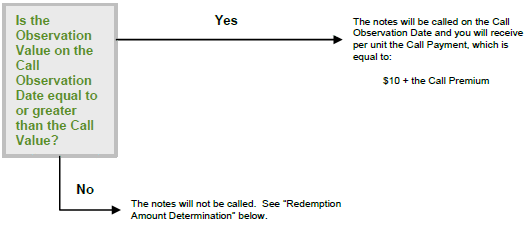
If the Observation Value on the Call Observation Date is greater than or equal to the Call Value, the notes will be called on the Call Observation Date and you will receive per unit the Call Payment, which is equal to:
|
|
|
Participation Rate: |
100% |
|
|
Threshold Value: |
80% of Starting Value |
|
|
Starting Value: |
The Closing Market Price of the Market Measure on the pricing date |
|
|
Ending Value: |
The Closing Market Price of the Market Measure on the Final Calculation Day multiplied by the Price Multiplier on that day. |
|
|
Observation Value: |
The Closing Market Price of the Market Measure on the Call Observation Date multiplied by the Price Multiplier on that day. |
|
|
Call Observation Date: |
On or about September , 2027, which is approximately one year after the pricing date. The scheduled Call Observation Date is subject to postponement in the event of Market Disruption Events and non-Market Measure Business Days, as described beginning on page PS-30 of the accompanying product supplement. |
|
|
Final Calculation Day / Maturity Valuation Period: |
Approximately the fifth scheduled Market Measure Business Day immediately preceding the maturity date, subject to postponement in the event of Market Disruption Events and non-Market Measure Business Days, as described beginning on page PS-31 of the accompanying product supplement. |
|
|
Maturity Date: |
September , 2029, subject to postponement as described beginning on page PS-31 of the accompanying product supplement. |
|
|
Call Payment Date: |
Approximately the fifth business day following the Call Observation Date, subject to postponement as described on page PS-30 of the accompanying product supplement. |
|
|
Price Multiplier: |
1, subject to adjustments for certain events relating to the Market Measure described beginning on PS-42 of the accompanying product supplement. |
|
|
Fees and Charges: |
The underwriting discount of $0.20 per unit listed on the cover page. |
|
|
Calculation Agent: |
Morgan Stanley & Co. LLC (“MS&Co.”), an affiliate of MSFL. |
|



|
Autocallable Participation Notes |
TS-3 |
|
Autocallable Participation Notes |
|
|
Payment Determination |
|
Automatic Call Provision: The notes will be called automatically if the Observation Value on the Call Observation Date is greater than or equal to the Call Value. If the notes are called, you will receive $10 per unit plus the Call Premium due on the Call Payment Date and no further amounts will be payable on the notes.
Redemption Amount Determination: If the notes are not called, you will receive the Redemption Amount per unit on the maturity date, determined as follows:
|

|
Autocallable Participation Notes |
TS-4 |
|
Autocallable Participation Notes |
|
The terms and risks of the notes are contained in this term sheet and in the following:
■Product supplement dated April 8, 2026:
www.sec.gov/Archives/edgar/data/895421/000095010326005460/dp244130_424b2-psml.htm
■Tax Supplement dated April 8, 2026
www.sec.gov/Archives/edgar/data/895421/000095010326005451/dp244874_424b2-sats.htm
■Prospectus dated April 8, 2026:
www.sec.gov/Archives/edgar/data/895421/000095010326005450/dp244347_424b2-basepro.htm
These documents (together, the “Note Prospectus”) have been filed as part of a registration statement with the SEC, which may, without cost, be accessed on the SEC website at www.sec.gov or obtained from Merrill Lynch, Pierce, Fenner & Smith Incorporated (“MLPF&S”) by calling 1-800-294-1322. Before you invest, you should read the Note Prospectus, including this term sheet, for information about us, Morgan Stanley and this offering. Any prior or contemporaneous oral statements and any other written materials you may have received are superseded by the Note Prospectus. Certain terms used but not defined in this term sheet have the meanings set forth in the accompanying product supplement. Unless otherwise indicated or unless the context requires otherwise, all references in this document to “we,” “us,” “our,” or similar references are to MSFL, and not to Morgan Stanley.
Investor Considerations
|
You may wish to consider an investment in the notes if: |
The notes may not be an appropriate investment for you if: |
|
■You are willing to receive a return on your investment capped at the Call Premium if the Observation Value on the Call Observation Date is equal to or greater than the Call Value. ■You anticipate that the notes will be automatically called or that the Ending Value will be greater than the Threshold Value. ■You are willing to risk a loss of principal and negative return if the notes are not automatically called and the Market Measure decreases from the Starting Value to an Ending Value that is below the Threshold Value. ■You are willing to forgo the interest payments that are paid on conventional interest-bearing debt securities. ■You are willing to forgo dividends or other benefits of owning shares of the Market Measure or the stocks included in the Market Measure . ■You are willing to accept a limited or no market for sales for the notes prior to maturity, and understand that the market prices for the notes, if any, will be affected by various factors, including our and Morgan Stanley’s actual and perceived creditworthiness, Morgan Stanley’s internal funding rate and fees and charges on the notes. ■You are willing to assume our credit risk, as issuer of the notes, and Morgan Stanley’s credit risk, as guarantor of the notes, for all payments under the notes, including the Redemption Amount. |
■You want to hold your notes for the full term. ■You believe that the notes will not be automatically called, the Market Measure will decrease from the Starting Value to an Ending Value that is below the Threshold Value or that it will not increase sufficiently over the term of the notes to provide you with your desired return. ■You seek 100% principal repayment or preservation of capital. ■You seek interest payments or other current income on your investment. ■You want to receive dividends or other distributions paid on the Market Measure or the stocks included in the Market Measure. ■You seek an investment for which there will be a liquid secondary market. ■You are unwilling or are unable to take market risk on the notes, to take our credit risk, as issuer of the notes, or to take Morgan Stanley’s credit risk, as guarantor of the notes. |
We urge you to consult your investment, legal, tax, accounting, and other advisors before you invest in the notes.
|
Autocallable Participation Notes |
TS-5 |
|
Autocallable Participation Notes |
|
Hypothetical Payout Profile and Examples of Payments at Maturity
The below graph is based on hypothetical numbers and values. The below graph shows a payout profile at maturity, which would only apply if the notes are not called on the Call Observation Date.
|
Autocallable Participation Notes
|
This graph reflects the returns on the notes, based on the Participation Rate of 100% and the Threshold Value of 80% of the Starting Value. The green line reflects the return on the notes, while the dotted gray line reflects the return of a direct investment in the Market Measure, excluding dividends. This graph has been prepared for purposes of illustration only. |

The following table and examples are for purposes of illustration only. They are based on hypothetical values and show hypothetical returns on the notes, assuming the notes are not called on the Call Observation Date. They illustrate the calculation of the Redemption Amount and total rate of return based on a hypothetical Starting Value of 100.00, a hypothetical Threshold Value of 80.00, the Participation Rate of 100% and a range of hypothetical Ending Values. The actual amount you receive and the resulting return will depend on the actual Starting Value, Threshold Value and Ending Value, whether the notes are called on the Call Observation Date and whether you hold the notes to maturity. The following examples do not take into account any tax consequences from investing in the notes.
For recent actual prices of the Market Measure, see “The Market Measure” section below. All payments on the notes are subject to issuer and guarantor credit risk.
|
Ending Value |
Percentage Change from the Starting Value to the Ending Value |
Redemption Amount per Unit |
Return on the Notes |
|
0.00 |
-100.00% |
$2.000 |
-80.00% |
|
50.00 |
-50.00% |
$7.000 |
-30.00% |
|
60.00 |
-40.00% |
$8.000 |
-20.00% |
|
70.00 |
-30.00% |
$9.000 |
-10.00% |
|
79.00 |
-21.00% |
$9.900 |
-1.00% |
|
80.00(1) |
-20.00% |
$10.000 |
0.00% |
|
90.00 |
-10.00% |
$11.000 |
10.00% |
|
95.00 |
-5.00% |
$11.500 |
15.00% |
|
97.00 |
-3.00% |
$11.700 |
17.00% |
|
100.00(2) |
0.00% |
$12.000 |
20.00% |
|
110.00 |
10.00% |
$13.000 |
30.00% |
|
120.00 |
20.00% |
$14.000 |
40.00% |
|
130.00 |
30.00% |
$15.000 |
50.00% |
|
140.00 |
40.00% |
$16.000 |
60.00% |
1)This is the hypothetical Threshold Value.
2)The hypothetical Starting Value of 100.00 used in these examples has been chosen for illustrative purposes only, and does not represent a likely actual Starting Value for the Market Measure.
|
Autocallable Participation Notes |
TS-6 |
|
Autocallable Participation Notes |
|
Redemption Amount Calculation Examples
|
Example 1 |
|
|
The Ending Value is 50.00, or 50% of the Starting Value: |
|
|
Starting Value: 100.00 |
|
|
Threshold Value: 80.00 |
|
|
Ending Value: 50.00 |
|
|
|
|
|
Example 2 |
|
|
The Ending Value is 95.00, or 95% of the Starting Value: |
|
|
Starting Value: 100.00 |
|
|
Threshold Value: 80.00 |
|
|
Ending Value: 95.00 |
|
|
|
|
|
Example 3 |
|
|
The Ending Value is 110.00, or 110% of the Starting Value: |
|
|
Starting Value: 100.00 Threshold Value: 80.00 |
|
|
Ending Value: 110.00 |
|
|
|
|
 = $7.00 Redemption Amount per unit
 = $11.50 Redemption Amount per unit
 = $13.00 Redemption Amount per unit
|
Autocallable Participation Notes |
TS-7 |
|
Autocallable Participation Notes |
|
Risk Factors
This section describes the material risks relating to the notes. For further discussion of these and other risks, you should read the section entitled “Risk Factors” in the accompanying product supplement, tax supplement and prospectus. You should also consult your investment, legal, tax, accounting and other advisers in connection with your investment in the notes.
Structure-related Risks
■Your investment may result in a loss. There is no fixed principal repayment amount on the notes at maturity. If the notes are not called and the Ending Value is less than the Threshold Value, you may lose up to 80% of the principal amount, depending on the negative performance of the Market Measure as measured from the Starting Value to the Ending Value.
■If the notes are automatically called prior to maturity, your investment return will be limited to the return represented by the Call Premium and may be less than a comparable investment directly in the Market Measure. If, on the Call Observation Date, the Observation Value is greater than or equal to the Call Value, we will automatically call the notes. If the notes are automatically called, your return will be limited to the Call Premium, regardless of the extent of the increase in the value of the Market Measure. You will not participate in any positive performance of the Market Measure, which may be significant, and will not have voting rights or rights to receive dividends or other distributions or any other rights with respect to the Market Measure or the stocks included in the Market Measure.
■Payments on the notes will not reflect changes in the value of the Market Measure other than on the Call Observation Date or the Final Calculation Day. As a result, even if the value of the Market Measure increases during the term of the notes, you will not receive any Call Payment if the Observation Value on the Call Observation Date is less than the Call Value. Similarly, if the notes are not called, you will receive a Redemption Amount that is less than the principal amount if the Ending Value is less than the Threshold Value on the Final Calculation Day, even if the value of the Market Measure was greater than the Threshold Value prior to such Final Calculation Day.
■Your notes may be called prior to maturity. If the notes are called, you will be subject to reinvestment risk, and may be forced to invest in a lower interest rate environment and may not be able to reinvest at comparable terms or returns.
■The notes do not provide for regular interest payments. Your return on the notes may be less than the yield you could earn by owning a conventional fixed or floating rate debt security of comparable maturity.
■Payments on the notes are subject to our credit risk, and any actual or perceived changes in our creditworthiness are expected to affect the value of, or any amounts payable on, the notes. You are dependent on our ability to pay all amounts due on the notes upon automatic redemption and at maturity and therefore you are subject to our credit risk. The notes are not guaranteed by any other entity. If we default on our obligations under the notes, your investment would be at risk and you could lose some or all of your investment. As a result, the market value of the notes prior to maturity will be affected by changes in the market’s view of our creditworthiness. Any actual or anticipated decline in our credit ratings or increase in the credit spreads charged by the market for taking our credit risk is likely to adversely affect the market value of the notes.
■As a finance subsidiary, MSFL has no independent operations and will have no independent assets. As a finance subsidiary, MSFL has no independent operations beyond the issuance and administration of its securities and will have no independent assets available for distributions to holders of MSFL securities if they make claims in respect of such securities in a bankruptcy, resolution or similar proceeding. Accordingly, any recoveries by such holders will be limited to those available under the related guarantee by Morgan Stanley and that guarantee will rank pari passu with all other unsecured, unsubordinated obligations of Morgan Stanley. Holders will have recourse only to a single claim against Morgan Stanley and its assets under the guarantee. Holders of securities issued by MSFL should accordingly assume that in any such proceedings they would not have any priority over and should be treated pari passu with the claims of other unsecured, unsubordinated creditors of Morgan Stanley, including holders of Morgan Stanley-issued securities.
Valuation- and Market-related Risks
■The notes are not designed to be short-term trading instruments, and if you attempt to sell the notes prior to maturity, their market value, if any, will be affected by various factors that interrelate in complex ways, and their market value may be less than the principal amount. The notes are not designed to be short-term trading instruments. If you wish to liquidate your investment in the notes prior to maturity, your only option would be to sell them in the secondary market. At that time, there may be an illiquid market for your notes or no market at all. Even if you were able to sell your notes, there are many factors outside of our control that may adversely affect their market value, some of which, but not all, are stated below. The impact of any one factor may be offset or magnified by the effect of another factor. These factors may interact with each other in complex and unpredictable ways. Factors that may influence the value of the notes include:
ovalue of the Market Measure,
ovolatility of the Market Measure and of the stocks composing the Market Measure,
oeconomic and other conditions generally,
ointerest rates,
odividend yields,
|
Autocallable Participation Notes |
TS-8 |
|
Autocallable Participation Notes |
|
othe occurrence of certain events affecting the Market Measure that may or may not require an adjustment to the Price Multiplier,
oour financial condition and creditworthiness, and
otime remaining to maturity.
■The rate we are willing to pay for securities of this type, maturity and issuance size is likely to be lower than the rate implied by our secondary market credit spreads and advantageous to us. Both the lower rate and the inclusion of costs associated with issuing, selling, structuring and hedging the notes in the original issue price reduce the economic terms of the notes, cause the estimated value of the notes to be less than the original issue price and will adversely affect secondary market prices. Assuming no change in market conditions or any other relevant factors, the prices, if any, at which dealers, including MS & Co., may be willing to purchase the notes in secondary market transactions will likely be significantly lower than the original issue price, because secondary market prices will exclude the issuing, selling, structuring and hedging-related costs that are included in the original issue price and borne by you and because the secondary market prices will reflect our secondary market credit spreads and the bid-offer spread that any dealer would charge in a secondary market transaction of this type as well as other factors. The inclusion of the costs of issuing, selling, structuring and hedging the notes in the original issue price and the lower rate we are willing to pay as issuer make the economic terms of the notes less favorable to you than they otherwise would be. However, because the costs associated with issuing, selling, structuring and hedging the notes are not fully deducted upon issuance, for a period of up to 6 months following the issue date, to the extent that MS & Co. may buy or sell the notes in the secondary market, absent changes in market conditions, including those related to the Market Measure, and to our secondary market credit spreads, it would do so based on values higher than the estimated value, and we expect that those higher values will also be reflected in your brokerage account statements.
■The estimated value of the notes is determined by reference to our pricing and valuation models, which may differ from those of other dealers and is not a maximum or minimum secondary market price. These pricing and valuation models are proprietary and rely in part on subjective views of certain market inputs and certain assumptions about future events, which may prove to be incorrect. As a result, because there is no market-standard way to value these types of securities, our models may yield a higher estimated value of the notes than those generated by others, including other dealers in the market, if they attempted to value the notes. In addition, the estimated value on the pricing date does not represent a minimum or maximum price at which dealers, including MS & Co., would be willing to purchase your notes in the secondary market (if any exists) at any time. The value of your notes at any time after the date of this document will vary based on many factors that cannot be predicted with accuracy, including our creditworthiness and changes in market conditions. See also “The notes are not designed to be short-term trading instruments, and if you attempt to sell the notes prior to maturity, their market value, if any, will be affected by various factors that interrelate in complex ways, and their market value may be less than the principal amount” above.
■The notes may not be listed on any securities exchange and secondary trading may be limited. Neither MS & Co. nor MLPF&S is obligated to make a market for, or repurchase, the notes. There is no assurance that any party will be willing to purchase your notes at any price in any secondary market.
Conflict-related Risks
■Hedging and trading activity by our affiliates or by MLPF&S and their affiliates could potentially affect the value of the notes. Our hedging and trading activities (including trades in shares of the Market Measure or the companies included in the Market Measure) and any hedging and trading activities we and our affiliates or MLPF&S or their affiliates engage in that are not for your account or on your behalf may affect the market value and return of the notes and may create conflicts of interest with you.
■Conflicts of interest. There may be potential conflicts of interest involving the calculation agent, which is an affiliate of ours. We have the right to appoint and remove the calculation agent.
Market Measure-related Risks
■No obligations for the investment advisor of the Market Measure or the Underlying Index Sponsor (MarketVector Indexes GmbH). The investment advisor of the Market Measure or the Underlying Index Sponsor may respectively adjust the Market Measure or the Market Measure Underlying Index (the MVIS® US Listed Semiconductor 25 Index) in a way that affects its value and has no obligation to consider your interests.
■Investing in the notes is not the equivalent to investing in the Market Measure or the stocks composing the Market Measure Underlying Index. You will not have any rights with respect to the Market Measure or its underlying assets, including any voting rights or any right to receive dividends or other distributions or any other right with respect to the Market Measure or the stocks that constitute the Market Measure Underlying Index.
■No control over the companies included in the Market Measure Underlying Index. While we and our affiliates or MLPF&S and their affiliates may from time to time own securities of companies included in the Market Measure Underlying Index, except to the extent that Morgan Stanley’s common stock is included in the Market Measure Underlying Index, we and our affiliates or MLPF&S and their affiliates do not control any company included in the Market Measure Underlying Index, and have not verified any disclosure made by any other company. You should undertake your own investigation into the Market Measure and its underlying assets.
|
Autocallable Participation Notes |
TS-9 |
|
Autocallable Participation Notes |
|
■There are liquidity and management risks associated with the Market Measure. Although shares or units of the Market Measure will be listed for trading on a securities exchange and a number of similar products have been traded on various exchanges for varying periods of time, there is no assurance that an active trading market will continue for the shares or units of the Market Measure or that there will be liquidity in the trading market.
■The performance and market price of the Market Measure, particularly during periods of market volatility, may not correlate with the performance of the Market Measure Underlying Index, the performance of the component securities of the Market Measure Underlying Index or the net asset value per share of the Market Measure. The Market Measure does not fully replicate the Market Measure Underlying Index and may hold securities that are different than those included in the Market Measure Underlying Index. In addition, the performance of the Market Measure will reflect additional transaction costs and fees that are not included in the calculation of the Market Measure Underlying Index. All of these factors may lead to a lack of correlation between the performance of the Market Measure and the Market Measure Underlying Index. In addition, corporate actions (such as mergers and spin-offs) with respect to the equity securities underlying the Market Measure may impact the variance between the performances of the Market Measure and the Market Measure Underlying Index. Finally, because the shares of the Market Measure are traded on an exchange and are subject to market supply and investor demand, the market price of one share of the Market Measure may differ from the net asset value per share of the Market Measure. For all of the foregoing reasons, the performance of the Market Measure may not correlate with the performance of the Market Measure Underlying Index, the performance of the component securities of the Market Measure Underlying Index or the net asset value per share of the Market Measure. Any of these events could materially and adversely affect the price of the Market Measure and, therefore, the value of the notes.
■Payments on the notes will not be adjusted for all events that could affect the Market Measure. See "Description of the Notes—Anti-Dilution and Discontinuance Adjustments Relating to Underlying Funds " beginning on page PS-40 of the accompanying product supplement.
Tax-related Risks
■The U.S. federal income tax consequences of an investment in the securities offered by this pricing supplement are uncertain. There is no direct legal authority regarding the proper U.S. federal income tax treatment of the securities, and significant aspects of the tax treatment of the securities are uncertain. Moreover, the securities may be subject to the “constructive ownership” regime, in which case certain adverse tax consequences may apply upon your disposition of a security. You should review carefully the section entitled “United States Federal Income Tax Considerations” herein, in combination with the section entitled “United States Federal Taxation” in the accompanying tax supplement, and consult your tax adviser regarding the U.S. federal income tax consequences of an investment in the securities.
Additional Risk Factors
■The Market Measure is subject to risks associated with investments concentrated in the semiconductor sector. All or substantially all of the equity securities held by the shares of the Market Measure are issued by companies whose primary business is directly associated with the semiconductor sector. The shares of the Market Measure may therefore be subject to increased price volatility, as they may be more susceptible to adverse economic, market, political or regulatory events affecting this particular industry and market sector.
|
Autocallable Participation Notes |
TS-10 |
|
Autocallable Participation Notes |
|
The Market Measure
All disclosures contained in this term sheet regarding the Market Measure, including, without limitation, its make-up, method of calculation, and changes in the components of the Market Measure, have been derived from publicly available sources. The information reflects the policies of, and is subject to change by, VanEck Associates Corporation, the investment advisor of the Market Measure. The investment advisor, which licenses the copyright and all other rights to the Market Measure, has no obligation to continue to publish, and may discontinue publication of, the Market Measure. The consequences of the investment advisor discontinuing publication of the Market Measure are discussed in the section of the accompanying product supplement beginning on page PS-40 entitled “Description of the Notes—Discontinuance of or Material Change to an Underlying Fund.” None of us and our affiliates or MLPF&S or their affiliates or the calculation agent accepts any responsibility for the calculation, maintenance or publication of the Market Measure or any successor fund.
VanEck® Semiconductor ETF
The VanEck® Semiconductor ETF is an exchange-traded fund of VanEck® ETF Trust, a registered investment company, that seeks to replicate as closely as possible, before fees and expenses, the price and yield performance of the MVIS® US Listed Semiconductor 25 Index. The Market Measure manager with respect to the VanEck® Semiconductor ETF is VanEck® ETF Trust, which is a registered investment company. It is possible that the Market Measure may not fully replicate the performance of its share underlying index due to the temporary unavailability of certain securities in the secondary market or due to other extraordinary circumstances. Information provided to or filed with the Securities and Exchange Commission by the underlying fund manager pursuant to the Securities Act of 1933 and the Investment Company Act of 1940 can be located by reference to Securities and Exchange Commission file numbers 333-123257 and 811-10325, respectively, through the Securities and Exchange Commission’s website at www.sec.gov. In addition, information regarding the Market Measure may be obtained from other sources including, but not limited to, press releases, newspaper articles and other publicly disseminated documents. This Market Measure trades on Nasdaq Global Markets under the symbol "SMH UQ." Neither we nor the agent makes any representation that such publicly available documents or any other publicly available information regarding the Market Measure is accurate or complete.
The Market Measure Underlying Index
All information contained in this pricing supplement regarding the Market Measure Underlying Index, including, without limitation, its make-up, method of calculation and changes in its components, from publicly available information, without independent verification. This information reflects the policies of, and is subject to change by, MarketVector Indexes GmbH (“MVIS”). The Market Measure Underlying Index was developed by MVIS and is maintained and published by MVIS. The Market Measure Underlying Index is calculated by Solactive AG. MVIS has no obligation to continue to publish, and may discontinue the publication of, the Market Measure Underlying Index.
The Market Measure Underlying Index is reported by Bloomberg L.P. under the ticker symbol “MVSMH.”
The Market Measure Underlying Index is designed to track the performance of the largest and most liquid U.S.-listed companies that derive at least 50% (25% for current components) of their revenues from semiconductors. This includes companies engaged primarily in the production of semiconductors and semiconductor equipment. The Market Measure Underlying Index was launched on August 12, 2011 with a base index value of 1,000 as of September 29, 2000.
The Index Universe
The index universe includes only common stocks and stocks with similar characteristics from financial markets that are freely investable for foreign investors and that provide real-time and historical component and currency pricing. Limited partnerships are excluded. Companies from financial markets that are not freely investable for foreign investors or that do not provide real-time and historical component and currency pricing may still be eligible if they have a listing on an eligible exchange and if they meet all the size and liquidity requirements on that exchange.
Only stocks that have a full market capitalization exceeding US$50 million are eligible for the index universe.
Investable Index Universe
Companies with a free-float (or shares available to foreign investors) of less than 5% for existing index components or less than 10% for new components are ineligible for inclusion.
In addition to the above, stocks that are currently not in the Market Measure Underlying Index must meet the following size and liquidity requirements:
•a full market capitalization exceeding US$150 million;
•a three-month average-daily-trading volume of at least US$1 million at the current review and also at the previous two reviews; and
•at least 250,000 shares traded per month over the last six months at the current review and also at the previous two reviews.
For stocks already in the Market Measure Underlying Index the following applies:
|
Autocallable Participation Notes |
TS-11 |
|
Autocallable Participation Notes |
|
•a full market capitalization exceeding US$75 million; and
•a three-month average-daily-trading volume of at least US$0.2 million in at least two of the latest three quarters (current review and also at previous two reviews)
•In addition, a three-month average-daily-trading volume of at least US$0.6 million at current review or at one of the previous two reviews; or
•at least 200,000 shares traded per month over the last six months at the current review or at one of the previous two reviews.
In case the number of investable stocks drops below the minimum component number for the respective index, current components remain investable.
Only one share line of each company is eligible. In case more than one share line fulfills the above size and liquidity rules, only the largest share line by free-float market capitalization is eligible. MVIS can, in exceptional cases (e.g., significantly higher liquidity), decide for a different share line.
In case the free-float market capitalization of a non-component share line:
•exceeds the free-float market capitalization of a share line of the same company which is an index component by at least 25%; and
•fulfills all size and liquidity eligibility criteria for non-components,
•the current component share line will be replaced by the larger one. MVIS can, in exceptional cases (e.g., significantly higher liquidity), decide to keep the current share line instead.
Index Constituent Selection
The Market Measure Underlying Index is reviewed on a semi-annual basis in March and September.
The target coverage of the Market Measure Underlying Index is 25 companies from the investable universe. Market Measure Underlying Index constituents are selected using the following procedure:
1.The largest 50 stocks (by full market capitalization) from the investable universe qualify.
2.The 50 stocks are ranked in two different ways - by free-float market capitalization in descending order (the largest company receives rank “1”) and then by three-month average-daily-trading volume in descending order (the most liquid company receives rank “1”). These two ranks are added up.
3.The 50 stocks are then ranked by the sum of their two ranks in Step 2 in ascending order. If two companies have the same sum of ranks, the larger company is placed on top.
a.Initially, the highest ranked 25 companies made up the Market Measure Underlying Index.
b.On-going, a 10-40 buffer is applied: the highest ranked 10 companies qualify. The remaining 15 companies are selected from the highest ranked remaining current Market Measure Underlying Index components ranked between 11 and 40. If the number of selected companies is still below 25, then the highest ranked remaining stocks are selected until 25 companies have been selected.
Review Schedule
The reviews for the Market Measure Underlying Index are based on the closing data on the last business day in February and August. If a company does not trade on the last business day in February or August, the last available price for this company will be used.
The underlying index data (e.g., new number of shares, new free-float factors and new weighting cap factors) is announced on the second Friday in March or September. The weighting cap factors are based on closing data of the Wednesday prior to the second Friday in March or September. Changes to the Market Measure Underlying Index are implemented and based on the closing prices of the third Friday in March or September. If the third Friday is not a business day, then the review will take place on the last business day before the third Friday. If a constituent of the Market Measure Underlying Index does not trade on the third Friday in March or September, then the last available price for that index constituent will be used. Changes become effective on the next business day. The component changes to the Market Measure Underlying Index are announced on the second Friday in March or September.
Ongoing Maintenance
In addition to the periodic reviews, the Market Measure Underlying Index is continually reviewed for corporate events (e.g., mergers, takeovers, spin-offs, delistings and bankruptcies) that affect the Market Measure Underlying Index components.
Deletions
For all corporate events that result in a stock deletion from the Market Measure Underlying Index, the deleted stock will be replaced with the highest ranked non-component on the most recent selection list immediately only if the number of components in the Market
|
Autocallable Participation Notes |
TS-12 |
|
Autocallable Participation Notes |
|
Measure Underlying Index would drop below 20. The replacement stock will be added at the same weight as the deleted stock. Only in case the number of components drop below its minimum due to a merger of two or more index components, the replacement stock will be added with its free-float market capitalization, weighted with the capping factor of the uncapped components in the small-weight group of the weighting scheme. In all other cases (i.e., there is not replacement), the additional weight resulting from the deletion will be redistributed proportionally across all other components of the Market Measure Underlying Index.
Changes to Free-Float Factor and Number of Shares
Changes to the number of shares or the free-float factors due to corporate actions like stock dividends, splits, rights issues, etc. are implemented immediately and will be effective the next trading day (i.e., the ex-date). Simple share/float changes are implemented after a 3-day notice period.
Initial Public Offerings (IPOs) and Spin-Offs
An IPO stock is eligible for fast-track addition to the index universe for the Market Measure Underlying Index once; either at the next semi-annual review if it has been trading since at least the last trading day of the month prior to the review snapshot dates (i.e., the last trading day in February or August) or else at the then-following semi-annual review. In order to be added to the Market Measure Underlying Index the IPO stock has to meet the size and liquidity requirements:
•the IPO must have a full market capitalization exceeding US$150 million;
•the IPO must have a free-float factor of at least 10%;
•the IPO must have an average-daily-trading volume of at least US$1 million; and
•the IPO must have traded at least 250,000 shares per month (or per 22 days).
This rule is applicable for newly spun-off companies as well.
Changes due to Mergers & Takeovers
A merger or takeover is deemed successful if it has been declared wholly unconditional and has received approval of all regulatory agencies with jurisdiction over the transaction. The result of a merger or takeover is typically one surviving stock and one or more non-surviving stocks that may not necessarily be de-listed from the respective trading system(s).
If a Market Measure Underlying Index component merges with or takes over another Market Measure Underlying Index component: The surviving stock remains in the Market Measure Underlying Index and the other stock is deleted immediately from the Market Measure Underlying Index. Its shares and float are adjusted according to the terms of the merger/takeover. The index market capitalization of the merged company corresponds to the market capitalization of the two separate companies.
If a Market Measure Underlying Index component merges with or takes over a non-Market Measure Underlying Index component: If the surviving stock meets the Market Measure Underlying Index requirements, then it remains in the Market Measure Underlying Index and its shares (if the share change is greater than 10%) and float are adjusted according to the terms of the merger/takeover. If the surviving stock does not meet the Market Measure Underlying Index requirements, then it is deleted immediately from the Market Measure Underlying Index.
If a non-Market Measure Underlying Index component merges with or takes over a Market Measure Underlying Index component: If the surviving stock meets the Market Measure Underlying Index requirements, then it will be added to the Market Measure Underlying Index (shares (if the share change is greater than 10%) and float adjusted according to the terms of the merger/takeover) and will replace the current Market Measure Underlying Index component. If the surviving stock does not meet the Market Measure Underlying Index requirements, then it will not be added to the Market Measure Underlying Index and the current Market Measure Underlying Index component is deleted immediately from the Market Measure Underlying Index.
Changes due to Spin-Offs
Each spin-off stock is immediately added to the Market Measure Underlying Index for at least two trading days. If a spin-off company does not qualify for the Market Measure Underlying Index, it will be deleted based on its closing price. Shares and floats of the surviving companies are adjusted according to the terms of the spin-off. In case the number of Market Measure Underlying Index components drops below the minimum component number and no non-component stock is eligible as a replacement, the determination of the addition is subject to MVIS’s decision.
Index Calculation
The value of the Market Measure Underlying Index is calculated using the Laspeyres’ formula, rounded to two decimal places, with stock prices converted to U.S. dollars:

where (for all stocks (i) in the Market Measure Underlying Index):
|
Autocallable Participation Notes |
TS-13 |
|
Autocallable Participation Notes |
|
|
pi |
= stock price (rounded to four decimal places); |
|
qi |
=number of shares; |
|
f fi |
=(rounded to two decimal places); |
|
fxi |
= exchange rate (local currency to U.S. Dollar) (rounded to 12 decimal places); |
|
cfi |
= sector-weighting cap factor (if applicable, otherwise set to 1) (rounded to 16 decimal places) |
|
M |
= free-float market capitalization of the Market Measure Underlying Index; and |
|
D |
= divisor (rounded to six decimal places). |
Free-Float
The Market Measure Underlying Index is free-float adjusted - that is, the number of shares outstanding is reduced to exclude closely held shares (amount larger than 5% of the company’s full market capitalization) from the index calculation. At times, other adjustments are made to the share count to reflect foreign ownership limits. These are combined with the block-ownership adjustments into a single factor. To avoid unwanted double counting, either the block-ownership adjustment or the restricted stocks adjustment is applied, whichever produces the higher result. Free-float factors are reviewed quarterly.
Company-Weighting Cap Factors
Companies in the Market Measure Underlying Index are weighted according to their free-float market capitalization, as modified by the company-weighting cap factors. The Market Measure Underlying Index used the company-weighting cap factors to ensure diversification to avoid overweighting. The company-weighting cap factors are reviewed quarterly and applied, if necessary. The following weighting scheme applies to the Market Measure Underlying Index:
1.All Market Measure Underlying Index components are weighted by their free-float market capitalization.
2.(2)All companies exceeding 4.5% but at least the largest five and at the maximum the largest 10 companies are grouped together (so called “Large-Weights”). All other companies are grouped together as well (so called “Small-Weights“).
3.(3)The aggregated weighting of the Large-Weights is capped at 50%:
a.Large-Weights: If the aggregated weighting of all companies in Large-Weight exceeds 50%, then a capping factor is calculated to bring the weighting down to 50%; at the same time, a second capping factor for the Small-Weights is calculated to increase the aggregated weight to 50%. These two factors are then applied to all companies in the Large-Weights or the Small-Weights respectively.
b.Large-Weights: The maximum weight for any single stock is 20% and the minimum weighting is 5%. If a stock is above the maximum or below the minimum weight, then the weight will be reduced to the maximum weight or increased to the minimum weight and the excess weight will be re-distributed proportionally across all other remaining Market Measure Underlying Index constituents in the Large-Weights.
c.Small-Weights: The maximum weight for any single stock is 4.5%. If a stock is above the maximum weight, then the weight will be reduced to the maximum weight and the excess weight will be re-distributed proportionally across all other remaining Market Measure Underlying Index constituents in the Small-Weights.
Divisor Adjustments
Index maintenance (reflecting changes in, e.g., shares outstanding, capital actions, addition or deletion of stocks to the Market Measure Underlying Index) should not change the level of the Market Measure Underlying Index. This is accomplished with an adjustment to the divisor. Any change to the stocks in the Market Measure Underlying Index that alters the total market value of the Market Measure Underlying Index while holding stock prices constant will require a divisor adjustment.

where ∆MC is the difference between closing market capitalization and adjusted closing market capitalization of the Market Measure Underlying Index.
|
Autocallable Participation Notes |
TS-14 |
|
Autocallable Participation Notes |
|
Data Correction
Incorrect or missing input data will be corrected immediately.
Corporate Action Related Adjustments
Corporate actions range widely from routine share issuances or buy backs to unusual events like spin-offs or mergers. These are listed on the table below with notes about the necessary changes and whether the divisor will be adjusted. Implementation takes place on the ex-date.
|
Special cash dividend pi, adjusted = pi - (Dividend x (1 - Withholding Tax)) |
Divisor change: Yes |
|
Split Shareholders receive “B” new shares for every “A” share held. |
Divisor change: No |
|
Rights offering Shareholders receive “B” new shares for every “A” share held. If the subscription-price is either not available or not smaller than the closing price, then no adjustment will be done. |
Divisor change: No |
|
Stock dividend Shareholders receive “B” new shares for every “A” share held. |
Divisor change: No |
|
Stock dividend from treasury Stock dividends from treasury are adjusted as ordinary cash dividends. Shareholders receive ‘B’ new shares for every ‘A’ share held. |
Divisor change: Yes |
|
Stock dividend of a different company security Shareholders receive “B” shares of a different company for every “A” share held. |
Divisor change: Yes |


|
Autocallable Participation Notes |
TS-15 |
|
Autocallable Participation Notes |
|
|
Spin-offs Shareholders receive “B” shares of a different company for every “A” share held. |
Divisor change: Yes |
|
Addition/deletion of a company Net change in market value determines the divisor adjustment. |
Divisor change: Yes |
|
Changes in shares outstanding/free-float Any secondary issuance, share repurchase, buy back, tender offer, Dutch auction, exchange offer, bought deal equity offering or prospectus offering will be updated at the semi-annual review if the change is smaller than 10%. Changes larger than 10% will be pre-announced (3 trading days’ notice) and implemented on a best efforts basis. If necessary and information is available, resulting float changes are taken into consideration. Share changes will not be implemented in the week between review announcement and implementation. |
Divisor change: Yes |
|
Changes due to a merger/takeover/spin-off Net change in free-float market value determines the divisor adjustment. In case of no change, the divisor change is 0. |
Divisor change: Yes |

With corporate actions where cash dividends or other corporate assets are distributed to shareholders, the price of the stock will drop on the ex-dividend day (the first day when a new shareholder is eligible to receive the distribution). The effect of the divisor adjustment is to prevent this price drop from causing a corresponding drop in the Market Measure Underlying Index.
Corporate actions are announced at least four days prior to implementation.
The following graph shows the daily historical performance of the Market Measure in the period from January 1, 2016 through August 14, 2026. We obtained this historical data from Bloomberg L.P. We have not independently verified the accuracy or completeness of the information obtained from Bloomberg L.P. On August 14, 2026, the Closing Market Price of the Market Measure was $587.82.
Historical Performance of the Market Measure
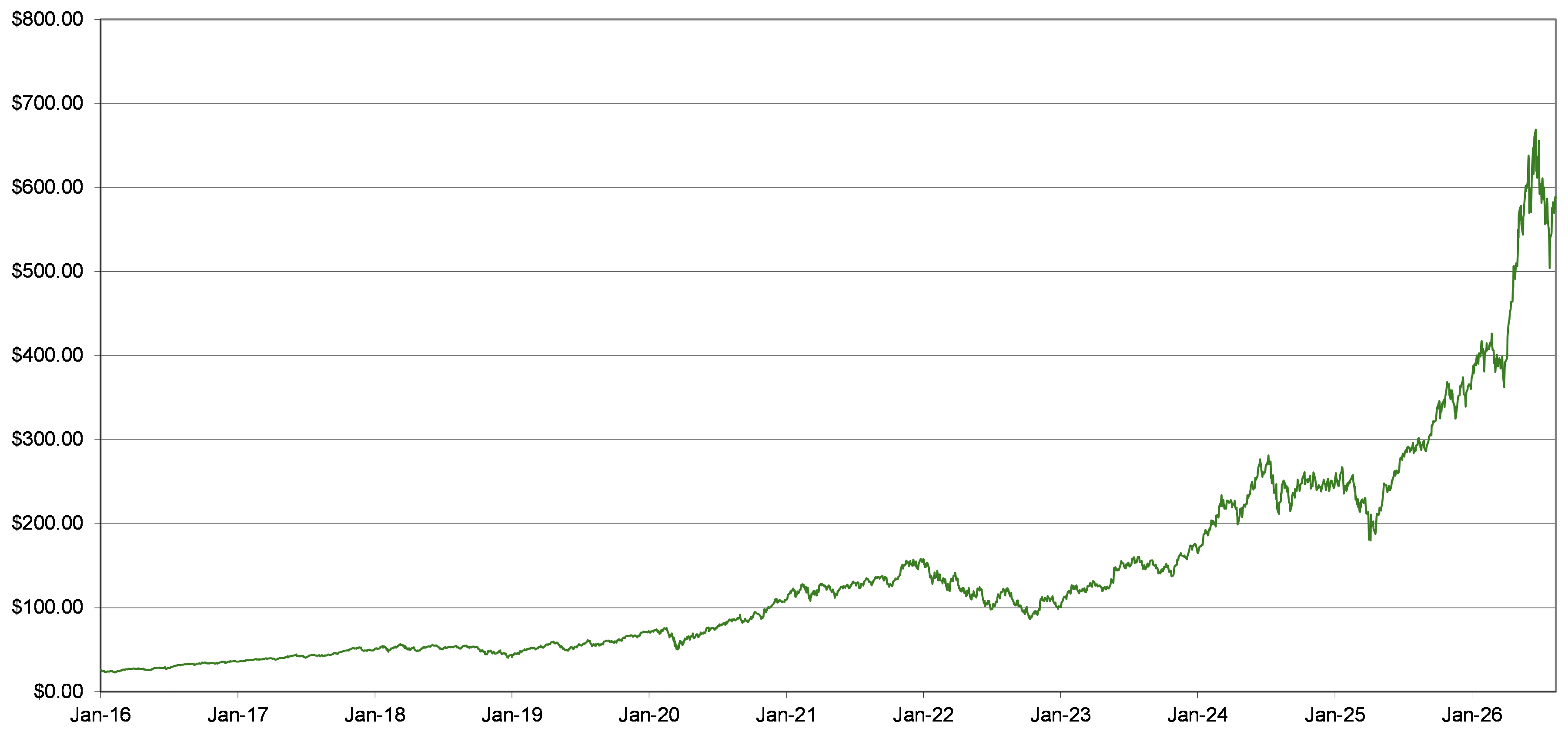
This historical data on the Market Measure is not necessarily indicative of the future performance of the Market Measure or what the value of the notes may be. Any historical upward or downward trend in the price per share of the Market Measure during any period set forth above is not an indication that the price per share of the Market Measure is more or less likely to increase or decrease at any time over the term of the notes.
Before investing in the notes, you should consult publicly available sources for the prices and trading pattern of the Market Measure.
|
Autocallable Participation Notes |
TS-16 |
|
Autocallable Participation Notes |
|
Supplement to the Plan of Distribution; Conflicts of Interest
MS & Co. will act as the agent for this offering. We will agree to sell to MS & Co., and MS & Co. will agree to purchase, all of the notes at the issue price less the underwriting discount indicated on the cover of this document. MLPF&S will purchase the notes from MS & Co. for resale, and will receive a discount in connection with the sale of the notes in an amount up to the full amount of underwriting discount set forth on the cover of this term sheet. MLPF&S will offer the notes at the public offering price set forth on the cover page hereto.
MS & Co. is our affiliate and a wholly owned subsidiary of Morgan Stanley, and it and other affiliates of ours expect to make a profit by selling, structuring and, when applicable, hedging the notes. When MS & Co. prices this offering of notes, it will determine the economic terms of the notes such that for each Note the estimated value on the Trade Date will be no lower than the minimum level described in “Summary” on page TS-2.
MS & Co. will conduct this offering in compliance with the requirements of Rule 5121 of the Financial Industry Regulatory Authority, Inc. (“FINRA”), regarding a FINRA member firm’s distribution of the securities of an affiliate and related conflicts of interest. MS & Co. or any of our other affiliates may not make sales in this offering to any discretionary account.
The costs included in the original issue price of the notes will include a fee paid by MS & Co. to LFT Securities, LLC, an entity in which an affiliate of MLPF&S has an ownership interest in, which will reduce the economic terms of the notes to you.
We may deliver the notes against payment therefor in New York, New York on a date that is greater than one business day following the pricing date. Under Rule 15c6-1 of the Securities Exchange Act of 1934, trades in the secondary market generally are required to settle in one business day, unless the parties to any such trade expressly agree otherwise. Accordingly, if the initial settlement of the notes occurs more than one business day from the pricing date, purchasers who wish to trade the notes more than one business day prior to the original issue date will be required to specify alternative settlement arrangements to prevent a failed settlement.
The notes will not be listed on any securities exchange. In the original offering of the notes, the notes will be sold in minimum investment amounts of 10,000 units. If you place an order to purchase the notes, you are consenting to MLPF&S and/or one of its affiliates acting as a principal in effecting the transaction for your account.
MS&Co. may repurchase and resell the notes, with repurchases and resales being made at prices related to then-prevailing market prices or at negotiated prices, and these will include MS&Co.’s trading commissions and mark-ups or mark-downs. MS&Co. may act as principal or agent in these market-making transactions; however MS&Co. is not obligated to engage in any such transactions. At MS&Co.’s discretion, for a short, undetermined initial period after the issuance of the notes, MS&Co. may offer to buy the notes in the secondary market at a price that may exceed the initial estimated value of the notes. Any price offered by MS&Co. for the notes will be based on then-prevailing market conditions and other considerations, including the performance of the Market Measure and the remaining term of the notes. However, neither we nor any of our affiliates is obligated to purchase your notes at any price, or at any time, and we cannot assure you that we or any of our affiliates will purchase your notes at a price that equals or exceeds the initial estimated value of the notes.
The value of the notes shown on your account statement will be based on MS&Co.’s estimate of the value of the notes if MS&Co. were to make a market in the notes, which it is not obligated to do. That estimate will be based upon the price that MS&Co. may pay for the notes in light of then-prevailing market conditions and other considerations, as mentioned above, and will include transaction costs. At certain times, this price may be higher than or lower than the initial estimated value of the notes.
|
Autocallable Participation Notes |
TS-17 |
|
Autocallable Participation Notes |
|
Structuring the Notes
The notes are our debt securities, the return on which is linked to the performance of the Market Measure. The related guarantees are Morgan Stanley’s obligations. As is the case for all of our and Morgan Stanley’s respective debt securities, including our market-linked notes, the economic terms of the notes reflect our and Morgan Stanley’s actual or perceived creditworthiness at the time of pricing. In addition, because market-linked notes result in increased operational, funding and liability management costs to us and Morgan Stanley, Morgan Stanley typically borrows the funds under these types of notes at a rate that is more favorable to Morgan Stanley than the rate that it might pay for a conventional fixed or floating rate debt security. This rate, which we refer to in this term sheet as Morgan Stanley’s internal funding rate, is typically lower than the rate Morgan Stanley would pay when it issues conventional fixed or floating rate debt securities. This generally relatively lower internal funding rate, which is reflected in the economic terms of the notes, along with the fees and charges associated with market-linked notes, typically results in the initial estimated value of the notes on the pricing date being less than their public offering price.
At maturity, if not previously automatically called, we are required to pay the Redemption Amount to holders of the notes, which will be calculated based on the performance of the Market Measure and the $10 per unit principal amount. In order to meet these payment obligations, at the time we issue the notes, we may choose to enter into certain hedging arrangements (which may include call options, put options or other derivatives) with MS&Co. or one of our other affiliates. The terms of these hedging arrangements are determined by seeking bids from market participants, which may include MS&Co. and our other affiliates, and take into account a number of factors, including our and Morgan Stanley’s creditworthiness, interest rate movements, the volatility of the Market Measure, the tenor of the notes and the tenor of the hedging arrangements. The economic terms of the notes and their initial estimated value depend in part on the terms of these hedging arrangements. These hedging arrangements are expected to result in a profit to those engaging in the hedging activity, which could be more or less than initially expected, but could also result in a loss.
For further information, see “Risk Factors—Valuation and Market-related Risks” and “—Conflict-related Risks” beginning on page PS-8 and PS-9, respectively, and “Use of Proceeds and Hedging” on page PS-26 of the accompanying product supplement.
|
Autocallable Participation Notes |
TS-18 |
|
Autocallable Participation Notes |
|
Summary U.S. Federal Tax Consequences
You should review carefully the section in the accompanying tax supplement entitled “United States Federal Taxation.” The following discussion, when read in combination with that section, constitutes the full opinion of our counsel, Davis Polk & Wardwell LLP, regarding the material U.S. federal income tax consequences of owning and disposing of the securities offered by this pricing supplement.
Generally, this discussion assumes that you purchased a security for cash in the original issuance at the stated issue price and does not address other circumstances specific to you, including consequences that may arise due to any other investments relating to an underlier. Moreover, as discussed in the section entitled “United States Federal Taxation” in the accompanying tax supplement, we have not attempted to ascertain whether any issuer of any underlier to which the securities relate is a U.S. real property holding corporation or a passive foreign investment company. You should consult your tax adviser regarding these issues, including the effect any circumstances specific to you may have on the U.S. federal income tax consequences of your ownership of a security.
In the opinion of our counsel, which is based on current market conditions, it is reasonable to treat the securities for U.S. federal income tax purposes as prepaid financial contracts that are “open transactions,” as described in the section entitled “United States Federal Taxation—Tax Consequences to U.S. Holders—Program Securities Treated as Prepaid Financial Contracts that are Open Transactions” in the accompanying tax supplement. There is uncertainty regarding this treatment, and the Internal Revenue Service (the “IRS”) or a court might not agree with it. Moreover, because this treatment of the securities and our counsel’s opinion are based on market conditions as of the date of this preliminary pricing supplement, each is subject to confirmation on the pricing date. A different tax treatment could be adverse to you. Generally, if this treatment is respected, subject to the potential application of the “constructive ownership” regime discussed below, (i) you should not recognize taxable income or loss prior to the taxable disposition of your securities (including upon maturity or an earlier redemption, if applicable) and (ii) the gain or loss on your securities generally should be treated as capital gain or loss.
Even if the treatment of the securities as prepaid financial contracts is respected, purchasing a security could be treated as entering into a “constructive ownership transaction” within the meaning of Section 1260 of the Internal Revenue Code (“Section 1260”), as described in the sections entitled “United States Federal Taxation—Tax Consequences to U.S. Holders—Program Securities Treated as Prepaid Financial Contracts that are Open Transactions—Possible Application of Section 1260 of the Code” in the accompanying tax supplement. Due to the lack of direct legal authority, our counsel is unable to opine as to whether or how Section 1260 applies to the securities.
We do not plan to request a ruling from the IRS regarding the treatment of the securities. An alternative characterization of the securities could materially and adversely affect the tax consequences of ownership and disposition of the securities, including the timing and character of income recognized. In addition, the U.S. Treasury Department and the IRS have requested comments on various issues regarding the U.S. federal income tax treatment of “prepaid forward contracts” and similar financial instruments and have indicated that such transactions may be the subject of future regulations or other guidance. Furthermore, members of Congress have proposed legislative changes to the tax treatment of derivative contracts. Any legislation, Treasury regulations or other guidance promulgated after consideration of these issues could materially and adversely affect the tax consequences of an investment in the securities, possibly with retroactive effect.
Non-U.S. Holders. If you are a Non-U.S. Holder (as defined in the accompanying tax supplement), please also read the section entitled “United States Federal Taxation—Tax Consequences to Non-U.S. Holders—Program Securities Not Treated as Debt Instruments” in the accompanying tax supplement.
As discussed under “United States Federal Taxation—Tax Consequences to Non-U.S. Holders—Dividend Equivalents under Section 871(m) of the Code” in the accompanying tax supplement, Section 871(m) of the Internal Revenue Code and Treasury regulations promulgated thereunder (“Section 871(m)”) generally impose a 30% withholding tax on dividend equivalents paid or deemed paid to Non-U.S. Holders with respect to certain financial instruments linked to U.S. equities or indices that include U.S. equities. The Treasury regulations, as modified by an IRS notice, exempt financial instruments issued prior to January 1, 2027 that do not have a “delta” of one. Based on certain determinations made by us, we expect that Section 871(m) will not apply to the securities with regard to Non-U.S. Holders. Our determination is not binding on the IRS, and the IRS may disagree with this determination. If necessary, further information regarding the potential application of Section 871(m) will be provided in the final pricing supplement for the securities.
We will not be required to pay any additional amounts with respect to U.S. federal withholding taxes.
You should consult your tax adviser regarding the U.S. federal income tax consequences of an investment in the securities, including possible alternative treatments and the potential application of the “constructive ownership” regime, as well as tax consequences arising under the laws of any state, local or non-U.S. taxing jurisdiction.
|
Autocallable Participation Notes |
TS-19 |
|
Autocallable Participation Notes |
|
Where You Can Find More Information
We and Morgan Stanley have filed a registration statement (including a product supplement, a tax supplement and a prospectus) with the SEC for the offering to which this term sheet relates. Before you invest, you should read the Note Prospectus, including this term sheet, and the other documents relating to this offering that we and Morgan Stanley have filed with the SEC, for more complete information about us, Morgan Stanley and this offering. You may get these documents without cost by visiting EDGAR on the SEC website at www.sec.gov or by calling MLPF&S toll-free at 1-800-294-1322.
You may access these documents on the SEC web site at www.sec.gov as follows:
Product Supplement for Principal-at-Risk Notes dated April 8, 2026
Tax Supplement dated April 8, 2026
Prospectus dated April 8, 2026
Terms used but not defined in this document are defined in the accompanying product supplement, in the tax supplement or in the prospectus.
|
Autocallable Participation Notes |
TS-20 |

FREE Breaking News Alerts from StreetInsider.com!
StreetInsider.com Top Tickers, 10/21/2026
- Nasdaq leads Wall Street gains as SpaceX, Super Micro boost AI sentiment
- SpaceX, Tesla shares rise after Musk says committees exploring possible merger
- Brent falls as Iran's president discusses mediation with Pakistani army chief
- Nvidia’s Huang highlights AI benefits in Berlin speech amid wider European tour
- AI bubble about to burst? Not yet, Yardeni says
Serious News for Serious Traders! Try StreetInsider.com Premium Free!
You May Also Be Interested In
- Datadog stock rises on analyst upgrade, AI demand
- Solaris Oilfield Infrastructure shares jump on Morgan Stanley upgrade
- Seagate stock rises on analyst price target upgrades
Create E-mail Alert Related Categories
SEC FilingsRelated Entities
Morgan StanleySign up for StreetInsider Free!
Receive full access to all new and archived articles, unlimited portfolio tracking, e-mail alerts, custom newswires and RSS feeds - and more!
