



Form 424B2 BARCLAYS BANK PLC
 Tweet
Tweet Share
Share E-mail
Preliminary Term Sheet (To the Prospectus dated May 15, 2025, the Prospectus Supplement dated May 15, 2025 and Product Supplement EQUITY MLI-1 dated March 3, 2026) |
Subject
to Completion Dated September 4, 2026 |
Filed Pursuant to Rule 424(b)(2) Registration Statement No. 333-287303 |
| Units $10 principal amount per unit CUSIP No. |
Pricing
Date* Settlement Date* Maturity Date* |
September , 2026 September , 2026 November , 2027 |
 |
*Subject to change based on the actual date the notes are priced for initial sale to the public (the “pricing date”) |
|
Bear Market-Linked One Look Notes with a Dual Directional Buffer Linked to the Nasdaq-100 Index® |
| § | Maturity of approximately 14 months |
| § | If the Ending Value of the Nasdaq-100 Index® (the “Market Measure”) is less than or equal to the Starting Value, a positive return of [15.00% to 19.00%] |
| § | If the Market Measure increases by no more than 15.00% from its Starting Value to the Ending Value, a positive return equal to the percentage increase in the value of the Market Measure from the Starting Value to the Ending Value |
| § | If the Market Measure increases by more than 15.00% from its Starting Value to the Ending Value, 1-to-1 negative exposure to increases in the Market Measure beyond a 15.00% increase, subject to the Minimum Redemption Amount of $1.50 per unit, with 85.00% of your principal at risk. You will lose a portion, which could be significant, of your principal amount if the Ending Value increases above the Starting Value by more than 15.00%. |
| § | By purchasing the notes, you are taking the primarily bearish view that the value of the Market Measure will decline over the term of the notes, or that it will increase by no more than 15.00% over the term of the notes, such that the Ending Value will be less than or equal to the Starting Value or no greater than 115.00% of the Starting Value. |
| § | All payments occur at maturity and are subject to the credit risk of Barclays Bank PLC. |
| § | No periodic interest payments |
| § | In addition to the underwriting discount set forth below, the notes include a hedging-related charge of $0.05 per unit. See “Structuring the Notes.” |
| § | Limited secondary market liquidity, with no exchange listing |
| § | The notes are our unsecured and unsubordinated obligations and are not deposit liabilities of Barclays Bank PLC. The notes are not covered by the U.K. Financial Services Compensation Scheme or insured by the U.S. Federal Deposit Insurance Corporation or any other governmental agency or deposit insurance agency of the United States, the United Kingdom, or any other jurisdiction. |
The notes are being issued by Barclays Bank PLC (“Barclays”). There are important differences between the notes and a conventional debt security, including different investment risks and certain additional costs. See “Risk Factors” and “Additional Risk Factors” beginning on page TS-7 of this term sheet and “Risk Factors” beginning on page PS-6 of product supplement EQUITY MLI-1 and beginning on page S-9 of the prospectus supplement.
Our initial estimated value of the notes, based on our internal pricing models, is expected to be between $9.60 and $9.87 per unit on the pricing date, which is less than the public offering price listed below. See “Summary” on the following page, “Risk Factors” beginning on page TS-7 of this term sheet and “Structuring the Notes” below for additional information. The actual value of your notes at any time will reflect many factors and cannot be predicted with accuracy.
Notwithstanding and to the exclusion of any other term of the notes or any other agreements, arrangements or understandings between Barclays and any holder or beneficial owner of the notes (or the trustee on behalf of the holders of the notes), by acquiring the notes, each holder or beneficial owner of the notes acknowledges, accepts, agrees to be bound by, and consents to the exercise of, any U.K. Bail-in Power by the relevant U.K. resolution authority. All payments are subject to the risk of exercise of any U.K. Bail-in Power by the relevant U.K. resolution authority. See “Consent to U.K. Bail-in Power” on page TS-4 and “Risk Factors” beginning on page TS-7 of this term sheet.
None of the Securities and Exchange Commission (the “SEC”), any state securities commission, or any other regulatory body has approved or disapproved of these securities or determined if this Note Prospectus (as defined below) is truthful or complete. Any representation to the contrary is a criminal offense.
_________________________
| Per Unit | Total | |
| Public offering price(1) | $ 10.000 | $ |
| Underwriting discount(1) | $ 0.175 | $ |
| Proceeds, before expenses, to Barclays | $ 9.825 | $ |
| (1) | For any purchase of 300,000 units or more in a single transaction by an individual investor or in combined transactions with the investor’s household in this offering, the public offering price and the underwriting discount will be $9.950 per unit and $0.125 per unit, respectively. See “Supplement to the Plan of Distribution” below. |
The notes:
| Are Not FDIC Insured | Are Not Bank Guaranteed | May Lose Value |
BofA Securities
September , 2026
| Bear Market-Linked One Look Notes with a Dual Directional Buffer | TS-2 |
| Bear Market-Linked One Look Notes with a Dual Directional Buffer Linked to the Nasdaq-100 Index®, due November , 2027 |
Summary
The Bear Market-Linked One Look Notes with a Dual Directional Buffer Linked to the Nasdaq-100 Index®, due November , 2027 (the “notes”) are our unsecured and unsubordinated obligations and are not deposit liabilities of Barclays. The notes are not covered by the U.K. Financial Services Compensation Scheme or insured by the U.S. Federal Deposit Insurance Corporation or any other governmental agency or deposit insurance agency of the United States, the United Kingdom or any other jurisdiction. The notes will rank equally with all of our other unsecured and unsubordinated debt. Any payments due on the notes, including any repayment of principal, will be subject to the credit risk of Barclays and to the risk of exercise of any U.K. Bail-in Power (as described herein) or any other resolution measure by any relevant U.K. resolution authority.
The notes provide you with a Digital Payment if the Ending Value of the Market Measure, which is the Nasdaq-100 Index® (the “Market Measure”), is less than or equal to the Starting Value. If the Ending Value is greater than the Starting Value but less than or equal to the Threshold Value, you will receive a return equal to the percentage increase in the Market Measure from the Starting Value to the Ending Value. If the Ending Value is greater than the Threshold Value, you will lose a portion, which could be significant, of the principal amount of your notes, subject to the Minimum Redemption Amount. Any payments on the notes will be calculated based on the $10 principal amount per unit and will depend on the performance of the Market Measure, subject to our credit risk. See “Terms of the Notes” below.
On the cover page of this term sheet, we have provided the estimated value range for the notes. This range of estimated values was determined based on our internal pricing models, which take into account a number of variables, including volatility, interest rates and our internal funding rates, which are our internally published borrowing rates, and the economic terms of certain related hedging arrangements. This range of estimated values may not correlate on a linear basis with the range of Digital Payment for the notes. The estimated value of the notes calculated on the pricing date is expected to be less than the public offering price and will be set forth in the final term sheet made available to investors in the notes.
The economic terms of the notes (including the Digital Payment) are based on our internal funding rates, which may vary from the levels at which our benchmark debt securities trade in the secondary market, and the economic terms of certain related hedging arrangements. The difference between these rates, as well as the underwriting discount, the hedging-related charge and other amounts described below, will reduce the economic terms of the notes. For more information about the estimated value and the structuring of the notes, see “Structuring the Notes” below.
| Terms of the Notes |
| Issuer: | Barclays Bank PLC (“Barclays”) |
| Principal Amount: | $10.00 per unit |
| Term: | Approximately 14 months |
| Market Measure: | The Nasdaq-100 Index® (Bloomberg symbol: “NDX Index”), a price return index |
| Starting Value: | The closing level of the Market Measure on the pricing date |
| Ending Value: | The closing level of the Market Measure on the calculation day. The scheduled calculation day is subject to postponement in the event of Market Disruption Events and non-Market Measure Business Days, as described beginning on page PS-29 of product supplement EQUITY MLI-1. |
| Digital Payment: | [$1.50 to $1.90] per unit, which represents a return of [15.00% to 19.00%] over the principal amount. The actual Digital Payment will be determined on the pricing date. |
| Threshold Value: | 115.00% of the Starting Value, rounded to two decimal places |
| Minimum Redemption Amount: | $1.50 per unit. If you sell your notes before the maturity date, you may receive less than the Minimum Redemption Amount per unit. |
| Calculation Day/Maturity Valuation Period: | Approximately the fifth scheduled Market Measure Business Day immediately preceding the maturity date |
| Fees and Charges: | The public offering price of the notes includes the underwriting discount of $0.175 per unit listed on the cover page and a hedging-related charge of $0.05 per unit described in “Structuring the Notes” below. |
| Calculation Agents: | Barclays and BofA Securities, Inc. (“BofAS”) |
| Bear Market-Linked One Look Notes with a Dual Directional Buffer | TS-3 |
| Bear Market-Linked One Look Notes with a Dual Directional Buffer Linked to the Nasdaq-100 Index®, due November , 2027 |
| Redemption Amount Determination | |
| On the maturity date, you will receive a cash payment per unit determined as follows: | |
 |
|
| Bear Market-Linked One Look Notes with a Dual Directional Buffer | TS-4 |
| Bear Market-Linked One Look Notes with a Dual Directional Buffer Linked to the Nasdaq-100 Index®, due November , 2027 |
The terms and risks of the notes are contained in this term sheet and in the following:
| § | Product supplement EQUITY MLI-1 dated March 3, 2026: http://www.sec.gov/Archives/edgar/data/312070/000095010326003166/dp242567_424b2-equitymli1.htm |
| § | Series A MTN prospectus supplement dated May 15, 2025: http://www.sec.gov/Archives/edgar/data/312070/000095010325006051/dp228678_424b2-prosupp.htm |
| § | Prospectus dated May 15, 2025: http://www.sec.gov/Archives/edgar/data/312070/000119312525120720/d925982d424b2.htm |
These documents (together, the “Note Prospectus”) have been filed as part of a registration statement with the SEC, which may, without cost, be accessed on the SEC website as indicated above or obtained from us, Merrill Lynch, Pierce, Fenner & Smith Incorporated (“MLPF&S”) or BofAS by calling 1-800-294-1322. Before you invest, you should read the Note Prospectus, including this term sheet, and the other documents that we have filed with the SEC for information about us and this offering. Any prior or contemporaneous oral statements and any other written materials you may have received are superseded by the Note Prospectus. Capitalized terms used but not defined in this term sheet have the meanings set forth in product supplement EQUITY MLI-1. Unless otherwise indicated or unless the context requires otherwise, all references in this term sheet to “we,” “us,” “our” or similar references are to Barclays.
Consent to U.K. Bail-in Power
Notwithstanding and to the exclusion of any other term of the notes or any other agreements, arrangements or understandings between us and any holder or beneficial owner of the notes (or the trustee on behalf of the holders of the notes), by acquiring the notes, each holder or beneficial owner of the notes acknowledges, accepts, agrees to be bound by, and consents to the exercise of, any U.K. Bail-in Power by the relevant U.K. resolution authority.
Under the U.K. Banking Act 2009, as amended, the relevant U.K. resolution authority may exercise a U.K. Bail-in Power in circumstances in which the relevant U.K. resolution authority is satisfied that the resolution conditions are met. These conditions include that a U.K. bank or investment firm is failing or is likely to fail to satisfy the Financial Services and Markets Act 2000 (the “FSMA”) threshold conditions for authorization to carry on certain regulated activities (within the meaning of section 55B FSMA) or, in the case of a U.K. banking group company that is a European Economic Area (“EEA”) or third country institution or investment firm, that the relevant EEA or third country relevant authority is satisfied that the resolution conditions are met in respect of that entity.
The U.K. Bail-in Power includes any write-down, conversion, transfer, modification and/or suspension power, which allows for (i) the reduction or cancellation of all, or a portion, of the principal amount of, or interest on, or any other amounts payable on, the notes; (ii) the conversion of all, or a portion, of the principal amount of, or interest on, or any other amounts payable on, the notes into shares or other securities or other obligations of Barclays or another person (and the issue to, or conferral on, the holder or beneficial owner of the notes of such shares, securities or obligations); (iii) the cancellation of the notes and/or (iv) the amendment or alteration of the maturity of the notes, or the amendment of the amount of interest or any other amounts due on the notes, or the dates on which interest or any other amounts become payable, including by suspending payment for a temporary period; which U.K. Bail-in Power may be exercised by means of a variation of the terms of the notes solely to give effect to the exercise by the relevant U.K. resolution authority of such U.K. Bail-in Power. Each holder and beneficial owner of the notes further acknowledges and agrees that the rights of the holders or beneficial owners of the notes are subject to, and will be varied, if necessary, solely to give effect to, the exercise of any U.K. Bail-in Power by the relevant U.K. resolution authority. For the avoidance of doubt, this consent and acknowledgment is not a waiver of any rights holders or beneficial owners of the notes may have at law if and to the extent that any U.K. Bail-in Power is exercised by the relevant U.K. resolution authority in breach of laws applicable in England.
For more information, please see “Risk Factors—Issuer-related Risks—You May Lose Some or All of Your Investment If Any U.K. Bail-in Power Is Exercised by the Relevant U.K. Resolution Authority” in this term sheet as well as “U.K. Bail-in Power,” “Risk Factors—Risks Relating to the Securities Generally—Regulatory action in the event a bank or investment firm in the Group is failing or likely to fail, including the exercise by the relevant U.K. resolution authority of a variety of statutory resolution powers, could materially adversely affect the value of any securities” and “Risk Factors—Risks Relating to the Securities Generally—Under the terms of the securities, you have agreed to be bound by the exercise of any U.K. Bail-in Power by the relevant U.K. resolution authority” in the accompanying prospectus supplement.
| Bear Market-Linked One Look Notes with a Dual Directional Buffer | TS-5 |
| Bear Market-Linked One Look Notes with a Dual Directional Buffer Linked to the Nasdaq-100 Index®, due November , 2027 |
Investor Considerations
| You may wish to consider an investment in the notes if: | The notes may not be an appropriate investment for you if: |
| § | You anticipate that the Market Measure will decrease moderately from the Starting Value to the Ending Value or increase from the Starting Value to an Ending Value that is less than or equal to the Threshold Value. |
| § | You are willing to risk a loss of principal if the Market Measure increases from the Starting Value to an Ending Value that is above the Threshold Value. |
| § | You accept that (i) the return on the notes will be limited to the return represented by the Digital Payment if the Ending Value is less than or equal to the Starting Value, (ii) you will participate positively in the appreciation of the Market Measure only if the Ending Value is greater than the Starting Value but not greater than the Threshold Value and (iii) if the Ending Value is greater than the Threshold Value, you will participate negatively in the appreciation of the Market Measure above the Threshold Value, subject to the Minimum Redemption Amount. |
| § | You are willing to forgo the interest payments that are paid on conventional interest-bearing debt securities. |
| § | You are willing to forgo dividends and other benefits of directly owning the securities included in the Market Measure. |
| § | You are willing to accept a limited or no market for sales prior to maturity, and understand that the market prices for the notes, if any, will be affected by various factors, including our actual and perceived creditworthiness, the inclusion in the public offering price of the underwriting discount, the hedging-related charge and other amounts, as described above. |
| § | You are willing and able to assume our credit risk, as issuer of the notes, for all payments under the notes, including the Redemption Amount. |
| § | You are willing and able to consent to the exercise of any U.K. Bail-in Power by U.K. resolution authorities. |
| § | You anticipate that the Market Measure will increase from the Starting Value to an Ending Value that is above the Threshold Value or that it will decrease by more than the return represented by the Digital Payment. |
| § | You seek 100% principal repayment or preservation of capital. |
| § | You seek an uncapped return on your investment. |
| § | You seek interest payments or other current income on your investment. |
| § | You want to receive dividends or have other benefits of directly owning the securities included in the Market Measure. |
| § | You seek an investment for which there will be a liquid secondary market. |
| § | You are unwilling or unable to take market risk on the notes or to take our credit risk as issuer of the notes. |
| § | You are unwilling or unable to consent to the exercise of any U.K. Bail-in Power by U.K. resolution authorities. |
We urge you to consult your investment, legal, tax, accounting and other advisors before you invest in the notes.
| Bear Market-Linked One Look Notes with a Dual Directional Buffer | TS-6 |
| Bear Market-Linked One Look Notes with a Dual Directional Buffer Linked to the Nasdaq-100 Index®, due November , 2027 |
Hypothetical Payout Profile and Examples of Payments at Maturity
The graph below is based on hypothetical numbers and values.
|
Bear Market-Linked One Look Notes with a Dual Directional Buffer
|
This graph reflects the returns on the notes, based on the Threshold Value of 115.00% of the Starting Value, the Minimum Redemption Amount of $1.50 per unit and a hypothetical Digital Payment of $1.70 per unit (the midpoint of the Digital Payment range of [$1.50 to $1.90] per unit). The green line reflects the returns on the notes, while the dotted gray line reflects the returns of a direct investment in the stocks included in the Market Measure, excluding dividends.
This graph has been prepared for purposes of illustration only.
|
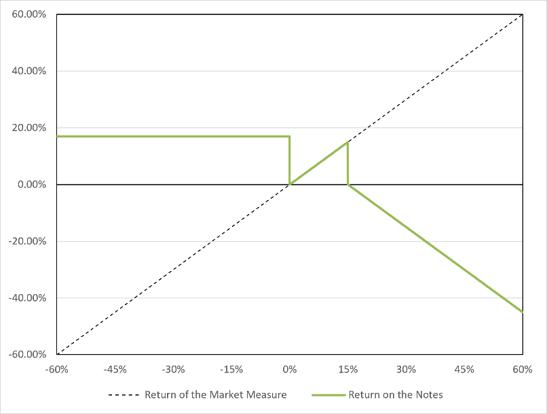
The following table and examples are for purposes of illustration only. They are based on hypothetical values and show hypothetical returns on the notes. They illustrate the calculation of the Redemption Amount and total rate of return based on a hypothetical Starting Value of 100.00, a hypothetical Threshold Value of 115.00, the Minimum Redemption Amount of $1.50 per unit, a hypothetical Digital Payment of $1.70 per unit and a range of hypothetical Ending Values. The actual amount you receive and the resulting total rate of return will depend on the actual Starting Value, Threshold Value, Ending Value and Digital Payment, and whether you hold the notes to maturity. The following examples do not take into account any tax consequences from investing in the notes.
For recent actual levels of the Market Measure, see “The Market Measure” section below. The Ending Value will not include any income generated by dividends paid on the Market Measure, which you would otherwise be entitled to receive if you invested in the Market Measure directly. In addition, all payments on the notes are subject to issuer credit risk.
|
Ending Value |
Percentage Change from the Starting Value to the Ending Value |
Redemption Amount per Unit |
Total Rate of Return on the Notes | |||
| 0.00 | -100.00% | $11.700 | 17.00% | |||
| 50.00 | -50.00% | $11.700 | 17.00% | |||
| 80.00 | -20.00% | $11.700 | 17.00% | |||
| 90.00 | -10.00% | $11.700 | 17.00% | |||
| 95.00 | -5.00% | $11.700 | 17.00% | |||
| 100.00(1) | 0.00% | $11.700(3) | 17.00% | |||
| 100.01 | 0.01% | $10.001 | 0.01% | |||
| 105.00 | 5.00% | $10.500 | 5.00% | |||
| 110.00 | 10.00% | $11.000 | 10.00% | |||
| 115.00(2) | 15.00% | $11.500(4) | 15.00% | |||
| 115.01 | 15.01% | $9.999 | -0.01% | |||
| 130.00 | 30.00% | $8.500 | -15.00% | |||
| 140.00 | 40.00% | $7.500 | -25.00% | |||
| 150.00 | 50.00% | $6.500 | -35.00% | |||
| 175.00 | 75.00% | $4.000 | -60.00% | |||
| 200.00 | 100.00% | $1.500(5) | -85.00% | |||
| 225.00 | 125.00% | $1.500 | -85.00% | |||
| 250.00 | 150.00% | $1.500 | -85.00% |
| (1) | The hypothetical Starting Value of 100.00 used in these examples has been chosen for illustrative purposes only, and does not represent a likely actual Starting Value for the Market Measure. |
| (2) | This is the hypothetical Threshold Value. |
| (3) | This amount represents the sum of the principal amount and the hypothetical Digital Payment of $1.70 per unit. Your investment return if the Market Measure depreciates is limited to the return represented by the Digital Payment. |
| (4) | Any positive return based on the appreciation of the Market Measure cannot exceed the return represented by the Threshold Value. |
| (5) | The Redemption Amount per unit will not be less than the Minimum Redemption Amount of $1.50 per unit. |
| Bear Market-Linked One Look Notes with a Dual Directional Buffer | TS-7 |
| Bear Market-Linked One Look Notes with a Dual Directional Buffer Linked to the Nasdaq-100 Index®, due November , 2027 |
Redemption Amount Calculation Examples:
| Example 1 | ||
| The Ending Value is 215.00, or 215.00% of the Starting Value: | ||
| Starting Value: 100.00 | ||
| Threshold Value: 115.00 | ||
| Ending Value: 215.00 | ||
 = $0.00, = $0.00, |
however, because the Redemption Amount for the notes cannot be less than the Minimum Redemption Amount, the Redemption Amount will be $1.50 per unit. | |
| Example 2 | |
| The Ending Value is 150.00, or 150.00% of the Starting Value: | |
| Starting Value: 100.00 | |
| Threshold Value: 115.00 | |
| Ending Value: 150.00 | |
 |
= $6.50 Redemption Amount per unit |
| Example 3 | |
| The Ending Value is 110.00, or 110.00% of the Starting Value: | |
| Starting Value: 100.00 | |
| Threshold Value: 115.00 | |
| Ending Value: 110.00 | |
|
|
= $11.00 Redemption Amount per unit |

Example 4
| The Ending Value is 50.00, or 50.00% of the Starting Value: | ||
| Starting Value: 100.00 | ||
| Threshold Value: 115.00 | ||
| Ending Value: 50.00 | ||
|
$10.00 + $1.70 = $11.70
|
Redemption Amount per unit, the principal amount plus the Digital Payment, since the Ending Value is less than or equal to the Starting Value.
In this example, even though the Ending Value is significantly less than the Starting Value, your return on the notes will be limited to the return represented by the Digital Payment.
| |
| Bear Market-Linked One Look Notes with a Dual Directional Buffer | TS-8 |
| Bear Market-Linked One Look Notes with a Dual Directional Buffer Linked to the Nasdaq-100 Index®, due November , 2027 |
Risk Factors
There are important differences between the notes and a conventional debt security. An investment in the notes involves significant risks, including those listed below. You should carefully review the more detailed explanation of risks relating to the notes in the “Risk Factors” sections beginning on page PS-6 of product supplement EQUITY MLI-1 and page S-9 of the Series A MTN prospectus supplement identified above. We also urge you to consult your investment, legal, tax, accounting and other advisors before you invest in the notes.
Structure-related Risks
| § | There is no fixed principal repayment amount on the notes at maturity. If the Ending Value is greater than the Threshold Value, you will lose a portion, which could be significant, of your principal amount. |
| § | Your investment return is limited to the return represented by the Digital Payment if the Ending Value is less than or equal to the Starting Value. Additionally, your potential for a positive return based on the appreciation of the Market Measure will be limited because you will only receive a positive return if the Ending Value is greater than the Starting Value but less than or equal to the Threshold Value. Because the Threshold Value is 115.00% of the Starting Value, any positive return due to the appreciation of the Market Measure will be limited and no greater than 15.00%. Any increase in the Ending Value from the Starting Value by more than 15.00% will result in a loss, rather than a positive return, on the notes. Your investment return may be less than a comparable short or long position in the stocks included in the Market Measure. |
| § | Payments on the notes do not reflect changes in the value of the Market Measure other than on the calculation day. As a result, even if the value of the Market Measure decreases during the term of the notes, you will receive a Redemption Amount that is less than the principal amount if the Ending Value is greater than the Threshold Value on the calculation day, even if the value of the Market Measure was always less than the Threshold Value prior to the calculation day. |
| § | Your return on the notes may be less than the yield you could earn by owning a conventional fixed or floating rate debt security of comparable maturity. |
Issuer-related Risks
| § | Payments on the notes are subject to our credit risk, and any actual or perceived changes in our creditworthiness are expected to affect the value of the notes. If we become insolvent or are unable to pay our obligations, you may lose your entire investment. |
| § | You may lose some or all of your investment if any U.K. Bail-in Power is exercised by the relevant U.K. resolution authority. Notwithstanding and to the exclusion of any other term of the notes or any other agreements, arrangements or understandings between Barclays and any holder or beneficial owner of the notes (or the trustee on behalf of the holders of the notes), by acquiring the notes, each holder or beneficial owner of the notes acknowledges, accepts, agrees to be bound by, and consents to the exercise of, any U.K. Bail-in Power by the relevant U.K. resolution authority as set forth under “Consent to U.K. Bail-in Power” in this term sheet. Accordingly, any U.K. Bail-in Power may be exercised in such a manner as to result in you and other holders and beneficial owners of the notes losing all or a part of the value of your investment in the notes or receiving a different security from the notes, which may be worth significantly less than the notes and which may have significantly fewer protections than those typically afforded to debt securities. Moreover, the relevant U.K. resolution authority may exercise the U.K. Bail-in Power without providing any advance notice to, or requiring the consent of, the holders and beneficial owners of the notes. The exercise of any U.K. Bail-in Power by the relevant U.K. resolution authority with respect to the notes will not be a default or an Event of Default (as each term is defined in the senior debt securities indenture) and the trustee will not be liable for any action that the trustee takes, or abstains from taking, in either case, in accordance with the exercise of the U.K. Bail-in Power by the relevant U.K. resolution authority with respect to the notes. See “Consent to U.K. Bail-in Power” in this term sheet as well as “U.K. Bail-in Power,” “Risk Factors—Risks Relating to the Securities Generally—Regulatory action in the event a bank or investment firm in the Group is failing or likely to fail, including the exercise by the relevant U.K. resolution authority of a variety of statutory resolution powers, could materially adversely affect the value of any securities” and “Risk Factors—Risks Relating to the Securities Generally—Under the terms of the securities, you have agreed to be bound by the exercise of any U.K. Bail-in Power by the relevant U.K. resolution authority” in the accompanying prospectus supplement. |
Valuation- and Market-related Risks
| § | The estimated value of your notes is based on our internal pricing models. Our internal pricing models take into account a number of variables and are based on a number of subjective assumptions, which may or may not materialize, typically including volatility, interest rates, and our internal funding rates. These variables and assumptions are not evaluated or verified on an independent basis and may prove to be inaccurate. Different pricing models and assumptions of different financial institutions could provide valuations for the notes that are different from our estimated value. |
| § | The estimated value is based on a number of variables, including volatility, interest rates and our internal funding rates. Our internal funding rates may vary from the levels at which our benchmark debt securities trade in the secondary market. As a result of this difference, the estimated value referenced in this term sheet may be lower if such estimated value was based on the levels at which our benchmark debt securities trade in the secondary market. |
| § | The estimated value of your notes is expected to be lower than the public offering price of your notes. This difference is expected as a result of certain factors, such as the inclusion in the public offering price of the underwriting discount, the hedging-related charge, the estimated profit, if any, that we or any of our affiliates expect to earn in connection with structuring the notes, and the estimated cost which we may incur in hedging our obligations under the notes, as further described in “Structuring the Notes” below. If you attempt to sell the notes prior to maturity, their market value may be lower than the price |
| Bear Market-Linked One Look Notes with a Dual Directional Buffer | TS-9 |
| Bear Market-Linked One Look Notes with a Dual Directional Buffer Linked to the Nasdaq-100 Index®, due November , 2027 |
you paid for the notes and lower than the estimated value because the secondary market prices take into consideration the levels at which our debt securities trade in the secondary market, but do not take into account such fees, charges and other amounts.
| § | The estimated value of the notes will not be a prediction of the prices at which MLPF&S, BofAS or its affiliates, or any of our affiliates or any other third parties may be willing to purchase the notes from you in secondary market transactions. The price at which you may be able to sell your notes in the secondary market at any time will be influenced by many factors that cannot be predicted, such as market conditions, and any bid and ask spread for similar size trades, and may be substantially less than our estimated value of the notes. Any sale prior to the maturity date could result in a substantial loss to you. |
| § | A trading market is not expected to develop for the notes. None of us, MLPF&S, BofAS or our respective affiliates is obligated to make a market for, or to repurchase, the notes. There is no assurance that any party will be willing to purchase your notes at any price in any secondary market. |
Conflict-related Risks
| § | Our business, hedging and trading activities, and those of MLPF&S, BofAS and our respective affiliates (including trades in the securities included in the Market Measure), and any hedging and trading activities we, MLPF&S, BofAS or our respective affiliates engage in for our clients’ accounts, may affect the market value and return of the notes and may create conflicts of interest with you. |
| § | There may be potential conflicts of interest involving the calculation agents, which are Barclays and BofAS. We have the right to appoint and remove the calculation agents. |
Market Measure-related Risks
| § | The Market Measure sponsor may adjust the Market Measure in a way that affects its level, and has no obligation to consider your interests. |
| § | You will have no rights of a holder of the securities included in the Market Measure, and you will not be entitled to receive securities or dividends or other distributions by the issuers of those securities. |
| § | While we, MLPF&S, BofAS or our respective affiliates may from time to time own the securities included in the Market Measure, we, MLPF&S, BofAS and our respective affiliates do not control the issuers of those securities, and have not verified any disclosure made by any other company. |
Tax-related Risks
| § | The U.S. federal income tax consequences of an investment in the notes are uncertain. There is no direct legal authority regarding the proper U.S. federal income tax treatment of the notes, and we do not plan to request a ruling from the Internal Revenue Service (the “IRS”). Consequently, significant aspects of the tax treatment of the notes are uncertain, and the IRS or a court might not agree with the treatment of the notes as prepaid forward contracts, as described below under “Tax Consequences.” If the IRS were successful in asserting an alternative treatment for the notes, the tax consequences of the ownership and disposition of the notes could be materially and adversely affected. |
In addition, in 2007 the Treasury Department and the IRS released a notice requesting comments on various issues regarding the U.S. federal income tax treatment of “prepaid forward contracts” and similar instruments. Any Treasury regulations or other guidance promulgated after consideration of these issues could materially and adversely affect the tax consequences of an investment in the notes, possibly with retroactive effect. You should review carefully the sections of the accompanying prospectus supplement entitled “Material U.S. Federal Income Tax Consequences—Tax Consequences to U.S. Holders—Notes Treated as Prepaid Forward Contracts” and, if you are a non-U.S. holder, “—Tax Consequences to Non-U.S. Holders,” and consult your tax advisor regarding the U.S. federal tax consequences of an investment in the notes (including possible alternative treatments and the issues presented by the 2007 notice), as well as tax consequences arising under the laws of any state, local or non-U.S. taxing jurisdiction.
Additional Risk Factors
The notes are subject to non-U.S. companies risk. Some of the equity securities composing the Market Measure are issued by non-U.S. companies. Investments in securities linked to the value of such non-U.S. equity securities, such as the notes, involve risks associated with the home countries of the issuers of those non-U.S. equity securities. The prices of securities in non-U.S. markets may be affected by political, economic, financial and social factors in those countries, or global regions, including changes in government, economic and fiscal policies and currency exchange laws.
| Bear Market-Linked One Look Notes with a Dual Directional Buffer | TS-10 |
| Bear Market-Linked One Look Notes with a Dual Directional Buffer Linked to the Nasdaq-100 Index®, due November , 2027 |
The Market Measure
All information contained in this term sheet regarding the Market Measure, including, without limitation, its make-up, method of calculation and changes in its components, has been derived from publicly available information, without independent verification. This information reflects the policies of, and is subject to change by, Nasdaq, Inc. (“Nasdaq” or the “Market Measure sponsor”). The Market Measure is calculated, maintained and published by the Market Measure sponsor. The Market Measure sponsor, which licenses the copyright and all other rights to the Market Measure, has no obligation to continue to publish the Market Measure, and may discontinue publication of the Market Measure at any time. The consequences of the Market Measure sponsor discontinuing publication of the Market Measure are discussed in the section entitled “Description of the Notes—Discontinuance of an Index” in product supplement EQUITY MLI-1. None of us, the calculation agents, MLPF&S or BofAS accepts any responsibility for the calculation, maintenance or publication of the Market Measure or any successor. Neither we nor any agent has independently verified the accuracy or completeness of any information with respect to the Market Measure in connection with the offer and sale of the notes.
The Market Measure is a modified market capitalization-weighted index that is designed to measure the performance of 100 of the largest non-financial companies listed on The Nasdaq Stock Market. The Market Measure, which includes companies across a variety of major industry groups, was launched on January 31, 1985, with a base index value of 125.00, as adjusted. The Market Measure is reported by Bloomberg L.P. under the ticker symbol “NDX.”
The index share weights of the component securities of the Market Measure at any time are based upon the share counts applicable to those constituents under the Market Measure methodology and are additionally subject, in certain cases, to rebalancing as described below. Accordingly, each component security’s influence on the level of the Market Measure is directly proportional to the value of its index share weight.
Calculation of the Market Measure
At any moment in time, the value of the Market Measure equals the aggregate value of the then-current index share weights of each of the Market Measure component securities, as determined in accordance with the Market Measure methodology, multiplied by each such security’s respective last sale price on The Nasdaq Stock Market (which may be the official closing price published by The Nasdaq Stock Market) and divided by a scaling factor (the “Divisor”), which becomes the basis for the reported Market Measure value. The Divisor serves the purpose of scaling such aggregate value to a lower order of magnitude which is more desirable for index reporting purposes.
Security Eligibility Criteria
To qualify for index inclusion, securities must meet the following Security Eligibility Criteria, which are applied as of the reconstitution reference date, unless otherwise noted.
Security types. Eligible security types include common stocks, tracking stocks and American depositary receipts (“ADRs”), including New York Registry Shares. Both “primary ADRs,” which are ADRs that serve as a company’s primary global listing, and “non-primary ADRs,” which are ADRs where the underlying shares are listed on a non-U.S. market and serve as the company’s primary global listing, are eligible for inclusion. Companies organized as real estate investment trusts (“REITs”), Special Purpose Acquisition Companies (“SPACs”) and “when-issued” securities are not eligible for index inclusion.
Multiple classes of securities. If an issuer has listed multiple security classes, all security classes are eligible, subject to meeting all other security eligibility criteria.
Eligible exchanges. The issuer of the security must be primarily listed on a U.S. Nasdaq-affiliated exchange, excluding the Nasdaq Capital Market.
Industry and sectors. The issuer of the security must not be classified in the financial industry under the Industry Classification Benchmark (the “ICB”). Companies classified in the real estate industry under the ICB are eligible for inclusion unless organized as a REIT.
Market capitalization. There is no minimum or maximum market capitalization eligibility criterion, although the constituent selection process and weighting process are based in part on a ranking of companies by market capitalization.
Liquidity. A security must have a three-month average daily value traded (“ADVT”) of at least $5 million. For inclusion on a Fast Entry basis (other than Fast Entry based on a switch to an eligible exchange), a security must have an ADVT of at least $5 million. from its first trading day on an eligible exchange through and including the applicable reference date.
Seasoning. To be eligible for initial index inclusion, other than inclusion on a Fast Entry basis, a security generally must have been listed and available for trading on a seasoning exchange for at least three full calendar months, not including the month of initial listing. Seasoning exchanges include any U.S. Nasdaq-affiliated exchange, NYSE, NYSE American and Cboe BZX. Seasoning is determined as of the applicable reference date and includes that month, therefore:
| · | To be considered for inclusion at the annual December reconstitution, a security must normally have been listed and available for trading on an eligible exchange no later than the last trading day of August, with seasoning occurring over the months of September, October and November. |
| · | To be considered for inclusion as a quarterly or intra-quarter replacement, a security must be seasoned by the last trading day of the month preceding the replacement event. For example, if a replacement event were to occur in July, the required seasoning period would include all of April, May, and June. |
| Bear Market-Linked One Look Notes with a Dual Directional Buffer | TS-11 |
| Bear Market-Linked One Look Notes with a Dual Directional Buffer Linked to the Nasdaq-100 Index®, due November , 2027 |
The trading history of a SPAC prior to its combination with an operating company will not count towards satisfying the seasoning requirement, regardless of whether the SPAC is determined to be the acquirer or the target in the transaction. Any security that is already a member of the Market Measure, including those added as the result of a spin-off event, will be exempt from the seasoning requirement.
There is no minimum free float criterion, although the Modified Market Capitalization used for weighting purposes imposes a limitation on the weight of low-float securities.
Companies that have filed for bankruptcy or equivalent protection from creditors are not eligible for initial inclusion in the Market Measure.
A company that has entered into a definitive agreement or other arrangement that is expected to make it ineligible will not be considered for initial inclusion in the Market Measure. Such agreements or arrangements include, but are not limited to, an agreement to be acquired or to become privately owned, a plan to delist or to transfer to an ineligible exchange, a plan to reorganize as an ineligible security type or a decision to liquidate or otherwise permanently cease operations.
Market Capitalization Determination
For purposes of constituent selection, each company’s “Full Market Capitalization” is considered and is determined as follows:
| · | For direct (non-ADR) listings and companies represented by Primary ADRs, Full Market Capitalization includes both listed and unlisted shares. |
| · | For companies represented by Non-Primary ADRs, Full Market Capitalization is the total value of the depositary shares listed as reported by the depositary banks. Foreign-listed underlying shares and unlisted shares are not included. |
For any company represented by more than one security, Full Market Capitalization is the combined Full Market Capitalization of those securities.
For purposes of weight calculations, each company’s “Modified Market Capitalization” is used. Modified Market Capitalization takes into account only eligible listed share classes; foreign-listed and unlisted shares are disregarded. In addition, in order to preserve investability for low-float securities, each low-float security’s Total Shares Outstanding (“TSO”) is capped at three times the number of its free-floating shares. Modified Market Capitalization is therefore determined as follows:
| · | For direct (non-ADR) listings, Modified Market Capitalization is determined using the security’s price along with the lesser of (i) the reported TSO or (ii) three times the number of free-floating shares. |
| · | For Primary or Non-Primary ADRs, Modified Market Capitalization is determined using the security’s price along with the lesser of (i) the listed ADR shares reported by the depositary banks or (ii) three times the number of free-floating ADR shares. |
For any company represented by more than one security, Modified Market Capitalization is the combined Modified Market Capitalization of those securities.
Fast Entry
Effective May 1, 2026, a security that is not already an index constituent may be added to the Market Measure on an expedited basis (“Fast Entry”) if its Full Market Capitalization would rank it within the top 40 current index constituents. An addition on a Fast Entry basis will follow the weight interpolation process described below for March, June and September rebalancings. A Fast Entry inclusion will not require removal of another security and may temporarily increase the number of constituents to more than 100.
For an initial public offering (“IPO”) under consideration for Fast Entry, the company is ranked and evaluated as of the end of its seventh trading day on an eligible exchange. It must satisfy all index eligibility criteria, other than the seasoning requirement, as of that date. Typically, a qualifying security will be added to the Market Measure after 15 trading days, with an announcement made after the close of business on its tenth trading day. Where the 15th trading day falls within the same calendar month as a scheduled index reconstitution or rebalance, the schedule is adjusted: if the security’s seventh trading day falls on or before the reference date for the reconstitution or rebalance, the security is added to the Market Measure as part of the reconstitution or rebalance; otherwise the security is added to the Market Measure no sooner than five trading days after the reconstitution or rebalance effective date.
For a company that has recently switched its listing to an eligible exchange, the company will normally be ranked and evaluated for Fast Entry as of the end of its seventh trading day on the eligible exchange. It must satisfy all security eligibility criteria as of that date. Typically, a qualifying security will be added to the Market Measure after 15 trading days on the eligible exchange, with an announcement made after the close of business on its tenth trading day. Where the 15th trading day falls within the same calendar month as a scheduled index reconstitution or rebalance, the schedule is adjusted: if the security’s first day of trading on the eligible exchange falls on or before the reference date for the reconstitution or rebalance, the security is added to the Market Measure as part of the reconstitution or rebalance; otherwise the security is added to the Market Measure no sooner than five trading days after the reconstitution or rebalance effective date.
For a company that was already listed on an eligible exchange and whose Full Market Capitalization now places it within the top 40 current index constituents, the company is ranked and evaluated as of the reconstitution or rebalance reference date and must satisfy all index eligibility criteria as of that date. A qualifying security will be added to the Market Measure as part of the reconstitution or rebalance.
| Bear Market-Linked One Look Notes with a Dual Directional Buffer | TS-12 |
| Bear Market-Linked One Look Notes with a Dual Directional Buffer Linked to the Nasdaq-100 Index®, due November , 2027 |
Reconstitution and Rebalancing Schedule
Nasdaq selects constituents once annually in December. The reconstitution reference date is the last trading day of November. Index reconstitutions become effective at market open on the first trading day following the third Friday of December and are announced after market close on the sixth trading day prior to the reconstitution effective date.
The Market Measure is rebalanced on a quarterly basis in March, June, September and December. The rebalance reference dates are the last trading day of February, May, August and November, respectively. Index rebalance changes become effective at market open on the first trading day following the third Friday of March, June, September and December, respectively, and are announced after market close on the sixth trading day prior to the rebalance effective date. Index shares are determined so that the product of a constituent security’s index shares and last sale price on the applicable rebalance reference date results in the index weight prescribed by the weight adjustment procedure described below.
A special rebalance may be triggered if, based on end-of-day values, any company’s weight exceeds 24% or the aggregate weight of the companies whose weights exceed 4.5% exceeds 48%. Notice of a special rebalance, including the effective date and reference date, will be published in advance through the normal channels and will follow the process described under “—March, June and September Rebalance—Company-Level Weighting Constraints.”
Annual Reconstitution and Rebalance -- Selection
An annual reconstitution and rebalance is conducted in December, during which all eligible companies are ranked based on Full Market Capitalization as of the reconstitution reference date. Once ranked, companies are selected for index inclusion based on the following order:
| 1. | The top 75 ranked companies are selected for inclusion in the Market Measure. |
| 2. | Any current constituents of the Market Measure as of the reconstitution reference date that are ranked within the top 100 and were not already selected in step 1 are selected for inclusion in the Market Measure. |
| 3. | Any remaining current constituents of the Market Measure ranked 101st through 125th are selected, in rank order, provided they were ranked within the top 100 at the previous index reconstitution or have been added to the Market Measure since that time. |
| 4. | Any remaining companies ranked within the top 100 that are not current constituents of the Market Measure are selected in rank order. |
The selection process concludes once the Market Measure reaches 100 constituents.
Annual Reconstitution and Rebalance -- Weighting
Once the annual reconstitution and rebalance selection process is complete, initial weights for each security are determined based on Modified Market Capitalization as of the reconstitution reference date. These initial weights are reviewed, and if any company’s initial weight exceeds 24%, the adjustments described below are made.
Company-Level Weighting Constraints
| · | Stage 1. The weights are adjusted such that no company’s weight exceeds 20%. |
| · | Stage 2. Any resulting company weights that exceed 4.5% are added together. If the sum of those weights is 48% or greater, that group of companies will have its aggregate weight adjusted down to 40%. To preserve the rank order of the initial company weights, companies whose initial weights were below 4.5% may also experience a downward adjustment. |
If either company-level constraint remains breached after application of this two-stage process, the process is repeated until the weights satisfy both constraints.
Security-Level Weighting Constraints
Weights resulting from the application of company-level constraints are further adjusted to satisfy the following security-level constraints:
| · | Stage 1. If any security’s initial weight exceeds 15%, the weights are adjusted such that no security’s weight exceeds 14%. |
| · | Stage 2. The five largest resulting security weights are added together. If their sum is 40% or greater, that group of securities will have its aggregate weight adjusted down to 38.5%. To preserve the rank order of the security weights, the final index weight of any security outside the five largest will be capped at the lesser of 4.4% or the weight of the fifth-largest security. |
If either security-level constraint remains breached after application of this two-stage process, the process is repeated until the weights satisfy both constraints.
March, June and September Rebalance
A rebalance is conducted in March, June and September. Index shares for each security are adjusted by the percentage change in that security’s TSO since the previous TSO update. Index shares for any low-float securities are also adjusted to reflect changes in float.
Following these adjustments, all eligible companies are ranked based on Full Market Capitalization as of the applicable rebalance reference date. Constituents of the Market Measure ranked by Full Market Capitalization outside the top 125 will be removed from the Market Measure based on the following:
| Bear Market-Linked One Look Notes with a Dual Directional Buffer | TS-13 |
| Bear Market-Linked One Look Notes with a Dual Directional Buffer Linked to the Nasdaq-100 Index®, due November , 2027 |
| 1. | The lowest ranked company outside the top 125 is removed first. |
| 2. | If the resulting number of constituents is less than 100, the removed company will be replaced by the company with the largest Full Market Capitalization that meets all security eligibility criteria. |
After all constituents of the Market Measure ranked outside of the top 125 have been removed from the Market Measure and replaced, any remaining non-constituent companies that are ranked within the top 40 of Full Market Capitalization of current constituents and that were not added in Step 2 above will be added to the Market Measure without requiring additional removals. This may temporarily increase the constituent count to more than 100. Securities added to the Market Measure as part of the rebalance will have their initial weights determined according to the Weight Interpolation Process described below.
Weight Interpolation Process
In order to preserve the rank order of constituents, weights (and corresponding index shares) for securities added as intra-quarter replacements or as part of a March, June or September rebalance will be determined using a linear interpolation between the next largest and next smallest constituents of the Market Measure. This interpolation will be based on Modified Market Capitalization ranking. In some cases, the next largest and next smallest securities may not correspond to the next largest and next smallest weights in the Market Measure.
Following those adjustments, initial weights are calculated based on Modified Market Capitalization, and the following company-level weighting constraints are applied:
| · | Stage 1. If any company’s initial weight exceeds 24%, the weights are adjusted such that no company’s weight exceeds 20%. |
| · | Stage 2. Any resulting weights exceeding 4.5% are added together. If their sum is 48% or greater, that cohort of companies will have its aggregate weight adjusted down to 40%. To preserve the rank order of the initial company weights, companies whose initial weights were below 4.5% may also experience a downward adjustment. |
If either company-level constraint remains breached after application of this two-stage process, the process is repeated until the weights satisfy both constraints.
Maintenance of the Market Measure
Deletion Policy
If, at any time, an index constituent is determined to be ineligible for continued inclusion, it will be removed from the Market Measure as soon as practicable. Advance notice of an index constituent deletion, including the effective date, will be announced through the normal channels.
Criteria for security removal include, but are not limited to:
| · | Delisting or transferring to an ineligible exchange. |
| · | Reorganizing as an ineligible security type (e.g., a Real Estate Investment Trust). |
| · | Reclassification as a financial company, according to the ICB. |
| · | Involvement in a merger, acquisition or other major corporate event that would make continued inclusion impossible, impractical or inappropriate. |
| · | For a security added to the Market Measure as the result of a spin-off event, failure to establish a Full Market Capitalization ranked within the top 125 index-eligible companies at the end of its second day of regular-way trading as an index constituent. |
| · | Declaring bankruptcy, liquidating or otherwise permanently ceasing operations. |
In circumstances where sufficient advance notice of the removal event and/or the identity of a replacement cannot be provided, the security being removed may remain in the Market Measure at its last sale price, or at an appropriate “deal price”, until the effective date of the replacement company’s entry into the Market Measure. In such cases, a temporary placeholder security may be utilized, and will be denoted by adding a dollar sign to the beginning and end of the security’s ticker symbol.
Securities that are added to the Market Measure as the result of a spin-off event are normally maintained in the Market Measure, subject to the removal criteria specified above. Those that are not immediately removed may be removed at a later date to protect the integrity of the Market Measure, for example, if a spun-off security demonstrates liquidity characteristics that diverge materially from the security eligibility criteria.
Replacement Policy
Other than at index reconstitution and quarterly rebalances, or as the result of a spin-off or Fast Entry event, additions to the Market Measure occur only when there is a deletion that causes the number of index constituents to fall below 100 and therefore requires replacement. In this case, the company with the largest Full Market Capitalization that meets all eligibility criteria as of the prior month-end, and which is not already an index constituent, will replace the deleted company. The replacement company will follow the weight interpolation process described above for March, June and September rebalancings
For companies represented by more than one share class, the company will only be considered deleted when all of its share classes have been removed from the Market Measure. If a security is removed, but other securities representing the same company remain in the Market Measure, a replacement event will not be triggered.
| Bear Market-Linked One Look Notes with a Dual Directional Buffer | TS-14 |
| Bear Market-Linked One Look Notes with a Dual Directional Buffer Linked to the Nasdaq-100 Index®, due November , 2027 |
A security that was added to the Market Measure as the result of a spin-off event, and then removed before the next reconstitution, will not be replaced unless the removal results in the number of index constituents falling below 100.
For pending deletions set to occur soon after a reconstitution and/or rebalance effective date, the removal may be accelerated to occur in conjunction with the reconstitution and/or rebalance event.
Corporate Actions
During the periods between scheduled index reconstitution and rebalancing events, individual index constituents may be subject to a variety of corporate actions and events that require maintenance and adjustments to the Market Measure.
Share Adjustments
Other than as a direct result of corporate actions, the Market Measure does not normally experience share adjustments between scheduled index reconstitutions and rebalances.
Governance of the Market Measure
The Market Measure is managed by a governance committee structure. The Index Oversight Committee is responsible for the oversight of the overall benchmark determination process and the overall governance of the U.S.-based index business, including review and approval of the control framework, certain policies and procedures, certain methodologies and methodology changes and other index management oversight. The Index Management Committee provides governance and management oversight of activities related to the development, issuance and operation of Nasdaq indexes. The Index Management Committee meets at least quarterly and reviews each index methodology at least annually to ensure that the index achieves stated objectives and that the data and methodology remain effective.
| Bear Market-Linked One Look Notes with a Dual Directional Buffer | TS-15 |
| Bear Market-Linked One Look Notes with a Dual Directional Buffer Linked to the Nasdaq-100 Index®, due November , 2027 |
The following graph shows the daily historical performance of the Market Measure in the period from January 1, 2016 through August 31, 2026. We obtained this historical data from Bloomberg L.P. We have not independently verified the accuracy or completeness of the information obtained from Bloomberg L.P. On August 31, 2026, the closing level of the Market Measure was 29,456.97.
Historical Performance of the Market Measure

This historical data on the Market Measure is not necessarily indicative of the future performance of the Market Measure or what the value of the notes may be. Any historical upward or downward trend in the level of the Market Measure during any period set forth above is not an indication that the level of the Market Measure is more or less likely to increase or decrease at any time over the term of the notes.
Before investing in the notes, you should consult publicly available sources for the levels of the Market Measure.
License Agreement
For any specific issuance of securities, we will enter into a non-exclusive license agreement with Nasdaq whereby we, in exchange for a fee, will be permitted to use the Market Measure in connection with such securities. We are not affiliated with Nasdaq; the only relationship between Nasdaq and us is any licensing of the use of Nasdaq’s indices and trademarks relating to them.
The securities are not sponsored, endorsed, sold or promoted by Nasdaq (including its affiliates) (Nasdaq, with its affiliates, are referred to as the “Corporations”). The Corporations have not passed on the legality or suitability of, or the accuracy or adequacy of descriptions and disclosures relating to, the securities. The Corporations make no representations or warranty, express or implied to the owners of the securities or any member of the public regarding the advisability of investing in securities generally or in the securities particularly, or the ability of the Market Measure to track general stock market performance. The Corporations’ only relationship to Barclays Bank PLC is in the licensing of Nasdaq®, Nasdaq-100® and Market Measure trademarks or service marks, and certain trade names of the Corporations and the use of the Market Measure which is determined, composed and calculated by Nasdaq without regard to Barclays Bank PLC or the securities. Nasdaq has no obligation to take the needs of Barclays Bank PLC or the owners of the securities into consideration in determining, composing and calculating the Market Measure. The corporations are not responsible for and have not participated in the determination of the timing of, prices at, or quantities of the securities to be issued or in the determination or calculation of the equation by which the securities is to be converted into cash. The corporations have no liability in connection with the administration, marketing or trading of the securities.
THE CORPORATIONS DO NOT GUARANTEE THE ACCURACY AND/OR UNINTERRUPTED CALCULATION OF THE MARKET MEASURE OR ANY DATA INCLUDED THEREIN. THE CORPORATIONS MAKE NO WARRANTY, EXPRESS OR IMPLIED, AS TO RESULTS TO BE OBTAINED BY BARCLAYS BANK PLC, OWNERS OF THE SECURITIES, OR ANY OTHER PERSON OR ENTITY FROM THE USE OF THE MARKET MEASURE OR ANY DATA INCLUDED THEREIN. THE CORPORATIONS MAKE NO EXPRESS OR IMPLIED WARRANTIES, AND EXPRESSLY DISCLAIM ALL WARRANTIES OF MERCHANTABILITY OR FITNESS FOR A PARTICULAR PURPOSE OR USE WITH RESPECT TO THE MARKET MEASURE OR ANY DATA INCLUDED THEREIN. WITHOUT LIMITING ANY OF THE FOREGOING, IN NO EVENT SHALL THE CORPORATIONS HAVE ANY LIABILITY FOR ANY LOST
| Bear Market-Linked One Look Notes with a Dual Directional Buffer | TS-16 |
| Bear Market-Linked One Look Notes with a Dual Directional Buffer Linked to the Nasdaq-100 Index®, due November , 2027 |
PROFITS OR SPECIAL, INCIDENTAL, PUNITIVE OR CONSEQUENTIAL DAMAGES, EVEN IF NOTIFIED OF THE POSSIBILITY OF SUCH DAMAGES.
| Bear Market-Linked One Look Notes with a Dual Directional Buffer | TS-17 |
| Bear Market-Linked One Look Notes with a Dual Directional Buffer Linked to the Nasdaq-100 Index®, due November , 2027 |
Supplement to the Plan of Distribution
Under our distribution agreement with BofAS, BofAS will purchase the notes from us as principal at the public offering price indicated on the cover of this term sheet, less the indicated underwriting discount.
BofAS has advised us that MLPF&S will purchase the notes from BofAS for resale, and will receive a selling concession in connection with the sale of the notes in an amount up to the full amount of underwriting discount set forth on the cover of this term sheet.
We will pay a fee to LFT Securities, LLC for providing certain electronic platform services with respect to this offering, which reduces the economic terms of the notes to you. An affiliate of BofAS has an ownership interest in LFT Securities, LLC.
We may deliver the notes against payment therefor in New York, New York on a date that is greater than one business day following the pricing date. Under Rule 15c6-1 of the Securities Exchange Act of 1934, trades in the secondary market generally are required to settle in one business day, unless the parties to any such trade expressly agree otherwise. Accordingly, if the initial settlement of the notes occurs more than one business day from the pricing date, purchasers who wish to trade the notes more than one business day prior to the original issue date will be required to specify alternative settlement arrangements to prevent a failed settlement.
The notes will not be listed on any securities exchange. In the original offering of the notes, the notes will be sold in minimum investment amounts of 100 units. If you place an order to purchase the notes, you are consenting to MLPF&S and/or one of its affiliates acting as a principal in effecting the transaction for your account.
MLPF&S and BofAS may repurchase and resell the notes, with repurchases and resales being made at prices related to then-prevailing market prices or at negotiated prices, and these prices will include MLPF&S’s and BofAS’s trading commissions and mark-ups or mark-downs. MLPF&S and BofAS may act as principal or agent in these market-making transactions; however, neither is obligated to engage in any such transactions. BofAS has advised us that, at MLPF&S’s and BofAS’s discretion, for a short, undetermined initial period after the issuance of the notes, MLPF&S and BofAS may offer to buy the notes in the secondary market at a price that may exceed the initial estimated value of the notes. Any price offered by MLPF&S or BofAS for the notes will be based on then-prevailing market conditions and other considerations, including the performance of the Market Measure, the remaining term of the notes and our creditworthiness. However, none of us, MLPF&S, BofAS or any of our respective affiliates is obligated to purchase your notes at any price or at any time, and we cannot assure you that we, MLPF&S, BofAS or any of our respective affiliates will purchase your notes at a price that equals or exceeds the initial estimated value of the notes.
The value of the notes shown on your account statement produced by MLPF&S will be based on BofAS’s estimate of the value of the notes if BofAS or another of its affiliates were to make a market in the notes, which it is not obligated to do. That estimate will be based upon the price that BofAS may pay for the notes in light of then-prevailing market conditions and other considerations, as mentioned above, and will include transaction costs. At certain times, this price may be higher than or lower than the initial estimated value of the notes.
The distribution of the Note Prospectus in connection with these offers or sales will be solely for the purpose of providing investors with the description of the terms of the notes that was made available to investors in connection with their initial offering. Secondary market investors should not, and will not be authorized to, rely on the Note Prospectus for information regarding Barclays or for any purpose other than that described in the immediately preceding sentence.
An investor’s household, as referenced on the cover of this term sheet, will generally include accounts held by any of the following, as determined by MLPF&S in its discretion and acting in good faith based upon information then available to MLPF&S:
| · | the investor’s spouse (including a domestic partner), siblings, parents, grandparents, spouse’s parents, children and grandchildren, but excluding accounts held by aunts, uncles, cousins, nieces, nephews or any other family relationship not directly above or below the individual investor; |
| · | a family investment vehicle, including foundations, limited partnerships and personal holding companies, but only if the beneficial owners of the vehicle consist solely of the investor or members of the investor’s household as described above; and |
| · | a trust where the grantors and/or beneficiaries of the trust consist solely of the investor or members of the investor’s household as described above; provided that, purchases of the notes by a trust generally cannot be aggregated together with any purchases made by a trustee’s personal account. |
Purchases in retirement accounts will not be considered part of the same household as an individual investor’s personal or other non-retirement account, except for individual retirement accounts (“IRAs”), simplified employee pension plans (“SEPs”), savings incentive match plan for employees (“SIMPLEs”) and single-participant or owners only accounts (i.e., retirement accounts held by self-employed individuals, business owners or partners with no employees other than their spouses).
Please contact your MLPF&S financial advisor if you have any questions about the application of these provisions to your specific circumstances or think you are eligible.
| Bear Market-Linked One Look Notes with a Dual Directional Buffer | TS-18 |
| Bear Market-Linked One Look Notes with a Dual Directional Buffer Linked to the Nasdaq-100 Index®, due November , 2027 |
Structuring the Notes
The notes are our debt securities, the return on which is linked to the performance of the Market Measure. As is the case for all of our debt securities, including our market-linked notes, the economic terms of the notes reflect our actual or perceived creditworthiness at the time of pricing. The economic terms of the notes are based on our internal funding rates, which are our internally published borrowing rates based on variables such as market benchmarks, our appetite for borrowing and our existing obligations coming to maturity. Our internal funding rates may vary from the levels at which our benchmark debt securities trade in the secondary market. Our estimated value on the pricing date will be based on our internal funding rates. Our estimated value of the notes may be lower if such valuation were based on the levels at which our benchmark debt securities trade in the secondary market.
At maturity, we are required to pay the Redemption Amount to holders of the notes, which will be calculated based on the $10 per unit principal amount and will depend on the performance of the Market Measure. In order to meet these payment obligations, at the time we issue the notes, we may choose to enter into certain hedging arrangements (which may include call options, put options or other derivatives) with BofAS or one of its affiliates. The terms of these hedging arrangements are determined by seeking bids from market participants, including MLPF&S, BofAS and their or our affiliates, and take into account a number of factors, including our creditworthiness, interest rate movements, the volatility of the Market Measure, the tenor of the notes and the tenor of the hedging arrangements. The economic terms of the notes and their initial estimated value depend in part on the terms of these hedging arrangements, any estimated profit that we or any of our affiliates expect to earn in connection with structuring the notes and estimated costs which we may incur in hedging our obligations under the notes.
BofAS has advised us that the hedging arrangements will include a hedging-related charge of approximately $0.05 per unit, reflecting an estimated profit to be credited to BofAS from these transactions. Since hedging entails risk and may be influenced by unpredictable market forces, additional profits and losses from these hedging arrangements may be realized by us, BofAS or any third party hedge providers.
For further information, see “Risk Factors—Valuation- and Market-related Risks” beginning on page PS-10 and “Use of Proceeds and Hedging” on page PS-26 of product supplement EQUITY MLI-1.
| Bear Market-Linked One Look Notes with a Dual Directional Buffer | TS-19 |
| Bear Market-Linked One Look Notes with a Dual Directional Buffer Linked to the Nasdaq-100 Index®, due November , 2027 |
Tax Consequences
You should review carefully the sections in the accompanying prospectus supplement entitled “Material U.S. Federal Income Tax Consequences—Tax Consequences to U.S. Holders—Notes Treated as Prepaid Forward Contracts” and, if you are a non-U.S. holder, “—Tax Consequences to Non-U.S. Holders.” The following discussion, when read in combination with those sections, constitutes the full opinion of our special tax counsel, Davis Polk & Wardwell LLP, regarding the material U.S. federal income tax consequences of owning and disposing of the notes. As discussed in the section entitled “Material U.S. Federal Income Tax Consequences” in the accompanying prospectus supplement, we have not attempted to ascertain whether any issuer of any shares (or other equity interests) to which a note relates is a U.S. real property holding corporation (“USRPHC”) or a passive foreign investment company (“PFIC”). If any such issuer were so treated, certain adverse U.S. federal income tax consequences might apply, to a U.S. holder in the case of a PFIC, or to a non-U.S. holder in the case of a USRPHC. You should consult your tax advisor regarding these issues, including the effect any circumstances specific to you may have on the U.S. federal income tax consequences of your ownership of a note.
Based on current market conditions, in the opinion of our special tax counsel, it is reasonable to treat the notes for U.S. federal income tax purposes as prepaid forward contracts with respect to the Market Measure. Assuming this treatment is respected, upon a sale or exchange of the notes (including redemption at maturity), you should recognize capital gain or loss equal to the difference between the amount realized on the sale or exchange and your tax basis in the notes, which should equal the amount you paid to acquire the notes. This gain or loss on your notes should be treated as short-term capital gain or loss unless you hold your notes for more than a year, in which case the gain or loss should be long-term capital gain or loss, whether or not you are an initial purchaser of notes at the original issue price. However, the IRS or a court may not respect this treatment, in which case the timing and character of any income or loss on the notes could be materially and adversely affected. In addition, in 2007 the U.S. Treasury Department and the IRS released a notice requesting comments on the U.S. federal income tax treatment of “prepaid forward contracts” and similar instruments. The notice focuses in particular on whether to require investors in these instruments to accrue income over the term of their investment. It also asks for comments on a number of related topics, including the character of income or loss with respect to these instruments; the relevance of factors such as the nature of the underlying property to which the instruments are linked; the degree, if any, to which income (including any mandated accruals) realized by non-U.S. investors should be subject to withholding tax; and whether these instruments are or should be subject to the “constructive ownership” regime, which very generally can operate to recharacterize certain long-term capital gain as ordinary income and impose a notional interest charge. While the notice requests comments on appropriate transition rules and effective dates, any Treasury regulations or other guidance promulgated after consideration of these issues could materially and adversely affect the tax consequences of an investment in the notes, possibly with retroactive effect. You should consult your tax advisor regarding the U.S. federal income tax consequences of an investment in the notes, including possible alternative treatments and the issues presented by this notice.
Treasury regulations under Section 871(m) generally impose a withholding tax on certain “dividend equivalents” under certain “equity linked instruments.” A recent IRS notice excludes from the scope of Section 871(m) instruments issued prior to January 1, 2027 that do not have a “delta of one” with respect to underlying securities that could pay U.S.-source dividends for U.S. federal income tax purposes (each an “Underlying Security”). Based on our determination that the notes do not have a “delta of one” within the meaning of the regulations, we expect that these regulations will not apply to the notes with regard to non-U.S. holders. Our determination is not binding on the IRS, and the IRS may disagree with this determination. Section 871(m) is complex and its application may depend on your particular circumstances, including whether you enter into other transactions with respect to an Underlying Security. If necessary, further information regarding the potential application of Section 871(m) will be provided in the final term sheet for the notes. You should consult your tax advisor regarding the potential application of Section 871(m) to the notes.
| Bear Market-Linked One Look Notes with a Dual Directional Buffer | TS-20 |
Serious News for Serious Traders! Try StreetInsider.com Premium Free!
You May Also Be Interested In
- Vistra launches junior subordinated notes offering to redeem preferred stock
- Centrus Energy launches public offering of stock and warrants
- AT&T adds Fazal Merchant to its board of directors
Create E-mail Alert Related Categories
SEC FilingsRelated Entities
BarclaysSign up for StreetInsider Free!
Receive full access to all new and archived articles, unlimited portfolio tracking, e-mail alerts, custom newswires and RSS feeds - and more!
