



Form 40-F DHX Media Ltd. For: Jun 30
 Tweet
Tweet Share
Share E-mail
UNITED STATES
SECURITIES AND EXCHANGE COMMISSION
Washington, D.C. 20549
FORM 40-F
(Check One)
¨ REGISTRATION STATEMENT PURSUANT TO SECTION 12 OF THE SECURITIES EXCHANGE ACT OF 1934
OR
x ANNUAL REPORT PURSUANT TO SECTION 13(a) OR 15(d) OF THE SECURITIES EXCHANGE ACT OF 1934
| For the fiscal year ended June 30, 2017 | Commission File Number 001-37408 |
DHX Media Ltd.
(Exact name of Registrant as specified in its charter)
Canada
(Province or other jurisdiction of incorporation or organization)
7829
(Primary Standard Industrial Classification Code Number (if applicable))
Not Applicable
(I.R.S. Employer Identification Number (if applicable))
1478 Queen Street
Halifax, Nova Scotia, B3J 2H7, Canada
(902) 423-0260
(Address and telephone number of Registrant’s principal executive offices)
C T Corporation System
111 Eighth Avenue
13th Floor
New York, NY 10011
(212) 590-9070
(Name, address (including zip code) and telephone number (including area code)
of agent for service in the United States)
Securities registered or to be registered pursuant to Section 12(b) of the Act:
|
Title of each class Variable Voting Shares (no par value) |
Name of each exchange on which registered The NASDAQ Stock Market LLC |
Securities registered or to be registered pursuant to Section 12(g) of the Act:
None
(Title of Class)
Securities for which there is a reporting obligation pursuant to Section 15(d) of the Act:
None
(Title of Class)
For annual reports, indicate by check mark the information filed with this Form:
| x Annual information form | x Audited annual financial statements |
Indicate the number of outstanding shares of each of the issuer’s classes of capital or common stock as of the close of the period covered by the annual report:
At June 30, 2017, the Registrant had outstanding 30,240,261 Variable Voting Shares, without par value.
Indicate by check mark whether the Registrant by filing the information contained in this Form is also thereby furnishing the information to the Commission pursuant to Rule 12g3-2(b) under the Securities Exchange Act of 1934 (the “Exchange Act”). If “Yes” is marked, indicate the file number assigned to the Registrant in connection with such Rule.
YES ¨ NO ¨
Indicate by check mark whether the Registrant (1) has filed all reports required to be filed by Section 13 or 15(d) of the Exchange Act during the preceding 12 months (or for such shorter period that the Registrant was required to file such reports) and (2) has been subject to such filing requirements for the past 90 days.
YES ¨ NO ¨
Indicate by check mark whether the registrant is an emerging growth company as defined in Rule 12b-2 of the Exchange Act.
Emerging growth company ¨
If an emerging growth company that prepares its financial statements in accordance with U.S. GAAP, indicate by check mark if the registrant has elected not to use the extended transition period for complying with any new or revised financial accounting standards provided pursuant to Section 13(a) of the Exchange Act.
¨

EXPLANATORY NOTE
DHX Media Ltd. (the “Registrant”) is a Canadian corporation eligible to file its Annual Report pursuant to Section 13(a) of the Securities Exchange Act of 1934, as amended (the “Exchange Act”), on Form 40-F. The Registrant is a “foreign private issuer” as defined in Rule 3b-4 under the Exchange Act. Equity securities of the Registrant are accordingly exempt from Sections 14(a), 14(b), 14(c), 14(f) and 16 of the Exchange Act pursuant to Rule 3a12-3 thereunder.
FORWARD-LOOKING STATEMENTS
Certain statements in this Annual Report on Form 40-F are forward-looking statements within the meaning of Section 21E of the Exchange Act and Section 27A of the Securities Act of 1933, as amended (the “Securities Act”). Additionally, the safe harbor provided in Section 21E of the Exchange Act and Section 27A of the Securities Act applies to any forward-looking information provided pursuant to “Off-Balance Sheet Arrangements” and “Tabular Disclosure of Contractual Obligations” in this Annual Report on Form 40-F. Please see “Management Discussion and Analysis” on pages 2-3 of the Management Discussion and Analysis for the fiscal year ended June 30, 2017 of the Registrant, attached as Exhibit 99.3 to this Annual Report on Form 40-F, and “Forward Looking Statements” on pages 3-4 of the Annual Information Form for the fiscal year ended June 30, 2017 of the Registrant, attached as Exhibit 99.1 to this Annual Report on Form 40-F.
NOTE TO UNITED STATES READERS -
DIFFERENCES IN UNITED STATES AND CANADIAN REPORTING PRACTICES
The Registrant is permitted, under a multijurisdictional disclosure system adopted by the United States, to prepare this Annual Report on Form 40-F in accordance with Canadian disclosure requirements, which are different from those of the United States.
The Registrant prepares its consolidated financial statements in accordance with International Financial Reporting Standards (“IFRS”), as issued by the International Accounting Standards Board. As a result, the Registrant’s consolidated financial statements may not be comparable to financial statements of U.S. companies prepared in accordance with U.S. generally accepted accounting principles.
Unless otherwise indicated, all dollar amounts in this Annual Report on Form 40-F are in Canadian dollars. The exchange rate of Canadian dollars into United States dollars, on June 30, 2017, based upon the Bank of Canada noon exchange rate, was U.S.$1.00 = CDN$1.2977.
Purchasing, holding, or disposing of securities of the Registrant may have tax consequences under the laws of the United States and Canada that are not described in this Annual Report on Form 40-F.
PRINCIPAL DOCUMENTS
Annual Information Form
The Registrant’s Annual Information Form for the fiscal year ended June 30, 2017 is filed as Exhibit 99.1 and incorporated by reference in this Annual Report on Form 40-F.
Audited Annual Financial Statements
The audited consolidated financial statements of the Registrant for the fiscal year ended June 30, 2017, including the Independent Auditor’s Report with respect thereto, are filed as Exhibit 99.2 and incorporated by reference in this Annual Report on Form 40-F.
Management’s Discussion and Analysis
The Registrant’s Management’s Discussion and Analysis is filed as Exhibit 99.3 and incorporated by reference in this Annual Report on Form 40-F.
CONTROLS AND PROCEDURES
Certifications
The required certifications are included in Exhibits 99.4, 99.5, 99.6 and 99.7 of this Annual Report on Form 40-F.
Disclosure Controls and Procedures
At the end of the period covered by this report, an evaluation of the effectiveness of the design and operation of the Registrant’s “disclosure controls and procedures” (as such term is defined in Rules 13a-15(e) under the Exchange Act) was carried out by the Registrant’s principal executive officer and principal financial officer. Based upon that evaluation, the Registrant’s principal executive officer and principal financial officer have concluded that, as of the end of the period covered by this report, the design and operation of the Registrant’s disclosure controls and procedures are effective to ensure that (i) information required to be disclosed in reports that the Registrant files or submits to regulatory authorities is recorded, processed, summarized and reported within the time periods specified by regulation, and (ii) is accumulated and communicated to management, including the Registrant’s principal executive officer (the “CEO”) and principal financial officer (the “CFO”), to allow timely decisions regarding required disclosure.
It should be noted that while the Registrant’s CEO and CFO believe that the Registrant’s disclosure controls and procedures provide a reasonable level of assurance that they are effective, they do not expect that the Registrant’s disclosure controls and procedures will prevent all errors and fraud. A control system, no matter how well conceived or operated, can provide only reasonable, not absolute, assurance that the objectives of the control system are met.
Management Report on Internal Control Over Financial Reporting
Management is responsible for establishing and maintaining adequate internal control over financial reporting (as such term is defined in Rule 13a-15(f) and Rule 15d-15(f) under the Exchange Act) and has designed such internal controls over financial reporting to provide reasonable assurance regarding the reliability of financial reporting and preparation of financial statements for external purposes in accordance with International Financial Reporting Standards as issued by the International Accounting Standards Board.
In designing and evaluating the Registrant’s internal control over financial reporting, the Registrant’s management recognizes that any controls and procedures, no matter how well designed and operated, can provide only reasonable assurance of achieving their objectives and management necessarily applies its reasonable judgment in evaluating the cost-benefit relationship of possible controls and procedures. Because of its inherent limitations, internal controls over financial reporting may not prevent or detect misstatements. Projections of any evaluation of effectiveness to future periods are subject to the risks that controls may become inadequate because of changes in conditions, or that the degree of compliance with the policies and procedures may deteriorate.
Management has excluded the acquisition of the entertainment division of Iconix Brands Group, Inc., which closed on June 30, 2017, from its assessment of internal control over financial reporting as of June 30, 2017. The total assets and total revenues of the acquisition of $563.32 million (rounded to the nearest ten thousand) and $0 represents 31% and 0%, respectively, of the related consolidated financial statement amounts as at and for the year ended June 30, 2017.
Management conducted an evaluation of the effectiveness of the Registrant’s internal control over financial reporting as of June 30, 2017. In making this assessment, management used the criteria set forth by the Committee of Sponsoring Organizations of the Treadway Commission in Internal Control - Integrated Framework (2013). Based on this evaluation, management concluded that the Registrant’s internal control over financial reporting was effective as of June 30, 2017, based on those criteria. Also see “Disclosure Controls and Procedures and Internal Control over Financial Reporting” in the Management’s Discussion and Analysis for the fiscal year ended June 30, 2017, included as Exhibit 99.3 to this Annual Report on Form 40-F.
Attestation Report of Independent Auditor
In accordance with the United States Jumpstart Our Business Startup Act (the “JOBS Act”) enacted on April 5, 2012, the Registrant qualifies as an “emerging growth company” (an “EGC”), which entitles the Registrant to take advantage of certain exemptions from various reporting requirements that are applicable to other public companies that are not EGCs. Specifically, the JOBS Act defers the requirement to have the Registrant’s independent auditor assess the Registrant’s internal controls over financial reporting under Section 404(b) of the Sarbanes-Oxley Act. As such, the Registrant is exempted from the requirement to include an auditor attestation report in this Form 40-F for so long as the Registrant remains an EGC, which may be for as long as five years following its initial registration in the United States.
Changes in Internal Control over Financial Reporting
During the year ended June 30, 2017, there were no changes in the Registrant’s internal control over financial reporting that have materially affected, or are reasonably likely to materially affect, the Registrant’s internal control over financial reporting.
NOTICES PURSUANT TO REGULATION BTR
There were no notices required by Rule 104 of Regulation BTR that the Registrant sent during the year ended June 30, 2017 concerning any equity security subject to a blackout period under Rule 101 of Regulation BTR.
AUDIT COMMITTEE AND AUDIT COMMITTEE FINANCIAL EXPERT
Audit Committee
The Board of Directors has a separately-designated standing Audit Committee established in accordance with Section 3(a)(58)(A) of the Exchange Act for the purpose of overseeing the accounting and financial reporting processes of the Registrant and audits of the Registrant’s annual financial statements. As of the date of this Annual Report on Form 40-F, the members of the Audit Committee are Elizabeth Beale, David Colville and Donald Wright.
The Board of Directors of the Registrant has determined that all members of the Audit Committee are “independent,” as such term is defined under the rules of The NASDAQ Stock Market LLC (“NASDAQ”). Further, the Registrant has determined that all members of the Audit Committee are financially literate, meaning that they must be able to read and understand fundamental financial statements.
Audit Committee Financial Expert
The Board of Directors of the Registrant has determined that the Chairman of the Audit Committee, Donald Wright, is an “audit committee financial expert,” as defined in General Instruction B(8)(b) of Form 40-F. The U.S. Securities and Exchange Commission (the “Commission”) has indicated that the designation of Donald Wright as an audit committee financial expert does not make him an “expert” for any purpose, impose any duties, obligations or liability on him that are greater than those imposed on members of the audit committee and board of directors who do not carry this designation or affect the duties, obligations or liability of any other member of the audit committee.
CODE OF ETHICS
The Registrant has adopted a written code of ethics for its directors, officers and employees entitled “Code of Business Conduct and Ethics” (the “Code”) that complies with Section 406 of the Sarbanes-Oxley Act of 2002 and with NASDAQ Listing Rule 5610. The Code includes, among other things, written standards for the Registrant’s principal executive officer, principal financial officer and principal accounting officer or controller, or persons performing similar functions, which are required by the Commission for a code of ethics applicable to such officers. A copy of the Code is posted on the Registrant’s website at www.dhxmedia.com under the Investors tab and under the Governance Documents tab.
No substantive amendments to the Code were adopted during the year ended June 30, 2017. No “waiver” or “implicit waiver,” as such terms are defined in Note 6 to General Instruction B(9) of Form 40-F, was granted relating to any provision of the Code during the year ended June 30, 2017.
PRINCIPAL ACCOUNTANT FEES AND SERVICES
PricewaterhouseCoopers LLP has served as the Registrant’s auditing firm since its formation on February 12, 2004. Aggregate fees billed to the Registrant for professional services rendered by PricewaterhouseCoopers LLP and its affiliates during the fiscal years ended June 30, 2017 and June 30, 2016 are detailed below (stated in Canadian dollars):
| Fiscal 2017 | Fiscal 2016 | |||||||
| Audit Fees | $ | 1,729,000 | $ | 1,863,600 | ||||
| Audit-Related Fees | $ | 76,450 | $ | 84,020 | ||||
| Tax Fees | $ | 164,471 | $ | 231,450 | ||||
| All Other Fees | $ | - | $ | - | ||||
| Total Fees | $ | 1,969,921 | $ | 2,179,070 | ||||
The nature of each category of fees is as follows:
Audit Fees
Audit fees were paid for professional services rendered by the auditors for the audit of the Registrant’s annual financial statements (2016 – $1,108,000 and 2017 – $1,545,000), reviews of the Registrant’s consolidated interim financial statements (2016 – $150,000 and 2017 – $150,000), and prospectus filings, business acquisition, translation and stat audits (2016 – $605,600 and 2017 – $34,000).
Audit-Related Fees
Audit-related fees are defined as the aggregate fees billed for assurance and related services that are reasonably related to the performance of the audit or review of the Registrant’s financial statements and are not reported under the Audit Fees item above. This category is comprised of fees billed for advisory services associated with the Registrant’s financial reporting, and includes production cost audits (2016 – $74,020 and 2017 – $66,450) and due diligence and bank reporting (2016 – $10,000 and 2017 – $10,000).
Tax Fees
Tax fees are defined as the aggregate fees billed for professional services rendered by the Registrant’s external auditor for tax compliance (2016 – $117,475 and 2017 – $131,905), tax advice and tax planning (2016 – $58,575 and 2017 – $6,050) and due diligence (2016 – $55,400 and 2017 – $26,516).
All Other Fees
There were no other fees paid with respect to fiscal 2017 and 2016.
Pre-Approval Policies and Procedures
All audit and non-audit services performed by the Registrant’s auditor must be pre-approved by the Audit Committee of the Registrant.
For the fiscal year ended June 30, 2017, all audit and non-audit services performed by the Registrant’s auditor were pre-approved by the Audit Committee of the Registrant, pursuant to Rule 2-01(c)(7)(i) of Regulation S-X.
OFF-BALANCE SHEET ARRANGEMENTS
As of June 30, 2017, the Registrant does not have any “off-balance sheet arrangements” (as that term is defined in paragraph 11(ii) of General Instruction B to Form 40-F) that have or are reasonably likely to have a current or future effect on its financial condition, changes in financial condition, revenues or expenses, results of operations, liquidity, capital expenditures or capital resources that is material to investors.
TABULAR DISCLOSURE OF CONTRACTUAL OBLIGATIONS
The following table lists, as of June 30, 2017, information with respect to the Registrant’s known contractual obligations:
| Payments Due by Period (All amounts in thousands of Canadian dollars) | ||||||||||||||||||||
| Contractual Obligations(5) | Total | Less than 1 year | 1 to 3 years | 3 to 5 years | More than 5 years | |||||||||||||||
| Capital lease for equipment (principal and interest)(1) | $ | 8,965 | $ | 3,790 | $ | 3,629 | $ | 1,546 | - | |||||||||||
| Other liabilities (not discounted)(2) | $ | 12,568 | - | $ | 10,095 | $ | 2,473 | - | ||||||||||||
| Long-term debt payments (principal and interest)(3)(6) | $ | 1,269,686 | $ | 272,165 | $ | 92,065 | $ | 90,560 | $ | 814,896 | ||||||||||
| Operating leases(4) | $ | 65,053 | $ | 9,348 | $ | 16,223 | $ | 12,844 | $ | 26,638 | ||||||||||
| Total Contractual Obligations | $ | 1,356,272 | $ | 285,303 | $ | 122,012 | $ | 107,423 | $ | 841,534 | ||||||||||
| (1) | Pursuant to finance leases for video editing, leaseholds, and other office and production equipment, the obligations bear implied interest ranging from 4.0% to 9.8% and mature from July 2017 to March 2021. Principal balances are included in Note 12 to the Registrant’s Audited Consolidated Financial Statements for the year ended June 30, 2017 (a copy of which is filed herewith as Exhibit 99.2). |
| (2) | Other liabilities include the tangible benefit obligation, other contractual liabilities, excluding the current portion which is included in accounts payable and accrued liabilities and excluding deferred lease inducements. |
| (3) | See Note 12 to the Registrant’s Audited Consolidated Financial Statements for the year ended June 30, 2017 for details (a copy of which is filed herewith as Exhibit 99.2). |
| (4) | Pursuant to operating leases. See Note 19 to the Registrant’s Audited Consolidated Financial Statements for the year ended June 30, 2017 for details (a copy of which is filed herewith as Exhibit 99.2). | |
| (5) | In addition to the totals above, the Registrant has interim production financing owing in the amount of $101.22 million. See Note 12 to the Registrant’s Audited Consolidated Financial Statements for the year ended June 30, 2017 for details (a copy of which is filed herewith as Exhibit 99.2). The Registrant has also entered into various contracts to buy broadcast rights with future commitments totaling $27.5 million. | |
| (6) | On July 11, 2017, cash held in trust of $239,877 was used to settle principal of $225,000, accrued interest of $1,413, and early redemption penalties of $13,464. |
MINE SAFETY DISCLOSURE
Not applicable.
CORPORATE GOVERNANCE
The Registrant is a “foreign private issuer” as defined in Rule 3b-4 under the Exchange Act and its variable voting shares are listed on NASDAQ. NASDAQ Marketplace Rule 5615(a)(3) permits a foreign private issuer to follow its home country practices in lieu of certain requirements in the NASDAQ Listing Rules. A foreign private issuer that follows home country practices in lieu of certain corporate governance provisions of the NASDAQ Listing Rules must disclose each NASDAQ corporate governance requirement that it does not follow and include a brief statement of the home country practice the issuer follows in lieu of the NASDAQ corporate governance requirement(s), either on its website or in its annual filings with the Commission. A description of the significant ways in which the Registrant’s corporate governance practices differ from those followed by domestic companies pursuant to the applicable NASDAQ Listing Rules is disclosed on the Registrant’s website at www.dhxmedia.com under “Investors/Governance/NASDAQ Corporate Governance”.
UNDERTAKING
The Registrant undertakes to make available, in person or by telephone, representatives to respond to inquiries made by the Commission staff, and to furnish promptly, when requested to do so by the Commission staff, information relating to: the securities registered pursuant to Form 40-F; the securities in relation to which the obligation to file an Annual Report on Form 40-F arises; or transactions in said securities.
CONSENT TO SERVICE OF PROCESS
The Registrant filed an Appointment of Agent for Service of Process and Undertaking on Form F-X on May 28, 2015, with respect to the class of securities in relation to which the obligation to file this Annual Report on Form 40-F arises.
Any further change to the name or address of the agent for service of process of the Registrant shall be communicated promptly to the Commission by an amendment to the Form F-X referencing the file number of the Registrant.
EXHIBIT INDEX
SIGNATURES
Pursuant to the requirements of the Exchange Act, the Registrant certifies that it meets all of the requirements for filing on Form 40-F and has duly caused this Annual Report to be signed on its behalf by the undersigned, thereunto duly authorized.
| DHX MEDIA LTD. | ||
| By: | /s/ Dana Sean Landry | |
| Name: Dana Sean Landry | ||
| Title: Chief Executive Officer | ||
| By: | /s/ Keith Benjamin Abriel | |
| Name: Keith Benjamin Abriel | ||
| Title: Chief Financial Officer | ||
Date: September 27, 2017
Exhibit 99.1

Annual Information Form
for the year ended June 30, 2017
September 27, 2017
DHX MEDIA LTD.
2017 ANNUAL INFORMATION FORM
TABLE OF CONTENTS
| FORWARD LOOKING STATEMENTS | 3 |
| CORPORATE STRUCTURE | 4 |
| GENERAL DEVELOPMENT OF THE BUSINESS | 5 |
| BUSINESS OF THE COMPANY | 11 |
| REORGANIZATIONS | 26 |
| SOCIAL POLICIES | 26 |
| RISK FACTORS | 26 |
| DIVIDENDS AND DISTRIBUTIONS | 41 |
| DESCRIPTION OF CAPITAL STRUCTURE | 42 |
| RATINGS | 51 |
| MARKET FOR SECURITIES | 52 |
| SECURITIES SUBJECT TO CONTRACTUAL RESTRICTION ON TRANSFER | 53 |
| DIRECTORS AND OFFICERS | 54 |
| LEGAL PROCEEDINGS | 60 |
| INTEREST OF MANAGEMENT AND OTHERS IN MATERIAL TRANSACTIONS | 61 |
| INTEREST OF EXPERTS | 61 |
| AUDITORS, TRANSFER AGENT AND REGISTRAR | 61 |
| MATERIAL CONTRACTS | 61 |
| ADDITIONAL INFORMATION | 62 |
| AUDIT COMMITTEE CHARTER | S-1 |
All amounts following are expressed in Canadian dollars unless otherwise indicated.
| 2 |
FORWARD LOOKING STATEMENTS
This Annual Information Form and the documents incorporated by reference herein, if any, contain certain “forward-looking information” and “forward looking statements” within the meaning of applicable Canadian and United States securities legislation (collectively herein referred to as “forward-looking statements”), including the “safe harbour” provisions of provincial securities legislation in Canada, the U.S. Private Securities Litigation Reform Act of 1995, Section 21E of the Securities Exchange Act of 1934, as amended (the, “U.S. Exchange Act”), and Section 27A of the U.S. Securities Act of 1933, as amended (the “U.S. Securities Act”). These statements relate to future events or future performance and reflect the Company’s expectations and assumptions regarding the growth, results of operations, performance and business prospects and opportunities of the Company and its subsidiaries. Forward looking statements are often, but not always, identified by the use of words such as “may”, “would”, “could”, “will”, “should”, “expect”, “expects”, “plan”, “intend”, “anticipate”, “believe”, “estimate”, “predict”, “potential”, “pursue”, “continue”, “seek” or the negative of these terms or other similar expressions concerning matters that are not historical facts. In particular, statements regarding the Company or any of its subsidiaries’ objectives, plans and goals, including those related to future operating results, economic performance, and the markets and industries in which the Company operates are or involve forward-looking statements. Specific forward-looking statements in this document include, but are not limited to:
| · | the business strategies of DHX; |
| · | the future financial and operating performance of DHX and its subsidiaries; |
| · | the timing for implementation of certain business strategies and other operational activities of DHX; |
| · | the markets and industries, including competitive conditions, in which DHX operates; |
| · | regulatory changes and potential impacts on DHX and the markets and industries in which it operates; |
| · | DHX’s production pipeline and delivery dates; |
| · | changes in the content to be distributed via DHX’s television broadcasting business line; |
| · | integration of, expected benefits from and plans with respect to the Company’s acquisition of Peanuts and Strawberry Shortcake. |
Forward-looking statements are based on factors and assumptions that management believes are reasonable at the time they are made, but a number of assumptions may prove to be incorrect, including, but not limited to, assumptions about: (i) the Company’s future operating results, (ii) the expected pace of expansion of the Company’s operations, (iii) future general economic and market conditions, including debt and equity capital markets, (iv) the impact of increasing competition on the Company, (v) changes to the industry and changes in laws and regulations related to the industry and (vi) the ability of the Company to execute on the integration of the Peanuts and Strawberry Shortcake business and realize the expected benefits therefrom, including, among other things, the ability of the Company to retain key employees and customers and integrate the acquired business into the Company’s business lines. Although the forward-looking statements contained in this Annual Information Form and any documents incorporated by reference herein are based on what the Company considers to be reasonable assumptions based on information currently available to the Company, there can be no assurances that actual events, performance or results will be consistent with these forward-looking statements and these assumptions may prove to be incorrect.
A number of known and unknown risks, uncertainties and other factors could cause actual events, performance or results to differ materially from what is projected in the forward-looking statements. In evaluating these statements, investors and prospective investors should specifically consider various risks, uncertainties and other factors which may cause actual events, performance or results to differ materially from any forward-looking statement.
This is not an exhaustive list of the factors that may affect any of the Company’s forward-looking statements. Please refer to a discussion of the above and other risk factors related to the business of the Company and the industry in which it operates that will continue to apply to the Company, which are discussed in the Company’s Management Discussion and Analysis for the year ended June 30, 2017 which is on file at www.sedar.com and attached as an exhibit to the Company’s annual report on Form 40-F filed with the SEC at www.sec.gov and under the heading “Risk Factors” contained in this Annual Information Form.
| 3 |
These forward-looking statements are made as of the date of this Annual Information Form or, in the case of documents incorporated by reference herein, if any, as of the date of such documents, and the Company does not intend, and does not assume any obligation, to update or revise them to reflect new events or circumstances, except in accordance with applicable securities laws. Investors and prospective investors of the Company’s securities are cautioned not to place undue reliance on forward-looking statements.
CORPORATE STRUCTURE
DHX Media Ltd. (the “Company” or “DHX”) was incorporated in Nova Scotia, Canada, under the Companies Act (Nova Scotia) on February 12, 2004 under the name Slate Entertainment Limited. The Company’s name was changed to The Halifax Film Company Limited on April 20, 2004, and again on March 17, 2006 to DHX Media Ltd.
On April 25, 2006, the Company was continued federally as a corporation under the Canada Business Corporations Act (the “CBCA”). Neither the Company’s Articles of Continuance, as amended from time to time (the “Articles of Continuance”), nor the Company’s By-Laws, as amended from time to time (the “By-Laws”) contain any restriction on the objects of the Company.
Effective as of October 6, 2014, DHX’s Articles of Continuance were amended in accordance with the Articles of Amendment which were approved at a special meeting of shareholders on September 30, 2014 (the “Articles of Amendment”). Pursuant to the Articles of Amendment, DHX’s share capital structure was reorganized (the “Share Capital Reorganization”) in order to address concerns relating to Canadian ownership and control arising as a result of its indirect ownership of DHX Television (as defined below). The Share Capital Reorganization resulted in the creation of three new classes of shares, common voting shares (the “Common Voting Shares”), variable voting shares (the “Variable Voting Shares”, and together with the Common Voting Shares, the “Shares”), and non-voting shares (the “Non-Voting Shares”). Each outstanding common share in the capital of DHX (the “Common Shares”) which was not owned and controlled by a Canadian for the purposes of the Broadcasting Act (Canada) (the “Broadcasting Act”) was converted into one Variable Voting Share and each outstanding Common Share which was owned and controlled by a Canadian for the purposes of the Broadcasting Act was converted into one Common Voting Share. For additional information concerning DHX’s share capital refer to “Description of Capital Structure” below.
The Company is domiciled in Canada and its head and registered office is located at 1478 Queen Street, Halifax, Nova Scotia, Canada, B3J 2H7.
The following table lists the principal subsidiaries of the Company, the jurisdiction of formation of each subsidiary, and the percentage of voting securities beneficially owned or over which control or direction is exercised by the Company:
Corporate Structure
| Subsidiary | Jurisdiction | Percentage of Voting Securities | ||
| DHX Media (Halifax) Ltd. | Nova Scotia | 100% | ||
| DHX Media (Toronto) Ltd. | Ontario | 100% | ||
| DHX Media (Vancouver) Ltd. | British Columbia | 100% | ||
| DHX SSP Holdings LLC | Delaware | 100% | ||
| Peanuts Holdings LLC | Delaware | 80% | ||
| Peanuts Worldwide LLC | Delaware | 100% | ||
| Shortcake IP Holdings LLC | Delaware | 100% | ||
| Wild Brain Entertainment Inc. | Delaware | 100% | ||
| Wild Brain International Limited | United Kingdom | 100% | ||
| Wild Brain Family International Limited | United Kingdom | 100% | ||
| The Copyright Promotions Licensing Group Limited | United Kingdom | 100% | ||
| DHX Media (UK) Limited | United Kingdom | 100% | ||
| DHX Worldwide Limited | United Kingdom | 100% | ||
| Epitome Pictures Inc. | Ontario | 100% | ||
| Epitome Screen Productions Inc. | Ontario | 100% | ||
| DHX Television Ltd. | Canada | 100% | ||
| Nerd Corps Entertainment Inc. | British Columbia | 100% |
| 4 |
The following chart depicts the corporate organizational structure of the Company and its principal subsidiaries:

Ownership of certain subsidiaries depicted above may be indirectly held through other wholly owned subsidiaries.
GENERAL DEVELOPMENT OF THE BUSINESS
DHX is a leading independent children’s content and brands company, headquartered in Canada and operating worldwide. The Company’s business is developing, producing, distributing, broadcasting, licensing, and further exploiting the rights for television and film programming and brands, primarily focusing on children’s, youth and family productions and brands. DHX has the following five integrated business lines:
| · | Production (including proprietary and production service); |
| · | Library and Distribution (including digital distribution) of its proprietary and third party acquired titles; |
| · | Television Broadcasting (which operates as DHX Television); |
| · | Consumer Products (formerly Merchandising and Licensing); and |
| · | Digital Media and Interactive. |
On May 19, 2006, the Company’s Common Shares were listed on the Toronto Stock Exchange (the “TSX”) under the trading symbol “DHX”. Presently, and following the Share Capital Reorganization, the Company’s Variable Voting Shares and Common Voting Shares trade on the TSX under the symbols “DHX.A” and “DHX.B”, respectively. On June 23, 2015, the Company effected the listing of its Variable Voting Shares for trading on the NASDAQ Global Select Market (“NASDAQ”) under the trading symbol “DHXM”.
| 5 |
On the same date as its initial listing on the TSX, the Company acquired all of the issued and outstanding shares in the capital of Decode Entertainment Inc. (now DHX Media (Toronto) Ltd.). The Company has also completed acquisitions of Studio B Entertainment Inc. (now DHX Media (Vancouver) Ltd.), imX Communications Inc., Wild Brain Entertainment Inc., the business of Cookie Jar Entertainment Inc., including its Copyright Promotions Licensing Group, Ragdoll Worldwide Limited (now DHX Worldwide Limited), the Epitome group of companies, DHX Television Ltd. (formerly, 8504601 Canada Inc.), a library of television and film programs consisting of approximately 1,200 half hours of predominantly children’s and family film and television programs, Nerd Corps Entertainment Inc. and, most recently, Peanuts and Strawberry Shortcake.
Significant Acquisitions and Other Recent Developments
Acquisition of DHX Television
On July 31, 2014, the Company acquired all of the issued and outstanding shares of DHX Television Ltd. (formerly, 8504601 Canada Inc.) (“DHX Television”), the principal assets and business of which includes the broadcast undertakings known as Family Channel and, at the time of acquisition, Disney Junior (now Family Jr.), Disney XD (now Family CHRGD), and Disney Junior (French) (now Télémagino) (collectively, the “DHX Television Business”), for cash consideration consisting of approximately $177.3 million.
A Business Acquisition Report (Form 51-102F4) was filed by the Company in respect of the acquisition of DHX Television on October 14, 2014 and is on file at www.sedar.com and is attached as an exhibit to the Company’s registration statement on Form 40-F filed with the SEC at www.sec.gov.
Amended and Restated Senior Secured Credit Facilities
Concurrently with the closing of the acquisition of DHX Television, the Company entered into an amended and restated senior secured credit agreement with a syndicate of lenders, which amended the terms of the credit facilities of the Company existing at the time. The credit agreement provided for a revolving facility of up to $30 million and a term facility of up to $235 million, maturing on July 31, 2019. Effective November 13, 2014, commensurate with the closing of the Company’s acquisition of the Echo Bridge Library (as defined below), the term facility was amended to include an additional principal amount of US $12 million, also maturing on July 31, 2019. Effective December 23, 2014, commensurate with the closing of the Company’s acquisition of Nerd Corps (as defined below), the term facility was amended to include an additional principal amount of $20 million, also maturing on July 31, 2019. Effective December 31, 2015, the term facility was amended to include additional principal amounts of $20 million and US $20 million.
In connection with its acquisition of Peanuts and Strawberry Shortcake, the Company entered into a senior secured credit agreement with a syndicate of lenders which replaced and refinanced the credit agreement and credit facilities under such credit agreement described above. Refer to “Acquisition of Peanuts and Strawberry Shortcake” and “Business of the Company – Acquisition of Peanuts and Strawberry Shortcake” below.
DHX and China’s CNTV Launch New Children’s Content Platform
On November 7, 2014, DHX announced that it entered into a cooperation agreement with China National Television, the new-media broadcast division of China Central Television, China’s state broadcaster, to launch a new streaming service exclusively dedicated to offering DHX’s children’s entertainment content across multiple platforms nationally in China. In the revenue sharing deal, DHX provides more than 700 half hours of children’s content initially for the new service, which is expected to offer VOD, AVOD and SVOD services. The service was launched in 2015 and is available nationally in the People’s Republic of China (excluding Hong Kong S.A.R., Macau S.A.R. and Taiwan). Some of the series that DHX has provided in Mandarin for the streaming service include Teletubbies, Inspector Gadget, Madeline and Sonic the Hedgehog.
Acquisition of Echo Bridge Library
On November 13, 2014, the Company acquired a library of film and television programs (the “Echo Bridge Library”) from Echo Bridge Entertainment, LLC and Alliance Atlantis International Distribution, LLC, for US$11.6 million in cash, which was financed through a US $12 million increase of the amount available under the Company’s credit facilities existing at the time as noted above. The acquired library added approximately 1,200 half hours of content, including distribution and proprietary rights consisting of predominantly children’s and family programming, to DHX’s existing library.
| 6 |
Issuance of Senior Unsecured Notes
On December 2, 2014, the Company issued $175 million in aggregate principle amount of 5.875% senior unsecured notes (the “Initial Notes”) due December 2, 2021 (the “2014 Notes Offering”). The 2014 Notes Offering was completed on a private placement basis in Canada under available prospectus exemptions. The Company used the net proceeds from the 2014 Notes Offering, after deducting underwriting fees and estimated offering expenses, to repay indebtedness under the credit facilities of the Company existing at the time.
In connection with the Company’s acquisition of Peanuts and Strawberry Shortcake, the Initial Notes were redeemed effective July 11, 2017. Refer to “Redemption of Notes” below.
Acquisition of Nerd Corps
On December 23, 2014, DHX acquired Nerd Corps Entertainment Inc. (“Nerd Corps”). The purchase price for the acquisition was approximately $59 million, inclusive of excess cash in Nerd Corps at closing of the acquisition, determined as a post-closing adjustment. The purchase price was paid by $33 million from cash and the remainder through the issuance of 2,693,748 Common Voting Shares.
CRTC Let’s Talk TV
In March 2015, the Canadian Radio-television and Telecommunications Commission (the “CRTC”) released a series of decisions as the result of its Let’s Talk TV consultation which resulted in and will continue to result in changes to the regulatory framework for Canadian television services, including the services offered by the DHX Television Business. Among other things, the decisions will require broadcasting distribution undertakings (“BDUs”) to offer a small basic service package and to provide subscribers with the opportunity to purchase all discretionary television services on an à la carte basis.
Currently, Category A channels, such as Family Channel, are required to be distributed in Canada by all larger cable and satellite BDUs, although terms of carriage are subject to negotiation. Category B channels, such as Télémagino, are not required to be distributed by BDUs meaning that access to BDU platforms and terms of carriage are subject to negotiation. However, the CRTC is phasing out the distinction between Category A and Category B channels at the time of licence renewal. The distinction between Category A and Category B television services is being phased out, which started with the renewal of the licences held by larger vertically integrated broadcasting groups (such as Bell, Rogers and Corus) in 2017. These licensing categories are replaced by a single discretionary category of service. Discretionary services are not required to be distributed by BDUs and all terms of carriage are subject to negotiation. The CRTC has stated that Category A licences for independent broadcasting companies (i.e. those that are not owned by or related to a BDU), such as DHX Television’s, will be phased out starting in 2018. The term of Family Channel’s existing Category A licence ends on August 31, 2018.
The Let’s Talk TV decisions include a number of regulatory measures that are intended to provide support for non-vertically integrated broadcasting companies such as DHX Television. These include a requirement that BDUs distribute at least one independent discretionary television service for each related television service that they distribute, and the Wholesale Code that establishes principles to guide commercial negotiations between BDUs and television services regarding terms of carriage and related matters. The CRTC issued the Wholesale Code effective January 22, 2016 and licensed undertakings’ adherence with the Wholesale Code is now a formal regulatory requirement.
Other regulatory measures that flow from the Let’s Talk TV decision that are relevant to DHX include the removal of “genre” protection and regulated genre requirements as between Canadian programming services (which means that Canadian programming services may now compete directly with each other in all genres), the announcement that the CRTC will no longer require television services to enter into formal terms of trade with the independent production industry, and the ability for pay television services, such as Family Channel, to broadcast advertising as of November 2, 2016.
Extension of the Family Channel Brand
On April 15, 2015, the Company announced that it would be rebranding three of its television channels and transitioning away from its content supply agreement with the Walt Disney Company (“Disney”). As part of the transition and following the discontinuation of the Disney output agreement, the Company announced that Disney Junior (English) and Disney XD would be rebranded leveraging the Family Channel brand. In September 2015, the Company completed the rebranding of Disney Junior (English) as Family Jr. and Disney Junior (French) as Télémagino. In October 2015, the Company completed the rebranding of Disney XD as Family CHRGD.
| 7 |
For additional information concerning the Company’s extension of the Family Channel brand refer to “Business of the Company – Television Broadcasting” below.
Listing of Variable Voting Shares on NASDAQ
On June 23, 2015 the Company effected the listing of its Variable Voting Shares for trading on NASDAQ under the ticker symbol “DHXM”.
Base Shelf Prospectus Filing
On July 2, 2015, the Company filed a final short form base shelf prospectus with the securities commissions in each of the provinces of Canada, and a corresponding registration statement on Form F-10 with the SEC under the U.S. Securities Act and the U.S./Canada Multijurisdictional Disclosure System. The prospectus and associated filings qualified the Company to make offerings of Common Voting Shares, Variable Voting Shares, Non-Voting Shares, debt securities, warrants, and subscription receipts, or any combination thereof, having an aggregate offering amount of up to US$200 million in Canada and the United States over a 25-month period from the date of filing, which has since expired. On July 6, 2015, the Company announced the commencement of a marketed, underwritten public offering of 8,700,000 Variable Voting Shares and Common Voting Shares. On July 9, 2015, the Company announced that it would not proceed with the offering due to an assessment by management that the market conditions were not conducive for an offering on terms that would be in the best interests of shareholders.
Normal Course Issuer Bid
On October 5, 2015, the Company commenced a normal course issuer bid (the “NCIB”) to purchase up to an aggregate of 8,207,887 Shares on the open market through the facilities of the TSX and NASDAQ at the market price as of the time of the transaction, with daily purchases limited to 84,544 Shares per day (other than pursuant to applicable block purchase exceptions). To facilitate purchases under the NCIB, on January 13, 2016, the Company entered into an automatic share purchase plan with Canaccord Genuity Corp. The Company purchased and cancelled an aggregate of 659,000 Common Voting Shares for a gross amount of approximately $5.04 million under the NCIB, which expired on October 4, 2016.
DreamWorks Agreement
On December 8, 2015, the Company announced it had entered into a 5 year agreement with DreamWorks Animation ("DreamWorks") to co-produce 130 episodes of original animated children's content at DHX, which will air in Canada on DHX Television's suite of channels. In addition to the co-production activities, DHX Television licensed more than 1,000 half-hours of programming from DreamWorks, including Hail King Julien, The Mr. Peabody & Sherman Show, Dragons: Race to the Edge, and The Croods, among others. DHX Television also licensed 300 half-hours of teen content for exclusive broadcast in Canada on Family Channel and includes SVOD and mobile rights. These co-production and licensing agreements further build out DHX Television's content slate.
Mattel Agreements
On December 15, 2015, the Company entered into an agreement with Mattel, Inc. and certain of its affiliates (collectively, "Mattel"), pursuant to which DHX and Mattel agreed to fund, develop and produce various forms of new content for certain Mattel properties, including Bob the BuilderTM, Fireman SamTM, Little People®, and Polly PocketTM. DHX’s production arm will work with Mattel to develop and produce the new content, while DHX’s distribution arm will manage the global distribution of both the existing and new content, with Mattel responsible for global brand management and consumer products.
The Company subsequently announced, on April 19, 2016, an additional exclusive agreement with Mattel for the Mattel property Rainbow MagicTM covering multiple revenue streams and establishing the framework for DHX to produce and distribute a range of new multi-platform content inspired by such property. Under such agreement Mattel will oversee global brand management and global toy rights and the parties will work together on consumer product licensing activities for the Rainbow MagicTM brand for territories in which DHX has a consumer products presence.
| 8 |
DHX Studios
On January 29, 2016, the Company announced the rebranding of its content-creation arm to DHX Studios. DHX Studios unites the Company’s development, production, and interactive operations under a single business unit and management team. The Company also announced that it will commence the construction of a 75,000 square foot leased studio in Vancouver. The studio will combine the Company's existing 2D and CGI animation studios in Vancouver.
WildBrain
On April 25, 2016, DHX announced the launch of WildBrain, the Company’s wholly owned and operated Multi-Platform Kids Network for kids from 2-10 years old, which connects content owners with advertisers on platforms such as YouTube and Dailymotion, among others, and leverages DHX’s digital expertise to monetize children’s content.
Bought Deal Offering
On May 2, 2016, the Company closed a bought deal public offering (the “Bought Deal Offering”) comprised of both Variable Voting Shares and Common Voting Shares through a syndicate of underwriters (the “Underwriters”), pursuant to which the Company issued 8,667,000 Shares at a price of $7.50 per Share for aggregate gross proceeds of $65.0 million.
Additional Issuance of Senior Unsecured Notes
On May 13, 2016, the Company closed a private offering (the “Additional Notes Offering”) of an additional $50 million aggregate principal amount of its 5.875% Senior Unsecured Notes (the “Additional Notes” and together with the Initial Notes, the “Notes”) due December 2, 2021 through a syndicate of underwriters at a price of $975.00 per $1,000.00 principal amount, plus accrued interest from and including December 2, 2015 through May 13, 2016.
In connection with the Company’s acquisition of Peanuts and Strawberry Shortcake, the Additional Notes were redeemed effective July 11, 2017. Refer to “Redemption of Notes” below.
Iconix / Strawberry Shortcake Agreement
On May 17, 2016, the Company announced that it had entered into an agreement with Iconix Brand Group, Inc. (“Iconix”) to co-develop and co-produce a new animated series based on Strawberry Shortcake. Pursuant to such agreement, the new content will be produced and distributed globally by DHX with Iconix responsible for worldwide consumer products licensing for the brand. Concurrently, under a separate agreement, DHX was appointed the exclusive global distributor for Strawberry Shortcake content, including 108 half-hours.
With the Company’s acquisition of Strawberry Shortcake, the foregoing agreement has been terminated and the exploitation of Strawberry Shortcake has been rolled into the Company’s existing business structure. Refer to “Acquisition of Peanuts and Strawberry Shortcake” and “Business of the Company – Acquisition of Peanuts and Strawberry Shortcake” below.
Acquisition of Kiddyzuzaa
On March 3, 2017, the Company acquired 80% of the outstanding shares of Whizzsis Limited ("Kiddyzuzaa"), which owns and produces proprietary children's and family content and operates a children's and family focused YouTube channel with approximately 1.5 million subscribers and garnered an average of 68 million views per month in 2016.
Additional information concerning the Company’s acquisition of Kiddyzuzaa can be found in the Management Discussion and Analysis of the Company for the quarter ended March 31, 2017 on file at www.sedar.com and also filed on a Form 6-K with the SEC at www.sec.gov.
| 9 |
Acquisition of Peanuts and Strawberry Shortcake
On May 10, 2017, the Company announced that it had entered into agreements (the “Peanuts/SSC Acquisition Agreements”) to acquire (the “Peanuts/SSC Acquisition”) the entertainment division of Iconix, including an 80% equity interest in the company which holds all of the assets associated with Peanuts, Peanuts Holdings LLC (“Peanuts Holdings”), and a 100% equity interest in the company which holds all of the assets associated with Strawberry Shortcake, Shortcake IP Holdings LLC (“Shortcake Holdings”). Pursuant to the terms of the Peanuts/SSC Acquisition Agreements, the purchase price for the Peanuts/SSC Acquisition was approximately US$346.5 million including a preliminary working capital adjustment of approximately US$1.5 million which was paid in cash on closing and is subject to a final working capital adjustment. The Peanuts/SSC Acquisition was completed on June 30, 2017, and was financed through a combination of cash on hand, proceeds from a new senior secured credit facility, and proceeds from the Company’s offering of subscription receipts, and included the refinancing and repayment of the Company’s existing debt under its Notes and the Company’s senior secured credit facility existing prior to closing. For additional information concerning the Peanuts/SSC Acquisition and financing thereof refer to “Business of the Company – Acquisition of Peanuts and Strawberry Shortcake” and “Acquisition of Peanuts and Strawberry Shortcake Financing”.
A Business Acquisition Report (Form 51-102F4) was filed by the Company in respect of the Peanuts/SSC Acquisition on September 13, 2017 and is on file at www.sedar.com and was also filed on a Form 6-K with the SEC at www.sec.gov.
Acquisition of Peanuts and Strawberry Shortcake Financing
In connection with the Peanuts/SSC Acquisition, the Company entered into a senior secured credit facility with Royal Bank of Canada, as administrative agent, certain lenders party thereto, and RBC Capital Markets and Jefferies Finance LLC, as joint lead arrangers and joint bookrunners (the “Senior Credit Facilities”). The Senior Credit Facilities are primarily comprised of a US$30 million revolving credit facility and US$495 million term loan facility the proceeds of which, in addition to the proceeds from the Company’s offering of subscription receipts, were used to finance the purchase price for the Peanuts/SSC Acquisition, refinance the Company’s previous indebtedness, and other general corporate purposes.
Also in connection with the Peanuts/SSC Acquisition, the Company completed a sale of 140,000 subscription receipts (the “Subscription Receipts”) on May 31, 2017 (the “Subscription Receipt Offering”). The Subscription Receipts were sold on a bought deal private placement basis at a price of $1,000 per Subscription Receipt for aggregate gross proceeds of $140 million, which included an upsize of the offering in the amount of $25 million as well as the exercise by the underwriters of an option to purchase an additional $15 million in Subscription Receipts. The net proceeds from the offering of Subscription Receipts were held in escrow until closing of the Peanuts/SSC Acquisition at which point they were released from escrow and used to finance the Peanuts/SSC Acquisition, refinance substantially all the Company’s indebtedness, and for general corporate purposes. At such time, each holder of Subscription Receipts received, for no additional consideration and subject to adjustment, one special warrant (the “Special Warrants”) that, upon the satisfaction of certain conditions, shall be automatically exercised, for no additional consideration, to acquire $1,000 principal amount of 5.875% senior unsecured convertible debentures of the Company (the “Convertible Debentures”). Each Convertible Debenture shall be convertible into common voting shares or variable voting shares of the Company, as applicable, at a price of $8.00 per share, subject to adjustment in certain events. The Special Warrants will be automatically exercised into Convertible Debentures upon the earlier of (i) the third business day following the filing of the prospectus supplement or the issuance of a receipt for the prospectus, and (ii) the date that is four months and one day from the date of the closing of the Subscription Receipt Offering. Refer to “Description of Capital Structure – Subscription Receipts, Special Warrants and Convertible Debentures” below.
The Senior Credit Facilities, securities issued in connection with the Subscription Receipt Offering, and other indebtedness of the Company are further described in note 12 to the Company’s audited financial statements for the fiscal year ending June 30, 2017 and accompanying Management Discussion and Analysis which are on file with SEDAR at www.sedar.com and attached as an exhibit to the Company’s annual report on Form 40-F filed with the SEC at www.sec.gov.
Redemption of Notes
As part of the Company’s refinancing activities in connection with the Peanuts/SSC Acquisition, on July 11, 2017 the Company redeemed all of its outstanding Notes at a price equal to 100% of the $225 million principal amount, plus applicable premium and accrued and unpaid interest to, but excluding, the redemption date. The redemption price per $1,000 principal amount of the Notes was $1,066.12, including an applicable premium of $59.84 and interest of $6.28. Proceeds from the Senior Credit Facilities and the Subscription Receipt Offering were used to funds the redemption of the Notes.
| 10 |
New York Office
The Company has recently entered into a lease agreement for office space in New York in connection with the Peanuts/SSC Acquisition and a relocation of its U.S. operations from Los Angeles to New York. The Company’s New York location and associated personnel will operate the Peanuts and Strawberry Shortcake business recently acquired, as well as provide a North American location for some of the Company’s other owned-brands licensing activities.
Acquisition of Ellie Sparkles
Following completion of its year end June 30, 2017 on September 15, 2017, the Company acquired 51% of the outstanding equity interests of Egg Head Studios LLC ("Ellie Sparkles"), which owns and produces proprietary children's and family content and operates a children's and family focused YouTube channel with an average of approximately 35 million views per month and which has garnered an additional approximately 657,000 subscribers over the past 12 months.
Additional information concerning the Company’s acquisition of Ellie Sparkles can be found in the Management Discussion and Analysis of the Company for the year ended June 30, 2017 on file at www.sedar.com and attached as an exhibit to the Company’s annual report on Form 40-F filed with the SEC at www.sec.gov.
BUSINESS OF THE COMPANY
Business Overview
DHX is a leading independent children’s content and brands company, headquartered in Canada and operating worldwide. DHX owns one of the largest independent libraries of children’s and family content (i.e. excluding libraries associated with a U.S. studio) and is home to some of the most viewed children’s TV stations in Canada. The Company’s extensive library and brands include many of the world’s most popular and recognizable characters and shows such as Peanuts, Teletubbies, Strawberry Shortcake, Caillou, Inspector Gadget, and the Degrassi franchise.
The Company is integrated across production, distribution, television broadcasting, consumer products, and digital media and interactive with its production studios and key operations in Halifax, Toronto, Vancouver, London and, most recently, New York. DHX licenses its own produced content globally for a set term, and then re-licenses it in various territories to create a continuing incremental revenue stream. The DHX Television Business provides increased revenue stability, further diversification of operations and facilitates DHX’s ability to supply more original and other library content to audiences through some of the most watched children’s television channels in Canada. DHX’s consumer products operations are comprised of licensing intellectual property derived from programs produced in-house and owned brands, as well as additionally representing third party independently owned intellectual property.
In each of fiscal 2016 and 2017, the Company produced more than 150 half hours of proprietary content to add to its library through its own and third party studios, with a total of 194 half hours of proprietary content produced in fiscal 2017. In addition to its animation production studios and operations in Halifax and Vancouver, the Company also maintains its own live action focused studio in Toronto and in fiscal 2017 produced over 90 half hours of live action content. New content is created at low risk to DHX with 85% – 100% of third party direct production costs typically covered at “green lighting” from contracted Canadian broadcast licensing revenue, pre-sales and tax credits and other production incentives.
DHX’s library contains approximately 13,000 half hours of content (with over 400 titles) consisting of primarily children’s and family programming, which DHX estimates is the largest independent library (i.e. libraries not associated with a U.S. studio) of children’s content in the world. The titles owned or otherwise distributed by the Company appeal to a broad cross-section of audiences, from classic preschool programs targeted towards both genders, to up-to-date comedy titles and nostalgic titles for older audiences. Management believes that DHX’s library, combined with its production capabilities, make it a valuable “go to” supplier to a broad range of established and new TV channels and Over-The-Top Content (“OTT”)1 providers which are looking to deliver a wide range of programming to their viewers. DHX also generates revenue through its ownership and operation of Wild Brain, which the Company estimates is one of the largest networks of children’s channels on YouTube.
1 Refers to delivery of audio, visual, and other media over the Internet without an operator of multiple cable or direct-broadcast satellite television systems being involved in the control or distribution of the content.
| 11 |
DHX Television is comprised of four children’s television channels, including Family Channel, Family Jr., Télémagino, and Family CHRGD. Combined, these channels represent some of the most viewed TV stations among children ages 2 to 17 in Canada.
DHX also generates revenue through its consumer products business line by exploiting its own intellectual property and brands, as well as third party brands, across toys, games, apparel, publishing and other categories through its DHX Brands division and the Copyright Promotions Licensing Group (“CPLG”). With the addition of the Peanuts and Strawberry Shortcake brands to its portfolio, DHX has expanded the size and scope of its consumer products activities. Refer to “Acquisition of Peanuts and Strawberry Shortcake” below.
The Company presently has three reportable segments which include (i) its content business (production, distribution, producer and service fee revenue, and consumer products and other revenue), (ii) DHX Television, and (iii) CPLG. The breakdown of revenues by reportable segment for the two most recently completed fiscal years is as follows (amounts are expressed in thousands):
| Year ended June 30 | 2016 | 2017 | ||||||
| Content Business | $ | 206,921 | $ | 222,514 | ||||
| DHX Television | $ | 69,131 | $ | 57,384 | ||||
| CPLG | $ | 28,765 | $ | 18,814 | ||||
| Total | $ | 304,817 | $ | 298,712 | ||||
Acquisition of Peanuts and Strawberry Shortcake
On June 30, 2017, the Company acquired, through its wholly-owned subsidiary, DHX SSP Holdings LLC (“DHX SSP Holdings”), Iconix’s entertainment division which is comprised of two globally recognized, leading children’s brands, Peanuts and Strawberry Shortcake. The description of the business acquired provided below is primarily based on information that is publicly available or was provided by Iconix since the Company has limited operating history with the business.
Peanuts
Pursuant to the Peanuts/SSC Acquisition, the Company, through DHX SSP Holdings, acquired an 80% equity interest in Peanuts Holdings which, through its wholly-owned subsidiary Peanuts Worldwide LLC (“Peanuts Worldwide”), owns and manages the Peanuts brand and associated characters, including Charlie Brown, Snoopy, Lucy, Linus, and Woodstock. The remaining 20% interest in Peanuts Holdings continues to be held by the family of Charles Schulz, the creator of the Peanuts brands and characters.
Peanuts is based on the comic strip which was created by Charles M. Schulz in 1950 that became one of the most popular in the history of strips published. Peanuts is widely recognized across generations and demographics. The Peanuts brand has a strong, diversified global licensing program in approximately 100 territories, with approximately 1,120 licensees and approximately 45 million comics still read daily. Peanuts generates revenue through a stable royalty stream with leading global partners. The majority of revenues derived from Peanuts (approximately 90%) are generated from consumer products which results in strong cash flow generation due to the asset-light nature of the business and strong margins.
In addition to its consumer products program, Peanuts also has a deep content library. Animated Peanuts television programs continue to be highly rated in the prime time TV special category and have been viewed in 196 countries with a total of 164 half hours of content in the Peanuts library. Peanuts has a total of 45 special programs, including “It’s the Great Pumpkin, Charlie Brown”, “Charlie Brown’s All-Stars”, “A Charlie Brown Christmas”, and “Happy New Year, Charlie Brown”. The Peanuts specials are broadcast in the US by ABC and are distributed for home entertainment by Warner Bros. Both ABC and Warner Bros have licensed the Peanuts specials through June 2020. Additionally, The Peanuts Movie, an animated film featuring the iconic Peanuts characters, was released in November 2015 to critical and popular acclaim in over 100 countries. The film was nominated in 2016 for a Golden Globe Award for Best Motion Picture Animated. The Peanuts content library also includes 500 90-second animated shorts and 104 7-minute animated shorts, which are aired in 20 territories on a variety of channels, including Cartoon Network, Boomerang, TV Tokyo, Disney Korea, FranceTV and Discovery Kids.
| 12 |
Strawberry Shortcake
Pursuant to the Peanuts/SSC Acquisition, the Company, through DHX SSP Holdings, acquired Shortcake Holdings which owns the Strawberry Shortcake brand and associated characters. Strawberry Shortcake is a global girls’ property with multi-generational appeal. Strawberry Shortcake was created in 1977 and continues to resonate with young girls and their mothers who grew up with the beloved Strawberry Shortcake dolls. Strawberry Shortcake maintains a publishing program in 30 languages and 130 markets, 14 mobile apps and approximately 109 half-hours of content that have been viewed in approximately 120 countries, as well as a strong digital presence evidenced by approximately three million fans on social media, a YouTube channel with approximately 180,000 subscribers and a popular girls’ game with approximately 130 million downloads globally. The Strawberry Shortcake brand is licensed with approximately 300 licensees worldwide.
Integration of the Peanuts and Strawberry Shortcake Business
As a global leader in children’s content and brands with its production, distribution, broadcasting and consumer products business lines, the Company believes that it is well-positioned to layer in Peanuts and Strawberry Shortcake to the Company’s existing portfolio of high-profile properties. The Company intends to deploy the Peanuts and Strawberry Shortcake brands through each of its existing business lines (described in more detail below) and expects to realize the following specific strategic benefits from the Peanuts/SSC Acquisition:
| · | Addition of approximately 270 half hours of proprietary content to the Company’s library provides the opportunity to utilize the Company’s global distribution relationships to exploit such content in available territories globally, including digital content for the Company’s WildBrain business (via YouTube), mobile, and video-on-demand services; |
| · | Addition of complementary iconic family entertainment brands with strong global awareness (i) can drive potential new productions, including digital content for the Company’s WildBrain business (via YouTube), mobile, and video-on-demand services and (ii) expands the Company’s global portfolio and increases the scale and breadth of the Company’s business, in particular, its consumer products business line; and |
| · | Enhances and diversifies the Company’s free cash flow profile. |
Prior to the Acquisition, the Company entered into an agreement with Iconix to co-develop and co-produce new content based on Strawberry Shortcake and to appoint the Company as the exclusive global distributor of existing Strawberry Shortcake content. The Company believes that its role and familiarity with the property arising in connection with its activities under this prior agreement will, in particular, facilitate the integration of Strawberry Shortcake.
The Company’s Business Lines
The Company’s business is developing, producing, distributing, broadcasting, licensing, and further exploiting the rights for television and film programming and brands focusing primarily on children’s, youth and family productions and brands. DHX has the following five integrated business lines:
| · | Production (including proprietary and production service); |
| · | Library and Distribution (including digital distribution) of its proprietary and third party acquired titles; |
| · | Television Broadcasting (which operates as DHX Television); |
| · | Consumer Products (formerly Merchandising and Licensing); and |
| · | Digital Media and Interactive. |
| 13 |
Production
Production Strategy
DHX has expertise in developing, producing, distributing and otherwise monetizing children’s, youth and family content worldwide and is integrated with its production studios and operations in Halifax, Toronto, and Vancouver. DHX’s production business, which operates as DHX Studios, focuses on programs, primarily animation, targeted at the children and youth age range that appeal to worldwide audiences and have the potential to generate multiple revenue streams. Management of the Company believes that children’s programming, especially animation, travels across cultures more easily than non-children’s programming as it can be more easily dubbed into other languages and can therefore be sold in numerous markets. Management also believes that animated children’s programming is particularly attractive due to the potential for longer-term revenue streams, including consumer products revenue, as it tends not to become dated as quickly as other forms of programming and consequently may be resold for viewing by successive generations of children. The Company’s youth-oriented productions include the multi-award winning Degrassi franchise as well as more recent popular programs such as Make It Pop. The Company believes that such youth-oriented programs are complementary to DHX’s primarily children’s and family library and are consistent with the Company’s strategy of focusing on properties which have international appeal and the potential for multiple revenue streams, including digital distribution and consumer products opportunities. Finally, the Company’s production strategy also includes the development of properties outside of its core area of children’s and youth programming, including live action comedy, such as This Hour Has 22 Minutes. This additional diversification of its production slate provides the Company with alternative revenue streams, and access to different markets.
DHX believes that focusing on the production and development of high quality television programs will result in a consequential extension of the revenue generating life of the titles developed and produced, more viable consumer products opportunities, and increased profit on production. The Company is currently in production with 19 titles that are based on proprietary and licensed intellectual property. The Company also actively pursues co-production relationships in order to expand its output and access to international talent to create worldwide brands of value.
The Company maintains a highly disciplined approach to acquiring and perfecting key exploitation rights to its content and owns the majority of the home entertainment and consumer products rights to its intellectual property. The following chart illustrates the production process employed by the Company:

Production Pipeline
In each of fiscal 2016 and 2017, the Company produced more than 150 half hours of proprietary content to add to its library through its own and third party studios, with a total of 194 half hours of proprietary content produced in fiscal 2017. DHX has a robust production pipeline with 6 titles and 138 half-hour episodes of proprietary content currently in production. The current production slate of the Company includes shows such as Cloudy with a Chance of Meatballs, MegaMan, and Degrassi. Additionally, the Company’s prime-time production slate includes the award-winning comedy series This Hour Has 22 Minutes, which has a 24-year history as a cultural icon in the Canadian market and is presently in its 25th season.
| 14 |
The following table illustrates proprietary programs currently in production, including equivalent number of half-hours:2

Production Funding
The Company and its production subsidiaries employ a production funding model that is designed to ensure there is low capital risk associated with developing content while retaining long-term exploitation rights. DHX benefits from a Canadian regulatory environment that provides funding to cover the majority of the costs of developing and producing content prior to obtaining “green light” approval for production. The Company believes that this provides a distinct advantage over international peers that self-fund their productions. DHX maintains a “green light” policy which requires projects to have at least 85%–100% of the direct costs of production covered before entering the production phase. This is achieved through contracted Canadian broadcast licensing revenue, tax credits, other subsidies, and pre-sales.
2 Episodes may not necessarily equal a half hour in length.
| 15 |

Interim production financing is an additional component of the funding model for a typical production produced by the Company. The Company’s interim production financing is made up of credit facilities with various institutions which are secured by a combination of, among other things, restricted cash balances and federal and provincial film tax credits receivable. Typically, upon collection of film tax credit receivables, the production financing is repaid.
Production Services
DHX also generates recurring revenue from its long-standing production services relationships. DHX provides services, such as producing television shows and movies of the week for, and providing animation and other similar services to, third parties under contract and typically on a repeat basis for established brands.
Library and Distribution
Independent Library of Children’s and Family Entertainment
DHX owns a library of globally recognized children’s and family content and associated brands with substantial scale and diversity. The Company’s library contains approximately 13,000 half hours of primarily animated programming across over 400 titles, making it, based on management’s estimates, one of the world’s largest independent libraries of children’s content (i.e. excluding libraries associated with a U.S. studio). The Company’s extensive library includes some of the world’s most popular and recognizable characters. The titles appeal to a broad cross-section of audiences, from classic preschool properties targeted towards both genders, to up-to-date comedy titles and nostalgic titles for older audiences. The Company believes that libraries of this breadth and depth are extremely difficult to replicate and estimates that replacement could take several decades with no assurances of created brands of a similar strength. With stable viewing hours for children and teens, the Company believes it is well positioned to continue to monetize its library through its existing relationships and new entrants.
| 16 |
The following table illustrates select assets in the Company’s library:3

Distribution
The Company’s library and distribution business line, which operates as DHX Distribution, sells initial broadcast rights to individual broadcasters representing different “windows” (pay cable, terrestrial, cable and satellite) in their respective territories, as well as packages of programs to individual broadcasters and other content exhibitors, reuse rights (“library” sales) to existing series with individual broadcasters and other content exhibitors, and pre-sells series that are in development. The Company maintains relationships with many broadcasters and other content exhibitors in the children and youth genres in major territories worldwide. The Company’s broad base of more than 300 different customers to date has been critical to the Company’s growth, enabling it to minimize the effects of downturns in any one market. DHX has long-standing relationships with many of the world’s distributors across broadcast television, cable and digital channels. The Company manages its global distribution relationships through an in-house platform in order to effectively monetize its extensive library worldwide.
3 Episodes may not necessarily equal a half hour in length.
| 17 |

The Company’s content is primarily distributed through its international sales group, which is based in Toronto, with additional locations in Los Angeles, Paris and Beijing. DHX is the largest independent provider of children’s content in Canada, one of the largest international suppliers into the U.S. market, and has a significant presence in key markets around the world, including Europe, Asia and South America. As noted above, the Company believes that children’s content, in particular animated content, travels across cultures more easily than other genres and that as a result the Company benefits from its focus on animated children’s shows for which it enjoys global recognition for many of its titles. DHX distributes its programming to over 300 territories from offices worldwide.
| 18 |

DHX’s distribution team is fully integrated with the Company’s development and production studios, which provide valuable market feedback at all stages of project development. Through this feedback, DHX is able to develop new content, including new titles and new seasons of existing titles, with broad appeal and significant market opportunity. The Company employs an advanced content rights management system which is used to manage all business aspects of distribution and maximize monetization of content.
DHX maintains a strong global presence at preeminent industry events, including MIP, MIPCOM, Licensing International Expo, American International Toy Fair, Licensing Show and others to continually identify opportunities to monetize its library globally.
Digital Distribution/WildBrain
The Company believes that the emergence and rapid growth of OTT platforms are creating substantial revenue generation opportunities for owners of high-quality, in-demand content and that DHX is well-positioned to benefit from this industry transformation.
The digital distribution of DHX’s industry-leading library is a source of significant growth for the Company as subscription video on demand (“SVOD”), transactional video on demand (“TVOD”), advertising video on demand (“AVOD”) and other OTT channels have increasingly looked, and are increasingly looking, to add high quality children’s content to their offerings. The Company has agreements with leading digital providers including Netflix, Amazon, DLA (Latin America), Hulu and CraveTV and has entered into several international digital content deals with global channel operators in Europe, South America and Africa. The Company expects the rollout and growth of digital content to continue around the world.
DHX has also partnered with YouTube with respect to the monitoring and delivery of its content via YouTube (outside of DHX’s dedicated channels) creating an additional revenue stream for the Company. The Company believes that the successful implementation of this strategy is indicative of DHX’s ability to monetize its content through AVOD delivery platforms such as YouTube. Additionally, DHX maintains its own branded advertising-based dedicated YouTube channels in order to enhance the Company’s digital footprint. DHX’s dedicated YouTube channels deliver a variety of DHX content to consumers, which generates advertising-based revenues for the Company.
| 19 |
Most recently, DHX launched WildBrain, the Company’s wholly owned and operated Multi-Platform Kids Network for kids from 2-10 years old, which connects content owners with advertisers on platforms such as YouTube and Dailymotion, among others and leverages DHX’s digital expertise to monetize children’s content. WildBrain has become one of the largest proprietary networks of kid’s content on YouTube and is expected to realize continued growth, including through acquisitions such as Kiddyzuzaa and Ellie Sparkles.
Television Broadcasting
DHX’s television broadcasting business line, which operates as DHX Television, is comprised of four children’s television channels, including Family Channel, Family Jr., Télémagino, and Family CHRGD, which represent some of Canada’s most viewed children’s TV stations.
| · | Family Channel – Family Channel launched in 1988 and offers family television entertainment targeting kids 8-14 with a mix of top-rated Canadian and acquired series, movies and specials. Family Channel is also available On-Demand, On-Line, and in high definition (“HD”). |
| · | Family Jr. – Family Jr. launched in 2007 and offers English-language subscribers across Canada preschool television entertainment through a mix of Canadian series and popular preschool brands. Family Jr. is also available On-Demand, On-Line, and in HD. |
| · | Télémagino – Télémagino launched in 2010 and offers French-language subscribers preschool entertainment through a mix of Canadian series and popular preschool brands. Télémagino is also available On-Demand, On-Line and in HD. |
| · | Family CHRGD – Family CHRGD launched in 2011 and is an advertising-supported digital specialty network that features animated and live-action programming for kids 6-12. Family CHRGD is also available On-Demand, On-Line and in HD. |
In addition to linear television, each of the four channels also have multiplatform applications which allow for its content to be distributed across a number of platforms (including BDUs, online, and mobile), both on demand and streamed. All of the services are available in HD. The primary target audience for these services consists of authenticated BDU subscribers, which avoids cannibalizing BDU-generated revenues. The four channels are also supported by popular websites designed to engage viewers and support their loyalty to the brands. The sites feature games, short and long form video content, contests, music videos, and micro-sites of the most popular shows. Traffic to the sites is monetized through advertising and sales sponsorships. The services are additionally present on social media platforms, including YouTube, Facebook and Twitter. DHX Television is headquartered in DHX’s Toronto offices.
On June 1, 2017, the CRTC called for renewal applications for all broadcasting licences and television services with licences expiring August 31, 2018. As such, the Company submitted licence renewal applications to the CRTC for Family Channel (and its multiplex, Family Jr.), Family CHRGD and Télémagino in August 2017.
Integration of Operations (DHX Television)
The ownership of DHX Television has enabled the Company to increase integration between operating segments in the following ways:
| · | Liberating production of new DHX series from dependency on obtaining “green light” approval from third-party broadcasters; |
| · | Strengthening earnings as a result of reduced volatility through contractual customer relationships and streamlined production processes; |
| · | Increasing the amount of Canadian content production funding directed to DHX productions arising from the approval of the acquisition of DHX Television by the CRTC; and |
| · | Strengthening the platform to build awareness of DHX brands among children and youth across demographics, increasing loyalty and driving consumer products revenue. |
| 20 |
Extension of the Family Channel Brand
On April 15, 2015, the Company announced that it would be rebranding three of its channels and transitioning its content supply agreement with Disney. As part of the transition following the discontinuation of the Disney output agreement, the Company announced that Disney Junior (English) and Disney XD would be rebranded leveraging the Family Channel brand. The Company has now completed the rebranding of Disney Junior (English) as Family Jr., Disney Junior (French) as Télémagino, and Disney XD as Family CHRGD. The rebranding leveraged Family Channel’s status as one of the most watched children’s television service in the country among kids ages 8 to 14, 12 to 17, and 2 to 17 in Canada.4
DHX Television commenced with a new and original lineup in 2016 following the discontinuation of the Disney output agreement. The Company’s content driven strategy is built upon the following: (i) commissioning new and original content, including utilizing the Company’s own proprietary animation and production teams; (ii) leveraging the Company’s more than 11,800 half-hour library; and (iii) augmenting its content strategy with new and compelling content supply agreements. In conjunction with the announcement of the rebranding and consistent with the planned content strategy, DHX announced in fiscal 2015 a multi-year arrangement with Mattel that brings more than 70 hours of new episodes and specials to air on DHX Television’s networks. The deal includes the addition of content from premiere Mattel brands across DHX’s channels. Additionally, in fiscal 2016, DHX Television licensed more than 1,100 half-hours of programming from DreamWorks, including All Hail King Julien, The Mr. Peabody & Sherman Show, Dragons: Race to the Edge, The Croods, and others. DHX Television also licensed 300 half-hours of teen content for exclusive broadcast in Canada on Family Channel and includes SVOD and mobile rights. DHX Television continued to license high-quality kids and family content to enhance its programming schedules during the 2017 fiscal year.
Consumer Products
The Company’s consumer products business involves licensing its owned intellectual property and representing third party independently owned intellectual property.
In June 2014, DHX formed its own dedicated consumer products division, operating as DHX Brands, which brings all of DHX’s consumer products business together under one consumer products division. The DHX Brands division focuses its activities around the Company’s core slate of high-profile licensed properties and includes licensing, brand management and creative services teams. DHX Brands licenses rights to merchandisers for fabrication of consumer products, such as toys, games and apparel, based on intellectual property owned by the Company. Some of DHX’s proprietary brands that are leveraged in this owned consumer products business line include, among others, Teletubbies, Yo Gabba Gabba!, Caillou, Johnny Test, In the Night Garden, and Twirlywoos.
CPLG is a subsidiary of the Company and the agent appointed for selected brands of DHX. CPLG is a leading entertainment, sport and brand licensing agency with offices in the UK, Europe, U.S., and Middle East. CPLG has approximately 40 years of experience in the licensing industry and has a representation portfolio which includes Universal, Sesame Workshop, MGM, Rugby Football Union and Michelangelo. CPLG provides each of its clients with dedicated licensing and marketing industry professionals and a fully-integrated product development, legal and accounting service. CPLG earns commissions on consumer products licensing from representing independently owned brands of film studios and other third parties as well as selected DHX brands.
In addition to the activities described above, the Company also generates revenue from live tours based on proprietary and third party brands, including, the Company’s Big Ticket Summer Concert and The Next Step Wild Rhythm Tour and, historically, Yo Gabba Gabba!.
As noted above, the Company believes that the addition of Peanuts and Strawberry Shortcake to the Company’s global portfolio increases the scale and breadth of the Company’s business, in particular, its consumer products business line. Refer to “Acquisition of Peanuts and Strawberry Shortcake” and “Integration of the Peanuts and Strawberry Shortcake Business” above.
4 Source: Numeris (Previously BBM Canada).
| 21 |
Digital Media and Interactive
DHX’s digital media and interactive department operates out of Vancouver, developing, producing, distributing and otherwise exploiting digital media products, such as websites, interactive games and apps, to various platforms, including interactive, mobile, internet, and other new digital platforms. Over the last 13 years, the Company has produced and distributed over 35 owned websites and approximately 50 online games to broadcast partners both domestically and internationally.
DHX also licenses its brands to third party developers for various platforms and for translation into a variety of languages. In 2008, the Company began to build upon this expertise to create content for the new and emerging mobile platforms and started publishing the content directly to consumers via paid subscription or download-to-own services. To date, the Company has published, directly and indirectly, approximately 40 mobile applications, available in both the iOS and Android stores, and has recorded over 15 million downloads around the world. There is currently one mobile game in development and scheduled to be released in fiscal 2018, while two existing mobile games are undergoing further development.
Industry Overview
Production
Canada is a favorable jurisdiction for film and television production due to its tax credit and other incentive regimes, Canadian content regulations, as well as excellent international co-production treaties and highly skilled creative workforce. Canada has consistently enjoyed success in the animation production industry worldwide, with several independently produced Canadian programs achieving international recognition.
The Canadian production industry is marked by a highly supportive regulatory environment. Presently, major English-language broadcasting groups (including Rogers Media, Bell Media, Corus Entertainment, and Shaw Media) are typically required by the CRTC to spend a percentage of their revenues on Canadian content. In addition, several specialty and conventional networks are required to devote a percentage of their broadcast schedule to programming directed at children. The Broadcasting Act also encourages independent production by directing BDU contributions and establishing requirements for Canadian programming expenditures.
The Canadian production industry has seen steady growth with approximately 3.06% compound annual growth rate over the past ten years. Total production revenue was $6.8 billion in 2016, Canadian children and youth TV production revenue was $573 million in 2016, while Canadian animation production was $263 million during the same period.5
Distribution
DHX believes that the demand for children’s and family programming has increased significantly as a result of the proliferation of digital/non-linear distribution methods, primarily OTT. OTT deployments include aggregators such as Netflix and Hulu, standalone set-top boxes such as Apple TV and TiVo, internet-enabled “smart” TVs and other TV Everywhere6 initiatives. Since most digital/non-linear sales are currently non-exclusive, distributors, such as DHX, are able to take advantage of selling the same content to multiple channels in the same territory.
Television Broadcasting
The strong viewership dynamics of the children’s TV segment in Canada is supported by the fact that English kids TV represents approximately a 13% viewership share of total English Canadian pay specialty TV market.7 In the view of management of the Company, the outlook for English kids TV in Canada remains stable and will continue to be a primary platform for content consumption.
5 Source: CMPA Profile 2016.
6 DHX employs the term “TV Everywhere” to describe authenticated OTT platforms on mobile devices.
7 Source: Numeris (Previously BBM Canada) (Broadcast Year 2016-2017).
| 22 |
Consumer Products
Consumer products licensing can be highly lucrative given the low risk, high cash margins and passive nature of collecting royalty streams. Typically, companies will enter into licensing arrangements once their brands have achieved a reasonable level of market recognition.
According to available market data, the United States and Canada’s combined retail sales of licensed merchandise totaled US$152.2 in 2016, with total global retail sales of US$262.9 billion in 2016. Retail sales related to entertainment and character licensing amounted to US$118.3 billion 2016, amounting to a 45% share of combined retail sales of licensed merchandise.8
Competitive Conditions
Production and Distribution
Although there is a multi-billion dollar children’s entertainment market worldwide, the production and distribution of children’s, youth and other genres of television, film and other media content is highly competitive. The Company competes with numerous Canadian domestic as well as international suppliers of media content, including vertically integrated major motion picture studios, television networks, and independent television production companies. Many of these competitors are significantly larger than DHX and have substantially greater resources, including easier access to capital. Canadian production companies typically also have access to the same favourable production financing environment in Canada employed by the Company and compete with the Company for program commissions from Canadian broadcasters. Additionally the Company competes with other television and motion picture production companies for ideas and storylines created by third parties, as well as for actors, directors, writers and other key personnel required for a production.
The Company believes that the proliferation of digital/non-linear distribution of media content, including OTT, has reduced certain competitive pressures in the production and distribution of media content through the increased number of customers and distribution channels, an increase in the demand for programming, and the increased prevalence of non-exclusive deals which permits the Company to sell the same content to multiple channels in the same territory.
Additionally, as noted above, the Company believes that the breadth and depth of the Company’s library would be extremely difficult to replicate. The Company estimates that replacement could take several decades with no assurances of created brands of a similar strength, advantageously positioning the Company relative to certain competitors.
Television Broadcasting
The competitive environment in the television industry has changed significantly over the past few years following the deployment of digital set-top boxes, the launch of numerous new television networks and the resulting fragmentation of the market. As a result, the channels comprising DHX Television compete for subscribers against other pay and specialty network operators such as Corus, Bell Media, Rogers Broadcasting and Quebcor. Furthermore, DHX Television competes for advertising revenues with the aforementioned operators and conventional television networks such as CBC, CTV, and Global as well as with other advertising media, including the internet. The multiplication of television networks has also resulted in increased competition for program content.
DHX Television also competes with several foreign and domestic digital/non-linear providers, including OTT, many of which are outside of the Canadian regulatory system and therefore have no Canadian content spending or on-air obligations, and charge no Canadian sales tax. The Company believes that the proliferation of digital/non-linear providers has increased the demand for, and cost of, high-quality content and increased audience fragmentation and competition for subscribers.
The Company also expects that the decisions coming from the Let’s Talk TV consultation have resulted and will continue to result in changes to the competitive conditions impacting the DHX Television Business. Refer to “General Development of the Business – Significant Acquisitions and Other Recent Developments – CRTC Let’s Talk TV” above for additional information concerning the CRTC Let’s Talk TV hearings and associated decisions and their potential impact on the Company.
8 Source: Licensing Industry Merchandisers’ Association, LIMA Annual Global Licensing Survey.
| 23 |
Consumer Products
The Company’s consumer products activities are also subject to a highly competitive environment. The Company competes with several large entertainment and toy companies as well as smaller domestic and international entertainment and toy developers and producers. The industry’s low barriers to entry result in opportunities for existing competitors and new entrants to develop and acquire entertainment and trademark properties that compete with the Company’s properties. Competition is based primarily on consumer preferences and extends to the Company’s ability to generate and otherwise acquire popular entertainment and trademark properties and secure licenses to exploit, and effectively distribute and market, such properties.
Customers
DHX’s target customers for its production and library and distribution business lines are, in large part, made up of conventional and specialty terrestrial and cable/satellite television broadcasters in the U.S., United Kingdom, Canada and other international markets. Additionally, the Company targets OTT and digital providers for its production and distribution business lines worldwide. Some of the OTT and digital providers that comprise DHX’s customer base include Netflix, Amazon, Hulu and CraveTV. The Company has sold programs to over 300 broadcasters and other major rights buyers in over 300 territories.
The following chart lists certain of the Company’s current and recent production and distribution customers:

In addition to the above, the Company also provides production services to large brand owners looking to create content, such as Hasbro and each of the four children’s television channels comprising DHX Television are carried by major BDUs in Canada, including as Bell, Cogeco, Telus, Rogers, Shaw Direct, Eastlink, Shaw and Videotron. The Company’s customer base also includes licensing agents in various international territories and other licensees for its consumer products activities.
| 24 |
Specialized Skill and Knowledge
DHX’s management team brings together strong complementary skills, expertise and experience in various aspects of the television and film production, distribution, television broadcasting, consumer products, and digital media and interactive industries, including production, financing, sales and marketing. The Company is led by its Executive Chairman, Michael Donovan, CEO, Dana Landry, and President & COO, Steven DeNure. DHX Television is led by, and benefits from the expertise of, SVP & GM, DHX Television Joseph Tedesco and DHX’s consumer products operations are led by, and benefit from the expertise of, EVP, DHX Brands and Head of CPLG, Peter Byrne. DHX’s management team has over 100 years of collective experience in the television and film production industry, and has received numerous awards of excellence. For additional information concerning certain officers noted above, refer to “Directors and Officers” below.
Intangible Properties
DHX uses a number of trademarks, service marks and official marks for its products and services. Many of these brands and marks are owned and registered by the Company, and the Company believes those trademarks that are not registered are protected by common law. The Company may also license certain marks from third parties. The Company has taken affirmative legal steps to protect its owned and licensed trademarks, and believes its trademark position is adequately protected. The exclusive rights to trademarks depend upon the Company’s efforts to use and protect such marks and the Company does so vigorously.
Distribution rights to television programming and films as well as ancillary rights are granted legal protection under the copyright laws and other laws of Canada, the United States and most foreign countries. These laws impose substantial civil and criminal sanctions for the unauthorized duplication and exhibition of film and television programming. The Company believes that it takes, and plans to continue taking, all appropriate and reasonable measures to secure, protect and maintain or obtain agreements from licensees to secure, protect and maintain copyright and other legal protections for all of the film and television programming produced and distributed by DHX under the laws of all applicable jurisdictions.
The Company can give no assurance that its actions to establish and protect its trademarks and other proprietary rights will be adequate to prevent imitation or copying of its filmed and animated entertainment by others or to prevent third parties from seeking to block sales of its filmed and animated entertainment as a violation of their trademarks and proprietary rights. Moreover, the Company can give no assurance that others will not assert rights in, or ownership of, its trademarks and other proprietary rights, or that the Company will be able to successfully resolve these conflicts. In addition, the laws of certain foreign countries may not protect proprietary rights to the same extent as do the laws of Canada and the United States.
The Company operates a comprehensive clearance and rights management system to both protect its rights and to ensure that works that DHX uses have the requisite clearances or licenses from the owners. A key element of contracts for copyright works is the term or time period of the license granted, which in the television sector can vary, but usually is for a time period such as one to three years. Rights management in a digital business environment is becoming increasingly complex due to challenges with definitions, semantics and taxonomic issues related to contractual rights.
Cycles and Seasonality
DHX’s operating results for any period are subject to cyclical or season fluctuations and dependent on factors such as the number and timing of film and television programs delivered, the budgets and financing cycles of broadcasters, overall demand for content, general advertising revenues and retail cycles associated with consumer spending activity, and the timing and level of success achieved by consumer products licensed and royalties paid in respect thereof, none of which can be predicted with certainty. Consequently, the Company’s results from operations may fluctuate materially from period-to-period and the results of any one period are not necessarily indicative of results for future periods. Refer to “Risk Factors” below.
Employees
At June 30, 2017, the Company had 464 full-time employees, 23 of which are based in Halifax, 191 at the Company’s facilities in Toronto, 9 in Los Angeles, 83 in Vancouver and 158 are based in Europe. In addition, the Company retains individuals on a temporary contract basis, including directors, cast and crew, with the appropriate skills and background as required for particular projects under development or in production. During the year ended June 30, 2017, the Company retained approximately 874 temporary workers. Given the extent of the Company’s production portfolio, it is able to maintain its access to skilled animators, artists, lighting crews, directors and line producers, by being able to provide relatively constant work. There are a number of independent animation studios across the country that can be engaged on a “work for hire” basis that can be used to manage production capacity while minimizing fixed overhead costs.
| 25 |
In connection with its acquisition of Peanuts and Strawberry Shortcake, following the end of fiscal 2017, the Company hired an additional 19 employees to work on the Peanuts and Strawberry Shortcake business and closed its office in Los Angeles terminating 5 employees based out of such office.
Operations
DHX operates out of offices in Halifax, Toronto, Vancouver, London, and, most recently, New York with additional locations worldwide as depicted under “The Company’s Business Lines – Library and Distribution” above which additional worldwide offices primarily support the Company’s distribution and consumer products activities. The Company maintains animation studios in Halifax and Vancouver where it provides services and facilities for both its owned productions as well as for third parties. The Company also owns and operates a 98,400 square foot studio on a 4.3 acre site in Toronto used primarily for live-action productions produced by the Company.
A significant percentage of the Company’s consolidated revenue for the fiscal year ended June 30, 2017 was attributable to foreign operations (i.e. attributable to the Company’s entities outside of Canada). These consist primarily of revenues from the Company’s international content distribution, consumer products licensing of owned proprietary programs and consumer products licensing of represented third party brands. Revenue attributable to CPLG for the year ended June 30, 2017 was comprised substantially of revenue from foreign operations.
REORGANIZATIONS
During fiscal year ended June 30, 2016, the Company completed a reorganization for tax planning purposes involving certain of its material subsidiaries which primarily involved, among other transactions, the dissolution of DHX Cookie Jar Inc., the transfer of substantially all of DHX Cookie Jar Inc.’s assets and liabilities to DHX Media (Toronto) Ltd., and the transfer of Cookie Jar Entertainment Holdings UK Ltd. (which holds CPLG) to DHX Worldwide Limited.
SOCIAL POLICIES
DHX is committed to fair dealing, honesty and integrity in all aspects of its business conduct and has implemented a Code of Business Conduct and Ethics applicable to all directors, officers, and employees of the Company which aims to demonstrate the Company’s commitment to conduct itself ethically and is available on DHX’s website at www.dhxmedia.com.
RISK FACTORS
The following are the specific and general risks that could affect the Company that each reader should carefully consider. Additional risks and uncertainties not presently known to the Company or that the Company does not currently anticipate will be material, may impair the Company’s business operations and its operating results and as a result could materially impact its business, results of operations, prospects and financial condition. Readers should additionally refer to the risk factors set out in the Company’s most recent annual Management Discussion and Analysis, which, together with the risk factors below, do not necessarily constitute an exhaustive list.
Risks Applicable to the Company’s Shares
The market prices for the Shares may be volatile as a result of factors beyond the Company’s control.
Securities markets have a high level of price and volume volatility, and the market price of shares of many companies have experienced wide fluctuations in price which have not necessarily been related to the operating performance, underlying asset values or prospects of such companies. The market price of the Company’s Shares may be subject to significant fluctuation in response to numerous factors, including variations in its annual or quarterly financial results or those of its competitors, changes by financial research analysts in their recommendations or estimates of the Company’s earnings, conditions in the economy in general or in the broadcasting, film or television sectors in particular, unfavorable publicity changes in applicable laws and regulations, exercise of the Company’s outstanding options and/or warrants, or other factors. Moreover, from time to time, the stock markets on which the Company’s Shares will be listed may experience significant price and volume volatility that may affect the market price of the Company’s Shares for reasons unrelated to its economic performance. No prediction can be made as to the effect, if any, that future sales of Shares or the availability of Shares for future sale (including Shares issuable upon the exercise of stock options) will have on the market price of the Shares prevailing from time to time. Sales of substantial numbers of Shares, or the perception that such sales could occur, could adversely affect the prevailing price of the Company’s Shares.
| 26 |
As a result of any of these factors, the market price of the Shares may be volatile and, at any given point in time, may not accurately reflect the long term value of DHX. This volatility may affect the ability of holders of Shares to sell their Shares at an advantageous price.
DHX’s Common Voting Shares and Variable Voting Shares structure is unusual in the United States. As a result, brokers, dealers and other market participants may not understand the conversion features of the Common Voting Shares and Variable Voting Shares, which may negatively impact liquidity in the trading market for each class of Shares and may result in differences between the trading prices of each class of Shares that do not reflect differences in the underlying economic or voting interests represented by each class of Shares.
The Company may require additional capital in the future which may decrease market prices and dilute each shareholder’s ownership of the Company’s Shares.
The Company may require capital in the future in order to meet additional working capital requirements, to make capital expenditures, to take advantage of investment and/or acquisition opportunities or for other reasons (the specific risks of which are described in more detail below). Accordingly, the Company may need to raise additional capital in the future. The Company’s ability to obtain additional financing will be subject to a number of factors including market conditions and its operating performance. These factors may make the timing, amount, terms and conditions of additional financing unattractive or unavailable for the Company.
In order to raise such capital, the Company may sell additional equity securities in subsequent offerings and may issue additional equity securities. Sales or issuances of a substantial number of equity securities, or the perception that such sales could occur, may adversely affect prevailing market price for the securities. With any additional sale or issuance of equity securities, investors will suffer dilution of their voting power and the Company may experience dilution in its earnings per share. Capital raised through debt financing would require the Company to make periodic interest payments and may impose restrictive covenants on the conduct of the Company’s business. Furthermore, additional financings may not be available on terms favorable to the Company, or at all. The Company’s failure to obtain additional funding could prevent the Company from making expenditures that may be required to grow its business or maintain its operations.
The Company may issue additional Common Voting Shares and/or Variable Voting Shares, including upon the exercise of its currently outstanding stock options and in accordance with the terms of the Company’s dividend reinvestment plan, employee share purchase plan and performance share unit plan. Accordingly, holders of Common Voting Shares and Variable Voting Shares may suffer dilution.
Voting rights of holders of Variable Voting Shares may be automatically decreased if votes attached to the Variable Voting Shares exceed certain limits under the Articles.
The terms of the Variable Voting Shares pursuant to the Articles of Amendment of the Company provide for the voting rights attached to the Variable Voting Shares to decrease automatically and without further act or formality on the part of the Company or the holder if the total number of votes that may be exercised in respect of all issued and outstanding Variable Voting Shares exceed certain limits. As a result, holders of Variable Voting Shares may have less influence on a per share basis than holders of Common Voting Shares on matters requiring a vote of shareholders. An automatic decrease of voting rights attaching to the Variable Voting Shares, or the risk that such a decrease of voting rights attaching to the Variable Voting Shares may occur, could affect the ability of holders of Variable Voting Shares to sell their Shares at an advantageous price. See “Description of Capital Structure”.
| 27 |
The Company expects to incur significant additional legal, accounting and other expenses as a result of becoming a public company in the United States.
In connection with the listing of Variable Voting Shares of the Company on NASDAQ, the Company became subject to public company reporting obligations in the United States. As a public company in the United States, the Company will incur significant additional legal, accounting and other expenses compared to historical levels. In addition, new and changing laws, regulations and standards relating to corporate governance and public disclosure, including the Dodd-Frank Wall Street Reform and Consumer Protection Act and the rules and regulations thereunder, as well as under the Sarbanes-Oxley Act of 2002, the Jumpstart Our Business Startups Act and the rules and regulations of the SEC and NASDAQ, may result in an increase in the Company’s costs and the time that the Board and management of the Company must devote to complying with these rules and regulations. The Company expects these rules and regulations to substantially increase its legal and financial compliance costs and to divert management time and attention from the Company’s product development and other business activities.
The Company is a “foreign private issuer” under U.S. securities laws, and is not required to provide the same information in the same time periods as U.S. “domestic issuers”.
The Company is a foreign private issuer under applicable U.S. federal securities laws, and therefore, it is not required to comply with all the periodic disclosure and current reporting requirements of the U.S. Exchange Act. As a result, the Company does not file the same reports that a U.S. domestic issuer would file with the SEC, although the Company will be required to file with or furnish to the SEC the continuous disclosure documents that it is required to file in Canada under Canadian securities laws. In addition, the Company’s officers, directors and principal shareholders are exempt from the reporting and short-swing profit recovery provisions of Section 16 of the U.S. Exchange Act. Therefore, the Company’s shareholders may not know on as timely a basis when the Company’s officers, directors and principal shareholders purchase or sell Common Voting Shares or Variable Voting Shares as the reporting periods under the corresponding Canadian insider reporting requirements are longer. In addition, as a foreign private issuer, the Company is exempt from the proxy rules under the U.S. Exchange Act.
The Company is an “emerging growth company”. The reduced reporting requirements applicable to emerging growth companies may make the Company’s Shares less attractive to investors. In addition, loss of emerging growth company status may increase management time and cost for compliance with additional reporting requirements.
The Company is an “emerging growth company” as defined in section 3(a) of the U.S. Exchange Act (as amended by the United States Jumpstart Our Business Startups Act (the “JOBS Act”), enacted on April 5, 2012), and the Company will continue to qualify as an “emerging growth company” until the earliest to occur of: (a) the last day of the fiscal year during which the Company has total annual gross revenues of US$1,000,000,000 (as such amount is indexed for inflation every 5 years by the SEC) or more; (b) the last day of the fiscal year of the Company following the fifth anniversary of the date of the first sale of common equity securities of the Company pursuant to an effective registration statement under the U.S. Securities Act; (c) the date on which the Company has, during the previous 3-year period, issued more than US$1,000,000,000 in non-convertible debt; and (d) the date on which the Company is deemed to be a ‘large accelerated filer’, as defined in Rule 12b–2 under the U.S. Exchange Act. The Company would qualify as a large accelerated filer (and would cease to be an emerging growth company) as at June 30, 2017 if the aggregate worldwide market value of common equity held by its non-affiliates would be US$700 million or more as of December 31, 2017, being the last business day of its second fiscal quarter of this year.
Generally, a registrant that registers any class of its securities under section 12 of the U.S. Exchange Act is required to include in the second and all subsequent annual reports filed by it under the U.S. Exchange Act, a management report on internal control over financial reporting and, subject to an exemption available to registrants that meet the definition of a “smaller reporting company” in Rule 12b-2 under the U.S. Exchange Act, an auditor attestation report on management’s assessment of internal control over financial reporting. However, for so long as the Company continues to qualify as an emerging growth company, it will be exempt from the requirement to include an auditor attestation report in its annual reports filed under the U.S. Exchange Act, even if it does not qualify as a “smaller reporting company”. In addition, section 103(a)(3) of the Sarbanes-Oxley Act of 2002 has been amended by the JOBS Act to provide that, among other things, auditors of an emerging growth company are exempt from any rules of the Public Company Accounting Oversight Board requiring mandatory audit firm rotation or a supplement to the auditor’s report in which the auditor would be required to provide additional information about the audit and the financial statements of the registrant (auditor discussion and analysis).
| 28 |
Investors may find the Shares less attractive because the Company relies upon certain of these exemptions. If some investors find the Shares less attractive as a result, there may be a less active trading market for the Shares and the Share price may be more volatile. However, if the Company no longer qualifies as an emerging growth company, the Company would be required to divert additional management time and attention from the Company’s product development and other business activities and incur increased legal and financial costs to comply with the additional associated additional reporting requirements.
It may be difficult for U.S. investors to bring actions and enforce judgments under U.S. securities laws.
Investors in the United States or in other jurisdictions outside of Canada may have difficulty bringing actions and enforcing judgments against the Company, its directors, its executive officers and some of the experts named in this Annual Information Form based on civil liabilities provisions of the federal securities laws or other laws of the United States or any state thereof or the equivalent laws of other jurisdictions of investor residence.
There is some doubt as to whether a judgment of a U.S. court based solely upon the civil liability provisions of U.S. federal or state securities laws would be enforceable in Canada against the Company, its directors and officers or the experts named in this Annual Information Form. There is also doubt as to whether an original action could be brought in Canada against the Company or its directors and officers or the experts named in this Annual Information Form to enforce liabilities based solely upon U.S. federal or state securities laws.
An active market in the United States for the Company’s Variable Voting Shares may not develop or be sustained.
The Company’s Variable Voting Shares began trading on NASDAQ on June 23, 2015. However, trading volume on NASDAQ has been limited. There can be no assurance that an active market for the Variable Voting Shares in the United States will be developed or sustained. Holders of Variable Voting Shares may be unable to sell their investments on satisfactory terms in the United States. As a result of any risk factor discussed herein, the market price of the Variable Voting Shares or Common Voting Shares of the Company at any given point in time may not accurately reflect the long-term value of the Company. Furthermore, responding to these risk factors could result in substantial costs and divert management’s attention and resources. Substantial and potentially permanent declines in the value of the Variable Voting Shares or Common Voting Shares may result.
Other factors unrelated to the performance of the Company that may have an effect on the price and liquidity of the Shares include: the extent of analytical coverage; lessening in trading volume and general market interest in the Shares; the size of the Company’s public float; and any event resulting in a delisting of Shares.
The public announcement of potential future corporate developments may significantly affect the market price of the Shares.
Management of the Company, in the ordinary course of the Company’s business, regularly explores potential strategic opportunities and transactions. These opportunities and transactions may include strategic joint venture relationships, significant debt or equity investments in the Company by third parties, the acquisition or disposition of material assets, the licensing, acquisition or disposition of material intellectual property, the development of new product lines or new applications for its existing intellectual property, significant distribution arrangements and other similar opportunities and transactions. The public announcement of any of these or similar strategic opportunities or transactions might have a significant effect on the price of the Shares. The Company’s policy is to not publicly disclose the pursuit of a potential strategic opportunity or transaction unless it is required to do so by applicable law, including applicable securities laws relating to continuous disclosure obligations. There can be no assurance that investors who buy or sell Shares of the Company are doing so at a time when the Company is not pursuing a particular strategic opportunity or transaction that, when announced, would have a significant effect on the price of the Shares.
In addition, any such future corporate development may be accompanied by certain risks, including exposure to unknown liabilities of the strategic opportunities and transactions, higher than anticipated transaction costs and expenses, the difficulty and expense of integrating operations and personnel of any acquired companies, disruption of the Company’s ongoing business, diversion of management’s time and attention, possible dilution to shareholders and other factors as discussed below in more detail. The Company may not be able to successfully overcome these risks and other problems associated with any future acquisitions and this may adversely affect the Company’s business and financial condition.
| 29 |
Risks Applicable to DHX Generally
The Company faces risks inherent in doing business internationally, many of which are beyond the Company’s control.
The Company distributes films and television productions and conducts other business activities outside Canada and derives revenues from these sources. As a result, the Company’s business is subject to certain risks inherent in international business, many of which are beyond its control. These risks include: changes in local regulatory requirements, including restrictions on content; changes in the laws and policies affecting trade, investment and taxes (including laws and policies relating to the repatriation of funds and to withholding taxes); differing degrees of protection for intellectual property; instability of foreign economies and governments; cultural barriers; wars and acts of terrorism; and the spread of viruses, diseases or other widespread health hazards.
Any of these factors could have a material adverse effect on the Company’s business, results of operations or financial condition.
The Company’s results of operations may fluctuate significantly depending on the number and timing of television programs and films delivered or made available to various media.
Results of operations with respect to DHX’s production and distribution of film and television operations for any periods are significantly dependent on the number and timing of television programs and films delivered or made available to various media. Consequently, the Company’s results of operations may fluctuate materially from period to period and the results of any one period are not necessarily indicative of results for future periods. Cash flows may also fluctuate and are not necessarily closely correlated with revenue recognition. Although traditions are changing, due in part to increased competition from new channels of distribution, industry practice is that broadcasters make most of their annual programming commitments between February and June such that new programs can be ready for telecast at the start of the broadcast season in September, or as mid-season replacements in January. Because of this annual production cycle, DHX’s revenues may not be earned on an even basis throughout the year. Results from operations fluctuate materially from quarter to quarter and the results for any one quarter are not necessarily indicative of results for future quarters.
The Company relies on key personnel, the loss of any one of whom could have a negative effect on the Company.
The Company is substantially dependent upon the services of certain key personnel, particularly Michael Donovan, Dana Landry, Steven DeNure and Joseph Tedesco (with respect to DHX Television). The loss of the services of any one or more of such individuals, or other key personnel, could have a material adverse effect on the business, results of operations or financial condition of the Company. Each of Mr. Donovan, Mr. Landry, Mr. DeNure and Mr. Tedesco are under contract with the Company until 2018, 2018, 2019 and indefinitely, respectively.
The Company is subject to income taxes in a number of jurisdictions, and to audits from tax authorities in those jurisdictions. Any audits could materially affect the income taxes payable or receivable in any jurisdiction, which changes would affect the Company’s financial statements.
In the preparation of its financial statements, the Company is required to estimate income taxes in each of the jurisdictions in which it operates, taking into consideration tax laws, regulations and interpretations that pertain to the Company’s activities. In addition, DHX is subject to audits from different tax authorities on an ongoing basis and the outcome of such audits could materially affect the amount of income tax payable or receivable recorded on its consolidated balance sheets and the income tax expense recorded on its consolidated statements of earnings. Any cash payment or receipt resulting from such audits would have an impact on the Company’s cash resources available for its operations.
The Company may be subject to claims and legal proceedings that could be time-consuming, expensive and result in significant liabilities.
Governmental, legal or arbitration proceedings may be brought or threatened against the Company in the future. Regardless of their merit, any such claims could be time consuming and expensive to evaluate and defend, divert management’s attention and focus away from the business and subject the Company to potentially significant liabilities.
| 30 |
Integration of Peanuts and Strawberry Shortcake
The Company’s ability to maintain and successfully execute its business depends upon the judgment and project execution skills of its senior professionals. Any management disruption or difficulties in integrating the Peanuts and Strawberry Shortcake business with the business of the Company could significantly affect the Company’s business and results of operations. The success of the Peanuts/SSC Acquisition will depend, in large part, on the ability of management of the Company to realize the anticipated benefits and cost savings from integration of the Peanuts and Strawberry Shortcake business with the business of the Company. The integration of the Peanuts and Strawberry Shortcake business with the business of the Company may result in significant challenges, and management of the Company may be unable to accomplish the integration smoothly, or successfully, in a timely manner or without spending significant amounts of money. It is possible that the integration process could result in the loss of key employees, the disruption of the respective ongoing businesses or inconsistencies in standards, controls, procedures and policies that adversely affect the ability of management of the Company to maintain relationships with clients, suppliers, employees, or other key stakeholders or to achieve the anticipated benefits of the acquisition.
The integration of the Peanuts and Strawberry Shortcake business requires the dedication of substantial management effort, time and resources which may divert management's focus and resources from other strategic opportunities and from operational matters during this process. There can be no assurance that management of the Company will be able to integrate the operations of the businesses successfully or achieve any of the synergies or other benefits that are anticipated as a result of the acquisition of the Peanuts and Strawberry Shortcake business. Any inability of management to successfully integrate the operations of the Company and the Peanuts and Strawberry Shortcake business, including, but not limited to, information technology and financial reporting systems, could have a material adverse effect on the business, financial condition and results of operations of the Company. The challenges involved in the integration may include, among other things, the following:
| · | addressing possible differences in corporate cultures and management philosophies; |
| · | retaining key personnel going forward; |
| · | integrating information technology systems and resources; |
| · | managing the expansion the Company’s systems, including but not limited to accounting systems, and adjusting its internal control environment to cover the Peanuts and Strawberry Shortcake operations; |
| · | unforeseen expenses or delays associated with the Peanuts/SSC Acquisition; |
| · | unforeseen facilities-related issues; |
| · | performance shortfalls relative to expectations at one or both of the businesses as a result of the diversion of management's attention to the acquisition; and |
| · | meeting the expectations of business partners with respect to the overall integration of the businesses. |
It is possible that the integration process could result in the loss of key employees, diversion of management's attention, the disruption or interruption of, or the loss of momentum in, ongoing business or inconsistencies in standards, controls, procedures and policies, any of which could adversely affect the Company’s ability to maintain relationships with business partners and employees or its ability to achieve the anticipated benefits of the transaction, or could reduce its earnings or otherwise adversely affect the business and financial results of the combined company. In addition, the integration process may strain the combined company's financial and managerial controls and reporting systems and procedures. This may result in the diversion of management and financial resources from the combined company's core business objectives.
The Company’s growth strategy partially depends upon the acquisition of other businesses. There can be no assurance that the Company will be able to successfully identify, consummate or integrate any potential acquisitions into its operations.
The Company has made or entered into, and will likely continue to pursue, various acquisitions, business combinations and joint ventures intended to complement or expand its business. DHX believes the acquisition of other businesses may enhance its strategy of expanding its product offerings and customer base. The successful implementation of such acquisition strategy depends on the Company’s ability to identify suitable acquisition candidates, acquire such companies on acceptable terms, integrate the acquired company’s operations and technology successfully with its own and maintain the goodwill of the acquired business. DHX is unable to predict whether or when it will be able to identify any suitable additional acquisition candidates that are available for a suitable price, or the likelihood that any potential acquisition will be completed. When evaluating a prospective acquisition opportunity, the Company cannot assure that it will correctly identify the costs and risks inherent in the business to be acquired. The scale of such acquisition risks will be related to the size of the company or companies acquired relative to that of DHX at the time of acquisition, and certain target companies may be larger than DHX.
| 31 |
Growth and expansion resulting from future acquisitions may place significant demands on the Company’s management resources. In addition, while DHX’s management believes it has the experience and know-how to integrate acquisitions, such efforts entail significant risks including, but not limited to: (a) the failure to integrate successfully the personnel, information systems, technology, and operations of the acquired business; (b) the potential loss of key employees or customers from either the Company’s current business or the business of the acquired company; (c) failure to maximize the potential financial and strategic benefits of the transaction; (d) the failure to realize the expected synergies from acquired businesses; (e) impairment of goodwill; (f) reductions in future operating results from amortization of intangible assets; (g) the assumption of significant and/or unknown liabilities of the acquired company; and (h) the diversion of management’s time and resources.
Future acquisitions are accompanied by the risk that the obligations and liabilities of an acquired company may not be adequately reflected in the historical financial statements of such company and the risk that such historical financial statements may be based on assumptions, which are incorrect or inconsistent with the Company’s assumptions or approach to accounting policies. In addition, such future acquisitions could involve tangential businesses which could alter the strategy and direction of the Company.
There can be no assurance that DHX will be able to successfully identify, consummate or integrate any potential acquisitions into its operations. In addition, future acquisitions may result in potentially dilutive issuances of equity securities, have a negative effect on the Company’s share price, or may result in the incurrence of debt or the amortization of expenses related to intangible assets, all of which could have a material adverse effect on the Company’s business, financial condition and results of operations.
The Company’s leverage could affect its ability to obtain financing, restrict operational flexibility, restrict payment of dividends, divert cash flow to interest payments and make it more vulnerable to competitors and economic downturns.
DHX incurred a significant amount of indebtedness in connection with its acquisition of DHX Television, the Echo Bridge Library, Nerd Corps and, most recently, the Peanuts/SSC Acquisition. As of June 30, 2017, DHX had outstanding indebtedness of approximately $1,109 million. The Company’s degree of current and future leverage, particularly if increased to complete potential acquisitions, could materially and adversely affect DHX in a number of ways, including:
| · | limiting the Company’s ability to obtain additional financing for working capital, capital expenditures, product development, debt service requirements, acquisitions and general corporate or other purposes; |
| · | restricting the Company’s flexibility and discretion to operate its business; |
| · | limiting the Company’s ability to declare dividends on its Shares; |
| · | having to dedicate a portion of the Company’s cash flows from operations to the payment of interest on its existing indebtedness and not having such cash flows available for other purposes, including operations, capital expenditures and future business opportunities; |
| · | exposing the Company to increased interest expense on borrowings at variable rates; |
| · | limiting the Company’s flexibility to plan for, or react to, changes in its business or market conditions; |
| · | placing the Company at a competitive disadvantage compared to its competitors that have less debt; |
| · | making the Company vulnerable to the impact of adverse economic, industry and Company-specific conditions; and |
| · | making the Company unable to make capital expenditures that are important to its growth and strategies. |
In addition, the Company may not be able to generate sufficient cash flows from operations to service its indebtedness, in which case it may be required to sell assets, reduce capital expenditures, reduce spending on new production, refinance all or a portion of its existing indebtedness or obtain additional financing, any of which would materially adversely affect the Company’s operations and ability to implement its business strategy.
The Company’s current outstanding indebtedness may limit its ability to incur additional debt, sell assets, grant liens and pay dividends. In addition, in the event of a default, or a cross-default or cross-acceleration under future credit facilities, the Company may not have sufficient funds available to make the required payments under its debt agreements, resulting in lenders taking possession of collateral.
The terms of the Company’s Senior Credit Facilities, Convertible Debentures and other indebtedness may limit the Company’s ability to, among other things:
| · | incur additional indebtedness or contingent obligations; |
| · | sell significant assets; |
| · | grant liens; and |
| · | pay dividends in excess of certain thresholds. |
| 32 |
The Credit Facilities and Notes require the Company to maintain certain financial ratios and satisfy other non-financial maintenance covenants. Compliance with these covenants and financial ratios, as well as those that may be contained in future debt agreements may impair the Company’s ability to finance its future operations or capital needs or to take advantage of favorable business opportunities. The Company’s ability to comply with these covenants and financial ratios will depend on future performance, which may be affected by events beyond the Company’s control. The Company’s failure to comply with any of these covenants or financial ratios may result in a default under the Credit Facilities and/or Notes and, in some cases, the acceleration of indebtedness under other instruments that contain cross-default or cross-acceleration provisions. In the event of a default, or a cross-default or cross- acceleration, the Company may not have sufficient funds available to make the required payments under its debt agreements. If the Company is unable to repay amounts owed under the terms of the Credit Facilities or the credit agreement governing any credit facility that it may enter into in the future, those lenders may be entitled to take possession of the collateral securing that facility to the extent required to repay those borrowings. In such event, the Company may not be able to fully repay the Credit Facilities or any credit facility that it may enter into in the future, if at all. For additional information concerning the Company’s Credit Facilities and Notes refer to “General Development of the Business – Significant Acquisitions and Other Recent Developments”.
Credit ratings and credit risk of the Company may change.
The credit ratings assigned to the Company are not a recommendation to buy, hold or sell securities of the Company. A rating is not a comment on the market price of a security nor is it an assessment of ownership given various investment objectives. There can be no assurance that the credit ratings assigned to the Company will remain in effect for any given period of time and ratings may be upgraded, downgraded, placed under review, confirmed and discontinued by an applicable credit ratings agency at any time. Real or anticipated changes in credit ratings may affect the market value of securities of the Company. In addition, real or anticipated changes in credit ratings may affect the Company’s ability to obtain short-term and long-term financing and the cost at which the Company can access the capital markets. See “Ratings” for additional information.
The Company’s expanding operations have placed significant demands on the managerial, operational and financial personnel and systems of the Company.
As a result of acquisitions completed by DHX, including but not limited to the Peanuts/SSC Acquisition, significant demands have been placed on the managerial, operational and financial personnel and systems of DHX. No assurance can be given that the Company’s systems, procedures and controls will be adequate to support the expansion of operations of DHX. The future operating results of the Company will be affected by the ability of its officers and key employees to manage changing business conditions and to implement and improve its operational and financial controls and reporting systems. If the Company is unsuccessful in managing such demands and changing business conditions, its financial condition and results of operations could be materially adversely affected.
The Company manages liquidity carefully to address fluctuating quarterly revenues. Any failure of the Company to adequately manage such liquidity could adversely affect the Company’s business and results of operations.
The Company’s production revenues for any period are dependent on the number and timing of film and television programs delivered, which cannot be predicted with certainty. The Company’s film and television distribution revenues vary significantly from quarter to quarter driven by contracted deliveries with television services. Distribution revenues are contract and demand driven and can fluctuate significantly from period to period. The Company manages liquidity by forecasting and monitoring operating cash flows and through the use of capital leases and maintaining credit facilities. Any failure to adequately manage liquidity could adversely affect the Company’s business and results of operations, including by limiting the Company’s ability to meet its working capital needs, make necessary or desirable capital expenditures, satisfy its debt service requirements, make acquisitions and declare dividends on its Shares. There can be no assurance that the Company will continue to have access to sufficient short and long term capital resources, on acceptable terms or at all, to meet its liquidity requirements.
| 33 |
There can be no assurance that the Company will continue its dividend payments at the current levels or at all.
The Company currently pays quarterly dividends on its Shares in amounts approved by the Board. While the Company expects to continue to generate sufficient free cash flow to fund such dividend payments, if actual results are different from expectations there can be no assurance that the Company will continue its dividend payments at the current levels or at all.
During an economic downturn, the Company’s operating results, prospects and financial condition may be adversely affected.
The Company’s revenues and operating results are and will continue to be influenced by prevailing general economic conditions in particular with respect to its television broadcasting activities. In certain cases, purchasers of DHX Television’s advertising inventories may reduce their advertising budgets. In addition, the deterioration of economic conditions could adversely affect payment patterns which could increase the Company’s bad debt expense. During an economic downturn, there can be no assurance that the Company’s operating results, prospects and financial condition would not be adversely affected.
Risks Related to the Production and Distribution of Film and Television
The Company’s entertainment programming may not be accepted by the public which would result in a portion of the Company’s costs not being recouped or anticipated profits not being realized.
The entertainment industry involves a substantial degree of risk. Acceptance of entertainment programming represents a response not only to the production’s artistic components, but also the quality and acceptance of other competing programs released into the marketplace at or near the same time, the availability of alternative forms of entertainment and leisure time activities, general economic conditions, public tastes generally and other intangible factors, all of which could change rapidly or without notice and cannot be predicted with certainty. There is a risk that some or all of the Company’s programming will not be purchased or accepted by the public generally, resulting in a portion of costs not being recouped or anticipated profits not being realized. There can be no assurance that revenue from existing or future programming will replace loss of revenue associated with the cancellation or unsuccessful commercialization of any particular production.
The Company’s films and television programs may not receive favorable reviews or ratings or perform well in ancillary markets, broadcasters may not license the rights to the Company’s film and television programs, and distributors may not distribute or promote the Company’s films and television programs, any of which could have a material adverse effect on the Company’s business, results of operations or financial condition.
Because the performance of television and film programs in ancillary markets, such as home video and pay and free television, is often directly related to reviews from critics and/or television ratings, poor reviews from critics or television ratings may negatively affect future revenue. The Company’s results of operation will depend, in part, on the experience and judgment of its management to select and develop new investment and production opportunities. The Company cannot make assurances that the Company’s films and television programs will obtain favorable reviews or ratings, that its films and television programs will perform well in ancillary markets, or that broadcasters will license the rights to broadcast any of the Company’s film and television programs in development or renew licenses to broadcast film and television programs in the Company’s library. The failure to achieve any of the foregoing could have a material adverse effect on the Company’s business, results of operations or financial condition.
Licensed distributors’ decisions regarding the timing of release of, and promotional support for, the Company’s films, television programs and related products are important in determining the success of these films, programs and related products. The Company does not control the timing and manner in which the Company’s licensed distributors distribute the Company’s films, television programs or related products. Any decision by those distributors not to distribute or promote one of the Company’s films, television programs or related products or to promote competitors’ films, programs or related products to a greater extent than they promote the Company could have a material adverse effect on the Company’s business, results of operations or financial condition.
Loss of the Company’s Canadian status may result in loss of government tax credits and incentives or default by the Company under broadcast licences.
In addition to license fees from domestic and foreign broadcasters and financial contributions from co-producers, the Company finances a significant portion of its production budgets from federal and provincial governmental agencies and incentive programs, including the Canada Media Fund, provincial film equity investment and incentive programs, federal tax credits and provincial tax credits, and other investment and incentive programs. Tax credits are considered part of the Company’s equity in any production for which they are used as financing. There can be no assurance that individual incentive programs available to the Company will not be reduced, amended or eliminated or that the Company or any production will qualify for them, any of which may have an adverse effect on the Company’s business, results of operations or financial condition.
| 34 |
Furthermore, the Company could lose its ability to exploit Canadian government tax credits and incentives described above if it ceases to be “Canadian” as defined under the Investment Canada Act (Canada). In particular, the Company would not qualify as a Canadian if Canadian nationals cease to beneficially own shares of the Company having more than 50% of the combined voting power of its outstanding shares. In Canada and under international treaties, under applicable regulations, a program will generally qualify as a Canadian-content production if, among other things: (i) it is produced by Canadians with the involvement of Canadians in principal functions; and (ii) a substantial portion of the budget is spent on Canadian elements. In addition, the Canadian producer must have full creative and financial control of the project. A substantial number of the Company’s programs are contractually required by broadcasters to be certified as “Canadian”. In the event a production does not qualify for certification as Canadian, the Company would be in default under any government incentive and broadcast licenses for that production. In the event of such default, the broadcaster could refuse acceptance of the Company’s productions.
Recently, Canada’s Minister of Canadian Heritage announced a review of Canada’s broadcasting, media and cultural industries, commencing with consultations with consumers and creators of cultural content. Presently, it is uncertain as to whether such review will result in any changes to the laws, regulations, rules, institutions, policies or programs governing Canada’s broadcasting, media and cultural industries and whether such changes, if any, would impact the Company and its business.
Production and distribution of television programs and films is highly competitive. Failure of the Company to increase its penetration of the prime-time network market or obtain favorable programming slots may have a negative impact on the Company’s business.
For fiscal 2017, a material portion of the Company’s revenues have been derived from the production and distribution of film and television programs. The business of producing and distributing film and television programs is highly competitive. The Company faces intense competition with other producers and distributors, many of whom are substantially larger and have greater financial, technical and marketing resources than the Company. The Company competes with other television and film production companies for ideas and storylines created by third parties as well as for actors, directors, writers and other personnel required for a production. The Company may not be successful in any of these efforts which may adversely affect business, results of operations or financial condition.
The Company intends to increase its penetration of the prime-time television network market. The Company competes for time slots with a variety of companies which produce televised programming. The number of network prime-time slots remains limited (a “slot” being a broadcast time period for a program), even though the total number of outlets for television programming has increased over the last decade. Competition created by the emergence of new broadcasters has generally caused the market shares of the major networks to decrease. Even so, the licence fees paid by the major networks remain the most lucrative. As a result, there continues to be intense competition for the time slots offered by those networks. There can be no assurance that the Company will be able to increase its penetration of the prime-time network market or obtain favorable programming slots and the failure to do so may have a negative impact on the Company’s business.
The Company may not be able to acquire new products and rights to popular titles, which could have a material adverse effect on its business, results of operations or financial condition.
The Company depends on a limited number of titles for a significant portion of the revenues generated by its film and television content library. In addition, many of the titles in its library are not presently distributed and generate substantially no revenue. If the Company cannot acquire new products and rights to popular titles through production, distribution agreements, acquisitions, mergers, joint ventures or other strategic alliances, it could have a material adverse effect on its business, results of operations or financial condition.
| 35 |
The Company may not successfully protect and defend against intellectual property infringement and claims. Any such litigation could result in substantial costs and the diversion of resources and could have a material adverse effect on the Company’s business, results of operations or financial condition.
The Company’s ability to compete depends, in part, upon successful protection of its intellectual property. Furthermore, the Company’s revenues are dependent on the unrestricted ownership of its rights to television and film productions. Any successful claims to the ownership of these intangible assets could hinder the Company’s ability to exploit these rights. The Company does not have the financial resources to protect its rights to the same extent as some of its competitors. The Company attempts to protect proprietary and intellectual property rights to its productions through available copyright and trademark laws in a number of jurisdictions and licensing and distribution arrangements with reputable international companies in specific territories and media for limited durations. Despite these precautions, existing copyright and trademark laws afford only limited practical protection in certain countries in which the Company may distribute its products and in other jurisdictions no assurance can be given that challenges will not be made to the Company’s copyright and trade-marks. In addition, technological advances and conversion of film and television programs into digital format have made it easier to create, transmit and share unauthorized copies of film and television programs. Users may be able to download and/or stream and distribute unauthorized or “pirated” copies of copyrighted material over the Internet. As long as pirated content is available to download and/or stream digitally, some consumers may choose to digitally download or stream material illegally. As a result, it may be possible for unauthorized third parties to copy and distribute the Company’s productions or certain portions or applications of its intended productions, which could have a material adverse effect on its business, results of operations or financial condition.
Litigation may also be necessary in the future to enforce the Company’s intellectual property rights, to protect its trade secrets, or to determine the validity and scope of the proprietary rights of others or to defend against claims of infringement or invalidity. Any such litigation could result in substantial costs and the diversion of resources and could have a material adverse effect on the Company’s business, results of operations or financial condition. The Company cannot provide assurances that infringement or invalidity claims will not materially adversely affect its business, results of operations or financial condition. Regardless of the validity or the success of the assertion of these claims, the Company could incur significant costs and diversion of resources in enforcing its intellectual property rights or in defending against such claims, which could have a material adverse effect on the Company’s business, results of operations or financial condition.
The Company may be materially adversely affected by the loss of revenue generated by a few productions or broadcasters.
Revenue from production and distribution of film and television may originate from disproportionately few productions and broadcasters. The value of the Common Voting Shares and Variable Voting Shares may be materially adversely affected should the Company lose the revenue generated by any such production or broadcaster.
The Company may not have sufficient insurance coverage, completion bonds, or alternative financing to pay for budget overruns and other production risks.
A production’s costs may exceed its budget. Unforeseen events such as labor disputes, death or disability of a star performer or other key personnel, changes related to technology, special effects or other aspects of production, shortage of necessary equipment, damage to film negatives, master tapes and recordings, or adverse weather conditions, or other unforeseen events may cause cost overruns and delay or frustrate completion of a production. Although the Company has historically completed its productions within budget, there can be no assurance that it will continue to do so. The Company currently maintains insurance policies and when necessary, completion bonds, covering certain of these risks. There can be no assurance that any overrun resulting from any occurrence will be adequately covered or that such insurance and completion bonds will continue to be available or, if available on terms acceptable to the Company. DHX has never made a material claim on its insurance or called on a completion bond. In the event of budget overruns, the Company may have to seek additional financing from outside sources in order to complete production of a television program. No assurance can be given as to the availability of such financing or, if available on terms acceptable to the Company. In addition, in the event of substantial budget overruns, there can be no assurance that such costs will be recouped, which could have a significant impact on the Company’s results of operations or financial condition.
Management estimates for revenues and expenses for a production may not be accurate.
The Company makes numerous estimates as to its revenues and matching production and direct distribution expenses on a project by project basis. As a result of this accounting policy, earnings can widely fluctuate if the Company’s management has not accurately forecast the revenue potential of a production.
| 36 |
Local cultural incentive programs currently accessed by the Company may be reduced, amended or eliminated.
There can be no assurance that the local cultural incentive programs which DHX may access in Canada and internationally from time to time, including those sponsored by various European, Australian and Canadian governmental agencies, will not be reduced, amended or eliminated. There can be no assurance that such programs and policies will not be terminated or modified in a manner that has an adverse impact on DHX’s business, including, but not limited to, its ability to finance its production activities. Any change in the policies of those countries in connection with their incentive programs may require DHX to relocate production activities or otherwise have an adverse impact on DHX’s business, results of operation or financial condition.
The Company may be required to increase overhead and payments to talent in connection with increases in its production slate or its production budgets, which would result in greater financial risk.
The production, acquisition and distribution of films and television programs require a significant amount of capital. The Company cannot provide assurance that it will be able to continue to successfully implement financing arrangements or that it will not be subject to substantial financial risks relating to the production, acquisition, completion and release of future films and television programs. If the Company increases (through internal growth or acquisition) its production slate or its production budgets, it may be required to increase overhead, make larger up-front payments to talent, and consequently bear greater financial risks. The occurrence of any of the foregoing could have a material adverse effect on the Company’s business, results of operations or financial condition.
Changes in the regulatory environment of the film and television industry could have a material adverse effect on the Company’s revenues and earnings.
At the present time, the film and television industry is subject to a variety of rules and regulations. In addition to the regulatory risks applicable to DHX Television more particularly described elsewhere herein, the Company’s film and television production and distribution operations may be affected in varying degrees by future changes in the regulatory environment of the film and television industry. Any change in the regulatory environment applicable to the Company’s operations could have a material adverse effect on the Company’s revenues and earnings. Management constantly monitors the regulatory environment to identify risks and opportunities resulting from any changes.
Technological changes to production and distribution may diminish the value of the Company’s existing equipment and programs if the Company is unable to adapt to these changes on a timely basis.
Technological change may have a material adverse effect on the Company’s business, results of operations and financial condition if the Company is unable to adapt to these changes on a timely basis. The emergence of new production or computer-generated imagery (“CGI”) technologies, or a new digital television broadcasting standard, may diminish the value of the Company’s existing equipment and programs. Although the Company is committed to production technologies such as CGI and digital post-production, there can be no assurance that it will be able to incorporate other new production and post-production technologies which may become de facto industry standards. In particular, the advent of new broadcast standards, which may result in television programming being presented with greater resolution and on a wider screen than is currently the case, may diminish the evergreen value of the Company’s programming library because such productions may not be able to take full advantage of such features. There can be no assurance that the Company will be successful in adapting to these changes on a timely basis.
A strike or other form of labor protest affecting guilds or unions in the television and film industries could disrupt the Company’s production schedules which could result in delays and additional expenses.
Many individuals associated with the Company’s projects are members of guilds or unions which bargain collectively with producers on an industry-wide basis from time to time. While the Company has positive relationships with the guilds and unions in the industry, a strike or other form of labor protest affecting those guilds or unions could, to some extent, disrupt production schedules which could result in delays and additional expenses.
| 37 |
Funds from the foreign exploitation of its properties may be paid in foreign currencies which may vary substantially relative to the Canadian dollar in a production period due to factors beyond the Company’s control. In addition, foreign currency and exchange control regulations may adversely affect the repatriation of funds to Canada.
The returns to the Company from foreign exploitations of its properties are customarily paid in USD, GBP, JPY and Euros and, as such, may be affected by fluctuations in the exchange rates. Currency exchange rates are determined by market factors beyond the control of the Company and may vary substantially during the course of a production period. In addition, the ability of the Company to repatriate to Canada funds arising in connection with foreign exploitation of its properties may also be adversely affected by currency and exchange control regulations imposed by the country in which the production is exploited. At present, the Company is not aware of any existing currency or exchange control regulations in any country in which the Company currently contemplates exploiting its properties which would have an adverse effect on the Company’s ability to repatriate such funds. Where appropriate, the Company may hedge its foreign exchange risk through the use of derivatives.
Any of the foregoing could have a material adverse effect on the Company’s business, results of operations or financial condition.
Risks Related to Television Broadcasting
The CRTC’s decisions following the Let’s Talk TV consultation are expected to have an impact on the manner in which broadcasting distribution undertakings package and promote television services and also to increase competition between television services. The manner in which these changes are made could have a material adverse impact on the revenues of DHX.
Starting in March 2016, broadcasting distribution undertakings are required to offer all discretionary television programming services (which includes all services other than those that are required to be distributed as a part of the basic service and some other exceptions) either on an à la carte basis or in small, reasonably priced packages. As of December 2016, BDUs are required to offer all services both on an à la carte basis and in small, reasonably priced packages.
The impact of these changes on existing packages offered by BDUs, and in particular on the relatively high penetration packages through which DHX Television’s services have typically been offered is not yet fully known. If DHX Television’s services were moved into low penetration packages or only offered on an à la carte basis, and if DHX Television were not able to negotiate penetration based pricing to offset the decline in penetration, then this could have an adverse impact on DHX’s revenue.
Loss of applicable licences for DHX Television, or changes to the terms of these licences, could have a material adverse effect on the revenues of the Company attributable to its television broadcasting activities.
DHX Television operates under three broadcast licences issued by the CRTC, which are required to operate the broadcasting undertakings held by DHX Television. The Category A licences for Family Channel and Family Jr. and the Category B licence for Télémagino were issued for five years and initially expired in 2017 and have been administratively renewed until 2018. The Category B licence for Family CHRGD was issued in 2009, initially expired in 2015 and has been administratively renewed expiring in 2018. For a description of Category A and Category B licences issued by the CRTC, refer to the “General Development of the Business – Significant Acquisitions and Other Recent Developments – CRTC Let’s Talk TV” section above.
At this time, all larger, licensed Canadian BDUs must carry channels that hold Category A licences in the appropriate language market. The CRTC has stated that it intends to remove this requirement for independent Category A licences starting as of September 1, 2018. The change in status of the Family Channel Category A licence or other loss thereof could have a material adverse effect on the subscriber count and ultimately the revenues of DHX attributable to its television broadcasting activities.
In addition, the CRTC licences carry a number of mandated requirements, including minimum Canadian content expenditures, minimum Canadian content airtime, and maximum airtime devoted to certain suppliers, among other requirements. Changes to these terms, particularly with respect to Canadian programming exhibition and expenditures, may result in material changes to the content cost structure of DHX Television. Moreover, in past years, previous owners of DHX Television were able to allocate Canadian content expenditures across a number of different services by sharing these expenditures with its other broadcast assets in its CRTC-recognized broadcast group. DHX does not own additional broadcast assets with Canadian expenditure obligations and, therefore, cannot allocate programming expenditures on this basis.
| 38 |
Loss of the largest supplier of DHX Television’s non-Canadian content may result in significant changes to the content available to, and the cost structure of, DHX Television.
The majority of DHX Television’s non-Canadian content was previously supplied by Disney. On April 15, 2015, DHX announced that its current output agreement with Disney would not be renewed. The Company continued to broadcast Disney content until December of 2015 as part of a transitional arrangement, commencing with a new and original lineup in January 2016. There is no assurance that the DHX content and content commissioned from other studios and independent third party producers replacing the Disney content will be successful replacement programming. Additionally, the content previously supplied by Disney is now distributed in competition with DHX’s content and programming.
The inability of the Company to renew distribution affiliation agreements with BDUs on similar terms or at all, or the loss of certain significant customers, could have a material adverse effect on revenues of DHX Television.
DHX Television is dependent on BDUs, including cable, Direct to Home, Internet Protocol TV and multichannel multipoint distribution systems, for distribution of its television services. There could be a negative impact on revenues if distribution affiliation agreements with BDUs were not renewed on terms and conditions similar to those currently in effect or at all. Affiliation agreements with BDUs have multi-year terms that expire at various points in time.
The majority of DHX Television’s subscriber base is reached through a small number of very significant customers. DHX Television generally enters into long-term contracts with its customers, however, there is always a risk that the loss of an important relationship would have a significant impact on any particular business unit.
The rebranding of DHX’s television channels and resulting change in content may negatively affect the Company’s relationship with its BDU partners and impact its ability to negotiate terms and conditions when distribution affiliation agreements are up for renewal.
Legislative changes, a direction by the Governor in Council to the CRTC, or the adoption of new regulations or policies or any decision by the CRTC, could have a material adverse effect on DHX’s business, financial condition or operating results.
DHX’s television broadcasting operations are subject to federal government regulation, including the Broadcasting Act. The CRTC administers the Broadcasting Act and, among other things, grants, amends and renews broadcasting licences, and approves certain changes in corporate ownership and control of broadcast licencees. The CRTC may also adopt and implement regulations and policies, and renders decisions thereunder, which can be found on the CRTC’s website at www.crtc.gc.ca. Certain decisions of the CRTC can also be varied, rescinded or referred back to the CRTC by Canada’s Governor-in-Council either of its own volition or upon petition in writing by third parties filed within 90 days of a CRTC decision. The Government of Canada also has the power under the Broadcasting Act to issue directions of general application on broad policy matters with respect to the objectives of the broadcasting and regulatory policy in the Broadcasting Act, and to issue directions to the CRTC requiring it to report on matters within the CRTC’s jurisdiction under the Broadcasting Act. Legislative changes, a direction by the Governor in Council to the CRTC, or the adoption of new regulations or policies or any decision by the CRTC, could have a material adverse effect on the DHX’s business, financial condition or operating results.
The CRTC requires Canadian television programming services to draw certain proportions of their programming from Canadian content and, in many cases, to spend a portion of their revenues on Canadian programming. Often, a portion of the production budgets of Canadian programs is financed by Canadian government agencies and incentive programs, such as the Canadian Media Fund, Telefilm Canada and federal and provincial tax credits. There can be no assurance that such financing will continue to be available at current levels, or at all. Reductions or other changes in the policies of Canada or its provinces in connection with their incentive programs could increase the cost of acquiring Canadian programs required to be broadcasted and have a material adverse effect on DHX’s business, financial condition or operating results.
Government directions limit the ownership by non-Canadians of voting shares in Canadian broadcasting undertakings and require Canadian control of such undertakings. For additional information concerning restrictions on ownership of shares and voting shares arising in connection with the application of the Broadcasting Act to DHX refer to “Description of Capital Structure” above. Any failure to comply with such limits could result in the loss of the broadcast licences held by DHX Television. In October 2014 DHX effected the Share Capital Reorganization in order to address this risk concerning Canadian ownership and control of broadcast undertakings. Additional details concerning DHX’s capital structure can be found above under the heading “Description of the Share Capital”. The Company additionally monitors the level of non-Canadian ownership of its Shares pursuant to its special operating procedures for monitoring share ownership discussed below under “Description of Capital Structure – Restrictions on Non-Canadian Ownership”. The CRTC has not reviewed or approved DHX’s share capital structure and there can be no assurance that the level of non-Canadian ownership of DHX’s shares will be deemed to be within acceptable limits for the purposes of the Broadcasting Act.
| 39 |
DHX’s television operations rely upon licenses granted under the Copyright Act (Canada) (the “Copyright Act”) in order to make use of the music components of the programming distributed by these undertakings. Under these licenses, DHX is required to pay royalties, established by the Copyright Board of Canada pursuant to the requirements of the Copyright Act, to collecting societies that represent the copyright owners of such music components. The levels of the royalty payable by DHX are subject to change upon application by the collecting societies and approval by the Copyright Board. The Government of Canada may, from time to time, make amendments to the Copyright Act. Amendments to the Copyright Act could result in DHX being required to pay different levels of royalties for these licenses.
Changes in laws or regulations or in how they are interpreted, and the adoption of new laws or regulations, could negatively affect DHX. Management constantly monitors the regulatory environment to identify risks and opportunities resulting from any changes.
Technological changes in broadcasting may increase audience fragmentation, decrease the number of subscribers to the Company’s services, reduce the Company’s television ratings and have an adverse effect on revenues.
With respect to the DHX Television Business, products issued from new or alternative technologies, may include, among other things: TVOD, SVOD, Personal Video Recorders, Mobile Television, Internet Protocol TV and Internet television. Additionally, devices like smartphones and tablets are creating consumer demand for mobile/portable content. Also, there has been growth of OTT content delivery through the implementation of game systems and other consumer electronic devices (including TV sets themselves) that enable broadband delivery of content providing increased flexibility for consumers to view high quality audio/video in the “living room”. These technologies may increase audience fragmentation, decrease the number of subscribers to the Company’s services, reduce the Company’s television ratings and have an adverse effect on revenues.
The maintenance and growth of the Company’s subscriber bases is dependent upon the ability of BDUs to deploy and expand their digital technologies, their marketing efforts and the packaging of their services’ offerings, as well as upon the willingness of subscribers to adopt and pay for the services.
Subscription revenues are dependent on the number of subscribers and the wholesale rate billed by DHX Television to BDUs for carriage of the individual services. The extent to which the Company’s subscriber bases will be maintained or grow is uncertain and is dependent upon the ability of BDUs to deploy and expand their digital technologies, their marketing efforts and the packaging of their services’ offerings, as well as upon the willingness of subscribers to adopt and pay for the services.
DHX Television’s broadcast signals are subject to illegal interception and as a result, potential revenue loss. An increase in the number of illegal receivers in Canadian homes could adversely impact the Company’s existing revenues and inhibit its capacity to grow its subscriber base.
Licences granted by the CRTC to other licencees, the emergence of new indirect and unregulated competitors, and competition for popular quality programming all increase the Company’s competition for viewers, listeners, programming and advertising dollars.
The CRTC issues new licences for a variety of services on a constant basis. Competitive licences granted to other licencees increase the competition for viewers, listeners, programming and advertising dollars. The Commission has revised its policies regarding genre protection for Category A services based on its Let’s Talk TV review conducted in the 2014-15 broadcast year, which could result in increased competition, particularly in relation to Family Channel.
In recent years, the previous owner of the DHX Television Business launched a number of digital television specialty services and new programming channels, and was able to limit the impact of competition by delivering strong programming and strengthening its brands. DHX Television additionally faces the emergence of new indirect and unregulated competitors such as personal video recorders, mobile television, Internet Protocol TV, Internet television, satellite radio, cell phone radio, OTT content, tablets, smartphones, and mobile media players.
| 40 |
Quality programming is a key factor driving the success of DHX’s television services. Increasing competition for popular quality programming can cause prohibitive cost increases that may prevent DHX from renewing supply agreements for specific popular programs or contracts for on-air personalities.
During an economic downturn, there can be no assurance that the Company’s broadcast licences and goodwill value would not be adversely affected following changes in assumptions used to support the discounted future cash flows calculated by DHX to assess the fair value.
As disclosed in the notes to the audited consolidated financial statements for the year ended June 30, 2017, the broadcast licences and goodwill are not amortized but are tested for impairment annually, or more frequently if events or circumstances indicate that it is more likely than not that the broadcast licences and/or goodwill value might be impaired. The fair value of broadcast licences and goodwill is and will continue to be influenced by assumptions, based on prevailing general economic conditions, used to support the discounted future cash flows calculated by DHX to assess the fair value of its broadcast licences and goodwill. During an economic downturn, there can be no assurance that DHX’s broadcast licences and goodwill value would not be adversely affected following changes in such assumptions. DHX monitors the value of its broadcasts licences and goodwill on an ongoing basis and any changes to their fair value would be recognized as a non-cash impairment charge on the consolidated statements of earnings.
As television broadcasting is a relatively new business for the Company, it may be less successful in implementing its business strategy than a more seasoned broadcasting entity.
Television broadcasting is a relatively new business for the Company. Although the Company expects to benefit from the experience that its management team has gained while working in the television industry, and the strong management team at DHX (including those managers that have transitioned to DHX in connection with the completion of the acquisition of DHX Television), the Company may be less successful in implementing its business strategy than a more seasoned broadcasting entity. As a result, DHX may experience significant fluctuations in its operating results and rate of growth, which may vary from those projected by management. In addition, the forward-looking statements contained in this Annual Information Form and Management Discussion and Analysis of the Company for the year ended June 30, 2017 about expected future operating results are subject to uncertainties that are due, in part, to DHX’s lack of an operating history in the broadcasting industry. No assurance can be given that DHX will be successful in implementing its business strategy or that it will achieve expected future operating results which could have a material adverse effect on the Company’s cash flows, financial condition or results of operations.
DIVIDENDS AND DISTRIBUTIONS
Holders of Common Voting Shares and Variable Voting Shares of the Company (“Shareholders”) are entitled, subject to the rights, privileges, restrictions and conditions attaching to any other class or series of shares of the Company, to receive dividends if, as and when declared by the Board of the Company. The Common Voting Shares and the Variable Voting Shares rank equally as to dividends on a share-for-share basis. The Company may pay a dividend in money or property or by issuing fully paid shares. However, the Company may not declare or pay a dividend if there are reasonable grounds to believe that (a) the Company is, or would after the payment be, unable to pay its liabilities as they become due; or (b) the realizable value of the Company’s assets would thereby be less than the aggregate of its liabilities and stated capital of all classes. See “Risk Factors”.
The dividend policy of the Company undergoes a periodic review by the Board of the Company and is subject to change at any time depending upon the earnings of the Company, its financial requirements and other factors existing at the time. On February 13, 2013, the Board approved a dividend policy for the payment of a regular quarterly dividend. It is anticipated that dividends will be paid in October, December, March and June of each fiscal year which commenced on March 15, 2013. The gap in dividend payment between June and October is due to the timing of release of the Company’s annual financial statements which are due 90 days from year end. Quarterly financials are due 45 days from each quarter end.
Pursuant to subsection 89(14) of the Income Tax Act (Canada) (“ITA”) each dividend paid by DHX on or after June 14, 2013 qualifies as an eligible dividend for Canadian income tax purposes, as defined in subsection 89(1) of the ITA.
| 41 |
DHX’s history on dividend payments is as follows. All amounts represent pre-tax dividend amounts in Canadian dollars. Dividends paid prior to October 15, 2014 were paid in respect of the Company’s Common Shares and dividends paid following such date were paid in respect of the Company’s Common Voting Shares and Variable Voting Shares:
| Dividend Payment History | ||||||
| Record Date | Payment Date | Amount | ||||
| May 26, 2017 | June 20, 2017 | $ | 0.019 | |||
| February 24, 2017 | March 17, 2017 | $ | 0.019 | |||
| November 29, 2016 | December 16, 2016 | $ | 0.018 | |||
| October 11, 2016 | October 21, 2016 | $ | 0.018 | |||
| May 30, 2016 | June 20, 2016 | $ | 0.016 | |||
| February 26, 2016 | March 21, 2016 | $ | 0.016 | |||
| December 4, 2015 | December 29, 2015 | $ | 0.015 | |||
| October 8, 2015 | October 16, 2015 | $ | 0.015 | |||
| May 29, 2015 | June 19, 2015 | $ | 0.014 | |||
| February 27, 2015 | March 20, 2015 | $ | 0.014 | |||
| December 5, 2014 | December 29, 2014 | $ | 0.013 | |||
| October 3, 2014 | October 15, 2014 | $ | 0.013 | |||
DESCRIPTION OF CAPITAL STRUCTURE
The authorized share capital of the Company is comprised of an unlimited number of preferred variable voting shares (the “PVV Shares”), an unlimited number of Common Voting Shares, an unlimited number of Variable Voting Shares and an unlimited number of Non-Voting Shares. As of June 30, 2017, there were a total of 100,000,000 PVV Shares, 103,821,287 Common Voting Shares, 30,240,261 Variable Voting Shares and no Non-Voting Shares outstanding.
Overview
The following description refers only to the Company’s share capital and not to any of its subsidiaries. The Company’s share capital is authorized under and subject to applicable provisions of the CBCA. Any amendment to the Company’s authorized share capital, or any other provision of its Articles of Continuance, as amended by the Articles of Amendment and as may be further amended from time to time, is subject to shareholder approval as required by the CBCA. For a more detailed description of the Company’s share capital, refer to the provisions of the Articles of Continuance, as amended by the Articles of Amendment and as may be further amended from time to time.
At February 12, 2004, the date of its incorporation, the Company’s authorized share capital was 1,000,000 Common Shares. On April 19, 2004, the Company’s authorized share capital was increased to 100,000,000 Common Shares. On June 6, 2005, the Company’s authorized share capital was amended to convert 10,000,000 authorized Common Shares into 10,000,000 authorized class A preferred shares. On May 12, 2006, the Company amended its authorized share capital to create an unlimited number of Common Shares. At the same time the Company was authorized by its shareholders to automatically convert the class A preferred shares into Common Shares at the completion of the Company’s initial Public Offering on May 19, 2006. On May 12, 2006, the Company amended its Articles of Continuance to create a new class of shares designated as preferred variable voting shares, with an authorized capital of an unlimited number of shares. The PVV Shares do not have nominal or par value and all of the PVV Shares are fully paid-up.
Effective as of October 6, 2014, DHX’s Articles of Continuance were amended in accordance with the Articles of Amendment approved at a special meeting of shareholders on September 30, 2014. Pursuant to the Articles of Amendment, DHX’s share capital structure was reorganized in order to address concerns relating to Canadian ownership and control arising as a result of its indirect ownership of the DHX Television Business. The Share Capital Reorganization resulted in the creation of three new classes of shares, the Common Voting Shares, the Variable Voting Shares, and the Non-Voting Shares. Each outstanding Common Share of DHX which was not owned and controlled by a Canadian for the purposes of the Broadcasting Act was converted into one Variable Voting Share and each outstanding Common Shares which was owned and controlled by a Canadian for the purposes of the Broadcasting Act was converted into one Common Voting Share. For additional information refer to the management information circular and proxy statement dated September 3, 2014, prepared in connection with the Company’s special meeting of shareholders held on September 30, 2014, which is on file at www.sedar.com and attached as an exhibit to the Company’s registration statement on Form 40-F filed with the SEC at www.sec.gov, and “Common Voting Shares, Variable Voting Shares, and Non-Voting Shares” in this section below.
| 42 |
The Company may, by special resolution of its shareholders, amend its articles to: change any maximum number of shares that the Company is authorized to issue; create new classes of shares; reduce or increase its stated capital, if its stated capital is set out in the articles; change the designation of all or any of its shares, and add, change or remove any rights, privileges, restrictions and conditions, including rights to accrued dividends, in respect of all or any of its shares, whether issued or unissued; change the shares of any class or series, whether issued or unissued, into a different number of shares of the same class or series or into the same or a different number of shares of other classes or series; divide or authorize the directors (or revoke, diminish or enlarge such authority) to divide a class of shares, whether issued or unissued, into series and fix the number of shares in each series and the rights, privileges, restrictions and conditions thereof; authorize the directors (or revoke, diminish or enlarge such authority) to change the rights, privileges, restrictions and conditions attached to unissued shares of any series; add, change or remove restrictions on the issue, transfer or ownership of shares; or add, change or remove any other provision that is permitted by the CBCA to be set out in the articles.
The holders of shares of a class are entitled to vote separately as a class on a proposal to amend the Company’s articles to: effect an exchange, reclassification or cancellation of all or part of the shares of such class; add, change or remove the rights, privileges, restrictions or conditions attached to the shares of such class; increase the rights or privileges of any class of shares having rights or privileges equal or superior to the shares of such class; make any class of shares having rights or privileges inferior to the shares of such class equal or superior to the shares of such class; effect an exchange or create a right of exchange of all or part of the shares of another class into the shares of such class; or constrain the issue, transfer or ownership of the shares of such class or change or remove such constraint. Additionally, the holders of shares of a class, except the holders of Common Voting Shares or Variable Voting Shares of the Company pursuant to the Company’s articles, are entitled to vote separately as a class on a proposal to amend the Company’s articles to: increase or decrease any maximum number of authorized shares of such class, or increase any maximum number of authorized shares of a class having rights or privileges equal or superior to the shares of such class; or create a new class of shares equal or superior to the shares of such class. The holders of shares of a series are entitled to vote separately as a series on any of the foregoing proposals if such series is affected by an amendment in a manner different from other shares of the same class.
Under the By-Laws, annual meetings must be held not later than 15 months after holding the last preceding annual meeting but no later than six months after the end of the Company’s preceding financial year. The annual meeting of shareholders is held for the purpose of considering the financial statements and reports required by the CBCA to be placed before the annual meeting, electing directors, appointing auditors and for the transaction of such other business as may properly be brought before the meeting. The Board of the Company may call a special meeting of shareholders at any time. Annual or special meetings may be held at the registered office of the Company or elsewhere in Canada if the Company’s Board so determines. Under the By-Laws, meetings of shareholders require 21 days’ notice of such meetings. Under the CBCA, the holders of not less than 5% of the issued shares of the Company that carry the right to vote at a meeting sought to be held may requisition the Board to call a meeting of shareholders for the purposes stated in the requisition. If the directors of the Company do not proceed to call a meeting within 21 days from the date they receive the requisition, any shareholder who signed the requisition may call the meeting. The accidental omission to give notice to a shareholder, the non-receipt of a notice by a shareholder, or any error in any notice not affecting the substance thereof, does not invalidate any action taken at any meeting held pursuant to such notice. Not less than two persons holding or representing by proxy not less than 33 1/3% of the issued and outstanding shares of the Company entitled to vote at a meeting constitute a quorum for such meeting. Subject to the CBCA, a question at a meeting of shareholders shall be decided by show of hands unless a ballot thereon is required by the chair of the meeting or demanded by any person who is present and entitled to vote on such question at the meeting. Unless a ballot is so demanded, a declaration by the chair of the meeting that the vote upon the question has been carried or carried by a particular majority or defeated and an entry to that effect in the minutes of the meeting shall be prima facie proof of the fact without proof of the number or proportion of the votes recorded in favour of or against any resolution or other proceeding in respect of the question, and the result of the vote so taken shall be the decision of the shareholders upon the question. In the case of an equality of votes either upon a show of hands or upon a poll, the chair of the meeting is not entitled to a second or casting vote.
A person or company (and any director or officer of such company) who beneficially owns, directly or indirectly, or exercises control or direction over, securities of the Company (such as Common Voting Shares or Variable Voting Shares) carrying 10% or more of votes attached to all securities of the Company is, like directors and officers of the Company, considered an “insider” of the Company. Insiders of the Company are subject to requirements under securities legislation in Canadian jurisdictions to report trades of shares and each acquisition of 2% or more of additional voting securities of the Company, each disposition of 2% or more of voting securities of the Company, and any decrease in ownership of voting securities of the Company that results in the insider’s ownership falling below the 10% threshold.
| 43 |
Restrictions on Non-Canadian Ownership
The legal requirements relating to Canadian ownership and control of broadcasting undertakings are embodied in the Direction from the Governor in Council (i.e. Cabinet of the Canadian federal government) to the CRTC pursuant to authority contained in the Broadcasting Act. Under the Direction, non-Canadians are permitted to own and control, directly or indirectly, up to 33 1/3% of the voting shares and 33 1/3% of the votes of a holding company which has a wholly owned subsidiary operating company licenced under the Broadcasting Act. This restriction applies to the Company because it has a wholly owned subsidiary operating the DHX Television Business. The Direction also provides that the Chief Executive Officer and 80% of the members of the board of directors of a licencee that is a corporation, such as DHX’s licenced subsidiary operating company, must be resident Canadian citizens. There are no explicit restrictions on the number of non-voting shares that may be held by non-Canadians at either the holding company or licencee level, but the Direction does not allow the licencee to be controlled by non-Canadians as a question of fact, and the level of ownership of Non-Voting Shares and of total equity is relevant to the analysis of control.
For the purposes of these regulations, “Canadian” means, among other things: (i) a Canadian citizen who is ordinarily resident in Canada; (ii) a permanent resident of Canada who is ordinarily resident in Canada and has been so for more than one year after the date he or she was eligible to apply for Canadian citizenship; (iii) a corporation with not less than 66 2/3% of the issued and outstanding voting shares of which are beneficially owned and controlled by Canadians and which is not otherwise controlled in fact by non-Canadians; or (iv) a pension fund society the majority of whose members of its board of directors are individual Canadians, and that is established under applicable federal legislation or any provincial legislation relating to the establishment of pension fund societies.
As described below, Variable Voting Shares may only be owned or controlled by non-Canadians, and the Common Voting Shares may only be owned and controlled by Canadians. DHX has adopted special operating procedures for monitoring share ownership and ensuring that the share register of each class of Shares is up to date at all times which procedures are administered by DHX’s transfer agent and registrar in Canada and the U.S., Computershare Investor Services Inc. and Computershare Trust Company, N.A., respectively. The special operating procedures set out provisions for monitoring Share ownership, such as requiring declarations regarding Share ownership and compliance, including from participants, brokers, and other financial intermediaries on a quarterly basis and in each form of proxy/voting information form used by DHX, as well as provisions for ensuring and enforcing compliance including requiring conversion where there is contravention of ownership requirements. DHX’s special operating procedures for monitoring share ownership are available on its website at www.dhxmedia.com under the Investors-Governance tabs.
Constraints Imposed on Ownership of Shares of DHX to Ensure Canadian Control
Each issued and outstanding Common Voting Share which is not owned or controlled by a Canadian for the purposes of the Broadcasting Act and related regulations converts, automatically and without any further act by the Company, into one Variable Voting Share. Variable Voting Shares carry one vote per share held, except where (i) the number of votes that may be exercised in respect of all issued and outstanding Variable Voting Shares exceeds 33 1/3% of the total number of votes that may be exercised in respect of all issued and outstanding Variable Voting Shares, Common Voting Shares or PVV Shares (or any greater percentage that would qualify the Company as a “Canadian” pursuant to the Broadcasting Act or any regulation made thereunder) or (ii) the total number of votes cast by or on behalf of the holders of Variable Voting Shares at any meeting on any matter on which a vote is to be taken exceeds 33 1/3% (or any greater percentage that would qualify the Company as a “Canadian” pursuant to the Broadcasting Act or any regulation made thereunder) of the total number of votes that may be cast at such meeting.
If either of the above-noted thresholds is surpassed at any time, the vote attached to each Variable Voting Share will decrease automatically and without further act or formality. Under the circumstances described in clause (i) above, the Variable Voting Shares as a class cannot carry more than 33 1/3% (or any greater percentage that would qualify the Company as a “Canadian” pursuant to the Broadcasting Act or any regulation made thereunder) of the total voting rights attached to the aggregate number of issued and outstanding Variable Voting Shares, Common Voting Shares and PVV Shares of the Company. Under the circumstances described in clause (ii) above, the Variable Voting Shares as a class cannot, for a given meeting of the shareholders of DHX, carry more than 33 1/3% (or any greater percentage that would qualify the Company as a “Canadian” pursuant to the Broadcasting Act or any regulation made thereunder) of the total number of votes that may be cast at such meeting of shareholders. See “Common Voting Shares, Variable Voting Shares, and Non-Voting Shares” in this section below.
| 44 |
The terms ascribed to the Variable Voting Shares by the Articles of Amendment of the Company are intended to ensure that the number of votes owned and controlled by non-Canadians is at all times within the limit permitted under the Direction, the Broadcasting Act and the regulations made thereunder. However, there can be no assurance that such terms will be accepted by the CRTC or other regulatory authorities as being effective for this purpose.
Common Voting Shares, Variable Voting Shares, and Non-Voting Shares
Voting
The holders of Common Voting Shares will be entitled to receive notice of, and to attend and vote at all meetings of the Shareholders, except those at which holders of a specific class are entitled to vote separately as a class under the CBCA. Each Common Voting Share shall confer the right to one vote at all meetings of the Company's Shareholders.
The holders of Variable Voting Shares will be entitled to receive notice of, to attend and vote at all meetings of the Shareholders, except those at which the holders of a specific class are entitled to vote separately as a class under the CBCA.
Variable Voting Shares will carry one vote per share held, except where (i) the number of votes that may be exercised in respect of all issued and outstanding Variable Voting Shares exceeds 33 1/3% of the total number of votes that may be exercised in respect of all issued and outstanding Variable Voting Shares, Common Voting Shares and PVV Shares (or any greater percentage that would qualify the Company as a "Canadian" pursuant to the Broadcasting Act or in any regulation or direction made thereunder), or (ii) the total number of votes cast by or on behalf of the holders of Variable Voting Shares at any meeting on any matter on which a vote is to be taken exceeds 33 1/3% (or any greater percentage that would qualify the Company as a "Canadian" pursuant to the Broadcasting Act or in any regulation or direction made thereunder) of the total number of votes that may be cast at such meeting.
If either of the above-noted thresholds is surpassed at any time, the vote attached to each Variable Voting Share will decrease automatically without further act or formality. Under the circumstances described in clause (i) of the paragraph above, the Variable Voting Shares as a class cannot carry more than 33 1/3% (or any greater percentage that would qualify the Company as a "Canadian" pursuant to the Broadcasting Act or in any regulation or direction made thereunder) of the total voting rights attached to the aggregate number of issued and outstanding Variable Voting Shares, Common Voting Shares and PVV Shares of the Company. Under the circumstances described in clause (ii) of the paragraph above, the Variable Voting Shares as a class cannot, for a given Shareholders' meeting, carry more than 33 1/3% (or any greater percentage that would qualify the Company as a "Canadian" pursuant to the Broadcasting Act or in any regulation or direction made thereunder) of the total number of votes that may be cast at the meeting.
The holders of Non-Voting Shares will not be entitled to receive notice of, or to attend and vote at meetings of the Shareholders, except those at which holders of Non-Voting Shares are entitled to vote separately as a class under the CBCA. Each Non-Voting Share shall confer the right to one vote at any such meetings of the holders of Non-Voting Shares only.
Dividends
Subject to the rights, privileges, restrictions and conditions attached to any other class of the Company shares ranking prior to the Variable Voting Shares, the holders of Common Voting Shares and the holders of Variable Voting Shares are entitled to receive any dividends that are declared by the Company's Board at the times and for the amounts that the Board may, from time to time, determine. The Common Voting Shares, the Variable Voting Shares and the Non-Voting Shares shall rank equally as to dividends on a share-for-share basis. All dividends shall be declared in equal or equivalent amounts per share on all Common Voting Shares, Variable Voting Shares and Non-Voting Shares then outstanding, without preference or distinction.
Subdivision or Consolidation
No subdivision or consolidation of the Common Voting Shares, the Variable Voting Shares or the Non-Voting Shares shall occur unless simultaneously, the shares of the other two classes are subdivided or consolidated in the same manner so as to maintain and preserve the relative rights of the holders of each of these classes of shares.
| 45 |
Rights in the Case of Liquidation, Winding-Up or Dissolution
Subject to the rights, privileges, restrictions and conditions attached to the other classes of shares of the Company ranking prior to the Common Voting Shares, the Variable Voting Shares or the Non-Voting Shares, in the case of liquidation, dissolution or winding-up of the Company, the holders of Common Voting Shares, Variable Voting Shares and Non-Voting Shares shall be entitled to receive the Company's remaining property and shall be entitled to share equally, share for share, in all distributions of such assets.
Conversion
Each issued and outstanding Common Voting Share shall be converted into one Variable Voting Share, automatically and without any further act of the Company or the holder, if such Common Voting Share is or becomes owned or controlled by a person who is not a Canadian.
Each issued and outstanding Variable Voting Share shall be automatically converted into one Common Voting Share, without any further intervention on the part of the Company or the holder, if (i) the Variable Voting Share is or becomes owned and controlled by a Canadian; or if (ii) the provisions contained in or promulgated under the Broadcasting Act relating to foreign ownership restrictions are repealed and not replaced with other similar provisions in applicable legislation.
In the event that an offer is made to purchase Variable Voting Shares and the offer is one which is required, pursuant to applicable securities legislation or the rules of a stock exchange on which the Variable Voting Shares are then listed, to be made to all or substantially all the holders of Variable Voting Shares, each Common Voting Share shall become convertible at the option of the holder into one Variable Voting Share at any time while the offer is in effect until one day after the time prescribed by applicable securities legislation for the offeror to take up and pay for such shares as are to be acquired pursuant to the offer. The conversion right may only be exercised in respect of Common Voting Shares for the purpose of depositing the resulting Variable Voting Shares pursuant to the offer, and for no other reason, including notably with respect to voting rights attached thereto, which are deemed to remain subject to the provisions concerning the voting rights for Common Voting Shares notwithstanding their conversion. In such event, the Company's transfer agent shall deposit the resulting Variable Voting Shares on behalf of the holder.
Should the Variable Voting Shares issued upon conversion and tendered in response to the offer be withdrawn by the Shareholders or not taken up by the offeror, or should the offer be abandoned or withdrawn, the Variable Voting Shares resulting from the conversion shall be automatically reconverted, without further intervention on the part of the Company or on the part of the holder, to Common Voting Shares.
In the event that an offer is made to purchase Common Voting Shares and the offer is one which is required, pursuant to applicable securities legislation or the rules of a stock exchange on which the Common Voting Shares are then listed, to be made to all or substantially all the holders of Common Voting Shares in a given province of Canada to which these requirements apply, each Variable Voting Share shall become convertible at the option of the holder into one Common Voting Share at any time while the offer is in effect until one day after the time prescribed by applicable securities legislation for the Offeror to take up and pay for such shares as are to be acquired pursuant to the offer. The conversion right may only be exercised in respect of Variable Voting Shares for the purpose of depositing the resulting Common Voting Shares pursuant to the offer, and for no other reason, including notably with respect to voting rights attached thereto, which are deemed to remain subject to the provisions concerning voting rights for Variable Voting Shares notwithstanding their conversion. In such event, the Company's transfer agent shall deposit the resulting Common Voting Shares on behalf of the holder.
Should the Common Voting Shares issued upon conversion and tendered in response to the offer be withdrawn by Shareholders or not taken up by the offeror, or should the offer be abandoned or withdrawn, the Common Voting Shares resulting from the conversion shall be automatically reconverted, without further intervention on the part of the Company or on the part of the holder, into Variable Voting Shares.
| 46 |
In the event that an offer is made to purchase Common Voting Shares or Variable Voting Shares, as the case may be, and the offer is one which is required, pursuant to applicable securities legislation or the rules of a stock exchange on which the Common Voting Shares or Variable Voting Shares, as the case may be, are then listed, to be made to all or substantially all the holders of Common Voting Shares or Variable Voting Shares, as the case may be, in a province of Canada to which the requirement applies, each Non-Voting Share shall become convertible at the option of the holder into one Common Voting Share or Variable Voting Shares, as the case may be, at any time while the offer is in effect until one day after the time prescribed by applicable securities legislation for the offeror to take up and pay for such shares as are to be acquired pursuant to the offer. The conversion right may only be exercised in respect of Non-Voting Shares for the purpose of depositing the resulting Common Voting Shares or Variable Voting Shares, as the case may be, pursuant to the offer, and for no other reason, including notably with respect to voting rights attached thereto, which are deemed to remain subject to the provisions restricting voting, notwithstanding their conversion. In such event, the Transfer Agent shall deposit the resulting Common Voting Shares or Variable Voting Shares, as the case may be, on behalf of the holder.
Should the Common Voting Shares or Variable Voting Shares, as the case may be, issued upon conversion and tendered in response to the offer be withdrawn by the Shareholders or not taken up by the offeror, or should the offer be abandoned or withdrawn, the Common Voting Shares or Variable Voting Shares, as the case may be, resulting from the conversion shall be automatically reconverted, without further intervention on the part of the Company or on the part of the holder, to Non-Voting Shares.
Common Voting Shares, Variable Voting Shares and Non-Voting Shares may not be converted, other than in accordance with the conversion procedure set out in the Company's Articles of Amendment.
Constraints on Share Ownership
Variable Voting Shares may only be owned or controlled by non-Canadians. The Common Voting Shares may only be owned and controlled by Canadians.
Preferred Variable Voting Shares
The votes attached to the PVV Shares as a class are automatically adjusted so that they, together with the votes attached to the shares of the Company that are owned by Canadians (as determined based on inquiries the Company has made of the holders of Shares and depositary interests), equal 55% of the votes attached to all shares in the capital of the Company. The votes attached to the PVV Shares as a class are, in aggregate, not less than 1% of the votes attached to all shares in the capital of the Company. The PVV Shares are not listed on any stock exchange.
The votes attached to the PVV Shares as a class are determined based on the level of Canadian ownership of Shares ascertained through the Company’s monitoring process undertaken pursuant to its special operating procedures for monitoring share ownership described in this section above under “Restrictions on Non-Canadian Ownership”. The votes attached to the PVV Shares as a class are determined once the level of Canadian ownership of Shares has been established through this monitoring process.
The Board of the Company will not approve or compel a transfer to a person that is not a current officer of the Company and a Resident Canadian (as defined in the CBCA), and it is the current intention of the Company’s Board that all of the PVV Shares be held by the individual that holds the position of Chief Executive Officer of the Company from time to time. The Company issued 100,000,000 PVV Shares to the Company’s former Chief Executive Officer, now Executive Chairman, Michael Donovan, who entered into a Preferred Variable Voting Shareholders Agreement (the “PVVS Agreement”) with the Company on May 12, 2006 (the same date as the issuance). On November 12, 2014, in accordance with the Board’s intentions with respect to PVV Share ownership, the issued and outstanding PVV Shares were transferred by DHX’s Executive Chairman, Michael Donovan, to DHX’s current Chief Executive Officer, Dana Landry in accordance with the terms of the PVVS Agreement.
Pursuant to the PVVS Agreement any individual that becomes a holder of PVV Shares of the Company (i) agrees not to transfer PVV Shares, in whole or in part, except with the prior written approval of the Board of the Company, (ii) grants to the Company the unilateral right to compel the transfer of the PVV Shares, at any time and from time to time, in whole or in part, to a person designated by the Board and (iii) grants to the Company a power of attorney to effect any transfers contemplated by the PVVS Agreement. The board of directors of the Company will not approve or compel a transfer without first obtaining the approval of the TSX and the PVVS Agreement cannot be amended, waived or terminated unless approved by the TSX. In determining whether to approve or compel a transfer, the Board will act in the best interests of the Company in order to enable the Company to be eligible for tax credits or government incentives. Pursuant to the PVVS Agreement, the consideration received as a result of the transfer of PVV Shares cannot exceed one/one millionth of a cent per share. Under the terms of the PVV Shares, transfers of the shares will be restricted to Resident Canadians (as defined in the CBCA).
| 47 |
The PVV Shares are redeemable at the option of the Company for one/one millionth of a cent per share and, in the event of the liquidation, dissolution or other distribution of the Company’s assets for the purpose of winding up of the Company’s affairs, holders of PVV Shares are entitled to one/one millionth of a cent per share in priority to holders of Shares, but have no further rights. PVV Shares will not be entitled to receive dividends. The terms of the PVV Shares and the PVVS Agreement contain a coattail provision which prevents a holder of PVV Shares from accepting an offer to purchase all or part of the holder’s shares unless the party making the offer also offers to purchaser, by way of a take-over bid, all of the outstanding Shares at a price per Share and on other terms and conditions as are approved by the Company’s Board.
Exemption from Take-Over Bid and Early Warning Reporting Requirements
On September 14, 2015, DHX received an exemption to treat DHX’s Common Voting Shares and Variable Voting Shares as a single class for the purposes of applicable take-over bid and related early warning reporting requirements under Canadian securities laws. As noted elsewhere herein, DHX’s dual class share capital structure was implemented solely to ensure compliance with the Canadian ownership rules under the Broadcasting Act which DHX became subject to upon acquiring DHX Television.
Pursuant to an application by DHX, the securities regulatory authorities in each of the provinces of Canada granted exemptive relief (the “Decision”) from (i) applicable take-over bid requirements, such that those requirements would only apply to an offer to acquire 20 per cent or more of the outstanding Variable Voting Shares and Common Voting Shares of DHX on a combined basis and (ii) applicable early warning reporting requirements, such that those requirements would only apply to an acquirer who acquires or holds beneficial ownership of, or control or direction over, 10 per cent or more of the outstanding Variable Voting Shares and Common Voting Shares of DHX on a combined basis (or 5 per cent in the case of acquisitions during a take-over bid). Without the exemptive relief, shareholders were subject to these requirements based on the number of Shares outstanding solely of the class held by the shareholder a number that can vary without notice due to automatic conversions, and which is in some respects not indicative of the Shareholder’s real ownership level. A copy of the Decision is available on SEDAR at www.sedar.com.
The Decision takes into account the fact that the Common Voting Shares and Variable Voting Shares have identical terms except for the foreign ownership voting limitations applicable to the Variable Voting Shares. The Decision also takes into account the automatic conversion feature of DHX’s dual class share structure, whereby, although an investor may acquire either class of Shares, the class of shares ultimately held by an investor is a function of the investor’s Canadian or non-Canadian status. As a result, the number of Shares outstanding in each class varies while the aggregate number of Shares of both classes remains unchanged, giving Shareholders little certainty as to the number of Shares outstanding in each class at any given time. The Decision also acknowledges that there may be from time to time a significantly smaller public float and a significantly smaller trading volume of Variable Voting Shares (compared to the public float and trading volume of Common Voting Shares). Together, these considerations make it more difficult for investors, particularly non-Canadian investors to acquire Shares of DHX in the ordinary course without the apprehension of inadvertently triggering the takeover bid rules and early warning requirements (considering the application of such rules to the acquisition of shares of a class) and could potentially restrict the interest of non-Canadian investors in DHX’s Shares for reasons unrelated to their investment objectives.
Subscription Receipts, Special Warrants and Convertible Debentures
Subscription Receipts
The Company completed the sale of 140,000 Subscription Receipts on May 31, 2017 pursuant to the Underwriting Agreement (as defined under “Material Contracts” below). The Subscription Receipts were sold on a bought deal private placement basis at a price of $1,000 per Subscription Receipt for aggregate gross proceeds of $140,000,000. The Subscription Receipts were issued pursuant to a subscription receipt agreement dated May 31, 2017 which has been filed with SEDAR at www.sedar.com and with the SEC at www.sec.gov. On June 30, 2017, in connection with the Peanuts/SSC Acquisition, the 140,000 Subscription Receipts were automatically converted into 140,000 Special Warrants without payment of any additional consideration or any further action on the part of the holder.
| 48 |
Special Warrants
The Special Warrants are governed by the terms and conditions set forth in a special warrant indenture entered into between the Company and Computershare Trust Company of Canada, as special warrant agent, on May 31, 2017 (the “Special Warrant Indenture”). An aggregate of 140,000 Special Warrants are outstanding as of the date of this Annual Information Form. The material terms and conditions of the Special Warrants are summarized below:
| · | each of the Special Warrants entitles the holder thereof to acquire $1,000 principal amount of Convertible Debentures for each Special Warrant, subject to adjustment as provided for in the Special Warrant Indenture; |
| · | the Special Warrants will be deemed to be exercised into the Convertible Debentures on the date which is the earlier of: (i) the third business day after the date of the final receipt for this Prospectus, and (ii) four months and one day following the closing of the Subscription Receipt Offering on May 31, 2017 (the “Deemed Exercise Date”); |
| · | the Special Warrant Indenture provides for and contains provisions designed to keep the holders of the Special Warrants unaffected by the possible occurrence of certain corporate events, including the amalgamation, merger or corporate reorganization of the Company; |
| · | the holders of Special Warrants do not have any right or interest whatsoever as shareholders of the Company, including but not limited to any right to vote at, to receive notice of, or to attend, any meeting of shareholders or any other proceedings of the Company or any right to receive any dividend or other distribution; |
| · | the rights of holders of Special Warrants may be modified by agreement between the Company and the holders of the Special Warrants. The Special Warrant Indenture provides for meetings by holders of Special Warrants and the passing of resolutions and extraordinary resolutions by such holders which are binding on all holders of Special Warrants. Certain amendments to the Special Warrant Indenture may only be made by “extraordinary resolution”, which is defined in the Special Warrant Indenture as a resolution passed by the affirmative vote of Special Warrant holders holding not less than 662/3% of the aggregate number of Special Warrants represented at the meeting and voted on the poll on such resolution; and |
| · | the Company has agreed to provide to the holders of the Special Warrants a contractual right of rescission. |
The foregoing is a summary description of certain material provisions of the Special Warrant Indenture, it does not purport to be a comprehensive summary and is qualified in its entirety by reference to the more detailed provisions of the Special Warrant Indenture, a form of which has been filed on SEDAR at www.sedar.com and filed with the SEC at www.sec.gov.
Convertible Debentures
The following is a summary of the material attributes and characteristics of the Convertible Debentures. This summary does not purport to be complete and is subject to, and qualified in its entirety by, reference to the terms of the convertible debenture indenture entered into between the Company and Computershare Trust Company of Canada, as debenture trustee (the “Debenture Trustee”), on May 31, 2017 (the “Debenture Indenture”) which has been filed on SEDAR at www.sedar.com and with the SEC at www.sec.gov.
The Convertible Debentures will be issued under the Debenture Indenture upon the deemed exercise of the Special Warrants on the Deemed Exercise Date. The maximum aggregate principal amount of Convertible Debentures authorized to be issued under the Debenture Indenture is $140,000,000, being the maximum aggregate principal amount issuable upon the exercise of the 140,000 Special Warrants outstanding. The Convertible Debentures will be designated as “5.875% Convertible Unsecured Subordinated Debentures”. The Convertible Debentures will be dated as of their date of issue and will be issuable only in denominations of $1,000 and integral multiples thereof.
The Convertible Debentures will bear interest at an annual rate of 5.875%, payable in semi-annual payments in arrears on the last day September and March each year (or the immediately following business day if any interest payment date would not be a business day) commencing on September 30, 2017, provided that the interest payable on September 30, 2017, will be calculated as if the Convertible Debentures had been issued on the closing date of the Subscription Receipt Offering on May 31, 2017. The maturity date for the Convertible Debentures is September 30, 2024 (the “Maturity Date”).
| 49 |
Each Debenture will be convertible at the holder’s option into Shares, at any time prior to the close of business on the earliest of (i) the business day immediately preceding the Maturity Date; (ii) if called for redemption, the business day immediately preceding the date specified by the Company for redemption of the Convertible Debentures; and (iii) if an offer to purchase is made pursuant to a change of control, the business day immediately preceding the specified repurchase date, at a conversion price of $8.00 per Share (the “Conversion Price”), representing a conversion rate calculated by dividing $1,000 principal amount of the Convertible Debentures, by the Conversion Price or, in the event of a cash change of control, the applicable conversion price as determined in accordance with the Debenture Indenture. The Conversion Price is subject to adjustment in certain events in accordance with the terms and conditions of the Debenture Indenture. Holders converting their Convertible Debentures will receive accrued and unpaid interest thereon for the period from the last interest payment date to, but excluding, the date of conversion. Upon conversion, the Company will have the right to settle the conversion in cash (or a combination of cash and Shares) in lieu of Shares unless such holder has expressly indicated in the applicable conversion notice that it does not wish to receive cash in lieu of Shares.
The Convertible Debentures may not be redeemed by the Company prior to September 30, 2020, except in the event of the satisfaction of certain conditions after a change of control. On or after September 30, 2020 and prior to September 30, 2024, the Convertible Debentures may be redeemed by the Company, in whole or in part from time to time, at a price equal to the principal amount of the Convertible Debentures plus accrued and unpaid interest thereon, if any, up to, but excluding, the date of redemption on not more than 60 days’ and not less than 30 days’ prior written notice, provided that the current market price as determined in accordance with the Debenture Indenture on the date on which notice of redemption is given exceeds 135% of the Conversion Price.
Subject to any required regulatory approvals and provided that no event of default has occurred and is continuing, the Company may, at its option, elect to satisfy its obligation to pay, in whole or in part, the principal amount of the Convertible Debentures that are to be redeemed or that have matured on the Maturity Date, on not more than 60 days’ and not less than 30 days’ prior notice, by issuing that number of freely-tradeable Shares obtained by dividing the principal amount of the Convertible Debentures that are to be redeemed or that have matured, as the case may be, by 95% of the current market price as determined in accordance with the Debenture Indenture on the date fixed for redemption or the Maturity Date, as applicable.
The Convertible Debentures will be direct, subordinated, unsecured obligations of the Company and will rank equally with one another and subordinate to all senior indebtedness of the Company. The Debenture Indenture does not restrict the Company or its subsidiaries from incurring additional indebtedness or from mortgaging, pledging or charging its properties to secure any indebtedness or liabilities. The Debenture Indenture provides that in the event of any dissolution, winding-up, liquidation, bankruptcy, insolvency, receivership, creditor enforcement or realization or other similar proceedings relating to the Company or any of its property, or any marshalling of the assets and liabilities of the Company, then holders of senior indebtedness will receive payment in full before the holders of Convertible Debentures will be entitled to receive any payment or distribution of any kind or character, whether in cash, property or securities, which may be payable or deliverable in any such event in respect of any of the Convertible Debentures or any unpaid interest accrued thereon. The Debenture Indenture also provides that the Company will not make any payment, and the holders of the Convertible Debentures will not be entitled to demand, accelerate, institute proceedings for the collection of, or receive any payment or benefit (including without limitation by set-off, combination of accounts or otherwise in any manner whatsoever) on account of the Convertible Debentures if a default or event of default with respect to or under any senior indebtedness permitting acceleration of the same has occurred and is continuing.
The rights of the holders of the Convertible Debentures may be modified in accordance with the terms of the Debenture Indenture. For that purpose, among others, the Debenture Indenture contains certain provisions which will make extraordinary resolutions binding on all holders of Convertible Debentures. Under the Debenture Indenture, the Debenture Trustee will have the right to make certain amendments to the Debenture Indenture in its discretion, without the consent of the holders of Convertible Debentures.
The Debenture Indenture also includes customary provisions dealing with events of default of the Company and other terms and conditions typical of an agreement of such nature.
| 50 |
RATINGS
The following table sets forth the ratings assigned to DHX’s Senior Credit Facilities obtained during its fiscal year ended June 30, 2017:
| Rating Agency | Rating | |
| Standard & Poor’s Financial Services LLC (“S&P”)1 | B | |
| Moody’s Investors Service, Inc. (“Moody’s”)2 | B2 | |
| Fitch Ratings, Inc. (“Fitch”)3 | BB+/RR1 |
| 1 | S&P rates by categories ranging from “AAA” to “SD” and “D”, which represents the range from highest to lowest quality of such securities rated. The ratings from AA to CCC may be modified by the addition of a plus (+) or minus (-) sign to show relative standing within the major rating categories. Obligations rated 'BB', 'B', 'CCC', 'CC', and 'C' are regarded as having significant speculative characteristics. 'BB' indicates the least degree of speculation and 'C' the highest. While such obligations will likely have some quality and protective characteristics, these may be outweighed by large uncertainties or major exposure to adverse conditions. An obligation rated “B” is characterized by S&P as more vulnerable to nonpayment than obligations rated 'BB', but the obligor currently has the capacity to meet its financial commitments on the obligation. Adverse business, financial, or economic conditions will likely impair the obligor's capacity or willingness to meet its financial commitments on the obligation. In addition, S&P may add a rating outlook of “positive”, “negative”, “stable” or “developing”, which assess the likely direction of an issuer’s rating over the medium term. The “B” category is the sixth highest of the ten available categories. |
| 2 | Moody’s uses nine rating categories, which range from Aaa to C. Moody’s appends numerical modifiers from one to three on its long-term debt ratings from Aa to Caa to indicate where the obligation ranks within a particular ranking category, with the 2 modifier indicating a mid-range ranking. Obligations rated B are considered speculative and are subject to high credit risk. The B rating assigned by Moody’s is the sixth highest rating of the nine available categories. |
| 3 | Fitch ratings of individual securities or financial obligations of a corporate issuer address relative vulnerability to default on an ordinal scale. The modifiers + or - may be appended to a rating to denote relative status within major rating categories. Such suffixes are added to obligation rating categories, or to corporate finance obligation ratings between AA and CCC. A rating of BB is denoted as “Speculative” and indicate an elevated vulnerability to credit risk, particularly in the event of adverse changes in business or economic conditions over time; however, business or financial alternatives may be available to allow financial commitments to be met. The BB rating assigned by Fitch is the fifth highest rating of nine available categories. Recovery ratings (RR) are assigned by Fitch most frequently for individual obligations of corporate finance issuers with ratings in speculative grade categories and are an ordinal scale based on the expected relative recovery characteristics of an obligation upon the curing of a default, emergence from insolvency or following the liquidation or termination of the obligor or its associated collateral. A rating of RR1 is the highest rating of six categories and indicates characteristics consistent with securities historically recovering 91%–100% of current principal and related interest. |
Credit ratings are intended to provide investors with an independent measure of the credit quality of an issuer of securities. The credit ratings accorded to the Company are not recommendations to purchase, hold or sell any of the Company’s securities inasmuch as such ratings are not a comment upon the market price of any such securities or their suitability for a particular investor. There is no assurance that any rating will remain in effect for any given period of time or that any rating will not be revised or withdrawn entirely by a rating agency in the future if, in its judgment, circumstances so warrant. Over the past year, DHX has paid the rating agencies S&P, Moody’s and Fitch to assign ratings to DHX’s Senior Credit Facilities.
For a description of certain risks related to the Company’s indebtedness refer to “Risk Factors”.
| 51 |
MARKET FOR SECURITIES
Trading Price and Volume
The Common Voting Shares are listed and posted for trading on the TSX under the symbol “DHX.B”. The following table sets forth information relating to the trading of the Common Voting Shares on the TSX for the year ended June 30, 2017:
| Date | High ($) | Low ($) | Trading Volume | |||||||||
| July, 2016 | 7.65 | 6.53 | 4,946,401 | |||||||||
| August, 2016 | 7.92 | 7.00 | 3,632,873 | |||||||||
| September, 2016 | 7.90 | 6.50 | 5,837,925 | |||||||||
| October, 2016 | 7.23 | 6.58 | 5,066,082 | |||||||||
| November, 2016 | 7.10 | 6.39 | 4,653,542 | |||||||||
| December, 2016 | 7.17 | 6.62 | 5,709,102 | |||||||||
| January, 2017 | 7.17 | 6.67 | 2,586,094 | |||||||||
| February, 2017 | 6.81 | 5.32 | 7,384,168 | |||||||||
| March, 2017 | 5.71 | 5.14 | 3,680,723 | |||||||||
| April, 2017 | 6.00 | 5.58 | 3,315,710 | |||||||||
| May, 2017 | 6.54 | 5.34 | 9,319,092 | |||||||||
| June, 2017 | 6.00 | 5.40 | 5,518,914 | |||||||||
The Variable Voting Shares are listed and posted for trading on the TSX under the symbol “DHX.A”. The following table sets forth information relating to the trading of the Variable Voting Shares on the TSX for the year ended June 30, 2017:
| Date | High ($) | Low ($) | Trading Volume | |||||||||
| July, 2016 | 7.64 | 6.51 | 117,916 | |||||||||
| August, 2016 | 7.88 | 7.02 | 163,924 | |||||||||
| September, 2016 | 8.29 | 6.70 | 524,262 | |||||||||
| October, 2016 | 7.19 | 6.58 | 36,087 | |||||||||
| November, 2016 | 7.05 | 6.50 | 39,738 | |||||||||
| December, 2016 | 7.17 | 6.22 | 147,478 | |||||||||
| January, 2017 | 7.14 | 6.58 | 47,777 | |||||||||
| February, 2017 | 6.82 | 5.33 | 120,713 | |||||||||
| March, 2017 | 5.71 | 5.14 | 43,268 | |||||||||
| April, 2017 | 5.97 | 5.67 | 53,762 | |||||||||
| May, 2017 | 6.64 | 5.41 | 795,492 | |||||||||
| June, 2017 | 5.96 | 5.37 | 62,379 | |||||||||
The Variable Voting Shares are listed and posted for trading on NASDAQ under the symbol “DHXM”. The following table sets forth information relating to the trading of the Variable Voting Shares on NASDAQ for the year ended June 30, 2017:
| Date | High ($)(1) | Low ($)(1) | Trading Volume | |||||||||
| July, 2016 | 6.00 | 5.15 | 34,590 | |||||||||
| August, 2016 | 6.16 | 5.10 | 18,314 | |||||||||
| September, 2016 | 6.05 | 5.08 | 39,456 | |||||||||
| October, 2016 | 5.95 | 4.80 | 29,210 | |||||||||
| November, 2016 | 5.30 | 4.80 | 61,283 | |||||||||
| December, 2016 | 5.41 | 4.95 | 91,818 | |||||||||
| January, 2017 | 6.30 | 5.15 | 46,119 | |||||||||
| February, 2017 | 5.29 | 4.34 | 88,246 | |||||||||
| March, 2017 | 4.35 | 4.10 | 92,935 | |||||||||
| April, 2017 | 4.45 | 4.20 | 6,898 | |||||||||
| May, 2017 | 5.15 | 4.30 | 2,600,518 | |||||||||
| June, 2017 | 5.25 | 4.20 | 340,367 | |||||||||
(1) Amounts in U.S. dollars.
| 52 |
Prior Sales
During the most recently completed financial year, other than issuances under its stock option plan and performance share unit plan, the Company did not issue any securities which are not listed or quoted on a marketplace, except as set forth below:
| Date of Issuance | Number of Securities Issued | Issue Price | ||||||
| Subscription Receipts | 140,000 | $ | 1,000 | |||||
| Special Warrants | 140,000 | N/A | (1) | |||||
| (1) | The Subscription Receipts were automatically converted into Special Warrants on June 30, 2017 for no additional consideration. Refer to “General Development of the Business – Acquisition of Peanuts and Strawberry Shortcake Financing”. |
SECURITIES SUBJECT TO CONTRACTUAL RESTRICTION ON TRANSFER
The 100,000,000 PVV Shares of the Company issued and outstanding are subject to certain restrictions on transfer as described in more detail above under “Description of Capital Structure – Preferred Variable Voting Shares”.
Based on the Company’s knowledge, the following chart summarizes the class, number and percentage of the class of the Company’s shares escrowed or subject to a restriction on transfer during the fiscal year ended and as of June 30, 2017:
| Class | Number | Percentage of Class | ||||||
| PVV Shares(1) | 100,000,000 | 100 | % | |||||
| Subscription Receipts(2) | 140,000 | 100 | % | |||||
| Special Warrants(2) | 140,000 | 100 | % | |||||
(1) Refer to the description above concerning the PVV Shares.
| (2) | The Subscription Receipts and Special Warrants issued by the Company during its year ended June 30, 2017 were not qualified for distribution to the public under applicable Canadian securities laws and were offered on a private placement basis. Accordingly, the transfer or resale of such securities in Canada to, from, or for the benefit or account of any person resident in Canada is subject to restrictions under applicable securities legislation and any resale of the Subscription Receipts (during the period which they were outstanding) and Special Warrants must be made in accordance with applicable securities legislation and the Subscription Receipt Agreement and the Special Warrant Indenture, as applicable. Unless otherwise permitted under securities legislation, a holder of such securities was restricted from trading the applicable securities under such offering until the earlier of (i) the third business day following the filing of the prospectus supplement or the issuance of a receipt for the prospectus in respect of the Convertible Debentures (following automatic conversion of the Special Warrants), and (ii) the date that is four months and one day from the date of the closing of private placement. Refer to “General Development of the Business – Acquisition of Peanuts and Strawberry Shortcake Financing”. |
| 53 |
DIRECTORS AND OFFICERS
The Company’s board of directors (the “Board”) is elected at each annual general meeting of shareholders. Additional directors may, within the maximum number permitted by the Articles of Continuance, be appointed by the Board of the Company, provided that the total number of directors so appointed may not exceed one third of the number of directors elected at the previous annual meeting of shareholders. The Company may have as few as three directors, at least two of whom cannot be officers or employees of the Company or its affiliates, and as many as ten directors. A director or officer of the Company must disclose to the Company, in the manner and to the extent provided by the CBCA, any interest that such director or officer has in a material contract or transaction, whether made or proposed, with the Company, if such director or officer (a) is a party to the contract or transaction; (b) is a director or an officer, or an individual acting in a similar capacity, of a party to the contract or transaction; or (c) has a material interest in a party to the contract or transaction. Such a director shall not vote on any resolution to approve the material contact or transaction except as allowed under the CBCA. Directors are paid such remuneration for their services as the Board may from time to time determine. Directors are entitled to be reimbursed for travelling and other expenses properly incurred by them in attending meetings of the Board of the Company or any committee thereof. Subject to the CBCA, the Company will indemnify a director or an officer, a former director or officer, or another individual who acts or acted at the Company’s request as a director or officer, or an individual acting in a similar capacity, of another entity, and their heirs and legal representatives, against all costs and expenses reasonably incurred by the individual in respect of any civil, criminal or other proceeding in which the individual is involved because of that association with the Company, or other entity, if such individual (a) acted honestly and in good faith with a view to the best interests of the Company, or, as the case may be, to the best interests of the other entity for which the individual acted as director or officer or in a similar capacity at the Company’s request; and (b) in the case of a criminal or administrative action or proceeding that is enforced by a monetary penalty, the individual had reasonable grounds for believing that the individual’s conduct was lawful. The Board may from time to time appoint a chair of the Board, a chief executive officer, a president, one or more vice-presidents, a secretary, a treasurer and such other officers as the Board may determine. The Board may from time to time specify the duties of each officer, delegate to him or her powers to manage any business or affairs of the Company (including the power to sub-delegate) and change such duties and powers, all insofar as not prohibited by the CBCA. The Board may, in its discretion, remove any officer of the Company. To the extent not otherwise so specified or delegated, and subject to the CBCA, the duties and powers of the officers of the Company shall be those usually pertaining to their respective offices. The Board has the power to approve offerings of authorized capital. The Board may appoint one or more committees of the Board and, subject to the CBCA, delegate to any such committee any of the powers of the Board.
The Company’s directors and executive officers presently own or exercise direction or control over a total of 7,881,716 Common Voting Shares and 9,598 Variable Voting Shares. As of September 1, 2017 this represented 7.77% of the outstanding number of Common Voting Shares and 0.03% of the outstanding number of Variable Voting Shares, respectively. As of the date hereof the Company’s directors and executive officers owned or exercised direction or control over a total of 5.89% of the Company’s outstanding Shares.
| 54 |
The following table sets out, for each of the Company’s directors and executive officers, the person’s name, age, municipality of residence, positions with the Company, principal occupation and, if a director, the day, month and year in which the person became a director. The term of office for each of the directors will expire at the time of the Company’s next annual shareholders meeting.
| Directors and Officers | ||||||||
| Name and Municipality of Residence | Age | Offices with the Company | Principal Occupation | Director Since | ||||
|
ELIZABETH BEALE (3),(4),(5) Halifax, Nova Scotia, Canada |
66 | Director | Corporate Director | November 12, 2014 | ||||
|
DAVID C. COLVILLE(2),(3) Halifax, Nova Scotia, Canada |
72 | Director | President of DC Communications Consulting Ltd. | May 16, 2014 | ||||
|
MICHAEL PATRICK DONOVAN(1) Halifax, Nova Scotia, Canada |
64 |
Executive Chairman/Director |
Officer of the Company/Corporate Director |
February 12, 2004 | ||||
|
DEBORAH DRISDELL(1),(2) Montreal, Quebec, Canada |
54 | Director | President of Drisdell Consulting | December 16, 2015 | ||||
|
DANA SEAN LANDRY Toronto, Ontario, Canada |
46 | Chief Executive Officer/Director | Officer of the Company | September 23, 2014 | ||||
|
D. GEOFFREY MACHUM(4) Halifax, Nova Scotia, Canada |
57 | Director | Lawyer, Stewart McKelvey | May 16, 2014 | ||||
|
ROBERT G. C. SOBEY(2) New Glasgow, Nova Scotia, Canada |
50 | Director | Corporate Director | December 16, 2010 | ||||
|
CATHERINE TAIT(1) New York, NY, U.S. |
59 | Director | President of Duopoly Inc. and Chair of iThentic Inc. |
November 12, 2014 | ||||
|
DONALD ARTHUR WRIGHT(2),(3),(4),(5) Toronto, Ontario, Canada |
69 | Lead Director and Vice Chair | President and Chief Executive Officer of The Winnington Capital Group Inc. | January 9, 2006 | ||||
|
KEITH BENJAMIN ABRIEL Toronto, Ontario, Canada |
44 | Chief Financial Officer | Officer of the Company | N/A |
| 55 |
| Directors and Officers | ||||||||
| Name and Municipality of Residence | Age | Offices with the Company | Principal Occupation | Director Since | ||||
|
STEVEN GRAHAM DENURE Toronto, Ontario, Canada |
58 | President and Chief Operating Officer | Officer of the Company | N/A | ||||
|
MARK GREGORY GOSINE Halifax, Nova Scotia, Canada |
50 | Executive Vice President, Legal Affairs, General Counsel and Corporate Secretary | Officer of the Company | N/A | ||||
|
DAVID ANDREW REGAN Halifax, Nova Scotia, Canada |
48 | Executive Vice President, Strategy & Corporate Development | Officer of the Company | N/A |
| (1) | Member of the Production Financing Committee. |
| (2) | Member of the Human Resources and Compensation Committee. |
| (3) | Member of the Audit Committee. |
| (4) | Member of the Corporate Governance and Nominations Committee. |
| (5) | Member of the Corporate Finance Committee. |
Except as noted below, each of the Company’s directors and executive officers has been engaged for more than five years in his or her present principal occupation or in other capacities with the Company or organization (or predecessor) in which he or she currently holds his or her principal occupation.
Directors
Elizabeth Beale, a non-executive and independent director of DHX, is an economist who has served as an advisor to senior levels of government and industry throughout her career. She was President and CEO of the Atlantic Provinces Economic Council from 1996 to 2015. Prior to this, she worked for 10 years as a Consulting Economist and was APEC’s Chief Economist from 1981 to 1986. She continues to contribute to public policy as an advisor to the Premier of Prince Edward Island and as a Commissioner for Canada’s Ecofiscal Commission. Ms. Beale was an associate fellow and lecturer in the School of Journalism at the University of King’s College from 1981 to 1991 and a governor of Dalhousie University from 2000 to 2009. She has a long-standing association from 1985 to 1999 as a director and chair of the Human Resource Development Association. She is currently a member of the National Statistics Council and a director of Wawanesa Insurance, Invest Nova Scotia and Compute Canada. Ms. Beale was born in Edinburgh, Scotland and has lived in Halifax, Nova Scotia since 1975. She is a graduate of the universities of Toronto (B.A., 1973) and Dalhousie (M.A. Economics, 1978).
David Colville, P.Eng., a non-executive and independent director of DHX, is president of DC Communications Consulting Ltd, and a former Commissioner and Vice Chairman of the Canadian Radio-Television and Telecommunications Commission (“CRTC”). Mr. Colville worked in the telecommunications industry from 1970 to 1980 with Bell Canada and Maritime Tel. & Tel. From 1980 to 1990 Mr. Colville was Senior Director Communications Policy with the Nova Scotia Dept. of Transportation and Communications. From 1990 to 2004, he was Commissioner and Vice Chairman (from 1995) of the CRTC, during which time he was responsible for opening the telecommunications market to competition and exempting internet programming from Broadcasting regulation. Mr. Colville was a founding member of both the Board of Directors of the Nova Scotia Film Development Corp. and the Nova Scotia Educational Television Service.
Deborah Drisdell, a non-executive Director of DHX, is currently President of Drisdell Consulting and is a veteran of over 25 years in the Canadian film and television industry. Previously, Ms. Drisdell held the positions of Director General, Accessibility & Digital Enterprises (from 2006 to 2015) and Director, Strategic Planning & Government Relations with the National Film Board of Canada (NFB) during which time she was responsible for advancing the NFB into the digital era of content distribution with its award winning NFB.ca platform and mobile expansion. Prior to her engagement with the NFB Ms. Drisdell was President of Drisdell Consulting, providing strategic advice to public and private sector clients in Canada and internationally. She has also held various other senior positions with media organizations, including Sextant Entertainment Group and Telefilm Canada.
| 56 |
Michael Patrick Donovan, an executive Director of DHX, also serves as the Company’s Executive Chairman. Mr. Donovan has been recognized with numerous awards for his work in the television and film industry, including an Academy Award for the feature documentary, Bowling for Columbine. Mr. Donovan was Chief Executive Officer of DHX from the time of the Company’s founding, in 2006, until August 2014. He co-founded and was Chairman and Chief Executive Officer of Salter Street Films, which was purchased by Alliance Atlantis in 2001. Mr. Donovan is a member of the National Advisory Council of the Academy of Canadian Cinema and Television, and is the former Chair of the Board of Trustees of the Nova Scotia College of Art and Design (NSCAD). Mr. Donovan is one of the creators of This Hour Has 22 Minutes, one of Canada’s longest-running television comedy series; and he was producer and one of the creators of the multiple award-winning feature film, Shake Hands With the Devil. Mr. Donovan holds B.A. (1974), LL.B. (1977) and LL.D. (Hon) (2004) degrees from Dalhousie University.
Dana Sean Landry, CPA, CA, an executive Director of DHX, also serves as the company’s Chief Executive Officer. Mr. Landry previously served as DHX’s Chief Financial Officer from the time of the company’s founding until July 2014. Before DHX, he was CFO, General Manager and Corporate Secretary for SolutionInc Technologies Limited from 2003-2006, a public technology company traded on the TSX Venture Exchange. Before joining SolutionInc, Mr. Landry was a financial advisor to Collideascope Digital Productions Inc., an integrated television and new-media production company, and President and Chief Financial Officer of imX Communications Inc., a feature film, movie of the week and television production company. Mr. Landry began his career at Doane Raymond, Chartered Accountants (now Grant Thornton LLP) and then moved on to PricewaterhouseCoopers LLP where he had extensive involvement with the successful initial public offering of Salter Street Films. Mr. Landry is a Chartered Professional Accountant in good standing with the Institute of Chartered Accountants of Nova Scotia. Mr. Landry holds a BBA from Acadia University (1993).
D. Geoffrey Machum, Q.C., ICD.D, a non-executive director of DHX, is a senior partner based in the Halifax office of Stewart McKelvey, a leading Atlantic Canadian Law Firm. He serves as Chair of the firms governing Partnership Board, and has served on its Human Resources and Governance Committee. He has also served as the firms Strategic Marketing Partner. He is recognized by national peer based legal publications as a leading practitioner in his chosen fields which include directors and officers liability and governance counsel. Mr. Machum has also served as Chair of the Halifax Port Authority, is a graduate of the Rotman School of Management’s Intensive Directors Education Program, University of Toronto, and is a member of the Institute of Corporate Directors and has also been granted the Institute of Corporate Director’s ICD.D Designation in recognition of his commitment to excellence in corporate governance. Mr. Machum has been involved with several community organizations including as a member of the Board of Governors of the Halifax Grammar School and as a member of the board of directors of Symphony Nova Scotia where he was also chair of the Governance Committee.
Robert (Rob) G. C. Sobey, a non-executive and independent director of DHX, is past President and Chief Executive Officer of Lawtons Drugs, having worked for Sobeys Inc. for 25 years, the last eight years as leader of Lawtons. Mr. Sobey serves on the boards of Empire Company Ltd., Sobeys Inc., Norvista Capital and Seafort Capital. Mr. Sobey has served on numerous volunteer boards and foundations, including the boards of Queen’s University, Nova Scotia College of Art and Design, Dalhousie University, Nova Scotia Community College and the Art Gallery of Nova Scotia. Mr. Sobey is Chairman of the Sobey Art Foundation and its annual Sobey Art Award, as well as the D&R Sobey Scholarship Program. He sits on Britain’s Tate Museum’s American Patrons Committee, the Queen’s University School of Business Advisory Board, is Honourary Chair of Venture for Canada and a Fellow of the CDL-Atlantic. Appointed Honourary Colonel of the 1st Field Artillery Regiment of Halifax in 2011, he received a Queen Elizabeth II Diamond Jubilee Medal for his service. Mr. Sobey was selected Top CEO for Atlantic Canada in 2009 by Atlantic Business Magazine; he has an honours undergrad, an MBA and the ICD.D designation.
Catherine Tait, a non-executive director of DHX, is President of Duopoly Inc., a media consulting company. Ms. Tait has worked in the content production business for over 25 years in Canada and the U.S. She was the CEO and co-founder of iThentic in 2006, an Emmy Award winning digital content company named Canada’s Digital Company of the Year in 2012. Ms. Tait was President and Chief Operating Officer of Salter Street Films from 1997 until its sale to Alliance Atlantis in 2001. Prior to Salter Street Films, Ms. Tait was Executive Director of the Independent Feature Project, the largest independent film organization in the U.S. Ms. Tait began her career in the Canadian federal government at the Department of Communications and then at Telefilm Canada. She was appointed Canada’s Cultural Attaché to France in 1989. Ms. Tait is also co-founder and a Director of Hollywood Suite Inc., an independent Canadian broadcast company and serves as a Board Advisor to the Comweb Group. She has served as a director of Aliant Inc. (2001 to 2006), CHUM Ltd (2004 to 2007) and the Canadian board of eOne Entertainment (2007 to 2010.) Ms. Tait holds a B.A. from the University of Toronto (1979), an M.Sc. from Boston University (1982) and a D.E.A. from l’Université de Paris (1983).
| 57 |
Donald Arthur Wright, is a non-executive, independent director of DHX, and is the Lead Director and Vice Chair of the Board. He is currently the President and Chief Executive Officer of The Winnington Capital Group Inc. He is an active investor in both the private and public equity markets. Mr. Wright’s career has spanned more than 40 years in the investment industry. He has held a number of leadership positions, including President of Merrill Lynch Canada; Executive Vice President, Director and member of the Executive Committee of Burns Fry Ltd.; Chair and Chief Executive Officer of TD Securities Inc. and Deputy Chair of TD Bank Financial Group. Mr. Wright serves as Chair of the Board of Directors of GMP Capital Inc. He is also Chair of the Board of Trustees of Richards Packaging Income Fund. He actively supports numerous charitable organizations. He is a past member of the Royal Ontario Museum Governors’ Finance Committee, Campaign Cabinet of Eva’s Phoenix, Board of Trustees of The Hospital for Sick Children, and Chair of the Board of Directors of Via Rail Canada Inc.
Officers
Keith Benjamin Abriel, CPA, CA, CFA, Chief Financial Officer of DHX, joined the company in July 2014 and brings more than twenty years of diverse finance experience, including serving as the Chief Financial Officer and as an independent consultant for a number of public and venture-backed private companies, and more than nine years of experience with PricewaterhouseCoopers LLP. From 2010 to 2014, Mr. Abriel provided consulting services to DHX Ltd., mainly in the areas of financial reporting and taxation. While with PwC, Mr. Abriel served as the Senior Manager on DHX’s year-end audits from 2004 to 2007, including the Company’s IPO in 2006. A Past President of the Atlantic Canada CFA Society, Mr. Abriel is a Chartered Professional Accountant and a CFA Charterholder, who began his career with Coopers and Lybrand (now PwC). Mr. Abriel graduated Cum Laude in 1995 from Saint Mary’s University with a BComm.
Steven Graham DeNure, President and Chief Operating Officer of DHX, is responsible for overseeing overall operations of DHX and its subsidiaries. Mr. DeNure also serves as Executive Producer on many of the Company’s television and interactive media projects. Mr. DeNure co-founded Decode Entertainment in 1997 and in 2006 merged the operations of Decode with Halifax Film to create DHX. Prior to founding Decode Mr. DeNure was at Alliance Communications Corporation for more than 10 years and served in a number of senior positions including President of Alliance Productions and President of Alliance Multimedia. During his tenure at Alliance Communications Corporation, he was involved in the development, financing and production of all television and feature film projects, including notable projects such as Due South, North Of 60, Eng, and Blackrobe, and was responsible for the animation division, music-publishing division (TMP), and for merchandising and licensing. Mr. DeNure is a pioneer in computer generated imagery animation, having acted as Executive Producer of the groundbreaking Reboot and Beast Wars animation series. Mr. DeNure serves on the board of the Canadian Film Centre as Vice Chair. Mr. DeNure graduated from Simon Fraser University with a BA in Economics & Business Administration.
Mark Gregory Gosine, Executive Vice President, Legal Affairs, General Counsel and Corporate Secretary of DHX, is responsible for all of the legal and regulatory affairs for DHX and its subsidiaries. His principal areas of focus are financings, mergers, acquisitions, securities, intellectual property, governance and compliance. Mr. Gosine has more than 18 years legal experience both in private practice and in-house, and has more than 20 years experience in the entertainment industry. Mr. Gosine plays a key role in the company’s growth strategy in the acquisition and subsequent integration of such acquisitions. In his entertainment work, he oversees all legal and business aspects of the company’s development, production and distribution. He commenced his career as a performer after completing the jazz program at St. Francis Xavier University. Mr. Gosine went on to complete a B.A. Honors degree at Saint Mary’s University and earned an LL.B. at Dalhousie University. He is member of the Nova Scotia Barristers’ Society, the Canadian Bar Association and the Canadian Corporate Counsel Association. Mr. Gosine currently serves on the boards of the Legal Information Society of Nova Scotia and Symphony Nova Scotia, and is part time faculty at the Schulich School of Law, Dalhousie University.
David Andrew Regan, Executive Vice President, Strategy & Corporate Development of DHX, is responsible for the Company’s strategic initiatives and mergers & acquisitions. Prior to working with DHX, Mr. Regan held positions with VI Associates, A.T. Kearney’s New York Financial Institutions Group and Export Development Corporation. In these positions he worked with clients in the entertainment and financial services industries throughout North America, Europe and Asia to provide financing, corporate development and business strategy advisory services. Mr. Regan holds an MBA from INSEAD in Fontainebleau, France, and a BBA Honours degree from St. Francis Xavier University in Nova Scotia. Mr. Regan serves on the board of directors of Watts Wind Energy Inc. and Katalyst Wind Inc. and is the Atlantic Canada chapter chair of the Ernest C. Manning Innovation Awards.
| 58 |
The following chart sets forth the companies and partnerships (other than the Company and its subsidiaries) of which a director or of the Company is, or has in the past five years been, a director or partner:
| Directorships/Partnerships | ||||
| Director | Past Directorships and Partnerships | Current Directorships and Partnerships | ||
| Elizabeth Beale | — | Wawanesa Insurance | ||
| David C. Colville | — | — | ||
| Deborah Drisdell | — | — | ||
| Michael Patrick Donovan | Media Fund (Atlantic) Ltd. |
3124518 Nova Scotia Limited Simply Cast | ||
| D. Geoffrey Machum | — | Halifax Port Authority | ||
| Robert G. C. Sobey | Stanfield’s Limited |
Sobeys Inc. Empire Co. Limited Seafort Capital Norvista Capital | ||
| Catherine Tait | eOne Entertainment |
Hollywood Suite Comweb | ||
| Donald Arthur Wright |
Black Bull Resources Ltd. Equity Financial Holdings Inc. Tuscany International Drilling Inc. New Era Minerals Inc. Jaguar Resources Inc. Condor Petroleum Inc. Cinaport Acquisitions Corp Mettrum Health Corp |
GMP Capital Inc. Richards Packaging Income Fund | ||
| Dana Landry | — | — |
Committees of the Board of Directors
The Board of the Company has established an audit committee, a human resources and compensation committee, a corporate governance and nominations committee, a production financing committee and a corporate finance committee. Each of the committees has adopted a written charter establishing its role and responsibilities.
Audit Committee
The audit committee assists the Board in fulfilling its responsibilities for oversight and supervision of financial and accounting matters and the integrity of the Company’s financial reporting process. These responsibilities include, among others, reviewing annual and quarterly financial statements and related Management Discussion and Analysis, monitoring and overseeing the accounting and financial reporting processes of the Company, monitoring and overseeing the Company’s internal controls, including internal controls over financial reporting, reviewing and overseeing the audits of the Company’s financial statements, engaging the independent external auditor of the Company and approving independent audit fees and considering the recommendations of the independent external auditor, monitoring the Company’s compliance with legal and regulatory requirements related to financial reporting, and examining improprieties or suspected improprieties with respect to accounting and other matters that impact financial reporting. The audit committee has the authority to retain outside counsel or experts to assist the committee in performing its functions. The Company’s audit committee is chaired by Donald Wright, vice-chaired by Elizabeth Beale, and currently additionally composed of David Colville, each of whom is an unrelated independent director. A copy of the audit committee charter is attached to this Annual Information Form as Schedule “A”. Each of the members of the audit committee is “independent” and “financially literate” within the meaning of Multilateral Instrument 52-110 – Audit Committees of the Canadian Securities Administrators. Each of the members of the audit committee is “independent” within the meaning of Rule 10A-3 under the U.S. Exchange Act and the applicable NASDAQ rules. For a description of the relevant education and experience of the Audit Committee members refer to “Directors and Officers” above.
| 59 |
The following table outlines the audit, audit-related, tax and other fees billed to the Company by its external auditor, PricewaterhouseCoopers LLP, in each of the fiscal years ended June 30, 2016 and June 30, 2017.
| Audit Fees | ||||||||
| Fees | Fiscal Year ended June 30, 2016 | Fiscal Year ended June 30, 2017 | ||||||
| Audit Fees(1) | $ | 1,863,600 | $ | 1,729,000 | ||||
| Audit Related Fees(2) | $ | 84,020 | $ | 76,450 | ||||
| Tax Fees(3) | $ | 231,450 | $ | 164,471 | ||||
| All Other Fees | - | - | ||||||
| Total | $ | 2,179,070 | $ | 1,969,921 | ||||
| (1) | Audit fees were paid for professional services rendered by the auditors for the audit of the Registrant’s annual financial statements (2016 – $1,108,000 and 2017 – $1,545,000), reviews of the Registrant’s consolidated interim financial statements (2016 – $150,000 and 2017 – $150,000), and prospectus filings, business acquisition, translation and stat audits (2016 – $605,600 and 2017 – $34,000). |
| (2) | Audit-related fees are defined as the aggregate fees billed for assurance and related services that are reasonably related to the performance of the audit or review of the Registrant’s financial statements and are not reported under the Audit Fees item above. This category is comprised of fees billed for advisory services associated with the Registrant’s financial reporting, and includes production cost audits (2016 – $74,020 and 2017 – $66,450) and due diligence and bank reporting (2016 – $10,000 and 2017 – $10,000). |
| (3) | Tax fees are defined as the aggregate fees billed for professional services rendered by the Registrant’s external auditor for tax compliance (2016 – $117,475 and 2017 – $131,905), tax advice and tax planning (2016 – $58,575 and 2017 – $6,050) and due diligence (2016 – $55,400 and 2017 – $26,516). |
Cease Trade Orders, Bankruptcies, Penalties or Sanctions
Mr. Donald Wright was a director of Tuscany International Drilling Inc. (“Tuscany”) from December 2008 to February 14, 2015. On February 2, 2014, Tuscany announced that it and one of its subsidiaries, Tuscany International Holdings (U.S.A.) Ltd. (“Tuscany USA”) commenced proceedings under Chapter 11 of the United States Bankruptcy Code (“U.S. Code”) in the United States Bankruptcy Court for the District of Delaware (the “Chapter 11 Proceedings”) to implement a restructuring of Tuscany’s debt obligations and capital structure through a plan of reorganization under the U.S. Code. Tuscany also announced that it and Tuscany USA intend to commence ancillary proceedings in the Court of Queen’s Bench of Alberta under the Companies’ Creditors Arrangement Act to seek recognition of the Chapter 11 Proceedings and certain related relief. Tuscany’s plan of reorganization under Chapter 11 of the U.S. Code was approved on May 19, 2014.
Mr. Donald Wright was previously Chairman of the board of directors of Jaguar Resources Inc. (“Jaguar”). On May 6, 2015 the Alberta Securities Commission and on May 8, 2015 the British Columbia Securities Commission, issued cease trade orders (the “Cease Trade Orders”) against Jaguar for failure to file its annual audited financial statements, annual management’s discussion and analysis, and certification of the annual filings for the year ended December 31, 2014, pursuant to which trading in Jaguar’s securities was prohibited. Further, during the term of the Cease Trade Orders, Jaguar issued securities in contravention of the Cease Trade Orders. The Cease Trade Orders were subsequently revoked on March 15, 2016. Mr. Wright subsequently resigned as a director of Jaguar effective April 4, 2016.
LEGAL PROCEEDINGS
The Company is not, and was not during fiscal 2017, a party or subject to any legal proceedings or group of similar proceedings, nor are any such proceedings known to the Company to be contemplated, where the amount involved, exclusive of interest and costs, exceeds or exceeded ten percent of the current assets of the Company.
| 60 |
INTEREST OF MANAGEMENT AND OTHERS IN MATERIAL TRANSACTIONS
Except as disclosed in this Annual Information Form, none of the persons who are or have been directors or executive officers of DHX since July 1, 2014 or the associates or affiliates of those persons have any material interest, direct or indirect, in any transaction that has materially affected or is reasonably expected to materially affect the Company.
INTEREST OF EXPERTS
The Company’s consolidated financial statements for the year ended June 30, 2017 were audited by PricewaterhouseCoopers LLP, independent auditors appointed by the shareholders of the Company upon the recommendation of the Board of Directors of the Company at its Annual General Meeting held on December 15, 2016. PricewaterhouseCoopers LLP has confirmed that it is independent with respect to DHX within the meaning of the Rules of Professional Conduct of the Chartered Professional Accountants of Nova Scotia and in accordance with the independence rules of the SEC and the Public Company Accounting Oversight Board. A copy of the audited consolidated annual financial statements of the Company, including the auditor’s report thereon, may be found on SEDAR at www.sedar.com and are attached as an exhibit to the Company’s annual report on Form 40-F filed with the SEC at www.sec.gov.
BDO USA, LLP served as auditors of the Audited Combined Carve-Out Financial Statements of the business acquired pursuant to the Peanuts/SSC Acquisition for the year ended December 31, 2017.
AUDITORS, TRANSFER AGENT AND REGISTRAR
The Company’s auditors are PricewaterhouseCoopers LLP 1601 Lower Water Street, Suite 400, Halifax, Nova Scotia, B3J 3PS, Canada. PricewaterhouseCoopers LLP is registered with the Chartered Professional Accountants of Nova Scotia.
The transfer agent and registrar for the Common Voting Shares and the Variable Voting Shares in Canada is Computershare Investor Services Inc. at its principal offices at 100 University Avenue, 8th Floor, Toronto, Ontario M5J 2Y1, Canada. The transfer agent and registrar for the Common Voting Shares and the Variable Voting Shares in the United States is Computershare Trust Company, N.A. at its offices at 7342 Lucent Blvd., Suite 300, Highlands Ranch, Colorado 80129.
MATERIAL CONTRACTS
This Annual Information Form includes a summary description of certain material agreements of the Company. The summary description discloses all attributes material to an investor in securities of the Company but is not complete and is qualified by reference to the terms of the material agreements, which have been filed under the Company’s profile on SEDAR at www.sedar.com and with the SEC at www.sec.gov. Investors are encouraged to read the full text of such material agreements.
The following are the only material contracts, other than contracts entered into in the ordinary course of business, which the Company has entered into within the past year or which are still in effect:
| · | Preferred Variable Voting Shareholders Agreement described above under “Description of Capital Structure – Preferred Variable Voting Shares” and on file at www.sedar.com and is attached as an exhibit to the Company’s registration statement on Form 40-F filed with the SEC at www.sec.gov. Refer to “Description of Capital Structure – Preferred Variable Voting Shares”. |
| · | Membership interest purchase agreement dated as of May 9, 2017 between Icon NY Holdings LLC, IBG Borrower LLC, Iconix Brand Group, Inc., the Company and DHX SSP Holdings relating to the Peanuts acquisition (the “Peanuts MIPA”). The Peanuts MIPA contains customary representations and warranties in favour of DHX SSP Holdings, including with respect to corporate matters, financial statements and liabilities, consents and approvals, title, litigation and proceedings, conduct of business, material contracts, tax, intellectual property, compliance with laws, brokers, employees and benefit plans, kickbacks and similar payments, accounts receivable, transactions with affiliates, insurance and absence of material adverse effects. Most of the representations and warranties survive until the first anniversary of the Peanuts/SSC Acquisition closing date (June 30, 2017) while certain other key representations and warranties survive for 18 months or for an indefinite period, and are subject to customary indemnification limitations. The foregoing is a summary of the material provisions of the Peanuts MIPA. This summary does not purport to be complete and is subject to, and is qualified in its entirety by reference to, the provisions of the Peanuts MIPA, a copy of which has been filed on SEDAR and with the SEC and are available under the Company’s profile on SEDAR at www.sedar.com and EDGAR at www.sec.gov. Refer to “General Development of the Business – Acquisition of Peanuts and Strawberry Shortcake” for additional information. |
| 61 |
| · | Membership interest purchase agreement dated as of May 9, 2017 between IBG Borrower LLC, Iconix Brand Group, Inc., the Company and DHX SSP Holdings relating to the Strawberry Shortcake acquisition (the “SSC MIPA”). The SSC MIPA contains customary representations and warranties in favour of DHX SSP Holdings, including with respect to corporate matters, financial statements and liabilities, consents and approvals, title, litigation and proceedings, conduct of business, material contracts, tax, intellectual property, compliance with laws, brokers, employees and benefit plans, kickbacks and similar payments, accounts receivable, transactions with affiliates, insurance and absence of material adverse effects. Most of the representations and warranties survive until the first anniversary of the Peanuts/SSC Acquisition closing date (June 30, 2017) while certain other key representations and warranties survive for 18 months or for an indefinite period, and are subject to customary indemnification limitations. The foregoing is a summary of the material provisions of the SSC MIPA. This summary does not purport to be complete and is subject to, and is qualified in its entirety by reference to, the provisions of the Peanuts MIPA, a copy of which has been filed on SEDAR and with the SEC and are available under the Company’s profile on SEDAR at www.sedar.com and EDGAR at www.sec.gov. Refer to “General Development of the Business – Acquisition of Peanuts and Strawberry Shortcake” for additional information. |
| · | Underwriting agreement dated May 31, 2017 (the “Underwriting Agreement”) entered into by the Company with a syndicate of underwriters co-led by Canaccord Genuity Corp. and RBC Dominion Securities Inc. and including National Bank Financial Inc., Scotia Capital Inc., CIBC World Markets Inc. and Echelon Wealth Partners Inc. (collectively, the “Underwriters”) in connection with the Subscription Receipt Offering. Pursuant to the Underwriting Agreement the Company agreed to pay the Underwriters a commission of 4.0% or $40 per Subscription Receipt, payable 50% on the closing date of the Subscription Receipt Offering (May 31, 2017) and 50% on satisfaction of the applicable release condition set forth therein which was satisfied commensurate with the closing of the Peanuts/SSC Acquisition on June 30, 2017. The Underwriting Agreement also included customary representations and warranties and indemnities typical of an agreement of such nature. This summary does not purport to be complete and is subject to, and is qualified in its entirety by reference to, the provisions of the Underwriting Agreement, a copy of which has been filed on SEDAR and with the SEC and are available under the Company’s profile on SEDAR at www.sedar.com and EDGAR at www.sec.gov. Refer to “General Development of the Business – Acquisition of Peanuts and Strawberry Shortcake Financing” for additional information. |
ADDITIONAL INFORMATION
Additional financial information is provided in the Company’s comparative consolidated financial statements and Management Discussion and Analysis for the most recently completed financial fiscal year. Other additional information, including directors’ and officers’ remuneration and indebtedness, principal holders of the Company’s securities and securities authorized for issuance under equity compensation plans, is contained in the Company’s most current management information circular. These documents, and additional information on the Company may be found on SEDAR at www.sedar.com and are filed with the SEC at www.sec.gov.
* * * * *
| 62 |
SCHEDULE “A”
Audit Committee Charter
(See attached.)
| S-1 |
DHX Media Ltd.
(the “Corporation”)
Audit Committee Charter
Originally adopted by the Board of Directors on February 27, 2006. Revised February 10, 2016.
| A. | PURPOSE AND SCOPE |
The primary function of the Audit Committee (the “Committee”) is to assist the Board of Directors (the “Board”) and work with management in fulfilling its responsibilities with respect to the integrity of the Corporation’s financial reporting process by: (i) reviewing the financial statements and reports provided by the Corporation to applicable securities regulators, the Corporation’s shareholders or to the general public, (ii) monitoring and overseeing the accounting and financial reporting processes of the Corporation, (iii) monitoring and overseeing the Corporation’s internal controls, including internal controls over financial reporting, and (iv) reviewing and overseeing the audits of the Corporation’s financial statements.
| B. | COMPOSITION |
The Committee shall be comprised of a minimum of three directors as appointed by the Board annually, who shall meet the independence and audit committee composition requirements under any applicable rules or regulations of applicable securities regulators and stock exchanges, including, but not limited to, the rules of the NASDAQ Stock Market LLC (“NASDAQ”) and Rule 10A-3(b)(1) promulgated under the United States Securities Exchange Act of 1934, as amended (the “Exchange Act”), as in effect from time to time, and each such director shall be free from any relationship that, in the opinion of the Board, would interfere with the exercise of his or her independent judgment as a member of the Committee. Further, no member of the Committee shall have participated in the preparation of the financial statements of the Corporation or any current subsidiary of the Corporation at any time during the past three (3) years.
All members of the Committee shall either (i) be able to read and understand fundamental financial statements, including a balance sheet, cash flow statement and income statement, or (ii) be able to do so within a reasonable period of time after appointment to the Committee. At least one member of the Committee shall be an “audit committee financial expert” as defined by the rules and regulations of the United States Securities and Exchange Commission (“SEC”) and shall have employment experience in finance or accounting, requisite professional certification in accounting, or other comparable experience or background which results in the individual’s financial sophistication, including being or having been a chief executive officer, chief financial officer or other senior officer with financial oversight responsibilities.
The Board may appoint one member who does not meet the independence requirements set forth above and who is not a current employee of the Corporation or an immediate family member of such employee if the Board, under exceptional and limited circumstances, determines that membership on the Committee by the individual is required in the best interests of the Corporation and its shareholders. The Board shall disclose in the next management information circular and/or annual report filing after such determination the nature of the relationship and the reasons for the determination. Any such member appointed pursuant to this exception may not serve longer than two years and may not serve as the Chair of the Committee.
The members of the Committee shall be elected by the Board at the meeting of the Board following each annual meeting of shareholders and shall serve until their successors shall be duly elected and qualified or until their earlier resignation or removal. Unless a Chair is elected by the full Board, the members of the Committee may designate a Chair by majority vote of the full Committee membership.
| C. | RESPONSIBILITIES AND DUTIES |
To fulfill its responsibilities and duties the Committee shall:
| S-2 |
Financial Reporting Processes
| 1. | In consultation with the auditors and management, review annually the adequacy of the Corporation’s internal financial and accounting controls, including any significant deficiencies and significant changes. |
| 2. | Establish and maintain compliant procedures regarding confidential, anonymous submissions by employees of concerns regarding questionable accounting or auditing matters. Such procedures are set forth in the Corporation’s Whistle Blower Policy available on the Corporation’s website. |
| 3. | Oversee the resolution of issues, if any, between management and auditors regarding financial reporting. |
| 4. | Review and approve all material related party transactions to be disclosed, pursuant to Item 404 of Regulation S-K, promulgated under the Exchange Act, or Item 7.B. of Form 20-F, promulgated under the Exchange Act, as applicable, and be responsible for the review and oversight contemplated by NASDAQ with respect to any such reported transactions. |
| 5. | Assist the Board in ensuring the Corporation’s compliance with legal and regulatory requirements related to the Corporation’s financial reporting process. |
Document Review
| 6. | Review and assess the adequacy of this Charter at least annually (and update this Charter if and when appropriate). |
| 7. | Review and recommend to the Board the annual financial statements, accounting policies that affect the statements, annual disclosure to be included in management’s discussion and analysis and any associated press release. Review the Corporation’s annual reports for consistency with the financial disclosure referenced in the annual financial statements. |
Internal Controls and Risk Management
| 8. | Review the effectiveness and integrity of internal controls, including internal audit procedures, as evaluated by the Corporation’s internal and external auditors, and the mandate of, and reports issued by, the Corporation’s internal auditor, and make recommendations with respect thereto. |
| 9. | Review significant financial risks or exposures and assess the steps management has taken to monitor, control and mitigate such risks or exposures. |
| 10. | Monitor and oversee the internal auditors of the Corporation. |
Independent External Auditors
| 11. | Recommend to the Board, the selection of the external auditors, and approve the fees and other compensation to be paid to the external auditors. The Committee and the Board shall have the ultimate authority and responsibility to select, evaluate and, when warranted, replace such external auditors (or to recommend such replacement for shareholder approval in any management information circular). |
| 12. | Request from the independent external auditors on a periodic basis a written statement delineating all relationships between the external auditor and the Corporation which may adversely impact the external auditor’s independence, if any. |
| 13. | On an annual basis, receive from the external auditors a formal written statement identifying all relationships between the external auditors and the Corporation consistent with any applicable rules or regulations of applicable securities regulators and stock exchanges. The Committee shall actively engage in a dialogue with the external auditors as to any disclosed relationships or services that may impact its independence or objectivity. The Committee shall take, or recommend that the Board take, appropriate action to oversee the independence of the external auditors. |
| S-3 |
| 14. | On an annual basis, discuss with representatives of the external auditors the matters required to be discussed by any applicable rules or regulations of applicable securities regulators and stock exchanges. |
| 15. | Meet with the external auditors prior to the audit to review the planning and staffing of the audit. |
| 16. | Evaluate the performance of the external auditors and recommend to the Board any proposed discharge of the external auditors when circumstances warrant. The external auditors shall be ultimately accountable to the Board and the Committee. |
Compliance
| 17. | To the extent deemed necessary by the Committee, it shall have the authority to engage outside counsel, independent accounting consultants or other advisors to review any matter under its responsibility and to pay the compensation for any advisors employed by the Committee at the cost of the Corporation without obtaining Board approval, based on its sole judgment and discretion. The Committee has the authority, without obtaining Board approval, to pay for ordinary administrative expenses deemed necessary and appropriate in carrying out its duties. |
| 18. | Cause to be provided to NASDAQ appropriate written confirmation of any of the foregoing matters as NASDAQ may from time to time require. |
Other
| 19. | Consider any matters referred to it by the Board and perform any other activities consistent with this Charter, the Corporation’s constating documents and governing law, as the Committee or the Board deems necessary or appropriate. |
While the Audit Committee has the responsibilities and powers set forth in this Charter, it is not the duty of the Audit Committee to plan or conduct audits or to determine that the Corporation’s financial statements are complete and accurate and are in accordance with applicable generally accepted accounting principles.
* * * * *
| S-4 |
Exhibit 99.2
DHX Media Ltd.
Consolidated Financial Statements
June 30, 2017 and 2016
(expressed in thousands of Canadian dollars)
September 27, 2017
Management’s Responsibility for Financial Reporting
The accompanying consolidated financial statements of DHX Media Ltd. (the “Company”) are the responsibility of management and have been approved by the Board of Directors (the “Board”). The Board is responsible for ensuring that management fulfills its responsibilities for financial reporting and is ultimately responsible for reviewing and approving the consolidated financial statements. The Board carries out this responsibility through its Audit Committee. The Audit Committee reviews the Company’s consolidated financial statements and recommends their approval by the Board.
The Audit Committee is appointed by the Board and all of its members are independent directors. It meets with the Company’s management and reviews internal control and financial reporting matters to ensure that management is properly discharging its responsibilities before submitting the consolidated financial statements to the Board for approval.
The consolidated financial statements have been prepared by management in accordance with International Financial Reporting Standards as issued by the International Accounting Standards Board. When alternative methods of accounting exist, management has chosen those it deems most appropriate in the circumstances. The consolidated financial statements include amounts based on informed judgments and estimates of the expected effects of current events and transactions with appropriate consideration to materiality. In addition, in preparing the consolidated financial statements, management must make determinations as to the relevancy of information to be included, and make estimates and assumptions that affect reported information. Actual results in the future may differ materially from our present assessment of this information because future events and circumstances may not occur as expected.
PricewaterhouseCoopers LLP, appointed as the Company's auditors by the shareholders, has audited these consolidated financial statements and their report follows.
| (signed) “Dana Landry” | (signed) “Keith Abriel” | |
| Chief Executive Officer | Chief Financial Officer | |
| Halifax, Nova Scotia | Halifax, Nova Scotia |

September 27, 2017
Independent Auditor’s Report
To the Shareholders of
DHX Media Ltd.
We have audited the accompanying consolidated financial statements of DHX Media Ltd. and its subsidiaries, which comprise the consolidated balance sheets as at June 30, 2017 and June 30, 2016 and the consolidated statements of changes in equity, income (loss), comprehensive income (loss) and cash flows for the years then ended, and the related notes, which comprise a summary of significant accounting policies and other explanatory information.
Management’s responsibility for the consolidated financial statements
Management is responsible for the preparation and fair presentation of these consolidated financial statements in accordance with International Financial Reporting Standards as issued by the International Accounting Standards Board, and for such internal control as management determines is necessary to enable the preparation of consolidated financial statements that are free from material misstatement, whether due to fraud or error.
Auditor’s responsibility
Our responsibility is to express an opinion on these consolidated financial statements based on our audits. We conducted our audits in accordance with Canadian generally accepted auditing standards. Those standards require that we comply with ethical requirements and plan and perform the audit to obtain reasonable assurance about whether the consolidated financial statements are free from material misstatement.
An audit involves performing procedures to obtain audit evidence about the amounts and disclosures in the consolidated financial statements. The procedures selected depend on the auditor’s judgment, including the assessment of the risks of material misstatement of the consolidated financial statements, whether due to fraud or error. In making those risk assessments, the auditor considers internal control relevant to the entity’s preparation and fair presentation of the consolidated financial statements in order to design audit procedures that are appropriate in the circumstances, but not for the purpose of expressing an opinion on the effectiveness of the entity’s internal control. An audit also includes evaluating the appropriateness of accounting policies used and the reasonableness of accounting estimates made by management, as well as evaluating the overall presentation of the consolidated financial statements.
We believe that the audit evidence we have obtained in our audits is sufficient and appropriate to provide a basis for our audit opinion.
Opinion
In our opinion, the consolidated financial statements present fairly, in all material respects, the financial position of DHX Media Ltd. and its subsidiaries as at June 30, 2017 and June 30, 2016 and their financial performance and their cash flows for the years then ended in accordance with International Financial Reporting Standards as issued by the International Accounting Standards Board.
(signed) “PricewaterhouseCoopers LLP”
Chartered Professional Accountants, Licensed Public Accountants
PricewaterhouseCoopers LLP
1601 Lower Water Street, Suite 400, Halifax, Nova Scotia Canada B3J 3P6
T: +1 902 491 7400, F: +1 902 422 1166, www.pwc.com/ca
“PwC” refers to PricewaterhouseCoopers LLP, an Ontario limited liability partnership.
| DHX Media Ltd. |
| Consolidated Balance Sheet |
| As at June 30, 2017 and 2016 |
| (expressed in thousands of Canadian dollars) |
| June 30, 2017 | June 30, 2016 | |||||||
| $ | $ | |||||||
| Assets | ||||||||
| Current assets | ||||||||
| Cash and cash equivalents | 62,143 | 80,446 | ||||||
| Cash held in trust (note 12) | 239,877 | — | ||||||
| Amounts receivable (note 6) | 245,033 | 184,292 | ||||||
| Prepaid expenses and other | 10,092 | 7,779 | ||||||
| Investment in film and television programs (notes 3 and 7) | 195,180 | 239,752 | ||||||
| 752,325 | 512,269 | |||||||
| Long-term amounts receivable (note 6) | 26,502 | 20,753 | ||||||
| Deferred financing fees | — | 526 | ||||||
| Acquired and library content (notes 3 and 8) | 155,940 | — | ||||||
| Property and equipment (note 9) | 30,996 | 17,683 | ||||||
| Intangible assets (note 10) | 555,408 | 144,610 | ||||||
| Goodwill (note 11) | 240,534 | 214,325 | ||||||
| 1,761,705 | 910,166 | |||||||
| Liabilities | ||||||||
| Current liabilities | ||||||||
| Accounts payable and accrued liabilities | 178,365 | 128,444 | ||||||
| Deferred revenue | 50,949 | 27,605 | ||||||
| Interim production financing (note 12) | 101,224 | 92,003 | ||||||
| Current portion of long-term debt and obligations under finance leases (note 12) | 234,876 | 11,567 | ||||||
| 565,414 | 259,619 | |||||||
| Long-term debt and obligations under finance leases (note 12) | 748,459 | 280,506 | ||||||
| Other liabilities | 17,420 | 15,010 | ||||||
| Deferred income taxes (note 15) | 14,559 | 18,196 | ||||||
| 1,345,852 | 573,331 | |||||||
| Shareholders’ Equity | ||||||||
| Equity attributable to Shareholders of the Company | 329,297 | 336,835 | ||||||
| Non-controlling interest (note 5) | 86,556 | — | ||||||
| 415,853 | 336,835 | |||||||
| 1,761,705 | 910,166 | |||||||
| Commitments and contingencies (note 19) | ||||||||
The accompanying notes form an integral part of these consolidated financial statements.
| DHX Media Ltd. |
| Consolidated Statement of Changes in Equity |
| For the years ended June 30, 2017 and 2016 |
| (expressed in thousands of Canadian dollars) |
| Common shares $ | Contributed surplus $ | Accumulated other comprehensive loss $ | Retained earnings $ | Non- controlling interest $ | Total $ | |||||||||||||||||||
| Balance - June 30, 2015 | 236,757 | 15,756 | (8,355 | ) | 17,796 | — | 261,954 | |||||||||||||||||
| Net income for the year | — | — | — | 27,668 | — | 27,668 | ||||||||||||||||||
| Other comprehensive loss for the year | — | — | (11,931 | ) | — | — | (11,931 | ) | ||||||||||||||||
| Comprehensive income (loss) for the year | — | — | (11,931 | ) | 27,668 | — | 15,737 | |||||||||||||||||
| Shares issued pursuant to the employee share purchase plan ("ESPP") | 264 | — | — | — | — | 264 | ||||||||||||||||||
| Normal course issuer bid ("NCIB) shares repurchased and cancelled | (1,265 | ) | — | — | (3,775 | ) | — | (5,040 | ) | |||||||||||||||
| Stock options exercised | 3,995 | (1,249 | ) | — | — | — | 2,746 | |||||||||||||||||
| Dividends reinvested and paid | 597 | — | — | (7,884 | ) | — | (7,287 | ) | ||||||||||||||||
| Share-based compensation | — | 5,981 | — | — | 5,981 | |||||||||||||||||||
| Issued of cash consideration, net of costs and tax effect | 62,480 | — | — | — | 62,480 | |||||||||||||||||||
| Balance - June 30, 2016 | 302,828 | 20,488 | (20,286 | ) | 33,805 | — | 336,835 | |||||||||||||||||
| Net loss for the year | — | — | — | (3,634 | ) | — | (3,634 | ) | ||||||||||||||||
| Other comprehensive loss for the year | — | — | (1,310 | ) | — | — | (1,310 | ) | ||||||||||||||||
| Comprehensive loss for the year | — | — | (1,310 | ) | (3,634 | ) | — | (4,944 | ) | |||||||||||||||
| Non-controlling interest on acquisition of subsidiary (note 5) | — | — | — | — | 86,556 | 86,556 | ||||||||||||||||||
| Shares issued pursuant to the ESPP | 205 | — | — | — | — | 205 | ||||||||||||||||||
| Stock options exercised | 149 | (45 | ) | — | — | — | 104 | |||||||||||||||||
| Dividends reinvested and paid | 1,138 | — | — | (9,908 | ) | — | (8,770 | ) | ||||||||||||||||
| Share-based compensation | — | 5,867 | — | — | — | 5,867 | ||||||||||||||||||
| Balance - June 30, 2017 | 304,320 | 26,310 | (21,596 | ) | 20,263 | 86,556 | 415,853 | |||||||||||||||||
The accompanying notes form an integral part of these consolidated financial statements.
| DHX Media Ltd. |
| Consolidated Statement of Income (Loss) |
| For the years ended June 30, 2017 and 2016 |
| (expressed in thousands of Canadian dollars, except for amounts per share) |
| June 30, 2017 | June 30, 2016 | |||||||
| $ | $ | |||||||
| Revenues (note 23) | 298,712 | 304,817 | ||||||
| Expenses (note 17) | ||||||||
| Direct production costs and expense of film and television produced | 143,112 | 144,376 | ||||||
| Amortization of acquired and library content (notes 3 and 8) | 10,541 | — | ||||||
| Amortization of property and equipment and intangible assets | 17,565 | 14,523 | ||||||
| Development expenses and other | 3,435 | 5,950 | ||||||
| Acquisition costs (note 5) | 9,695 | — | ||||||
| Write-down of investment in film and television programs and acquired and library content | 1,540 | 1,750 | ||||||
| Selling, general and administrative | 74,133 | 75,614 | ||||||
| Finance expense (note 16) | 41,010 | 30,153 | ||||||
| Finance income (note 16) | (556 | ) | (338 | ) | ||||
| 300,475 | 272,028 | |||||||
| Income (loss) before income taxes | (1,763 | ) | 32,789 | |||||
| Provision for (recovery of) income taxes | ||||||||
| Current income taxes (note 15) | 5,991 | 16,934 | ||||||
| Deferred income taxes (note 15) | (4,120 | ) | (11,813 | ) | ||||
| 1,871 | 5,121 | |||||||
| Net income (loss) for the year | (3,634 | ) | 27,668 | |||||
| Basic earnings (loss) per common share (note 21) | (0.03 | ) | 0.22 | |||||
| Diluted earnings (loss) per common share (note 21) | (0.03 | ) | 0.22 | |||||
The accompanying notes form an integral part of these consolidated financial statements.
| DHX Media Ltd. |
| Consolidated Statement of Comprehensive Income (Loss) |
| For the years ended June 30, 2017 and 2016 |
| (expressed in thousands of Canadian dollars) |
| June 30, 2017 | June 30, 2016 | |||||||
| $ | $ | |||||||
| Net income (loss) for the year | (3,634 | ) | 27,668 | |||||
| Other comprehensive income (loss) | ||||||||
| Items that will be subsequently reclassified to the statement of income | ||||||||
| Cumulative translation adjustment | (1,310 | ) | (11,931 | ) | ||||
| Comprehensive income (loss) for the year | (4,944 | ) | 15,737 | |||||
The accompanying notes form an integral part of these consolidated financial statements.
| DHX Media Ltd. |
| Consolidated Statement of Cash Flows |
| For the years ended June 30, 2017 and 2016 |
| (expressed in thousands of Canadian dollars) |
| June 30, | June 30, | |||||||
| 2017 | 2016 | |||||||
| $ | $ | |||||||
| Cash provided by (used in) | ||||||||
| Operating activities | ||||||||
| Net income (loss) for the year | (3,634 | ) | 27,668 | |||||
| Charges (credits) not involving cash | ||||||||
| Amortization of property and equipment | 6,186 | 4,490 | ||||||
| Amortization of intangible assets | 11,379 | 10,033 | ||||||
| Unrealized foreign exchange loss (gain) | 2,637 | 12,570 | ||||||
| Amortization of deferred financing fees | 1,682 | 1,636 | ||||||
| Accretion on tangible benefit obligation | 651 | 490 | ||||||
| Debt extinguishment charge | 6,990 | 1,364 | ||||||
| Share-based compensation | 5,867 | 5,981 | ||||||
| Amortization of debt premium | 118 | 72 | ||||||
| Movement in the fair value of embedded derivatives | (1,968 | ) | 1,950 | |||||
| Deferred tax expense (recovery) | (4,120 | ) | (11,812 | ) | ||||
| Write-down of acquired and library content | 363 | — | ||||||
| Write-down of investment in film and television programs | 1,177 | 1,750 | ||||||
| Amortization of acquired and library content | 10,541 | — | ||||||
| Net investment in film and television programs (note 22) | (57,235 | ) | (51,837 | ) | ||||
| Net change in non-cash balances related to operations (note 22) | 12,830 | (25,646 | ) | |||||
| Cash provided by (used in) operating activities | (6,536 | ) | (21,291 | ) | ||||
| Financing activities | ||||||||
| Proceeds from issuance of common shares, net of issue costs | — | 61,346 | ||||||
| Dividends paid | (8,770 | ) | (7,287 | ) | ||||
| Proceeds from issuance of common shares related to ESPP and options exercised | 309 | 3,010 | ||||||
| Common shares repurchased and cancelled pursuant to the NCIB | — | (5,040 | ) | |||||
| Deferred financing fees | (32,340 | ) | — | |||||
| Proceeds from interim production financing | 9,221 | 24,261 | ||||||
| Proceeds from long-term debt | 782,362 | 94,119 | ||||||
| Decrease (increase) in cash held in trust | (239,877 | ) | — | |||||
| Repayment of long-term debt and obligations under finance leases | (73,623 | ) | (91,554 | ) | ||||
| Cash provided by (used in) financing activities | 437,282 | 78,855 | ||||||
| Investing activities | ||||||||
| Business acquisitions, net of cash acquired (note 5) | (439,014 | ) | — | |||||
| Acquisition of property and equipment | (5,618 | ) | (2,336 | ) | ||||
| Acquisition/cost of intangible assets | (4,332 | ) | (17,943 | ) | ||||
| Cash used in investing activities | (448,964 | ) | (20,279 | ) | ||||
| Effect of foreign exchange rate changes on cash | (85 | ) | 254 | |||||
| Net change in cash and cash equivalents during the year | (18,303 | ) | 37,539 | |||||
| Cash and cash equivalents - Beginning of year | 80,446 | 42,907 | ||||||
| Cash and cash equivalents - End of year | 62,143 | 80,446 | ||||||
The accompanying notes form an integral part of these consolidated financial statements.
| DHX Media Ltd. |
| Notes to the Consolidated Financial Statements |
| For the years ended June 30, 2017 and 2016 |
| (expressed in thousands of Canadian dollars unless otherwise noted, except for amounts per share) |
| 1 | Nature of business |
DHX Media Ltd. (the “Company”) is a public company, and the ultimate parent, whose common shares are traded on the Toronto Stock Exchange (“TSX”), admitted on May 19, 2006, under the symbols DHX.A and DHX.B. On June 23, 2015, the Company commenced trading its Variable Voting Shares on the NASDAQ Global Trading Market (“NASDAQ”) under the symbol DHXM. The Company, incorporated on February 12, 2004 under the laws of the Province of Nova Scotia, Canada, and continued on April 25, 2006 under the Canada Business Corporation Act, develops, produces and distributes films and television programs for the domestic and international markets; licenses its brands in the domestic and international markets; broadcasts films and television programs in the domestic market; and the Company manages copyrights, licensing and brands for third parties. The address of the Company’s head office is 1478 Queen Street, Halifax, Nova Scotia, Canada, B3J 2H7.
| 2 | Basis of preparation |
The Company prepares its consolidated financial statements (the “financial statements”) in accordance with Canadian generally accepted accounting principles (“GAAP”) as set out in the Chartered Professional Accountants of Canada Handbook - Accounting - Part 1 (“CPA Canada Handbook”), which incorporates International Financial Reporting Standards (“IFRS”) as issued by the International Accounting Standards Board (“IASB”).
These consolidated financial statements have been authorized for issuance by the Board of Directors on September 27, 2017.
| 3 | Significant accounting policies, judgments and estimation uncertainty |
The significant accounting policies used in the preparation of these financial statements are described below:
Basis of measurement
The consolidated financial statements have been prepared under a historical cost basis, except for certain financial assets and financial liabilities, including derivative instruments that are measured at fair value.
Consolidation
The consolidated financial statements include the accounts of DHX Media Ltd. and all of its subsidiaries. The consolidated financial statements of all subsidiaries are prepared for the same reporting period, using consistent accounting policies. Intercompany accounts, transactions, income and expenses and unrealized gains and losses resulting from transactions amongst the consolidated companies have been eliminated upon consolidation.
Subsidiaries are those entities, including structured entities, which the Company controls. Consistent with the film and television industry, the Company utilizes structured entities as a vehicle to create and fund some of its film and television projects. When the Company makes substantive decisions on creation of the content and financing within the structured entities it consolidates them. For accounting purposes, control is established by the Company when it is exposed to, or has rights to, variable returns from its involvement with the entity and has the ability to affect those returns through its power over the entity. Subsidiaries are fully consolidated from the date on which control is obtained by the Company and are de-consolidated from the date that control ceases.
| (1) |
| DHX Media Ltd. |
| Notes to the Consolidated Financial Statements |
| For the years ended June 30, 2017 and 2016 |
| (expressed in thousands of Canadian dollars unless otherwise noted, except for amounts per share) |
| 3 | Significant accounting policies, judgments and estimation uncertainty (continued) |
Foreign currency translation
| (i) | Functional and presentation currency |
Items included in the consolidated financial statements of each consolidated entity of the Company are measured using the currency of the primary economic environment in which the entity operates (the "functional currency"). Primary and secondary indicators are used to determine the functional currency (primary indicators have priority over secondary indicators). The primary indicator which applies to the Company is the currency that mainly influences revenues and expenses. Secondary indicators include the currency in which funds from financing activities are generated. For the Company and all material subsidiaries other than W!LDBRAIN Entertainment Inc. (“Wildbrain”), Copyright Promotions Licensing Group Limited. (“CPLG”), Cookie Jar Entertainment (USA) Inc. (“CJUSA”), DHX UK Holdings Limited (“DHX UK”), Wildbrain International Limited ("Wildbrain UK") and DHX SSP Holdings LLC ("Peanuts and Strawberry") the Canadian dollar has been determined to be the functional currency. For Wildbrain, CJUSA, and Peanuts and Strawberry the functional currency is the US dollar, and for CPLG, DHX UK, and Wildbrain UK, the functional currency is UK pound sterling. These consolidated financial statements are presented in Canadian dollars, which is the Company's functional currency. The financial statements of consolidated entities that have a functional currency other than Canadian dollars (“foreign operations”) are translated into Canadian dollars as follows:
| (a) | assets and liabilities - at the closing rate at the date of the balance sheet; and |
| (b) | income and expenses - at the average rate for the period (as this is considered to be a reasonable approximation of actual rates). |
All resulting changes are recognized in other comprehensive income as cumulative translation adjustments.
When the Company disposes of its entire interest in a foreign operation, or loses control, joint control, or significant influence over a foreign operation, the foreign currency gains or losses accumulated in other comprehensive income related to the foreign operation are recognized in profit or loss. If the Company disposes of part of an interest in a foreign operation which remains a subsidiary, a proportionate amount of foreign currency gains or losses accumulated in other comprehensive income related to the subsidiary is reallocated between controlling and non-controlling interests.
| (ii) | Transactions and balances |
Foreign currency transactions are translated into the functional currency using the exchange rates prevailing at the dates of the transactions. Foreign exchange gains and losses resulting from the settlement of foreign currency transactions and from the translation, at year-end exchange rates, of monetary assets and liabilities denominated in currencies other than the functional currency are recognized in the consolidated statement of income.
| (2) |
| DHX Media Ltd. |
| Notes to the Consolidated Financial Statements |
| For the years ended June 30, 2017 and 2016 |
| (expressed in thousands of Canadian dollars unless otherwise noted, except for amounts per share) |
| 3 | Significant accounting policies, judgments and estimation uncertainty (continued) |
Revenue recognition
Revenue from the licensing of film and television programs is recognized when:
| (a) | the production has been completed; |
| (b) | the contractual delivery arrangements have been satisfied and the Company retains neither continuing managerial involvement to the degree usually associated with the ownership nor effective control over the goods sold; |
| (c) | the customer has access to the production and can benefit from the content; |
| (d) | the amount of revenue can be measured reliably; |
| (e) | collectability of proceeds is probable; and |
| (f) | the costs incurred or to be incurred in respect of the contractual arrangement can be measured reliably. |
Cash payments received or advances currently due pursuant to a broadcast license or distribution arrangement are recorded as deferred revenue until all of the foregoing conditions of revenue recognition have been met.
Revenue from production services for third parties and other revenue, as appropriate, is recognized on a percentage-of-completion basis. Percentage-of-completion is based upon the proportion of costs incurred in the current period to total expected costs. A provision is made for the entire amount of future estimated losses, if any, on productions-in-progress.
Royalty revenue is accrued for royalty streams for which the receipt of revenue is probable and is recognized in accordance with the substance of the relevant agreements and statements received from third party agents.
Revenue from live tours is recorded in the period in which the show is performed, the amount of revenue can be reliably measured, the costs incurred or to be incurred can be measured and collectability is reasonably assured. Merchandising revenue is recognized at the point of sale to customers.
Revenue from the management of copyrights, licensing and brands for third parties through representation agreements is recognized when the amount of revenue can be reliably measured, the services have been provided and collectability is reasonably assured. Amounts received or advances currently due pursuant to a contractual arrangement, which have not yet met the criteria established to be recognized as revenue, are recorded as deferred revenue.
Revenue from the Company's broadcasting business is recognized as follows:
| (a) | subscriber fee revenues are recognized monthly based on estimated subscriber levels for the period-end, which are based on the preceding month's actual subscribed as submitted by the broadcast distribution undertakings; |
| (b) | advertising and promotion revenue, net of agency commission where applicable, is recorded when the advertising or promotion airs on the Company's television stations; and |
| (c) | other revenues, including sponsorship revenue, as earned. |
| (3) |
| DHX Media Ltd. |
| Notes to the Consolidated Financial Statements |
| For the years ended June 30, 2017 and 2016 |
| (expressed in thousands of Canadian dollars unless otherwise noted, except for amounts per share) |
| 3 | Significant accounting policies, judgments and estimation uncertainty (continued) |
Gross versus net revenue
The Company evaluates arrangements with third parties to determine whether revenue should be reported on a gross or net basis under each individual arrangement by determining whether the Company acts as the principal or agent under the terms of each arrangement. To the extent that the Company acts as the principal in an arrangement, revenues are reported on a gross basis, resulting in revenues and expenses being classified in their respective financial statement line items. Conversely, to the extent that the Company acts as the agent in an arrangement, revenues are reported on a net basis, resulting in revenues being presented net of any related expenses. Determining whether the Company acts as principal or agent is based on an evaluation of which party has substantial risks and rewards of ownership under the terms of an arrangement. The most significant factors that the Company considers include identification of the primary obligor, as well as which party has credit risk, general and inventory risk (or equivalent) and latitude in establishing prices.
Investment in film and television programs
Investment in film and television programs represents the balance of costs of film and television programs which have been produced by the Company or for which the Company has invested in distribution rights and the Company’s right to participate in certain future cash flows of film and television programs produced and distributed by other unrelated parties.
Costs of investing in and producing film and television programs are capitalized. The costs are measured net of federal and provincial program contributions earned and are charged to income using a declining balance method of amortization. For film and television programs produced by the Company, capitalized costs include all direct production and financing costs incurred during production that are expected to benefit future periods. Financing costs are capitalized to the costs of a film or television program until substantially all of the activities necessary to prepare the film or television program for delivery are complete. Production financing provided by third parties that acquire participation rights is recorded as a reduction of the cost of the production.
The rates used for the declining balance method of amortization range from 40 to 90% at the time of initial episodic delivery and at rates ranging from 10 - 25% annually thereafter. The determination of the rates is based on the expected economic useful life of the film or television program, and includes factors such as the ability to license rights to broadcast rights programs in development and availability of rights to renew licenses for episodic television programs in subsequent seasons, as well as the availability of secondary market revenue.
Investments in film and television programs are accounted for as inventory and classified within current assets. The normal operating cycle of the Company can be greater than 12 months.
The investment in film and television programs is measured at the lower of cost and net realizable value. The net realizable value is determined using estimates of future revenues net of future costs. A write-down is recorded equivalent to the amount by which the costs exceed the estimated net realizable value of the film or television program.
Acquired and library content
Acquired and library content represents the balance of acquired film and television programs, as well as library assets that have been transferred from investment in film and television programs after 5 years without active production. Acquired and library content typically has minimal ongoing costs to maintain the content, and is charged to income using a declining balance method of amortization.
| (4) |
| DHX Media Ltd. |
| Notes to the Consolidated Financial Statements |
| For the years ended June 30, 2017 and 2016 |
| (expressed in thousands of Canadian dollars unless otherwise noted, except for amounts per share) |
| 3 | Significant accounting policies, judgments and estimation uncertainty (continued) |
Acquired and library content (continued)
The rates used for the declining balance method of amortization range from 10 to 20% annually. The determination of rates is based on the expected economic useful life of the film or television program, and includes factors such as the availability of rights to renew licenses for episodic television programs in various territories, as well as the availability of secondary market revenue.
Acquired and library content is accounted for as an intangible asset and classified within long-term assets.
Acquired and library content is tested for impairment whenever events or changes in circumstances indicate that the carrying amount may not be recoverable. The recoverable amount is the higher of an asset’s fair value less costs of disposal and value-in -use, being the present value of the expected future cash flows of the asset. An impairment loss is recognized for the amount by which the asset’s carrying amount exceeds its recoverable amount.
Broadcast rights
Program and film rights for broadcasting are purchased on a fixed or variable cost basis. The asset and liability for fixed cost purchases are recognized at the time the rights are known and determinable, and if they are available for airing. The cost of fixed program and film rights is expensed over the lesser of the availability period and the maximum period that varies depending upon the type of program, generally ranging from 24 to 60 months based on the expected pattern of consumption of the economic benefit. Program and film rights for broadcasting acquired on a variable cost basis are not capitalized and their cost is determined and expensed over their contracted exhibition period, on the basis of the average number of subscribers to the network exhibiting the program and of other contracting terms.
In the event that the recognition criteria for fixed cost purchases described above are not met and the Company has already paid amounts to obtain future rights, such amounts are considered as prepaid program and film rights and are included as prepaids on the consolidated balance sheet.
Any impairment charges are reported as operating expenses on the consolidated statement of income (loss).
Accrued participation payables
Included in accounts payable and accrued liabilities are accrued participation payables, which are accrued at varying rates upon recognition of the corresponding revenue. Accrued participation payables reflect the legal liability due as at the balance sheet date, calculated as the participation owing on cash collected and accounts receivable.
Deferred financing fees and debt issue costs
Debt issue costs related to bank indebtedness are recorded as a deferred charge and amortized, using the straight line method, over the term of the related bank indebtedness and the expense is included in interest expense. Debt issue costs related to long-term debt are recorded as a reduction of long-term debt and amortized using the effective interest method and the expense is included in interest expense.
| (5) |
| DHX Media Ltd. |
| Notes to the Consolidated Financial Statements |
| For the years ended June 30, 2017 and 2016 |
| (expressed in thousands of Canadian dollars unless otherwise noted, except for amounts per share) |
| 3 | Significant accounting policies, judgments and estimation uncertainty (continued) |
Business combinations
The Company applies the acquisition method to account for business combinations. The consideration transferred for the acquisition of a subsidiary is the fair values of the assets transferred, the liabilities incurred to the former owners of the acquiree and the equity interests issued by the Company. The consideration transferred includes the fair value of any asset or liability resulting from a contingent consideration arrangement. Identifiable assets acquired and liabilities and contingent liabilities assumed in a business combination are measured initially at their fair values at the acquisition date. Acquisition-related costs are expensed as incurred.
Any contingent consideration to be transferred by the group is recognized at fair value at the acquisition date. Subsequent changes to the fair value of the contingent consideration that is deemed to be an asset or liability is recognized either in profit or loss or as a change to other comprehensive income. Contingent consideration that is classified as equity is not re-measured, and its subsequent settlement is accounted for within equity.
Goodwill is initially measured as the excess of the aggregate of the fair value of consideration transferred over the fair value of identifiable assets acquired and liabilities assumed. If this consideration is lower than the fair value of the net assets of the subsidiary acquired, the difference is recognized in profit or loss.
Development costs
Development costs include costs of acquiring film rights to books, stage plays or original screenplays and costs to adapt such projects. Such costs are capitalized and included in investment in film and television programs upon commencement of production. Advances or contributions received from third parties to assist in development are deducted from these costs. Projects in development are written off as development expenses at the earlier of the date determined not to be recoverable or when projects under development are abandoned, or three years from the date of the initial recognition of the investment, if there have been no active development milestones or significant development expenditures within the last year.
Property and equipment
Property and equipment are carried at historical cost, less accumulated amortization and accumulated impairment losses. Subsequent costs are included in the asset’s carrying amount or recognized as a separate asset, as appropriate, only when it is probable that future economic benefits associated with the item will flow to the Company and the cost can be measured reliably. The carrying amount of a replaced asset is derecognized when replaced. Repairs and maintenance costs are charges to the consolidated statement of income during the period in which they are incurred. Amortization is provided, commencing when the asset is available for use, over the estimated useful life of the asset, using the following annual rates and methods:
| Buildings | 4% declining balance | |
| Furniture, fixtures and other equipment | 5% - 20% declining balance | |
| Computer equipment | 30% declining balance | |
| Post-production equipment | 30% declining balance | |
| Computer software | 2 years straight-line | |
| Website design | 2 years straight-line | |
| Leasehold improvements | Straight-line over the term of lease |
The Company allocates the amount initially recognized in respect of an item of property and equipment to its significant parts and depreciates separately each such part. Residual values, method of amortization and useful lives of the assets are reviewed annually and adjusted if appropriate.
| (6) |
| DHX Media Ltd. |
| Notes to the Consolidated Financial Statements |
| For the years ended June 30, 2017 and 2016 |
| (expressed in thousands of Canadian dollars unless otherwise noted, except for amounts per share) |
| 3 | Significant accounting policies, judgments and estimation uncertainty (continued) |
Property and equipment (continued)
Gains and losses on disposals of property and equipment are determined by comparing the proceeds with the carrying amount of the asset and are included as part of other gains and losses in the consolidated statement of income (loss).
Goodwill
Goodwill represents the cost of acquired businesses in excess of the fair value of net identifiable assets acquired at the date of acquisition. Goodwill is carried at cost less any accumulated impairment losses and is not subject to amortization. Goodwill is tested for impairment annually or more frequently if events or circumstances indicate that the asset might be impaired. Goodwill is allocated to a cash generating unit (“CGU”), or group of CGUs, which is the lowest level within an entity at which the goodwill is monitored for internal management purposes, which is not higher than an operating segment. Impairment is tested by comparing the recoverable amount of goodwill assigned to a CGU or group of CGUs to its carrying value.
Identifiable intangible assets
Identifiable intangible assets are carried at cost, including amounts of purchase price allocations upon acquisitions. Amortization is provided on a straight-line basis over the estimated useful life of the assets, using the following annual rates and methods:
| Broadcaster relationships | 7 to 10 years straight-line | |
| Customer relationships | 10 years straight-line | |
| Brands | 10 to 20 years straight-line | |
| Production and distribution rights | 10 to 25 years straight-line | |
| Production backlog | 2 to 3 years straight-line | |
| Non-compete contracts | 3 years straight-line | |
| Production software | 5 years straight-line |
Broadcast licenses
Intangible assets with indefinite useful lives are not amortized. Broadcast licenses are considered to have an indefinite life based on management’s intent and ability to renew the licenses without significant cost and without material modification of the existing terms and conditions of the license. The assessment of indefinite life is reviewed annually to determine whether the indefinite life continues to be supportable. If not, the change in useful life from indefinite to finite is made on a prospective basis.
Broadcast licenses are tested for impairment annually or more frequently if events or circumstances indicate that they may be impaired.
Broadcast licenses by themselves do not generate cash inflows and therefore, when assessing these assets for impairment, the Company looks to the CGUs to which the asset belongs.
| (7) |
| DHX Media Ltd. |
| Notes to the Consolidated Financial Statements |
| For the years ended June 30, 2017 and 2016 |
| (expressed in thousands of Canadian dollars unless otherwise noted, except for amounts per share) |
| 3 | Significant accounting policies, judgments and estimation uncertainty (continued) |
Impairment of non-financial assets
Property and equipment and intangible assets are tested for impairment whenever events or changes in circumstances indicate that the carrying amount may not be recoverable. Long-lived assets that are not amortized are subject to an annual impairment test. For the purposes of measuring recoverable amounts, assets are grouped into CGUs. The recoverable amount is the higher of an asset’s fair value less costs of disposal and value in use, being the present value of the expected future cash flows of the relevant CGU. An impairment loss is recognized for the amount by which the asset’s carrying amount exceeds its recoverable amount.
Borrowing costs
Borrowing costs directly attributable to the acquisition, construction or production of qualifying assets, including investment in films and property and equipment, are added to the cost of those assets, until such time as the assets are substantially complete and ready for use. All other borrowing costs are recognized as a finance expense in the consolidated statement of income in the period in which they are incurred.
Government financing and assistance
The Company has access to several government programs, including tax credits that are designed to assist film and television production and distribution in Canada. The Company records government assistance when the related costs have been incurred and there is reasonable assurance that they will be realized. Amounts received or receivable in respect of production assistance are recorded as a reduction of the production costs of the applicable production. Government assistance with respect to distribution rights is recorded as a reduction of investment in film and television programs. Government assistance towards current expenses is recorded as a reduction of the applicable expense item.
Provisions
Provisions are recognized when the Company has a present legal or constructive obligation as a result of past events, it is more likely than not that an outflow of resources will be required to settle the obligation and the amount can be reliably estimated. Provisions are measured at management’s best estimate of the expenditure required to settle the obligation at the end of the reporting period and are discounted to present value where the effect is material. The Company performs evaluations to identify onerous contracts and, where applicable, records provisions for such contracts.
Leases
Upon initial recognition, the Company classifies all leases as either a finance lease or an operating lease, depending on the substance of the transaction. Finance leases are classified as such because they are found to transfer substantially all the rewards incidental to ownership of the asset to the lessee, whereas operating leases are classified as such because they are not found to meet the criteria required for classification as a finance lease. Upon commencement of the lease, finance leases are recorded as assets with corresponding liabilities in the consolidated balance sheet at the lower of the fair value of the leased asset and the present value of the minimum lease payments. The rate used to discount the payments is either the interest rate implicit in the lease or the Company's incremental borrowing rate. The asset is amortized over the shorter of the term of the lease and the useful life of the asset while the liability is decreased by the actual lease payments and increased by any accretion expense. Payments made under operating leases are charged to the statement of income (loss) on a straight-line basis over the period of the lease.
| (8) |
| DHX Media Ltd. |
| Notes to the Consolidated Financial Statements |
| For the years ended June 30, 2017 and 2016 |
| (expressed in thousands of Canadian dollars unless otherwise noted, except for amounts per share) |
| 3 | Significant accounting policies, judgments and estimation uncertainty (continued) |
Income taxes
The tax expense for the period comprises current and deferred tax. Tax is recognized in the statement of income (loss), except to the extent that it relates to items recognized in other comprehensive income or directly in equity. In this case, the tax is also recognized in other comprehensive income or directly in equity, respectively.
Current tax is the expected tax payable on the taxable income for the period, using tax rates enacted or substantively enacted, at the end of the reporting period, and any adjustment to tax payable in respect of previous periods.
Deferred tax is recognized in respect of temporary differences arising between the tax bases of assets and liabilities and their carrying amounts in the financial statements, as well as the benefit of losses that are probable to be realized and are available for carry forward to future years to reduce income taxes. Deferred income tax is determined on a non-discounted basis using tax rates and laws that have been enacted or substantively enacted at the balance sheet date and are expected to apply when the deferred tax asset or liability is settled. Deferred tax liabilities are generally recognized for all taxable temporary differences. Deferred tax assets are recognized to the extent that it is probable that the assets can be recovered.
The carrying amount of deferred tax assets is reviewed at the end of each reporting period and reduced to the extent that it is no longer probable that sufficient taxable earnings will be available to allow all or part of the asset to be recovered.
Deferred income tax is provided on temporary differences arising on investments in subsidiaries and associates, except, in the case of subsidiaries, where the timing of the reversal of the temporary difference is controlled by the Company and it is probable that the temporary difference will not reverse in the foreseeable future.
The effect of a change in tax rates on deferred tax assets and liabilities is included in earnings in the period that the change is substantively enacted, except to the extent it relates to items previously recognized outside earnings in which case the rate change impact is recognized in a manner consistent with how the items were originally recognized.
Deferred income tax assets and liabilities are presented as non-current.
Share-based compensation
The Company grants stock options to certain directors, officers, employees and consultants of the Company. Stock options vest over periods of up to 4 years and expire after 5 years. Each vesting tranche of stock options is considered a separate award with its own vesting period and estimated grant date fair value. The estimated grant date fair value of each vesting tranche is estimated using the Black-Scholes option pricing model. The non-cash compensation expense is recognized over each tranche’s vesting period by increasing contributed surplus based on the number of awards expected to vest. The number of awards expected to vest is reviewed at least annually with any impact being recognized immediately.
| (9) |
| DHX Media Ltd. |
| Notes to the Consolidated Financial Statements |
| For the years ended June 30, 2017 and 2016 |
| (expressed in thousands of Canadian dollars unless otherwise noted, except for amounts per share) |
| 3 | Significant accounting policies, judgments and estimation uncertainty (continued) |
Share-based compensation (continued)
The Company also grants performance share units ("PSUs") to certain eligible employees. PSUs are granted at the discretion of the Board based on a notional equity value of the common shares of the Company tied to a specified formula. The number of PSUs that ultimately vest under each grant is dependent on continued employment for a period of time and the achievement of specific performance measures. On the vesting date, each employee will receive common shares as settlement; accordingly, grants of PSUs are accounted for as equity settled instruments. The Company recognizes compensation expense offset by contributed surplus equal to the estimated grant date fair value of the PSUs granted on a straight line basis over the applicable vesting period, taking into consideration forfeiture estimates. Compensation expense is adjusted prospectively for subsequent changes in management’s estimate of the number of PSUs that are expected to vest.
Earnings per share
Basic earnings per share (“EPS”) is calculated by dividing the net income for the period attributable to equity owners of the Company by the weighted average number of common shares outstanding during the period.
Diluted EPS is calculated by adjusting the weighted average number of common shares outstanding for potentially dilutive instruments. The number of shares included with respect to options, warrants and similar instruments is computed using the treasury stock method. The Company’s potentially dilutive common shares comprise stock options granted and warrants.
Financial instruments
Financial instruments are classified as follows:
| • | Financial assets classified as "Available-for-Sale" are recognized initially at fair value plus transaction costs and are subsequently carried at fair value with the changes in fair value recorded in other comprehensive income. Available-for-Sale assets are classified as non-current, unless the investment matures or management expects to dispose of them within twelve months. |
| • | Derivative financial instruments are classified as “Held-for-Trading” and recognized initially on the balance sheet at fair value. Financial assets classified as Held-for-Trading are recognized at fair value with the changes in fair value recorded in net income. |
| • | Cash, cash held in trust, trade receivables and long-term amounts receivables are classified as “Loans and Receivables”. After their initial fair value measurement, they are measured at amortized cost using the effective interest method, less a provision for impairment, established on an account-by-account basis, based on, among other factors, prior experience and knowledge of the specific debtor and management’s assessment of the current economic environment. |
| • | Bank indebtedness, accounts payable and accrued liabilities, interim production financing, long-term debt, special warrants and other liabilities are classified as “Other Financial Liabilities”. Other Financial Liabilities are initially recognized at fair value less transaction costs. Subsequent to initial recognition, Other Financial Liabilities are measured at amortized cost using the effective interest method. |
| (10) |
| DHX Media Ltd. |
| Notes to the Consolidated Financial Statements |
| For the years ended June 30, 2017 and 2016 |
| (expressed in thousands of Canadian dollars unless otherwise noted, except for amounts per share) |
| 3 | Significant accounting policies, judgments and estimation uncertainty (continued) |
Impairment of financial assets
At each reporting date, the Company assesses whether there is objective evidence that a financial asset is impaired. A significant or prolonged decline in the fair value of the security below its cost is also evidence that the assets are impaired. If such evidence exists, the Company recognizes an impairment loss, as follows:
| • | Financial assets carried at amortized cost: The loss is the difference between the amortized cost of the loan or receivable and the present value of the estimated future cash flows, discounted using the instrument’s original effective interest rate. The carrying amount of the asset is reduced by this amount either directly or indirectly through the use of an allowance account. |
| • | Available-for-Sale financial assets: The impairment loss is the difference between the original cost of the asset and its fair value at the measurement date, less any impairment losses previously recognized in the statement of income. This amount represents the cumulative loss in accumulated other comprehensive income that is reclassified to net income. |
Impairment losses on financial assets carried at amortized cost and available-for-sale financial assets are reversed in subsequent periods if the amount of the loss decreases and the decrease can be related objectively to an event occurring after the impairment was recognized. Impairment losses on available-for-sale equity instruments are not reversed.
Dividend distribution
Dividend distribution to the Company’s shareholders is recognized as a liability in the financial statements in the period in which the dividends are approved by the Board of Directors.
Tangible benefit obligation
As part of the Canadian Radio-Television and Telecommunications Commission (“CRTC”) decision approving the Company’s acquisition of 8504601 Canada Inc. (“DHX Television”) on July 31, 2014, the Company is required to contribute $17,313 to provide tangible benefits to the Canadian broadcasting system over seven years from the date of acquisition. The tangible benefit obligation was initially recorded in the statement of income at the estimated fair value on the date of acquisition, being the sum of the discounted future net cash flows and the same amount was recorded as a liability at the date of acquisition of DHX Television. The tangible benefit obligation is being adjusted for the incurrence of related expenditures, the passage of time and for revisions to the timing of the cash flows. Changes in the obligation are recorded as accretion of long-term liabilities in the consolidated statement of income (loss).
Cash and cash equivalents
Cash and cash equivalents consist of current operating bank accounts, term deposits and fixed income securities with and original term to maturity of 90 days or less. Cash equivalents are readily convertible to a known amount of cash and are subject to an insignificant risk of changes in value.
| (11) |
| DHX Media Ltd. |
| Notes to the Consolidated Financial Statements |
| For the years ended June 30, 2017 and 2016 |
| (expressed in thousands of Canadian dollars unless otherwise noted, except for amounts per share) |
| 3 | Significant accounting policies, judgments and estimation uncertainty (continued) |
New and amended standards adopted
| i) | Effective July 1, 2016, the Company adopted the amendment to IAS 38, Intangible Assets, which restricts the use of revenue-based amortization. Previously, the Company’s policy was to expense investment in film and television programs using a revenue-based model. In adopting the amendment, the Company has separated its investment in film and television programs into two categories: productions completed and released and acquired and library content. Productions completed and released consist of all productions that have current active production or have had recent active production. This category continues to be accounted for as inventory and classified as short-term. Acquired and library content consists of acquired content, and library assets that have been transferred from productions completed and released. This category is accounted for as an intangible asset and presented separately. Productions completed and released are expensed using a declining balance method at rates ranging from 40 - 90% at the time of initial episodic delivery and at rates ranging from 10 - 25% annually thereafter. Acquired and library content is amortized using a declining balance method at rates ranging from 10 - 20% annually. The amendment to IAS 38 has been adopted on a prospective basis. |
| ii) | In November 2016, the IFRS Interpretations Committee ("IFRIC") issued its agenda decision addressing the expected manner of recovery of an intangible asset with an indefinite useful life for the purposes of measuring deferred income tax in accordance with IAS 12, ("Income Taxes"). IFRIC noted that an intangible asset with an indefinite useful life does not mean infinite life, nor does it mean the expected manner of recovery of the carrying amount would result solely through sale. Therefore, in applying IAS 12, an entity must determine its expected manner of recovery of the carrying value of the intangible assets with an indefinite life and should reflect the tax consequences that follow from that expected manner of recovery. Previously, the Company measured deferred income taxes on temporary differences arising from indefinite life intangible assets using capital gains rates on the basis that the assets will be recovered through its disposition. As a result of the IFRIC agenda decision, the Company has changed its accounting policy under IAS 8 to measure deferred income taxes at the income rate applicable to ordinary taxable income expected to apply in the years in which the temporary differences are expected to be recovered or settled. |
The Company adopted this change on a retrospective basis as an accounting policy change in accordance with IAS 8, "Accounting Policies, Changes to Accounting Estimates and Errors" and the impact on the consolidated opening balance sheet was to increase deferred income tax liabilities by $8,983 (2016 - $8,983), with a corresponding increase to goodwill of $8,983 (2016 - $8,983).
Accounting standards issued but not yet applied
IFRS 9 “Financial instruments” (“IFRS 9”) introduces new requirements for the classification and measurement of financial assets. IFRS 9 requires all recognized financial assets that are within the scope of IAS 39 “Financial Instruments: Recognition and Measurement” (“IAS 39”) to be measured at amortized cost or estimated fair value in subsequent accounting periods following initial recognition. Specifically, financial assets that are held within a business model whose objective is to collect the contractual cash flows, and that have contractual cash flows that are solely payments of principal and interest on the principal outstanding are generally measured at amortized cost at the end of subsequent accounting periods. All other financial assets including equity investments are measured at their estimated fair values at the end of subsequent accounting periods.
Requirements for classification and measurement of financial liabilities were added in October 2010 and they largely carried forward existing requirements in IAS 39, except that estimated fair value changes due to credit risk for liabilities designated at estimated fair value through profit and loss would generally be recorded in other comprehensive income.
| (12) |
| DHX Media Ltd. |
| Notes to the Consolidated Financial Statements |
| For the years ended June 30, 2017 and 2016 |
| (expressed in thousands of Canadian dollars unless otherwise noted, except for amounts per share) |
| 3 | Significant accounting policies, judgments and estimation uncertainty (continued) |
Accounting standards issued but not yet applied (continued)
IFRS 9 was amended in November 2013, to (i) include guidance on hedge accounting, and (ii) allow entities to early adopt the requirement to recognize changes in fair value attributable to changes in an entity’s own credit risk, from financial liabilities designated under the fair value option, in other comprehensive income ("OCI"), without having to adopt the remainder of IFRS 9. The final version of IFRS 9 was issued in July 2014 and included (i) a third measurement category for financial assets - fair value through OCI; (ii) a single forward-looking expected loss impairment model; and (iii) a mandatory effective date for adoption of annual periods beginning on or after January 1, 2018, with early adoption permitted. The Company is evaluating the impact of the new standard on its financial statements.
The IASB issued IFRS “Revenue from Contacts and Customers” (“IFRS 15”) effective for annual periods beginning on or after January 1, 2018, although the standard is available for early adoption. IFRS 15 replaces IAS 18, “Revenue” and IAS 11, “Construction Contracts”, and some revenue related interpretations. The underlying principle is that an entity will recognize revenue to depict the transfer of goods and services to customers at an amount the entity expects to be entitled to in exchange for those goods and services. The Company is currently evaluating the impact of the new standard on its financial statements.
In January 2016, the IASB issued IFRS 16, "Leases" ("IFRS 16") effective for annual periods beginning on or after January 1, 2019, with early adoption permitted for entities that have also adopted IFRS 15. IFRS 16 provides a comprehensive model for the measurement, presentation and disclosure of leases and supersedes IAS 17, "Leases". The adoption of IFRS 16 will result in substantially all lessee leases being recorded on the balance sheet as an asset with a corresponding liability with both current and long-term portions. The Company is currently evaluating the impact of IFRS 16 on its financial statements.
The IASB issued amendments to IFRS 2, "Share-based payment" ("IFRS 2"), to clarify the classification and measurement of share-based payment transactions. The amendments are effective for annual periods beginning on or after January 1, 2018. The Company is currently evaluating the impact of these amendments on its consolidated financial statements.
The IASB issued amendments to IAS 7, "Statement of cash flows" ("IAS 7 "), to improve disclosure of changes in liabilities arising from financing activities. The amendments are effective for annual periods beginning on or after January 1, 2017. The Company is currently evaluating the impact on its consolidated financial statements upon adoption of this standard.
In June 2017, the IASB issued IFRIC 23 to clarify how the requirements of IAS 12 Income Taxes should be applied when there is uncertainty over income tax treatments. The interpretation is effective for annual periods beginning on or after January 1, 2019, with modified retrospective or retrospective application. The Company is currently evaluating the impact of IFRIC 23 on its consolidated financial statements.
| (13) |
| DHX Media Ltd. |
| Notes to the Consolidated Financial Statements |
| For the years ended June 30, 2017 and 2016 |
| (expressed in thousands of Canadian dollars unless otherwise noted, except for amounts per share) |
| 3 | Significant accounting policies, judgments and estimation uncertainty (continued) |
Significant accounting judgments and estimation uncertainty
The preparation of financial statements under IFRS requires the Company to make estimates and assumptions that affect the application of policies and reported amounts. Estimates and judgments are continually evaluated and are based on historical experience and other factors including expectations of future events that are believed to be reasonable. Actual results may differ materially from these estimates. The estimates and assumptions which have a significant risk of causing a material adjustment to the carrying amount of assets and liabilities are as follows:
| (i) | Income taxes and deferred income taxes |
Deferred tax assets and liabilities require management’s judgment in determining the amounts to be recognized. In particular, judgment is used when assessing the extent to which deferred tax assets should be recognized with respect to the timing of deferred taxable income.
The current income tax provision for the year requires judgment in interpreting tax laws and regulations. Estimates are used in determining the provision for current income taxes which are recognized in the financial statements. The Company considers the estimates, assumptions and judgments to be reasonable but this can involve complex issues which may take an extended period to resolve. The final determination of the amounts to be paid related to the current year’s tax provisions could be different from the estimates reflected in the financial statements. The Company’s tax filings also are subject to audits, the outcome of which could change the amount of current and deferred tax assets and liabilities.
| (ii) | Business combinations |
The purchase price allocation process requires management to use significant estimates and assumptions, including fair value estimates including, but not limited to:
| • | estimated fair values of tangible assets; |
| • | estimated fair values of intangible assets; |
| • | estimated fair values of deferred revenue; |
| • | probability of required payment under contingent consideration provisions; |
| • | estimated income tax assets and liabilities; and |
| • | estimated fair value of pre-acquisition contingencies. |
While management uses its best estimates and assumptions as a part of the purchase price allocation process to accurately value the assets acquired and liabilities assumed at the business combination date, estimates and assumptions are inherently uncertain and subject to refinement. As a result, during the measurement period, which is the earlier of the date management receives the information it is looking for or one year from the business combination date, adjustments are recorded to the assets acquired and liabilities assumed, with the corresponding offset to goodwill.
| (14) |
| DHX Media Ltd. |
| Notes to the Consolidated Financial Statements |
| For the years ended June 30, 2017 and 2016 |
| (expressed in thousands of Canadian dollars unless otherwise noted, except for amounts per share) |
| 3 | Significant accounting policies, judgments and estimation uncertainty (continued) |
Significant accounting judgments and estimation uncertainty (continued)
| (ii) | Business combinations (continued) |
Although management believes the assumptions and estimates made in the past have been reasonable and appropriate, they are based in part on historical experience and information obtained from the management of the acquired companies and are inherently uncertain. Examples of critical estimates in valuing certain of the assets and liabilities acquired include but are not limited to:
| • | future expected cash flows from distribution, consumer products and licensing and other customer contracts; |
| • | expected costs to complete film and television productions in-progress and the estimated cash flows from the productions when completed; |
| • | the acquired company’s brand, broadcaster relationships and customer and distribution relationships as well as assumptions about the period of time these acquired intangibles will continue to benefit the combined company; |
| • | the fair value of deferred revenue, including future obligations to customers; |
| • | uncertain tax positions assumed in connection with a business combination are initially estimated as of the acquisition date and are re-evaluated quarterly, management continues to collect information in order to determine their estimated value, with any adjustments to preliminary estimates recorded to goodwill during the measurement period; and |
| • | discount rates applied to future expected cash flows. |
Changes in any of the assumptions or estimates used in determining the fair value of acquired assets and liabilities could impact the amounts assigned to assets, liabilities and goodwill in the purchase price allocation, which could also impact net income as expenses and impairments could change. Unanticipated events and circumstances may occur which may affect the accuracy or validity of such assumptions, estimates or actual results.
| (iii) | Investment in film and television programs/Acquired and library content |
The costs of investing in and producing film and television programs are capitalized, net of federal and provincial program contributions earned and are charged to income using a declining balance method of amortization. The estimate of declining balance amortization rates used by the Company depends on management judgement and assumptions concerning of the economic useful life of the program, which is based on the pattern of historical experience and other factors. Fluctuations in the expected economic useful life could have a significant effect on net income.
| 4 | Compensation of key management |
Key management includes all directors, including both executive and non-executive directors, as well as the Executive Chairman, Chief Executive Officer, Chief Operating Officer and Chief Financial Officer. The compensation earned by key management is as follows:
| 2017 | 2016 | |||||||
| $ | $ | |||||||
| Salaries and employee benefits | 2,694 | 2,604 | ||||||
| Share-based compensation | 2,738 | 3,251 | ||||||
| 5,432 | 5,855 | |||||||
| (15) |
| DHX Media Ltd. |
| Notes to the Consolidated Financial Statements |
| For the years ended June 30, 2017 and 2016 |
| (expressed in thousands of Canadian dollars unless otherwise noted, except for amounts per share) |
| 5 | Acquisitions |
| i) | On June 30, 2017 (“IED Effective Date”), the Company acquired all of the entertainment division of Iconix Brand Group, Inc. (“IED”), which includes an 80% controlling interest in Peanuts and a 100% interest in Strawberry Shortcake for consideration of US$349,236 (CAD$453,203), consisting of US$345,000 (CAD$447,707) paid at closing for the purchase price and a preliminary estimated working capital adjustment, which will be finalized post closing, of US$4,236 (CAD$5,497), of which US$1,503 (CAD$1,950) was paid at closing, and US$2,733 (CAD$3,547) of which is recorded in accounts payable and accrued liabilities at June 30, 2017. Specifically, the acquisition of IED consisted of two Membership Interest Purchase Agreements which provided for the acquisition of an 80% interest in Peanuts Holdings LLC (including all subsidiaries), a 100% interest in IBGNYC LLC (including all subsidiaries), a 100% interest in IBGSCREEN LLC, and a 100% interest in Shortcake IP Holdings LLC. The acquisition of IED was funded in conjunction with a refinancing (the “Refinancing”) of all the Company’s existing senior secured credit facilities (the "Former Senior Secured Credit Facilities") and existing senior unsecured notes (the "Senior Unsecured Notes"). The Company also entered into a new senior secured credit agreement (the "Senior Secured Credit Agreement") and completed an offering (the "Offering") of subscription receipts (the "Subscription Receipts"), which commensurate with the closing of the acquisition of IED on June 30, 2017 were automatically converted into special warrants (the "Special Warrants") which will ultimately be automatically exercised, for no additional consideration, into senior unsecured convertible debentures (the "Senior Unsecured Convertible Debentures"). The details of the Refinancing are further described in note 12. The remaining 20% interest in Peanuts Holdings LLC (including all subsidiaries) will continue to be held by members of the family of Charles M. Schulz. In addition to its 20% interest in Peanuts Holdings LLC (including all subsidiaries), the family of Charles M. Schulz is also entitled to receive an additional fee based on the revenues less shareable costs of Peanuts Worldwide LLC, a subsidiary of Peanuts Holdings LLC. |
The goodwill value of $25,818 arising from the acquisition of IED is attributable to the Company’s ability to further develop the Peanuts and Strawberry Shortcake properties in new ways; the increased size and scale of the combined consumer products and licensing businesses; synergies related to the Company’s CPLG business, which manages copyrights, licensing and brands; and the value of the assembled workforce. Goodwill is measured as the excess of the consideration transferred and the amount of non-controlling interests over the estimated fair value of the identifiable assets acquired and the liabilities assumed. None of the goodwill is deductible for tax purposes.
The acquisition of IED was accounted for using the purchase method; however, the IED Effective Date was June 30, 2017, the date of these consolidated financial statements; accordingly, these consolidated financial statements include the assets acquired and liabilities assumed, but do not reflect the results of any of IED’s operations and IED did not contribute to the Company’s consolidated revenue or consolidated net income for the year ended June 30, 2017.
| (16) |
| DHX Media Ltd. |
| Notes to the Consolidated Financial Statements |
| For the years ended June 30, 2017 and 2016 |
| (expressed in thousands of Canadian dollars unless otherwise noted, except for amounts per share) |
| 5 | Acquisitions (continued) |
The purchase price has been allocated on a preliminary basis to the assets acquired and liabilities assumed based on their estimated fair values as follows:
| $ | ||||
| Assets | ||||
| Cash | 12,754 | |||
| Amounts receivable | 17,567 | |||
| Prepaid expenses and deposits | 1,787 | |||
| Long term receivables | 8,661 | |||
| Acquired and library content | 74,618 | |||
| Property and equipment | 104 | |||
| Intangible assets - brands | 422,012 | |||
| Goodwill | 25,818 | |||
| 563,321 | ||||
| Liabilities | ||||
| Accounts payable and accrued liabilities | 6,665 | |||
| Deferred revenue | 12,445 | |||
| Other liabilities | 5,148 | |||
| Non-controlling interest | 85,860 | |||
| 110,118 | ||||
| Net assets acquired | 453,203 | |||
The purchase price allocation has not been finalized and remains open. The Company will finalize the purchase price allocation when both its valuation of the assets acquired and liabilities assumed is completed and the working capital adjustment is finalized. Any future adjustments will be recorded as adjustments to the purchase price allocation.
| ii) | On March 3, 2017, the Company acquired 80% of the outstanding shares of Whizzsis Limited ("Kiddyzuzaa"), which owns and produces proprietary kids and family content and operates a kids and family focused YouTube channel, for consideration as follows: |
| • | Cash consideration £GBP1,290 ($2,121) paid at closing, with an additional payment of £GBP202 ($333) due on the first anniversary of closing and a final payment of £GBP202 ($333) due on the second anniversary of closing; and |
| • | A performance based earn-out of up to £GBP322 ($530) based on total commercial exploitation over a two year period following closing. |
The acquisition of Kiddyzuzaa was accounted for using the purchase method and as such, the results of operations reflect revenue and expenses of Kiddyzuzaa since March 3, 2017.
| (17) |
| DHX Media Ltd. |
| Notes to the Consolidated Financial Statements |
| For the years ended June 30, 2017 and 2016 |
| (expressed in thousands of Canadian dollars unless otherwise noted, except for amounts per share) |
| 5 | Acquisitions (continued) |
The purchase price has been allocated on a preliminary basis to the assets acquired and liabilities assumed based on their estimated fair values as follows:
| $ | ||||
| Assets | ||||
| Cash | 10 | |||
| Acquired and library content | 3,484 | |||
| Goodwill | 695 | |||
| 4,189 | ||||
| Liabilities | ||||
| Accounts payable and accrued liabilities | 75 | |||
| Deferred income tax liabilities | 631 | |||
| Non-controlling interest | 696 | |||
| 1,402 | ||||
| Net assets acquired | 2,787 | |||
The purchase price allocation has not been finalized. The Company will finalize the purchase price allocation upon making a final determination of the fair value of the assets acquired and the liabilities assumed. Any future adjustments will be recorded as adjustments to the purchase price allocation.
| 6 | Amounts receivable |
| June 30, 2017 | June 30, 2016 | |||||||
| $ | $ | |||||||
| Trade receivables | 136,755 | 89,746 | ||||||
| Less: Provision for impairment of trade receivables | (4,772 | ) | (6,459 | ) | ||||
| 131,983 | 83,287 | |||||||
| Goods and services tax recoverable, net | 1,411 | 1,144 | ||||||
| Federal and provincial film tax credits and other government assistance | 111,639 | 99,861 | ||||||
| Short-term amounts receivable | 245,033 | 184,292 | ||||||
| Long-term amounts receivable | 26,502 | 20,753 | ||||||
| Total amounts receivable | 271,535 | 205,045 | ||||||
The aging of trade receivables not impaired is as follows:
| June 30, 2017 | June 30, 2016 | |||||||
| $ | $ | |||||||
| Less than 60 days | 125,081 | 74,173 | ||||||
| Between 60 and 90 days | 1,833 | 1,222 | ||||||
| Over 90 days | 5,069 | 7,892 | ||||||
| 131,983 | 83,287 | |||||||
| (18) |
DHX Media Ltd.
Notes to the Consolidated Financial Statements
For the years ended June 30, 2017 and 2016
| (expressed in thousands of Canadian dollars unless otherwise noted, except for amounts per share) |
| 6 | Amounts receivable (continued) |
The Company does not have security over these balances. All impaired trade receivables are older than 90 days.
Trade receivables, goods and services taxes recoverable and federal and provincial film tax credits and other government assistance are provided for based on estimated recoverable amounts as determined by using a combination of historical default experience, any changes to credit quality and management estimates. Goods and services taxes recoverable and other government assistance do not contain any significant uncertainty.
Provision for impairment of trade receivables:
| June 30, 2017 | June 30, 2016 | |||||||
| $ | $ | |||||||
| Opening balance | 6,459 | 5,798 | ||||||
| Provision for receivables | 3,857 | 2,761 | ||||||
| Receivables written off during the year | (5,300 | ) | (1,039 | ) | ||||
| Recoveries of receivables previously provided for | (94 | ) | — | |||||
| Exchange differences | (150 | ) | (1,061 | ) | ||||
| Closing balance | 4,772 | 6,459 | ||||||
| 7 | Investment in film and television programs |
| June 30, 2017 | June 30, 2016 | |||||||
| $ | $ | |||||||
| Development costs | 1,678 | 1,440 | ||||||
| Productions in progress | ||||||||
| Cost, net of government and third party assistance | 37,346 | 25,061 | ||||||
| Productions completed and released | ||||||||
| Cost, net of government and third party assistance | 503,648 | 429,234 | ||||||
| Accumulated expense | (343,487 | ) | (319,139 | ) | ||||
| Accumulated write-down of investment in film and television programs | (11,131 | ) | (9,954 | ) | ||||
| Transfer to acquired and library content and reclassification of participation payables (notes 3 and 8) | (29,873 | ) | — | |||||
| 119,157 | 100,141 | |||||||
| Acquired participation rights - theatrical and non-theatrical | ||||||||
| Cost | 123,361 | 123,361 | ||||||
| Accumulated expense | (53,926 | ) | (53,926 | ) | ||||
| Transfer to acquired and library content (notes 3 and 8) | (69,435 | ) | — | |||||
| — | 69,435 | |||||||
| Program and film rights - broadcasting | ||||||||
| Cost | 120,655 | 104,816 | ||||||
| Accumulated expense | (83,656 | ) | (61,141 | ) | ||||
| 36,999 | 43,675 | |||||||
| 195,180 | 239,752 | |||||||
All program and film rights - broadcasting, noted above, relate to DHX Television.
| (19) |
DHX Media Ltd.
Notes to the Consolidated Financial Statements
For the years ended June 30, 2017 and 2016
| (expressed in thousands of Canadian dollars unless otherwise noted, except for amounts per share) |
| 7 | Investment in film and television programs (continued) |
The continuity of investment in film and television programs is as follows:
| June 30, 2017 | June 30, 2016 | |||||||
| $ | $ | |||||||
| Net opening investment in film and television programs | 239,752 | 194,226 | ||||||
| Increase in development costs | 238 | 150 | ||||||
| Cost of productions (completed and released and productions in progress), net of government assistance and third party assistance | 88,021 | 91,366 | ||||||
| Expense of investment in film and television programs | (24,348 | ) | (75,184 | ) | ||||
| Write-down in value of certain investment in film and television programs | (1,177 | ) | (1,750 | ) | ||||
| Increase of program and film rights - broadcasting | 15,839 | 58,810 | ||||||
| Expense of program and film rights - broadcasting | (22,515 | ) | (23,305 | ) | ||||
| Transfer to acquired and library content and reclassification of participation payables (notes 3 and 8) | (99,308 | ) | — | |||||
| Exchange differences | (1,322 | ) | (4,561 | ) | ||||
| 195,180 | 239,752 | |||||||
During the year ended June 30, 2017, interest of $2,149 (2016 - $2,169) has been capitalized to investment in film and television programs.
Consolidated Structured Entities
To facilitate the production of two television series (the “Productions”), the Company entered into two production financing structures whereby entities, in which the Company has no direct ownership interest, will complete the Productions. The Company, through contractual agreements, has creative control of the Productions and must fund any overspend on the Productions. Therefore, the Company has the ability to direct the relevant activities of the entities and can use its power to affect the amount of returns it obtains. Consequently, the Company controls these entities and consolidates them. The underlying assets of the entities at June 30, 2017 were investment in film and television programs, cash, amounts receivable and account payable and liabilities are included in the Company’s consolidated results and totalled assets of $14,835 and liabilities of $14,835 (2016 - $18,615 and $18,615 respectively).
| 8 | Acquired and library content |
| June 30, 2017 | ||||
| $ | ||||
| Transfer from investment in film and television programs and a reclassification of participation payables | 88,462 | |||
| Additions IED (note 5 (i)) | 74,618 | |||
| Additions Kiddyzuzaa (note 5(ii)) | 3,484 | |||
| Accumulated impairment of acquired and library content | (363 | ) | ||
| Accumulated amortization | (10,541 | ) | ||
| Exchange differences | 280 | |||
| 155,940 | ||||
| (20) |
DHX Media Ltd.
Notes to the Consolidated Financial Statements
For the years ended June 30, 2017 and 2016
| (expressed in thousands of Canadian dollars unless otherwise noted, except for amounts per share) |
| 9 | Property and equipment |
| Land | Building | Furniture, fixtures and equipment | Computer equipment | Post- production equipment | Computer software | Leasehold improvements | Total | |||||||||||||||||||||||||
| $ | $ | $ | $ | $ | $ | $ | $ | |||||||||||||||||||||||||
| For the year ended June 30, 2016 | ||||||||||||||||||||||||||||||||
| Opening net book value | 4,276 | 1,798 | 1,377 | 3,867 | 1,460 | 1,202 | 3,837 | 17,817 | ||||||||||||||||||||||||
| Additions | — | — | 220 | 727 | 2,458 | 595 | 322 | 4,322 | ||||||||||||||||||||||||
| Amortization | — | (6 | ) | (244 | ) | (1,813 | ) | (1,001 | ) | (759 | ) | (667 | ) | (4,490 | ) | |||||||||||||||||
| Foreign exchange differences | — | — | 1 | 30 | — | 2 | 1 | 34 | ||||||||||||||||||||||||
| Net book value | 4,276 | 1,792 | 1,354 | 2,811 | 2,917 | 1,040 | 3,493 | 17,683 | ||||||||||||||||||||||||
| At June 30, 2016 | ||||||||||||||||||||||||||||||||
| Cost | 4,276 | 1,876 | 5,400 | 11,592 | 5,743 | 4,576 | 6,245 | 39,708 | ||||||||||||||||||||||||
| Accumulated amortization | — | (84 | ) | (4,054 | ) | (9,021 | ) | (2,826 | ) | (3,592 | ) | (2,768 | ) | (22,345 | ) | |||||||||||||||||
| Foreign exchange differences | — | — | 8 | 240 | — | 56 | 16 | 320 | ||||||||||||||||||||||||
| Net book value | 4,276 | 1,792 | 1,354 | 2,811 | 2,917 | 1,040 | 3,493 | 17,683 | ||||||||||||||||||||||||
| For the year ended June 30, 2017 | ||||||||||||||||||||||||||||||||
| Opening net book value | 4,276 | 1,792 | 1,354 | 2,811 | 2,917 | 1,040 | 3,493 | 17,683 | ||||||||||||||||||||||||
| IED acquisition (note 5 (i)) | — | — | — | 104 | — | — | — | 104 | ||||||||||||||||||||||||
| Additions | — | — | 1,071 | 1,087 | 8,223 | 344 | 8,872 | 19,597 | ||||||||||||||||||||||||
| Disposals, net | — | — | — | (170 | ) | — | — | — | (170 | ) | ||||||||||||||||||||||
| Transfers, net | — | 158 | — | — | — | — | (158 | ) | — | |||||||||||||||||||||||
| Amortization | — | (12 | ) | (314 | ) | (1,475 | ) | (2,852 | ) | (488 | ) | (1,045 | ) | (6,186 | ) | |||||||||||||||||
| Foreign exchange differences | — | — | — | (32 | ) | — | — | — | (32 | ) | ||||||||||||||||||||||
| 4,276 | 1,938 | 2,111 | 2,325 | 8,288 | 896 | 11,162 | 30,996 | |||||||||||||||||||||||||
| At June 30, 2017 | ||||||||||||||||||||||||||||||||
| Cost | 4,276 | 2,070 | 6,281 | 12,536 | 13,966 | 4,896 | 14,372 | 58,397 | ||||||||||||||||||||||||
| Accumulated amortization | — | (132 | ) | (4,178 | ) | (10,419 | ) | (5,678 | ) | (4,056 | ) | (3,226 | ) | (27,689 | ) | |||||||||||||||||
| Foreign exchange differences | — | — | 8 | 208 | — | 56 | 16 | 288 | ||||||||||||||||||||||||
| Net book value | 4,276 | 1,938 | 2,111 | 2,325 | 8,288 | 896 | 11,162 | 30,996 | ||||||||||||||||||||||||
As at June 30, 2017, included in the property and equipment net book value were leased computers equipment, post production equipment and computer software in the amount of $1,733, $5,787, and $725 respectively, (2016 - $1,776, $2,498, and $293).
| (21) |
DHX Media Ltd.
Notes to the Consolidated Financial Statements
For the years ended June 30, 2017 and 2016
| (expressed in thousands of Canadian dollars unless otherwise noted, except for amounts per share) |
| 10 | Intangible assets |
All broadcast licenses relate to the operations of DHX Television.
| Broadcast licenses | Broadcaster relationships | Customer relationships | Brands | Production and distribution rights (1) | Other (2) | Total | ||||||||||||||||||||||
| $ | $ | $ | $ | $ | $ | $ | ||||||||||||||||||||||
| For the year ended June 30, 2016 | ||||||||||||||||||||||||||||
| Opening book value | 67,800 | 2,075 | 25,990 | 27,686 | — | 3,845 | 127,396 | |||||||||||||||||||||
| Amortization | — | (819 | ) | (2,831 | ) | (3,753 | ) | (1,164 | ) | (1,466 | ) | (10,033 | ) | |||||||||||||||
| Additions | — | — | — | 1,359 | — | 820 | 2,179 | |||||||||||||||||||||
| Additions acquired | — | — | — | — | 30,946 | — | 30,946 | |||||||||||||||||||||
| Foreign exchange differences | — | 6 | (1,506 | ) | (439 | ) | (3,939 | ) | — | (5,878 | ) | |||||||||||||||||
| Net book value | 67,800 | 1,262 | 21,653 | 24,853 | 25,843 | 3,199 | 144,610 | |||||||||||||||||||||
| At June 30, 2016 | ||||||||||||||||||||||||||||
| Cost | 67,800 | 7,362 | 27,920 | 35,279 | 30,946 | 7,327 | 176,634 | |||||||||||||||||||||
| Accumulated amortization | — | (6,143 | ) | (6,933 | ) | (10,741 | ) | (1,164 | ) | (4,128 | ) | (29,109 | ) | |||||||||||||||
| Foreign exchange differences | — | 43 | 666 | 315 | (3,939 | ) | — | (2,915 | ) | |||||||||||||||||||
| Net book value | 67,800 | 1,262 | 21,653 | 24,853 | 25,843 | 3,199 | 144,610 | |||||||||||||||||||||
| For the year ended June 30, 2017 | ||||||||||||||||||||||||||||
| Opening book value | 67,800 | 1,262 | 21,653 | 24,853 | 25,843 | 3,199 | 144,610 | |||||||||||||||||||||
| IED acquisition (note 5 (i)) | — | — | — | 422,012 | — | — | 422,012 | |||||||||||||||||||||
| Amortization | — | (732 | ) | (2,747 | ) | (3,177 | ) | (2,387 | ) | (2,336 | ) | (11,379 | ) | |||||||||||||||
| Additions | — | — | — | 969 | — | — | 969 | |||||||||||||||||||||
| Foreign exchange differences | — | 1 | (226 | ) | (76 | ) | (503 | ) | — | (804 | ) | |||||||||||||||||
| Net book value | 67,800 | 531 | 18,680 | 444,581 | 22,953 | 863 | 555,408 | |||||||||||||||||||||
| At June 30, 2017 | ||||||||||||||||||||||||||||
| Cost | 67,800 | 7,362 | 27,920 | 458,260 | 30,946 | 7,327 | 599,615 | |||||||||||||||||||||
| Accumulated amortization | — | (6,875 | ) | (9,680 | ) | (13,918 | ) | (3,551 | ) | (6,464 | ) | (40,488 | ) | |||||||||||||||
| Foreign exchange differences | — | 44 | 440 | 239 | (4,442 | ) | — | (3,719 | ) | |||||||||||||||||||
| Net book value | 67,800 | 531 | 18,680 | 444,581 | 22,953 | 863 | 555,408 | |||||||||||||||||||||
(1) Productions and distribution rights represent rights acquired by the Company to produce and/or distribute television content where the Company does not own the underlying intellectual properties.
(2) Comprised of production backlog, non-compete contracts and production software.
| (22) |
DHX Media Ltd.
Notes to the Consolidated Financial Statements
For the years ended June 30, 2017 and 2016
| (expressed in thousands of Canadian dollars unless otherwise noted, except for amounts per share) |
| 11 | Goodwill |
The continuity of goodwill is as follows:
| June 30, 2017 | June 30, 2016 | |||||||
| $ | $ | |||||||
| Opening net book value | 214,325 | 222,924 | ||||||
| Acquired on acquisition of IED (note 5 (i)) | 25,818 | — | ||||||
| Acquired on acquisition of Kiddyzuzaa (note 5 (ii)) | 696 | — | ||||||
| Acquired on acquisition of Nerd Corps | — | (5,000 | ) | |||||
| Exchange differences | (305 | ) | (3,599 | ) | ||||
| 240,534 | 214,325 | |||||||
Impairment testing
Goodwill and indefinite life intangible assets, being the broadcast licenses, are tested for impairment annually or more frequently if events or circumstances indicate that the asset might be impaired. The Company tested goodwill for impairment at June 30, 2017 and 2016, in accordance with its policy described in note 3. For the purposes of allocating goodwill, the Company has determined that it has three CGUs: its production, distribution and licensing of film and television programs business, being the Content Business; CPLG, which manages copyrights, licensing and brands for third parties and DHX Television. The CPLG CGU does not have any goodwill or indefinite life intangible assets, and has not been tested for impairment.
In assessing the goodwill and indefinite life intangible assets for impairment, the Company compares the carrying value of the CGU to the recoverable amount, where the recoverable amount is the higher of fair value less costs of disposal and the value in use. An impairment charge is recognized to the extent that the carrying value exceeds the recoverable amount.
Value-in-Use
The value-in-use of our CGUs is determined by discounting five-year cash flow projections from business plans reviewed by senior management. The projections reflect management’s expectations of revenue, segment profit, capital expenditures, working capital and operating cash flows, based on past experience and future expectations of operating performance.
Cash flows beyond the five-year period are extrapolated using perpetual growth rates.
The discount rates are applied to the cash flow projections and are derived from the weighted average cost of capital for each group of CGUs.
The following table shows the key assumptions used to estimate the recoverable amounts of the groups of CGUs.
| Assumptions used | ||||||||
| Perpetuity | ||||||||
| CGU's | growth rate | Discount rate | ||||||
| Content Business | 3.00 | % | 11 | % | ||||
| DHX Television | 1.00 | % | 12 | % | ||||
| (23) |
DHX Media Ltd.
Notes to the Consolidated Financial Statements
For the years ended June 30, 2017 and 2016
| (expressed in thousands of Canadian dollars unless otherwise noted, except for amounts per share) |
| 11 | Goodwill (continued) |
As the recoverable amount of the CGU's to which goodwill and indefinite life intangible assets have been allocated was greater than its carrying value, the Company determined there were no impairments of goodwill or indefinite life intangible assets as at June 30, 2017 and 2016. Management believes that any reasonably possible change in the key assumptions on which the estimate of recoverable amounts of the DHX Television and Content Business CGUs is based would not cause their carrying amounts to exceed their recoverable amounts.
The cash flows used in determining the recoverable amounts for the CGU’s were based on the following key assumptions:
Cash flows from operations for each CGU were projected for a period of five years based on a combination of past experience, actual operating results and forecasted future results.
For the Content Business, key revenue assumptions include i) future production slates (both proprietary and production service), ii) future sources of distribution revenues (linear and digital) and expected sales prices/revenue levels, and iii) consumer products revenue forecasts by brand. These key assumptions represent Management’s assessment of future industry trends and are based on both historical results, future projections and external sources. Gross margins for the Content Business were estimated using a combination of both forecast and historical margins.
For DHX Television, the key revenue assumptions include subscriber levels, rates per subscriber, and future advertising revenues. Subscriber levels were estimated based on Management’s assessment of future industry trends, while subscriber rates were based on existing agreements and Management’s estimates of future renewal rates. Advertising and promotion revenues were based upon Management’s assessment of future industry trends, based on internal and external sources. Gross margins for DHX Television were estimated using historical margins, while giving consideration to expected future content costs.
Expenditure levels for all CGU’s were forecast based on Management’s assessment of future industry trends.
Cash flow adjustments for capital expenditures for each CGU were based upon Management’s sustaining capital expenditure estimates, adjusted for presently planned capital expenditures required to achieve forecast operating levels.
The perpetual growth rates were estimated based upon Management’s assessment of future industry trends for each specific CGU.
The discount rates were estimated based on a combination of weighted average cost of capital and other external sources.
| 12 | Bank indebtedness, interim production financing, long-term debt and obligations under finance leases |
| June 30, 2017 | June 30, 2016 | |||||||
| $ | $ | |||||||
| Interim production financing | 101,224 | 92,003 | ||||||
| Long-term debt and obligations under finance leases | 983,335 | 292,073 | ||||||
| Interest bearing debt and obligations under finance leases | 1,084,559 | 384,076 | ||||||
| Amount due within 12 months | (336,100 | ) | (103,570 | ) | ||||
| Amount due beyond 12 months | 748,459 | 280,506 | ||||||
| (24) |
DHX Media Ltd.
Notes to the Consolidated Financial Statements
For the years ended June 30, 2017 and 2016
| (expressed in thousands of Canadian dollars unless otherwise noted, except for amounts per share) |
| 12 | Bank indebtedness, interim production financing, long-term debt and obligations under finance leases (continued) |
Effective June 30, 2017 and commensurate with the closing of the Company’s acquisition of IED (note 5(i)), the Company entered into the Senior Secured Credit Agreement with a syndicate of lenders, which provides for a revolving facility (the “Revolving Facility”) and a term facility (the “Term Facility”). All amounts borrowed pursuant to the Senior Secured Credit Agreement are guaranteed by the Company and certain of its subsidiaries (the “Guarantors”). A first priority security interest in respect of all of the capital stock of certain of the subsidiaries of DHX Media Ltd. has been provided in favour of the syndicate of lenders, as well as all present and subsequently acquired real and personal property of the Guarantors.
On May 31, 2017, and pursuant to the Company’s acquisition of IED (note 5(i)), the Company completed the Offering of Subscription Receipts, which upon closing of the acquisition of IED on June 30, 2017 were automatically converted into Special Warrants, which on October 1, 2017 will be automatically exercised, for no additional consideration, into Senior Unsecured Convertible Debentures.
The proceeds from the Refinancing were used to fund the acquisition of IED (note 5(i)) and to repay the Former Senior Secured Credit Facilities and Senior Unsecured Notes.
| a) | Bank indebtedness |
The Revolving Facility has a maximum available balance of US$30,000 (CAD $38,931) and matures on June 30, 2022. The Revolving Facility may be drawn down by way of either $USD base rate, $CAD prime rate, $CAD bankers’ acceptance, or $USD and £GBP LIBOR advances (the “Drawdown Rate”) and bears interest at floating rates ranging from the Drawdown Rate + 2.50% to the Drawdown Rate + 3.75%.
As at June 30, 2017, there were no amounts drawn on the Revolving Facility.
On June 30, 2017, a portion of the proceeds from the Refinancing were used to repay all amounts outstanding pursuant to the Former Revolving Facility.
| b) | Interim production financing |
| June 30, 2017 | June 30, 2016 | |||||||
| $ | $ | |||||||
| Interim production credit facilities with various institutions, bearing interest at bank prime plus 0.5% - 1.0%. Assignment and direction of specific production financing, licensing contracts receivable and film tax credits receivable with a net book value of approximately $131,186 at June 30, 2017 (June 30, 2016 - $131,169). | 101,224 | 92,003 | ||||||
During the year ended June 30, 2017, the $CDN bank prime rate averaged 2.70% (year ended June 30, 2016 - 2.71%).
Federal and provincial film tax credits receivable and certain other contractual amounts receivable (note 6) are provided as security for the interim production financing. Upon collection of the amounts receivable, the related interim production financing is repaid, as required by the financing agreements.
| (25) |
DHX Media Ltd.
Notes to the Consolidated Financial Statements
For the years ended June 30, 2017 and 2016
| (expressed in thousands of Canadian dollars unless otherwise noted, except for amounts per share) |
| 12 | Bank indebtedness, interim production financing, long-term debt and obligations under finance leases (continued) |
| c) | Long-term debt and obligations under capital leases |
| June 30, 2017 | June 30, 2016 | |||||||
| $ | $ | |||||||
| Term Facility, net of unamortized costs of $26,023 | 616,339 | — | ||||||
| Former Term Facility, net of unamortized issue costs of $nil (June 30, 2016 - $1,692) | — | 67,578 | ||||||
| Special Warrants, net of unamortized issue costs of $6,249 | 133,751 | — | ||||||
| Senior Unsecured Notes, net of unamortized issue costs, the fair value of the Redemption Option and the unamortized premium totaling $nil at June 30, 2017 (June 30, 2016 - $5,180) | 225,000 | 219,928 | ||||||
| Obligations under various finance leases, bearing interest at rates ranging from 4.0% to 9.8%, maturing on dates ranging from July 2017 to March 2021 | 8,245 | 4,567 | ||||||
| 983,335 | 292,073 | |||||||
| Less: Current portion | (234,876 | ) | (11,567 | ) | ||||
| 748,459 | 280,506 | |||||||
| (i) | Term Facility |
The Term Facility has an initial principal of US$495,000 (CAD$642,362) and matures on December 29, 2023.
The Term Facility is repayable in annual amortization payments of 1% of the initial principal, payable in equal quarterly installments, commencing September 30, 2017. The Term Facility also requires repayments equal to 50% of Excess Cash Flow (as defined in the Senior Secured Credit Agreement), commencing for the fiscal year-ended June 30, 2018, while the First Lien Net Leverage Ratio (as defined in the Senior Secured Credit Agreement) is greater than 3.50 times, reducing to 25% of Excess Cash Flow while First Lien Net Leverage Ratio (as defined in the Senior Secured Credit Agreement) is at or below 3.50 times and greater than 3.00 times, with the remaining balance due on December 29, 2023.
The Term Facility may be drawn down by way of the $USD base rate or $USD Libor advances bearing interest at floating rates of $USD base rate + 2.75% or $USD LIBOR + 3.75%.
The Senior Secured Credit Facilities require that the Company comply with a Total Net Leverage Ratio covenant, defined as follows:
| • | The ratio of Consolidated Funded Indebtedness (defined in summary as all third-party indebtedness for borrowed money, unreimbursed obligations in respect of drawn letters of credit, finance leases and other purchase money indebtedness and guarantees of the Company and certain of its subsidiaries (the “Restricted Subsidiaries”) and generally excludes all interim production financing), less the unrestricted cash and cash equivalents of the Company and Restricted Subsidiaries to Consolidated EBITDA (rolling consolidated adjusted EBITDA, pro-forma last 12 months) of the Company and its Restricted Subsidiaries, calculated in $USD, which commencing for the 12 month period ended September 30, 2017 is not to exceed 7.25 times, incrementally declining so as not to exceed 5.50 times by September 30, 2021 through until maturity. |
| (26) |
DHX Media Ltd.
Notes to the Consolidated Financial Statements
For the years ended June 30, 2017 and 2016
| (expressed in thousands of Canadian dollars unless otherwise noted, except for amounts per share) |
| 12 | Bank indebtedness, interim production financing, long-term debt and obligations under finance leases (continued) |
| c) | Long-term debt and obligations under capital leases (continued) |
| (ii) | Former Term Facility |
Effective December 31, 2015, the Former Term Facility was amended to include additional principal amounts of $20,000 and US$20,000, with a scheduled maturity date of July 31, 2019.
During the year ended June 30, 2016, and in conjunction with an additional issuance (the "Additional
Issuance") of Senior Unsecured Notes, the Company made a principal repayment on the Former Term Facility of $47,016 and, accordingly, recognized a debt extinguishment charge of $1,364, being a portion of the previously unamortized debt issue costs at the time of the principal repayment.
The Former Term Facility bore interest at floating rates.
On June 30, 2017, a portion of the proceeds from the Refinancing were used to repay all amounts outstanding pursuant to the Former Term Facility, resulting in a debt extinguishment charge of $1,471, representing the previously unamortized debt issue costs.
| (iii) | Subscription Receipts / Special Warrrants / Senior Unsecured Convertible Debentures |
On May 31, 2017, and in contemplation of the closing of the acquisition of IED (note 5(i)), the Company completed the Offering of Subscription Receipts in the amount of $140,000, which upon closing of the acquisition of IED (note 5(i)) on June 30, 2017 automatically converted into Special Warrants, which on October 1, 2017 will be automatically exercised, for no additional consideration, into Senior Unsecured Convertible Debentures of the Company. The Subscription Receipts, Special Warrants and Senior Unsecured Convertible Debentures all bear interest at a rate of 5.875% and the Senior Unsecured Convertible Debentures are convertible into common voting shares of variable voting shares of the Company at a price of $8.00 per share, subject to certain customary adjustments. The Senior Unsecured Convertible Debentures will mature September 30, 2024.
| (iv) | Senior Unsecured Notes |
As at June 30, 2017, the outstanding principal amount due on the Senior Unsecured Notes was
$225,000 (June 30, 2016 - $225,000). The Senior Unsecured Notes bear interest at 5.875% and with a scheduled maturity of December 2, 2021.
On May 13, 2016, the Company completed the Additional Issuance, via private placement, of the 5.875% Senior Unsecured Notes, with an aggregate principal amount of $50,000 at a price of $975 per $1,000 of principal. The net proceeds of $47,016 from the Additional Issuance of the Senior Unsecured Notes were used to pay debt under the Former Term Facility.
| (27) |
DHX Media Ltd.
Notes to the Consolidated Financial Statements
For the years ended June 30, 2017 and 2016
| (expressed in thousands of Canadian dollars unless otherwise noted, except for amounts per share) |
| 12 | Bank indebtedness, interim production financing, long-term debt and obligations under finance leases (continued) |
| c) | Long-term debt and obligations under capital leases (continued) |
The Senior Unsecured Notes contain embedded derivatives (the “Embedded Derivatives”). The Senior Unsecured Notes contain a redemption option (the "Redemption Option") whereby the Company can redeem all or part of the Senior Unsecured Notes. The Senior Unsecured Notes also contain a put option (the “Put Option”) whereby the lender can redeem all or part of the Senior Unsecured Notes upon a change of control of the Company. The Embedded Derivatives are required to be accounted for as separate embedded derivative financial instruments. On initial recognition, the Embedded Derivatives are recorded at their calculated fair values and grouped with the Senior Unsecured Notes. The Embedded Derivatives are adjusted to their fair values at each reporting date and any change in fair value is recorded within finance income/expense in the consolidated statement of income (note 16). On initial recognition, the carrying value of the Senior Unsecured Notes was reduced by the net fair value of the Embedded Derivatives, and is amortized over the term of the Senior Unsecured Notes.
On June 7, 2017, and pursuant to both the acquisition of IED (note 5 (i)) and the Refinancing, the Company issued notice to the holders of the Senior Unsecured Notes of its intention to redeem the Senior Unsecured Notes on July 11, 2017, resulting in the recognition of an early redemption penalty of $13,464 and a debt extinguishment charge of $5,519, representing the previously unamortized debt issue costs, during the year ended June 30, 2017. At June 30, 2017, $239,877 of the proceeds from the Refinancing were held in trust to repay the Senior Unsecured Notes, including all accrued interest and the early redemption penalty. On July 11, 2017, subsequent to June 30, 2017, the Senior Unsecured Notes, including all accrued interest and the early redemption penalty were settled for $239,877.
| (v) | Principal repayments and undrawn borrowing facilities |
The aggregate amount of principal repayments required in each of the next five years is as follows:
| $ | ||||
| Year ending June 30, 2018 | 234,876 | |||
| 2019 | 8,434 | |||
| 2020 | 7,724 | |||
| 2021 | 7,402 | |||
| 2022 and beyond | 757,172 | |||
| (28) |
DHX Media Ltd.
Notes to the Consolidated Financial Statements
For the years ended June 30, 2017 and 2016
| (expressed in thousands of Canadian dollars unless otherwise noted, except for amounts per share) |
| 13 | Share capital and contributed surplus |
| a) | Authorized |
100,000,000 Preferred Variable Voting Shares (“PVVS”), redeemable at the option of the Company at any time at a millionth of a cent per share, no entitlement to dividends, voting
Unlimited Common Voting Shares without nominal or par value
Unlimited Variable Voting Shares without nominal or par value
Unlimited Non-Voting Shares without nominal or par value
Preferred Variable Voting Shares
On November 12, 2014, the PVVS were transferred by the Company’s Executive Chairman, to the Company’s Chief Executive Officer, in accordance with the terms of a shareholders agreement among the Company and holder of the PVVS (the “PVVS Shareholder Agreement”). On the date of such transfer, the Company’s Chief Executive Officer entered into the PVVS Shareholder Agreement with the Company, pursuant to which the Company’s Chief Executive Officer: (i) agreed not to transfer the PVVS, in whole or in part, except with the prior written approval of the Board; (ii) granted to the Company the unilateral right to compel the transfer of the PVVS, at any time and from time to time, in whole or in part, to a person designated by the Board; and (iii) granted to the Company a power of attorney to effect any transfers contemplated by the PVVS Shareholder Agreement. The Board will not approve or compel a transfer without first obtaining the approval of the TSX and the PVVS Shareholder Agreement cannot be amended, waived or terminated unless approved by the TSX.
Common shares
On September 30, 2014, the Company’s shareholders approved a reorganization of the Company’s share capital structure (the “Share Capital Reorganization”) to address the Canadian ownership requirements of DHX Television. The Share Capital Reorganization was affected on October 9, 2014 and resulted in, among other things, the creation of three new classes of shares: Common Voting Shares, Variable Voting Shares and Non-Voting Shares.
On October 9, 2014, each outstanding Common Share of the Company that was not owned and controlled by a Canadian for the purposes of the Broadcasting Act (Canada) (the “Broadcasting Act”) was converted into one Variable Voting Share and each outstanding Common Share that was owned and controlled by a Canadian for the purposes of the Broadcasting Act was converted into one Common Voting Share. Each Common Voting Share carries one vote per share on all matters. Each Variable Voting Share carries one vote per share unless the number of Variable Voting Shares outstanding exceeds 33 1/3% of the total number of Variable Voting Shares and Common Voting Shares outstanding, in which case the voting rights per share of the Variable Voting Shares are reduced so that the total number of votes associated with the outstanding Variable Voting Shares equals 33 1/3% of the total votes associated with the outstanding Variable Voting Shares and Common Voting Shares combined. The economic rights of each Variable Voting Share, each Common Voting Share and each Non-Voting Share are the same. All of the unissued Common Shares of the Company were cancelled on the completion of the Share Capital Reorganization. The Variable Voting Shares and Common Voting Shares are listed on the TSX under the ticker symbols DHX.A and DHX.B, respectively. On June 23, 2015, the Variable Voting Shares were listed on the NASDAQ under the ticker symbol DHXM.
| (29) |
DHX Media Ltd.
Notes to the Consolidated Financial Statements
For the years ended June 30, 2017 and 2016
| (expressed in thousands of Canadian dollars unless otherwise noted, except for amounts per share) |
| 13 | Share capital and contributed surplus (continued) |
| b) | Issued and outstanding |
| June 30, 2017 | June 30, 2016 | |||||||||||||||
| Number | Amount | Number | Amount | |||||||||||||
| $ | $ | |||||||||||||||
| Preferred variable voting shares (note 13 (a)) | 100,000,000 | — | 100,000,000 | — | ||||||||||||
| Common shares (note 13 (c)) | ||||||||||||||||
| Opening balance | 133,774,729 | 302,828 | 123,982,312 | 236,757 | ||||||||||||
| Issued for cash consideration, net of costs and tax effect | — | — | 8,667,000 | 62,480 | ||||||||||||
| Shares issued pursuant to the ESPP | 31,500 | 205 | 32,538 | 264 | ||||||||||||
| Dividend reinvestment | 195,319 | 1,138 | 88,754 | 597 | ||||||||||||
| NCIB shares repurchased and cancelled | — | — | (659,000 | ) | (1,265 | ) | ||||||||||
| Options exercised | 60,000 | 149 | 1,663,125 | 3,995 | ||||||||||||
| Ending balance | 134,061,548 | 304,320 | 133,774,729 | 302,828 | ||||||||||||
| Contributed surplus, stock options and PSUs (note 13 (d)) | ||||||||||||||||
| Opening balance | 7,137,125 | 20,488 | 6,353,750 | 15,756 | ||||||||||||
| Options issued to officers and employees | 1,742,400 | — | 2,446,500 | — | ||||||||||||
| Share based compensation | — | 5,867 | — | 5,981 | ||||||||||||
| Stock options exercised | (60,000 | ) | (45 | ) | (1,663,125 | ) | (1,249 | ) | ||||||||
| PSUs issued to employees | 338,665 | — | — | — | ||||||||||||
| Ending balance | 9,158,190 | 26,310 | 7,137,125 | 20,488 | ||||||||||||
| c) | Common shares |
The common shares of the Company are inclusive of Common Voting Shares, Variable Voting Shares and Non-Voting Shares. As at June 30, 2017, the Company had 103,821,287 Common Voting Shares, 30,240,261 Variable Voting Shares and nil Non-Voting Shares issued and outstanding (2016 - 104,714,707, 29,060,022, and nil respectively).
During the year ended June 30, 2017, the Company issued 31,500 common shares, at an average price of $6.51 as part of the Company’s employee share purchase plan (2016 - 32,538 at $8.11).
During the year ended June 30, 2017, 60,000 common shares were issued out of treasury at an average price of $1.73 upon exercise of stock options (2016 - 1,663,125 at $1.65).
During the year ended June 30, 2017, the Company issued 195,319 common shares at an average price of $5.82, as part of the shareholder enrollment in the Company's dividend reinvestment program (2016 - 88,754 at 6.73).
During the year ended June 30, 2016, the Company repurchased and cancelled 659,000 Common Voting Shares at an average price of $7.64 for gross costs of $5,040 pursuant to a normal course issuer bid.
On May 5, 2016, the Company issued 8,667,000 common shares at $7.50 per common share for gross proceeds of $65,003, less cash costs of $3,657, net of tax effect of $1,134.
| (30) |
DHX Media Ltd.
Notes to the Consolidated Financial Statements
For the years ended June 30, 2017 and 2016
| (expressed in thousands of Canadian dollars unless otherwise noted, except for amounts per share) |
| 13 | Share capital and contributed surplus (continued) |
| d) | Stock options |
As at June 30, 2017 and 2016, the Company had the following stock options outstanding:
| Weighted average | ||||||||
| Number of | exercise price | |||||||
| options | per stock option | |||||||
| Outstanding at June 30, 2015 | 6,353,750 | 5.10 | ||||||
| Granted | 2,446,500 | 8.15 | ||||||
| Exercised | (1,663,125 | ) | 1.65 | |||||
| Outstanding at June 30, 2016 | 7,137,125 | 6.93 | ||||||
| Granted | 1,742,400 | 6.79 | ||||||
| Exercised | (60,000 | ) | 1.73 | |||||
| Outstanding at June 30, 2017 | 8,819,525 | 6.93 | ||||||
| Exercisable at June 30, 2017 | 3,938,500 | 6.09 | ||||||
The total maximum number of common shares to be reserved for issuance through the Company's option plan at June 30, 2017 is 8.5% (June 30, 2016 - 8.5%) of the total number of outstanding common shares at any time. As at June 30, 2017, this amounted to 11,395,231 (June 30, 2016 - 11,370,851).
On October 1, 2015, 1,446,500 stock options were issued at $8.40 per share, vesting over four years, expiring on September 30, 2022.
On November 19, 2015, 25,000 stock options were issued at $8.03 per share, vesting over four years, expiring on November 18, 2022.
On December 18, 2015, 600,000 stock options were issued at $8.32 per share, vesting over three and four years, expiring on December 17, 2022.
On February 19, 2016, 350,000 stock options were issued at $6.93 per share, vesting over four years, expiring on February 18, 2023.
On February 29, 2016, 25,000 stock options were issued at $6.76 per share, vesting over four years, expiring on February 28, 2023.
On October 3, 2016, 1,342,400 stock options were issued at $7.02 per share, vesting over four years, expiring on October 2, 2023.
On February 16, 2017, 400,000 stock options were issued at $6.08 per share, vesting over four years, expiring on February 15, 2024.
| (31) |
DHX Media Ltd.
Notes to the Consolidated Financial Statements
For the years ended June 30, 2017 and 2016
| (expressed in thousands of Canadian dollars unless otherwise noted, except for amounts per share) |
| 13 | Share capital and contributed surplus (continued) |
The weighted average grant date value of stock options and assumptions using the Black-Scholes option pricing model for the year ended June 30, 2017 and 2016 are as follows:
| 2017 | 2016 | |||||||
| Weighted average grant value date | $ | 2.01 | $ | 2.75 | ||||
| Risk-free rate | 0.69 | % | 0.64 | % | ||||
| Expected option life | 5 years | 5 years | ||||||
| Expected volatility | 37 | % | 41 | % | ||||
| Expected dividend yield | 1.08 | % | 0.75 | % | ||||
Changes in the assumptions can materially affect the fair value of estimates and therefore, the existing models do not necessarily provide a measure of the fair value of stock options.
During the year ended June 30, 2017, 60,000 stock options were exercised at an average price of $1.73 per share for total proceeds of $104 (2016 - 1,663,125 at $1.65 for total proceeds of $2,746).
Information related to options outstanding at June 30, 2017 is presented below.
| Number | Weighted | Weighted | Number | Weighted | ||||||||||||||||
| Range of | outstanding at | average | average | exercisable at | average | |||||||||||||||
| exercise prices | June 30, | remaining | exercise | June 30, | exercise | |||||||||||||||
| 2017 | contractual life | price | 2017 | price | ||||||||||||||||
| years | $ | $ | ||||||||||||||||||
| $1.00 - $6.07 | 1,585,625 | 0.99 | 3.14 | 1,585,625 | 3.14 | |||||||||||||||
| $6.08 - $9.78 | 7,233,900 | 4.29 | 7.77 | 2,352,875 | 8.08 | |||||||||||||||
| Total | 8,819,525 | 3.69 | 6.93 | 3,938,500 | 6.09 | |||||||||||||||
| e) | Performance share unit plan |
As described in note 3, on December 16, 2015, the Company's Shareholders approved the Plan for eligible employees of the Company. During the year ended June 30, 2017, and in two separate awards, the Company granted certain eligible employees a target number of PSUs that vest over up to a three-year period. On the vesting date, each eligible employee will receive common shares as settlement.
During the year and as at June 30, 2017, there were 338,665 (June 30, 2016 - nil) PSUs both granted and outstanding. During the year, the compensation expense recognized as a result of the PSUs was $895 (2016 - $nil).
For the PSUs granted during the year, a weighted average estimated fair value of $6.86 per PSU was determined using the Black-Scholes model with the following weighted average assumptions:
| Expected life | 2.25 years | |||
| Risk-free interest rate | 0.51 | % | ||
| Expected volatility | 30.5 | % | ||
| Expected dividend yield | 1.03 | % |
| (32) |
DHX Media Ltd.
Notes to the Consolidated Financial Statements
For the years ended June 30, 2017 and 2016
| (expressed in thousands of Canadian dollars unless otherwise noted, except for amounts per share) |
| 14 | Government financing and assistance |
During the year ended June 30, 2017, investment in film and television programs was reduced by $2,125 (2016 - $nil) related to production financing from government agencies. This financing is related to participation amounts by government agencies and is repayable from distribution revenue of the specific productions for which the financing was made. In addition, during the year ended June 30, 2017, investment in film has also been reduced by $3,737 (2016 - $2,005) related to non-repayable contributions from the Canadian Media Fund license fee program. During the year ended June 30, 2017, investment in film and television programs has been reduced by $25,547 (2016 - $37,714) for tax credits relating to production activities. Lastly, during the year ended June 30, 2017, the Company received $39,919, in government financing and assistance (2016 - $39,624).
Amounts receivable from the Canadian federal government and other government agencies in connection with production financing represents 41% of total amounts receivable at June 30, 2017 (2016 - 49%). Certain of these amounts are subject to audit by the government agency. Management believes that the net amounts recorded are fully collectible. The Company adjusts amounts receivable from Canadian federal government and other government agencies including federal and provincial tax credits receivable, in connection with production financing, quarterly and yearly, for any known differences arising from internal or external audit of these balances.
| 15 | Income taxes |
Significant components of the Company’s net deferred income tax liability as at June 30, 2017 and June 30, 2016 are as follows:
| June 30, 2017 | June 30, 2016 | |||||||
| $ | $ | |||||||
| Broadcast licenses | (17,967 | ) | (17,967 | ) | ||||
| Tangible benefit obligation | 2,352 | 3,133 | ||||||
| Leasehold inducement | 123 | 123 | ||||||
| Foreign tax credits | 85 | 85 | ||||||
| Participation payables and finance lease obligations and other liabilities | 64 | 64 | ||||||
| Property and equipment | (1,724 | ) | (1,417 | ) | ||||
| Share issuance costs and deferred financing fees | (1,051 | ) | 1,526 | |||||
| Investment in film and television programs | (7,782 | ) | (11,558 | ) | ||||
| Intangible assets | (6,278 | ) | (7,161 | ) | ||||
| Non-capital losses and other | 17,619 | 14,976 | ||||||
| Net deferred income tax liability | (14,559 | ) | (18,196 | ) | ||||
Deferred income tax liabilities have not been recognized for the withholding tax and other taxes that would be payable on unremitted earnings of certain subsidiaries, as such amounts are permanently reinvested. Unremitted earnings totalled $60,510 at June 30, 2017 (June 30, 2016 - $31,498).
| (33) |
DHX Media Ltd.
Notes to the Consolidated Financial Statements
For the years ended June 30, 2017 and 2016
| (expressed in thousands of Canadian dollars unless otherwise noted, except for amounts per share) |
| 15 | Income taxes (continued) |
The reconciliation of income taxes computed at the statutory tax rates to income tax expense (recovery) is as follows:
| June 30, 2017 | June 30, 2016 | |||||||
| $ | $ | |||||||
| Income tax expense based on combined federal and provincial tax rates of 31% (June 30, 2016 - 31%) | (113 | ) | 10,164 | |||||
| Income taxes increased (reduced) by: | ||||||||
| Share-based compensation | 1,792 | 1,854 | ||||||
| Non-deductible acquisition costs | 1,244 | — | ||||||
| Tax rate differential | (1,252 | ) | (4,507 | ) | ||||
| Other | 200 | (2,390 | ) | |||||
| Provision for income taxes | 1,871 | 5,121 | ||||||
The Company operates in multiple jurisdictions with differing tax rates. The Company’s effective tax rates are dependent on the jurisdiction to which income relates.
| 16 | Finance income and finance expense |
Finance income and finance expense are comprised of the following:
| June 30, 2017 | June 30, 2016 | |||||||
| $ | $ | |||||||
| Finance income | ||||||||
| Interest income | 556 | 338 | ||||||
| Finance expense | ||||||||
| Interest expense on bank indebtedness | 348 | 528 | ||||||
| Accretion of tangible benefit obligation | 651 | 490 | ||||||
| Interest on long-term debt, obligations under finance leases and other | 18,181 | 19,127 | ||||||
| Early redemption penalties (notes 5 and 12) | 13,464 | — | ||||||
| Debt extinguishment charge (notes 5 and 12) | 6,990 | 1,364 | ||||||
| Amortization of debt premium on Senior Unsecured Notes (note 12) | 118 | 72 | ||||||
| Net foreign exchange loss/(gain) | 3,226 | 6,622 | ||||||
| Movement in fair value of the Embedded Derivatives on the Senior Unsecured Notes (note 12) | (1,968 | ) | 1,950 | |||||
| 41,010 | 30,153 | |||||||
| (34) |
DHX Media Ltd.
Notes to the Consolidated Financial Statements
For the years ended June 30, 2017 and 2016
| (expressed in thousands of Canadian dollars unless otherwise noted, except for amounts per share) |
| 17 | Expenses by nature and employee benefit expense |
The following sets out the expenses by nature:
| June 30, 2017 | June 30, 2016 | |||||||
| $ | $ | |||||||
| Investment in film and television programs | ||||||||
| Direct production and new media costs | 96,249 | 45,888 | ||||||
| Expense of film and television programs | 24,348 | 57,792 | ||||||
| Expense of film and broadcast rights for broadcasting | 22,515 | 23,305 | ||||||
| Expense of acquired library | — | 17,391 | ||||||
| Write-down of investment in film and television programs and acquired and library content | 1,540 | 1,750 | ||||||
| Development expenses and other | 3,435 | 5,950 | ||||||
| Amortization of acquired and library content (notes 3 and 8) | 10,541 | — | ||||||
| Office and administrative | 20,395 | 23,087 | ||||||
| Acquisition costs (note 5) | 9,695 | — | ||||||
| Finance expense, net | 40,454 | 29,815 | ||||||
| Investor relations and marketing | 2,902 | 700 | ||||||
| Professional and regulatory | 5,363 | 4,959 | ||||||
| Amortization of property and equipment and intangible assets | 17,565 | 14,523 | ||||||
| 255,002 | 225,160 | |||||||
| The following sets out the components of employee benefits expense: | ||||||||
| Salaries and employee benefits | 39,606 | 40,887 | ||||||
| Share-based compensation | 5,867 | 5,981 | ||||||
| 45,473 | 46,868 | |||||||
| 300,475 | 272,028 | |||||||
| 18 | Financial instruments |
| a) | Credit risk |
Credit risk arises from cash and cash equivalents, cash held in trust as well as credit exposure to customers, including outstanding trade receivables. The Company manages credit risk on cash and cash equivalents by ensuring that the counterparties are banks, governments and government agencies with high credit ratings.
The maximum exposure to credit risk for cash and cash equivalents, cash held in trust and trade receivables approximate the amount recorded on the consolidated balance sheet of $465,277 at June 30, 2017 (2016 - 190,945).
| (35) |
DHX Media Ltd.
Notes to the Consolidated Financial Statements
For the years ended June 30, 2017 and 2016
| (expressed in thousands of Canadian dollars unless otherwise noted, except for amounts per share) |
| 18 | Financial instruments (continued) |
| a) | Credit risk (continued) |
The balance of trade amounts receivable are mainly with Canadian broadcasters and large international distribution companies. Management manages credit risk by regularly reviewing aged accounts receivables and appropriate credit analysis. The Company has booked an allowance for doubtful accounts of approximately 3% against the gross amounts for certain trade amounts receivable and management believes that the net amount of trade amounts receivable is fully collectible. In assessing credit risk, management includes in its assessment the long-term receivables and considers what impact the long-term nature of the receivable has on credit risk. For certain arrangements with licensees, the Company is considered the agent, and only reports the revenue net of the licensor’s share. When the Company bills a third party in full where it is an agent for the licensor, the Company records an offsetting amount in accounts payable that is only payable to a licensee when the amount is collected from the third party. This reduces the risk, as the Company is only exposed to the amounts receivable related to the revenue it records.
| b) | Interest rate risk |
The Company is exposed to interest rate risk arising from fluctuations in interest rates as its interim production financing, certain long-term debt and a portion of cash and cash equivalents and cash held in trust bear interest at floating rates. A 1% fluctuation would have an approximate $7,000 to $8,000 effect on net income before income taxes.
| c) | Liquidity risk |
The Company manages liquidity by forecasting and monitoring operating cash flows and through the use of finance leases, interim production financing and maintaining revolving credit facilities (note 12). As at June 30, 2017, the Company had cash on hand of $62,143 (June 30, 2016 - $80,446).
Results of operations for any period are dependent on the number and timing of film and television programs delivered, which cannot be predicted with certainty. Consequently, the Company’s results from operations may fluctuate materially from period-to-period and the results of any one period are not necessarily indicative of results for future periods. Cash flows may also fluctuate and are not necessarily closely correlated with revenue recognition. During the initial broadcast of the rights, the Company is somewhat reliant on the broadcaster’s budget and financing cycles and at times the license period gets delayed and commences at a later date than originally projected.
The Company’s film and television revenues vary significantly from quarter to quarter driven by contracted deliveries with the primary broadcasters. Although with the Company’s recent diversification of its revenue mix, particularly in the strengthening of the distribution revenue stream and addition of the broadcasting revenue stream, some of the quarterly unevenness is improving slightly and becoming more predictable. Distribution revenues are contract and demand driven and can fluctuate significantly from year-to-year. The Company maintains appropriate cash balances and has access to financing facilities to manage fluctuating cash flows.
The Company obtains interim production financing (note 12) to provide funds until such time as the federal and provincial film tax credits (note 6) are collected. Upon collection of the film tax credits, the related interim production financing is repaid.
| (36) |
DHX Media Ltd.
Notes to the Consolidated Financial Statements
For the years ended June 30, 2017 and 2016
| (expressed in thousands of Canadian dollars unless otherwise noted, except for amounts per share) |
| 18 | Financial instruments (continued) |
| d) | Currency risk |
The Company’s activities involve holding foreign currencies and incurring production costs and earning revenues denominated in foreign currencies. These activities result in exposure to fluctuations in foreign currency exchange rates. The Company periodically enters into foreign exchange purchases contracts to manage its foreign exchange risk on USD, GBP, JPY and Euro denominate contracts. At June 30, 2017, the Company revalued its financial instruments denominated in a foreign currency at the prevailing exchange rates. A 1% change in the USD, GBP or Euro exchange rate would have an approximate $4,000 to $6,000 effect on net income and comprehensive income.
| e) | Contractual maturity analysis for financial liabilities |
| Less than | 1 to 3 | 4 to 5 | After 5 | |||||||||||||||||
| Total | 1 year | years | years | years | ||||||||||||||||
| $ | $ | $ | $ | $ | ||||||||||||||||
| Accounts payable and accrued liabilities | 178,365 | 178,365 | — | — | — | |||||||||||||||
| Interim production financing | 101,224 | 101,224 | — | — | — | |||||||||||||||
| Other liabilities | 12,568 | — | 10,095 | 2,473 | — | |||||||||||||||
| Long-term debt | 1,007,363 | 231,424 | 12,848 | 12,848 | 750,243 | |||||||||||||||
| Finance lease obligations | 8,245 | 3,452 | 3,310 | 1,483 | — | |||||||||||||||
| 1,307,765 | 514,465 | 26,253 | 16,804 | 750,243 | ||||||||||||||||
Payments noted above do not include interest, are not discounted and other liabilities exclude deferred lease inducements.
At June 30, 2017, the Company had cash held in trust of $239,877, which on July 11, 2017 was used to repay certain long term debt balances.
| f) | Fair values |
Financial instruments recorded at fair value on the consolidated balance sheet are classified using a fair value hierarchy that reflects the significance of the inputs used in making the measurements. The value hierarchy has the following levels:
| Level 1 - | valuation based on quoted prices observed in active markets for identical assets and liabilities. |
| Level 2 - | valuation techniques based on inputs that are quoted prices of similar instruments in active markets; quoted prices for identical or similar instruments in markets that are not active; inputs other than quoted prices used in a valuation model that are observable for that instrument, and inputs that are derived principally from or corroborated by observable market data by correlation or other means. |
| Level 3 - | valuation techniques with significant unobservable market inputs. |
A financial instrument is classified to the lowest of the hierarchy for which a significant input has been considered in measuring fair value.
Fair value estimates are made at a specific point in time based on relevant market information. These are estimates and involve uncertainties and matters of significant judgment and cannot be determined with precision. Change in assumptions and estimates could significantly affect fair values.
| (37) |
DHX Media Ltd.
Notes to the Consolidated Financial Statements
For the years ended June 30, 2017 and 2016
| (expressed in thousands of Canadian dollars unless otherwise noted, except for amounts per share) |
| 18 | Financial instruments (continued) |
| f) | Fair values (continued) |
Financial assets and liabilities measured at fair value
| As at | ||||||||||||||||
| June 30, 2017 | June 30, 2016 | |||||||||||||||
| Fair value hierarchy | Fair value liability(1) | Fair value hierarchy | Fair value liability (1) | |||||||||||||
| Derivatives | ||||||||||||||||
| Embedded derivatives (2) | Level 2 | — | Level 2 | (1,968 | ) | |||||||||||
| Foreign currency forwards (3) | Level 2 | (174 | ) | Level 2 | (182 | ) | ||||||||||
| (1) | The Company values its derivatives using valuations that are calibrated to the initial trade prices. Subsequent valuations are based on observable inputs to the valuation model. |
| (2) | The fair values of Embedded derivatives are determined using valuation models. |
| (3) | The fair value of forward currency contracts is determined using prevailing exchange rates. |
Financial assets and liabilities not measured at fair value
The carrying amounts reported on the consolidated financial statements for cash and cash equivalents, cash held in trust, trade receivables and accounts payable and accrued liabilities all approximate their fair values due to their immediate or short-term nature. Bank indebtedness was renegotiated during the previous year to reflect current interest rates; therefore, management believes the carrying amounts also approximate their fair values.
The following table summarizes the fair value and carrying value of other financial assets and liabilities that are not recognized at fair value on a recurring basis on the consolidated balance sheets:
| As at | ||||||||||||||||||||
| June 30, 2017 | June 30, 2016 | |||||||||||||||||||
| Fair value hierarchy | Fair value liability | Carrying value | Fair value hierarchy | Fair value liability | Carrying value | |||||||||||||||
| Term Facility(1) | Level 2 | 642,363 | 642,363 | Level 2 | 67,578 | 67,578 | ||||||||||||||
| Senior Unsecured Notes(2) | Level 2 | 225,000 | 225,000 | Level 2 | 221,625 | 219,928 | ||||||||||||||
| Obligations under finance leases(3) | Level 2 | 8,245 | 8,245 | Level 2 | 4,567 | 4,567 | ||||||||||||||
| Special Warrants(3) | Level 3 | 140,000 | 140,000 | Level 3 | — | — | ||||||||||||||
| Interim production financing(4) | Level 2 | 101,224 | 101,224 | Level 2 | 92,003 | 92,003 | ||||||||||||||
| Other liabilities(5) | Level 3 | 11,422 | 11,422 | Level 3 | 15,010 | 15,010 | ||||||||||||||
| (1) | The interest rates on the Term Facility resets regularly; therefore, the fair value, using a market approach approximates the carrying value. |
| (2) | Management estimates the fair value using a market approach, based on publicly disclosed trades between arm's length parties. |
| (3) | Management estimates the fair value using a discounted cash flow analysis, based on discount rates that reflect current conditions. |
| (4) | Interim production financing bears interest at variable rates, therefore management believes the fair value approximates the carrying value . |
| (5) | The fair value of other liabilities, which includes the tangible benefit obligations, the long-term portion of certain other contractual liabilities and excludes deferred lease inducements, was estimated based on discounting the expected future cash flows. The key unobservable assumptions in calculating the fair value are the timing of the payments over the next four years related to the tangible benefit obligation included in other liabilities, and the discount rate used for discounting the other liabilities. |
| (38) |
DHX Media Ltd.
Notes to the Consolidated Financial Statements
For the years ended June 30, 2017 and 2016
| (expressed in thousands of Canadian dollars unless otherwise noted, except for amounts per share) |
| 18 | Financial instruments (continued) |
| g) | Foreign currency contracts |
At June 30, 2017, the Company had notional principal of $7,756US (2016 - $5,313US) in contracts to sell US dollars.
| 19 | Commitments and contingencies |
Commitments
The Company has entered into various operating leases for operating premises and equipment. The future aggregate minimum payments are as follows:
| $ | ||||
| Year ended June 30, 2018 | 9,348 | |||
| 2019 | 8,704 | |||
| 2020 | 7,519 | |||
| 2021 | 6,535 | |||
| Beyond 2021 | 32,947 | |||
The Company has entered into various contracts to buy broadcast rights with future commitments totalling $27,474.
Contingencies
The Company is, from time-to-time, involved in various claims, legal proceedings and complaints arising in the normal course of business and as such, provisions have been recorded where appropriate. Management does not believe that the final determination of these claims will have a material adverse effect on the financial position or results of operations of the Company. The maximum exposure at June 30, 2017, related to the above matters is estimated at $400.
| 20 | Capital disclosures |
The Company’s objectives when managing capital are to provide an adequate return to shareholders, safeguard its assets, maintain a competitive cost structure and continue as a going concern in order to pursue the development, production, distribution and licensing of its film and television properties and broadcast operations. During the year ended June 30, 2017, the Company declared and paid dividends totalling $9,908 (June 30, 2016 - $7,884). The balance of the Company’s cash is being used to maximize ongoing development and growth effort.
The Company’s capital at June 30, 2017 and June 30, 2016 is summarized in the table below:
| 2017 | 2016 | |||||||
| $ | $ | |||||||
| Total bank indebtedness, long-term debt, obligations under capital leases, and excluding interim production financing | 983,335 | 292,073 | ||||||
| Less: Cash and cash equivalents and cash held in trust | (302,020 | ) | (80,446 | ) | ||||
| Net debt | 681,315 | 211,627 | ||||||
| Total Shareholders’ Equity | 415,853 | 336,835 | ||||||
| 1,097,168 | 548,462 | |||||||
| (39) |
DHX Media Ltd.
Notes to the Consolidated Financial Statements
For the years ended June 30, 2017 and 2016
| (expressed in thousands of Canadian dollars unless otherwise noted, except for amounts per share) |
| 20 | Capital disclosures (continued) |
To facilitate the management of its capital structure, the Company prepares annual expenditure operating budgets that are updated as necessary depending on various factors including industry conditions and operating cash flow. The annual and updated budgets are reviewed by the Board of Directors.
| 21 | Earnings (loss) per common share |
| a) | Basic |
Basic earnings (loss) per share is calculated by dividing the net income (loss) by the weighted average number of common shares outstanding during the period.
| June 30, 2017 | June 30, 2016 | |||||||
| $ | $ | |||||||
| Net income (loss) | (3,634 | ) | 27,668 | |||||
| Weighted average number of common shares | 134,059,478 | 126,146,233 | ||||||
| Basic earnings (loss) per share | (0.03 | ) | 0.22 | |||||
| b) | Diluted |
Diluted earnings (loss) per common share is calculated by adjusting the weighted average number of common shares outstanding to assume conversion of all potentially dilutive instruments which are convertible into common shares. The Company has two categories of potentially dilutive instruments which are convertible into common shares: stock options and performance share units. For both the stock options and the performance share units, a calculation is completed to determine the number of common shares that could have been acquired at fair value (determined as the average market price of the Company’s outstanding common shares for the period), based on the monetary value of the subscription rights attached to the stock options and performance share units. The number of shares calculated above is compared with the number of shares that would have been issued assuming exercises of stock options and issuance performance share units.
For the year ended June 30, 2017, the diluted weighted average number of common shares outstanding is the same as the basic weighted average number of common shares outstanding, as the Company had a net loss for the period and the exercise of any potentially dilutive instruments would be anti-dilutive.
For the year ended June 30, 2016, the weighted average number of potentially dilutive instruments, comprised of shares issuable in respect of warrants and stock options, was 1,536,146.
| June 30, 2017 | June 30, 2016 | |||||||
| $ | $ | |||||||
| Net income (loss) | (3,634 | ) | 27,668 | |||||
| Weighted average number of common shares | 134,059,478 | 127,682,379 | ||||||
| Diluted earnings (loss) per share | (0.03 | ) | 0.22 | |||||
| (40) |
DHX Media Ltd.
Notes to the Consolidated Financial Statements
For the years ended June 30, 2017 and 2016
| (expressed in thousands of Canadian dollars unless otherwise noted, except for amounts per share) |
| 22 | Net change in non-cash balances related to operations |
| June 30, | June 30, | |||||||
| 2017 | 2016 | |||||||
| $ | $ | |||||||
| Decrease (increase) in amounts receivable | (44,457 | ) | (17,034 | ) | ||||
| Decrease (increase) in prepaid expenses and deposits | (526 | ) | 14,299 | |||||
| Decrease (increase) in long-term amounts receivable | 2,912 | (9,662 | ) | |||||
| Increase (decrease) in accounts payable and accrued liabilities | 47,601 | 13,839 | ||||||
| Increase (decrease) in deferred revenue | 10,899 | (23,404 | ) | |||||
| Tangible benefit obligation payments | (3,599 | ) | (3,684 | ) | ||||
| 12,830 | (25,646 | ) | ||||||
During the period, the Company paid and received the following:
| $ | $ | |||||||
| Interest paid | 19,250 | 17,739 | ||||||
| Interest received | 556 | 338 | ||||||
| Taxes paid | 15,996 | 12,943 | ||||||
Net change in film and television programs
| June 30, | June 30, | |||||||
| 2017 | 2016 | |||||||
| $ | $ | |||||||
| Decrease (increase) in development | (238 | ) | (150 | ) | ||||
| Decrease (increase) in productions in progress | (12,285 | ) | (1,834 | ) | ||||
| Decrease (increase) in productions completed and released | (75,736 | ) | (89,532 | ) | ||||
| Expense of film and television programs | 24,348 | 57,792 | ||||||
| Expense of acquired library | — | 17,392 | ||||||
| Decrease (increase) in program and film rights - broadcasting | (15,839 | ) | (58,810 | ) | ||||
| Expense of film and broadcast rights for broadcasting | 22,515 | 23,305 | ||||||
| (57,235 | ) | (51,837 | ) | |||||
Cash and cash equivalents
| June 30, | June 30, | |||||||
| 2017 | 2016 | |||||||
| $ | $ | |||||||
| Cash | 62,143 | 69,725 | ||||||
| Cash equivalents | — | 10,721 | ||||||
| 62,143 | 80,446 | |||||||
| (41) |
DHX Media Ltd.
Notes to the Consolidated Financial Statements
For the years ended June 30, 2017 and 2016
| (expressed in thousands of Canadian dollars unless otherwise noted, except for amounts per share) |
| 23 | Revenues and segmented information |
The Company operates production entities and offices throughout Canada, the United States and Europe. In measuring performance, the Company does not distinguish or group its production, distribution and merchandising operations ("Content Business") on a geographic basis. The Company has determined that it has three reportable segments being the Content Business, CPLG, which manages copyrights, licensing and brands for third parties and DHX Television.
| Year ended June 30, 2017 | ||||||||||||||||
| CPLG | DHX Television | Content Business | Consolidated | |||||||||||||
| $ | $ | $ | $ | |||||||||||||
| Revenues | 18,814 | 57,384 | 222,514 | 298,712 | ||||||||||||
| Direct production cost and expenses, general and administrative expenses | 16,589 | 35,276 | 165,380 | 217,245 | ||||||||||||
| Segment profit | 2,225 | 22,108 | 57,134 | 81,467 | ||||||||||||
| Reconciliation to income before taxes | ||||||||||||||||
| Amortization of property and equipment and intangible assets | 17,565 | |||||||||||||||
| Finance expense, net | 40,454 | |||||||||||||||
| Amortization of acquired and library content | 10,541 | |||||||||||||||
| Other expense, net | 14,670 | |||||||||||||||
| Income (loss) before income taxes | (1,763 | ) | ||||||||||||||
| As at June 30, 2017 | ||||||||||||||||
| Non-current assets | ||||||||||||||||
| Long-term amounts receivable | — | — | 26,502 | 26,502 | ||||||||||||
| Acquired and library content (notes 3 and 8) | — | — | 155,940 | 155,940 | ||||||||||||
| Property and equipment | 522 | 205 | 30,269 | 30,996 | ||||||||||||
| Intangible assets | 6,692 | 71,910 | 476,806 | 555,408 | ||||||||||||
| Goodwill | — | 33,224 | 207,310 | 240,534 | ||||||||||||
| 7,214 | 105,339 | 896,827 | 1,009,380 | |||||||||||||
| As at June 30, 2017 | ||||||||||||||||
| Current liabilities | ||||||||||||||||
| Accounts payable and accrued liabilities | 12,136 | 14,411 | 151,818 | 178,365 | ||||||||||||
| Deferred revenue | 3,081 | — | 47,868 | 50,949 | ||||||||||||
| Interim production financing | — | — | 101,224 | 101,224 | ||||||||||||
| Current portion of long-term debt and obligations under finance leases | — | — | 234,876 | 234,876 | ||||||||||||
| 15,217 | 14,411 | 535,786 | 565,414 | |||||||||||||
| (42) |
DHX Media Ltd.
Notes to the Consolidated Financial Statements
For the years ended June 30, 2017 and 2016
| (expressed in thousands of Canadian dollars unless otherwise noted, except for amounts per share) |
| 23 | Revenues and segmented information (continued) |
| Year ended June 30, 2016 | ||||||||||||||||
| CPLG | DHX Television | Content Business | Consolidated | |||||||||||||
| $ | $ | $ | $ | |||||||||||||
| Revenues | 28,765 | 69,131 | 206,921 | 304,817 | ||||||||||||
| Direct production cost and expenses, general and administrative expenses | 18,116 | 40,939 | 160,935 | 219,990 | ||||||||||||
| Segment profit | 10,649 | 28,192 | 45,986 | 84,827 | ||||||||||||
| Reconciliation to income before taxes | ||||||||||||||||
| Amortization of property and equipment and intangible assets | 14,523 | |||||||||||||||
| Finance expense, net | 29,815 | |||||||||||||||
| Other expense, net | 7,700 | |||||||||||||||
| Income before income taxes | 32,789 | |||||||||||||||
| As at June 30, 2016 | ||||||||||||||||
| Non-current assets | ||||||||||||||||
| Long-term amounts receivable | — | — | 20,753 | 20,753 | ||||||||||||
| Deferred financing fees | — | — | 526 | 526 | ||||||||||||
| Property and equipment | 323 | 548 | 16,812 | 17,683 | ||||||||||||
| Intangible assets | 8,055 | 72,507 | 64,048 | 144,610 | ||||||||||||
| Goodwill | — | 33,224 | 181,101 | 214,325 | ||||||||||||
| 8,378 | 106,279 | 283,240 | 397,897 | |||||||||||||
| As at June 30, 2016 | ||||||||||||||||
| Current liabilities | ||||||||||||||||
| Accounts payable and accrued liabilities | 10,778 | 15,762 | 101,904 | 128,444 | ||||||||||||
| Deferred revenue | 2,696 | — | 24,909 | 27,605 | ||||||||||||
| Interim production financing | — | — | 92,003 | 92,003 | ||||||||||||
| Current portion of long-term debt and obligations under finance leases | — | — | 11,567 | 11,567 | ||||||||||||
| 13,474 | 15,762 | 230,383 | 259,619 | |||||||||||||
| (43) |
DHX Media Ltd.
Notes to the Consolidated Financial Statements
For the years ended June 30, 2017 and 2016
| (expressed in thousands of Canadian dollars unless otherwise noted, except for amounts per share) |
| 23 | Revenues and segmented information (continued) |
The following table presents further components of revenue derived from the following areas:
| June 30, 2017 | June 30, 2016 | |||||||
| $ | $ | |||||||
| Content Business | ||||||||
| Production revenue | 36,877 | 43,304 | ||||||
| Distribution revenue | 100,408 | 86,517 | ||||||
| Merchandising and licensing and other revenue | 26,253 | 28,150 | ||||||
| Producer and service fee revenue | 58,976 | 48,950 | ||||||
| 222,514 | 206,921 | |||||||
| DHX Television revenue | ||||||||
| Subscriber revenue | 53,240 | 61,217 | ||||||
| Promotion and advertising revenue | 4,144 | 7,914 | ||||||
| 57,384 | 69,131 | |||||||
| CPLG | ||||||||
| Third party brand representation revenue | 18,814 | 28,765 | ||||||
| 298,712 | 304,817 | |||||||
Of the Company’s $298,712 in revenues for the year ended June 30, 2017, (June 30, 2016 - $304,817), $173,427 was attributable to the Company’s entities based in Canada (June 30, 2016 - $171,596), $1,089 (June 30, 2016 -$4,998) was attributable to the Company’s entities based in the USA and $124,196 (June 30, 2016 -$128,223) was attributable to the Companies entities based outside of Canada and the USA.
As at June 30, 2017, the following non-current assets were attributable to the Company’s entities based in the USA: $21 of property and equipment, $158 of intangible assets, and $924 of goodwill (June 30, 2016 - $101, $209, and $896, respectively). As at June 30, 2017, the following non-current assets were attributable to the Company’s entities based outside of Canada and the USA: $2,091 of property and equipment, $55,956 of intangible assets and $3,771 of goodwill (June 30, 2016 - $431, $37,755, and $3,846 respectively). All other non-current assets were attributable to the Company’s entities based in Canada.
| 24 | Accumulated other comprehensive loss |
As at June 30, 2017, accumulated other comprehensive loss was comprised of cumulative translation adjustments of $21,596 (2016 - $20,286).
| (44) |
DHX Media Ltd.
Notes to the Consolidated Financial Statements
For the years ended June 30, 2017 and 2016
| (expressed in thousands of Canadian dollars unless otherwise noted, except for amounts per share) |
| 25 | Subsequent events |
| a) | Subsequent to June 30, 2017, 1,620,000 options were granted to officers and employees to acquire common shares at an exercise price of $5.73 per share, expiring seven years from the date of grant. |
| b) | On September 15, 2017, the Company acquired 51% of the outstanding equity interests of Egg Head Studios LLC (“Ellie Sparkles”), which owns and produces proprietary children’s and family content and operates a children’s and family focused YouTube channel, for consideration as follows: |
| • | Cash consideration of US$3,570 paid at closing, subject to a customary working capital adjustment; and |
| • | Two performance-based earn-outs, each in the amount of up to US$1,000 which, subject to achieving performance based targets, which may become payable on the first and second anniversaries of closing. |
| c) | As noted in note 12 c) (iv), on July 11, 2017, cash held in trust of $239,877 was used to redeem the Senior Unsecured Notes, including all accrued interest and the early redemption penalty. |
| (45) |
Exhibit 99.3

Fiscal 2017
Management Discussion and Analysis
MANAGEMENT DISCUSSION AND ANALYSIS
The following Management Discussion & Analysis (“MD&A”) prepared as of September 27, 2017, should be read in conjunction with DHX Media Ltd.’s (the “Company” or “DHX”) audited consolidated financial statements and accompanying notes for the years ended June 30, 2017 and 2016. The audited consolidated financial statements and accompanying notes for the years ended June 30, 2017 and 2016 have been prepared in accordance with International Financial Reporting Standards (“IFRS”) as issued by the International Accounting Standards Board ("IASB").
DHX is a public company incorporated under the Canadian Business Corporations Act whose Variable Voting Shares and Common Voting Shares are traded on the Toronto Stock Exchange (“TSX”), admitted on May 19, 2006, under the symbols DHX.A and DHX.B, respectively. On June 23, 2015, the Company's Variable Voting Shares commenced trading on the NASDAQ Global Trading Market (the "NASDAQ") under the symbol DHXM. The Company's public filings and additional information relating to the Company can be found on its website at www.dhxmedia.com, on SEDAR at www.sedar.com or on EDGAR at www.sec.gov/edgar.shtml.
Figures in this MD&A are shown as millions (for example, $100,000 is shown as $0.10 million) and are approximate and have been rounded to the nearest ten thousand. Due to this rounding, some individual items, once totalled, may be slightly different than the corresponding total.
Forward Looking Statements
This MD&A and the documents incorporated by reference herein, if any, contain certain “forward-looking information” and “forward looking statements” within the meaning of applicable Canadian and United States securities legislation (collectively herein referred to as “forward-looking statements”), including the “safe harbour” provisions of provincial securities legislation in Canada, the U.S. Private Securities Litigation Reform Act of 1995, Section 21E of the Securities Exchange Act of 1934, as amended (the, “U.S. Exchange Act”), and Section 27A of the U.S. Securities Act of 1933, as amended (the “U.S. Securities Act”). These statements relate to future events or future performance and reflect the Company’s expectations and assumptions regarding the results of operations, performance and business prospects and opportunities of the Company and its subsidiaries. Forward looking statements are often, but not always, identified by the use of words such as “may”, “would”, “could”, “will”, “should”, “expect”, “expects”, “plan”, “intend”, “anticipate”, “believe”, “estimate”, “predict”, “potential”, “pursue”, “continue”, “seek” or the negative of these terms or other similar expressions concerning matters that are not historical facts. In particular, statements regarding the Company or any of its subsidiaries’ growth, objectives, future plans and goals, including those related to future operating results, economic performance, and the markets and industries in which the Company operates are or involve forward-looking statements. Specific forward-looking statements in this document include, but are not limited to, statements under the “Outlook” section and statements with respect to:
| • | the business strategies and strategic priorities of the Company; |
| • | Management’s annual financial targets and the future financial and operating performance of the Company and its subsidiaries; |
| • | the timing for implementation of certain business strategies and other operational activities of the Company; |
| • | the markets and industries, including competitive conditions, in which the Company operates; |
| • | the Company’s production pipeline; |
| • | the rebranding of the television channels of the Company; |
| • | capital expenditures in connection with its construction of its new leased studio in Vancouver; |
| • | the Company’s live tours business; |
| • | the financial impact of its long-term agreement with Mattel, Inc.; |
| • | the expected impacts of the adoption of the amendment to IAS 38; |
| • | the Company's acquisition of the entertainment division of Iconix Brand Group Inc. ("Peanuts and SSC"); and |
| • | the integration of Peanuts and SSC. |
Forward-looking statements are based on factors and assumptions that Management believes are reasonable at the time they are made, but a number of assumptions may prove to be incorrect, including, but not limited to, assumptions about: (i) the Company’s future operating results, (ii) the expected pace of expansion of the Company’s operations, (iii) future general economic and market conditions, including debt and equity capital markets, (iv) the impact of increasing competition on the Company, and (v) changes to the industry and changes in laws and regulations related to the industry. Although the forward-looking statements contained in this MD&A and any documents incorporated by reference herein are based on what the Company considers to be reasonable assumptions based on information currently available to the Company, there can be no assurances that actual events, performance or results will be consistent with these forward-looking statements and these assumptions may prove to be incorrect.
| 2 |
A number of known and unknown risks, uncertainties and other factors could cause actual events, performance or results to differ materially from what is projected in the forward-looking statements, including, but not limited to, general economic and market segment conditions, competitor activities, product capability and acceptance, international risk and currency exchange rates and technology changes. In evaluating these forward-looking statements, investors and prospective investors should specifically consider various risks, uncertainties and other factors which may cause actual events, performance or results to differ materially from any forward-looking statement.
This is not an exhaustive list of the factors that may affect any of the Company’s forward-looking statements. Please refer to a discussion of the above and other risk factors related to the business of the Company and the industry in which it operates that will continue to apply to the Company, which are discussed in the Company’s Annual Information Form for the year ended June 30, 2017 which is on file at www.sedar.com and attached as an exhibit to the Company’s annual report on Form 40-F filed with the SEC at www.sec.gov/edgar.shtml and under the heading “Risk Factors” contained in this MD&A.
These forward-looking statements are made as of the date of this MD&A or, in the case of documents incorporated by reference herein, if any, as of the date of such documents, and the Company does not intend, and does not assume any obligation, to update or revise them to reflect new events or circumstances, except in accordance with applicable securities laws. Investors and prospective investors are cautioned not to place undue reliance on forward-looking statements.
| 3 |
Business of the Company
DHX is a leading independent creator, producer, distributor, licensor, and broadcaster of kids and family television and film productions. The Company was originally the result of the combination of The Halifax Film Company Limited (“Halifax Film”) and Decode Entertainment Inc. (“Decode”) during Fiscal 2006 and at the time of initial public offering. Since that time DHX has grown organically and through the following significant acquisitions:
| • | Studio B Productions (“Studio B”) on December 4, 2007; |
| • | imX Communications Inc. (“imX”) on July 20, 2008; |
| • | W!ldbrain Entertainment Inc. (“DHX WildBrain”) on September 14, 2010; |
| • | Cookie Jar Entertainment (“DHX Cookie Jar”) on October 22, 2012; |
| • | Ragdoll Worldwide Ltd. (“Ragdoll”) on September 13, 2013; |
| • | Epitome Pictures Inc. (“Epitome”) on April 3, 2014; |
| • | Family Channel (“DHX Television”) on July 31, 2014; |
| • | Certain assets of Echo Bridge Entertainment, LLC and affiliated companies ("Echo Bridge") on November 13, 2014; |
| • | Nerd Corps Entertainment Inc. ("Nerd Corps") on December 23, 2014; |
| • | an 80% interest in Whizzsis Limited ("Kiddyzuzaa") on March 3, 3017; and |
| • | Peanuts and SSC, which includes an 80% controlling interest in Peanuts ("Peanuts") and a 100% interest in Strawberry Shortcake ("SSC"), on June 30, 2017. |
The Company produces, distributes, broadcasts, and exploits the rights for television and film programming. DHX’s primary focus is on children’s, youth, and family (collectively “Children’s and Family”) productions because of the international sales potential and longer-term and multiple revenue streams that this genre of programming provides. Children’s and Family programming travels across cultures more easily than other genres and can therefore be sold into numerous markets, typically has a longer lifespan than other genres, and can be leveraged for library and distribution revenues and consumer product revenues. DHX’s IP content library includes more than 13,000 half hours of award winning programming. DHX is recognized for brands such as Caillou, Yo Gabba Gabba!, Inspector Gadget, Teletubbies, In the Night Garden, Johnny Test, Super WHY!, Degrassi, Make It Pop, and Slugterra, and with the acquisition of Peanuts and SSC, Peanuts and Strawberry Shortcake. The acquisition of Peanuts and SSC introduces two globally recognized evergreen kids brands, Peanuts and Strawberry Shortcake, into DHX's IP portfolio and provides DHX's consumer products business with added size and scale.
The acquisition of DHX Television in Fiscal 2015 added broadcasting by acquiring the Family Channel ("Family Channel"), including its multiplex feed known as Family Jr ("Family Jr"), the French-language Category B specialty television channel known as Télémagino ("Télémagino"), and the English-language Category B specialty television channel known as Family CHRGD ("Family CHRGD") (together, the "Family Channel Business"). DHX’s wholly owned European licensing brand representation agency business, Copyright Promotions Licensing Group, (“CPLG”), represents numerous entertainment, sport, and design brands and creates operating leverage for DHX brands and in particular, significant potential revenues synergies for Peanuts and SSC. The Company’s prime-time production slate also includes notable achievements in the comedy genre, including the award-winning Canadian prime-time comedy series This Hour Has 22 Minutes, which is produced for the CBC and has successfully completed its 24th season. DHX has a global footprint and has offices in Toronto, Los Angeles, Vancouver, Halifax, London, Paris, Barcelona, Milan, Munich, and Amsterdam, among others, and with the acquisition of Peanuts and Strawberry Shortcake, the Company will add an office in New York City as of October 1, 2017 and an increased business presence in Japan.
Revenue Model
The Company earns revenues primarily from seven categories: 1) proprietary production, which includes Canadian and other rights proprietary programs, 2) distribution (including digital distribution and WildBrain) of its proprietary and third party acquired titles, 3) television (subscriber, advertising, and digital revenue) through DHX Television, 4) consumer products (formerly M&L-owned) for owned brands and music and royalties, 5) consumer products represented (formerly M&L-represented) through CPLG, 6) producer and service fees, which includes production services for third parties, and 7) other revenues, which includes digital and mobile.
The Company is able to generate revenue from productions by licensing its initial broadcast rights and pre-licensing of broadcast territories for its programs. Production revenues include the initial broadcast license revenues and any pre-sales or advances included in the initial financing of the production budget of a film and television program. Once a production is completed and delivered, the program is included in the Company’s library of film and television programming. Further revenue from exploitation of the program is included in distribution revenue if it relates to television licenses or digital revenues and in consumer products if it relates to royalties, consumer products, live tours, and other revenues. The Company also generates revenue from programs in which it retains Canadian and other limited participation rights and, in certain instances, from production services for productions whose copyright is owned by third parties.
| 4 |
Proprietary Content Revenue
The Company's Proprietary Content Revenue is comprised of Proprietary Production, Distribution (including WildBrain), Consumer Products-Owned, and Digital and Other. As a result of the adoption of the amendment to IAS 38 on July 1, 2016, the Company is now grouping Proprietary Production, Distribution (including WildBrain), Consumer Products-Owned, and Digital and Other into a single Proprietary Content Gross Margin for the purpose of providing analysis of revenues and gross margins.
Production Revenue
The Company derives proprietary production revenues, which includes other proprietary titles with Canadian and other rights, from the grant of initial broadcast rights for the initial showing of commissioned productions and pre-licensing of broadcast territories. These fees are typically collected partially upon commissioning of a production, during production, and finally once a completed production is delivered for broadcast, and at some point in time after delivery as a holdback (see note 3 of the audited consolidated financial statements for the years ended June 30, 2017 and 2016 for details on revenue recognition).
Distribution Revenue
The Company is able to retain or obtain the ownership rights to its proprietary titles and third party produced titles with distribution rights, which permits the Company to generate further revenues from the distribution of the Company’s productions. In addition to generating revenues from the sale of initial broadcast rights, the Company is able to concurrently generate revenues from the sale of broadcast rights in other jurisdictions and on other platforms (such as digital platforms, including, amongst others, Netflix, YouTube, Amazon, and home entertainment) for specified periods of time. Revenues from WildBrain, the Company's Multi-Platform Kids' Network, are included as a sub-category of distribution revenue.
Consumer Products-Owned (formerly M&L-Owned)
Consumer products for owned brands and other various licensing royalties includes revenues from DHX’s proprietary brands (among others, Teletubbies, Yo Gabba Gabba!, Caillou, Johnny Test, In the Night Garden, and Twirlywoos, and going forward Peanuts and Strawberry Shortcake) and revenues earned on music publishing rights, music retransmission rights, live tour revenues, and other royalties. Consumer products revenues for owned brands include non-refundable minimum guarantees associated with consumer products deals.
Television Revenue
The Company generates television revenues through DHX Television's ownership of Family Channel, Family Jr, Télémagino, and Family CHRGD. DHX Television derives revenues primarily through subscription fees earned by charging a monthly subscriber fee to various Canadian cable and satellite television distributors. Family Channel is now approved to generate advertising revenues; however, the majority of DHX Television's revenues are expected to continue to be derived from subscriber fees. In addition to linear television, all four channels have multiplatform applications which allow for their content to be distributed both on-demand and streamed and are supported by popular and robust websites and apps designed to engage viewers and support their loyalty to the brands. Traffic to the sites is monetized through advertising and sales sponsorships. Presently, subscriber revenues typically account for greater than 90% of the revenues for DHX Television.
Producer and Service Fee Revenue
Producer and service fee revenue includes revenue accounted for using the percentage of completion method for production service and corporate overhead fees earned for producing television shows, feature films, direct to digital movies, and movies of the week for third parties, as well as production revenues related to the Company's strategic pacts with Mattel.
Consumer Products-Represented
Consumer products-represented includes revenues earned from CPLG. CPLG is a wholly owned agency business based in Europe that earns commissions on consumer products from representing DHX brands and independently owned brands from film studios and other third parties.
Other Revenue
Other revenue includes digital revenues earned on interactive games and apps, including mobile smartphones and tablets, and other revenue.
Adoption of Amendment to International Accounting Standard 38 (“IAS 38”)
As noted in DHX Media’s audited consolidated financial statements for the years ended June 30, 2016 and 2015 and effective July 1, 2016, the Company adopted an amendment to IAS 38 which deals with intangible assets. On a prospective basis, the Company has adopted a declining balance approach to expensing its investment in film & television programs and acquired & library content, replacing the film forecast method.
Amongst other potential impacts, the Company expects the adoption of the amendment to IAS 38 to increase the predictability of the expensing of both its investment in film & television programs and acquired & library content assets, offset by increasing fluctuations in percentage gross margins from period to period. The Company does not expect the adoption of the amendment to IAS 38 to have any material impacts on the practical operations of the business. The details of Company's accounting policies resulting from the adoption of the amendment to IAS 38 can be found in note 3 to the Company's audited consolidated financial statements for the period ended June 30, 2017.
| 5 |
SUMMARY CONSOLIDATED FINANCIAL INFORMATION
The summary consolidated financial information set out below for years ended June 30, 2017, 2016 and 2015 has been derived from the Company’s audited consolidated financial statements and accompanying notes for the years ended June 30, 2017 and 2016, and can be found at www.sedar.com, DHX’s website at www.dhxmedia.com, or on EDGAR at www.sec.gov/edgar.shtml.
Each reader should read the following information in conjunction with those statements and the related notes.
| Fiscal | Fiscal | Fiscal | ||||||||||
| 2017 | 2016 | 2015 | ||||||||||
| ($000, except per share data) | ||||||||||||
| Consolidated Statements of Income and Comprehensive Income Data: | ||||||||||||
| Revenues | 298,712 | 304,817 | 264,039 | |||||||||
| Direct production costs and expense of film and television produced | (143,112 | ) | (126,985 | ) | (116,129 | ) | ||||||
| Expense of book value of acquired libraries | — | (4,510 | ) | (2,870 | ) | |||||||
| Gross margin1 & 2 | 155,600 | 173,322 | 145,040 | |||||||||
| Selling, general, and administrative | (74,133 | ) | (75,614 | ) | (59,085 | ) | ||||||
| Write-down of investment in film and television programs and acquired library and content | (1,540 | ) | (1,750 | ) | (1,814 | ) | ||||||
| Amortization, finance and other expenses, net1 | (81,690 | ) | (63,169 | ) | (58,871 | ) | ||||||
| Recovery of (provision for) income taxes | (1,871 | ) | (5,121 | ) | (5,737 | ) | ||||||
| Net income (loss) | (3,634 | ) | 27,668 | 19,533 | ||||||||
| Cumulative translation adjustment | (1,310 | ) | (11,931 | ) | (7,152 | ) | ||||||
| Comprehensive income (loss) | (4,944 | ) | 15,737 | 12,381 | ||||||||
| Basic earnings (loss) per common share | (0.03 | ) | 0.22 | 0.16 | ||||||||
| Diluted earnings (loss) per common share | (0.03 | ) | 0.22 | 0.16 | ||||||||
| Weighted average common shares outstanding (expressed in thousands) | ||||||||||||
| Basic | 134,059 | 126,146 | 121,732 | |||||||||
| Diluted for net income (loss) | 134,059 | 127,682 | 124,737 | |||||||||
| Diluted for adjusted net income | 134,884 | 127,682 | 124,737 | |||||||||
| Adjusted net income2 & 3 | 21,466 | 32,788 | 38,404 | |||||||||
| Basic adjusted earnings per common share2 & 3 | 0.16 | 0.26 | 0.32 | |||||||||
| Diluted adjusted earnings per common share2 & 3 | 0.16 | 0.26 | 0.31 | |||||||||
| Consolidated Balance Sheet Data: | ||||||||||||
| Cash and cash equivalents | 62,143 | 80,446 | 42,907 | |||||||||
| Investment in film and television programs | 195,180 | 239,752 | 194,226 | |||||||||
| Acquired and library content | 155,940 | — | — | |||||||||
| Total assets | 1,761,705 | 910,166 | 808,238 | |||||||||
| Total liabilities | 1,345,852 | 573,331 | 546,284 | |||||||||
| Shareholders' equity | 415,853 | 336,835 | 261,954 | |||||||||
1For the year ended June 30, 2017, direct production costs and expense of film and television produced in the table above excludes the amortization of acquired and library content of $10,541, which is included in Amortization, finance and other expenses, net. For the years ended June 30, 2016 and June 30, 2015 direct production costs and expense of investment in film and television programs produced in the table above excludes $4,510 and $2,870, respectively, for the amortization recorded on the purchase price allocation bump to investment in film. As a result of the adoption of the amendment to IAS 38 in Q1 2017, the Company's definition of Gross Margin has changed on a prospective basis, please see "Use of Non-GAAP Financial Measures" section of this MD&A for further details.
2See “Use of Non-GAAP Financial Measures” section of this MD&A for further details.
3See "Reconciliation of Historical Results to Adjusted Net Income" section of this MD&A for the details of Adjusted Net Income. Basic adjusted earnings per common share is computed by dividing adjusted net income for year ended June 30, 2017 of $21,466 (June 30, 2016-$32,788, June 30, 2015-$38,404) by basic weighted average common shares outstanding of 134,059 (June 30, 2016-126,146, June 30, 2015-121,732). Diluted adjusted earnings per common share is computed by dividing adjusted net income for year ended June 30, 2017 of $21,466 (June 30, 2016-$32,788, June 30, 2015-$38,404) by diluted weighted average common shares outstanding of 134,884 (June 30, 2016-127,682, June 30, 2015-124,737).
| 6 |
Results for the year ended June 30, 2017 (“Fiscal 2017”) compared to the year ended June 30, 2016 (“Fiscal 2016”)
Revenues
Revenues for Fiscal 2017 were $298.71 million, down 2%, or $6.10 million, from $304.81 million for Fiscal 2016. The decrease for Fiscal 2017 was due to a reduction in proprietary production revenues, accounting for $6.42 million of the decrease, a reduction in consumer products-represented revenues, accounting for $9.96 million of the decrease, a decrease in DHX Television revenues, accounting for $11.75 million of the decrease, a decrease in consumer products-owned revenues, representing $0.10 million of the decrease, and a decrease in digital revenues, accounting for $1.75 million of the decrease, offset by higher distribution revenues, representing $13.85 million of the offset, and an increase in producer and service fee revenues, accounting for $10.03 million of the offset. Comparatively, Fiscal 2017 and Fiscal 2016 materially include the same assets in terms of prior acquisitions, with the exception of the relatively immaterial acquisition of Kiddyzuzaa; accordingly, all revenue fluctuations are considered organic in nature. A detailed review of each source of revenue is included below.
The Company's Proprietary Content Business is comprised of Proprietary Production, Distribution (including WildBrain), Consumer Products-Owned, and Digital and Other. As a result of the adoption of the amendment to IAS 38, the Company will now group Proprietary Production, Distribution (including WildBrain), Consumer Products-Owned, and Digital and Other into a single Proprietary Content Gross Margin for the purpose of providing analysis of gross margins.
Proprietary content revenues: The Company's proprietary content revenue for Fiscal 2017 was up 4% to $163.54 million from $157.96 million for Fiscal 2016. Management was expecting growth in proprietary content revenue of 10% for Fiscal 2017 and growth at 4% was disappointing as the Company's execution did not match the current opportunity of a very robust content environment. It is important to point out that the Company's core strategic priority of investing in content generated increasing proprietary content revenues for Fiscal 2017, just not in keeping with Management's expectations.
Proprietary production revenues: Proprietary production revenues for Fiscal 2017 were $36.88 million, a decrease of 15% compared to $43.30 million for Fiscal 2016. For Fiscal 2017, the Company added 194.0 proprietary half-hours to the library, down 10% from 215.0 half-hours for Fiscal 2016, but in-line with Management's strategic goal of adding 150-225 proprietary half-hours annually to the library. For the Fiscal 2017, the Company also added 101.0 half-hours of third party produced titles with distribution rights (Fiscal 2016-150.0 half-hours). Third party produced titles with distribution rights are largely a result of the operational synergies associated with owning DHX Television and Management is pleased to report that the Company is now generating increasing distribution revenues from several of these third party produced titles with distribution rights, including, but not limited to, Backstage, Fangbone, Kuu Kuu Harajuku, and We Are Savvy. See delivery chart below for further details.
| 7 |
The breakdown for content library deliveries (including proprietary deliveries and deliveries on distribution rights for third party produced titles) and dollar value subtotals per category for Fiscal 2017 and Fiscal 2016 was as follows:
| Fiscal 2017 | Fiscal 2016 | |||||||||||||||||
| Category and Title | Season or Type | $ Million | Half-hours | $ Million | Half-hours | |||||||||||||
| Children's and Family: | ||||||||||||||||||
| Proprietary | ||||||||||||||||||
| Airmageddon | I | — | 26 | |||||||||||||||
| Chuck's Choice | I | 20 | — | |||||||||||||||
| Cloudy With a Chance of Meatballs: The Series | I | 20 | — | |||||||||||||||
| The Deep | I | — | 20 | |||||||||||||||
| The Deep | II | 13 | — | |||||||||||||||
| Degrassi | XV | — | 20 | |||||||||||||||
| Degrassi | XVI | 20 | — | |||||||||||||||
| Hank Zipzer's Christmas Catastrophe | Movie | 3 | — | |||||||||||||||
| Hank Zipzer | III | — | 13 | |||||||||||||||
| Inspector Gadget | II | 13 | — | |||||||||||||||
| Inspector Gadget | III | 13 | — | |||||||||||||||
| Kate & Mim-Mim | II | 11 | 12 | |||||||||||||||
| Make It Pop | Special | 2 | — | |||||||||||||||
| Make It Pop | II | — | 21 | |||||||||||||||
| The Other Kingdom | I | — | 20 | |||||||||||||||
| Slugterra | III | — | 11 | |||||||||||||||
| Slugterra | IV | — | 4 | |||||||||||||||
| Space Ranger Roger | I | 10 | 3 | |||||||||||||||
| Supernoobs | I | — | 26 | |||||||||||||||
| Teletubbies | I | 15 | 15 | |||||||||||||||
| Teletubbies | II | 30 | — | |||||||||||||||
| Subtotals | $ | 32.07 | 170 | $ | 38.69 | 191 | ||||||||||||
| Third Party Produced Titles with Distribution Rights | ||||||||||||||||||
| Backstage | 30 | 30 | ||||||||||||||||
| Fangbone | 12 | 13 | ||||||||||||||||
| Gaming Show | — | 21 | ||||||||||||||||
| Ghost Patrol | 2 | — | ||||||||||||||||
| Kuu Kuu Harajuku | 18 | 18 | ||||||||||||||||
| Messy Goes to Okido | — | 22 | ||||||||||||||||
| Rainbow Ruby | 12 | 14 | ||||||||||||||||
| Super Why! | — | 14 | ||||||||||||||||
| Topsy & Tim | — | 2 | ||||||||||||||||
| Twirlywoos | — | 10 | ||||||||||||||||
| We are Savvy | 16 | 4 | ||||||||||||||||
| The Zoo | 11 | — | ||||||||||||||||
| Subtotals | $ | 0.00 | 101 | $ | 0.00 | 148 | ||||||||||||
| Total Children's and Family | $ | 32.07 | 271 | $ | 38.69 | 339 | ||||||||||||
| Comedy: | ||||||||||||||||||
| Proprietary | ||||||||||||||||||
| This Hour Has 22 Minutes | XXIII | — | 24 | |||||||||||||||
| This Hour Has 22 Minutes | XXIV | 24 | — | |||||||||||||||
| Subtotals | $ | 4.81 | 24 | $ | 4.62 | 24 | ||||||||||||
| Third Party Produced Titles with Distribution Rights | ||||||||||||||||||
| Body Buds | — | 1 | ||||||||||||||||
| Disorderly | — | 1 | ||||||||||||||||
| $ | 0.00 | — | $ | 0.00 | 2 | |||||||||||||
| Total Comedy | $ | 4.81 | 24 | $ | 4.62 | 26 | ||||||||||||
| Total Proprietary | $ | 36.88 | 194 | $ | 43.31 | 215 | ||||||||||||
| Total Third Party Produced Titles with Distribution Rights | — | 101 | — | 150 | ||||||||||||||
| $ | 36.88 | 295 | $ | 43.31 | 365 | |||||||||||||
| 8 |
Distribution and WildBrain revenues: Total distribution revenues were up 16% to $100.41 million, from $86.56 million for Fiscal 2016, driven by strong growth in WildBrain and continued strength in SVOD and linear television based distribution revenues. Management was expecting growth of approximately 21% for Fiscal 2017 and growth at 16%, although significant, fell short of the current opportunities in the distribution sales pipeline. The gross revenue from WildBrain for Fiscal 2017 was $34.03 million, up 85% versus Fiscal 2016 of $18.44 million, with the explosive growth in WildBrain being driven by strong monetization of DHX's proprietary library, as well as an increasing contribution from third party content. For Fiscal 2017, the Company closed significant deals, among others previously announced, as follows: ITV, Lagardere Thematiques, Netflix, Turner Broadcasting Corporation, AMC Networks, iQiyi, Huashi, Shomax BV, Super RTL, VMe TV, Stan Entertainment, SpiritClips LLC, Viacom, and Virgin Media Ltd.
Consumer products-owned revenues (including live tour, music, and royalties): For Fiscal 2017, total consumer products-owned revenues were a disappointment for Management, materially unchanged for Fiscal 2017 at $24.90 million (Fiscal 2016-$25.00 million). Management expected growth in the range of 8-10% for Fiscal 2017 driven mainly by the anticipation that 2017 would be an inflection year for Teletubbies in the US for consumer products. This has not yet materialized due to a combination of the Company's lack of execution in its marketing efforts in the territory, as well as competing interests among DHX partners in the US market. As a result, in Fiscal 2017 the Teletubbies have not yet gained sufficient traction to support a significant consumer products program in the territory in Fiscal 2017. Management is in the midst of devising a new plan for relaunch, likely focusing on a digital strategy. On the other hand, the launch of the Teletubbies in the UK is performing on or slightly ahead of Management expectations. Further, Management is encouraged by the early signs for the Teletubbies in both Germany and China. For 2018, Management expects continued favourable results for the UK, and progress to be be made in Germany and China. For Fiscal 2017, the Company recognized live tour revenues of $6.94 million associated with the combination of the 2016 Big Ticket Concert tour and the international portion of The Next Step Wild Rhythm Tour, versus $4.82 million in Fiscal 2016 for 2015 Big Ticket Concert tour and the domestic portion of The Next Step Wild Rhythm Tour. Excluding the live tour revenues, consumer products-owned revenues for Fiscal 2017 decreased $2.22 million or 11% from Fiscal 2016 driven largely by the timing of non-refundable minimum guarantees associated with Teletubbies and In The Night Garden, and the US initiative for Teletubbies being behind schedule.
Producer and service fee revenues: For Fiscal 2017, the Company earned $58.98 million for producer and service fee revenues, an increase of 20% versus the $48.95 million for Fiscal 2016 in range of Management's expectations. Management is pleased with the continued robust demand for animated content and with the quality and profile of projects, including Where is Carmen Sandiego?, My Little Pony: The Movie, and several Mattel projects, currently being completed at our Vancouver and Halifax animation studios as we are seeing incremental opportunities to leverage our studio capacity across the rest of the DHX platform. Included in producer and service fee revenues for the Fiscal 2017 is $9.06 million in production revenue related to the Company's strategic pact with Mattel, related mainly to production of Bob the Builder® and Little People®.
Digital revenues: For Fiscal 2017, digital revenues decreased 56% to $1.35 million (Fiscal 2016-$3.10 million), derived primarily from games and apps.
Television revenues: For Fiscal 2017, television revenues were $57.38 million compared to $69.13 million for Fiscal 2016, a decrease of 17%. Approximately 93% or $53.24 million (Fiscal 2016-$61.22 million) of the television revenues were subscriber revenues, while advertising, promotion, and digital revenues accounted for a combined 7% or $4.14 million (Fiscal 2016-$7.92 million) of DHX Television revenues. The decline in the subscriber revenues of 13% was generally in line with Management's expectations and has been driven by the negotiated lower rates resulting from the Company's strategic decision to focus the TV programming slate on our own proprietary content. All the material BDU's have been locked in for the entirety of Fiscal 2018. The decline was further driven by a 48% decrease in advertising and promotion revenue well below Management's expectations. Management is reviewing its plan for advertising on the channels including considering strategic partnerships to identify areas for growth in the category. Revenues were also approximately $1.80 million lower than expected as certain ancillary revenues, expected to be treated on a gross basis, were treated on a net basis.
Consumer products-represented revenues: For Fiscal 2017, consumer products-represented revenue was $18.81 million, down 35%, as was partially expected, compared to the Fiscal 2016 revenues of $28.77 million, due to a very tough comparative for Fiscal 2016, driven by a strong portfolio of represented brands including Despicable Me and Minions, Sesame Street, Dora the Explorer, The Pink Panther, and Jurassic World. Management expects to continue to build on its strong portfolio of represented brands and has recently added the BBC and Hatchimals in certain territories for Fiscal 2018 and beyond. At $18.81 million, consumer products-represented revenues were below Management's expectations as a result of the steeper decline in revenues from Despicable Me and Minions than expected and a slower than expected ramp up of revenues on other portfolio brands. Management is optimistic about the future prospects for CPLG as it begins to execute on its operating leverage and its plan to convert third party agencies for Peanuts and Strawberry Shortcake in the coming years.
Gross Margin
As previously noted herein and as a result of the adoption of the amendment to IAS 38, the Company has adjusted its definition of gross margin, the details of which are included in the “Use of Non-GAAP Financial Measures” section of this MD&A. The Company expects, amongst other potential impacts, the adoption of the amendment to IAS 38 will result in increased fluctuations in the percentage gross margins from period to period. As a result of the adoption of the amendment to IAS 38, the Company will now group proprietary production, distribution (including WildBrain), consumer products-owned, and digital & other into a single Proprietary Content Gross Margin for the purpose of providing analysis of gross margins. The change has been applied prospectively.
| 9 |
Gross margin for Fiscal 2017 was $155.60 million, a decrease in absolute dollars of $17.72 million or 10% compared to $173.32 million for Fiscal 2016. The overall gross margin for Fiscal 2017 at 52% of revenue was below Management's previously reported expectations. At 53%, the proprietary content gross margin was also below Management's expectations, impacted by lower than expected live tour gross margins and increasing third party distribution revenues from both traditional distribution and from Wildbrain, which, while a positive reinforcement of DHX's long-term content strategy, carry lower gross margins. At 26%, gross margins for producer and service fees were within Management's annual expectations as the producer and service fee revenues earned pursuant to the Company's strategic pact with Mattel, while carrying significant distribution and consumer products rights, also have lower gross margins. Gross margins for DHX Television, at 60%, were within Management's expectations, impacted by both lower external content costs and lower than expected advertising revenues. Gross margin for Fiscal 2017 was calculated as revenues of $298.71 million, less direct production costs and expense of investment in film & television programs of $143.11 million and $nil expense of book value of acquired libraries, (Fiscal 2016-$304.82 million less $126.99 million and less $4.51 million, respectively).
For Fiscal 2017, the margins for each revenue category in absolute dollars and as a margin percentage were as follows: proprietary content business has a gross margin of $86.69 million or 53%, net producer and service fee revenue margin of $15.41 million or 26%, television margin was $34.69 million or 60%, and consumer products-represented revenue margin was $18.81 million or 100%.
Operating Expenses (Income)
SG&A
SG&A costs for Fiscal 2017 were down 2% at $74.13 million compared to $75.61 million for Fiscal 2016. During Fiscal 2017, Management's continued to drive growth at WildBrain by adding resources, and began to reduce costs later in the year elsewhere in the organization. SG&A also includes $5.87 million in non-cash share-based compensation, down 2% (Fiscal 2016-$5.98 million). When adjusted, cash SG&A at $68.26 million, down 2% (Fiscal 2016-$69.63 million) was within Management's most recently issued annual expectations.
Amortization and Expense of Acquired Libraries
For Fiscal 2017, amortization was up 3% to $28.11 million (Fiscal 2016-$27.40 million). For Fiscal 2017, amortization of P&E was $6.19 million compared with $4.49 million for Fiscal 2016. For Fiscal 2017, amortization of intangible assets was up 13% to $11.38 million primarily due to the amortization of the intangible assets arising from the Company's strategic pacts with Mattel and other past acquisitions(Fiscal 2016-$10.03 million). For Fiscal 2017, amortization includes amortization of acquired and library content of $10.54 million which is a direct result of the adoption of the amendment to IAS 38, effective July 1, 2016 on a prospective basis. For Fiscal 2016, amortization included a portion of the expense of acquired library of $12.88 million. Both the amortization of acquired and library content for Fiscal 2017 of $10.54 million and the expense of acquired libraries for Fiscal 2016 of $12.88 million are added back in the calculation of Adjusted EBITDA as they relate to a combination of acquired and library titles which have minimal ongoing cash costs associated with selling, and are viewed as long-term assets.
Development Expenses and Other Charges
During Fiscal 2017, there was $3.44 million for development expenses and other charges (Fiscal 2016-$5.95 million), which was made up of $1.66 million in severance and other integration costs, $1.12 million for normal course development and costs related to acquisitions not completed, and $0.66 million related to the previously disclosed rebranding of DHX Television channels (Fiscal 2016-$1.15 million, $1.45 million, and $3.35 million, respectively).
Write-down of Certain Investments in Film and Television Programs and Acquired and Library Content
During Fiscal 2017, there was $1.54 million recorded for write-down of certain investments in film and television programs and acquired and library content (Fiscal 2016-$1.75 million).
Acquisition Costs
During Fiscal 2017, the Company incurred $9.70 million of costs directly related to the acquisition of both Peanuts and SSC and Kiddyzuzaa (Fiscal 2016-$nil). As noted below, in addition to these direct acquisition costs, the Company also incurred debt extinguishment charges of $6.99 million and early redemption penalties of $13.46 million, both of which were a direct result of the financing activities associated with the acquisition of Peanuts and SSC.
| 10 |
Finance Income (Expense)
For Fiscal 2017, the Company recorded net finance expense of $40.45 million versus $29.82 million net finance expense for Fiscal 2016. Fiscal 2017 net finance expense consists of $18.18 million for interest on long-term debt and capital leases (Fiscal 2016-$19.13 million), $0.35 million for finance and bank charges, including interest on the revolving line of credit (Fiscal 2016-$0.53 million), amortization of the debt premium on the Senior Unsecured Notes of $0.12 million (Fiscal 2016-$0.07 million), accretion on the tangible benefit obligation of $0.65 million (Fiscal 2016-$0.49 million), $6.99 million for debt extinguishment charges related to the financing activities in conjunction with the acquisition of Peanuts and SSC (Fiscal 2016-$1.36 million on the repayment of a portion of the Company's Term Facility), a gain on the changes in the fair value of the embedded derivatives on the Senior Unsecured Notes of $1.97 million (Fiscal 2016-a loss of $1.95 million), and $13.46 million for early redemption penalties related to the Company's Senior Unsecured Notes (Fiscal 2016-$nil), and a foreign exchange loss of $3.23 million (Fiscal 2016-$6.62 million foreign exchange loss), offset by interest income of $0.56 million (Fiscal 2016-$0.34 million).
Adjusted EBITDA
For Fiscal 2017, Adjusted EBITDA was $87.33 million, down $16.36 million or 16% over $103.69 million for Fiscal 2016. Please see the "Use of Non-GAAP Financial Measures" and "Reconciliation of Historical Results to Adjusted EBITDA" sections of this MD&A for the definition and detailed calculation of Adjusted EBITDA.
Income Taxes
Income tax for Fiscal 2017 was an expense of $1.87 million (Fiscal 2016-$5.12 million tax expense) made up of $5.99 million expense (Fiscal 2016-$16.93 million expense) for current income tax and deferred income tax recovery of $4.12 million (Fiscal 2016-$11.81 million recovery).
Net Income (Loss) and Comprehensive Income (Loss)
For Fiscal 2017 net loss was $3.63 million ($0.03 basic and diluted loss per share), compared to net income of $27.67 million ($0.22 basic and diluted income per share) for Fiscal 2016, a decrease of $31.30 million and a direct result of the acquisition of Peanuts and SSC and related financing activities, which resulted in acquisition costs of $9.70 million, early redemption penalties of $13.46 million, and debt extinguishment charges of $6.99 million. For Fiscal 2017, Adjusted Net Income was $21.47 million, or $0.16 adjusted basic and adjusted diluted earnings per share, adjusted for identified charges totaling $25.10 million (net of $8.49 million tax effect). Adjusted Net Income is down 35% as compared to $32.79 million for Fiscal 2016 adjusted for identified charges of $5.12 million (net of $2.20 million tax effect) or $0.26 adjusted basic and diluted earnings per share. Please see the "Use of Non-GAAP Financial Measures" and "Reconciliation of Historical Results to Adjusted Net Income" sections of this MD&A for the definitions of Adjusted Net Income, Basic Adjusted Net Income Per Common Share, and Diluted Adjusted Net Income Per Common Share, as well as the detailed calculation of Adjusted Net Income.
Comprehensive loss for Fiscal 2017 was $4.94 million, compared to comprehensive income of $15.74 million for Fiscal 2016, or a decrease of $20.68 million in absolute dollars.
| 11 |
SELECTED CONSOLIDATED QUARTERLY FINANCIAL INFORMATION
The following table sets out selected consolidated financial information for each of the last eight quarters with the last one being the most recent quarter ended June 30, 2017. In the opinion of Management, this information has been prepared on the same basis as the audited consolidated financial statements for the years ended June 30, 2017 and 2016 as filed on www.sedar.com, DHX’s website at www.dhxmedia.com, and on EDGAR at www.sec.gov/edgar.shtml, and all necessary adjustments, consisting only of normal recurring adjustments, have been included in the amounts stated below to present fairly the unaudited quarterly results when read in conjunction with the audited consolidated financial statements and the notes to those statements. The operating results for any quarter should not be relied upon as an indication of results for any future period.
| Fiscal 20171 | Fiscal 20161 | |||||||||||||||||||||||||||||||
| Q4 | Q3 | Q2 | Q1 | Q4 | Q3 | Q2 | Q1 | |||||||||||||||||||||||||
| (All numbers are in thousands | 30-Jun | 31-Mar | 31-Dec | 30-Sep | 30-Jun | 31-Mar | 31-Dec | 30-Sep | ||||||||||||||||||||||||
| except per share data) | $ | $ | $ | $ | $ | $ | $ | $ | ||||||||||||||||||||||||
| Revenue | 87,647 | 78,348 | 78,883 | 53,834 | 75,332 | 84,095 | 81,480 | 63,910 | ||||||||||||||||||||||||
| Gross Margin2 | 40,204 | 42,194 | 42,017 | 31,184 | 43,966 | 50,512 | 44,287 | 34,557 | ||||||||||||||||||||||||
| Adjusted EBITDA2 & 3 | 23,671 | 24,853 | 23,979 | 14,831 | 24,822 | 32,736 | 27,759 | 18,372 | ||||||||||||||||||||||||
| Net Income (Loss)4 | (18,312 | ) | 7,551 | 5,755 | 1,372 | (1,746 | ) | 10,219 | 11,671 | 7,524 | ||||||||||||||||||||||
| Adjusted Net Income2 & 4 | 4,712 | 8,597 | 6,347 | 1,810 | 489 | 11,384 | 12,594 | 8,321 | ||||||||||||||||||||||||
| Comprehensive Income (Loss) | (14,175 | ) | 1,150 | 5,353 | 2,728 | (4,329 | ) | 6,896 | 9,476 | 3,694 | ||||||||||||||||||||||
| Weighted average common shares outstanding (expressed in thousands) | ||||||||||||||||||||||||||||||||
| Basic | 134,231 | 134,162 | 134,068 | 133,788 | 130,685 | 125,218 | 124,734 | 123,987 | ||||||||||||||||||||||||
| Diluted | 134,231 | 135,207 | 135,170 | 134,730 | 130,685 | 126,218 | 126,508 | 126,290 | ||||||||||||||||||||||||
| Diluted for Adjusted Net Income2 & 4 | 134,921 | 135,207 | 135,170 | 134,730 | 131,598 | 126,218 | 126,508 | 126,290 | ||||||||||||||||||||||||
| Basic Earnings (Loss) Per Common Share | (0.14 | ) | 0.06 | 0.04 | 0.01 | (0.01 | ) | 0.08 | 0.09 | 0.06 | ||||||||||||||||||||||
| Diluted Earnings (Loss) Per Common Share | (0.14 | ) | 0.06 | 0.04 | 0.01 | (0.01 | ) | 0.08 | 0.09 | 0.06 | ||||||||||||||||||||||
| Adjusted Basic Earnings Per Common Share4 | 0.04 | 0.06 | 0.05 | 0.01 | 0.00 | 0.09 | 0.10 | 0.07 | ||||||||||||||||||||||||
| Adjusted Diluted Earnings Per Common Share4 | 0.03 | 0.06 | 0.05 | 0.01 | 0.00 | 0.09 | 0.10 | 0.07 | ||||||||||||||||||||||||
1The financial information for Q4 2017, Q3 2017, Q2 2017, Q1 2017, Q4 2016, Q3 2016, Q2 2016, and Q1 2016 includes the full results for all of the Company’s operations and does not include any results of operations from the acquisition of Peanuts and SSC.
2See “Use of Non-GAAP Financial Measures” section of this MD&A for further details.
3Adjusted EBITDA is calculated as outlined in the “Use of Non-GAAP Financial Measures” and “Reconciliation of Historical Results to Adjusted EBITDA” sections of this MD&A as Management believes the adjusted figures to be a more meaningful indicator of operating performance. A detailed reconciliation of Adjusted EBITDA for each period can be found in the "Reconciliation of Historical Results to Adjusted EBITDA" section of the MD&A for each respective period.
4Basic adjusted and diluted adjusted earnings per share has been calculated by dividing Adjusted Net Income by the number of weighted average basic and diluted common shares outstanding for each quarter. Adjusted Net Income is calculated as outlined in the “Use of Non-GAAP Financial Measures” and “Reconciliation of Historical Results to Adjusted Net Income” sections of this MD&A as Management believes the adjusted figures to be a more meaningful indicator of operating performance. A detailed reconciliation of Adjusted Net Income for each period can be found in the "Reconciliation of Historical Results to Adjusted Net Income" section of the MD&A for each respective period.
| 12 |
Results for the three months ended June 30, 2017 (“Q4 2017”) compared to the three months ended June 30, 2016 (“Q4 2016”)
Revenues
Revenues for Q4 2017 were $87.65 million, up 16% from $75.33 million for Q4 2016. At $87.65 million, while below Management's stated expectations, represents an all time high for quarterly revenues for the Company. For Q4 2017, revenues were lower than expectations for these key reasons: lack of execution and timing differences in the content business; lack of execution on licensing for the Teletubbies in the US, and lower than expected consumer products-represented revenues. In absolute dollars, the increase in Q4 2017 was due to continued strong growth in Wildbrain, seasonally high production service revenues, and growth in distribution revenues, offset by declines in DHX Television and consumer products-represented revenues. Comparatively, Q4 2017 and Q4 2016 include materially the same assets in terms of prior acquisitions with the exception of the relatively immaterial acquisition of Kiddyzuzaa; accordingly, all revenue fluctuations in comparing Q4 2017 to Q4 2016 are considered organic. A detailed review of each source of revenue is included below.
The Company's Proprietary Content Business is comprised of Proprietary Production, Distribution (including WildBrain), Consumer Products-Owned, and Digital and Other. As a result of the adoption of the amendment to IAS 38, the Company will now group Proprietary Production, Distribution (including WildBrain), Consumer Products-Owned, and Digital and Other into a single Proprietary Content Gross Margin for the purpose of providing analysis of gross margins.
Proprietary content revenues: The Company's proprietary content revenue for Q4 2017 was up 16% to $49.85 million from $42.91 million for Q4 2016. Management was expecting growth of approximately $13.00 million or 38% for Q4 2017 and growth of $6.94 million or 16%, although significant, fell short of Management's expectations. This difference was driven by timing differences of content deliveries pushed into Fiscal 2018; certain shows abandoned based on course corrections on the go forward content strategy, specifically as Management did not proceed with two planned live action shows, instead choosing to focus on investing smaller amounts in a number of live action pilots, which are scheduled for delivery in early Fiscal 2018; and consumer products-owned underperforming for the Teletubbies in the US (see Course Corrections section of this MD&A).
Proprietary production revenues: Proprietary production revenues for Q4 2017 were $6.03 million, a decrease of 6% compared to $6.39 million for Q4 2016. For Q4 2017, the Company added 54.0 proprietary half-hours to the library up 46% versus 37.0 proprietary half-hours for Q4 2016. For Q4 2017, the Company added 33.0 half-hours of third party produced titles with distribution rights (Q4 2016 - 30.0 half-hours), an increase of 10%. Third party produced titles with distribution rights are an example of the operational synergies associated with owning DHX Television, and a number of such titles yielded significant distribution revenues in Q4 2017. See delivery chart below for further details.
| 13 |
The breakdown for content library deliveries (including proprietary deliveries and deliveries on Distribution rights for third party produced titles) and dollar value subtotals per category for Q4 2017 and Q4 2016 was as follows:
| Q4 2017 | Q4 2016 | |||||||||||||||||
| Category and Title | Season or Type | $ Million | Half-hours | $ Million | Half-hours | |||||||||||||
| Children's and Family: | ||||||||||||||||||
| Proprietary | ||||||||||||||||||
| Chuck's Choice | I | 3 | 15 | |||||||||||||||
| Cloudy With a Chance of Meatballs: The Series | I | 8 | — | |||||||||||||||
| The Deep | I | — | 2 | |||||||||||||||
| The Deep | II | 13 | ||||||||||||||||
| Inspector Gadget | III | 13 | — | |||||||||||||||
| Kate & Mim-Mim | II | — | 7 | |||||||||||||||
| The Other Kingdom | I | — | 7 | |||||||||||||||
| Slugterra | III | — | 3 | |||||||||||||||
| Space Ranger Roger | I | 3 | ||||||||||||||||
| Teletubbies | II | 15 | — | |||||||||||||||
| Subtotals | $ | 5.81 | 52 | $ | 6.39 | 37 | ||||||||||||
| Third Party Produced Titles with Distribution Rights | ||||||||||||||||||
| Backstage | 15 | 14 | ||||||||||||||||
| Fangbone | — | 4 | ||||||||||||||||
| Kuu Kuu Harajuku | 7 | 6 | ||||||||||||||||
| Rainbow Ruby | — | 2 | ||||||||||||||||
| We are Savvy | — | 4 | ||||||||||||||||
| The Zoo | 11 | — | ||||||||||||||||
| Subtotals | $ | 0.00 | 33 | $ | 0.00 | 30 | ||||||||||||
| Total Children's and Family | $ | 5.81 | 85 | $ | 6.39 | 67 | ||||||||||||
| Comedy: | ||||||||||||||||||
| Proprietary | ||||||||||||||||||
| This Hour Has 22 Minutes | XXIV | 2 | — | |||||||||||||||
| Total Comedy | $ | 0.22 | 2 | $ | 0.00 | — | ||||||||||||
| Total Proprietary | $ | 6.03 | 54 | $ | 6.39 | 37 | ||||||||||||
| Total Third Party Produced Titles with Distribution Rights | — | 33 | — | 30 | ||||||||||||||
| $ | 6.03 | 87 | $ | 6.39 | 67 | |||||||||||||
Distribution and WildBrain revenues: For Q4 2017, total distribution revenues were $36.87 million, up 23% from $30.02 million for Q4 2016, driven by very strong growth in WildBrain. At $26.58 million for Q4 2017, distribution revenues excluding WildBrain were up $2.22 million or 9% from $24.36 million for Q4 2016. For Q4 2017, Management was expecting growth of approximately $5.85 million or 24% for distribution revenues excluding WildBrain and growth at 9%, although significant, fell short of the current opportunities in the distribution sales pipeline. A portion of the approximately $3.50 million shortfall were timing differences and are expected to occur in Fiscal 2018. Management, however, is very pleased with the current robust environment and the continued strong demand for content from competing SVOD and other new emerging platforms like YouTube, Apple, and Facebook. For Q4 2017, amongst other key distribution deals for both linear and digital platforms, the Company closed significant deals with Amazon Digital Services Inc, Google Ltd, Hunantv, Justbridge Entertainment, Sprout, Youku. Management is very pleased to report that revenues from WildBrain were $10.29 million for Q4 2017, reflecting 82% growth versus Q4 2016 revenues of $5.66 million, and generally in line with Management's previously reported quarterly expectations.
Consumer products-owned revenues (formerly M&L-owned) (including music and royalties): For Q4 2017, the consumer products-owned revenues were $6.43 million, up 16% as compared to $5.52 million for Q4 2016. Management expected growth in the range of 50-55% for Q4 2017 driven by the anticipation that 2017 would be an inflection year for Teletubbies in the US for consumer products. This has not as of yet materialized due to a combination of the Company's lack of execution in its marketing efforts in the territory as well as competing interests among DHX partners in the US market. As a result, the Teletubbies have not yet gained sufficient traction to support a significant consumer products program in the territory. Management is in the midst of devising a new plan for relaunch, likely focusing on a digital strategy. On the other hand, the launch of the Teletubbies in the UK is performing on or slightly ahead of Management expectations. Further, Management is encouraged by the early signs for the Teletubbies in both Germany and China. For Q4 2017, the Company recognized live tour revenues of $2.40 million versus $1.17 million for Q4 2016. Excluding the live tour revenues, consumer products-owned revenues were down 7%, driven mainly by timing differences for revenues from the Teletubbies, particularly in the US as noted herein, and other proprietary titles.
| 14 |
Producer and service fee revenues: For Q4 2017, the Company earned $21.50 million of producer and service fee revenues, an increase of 136% versus the $9.11 million from Q4 2016, and near Management's previously reported quarterly expectations as progress on a number of key service projects began to accelerate during Q4 2017. Q4 2017 included significant production service revenues from its Mattel partnership properties, as well was revenues from Where is Carmen Sandiego? and My Little Pony: The Movie. See Gross Margin analysis below.
Digital revenues: For Q4 2017, digital revenues were down $0.45 million or 46% to $0.53 million (Q4 2016-$0.98 million) based primarily on apps and games.
Television revenues: For Q4 2017, DHX Television revenues were down 18% to $12.91 million from $15.80 million from Q4 2016, and were below Management's quarterly expectations as promotion and advertising revenues were lower than expected and additionally, the Company recognized certain ancillary revenues, which it had expected to recognize on a gross basis, on a net basis, resulting in a $1.80 million reduction in revenues. The decline in the subscriber revenues was expected and has been driven by the negotiated lower rates resulting from the Company's strategic decision to focus the majority of the TV slate on our own proprietary content. Management is reviewing its plan for advertising on the channels including considering strategic partnerships to create a pathway for growth. In Q4 2017, greater than 95% of the television revenues were subscriber revenues.
Consumer products-represented revenues (formerly M&L-represented): For Q4 2017, consumer products-represented revenues were down $4.13 million, or 55%, to $3.39 million compared to Q4 2016 at $7.52 million, and were below Management's expectations as revenues from Despicable Me and Minions, which drove results in Q4 2016, have declined at a greater pace than anticipated and revenues from other portfolio properties thought to be able to make up for some of the decline have been slower than expected to materialize.
Gross Margin
As previously noted herein and as a result of the adoption of the amendment to IAS 38, the Company has adjusted its definition of gross margin, the details of which are included in the “Use of Non-GAAP Financial Measures” section of this MD&A. The Company expects, amongst other potential impacts, the adoption of the amendment to IAS 38 will result in increased fluctuations in the percentage gross margins from period to period. As a result of the adoption of the amendment to IAS 38, the Company will now group proprietary production, distribution (including WildBrain), consumer products-owned, and digital & other into a single Proprietary Content Gross Margin for the purpose of providing analysis of gross margins. The change has been applied prospectively.
Gross margin for Q4 2017 was $40.20 million, a decrease in absolute dollars of $3.77 million or 9% compared to $43.97 million for Q4 2016. The overall gross margin for Q4 2017 at 46% of revenue was below Management's quarterly expectations. At 50% proprietary content margins were below Management's previously reported quarterly expectations, driven by a number of factors: lower than expected consumer product-owned revenues, which carry high gross margins and higher than expected, live tour revenues which carry lower margins. Also impacting proprietary content margins were higher than expected third party distribution revenues for both traditional distribution and WildBrain (accounting for approximately $3 million in gross margin difference), which, while a positive reinforcement of the Company's ability to leverage its platform, carry lower gross margins. Producer and service margins for Q4 2017 were lower than anticipated as Management utilized unused proprietary capacity and shifted it towards the Mattel partnership properties and during Q4 2017, which earned $2.50 million in revenues, the Company began two live action service projects to build new long-term relationships with upcoming content producers. These initiatives resulted in a gross margin shift and, at 20%, gross margins for producer and service fees were at the low-end of Management's expectations. Gross margins for DHX Television, at 57%, were below Management's expectations, impacted by both lower external content costs and lower revenues when compared to Q4 2016. Gross margin for Q4 2017, including DHX Television, was calculated as revenues of $87.65 million, less direct production costs and expense of investment in film & television programs of $47.44 million and $nil expense of book value of acquired libraries, (Q4 2016-$75.33 million less $30.40 million and less $0.97 million, respectively).
For Q4 2017, the margins for each revenue category in absolute dollars and as a margin percentage were as follows: the proprietary content business had a gross margin of $25.03 million or 50%, net producer and service fee revenue margin of $4.40 million or 20%, television margin was $7.39 million or 57%, and consumer products-represented revenue margin was $3.39 million or 100%.
| 15 |
Operating Expenses (Income)
SG&A
SG&A costs for Q4 2017 decreased 13% to $18.03 million compared to $20.69 million for Q4 2016. SG&A includes $1.50 million (Q4 2016-$1.55 million) in non-cash share-based compensation. When adjusted, cash SG&A at $16.53 million was at the mid-point of Management's previously reported quarterly expectations, as Management has begun to reduce SG&A expenses across the Company, while still adding resources to drive WildBrain's continued strong growth.
Amortization
For Q4 2017, amortization was down 6% to $7.42 million (Q4 2016-$7.88 million). For Q4 2017, amortization of P&E was $2.06 million compared with $1.23 million for Q4 2016. Amortization of intangible assets was up 12% to $3.01 million versus$2.68 million for Q4 2016. For Q4 2017, amortization includes amortization of acquired and library content of $2.36 million, which is a direct result of the adoption of the amendment to IAS 38, effective July 1, 2016 on a prospective basis. For Q4 2016, amortization included a portion of the expense of acquired library of $3.97 million. Both the amortization of acquired and library content for Q4 2017 of $2.36 million and the expense of acquired libraries for Q4 2016 of $3.97 million are added back in the calculation of Adjusted EBITDA as they relate to a combination of acquired and library titles which have minimal ongoing cash costs associated with selling, and are viewed as long-term assets.
Development Expenses and Other Charges and Tangible Benefit Obligation
During Q4 2017, there was $0.66 million recorded for development expenses and other charges (Q4 2016-$1.83 million) which was entirely severance and integration costs (Q4 2016-$0.38 million in severance and integration costs and $1.45 million in costs related to acquisitions not completed).
Write-down of Certain Investments in Film and Television Programs and Acquired and Library Content
During Q4 2017, there was $0.01 million recorded for write-down of certain investments in film and television programs and acquired and library content (Q4 2016-$0.80 million).
Acquisition Costs
During Q4 2017, there was $9.70 million for acquisition costs (Q4 2016-$nil) related to the Company's acquisition of both Peanuts and SSC and Kiddyzuzaa. As noted below, in addition to these direct acquisition costs, the Company also incurred debt extinguishment charges of $6.99 million and early redemption penalties of $13.46 million, both of which were a direct result of the financing activities associated with the acquisition of Peanuts and SSC.
Finance Income (Expense)
For Q4 2017, the Company recorded net finance expense of $26.40 million versus $14.79 million net finance expense for Q4 2016. Q4 2017 net finance expense consists of $4.33 million for interest costs on long-term debt and capital leases (Q4 2016-$5.25 million), $0.19 million for finance and bank charges including interest on the revolving line of credit (Q4 2016-$0.12 million), accretion on the tangible benefit obligation of $0.14 million (Q4 2016-$0.14 million), amortization of debt premiums of $0.03 million (Q4 2016-$0.05 million), debt extinguishment charges related to the financing activities in conjunction with the acquisition of Peanuts and SSC of $6.99 million (Q4 2016-$1.36 million on the repayment of a portion of the Company's Term Facility), early redemption penalties related to the Company's Senior Unsecured Notes of $13.46 million (Q4 2016-$nil), a gain on the changes in the fair value of the embedded derivatives on the Senior Unsecured Notes of $1.37 million (Q4 2016-a loss of $0.95 million), and a net foreign exchange loss of $2.79 million (Q4 2016-a loss of $7.27 million), offset by finance income of $0.16 million (Q4 2016-$0.07 million).
Adjusted EBITDA
For Q4 2017, Adjusted EBITDA was $23.67 million, down $1.15 million or 5% over $24.82 million for Q4 2016. Please see the "Use of Non-GAAP Financial Measures" and "Reconciliation of Historical Results to Adjusted EBITDA" sections of this MD&A for the definition and detailed calculation of Adjusted EBITDA.
Income Taxes
Income tax for Q4 2017 was a recovery of $3.71 million (Q4 2016-$0.27 million tax recovery) made up of $0.13 million expense (Q4 2016-$5.40 million expense) for current income tax and deferred income tax recovery of $3.84 million (Q4 2016-$5.67 million recovery).
| 16 |
Net Income and Comprehensive Income
For Q4 2017 net loss was $18.31 million ($0.14 basic and diluted loss per share), compared to net loss of $1.75 million ($0.01 basic and diluted loss per share) for Q4 2016, or a decrease of $16.56 million, or 946% and a direct result of the acquisition of Peanuts and SSC and related financing activities, which resulted in acquisition costs of $9.70 million, early redemption penalties of $13.46 million, and debt extinguishment charges of $6.99 million. For Q4 2017, Adjusted Net Income was $4.71 million or $0.04 adjusted basic and adjusted diluted earnings per share, adjusted for identified charges of $23.03 million (net of $7.80 million tax effect), as compared to $0.49 million for Q4 2016 adjusted for identified charges of $2.24 million (net of $0.96 million tax effect) or 0.00 adjusted basic and adjusted diluted earnings per share. Please see the "Use of Non-GAAP Financial Measures" and "Reconciliation of Historical Results to Adjusted Net Income" sections of this MD&A for the definitions of Adjusted Net Income, Basic Adjusted Net Income Per Common Share, and Diluted Adjusted Net Income Per Common Share, as well as the detailed calculation of Adjusted Net Income.
Comprehensive loss for Q4 2017 was $14.18 million, compared to comprehensive loss of $4.33 million for Q4 2016, a decrease of $9.85 million, or 227%.
| 17 |
Liquidity and Capital Resources
| June 30 | June 30, | |||||||||||||||
| 2017 | 2016 | |||||||||||||||
| $ | $ | |||||||||||||||
| Key Balance Sheet Amounts and Ratios: | ||||||||||||||||
| Cash and cash equivalents | 62,143 | 80,446 | ||||||||||||||
| Cash held in trust | 239,877 | — | ||||||||||||||
| Long-term assets | 1,009,380 | 397,897 | ||||||||||||||
| Working capital(1) | 186,911 | 252,650 | ||||||||||||||
| Long-term and other liabilities | 780,438 | 313,712 | ||||||||||||||
| Working capital ratio (2) | 1.33 | 1.97 | ||||||||||||||
| Three Months Ended | Three Months Ended | Year Ended | Year Ended | |||||||||||||
| June 30, 2017 | June 30, 2016 | June 30, 2017 | June 30, 2016 | |||||||||||||
| $ | $ | $ | $ | |||||||||||||
| Cash Inflows (Outflows) by Activity: | ||||||||||||||||
| Operating activities | 6,875 | 7,525 | (6,536 | ) | (21,291 | ) | ||||||||||
| Financing activities | 440,088 | 26,455 | 437,282 | 78,855 | ||||||||||||
| Investing activities | (434,655 | ) | (2,179 | ) | (448,964 | ) | (20,279 | ) | ||||||||
| Effect of foreign exchange rate changes on cash | (68 | ) | (96 | ) | (85 | ) | 254 | |||||||||
| Net cash inflows (outflows) | 12,240 | 31,705 | (18,303 | ) | 37,539 | |||||||||||
| Adjusted Operating Activities (3) | 11,802 | 7,726 | 11,846 | 2,970 | ||||||||||||
| (1) | Working capital is calculated as current assets less current liabilities. |
| (2) | Working capital ratio is current assets divided by current liabilities. |
| (3) | See “Use of Non-GAAP Financial Measures” section of this MD&A for a definition of Adjusted Operating Activities. Adjusted Operating Activities includes changes in bank indebtedness which Management believes relate to operations. Cash inflows from Adjusted Operating Activities are calculated as follows: |
| Three Months Ended | Three Months Ended | Year Ended | Year Ended | |||||||||||||
| June 30, 2017 | June 30, 2016 | June 30, 2017 | June 30, 2016 | |||||||||||||
| Operating activities | 6,875 | 7,525 | (6,536 | ) | (21,291 | ) | ||||||||||
| Proceeds from (repayment of) bank indebtedness | (7,493 | ) | (3,358 | ) | — | — | ||||||||||
| Proceeds from (repayment of) interim production financing | 4,179 | 3,559 | 9,221 | 24,261 | ||||||||||||
| Acquisition costs, net of estimated taxes | 8,241 | — | 9,161 | — | ||||||||||||
| Adjusted Operating Activities | 11,802 | 7,726 | 11,846 | 2,970 | ||||||||||||
Changes in Cash
Cash at June 30, 2017 was $62.14 million, as compared to $80.45 million at June 30, 2016.
For Fiscal 2017, cash flows used in operating activities were $6.54 million. Cash flows from operating activities were impacted by net loss of $3.63 million and adding back non-cash items of amortization of P&E, intangible assets, acquired and library content, unrealized foreign exchange loss, finance fee expenses, write-down of certain investment in film and television programs, amortization of debt premium, tangible benefit related accretion expense, share-based compensation, debt extinguishment charge, write-down of acquired and library content, and net change in non-cash working capital balances related to operations of $6.18 million, $11.38 million, $10.54 million, $2.64 million, $1.68 million, $1.18 million, $0.12 million, $0.65 million, $5.87 million, $6.99 million, $0.36 million, and $12.83 million, respectively. Cash flows used in operating activities were for $4.12 million for deferred income tax recovery, $1.97 million movement in fair value of embedded derivatives, and $57.24 million for net change investment in film and television programs. Included in the net change in non-cash working capital balances is an outflow of $3.60 million in tangible benefit obligation payments made during the year.
| 18 |
The net cash outflow from operations for Fiscal 2017 has been directly impacted by the Company continuing with its production slate at a time when demand for content is robust, specifically, the Company’s productions in progress was $37.3 million at June 30, 2017 (refer to note 7 to the audited consolidated financial statements for the year ended June 30, 2017), compared to $25.1 million at June 30 2016. Productions in progress, are investments in productions in progress, but not yet delivered. The majority of these proprietary productions are expected to be delivered and the use of working capital to continue to reverse during Fiscal 2018.
The Company expects to continue to benefit from its advantageous proprietary production funding model, but the production of content requires capital. Typically, approximately 60 - 80% of proprietary production revenue is collected within 12 months of delivery. The majority of proprietary production costs are incurred during production, while cost reductions (i.e. government assistance) are received within 6 - 18 months of delivery, accordingly, proprietary production requires working capital. A description of the Company’s advantageous proprietary production funding model is further described in the Company’s Annual Information Form for the year ended June 30, 2017.
For Fiscal 2017, cash flows provided by financing activities were $437.28 million. Cash flows used in financing activities resulted from dividends paid of $8.77 million, increase in cash held in trust of $239.88 million, deferred financing fees of $32.34 million, and repayments on long term debt of $73.62 million. Cash flows from financing activities were provided by proceeds from interim production financing of $9.22 million, employee share purchase plan and options proceeds of $0.31 million, and proceeds from long term debt of $782.36 million. Further details of the cash flows from financing activities are included in the section entitled "Acquisition of Peanuts and Strawberry Shortcake and Refinancing Activities".
For Fiscal 2017, cash flows used in investing activities were $439.01 million for business acquisitions, specifically the acquisition of Peanuts and SSC and Kiddyzuzaa, net of cash acquired, $5.62 million for acquisitions of P&E, including costs associated with the new Vancouver studio, and $4.33 million for acquisition of and cost of generating intangible assets.
Working Capital
Working capital (“Working Capital”) represents the Company’s current assets less current liabilities. Working Capital decreased by $65.74 million as at June 30, 2017 versus June 30, 2016, impacted by a transfer of $99.31 million which is a result of the Company’s adoption of the amendment to IAS 38. Upon adoption of the amendment to IAS 38, the Company transferred $99.31 million of investments in film and television programs previously treated as a current inventory asset to a long term intangible asset on the balance sheet. This transfer of assets upon adoption of the amendment to IAS 38 had absolutely no impact on the operations or liquidity position of the Company.
Based on the Company’s current revenue expectations for Fiscal 2018, which are based on contracted and expected production, distribution, consumer products, broadcasting, and other revenue, the Company believes cash generated from operations will be sufficient to satisfy Working Capital needs for at least the next twelve months. Management believes the current Working Capital totalling $186.91 million is sufficient to execute its current and future business plans.
| 19 |
Contractual Obligations5
As of June 30, 2017
| Payments Due by Period | ||||||||||||||||||||
| (All amounts are in thousands) | Total | Fiscal 2018 | Fiscal 2019- 2020 | Fiscal 2021- 2022 | After Fiscal 2023 | |||||||||||||||
| $ | $ | $ | $ | $ | ||||||||||||||||
| Capital lease for equipment (principal and interest)(1) | 8,965 | 3,790 | 3,629 | 1,546 | — | |||||||||||||||
| Other liabilities (not discounted)(2) | 12,568 | — | 10,095 | 2,473 | — | |||||||||||||||
| Long-term debt payments (principal and interest) (3) (6) | 1,269,686 | 272,165 | 92,065 | 90,560 | 814,896 | |||||||||||||||
| Operating leases (4) | 65,053 | 9,348 | 16,223 | 12,844 | 26,638 | |||||||||||||||
| Total Contractual Obligations | 1,356,272 | 285,303 | 122,012 | 107,423 | 841,534 | |||||||||||||||
| (1) | Pursuant to finance leases for video editing, leaseholds, and other office and production equipment, the obligations bear implied interest ranging from 4.0% to 9.8% and mature from July 2017 to March 2021. Principal balances are included in note 12 to the audited consolidated financial statements for the year ended June 30, 2017. |
| (2) | Other liabilities include the tangible benefit obligation, other contractual liabilities, excluding the current portion which is included in accounts payable and accrued liabilities and excluding deferred lease inducements. |
| (3) | See note 12 to the audited consolidated financial statements for year ended June 30, 2017 for details. |
| (4) | Pursuant to operating leases. See note 19 to the audited consolidated financial statements for the year ended June 30, 2017 for details. |
| (5) | In addition to the totals above, the Company has interim production financing owing in the amount of $101.22 million (see note 12 to the audited consolidated financial statements for the year ended June 30, 2017 for further details). The Company also has entered into various contracts to buy broadcast rights with future commitments totaling $27.5 million. |
| (6) | On July 11, 2017, cash held in trust of $239,877 was used to settle principal of $225,000, accrued interest of $1,413, and early redemption penalties of $13,464. |
Recent Transactions
Acquisition of Peanuts and Strawberry Shortcake and Refinancing Activities
On June 30, 2017 (“Peanuts and SSC Effective Date”), the Company acquired all of the entertainment division of Iconix Brand Group, Inc. (previously defined as “Peanuts and SSC”), which includes an 80% controlling interest in Peanuts and a 100% interest in Strawberry Shortcake for consideration of US$349,236 (CAD$453,203), consisting of US$345,000 (CAD $447,707) paid at closing for the purchase price and a preliminary estimated working capital adjustment, which will be finalized post-closing, of US$4,236 (CAD$5,497), of which US$1,503 (CAD$1,950) was paid at closing, and US$2,733 (CAD$3,547) of which is recorded in accounts payable and accrued liabilities at June 30, 2017. Specifically, the acquisition of Peanuts and SSC consisted of two Membership Interest Purchase Agreements, which provided for the acquisition of an 80% interest in Peanuts Holdings LLC (including all subsidiaries), a 100% interest in IBGNYC LLC (including all subsidiaries), a 100% interest in IBGSCREEN LLC, and a 100% interest in Shortcake IP Holdings LLC. The acquisition of Peanuts and SSC was funded in conjunction with a refinancing (the “Refinancing”) of all the Company’s existing senior secured credit facilities (the "Former Senior Secured Credit Facilities") and existing senior unsecured notes (the "Senior Unsecured Notes"). The Company also entered into a new senior secured credit agreement (the "Senior Secured Credit Agreement") and completed an offering (the "Offering") of subscription receipts (the "Subscription Receipts"), which commensurate with the closing of the acquisition of Peanuts and SSC on June 30, 2017 were automatically converted into special warrants (the "Special Warrants") which will ultimately be automatically exercised, for no additional consideration, into senior unsecured convertible debentures (the "Senior Unsecured Convertible Debentures"). The remaining 20% interest in Peanuts Holdings LLC (including all subsidiaries) will continue to be held by members of the family of Charles M. Schulz. In addition to its 20% interest in Peanuts Holdings LLC (including all subsidiaries), the family of Charles M. Schulz is also entitled to receive an additional fee based on the revenues less shareable costs of Peanuts Worldwide LLC, a subsidiary of Peanuts Holding LLC.
The Company believes that it will be able to further develop the Peanuts and Strawberry Shortcake properties in new ways, and that its consumer products business will benefit from the considerably increased size and scale of the combined consumer products and licensing businesses and that it will realize significant synergies through the engagement of the Company’s CPLG business, which manages copyrights, licensing and brands.
| 20 |
The Company’s audited consolidated financial statements for the year-ended June 30, 2017 contain the Company’ s initial purchase price allocation, which has not been finalized, and remains open. The Company will finalize the purchase price allocation when both its valuation of the assets acquired and liabilities assumed is completed and the working capital adjustment is finalized.
The acquisition of Peanuts and SSC was accounted for using the purchase method; however, the Peanuts and SSC Effective Date was June 30, 2017, the date of the Company’s fiscal year-end; accordingly, the assets acquired and liabilities assumed are included in the Company’s audited consolidated balance sheet, but the audited consolidated financial statements do not reflect the results of any of Peanuts and SSC’s operations and Peanuts and SSC did not contribute to the Company’s consolidated revenue or consolidated net income for the year ended June 30, 2017.
As noted above, effective June 30, 2017 and commensurate with the closing of the Company’s acquisition of Peanuts and SSC, the Company entered into the Senior Secured Credit Agreement with a syndicate of lenders, which provides for a revolving facility (the “Revolving Facility”) and a term facility (the “Term Facility”). All amounts borrowed pursuant to the Senior Secured Credit Agreement are guaranteed by the Company and certain of its subsidiaries (the “Guarantors”). A first priority security interest in respect of all of the capital stock of certain of the subsidiaries of DHX Media Ltd. has been provided in favour of the syndicate of lenders, as well as all present and subsequently acquired real and personal property of the Guarantors.
The Revolving Facility has a maximum available balance of US$30,000 (CAD $38,931) and matures on June 30, 2022. The Revolving Facility may be drawn down by way of either $USD base rate, $CAD prime rate, $CAD bankers’ acceptance, or $USD and £GBP LIBOR advances (the “Drawdown Rate”) and bears interest at floating rates ranging from the Drawdown Rate + 2.50% to the Drawdown Rate + 3.75%. As at June 30, 2017, all amounts owing pursuant to the Former Revolving Facility were repaid and there were no amounts drawn on the Revolving Facility.
The Term Facility has an initial principal of US$495,000 (CAD$642,362) and matures on December 29, 2023. The Term Facility is repayable in annual amortization payments of 1% of the initial principal, payable in equal quarterly installments, commencing September 30, 2017. The Term Facility also requires repayments equal to 50% of Excess Cash Flow (as defined in the Senior Secured Credit Agreement), commencing for the fiscal year-ended June 30, 2018, while the First Lien Net Leverage Ratio (as defined in the Senior Secured Credit Agreement) is greater than 3.50 times, reducing to 25% of Excess Cash Flow while First Lien Net Leverage Ratio (as defined in the Senior Secured Credit Agreement) is at or below 3.50 times and greater than 3.00 times, with the remaining balance due on December 31, 2023. The Term Facility may be drawn down by way of the $USD base rate or $USD Libor advances bearing interest at floating rates of $USD base rate + 2.75% or $USD LIBOR + 3.75%.
The Senior Secured Credit Facilities require that the Company comply with a Total Net Leverage Ratio covenant, defined as follows:
The ratio of Consolidated Funded Indebtedness (defined in summary as all third-party indebtedness for borrowed money, unreimbursed obligations in respect of drawn letters of credit, finance leases and other purchase money indebtedness and guarantees of the Company and certain of its subsidiaries (the “Restricted Subsidiaries”) and generally excludes all interim production financing), less the unrestricted cash and cash equivalents of the Company and Restricted Subsidiaries to Consolidated EBITDA (rolling consolidated adjusted EBITDA, pro-forma last 12 months) of the Company and its Restricted Subsidiaries, calculated in $USD, which commencing for the 12 month period ended September 30, 2017 is not to exceed 7.25 times, incrementally declining so as not to exceed 5.50 times by September 30, 2021 through until maturity.
At June 30, 2017, all amounts outstanding pursuant to the Former Term Facility were repaid in full, resulting in a debt extinguishment charge of $1,471, representing the previously unamortized debt issue costs.
On May 31, 2017, and in contemplation of the closing of the acquisition of Peanuts and SSC, the Company completed the Offering of Subscription Receipts in the amount of $140,000, which upon closing of the acquisition of Peanuts and SSC on June 30, 2017 automatically converted into Special Warrants, which on October 1, 2017 will be automatically exercised, for no additional consideration, into Senior Unsecured Convertible Debentures of the Company. The Subscription Receipts, Special Warrants and Senior Unsecured Convertible Debentures all bear interest at a rate of 5.875% and the Senior Unsecured Convertible Debentures are convertible into common voting shares of variable voting shares of the Company at a price of $8.00 per share, subject to certain customary adjustments. The Senior Unsecured Convertible Debentures mature September 30, 2024.
On June 7, 2017 and pursuant to both the acquisition of Peanuts and SSC and the Refinancing, the Company issued notice to the holders of the Senior Unsecured Notes of its intention to redeem its outstanding the Senior Unsecured Notes on July 11, 2017, resulting in the recognition of an early redemption penalty of $13,464 and a debt extinguishment charge of $5,519, representing the previously unamortized debt issue costs during the year ended June 30, 2017. At June 30, 2017, $239,877 of the proceeds from the Refinancing were held in trust to repay the Senior Unsecured Notes, including all accrued interest and the early redemption penalty. On July 11, 2017, subsequent to June 30, 2017, the Senior Unsecured Notes, including all accrued interest and the early redemption penalty were settled for $239,877.
| 21 |
Acquisition of Kiddyzuzaa
On March 3, 2017, the Company acquired 80% of the outstanding shares of Whizzsis Limited ("Kiddyzuzaa"), which owns and produces proprietary children's and family content and operates a children's and family focused YouTube channel with approximately 1.5 million subscribers, for consideration as follows:
• Cash consideration £GBP1,290 ($2,122) paid at closing, with an additional payment of £GBP202 ($333) due on the first anniversary of closing and a final payment of £GBP202 ($333) due on the second anniversary of closing; and
• A performance based earn-out of up to £GBP322 ($530) based on total commercial exploitation over a two year period following closing.
Kiddyzuzaa operates a children's and family focused YouTube channel which garnered an average of 68 million views per month in 2016. Kiddyzuzaa will add to WildBrain's growing size and scale.
Acquisition of Ellie Sparkles
Subsequent to June 30, 2017, on September 15, 2017, the Company acquired 51% of the outstanding equity interests of Egg Head Studios LLC ("Ellie Sparkles"), which owns and produces proprietary children's and family content and operates a children's and family focused YouTube channel, for consideration as follows:
| • | Cash consideration of US$3,570 paid at closing, subject to a customary working capital adjustment; and |
| • | Two performance-based earn-outs, each in the amount of up to US$1,000 which, subject to achieving performance based targets, may become payable on the first and second anniversaries of closing. |
DHX Media/Mattel Strategic Pacts
During Fiscal 2016, the Company entered into a long-term co-production and license agreement with Mattel, Inc.("Mattel") whereby DHX and Mattel will jointly fund, co-develop, and co-produce various forms of new content for certain Mattel properties, including Bob the Builder®, Fireman Sam®, Little People®, and Polly Pocket®. DHX Studios will work with Mattel to develop and produce the new content, while DHX Distribution will manage the global distribution of both the existing and new content, while Mattel will take the lead on global brand Management and consumer products. Management expects the Mattel agreement to be accretive to results for Fiscal 2018 and beyond.
On April 19, 2016, the Company announced it had expanded its relationship with Mattel, Inc. by entering into a long-term licensing agreement for certain rights to the Rainbow Magic publishing property from Mattel. The licensing agreement establishes a framework for DHX to produce and distribute a range of new, multi-platform content inspired by the Rainbow Magic publishing property, while Mattel will oversee global brand Management and global toy rights. Rainbow Magic is a much-loved publishing property that has captured the attention of young readers around the world since 2003. With hundreds of titles published to date, Rainbow Magic has reached millions of readers worldwide in more than 30 languages. Rainbow Magic follows the exciting adventures of two young girls, Rachel and Kirsty, and their magical friends in Fairyland. Rainbow Magic is currently published by Orchard and Scholastic in Europe and the USA respectively.
DHX Media/DreamWorks Co-Production and Licensing Deals
During Fiscal 2016, the Company entered into a 5 year agreement with DreamWorks Animation ("DreamWorks") to co-produce 130 episodes of original animated children's content at DHX Studios, which will air in Canada on DHX Television's suite of channels. In addition to the co-production activities, DHX Television has licensed more than 1,000 half-hours of programming from DreamWorks, including Hail King Julien, The Mr. Peabody & Sherman Show, Dragons: Race to the Edge, The Croods, and others. DHX Television also licensed 300 half-hours of teen content for exclusive broadcast in Canada on Family Channel and includes SVOD and mobile rights. These co-production and licensing agreements help to further build out DHX Television's compelling content slate.
Management Outlook
DHX Media's strategy has been to capitalize on the growing demand for kid’s and family content in today's on-demand environment with the goal of delivering profitable growth through multiple revenue streams. Our strategy continues to evolve, with Management constantly making changes to ensure DHX stays at the leading edge of rapidly changing content industry, but remains guided by three core imperatives of: (1) creating engaging kids' content; (2) distributing our content worldwide across all media platforms, and now specifically WildBrain; and (3) leveraging high-profile global brands with consumer products and licensing revenues.
| 22 |
Environment
The operating environment for content is as favourable as it has ever been. Demand for content remains robust, as evidenced by the dramatically increasing content spends by existing SVOD providers and new entrants into the digital content space.
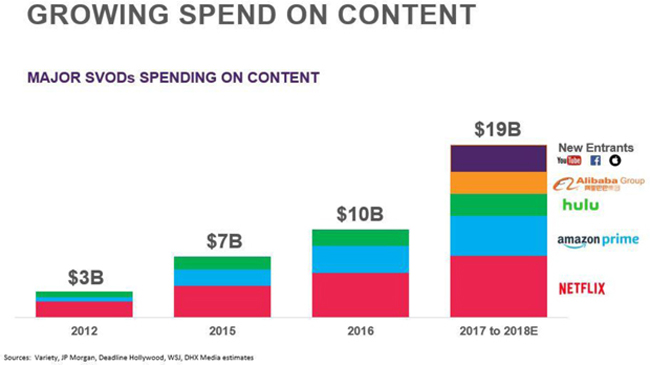
Digital content consumption has grown greatly in recent years and kid's content is leading the way. As reported by many key SVOD players, kid’s and family content provides a stickiness for subscribers bases, and accordingly, SVOD players are increasing their spend on kids and family content.

| 23 |
In addition, direct to consumer ecommerce is experiencing rapid growth, and the digital consumption of kids and family content provides a meaningful connection point to an audience that is dominated co-viewing.

Course Corrections
To better take advantage of this positive content environment, Management is undertaking immediate course corrections to align forward execution with the tremendous opportunity. Management is optimistic the following three course corrections will maximize shareholder value in Fiscal 2018 and beyond:
Refocus our Content Strategy and Group
| 1. | Leverage existing DHX relationships with SVOD's and major linear broadcasters to take advantage of demand for premium branded content. Using the Company’s existing content production platform, including its studio, its main content focus will now be on pursuing larger budget premium branded content opportunities, likely exclusive and/or originals that have significant consumer product potential or materially drives revenue in other parts of the Company. |
| 2. | Leverage WildBrain platform and trends using a data driven approach to content development, leveraging our extensive proprietary database, to produce more efficient/lower production cost content and utilizing our large library of known Children's and Family IP to focus specifically on return on content investment. |
Restructure our Brands and Licensing Group
| 1. | Restructured North America DHX Brands around the strengths and experience of the Peanuts team; accordingly, we have signed employment contracts with most of the key Peanuts Management team and, although its early days, have been very impressed with their approach and performance; |
| 2. | Made the decision to close our Los Angeles office and on October 1, 2017 will open an office in New York, bringing together the Peanuts team and our remaining US brands and licensing team. |
| 3. | Realigned Management of CPLG to focus on the conversion of the agency business for Peanuts territory by territory, while capitalizing on the added size, scale and global reach to build on the existing portfolio of represented brands. |
Reset Corporate Priorities
| 1. | Focus going forward is on increasing cash flow and cash flow per share. |
| 2. | Getting back to growth in 2018 in our core content business driven by the above noted content strategy changes and brands and licensing restructuring. |
| 3. | Improved Management of corporate SG&A. |
| 24 |
Based on these core corporate priorities, Management is pleased to provide the following new Outlook Metrics for Fiscal 2018:
Cash flow metrics (bearing in mind this is year one of our corporate shift to focus on cash, Management has estimated the metrics as follows):
| Range | ||||
| Adjusted EBITDA: | $125 million - $155 million* | |||
| Cash Flow from Operations before Net | ||||
| Investment in Film and Television | ||||
| Programs and including the net change | ||||
| Interim Production Financing | $58 million - $82 million | |||
| Less: Capital asset and other intangible | ||||
| asset expenditures and other | $8 million - $12 million | |||
| Free Cash Flow** | $50 million - $70 million | |||
The Company expects to deploy its Free Cash Flow to deleverage its balance sheet and to make strategic net investments in film and television programs. During Fiscal 2018, the Company expects to make net investments in film and television programs of the following:
| Net Investment in Film and Television | ||||
| Programs | $20 million - $30 million |
*Note: the Company expects Adjusted EBITDA from its core business to grow at 10-15%, including corporate synergies while excluding Peanuts and Strawberry Shortcake and those associated synergies. In addition, the Adjusted EBITDA has been estimated using a USD spot rate of $1.23. As noted herein, fluctuations in foreign exchange rates versus the Canadian Dollar could have a significant impact on these Outlook Metrics.
**The Company has defined Free Cash Flow as cash flows from operating activities before net investment in film and television programs, including the net change in interim production financing, less capital asset and other intangible asset expenditures.
Pricewaterhouse Coopers LLP has neither examined, compiled, nor performed any procedures with respect to the Outlook Metrics noted herein and accordingly, Pricewaterhouse Coopers LLP does not express an opinion or any other form of assurance with respect to these Outlook Metrics.
Integration Plan and Deleveraging Efforts
Integration Update
Commensurate with the acquisition of Peanuts and Strawberry Shortcake, Management immediately began both an integration plan and a review of corporate operations.
Integration Plan
Management is pleased to report that it is currently on track to realize approximately in aggregate $5 million synergies in Fiscal 2018 associated with the acquisition of Peanuts and SSC, comprised of $3-4 million in cost synergies and $1-2 million in agency synergies related to CPLG’s ability to provide agency services to Peanuts and Strawberry Shortcake.
Corporate Operations
Management is also pleased to report that it has undertaken a review of corporate operations and expects to realize incremental SG&A cost reductions of $5-6 million in Fiscal 2018 from its core business (excluding the acquisition of Peanuts and SSC).
Seasonality
Results of operations for any period are dependent on the number and timing of film and television programs delivered, which cannot be predicted with certainty. Consequently, the Company’s results from operations may fluctuate materially from period-to-period and the results of any one period are not necessarily indicative of results for future periods. Cash flows may also fluctuate and are not necessarily closely correlated with revenue recognition. During the initial broadcast of the rights the Company is somewhat reliant on the broadcaster’s budget and financing cycles and at times the license period gets delayed and commences at a later date than originally projected.
| 25 |
The Company’s film and television revenues vary significantly from quarter to quarter driven by contracted deliveries with the primary broadcasters. Although with the Company’s continued diversification of its revenue mix, particularly in the strengthening of the distribution revenue stream, some of the quarterly unevenness is improving slightly and becoming more predictable. Distribution revenues are contract and demand driven and can fluctuate significantly from period-to-period.
Critical Accounting Estimates
The preparation of the financial statements in conformity with IFRS requires Management to make estimates, judgments, and assumptions that Management believes are reasonable based upon the information available. These estimates, judgments, and assumptions affect the reported amounts of assets and liabilities and disclosure of contingent assets and liabilities at the date of the financial statements and the reported amounts of revenues and expenses during the reporting year or period. Actual results can differ from those estimates (refer to page 2 of this MD&A for more information regarding forward-looking information). For a discussion of all of the Company’s accounting policies, refer to note 3 of the audited consolidated financial statements for the year ended June 30, 2017 on www.sedar.com or DHX’s website at www.dhxmedia.com or on EDGAR at www.sec.gov/edgar.shtml.
Please see section entitled "Adoption of Amendment to International Accounting Standard 38 ("IAS 38") of this MD&A for additional details.
Financial Instruments and Risk Management
The Company’s financial instruments consist of cash and cash equivalents, as well as cash held in trust, amounts receivable, long-term amounts receivable, bank indebtedness (when drawn), interim production financing, accounts payable and accrued liabilities, long-term debt and obligations under finance leases, and certain items included within other liabilities. The Company, through its financial assets and liabilities, has exposure to the following risks from its use of financial instruments: credit risk, interest rate risk, liquidity risk, and currency risk. Management monitors risk levels and reviews risk management activities as they determine to be necessary.
Credit Risk
Credit risk arises from cash and cash equivalents, cash held in trust, as well as credit exposure to customers, including outstanding receivables. The Company manages credit risk for cash and cash equivalents and cash held in trust by ensuring that the counterparties are banks, governments and government agencies with high credit ratings. The maximum exposure to credit risk for cash and equivalents and cash held in trust, amounts receivable, and long-term amounts receivable, approximates the amount recorded on the consolidated balance sheet.
The balance of trade amounts receivable and long-term amounts receivable are mainly with Canadian broadcasters, large international broadcasters and distribution companies, and large international digital platform providers. Management manages credit risk by regularly reviewing aged accounts receivables and performing rigorous credit analysis. The Company has booked an allowance for doubtful accounts of approximately 3% against the gross amounts for certain trade amounts receivable and Management believes that the net amount of trade amounts receivable is fully collectible.
In assessing credit risk, Management includes in its assessment the long-term receivables and considers what impact the long-term nature of the receivable has on credit risk. For certain arrangements with licensees, the Company is considered the agent, and only reports the revenue net of the licensor’s share. When the Company bills a third party in full where it is an agent for the licensor, the Company records an offsetting amount in accounts payable that is only payable to a licensee when the amount is collected from the third party. This reduces the risk, as the Company is only exposed to the amounts receivable related to the revenue it records.
Interest Rate Risk
The Company is exposed to interest rate risk arising from fluctuations in interest rates as its interim production financing, certain long-term debt, and a portion of cash and cash equivalents and cash held in trust bear interest at floating rates. A 1% fluctuation would have an approximate $7.00-8.00 million effect on annual net income before income taxes.
Liquidity Risk
The Company manages liquidity by forecasting and monitoring operating cash flows and through the use of finance leases and revolving credit facilities. As at June 30, 2017 the Company had cash and cash equivalents on hand of $62.14 million (excluding cash held in trust) (June 30, 2016 - $80.45 million).
Results of operations for any period are dependent on the number and timing of film and television programs delivered, which cannot be predicted with certainty. Consequently, the Company’s results from operations may fluctuate materially from period-to-period and the results of any one period are not necessarily indicative of results for future periods. Cash flows may also fluctuate and are not necessarily closely correlated with revenue recognition. During the initial broadcast of the rights, the Company is somewhat reliant on the broadcaster’s budget and financing cycles and at times the license period gets delayed and commences at a later date than originally projected.
| 26 |
The Company’s film and television revenues vary significantly from quarter to quarter driven by contracted deliveries with the primary broadcasters. Although with the Company’s recent diversification of its revenue mix, particularly in the strengthening of the distribution revenue stream and addition of the broadcasting revenue stream, some of the quarterly unevenness is improving slightly and becoming more predictable. Distribution revenues are contract and demand driven and can fluctuate significantly from year to year. The Company maintains appropriate cash balances and has access to financing facilities to manage fluctuating cash flows.
The Company obtains interim production financing to provide funds until such time as the federal and provincial film tax credits are collected. Upon collection of the film tax credits, the related interim production financing is repaid.
Currency Risk
The Company’s activities involve holding foreign currencies and incurring production costs and earning revenues denominated in foreign currencies. These activities result in exposure to fluctuations in foreign currency exchange rates. The Company periodically enters into foreign exchange purchase contracts to manage its foreign exchange risk on USD, GBP, JPY, and Euro denominated contracts. At June 30, 2017, the Company revalued its financial instruments denominated in a foreign currencies at the prevailing exchange rates. Management estimates 1% change in the USD, GBP, JPY, or Euro exchange rate would have an approximate $4.0-6.0 million annual effect on net income before income taxes.
Risk Assessment
The following are the specific and general risks that could affect the Company that each reader should carefully consider. Additional risks and uncertainties not presently known to the Company or that the Company does not currently anticipate will be material, may impair the Company’s business operations and its operating results and as a result could materially impact its business, results of operations, prospects and financial condition. Certain additional risks associated with DHX’s ownership of the DHX Television business in addition to those specifically described below may continue to be applicable following the completion of such acquisition. Additional risks, including certain risks applicable to the DHX Television business, are disclosed in the "Risk Factors" section of the most recent "Annual Information Form", which, together with the risk factors described below, do not constitute an exhaustive list. Unless the context suggests otherwise, for purposes of this Risk Factors section the term "DHX" or the "Company" includes the DHX Television business.
Risks Applicable to DHX Generally
Risks Related to Doing Business Internationally
The Company distributes films and television productions and conducts other business activities outside Canada and derives revenues from these sources. As a result, the Company’s business is subject to certain risks inherent in international business, many of which are beyond its control. These risks include: changes in local regulatory requirements, including restrictions on content; changes in the laws and policies affecting trade, investment and taxes (including laws and policies relating to the repatriation of funds and to withholding taxes); differing degrees of protection for intellectual property; instability of foreign economies and governments; cultural barriers; wars and acts of terrorism; and the spread of viruses, diseases or other widespread health hazards.
Any of these factors could have a material adverse effect on the Company’s business, results of operations or financial condition.
Fluctuating Results of Operations
Results of operations with respect to DHX’s production and distribution of film and television operations for any periods are significantly dependent on the number and timing of television programs and films delivered or made available to various media. Consequently, the Company’s results of operations may fluctuate materially from period to period and the results of any one period are not necessarily indicative of results for future periods. Cash flows may also fluctuate and are not necessarily closely correlated with revenue recognition. Although traditions are changing, due in part to increased competition from new channels of distribution, industry practice is that broadcasters make most of their annual programming commitments between February and June such that new programs can be ready for telecast at the start of the broadcast season in September, or as mid-season replacements in January. Because of this annual production cycle, DHX’s revenues may not be earned on an even basis throughout the year. Results from operations fluctuate materially from quarter to quarter and the results for any one quarter are not necessarily indicative of results for future quarters.
| 27 |
Raising Additional Capital
The Company may require capital in the future in order to meet additional working capital requirements, to make capital expenditures, to take advantage of investment and/or acquisition opportunities or for other reasons (the specific risks of which are described in more detail below). Accordingly, it may need to raise additional capital in the future. The Company's ability to obtain additional financing will be subject to a number of factors including market conditions and its operating performance. These factors may make the timing, amount, terms and conditions of additional financing unattractive or unavailable for the Company.
In order to raise such capital, the Company may sell additional equity securities in subsequent offerings and may issue additional equity securities. Sales or issuances of a substantial number of equity securities, or the perception that such sales could occur, may adversely affect prevailing market price for the securities. With any additional sale or issuance of equity securities, investors will suffer dilution of their voting power and the Company may experience dilution in its earnings per share. Capital raised through debt financing would require the Company to make periodic interest payments and may impose restrictive covenants on the conduct of the Company's business. Furthermore, additional financings may not be available on terms favourable to the Company, or at all. The Company's failure to obtain additional funding could prevent the Company from making expenditures that may be required to grow its business or maintain its operations
The Company may issue additional Common Voting Shares and/or Variable Voting Shares, including upon the exercise of its currently outstanding stock options and in accordance with the terms of the Company's dividend reinvestment plan, employee share purchase plan, and performance share unit plan. Accordingly, holders of Common Voting Shares and Variable Voting Shares may suffer dilution.
Reliance on Key Personnel
The Company is substantially dependent upon the services of certain key personnel, particularly Michael Donovan, Dana Landry, Steven DeNure, and Joseph Tedesco (with respect to the DHX Television Business). The loss of the services of any one or more of such individuals could have a material adverse effect on the business, results of operations or financial condition of the Company. Each of Mr. Donovan, Mr. Landry, Mr. DeNure, and Mr. Tedesco are under contract with the Company until 2018, 2018, 2019, and indefinitely respectively.
Market Share Price Fluctuation
Securities markets have a high level of price and volume volatility, and the market price of shares of many companies have experienced wide fluctuations in price which have not necessarily been related to the operating performance, underlying asset values or prospects of such companies. The market price of the Company's securities may be subject to significant fluctuation in response to numerous factors, including variations in its annual or quarterly financial results or those of its competitors, changes by financial research analysts in their recommendations or estimates of the Company's earnings, conditions in the economy in general or in the broadcasting, film or television sectors in particular, unfavourable publicity changes in applicable laws and regulations, exercise of the Company's outstanding options and/or warrants, or other factors. Moreover, from time to time, the stock markets on which the Company's securities will be listed may experience significant price and volume volatility that may affect the market price of the Company's securities for reasons unrelated to its economic performance. No prediction can be made as to the effect, if any, that future sales of securities or the availability of securities for future sale (including securities issuable upon the exercise of stock options) will have on the market price of the securities prevailing from time to time. Sales of substantial numbers of securities, or the perception that such sales could occur, could adversely affect the prevailing price of the Company's securities.
As a result of any of these factors, the market price of the shares may be volatile and, at any given point in time, may not accurately reflect the long term value of DHX Media. This volatility may affect the ability of holders of Variable Voting Shares and Common Voting Shares to sell their shares at an advantageous price.
DHX Media's Common Voting Shares and Variable Voting Shares structure is unusual in the United States. As a result, brokers, dealers and other market participants may not understand the conversion features of the Common Voting Shares and Variable Voting Shares, which may negatively impact liquidity in the trading market for each class of shares and may result in differences between the trading prices of each class of shares that do not reflect differences in the underlying economic or voting interests represented by each class of shares.
Tax Matters
In the preparation of its financial statements, the Company is required to estimate income taxes in each of the jurisdictions in which it operates taking into consideration tax laws, regulations and interpretations that pertain to the Company’s activities. In addition, DHX is subject to audits from different tax authorities on an ongoing basis and the outcome of such audits could materially affect the amount of income tax payable or receivable recorded on its consolidated balance sheets and the income tax expense recorded on its consolidated statements of earnings. Any cash payment or receipt resulting from such audits would have an impact on the Company’s cash resources available for its operations.
| 28 |
Litigation
Governmental, legal or arbitration proceedings may be brought or threatened against the Company in the future. Regardless of their merit, any such claims could be time consuming and expensive to evaluate and defend, divert Management’s attention and focus away from the business and subject the Company to potentially significant liabilities.
Acquisition Strategy
The Company has made or entered into, and will likely continue to pursue, various acquisitions, business combinations and joint ventures intended to complement or expand its business. DHX believes the acquisition of other businesses may enhance its strategy of expanding its product offerings and customer base. The successful implementation of such acquisition strategy depends on the Company's ability to identify suitable acquisition candidates, acquire such companies on acceptable terms, integrate the acquired company's operations and technology successfully with its own and maintain the goodwill of the acquired business. DHX is unable to predict whether or when it will be able to identify any suitable additional acquisition candidates that are available for a suitable price, or the likelihood that any potential acquisition will be completed. When evaluating a prospective acquisition opportunity, the Company cannot assure that it will correctly identify the costs and risks inherent in the business to be acquired. The scale of such acquisition risks will be related to the size of the company or companies acquired relative to that of DHX at the time of acquisition, and certain target companies may be larger than DHX.
Growth and expansion resulting from future acquisitions may place significant demand on the Company's Management resources. In addition, while Management believes it has the experience and know-how to integrate acquisitions, such efforts entail significant risks including, but not limited to: (a) the failure to integrate successfully the personnel, information systems, technology, and operations of the acquired business; (b) the potential loss of key employees or customers from either the Company's current business or the business of the acquired company; (c) failure to maximize the potential financial and strategic benefits of the transaction; (d) the failure to realize the expected synergies from acquired businesses; (e) impairment of goodwill; (f) reductions in future operating results from amortization of intangible assets; (g) the assumption of significant and/or unknown liabilities of the acquired company; and (h) the diversion of Management’s time and resources.
Future acquisitions are accompanied by the risk that the obligations and liabilities of an acquired company may not be adequately reflected in the historical financial statements of such company and the risk that such historical financial statements may be based on assumptions, which are incorrect or inconsistent with our assumptions or approach to accounting policies. In addition, such future acquisitions could involve tangential businesses which could alter the strategy and direction of the Company.
There can be no assurance that DHX will be able to successfully identify, consummate or integrate any potential acquisitions into its operations. In addition, future acquisitions may result in potentially dilutive issuances of equity securities, have a negative effect on the Company's share price, or may result in the incurrence of debt or the amortization of expenses related to intangible assets, all of which could have a material adverse effect on the Company's business, financial condition and results of operations.
Integration of Peanuts and Strawberry Shortcake
The Company’s ability to maintain and successfully execute its business depends upon the judgment and project execution skills of its senior professionals. Any management disruption or difficulties in integrating the Peanuts and Strawberry Shortcake business with the business of the Company could significantly affect the Company’s business and results of operations. The success of the Acquisition will depend, in large part, on the ability of Management of the Company to realize the anticipated benefits and cost savings from integration of the Peanuts and Strawberry Shortcake business with the business of the Company. The integration of the Peanuts and Strawberry Shortcake business with the business of the Company may result in significant challenges, and Management of the Company may be unable to accomplish the integration smoothly, or successfully, in a timely manner or without spending significant amounts of money. It is possible that the integration process could result in the loss of key employees, the disruption of the respective ongoing businesses or inconsistencies in standards, controls, procedures and policies that adversely affect the ability of Management of the Company to maintain relationships with clients, suppliers, employees, or other key stakeholders or to achieve the anticipated benefits of the Acquisition.
The integration of the Peanuts and Strawberry Shortcake business requires the dedication of substantial Management effort, time and resources which may divert Management's focus and resources from other strategic opportunities and from operational matters during this process. There can be no assurance that Management of the Company will be able to integrate the operations of the businesses successfully or achieve any of the synergies or other benefits that are anticipated as a result of the Acquisition. Any inability of Management to successfully integrate the operations of the Company and the Peanuts and Strawberry Shortcake business, including, but not limited to, information technology and financial reporting systems, could have a material adverse effect on the business, financial condition and results of operations of the Company. The challenges involved in the integration may include, among other things, the following:
| 29 |
| • | addressing possible differences in corporate cultures and management philosophies; |
| • | retaining key personnel going forward; |
| • | integrating information technology systems and resources; |
| • | managing the expansion the Company’s systems, including but not limited to accounting systems, and adjusting its internal control environment to cover the Peanuts and Strawberry Shortcake operations; |
| • | unforeseen expenses or delays associated with the Acquisition; |
| • | unforeseen facilities-related issues; |
| • | performance shortfalls relative to expectations at one or both of the businesses as a result of the diversion of Management's attention to the acquisition; and |
| • | meeting the expectations of business partners with respect to the overall integration of the businesses. |
It is possible that the integration process could result in the loss of key employees, diversion of Management's attention, the disruption or interruption of, or the loss of momentum in, ongoing business or inconsistencies in standards, controls, procedures and policies, any of which could adversely affect the Company’s ability to maintain relationships with business partners and employees or its ability to achieve the anticipated benefits of the transaction, or could reduce its earnings or otherwise adversely affect the business and financial results of the combined company. In addition, the integration process may strain the combined company's financial and managerial controls and reporting systems and procedures. This may result in the diversion of Management and financial resources from the combined company's core business objectives.
Leverage
DHX incurred a significant amount of indebtedness in connection with the completion of the acquisition of DHX Television, the Echo Bridge Library, Nerd Corps, and most recently Peanuts and Strawberry Shortcake. As of June 30, 2017, DHX had outstanding indebtedness (including the outstanding Term Facility, Revolving Facility, Special Warrants, Senior Unsecured Notes, which were repaid subsequent to June 30, 2017, and the Company’s production credit facilities) of approximately $1,109 million. The Company’s degree of current and future leverage, particularly if increased to complete potential acquisitions, could materially and adversely affect DHX in a number of ways, including:
| • | limiting the Company’s ability to obtain additional financing for working capital, capital expenditures, product development, debt service requirements, acquisitions and general corporate or other purposes; |
| • | restricting the Company’s flexibility and discretion to operate its business; |
| • | limiting the Company’s ability to declare dividends on its Shares; |
| • | having to dedicate a portion of the Company’s cash flows from operations to the payment of interest on its existing indebtedness and not having such cash flows available for other purposes, including operations, capital expenditures and future business opportunities; |
| • | exposing the Company to increased interest expense on borrowings at variable rates; |
| • | limiting the Company’s flexibility to plan for, or react to, changes in its business or market conditions; |
| • | placing the Company at a competitive disadvantage compared to its competitors that have less debt; |
| • | making the Company vulnerable to the impact of adverse economic, industry and Company-specific conditions; and |
| • | making the Company unable to make capital expenditures that are important to its growth and strategies. |
In addition, the Company may not be able to generate sufficient cash flows from operations to service its indebtedness, in which case it may be required to sell assets, reduce capital expenditures, reduce spending on new production, refinance all or a portion of its existing indebtedness or obtain additional financing, any of which would materially adversely affect the Company’s operations and ability to implement its business strategy.
Covenants in Credit Facilities
The terms of the Company's Senior Secured Credit Agreement and trust indenture with respect to the outstanding Special Warrants may limit the Company's ability to, among other things:
| • | incur additional indebtedness or contingent obligations; |
| • | sell significant assets; |
| • | grant liens; and |
| • | pay dividends in excess of certain thresholds. |
| 30 |
The credit facilities require the Company to maintain certain financial ratios and satisfy other non-financial maintenance covenants. Compliance with these covenants and financial ratios, as well as those that may be contained in future debt agreements may impair the Company's ability to finance its future operations or capital needs or to take advantage of favourable business opportunities. The Company's ability to comply with these covenants and financial ratios will depend on future performance, which may be affected by events beyond the Company's control. The Company's failure to comply with any of these covenants or financial ratios may result in a default under the various credit facilities and, in some cases, the acceleration of indebtedness under other instruments that contain cross-default or cross-acceleration provisions. In the event of a default, or a cross-default or cross-acceleration, the Company may not have sufficient funds available to make the required payments under its debt agreements. If the Company is unable to repay amounts owed under the terms of the credit agreement governing any credit facility that it may enter into in the future, those lenders may be entitled to take possession of the collateral securing that facility to the extent required to repay those borrowings. In such event, the Company may not be able to fully repay the credit facility, if at all.
Management of Expanding Operations
As a result of acquisitions completed by DHX, significant demands have been placed on the managerial, operational and financial personnel and systems of DHX. No assurance can be given that DHX’s systems, procedures and controls will be adequate to support the expansion of operations of DHX. The future operating results of DHX will be affected by the ability of its officers and key employees to manage changing business conditions and to implement and improve its operational and financial controls and reporting systems. If DHX is unsuccessful in managing such demands and changing business conditions, its financial condition and results of operations could be materially adversely affected.
Credit Ratings
The credit ratings assigned to the Company are not a recommendation to buy, hold or sell securities of the Company. A rating is not a comment on the market price of a security nor is it an assessment of ownership given various investment objectives. There can be no assurance that the credit ratings assigned to the Company will remain in effect for any given period of time and ratings may be upgraded, downgraded, placed under review, confirmed and discontinued by an applicable credit ratings agency at any time. Real or anticipated changes in credit ratings may affect the market value of securities of the Company. In addition, real or anticipated changes in credit ratings may affect the Company’s ability to obtain short-term and long-term financing and the cost at which the Company can access the capital markets.
Liquidity Risk
The Company's production revenues for any period are dependent on the number and timing of film and television programs delivered, which cannot be predicted with certainty. The Company's film and television distribution revenues vary significantly from quarter to quarter driven by contracted deliveries with television services. Distribution revenues are contract and demand driven and can fluctuate significantly from period to period. The Company manages liquidity by forecasting and monitoring operating cash flows and through the use of capital leases and maintaining credit facilities. Any failure to adequately manage liquidity could adversely affect the Company's business and results of operations, including by limiting the Company's ability to meet its working capital needs, make necessary or desirable capital expenditures, satisfy its debt service requirements, make acquisitions and declare dividends on its Common Shares. There can be no assurance that the Company will continue to have access to sufficient short and long term capital resources, on acceptable terms or at all, to meet its liquidity requirements.
Volatile Market Price
Securities markets have a high level of price and volume volatility, and the market price of securities of many companies have experienced wide fluctuations in price which have not necessarily been related to the operating performance, underlying asset values or prospects of such companies. Factors unrelated to the financial performance or prospects of DHX include macroeconomic developments in North America and globally, and market perceptions of the attractiveness of particular industries. As a result of any of these factors, the market price of the securities of the Company at any given point in time may not accurately reflect the long term value of DHX.
Dividend Payments
The Company currently pays quarterly dividends on its Common Shares in amounts approved by the Board of Directors of the Company. While the Company expects to continue to generate sufficient free cash flow to fund such dividend payments, if actual results are different from expectations there can be no assurance that the Company will continue its dividend payments at the current levels or at all.
Economic Conditions
DHX’s revenues and operating results are and will continue to be influenced by prevailing general economic conditions in particular with respect to its television broadcasting activities. In certain cases, purchasers of the DHX Television Business' advertising inventories may reduce their advertising budgets. In addition, the deterioration of economic conditions could adversely affect payment patterns which could increase DHX’s bad debt expense. During an economic downturn, there can be no assurance that DHX’s operating results, prospects and financial condition would not be adversely affected.
| 31 |
Additional Costs of Listing on NASDAQ
In connection with the listing of Variable Voting Shares of the Company on NASDAQ, the Company became subject to public company reporting obligations in the United States. As a public company in the United States, the Company will incur significant additional legal, accounting and other expenses compared to historical levels. In addition, new and changing laws, regulations and standards relating to corporate governance and public disclosure, including the Dodd-Frank Wall Street Reform and Consumer Protection Act and the rules and regulations thereunder, as well as under the Sarbanes-Oxley Act of 2002, the Jumpstart Our Business Startups Act and the rules and regulations of the SEC and NASDAQ, may result in an increase in the Company's costs and the time that the Board and Management of the Company must devote to complying with these rules and regulations. The Company expects these rules and regulations to substantially increase its legal and financial compliance costs and to divert Management time and attention from the Company's product development and other business activities.
Limited Trading Volume on NASDAQ
The Company's Variable Voting Shares began trading on the NASDAQ on June 23, 2015, however, trading volume on the NASDAQ has been limited. There can be no assurance that an active market for the Company's Variable Voting Shares in the United States will be developed or sustained. Holders of Variable Voting Shares may be unable to sell their investments on satisfactory terms in the United States. As a result of any risk factor discussed herein, the market price of the Variable Voting Shares or Common Voting Shares of the Company at any given point in time may not accurately reflect the long-term value of the Company. Furthermore, responding to these risk factors could result in substantial costs and divert Management's attention and resources. Substantial and potentially permanent declines in the value of the Variable Voting Shares or Common Voting Shares may result.
Other factors unrelated to the performance of the Company that may have an effect on the price and liquidity of the Shares include: the extent of analytical coverage; lessening in trading volume and general market interest in the Shares; the size of the Company's public float; and any event resulting in a delisting of Shares.
Public Announcement of Future Corporate Developments
Management of the Company, in the ordinary course of the Company's business, regularly explores potential strategic opportunities and transactions. These opportunities and transactions may include strategic joint venture relationships, significant debt or equity investments in the Company by third parties, the acquisition or disposition of material assets, the licensing, acquisition or disposition of material intellectual property, the development of new product lines or new applications for its existing intellectual property, significant distribution arrangements and other similar opportunities and transactions. The public announcement of any of these or similar strategic opportunities or transactions might have a significant effect on the price of the Shares. The Company's policy is to not publicly disclose the pursuit of a potential strategic opportunity or transaction unless it is required to do so by applicable law, including applicable securities laws relating to continuous disclosure obligations. There can be no assurance that investors who buy or sell securities of the Company are doing so at a time when the Company is not pursuing a particular strategic opportunity or transaction that, when announced, would have a significant effect on the price of the Shares.
In addition, any such future corporate development may be accompanied by certain risks, including exposure to unknown liabilities of the strategic opportunities and transactions, higher than anticipated transaction costs and expenses, the difficulty and expense of integrating operations and personnel of any acquired companies, disruption of the Company's ongoing business, diversion of Management's time and attention, possible dilution to shareholders and other factors as discussed below in more detail. The Company may not be able to successfully overcome these risks and other problems associated with any future acquisitions and this may adversely affect the Company's business and financial condition.
Risks Related to the Production and Distribution of Film and Television
Risks Related to the Nature of the Entertainment Industry
The entertainment industry involves a substantial degree of risk. Acceptance of entertainment programming represents a response not only to the production’s artistic components, but also the quality and acceptance of other competing programs released into the marketplace at or near the same time, the availability of alternative forms of entertainment and leisure time activities, general economic conditions, public tastes generally and other intangible factors, all of which could change rapidly or without notice and cannot be predicted with certainty. There is a risk that some or all of the Company’s programming will not be purchased or accepted by the public generally, resulting in a portion of costs not being recouped or anticipated profits not being realized. There can be no assurance that revenue from existing or future programming will replace loss of revenue associated with the cancellation or unsuccessful commercialization of any particular production.
| 32 |
Risks Related to Television and Film Industries
Because the performance of television and film programs in ancillary markets, such as home video and pay and free television, is often directly related to reviews from critics and/or television ratings, poor reviews from critics or television ratings may negatively affect future revenue. The Company’s results of operation will depend, in part, on the experience and judgment of its Management to select and develop new investment and production opportunities. The Company cannot make assurances that the Company’s films and television programs will obtain favourable reviews or ratings, that its films and television programs will perform well in ancillary markets, or that broadcasters will license the rights to broadcast any of the Company’s film and television programs in development or renew licenses to broadcast film and television programs in the Company’s library. The failure to achieve any of the foregoing could have a material adverse effect on the Company’s business, results of operations or financial condition.
Licensed distributors’ decisions regarding the timing of release and promotional support of the Company’s films, television programs and related products are important in determining the success of these films, programs and related products. The Company does not control the timing and manner in which the Company’s licensed distributors distribute the Company’s films, television programs or related products. Any decision by those distributors not to distribute or promote one of the Company’s films, television programs or related products or to promote competitors’ films, programs or related products to a greater extent than they promote the Company could have a material adverse effect on the Company’s business, results of operations or financial condition.
Canadian Status
In addition to license fees from domestic and foreign broadcasters and financial contributions from co-producers, the Company finances a significant portion of its production budgets from federal and provincial governmental agencies and incentive programs, including the Canada Media Fund, the provincial film equity and other incentive and investment programs, federal tax credits and provincial tax credits. The tax credits are considered part of the Company’s equity in any production for which they are used as financing. There can be no assurance that individual incentive programs available to the Company will not be reduced, amended or eliminated or that the Company or any production will qualify for them, any of which may have an adverse effect on the Company’s business, results of operations or financial condition.
Furthermore, the Company could lose its ability to exploit Canadian government tax credits and incentives described above if it ceases to be “Canadian” as defined under the Investment Canada Act (Canada). In particular, the Company would not qualify as a Canadian if Canadian nationals cease to beneficially own shares of the Company having more than 50% of the combined voting power of its outstanding shares. In Canada and under international treaties, under applicable regulations, a program will generally qualify as a Canadian-content production if, among other things: (i) it is produced by Canadians with the involvement of Canadians in principal functions; and (ii) a substantial portion of the budget is spent on Canadian elements. In addition, the Canadian producer must have full creative and financial control of the project. Substantially all of the Company’s programs are contractually required by broadcasters to be certified as “Canadian”. In the event a production does not qualify for certification as Canadian, the Company would be in default under any government incentive and broadcast licenses for that production. In the event of such default, the broadcaster could refuse acceptance of the Company’s productions.
Recently, Canada’s Minister of Canadian Heritage announced a review of Canada’s broadcasting, media and cultural industries, commencing with consultations with consumers and creators of cultural content. Presently, it is uncertain as to whether such review will result in any changes to the laws, regulations, rules, institutions, policies or programs governing Canada’s broadcasting, media and cultural industries and whether such changes, if any, would impact the Company and its business.
Competition (Production and Distribution)
For Fiscal 2017, a material portion of the Company’s revenues are derived from the production and distribution of film and television programs. The business of producing and distributing film and television programs is highly competitive. The Company faces intense competition with other producers and distributors, many of whom are substantially larger and have greater financial, technical and marketing resources than the Company. The Company competes with other television and film production companies for ideas and storylines created by third parties as well as for actors, directors, writers, and other personnel required for a production. The Company may not be successful in any of these efforts which may adversely affect business, results of operations or financial condition.
The Company intends to increase its penetration of the prime-time television network market. The Company competes for time slots with a variety of companies which produce televised programming. The number of network prime-time slots remains limited (a “slot” being a broadcast time period for a program), even though the total number of outlets for television programming has increased over the last decade. Competition created by the emergence of new broadcasters has generally caused the market shares of the major networks to decrease. Even so, the licence fees paid by the major networks remain the most lucrative. As a result, there continues to be intense competition for the time slots offered by those networks. There can be no assurance that the Company will be able to increase its penetration of the prime-time network market or obtain favourable programming slots, the failure to do so may have a negative impact on the Company’s business.
| 33 |
Limited Ability to Exploit Film and Television Content Library
The Company depends on a limited number of titles for a significant portion of the revenues generated by its film and television content library. In addition, many of the titles in its library are not presently distributed and generate substantially no revenue. If the Company cannot acquire new products and rights to popular titles through production, distribution agreements, acquisitions, mergers, joint ventures or other strategic alliances, it could have a material adverse effect on its business, results of operations or financial condition.
Protecting and Defending Against Intellectual Property Claims
The Company’s ability to compete depends, in part, upon successful protection of its intellectual property. Furthermore, the Company’s revenues are dependent on the unrestricted ownership of its rights to television and film productions. Any successful claims to the ownership of these intangible assets could hinder the Company’s ability to exploit these rights. The Company does not have the financial resources to protect its rights to the same extent as some of its competitors. The Company attempts to protect proprietary and intellectual property rights to its productions through available copyright and trademark laws in a number of jurisdictions and licensing and distribution arrangements with reputable international companies in specific territories and media for limited durations. Despite these precautions, existing copyright and trademark laws afford only limited practical protection in certain countries in which the Company may distribute its products and in other jurisdictions no assurance can be given that challenges will not be made to the Company’s copyright and trade-marks. In addition, technological advances and conversion of film and television programs into digital format have made it easier to create, transmit and share unauthorized copies of film and television programs. Users may be able to download and/or stream and distribute unauthorized or “pirated” copies of copyrighted material over the Internet. As long as pirated content is available to download and/or stream digitally, some consumers may choose to digitally download or stream material illegally. As a result, it may be possible for unauthorized third parties to copy and distribute the Company’s productions or certain portions or applications of its intended productions, which could have a material adverse effect on its business, results of operations or financial condition.
Litigation may also be necessary in the future to enforce the Company’s intellectual property rights, to protect its trade secrets, or to determine the validity and scope of the proprietary rights of others or to defend against claims of infringement or invalidity. Any such litigation could result in substantial costs and the diversion of resources and could have a material adverse effect on the Company’s business, results of operations or financial condition. The Company cannot provide assurances that infringement or invalidity claims will not materially adversely affect its business, results of operations or financial condition. Regardless of the validity or the success of the assertion of these claims, the Company could incur significant costs and diversion of resources in enforcing its intellectual property rights or in defending against such claims, which could have a material adverse effect on the Company’s business, results of operations or financial condition.
Concentration Risk
Revenue from production and distribution of film and television may originate from disproportionately few productions and broadcasters. The value of the Common Shares may be substantially adversely affected should the Company lose the revenue generated by any such production or broadcaster.
Potential for Budget Overruns and Other Production Risks
A production’s costs may exceed its budget. Unforeseen events such as labour disputes, death or disability of a star performer or other key personnel, changes related to technology, special effects or other aspects of production, shortage of necessary equipment, damage to film negatives, master tapes and recordings, or adverse weather conditions, or other unforeseen events may cause cost overruns and delay or frustrate completion of a production. Although the Company has historically completed its productions within budget, there can be no assurance that it will continue to do so. The Company currently maintains insurance policies and when necessary, completion bonds, covering certain of these risks. There can be no assurance that any overrun resulting from any occurrence will be adequately covered or that such insurance and completion bonds will continue to be available or, if available on terms acceptable to the Company. DHX has never made a material claim on its insurance or called on a completion bond. In the event of budget overruns, the Company may have to seek additional financing from outside sources in order to complete production of a television program. No assurance can be given as to the availability of such financing or, if available on terms acceptable to the Company. In addition, in the event of substantial budget overruns, there can be no assurance that such costs will be recouped, which could have a significant impact on the Company’s results of operations or financial condition.
| 34 |
Stoppage of Incentive Programs
There can be no assurance that the local cultural incentive programs which DHX may access in Canada and internationally from time to time, including those sponsored by various European, Australian and Canadian governmental agencies, will not be reduced, amended or eliminated. There can be no assurance that programs and policies will not be terminated or modified in a manner that has an adverse impact on DHX's business, including, but not limited to, its ability to finance its production activities. Any change in the policies of those countries in connection with their incentive programs may require the Company to relocate production activities or otherwise have an adverse impact on DHX’s business, results of operation or financial condition.
Changes in Regulatory Environment
At the present time, the film and television industry is subject to a variety of rules and regulations. In addition to the regulatory risks applicable to the DHX Television Business more particularly described elsewhere herein, the Company’s film and television production and distribution operations may be affected in varying degrees by future changes in the regulatory environment of the film and television industry. Any change in the regulatory environment applicable to the Company’s operations could have a material adverse effect on the Company’s revenues and earnings. Management constantly monitors the regulatory environment to identify risks and opportunities resulting from any changes.
Financial Risks Resulting from the Company’s Capital Requirements
The production, acquisition and distribution of films and television programs require a significant amount of capital. The Company cannot provide assurance that it will be able to continue to successfully implement financing arrangements or that it will not be subject to substantial financial risks relating to the production, acquisition, completion and release of future films and television programs. If the Company increases (through internal growth or acquisition) its production slate or its production budgets, it may be required to increase overhead, make larger up-front payments to talent, and consequently bear greater financial risks. The occurrence of any of the foregoing could have a material adverse effect on the Company’s business, results of operations or financial condition.
Technological Change (Production and Distribution)
Technological change may have a materially adverse effect on the Company’s business, results of operations and financial condition if the Company is unable to adapt to these changes on a timely basis. The emergence of new production or computer generated technologies ("CGI") technologies, or a new digital television broadcasting standard, may diminish the value of the Company’s existing equipment and programs. Although the Company is committed to production technologies such as CGI and digital post-production, there can be no assurance that it will be able to incorporate other new production and post-production technologies which may become de facto industry standards. In particular, the advent of new broadcast standards, which may result in television programming being presented with greater resolution and on a wider screen than is currently the case, may diminish the evergreen value of the Company’s programming library because such productions may not be able to take full advantage of such features. There can be no assurance that the Company will be successful in adapting to these changes on a timely basis.
Labour Relations
Many individuals associated with the Company’s projects are members of guilds or unions which bargain collectively with producers on an industry-wide basis from time to time. While the Company has positive relationships with the guilds and unions in the industry, a strike or other form of labour protest affecting those guilds or unions could, to some extent, disrupt production schedules which could result in delays and additional expenses.
Exchange Rates
The returns to the Company from foreign exploitations of its properties are customarily paid in US dollars, GBP, JPY, and Euros and, as such, may be affected by fluctuations in the exchange rates. Currency exchange rates are determined by market factors beyond the control of the Company and may vary substantially during the course of a production period. In addition, the ability of the Company to repatriate to Canadian funds arising in connection with foreign exploitation of its properties may also be adversely affected by currency and exchange control regulations imposed by the country in which the production is exploited. At present, the Company is not aware of any existing currency or exchange control regulations in any country in which the Company currently contemplates exploiting its properties which would have an adverse effect on the Company’s ability to repatriate such funds. Where appropriate, the Company may hedge its foreign exchange risk through the use of derivatives.
Any of the foregoing could have a material adverse effect on the Company’s business, results of operations or financial condition.
| 35 |
Risks Related to Television Broadcasting
Impact of CRTC's Let's Talk TV Consultation
Starting in March 2016, BDUs are required to offer all discretionary television programming services (which includes all services other than those that are required to be distributed as a part of the basic service and some other few exceptions) either on an à la carte basis or in small reasonably priced packages. Starting in December 2016, BDUs are required to offer all services both on an à la carte basis and in small reasonably priced packages.
The impact of these changes on existing packages offered by BDUs, and in particular on the relatively high penetration packages in which DHX Television's services have typically been offered is not yet fully known. If DHX Television's services were moved into low penetration packages or only offered on an à la carte basis, and if DHX Television were not able to negotiate penetration based pricing to offset the decline in penetration, then this could have an adverse impact on DHX Media's revenue.
Applicable Licenses
The DHX Television Business operates under three broadcast licenses issued by the CRTC, which are required to operate the broadcasting undertakings held by DHX Television. The Category A licences for Family Channel and Family Jr. and the Category B licence for Télémagino were issued for five years and initially expired in 2017 and have been administratively renewed until 2018. The Category B licence for Family CHRGD was issued in 2009, initially expired in 2015 and has been administratively renewed expiring in 2018.
At this time, all larger, licensed Canadian BDUs must carry channels that hold Category A licenses in the appropriate language market. The CRTC has stated that it intends to remove this requirement for independent Category A licences starting as of September 1, 2018. The change in status of the Family Channel Category A licence or other loss thereof could have a material adverse effect on the subscriber count and ultimately the revenues of DHX attributable to its television broadcasting activities.
In addition, the CRTC licenses carry a number of mandated requirements, including minimum Canadian content expenditures, minimum Canadian content airtime, and maximum airtime devoted to certain suppliers, among other requirements. Changes to these terms, particularly with respect to Canadian programming exhibition and expenditures, may result in material changes to the content cost structure of the DHX Television business. Moreover, in past years, previous owners of the DHX Television business were able to allocate Canadian content expenditures across a number of different services by sharing these expenditures with its other broadcast assets in its CRTC-recognized broadcast group. DHX does not own additional broadcast assets with Canadian expenditure obligations and, therefore, cannot allocate programming expenditures on this basis.
Concentration of Customers
DHX Television is dependent on BDUs, including cable, Direct to Home, Internet Protocol TV and multichannel multipoint distribution systems, for distribution of its television services. There could be a negative impact on revenues if distribution affiliation agreements with BDUs were not renewed on terms and conditions similar to those currently in effect or at all. Affiliation agreements with BDUs have multi-year terms that expire at various points in time.
The majority of DHX Television’s subscriber base is reached through a small number of very significant customers. DHX Television generally enters into long-term contracts with its customers, however, there is always a risk that the loss of an important relationship would have a significant impact on any particular business unit.
The rebranding of DHX’s television channels and resulting change in content may negatively affect the Company’s relationship with its BDU partners and impact its ability to negotiate terms and conditions when distribution affiliation agreements are up for renewal.
Concentration of Suppliers
The majority of DHX Television's non-Canadian content was previously supplied by Disney. On April 15, 2015, DHX Media announced that its current output agreement with Disney would not be renewed. The Company continued to broadcast Disney content until December of 2015 as part of a transitional arrangement, commencing with a new and original lineup in January 2016. There is no assurance that the DHX content and content commissioned from other studios and independent third party producers replacing the Disney content will be suitable replacement programming. Additionally, the content previously supplied by Disney is now distributed in competition with DHX’s content and programming.
| 36 |
Regulated Environment and Rights of Shareholders
DHX’s television broadcasting operations are subject to Federal government regulation, including the Broadcasting Act (Canada) (the “Broadcasting Act”). The CRTC administers the Broadcasting Act and, among other things, grants, amends and renews broadcasting licenses, and approves certain changes in corporate ownership and control of broadcast licensees. The CRTC may also adopt and implement regulations and policies, and renders decisions thereunder, which can be found on the CRTC's web site at www.crtc.gc.ca. Certain decisions of the CRTC can also be varied, rescinded or referred back to the CRTC by Canada's Governor-in-Council either of its own volition or upon petition in writing by third parties filed within 90 days of a CRTC decision. The Government of Canada also has the power under the Broadcasting Act to issue directions of general application on broad policy matters with respect to the objectives of the broadcasting and regulatory policy in the Broadcasting Act, and to issue directions to the CRTC requiring it to report on matters within the CRTC's jurisdiction under the Broadcasting Act. Legislative changes, a direction by the Governor in Council to the CRTC, or the adoption of new regulations or policies or any decision by the CRTC, could have a material adverse effect on the DHX’s business, financial condition or operating results.
The CRTC requires Canadian television programming services to draw certain proportions of their programming from Canadian content and, in many cases, to spend a portion of their revenues on Canadian programming. Often, a portion of the production budgets of Canadian programs is financed by Canadian government agencies and incentive programs, such as the Canadian Media Fund, Telefilm Canada and federal and provincial tax credits. There can be no assurance that such financing will continue to be available at current levels, or at all. Reductions or other changes in the policies of Canada or its provinces in connection with their incentive programs could increase the cost of acquiring Canadian programs required to be broadcasted and have a material adverse effect on DHX’s business, financial condition or operating results.
Government directions limit the ownership by non-Canadians of voting shares in Canadian broadcasting undertakings and require Canadian control of such undertakings. For additional information concerning restrictions on ownership of shares and voting shares arising in connection with the application of the Broadcasting Act to DHX refer to DHX’s Management Information Circular dated September 3, 2014. DHX’s Common Shares are publicly traded, and as a result, although the Company monitors the level of non-Canadian ownership of Common Shares, there can be no assurance that the level of non-Canadian ownership of such shares will continue to be within the applicable limits. Any failure to comply with such limits could result in the loss of broadcast licenses for the DHX Television business. In October 2014, with shareholder approval, DHX effected a reorganization of its share capital structure in order to address this risk concerning Canadian ownership and control of broadcast undertakings. Such share capital reorganization resulted in, among other things, the creation of two new classes of shares, Common Voting Shares and Variable Voting Shares. Each outstanding Common Share of DHX which was not owned and controlled by a Canadian for the purposes of the Broadcasting Act was converted into one Variable Voting Share and each outstanding Common Share which was owned and controlled by a Canadian for the purposes of the Broadcasting Act was converted into one Common Voting Share. All of the unissued Common Shares were then canceled. Additional details concerning this matter can be found in DHX’s Management Information Circular dated September 3, 2014.
DHX’s television operations rely upon licenses granted under the Copyright Act (Canada) (the “Copyright Act”) in order to make use of the music components of the programming distributed by these undertakings. Under these licenses DHX is required to pay royalties, established by the Copyright Board of Canada pursuant to the requirements of the Copyright Act, to collecting societies that represent the copyright owners of such music components. The levels of the royalty payable by DHX are subject to change upon application by the collecting societies and approval by the Copyright Board. The Government of Canada may, from time to time, make amendments to the Copyright Act. Amendments to the Copyright Act could result in DHX being required to pay different levels of royalties for these licenses.
Changes in laws or regulations or in how they are interpreted, and the adoption of new laws or regulations, could negatively affect DHX. Management constantly monitors the regulatory environment to identify risks and opportunities resulting from any changes.
Technological Change (Broadcasting)
With respect to DHX’s television broadcasting business, products issued from new or alternative technologies, may include, among other things: Transactional Video on Demand, Subscription Video on Demand, Personal Video Recorders, Mobile Television, Internet Protocol TV, and Internet television. Additionally, devices like smartphones and tablets are creating consumer demand for mobile/portable content. Also, there has been growth of Over-the-Top content delivery through the implementation of game systems and other consumer electronic devices (including TV sets themselves) that enable broadband delivery of content providing increased flexibility for consumers to view high quality audio/video in the "living room". These technologies may increase audience fragmentation, decrease the number of subscribers to the services, reduce the Company's television ratings and have an adverse effect on revenues.
Revenues
Subscription revenues are dependent on the number of subscribers and the wholesale rate billed by DHX Television to BDUs for carriage of the individual services. The extent to which the Company's subscriber bases will be maintained or grow is uncertain and is dependent upon the ability of BDUs to deploy and expand their digital technologies, their marketing efforts and the packaging of their services' offerings, as well as upon the willingness of subscribers to adopt and pay for the services.
| 37 |
DHX’s television broadcast signals are subject to illegal interception and as a result, potential revenue loss. An increase in the number of illegal receivers in Canadian homes could adversely impact the Company's existing revenues and inhibit its capacity to grow its subscriber base.
Competition (Broadcasting)
The CRTC issues new licenses for a variety of services on a constant basis. Competitive licenses granted to other licensees increases the competition for viewers, listeners, programming and advertising dollars. The Commission has revised its policies regarding genre protection for Category A services based on its Let’s Talk TV review conducted in the 2014-15 broadcast year, which could result in increased competition, particularly in relation to Family Channel.
In recent years, the previous owner of the DHX Television business launched a number of digital television specialty services and new programming channels, and was able to limit the impact of competition by delivering strong programming and strengthening its brands. The DHX Television business additionally faces the emergence of new indirect and unregulated competitors such as personal video recorders, mobile television, Internet Protocol TV, Internet television, satellite radio, cell phone radio, OTT content, tablets, smartphones, and mobile media players.
Quality programming is a key factor driving the success of DHX’s television services. Increasing competition for popular quality programming can cause prohibitive cost increases that may prevent DHX from renewing supply agreements for specific popular programs or contracts for on-air personalities.
Broadcast Licenses and Goodwill
As disclosed in the notes to the audited consolidated financial statements for the year ended June 30, 2017, the broadcast licenses and goodwill are not amortized but are tested for impairment annually, or more frequently if events or circumstances indicate that it is more likely than not that the broadcast licenses and / or goodwill value might be impaired. The fair value of broadcast licenses and goodwill is and will continue to be influenced by assumptions, based on prevailing general economic conditions, used to support the discounted future cash flows calculated by DHX to assess the fair value of its broadcast licenses and goodwill. During an economic downturn, there can be no assurance that DHX’s broadcast licenses and goodwill value would not be adversely affected following changes in such assumptions. DHX monitors the value of its broadcasts licenses and goodwill on an ongoing basis and any changes to their fair value would be recognized as a non-cash impairment charge on the consolidated statements of earnings.
New Business
Television broadcasting is a relatively new business for the Company. Although the Company expects to benefit from the experience that its Management team has gained while working in the television industry, and the strong Management team at DHX (including those managers that have transitioned to DHX in connection with the completion of the acquisition), the Company may be less successful in implementing its business strategy than a more seasoned broadcasting entity. As a result, DHX may experience significant fluctuations in its operating results and rate of growth, which may vary from those projected by Management. In addition, the forward-looking statements contained in the Company’s MD&A about expected future operating results are subject to uncertainties that are due, in part, to DHX’s lack of an operating history. No assurance can be given that DHX will be successful in implementing its business strategy or that it will achieve expected future operating results which could have a material adverse effect on the Company’s cash flows, financial condition or results of operations.
Disclosure Controls and Procedures and Internal Control over Financial Reporting
The Company’s Chief Executive Officer (“CEO”) and Chief Financial Officer (“CFO”) have designed or caused to be designed under their supervision, disclosure controls and procedures to provide reasonable assurance that material information is gathered and reported to senior Management to permit timely decisions regarding public disclosure and to provide reasonable assurance that the information required to be disclosed in reports that are filed or submitted under Canadian securities legislation is recorded, processed, summarized, and reported within the time period specified in those rules.
The CEO and the CFO have also designed, or caused to be designed under their supervision, internal controls over financial reporting to provide reasonable assurance regarding the reliability of financial reporting and the preparation of financial statements for external purposes.
In its annual filings dated September 27, 2017, the CEO and the CFO, after evaluating the effectiveness of the Company’s disclosure controls and procedures, and internal control over financial reporting, concluded that as at June 30, 2017, both the Company’s disclosure controls and procedures, and internal control over financial reporting were operating effectively. It should be noted that a control system, no matter how well conceived and operated, can provide only reasonable, not absolute, assurance that the objectives of the control system are met. Because of the inherent limitations in all control systems, no evaluation of controls can provide absolute assurance that all control issues, including instances of fraud, if any, have been detected.
| 38 |
There were no changes in internal controls over financial reporting during the year ended June 30, 2017 that have materially affected, or are reasonably likely to materially affect, the Company’s internal controls over financial reporting.
The CEO and CFO have limited the scope of their design of disclosure controls and procedures and internal controls over financial reporting to exclude controls, policies and procedures of Peanuts and SSC, which were acquired on the last day of the financial year of the Company. Financial information about Peanuts and SSC has been consolidated in the Company’s balance sheet.
In accordance with National Instrument 52-109 Certification of Disclosure in Issuers’ Annual and Interim Filings, our certifying officers have limited the scope of their design of DC&P and our Company’s ICFR to exclude controls, policies and procedures relating to the acquisition of Peanuts and SSC (as the acquisition was completed on the last day of Company’s fiscal year on June 30, 2017) and sufficient procedures have not yet been performed to include it in our certifications. National Instrument 52-109 permits a business that an issuer acquires not more than 365 days before the issuer's financial year-end be excluded from the scope of the certifications to allow it sufficient time to perform adequate procedures to ensure controls, policies and procedures are effective. Peanuts and SSC will be included in the Company’s certification processes in 2018. Information concerning assets and liabilities acquired under the acquisition of Peanuts and SSC is provided in note 5 of the audited consolidated financial statements of the Company for the year ended June 30, 2017.
Use of Non-GAAP Financial Measures
In addition to the results reported in accordance with IFRS or GAAP as issued by the International Accounting Standards Board, the Company uses various non-GAAP financial measures, which are not recognized under IFRS or GAAP, as supplemental indicators of our operating performance and financial position. These non-GAAP financial measures are provided to enhance the user’s understanding of our historical and current financial performance and our prospects for the future. Management believes that these measures provide useful information in that they exclude amounts that are not indicative of our core operating results and ongoing operations and provide a more consistent basis for comparison between periods. The following discussion explains the Company’s use of certain non-GAAP financial measures, which are Adjusted EBITDA, Adjusted Net Income, Basic Adjusted Net Income Per Common Share, Diluted Adjusted Net Income Per Common Share, Gross Margin, and Adjusted Operating Activities.
“Adjusted EBITDA” means, commensurate with the adoption of the amendment to IAS 38 in Q1 2017, earnings (loss) before interest, taxes, amortization of property & equipment and intangible assets, amortization of acquired and library content, share-based compensation expense, finance expense (income), development expense, impairment of certain investments in film and television programs/acquired and library content, and also includes adjustments for other identified charges, as specified in the accompanying tables. Prior to Q1 2017, Adjusted EBITDA was defined as earnings (loss) before interest, taxes, amortization, share-based compensation expense, finance expense (income), development expense, impairment of certain investments in film and television programs, and also includes adjustments for other identified charges, as specified in the accompanying tables. Amortization previously included amortization of property & equipment, expense of acquired libraries, and intangible assets. This change in definition has been applied prospectively, and while conceptually similar, the calculation of Adjusted EBITDA differs from prior periods as a result of the adoption of the amendment to IAS 38. Adjusted EBITDA is not an earnings measure recognized by GAAP and does not have a standardized meaning prescribed by GAAP; accordingly, Adjusted EBITDA may not be comparable to similar measures presented by other issuers. Management believes Adjusted EBITDA to be a meaningful indicator of operating performance that provides useful information to investors regarding our financial condition and results of operation. The most comparable GAAP measure is net income (loss).
“Adjusted Net Income” is a non-GAAP financial measure which adjusts net income (loss) for identified charges, net of the estimated tax effect. Adjusted Net Income is not an earnings measure recognized by GAAP and does not have a standardized meaning prescribed by GAAP; accordingly, Adjusted Net Income may not be comparable to similar measures presented by other issuers. Management believes Adjusted Net Income to be a meaningful indicator of operating performance that provides useful information to investors regarding our financial condition and results of operation. The most comparable GAAP measure is net income (loss).
"Basic Adjusted Net Income Per Common Share" and "Diluted Adjusted Net Income Per Common Share" are calculated by dividing Adjusted Net Income by Basic weighted average common shares outstanding and diluted weighted average common shares outstanding, respectively.
“Gross Margin” means, commensurate with the adoption of the amendment to IAS 38 in Q1 2017, revenue less direct production costs and digital costs, expense of film and television programs, and expense of film and broadcasting rights for broadcasting (per the financial statements). Prior to Q1 2017, Gross Margin was defined as revenue less direct production costs and digital costs, expense of film and television programs, expense of film and broadcasting rights for broadcasting, expense of acquired library (per the financial statements), and plus the portion of the expense of acquired library that related to the amortization of the purchase accounting bump to fair value for all acquired libraries as detailed in footnote 3 of the accompanying Reconciliation of Historical Results of Adjusted EBITDA. This change in definition has been applied prospectively, and while conceptually similar, the calculation of Gross Margin differs from prior periods as a result of the adoption of the amendment to IAS 38. Gross Margin is not an earnings measure recognized by GAAP and does not have a standardized meaning prescribed by GAAP; accordingly, Gross Margin may not be comparable to similar measures presented by other issuers. The most comparable GAAP measure is earnings before income taxes.
| 39 |
“Adjusted Operating Activities” is a non-GAAP financial measure of cash inflows and outflows from operating activities adjusted for increases and decreases in interim production financing, bank indebtedness, and acquisition costs, as in Management’s opinion, these are also an integral part of determining cash flows from operations. Adjusted Operating Activities is one of the key cash flow measurement tools used by Management in assessing cash flow performance. The most comparable GAAP measure is cash flows from operating activities.
Reconciliations of historical results to both Adjusted EBITDA and Adjusted Net Income are presented on the following pages.
| 40 |
Reconciliation of Historical Results to Adjusted EBITDA
Adjusted EBITDA is not a recognized earnings measure under GAAP and does not have standardized meanings prescribed by GAAP; accordingly, Adjusted EBITDA may not be comparable to similar measures presented by other companies or issuers. Investors are cautioned that Adjusted EBITDA should not be construed as an alternative to net income or loss determined in accordance with GAAP as an indicator of the Company’s performance or to cash flows from operating, investing, and financing activities as a measure of liquidity and cash flows. The following table reconciles net income, Adjusted EBITDA, and Gross Margin, based on both the audited consolidated financial statements for the years ended June 30, 2017, 2016, and 2015; and the unaudited interim condensed consolidated financial statements for the intervening three month periods of the Company as found on www.sedar.com, www.dhxmedia.com, or on EDGAR at www.sec.gov/edgar.shtml. For further description see “Use of Non-GAAP Financial Measures” elsewhere in this MD&A.
The operating results for any period should not be relied upon as an indication of results for any future period.
| Fiscal | Fiscal | Fiscal | ||||||||||||||||||||||||||||||||||||||||||
| Q4 20171 | Q3 20171 | Q2 20171 | Q1 20171 | Q4 20161 | Q3 20161 | Q2 20161 | Q1 20161 | 20171 | 20161 | 20151 | ||||||||||||||||||||||||||||||||||
| ($000) | ($000) | ($000) | ($000) | ($000) | ($000) | ($000) | ($000) | ($000) | ($000) | ($000) | ||||||||||||||||||||||||||||||||||
| Net income (loss) for the period | (18,312 | ) | 7,551 | 5,755 | 1,372 | (1,746 | ) | 10,219 | 11,671 | 7,524 | (3,634 | ) | 27,668 | 19,533 | ||||||||||||||||||||||||||||||
| Provision for (recovery of) income taxes | (3,708 | ) | 2,913 | 2,039 | 627 | (274 | ) | 756 | 3,272 | 1,367 | 1,871 | 5,121 | 5,737 | |||||||||||||||||||||||||||||||
| Interest expense, net2 | 4,360 | 4,682 | 4,639 | 4,292 | 5,290 | 5,380 | 4,343 | 4,304 | 17,973 | 19,317 | 16,338 | |||||||||||||||||||||||||||||||||
| Amortization3 | 5,062 | 4,619 | 4,059 | 3,825 | 7,878 | 6,315 | 7,897 | 5,314 | 17,565 | 27,404 | 21,536 | |||||||||||||||||||||||||||||||||
| Amortization of acquired and library content4 | 2,359 | 2,355 | 2,526 | 3,301 | — | — | — | — | 10,541 | — | — | |||||||||||||||||||||||||||||||||
| Share-based compensation expense | 1,497 | 1,479 | 1,601 | 1,290 | 1,545 | 1,528 | 1,817 | 1,091 | 5,867 | 5,981 | 4,254 | |||||||||||||||||||||||||||||||||
| Finance expense (excluding interest), net2 | 22,046 | (1,130 | ) | 2,067 | (502 | ) | 9,501 | 6,421 | (3,057 | ) | (2,367 | ) | 22,481 | 10,498 | (2,994 | ) | ||||||||||||||||||||||||||||
| Tangible benefit obligation expense | — | — | — | — | — | — | — | — | — | — | 14,215 | |||||||||||||||||||||||||||||||||
| Acquisition costs | 9,695 | — | — | — | — | — | — | — | 9,695 | — | 5,145 | |||||||||||||||||||||||||||||||||
| Write-down of certain investment in film and television | 12 | 1,081 | 447 | — | 800 | 450 | 500 | — | 1,540 | 1,750 | 1,814 | |||||||||||||||||||||||||||||||||
| Development and other expense5 | 660 | 1,303 | 846 | 626 | 1,828 | 1,667 | 1,316 | 1,139 | 3,435 | 5,950 | 4,631 | |||||||||||||||||||||||||||||||||
| Adjusted EBITDA1 | 23,671 | 24,853 | 23,979 | 14,831 | 24,822 | 32,736 | 27,759 | 18,732 | 87,334 | 103,689 | 90,209 | |||||||||||||||||||||||||||||||||
| Selling, general and administrative, net of share-based compensation expense | 16,533 | 17,341 | 18,039 | 16,353 | 19,144 | 17,776 | 16,528 | 16,185 | 68,266 | 69,633 | 54,831 | |||||||||||||||||||||||||||||||||
| Gross Margin1 | 40,204 | 42,194 | 42,018 | 31,184 | 43,966 | 50,512 | 44,287 | 34,557 | 155,600 | 173,322 | 145,040 | |||||||||||||||||||||||||||||||||
1See “Use of Non-GAAP Financial Measures” section of this MD&A for further details.
2Finance expense per the financial statements has been split between its interest and non-interest components.
3Amortization is made up of amortization of P&E and intangibles and for the periods prior to Q1 2017 the portion of expense of acquired library that relates to the amortization of the purchase accounting bump to fair value for all acquired libraries. These adjustments were as follows: Q4 2017-$5.06 million and $nil, respectively; Q3 2017-$4.62 million and $nil, respectively; Q2 2107-$4.06 million and $nil, respectively; Q1 2017-$3.83 million and $nil, respectively; Q4 2016-$3.91 million and $3.97 million, respectively; Q3 2016-$3.94 million and $2.38 million, respectively; Q2 2016-$3.46 million and $4.44 million, respectively; Q1 2016-$3.22 million and $2.10 million, respectively; Fiscal 2017-$17.63 million and $nil, respectively; Fiscal 2016-$14.52 million and $12.88 million, respectively; Fiscal 2015-$10.41 million and $11.13 million, respectively).
4Commensurate with the adoption of the amendment to IAS 38 in Q1 2017, amortization of acquired and library content has been included in the calculation of Adjusted EBITDA on a prospective basis.
5Development and other expenses for Q4 2017 tie directly to the financial statements and includes costs related to the rebranding of DHX television of $nil, severance and integration costs of $0.66 million, and development costs and costs of acquisitions not completed of $nil (Q3 2017-$nil, $0.18 million, and $1.12 million, respectively; Q2 2017-$0.14 million, $0.71 million, and $nil, respectively; Q1 2017-$0.52 million, $0.11 million, and $nil, respectively; Q4 2016 - $nil, $0.38 million, and $1.45 million, respectively; Q3 2016 - $1.30 million, $0.37 million, and $nil, respectively; Q2 2016 - $1.32 million, $nil, and $nil, respectively; Q1 2016 - $0.74 million, $0.40 million, and $nil, respectively; Fiscal 2017-$0.66 million, $1.66 million, and $1.12 million, respectively; Fiscal 2016-$3.36 million, $1.15 million, and $1.44 million, respectively; Fiscal 2015-$nil, $1.76 million, and $1.33 million, respectively, with additional lease termination costs of $1.05 million and costs related to a withdrawn equity offering of $0.50 million).
.
| 41 |
Reconciliation of Historical Results to Adjusted Net Income
Adjusted Net Income is not a recognized earnings measure under GAAP and does not have standardized meanings prescribed by GAAP. Accordingly, Adjusted Net Income may not be comparable to similar measures presented by other companies or issuers. Investors are cautioned that Adjusted Net Income should not be construed as an alternative to net income or loss determined in accordance with GAAP as an indicator or the Company's performance or to cash flows from operating, investing, and financing activities as a measure of liquidity and cash flows. The following table reconciles net income to adjusted net Income and on the Company's consolidated financial statements found on www.sedar.com, www.dhxmedia.com, or on EDGAR at www.sec.gov/edgar.shtml. For further description see "Use of Non-GAAP Financial Measures" elsewhere in the MD&A.
The operating results for any period should not be relied upon as an indication of results for any future period.
| Fiscal | Fiscal | Fiscal | ||||||||||||||||||||||||||||||||||||||||||
| Q4 20171 | Q3 20171 | Q2 20171 | Q1 20171 | Q4 20161 | Q3 20161 | Q2 20161 | Q1 20161 | 20171 | 20161 | 20151 | ||||||||||||||||||||||||||||||||||
| Net income (loss) for the period | (18,312 | ) | 7,551 | 5,755 | 1,372 | (1,746 | ) | 10,219 | 11,671 | 7,524 | (3,634 | ) | 27,668 | 19,533 | ||||||||||||||||||||||||||||||
| Acquisition costs, net of estimated tax effect | 8,241 | — | — | — | — | — | — | — | 8,241 | — | 3,340 | |||||||||||||||||||||||||||||||||
| Tangible benefit obligation, net of estimated tax effect | — | — | — | — | — | — | — | — | — | — | 10,448 | |||||||||||||||||||||||||||||||||
| TV Rebranding costs, net of estimated tax effect2 | — | 98 | 362 | — | 906 | 923 | 516 | 460 | 2,345 | — | ||||||||||||||||||||||||||||||||||
| Severance costs, lease termination and other, net of estimated tax effect2 | 465 | 126 | 494 | 76 | 265 | 259 | — | 281 | 1,161 | 805 | 1,906 | |||||||||||||||||||||||||||||||||
| Withdrawn equity offering costs, net of estimated tax effect2 | — | — | — | — | — | — | — | — | — | — | 360 | |||||||||||||||||||||||||||||||||
| Development expenses and acquisition costs not completed2 | — | 920 | — | — | 1,015 | — | — | — | 920 | 1,015 | ||||||||||||||||||||||||||||||||||
| Debt extinguishment charge | 4,893 | — | — | — | 955 | — | — | — | 4,893 | 955 | 2,817 | |||||||||||||||||||||||||||||||||
| Early debt redemption penalty | 9,425 | — | — | — | — | — | — | — | 9,425 | — | — | |||||||||||||||||||||||||||||||||
| Adjusted net income1 | 4,712 | 8,597 | 6,347 | 1,810 | 489 | 11,384 | 12,594 | 8,321 | 21,466 | 32,788 | 38,404 | |||||||||||||||||||||||||||||||||
1See "Use of Non-GAAP Financial Measures" section of this MD&A for further details.
2Included in Development expenses and other.
The estimated tax effect is based on the tax characteristics of the underlying expense items.
| 42 |
DHX MEDIA LTD.
Fiscal 2017
Supplemental Information
| 43 |
I. Summary of securities issued and options granted during the Fiscal 2017 (expressed in thousands of Canadian dollars, except for shares and amounts per share)
| a. | Summary of securities issued |
| Value | ||||||||
| Number of Common Shares | $ | |||||||
| Balance at June 30, 2016 | 133,774,729 | 302,828 | ||||||
| Shares issued as part of employee share purchase plan | 31,500 | 205 | ||||||
| Dividends reinvested | 195,319 | 1,138 | ||||||
| Options exercised | 60,000 | 149 | ||||||
| Balance at June 30, 2017 | 134,061,548 | 304,320 | ||||||
| Options | Number of Options | Weighted-average exercise price | ||||||
| Balance at June 30, 2016 | 7,137,125 | $ | 6.93 | |||||
| Options granted | 1,742,400 | $ | 6.79 | |||||
| Options exercised | (60,000 | ) | $ | 1.73 | ||||
| Balance at June 30, 2017 | 8,819,525 | $ | 6.93 | |||||
| Performance Share Units ("PSUs) | Number of PSUs | Weighted-average estimated fair value at grant date $ | ||||||
| Balance at June 30, 2016 | — | — | ||||||
| PSUs granted | 338,665 | $ | 6.86 | |||||
| Balance at June 30, 2017 | 338,665 | $ | 6.86 | |||||
| b. | Summary of securities as at the end of the reporting period |
| 1. | Authorized share capital |
100,000,000 Preferred Variable Voting Shares ("PVVS"), redeemable at the option of the Company at any time at a millionth of a cent per share, no entitlement to dividends, voting
Unlimited Common Voting Shares without nominal or par value
Unlimited Variable Voting Shares without nominal or par value
Unlimited Non-Voting Shares without nominal or par value
| 2. | Shares outstanding and recorded value |
134,061,548 common shares at a recorded value of $304,320, comprised of 103,821,287 common voting shares and 30,240,261 variable voting shares and nil non-voting shares;
100,000,000 preferred variable voting shares at a recorded value of $nil.
| i. | Preferred Variable Voting Shares |
On November 12, 2014, the PVVS were transferred by the Company’s Executive Chairman, to the Company’s Chief Executive Officer, in accordance with the terms of a shareholders agreement among the Company and holder of the PVVS (the “PVVS Shareholder Agreement”). On the date of such transfer, the Company’s Chief Executive Officer entered into the PVVS Shareholder Agreement with the Company, pursuant to which the Company’s Chief Executive Officer (i) agreed not to transfer the PVVS, in whole or in part, except with the prior written approval of the Board, (ii) granted to the Company the unilateral right to compel the transfer of the PVVS, at any time and from time to time, in whole or in part, to a person designated by the Board and (iii) granted to DHX a power of attorney to effect any transfers contemplated by the PVVS Shareholder Agreement. The Board will not approve or compel a transfer without first obtaining the approval of the TSX and the PVVS Shareholder Agreement cannot be amended, waived or terminated unless approved by the TSX.
| 44 |
| ii. | Common shares |
On September 30, 2014, the Company’s shareholders approved a reorganization of the Company’s share capital structure (the “Share Capital Reorganization”) to address the Canadian ownership requirements of DHX Television. The Share Capital Reorganization was affected on October 9, 2014 and resulted in, among other things, the creation of three new classes of shares: Common Voting Shares, Variable Voting Shares and Non-Voting Shares.
On October 9, 2014, each outstanding Common Share of the Company that was not owned and controlled by a Canadian for the purposes of the Broadcasting Act (Canada) (the “Broadcasting Act”) was converted into one Variable Voting Share and each outstanding Common Share that was owned and controlled by a Canadian for the purposes of the Broadcasting Act was converted into one Common Voting Share. Each Common Voting Share carries one vote per share on all matters. Each Variable Voting Share carries one vote per share unless the number of Variable Voting Shares outstanding exceeds 33 1/3% of the total number of Variable Voting Shares and Common Voting Shares outstanding, in which case the voting rights per share of the Variable Voting Shares are reduced so that the total number of votes associated with the outstanding Variable Voting Shares equals 33 1/3% of the total votes associated with the outstanding Variable Voting Shares and Common Voting Shares combined. The economic rights of each Variable Voting Share, each Common Voting Share, and each Non-Voting Share are the same. All of the unissued Common Shares of the Company were cancelled on the completion of the Share Capital Reorganization. The Variable Voting Shares and Common Voting Shares are listed on the Toronto Stock Exchange under the ticker symbols DHX.A and DHX.B, respectively. On June 23, 2015, the Variable Voting Shares were listed on the NASDAQ under the ticker symbol DHXM.
| 3. | Description of options |
See note 13(d) of the audited consolidated financial statements for the year ended June 30, 2017.
| II. | Directors and officers as at June 30, 2017 |
| Directors | ||
| Elizabeth Beale (2) (4) (5) | Director | |
| David Colville (2) (3) | Director | |
| Michael Donovan (1) | Executive Chairman, Director | |
| Deborah Drisdell (1) (3) | Director | |
| Dana Landry | CEO, Director | |
| Geoffrey Machum, QC (4) | Chair of Corporate Governance and Nominations Committee, Director | |
| Robert Sobey (3) | Chair of the Human Resources and Compensation Committee, Director | |
| Catherine Tait (1) | Chair of Production Finance Committee, Director | |
| Donald Wright (2) (3) (4) (5) | Lead Director of DHX, Chair of the Audit Committee, Chair of the Corporate Finance Committee |
| (1) | Member of the Production Financing Committee |
| (2) | Member of the Audit Committee |
| (3) | Member of the Human Resources and Compensation Committee |
| (4) | Member of the Corporate Governance and Nominations Committee |
| (5) | Member of the Corporate Finance Committee |
| Officers | ||
| Michael Donovan | Executive Chairman | |
| Dana Landry | CEO | |
| Keith Abriel | CFO | |
| Steven DeNure | President and COO | |
| Mark Gosine | EVP, Legal Affairs, Secretary and General Counsel | |
| David Regan | EVP, Strategy and Corporate Development |
| 45 |
Exhibit 99.4
CERTIFICATION
PURSUANT TO SECTION 302 OF THE SARBANES-OXLEY ACT OF 2002
I, Dana Sean Landry, certify that:
1. I have reviewed this annual report on Form 40-F of DHX Media Ltd.;
2. Based on my knowledge, this report does not contain any untrue statement of a material fact or omit to state a material fact necessary to make the statements made, in light of the circumstances under which such statements were made, not misleading with respect to the period covered by this report;
3. Based on my knowledge, the financial statements, and other financial information included in this report, fairly present in all material respects the financial condition, results of operations and cash flows of the issuer as of, and for, the periods presented in this report;
4. The issuer’s other certifying officer(s) and I are responsible for establishing and maintaining disclosure controls and procedures (as defined in Exchange Act Rules 13a-15(e) and 15d-15(e)) and internal control over financial reporting (as defined in Exchange Act Rules 13a-15(f) and 15d-15(f)) for the issuer and have:
a. Designed such disclosure controls and procedures, or caused such disclosure controls and procedures to be designed under our supervision, to ensure that material information relating to the issuer, including its consolidated subsidiaries, is made known to us by others within those entities, particularly during the period in which this report is being prepared;
b. Designed such internal control over financial reporting, or caused such internal control over financial reporting to be designed under our supervision, to provide reasonable assurance regarding the reliability of financial reporting and the preparation of financial statements for external purposes in accordance with generally accepted accounting principles;
c. Evaluated the effectiveness of the issuer’s disclosure controls and procedures and presented in this report our conclusions about the effectiveness of the disclosure controls and procedures, as of the end of the period covered by this report based on such evaluation; and
d. Disclosed in this report any change in the issuer’s internal control over financial reporting that occurred during the period covered by the annual report that has materially affected, or is reasonably likely to materially affect, the issuer’s internal control over financial reporting; and
5. The issuer’s other certifying officer(s) and I have disclosed, based on our most recent evaluation of internal control over financial reporting, to the issuer’s auditors and the audit committee of the issuer’s board of directors (or persons performing the equivalent functions):
a. All significant deficiencies and material weaknesses in the design or operation of internal control over financial reporting which are reasonably likely to adversely affect the issuer’s ability to record, process, summarize and report financial information; and
b. Any fraud, whether or not material, that involves management or other employees who have a significant role in the issuer’s internal control over financial reporting.
Date: September 27, 2017
| /s/ Dana Sean Landry | |
| Dana Sean Landry | |
| Chief Executive Officer | |
| (principal executive officer) |
Exhibit 99.5
CERTIFICATION
PURSUANT TO SECTION 302 OF THE SARBANES-OXLEY ACT OF 2002
I, Keith Benjamin Abriel, certify that:
1. I have reviewed this annual report on Form 40-F of DHX Media Ltd.;
2. Based on my knowledge, this report does not contain any untrue statement of a material fact or omit to state a material fact necessary to make the statements made, in light of the circumstances under which such statements were made, not misleading with respect to the period covered by this report;
3. Based on my knowledge, the financial statements, and other financial information included in this report, fairly present in all material respects the financial condition, results of operations and cash flows of the issuer as of, and for, the periods presented in this report;
4. The issuer’s other certifying officer(s) and I are responsible for establishing and maintaining disclosure controls and procedures (as defined in Exchange Act Rules 13a-15(e) and 15d-15(e)) and internal control over financial reporting (as defined in Exchange Act Rules 13a-15(f) and 15d-15(f)) for the issuer and have:
a. Designed such disclosure controls and procedures, or caused such disclosure controls and procedures to be designed under our supervision, to ensure that material information relating to the issuer, including its consolidated subsidiaries, is made known to us by others within those entities, particularly during the period in which this report is being prepared;
b. Designed such internal control over financial reporting, or caused such internal control over financial reporting to be designed under our supervision, to provide reasonable assurance regarding the reliability of financial reporting and the preparation of financial statements for external purposes in accordance with generally accepted accounting principles;
c. Evaluated the effectiveness of the issuer’s disclosure controls and procedures and presented in this report our conclusions about the effectiveness of the disclosure controls and procedures, as of the end of the period covered by this report based on such evaluation; and
d. Disclosed in this report any change in the issuer’s internal control over financial reporting that occurred during the period covered by the annual report that has materially affected, or is reasonably likely to materially affect, the issuer’s internal control over financial reporting; and
5. The issuer’s other certifying officer(s) and I have disclosed, based on our most recent evaluation of internal control over financial reporting, to the issuer’s auditors and the audit committee of the issuer’s board of directors (or persons performing the equivalent functions):
a. All significant deficiencies and material weaknesses in the design or operation of internal control over financial reporting which are reasonably likely to adversely affect the issuer’s ability to record, process, summarize and report financial information; and
b. Any fraud, whether or not material, that involves management or other employees who have a significant role in the issuer’s internal control over financial reporting.
Date: September 27, 2017
| /s/ Keith Benjamin Abriel | |
| Keith Benjamin Abriel | |
| Chief Financial Officer | |
| (principal financial officer) |
Exhibit 99.6
CERTIFICATION
PURSUANT TO SECTION 906 OF THE SARBANES-OXLEY ACT OF 2002
The undersigned, as the Chief Executive Officer of DHX Media Ltd., certifies that, to the best of his knowledge and belief, the annual report on Form 40-F for the fiscal year ended June 30, 2017, which accompanies this certification, fully complies with the requirements of Section 13(a) or 15(d), as applicable, of the Securities Exchange Act of 1934, as amended, and the information contained in the annual report on Form 40-F for the fiscal year ended June 30, 2017 fairly presents, in all material respects, the financial condition and results of operations of DHX Media Ltd. at the dates and for the periods indicated. The foregoing certification is made pursuant to § 906 of the Sarbanes-Oxley Act of 2002 (18 U.S.C. § 1350) and shall not be relied upon for any other purpose. The undersigned expressly disclaims any obligation to update the foregoing certification except as required by law.
Date: September 27, 2017
| /s/ Dana Sean Landry | |
| Dana Sean Landry | |
| Chief Executive Officer | |
| (principal executive officer) |
Exhibit 99.7
CERTIFICATION
PURSUANT TO SECTION 906 OF THE SARBANES-OXLEY ACT OF 2002
The undersigned, as the Chief Financial Officer of DHX Media Ltd., certifies that, to the best of his knowledge and belief, the annual report on Form 40-F for the fiscal year ended June 30, 2017, which accompanies this certification, fully complies with the requirements of Section 13(a) or 15(d), as applicable, of the Securities Exchange Act of 1934, as amended, and the information contained in the annual report on Form 40-F for the fiscal year ended June 30, 2017 fairly presents, in all material respects, the financial condition and results of operations of DHX Media Ltd. at the dates and for the periods indicated. The foregoing certification is made pursuant to §906 of the Sarbanes-Oxley Act of 2002 (18 U.S.C. § 1350) and shall not be relied upon for any other purpose. The undersigned expressly disclaims any obligation to update the foregoing certification except as required by law.
Date: September 27, 2017
| /s/ Keith Benjamin Abriel | |
| Keith Benjamin Abriel | |
| Chief Financial Officer | |
| (principal financial officer) |
Exhibit 99.8
Consent of Independent Auditor
We hereby consent to the incorporation by reference in this Annual Report on Form 40-F for the year ended June 30, 2017 of DHX Media Ltd. of our report dated September 27, 2017, relating to the consolidated financial statements which appear in the Exhibit 99.2 incorporated by reference in this Annual Report.
We also consent to the incorporation by reference in the Registration Statements on Forms S-8 (No. 333-208591 and No. 333-207194) of DHX Media Ltd. of our report dated September 27, 2017 referred to above. We also consent to reference to us under the heading “Interests of Experts,” which appears in the Annual Information Form included in the Exhibit 99.1, which is incorporated by reference in this Annual Report on Form 40-F, which is incorporated by reference in such Registration Statements.
| /s/ PricewaterhouseCoopers LLP | |
| Chartered Professional Accountants, Licensed Public Accountants | |
| Halifax, Nova Scotia | |
| September 27, 2017 | |
Serious News for Serious Traders! Try StreetInsider.com Premium Free!
You May Also Be Interested In
- TAL Education Group Files Its Annual Report on Form 20-F
- Laser Photonics Regains Compliance with Nasdaq Periodic Filing Requirement
- GraniteShares Announces Forward Splits
Create E-mail Alert Related Categories
SEC FilingsSign up for StreetInsider Free!
Receive full access to all new and archived articles, unlimited portfolio tracking, e-mail alerts, custom newswires and RSS feeds - and more!
