




Form 485BPOS MSS Series Trust
 Tweet
Tweet Share
Share E-mail
Securities Act Registration No. 333-135714
Investment Company Act Registration No. 811-21927
SECURITIES AND EXCHANGE COMMISSION
Washington, D. C. 20549
REGISTRATION STATEMENT UNDER THE SECURITIES ACT OF 1933 ¨
Pre-Effective Amendment No.__ ¨
Post-Effective Amendment No. 85 ý
and/or
REGISTRATION STATEMENT UNDER THE INVESTMENT COMPANY ¨
ACT OF 1940
Amendment No. 86 ý
(Check appropriate box or boxes.)
MSS Series Trust
(Exact Name of Registrant as Specified in Charter)
8000 Town Centre Drive, Suite 400
Broadview Heights, Ohio 44147
(Address of Principal Executive Offices) (Zip Code)
Registrant’s Telephone Number, including Area Code: 440-922-0066
Gregory B. Getts
8000 Town Centre Drive, Suite 400
Broadview Heights, Ohio 44147
(Name and Address of Agent for Service)
With copy to:
JoAnn M. Strasser
Thompson Hine LLP
41 South High Street, Suite 1700
Columbus, Ohio 43215
Approximate date of proposed public offering:
It is proposed that this filing will become effective:
ý Immediately upon filing pursuant to paragraph (b)
o On (date) pursuant to paragraph (b)
o 60 days after filing pursuant to paragraph (a)(1)
o On (date) pursuant to paragraph (a)(1)
o 75 days after filing pursuant to paragraph (a)(2)
o On (date) pursuant to paragraph (a)(2) of Rule 485.
If appropriate, check the following box:
o This post-effective amendment designates a new effective date for a previously filed post-effective amendment.

TOWPATH FOCUS FUND
Ticker: TOWFX
Institutional Share Class
TOWPATH TECHNOLOGY FUND
Ticker: TOWTX
Institutional Share Class
oelschlagerinvestments.com
PROSPECTUS
MARCH 31, 2026

As with all mutual funds, the Securities and Exchange Commission has not approved or disapproved these securities or determined if this Prospectus is truthful or complete. Any representation to the contrary is a criminal offense.
| TABLE OF CONTENTS | |
| Page | |
| TOWPATH FOCUS FUND SUMMARY | 1 |
| INVESTMENT OBJECTIVE: | 1 |
| FEES AND EXPENSES OF THE FUND: | 1 |
| PRINCIPAL INVESTMENT STRATEGY: | 2 |
| PRINCIPAL INVESTMENT RISKS: | 3 |
| PERFORMANCE: | 4 |
| INVESTMENT ADVISER: | 6 |
| PORTFOLIO MANAGER: | 6 |
| PURCHASE AND SALE OF FUND SHARES: | 6 |
| TAX INFORMATION: | 6 |
| PAYMENTS TO BROKER-DEALERS AND OTHER FINANCIAL INTERMEDIARIES: | 6 |
| TOWPATH TECHNOLOGY FUND SUMMARY | 7 |
| INVESTMENT OBJECTIVE: | 7 |
| FEES AND EXPENSES OF THE FUND: | 7 |
| PRINCIPAL INVESTMENT STRATEGY: | 8 |
| PRINCIPAL INVESTMENT RISKS: | 9 |
| PERFORMANCE: | 11 |
| INVESTMENT ADVISER: | 11 |
| PORTFOLIO MANAGER: | 11 |
| PURCHASE AND SALE OF FUND SHARES: | 11 |
| TAX INFORMATION: | 11 |
| PAYMENTS TO BROKER-DEALERS AND OTHER FINANCIAL INTERMEDIARIES: | 11 |
| ADDITIONAL INFORMATION ABOUT PRINCIPAL INVESTMENT | |
| STRATEGIES AND RELATED RISKS | 12 |
| INVESTMENT OBJECTIVE: | 12 |
| PRINCIPAL INVESTMENT STRATEGIES: | 12 |
| PRINCIPAL INVESTMENT RISKS: | 14 |
| TEMPORARY INVESTMENTS: | 16 |
| PORTFOLIO HOLDINGS DISCLOSURE: | 16 |
| CYBERSECURITY: | 16 |
| MANAGEMENT | 18 |
| INVESTMENT ADVISER: | 18 |
| PORTFOLIO MANAGER: | 18 |
| PORTFOLIO MANAGER PRIOR PERFORMANCE: | 18 |
| HOW SHARES ARE PRICED | 18 |
| HOW TO PURCHASE SHARES | 19 |
| MINIMUM INVESTMENTS: | 19 |
| OPENING AN ACCOUNT: | 19 |
| AUTOMATIC INVESTMENT PLANS: | 21 |
| OTHER PURCHASE INFORMATION: | 21 |
| HOW TO REDEEM SHARES | 21 |
| REDEEMING SHARES: | 21 |
| REDEEMING BY MAIL: | 22 |
| TELEPHONE REDEMPTIONS: | 22 |
| REDEMPTIONS IN KIND: | 23 |
| ADDITIONAL REDEMPTION INFORMATION: | 23 |
| FREQUENT PURCHASES AND REDEMPTIONS OF FUND SHARES | 23 |
| DIVIDENDS, DISTRIBUTIONS AND TAXES | 25 |
| DIVIDENDS AND DISTRIBUTIONS: | 25 |
| TAXES: | 25 |
| DISTRIBUTION OF SHARES | 25 |
| DISTRIBUTOR: | 25 |
| ADDITIONAL COMPENSATION TO FINANCIAL INTERMEDIARIES: | 25 |
| HOUSEHOLDING: | 25 |
| FINANCIAL HIGHLIGHTS | 26 |
| FOR MORE INFORMATION | BACK COVER |
TOWPATH FOCUS FUND SUMMARY
The Towpath Focus Fund (the “Fund”) seeks long-term capital appreciation.
This table describes the fees and expenses that you may pay if you buy and hold shares of the Fund. You may pay other fees, such as brokerage commissions and other fees to financial intermediaries, which are not reflected in the tables and examples below.
| Institutional Share Class | |
|
Maximum Sales Charge (Load) Imposed on Purchases (as a % of offering price) |
|
|
Maximum Deferred Sales Charge (Load) (as a % of original purchase price) |
|
|
Maximum Sales Charge (Load) Imposed on Reinvested Dividends and other Distributions |
|
|
Redemption Fee (as a % of amount redeemed, if sold within 60 days) |
| Institutional Share Class | |
| Management Fees | |
| Distribution and/or Service (12b-1) Fees | |
| Other Expenses | |
| Acquired Fund Fees and Expenses (1) | |
| Total Annual Fund Operating Expenses | |
| Fee Waiver and/or Expense Reimbursement (2) | |
| Total Annual Fund Operating Expenses After Fee Waiver and/or Expense Reimbursement |
| (1) |
| (2) |
The Example assumes that you invest $10,000 in the Fund for the time periods indicated and then redeem all of your shares at the end of those periods. The Example also assumes that your investment has a 5% return each year and that the Fund's operating expenses remain the same as those reflected in the above fee table. The Example assumes the impact of the fee waiver in 1 Year example. Although your actual costs may be higher or lower, based upon these assumptions your costs would be:
| 1 |
| 1 Year | 3 Years | 5 Years | 10 Years |
| $ |
$ |
$ |
$ |
The Fund pays transaction costs, such as commissions,
when it buys and sells securities (or "turns over" its portfolio). A higher portfolio turnover rate may indicate higher transaction
costs and may result in higher taxes when Fund shares are held in a taxable account. These costs, which are not reflected in annual operating
expenses or in the Example, affect the Fund’s performance. During the fiscal year ended November 30, 2025, the Fund’s portfolio
turnover rate was
The Adviser seeks to achieve the Fund’s investment objective by investing primarily in U.S. equity securities but may also hold shares of foreign companies either directly or through American Depository Receipts (“ADRs”). Companies in which the Fund invests may be of any capitalization size. Under normal circumstances, the Fund will invest at least 80% of its assets (defined as net assets plus any borrowing for investment purposes) in equity securities. The Fund may meet this objective by directly investing in equity securities, or by investing in other investment companies, including exchange-traded funds (“ETFs”), that invest primarily in equity securities.
The Fund’s portfolio typically consists of 25-40 equity securities, which may be in a limited number of sectors in keeping with the Adviser’s investment process. The Adviser chooses securities for the Fund based on a combination of top-down and bottom-up factors, employing the following analyses:
| · | Market Analysis: The Adviser takes a broad view of the market and economy, which informs the Adviser’s determination of how aggressive or cautious to be and which sectors and industries to focus on. |
| · | Sector Analysis: Sector selection is based on considerations such as macroeconomic and market analysis, competitive dynamics, trend in capacity, valuation, sentiment, management behavior, substitutability, growth potential, and market anomalies. |
| · | Quantitative Analysis: This includes a company’s valuation metrics (such as free cash flow yield, price/earnings, price/sales), as well as various aspects of the company’s financial statements, such as how it is deploying its capital, trends in its capitalization structure, and its profitability. |
| · | Qualitative Analysis: The Adviser assesses the fundamentals of the company’s business, generally favoring those with barriers to entry, pricing power, network effects, limited competition, lock-in effects, – attributes that create sustainable competitive advantages. Often the Adviser invests in such companies when they are out of favor for short-term reasons. |
In general, the Fund sells a security when the price rises to a level that the Adviser believes exceeds the long-term risk-reward or when the fundamentals of a company deteriorate but are not reflected by a commensurate adjustment in the stock price.
The Fund is non-diversified, which means that the Fund may invest in fewer securities at any one time than a diversified fund.
| 2 |
PRINCIPAL INVESTMENT RISKS:
ADR Risk: In addition to the risks of investing in foreign securities discussed below, there is no guarantee that an ADR issuer will continue to offer a particular ADR. As a result, the Fund may have difficulty selling the ADRs, or selling them quickly and efficiently at the prices at which they have been valued.
Equity Risk: Equity security values held by the Fund may fall due to general market and economic conditions, perceptions regarding the industries in which the issuers of the securities participate or other factors relating to the companies.
Foreign Securities Risk: Changes in foreign economies and political climates are more likely to affect the Fund than a mutual fund that invests exclusively in U.S. companies. Foreign companies are generally not subject to the same regulatory requirements of U.S. companies thereby resulting in less publicly available information about these companies. In addition, foreign accounting, auditing and financial reporting standards generally differ from those applicable to U.S. companies.
Investment Risk: You could lose money by investing in the Fund. An investment in the Fund is not a deposit to a bank and is not insured or guaranteed by the Federal Deposit Insurance Corporation or any other government agency.
Large-Capitalization Risk: Larger, more established companies may be unable to attain the high growth rates of successful, smaller companies during periods of economic expansion.
Management Risk: The Fund is an actively managed portfolio. The Adviser will apply investment techniques and risk analyses in making investment decisions for the Fund, but there can be no guarantee that the Fund will achieve its investment objective. The Adviser may fail to select investments that perform as anticipated by the Adviser. The Fund could lose value or its investment results could lag relevant benchmarks or other funds with similar objectives.
Market and Geopolitical Risk: Market risk includes the possibility that the Fund’s investments will decline in value because of a downturn in the stock market, reducing the value of individual companies’ stocks regardless of the success or failure of an individual company’s operations. The value of your investment in the Fund is based on the market prices of the securities the Fund holds. These prices change daily due to economic and other events that affect markets generally, as well as those that affect particular regions, countries, industries, companies or governments. The increasing interconnectivity between global economies and financial markets increases the likelihood that events or conditions in one region or financial market may adversely impact issuers in a different country, region or financial market. Securities in the Fund’s portfolio may underperform due to inflation (or expectations for inflation), interest rates, global demand for particular products or resources, natural disasters, pandemics, epidemics, terrorism, tariffs and trade wars, regulatory events and governmental or quasi-governmental actions. The occurrence of global events similar to those in recent years, such as terrorist attacks around the world, natural disasters, social and political discord or debt crises and downgrades, among others, may result in market volatility and may have long term effects on both the U.S. and global financial markets. There is a risk that you may lose money by investing in the Fund.
| 3 |
Non-Diversification Risk: The Fund's portfolio may focus on a limited number of investments and will be subject to potential for more volatility than a diversified fund.
Sector Risk: The Fund may focus its investments in securities of a particular sector. Economic, legislative or regulatory developments may occur that significantly affect the sector. This may cause the Fund's net asset value to fluctuate more than that of a fund that does not focus in a particular sector.
Small- and Mid-Capitalization Stock Risk:
Underlying Fund Risk: Other investment companies including ETFs (“Underlying Funds”) in which the Fund invests are subject to investment advisory and other expenses, which will be indirectly paid by the Fund. As a result, the cost of investing in the Fund will be higher than the cost of investing directly in the Underlying Funds and may be higher than other mutual funds that invest directly in stocks. Each of the Underlying Funds is subject to its own specific risks, but the Adviser expects the principal investments risks of such Underlying Funds will be similar to the risks of investing in the Fund.
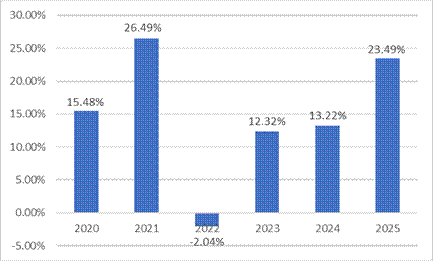
The bar chart and performance table below show the
variability of the Fund’s returns, which is some indication of the risks of investing in the Fund. The bar chart shows performance
of the Fund’s Institutional Class shares for each full calendar year since the Fund’s inception. The performance table compares
the performance of the Fund over time to the performance of a broad-based securities market index and a supplemental index.
Performance Bar Chart
Calendar Years Ended December 31
| - |
| 4 |
Performance Table
Average Annual Total Returns
(For periods ended December 31, 2025)
| One Year | Five Years | Since Inception * | |
| Return before taxes | |||
| Return after taxes on distributions | |||
| Return after taxes on distributions and sale of Fund shares | |||
| S&P 500 Index ** | |||
| Russell 3000 Index *** |
| * |
| ** |
| *** |
| 5 |
INVESTMENT ADVISER:
Oelschlager Investments, LLC is the Fund’s investment adviser.
PORTFOLIO MANAGER:
Mark Oelschlager, CFA – Mr. Oelschlager has been the portfolio manager of the Fund, and primarily responsible for its day to day management, since its inception in December 2019. He founded the Adviser in 2019 and serves as the firm's President and Chief Investment Officer. Prior to founding the Adviser, Mr. Oelschlager was Co-Chief Investment Officer at Oak Associates, ltd. and Portfolio Manager of several funds, which included: Sole Portfolio Manager of Pin Oak Equity from June 2006 - January 2019; Sole Portfolio Manager of Red Oak Technology Select from April 2006 - January 2019.
PURCHASE AND SALE OF FUND SHARES:
In addition to being able to buy and sell Fund shares directly from the Fund through its transfer agent, you may also buy or sell shares of the fund through your account with your broker or financial intermediary.
Investors who wish to purchase or redeem Fund shares through a financial intermediary should contact the financial intermediary directly.
Investors may be charged a fee if they effect transactions through an intermediary, broker or agent. The Fund has authorized one or more brokers to receive on its behalf purchase and redemption orders. Such brokers are authorized to designate other intermediaries to receive purchase and redemption orders on the Fund’s behalf. The Fund will be deemed to have received a purchase or redemption order when an authorized broker or, if applicable, a broker’s authorized designee, receives the order. A customer order will be priced at the Fund’s Net Asset Value next computed after it is received by an authorized broker or the broker’s authorized designee.
TAX INFORMATION:
Dividends and capital gain distributions you receive from the Fund, whether you reinvest your distributions in additional Fund shares or receive them in cash, are taxable to you at either ordinary income or capital gains tax rates unless you are investing through a tax-deferred plan such as an IRA or 401(k) plan. However, such distributions may be taxed later upon withdrawal of monies from the plan.
PAYMENTS TO BROKER-DEALERS AND OTHER FINANCIAL INTERMEDIARIES:
If you purchase the Fund through a broker-dealer or other financial intermediary (such as a bank), the adviser may pay the intermediary for the sale of Fund shares and related services. These payments may create a conflict of interest by influencing the broker-dealer or other intermediary and your salesperson to recommend the Fund over another investment. Ask your salesperson or visit your financial intermediary’s website for more information.
| 6 |
TOWPATH TECHNOLOGY FUND SUMMARY
The Towpath Technology Fund (the "Fund") the Fund seeks long-term capital appreciation.
This table describes the fees and expenses that you may pay if you buy and hold shares of the Fund. You may pay other fees, such as brokerage commissions and other fees to financial intermediaries, which are not reflected in the tables and examples below.
|
Institutional Share Class | |
|
Maximum Sales Charge (Load) Imposed on Purchases (as a % of offering price) |
|
|
Maximum Deferred Sales Charge (Load) (as a % of original purchase price) |
|
|
Maximum Sales Charge (Load) Imposed on Reinvested Dividends and other Distributions |
|
|
Redemption Fee (as a % of amount redeemed, if sold within 60 days) |
|
Institutional Share Class | |
| Management Fees | |
| Distribution and/or Service (12b-1) Fees | |
| Other Expenses | |
| Acquired Fund Fees and Expenses (1) | |
| Total Annual Fund Operating Expenses | |
| Fee Waiver and/or Expense Reimbursement (2) | ( |
| Total Annual Fund Operating Expenses After Fee Waiver and/or Expense Reimbursement |
| (1) |
| (2) |
| 7 |
The Example assumes that you invest $10,000 in the Fund for the time periods indicated and then redeem all of your shares at the end of those periods. The Example also assumes that your investment has a 5% return each year and that the Fund's operating expenses remain the same as those reflected in the above fee table. The Example assumes the impact of the fee waiver in 1 Year example. Although your actual costs may be higher or lower, based upon these assumptions your costs would be:
| 1 Year | 3 Years | 5 Years | 10 Years |
| $ |
$ |
$ |
$ |
The Fund pays transaction costs, such as commissions,
when it buys and sells securities (or "turns over" its portfolio). A higher portfolio turnover rate may indicate higher transaction
costs and may result in higher taxes when Fund shares are held in a taxable account. These costs, which are not reflected in annual operating
expenses or in the Example, affect the Fund's performance. During the fiscal year ended November 30, 2025, the Fund’s portfolio
turnover rate was
Oelschlager Investments, LLC (the "Adviser") seeks to achieve the Fund's investment objective by investing primarily in U.S. equity securities but may also hold shares of foreign companies either directly or through American Depository Receipts ("ADRs"). Companies in which the Fund invests may be of any capitalization size. Under normal circumstances, the Fund will invest at least 80% of its assets (defined as net assets plus any borrowing for investment purposes) in common stocks of technology-related companies. The Fund may meet this objective by directly investing in equity securities, or by investing in other investment companies, including exchange-traded funds ("ETFs"), that invest primarily in equity securities.
The Fund defines technology-related companies as companies that develop, manufacture, or distribute technology, communications and Internet-related products and services, including, computer hardware and software, communications hardware and software, semiconductors, business services, and, media and Internet-related services.
The Fund's portfolio typically consists of 25-40 securities, primarily within the technology sector. The Adviser emphasizes the long-term merits of an investment candidate rather than short-term trading factors, and generally keeps cash in the Fund low. In choosing securities for the Fund, the Adviser employs the following analyses:
| · | Market Analysis: The Adviser takes a broad view of the market and economy, which informs the Adviser's determination of how aggressive or cautious to be and which sectors and industries to focus on. |
| · | Sector Analysis: Sector selection is based on considerations such as macroeconomic and market analysis, competitive dynamics, trend in capacity, valuation, sentiment, management behavior, substitutability, growth potential, and market anomalies. |
| · | Quantitative Analysis: This includes a company's valuation metrics (such as free cash flow yield, price/earnings, price/sales), as well as various aspects of the company's financial statements, such as how it is deploying its capital,trends in its capitalization structure, and its profitability. |
| 8 |
| · | Qualitative Analysis: The Adviser assesses the fundamentals of the company's business, generally favoring those with barriers to entry, pricing power, network effects, limited competition, lock-in effects, – attributes that create sustainable competitive advantages. Often the Adviser invests in such companies when they are out of favor for short-term reasons. |
In general, the Fund sells a security when the price rises to a level that the Adviser believes exceeds the long-term risk-reward or when the fundamentals of a company deteriorate but are not reflected by a commensurate adjustment in the stock price.
The Fund is non-diversified, which means that the Fund may invest in fewer securities at any one time than a diversified fund.
PRINCIPAL INVESTMENT RISKS:
ADR Risk: In addition to the risks of investing in foreign securities discussed below, there is no guarantee that an ADR issuer will continue to offer a particular ADR. As a result, the Fund may have difficulty selling the ADRs, or selling them quickly and efficiently at the prices at which they have been valued.
Equity Risk: Equity security values held by the Fund may fall due to general market and economic conditions, perceptions regarding the industries in which the issuers of the securities participate or other factors relating to the companies.
Foreign Securities Risk: Changes in foreign economies and political climates are more likely to affect the Fund than a mutual fund that invests exclusively in U.S. companies. Foreign companies are generally not subject to the same regulatory requirements of U.S. companies thereby resulting in less publicly available information about these companies. In addition, foreign accounting, auditing and financial reporting standards generally differ from those applicable to U.S. companies.
Investment Risk: You could lose money by investing in the Fund. An investment in the Fund is not a deposit to a bank and is not insured or guaranteed by the Federal Deposit Insurance Corporation or any other government agency.
Large-Capitalization Risk: Larger, more established companies may be unable to attain the high growth rates of successful, smaller companies during periods of economic expansion.
Management Risk: The Fund is an actively managed portfolio. The Adviser will apply investment techniques and risk analyses in making investment decisions for the Fund, but there can be no guarantee that the Fund will achieve its investment objective. The Adviser may fail to select investments that do not perform as anticipated by the Adviser. The Fund could lose value or its investment results could lag relevant benchmarks or other funds with similar objectives.
Market and Geopolitical Risk: Market risk includes the possibility that the Fund’s investments will decline in value because of a downturn in the stock market, reducing the value of individual companies’ stocks regardless of the success or failure of an individual company’s operations. The value of your investment in the Fund is based on the market prices of the securities the Fund holds. These prices change daily due to economic and ther events that affect markets generally, as well as those that affect particular regions, countries, industries, companies or governments. The increasing interconnectivity between global economies and financial markets increases the likelihood that events or conditions in one region or financial market may adversely impact issuers in a different country, region or financial market. Securities in the Fund’s portfolio may underperform due to inflation (or expectations for inflation), interest rates, global demand for particular products or resources, natural disasters, pandemics, epidemics, terrorism, tariffs and trade wars, regulatory events and governmental or quasi-governmental actions. The occurrence of global events similar to those in recent years, such as terrorist attacks around the world, natural disasters, social and political discord or debt crises and downgrades, among others, may result in market volatility and may have long term effects on both the U.S. and global financial markets. There is a risk that you may lose money by investing in the Fund.
| 9 |
Non-Diversification Risk: The Fund's portfolio may focus on a limited number of investments and will be subject to potential for volatility than a diversified fund.
Small- and Mid-Capitalization Stock Risk: The stocks of small- and mid-capitalization companies often have greater price volatility, lower trading volume, and less liquidity than the stocks of larger, more established companies.
Technology Sector Risk:
Underlying Fund Risk: Other investment companies including ETFs ("Underlying Funds") in which the Fund invests are subject to investment advisory and other expenses, which will be indirectly paid by the Fund. As a result, the cost of investing in the Fund will be higher than the cost of investing directly in the Underlying Funds and may be higher than other mutual funds that invest directly in stocks. Each of the Underlying Funds is subject to its own specific risks, but the Adviser expects the principal investments risks of such Underlying Funds will be similar to the risks of investing in the Fund.
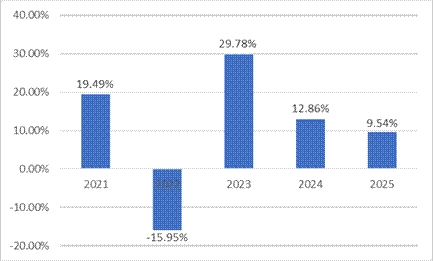
The bar chart and performance table below show
the variability of the Fund’s returns, which is some indication of the risks of investing in the Fund. The bar chart shows performance
of the Fund’s shares for each full calendar year since the Fund’s inception. The performance table compares the performance
of the Fund’s shares over time to the performance of a broad-based securities market index.
Performance Bar Chart
Calendar Years Ended December 31
| - |
| 10 |
Performance Table
Average Annual Total Returns
(For periods ended December 31, 2025)
| One Year | Five Years | Since Inception * | |
| Return before taxes | |||
| Return after taxes on distributions | |||
| Return after taxes on distributions and sale of Fund shares | |||
| S&P 500 Equal Weight Information Technology Index ** |
| * |
| ** |
INVESTMENT ADVISER:
Oelschlager Investments, LLC is the Fund’s investment adviser.
PORTFOLIO MANAGER:
Mark Oelschlager, CFA – Mr. Oelschlager has been the portfolio manager of the Fund since its inception in December 2020. He founded the Adviser in 2019 and serves as the Adviser’s President and Chief Investment Officer. Prior to founding the Adviser, Mr. Oelschlager was Co-Chief Investment Officer at Oak Associates, ltd. and Portfolio Manager of several funds, which included: Sole Portfolio Manager of Pin Oak Equity from June 2006 – January 2019; Sole Portfolio Manager of Red Oak Technology Select from April 2006 – January 2019.
PURCHASE AND SALE OF FUND SHARES:
You may purchase and redeem shares of the Fund on any day that the New York Stock Exchange is open for trading. You may redeem shares by written request, telephone or through a financial intermediary.
Minimum initial investment: $2,000; $50 subsequent investments; with an Automatic Investment Plan, $1,000 minimum initial investment; $50 subsequent investments.
Minimum telephone investment: $5,000.
However, the Fund or the adviser may waive any minimum investment requirement at its discretion.
TAX INFORMATION:
Dividends and capital gain distributions you receive from the Fund, whether you reinvest your distributions in additional Fund shares or receive them in cash, are taxable to you at either ordinary income or capital gains tax rates unless you are investing through a tax-deferred plan such as an IRA or 401(k) plan. However, such distributions may be taxed later upon withdrawal of monies from the plan.
PAYMENTS TO BROKER-DEALERS AND OTHER FINANCIAL INTERMEDIARIES:
If you purchase the Fund through a broker-dealer or other financial intermediary (such as a bank), the adviser may pay the intermediary for the sale of Fund shares and related services. These payments may create a conflict of interest by influencing the broker-dealer or other intermediary and your salesperson to recommend the Fund over another investment. Ask your salesperson or visit your financial intermediary's website for more information.
| 11 |
ADDITIONAL INFORMATION ABOUT PRINCIPAL INVESTMENT STRATEGIES AND RELATED RISKS
INVESTMENT OBJECTIVE:
| Fund | Investment Objective |
| Towpath Focus Fund | The Fund seeks long-term capital appreciation. |
| Towpath Technology Fund | The Fund seeks long-term capital appreciation. |
The investment objectives of Towpath Technology Fund and Towpath Focus Fund (each a “Fund” and collectively, the “Funds”) may be changed without shareholder approval, although it has no current intention to do so. Shareholders will be provided with at least 60 days’ prior written notice of any change to the Funds’ investment objectives.
PRINCIPAL INVESTMENT STRATEGIES:
Towpath Focus Fund
Oelschlager Investments, LLC (the "Adviser") seeks to achieve the Fund’s investment objective by investing primarily in U.S. equity securities but may also hold shares of foreign companies either directly or through American Depository Receipts ("ADRs"). Companies in which the Fund invests may be of any capitalization size. Under normal circumstances, the Fund will invest at least 80% of its assets (defined as net assets plus any borrowing for investment purposes) in equity securities. The Fund may meet this objective by directly investing in equity securities, or by investing in other investment companies, including exchange-traded funds (“ETFs”), that invest primarily in equity securities.
The Fund’s portfolio typically consists of 25-40 securities in a limited number of sectors. The Adviser emphasizes the long-term merits of an investment candidate rather than short-term trading factors, and generally keeps cash in the Fund low. The Adviser chooses securities for the Fund based on a combination of top-down and bottom-up factors, employing the following analyses:
| · | Market Analysis: The Adviser takes a broad view of the market and economy, which informs the Adviser’s determination of how aggressive or cautious to be and which sectors and industries to focus on. |
| · | Sector Analysis: Sector selection is based on considerations such as macroeconomic and market analysis, competitive dynamics, trend in capacity, valuation, valuation spreads, sentiment, management behavior, substitutability, growth potential, and market anomalies. |
| · | Quantitative Analysis: This includes a company’s valuation metrics (such as free cash flow yield, price/earnings, price/sales), as well as various aspects of the company’s financial statements, such as how it is deploying its capital, trends in its capitalization structure, and its profitability. |
| · | Qualitative Analysis: The Adviser assesses the fundamentals of the company’s business, generally favoring those with barriers to entry, pricing power, network effects, limited competition, lock-in effects – attributes that create sustainable competitive advantages. Often the Advisor invests in such companies when they are out of favor for short-term reasons. |
| 12 |
The Fund sells a security when the price rises to a level that the adviser believes exceeds the long-term risk-reward or when the fundamentals of a company deteriorate but are not reflected by a commensurate adjustment in the stock price. In addition, the Adviser monitors attributes of companies/securities that have historically augured poor performance. Often, rather than selling an entire position, the Fund may simply reduce the position if it believes the shares still offer a positive but smaller risk-reward. The Fund may also reduce a position if it comes to represent too large a portion of the portfolio.
The Fund is non-diversified, which means that the Fund may invest in fewer securities at any one time than a diversified fund.
Towpath Technology Fund
The Adviser seeks to achieve the Fund's investment objective by investing primarily in U.S. equity securities but may also hold shares of foreign companies either directly or through ADRs. Companies in which the Fund invests may be of any capitalization size. Under normal circumstances, the Fund will invest at least 80% of its assets (defined as net assets plus any borrowing for investment purposes) in common stocks of technology-related companies. The Fund may meet this objective by directly investing in equity securities, or by investing in other investment companies, including exchange-traded funds ("ETFs"), that invest primarily in equity securities.
The Fund defines technology-related companies as companies that develop, manufacture, or distribute technology, communications and Internet-related products and services, including, computer hardware and software, communications hardware and software, semiconductors, business services, and, media and Internet-related services.
The Fund's portfolio typically consists of 25-40 securities, primarily within the technology sector. The Adviser emphasizes the long-term merits of an investment candidate rather than short-term trading factors, and generally keeps cash in the Fund low. In choosing securities for the Fund, the Adviser employs the following analyses:
| · | Market Analysis: The Adviser takes a broad view of the market and economy, which informs the Adviser's determination of how aggressive or cautious to be and which sectors and industries to focus on. |
| · | Sector Analysis: Sector selection is based on considerations such as macroeconomic and market analysis, competitive dynamics, trend in capacity, valuation, sentiment, management behavior, substitutability, growth potential, and market anomalies. |
| · | Quantitative Analysis: This includes a company's valuation metrics (such as free cash flow yield, price/earnings, price/sales), as well as various aspects of the company's financial statements, such as how it is deploying its capital, trends in its capitalization structure, and its profitability. |
| · | Qualitative Analysis: The Adviser assesses the fundamentals of the company's business, generally favoring those with barriers to entry, pricing power, network effects, limited competition, lock-in effects, – attributes that create sustainable competitive advantages. Often the Adviser invests in such companies when they are out of favor for short-term reasons. |
In general, the Fund sells a security when the price rises to a level that the adviser believes exceeds the long-term risk-reward or when the fundamentals of a company deteriorate but are not reflected by a commensurate adjustment in the stock price.
| 13 |
The Fund is non-diversified, which means that the Fund may invest in fewer securities at any one time than a diversified fund.
PRINCIPAL INVESTMENT RISKS:
As with all mutual funds, there is risk that you could lose money through your investment in a Fund. Investing in a Fund can result in a loss of some or all amounts invested. Below are the main risks of investing in the Funds. All of the risks listed below are material regardless of the order in which they appear.
ADR Risk: ADRs may be subject to some of the same risks as direct investment in foreign companies, which includes international trade, currency, political, regulatory and diplomatic risks. In a sponsored ADR arrangement, the foreign issuer assumes the obligation to pay some or all of the depositary’s transaction fees. Under an unsponsored ADR arrangement, the foreign issuer assumes no obligations and the depositary’s transaction fees are paid directly by the ADR holders. Because unsponsored ADR arrangements are organized independently and without the cooperation of the issuer of the underlying securities, available information concerning the foreign issuer may not be as current as for sponsored ADRs and voting rights with respect to the deposited securities are not passed through.
Equity Risk: Equity securities are susceptible to general stock market fluctuations and to volatile increases and decreases in value. The equity securities held by the Fund may experience sudden, unpredictable drops in value or long periods of decline in value. This may occur because of factors affecting securities markets generally, the equity securities of a particular sector, or a particular company.
Foreign Securities Risk: Changes in foreign economies and political climates are more likely to affect the Fund than a mutual fund that invests exclusively in U.S. companies. There may also be less government supervision of foreign markets, resulting in non-uniform accounting practices and less publicly available information. The values of foreign investments may be affected by changes in exchange control regulations, application of foreign tax laws (including withholding tax), changes in governmental administration or economic or monetary policy (in this country or abroad) or changed circumstances in dealings between nations. In addition, foreign brokerage commissions, custody fees and other costs of investing in foreign securities are generally higher than in the United States. Investments in foreign companies, particularly in less developed markets, could be affected by other factors not present in the U.S., including expropriation, armed conflict, confiscatory taxation, and potential difficulties in enforcing contractual obligations. As a result, the Fund may be exposed to greater risk and will be more dependent on the adviser's ability to assess such risk than if the Fund invested solely in the U.S. or more developed foreign markets.
Investment Risk: You could lose money by investing in the Fund. An investment in the Fund is not a deposit to a bank and is not insured or guaranteed by the Federal Deposit Insurance Corporation or any other government agency.
Large-Capitalization Risk: Large-capitalization companies may be less able than smaller capitalization companies to adapt to changing market conditions. Large-capitalization companies may be more mature and subject to more limited growth potential compared with smaller capitalization companies. During different market cycles, the performance of large capitalization companies has trailed the overall performance of the broader securities markets.
| 14 |
Management Risk: The Fund is an actively managed portfolio. The Adviser will apply investment techniques and risk analyses in making investment decisions for the Fund, but there can be no guarantee that the Fund will achieve its investment objective. The Adviser may fail to select investments that do not perform as anticipated by the Adviser. The Fund could lose value or its investment results could lag relevant benchmarks or other funds with similar objectives.
Market and Geopolitical Risk: The prices of securities held by the Fund may decline in response to certain events taking place around the world, including those directly involving the companies whose securities are owned by the Fund; conditions affecting the general economy; overall market changes; local, regional or global political, social or economic instability; and currency, interest rate and commodity price fluctuations. The securities purchased by the Fund may involve large price swings and potential for loss. Investors in the Fund should have a long- term perspective and be able to tolerate potentially sharp declines in value. The market’s daily movements, sometimes called volatility, may be greater or less depending on the types of securities the Fund owns and the markets in which the securities trade. The increasing interconnectivity between global economies and financial markets increases the likelihood that events or conditions in one region or financial market may adversely impact issuers in a different country, region or financial market. Securities in the Fund’s portfolio may underperform due to inflation (or expectations for inflation), interest rates, global demand for particular products or resources, natural disasters, pandemics, epidemics, terrorism, tariffs and trade wars, regulatory events and governmental or quasi-governmental actions. The occurrence of global events similar to those in recent years, such as terrorist attacks around the world, natural disasters, social and political discord or debt crises and downgrades, among others, may result in market volatility and may have long term effects on both the U.S. and global financial markets. The value and growth-oriented equity securities purchased by the Fund may experience large price swings and potential for loss.
Non-Diversification Risk: The Fund is non-diversified. This means that it may invest a larger portion of its assets in a limited number of companies than a diversified fund. Because a relatively high percentage of the Fund’s assets may be invested in the securities of a limited number of companies that could be in the same or related economic sectors, the Fund’s portfolio may be more susceptible to any single economic, technological or regulatory occurrence than the portfolio of a diversified fund.
Sector Risk (Towpath Focus Fund only): Sector concentration risk is the possibility that securities within the same sector will decline in price due to sector-specific market or economic developments. If the Fund invests more heavily in a particular sector, the value of its shares may be especially sensitive to factors and economic risks that specifically affect that sector. As a result, the Fund's share price may fluctuate more widely than the value of shares of a mutual fund that invests in a broader range of sectors. Additionally, some sectors could be subject to greater government regulation than other sectors. Therefore, changes in regulatory policies for those sectors may have a material effect on the value of securities issued by companies in those sectors.
Small- and Mid-Capitalization Stock Risk: The stocks of small- and mid- capitalization companies involve substantial risk. These companies may have limited product lines, markets or financial resources, and they may be dependent on a limited management group. Stocks of these companies may be subject to more abrupt or erratic market movements than those of larger, more established companies or the market averages in general.
| 15 |
Underlying Fund Risk: Other investment companies including ETFs (“Underlying Funds”) in which the Fund invests are subject to investment advisory and other expenses, which will be indirectly paid by the Fund. As a result, the cost of investing in the Fund will be higher than the cost of investing directly in the Underlying Funds and may be higher than other mutual funds that invest directly in stocks and bonds. Each of the Underlying Funds is subject to its own specific risks, but the Adviser expects the principal investments risks of such Underlying Funds will be similar to the risks of investing in the Fund. Additional risks of investing in ETFs and mutual funds are described below:
| · | ETF Tracking Risk: Investment in the Fund should be made with the understanding that the passive ETFs in which the Fund invests will not be able to replicate exactly the performance of the indices they track because the total return generated by the securities will be reduced by transaction costs incurred in adjusting the actual balance of the securities. In addition, the passive ETFs in which the Fund invests will incur expenses not incurred by their applicable indices. Certain securities comprising the indices tracked by the passive ETFs may, from time to time, temporarily be unavailable, which may further impede the passive ETFs' ability to track their applicable indices. |
| · | Net Asset Value and Market Price Risk: The market value of ETF shares may differ from their net asset value. This difference in price may be due to the fact that the supply and demand in the market for fund shares at any point in time is not always identical to the supply and demand in the market for the underlying basket of securities. Accordingly, there may be times when shares trade at a premium or discount to net asset value. |
TEMPORARY INVESTMENTS:
To respond to adverse market, economic, political, or other conditions, each Fund may invest, temporarily, 100% of its total assets, without limitation, in high-quality short-term debt securities and money market instruments. These short-term debt securities and money market instruments include: shares of money market mutual funds, commercial paper, certificates of deposit, bankers’ acceptances, U.S. Government securities and repurchase agreements. While a Fund is in a defensive position, the opportunity to achieve its investment objective will be limited. Furthermore, to the extent that a Fund invests in money market mutual funds for cash positions, there will be some duplication of expenses because each Fund pays its pro-rata portion of such money market funds’ advisory fees and operational fees.
PORTFOLIO HOLDINGS DISCLOSURE:
Each Fund’s policies and procedures with respect to the disclosure of its portfolio securities holdings is available in the Funds’ Statement of Additional Information (“SAI”).
CYBERSECURITY:
The computer systems, networks and devices used by the Funds and their service providers to carry out routine business operations employ a variety of protections designed to prevent damage or interruption from computer viruses, network failures, computer and telecommunication failures, infiltration by unauthorized persons and security breaches. Despite the various protections utilized by the Funds and their service providers, systems, networks, or devices potentially can be breached.
| 16 |
The Funds and their shareholders could be negatively impacted as a result of a cybersecurity breach. Cybersecurity breaches can include unauthorized access to systems, networks, or devices; infection from computer viruses or other malicious software code; and attacks that shut down, disable, slow, or otherwise disrupt operations, business processes, or website access or functionality. Cybersecurity breaches may cause disruptions and impact the Funds’ business operations, potentially resulting in financial losses; interference with the Funds’ ability to calculate their NAV; impediments to trading; the inability of the Funds, the Adviser, and other service providers to transact business; violations of applicable privacy and other laws; regulatory fines, penalties, reputational damage, reimbursement or other compensation costs, or additional compliance costs; as well as the inadvertent release of confidential information.
Similar adverse consequences could result from cybersecurity breaches affecting issuers of securities in which the Funds invest; counterparties with which the Funds engage in transactions; governmental and other regulatory authorities; exchange and other financial market operators, banks, brokers, dealers, insurance companies, and other financial institutions (including financial intermediaries and service providers for the Funds’ shareholders); and other parties. In addition, substantial costs may be incurred by these entities in order to prevent any cybersecurity breaches in the future.
| 17 |
MANAGEMENT
INVESTMENT ADVISER:
Oelschlager Investments, LLC, located at 4040 Embassy Parkway, Suite 320, Akron, Ohio 44333 serves as investment adviser to the Funds. Subject to the authority of the Board of Trustees (the “Board”), the Adviser is responsible for the overall management of each Fund’s investment portfolio. The Adviser is an Ohio limited liability company formed in 2019 to provide investment advisory services to the Fund. As of February 28, 2026, the Adviser had approximately $99,642,229 million in assets under management.
Pursuant to a management agreement (the “Management Agreement”), each Fund pays the Adviser, on a monthly basis, an annual advisory fee equivalent to 0.70% of the respective Fund's average daily net assets. The Adviser has contractually agreed to reduce its fees and to reimburse expenses, at least through March 31, 2027, to ensure that each Fund’s total annual operating expenses, after fee waiver and reimbursement (exclusive of any acquired fund fees and expenses, interest expenses, dividend expenses on short sales, taxes, brokerage commissions, expenses incurred in connection with any merger or reorganization, or extraordinary expenses such as litigation) will not exceed 1.10% of each Fund’s average daily net assets. During the fiscal year ended November 30, 2025, the Adviser earned a fee equal to 0.70% and (0.01)% of the Towpath Focus Fund and Towpath Technology Fund, respectively, after fee waivers and reimbursements.
The fee waiver and expense reimbursement are subject to possible recoupment from the applicable Fund within three years after the date on which the waiver or reimbursement occurs, if such recoupment can be achieved within the lesser of the foregoing expense limit or the expense limits in place at the time of recoupment. This agreement may be terminated only by the Board on 60 days’ written notice to Adviser. Fee waiver and reimbursement arrangements can decrease a Fund's expenses and boost its performance. A discussion regarding the basis for the Board renewal of the Management Agreement with respect to the Funds is available in the Funds’ Form N-CSR dated November 30, 2025.
PORTFOLIO MANAGER:
Mark Oelschlager, CFA has been the portfolio manager of the Funds, and primarily responsible for their day to day management, since their inception in December 2019 and December 2020 respectively. He founded the Adviser in 2019 and serves as the Adviser’s President and Chief Investment Officer. Prior to this, Mr. Oelschlager served as Co-Chief Investment Officer and Portfolio Manager at Oak Associates, where he worked from 2000 to 2019. Mr. Oelschlager was a Senior Securities Analyst at State Teachers Retirement System of Ohio, his employer from 1996 to 2000. Mr. Oelschlager is a CFA charterholder and has over 29 years of investment experience. He holds a Bachelor of Arts from Trinity College and an MBA from The Ohio State University.
HOW SHARES ARE PRICED
The Funds’ assets are generally valued at their market value using market quotations. The Funds may use pricing services to determine market value. If market prices are not available or, in the Adviser's opinion, market prices do not reflect fair value, or if an event occurs after the close of trading on the domestic or foreign exchange or market on which the security is principally traded (but prior to the time the NAV is calculated) that materially affects fair value, the Adviser will value a Fund’s assets at their fair value according to policies approved by the Board. For example, if trading in a portfolio security is halted and does not resume before a Fund calculates its NAV, the Adviser may need to price the security using the Fund’s fair value pricing guidelines.
| 18 |
Without a fair value price, short term traders could take advantage of the arbitrage opportunity and dilute the NAV of long-term investors. Securities trading on overseas markets present time zone arbitrage opportunities when events affecting portfolio security values occur after the close of the overseas market, but prior to the close of the U.S. market. Fair valuation of a Fund’s portfolio securities can serve to reduce arbitrage opportunities available to short term traders, but there is no assurance that fair value pricing policies will prevent dilution of a Fund's NAV by short term traders. Fair valuation involves subjective judgments and it is possible that the fair value determined for a security may differ materially from the value that could be realized upon the sale of the security. A Fund may invest in ETFs and other investment companies ("Underlying Funds"). A Fund’s NAV is calculated based, in part, upon the market prices of the Underlying Funds in its portfolio, and the prospectuses of those companies explain the circumstances under which they will use fair value pricing and the effects of using fair value pricing. Because foreign securities trade on days when the Funds’ shares are not priced, the value of securities held by a Fund can change on days when the Fund’s shares cannot be purchased or redeemed.
HOW TO PURCHASE SHARES
MINIMUM INVESTMENTS:
The minimum initial and subsequent investment is $2,000 and $50 for all accounts. The minimum initial and subsequent investment for automatic investment accounts is $1,000 and $50. Minimum investment for telephone purchases is $5,000. However, each Fund or the Adviser may waive any minimum investment requirement at its discretion.
There is no minimum investment requirement when you are buying shares by reinvesting dividends and distributions from a Fund. Investment minimums may be higher or lower for investors purchasing shares through a brokerage firm or other financial institution. To the extent investments of individual investors are aggregated into an omnibus account established by an investment adviser, brokerage firm, retirement plan sponsor or other intermediary, the account minimums apply to the omnibus account, not to the account of the individual investor.
For accounts sold through brokerage firms and other intermediaries, it is the responsibility of the brokerage firm or intermediary to enforce compliance with investment minimums.
OPENING AN ACCOUNT:
The Funds are each a separate series of MSS Series Trust (the "Trust"), and you may purchase shares directly from each Fund. You also may purchase shares through a brokerage firm or other intermediary that has contracted with the Trust to sell shares of a Fund. You may be charged a separate fee by the brokerage firm or other intermediary through whom you purchase shares.
If you are investing directly in a Fund for the first time, please call the Fund’s transfer agent at 877-593-8637 to request a Shareholder Account Application. You will need to establish an account before investing. Be sure to sign up for all the account options that you plan to take advantage of. For example, if you would like to be able to redeem your shares by telephone, you should select this option on your Shareholder Account Application. Doing so when you open your account means that you will not need to complete additional paperwork later.
| 19 |
Your investment in a Fund should be intended as a long-term investment vehicle. The Funds are not designed to provide you with a means of speculating on the short-term fluctuations in the stock market. Each Fund reserves the right to reject any purchase request that it regards as disruptive to the efficient management of a Fund, which includes investors with a history of excessive trading. Each Fund also reserves the right to stop offering shares at any time.
To help the government fight the funding of terrorism and money laundering activities, federal law requires all financial institutions to obtain, verify, and record information that identifies each person who opens an account. This means that when you open an account, we will ask for your name, address, date of birth, and other information that will allow us to identify you. We also may ask for other identifying documents or information, and may take additional steps to verify your identity. We may not be able to open your account or complete a transaction for you until we are able to verify your identity.
If you have any questions regarding a Fund, please call 877-593-8637.
You may buy shares on any "business day." Business days are Monday through Friday, other than days the New York Stock Exchange (NYSE) is closed, including the following holidays: New Year's Day, Martin Luther King, Jr. Day, Presidents' Day, Good Friday, Memorial Day, Juneteenth, Independence Day, Labor Day, Thanksgiving and Christmas Day.
Shares of each Fund are sold at NAV. The NAV generally is calculated as of the close of trading on the NYSE every day the NYSE is open. The NYSE normally closes at 4:00 p.m. Eastern Time ("ET"). Each Fund's NAV is calculated by taking the total value of each Fund's assets, subtracting its liabilities, and then dividing by the total number of shares outstanding, rounded to the nearest cent.
If you are purchasing directly from the Trust, send the completed Shareholder Account Application and a check payable to the Fund in which you are investing to the following address:
MSS Series Trust
c/o Mutual Shareholder Services, LLC
8000 Town Centre Drive, Suite 400
Broadview Heights, OH 44147
Purchase orders received in "proper form" by a Fund’s transfer agent before the close of trading on the NYSE will be effective at the NAV next calculated after your order is received. On occasion, the NYSE closes before 4:00 p.m. ET. When that happens, purchase orders received after the NYSE closes will be effective the following business day.
To be in "proper form," the purchase order must include:
| · | Fund name and account number; |
| · | Account name(s) and address; |
| · | The dollar amount or number of shares you wish to purchase. |
Each Fund may limit the amount of purchases and refuse to sell to any person. Each Fund reserves the right to reject or restrict purchase for any reason, particularly when a shareholder’s trading activity suggests that the shareholder may be engaged in market timing or other disruptive trading activities.
| 20 |
Method of Payment. All purchases (both initial and subsequent) must be made in U.S. dollars and checks must be drawn on U.S. banks. Cash, credit cards and third party checks will not be accepted. Third party checks and checks drawn on a non-U.S. financial institution will not be accepted, even if payment may be effected through a U.S. financial institution. Checks made payable to any individual or company and endorsed to MSS Series Trust or a Fund are considered third-party checks.
A $20 fee will be charged against your account for any payment check returned to the transfer agent or for any incomplete electronic funds transfer, or for insufficient funds, stop payment, closed account or other reasons. If a check does not clear your bank or a Fund is unable to debit your pre-designated bank account on the day of purchase, the Fund reserves the right to cancel the purchase. If your purchase is canceled, you will be responsible for any losses or fees imposed by your bank and losses that may be incurred as a result of a decline in the value of the canceled purchase. Any profit on such cancellation will accrue to that Fund.
If you choose to pay by wire, you must call the Funds’ transfer agent, at 877-593-8637 to set up your account, to obtain an account number, and obtain instructions on how to complete the wire transfer.
Wire orders will be accepted only on a day on which a Fund, custodian and transfer agent is open for business. A wire purchase will not be considered made until the wired money and the purchase order are received by a Fund. Any delays that may occur in wiring money, including delays that may occur in processing by the banks, are not the responsibility of a Fund or its transfer agent.
Each Fund does not presently charge a fee for the receipt of wired funds or ACH (Automated Clearing House) funds, but may charge shareholders for these services in the future.
AUTOMATIC INVESTMENT PLANS:
By completing the Automatic Investment Plan section of the account application, you may make automatic monthly investments ($50 minimum per purchase) from your bank or savings account.
OTHER PURCHASE INFORMATION:
If your wire does not clear, you will be responsible for any loss incurred by a Fund. If you are already a shareholder, the Fund can redeem shares from any identically registered account in the Funds as reimbursement for any loss incurred. You may be prohibited or restricted from making future purchases in the Funds.
Each Fund may authorize certain brokerage firms and other intermediaries (including its designated correspondents) to accept purchase and redemption orders on its behalf. Each Fund is deemed to have received an order when the authorized person or designee receives the order, and the order is processed at the NAV next calculated thereafter. It is the responsibility of the brokerage firm or other intermediary to transmit orders promptly to a Fund’s transfer agent.
HOW TO REDEEM SHARES
REDEEMING SHARES:
You may redeem your shares on any business day. Redemption orders received in proper form by a Fund’s transfer agent or by a brokerage firm or other intermediary selling Fund shares before 4:00 p.m. ET (or before the NYSE closes if the NYSE closes before 4:00 p.m. ET) will be processed at that day's NAV. Your brokerage firm or intermediary may have an earlier cut-off time.
| 21 |
"Proper form" means your request for redemption must:
| · | Include the Fund name and account number; |
| · | Include the account name(s) and address; |
| · | State the dollar amount or number of shares you wish to redeem; and |
| · | Be signed by all registered share owner(s) in the exact name(s) and any special capacity in which they are registered. |
Each Fund may require that the signatures be guaranteed if the mailing address of the account has been changed within 30 days of the redemption request. Each Fund also may require that signatures be guaranteed for redemptions of $25,000 or more. Signature guarantees are for the protection of shareholders. You can obtain a signature guarantee from most banks and securities dealers, but not from a notary public. All documentation requiring a signature guarantee must utilize a New Technology Medallion stamp. For joint accounts, both signatures must be guaranteed. Please call the transfer agent at 877-593-8637 if you have questions regarding signature guarantees. At the discretion of each Fund, you may be required to furnish additional legal documents to insure proper authorization. Each Fund will not make checks payable to any person other than the shareholder(s) of record.
Shares of each Fund may be redeemed by mail or telephone. You may receive redemption payments in the form of a check or federal wire transfer. A wire transfer fee of $20 will be charged to defray custodial charges for redemptions paid by wire transfer. Any charges for wire redemptions will be deducted from your account by redemption of shares. If you redeem your shares through a brokerage firm or other intermediary, you may be charged a fee by that institution.
REDEEMING BY MAIL:
You may redeem any part of your account in a Fund by mail at no charge. Your request, in proper form, should be addressed to:
MSS Series Trust
c/o Mutual Shareholder Services, LLC
8000 Town Centre Drive, Suite 400
Broadview Heights, OH 44147
TELEPHONE REDEMPTIONS:
You may redeem any part of your account in a Fund by calling the transfer agent at 877-593-8637. You must first complete the Optional Telephone Redemption and Exchange section of the investment application to institute this option. Each Fund, the transfer agent and the custodian are not liable for following redemption instructions communicated by telephone to the extent that they reasonably believe the telephone instructions to be genuine. However, if they do not employ reasonable procedures to confirm that telephone instructions are genuine, they may be liable for any losses due to unauthorized or fraudulent instructions. Procedures employed may include recording telephone instructions and requiring a form of personal identification from the caller.
A Fund may terminate the telephone redemption procedures at any time. During periods of extreme market activity it is possible that shareholders may encounter some difficulty
| 22 |
in telephoning a Fund, although neither the Fund nor the transfer agent has ever experienced difficulties in receiving and responding to telephone requests for redemptions or exchanges in a timely fashion. If you are unable to reach a Fund by telephone, you may request a redemption or exchange by mail.
REDEMPTIONS IN KIND:
The Funds reserve the right to honor requests, in regular and stressed market conditions, for redemption or repurchase orders made by a shareholder during any 90-day period by making payment in whole or in part in portfolio securities ("redemption in kind") on the amount of such a request that is large enough to affect operations (that is, on the amount of the request that is greater than the lesser of $250,000 or 1% of the Funds’ net assets at the beginning of the 90-day period). In-kind redemptions of Fund shares will be redeemed pro rata to the extent that doing so is reasonable and in the best interests of the Fund and its shareholders. To the extent feasible, a redemption in kind would be a pro rata allocation of a Fund’s portfolio. The securities will be chosen by a Fund and valued using the same procedures as used in calculating a Fund's NAV. A shareholder may incur transaction expenses in converting these securities to cash.
ADDITIONAL REDEMPTION INFORMATION:
If you are not certain of the redemption requirements, please call the transfer agent at 877-593-8637. Redemptions specifying a certain date or share price cannot be accepted and will be returned. The Funds typically expect that it will take up to 5 days following the receipt of your redemption request to pay out redemption proceeds by check or electronic transfer. The Funds typically expect to pay redemptions from cash, cash equivalents, proceeds from the sale of fund shares, any lines of credit and then from the sale of portfolio securities. These redemption payment methods will be used in regular and stressed market conditions. You may be assessed a fee if a Fund incurs bank charges because you request that a Fund re-issue a redemption check. Also, when the NYSE is closed (or when trading is restricted) for any reason other than its customary weekend or holiday closing or under any emergency circumstances, as determined by the Securities and Exchange Commission ("SEC"), the Funds may suspend redemptions or postpone payment dates.
Low Balances: Because the Funds incur certain fixed costs in maintaining shareholder accounts, a Fund may require that you redeem all of your shares in a Fund upon 30 days written notice if the value of your shares in a Fund is less than $1,000 due to redemption, or such other minimum amount as a Fund may determine from time to time. You may increase the value of your shares in a Fund to the minimum amount within the 30-day period. All shares of a Fund also are subject to involuntary redemption if the Board of Trustees determines to liquidate a Fund. An involuntary redemption will create a capital gain or a capital loss, which may have tax consequences to you and about which you should consult your tax adviser.
FREQUENT PURCHASES AND REDEMPTIONS OF FUND SHARES
The Funds discourage and do not accommodate market timing. Frequent trading into and out of the Funds can harm all Fund shareholders by disrupting the Funds’ investment strategies, increasing Fund expenses, decreasing tax efficiency and diluting the value of shares held by long-term shareholders. The Funds are designed for long-term investors and is not intended for market timing or other disruptive trading activities. Accordingly, the Board has approved policies that seek to curb these disruptive activities while recognizing that shareholders may have a legitimate need to adjust their Fund investments as their financial needs or circumstances change. The Funds discourage excessive short-term trading in Fund shares and do not intend to accommodate such
| 23 |
trading activity by investors. The Funds consider excessive short-term trading to be any pattern of frequent purchases and redemptions of the Funds’ shares by an investor or group of investors, acting in concert, that could interfere with the efficient management of the Funds’ portfolio or result in increased brokerage and administrative costs. The Funds currently use several methods to reduce the risk of market timing. These methods include:
| · | Committing staff to review, on a continuing basis, recent trading activity in order to identify trading activity that may be contrary to the Funds’ market timing trading policy; |
| · | Rejecting or limiting specific purchase requests; and |
| · | Rejecting purchase requests from certain investors. |
Though these methods involve judgments that are inherently subjective and involve some selectivity in their application, the Funds seek to make judgments and applications that are consistent with the interests of the Funds’ shareholders.
Based on the frequency of redemptions in your account, the Adviser or the transfer agent may in its sole discretion determine that your trading activity is detrimental to the Funds as described in the Funds’ market timing trading policy and elect to reject or limit the amount, number, frequency or method for requesting future purchases or exchange purchases of the Funds’ shares.
The Funds reserve the right to reject or restrict purchase requests for any reason, particularly when the shareholder's trading activity suggests that the shareholder may be engaged in market timing or other disruptive trading activities. Neither the Funds nor the Adviser will be liable for any losses resulting from rejected purchase orders. The Adviser may also bar an investor who has violated these policies (and the investor's financial advisor) from opening new accounts with the Funds.
Although the Funds attempt to limit disruptive trading activities, some investors use a variety of strategies to hide their identities and their trading practices. There can be no guarantee that the Funds will be able to identify or limit these activities. Omnibus account arrangements are common forms of holding shares of the Funds. While the Funds will encourage financial intermediaries to apply the Funds’ market timing trading policy to their customers who invest indirectly in the Funds, the Funds are limited in their ability to monitor the trading activity or enforce the Funds’ market timing trading policy with respect to customers of financial intermediaries. For example, should it occur, the Funds may not be able to detect market timing that may be facilitated by financial intermediaries or made difficult to identify in the omnibus accounts used by those intermediaries for aggregated purchases, exchanges and redemptions on behalf of all their customers. More specifically, unless the financial intermediaries have the ability to apply the Funds’ market timing trading policy to their customers through such methods as implementing short-term trading limitations or restrictions and monitoring trading activity for what might be market timing, the Funds may not be able to determine whether trading by customers of financial intermediaries is contrary to the Funds’ market timing trading policy. Brokers maintaining omnibus accounts with the Funds have agreed to provide shareholder transaction information to the extent known to the broker to the Funds upon request. If the Funds or their transfer agent or shareholder servicing agent suspects there is market timing activity in the account, the Funds will seek full cooperation from the service provider maintaining the account to identify the underlying participant. At the request of the Adviser, the service providers may take immediate action to stop any further short-term trading by such participants.
| 24 |
The Funds and the Adviser reserve the right to modify any redemption fee at any time. If there is a material change to the Funds’ redemption fee, the Funds will notify you at least 60 days prior to the effective date of the change.
DIVIDENDS, DISTRIBUTIONS AND TAXES
DIVIDENDS AND DISTRIBUTIONS:
The Funds typically distribute substantially all of their net investment income in the form of dividends and taxable capital gains to their shareholders. The Funds intend to distribute net investment income dividends and long-term capital gains annually. These distributions are automatically reinvested in the Fund from which they are paid unless you request cash distributions on your application or through a written request to a Fund. Reinvested dividends and distributions receive the same tax treatment as those paid in cash. If you are interested in changing your election, you may call the Funds’ transfer agent at 877-593-8637 or send a written notification to:
MSS Series Trust
c/o Mutual Shareholder Services, LLC
8000 Town Centre Drive, Suite 400
Broadview Heights, OH 44147
TAXES:
In general, selling shares of the Funds and receiving distributions (whether reinvested or taken in cash) are taxable events. Depending on the purchase price and the sale price, you may have a gain or a loss on any shares sold. Any tax liabilities generated by your transactions or by receiving distributions are your responsibility. The Funds anticipate that distributions will be primarily taxed as ordinary income. You may want to avoid making a substantial investment when the Funds are about to make a taxable distribution because you would be responsible for any taxes on the distribution regardless of how long you have owned your shares. Each Fund may produce capital gains even if it does not have income to distribute and performance has been poor.
Early each year, a Fund will mail to you a statement setting forth the federal income tax information for all distributions made during the previous year. If you do not provide your taxpayer identification number, your account will be subject to backup withholding.
The tax considerations described in this section do not apply to tax-deferred accounts or other non-taxable entities. Because each investor's tax circumstances are unique, please consult with your tax adviser about your investment.
DISTRIBUTION OF SHARES
DISTRIBUTOR:
Ultimus Fund Distributors, LLC (“Ultimus”), 225 Pictoria Drive, Suite 450, Cincinnati, OH 45246, is the distributor for the shares of each Fund. Ultimus is a registered broker-dealer and member of the Financial Industry Regulatory Authority, Inc. ("FINRA"). Shares of each Fund are offered on a continuous basis.
ADDITIONAL COMPENSATION TO FINANCIAL INTERMEDIARIES:
Ultimus, its affiliates, and the Adviser may each, at its own expense and out of its own legitimate profits, provide additional cash payments to financial intermediaries who sell shares of each Fund. Financial intermediaries include brokers, financial planners, banks, insurance companies, retirement or 401(k) plan administrators and others. These payments may be in addition to any sales charge that are disclosed elsewhere in this Prospectus.
These payments are generally made to financial intermediaries that provide shareholder or administrative services, or marketing support. Marketing support may include access to sales meetings, sales representatives and financial intermediary management representatives, inclusion of the Funds on a sales list, including a preferred or select sales list, or other sales programs. These payments also may be made as an expense reimbursement in cases where the financial intermediary provides shareholder services to a Fund’s shareholders.
HOUSEHOLDING:
To reduce expenses, we mail only one copy of the Prospectus and each annual and semi-annual tailored shareholder report to those addresses shared by two or more accounts. If you wish to receive individual copies of these documents, please call the Funds at 877-593-8637 on days the Funds are open for business or contact your financial institution. We will begin sending you individual copies thirty days after receiving your request.
| 25 |
FINANCIAL HIGHLIGHTS
The financial highlights table is intended to help you understand the Funds’ financial performance for the period of the Funds’ operations. Certain financial information reflects financial results for a single Fund share. The total returns in the table represent the rate that an investor would have earned (or lost) on an investment in the Fund (assuming reinvestment of all dividends and distributions). This information has been audited by Cohen & Company, Ltd., an independent registered public accounting firm, whose report, along with the Funds’ financial statements, are available upon request.
Towpath Focus Fund (Institutional Class)
Selected data for a share outstanding throughout each year.
| Years Ended | |||||||||||
| 11/30/2025 | 11/30/2024 | 11/30/2023 | 11/30/2022 | 11/30/2021 | |||||||
| Net Asset Value, at Beginning of Year | $ 16.12 | $ 13.79 | $ 13.57 | $ 13.44 | $ 11.12 | ||||||
| Income From Investment Operations: | |||||||||||
| Net Investment Income ** | 0.21 | 0.23 | 0.21 | 0.14 | 0.09 | ||||||
| Net Gain on Investments (Realized and Unrealized) | 2.91 | 2.73 | 0.27 | 0.75 | 2.56 | ||||||
| Total from Investment Operations | 3.12 | 2.96 | 0.48 | 0.89 | 2.65 | ||||||
| Distributions: | |||||||||||
| Net Investment Income | - | (0.44) | (0.13) | (0.08) | (0.09) | ||||||
| Net Realized Gains | - | (0.19) | (0.13) | (0.68) | (0.24) | ||||||
| Return of Capital | - | - | **** | - | - | - | |||||
| Total from Distributions | - | (0.63) | (0.26) | (0.76) | (0.33) | ||||||
| Net Asset Value, at End of Year | $ 19.24 | $ 16.12 | $ 13.79 | $ 13.57 | $ 1.44 | ||||||
| Total Return *** | 19.35% | 21.94% | 3.72% | 6.76% | 24.51% | ||||||
| Ratios/Supplemental Data: | |||||||||||
| Net Assets at End of Year (Thousands) | $ 61,712 | $ 40,740 | $ 29,646 | $ 27,792 | $ 21,865 | ||||||
| Before Waiver or Recoupment | |||||||||||
| Ratio of Expenses to Average Net Assets | 0.91% | 0.95% | (b) | 1.01% | 1.10% | 1.22% | |||||
| Ratio of Net Investment Income to Average Net Assets | 1.24% | 1.54% | 1.67% | 1.08% | 0.57% | ||||||
| After Waiver or Recoupment | |||||||||||
| Ratio of Expenses to Average Net Assets | 0.91% | (a) | 0.95% | (a) (b) | 1.10% | (a) | 1.10% | (a) | 1.10% | (a) | |
| Ratio of Net Investment Income to Average Net Assets | 1.24% | (a) | 1.54% | (a) | 1.58% | (a) | 1.08% | (a) | 0.69% | (a) | |
| Portfolio Turnover | 9.78% | 4.07% | 12.33% | 10.86% | 25.29% | ||||||
(a) The contractual fee and expense waiver is reflected in both the net expense and net investment income ratios.
(b) The adviser voluntarily forwent the fee waiver recoupment for the year ended November 30, 2024 which resulted in a lower expense ratio. Had the adviser collected the available fees, the net expense ratio would have been 1.02%.
** Per share net investment income has been determined on the basis of average shares outstanding during the period.
*** Total return in the above table represents the rate that the investor would have earned or lost on an investment in the Fund assuming reinvestment of dividends. Returns would have been lower had the adviser not reimbursed expenses/waived fees during the period.
**** Less than $0.005.
| 26 |
Towpath Technology Fund (Institutional Class)
Selected data for a share outstanding throughout each period/year.
| Years Ended | Period Ended | * | |||||||||
| 11/30/2025 | 11/30/2024 | 11/30/2023 | 11/30/2022 | 11/30/2021 | |||||||
| Net Asset Value, at Beginning of Period/Year | $ 13.94 | $ 12.32 | $ 10.62 | $ 11.40 | $ 10.00 | ||||||
| Income/(Loss) From Investment Operations: | |||||||||||
| Net Investment Income/(Loss) ** | 0.04 | 0.08 | 0.03 | (0.01) | (0.01) | ||||||
| Net Gain/(Loss) on Investments (Realized and Unrealized) | 1.06 | 2.09 | 1.73 | (0.69) | 1.41 | ||||||
| Total from Investment Operations | 1.10 | 2.17 | 1.76 | (0.70) | 1.40 | ||||||
| Distributions: | |||||||||||
| Net Investment Income | - | (0.12) | - | (0.02) | - | ||||||
| Net Realized Gains | - | (0.26) | (0.06) | (0.06) | - | ||||||
| Return of Capital | - | (0.17) | - | - | - | ||||||
| Total from Distributions | - | (0.55) | (0.06) | (0.08) | - | ||||||
| Net Asset Value, at End of Period/Year | $ 15.04 | $ 13.94 | $ 12.32 | $ 10.62 | $ 11.40 | ||||||
| Total Return *** | 7.89% | 17.68% | 16.67% | (6.22)% | 14.00% | (a) | |||||
| Ratios/Supplemental Data: | |||||||||||
| Net Assets at End of Period/Year (Thousands) | $ 8,102 | $ 5,880 | $ 4,436 | $ 3,532 | $ 3,157 | ||||||
| Before Waiver | |||||||||||
| Ratio of Expenses to Average Net Assets | 1.81% | 1.96% | 2.42% | 2.46% | 3.21% | (b) | |||||
| Ratio of Net Investment Loss to Average Net Assets | (0.43)% | (0.23)% | (1.02)% | (1.47)% | (2.17)% | (b) | |||||
| After Waiver | |||||||||||
| Ratio of Expenses to Average Net Assets | 1.10% | (c) | 1.10% | (c) | 1.10% | (c) | 1.10% | (c) | 1.10% | (b)(c) | |
| Ratio of Net Investment Income/(Loss) to Average Net Assets | 0.28% | (c) | 0.63% | (c) | 0.30% | (c) | (0.11)% | (c) | (0.05)% | (b)(c) | |
| Portfolio Turnover | 5.62% | 7.76% | 14.83% | 13.08% | 13.45% | (a) | |||||
(a) Not annualized.
(b) Annualized.
(c) The contractual fee and expense waiver is reflected in both the net expense and net investment income ratios.
* For the period December 31, 2020 (commencement of investment operations) through November 30, 2021.
** Per share net investment income has been determined on the basis of average shares outstanding during the period.
*** Total return in the above table represents the rate that the investor would have earned or lost on an investment in the Fund assuming reinvestment of dividends. Returns would have been lower had the adviser not reimbursed expenses/waived fees during the period.
| 27 |
PRIVACY NOTICE
MSS SERIES TRUST
| FACTS | WHAT DOES THE MSS SERIES TRUST DO WITH YOUR PERSONAL INFORMATION? |
| Why? | Financial companies choose how they share your personal information. Federal law gives consumers the right to limit some, but not all sharing. Federal law also requires us to tell you how we collect, share, and protect your personal information. Please read this notice carefully to understand what we do. |
| What? |
The types of personal information we collect and share depends on the product or service that you have with us. This information can include: ● Social Security number and wire transfer instructions ● account transactions and transaction history ● investment experience and purchase history When you are no longer our customer, we continue to share your information as described in this notice. |
| How? | All financial companies need to share customers' personal information to run their everyday business. In the section below, we list the reasons financial companies can share their customers' personal information; the reasons the MSS Series Trust chooses to share; and whether you can limit this sharing. |
|
Reasons we can share your personal information: |
Do we share information? |
Can you limit sharing? |
| For our everyday business purposes - such as to process your transactions, maintain your account(s), respond to court orders and legal investigations, or report to credit bureaus. | YES | NO |
| For our marketing purposes - to offer our products and services to you. | NO | We don't share |
| For joint marketing with other financial companies. | NO | We don't share |
| For our affiliates' everyday business purposes - information about your transactions and records. | NO | We don't share |
| For our affiliates' everyday business purposes - information about your credit worthiness. | NO | We don't share |
| For our affiliates to market to you | NO | We don't share |
| For non-affiliates to market to you | NO | We don't share |
| QUESTIONS? | Call 877-593-8637 | |
| 28 |
What we do: | |
|
How does the MSS Series Trust protect my personal information? |
To protect your personal information from unauthorized access and use, we use security measures that comply with federal law. These measures include computer safeguards and secured files and buildings.
Our service providers are held accountable for adhering to strict policies and procedures to prevent any misuse of your nonpublic personal information. |
|
How does the MSS Series Trust collect my personal information? |
We collect your personal information, for example, when you ● open an account or deposit money ● direct us to buy securities or direct us to sell your securities ● seek advice about your investments We also collect your personal information from others, such as credit bureaus, affiliates, or other companies. |
|
Why can't I limit all sharing? |
Federal law gives you the right to limit only: ● sharing for affiliates' everyday business purposes – information about your creditworthiness. ● affiliates from using your information to market to you. ● sharing for nonaffiliates to market to you. State laws and individual companies may give you additional rights to limit sharing. |
| Definitions | |
| Affiliates |
Companies related by common ownership or control. They can be financial and non-financial companies. ● The MSS Series Trust does not share with affiliates so they can market to you. |
| Non-affiliates |
Companies not related by common ownership or control. They can be financial and non-financial companies. ● The MSS Series Trust does not share with non-affiliates so they can market to you. |
| Joint marketing |
A formal agreement between nonaffiliated financial companies that together market financial products or services to you. ● The MSS Series Trust doesn’t jointly market. |
| 29 |
This Page Was Left Blank Intentionally
| 30 |
Towpath Focus Fund
Towpath Technology Fund
Investment Adviser
Oelschlager Investments, LLC
Distributor
Ultimus Fund Distributors, LLC
Transfer and Dividend Disbursing Agent
Mutual Shareholder Services, LLC
Custodian
Argent Institutional Trust Company
Legal Counsel
Thompson Hine LLP
Independent Registered Public Accounting Firm
Cohen & Company, Ltd.
FOR MORE INFORMATION
Additional information about the Funds is included in the Funds’ Statement of Additional Information (“SAI”) dated March 31, 2026. The SAI, incorporated into this Prospectus by reference (and therefore legally a part of this Prospectus), contains detailed information on each Fund’s policies and operations, including policies and procedures relating to the disclosure of portfolio holdings by the Funds’ affiliates. Annual reports will, and the semi-annual reports may, contain management's discussion of market conditions and investment strategies that significantly affected the performance results as of the Funds as of the latest semi-annual or annual fiscal year end.
Call the Funds at 877-593-8637 to request free copies of the SAI, the annual report and the semi-annual report, to request other information about the Funds and to make shareholder inquiries. You may also obtain this information about the Funds at the Funds’ website.
You also may obtain reports and other information about the Funds on the EDGAR Database on the SEC's Internet site at http.//www.sec.gov, and copies of this information may be obtained, after paying a duplicating fee, by electronic request at the following e-mail address: [email protected].
Investment Company Act File No. 811-21927
Towpath focus Fund Ticker: TOWFX
Towpath Technology Fund Ticker: TOWTX
STATEMENT OF ADDITIONAL INFORMATION
March 31, 2026
This Statement of Additional Information ("SAI") is not a prospectus. It should be read in conjunction with the Prospectus for the Towpath Focus Fund and the Towpath Technology Fund (each a “Fund” and collectively the “Funds”) dated March 31, 2026. Each Fund’s financial statements are included in their Annual Report, and are incorporated by reference into this SAI by subsequent amendment. A copy of the Funds’ Prospectus or Annual Report can be obtained at no charge by writing the transfer agent, Mutual Shareholder Services, LLC, at 8000 Town Centre Drive, Suite 400, Broadview Heights, Ohio 44147-4003, or by calling 1-877-593-8637. The Funds’ Prospectus is incorporated by reference into this SAI.
| TABLE OF CONTENTS | |
| Page | |
| DESCRIPTION OF THE TRUST AND FUNDS | 1 |
| ADDITIONAL INFORMATION ABOUT THE FUNDS' INVESTMENTS | 1 |
| Investment Strategies and Risks | 1 |
| Certificates of Deposit and Bankers' Acceptances | 2 |
| Closed-End Investment Companies | 2 |
| Commercial Paper | 3 |
| Convertible Securities | 3 |
| Corporate Debt | 3 |
| Depositary Receipts | 3 |
| Emerging Markets Securities | 4 |
| Equity Securities | 4 |
| Exchange Traded Funds | 5 |
| Fixed Income Securities | 5 |
| Foreign Securities | 6 |
| Illiquid and Restricted Securities | 6 |
| Indexed Securities | 7 |
| Insured Bank Obligations | 7 |
| Preferred Stock | 8 |
| Real Estate Investment Trusts ("REITs") | 8 |
| Repurchase Agreements | 9 |
| Reverse Repurchase Transactions | 9 |
| Rights | 9 |
| Royalty Trusts | 10 |
| STRIPS | 10 |
| U.S. Government Securities | 10 |
| Warrants | 11 |
| Investment Restrictions | 11 |
| MANAGEMENT OF THE FUNDS | 13 |
| Board Leadership Structure | 13 |
| Board Risk Oversight | 13 |
| Trustee Qualifications | 14 |
| CODE OF ETHICS | 17 |
| CONTROL PERSONS AND PRINCIPAL HOLDERS OF SECURITIES | 18 |
| Control Persons | 18 |
| Management Ownership | 19 |
| INVESTMENT ADVISORY SERVICES | 19 |
| Investment Adviser | 19 |
| Portfolio Manager | 20 |
| Distributor | 21 |
| Custodian | 21 |
| Fund Services | 21 |
| Administrator and Compliance Services | 22 |
| Independent Registered Public Accounting Firm | 22 |
| BROKERAGE ALLOCATION AND OTHER PRACTICES | 22 |
| Portfolio Turnover | 23 |
| DISCLOSURE OF PORTFOLIO HOLDINGS | 24 |
| Determination of Share Price | 25 |
| REDEMPTION IN-KIND | 25 |
| TAX CONSEQUENCES | 26 |
| PROXY VOTING POLICIES AND PROCEDURES | 27 |
| Financial Statements | 27 |
| APPENDIX A |
i
DESCRIPTION OF THE TRUST AND THE FUNDS
The Towpath Focus Fund was organized as a non-diversified series of the MSS Series Trust (the "Trust") on December 18, 2019. The Towpath Technology Fund was organized as a non-diversified series of the Trust on December 18, 2019. The Trust is an open-end investment company established under the laws of Ohio by an Agreement and Declaration of Trust dated June 20, 2006 (the "Trust Agreement"). The Trust Agreement permits the Board of Trustees (the “Board”) to authorize and issue an unlimited number of shares of beneficial interest of separate series without par value. Each Fund is one of a number of series currently authorized by the Trustees. The investment adviser to the Funds is Oelschlager Investments, LLC (the "Adviser").
The Funds do not issue physical share certificates. All shares are held in non-certificated form registered on the books of each Fund and the transfer agent for the account of the shareholder. Each share of a series represents an equal proportionate interest in the assets and liabilities belonging to that series with each other share of that series and is entitled to such dividends and distributions out of income belonging to the series as are declared by the Trustees. The shares do not have cumulative voting rights or any preemptive or conversion rights, and the Trustees have the authority from time to time to divide or combine the shares of any series into a greater or lesser number of shares of that series so long as the proportionate beneficial interest in the assets belonging to that series and the rights of shares of any other series are in no way affected. In case of any liquidation of a series, the holders of shares of the series being liquidated will be entitled to receive as a class a distribution out of the assets, net of the liabilities, belonging to that series. Expenses attributable to any series are borne by that series. Any general expenses of the Trust not readily identifiable as belonging to a particular series are allocated by or under the direction of the Trustees in such manner as the Trustees determine to be fair and equitable. No shareholder is liable to further calls or to assessment by the Trust without his or her express consent.
The Trust does not hold an annual meeting of shareholders. When matters are submitted to shareholders for a vote, each shareholder is entitled to one vote for each whole share he owns and fractional votes for fractional shares he owns. All shares of the Funds have equal voting rights and liquidation rights. The Trust Agreement can be amended by the Trustees, except that any amendment that adversely affects the rights of shareholders must be approved by the shareholders affected. All shares of the Funds are subject to involuntary redemption if the Trustees determine to liquidate the Funds. An involuntary redemption will create a capital gain or a capital loss, which may have tax consequences about which you should consult your tax adviser.
For information concerning the purchase and redemption of shares of the Funds, see "How to Purchase Shares" and "How to Redeem Shares" in the Funds' Prospectus. For a description of the methods used to determine the share price and value of a Fund's assets, see "How Shares are Priced" in the Funds’ Prospectus and "Determination of Share Price" in this SAI.
ADDITIONAL INFORMATION ABOUT THE FUNDS' INVESTMENTS
Investment Strategies and Risks
All principal investment strategies and risks of each Fund is discussed in the Prospectus. This section contains a more detailed discussion of some of the investments the Funds may make and some of the techniques they may use. Additional non-principal strategies and risks also are discussed here.
| 1 |
Certificates of Deposit and Bankers' Acceptances
A Fund may invest in certificates of deposit and bankers' acceptances, which are considered to be short-term money market instruments.
Certificates of deposit are receipts issued by a depository institution in exchange for the deposit of funds. The issuer agrees to pay the amount deposited plus interest to the bearer of the receipt on the date specified on the certificate. The certificate usually can be traded in the secondary market prior to maturity. Bankers' acceptances typically arise from short-term credit arrangements designed to enable businesses to obtain funds to finance commercial transactions. Generally, an acceptance is a time draft drawn on a bank by an exporter or an importer to obtain a stated amount of funds to pay for specific merchandise. The draft is then "accepted" by a bank that, in effect, unconditionally guarantees to pay the face value of the instrument on its maturity date. The acceptance may then be held by the accepting bank as an earning asset or it may be sold in the secondary market at the going rate of discount for a specific maturity. Although maturities for acceptances can be as long as 270 days, most acceptances have maturities of six months or less.
Closed-End Investment Companies
A Fund may invest assets in "closed-end" investment companies (or "closed-end funds"), subject to the investment restrictions set forth above. Shares of closed-end funds are typically offered to the public in a one-time initial public offering by a group of underwriters who retain a spread or underwriting commission of between 4% or 6% of the initial public offering price. Such securities are then listed for trading on the New York Stock Exchange, the NYSE MKT LLC (formerly known as the American Stock Exchange), the National Association of Securities Dealers Automated Quotation System (commonly known as "NASDAQ") and, in some cases, may be traded in other over-the-counter markets. Because the shares of closed-end funds cannot be redeemed upon demand to the issuer like the shares of an open-end investment company (such as each Fund), investors seek to buy and sell shares of closed-end funds in the secondary market.
A Fund generally will purchase shares of closed-end funds only in the secondary market. A Fund will incur normal brokerage costs on such purchases similar to the expenses A Fund would incur for the purchase of securities of any other type of issuer in the secondary market. A Fund may, however, also purchase securities of a closed-end fund in an initial public offering when, in the opinion of the Adviser, based on a consideration of the nature of the closed-end fund's proposed investments, the prevailing market conditions and the level of demand for such securities, they represent an attractive opportunity for growth of capital. The initial offering price typically will include a dealer spread, which may be higher than the applicable brokerage cost if a Fund purchased such securities in the secondary market.
The shares of many closed-end funds, after their initial public offering, frequently trade at a price per share that is less than the net asset value per share, the difference representing the "market discount" of such shares. This market discount may be due in part to the investment objective of long-term appreciation, which is sought by many closed-end funds, as well as to the fact that the shares of closed-end funds are not redeemable by the holder upon demand to the issuer at the next determined net asset value, but rather, are subject to supply and demand in the secondary market. A relative lack of secondary market purchasers of closed-end fund shares also may contribute to such shares trading at a discount to their net asset value.
A Fund may invest in shares of closed-end funds that are trading at a discount to net asset value or at a premium to net asset value. There can be no assurance that the market discount on shares of any closed-end fund purchased by a Fund will ever decrease. In fact, it is possible that this market discount
| 2 |
may increase, and a Fund may suffer realized or unrealized capital losses due to further decline in the market price of the securities of such closed-end funds, thereby adversely affecting the net asset value of A Fund's shares. Similarly, there can be no assurance that any shares of a closed-end fund purchased by A Fund at a premium will continue to trade at a premium or that the premium will not decrease subsequent to a purchase of such shares by a Fund.
Closed-end funds may issue senior securities (including preferred stock and debt obligations) for the purpose of leveraging the closed-end fund's common shares in an attempt to enhance the current return to such closed-end fund's common shareholders. A Fund's investment in the common shares of closed-end funds that are financially leveraged may create an opportunity for greater total return on its investment, but at the same time may be expected to exhibit more volatility in market price and net asset value than an investment in shares of investment companies without a leveraged capital structure.
Commercial Paper
A Fund may purchase commercial paper. Commercial paper consists of short-term (usually from 1 to 270 days) unsecured promissory notes issued by corporations in order to finance current operations.
Convertible Securities
A Fund may invest in convertible securities. Convertible securities include fixed income securities that may be exchanged or converted into a predetermined number of shares of the issuer's underlying common stock at the option of the holder during a specified period. Convertible securities may take the form of convertible preferred stock, convertible bonds or debentures, units consisting of "usable" bonds and warrants or a combination of the features of several of these securities. Convertible securities are senior to common stocks in an issuer's capital structure, but are usually subordinated to similar non-convertible securities. While providing a fixed-income stream (generally higher in yield than the income derivable from common stock but lower than that afforded by a similar nonconvertible security), a convertible security also gives an investor the opportunity, through its conversion feature, to participate in the capital appreciation of the issuing company depending upon a market price advance in the convertible security's underlying common stock.
Corporate Debt
Corporate debt securities are long and short-term debt obligations issued by companies (such as publicly issued and privately placed bonds, notes and commercial paper). The Adviser considers corporate debt securities to be of investment grade quality if they are rated BBB- or higher by S&P or Baa3 or higher by Moody's, or if unrated, determined by the Adviser to be of comparable quality. Investment grade debt securities generally have adequate to strong protection of principal and interest payments. In the lower end of this category, adverse economic conditions or changing circumstances are more likely to lead to a weakened capacity to pay interest and repay principal than in higher rated categories. A Fund may invest in both secured and unsecured corporate bonds. A secured bond is backed by collateral and an unsecured bond is not. Therefore an unsecured bond may have a lower recovery value than a secured bond in the event of a default by its issuer. The Adviser may incorrectly analyze the risks inherent in corporate bonds, such as the issuer's ability to meet interest and principal payments, resulting in a loss to a Fund.
Depositary Receipts
A Fund may invest in sponsored and unsponsored American Depositary Receipts ("ADRs"), which are receipts issued by an American bank or trust company evidencing ownership of underlying securities issued by a foreign issuer. ADRs, in sponsored form, are designed for use in U.S. securities markets.
| 3 |
A sponsoring company provides financial information to the bank and may subsidize administration of the ADR. Unsponsored ADRs may be created by a broker-dealer or depository bank without the participation of the foreign issuer. Holders of these ADRs generally bear all the costs of the ADR facility, whereas foreign issuers typically bear certain costs in a sponsored ADR. The bank or trust company depositary of an unsponsored ADR may be under no obligation to distribute shareholder communications received from the foreign issuer or to pass through voting rights. Unsponsored ADRs may carry more risk than sponsored ADRs because of the absence of financial information provided by the underlying company. Many of the risks described below regarding foreign securities apply to investments in ADRs.
Emerging Markets Securities
A Fund may purchase ETFs and other closed end funds that invest in emerging market securities. Investing in emerging market securities imposes risks different from, or greater than, risks of investing in foreign developed countries. These risks include (i) the smaller market capitalization of securities markets, which may suffer periods of relative illiquidity, (ii) significant price volatility, (iii) restrictions on foreign investment, and (iv) possible repatriation of investment income and capital. In addition, foreign investors may be required to register the proceeds of sales, and future economic or political crises could lead to price controls, forced mergers, expropriation or confiscatory taxation, seizure, nationalization, or the creation of government monopolies. The currencies of emerging market countries may experience significant declines against the U.S. dollar, and devaluation may occur subsequent to investments in these currencies by a Fund. Inflation and rapid fluctuations in inflation rates have had, and may continue to have, negative effects on the economies and securities markets of certain emerging market countries.
Additional risks of emerging markets securities may include (i) greater social, economic and political uncertainty and instability, (ii) more substantial governmental involvement in the economy, (iii) less governmental supervision and regulation, (iv) the unavailability of currency hedging techniques, (v) companies that are newly organized and small, (vi) differences in auditing and financial reporting standards, which may result in unavailability of material information about issuers, and (vii) less developed legal systems. In addition, emerging securities markets may have different clearance and settlement procedures, which may be unable to keep pace with the volume of securities transactions or otherwise make it difficult to engage in such transactions. Settlement problems may cause a Fund to miss attractive investment opportunities, hold a portion of its assets in cash pending investment, or be delayed in disposing of a portfolio security. Such a delay could result in possible liability to a purchaser of the security.
Equity Securities
Equity securities consist of common stock, convertible preferred stock, rights and warrants. Common stocks, the most familiar type, represent an equity (ownership) interest in a corporation. Warrants are options to purchase equity securities at a specified price for a specific time period. Rights are similar to warrants, but normally have a short duration and are distributed by the issuer to its shareholders. Although equity securities have a history of long-term growth in value, their prices fluctuate based on changes in a company's financial condition and on overall market and economic conditions.
Investments in equity securities are subject to inherent market risks and fluctuations in value due to earnings, economic conditions and other factors beyond the control of the Adviser. As a result, the return and net asset value of a Fund will fluctuate. Securities in a Fund's portfolio may not increase as much as the market as a whole and some undervalued securities may continue to be undervalued for long periods of time.
| 4 |
Although profits in some Fund holdings may be realized quickly, it is not expected that most investments will appreciate rapidly.
Exchange Traded Funds
A Fund may invest in a range of exchange-traded funds ("ETFs"). Because many ETFs are considered to be investment companies, see "Investments in Other Investment Companies" below for additional information.
When a Fund invests in sector ETFs, there is a risk that securities within the same group of industries will decline in price due to sector-specific market or economic developments. If a Fund invests more heavily in a particular sector, the value of its shares may be especially sensitive to factors and economic risks that specifically affect that sector. As a result, a Fund's share price may fluctuate more widely than the value of shares of a mutual fund that invests in a broader range of industries. Additionally, some sectors could be subject to greater government regulation than other sectors. Therefore, changes in regulatory policies for those sectors may have a material effect on the value of securities issued by companies in those sectors. The sectors in which a Fund may be more heavily invested will vary.
The shares of an ETF may be assembled in a block (typically 50,000 shares) known as a creation unit and redeemed in-kind for a portfolio of the underlying securities (based on the ETF's net asset value) together with a cash payment generally equal to accumulated dividends as of the date of redemption. Conversely, a creation unit may be purchased from the ETF by depositing a specified portfolio of the ETF's underlying securities, as well as a cash payment generally equal to accumulated dividends of the securities (net of expenses) up to the time of deposit. A Fund may redeem creation units for the underlying securities (and any applicable cash), and may assemble a portfolio of the underlying securities and use it (and any required cash) to purchase creation units, if the Adviser believes it is in a Fund's interest to do so. A Fund's ability to redeem creation units may be limited by the Investment Company Act of 1940, as amended (the “1940 Act”), which provides that the ETFs will not be obligated to redeem shares held by a Fund in an amount exceeding one percent of their total outstanding securities during any period of less than 30 days.
There is a risk that the underlying ETFs in which a Fund invests may terminate due to extraordinary events that may cause any of the service providers to the ETFs, such as the trustee or sponsor, to close or otherwise fail to perform their obligations to the ETF. Also, because the ETFs in which a Fund intends to invest may be granted licenses by agreement to use the indices as a basis for determining their compositions and/or otherwise to use certain trade names, the ETFs may terminate if such license agreements are terminated. In addition, an ETF may terminate if its entire net asset value falls below a certain amount. Although a Fund believes that, in the event of the termination of an underlying ETF they will be able to invest instead in shares of an alternate ETF tracking the same market index or another market index with the same general market, there is no guarantee that shares of an alternate ETF would be available for investment at that time.
Fixed Income Securities
Fixed income securities include bonds and securities offered on a when-issued, delayed delivery, or forward commitment basis. Fixed income securities are subject to credit risk and interest rate risk. Credit risk is the risk that a Fund could lose money if an issuer of a fixed income security cannot meet its financial obligations or goes bankrupt. Interest rate risk is the risk that a Fund's investments in fixed income securities may fall when interest rates rise.
| 5 |
Investments in high-yield bonds are considered to be more speculative than higher quality fixed income securities. They are more susceptible to credit risk than investment-grade securities, especially during periods of economic uncertainty or economic downturns. The value of lower quality securities are subject to greater volatility and are generally more dependent on the ability of the issuer to meet interest and principal payments than higher quality securities. Issuers of high-yield securities may not be as strong financially as those issuing bonds with higher credit ratings.
Foreign Securities
Foreign securities are considered for purchase only if they are trading in domestic markets through an American Depositary Receipt (ADR). Purchases of foreign equity securities entail certain risks. For example, there may be less information publicly available about a foreign company than about a U.S. company, and foreign companies generally are not subject to accounting, auditing and financial reporting standards and practices comparable to those in the U.S. Other risks associated with investments in foreign securities include changes in restrictions on foreign currency transactions and rates of exchange, changes in the administrations or economic and monetary policies of foreign governments, the imposition of exchange control regulations, the possibility of expropriation decrees and other adverse foreign governmental action, the imposition of foreign taxes, less liquid markets, less government supervision of exchanges, brokers and issuers, difficulty in enforcing contractual obligations, delays in settlement of securities transactions and greater price volatility. In addition, investing in foreign securities will generally result in higher commissions than investing in similar domestic securities.
Illiquid and Restricted Securities
A Fund may invest up to 15% of its net assets in illiquid securities. Illiquid securities include securities subject to contractual or legal restrictions on resale (e.g., because they have not been registered under the Securities Act of 1933, as amended (the "Securities Act")) and securities that are otherwise not readily marketable (e.g., because trading in the security is suspended or because market makers do not exist or will not entertain bids or offers). Securities that have not been registered under the Securities Act are referred to as private placements or restricted securities and are purchased directly from the issuer or in the secondary market. Foreign securities that are freely tradable in their principal markets are not considered to be illiquid.
Restricted and other illiquid securities may be subject to the potential for delays on resale and uncertainty in valuation. A Fund might be unable to dispose of illiquid securities promptly or at reasonable prices and might thereby experience difficulty in satisfying redemption requests from shareholders. A Fund might have to register restricted securities in order to dispose of them, resulting in additional expense and delay. Adverse market conditions could impede such a public offering of securities.
A large institutional market exists for certain securities that are not registered under the Securities Act, including foreign securities. The fact that there are contractual or legal restrictions on resale to the general public or to certain institutions may not be indicative of the liquidity of such investments. Rule 144A under the Securities Act allows such a broader institutional trading market for securities otherwise subject to restrictions on resale to the general public. Rule 144A establishes a "safe harbor" from the registration requirements of the Securities Act for resale of certain securities to qualified institutional buyers. Rule 144A has produced enhanced liquidity for many restricted securities, and market liquidity for such securities may continue to expand as a result of this regulation.
Under guidelines adopted by the Board, the Adviser may determine that particular Rule 144A securities, and commercial paper issued in reliance on the private placement exemption from registration
| 6 |
afforded by Section 4(a)(2) of the Securities Act, are liquid even though they are not registered. A determination of whether such a security is liquid or not is a question of fact. In making this determination, the Adviser will consider, as it deems appropriate under the circumstances and among other factors: (1) the frequency of trades and quotes for the security; (2) the number of dealers willing to purchase or sell the security; (3) the number of other potential purchasers of the security; (4) dealer undertakings to make a market in the security; (5) the nature of the security (e.g., debt or equity, date of maturity, terms of dividend or interest payments, and other material terms) and the nature of the marketplace trades (e.g., the time needed to dispose of the security, the method of soliciting offers, and the mechanics of transfer); and (6) the rating of the security and the financial condition and prospects of the issuer. In the case of commercial paper, the Adviser will also determine that the paper (1) is not traded flat or in default as to principal and interest, and (2) is rated in one of the two highest rating categories by at least two National Statistical Rating Organization ("NRSRO") or, if only one NRSRO rates the security, by that NRSRO, or, if the security is unrated, the Adviser determines that it is of equivalent quality.
Rule 144A securities and Section 4(a)(2) commercial paper that have been deemed liquid as described above will continue to be monitored by the Adviser to determine if the security is no longer liquid as the result of changed conditions. Investing in Rule 144A securities or Section 4(a)(2) commercial paper could have the effect of increasing the amount of a Fund's assets invested in illiquid securities if institutional buyers are unwilling to purchase such securities.
Indexed Securities
A Fund may purchase indexed securities consistent with their investment objectives. Indexed securities are those, the value of which varies positively or negatively in relation to the value of other securities, securities indices or other financial indicators. Indexed securities may be debt securities or deposits whose value at maturity or coupon rate is determined by reference to a specific instrument or statistic. Recent issuers of indexed securities have included banks, corporations and certain U.S. Government agencies.
The performance of indexed securities depends to a great extent on the performance of the security or other instrument to which they are indexed and also may be influenced by interest rate changes in the United States and abroad. Indexed securities are subject to the credit risks associated with the issuer of the security, and their values may decline substantially if the issuer's creditworthiness deteriorates. Indexed securities may be more volatile than the underlying instruments. Certain indexed securities that are not traded on an established market may be deemed illiquid.
Insured Bank Obligations
A Fund may invest in insured bank obligations. The Federal Deposit Insurance Corporation ("FDIC") insures the deposits of federally insured banks and savings and loan associations (collectively referred to as "banks") up to $250,000. A Fund may purchase bank obligations which are fully insured as to principal by the FDIC. Currently, to remain fully insured as to principal, these investments must be limited to $250,000 per bank; if the principal amount and accrued interest together exceed $250,000, the excess principal and accrued interest will not be insured. Insured bank obligations may have limited marketability.
Investment Company Securities
A Fund may invest in the securities of other investment companies to the extent that such an investment would be consistent with the requirements of the 1940 Act and a Fund's investment objectives.
| 7 |
Investments in the securities of other investment companies may involve duplication of advisory fees and certain other expenses. By investing in another investment company, a Fund becomes a shareholder of that investment company. As a result, a Fund's shareholders indirectly will bear a Fund's proportionate share of the fees and expenses paid by shareholders of the other investment company, in addition to the fees and expenses a Fund's shareholders directly bear in connection with a Fund's own operations.
Under Section 12(d)(1) of the 1940 Act, a Fund may invest only up to 5% of its total assets in the securities of any one investment company (ETF or other mutual funds), but may not own more than 3% of the outstanding voting stock of any one investment company (the "3% Limitation") or invest more than 10% of its total assets in the securities of other investment companies. However, Section 12(d)(1)(F) of the 1940 Act provides that the provisions of paragraph 12(d)(1) shall not apply to securities purchased or otherwise acquired by a Fund if (i) immediately after such purchase or acquisition not more than 3% of the total outstanding stock of such registered investment company is owned by the Fund and all affiliated persons of the Fund; and (ii) the Fund has not offered or sold after January 1, 1971, and is not proposing to offer or sell any security issued by it through a principal underwriter or otherwise at a public or offering price which includes a sales load of more than 1 ½% percent. An investment company that issues shares to the Fund pursuant to paragraph 12(d)(1)(F) shall not be required to redeem its shares in an amount exceeding 1% of such investment company's total outstanding shares in any period of less than thirty days. A Fund (or the Adviser acting on behalf of a Fund) must comply with the following voting restrictions: when a Fund exercises voting rights, by proxy or otherwise, with respect to investment companies owned by the Fund, the Fund will either seek instruction from the Fund's shareholders with regard to the voting of all proxies and vote in accordance with such instructions, or vote the shares held by the Fund in the same proportion as the vote of all other holders of such security. Because other investment companies employ an investment adviser, such investments by a Fund may cause shareholders to bear duplicate fees.
In addition, a Fund is subject to the 3% Limitation unless (i) the ETF or the Fund has received an order for exemptive relief from the 3% limitation from the SEC that is applicable to the Fund; and (ii) the ETF and the Fund take appropriate steps to comply with any conditions in such order.
Preferred Stock
Preferred stocks are securities that have characteristics of both common stocks and corporate bonds. Preferred stocks may receive dividends but payment is not guaranteed as with a bond. These securities may be undervalued because of a lack of analyst coverage resulting in a high dividend yield or yield to maturity. The risks of preferred stocks are a lack of voting rights and the Adviser may incorrectly analyze the security, resulting in a loss to a Fund. Furthermore, preferred stock dividends are not guaranteed and management can elect to forego the preferred dividend, resulting in a loss to a Fund.
Real Estate Investment Trusts ("REITs")
REITs are pooled investment vehicles which invest primarily in income producing real estate or real estate related loans or interest. REITs are generally classified as equity REITs, mortgage REITs or a combination of equity and mortgage REITs. Equity REITs invest the majority of their assets directly in real property and derive income primarily from the collection of rents. Equity REITs can also realize capital gains by selling property that has appreciated in value. Mortgage REITs invest the majority of their assets in real estate mortgages and derive income from the collection of interest payments. The real property and mortgages serving as investment vehicles for REITs may be either residential or commercial in nature and may include healthcare facilities. Similar to investment companies, REITs are not taxed on income distributed to shareholders provided they comply with several requirements of the Code. Such tax requirements limit a REIT's ability to respond to changes in the commercial real estate market.
| 8 |
Investments in REITs are subject to the same risks as direct investments in real estate. Real estate values rise and fall in response to many factors, including local, regional and national economic conditions, the demand for rental property, and interest rates. In addition, REITs may have limited financial resources, may trade less frequently and in limited volume and may be more volatile than other securities.
Repurchase Agreements
A Fund may invest in fully collateralized repurchase agreements. A repurchase agreement is a short term investment in which the purchaser (i.e., a Fund) acquires ownership of a security and the seller agrees to repurchase the obligation at a future time at a set price, thereby determining the yield during the purchaser's holding period (usually not more than 7 days from the date of purchase). Any repurchase transaction in which a Fund engages will require full collateralization of the seller's obligation during the entire term of the repurchase agreement. In the event of a bankruptcy or other default of the seller, a Fund could experience both delays in liquidating the underlying security and losses in value. However, a Fund intends to enter into repurchase agreements only with its custodian, other banks with assets of $1 billion or more and registered securities dealers determined by the adviser to be creditworthy. The Adviser monitors the creditworthiness of the banks and securities dealers with which a Fund engages in repurchase transactions. A Fund may not enter into a repurchase agreement with a term of more than seven days if, as a result, more than 15% of the value of its net assets would then be invested in such repurchase agreements and other illiquid investments.
Reverse Repurchase Transactions
A Fund may enter into reverse repurchase transactions. In a reverse repurchase transaction, a Fund concurrently agrees to sell portfolio securities to financial institutions such as banks and broker-dealers, and to repurchase the same securities at a later date at a mutually agreed upon price. The repurchase price generally is equal to the original sales price plus interest. A Fund retains record ownership of the securities and the right to receive interest and principal payments. A Fund will enter into a reverse repurchase transaction in order to obtain funds to pursue additional investment opportunities with a return in excess of the cost of the reverse repurchase transaction. Such transactions may increase fluctuations in the market value of Fund assets and may be viewed as a form of leverage. Reverse purchase transactions also involve the risk that the market value of the securities sold by a Fund may decline below the price at which the Fund is obligated to repurchase the securities. In the event of bankruptcy or other default by the purchaser, a Fund could experience both delays in repurchasing the portfolio securities and losses. A Fund will enter into reverse purchase transactions only with parties whose creditworthiness has been reviewed and found satisfactory by the adviser.
Reverse purchase transactions are considered by the SEC to be borrowings by a Fund under the 1940 Act. At the time a Fund enters into a reverse purchase transaction, it will direct its custodian to place in a segregated account assets (such as cash or liquid securities consistent with the Fund's investment restrictions) having a value equal to the repurchase price (including accrued interest). A Fund will monitor the account to ensure that the market value of the account equals the amount of the Fund's commitments to repurchase securities.
Rights
Rights are usually granted to existing shareholders of a corporation to subscribe to shares of a new issue of common stock before it is issued to the public. The right entitles its holder to buy common stock at a specified price. Rights have similar features to warrants, except that the life of a right is typically much shorter, usually a few weeks. The Adviser believes rights may become underpriced if they
| 9 |
are sold without regard to value and if analysts do not include them in their research. The risk in investing in rights is that the Adviser might miscalculate their value resulting in a loss to a Fund. Another risk is the underlying common stock may not reach the Adviser's anticipated price within the life of the right.
Royalty Trusts
A Fund may invest in royalty trusts. Royalty trusts are special purpose financing vehicles organized as investment trusts created to make investments in operating companies or their cash flows. Royalty trusts buy the right to royalties on the production and sales of a natural resource company. Income and cash flows generated by a royalty trust are passed directly to investors in the form of dividends or the return of invested capital. Examples of royalty trusts include BP Prudhoe Bay Royalty Trust, Cross Timbers Royalty Trust and Williams Coal Seam Gas Royalty Trust. The yield generated by a royalty trust is not guaranteed and because developments in the oil, gas and natural resources markets will affect payouts, could be volatile. For example, the yield on an oil royalty trust can be affected by changes in production levels, natural resources, political and military developments, regulatory changes and conservation efforts. In addition, natural resources are depleting assets. Eventually, the income-producing ability of the royalty trust will be exhausted, at which point the trustees may choose to liquidate, or will attempt to raise or retain funds to make new acquisitions. The purchase of new assets can depress current income and increase the risk that the new property is of lower quality than the property held by the trust. Generally, higher yielding trusts have less time until depletion of proven reserves.
STRIPS
The Federal Reserve creates STRIPS (Separate Trading of Registered Interest and Principal of Securities) by separating the coupon payments and the principal payment from an outstanding Treasury security and selling them as individual securities. To the extent a Fund purchases the principal portion of the STRIP, the Fund will not receive regular interest payments. Instead they are sold at a deep discount from their face value. A Fund will accrue income on such STRIPS for tax and accounting purposes, in accordance with applicable law, which income is distributable to shareholders. Because no cash is received at the time such income is accrued, a Fund may be required to liquidate other Fund securities to satisfy its distribution obligations. Because the principal portion of the STRIP does not pay current income, its price can be very volatile when interest rates change. In calculating its dividend, a Fund takes into account as income a portion of the difference between the principal portion of the STRIP's purchase price and its face value.
U.S. Government Securities
A Fund may invest in U.S. government securities. These securities may be backed by the credit of the government as a whole or only by the issuing agency. U.S. Treasury bonds, notes, and bills and some agency securities, such as those issued by the Federal Housing Administration and the Government National Mortgage Association (Ginnie Mae), are backed by the full faith and credit of the U.S. government as to payment of principal and interest and are the highest quality government securities. Other securities issued by U.S. government agencies or instrumentalities, such as securities issued by the Federal Home Loan Banks and the Federal Home Loan Mortgage Corporation (Freddie Mac), are supported only by the credit of the agency that issued them, and not by the U.S. government. Securities issued by the Federal Farm Credit System, the Federal Land Banks, and the Federal National Mortgage Association (Fannie Mae) are supported by the agency's right to borrow money from the U.S. Treasury under certain circumstances, but are not backed by the full faith and credit of the U.S. government.
| 10 |
A Fund's investments in U.S. Government securities may include agency step-up obligations. These obligations are structured with a coupon rate that "steps-up" periodically over the life of the obligation. Step-up obligations typically contain a call option, permitting the issuer to buy back the obligation upon exercise of the option. Step-up obligations are designed for investors who are unwilling to invest in a long-term security in a low interest rate environment. Step-up obligations are used in an attempt to reduce the risk of a price decline should interest rates rise significantly at any time during the life of the obligation. However, step-up obligations also carry the risk that market interest rates may be significantly below the new, stepped-up coupon rate. If this occurs, the issuer of the obligation likely will exercise the call option, leaving investors with cash to reinvest. As a result, these obligations may expose a Fund to the risk that proceeds from a called security may be reinvested in another security paying a lower rate of interest.
Warrants
Warrants are securities that are usually issued with a bond or preferred stock but may trade separately in the market. A warrant allows its holder to purchase a specified amount of common stock at a specified price for a specified time. The risk in investing in warrants is the Adviser might miscalculate their value, resulting in a loss to a Fund. Another risk is the warrants will not realize their value because the underlying common stock does reach the Adviser's anticipated price within the life of the warrant.
Investment Restrictions
Fundamental Investment Limitations. The investment limitations described below have been adopted by the Trust with respect to the Funds and are fundamental ("Fundamental"), i.e., they may not be changed without the affirmative vote of a majority of the outstanding shares of each Fund respectively. As used in the Prospectus and the SAI, the term "majority" of the outstanding shares of a Fund means the lesser of: (1) 67% or more of the outstanding shares of the Fund present at a meeting, if the holders of more than 50% of the outstanding shares of the Fund are present or represented at such meeting; or (2) more than 50% of the outstanding shares of the Fund. Other investment practices, which may be changed by the Board without the approval of shareholders to the extent permitted by applicable law, regulation or regulatory policy, are considered non-fundamental ("Non-Fundamental").
1. Borrowing Money. The Funds will not borrow money, except: (a) from a bank, provided that immediately after such borrowing there is an asset coverage of 300% for all borrowings of the Fund; or (b) from a bank or other persons for temporary purposes only, provided that such temporary borrowings are in an amount not exceeding 5% of the Fund's total assets at the time when the borrowing is made. This limitation does not preclude the Fund from entering into reverse repurchase transactions, provided that the Fund has an asset coverage of 300% for all borrowings and repurchase commitments of the Fund pursuant to reverse repurchase transactions.
2. Senior Securities. The Funds will not issue senior securities. This limitation is not applicable to activities that may be deemed to involve the issuance or sale of a senior security by a Fund, provided that the Fund's engagement in such activities is consistent with or permitted by the 1940 Act, the rules and regulations promulgated thereunder or interpretations of the SEC or its staff.
3. Underwriting. The Funds will not act as underwriter of securities issued by other persons. This limitation is not applicable to the extent that, in connection with the disposition of portfolio securities (including restricted securities), the Funds may be deemed an underwriter under certain federal securities laws.
| 11 |
4. Real Estate. The Funds will not purchase or sell real estate. This limitation is not applicable to investments in marketable securities that are secured by or represent interests in real estate. This limitation does not preclude the Funds from investing in mortgage-related securities or investing in companies engaged in the real estate business or that have a significant portion of their assets in real estate (including real estate investment trusts).
5. Commodities. The Funds will not purchase or sell commodities unless acquired as a result of ownership of securities or other investments. This limitation does not preclude the Funds from purchasing or selling options or futures contracts, from investing in securities or other instruments backed by commodities or from investing in companies, which are engaged in a commodities business or have a significant portion of their assets in commodities.
6. Loans. The Funds will not make loans to other persons, except: (a) by loaning portfolio securities; (b) by engaging in repurchase agreements; or (c) by purchasing nonpublicly offered debt securities. For purposes of this limitation, the term "loans" shall not include the purchase of a portion of an issue of publicly distributed bonds, debentures or other securities.
7. Concentration. The Funds will not invest 25% or more of its total assets in a particular industry or group of industries. This limitation is not applicable to investments in obligations issued or guaranteed by the U.S. government, its agencies and instrumentalities or repurchase agreements with respect thereto.
If a restriction on a Fund's investments is adhered to at the time an investment is made, a subsequent change in the percentage of Fund assets invested in certain securities or other instruments, or change in average duration of the Fund's investment portfolio, resulting from changes in the value of the Fund's total assets, will not be considered a violation of the restriction; provided, however, that the asset coverage requirement applicable to borrowings shall be maintained in the manner contemplated by applicable law. This paragraph does not apply to the borrowing policy set forth in paragraph 1 above.
The 1940 Act limits a Fund's ability to borrow money, prohibiting the Fund from issuing senior securities, except the Fund may borrow from any bank provided that immediately after any such borrowing there is an asset coverage of at least 300% for all borrowings by the Fund and provided further, that in the event that such asset coverage shall at any time fall below 300%, the Fund shall, within three days thereafter or such longer period as the SEC may prescribe by rules and regulations, reduce the amount of its borrowings to such an extent that the asset coverage of such borrowing shall be at least 300%. Notwithstanding any of the foregoing limitations, any investment company, whether organized as a trust, association or corporation, or a personal holding company, may be merged or consolidated with or acquired by the Trust, provided that if such merger, consolidation or acquisition results in an investment in the securities of any issuer prohibited by said paragraphs, the Trust shall, within ninety days after the consummation of such merger, consolidation or acquisition, dispose of all of the securities of such issuer so acquired or such portion thereof as shall bring the total investment therein within the limitations imposed by said paragraphs above as of the date of consummation.
Non-Fundamental. The following limitations have been adopted by the Trust with respect to a Fund and are Non-Fundamental (see "Investment Limitations - Fundamental" above).
1. Pledging. The Funds will not mortgage, pledge, hypothecate or in any manner transfer, as security for indebtedness, any assets of a Fund except as may be necessary in connection with borrowings described in limitation (1) above. Margin deposits, security interests, liens and collateral arrangements with respect to transactions involving options, futures contracts, short sales and other permitted investments and techniques are not deemed to be a mortgage, pledge or hypothecation of assets for purposes of this limitation.
| 12 |
2. Borrowing. The Funds will not purchase any security while borrowings (including reverse repurchase agreements) representing more than one third of its total assets are outstanding.
3. Illiquid Investments. The Funds will not invest 15% or more of their respective net assets in securities for which there are legal or contractual restrictions on resale and other illiquid securities.
4. Equity Securities. (Towpath Focus Fund only). The Fund has adopted a policy to invest at least 80% of its assets (defined as net assets plus the amount of any borrowing for investment purposes) in Equity Securities, as defined in its then current Prospectus. Shareholders of the Fund will be provided with at least 60 days prior notice of any change in the Fund's policy.
5. Technology Companies. (Towpath Technology Fund only). The Fund has adopted a policy to invest at least 80% of its assets (defined as net assets plus the amount of any borrowing for investment purposes) in common stocks of technology-related companies, as defined in its then current Prospectus. Shareholders of the Fund will be provided with at least 60 days prior notice of any change in the Fund's policy.
MANAGEMENT OF THE FUNDS
The Board of Trustees supervises the business activities of the Trust and appoints the officers. Each Trustee serves as a trustee until the termination of the Trust unless the Trustee dies, resigns, retires or is removed. The Board generally meets four times a year to review the progress and status of the Trust.
Board Leadership Structure
The Trust is led by Gregory B. Getts, who has served as the Chairman of the Board since December 2016. Mr. Getts is an "interested person" as defined in the 1940 Act (the “Interested Trustee”), by virtue of his controlling interest in Arbor Court Capital, LLC (the Funds' distributor) and his status as an officer of the Trust. The Board is comprised of Mr. Getts and two other Trustees, neither of whom are an interested person ("Independent Trustees"). The Independent Trustees have not selected a Lead Independent Trustee. Additionally, under certain 1940 Act governance guidelines that apply to the Trust, the Independent Trustees will meet in executive session, at least quarterly. Under the Trust's practice, the Chairman of the Board is responsible for (a) presiding at board meetings, (b) calling special meetings on an as-needed basis, and, more generally, in-practice (c) execution and administration of Trust policies including (i) setting the agendas for board meetings and (ii) providing information to board members in advance of each board meeting and between board meetings. Generally, the Trust believes it best to have a single leader who is seen by shareholders, business partners and other stakeholders as providing strong leadership. The Trust believes that its Chairman together with the Audit Committee and the full Board of Trustees, provide effective leadership that is in the best interests of the Trust and the Funds' shareholders because of the Board's collective business acumen and understanding of the regulatory framework under which investment companies must operate.
Board Risk Oversight
The Board is comprised of Mr. Getts and two Independent Trustees with a standing independent Audit Committee with a separate chair. The Board is responsible for overseeing risk management, and the full Board regularly engages in discussions of risk management and receives compliance reports that inform its oversight of risk management from the Trust’s Chief Compliance Officer at quarterly meetings and on an ad hoc basis, when and if necessary. The Audit Committee considers financial and reporting risk within its area of responsibilities. Generally, the Board believes that its oversight of material risks is adequately maintained through the compliance-reporting chain where the Chief Compliance Officer is the
| 13 |
primary recipient and communicator of such risk-related information, and the Audit Committee's communications with the independent registered public accounting firm.
Trustee Qualifications.
Generally, the Trust believes that each Trustee is competent to serve because of their individual overall merits including: (i) experience, (ii) qualifications, (iii) attributes and (iv) skills.
Dr. Gregory B. Getts – Interested Trustee - Dr. Getts is the owner/President of Mutual Shareholder Services, LLC (“MSS”), a status held since 1999. MSS provides transfer agency and accounting services to mutual funds. Since 2012, Dr. Getts has been the owner of Arbor Court Capital, LLC, which is a mutual fund distributor. Dr. Getts earned his Master and Ph.D. in operations research from Case Western Reserve University. Dr. Getts worked in the mutual fund industry since approximately 1980, and has extensive knowledge and expertise in the industry. He pioneered his way in the industry by writing computer software for transfer agent and accounting services that MSS currently uses in its operations. Dr. Getts has been published three times in regards to portfolio risk management and planning. He also developed a PC game for stock and option simulation that was published by Addison-Wesley. Dr. Getts holds Series 7, 23, 24, 27, and 63 designations.
Paul K. Rode Esq. – Independent Trustee – Mr. Rode is a 2003 graduate of Wittenberg University with a B.A. in political science, and a 2006 graduate of Cleveland-Marshall College of Law with a J.D. Mr. Rode was admitted to the State Bar of Ohio in 2006, as well as the Northern District Federal Court of Ohio. He belongs to the Ohio State Bar Association, and has been employed at Keith D. Weiner & Assoc. Co. L.P.A. since September 2005. He primarily practices as a litigator and primary brief-writer in the collections department. Mr. Rode is very knowledgeable and experienced in contract law. His contact knowledge is valuable as the Trust enters into and renews various service provider contracts annually. He would also provide great value in the event the Trust finds itself having to enforce or interpret a contract.
Michael Young – Independent Trustee – Mr. Young is a former Senior Federal Security Director that retired from federal service after 41.5 years and is currently a Practitioner/Consultant for the Department of Homeland Security. Mr. Young spent 26 years with the United States Secret Service, and worked in investigative and protective divisions, both domestic and foreign. Mr. Young is a graduate of Temple University with a degree in Industrial Management, where he was a Distinguished Military Graduate and received a Regular Army Commission as a 2nd Lieutenant upon entering Active Duty. He served with the 1st Air Cavalry Division for four years in various assignments to include small unit and reconnaissance operations, Division Counterintelligence Operations Officer and Tactical Intelligence Officer. He is a graduate of the U.S. Army Infantry, Ranger and Airborne Schools along with the Army's Tactical and Counterintelligence Schools at Fort Huachuca. Mr. Young is very experienced with setting up efficient and technical operations. His risk management skills will assist the Trust in the continual development of internal controls and processes, as well as asset oversight.
The Trust does not believe any one factor is determinative in assessing a Trustee's qualifications, but that the collective experience of each Trustee makes the Board highly effective.
The following tables provide information about Board and the senior officers of the Trust. Information about each Trustee is provided below and includes each person's: name, address, age (as of the date of the Funds' most recent fiscal year end), present position(s) held with the Trust, principal occupations for the past five years. Unless otherwise noted, the business address of each person listed
| 14 |
below is c/o Mutual Shareholder Services, LLC, 8000 Town Centre Drive, Suite 400, Broadview Heights, Ohio 44147-4003. Unless otherwise noted, each officer is elected annually by the Board.
Independent Trustees
| Name Address and Age | Position(s) Held with the Trust | Term of Office/Length of Time Served | Principal Occupation(s) During Past 5 Years | Number of Portfolios in Fund Complex1 Overseen by Trustee | Other Directorships Held by Trustee |
|
Paul K. Rode, Esq. 8000 Town Centre Drive, Suite 400, Broadview Heights, OH 44147
Age: 46 |
Trustee |
Indefinite/ October 2016- present |
Attorney, Keith D. Weiner & Assoc. Co. L.P.A. since September 2005 | 4 | None |
|
Michael Young 8000 Town Centre Drive, Suite 400, Broadview Heights, OH 44147
Age: 76 |
Trustee |
Indefinite/ October 2016 - present |
November 2013-Present: Consultant/Practitioner for Purdue, Rutgers and Northeastern Universities; June 2002-November 2013: Senior Federal Security Director for U.S. Department of Homeland Security | 4 | None |
1The "Fund Complex" consists of MSS Series Trust.
Interested Trustee and Officer
| Name, Address and Year of Birth | Position(s) Held with the Trust | Term of Office/ Length of Time Served | Principal Occupation(s) During Past 5 Years | Number of Portfolios in Fund Complex 2 Overseen by Trustee | Other Directorships Held by Trustee |
|
Dr. Gregory B. Getts 1 8000 Town Centre Drive, Suite 400, Broadview Heights, OH 44147
Age: 69 |
Trustee and President |
Indefinite/ October 2016 - present |
Owner/President, Mutual Shareholder Services, LLC, since 1999; Owner/President Arbor Court Capital, LLC, since January 2012. | 4 | None |
|
Brandon M. Pokersnik 8000 Town Centre Drive, Suite 400 Broadview Heights, OH 4414
Age: 47 |
Treasurer, Secretary and Chief Compliance Officer | Indefinite/ October 2016 – present | Accountant, Mutual Shareholder Services, LLC, since 2008; Attorney Mutual Shareholder Services, LLC, since June 2016; Owner/President, Empirical Administration, LLC, since September 2012. | NA | NA |
1 Gregory B. Getts is considered an "Interested" Trustee as defined in the 1940 Act because he is an officer of the Trust and President/owner of the Funds' distributor.
2 The "Fund Complex" consists of MSS Series Trust.
| 15 |
The Trust's audit committee consists of the Independent Trustees. The audit committee is responsible for (i) overseeing the accounting and financial reporting policies and practices of the Funds, their internal controls and, as appropriate, the internal controls of certain service providers; (ii) overseeing the quality and objectivity of the Funds' financial statements and the independent audit of the financial statements; and (iii) acting as a liaison between the Funds' independent auditors and the full Board of Trustees.
As of December 31, 2025, the Trustees beneficially owned the following amounts in the Funds:
| Name of Trustee or Officer | Dollar Range of Securities in Towpath Focus Fund | Dollar Range of Securities in Towpath Technology Fund |
Aggregate Dollar Range of Securities In Trust |
| Gregory B. Getts | $100,00 - $125,000 | None | $150,000 - $175,000 |
| Paul Rode | None | None | None |
| Michael Young | None | None | None |
The following table describes the compensation estimated paid to the Trustees for the Funds’ fiscal year ended November 30, 2025. The Interested Trustee receives no compensation from the Funds.
| Name 1 | Aggregate Compensation from Towpath Focus Fund | Aggregate Compensation from Towpath Technology Fund | Total Compensation from Trust2 |
| Gregory B. Getts 3 | None | None | None |
| Paul Rode | $1,600 | $1,600 | $6,400 |
| Michael Young | $1,600 | $1,600 | $6,400 |
1 Each Independent Trustee receives $400 per fund, per quarterly meeting attended.
2 The Trust is comprised of the Funds, Parvin Hedged Equity Solari World Fund, and One Rock Fund.
3 Gregory B. Getts. is considered an "Interested" Trustee as defined in the 1940 Act because of his ownership interest in the transfer agent and the distributor.
CODE OF ETHICS
Pursuant to the requirements of rule 17j-1 under the 1940 Act and in order to protect against certain unlawful acts, practices and courses of business by certain individuals or entities related to the Trust, the Funds, the Adviser, and the Distributor have each adopted a Code of Ethics and procedures for implementing the provisions of the Code. The personnel of the Funds, the Adviser, and the Distributor are subject to the code of ethics when investing in securities that may be purchased, sold or held by the Funds.
CONTROL PERSONS AND PRINCIPAL HOLDERS OF SECURITIES
Control Persons
Shareholders owning more than 25% of the shares of a Fund are considered to "control" the Fund as that term is defined under the 1940 Act. Persons controlling a Fund can determine the outcome of any proposal submitted to the shareholders for approval, including changes to a Fund's fundamental policies or
| 16 |
the terms of the management agreement with the Adviser. Mark Oelschlager may be deemed to control both Funds. As of February 28, 2026, the following shareholders of record owned 5% or more of the outstanding shares of each class of the respective Funds:
| Name and Address | Shares | Percentage of Towpath Focus Fund |
|
Charles Schwab & Co. Inc. 9601 E. Panorama Circle Englewood, CO 80112 |
966,804 | 28.31% |
|
Mark & Tina Oelschlager 4600 Shaw Rd. EXT Akron, OH 44333 |
786,958 | 23.04% |
|
Oelschlager Trust 4600 Shaw Rd. EXT Akron, OH 44333 |
282,209 | 8.26% |
| Name and Address | Shares | Percentage of Towpath Technology Fund |
|
David J. Barsan, IRA 3137 Dover Rd. Silver Lake, OH 44224 |
48,741 | 9.01% |
|
David & Lisa Bates 2958 Devan Vale Dr. Cuyahoga Falls, OH 44223 |
70,349 | 13.00% |
|
Mark Oelschlager 4600 Shaw Rd. EXT Akron, OH 44333 |
83,512 | 15.43% |
|
Oelschlager Trust 4600 Shaw Rd. EXT Akron, OH 44333 |
116,373 | 21.50% |
Management Ownership
As of the date of the SAI, the Trustees and officers of the Trust, as a group, owned less than 1% of the shares of the Funds.
INVESTMENT ADVISORY SERVICES
Investment Adviser
Oelschlager Investments, LLC, located at 4040 Embassy Parkway, Suite 320 Akron, Ohio 44333, serves as investment adviser to each Fund. Subject to the authority of the Board, the Adviser is responsible for management of each Fund's investment portfolio. The Adviser is responsible for selecting each Fund's investments according to the respective Fund's investment objective, policies and restrictions. The Adviser was established in 2019 for the purpose of providing investment advisory services to the Funds. Mark Oelschlager and Tina Oelschlager jointly own the entirety of the Adviser. As of February 28, 2026, it had approximately $99,642,229 million in assets under management.
| 17 |
Under the terms of the management agreement (the "Management Agreement"), the Adviser, subject to the supervision of the Board, provides or arranges to be provided to each Fund such investment advice as it deems advisable and will furnish or arrange to be furnished a continuous investment program for each Fund consistent with each Fund's investment objective and policies. The following table sets forth the annual management fee rate payable by the Funds to the Adviser pursuant to the Management Agreement, expressed as a percentage of each Fund's average daily net assets:
| Fund | Total Management Fee |
| Towpath Focus Fund | 0.70% |
| Towpath Technology Fund | 0.70% |
The Management Agreement continues for an initial term of two years and is renewed on a year-to-year basis thereafter, provided that continuance is approved at least annually by specific approval of the Board of Trustees or by vote of the holders of a majority of the outstanding voting securities of a Fund. In either event, it must also be approved by a majority of the Independent Trustees, at a meeting called for the purpose of voting on such approval. The Management Agreement may be terminated at any time without the payment of any penalty by the Board or by vote of a majority of the outstanding voting securities of a Fund on not more than 60 days’ written notice to the Adviser. In the event of its assignment, the Agreement will terminate automatically.
During the fiscal year ended November 30, 2023, the Towpath Focus Fund accrued $198,154 in advisory fees payable to the Adviser and recouped $25,501 in previously waived expenses pursuant to the Expense Limitation Agreement. During the fiscal year ended November 30, 2023, the Towpath Technology Fund accrued $27,242 in advisory fees payable to the Adviser, of which the Adviser waived $51,435.
During the fiscal year ended November 30, 2024, the Towpath Focus Fund accrued $242,151 in advisory fees payable to the Adviser and recouped $0 in previously waived expenses pursuant to the Expense Limitation Agreement. During the fiscal year ended November 30, 2024, the Towpath Technology Fund accrued $37,092 in advisory fees payable to the Adviser, of which the Adviser waived $45,851.
During the fiscal year ended November 30, 2025, the Towpath Focus Fund accrued $355,006 in advisory fees payable to the Adviser and recouped $0 in previously waived expenses pursuant to the Expense Limitation Agreement. During the fiscal year ended November 30, 2025, the Towpath Technology Fund accrued $49,321 in advisory fees payable to the Adviser, of which the Adviser waived $49,907.
The Adviser has contractually agreed to reduce its fees and to reimburse expenses for each Fund respectively, at least through March 31, 2027, to ensure that total annual operating expenses after fee waiver and reimbursement (exclusive of any 12b-1 fees, acquired fund fees and expenses, interest expenses, dividend expenses on short sales, taxes, brokerage commissions, expenses incurred in connection with any merger or reorganization, or extraordinary expenses such as litigation) will not exceed 1.10% of the average daily net assets attributable to each Fund. These fee waivers and expense reimbursements are subject to possible recoupment from the applicable Fund within three years of the date on which the waiver or reimbursement occurs, if such recoupment can be achieved within the lesser
| 18 |
of the foregoing expense limits or the expense limits in place at the time of recoupment. This agreement may be terminated only by the Board on 60 days’ written notice to the Adviser.
Portfolio Manager
Mark Oelschlager, CFA is the portfolio manager responsible for the day-to-day management of each Fund. As of November 30, 2025, Mr. Oelschlager also is responsible for the management of the following other types of accounts:
| Account Type | Number of Accounts by Account Type | Total Assets By Account Type | Number of Accounts by Type Subject to a Performance Fee | Total Assets By Account Type Subject to a Performance Fee |
| Registered Investment Companies | 2 | $69,755,975 | 0 | $0 |
| Other Pooled Investment Vehicles |
0 | $0 | 0 | $0 |
| Other Accounts | 24 | $22,703,778 | 0 | $0 |
The Adviser has not identified any material conflicts between the Funds and other accounts managed by Mr. Oelschlager. However, actual or apparent conflicts of interest may arise in connection with the day-to-day management of the Funds and other accounts. The management of the Funds and other accounts may result in unequal time and attention being devoted to the Funds and other accounts. Another potential conflict of interest may arise where another account has the same investment objective as either of the Funds, whereby the portfolio manager could favor one account over another. Further, a potential conflict could include knowledge about the size, timing and possible market impact of Fund trades, whereby they could use this information to the advantage of other accounts and to the disadvantage of the Funds. These potential conflicts of interest could create the appearance that a portfolio manager is favoring one investment vehicle over another
The following table shows the dollar range of equity securities beneficially owned by the portfolio manager of the Funds as of November 30, 2025.
| Name of Portfolio Manager | Dollar Range of Equity Securities in the Towpath Focus Fund | Dollar Range of Equity Securities in the Towpath Technology Fund |
| Mark Oelschlager, CFA | Over $1,000,000 | Over $1,000,000 |
| Distributor |
As of March 31, 2021, the Trust selected Ultimus Fund Distributors, LLC (the “Distributor”), located at 225 Pictoria Drive, Suite 450, Cincinnati, OH 45246 as the Funds distributor. Prior to March 23, 2021, Foreside Financial Services, LLC acted as the Funds’ principal underwriter. The Distributor serves as the principal underwriter and national distributor for the shares of the Funds pursuant to
| 19 |
underwriting agreement with the Trust (the “Underwriting Agreement”). The Distributor is registered as broker-dealer under the Securities and Exchange Act of 1934 and each state’s securities laws and is a member of FINRA. The offering of the Funds’ shares are continuous. The Underwriting Agreement provides that the Distributor, as agent in connection with the distribution of the Funds’ shares, will use reasonable efforts to facilitate the sale of the Funds’ shares.
The Underwriting Agreement provides that, unless sooner terminated, it will continue in effect for one year initially and thereafter shall continue year to year, subject to annual approval by (a) the Board or a vote of the majority of the outstanding shares, and (b) by a majority of Trustees who are not interested persons of the Trust or of the Distributor by vote cast in person at a meeting called for the purpose of voting on such approval.
The Underwriting Agreement may be terminated by the Board at any time, without the payment of any penalty, by a vote of a majority of the entire Board or by a vote of a majority of the outstanding shares of the Funds on 60 days’ written notice to the Distributor, or by the Distributor at any time, without any payment of any penalty, on 60 days’ written notice to the Funds’. The Underwriting Agreement will automatically terminate in the event of its assignment.
During the fiscal year ended November 30, 2023, the Distributor was paid a total of $27,934 for distribution services provided to the Towpath Focus Fund and Towpath Technology Fund. During the fiscal year ended November 30, 2024, the Distributor was paid a total of $23,364 for distribution services provided to the Towpath Focus Fund and Towpath Technology Fund. During the fiscal year ended November 30, 2025, the Distributor was paid a total of $27,660 for distribution services provided to the Towpath Focus Fund and Towpath Technology Fund.
Custodian
Argent Institutional Trust Company, 1715 N. Westshore Blvd., Suite 750, Tampa, FL, 33607, serves as the Funds' custodian (the "Custodian"). The Custodian acts as the Funds' depository, provides safekeeping of its portfolio securities, collects all income and other payments with respect thereto, disburses funds at the Funds' request and maintains records in connection with its duties.
Fund Services
Mutual Shareholder Services, LLC, 8000 Town Centre Drive, Suite 400, Broadview Heights, Ohio 44147-4003, acts as the transfer agent (the "Transfer Agent") for the Funds. MSS maintains the records of the shareholder's account, answers shareholders' inquiries concerning their accounts, processes purchases and redemptions of the Funds' shares, acts as dividend and distribution disbursing agent and performs other transfer agent and shareholder service functions. MSS receives an annual fee from the Trust of $11.50 per shareholder (subject to a minimum monthly fee of $775.00 per Fund) for these transfer agency services.
In addition, MSS provides the Funds with fund accounting services, which includes certain monthly reports, record-keeping and other management-related services. For its services as fund accountant (the "Fund Accounting Agent"), MSS receives an annual fee from the Trust based on the average value of a Fund. These fees are: from $0 to $25 million in assets the annual fee is $21,000, from $25 million to $50 million in assets the annual fee is $30,500, from $50 million to $75 million in assets the annual fee is $36,250, from $75 million to $100 million in assets the annual fee is $42,000, from $100 million to $125 million in assets the annual fee is $47,750, from $125 million to $150 million in assets the
| 20 |
annual fee is $53,500, and for asset above $150 million the annual fee is $59,250. The Trust will receive a discount ranging from 10-60% depending on the net assets of each Trust until the Trust reaches $10 million in assets. During the year ended November 30, 2025, the Funds surpassed assets of $10 million and no longer received the discount.
During the fiscal year ended November 30, 2023, the Focus Fund paid $32,127 to MSS for transfer agent and accounting services. During the fiscal year ended November 30, 2023, the Technology Fund paid $16,453 to MSS for transfer agent and accounting services.
During the fiscal year ended November 30, 2024, the Focus Fund paid $32,252 to MSS for transfer agent and accounting services. During the fiscal year ended November 30, 2024, the Technology Fund paid $16,306 to MSS for transfer agent and accounting services.
During the fiscal year ended November 30, 2025, the Towpath Focus Fund paid $31,943 to MSS for transfer agent and accounting services. During the fiscal year ended November 30, 2025, the Towpath Technology Fund paid $21,746 to MSS for transfer agent and accounting services.
Administrator and Compliance Services
Empirical Administration, LLC ("Empirical"), 8000 Town Centre Drive, Suite 400, Broadview Heights, Ohio, 44147, will serve as the Funds' administrator and provide compliance services to the Funds. Empirical will be paid $1,000 a month for its administration services and $1,000 per month for its compliance services. Brandon Pokersnik of Empirical is also the CCO of the Trust.
During the fiscal year ended November 30, 2023, Empirical earned $5,952 from the Towpath Focus Fund and $5,950 from the Towpath Technology Fund for these services.
During the fiscal year ended November 30, 2024, Empirical earned $6,049 from the Towpath Focus Fund and $6,049 from the Towpath Technology Fund for these services.
During the fiscal year ended November 30, 2025, Empirical earned $7,341 from the Towpath Focus Fund and $1,229 from the Towpath Technology Fund for these services.
Independent Registered Public Accounting Firm
The firm of Cohen & Company, Ltd. has been selected as independent registered public accounting firm for the Funds for the fiscal year ending November 30, 2026. Cohen & Company, Ltd. will perform an annual audit of each Fund's financial statements and provide financial and accounting services as requested. Cohen & Co Advisory, LLC, an affiliate of Cohen & Company, Ltd., provides tax services as requested.
BROKERAGE ALLOCATION AND OTHER PRACTICES
Subject to policies established by the Board, the Adviser is responsible for each Fund's portfolio decisions and the placing of each Fund's portfolio transactions. In placing portfolio transactions, the Adviser seeks the best qualitative execution for each Fund, taking into account such factors as price (including the applicable brokerage commission or dealer spread), the execution capability, financial responsibility and responsiveness of the broker or dealer and the brokerage and research services provided
| 21 |
by the broker or dealer. The Adviser generally seeks favorable prices and commission rates that are reasonable in relation to the benefits received.
The Adviser is specifically authorized to select brokers or dealers who also provide brokerage and research services to the Funds and/or the other accounts over which the Adviser exercises investment discretion, and to pay such brokers or dealers a commission in excess of the commission another broker or dealer would charge if the Adviser determines in good faith that the commission is reasonable in relation to the value of the brokerage and research services provided. The determination may be viewed in terms of a particular transaction or the Adviser's overall responsibilities with respect to the Trust and to other accounts over which it exercises investment discretion. The Adviser may not give consideration to sales of shares of the Trust as a factor in the selection of brokers and dealers to execute portfolio transactions. However, the Adviser may place portfolio transactions with brokers or dealers that promote or sell a Fund's shares so long as such placements are made pursuant to policies approved by the Board of Trustees that are designed to ensure that the selection is based on the quality of the broker's execution and not on its sales efforts.
Research services include supplemental research, securities and economic analyses, statistical services and information with respect to the availability of securities or purchasers or sellers of securities, and analyses of reports concerning performance of accounts. The research services and other information furnished by brokers through whom a Fund effects securities transactions may also be used by the Adviser in servicing all of its accounts. Similarly, research and information provided by brokers or dealers serving other clients may be useful to the Adviser in connection with its services to the Funds. Although research services and other information are useful to the Funds and the Adviser, it is not possible to place a dollar value on the research and other information received. It is the opinion of the Board and the Adviser that the review and study of the research and other information will not reduce the overall cost to the Adviser of performing its duties to the Funds under the Management Agreement.
Over-the-counter transactions will be placed either directly with principal market makers or with broker-dealers, if the same or a better price, including commissions and executions, is available. Fixed income securities are normally purchased directly from the issuer, an underwriter or a market maker. Purchases include a concession paid by the issuer to the underwriter and the purchase price paid to a market maker may include the spread between the bid and asked prices.
When a Fund and another of the Adviser's clients seek to purchase or sell the same security at or about the same time, the Adviser may execute the transaction on a combined ("blocked") basis. Blocked transactions can produce better execution for a Fund because of the increased volume of the transaction. If the entire blocked order is not filled, a Fund may not be able to acquire as large a position in such security as it desires or it may have to pay a higher price for the security. Similarly, a Fund may not be able to obtain as large an execution of an order to sell or as high a price for any particular portfolio security if the other client desires to sell the same portfolio security at the same time. In the event that the entire blocked order is not filled, the purchase or sale will normally be allocated on a pro rata basis. The Adviser may adjust the allocation when, taking into account such factors as the size of the individual orders and transaction costs, the Adviser believes an adjustment is reasonable.
During the fiscal year ended November 30, 2023, the Towpath Focus Fund paid brokerage commissions of $1,685. During the fiscal year ended November 30, 2023, the Towpath Technology Fund paid brokerage commissions of $275. During the fiscal year ended November 30, 2024, the Towpath Focus Fund paid brokerage commissions of $2,174. During the fiscal year ended November 30, 2024, the Towpath Technology Fund paid brokerage commissions of $256. During the fiscal year ended November 30, 2025, the Towpath Focus Fund paid brokerage commissions of $4,384. During the fiscal year ended November 30, 2025, the Towpath Technology Fund paid brokerage commissions of $267.
| 22 |
Portfolio Turnover
The portfolio turnover rate for each Fund is calculated by dividing the lesser of the Fund's purchases or sales of portfolio securities for the year by the monthly average value of the portfolio securities. The calculation excludes all securities whose remaining maturities at the time of acquisition were one year or less. The portfolio turnover rate may vary greatly from year to year as well as within a particular year, and may also be affected by cash requirements for redemptions of shares. High portfolio turnover rates will generally result in higher transaction costs, including brokerage commissions, to a Fund and may result in additional tax consequences to a Fund's Shareholders. For the fiscal year ended November 30, 2024, the Towpath Focus Fund’s and Towpath Technology Fund’s portfolio turnover rate was 4.07% and 7.76%, respectively. For the fiscal year ended November 30, 2025, the Towpath Focus Fund’s and Towpath Technology Fund’s portfolio turnover rate was 9.78% and 5.62%, respectively.
DISCLOSURE OF PORTFOLIO HOLDINGS
Each Fund is required to include a schedule of portfolio holdings in its annual and semi-annual reports to shareholders, which is sent to shareholders within 60 days of the end of the second and fourth fiscal quarters and which is filed with the Securities and Exchange Commission (the "SEC") on Form N-CSR within 70 days of the end of the second and fourth fiscal quarters. Each Fund also is required to file a schedule of portfolio holdings with the SEC on Form N-PORT within 60 days of the end of the first and third fiscal quarters. Each Fund must provide a copy of the complete schedule of portfolio holdings as filed with the SEC to any shareholder of the Fund, upon request, free of charge. This policy is applied uniformly to all shareholders of a Fund without regard to the type of requesting shareholder (i.e., regardless of whether the shareholder is an individual or institutional investor). Each Fund may enter into ongoing arrangements to release portfolio holdings to rating agencies, such as Morningstar or Lipper, in order for the agencies to assign a rating or ranking to a Fund. Portfolio holdings will be supplied to rating agencies no more frequently than quarterly and only after a Fund has filed a Form N-CSR or Form N-PORT with the SEC. The Funds currently do not have any ongoing arrangements to release portfolio holdings information to rating agencies.
Pursuant to policies and procedures adopted by the Board, the Funds have ongoing arrangements to release portfolio holdings information on a daily basis to the Adviser, the Transfer Agent, the Fund Accounting Agent and the Custodian and on an as needed basis to other third parties providing services to a Fund. The Adviser, the Transfer Agent, the Fund Accounting Agent and the Custodian receive portfolio holdings information daily in order to carry out the essential operations of each Fund. Each Fund discloses portfolio holdings to its independent registered public accounting firm (Cohen & Company, Ltd.), legal counsel (Thompson Hine LLP), proxy voting services (if applicable), pricing services, printers, parties to merger and reorganization agreements and their agents, and prospective or newly hired investment advisers or sub-advisers. The lag between the date of the information and the date on which the information is disclosed will vary based on the identity of the party to whom the information is disclosed. For instance, the information may be provided to auditors within days of the end of an annual period, while the information may be given to legal counsel at any time.
Each Fund makes publicly available on a monthly basis an updated list of its top ten holdings, sector weightings and other Fund characteristics. This information is made available on the Funds' website. The same information may also be included in printed marketing materials. The information is updated monthly and is usually available within 5 days of the month end. Each Fund's Form N-CSR and Form N-PORT will contain the Fund's entire list of portfolio holdings as of the applicable quarter end.
| 23 |
The Funds, the Adviser, the Transfer Agent, the Fund Accounting Agent and the Custodian are prohibited from entering into any special or ad hoc arrangements with any person to make available information about the Funds' portfolio holdings without the specific approval of the Board. Any party wishing to release portfolio holdings information on an ad hoc or special basis must submit any proposed arrangement to the Board, which will review the arrangement to determine (i) whether the arrangement is in the best interests of a Fund's shareholders, (ii) the information will be kept confidential (based on the factors discussed below), (iii) whether sufficient protections are in place to guard against personal trading based on the information, and (iv) whether the disclosure presents a conflict of interest between the interests of Fund shareholders and those of the Adviser, or any affiliated person of a Fund or the Adviser. Additionally, the Adviser, and any affiliated persons of the Adviser, are prohibited from receiving compensation or other consideration, for themselves or on behalf of a Fund, as a result of disclosing a Fund's portfolio holdings.
Information disclosed to third parties, whether on an ongoing or ad hoc basis, is disclosed under conditions of confidentiality. "Conditions of confidentiality" include (i) confidentiality clauses in written agreements, (ii) confidentiality implied by the nature of the relationship (e.g., attorney-client relationship), (iii) confidentiality required by fiduciary or regulatory principles (e.g., custody relationships) or (iv) understandings or expectations between the parties that the information will be kept confidential. The agreements with the Adviser, the Transfer Agent, the Fund Accounting Agent and the Custodian contain confidentiality clauses, which the Board and these parties have determined extend to the disclosure of nonpublic information about each Fund's portfolio holding and the duty not to trade on the non-public information. The Funds believe, based upon its size and history, that these are reasonable procedures to protect the confidentiality of each Fund's portfolio holdings and will provide sufficient protection against personal trading based on the information.
Determination of Share Price
The price (net asset value) of the shares of the Funds is determined at the close of trading (normally 4:00 p.m., Eastern Time) on each day the New York Stock Exchange ("NYSE") is open for business. For a description of the methods used to determine the net asset value, see "How to Buy Shares – Purchasing Shares" in the prospectus.
Equity securities generally are valued by using market quotations, but may be valued on the basis of prices furnished by a pricing service when the Adviser believes such prices accurately reflect the fair market value of such securities. Securities that are traded on any stock exchange or on the NASDAQ over-the-counter market are generally valued by the pricing service at the last quoted sale price. Lacking a last sale price, an equity security is generally valued by the pricing service at its last bid price. When market quotations are not readily available, when the Adviser determines that the market quotation or the price provided by the pricing service does not accurately reflect the current market value, or when restricted or illiquid securities are being valued, such securities are valued as determined in good faith by the Adviser, in conformity with guidelines adopted by and subject to review of the Board.
Fixed income securities generally are valued by using market quotations, but may be valued on the basis of prices furnished by a pricing service when the Adviser believes such prices accurately reflect the fair market value of such securities. A pricing service utilizes electronic data processing techniques based on yield spreads relating to securities with similar characteristics to determine prices for normal institutional-size trading units of debt securities without regard to sale or bid prices. If the Adviser decides that a price provided by the pricing service does not accurately reflect the fair market value of the securities, when prices are not readily available from a pricing service, or when restricted or illiquid securities are being valued, securities are valued at fair value as determined in good faith by the Adviser, in conformity with guidelines adopted by and subject to review of the Board. Short term investments in
| 24 |
fixed income securities with maturities of less than 60 days when acquired, or which subsequently are within 60 days of maturity, are valued by using the amortized cost method of valuation, which the Board has determined will represent fair value.
REDEMPTION IN-KIND
Each Fund does not intend to redeem shares in any form except cash. Each Fund reserves the right to honor requests for redemption or repurchase orders made by a shareholder during any 90-day period by making payment in whole or in part in portfolio securities ("redemption in kind") if the amount of such a request is large enough to affect operations (if the request is greater than the lesser of $250,000 or 1% of a Fund's net assets at the beginning of the 90-day period) in order to protect the interests of remaining shareholders, or to accommodate a request by a particular shareholder. In the event that an in-kind distribution is made, a shareholder may incur additional expenses, such as the payment of brokerage commissions, on the sale or other disposition of the securities received from a Fund.
TAX CONSEQUENCES
Each Fund intends to continue to qualify under Subchapter M of the Internal Revenue Code. Under provisions of Sub-Chapter M of the Internal Revenue Code of 1986 as amended, each Fund, by paying out substantially all of its investment income and realized capital gains, intends to be relieved of federal income tax on the amounts distributed to shareholders. In order to qualify as a "regulated investment company" under Sub-Chapter M, at least 90% of a Fund's income must be derived from dividends, interest and gains from securities transactions, and no more than 50% of a Fund's total assets may be in two or more securities that exceed 5% of the total assets of a Fund at the time of each security's purchase. Not qualifying under Subchapter M of the Internal Revenue Code would cause a Fund to be considered a personal holding company subject to normal corporate income taxes. A Fund then would be liable for federal income tax on the capital gains and net investment income distributed to its shareholders, resulting in a second level of taxation that would substantially reduce net after-tax returns from a Fund. Any subsequent dividend distribution of a Fund's earnings after taxes would still be taxable as received by shareholders.
Tax Distribution: Each Fund's distributions (capital gains and dividend income), whether received by shareholders in cash or reinvested in additional shares of a Fund, may be subject to federal income tax payable by shareholders. All income realized by a Fund including short-term capital gains, will be taxable to the shareholder as ordinary income. Dividends from net income will be made annually or more frequently at the discretion of the Board of Trustees. Dividends received shortly after purchase of Fund shares by an investor will have the effect of reducing the per share net asset value of his/her shares by the amount of such dividends or distributions. You should consult a tax adviser regarding the effect of federal, state, local, and foreign taxes on an investment in a Fund.
Federal Withholding: Each Fund is required by federal law to withhold 31% of reportable payments (which may include dividends, capital gains, distributions and redemptions) paid to shareholders who have not complied with IRS regulations. In order to avoid this withholding requirement, you must certify on a W-9 tax form supplied by a Fund that your Social Security or Taxpayer Identification Number provided is correct and that you are not currently subject to back-up withholding, or that you are exempt from back-up withholding.
Medicare Tax: For taxable years beginning after December 31, 2012, an additional 3.8% Medicare tax generally will be imposed on certain net investment income (including ordinary dividends and capital gain distributions received from a Fund and net gains from redemptions or other taxable dispositions of Fund shares) of U.S. individuals, estates and trusts to the extent that any such person's
| 25 |
"modified adjusted gross income" (in the case of an individual) or "adjusted gross income" (in the case of an estate or trust) exceeds certain threshold amounts. Shareholders should consult their tax advisors about the application of federal, state, local and foreign tax law in light of their particular situation. Should additional series, or funds, be created by the Trustees, a Fund would be treated as a separate tax entity for federal tax purposes.
Foreign Account Tax Compliance Act: Payments to a shareholder that is either a foreign financial institution ("FFI") or a non-financial foreign entity ("NFFE") within the meaning of the Foreign Account Tax Compliance Act ("FATCA") may be subject to a generally nonrefundable 30% withholding tax on: (a) income dividends paid by a Fund after June 30, 2014 and (b) certain capital gain distributions and the proceeds arising from the sale of Fund shares paid by a Fund after December 31, 2016. FATCA withholding tax generally can be avoided: (a) by an FFI, subject to any applicable intergovernmental agreement or other exemption, if it enters into a valid agreement with the IRS to, among other requirements, report required information about certain direct and indirect ownership of foreign financial accounts held by U.S. persons with the FFI and (b) by an NFFE, if it: (i) certifies that it has no substantial U.S. persons as owners or (ii) if it does have such owners, reports information relating to them. A Fund may disclose the information that it receives from its shareholders to the IRS, non-U.S. taxing authorities or other parties as necessary to comply with FATCA. Withholding also may be required if a foreign entity that is a shareholder of a Fund fails to provide the Fund with appropriate certifications or other documentation concerning its status under FATCA.
Tax Loss Carryforward: Under current tax law, net capital losses realized after October 31st and net ordinary losses incurred after December 31st may be deferred and treated as occurring on the first day of the following fiscal year. Each Fund's carryforward losses, post-October losses and post December losses are determined only at the end of each fiscal year. Under the Regulated Investment Company Modernization Act of 2010, net capital losses recognized after December 31, 2010, may be carried forward indefinitely, and their character is retained as short-term and/or long-term. Although the Act provides several benefits, including the unlimited carryover of future capital losses, there may be a greater likelihood that all or a portion of a Fund's pre-enactment capital loss carryovers may expire without being utilized due to the fact that post-enactment capital losses get utilized before pre-enactment capital loss carryovers.
The undistributed ordinary income and capital gains (losses) shown above differ from corresponding accumulated net investment income and accumulated net realized gain (loss) figures reported in the statement of assets and liabilities due to post-October capital loss deferrals on a Fund. As of November 30, 2025, the Towpath Focus Fund had $0 short-term capital loss carryforwards and $0 in long-term capital loss carryforwards. As of November 30, 2025, the Towpath Technology Fund had $0 short-term capital loss carryforwards and $0 in long-term capital loss carryforwards.
PROXY VOTING POLICIES AND PROCEDURES
The Board has delegated responsibilities for decisions regarding proxy voting for securities held by each Fund to the Adviser. A copy of the proxy voting policies of the Adviser are attached hereto as Appendix A. The actual voting records relating to portfolio securities during the most recent 12-month period ended June 30 will be available without charge, upon request, by calling toll free, 877-593-8637. The information also will be available on the SEC's website at www.sec.gov. In addition, a copy of the Trust's proxy voting policies and procedures are also available by calling 877-593-8637 and will be sent within three business days of receipt of a request.
| 26 |
Financial Statements
You can obtain a copy of the Funds’ audited financial statements, including the financial highlights appearing in the Annual Financial Statements and Additional Information to shareholders of the Funds without charge by calling 877-593-8637.
| 27 |
Appendix A
Oelschlager Investments LLC Towpath Funds Proxy Voting Policy
Policy
The Adviser as a matter of policy and as a fiduciary to our clients, has responsibility for voting proxies for portfolio securities consistent with the best economic interests of the clients. The Adviser’s policy when managing accounts for investment companies is to determine how to vote proxies based on our reasonable judgment of that vote most likely to produce favorable financial results for the fund’s shareholders.
Proxy votes generally will be cast in favor of proposals that the Adviser believes enhance shareholder value. The general inclination to maintain or increase shareholder influence over the issuer’s board of directors and management and maintain or increase the rights of shareholders will be balanced by not wanting to impose overly restrictive policies on management that may be counterproductive to the creation of shareholder value. As such, the Adviser will consider both sides of each proxy issue.
The Adviser is subject to oversight by the Fund’s Board of Trustees and seeks to ensure that all voting decisions, particularly those that may involve a potential conflict of interest with the Fund's principal underwriter or any affiliated person of the Fund, are made consistent with Oelschlager Investment’s fiduciary duty to the Fund and its shareholders. To further ensure that a vote is not a product of a conflict of interest, the Adviser requires that persons involved in the decision-making process for proxy voting disclose potential conflicts of interest to the Adviser's Chief Compliance Officer, and any contact with any interested party regarding a proxy vote.
The Adviser may determine to take no action on a proxy or a specific proxy item and not submit a vote if it is believed the potential benefit of voting is outweighed by the cost and when it is not in the fund’s best interest to vote. In some instances, the Adviser may be asked to cast a proxy vote that presents a conflict between the interests of shareholders and those of the Adviser. In such cases, the Adviser may either abstain from voting or forward proxy voting materials to an independent third party to make a voting decision.
Record Keeping
The Adviser shall retain the following proxy records in accordance with the SEC’s five-year retention requirement:
| · | These policies and procedures and any amendments; |
| · | A record of each vote that the Adviser casts; |
| · | Any document the Adviser created that was material to making a decision how to vote proxies |
| · | A copy of each written request from a client for information on how the Adviser voted such client’s proxies. |
The actual voting records relating to portfolio securities during the most recent 12-month period ended June 30 will be available without charge, upon request, by calling the Fund toll free, 877-593-8637. The information also will be available on the SEC’s website at www.sec.gov. In addition, a copy of the Trust's proxy voting policies and procedures are also available by calling the Adviser or Fund.
PART C
OTHER INFORMATION
Item 28. Exhibits.
(a) Articles of Incorporation.
(i) Registrant’s Declaration of Trust is hereby incorporated by reference to Exhibit 28(a)(i) to the Registrant’s Registration Statement on Form N-1A filed with the Securities and Exchange Commission (“SEC”) on July 12, 2006.
(ii) Amendment No.1 to the Registrant’s Declaration of Trust is hereby incorporated by reference to Exhibit 28(a)(ii) to the Registrant’s Pre-Effective Amendment No. 1 to the Registration Statement on Form N-1A filed with the SEC on September 1, 2006.
(iii) Amendment No. 2 to the Registrant’s Declaration of Trust is hereby incorporated by reference to Exhibit 28(a)(iii) to the Registrant’s Post-Effective Amendment No. 1 to the Registration Statement on Form N-1A filed with the SEC on June 11, 2007.
(iv) Amendment No. 3 to the Registrant’s Declaration of Trust is hereby incorporated by reference to Exhibit 28(a)(iv) to the Registrant’s Post-Effective Amendment No. 3 to the Registration Statement on Form N-1A filed with the SEC on November 10, 2008.
(v) Amendment No. 4 to the Registrant’s Declaration of Trust is hereby incorporated by reference to Exhibit 28(a)(v) to the Registrant’s Post-Effective Amendment No. 19 to the Registration Statement on Form N-1A filed with the SEC on September 1, 2017.
(vi) Amendment No. 5 to the Registrant’s Declaration of Trust is hereby incorporated by reference to Exhibit 28(a)(vi) to the Registrant’s Post-Effective Amendment No. 19 to the Registration Statement on Form N-1A filed with the SEC on September 1, 2017.
(vii) Amendment No. 6 to the Registrant’s Declaration of Trust is hereby incorporated by reference to Exhibit 28(a)(vii) to the Registrant’s Post-Effective Amendment No. 23 to the Registration Statement on Form N-1A filed with the SEC on December 22, 2017.
(viii) Amendment No. 7 to the Registrant’s Declaration of Trust is hereby incorporated by reference to Exhibit 28(a)(viii) to the Registrant’s Post-Effective Amendment No. 30 to the Registration Statement on Form N-1A filed with the SEC on July 26, 2018.
(ix) Amendment No. 8 to the Registrant’s Declaration of Trust is hereby incorporated by reference to Exhibit 28(a)(ix) to the Registrant’s Post-Effective Amendment No. 43 to the Registration Statement on Form N-1A filed with the SEC on December 19, 2019.
(x) Amendment No. 9 to the Registrant’s Declaration of Trust is hereby incorporated by reference to Exhibit 28(a)(x) to the Registrant’s Post-Effective Amendment No. 43 to the Registration Statement on Form N-1A filed with the SEC on December 19, 2019.
(xi) Amendment No. 10 to the Registrant’s Declaration of Trust is hereby incorporated by reference to Exhibit 28(a)(xi) to the Registrant’s Post-Effective Amendment No. 58 to the Registration Statement on Form N-1A filed with the SEC on December 30, 2020.
(xii) Amendment No. 11 to the Registrant’s Declaration of Trust is hereby incorporated by reference to Exhibit 28(a)(xii) to the Registrant’s Post-Effective Amendment No. 74 to the Registration Statement on form N-1A filed with the SEC on March 30, 2023.
(b) By-Laws. Registrant’s By-Laws are hereby incorporated by reference to Exhibit 23(b) to the Registrant’s Registration Statement on Form N-1A filed with the SEC on July 12, 2006.
(c) Instruments Defining Rights of Security Holder. None other than in the Declaration of Trust and By-Laws of the Registrant.
(d) Investment Advisory Contracts.
(i) Management Agreement with Oelschlager Investments, LLC (Towpath Technology Fund and Towpath Focus Fund) is hereby incorporated by reference to Exhibit 28(d)(vi) to the Registrant’s Post-Effective Amendment No. 43 to the Registration Statement on Form N-1A filed with the SEC December 19, 2019.
(ii) Expense Limitation Agreement with Oelschlager Investments, LLC (Towpath Technology Fund and Towpath Focus Fund) is hereby incorporated by reference to Exhibit 28(d)(vii) to the Registrant’s Post-Effective Amendment No. 43 to the Registration Statement on Form N-1A filed with the SEC December 19, 2019.
(iii) Management Agreement with Wrona Investment Management, LLC (One Rock Fund) is hereby incorporated by reference to Exhibit 28(d)(viii) to the Registrant’s Post-Effective Amendment No. 47 to the Registration Statement on Form N-1A filed with the SEC March 27, 2020.
(iv) Expense Limitation Agreement with Wrona Investment Management, LLC (One Rock Fund) is hereby incorporated by reference to Exhibit 28(d)(ix) to the Registrant’s Post-Effective Amendment No. 45 to the Registration Statement on Form N-1A filed with the SEC January 17, 2020.
(v) Management Agreement with Parvin Fund Management, LLC (Parvin Hedged Equity Solari World Fund) is hereby incorporated by reference to Exhibit 28(d)(x) to the Registrant’s Post-Effective Amendment No.58 to the Registration Statement on Form N-1A filed with the SEC on December 30, 2020.
(vi) Expense Limitation Agreement with Parvin Fund Management, LLC (Parvin Hedged Equity Solari world Fund) is hereby incorporated by reference to Exhibit 28(d)(xi) to the Registrant’s Post-Effective Amendment No.58 to the Registration Statement on Form N-1A filed with the SEC on December 30, 2020.
(e) Underwriting Contracts.
(i) Distribution Services Agreement with Arbor Court Capital, LLC (Parvin Hedged Equity Solari World Fund) is hereby incorporated by reference to Exhibit 28(e)(ii) to the Registrant’s Post-Effective Amendment No. 58 to the Registration Statement on Form N-1A filed with the SEC on December 30, 2020.
(ii) Distribution Services Agreement with Ultimus Fund Distributors, LLC (Towpath Technology Fund and Towpath Focus Fund) is hereby incorporated by reference to Exhibit 28(e)(ii) to the Registrant’s Post-Effective Amendment No. 83 to the Registration Statement on Form N-1A filed with the SEC on March 31, 2026.
(iii) Distribution Services Agreement with Arbor Court Capital, LLC (One Rock Fund) is hereby incorporated by reference to Exhibit 28(e)(iii) to the Registrant’s Post-Effective Amendment No. 83 to the Registration Statement on Form N-1A filed with the SEC on March 31, 2026.
(f) Bonus or Profit-Sharing Contracts. None.
(g) Custodial Agreement.
(i) Custody Agreement with Argent Institutional Trust Company (One Rock Fund) to be filed by subsequent amendment.
(ii) Custody Agreement with Argent Institutional Trust Company (Towpath Focus Fund and Towpath Technology Fund) to be filed by subsequent amendment.
(iii) Custody Agreement with Argent Institutional Trust Company (Parvin Hedged Equity Solari World Fund) to be filed by subsequent amendment.
(h) Other Material Contracts.
(i) Transfer Agent Agreement with Mutual Shareholder Services, LLC (Towpath Technology Fund and Towpath Focus Fund) is hereby incorporated by reference to Exhibit 28(h)(iii) to the Registrant’s Post-Effective Amendment No. 43 to the Registration Statement on Form N-1A filed with the SEC on December 19, 2019.
(ii) Transfer Agent Agreement with Mutual Shareholder Services, LLC (One Rock Fund) is hereby incorporated by reference to Exhibit 28(h)(iv) to the Registrant’s Post-Effective Amendment No. 45 to the Registration Statement on Form N-1A filed with the SEC January 17, 2020.
(iii) Transfer Agent Agreement with Mutual Shareholder Services, LLC (Parvin Hedged Equity Solari World Fund) is hereby incorporated by reference to Exhibit 28(h)(v) to the Registrant’s Post-Effective Amendment No.58 to the Registration Statement on Form N-1A field with the SEC on December 30, 2020.
(iv) Accounting Services Agreement with Mutual Shareholder Services, LLC (Towpath Technology Fund and Towpath Focus Fund) is hereby incorporated by reference to Exhibit 28(h)(viii) to the Registrant’s Post-Effective Amendment No. 43 to the Registration Statement on Form N-1A filed with the SEC on December 19, 2019.
(v) Accounting Services Agreement with Mutual Shareholder Services, LLC (One Rock Fund) is hereby incorporated by reference to Exhibit 28(h)(ix) to the Registrant’s Post-Effective Amendment No. 45 to the Registration Statement on Form N-1A filed with the SEC January 17, 2020.
(vi) Accounting Services Agreement with Mutual Shareholder Services, LLC (Parvin Hedged Equity Solari World Fund) is hereby incorporated by reference to Exhibit 28(h)(x) to the Registrant’s Post-Effective Amendment No.58 to the Registration Statement on Form N-1A filed with the SEC on December 30, 2020.
(vii) Administration Agreement with Empirical Administration, LLC (Towpath Technology Fund and Towpath Focus Fund) is hereby incorporated by reference to Exhibit 28(g)(xiii) to the Registrant’s Post-Effective Amendment No. 45 to the Registration Statement on Form N-1A filed with the SEC January 17, 2020.
(viii) Administration Agreement with Empirical Administration, LLC (Parvin Hedged Equity Solari World Fund) is hereby incorporated by reference to Exhibit 28(g)(xiv) to the Registrant’s Post-Effective Amendment No.58 to the Registration Statement on Form N-1A filed with the SEC on December 30, 2020.
(ix) Chief Compliance Officer Agreement with Empirical Administration (Towpath Technology Fund and Towpath Focus Fund) is hereby incorporated by reference to Exhibit 28(h)(xvii) to the Registrant’s Post-Effective Amendment No. 43 to the Registration Statement on Form N-1A filed with the SEC on December 19, 2019.
(x) Chief Compliance Officer Agreement with Empirical Administration (One Rock Fund) is hereby incorporated by reference to Exhibit 28(h)(xviii) to the Registrant’s Post-Effective Amendment No. 45 to the Registration Statement on Form N-1A filed with the SEC January 17, 2020.
(xi) Chief Compliance Officer Agreement with Empirical Administration (Parvin Hedged Equity Solari World Fund) is hereby incorporated by reference to Exhibit 28(xix) to the Registrant’s Post-Effective Amendment No.58 to the Registration Statement on Form N-1A filed with the SEC on December 30, 2020.
(i) Legal Opinion.
(i) Legal Opinion and consent is hereby incorporated by reference to Exhibit 28(i)(i) to the Registrant’s Post-Effective Amendment No.58 to the Registration Statement on Form N-1A filed with the SEC on March 30, 2021.
(ii) Legal consent is filed herewith.
(j) Other Opinions.
(i) Consent of Independent Registered Public Accountants is filed herewith.
(k) Omitted Financial Statements. None.
(l) Initial Capital Agreements. Agreement of initial shareholder is hereby incorporated by reference to Exhibit 23(l) to the Registrant’s Pre-Effective Amendment No. 1 to the Registration Statement on Form N-1A filed with the SEC on September 1, 2006.
(m) Rule 12b-1 Plan.
(i) Rule 12b-1 Plan for One Rock Fund is hereby incorporated by reference to Exhibit 28(m)(iii) to the Registrant’s Post-Effective Amendment No. 55 to the Registration Statement on Form N-1A filed with the SEC on September 28, 2020.
(ii) Rule 12b-1 Plan for Parvin Hedged Equity Solari World Fund is hereby incorporated by reference to Exhibit 28(m)(iv) to the Registrant’s Post-Effective Amendment No. 58 to the Registration Statement on Form N-1A filed with the SEC on December 30, 2020.
(n) Rule 18f-3 Plan. None.
(p) Code of Ethics.
(i) Code of Ethics of Oelschlager Investments, LLC is hereby incorporated by reference to Exhibit 28(p)(iii) to the Registrant’s Post-Effective Amendment No. 43 to the Registration Statement on Form N-1A filed with the SEC on December 19, 2019.
(ii) Code of Ethics of Wrona Investments, LLC is hereby incorporated by reference to Exhibit 28(p)(iv) to the Registrant’s Post-Effective Amendment No. 45 to the Registration Statement on Form N-1A filed with the SEC January 17, 2020.
(iii) Code of Ethics of Parvin Fund Management is hereby incorporated by reference to Exhibit 28(p)(v) to the Registrant’s Post-Effective Amendment No. 58 to the Registration Statement on Form N-1A filed with the SEC December 30, 2020.
(iv) Code of Ethics of Arbor Court Capital, LLC is hereby incorporated by reference to Exhibit 28(p)(vi) to the Registrant’s Post-Effective Amendment No.58 to the Registration Statement on Form N-1A filed with the SEC December 30, 2020.
(v) Code of Ethics of Ultimus Fund Distributors, LLC is hereby incorporated by reference to Exhibit 28(p)(vii) to the Registrant’s Post-Effective Amendment No. 62 to the Registration Statement on Form N-1A filed with the SEC March 31, 2021.
Item 29. Persons Controlled by or Under Common Control with the Funds. None.
Item 30. Indemnification.
Reference is made to Article VI of the Registrant’s Agreement and Declaration of Trust. The application of these provisions is limited by the following undertaking set forth in the rules promulgated by the Securities and Exchange Commission:
Insofar as indemnification for liabilities arising under the Securities Act of 1933 may be permitted to trustees, officers and controlling persons of the registrant pursuant to the foregoing provisions, or otherwise, the registrant has been advised that in the opinion of the Securities and Exchange Commission such indemnification is against public policy as expressed in such Act and is, therefore, unenforceable. In the event that a claim for indemnification against such liabilities (other than the payment by the registrant of expenses incurred or paid by a trustee, officer or controlling person of the registrant in the successful defense of any action, suit or proceeding) is asserted by such trustee, officer or controlling person in connection with the securities being registered, the registrant will, unless in the opinion of its counsel the matter has been settled by controlling precedent, submit to a court of appropriate jurisdiction the question whether such indemnification by it is against public policy as expressed in such Act and will be governed by the final adjudication of such issue. The Registrant may maintain a standard mutual fund and investment advisory professional and directors and officers liability policy. The policy, if maintained, would provide coverage to the Registrant, its Trustees and officers, and could cover its advisers, among others. Coverage under the policy would include losses by reason of any act, error, omission, misstatement, misleading statement, neglect or breach of duty.
Item 31. Business and Other Connections of the Investment Advisers.
(a) Oelschlager Investments, LLC, 8000 Town Center Dr, #400, Broadview Heights, Ohio 44147 is a registered investment adviser. It has engaged in no other business during the past two fiscal years.
(b) Wrona Investment Management, LLC, 4773, Pinehurst, NC, 28374 is a registered investment adviser. It has engaged in no other business during the past two fiscal years.
(c) Parvin Fund Management, LLC, 101 S. Reid Street, Suite 307, Sioux Falls, SD 57103 is a registered investment adviser. It has engaged in no other business during the past two fiscal years.
Item 32. Principal Underwriter.
(a) Arbor Court Capital, LLC (“Arbor Court”) serves as principal underwriter for Parvin Hedged Equity Solari World Fund and One Rock Fund as well as the following investment companies registered under the Investment Company Act of 1940, as amended:
| 1. Ancora Trust |
| 2. Archer Investment Series Trust |
| 3. Berkshire Focus Fund |
| 4. Clark Fork Trust |
| 5. Frank Funds |
| 6. Monteagle Funds |
| 7. Manor Investment Funds |
| 8. MP63 Fund, Inc. |
| 9. Neiman Funds |
| 10. PFS Fund Trust |
| 11. Spend Life Wisely Funds Investment Trust |
| 12. WP Trust |
Ultimus Fund Distributors, LLC (“Ultimus”) serves as the principal underwriter for Towpath Focus Fund and Towpath Technology Fund as well as the following companies registered under the Investment Company Act of 1940, as amended:
|
Axxes Private Markets Fund Axxes Opportunistic Credit Fund Beacon Pointe Multi-Alternative Fund Booster Income Opportunities Fund Bruce Fund, Inc. Cantor Select Portfolios Trust Cantor Fitzgerald Infrastructure Fund CAZ Strategic Opportunities Fund Connors Funds Cyber Hornet Trust Dynamic Alternatives Fund Eubel Brady & Suttman Mutual Fund Trust Exchange Place Advisors Trust Fairway Private Equity & Venture Capital Opportunities Fund Fairway Private Markets Fund Flat Rock Core Income Fund Flat Rock Opportunity Fund HC Capital Trust Hussman Investment TrustJames Advantage Funds Johnson Mutual Funds Lind Capital Partners Municipal Credit Income Fund |
New Age Alpha Funds Trust New Age Alpha Variable Funds Trust Oak Associates Funds OneAscent Capital Opportunities Fund OneFund Trust Papp Investment Trust Peachtree Alternative Strategies Fund PennantPark Investment Advisers Plumb Funds Prospect Enhanced Yield Fund Private Debt & Income Fund RM Opportunity Trust Sardis Credit Opportunities Fund Schwartz Investment Trust VELA Funds Volumetric Fund Waycross Independent Trust WesMark Funds Williamsburg Investment Trust Yorktown Funds 83 Investment Group Income Fund |
(b) Arbor Court is registered with the Securities and Exchange Commission as a broker-dealer and is a member of the Financial Industry Regulatory Authority, Inc. The principal address of Arbor Court is 8000 Town Centre Drive, Suite 400, Broadview heights, Ohio. The following are the members and officers of Arbor Court:
| Name | Positions and Offices with Underwriter | Positions and Offices with the Trust |
| Gregory B. Getts | President, Financial Principal and CFO | Trustee and President |
| Brandon Pokersnik | Chief Compliance Officer | None |
| Steven Milcinovic | Chief Operating Officer | None |
The following are the Officers of Ultimus, the Registrant’s underwriter. The principal address of Ultimus and each of the below mentioned persons is 225 Pictoria Drive, Suite 450, Cincinnati, Ohio 45246.
| Name | Position with Underwriter | Position with Registrant |
| Kevin M. Guerette | President | None |
| Douglas K. Jones | Vice President | None |
| Stephen L. Preston | Vice President, Chief Compliance Officer, Financial Operations Principal and AML Compliance Officer | None |
| Melvin Van Cleave | Chief Information Securities Officer | None |
(c) Not applicable.
Item 33. Location of Accounts and Records.
All accounts, books and documents required to be maintained by the Registrant pursuant to Section 31(a) of the Investment Company Act of 1940 and Rules 31a-1 through 31a-3 thereunder are maintained at the office of the Registrant and the Transfer Agent at 8000 Town Centre Drive, Suite 400, Broadview Heights, OH 44147, except that all records relating to the activities of the Funds’ Custodian are maintained at the office of the Funds’ Custodian Argent Institutional Trust Company, 1715 N. Westshore Blvd., Suite 750, Tampa, FL, 33607.
Item 34. Management Services. Not applicable.
Item 35. Undertakings. None.
SIGNATURES
Pursuant to the requirements of the Securities Act of 1933 and the Investment Company Act of 1940, the Fund certifies that it meets all of the requirements for effectiveness of this registration statement under Rule 485(b) under the Securities Act and has duly caused this registration statement to be signed on its behalf by the undersigned, duly authorized, in the City of Broadview Heights, State of Ohio, on the 31st day of March, 2026.
MSS Series Trust
By: /s/ Greg Getts
Greg Getts, President
Pursuant to the requirements of the Securities Act, this Amendment to Registration Statement has been signed below by the following persons in the capacities indicated on the 31st day of March 2026.
/s/ Greg Getts
Greg Getts President (Principal Executive Officer) and Trustee
Date: March 31, 2026
/s/ Brandon Pokersnik
Brandon Pokersnik (Principal Financial Officer/Principal Accounting Officer)
Date: March 31, 2026
Paul Rode, Independent Trustee*
Michael Young, Independent Trustee*
*By: /s/ Andrew Davalla
Andrew Davalla
Date: March 31, 2026
Attorney-in-Fact
Signed pursuant to a Power of Attorney dated December 18, 2019.
EXHIBIT INDEX
(i)(ii) Legal Consent.
(j)(i) Consent of Independent Registered Public Accountants.
ATTACHMENTS / EXHIBITS

FREE Breaking News Alerts from StreetInsider.com!
StreetInsider.com Top Tickers, 10/9/2026
- S&P 500, Nasdaq end lower as crude prices jump, chip stocks weigh
- Oil rises 4% on revived Middle East worries, Hurricane Isaias supply disruption
- Chipotle, Starbucks shares volatile after report of potential takeover
- Why Citi says the Fed could be setting up for a dovish surprise
- Alphabet shares rise as Google pushes Gemini deeper into enterprise AI
Serious News for Serious Traders! Try StreetInsider.com Premium Free!
You May Also Be Interested In
- Sonic AI Gold Announces Gold Copy Trading Community
- Leeco Spring International Expands Precision Manufacturing Support as U.S. Production Accelerates
- Plains State Bank Focuses Business Loans on Flexible Financing as Houston Companies Navigate Capital Needs
Create E-mail Alert Related Categories
SEC FilingsSign up for StreetInsider Free!
Receive full access to all new and archived articles, unlimited portfolio tracking, e-mail alerts, custom newswires and RSS feeds - and more!
