




Form 485BPOS MANOR INVESTMENT FUNDS
 Tweet
Tweet Share
Share E-mail
Securities Act Registration No. 333-99520
Investment Company Act Registration No. 811-09134
Securities and Exchange Commission
Washington, DC 20549
FORM N-1A
REGISTRATION STATEMENT UNDER THE SECURITIES ACT OF 1933
Post-Effective Amendment No. 41 X
and/or
REGISTRATION STATEMENT UNDER THE INVESTMENT COMPANY ACT OF 1940
Amendment No. 41 X
Exact name of Registrant as Specified in Charter:
Manor Investment Funds
Address of Principal Executive Offices:
8000 Town Centre Drive, Suite 400
Broadview Heights, OH 44147
800-663-4851
Name and Address of Agent for Service:
Gregory B. Getts
8000 Town Centre Drive, Suite 400
Broadview Heights, OH 44147
Approximate Date of Proposed Public Offering:
It is proposed that this filing will become effective:
ý Immediately upon filing pursuant to paragraph (b)
o On (date) pursuant to paragraph (b)
o 60 days after filing pursuant to paragraph (a)(1)
o On (date) pursuant to paragraph (a)(1)
o 75 days after filing pursuant to paragraph (a)(2)
o On (date) pursuant to paragraph (a)(2) of Rule 485.
If appropriate, check the following box:
o This post-effective amendment designates a new effective date for a previously filed post-effective amendment.
Manor Investment Funds
8000 Town Centre Drive, Suite 400
Broadview Heights, OH 44147
800-663-4851
Prospectus
April 30, 2026
Manor Fund (MNRMX)
Manor Growth Fund (MNRGX)
Manor Bond Fund (MNRBX)
The Securities and Exchange Commission has not approved or disapproved these securities or passed upon the adequacy of this prospectus. Any representation to the contrary is a criminal offense.
| Contents | |
| Summary Section | 1 |
| Manor Fund | 1 |
| Manor Growth Fund | 5 |
| Manor Bond Fund | 9 |
| Investment Objectives and Policies and Non-Principal Risks | 13 |
| Management of the Funds | 15 |
| Investing with Manor Investment Funds | 16 |
| Distributions and Taxes | 19 |
| General Information | 19 |
| Financial Highlights | 20 |
| Privacy Policies and Procedures | 23 |
| Glossary of Investment Terms | 24 |
| For More Information | 25 |
SUMMARY SECTION
The Manor Fund
The Manor Fund seeks long-term capital appreciation and a moderate level of income.
This table describes the fees and expenses you may pay if you buy and hold shares of the Manor Fund. You may pay other fees, such as brokerage commissions and other fees to financial intermediaries, which are not reflected in the tables and examples below.
(Fees paid directly from your investment)
| Maximum Sales Charge (Load) Imposed on Purchases (as a percentage of offering price) | |
| Maximum Deferred Sales Charge (Load) | |
| Maximum Sales Charge (Load) Imposed on Reinvested Dividends | |
| Redemption Fee |
Annual Fund Operating Expenses
(Expenses that you pay each year as a percentage of the value of your investment)
| Management Expenses | |
| Other Expenses | |
| Total Annual Fund Operating Expenses |
This example is intended to help you compare the cost of investing in shares of the Manor Fund with the cost of investing in other mutual funds. The example assumes that you invest $10,000 in the Manor Fund for the time periods indicated and then redeem all of your shares at the end of those periods. The example also assumes that your investment has a 5% return each year and that the Manor Fund’s operating expenses remain the same. Although your actual costs may be higher or lower, based on these assumptions your costs would be:
| 1 Year | 3 Years | 5 Years | 10 Years | |
| The Manor Fund | $ |
$ |
$ |
$ |
The Manor Fund pays transaction costs, such as commissions,
when it buys and sells securities (or “turns over” its portfolio). A higher portfolio turnover rate may indicate higher transaction
costs and may result in higher taxes when Manor Fund shares are held in a taxable account. These costs, which are not reflected in annual
fund operating expenses or in the example, affect the Manor Fund’s performance. During the most recent fiscal year, the portfolio
turnover rate for the Manor Fund was
The Manor Fund invests primarily in the common stock of large U.S. corporations with an average market capitalization generally over $50 billion, when the advisor believes the shares are priced attractively relative to the earnings and financial strength of the company. The Manor Fund generally holds individual investments for three to five years, but occasionally, securities may be sold within 12 months of purchase if circumstances of a particular company, industry, or the general market should change.
| 1 |
Principal Risks
Risks in the Manor Fund include:
the possibility of a general decline in the stock market,
the possibility that a shift in economic conditions will adversely impact large corporations,
or that the Fund manager will be unsuccessful in identifying attractive investments.
In addition to the risks outlined above, the Manor Fund carries the risk that Jonathan F. Kolle, the portfolio manager, will be unable to perform his duties due to death or disability.
In addition to the risks associated with the investment strategy of the Manor Fund, an investor is subject to risk from general market fluctuations, interest rate shifts, credit risk, and the effect of inflation.
Market Risk
In the event of a general market decline, the value of the Manor Fund could decline. The values of investments may change, and possibly decrease, perhaps severely, in response to fluctuations in the stock market generally.
Interest Rate Risk
If interest rates increase the value of portfolio investments could decline. The potential for fluctuations in bond prices is primarily due to changes in interest rates.
Credit Risk
Credit risk could impact the value of specific stock or bond investments, or an entire industry sector, if investors become concerned about the ability of creditors to continue debt service on an ongoing basis. Credit risk is the chance that the issuer of a bond will default on its promise to pay interest and or principal at maturity.
Inflation Risk
Inflation is the impact of rising prices over time. It has the effect of reducing the future value of financial assets due to decreased purchasing power. The impact of inflation, and investors’ expectations of future inflation, can impact the current value of portfolio investments, resulting in lower stock prices.
Management Risk
The Manor Fund is actively managed and depends heavily on the advisor’s judgment about markets, interest rates or the attractiveness, relative values, liquidity, or potential appreciation of particular investments made for the Fund’s portfolio. The Manor Fund could experience losses if these judgments prove to be incorrect. Additionally, legislative, regulatory, or tax developments may adversely affect management of the Manor Fund and, therefore, the ability of the Fund to achieve its investment objective.
Large Capitalization Company Risk
Large Capitalization companies may be less able than smaller capitalization companies to adapt to changing market conditions. Large capitalization companies may be more mature and subject to more limited growth potential compared to smaller capitalization companies.
Technology Sector Risk
The Manor Fund may, at times invest a substantial portion of the portfolio in companies in the technology sector. Companies in this sector are subject to the risk of rapidly changing technological developments and highly competitive industry participants. As a result, many companies can have variable earnings and may not pay dividends, leading to higher volatility as investor expectations shift.
| 2 |
The bar chart below shows how the Manor Fund’s
investment results vary from year to year. The table below shows how the Manor Fund’s average annual total returns compare over
time to those of a broad-based securities market index. This information provides some indication of the risks of investing in the Manor
Fund.
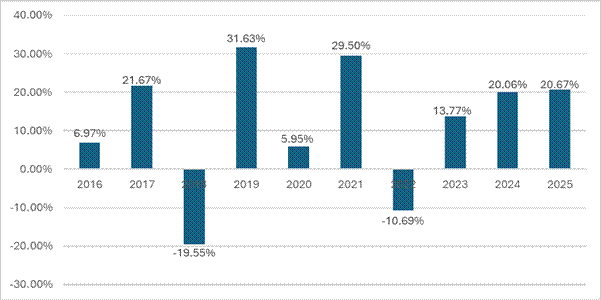
The Manor Fund’s year-to-date total return through
March 31, 2026 was 0.63%. During the period shown in the bar chart above, the
Average Annual Total Returns
For the Periods ended December 31, 2025
| 1 Year | 5 Years | 10 Years | |
| Return before taxes | |||
| Return after taxes on distributions | |||
|
Return after taxes on distributions & sale of Fund shares |
|||
|
S&P 500 Index Reflects no deduction for fees, expenses or taxes |
|||
The primary index for comparison is the S&P 500 Index, a broad market index of large capitalization stocks.
| 3 |
Investment Advisor
Smithbridge Asset Management, Inc. is the investment advisor to the Manor Fund.
Portfolio Manager
Jonathan F. Kolle, CFA has been the portfolio manager of the Manor Fund since February 1, 2026.
Purchase and Sale of Fund Shares
Minimum initial purchase for Manor Fund shares is $1,000 with minimum subsequent purchases of $25. Shares can be purchased by check payable to Manor Investment Funds c/o Mutual Shareholder Services, LLC, 8000 Town Centre Drive, Suite 400, Broadview Heights, OH 44147. Manor Fund shares can be redeemed by calling Mutual Shareholder Services at 800-663-4851.
You may purchase and redeem (sell) shares of the Manor Fund on any business day through certain broker-dealers and other financial intermediaries.
Tax Information
Distributions from the Manor Fund may be taxable as ordinary income or capital gains unless you are investing through a tax-deferred arrangement such as an individual retirement account.
Payments to Broker-Dealers and Other Financial Intermediaries
If you purchase the Manor Fund through a broker-dealer or other financial intermediary (such as a bank), the distributor or advisor and its related companies may provide compensation for the sale of Fund shares and related services. These payments may create a conflict of interest by influencing the broker-dealer or other intermediary and your salesperson to recommend Manor Fund over another investment. Ask your salesperson or visit your financial intermediary’s website for more information.
| 4 |
Manor Growth Fund
The Manor Growth Fund seeks long-term capital appreciation.
This table describes the fees and expenses you may pay if you buy and hold shares of the Manor Growth Fund. You may pay other fees, such as brokerage commissions and other fees to financial intermediaries, which are not reflected in the tables and examples below.
(Fees paid directly from your investment)
| Maximum Sales Charge (Load) Imposed on Purchases (as a percentage of offering price) | |
| Maximum Deferred Sales Charge (Load) | |
| Maximum Sales Charge (Load) Imposed on Reinvested Dividends | |
| Redemption Fee |
Annual Fund Operating Expenses
(Expenses that you pay each year as a percentage of the value of your investments)
| Management Expenses | |
| Other Expenses | |
| Total Annual Fund Operating Expenses |
This example is intended to help you compare the cost of investing in shares of the Manor Growth Fund with the cost of investing in other mutual funds. The example assumes that you invest $10,000 in the Manor Growth Fund for the time periods indicated and then redeem all of your shares at the end of those periods. The example also assumes that your investment has a 5% return each year and that the Manor Growth Fund’s operating expenses remain the same. Although your actual costs may be higher or lower, based on these assumptions your costs would be:
| 1 Year | 3 Years | 5 Years | 10 Years | |
| Manor Growth Fund | $ |
$ |
$ |
$ |
The Manor Growth Fund pays transaction costs, such
as commissions, when it buys and sells securities (or “turns over” its portfolio). A higher portfolio turnover rate may indicate
higher transaction costs and may result in higher taxes when Manor Growth Fund shares are held in a taxable account. These costs, which
are not reflected in annual fund operating expenses or in the example, affect the Manor Growth Fund’s performance. During the most
recent fiscal year, the portfolio turnover rate for the Manor Growth Fund was
The Manor Growth Fund invests primarily in the common stock of large U.S. corporations with an average market capitalization generally over $7.5 billion, when the advisor believes the shares are priced attractively relative to the growth potential of company earnings. The Manor Growth Fund generally holds individual investments for three to five years, but occasionally, securities may be sold within 12 months of purchase if circumstances of a particular company, industry, or the general market should change.
| 5 |
Principal Risks
Risks in the Manor Growth Fund include:
the possibility of a general decline in the stock market,
the possibility that a shift in economic conditions will adversely impact companies with strong growth rates,
or that the Manor Growth Fund manager will be unsuccessful in identifying attractive investments.
In addition to the risks outlined above, the Manor Growth Fund carries the risk that Jonathan F. Kolle, the portfolio manager, will be unable to perform his duties due to death or disability.
In addition to the risks associated with the investment strategy of the Manor Growth Fund, an investor is subject to risk from general market fluctuations, interest rate shifts, credit risk, the effect of inflation, and technology sector risk.
Market Risk
In the event of a general market decline, the value of the Manor Growth Fund could decline. The values of investments may change, and possibly decrease, perhaps severely, in response to fluctuations in the stock market generally.
Interest Rate Risk
If interest rates increase the value of portfolio investments could decline. The potential for fluctuations in bond prices is primarily due to changes in interest rates.
Credit Risk
Credit risk could impact the value of specific stock or bond investments, or an entire industry sector, if investors become concerned about the ability of creditors to continue debt service on an ongoing basis. Credit risk is the chance that the issuer of a bond will default on its promise to pay interest and or principal at maturity.
Inflation Risk
Inflation is the impact of rising prices over time. It has the effect of reducing the future value of financial assets due to decreased purchasing power. The impact of inflation, and investors’ expectations of future inflation, can impact the current value of portfolio investments, resulting in lower stock prices.
Management Risk
The Manor Growth Fund is actively managed and depends heavily on the advisor’s judgment about markets, interest rates or the attractiveness, relative values, liquidity, or potential appreciation of particular investments made for the Fund’s portfolio. The Manor Growth Fund could experience losses if these judgments prove to be incorrect. Additionally, legislative, regulatory, or tax developments may adversely affect management of the Manor Growth Fund and, therefore, the ability of the Manor Growth Fund to achieve its investment objective.
Technology Sector Risk
Equity Risk
Equity securities may decline in value because of factors affecting a particular company or the market in general. Equity securities are susceptible to general stock market movements and may have sudden drops in value due to volatility.
| 6 |
The bar chart below shows how the Manor Growth Fund’s
investment results vary from year to year. The table below shows how the Manor Growth Fund’s average annual total returns compare
over time to those of a broad-based securities market index. This information provides some indication of the risks of investing in the
Manor Growth Fund.
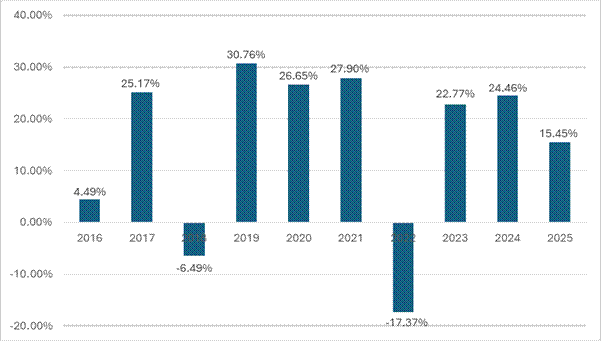
The Manor Growth Fund’s year-to-date total return
through March 31, 2026 was -9.77%. During the period shown in the bar chart above, the
Average Annual Total Returns
For the Periods ended December 31, 2025
| 1 Year | 5 Years | 10 Years | |
| Return before taxes | |||
| Return after taxes on distributions | |||
|
Return after taxes on distributions & sale of Fund shares |
|||
|
S&P 500 Index Reflects no deduction for fees, expenses or taxes |
The primary index for comparison is the S&P 500 Index, a broad market index of large capitalization stocks.
| 7 |
Investment Advisor
Smithbridge Asset Management, Inc. is the investment advisor to the Manor Growth Fund.
Portfolio Manager
Jonathan F. Kolle, CFA has been the portfolio manager of the Manor Growth Fund since February 1, 2026.
Purchase and Sale of Fund Shares
Minimum initial purchase for Fund shares is $1,000 with minimum subsequent purchases of $25. Shares can be purchased by check payable to Manor Investment Funds c/o Mutual Shareholder Services, LLC, 8000 Town Centre Drive, Suite 400, Broadview Heights, OH 44147. Manor Growth Fund shares can be redeemed by calling Mutual Shareholder Services at 800-663-4851.
You may purchase and redeem (sell) shares of the Manor Growth Fund on any business day through certain broker-dealers and other financial intermediaries.
Tax Information
Distributions from the Manor Growth Fund may be taxable as ordinary income or capital gains unless you are investing through a tax-deferred arrangement such as an individual retirement account.
Purchases to Broker-Dealers and Other Financial Intermediaries
If you purchase the Manor Growth Fund through a broker-dealer or other financial intermediary (such as a bank), the distributor or advisor and its related companies may provide compensation for the sale of Fund shares and related services. These payments may create a conflict of interest by influencing the broker-dealer or other intermediary and your salesperson to recommend the Manor Growth Fund over another investment. Ask your salesperson or visit your financial intermediary’s website for more information.
| 8 |
Manor Bond Fund
The Manor Bond Fund seeks to provide current income.
This table describes the fees and expenses you may pay if you buy and hold shares of the Manor Bond Fund. You may pay other fees, such as brokerage commissions and other fees to financial intermediaries, which are not reflected in the tables and examples below.
(Fees paid directly from your investment)
| Maximum Sales Charge (Load) Imposed on Purchases (as a percentage of offering price) | |
| Maximum Deferred Sales Charge (Load) | |
| Maximum Sales Charge (Load) Imposed on Reinvested Dividends | |
| Redemption Fee |
Annual Fund Operating Expenses
(Expenses that you pay each year as a percentage of the value of your investments)
| Management Expenses | |
| Other Expenses | |
| Total Annual Fund Operating Expenses |
This example is intended to help you compare the cost of investing in shares of the Manor Bond Fund with the cost of investing in other mutual funds. The example assumes that you invest $10,000 in the Manor Bond Fund for the time periods indicated and then redeem all of your shares at the end of those periods. The example also assumes that your investment has a 5% return each year and that the Manor Bond Fund’s operating expenses remain the same. Although your actual costs may be higher or lower, based on these assumptions your costs would be:
| 1 Year | 3 Years | 5 Years | 10 Years | |
| Manor Bond Fund | $ |
$ |
$ |
$ |
The Manor Bond Fund pays transaction costs, such as
commissions, when it buys and sells securities (or “turns over” its portfolios). A higher portfolio turnover rate may indicate
higher transaction costs and may result in higher taxes when Manor Bond Fund shares are held in a taxable account. These costs, which
are not reflected in annual fund operating expenses or in the previous expense example, affect the performance of the Manor Bond Fund.
During the most recent fiscal year, the portfolio turnover rate for the Manor Bond Fund was
The Manor Bond Fund invests primarily in income producing securities issued by the U.S. Government or Agencies of the U.S. Government, such as U.S. Treasury bills, notes, and bonds, or securities issued by GNMA, FNMA and FHLB. The Manor Bond Fund generally maintains an average maturity of three to seven years, depending upon the interest rate and economic environment, but occasionally, securities may be sold within 12 months of purchase if circumstances of a particular company, industry, or the general market should change.
| 9 |
Principal Risks
Risks in the Manor Bond Fund include:
the possibility that a rise in interest rates or inflation expectations will result in a decline in the value of portfolio investments,
or that the portfolio manager will be unsuccessful in structuring the portfolio to take advantage of shifts in the interest rate markets.
In addition to the risks outlined above, the Manor Bond Fund carries the risk that Jonathan F. Kolle, the portfolio manager, will be unable to perform his duties due to death or disability.
In addition to the risks associated with the investment strategy of the Manor Bond Fund, an investor is subject to risk from general market fluctuations, interest rate shifts, credit risk, and the effect of inflation.
Market Risk
In the event of a general market decline, the value of the Manor Bond Fund could decline. The values of investments may change, and possibly decrease, perhaps severely, in response to fluctuations in the market generally.
Interest Rate Risk
If interest rates increase the value of portfolio investments could decline. The potential for fluctuations in bond prices is primarily due to changes in interest rates.
Credit Risk
Credit risk could impact the value of specific stock or bond investments, or an entire industry sector, if investors become concerned about the ability of creditors to continue debt service on an ongoing basis. Credit risk is the chance that the issuer of a bond will default on its promise to pay interest and or principal at maturity.
Inflation Risk
Inflation is the impact of rising prices over time. It has the effect of reducing the future value of financial assets due to decreased purchasing power. The impact of inflation, and investors’ expectations of future inflation, can impact the current value of portfolio investments, resulting in lower prices.
Management Risk
The Manor Bond Fund is actively managed and depends heavily on the advisor’s judgment about markets, interest rates or the attractiveness, relative values, liquidity, or potential appreciation of particular investments made for the Fund’s portfolio. The Manor Bond Fund could experience losses if these judgments prove to be incorrect. Additionally, legislative, regulatory, or tax developments may adversely affect management of the Manor Bond Fund and, therefore, the ability of the Manor Bond Fund to achieve its investment objective.
| 10 |
The bar chart below shows how the Manor Bond Fund’s
investment results vary from year to year. The table below shows how the Manor Bond Fund’s average annual total returns compare
over time to those of a broad-based securities market index. This information provides some indication of the risks of investing in the
Bond Fund.

The Manor Bond Fund’s year-to-date total return
through March 31, 2026 was -0.10%. During the period shown in the bar chart above, the
Average Annual Total Returns
For the Periods ended December 31, 2025
| 1 Year | 5 Years | 10 Years | ||
| Return before taxes | - |
|||
| Return after taxes on distributions | - |
|||
|
Return after taxes on distributions & sale of Fund shares |
- |
|||
| Bloomberg Intermediate-term Treasury Index - Reflects no deduction for fees, expenses or taxes | ||||
The primary index for comparison is the Bloomberg Intermediate-term US Treasury Index, an index of US Treasury Notes with a maximum maturity of 10 years.
| 11 |
Investment Advisor
Smithbridge Asset Management, Inc. is the investment advisor to the Manor Bond Fund.
Portfolio Manager
Jonathan F. Kolle, CFA has been the portfolio manager of the Manor Bond Fund since February 1, 2026.
Purchase and Sale of Fund Shares
Minimum initial purchase for Fund shares is $1,000 with minimum subsequent purchases of $25. Shares can be purchased by check payable to Manor Investment Funds c/o Mutual Shareholder Services, LLC, 8000 Town Centre Drive, Suite 400, Broadview Heights, OH, 44147. Fund shares can be redeemed by calling Mutual Shareholder Services at 800-663-4851.
You may purchase and redeem (sell) shares of the Manor Bond Fund on any business day through certain broker-dealers and other financial intermediaries.
Tax Information
Distributions from the Manor Bond Fund may be taxable as ordinary income or capital gains unless you are investing through a tax-deferred arrangement such as an individual retirement account.
Payments to Broker-Dealers and Other Financial Intermediaries
If you purchase the Manor Bond Fund through a broker-dealer or other financial intermediary (such as a bank), the Manor Bond Fund and its related companies may provide compensation for the sale of Fund shares and related services. These payments may create a conflict of interest by influencing the broker-dealer or other intermediary and your salesperson to recommend the Manor Bond Fund over another investment. Ask your salesperson or visit your financial intermediary’s website for more information.
| 12 |
INVESTMENT OBJECTIVES AND POLICIES AND NON-PRINCIPAL RISKS
Principal Investment Strategies
The following sections explain the principal investment strategies and policies that each Fund uses in pursuit of its objective. The Funds’ Board of Trustees, which oversee the managers of the Funds, may change investment strategies or policies in the interest of shareholders without a shareholder vote, unless those strategies or policies are designated as fundamental.
The Manor Fund invests primarily in the common stock of large corporations with an average market capitalization generally greater than $50 billion or more. The Manor Fund may also invest in the preferred stock or the corporate fixed income securities of these companies that are convertible into common stock. The primary consideration in the selection of stock investments for the Manor Fund is the current price of the shares relative to the earnings and potential growth of earnings for each company. Under normal market conditions, the Fund should be fully invested. The Manor Fund generally holds individual investments for three to five years, but occasionally, securities may be sold within 12 months of purchase if circumstances of a particular company, industry, or the general market should change.
The Manor Growth Fund invests primarily in the common stock of large corporations with an average market capitalization generally greater than $7.5 billion. The Manor Growth Fund generally invests in companies that have strong growth in earnings or revenues, the potential to maintain above average growth, and a reasonable valuation relative to the growth potential. Under normal market conditions, the Fund should be fully invested. The Manor Growth Fund generally holds individual investments for three to five years. In seeking to achieve its investment objective, the Fund ordinarily invests on a long-term basis, but occasionally, securities may be sold within 12 months of purchase if circumstances of a particular company, industry, or the general market should change.
The Manor Bond Fund invests primarily in income producing securities issued by the U.S. Government or Agencies of the U.S. Government, such as U.S. Treasury bills, notes and bonds, or securities issued by GNMA, FNMA and FHLB. The Manor Bond Fund generally maintains an average maturity of three to seven years, depending upon the interest rate and economic environment. The Manor Bond Fund generally maintains an overall credit rating of A or better for portfolio securities, as measured by Moody's or S&P. The Manor Bond Fund may also invest in short term securities issued at a discount to face value such as U.S. Treasury bills. The Manor Bond Fund will generally hold investments to maturity; however, positions may be liquidated to shift the interest rate sensitivity of the portfolio in response to changing market and economic conditions. The portfolio manager will actively manage the average maturity of the portfolio by reducing the maturity of portfolio securities in anticipation of rising interest rate environments and extending the maturity of portfolio securities in anticipation of falling interest rate environments.
Principal Investment Risks:
As with all mutual funds, there is risk that you could lose money through your investment in the Funds. Investing in the Funds can result in a loss of some or all amounts invested. Below are the main risks of investing in each Fund. All of the risks listed below are material to the Funds, regardless of the order in which they appear.
Market Risk
In the event of a general market decline, the value of a Fund could decline. The values of investments may change, and possibly decrease, perhaps severely, in response to fluctuations in the stock market generally.
Interest Rate Risk
If interest rates increase the value of portfolio investments could decline. The potential for fluctuations in bond prices is primarily due to changes in interest rates.
| 13 |
Credit Risk
Credit risk could impact the value of specific stock or bond investments, or an entire industry sector, if investors become concerned about the ability of creditors to continue debt service on an ongoing basis. Credit risk is the chance that the issuer of a bond will default on its promise to pay interest and or principal at maturity.
Inflation Risk
Inflation is the impact of rising prices over time. It has the effect of reducing the future value of financial assets due to decreased purchasing power. The impact of inflation, and investors’ expectations of future inflation, can impact the current value of portfolio investments, resulting in lower stock prices.
Management Risk
Each Fund is actively managed and depends heavily on the advisor’s judgment about markets, interest rates or the attractiveness, relative values, liquidity, or potential appreciation of particular investments made for the Fund’s portfolio. Each Fund could experience losses if these judgments prove to be incorrect. Additionally, legislative, regulatory, or tax developments may adversely affect management of a Fund and, therefore, the ability of the Fund to achieve its investment objective.
Equity Risk (Manor Growth Fund only)
Equity securities may decline in value because of factors affecting a particular company or the market in general. Equity securities are susceptible to general stock market movements and may have sudden drops in value due to volatility.
Large Capitalization Company Risk (Manor Fund only)
Large capitalization companies may be less able than smaller capitalization companies to adapt to changing market conditions. Large capitalization companies may be more mature and subject to more limited growth potential compared to smaller capitalization companies.
Technology Sector Risk (Manor Fund and Manor Growth Fund only)
The Funds may, at times invest a substantial portion of the portfolio in companies in the technology sector. Companies in this sector are subject to the risk of rapidly changing technological developments and highly competitive industry participants. As a result, many companies can have variable earnings and may not pay dividends, leading to higher volatility as investor expectations shift.
| 14 |
MANAGEMENT OF THE FUNDS
The Funds offer only one class of shares for each Fund.
Smithbridge Asset Management, Inc. (the “Advisor”), 6 Hillman Drive, Chadds Ford, PA, a Delaware Corporation, acts as sole investment advisor to the Funds under an investment advisory agreement approved by the Board of Trustees at a meeting held on February 15, 2023. As of March 31, 2026, the Advisor managed $800 million in assets under management.
Each of the Funds, under an investment advisory agreement between the respective Fund and the Advisor, pays the Advisor a fee. During the most recent fiscal year, the Adviser received compensation of 1.25%, 0.99% and 0.95% of the daily net assets of the Manor Fund, the Manor Growth Fund, and the Manor Bond Fund, respectively. The fee is computed and payable at the end of each month. Under the investment advisory agreement, the annual percentage of average daily net assets payable for the Advisor's investment management fee will be 0.75% for the Manor Fund and the Manor Growth Fund, and 0.50% for the Manor Bond Fund. The investment advisory agreement also includes an administrative fee not to exceed 0.50%, 0.24% and 0.45% of average net assets of Manor Fund, Manor Growth Fund, and Manor Bond Fund, respectively.
Jonathan F. Kolle, CFA has been a portfolio manager of the Funds since February 1, 2026. Mr. Kolle, President and Chief Investment Officer, joined the Advisor in 1999 as a portfolio manager and Vice President. He has been President and Chief Investment of the Advisor since 2013. Mr. Kolle has over 30 years of investment experience and previously held senior positions at Wilmington Trust and its investment subsidiary, Wilmington Capital Management. He began his career in investment banking and corporate finance.
The Funds’ statement of additional information (“SAI”), which is incorporated by reference into this prospectus, provides additional information about the compensation of the portfolio manager, other accounts managed by the portfolio manager and the ownership of Fund securities by the portfolio manager.
INVESTING WITH MANOR INVESTMENT FUNDS
Purchasing Shares
The offering price of shares is the net asset value per share next determined after receipt of the purchase order by a Fund and is computed in the manner described under the caption “PRICING OF SHARES” in this Prospectus. Each Fund reserves the right at its sole discretion to terminate the offering of its shares made by this Prospectus at any time and to reject purchase applications when, in the judgment of the management such termination or rejection is in the best interests of the Fund. A Fund will maintain an account for each shareholder.
The initial purchase of shares of the Funds may be made by application to the Fund, or through an Authorized Institution. To purchase shares, mail a check payable to Manor Investment Funds, complete the application form included in this Prospectus, and mail to Manor Investment Funds, 8000 Town Centre Drive, Suite 400, Broadview Heights, OH 44147. For additional information contact the Funds at 800-663-4851. Shareholders may also authorize the Funds to automatically debit their bank account to purchase shares by completing the necessary information on their account application. Shareholders may also purchase shares of any Fund by directing a transfer from another Fund by telephone. Shares can also be purchased by automatic payroll deduction, or by automatic deduction from an account that you specify.
You may also purchase shares of the Funds through certain Authorized Institutions. In order to make an initial investment in a Fund through an Authorized Institution you must furnish to your Authorized Institution the information in the Account Application. Customers of certain Authorized Institutions will normally give their purchase instructions to the Authorized Institution, and the Authorized Institution will, in turn, place purchase orders with the Funds. Authorized Institutions will set times by which purchase orders and payments must be received by them from their customers.
If shares of a Fund are held in a “street name” account (i.e., accounts maintained and serviced by your Authorized Institution), all recordkeeping, transaction processing and payments of distributions relating to your account will be performed by your Authorized Institution, and not by a Fund and its transfer agent. Since the Funds will have no record of your transactions, you should contact your Authorized Institution to purchase,
| 15 |
redeem or exchange shares, to make changes in or give instructions concerning your account or to obtain information about your account. The transfer of shares in a “street name” account to an account with another Authorized Institution involves special procedures and may require you to obtain historical purchase information about the shares in the account from your Authorized Institution. If your Authorized Institution’s relationship with the Funds is terminated, and you do not transfer your account to another Authorized Institution, the Funds reserve the right to redeem your shares. The Funds will not be responsible for any loss in an investor’s account or tax liability resulting from a redemption.
Certain Authorized Institutions may provide the following services in connection with their customers’ investments in the Funds:
Personal and account maintenance services
Provide facilities to answer inquiries and respond to correspondence,
Act as liaison between the Authorized Institution’s customers and the Funds,
Assist customers in completing application forms, selecting dividend and other options, and similar services.
Shareholder administration services
Act, directly or through an agent, as the sole shareholder of record,
Maintain account records for customers,
Process orders to purchase, redeem and exchange shares for customers, and
Process payments for customers.
Certain Authorized Institutions and other financial intermediaries may be authorized to accept, on behalf of the Funds, purchase, redemption, and exchange orders placed by or on behalf of their customers to designate other financial intermediaries to accept such orders. In these cases:
A Fund will be deemed to have received an order that is in proper form when the order is accepted by an Authorized Institution or other financial intermediary on a business day, and the order will be priced at the Fund’s NAV per share next determined after such acceptance.
Authorized Institutions and other financial intermediaries are responsible for transmitting accepted orders to the Funds within the time period agreed upon by them.
Authorized Institutions that invest in shares on behalf of their customers may charge fees directly to their customer accounts in connection with their purchase or redemption of Fund shares. You should contact your Authorized Institution for information regarding such charges, as these fees, if any, may affect the return such customers realize with respect to their investments.
The Advisor may make payments or provide services to Authorized Institutions and other financial intermediaries (“Intermediaries”) to promote the sale, distribution and/or servicing of shares of the Funds. These payments are made out of the Advisor’s own assets, and are not an additional charge to the Funds. The payments are in addition to any shareholder service fees that may be charged to the Funds. Such payments are intended to compensate Intermediaries for, among other things: marketing shares of the Funds, which may consist of payments relating to the Funds’ inclusion on preferred or recommended fund lists or in certain sales programs sponsored by the Intermediaries; access to the Intermediaries’ registered representatives or salespersons, including at conferences and other meetings; assistance in training and education of personnel; marketing support; and/or other specified services intended to assist in the distribution and marketing of the Funds. The payments may also, to the extent permitted by applicable regulations, contribute to various non-cash and cash incentive arrangements to promote the sale of shares, as well as sponsor various educational programs, sales contests and/or promotions. The payments by the Advisor may also compensate Intermediaries for sub-accounting, sub-transfer agency, administrative and/or shareholder processing services. These additional payments may exceed amounts earned on these assets by the Advisor and/or their affiliates for the performance of these or similar services. The amount of these additional payments is normally not expected to exceed 0.40% (annualized) of the amount sold or invested through the Intermediaries. Please refer to the “Payments to Intermediaries” section of the SAI for more information about these payments and services.
The payments made by the Advisor and/or its affiliates and the services provided by an Intermediary may differ for different Intermediaries. The presence of these payments, receipt of these services and the basis on which an Intermediary compensates its registered representatives or salespersons may create an incentive for a particular Intermediary, registered representative or salesperson to highlight, feature or recommend Funds based, at least
| 16 |
in part, on the level of compensation paid. You should contact your Authorized Institution or other Intermediary for more information about the payments it receives and any potential conflicts of interest.
Redeeming Shares
A Fund will redeem all or any portion of the total amount of the shares of any shareholder upon request in writing or by phone. Proper endorsements guaranteed either by a national bank or a member firm of the New York Stock Exchange may be required for requests in writing. Redemptions and transfers between Funds can also be initiated by telephone instructions or in writing.
Shares are redeemed at the net asset value per share next determined after notice is received by a Fund. The proceeds received by the shareholder may be more or less than the cost of such shares, depending upon the net asset value per share at the time of redemption; the difference should be treated by the shareholder as a capital gain or loss, as the case may be, for federal income tax purposes.
Payment by a Fund will ordinarily be made by check or by automated clearing house transfer within seven days after tender. A Fund may suspend the right of redemption or postpone the date of payment if: The New York Stock Exchange is closed for other than customary weekend or holiday closings, or when trading on the New York Stock Exchange is restricted as determined by the Securities and Exchange Commission, or when the Securities and Exchange Commission has determined that an emergency exists, making disposal of Fund securities or valuation of net assets not reasonably practicable. To redeem shares, send your written request to Manor Investment Funds, 8000 Town Centre Drive, Suite 400, Broadview Heights, OH 44147, or call the Funds at 800-663-4851 to request a redemption by phone.
You should contact your Authorized Institution to discuss redemptions and redemption proceeds. Certain Authorized Institutions are authorized to accept redemption requests on behalf of the Funds. A Fund may transfer redemption proceeds to an account with your Authorized Institution. In the alternative, your Authorized Institution may request that redemption proceeds be sent to you by check or wire (if the wire instructions are designated in the current records of the transfer agent). Redemptions may be requested by your Authorized Institution in writing, by telephone or through an electronic trading platform.
Exchanging Shares
Shareholders can also exchange shares among any of the three fund series of the Manor funds group by simultaneously selling the shares of one fund and using the proceeds to purchase shares of another fund. Exchange transactions can be initiated by written request to Manor Investment Funds, 8000 Town Centre Drive, Suite 400, Broadview Heights, OH 44147, or by calling the Fund at 800-663-4851.
Frequent Purchases and Redemptions
Frequent purchase and redemption transactions of a Fund, sometimes referred to as “market timing,” create risk for the shareholder initiating the transactions and for other shareholders. Shareholders who participate in this short-term trading philosophy run the risk of realizing substantial losses from ill-timed transactions, forfeiting the opportunity to participate in long-term market trends, and losing the benefit of favorable taxation on long-term investment holdings. Active trading of this sort undermines the long-term investment philosophy of a Fund. Other shareholders can experience lower investment returns if active trading creates higher portfolio turnover, thus generating short-term gains and losses that must be distributed as Fund dividends.
The Board of Trustees has adopted a policy to deter excessive trading by Fund shareholders. The Board of Trustees will review any account that generates more than three buy/sell transactions in a quarter or redeems substantially all of the holdings in an account within 30 days of purchase. The Board of Trustee also reserves the right to reject any investment in s Fund if it is deemed that the size of the purchase or expected duration may adversely impact existing shareholders. The Board of Trustees will proactively seek to close the accounts of shareholders when they are deemed to be disruptive to the long-term investment goals of the Funds.
Pricing of Shares
The net asset value of the shares for each Fund is determined as of the close of trading (presently 4:00 p.m.) on the New York Stock Exchange on each business day the Exchange is open. The Exchange is closed on most national holidays. The net asset value is not calculated if the New York Stock Exchange is closed for trading. The price is determined by dividing the value of its securities, plus any cash and other assets less all liabilities,
| 17 |
by the number of shares outstanding. The market value of securities listed on a national exchange is determined to be the last recent sales price on such exchange. Listed securities that have not recently traded and over-the-counter securities are valued at the last bid price in such market. Short-term paper (debt obligations that mature in less than 60 days) are valued at amortized cost which approximates market value. Other assets are valued at fair value as determined in good faith by the Board of Trustees.
Other Information You Should Know
In addition to the rights expressly stated elsewhere in this Prospectus, the Funds reserve the right, without notice, to (1) alter, add, or discontinue any conditions of purchase (including eligibility requirements), redemption, exchange, conversion, service, or privilege at any time; (2) accept initial purchases by telephone; (3) freeze any account and/or suspend account services if the Funds has received reasonable notice of a dispute regarding the assets in an account, including notice of a dispute between the registered or beneficial account owners, or if we reasonably believe a fraudulent transaction may occur or has occurred; (4) temporarily freeze any account and/or suspend account services upon initial notification to the Funds of the death of the shareholder until the Funds receives required documentation in good order; (5) alter, impose, discontinue, or waive any redemption fee, account service fee, or other fees charged to a group of shareholders; and (6) redeem an account or suspend account privileges, without the owner’s permission to do so, in cases of threatening conduct or activity the Funds believes to be suspicious, fraudulent, or illegal. Changes may affect any or all investors. These actions will be taken when, at the sole discretion of the Funds’ management, we reasonably believe they are deemed to be in the best interest of a Fund.
DISTRIBUTIONS AND TAXES
Dividends and Capital Gain Distributions
The Funds will automatically retain and reinvest dividends and capital gain distributions and purchase additional shares for the shareholder at net asset value as of the close of business on the distribution date. A shareholder may at any time by letter or forms supplied by a Fund direct the payment of dividend and/or capital gains distributions, if any, to such shareholder in cash.
Taxes
The Funds will endeavor to qualify annually for and elect tax treatment applicable to a regulated investment company under Subchapter M of the Internal Revenue Code (the “Code”).
Distribution of any net long-term capital gains realized by the Funds will be taxable to the shareholder as long-term capital gains, regardless of the length of time Fund shares have been held by the investor. All income realized by a Fund including short-term capital gains, will be taxable to the shareholder as ordinary income. Dividends from net income will be made annually or more frequently at the discretion of the Board of Trustees. Dividends received shortly after purchase of shares by an investor will have the effect of reducing the per share net asset value of his shares by the amount of such dividends or distributions and, although in effect a return of capital, are subject to federal income taxes. An exchange of a Fund’s shares for shares of another Fund will be treated as a sale and any gain or loss on the transaction may impact your federal income tax.
A Fund is required by Federal law to withhold 31% of reportable payments (which may include dividends, capital gains, distributions and redemptions) paid to shareholders who have not complied with IRS regulations. In order to avoid this withholding requirement, you must certify on the application form supplied by a Fund that your Social Security or Taxpayer Identification Number provided is correct and that you are not currently subject to back-up withholding, or that you are exempt from back-up withholding.
Shareholder Services Plan
The Funds have adopted a Shareholder Services Plan (the “Services Plan”), pursuant to which the Funds will pay an annual service fee at the rate of 0.25% of each Fund’s average daily net assets. The Services Plan is intended to support shareholder liaison services, such as personal shareholder servicing and maintenance of shareholder accounts, including responding to customer inquiries and providing requested information on investments. The fee may also be used to pay financial advisors and correspondent firms for shareholder servicing.
| 18 |
GENERAL INFORMATION
Sanville & Company, 2617 Huntington Pike, Huntington Valley, PA 19006, serves as the independent registered public accounting firm for the Funds.
Argent Institutional Trust Company, 1715 N. Westshore Blvd., Suite 750, Tampa, FL, 33607, serves as custodian for the Funds.
Mutual Shareholder Services, LLC 8000 Town Centre Drive, Suite 400, Broadview Heights, OH 44147 acts as transfer agent for the Funds.
| 19 |
FINANCIAL HIGHLIGHTS
The financial highlights tables on the following pages are intended to help you understand each Fund’s financial performance for the past five years. Certain information reflects financial results for a single Fund share. The total returns in the table represent the rate that an investor would have earned, or lost, on an investment in the Fund (assuming reinvestment of all dividends and distributions). This information has been audited by Sanville & Company, the Funds’ independent registered public accounting firm, whose report, along with the Funds’ financial statements, are available upon request.
MANOR FUND
Financial Highlights
For a share of capital stock outstanding throughout the period
| Years Ended | ||||||
| 12/31/2025 | 12/31/2024 | 12/31/2023 | 12/31/2022 | 12/31/2021 | ||
| Net Asset Value, at Beginning of Year | $ 37.21 | $ 33.13 | $ 29.41 | $ 34.48 | $ 27.54 | |
| Income From Investment Operations: | ||||||
| Net Investment Income * | 0.05 | 0.15 | 0.27 | 0.31 | 0.13 | |
| Net Gain (Loss) on Securities (Realized and Unrealized) | 7.69 | 6.53 | 3.78 | (4.01) | 8.00 | |
| Total from Investment Operations | 7.74 | 6.68 | 4.05 | (3.70) | 8.13 | |
| Distributions: | ||||||
| Net Investment Income | (0.05) | (0.15) | (0.28) | (0.32) | (0.14) | |
| Realized Gains | (3.40) | (2.45) | (0.05) | (1.05) | (1.05) | |
| Total from Distributions | (3.45) | (2.60) | (0.33) | (1.37) | (1.19) | |
| Net Asset Value, at End of Year | $ 41.50 | $ 37.21 | $ 33.13 | $ 29.41 | $ 34.48 | |
| Total Return ** | 20.67% | 20.06% | 13.77% | (10.69)% | 29.50% | |
| Ratios/Supplemental Data: | ||||||
| Net Assets at End of Year (Thousands) | $ 11,298 | $ 9,744 | $ 8,288 | $ 7,564 | $ 8,873 | |
| Ratio of Expenses to Average Net Assets | 1.25% | 1.25% | 1.25% | 1.25% | 1.25% | |
| Ratio of Net Investment Income to Average Net Assets | 0.11% | 0.40% | 0.89% | 0.99% | 0.41% | |
| Portfolio Turnover | 9.54% | 12.04% | 9.46% | 0.00% | 3.20% | |
| * Per share net investment income has been determined on the basis of average shares outstanding during the year. | ||||||
| ** Total return in the above table represents the rate that the investor would have earned or lost on an investment in the Fund | ||||||
| assuming reinvestment of dividends. | ||||||
| 20 |
MANOR GROWTH FUND
Financial Highlights
For a share of capital stock outstanding throughout the period
| Years Ended | ||||||
| 12/31/2025 | 12/31/2024 | 12/31/2023 | 12/31/2022 | 12/31/2021 | ||
| Net Asset Value, at Beginning of Year | $ 41.94 | $ 35.46 | $ 29.74 | $ 37.94 | $ 31.08 | |
| Income From Investment Operations: | ||||||
| Net Investment Income (Loss) * | (0.12) | (0.06) | 0.08 | 0.04 | (0.08) | |
| Net Gain (Loss) on Securities (Realized and Unrealized) | 6.64 | 8.77 | 6.70 | (6.65) | 8.77 | |
| Total from Investment Operations | 6.52 | 8.71 | 6.78 | (6.61) | 8.69 | |
| Distributions: | ||||||
| Net Investment Income | - | - | (0.08) | (0.04) | - | |
| Realized Gains | (3.82) | (2.23) | (0.98) | (1.55) | (1.83) | |
| Total from Distributions | (3.82) | (2.23) | (1.06) | (1.59) | (1.83) | |
| Net Asset Value, at End of Year | $ 44.64 | $ 41.94 | $ 35.46 | $ 29.74 | $ 37.94 | |
| Total Return ** | 15.45% | 24.46% | 22.77% | (17.37)% | 27.90% | |
| Ratios/Supplemental Data: | ||||||
| Net Assets at End of Year (Thousands) | $ 18,858 | $ 17,553 | $ 14,592 | $ 12,391 | $ 15,388 | |
| Ratio of Expenses to Average Net Assets | 0.99% | 0.99% | 0.99% | 0.99% | 0.99% | |
| Ratio of Net Investment Income (Loss) to Average Net Assets | (0.27)% | (0.16)% | 0.24% | 0.11% | (0.22)% | |
| Portfolio Turnover | 9.44% | 12.05% | 12.87% | 6.05% | 6.41% | |
| * Per share net investment income (loss) has been determined on the basis of average shares outstanding during the year. | ||||||
| ** Total return in the above table represents the rate that the investor would have earned or lost on an investment in the Fund | ||||||
| assuming reinvestment of dividends. | ||||||
| 21 |
MANOR BOND FUND
Financial Highlights
For a share of capital stock outstanding throughout the period
| Years Ended | ||||||
| 12/31/2025 | 12/31/2024 | 12/31/2023 | 12/31/2022 | 12/31/2021 | ||
| Net Asset Value, at Beginning of Year | $ 9.96 | $ 10.02 | $ 9.74 | $ 10.66 | $ 11.05 | |
| Income From Investment Operations: | ||||||
| Net Investment Income * | 0.22 | 0.20 | 0.14 | 0.06 | 0.07 | |
| Net Gain (Loss) on Securities (Realized and Unrealized) | 0.39 | (0.10) | 0.27 | (0.91) | (0.39) | |
| Total from Investment Operations | 0.61 | 0.10 | 0.41 | (0.85) | (0.32) | |
| Distributions: | ||||||
| Net Investment Income | (0.20) | (0.16) | (0.13) | (0.07) | (0.07) | |
| Total from Distributions | (0.20) | (0.16) | (0.13) | (0.07) | (0.07) | |
| Net Asset Value, at End of Year | $ 10.37 | $ 9.96 | $ 10.02 | $ 9.74 | $ 10.66 | |
| Total Return ** | 6.08% | 0.96% | 4.16% | (8.01)% | (2.94)% | |
| Ratios/Supplemental Data: | ||||||
| Net Assets at End of Year (Thousands) | $ 2,599 | $ 2,495 | $ 1,811 | $ 1,677 | $ 1,788 | |
| Ratio of Expenses to Average Net Assets | 0.95% | 0.95% | 0.95% | 0.95% | 0.95% | |
| Ratio of Net Investment Income to Average Net Assets | 2.16% | 1.94% | 1.46% | 0.64% | 0.61% | |
| Portfolio Turnover | 3.96% | 0.00% | 37.00% | 0.00% | 0.00% | |
| * Per share net investment income has been determined on the basis of average shares outstanding during the year. | ||||||
| ** Total return in the above table represents the rate that the investor would have earned or lost on an investment in the Fund | ||||||
| assuming reinvestment of dividends. | ||||||
| 22 |
PRIVACY POLICIES AND PROCEDURES
Manor Investment Funds, (the “Funds”), believes that our clients’ personal information is private, and the employees of the Funds hold themselves to the highest standards to ensure that clients can trust our commitment to this policy.
The Funds limit the collection and use of personal information to that which is necessary to administer our clients’ accounts, to provide customer services and/or to fulfill legal and regulatory requirements. We collect this information about clients from your applications, forms, and from your transactions with us.
The Funds do not share personal information about clients or former clients to any outside third party unless we are required by law and/or regulatory procedures, or receive your prior written consent.
The Funds disclose nonpublic information about our clients to financial service providers, such as securities broker-dealers executing security transactions, or transfer agents authorized to maintain client accounts.
The Funds restrict access to nonpublic personal information about you only to those employees who need to know that information to provide products or services to you. We maintain physical and procedural safeguards that comply with federal standards to guard your nonpublic personal information.
The Funds will continue to review our efforts to ensure client privacy and make every effort to keep your personal information accurate, current and confidential.
| 23 |
GLOSSARY OF INVESTMENT TERMS
Capital Gains Distribution: Payment to mutual fund shareholders of gains realized on securities that a fund has sold at a profit, minus any realized losses.
Cash Investments: Cash deposits, short-term bank deposits, and money market instruments that include U.S. Treasury bills and notes, bank certificates of deposit (CD’s), repurchase agreements, commercial paper, and bankers' acceptances.
Common Stock: A security representing ownership rights in a corporation. A stockholder is entitled to share in the profits of the company, some of which may be paid out as dividends.
Dividend Distribution: Payment to mutual fund shareholders of income from interest or dividends generated by the investment securities in the portfolio of the Fund,
Expense Ratio: The percentage of the average net assets of the Fund used to pay operating expenses during a fiscal year. The expense ratio includes management expenses, such as advisory fees, account maintenance, reporting, accounting, legal, and other administrative expenses, and any 12b-1 distribution fees. It does not include the transaction costs of buying and selling portfolio securities.
Inception Date: The date on which the assets of a fund (or one of the share classes) are first invested in accordance with the investment objective of the fund. For funds with a subscription period, the inception date is the day after that period ends. Investment performance is measured from the inception date.
Market Capitalization: An indicator of the size of a company in which a fund invests.
Mutual Fund: An investment company that pools the money of many people and invests it in a variety of securities in an effort to achieve a specific objective over time.
Principal: The face value of a debt instrument or the amount of money put into an investment.
Securities: Stocks, bonds, money market instruments, and other investment vehicles.
Total Return: A percentage change, over a specified time period, in the net asset value of a mutual fund, assuming the reinvestment of all distributions of dividends and capital gains.
Volatility: The fluctuations in value of a mutual fund or other security. A high measure of volatility for a fund indicates that the fluctuations in returns will be higher for the fund.
| 24 |
FOR MORE INFORMATION
Additional information about each Fund’s investments is available in the Funds’ annual and semi-annual reports to shareholders. In the Funds’ annual report, you will find a discussion of the market conditions and investment strategies that significantly affected the Funds’ performance during its last fiscal year. A statement of additional information about the Funds has been filed with the Securities and Exchange Commission. The Statement of Additional Information (the “SAI”), dated April 30, 2026 (which is incorporated in its entirety by reference in this Prospectus) contains additional information about the Funds.
To request a free copy of the SAI, a Fund’s annual and semi-annual reports and other information about the Fund, or to make inquiries about the Fund, write the Fund c/o Mutual Shareholder Services, LLC, 8000 Town Centre Drive, Suite 400, Broadview Heights, OH 44147 at 800-663-4851.
Information about the Funds (including the SAI) can be reviewed and copied at the SEC’s public reference room in Washington, D.C. Information about the operation of the public reference room may be obtained by calling the SEC at 1-202-551-8090. Reports and other information about Fund are available on the EDGAR Database on the SEC’s Internet site at http://www.sec.gov, and copies of this information may be obtained, after paying a duplicating fee, by electronic request at the following e-mail address: [email protected], or by writing the writing the SEC’s Public Reference Section, Washington, D.C. 20549-1520.
Manor Investment Funds Company Act File Number: 811-09134
| 25 |
STATEMENT OF ADDITIONAL INFORMATION
April 30, 2026
Manor Investment Funds
Manor Fund (MNRMX)
Manor Growth Fund (MNRGX)
Manor Bond Fund (MNRBX)
8000 Town Centre Drive, Suite 400
Broadview Heights, OH 44147
800-663-4851
This Statement of Additional Information is not a Prospectus, and should be read in conjunction with the Funds’ current Prospectus (dated April 30, 2026). To obtain the Prospectus, please write the Funds or call the telephone number shown above.
TABLE OF CONTENTS
| Funds’ History | 1 |
| Description of the Funds and its Investments & Risks | 1 |
| Management of the Funds | 6 |
| Control Persons and Principal Holders of Securities | 8 |
| Investment Advisory and Other Services | 9 |
| Portfolio Manager | 11 |
| Brokerage Allocation and Other Practices | 11 |
| Capital Stock and Other Securities | 12 |
| Purchase, Redemption and Pricing of Shares | 13 |
| Code of Ethics | 14 |
| Legal Proceedings | 14 |
| Proxy Voting | 14 |
| Independent Registered Public Accounting Firm | 15 |
| Taxation of the Funds | 15 |
| Reports to Shareholders | 15 |
| Retirement Accounts | 16 |
| Transfer Agent | 16 |
| Underwriters | 16 |
| Custodian | 16 |
| Calculation of Performance Data | 16 |
| Financial Statements | 19 |
No person has been authorized to give any information or to make any representations other than those contained in this Statement of Additional Information and the Prospectus dated 4/30/2026 and, if given or made, such information or representations may not be relied upon as having been authorized by Manor Investment Funds.
This Statement of Additional Information does not constitute an offer to sell securities.
Information incorporated by reference into this Statement of Additional Information is available in reports to shareholders. These reports are available, without charge, by calling the offices of the Funds at 800-663-4851, or on the website of the Funds at www.manorfunds.com.
FUNDS’ HISTORY
Manor Investment Funds (the “Trust”) is a Delaware Trust, (effective January 1, 2012) comprising of Manor Fund, Manor Growth Fund and Manor Bond Fund (collectively “the Funds”), and is an open-end diversified management investment company. The Trust was originally incorporated in the Commonwealth of Pennsylvania on September 13, 1995 and was dissolved by domestication in Pennsylvania on January 3, 2012. The Funds’ registered office is 15 Chester Commons, Malvern, PA 19355. Each Fund has distinct investment objectives and policies, and a shareholder’s interest is limited to the series in which he or she owns shares.
DESCRIPTION OF THE FUNDS AND ITS INVESTMENTS AND RISKS
The mutual funds offered are the Manor Fund, Manor Growth Fund, and Manor Bond Fund. Each Fund is a no-load mutual fund. There is no commission or charge when shares are purchased, and no 12b-1 charges. The Funds are series of the Trust, and each Fund is a separate portfolio of securities and other assets, with its own investment objective and policies. Smithbridge Asset Management, Inc. (the “Advisor”) provides investment advisory and administrative services to the Funds under an investment advisory agreement approved by the Board of Trustees (the “Board”) on February 15, 2023.
Investment Objectives
The Manor Fund seeks long-term capital appreciation and a moderate level of income.
The Manor Growth Fund seeks long-term capital appreciation.
The Manor Bond Fund seeks to provide current income.
Principal Investment Strategies
The Manor Fund invests primarily in the common stock of large corporations with an average market capitalization generally greater than $50 billion. The Manor Fund may also invest in the preferred stock or the corporate fixed income securities of these companies that are convertible into common stock. The primary consideration in the selection of stock investments for the Manor Fund is the current price of the shares relative to the earnings and potential growth of earnings for each company. The Manor Fund generally invests in companies with growing earnings and dividends, a high level of free cash flow available to finance growth or repurchase outstanding shares, and a strong financial structure to support future growth. The portfolio manager uses growth and earnings information from industry sources and applies his own proprietary analysis to project future valuations. The portfolio manager invests in companies that he believes have the opportunity to double in value over five years based on their current price relative to future cash flows and the underlying value of the firm’s assets.
Under normal market conditions, the Manor Fund should be fully invested. To the extent that investments meeting the Manor Fund’s criteria for investment are not available, or when the Advisor considers a temporary defensive posture advisable, the Fund may take positions that are inconsistent with the Manor Fund’s principal investment strategies including investing without limitation in high-quality corporate debt obligations of U.S. companies, U.S. government and agency obligations, or money market instruments. Such investments may prevent the Manor Fund from achieving its investment objective.
The Manor Fund generally holds individual investments for three to five years. The Manor Fund will not borrow or invest in foreign securities, and no more than 5% of the Manor Fund’s net assets will be invested in companies that do not have three years of continuous operations. The Manor Fund may also invest in exchange traded securities that track the value of an underlying basket of securities such as the S&P 500 Index.
In seeking to achieve its investment objective, the Manor Fund ordinarily invests on a long-term basis. Occasionally, securities may be sold within 12 months of purchase if circumstances of a particular company, industry, or the general market should change. The Manor Fund does not propose to purchase securities for short term trading in the ordinary course of operations. Accordingly, it is expected that the annual turnover rate will not exceed 50%. There may be times when the portfolio manager deems it advisable to substantially
| 1 |
alter the composition of the portfolio, in which event, the portfolio turnover rate might substantially exceed 50%; this would only result from special circumstances and not from the Manor Fund’s normal operations.
The Manor Growth Fund invests primarily in the common stock of large corporations with an average market capitalization generally greater than $7.5 billion. The Manor Growth Fund generally invests in companies that have strong growth in earnings or revenues, the potential to maintain above average growth, and a reasonable valuation relative to the growth potential. The Manor Growth Fund generally invests in companies with a high level of free cash flow available to finance growth or repurchase outstanding shares, and products or services that provide a comparative advantage over competitors. The portfolio manager uses growth and earnings information from industry sources and applies his own proprietary analysis to project future valuations. The portfolio manager invests in companies that he believes have the opportunity to more than double in value over five years based on their current price relative to future cash flows and the underlying value of the firm’s assets.
Under normal market conditions, the Manor Growth Fund should be fully invested. To the extent that investments meeting the Manor Growth Fund’s criteria for investment are not available, or when the Advisor considers a temporary defensive posture advisable, the Fund may take positions that are inconsistent with the Fund’s principal investment strategies including investing without limitation in high-quality corporate debt obligations of U.S. companies, U.S. government and agency obligations, or money market instruments. Such investments may prevent the Manor Growth Fund from achieving its investment objective.
The Manor Growth Fund generally holds individual investments for three to five years. The Manor Growth Fund will not borrow or invest in foreign securities, and no more than 5% of the Manor Growth Fund’s net assets will be invested in companies that do not have three years of continuous operations. The Manor Growth Fund may also invest in exchange traded securities that track the value of an underlying basket of securities such as the S&P 500 Index.
In seeking to achieve its investment objective, the Manor Growth Fund ordinarily invests on a long-term basis. Occasionally, securities may be sold within 12 months of purchase if circumstances of a particular company, industry, or the general market should change. The Manor Growth Fund does not propose to purchase securities for short term trading in the ordinary course of operations. Accordingly, it is expected that the annual turnover rate will not exceed 50%. There may be times when the portfolio manager deems it advisable to substantially alter the composition of the portfolio, in which event, the portfolio turnover rate might substantially exceed 50%; this would only result from special circumstances and not from the Manor Growth Fund’s normal operations.
The Manor Bond Fund invests primarily in income producing securities issued by the U.S. Government or Agencies of the U.S. Government, such as U.S. Treasury bills, notes and bonds, or securities issued by GNMA, FNMA and FHLB. The Manor Bond Fund generally maintains an average maturity of three to seven years, depending upon the interest rate and economic environment. The Manor Bond Fund generally maintains an overall credit rating of A or better for portfolio securities, as measured by Moodys or S&P. The Manor Bond Fund may also invest in short term securities issued at a discount to face value such as U.S. Treasury bills. Zero coupon securities with maturities greater than one year will not generally comprise more than 10% of the portfolio.
The Manor Bond Fund will generally hold investments to maturity; however, positions may be liquidated to shift the interest rate sensitivity of the portfolio in response to changing market and economic conditions. The portfolio manager will actively manage the average maturity of the portfolio by reducing the maturity of portfolio securities in anticipation of rising interest rate environments and extending the maturity of portfolio securities in anticipation of falling interest rate environments. The Manor Bond Fund may also invest up to 35% of the portfolio in corporate debt instruments.
| 2 |
Principal Risks
An investor could lose money by investing in the Funds. The Funds are intended for long-term investors who can accept fluctuations in value and other risks associated with seeking the investment objectives of each Fund.
Risks in the Manor Fund include:
| · | the possibility of a general decline in the stock market, |
| · | the possibility that a shift in economic conditions will adversely impact large corporations, |
| · | or that the Fund manager will be unsuccessful in identifying attractive investments. |
Risks in the Manor Growth Fund include:
| · | the possibility of a general decline in the stock market, |
| · | the possibility that a shift in economic conditions will adversely impact companies with strong growth rates, |
| · | or that the Fund manager will be unsuccessful in identifying attractive investments. |
Risks in the Manor Bond Fund include:
| · | the possibility that a rise in interest rates or inflation expectations will result in a decline in the value of portfolio investments, |
| · | or that the portfolio manager will be unsuccessful in structuring the portfolio to take advantage of shifts in the interest rate markets. |
In addition to the risks outlined above, each Fund carries the risk that Jonathan F. Kolle, the portfolio manager will be unable to perform his duties due to death or disability.
Related Risks
In addition to the risks associated with the investment strategy for any particular Fund an investor is subject to risk from general market fluctuations, interest rate shifts, credit risk, and the effect of inflation.
Market Risk
In the event of a general market decline, the value of the Funds could decline even if the manager has moved to a defensive position. The values of investments may change, and possibly decrease, perhaps severely, in response to fluctuations in the stock market generally.
Interest Rate Risk
If interest rates increase the value of portfolio investments could decline as the market adjusts to the reduced demand for stock and long term bond investments. The potential for fluctuations in bond prices is primarily due to changes in interest rates. Bonds with longer maturities have greater interest rate risk than bonds of shorter maturities.
Credit Risk
Credit risk could impact the value of specific stock or bond investments, or an entire industry sector, if investors become concerned about the ability of creditors to continue debt service on an ongoing basis. Credit risk is the chance that the issuer of a bond will default on its promise to pay interest and or principal at maturity. Credit ratings are an attempt to assess this risk. Generally, the lower a bond’s credit rating the higher the interest the bond must pay to attract investors and compensate them for taking additional risk.
Inflation Risk
Inflation is the impact of rising prices over time. It has the effect of reducing the future value of financial assets due to decreased purchasing power. For an investor to be better off, such investor’s portfolio must increase in value faster than the rate of inflation. Inflation, and investors’ expectation of future inflation, also effects the current value of portfolio investments. If investors expect inflation to rise in the future they will demand a higher return to compensate for the increase. This will force the price of fixed income securities lower, raising yields. The increase in yields will increase the financing costs for companies, thereby reducing earnings. The reduction in earnings could then lead to lower stock prices.
| 3 |
Equity Issuer Risk.
The risk that the market price of common stocks and other equity securities may go up or down, sometimes rapidly or unpredictably, including due to factors affecting equity securities markets generally, industries represented in those markets, or the issuer itself.
Issuer Risk.
The risk that the value of a security may decline for reasons directly related to the issuer such as management performance, financial leverage and reduced demand for the issuer’s goods and services.
Management Risk
The Funds are actively managed and depends heavily on the Advisor’s judgment about markets, interest rates or the attractiveness, relative values, liquidity, or potential appreciation of particular investments made for the Fund’s portfolio. The Funds could experience losses if these judgments prove to be incorrect. Additionally, legislative, regulatory, or tax developments may adversely affect management of the Funds and, therefore, the ability of the Funds to achieve their investment objectives.
Other Strategies
Under normal market conditions, each Fund should be fully invested in the types of securities described above. Within the limitations described in the prospectus, the percentages of Fund assets invested will vary in accordance with the judgment of the Advisor. To the extent that investments meeting a Fund’s criteria for investment are not available, or when the Advisor considers a temporary defensive posture advisable, the Fund may invest without limitation in high-quality corporate debt obligations of U.S. companies, U.S. government and agency obligations, or money market instruments.
In seeking to achieve its investment objective, each Fund ordinarily invests on a long-term basis. Occasionally, securities purchased on a long-term basis may be sold within 12 months of purchase if circumstances of a particular company, industry, or the general market should change.
Portfolio Turnover Policy
The Funds do not propose to purchase securities for short term trading in the ordinary course of operations. Accordingly, it is expected that the annual turnover rate will not exceed 50%, as computed by dividing the lesser of the Fund’s total purchases or sales of securities within the period by the average monthly portfolio value of the Fund during such period. There may be times when management deems it advisable to substantially alter the composition of the portfolio, in which event, the portfolio turnover rate might substantially exceed 50%; this would only result from special circumstances and not from the Fund’s normal operations. Portfolio turnover for the Manor Fund was 12.04% in 2024, and 9.54% in 2025. Portfolio turnover for the Manor Growth Fund was 12.05% in 2024, and 9.44% in 2025. Portfolio turnover for the Manor Bond Fund was 0.00% in 2024, and 3.96% in 2025.
Disclosure of Portfolio Holdings
The Funds regularly publish a list of portfolio holdings for the benefit of all shareholders and prospective shareholders. A current list of portfolio holdings with respective market values is published in the Funds’ report mailed with shareholder statements at the end of each quarter. Portfolio holdings are also filed with the SEC on Form N-PORT and is available on the SEC website at www.sec.gov. A current list of portfolio securities is also supplied to mutual fund analytical services such as Morningstar and Lipper Analytical on a monthly basis.
A printed quarterly report disclosing complete portfolio holdings, Fund performance compared to broad market indices and a discussion of Fund performance are generally mailed to shareholders of each Fund within 15 days of the end of each quarter, in conjunction with their shareholder statement. Distribution to institutional investors, intermediaries that distribute shares of each Fund, third-party services providers, and rating and ranking organizations is made in conjunction with the filing of the information on the website of the Funds.
| 4 |
The Funds do not currently place any restrictions on the use of portfolio information that is disclosed to shareholders or published on the website of the Funds. The Funds and the investment adviser to the Funds do not receive any compensation in conjunction with the disclosure of information on portfolio securities. The Funds do not have any agreements to maintain assets in any account in the Funds or with the investment adviser as compensation for the disclosure of portfolio holdings of the Funds.
The President and Secretary of the Funds are the only people authorized to disclose portfolio holdings information or to direct the distribution of portfolio holdings information. The President and Secretary of the Funds will, at all times, consider the best interests of Funds’ shareholders when authorizing distribution of information regarding portfolio securities. The Board will monitor the disclosure of the portfolio holdings of the Funds to insure compliance with reporting requirements and to protect the best interests of shareholders.
Policies
Each Fund may not, except by the approval of a majority of its outstanding shares:
(a) Act as underwriter for securities of other issuers except insofar as the Fund may be deemed an underwriter in disposing of its own portfolio.
(b) Issue senior securities, borrow money, or purchase securities on margin, but may obtain such short term credit as may be necessary for clearance of purchases and sales of securities for temporary or emergency purposes in an amount not exceeding 5% of the value of its total assets.
(c) Sell securities short.
(d) Invest in securities of other investment companies except as part of a merger, consolidation, or purchase of assets approved by the Fund’s shareholders or by purchases with no more that 10% of the Fund’s assets in the open market involving only customary brokers' commissions.
(e) Invest more than 25% of its assets at the time of purchase in any one industry.
(f) Make investments in commodities, commodity contracts or real estate although the Fund may purchase and sell securities of companies which deal in real estate or interests therein.
(g) Make loans. The purchase of a portion of a readily marketable issue of publicly distributed bonds, debentures or other debt securities will not be considered the making of a loan.
(h) Acquire more than 10% of the securities of any class of another issuer, treating all preferred securities of an issuer as a single class and all debt securities as a single class, or acquire more than 10% of the voting securities of another issuer.
(i) Invest in companies for the purpose of acquiring control.
(j) Purchase or retain securities of any issuer if the Officers and Trustees of the Fund or its Investment Adviser owning individually more than ½ of 1% of any class of security, collectively own more than 5% of such class of securities of such issuer.
(k) Pledge, mortgage or hypothecate any of its assets.
(l) Invest in securities which may be subject to registration under the Securities Act of 1933 prior to sale to the public or which are not at the time of purchase able to be sold to the public.
(m) Invest more than 5% of the total Fund assets, taken at market value at the time of purchase, in securities of companies with less than three years’ continuous operation, including the operations of any predecessor.
| 5 |
MANAGEMENT OF THE FUNDS
The Board supervises the business activities of the Trust and appoints the officers. Each Trustee serves as a trustee until the termination of the Trust unless the Trustee dies, resigns, retires or is removed. The Board generally meets four times a year to review the progress and status of the Trust.
Board Leadership Structure
The Trust is led by Gregory B. Getts, who has served as the Chairman of the Board since March 2023. Mr. Getts is an "interested person" as defined in the Investment Company Act of 1940, as amended, (“Interested Trustee”) by virtue of his status as an officer of the Trust. The Board is comprised of Mr. Getts and two other Trustees, none of whom are an interested person ("Independent Trustees"). The Independent Trustees have not selected a Lead Independent Trustee. Additionally, under certain 1940 Act governance guidelines that apply to the Trust, the Independent Trustees will meet in executive session, at least quarterly. Under the Trust's practice, the Chairman of the Board is responsible for (a) presiding at board meetings, (b) calling special meetings on an as-needed basis, and, more generally, in-practice (c) execution and administration of Trust policies including (i) setting the agendas for board meetings and (ii) providing information to board members in advance of each board meeting and between board meetings. Generally, the Trust believes it best to have a single leader who is seen by shareholders, business partners and other stakeholders as providing strong leadership. The Trust believes that its Chairman together with the Audit Committee and the full Board of Trustees, provide effective leadership that is in the best interests of the Trust and the Funds' shareholders because of the Board's collective business acumen and understanding of the regulatory framework under which investment companies must operate.
Board Risk Oversight
The Board is comprised of Mr. Getts and two Independent Trustees with a standing independent Audit Committee with a separate chair. The Board is responsible for overseeing risk management, and the full Board regularly engages in discussions of risk management and receives compliance reports that inform its oversight of risk management from its Chief Compliance Officer at quarterly meetings and on an ad hoc basis, when and if necessary. The Audit Committee considers financial and reporting risk within its area of responsibilities. Generally, the Board believes that its oversight of material risks is adequately maintained through the compliance-reporting chain where the Chief Compliance Officer is the primary recipient and communicator of such risk-related information, and the Audit Committee's communications with the independent registered public accounting firm.
Trustee Qualifications.
Generally, the Trust believes that each Trustee is competent to serve because of their individual overall merits including: (i) experience, (ii) qualifications, (iii) attributes and (iv) skills.
Dr. Gregory B. Getts – Interested Trustee - Dr. Getts is the owner/President of Mutual Shareholder Services, LLC, a status held since 1999. MSS provides transfer agency and accounting services to mutual funds. Since 2012, Dr. Getts has been the owner of Arbor Court Capital, LLC, which is a mutual fund distributor. Dr. Getts earned his Master and Ph.D. in operations research from Case Western Reserve University. Dr. Getts worked in the mutual fund industry since approximately 1980, and has extensive knowledge and expertise in the industry. He pioneered his way in the industry by writing computer software for transfer agent and accounting services that MSS currently uses in its operations. Dr. Getts has been published three times in regard to portfolio risk management and planning. He also developed a PC game for stock and option simulation that was published by Addison-Wesley. Dr. Getts holds Series 7, 23, 24, 27, and 63 designations.
Paul K. Rode Esq. – Independent Trustee – Mr. Rode is a 2003 graduate of Wittenberg University with a B.A. in political science, and a 2006 graduate of Cleveland-Marshall College of Law with a J.D. Mr. Rode was admitted to the State Bar of Ohio in 2006, as well as the Northern District Federal Court of Ohio. He belongs to the Ohio State Bar Association, and has been employed at Keith D. Weiner & Assoc. Co. L.P.A. since September 2005. He primarily practices as a litigator and primary brief-writer in the collections department. Mr. Rode is very
| 6 |
knowledgeable and experienced in contract law. His contract knowledge is valuable as the Trust enters into and renews various service provider contracts annually. He would also provide great value in the event the Trust finds itself having to enforce or interpret a contract.
Michael Young – Independent Trustee – Mr. Young is a former Senior Federal Security Director that retired from federal service after 41.5 years and is currently a Practitioner/Consultant for the Department of Homeland Security. Mr. Young spent 26 years with the United States Secret Service, and worked in investigative and protective divisions, both domestic and foreign. Mr. Young is a graduate of Temple University with a degree in Industrial Management, where he was a Distinguished Military Graduate and received a Regular Army Commission as a 2nd Lieutenant upon entering Active Duty. He served with the 1st Air Cavalry Division for four years in various assignments to include small unit and reconnaissance operations, Division Counterintelligence Operations Officer and Tactical Intelligence Officer. He is a graduate of the U.S. Army Infantry, Ranger and Airborne Schools along with the Army's Tactical and Counterintelligence Schools at Fort Huachuca. Mr. Young is very experienced with setting up efficient and technical operations. His risk management skills will assist the Trust in the continual development of internal controls and processes, as well as asset oversight.
The Trust does not believe any one factor is determinative in assessing a Trustee's qualifications, but that the collective experience of each Trustee makes the Board highly effective.
The following tables provide information about Board and the senior officers of the Trust. Information about each Trustee is provided below and includes each person's: name, address, age (as of the date of the Funds' most recent fiscal year end), present position(s) held with the Trust, principal occupations for the past five years. Unless otherwise noted, the business address of each person listed below is c/o Mutual Shareholder Services, LLC, 8000 Town Centre Drive, Suite 400, Broadview Heights, Ohio 44147-4003. Unless otherwise noted, each officer is elected annually by the Board.
The Officers and Trustees of the Funds are compensated for their service to the Board. Their year of birth, length of service, principal occupation, number of portfolios overseen, and other directorships are listed below. Unless otherwise provided, the address of each trustee and officer is 15 Chester Commons, Malvern, PA 19355.
| Name and Year of Birth | Position(s) Held with Trust | Length of Service | Principal Occupation(s) During Past 5 Years | Number of Portfolios in Fund Complex ** Overseen by Trustee | Other Directorships During Past 5 Years |
| Independent Trustees | |||||
|
Paul K. Rode 8000 Town Centre Drive, Suite 400, Broadview Heights, OH 44147 1980 |
Trustee
Term: Indefinite |
Since 2023 | Attorney, Kieth D. Weiner & Assoc. Co. L.P.A. since September 2005 | Three | MSS Series Trust |
|
Michael Young 8000 Town Centre Drive, Suite 400, Broadview Heights, OH 44147 1950 |
Trustee
Term: Indefinite |
Since 2023 | November 2013-Present: Consultant/Practitioner for Purdue, Rutgers and Northeastern Universities; June 2002-November 2013: Senior Federal Security Director for U.S. Department of Homeland Security | Three | MSS Series Trust |
| 7 |
| Interested Trustee and Officers | |||||
|
Gregory B. Getts 8000 Town Centre Drive, Suite 400, Broadview Heights, OH 44147 1957 |
Trustee and President
Term: Indefinite
|
Since 2023 | Owner/President, Mutual Shareholder Services, LLC, since 1999; Owner/President Arbor Court Capital, LLC, since January 2012 | Three | MSS Series Trust |
|
Jonathan F. Kolle 1963 |
Treasurer
|
Since 2026 | President and Chief Investment Officer and Portfolio Manager, Smithbridge Asset Management, Inc. since 2013 | N/A | N/A |
|
Brandon Pokersnik 1978 |
Secretary and Chief Compliance Officer | Since 2021 | Accountant, Mutual Shareholder Services, LLC, since 2008; Attorney Mutual Shareholder Services, LLC, since June 2016; Owner/President, Empirical Administration, LLC, since September 2012. | N/A | N/A |
* Mr. Getts is considered an “interested person” of the Trust within the meaning of Section 2(a)(19) of the 1940 Act because of his relationship with the Trust’s transfer agent, Mutual Shareholder Services, LLC.
** The "Fund Complex" consists of the Trust.
Trustee Ownership of Funds’ Shares as of December 31, 2025
| Name of Trustee | Dollar Range of Equity Securities in the Funds | Aggregate Dollar Range of Equity Securities in All Registered Investment Companies Overseen by Trustee in Family of Investment Companies |
| Independent Trustees | ||
| Paul K. Rode | No shares held | No shares held |
| Michael Young | No shares held | No shares held |
| Interested Trustee | ||
| Gregory B. Getts | No shares held | No shares held |
The Board supervises the operation of the Funds in accordance with its stated objectives, policies, and investment restrictions. The Board appoints the officers to run the Funds and selects an Investment Advisor to provide investment advice. The Board meets four times a year to review the progress and status of each Fund. In addition, an Independent Trustee performs an independent review whenever requested by the Board.
| 8 |
CONTROL PERSONS AND PRINCIPAL HOLDERS OF SECURITIES
Shareholders owning more than 25% of the shares of the Fund are considered to “control” a fund as that term is defined under the 1940 Act. Persons controlling a fund can determine the outcome of any proposal submitted to the shareholders for approval, including changes to the fund’s fundamental policies or the terms of the management agreement with the Advisor. As of March 31, 2026, the following shareholders of record owned 5% or more of the outstanding shares of the Funds:
| Name and Address | Shares | Percentage of the Manor Fund |
|
James H. McFadden 305 Lipizzaner Way Downingtown, PA 19335 |
20,233 | 7.72% |
|
Morgan Stanley DW, Inc. PO Box 250 New York, GA 10008 |
71,661 | 27.33% |
| Name and Address | Shares | Percentage of the Manor Growth Fund |
|
James H. McFadden 305 Lipizzaner Way Downingtown, PA 19335 |
34,773 | 8.52% |
|
Morgan Stanley DW, Inc. PO Box 250 New York, GA 10008 |
132,756 | 32.54% |
|
Anne H. Morris 304 Albermarle Grove West Chester, PA 19380 |
25,432 | 6.23% |
| Name and Address | Shares | Percentage of the Manor Bond Fund |
|
Daniel A. Morris 304 Albermarle Grove West Chester, PA 19380 |
21,931 | 8.52% |
|
Deborah A. Schmid 56 Hilltown Pike Line Lexington, PA 18932 |
18,196 | 7.08% |
|
Eclipse Business Sol, Inc. 6 Glenmore Drive Glen Mills, PA 19342 |
35,302 | 13.72% |
|
Vivian Nelson 18 Blackthorne Lane Aston, PA 19014 |
64,459 | 25.05% |
|
Zogg Family Trust 736 Village Avenue Collegeville, PA 19426 |
18,458 | 7.17% |
Management Ownership
As of the date of the SAI, the Trustees and officers of the Trust, as a group, owned less than 1% of the shares of the Funds.
INVESTMENT ADVISORY AND OTHER SERVICES
Smithbridge Asset Management, Inc., 116 Commons Court, Chadds Ford, PA, a corporation registered in the State of Delaware, acts as sole advisor to the Funds. Mr. Jonathan F. Kolle is Chief Investment Officer of the Advisor and is also Treasurer of the Funds.
| 9 |
On September 18, 1995, the shareholders of the Funds approved a management and advisory contract with Morris Capital Advisors, Inc., predeccessor to Morris Capital Advisors, LLC, to act as the advisor of the Funds, which was unanimously approved by the Board. Under this agreement, the the Advisor will direct the purchase or sale of investment securities in accordance with the stated objectives of the Funds, under the review of the Trustees of the Funds. The agreement may be terminated at any time, without the payment of any penalty, by the Board or by vote of a majority of the outstanding voting securities of the Funds on not more than 60 days’ written notice to the Advisor. In the event of its assignment, the Agreement will automatically terminate. For these services the Funds have agreed to pay to a fee of 0.75% per year on the net assets of the Manor Fund and the Manor Growth Fund, and 0.50% for the Manor Bond Fund, respectively.
As of August 29, 2013, the management and advisory contract was amended to replace the fee structure with a unified fee (Unified Fee”) for all of the series of the Funds. Under the Unified Fee, the Advisor is required to pay all the expenses of each series of the Trust, except for the fee payment under the investment advisors agreement between the Advisor and the Trust. Under the advisory agreement, the Advisor will be paid an investment management fee of 1.00% of average daily net assets for the Manor Fund, an investment management fee of 0.75% of average daily net assets for the Manor Growth Fund, and an investment management fee of 0.50% of average daily net assets for the Bond Fund. Under the advisory agreement, the Advisor will also be paid an administrative fee of 0.50% of average daily net assets for the Manor Fund, 0.24% of average daily net assets of the Manor Growth Fund, and 0.45% of average daily net assets of the Manor Bond Fund. This agreement will continue on a year to year basis provided that approval is voted at least annually by a majority of the Trustees of the Funds who are neither parties to the agreement nor interested persons as defined in the 1940 Act.
As of December 31, 2022, the Advisor acquired the assets of Morris Capital Advisors, LLC, investment adviser to the Funds. At the Board meeting on February 15, 2023, the Board approved an advisory contract with the Adviser.
| Advisory fees paid to the Advisor during the last three years are as follows: | |||
| Year | Manor Fund | Manor Growth Fund | Manor Bond Fund |
| 2023 | $ 58,742 | $ 99,167 | $ 7,540 |
| 2024 | $ 68,028 | $ 120,657 | $ 9,873 |
| 2025 | $ 76,808 | $ 130,812 | $ 13,271 |
| Administrative fees paid to the Advisor during the last three years are as follows: | |||
| Year | Manor Fund | Manor Growth Fund | Manor Bond Fund |
| 2023 | $ 39,161 | $ 31,733 | $ 6,785 |
| 2024 | $ 46,019 | $ 38,610 | $ 8,885 |
| 2025 | $ 51,206 | $ 41,860 | $ 11,944 |
Pursuant to its contract with the Funds, the Advisor is required to render research, statistical, and advisory services to each Fund; and to make specific recommendations based on the Funds’ investment requirements. Fees of the custodian, registrar, and transfer agent shall be paid by the Advisor under the “unified fee” expense structure. The Advisor pays all other expenses, including fees and expenses of Trustees not affiliated with the Advisor, if any; legal and accounting fees; interest, taxes, and brokerage commissions, record keeping and the expense of operating its offices under the “unified fee” expense structure. The Investment Advisor has paid the initial organizational costs of the Funds and will reimburse the Funds for any and all losses incurred because of rescinded purchases.
| 10 |
Payments to Intermediaries and Conflicts of Interest
The Advisor may make payments to Authorized Institutions and other financial intermediaries (“Intermediaries”) from time to time to promote the sale, distribution and/or servicing of shares of the Funds. These payments (“Additional Payments”) are made out of the Investment Advisor’s own assets, and are not an additional charge to the Funds or their shareholders. The Additional Payments are in addition to any shareholder service fees that may be charged to the Funds.
These Additional Payments are intended to compensate Intermediaries for, among other things: marketing shares of the Funds, which may consist of payments relating to Funds included on preferred or recommended fund lists or in certain sales programs from time to time sponsored by the Intermediaries; access to the Intermediaries’ registered representatives or salespersons, including at conferences and other meetings; assistance in training and education of personnel; “finders” or “referral fees” for directing investors to the Funds; marketing support fees for providing assistance in promoting the sale of Fund shares (which may include promotions in communications with the Intermediaries’ customers, registered representatives and salespersons); and/or other specified services intended to assist in the distribution and marketing of the Funds. In addition, the Investment Advisor may make Additional Payments (including through sub-transfer agency and networking agreements) for subaccounting, administrative and/or shareholder processing services that are in addition to the transfer agent, shareholder administration, servicing and processing fees paid by the Funds. These payments may exceed amounts earned on these assets by the Investment Advisor for the performance of these or similar services. The Additional Payments made by the Investment Advisor may be a fixed dollar amount; may be based on the number of customer accounts maintained by an Intermediary; may be based on a percentage of the value of shares sold to, or held by, customers of the Intermediary involved; or may be calculated on another basis. Furthermore, the Investment Advisor may, to the extent permitted by applicable regulations, contribute to various non-cash and cash incentive arrangements to promote the sale of shares, as well as sponsor various educational programs, sales contests and/or promotions. The Investment Advisor may also pay for the travel expenses, meals, lodging and entertainment of Intermediaries and their salespersons and guests in connection with educational, sales and promotional programs subject to applicable FINRA regulations. The amount of these Additional Payments (excluding payments made through sub-transfer agency and networking agreements) is normally not expected to exceed 0.40% (annualized) of the amount sold or invested through the Intermediaries. The Additional Payments are negotiated based on a range of factors, including but not limited to, ability to attract and retain assets in the Funds, target markets, customer relationships, quality of service and industry reputation.
The Additional Payments made by the Advisor or the Additional Services received by an Intermediary may be different for different Intermediaries and may vary with respect to the particular Fund type sold by the Intermediary. In addition, the Additional Payment arrangements may include breakpoints in compensation which provide that the percentage rate of compensation varies as the dollar value of the amount sold or invested through an Intermediary increases. The presence of these Additional Payments or Additional Services, the varying fee structure and the basis on which an Intermediary compensates its registered representatives or salespersons may create an incentive for a particular Intermediary, registered representative or salesperson to highlight, feature or recommend Funds based, at least in part, on the level of compensation paid.
Shareholders should contact their Authorized Dealer or other Intermediary for more information about the Additional Payments or Additional Services they receive and any potential conflicts of interest.
PORTFOLIO MANAGER
Jonathan F. Kolle is the portfolio manager responsible for the day-to-day management of the Funds.
As of December 31, 2025, Jonathan F. Kolle also is responsible for the management of the following other types of accounts:
| 11 |
| Account Type | Number of Accounts by Account Type |
Total Assets By Account Type (in millions) |
Number of Accounts by Type Subject to a Performance Fee | Total Assets By Account Type Subject to a Performance Fee |
| Registered Investment Companies | 3 | $33 | 0 | $0 |
| Other Pooled Investment Vehicles | 0 | $0 | 0 | $0 |
| Other Accounts | 400 | $750 | 0 | $0 |
The Advisor has not identified any material conflicts between the Funds and other accounts managed by Jonathon F. Kolle.
The following table shows the dollar range equity securities beneficially owned by the portfolio manager of the Funds as of December 31, 2025.
| Dollar Range of Equity Securities Owned | |||
| Name of Portfolio Manager | Manor Fund | Manor Growth Fund | Manor Bond Fund |
| Jonathan F. Kolle | $0 | $0 | $0 |
BROKERAGE ALLOCATION AND OTHER PRACTICES
The Funds require all brokers to effect transactions in portfolio securities in such a manner as to get prompt execution of the orders at the most favorable price. Where consistent with best price and execution and in light of its limited resources, the Funds will deal with primary market makers in placing over-the-counter portfolio orders.
The Funds place all orders for purchase and sale of its portfolio securities through the Funds’ President who is answerable to the Board. He may select brokers who, in addition to meeting the primary requirements of execution and price, have furnished statistical or other factual information and services, which, in the opinion of management, are helpful or necessary to the Funds’ normal operations. Those services may include economic studies, industry studies, security analysis and reports, sales literature and statistical services furnished either directly to the Funds or to the Advisor. No effort is made in any given circumstance to determine the value of these materials or services or the amount by which they might have reduced expenses of the Advisor.
Brokerage commissions for the fiscal years ended December 31 were as follows:
| Fiscal Year Ended December 31 | Manor Fund | Manor Growth Fund | Manor Bond Fund |
| 2025 | $ 501 | $ 406 | $ 0 |
| 2024 | $ 274 | $ 733 | $ 0 |
| 2023 | $ 795 | $ 745 | $ 0 |
Other than set forth above, the Funds have no fixed policy, formula, method, or criteria, which it uses in allocating brokerage business to brokers furnishing materials and services. The Board evaluates and reviews the reasonableness of brokerage commissions paid semiannually.
CAPITAL STOCK AND OTHER SECURITIES
Each Fund share has equal dividend, distribution and liquidation rights of that Fund.
Voting Rights
| 12 |
Each holder of common stock has one vote for each share held. Voting rights are non-cumulative, which means that the holders of a majority of shares of common stock can elect all the Trustees of the Fund if they so choose and the holders of the remaining shares will not be able to elect any person as a Trustee. Issues specific to a particular Fund are voted only by shareholders of that Fund.
PURCHASE, REDEMPTION AND PRICING OF SHARES
Purchasing Shares
The offering price of shares is the net asset value per share next determined after receipt of the purchase order by the Fund and is computed in the manner described under the caption “PRICING OF SHARES” in the Prospectus. The Funds reserve the right at their sole discretion to terminate the offering of its shares made by this Prospectus at any time and to reject purchase applications when, in the judgment of the management such termination or rejection is in the best interests of the Fund(s). The Funds will maintain an account for each shareholder.
Initial purchase of shares of a Fund must be made by application to the Fund. To purchase shares mail a check payable to Manor Investment Funds, complete the application form included in the Prospectus, and mail to mutual Shareholder Services, LLC, 8000 Town Centre Drive, Suite 400, Broadview Heights, OH 44147. For additional information contact the Funds at 800-663-4851. Subsequent purchases may be made by mail or in person. Shareholders may also authorize the Fund to automatically debit their bank account to purchase shares by completing the necessary information on their account application. Shareholders may also purchase shares of any Fund by directing a transfer from another Fund by telephone. Shares can also be purchased by automatic payroll deduction, or by automatic deduction from an account that you specify.
Anti-Money Laundering Regulations
As part of the legal responsibility of the Funds to fight the funding of terrorism and money laundering activities, the Funds requires a detailed verification of the identity of a shareholder and individuals with authority or control over accounts opened by entities such as corporations, partnerships, or trusts. When you open an account, the Fund will request such information as is necessary to verify your identity as a shareholder, as well as the identities of any individuals with authority or control over accounts being opened by entities. The information requested includes name, address, date of birth, and U.S. taxpayer identification number. Please make sure to provide all this required information. Incomplete information will delay your investment. The Funds will not process your investment until all required information has been provided. You will receive the NAV of each Fund in which you invest on the date that all required information has been provided. The Funds will hold your investment check until all required information has been received. Investment money received by bank wire will also be held. If the application is not complete, representatives of the Fund will attempt to collect any missing information by contacting you directly.
If the application is complete, the Fund will process the investment and will verify your identity. The Funds may request additional information or documents, if needed, to verify an identity. If the Funds cannot verify your information, the account will be closed and you will receive proceeds based on the next calculated NAV of the Fund in which you invested. If the Funds deems it necessary, and upon written notice to you, the payment of redemption proceeds to you may be suspended to comply with the anti-money laundering regulations applicable to the Fund. The Funds will share the identity of its shareholders with federal regulators if required to do so by law and may report a failure to verify a shareholder’s identity with federal authorities in accordance with applicable law.
Dividends and Distributions
The Funds will automatically retain and reinvest dividends and capital gain distributions and purchase additional shares for the shareholder at net asset value as of the close of business on the distribution date. A shareholder may at any time by letter or forms supplied by a Fund direct the Fund to pay dividend and/or capital gains distributions, if any, to such shareholder in cash.
Redemptions
The Funds will redeem all or any portion of the total amount of the shares of any shareholder upon request in writing or by phone. Proper endorsements guaranteed either by a national bank or a member firm of the New York Stock Exchange may be required for requests in writing. Redemptions and transfers between Funds can also be initiated by telephone instructions or in writing.
| 13 |
Shares are redeemed at the net asset value per share next determined after notice is received by the Fund. The proceeds received by the shareholder may be more or less than the cost of such shares, depending upon the net asset value per share at the time of redemption; the difference should be treated by the shareholder as a capital gain or loss, as the case may be, for federal income tax purposes.
Payment by the Funds will ordinarily be made by check or by automated clearing house transfer within seven days after tender. The Funds may suspend the right of redemption or postpone the date of payment if: The New York Stock Exchange is closed for other than customary weekend or holiday closings, or when trading on the New York Stock Exchange is restricted as determined by the Securities and Exchange Commission, or when the Securities and Exchange Commission has determined that an emergency exists, making disposal of each Funds’ securities or valuation of net assets not reasonably practicable.
To redeem shares send your written request to Manor Investment Funds, 8000 Town Centre Drive, Suite 400, Broadview Heights, OH 44147, or call the Funds at 800-663-4851 to request redemption by phone.
Frequent Purchases and Redemptions
Frequent purchase and redemption transactions of the Funds, sometimes referred to as “market timing,” create risk for the shareholder initiating the transactions and for the other shareholders. Shareholders who participate in this short-term trading philosophy run the risk of realizing substantial losses from ill-timed transactions, forfeiting the opportunity to participate in long-term market trends, and losing the benefit of favorable taxation on long-term investment holdings. Active trading of this sort undermines the long-term investment philosophy of the Funds. Other shareholders can experience lower investment returns if active trading creates higher portfolio turnover, generates short-term gains and losses that must be distributed as Fund dividends.
Each Fund, as a matter of policy, will discourage excessive trading by Fund shareholders and will proactively seek to close the accounts of shareholders when they are deemed to be disruptive to the long-term investment goals of the Fund.
Pricing of Shares
The net asset value for the shares of each Fund are determined as of the close of trading on the New York Stock Exchange on each business day the Exchange is open (presently 4:00 p.m.). The net asset value is not calculated if the New York Stock Exchange is closed for trading. The price is determined by dividing the value of its securities, plus any cash and other assets less all liabilities, by the number of shares outstanding. The market value of securities listed on a national exchange is determined to be the last recent sales price on such exchange. Listed securities that have not recently traded and over-the-counter securities are valued at the last bid price in such market. Short term paper (debt obligations that mature in less than 60 days) are valued at amortized cost which approximates market value. Other assets are valued at fair value as determined in good faith by the Board.
Fair Value Pricing
The Board has adopted guidelines for Fair Value Pricing, and has delegated to the Advisor the responsibility for determining fair value prices, subject to review by the Board. Generally, Fair Value Pricing is used only when market prices are unavailable.
CODE OF ETHICS
The Funds and the Advisor have adopted a Code of Ethics under Rule 17j-1 of the 1940 Act. This Code of Ethics describes rules and regulations for applicable personnel regarding personal investments in securities held in the portfolios of the Funds.
PROXY VOTING
The Advisor votes proxies on behalf of the Funds and the shareholders of the Funds. The Advisor has a responsibility to vote those proxies in the best interest of the Funds and shareholders. The Board has delegated its authority to vote the Funds’ proxies to the Advisor, subject to the proxy voting policies of the Funds.
| 14 |
The Advisor has the responsibility to vote all proxies on a timely basis. Upon receipt of the proxy the Advisor will review the issues presented and make a decision to vote for, against or abstain on each of the issues presented in accordance with the proxy voting guidelines that it has adopted. The Advisor will consider information from a variety of sources in evaluating the issues presented in the proxy.
When voting the proxy the Advisor considers if the management of the company is accountable to its Board and if the board is accountable to shareholders, and if the goals of management and the Board are consistent with the best interests of shareholders.
Actual voting records relating to portfolio securities are available on the website of the Funds at www.manorfunds.com, under Proxy Voting. The Funds also reports proxy voting to the SEC on Form N-PX, available on the SEC website at www.sec.gov.
INDEPENDENT REGISTERED PUBLIC ACCOUNTING FIRM
The Trust has retained Sanville & Company to serve as the independent registered public accounting firm for the Trust. Sanville & Company is located at 2617 Huntington Pike, Huntington Valley, PA 19006. Sanville & Company performs an annual audit of the financial statements of the Funds. They also prepare tax returns for the Funds.
TAXATION OF THE FUNDS
The Funds will endeavor to qualify annually for and elect tax treatment applicable to a regulated investment company under Subchapter M of the Internal Revenue Code (the “Code”). To qualify as a “regulated investment company” under Subchapter M, at least 90% of each Fund’s income must be derived from dividends, interest, and gains from securities transactions, and no more than 50% of each Fund’s assets may be in security holdings of any issuer that exceed 5% of the total assets of each Fund at the time of purchase. In the event that the Fund(s) fails to qualify as a “regulated investment company” under Subchapter M, all of its taxable income will be subject to tax at regular corporate rates without any deductions for distributions to shareholders and its distributors (including capital gains distributions) out if its accumulated earnings and profits generally will be taxable as ordinary income dividends to its shareholders.
Distribution of any net long-term capital gains realized by each Fund will be taxable to the shareholder as long-term capital gains, regardless of the length of time Fund shares have been held by the investor. All income realized by the Funds including short-term capital gains, will be taxable to the shareholder as ordinary income. Dividends from net income will be made annually or more frequently at the discretion of the Board. Dividends received shortly after purchase of shares by an investor will have the effect of reducing the per share net asset value of his shares by the amount of such dividends or distributions and, although in effect a return of capital, are subject to federal income taxes.
The Funds are required by Federal law to withhold 31% of reportable payments (which may include dividends, capital gains, distributions and redemptions) paid to shareholders who have not complied with IRS regulations. In order to avoid this withholding requirement, you must certify on the application form supplied by the specific Fund that your Social Security or Taxpayer Identification Number provided is correct and that you are not currently subject to back-up withholding, or that you are exempt from back-up withholding.
REPORTS TO SHAREHOLDERS
The Funds send shareholders quarterly reports showing the value of their account and a report showing the holdings in each Fund’s portfolio and the performance of each Fund. Shareholders also receive annual reports containing certified financial statements and other periodic reports, at least semiannually, containing unaudited financial statements.
| 15 |
The Funds regularly publish a list of portfolio holdings for the benefit of all shareholders and prospective shareholders. A current list of portfolio holdings with respective market values is published in the Fund’s report mailed with shareholder statements at the end of each quarter. This report is also filed with the SEC as Form N-Q, and is available on the SEC website. A current list of portfolio securities is also supplied to mutual fund analytical services such as Morningstar and Lipper Analytical on a monthly basis.
RETIREMENT ACCOUNTS
The Funds maintain Individual Retirement Accounts that allow you to invest in a Regular IRA, Roth IRA or SIMPLE IRA on a tax deferred basis. You may also “roll over” or transfer a lump sum distribution from a qualified pension or profit-sharing plan to your IRA, thereby postponing federal income tax on the distribution. If your employer has a Simplified Employee Pension Plan (SEP), you may establish a Regular IRA with the Fund(s) to which your employer may contribute, subject to special rules designed to avoid discrimination.
There is no charge to open and maintain an IRA account with the Funds. The Board may change this policy if they deem it to be in the best interests of all shareholders. All IRA’s may be revoked within 7 days of their establishment with no penalty. A Disclosure Statement describing the general provisions of the retirement account is provided for all prospective account holders, as required by U.S. Treasury Regulations.
Transfer agent
The transfer agent for the Funds is Mutual Shareholder Services, LLC, 8000 Town Centre Drive, Suite 400, Broadview Heights, OH 44147.
UNDERWRITER
Arbor Court Capital, LLC is the principal underwriter for the Funds. Arbor Court Capital, LLC is located at 8000 Town Centre Drive, Suite 400, Broadview Heights, OH, 44147.
Custodian
The custodian for the Funds is Argent Institutional Trust Company, 1715 N. Westshore Blvd., Suite 750, Tampa, FL, 33607. The custodian holds portfolio securities, collects income, and maintains records for all transactions in the investment accounts of the Funds.
COMPLIANCE SERVICES
Empirical Administration, LLC (“Empirical”), 8000 Town Centre Drive, Suite 400, Broadview Heights, OH, 44147, provides compliance services. Empirical will be paid $750 per month for its services provided under the Compliance Agreement. Brandon Pokersnik of Empirical is also the CCO of the Trust.
Calculation of Performance Data
Any total rate of return quotation for the Funds will be for a period of three or more months and will assume the reinvestment of all dividends and capital gains distributions which were made by the relevant Fund during that period. Any period total rate of return quotation of the Funds will be calculated by dividing the net change in value of a hypothetical shareholder account established by an initial payment of $1,000 at the beginning of the period by 1,000. The net change in the value of a shareholder account is determined by subtracting $1,000 from the product obtained by multiplying the net asset value per share at the end of the period by the sum obtained by adding (A) the number of shares purchased at the beginning of the period plus (B) the number of shares purchased during the period with reinvested dividends and distributions. Any average annual compounded total rate of return
| 16 |
quotation of the relevant Fund will be calculated by dividing the redeemable value at the end of the period (i.e., the product referred to in the preceding sentence) by $1,000. A root equal to the period, measured in years, in question is then determined and 1 is subtracted from such root to determine the average annual compounded total rate of return.
The foregoing computation may also be expressed by the following formula:
P(1+T)^n = ERV
P = a hypothetical initial payment of $1,000
T = average annual total return
n = number of years
ERV = ending redeemable value of a hypothetical $1,000 payment made at the beginning of the stated periods at the end of the stated periods.
The Fund’s total returns are based on the overall dollar or percentage change in value of a hypothetical investment in the Fund, assuming all dividends and distributions are reinvested. Average annual total return reflects the hypothetical annually compounded return that would have produced the same cumulative total return if the Fund’s performance had been constant over the entire period presented. Because average annual total returns tend to smooth out variations in a Fund’s returns, investors should recognize that they are not the same as actual year-by-year returns. Average annual return is based on historical earnings and is not intended to indicate future performance.
For the purpose of quoting and comparing the performance of a Fund to that of other mutual funds and to other relevant market indices in advertisements, performance will be stated in terms of average annual total return. Under regulations adopted by the Securities and Exchange Commission, the Fund’s average annual total return quotations are calculated according to the formula below.
In calculating the ending redeemable value, all dividends and distributions by the Funds are assumed to have been reinvested at net asset value as described in the Prospectus on the reinvestment dates during the period. Additionally, redemption of shares is assumed to occur at the end of each applicable time period.
Average Annual Total Return
n
P(1+T) = ERV
WHERE:
P = a hypothetical initial payment of $1,000
T = average annual total return
n = number of years
ERV = ending redeemable value of a hypothetical $1,000 payment made at the beginning of the 1-, 5-, or 10-year periods at the end of the 1-, 5-, or 10- year periods (or fractional portion).
After tax returns are calculated using historical highest federal tax rates and do not reflect the impact of state and local taxes. Actual after-tax returns depend on an individual investor's tax situation and may differ from those shown. After tax returns are not relevant to investors who hold Fund shares through tax-deferred arrangements such as 401(k) plans or IRA's. As with all mutual funds, past results are not an indication of future performance.
Average Annual Total Return (After Taxes on Distributions)
The average annual total return (after taxes on distributions) is computed by finding the average annual compounded rates of return over the periods that would equate the initial amount invested to the ending value, according to the following formula:
| 17 |
n
P(1+T) = ATV
D
WHERE:
P = a hypothetical initial payment of $1,000
T = average annual total return(after taxes on distributions)
n = number of years
ATV = ending value of a hypothetical $1,000
D payment made at the beginning of the 1-, 5-, or
10-year periods at the end of the 1-, 5-, or 10-
year periods (or fractional portion), after taxes on fund
distributions but not after taxes on redemption.
After tax returns are calculated using historical highest federal tax rates and do not reflect the impact of state and local taxes. Actual after tax returns depend on an individual investor's tax situation and may differ from those shown. After tax returns are not relevant to investors who hold Fund shares through tax-deferred arrangements such as 401(k) plans or IRA's. As with all mutual funds, past results are not an indication of future performance.
Average Annual Total Return (After Taxes on Distributions and Redemptions)
The average annual total return (after taxes on distributions and sale of Fund shares) is computed by finding the average annual compounded rates of return over the periods that would equate the initial amount invested to the ending value, according to the following formula:
n
P(1+T) = ATV
DR
WHERE:
P = a hypothetical initial payment of $1,000
T = average annual total return (after taxes on
distributions and redemption)
n = number of years
ATV = ending value of a hypothetical $1,000
DR payment made at the beginning of the 1-, 5-, or
10-year periods at the end of the 1-, 5-, or 10-
year periods (or fractional portion), after taxes on fund
distributions and redemption.
After tax returns are calculated using historical highest federal tax rates and do not reflect the impact of state and local taxes. Actual after tax returns depend on an individual investor's tax situation and may differ from those shown. After tax returns are not relevant to investors who hold Fund shares through tax-deferred arrangements such as 401(k) plans or IRA's. As with all mutual funds, past results are not an indication of future performance.
From time to time, quotations of the Funds’ performance may be included in advertisements, sales literature or reports to shareholders or prospective investors. The Funds may also compare its performance figures to the performance of unmanaged indices which may assume reinvestment of dividends or interest but generally do not reflect deductions for administrative and management costs. Examples include, but are not limited to, the Value Line Index, the Dow Jones Industrial Average, the Consumer Price Index, Standard & Poor's 500 Composite Price Index (the "S&P 500"), the various NASDAQ indices, and the Wilshire 5000. In addition, the Funds may compare its performance to the performance of broad groups of mutual funds with similar investment goals, as tracked by
| 18 |
independent organizations such as Investment Company Data, Inc., Lipper Analytical Services, Inc., CDA Investment Technologies, Inc., Morningstar, Inc., Ibbotson Associates, Inc., Value Line Mutual Fund Survey, and other independent organizations. Also, the Funds may refer to its ratings and related analysis supporting the ratings from these or other independent organizations.
FINANCIAL STATEMENTS
The Financial Statements and Independent Registered Public Accounting Firm Report required to be included in the Statement of Additional Information are incorporated herein by reference to the Funds’ Annual Report to Shareholders for the fiscal year ended December 31, 2025. The Funds will provide the Annual Report without charge at written or telephone request or at www.manorfunds.com.
| 19 |
FORM N-1A
PART C
OTHER INFORMATION
Item 28. Exhibits
| a) | Registrant’s Agreement and Declaration of Trust incorporated here by reference to Registrant’s Post-Effective Amendment No. 30 to Registrant’s Registration Statement on Form N-1A filed with the SEC on April 30, 2017. |
| b) | Registrant’s By-Laws incorporated here by reference to Registrant’s Post-Effective Amendment No. 30 to Registrant’s Registration Statement on Form N-1A filed with the SEC on April 30, 2017. |
| c) | Instruments Defining Rights of Security Holders. None. |
| d) | Investment Advisory Agreement dated June 14, 2022 is incorporated by reference to Registrant’s Post-Effective Amendment No. 39 to Registrant’s Registration Statement on Form N-1A filed with the SEC on April 30, 2024. |
| e) | Distribution Services Agreement with Arbor Court Capital, LLC is filed herewith. |
| f) | Bonus or Profit Sharing Contracts. None. |
| g) | Custody Agreement with Argent Institutional Trust Company to be filed by subsequent amendment. |
| h) | Other Material Contracts. |
| a. | Transfer Agent Agreement with Mutual Shareholder Services, LLC, is filed herewith. |
| b. | Accounting Services Agreement with Mutual Shareholder Services, LLC, is filed herewith. |
| c. | Administration Agreement with Empirical Administration, LLC, is filed herewith. |
| i) | Legal Opinion. |
| a. | Legal Opinion and Consent is hereby incorporated by reference to Exhibit 28(i)(a) to the Registrant’s Post-Effective Amendment No. 39 to the Registration Statement on Form N-1A filed with the SEC on April 30, 2024. |
| b. | Legal consent is filed herewith. |
| j) | Other Opinion. |
| a. | Consent of Independent Registered Public Accountant is filed herewith. |
| k) | Omitted Financial Statements. None. |
| l) | Initial Capital Agreements. None. |
| m) | Rule 12b-1 Plan. None. |
| n) | Rule 18f-3 Plan. None. |
| o) | Reserved (Not Applicable) |
| p) | Code of Ethics; Exhibit 99 CODE |
Item 29. Persons Controlled or Under Common Control with the Funds. None.
Item 30. Indemnification.
The Fund does not currently provide members of the Board of Trustees any insurance or indemnification against liability incurred in connection with their official capacity. The registrant has been advised that, in the opinion of the Securities and Exchange Commission, indemnification for liability arising under the Securities Act of 1933 for Trustees, officers and controlling persons of the registrant is against public policy as expressed in the Act and is, therefore, unenforceable. In the event that a claim for indemnification against such liabilities (other than the payment by the registrant of expenses paid by a Trustee, officer or controlling person of the registrant in the successful defense of any action, suit or proceeding) is asserted by such Trustee, officer or controlling person in connection with the securities being registered, the registrant will, unless in the opinion of its counsel the matter has been settled by controlling precedent, submit to a court of appropriate jurisdiction the question whether such indemnification by it is against public policy as expressed in the Act and will be governed by the final adjudication of such issue.
Item 31. Business and other connections of the Investment Adviser.
The activity of Smithbridge Asset Management, Inc., 116 Commons Court, Chadds Ford, Pennsylvania 19317 is a registered investment adviser at the present time is performance of the Investment Advisory Agreement with the Manor Investment Funds and for individual and corporate clients on an individual account basis. It has engaged in no other business during the past two fiscal years.
Item 32. Principal Underwriter.
a. Arbor Court Capital, LLC (“Arbor Court”) serves as principal underwriter for Parvin Hedged Equity Solari World Fund and One Rock Fund as well as the following investment companies registered under the Investment Company Act of 1940, as amended:
| Ancora Trust |
| Archer Investment Series Trust |
| Berkshire Focus Fund |
| Clark Fork Trust |
| Frank Funds |
| Monteagle Funds |
| MSS Series Trust |
| MP63 Fund, Inc. |
| Neiman Funds |
| PFS Fund Trust |
| Spend Life Wisely Funds Investment Trust |
| WP Trust |
b. Arbor Court is registered with the Securities and Exchange Commission as a broker-dealer and is a member of the Financial Industry Regulatory Authority, Inc. The principal address of Arbor Court is 8000 Town Centre Drive, Suite 400, Broadview heights, Ohio. The following are the members and officers of Arbor Court:
| Name | Positions and Offices with Underwriter | Positions and Offices with the Trust |
| Gregory B. Getts | President, Financial Principal and CFO | Trustee and President |
| Brandon Pokersnik | Chief Compliance Officer | None |
| Steven Milcinovic | Chief Operating Officer | None |
c. Not applicable.
Item 33. Location of Accounts & Records.
All accounts, books and documents required to be maintained by the Registrant pursuant to Section 31(a) of the Investment Company Act of 1940 and Rules 31a-1 through 31a-3 thereunder are maintained at the office of the Registrant and the Transfer Agent at 8000 Town Centre Drive, Suite 400, Broadview Heights, OH 44147, except that all records relating to the activities of the Funds’ Custodian are maintained at the office of the Funds’ Custodian Argent Institutional Trust Company, 1715 N. Westshore Blvd., Suite 750, Tampa, FL, 33607.
Item 34. Management Services. Not Applicable.
Item 35. Undertakings. None.
SIGNATURES
Pursuant to the requirements of the Securities Act of 1933 and the Investment Company Act of 1940, Manor Investment Funds, Inc. certifies that it meets all of the requirements for effectiveness of this Registration Statement under Rule 485(b) under the Securities Act of 1933 and has duly caused this Registration Statement to be signed on its behalf by the undersigned, thereunto duly authorized, in City of Broadview Heights, State of Ohio, on the 30th day of April, 2026.
Manor Investment Funds
By: /s/ Gregory B. Getts
Gregory B. Getts, President
Pursuant to the requirements of the Securities Act of 1933, this Registration Statement has been signed below by the following persons in the capacities and on the dates indicated.
/s/ Gregory B. Getts
Gregory B. Getts President (Principal Executive Officer) and Trustee
Date: April 30, 2026
/s/ Jonathan F. Kolle
Jonathan F. Kolle (Principal Financial Officer/Principal Accounting Officer)
Date: April 30, 2026
Paul Rode, Independent Trustee*
Michael Young, Independent Trustee*
*By: /s/ Andrew Davalla
Andrew Davalla
Date: April 30, 2026
Attorney-in-Fact
Signed pursuant to a Power of Attorney dated June 23, 2023.
EXHIBIT INDEX:
(e) Distribution Services Agreement with Arbor Court Capital, LLC.
(h)(a) Transfer Agent Agreement with Mutual Shareholder Services, LLC.
(h)(b) Accounting Services Agreement with Mutual Shareholder Services, LLC.
(h)(c) Administration Agreement with Empirical Administration, LLC.
(i)(b) Legal Consent.
(j)(a) Consent of Independent Registered Public Accountants.
ATTACHMENTS / EXHIBITS

FREE Breaking News Alerts from StreetInsider.com!
StreetInsider.com Top Tickers, 10/16/2026
- S&P 500 subdued as gains in banks offset AI jitters; Dow at one-month high
- Oil heads for weekly gain with focus on Middle East supply
- Stay risk-off as higher real yields and AI volatility threaten stocks: BofA
- Apple’s first foldable iPhone sells out within minutes as preorders begin
- CoreWeave bond rout tests market's math on AI buildout
Serious News for Serious Traders! Try StreetInsider.com Premium Free!
You May Also Be Interested In
- FeralX Systems Inc. Announces TSX Venture Exchange Listing and Closing of Oversubscribed Offering
- MGE Energy Declares Regular Dividend
- American Center for Law and Justice Calls for International Action After Pakistan's Supreme Court Upholds Christian’s Death Sentence for Blasphemy in Historic Ruling
Create E-mail Alert Related Categories
SEC FilingsSign up for StreetInsider Free!
Receive full access to all new and archived articles, unlimited portfolio tracking, e-mail alerts, custom newswires and RSS feeds - and more!
