




Form 485BPOS Jackson National Life
 Tweet
Tweet Share
Share E-mail
As filed with the Securities and Exchange Commission on April 21, 2026
Commission File Nos. 333-285256
UNITED STATES
SECURITIES AND EXCHANGE COMMISSION
Washington, D.C. 20549
FORM N-4
| REGISTRATION STATEMENT UNDER THE SECURITIES ACT OF 1933 | [ ] | |||||||
| Pre-Effective Amendment No. | [ ] | |||||||
Post-Effective Amendment No. 2 | [X] | |||||||
JACKSON NATIONAL LIFE INSURANCE COMPANY
(Name of Insurance Company)
1 Corporate Way, Lansing, Michigan 48951
(Address of Insurance Company's Principal Executive Offices)
Insurance Company's Telephone Number, including Area Code: (517) 381-5500
Scott J. Golde, Esq., Senior Vice President, General Counsel
Jackson National Life Insurance Company, 1 Corporate Way, Lansing, MI 48951
(Name and Address of Agent for Service)
Copy to:
Alison Samborn, Esq., Assistant Vice President, Insurance Legal & Product Development
Jackson National Life Insurance Company, 1 Corporate Way, Lansing, MI 48951
Approximate Date of Proposed Public Offering: As soon as practicable after the effectiveness of the registration statement. | ||||||||
| It is proposed that this filing will become effective (check appropriate box) | ||||||||
| [ ] | immediately upon filing pursuant to paragraph (b) | |||||||
[X] | on April 27, 2026 pursuant to paragraph (b) | |||||||
| [ ] | 60 days after filing pursuant to paragraph (a)(1) | |||||||
[ ] | on (date) pursuant to paragraph (a)(1) of rule 485 under the Securities Act of 1933 ("Securities Act"). | |||||||
| If appropriate, check the following box: | ||||||||
| [ ] | This post-effective amendment designates a new effective date for a previously filed post-effective amendment. | |||||||
| Check each box that appropriately characterizes the Registrant: | ||||||||
| [ ] | New Registrant (as applicable, a Registered Separate Account or Insurance Company that has not filed a Securities Act registration statement or amendment thereto within 3 years preceding this filing) | |||||||
| [ ] | Emerging Growth Company (as defined by Rule 12b-2 under the Securities Exchange Act of 1934 (“Exchange Act”)) | |||||||
| [ ] | If an Emerging Growth Company, indicate by check mark if the Registrant has elected not to use the extended transition period for complying with any new or revised financial accounting standards provided pursuant to Section 7(a)(2)(B) of Securities Act | |||||||
| [X] | Insurance Company relying on Rule 12h-7 under the Exchange Act | |||||||
| [ ] | Smaller reporting company (as defined by Rule 12b-2 under the Exchange Act) | |||||||
| Title of Securities Being Registered: Single Premium Deferred Index-Linked Annuity contracts. | ||||||||
JACKSON MARKET LINK PRO® ADVISORY II
SINGLE PREMIUM DEFERRED INDEX-LINKED ANNUITY
Issued by
Jackson National Life Insurance Company®
The date of this prospectus is April 27, 2026. This prospectus contains information about the Contract and Jackson National Life Insurance Company (“Jackson ® ”) that you should know before investing. This prospectus is a disclosure document and describes all of the Contract’s material features, benefits, rights, and obligations of annuity purchasers under the Contract. The description of the Contract’s material provisions in this prospectus is current as of the date of this prospectus. If certain material provisions under the Contract are changed after the date of this prospectus, in accordance with the Contract, those changes will be described in a supplemented prospectus. It is important that you also read the Contract and endorsements, which may reflect additional non-material state variations. Jackson's obligations under the Contract are subject to our financial strength and claims-paying ability. The information in this prospectus is intended to help you decide if the Contract will meet your investment and financial planning needs.
Index-linked annuity contracts are complex insurance and investment vehicles and involve risk, including potential loss of principal. Before you invest, be sure to discuss the Contract’s features, benefits, risks, and fees with your financial professional in order to determine whether the Contract is appropriate for you based upon your financial situation and objectives. Please carefully read this prospectus and any related documents and keep everything together for future reference.
The Contract makes available for investment index-linked and fixed options. Additional information about these investment options is available in Appendix A.
This prospectus describes the Indexes, Terms, Crediting Methods, Protection Options, and add-on Guaranteed Minimum Withdrawal Benefits ("GMWB") that we currently offer under the Contract. We reserve the right to limit the number of Contracts that you may purchase. We also reserve the right to refuse any Premium payment. Please confirm with us or your financial professional that you have the most current prospectus that describes the availability and any restrictions on the Crediting Methods and Protection Options.
The Contract is not a short-term investment and is not appropriate for an investor who needs ready access to cash. Withdrawals could result in negative Contract adjustments, taxes, and tax penalties, as applicable. The Contracts are sold by broker-dealers who are also registered as, affiliated with, or in a contractual relationship with a registered investment adviser, through their registered representatives/investment adviser representatives. The Contracts are intended to be used by investors who have engaged these investment advisers and investment adviser representatives to manage their Contract Value for a fee which is in addition to any fees and expenses charged under the Contract. We offer other registered index-linked annuity products with different product features, benefits and charges. Under certain circumstances, you may elect to have advisory fees directly deducted from your Contract Value and automatically transmitted to your third-party financial professional, subject to certain administrative rules. If you do elect to pay your advisory fees via direct deductions under our rules, these deductions will reduce Contract Value and may reduce your basic death benefit. The deduction of advisory fees is subject to Interim Value adjustments, and as a result, your Contract Value may be reduced by more than the amount of the advisory fee if a deduction is taken at a point in time at which a negative Index Adjustment would occur. Please note: if you make a withdrawal to pay advisory fees without setting up direct deductions under our administrative rules, or after electing an add-on GMWB, your withdrawal will be treated as a standard partial withdrawal under the Contract. This means, in addition to your Contract Value and any return of premium portion of your basic death benefit being reduced, the withdrawal will be subject to Market Value Adjustments any applicable taxes and tax penalties.
The Jackson Market Link Pro Advisory II Contract is an individual single Premium deferred registered index-linked annuity Contract issued by Jackson. The Contract provides for the potential accumulation of retirement savings and partial downside protection in adverse market conditions. The Contract is a long-term, tax-deferred annuity designed for retirement or other long-term investment purposes. It is available for use in Non-Qualified plans, Non-Qualified contracts, Qualified plans, Tax-Sheltered annuities, Simplified Employee Pension IRAs, Traditional IRAs, and Roth IRAs.
The Contract is not a short-term investment and is not appropriate for an investor who needs ready access to cash. Withdrawals could result in negative Contract adjustments, taxes, and tax penalties, as applicable. The Contract may not be appropriate for you if you plan to take withdrawals from an Index Account Option prior to the end of the Index Account Option Term, especially if you plan to take ongoing withdrawals such as Required Minimum Distributions or the payment of advisory fees to your third-party advisor. We apply an Interim Value adjustment if amounts are removed from an Index Account Option during the Index Account Option Term, and if this adjustment is negative, you could lose up to 100% of your investment. Withdrawals could also result in significant reductions to your Contract Value and the death benefit (perhaps by more than the amount withdrawn), as well as to the Index Adjustment credited at the end of the Index Account Option Term. Withdrawals may also be subject to income taxes and income tax penalties if taken before age 59 1/2. If you do intend to take ongoing withdrawals under the Contract, particularly from an Index Account Option during the Index Account Option Term, you should consult with a financial professional.
We limit the amount you can earn on an Index Account Option. We limit the amount you can earn on an Index Account Option. Crediting Methods such as the Cap, Performance Trigger, and Performance Boost could limit positive Index gain.. Crediting Method rates could change in the future, but in no event will an available Cap Rate be lower than 2% for a 6-year Index Account Option Term, 1.50% for a 3-year Index Account Option Term, or 1% for a 1-year Index Account Option Term; an available Performance Trigger Rate be lower than 1%; an available Performance Boost Rate be lower than 5% or Performance Boost Cap Rate be lower than 2% for a 6-year Index Account Option Term, 1.50% for a 3-year Index Account Option Term, or 1% for a 1-year Index Account Option Term. The Contract currently offers 10% Floor, and 10% and 20% Buffer Protection Options, which could expose you up to a 90% loss due to poor Index performance after taking into account the current limits on Index loss provided under the Contract depending on the Index Account Option you select. Protection Option rates could change in the future. Available Floor and Buffer Protection Options will always be at least 5%. We reserve the right to delete or add Index Account Options, Indexes, Crediting Methods, Protection Options, and Index Account Option Terms in the future. There will always be more than one Index Account Option available, and those options will always be identical or similar to one of the options disclosed in this prospectus.
Jackson is located at 1 Corporate Way, Lansing, Michigan, 48951. The telephone number is 1-800-644-4565. Jackson is the principal underwriter for these Contracts. Jackson National Life Distributors LLC (“JNLD”), located at 300 Innovation Drive, Franklin, Tennessee 37067, serves as the distributor of the Contracts. You can contact our Jackson Customer Care Center at P.O. Box 24068, Lansing Michigan 48909-4068; 1-800-644-4565; www.jackson.com.
An investment in this Contract is subject to risk including the possible loss of principal and that loss can become greater in the case of an early withdrawal due to charges and adjustments imposed on those withdrawals. See “Principal Risks” beginning on page 19 for more information.
Additional information about certain investment products, including registered index-linked annuities, has been prepared by the SEC’s staff and is available at www.Investor.gov.
If you are a new investor in the Contract, you may cancel your Contract within 10 days of receiving it without paying fees or penalties. In some states, or when purchased as a replacement, this cancellation period may be longer. Upon cancellation, you will receive a full refund of the amount you paid with your application, less any partial withdrawals you've taken prior to cancelling. You should review this prospectus, or consult with your financial professional, for additional information about the specific cancellation terms that apply.
| Neither the SEC nor any state securities commission has approved or disapproved these securities or passed upon the adequacy of this prospectus. It is a criminal offense to represent otherwise. We do not intend for this prospectus to be an offer to sell or a solicitation of an offer to buy these securities in any state where this is not permitted. | ||
• Not FDIC/NCUA insured • Not Bank/CU guaranteed • May lose value • Not a deposit • Not insured by any federal agency | ||
A-1 | |||||
B-1 | |||||
APPENDIX C (STATE VARIATIONS) | C-1 | ||||
APPENDIX D (INDEX DISCLOSURES) | D-1 | ||||
APPENDIX E (GMWB PROSPECTUS EXAMPLES) | E-1 | ||||
APPENDIX F (HISTORICAL ADD-ON BENEFITS) | F-1 | ||||
APPENDIX G (HISTORICAL ADD-ON BENEFITS) | G-1 | ||||
CONTACT US | H-1 | ||||
WHERE TO FIND ADDITIONAL INFORMATION | H-2 | ||||
GLOSSARY
These terms are capitalized when used throughout this prospectus because they have special meaning. In reading this prospectus, please refer back to this glossary if you have any questions about these terms.
Adjusted Index Return - the percentage change in an Index value measured from the start of an Index Account Option Term to the end of the Index Account Option Term, adjusted based on the Cap Rate, Index Participation Rate (applicable only with the Cap Crediting Method), Performance Trigger Rate, Performance Boost Rate, Performance Boost Cap Rate (applicable only with the Performance Boost Crediting Method), Buffer or Floor, as applicable. On any day during an Index Account Option Term prior to the end of the Term, the percentage change in the Index value measured from the start of the Index Account Option Term and the current Index value as of that day, adjusted based on the applicable prorated Crediting Method (e.g. Cap Rate/Performance Trigger Rate/Performance Boost Rate/Performance Boost Cap Rate). If the Index return is negative, we apply the Floor or prorated Buffer Protection Option that you have elected. Neither the Floor nor the Index Participation Rate are prorated when calculating the Adjusted Index Return.
Annuitant – the natural person on whose life annuity payments for this Contract are based. The Contract allows for the naming of joint Annuitants. Any reference to the Annuitant includes any joint Annuitant.
Beneficiary – the natural person or legal entity designated to receive any Contract benefits upon the Owner’s death. The Contract allows for the naming of multiple Beneficiaries.
Buffer - one of the two Protection Options offered and an Index Adjustment Factor. A Buffer is the amount of negative Index price change before a negative Index Adjustment is credited to the Index Account Option Value at the end of an Index Account Option Term, expressed as a percentage. A Buffer protects from loss up to a stated amount. You only incur a loss if the Index declines more than the stated Buffer percentage during the Index Account Option Term (though it is possible to incur a loss in excess of the stated Buffer percentage if you make a withdrawal prior to the end of the Index Account Option Term).
Business Day - any day that the New York Stock Exchange is open for business during the hours in which the New York Stock Exchange is open. Each Business Day ends when the New York Stock Exchange closes (usually 4:00 p.m. Eastern time).
Cap Rate ("CR") or Cap - one of three currently available Crediting Methods, and an Index Adjustment Factor. The Cap Rate is the maximum positive Index
Adjustment, expressed as a percentage, that will be credited to an Index Account Option under the Cap Crediting Method at the end of each Index Account Option Term after application of the Index Participation Rate.
Contract - the single premium deferred Index-linked annuity contract and any optional endorsements you may have selected.
Contract Anniversary - the Business Day on or immediately following each one-year anniversary of the Issue Date.
Contract Option - one of the options offered by the Company under this Contract. The Contract Options for this product are the Fixed Account and Index Account.
Contract Value - the sum of the allocations to the Fixed Account and the Index Account.
Contract Year - the succeeding twelve months from a Contract’s Issue Date and every anniversary. The first Contract Year (Contract Year 0-1) starts on the Contract’s Issue Date and extends to, but does not include, the first Contract Anniversary. Subsequent Contract Years start on an anniversary date and extend to, but do not include, the next anniversary date.
For example, if the Issue Date is January 15, 2026, then the end of Contract Year 0-1 would be January 14, 2027, and January 15, 2027, which is the first Contract Anniversary, begins Contract Year 1-2.
Crediting Method - the general term used to describe a method of crediting the applicable positive Index Adjustment at the end of an Index Account Option Term.
Covered Life - each of the individuals covered under the For Life Guarantee of the +Income GMWB with Joint Option.
Deferral Year - the period of time measured by each Contract Anniversary that has passed after election of the add-on Guaranteed Minimum Withdrawal Benefit ("GMWB").
Designated Life - the life on which certain Guaranteed Minimum Withdrawal Benefit ("GMWB") values and guarantees are based.
1
Determination Date - the date the Guaranteed Annual Withdrawal Amount Percentage ("GAWA%") is determined and locked-in, and the Guaranteed Annual Withdrawal Amount ("GAWA") is determined for the first time after election of the +Income GMWB or +Income GMWB with Joint Option.
Excess Withdrawal - any portion of a withdrawal taken, after election of the +Income GMWB or +Income GMWB with Joint Option, that causes total withdrawals taken during that Contract Year to exceed the greater of the Guaranteed Annual Withdrawal Amount ("GAWA") or Required Minimum Distribution ("RMD"), if applicable, on the date of the withdrawal.
End-Term Performance Lock - a Contract feature that allows for the automatic reallocation of positive Index Adjustments from Index Account Options into the Fixed Account at the end of each Index Account Option Term.
Fixed Account - a Contract Option in which amounts earn a declared rate of interest for a defined period of time.
Fixed Account Option - An option within the Fixed Account for allocation of Premium or Contract Value defined by its term.
Fixed Account Minimum Interest Rate - the minimum interest rate applied to the Fixed Account, guaranteed for the life of the Contract.
Fixed Account Minimum Value - the minimum guaranteed amount of the Fixed Account Value. The Fixed Account Minimum Value is equal to 87.5% of all amounts allocated to the Fixed Account, reduced by the net amount of withdrawals and transfers from the Fixed Account, and taxes, accumulated at the Fixed Account Minimum Interest Rate.
Fixed Account Value - the value of the portion of the Premium allocated to the Fixed Account. The Fixed Account Value is equal to the larger of the Fixed Account Minimum Value or Premium allocated to the Fixed Account, plus interest credited daily at never less than the Fixed Account Minimum Interest Rate for the Contract per annum, less any partial withdrawals including any Market Value Adjustments on such withdrawals, any amounts transferred out of the Fixed Account, and any applicable charges for add-on benefits.
Floor - one of the two Protection Options offered and an Index Adjustment Factor. A Floor is the maximum negative Index Adjustment that will be credited to the Index Account Option Value at the end of the Index Account Option Term, expressed as a percentage. A Floor protects from loss after a stated threshold. If the Index declines during the Index Account Option Term, you incur a loss up to the stated Floor percentage, and are protected
from any further loss beyond the Floor during that Index Account Option Term.
For Life Guarantee - a guarantee under the +Income GMWB that entitles you to the Guaranteed Annual Withdrawal Amount ("GAWA") for the lifetime of the Designated Life, or, with joint Owners, the lifetime of the joint Owner who dies first. For a Contract owned by a legal entity with joint Annuitants, the guarantee lasts for the lifetime of the joint Annuitant who dies first. Under the +Income GMWB with Joint Option, the guarantee lasts for the lifetime of the last surviving Covered Life.
Guaranteed Annual Withdrawal Amount ("GAWA") - the maximum amount the Owner can withdraw from the Contract each Contract Year after the election of the +Income GMWB or +Income GMWB with Joint Option, without reducing the guaranteed amount the Owner can withdraw in future Contract Years. Where there is an applicable Required Minimum Distribution (RMD) under federal tax law, the Owner may withdraw the greater of the GAWA or the RMD amount without reducing the guaranteed amount the Owner can withdraw in future Contract Years.
Guaranteed Annual Withdrawal Amount Percentage ("GAWA%") - the percentage, which is locked-in on the Determination Date based on the Designated Life's attained age and number of elapsed Deferral Years, and is used to determine the Guaranteed Annual Withdrawal Amount. The GAWA% will not change after the Determination Date for any reason.
Guaranteed Minimum Withdrawal Benefit ("GMWB") - an add-on benefit that may be purchased for an additional fee that provides for a Guaranteed Annual Withdrawal Amount that is guaranteed for the life of the Designated Life (or Covered Lives if the Joint Option is elected) if the For Life Guarantee is in effect, or until the depletion of the Guaranteed Withdrawal Balance ("GWB") if the For Life Guarantee is not in effect.
Guaranteed Minimum Withdrawal Benefit Charge ("GMWB Charge") - the charge assessed annually upon election of the +Income GMWB or +Income GMWB with Joint Option.
Guaranteed Withdrawal Balance ("GWB") - the value upon which the GAWA and GMWB Charge are based. The GWB is not a Contract Value and cannot be withdrawn as a lump-sum.
Good Order - when our administrative requirements, including all information, documentation and instructions deemed necessary by us, in our sole discretion, are met in order to issue a Contract or execute any requested transaction pursuant to the terms of the Contract.
2
Income Date - the date on which income payments are scheduled to begin as described in the Income Payments section of the prospectus.
Index - a benchmark used to determine the positive or negative Index Adjustment credited, if any, for a particular Index Account Option.
Index Account - a Contract Option in which amounts are credited positive or negative index-linked interest for a specified period.
Index Account Option - an option within the Index Account for allocation of Premium, defined by its term, Index, Crediting Method, and Protection Option.
Index Account Option Term - the selected duration of an Index Account Option.
Index Account Option Term Anniversary - the Business Day concurrent with or immediately following the end of an Index Account Option Term.
Index Account Option Value - the value of the portion of Premium allocated to an Index Account Option.
Index Account Value - the sum of the Index Account Option Values.
Index Adjustment - an adjustment to Index Account Option Value at the end of each Index Account Option Term, or at the time of removal of Index Account Option Value. Index Adjustments can be zero, positive or negative, depending on the performance of the selected Index, Crediting Method, and Protection Option. The Index Adjustment is equal to the Adjusted Index Return.
Index Adjustment Factor(s) - the parameters used to determine the amount of an Index Adjustment. These parameters are specific to the applicable Crediting Method and Protection Option. Cap Rates, Performance Trigger Rates, Performance Boost Rates, Performance Boost Cap Rates (applicable only with the Performance Boost Rate Crediting Method), Index Participation Rates (applicable only with the Cap Crediting Method), Buffers, and Floors are all Index Adjustment Factors.
Index Participation Rate ("IPR") - the percentage applied to any positive Index Return in the calculation of the Index Adjustment for the Cap Crediting Method. The IPR is an Index Adjustment Factor, and is declared at the beginning of the Index Account Option term. The IPR is guaranteed to be at least 100%, and will never serve to decrease an Index Adjustment. The IPR is not a stand-alone Crediting Method. It is applicable only with the Cap Crediting Method.
Index Return - the percentage change in an Index value measured from the start of an Index Account Option Term to the end of the Index Account Option Term.
Interim Value - the Index Account Option Value during the Index Account Option Term. The Interim Value will never be less than zero. On each day of the Index Account Option Term prior to the end of the Index Account Option Term, the Interim Value is the greater of the Index Account Option Value on the first day of the term (which equals any Premium or Contract Value allocated to the Index Account Option on that day) reduced for any Contract Value removed from the Index Account Option or Intra-Term Performance Locks transferred from the Index Account Option during the term, including any Market Value Adjustments, in the same proportion as the Interim Value was reduced on the date of the withdrawal or Intra-Term Performance Lock, plus the prorated Index Adjustment subject to prorated Index Adjustment Factors, where applicable, or zero. Neither the Floor nor the Index Participation Rate Index Adjustment Factors are prorated. The Interim Value uses applicable prorated Index Adjustment Factors (based on the elapsed portion of the Index Account Option Term), but neither the Floor nor the Index Participation Rate Index Adjustment Factors are prorated for the purposes of calculating Interim Value prior to the end of the Index Account Option Term. The Interim Value is calculated on each day of the Index Account Option Term, other than the first and last days, and is the amount of Index Account Option Value available for partial or total withdrawals (including GAWA withdrawals, automatic withdrawals, RMDs, free look, deduction of the GMWB Charge, direct deduction of advisory fees under our administrative rules, amounts applied to an income option upon annuitization, and payment of the Contract Value element of the death benefit) or Intra-Term Performance Locks.
Intra-Term Performance Lock- a Contract feature that permits the one-time reallocation of Interim Value from an Index Account Option to the Short Duration Fixed Account Option prior to the end of the Index Account Option Term.
Intra-Term Performance Lock Date - the date Interim Value is reallocated to the Short duration Fixed Account Option in connection with an Intra-Term Performance Lock.
Issue Date - the date your Contract is issued.
Jackson, JNL, we, our, or us – Jackson National Life Insurance Company. (We do not capitalize “we,” “our,” or “us” in the prospectus.)
Latest Income Date ("LID") - the date on which you will begin receiving income payments. The Latest Income Date is the Contract Anniversary on which the Owner will be 95 years old, or such date allowed by the Company on a non-discriminatory basis or required by a qualified plan, law or regulation.
3
Market Value Adjustment ("MVA") - a positive or negative adjustment we may apply to amounts you withdraw or annuitize under certain income options during the first six years of the Contract that are in excess of the MVA Free Withdrawal amount or in excess of the GAWA (or RMD if applicable), including partial and total withdrawals, or amounts applied to income payments on an Income Date within the first Contract Year.
MVA Free Withdrawal - the maximum amount that may be withdrawn each year free of any otherwise applicable Market Value Adjustment. The MVA Free Withdrawal amount is equal to 10% of Remaining Premium during each Contract Year that would otherwise incur an MVA, less earnings. If an RMD or GAWA is applicable and exceeds 10% of Remaining Premium, the MVA Free Withdrawal amount is equal to the greater of the RMD or GAWA, less earnings.
Owner, you or your – the natural person or legal entity entitled to exercise all rights and privileges under the Contract. Usually, but not always, the Owner is the Annuitant. The Contract allows for the naming of joint Owners. (We do not capitalize “you” or “your” in the prospectus.) Any reference to the Owner includes any joint Owner.
Performance Boost Cap Rate ("PBCR") - an Index Adjustment Factor associated with the Performance Boost Crediting Method. The PBCR is the maximum positive Index Adjustment, expressed as a percentage, that could be credited to an Index Account Option under the Performance Boost Crediting Method at the end of each Index Account Option Term. The Performance Boost Cap Rate is not a stand-alone Crediting Method. It is applicable only when you select the Performance Boost Rate Crediting Method.
Performance Boost Rate ("PBR") - one of three currently available Crediting Methods, and an Index Adjustment Factor. The PBR is the amount that will be added to Index Return, expressed as a percentage, that will increase value of the Index Adjustment that will be credited to an Index Account Option under the Performance Boost Crediting Method at the end of each Index Account Option Term if the performance criteria are met. The Index Adjustment credited under the Performance Boost Crediting Method is limited by the Performance Boost Cap Rate.
Performance Trigger Rate ("PTR") - one of three currently available Crediting Methods, and an Index Adjustment Factor. The PTR is the amount of positive Index Adjustment, expressed as a percentage, that will be credited to an Index Account Option under the Performance Trigger Crediting Method at the end of each Index Account Option Term if the performance criteria are met.
Premium - consideration paid into the Contract by or on behalf of the Owner.
Protection Options - the general term used to describe the Floor and Buffer Index Adjustment Factors. Protection Options provide varying levels of partial protection against the risk of loss of Index Account Option Value when Index Return is negative.
Remaining Premium - total Premium paid into the Contract, reduced by withdrawals of Premium before withdrawals are adjusted for any applicable Market Value Adjustment.
Required Minimum Distributions ("RMDs") – for certain qualified Contracts, the amount defined under the Internal Revenue Code as the minimum distribution requirement as applied to your Contract only. This definition excludes any withdrawal necessary to satisfy the minimum distribution requirements of the Internal Revenue Code if the Contract is purchased with contributions from a nontaxable transfer after the death of the Owner of a qualified Contract. On Contracts with the +Income GMWB or +Income GMWB with Joint Option where the RMD is higher than the GAWA, the RMD is the maximum amount the Owner can withdraw each Contract Year without reducing the GAWA.
Step-Up - a feature under which we automatically increase the GWB to reflect any increases in the Contract Value due to positive investment performance during the Contract Year when you have elected the +Income GMWB or +Income GMWB with Joint Option. There are annual Step-Ups and a Determination Date Step-Up available under the +Income GMWB and +Income GMWB with Joint Option.
Withdrawal Value - the amount payable upon a total withdrawal of Contract Value. The Withdrawal Value is equal to the Contract Value less any applicable charges for add-on benefits, subject to any applicable positive or negative Interim Value adjustment, adjusted for any applicable Market Value Adjustment.
4
OVERVIEW OF THE CONTRACT
Purpose of the Contract
Jackson Market Link Pro Advisory II is a Registered Index-Linked Annuity (“RILA”) contract. The Contract is an SEC registered, tax deferred annuity that permits you to link your investment to an Index (or multiple Indexes) over a defined period of time ("term").
The Contract is intended to help you save for retirement or another long-term investment purpose through investments in a variety of Contract Options during the accumulation phase. The Contract also offers death benefits to protect your designated Beneficiaries. Through the annuitization feature, the Contract can supplement your retirement income by providing a stream of income payments. The Contract also offers certain optional living benefits that provide you with the ability to take guaranteed withdrawals. This Contract may be appropriate if you have a long investment time horizon. It is not intended for people who may need to make early or frequent withdrawals.
Phases of the Contract
The Contract has two phases: the accumulation phase, when you make Premium payments to us, and the income phase, when we make income payments to you.
Accumulation Phase
The Contract is divided into two general categories for allocation of your Premium and Contract Value during the accumulation phase: the Fixed Account, where amounts earn a declared rate of interest for an annually renewable one-year term, and the Index Account, where amounts earn index-linked interest ("Index Adjustment") for a specified term based in part upon the performance of a selected Index.
A list of Contract Options and additional information about the Contract Options in which you may currently invest is provided in Appendix A: Investment Options Available Under the Contract.
Index Account
The Contract currently offers five Indexes that can be tracked in any combination, which allow for the ability to diversify among different asset classes and investment strategies. At the end of the term, we will credit positive or negative interest ("Index Adjustment") to amounts allocated to your Index Account Option based, in part, on the performance of your selected Index. If the Index Return is positive, the Contract credits any gains in that Index to your Index Account Option Value, subject to the Crediting Method you choose: Cap, Performance Trigger, or Performance Boost. If the Index Return is negative, the Contract credits losses, which may be either absorbed or offset, subject to the Protection Option you choose: a stated Buffer or Floor. You could lose a significant amount of money if the Index declines in value.
Indexes: Each Index is comprised of or defined by certain securities or by a combination of certain securities and other investments. The Indexes currently offered on the Contract are the S&P 500, Russell 2000, MSCI Emerging Markets, MSCI EAFE, and the MSCI KLD 400 Social Index.
Crediting Methods: Each Crediting Method provides the opportunity to receive an Index Adjustment based on any positive Index Return at the end of the Index Account Option Term. We limit the amount you can earn on an Index Account Option through the use of the Crediting Methods. The Crediting Methods currently offered on the Contract are the Cap, subject to a stated Cap Rate (and an Index Participation Rate); Performance Trigger, subject to a stated Performance Trigger Rate; and Performance Boost, subject to a stated Performance Boost Rate (and a stated Performance Boost Cap Rate). Current Cap Rates, Index Participation Rates (applicable only with the Cap Crediting Method), Performance Trigger Rates, Performance Boost Rates, and Performance Boost Cap Rates (applicable only with the Performance Boost Crediting Method) are provided at the time of application, and to existing owners and financial professionals at any time, upon request. Crediting methods must be elected before the start of the Term and will apply for the duration of the Term.
5
•Cap
◦This Crediting Method provides a positive Index Adjustment equal to any positive Index Return multiplied by the stated Index Participation Rate, subject to a stated Cap Rate.
◦The Cap Rate is the maximum amount of positive Index Adjustment you may receive. This means if the Index Return is in excess of the Cap Rate, your positive Index Adjustment will be limited by (and equal to) the Cap Rate. For example, if the Index Return is 12% and your Cap Rate under the Cap Crediting Method is 10%, we will credit you with a 10% positive Index Adjustment at the end of the Index Account Option Term, meaning your Contract Value will increase by 10%.
◦The Index Participation Rate is guaranteed to never be less than 100%. This means it will never reduce your Index Adjustment. If the Index Participation Rate is greater than 100%, it may serve to increase your Index Adjustment.
◦In no event will an available Cap Rate be lower than 2% for a 6-year Index Account Option Term, 1.50% for a 3-year Index Account Option Term, or 1% for a 1-year Index Account Option Term.
◦An Index Participation Rate or a Cap Rate are not a guarantee of any positive return.
•Performance Trigger
◦This Crediting Method provides a positive Index Adjustment equal to a stated Performance Trigger Rate if the Index Return is zero or positive.
◦The Performance Trigger Rate equals the positive Index Adjustment that you will receive if the Index Return is zero or positive, regardless of whether the actual Index Return is higher or lower than the stated Performance Trigger Rate. For example, if the Index Return is 12% and your Performance Trigger Rate under the Performance Trigger Crediting Method is 10%, we will credit you with a 10% positive Index Adjustment at the end of the Index Account Option Term, meaning your Contract Value will increase by 10%.
◦In no event will an available Performance Trigger Rate be lower than 1%.
◦A Performance Trigger Rate is not a guarantee of any positive return.
•Performance Boost
◦This Crediting Method provides a positive Index Adjustment equal to Index Return plus the stated Performance Boost Rate if the Index Return is zero, positive, or negative, but not if the negative return is equal to or in excess of the elected Buffer Protection Option, subject to a stated Performance Boost Cap Rate.
◦ The Performance Boost Cap Rate is the maximum amount of positive Index Adjustment you may receive. This means that any positive Index Adjustment will always be limited by the stated Performance Boost Cap Rate. For example, if the Index Return is -2%, your Performance Boost Rate under the Performance Boost Crediting Method is 10%, and your Performance Boost Cap Rate under the Performance Boost Crediting Method is 10%, we will credit you with an 8% positive Index Adjustment at the end of the Index Account Option Term, meaning your Contract Value will increase by 8%. This represents the application of the 10% Performance Boost Rate to the -2% Index Return.
◦The Performance Boost Rate boosts your Index Adjustment to a value higher than Index Return, and is equal to the Buffer percentage. Since the Performance Boost Rate is equal to the Buffer:
◦If the Index Return is negative but within the Buffer, the Index Adjustment will always be positive.
◦If the Index Return is negative and equal to the Buffer, the Index Adjustment will always be zero.
◦If the Index return is negative in excess of the Buffer, the Index Adjustment will always be negative in the amount it exceeds the Buffer.
◦The Performance Boost Crediting Method is only available with the Buffer Protection Option.
◦In no event will an available Performance Boost Rate be lower than 5% or the Performance Boost Cap Rate be lower than 2% for a 6-year Index Account Option Term, 1.50% for a 3-year Index Account Option Term, or 1% for a 1-year Index Account Option Term.
6
◦A Performance Boost Rate or a Performance Boost Cap Rate are not a guarantee of any positive return.
Neither the Index Participation Rate nor the Performance Boost Cap Rate are available as stand-alone Crediting Methods.
Protection Options: The Protection Options provide a level of downside protection if the Index Return is negative. You may choose either a Buffer or Floor Protection Option. Current Buffer and Floor rates are provided at the time of application.
•A Buffer protects from loss up to a specific amount (typically 10% or 20%). You only incur a loss if the Index declines more than the stated Buffer percentage. For example, if an Index declines 15% and you chose a 10% Buffer, you would incur a loss of 5% for that Index Account Option Term. Available Buffer rates are guaranteed to be no less than 5% or more than 100%. Available Buffer Protection Options will always be at least 5%.
•A Floor protects from loss after a specific threshold. If the Index declines, you incur a loss up to the stated Floor percentage, beyond which, you are protected by any further loss for that Index Account Option Term. For example, if you chose a 10% Floor and the Index declines 15%, you would lose 10% for that Index Account Option Term. Available Floor rates are guaranteed to be no less than 5% or more than 50%. Available Floor Protection Options will always be at least 5%.
Index Account Option Terms: The Contract currently offers three term lengths: a 1-Year term, a 3-Year term, and a 6-Year term depending on the Crediting Method and Protection Option you choose.
The available Crediting Method and Protection Option rates are the new business and renewal rates effective as of the first day of an Index Account Option Term and will not change until the end of your Index Account Option Term. The rate for a particular Index Account Option Term may be higher or lower than the rate for previous or future Index Account Option Terms.
We reserve the right to delete or add Index Account Options, Indexes, Crediting Methods, Protection Options, and Index Account Option Terms in the future. There will always be more than one Index Account Option available, and those options will always be identical or similar to one of the options disclosed in this prospectus.
Fixed Account
You also have the option to invest all or a portion of your Contract Value into a Fixed Account. Amounts allocated to the Fixed Account earn compounded interest at a fixed rate for the duration of the term. Currently, we offer a one-year term for amounts allocated to the Fixed Account and at the end of the one-year term, you will have the option of reallocating those amounts to Index Account Options, or to continue with the amounts in the Fixed Account. The credited interest rate on the Fixed Account is set annually and can be changed as each one-year term resets on the Contract Anniversary, subject to a guaranteed minimum interest rate.
There is also a Short Duration Fixed Account Option, which is only available in connection with Intra-Term Performance Locks and spousal continuation, and may not be independently elected. On each Contract Anniversary, any amounts allocated to the Short Duration Fixed Account Option in connection with a spousal continuation adjustment, including interest earned on those amounts, will be reallocated to the 1-year Fixed Account Option unless new allocation instructions have been received by us in Good Order from the spouse continuing the Contract. See “Intra-Term Performance Lock” below for information on how the Short Duration Fixed Account Option is used for Intra-Term Performance Lock transfers. In comparison to the 1-year Fixed Account Option, the Short Duration Fixed Account Option generally has lower interest crediting rates, and cannot be independently elected absent an Intra-Term Performance Lock or spousal continuation.
Income Phase
You can elect to annuitize your Contract and turn your Contract Value into a stream of income payments from us. Currently, we offer income options that provide payments for (i) the life of the Annuitant(s), (ii) a specified period, or (iii) a combination of life and a specified period. We may offer other options, at our discretion, where permitted by state law.
Please note that if you annuitize, your Contract Value will be converted to income payments and you may no longer withdraw money at will from your Contract. All add-on benefits terminate when you begin taking income payments.
7
Contract Features
Intra-Term Performance Lock: Intra-Term Performance Lock is currently available with Cap and Performance Boost Crediting Method options. Intra-Term Performance Lock is not currently available with Performance Trigger Crediting Method options. This feature allows you to transfer the full Interim Value from your selected Index Account Option into the Short Duration Fixed Account Option, where it will earn the declared Short Duration Fixed Account rate of interest beginning on the Intra-Term Performance Lock Date until the next Contract Anniversary. You can view the Interim Value for your Index Account Option(s) as of the end of the previous Business Day in your account on jackson.com or by contacting us via phone at 1-800-644-4565. We use the Interim Value calculated at the end of the Business Day after we receive your request. This means you will not be able to determine in advance your "locked in" Interim Value, and it may be higher or lower than it was on the Business Day we received your Intra-Term Performance Lock request. Any such transfers are subject to an Interim Value adjustment, as discussed below in this Overview of the Contract section, which can substantially reduce your Index Account Option Value. An Intra-Term Performance Lock ends the Index Account Option Term for the Index Account Option out of which it is transferred, effectively terminating that Index Account Option. Once an Intra-Term Performance Lock has been processed, it is irrevocable.
On each Contract Anniversary, any amounts allocated to the Short Duration Fixed Account Option as part of an Intra-Term Performance Lock, including interest earned on those amounts, will be reallocated into a new Index Account Option identical to the one from which they were originally transferred, subject to availability requirements, unless new allocation instructions have been received by us in Good Order, and will begin a new Index Account Option Term.
Access to Your Money: You are permitted to make withdrawals under the terms of the Contract. Withdrawals taken during the first six years of the Contract may be subject to Market Value Adjustments and withdrawals taken from Index Account Options may be subject to an Interim Value adjustment. Depending on the Crediting Method, Protection Option, Index selected, and the amount of time that has elapsed in the Index Account Option Term, this adjustment could be substantial.
Death Benefit: During the accumulation phase, your Contract includes a standard death benefit. For Owners age 80 or younger at the Issue Date of the Contract, the standard death benefit (known as the Return of Premium death benefit) is the greater of the Contract Value or the Premium you paid into the Contract (reduced proportionally by the percentage reduction in the Index Account Option Value and the Fixed Account Value for each partial withdrawal (including any applicable Market Value Adjustment)). For Owners age 81 or older at the Issue Date of the Contract, the standard death benefit is the Contract Value.
Guaranteed Minimum Withdrawal Benefit: The Contract offers an add-on benefit that, for a fee, guarantees an annual level of income each year in the form of withdrawals ("GAWA withdrawals") equal to the greater of the Guaranteed Annual Withdrawal Amount ("GAWA") or your Required Minimum Distribution ("RMD"), if applicable, prior to the Income Date. Two versions of this Guaranteed Minimum Withdrawal Benefit ("GMWB") are available: +Income GMWB, which is a single life version, and +Income GMWB with Joint Option, which is a version for two Covered Lives. The GAWA is guaranteed even if your Contract Value drops to zero (other than due to an Excess Withdrawal or total withdrawal).
Contract Adjustments
Interim Value: Because the Index Account Options are designed to credit an Index Adjustment by measuring the change in the Index Return from the beginning of the Index Account Option Term to the end of the Index Account Option Term, an Interim Value calculation is necessary to determine the daily value of your Index Account Option on any given Business Day for purposes of Intra-Term Performance Locks or if amounts are removed from an Index Account Option prior to the end of the Index Account Option Term, including partial or total withdrawals from the Contract (including withdrawals of the Guaranteed Annual Withdrawal Amount under the +Income GMWB or +Income GMWB with Joint Option), automatic withdrawals, required minimum distributions ("RMD"), free look, deductions of the GMWB Charge, direct deductions of advisory fees pursuant to our administrative rules, amounts applied to an income option upon annuitization, and payment of the Contract Value element of the death benefit. Each Index Account Option will have a separate Interim Value. Withdrawals will reduce the Interim Value and any withdrawal taken in the first six years after issue may also be assessed applicable Market Value Adjustments in addition to the Interim Value adjustment. You could lose a significant amount of money due to the use of Interim Values if amounts are removed from the Index Account Options prior to the end of the Index Account Option Term.
8
In calculating the Interim Value adjustment, we use prorated Index Adjustment Factors, which in some instances may serve to reduce any positive Index Adjustment, as well as increase any negative Index Adjustment we credit when compared to the Index Adjustment you would have received if you had waited until the end of your Index Account Option Term to take your withdrawal. This is because the Index Adjustment Factors are prorated by the time elapsed during the Index Account Option Term. In other words, the values are determined by multiplying the Index Adjustment Factor by the number of days elapsed so far during the Index Account Option Term and then dividing by the total number of days in the Index Account Option Term. We do not prorate the Floor or the Index Participation Rate. Any negative adjustment could be significant and impact the amount of Contract Value available for future withdrawals.
Please note: certain states require the use of guaranteed minimum Index Adjustment Factors, if greater, in calculating Interim Value or require the greater of the pro rata interim values described above or the interim values that would result from a calculation utilizing a hypothetical portfolio of assets designed to replicate the performance of the Index Account Option at the end of the term. Please see "Alternative Interim Value Calculations in Certain States" on page 23 for more information.
Each time you take a withdrawal from an Index Account Option before the end of your Index Account Option Term, we will recalculate your Index Account Option Value, based on an Interim Value adjustment, which could be zero, positive or negative. The Index Account Option Value is reduced proportionally to the Contract Value for each withdrawal. This means if you withdraw 10% of your Contract Value, your Index Account Option Value will also be reduced by 10%. If an Interim Value adjustment is positive, your Index Account Option Value will be decreased by less than the amount of the withdrawal; in other words, on less than a dollar for dollar basis. If an Interim Value adjustment is negative, your Index Account Option Value will be decreased by more than the amount of the withdrawal; in other words, on more than a dollar for dollar basis. Amounts removed during the Index Account Option Term will not receive an Index Adjustment at the end of that Index Account Option Term. This means that by transacting mid-term on Interim Value, you are reducing the Index Account Option Value that could have received an Index Adjustment at the end of the Index Account Option Term.
Market Value Adjustment: A Market Value Adjustment ("MVA") may apply to amounts withdrawn or annuitized from the Contract during the first six Contract Years. The Market Value Adjustment reflects changes in the level of interest rates since the Issue Date. Market Value Adjustments protect the Company from risks related to the value of the fixed investment instruments supporting the Contract guarantees if amounts are withdrawn prematurely. The Market Value Adjustment shifts the risk from the Company to you. The application of a Market Value Adjustment could result in a reduction in the amount you receive from a withdrawal, and in extreme circumstances, such losses could be as high as 100% of the amount withdrawn. A Market Value Adjustment could also increase the amount you receive from a withdrawal in certain market conditions. A Market Value Adjustment will not otherwise affect the values under your Contract.
There is no Market Value Adjustment on: death benefit payments; amounts withdrawn for Contract charges; amounts removed from any Index Account Option on the Latest Income Date, transfers among Contract Options, withdrawals taken pursuant to the Free Look provision of your contract, withdrawals taken under the Free Withdrawal provision, GAWA Withdrawals, withdrawals taken to satisfy a required minimum distribution ("RMD"), amounts you withdraw after the first six Contract Years, earnings, and direct deductions of advisory fees made pursuant to our administrative rules. Please note that an MVA will only apply to income payments taken under income options for specified periods where the specified period is shorter than five years and those payments are taken during the first six Contract Years. Income payments taken under any other income option are not subject to an MVA.
Advisory Fee Deductions
The Contracts are available through third-party financial professionals who charge an advisory fee for their services. This advisory fee is in addition to contract fees and expenses disclosed in this prospectus. Under certain circumstances, you may elect to have advisory fees directly deducted from your Contract Value and automatically transmitted to your third-party financial professional, subject to certain administrative rules. If you do elect to pay your advisory fees via direct deductions under our rules, these deductions will reduce Contract Value and may reduce your basic death benefit. The deduction of advisory fees is subject to Interim Value adjustments, and as a result, your Contract Value may be reduced by more than the amount of the advisory fee if a deduction is taken at a point in time at which the Interim Value is less than the Index Option Crediting Base.
9
If you make a withdrawal to pay advisory fees without setting up direct deductions under our administrative rules, or after electing an add-on GMWB, your withdrawal will be treated as a standard partial withdrawal under the Contract. This means, in addition to your Contract Value and any return of premium portion of your basic death benefit being reduced, the withdrawal will be subject to Market Value Adjustments, any applicable taxes and tax penalties.
For more information on our administrative rules applicable to advisory fee deductions, please see “Access to Your Money - Our Administrative Rules” beginning on page 55.
10
IMPORTANT INFORMATION YOU SHOULD CONSIDER ABOUT THE CONTRACT
FEES, EXPENSES, AND ADJUSTMENTS | Location in Prospectus | ||||||||||||||||||||||||||||||||||||||||||||||||||||||||||
Are There Charges or Adjustments for Early Withdrawals? | Yes. If you withdraw money from your Contract during the first 6 years of the Contract, we may apply a Market Value Adjustment (MVA) to the amount withdrawn, which may be negative. The application of the MVA could result in loss. In extreme circumstances, such loss could be as high as 100% of the amount withdrawn. For example, if you invest $100,000 in the Contract and then take a total withdrawal of Contract Value within the first six Contract Years, you could lose up to $100,000 of your investment. In addition, if all or a portion of Contract Value is removed from an Index Account Option before the end of the Index Account Option Term or you exercise an Intra-Term Performance Lock, we will apply an Interim Value adjustment, which may be negative. The Interim Value adjustment applies upon partial or total withdrawals from the Contract (including withdrawals of the Guaranteed Annual Withdrawal Amount under the +Income GMWB or +Income GMWB with Joint Option), automatic withdrawals, RMDs, free look, deductions of the GMWB Charge, direct deduction of advisory fees pursuant to our administrative rules, amounts applied to an income option upon annuitization, and payment of the Contract Value element of the death benefit. You could lose up to 100% of your investment due to this Interim Value adjustment. For example, if you allocate $100,000 to a 3-year Index Account Option and later withdraw the entire amount before the 3 years have ended, you could lose up to $100,000 of your investment. | Charges and Adjustments | |||||||||||||||||||||||||||||||||||||||||||||||||||||||||
Are There Transaction Charges? | Yes. In addition to any negative Market Value Adjustment or negative Interim Value adjustment, you may be charged for other transactions, such as when you request expedited delivery or wire transfer of funds. | Charges and Adjustments- Transaction Expenses | |||||||||||||||||||||||||||||||||||||||||||||||||||||||||
Are There Ongoing Fees and Expenses? | Yes. The table below describes the fees and expenses that you may pay each year, depending on the Investment Options and optional benefits you choose. Please refer to your Contract Data Pages for information about the specific fees you will pay each year based on the options you have elected. The fees and expenses disclosed below do not reflect any advisory fees paid to third-party financial professionals from your Contract Value or other assets. If such advisory fees were reflected, the fees and expenses disclosed below would be higher. There is an implicit ongoing fee on Index Account Options to the extent that your participation in Index gains is limited by Jackson through the use of a Cap, Performance Trigger Rate, or Performance Boost Cap Rate. This means that your returns may be lower than your elected Index's returns. In return for accepting this limit on Index gains, you will receive some protection from Index losses. This implicit ongoing fee is not reflected in the tables below. | Contract Options - Index Account Additional Information About the Index Account Options - Crediting Methods | |||||||||||||||||||||||||||||||||||||||||||||||||||||||||
| ANNUAL FEE | MINIMUM | MAXIMUM | |||||||||||||||||||||||||||||||||||||||||||||||||||||||||
1. Base Contract | 0% | 0% | |||||||||||||||||||||||||||||||||||||||||||||||||||||||||
2. Optional benefits available for an additional charge1 | See current Rate Sheet Prospectus Supplement | See current Rate Sheet Prospectus Supplement | GMWB Charge Rate Sheet Prospectus Supplement | ||||||||||||||||||||||||||||||||||||||||||||||||||||||||
1. This prospectus utilizes Rate Sheet Prospectus Supplements to describe the current minimum and maximum charges you would pay for a single optional benefit, if elected. To obtain a copy of the most recent Rate Sheet Prospectus Supplement(s), please visit www.jackson.com/product-literature-11.html. | |||||||||||||||||||||||||||||||||||||||||||||||||||||||||||
11
Because your Contract is customizable, the choices you make affect how much you will pay. To help you understand the cost of owning your Contract, the following table shows the lowest and highest cost you could pay each year, based on current charges. This estimate assumes that you do not take withdrawals from the Contract, which could add negative Contract Adjustments that substantially increase costs. | |||||||||||||||||||||||||||||||||||||||||||||||||||||||||||
| LOWEST ANNUAL COST: See Current Rate Sheet Prospectus Supplement | HIGHEST ANNUAL COST: See Current Rate Sheet Prospectus Supplement | Rate Sheet Prospectus Supplement | |||||||||||||||||||||||||||||||||||||||||||||||||||||||||
Assumes: •Investment of $100,000 •5% annual appreciation •No add-on benefits •No sales charges or advisory fees •No transfers or withdrawals | Assumes: •Investment of $100,000 •5% annual appreciation •Most expensive add-on benefits •No sales charges or advisory fees •No transfers or withdrawals •0% Interim Value adjustment | ||||||||||||||||||||||||||||||||||||||||||||||||||||||||||
| RISKS | Location in Prospectus | ||||||||||||||||||||||||||||||||||||||||||||||||||||||||||
Is There a Risk of Loss from Poor Performance? | Yes. You can lose money by investing in this Contract. The Contract currently offers 10% Floor, and 10% and 20% Buffer Protection Options, which, depending on which option you select, could expose you to up to a 90% loss due to poor Index performance. Protection Option rates could change in the future. Available Floor and Buffer Protection Options will always be at least 5%. | Principal Risks | |||||||||||||||||||||||||||||||||||||||||||||||||||||||||
Is this a Short-Term Investment? | No. This Contract is not designed for short-term investing and is not appropriate for an investor who needs ready access to cash. Market Value Adjustments apply for up to 6 years after your Contract has been issued. They may reduce the value of your Contract if you withdraw money during that time. Amounts withdrawn from your Contract may also be subject to taxes and tax penalties. Amounts removed from an Index Account Option before the end of the Index Account Option Term may also result in a negative Interim Value adjustment and loss of positive Index performance. The benefits of tax deferral and living benefit protections also mean the Contract is more beneficial to investors with a long time horizon. Because Index Account Options are designed to mature at the end of the Index Account Option Term, we need to know by the end of the Index Account Option Term whether you intend to reallocate to a different Contract Option. If you do not provide timely allocation instructions by close of business on the Index Account Option Term Anniversary of an expiring Index Account Option Term as to how you would like your Index Account Option Value allocated for your next Index Account Option Term, we will generally (i) renew the Index Account Option into the same Index Account Option Term, if available; or (ii) if the same Crediting Method, Protection Option, or Index you elected is not available, we will reallocate the Index Account Option Value(s) to the Fixed Account. The rates applicable to your new Index Account Option or Fixed Account Option will be the then-current renewal rates associated with your Contract. | Principal Risks Contract Charges Transfers and Reallocations | |||||||||||||||||||||||||||||||||||||||||||||||||||||||||
12
What Are the Risks Associated with the Investment Options? | An investment in this Contract is subject to the risk of poor investment performance and can vary depending on the performance of the Contract Options you choose. Each Contract Option (Index Account Options and Fixed Account Options) has its own unique risks. Withdrawals from an Index Account Option prior to the end of the Index Account Option Term are subject to an Interim Value adjustment. You should review the available Contract Options before making an investment decision. The Cap Rate, Performance Trigger Rate, and Performance Boost Cap Rate, as applicable, will limit positive Index returns (e.g., limited upside). This may result in you earning less than the Index return. For example, assume the Index return is 15% at the end of the Index Account Option Term: ◦Under a Cap Crediting Method with a 10% Cap Rate, we will credit a 10% Index Adjustment at the end of the Index Account Option Term; ◦Under a Performance Trigger Crediting Method with a 10% Performance Trigger Rate, we will credit a 10% Index Adjustment at the end of the Index Account Option Term; and ◦Under a Performance Boost Crediting Method with a 10% Performance Boost Cap Rate, we will credit a 10% Index Adjustment at the end of the Index Account Option Term. The Floor or Buffer, as applicable, will limit negative Index returns (e.g., limited protection in the case of market decline). For example, assume an Index return of -25% at the end of the Index Account Option Term: ◦If the Buffer is -10%, we will credit a -15% Index Adjustment at the end of the Index Account Option Term; and ◦If the Floor is -10%, we will credit a -10% Index Adjustment at the end of the Index Account Option Term. The Indexes available for election are price return indexes and not total return indexes, and therefore do not reflect dividends paid on the securities composing the Index. This will reduce the Index return and will cause the Index to underperform a direct investment in the securities composing the Index. | Principal Risks | |||||||||||||||||||||||||||||||||||||||||||||||||||||||||
What Are the Risks Related to the Insurance Company? | An investment in the Contract is subject to the risks related to Jackson. Any obligations (including under any Fixed Account Options and Index Account Options), guarantees, and benefits of the Contract are subject to the claims-paying ability of Jackson. More information about Jackson is available upon request by visiting our website at www.jackson.com or by calling 1-800-644-4565. | Principal Risks | |||||||||||||||||||||||||||||||||||||||||||||||||||||||||
| RESTRICTIONS | Location in Prospectus | ||||||||||||||||||||||||||||||||||||||||||||||||||||||||||
Are There Restrictions on the Investment Options? | Yes. Premium Payments. •No Premium payments will be accepted after the Contract has been issued. •The minimum Premium payment must be at least $25,000. •The maximum Premium payment you may make without our prior approval is $1 million. Transfers and Reallocations. •Transfers and reallocations from the Index Account Options are only permitted on Index Account Option Term Anniversaries (which will fall on a Contract Anniversary), unless you exercise an Intra-Term Performance Lock. •Transfers from the Fixed Account are only permitted on Contract Anniversaries. | Principal Risks Transfers and Reallocations Additional Information About the Index Account Options Access to Your Money - +Income GMWB and +Income GMWB with Joint Option | |||||||||||||||||||||||||||||||||||||||||||||||||||||||||
13
Are There Restrictions on the Investment Options? (continued from previous page) | •If you do not want to remain invested in the Fixed Account Option until the next Contract Anniversary, or in an Index Account Option until the end of the Index Account Option Term, your only options will be to take a total or partial withdrawal from the Fixed Account Option or Index Account Option, or exercise an Intra-Term Performance Lock from the Index Account Option. Intra-Term Performance Locks and withdrawals out of Index Account Options prior to the end of the Index Account Option Term will be based on the Interim Values of the Index Account Options, and all withdrawals may be subject to Market Value Adjustments, taxes, and tax penalties. Investment Restrictions. •Jackson reserves the right to place restrictions on which Contract Options you may select when you have elected the +Income GMWB or +Income GMWB with Joint Option. This includes restrictions to Index Account Option Crediting Methods, Protection Options, Indexes, and Term lengths. If any such restrictions are in place, they will be listed in Appendix A: Investment Options Available Under the Contract. Our Rights to Change Index Account Options and Indexes Offered Under the Contract. •We reserve the right to delete or add Index Account Options, Indexes, Crediting Methods, Protection Options, and Index Account Option Terms in the future. There will always be more than one Index Account Option available, and those options will always be identical or similar to one of the options disclosed in this prospectus. •We may replace an Index if it is discontinued or the Index is no longer available to us or if the Index's calculation changes substantially. Additionally, we may replace an Index if hedging instruments become difficult to acquire or the cost of hedging related to such Index becomes excessive. We may do so at the end of an Index Account Option Term or during an Index Account Option Term. •We may change the Crediting Method Rates and Protection Option rates of the Index Account Options available under the Contract, subject to the stated guaranteed minimum or maximum rates. Crediting Method and Protection Option rates will not change during an Index Account Option Term. •There is no guarantee that a particular Index Account Option will be available during the entire time that you own your Contract. We guarantee that at least two Index Account Options will always be available, and that those options will be identical or similar to those outlined in this prospectus. •If in the future you are not satisfied with the available Index Account Options, you may choose to withdraw your Index Account Option Value or take a total withdrawal from the Contract, but you may be subject to Market Value Adjustments, taxes, and tax penalties, and an Interim Value adjustment if the withdrawal is made before the end of an Index Account Option Term. ▪Certain Index Account Options and Indexes may not be available through your financial professional or in your state. You may obtain information about the Index Account Options and Indexes that are available to you by contacting your financial professional. | ||||||||||||||||||||||||||||||||||||||||||||||||||||||||||
14
Are There any Restrictions on Contract Benefits? | Yes. +Income GMWB and +Income GMWB with Joint Option. •Under the +Income GMWB or +Income GMWB with Joint Option, withdrawals that exceed the Guaranteed Withdrawal amount ("Excess Withdrawals") may reduce the value of the benefit by more than the dollar amount of the withdrawal. •We reserve the right to place restrictions on which Contract Options you may select when you have elected the +Income GMWB or +Income GMWB with Joint Option. This includes restrictions to Index Account Option Crediting Methods, Protection Options, Indexes, and Term lengths. If any such restrictions are in place, they will be listed in Appendix A: Investment Options Available Under the Contract. •Any withdrawals taken from the Index Account Options under the +Income GMWB or +Income GMWB with Joint Option add-on benefits will be based on Interim Value(s), which may result in loss. •Compliant withdrawals under the +Income GMWB or +Income GMWB with Joint Option add-on benefits will not be subject to Market Value Adjustments, however Excess Withdrawals may be subject to Market Value Adjustments. •All withdrawals may be subject to taxes. All withdrawals taken before the age of 59½ may be subject to tax penalties. •+Income GMWB and +Income GMWB with Joint Option may not be available through all broker-dealers and may vary by state or date of purchase. •We may modify or discontinue any add-on benefit at any time. Intra-Term Performance Lock. •Intra-Term Performance Locks will be based upon Interim Value calculated at the end of the Business Day after we receive your request. This means you will not be able to determine in advance your "locked in" Index Account Option Value, and it may be higher or lower than it was on the Business Day we received your Intra-Term Performance Lock request. •An Intra-Term Performance Lock ends the Index Account Option Term for the Index Account Option out of which it is transferred, effectively terminating that Index Account Option. Once an Intra-Term Performance Lock has been processed, it is irrevocable. | Benefits Available Under the Contracts Access to Your Money - +Income GMWB and +Income GMWB with Joint Option Transfers and Reallocations - Intra-Term Performance Lock Appendix A: Investment Options Available Under the Contract | |||||||||||||||||||||||||||||||||||||||||||||||||||||||||
| TAXES | Location in Prospectus | ||||||||||||||||||||||||||||||||||||||||||||||||||||||||||
What Are the Contract's Tax Implications? | •Consult with a tax professional to determine the tax implications of an investment in and purchase payments received under this Contract. •If you purchase the Contract through a tax-qualified plan or individual retirement account (IRA), you do not get any additional tax benefit. •Earnings on your Contract are taxed at ordinary income tax rates when you withdraw them, and you may have to pay a penalty if you take a withdrawal before age 59 ½. | Taxes | |||||||||||||||||||||||||||||||||||||||||||||||||||||||||
15
| CONFLICTS OF INTEREST | Location in Prospectus | ||||||||||||||||||||||||||||||||||||||||||||||||||||||||||
How Are Investment Professionals Compensated? | Your financial professional may receive compensation for selling this Contract to you in the form of commissions, revenue sharing, and other compensation programs. Accordingly, investment professionals may have a financial incentive to offer or recommend this Contract over another investment. | Distribution of Contracts | |||||||||||||||||||||||||||||||||||||||||||||||||||||||||
Should I Exchange My Contract? | Some financial professionals may have a financial incentive to offer you a new contract in place of the one you own. You should only consider exchanging your Contract if you determine, after comparing the features, fees, and risks of both contracts, and any fees or penalties to terminate the existing contract, that it is preferable to purchase the new contract rather than continue to own your existing Contract. | Non-Qualified Contracts - 1035 Exchanges | |||||||||||||||||||||||||||||||||||||||||||||||||||||||||
16
FEES AND EXPENSES TABLES
The following tables describe the fees, expenses, and adjustments that you will pay when purchasing, owning, and making partial or total withdrawals from an Index Account Option or from the Contract. Please refer to your Contract Data Pages for information about the specific fees you will pay each year based on the options you have elected.
The first table describes the fees and expenses that you will pay at the time that you purchase the Contract, take withdrawals from an Index Account Option or from the Contract, or transfer Contract Value between Contract Options. State premium taxes may also be deducted.
Transaction Expenses
Premium Taxes (Percentage of Premium)1 | Minimum | 0.0% | ||||||
Maximum | 3.5% | |||||||
Expedited Delivery Charge2 | Highest Current Charge | $38 | ||||||
Wire Transfers (for withdrawals)3 | Highest Current Charge | $25 | ||||||
1. Premium taxes generally range from 0.0% to 3.5% and vary by state.
2. We pass the current charges for requested expedited delivery services through to you directly, with no added fees or profits to us. This means these charges are subject to change and are not subject to a maximum.Between Monday and Friday, the Expedited Delivery Charge is $23. On Saturday, the Expedited Delivery Charge is $38.
3. We pass the current charges for requested wire transfer services through to you directly, with no added fees or profits to us. This means these charges are subject to change and are not subject to a maximum. Currently, standard wire fees are $20, international wire fees are $25.
Adjustments
The next table describes the adjustments, in addition to any transaction expenses, that apply if all or a portion of the Contract Value is removed from an Index Account Option or from the Contract before the expiration of a specified period.
Adjustments | Maximum Adjustment | ||||
Interim Value Adjustment Maximum Potential Loss1 (as a percentage of Contract Value allocated to an Index Account Option) | 100% | ||||
Market Value Adjustment Maximum Potential Loss2 (as a percentage of Remaining Premium) | 100% | ||||
1.An Interim Value adjustment will apply to your Index Account Option Value upon removal of Contract Value from an Index Account Option prior to the end of the Index Account Option Term or exercise of an Intra-Term Performance Lock. The Interim Value adjustment will apply upon partial or total withdrawals from the Contract (including withdrawals of the GAWA under the +Income GMWB or +Income GMWB with Joint Option), automatic withdrawals, required minimum distributions ("RMD"), free look, deductions of the GMWB Charge, direct deductions of advisory fees pursuant to our administrative rules, amounts applied to an income option upon annuitization, and payment of the Contract Value element of the death benefit. For more information, please see "Interim Value Calculation and Adjustment" beginning on page 47.
2.A Market Value Adjustment may apply to amounts withdrawn or annuitized from the Contract during the first six Contract Years. For more information, please see "Market Value Adjustment" beginning on page 48.
17
The next table describes the fees and expenses that you will pay each year during the time that you own the Contract. If you choose to purchase an add-on benefit, you will pay additional charges, as shown below.
Annual Contract Expenses
Annual Contract Expenses | Maximum Charge | ||||
Administrative Charge | None | ||||
Base Contract Charge | None | ||||
Optional Benefit Charges (as a % of benefit base)1 | |||||
+Income GMWB | 3.0% | ||||
+Income GMWB with Joint Option | 3.0% | ||||
1. The charges for the optional benefits are calculated based on the applicable percentage of the Guaranteed Withdrawal Balance ("GWB").
In addition to the fees described above, we limit the amount you can earn on the Index Account Options. This means your returns may be lower than the Index's returns. In return for accepting this limit on Index gains, you will receive some protection from Index losses.
18
PRINCIPAL RISKS
The purchase of the Contract and the features you elect involve certain risks. You should carefully consider the following factors, in addition to considerations listed elsewhere in this prospectus, prior to purchasing the Contract.
Risk of Loss. An investment in an index-linked annuity is subject to the risk of loss. You may lose money, including the loss of principal.
Liquidity and Early Withdrawal Risk. We designed the Contract to be a long-term investment that you may use to help save for retirement.The Contract is unsuitable as a short-term savings vehicle. If you take withdrawals from your Contract during the first six Contract Years, Market Value Adjustments ("MVA") may apply. In addition, each time you take a withdrawal, prior to the end of the Index Account Option term, including direct deductions to pay advisory fees pursuant to our administrative rules, we will recalculate your Index Account Option Value, based on an Interim Value adjustment, which could be zero, positive, or negative. In doing so, we use prorated Index Adjustment Factors, where applicable, which serve to reduce any positive Index Adjustment, as well as increase any negative Index Adjustment we credit. Neither the Floor nor the Index Participation Rate are prorated. Any negative adjustment could be significant, up to 100% of Contract Value allocated to the Index Account Option, and impact the amount of Contract Value available for future withdrawals. In addition, amounts withdrawn from this Contract may also be subject to taxes and a 10% additional federal tax penalty if taken before age 59½. If you plan on taking withdrawals that will be subject to an MVA and/or taking withdrawals before age 59½, this Contract may not be appropriate for you.
Limitations on Transfers. You can transfer Contract Value among the Index Account Options and the Fixed Account only at designated times (on the Index Account Option Term Anniversary for amounts invested in Index Account Options, and Contract Anniversaries for amounts invested in the Fixed Account). You cannot transfer out of a current Index Account Option to another Index Account Option (or to the Fixed Account) until the Index Account Option Term Anniversary (unless you are executing an Intra-Term Performance Lock) and you cannot transfer out of the Fixed Account to an Index Account Option until the Contract Anniversary. In all cases, the amount transferred can only be transferred to a new Index Account Option or Fixed Account. This may limit your ability to react to market conditions. You should consider whether the inability to reallocate Contract Value during the elected investment terms is consistent with your financial needs and risk tolerance. For more information about transfers, please see the section titled "Transfers and Reallocations" on page 55
Reallocations. You should understand that a new Cap Rate, Index Participation Rate (applicable only with the Cap Crediting Method), Performance Trigger Rate, Performance Boost Cap Rate (applicable only with the Performance Boost Rate Crediting Method), or Performance Boost Rate will go into effect on the Index Account Option Term Anniversary for all new Index Account Option Terms. Such rates could be lower, higher, or equal to your current Crediting Method percentage rate. We post all rates online at Jackson.com/RatesJMLPA2. The rates for Contract Value reallocations at the end of an Index Account Option Term are posted at least 30 days before the end of any Index Account Option Term. At least 30 days prior to any Index Account Option Term Anniversary, we will send you written notice reminding you of how you may obtain the rates for the next Index Account Option Term. You may provide reallocation instructions in writing using our Reallocation Form or a Letter of Instruction, or over the phone if you have authorized telephone transactions. If you do not provide timely allocation instructions by close of business on the Index Account Option Term Anniversary of an expiring Index Account Option Term as to how you would like your Index Account Option Value allocated for your next Index Account Option Term, we will generally (i) renew the Index Account Option into the same Index Account Option Term, if available; or (ii) if the same Crediting Method, Protection Option, or Index you elected is not available, we will reallocate the Index Account Option Value(s) to the Fixed Account. See "Automatic Reallocations" beginning on page 55. Such reallocation instructions must be sent to us in written form acceptable to the Company, or via telephone if you have authorized telephone transactions on your account. For more information on how rates are set and communicated, please see the subsection titled "Crediting Methods" under "Additional Information About the Index Account Options" beginning on page 34. This will occur even if the Fixed Account and/or specific Index Account Option is no longer appropriate for your investment goals. For more information about transfers, please see the section titled "Transfers and Reallocations" on page 55.
Market Risk. There is a risk of substantial loss of Contract Value (except for amounts allocated to the Fixed Account) due to any negative Index Return that exceeds the Buffer or is within the Floor amount. You could lose up to 90% of Contract Value allocated to Index Account Options due to negative Index Return after taking into account the current limits on Index loss provided under the Contract. Available Floor and Buffer Protection Options will always be at least 5%. If any negative Index Return exceeds the Buffer or is within the Floor you have elected at the end of the Index Account Option Term, you will realize the amount of loss associated with your elected Protection Option. Buffers and Floors are not cumulative, and their protection does not extend beyond the length of any given Index Account Option Term. If you keep
19
amounts allocated to an Index Account Option over multiple Index Account Option Terms in which negative Index Adjustments are made, the total combined loss of Index Account Option Value over those multiple Index Account Option Terms may exceed the stated limit of any applicable Protection Option for a single Index Account Option Term. In addition, if any amounts are removed from an Index Account Option prior to the end of the Index Account Option Term, we will apply an Interim Value adjustment, which, in extreme circumstances, could result in the loss of Contract Value allocated to the Index Account Option as high as 100%.
No Ownership of Underlying Securities. You have no ownership rights in the securities that comprise an Index. Purchasing the Contract is not equivalent to purchasing shares in a mutual fund that invests in securities comprising the Indexes nor is it equivalent to directly investing in such securities. You will not have any ownership interest or rights in the securities, such as voting rights, or the right to receive dividend payments, or other distributions. Index returns would be higher if they included the dividends from the component securities.
Tracking Index Performance. When you allocate money to an Index Account Option, the value of your investment depends in part on the performance of the applicable Index. The performance of an Index is based on changes in the values of the securities or other investments that comprise or define the Index. The securities comprising or defining the Indexes are subject to a variety of investment risks, many of which are complicated and interrelated. These risks may affect capital markets generally, specific market segments, or specific issuers. The performance of the Indexes may fluctuate, sometimes rapidly and unpredictably. Negative Index Return may cause you to realize investment losses. The historical performance of an Index or an Index Account Option does not guarantee future results. It is impossible to predict whether an Index will perform positively or negatively over the course of a term.
While you will not directly invest in an Index, if you choose to allocate amounts to an Index Account Option, you are indirectly exposed to the investment risks associated with the applicable Index as the Contract performance tracks the Index Return and then your elected Crediting Methods and Protection Options are applied based on that performance. Each Index's performance is subject to market risk, equity risk, and issuer risk (in addition to other risks identified in this section):
•Market Risk. Each Index could decrease in value over short periods due to short-term market movements and over longer periods during more prolonged market downturns. Negative fluctuations in the value of an Index may be significant and unpredictable.
•Equity Risk. Each Index is comprised of equity securities. Equity securities are subject to changes in value, and their values may be more volatile than those of other asset classes. Equity securities may underperform in comparison to the general financial markets, a particular financial market, or other asset classes.
•Issuer Risk. The performance of each Index depends on the performance of individual securities included in the Index. Changes in the financial condition, credit rating, or public perception of an issuer of those securities may cause the value of the issuer's securities to decline.
In recent years, the financial markets have at times experienced periods of significant volatility and negative returns, contributing to an uncertain and evolving economic environment. The performance of the markets has been impacted by several interrelating factors such as, but not limited to, natural disasters, public health crises, inflation, political and social developments, and military and governmental actions. You should consult with your financial professional about how market conditions may impact your investment decisions under the Contract.
We calculate an Index Return by comparing the value of the Index between two specific points in time, which means the performance of the Index may be negative or flat for the Index Account Option Term as a whole (including a multi-year Index Account Option Term) even if the Index performed positively for certain periods of time during the Index Account Option Term.
An investment in an Index Account Option is not an investment in the companies that comprise the applicable Index. You will have no voting rights, no rights to receive cash dividends or other distributions, and no other rights with respect to the companies that make up the Indexes. Each Index is a “price return index,” not “total return index,” meaning the Index Return does not include any dividends or other distributions declared by the companies included in the Index. This will reduce the Index Return and will cause the Index to underperform a direct investment in the companies included in the Index.
20
In addition to the foregoing, each Index has its own unique risks, as follows:
•S&P 500 Index: The S&P 500 Index is comprised of equity securities issued by large-capitalization U.S. companies. In general, large-capitalization companies may be unable to respond quickly to new competitive challenges and may not be able to attain the high growth rate of successful smaller companies.
•Russell 2000 Index: The Russell 2000 Index is comprised of equity securities of small-capitalization U.S. companies. In general, the securities of small-capitalization companies may be more volatile and may involve more risk than the securities of larger companies. Small-capitalization companies are more likely to fail than larger companies.
•MSCI EAFE Index: The MSCI EAFE Index is comprised of equity securities of large- and mid-capitalization companies and it is designed to measure the equity market performance of developed markets, including countries in Europe, Australasia, and the Far East. In general, large-capitalization companies may be unable to respond quickly to new competitive challenges and may not be able to attain the high growth rate of successful smaller companies, and the securities of mid-capitalization companies may be more volatile and may involve more risk than the securities of larger companies. Securities issued by non-U.S. companies (including related depositary receipts) are subject to the risks related to investments in foreign markets (e.g., increased price volatility; changing currency exchange rates; and greater political, regulatory, and economic uncertainty). This index is calculated in USD and local currency only. The exchange rates used for all currencies for all MSCI equity indexes are taken from Reuters at 4pm GMT each day.
•MSCI Emerging Markets Index: The MSCI Emerging Markets Index is comprised of equity securities of large- and mid-capitalization companies in emerging markets. In general, large-capitalization companies may be unable to respond quickly to new competitive challenges and may not be able to attain the high growth rate of successful smaller companies, and the securities of larger companies. Mid-capitalization companies are more likely to fail than larger companies. Securities issued by non-U.S. companies (including related depositary receipts) are subject to the risks related to investments in foreign markets (e.g., increased price volatility; changing currency exchange rates; and greater political, regulatory, and economic uncertainty). Those risks are typically more acute when issuers are located or operating in emerging markets. Emerging markets may be more likely to experience inflation, political turmoil, and rapid changes in economic conditions than developed markets. Emerging markets often have less uniformity in accounting and reporting requirements, less reliable valuations, and greater risk associated with custody of securities than developed markets. This index is calculated in USD and local currency only. The exchange rates used for all currencies for all MSCI equity indexes are taken from Reuters at 4pm GMT each day.
•MSCI KLD 400 Social Index: The MSCI KLD 400 Social Index is comprised of equity securities that provide exposure to companies with outstanding Environmental, Social and Governance (ESG) ratings and excludes companies whose products have negative social or environmental impacts. Since the primary objective of this Index is to track companies with a positive social or environmental impact, this Index may underperform the market as a whole or other indexes that do not screen for ESG standards. The Index may include large-, mid-, and small-capitalization companies. In general, large capitalization companies may be unable to respond quickly to new competitive challenges and may not be able to attain the high growth rate of other successful smaller companies, and the securities of smaller capitalization companies may be more volatile and may involve more risk than the securities of larger companies. Smaller companies are more likely to fail than larger companies.
Limits on Investment Return.
•Cap Rate. If you elect a Cap Crediting Method, the highest possible return that you may achieve on your investment is equal to the Cap Rate, or "Cap". The Cap therefore limits the positive Index Adjustment, if any, that may be credited to your Contract for a given Index Account Option Term. The Caps do not guarantee a certain amount of minimum Index Adjustment credited. Any Index Adjustment based on a Cap Crediting Method may be less than the positive return of the Index. This is because any positive return of the Index that we credit to your Index Account Option Value is subject to a maximum in the form of a Cap, even when the positive Index Return is greater.
•Performance Trigger Rate. If you elect a Performance Trigger Crediting Method, the highest possible return that you may achieve is equal to the Performance Trigger Rate. The Performance Trigger Rate therefore limits the positive Index Adjustment, if any, that may be credited to your Contract for a given Index Account Option Term. The Performance Trigger Rates do not guarantee a minimum Index Adjustment amount. Any Index Adjustment credited for a Performance Trigger Crediting Method may be less than the positive return of the Index. This is because any positive return of the Index that we credit to your Index Account Option Value is always equal to the Performance Trigger Rate, even when the positive Index Return is greater.
21
•Performance Boost Cap Rate (applicable only with the Performance Boost Crediting Method). If you elect a Performance Boost Crediting method, the highest possible return that you may achieve is equal to the Performance Boost Cap Rate. The Performance Boost Cap Rate therefore limits the positive Index Adjustment, if any, that may be credited to your Contract for a given Index Account Option Term. The Performance Boost Cap Rates do not guarantee a minimum Index Adjustment amount. Any Index Adjustment credited for a Performance Boost Crediting Method may be less than the positive return of the Index. This is because any positive return of the Index that we credit to your Index Account Option Value is subject to a maximum in the form of a Performance Boost Cap Rate, even when the positive Index Return is greater. In addition, if the Index Return is negative and equal to or in excess of the elected Buffer, you will not get the benefit of the Performance Boost Rate to increase the value of your Index Adjustment. The Performance Boost Cap Rate is not a stand-alone Crediting method. It is applicable only if you elect the Performance Boost Rate Crediting Method.
Cap, Performance Trigger, and Performance Boost Cap Rates are not annual rates. For Index Account Option Terms that are longer than one year, the rates would be lower on an annual basis.
In addition, each time you take a withdrawal, we will recalculate your Index Account Option Value, based on an Interim Value adjustment, which could be zero, positive or negative. In doing so, we prorate the Cap, Performance Trigger, and Performance Boost Rates based on the number of days that elapsed in the Term, which means you will not experience the full advantage of the stated Cap, Performance Trigger, or Performance Boost Rate. This could serve to decrease any positive Index Adjustment we credit. Please note: certain states require the use of guaranteed minimum Index Adjustment Factors, if greater, in calculating Interim Value or require the greater of the pro rata interim values described in this prospectus or the interim values that would result from a calculation utilizing a hypothetical portfolio of assets designed to replicate the performance of the Index Account Option at the end of the term. Please see "Alternative Interim Value Calculations in Certain States" on page 32 for more information.
New rates go into effect at the start of each new Index Account Option Term. Such rates could be lower, higher, or equal to the current rate. If a new rate is unacceptable to you, you will have to reallocate your Contract Value to a different Index Account Option or to the Fixed Account. There is a risk that these other investment options will also not be satisfactory to you.
We reserve the right to remove Crediting Methods in the future, so there may not always be a Cap, Performance Trigger, or Performance Boost Crediting Method available to you for election on subsequent Index Account Option Terms. However, there will always be at least one Crediting Method available to you for election. When available, the following guaranteed minimum rates will apply:
Guaranteed Minimum Rates (When Offered) | ||||||||||||||
Rate | Index Account Option Term Length | |||||||||||||
1-Year | 3-Year | 6-Year | ||||||||||||
Cap Rate | 1.0% | 1.5% | 2.0% | |||||||||||
Index Participation Rate | 100% | 100% | 100% | |||||||||||
Performance Trigger Rate | 1.0% | 1.0% | 1.0% | |||||||||||
Performance Boost Rate | 5.0% | 5.0% | 5.0% | |||||||||||
Performance Boost Cap Rate | 1.0% | 1.5% | 2.0% | |||||||||||
Buffers and Floors. If you allocate money to an Index Account Option, Index fluctuations may cause an Index Adjustment to be negative at the end of the Index Account Option Term despite the application of the Buffer or Floor Protection Option that you elect.
•If you elect a Floor, a negative Index Return will always result in a negative Index Adjustment up to the Floor but not in excess of the Floor.
•If you elect a Buffer, a negative Index Return will result in a negative Index Adjustment if the negative Index Return exceeds the Buffer.
In choosing between a Buffer and a Floor, you should consider that the maximum amount of principal you can lose with a Buffer is greater than the maximum amount of principal you can lose with a Floor. Conversely, because of the greater
22
downside risk you assume with a Buffer Protection Option, they tend to offer greater opportunities for upside growth (for example, higher Cap rates may be available with Buffer Protection Options).
If we credit your Contract with a negative Index Adjustment, your Index Account Option Value will be reduced. Buffers and Floors are not cumulative, and their protection does not extend beyond the length of any given Index Account Option Term. Any portion of your Contract Value allocated to an Index Account Option will benefit from the protection of either the Buffer or Floor for that Index Account Option Term only. A new Buffer or Floor will be applied to subsequent Index Account Option Terms, subject to availability. You assume the risk that you will incur a loss and that the amount of the loss could be as much as 90% of Contract Value after taking into account the current limits on Index loss provided under the Contract. You also bear the risk that sustained negative Index Return may result in a zero or negative Index Adjustment being credited to your Index Account Option Value over multiple Index Account Option Terms.
In addition, each time you take a withdrawal, we will recalculate your Index Account Option Value, based on an Interim Value adjustment, which could be zero, positive or negative. In doing so, we prorate the Buffer based on the number of days that elapsed in the Term, which means you will not have the full protection of the stated Buffer. This could serve to increase any negative Index Adjustment we credit. Please note: certain states require the use of guaranteed minimum Index Adjustment Factors, if greater, in calculating Interim Value or require the greater of the pro rata interim values described in this prospectus or the interim values that would result from a calculation utilizing a hypothetical portfolio of assets designed to replicate the performance of the Index Account Option at the end of the term. Please see "Alternative Interim Value Calculations in Certain States" on page 32 for more information.
We reserve the right to remove Protection Options in the future, so there may not always be both a Buffer and Floor Protection Option available to you for election on subsequent Index Account Option Terms. However, there will always be at least one Protection Option available to you for election. Available Buffer and Floor Protection Options will always be at least 5%.
If an Index Account Option Value is credited with a negative Index Adjustment for multiple Index Account Option Terms, the total combined loss of Index Account Option Value over those multiple Index Account Option Terms may exceed the stated limit of any applicable Buffer or Floor for a single Index Account Option Term.
Buffers and Floors are not annual rates. For Index Account Option Terms that are longer than one year, the rates would be lower on an annual basis.
Interim Value Risk. Each time you remove Contract Value from an Index Account Option prior to the end of the Index Account Option Term, we will recalculate your Index Account Option Value, based on an Interim Value adjustment, which could be zero, positive or negative. In doing so, we use prorated Index Adjustment Factors, where applicable, which serve to reduce any positive Index Adjustment, as well as increase any negative Index Adjustment we credit. Neither the Floor nor the Index Participation Rate are prorated. Interim Values generally reflect less gain and more downside than would otherwise apply at the end of the Index Account Option Term. As such, when a transaction is processed based on the Interim Value of the Index Account Option, the Interim Value could reflect less gain or more loss (possibly significantly less gain or more loss) than would be applied at the end of the Index Account Option Term. When calculating Interim Value, the Index Account Option Value is reduced proportionally to the Contract Value for each withdrawal. If the Interim Value adjustment is positive, your Index Account Option Value will be decreased by less than the amount of the withdrawal; in other words, on less than a dollar for dollar basis. If the Interim Value adjustment is negative, your Index Account Option Value will be decreased by more than the amount of the withdrawal; in other words, on more than a dollar for dollar basis. Any negative adjustment could be significant, up to 100% of Contract Value allocated to the Index Account Option, and impact the amount of Contract Value available for future withdrawals.
Elimination, Suspension, Replacements, Substitutions, and Changes to Indexes, Crediting Methods, and Terms. We may replace an Index if it is discontinued or if there is a substantial change in the calculation of the Index, or if hedging instruments become difficult to acquire or the cost of hedging becomes excessive. If we substitute an Index, the performance of the new Index may differ from the original Index, and you may not be able to achieve the level of Index Return you anticipated. If an Index is replaced during an Index Account Option Term, the Index Return for the Index Account Option Term will be calculated by adding the Index Return for the original Index from the beginning of the term up until the date of replacement, to the Index Return from the substituted Index starting on the date of replacement through the end of the Index Account Option Term, as follows:
Example: Assume that you allocate Contract Value to a 6-Year Index Account Option with the S&P 500 Index and the Index value is $1,000 at the beginning of the term. After 2 years, the S&P 500 Index is discontinued and replaced by the MSCI EAFE
23
Index. On the day of the replacement, the S&P 500 Index is $1,100, so the Index Return as of that date is 10%. The MSCI EAFE Index value on the day of the replacement is $2,000. Going forward, your Index Return for the remainder of the Index Account Option Term will be equal to 10% plus the calculated return of the MSCI EAFE Index from the replacement date. This means that one year later, on your third Contract Anniversary, if the MSCI EAFE Index is $1,900, your Index Return would be 10% + (-5%) = 5%.
A substitution of an Index during an Index Account Option Term will not cause a change in the Crediting Method, Protection Option, or Index Account Option Term length. No Interim Value adjustment will apply if we substitute an Index.
Changes to the Cap Rates, Index Participation Rates (applicable only with the Cap Crediting Method), Performance Trigger Rates, Performance Boost Rates, and Performance Boost Cap Rates (applicable only with the Performance Boost Crediting Method), if any, occur at the beginning of the next Index Account Option Term. The guaranteed maximum Floor and guaranteed minimum Buffer will not change for the life of your Contract. Available Floor and Buffer Rates are guaranteed never to be less than 5%.
We may also add or remove an Index, Index Account Option Term, Crediting Method, or Protection Option during the time that you own the Contract. You bear the risk that we may eliminate an Index Account Option or certain Index Account Option features and replace them with new options and features that are not acceptable to you. We will not add any Index, Index Account Option Term, Crediting Method, or Protection Option until the new Index or Crediting Method has been approved by the insurance department in your state. Any addition, substitution, or removal of an Index, Crediting Method, Protection Option, or Index Account Option Term will be communicated to you in writing.
Intra-Term Performance Lock. Because an Intra-Term Performance Lock utilizes Interim Value on the Intra-Term Performance Lock Date, you may receive less on the date you exercise your Intra-Term Performance Lock than you would have had you exercised your Intra-Term Performance Lock on a different date. Because the calculation of Interim Value utilizes pro-rated Index Adjustment Factors, where applicable, you may receive less than you would have received had you not exercised an Intra-Term Performance Lock and instead remained invested until the end of your Index Account Option Term when you would have realized the full value of your Index Adjustment Factors. Please note: neither the Floor nor the Index Participation Rate are prorated. When you exercise an Intra-Term Performance Lock, you must transfer the full Interim Value from the selected Index Account Option to the Short Duration Fixed Account Option, which means you will not get the benefit of any positive Index market performance for the remainder of that Contract Year. Once you have exercised an Intra-Term Performance Lock, the Interim Value transferred to the Short Duration Fixed Account Option will be inaccessible for transfer until the next Contract Anniversary. It is possible that the same combination of options that made up the Index Account Option on which you exercised your Intra-Term Performance Lock may no longer be available or may have different rates once you reach the Contract Anniversary, thus preventing you from being reallocated into an identical Index Account Option. Further, once you have exercised an Intra-Term Performance Lock, it is irrevocable.
Issuing Company. No company other than Jackson has any legal responsibility to pay amounts that Jackson owes under the Contract. The amounts you invest are not placed in a registered separate account, and your rights under the Contract to invested assets and the returns on those assets are subject to the claims paying ability of Jackson. You should review and be comfortable with the financial strength of Jackson for its claims-paying ability.
Effects of Withdrawals, Annuitization, or Death. If any of the following are taken during the Index Account Option Term, they could be subject to an Interim Value adjustment that could reduce your Index Account Option Value: a partial or total withdrawal, a GAWA withdrawal on Contracts with an add-on GMWB, Required Minimum Distribution ("RMD"), free look, Intra-Term Performance Lock, the direct deduction of advisory fees pursuant to our administrative rules, income payment, or the Contract Value element of a death benefit payment. In addition, partial and total withdrawals, Intra-Term Performance Locks, and income payments made under certain income options may also be subject to a Market Value Adjustment that could reduce your Contract Value. Such reduction could be significant. See "Market Value Adjustment" beginning on page 53 for more information. The Interim Value adjustment may result in an Index Adjustment that is less than the Index Adjustment you would have received if you had held the investment until the end of the Index Account Option Term. If you take a withdrawal when the Index Return is negative, your remaining Contract Value may be significantly less than if you waited to take the withdrawal when the Index Return was positive. Because the deduction of advisory fees is subject to Interim Value adjustments, your Contract Value may be reduced by more than the amount of the advisory fee if a deduction is taken at a point in time at which a negative Index Adjustment would occur.
All withdrawals, including GAWA withdrawals and RMDs, will be taken proportionately from each of your Index Account Options and Fixed Account unless otherwise specified. Withdrawals can also reduce the Death Benefit. Any Return of Premium
24
death benefit will be reduced in a pro-rated amount. Pro rata reductions can be greater than the actual dollar amount of your withdrawal.
In addition, since all withdrawals reduce the Contract Value, withdrawals will also reduce the amount that can be taken as income since such amount is determined by the Contract Value on the Income Date. The Latest Income Date for this contract is age 95.
If your Contract Value falls below the minimum Contract Value remaining as a result of a withdrawal (as stated in your Contract), we may terminate your Contract. This minimum Contract Value requirement does not apply if you have added +Income GMWB or +Income GMWB with Joint Option to your Contract.
There are administrative rules that must be followed when taking an RMD withdrawal. Notice of an RMD is required at the time of your withdrawal request, and there is an administrative form for providing such notice. The administrative form allows you to elect one time or automatic RMD withdrawals. Eligible withdrawals that are specified as RMDs may only be taken based on the value of the Contract to which the endorsement applies, even where the Internal Revenue Code allows taking multiple contracts’ RMDs from a single contract. You, as Owner, are responsible for complying with the Internal Revenue Code’s RMD requirements. If you fail to take your full RMD for a year, you will be subject to a 25% excise tax on any shortfall. This excise tax is reduced to 10% if a distribution of the shortfall is made within two years and prior to the date the excise tax is assessed or imposed by the IRS. If your requested RMD exceeds our calculation of the RMD for your Contract, your request will not be eligible for the waiver of any applicable MVA and we will apply an MVA as applicable to the portion of the withdrawal exceeding our calculation of the RMD, which will be reflected in the confirmation of the transaction. An RMD exceeding our calculation may also result in an Excess Withdrawal for purposes of your GMWB, which would result in an adverse recalculation of the GWB and GAWA. For more information on RMD requirements, please see "Required Minimum Distributions Under Certain Tax-Qualified Plans ("RMDs")" beginning on page 68.
Deduction of Advisory Fees from Contract Value. Under certain circumstances, you may elect to have advisory fees directly deducted from your Contract Value and automatically transmitted to your third-party financial professional, subject to certain administrative rules. If you do elect to pay your advisory fees via direct deductions under our rules, we will not treat such deductions as withdrawals in two specific ways: (i) we will not report them as taxable distributions under your Contract; and (ii) any such deduction will not trigger a reduction in the return of premium benefit base of the basic death benefit, as applicable (Owners age 81 and older on the date the Contract is issued do not have a return of premium element in the basic death benefit). It is important to note that deductions to pay advisory fees will always reduce your Contract Value and the Contract Value portion of your basic death benefit, and they are otherwise subject to all contractual provisions and other restrictions and penalties, including Interim Value adjustments and minimum withdrawal requirements. Because the deduction of advisory fees is subject to Interim Value adjustments, your Contract Value may be reduced by more than the amount of the advisory fee if a deduction is taken at a point in time at which a negative Index Adjustment would occur. Advisory fees are in addition to expenses disclosed in this prospectus. In addition, the election of either the +Income GMWB or +Income GMWB with Joint Option disqualifies you from utilizing our administrative rules to directly deduct advisory fees from Contract Value. This means if you take withdrawals to pay advisory fees and do not follow our administrative rules, and/or elect the +Income GMWB or +Income GMWB with Joint Option, in addition to your Contract Value and the return of premium element of the basic death benefit being reduced, all such withdrawals will be subject to Market Value Adjustments and any applicable income taxes and penalties. For more information about our administrative rules applicable to the direct deduction of advisory fees from Contract Value, please see the subsection titled "Our Administrative Rules" in the section titled "Access to Your Money" beginning on page 59.
+Income GMWB and +Income GMWB with Joint Option Add-On Benefits. You may never need or use certain features provided by the +Income GMWB or +Income GMWB with Joint Option add-on benefits. In that case, you may pay for a feature for which you never realize any benefits.
The +Income GMWB and +Income GMWB with Joint Option are subject to conditions, including increased withdrawal rates the longer you wait to initiate withdrawals after election of the add-on benefit. You may die before you begin taking withdrawals under the add-on benefit. Alternatively, you may not live long enough to receive enough benefit from the add-on benefit to exceed the amount of the fees you pay for the add-on benefit. You may need to make Excess Withdrawals, which have the potential to substantially reduce or even terminate the benefits available from the add-on benefit.
The Index Account Options you elect may provide sufficient credited interest such that you may not need the guarantee that may otherwise be provided by the add-on benefit available for an additional charge.
If your Contract includes the +Income GMWB or +Income GMWB with Joint Option, Excess Withdrawals will reduce the value of the Guaranteed Withdrawal Balance ("GWB") in proportion to the amount of the Excess Withdrawal relative to the
25
total Contract Value at the time of withdrawal. Accordingly, under certain circumstances, a withdrawal could reduce the value of the GWB by more than the dollar amount of the withdrawal.
Add-on benefits may be available at issue or on your Contract Anniversary, subject to availability. If you do not elect the add-on benefit at issue, it is likely that the rates associated with the add-on benefit, including GAWA percentages, may be lower than the rates you would have received if you had elected the add-on benefit at issue. It is also possible that the charge for the add-on benefit elected on your Contract Anniversary may be higher than the charge that would have been applicable if you had elected the add-on benefit at issue.
We reserve the right to place restrictions on which Contract Options you may select when you have elected an add-on benefit. This includes restrictions to Index Account Option Crediting Methods, Protection Options, Indexes, and Term lengths. If any such restrictions are in place, they will be listed in Appendix A: Investment Options Available Under the Contract, and you will be provided notice of these restrictions.
Upon the death of the Owner or joint Owner, if the Beneficiary is a non-spousal Beneficiary, the GWB is void and this GMWB terminates automatically; therefore, the death of the Owner or joint Owner may have a significant negative impact on the value of this GMWB and cause the GMWB to prematurely terminate.
Neither the +Income GMWB nor the +Income GMWB with Joint Option may be terminated independently from termination of the Contract, except in connection with a spousal continuation, where permitted by the terms of the Contract.
The GMWB Charge that you pay for the +Income GMWB or +Income GMWB with Joint Option may be increased every five Contract Years. While you have the ability to avoid any GMWB Charge increases by opting out of future annual Step-Ups, doing so will lock in your GAWA%, which means you are also foregoing any potential further increases to your GAWA%.
GMWBs generally may not be appropriate for Owners who have as a primary objective taking maximum advantage of the tax deferral that is available to them under an annuity contract to accumulate assets. Please consult your tax and financial professionals before adding a GMWB to a Contract.
Please note: the election of either the +Income GMWB or +Income GMWB with Joint Option disqualifies you from utilizing our administrative rules to directly deduct advisory fees from Contract Value. This means that if you've elected the +Income GMWB or +Income GMWB with Joint Option and you make a withdrawal to pay advisory fees, your withdrawal will be treated as a standard partial withdrawal under the Contract. In other words, in addition to your Contract Value and basic death benefit being reduced, the withdrawal will be subject to Market Value Adjustments any applicable taxes and tax penalties.
Business Continuity and Cybersecurity Risk. We and our service providers and business partners are subject to certain risks, including those resulting from information system failures, cybersecurity incidents, public heath crises such as the coronavirus (COVID-19) pandemic, and other disaster events. Such events can adversely impact us and our operations. These risks are common to all insurers and financial service providers. These risks include, among other things, the theft, misuse, corruption and destruction of electronic information, interference with or denial of service, attacks on systems or websites, and other operational disruptions that could severely impede our ability to conduct our business or administer the Contract.
Such events could also adversely affect us by resulting in regulatory fines, litigation, financial losses, and reputational damage. Cybersecurity incidents may also impact the issuers of securities in which the underlying funds invest, which may cause the funds underlying your Contract to lose value. Although we take efforts to protect our systems from cybersecurity incidents, there can be no assurance that we or our service providers will be able to avoid cybersecurity incidents affecting Contract owners in the future. It is also possible that a cybersecurity incident could persist for an extended period of time without detection.
Additionally, our third-party service providers and other third-parties related to our business (such as financial intermediaries or, in the case of our variable products, underlying funds) are subject to similar risks. Successful implementation and execution of their business continuity policies and procedures are largely beyond our control. Disruptions to their business operations may impair our own business operations.
As of the date of this prospectus, we do not believe that we have experienced a material cyber-attack or other cybersecurity incident. However in 2023, we were notified of a data security incident involving the MOVEit file transfer system used by numerous financial services companies. A third-party vendor uses that software on our behalf to, among other things, identify the deaths of insured persons and annuitants under life insurance policies and annuity contracts. According to that third-party vendor, an unknown actor exploited a MOVEit software flaw to access the vendor’s systems and download certain data. Our assessment indicated that personally identifiable information relating to approximately 850,000 of Jackson’s customers was obtained by that unknown actor from the third-party vendor’s systems. This MOVEit vulnerability has now been rectified. Separately, Jackson experienced unauthorized access to two servers as a result of the MOVEit flaw; however, the scope and nature of the data accessed on those servers was significantly less than the third-party vendor impact. Our assessment was that a subset of information relating to certain partner organizations and individuals, including certain customers of Jackson, was
26
obtained from the two affected servers. We notified affected customers as required by law, and we continue to assess and investigate the overall impact of the incidents. At this time, we do not believe the incidents or related litigation will have a material adverse effect on the business, operations, or financial results of Jackson.
THE ANNUITY CONTRACT
Your Contract is a contract between you, the Owner, and us. The Contract is an individual single Premium deferred index-linked annuity. Your Contract and any endorsements are the formal contractual agreement between you and the Company. This prospectus is a disclosure document and describes all of the Contract’s material features, benefits, rights, and obligations of annuity purchasers under the Contract.
Your Contract is intended to help facilitate your retirement savings on a tax-deferred basis, or other long-term investment purposes, and provides for a death benefit. Purchases under tax-qualified plans should be made for other than tax deferral reasons. Tax-qualified plans provide tax deferral that does not rely on the purchase of an annuity contract. We will not issue a Contract to someone older than age 85.
Your Premium and Contract Value may be allocated to:
•the Fixed Account, in which amounts earn a declared rate of interest for a certain period,
•the Index Account, in which amounts may be allocated to the Index Account Options, which are currently available with a variety of Crediting Methods and term lengths, and certain Protection Options, all of which may be credited with a zero, positive or negative Index Adjustment based upon the performance of a specified Index.
Your Contract, like all deferred annuity contracts, has two phases:
•the accumulation phase, when your Premium may accumulate value based upon the Index Adjustment and/or Fixed Account interest credited, and
•the income phase, when we make income payments to you.
As the Owner, you can exercise all the rights under your Contract. In general, joint Owners jointly exercise all the rights under the Contracts. In some cases, such as telephone and internet transactions, joint Owners may authorize each joint Owner to act individually. On jointly owned Contracts, correspondence and required documents will be sent to the address of record of the first Owner identified in your Contract.
State Variations. This prospectus describes the material rights and obligations under the Contract. There may be some variations to the general description in this prospectus, where required by specific state laws. Please refer to your Contract for specific variations applicable to you. Any state variations will be included in your Contract and any endorsements to your Contract. For a list of material state variations, please refer to Appendix C.
Owner. As Owner, you may exercise all ownership rights under the Contract. Usually, but not always, the Owner is the Annuitant. The Contract allows for joint Owners, who are spouses (as defined under federal law). Only two joint Owners are allowed per Contract. Any reference in this prospectus to the Owner includes any joint Owner. Joint Owners have equal ownership rights, and as such, each Owner must authorize any exercise of Contract rights unless the joint Owners instruct us in writing to act upon authorization of an individual joint Owner.
In some cases, such as telephone and internet transactions, joint Owners may authorize each joint Owner to act individually. On jointly owned Contracts, correspondence and required documents will be sent to the address of record of the first Owner identified in your Contract.
Ownership Changes. To the extent allowed by law, we reserve the right to refuse ownership changes at any time on a non-discriminatory basis, as required by applicable law or regulation. You may request to change the Owner or joint Owner of this Contract by sending a signed, dated request to our Customer Care Center, at the address provided on the cover of this prospectus. The change of ownership will not take effect until it is approved by us, unless you specify another date, and will be subject to any payments made or actions taken by us prior to our approval. We will use the oldest Owner's age for all Contract purposes. No person whose age exceeds the maximum issue age allowed by Jackson as of the Issue Date of the Contract may be designated as a new Owner. On Contracts with the +Income GMWB or +Income GMWB with Joint Option, while we may permit an ownership change under certain scenarios, neither the Designated Life nor the Covered Lives may be changed.
27
Jackson assumes no responsibility for the validity or tax consequences of any ownership change. If you make an ownership change, you may have to pay taxes. We encourage you to seek legal and/or tax advice before requesting any ownership change.
Annuitant. The Annuitant is the natural person on whose life income payments for this Contract are based. If the Contract is owned by a natural person, you may change the Annuitant at any time before you begin taking income payments by sending a written, signed and dated request to the Customer Care Center, at the address provided on the cover of this prospectus. If the Contract is owned by a legal entity, we will use the oldest Annuitant's age for all Contract purposes unless otherwise specified in your Contract. Contracts owned by legal entities are not eligible for Annuitant changes. The Annuitant change will take effect on the date you signed the change request, unless you specify otherwise, subject to any payments made or actions taken by us prior to receipt of the request in Good Order. We reserve the right to limit the number of joint Annuitants to two.
Beneficiary. The Beneficiary is the natural person or legal entity designated to receive any Contract benefits upon the first Owner's death. The Contract allows for the naming of multiple Beneficiaries. You may change the Beneficiary(ies) by sending a written, signed and dated request to the Customer Care Center, at the address provided on the cover of this prospectus. If an irrevocable Beneficiary was previously designated, that Beneficiary must consent in writing to any change of Beneficiary(ies). The Beneficiary change will take effect on the date you signed the change request, subject to any payments made or actions taken by us prior to receipt of the request in Good Order.
Assignment. To the extent allowed by state law, we reserve the right to refuse assignments at any time on a non-discriminatory basis, as required by applicable law or regulation. You may request to assign this Contract by sending a signed, dated request to our Customer Care Center, at the address provided on the cover of this prospectus. The assignment will take effect on the date we approve it, unless you specify another date, subject to any payments made or actions taken by us prior to our approval. Your right to assign the Contract is subject to the interest of any assignee or irrevocable Beneficiary. If the Contract is issued pursuant to a qualified plan, it may not be assigned except under such conditions as may be allowed under the plan and applicable law. Generally, an assignment or pledge of a non-qualified annuity is treated as a distribution. On Contracts with the +Income GMWB or +Income GMWB with Joint Option, while we may permit an assignment, neither the Designated Life nor the Covered Lives may be changed.
Jackson assumes no responsibility for the validity or tax consequences of any assignment. We encourage you to seek legal and/or tax advice before requesting any assignment.
JACKSON
The obligations under the Contract (including Fixed Account obligations, death benefits, living benefits, or other benefits available under the Contract) are obligations of Jackson and are subject to Jackson’s claims-paying ability and financial strength. Jackson’s principal business address is 1 Corporate Way, Lansing, Michigan 48951.
We do not file periodic reports, in reliance on Rule 12h-7 under the Securities Exchange Act of 1934, as amended (the “Exchange Act”), which exempts certain issuers of securities that are subject to insurance regulation from filing periodic reports pursuant to Section 15(d) of the Exchange Act.
CONTRACT OPTIONS
The Contract is divided into two general categories for allocation of your Premium and Contract Value: the Fixed Account, where amounts earn a declared rate of interest for an annually renewable one-year term, and the Index Account, where amounts earn index-linked interest ("Index Adjustment") for a specified term based upon the performance of a selected Index.
Fixed Account. The Fixed Account is an annually renewable account in which amounts you allocate earn a declared rate of interest. Fixed Account interest rates are guaranteed for one year from the date you allocate amounts into the Fixed Account and are subject to change on each Contract Anniversary thereafter. In no event will the interest rate credited to amounts allocated to the Fixed Account be less than the Fixed Account Minimum Interest Rate, as discussed below.The Fixed Account is not registered with the SEC under either the Securities Act of 1933 or the Investment Company Act of 1940. Disclosures regarding the Fixed Account, however, are subject to the general provisions of the federal securities laws relating to the accuracy and completeness of statements made in prospectuses. Information regarding the features of the Fixed Account Option(s), including (i) name, (ii) term, and (iii) minimum guaranteed interest rates are also available in Appendix A: Investment Options Available Under the Contract.
28
Short Duration Fixed Account Option. The Short Duration Fixed Account Option is a limited-purpose short-term Fixed Account Option that is used solely for Intra-Term Performance Locks and/or spousal continuation option adjustments, and cannot be independently elected. Any amounts allocated to this option will remain allocated until the immediate next Contract Anniversary only, as described below. Fixed Account interest rates for the Short Duration Fixed Account Option are guaranteed from the date funds are allocated to the Short Duration Fixed Account Option until the next Contract Anniversary. On each Contract Anniversary, any amounts allocated to the Short Duration Fixed Account Option as part of an Intra-Term Performance Lock, including interest earned on those amounts, will be reallocated into a new Index Account Option identical to the one from which they were originally transferred, subject to availability requirements, unless new allocation instructions have been received by us in Good Order, and will begin a new Index Account Option Term. For more information on what happens if the same Index Account Option is unavailable, see "Automatic Reallocation of Index Account Option Value to a New Index Account Option or the Fixed Account" beginning on page 56. On each Contract Anniversary, any amounts allocated to the Short Duration Fixed Account Option in connection with a spousal continuation adjustment, including interest earned on those amounts, will be reallocated to the 1-year Fixed Account Option unless new allocation instructions have been received by us in Good Order from the spouse continuing the Contract.
Fixed Account Value. The Fixed Account Value is equal to (1) the value of Premium and any amounts transferred into the Fixed Account; (2) plus interest credited daily at a rate not less than the Fixed Account Minimum Interest Rate, per annum; (3) less any gross partial withdrawals; (4) less any amounts transferred out of the Fixed Account, (5) less any advisory fee deductions taken from the Fixed Account, (6) less any applicable GMWB Charge. The Fixed Account Value will never be less than the Fixed Account Minimum Value. The Fixed Account Minimum Value is equal to the greater of (a) eighty-seven and one half (87.5%) of any allocations to the Fixed Account, plus interest credited daily at never less than the Fixed Account Minimum Interest Rate per annum, less any partial withdrawals (including any applicable Market Value Adjustment) after being reduced for any applicable taxes, or (b) zero. Any portion of a Market Value Adjustment that would reduce the Fixed Account Value below the Fixed Account Minimum Value will be waived.
Rates of Interest We Credit. This Contract guarantees a Fixed Account Minimum Interest Rate that applies to amounts allocated to the 1-year Fixed Account Option as well as the Short Duration Fixed Account Option. The Fixed Account Minimum Interest Rate guaranteed by the Contract will be no less than the minimum non-forfeiture rate, which may vary from year to year. The minimum non-forfeiture rate will be determined by Jackson, pursuant to the requirements outlined by the Standard Nonforfeiture Law for Individual Deferred Annuities. The current Fixed Account Minimum Interest Rate is equal to the current minimum non-forfeiture rate of 3.00%. If the Fixed Account Minimum Interest Rate changes, we will file a supplement providing notice to new purchasers of the Contract. The Fixed Account Minimum Interest Rate is guaranteed for the life of the Contract, and your Fixed Account Minimum Interest Rate will not change once your Contract has been issued. The Fixed Account Minimum Interest Rate that was applicable at the time your Contract was issued will be reflected in your Contract. Any changes to the Fixed Account Minimum Interest Rate apply only to new purchasers of the Contract on or after the date the new Fixed Account Minimum Interest Rate is effective, which will be the date of the most recent prospectus or the date identified in any applicable supplement filing.
In addition, we establish a declared rate of interest ("base interest rate") at the time you allocate any amounts to the Fixed Account, and that base interest rate will apply to that allocation for the entire one-year Fixed Account term. To the extent that the base interest rate that we establish for any allocation is higher than the Fixed Account Minimum Interest Rate, we will credit that allocation with the higher base interest rate. Thus, the declared base interest rate could be greater than the guaranteed Fixed Account Minimum Interest Rate specified in your Contract, but will never cause your allocation to be credited at less than the currently applicable Fixed Account Minimum Interest Rate. On each Contract Anniversary, the base interest rate is subject to change. Different base interest rates may apply to the Short Duration Fixed Account Option.
Renewal base interest rates for the Fixed Account declared on Contract Anniversaries may be different from the base interest rates for prior Fixed Account Option Terms, but will never be less than the Fixed Account Minimum Interest Rate specified in your Contract. You bear the risk that the base interest rate we declare on each Contract Anniversary for the Fixed Account Option(s) will not exceed the Fixed Account Minimum Interest Rate or the base interest rate from prior Fixed Account Option Terms.
The Fixed Account Value may be transferred to available Index Account Options only on Contract Anniversaries. Index Account Option Value may be transferred into the Fixed Account on Index Account Option Term Anniversaries, which will fall on Contract Anniversaries. We post all Index Account Option rates online at Jackson.com/RatesJMLPA2. The rates for Contract Value reallocations at the end of a Fixed Account Option Term are posted at least 30 days before the end of any Fixed Account Option Term. At least 30 days prior to any Contract Anniversary, we will send you written notice reminding you of how you may obtain the rates for the next Index Account Option Term if you should choose to reallocate your Fixed Account Value. You may also request current rates at any time by contacting your financial professional or the Jackson Customer Care
29
Center. If you do not provide timely allocation instructions by close of business on the Contract Anniversary of an expiring Fixed Account Option as to how you would like your Fixed Account Value allocated on your Contract Anniversary, your Fixed Account Value will remain in the Fixed Account until the next Contract Anniversary. See "Automatic Reallocations" beginning on page 62. Such reallocation instructions must be sent to us in written form acceptable to the Company, or via telephone if you have authorized telephone transactions on your account.
Index Account. Amounts allocated to the Index Account are credited with a positive or negative Index Adjustment at the end of each Index Account Option Term based, in part, upon the performance of the selected Index, subject to the Crediting Method and Protection Option. Prior to the end of an Index Account Option Term, amounts allocated to the Index Account (adjusted for withdrawals) are credited with an Index Adjustment subject to any applicable prorated Index Adjustment Factors. Your selections from available options make up what are referred to as Index Account Options, which are available with different combinations of Indexes, Protection Options, Crediting Methods, and term lengths. As of the date of this prospectus, the following options are currently available for election with any of the Indexes:
| Crediting Methods | Protection Options* | Term Length | |||||||||||||||
| Buffer | Floor | 1-Year | 3-Year | 6-Year | |||||||||||||
| Cap | 10%, 20% | 10%** | ü | ü | ü | ||||||||||||
| Performance Trigger | 10% | 10%** | ü | N/A | N/A | ||||||||||||
| Performance Boost | 10% | N/A | ü | ü | ü | ||||||||||||
* Protection Option rates listed above are the rates currently available as of the date of this prospectus. These rates may be changed from time to time, so you should contact your financial professional or the Jackson Customer Care Center for current rate availability.
** The Floor Protection Option is only available with the 1-year Cap and Performance Trigger Crediting Methods.
Information regarding the features of each currently offered Index Account Option, including (i) its name, (ii) its type, (iii) its
Index Account Option Term, (iv) its current limit on Index loss, and (v) its minimum limit on Index gain, is available in Appendix A: Investment Options Available Under the Contract.
An investment in an Index Account Option is not an investment in the Index or in any Index fund. You could lose a significant amount of money if the Index declines in value. Prior to the end of an Index Account Option Term, amounts allocated to the Index Account are equal to the Interim Value. You could lose a significant amount of money due to an Interim Value adjustment if amounts are removed from an Index Account Option prior to the end of its Crediting Period.
Crediting Method and Protection Option Rates. Available rates for Crediting Methods and Protection Options are the new business or renewal rates effective as of the first day of your Index Account Option Term and will not change until the end of your Index Account Option Term. The rates for a particular Index Account Option Term may be higher or lower than the rates for previous or future Index Account Option Terms. We post all rates online at Jackson.com/RatesJMLPA2. The rates for Contract Value reallocations at the end of an Index Account Option Term are posted at least 30 days before the end of any Index Account Option Term. At least 30 days prior to any Index Account Option Term Anniversary, we will send you written notice reminding you of how you may obtain the rates for the next Index Account Option Term. You may also request current rates at any time by contacting your financial professional or the Jackson Customer Care Center. Guaranteed minimum and maximum rates for each Crediting Method and Protection Option are listed below in the sections for each specific Crediting Method and Protection Option.
We reserve the right to delete or add Index Account Options, Indexes, Crediting Methods, Protection Options, and Index Account Option Terms in the future. There will always be more than one Index Account Option available, and those options will always be identical or similar to one of the options disclosed in this prospectus.
Index Account Value. The Index Account Value is equal to the sum of all the Index Account Option Values.
Index Account Option Value. When you allocate Contract Value to an Index Account Option for an Index Account Option Term, your investment in the Index Account Option is represented by an Index Account Option Value. Your Index Account Option Value is the portion of your Contract Value allocated to that Index Account Option at any given time. If you allocate Contract Value to multiple Index Account Options at the same time, you will have a separate Index Account Option Value for each Index Account Option in which you are invested. The minimum amount you may allocate to an Index Account Option is $100.
30
•At the beginning of the Index Account Option Term, your Index Account Option Value is equal to the Premium allocated or Contract Value transferred to the Index Account Option, less any amount transferred out of the Index Account Option.
•During the Index Account Option Term, your Index Account Option Value is equal to the Interim Value, which is equal to the Index Account Option Value at the beginning of the Index Account Option Term, reduced for any Intra-Term Performance Locks, partial withdrawals, and applicable GMWB Charge deductions taken from the Index Account Option during the current Index Account Option Term (including any Market Value Adjustments on such withdrawals) in the same proportion that the Interim Value was reduced on the date of any such Intra-Term Performance Lock, withdrawal, or applicable GMWB Charge deduction, credited with a positive or negative Index Adjustment. The Index Adjustment credited is subject to prorated Index Adjustment Factors, where applicable, as of the date of the withdrawal. Please note: neither the Floor nor the Index Participation Rate are prorated. During the Index Account Option Term, your Interim Value will never be less than zero.
•At the end of the Index Account Option Term, your Index Account Option Value is equal to the Index Account Option Value at the beginning of the Index Option Term reduced for any Intra-Term Performance Locks, partial withdrawals, and applicable GMWB Charge deductions taken from the Index Account Option during the current Index Account Option Term (including any Market Value Adjustments on such withdrawals) in the same proportion that the Interim Value was reduced on the date of any such Intra-Term Performance Lock, withdrawal, or applicable GMWB Charge deduction, and credited with a positive or negative Index Adjustment. At the end of your Index Account Option Term, your Index Account Option Value will never be less than zero.
Your allocation must remain in the Index Account Option until the end of the Index Account Option Term in order to avoid an Interim Value adjustment, in addition to potential Market Value Adjustments and tax consequences.
Index Adjustment. For each Index Account Option to which you allocate Contract Value, at the end of the Index Account Option Term, we will credit your Index Account Option Value with an Index Adjustment. This Index Adjustment can be zero, positive, or negative, depending on the performance of the Index and the Crediting Method and Protection Option chosen.
•If the Index Adjustment is positive, your Index Account Option Value will increase by a dollar amount equal to the positive Index Adjustment.
•If the Index Adjustment is negative, your Index Account Option Value will decrease by a dollar amount equal to the negative Index Adjustment.
•If the Index Adjustment is equal to zero, no Index Adjustment will be credited and there will be no adjustment to your Index Account Option Value.
We also credit a positive or negative Index Adjustment during the Index Account Option Term when you exercise an Intra-Term Performance Lock, take a withdrawal, or when the GMWB Charge is deducted. During the term, the Index Adjustment is subject to the prorated Index Adjustment Factors, where applicable, as of the date of the Intra-Term Performance Lock, withdrawal, or GMWB Charge deduction. Please note: neither the Floor nor the Index Participation Rate are prorated.
Interim Value. Because the Index Account Options are designed to credit an Index Adjustment by measuring the change in the Index Return from the beginning of the Index Account Option Term to the end of the Index Account Option Term, an Interim Value calculation is necessary to determine the daily value of your Index Account Option on any given Business Day if you remove Contract Value prior to the end of the Index Account Option Term (including partial or total withdrawals from the Contract, free looks, GAWA withdrawals, automatic withdrawals, required minimum distributions ("RMD"), deductions of the GMWB Charge, amounts applied to income options upon annuitization, payment of the Contract Value element of the death benefit, and the direct deduction of advisory fees pursuant to our administrative rules), or exercise of an Intra-Term Performance Lock. For each Index Account Option, the value we assign on any Business Day prior to the end of the Index Account Option Term is called the Interim Value. The Interim Value of an Index Account Option is equal to the amount allocated to the Index Account Option, adjusted for the Index Return of the associated Index and subject to the applicable prorated Index Adjustment Factors (e.g. Cap Rate/Performance Trigger Rate/Performance Boost Rate/Performance Boost Cap Rate/Buffer). Please note: neither the Floor nor the Index Participation Rate are prorated as part of the Interim Value calculation. Also note that any withdrawal taken in the first six years after issue may be assessed a Market Value Adjustment in addition to the Interim Value adjustment.
31
The Interim Value calculation is the same for all Crediting Methods. It uses the Index value on two dates to determine the Index Adjustment credited during any Index Account Option Term: the beginning date of the Index Account Option Term and the current date within that Index Account Option Term on which the Interim Value is being calculated. To determine the Index Adjustment credited, we calculate the net change in Index value between the beginning of the Index Account Option Term and the current Index value and express it as a percentage. If the resulting percentage is positive, we apply the applicable prorated Index Adjustment Factor (e.g. Cap Rate/Performance Trigger Rate/Performance Boost Rate/Performance Boost Cap Rate). If the Index return is negative, we apply the Floor or prorated Buffer Protection Option that you have elected. Please note: neither the Floor nor the Index Participation Rate are prorated as part of the Interim Value calculation. This adjusted Index Return is then multiplied by the Index Account Option Value at the beginning of the Index Account Option Term (adjusted to reflect any withdrawals during the term) to determine the amount of Index Adjustment to credit. The Index Adjustment is then added to or subtracted from the Index Account Option Value at the beginning of the term (adjusted to reflect any withdrawals during the term) to calculate the current Interim Value.
Please note that when calculating Interim Value, the Index Account Option Value is reduced proportionally to the Contract Value for each withdrawal. If the Interim Value adjustment is positive, your Index Account Option Value will be decreased by less than the amount of the withdrawal; in other words, on less than a dollar for dollar basis. If the Interim Value adjustment is negative, your Index Account Option Value will be decreased by more than the amount of the withdrawal; in other words, on more than a dollar for dollar basis. In calculating the Interim Value adjustment, we use prorated Index Adjustment Factors, which in some instances may serve to reduce any positive Index adjustment, as well as increase any negative Index adjustment we credit when compared to the Index Adjustment you would have received if you had waited until the end of your Index Account Option Term to take your withdrawal. This is because the Index Adjustment Factors are prorated by the time elapsed during the Index Account Option Term. In other words, the values are determined by multiplying the Index Adjustment Factor by the number of days elapsed so far during the Index Account Option Term and then dividing by the total number of days in the Index Account Option Term. An example illustrating the proration of Index Adjustment Factors immediately follows this paragraph. The Interim Value adjustment could result in the loss of principal and previously-credited earnings in the Contract, and in extreme circumstances, such losses could be as high as 100%.
Index Adjustment Factor Proration Example: Assume on January 1 you allocate Contract Value to a 1-year Index Account Option with a 15% Cap and a 10% Buffer. There are 365 days in your Index Account Option Term. Your Index Adjustment Factors will be prorated on different dates during your term as follows:
•On February 1, 31 days have elapsed in your Index Account Option Term. Your prorated Buffer is determined by the following formula: 10% * 31 / 365 = 0.8493%. Your prorated Buffer on February 1 is 0.8493%. Your prorated Cap is determined by the following formula: 15% * 31 / 365 = 1.2740%. Your prorated Cap on February 1 is 1.2740%.
•On July 3, 183 days have elapsed in your Index Account Option Term. Your prorated Buffer is determined by the following formula: 10% * 183 / 365 = 5.0137%. Your prorated Buffer on July 3 is 5.0137%. Your prorated Cap is determined by the following formula: 15% * 183 / 365 = 7.5205%. Your prorated Cap on July 3 is 7.5205%.
•On October 20, 292 days have elapsed in your Index Account Option Term. Your prorated Buffer is determined by the following formula: 10% * 292 / 365 = 8%. Your prorated Buffer on October 20 is 8%. Your prorated Cap is determined by the following formula: 15% * 292 / 365 = 12%. Your prorated Cap on October 20 is 12%.
You can view the Interim Value for your Index Account Option(s) as of the end of the previous Business Day in your account on jackson.com or by contacting us via phone at 1-800-644-4565. For more information about Interim Value and how withdrawals and other transactions based on Interim Values will affect your Contract, please see "Interim Value Calculation and Adjustment" beginning on page 59. See the Statement of Additional Information (SAI) for detailed explanations and examples of how we calculate Interim Value in various scenarios.
Alternative Interim Value Calculations in Certain States
•Use of Guaranteed Minimum Index Adjustment Factors. Some states require us to include guaranteed minimum Index Adjustment Factors in your Contract. In those states, when calculating your Interim Value, we will apply the greater of the applicable (non-guaranteed) prorated Index Adjustment Factors or the guaranteed minimum Index Adjustment Factor(s). This means, if the applicable guaranteed minimum Index Adjustment Factors result in a higher Interim Value, we will apply the higher Interim Value. Please see Appendix C: State Variations for a current list of the states that require guaranteed minimum Index Adjustment Factors as of the date of this prospectus.
32
Guaranteed minimum Index Adjustment Factors vary by length of the Index Account Option Term, as shown in the formula and example below. These guaranteed minimum Index Adjustment Factors are not based on the number of days that have elapsed in the term, but on the length of the term. We set them based on the formula below at the start of the Index Account Option Term, and they do not change for the duration of the term. Please note that the Floor and Index Participation Rate are never prorated, even in states that require the use of guaranteed minimum Index Adjustment Factors. In addition, the Performance Boost Rate is never subject to a guaranteed minimum. For the applicable Index Adjustment Factors (e.g. Cap Rate/Performance Trigger Rate/Performance Boost Cap Rate/Buffer), the following formula is used to determine the guaranteed minimum Index Adjustment Factor:

Index Adjustment Factor Proration Example utilizing Guaranteed Minimums: Assume on January 1st you allocate Contract Value to a 1-year Index Account Option with a 15% Performance Boost Cap Rate (PBCR), 10% Performance Boost Rate (PBR) and a 10% Buffer. There are 365 days in your Index Account Option Term. For this term, your guaranteed minimum Index Adjustment Factors are calculated at the start of the term, as follows, and will not change:
•Your guaranteed minimum Buffer for this Index Account Option is equal to 10% * (60 * 1 + 180) / (365 * 1) = 6.5753%
•Your guaranteed minimum PBCR for this Index Account Option is equal to 15% * (60 * 1 + 180) / (365 * 1) = 9.8630%
•There is no guaranteed minimum PBR.
Unlike your guaranteed minimum Index Adjustment Factors, your (non-guaranteed) prorated Index Adjustment Factor(s) change each day based on how many days have elapsed in the Index Account Option Term. When we calculate your Interim Value, we will first calculate the (non-guaranteed) prorated Index Adjustment Factor(s), and we will apply whichever is greater, as follows:
•On February 1st, 31 days have elapsed in your Index Account Option Term. Your prorated Buffer, prior to any application of the guaranteed minimum, is calculated using the following formula: 10% * 31 / 365 = 0.8493%. Since this is less than your guaranteed minimum Buffer (shown above), your Buffer on February 1st is your guaranteed minimum Buffer of 6.5753%. Your prorated PBCR, prior to any application of the guaranteed minimum, is calculated using the following formula: 15% * 31 / 365 = 1.2740%. Since this is less than your guaranteed minimum PBCR (shown above), your PBCR on February 1st is your guaranteed minimum PBCR of 9.8630%. Your prorated PBR is determined by the following formula: 10% * 31 / 365 = 0.8493%. There is no guaranteed minimum PBR, so your PBR on February 1st is the prorated PBR of 0.8493%.
•On July 3rd, 183 days have elapsed in your Index Account Option Term. Your prorated Buffer, prior to the application of any guaranteed minimum, is calculated using the following formula: 10% * 183 / 365 = 5.0137%. Since this is less than your guaranteed minimum Buffer (shown above), your Buffer on July 3rd is your guaranteed minimum Buffer of 6.5753%. Your prorated PBCR, prior to the application of any guaranteed minimum, is calculated using the following formula: 15% * 183 / 365 = 7.5205%. Since this is less than your guaranteed minimum PBCR (shown above), your PBCR on July 3rd is your guaranteed minimum PBCR of 9.8630%. Your prorated PBR is determined by the following formula: 10% * 183 / 365 = 5.0137%. There is no guaranteed minimum PBR, so your PBR on July 3rd is the prorated PBR of 5.0137%.
•On October 20th, 292 days have elapsed in your Index Account Option Term. Your prorated Buffer, prior to any application of the guaranteed minimum, is calculated using the following formula: 10% * 292 / 365 = 8%. Since this is greater than your guaranteed minimum Buffer (shown above), your Buffer on October 20th is the prorated Buffer of 8%. Your prorated PBCR, prior to the application of any guaranteed minimum, is calculated using the following formula: 15% * 292 / 365 = 12%. Since this is greater than your guaranteed minimum PBCR (shown above), your PBCR on October 20th is the prorated PBCR of 12%. Your prorated
33
PBR is determined by the following formula: 10% * 292 / 365 = 8%. There is no guaranteed minimum PBR, so your PBR on October 20th is the prorated PBR of 8%.
Please note that the same formula is used to determine the guaranteed minimum Index Adjustment Factors for all Index Account Option Term lengths. While the formula does not change, the input of different Index Account Option Term lengths results in differences to the ultimate output of the formula. For example, the calculation of a guaranteed minimum Buffer for an Index Account Option on which a 10% Buffer has been selected, would look as follows for the varying Index Account Option Term lengths:
•1-year Term: Your guaranteed minimum Buffer is equal to 10% * (60 * 1 + 180) / (365 * 1) = 6.5753%
•3-year Term: Your guaranteed minimum Buffer is equal to 10% * (60 * 3 + 180) / (365 * 3) = 3.2877%
•6-year Term: Your guaranteed minimum Buffer is equal to 10% * (60 * 6 + 180) / (365 * 6) = 2.4658%
•Alternative Interim Value Calculation For Contracts Sold in Ohio On or After July 1, 2024: For Contracts sold on or after July 1, 2024, Ohio requires us to provide interim values that are the greater of the pro rata interim values described above or the interim values that would result from a calculation utilizing a hypothetical portfolio of assets designed to replicate the performance of the Index Account Option at the end of the term. In no event will any Contract Owner ever receive an interim value lower than the pro rata interim values described above.
ADDITIONAL INFORMATION ABOUT THE INDEX ACCOUNT OPTIONS
Indexes. When you allocate money to the Index Account, you are credited the Index Adjustment based upon the performance of your selected Index. You should discuss the available Indexes with your financial professional and obtain advice on which Index is best suited for your specific financial goals. Currently, we offer the following Indexes:
•S&P 500 Index: The S&P 500 Index is comprised of equity securities issued by large-capitalization U.S. companies.
•Russell 2000 Index: The Russell 2000 Index is comprised of equity securities of small-capitalization U.S. companies.
•MSCI EAFE Index: The MSCI EAFE Index is comprised of equity securities of large- and mid-capitalization companies and it is designed to measure the equity market performance of developed markets, including countries in Europe, Australasia, and the Far East.
•MSCI Emerging Markets Index: The MSCI Emerging Markets Index is comprised of equity securities of large- and mid-capitalization companies in emerging markets.
•MSCI KLD 400 Social Index: The MSCI KLD 400 Social Index is comprised of equity securities that provide exposure to companies with outstanding Environmental, Social and Governance (ESG) ratings and excludes companies whose products have negative social or environmental impacts.
Please note: the MSCI KLD 400 Index is not available for any Contracts issued in the state of Ohio on or after July 1, 2024.
All of the Indexes offered are price return indexes, not total return indexes, which means they do not reflect dividends paid on the securities composing the Index. This will reduce the Index Return and cause the Index to underperform a direct investment in the securities composing the Index.
We reserve the right to add, remove, or replace any Index, Term, Crediting Method, or Protection Option in the future, subject to necessary regulatory approvals. If an Index is replaced during an Index Account Option Term, the Index Return for the Index Account Option Term will be calculated by adding the Index Return for the original Index from the beginning of the term up until the date of replacement, to the Index Return from the substituted Index starting on the date of replacement through the end of the Index Account Option Term.
Index Performance Examples. The bar charts shown below provide each Index's annual returns for the last 10 calendar years (or for the life of the Index if less than 10 years), as well as the Index Returns after applying a hypothetical 5% Cap rate and a hypothetical -10% Buffer rate. The charts illustrate the variability of the returns from year to year and show how hypothetical
34
limits on Index gains and losses may affect these returns. Past performance is not necessarily an indication of future performance.
The performances below are NOT the performance of any Index Account Option. Your performance under the Contract will differ, perhaps significantly. The performances below may reflect a different return calculation, time period, and limit on Index gains and losses than the Index Account Options, and do not reflect Contract fees and charges, including Market Value Adjustments and the Interim Value calculation and adjustment, which reduce performance.
S&P 500 Index*

*Index is a price return index, not a total return index, and therefore does not reflect the dividends paid on the assets composing the Index, which will reduce the Index Return and cause the Index to underperform a direct investment in the securities composing the Index.
35
Russell 2000 Index*

*Index is a price return index, not a total return index, and therefore does not reflect the dividends paid on the assets composing the Index, which will reduce the Index Return and cause the Index to underperform a direct investment in the securities composing the Index.
MSCI Emerging Markets Index*

*Index is a price return index, not a total return index, and therefore does not reflect the dividends paid on the assets composing the Index, which will reduce the Index Return and cause the Index to underperform a direct investment in the securities composing the Index.
36
MSCI EAFE Index*
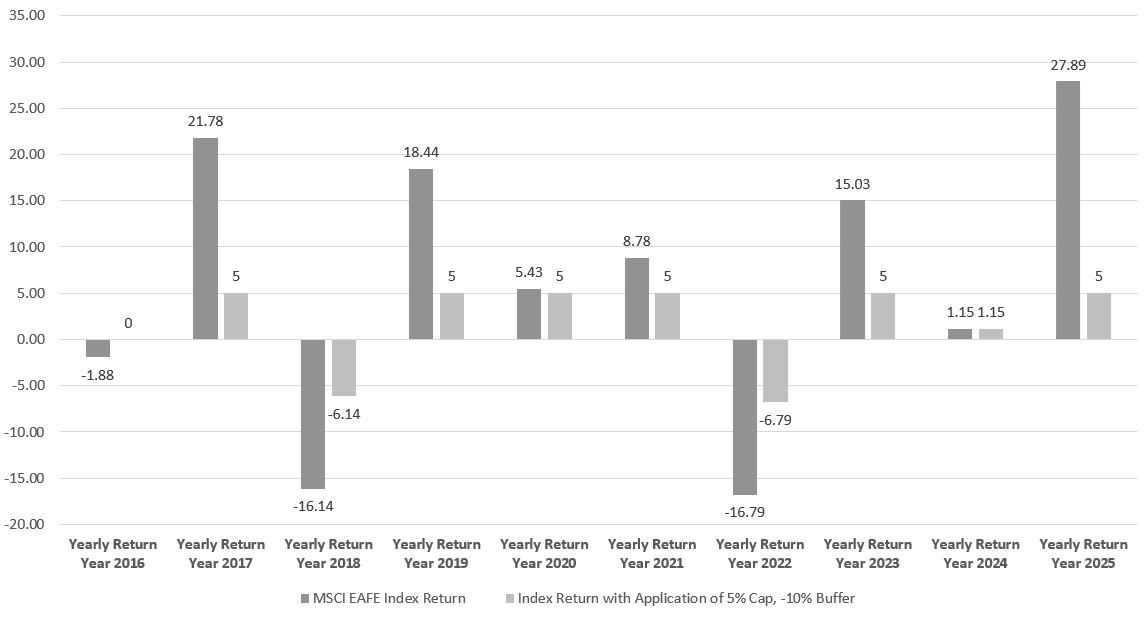
*Index is a price return index, not a total return index, and therefore does not reflect the dividends paid on the assets composing the Index, which will reduce the Index Return and cause the Index to underperform a direct investment in the securities composing the Index.
MSCI KLD 400 Social Index *

*Index is a price return index, not a total return index, and therefore does not reflect the dividends paid on the assets composing the Index, which will reduce the Index Return and cause the Index to underperform a direct investment in the securities composing the Index.
Replacing an Index. We may replace an Index if it is discontinued or the Index is no longer available to us or if the Index's calculation changes substantially. Additionally, we may replace an Index if hedging instruments become difficult to acquire or the cost of hedging related to such Index becomes excessive. We may do so at the end of an Index Account Option Term or during an Index Account Option Term. We will notify you in writing at least 30 days before we replace an Index. If an Index is replaced during an Index Account Option Term, the Index Return will be calculated by adding the Index Return for the
37
original Index from the beginning of the term up until the date of replacement, to the Index Return from the substituted Index starting on the date of replacement through the end of the Index Account Option Term, as shown in the Example below. A substitution of an Index during an Index Account Option Term will not cause a change in the Crediting Method, Protection Option, or Index Account Option Term length.
Example: Assume that you allocate Contract Value to a 6-Year Index Account Option with the S&P 500 Index and the Index value is $1,000 at the beginning of the term. After 2 years, the S&P 500 Index is discontinued and replaced by the MSCI EAFE Index. On the day of the replacement, the S&P 500 Index is $1,100, so the Index Return as of that date is 10%. The MSCI EAFE Index value on the day of the replacement is $2,000. Going forward, your Index Return for the remainder of the Index Account Option Term will be equal to 10% plus the calculated return of the MSCI EAFE Index from the replacement date. This means that one year later, on your third Contract Anniversary, if the MSCI EAFE Index value is $1,900, your Index Return would be 10% + (-5%) = 5%.
If we replace an Index, we will attempt to select a new Index that is similar to the old Index. In making this evaluation, we will look at factors such as asset class; Index composition; strategy or methodology inherent to the Index; and Index liquidity.
Index Return. The Index Return for an Index Account Option is the percentage change in the Index value from the start of an Index Account Option Term to the end of the Index Account Option Term.
Example: Assume that you allocate Contract Value to an Index Account Option with the S&P 500 Index, Cap Crediting Method, and Buffer Protection Option. Between the beginning and end of the Index Account Option Term, the value of the S&P 500 Index increases by 5%. Thus, the Index Return for that Index Account would be 5%. If instead the S&P 500 Index decreased by 5%, the Index Return for that Index Account would be -5%.
Adjusted Index Return. After the Index Return is calculated at the end of the Index Account Option Term, we next calculate the Adjusted Index Return. The Adjusted Index Return reflects any applicable adjustments to the Index Return based on the Cap Rate, Index Participation Rate (applicable only with the Cap Crediting Method), Performance Trigger Rate, Performance Boost Rate, or Performance Boost Cap Rate (applicable only with the Performance Boost Rate Crediting Method), if the Index Return is positive, or the Buffer or Floor, if the Index Return is negative. The Index Adjustment will be credited to the Index Account Option at a rate equal to the Adjusted Index Return.
Example: Assume, as above, that you allocate Contract Value to an Index Account Option with the S&P 500 Index, Cap Crediting Method, and Buffer Protection Option. Between the beginning and end of the Index Account Option Term, the value of the S&P 500 Index increases by 15%. Thus, the Index Return for that Index Account would be 15%. Assume now that your Index Account Option has an Index Participation Rate of 100%, and a Cap Rate of 10%. Your Index Return of 15% would be multiplied by the 100% Index Participation Rate, and then adjusted to your maximum 10% Cap Rate, making your Adjusted Index Return 10%.
Protection Options. Your selected Protection Option will define the manner in which any (negative) Index Adjustments are credited to you if your selected Index performs negatively during your Index Account Option Term. When you allocate amounts to the Index Account, you are indirectly exposed to the investment risks associated with the applicable Index. Because each Index is comprised or defined by a collection of equity securities, each Index is exposed to market fluctuations which may cause the value of a security to change, sometimes rapidly and unpredictably. The Contract provides two options to provide some level of protection against the risk of loss of Index Account Value for any negative Index Return: Buffers and Floors.
Buffer. A Buffer is the amount of negative Index price change before a negative Index Adjustment is credited to the Index Account Option Value at the end of an Index Account Option Term, expressed as a percentage. Put another way, a Buffer protects your Index Account Option Value from loss up to a specified amount (typically 10% or 20%). Jackson protects you from any loss associated with Index decline up to your elected Buffer percentage. You only incur a loss if the Index has declined more than your elected Buffer percentage as of your Index Account Option Term Anniversary. For example, if the Index Return at the end of your Index Account Option Term is -25% and your Buffer rate is 10%, we will credit a -15% Index Adjustment at the end of the Index Account Option Term, meaning the Contract Value allocated to that Index Account Option will decrease by 15%.
Withdrawals taken prior to the end of the Index Account Option Term will reduce the Index Account Option Value in the same proportion that the Interim Value was reduced on the date of the withdrawal. The Interim Value reflects the application of a prorated Buffer based on the elapsed portion of the Index Account Option Term. For examples of how a withdrawal taken prior to the end of an Index Account Term will reduce the Index Account Option Value through the use of a prorated Buffer in scenarios where the Index Return is negative, see the Statement of Additional Information.
38
The available Buffer rates are the new business or renewal rates effective as of the first day of an Index Account Option Term and will not change until the end of your Index Account Option Term. The Buffer rate for a particular Index Account Option Term may be higher or lower than the Buffer rate for previous or future Index Account Option Terms. In no event will an available Buffer rate be less than 5% during the life of your Contract. We post all rates online at Jackson.com/RatesJMLPA2. The rates for Contract Value reallocations at the end of an Index Account Option Term are posted at least 30 days before the end of any Index Account Option Term. At least 30 days prior to any Index Account Option Term Anniversary, we will send you written notice reminding you of how you may obtain the rates for the next Index Account Option Term.
Floor. A Floor is the maximum loss that will be credited to the Index Account Option at the end of the Index Account Option Term, expressed as a percentage. In contrast to the Buffer, a Floor protects your Index Account Option Value from loss greater than a specified amount (typically 10%). This means that if the Index has declined as of your Index Account Option Term Anniversary, you will incur all of the loss up to your elected Floor percentage. Jackson will protect you from any Index decline greater than your elected Floor percentage. For example, if the Index Return at the end of your Index Account Option Term is -25% and your Floor rate is 10%, we will credit a -10% Index Adjustment at the end of your Index Account Option Term, meaning the Contract Value allocated to that Index Account Option will decrease by 10%.
Withdrawals taken prior to the end of the Index Account Option Term will reduce the Index Account Option Value in the same proportion as the Interim Value was reduced on the date of the withdrawal. The Interim Value reflects the application of the full-term Floor, which is not prorated at the time of the withdrawal. For an example of how a withdrawal taken prior to the end of an Index Account Option Term will reduce the Index Account Option Value through the use of a full-term Floor in scenarios where the Index Return is negative, see the Statement of Additional Information.
The available Floor rates are the new business or renewal rates effective as of the first day of an Index Account Option Term and will not change until the end of your Index Account Option Term. The Floor rate for a particular Index Account Option Term may be higher or lower than the Floor rate for previous or future Index Account Option Terms. In no event will an available Floor rate be less than 5% during the life of your Contract. We post all rates online at Jackson.com/RatesJMLPA2. The rates for Contract Value reallocations at the end of an Index Account Option Term are posted at least 30 days before the end of any Index Account Option Term. At least 30 days prior to any Index Account Option Term Anniversary, we will send you written notice reminding you of how you may obtain the rates for the next Index Account Option Term.
Choosing a Protection Option. We set the limit on Index losses for each Index Account Option at our sole discretion. We consider various factors in determining the limit on Index losses, including the cost of our risk management techniques, sales commissions, administrative expenses, regulatory and tax requirements, general economic trends and competitive factors.
Before selecting an Index Account Option for investment, you should consider in consultation with your financial professional the limits on Index losses that may be appropriate for you based on your risk tolerance, investment horizon and financial goals. Generally, assuming the same Index and Index Account Option Term, an Index Account Option that provides more protection from Index losses (such as a 10% Floor or 20% Buffer) will tend to have less potential for Index gains. Conversely, assuming the same Index and Index Account Option Term, an Index Account Option that provides less protection from Index losses (such as a 10% Buffer) will generally tend to have more potential for Index gains.
Crediting Methods. Your selected Crediting Method will dictate the manner in which the Index Adjustment is credited to you if your selected Index performs positively during your Index Account Option Term. Current Cap Rates, Index Participation Rates (applicable only with the Cap Crediting Method), Performance Trigger Rates, Performance Boost Rates, and Performance Boost Cap Rates (applicable only with the Performance Boost Crediting Method) are provided at the time of application, and to existing owners and financial professionals at any time, upon request.
To determine the Index Adjustment amount that will be credited to your Index Account Option Value at the end of each Index Account Option Term, we calculate the Adjusted Index Return for that Index Account Option. We calculate this Adjusted Index Return by applying the applicable Crediting Method, which serves to limit the positive Index Return you will realize. The Index Adjustment will be credited to the Index Account Option at a rate equal to the Adjusted Index Return.
Generally, the higher the downside risk you assume, the higher your associated Crediting Method rates will be. This means that your Crediting Method rates will typically be higher in connection with a Buffer Protection Option with a 10% or 20% Buffer Rate than they will be in connection with a Floor Protection Option. In addition, your Crediting Method rates will typically be lower in connection with a 20% Buffer Protection Option than they would be in connection with a 10% Buffer Protection Option or a Floor Protection Option. You should carefully consider which combination of Crediting Method and Protection Options are right for you, and discuss these options with your financial professional.
39
We determine Cap Rates, Index Participation Rates, Performance Trigger Rates, Performance Boost Rates, and Performance Boost Cap Rates for each new Index Account Option Term at our discretion, subject to the guaranteed minimums discussed below. We consider a number of factors when declaring Cap Rates, Index Participation Rates, Performance Trigger Rates, Performance Boost Rates, and Performance Boost Cap Rates. Generally, we seek to manage our risk associated with our obligations, in part, by trading call and put options and other derivative instruments on the available Indices. The costs of these instruments impact the rates we declare, and those costs can be impacted by market conditions and forces. You are not an investor in these call and put options or other derivative instruments. For more information, see the sections titled General Account and Unregistered Separate Account beginning on page 79. We also consider the asset yield on the fixed assets backing our obligations, sales commissions, administrative expenses, regulatory and tax requirements, general economic trends and competitive factors. You bear the risk that we may declare lower Cap Rates, Index Participation Rates, Performance Trigger Rates, Performance Boost Rates, and Performance Boost Cap Rates for future Index Account Option Terms, and that such rates could be as low as the guaranteed minimums discussed below. Rates offered for new Index Account Option Terms may be different from those offered to new investors or offered to you at Contract issuance.
Before selecting an Index Account Option for investment, you should consider in consultation with your financial professional the Crediting Method that may be appropriate for you based on your risk tolerance, investment horizon and financial goals. Generally, assuming the same Index and Index Account Option Term, an Index Account Option that provides less potential for Index gains will tend to have more protection from Index losses. Conversely, assuming the same Index and Index Account Option Term, an Index Account Option that provides more potential for Index gains will generally tend to have less protection from Index losses.
The examples in the following sections illustrate how we calculate and credit interest under each Crediting Method, assuming hypothetical Index Returns and hypothetical limits on Index gains and losses. The examples assume no withdrawals.
Cap Crediting Method. When you elect a Cap Crediting Method as part of an Index Account Option, if the performance of the Index you elect is positive at the end of your Index Account Option Term, your Index Account Option Value will be credited with a positive Index Adjustment equal to the Index Return multiplied by the Index Participation Rate, limited by the Cap Rate. The maximum amount of Index Adjustment that will be credited to your Index Account Option Value when your Index Return is positive as of the Index Account Option Term Anniversary will be limited by the elected Cap.
There are two rates associated with the Cap Crediting Method: The Cap, or "Cap Rate", and the Index Participation Rate. The Cap Rate is the maximum amount of Index Adjustment that will be credited to an Index Account Option at the end of each Index Account Option Term, expressed as a percentage. The Index Participation Rate ("IPR") is the percentage applied to any positive Index Return in calculating the amount of Index Adjustment to be credited at the end of the Index Account Option Term. The Cap Rate and IPR are declared at the beginning of the Index Account Option Term and will not change during an Index Account Option Term. The Cap Rate and IPR for a particular Index Account Option Term may be higher or lower than the Cap Rate and IPR for previous or future Index Account Option Terms. In no event will an available Cap Rate be lower than 2% for a 6-year Index Account Option Term, 1.50% for a 3-year Index Account Option Term, or 1% for a 1-year Index Account Option Term. In no event will an available Index Participation Rate be lower than 100%. Because the Index Participation Rate is guaranteed to be at least 100%, it will never serve to reduce an Index Adjustment. Current rates are posted online at Jackson.com/RatesJMLPA2, which is incorporated by reference into this prospectus. The rates for Contract Value reallocations at the end of an Index Account Option Term are posted at least 30 days before the end of any Index Account Option Term. At least 30 days prior to any Index Account Option Term Anniversary, we will send you written notice reminding you of how you may obtain the rates for the next Index Account Option Term.
The Cap Crediting Method is currently available with either a Buffer or Floor, and for your choice of 1-year, 3-year, or 6-year Index Account Option Terms. The Cap Rate for the 3-year and 6-year terms would be lower if measured on an annual basis. For Index Account Option Terms longer than one year, the Buffer for that term is a total Buffer for the duration of that Index Account Option Term. The following examples will illustrate how the Cap Crediting Method operates with both the Buffer and Floor Protection Options. Each example assumes a 10% Cap Rate and a 10% Buffer or Floor. The Index Participation Rate is indicated in each example. The examples assume no withdrawals.
40
Cap with Buffer.

When you elect the Cap Crediting Method with Buffer Protection Option, you are partially protected from downside loss, and any positive Index Adjustment will equal Index Return multiplied by the Index Participation Rate up to the stated Cap. Here are some examples of how an Index Participation Rate, Cap and Buffer work in combination on the Index Account Option Term Anniversary where the Index Participation Rate is 110%:
Scenario 1: The Index Return is 20%. After multiplying the positive Index Return by the Index Participation Rate of 110%, the Adjusted Index Return is 22%. Due to the 10% Cap, the Index Adjustment credited to your Index Account Option Value will be 10%.
Scenario 2: The Index Return is 6%. After multiplying the positive Index Return by the Index Participation Rate of 110%, the Adjusted Index Return is 6.60%. Since the Index has not out-performed the 10% Cap, the Index Adjustment credited to your Index Account Option Value is equal to the Adjusted Index Return, which is 6.60%.
Scenario 3: The Index Return is -8%. Since the Index Return was less than the -10% Buffer, your Index Account Option Value was fully protected and experienced no loss.
Scenario 4: The Index Return is -12%. Since the Index Return exceeded the -10% Buffer, your Index Account Option Value was partially protected from the negative performance, but still experienced a -2% loss.
For examples illustrating a prorated Cap and Buffer in connection with an Interim Value adjustment in different market conditions where single or multiple partial withdrawals are taken in the middle of an Index Account Option Term, please see the Statement of Additional Information. Please note: certain states require the use of guaranteed minimum Index Adjustment Factors, if greater, in calculating Interim Value or require the greater of the pro rata interim values described in this prospectus or the interim values that would result from a calculation utilizing a hypothetical portfolio of assets designed to replicate the performance of the Index Account Option at the end of the term. Please see "Alternative Interim Value Calculations in Certain States" on page 32.
41
Cap with Floor.

When you elect the Cap Crediting Method with Floor Protection Option, you are exposed to loss up to a certain point, but Jackson will protect you from any loss beyond that point. Any positive Index Adjustment will equal Index Return multiplied by the Index Participation Rate up to the stated Cap. Here are some examples of how an Index Participation Rate, Cap, and Floor work in combination on the Index Account Option Term Anniversary where the Index Participation Rate is 100%:
Scenario 1: The Index Return is 20%. After multiplying the positive Index Return by the Index Participation Rate of 100%, the Adjusted Index Return is 20%. Due to the 10% Cap, the Index Adjustment credited to your Index Account Option Value will be 10%.
Scenario 2: The Index Return is 6%. After multiplying the positive Index Return by the Index Participation Rate of 100%, the Adjusted Index Return is 6%. Since the Index has not out-performed the 10% Cap, the Index Adjustment credited to your Index Account Option Value is equal to the Adjusted Index Return, which is 6%.
Scenario 3: The Index Return is -8%. Since the Index Return fell within the -10% Floor, your Index Account Option Value will experience the full loss of -8%.
Scenario 4: The Index Return is -18%. Since the Index Return exceeded the -10% Floor, your Index Account Option Value was partially protected from the negative performance and experienced a -10% loss.
For examples illustrating a prorated Cap and full term Floor in connection with an Interim Value adjustment in different market conditions where single or multiple partial withdrawals are taken in the middle of an Index Account Option Term, please see the Statement of Additional Information. Please note: certain states require the use of guaranteed minimum Index Adjustment Factors, if greater, in calculating Interim Value or require the greater of the pro rata interim values described in this prospectus or the interim values that would result from a calculation utilizing a hypothetical portfolio of assets designed to replicate the performance of the Index Account Option at the end of the term. Please see "Alternative Interim Value Calculations in Certain States" on page 32 .
Performance Trigger Crediting Method. When you elect a Performance Trigger Crediting Method, if the performance of the Index you elect is zero or positive at the end of your Index Account Option Term, your Index Account Option Value will be credited with a positive Index Adjustment equal to the Performance Trigger Rate. The Performance
42
Trigger Rate is the amount of Index Adjustment that could be credited to an Index Account Option at the end of each Index Account Option Term, expressed as a percentage. The Performance Trigger Rate is declared at the beginning of the Index Account Option Term and will not change during the Index Account Option Term. The Performance Trigger Rate for a particular Index Account Option Term may be higher or lower than the Performance Trigger Rate for previous or future Index Account Option Terms. In no event will an available Performance Trigger Rate be lower than 1%. Current rates are posted online at www.Jackson.com/RatesJMLPA2 which is incorporated by reference into this prospectus. The rates for Contract Value reallocations at the end of an Index Account Option Term are posted at least 30 days before the end of any Index Account Option Term. At least 30 days prior to any Index Account Option Term Anniversary, we will send you written notice reminding you of how you may obtain the rates for the next Index Account Option Term.
The Performance Trigger Crediting Method is currently available for renewable one year Index Account Option Terms, with your choice of a Buffer or Floor Protection Option. The following examples will illustrate how the Performance Trigger Crediting Method operates with both the Buffer and Floor Protection Options. Each Example assumes a 5% Performance Trigger Rate and a 10% Buffer or Floor. The examples assume no withdrawals.
Performance Trigger with Buffer.

When you elect the Performance Trigger Crediting Method with Buffer Protection Option, you are partially protected from downside loss, and any positive Index Adjustment will be equal to the stated Performance Trigger Rate. If market performance is zero or positive over the end of the Index Account Option Term, the full Index Adjustment will equal the Performance Trigger Rate, regardless of how much the Index increased. Here are some examples of how the Performance Trigger rate and Buffer work in combination on the Index Account Option Term Anniversary:
Scenario 1: The Index Return is 12%. Since the market was positive, the Index Adjustment credited to your Index Account Option Value will equal the Performance Trigger Rate of 5%.
Scenario 2: The Index Return is 2%. Since the market was positive, the Index Adjustment credited to your Index Account Option Value will equal the Performance Trigger Rate of 5%.
Scenario 3: The Index Return is -8%. Since the Index Return was less than the -10% Buffer, your Index Account Option Value was protected and experienced no loss.
43
Scenario 4: The Index Return is -12%. Since the Index Return exceeded the -10% Buffer, your Index Account Option Value was partially protected from the negative performance, but still experienced a -2% loss.
For examples illustrating a prorated Performance Trigger Rate and Buffer in connection with an Interim Value adjustment in different market conditions where single or multiple partial withdrawals are taken in the middle of an Index Account Option Term, please see the Statement of Additional Information. Please note: certain states require the use of guaranteed minimum Index Adjustment Factors, if greater, in calculating Interim Value or require the greater of the pro rata interim values described in this prospectus or the interim values that would result from a calculation utilizing a hypothetical portfolio of assets designed to replicate the performance of the Index Account Option at the end of the term. Please see "Alternative Interim Value Calculations in Certain States" on page 32 .
Performance Trigger with Floor.

When you elect the Performance Trigger Crediting Method with Floor Protection Option, you experience loss up to a certain point, but Jackson will protect you from any loss beyond that point. Your positive Index Adjustment will be equal to the stated Performance Trigger Rate. If market performance is zero or positive at the end of the Index Account Option Term, a positive Index Adjustment equal to the Performance Trigger Rate will be credited, regardless of how much the Index increased. Here are some examples of how the Performance Trigger Rate and Floor work in combination on the Index Account Option Term Anniversary:
Scenario 1: The Index Return is 12%. Since the market was positive, the Index Adjustment credited to your Index Account Option Value will equal the Performance Trigger Rate of 5%.
Scenario 2: The Index Return is 2%. Since the market was positive, the Index Adjustment credited to your Index Account Option Value will equal the Performance Trigger Rate of 5%.
Scenario 3: The Index Return is -8%. Since the Index Return fell within the -10% Floor, your Index Account Option Value will experience the full loss of -8%.
Scenario 4: The Index Return is -18%. Since the Index Return exceeded the -10% Floor, your Index Account Option Value was partially protected from the negative performance and experienced a -10% loss.
44
For examples illustrating a prorated Performance Trigger Rate and full term Floor in connection with an Interim Value adjustment in different market conditions where single or multiple partial withdrawals are taken in the middle of an Index Account Option Term, please see the Statement of Additional Information. Please note: certain states require the use of guaranteed minimum Index Adjustment Factors, if greater, in calculating Interim Value or require the greater of the pro rata interim values described in this prospectus or the interim values that would result from a calculation utilizing a hypothetical portfolio of assets designed to replicate the performance of the Index Account Option at the end of the term. Please see "Alternative Interim Value Calculations in Certain States" on page 32 .
Performance Boost Crediting Method. The Performance Boost Crediting Method is only available with the Buffer Protection Option. When you elect a Performance Boost Crediting Method, if the performance of the Index you elect is positive, zero or negative but not equal to or in excess of the Buffer at the end of your Index Account Option Term, your Index Account Option Value will be credited with a positive Index Adjustment equal to Index Return plus the Performance Boost Rate, limited by the Performance Boost Cap Rate. If the performance of the Index you elect is negative but equal to the Buffer at the end of your Index Account Option Term, your Index Account Option Value will be credited with an Index Adjustment equal to zero. If the performance of the Index you elect is negative in excess of the Buffer at the end of your Index Account Option Term, you will be credited with a negative Index Adjustment equal to the amount that the negative Index Return exceeds the Buffer.
There are two rates associated with the Performance Boost Crediting Method: the Performance Boost Rate, and the Performance Boost Cap Rate. The Performance Boost Rate is used to boost your Index Adjustment to a value higher than Index Return, and is equal to the Buffer percentage. The Performance Boost Cap Rate limits the amount of positive Index Adjustment you can receive, and is the maximum amount of Index Adjustment that could be credited to an Index Account Option at the end of each Index Account Option Term, expressed as a percentage. Both the Performance Boost Rate and the Performance Boost Cap Rate are declared at the beginning of the Index Account Option Term and will not change during the Index Account Option Term. The Performance Boost Rate and the Performance Boost Cap Rate for a particular Index Account Option Term may be higher or lower than the Performance Boost Rate and Performance Boost Cap Rate for previous or future Index Account Option Terms. In no event will an available Performance Boost Rate be lower than 5% or an available Performance Boost Cap Rate be lower than 1% for a 1-year Term, 1.50% for a 3-year Term, or 2.00% for a 6-year Term. Current rates are posted online at Jackson.com/RatesJMLPA2, which is incorporated by reference into this prospectus. The rates for Contract Value reallocations at the end of an Index Account Option Term are posted at least 30 days before the end of any Index Account Option Term. At least 30 days prior to any Index Account Option Term Anniversary, we will send you written notice reminding you of how you may obtain the rates for the next Index Account Option Term.
The Performance Boost Crediting Method is available for renewable one-year, three-year, and six-year Index Account Option Terms with the Buffer Protection Option only. The following examples will illustrate how the Performance Boost Crediting Method operates with the Buffer Protection Option. The Example assumes a 10% Performance Boost Rate, a 10% Performance Boost Cap Rate and a 10% Buffer. This example assumes no withdrawals.
45
Performance Boost with Buffer.
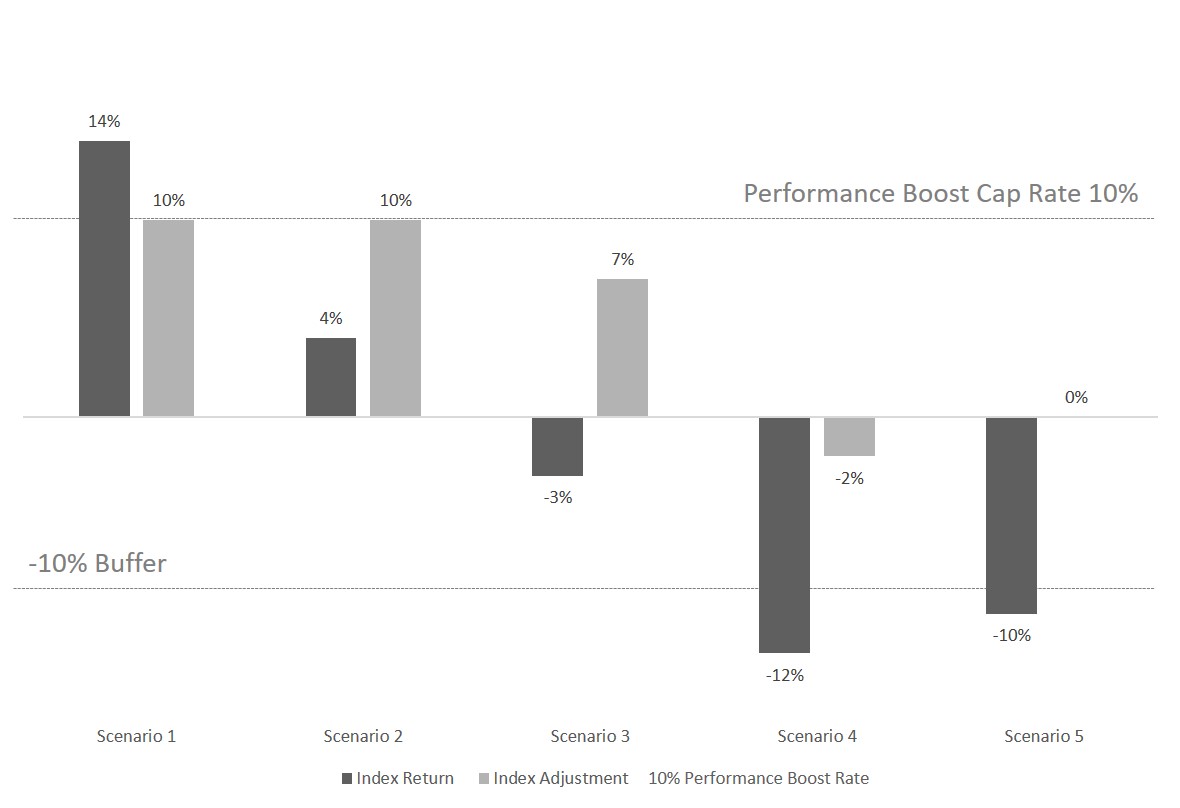
When you elect the Performance Boost Crediting Method with Buffer Protection Option, you are partially protected from downside loss, and any positive Index Adjustment may be limited by the Performance Boost Cap Rate. If the market is positive, zero or negative but not in excess of the Buffer, you will receive an Index Adjustment equal to Index Return plus the Performance Boost Rate. If the Index Return is negative in excess of the Buffer, you will receive a negative Index Adjustment equal to the amount that negative Index Return exceeds the Buffer. If the Index Return is negative but equal to the Buffer, your Index Adjustment will be zero. Here are some examples of how the Performance Boost Rate, Performance Boost Cap Rate, and Buffer work in combination on the Index Account Option Term Anniversary:
Scenario 1: The Index Return is 14%. Due to the 10% Performance Boost Cap Rate, the Index Adjustment will be 10%.
Scenario 2: The Index Return is 4%. The Index Adjustment credited to your Index Account Option Value will equal the 4% Index Return plus the 10% Performance Boost Rate (the Buffer percentage) up to the Performance Boost Cap Rate of 10%. In this case, the Index Adjustment will be 10%.
Scenario 3: The Index Return is -3%. The Index Adjustment credited to your Index Account Option Value will equal the -3% Index Return plus the 10% Performance Boost Rate (the Buffer percentage) up to the Performance Boost Cap Rate of 10%. In this case, the Index Adjustment will be 7%.
Scenario 4: The Index Return is -12%. Since the negative Index Return exceeded the 10% Buffer, your Index Account Option Value was partially protected from the negative return, but still experienced a -2% loss.
Scenario 5: The Index Return is -10%. The Index Adjustment credited to your Index Account Option Value will equal the -10% Index Return plus the 10% Performance Boost Rate (the Buffer percentage). In this case, the Index Adjustment will be 0%.
For examples illustrating a prorated Performance Boost Rate, Performance Boost Cap Rate, and Buffer in connection with an Interim Value adjustment in different market conditions where single or multiple partial withdrawals are taken in the middle of an Index Account Option Term, please see the Statement of Additional Information. Please note: certain states require the use of guaranteed minimum Index Adjustment Factors, if greater, in calculating Interim Value or require the greater of the pro rata interim values described above or the interim values that would result from a calculation utilizing a hypothetical portfolio of
46
assets designed to replicate the performance of the Index Account Option at the end of the term. Please see "Alternative Interim Value Calculations in Certain States" on page 23 for more information.
BENEFITS AVAILABLE UNDER THE CONTRACTS
The following tables summarize information about the benefits available under the Contract. The current annual charges for the add-on benefits are disclosed in a Rate Sheet Prospectus Supplement. To obtain a copy, please visit www.jackson.com/product-literature-11.html. For a list of historical add-on benefit charges, please see “Appendix G (Historical Add-On Benefit Charges).”
Basic Death Benefit (automatically included with the Contract)
NAME OF BENEFIT | PURPOSE | MAXIMUM FEE | BRIEF DESCRIPTION OF RESTRICTIONS/LIMITATIONS | ||||||||
Basic Death Benefit | Guarantees your Beneficiaries will receive a benefit at least equal to the greater of your Contract Value or your total Premiums paid reduced for prior withdrawals (including any applicable charges and adjustments) in the same proportion that the Contract Value was reduced on the date of the withdrawal. *For Owners age 81 and older at the time the Contract issued, the basic death benefit is equal to the current Contract Value. | No additional charge | •Withdrawals could significantly reduce the benefit. •Payment of advisory fees via direct deduction from Contract Value could significantly reduce the benefit. •Benefit terminates on annuitization. | ||||||||
47
Add-On Benefits Available For a Fee
Availability of all add-on benefits are subject to age limitations and other eligibility conditions. Only one add-on benefit may be elected. The current annual charges for the add-on benefits are disclosed in a Rate Sheet Prospectus Supplement. To obtain a copy, please visit www.jackson.com/product-literature-11.html. For a list of historical add-on benefit charges, please see “Appendix G (Historical Add-On Benefit Charges).”
NAME OF BENEFIT | PURPOSE | MAXIMUM FEE | BRIEF DESCRIPTION OF RESTRICTIONS/LIMITATIONS | ||||||||
+Income GMWB and +Income GMWB with Joint Option | Designed to help investors manage their lifetime income needs by guaranteeing the withdrawal of minimum annual amounts for life, regardless of the performance of the Indexes underlying an investor's Index Account Options, while the Contract is in the accumulation phase (i.e. before the Income Date). Annual Step-Ups in years in which the indexes perform well increase the Guaranteed Withdrawal Balance (“GWB”). In addition, you have the potential to increase the Guaranteed Annual Withdrawal Amount (“GAWA”) percentage and in years you wait to take income, regardless of what is happening in the market. | '+Income GMWB: Maximum:3.00% +Income GMWB with Joint Option: Maximum:3.00% (as a percentage of benefit base) | •GAWA% depends on age on Determination Date. •+Income GMWB with Joint Option is available only to spouses. •Jackson may prospectively change the GAWA%, including the age bands, on new GMWB endorsements (via rate sheet). •May be subject to fee increases on each 5th Contract Anniversary (opting out will affect the benefit and the Contract). •Withdrawals prior to start of For Life Guarantee and Excess Withdrawals could significantly reduce or terminate the benefit. •If the For Life Guarantee is not yet in effect, withdrawals that cause the Contract Value to reduce to zero void the For Life guarantee and it will never become effective. •Excess Withdrawals may be subject to a Market Value Adjustment. •Withdrawals under this GMWB are subject to Interim Value adjustments if withdrawn from an Index Account Option before the end of an Index Account Option Term. •The GWB can never be more than $10 million (including upon Step-Up). •Cannot be cancelled by you (except upon spousal continuation). | ||||||||
48
NAME OF BENEFIT | PURPOSE | MAXIMUM FEE | BRIEF DESCRIPTION OF RESTRICTIONS/LIMITATIONS | ||||||||
+Income GMWB and +Income GMWB with Joint Option | •Terminates on the Income Date. •Jackson reserves the right to place restrictions on which Contract Options you may select when you have elected this GMWB. This includes restrictions to Index Account Option Crediting Methods, Protection Options, Indexes, and Term lengths. If any such restrictions are in place, they will be listed in Appendix A: Investment Options Available Under the Contract. •Payment of advisory fees via direct deduction from Contract Value is not permitted if this add-on benefit is elected. | ||||||||||
49
Other Add-On Benefits Included With All Contracts At No Additional Cost
NAME OF BENEFIT | PURPOSE | MAXIMUM FEE | BRIEF DESCRIPTION OF RESTRICTIONS/LIMITATIONS | ||||||||
Intra-Term Performance Lock | Allows you to transfer the full Interim Value from your selected Index Account Option into the Short Duration Fixed Account Option, where it will earn the declared Short Duration Fixed Account rate of interest beginning on the Intra-Term Performance Lock Date until the next Contract Anniversary. | None | •Uses the Interim Value calculated at the end of the Business Day after we receive your request. This means you will not be able to determine in advance your "locked in" Index Account Value, and it may be higher or lower than it was on the Business Day we received your request. •An Intra-Term Performance Lock ends the Index Account Option Term for the Index Account Option out of which it is transferred, effectively terminating that Index Account Option. •Once an Intra-Term Performance Lock has been processed, it is irrevocable. •Not available with Performance Trigger Crediting Method options. | ||||||||
End-Term Performance Lock | Automatically transfers any positive Index Adjustment from an Index Account Option to the Fixed Account on the Index Account Option Term Anniversary. | None | •Amounts transferred into the Fixed Account in connection with an End-Term Performance Lock will be unavailable to reallocate to an Index Account Option until the next Contract Anniversary. •Not available in combination with Automatic Rebalancing. | ||||||||
Rebalancing | Automatically rebalances your Contract Value between eligible Contract Options on the Contract Anniversary based upon the most recent allocation instructions you have provided. | None | •A Contract Option is only eligible for rebalancing at the end of its term. •Rebalancing will only occur if more than one existing Contract Option's term ends on the same date. •Not available in combination with End-Term Performance Lock. | ||||||||
50
CHARGES AND ADJUSTMENTS
There are charges and adjustments associated with your Contract, the deduction of which will reduce the investment return of your Contract. Charges are deducted proportionally from your Contract Value. Some of these charges are for add-on benefits, as noted, so they are deducted from your Contract Value only if you elected to add that add-on benefit to your Contract. These charges may be a lesser amount where required by state law or as described below, but will not be increased. We expect to profit from certain charges assessed under the Contract. These charges (and certain other adjustments) are as follows:
TRANSACTION EXPENSES
Commutation Fee. If you make a total withdrawal from your Contract after income payments have commenced under options 3 or 4 (see “Income Options”), the amount received will be reduced by (a) minus (b) where:
(a) = the present value of the remaining income payments (as of the date of calculation) for the period for which payments are guaranteed to be made, discounted at the rate assumed in calculating the initial payment; and
(b) = the present value of the remaining income payments (as of the date of calculation) for the period for which payments are guaranteed to be made, discounted at a rate no more than 1.00% higher than the rate used in (a).
The Commutation Fee compensates us for administrative costs and expenses associated with commuting the annuity payments and determining the amount to be paid.
Expedited Delivery Charge. When you request expedited delivery of any withdrawal amounts, there are additional charges assessed for this service. We pass the current charges for requested expedited delivery services through to you directly, with no added fees or profits to us. This means these charges are subject to change and are not subject to a maximum. The current charge for standard overnight delivery is $23. The current charge for overnight delivery on Saturday is $38.
Wire Transfer Charge. We pass the current charges for requested wire transfer services through to you directly, with no added fees or profits to us. This means these charges are subject to change and are not subject to a maximum. We currently charge $20 for standard wire transfers and $25 for international wire transfers in connection with requested withdrawals.
Premium Taxes. Some states and other governmental entities charge Premium taxes or other similar taxes. We pay these taxes and may make a deduction from your Contract Values for them. Premium taxes generally range from 0% to 3.5% (the amount of state Premium tax, if any, will vary from state to state). Premium tax is currently not charged back to the Contract, however, the Company reserves the right to deduct any amounts advanced to pay taxes from the Contract Value.
ADD-ON BENEFIT EXPENSES
GMWB Charge. The charge for this GMWB begins when the +Income GMWB or +Income GMWB with Joint Option endorsement is added to the Contract and is expressed as an annual percentage of the Guaranteed Withdrawal Balance (“GWB”). For more information about the GWB, please see “Guaranteed Withdrawal Balance” beginning on page 41.
The table below shows the maximum annual charges and the maximum increase we may make to the annual charge at one time.Current annual charges are disclosed in a Rate Sheet Prospectus Supplement. To obtain a copy, please visit www.jackson.com/product-literature-11.html. For a list of historical add-on benefit charges, please see “Appendix G (Historical Add-On Benefit Charges).”
+Income GMWB
Maximum Annual Charge | Maximum Increase to Annual Charge (at one time) | |||||||
| GMWB Charge | 3.00% | 0.25% | ||||||
| Charge Basis | GWB | |||||||
| Charge Frequency | Annual | |||||||
51
+Income GMWB with Joint Option
Maximum Annual Charge | Maximum Increase to Annual Charge (at one time) | |||||||
| GMWB Charge | 3.00% | 0.25% | ||||||
| Charge Basis | GWB | |||||||
| Charge Frequency | Annual | |||||||
You pay the applicable percentage of the GWB each Contract Anniversary.
We deduct the charge from your Contract Value on an annual basis. The charge is deducted from Contract Value after any applicable interest is credited on the Contract Anniversary and any funds in the Short Duration Fixed Account Option are automatically transferred out, but before the annual Step-Up would occur, if applicable. If the Fixed Account Value is greater than the Fixed Account Minimum Value, the charge will be deducted from your allocations to all Contract Options in the same proportions that the respective allocations bear to your Contract Value until such time that the Fixed Account Contract Value has been reduced to the Fixed Account Minimum Value. If the Fixed Account Value is equal to the Fixed Account Minimum Value, the charge will be deducted from your allocations to the Index Account Options. If no value remains in the Index Account Options and the Fixed Account Value is equal to the Fixed Account Minimum Value, the charge will not be assessed for that Contract Year. While the charge is deducted from the Contract Value, it is based on the applicable percentage of the GWB. Upon termination of the endorsement, the charge is prorated for the period since the last annual charge.
On each fifth Contract Anniversary, we reserve the right to increase the charge, subject to the applicable maximum annual charge and maximum increase to annual charge, as shown in the tables above. If the GMWB Charge is to increase, a notice will be sent to you 45 calendar days prior to the Contract Anniversary. You may then elect to opt out of the charge increase and any future charge increases by forfeiting annual Step-Ups on future Contract Anniversaries. Upon such election, the GAWA% will be determined with no future recalculation. The Determination Date Step-Up is not impacted by an election to opt out of a charge increase. While electing to discontinue future annual Step-Ups will prevent an increase in the charge, you will be foregoing possible increases in your GWB and/or GAWA so carefully consider this decision should we notify you of a charge increase. Such election is final, and you may not subsequently elect to reinstate annual Step-Ups once they have been discontinued. All elections must be received by us in Good Order prior to the Contract Anniversary. Charge increases under this provision may only occur every five years on the Contract Anniversary. If we opt not to increase a charge under this provision, the charge will not be subject to increase again until the Contract Anniversary five years thereafter.
The actual deduction of the charge will be reflected in your annual statement. You will continue to pay the GMWB Charge through the earlier date that you annuitize the Contract or your Contract Value is zero. We will, however, stop deducting the charge under other circumstances that would cause the GMWB to terminate. For more information, please see “Termination” beginning on page 50. We reserve the right to prospectively change the charge on new Contracts or if you elect this GMWB after your Contract is issued (subject to availability), subject to the applicable maximum annual charge listed above. Upon election of this GMWB, the applicable GMWB Charge will be reflected in your confirmation. For more information about how this GMWB works, please see “+Income GMWB and+Income GMWB with Joint Option" beginning on page 40.
CONTRACT ADJUSTMENTS
Interim Value Calculation and Adjustment. Because the Index Account Options are designed to credit an Index Adjustment by measuring the change in the Index Return from the beginning of the Index Account Option Term to the end of the Index Account Option Term, an Interim Value calculation is necessary to determine the daily value of your Index Account Option on any given Business Day if you remove Contract Value prior to the end of the Index Account Option Term by measuring the change in your Index Return from the beginning of the Index Account Option Term to the date the Account Value is removed. The Index Adjustment applies to partial or total withdrawals from the Contract (including GAWA withdrawals, automatic withdrawals, required minimum distributions ("RMD"), free look, deductions of the GMWB Charge, the direct deduction of advisory fees pursuant to our administrative rules, amounts applied to income options upon annuitization, or if we pay the Contract Value element of the death benefit) or exercise of an Intra-Term Performance Lock. Please note that any withdrawal taken in the first six years after issue may also be assessed a Market Value Adjustment.
In calculating the Interim Value adjustment, we use prorated Index Adjustment Factors, which in some instances may serve to reduce any positive Index Adjustment, as well as increase any negative Index Adjustment we credit when compared to the Index Adjustment you would have received if you had waited until the end of your Index Account Option Term to take your withdrawal. This is because the Index Adjustment Factors are prorated by the time elapsed during the Index Account Option
52
Term. In other words, the values are determined by multiplying the Index Adjustment Factor by the number of days elapsed so far during the Index Account Option Term and then dividing by the total number of days in the Index Account Option Term. For an example illustrating the proration of Index Adjustment Factors, please see "Interim Value" on page 22. We do not prorate the Floor or the Index Participation Rate. Any negative adjustment could be significant and impact the amount of Contract Value available for future withdrawals. In addition to Interim Value adjustments, withdrawals taken in the first six Contract Years may also be subject to Market Value Adjustments, which could further reduce the amount you receive when requesting a withdrawal. The Interim Value adjustment could result in the loss of principal and previously-credited earnings in the Contract, and in extreme circumstances, such losses could be as high as 100%. The maximum loss would occur under extreme circumstances. To avoid an Interim Value adjustment to your Index Account Option Value, you should schedule withdrawals and other transactions to fall on Index Account Option Term Anniversaries.
Please note: certain states require the use of guaranteed minimum Index Adjustment Factors, if greater, in calculating Interim Value or require the greater of the pro rata interim values described in this prospectus or the interim values that would result from a calculation utilizing a hypothetical portfolio of assets designed to replicate the performance of the Index Account Option at the end of the term. Please see "Alternative Interim Value Calculations in Certain States" on page 23 for more information.
Each time you take a withdrawal from an Index Account Option before the end of your Index Account Option Term, we will recalculate your Index Account Option Value, based on an Interim Value adjustment, which could be zero, positive or negative. The Index Account Option Value is reduced proportionally to the Contract Value for each withdrawal. This means if you withdraw 10% of your Contract Value, your Index Account Option Value will also be reduced by 10%. If an Interim Value adjustment is positive, your Index Account Option Value will be decreased by less than the amount of the withdrawal; in other words, on less than a dollar for dollar basis If an Interim Value adjustment is negative, your Index Account Option Value will be decreased by more than the amount of the withdrawal; in other words, on more than a dollar for dollar basis. Amounts removed during the Index Account Option Term will not receive an Index Adjustment at the end of that Index Account Option Term. This means that by transacting mid-term on Interim Value, you are reducing the Index Account Option Value that could have received an Index Adjustment at the end of the Index Account Option Term.
The Interim Value calculation protects the Company from risks related to the value of the derivative instruments purchased to support the contract guarantees if amounts are removed prior to the end of an Index Account Option Term. The Interim Value calculation shifts this risk from the company to you. Please see the SAI for detailed explanations and examples of how we calculate the Interim Value in various scenarios.
Market Value Adjustment. A Market Value Adjustment ("MVA") may apply to amounts withdrawn or annuitized from the Contract during the first six Contract Years. The Market Value Adjustment reflects changes in the level of interest rates since the Issue Date. Market Value Adjustments protect the Company from risks related to the value of the fixed investment instruments supporting the Contract guarantees if amounts are withdrawn prematurely. The Market Value Adjustment shifts the risk from the Company to you.
In order to determine whether there will be a Market Value Adjustment, we first compare the MVA reference rate on the Issue Date to the MVA reference rate on the date you are removing Contract Value. The MVA reference rate is Bloomberg U.S. Intermediate Corporate Bond Index Yield to Maturity, expressed as a percentage. The MVA rate applied on any day will be the MVA reference rate published on the prior Business Day. If the MVA reference rate is not published on the Business Day before the MVA is calculated, the Company will use the MVA reference rate for the most recent Business Day it was published. The current-day price for the Bloomberg U.S. Intermediate Corporate Bond Index Yield to Maturity will be publicly available on our website at www.jackson.com/mva, although the price may change by the time your transaction is executed.
The Company calculates the MVA by multiplying the amount You withdraw that is subject to MVA less any applicable charges by the result of the formula below:
53

where:
I is the MVA Reference Rate on the Issue Date
J is the MVA Reference Rate on the date of withdrawal or annuitization
m is the number of complete months remaining from the date of the removal to the end of the MVA Period.
The MVA formula is derived by reflecting the change to the value of an underlying bond purchased to support your policy and any gains or losses from applicable early withdrawals are passed along to You. If the MVA reference rate at the time of your withdrawal (or Income Date if income payments begin during the six Contract Years) is higher than the MVA reference rate on your Issue Date, a downward adjustment to the amount withdrawn may apply, which would reduce the amount paid or taken as income. If the MVA reference rate at the time of withdrawal is lower than the MVA reference rate declared on your Issue Date, an upward adjustment to the amount withdrawn may apply, which would increase the amount paid or taken as income. There will be no Market Value Adjustment if the two rates are the same. The application of a Market Value Adjustment could result in a reduction in the amount you receive from a withdrawal, and in extreme circumstances, such losses could be as high as 100% of the amount withdrawn. The maximum loss would only occur if there is a total withdrawal of Contract Value and interest rates have risen dramatically between the date your Contract was issued and the time of your total withdrawal. A Market Value Adjustment will not otherwise affect the values under your Contract. Please see the SAI for an illustration of how an MVA impacts your withdrawals and contract values.
There is no Market Value Adjustment on: death benefit payments; amounts withdrawn for Contract charges; amounts removed from any Index Account Option on the Latest Income Date, transfers among Contract Options, withdrawals taken pursuant to the Free Look provision of your contract, withdrawals taken under the MVA Free Withdrawal provision, GAWA Withdrawals, withdrawals taken to satisfy a required minimum distribution ("RMD"), amounts you withdraw after the first six Contract Years, earnings, and direct deductions of advisory fees made pursuant to our administrative rules. Please note that an MVA will only apply to income payments taken under income options for specified periods where the specified period is shorter than five years and those payments are taken during the first six Contract Years. Income payments taken under any other income option are not subject to an MVA.
For purposes of determining the MVA, the Contract Value is divided into earnings and Remaining Premium. Earnings are not subject to an MVA. For the sole purpose of determining the amount of the MVA, earnings are defined as any excess of the Contract Value over Remaining Premium. Withdrawals will be allocated first to earnings (which may be withdrawn free of any MVA), if any, and second to Remaining Premium. Any portion of the MVA that would reduce the Fixed Account below the Fixed Account Minimum Value will be waived.
Please note: in certain states we do not apply an MVA on any transaction. For more information including a list of states in which we do not apply an MVA, see "Appendix C: State Variations".
MVA Free Withdrawal. During each of the first six Contract Years, certain partial withdrawals from the Contract will not incur a Market Value Adjustment. The amount of the MVA Free Withdrawal is 10% of the Remaining Premium during each Contract Year that would otherwise incur a Market Value Adjustment, minus earnings. The MVA Free Withdrawal may be taken once or through multiple withdrawals throughout the Contract Year. Any amount withdrawn to satisfy a required minimum distribution reduces the amount of available MVA Free Withdrawal. No MVA Free Withdrawal may exceed the Withdrawal Value. Withdrawals during the first six contract years in excess of the MVA Free Withdrawal may be subject to any applicable MVA. The direct deduction of advisory fees pursuant to our administrative rules will not reduce the MVA Free Withdrawal amount.
PURCHASES
Minimum Premium:
•$25,000 under most circumstances
54
Maximum Premium:
•The maximum Premium payment you may make without our prior approval is $1 million.
We reserve the right to waive minimum and maximum Premium amounts in a non-discriminatory manner. Our right to restrict Premium to a lesser maximum amount may affect the benefits under your Contract.
Allocations of Premium. You may allocate Premium to any available Index Account Option or Fixed Account. Each allocation must be a whole percentage between 0% and 100%. The minimum amount you may allocate to an Index Account Option or Fixed Account is $100.
We will issue your Contract and allocate your Premium payment within two Business Days (days when the New York Stock Exchange is open) after we receive your complete Premium payment and all information that we require for the purchase of a Contract in Good Order. We reserve the right to reject a Premium payment that is comprised of multiple payments paid to us over a period of time. If we permit you to make multiple payments as part of your Premium payment, the Contract will not be issued until all such payments are received in Good Order. We reserve the right to hold such multiple payments in a non-interest bearing account until the Issue Date. If we do not receive all information required to issue your Contract, we will contact you to get the necessary information. If for some reason we are unable to complete this process within five Business Days, we will return your money. Each Business Day ends when the New York Stock Exchange closes (usually 4:00 p.m. Eastern time). No Premium will be accepted after the Contract has been issued.
Free Look. You may cancel your Contract by returning it to your financial professional or to us within ten days after receiving it. In some states, the Free Look period may be longer. Please see the front page of your Contract for the Free Look period that applies to your Contract. In general, if you cancel your Contract during this period, we will return:
•Premiums paid to the Fixed Account, less
•any withdrawals from the Fixed Account, plus
•the Index Account Value.
We will determine the Index Account Value as of the date we receive the Contract. In some states, we are required to return Premium payments only. We will pay the applicable free look proceeds within seven days of a request in Good Order. In some states, we are required to hold the Premiums of a senior citizen in the Fixed Account during the free look period, unless we are specifically directed to allocate the Premium to the Index Account. When you exercise a Free Look, amounts returned from Index Account Options are subject to an Interim Value adjustment.
TRANSFERS AND REALLOCATIONS
Transfer Requests. You may request a transfer to or from the Fixed Account and the Index Account Options, as well as among the Index Account Options.
Transfers may only occur on the Contract Anniversary when transferring out of the Fixed Account, and only on the Index Account Option Term Anniversary when transferring out of an Index Account Option except in connection with an Intra-Term Performance Lock. We post all rates online at Jackson.com/RatesJMLPA2. The rates for Contract Value reallocations at the end of an Index Account Option Term are posted at least 30 days before the end of any Index Account Option Term. At least 30 days prior to any Index Account Option Term Anniversary, we will send you written notice reminding you of how you may obtain the rates for the next Index Account Option Term.
Unless specified otherwise, transfers will be taken from the Index Account Options and the Fixed Account in proportion to their current value. The Company reserves the right to restrict or prohibit transfers from the Index Account Options to the Fixed Account, at its discretion, on a nondiscriminatory basis, at any time.
Transfers into the Short Duration Fixed Account Option on a Contract Anniversary are not allowed. Amounts may only move from an Index Account Option to the Short Duration Fixed Account Option in connection with an Intra-Term Performance Lock or a spousal continuation.
55
Transfers from a Fixed Account Option will reduce the Fixed Account Value by the transfer amount requested. Transfers into a Fixed Account Option will increase the Fixed Account Value by the transfer amount requested. Transfers from an Index Account Option will reduce the Index Account Option Value by the transfer amount requested. Transfers into an Index Account Option will increase the Index Account Option Value by the transfer amount requested.
Automatic Reallocations. If we do not receive your timely transfer request in Good Order before the close of business on the Contract Anniversary for transfers out of the Fixed Account, and/or the close of business on the Index Account Option Term Anniversary for transfers out of an Index Account Option, we will automatically reallocate your Contract Value, as described below. You can communicate your transfer instructions by submitting them to us in writing on a form provided by us, or a Letter of Instruction, or via telephone if you have provided prior telephone authorization on your account.
If no timely transfer request is received as outlined above, the Fixed Account Value will remain in the Fixed Account and the Index Account Option Value(s) will be reallocated to the same Index Account Option(s) for the same term, Crediting Method and Index, if available.
Automatic Reallocation of Index Account Option Value to a New Index Account Option or the Fixed Account. If you do not provide timely transfer or reallocation instructions prior to the end of an expiring Index Account Option Term, as well as for reallocations out of the Short Duration Fixed Account Option on a Contract Anniversary, we will proceed as follows:
•If the same Index Account Option is available at the time and its Term does not extend beyond the Income Date, we will renew the Index Account Option into the same Index Account Option Term.
•If the same Index Account Option is available at the time but its Term extends beyond the Income Date, if available, we will select an available Index Account Option with the same Crediting Method, Protection Option, and Index, but with the Term that ends closest to but before the Income Date.
•If the same Crediting Method, Protection Option, and Index as the expiring Index Account Option are available at the time, but not with the same Term, we will select the available Index Account Option Term with the period closest to but less than the Index Account Option Term that just ended that will not extend beyond the Income Date.
If the Crediting Method, Protection Option, or Index you have elected is no longer available as of your Index Account Option Term Anniversary, the Index Account Option Value(s) will be reallocated to the Fixed Account until further instruction is received.
Intra-Term Performance Lock. You may elect to lock in Interim Value during the Index Account Option Term on Index Account Options with certain Crediting Methods. This feature allows you to transfer the full Interim Value from your selected Index Account Option into the Short Duration Fixed Account Option, where it will earn the declared Short Duration Fixed Account rate of interest beginning on the Intra-Term Performance Lock Date until the next Contract Anniversary. You can view the Interim Value for your Index Account Option(s) as of the end of the previous Business Day in your account on jackson.com or by contacting us via phone at 1-800-644-4565. We use the Interim Value calculated at the end of the Business Day after we receive your request. This means you will not be able to determine in advance your "locked in" Index Account Option Value, and it may be higher or lower than it was on the Business Day we received your Intra-Term Performance Lock request. Intra-Term Performance Lock is currently available with all Crediting Methods except for the Performance Trigger Crediting Method.
You may elect an Intra-Term Performance Lock by submitting an election form or letter of instruction acceptable to us, making an election through your jackson.com account, or via telephone if you have telephone authorization executed on your account. We must receive a manual Intra-Term Performance Lock request in Good Order before the end of the current Business Day in order to execute the Intra-Term Performance Lock on that day. Otherwise, the Intra-Term Performance Lock will be executed on the next Business Day that your request is in Good Order. For requests submitted in writing, we do not consider the request to be received until it arrives at our Customer Care Center.
You (or your financial professional, if authorized) can request an automatic Intra-Term Performance Lock based on targets you set only through your account on jackson.com. You can set upper and/or lower targets for each Index Account Option each term. Please note: setting a target close to the current Interim Value may cause an Intra-Term Performance Lock to occur very quickly. You can change or cancel targets at any time before we perform the Intra-Term Performance Lock. Each Index Account Option’s targets automatically expire on the earlier of the date the Intra-Term Performance Lock is performed,
56
or the last Business Day before the Index Account Option Term Anniversary. You can also override a target by requesting a manual Intra-Term Performance Lock before the target is reached. We determine if a target is reached using the Interim Value determined at the end of the prior Business Day. We then perform the Intra-Term Performance Lock using the Interim Value calculated at the end of the next Business Day, which is the day the Intra-Term Performance Lock is performed. Because your Intra-Term Performance Lock is performed based on the Interim Value calculated 24 hours after your target was reached, it is possible that the Index Return for your Index may decline between the time your target was reached and the time your Intra-Term Performance Lock is performed. Please note: by setting targets in your jackson.com account, you are authorizing us to automatically perform an Intra-Term Performance Lock at the end of the Business Day on the day after your target is reached, unless you cancel the lock. We will send an email notice once the Interim Value for an Index Account Option reaches your selected target. To cancel an automatic Intra-Term Performance Lock after the target is reached, we must receive your request in Good Order before the end of the Business Day on which the lock will be performed. You may submit this request to cancel an automatic Intra-Term Performance Lock through your account on jackson.com, via faxed or emailed letter of instruction, or via telephone (if you have authorized telephone transactions).
For example, assume your Contract Value is $100,000 and 100% is allocated to a 1-year Index Account Option with a Cap crediting method, 10% Buffer protection option, and the S&P 500 Index elected. The Cap Rate is 15%, but you and your financial professional agree that a positive Index Adjustment of at least 10% would meet your investment objectives. With that investment objective in mind, you set an automatic Intra-Term Performance Lock target of 10%. In month ten of the 1-year Index Account Option Term, the Interim Value of your Index Account Option has increased 10% from your initial $100,000 investment and Jackson sends an email notification to you, indicating that your automatic Intra-Term Performance Lock will be performed on the following Business Day unless you cancel through your account on jackson.com (or contact Jackson to cancel via faxed or emailed letter of instruction or phone if you have authorized telephone transactions). The Intra-Term Performance Lock is performed, and the full Interim Value of your Index Account Option is transferred to the Short Duration Fixed Account Option. On the next Contract Anniversary, the Short Duration Fixed Account Option Value associated with your Intra-Term Performance Lock will automatically be reallocated to an identical 1-year Index Account Option with a Cap crediting method, 10% Buffer protection option, and the S&P 500 Index elected unless other instructions are received prior to the end of the Business Day on your Contract Anniversary.
You (or your financial professional, if authorized) can also set Interim Value target notifications through your account on jackson.com. These Interim Value target notifications function similarly to automatic Intra-Term Performance Lock targets in that you can set upper and/or lower targets for each Index Account Option each term. However, Interim Value target notifications will not trigger an automatic Intra-Term Performance Lock and are for notification purposes only to assist you in tracking the performance of your Index Account Options. You can change or cancel Interim Value target notifications at any time through your account on jackson.com. We will send an email notice once the Interim Value for an Index Account Option reaches your selected target for notification. If you wish you elect an Intra-Term Performance Lock at that time, you must submit a manual Intra-Term Performance Lock request in Good Order to our Customer Care Center.
An Intra-Term Performance Lock ends the Index Account Option Term for the Index Account Option out of which it is transferred, effectively terminating that Index Account Option. Once an Intra-Term Performance Lock has been processed, it is irrevocable.
On each Contract Anniversary, any amounts allocated to the Short Duration Fixed Account Option as part of an Intra-Term Performance Lock, including interest earned on those amounts, will be reallocated into a new Index Account Option identical to the one from which they were originally transferred, subject to availability requirements, unless new allocation instructions have been received by us in Good Order, and will begin a new Index Account Option Term. You may provide reallocation instructions in writing using our Reallocation Form or a Letter of Instruction, or over the phone if you have authorized telephone transactions. For more information on what happens if the same Index Account Option is unavailable, see "Automatic Reallocation of Index Account Option Value to a New Index Account Option or the Fixed Account" beginning on page 56.
Please see the Statement of Additional Information for examples illustrating Intra-Term Performance Locks.
End-Term Performance Lock. You may elect to automatically transfer any positive Index Adjustment from an Index Account Option to the Fixed Account on the Index Account Option Term Anniversary. Amounts transferred into the Fixed Account in connection with an End-Term Performance Lock will be unavailable to reallocate to an Index Account Option until the next Contract Anniversary.
You may not elect End-Term Performance Lock if you have elected Automatic Rebalancing.
57
You may cancel your End-Term Performance Lock program using whatever methods you use to change your allocation instructions. You should consult with your financial professional with respect to the current availability of End-Term Performance Lock.
The following examples demonstrate how End-Term Performance Locks work with both positive and negative Index Adjustments.
This example demonstrates an End-Term Performance Lock when a positive Index Adjustment occurs at the end of the Term.
•If your starting Premium is $100,000, you are 100% allocated to an Index Account Option, and have elected the End-Term Performance Lock, any increase in Index Account Option Value at the end of the Term from a positive Index Adjustment will be transferred to the 1-year Fixed Account Option automatically at the end of the Term. This option is available for all available crediting methods and downside protection combinations.
•Assume the Index Adjustment is equal to 4% at the end of the Term. The credited Index Adjustment ($100,000 * 4% = $4,000) would be automatically transferred to the 1-year Fixed Account at the end of the Term under the End-Term Performance Lock.
This example demonstrates an End-Term Performance Lock when a negative Index Adjustment occurs at the end of the Term.
•If your starting Premium is $100,000, you are 100% allocated to an Index Account Option, and have elected the End-Term Performance Lock, any increase in Index Account Option Value at the end of the Term from a positive Index Adjustment will be transferred to the 1-year Fixed Account Option automatically at the end of the Term. This option is available for all available crediting methods and downside protection combinations.
•Assume the Index Adjustment is equal to -4% at the end of the Term. Since the Index Adjustment is negative, the End-Term Performance Lock would not be executed and no Index Account Option Value will be automatically transferred to the 1-year Fixed Account Option.
Automatic Rebalancing. You may elect to automatically rebalance Contract Value between eligible Contract Options on the Contract Anniversary based upon the most recent allocation instructions received by the Company in Good Order. If this option is elected, we will apply any applicable Index Adjustment to the Index Account Option and credited interest to the Fixed Account Option prior to reallocating the Contract Value. A Contract Option is only eligible for rebalancing at the end of its term. This means that a Fixed Account Option is only eligible for rebalancing on a Contract Anniversary, and an Index Account Option is only eligible for rebalancing on its Index Account Option Term Anniversary. Rebalancing will only occur if more than one existing Contract Option's term ends on the same date.
The percentage that will be allocated to each eligible Contract Option through the rebalancing transaction is equal to A divided by B, then multiplied by C, where:
A = the allocation percentage for the Contract Option found in the most recent allocation instructions received by the Company in Good Order;
B = 1 minus the sum of the allocation percentages of the ineligible Contract Options found in the most recent allocation instructions received by the Company in Good Order;
C = the sum of the Index Account Option Values and Fixed Account Option Values from Contract Options, including the Short Duration Fixed Account Option, that have reached the end of their crediting term on that Contract Anniversary.
Rebalancing allows you to tell us what percentage of your Contract Value you would like to keep allocated to various Contract Options, and as those Contract Option values fluctuate, allows us to automatically reallocate Contract Value between those Contract Options on Contract Anniversaries to maintain your desired allocation percentages. For example, assume you allocate 50% of your Contract Value to the Fixed Account Option, and 50% of your Contract Value to a 1-year Index Account Option. On your next Contract Anniversary, assume your Fixed Account had positive interest credited, but you had a negative Index Adjustment on your Index Account Option, such that your Fixed Account Value is now 55% of your Contract Value and only your Index Account Option Value has fallen to only 45% of your Contract Value. Because you elected Automatic Rebalancing,
58
we will automatically reallocate your Contract Value between the Fixed Account Option and 1-year Index Account Option so that they are once again equally balanced at 50% of Contract Value in each option.
You may not elect Automatic Rebalancing if you have elected End-Term Performance Lock.
You may cancel your Automatic Rebalancing program using whatever methods you use to change your allocation instructions. If you provide us with reallocation instructions in advance of a Contract Anniversary, any existing Automatic Rebalancing elections will be terminated and we will reallocate consistent with the updated reallocation instructions you provided. To reinstate Automatic Rebalancing on your Contract, you must submit a new election form. If you submit a new election form, Automatic Rebalancing will resume on the next eligible Contract Anniversary.
Rebalancing instructions may only include Contract Options in which you are currently invested. Automatic rebalancing cannot be used to reallocate Contract Value into new Contract Options.
You should consult with your financial professional with respect to the current availability of Automatic Rebalancing.
Please see Appendix B for examples illustrating Automatic Rebalancing scenarios in which all Index Account Options are at the end of their Term (Example 1), two out of four Index Account Options are at the end of their Term (Example 2), three out of four Index Account Options are at the end of their Term (Example 3), and where an Intra-Term Performance Lock was performed during the Contract Year (Example 4).
ACCESS TO YOUR MONEY
You may access the money in your Contract:
•by making a partial or full withdrawal,
•by electing the Automatic Withdrawal Program,
•by establishing direct deduction of advisory fees under our administrative rules,
•by electing an add-on Guaranteed Minimum Withdrawal Benefit, or
•by electing to receive income payments.
Your Beneficiary can have access to the money in your Contract when a death benefit is paid.
Withdrawals under the Contract may be subject to a Market Value Adjustment. For purposes of the Market Value Adjustment, we treat withdrawals as coming first from earnings (which may be withdrawn free of any MVA), and then from Remaining Premium. When you make a total withdrawal, you will receive the Withdrawal Value as of the end of the Business Day your request is received by us in Good Order. The Withdrawal Value is equal to the Contract Value reduced for any applicable taxes and adjusted by any applicable Market Value Adjustment. For more information about Market Value Adjustments, please see “Market Value Adjustment” beginning on page 53. We will pay the withdrawal proceeds within seven days of receipt of a request in Good Order.
Your withdrawal request will generally be submitted in writing, however, we will always accept written withdrawal requests submitted via fax. You may also submit withdrawal requests online or via telephone if you have provided telephone and electronic authorization according to our administrative rules. Please note, there are risks associated with not requiring original signatures in order to disburse the money. Should you choose to have the proceeds sent to you via mail, they will be sent to your last recorded address in our records. Please notify us immediately of any address change. We do not assume responsibility for improper disbursements if you have failed to provide us with the current address to which the proceeds should be sent.
Except in connection with the Automatic Withdrawal Program, you must withdraw at least $500 or, if less, the entire amount in the Fixed Account or Index Account Option from which you are making the withdrawal. If you are not specific in your withdrawal request, your withdrawal will be taken from your allocations to the Index Account Options and Fixed Account based on the proportion their respective values bear to the Contract Value. A withdrawal request that would reduce the remaining Contract Value to less than $2,000 will be treated as a request for a total withdrawal except in connection with GAWA withdrawals, Required Minimum Distributions or the Automatic Withdrawal Program.
59
If you elect the Automatic Withdrawal Program, you may take automatic withdrawals of a specified dollar amount (of at least $50 per withdrawal) or a specified percentage of Contract Value on a monthly, quarterly, semiannual or annual basis. Automatic withdrawals are treated as partial withdrawals and will be counted in determining the amount taken as an MVA Free Withdrawal in any Contract Year. Automatic withdrawals in excess of the MVA Free Withdrawal amount may be subject to a Market Value Adjustment, the same as any other partial withdrawal. For more information about the MVA Free Withdrawal amount, please see "MVA Free Withdrawal" in the section titled "Market Value Adjustment" on page 53.
Partial withdrawals will reduce an Index Account Option's value at the beginning of the term in the same proportion that the Interim Value was reduced on the date of the withdrawal.
When you have an investment adviser who, for a fee, manages your Contract Value, you may authorize payment of the fee from the Contract by following our administrative rules for direct deduction of advisory fees from Contract Value (see below). There are conditions and limitations, so please contact our Customer Care Center for more information. We neither endorse any investment advisers, nor make any representations as to their qualifications. The fee for this service would be covered in a separate agreement between the two of you, and would be in addition to the fees and expenses described in this prospectus. Any investment adviser fees withdrawn will trigger an Interim Value adjustment for any Index Account Options. You are strongly encouraged to discuss the impact of deducting advisory fees directly from your Contract Value with your financial professional before making any elections.
Under certain circumstances, you may elect to have advisory fees directly deducted from your Contract Value and automatically transmitted to your third-party financial professional, subject to certain administrative rules. Unless you specify otherwise, withdrawals will be taken from all Contract Options based upon the proportion that their respective value bears to the Contract Value. Any applicable MVA will be applied at the time of the withdrawal, and will be applied proportionally to each Index Account Option from which the withdrawal was taken. Our administrative rules are structured to follow the requirements laid out in a Private Letter Ruling we obtained from the Internal Revenue Service ("IRS") in 2019. If you do elect to pay your advisory fees via direct deductions under our rules, we will not treat such deductions as withdrawals in two specific ways: (i) pursuant to the terms of the Private Letter Ruling, we will not report them as taxable distributions under your Contracts; and (ii) any such deduction will not trigger a reduction in the return of premium benefit base of the basic death benefit, as applicable (Owners age 81 and older on the date the Contract is issued do not have a return of premium element in the basic death benefit). For more information on the Private Letter Ruling, please see "Constructive Withdrawals - Investment Adviser Fees" beginning on page 77. It is important to note that deductions to pay advisory fees will always reduce your Contract Value and the Contract Value portion of your basic death benefit, and they are otherwise subject to all contractual provisions and other restrictions and penalties, including Interim Value adjustments and minimum withdrawal requirements. Because the deduction of advisory fees is subject to Interim Value adjustments, your Contract Value may be reduced by more than the amount of the advisory fee if a deduction is taken at a point in time at which a negative Index Adjustment would occur. For an example illustrating the impact of advisory fee deductions on your Contract Value, please see Appendix B, Example 5.
Our Administrative Rules. In order to have advisory fees directly deducted from your Contract Value, you must submit written authorization on a form acceptable to us, authorizing us to accept and execute instructions from your third-party financial professional to make withdrawals from your Contract to pay the advisory fees pursuant to a written agreement between you and your third-party financial professional. Advisory fee withdrawals are processed as net withdrawals, pro-rata from the Contract Options in which you are currently allocated. Requests for withdrawal of advisory fees will be processed on the Business Day in which they are received by us in Good Order. Advisory fees generally may not exceed an amount equal to an annual rate of 1.50% of your Contract’s Withdrawal Value, which is the amount you could receive upon total withdrawal after all fees and adjustments have been assessed. Please note: if your Contract has a return of premium element in the basic death benefit (applicable for Owners age 80 and younger on the date the Contract was issued), advisory fee deductions are capped at a lower annual rate than under our standard administrative rules, and will not be permitted to exceed an annual amount equal to an annual rate of 1.25% of Contract Value.
You may terminate authorization for the direct deduction of advisory fees at any time by providing us with written notice of such termination.
Please note: the election of either the +Income GMWB or +Income GMWB with Joint Option disqualifies you from utilizing our administrative rules to directly deduct advisory fees from Contract Value.
If you make a withdrawal to pay advisory fees without setting up direct deductions under our administrative rules, or after electing either the +Income GMWB or +Income GMWB with Joint Option, your withdrawal will be treated as a standard partial
60
withdrawal under the Contract. This means, in addition to your Contract Value and basic death benefit being reduced, the withdrawal will be subject to Market Value Adjustments any applicable taxes and tax penalties.
Income taxes, tax penalties and certain restrictions may apply to any withdrawal you make. There are limitations on withdrawals from qualified plans. For more information, please see “TAXES” beginning on page 75.
+Income GMWB and +Income GMWB with Joint Option. The +Income GMWB and +Income GMWB with Joint Option are add-on Guaranteed Minimum Withdrawal Benefits with annual Step-Ups and a Determination Date Step-Up, designed to help investors manage their lifetime income needs by guaranteeing the withdrawal of minimum annual amounts for life, regardless of the performance of the Indexes underlying an investor's Index Account Options, while the Contract is in the accumulation phase (i.e. before the Income Date). We call this guarantee the For Life Guarantee, and on +Income GMWB, which is a single life benefit, it lasts for the lifetime of the Designated Life (or the lifetime of the joint Owner who dies first). On +Income GMWB with Joint Option, which is a benefit designed to cover two spousal Covered Lives, the For Life Guarantee lasts for the lifetime of the last surviving Covered Life.
For the +Income GMWB, the Designated Life is the original Owner (or oldest joint Owner) if the Owner is a natural person. For the +Income GMWB with Joint Option, the Designated Life is the youngest Covered Life. If the Owner is a legal entity, the original Annuitant (or oldest joint Annuitant) is the Designated Life. On Contracts owned by a legal entity where there are joint Annuitants, the For Life Guarantee lasts for the lifetime of the joint Annuitant who dies first. The Designated Life may not be changed. +Income GMWB is available to single Owners, spouses, or unrelated joint Owners. +Income GMWB with Joint Option is available only to spouses.
For the +Income GMWB with Joint Option, each of the individuals covered under the For Life Guarantee are called Covered Lives. On qualified plan Contracts, the Owner and the primary spousal Beneficiary named as of the effective date of the GMWB with Joint Option will each be considered a Covered Life. On qualified custodial account Contracts, the Annuitant and contingent Annuitant named as of the effective date of the GMWB with Joint Option will each be considered a Covered Life. On non-qualified plan Contracts, the spousal joint Owners will each be considered a Covered Life. The Covered Lives may not be changed.
References in the disclosures below to “this GMWB” apply to each of the +Income GMWB and +Income GMWB with Joint Option, including their associated GAWA percentages, as discussed below. This GMWB is offered to Owners (+Income GMWB) or Covered Lives (+Income GMWB with Joint Option) between the ages of 50 and 80.
This GMWB may not be terminated by the Owner independently from the Contract to which it is attached.
Upon the death of the Owner or joint Owner, if the Beneficiary is a non-spousal Beneficiary, the GWB is void and this GMWB terminates automatically; therefore, the death of the Owner or joint Owner may have a significant negative impact on the value of this GMWB and cause the GMWB to prematurely terminate.
For certain tax-qualified Contracts, this GMWB allows withdrawals greater than the GAWA to meet the Contract’s RMD without compromising the endorsement’s guarantees. Example 3 in Appendix E under section “I. +Income GMWB” supplements this description. Because the intervals for the GAWA and RMDs are different, namely Contract Years versus calendar years, and because RMDs are subject to other conditions and limitations, if your Contract is a tax-qualified Contract, please see “Required Minimum Distributions under certain Tax-Qualified Plans ("RMDs")” on page 68 for more information.
Please note: the election of either this GMWB disqualifies you from utilizing our administrative rules to directly deduct advisory fees from Contract Value.
We reserve the right to place restrictions on which Contract Options you may select when you have elected this GMWB. This includes restrictions to Index Account Option Crediting Methods, Protection Options, Indexes, and Term lengths. If any such restrictions are in place, they will be listed in Appendix A: Investment Options Available Under the Contract, and you will be provided notice of these restrictions.
The following description of this GMWB is supplemented by the examples in Appendix E.
Guaranteed Withdrawal Balance (“GWB”). The GWB is established for the sole purpose of determining the GAWA. It is not the Contract Value, and it cannot be withdrawn. The GWB is equal to the Premium, net of any applicable taxes, if elected at issue, or the Contract Value, if elected after issue. The GWB is eligible to be automatically increased by a Step-Up on each Contract Anniversary following the effective date of the GMWB. A Step-Up is a Contract feature under which we
61
automatically increase the GWB to reflect increases in the Contract Value if the Contract Value is greater than the GWB. An increase in your GWB may increase your GAWA in the new Contract Year.
On the date that the GAWA is first determined, the "Determination Date", the GWB can also be increased by a one-time Determination Date Step-Up which is a Contract feature under which we automatically increase the GWB to equal the Contract Value if the Contract Value is greater than the GWB on the Determination Date. Any increase to the GWB as a result of a Determination Date Step-Up would be calculated prior to determining the GAWA. For more information about the Determination Date and the calculation of the GAWA, please see the "Withdrawals" subsection below. For more information about Step-Ups, please see "Step-Up" beginning on page 64.
It is important to note that withdrawals from your Contract Value (including GAWA withdrawals) make it less likely that future step-ups to your GWB (if any) will increase your GAWA. This is because all withdrawals (including GAWA withdrawals) reduce your Contract Value and GWB. It is also important to note that Excess Withdrawals may significantly reduce the likelihood that your GAWA will increase due to a step-up, as Excess Withdrawals (unlike GAWA withdrawals) result in a proportional reduction to your GWB and may cause your GWB to be reduced by more than the amount withdrawn; in other words, on more than a dollar for dollar basis.
The GWB can never be more than $10 million (including upon step-up), and the GWB is reduced by each withdrawal. The GWB will be reduced proportionally by Excess Withdrawals. Such reductions could be substantial. See "Withdrawals" below for more information on the impact of different types of withdrawals on the GWB.
Withdrawals. This GMWB is designed to permit annual withdrawals ("GAWA withdrawals") equal to the greater of the GAWA or RMD, if applicable, on and after the effective date.
The maximum cumulative withdrawals you may take in any Contract Year, without reducing the For Life Guarantee, or potentially terminating the Contract, may not exceed the GAWA or any applicable RMD under the Internal Revenue Code, if greater. Withdrawals exceeding the GAWA or RMD, if applicable ("Excess Withdrawals"), cause the GWB and GAWA to be recalculated and reduced, as discussed below. Such reductions could be substantial. In addition, if the Excess Withdrawal causes your Contract Value to drop to zero, the Contract will terminate and no future GAWA withdrawals will be permitted.
The GAWA is determined on the Determination Date, which is the earlier of:
•the time of the first withdrawal after the effective date of this GMWB,
•the date the Owner elects to opt out of annual Step-Ups to avoid an increase in the GMWB Charge,
•the date the Contract Value drops to zero (other than due to an Excess Withdrawal or total withdrawal),
•the date the GMWB is continued by a spousal Beneficiary, or
•upon election of the Life Income of the GAWA or Joint Life Income of the GAWA Income Options.
On the Determination Date, the GAWA is equal to the GWB multiplied by the GAWA percentage ("GAWA%"). The GAWA% is locked-in on the Determination Date, and will not subsequently change. The GAWA% is based on the Designated Life's attained age on the Determination Date and the elapsed Deferral Years.
A Deferral Year is the period of time measured by each Contract Anniversary that has passed after the effective date of this GMWB and before the Determination Date. Deferral Years stop accruing at the Determination Date.
The current GAWA percentages are disclosed in a Rate Sheet Prospectus Supplement. To obtain a copy of the current Rate Sheet Prospectus Supplement, please visit www.jackson.com/product-literature-11.html. We reserve the right to prospectively change the GAWA percentages, including the age bands, and Deferral Years associated with those GAWA percentages, on new GMWB endorsements. This means that if you do not elect this GMWB at issue, the GAWA percentages associated with this GMWB when elected on a Contract Anniversary (subject to availability) may be different than the rates you would have received if you had elected this GMWB at issue. Please see “Appendix F (Historical Add-On Benefit Rates)” to view historical GAWA percentages.
The GAWA percentages applicable to your benefit will be reflected in your Contract endorsement.
Recalculation of the GWB and/or the GAWA due to Withdrawals. Withdrawals cause the GWB and/or GAWA to be recalculated in the following ways:
62
•Recalculation of the GWB upon GAWA Withdrawals. Withdrawals taken on or after the Determination Date that do not cause the cumulative total of all withdrawals taken in the Contract Year to exceed the greater of the GAWA or the RMD, if applicable, will cause the GWB to be reduced by the dollar amount of the withdrawal, but will not trigger a recalculation of the GAWA.
•Recalculation of the GWB and GAWA upon Excess Withdrawals. Any portion of a withdrawal taken on or after the Determination Date that causes the sum of all withdrawals taken in the Contract Year to exceed the greater of the GAWA or the RMD, if applicable, will cause the GWB to be reduced proportionally as follows:
◦The dollar-for-dollar portion (DFD Portion) of the partial withdrawal is equal to the greater of (1) the GAWA at the time of the partial withdrawal or the RMD, less all prior partial withdrawals made in the current Contract Year, or (2) zero.
◦The Proportional Reduction Factor for the partial withdrawal is defined to be:
•The GWB is reduced to equal the greater of the GWB prior to the partial withdrawals less the DFD Portion, reduced for the Excess Withdrawal in the same proportion as the Contract Value is reduced (i.e. GWB prior to the Excess Withdrawal, reduced for the DFD portion, then multiplied by the Proportional Reduction Factor); or zero.
•The GAWA is reduced for the Excess Withdrawal in the same proportion as the Contract Value is reduced (i.e. the GAWA prior to the Excess Withdrawal is multiplied by the Proportional Reduction Factor).
◦In recalculating the GWB and GAWA, both values could be reduced by more than the withdrawal amount; in other words, on more than a dollar-for-dollar basis. Therefore, please note that withdrawing more than the greater of the GAWA or RMD, if applicable, in any Contract Year may have a significantly negative impact on the value of the GMWB.
Excess Withdrawals will never change the GAWA%.
For examples illustrating the impact of various types of withdrawals at different times during your Contract's life cycle on your GWB and GAWA values, please see Appendix E, Examples 3, 4, and 6, beginning on page E-1.
At the end of each Contract Year after the GAWA has been determined, if the For Life Guarantee is not in effect and the GWB is less than the GAWA, the GAWA is set equal to the GWB. This may occur, when over time, payment of the guaranteed withdrawals is nearly complete, the For Life Guarantee is not in effect and the GWB has been depleted to a level below the GAWA. In addition, if the For Life Guarantee is not yet in effect, withdrawals that cause the Contract Value to reduce to zero void the For Life Guarantee and it will never become effective. See “Contract Value is Zero” below for more information.
GAWA withdrawals are not subject to Market Value Adjustments. However, any portion of a withdrawal defined as an Excess Withdrawal, may be subject to a Market Value Adjustment at the time of the withdrawal. Any withdrawals in excess of the MVA Free Withdrawal amount may be subject to a Market Value Adjustment. If the GAWA withdrawal is greater than the MVA Free Withdrawal amount, then the GAWA withdrawal will be considered the MVA Free Withdrawal amount. GAWA withdrawals are subject to an Interim Value adjustment if they are withdrawn from an Index Account Option prior to the end of the Index Account Option Term.
You may take your GAWA withdrawal all at once as a single withdrawal, or as multiple withdrawals throughout the Contract Year. If you do take your full GAWA withdrawal during a Contract Year, you may not take more than the GAWA withdrawal in subsequent years (i.e. the GAWA is not cumulative).
Withdrawals under this GMWB are assumed to be the total amount deducted from the Contract Value, including any Market Value Adjustments, Interim Value adjustments, charges for expedited delivery or wire transfers, or any applicable taxes.
Withdrawals under this GMWB are considered the same as any other partial withdrawals for the purposes of calculating any other values under the Contract, and will be subject to Interim Value adjustments if withdrawn from an Index Account Option before the end of an Index Account Option Term. For more information on withdrawals generally, please see "Access to Your Money" beginning on page 59, and "Market Value Adjustment" beginning on page 53. All withdrawals count toward the total amount withdrawn in a Contract Year, including automatic withdrawals, RMDs for certain tax-qualified Contracts, and MVA Free Withdrawals under the Contract. They are subject to the same restrictions and processing rules as described in the
63
Contract. They are also treated the same for federal income tax purposes. For more information about tax-qualified and non-qualified Contracts, please see “TAXES” beginning on page 75.
If the age of any Designated Life (or Covered Life for +Income GMWB with Joint Option) is incorrectly stated at the time of election of the GMWB, on the date the misstatement is discovered, the GWB and the GAWA will be recalculated based on the GAWA percentage applicable at the correct age. If the age at election of the Designated Life (or either Covered Life for +Income GMWB with Joint Option) falls outside the allowable age range, the GMWB will be null and void and all GMWB charges will be refunded.
Withdrawals made under section 72(t) or section 72(q) of the Code are not considered RMDs for purposes of preserving the guarantees under this GMWB. Such withdrawals that exceed the GAWA will have the same effect as any withdrawal or Excess Withdrawal as described above and, consistent with that description, may cause a significant negative impact to your benefit.
Please note: the election of either the +Income GMWB or +Income GMWB with Joint Option disqualifies you from utilizing our administrative rules to directly deduct advisory fees from Contract Value. This means that if you've elected the +Income GMWB or +Income GMWB with Joint Option and you make a withdrawal to pay advisory fees, your withdrawal will be treated as a standard partial withdrawal under the Contract. In other words, in addition to your Contract Value and basic death benefit being reduced, the withdrawal will be subject to Market Value Adjustments any applicable taxes and tax penalties.
Step-Up. There are two types of Step-Ups available when you elect this GMWB: an annual Step-Up and a Determination Date Step-Up. On each Contract Anniversary following the effective date of this GMWB, the GWB will be automatically increased to equal the Contract Value if the Contract Value is greater than the GWB. We call this increase an annual Step-Up. On the Determination Date, the GWB will be automatically increased to equal the Contract Value if the Contract Value is greater than the GWB. We call this increase a Determination Date Step-Up. Any Determination Date Step-Up will be completed prior to the determination of the GAWA on the Determination Date. Please note that if you have opted out of annual Step-Ups in order to avoid a communicated GMWB Charge increase on a 5th Contract Anniversary, you will no longer receive annual Step-Ups on Contract Anniversaries. The date on which you opt out of annual Step-Ups will be the Determination Date, and your GAWA% will be locked in and will not subsequently change. Opting out of annual Step-Ups will never impact the Determination Date Step-Up. Please see "GMWB Charge" beginning on page 51 for more information about potential increases to the GMWB Charge and your ability to opt out of those increases.
With a Step-Up – | The GWB equals the Contract Value on the Contract Anniversary (subject to a $10 million maximum). | ||||||||||
If the step-up occurs after the GAWA has been determined, the GAWA is recalculated, equaling the greater of: | |||||||||||
● | The GAWA% multiplied by the new GWB, or | ||||||||||
● | The GAWA immediately prior to step-up. | ||||||||||
It is important to note that withdrawals from your Contract (including GAWA withdrawals) make it less likely that a future Step-Up to your GWB (if any) will increase your GAWA. This is because all withdrawals reduce your Contract Value and GWB. It is also important to note that Excess Withdrawals may significantly reduce the likelihood that your GAWA will increase due to a Step-Up, as Excess Withdrawals (unlike GAWA withdrawals) result in a proportional reduction to your GWB and may cause your GWB to be reduced by more than the amount withdrawn.
The GWB can never be more than $10 million with a Step-Up. Upon Step-Up, the applicable GMWB Charge will be reflected in your confirmation.
For Life Guarantee. The For Life Guarantee entitles you to continue taking GAWA withdrawals for your life (or the lifetime of the joint Owner to die first), or for the lifetime of the last surviving Covered Life under +Income GMWB with Joint Option, even after your Contract Value has dropped to zero (unless as the result of an Excess Withdrawal or total withdrawal of Contract Value). Once the Contract Value drops to zero (unless as the result of an Excess Withdrawal or total withdrawal of Contract Value), these GAWA withdrawals will take the form of payments from the Company in an amount equal to the GAWA, net of any applicable taxes.
The For Life Guarantee becomes effective on the Contract Anniversary on or immediately following the Designated Life's attained age 59 ½ unless:
64
•the Contract has terminated;
•the Contract Value is reduced to zero on or before the date the For Life Guarantee would otherwise become effective;
•you have elected to annuitize your Contract and the Income Date precedes the date the For Life Guarantee would otherwise become effective; or
•the last surviving Covered Life dies before the date the For Life Guarantee would otherwise become effective.
If the Designated Life has already attained age 59½ when this GMWB is added to the Contract, then the For Life Guarantee becomes effective on the effective date of this GMWB.
If the For Life Guarantee becomes effective after the Determination Date, the GAWA will be reset to equal the GAWA% multiplied by the GWB on the date the For Life Guarantee becomes effective.
The For Life Guarantee is terminated when:
•this GMWB is terminated;
•this GMWB is continued by a spousal Beneficiary who is not a Covered Life;
•an Excess Withdrawal reduces the Contract Value to zero;
•the Owner (or any joint Owner) dies on Contracts with +Income GMWB;
•the last Covered Life dies on Contracts with +Income GMWB with Joint Option;
•the Contract is terminated.
If the For Life Guarantee is not in effect, your GMWB is impacted in the following ways:
•your GAWA withdrawals are guaranteed until the earlier of:
◦the date of death of the Owner or any joint Owner; or
◦the date when all withdrawals under the Contract equal the GWB, without regard to Contract Value.
•the GWB is the guaranteed amount available for future periodic withdrawals;
•a withdrawal that causes the Contract Value to drop to zero voids the For Life Guarantee and it will never become effective. See "Contract Value is Zero" beginning on page 65 for more information.
Owner's Death. The Contract's death benefit is not affected by this GMWB so long as the Contract Value is greater than zero and the Contract is still in the accumulation phase. Upon your death (or the death of any joint Owner) while the Contract is still in force, this GMWB terminates without value, unless continued by the surviving spouse. For +Income GMWB with Joint Option, upon the death of the sole Owner of a qualified Contract or the death of either joint Owner of a non-qualified Contract while the Contract is still in force, this GMWB terminates without value, unless continued by the surviving spouse. For additional information regarding the required ownership and beneficiary structure under both qualified and non-qualified Contracts when selecting +Income GMWB with Joint Option, please see "Additional Information Regarding +Income GMWB with Joint Option" beginning on page 69.
Contract Value Is Zero. With this GMWB, in the event the Contract Value is zero, the Owner will receive annual payments of the GAWA until the death of the Designated Life (or the death of any joint Owner) or until the death of the last surviving Covered Life for +Income GMWB with Joint Option, so long as the For Life Guarantee is in effect and the Contract is still in the accumulation phase. If the For Life Guarantee is not in effect, the Owner will receive annual payments of the GAWA until the earlier of the death of the Designated Life (or the death of any joint Owner) or the date the GWB, if any, is depleted, so long as the Contract is still in the accumulation phase. The last payment will not exceed the remaining GWB at the time of payment. If the GAWA% has not yet been determined, it will be set at the GAWA% corresponding to the Designated Life’s attained age and elapsed Deferral Years at the time the Contract Value falls to zero and the GAWA will be equal to the GAWA% multiplied by the GWB.
65
After each payment when the Contract Value is zero – | The GWB is recalculated, equaling the greater of: | ||||||||||
● | The GWB before the payment less the payment; Or | ||||||||||
● | Zero. | ||||||||||
The GAWA is unchanged. At the end of each Contract Year, if the GWB is less than the GAWA and the For Life Guarantee is not in effect, the GAWA is set equal to the GWB. | |||||||||||
Subject to the Company’s approval, you may elect to receive payments more frequently than annually. If the frequency of GAWA payments selected provides a first payment less than $20, and state law permits, the Company may require payments to be made in quarterly, semiannual, or annual intervals so that the payment is at least $20.
Spousal Continuation. In the event of the Owner's (or either joint Owner's) death, the surviving spousal Beneficiary may elect to:
•Continue the Contract with this GMWB so long as the Contract Value is greater than zero, and the Contract is still in the accumulation phase;
•Continue the Contract without this GMWB if the surviving spouse is not a Covered Life; or
•Add this GMWB to the Contract on any Contract Anniversary after the Contract has been continued under this provision, subject to availability, and subject to the Beneficiary's eligibility, if the spousal Beneficiary terminated the GMWB in continuing the Contract.
The date the spousal Beneficiary's election to continue the Contract is in Good Order is called the Continuation Date. Contract Anniversaries will continue to be based on the Contract's Issue Date. If the GAWA% has not yet been determined, it will be determined based on the Designated Life's attained age and elapsed Deferral Years on the Continuation Date (as though that person survived to that date). The GAWA will be equal to the GAWA% multiplied by the GWB. If the Contract Value is greater than the GWB on the Determination Date, the GWB will automatically step up to the Contract Value prior to the determination of the GAWA. The Latest Income Date is based on the age of the surviving spouse. Please refer to the "GMWB Income Options" subsection below for information regarding the additional Income Options available on the Latest Income Date.
If the surviving spousal Beneficiary elects to continue the Contract with this GMWB, and the surviving spouse is a Covered Life:
•The For Life Guarantee remains effective on and after the Continuation Date.
•Continuing the Contract with this GMWB is necessary in order to fully realize the benefit of the For Life Guarantee. The For Life Guarantee is not a separate guarantee and only applies if the related GMWB has not been terminated.
•Step-Ups will continue as outlined in the Step-Up provisions of this GMWB.
If the surviving spousal Beneficiary elects to continue the Contract with this GMWB, and the surviving spouse is not a Covered Life:
•The For Life Guarantee is null and void.
•The surviving spouse will be entitled to take GAWA withdrawals until the GWB is exhausted.
•Step-Ups will continue as outlined in the Step-Up provisions of this GMWB.
A new joint Owner may not be added on a non-qualified Contract if a surviving spouse continues the Contract.
If the surviving spouse does not elect to terminate the GMWB on the Continuation Date, the GMWB may not be subsequently terminated independently from the Contract to which it is attached.
Effect of GMWB on Tax Deferral. This GMWB may not be appropriate for Owners who have as a primary objective taking maximum advantage of the tax deferral that is available to them under an annuity contract to accumulate assets. Please consult your tax and financial professionals before adding this GMWB to a Contract.
GMWB Income Options. The following are additional Income Options available to you under this GMWB. Please discuss with your financial professional how these Income Options compare to the standard Income Options offered under the Contract, and whether they are right for you.
66
For +Income GMWB:
Life Income of GAWA. On the Latest Income Date if the For Life Guarantee is in effect, the Owner may choose this income option instead of one of the other income options listed in the Contract. This income option provides payments in a fixed dollar amount for the lifetime of the Owner (or, with joint Owners, the lifetime of the joint Owner who dies first). The total annual amount payable will equal the GAWA in effect at the time of election of this option. This annualized amount will be paid in the frequency (no less frequently than annually) that the Owner selects. No further annuity payments are payable after the death of the Owner (or any Owner’s death with joint Owners), and there is no provision for a death benefit payable to the Beneficiary. Therefore, it is possible for only one annuity payment to be made under this Income Option if the Owner dies before the due date of the second payment.
If the GAWA percentage has not yet been determined, the GAWA percentage will be based on the Designated Life’s attained age at the time of election of this option. The GAWA percentage will not change after election of this option. No MVA applies to income payments taken under this option.
Specified Period Income of the GAWA. On the Latest Income Date if the For Life Guarantee is not in effect, the Owner may choose this income option instead of one of the other income options listed in the Contract. (This income option only applies if the GMWB has been continued by the spousal Beneficiary upon the death of the original Owner, in which case the spouse becomes the Owner of the Contract and the Latest Income Date is based on the age of the spouse.)
This income option provides payments in a fixed dollar amount for a specific number of years. The actual number of years that payments will be made is determined by dividing the GWB by the GAWA. Once this specified period of years has been calculated, it will not be subsequently changed. Upon each payment, the GWB will be reduced by the payment amount, and no payments will be made in excess of the remaining GWB. The annual amount payable will equal the GAWA, except that the last payment may be a smaller amount equal to the then-remaining GWB. This annualized amount will be paid over the specific number of years in the frequency (no less frequently than annually) that the Owner selects. If the Owner should die before the payments have been completed, the remaining payments will be made to the Beneficiary, as scheduled.
The “Specified Period Income of the GAWA” income option may not be available if the Contract is issued as a tax qualified Contract under Sections 401, 403, 408 or 457 of the Internal Revenue Code. For such Contracts, this income option will only be available if the guaranteed period is less than the life expectancy of the spouse at the time the option becomes effective.
No MVA applies to income payments spread over five years or more under this option. Income payments under this option which result in payments spread over a specified period of less than five years are subject to an MVA if taken during the first six Contract Years.
For +Income GMWB with Joint Option:
Joint Life Income of GAWA. On the Latest Income Date if the For Life Guarantee is in effect, the Owner may choose this income option instead of one of the other income options listed in the Contract. This income option provides payments in a fixed dollar amount for the lifetime of the last surviving Covered Life. The total annual amount payable will equal the GAWA in effect at the time of election of this option. This annualized amount will be paid in the frequency (no less frequently than annually) that the Owner selects. No further annuity payments are payable after the death of the last surviving Covered Life, and there is no provision for a death benefit payable to the Beneficiary. Therefore, it is possible for only one annuity payment to be made under this Income Option if both Covered Lives die before the due date of the second payment.
If the GAWA percentage has not yet been determined, the GAWA percentage will be based on the Designated Life’s attained age at the time of election of this option. The GAWA percentage will not change after election of this option.
No MVA applies to income payments taken under this option.
67
Specified Period Income of the GAWA. On the Latest Income Date if the For Life Guarantee is not in effect, the Owner may choose this income option instead of one of the other income options listed in the Contract. (This income option only applies if the GMWB has been continued by the spousal Beneficiary and the spousal Beneficiary is not a Covered Life in which case the spouse becomes the Owner of the Contract and the Latest Income Date is based on the age of the spouse.)
This income option provides payments in a fixed dollar amount for a specific number of years. The actual number of years that payments will be made is determined by dividing the GWB by the GAWA. Once this specified period of years has been calculated, it will not be subsequently changed. Upon each payment, the GWB will be reduced by the payment amount, and no payments will be made in excess of the remaining GWB. The annual amount payable will equal the GAWA, except that the last payment may be a smaller amount equal to the then-remaining GWB. This annualized amount will be paid over the specific number of years in the frequency (no less frequently than annually) that the Owner selects. If the Owner should die before the payments have been completed, the remaining payments will be made to the Beneficiary, as scheduled.
The “Specified Period Income of the GAWA” income option may not be available if the Contract is issued as a tax-qualified Contract under Sections 401, 403, 408 or 457 of the Internal Revenue Code. For such Contracts, this income option will only be available if the guaranteed period is less than the life expectancy of the spouse at the time the option becomes effective.
No MVA applies to income payments spread over five years or more under this option. Income payments under this option which result in payments spread over a specified period of less than five years are subject to an MVA if taken during the first six Contract Years.
See “Guaranteed Minimum Withdrawal Benefit Considerations” beginning on page 70 for additional considerations you should take into account when electing to annuitize your Contract after having purchased a GMWB; or when the Latest Income Date is approaching and you are thinking about electing or have elected a GMWB.
Required Minimum Distributions Under Certain Tax Qualified Plans (“RMDs”). The following RMD NOTES contain important information about withdrawals of RMDs from a Contract with a GMWB. For certain tax-qualified Contracts, GMWBs allow withdrawals greater than the Guaranteed Annual Withdrawal Amount (GAWA) to meet a Contract’s RMD without reducing the amount of guaranteed income available in future years. The RMD NOTES describe conditions, limitations and special situations related to withdrawals involving a RMD.
RMD NOTES: Notice of an RMD is required at the time of your withdrawal request, and there is an administrative form for providing such notice. The administrative form allows you to elect one time or automatic RMD withdrawals. Eligible withdrawals that are specified as RMDs may only be taken based on the value of the Contract to which the endorsement applies, even where the Internal Revenue Code allows taking multiple contracts’ RMDs from a single contract. You, as Owner, are responsible for complying with the Internal Revenue Code’s RMD requirements. If your requested RMD exceeds our calculation of the RMD for your Contract, your request will not be eligible for the waiver of any applicable MVA and we will apply an MVA to the portion of the withdrawal exceeding our calculation of the RMD, which will be reflected in the confirmation of the transaction. An RMD exceeding our calculation may also result in an Excess Withdrawal for purposes of your GMWB, which would result in an adverse recalculation of the GWB and GAWA. For information regarding the RMD calculation for your Contract, please contact our Customer Care Center at 1-800-644-4565. | ||
| Under the Internal Revenue Code, RMDs are calculated and taken on a calendar year basis. But with a GMWB, the GAWA is based on Contract Years. Because the intervals for the GAWA and RMDs are different, the endorsement’s guarantees may become susceptible to being compromised. With tax-qualified Contracts, if the sum of your total partial withdrawals in a Contract Year exceeds the greatest of the RMDs for each of the two calendar years occurring in that Contract Year and the GAWA for that Contract Year, then the GWB and GAWA could be adversely recalculated, as described above. (If your Contract Year is the same as the calendar year, then the sum of your total partial withdrawals should not exceed the greater of the RMD and the GAWA.) Below is an example of how this modified limit would apply. | ||
Assume a tax-qualified Contract with a Contract Year that runs from July 1 to June 30, and that there are no withdrawals other than as described. The GAWA for the Contract Year (ending June 30, 2026) is $10. The RMDs for calendar years 2025 and 2026 are $14 and $16, respectively. | ||
68
If the Owner withdraws $7 in the first and second halves of calendar year 2025 and $8 in the first and second halves of calendar year 2026, then at the time the withdrawal in the first half of calendar year 2025 is taken, the Owner will have withdrawn $15 in the Contract Year running from July 1, 2025 to June 30, 2026. Because the sum of the Owner’s withdrawals for the Contract Year running from July 1, 2025 to June 30, 2026 is less than the greater of the RMDs for either of the two calendar years occurring in that Contract Year, the GWB and GAWA would not be adversely recalculated. | ||
| An exception to this general rule permits that with the calendar year in which your RMDs are to begin , you may take your RMDs for the current and next calendar years during the same Contract Year, as necessary (see example below). | ||
The following example illustrates this exception. It assumes an individual Owner who must begin taking RMDs in the calendar year 2025 on a tax-qualified Contract with a Contract Year that runs from July 1 to June 30. | ||
If the Owner delays taking his first RMD (the 2025 RMD) until March 30, 2026, he may still take the 2026 RMD before the next Contract Year begins on June 30, 2026 without an adverse recalculation of the GWB and GAWA. However, if he takes his second RMD (the 2026 RMD) after June 30, 2026, he should wait until the following Contract Year begins on July 1, 2027 to take his third RMD (the 2027 RMD) because, except for the calendar year in which RMDs begin, withdrawing two RMDs in a single Contract Year could cause the GWB and GAWA to be adversely recalculated (if the total of the two RMDs exceeded the applicable GAWA for that Contract Year). | ||
Examples that are relevant or specific to tax-qualified Contracts in varying circumstances and with specific factual assumptions, are at the end of the prospectus in Appendix D, specifically examples 3 and 4 under section “I. +Income GMWB.” Please consult the financial professional who is helping, or who helped, you purchase your tax-qualified Contract, and your tax advisor, to be sure that a GMWB ultimately suits your needs relative to your RMD. | ||
In addition, with regard to Required Minimum Distributions (RMDs) under an IRA only, it is important to consult your financial and tax advisor to determine whether the benefits of this GMWB will satisfy your RMD requirements or whether there are other IRA holdings that can satisfy the aggregate RMD requirements. With regard to other qualified plans, you must determine what your qualified plan permits. The required beginning date for distributions under qualified plans and Tax-Sheltered Annuities is generally no later than April 1st of the calendar year following the calendar year in which you attain the applicable age as noted in the table below or the calendar year in which you retire. The required beginning date for distributions from a qualified contract maintained for an IRA is generally no later than April 1st of the calendar year following the calendar year in which you attain the applicable age as noted in the table below. You do not necessarily have to annuitize your Contract to meet the minimum distribution requirements. If you fail to take your full RMD for a year, you are subject to a 25% excise tax on any shortfall. This excise tax may be reduced to 10% if a distribution of the shortfall is made within two years and prior to the date the excise tax is imposed by the IRS.
If you were born: | Your “applicable age” is: | ||||
Before July 1, 1949 | 70½ | ||||
After June 30, 1949 and before 1951 | 72 | ||||
After 1950 and before 1960 | 73 | ||||
In 1960 or later | 75 | ||||
Additional Information Regarding +Income GMWB with Joint Option.
Except as otherwise discussed below, the election of +Income GMWB with Joint Option under a non-tax-qualified contract requires the joint Owners to be spouses (as defined under federal law) and each joint Owner is considered to be a “Covered Life.” In such cases, the Owners can be subsequently changed but the Covered Lives cannot be changed. Upon the death of either joint Owner, the surviving joint Owner will be treated as the primary Beneficiary and all other Beneficiaries will be treated as contingent Beneficiaries. The For Life Guarantee will not apply to these contingent Beneficiaries, as they are not Covered Lives.
The +Income GMWB with Joint Option is available on a limited basis under non-qualified Contracts for certain kinds of legal entities, such as (i) custodial accounts where the spouses are the joint Annuitants and (ii) trusts where the spouses are the sole beneficial Owners and joint Annuitants. In these cases, the spouses are the Covered Lives, and the For Life Guarantee is based on the Annuitant’s life who dies last. The Owners can be subsequently changed but no changes of Annuitant are allowed.
69
Tax-qualified Contracts cannot be issued to joint Owners and require the Owner and Annuitant to be the same person. Under a tax-qualified Contract, the election of the +Income GMWB with Joint Option requires the Owner and primary Beneficiary to be spouses (as defined by federal law). The Owner and only the primary spousal Beneficiary named at the election of the +Income GMWB with Joint Option under a tax-qualified Contract will also each be considered a Covered Life, and these Covered Lives cannot be subsequently changed.
In certain circumstances we may permit the elimination of a joint Owner Covered Life or primary spousal Beneficiary Covered Life in the event of divorce. In such cases, new Covered Lives may not be named.
For tax-qualified Contracts, the primary spousal Beneficiary cannot be changed while both the Owner and primary spousal Beneficiary are living. If the Owner dies first, the primary spousal Beneficiary will become the Owner upon spousal continuation and he or she may name a Beneficiary; however, that Beneficiary is not considered a Covered Life. Likewise, if the primary spousal Beneficiary dies first, the Owner may name a new Beneficiary; however, that Beneficiary is also not considered a Covered Life and consequently the For Life Guarantee will not apply to the new Beneficiary.
The +Income GMWB with Joint Option is also available on a limited basis under qualified custodial account contracts, pursuant to which the Annuitant and a contingent Annuitant named at election of the GMWB must be spouses and will be the Covered Lives. The only changes in these arrangements that we permit are that (i) the custodial Owner may be changed or (ii) the ownership of the Contract may be transferred to the Annuitant if, at the same time as that transfer, the contingent Annuitant is designated as the primary (spousal) Beneficiary.
Termination. This GMWB terminates, subject to a prorated GMWB Charge assessed for the period since the last annual GMWB Charge, and all benefits under this GMWB end on the earlier of:
•the date you elect to receive income payments under the Contract;
•the Latest Income Date;
•the date you take a total withdrawal;
•the date upon which the Contract terminates because the Owner, any joint Owner, or the Annuitant on a qualified custodial account Contract, dies, unless continued by the spouse;
•the Continuation Date if the surviving spouse elects to terminate the GMWB and the spouse is permitted under the terms of this GMWB to make such an election; or
•the date upon which all obligations for payment under this GMWB have been satisfied after the Contract has been terminated.
This GMWB may not otherwise be terminated independently from termination of the Contract.
Guaranteed Minimum Withdrawal Benefit Considerations. Most people who are managing their investments to provide retirement income want to provide themselves with sufficient lifetime income and also provide for an inheritance for their Beneficiaries. The main obstacles they face in meeting these goals are the uncertainties as to (i) how much income their investments will produce, and (ii) how long they will live and need to withdraw income from those investments. A GMWB is designed to help investors manage these uncertainties.
A GMWB does not guarantee that the Guaranteed Annual Withdrawal Amount ("GAWA") will be sufficient to cover any individual’s particular needs. Moreover, a GMWB does not assure that you will receive any positive return on your investments and/or that your Contract will not lose money due to negative Index Return. While a GMWB's Step-Up feature may provide protection against inflation when there are strong investment returns that coincide with the availability of a Step-Up, the GMWB does not protect against any loss of purchasing power due to inflation. Also, it is important to note that withdrawals from your Contract (including GAWA withdrawals) make it less likely that future Step-Ups to your Guaranteed Withdrawal Balance ("GWB") (if any) will increase your GAWA. This is because all withdrawals reduce your Contract Value and GWB. It is also important to note that Excess Withdrawals may significantly reduce the likelihood that your GAWA will increase due to a Step-Up, as Excess Withdrawals (unlike GAWA withdrawals) result in a proportional reduction to your GWB and may cause your GWB to be reduced by more than the amount withdrawn; in other words, on more than a dollar-for-dollar basis.
Withdrawals under a GMWB will first be taken from your Contract Value. Our obligations to pay you more than your Contract Value will only arise under limited circumstances. Thus, in considering the election of a GMWB, you should consider whether the value to you of the level of protection that is provided by the GMWB and the cost of the GMWB, which reduces
70
Contract Value and offsets our risks, are consistent with your level of concern and the minimum level of assets that you want to be sure are guaranteed.
Additionally, the timing and amounts of withdrawals under a GMWB have a significant impact on the amount and duration of benefits. The cumulative cost of a GMWB also is greater the longer the duration of ownership. The closer you are to retirement, the more reliably you may be able to forecast your needs to make withdrawals prior to the ages where the amounts of certain benefits (such as a For Life Guarantee (59½)) are locked-in. Conversely, forecasts at younger ages may prove less reliable. You should undertake careful consideration and thorough consultation with your financial professional as to the financial resources and age of the Owner/Annuitant and the value to you of the potentially limited downside protection that a GMWB might provide.
All GMWBs provide that the GMWB and all benefits thereunder will terminate on the Income Date, which is the date when annuity payments begin. The Income Date is either a date that you choose or the Latest Income Date. The Latest Income Date is the Contract Anniversary on which you will be 95 years old, or such date allowed by the Company on a non-discriminatory basis or as required by an applicable qualified plan, law or regulation. For more information, please see “Income Payments” beginning on page 71.
Before (1) electing a GMWB, (2) electing to annuitize your Contract after having purchased a GMWB, or (3) when the Latest Income Date is approaching and you are thinking about electing or have elected a GMWB, you should consider whether the termination of all benefits under the GMWB and annuitizing produces the better financial results for you. Naturally, you should discuss with your financial professional whether a GMWB is suitable for you. Consultation with your financial and tax advisor is also recommended.
These considerations are of particular significance due to the For Life Guarantee feature of the +Income GMWB and +Income GMWB with Joint Option, as the GAWA payments will cease when you annuitize voluntarily or on the Latest Income Date. Although these GMWBs contain annuitization options that may allow the equivalent of GAWA payments when you annuitize on the Latest Income Date, all benefits under a GMWB will terminate when you annuitize.
INCOME PAYMENTS
The income phase of your Contract occurs when you begin receiving regular income payments from us. The Income Date is the day those payments begin. Once income payments begin, the Contract cannot be returned to the accumulation phase. You can choose the Income Date and an income option. All of the Contract Value must be annuitized. Amounts applied to income options from Index Account Options are subject to an Interim Value adjustment. Income Options that are not life contingent or Income Options that do not result in payments that spread over at least 5 years are subject to a Market Value Adjustment. The income options are described below.
If you do not select an Income Date, your income payments will begin on the Latest Income Date, which is the Contract Anniversary on which you will be 95 years old, or such date allowed by Jackson on a non-discriminatory basis or required by an applicable qualified plan, law or regulation. You may change the Income Date or income option at least seven days before the Income Date. You must give us written notice at least seven days before the scheduled Income Date.
The required beginning date for required minimum distributions (RMDs) under qualified plans and Tax-Sheltered Annuities is generally no later than April 1st of the calendar year following the calendar year in which you attain the applicable age or the calendar year in which you retire. The required beginning date for distributions from a qualified contract maintained for an IRA is generally no later than April 1st of the calendar year following the year in which you attain the applicable age as noted in the table below. You do not necessarily have to annuitize your Contract to meet the minimum distribution requirements.
If you were born: | Your “applicable age” is: | ||||
| Before July 1, 1949 | 70½ | ||||
| After June 30, 1949 and before 1951 | 72 | ||||
| After 1950 and before 1960 | 73 | ||||
| In 1960 or later | 75 | ||||
On or before the Income Date, you may elect a single lump-sum payment, or you may choose to have income payments made monthly, quarterly, semi-annually or annually. A single lump-sum payment is considered a total withdrawal and terminates the Contract. If you have less than $2,000 to apply toward an income option and state law permits, we may provide your payment
71
in a single lump sum, part of which may be taxable as Federal Income. Likewise, if your first income payment would be less than $20 and state law permits, we may set the frequency of payments so that the first payment would be at least $20.
If you do not choose an income option, we will assume that you selected option 3, which provides for life income with 120 months of guaranteed payments.
Income Options. The Annuitant is the person whose life we look to when we make income payments (each description assumes that you are both the Owner and Annuitant). The following income options may not be available in all states.
Option 1 - Life Income. This income option provides monthly payments for your life. No further payments are payable after your death. Thus, it is possible for you to receive only one payment if you died prior to the date the second payment was due. If you die after the Income Date but before the first monthly payment, the amount allocated to the income option will be paid to your Beneficiary. No MVA applies to income payments taken under this option.
Option 2 - Joint and Survivor. This income option provides monthly payments for your life and for the life of another person (usually your spouse) selected by you. Upon the death of either person, the monthly payments will continue during the lifetime of the survivor. No further payments are payable after the death of the survivor. If you and the person who is the joint life both die after the Income Date but before the first monthly payment, the amount allocated to the income option will be paid to your Beneficiary. No MVA applies to income payments taken under this option.
Option 3 - Life Income With at Least 120 or 240 Monthly Payments. This income option provides monthly payments for the Annuitant’s life, but with payments continuing to the Beneficiary for the remainder of 10 or 20 years (as you select) if the Annuitant dies before the end of the selected period. If the Beneficiary does not want to receive the remaining scheduled payments, a single lump sum may be requested, which will be equal to the present value of the remaining payments (as of the date of calculation) discounted at an interest rate that will be no more than 1% higher than the rate used to calculate the initial payment. No MVA applies to income payments taken under this option.
Option 4 - Income for a Specified Period. This income option provides monthly payments for any number of years from 5 to 30. If the Beneficiary does not want to receive the remaining scheduled payments, a single lump sum may be requested, which will be equal to the present value of the remaining payments (as of the date of calculation) discounted at an interest rate that will be no more than 1% higher than the rate used to calculate the initial payment. No MVA applies to income payments spread over five years or more under this option. Income payments under this option which result in payments spread over a specified period of less than five years are subject to an MVA if taken during the first six Contract Years.
Additional Options - We may make other income options available.
No withdrawals are permitted during the income phase under an income option that is life contingent. If you have elected an income option that is not life contingent, you are permitted to terminate your income payments by taking a total withdrawal in a single lump sum, which will be equal to the present value of the remaining payments (as of the date of calculation) discounted at an interest rate that will be no more than 1% higher than the rate used to calculate the initial payment.
If your Contract is a Qualified Contract, not all of these payment options will satisfy Required Minimum Distribution rules, particularly as those rules apply to your beneficiary after your death. Beginning with deaths happening on or after January 1, 2020, subject to certain exceptions most non-spouse beneficiaries must now complete death benefit distributions within ten years of the owner’s death in order to satisfy required minimum distribution rules. Consult a tax adviser before electing a payout option.
DEATH BENEFIT
The Contract has a death benefit, which is payable during the accumulation phase, and in some circumstances even after you begin taking income payments. Amounts applied to death benefit payout options from Index Account Options are subject to an Interim Value adjustment. If you die before moving into the income phase, the death benefit equals the greater of:
•your Contract Value on the date we receive all required documentation from your Beneficiary; or
72
•the total Premium you have paid into the Contract reduced for prior withdrawals (including any applicable charges and adjustments) in the same proportion that the Contract Value was reduced on the date of the withdrawal.*
*For Owners age 81 and older at the time the Contract is issued, the return of premium component of the death benefit is unavailable, and the death benefit will equal the current Contract Value.
If you begin taking income payments on the Latest Income Date, the death benefit amount is equal to the greater of zero or:
•the total Premium you have paid into the Contract, reduced for prior withdrawals (including any applicable charges and adjustments) incurred since the issuance of the Contract through the Latest Income Date, in the same proportion that the Contract Value was reduced on the date of such withdrawals, less
•the Contract Value on the Latest Income Date.*
*For Owners age 81 and older at the time the Contract is issued, the death benefit is not payable once you begin taking income from your Contract, regardless of the Income Date selected, and the death benefit terminates on the Income Date.
For an example of how your death benefit is reduced proportionally for prior withdrawals, assume that your initial Premium is $100,000. After one year, your Contract Value is $95.000, and you take a withdrawal for $9,500. You are withdrawing 10% of your Contract Value ($9,500 / $95,000 = 10%), so the reduction of your Premium for the purposes of determining your Death Benefit will also be 10%, making your premium for purposes of the death benefit calculation now $90,000 ($100,000 – ($100,000 * 10%)).
If the Contract is owned by joint Owners, the death benefit is due upon the death of the first joint Owner. If the Contract is owned by a legal entity, the death benefit is due upon the death of the Annuitant (in the case of joint Annuitants, the death benefit is payable upon the death of the first Annuitant).
The death benefit is due following our receipt of all required documentation in Good Order. Required documentation includes proof of death, a claim form, and any other documentation we reasonably require. If we have received proof of death and any other required documentation, we will calculate the share of the death benefit due to a Beneficiary of record using Contract values established at the close of business on the date we receive from that Beneficiary a claim form with a payment option elected. If we have not received proof of death or any other required documentation, we will calculate the share of the death benefit due to a Beneficiary of record using Contract values established at the close of business on the date we receive any remaining required documentation. As a result, based on the timing of a Beneficiary's claim submission, and the performance of the Index, Interim Value adjustments, and positive or negative Index Adjustments credited to Index Account Options may cause the calculation of a Beneficiary’s death benefit share to differ from the calculation of another Beneficiary’s death benefit share. We will pay interest on a Beneficiary’s death benefit share as required by law.
If you die before you begin taking income from the Contract, the person you have chosen as your Beneficiary will receive the death benefit. If you have a joint Owner, the death benefit will be paid when the first joint Owner dies. The surviving joint Owner will be treated as the Beneficiary. Any other Beneficiary designated will be treated as a contingent Beneficiary. Only a spousal Beneficiary has the right to continue the Contract in force upon your death. If we do not receive a claim form and due proof of your death in Good Order from a surviving joint Owner during their lifetime, we will pay the death benefit in accordance with the last Beneficiary designation received by us in Good Order before the last joint Owner's death. If no Beneficiary designation is in effect, or the designated Beneficiary(ies) have not survived the Owner, or in the case of jointly owned Contracts, both joint Owners, the death benefit shall be paid to the Owner's estate, or in the case of jointly owned Contracts, the estate of the last joint Owner to die.
Under certain circumstances, you may elect to have advisory fees directly deducted from your Contract Value and automatically transmitted to your third-party financial professional, subject to certain administrative rules. If you elect to pay your advisory fees via direct deductions under our rules, any such deduction will not trigger a reduction in return of premium benefit base of the basic death benefit, as applicable (Owners age 81 and older on the date the Contract is issued do not have a return of premium element in the basic death benefit). It is important to note that deductions to pay advisory fees, even under our administrative rules, will always reduce your Contract Value and the Contract Value portion of your basic death benefit,
73
and are otherwise subject to all contractual provisions and other restrictions and penalties, including Interim Value adjustments and minimum withdrawal requirements. If you take withdrawals to pay advisory fees and do not follow our administrative rules, and/or elect the +Income GMWB or +Income GMWB with Joint Option, both your Contract Value and the return of premium benefit base of the basic death benefit will be reduced by such withdrawals. For more information, please see "Our Administrative Rules" beginning on 60.
Payout Options. The death benefit can be paid under one of the following payout options:
•single lump-sum payment;
•payment of entire death benefit within 5 years of the date of death;
•on non-qualified contracts or for spousal Beneficiaries or Eligible Designated Beneficiaries on qualified contracts, payment of the entire death benefit under an income option over the Beneficiary’s lifetime or for a period not extending beyond the Beneficiary’s life expectancy. Any portion of the death benefit not applied under an income option within one year of the Owner's death, however, must be paid within five years of the date of the Owner's death on non-qualified contracts; or
•on qualified contracts, payment of the entire death benefit under an income option over a period not extending beyond ten (10) years, with distribution beginning within the calendar year following the calendar year of the Owner's death.
Under these payout options, the Beneficiary may also elect to receive additional lump sums at any time. The receipt of any additional lump sums will reduce the future income payments to the Beneficiary.
If the Beneficiary elects to receive the death benefit as an income option, the Beneficiary must make that payout option election within 60 days of the date we receive proof of death and payments of the death benefit must begin within one year of the date of death. If the Beneficiary chooses to receive some or all of the death benefit in a single sum and all the necessary requirements are met, we will pay the death benefit within seven days. If your Beneficiary is your spouse, he/she may elect to continue the Contract, at the current Contract Value, in his/her own name. If no payout option is selected, the entire death benefit will be paid within 5 years of the Owner’s date of death. For more information, please see “Spousal Continuation Option” below.
Pre-Selected Payout Options. As Owner, you may also make a predetermined selection of the death benefit payout option in the event your death occurs before the Income Date. However, at the time of your death, we may modify the death benefit option if the death benefit you selected exceeds the life expectancy of the Beneficiary. If this Pre-selected Death Benefit Option election is in force at the time of your death, the payment of the death benefit may not be postponed, nor can the Contract be continued under any other provisions of this Contract. This restriction applies even if the Beneficiary is your spouse, unless such restriction is prohibited by the Internal Revenue Code. If the Beneficiary does not submit the required documentation for the death benefit to us within one year of your death, however, the death benefit must be paid, in a single lump sum, within five years of your death. The Pre-selected Death Benefit Option may not be available in your state.
Spousal Continuation Option. If your spouse is the sole Beneficiary and elects to continue the Contract in his or her own name after your death, pursuant to the Spousal Continuation Option, no death benefit will be paid at that time. Moreover, except as described below, we will apply to the Contract a continuation adjustment, which is the amount by which the death benefit that would have been payable exceeds the Contract Value. We calculate the continuation adjustment amount using the Contract Value and death benefit as of the date we receive completed forms and due proof of death from the Beneficiary of record and the spousal Beneficiary’s written request to continue the Contract (the “Continuation Date”). We will add this amount to the Short Duration Fixed Account Option. On the next Contract Anniversary, the continuation adjustment will be reallocated to the 1-year Fixed Account Option unless you provide updated allocation instructions. The Spousal Continuation Option may not be available in your state. See your financial professional for information regarding the availability of the Spousal Continuation Option.
If your spouse continues the Contract in his/her own name under the Spousal Continuation Option, the new Contract Value will be considered the initial Premium for purposes of determining any future death benefit under the Contract.
74
The Spousal Continuation Option is available to elect one time on the Contract. However, if you have elected the Pre-selected Death Benefit Option the Contract cannot be continued under the Spousal Continuation Option, unless preventing continuation would be prohibited by the Internal Revenue Code. The Pre-selected Death Benefit Option may not be available in your state.
The Spousal Continuation Option is not available in the event of a change from the original Owner or an assignment of the Contract.
Death of Owner On or After the Income Date. On or after the Income Date, if you or a joint Owner die, and are not the Annuitant, any remaining payments under the income option elected will continue at least as rapidly as under the method of distribution in effect at the date of death. If you die, the Beneficiary becomes the Owner. If the joint Owner dies, the surviving joint Owner, if any, will be the designated Beneficiary. Any other Beneficiary designation on record at the time of death will be treated as a contingent Beneficiary. A contingent Beneficiary is entitled to receive payment only after the Beneficiary dies.
Death of Annuitant. If the Annuitant is not an Owner or joint Owner and dies before the Income Date, you can name a new Annuitant, subject to our underwriting rules. If you do not name a new Annuitant within 30 days of the death of the Annuitant, you will become the Annuitant. However, if the Owner is a legal entity, then the death of the Annuitant will be treated as the death of the Owner, and a new Annuitant may not be named.
If the Annuitant dies on or after the Income Date, any remaining guaranteed payment will be paid to the Beneficiary as provided for in the income option selected. Any life-contingent Income Payments cease on the death of the Annuitant.
Stretch Contracts. The beneficiary of death benefit proceeds from another company’s non-qualified annuity contract or the eligible designated beneficiary (as defined by the Internal Revenue Code and implementing regulations) of death benefit proceeds from another company’s tax-qualified annuity contract or plan, may use the death benefit proceeds to purchase a Contract (“Stretch Contract”) from us. The beneficiary of the prior contract or plan (“Beneficial Owner”) must begin taking distributions, or must have begun taking distributions under the prior contract or plan, within one year of the decedent’s death. The distributions must be taken over a period not to exceed the life expectancy of the Beneficial Owner, and the distributions must satisfy the minimum distribution requirements resulting from the decedent’s death as defined by the Internal Revenue Code and implementing regulations. (See “Non-Qualified Contracts – Required Distributions” on page 76.) Upon the Beneficial Owner’s death, under a tax-qualified Stretch Contract, the designated beneficiary must distribute the Contract Value on or before the end of the 10th year after the Beneficial Owner’s death. We will waive Market Value Adjustments on any withdrawal necessary to satisfy the minimum distribution requirements. Withdrawals in excess of the minimum distribution requirements may be taken at any time, subject to applicable Market Value Adjustments. Non-qualified Stretch Contracts may not be available in all states.
The rights of Beneficial Owners are limited to those applicable to the distribution of the death benefit proceeds.
Special requirements apply to non-qualified Stretch Contracts. All Premium must be received in the form of a full or partial 1035 exchange of the death benefit proceeds from a non-qualified annuity contract and other forms of Premium payments are not permitted. Joint ownership is not permitted. Please read the Contract and accompanying endorsement carefully for more information about these and other requirements.
TAXES
The following is only a general discussion of certain federal income tax issues and is not intended as tax advice to any individual. Jackson does not make any guarantee regarding the tax status of any contract or any transaction involving the contracts. It should be understood that the following discussion is not exhaustive and that other special rules may be applicable in certain situations. Moreover, no attempt has been made to consider any applicable state or other tax laws or to compare the tax treatment of the contracts to the tax treatment of any other investment. You are responsible for determining whether your purchase of a contract, withdrawals, income payments, and any other transactions under your contract satisfy applicable tax law. You should consult your own tax advisor as to how these general rules will apply to you if you purchase a Contract.
CONTRACT OWNER TAXATION
Tax-Qualified and Non-Qualified Contracts. If you purchase your Contract as a part of a tax-qualified plan such as an Individual Retirement Annuity (IRA), Tax-Sheltered Annuity (sometimes referred to as a 403(b) Contract), or pension or profit-sharing plan (including a 401(k) Plan or H.R. 10 Plan) your Contract will be what is referred to as a tax-qualified
75
contract. Tax deferral under a tax-qualified contract arises under the specific provisions of the Internal Revenue Code (Code) governing the tax-qualified plan, so a tax-qualified contract should be purchased only for the features and benefits other than tax deferral that are available under a tax-qualified contract, and not for the purpose of obtaining tax deferral. You should consult your own advisor regarding these features and benefits of the Contract prior to purchasing a tax-qualified contract.
If you do not purchase your Contract as a part of any tax-qualified pension plan, specially sponsored program or an individual retirement annuity, your Contract will be what is referred to as a non-qualified contract.
The amount of your tax liability on the earnings under and the amounts received from either a tax-qualified or a non-qualified Contract will vary depending on the specific tax rules applicable to your Contract and your particular circumstances.
Non-Qualified Contracts - General Taxation. Increases in the value of a non-qualified Contract attributable to undistributed earnings are generally not taxable to the Contract owner or the Annuitant until a distribution (either a withdrawal or an income payment) is made from the Contract. This tax deferral is generally not available under a non-qualified Contract owned by a non-natural person (e.g., a corporation or certain other entities other than a trust holding the Contract as an agent for a natural person). Loans, assignments, or pledges based on a non-qualified Contract are treated as distributions.
Non-Qualified Contracts - Aggregation of Contracts. For purposes of determining the taxability of a withdrawal, the Code provides that all non-qualified contracts issued by us (or an affiliate) to you during any calendar year must be treated as one annuity contract. Additional rules may be promulgated under this Code provision to prevent avoidance of its effect through the ownership of serial contracts or otherwise.
Non-Qualified Contracts - Withdrawals and Income Payments. Any withdrawal from a non-qualified Contract is taxable as ordinary income to the extent it does not exceed the accumulated earnings under the Contract. In contrast, a part of each income payment under a non-qualified Contract is generally treated as a non-taxable return of Premium. The balance of each income payment is taxable as ordinary income. The amounts of the taxable and non-taxable portions of each income payment are determined based on the amount of the investment in the Contract and the length of the period over which income payments are to be made. Income payments received after all of your investment in the Contract is recovered are fully taxable as ordinary income.
The Code also imposes a 10% penalty on certain taxable amounts received under a non-qualified Contract. This penalty tax will not apply to any amounts:
•paid on or after the date you reach age 59½;
•paid to your Beneficiary after you die;
•paid if you become totally disabled (as that term is defined in the Code);
•paid in a series of substantially equal periodic payments made annually (or more frequently) for your life (or life expectancy) or for a period not exceeding the joint lives (or joint life expectancies) of you and your Beneficiary;
•paid under an immediate annuity; or
•which come from Premiums made prior to August 14, 1982.
The taxable portion of distributions from a non-qualified annuity Contract are considered investment income for purposes of the Medicare tax on investment income. As a result, a 3.8% tax will generally apply to some or all of the taxable portion of distributions to individuals whose modified adjusted gross income exceeds certain threshold amounts. These levels are $200,000 in the case of unmarried head of household taxpayers, $250,000 in the case of married taxpayers filing joint returns, $250,000 in case of Qualifying surviving spouse with dependent child, and $125,000 in the case of married taxpayers filing separately. Owners should consult their own tax advisors for more information.
Non-Qualified Contracts - Required Distributions. In order to be treated as an annuity contract for federal income tax purposes, the Code requires any non-qualified contract issued after January 18, 1985 to provide that (a) if an owner dies on or after the annuity starting date but prior to the time the entire interest in the contract has been distributed, the remaining portion of such interest will be distributed at least as rapidly as under the method of distribution being used as of the
76
date of that owner’s death; and (b) if an owner dies prior to the annuity starting date, the entire interest in the contract must be distributed within five years after the date of the owner’s death. If the owner is a legal entity, the death of any annuitant is treated as the death of the owner for this purpose.
The requirements of (b) above can be considered satisfied if any portion of the Owner’s interest which is payable to or for the benefit of a “designated beneficiary” is distributed over the life of such beneficiary or over a period not extending beyond the life expectancy of that beneficiary and such distributions begin within one year of that Owner’s death. The Owner’s “designated beneficiary,” who must be a natural person, is the person designated by such Owner as a Beneficiary and to whom ownership of the Contract passes by reason of death. However, if the Owner’s “designated beneficiary” is the surviving spouse of the Owner, the contract may be continued with the surviving spouse as the new Owner. A surviving spouse must meet the requirements under federal tax law to continue the contract.
Non-Qualified Contracts - 1035 Exchanges. Under Section 1035 of the Code, you can purchase an annuity contract through a tax-free exchange of another annuity contract, or a life insurance or endowment contract. For the exchange to be tax-free under Section 1035, the owner and annuitant must be the same under the original annuity contract and the Contract issued to you in the exchange. If the original contract is a life insurance contract or endowment contract, the owner and the insured on the original contract must be the same as the owner and annuitant on the Contract issued to you in the exchange. In addition, the Premium must be sent directly from the original carrier to Jackson.
In accordance with Revenue Procedure 2011-38, the IRS will consider a partial exchange of an annuity Contract for another annuity Contract valid if there is either no withdrawal from, or surrender of, either the surviving annuity contract or the new annuity contract within 180 days of the date of the partial exchange. Revenue Procedure 2011-38 also provides certain exceptions to the 180 day rule. Due to the complexity of these rules, owners are encouraged to consult their own tax advisers prior to entering into a partial exchange of an annuity Contract.
Tax-Qualified Contracts - Withdrawals and Income Payments. The Code imposes limits on loans, withdrawals, and income payments under tax-qualified Contracts. The Code also imposes required minimum distributions for tax-qualified Contracts and a 10% penalty on certain taxable amounts received prematurely under a tax-qualified Contract. You should discuss these limits, required minimum distributions, tax penalties and the tax computation rules with your tax adviser. Any withdrawals under a tax-qualified Contract will be taxable except to the extent they are allocable to an investment in the Contract (any after-tax contributions). In most cases, there will be little or no investment in the Contract for a tax-qualified Contract because contributions will have been made on a pre-tax or tax-deductible basis.
Withdrawals - Roth IRAs. Subject to certain limitations, individuals may also purchase a type of non-deductible IRA annuity known as a Roth IRA annuity. Qualified distributions from Roth IRA annuities are entirely federal income tax free. A qualified distribution requires that the individual has held the Roth IRA annuity for at least five years and, in addition, that the distribution is made either after the individual reaches age 59½, on account of the individual’s death or disability, or as a qualified first-time home purchase, subject to $10,000 lifetime maximum, for the individual, or for a spouse, child, grandchild or ancestor.
Constructive Withdrawals - Investment Adviser Fees. In 2019, we obtained a private letter ruling (“PLR”) from the Internal Revenue Service recognizing our ability, in specific circumstances, to treat the payment of investment advisory fees to an investment advisor out of nonqualified contracts as non-taxable withdrawals from the contracts.
Pursuant to the guidance provided by the Internal Revenue Service, we only permit the deduction of investment adviser fees from a contract in the following circumstances:
•The contract is an advisory fee product;
•A written contract exists between the registered investment adviser and the contract owner;
•During the time that the contract owner authorizes us to deduct advisory fees directly from the contract and automatically transmit them to a registered investment adviser, the contract will be solely liable for the fees and the fees will not be paid directly by the owner;
•The fees are paid directly from the annuity contract to the registered investment adviser;
•The fees do not exceed an amount equal to an annual rate of 1.50% of the contract’s Withdrawal Value.
77
When these requirements are met, we will not treat such a deduction of fees as a taxable distribution. In order to prevent negative tax consequences, these deductions are only permitted if the above requirements are met. Any withdrawals taken by a contract owner in scenarios that do not conform to the above requirements will be treated as any other partial withdrawal from the contract, and may be subject to federal and state income taxes and a 10% federal penalty tax if withdrawn before age 59½. Please note that even if we do not treat such deductions as withdrawals for tax purposes, federal and/or state taxing authorities could determine that such fees should be treated as taxable withdrawals.
Death Benefits. None of the death benefits paid under the Contract to the Beneficiary will be tax-exempt life insurance benefits. The rules governing the taxation of payments from an annuity Contract, as discussed above, generally apply to the payment of death benefits and depend on whether the death benefits are paid as a lump sum or as annuity payments. Estate or gift taxes may also apply.
Assignment. An assignment of your Contract will generally be a taxable event. Assignments of a tax-qualified Contract may also be limited by the Code and the Employee Retirement Income Security Act of 1974, as amended. You should consult your tax advisor prior to making any assignment of your Contract.
An assignment or pledge of all or any portion of the value of a Non-Qualified Contract is treated under Section 72 of the Code as an amount not received as an annuity. The total value of the Contract assigned or pledged that exceeds the aggregate Premiums paid will be included in the individual's gross income. In addition, the amount included in the individual's gross income could also be subject to the 10% penalty tax discussed in connection with Non-Qualified Contracts.
An assignment or pledge of all or any portion of the value of a Qualified Contract will disqualify the Qualified Contract. The Code requires the Qualified Contract to be nontransferable.
Withholding. In general, the income portion of distributions from a Contract are subject to 10% federal income tax withholding and the income portion of income payments are subject to withholding at the same rate as wages unless you elect not to have tax withheld. Some states have enacted similar rules. Different rules may apply to payments delivered outside the United States.
The Code generally allows the rollover of most distributions to and from tax-qualified plans, tax-sheltered annuities, Individual Retirement Annuities and eligible deferred compensation plans of state or local governments. Distributions from other tax qualified plans which may not be rolled over are those which are:
(a)one of a series of substantially equal annual (or more frequent) payments made (a) over the life or life expectancy of the employee, (b) the joint lives or joint life expectancies of the employee and the employee’s beneficiary, or (c) for a specified period of ten years or more;
(b)a required minimum distribution; or
(c)a hardship withdrawal.
Eligible rollover distributions from tax qualified plans (other than an IRA) are subject to mandatory 20% withholding unless they are transferred directly to an IRA or tax qualified plan. Jackson reserves the right to change tax reporting practices where it determines that a change is necessary to comply with federal or state tax rules (whether formal or informal).
Annuity Purchases by Nonresident Aliens and Foreign Corporations. The discussion above provides general information regarding U.S. federal income tax consequences to annuity purchasers that are U.S. citizens or residents. Purchasers that are not U.S. citizens or residents will generally be subject to U.S. federal withholding tax on taxable distributions from annuity contracts at a 30% rate, unless a lower treaty rate applies. In addition, purchasers may be subject to state and/or municipal taxes and taxes that may be imposed by the purchaser’s country of citizenship or residence. Prospective purchasers are advised to consult with a qualified tax adviser regarding U.S. state, and foreign taxation with respect to an annuity contract purchase.
Definition of Spouse. The Contract provides that upon your death, a surviving spouse may have certain continuation rights that he or she may elect to exercise for the Contract’s death benefit and any joint-life coverage under an optional living benefit. All Contract provisions relating to spousal continuation are available only to a person who meets the definition of “spouse” under federal law. The U.S. Supreme Court has held that same-sex marriages must be permitted under state law and that marriages recognized under state law will be recognized for federal law purposes. Domestic partnerships and civil unions
78
that are not recognized as legal marriages under state law, however, will not be treated as marriages under federal law. Consult a tax adviser for more information on this subject.
Transfers, Assignments or Exchanges of a Contract. A transfer or assignment of ownership of a Contract, the designation of an annuitant other than the owner, the selection of certain maturity dates, or the exchange of a Contract may result in certain tax consequences to you that are not discussed herein. An owner contemplating any such transfer, assignment or exchange, should consult a tax advisor as to the tax consequences.
Tax Law Changes. Although the likelihood of legislative changes is uncertain, there is always the possibility that the tax treatment of the Contract could change by legislation or otherwise. Consult a tax adviser with respect to legislative developments and their effect on the Contract.
We have the right to modify the contract in response to legislative changes that could otherwise diminish the favorable tax treatment that annuity contract owners currently receive. We make no guarantee regarding the tax status of any contract and do not intend the above discussion as tax advice.
JACKSON TAXATION
We reserve the right to deduct from the Contract Value any taxes attributed to the Contract and paid by us to any government entity (including, but not limited to, Premium Taxes, Federal, state and local withholding of income, estate, inheritance, other taxes required by law and any new or increased federal or state income taxes that may be enacted into law). Premium taxes generally range from 0.5% to 3.5%, which are applicable only in certain jurisdictions. We will determine when taxes relate to the Contract.
We may pay taxes when due and deduct that amount from the Contract Value at a later date. Payment at an earlier date does not waive any right we may have to deduct amounts at a later date. We will withhold taxes required by law from any amounts payable from this Contract.
While we may consider company income tax liabilities and tax benefits when pricing our products, we do not currently include our income tax liabilities in the charges you pay under the Contract. We will periodically review the issue of charging for these taxes and may impose a charge in the future.
OTHER INFORMATION
General Account. The General Account is made up of all of Jackson's assets, including the Fixed Account and Jackson National RILA Separate Account I. Jackson exercises sole discretion over the investment of the General Account assets and bears the associated investment risk. You will not share in the investment experience of General Account assets. The General Account invests its assets in accordance with state insurance law. All of the assets of the General Account are chargeable with the claims of any of our contract owners as well as our creditors and are subject to the liabilities arising from any of our other business. All obligations under the Contract are subject to Jackson’s claims-paying ability and financial strength.
Unregistered Separate Account. Except for Contracts issued in certain states, we hold certain investments supporting the assets that you allocate to the Index Account in a non-insulated unregistered Separate Account. We established the Jackson National RILA Separate Account I ("RILA Separate Account") on February 12, 2021, pursuant to the provisions of Michigan law. The RILA Separate Account is a separate account under state insurance law and is not registered under the Investment Company Act of 1940. It is non-unitized, non-insulated, and was established under the laws of Michigan solely for the purpose of supporting our obligations under the Contract. Like our General Account, all of the assets of the RILA Separate Account are chargeable with the claims of any of our contract owners as well as our creditors and are subject to the liabilities arising from any of our other business.
Changes to the Separate Account. Where permitted by applicable law, we reserve the right to make certain changes to the structure and operation of the RILA Separate Account. We will not make any such changes without receiving any necessary approval of any applicable state insurance department. We will notify you of any changes in writing. These changes may result from changes to or interpretations of applicable laws or regulations, or from business decisions we may make with regard to structure and operation of the RILA Separate Account.
79
Distribution of Contracts. Jackson National Life Insurance Company (“Jackson”), located at 1 Corporate Way, Lansing Michigan, is the issuer for this contract. Jackson National Life Distributors LLC (“JNLD”), located at 300 Innovation Drive, Franklin, Tennessee 37067, serves as the distributor of the Contracts. JNLD also serves as distributor of other variable insurance products issued by Jackson and its subsidiaries. JNLD also sells variable annuities directly to accounts advised by fiduciaries i.e. professional trustees (trust companies) or banks and registered investment advisors.
JNLD is a wholly owned subsidiary of Jackson National Life Insurance Company. JNLD is registered as a broker-dealer with the Securities and Exchange Commission under the Securities Exchange Act of 1934 and is a member of the Financial Industry Regulatory Authority (“FINRA”). For more information on broker-dealers and their registered representatives, you may use the FINRA BrokerCheck program via telephone (1-800-289-9999) or the Internet ( http://brokercheck.finra.org ).
JNLD may distribute the Contracts directly and also enters into selling agreements with broker-dealers or other financial institutions that are unaffiliated with us ("Selling Firms"). The Contracts are offered to customers of Selling Firms. Selling Firms are responsible for delivery of various related disclosure documents and the accuracy of their oral description and appropriate recommendations of the purchase of the Contracts. Selling Firms do not have any legal responsibility to pay amounts that are owed under the Contracts. The obligations and guarantees under the Contracts are the sole responsibility of Jackson. JNLD will use its best efforts to sell the Contracts, but is not required to sell any number or dollar amount of Contracts. We may stop offering the Contracts at any time.
Selling Firms may also be registered as, affiliated with, or in a contractual relationship with an investment adviser and offer advisory services to Contract Owners. Selling Firms providing such advisory services are acting solely on your behalf. Neither Jackson nor JNLD offer advice on how to allocate your Contract Value and we are not responsible for any advice your investment adviser provides to you. Neither Jackson nor JNLD endorses any investment advisers nor makes any representations as to their qualifications.
Compensation Paid to Unaffiliated Selling Firms. No commissions are paid to Selling Firms that sell the Contracts. However, the Selling Firms or their representatives may charge you an investment advisory or similar fee under an agreement you have with them. The Selling Firms or their registered representatives/investment adviser representatives determine the amount of the fee that will be charged, and the amounts charged may vary. There may be tax and Contract implications, including adverse effects on Contract benefits, if you elect to have such fees withdrawn directly from the Contract.
JNLD and/or Jackson may make payments to Selling Firms in recognition of marketing, distribution, and/or administrative support provided by the Selling Firms. These payments may not be offered to all Selling Firms. The terms of these arrangements vary widely depending on, among other things, products offered; the level and type of marketing, distribution, and administrative support services provided; and the level of access we are provided to the registered representatives of the Selling Firms. Such payments may influence Selling Firms and/or their registered representatives to present the Contracts more favorably than other investment alternatives. Such compensation is subject to applicable state insurance law and regulation, FINRA rules of conduct and Department of Labor (“DOL”) rules and regulations. While such compensation may be significant, it will not result in any additional direct charge by us to you.
JNLD and/or Jackson may make marketing allowance payments and marketing support payments to the Selling Firms. Marketing allowance payments are payments that are designed as consideration for product placement and distribution, assets under management, and sales volume. Marketing allowance payments are generally based on a fixed percentage of annual product sales and generally range from 10 to 50 basis points (0.10% to 0.50%). Payments may also be based on a percentage of assets under management or paid as a specified dollar amount. Marketing support payments may be in the form of cash and/or non-cash compensation to or on behalf of Selling Firms and their registered representatives and are intended to provide us with exposure to registered representatives so that we may build relationships or educate them about product features and benefits. Examples of such payments include, but are not limited to, reimbursements for representative training or “due diligence” meetings (including travel and lodging expenses); client and prospecting events; speaker fees; business development and educational enhancement items (such as software packages containing information for broker use, or prospecting lists); sponsorship payments for participation at conferences and meetings; and other support services, including payments to third-party vendors for such services. Payments or reimbursements for meetings and seminars are generally based on the anticipated level of participation and/or accessibility and the size of the audience. Subject to applicable laws and regulations including FINRA rules of conduct and DOL rules and regulations, we may also provide cash and/or non-cash compensation to Selling Firms and Registered Investment Advisors in the form of gifts, promotional items, occasional meals, and entertainment. Selling Firms may qualify for different levels of sales and service support depending on the volume of business that they do with us.
All of the compensation described here, and other compensation or benefits provided by JNLD and/or Jackson or our affiliates, may be greater or less than the total compensation on similar or other products. The amount or structure of the compensation
80
can create a conflict of interest as it may influence your Selling Firm and financial professional to present this Contract over other investment alternatives. The variations in compensation, however, may also reflect differences in sales effort or ongoing customer services expected of the Selling Firm and financial professional. You may ask your financial professional about any variations and how he or she and his or her Selling Firm are compensated for selling the Contract.
Compensation to JNLD . We may use any of our corporate assets to cover the cost of distribution. Compensation is paid to employees of JNLD and/or Jackson who are responsible for providing services to Selling Firms. These employees are generally referred to as “wholesalers” and may meet with Selling Firms and/or their representatives to provide training and sales support. The compensation paid to the wholesalers may vary based on a number of factors, including Premium payments; types of Contracts or optional benefits (if any) sold by the Selling Firms that the wholesaler services; wholesaler performance; and overall company performance. The wholesaler may be required to achieve internally-assigned goals related to the same type of factors and may receive bonus payments for the achievement of individual and/or company-wide goals.
When a contract is offered to persons who are also customers of an Independent Registered Investment Advisor, JNLD may act in its capacity as a Selling Firm and be responsible for delivering disclosure documents and making recommendations that are in the best interest of the customer. Independent Registered Investment Advisors are Registered Investment Advisers that are not affiliated with a Broker-Dealer, and who require additional support in the recommendation and sale of contracts. Neither JNLD nor the Independent Registered Investment Advisors receive commission when one of their customers purchases a contract from JNLD. JNLD will not make marketing support payments to Independent Registered Investment Advisors if the payment or non-cash compensation is preconditioned on achievement of a sales target or on achievement of maintaining a level of premium with Jackson.
Compensation is paid to employees of JNLD who are responsible for making recommendations to persons who are also customers of Independent Registered Investment Advisors. These employees are generally referred to as “Client Consultants”. The compensation paid to Client Consultants is not based on commissions. We compensate our Client Consultants with a base salary and an annual discretionary bonus. The amount of the annual bonus is based on a percentage of the associate’s salary, varies by the associate’s title, and is tied to how well the associate performs his or her job. Our RIA Support Desk Associates, who provide limited retail brokerage services, are registered financial professionals who facilitate the purchase of our products. We do not compensate our RIA Support Desk Associates through commissions or sales contests. We compensate our RIA Support Desk Associates in the following ways: a base salary; an annual discretionary bonus based on a percentage of the associate’s salary, which varies by the associates title and is tied to how well the associate performs his or her job; and occasional nominal cash awards.
Modification of Your Contract. Only our President, Vice President, Secretary or Assistant Secretary may approve a change to or waive a provision of your Contract. Any change or waiver must be in writing. We may change the terms of your Contract without your consent in order to comply with changes in any applicable state and federal regulations and law, including provisions or requirements of the Internal Revenue Code.
Confirmation of Transactions. A written statement will be mailed to you, or, if electronic delivery has been elected, a statement will be made available on jackson.com, confirming that a financial transaction, such as a withdrawal, or transfer has been completed. This confirmation statement will provide details about the transaction. It is possible that certain transactions, such as transfers, which may only be made on Contract Anniversaries or Index Account Option Term Anniversaries may be confirmed in an annual statement only.
It is important that you carefully review the information contained in the statements that confirm your transactions. If you believe an error has occurred, you must notify us promptly upon receipt of the statement so we can make any appropriate adjustments.
State Variations. This prospectus describes the material rights and obligations under the Contract. Certain provisions of the Contract may be different from the general description in this prospectus due to variations required by state law. These differences include, among other things, free look rights, issue age limitations, and the general availability of certain features. The state in which your Contract is issued also governs whether or not certain options, or charges are available or will vary under your Contract. Please see Appendix C for a listing of the state variations as well as your Contract for specific variations applicable to you.
Legal Proceedings. Jackson and its subsidiaries are defendants in a number of civil proceedings arising in the ordinary course of business and otherwise. We are also, from time to time, the subject of regulatory inquiries and proceedings by certain
81
governmental authorities. We do not believe at the present time that any pending action or proceeding, individually or in the aggregate, will have a material adverse effect upon Jackson’s ability to meet its obligations under the Contracts.
Financial Statements. Jackson's financial statements are incorporated by reference in the Statement of Additional Information. To obtain a copy of the financial statements, please visit www.jackson.com/product-literature-11.html. The financial statements should be considered only as bearing upon the company’s ability to meet its contractual obligations under the Contracts. For your copy of the Statement of Additional Information, please contact us at our Customer Care Center. Our contact information is on the cover page of this prospectus.
82
APPENDIX A: INVESTMENT OPTIONS AVAILABLE UNDER THE CONTRACT
The following is a list of the Index Account Options currently available under the Contract. We may change the features of the Index Account Options listed below (including the Index and the current limits on Index gains and losses), offer new Index Account Options, and terminate existing Index Account Options. We will provide you with written notice before making any changes other than the changes to current limits on Index gains. Information about current limits on Index gains is available at Jackson.com/RatesJMLPA2. For more information about the Index Account Options, please see "Index Account" beginning on page 28 and "Additional Information About the Index Account Options" beginning on page 30.
Note: If amounts are removed from an Index Account Option before the end of the Index Account Option Term, we will apply an Interim Value adjustment. This may result in a significant reduction in your Contract Value that could exceed any protection from Index loss that would be in place if you held the option until the end of the Index Account Option Term. For more information on Interim Value, please see "Interim Value Calculation and Adjustment" beginning on page 47.
Index | Type of Index | Term | Current Limit on Index Loss (if held until the end of the Index Account Option Term) | Guaranteed Minimum Crediting Method Rate (for the life of the Index Account Option) | ||||||||||
S&P 5001 | Market Index | 1 year | 10% Buffer | 1.0% Cap Rate, 100% Index Participation Rate | ||||||||||
S&P 5001 | Market Index | 1 year | 20% Buffer | 1.0% Cap Rate, 100% Index Participation Rate | ||||||||||
S&P 5001 | Market Index | 1 year | 10% Floor | 1.0% Cap Rate, 100% Index Participation Rate | ||||||||||
S&P 5001 | Market Index | 1 year | 10% Buffer | 1.0% Performance Trigger Rate | ||||||||||
S&P 5001 | Market Index | 1 year | 10% Floor | 1.0% Performance Trigger Rate | ||||||||||
S&P 5001 | Market Index | 1 year | 10% Buffer | 1.0% Performance Boost Cap Rate, 5.0% Performance Boost Rate | ||||||||||
S&P 5001 | Market Index | 3 years | 10% Buffer | 1.5% Cap Rate, 100% Index Participation Rate | ||||||||||
S&P 5001 | Market Index | 3 years | 20% Buffer | 1.5% Cap Rate, 100% Index Participation Rate | ||||||||||
S&P 5001 | Market Index | 3 years | 10% Buffer | 1.5% Performance Boost Cap Rate, 5.0% Performance Boost Rate | ||||||||||
S&P 5001 | Market Index | 6 years | 10% Buffer | 2.0% Cap Rate, 100% Index Participation Rate | ||||||||||
S&P 5001 | Market Index | 6 years | 20% Buffer | 2.0% Cap Rate, 100% Index Participation Rate | ||||||||||
S&P 5001 | Market Index | 6 years | 10% Buffer | 2.0% Performance Boost Cap Rate, 5.0% Performance Boost Rate | ||||||||||
Russell 20001 | Market Index | 1 year | 10% Buffer | 1.0% Cap Rate, 100% Index Participation Rate | ||||||||||
Russell 20001 | Market Index | 1 year | 20% Buffer | 1.0% Cap Rate, 100% Index Participation Rate | ||||||||||
Russell 20001 | Market Index | 1 year | 10% Floor | 1.0% Cap Rate, 100% Index Participation Rate | ||||||||||
Russell 20001 | Market Index | 1 year | 10% Buffer | 1.0% Performance Trigger Rate | ||||||||||
Russell 20001 | Market Index | 1 year | 10% Floor | 1.0% Performance Trigger Rate | ||||||||||
1
Index | Type of Index | Term | Current Limit on Index Loss (if held until the end of the Index Account Option Term) | Guaranteed Minimum Crediting Method Rate (for the life of the Index Account Option) | ||||||||||
Russell 20001 | Market Index | 1 year | 10% Buffer | 1.0% Performance Boost Cap Rate, 5.0% Performance Boost Rate | ||||||||||
Russell 20001 | Market Index | 3 years | 10% Buffer | 1.5% Cap Rate, 100% Index Participation Rate | ||||||||||
Russell 20001 | Market Index | 3 years | 20% Buffer | 1.5% Cap Rate, 100% Index Participation Rate | ||||||||||
Russell 20001 | Market Index | 3 years | 10% Buffer | 1.5% Performance Boost Cap Rate, 5.0% Performance Boost Rate | ||||||||||
Russell 20001 | Market Index | 6 years | 10% Buffer | 2.0% Cap Rate, 100% Index Participation Rate | ||||||||||
Russell 20001 | Market Index | 6 years | 20% Buffer | 2.0% Cap Rate, 100% Index Participation Rate | ||||||||||
Russell 20001 | Market Index | 6 years | 10% Buffer | 2.0% Performance Boost Cap Rate, 5.0% Performance Boost Rate | ||||||||||
MSCI EAFE1 | Market Index | 1 year | 10% Buffer | 1.0% Cap Rate, 100% Index Participation Rate | ||||||||||
MSCI EAFE1 | Market Index | 1 year | 20% Buffer | 1.0% Cap Rate, 100% Index Participation Rate | ||||||||||
MSCI EAFE1 | Market Index | 1 year | 10% Floor | 1.0% Cap Rate, 100% Index Participation Rate | ||||||||||
MSCI EAFE1 | Market Index | 1 year | 10% Buffer | 1.0% Performance Trigger Rate | ||||||||||
MSCI EAFE1 | Market Index | 1 year | 10% Floor | 1.0% Performance Trigger Rate | ||||||||||
MSCI EAFE1 | Market Index | 1 year | 10% Buffer | 1.0% Performance Boost Cap Rate, 5.0% Performance Boost Rate | ||||||||||
MSCI EAFE1 | Market Index | 3 years | 10% Buffer | 1.5% Cap Rate, 100% Index Participation Rate | ||||||||||
MSCI EAFE1 | Market Index | 3 years | 20% Buffer | 1.5% Cap Rate, 100% Index Participation Rate | ||||||||||
MSCI EAFE1 | Market Index | 3 years | 10% Buffer | 1.5% Performance Boost Cap Rate, 5.0% Performance Boost Rate | ||||||||||
MSCI EAFE1 | Market Index | 6 years | 10% Buffer | 2.0% Cap Rate, 100% Index Participation Rate | ||||||||||
MSCI EAFE1 | Market Index | 6 years | 20% Buffer | 2.0% Cap Rate, 100% Index Participation Rate | ||||||||||
MSCI EAFE1 | Market Index | 6 years | 10% Buffer | 2.0% Performance Boost Cap Rate, 5.0% Performance Boost Rate | ||||||||||
MSCI Emerging Markets1 | Market Index | 1 year | 10% Buffer | 1.0% Cap Rate, 100% Index Participation Rate | ||||||||||
MSCI Emerging Markets1 | Market Index | 1 year | 20% Buffer | 1.0% Cap Rate, 100% Index Participation Rate | ||||||||||
MSCI Emerging Markets1 | Market Index | 1 year | 10% Floor | 1.0% Cap Rate, 100% Index Participation Rate | ||||||||||
MSCI Emerging Markets1 | Market Index | 1 year | 10% Buffer | 1.0% Performance Trigger Rate | ||||||||||
2
Index | Type of Index | Term | Current Limit on Index Loss (if held until the end of the Index Account Option Term) | Guaranteed Minimum Crediting Method Rate (for the life of the Index Account Option) | ||||||||||
MSCI Emerging Markets1 | Market Index | 1 year | 10% Floor | 1.0% Performance Trigger Rate | ||||||||||
MSCI Emerging Markets1 | Market Index | 1 year | 10% Buffer | 1.0% Performance Boost Cap Rate, 5.0% Performance Boost Rate | ||||||||||
MSCI Emerging Markets1 | Market Index | 3 years | 10% Buffer | 1.5% Cap Rate, 100% Index Participation Rate | ||||||||||
MSCI Emerging Markets1 | Market Index | 3 years | 20% Buffer | 1.5% Cap Rate, 100% Index Participation Rate | ||||||||||
MSCI Emerging Markets1 | Market Index | 3 years | 10% Buffer | 1.5% Performance Boost Cap Rate, 5.0% Performance Boost Rate | ||||||||||
MSCI Emerging Markets1 | Market Index | 6 years | 10% Buffer | 2.0% Cap Rate, 100% Index Participation Rate | ||||||||||
MSCI Emerging Markets1 | Market Index | 6 years | 20% Buffer | 2.0% Cap Rate, 100% Index Participation Rate | ||||||||||
MSCI Emerging Markets1 | Market Index | 6 years | 10% Buffer | 2.0% Performance Boost Cap Rate, 5.0% Performance Boost Rate | ||||||||||
MSCI KLD 400 Social Index1 2 | Market Index | 1 year | 10% Buffer | 1.0% Cap Rate, 100% Index Participation Rate | ||||||||||
MSCI KLD 400 Social Index1 2 | Market Index | 1 year | 20% Buffer | 1.0% Cap Rate, 100% Index Participation Rate | ||||||||||
MSCI KLD 400 Social Index1 2 | Market Index | 1 year | 10% Floor | 1.0% Cap Rate, 100% Index Participation Rate | ||||||||||
MSCI KLD 400 Social Index1 2 | Market Index | 1 year | 10% Buffer | 1.0% Performance Trigger Rate | ||||||||||
MSCI KLD 400 Social Index1 2 | Market Index | 1 year | 10% Floor | 1.0% Performance Trigger Rate | ||||||||||
MSCI KLD 400 Social Index1 2 | Market Index | 1 year | 10% Buffer | 1.0% Performance Boost Cap Rate, 5.0% Performance Boost Rate | ||||||||||
MSCI KLD 400 Social Index1 2 | Market Index | 3 years | 10% Buffer | 1.5% Cap Rate, 100% Index Participation Rate | ||||||||||
MSCI KLD 400 Social Index1 2 | Market Index | 3 years | 20% Buffer | 1.5% Cap Rate, 100% Index Participation Rate | ||||||||||
MSCI KLD 400 Social Index1 2 | Market Index | 3 years | 10% Buffer | 1.5% Performance Boost Cap Rate, 5.0% Performance Boost Rate | ||||||||||
MSCI KLD 400 Social Index1 2 | Market Index | 6 years | 10% Buffer | 2.0% Cap Rate, 100% Index Participation Rate | ||||||||||
MSCI KLD 400 Social Index1 2 | Market Index | 6 years | 20% Buffer | 2.0% Cap Rate, 100% Index Participation Rate | ||||||||||
MSCI KLD 400 Social Index1 2 | Market Index | 6 years | 10% Buffer | 2.0% Performance Boost Cap Rate, 5.0% Performance Boost Rate | ||||||||||
1.All Indexes are price return indexes and not total return indexes, and therefore do not reflect dividends paid on the securities composing the Index. This will reduce the Index Return and will cause the Index to underperform a direct investment in the securities composing the Index.
2.Index Account Options using the MSCI KLD 400 Index for contracts issued in Ohio with an application sign date of July 1, 2024 or after.
We reserve the right to delete or add Index Account Options, Indexes, Crediting Methods, Protection Options, and Index Account Option Terms in the future. There will always be more than one Index Account Option available, and those options
3
will always be identical or similar to one of the options disclosed in this prospectus. When offered, available Buffer and Floor rates are guaranteed to be no less than 5%. There will always be at least one Protection Option available for election.
The following is a list of Fixed Account Options currently available under the Contract. We may change the features of the Fixed Account Options listed below, offer new Fixed Account Options, and terminate existing Fixed Account Options. We will provide you with written notice before doing so. For more information about the Fixed Account Options, please see "Fixed Account" beginning on page 26.
Name | Term | Minimum Guaranteed Interest Rate | ||||||
Fixed Account Option | 1-year | 2.40% | ||||||
Short Duration Fixed Account Option | Until the next Contract Anniversary following exercise of Intra-Term Performance Lock or spousal continuation | 2.40% | ||||||
4
APPENDIX B: CALCULATION EXAMPLES
The following examples illustrate certain features of your Contract under different market scenarios. The examples assume no add-on benefits have been added to the Contract.
Automatic Rebalancing at Contract Anniversaries Examples
Example 1: This example demonstrates the automatic rebalancing option at the 1st Contract Anniversary when Contract Options with one-year terms are elected on the Contract.
•For this example, assume you have an initial Premium of $100,000. Your initial allocations are 25% to the 1-year Fixed Account Option with a 1.00% credited rate, 25% to the 1-year S&P 500 Cap with Buffer Crediting Method with a Cap Rate of 8.00% and 100% Index Participation Rate, 25% to the 1-year S&P 500 Performance Trigger with Buffer Crediting Method with a Performance Trigger Rate of 6.00%, and 25% to the 1-year Performance Boost with Buffer Crediting Method with a Performance Boost Cap Rate of 7.00% and Performance Boost Rate of 10%. The Buffer for each Index Account Option is 10%. Each Contract Option would be allocated with $25,000 ($100,000 * 25% = $25,000).
•You elect the automatic rebalancing option with the same allocation instructions as you provided for your initial Premium.
•If the S&P 500 Index is up 10% at the 1st Contract Anniversary, the following adjustments to the Contract Value would be made for each Contract Option:
•For the 1-year Fixed Account Option, the Fixed Account Value would be credited with the 1.00% credited rate ($25,000 * 1% + $25,000 = $25,250).
◦For the 1-year S&P 500 Cap with Buffer Crediting Method, the Index Account Option Value would be credited with the minimum of the Cap Rate (8%) and the Index Return multiplied by the Index Participation Rate (10% * 100% = 10%) ($25,000 * 8% + $25,000 = $27,000).
◦For the 1-year S&P 500 Performance Trigger with Buffer Crediting Method, the Index Account Option Value would be credited with the Performance Trigger Rate (6%) ($25,000 * 6% + $25,000 = $26,500).
◦For the 1-year S&P 500 Performance Boost with Buffer Crediting Method, the Index Account Option Value would be credited with the minimum of the Performance Boost Cap Rate (7%) and the sum of the Index Return and Performance Boost Rate (10% + 10% = 20%) ($25,000 * 7% + $25,000 = $26,750).
•At the 1st Contract Anniversary, all four elected Contract Options are at the end of their term and are eligible to be automatically rebalanced. The total Contract Value eligible for rebalancing would be calculated as the sum of the Contract Value of each Contract Option eligible for rebalancing ($25,250 + $27,000 + $26,500 + $26,750 = $105,500).
•Given all four elected Contract Options are eligible for automatic rebalancing, the allocation percentages for the Contract Options do not need to be adjusted.
•At the 1st Contract Anniversary, automatic transfers will be performed so that the Contract Options eligible for automatic rebalancing will have Contract Value equal to the allocation percentage for the Contract Option multiplied by the total Contract Value eligible for rebalancing:
◦For the 1-year Fixed Account Option, the amount allocated at the 1st Contract Anniversary would be $26,375.00 ($105,500 * 25% = $26,375.00).
◦For the 1-year S&P 500 Cap with Buffer Crediting Method, the amount allocated at the 1st Contract Anniversary would be $26,375.00 ($105,500 * 25% = $26,375.00).
◦For the 1-year S&P 500 Performance Trigger with Buffer Crediting Method, the amount allocated at the 1st Contract Anniversary would be $26,375.00 ($105,500 * 25% = $26,375.00).
◦For the 1-year S&P 500 Performance Boost with Buffer Crediting Method, the amount allocated at the 1st Contract Anniversary would be $26,375.00 ($105,500 * 25% = $26,375.00).
Example 2: This example demonstrates the automatic rebalancing option at the 1st Contract Anniversary when Contract Options with one-year, three-year, and six-year terms are elected on the Contract.
•For this example, assume you have an initial Premium of $100,000. Your initial allocations are 25% to the 1-year Fixed Account Option with a 1.00% credited rate, 25% to the 1-year S&P 500 Cap with Buffer Crediting Method with a Cap Rate of 8.00% and 100% Index Participation Rate, 25% to the 3-year S&P 500 Cap with Buffer Crediting Method with a Cap Rate of 24.00% and 100% Index Participation Rate, and 25% to the 6-year Performance Boost with Buffer Crediting Method with a Performance Boost Cap Rate of 42.00% and a Performance Boost Rate of 10%. The Buffer for each Index Account Option is 10%. Each Contract Option would be allocated with $25,000 ($100,000 * 25% = $25,000).
B-1
•You elect the automatic rebalancing option with the same allocation instructions as you provided for your initial Premium.
•If the S&P 500 Index is up 10% at the 1st Contract Anniversary, the following adjustments to the Contract Value would be made for each Contract Option:
◦For the 1-year Fixed Account Option, the Fixed Account Value would be credited with the 1.00% credited rate ($25,000 * 1% + $25,000 = $25,250).
◦For the 1-year S&P 500 Cap with Buffer Crediting Method, the Index Account Option Value would be credited with the lesser of the Cap Rate (8%) and the Index Return multiplied by the Index Participation Rate (10% * 100% = 10%) ($25,000 * 8% + $25,000 = $27,000).
◦For the 3-year S&P 500 Cap with Buffer Crediting Method, the Index Account Option Value would be credited with the lesser of the prorated Cap Rate (8%) and the Index Return multiplied by the Index Participation Rate (10% * 100% = 10%) ($25,000 * 8% + $25,000 = $27,000).
◦For the 6-year S&P 500 Performance Boost with Buffer Crediting Method, the Index Account Option Value would be credited with the lesser of the prorated Performance Boost Cap Rate (7%) and the sum of the Index Return and prorated Performance Boost Rate (10% + 1.67% = 11.67%) ($25,000 * 7% + $25,000 = $26,750).
•At the 1st Contract Anniversary, only the Contract Options with the one-year terms are at the end of their term and are eligible to be automatically rebalanced. The Contract Options with the three- and six-year terms are not expired, so they are ineligible for automatic rebalancing on this Contract Anniversary.
◦The total Contract Value eligible for rebalancing would be calculated as the sum of the Contract Value of each Contract Option eligible for rebalancing ($25,250 + $27,000 = $52,250).
◦The total allocation percentage ineligible for automatic rebalancing is the sum of the instructed allocation percentages corresponding to Contract Options that are ineligible for rebalancing on this Contract Anniversary, in this case the 3-year term and 6-year term crediting methods (25% + 25% = 50%).
•The allocation percentages for automatic rebalancing at the 1st Contract Anniversary for the eligible Contract Options are adjusted to not include the allocation percentages of Contract Options ineligible for automatic rebalancing. The adjusted allocation percentages of the eligible Contract Options are calculated as the specified allocation percentage of the eligible Contract Option divided by one minus the total allocation percentage ineligible for automatic rebalancing (1 - 50% = 50%):
◦For the 1-year Fixed Account Option, the adjusted allocation percentage is 50% (25% / (50%) = 50%).
◦For the 1-year S&P 500 Cap with Buffer Crediting Method, the adjusted allocation percentage is 50% (25% / (50%) = 50%).
•At the 1st Contract Anniversary, automatic transfers will be performed so that the Contract Options eligible for automatic rebalancing will have Contract Value equal to the adjusted allocation percentage for the eligible Contract Option multiplied by the total Contract Value eligible for rebalancing:
◦For the 1-year Fixed Account Option, the amount allocated at the 1st Contract Anniversary would be $26,125.00 ($52,250 * 50% = $26,125.00).
◦For the 1-year S&P 500 Cap with Buffer Crediting Method, the amount allocated at the 1st Contract Anniversary would be $26,125.00 ($52,250 * 50% = $26,125.00).
◦For the 3-year S&P 500 Cap with Buffer Crediting Method, no amount would allocate since the Contract Option is ineligible for automatic rebalancing on this Contract Anniversary.
◦For the 6-year S&P 500 Performance Boost with Buffer Crediting Method, no amount would allocate since the Contract Option is ineligible for automatic rebalancing on this Contract Anniversary.
Example 3: This example demonstrates the automatic rebalancing option at the 3rd Contract Anniversary when Contract Options with one-year, three-year, and six-year terms are elected on the Contract.
•This example is a continuation of Example 15 in which the automatic rebalancing option is elected. You have the following allocation instructions on the Contract: 25% allocated to the 1-year Fixed Account Option with a 1.00% credited rate, 25% allocated to the 1-year S&P 500 Cap with Buffer Crediting Method with a Cap Rate of 8.00% and 100% Index Participation Rate, 25% allocated to the 3-year S&P 500 Cap with Buffer Crediting Method with a Cap Rate of 24.00% and 100% Index Participation Rate, and 25% allocated to the 6-year Performance Boost with Buffer Crediting Method with a Performance Boost Cap Rate of 42.00% and Performance Boost Rate of 10%. The Buffer for each Index Account Option is 10%. The 1-year Fixed Account Option and 1-year S&P 500 Cap with Buffer Crediting Method had $27,200 allocated to them each at the 2nd Contract Anniversary. The 3-year S&P 500 Cap with Buffer and 6-year Performance Boost with Buffer had $25,000 allocated to them at the issue of the Contract, consistent with Example 15.
•If the S&P 500 Index is up 24% since the issue of the Contract and is up 4% during the 3rd Contract Year, the following adjustments to the Contract Value would be made for each Contract Option:
B-2
◦For the 1-year Fixed Account Option, the Fixed Account Value would be credited with the 1.00% credited rate ($27,200 * 1% + $27,200 = $27,472).
◦For the 1-year S&P 500 Cap with Buffer Crediting Method, the Index Account Option Value would be credited with the lesser of the Cap Rate (8%) and the Index Return during the 3rd Contract Year multiplied by the Index Participation Rate (4% * 100% = 4%) ($27,200 * 4% + $27,200 = $28,288).
◦For the 3-year S&P 500 Cap with Buffer Crediting Method, the Index Account Option Value would be credited with the lesser of the Cap Rate (24%) and the Index Return since the issue of the Contract multiplied by the Index Participation Rate (24% * 100% = 24%) ($25,000 * 24% + $25,000 = $31,000).
◦For the 6-year S&P 500 Performance Boost with Buffer Crediting Method, the Index Account Option Value would be credited with the lesser of the prorated Performance Boost Cap Rate (21%) and the sum of the Index Return since the issue of the Contract and prorated Performance Boost Rate (24% + 5% = 29.00%) ($25,000 * 21% + $25,000 = $30,250).
•At the 3rd Contract Anniversary, only the Contract Options with the one-year Terms and three-year Term are at the end of their term and are eligible to be automatically rebalanced. The Contract Option with the six-year term is not expired, so it is ineligible for automatic rebalancing on this Contract Anniversary.
◦The total Contract Value eligible for rebalancing would be calculated as the sum of the Contract Value of each Contract Option eligible for rebalancing ($27,472 + $28,288 + $31,000 = $86,760).
◦The total allocation percentage ineligible for automatic rebalancing is the sum of the instructed allocation percentages corresponding to Contract Options that are ineligible for rebalancing on this Contract Anniversary, in this case the 6-year term crediting method (25%).
•The allocation percentages for automatic rebalancing at the 3rd Contract Anniversary for the eligible Contract Options are adjusted to not include the allocation percentages of Contract Options ineligible for automatic rebalancing. The adjusted allocation percentages of the eligible Contract Options are calculated as the specified allocation percentage of eligible Contract Options divided by one minus the total allocation percentage ineligible for automatic rebalancing (1 - 25% = 75%):
◦For the 1-year Fixed Account Option, the adjusted allocation percentage is 33.33% (25% / (75%) = 33.33%).
◦For the 1-year S&P 500 Cap with Buffer Crediting Method, the adjusted allocation percentage is 33.33% (25% / (75%) = 33.33%).
◦For the 3-year S&P 500 Cap with Buffer Crediting Method, the adjusted allocation percentage is 33.33% (25% / (75%) = 33.33%).
•At the 3rd Contract Anniversary, automatic transfers will be performed so that the Contract Options eligible for automatic rebalancing will have Contract Value equal to the adjusted allocation percentage for the eligible Contract Option multiplied by the total Contract Value eligible for rebalancing:
◦For the 1-year Fixed Account Option, the amount allocated at the 3rd Contract Anniversary would be $28,920.00 ($86,760 * 33.33% = $28,920.00).
◦For the 1-year S&P 500 Cap with Buffer Crediting Method, the amount allocated at the 3rd Contract Anniversary would be $28,920.00 ($86,760 * 33.33% = $28,920.00).
◦For the 3-year S&P 500 Cap with Buffer Crediting Method, the amount allocated at the 3rd Contract Anniversary would be $28,920.00 ($86,760 * 33.33% = $28,920.00).
◦For the 6-year S&P 500 Performance Boost with Buffer Crediting Method, no amount would allocate since the Contract Option is ineligible for automatic rebalancing on this Contract Anniversary.
Example 4: This example demonstrates the automatic rebalancing option at the 1st Contract Anniversary when an Intra-Term Performance Lock occurs on a three-year term Contract Option on the 1st Contract Anniversary.
•For this example, assume you have an initial Premium of $100,000. Your initial allocations are 50% to the 1-year Fixed Account Option with a 1.00% credited rate and 50% to the 3-year S&P 500 Cap with Buffer Crediting Method with a Cap Rate of 24.00% and 100% Index Participation Rate. The Buffer for the Index Account Option is 10%. Each Contract Option would be allocated with $50,000 ($100,000 * 50% = $50,000).
•You elect the automatic rebalancing option with the same allocation instructions as you provided for your initial Premium.
•If the S&P 500 Index is up 6% at the 1st Contract Anniversary, the following adjustments to the Contract Value would be made for each Contract Option:
◦For the 1-year Fixed Account Option, the Fixed Account Value would be credited with the 1.00% credited rate ($50,000 * 1% + $50,000 = $50,500).
◦For the 3-year S&P 500 Cap with Buffer Crediting Method, the Index Account Option Value would be credited with the lesser of the prorated Cap Rate (8%) and the Index Return multiplied by the Index Participation Rate (6% * 100% = 6%) ($50,000 * 6% + $50,000 = $53,000).
B-3
•At the 1st Contract Anniversary, an Intra-Term Performance Lock is executed on the 3-year S&P 500 Cap with Buffer Crediting Method, transferring $53,000 to the Short Duration Fixed Account Option. After the Intra-Term Performance Lock, the Index Account Option Value of the 3-year S&P 500 Cap with Buffer Crediting Method is $0.
•At the 1st Contract Anniversary, both Contract Options are eligible for automatic rebalancing. The 1-year Fixed Account Option is eligible as its term has expired. The 3-year S&P 500 Cap with Buffer Crediting Method is eligible since it now has $0 of Contract Value allocated to it due to the Intra-Term Performance Lock.
◦The total Contract Value eligible for rebalancing would be calculated as the sum of the Contract Value of each Contract Option eligible for rebalancing ($50,500 + $53,000 = $103,500).
◦Given both elected Contract Options are eligible for automatic rebalancing, the allocation percentages for the Contract Options do not need to be adjusted to calculate the automatically rebalanced allocations.
•At the 1st Contract Anniversary, automatic transfers will be performed so that the Contract Options eligible for automatic rebalancing will have Contract Value equal to the allocation percentage for the Contract Option multiplied by the total Contract Value eligible for rebalancing:
◦For the 1-year Fixed Account Option, the amount allocated at the 1st Contract Anniversary would be $51,750.00 ($103,500 * 50% = $51,750.00).
◦For the 3-year S&P 500 Cap with Buffer Crediting Method, the amount allocated at the 1st Contract Anniversary would be $51,750.00 ($103,500 * 50% = $51,750.00).
B-4
Advisory Fee Withdrawal Examples
Example 5: This example demonstrates the impact of advisory fee withdrawals on death benefits.
| If you are under age 81 at the time the Contract is issued, and you die before moving into the income phase, the death benefit equals the greater of: | ||
•your Contract Value on the date we receive all required documentation from your Beneficiary; or | ||
•the total Premium you have paid into the Contract reduced for prior withdrawals (including any applicable charges and adjustments) in the same proportion that the Contract Value was reduced on the date of the withdrawal. | ||
| If you are under age 81 at the time the Contract is issued, and you begin taking income payments on the Latest Income Date, the death benefit amount is equal to the greater of zero or: | ||
•the total Premium you have paid into the Contract, reduced for prior withdrawals (including any applicable charges and adjustments) incurred since the issuance of the Contract through the Latest Income Date, in the same proportion that the Contract Value was reduced on the date of such withdrawals, less | ||
•the Contract Value on the Latest Income Date. | ||
•For this example, assume you have an initial Premium of $100,000 and your Maximum Annual Advisory Fee Withdrawal Percentage is 1.25%.
•After 6 months, your Contract Value is 99,000, your death benefit is $100,000, which is the greater of your current Contract Value ($99,000) and the Premium paid into the Contract adjusted for any applicable withdrawals ($100,000), and you elect to take an advisory fee withdrawal of $1,000:
◦The Advisory Fee Withdrawal Percentage is 1.01% ($1,000 / $99,000 = 1.01%).
◦The Total Advisory Fee Withdrawal Percentage is 1.01% since this is the first Advisory Fee Withdrawal in the Contract Year.
◦The Total Advisory Fee Withdrawal Percentage is less than the Maximum Annual Advisory Fee Withdrawal Percentage, so the Advisory Fee Withdrawal is allowed.
◦The Premium paid into the Contract for the calculation of your Death Benefit ($100,000) is not reduced for Advisory Fee Withdrawals.
◦Your Contract Value after the Advisory Fee Withdrawal is $98,000 ($99,000 - $1,000 = $98,000).
◦Your Death Benefit is equal to $100,000, which is the greater of your Contract Value ($98,000) and the Premium paid into the Contract adjusted for any applicable withdrawals ($100,000).
•At month 9, three quarters of the way through your first Contract Year, your Contract Value is $95,000, your death benefit is $100,000, which is the greater of your current Contract Value ($95,000) and the Premium paid into the Contract adjusted for any applicable withdrawals ($100,000), and you elect to take an advisory fee withdrawal of $200
◦The Advisory Fee Withdrawal Percentage is 0.21% ($200 / $95,000 = 0.21%).
◦The Total Advisory Fee Withdrawal Percentage is 1.22% (1.01% + 0.21% = 1.22%) since this is the second Advisory Fee Withdrawal in the Contract Year.
◦The Total Advisory Fee Withdrawal Percentage is less than the Maximum Annual Advisory Fee Withdrawal Percentage, so the Advisory Fee Withdrawal is allowed.
◦The Premium paid into the Contract for the calculation of your Death Benefit ($100,000) is not reduced for Advisory Fee Withdrawals.
◦Your Contract Value after the Advisory Fee Withdrawal is $94,800 ($95,000 - $200 = $94,800).
◦Your Death Benefit is equal to $100,000, which is the greater of your Contract Value ($94,800) and the Premium paid into the Contract adjusted for any applicable withdrawals ($100,000).
B-5
•You do not perform any more transactions until month 18, which is halfway through your second Contract Year. At this time your Contract Value is $101,000, your death benefit is $101,000, which is the greater of your current Contract Value ($101,000) and the Premium paid into the Contract adjusted for any applicable withdrawals ($100,000), and you elect to take an advisory fee withdrawal of $1,250:
◦The Advisory Fee Withdrawal Percentage is 1.24% ($1,250 / $101,000 = 1.24%).
◦The Total Advisory Fee Withdrawal Percentage is 1.24% since this is the first Advisory Fee Withdrawal in the Contract Year. The Total Advisory Fee Withdrawal Percentage resets to zero at the beginning of each Contract Year.
◦The Total Advisory Fee Withdrawal Percentage is less than the Maximum Annual Advisory Fee Withdrawal Percentage, so the Advisory Fee Withdrawal is allowed.
◦The Premium paid into the Contract for the calculation of your Death Benefit ($100,000) is not reduced for Advisory Fee Withdrawals.
◦Your Contract Value after the Advisory Fee Withdrawal is $99,750 ($101,000 - $1,250 = $99,750).
◦Your Death Benefit is equal to $100,000, which is the greater of your Contract Value ($99,750) and the Premium paid into the Contract adjusted for any applicable withdrawals ($100,000)
•You do not perform any more transactions until month 21, which is three quarters of the way through your second Contract Year. At this time your Contract Value is $99,000, your death benefit is $100,000, which is the greater of your current Contract Value ($99,000) and the Premium paid into the Contract adjusted for any applicable withdrawals ($100,000), and you request to take an advisory fee withdrawal of $990:
◦The Advisory Fee Withdrawal Percentage would be 1.00% ($990 / $99,000 = 1.00%).
◦The Total Advisory Fee Withdrawal Percentage would be 2.24% (1.24% + 1.00% = 2.24%) since this would be the second Advisory Fee Withdrawal in the Contract Year.
◦Since the Total Advisory Fee Withdrawal Percentage would be greater than the Maximum Annual Advisory Fee Withdrawal Percentage, this Advisory Fee Withdrawal would not be allowed and not be processed.
◦You would still have the option of processing a regular withdrawal for $900 that would reduce the Contract Value and the total Premium paid into the Contract for the calculation of your Death Benefit accordingly.
▪Your Contract Value after the withdrawal would be $98,010 ($99,000 - $990 = $98,010).
▪Your Premium paid into the Contract for the calculation of your Death Benefit would be $99,000 ($100,000 – 1% * $100,000 = $99,000), as it would be reduced by the same percentage the Contract Value was reduced for the withdrawal ($990 Withdrawal / $99,000 Contract Value = 1%).
▪Your Death Benefit would be equal to $99,000, which is the greater of your Contract Value ($98,010) and the Premium paid into the Contract adjusted for any applicable withdrawals ($99,000).
B-6
APPENDIX C: STATE VARIATIONS
Contracts issued in your state may provide different features and benefits from, and impose different costs than, those described in this prospectus because of state law variations. The state in which your Contract is issued also governs whether or not certain options are available or will vary under your Contract.
| STATE | VARIATION OR AVAILABILITY | ||||
| Arizona | Requirement that 30 days advance notice be given to owners/beneficiaries of their available income options prior to the Income Date. Requirement that a 180 day maximum limit be placed on any deferral of payments for partial and/or total withdrawals, and that the owner be given notice of such postponement in payments without 15 days of receipt of the partial and/or total withdrawal request at the Customer Care Center. | ||||
| California | State-specific requirement that seniors have the option to invest in the Fixed Account during the Free Look period if Return of Premium Free Look is elected on the application. If the Return of Premium Free Look is elected by a senior applicant, the initial Index Account Option Term is shortened by 35 days. | ||||
| Connecticut | No restrictions on Fixed Account allocations. | ||||
| Florida | No Market Value Adjustments assessed upon annuitization, even if annuitized in the first Contract Year. No restrictions on Fixed Account allocations or transfers. | ||||
| Illinois | No Market Value Adjustments assessed on any transactions. | ||||
| Indiana | For Contracts issued on or after 6/17/24, guaranteed minimum Cap Rates, Performance Trigger Rates, Performance Boost Cap Rates, and Buffers may be used in the calculation of Interim Value. We apply the greater of the applicable guaranteed minimum Index Adjustment Factor(s) or the (non-guaranteed) prorated Index Adjustment Factors. Higher Index Adjustment Factors result in higher Interim Values. | ||||
| Iowa | For Contracts issued on or after 6/17/24, guaranteed minimum Cap Rates, Performance Trigger Rates, Performance Boost Cap Rates, and Buffers may be used in the calculation of Interim Value. We apply the greater of the applicable guaranteed minimum Index Adjustment Factor(s) or the (non-guaranteed) prorated Index Adjustment Factors. Higher Index Adjustment Factors result in higher Interim Values. | ||||
| Louisiana | Pre-selected Death Benefit option is not available per state regulation. Beneficiary is always able to choose the death benefit option. | ||||
| Maryland | Beneficiary's Entitlement to Death Benefit Before Income Date section of Contract revised to indicate beneficiary's death prior to or simultaneous to the Owner's death makes them ineligible to receive the death benefit. No Market Value Adjustments assessed on any transactions. | ||||
| Minnesota | For Contracts issued on or after 6/17/24, guaranteed minimum Cap Rates, Performance Trigger Rates, Performance Boost Cap Rates, and Buffers may be used in the calculation of Interim Value. We apply the greater of the applicable guaranteed minimum Index Adjustment Factor(s) or the (non-guaranteed) prorated Index Adjustment Factors. Higher Index Adjustment Factors result in higher Interim Values. | ||||
| New Jersey | Renewal Notice will include the current interest rate for the Fixed Account and Index Adjustment Factors for the Index Account. No restrictions on Fixed Account allocations. The Fixed Account Minimum Value Percentage is 90%. Guaranteed minimum Cap Rates, Performance Trigger Rates, Performance Boost Cap Rates, and Buffers may be used in the calculation of Interim Value. We apply the greater of the applicable guaranteed minimum Index Adjustment Factor(s) or the (non-guaranteed) prorated Index Adjustment Factors. Higher Index Adjustment Factors result in higher Interim Values. | ||||
Ohio | For Contracts sold on or after July 1, 2024, Ohio requires us to provide interim values that are the greater of the pro rata interim values described in this prospectus or the interim values that would result from a calculation utilizing a hypothetical portfolio of assets designed to replicate the performance of the Index Account Option at the end of the term. In no event will any Contract Owner ever receive an interim value lower than the interim values described in this prospectus. In connection with this requirement, effective July 1, 2024, the MSCI KLD 400 Index is not available for any new business sold in Ohio. | ||||
C-1
| STATE | VARIATION OR AVAILABILITY | ||||
| Texas | Requires 31 day advance notice of Fixed Account unavailability or restrictions. | ||||
| Utah | No Market Value Adjustments assessed on any transactions. | ||||
| Washington | No Market Value Adjustments assessed on any transactions. GMWB Charge not assessed against the Fixed Account. | ||||
C-2
APPENDIX D: INDEX DISCLOSURES
The S&P 500 is a product of S&P Dow Jones Indices LLC or its affiliates (“SPDJI”) and has been licensed for use by Jackson National Life Insurance Company® (“Jackson”). S&P® and S&P 500® are trademarks of S&P Global, Inc. or its affiliates (“S&P”); Dow Jones® is a registered trademark of Dow Jones Trademark Holdings LLC (“Dow Jones”). Jackson’s product(s) is not sponsored, endorsed, sold or promoted by SPDJI, Dow Jones, S&P, their respective affiliates and none of such parties make any representation regarding the advisability of investing in such product(s) nor do they have any liability for any errors, omissions, or interruptions of the S&P 500.
The S&P 500 is a product of S&P Dow Jones Indices LLC or its affiliates (“SPDJI”) and has been licensed for use by Jackson. S&P® and S&P 500® are trademarks of S&P Global, Inc. or its affiliates (“S&P”); Dow Jones® is a registered trademark of Dow Jones Trademark Holdings LLC (“Dow Jones”). It is not possible to invest directly in an index. Jackson’s product(s) is not sponsored, endorsed, sold or promoted by SPDJI, Dow Jones, S&P, any of their respective affiliates (collectively, “S&P Dow Jones Indices”). Neither S&P Dow Jones Indices nor Jackson makes any representation or warranty, express or implied, to the owners of the Jackson’s product(s) for any member of the public regarding the advisability of investing in securities generally or in Jackson’s product(s) particularly or the ability of the S&P 500 to track general market performance. Past performance of an index is not an indication or guarantee of future results. S&P Dow Jones Indices’ only relationship to Jackson with respect to the S&P 500 is the licensing of the Index and certain trademarks, service marks and/or trade names of S&P Dow Jones Indices and/or its licensors. The S&P 500 is determined, composed and calculated by S&P Dow Jones Indices regard to Jackson or the Jackson’s product(s). S&P Dow Jones Indices has no obligation to take the needs of Jackson or the owners of Jackson’s product(s) into consideration in determining, composing or calculating the S&P 500. S&P Dow Jones Indices has no obligation or liability in connection with the administration, marketing or trading of Jackson’s product(s). There is no assurance that investment products based on the S&P 500 will accurately track index performance or provide positive investment returns. S&P Dow Jones Indices LLC is not an investment adviser, commodity trading advisory, commodity pool operator, broker dealer, fiduciary, promoter” (as defined in the Investment Company Act of 1940, as amended), “expert” as enumerated within 15 U.S.C. § 77k(a) or tax advisor. Inclusion of a security, commodity, crypto currency or other asset within an index is not a recommendation by S&P Dow Jones Indices to buy, sell, or hold such security, commodity, crypto currency or other asset, nor is it considered to be investment advice or commodity trading advice.
NEITHER S&P DOW JONES INDICES NOR THIRD-PARTY LICENSOR GUARANTEES THE ADEQUACY, ACCURACY, TIMELINESS AND/OR THE COMPLETENESS OF THE S&P 500 OR ANY DATA RELATED THERETO OR ANY COMMUNICATION, INCLUDING BUT NOT LIMITED TO, ORAL OR WRITTEN COMMUNICATION (INCLUDING ELECTRONIC COMMUNICATIONS) WITH RESPECT THERETO. S&P DOW JONES INDICES SHALL NOT BE SUBJECT TO ANY DAMAGES OR LIABILITY FOR ANY ERRORS, OMISSIONS, OR DELAYS THEREIN. S&P DOW JONES INDICES MAKES NO EXPRESS OR IMPLIED WARRANTIES, AND EXPRESSLY DISCLAIMS ALL WARRANTIES, OF MERCHANTABILITY OR FITNESS FOR A PARTICULAR PURPOSE OR USE OR AS TO RESULTS TO BE OBTAINED BY JACKSON, OWNERS OF JACKSON’S PRODUCT(S) OR ANY OTHER PERSON OR ENTITY FROM THE USE OF THE S&P 500 OR WITH RESPECT TO ANY DATA RELATED THERETO. WITHOUT LIMITING ANY OF THE FOREGOING, IN NO EVENT WHATSOEVER SHALL S&P DOW JONES INDICES BE LIABLE FOR ANY INDIRECT, SPECIAL, INCIDENTAL, PUNITIVE, OR CONSEQUENTIAL DAMAGES INCLUDING BUT NOT LIMITED TO, LOSS OF PROFITS, TRADING LOSSES, LOST TIME OR GOODWILL, EVEN IF THEY HAVE BEEN ADVISED OF THE POSSIBILITY OF SUCH DAMAGES, WHETHER IN CONTRACT, TORT, STRICT LIABILITY, OR OTHERWISE. S&P DOW JONES INDICES HAS NOT REVIEWED, PREPARED AND/OR CERTIFIED ANY PORTION OF, NOT DOES S&P DOW JONES INDIES HAVE ANY CONTROL OVER, THE LICENSEE PRODUCT REGISTRATION STATEMENT, PROSPECTUS OR OTHER OFFERING MATERIALS. THERE ARE NO THIRD-PARTY BENEFICIARIES OF ANY AGREEMENTS OR ARRANGEMENTS BETWEEN S&P DOW JONES INDICES AND JACKSON, OTHER THAN THE LICENSORS OF S&P DOW JONES INDICES.
The S&P 500 Index is unmanaged, does not include the payment or reinvestment of dividends in the calculation of its performance, and is not available for direct investment.
THIS ANNUITY IS NOT SPONSORED, ENDORSED, SOLD OR PROMOTED BY MSCI INC. ("MSCI"), ANY OF ITS AFFILIATES, ANY OF ITS INFORMATION PROVIDERS OR ANY OTHER THIRD PARTY INVOLVED IN, OR RELATED TO, COMPILING, COMPUTING OR CREATING ANY MSCI INDEX (COLLECTIVELY, THE "MSCI PARTIES"). THE MSCI INDEXES ARE THE EXCLUSIVE PROPERTY OF MSCI. MSCI AND THE MSCI INDEX NAMES ARE SERVICE MARK(S) OF MSCI OR ITS AFFILIATES AND HAVE BEEN LICENSED FOR USE FOR CERTAIN PURPOSES BY JACKSON. NONE OF THE MSCI PARTIES MAKES ANY REPRESENTATION OR WARRANTY, EXPRESS OR IMPLIED, TO THE ISSUER OR OWNERS OF THIS ANNUITY OR ANY OTHER PERSON OR ENTITY REGARDING THE ADVISABILITY OF INVESTING IN ANNUITIES GENERALLY OR IN THIS
E-1
ANNUITY PARTICULARLY OR THE ABILITY OF ANY MSCI INDEX TO TRACK CORRESPONDING STOCK MARKET PERFORMANCE. MSCI OR ITS AFFILIATES ARE THE LICENSORS OF CERTAIN TRADEMARKS, SERVICE MARKS AND TRADE NAMES AND OF THE MSCI INDEXES WHICH ARE DETERMINED, COMPOSED AND CALCULATED BY MSCI WITHOUT REGARD TO THIS ANNUITY OR THE ISSUER OR OWNERS OF THIS ANNUITY OR ANY OTHER PERSON OR ENTITY. NONE OF THE MSCI PARTIES HAS ANY OBLIGATION TO TAKE THE NEEDS OF THE ISSUER OR OWNERS OF THIS ANNUITY OR ANY OTHER PERSON OR ENTITY INTO CONSIDERATION IN DETERMINING, COMPOSING OR CALCULATING THE MSCI INDEXES. NONE OF THE MSCI PARTIES IS RESPONSIBLE FOR OR HAS PARTICIPATED IN THE DETERMINATION OF THE TIMING OF, PRICES AT, OR QUANTITIES OF THIS ANNUITY TO BE ISSUED OR IN THE DETERMINATION OR CALCULATION OF THE EQUATION BY OR THE CONSIDERATION INTO WHICH THIS ANNUITY IS REDEEMABLE. FURTHER, NONE OF THE MSCI PARTIES HAS ANY OBLIGATION OR LIABILITY TO THE ISSUER OR OWNERS OF THIS ANNUITY OR ANY OTHER PERSON OR ENTITY IN CONNECTION WITH THE ADMINISTRATION, MARKETING OR OFFERING OF THIS ANNUITY.
ALTHOUGH MSCI SHALL OBTAIN INFORMATION FOR INCLUSION IN OR FOR USE IN THE CALCULATION OF THE MSCI INDEXES FROM SOURCES THAT MSCI CONSIDERS RELIABLE, NONE OF THE MSCI PARTIES WARRANTS OR GUARANTEES THE ORIGINALITY, ACCURACY AND/OR THE COMPLETENESS OF ANY MSCI INDEX OR ANY DATA INCLUDED THEREIN. NONE OF THE MSCI PARTIES MAKES ANY WARRANTY, EXPRESS OR IMPLIED, AS TO RESULTS TO BE OBTAINED BY THE ISSUER OF THE ANNUITY, OWNERS OF THE ANNUITY, OR ANY OTHER PERSON OR ENTITY, FROM THE USE OF ANY MSCI INDEX OR ANY DATA INCLUDED THEREIN. NONE OF THE MSCI PARTIES SHALL HAVE ANY LIABILITY FOR ANY ERRORS, OMISSIONS OR INTERRUPTIONS OF OR IN CONNECTION WITH ANY MSCI INDEX OR ANY DATA INCLUDED THEREIN. FURTHER, NONE OF THE MSCI PARTIES MAKES ANY EXPRESS OR IMPLIED WARRANTIES OF ANY KIND, AND THE MSCI PARTIES HEREBY EXPRESSLY DISCLAIM ALL WARRANTIES OF MERCHANTABILITY AND FITNESS FOR A PARTICULAR PURPOSE, WITH RESPECT TO EACH MSCI INDEX AND ANY DATA INCLUDED THEREIN. WITHOUT LIMITING ANY OF THE FOREGOING, IN NO EVENT SHALL ANY OF THE MSCI PARTIES HAVE ANY LIABILITY FOR ANY DIRECT, INDIRECT, SPECIAL, PUNITIVE, CONSEQUENTIAL OR ANY OTHER DAMAGES (INCLUDING LOST PROFITS) EVEN IF NOTIFIED OF THE POSSIBILITY OF SUCH DAMAGES.
Jackson’s product(s) has been developed solely by Jackson National Life Insurance Company (“Jackson”). Jackson’s product(s) is not in any way connected to or sponsored, endorsed, sold or promoted by the London Stock Exchange Group plc and its group undertakings (collectively, the “LSE Group”). FTSE Russell is a trading name of certain of the LSE Group companies.
All rights in the Russell® 2000 are a trademark of the relevant LSE Group company and is/are used by any other LSE Group company under license.
The Index is calculated by or on behalf of FTSE International Limited or its affiliate, agent or partner. The LSE Group does not accept any liability whatsoever to any person arising out of (a) the use of, reliance on or any error in the Index or (b) investment in or operation of Jackson’s product(s). The LSE Group makes no claim, prediction, warranty or representation either as to the results to be obtained from the Jackson’s product(s) or the suitability of the Index for the purpose to which it is being put by Jackson.
"Bloomberg®" and Bloomberg U.S. Intermediate Corporate Bond Index are service marks of Bloomberg Finance L.P. and its affiliates, including Bloomberg Index Services Limited ("BISL"), the administrator of the index (collectively, "Bloomberg"), and have been licensed for use for certain purposes by Jackson National Life Insurance Company ("Jackson").
The Jackson Products are not sponsored, endorsed, sold or promoted by Bloomberg. Bloomberg does not make any representation or warranty, express or implied, to the owners of or counterparties to the Jackson Product(s) or any member of the public regarding the advisability of investing in securities generally or in the Jackson Product(s) particularly. The only relationship of Bloomberg to Jackson is the licensing of certain trademarks, trade names and service marks and of the Bloomberg U.S. Intermediate Corporate Bond Index, which is determined, composed and calculated by BISL without regard to Jackson or the Jackson Product(s). Bloomberg has no obligation to take the needs of Jackson or the owners of the Jackson Product(s) into consideration in determining, composing or calculating the Bloomberg U.S. Intermediate Corporate Bond Index. Bloomberg is not responsible for and has not participated in the determination of the timing of, prices at, or quantities of the Jackson Product(s) to be issued. Bloomberg shall not have any obligation or liability, including, without limitation, to Jackson's customers, in connection with the administration, marketing or trading of the Jackson Product(s).
BLOOMBERG DOES NOT GUARANTEE THE ACCURACY AND/OR THE COMPLETENESS OF THE Bloomberg U.S. Intermediate Corporate Bond Index OR ANY DATA RELATED THERETO AND SHALL HAVE NO LIABILITY FOR ANY ERRORS, OMISSIONS OR INTERRUPTIONS THEREIN. BLOOMBERG DOES NOT MAKE ANY WARRANTY,
E-2
EXPRESS OR IMPLIED, AS TO RESULTS TO BE OBTAINED BY Jackson, OWNERS OF THE Jackson Product(S) OR ANY OTHER PERSON OR ENTITY FROM THE USE OF THE Bloomberg U.S. Intermediate Corporate Bond Index OR ANY DATA RELATED THERETO. BLOOMBERG DOES NOT MAKE ANY EXPRESS OR IMPLIED WARRANTIES AND EXPRESSLY DISCLAIMS ALL WARRANTIES OF MERCHANTABILITY OR FITNESS FOR A PARTICULAR PURPOSE OR USE WITH RESPECT TO THE Bloomberg U.S. Intermediate Corporate Bond Index OR ANY DATA RELATED THERETO. WITHOUT LIMITING ANY OF THE FOREGOING, TO THE MAXIMUM EXTENT ALLOWED BY LAW, BLOOMBERG, ITS LICENSORS, AND ITS AND THEIR RESPECTIVE EMPLOYEES, CONTRACTORS, AGENTS, SUPPLIERS, AND VENDORS SHALL HAVE NO LIABILITY OR RESPONSIBILITY WHATSOEVER FOR ANY INJURY OR DAMAGES - WHETHER DIRECT, INDIRECT, CONSEQUENTIAL, INCIDENTAL, PUNITIVE OR OTHERWISE - ARISING IN CONNECTION WITH THE Jackson Product OR Bloomberg U.S. Intermediate Corporate Bond Index OR ANY DATA OR VALUES RELATING THERETO - WHETHER ARISING FROM THEIR NEGLIGENCE OR OTHERWISE, EVEN IF NOTIFIED OF THE POSSIBILITY THEREOF.
E-3
APPENDIX E
GMWB PROSPECTUS EXAMPLES
I. +INCOME GMWB
Unless otherwise specified, the following examples apply to and assume you elected the +Income GMWB (referred to below as a GMWB) when you purchased your Contract, your initial Premium payment net of any applicable taxes was $100,000, your GAWA is greater than your RMD (if applicable) at the time a withdrawal is requested, and all partial withdrawals requested include any applicable charges. Unless otherwise stated, it is assumed that each withdrawal occurs after the GAWA% has been determined. The examples assume that your age and accrued Deferral Years when the GAWA% is first determined corresponds to a GAWA% of 5%, and the GMWB and any For Life Guarantee have not been terminated. If your age at the time the GAWA% is first determined corresponds to a GAWA% other than 5%, the examples will still apply, given that you replace the 5% in each of the GAWA calculations with the appropriate GAWA%.
Example 1: This example demonstrates how GMWB values are set at election.
•Your initial GWB is $100,000, which is your initial Premium payment, net of any applicable taxes.
•Your GAWA is $5,000, which is 5% of your initial GWB ($100,000 * 0.05 = $5,000).
Example 2: This example demonstrates how your GAWA% is determined. Your GAWA% is determined on the earlier of the time of your first withdrawal, the date you elect to opt out of GMWB charge increases, the date that your Contract Value reduces to zero, the date that the GMWB is continued by a spousal Beneficiary who is not a Covered Life, or upon election of a GMWB Income Option. This date is referred to as your Determination Date. Your GAWA% is set based upon your attained age and accrued Deferral Years at that time. Your initial GAWA is determined based on this GAWA% and the GWB after any applicable Determination Date step-up has occurred.
•This example demonstrates what happens if your Contract Value is $200,000 and your GWB is $100,000 on the Determination Date.
s Your new GWB automatically steps-up to equal $200,000, which is equal to your Contract Value, since the Contract Value is larger than the GWB.
s Your GAWA is calculated to equal $10,000, which is to the applicable GAWA% multiplied by your GWB (0.05 * $200,000 = $10,000)
▪Notes:
s The Determination Date step-up of the GWB to the Contract Value will only occur if the Contract Value is greater than your GWB on the Determination Date.
•In the case that your GAWA% is determined due to a partial withdrawal, you would be eligible for a GAWA withdrawal based on the GWB after the Determination Date step-up occurs, if applicable.
s Your GAWA% will not change once determined.
s The Deferral Years stop accruing at the Determination Date.
Example 3: This example demonstrates how your GWB is re-determined upon withdrawal of the guaranteed amount (which is your GAWA, or for certain tax-qualified Contracts only, the RMD (if greater than the GAWA)).
▪Example 3a: This example demonstrates what happens if you withdraw an amount equal to your GAWA ($5,000) when your GWB is $100,000:
s Your new GWB is $95,000, which is your GWB prior to the withdrawal ($100,000) less the amount of the withdrawal ($5,000).
s Your GAWA for the next year remains $5,000 since you did not withdraw an amount that exceeds your GAWA.
E-1
s If you continued to take annual withdrawals equal to your GAWA, it would take an additional 19 years to deplete your GWB ($95,000 / $5,000 per year = 19 years), provided that there are no further adjustments made to your GWB or your GAWA (besides the annual reduction of your GWB by the amount of the withdrawal) and that the withdrawals are taken prior to the Latest Income Date. However, if the For Life Guarantee is in effect, withdrawals equal to your GAWA could continue for the rest of your life (or in the case of Joint Owners, until the death of any Owner or until the death of the last surviving Covered Life if your endorsement is a For Life GMWB with Joint Option), even beyond 19 years.
▪Example 3b: This example demonstrates what happens if you withdraw an amount equal to your RMD ($7,500), which is greater than your GAWA ($5,000) when your GWB is $100,000 and the RMD provision is in effect for your endorsement:
s Your new GWB is $92,500, which is your GWB prior to the withdrawal ($100,000) less the amount of the withdrawal ($7,500).
s Your GAWA for the next year remains $5,000 since your withdrawal did not exceed the greater of your GAWA ($5,000) or your RMD ($7,500).
s If you continued to take annual withdrawals equal to your initial and unchanged RMD ($7,500), it would take approximately an additional 12 years to deplete your GWB ($92,500 / $7,500 per year = approximately 12 years), provided that there are no further adjustments made to your GWB or your RMD (besides the annual reduction of your GWB by the amount of the withdrawal) and that the withdrawals are taken prior to the Latest Income Date. However, if the For Life Guarantee is in effect, withdrawals equal to your RMD could continue for the rest of your life (or until the death of the last surviving Covered Life if your endorsement is a For Life GMWB with Joint Option), even beyond 12 years.
▪Notes:
s If the For Life Guarantee is not in effect, and if your GWB falls below your GAWA at the end of your Contract Year, your GAWA will be adjusted to equal your GWB.
s Withdrawals taken in connection with a GMWB are considered the same as any other withdrawal for the purpose of determining all other values under the Contract.
Example 4: This example demonstrates how your GWB and GAWA are re-determined upon withdrawal of an amount that exceeds your guaranteed amount (as defined in Example 3).
▪Example 4a: This example demonstrates the proportional reduction of your GWB and GAWA if you withdraw an amount ($10,000) that exceeds your GAWA ($5,000) when your Contract Value is $130,000 and your GWB is $100,000:
▪The dollar-for-dollar portion of your withdrawal is equal to your GAWA of $5,000.
▪The Proportional Reduction Factor for the withdrawal is 0.96, equal to (1 - ($10,000 - $5,000) / ($130,000 - $5,000)). This is calculated as (1 – (partial withdrawal amount – dollar-for-dollar amount) / (Contract Value prior to partial withdrawal – dollar-for-dollar amount)).
s Your new GWB is $91,200, which is your GWB, first reduced dollar-for-dollar for any portion of the partial withdrawal not defined as an Excess Withdrawal then multiplied by the Proportional Reduction Factor [($100,000 - $5,000) * 0.96 = $91,200].
s Your GAWA is recalculated to equal $4,800, which is your current GAWA multiplied by the Proportional Reduction Factor [$5,000 * 0.96 = $4,800]. If you continued to take annual withdrawals equal to your GAWA, it would take an additional 19 years to deplete your GWB ($91,200 / $4,800 per year = 19 years), provided that there are no further adjustments made to your GWB or your GAWA (besides the annual reduction of your GWB by the amount of the withdrawal) and that the withdrawals are taken prior to the Latest Income Date. However, if your For Life Guarantee is in effect, withdrawals equal to your GAWA could continue for the rest of your life (or in the case of Joint Owners, until the first death of the Joint Owners or until the death of the last surviving Covered Life if your endorsement is a For Life GMWB with Joint Option), even beyond 19 years.
E-2
▪Example 4b: This example demonstrates the proportional reduction of your GWB and GAWA if you withdraw an amount ($10,000) that exceeds your GAWA ($5,000) when your Contract Value is $105,000 and your GWB is $100,000:
▪The dollar-for-dollar portion of your withdrawal is equal to your GAWA of $5,000.
▪The Proportional Reduction Factor for the withdrawal is 0.95, equal to (1 - ($10,000 - $5,000) / ($105,000 - $5,000)). This is calculated as (1 – (partial withdrawal amount – dollar-for-dollar amount) / (Contract Value prior to partial withdrawal – dollar-for-dollar amount)).
s Your new GWB is $90,250, which is your GWB, first reduced dollar-for-dollar for any portion of the partial withdrawal not defined as an Excess Withdrawal then multiplied by the Proportional Reduction Factor [($100,000 - $5,000) * 0.95 = $90,250].
s Your GAWA is recalculated to equal $4,750, which is your current GAWA multiplied by the Proportional Reduction Factor [$5,000 * 0.95 = $4,750]. If you continued to take annual withdrawals equal to your GAWA, it would take an additional 19 years to deplete your GWB ($90,250 / $4,750 per year = 19 years), provided that there are no further adjustments made to your GWB or your GAWA (besides the annual reduction of your GWB by the amount of the withdrawal) and that the withdrawals are taken prior to the Latest Income Date. However, if your For Life Guarantee is in effect, withdrawals equal to your GAWA could continue for the rest of your life (or in the case of Joint Owners, until the first death of the Joint Owners or until the death of the last surviving Covered Life if your endorsement is a For Life GMWB with Joint Option), even beyond 19 years.
▪Example 4c: This example demonstrates the proportional reduction of your GWB and GAWA if you withdraw an amount ($10,000) that exceeds your GAWA ($5,000) when your Contract Value is $55,000 and your GWB is $100,000:
▪The dollar-for-dollar portion of your withdrawal is equal to your GAWA of $5,000.
▪The Proportional Reduction Factor for the withdrawal is 0.90, equal to (1 - ($10,000 - $5,000) / ($55,000 - $5,000)). This is calculated as (1 – (partial withdrawal amount – dollar-for-dollar amount) / (Contract Value prior to partial withdrawal – dollar-for-dollar amount)).
s Your new GWB is $85,500, which is your GWB, first reduced dollar-for-dollar for any portion of the partial withdrawal not defined as an Excess Withdrawal then multiplied by the Proportional Reduction Factor [($100,000 - $5,000) * 0.90 = $85,500].
s Your GAWA is recalculated to equal $4,500, which is your current GAWA multiplied by the Proportional Reduction Factor [$5,000 * 0.90 = $4,500]. If you continued to take annual withdrawals equal to your GAWA, it would take an additional 19 years to deplete your GWB ($85,500 / $4,500 per year = 19 years), provided that there are no further adjustments made to your GWB or your GAWA (besides the annual reduction of your GWB by the amount of the withdrawal) and that the withdrawals are taken prior to the Latest Income Date. However, if your For Life Guarantee is in effect, withdrawals equal to your GAWA could continue for the rest of your life (or in the case of Joint Owners, until the first death of the Joint Owners or until the death of the last surviving Covered Life if your endorsement is a For Life GMWB with Joint Option), even beyond 19 years.
•Notes:
s If the For Life Guarantee is not in effect, and if your GWB falls below your GAWA at the end of your Contract Year, your GAWA will be adjusted to equal your GWB.
s The Excess Withdrawal is defined to be the lesser of the total amount of the current partial withdrawal, or the amount by which the cumulative partial withdrawals for the current Contract Year exceeds the greater of the GAWA or the RMD, as applicable.
s Withdrawals taken in connection with a GMWB are considered the same as any other withdrawal for the purpose of determining all other values under the Contract.
E-3
Example 5: This example illustrates how GMWB values are re-determined upon automatic step-up.
•Example 5a: This example demonstrates what happens if at the time of step-up your Contract Value (as determined based on Contract Anniversary Value) is $200,000, your GWB is $90,000, and your GAWA is $5,000:
s Your new GWB is recalculated to equal $200,000, which is equal to your Contract Value (as determined based on the Contract Anniversary Value).
s Your GAWA for the next year increases to $10,000, which is the greater of 1) your GAWA prior to the step-up ($5,000) or 2) 5% of your new GWB ($200,000 * 0.05 = $10,000).
•Example 5b: This example demonstrates what happens if at the time of step-up your Contract Value (as determined based on Contract Anniversary Value) is $90,000, your GWB is $80,000, and your GAWA is $5,000:
s Your new GWB is recalculated to equal $90,000, which is equal to your Contract Value (as determined based on the Contract Anniversary Value).
s Your GAWA for the next year remains $5,000, which is the greater of 1) your GAWA prior to the step-up ($5,000) or 2) 5% of your new GWB ($90,000 * 0.05 = $4,500).
- After step-up, if you continued to take annual withdrawals equal to your GAWA, it would take an additional 18 years to deplete your GWB ($90,000 / $5,000 per year = 18 years), provided that there are no further adjustments made to your GWB or your GAWA (besides the annual reduction of your GWB by the amount of the withdrawal) and that the withdrawals are taken prior to the Latest Income Date. However, if the For Life Guarantee is in effect, withdrawals equal to your GAWA could continue for the rest of your life (or in the case of Joint Owners, until the first death of the Joint Owners or until the death of the last surviving Covered Life if your endorsement is a For Life GMWB with Joint Option), even beyond 18 years.
•Notes:
s Your GWB will only step-up to the Contract Value if the Contract Value (as determined based on Contract Anniversary Value) is greater than your GWB at the time of the automatic step-up.
s Automatic step-ups occur annually on every Contract Anniversary unless the owner elects to opt out of an increase in GMWB charge, even if the contract has already received the determination date step-up during that contract year.
s These examples relate to an unspecified Contract Anniversary, which show scenarios in which the original $100,000 Contract Value has either increased or decreased at the Contract Anniversary due to market performance or GAWA withdrawals, neither of which would have reduced the original $5,000 GAWA.
Example 6: This example demonstrates how the timing of a withdrawal request interacts with the timing of the annual step-up provision to impact re-determination of GMWB values.
•This example demonstrates what happens if your Contract Value (as determined based on the Contract Anniversary Value) is $200,000, your GAWA% is locked in at 5%, your GAWA is $5,000, your GWB is $100,000, your GWB is due to step-up automatically, and you also wish to take a withdrawal of an amount equal to $5,000.:
s If you request the withdrawal the day after the step-up, upon step-up, your GWB is set equal to $200,000, which is your Contract Value (as determined based on Contract Anniversary Value). At that time, your GAWA is equal to $10,000, which is 5% of your new GWB ($200,000 * 0.05 = $10,000). On the day following the step-up and after the withdrawal of $5,000, your new GWB is $195,000, which is your GWB less the amount of the withdrawal ($200,000 - $5,000 = $195,000) and your GAWA will remain at $10,000 since the amount of the withdrawal does not exceed your GAWA. If you continued to take annual withdrawals equal to your GAWA, it would take approximately an additional 20 years to deplete your GWB ($195,000 / $10,000 per year = approximately 20 years), provided that there are no further adjustments made to your GWB or your GAWA (besides the annual reduction of your GWB by the amount of the withdrawal) and that the withdrawals are taken prior to the Latest Income Date. However, if the For Life Guarantee is in effect, withdrawals equal to your GAWA could continue for the rest of your life (or in the case of Joint Owners, until the first death of the Joint Owners or until the death of
E-4
the last surviving Covered Life if your endorsement is a For Life GMWB with Joint Option), even beyond 20 years.
s If you request the withdrawal prior to the step-up, immediately following the withdrawal transaction, your new GWB is $95,000, which is your GWB less the amount of the withdrawal ($100,000 - $5,000 = $95,000) and your Contract Value (as determined based on the Contract Anniversary Value) becomes $195,000, which is your Contract Value (as determined based on the Contract Anniversary Value) prior to the withdrawal less the amount of the withdrawal ($200,000 - $5,000 = $195,000). Upon step-up following the withdrawal, your GWB is set equal to $195,000, which is your Contract Value (as determined based on Contract Anniversary Value). At that time, your GAWA is recalculated and is equal to $9,750, which is the greater of 1) your GAWA prior to the step-up ($5,000) or 2) 5% of your new GWB ($195,000 * 0.05 = $9,750). If you continued to take annual withdrawals equal to your GAWA, it would take an additional 20 years to deplete your GWB ($195,000 / $9,750 per year = 20 years), provided that there are no further adjustments made to your GWB or your GAWA (besides the annual reduction of your GWB by the amount of the withdrawal) and that the withdrawals are taken prior to the Latest Income Date. However, if the For Life Guarantee is in effect, withdrawals equal to your GAWA could continue for the rest of your life (or in the case of Joint Owners, until the first death of the Joint Owners or until the death of the last surviving Covered Life if your endorsement is a For Life GMWB with Joint Option), even beyond 20 years.
•Notes:
•This is for the annual step-up only. For examples of how the GMWB values are determined due to the step-up on the Determination Date see example 2.
•As the example illustrates, when considering a request for a withdrawal at or near the same time as application of a step-up, the order of the two transactions may impact your GAWA.
◦If the step-up would result in an increase in your GAWA and the requested withdrawal is less than or equal to your new GAWA, your GAWA resulting after the two transactions would be greater if the withdrawal is requested after the step-up is applied.
◦If the step-up would result in an increase in your GAWA, and the withdrawal requested is greater than your new GAWA, your GAWA resulting after the two transactions would be greater if the withdrawal is requested after the step-up is applied.
◦Otherwise, your GAWA resulting from the transactions is the same regardless of the order of transactions.
s This example would also apply in situations when the withdrawal exceeded your GAWA but not your permissible RMD.
s If the For Life Guarantee is not in effect, and if your GWB falls below your GAWA at the end of your Contract Year, your GAWA will be adjusted to equal your GWB.
s Withdrawals taken in connection with a GMWB are considered the same as any other withdrawal for the purpose of determining all other values under the Contract.
Example 7: This example illustrates how the GAWA is re-determined when the For Life Guarantee for the GMWB becomes effective after the effective date of the endorsement at age 59½. At the time the For Life Guarantee becomes effective, your GAWA is re-determined. (This example only applies if your endorsement is a For Life GMWB that contains a For Life Guarantee that becomes effective after the effective date of the endorsement.)
•Example 7a: This example demonstrates what happens if on the date the For Life Guarantee becomes effective, your Contract Value is $40,000, your GWB is $50,000, and your GAWA is $5,000:
s Your GAWA for the next year is recalculated to equal $2,500, which is equal to 5% of the current GWB ($50,000 * 0.05 = $2,500).
s The For Life Guarantee becomes effective, thus allowing you to make annual withdrawals equal to your GAWA for the rest of your life (or in the case of Joint Owners, until the first death of the Joint Owners or until the death of the last surviving Covered Life if your endorsement is a For Life GMWB with Joint Option). Once the For Life
E-5
Guarantee becomes effective, it remains in effect until the endorsement is terminated, as described in the Access to Your Money section of this prospectus, or upon continuation of the Contract by the spouse (unless your endorsement is a For Life GMWB with Joint Option and the spouse continuing the Contract is a Covered Life in which case the For Life Guarantee remains in effect upon continuation of the Contract by the spouse).
•Example 7b: This example demonstrates what happens if your Contract Value has fallen to $0 prior to the date the For Life Guarantee becomes effective, your GWB is $50,000 and your GAWA is $5,000:
s You will continue to receive automatic payments of a total annual amount that equals your GAWA until your GWB is depleted. However, your GAWA would not be permitted to exceed your remaining GWB. Your GAWA is not recalculated since the Contract Value is $0.
s The For Life Guarantee does not become effective due to the depletion of the Contract Value prior to the effective date of the For Life Guarantee.
Example 8: This example illustrates how the For Life Guarantee is affected upon death of the Owner on a For Life GMWB with Joint Option.
•This example demonstrates what happens if at the time of the death of the Owner (or either Joint Owner) the Contract Value is $105,000 and your GWB is $100,000:
s If your endorsement has a For Life Guarantee that becomes effective after the effective date of the endorsement, the surviving Covered Life may continue the Contract and the For Life Guarantee will remain in effect or begin on the date the For Life Guarantee becomes effective. The GAWA% and the GAWA will continue to be determined or re-determined based on the youngest Covered Life’s attained age (or the age he or she would have attained) and accrued Deferral Years. Once the For Life Guarantee becomes effective, the surviving Covered Life will be able to take annual withdrawals equal to the GAWA for the rest of his or her life.
s If your endorsement has a For Life Guarantee that becomes effective on the effective date of the endorsement, the surviving Covered Life may continue the Contract and the For Life Guarantee will remain in effect. The GAWA% and the GAWA will continue to be determined or re-determined based on the youngest Covered Life’s attained age (or the age he or she would have attained) and accrued Deferral Years. The surviving Covered Life will be able to take annual withdrawals equal to the GAWA for the rest of his or her life.
s The surviving spouse who is not a Covered Life may continue the Contract and the For Life Guarantee is null and void. However, the surviving spouse will be entitled to make withdrawals until the GWB is exhausted, provided that the withdrawals are taken prior to the Latest Income Date.
s Your GWB remains $100,000 and your GAWA remains unchanged at the time of continuation.
•Notes:
s If your endorsement has a For Life Guarantee that becomes effective after the effective date of the endorsement, your reset date is the Contract Anniversary on or immediately following the youngest Covered Life attaining the age of 59½.
E-6
APPENDIX F
HISTORICAL ADD-ON BENEFIT RATES
I.+Income GMWB
A. For +Income GMWBs issued before October 27, 2025.
+Income GMWB | ||||||||||||||
Attained Age | GAWA% in Deferral Years 0-3 | GAWA% in Deferral Years 3-6 | GAWA% in Deferral Years 6-9 | GAWA% in Deferral Years 9+ | ||||||||||
| 50-59 | 4.25% | 4.75% | 5.25% | 5.75% | ||||||||||
60-64 | 5.25% | 5.50% | 5.75% | 6.25% | ||||||||||
65-69 | 5.75% | 6.25% | 7.00% | 7.50% | ||||||||||
70-74 | 6.00% | 6.50% | 7.25% | 7.75% | ||||||||||
75-79 | 6.25% | 6.75% | 7.50% | 8.00% | ||||||||||
| 80+ | 6.75% | 7.25% | 8.00% | 8.25% | ||||||||||
II.+Income GMWB with Joint Option
A. For +Income with Joint Option GMWBs issued before October 27, 2025.
+Income GMWB with Joint Option | ||||||||||||||
Attained Age | GAWA% in Deferral Years 0-3 | GAWA% in Deferral Years 3-6 | GAWA% in Deferral Years 6-9 | GAWA% in Deferral Years 9+ | ||||||||||
| 50-59 | 3.75% | 4.25% | 4.75% | 5.25% | ||||||||||
60-64 | 4.75% | 5.00% | 5.25% | 5.75% | ||||||||||
65-69 | 5.25% | 5.75% | 6.50% | 7.00% | ||||||||||
70-74 | 5.50% | 6.00% | 6.75% | 7.25% | ||||||||||
75-79 | 5.75% | 6.25% | 7.00% | 7.50% | ||||||||||
| 80+ | 6.25% | 6.75% | 7.50% | 7.75% | ||||||||||
F-1
APPENDIX G
HISTORICAL ADD-ON BENEFIT CHARGES
I.+Income GMWB
No historical add-on benefit charges are available at this time for the +Income GMWB.
II.+Income GMWB with Joint Option
No historical add-on benefit charges are available at this time for the +Income GMWB with Joint Option.
G-1
| Mailing Address and Contact Information | |||||
Customer Care Center | |||||
| Regular Mail: | P.O. Box 24068, Lansing, Michigan 48909-4068 | ||||
| Overnight Mail: | 1 Corporate Way, Lansing, Michigan 48951 | ||||
| Customer Care: | 1-800-644-4565 8:00 a.m. to 7:00 p.m. ET (M-F) | ||||
| Fax: | 1-800-701-0125 | ||||
| Email: | customercare@jackson.com | ||||
H-1
WHERE TO FIND ADDITIONAL INFORMATION
The Statement of Additional Information (SAI) dated April 27, 2026 contains more information about the Registrant, and can be found online at https://www.jackson.com/product-literature-11.html . The SAI has been filed with the SEC and is incorporated by reference into this prospectus. For a free paper copy of the SAI, to request other information about the Contracts, and to make investor inquiries call us at 1-800-644-4565 or write to us at:
Customer Care Center
P.O. Box 24068
Lansing, Michigan 48909-4068
Reports and other information about the Insurance Company are available on the SEC’s website at https://www.sec.gov, and copies of this information may be obtained, upon payment of a duplicating fee, by electronic request at the following email address: publicinfo@sec.gov.
EDGAR contract identifier #C000260301
H-2
STATEMENT OF ADDITIONAL INFORMATION
April 27, 2026
JACKSON MARKET LINK PRO® ADVISORY II
SINGLE PREMIUM DEFERRED INDEX-LINKED ANNUITY
Issued by
Jackson National Life Insurance Company®
This Statement of Additional Information (SAI) is not a prospectus. It contains information in addition to and more detailed than that set forth in the Prospectus and should be read in conjunction with the Prospectus dated April 27, 2026. The Prospectus may be obtained from Jackson National Life Insurance Company by writing P.O. Box 24068, Lansing, Michigan 48909-4068 or calling 1-800-644-4565. Terms used in this SAI have the same meanings as in the Prospectus, and some additional terms are defined particularly for this SAI. This SAI is incorporated by reference into the Contract's Prospectus.
| TABLE OF CONTENTS | |||||
| Page | |||||
| General Information and History | |||||
| Services | |||||
| Purchase of Securities Being Offered | |||||
Contract Adjustment | |||||
| Underwriters | |||||
| Annuity Provisions | |||||
| Appendix A: Financial Statements | A-1 | ||||
1
General Information and History
Jackson National Life Insurance Company ("Jackson")
We are a stock life insurance company organized under the laws of the state of Michigan in June 1961. Our legal domicile and principal business address is 1 Corporate Way, Lansing, Michigan 48951, and we maintain offices in Franklin, Tennessee and Chicago, Illinois. We are admitted to conduct life insurance and annuity business in the District of Columbia and all states except New York.
We are an indirect, wholly-owned subsidiary of Jackson Financial Inc. (“JFI”), whose common stock is traded on the New York Stock Exchange under the symbol, “JXN.” Among Jackson’s subsidiaries are Jackson National Life Insurance Company of New York (“JNY”), which is admitted to conduct life insurance and annuity business in New York, and Jackson National Asset Management LLC (“JNAM”), which provides certain administrative services with respect to certain of our separate accounts, including separate account administration services and financial and accounting services. JNAM is located at 225 West Wacker Drive, Chicago, Illinois 60606. JFI is also the ultimate parent of PPM America, Inc., a sub-adviser for certain funds, including a general account for Jackson.
We issue and administer the Contracts. We maintain records of the name, address, taxpayer identification number and other pertinent information for each Owner, the number and type of Contracts issued to each Owner and records with respect to the value of each Contract.
Services
The financial statements of Jackson National Life Insurance Company for the periods indicated have been incorporated by reference herein in reliance upon the reports of KPMG LLP, an independent registered public accounting firm, incorporated by reference herein, and upon the authority of said firm as experts in accounting and auditing. KPMG LLP’s report dated March 20, 2026, states that Jackson National Life Insurance Company prepared its financial statements using statutory accounting practices prescribed or permitted by the Michigan Department of Insurance and Financial Services (statutory accounting practices), which is a basis of accounting other than U.S. generally accepted accounting principles. Accordingly, KPMG LLP’s report states that the financial statements of Jackson National Life Insurance Company are not intended to be and, therefore, are not fairly presented in accordance with U.S. generally accepted accounting principles and further states that those statements are presented fairly, in all material respects, in accordance with the statutory accounting principles. The principal business address of KPMG LLP is 350 N. 5th Street, Suite 600, Minneapolis, Minnesota 55401.
Purchase of Securities Being Offered
The Contracts will be sold by licensed insurance agents in states where the Contracts may be lawfully sold. The agents will be registered representatives of broker-dealers that are registered under the Securities Exchange Act of 1934 and members of the Financial Industry Regulatory Authority (FINRA).
Contract Adjustments
Market Value Adjustment
A Market Value Adjustment ("MVA") may apply to amounts withdrawn or annuitized from the Contract during the first six Contract Years. The Market Value Adjustment reflects changes in the level of interest rates since the Contract's Issue Date. Market Value Adjustments protect the Company from risks related to the value of the fixed investment instruments supporting the Contract guarantees if amounts are withdrawn prematurely. The Market Value Adjustment shifts the risk from the Company to you.
In order to determine whether there will be a Market Value Adjustment, we first compare the MVA reference rate on the Issue Date to the MVA reference rate on the date you are removing Contract Value. The MVA reference rate is Bloomberg U.S. Intermediate Corporate Bond Index Yield to Maturity, expressed as a percentage. The MVA rate applied on any day will be the MVA reference rate published on the prior Business Day. If the MVA reference rate is not published on the Business Day before the MVA is calculated, the Company will use the MVA reference rate for the most recent Business Day it was published. The current-day price for the Bloomberg U.S. Intermediate Corporate Bond Index Yield to Maturity will be publicly available on our website at www.jackson.com/mva , although the price may change by the time your transaction is executed.
There is no Market Value Adjustment on: death benefit payments; amounts withdrawn for Contract charges; amounts removed from any Index Account Option on the Latest Income Date, transfers among Contract Options, withdrawals taken pursuant to the Free Look provision of your contract, withdrawals taken under the Free Withdrawal provision, GAWA Withdrawals, withdrawals taken to satisfy a required minimum distribution ("RMD"), amounts you withdraw after the first six Contract Years, earnings, and direct deductions of advisory fees made pursuant to our administrative rules. Please note that an MVA will only apply to income payments taken under
2
income options for specified periods where the specified period is shorter than five years and those payments are taken during the first six Contract Years. Income payments taken under any other income option are not subject to an MVA.
For purposes of determining the MVA, the Contract Value is divided into earnings and Remaining Premium. Earnings are not subject to an MVA. For the sole purpose of determining the amount of the MVA, earnings are defined as any excess of the Contract Value over Remaining Premium. Withdrawals will be allocated first to earnings (which may be withdrawn free of any MVA), if any, and second to Remaining Premium. Any portion of the MVA that would reduce the Fixed Account below the Fixed Account Minimum Value will be waived.
Please note: in certain states we do not apply an MVA on any transaction. For more information including a list of states in which we do not apply an MVA, see "Appendix B: State Variations".
During each of the first six Contract Years, certain partial withdrawals from the Contract ("Free Withdrawals") will not incur a Market Value Adjustment. The amount of the Free Withdrawal is 10% of the Remaining Premium during each Contract Year that would otherwise incur a Market Value Adjustment, minus earnings. The Free Withdrawal may be taken once or through multiple withdrawals throughout the Contract Year. Any amount withdrawn to satisfy a required minimum distribution reduces the amount of available Free Withdrawal. No Free Withdrawal may exceed the Withdrawal Value. Withdrawals during any contract year in excess of the Free Withdrawal may be subject to any applicable MVA. The direct deduction of advisory fees pursuant to our administrative rules will not reduce the Free Withdrawal amount.
Market Value Adjustment Calculation. The Company calculates the MVA by multiplying the amount You withdraw that is subject to MVA less any applicable charges by the result of the formula below:

where:
I is the MVA Reference Rate on the Issue Date
J is the MVA Reference Rate on the date of withdrawal or annuitization
m is the number of complete months remaining from the date of the removal to the end of the MVA Period.
The MVA formula is derived by reflecting the change to the value of an underlying bond purchased to support your policy and any gains or losses from applicable early withdrawals are passed along to You. If the MVA reference rate at the time of your withdrawal (or Income Date if income payments begin during the six Contract Years) is higher than the MVA reference rate on your Issue Date, a downward adjustment to the amount withdrawn may apply, which would reduce the amount paid or taken as income. If the MVA reference rate at the time of withdrawal is lower than the MVA reference rate declared on your Issue Date, an upward adjustment to the amount withdrawn may apply, which would increase the amount paid or taken as income. There will be no Market Value Adjustment if the two rates are the same. The application of a Market Value Adjustment could result in a reduction in the amount you receive from a withdrawal, and in extreme circumstances, such losses could be as high as 100% of the amount withdrawn. The maximum loss would only occur if there is a total withdrawal of Contract Value and interest rates have risen dramatically between the date your Contract was issued and the time of your total withdrawal. A Market Value Adjustment will not otherwise affect the values under your Contract.
Market Value Adjustment Examples.
Example 1: This example demonstrates the impact of market value adjustments on withdrawal and contract values.
•For this example, assume you have an initial Premium of $100,000, the MVA reference rate on the Issue Date is 3.00%, and your Free Withdrawal Percentage is 10%.
•Your Free Withdrawal amount is calculated as 10% of Remaining Premium during each Contract Year that would otherwise incur MVA minus earnings.
•One quarter of the way through your first Contract Year your Contract Value is $100,000, the MVA reference rate is 3.25%, and you elect to take a withdrawal of $10,000:
◦Your Contract Value ($100,000) equals your Remaining Premium ($100,000) so your earnings are $0.
◦Your Free Withdrawal amount is $10,000 ((10% * $100,000) - $0 Earnings = $10,000).
◦Since the withdrawal amount is less than or equal to the Free Withdrawal amount, no MVA is applied to the withdrawal.
3
◦Your net amount received for the withdrawal is $10,000, which is equal to the requested withdrawal amount plus the MVA ($10,000 + $0 MVA = $10,000).
◦Your Contract Value becomes $90,000 ($100,000 - $10,000 = $90,000).
◦Your Remaining Premium becomes $90,000 ($100,000 - $10,000 = $90,000).
◦Your earnings remain $0.
◦Your remaining Free Withdrawal amount for the Contract Year is $0 ($10,000 - $10,000 = $0).
•Halfway through your first Contract Year your Contract Value is $94,000, the MVA reference rate is 3.25%, there are 66 full months remaining in the MVA Period, and you elect to take a withdrawal of $10,000:
◦Your earnings are $4,000 since your Contract Value exceeds your Remaining Premium, which is equal to your Contract Value minus your Remaining Premium ($94,000 - $90,000 = $4,000). Earnings are withdrawn before Remaining Premium and are free of MVA.
◦Your Free Withdrawal amount is $0 as you already took your entire Free Withdrawal amount this Contract Year.
◦The amount of the withdrawal subject to MVA is $6,000, which is equal to the requested withdrawal amount minus earnings minus the Free Withdrawal amount ($10,000 - $4,000 Earnings - $0 Free Withdrawal amount = $6,000).
◦The MVA reference rate at the time of the withdrawal (3.25%) is greater than the MVA reference rate on the Issue Date (3.00%), so a downward adjustment will be applied to the amount requested as a result of the MVA. The MVA adjustment factor for this withdrawal is calculated as one plus the MVA reference rate on the Issue Date (1 + 3.00% = 1.03) to the power of the number of remaining full months in the MVA Period over 12 (1.03 ^ (66/12)), then divided by one plus the MVA reference rate at the time of the withdrawal (1 + 3.25% = 1.0325) to the power of the number of remaining full months in the MVA Period over 12 (1.0325 ^ (66/12)), then minus one, resulting in a MVA adjustment factor for this withdrawal of -0.0132448 ((1.03) ^ (66/12) / (1.0325) ^ (66/12) – 1 = -0.0132448).
◦The MVA adjustment amount for this withdrawal is -$79.47, which is equal to the amount of the withdrawal subject to MVA ($6,000) multiplied by the MVA adjustment factor (-0.0132448) ($6,000 * -0.0132448 = -$79.47).
◦Your net amount received for the withdrawal is $9,920.53, which is equal to the requested withdrawal amount plus the MVA ($10,000 + -$79.47 MVA = $9,920.53).
◦Your Contract Value becomes $84,000 ($94,000 - $10,000 = $84,000).
◦Your Remaining Premium becomes $84,000 ($90,000 - $6,000 = $84,000).
◦Your earnings are fully withdrawn and are now $0.
◦Your remaining Free Withdrawal amount for the Contract Year remains $0.
•Three-quarters of the way through your first Contract Year your Contract Value is $80,000, the MVA reference rate is 2.50%, there are 63 full months remaining in the MVA Period, and you elect to take a withdrawal of $10,000:
◦Your earnings are $0 since your Contract Value ($80,000) is less than your Remaining Premium ($84,000).
◦Your Free Withdrawal amount is $0 as you already took your entire Free Withdrawal amount this Contract Year.
◦The amount of the withdrawal subject to MVA is $10,000, which is equal to the requested withdrawal amount minus earnings minus the Free Withdrawal amount ($10,000 - $0 Earnings - $0 Free Withdrawal amount = $10,000).
◦The MVA reference rate at the time of the withdrawal (2.50%) is less than the MVA reference rate on the Issue Date (3.00%), so an upward adjustment will be applied to the amount requested as a result of the MVA. The MVA adjustment factor for this withdrawal is calculated as one plus the MVA reference rate on the Issue Date (1 + 3.00% = 1.03) to the power of the number of remaining full months in the MVA Period over 12 (1.03 ^ (63/12)), then divided by one plus the MVA reference rate at the time of the withdrawal (1 + 2.50% = 1.0250) to the power of the number of remaining full months in the MVA Period over 12 (1.025 ^ (63/12)), then minus one, resulting in a MVA adjustment factor for this withdrawal of 0.0258766 ((1.03) ^ (63/12) / (1.025) ^ (63/12) – 1 = 0.0258766).
◦The MVA adjustment amount for this withdrawal is $258.77, which is equal to the amount of the withdrawal subject to MVA ($10,000) multiplied by the MVA adjustment factor (0.0258766) ($10,000 * 0.0258766 = $258.77).
◦Your net amount received for the withdrawal is $10,258.77, which is equal to the requested withdrawal amount plus the MVA ($10,000 + $258.77 MVA = $10,258.77).
◦Your Contract Value becomes $70,000 ($80,000 - $10,000 = $70,000).
◦Your Remaining Premium becomes $74,000 ($84,000 - $10,000 = $74,000).
◦Your earnings remain $0.
◦Your remaining Free Withdrawal amount for the Contract Year remains $0.
4
Interim Value Adjustment
For each Index Account Option, the Index Account Option Value on any Business Day during the Index Account Option Term prior to the Index Account Option Term Anniversary is equal to the Interim Value. Each Index Account Option will have a separate Interim Value. The Interim Value is the amount in the Index Account Option that is available if you remove Contract Value during the Index Account Option Term prior to the Index Account Option Term Anniversary (including partial or total withdrawals from the Contract, GAWA withdrawals, automatic withdrawals, RMDs, deductions of the GMWB Charge, amounts applied to income options upon annuitization, if we pay the Contract Value element of the death benefit, or the direct deduction of advisory fees pursuant to our administrative rules) or exercise of an Intra-Term Performance Lock. All of these transactions, if taken during the Index Account Option Term, will be based on Interim Value and will trigger an Interim Value adjustment. Withdrawals will reduce the Interim Value and any withdrawal taken in the first six years after issue may also be assessed a Market Value Adjustment.
We calculate the Interim Value using prorated Index Adjustment Factors, which in some instances may serve to reduce any positive Index Adjustment, as well as increase any negative Index Adjustment we credit when compared to the Index Adjustment you would have received if you had waited until the end of your Index Account Option Term to take your withdrawal. We calculate the Interim Value of each of your Index Account Options at the end of each Business Day, and the change, or adjustment, may be positive, negative, or zero compared to the Interim Value at the end of the previous Business Day. The Interim Value on a given Business Day determines the amount available to be removed from that Index Account Option for Intra-Term Performance Locks, partial or total withdrawals from the Contract, GAWA withdrawals, automatic withdrawals, RMDs, deductions of the GMWB Charge, amounts applied to income options upon annuitization, payment of the Contract Value element of the death benefit, or direct deduction of advisory fees pursuant to our administrative rules. The Interim Value does not impact your Index Account Option Value unless you engage in such a transaction.
Each time you take a withdrawal from an Index Account Option before the end of your Index Account Option Term, we will recalculate your Index Account Option Value, based on an Interim Value adjustment, which could be zero, positive or negative. The Index Account Option Value is reduced proportionally to the Contract Value for each withdrawal. This means if you withdraw 10% of your Contract Value, your Index Account Option Value will also be reduced by 10%. If an Interim Value adjustment is positive, your Index Account Option Value will be decreased by less than the amount of the withdrawal; in other words, on less than a dollar for dollar basis If an Interim Value adjustment is negative, your Index Account Option Value will be decreased by more than the amount of the withdrawal; in other words, on more than a dollar for dollar basis. Amounts removed during the Index Account Option Term will not receive an Index Adjustment at the end of that Index Account Option Term. This means that by transacting mid-term on Interim Value, you are reducing the Index Account Option Value that could have received an Index Adjustment at the end of the Index Account Option Term.
Interim Value Maximum Potential Loss. The Interim Value adjustment could result in the loss of principal and previously-credited earnings in the Contract, and such losses could be as high as 100%. The maximum loss would occur upon certain transactions and under extreme circumstances. See "Contract Charges" and "Access To Your Money" in the prospectus for more information on Interim Values and the effect of withdrawals on the Contract.
You can view the Interim Value for your Index Account Option(s) as of the end of the previous Business Day in your account on jackson.com or by contacting us via phone at 1-800-644-4565.
Interim Value Calculation. We calculate the Interim Value on each day of the Index Account Option Term. The Interim Value is the amount that is available to be withdrawn or for an Intra-Term Performance Lock from your Index Account Option on any given day. The Interim Value calculation depends, in part, on the Crediting Method and Protection Option you elect. In calculating the Interim Value, we use the Index Value on two dates, which helps us determine the Index Adjustment, positive or negative, to be credited to your Index Account Option Value each day: the Index Value on the first day of the Term and the Index Value on each day we calculate your Interim Value. To determine the Index Adjustment, we then determine the net change in Index Value and express it as a percentage. This result is called the Index Return. If the Index Return is positive or zero on the Cap and Performance Trigger Crediting Methods, or if the Index Return is positive, zero, or negative but within the elected Buffer on the Performance Boost Crediting Method, we apply the prorated Crediting Method rate. For the Cap Crediting Method, the positive Index Return is multiplied by the Index Participation Rate before the application of the prorated Cap Rate. If the Index Return is negative on the Cap and Performance Trigger Crediting Methods, or if the Index Return is negative in excess of the elected Buffer on the Performance Boost Crediting Method, we adjust the return to reflect the prorated Protection Option. The Floor rate is not prorated and will be equal to the term-length Floor. Certain states require us to provide guaranteed minimum Index Adjustment Factors (identified in Appendix C: State Variations). In these states, when we calculate your Interim Value, we will apply the greater of the (non-guaranteed) prorated Index Adjustment Factors or the guaranteed minimum Index Adjustment Factors. This means, if the guaranteed minimum Index Adjustment Factors result in a higher Interim Value, we will apply the higher Interim Value. The Adjusted Index Return is then multiplied by the Index Account Option Value at the beginning of the Term (adjusted to reflect any withdrawals during the Term) to determine the amount of Index Adjustment to credit. The Index Adjustment is then added to or subtracted from your Index Account Option Value at the beginning of the Term (adjusted to reflect any withdrawals during the Term) to get the current Index Account Option Value. It should be noted that unless otherwise indicated, Market Value Adjustments are not included in the examples for simplicity and the
5
total Withdrawal Value at any point is equal to the Pre-Withdrawal Interim Value, Intra-Term Performance Lock Interim Value, or the Total Withdrawal Value in the tabular representation of examples 1-13.
Please note: certain states require the greater of the pro rata interim values described above or the interim values that would result from a calculation utilizing a hypothetical portfolio of assets designed to replicate the performance of the Index Account Option at the end of the term. Please see "Alternative Interim Value Calculations in Certain States" in the prospectus for more information.
Interim Value Calculation Examples.
| INDEX TO EXAMPLES | ||||||||||||||
| During the Crediting Term | ||||||||||||||
| Cap Crediting Method | ||||||||||||||
| Cap with Buffer, Single Withdrawal where Index Return exceeds Cap | Example 1 | |||||||||||||
| Cap with Buffer, Multiple Withdrawals, Index Participation Rate ("IPR") greater than 100%, Index Return within Buffer, Index Return exceeds Buffer | Example 2 | |||||||||||||
| Cap with Floor, Single Withdrawal, IPR greater than 100%, Index Return less than Cap | Example 3 | |||||||||||||
| Cap with Floor, Multiple Withdrawals, Index Return within Floor, Index Return exceeds Floor | Example 4 | |||||||||||||
| Performance Trigger Crediting Method | ||||||||||||||
| Performance Trigger with Buffer, Single Withdrawal, Index Return greater than PTR, Index Return less than PTR | Example 5 | |||||||||||||
| Performance Trigger with Buffer, Multiple Withdrawals, Index Return less than PTR, Index Return exceeds Buffer, Index Return within Buffer | Example 6 | |||||||||||||
| Performance Trigger with Floor, Single Withdrawal, Index Return less than PTR, Index Return within Floor | Example 7 | |||||||||||||
| Performance Trigger with Floor, Multiple Withdrawals, Index Return greater than PTR, Index Return with the Floor, Index Return exceeds the Floor | Example 8 | |||||||||||||
| Performance Boost Crediting Method | ||||||||||||||
| Performance Boost with Buffer, Single Withdrawal, Index Return equal to Buffer, Index Return within Buffer with Index Adjustment less than Performance Boost Cap Rate ("PBCR"), Index Return exceeds Buffer | Example 9 | |||||||||||||
| Performance Boost with Buffer, Multiple Withdrawals, Index Return less than PBCR where Index Adjustment is capped, Index Return within Buffer where Index Adjustment is less than PBCR, Index Return exceeds Buffer | Example 10 | |||||||||||||
| Intra-Term Performance Lock | ||||||||||||||
| Cap with Buffer, Index Return exceeds Cap | Example 11 | |||||||||||||
| Cap with Floor, Index Return less than Cap | Example 12 | |||||||||||||
| Performance Boost with Buffer, Index Return exceeds Performance Boost Cap Rate | Example 13 | |||||||||||||
| Market Value Adjustment | ||||||||||||||
| MVA Free Withdrawal, Positive MVA, Negative MVA | Example 14 | |||||||||||||
Interim Value Adjustment Upon Withdrawals and Index Crediting Examples
Example 1: This example demonstrates the impact on contract values of taking a single partial withdrawal when the Cap crediting method is elected with the Buffer protection option. The term starts on January 1, and the withdrawal occurs on August 8 when the index return is positive and higher than the prorated Cap Rate. Contract values are also quoted at the beginning of the term and end of the term where the index return is positive and higher than the Cap Rate.
•On January 1, you make the first Premium payment of $100,000 and you are 100% allocated to a 1-year Cap with Buffer Index Account Option with an 8% Cap Rate, 100% Index Participation Rate ("IPR"), and 10% Buffer, then on August 8, you would have accrued 60% (219/365) of your Cap Rate (0.6 * 8% = 4.8%) and 60% (219/365) of your Buffer (0.6 * 10% = 6.00%) since 219 days have elapsed during your crediting term and your Cap Rate and Buffer are prorated by multiplying the Index Adjustment Factors by the number of days elapsed during the Index Account Option Term over the total number of days in the Index Account Option Term.
•If the Index is up 5% your Interim Value at that time would be credited with the lesser of the prorated Cap Rate (4.8%) and Index Return multiplied by the Index Participation Rate (5% * 100% = 5%) ($100,000 * 4.8% + $100,000 = $104,800). This would be the amount available for a full withdrawal from the Index Account at that time.
6
•If you take a partial withdrawal of $5,000, your Index Account Option Value will be reduced by the proportion of your partial withdrawal to the Interim Value ($5,000/$104,800 = 4.77%).
•Your Index Account Option Value at the beginning of the Term would be reduced by the percentage reduction in your Interim Value ($100,000 - 4.77% * $100,000 = $95,229.00). This adjusted Index Account Option Value is used to calculate subsequent Interim Values and to calculate the end of term Index Account Option Value.
•After the partial withdrawal, your Index Account Option Value would then have a recalculated Index Adjustment credited to obtain the current remaining total Withdrawal Value ($95,229.01 * 4.8% + $95,229.01 = $99,800). This remaining total Withdrawal Value is the same as the Interim Value prior to the withdrawal ($104,800) minus the withdrawal amount ($5,000).
•Carrying this example forward to the end of the Term, assume the Index is up 10%. You will have accrued the full Cap Rate (8%) and Buffer (10%). Since the Index Return is positive, the Index Adjustment credited would be the lesser of the Cap Rate and Index growth multiplied by the Index Participation Rate ($95,229.01 + 8% * $95,229.01 = $102,847.33) to find the final total Withdrawal Value. The total Withdrawal Value will become the starting Index Account Option Value for the next Index Account Option Term.
Tabular Representation of Example 1 (1-year Term) | |||||||||||
Days Elapsed in Crediting Term [A] | 0 | 219 | 365 | ||||||||
Total number of days in Crediting Term [B] | 365 | 365 | 365 | ||||||||
Proration of Index Adjustment Factors [C] = [A]/[B] | 0 | 0.6 | 1 | ||||||||
Year to Date Index Change [D] | 0% | 5% | 10% | ||||||||
Index Participation Rate [E] | 100% | 100% | 100% | ||||||||
Cap Rate [F] | 8% | 8% | 8% | ||||||||
Prorated Cap Rate [G] = [C] x [F] | 0% | 4.8% | 8.0% | ||||||||
Buffer [H] | 10% | 10% | 10% | ||||||||
Prorated Buffer [I] = [C] x [H] | 0% | 6% | 10% | ||||||||
Index Adjustment [J] = min([D] + [I], 0%) if [D] < 0% [J] = min([G], [D] x [E]) otherwise | 0% | 4.8% | 8.0% | ||||||||
Pre-Withdrawal Index Account Option Value [K] | $100,000.00 | $100,000.00 | $95,229.01 | ||||||||
Pre-Withdrawal Interim Value [L] = (1+[J]) x [K] | $100,000.00 | $104,800.00 | $102,847.33 | ||||||||
Withdrawals [M] | $0.00 | $5,000.00 | $0.00 | ||||||||
Interim Value reduced by withdrawal (%) [N] = [M] / [L] | 0.00% | 4.77% | 0.00% | ||||||||
Index Account Option Value [O] = [K] x (1-[N]) | $100,000.00 | $95,229.01 | $95,229.01 | ||||||||
7

Example 2: This example demonstrates the impact on contract values of taking multiple partial withdrawals throughout the Term when the Cap crediting method is elected with the Buffer protection option. The Term starts on January 1 and the first withdrawal occurs on May 27 when the index return is positive and lower than the prorated Cap Rate. The second withdrawal occurs on October 20 when the index return is negative and within the prorated Buffer. Contract values are also quoted at the beginning of the term and end of the term where the index return is negative and exceeds the Buffer.
•On January 1, you make your first Premium payment of $100,000 and you are 100% allocated to a 1-year Cap with Buffer Index Account Option with an 8% Cap Rate, 110% Index Participation Rate, and 10% Buffer, then on May 27 you would have accrued 40% (146/365) of your Cap Rate (0.4 * 8%= 3.2%) and 40% of your Buffer (0.4 * 10%= 4%) since 146 days have elapsed during your crediting term and your Cap Rate and Buffer are by multiplying the Index Adjustment Factors by the number of days elapsed during the Index Account Option Term over the total number of days in the Index Account Option Term.
•If the Index is up 1% your Interim Value at that time would be credited with the lesser of the prorated Cap Rate (2%) and Index Return multiplied by the Index Participation Rate (1% * 110% = 1.1%) ($100,000 * 1.1% + $100,000 = $101,100). This would be the amount available for a full withdrawal from the Index Account at that time.
•If you take a partial withdrawal of $5,000 on May 27, your Index Account Option Value at the beginning of the Term will be reduced by the proportion of your withdrawal to the Interim Value ($5,000/$101,100 = 4.95%).
•Your Index Account Option Value at the beginning of the Term would be reduced by the percentage reduction in your Interim Value ($100,000 - 4.95% * $100,000 = $95,054.40). This adjusted Index Account Option Value is used to calculate subsequent Interim Values and to calculate the end of term Index Account Option Value.
•After the partial withdrawal, your Index Account option Value would then have a recalculated Index Adjustment credited to obtain the current remaining total Withdrawal Value ($95,054.40 * 1.1% + $95,054.40 = $96,100). This remaining total Withdrawal Value is the same as the Interim Value prior to the withdrawal ($101,100) minus the withdrawal amount ($5,000).
•If you make a second partial withdrawal of $5,000 on October 20, you would have accrued 80% (292/365) of your Cap Rate (0.8 * 8% = 6.4%) and 80% of your Buffer (0.8 * 10% = 8%) since 292 days have elapsed during your crediting term and your Cap Rate and Buffer are prorated by multiplying the Index Adjustment Factors by the number of days elapsed during the Index Account Option Term over the total number of days in the Index Account Option Term.
•If the Index is down 4%, no Index Participation Rate is applied to the Index Return and at that time your Interim Value would have the prorated Buffer applied to the loss and since the prorated Buffer is larger than the loss in Index Value, no loss is applied to the Interim Value ($95,054.40 + 0% * $95,054.40 = $95,054.40). This would be the amount available for a full withdrawal from the Indexed Account at that time.
8
•Your Index Account Option Value at the beginning of the Term would be reduced by the percentage reduction ($5,000/$95,054.40 = 5.26%) in your Interim Value ($95,054.40 - 5.26% * $95,054.40 = $90,054.40). This adjusted Index Account Option Value is used to calculate subsequent Interim Values and to calculate the end of term Index Account Option Value.
•After the partial withdrawal, your Index Account Option Value would then have a recalculated Index Adjustment credited to obtain the current remaining total Withdrawal Value ($90,054.40* 0% + $90,054.40= $90,054.40). This remaining total Withdrawal Value is the same as the Interim Value prior to the withdrawal ($95,054.40) minus the withdrawal amount ($5,000).
•Carrying this example forward to the end of the Term assume the Index is down 12%. You will have accrued the full Cap Rate (8%) and Buffer (10%). The Index Participation Rate is not applied to the Index Return because the Index Return is negative. Since the Index is down by more than the Buffer, the Index Adjustment credited would be the loss added to the Buffer (-12% + 10% = -2%) ($90,054.40+ -2% * $90,054.40= $88,253.31) to find the final total Withdrawal Value. The total Withdrawal Value will become the starting Index Account Option Value for the next Index Account Option Term.
Tabular Representation of Example 2 (1-year Term) | ||||||||||||||
Days Elapsed in Crediting Term [A] | 0 | 146 | 292 | 365 | ||||||||||
Total number of days in Crediting Term [B] | 365 | 365 | 365 | 365 | ||||||||||
Proration of Index Adjustment Factors [C] = [A]/[B] | 0 | 0.4 | 0.8 | 1 | ||||||||||
Year to Date Index Change [D] | 0 | 1% | -4% | -12% | ||||||||||
Index Participation Rate [E] | 110% | 110% | 110% | 110% | ||||||||||
Cap Rate [F] | 8% | 8% | 8% | 8% | ||||||||||
Prorated Cap Rate [G] = [C] x [F] | 0% | 3.2% | 6.4% | 8.0% | ||||||||||
Buffer [H] | 10% | 10% | 10% | 10% | ||||||||||
Prorated Buffer [I] = [C] x [H] | 0% | 4% | 8% | 10% | ||||||||||
Index Adjustment [J] = min([D] + [I], 0%) if [D] < 0% [J] = min([G], [D] x [E]) otherwise | 0% | 1.1% | 0.0% | -2.0% | ||||||||||
Pre-Withdrawal Index Account Option Value [K] | $100,000.00 | $100,000.00 | $95,054.40 | $90,054.40 | ||||||||||
Pre-Withdrawal Interim Value [L] = (1+[J]) x [K] | $100,000.00 | $101,100.00 | $95,054.40 | $88,253.31 | ||||||||||
Withdrawals [M] | $0.00 | $5,000.00 | $5,000.00 | $0.00 | ||||||||||
Interim Value reduced by withdrawal (%) [N] = [M] / [L] | 0.00% | 4.95% | 5.26% | 0.00% | ||||||||||
Index Account Option Value [O] = [K] x (1-[N]) | $100,000.00 | $95,054.40 | $90,054.40 | $90,054.40 | ||||||||||
Total Withdrawal Value [P] = [O]*(1+[J]) | $100,000.00 | $96,100.00 | $90,054.40 | $88,253.31 | ||||||||||
9

Example 3: This example demonstrates the impact on contract values of taking a single partial withdrawal when the Cap crediting method is elected with the with Floor protection option. The term starts on January 1 and the withdrawal occurs on August 8 when the index return is positive and lower than the prorated Cap Rate after application of the IPR. Contract values are also quoted at the beginning of the term and end of the term where the index return is positive and lower than the Cap Rate.
•On January 1, you make an initial premium payment of $100,000 and you are 100% allocated to a 1-year Cap with Floor Index Account Option with an 8% Cap Rate, 110% Index Participation Rate, and 10% Floor, then on August 8 you would have accrued 60% (219/365) of your Cap Rate (0.6 * 8% = 4.8%) since 219 days have elapsed during your crediting term and your Cap Rate is prorated by multiplying the Cap Rate by the number of days elapsed during the Index Account Option Term over the total number of days in the Index Account Option Term. The Floor rate is not prorated and is equal to the full term-length quantity (10%).
•If the Index is up 2% your Interim Value at that time would be credited with the lesser of the prorated Cap Rate (4%) and Index Return multiplied by the Index Participation Rate (2% * 110% = 2.2%) ($100,000 * 2.2% + $100,000 = $102,200). This would be the amount available for a full withdrawal from the Index Account at that time.
•If you take a partial withdrawal of $5,000, your Index Account Option Value at the beginning of the Term will be reduced by the proportion of your partial withdrawal to the Interim Value ($5,000/$102,200 = 4.89%).
•Your Index Account Option Value at the beginning of the Term would be reduced by the percentage reduction in your Interim Value ($100,000 - 4.89% * $100,000 = $95,107.63). This adjusted Index Account Option Value is used to calculate subsequent Interim Values and to calculate the end of term Index Account Option Value.
•After the partial withdrawal, your Index Account Option Value would then have a recalculated Index Adjustment credited to obtain the current remaining total Withdrawal Value ($95,107.63 * 2.2% + $95,107.63 = $97,200). This remaining total Withdrawal Value is the same as the Interim Value prior to the withdrawal ($102,200) minus the withdrawal amount ($5,000).
•Carrying this example forward to the end of the Term, assume the Index is up 5%. Your Floor is 10% and you will have accrued the full Cap Rate (8%). Since the Index is up, the Index Adjustment credited would be the lesser of the Cap Rate and the Index Return multiplied by the Index Participation Rate ($95,107.63+ (5% * 110%) * $95,107.63= $100,338.55) to find the final total Withdrawal Value. The total Withdrawal Value will become the starting Index Account Option Value for the next Index Account Option Term.
10
Tabular Representation of Example 3 (1-year Term) | |||||||||||
Days Elapsed in Crediting Term [A] | 0 | 219 | 365 | ||||||||
Total number of days in Crediting Term [B] | 365 | 365 | 365 | ||||||||
Proration of Index Adjustment Factors [C] = [A]/[B] | 0 | 0.6 | 1 | ||||||||
Year to Date Index Change [D] | 0% | 2% | 5% | ||||||||
Index Participation Rate [E] | 110% | 110% | 110% | ||||||||
Cap Rate [F] | 8% | 8% | 8% | ||||||||
Prorated Cap Rate [G] = [C] x [F] | 0.0% | 4.8% | 8.0% | ||||||||
Floor [H] | 10% | 10% | 10% | ||||||||
Index Adjustment [J] = max(-[H], [D]) if [D] < 0% [J] = min([G], [D] x [E]) otherwise | 0.0% | 2.2% | 6% | ||||||||
Pre-Withdrawal Index Account Option Value [K] | $100,000.00 | $100,000.00 | $95,107.63 | ||||||||
Pre-Withdrawal Interim Value [L] = (1+[J]) x [K] | $100,000.00 | $102,200.00 | $100,338.55 | ||||||||
Withdrawals [M] | $0.00 | $5,000.00 | $0.00 | ||||||||
Interim Value reduced by withdrawal (%) [N] = [M] / [L] | 0.00% | 4.89% | 0.00% | ||||||||
Index Account Option Value [O] = [K] x (1-[N]) | $100,000.00 | $95,107.63 | $95,107.63 | ||||||||
Total Withdrawal Value [P] = [O]*(1+[J]) | $100,000.00 | $97,200.00 | $100,338.55 | ||||||||
11

Example 4: This example demonstrates the impact on contract values of taking multiple partial withdrawals throughout the Term when the Cap crediting method is elected with the Floor protection option. The Term starts on January 1 and the first withdrawal occurs on May 27 when the index return is negative and does not exceed the Floor. The second withdrawal occurs on October 20 when the index return is negative and does not exceed the Floor. Contract values are also quoted at the beginning of the term and end of the term where the index return is negative and exceeds the Floor.
•On January 1, you make an initial Premium payment of $100,000 and you are 100% allocated to a 1-year Cap with Floor Index Account Option with an 8% Cap Rate, 100% Index Participation Rate, and 10% Floor, then on May 27 you would have accrued 40% (146/365) of your Cap Rate (0.4 * 8% = 3.2%) since 146 days have elapsed during your crediting term and your Cap Rate is prorated by multiplying the Cap Rate by the number of days elapsed during the Index Account Option Term over the total number of days in the Index Account Option Term. The Floor rate is not prorated and is equal to the full term-length quantity (10%).
•If the Index is down 3%, no Index Participation Rate is applied to the Index Return and your Interim Value at that time would be credited with the loss as long as it is not less than the Floor (Maximum (-3%, -10%) = -3%). That loss is applied to the Interim Value ($100,000 * -3% + $100,000 = $97,000). This would be the amount available for a full withdrawal from the Index Account at that time.
•If you take a partial withdrawal of $5,000, your Index Account Option Value will be reduced by the proportion of your partial withdrawal to the Interim Value ($5,000/$97,000 = 5.15%).
•Your Index Account Option Value at the beginning of the Term would be reduced by the percentage reduction in your Interim Value ($100,000 - 5.15% * $100,000 = $94,845.36). This adjusted Index Account Option Value is used to calculate subsequent Interim Values and to calculate the end of term Index Account Option Value.
•After the partial withdrawal, your Index Account Option Value would then have a recalculated Index Adjustment credited to obtain the current remaining total Withdrawal Value ($94,845.36* -3% + $94,845.36= $92,000). This remaining total Withdrawal Value is the same as the Interim Value prior to the withdrawal ($97,000) minus the withdrawal amount ($5,000).
•If you make a second partial withdrawal of $5,000 on October 20, you would have accrued 80% (292/365) of your Cap Rate (0.8 * 8% = 6.0%) since 292 days have elapsed during your crediting term and your Cap Rate is prorated by multiplying the Cap Rate by the number of days elapsed during the Index Account Option Term over the total number of days in the Index Account Option Term. The Floor rate is not prorated and is equal to the full term-length quantity (10%).
•If the Index is down 7%, no Index Participation Rate is applied to the Index Return and at that time your Interim Value would have the Floor applied to the loss. Since the Floor is smaller than the loss (-10% < -7%) it would apply the full loss to your Index Account Option Value ($94,845.36+ -7% * $94,845.36= $88,206.19). This would be the amount available for a full withdrawal from the Indexed Account at that time.
12
•Your Index Account Option Value at the beginning of the Term would be reduced by the percentage reduction ($5,000/$88,206.19= 5.67%) in your Interim Value ($94,845.36- 5.67% * $94,845.36= $89,469.02). This adjusted Index Account Option Value is used to calculate subsequent Interim Values and to calculate the end of term Index Account Option Value.
•After the partial withdrawal, your Index Account Option Value would then have a recalculated Index Adjustment credited to obtain the current remaining total Withdrawal Value ($89,469.02* -7% + $89,469.02= $83,206.19). This remaining total Withdrawal Value is the same as the Interim Value prior to the withdrawal ($88,206.19) minus the withdrawal amount ($5,000).
•Carrying this example forward to the end of the Term, assume the Index is down 12%. Your Floor is 10% and you will have accrued the full Cap Rate (8%). Since the Index is down the Index Participation Rate does not apply to the Index Return and the Index Adjustment credited would be capped at the Floor (Maximum (-12%, -10%) = -10%). Since the loss is more negative than the Floor, the Floor would be used to determine Index Adjustment credited to the final total Withdrawal Value ($89,469.02 + -10% * $89,469.02= $80,522.12). The total Withdrawal Value will become the starting Index Account Option Value for the next Index Account Option Term.
Tabular Representation of Example 4 (1-year Term) | ||||||||||||||
Days Elapsed in Crediting Term [A] | 0 | 146 | 292 | 365 | ||||||||||
Total number of days in Crediting Term [B] | 365 | 365 | 365 | 365 | ||||||||||
Proration of Index Adjustment Factors [C] = [A]/[B] | 0 | 0.4 | 0.8 | 1 | ||||||||||
Year to Date Index Change [D] | 0% | -3% | -7% | -12% | ||||||||||
Index Participation Rate [E] | 100% | 100% | 100% | 100% | ||||||||||
Cap Rate [F] | 8% | 8% | 8% | 8% | ||||||||||
Prorated Cap Rate [G] = [C] x [F] | 0.0% | 3.2% | 6.4% | 8.0% | ||||||||||
Floor [H] | 10% | 10% | 10% | 10% | ||||||||||
Index Adjustment [J] = max(-[H], [D]) if [D] < 0% [J] = min([G], [D] x [E]) otherwise | 0.0% | -3.0% | -7.0% | -10.0% | ||||||||||
Pre-Withdrawal Index Account Option Value [K] | $100,000.00 | $100,000.00 | $94,845.36 | $89,469.02 | ||||||||||
Pre-Withdrawal Interim Value [L] = (1+[J]) x [K] | $100,000.00 | $97,000.00 | $88,206.19 | $80,522.12 | ||||||||||
Withdrawals [M] | $0.00 | $5,000.00 | $5,000.00 | $0.00 | ||||||||||
Interim Value reduced by withdrawal (%) [N] = [M] / [L] | 0.00% | 5.15% | 5.67% | 0.00% | ||||||||||
Index Account Option Value [O] = [K] x (1-[N]) | $100,000.00 | $94,845.36 | $89,469.02 | $89,469.02 | ||||||||||
Total Withdrawal Value [P] = [O]*(1+[J]) | $100,000.00 | $92,000.00 | $83,206.19 | $80,522.12 | ||||||||||
13

Example 5: This example demonstrates the impact on contract values of taking a single partial withdrawal when the Performance Trigger crediting method is elected with the Buffer protection option. The Term starts on January 1 and the withdrawal occurs on August 8 when the index return is positive and higher than the prorated Performance Trigger Rate. Contract values are also quoted at the beginning of the term and end of the term where the index return is positive and lower than the Performance Trigger Rate.
•On January 1, you make an initial Premium payment of $100,000 and you are 100% allocated to a 1-year Performance Trigger with Buffer Index Account Option with a 6% Performance Trigger Rate and 10% Buffer, then on August 8 you would have accrued 60% (219/365) of your Performance Trigger Rate (0.6 * 6% = 3.6%) and 60% of your Buffer (0.6 * 10% = 6.00%) since 219 days have elapsed during your crediting term and your Performance Trigger Rate and Buffer are prorated by multiplying the Index Adjustment Factors by the number of days elapsed during the Index Account Option Term over the total number of days in the Index Account Option Term..
•If the Index is up 5% your Interim Value at that time would be credited with the prorated Performance Trigger Rate ($100,000 * 3.6% + $100,000 = $103,600). This would be the amount available for a full withdrawal from the Index Account at that time.
•If you take a partial withdrawal of $5,000, your Index Account Option Value will be reduced by the proportion of your partial withdrawal to the Interim Value ($5,000/$103,600 = 4.83%).
•Your Index Account Option Value at the beginning of the Term would be reduced by the percentage reduction in your Interim Value ($100,000 - 4.83% * $100,000 = $95,173.75). This adjusted Index Account Option Value is used to calculate subsequent Interim Values and to calculate the end of term Index Account Option Value.
•After the partial withdrawal, your Index Account Option Value would then have a recalculated Index Adjustment credited to obtain the current remaining total Withdrawal Value ($95,173.75* 3.6% + $95,173.75 = $98,600). This remaining total Withdrawal Value is the same as the Interim Value prior to the withdrawal ($103,600) minus the withdrawal amount ($5,000).
•Carrying this example forward to the end of the Term, assume the Index is up 4%. You will have accrued the full Performance Trigger Rate (6%) and Buffer (10%). Since the Index is up, the Index Adjustment credited would be the Performance Trigger Rate ($95,173.75 + 6% * $95,173.75 = $100,884.17) to find the final total Withdrawal Value. The total Withdrawal Value will become the starting Index Account Option Value for the next Index Account Option Term.
Tabular Representation of Example 5 (1-year Term) | |||||||||||
Days Elapsed in Crediting Term [A] | 0 | 219 | 365 | ||||||||
14
Total number of days in Crediting Term [B] | 365 | 365 | 365 | ||||||||
Proration of Index Adjustment Factors [C] = [A]/[B] | 0 | 0.6 | 1 | ||||||||
Year to Date Index Change [D] | 0% | 5% | 4% | ||||||||
Performance Trigger Rate [F] | 6% | 6% | 6% | ||||||||
Prorated Performance Trigger Rate [G] = [C] x [F] | 0.0% | 3.6% | 6.0% | ||||||||
Buffer [H] | 10% | 10% | 10% | ||||||||
Prorated Buffer [I] = [C] x [H] | 0% | 6% | 10% | ||||||||
Index Adjustment [J] = min([I] + [D], 0%) if [D] < 0% [J] = [G] otherwise | 0.0% | 3.6% | 6.0% | ||||||||
Pre-Withdrawal Index Account Option Value [K] | $100,000.00 | $100,000.00 | $95,173.75 | ||||||||
Pre-Withdrawal Interim Value [L] = (1+[J]) x [K] | $100,000.00 | $103,600.00 | $100,884.17 | ||||||||
Withdrawals [M] | $0.00 | $5,000.00 | $0.00 | ||||||||
Interim Value reduced by withdrawal (%) [N] = [M] / [L] | 0.00% | 4.83% | 0.00% | ||||||||
Index Account Option Value [O] = [K] x (1-[N]) | $100,000.00 | $95,173.75 | $95,173.75 | ||||||||
Total Withdrawal Value [P] = [O]*(1+[J]) | $100,000.00 | $98,600.00 | $100,884.17 | ||||||||
15

Example 6: This example demonstrates the impact on contract values of taking multiple partial withdrawals throughout the Term when the Performance Trigger crediting method is elected with the Buffer protection option. The Term starts on January 1 and the first withdrawal occurs on May 27 when the index return is positive and does not exceed the prorated Performance Trigger Rate. The second withdrawal occurs on October 20 when the index return is negative and exceeds the Buffer. Contract values are also quoted at the beginning of the term and end of the term where the index return is negative and within the Buffer.
•On January 1, you make an initial Premium payment of $100,000 and you are 100% allocated to a 1-year Performance Trigger with Buffer Index Account Option with a 6% Performance Trigger Rate and 10% Buffer, then on May 27 you would have accrued 40% (146/365) of your Performance Trigger Rate (0.4 * 6% = 2.4%) and 40% (146/365) of your Buffer (0.4 * 10% = 4%) since 146 days have elapsed during your crediting term and your Performance Trigger Rate and Buffer are prorated by multiplying the Index Adjustment Factors by the number of days elapsed during the Index Account Option Term over the total number of days in the Index Account Option Term.
•If the Index is up 1%, your Interim Value at that time would be credited with the prorated Performance Trigger Rate ($100,000 * 2.40% + $100,000 = $102,400). This would be the amount available for a full withdrawal from the Index Account at that time.
•If you take a partial withdrawal $5,000 on May 27, your Index Account Option Value will be reduced by the proportion of your partial withdrawal to the Interim Value ($5,000/$102,400 = 4.88%).
•Your Index Account Option Value at the beginning of the Term would be reduced by the percentage reduction in your Interim Value ($100,000 - 4.88% * $100,000 = $95,117.19). This adjusted Index Account Option Value is used to calculate subsequent Interim Values and to calculate the end of term Index Account Option Value.
•After the partial withdrawal, your Index Account Option Value would then have a recalculated Index Adjustment credited to obtain the current remaining total Withdrawal Value ($95,117.19 * 2.40% + $95,117.19= $96,400). This remaining total Withdrawal Value is the same as the Interim Value prior to the withdrawal ($102,400) minus the withdrawal amount ($5,000).
•If you make a second partial withdrawal of $5,000 on October 20, you would have accrued 80% (292/365) of your Performance Trigger Rate (0.80* 6% = 4.80%) and 80% (292/365) of your Buffer (0.80 * 10% = 8%) since 292 days have elapsed during your crediting term and your Performance Trigger Rate and Buffer are prorated by multiplying the Index Adjustment Factors by the number of days elapsed during the Index Account Option Term over the total number of days in the Index Account Option Term.
•If the Index is down 10% at that time, your Interim Value would have the prorated Buffer applied to the loss and since the Index is down by more than the prorated Buffer it would apply the net difference (8% + -10% = -2%) to your Interim Value ($95,117.19 + -2% * $95,117.19= $93,214.84). This would be the amount available for a full withdrawal from the Indexed Account at that time.
16
•Your Index Account Option Value at the beginning of the Term would be reduced by the percentage reduction ($5,000/$93,214.84 = 5.36%) in your Interim Value ($95,117.19 - 5.36% * $95,117.19 = $90,015.15). This adjusted Index Account Option Value is used to calculate subsequent Interim Values and to calculate the end of term Index Account Option Value.
•After the partial withdrawal, your Index Account Option Value would then have a recalculated Index Adjustment credited to obtain the current remaining total Withdrawal Value ($90,015.15 * -2% + $90,015.15 = $88,214.84). This remaining total Withdrawal Value is the same as the Interim Value prior to the withdrawal ($93, 214.84) minus the withdrawal amount ($5,000).
•Carrying this example forward to the end of the Term, assume the Index is down 9%. You will have accrued the full Performance Trigger Rate (6%) and Buffer (10%). Since the Index is down but within the Buffer, the Index Adjustment credited would be fully absorbed by the Buffer and be 0%. Since the loss is smaller than the Buffer, the Index Account Option Value is fully protected ($90,015.15 + 0% * $90,015.15= $90,015.15 to find the final total Withdrawal Value. The total Withdrawal Value will become the starting Index Account Option Value for the next Index Account Option Term.
Tabular Representation of Example 6 (1-year Term) | ||||||||||||||
Days Elapsed in Crediting Term [A] | 0 | 146 | 292 | 365 | ||||||||||
Total number of days in Crediting Term [B] | 365 | 365 | 365 | 365 | ||||||||||
Proration of Index Adjustment Factors [C] = [A]/[B] | 0 | 0.4 | 0.8 | 1 | ||||||||||
Year to Date Index Change [D] | 0% | 1% | -10% | -9% | ||||||||||
Performance Trigger Rate [F] | 6% | 6% | 6% | 6% | ||||||||||
Prorated Performance Trigger Rate [G] = [C] x [F] | 0.0% | 2.4% | 4.8% | 6.0% | ||||||||||
Buffer [H] | 10% | 10% | 10% | 10% | ||||||||||
Prorated Buffer [I] = [C] x [H] | 0% | 4% | 8% | 10% | ||||||||||
Index Adjustment [J] = min([I] + [D], 0%) if [D] < 0% [J] = [G] otherwise | 0.0% | 2.4% | -2.0% | 0.0% | ||||||||||
Pre-Withdrawal Index Account Option Value [K] | $100,000.00 | $100,000.00 | $95,117.19 | $90,015.15 | ||||||||||
Pre-Withdrawal Interim Value [L] = (1+[J]) x [K] | $100,000.00 | $102,400.00 | $93,214.84 | $90,015.15 | ||||||||||
Withdrawals [M] | $0.00 | $5,000.00 | $5,000.00 | $0.00 | ||||||||||
Interim Value reduced by withdrawal (%) [N] = [M] / [L] | 0.00% | 4.88% | 5.36% | 0.00% | ||||||||||
Index Account Option Value [O] = [K] x (1-[N]) | $100,000.00 | $95,117.19 | $90,015.15 | $90,015.15 | ||||||||||
Total Withdrawal Value [P] = [O]*(1+[J]) | $100,000.00 | $97,400.00 | $88,214.84 | $90,015.15 | ||||||||||
17

Example 7: This example demonstrates the impact on contract values of taking a single partial withdrawal when the Performance Trigger crediting method is elected with the Floor protection option. The Term starts on January 1 and the withdrawal occurs on August 8 when the index return is positive and lower than the prorated Performance Trigger Rate. Contract values are also quoted at the beginning of the term and end of the term where the index return is negative and does not exceed the Floor.
•On January 1, you make an initial Premium payment of $100,000 and you are 100% allocated to a 1-year Performance Trigger with Floor Index Account Option with a 6% Performance Trigger Rate and 10% Floor, then on August 8 you would have accrued 60% (219/365) of your Performance Trigger Rate (0.6 * 6% = 3.6%) since 219 days have elapsed during your crediting term and your Performance Trigger Rate is prorated by multiplying the Performance Trigger Rate by the number of days elapsed during the Index Account Option Term over the total number of days in the Index Account Option Term. The Floor rate is not prorated and is equal to the full term-length quantity (10%).
•If the Index is up 2%, your Interim Value at that time would be credited with the prorated Performance Trigger Rate ($100,000 * 3.6% + $100,000 = $103,600). This would be the amount available for a full withdrawal from the Index Account at that time.
•If you take a partial withdrawal of $5,000, your Index Account Option Value will be reduced by the proportion of your partial withdrawal to the Interim Value ($5,000/$103,600 = 4.83%).
•Your Index Account Option Value at the beginning of the Term would be reduced by the percentage reduction in your Interim Value ($100,000 - 4.83% * $100,000 = $95,173.75). This adjusted Index Account Option Value is used to calculate subsequent Interim Values and to calculate the end of term Index Account Option Value.
•After the partial withdrawal, your Index Account Option Value would then have a recalculated Index Adjustment credited to obtain the current remaining total Withdrawal Value ($95,173.17 * 3.6% + $95,173.17 = $98,600). This remaining total Withdrawal Value is the same as the Interim Value prior to the withdrawal ($103,600) minus the withdrawal amount ($5,000).
•Carrying this example forward to the end of the Term, assume the Index is down 5%. Your Floor is 10% and you will have accrued the full Performance Trigger Rate (6%). Since the Index Return is negative but doesn’t exceed the Floor, the loss credited would be equal to the Index Return ($95,173.75 + -5% * $95,173.75 = $90,415.06) to find the final total Withdrawal Value. The total Withdrawal Value will become the starting Index Account Option Value for the next Index Account Option Term.
18
Tabular Representation of Example 7 (1-year Term) | |||||||||||
Days Elapsed in Crediting Term [A] | 0 | 219 | 365 | ||||||||
Total number of days in Crediting Term [B] | 365 | 365 | 365 | ||||||||
Proration of Index Adjustment Factors [C] = [A]/[B] | 0 | 0.6 | 1 | ||||||||
Year to Date Index Change [D] | 0% | 2% | -5% | ||||||||
Performance Trigger Rate [F] | 6% | 6% | 6% | ||||||||
Prorated Performance Trigger Rate [G] = [C] x [F] | 0.0% | 3.6% | 6.0% | ||||||||
Floor [H] | 10% | 10% | 10% | ||||||||
Index Adjustment [J] = max(-[H], [D]) if [D] < 0% [J] = [G] otherwise | 0.0% | 3.6% | -5.0% | ||||||||
Pre-Withdrawal Index Account Option Value [K] | $100,000.00 | $100,000.00 | $95,173.75 | ||||||||
Pre-Withdrawal Interim Value [L] = (1+[J]) x [K] | $100,000.00 | $103,600.00 | $90,415.06 | ||||||||
Withdrawals [M] | $0.00 | $5,000.00 | $0.00 | ||||||||
Interim Value reduced by withdrawal (%) [N] = [M] / [L] | 0.00% | 4.83% | 0.00% | ||||||||
Index Account Option Value [O] = [K] x (1-[N]) | $100,000.00 | $95,173.75 | $95,173.75 | ||||||||
Total Withdrawal Value [P] = [O]*(1+[J]) | $100,000.00 | $98,600.00 | $90,415.06 | ||||||||
19

Example 8: This example demonstrates the impact on contract values of taking multiple partial withdrawals throughout the Term when the Performance Trigger crediting method is elected with the Floor protection option. The Term starts on January 1 and the first withdrawal occurs on May 27 when the index return is positive and higher than the prorated Performance Trigger Rate. The second withdrawal occurs on October 20 when the index return is negative and does not exceed the Floor. Contract values are also quoted at the beginning of the term and end of the term where the index return is negative and exceeds the Floor.
•On January 1, you make an initial Premium payment of $100,000 and you are 100% allocated to a 1-year Performance Trigger with Floor Index Account Option with a 6% Performance Trigger Rate and 10% Floor, then on May 27 you would have accrued 40% (146/365) of your Performance Trigger Rate (0.4 * 6% = 2.4%) since 146 days have elapsed during your crediting term and your Performance Trigger Rate is prorated by multiplying the Performance Trigger Rate by the number of days elapsed during the Index Account Option Term over the total number of days in the Index Account Option Term. The Floor rate is not prorated and is equal to the full term-length quantity (10%).
•If the Index is up 3% your Interim Value at that time would be credited with the prorated Performance Trigger Rate ($100,000 * 2.4% + $100,000 = $102,400). This would be the amount available for a full withdrawal from the Index Account at that time.
•If you take a partial withdrawal of $5,000 on May 27, your Index Account Option Value will be reduced by the proportion of your partial withdrawal to the Interim Value ($5,000/$102,400 = 4.88%).
•Your Index Account Option Value at the beginning of the Term would be reduced by the percentage reduction in your Interim Value ($100,000 - 4.88% * $100,000 = $95,117.19). This adjusted Index Account Option Value is used to calculate subsequent Interim Values and to calculate the end of term Index Account Option Value.
•After the partial withdrawal, your Index Account Option Value would then have a recalculated Index Adjustment credited to obtain the current remaining total Withdrawal Value ($95,117.19 * 2.4% + $95,117.19 = $97,400). This remaining total Withdrawal Value is the same as the Interim Value prior to the withdrawal ($102,400) minus the withdrawal amount ($5,000).
•If you make a second partial withdrawal of $5,000 on October 20, you would have accrued 80% (292/365) of your Performance Trigger Rate (0.8 * 6% = 4.8%) since 292 days have elapsed during your crediting term and your Performance Trigger Rate is prorated by multiplying the Performance Trigger Rate by the number of days elapsed during the Index Account Option Term over the total number of days in the Index Account Option Term. The Floor rate is not prorated and is equal to the full term-length quantity (10%).
20
•If the Index is down 1% at that time, your Interim Value would have the Floor applied to the loss and since the Index is down less than the Floor, it would apply the full loss to your Index Account Option Value ($95,117.19 + -1% * $95,117.19 = $94,116.02). This would be the amount available for a full withdrawal from the Indexed Account at that time.
•Your Index Account Option Value at the beginning of the Term would be reduced by the percentage reduction in your Interim Value ($5,000/$94,116.02 = 5.31%) ($94,116.02 - 5.31% * $94,116.02= $90,066.68). This adjusted Index Account Option Value is used to calculate subsequent Interim Values and to calculate the end of term Index Account Option Value.
•After the partial withdrawal, your Index Account Option Value would then have a recalculated Index Adjustment credited to obtain the current remaining total Withdrawal Value ($90,066.68 * -1% + $90,066.68 = $89,166.02). This remaining total Withdrawal Value is the same as the Interim Value prior to the withdrawal ($94,166.02) minus the withdrawal amount ($5,000).
•Carrying this example forward to the end of the Term, assume the Index is down 15%. Your Floor is 10% and you will have accrued the full Performance Trigger Rate (6%). Since the Index is down more than the Floor, the Index Adjustment credited would be capped at the Floor (Maximum (-15%, -10%) = -10%) to find the final total Withdrawal Value ($90,066.68 + -10% * $90,066.68 = $81,060.01). The total Withdrawal Value will become the starting Index Account Option Value for the next Index Account Option Term.
Tabular Representation of Example 8 (1-year Term) | ||||||||||||||
Days Elapsed in Crediting Term [A] | 0 | 146 | 292 | 365 | ||||||||||
Total number of days in Crediting Term [B] | 365 | 365 | 365 | 365 | ||||||||||
Proration of Index Adjustment Factors [C] = [A]/[B] | 0 | 0.4 | 0.8 | 1 | ||||||||||
Year to Date Index Change [D] | 0% | 3% | -1% | -15% | ||||||||||
Performance Trigger Rate [F] | 6% | 6% | 6% | 6% | ||||||||||
Prorated Performance Trigger Rate [G] = [C] x [F] | 0.0% | 2.4% | 4.8% | 6.0% | ||||||||||
Floor [H] | 10% | 10% | 10% | 10% | ||||||||||
Index Adjustment [J] = max(-[H], [D]) if [D] < 0% [J] = [G] otherwise | 0.0% | 2.4% | -1.0% | -10.0% | ||||||||||
Pre-Withdrawal Index Account Option Value [K] | $100,000.00 | $100,000.00 | $95,117.19 | $90,066.68 | ||||||||||
Pre-Withdrawal Interim Value [L] = (1+[J]) x [K] | $100,000.00 | $102,400.00 | $94,166.02 | $81,060.01 | ||||||||||
Withdrawals [M] | $0.00 | $5,000.00 | $5,000.00 | $0.00 | ||||||||||
Interim Value reduced by withdrawal (%) [N] = [M] / [L] | 0.00% | 4.88% | 5.31% | 0.00% | ||||||||||
Index Account Option Value [O] = [K] x (1-[N]) | $100,000.00 | $95,117.19 | $90,066.68 | $90,066.68 | ||||||||||
Total Withdrawal Value [P] = [O]*(1+[J]) | $100,000.00 | $97,400.00 | $89,166.02 | $81,060.01 | ||||||||||
21

Example 9: This example demonstrates the impact on contract values of taking a single partial withdrawal when the Performance Boost crediting method is elected with the Buffer protection option. The Term starts on January 1 and the withdrawal occurs on August 8 when the index return is negative and equal to the prorated Buffer. Policy values are also quoted at the beginning of the term and end of the term where the index return is negative and within the Buffer.
•On January 1, you make an initial Premium payment of $100,000 and you are 100% allocated to a 1-year Performance Boost with Buffer Index Account Option with a 6% Performance Boost Cap Rate, 10% Performance Boost Rate, and 10% Buffer, then on August 8 you would have accrued 60% (219/365) of your Performance Boost Cap Rate (0.6 * 6% = 3.6%), 60% (219/365) of your Performance Boost Rate (0.6 * 10% = 6.00%), and 60% (219/365) of your Buffer (0.6 * 10% = 6.00%) since 219 days have elapsed during your crediting term and your Performance Boost Cap Rate, Performance Boost Rate, and Buffer are prorated by multiplying the Index Adjustment Factors by the number of days elapsed during the Index Account Option Term over the total number of days in the Index Account Option Term.
•If the Index is down 6% your Interim Value at that time would be credited with the lesser of the prorated Performance Boost Cap Rate (3%) and the sum of the Index Return and the prorated Performance Boost Rate (-6% + 6% = 0%) ($100,000 * 0% + $100,000 = $100,000). This would be the amount available for a full withdrawal from the Index Account at that time.
•If you take a partial withdrawal of $5,000, your Index Account Option Value will be reduced by the proportion of your partial withdrawal to the Interim Value ($5,000/$100,000 = 5.00%).
•Your Index Account Option Value at the beginning of the Term would be reduced by the percentage reduction in your Interim Value ($100,000 – 5.00% * $100,000 = $95,000.00). This adjusted Index Account Option Value is used to calculate subsequent Interim Values and to calculate the end of term Index Account Option Value.
•After the partial withdrawal, your Index Account Option Value would then have a recalculated Index Adjustment credited to obtain the current total Withdrawal Value ($95,000.00 * 0% + $95,000.00 = $95,000). This remaining total Withdrawal Value is the same as the Interim Value prior to the withdrawal ($100,000) minus the withdrawal amount ($5,000).
•Carrying this example forward to the end of the Term, assume the Index is down 1%. You will have accrued the full Performance Boost Cap Rate (6%), Performance Boost Rate (10%), and Buffer (10%). The Index Adjustment credited would be the lesser of the Performance Boost Cap Rate (6%) and the sum of the Index return and the Performance Boost Rate (-1% + 10% = 9%) ($95,000.00 + 6% * $95,000.00 = $100,700.00) to find the final total Withdrawal Value. The total Withdrawal Value will become the starting Index Account Option Value for the next Index Account Option Term.
Tabular Representation of Example 9 (1-year Term) | |||||||||||
Days Elapsed in Crediting Term [A] | 0 | 219 | 365 | ||||||||
22
Total number of days in Crediting Term [B] | 365 | 365 | 365 | ||||||||
Proration of Index Adjustment Factors [C] = [A]/[B] | 0 | 0.6 | 1 | ||||||||
Year to Date Index Change [D] | 0% | -6% | -1% | ||||||||
Performance Boost Rate [E] | 10% | 10% | 10% | ||||||||
Prorated Performance Boost Rate [F] = [C]*[E] | 0% | 6% | 10% | ||||||||
Performance Boost Cap [G] | 6.0% | 6.0% | 6.0% | ||||||||
Prorated Performance Boost Cap Rate [H] = [C] x [G] | 0% | 4% | 6% | ||||||||
Buffer [I] | 10% | 10% | 10% | ||||||||
Prorated Buffer [J] = [C] x [I] | 0.0% | 6.0% | 10.0% | ||||||||
Index Adjustment [K] = min([F] + [D], [H]) if [D] >= [J] [K] = [D] + [I] otherwise | 0.00% | 0.00% | 6.00% | ||||||||
Pre-Withdrawal Index Account Option Value [L] | $100,000.00 | $100,000.00 | $95,000.00 | ||||||||
Pre-Withdrawal Interim Value [M] = (1+[K]) x [L] | $100,000.00 | $100,000.00 | $100,700.00 | ||||||||
Withdrawals [N] | $0.00 | $5,000.00 | $0.00 | ||||||||
Interim Value reduced by withdrawal (%) [O] = [N] / [M] | 0.00% | 5.00% | 0.00% | ||||||||
Index Account Option Value [P] = [L] x (1-[O]) | $100,000.00 | $95,000.00 | $95,000.00 | ||||||||
Total Withdrawal Value [Q] = [P]*(1+[K]) | $100,000.00 | $95,000.00 | $100,700.00 | ||||||||
23

Example 10: This example demonstrates the impact on contract values of taking multiple partial withdrawals throughout the Term when the Performance Boost crediting method is elected with the Buffer protection option. The Term starts on January 1 and the first withdrawal occurs on May 27 the term when the index return is positive and lower than the prorated Performance Boost Cap Rate. The second withdrawal occurs on October 20 when the index return is negative and within the Buffer. Policy values are also quoted at the beginning of the term and end of the term where the index return is negative and exceeds the Buffer.
•On January 1, you make an initial Premium payment of $100,000 and you are 100% allocated to a 1-year Performance Boost with Buffer Index Account Option with a 6% Performance Boost Cap Rate, 10% Performance Boost Rate, and 10% Buffer, then on May 27 you would have accrued 40% (146/365) of your Performance Boost Cap Rate (0.4 * 6% = 2.4%), 40% (146/365) of your Performance Boost Rate (0.4 * 10% = 4%), and 40% (146/365) of your Buffer (0.4 * 10% = 4%) since 146 days have elapsed during your crediting term and your Performance Boost Cap Rate, Performance Boost Rate, and Buffer are prorated by multiplying the Index Adjustment Factors by the number of days elapsed during the Index Account Option Term over the total number of days in the Index Account Option Term.
•If the Index is up 1% your Interim Value at that time would be credited with the lesser of the prorated Performance Boost Cap Rate (2.4%) and the sum of the Index Return and the prorated Performance Boost Rate (1% + 4% = 5%) ($100,000 * 2.4% + $100,000 = $102,400). This would be the amount available for a full withdrawal from the Index Account at that time.
•If you take a partial withdrawal of $5,000 at a quarter through the Term, your Index Account Option Value at the beginning of the Term will be reduced by the proportion of your partial withdrawal to the Interim Value ($5,000/$102,400 = 4.88%).
•Your Index Account Option Value at the beginning of the Term would be reduced by the percentage reduction in your Interim Value ($100,000 - 4.88% * $100,000 = $95,117.19). This adjusted Index Account Option Value is used to calculate subsequent Interim Values and to calculate the end of term Index Account Option Value.
•After the partial withdrawal, your Index Account Option Value would then have a recalculated Index Adjustment credited to obtain the current remaining total Withdrawal Value ($95,117.19 * 2.4% + $95,117.19= $97,400). This remaining total Withdrawal Value is the same as the Interim Value prior to the withdrawal ($102,400) minus the withdrawal amount ($5,000).
•If you make a second partial withdrawal of $5,000 on October 20th, you would have accrued 80% (292/365) of your Performance Boost Cap Rate (0.8 * 8% = 6.4%), 80% (292/365) of your Performance Boost Rate (0.8 * 10= 8%), and 80% (292/365) of your Buffer (0.8 * 10% = 8%) since 292 days have elapsed during your crediting term and your Performance Boost Cap Rate, Performance Boost Rate, and Buffer are prorated by multiplying the Index Adjustment Factors by the number of days elapsed during the Index Account Option Term over the total number of days in the Index Account Option Term.
24
•If the Index is down 4% at that time your Interim Value at that time would be credited with the lesser of the prorated Performance Boost Cap Rate (6.4%) and the sum of the Index Return and the prorated Performance Boost Rate (-4% + 8% = 4%) ($95,117.19 + 4% * $95,117.19 = $98,921.88). This would be the amount available for a full withdrawal from the Index Account at that time.
•Your Index Account Option Value at the beginning of the Term would be reduced by the percentage reduction ($5,000/$98,921.88= 5.05%) in your Interim Value ($95,117.19 - 5.05% * $95,117.19 = $90,309.50). This adjusted Index Account Option Value is used to calculate subsequent Interim Values and to calculate the end of term Index Account Option Value.
•After the partial withdrawal, your Index Account Option Value would then have a recalculated Index Adjustment credited to obtain the current remaining total Withdrawal Value ($90,309.50* 4% + $90,309.5 = $93,921.88). This remaining total Withdrawal Value is the same as the Interim Value prior to the withdrawal ($98,921.88) minus the withdrawal amount ($5,000).
•Carrying this example forward to the end of the Term assume the Index is down 12%. You will have accrued the full Performance Boost Cap Rate (6%), Performance Boost Rate (10%), and Buffer (10%). The Index Adjustment credited would be the sum of the Index return and the Buffer (-12% + 10% = -2%) ($90,309.50 + -2% * $90,309.50 = $88,503.314) to find the final total Withdrawal Value. The total Withdrawal Value will become the starting Index Account Option Value for the next Index Account Option Term.
Tabular Representation of Example 10 (1-year Term) | ||||||||||||||
Days Elapsed in Crediting Term [A] | 0 | 146 | 292 | 365 | ||||||||||
Total number of days in Crediting Term [B] | 365 | 365 | 365 | 365 | ||||||||||
Proration of Index Adjustment Factors [C] = [A]/[B] | 0 | 0.4 | 0.8 | 1 | ||||||||||
Year to Date Index Change [D] | 0% | 1% | -4% | -12% | ||||||||||
Performance Boost Rate [E] | 10% | 10% | 10% | 10% | ||||||||||
Prorated Performance Boost Rate [F] = [C]*[E] | 0% | 4% | 8% | 10% | ||||||||||
Performance Boost Cap [G] | 6.0% | 6.0% | 6.0% | 6.0% | ||||||||||
Prorated Performance Boost Cap Rate [H] = [C] x [G] | 0.00% | 2.40% | 4.80% | 6.00% | ||||||||||
Buffer [I] | 10% | 10% | 10% | 10% | ||||||||||
Prorated Buffer [J] = [C] x [I] | 0.0% | 4.0% | 8.0% | 10.0% | ||||||||||
Index Adjustment [K] = min([F] + [D], [H]) if [D] >= [J] [K] = [D] + [I] otherwise | 0.00% | 2.40% | 4.00% | -2.00% | ||||||||||
Pre-Withdrawal Index Account Option Value [L] | $100,000.00 | $100,000.00 | $95,117.19 | $90,309.50 | ||||||||||
Pre-Withdrawal Interim Value [M] = (1+[K]) x [L] | $100,000.00 | $102,400.00 | $98,921.88 | $88,503.31 | ||||||||||
Withdrawals [N] | $0.00 | $5,000.00 | $5,000.00 | $0.00 | ||||||||||
Interim Value reduced by withdrawal (%) [O] = [N] / [M] | 0.00% | 4.88% | 5.05% | 0.00% | ||||||||||
Index Account Option Value [P] = [L] x (1-[O]) | $100,000.00 | $95,117.19 | $90,309.50 | $90,309.50 | ||||||||||
Total Withdrawal Value [Q] = [P]*(1+[K]) | $100,000.00 | $97,400.00 | $93,921.88 | $88,503.31 | ||||||||||
25

Intra-Term Performance Lock Examples
Example 11: This example demonstrates an Intra-Term Performance Lock transfer three fifths of the way through the Term from a Cap with Buffer Index Account Option.
•This example utilizes the same return parameters as Example 1. If your starting Premium is $100,000 on January 1 and you are 100% allocated to a 1-year Cap with Buffer Index Account Option with an 8% Cap Rate, 100% IPR, and 10% Buffer, then on August 8 you would have accrued 60% (219/365) of your Cap Rate (0.6 * 8% = 4.8%) and 60% (219/365) of your Buffer (0.6 * 10% = 6.00%) since 219 days have elapsed during your Index Account Option Term and your Cap Rate and Buffer are prorated by multiplying the Index Adjustment Factors by the number of days elapsed during the Index Account Option Term over the total number of days in the Index Account Option Term.
•If the Index is up 5% your Interim Value at that time would be credited with the lesser of the prorated Cap Rate (4.8%) and Index Return multiplied by the Index Participation Rate (5% * 100% = 5%) ($100,000 * 4.8% + $100,000 = $104,800).
•If you perform an Intra-Term Performance Lock, all of your Index Account Option Value associated with the Index Account Option will be transferred into the Short Duration Fixed Account where it will be credited a fixed interest rate until the next Contract Anniversary. Thus, all $104,800 of the Interim Value would be subject to the Intra-Term Performance Lock and the Index Account Option Value will be reduced by 100% ($104,800/$104,800 = 100%).
•Your Index Account Option Value at the beginning of the Term would be reduced by the percentage reduction in your Interim Value and is now zero ($100,000 - 100% * $100,000 = $0). Since the Index Account Option Value is zero, no adjustments will be applied and your Withdrawal Value from the Index Account Option is also zero.
•Carrying this example forward to the end of the Term, assume the Index is up 10%. Since your Index Account Option Value is still zero, no Index Adjustment is applied and the final total Withdrawal Value associated with the Index Account is zero.
Tabular Representation of Example 11 (1-year Term) | |||||||||||
Days Elapsed in Index Account Option Term [A] | 0 | 219 | 365 | ||||||||
26
Total number of days in Index Account Option Term [B] | 365 | 365 | 365 | ||||||||
Proration of Index Adjustment Factors [C] = [A] / [B] | 0 | 0.6 | 1 | ||||||||
Year to Date Index Change [D] | 0.00% | 5.00% | 10.00% | ||||||||
Index Participation Rate [E] | 100.0% | 100.0% | 100.0% | ||||||||
Cap Rate [F] | 8% | 8% | 8% | ||||||||
Prorated Cap Rate [G] = [C] x [F] | 0.00% | 4.80% | 8.00% | ||||||||
Buffer [H] | 10.00% | 10.00% | 10.00% | ||||||||
Prorated Buffer [I] = [C] x [H] | 0.00% | 6.00% | 10.00% | ||||||||
Index Adjustment [J] = min([D] + [I], 0%) if [D] < 0% [J] = min([G], [D] x [E]) otherwise | 0.00% | 4.80% | N/A | ||||||||
Pre Intra-Term Performance Lock Index Account Option Value [K] | $100,000.00 | $100,000.00 | $0.00 | ||||||||
Pre Intra-Term Performance Lock Interim Value [L] = (1+[J]) x [K] | $100,000.00 | $104,800.00 | $0.00 | ||||||||
Intra-Term Performance Lock [M] | $0.00 | $104,800.00 | $0.00 | ||||||||
Interim Value reduced by Intra-Term Performance Lock (%) [N] = [M] / [L] | 0.00% | 100.00% | 0.00% | ||||||||
Index Account Option Value [O] = [K] x (1-[N]) | $100,000.00 | $0.00 | $0.00 | ||||||||
Total Withdrawal Value [P] = [O] x (1+[J]) | $100,000.00 | $0.00 | $0.00 | ||||||||
Example 12: This example demonstrates an Intra-Term Performance Lock transfer three fifths of the way through the Term from a Cap Rate with Floor Index Account Option.
•This example utilizes the same return parameters as Example 3. If your starting Premium is $100,000 on January 1 and you are 100% allocated to a 1-year Cap with Floor Index Account Option with an 8% Cap Rate, 110% Index Participation Rate, and 10% Floor, then on August 8 you would have accrued 60% (219/365) of your Cap Rate (0.6 * 8% = 4.8%) since 219 days have elapsed during your Index Account Option Term and your Cap Rate is prorated by multiplying the Cap Rate by the number of days elapsed during the Index Account Option Term over the total number of days in the Index Account Option Term. The Floor rate is not prorated and is equal to the full term-length quantity (10%).
•If the Index is up 2% your Interim Value at that time would be credited with the lesser of the prorated Cap Rate (4%) and Index Return multiplied by the Index Participation Rate (2% * 110% = 2.2%) ($100,000 * 2.2% + $100,000 = $102,200).
27
•If you perform an Intra-Term Performance Lock, all of your Index Account Option Value associated with the Index Account Option will be transferred into the Short Duration Fixed Account where it will be credited a fixed interest rate until the next Contract Anniversary. Thus, all $102,200 of the Interim Value would be subject to the Intra-Term Performance Lock and the Index Account Option Value will be reduced by 100% ($102,200/$102,200 = 100%).
•Your Index Account Option Value at the beginning of the Term would be reduced by the percentage reduction in your Interim Value ($100,000 - 100% * $100,000 = $0). Since the Index Account Option Value is zero, no adjustments will be applied and your Withdrawal Value from the Index Account Option is also zero.
•Carrying this example forward to the end of the Term, assume the Index is up 5%. Since your Index Account Option Value is still zero, no Index Adjustment is applied and the final total Withdrawal Value associated with the Index Account is zero.
Tabular Representation of Example 12 (1-year Term) | |||||||||||
Days Elapsed in Index Account Option Term [A] | 0 | 219 | 365 | ||||||||
Total number of days in Index Account Option Term [B] | 365 | 365 | 365 | ||||||||
Proration of Index Adjustment Factors [C] = [A] / [B] | 0 | 0.6 | 1 | ||||||||
Year to Date Index Change [D] | 0.00% | 2.00% | 5.00% | ||||||||
Index Participation Rate [E] | 110.0% | 110.0% | 110.0% | ||||||||
Cap Rate [F] | 8% | 8% | 8% | ||||||||
Prorated Cap Rate [G] = [C] x [F] | 0.00% | 4.80% | 8.00% | ||||||||
Floor [H] | 10.00% | 10.00% | 10.00% | ||||||||
Index Adjustment [J] = max(-[H], [D]) if [D] < 0% [J] = min([G], [D] x [E]) otherwise | 0.00% | 2.20% | N/A | ||||||||
Pre Intra-Term Performance Lock Index Account Option Value [K] | $100,000.00 | $100,000.00 | $0.00 | ||||||||
Pre Intra-Term Performance Lock Interim Value [L] = (1+[J]) x [K] | $100,000.00 | $102,200.00 | $0.00 | ||||||||
Intra-Term Performance Lock [M] | $0.00 | $102,200.00 | $0.00 | ||||||||
Interim Value reduced by Intra-Term Performance Lock (%) [N] = [M] / [L] | 0.00% | 100.00% | 0.00% | ||||||||
28
Index Account Option Value [O] = [K] x (1-[N]) | $100,000.00 | $0.00 | $0.00 | ||||||||
Total Withdrawal Value [P] = [O] x (1+[J]) | $100,000.00 | $0.00 | $0.00 | ||||||||
Example 13: This example demonstrates an Intra-Term Performance Lock transfer two fifths of the way through the Term from a Performance Boost with Buffer Index Account Option.
•This example utilizes the same return parameters as Example 9. If your starting Premium is $100,000 on January 1 and you are 100% allocated to a 1-year Performance Boost with Buffer Index Account Option with a 6% Performance Boost Cap Rate, 10% Performance Boost Rate, and 10% Buffer, then on May 27you would have accrued 40% (146/365) of your Performance Boost Cap Rate (0.4 * 6% = 2.4%), 40% (146/365) of your Performance Boost Rate (0.4 * 10% = 4.00%) and 40% (146/365) of your Buffer (0.4 * 10% = 4.00%) since 146 days have elapsed during your Index Account Option Term and your Performance Boost Cap Rate, Performance Boost Rate, and Buffer are pro-rated by multiplying the Index Adjustment Factors by the number of days elapsed during the Index Account Option Term over the total number of days in the Index Account Option Term.
•If the Index is up 1% your Interim Value at that time would be credited with the lesser of the prorated Performance Boost Cap Rate (2.4%) and the sum of the Index Return and the prorated Performance Boost Rate (1% + 4% = 5%) ($100,000 * 2.4% + $100,000 = $102,400).
•If you perform an Intra-Term Performance Lock, all of your Index Account Option Value associated with the Index Account Option will be transferred into the Short Duration Fixed Account where it will be credited a fixed interest rate until the next Contract Anniversary. Thus, all $102,400 of the Interim Value would be subject to the Intra-Term Performance Lock and the Index Account Option Value will be reduced by 100% ($102,400/$102,400 = 100%).
•Your Index Account Option Value at the beginning of the Term would be reduced by the percentage reduction in your Interim Value and is now zero ($100,000 - 100% * $100,000 = $0). Since the Index Account Option Value is zero, no adjustments will be applied and your Withdrawal Value from the Index Account Option is also zero.
•Carrying this example forward to the end of the Term, assume the Index is down 1%. Since your Index Account Option Value is still zero, no Index Adjustment is applied and the final total Withdrawal Value associated with the Index Account is zero.
Tabular Representation of Example 13 (1-year Term) | |||||||||||
Days Elapsed in Index Account Option Term [A] | 0 | 146 | 365 | ||||||||
Total number of days in Index Account Option Term [B] | 365 | 365 | 365 | ||||||||
Proration of Index Adjustment Factors [C] = [A] / [B] | 0 | 0.4 | 1 | ||||||||
Year to Date Index Change [D] | 0.00% | 5.00% | -1.00% | ||||||||
Performance Boost Rate [E] | 10% | 10% | 10% | ||||||||
Prorated Performance Boost Rate [F] = [C]*[E] | 0.00% | 4% | 10.00% | ||||||||
Performance Boost Cap [G] | 600% | 6.00% | 6.00% | ||||||||
Prorated Performance Boost Cap Rate [H] = [C] x [G] | 0.00% | 2.40% | 6.00% | ||||||||
29
Buffer [I] | 10.00% | 10.00% | 10.00% | ||||||||
Prorated Buffer [J] = [C] x [I] | 0.00% | 4.00% | 10.00% | ||||||||
Index Adjustment [K] = min([F] + [D], [H]) if [D] >= [J] [K] = [D] + [I] otherwise | 0.00% | 2.40% | N/A | ||||||||
Pre Intra-Term Performance Lock Index Account Option Value [L] | $100,000.00 | $100,000.00 | $0.00 | ||||||||
Pre Intra-Term Performance Lock Interim Value [M] = (1+[K]) x [L] | $100,000.00 | $102,400.00 | $0.00 | ||||||||
Intra-Term Performance Lock [N] | $0.00 | $102,400.00 | $0.00 | ||||||||
Interim Value reduced by Intra-Term Performance Lock (%) [O] = [N] / [M] | 0.00% | 100.00% | 0.00% | ||||||||
Index Account Option Value [P] = [L] x (1-[O]) | $100,000.00 | $0.00 | $0.00 | ||||||||
Total Withdrawal Value [Q] = [P] x (1+[K]) | $100,000.00 | $0.00 | $0.00 | ||||||||
Market Value Adjustment Withdrawal Examples
Example 14: This example demonstrates the impact of market value adjustments on withdrawal and contract values.
•For this example, assume you have an initial Premium of $100,000, the MVA reference rate on the Issue Date is 3.00%, and your MVA Free Withdrawal Percentage is 10%.
•Your MVA Free Withdrawal amount is calculated as 10% of Remaining Premium during each Contract Year that would otherwise incur MVA minus earnings.
•One quarter of the way through your first Contract Year your Contract Value is 100,000, the MVA reference rate is 3.25%, and you elect to take a withdrawal of $10,000:
◦Your Contract Value ($100,000) equals your Remaining Premium ($100,000) so your earnings are $0.
◦Your MVA Free Withdrawal amount is $10,000 ((10% * $100,000) - $0 Earnings = $10,000)..
◦Since the withdrawal amount is less than or equal to the MVA Free Withdrawal amount, no MVA is applied to the withdrawal.
◦Your net amount received for the withdrawal is $10,000, which is equal to the requested withdrawal amount plus the MVA ($10,000 + $0 MVA = $10,000).
◦Your Contract Value becomes $90,000 ($100,000 - $10,000 = $90,000).
◦Your Remaining Premium becomes $90,000 ($100,000 - $10,000 = $90,000).
◦Your earnings remain $0.
◦Your remaining MVA Free Withdrawal amount for the Contract Year is $0 ($10,000 - $10,000 = $0).
•Halfway through your first Contract Year your Contract Value is 94,000, the MVA reference rate is 3.25%, there are 66 full months remaining in the MVA Period, and you elect to take a withdrawal of $10,000:
◦Your earnings are $4,000 since your Contract Value exceeds your Remaining Premium, which is equal to your Contract Value minus your Remaining Premium ($94,000 - $90,000 = $4,000). Earnings are withdrawn before Remaining Premium and are free of MVA.
30
◦Your MVA Free Withdrawal amount is $0 as you already took your entire MVA Free Withdrawal amount this Contract Year.
◦The amount of the withdrawal subject to MVA is $6,000, which is equal to the requested withdrawal amount minus earnings minus the MVA Free Withdrawal amount ($10,000 - $4,000 Earnings - $0 MVA Free Withdrawal amount = $6,000).
◦The MVA reference rate at the time of the withdrawal (3.25%) is greater than the MVA reference rate on the Issue Date (3.00%), so a downward adjustment will be applied to the amount requested as a result of the MVA. The MVA adjustment factor for this withdrawal is calculated as one plus the MVA reference rate on the Issue Date (1 + 3.00% = 1.03) to the power of the number of remaining full months in the MVA Period over 12 (1.03 ^ (66/12)), then divided by one plus the MVA reference rate at the time of t he withdrawal (1 + 3.25% = 1.0325) to the power of the number of remaining full months in the MVA Period over 12 (1.0325 ^ (66/12)), then minus one, resulting in a MVA adjustment factor for this withdrawal of -0.0132448 ((1.03) ^ (66/12) / (1.0325) ^ (66/12) – 1 = -0.0132448).
◦The MVA adjustment amount for this withdrawal is -$79.47, which is equal to the amount of the withdrawal subject to MVA ($6,000) multiplied by the MVA adjustment factor (-0.0132448) ($6,000 * -0.0132448 = -$79.47).
◦Your net amount received for the withdrawal is $9,920.53, which is equal to the requested withdrawal amount plus the MVA ($10,000 + -$79.47 MVA = $9,920.53).
◦Your Contract Value becomes $84,000 ($94,000 - $10,000 = $84,000).
◦Your Remaining Premium becomes $84,000 ($90,000 - $6,000 = $84,000).
◦Your earnings are fully withdrawn and are now $0.
◦Your remaining MVA Free Withdrawal amount for the Contract Year remains $0.
•Three-quarters of the way through your first Contract Year your Contract Value is 80,000, the MVA reference rate is 2.50%, there are 63 full months remaining in the MVA Period, and you elect to take a withdrawal of $10,000:
◦Your earnings are $0 since your Contract Value ($80,000) is less than your Remaining Premium ($84,000).
◦Your MVA Free Withdrawal amount is $0 as you already took your entire MVA Free Withdrawal amount this Contract Year.
◦The amount of the withdrawal subject to MVA is $10,000, which is equal to the requested withdrawal amount minus earnings minus the MVA Free Withdrawal amount ($10,000 - $0 Earnings - $0 MVA Free Withdrawal amount = $10,000).
◦The MVA reference rate at the time of the withdrawal (2.50%) is less than the MVA reference rate on the Issue Date (3.00%), so an upward adjustment will be applied to the amount requested as a result of the MVA. The MVA adjustment factor for this withdrawal is calculated as one plus the MVA reference rate on the Issue Date (1 + 3.00% = 1.03) to the power of the number of remaining full months in the MVA Period over 12 (1.03 ^ (63/12)), then divided by one plus the MVA reference rate at the time of t he withdrawal (1 + 2.50% = 1.0250) to the power of the number of remaining full months in the MVA Period over 12 (1.025 ^ (63/12)), then minus one, resulting in a MVA adjustment factor for this withdrawal of 0.0258766 ((1.03) ^ (63/12) / (1.025) ^ (63/12) – 1 = 0.0258766).
◦The MVA adjustment amount for this withdrawal is $258.77, which is equal to the amount of the withdrawal subject to MVA ($10,000) multiplied by the MVA adjustment factor (0.0258766) ($10,000 * 0.0258766 = $258.77).
◦Your net amount received for the withdrawal is $10,258.77, which is equal to the requested withdrawal amount plus the MVA ($10,000 + $258.77 MVA = $10,258.77).
◦Your Contract Value becomes $70,000 ($80,000 - $10,000 = $70,000).
◦Your Remaining Premium becomes $74,000 ($84,000 - $10,000 = $74,000).
◦Your earnings remain $0.
◦Your remaining MVA Free Withdrawal amount for the Contract Year remains $0.
Underwriters
The Contracts are offered continuously and are distributed by Jackson National Life Distributors LLC (JNLD), 300 Innovation Drive, Franklin, Tennessee 37067. JNLD is a subsidiary of Jackson and acts as the principal underwriter for the Contracts.
No commissions are paid to broker-dealers selling the Contracts.
31
Annuity Provisions
Fixed Annuity Payment
The annuity payment is determined by taking the Contract Value, less any premium tax and any applicable Contract charges, and then applying it to the income option table specified in the Contract. The appropriate rate must be determined by the sex (except where, as in the case of certain Qualified Plans and other employer-sponsored retirement plans, such classification is not permitted) and age of the Annuitant and joint Annuitant, if any.
The dollars applied are divided by 1,000 and the result multiplied by the appropriate annuity factor appearing in the table to compute the amount of the first monthly payment. The monthly payment amount does not change.
32
APPENDIX A: FINANCIAL STATEMENTS
The financial statements for Jackson National Life Insurance Company are incorporated herein by reference to Registrant’s N-VPFS filing, filed on April 15, 2026 (CIK No. 0002047976).
A-1
PART C
OTHER INFORMATION
Item 27. Exhibits.
| Exhibit No. | Description | ||||
| (a) | Board of Directors Resolution. Not Applicable. | ||||
| (b) | Custodian Agreements. Not Applicable. | ||||
| (c) | Underwriting Contracts. | ||||
| (c)(1) | |||||
| (c)(2) | |||||
| (d) | Contracts. | ||||
| (d)(1) | |||||
| (d)(2) | |||||
| (d)(3) | |||||
| (d)(4) | |||||
| (d)(5) | |||||
| (d)(6) | |||||
| (d)(7) | |||||
| (d)(8) | |||||
| (d)(9) | |||||
| (d)(10) | |||||
| (d)(11) | |||||
(d)(12) | |||||
| (e) | Applications. | ||||
| (e)(1) | |||||
| (f) | Jackson National Life Insurance Company’s Certificate of Incorporation and By-laws. | ||||
| (f)(1) | |||||
(f)(2) | |||||
(f)(3) | |||||
| (g) | Reinsurance Contracts. | ||||
| (g)(1) | |||||
| (g)(2) | |||||
| (g)(3) | |||||
(g)(4) | |||||
(g)(5) | |||||
(g)(6) | |||||
| (h) | Participation Agreements. Not Applicable. | ||||
| (i) | Administrative Contracts. Not Applicable. | ||||
| (j) | Other Material Contracts. Not Applicable. | ||||
| (k) | Legal Opinion. | ||||
| (k)(1) | Opinion and Consent of Counsel, attached hereto. | ||||
| (l) | Other Opinions. | ||||
| (l)(1) | Consent of Independent Registered Public Accounting Firm, attached hereto. | ||||
| (m) | Omitted Financial Statements. Not Applicable | ||||
| (n) | Initial Capital Agreements. Not Applicable | ||||
| (o) | Form of Initial Summary Prospectus. | ||||
| (o)(1) | Form of Initial Summary Prospectus. Not Applicable. | ||||
| (p) | Power of Attorney. | ||||
| (p)(1) | |||||
| (q) | Letter Regarding Change in Certifying Accountant. Not Applicable. | ||||
| (r) | Historical Current Limits on Index Gains. | ||||
| (r)(1) | Historical Current Limits on Index Gains, attached hereto. | ||||
Item 29 | |||||
Item 28. Directors and Officers of Jackson National Life Insurance Company.
| Name and Principal Business Address | Positions and Offices with Jackson National Life Insurance Company. | ||||
Christopher A. Raub 1 Corporate Way Lansing, MI 48951 | Director | ||||
| Laura L. Prieskorn 1 Corporate Way Lansing, MI 48951 | President, Chief Executive Officer, Chair, and Director | ||||
| Don W. Cummings 1 Corporate Way Lansing, MI 48951 | Executive Vice President, Chief Financial Officer, and Director | ||||
Savvas P. Binioris 1 Corporate Way Lansing, MI 48951 | Executive Vice President and Chief Risk Officer | ||||
| Carrie L. Chelko 1 Corporate Way Lansing, MI 48951 | Executive Vice President | ||||
| Devkumar D. Ganguly 1 Corporate Way Lansing, MI 48951 | Executive Vice President and Chief Innovation and Technology Officer | ||||
Laura L. Hanson 1 Corporate Way Lansing, MI 48951 | Executive Vice President, Operations and Technology Services | ||||
| Craig D. Smith 225 W. Wacker Drive Suite 1200 Chicago, IL 60606 | Executive Vice President | ||||
Alison R. Reed 7601 Technology Drive Denver, CO 80237 | Executive Vice President and Head of Distribution | ||||
| Craig A. Anderson 1 Corporate Way Lansing, MI 48951 | Senior Vice President and Controller | ||||
| Scott J. Golde 300 Innovation Drive Franklin, TN 37067 | Senior Vice President, General Counsel | ||||
| Andrea D. Goodrich 1 Corporate Way Lansing, MI 48951 | Senior Vice President, Corporate Law and Corporate Secretary | ||||
| Guillermo E. Guerra 1 Corporate Way Lansing, MI 48951 | Senior Vice President, Chief Technology Officer, Chief Information Security Officer, and Privacy Officer | ||||
Michael R. Hicks 1 Corporate Way Lansing, MI 48951 | Senior Vice President, Chief Information Officer | ||||
| Thomas A. Janda 1 Corporate Way Lansing, MI 48951 | Senior Vice President, Chief Human Resources Officer | ||||
Joshua K. Richardson 1 Corporate Way Lansing, MI 48951 | Senior Vice President | ||||
Dean R. Scott 1 Corporate Way Lansing, MI 48951 | Senior Vice President, Corporate Development and Treasury | ||||
Lin L. Sun 225 W. Wacker Drive Suite 1200 Chicago, IL 60606 | Senior Vice President and Chief Actuary | ||||
Brian M. Walta 1 Corporate Way Lansing, MI 48951 | Senior Vice President, Planning and Asset Liability Management | ||||
| Elizabeth A. Werner 1 Corporate Way Lansing, MI 48951 | Senior Vice President | ||||
| Richard C. White 1 Corporate Way Lansing, MI 48951 | Senior Vice President | ||||
| Barrett M. Bonemer 1 Corporate Way Lansing, MI 48951 | Head of Internal Audit | ||||
| Marina C. Ashiotou 225 W. Wacker Drive Suite 1200 Chicago, IL 60606 | Vice President | ||||
| Dennis A. Blue 1 Corporate Way Lansing, MI 48951 | Vice President | ||||
| Ellen J. Bode 1 Corporate Way Lansing, MI 48951 | Vice President, Appointed Actuary | ||||
| Andrew R. Campbell 1 Corporate Way Lansing, MI 48951 | Vice President | ||||
| Hilary R. Cranmore 1 Corporate Way Lansing, MI 48951 | Vice President | ||||
Frank G. D’Amuro 1 Corporate Way Lansing, MI 48951 | Vice President | ||||
Lauren B. Dunn 300 Innovation Drive Franklin, TN 37067 | Vice President | ||||
| Joseph K. Garrett 1 Corporate Way Lansing, MI 48951 | Vice President | ||||
Margaret C. Garza 1 Corporate Way Lansing, MI 48951 | Vice President | ||||
| Robert W. Hajdu 1 Corporate Way Lansing, MI 48951 | Vice President | ||||
| Heidi L. Kaiser 1 Corporate Way Lansing, MI 48951 | Vice President, Chief Compliance Officer, Separate Accounts Chief Compliance Officer, Advertising Officer, and Anti-Money Laundering Compliance Officer | ||||
| Diedre J. Kosier 1 Corporate Way Lansing, MI 48951 | Vice President | ||||
| Darren T. Kramer 1 Corporate Way Lansing, MI 48951 | Vice President | ||||
Efthimios Lekas 225 W. Wacker Dr. Suite 1200 Chicago, IL 60606 | Vice President | ||||
| David J. Linehan 1 Corporate Way Lansing, MI 48951 | Vice President | ||||
| Lisa A. Lubahn 1 Corporate Way Lansing, MI 48951 | Vice President | ||||
| Aaron T. Maguire 1 Corporate Way Lansing, MI 48951 | Vice President | ||||
Angela M. Matthews 1 Corporate Way Lansing, MI 48951 | Vice President | ||||
| Ryan T. Mellott 1 Corporate Way Lansing, MI 48951 | Vice President | ||||
Layton Meng 300 Innovation Drive Franklin, TN 37067 | Vice President | ||||
| Stefan C. Ott 1 Corporate Way Lansing, MI 48951 | Vice President | ||||
| Kristan L. Richardson 1 Corporate Way Lansing, MI 48951 | Vice President and Assistant Secretary | ||||
| James A. Schultz 1 Corporate Way Lansing, MI 48951 | Vice President and Treasurer | ||||
| Muhammad S. Shami 1 Corporate Way Lansing, MI 48951 | Vice President | ||||
Brooke Thorne 1 Corporate Way Lansing, MI 48951 | Vice President | ||||
John A. Vandercruyssen 1 Corporate Way Lansing, MI 48951 | Vice President, Assistant Controller | ||||
Amit Vashisht 1 Corporate Way Lansing, MI 48951 | Vice President | ||||
Srikant Vatturi Venkata Satya 1 Corporate Way Lansing, MI 48951 | Vice President, Asset Liability Management | ||||
| John F. Visicaro 1 Corporate Way Lansing, MI 48951 | Vice President | ||||
Lisa A. Wegehaupt 1 Corporate Way Lansing, MI 48951 | Vice President | ||||
Item 29. Persons Controlled by or Under Common Control with Jackson National Life Insurance Company.
The Insurance Company is Jackson National Life Insurance Company, a stock life insurance company organized under the laws of the state of Michigan. Jackson National Life Insurance Company is a wholly owned subsidiary of Jackson Financial Inc., a publicly traded life insurance company in the United States.
The organizational chart for Jackson Financial Inc. indicates those persons who are under common control with Jackson National Life Insurance Company. No person is controlled by Jackson National Life Insurance Company.
The organizational chart for Jackson Financial Inc. is incorporated herein by reference to Exhibit 29 of Post-Effective Amendment No. 2, filed on April 21, 2026 (File No. 333-285253).
Item 30. Indemnification.
Provision is made in the Company's Amended By-Laws for indemnification by the Company of any person who was or is a party or is threatened to be made a party to a civil, criminal, administrative or investigative action by reason of the fact that such person is or was a director, officer or employee of the Company, against expenses, including attorneys' fees, judgments, fines and amounts paid in settlement actually and reasonably incurred by such person in connection with such action, suit or proceedings, to the extent and under the circumstances permitted by the General Corporation Law of the State of Michigan.
Insofar as indemnification for liabilities arising under the Securities Act of 1933 ("Act") may be permitted to directors, officers and controlling persons of the Company pursuant to the foregoing provisions, or otherwise, the Company has been advised that in the opinion of the Securities and Exchange Commission such indemnification is against public policy as expressed in the Act and is, therefore, unenforceable. In the event that a claim for indemnification against liabilities (other than the payment by the Company of expenses incurred or paid by a director, officer or controlling person of the Company in the successful defense of any action, suit or proceeding) is asserted by such director, officer or controlling person in connection with the securities being registered, the Company will, unless in the opinion of its counsel the matter has been settled by controlling precedent, submit to a court of appropriate jurisdiction the question whether such indemnification by it is against public policy as expressed in the Act and will be governed by the final adjudication of such issue.
Item 31. Principal Underwriter.
a)Jackson National Life Distributors LLC acts as general distributor for the Jackson National Separate Account - I, the Jackson National Separate Account III, the Jackson National Separate Account IV, the Jackson National Separate Account V, the JNLNY Separate Account I, the JNLNY Separate Account II, the JNLNY Separate Account IV, the Jackson Sage Variable Annuity Account A, the Jackson Sage Variable Life Account A, the Jackson SWL Variable Annuity Fund I, the JNL Series Trust, JNL Variable Fund LLC, JNL Investors Series Trust, and Jackson Variable Series Trust.
b)Directors and Officers of Jackson National Life Distributors LLC:
| Name and Business Address | Positions and Offices with Underwriter | ||||
Savvas P. Binioris 1 Corporate Way Lansing, MI 48951 | Manager | ||||
| Marina C. Ashiotou 225 W. Wacker Drive Suite 1200 Chicago, IL 60606 | Manager | ||||
Garret J. Childs 225 W. Wacker Drive Suite 1200 Chicago, IL 60606 | Manager | ||||
Hilary Cranmore 1 Corporate Way Lansing, MI 48951 | Manager | ||||
| Alison Reed 300 Innovation Drive Franklin, TN 37067 | Executive Vice President, Head of Distribution, Manager, and Chair | ||||
| Kevin Luebbers 300 Innovation Drive Franklin, TN 37067 | Head of Sales | ||||
| Brian Sward 300 Innovation Drive Franklin, TN 37067 | Head of Product Solutions | ||||
Robert Butler 300 Innovation Drive Franklin, TN 37067 | Senior Vice President, National Sales Manager, Indy | ||||
| Lauren L. Caputo 300 Innovation Drive Franklin, TN 37067 | Senior Vice President | ||||
| Ashley S. Golson 300 Innovation Drive Franklin, TN 37067 | Senior Vice President, National Sales Desk and Distribution Intelligence | ||||
| Heidi Kaiser 1 Corporate Way Lansing, MI 48951 | Senior Vice President, General Counsel & Anti-Money Laundering Compliance Officer | ||||
| Matt Lemieux 300 Innovation Drive Franklin, TN 37067 | Senior Vice President | ||||
| Kevin Luebbers 300 Innovation Drive Franklin, TN 37067 | Senior Vice President | ||||
| Greg Masucci 300 Innovation Drive Franklin, TN 37067 | Senior Vice President | ||||
Brian Nicolarsen 300 Innovation Drive Franklin, TN 37067 | Senior Vice President, National Sales Manager, BWA | ||||
Kimberly Plyer 300 Innovation Drive Franklin, TN 37067 | Senior Vice President | ||||
Tom Smith 300 Innovation Drive Franklin, TN 37067 | Senior Vice President | ||||
| Myles Womack 300 Innovation Drive Franklin, TN 37067 | Senior Vice President | ||||
| Ty Anderson 300 Innovation Drive Franklin, TN 37067 | Vice President | ||||
Lisa Backens 300 Innovation Drive Franklin, TN 37067 | Vice President | ||||
Mercedes Biretto 1 Corporate Way Lansing, MI 48951 | Vice President | ||||
Chris Bogren 300 Innovation Drive Franklin, TN 37067 | Vice President | ||||
| J. Edward Branstetter, Jr. 300 Innovation Drive Franklin, TN 37067 | Vice President | ||||
Michael Cobianchi 300 Innovation Drive Franklin, TN 37067 | Vice President | ||||
Chardae Hawley 300 Innovation Drive Franklin, TN 37067 | Vice President | ||||
| Yesenia Lankford 300 Innovation Drive Franklin, TN 37067 | Vice President | ||||
| Kristine Lowry 300 Innovation Drive Franklin, TN 37067 | Vice President, FinOp & Controller | ||||
| Dana R. Malesky Flegler 1 Corporate Way Lansing, MI 48951 | Vice President | ||||
Bob McAllister 300 Innovation Drive Franklin, TN 37067 | Vice President | ||||
Matt Ohme 300 Innovation Drive Franklin, TN 37067 | Vice President | ||||
Joseph C. Pierce 300 Innovation Drive Franklin, TN 37067 | Vice President | ||||
| David Russell 300 Innovation Drive Franklin, TN 37067 | Vice President | ||||
| Molly Stevens 300 Innovation Drive Franklin, TN 37067 | Vice President | ||||
| Jeremy Swartz 300 Innovation Drive Franklin, TN 37067 | Vice President | ||||
| Michelle Tidey 300 Innovation Drive Franklin, TN 37067 | Vice President | ||||
| Kendall Wetzel 300 Innovation Drive Franklin, TN 37067 | Vice President | ||||
| Darweshi Whitfield 300 Innovation Drive Franklin, TN 37067 | Vice President | ||||
| Ryan Lupton 300 Innovation Drive Franklin, TN 37067 | Chief Compliance Officer | ||||
| Kristan L. Richardson 1 Corporate Way Lansing, MI 48951 | Secretary | ||||
(c)
| Name of Principal Underwriter | Net Underwriting Discounts and Commissions | Compensation on Redemption | Brokerage Commissions | Compensation | ||||||||||
| Jackson National Life Distributors LLC | Not Applicable | Not Applicable | Not Applicable | Not Applicable | ||||||||||
Item 31A. Information about Contracts with Index-Linked Options and Fixed Options Subject to a Contract Adjustment.
(a)
Name of the Contract | Number of Contracts outstanding | Total value attributable to the Index-Linked and/or Fixed Option subject to an Adjustment | Number of Contracts sold during the prior calendar year | Gross premiums received during the prior calendar year | Amount of Contract Value redeemed during the prior calendar year | Combination Contract (Yes/No) | ||||||||||||||
Jackson Market Link Pro III | 1,690 | $394,937,980.60 | 1,084 | $249,360,603.04 | $1,459,610.79 | No | ||||||||||||||
(b) See Exhibit 27 (r).
Item 32. Location of Accounts and Records.
Jackson National Life Insurance Company
1 Corporate Way
Lansing, Michigan 48951
Jackson National Life Insurance Company
Institutional Marketing Group Service Center
1 Corporate Way
Lansing, Michigan 48951
Jackson National Life Insurance Company
300 Innovation Drive
Franklin, TN 37067
Jackson National Life Insurance Company
225 West Wacker Drive, Suite 1200
Chicago, IL 60606
Item 33. Management Services.
Not Applicable.
Item 34. Fee Representation and Undertakings.
Jackson National Life Insurance Company represents to file, during any period in which offers or sales are being made, a post-effective amendment to the registration statement to include any prospectus required by section 10(a)(3) of the Securities Act; and that for purposes of determining any liability under the Securities Act, each such post-effective amendment shall be deemed to be a new registration statement relating to the securities offered therein, and the offering of such securities at that time shall be deemed to be the initial bona fide offering thereof.
SIGNATURES
As required by the Securities Act of 1933 and the Investment Company Act of 1940, the Registrant certifies that it meets the requirements of Securities Act Rule 485(b) for effectiveness of this post-effective amendment to the Registration Statement and has caused this post-effective amendment to the Registration Statement to be signed on its behalf, in the City of Lansing, and State of Michigan on this 21st day of April, 2026.
Jackson National Life Insurance Company
(Insurance Company)
By: /s/ SCOTT J. GOLDE
Scott J. Golde
Senior Vice President, General Counsel
Pursuant to the requirements of the Securities Act of 1933, this registration statement has been signed by the following persons in the capacities and on the dates indicated.
| * | April 21, 2026 | |||||||
| Laura L. Prieskorn, President and Chief Executive Officer and Director | ||||||||
| * | April 21, 2026 | |||||||
| Don W. Cummings, Executive Vice President, Chief Financial Officer, and Director | ||||||||
| * | April 21, 2026 | |||||||
| Craig A. Anderson, Senior Vice President and Controller | ||||||||
* By: /s/ SCOTT J. GOLDE
Scott J. Golde, as Attorney-in-Fact,
pursuant to Power of Attorney filed herewith.
EXHIBIT LIST
| Exhibit No. | Description | ||||
| (k)(1) | Opinion and Consent of Counsel | ||||
| (l)(1) | Consent of Independent Registered Public Accounting Firm | ||||
| (r)(1) | Historical Current Limits on Index Gains | ||||
ATTACHMENTS / EXHIBITS

FREE Breaking News Alerts from StreetInsider.com!
StreetInsider.com Top Tickers, 10/26/2026
- Equities end higher as Anthropic's IPO filing buoys AI stocks
- Anthropic files for Nasdaq IPO as revenue jumps to $16.3 billion
- Meta reverses losses to rise as investors weigh $35 billion AI funding plan
- Post-election relief ahead for markets, says Morgan Stanley
- Musk says SpaceX raised $40 billion in debt, warns of neocloud collapse
Serious News for Serious Traders! Try StreetInsider.com Premium Free!
You May Also Be Interested In
- Elemental Royalty Announces First Close of Royalty and Streaming Portfolio Alongside Upsized US$250M Credit Facility
- War Labs Defense Technologies Begins Trading Today Under WCCPD Following 1-for-200 Reverse Split and Name Change
- Distribution Solutions Group Announces Timing for Third Quarter Fiscal Year 2026 Results
Create E-mail Alert Related Categories
SEC FilingsSign up for StreetInsider Free!
Receive full access to all new and archived articles, unlimited portfolio tracking, e-mail alerts, custom newswires and RSS feeds - and more!
