




Form 485APOS IVY FUNDS
 Tweet
 Share
 E-mail
UNITED STATES
SECURITIES AND EXCHANGE COMMISSION
WASHINGTON, D.C. 20549
SECURITIES AND EXCHANGE COMMISSION
WASHINGTON, D.C. 20549
FORM N-1A
File No. 033-45961
File No. 811-06569
File No. 811-06569
|
REGISTRATION STATEMENT UNDER THE SECURITIES ACT OF 1933
|
/X/
|
||||
|
Pre-Effective Amendment No.
|
/ /
|
||||
|
Post-Effective Amendment No.
|
210
|
/X/
|
|||
|
and/or
|
|||||
|
REGISTRATION STATEMENT UNDER THE INVESTMENT COMPANY ACT OF 1940
|
/X/
|
||||
|
Amendment No.
|
210
|
/X/
|
|||
|
(Check appropriate box or boxes)
|
|||||
|
IVY FUNDS
|
|||||
|
(Exact Name of Registrant as Specified in Charter)
|
|||||
|
100 Independence, 610 Market Street, Philadelphia, PA 19106-2354
|
|||||
|
(Address of Principal Executive Offices)
|
|||||
|
Registrant’s Telephone Number, including Area Code:
|
(800) 523-1918
|
||||
|
David F. Connor, Esq., 100 Independence, 610 Market Street, Philadelphia, PA 19106-2354
|
|||||
|
(Name and Address of Agent for Service)
|
|||||
|
Please send copies of all communications to:
Mark R. Greer, Esq.
Stradley, Ronon, Stevens & Young, LLP
191 North Wacker Drive, Suite 1601, Chicago, IL 60606
(312) 964-3505
|
|||||
It is proposed that this filing will become effective (check appropriate box):
/ / immediately upon filing pursuant to paragraph (b)
/ / on (date) pursuant to paragraph (b)
/X/ 60 days after filing pursuant to paragraph (a)(1)
/ / on (date) pursuant to paragraph (a)(1)
/ / 75 days after filing pursuant to paragraph (a)(2)
/ / on (date) pursuant to paragraph (a)(2) of Rule 485.
If appropriate, check the following box:
/ / this post-effective amendment designates a new effective date for a previously filed post-effective amendment.
This Post-Effective Amendment relates solely to the Macquarie High Income Fund (formerly, Delaware Ivy High Income Fund), a series of the Registrant. The Registrant is filing this Post-Effective Amendment for the purpose
of changing the Fund’s principal investment strategies and risks. The prospectuses and statements of additional information relating to the other series of the Registrant are not amended or superseded hereby.
--- C O N T E N T S ---
This Registration Statement includes the following:
|
1.
|
Facing Page
|
|
|
2.
|
Contents Page
|
|
|
3.
|
Part A – Prospectus
|
|
|
4.
|
Part B – Statement of Additional Information
|
|
|
5.
|
Part C – Other Information
|
|
|
6.
|
Signature
|
|
|
7.
|
Exhibit (none)
|
Prospectus
|
Nasdaq ticker symbols
|
||||||
|
Class A
|
Class C
|
Institutional Class
|
Class R6
|
Class R
|
Class Y
|
|
|
Macquarie High Income Fund (formerly, Delaware Ivy High Income Fund)
|
WHIAX
|
WRHIX
|
IVHIX
|
IHIFX
|
IYHIX
|
WHIYX
|
July [ ], 2025
The US Securities and Exchange Commission has not approved or disapproved these securities or passed upon the adequacy of this Prospectus. Any representation to the contrary is a criminal offense.
Get shareholder reports and prospectuses online instead of in the mail.
Visit macquarie.com/mam/e-delivery.
Visit macquarie.com/mam/e-delivery.
Table of contents
|
Fund summary
|
1 |
|
Macquarie High Income Fund
|
1 |
|
How we manage the Fund
|
7 |
|
Our principal investment strategies
|
7 |
|
Other investment strategies
|
9 |
|
The risks of investing in the Fund
|
10 |
|
Disclosure of portfolio holdings information
|
22 |
|
Who manages the Fund
|
23 |
|
Investment manager
|
23 |
|
Sub-advisors
|
24 |
|
Portfolio managers
|
24 |
|
Manager of managers structure
|
25 |
|
Who’s who
|
26 |
|
About your account
|
27 |
|
Investing in the Fund
|
27 |
|
Choosing a share class
|
27 |
|
Dealer compensation
|
31 |
|
Payments to intermediaries
|
32 |
|
How to reduce your sales charge
|
32 |
|
Buying Class A shares at net asset value
|
33 |
|
Waivers of contingent deferred sales charges
|
34 |
|
How to buy shares
|
35 |
|
Calculating share price
|
36 |
|
Fair valuation
|
37 |
|
Retirement plans
|
37 |
|
Document delivery
|
37 |
|
Inactive accounts
|
38 |
|
How to redeem shares
|
38 |
|
Low balance accounts
|
39 |
|
Investor services
|
40 |
|
Frequent trading of Fund shares (market timing and disruptive trading)
|
41 |
|
Dividends, distributions, and taxes
|
43 |
|
Certain management considerations
|
47 |
|
Financial highlights
|
48 |
|
Appendix A: Hypothetical Investment and Expense Information
|
64 |
|
Additional information
|
68 |
Fund summary
Macquarie High Income Fund, a series of Ivy Funds
(formerly, Delaware Ivy High Income Fund)
(formerly, Delaware Ivy High Income Fund)
What is the Fund’s investment objective?
Macquarie High Income Fund seeks to provide total return through a combination of high current income and capital appreciation.
What are the Fund’s fees and expenses?
The table below describes the fees and expenses that you may pay if you buy, hold, and sell shares of the Fund. You may pay other fees, such as brokerage commissions and other fees to
financial intermediaries, which are not reflected in the tables and examples below. You may qualify for sales-charge discounts if you and your family invest, or agree to invest in the future, at least $100,000 in Macquarie Funds (formerly,
Delaware Funds by Macquarie®). More information about these and other discounts is available from your financial intermediary, in the Fund’s Prospectus under the section entitled “About your account,” and in the Fund’s statement of
additional information (SAI) under the section entitled “Purchasing Shares.”
Shareholder fees (fees paid directly from your investment)
|
Class
|
A
|
C
|
Inst.
|
R6
|
R
|
Y
|
|
Maximum sales charge (load) imposed on purchases as a percentage of offering price
|
4.50%
|
none
|
none
|
none
|
none
|
none
|
|
Maximum contingent deferred sales charge (load) as a percentage of original purchase price or redemption price, whichever is lower
|
none1
|
1.00%1
|
none
|
none
|
none
|
none
|
Annual fund operating expenses (expenses that you pay each year as a percentage of the value of your investment)
|
Class
|
A
|
C
|
Inst.
|
R6
|
R
|
Y
|
||
|
Management fees
|
0.56%
|
0.56%
|
0.56%
|
0.56%
|
0.56%
|
0.56%
|
||
|
Distribution and service (12b-1) fees
|
0.25%
|
1.00%
|
none
|
none
|
0.50%
|
0.25%
|
||
|
Other expenses
|
[ ]%
|
[ ]%
|
[ ]%
|
[ ]%2
|
[ ]%
|
[ ]%
|
||
|
Total annual fund operating expenses
|
[ ]%
|
[ ]%
|
[ ]%
|
[ ]%
|
[ ]%
|
[ ]%
|
||
|
Fee waivers and expense reimbursements
|
[ ]%3
|
[ ]%3
|
[ ]%3
|
[ ]%3
|
[ ]%3
|
[ ]%3
|
||
|
Total annual fund operating expenses after fee waivers and expense reimbursements
|
[ ]%
|
[ ]%
|
[ ]%
|
[ ]%
|
[ ]%
|
[ ]%
|
||
|
1
|
For Class A shares, a 1% contingent deferred sales charge (CDSC) is only imposed on certain Class A shares that are purchased at net asset value (NAV) for $1 million or more that are subsequently redeemed within 18
months of purchase. For Class C shares, a 1% CDSC applies to redemptions within 12 months of purchase.
|
|||||||
|
2
|
“Other expenses” account for Class R6 shares not being subject to certain expenses as described further in the section of the Prospectus entitled “Choosing a share class.”
|
|||||||
|
3
|
The Fund’s investment manager, Delaware Management Company (Manager), has contractually agreed to waive all or a portion of its investment advisory fees and/or pay/reimburse expenses (excluding any 12b-1 fees,
acquired fund fees and expenses, taxes, interest, short sale dividend and interest expenses, brokerage fees, certain insurance costs, and nonroutine expenses or costs, including, but not limited to, those relating to reorganizations,
litigation, conducting shareholder meetings, and liquidations) in order to prevent total annual fund operating expenses from exceeding [ ]% of the Fund’s average daily net assets for all share classes other than Class R6, and [ ]% of
the Fund’s Class R6 shares’ average daily net assets, from [ ] through [ ]. These waivers and reimbursements may only be terminated by agreement of the Manager and the Fund.
|
|||||||
Example
This example is intended to help you compare the cost of investing in the Fund with the cost of investing in other mutual funds. The example assumes that you invest $10,000 in the Fund for the time periods indicated and
then redeem all of your shares at the end of those periods. In addition, the example shows expenses for Class C shares, assuming those shares were not redeemed at the end of those periods. The example also assumes that your investment has a 5% return
each year and reflects the Manager's expense waivers and reimbursements for the 1-year contractual period and the total operating
1
expenses without waivers for years 2 through 10. Although your actual costs may be higher or lower, based on these assumptions your costs would be:
|
Class
|
A
|
(if not redeemed)
C |
C
|
Inst.
|
R6
|
R
|
Y
|
|
1 year
|
$[ ]
|
$[ ]
|
$[ ]
|
$[ ]
|
$[ ]
|
$[ ]
|
$[ ]
|
|
3 years
|
$[ ]
|
$[ ]
|
$[ ]
|
$[ ]
|
$[ ]
|
$[ ]
|
$[ ]
|
|
5 years
|
$[ ]
|
$[ ]
|
$[ ]
|
$[ ]
|
$[ ]
|
$[ ]
|
$[ ]
|
|
10 years
|
$[ ]
|
$[ ]
|
$[ ]
|
$[ ]
|
$[ ]
|
$[ ]
|
$[ ]
|
Portfolio turnover
The Fund pays transaction costs, such as commissions, when it buys and sells securities (or “turns over” its portfolio). A higher portfolio turnover rate may indicate higher transaction costs and may result in higher taxes
when Fund shares are held in a taxable account. These costs, which are not reflected in the annual fund operating expenses or in the example, affect the Fund’s performance. During the most recent fiscal year, the Fund’s portfolio turnover rate was
[ ]% of the average value of its portfolio.
What are the Fund’s principal investment strategies?
Macquarie High Income Fund seeks to achieve its objective by investing primarily in a diversified portfolio of high-yield, high-risk, fixed-income securities, including secured and unsecured loan
assignments, loan participations and other loan instruments (loans), of US and foreign issuers, the risks of which are, in the judgment of the Manager, consistent with the Fund’s objective. The Fund invests primarily in lower-quality debt securities,
which include debt securities rated BB+ or lower by S&P Global Ratings, a division of S&P Global, Inc. (S&P), or comparably rated by another nationally recognized statistical rating organization (NRSRO) or, if unrated, determined by the
Manager to be of comparable quality. The Fund may invest up to 100% of its total assets in non-investment-grade debt securities, commonly called “high-yield” or “junk” bonds, which include debt securities rated BB+ or lower by S&P, or comparably
rated by another NRSRO or, if unrated, determined by the Manager to be of comparable quality. The Fund may invest in fixed-income securities of any maturity.
The Fund may invest up to 100% of its total assets in foreign securities that are denominated in US dollars or foreign currencies. Many of the companies in which the Fund may invest have diverse
operations, with products or services in foreign markets. Therefore, the Fund may have indirect exposure to various foreign markets through investments in these companies, even if the Fund is not invested directly in such markets.
The Fund may invest in restricted securities.
Although the Manager considers credit ratings in selecting investments for the Fund, the Manager bases its investment decisions for a particular instrument primarily on its own credit analysis and not
on a NRSRO’s credit rating. In selecting securities, the Manager may conduct an initial screening of issuers based on characteristics such as yield, performance, maturity and relative value across and within sectors. Following its initial screening,
the Manager may look at a number of factors beginning with a primarily bottom-up (researching individual issuers) analysis that includes extensive modeling and talking with a company’s management team, industry consultants and sell-side research to
help formulate opinions, and progressing to consideration of the current economic environment, the direction and level of interest rates and inflation, and industry fundamentals and trends in the general economy. Other factors considered include a
company’s financial strength, growth of operating cash flows, strength of management, borrowing requirements, improving credit metrics, potential to improve credit standing, responsiveness to changes in interest rates and business conditions,
strength of business model, competitive advantage and capital structure and future capital needs. Initial position sizes are determined based on factors that include size of issue, rating, duration, coupon, call-ability, exposure to a specific
industry and leverage.
The Manager attempts to optimize the Fund’s risk/reward by investing in the debt portion of the capital structure that the Manager believes to be most attractive, which may include secured and/or
unsecured loans, floating rate notes and/or secured and/or unsecured high-yield bonds. For example, if the Manager believes that market conditions are favorable for
2
a particular type of fixed-income instrument, such as high-yield bonds, most or all of the fixed-income instruments in which the Fund invests may be high-yield bonds. Similarly, if the Manager believes
that market conditions are favorable for loans, most or all of the fixed-income instruments in which the Fund invests may be loans, including second-lien loans which typically are lower in the capital structure and less liquid than first-lien loans.
Generally, in determining whether to sell a security, the Manager considers the dynamics of an industry and/or company change or anticipated change, a change in strategy by a company, a deterioration of
the company’s financial model, credit quality or credit standing, and/or a change in management’s consideration of its creditors. The Manager also may sell a security if, in the Manager’s opinion, the price of the security has risen to fully reflect
the company’s improved creditworthiness and other investments with greater potential exist. The Manager also may sell a security to take advantage of what it believes are more attractive investment opportunities, to reduce the Fund’s holding in that
security or to raise cash.
At times, the Fund may invest in a wholly-owned company acting as an investment vehicle for the Fund to effect certain investments consistent with the Fund’s investment objectives (Subsidiary). The
Fund’s investment in the Subsidiary is expected to provide the Fund with exposure to certain investments in accordance with the limits of the federal tax laws. The Fund complies with the provisions of the Investment Company Act of 1940’s (1940 Act)
governing investment policies, capital structure and leverage on an aggregate basis with the Subsidiary. The Subsidiary complies with the 1940 Act’s provisions relating to affiliated transactions and custody of assets. Please refer to the Fund’s SAI
for information about the custodian of the Subsidiary.
The Manager may seek investment advice and recommendations from its affiliates: Macquarie Investment Management Europe Limited, Macquarie Investment Management Austria Kapitalanlage AG, and Macquarie
Investment Management Global Limited (together, the “Affiliated Sub-Advisors”). The Manager may also permit these Affiliated Sub-Advisors to execute Fund security trades on behalf of the Manager and exercise investment discretion for securities in
certain markets where the Manager believes it will be beneficial to utilize an Affiliated Sub-Advisor’s specialized market knowledge.
What are the principal risks of investing in the Fund?
Investing in any mutual fund involves the risk that you may lose part or all of the money you invest. Over time, the value of your investment in the Fund will increase and decrease according to changes
in the value of the securities in the Fund’s portfolio. An investment in the Fund may not be appropriate for all investors. The Fund’s principal risks include:
Foreign risk — The risk that foreign securities (particularly in emerging markets) may be adversely affected by political
instability, changes in currency exchange rates, inefficient markets and higher transaction costs, foreign economic conditions, the imposition of economic or trade sanctions, or inadequate or different regulatory and accounting standards.
High yield (junk) bond risk — The risk that high yield securities, commonly known as “junk bonds,” are subject to reduced
creditworthiness of issuers, increased risk of default, and a more limited and less liquid secondary market. High yield securities may also be subject to greater price volatility and risk of loss of income and principal than are higher-rated
securities.
Credit risk — The risk that an issuer of a debt security, including a governmental issuer or an entity that insures a bond, may be
unable to make interest payments and/or repay principal in a timely manner.
Bank loans and other direct indebtedness risk — The risk that the portfolio will not receive payment of principal, interest, and
other amounts due in connection with these investments and will depend primarily on the financial condition of the borrower and the lending institution.
Restricted securities risk — The risk that restricted securities are subject to legal or contractual restrictions on resale, and
there can be no assurance of a ready market for resale. These securities include private placements or other unregistered securities, such as “Rule 144A Securities”, which are securities that may be sold only to qualified institutional buyers
pursuant to the Securities Act of 1933, as amended (1933 Act). Privately placed securities, Rule 144A securities and other restricted securities may have the effect of increasing the level of Fund illiquidity to the extent the Fund finds it
difficult to sell these securities when the Manager believes it is desirable to do so, especially under adverse market or economic conditions or in the event of adverse changes in the financial condition of the issuer, and the prices realized could
be less than those originally paid, or less than the fair market value. At times, the illiquidity of the market,
3
as well as the lack of publicly available information regarding these securities also may make it difficult to determine the fair market value of such securities for purposes of
computing the NAV of the Fund.
Currency risk — The risk that fluctuations in exchange rates between the US dollar and foreign currencies and between various
foreign currencies may cause the value of an investment to decline.
Interest rate risk — The risk that the prices of bonds and other fixed income securities will increase as interest rates fall and
decrease as interest rates rise. Interest rate changes are influenced by a number of factors, such as government policy, monetary policy, inflation expectations, and the supply and demand of bonds. Bonds and other fixed income securities with
longer maturities or duration generally are more sensitive to interest rate changes. A fund may be subject to a greater risk of rising interest rates when interest rates are low or inflation rates are high or rising.
Liquidity risk — The possibility that investments cannot be readily sold within seven calendar days at approximately the price at
which a fund has valued them.
Prepayment risk — The risk that the principal on a bond that is held by a fund will be prepaid prior to maturity at a time when
interest rates are lower than what that bond was paying. A fund may then have to reinvest that money at a lower interest rate.
Subsidiary risk—The Subsidiary is not registered, nor subject to the investor protections, under the 1940 Act, and does not benefit
from all the investor protections that apply to 1940 Act-registered funds. Changes in applicable tax laws could result in the inability of the Fund and/or the Subsidiary to operate as described herein, which could adversely affect the Fund and its
shareholders.
Active management and selection risk — The risk that the securities selected by a fund’s management will underperform the markets,
the relevant indices, or the securities selected by other funds with similar investment objectives and investment strategies. The securities and sectors selected may vary from the securities and sectors included in the relevant index.
None of the entities noted in this document is an authorized deposit-taking institution for the purposes of the Banking Act 1959 (Commonwealth of Australia) and the obligations of these entities do not
represent deposits or other liabilities of Macquarie Bank Limited ABN 46 008 583 542 (Macquarie Bank). Macquarie Bank does not guarantee or otherwise provide assurance in respect of the obligations of these entities. In addition, if this document
relates to an investment (a) each investor is subject to investment risk including possible delays in repayment and loss of income and principal invested and (b) none of Macquarie Bank or any other Macquarie Group company guarantees any particular
rate of return on or the performance of the investment, nor do they guarantee repayment of capital in respect of the investment.
How has Macquarie High Income Fund performed?
The bar chart and table below provide some indication of the risks of investing in the Fund. The bar chart shows changes in the Fund’s performance from year to year and the table shows how the Fund’s average annual total
returns for the 1-, 5-, and 10-year periods compare with those of a broad measure of market performance and an additional index with characteristics relevant to the Fund. On April 30, 2021, the Fund became part of Macquarie Funds and Delaware
Management Company became the Fund’s investment manager. The returns shown from before April 30, 2021 are from the Fund’s prior investment manager. The Fund’s past performance (before and after taxes) is not necessarily an indication of how the Fund
will perform in the future. The returns reflect any expense caps in effect during these periods. The returns would be lower without the expense caps. You may obtain the Fund’s most recently available month-end performance by calling 800 523-1918 or
by visiting our website at macquarie.com/mam/performance.
Calendar year-by-year total return (Class A)
4
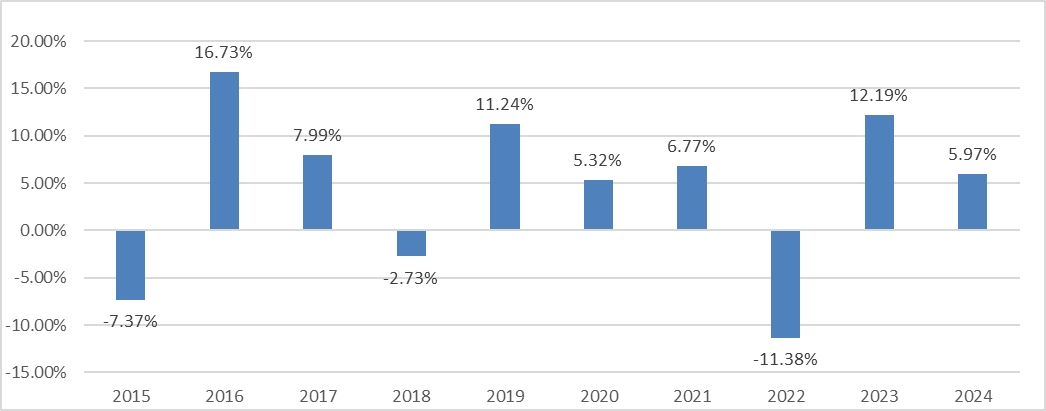
As of June 30, 2025, the Fund’s Class A shares had a calendar year-to-date return of [ ]%. During the periods illustrated in this bar chart, Class A’s highest quarterly return was 8.54% for the quarter ended June 30,
2020, and its lowest quarterly return was -15.83% for the quarter ended March 31, 2020. The maximum Class A sales charge of 4.50%, which is normally deducted when you purchase shares, is not reflected in the highest/lowest quarterly returns or in the
bar chart. If this fee were included, the returns would be less than those shown. The average annual total returns in the table below do include the sales charge.
Average annual total returns for periods ended December 31, 2024
|
1 year
|
5 years
|
10 years
|
|
|
Class A return before taxes
|
1.13%
|
2.21%
|
3.50%
|
|
Class A return after taxes on distributions
|
-1.48%
|
-0.54%
|
0.57%
|
|
Class A return after taxes on distributions and sale of Fund shares
|
0.64%
|
0.46%
|
1.31%
|
|
Class C return before taxes
|
4.19%
|
2.69%
|
3.52%
|
|
Institutional Class return before taxes
|
6.24%
|
3.68%
|
4.36%
|
|
Class R6 return before taxes
|
6.28%
|
3.78%
|
4.50%
|
|
Class R return before taxes
|
5.71%
|
3.11%
|
3.77%
|
|
Class Y return before taxes
|
5.97%
|
3.44%
|
4.11%
|
|
Bloomberg US Aggregate Index (reflects no deduction for fees, expenses, or taxes)*
|
1.25%
|
-0.33%
|
1.35%
|
| ICE BofA US High Yield Constrained Index (reflects no deduction for fees, expenses, or taxes)* |
8.20% | 4.03% | 5.08% |
* In connection with new regulatory requirements, effective July 31, 2024, the Fund changed its broad-based securities market benchmark index to the Bloomberg US Aggregate Bond Index. Although the Bloomberg US Aggregate
Bond Index can be considered more broadly representative of the overall securities market applicable to the Fund, the Fund will continue to show the performance of the ICE BofA US High Yield Constrained Index for comparative purposes because the
Manager believes it is more representative of the Fund’s investment universe.
After-tax performance is presented only for Class A shares of the Fund. The after-tax returns for other Fund classes may vary. Actual after-tax returns depend on the investor’s individual tax situation and may differ from the returns shown.
After-tax returns are not relevant for shares held in tax-advantaged investment vehicles such as employer-sponsored 401(k) plans and individual retirement accounts (IRAs). The after-tax returns shown are calculated using the highest individual
federal marginal income tax rates in effect during the periods presented and do not reflect the impact of state and local taxes.
Who manages the Fund?
Investment manager
5
Delaware Management Company, a series of Macquarie Investment Management Business Trust (a Delaware statutory trust)
|
Portfolio managers
|
Title with Delaware Management Company
|
Start date on the Fund
|
|
Vivek Bommi, CFA
|
Managing Director, Head of Leveraged Credit
|
November 2023
|
|
John P. McCarthy, CFA
|
Managing Director, Senior Portfolio Manager
|
November 2021
|
Sub-advisors
Macquarie Investment Management Austria Kapitalanlage
Macquarie Investment Management Europe Limited
Macquarie Investment Management Global Limited
On April 21, 2025, Macquarie Group Limited, the parent company of the Manager, a series of Macquarie Investment Management Business Trust (MIMBT), together with certain of its affiliates, and Nomura Holding America Inc.
(Nomura), announced that they had entered into an agreement for Nomura to acquire the US and European public investments asset management business of Macquarie Asset Management. The transaction is subject to customary closing conditions, including
the receipt of applicable regulatory approvals. Subject to such approvals and the satisfaction of these conditions, the transaction is expected to close by the end of October 2025. This is subject to change.
Under the 1940 Act, the closing of the transaction will result in the automatic termination of the Fund’s investment advisory agreement with the Manager and the sub-advisory agreements. Consequently, the Fund’s Board of
Trustees (Board) will be asked to approve a new investment advisory agreement and new sub-advisory agreements. If approved by the Board, the new investment advisory agreement will be presented to Fund shareholders for approval, and, if approved,
would take effect upon the closing of the transaction.
Purchase and redemption of Fund shares
You may purchase or redeem shares of the Fund on any day that the New York Stock Exchange (NYSE) is open for business (Business Day). Shares may be purchased or redeemed: through your financial intermediary; through the
Fund’s website at macquarie.com/mam/account-access; by calling 800 523-1918; by regular mail (c/o Macquarie Funds, P.O. Box 534437, Pittsburgh, PA 15253-4437); by overnight courier service (c/o Macquarie Funds Service Center, Attention: 534437, 500
Ross Street, 154-0520, Pittsburgh, PA 15262); or by wire.
For Class A and Class C shares, the minimum initial investment is generally $1,000 and subsequent investments can be made for as little as $100. The minimum initial investment for IRAs, Uniform Gifts/Transfers to Minors
Act accounts, direct deposit purchase plans, and automatic investment plans is $250 and through Coverdell Education Savings Accounts is $500, and subsequent investments in these accounts can be made for as little as $25. For Class R, Institutional
Class, Class Y, and Class R6 shares (except those shares purchased through an automatic investment plan), there is no minimum initial purchase requirement, but certain eligibility requirements must be met. The eligibility requirements are described
in this Prospectus under “Choosing a share class” and on the Fund’s website. We may reduce or waive the minimums or eligibility requirements in certain cases.
Tax information
The Fund’s distributions generally are taxable to you as ordinary income, capital gains, or some combination of both, unless you are investing through a tax-advantaged arrangement, such as a 401(k) plan or an IRA, in which
case your distributions may be taxed as ordinary income when withdrawn from the tax-advantaged account.
Payments to broker/dealers and other financial intermediaries
If you purchase shares of the Fund through a broker/dealer or other financial intermediary (such as a bank), the Fund and its related companies may pay the intermediary for the sale of Fund shares and related services.
These payments may create a conflict of interest by influencing the broker/dealer or other intermediary and your salesperson to recommend the Fund over another investment. Ask your salesperson or visit your financial intermediary’s website for more
information.
6
Our principal investment strategies
The Fund seeks to achieve its objective to provide total return through a combination of high current income and capital appreciation by investing primarily in a diversified portfolio of high-yield,
high-risk, fixed-income securities, including secured and unsecured loan assignments, loan participations and other loan instruments (loans), of US and foreign issuers, the risks of which are, in the judgment of the Manager, consistent with the
Fund’s objective. There is no guarantee, however, that the Fund will achieve its objective.
In general, the high level of income that the Fund seeks is paid by debt securities rated in the lower rating categories of the NRSROs or unrated securities that are determined by the Manager to be of
comparable quality; these include debt securities rated BB+ or lower by S&P, or comparably rated by another NRSRO or, if unrated, determined by the Manager to be of comparable quality. The Fund may invest up to 100% of its total assets in
non-investment-grade debt securities, commonly called “high-yield” or “junk” bonds, which include debt securities rated BB+ or lower by S&P, or comparably rated by another NRSRO or, if unrated, determined by the Manager to be of comparable
quality. Lower-quality debt securities (which include junk bonds) are considered to be speculative and involve greater risk of default or price changes due to changes in the issuer’s creditworthiness. The market prices of these securities may
fluctuate more than higher-quality securities and may decline significantly in periods of general economic difficulty.
The Manager analyzes economic and market conditions, seeking to identify the securities or market sectors that it believes are the best investments for the Fund. The Manager invests primarily in fixed
income securities that it believes will have a liberal and consistent yield and will tend to reduce the risk of market fluctuations. Before selecting high yield corporate bonds, the Manager carefully evaluates each individual bond, including its
income potential and the size of the bond issuance. The size of the issuance helps the Manager evaluate how easily it may be able to buy and sell the bond.
The Manager also does a thorough credit analysis of the issuer to determine whether that company has the financial ability to meet the bond's payments.
The Manager maintains a well-diversified portfolio of high yield bonds that represents many different sectors and industries. Through diversification the Manager can help to reduce the impact that any
individual bond might have on the portfolio should the issuer have difficulty making payments.
The Fund strives to provide total return, with high current income as a secondary objective. Before purchasing a bond, the Manager evaluates both the income level and its potential for price
appreciation.
The Manager attempts to optimize the Fund’s risk/reward by investing in the debt portion of the capital structure that the Manager believes to be most attractive, which may include secured and/or
unsecured loans, floating rate notes and/or secured and/or unsecured high- yield bonds. For example, if the Manager believes that market conditions are favorable for a particular type of fixed-income instrument, such as high-yield bonds, most or all
of the fixed-income instruments in which the Fund invests may be high-yield bonds. Similarly, if the Manager believes that market conditions are favorable for loans, most or all of the fixed-income instruments in which the Fund invests may be loans,
including second-lien loans which typically are lower in the capital structure and less liquid than first-lien loans.
The Fund also may own, to a lesser degree, preferred stocks, common stocks and convertible securities and other equity securities or warrants generally incidental to the purchase or ownership of a
fixed-income instrument or in connection with a reorganization of an issuer. The prices of common stocks and other equity securities tend to fluctuate in the short term, particularly those of smaller companies. The Fund may invest in restricted
securities, including Rule 144A Securities. The Fund may purchase shares of other investment companies subject to the restrictions and limitations of the 1940 Act.
The Fund may invest up to 100% of its total assets in foreign securities, including securities of issuers in emerging markets. Investments in foreign securities also present additional risks such as
currency fluctuations and political or economic conditions affecting the foreign country. Many of the companies in which the Fund may invest have diverse operations, with products or services in foreign markets. Therefore, the Fund may have indirect
exposure to various foreign markets through investments in these companies, even if the Fund is not invested directly in such markets.
7
The Fund may lend its portfolio securities to brokers, dealers and other financial institutions. In connection with such loans, the Fund receives liquid collateral equal to at least 102% (105% for
international securities) of the value of the loaned portfolio securities. This collateral is marked-to-market on a daily basis.
The Fund may use a variety of derivatives instruments for various purposes. The Fund may, at any given time, use futures contracts and swaps (including credit default swaps and total return swaps). The
Fund may use these derivatives in an attempt to enhance return, to hedge broad or specific fixed-income market movements, to gain or increase exposure to specific securities, sectors and/or geographical areas, to invest in foreign currencies or
securities not otherwise readily available, to mitigate the impact of rising interest rates or to otherwise manage the risks of the Fund. In an effort to manage foreign currency exposure, the Fund may use forward currency contracts to either increase
or decrease exposure to a given currency. With credit default swaps, the Fund either may sell or buy credit protection with respect to bonds, loans or other debt securities pursuant to the terms of these contracts.
When the Manager believes that a full or partial temporary defensive position is desirable, due to present or anticipated market or economic conditions and to attempt to reduce the price volatility of
the Fund, the Manager may invest up to 100% of the Fund’s assets in cash or cash equivalents. The “cash equivalents” in which the Fund may invest include, but are not limited to: short-term obligations such as rated commercial paper and variable
amount master demand notes; US dollar-denominated time and savings deposits (including certificates of deposit); bankers’ acceptances; obligations of the US government or its agencies or instrumentalities; repurchase agreements (which investments
also are subject to their own fees and expenses); and other similar short-term US dollar-denominated obligations which the Manager believes are of comparable quality. Subject to the Fund’s investment policies and restrictions, the Fund may utilize
derivatives instruments, including, but not limited to, futures contracts, options and other types of derivatives, for defensive purposes. It also may shorten the average maturity of the Fund’s debt holdings or emphasize investment-grade debt
securities.
By taking a temporary defensive position in any one or more of these manners, the Fund may not achieve its investment objective.
At times, the Fund may invest in the Subsidiary, which is a wholly owned company acting as an investment vehicle for the Fund, in order to effect certain investments consistent with the Fund’s
investment objectives. The Fund’s investment in the Subsidiary is expected to provide the Fund with exposure certain investments in accordance with the limits of the federal tax laws.
The Manager may seek investment advice and recommendations from the Affiliated Sub-Advisors. The Manager may also permit the Affiliated Sub-Advisors to execute Fund security trades on behalf of the
Manager and exercise investment discretion for securities in certain markets where the Manager believes it will be beneficial to utilize an Affiliated Sub-Advisor’s specialized market knowledge.
Additional Investment Considerations. The objective and investment policies of the Fund may be changed by the Board without a vote of the
Fund’s shareholders, unless a policy or restriction is otherwise described as a fundamental policy in the SAI. Shareholders, however, will be given prior written notice, typically at least 60 days in advance, of any material change in the Fund’s
objective.
Because the Fund owns different types of investments, its performance will be affected by a variety of factors. The value of the Fund's investments and the income it generates will vary from day to day,
generally reflecting changes in interest rates, market conditions, and other company and economic news. From time to time, based on market or economic conditions, the Fund may have significant positions in one or more sectors of the market and may be
overweight or underweight sectors as compared to its benchmark index.
To the extent the Fund invests more heavily in particular sectors, its performance will be sensitive to developments that significantly affect those sectors. Alternatively, the lack of exposure to one
or more sectors may adversely affect performance. Performance also will depend on the Manager’s skill or that of the Fund’s investment sub-advisor, as applicable (hereinafter referred to collectively as the Manager), in selecting investments. As with
any mutual fund, you could lose money on your investment. There is no guarantee that the Fund will achieve its objective.
The Fund also may invest in and use certain other types of securities and instruments in seeking to achieve its objective(s). For example, the Fund may invest in options, futures contracts and other
derivatives instruments if it is permitted to invest
8
in the type of asset by which the return on, or value of, the derivative is measured. Certain types of the Fund's authorized investments and strategies, such as derivatives instruments, foreign
securities, junk bonds and commodities, including precious metals, involve special risks. Depending on how much the Fund invests or uses these strategies, these special risks may become significant and thus affect the performance of the Fund.
Certain types of mortgage-backed and asset-backed securities may experience significant valuation uncertainties, greater volatility, and significantly less liquidity due to the sharp rise of
foreclosures on home loans secured by subprime mortgages in recent years. Subprime mortgages have a higher credit risk than prime mortgages, as the credit criteria for obtaining a subprime mortgage is more flexible than that used with prime
borrowers. To the extent that the Fund invests in securities that are backed by pools of mortgage loans, the risk to that Fund may be significant. Other asset-backed securities also may experience significant valuation uncertainties, increased
volatility, and significantly reduced liquidity.
The Fund may actively trade securities in seeking to achieve its objective(s). Factors that can lead to active trading include market volatility, a significant positive or negative development
concerning a security, an attempt to maintain the Fund's market capitalization target of the securities in each such Fund's holdings and the need to sell a security to meet redemption activity. Actively trading securities may increase transaction
costs (which may reduce performance) and increase net realized gains that the Fund must distribute for federal tax purposes, the distribution of which would increase your taxable income.
The Fund generally seeks to be fully invested, except to the extent that it takes a temporary defensive position. In addition, at times, the Manager may invest a portion of the Fund's assets in cash or
cash equivalents if the Manager is unable to identify and acquire a sufficient number of securities that meet its selection criteria for implementing the Fund's investment objective, strategies and policies, or for other reasons.
Please see the Fund’s SAI for additional information about the Fund’s investments and risks.
Other investment strategies
|
Lending securities
The Fund may lend up to 25% of its assets to qualified broker/dealers or institutional investors for their use in securities transactions. Borrowers of the Fund’s securities must provide collateral to the Fund and
adjust the amount of collateral each day to reflect changes in the value of the loaned securities. These transactions, if any, may generate additional income for the Fund.
Borrowing from banks
|
The Fund may borrow money from banks as a temporary measure for extraordinary or emergency purposes or to facilitate redemptions. The Fund will be required to pay interest to the lending banks on the
amount borrowed. As a result, borrowing money could result in the Fund being unable to meet its investment objective. The Fund will not borrow money in excess of one-third of the value of its total assets.
|
Purchasing securities on a when-issued or delayed-delivery basis
|
The Fund may buy or sell securities on a when-issued or delayed-delivery basis (i.e., paying for securities before delivery or taking delivery at a later date).
|
Initial public offerings (IPOs)
|
Under certain market conditions, the Fund may invest in companies at the times of their IPOs. Companies involved in IPOs generally have limited operating histories, and prospects for future
profitability are uncertain. Prices of IPOs may also be unstable because of the absence of a prior public market, the small number of shares available for trading, and limited investor information. IPOs may be sold within 12 months of purchase. This
may result in increased short-term capital gains, which will be taxable to shareholders as ordinary income.
|
Temporary defensive positions
|
In response to unfavorable market conditions, the Fund may make temporary investments in cash or cash equivalents or other high-quality, short-term instruments. These investments may not be consistent
with the Fund’s investment objectives. To the extent that the Fund holds such instruments, it may be unable to achieve its investment objective.
9
The risks of investing in the Fund
Investing in any mutual fund involves risk, including the risk that you may receive little or no return on your investment, and the risk that you may lose part or all of the money you invest. Before you
invest in the Fund, you should carefully evaluate the risks. Because of the nature of the Fund, you should consider your investment to be a long-term investment that typically provides the best results when held for a number of years. The information
below describes the principal and non-principal risks you assume when investing in the Fund. Please see the SAI for a further discussion of these risks and other risks not discussed here.
Principal Risks. An investment in the Fund is subject to various risks, including the following:
|
Foreign risk
|
Investing in foreign securities involves a number of economic, financial, legal, and political considerations that are not associated with the US markets and that could affect the Fund's performance unfavorably, depending
upon prevailing conditions at any given time. For example, the securities markets of many foreign countries may be smaller, less liquid and subject to greater price volatility than those in the US. Foreign investing also may involve brokerage costs
and tax considerations that usually are not present in the US markets.
Other factors that can affect the value of the Fund's foreign investments include the comparatively weak supervision and regulation by some foreign governments of securities exchanges, brokers and issuers; the fact that
many foreign companies may not be subject to uniform and/or stringent accounting, auditing and financial reporting standards; fluctuations in foreign currency exchange rates and related conversion costs or currency redenomination; nationalization or
expropriation of assets; and custodial or other operational delays. It also may be difficult to obtain reliable information about the securities and business operations of certain foreign issuers. Settlement of portfolio transactions also may be
delayed due to local restrictions or communication problems, which can cause the Fund to miss attractive investment opportunities or impair its ability to dispose of securities in a timely fashion (resulting in a loss if the value of the securities
subsequently declines). World markets, or those in a particular region, all may react in similar fashion to important economic or political developments. In addition, foreign markets may perform differently than the US market. Over a given period of
time, foreign securities may underperform US securities — sometimes for years.
Securities of issuers traded on exchanges may be suspended, either by the issuers themselves, by an exchange or by governmental authorities. The likelihood of such suspensions may be higher for securities of issuers in
emerging markets than in more developed markets. Trading suspensions may be applied from time to time to the securities of individual issuers for reasons specific to that issuer, or may be applied broadly by exchanges or governmental authorities in
response to market events. Suspensions may last for significant periods of time, during which trading in the securities and in instruments that reference the securities, such as derivatives instruments, may be halted. In the event that the Fund holds
material positions in such suspended securities, the Fund's ability to liquidate its positions or provide liquidity to investors may be compromised and the Fund could incur significant losses.
To the extent that the Fund invests in sovereign debt instruments, the Fund is subject to the risk that a government or agency issuing the debt may be unable to pay interest and/or repay principal due to cash flow
problems, insufficient foreign currency reserves or political concerns. In such instance, the Fund may have limited recourse against the issuing government or agency. Financial markets have experienced, and may continue to experience, increased
volatility due to the uncertainty surrounding the sovereign debt of certain countries.
Moreover, in pursuing its investment objective, the Fund, at times, may concentrate its investment in securities of companies located in a specific geographical region. To the extent the Fund does so, it may face more
risks than mutual funds with investments that are diversified around the globe. The economies and financial markets
10
of certain regions can be interdependent and all may decline at the same time, and certain regions may face risks unique to that area. In particular:
Asia Pacific Investments. The level of development of the economies of countries in the Asia Pacific region varies greatly. Certain economies in the region may be adversely affected
by increased competition, high inflation rates, undeveloped financial services sectors, currency fluctuations or restrictions, political and social instability and increased economic volatility. Natural disasters frequently occur in the region, which
could drastically impact particular business operations of companies in the region or its overall economy. In addition, certain countries in the Asia Pacific region are large debtors to commercial banks and to foreign governments. It is possible that
certain lenders at times may be unwilling to extend credit to Asia Pacific countries, which could make it more difficult for such borrowers to obtain financing on attractive terms or at all. Due to heavy reliance on international trade, a decrease in
demand would adversely affect economic performance in the region. In addition, ongoing political issues and heightened trade tensions between the US and China, including the possibility of a reduction in spending on Chinese products or services, the
institution of additional tariffs or other trade barriers may have an adverse impact on the Chinese economy and potentially other economies in the region. Investments in companies located or operating in the Asia Pacific region may involve risks and
considerations not typically associated with investments in the U.S. and other Western nations, including the use of variable interest equity (“VIE”) organizational structures; political, legal and regulatory uncertainty; and differing shareholder
rights based on company structure and/or location of operations.
Central and South American Investments. The economies in Latin America, including in some Central and South American countries, have experienced high interest rates, high inflation
rates, volatility, regime changes and government defaults. Currency devaluations in any such country may have a significant effect on the entire region. Because commodities such as oil and gas, minerals and metals represent a significant percentage
of the
region’s exports, the economies of these countries are particularly sensitive to fluctuations in commodity prices. As a result, the economies in many Central and South American countries can experience significant
volatility. The economies of countries in these regions tend to be heavily dependent on trading relationships with key trading partners, including the United States, Europe, Asia and other Latin American countries, and as such adverse economic events
in one country may have a significant adverse effect on other countries of this region. In addition, recent trade tensions and the imposition of tariffs may disrupt Latin American economies or lead to heightened market volatility.
Additionally, in the past, certain Central and South American economies have been influenced by changing supply and demand for a particular currency, monetary policies of governments (including exchange control programs
and currency devaluations and revaluations). Certain countries in this region also historically have experienced political and social risk, including periods of instability and social unrest, local insurrections, social upheavals and high
unemployment and underemployment, any of which could adversely impact the economies of these countries.
European Investments. The Economic and Monetary Union (eurozone) of the European Union (EU) requires members of the eurozone to comply with restrictions on inflation rates,
deficits, interest rates and debt levels, as well as fiscal and monetary controls, each of which may significantly affect EU member countries, as well as other countries in Europe, including non-members. Decreasing imports or exports, changes in
governmental or EU regulations on trade, changes in the exchange rate of the euro, the default or threat of default by an EU member state on its sovereign debt and/or an economic recession in an EU member state may have a significant adverse effect
on the economies of other EU member states and their trading partners.
The European financial markets have historically experienced volatility and adverse trends due to concerns about economic downturns or rising government debt levels in several European countries, including, but not
11
limited to, Austria, Belgium, Cyprus, France, Greece, Ireland, Italy, Portugal, Spain and Ukraine. These events have adversely affected, and in the future may adversely affect, the exchange rate of the euro and may
significantly affect European countries, including those that do not use the euro as their currency. Additionally, newer EU and eurozone member states, particularly in eastern Europe, remain burdened to various extents by certain infrastructural,
bureaucratic and business inefficiencies, and their markets remain relatively undeveloped and may be particularly sensitive to political and economic developments. Responses to financial problems by European governments, central banks and others,
including austerity measures and reforms, may not produce the desired results, may result in social unrest, may limit future growth and economic recovery or may have other unintended consequences. Further defaults or restructurings by governments and
other entities of their debt could have additional adverse effects on economies, financial markets and asset valuations around the world. Moreover, recent global trade tensions and the imposition of tariffs, including by the United States, could
further exacerbate volatility and such adverse effects.
The national politics of countries in Europe have been unpredictable and subject to influence by disruptive political groups and ideologies, including, for example, secessionist movements. The governments of European
countries may be subject to change and such countries may experience social and political unrest. Unanticipated or sudden political or social developments may result in sudden and significant investment losses. EU continues to face major issues
involving its membership, structure, procedures and policies, including the successful political, economic and social integration of new member states. The current and future status of the EU continues to be the subject of political controversy, and
the growth of nationalist and populist parties in national legislatures may further threaten enlargement. It is possible that one or more countries may abandon the euro and/or withdraw from the EU, as the United Kingdom (UK) did in 2020 (commonly
referred to as “Brexit”). Following Brexit, certain trading matters between the UK and the EU remain unresolved, including with respect to financial services. The continuing uncertainty could have an adverse impact on the UK economy.
The occurrence of terrorist incidents throughout Europe or war in the region could also impact financial markets, in particular, Russia's invasion of Ukraine that began in 2022. As a result of that military action, the US
and many other countries have imposed sanctions on Russia and certain Russian individuals, banks and corporations, and the ongoing hostilities and resulting sanctions may have a severe adverse effect on the region's economies and more globally.
North American Investments. A decrease in imports or exports, changes in trade regulations or an economic recession in any North American country can have a significant economic
effect on the entire region. Since the implementation of the North American Free Trade Agreement (NAFTA) in 1994 among Canada, the US and Mexico, total merchandise trade among the three countries has increased. However, political developments in the
US resulting in recent global trade tensions and the imposition of reciprocal tariffs by all three countries, may have implications for trade among the US, Mexico and Canada, any of which may result in additional volatility in the region. Moreover,
the likelihood of further policy or legislative changes in one or more countries may have a significant effect on North American markets generally, as well as on the value of certain securities held by the Fund when investing in this region.
|
High yield (junk) bond risk
|
In general, low-rated debt securities (commonly referred to as “high-yield” or “junk” bonds) offer higher yields due to the increased risk that the issuer will be unable to meet its obligations on interest or principal
payments at the time called for by the debt instrument. For this reason, these securities are considered speculative and could significantly weaken the Fund's returns. In adverse economic or other circumstances, issuers of these low-rated securities
and obligations are more likely to have difficulty making principal and interest payments than issuers of higher-rated securities and obligations.
In addition, these low-rated securities and obligations may fluctuate more widely in price and yield than higher-rated securities and obligations and may fall in price during times when the economy is weak or is expected
to become weak.
12
Low-rated securities and obligations also may require a greater degree of judgment to establish a price, may be difficult to sell at the time and price the Fund desires, and may carry higher transaction costs. Issuers of
securities that are in default or have defaulted may fail to resume principal or interest payments, in which case the Fund may lose its entire investment. In addition, a defaulted obligation or other restructuring of an obligation could involve an
exchange of such obligation for other debt or equity securities of the issuer or its affiliates, which may in turn be illiquid, speculative or unregistered. Low-rated securities and obligations are susceptible to such a default or decline in market
value due to real or perceived adverse economic and business developments relating to the issuer, the industry in general, market interest rates and market liquidity. The market value of these securities can be volatile. Ratings of a security or
obligation may not accurately reflect the actual credit risk associated with such a security. The creditworthiness of issuers of low-rated securities may be more complex to analyze than that of issuers of investment-grade debt securities.
|
Credit risk
|
An issuer of a fixed-income obligation (including a mortgage-backed security) or a REIT may not make payments on the obligation when due, or the other party to a contract may default on its obligation. There also is the
risk that an issuer could suffer adverse changes in its financial condition that could lower the credit quality of a security. This could lead to greater volatility in the price of the security, could affect the security’s liquidity, and could make
it more difficult to sell. A downgrade or default affecting any of the Fund's securities could affect the Fund's performance. In general, the longer the maturity and the lower the credit quality of a bond, the more sensitive it is to credit risk. If
the Fund purchases unrated securities and obligations, it will depend on the Manager’s analysis of credit risk more heavily than usual.
|
Bank loans and other direct indebtedness risk
|
In addition to the risks typically associated with fixed-income securities, loans (including loan assignments, loan participations and other loan instruments) carry other risks, including the risk of insolvency of the
lending bank or other intermediary. The risks associated with loans are similar to the risks of low-rated debt securities or “junk” bonds since loans typically are below investment-grade. Loans may be unsecured or not fully collateralized, may be
subject to restrictions on resale, may be difficult to value, sometimes trade infrequently on the secondary market and generally are subject to extended settlement periods. Any of these factors may impair the Fund's ability to sell or realize
promptly the full value of its loans in the event of a need to liquidate such loans. Difficulty in selling a loan can result in a loss. Accordingly, loans that have been sold may not be immediately available to meet redemptions. Extended trade
settlement periods may result in cash not being immediately available to the Fund. As a result, the Fund may have to sell other investments or engage in borrowing transactions to raise cash to meet its obligations. Interests in secured loans have the
benefit of collateral and, typically, of restrictive covenants limiting the ability of the borrower to further encumber its assets. There is a risk that the value of the collateral securing the loan may decline after the Fund invests and that the
collateral may not be sufficient to cover the amount owed to the Fund. In the event the borrower defaults, the Fund's access to the collateral may be limited or delayed by bankruptcy or other insolvency laws. These risks could cause the Fund to lose
income or principal on a particular investment, which could affect the Fund's returns. In addition, loans also are subject to the risk that a court could subordinate the loan to presently existing or future indebtedness or take other action
detrimental to the holders of the loan. Further, in the event of a default, second or lower lien secured loans will generally be paid only if the value of the collateral exceeds the amount of the borrower’s obligations to the senior secured lenders,
and the remaining collateral may not be sufficient to cover the full amount owed on the loan in which the Fund has an interest. If the loan is unsecured, there is no specific collateral on which the Fund can foreclose. In addition, if a secured loan
is foreclosed, the Fund may bear the costs and liabilities associated with owning and disposing of the collateral, including the risk that collateral may be difficult to sell. The restructuring of a loan, either in a negotiated work-out or in the
context of bankruptcy, could involve an exchange of such loan for other debt or equity securities of the issuer or its affiliates, which may in turn be illiquid, speculative or unregistered.
Loans made to finance highly leveraged corporate acquisitions may be especially vulnerable to adverse changes in economic or market conditions. Certain loans may not be considered “securities,” and purchasers, such as the
13
Fund, therefore may not be entitled to rely on the strong anti-fraud protections of the federal securities laws. With loan assignments, as an assignee, the Fund normally will succeed to all rights and obligations of its
assignor with respect to the portion of the loan that is being assigned. However, the rights and obligations acquired by the purchaser of a loan assignment may differ from, and be more limited than, those held by the original lenders or the assignor.
With loan participations, the Fund may not be able to control the exercise of any remedies that the lender would have under the loan and likely would not have any rights against the borrower directly, so that delays and expense may be greater than
those that would be involved if the Fund could enforce its rights directly against the borrower.
|
Restricted securities risk
|
Restricted securities are subject to legal or contractual restrictions on resale, and there can be no assurance of a ready market for resale. These securities include private placements or other unregistered securities,
such as “Rule 144A securities”, which are securities that may be sold only to qualified institutional buyers pursuant to the 1933 Act. Privately placed securities, Rule 144A securities and other restricted securities may have the effect of increasing
the level of Fund illiquidity to the extent the Fund finds it difficult to sell these securities when the Manager believes it is desirable to do so, especially under adverse market or economic conditions or in the event of adverse changes in the
financial condition of the issuer, and the prices realized could be less than those originally paid, or less than the fair market value. At times, the illiquidity of the market, as well as the lack of publicly available information regarding these
securities also may make it difficult to determine the fair market value of such securities for purposes of computing the NAV of the Fund.
|
Fixed income risk
|
The prices of the Fund's fixed-income securities respond to economic developments, particularly interest rate changes, as well as to perceptions about the creditworthiness of individual issuers. Generally, the Fund's
fixed-income securities will decrease in value if interest rates rise and vice versa. In a low interest rate environment, risks associated with rising rates are heightened. Rising interest rates tend to decrease liquidity, increase trading costs and
increase volatility, all of which may make portfolio management more difficult and costly to the Fund and its shareholders. In the case of foreign securities, price fluctuations will reflect international economic and political events, as well as
changes in currency valuations relative to the US dollar. Other factors may materially and adversely affect the market price and yield of such fixed-income securities, including investor demand, changes in the financial condition of the applicable
issuer, government fiscal policy and domestic or worldwide economic conditions. In addition, certain events, such as natural disasters, terrorist attacks, war, regional or global instability and other geopolitical events, have led, and may in the
future lead, to increased short-term market volatility and may have adverse long-term effects on world economies and markets generally.
|
Currency risk
|
Foreign securities may be denominated in foreign currencies. The value of the Fund's investments, as measured in US dollars, may be unfavorably affected by changes in foreign currency exchange rates and exchange control
regulations. Domestic issuers that hold substantial foreign assets may be similarly affected. The value of an investment denominated in a foreign currency could change significantly as foreign currencies strengthen or weaken relative to the US
dollar. Currency exchange rates can be affected unpredictably by intervention, or failure to intervene, by US or foreign governments or central banks or by currency controls or political developments in the US or abroad. Devaluations of a currency by
a government or banking authority also may have significant impact on the value of any investments denominated in that currency. Risks related to foreign currencies also include those related to economic or political developments, market
inefficiencies or a higher risk that essential investment information may be incomplete, unavailable or inaccurate. A US dollar investment in an investment denominated in a foreign currency is subject to currency risk. Foreign currency losses could
offset or exceed any potential gains, or add to losses, in the related investments. Currency markets also are generally not as regulated as securities markets. In addition, in order to transact in foreign investments, the Fund
14
may exchange and hold foreign currencies. Regulatory fees or higher custody fees may be imposed on foreign currency holdings. The Fund may use derivatives to manage its foreign currency risk. Derivatives on non-US
currencies involve a risk of loss if currency exchange rates move against the Fund, unless the derivative is a currency forward to hedge against the non-US currency movement.
|
Interest rate risk
|
The value of a debt security, mortgage-backed security or other fixed-income obligation, as well as of shares of mortgage REITs, may decline due to changes in market interest rates. Small and medium-sized companies may
also be adversely affected by rising interest rates because they often borrow money to finance their operations.
Generally, when interest rates rise, the value of such a security or obligation generally decreases. Conversely, when interest rates decline, the value of such a security generally increases. Long-term debt securities,
mortgage-backed securities and other fixed-income obligations generally are more sensitive to interest rate changes than short-term debt securities. The Fund may experience a decline in its income due to falling interest rates. The Fund may be
subject to a greater risk of rising interest rates when interest rates are low or inflation rates are high or rising. The Fund may use derivatives to hedge its exposure to interest rate risk.
Changes to monetary policy by the Federal Reserve or other regulatory actions may affect interest rates. It is difficult to predict the impact of these rate changes and any future rate changes on various markets.
Market developments and other factors, including a general rise in interest rates, have the potential to cause investors to move out of fixed-income securities on a large scale, which may increase redemptions from mutual
funds that hold large amounts of fixed-income securities. Such a move, coupled with a reduction in the ability or willingness of dealers and other institutional investors to buy or hold fixed-income securities may result in decreased liquidity and
increased volatility in the fixed-income markets, which could cause a Fund’s NAV to fluctuate more and adversely affect the Fund’s return.
In general, a portfolio of debt, mortgage-related and asset-backed securities and other fixed-income obligations experiences a decrease in principal value with an increase in interest rates. The extent of the decrease in
principal value may be affected by the Fund’s duration of its portfolio of debt, mortgage-related and asset-backed securities and other fixed-income obligations. Duration measures the relative price sensitivity of a security to changes in interest
rates. “Effective” duration takes into consideration the likelihood that a security will be called, or prepaid, prior to maturity given current market interest rates. Typically, a security with a longer duration is more price sensitive than a
security with a shorter duration. In general, a portfolio of debt, mortgage-related and asset-backed securities experiences a percentage decrease in principal value equal to its effective duration for each 1% increase in interest rates. For example,
if the Fund holds a portfolio of securities with an effective duration of five years and interest rates rise 1%, the principal value of such securities could be expected to decrease by approximately 5%.
|
Liquidity risk
|
Liquidity risk is the possibility that investments cannot be sold or disposed of in current market conditions in seven calendar days or less without the sale or disposition significantly changing the market value of the
investment. Illiquid investments may trade at a discount from comparable, more liquid investments, and may be subject to wide fluctuations in market value. A fund also may not be able to dispose of illiquid investments at a favorable time or price
during periods of infrequent trading of an illiquid investment.
There is generally no established retail secondary market for high yield securities. As a result, the secondary market for high yield securities is more limited and less liquid than other secondary securities markets. The
high yield secondary market is particularly susceptible to liquidity problems when institutional investors, such as
15
mutual funds, and certain other financial institutions, temporarily stop buying bonds for regulatory, financial, or other reasons. Adverse publicity and investor perceptions may also disrupt the secondary market for high
yield securities.
|
Prepayment risk
|
Income from the Fund's debt securities may decline if the Fund invests the proceeds from matured, traded, prepaid or called securities in securities with interest rates lower than the current earnings rate of the Fund's
portfolio. For example, debt securities with high relative interest rates may be paid by the issuer prior to maturity, particularly during periods of falling interest rates. During periods of falling interest rates, there is the possibility that an
issuer will call its securities if they can be refinanced by issuing new securities with a lower interest rate (commonly referred to as optional call risk). Moreover, falling interest rates could cause prepayments of mortgage loans to occur more
quickly than expected. This may occur because, as interest rates fall, more property owners refinance the mortgages underlying mortgage-backed securities (including shares of mortgage REITs). As a result, the Fund may have to reinvest the proceeds in
other securities with generally lower interest rates, resulting in a decline in the Fund's investment income.
|
Subsidiary risk
|
By investing in the Subsidiary, the Fund is indirectly exposed to the risks associated with the Subsidiary’s investment(s). The related investment risks are described elsewhere in this Prospectus. There can be no assurance
that the investment objective of the Subsidiary will be achieved. The Subsidiary is not registered under the 1940 Act and does not benefit from all the investor protections that apply to 1940 Act-registered funds. Changes in applicable tax laws could
result in the inability of the Fund and/or the Subsidiary to operate as described in this prospectus and the Fund’s SAI, and could adversely affect the Fund and its shareholders.
|
Active management and selection risk
|
The Manager applies the Fund's investment strategies and selects securities for the Fund in seeking to achieve the Fund's investment objective. There can be no guarantee that its decisions will produce the desired results,
and securities selected by the Fund may not perform as well as the securities held by other mutual funds with investment objectives that are similar to the investment objective(s) of the Fund. In general, investment decisions made by the Manager may
not produce the anticipated returns, may cause the Fund's shares to lose value or may cause the Fund to perform less favorably than other mutual funds with similar investment objectives.
Non-Principal Risks. In addition to the Principal Risks identified above, an investment in the Fund may be subject to other, non-principal risks, including the following:
|
Convertible security risk
|
A convertible security is a bond, debenture, note, preferred stock or other security that may be converted or exchanged for a prescribed amount of common stock of the same or different issuer within a particular period of
time at a specified price or formula. The value of a convertible security is influenced by changes in interest rates, with investment value declining as interest rates increase and increasing as interest rates decline. The credit standing of the
issuer and other factors also may have an effect on the convertible security’s investment value. Since it derives a portion of its value from the common stock into which it may be converted, a convertible security also is subject to the same types of
market and issuer risks that apply to the underlying common stock. Convertible securities issued by smaller capitalized companies may be more volatile.
|
Derivatives risk
|
A derivative is a financial instrument whose value or return is “derived,” in some manner, from the price of an underlying security, index, asset, rate or event. Derivatives are traded either on an organized exchange or
over-
16
the-counter (OTC) (privately negotiated between two parties). Forward foreign currency contracts, futures contracts, options and swaps are common types of derivatives that the Fund occasionally may use. Forward foreign
currency contracts (“forward contracts”) are purchases or sales of a foreign currency at a negotiated rate to be settled at a future date. A futures contract is a standardized contract listed on an exchange to buy or sell a specific quantity of an
underlying reference instrument, such as a security or other instrument, index, currency or commodity at a specific price on a specific date. An option can be entered either exchange-traded or OTC and is a contract that gives the purchaser the right
to buy or sell an underlying reference instrument, such as a security or other instrument, index, or commodity at a specific price on or before a specific date. A swap is an OTC agreement involving the exchange by the Fund with another party of their
respective commitments to pay or receive payments at specified dates on the basis of a specified notional amount. The statutory definition under the Commodity Exchange Act (CEA), as amended by the Dodd-Frank Wall Street Reform and Consumer Protection
Act (Dodd-Frank Act) of the term “Swap” includes options on commodities (excluding equities listed on exchanges), caps, floors, collars and certain forward contracts. The statutory definition of a swap also includes an instrument that is dependent on
the occurrence, nonoccurrence or the extent of the occurrence of an event or contingency associated with a potential financial, economic or commercial consequence, such as a credit default swap. A swap agreement may be privately negotiated
bilaterally and traded OTC between the two parties or, in some instances, must be transacted through a futures commission merchant (FCM) and cleared through a clearinghouse that serves as a central counterparty (for an OTC swap required to be
cleared). Certain standardized swaps are, and more OTC derivatives in the future may be, subject to mandatory OTC central clearing.
The use of derivatives presents several risks, including the risk that these instruments may change in value in a manner that adversely affects the Fund's NAV and the risk that fluctuations in the value of the derivatives
may not correlate with the reference instrument underlying the derivative. Derivatives can be highly complex, can create investment leverage, may perform in unanticipated ways and may be highly volatile, and the Fund could lose more than the amount
it invests. Derivatives may be difficult to value and, depending on the instrument, may at times be highly illiquid, and the Fund may not be able to close out or sell a derivative position at a particular time or at an anticipated price. Moreover,
some derivatives are more sensitive to interest rate changes and market price fluctuations than other instruments. To the extent the judgment of the Manager as to certain anticipated price movements is incorrect, the risk of loss may be greater than
if the derivative technique(s) had not been used. When used for hedging, the change in value of the derivative also may not correlate perfectly with the security or other risk being hedged. Appropriate derivatives may not be available in all
circumstances, and there can be no assurance that the Fund will be able to use derivatives to reduce exposure to other risks when that might be beneficial. Derivatives also may be subject to counterparty credit risk, which includes the risk that the
Fund may sustain a loss as a result of the insolvency or bankruptcy of, or other non-compliance with the terms in the agreement for the derivatives documentation by, another party to the transaction. Certain derivatives can create leverage, which may
amplify or otherwise increase the Fund's investment loss, possibly in an amount that could exceed the cost of that instrument or, under certain circumstances, that could be unlimited. Derivatives may involve fees, commissions, or other costs that may
reduce the Fund's gains (if any) from utilizing derivatives. Derivatives that have margin requirements involve the risk that if the Fund has insufficient cash or eligible margin securities to meet daily variation margin requirements, it may have to
sell securities from its portfolio at a time when it may be disadvantageous to do so. The Fund also may remain obligated to meet margin requirements until a derivative position is closed.
When the Fund uses derivatives, it will likely be required to provide margin or collateral in a manner that satisfies its contractual undertakings. The need to provide margin or collateral could limit the Fund's ability to
pursue other opportunities as they arise.
17
Although the Fund may attempt to hedge against certain risks, the hedging instruments may not perform as expected and could produce losses. Hedging instruments also may reduce or eliminate gains that may otherwise have
been available had the Fund not used the hedging instruments. The Fund may decide not to hedge certain risks in particular situations, even if appropriate instruments are available.
Swap instruments may shift the Fund's investment exposure from one type of investment to another. Swap agreements also may have a leverage component, and adverse changes in the value or level of the reference instrument,
such as an underlying asset, reference rate or index, can result in gains or losses that are substantially greater than the amount invested in the swap itself. Certain swaps have the potential for unlimited loss, regardless of the size of the initial
investment. The use of swap agreements entails certain risks that may be different from, or possibly greater than, the risks associated with investing directly in the reference instrument that underlies the swap agreement. Swaps are highly
specialized instruments that require investment techniques and risk analyses different from those associated with stocks, bonds, and other traditional investments. The Fund may enter into credit default swap contracts for hedging or investment
purposes. The Fund may either sell or buy credit protection under these contracts.
Certain derivatives transactions are not entered into or traded on organized exchanges or cleared by clearing organizations. Instead, such derivatives may be entered into directly with the counterparty and may be traded
only through financial institutions acting as market makers.
There may be risk that no liquid secondary market in the trading of OTC derivatives will exist, in which case the Fund may be required to hold such instruments until exercise, expiration or maturity. Certain of the
protections afforded to exchange-traded participants will not be available to participants in OTC derivatives transactions. OTC derivatives transactions are not subject to the guarantee of an exchange or clearinghouse and, as a result, the Fund would
bear greater risk of default by the counterparties to such transactions. For some counterparties, the Fund has put in place a guarantee of the counterparty’s payment obligations under OTC derivative transactions issued by its parent holding company,
which provides some protection to the Fund from a payment or delivery default by such counterparties. When traded on foreign exchanges, derivatives may not be regulated as rigorously as they would be if traded on or subject to the rules of an
exchange located in the US, may not involve a clearing mechanism and related guarantees, and will be subject to the risk of governmental actions affecting trading in, or the prices of, foreign securities, currencies and other instruments.
The counterparty risk for exchange-traded derivatives is significantly less than for privately negotiated or OTC derivatives, since generally an exchange or clearinghouse, which is the issuer or counterparty to each
exchange-traded instrument, provides a guarantee of performance. For privately negotiated instruments, there is not a similar exchange or clearinghouse guaranteeing the performance on both sides of the transaction. In all such transactions, the Fund
bears the risk that the counterparty could default, and this could result in a loss of the expected benefit of the derivative transactions and possibly other losses to the Fund. The Fund will enter into transactions in derivatives instruments only
with counterparties that the Manager reasonably believes are capable of performing under the contract. The Manager manages counterparty risk in an OTC derivative transaction by entering into bilateral collateral documentation, such as a Credit
Support Annex and an accompanying Account Control Agreement, where it is market practice and/or required by law to do so for OTC derivatives.
The enactment in June 2010 of the Dodd-Frank Act resulted in historic and comprehensive change in how OTC derivatives are regulated, including the manner in which OTC derivatives are customized, derivatives documentation
is negotiated, and trades are reported, executed and cleared. The Dodd-Frank Act and implementing rules ultimately may require the clearing and exchange-trading of many swaps.
18
Specifically, the Commodity Futures Trading Commission (CFTC) has adopted rules to require certain standardized swaps, previously settled OTC, be settled by means of a central clearinghouse. Central clearing is intended to
reduce the risk of default by the counterparty. There also may be risks introduced of a possible default by the derivatives clearing organization or by a clearing member or FCM through which a swap is submitted for clearing.
Ongoing changes to regulation of the derivatives markets and potential changes in the regulation of mutual funds using derivatives instruments could limit the Fund's ability to pursue its investment strategies. The extent
and impact of the new regulations or proposed regulations are not yet fully known and may not be for some time. Any such changes may, among various possible effects, increase the cost of entering into derivative transactions, require more assets of
the Fund to be used for collateral in support of those derivatives than is currently the case, or restrict the ability of the Fund to enter into certain types of derivative transactions, or could limit the Fund's ability to pursue its investment
strategies. In addition, changes in government regulation of derivatives could affect the character, timing and amount of the Fund's taxable income or gains.
In addition, pursuant to the Dodd-Frank Act, the CFTC in 2012 made substantial amendments to the permissible exemptions, and to the conditions for reliance on the permissible exclusions, from registration as a commodity
pool operator (CPO) under the CEA. Under these amendments, if the Fund uses commodity interests (such as futures contracts, options on futures contracts and most swaps) other than for bona fide hedging purposes (as defined by the CFTC), the aggregate
initial margin and premiums required to establish these positions (after taking into account unrealized profits and unrealized losses on any such positions and excluding the amount by which options are “in-the-money” at the time of purchase) may not
exceed 5% of the Fund's liquidation value, or alternatively, the aggregate net notional value of those positions, determined at the time the most recent position was established, may not exceed 100% of the Fund's liquidation value (after taking into
account unrealized profits and unrealized losses on any such positions) unless the Manager has registered as a CPO. The Manager, in its management of the Fund, currently is complying, and intends to continue to comply, with at least one of the two
alternative limitations described above.
Complying with those de minimis trading limitations may restrict the Manager's ability to use derivatives as part of the Fund's investment strategies. Although the Manager believes that it will be able to execute the
Fund's investment strategies within the de minimis trading limitations, the Fund's performance could be adversely affected. In addition, the CFTC recently has proposed changes to the de minimis trading rules and limitations that could potentially
change the Fund's ability to trade derivatives. Also, the Fund's ability to use certain derivatives instruments may be limited by tax considerations.
The Manager has claimed an exclusion from the definition of the term “commodity pool operator” with respect to the Fund under the Commodity Exchange Act (CEA) and, therefore, is not subject to registration or regulation as
a commodity pool operator under the CEA.
|
Emerging markets risk
|
Investments in countries with emerging economies or securities markets may carry greater risk than investments in more developed countries or markets. Emerging markets may experience political instability. Political and
economic structures in many such countries may be undergoing significant evolution and rapid development, and such countries may lack the social, political and economic stability characteristics of more developed countries. Certain of those countries
may have failed in the past to recognize private property rights and have nationalized or expropriated the assets of private companies. As a result, the risks described above, including the risks of nationalization or expropriation of assets, may be
heightened. In addition, unanticipated political or social developments may affect the value of the Fund’s investments in those countries and the availability of additional investments in those countries. The costs of buying, selling, and holding
securities in emerging
19
markets, including brokerage, tax, and custody costs, may be higher. The small size and inexperience of the securities markets in such countries and the limited volume of trading in securities in those countries may make
the Fund’s investments in such countries more volatile and less liquid than investments in more developed countries, and the Fund may be required to establish special custodial or other arrangements before making certain investments in those
countries. Economic markets and structures in emerging markets tend to be less mature and diverse than more developed markets. Regulatory oversight of issuers in emerging markets may be less stringent or inconsistently applied, and securities markets
may be subject to less government regulation or supervision. The economies of emerging market countries may suffer from extreme and volatile debt burdens or inflation rates. The repatriation of capital with regard to investments made in certain
securities or countries may be restricted during certain times or even indefinitely. There may be substantially less financial or accounting information available about issuers in emerging markets than in more developed markets than domestic issuers.
Information that is available may be of a lesser quality as issuers may be subject to different accounting, auditing, and financial reporting standards than issuers in more developed markets. As a result, it may be difficult to assess the value or
prospects of an investment in such issuers. In times of market stress, regulatory authorities of different emerging market countries may apply varying techniques and degrees of intervention, which can have an effect on prices and may require that the
Fund fair value its holdings in those countries. Emerging market securities may also be subject to greater fluctuations in value and liquidity due to changes in currency exchange rates.
|
Foreign currency exchange transactions and forward foreign currency contracts risk
|
The Fund may use foreign currency exchange transactions and forward foreign currency contracts to hedge certain market risks (such as interest rates, currency exchange rates and broad or specific market movement). These
investment techniques involve a number of risks, including the possibility of default by the counterparty to the transaction and, to the extent the Manager’s judgment as to certain market movements is incorrect, the risk of losses that are greater
than if the investment technique had not been used. For example, there may be an imperfect correlation between the Fund's holdings of securities denominated in a particular currency and the forward contracts entered into by the Fund. An imperfect
correlation of this type may prevent the Fund from achieving the intended hedge or expose the Fund to the risk of currency exchange loss. These investment techniques also tend to limit any potential gain that might result from an increase in the
value of the hedged position.
|
Investment company securities risk
|
The risks of investing in securities of an investment company, such as a mutual fund, typically reflect the risks of the instruments in which the underlying investment company invests. The net asset value of an investment
company can fluctuate, and the Fund could lose money investing in an investment company.
Investment companies typically charge their shareholders certain expenses, including management and administrative fees. As a shareholder in an investment company, the Fund would bear its pro rata share of the investment
company’s expenses (which are in addition to the expenses that shareholders pay when investing in a fund). As a result, the Fund may bear additional expenses when investing in an underlying investment company, which could reduce the Fund’s
performance.
|
Preferred stock risk
|
Preferred stock is a type of stock that pays a cumulative, fixed dividend that is senior to the dividends paid on the common stock of the issuer. Preferred stock may pay fixed or adjustable rates of return. Preferred stock
is subject to issuer-specific and market risks applicable generally to equity securities. In addition, a company’s preferred securities generally pay dividends only after the company makes required payments to holders of its
20
bonds and other debt. Preferred stock also is subject to credit risk with regard to the ability of the issuer to pay the dividend established upon issuance of the preferred stock.
|
Redemption risk
|
The Fund may experience periods of heavy redemptions that could cause the Fund to sell assets at inopportune times or at a loss or depressed value. Redemption risk is heightened during periods of declining or illiquid
markets. Heavy redemptions could hurt the Fund's performance.
|
Securities lending risk
|
Securities lending involves a risk of loss because the borrower may fail to return the securities in a timely manner or at all. If the Fund that lent its securities were unable to recover the securities loaned, it may sell
the collateral and purchase a replacement security in the market. Lending securities entails a risk of loss to the Fund if and to the extent that the market value of the loaned securities increases and the collateral is not increased accordingly.
Cash received as collateral for loaned securities may be invested, and such investment is subject to market appreciation or depreciation, with the Fund bearing any loss.
|
Tax risk
|
The Fund may gain most of its exposure to certain non-security based assets through its investment in the Subsidiary, which invests directly in such assets. In order for the Fund to qualify as a regulated investment
company (RIC) under Subchapter M of the Internal Revenue Code of 1986, as amended (Internal Revenue Code), the Fund must, among other requirements, derive at least 90% of its gross income each taxable year from “qualifying income.” The Fund
anticipates making certain investments in entities treated as partnerships for US federal income tax purposes (Partnership Investments). For purposes of “qualifying income,” income derived from a partnership will be treated as qualifying income only
to the extent such income is attributable to items of income of the partnership that would be qualifying income if realized directly by a Fund. However, 100% of the net income derived from an interest in a “qualified publicly traded partnership”
(QPTP) will be treated as qualifying income. The Fund’s Partnership Investments are not expected to qualify as QPTPs and such investments are generally expected to result in income that may be non-qualifying income. To the extent the Fund invests in
Partnership Investments directly, it will seek to restrict its income from Partnership Investments that do not generate qualifying income to a maximum of 10% of its gross income (when combined with its other investments that produce non-qualifying
income) to comply with certain qualifying income tests necessary for the Fund to qualify as a RIC, as described in more detail in the SAI. The tax treatment of certain Partnership Investments may be affected by future regulatory or legislative
changes that could affect the character, timing and/or amount of the Fund’s taxable income or gains and distributions.
The Fund intends to hold certain Partnership Investments indirectly, through the Subsidiary. The Fund believes that income from the Subsidiary will be qualifying income because it expects that the Subsidiary will make
annual distributions of its earnings and profits. If the Fund fails to satisfy the qualifying income requirement in any taxable year, the Fund may be eligible for relief provisions if the failures are due to reasonable cause and not willful neglect
and if a penalty tax is paid with respect to each failure to satisfy the applicable requirements. If the Fund does not qualify as a RIC for any taxable year and certain relief provisions are not available, the Fund’s taxable income will be subject to
tax at the Fund level and to a further tax at the shareholder level when such income is distributed, which could reduce the amount distributable to a shareholder negatively affecting the shareholder’s return from an investment in the Fund. Under
certain circumstances, the Fund may be able to cure a failure to meet the qualifying income requirement, but in order to do so the Fund may incur significant Fund-level taxes, which would effectively reduce (and could eliminate) the Fund’s returns.
|
IBOR risk
|
21
The risk that changes related to the use of the London Interbank Offered Rate (LIBOR) or similar interbank offered rates (“IBORs,” such as the Euro Overnight Index Average (EONIA)) could have adverse impacts on financial
instruments that reference such rates. While some instruments may contemplate a scenario where LIBOR or a similar rate is no longer available by providing for an alternative rate setting methodology, not all instruments have such fallback provisions
and the effectiveness of replacement rates is uncertain. The abandonment of LIBOR and similar rates could affect the value and liquidity of instruments that reference such rates, especially those that do not have fallback provisions. The use of
alternative reference rate products may impact investment strategy performance.
|
Natural disaster and epidemic risk
|
Natural disaster and epidemic risk is the risk that the value of a fund’s investments may be negatively affected by natural disasters, epidemics, or similar events. Natural or environmental disasters, such as earthquakes,
fires, floods, hurricanes, tsunamis, and other severe weather-related phenomena generally, and widespread disease, including pandemics and epidemics, have been and can be highly disruptive to economies and markets, adversely impacting individual
companies, sectors, industries, markets, currencies, interest and inflation rates, credit ratings, investor sentiment, and other factors affecting the value of a fund’s investments. Given the increasing interdependence among global economies and
markets, conditions in one country, market, or region are increasingly likely to adversely affect markets, issuers, and/or foreign exchange rates in other countries. These disruptions could prevent a fund from executing advantageous investment
decisions in a timely manner and could negatively impact the fund’s ability to achieve its investment objective.
Disclosure of portfolio holdings information
A description of the Fund’s policies and procedures with respect to the disclosure of its portfolio securities is available in the SAI.
22
Who manages the Fund
Investment manager
The Manager, located at 100 Independence, 610 Market Street, Philadelphia, PA 19106-2354, is the Fund’s investment manager. The Manager and its predecessors have been managing Macquarie Funds since 1938. The Manager is a
series of MIMBT, which is a Delaware statutory trust. MIMBT is a wholly owned subsidiary of Macquarie Group Limited and a part of Macquarie Asset Management (MAM). MAM is the marketing name for certain companies comprising the asset management
division of Macquarie Group Limited. MAM is an integrated asset manager across public and private markets offering a diverse range of capabilities, including real assets, real estate, credit, equities and multi-asset solutions. As of March 31, 2025,
MAM managed approximately $[ ] billion in assets for institutional and individual clients. The Manager makes investment decisions for the Fund, manages the Fund’s business affairs, and provides daily administrative services. For its services to the
Fund, the Manager was paid an aggregate fee, net of fee waivers (if applicable) of [ ]% of average daily net assets during the last fiscal year.
A discussion of the basis for the Board’s approval of the Fund’s investment advisory contract is available in the Fund’s semiannual report to shareholders for the fiscal period ended September 30, 2024, which is filed with
the SEC on Form N-CSR and is available on the Fund’s website.
The Subsidiary has entered into a separate investment advisory agreement with an affiliate of the Manager for the management of the Subsidiary’s portfolio. The
Subsidiary does not pay a separate management fee to the affiliate of the Manager for these services. The services that the affiliate of the Manager provides to the Subsidiary are similar to those that the Manager provides to the Fund. The board of
directors of the Subsidiary supervises the Manager with respect to its management of the Subsidiary’s portfolio and establishes policies and procedures that it must follow in its management activities. The Subsidiary (or the Fund on behalf of the
Subsidiary) has entered into contracts for the provision of custody, transfer agency, administrative and audit services with the same, or with affiliates of the same, service providers that provide those services to the Fund. The Subsidiary bears the
fees and expenses incurred in connection with such services. The Adviser, in its capacity as investment adviser to the Subsidiary, will comply with the investment advisory contract requirements of Section 15 of the 1940 Act.
On September 19, 2024, the US Securities and Exchange Commission (SEC) announced that MIMBT had entered into a settlement agreement with the SEC consenting to an order (Settlement Order)
relating to a legacy investment strategy, the Absolute Return Mortgage-Backed Securities Strategy (ARMBS Strategy). MIMBT no longer offers the ARMBS Strategy. MIMBT agreed to the Settlement Order without admitting or denying the SEC's findings.
Under the Settlement Order, the SEC found that, between January 2017 and April 2021 (Period): (i) MIMBT valued certain collateralized mortgage-backed obligations (CMOs) at inflated
prices; (ii) MIMBT executed dealer-interposed and internal cross trades of those CMOs between registered investment company clients and other clients at prices that deviated from market prices; (iii) certain disclosures of MIMBT relating to
performance, valuation, liquidity and cross trading contained false and misleading statements and omissions; and (iv) MIMBT failed to implement policies and procedures relating to valuation, conflicts of interest and cross trades.
As part of the settlement, MIMBT was ordered to cease and desist from committing or causing any violations of certain statutory provisions and SEC rules.
23
A copy of the Settlement Order is available on the SEC's website at https://www.sec.gov/files/litigation/admin/2024/ia-6709.pdf.
MIMBT made payments to the following Funds in connection with cross trades and valuation of CMOs during the Period (collectively, CMO Funds):
• Macquarie Limited-Term Diversified Income Fund
• Macquarie Diversified Income Fund*
• Macquarie Strategic Income Fund*
• Macquarie Wealth Builder Fund*
*MIMBT made payments to the Fund in connection with cross trades and valuation of CMOs involving other funds that have since been reorganized into the Fund.
MIMBT has been ordered to pay a civil penalty to the SEC, as well as disgorgement of management fees in respect of the CMO Funds relating to the Period and interest. The SEC may
in its discretion make payments to shareholders of the CMO Funds and shareholders of certain predecessor funds pursuant to a Fair Fund. If the SEC creates a Fair Fund, information regarding the operation of the Fair Fund will be made available to
eligible shareholders.
Sub-advisors
MIMAK, located at Kaerntner Strasse 28, 1010 Vienna, Austria, is an affiliate of the Manager and a part of MAM. Although the Manager has principal responsibility for all investment advisory services for the Fund, the
Manager may seek investment advice and recommendations from MIMAK and the Manager may also permit MIMAK to execute Fund security trades on behalf of the Manager and exercise investment discretion for securities in certain markets where the Manager
believes it will be beneficial to utilize MIMAK’s specialized market knowledge.
MIMEL, located at 28 Ropemaker Street, London, England, is an affiliate of the Manager and a part of MAM. The Manager may seek investment advice and recommendations from MIMEL and the Manager may also permit MIMEL to execute Fund security trades on behalf of the Manager and exercise investment discretion for securities in certain markets where the Manager believes it will be beneficial to utilize MIMEL’s specialized market knowledge.
MIMGL, located at 1 Elizabeth Street, Sydney NSW 2000, Australia, is an affiliate of the Manager and a part of MAM. The Manager may seek investment advice and recommendations from MIMGL and the Manager may also permit MIMGL to execute Fund security trades on behalf of the Manager and exercise investment discretion for securities in certain markets where the Manager believes it will be beneficial to utilize MIMGL’s specialized market knowledge.
A discussion of the basis for the Board’s approval of the sub-advisory contracts is available in the Fund’s semiannual report to shareholders for the fiscal period ended September 30, 2024, which is filed with the SEC on
Form N-CSR and is available on the Fund’s website.
Portfolio managers
Vivek Bommi and John P. McCarthy are primarily responsible for the day-to-day portfolio management of the Fund.
24
Vivek Bommi
Managing Director, Head of Leveraged Credit
Managing Director, Head of Leveraged Credit
| • |
Joined Macquarie in 2023
|
| • |
Based in Philadelphia
|
Vivek is Head of Leveraged Credit within Macquarie Asset Management (MAM) Credit, a role he assumed in November 2023. He has overall responsibility for the team’s leveraged credit capabilities, including
portfolio and business management. Prior to joining Macquarie, he was Head of European and UK Fixed Income at AllianceBernstein from August 2021 to November 2023, responsible for leadership and strategy of European Fixed Income. Before that, Vivek
spent more than 10 years at Neuberger Berman within Leveraged Credit in various roles, including Director of Research, Portfolio Manager, and Head of Europe. Vivek received a Bachelor of Science in finance from the University of Illinois and a Master
of Business Administration in finance and management from Columbia Business School. He holds the Chartered Financial Analyst® designation and he is a Certified Public Accountant.
John P. McCarthy
Managing Director, Senior Portfolio Manager
Managing Director, Senior Portfolio Manager
| • |
Re-joined Delaware Investments in 2007, acquired by Macquarie in 2010
|
| • |
Based in Philadelphia
|
John is a Senior Portfolio Manager for Leveraged Credit within Macquarie Asset Management (MAM) Credit, a role he assumed in July 2016. He manages MAM Credit’s high yield portfolios and serves as a
Co-Portfolio Manager for MAM Credit’s bank loans, fixed rate multisector, and core plus strategies. Previously, he was Co-Head of Credit Research for MAM Credit. Before that, he held a number of roles with Delaware Investments, including Senior
Research Analyst, Senior High Yield Analyst, High Yield Trader, and Municipal Bond Trader. He worked for Delaware Investments from 1990 to 2002 and re-joined the firm in 2007. Prior to re-joining Delaware Investments, John was a Senior High Yield
Analyst and Trader at Chartwell Investment Partners for five years. John earned a Bachelor of Science in business administration from Babson College. He holds the Chartered Financial Analyst® designation and is a member of the CFA Society
of Philadelphia.
The SAI provides additional information about each portfolio manager's compensation, other accounts managed by each portfolio manager, and each portfolio manager's ownership of Fund shares.
Manager of managers structure
The Fund and the Manager have received an exemptive order from the SEC to operate under a manager of managers structure that permits the Manager, with the approval of the Fund’s Board, to appoint and replace both
affiliated and unaffiliated sub-advisors, and to enter into and make material amendments to the related sub-advisory contracts on behalf of the Fund without shareholder approval (Manager of Managers Structure). Under the Manager of Managers
Structure, the Manager has ultimate responsibility, subject to oversight by the Board, for overseeing the Fund’s sub-advisors and recommending to the Board their hiring, termination, or replacement.
The Manager of Managers Structure enables the Fund to operate with greater efficiency and without incurring the expense and delays associated with obtaining shareholder approvals for matters relating to sub-advisors or
sub-advisory agreements. The Manager of Managers Structure does not permit an increase in the overall management and advisory fees payable by the Fund without shareholder approval. Shareholders will be notified of the hiring of any new sub-advisor
within 90 days of the hiring.
The Fund and the Manager also have an exemptive order from the SEC that allows the approval of a new sub-advisor to be taken at a Board of Trustees meeting held via any means of communication that allows the Trustees to
hear each other simultaneously during the meeting.
25
Who’s who
Board of trustees: A mutual fund is governed by a board of trustees, which has oversight responsibility for the management of the
fund’s business affairs. Trustees establish procedures and oversee and review the performance of the fund’s service providers.
Investment manager: An investment manager is a company responsible for selecting portfolio investments consistent with the
objective and policies stated in the mutual fund’s prospectus. A written contract between a mutual fund and its investment manager specifies the services the investment manager performs and the fee the manager is entitled to receive.
Portfolio managers: Portfolio managers make investment decisions for individual portfolios.
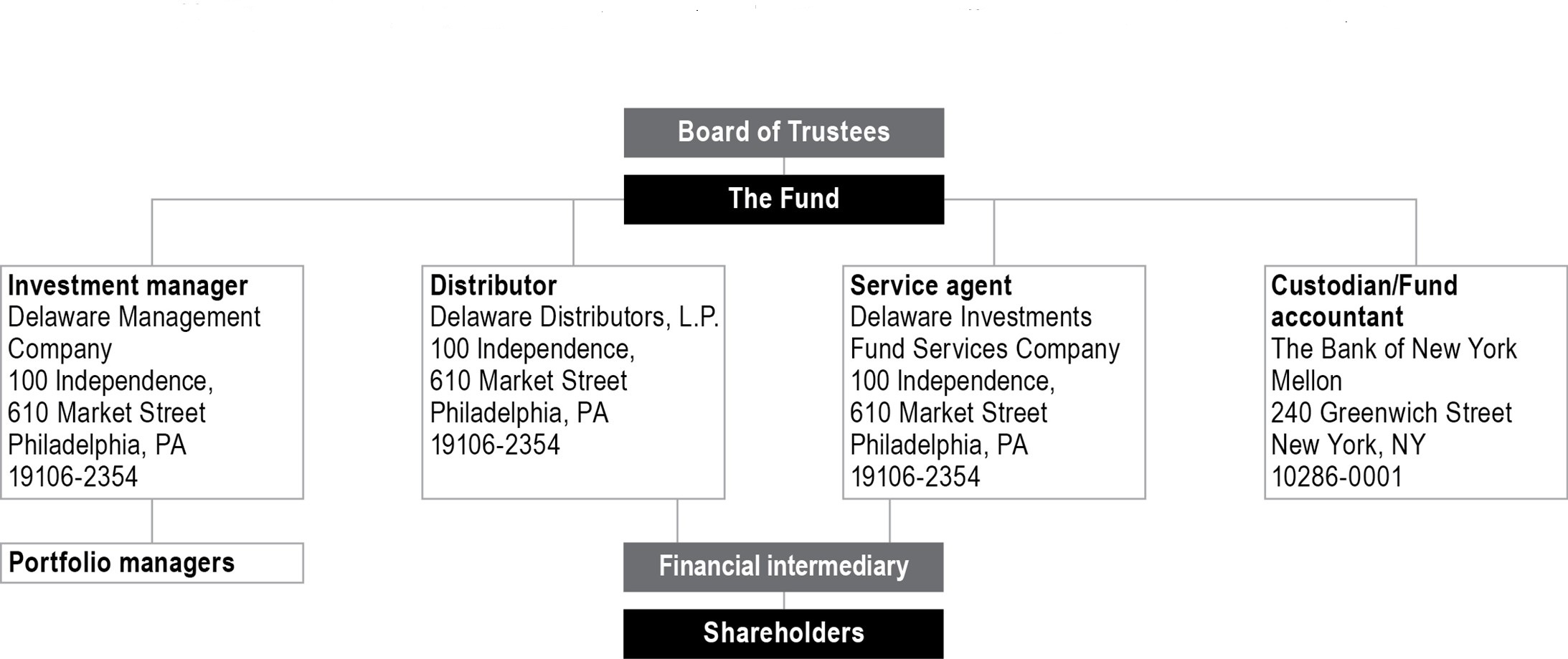
Distributor: Most mutual funds continuously offer new shares to the public through distributors that are regulated as
broker/dealers and are subject to the Financial Industry Regulatory Authority (FINRA) rules governing mutual fund sales practices.
Service agent: Mutual fund companies employ service agents (sometimes called transfer agents) to maintain records of shareholder
accounts, calculate and disburse dividends and capital gains, and prepare and mail shareholder statements and tax information, among other functions. Many service agents also provide administrative services to a fund and oversight of other fund
service providers.
Custodian/Fund Accountant: Mutual funds are legally required to protect their portfolio securities, and most funds place them with
a qualified bank custodian that segregates fund securities from other bank assets. The fund accountant provides services such as calculating a fund's net asset value (NAV) and providing financial reporting information for the fund.
Financial intermediary: Financial professionals provide advice to their clients. They are associated with securities broker/dealers
who have entered into selling and/or service arrangements with the distributor. Selling broker/dealers and financial professionals are compensated for their services generally through sales commissions, and through 12b-1 fees and/or service fees
deducted from a fund’s assets.
Shareholders: Mutual fund shareholders have specific voting rights on matters such as material changes in the terms of a fund’s
management contract and changes to fundamental investment policies.
26
About your account
Investing in the Fund
You can choose from a number of share classes for the Fund. Because each share class has a different combination of sales charges, fees, and other features, you should consult your
financial intermediary or your financial professional (hereinafter collectively referred to as the “financial intermediary”) to determine which share class best suits your investment goals and time frame. It is the responsibility of your financial
intermediary to assist you in determining the most appropriate share class and to communicate such determination to us.
Information about existing sales charges and sales charge reductions and waivers is available in this Prospectus below and free of charge on the Macquarie Funds website at macquarie.com/USfunds. Additional information on
sales charges can be found in the SAI, which is available upon request.
Please also see the “Broker-defined sales charge waiver policies” section in this Prospectus for information provided to the Fund by certain financial intermediaries on sales charge discounts and
waivers that may be available to you through your financial intermediary. Shareholders purchasing Fund shares through a financial intermediary may also be eligible for sales charge discounts or waivers which
may differ from those disclosed elsewhere in this Prospectus or SAI. The availability of certain initial or deferred sales charge waivers and discounts may depend on the particular financial intermediary or type of account through which you
purchase or hold Fund shares. It is the responsibility of the financial intermediary to implement any of its proprietary sales charge discounts or waivers listed in “Broker-defined sales charge waiver policies” or otherwise offered by the financial
intermediary. Accordingly, you should consult with your financial intermediary to determine whether you qualify for any sales charge discounts or waivers.
Choosing a share class
Each share class may be eligible for purchase through programs sponsored by financial intermediaries that require the purchase of a specific class of shares.
Class A, Class C, Class R and Class Y shares have each adopted a separate 12b-1 plan that allows them to pay distribution fees for the sale and distribution of their shares. Because these fees are paid out of the Fund's
assets on an ongoing basis, over time these fees will increase the cost of your investment and may cost you more than paying other types of sales charges.
Certain existing investors or programs sponsored by certain intermediaries that were eligible under prior eligibility requirements may continue to invest in a particular share class.
Plan sponsors, plan fiduciaries and other financial intermediaries may choose to impose qualification requirements for investors that differ from the Fund’s share class eligibility standards. In certain cases, this could
result in the selection of a share class with higher service and distribution-related fees than otherwise would have been charged. The Fund and the Distributor are not responsible for, and have no control over, the decision of any plan sponsor, plan
fiduciary or financial intermediary to impose such different requirements. Please consult with your plan sponsor, plan fiduciary or financial intermediary for more information about available share classes as not all share classes may be made
available.
|
Class A
|
| • |
Class A shares have an upfront sales charge of up to 4.50% that you pay when you buy the shares.
|
| • |
If you invest $100,000 or more, your front-end sales charge will be reduced.
|
| • |
You may qualify for other reduced sales charges and, under certain circumstances, the sales charge may be waived, as described in “How to reduce your sales charge” below.
|
| • |
Class A shares are also subject to an annual 12b-1 fee no greater than 0.25% of average daily net assets. See “Dealer compensation” below for further information.
|
| • |
Class A shares generally are not subject to a CDSC, except in the limited circumstances described in the table below.
|
27
| • |
Because of the higher 12b-1 fee, Class A shares have higher expenses and any dividends paid on these shares are generally lower than dividends on Institutional Class and Class R6 shares.
|
| • |
In addition, you may have received Class A shares as the result of a merger or reorganization of a predecessor fund.
|
Class A sales charges
The table below details your sales charges on purchases of Class A shares. The offering price for Class A shares includes the front-end sales charge. The offering price is determined by dividing the NAV per share by an
amount equal to 1 minus the sales charge (expressed in decimals) applicable to the purchase, calculated to two decimal places using standard rounding criteria. The sales charge as a percentage of the net amount invested is the maximum percentage of
the amount invested rounded to the nearest hundredth. The actual sales charge that you pay as a percentage of the offering price and as a percentage of the net amount invested will vary depending on the then-current NAV, the percentage rate of the
sales charge, and rounding. The number of Fund shares you will be issued will equal the amount invested divided by the applicable offering price for those shares, calculated to three decimal places using standard rounding criteria. Sales charges do
not apply to shares purchased through dividend reinvestment.
|
Amount of purchase
|
Sales charge as a %
of offering price |
Sales charge as a %
of net amount invested |
|
Less than $100,000
|
4.50%
|
5.13%
|
|
$100,000 but less than $250,000
|
3.50%
|
4.00%
|
|
$250,000 but less than $500,000
|
2.50%
|
3.00%
|
|
$500,000 but less than $1 million
|
2.00%
|
2.44%
|
|
$1 million or more
|
none*
|
none*
|
* There is no front-end sales charge when you purchase $1 million or more of Class A shares. However, if Delaware Distributors, L.P. (Distributor) paid your financial intermediary a commission on your purchase of $1 million
or more of Class A shares, you will have to pay a Limited CDSC of 1.00% if you redeem these shares within the first 18 months after your purchase, unless a specific waiver of the Limited CDSC applies. The Limited CDSC will be paid to the Distributor
and will be assessed on an amount equal to the lesser of: (1) the NAV at the time the Class A shares being redeemed were purchased; or (2) the NAV of such Class A shares at the time of redemption. For purposes of this formula, the “NAV at the time of
purchase” will be the NAV at purchase of the Class A shares even if those shares are later exchanged for shares of another Macquarie Fund and, in the event of an exchange of Class A shares, the “NAV of such shares at the time of redemption” will be
the NAV of the shares acquired in the exchange. In determining whether a Limited CDSC is payable, it will be assumed that shares not subject to the Limited CDSC are the first redeemed followed by other shares held for the longest period of time. See
“Dealer compensation” below for a description of the dealer commission that is paid.
|
Class C
|
| • |
Class C shares have no upfront sales charge, so the full amount of your purchase is invested in the Fund. However, you will pay a CDSC of 1.00% if you redeem your shares within 12 months after you buy them.
|
| • |
In determining whether the CDSC applies to a redemption of Class C shares, it will be assumed that shares held for more than 12 months are redeemed first, followed by shares acquired through the reinvestment of
dividends or distributions, and finally by shares held for 12 months or less. For further information on how the CDSC is determined, please see “Calculation of contingent deferred sales charges—Class C” below.
|
| • |
Under certain circumstances, the CDSC may be waived; please see “Waivers of contingent deferred sales charges” below for further information.
|
| • |
For approximately eight years after you buy your Class C shares, they are subject to an annual 12b-1 fee no greater than 1.00% of average daily net assets (of which 0.25% is a service fee) paid to the Distributor,
dealers, or others for providing services and maintaining shareholder accounts.
|
| • |
Class C shares are eligible to automatically convert to Class A shares with a 12b-1 fee of no more than 0.25% approximately eight years after you buy Class C shares. Conversion may occur as late as one month after
the eighth anniversary of purchase, during which time Class C's higher 12b-1 fee applies. Please refer to the Fund’s SAI for more details on this automatic conversion feature.
|
| • |
You may purchase only up to $1 million of Class C shares at any one time. Orders that equal or exceed $1 million will be rejected.
|
| • |
Because of their higher 12b-1 fee, Class C shares have higher expenses and any dividends paid on these shares are generally lower than dividends on Class A, Class R, Institutional Class, and Class R6 shares.
|
28
| • |
Class C shares with no financial intermediary will be converted to Class A shares at NAV within a certain time frame after a financial intermediary resigns, as determined by the Manager. Additionally, investors may
only open an account to purchase Class C shares if they have appointed a financial intermediary.
|
Calculation of contingent deferred sales charges — Class C
CDSCs are charged as a percentage of the dollar amount subject to the CDSC. The charge will be assessed on an amount equal to the lesser of the NAV at the time the shares being redeemed were purchased or the NAV of those shares at the time of redemption. No CDSC will be imposed on increases in NAV above the initial purchase price, nor will a CDSC be assessed on redemptions of shares acquired through reinvestment of dividends or capital gains distributions. For purposes of this formula, the “NAV at the time of purchase” will be the NAV at purchase of Class C shares of the Fund, even if those shares are later exchanged for shares of another Macquarie Fund. In the event of an exchange of the shares, the “NAV of such shares at the time of redemption” will be the NAV of the shares that were acquired in the exchange.
CDSCs are charged as a percentage of the dollar amount subject to the CDSC. The charge will be assessed on an amount equal to the lesser of the NAV at the time the shares being redeemed were purchased or the NAV of those shares at the time of redemption. No CDSC will be imposed on increases in NAV above the initial purchase price, nor will a CDSC be assessed on redemptions of shares acquired through reinvestment of dividends or capital gains distributions. For purposes of this formula, the “NAV at the time of purchase” will be the NAV at purchase of Class C shares of the Fund, even if those shares are later exchanged for shares of another Macquarie Fund. In the event of an exchange of the shares, the “NAV of such shares at the time of redemption” will be the NAV of the shares that were acquired in the exchange.
|
Institutional Class (formerly, Class I)
|
| • |
Institutional Class shares have no upfront sales charge, so the full amount of your purchase is invested in the Fund.
|
| • |
Institutional Class shares are not subject to a CDSC.
|
| • |
Institutional Class shares do not assess a 12b-1 fee.
|
| • |
Institutional Class shares are available for purchase only by the following:
|
| o |
retirement plans or certain other programs that are maintained on platforms sponsored by financial intermediary firms, provided the financial intermediary firms or their trust companies (or entities performing
similar trading/clearing functions) have entered into an agreement with the Distributor (or its affiliate) related to such plans or programs;
|
| o |
tax-exempt employee benefit plans of the Manager, its affiliates, and securities dealers that have a selling agreement with the Distributor;
|
| o |
a bank, trust company, or similar financial institution investing for its own account or for the account of its trust customers for whom the financial institution is exercising investment discretion in purchasing
Institutional Class shares, except where the investment is part of a program that requires payment to the financial institution of a Rule 12b-1 Plan fee;
|
| o |
registered investment advisors (RIAs) investing on behalf of clients that consist solely of institutions and high net worth individuals whose assets are entrusted to an RIA for investment purposes for accounts
requiring Institutional Class shares (use of the Institutional Class shares is restricted to RIAs who are not affiliated or associated with a broker or dealer and who derive compensation for their services exclusively from their advisory
clients);
|
| o |
programs sponsored by, controlled by, and/or clearing transactions submitted through a financial intermediary where: (1) such programs allow or require the purchase of Institutional Class shares; (2) a financial
intermediary has entered into an agreement with the Distributor and/or the transfer agent allowing certain purchases of Institutional Class shares; and (3) a financial intermediary (i) charges clients an ongoing fee for advisory, investment
consulting, or similar services, or (ii) offers the Institutional Class shares through a no-commission network or platform;
|
| o |
through a brokerage program of a financial intermediary that has entered into a written agreement with the Distributor and/or the transfer agent specifically allowing purchases of Institutional Class shares in such
programs;
|
| o |
exchanges from the Institutional Class shares of Macquarie Ultrashort Fund;
|
| o |
private investment vehicles, including, but not limited to, foundations and endowments; or
|
| o |
current and former officers, Trustees/Directors, and employees of any Macquarie Fund, the Manager, any of the Manager’s affiliates, or any predecessor fund to a Macquarie Fund, provided that such shares are either
held in an account opened directly with the Fund or are held through an account with a financial intermediary that permits the purchase of such shares. At the direction of such persons, their family members (regardless of age), and any
employee benefit plan, trust, or other entity directly owned by, controlled by, or established by any of the foregoing individuals identified in this paragraph may also purchase Institutional Class shares subject to the same account
requirements.
|
29
| • |
In addition, you may have received Institutional Class shares as the result of a merger or reorganization of a predecessor fund.
|
A shareholder transacting in Institutional Class shares through a broker or other financial intermediary may be required to pay a commission and/or other forms of compensation to the financial intermediary.
|
Class R6
|
| • |
Class R6 shares have no upfront sales charge, so the full amount of your purchase is invested in the Fund. Class R6 shares are not subject to a CDSC.
|
| • |
Class R6 shares do not assess a 12b-1 fee.
|
| • |
Class R6 shares do not pay any service fees, sub-accounting fees, and/or sub-transfer agency fees to any brokers, dealers, or other financial intermediaries.
|
| • |
Class R6 shares are generally available to certain employer-sponsored retirement plans, such as 401(k) plans, 457 plans, 403(b) plans, profit-sharing plans and money purchase pension plans, defined benefit plans,
employer-sponsored benefit plans, and non-qualified deferred compensation plans. In addition, for these employer-sponsored retirement plans, Class R6 shares must be held through plan level or omnibus accounts held on the books of the Fund,
and Class R6 shares are only available for purchase through financial intermediaries who have the appropriate agreement with the Distributor (or its affiliates) related to Class R6.
|
| • |
Class R6 shares are also available for purchase through certain programs, platforms, or accounts that are maintained or sponsored by financial intermediary firms (including but not limited to, brokers, dealers,
banks, trust companies, or entities performing trading/clearing functions), provided that the financial intermediary firm has entered into an agreement with the Distributor (or its affiliates) related to Class R6 for such programs, platforms
or accounts.
|
| • |
Class R6 shares are also generally available for purchase by or through funds (including mutual funds registered under the 1940 Act and collective trusts) of funds.
|
| • |
In addition to the foregoing list of eligible investors, Class R6 shares are generally available to certain institutional investors and high net worth individuals who make a minimum initial investment directly in
the Fund's Class R6 shares of $1,000,000 or more and who have completed an application and been approved by the Fund for such investment. These institutional investors and high net worth individuals must open accounts in Class R6 shares
directly in their names.
|
| • |
Class R6 shares may not be available through certain financial intermediaries.
|
| • |
In addition, you may have received Class R6 shares as the result of a merger or reorganization of a predecessor fund.
|
|
Class R
|
| • |
Class R shares have no upfront sales charge, so the full amount of your purchase is invested in the Fund. Class R shares are not subject to a CDSC.
|
| • |
Class R shares are subject to an annual 12b-1 fee no greater than 0.50% of average daily net assets.
|
| • |
Class R shares generally are available only to: (i) qualified and nonqualified plan shareholders covering multiple employees (including 401(k), 401(a), 457, and noncustodial 403(b) plans, as well as certain other
nonqualified deferred compensation plans); and (ii) individual retirement account (IRA) rollovers from legacy Delaware Investments plans that were previously maintained on the Delaware Investments retirement recordkeeping system or the
retirement recordkeeping system of Ascensus that are offering Class R shares to participants.
|
| • |
Except as noted above, no other IRAs are eligible for Class R shares (for example, no traditional IRAs, Roth IRAs, SIMPLE IRAs, SEPs, or SARSEPs).
|
| • |
Unlike Class C shares, Class R shares do not automatically convert into another class.
|
| • |
Because of their higher 12b-1 fee, Class R shares have higher expenses and any dividends paid on these shares are generally lower than dividends on Class A, Class I, and Class R6 shares.
|
30
| • |
Certain intermediaries may offer Class R shares to other account types under an agreement with the Distributor or its affiliates relating to such accounts.
|
|
Class Y
|
Class Y shares are not subject to a sales charge. Class Y shares do however pay an annual 12b-1 distribution and/or service fee of up to 0.25% of average net assets. Class Y shares are only available for purchase by:
| • |
participants of employee benefit plans established under Section 401(a) (including a 401(k) plan), 403(b) or 457(b) of the Code for which an unaffiliated third party intermediary provides administrative,
distribution and/or other support services to the plan;
|
| • |
individuals investing in fee-based brokerage or advisory accounts, wrap accounts and asset allocation programs that charge asset-based fees, through certain investment advisers and broker-dealers, including banks,
trust institutions, investment fund administrators and other third parties investing for their own accounts or for the accounts of their customers, and for which entity an unaffiliated third party provides administrative, distribution and/or
other support services;
|
| • |
government entities or authorities and corporations whose investment within the first 12 months after initial investment is $10 million or more and to which entity an unaffiliated third party intermediary provides
certain administrative, distribution and/or other support services; or
|
| • |
clients of financial intermediaries who have self-directed brokerage accounts (that may or may not charge transaction fees to those clients), provided that such financial intermediaries have entered into an
agreement with the Distributor and have been approved by the Distributor to offer Class Y shares within such self-directed brokerage accounts.
|
The Fund reserves the right to modify or waive the above policies at any time without prior notice to shareholders.
Dealer compensation
The financial intermediary who sells you shares of the Fund may be eligible to receive the following amounts as compensation for your investment in the Fund. These amounts are paid by the Distributor to the securities
dealer with whom your financial advisor is associated. Institutional Class and Class R6 shares do not have a 12b-1 fee or sales charge so they are not included in the tables below.
|
Class A1
|
Class C2
|
Class R3
|
Class Y4
|
|
|
Commission (%)
|
-
|
1.00%
|
-
|
-
|
|
Less than $100,000
|
4.00%
|
-
|
-
|
-
|
|
$100,000 but less than $250,000
|
3.00%
|
-
|
-
|
-
|
|
$250,000 but less than $500,000
|
2.00%
|
-
|
-
|
-
|
|
$500,000 but less than $1 million
|
1.60%
|
-
|
-
|
-
|
|
$1 million but less than $5 million
|
1.00%
|
-
|
-
|
-
|
|
$5 million but less than $25 million
|
0.50%
|
-
|
-
|
-
|
|
$25 million or more
|
0.25%
|
-
|
-
|
-
|
|
12b-1 fee to dealer
|
0.25%
|
1.00%
|
0.50%
|
0.25%
|
1 On sales of Class A shares, the Distributor reallows to your securities dealer a portion of the front-end sales charge depending upon the amount you invested. Your securities dealer may be eligible to receive a
12b-1 fee of up to 0.25% from the date of purchase. On sales of Class A shares where there is no front-end sales charge, the Distributor may pay your securities dealer an upfront commission of up to 1.00%. The upfront commission includes an advance
of the first year’s 12b-1 fee of up to 0.25%. During the first 12 months, the Distributor will retain the 12b-1 fee to partially offset the upfront commission advanced at the time of purchase. Starting in the 13th month, your securities dealer may be
eligible to receive the full 12b-1 fee applicable to Class A shares.
2 On sales of Class C shares, the Distributor may pay your securities dealer an upfront commission of 1.00%. The upfront commission includes an advance of the first year’s 12b-1 service fee of up to 0.25%.
During the first 12 months, the Distributor retains the full 1.00% 12b-1 fee to partially offset the upfront commission and the prepaid 0.25% service fee advanced at the time of purchase. Starting in the 13th month, your securities dealer may be
eligible to receive the full 1.00% 12b-1 fee applicable to Class C shares. Alternatively, certain intermediaries may not be eligible to receive the upfront commission of 1.00%, but may receive the 12b-1 fee for sales of Class C shares from the date
of purchase. After approximately eight years, Class C shares are eligible to automatically convert to Class A shares and dealers may then be eligible to receive the 12b-1 fee applicable to Class A shares.
3 On sales of Class R shares, the Distributor does not pay your securities dealer an upfront commission. Your securities dealer may be eligible to receive a 12b-1 fee of up to 0.50% from the date of purchase.
31
4 On sales of Class Y shares, the Distributor does not pay your securities dealer an upfront commission. Your securities dealer may be eligible to receive a 12b-1 fee of up to 0.25% from the
date of purchase.
Payments to intermediaries
The Distributor and its affiliates may pay additional compensation at their own expense and not as an expense of the Fund to certain affiliated or unaffiliated brokers, dealers, or other financial intermediaries (Financial
Intermediaries) in connection with the sale or retention of Fund shares and/or shareholder servicing, including providing the Fund with “shelf space” or a higher profile with the Financial Intermediaries’ consultants, salespersons, and customers
(distribution assistance). For example, the Distributor or its affiliates may pay additional compensation to Financial Intermediaries for various purposes, including, but not limited to, promoting the sale of Fund shares, maintaining share balances
and/or for subaccounting, administrative, or shareholder processing services, marketing, educational support, data, and ticket charges. Such payments are in addition to any distribution fees, service fees, subaccounting fees, and/or transfer agency
fees that may be payable by the Fund. The additional payments may be based on factors, including level of sales (based on gross or net sales or some specified minimum sales or some other similar criteria related to sales of the Fund and/or some or
all other Macquarie Funds), amount of assets invested by the Financial Intermediary’s customers (which could include current or aged assets of the Fund and/or some or all other Macquarie Funds), the Fund’s advisory fees, some other agreed-upon
amount, or other measures as determined from time to time by the Distributor. The level of payments made to a qualifying Financial Intermediary in any given year may vary. To the extent permitted by SEC and FINRA rules and other applicable laws and
regulations, the Distributor may pay, or allow its affiliates to pay, other promotional incentives or payments to Financial Intermediaries.
Sub-transfer agent/recordkeeping payments may be made to third parties (including affiliates of the Manager) that provide sub-transfer agent, recordkeeping, and/or shareholder services with respect to certain shareholder
accounts (including omnibus accounts), or to the shareholder account directly to offset the costs of these services, in lieu of the transfer agent providing such services. For Class R6 shares, the Distributor and its affiliates will generally not pay
additional compensation to Financial Intermediaries in connection with the sale or retention of Fund shares and/or shareholder servicing (including sub-transfer agent/recordkeeping payments).
If a mutual fund sponsor or distributor makes greater payments for distribution assistance to your Financial Intermediary with respect to distribution of shares of that particular mutual fund than sponsors or distributors
of other mutual funds make to your Financial Intermediary with respect to the distribution of the shares of their mutual funds, your Financial Intermediary and its salespersons may have a financial incentive to favor sales of shares of the mutual
fund making the higher payments over shares of other mutual funds or over other investment options. In addition, depending on the arrangements in place at any particular time, a Financial Intermediary may also have a financial incentive for
recommending a particular share class over other share classes. You should consult with your Financial Intermediary and review carefully any disclosure provided by such Financial Intermediary as to compensation it receives in connection with
investment products it recommends or sells to you. A significant purpose of these payments is to increase sales of the Fund’s shares. The Manager or its affiliates may benefit from the Distributor’s or its affiliates’ payment of compensation to
Financial Intermediaries through increased fees resulting from additional assets acquired through the sale of Fund shares through Financial Intermediaries. In certain instances, the payments could be significant and may cause a conflict of interest
for your Financial Intermediary. Any such payments will not change the NAV or the price of the Fund’s shares.
How to reduce your sales charge
We offer a number of ways to reduce or eliminate the front-end sales charge on Class A shares, which may depend on the ability of your financial intermediary or the Fund’s transfer agent to support the various ways. Please
refer to the “Broker-defined sales charge waiver policies” in this Prospectus and to the SAI for detailed information and eligibility requirements. Please note that your financial intermediary’s policies may differ. You can also get additional
information from your financial intermediary. You or your financial intermediary must notify us at the time you purchase shares if you are eligible for any of these programs. You may also need to provide information to your financial intermediary or
the Fund in order to qualify for a reduction in sales charges. Such information may include your Macquarie Funds holdings in any other accounts, including retirement accounts, held indirectly or through an intermediary, and the names of qualifying
family members and their holdings. If you participate in a direct deposit purchase plan or an automatic investment program for an account held directly with the Fund’s transfer agent and also hold shares of Macquarie Funds other than directly with
us, generally those holdings will not be aggregated with the assets held with us for purposes of determining
32
rights of accumulation in connection with direct deposit purchase plans and automatic investment program purchases. We reserve the right to determine whether any purchase is entitled, by virtue of the foregoing, to the
reduced sales charge. Class R, Institutional Class, Class R6, and Class Y shares have no upfront sales charge or CDSC so they are not included in the table below.
Letter of intent and rights of accumulation
Through a letter of intent, you agree to invest a certain amount in Macquarie Funds over a 13-month period to qualify for reduced front-end sales charges (as set forth in the SAI). Macquarie Funds do not accept retroactive
letters of intent.
Upon your request, you can combine your holdings or purchases of Class A and all other classes of Macquarie Funds, as well as the holdings and purchases of your spouse — or equivalent, if recognized under local law — and
children under the age of 21 to qualify for reduced front-end sales charges. When submitting the letter of intent or requesting rights of accumulation, you must identify which holdings or purchases you are requesting to be combined to your dealer,
the Distributor or BNY Mellon at the time of purchase. You can add the value of any share class that you already own to new share purchases in order to qualify for a reduced sales charge. Please note that depending on the financial intermediary
holding your account, this policy may differ from those described in this Prospectus.
|
Class A
|
Class C
|
|
Available.
|
Although the letter of intent does not apply to the purchase of Class C shares, you can combine your purchase of Class C shares with your purchase of Class A shares to fulfill your letter of intent. Although the
rights of accumulation do not apply to the purchase of Class C shares, you can combine the value of your Class C shares with the value of your Class A shares to receive a reduced sales charge.
|
Reinvestment of redeemed shares
Up to 90 days after you redeem shares, you can reinvest the proceeds without paying a sales charge. For purposes of this “right of reinvestment policy,”
automatic transactions (including, for example, automatic purchases, withdrawals and payroll deductions) and ongoing retirement plan contributions are not eligible for investment without a sales charge. Investors should consult their financial
intermediary for further information.
|
Class A
|
Class C
|
|
Available.
|
Not available.
|
SIMPLE IRA, SEP, SARSEP, 401(k), SIMPLE 401(k), Profit Sharing, Money Purchase, 403(b)(7), and 457 Retirement Plans
These investment plans may qualify for reduced sales charges by combining the purchases of all members of the group. Members of these groups may also qualify to
purchase shares without a front-end sales charge and may qualify for a waiver of any CDSCs on Class A shares.
|
Class A
|
Class C
|
|
Available.
|
Although the letter of intent does not apply to the purchase of Class C shares, you can combine your purchase of Class C shares with your purchase of Class A shares to fulfill your letter of intent. Although the
rights of accumulation do not apply to the purchase of Class C shares, you can combine the value of your Class C shares with the value of your Class A shares to receive a reduced sales charge.
|
Buying Class A shares at net asset value
Class A shares of the Fund may be purchased at NAV under the following circumstances, provided that you notify the Fund in advance that the trade qualifies for this privilege. Certain existing investors or programs
sponsored by certain intermediaries that were eligible to purchase Class A shares of the Fund at NAV may continue to be eligible to purchase Class A shares at NAV. The Fund reserves the right to modify or terminate these arrangements at any time.
33
| • |
Shares purchased under the Macquarie Funds dividend reinvestment plan and, under certain circumstances, the exchange privilege and the 90-day reinvestment privilege.
|
| • |
Purchases by: (i) current and former officers, Trustees/Directors, and employees of any Macquarie Fund, the Manager, any of the Manager’s current affiliates and those that may in the future be created, or any
predecessor fund to a Macquarie Fund, including the funds formerly advised by Foresters Investment Management Company, Inc., Ivy Investment Management Company, Waddell & Reed, or any other fund families acquired or merged into the
Macquarie Funds; (ii) current employees of legal counsel to Macquarie Funds; and (iii) registered representatives, employees, officers, and directors of broker/dealers who have entered into dealer’s agreements with the Distributor. At the
direction of such persons, their family members (regardless of age), and any employee benefit plan, trust, or other entity directly owned by, controlled by, or established by any of the foregoing may also purchase shares at NAV.
|
| • |
Purchases by bank employees who provide services in connection with agreements between the bank and unaffiliated brokers or dealers concerning sales of shares of Macquarie Funds.
|
| • |
Purchases by certain officers, trustees, and key employees of institutional clients of the Manager or any of its affiliates.
|
| • |
Purchases by programs sponsored by, controlled by, and/or clearing transactions submitted through a financial intermediary where: (i) such programs allow or require the purchase of Class A shares; (ii) a financial
intermediary has entered into an agreement with the Distributor and/or the transfer agent allowing certain purchases of Class A shares; and (iii) a financial intermediary (1) charges clients an ongoing fee for advisory, investment consulting,
or similar services, or (2) offers the Class A shares through a no-commission network or platform. Investors may be charged a fee by their financial intermediary when effecting transactions in Class A shares through a financial intermediary
that offers these programs.
|
| • |
Purchases for the benefit of the clients of brokers, dealers, and other financial intermediaries if such brokers, dealers, or other financial intermediaries have entered into an agreement with the Distributor
providing for the purchase of Class A shares at NAV through self-directed brokerage service platforms or programs. Investors may be charged a fee by their financial intermediary when effecting transactions in Class A shares at NAV through a
self-directed investment brokerage service platform or program.
|
| • |
Purchases by financial institutions investing for the accounts of their trust customers if they are not eligible to purchase Institutional Class shares, if applicable.
|
| • |
Purchases by retirement plans or certain other programs that are maintained or sponsored by financial intermediary firms, provided the financial intermediary firms or their trust companies (or entities performing
similar trading/clearing functions) have entered into an agreement with the Distributor (or its affiliates) related to such plans or programs.
|
| • |
Purchases by certain legacy bank-sponsored retirement plans and certain legacy retirement assets that meet requirements set forth in the SAI.
|
| • |
Investments made by plan level and/or participant retirement accounts that are for the purpose of repaying a loan taken from such accounts.
|
| • |
Purchases by certain participants in defined contribution plans and members of their households whose plan assets will be rolled over into IRA accounts (IRA Program) where the financial intermediary has entered
into an agreement specifically relating to such IRA Program with the Distributor and/or the transfer agent.
|
| • |
Purchases by certain participants of particular group retirement plans as described in the SAI.
|
| • |
Additional purchases by existing shareholders whose accounts were eligible for purchasing shares at NAV under a predecessor fund’s eligibility requirements set by the predecessor fund’s company.
|
| • |
Investments made into an account with no financial intermediary or no longer associated with a financial intermediary may invest in Class A shares without a sales charge.
|
Waivers of contingent deferred sales charges
Certain sales charges may be based on historical cost. Therefore, you should maintain any records that substantiate these costs because the Fund, its transfer agent, and financial intermediaries may not maintain this
information. Please note that you or your financial intermediary will have to notify us at the time of redemption that the trade qualifies for such waiver. Class R, Institutional Class, Class R6, and Class Y shares do not have CDSCs so they are not
included in the list below. Please also see the “Shareholder fees” table in the Fund summary and “Choosing a share class” for more information about applicable CDSCs. Your financial intermediary may offer waivers for certain account types or programs
that may
34
be different than what is noted below. See the “Broker-defined sales charge waiver policies” section or contact your financial intermediary for information on program availability.
CDSCs for Class A and Class C shares may be waived under the following circumstances, except as noted otherwise:
| • |
Redemptions in accordance with a systematic withdrawal plan: Redemptions in accordance with a systematic withdrawal plan, provided the annual amount selected to be withdrawn under the plan does not
exceed 12% of the value of the account on the date that the systematic withdrawal plan was established or modified.
|
| • |
Redemptions that result from the right to liquidate a shareholder’s account: Redemptions that result from the right to liquidate a shareholder’s
account if the aggregate NAV of the shares held in the account is less than the then-effective minimum account size.
|
| • |
Section 401(a) qualified retirement plan distributions: Distributions to participants or beneficiaries from a retirement plan trading on a
recordkeeping platform qualified under Section 401(a) of the Internal Revenue Code.
|
| • |
Section 401(a) qualified retirement plan redemptions: Redemptions pursuant to the direction of a participant or beneficiary of a retirement plan
trading on a recordkeeping platform qualified under Section 401(a) of the Internal Revenue Code with respect to that retirement plan.
|
| • |
Periodic distributions or systematic withdrawals from a retirement account or qualified plan: Periodic distributions or systematic withdrawals from an
individual retirement account (traditional IRA, Roth IRA, SIMPLE IRA, SEP, SARSEP, and Coverdell ESA) or a qualified plan1 (401(k), SIMPLE 401(k), Profit Sharing, Money Purchase, 403(b)(7), and 457 Retirement Plans) not subject
to a penalty under Section 72(t)(2)(A) of the Internal Revenue Code or a hardship or unforeseen emergency provision in the qualified plan as described in Treas. Reg. §1.401(k)-1(d)(3) and Section 457(d)(1)(A)(iii) of the Internal Revenue
Code.
|
| • |
Returns of excess contributions due to any regulatory limit: Returns of excess contributions due to any regulatory limit from an individual retirement
account (traditional IRA, Roth IRA, SIMPLE IRA, SEP, SARSEP, and Coverdell ESA) or a qualified plan1 (401(k), SIMPLE 401(k), Profit Sharing, Money Purchase, 403(b)(7), and 457 Retirement Plans).
|
| • |
Distributions by other employee benefit plans: Distributions by other employee benefit plans to pay benefits.
|
| • |
Distributions from an account of a redemption resulting from death or disability: Distributions from an account of a redemption resulting from the
death or disability (as defined in Section 72(t)(2)(A) of the Internal Revenue Code) of a registered owner or a registered joint owner occurring after the purchase of the shares being redeemed. In the case of accounts established under the
Uniform Gifts to Minors Act or Uniform Transfers to Minors Act or trust accounts, the waiver applies upon the death of all beneficial owners.
|
| • |
Redemptions by certain legacy retirement assets: Redemptions by certain legacy retirement assets that meet the requirements set forth in the SAI, as
applicable.
|
| • |
Redemptions in connection with a fund liquidation: Redemptions subsequent to the fund liquidation notice to shareholders.
|
1 Qualified plans that are fully redeemed at the direction of the plan’s fiduciary may be subject to any applicable CDSC or Limited CDSC, unless the redemption is due to the termination of the
plan.
Certain existing investors or programs sponsored by certain intermediaries that were eligible for waivers of CDSCs may continue to be eligible for those waivers of CDSCs.
How to buy shares
|
Through your financial intermediary
|
Your financial intermediary (if applicable) can handle all the details of purchasing shares, including opening an account. Your financial intermediary may charge you a separate fee for this service.
|
Through the Macquarie Funds Service Center
|
By mail
Complete an investment slip and mail it with your check, made payable to the fund and class of shares you wish to purchase, to Macquarie Funds at P.O. Box 534437, Pittsburgh, PA 15253-4437 for investments by regular
mail or Macquarie Funds Service Center, Attention: 534437, 500 Ross Street, 154-0520, Pittsburgh, PA 15262 for investments by
35
overnight courier service. If you are making an initial purchase by mail, you must include a completed investment application (or an appropriate retirement plan application if you are opening a retirement account)
with your check. Purchase orders will not be accepted at any other address.
Please note that purchase orders submitted by mail will not be considered received until such purchase orders arrive at Macquarie Funds Service Center, Attention: 534437, 500 Ross Street, 154-0520, Pittsburgh, PA 15262 and
are determined to be in good order. For a purchase request to be in “good order,” you must provide the name of the Macquarie Fund in which you are investing, your account registration/number (if you are an existing shareholder), and the total number
of shares or dollar amount of the shares to be purchased, along with meeting any requirements set forth in applicable forms, this Prospectus, or the SAI. The Fund does not consider the US Postal Service or other independent delivery services to be
its agent. Therefore, deposits in the mail or with such services or receipt at the Fund’s post office box, of purchase orders, do not constitute receipt by the Fund or its agent. Please note that the Fund reserves the right to reject any purchase.
By wire
Ask your bank to wire the amount you want to invest to The Bank of New York Mellon, ABA #011001234, bank account #000073-6910. Include your account number, the name of the fund, registered account name, and class of shares
in which you want to invest. If you are making an initial purchase by wire, you must first call the Macquarie Funds Service Center at 800 523-1918 so we can assign you an account number.
By exchange
You may exchange all or part of your investment in one or more Macquarie Funds for shares of other Macquarie Funds. Please keep in mind, however, that under most circumstances you may exchange between like classes of
shares only. To open an account by exchange, call the Macquarie Funds Service Center at 800 523-1918.
|
Through automated shareholder services
|
Eligible accounts may purchase or exchange shares through our automated telephone service or through our website, macquarie.com/USfunds. For more information about your eligibility and how to sign up
for these services, call our Macquarie Funds Service Center at 800 523-1918.
Calculating share price
The price you pay for shares will depend on when we receive your purchase order. If your order is received by an authorized agent or us before the close of regular trading on the NYSE (normally 4:00pm ET), you will pay
that day’s closing Fund share price, which is based on the Fund’s NAV. If the NYSE has an unscheduled early close, we will continue to accept your order until that day’s scheduled close of the NYSE and you will pay that day’s closing Fund share
price. If your order is received after the scheduled close of regular trading on the NYSE, you will pay the next Business Day’s closing Fund share price. We reserve the right to reject any purchase order.
We determine the NAV per share for each class of a Macquarie Fund at the close of regular trading on the NYSE on each Business Day (normally 4:00pm ET). The Fund does not calculate its NAV on days the NYSE is closed for
trading. If the NYSE has an unscheduled early close, the Fund’s closing share price would still be determined as of that day’s regularly scheduled close of the NYSE. The NAV per share for each class of a fund is calculated by subtracting the
liabilities of each class from its total assets and dividing the resulting number by the number of shares outstanding for that class. We generally price securities and other assets for which market quotations are readily available at their market
value. The value of foreign securities may change on days when a shareholder will not be able to purchase or redeem fund shares because foreign markets are open at times and on days when US markets are not. We price fixed income securities on the
basis of valuations provided to us by an independent pricing service that uses methods approved by the Board. Pricing services generally price fixed income securities assuming orderly transactions of an institutional “round lot” size. While the Fund
does not seek to purchase odd lots as a general rule, the Fund may from time to time trade in smaller “odd lot” sizes. Odd lots typically trade at lower prices than institutional round lot trades. Over certain time periods, such differences could
materially impact the performance of a fund that holds odd lots. For all other securities, we use methods approved by the Board that are designed to price securities at their fair market values.
36
Fair valuation
For purposes of calculating NAV, portfolio securities and other assets for which market quotations are readily available are valued at market value. A market quotation is readily available when that quotation is a quoted
price (unadjusted) in active markets for identical investments that the Fund can access at the measurement date, provided that a quotation will not be considered readily available if it is not reliable.
Investments for which market quotations are not readily available are valued at fair value as determined in good faith pursuant to Rule 2a-5 under the 1940 Act (Rule 2a-5). As a general principle, the fair value of a
security or other asset is the price that would be received to sell an asset or paid to transfer a liability in an orderly transaction between market participants at the measurement date. Pursuant to Rule 2a-5, the Board of Trustees has designated
the Manager as the valuation designee (Valuation Designee) for the Fund to perform the fair value determination relating to all applicable Fund investments. The Manager has established a Pricing Committee to assist with its designated
responsibilities as Valuation Designee, and the Manager may carry out its designated responsibilities as Valuation Designee through the Pricing Committee and other teams and committees, which operate under policies and procedures approved by the
Board and subject to the Board’s oversight. Subject to its oversight, the Valuation Designee may value Fund securities for which market quotations are not readily available and other Fund assets utilizing inputs from pricing services, quotation
reporting systems, valuation agents and other third-party sources (together, Pricing Sources).
When the Valuation Designee uses fair value pricing, the Valuation Designee may take into account any factors it deems appropriate. For example, the Valuation Designee may determine fair value based upon developments
related to a specific security, current valuations of foreign stock indices (as reflected in US futures markets), and/or US sector or broad stock market indices. In determining whether market quotations are readily available or fair valuation will be
used, various factors will be taken into consideration, such as market closures or suspension of trading in a security.
The Fund may use fair value pricing relatively frequently for securities traded primarily in non-US markets. If a foreign (non-U.S.) equity security’s value has materially changed after the close of the security’s primary
exchange or principal market but before the close of the NYSE, the security may be valued at fair value. With respect to foreign (non-U.S.) equity securities, the Fund may determine the fair value of investments based on information provided by
Pricing Sources and other third-party vendors, which may recommend fair value or adjustments with reference to other securities, indexes or assets. In considering whether fair valuation is required and in determining fair values, the Valuation
Designee may, among other things, consider significant events (which may be considered to include changes in the value of U.S. securities or securities indexes) that occur after the close of the relevant market and before the close of the NYSE. The
Valuation Designee may utilize modeling tools provided by third-party vendors to determine fair values of non-U.S. securities.
Fair value prices of securities used by the Fund to calculate its NAV may differ from quoted or published prices for the same securities. Fair value pricing may involve subjective judgments and it is possible that the fair
value determined for a security could be materially different than the value that could be realized upon the sale of that security.
Retirement plans
In addition to being an appropriate investment for your IRA, Roth IRA, and Coverdell Education Savings Account, the Fund may be suitable for group retirement plans. You may establish your IRA account even if you are
already a participant in an employer-sponsored retirement plan. For more information on how the Fund can play an important role in your retirement planning or for details about group plans, please consult your financial intermediary, or call the
Macquarie Funds Service Center at 800 523-1918.
Document delivery
To reduce fund expenses, we try to identify related shareholders in a household and send only one copy of a fund's financial reports and prospectus. This process, called “householding,” will continue indefinitely unless
you instruct us otherwise. If you prefer not to have these documents householded, please call the Macquarie Funds Service Center at 800 523-1918. At any time you may view current prospectuses and financial reports on our website.
37
Inactive accounts
Please note that if your account is deemed to be unclaimed or abandoned under applicable state law, the Fund may be required to transfer (or “escheat”) the assets in that account to the appropriate state. Some states may
sell escheated shares, in which case a shareholder may only be able to recover the amount received when the shares were sold. For shareholders that invest through retirement accounts, the escheatment will be treated as a taxable distribution and
federal and any applicable state income tax may be withheld. The Fund, its Board, and the Fund's transfer agent will not be liable to shareholders for good faith compliance with state unclaimed or abandoned property laws. To avoid these outcomes and
protect their property, shareholders that invest in the Fund through an account held directly with the Fund's transfer agent are encouraged to routinely confirm that the mailing address on their account is current and valid and contact the transfer
agent at least once a year by mail, by phone at 800 523-1918, or by logging into their account.
How to redeem shares
Under normal circumstances, the Fund typically meets redemption requests through its holdings of cash or cash equivalents, the sale of portfolio assets, and/or its ability to redeem in kind (when applicable). During
stressed market conditions, the Fund may use lines of credit to meet redemption requests.
Availability of these services may be limited by your financial intermediary and by the way your account is registered with Macquarie Funds.
When you send us a completed request in good order to redeem or exchange shares and the request is received by an authorized agent or us before the close of regular trading on the NYSE (normally 4:00pm ET), you will
receive the NAV next determined after we receive your request. If we receive your request after the close of regular trading on the NYSE, you will receive the NAV next determined on the next Business Day. If the NYSE has an unscheduled early close,
we will continue to accept your order until that day’s scheduled close of the NYSE and you will receive that day’s closing Fund share price. We will deduct any applicable CDSCs. You may also have to pay taxes on the proceeds from your sale of shares.
If you purchased your shares by check, those shares are subject to a 15-day hold to ensure your check has cleared. Redemption requests for shares still subject to the hold may be rejected with instructions to resubmit at the conclusion of the holding
period.
If you are required to pay a CDSC when you redeem your shares, the amount subject to the fee will be based on the shares’ NAV when you purchased them or their NAV when you redeem them, whichever is less. This arrangement
ensures that you will not pay a CDSC on any increase in the value of your shares. You also will not pay the charge on any shares acquired by reinvesting dividends or capital gains. If you exchange shares of one fund for shares of another, you do not
pay a CDSC at the time of the exchange. If you later redeem those shares, the purchase price for purposes of the CDSC formula will be the price you paid for the original shares, not the exchange price. The redemption price for purposes of this
formula will be the NAV of the shares you are actually redeeming.
If you hold your shares in certificates, you must submit the certificates with your request to sell the shares. We recommend that you send your certificates by certified mail.
Redemption proceeds will be distributed promptly, but not later than seven days after receipt of a redemption request (except as noted above). For direct transactions, redemption proceeds are typically paid the next
Business Day after receipt of the redemption request. Redemptions submitted by financial intermediaries typically settle between one and three Business Days after receipt, depending on the settlement cycle requested by the financial intermediary.
Settlement could be extended as a result of various factors, including but not limited to redemption amount or other market conditions. Please see the SAI for additional information.
|
Through your financial intermediary
|
Your financial intermediary (if applicable) can handle all the details of redeeming your shares (selling them back to the Fund). Your financial intermediary may charge you a separate fee for this service.
Through the Macquarie Funds Service Center
38
By mail
You may redeem your shares by mail by writing to: Macquarie Funds at P.O. Box 534437, Pittsburgh, PA 15253-4437 for redemption requests by regular mail or Macquarie Funds Service Center, Attention: 534437, 500 Ross Street,
154-0520, Pittsburgh, PA 15262 for redemption requests by overnight courier service. Redemption requests will not be accepted at any other address. All owners of the account must sign the request. For redemptions of more than $100,000, you must
include a medallion signature guarantee for each owner. Medallion signature guarantees are also required when redemption proceeds are going to an address other than the address of record on the account. Please contact the Macquarie Funds Service
Center at 800 523-1918 for more information about the medallion signature guarantee requirements.
Please note that redemption orders submitted by mail will not be considered received until such redemption orders arrive at Macquarie Funds Service Center, Attention: 534437, 500 Ross Street, 154-0520, Pittsburgh, PA 15262
and are determined to be in good order. For a redemption request to be in “good order,” you must provide the name of the Macquarie Fund whose shares you are redeeming, your account number, account registration, and the total number of shares or
dollar amount of the transaction. Redemption requests must be signed by the record owner(s) exactly as the shares are registered, along with meeting any requirements set forth in applicable forms, this Prospectus, or the SAI. The Fund does not
consider the US Postal Service or other independent delivery services to be its agent. Therefore, redemption requests placed in the mail or with such services or receipt at the Fund’s post office box, of redemption requests, do not constitute receipt
by the Fund or the transfer agent.
By telephone
You may redeem up to $100,000 of your shares by telephone. You may have the proceeds sent to you in the following ways:
| • |
By check — Sent to your address of record, provided there has not been an address change in the last 30 days.
|
| • |
By wire — Sent directly to your bank by wire, if you redeem at least $1,000 of shares. If you request a wire transfer, a bank wire fee may be deducted from your proceeds.
|
| • |
By ACH — Sent via Automated Clearing House (ACH), subject to a $25 minimum.
|
Bank information must be on file before you request a wire or ACH redemption. Your bank may charge a fee for these services.
|
Through automated shareholder services
|
Eligible accounts may redeem shares through our automated telephone service or through our website, macquarie.com/USfunds. For more information about your eligibility and how to sign up
for these services, call our Macquarie Funds Service Center at 800 523-1918.
|
Redemptions-in-kind
|
The Fund has reserved the right to pay for redemptions with portfolio securities under certain conditions. Subsequent sale by an investor receiving a distribution in kind could result in the payment of brokerage
commissions and taxable gains (if such investment was held in a taxable account). Investors bear market risks until securities are sold for cash. See the SAI for more information on redemptions-in-kind.
Low balance accounts
For Class A and Class C shares, if you redeem shares and your account balance falls below the required account minimum of $1,000 ($250 for IRAs, Roth IRAs, Uniform Gifts to Minors Act and Uniform Transfers to Minors Act
accounts, or accounts with automatic investment plans, and $500 for Coverdell Education Savings Accounts) for three or more consecutive months, you will have until the end of the current calendar quarter to raise the balance to the minimum.
For Institutional Class, Class R, Class R6, and Class Y shares, if you redeem shares and your account balance falls below $500, your shares may be redeemed after 60 days’ written notice to you.
39
If your account is not at the minimum for low balance purposes by the required time, you may be charged a $9 fee for that quarter and each quarter after that until your account reaches the minimum balance, or it may be
redeemed after 60 days’ written notice to you. Any CDSC that would otherwise be applicable will not apply to such a redemption.
Certain accounts held in omnibus, advisory, or asset-allocation programs or programs offered by certain intermediaries may be opened below the minimum stated account balance and may maintain balances that are below the
minimum stated account balance without incurring a service fee or being subject to involuntary redemption.
If the applicable account falls below the minimum due to market fluctuation, the Fund still reserves the right to liquidate the account.
Investor services
To help make investing with us as easy as possible, and to help you build your investments, we offer the investor services described below. Information about the investor services we offer is available
free of charge on the Macquarie Funds website at macquarie.com/USfunds, including hyperlinks to relevant information in fund offering documents. Availability of these services may be limited by the way your account is registered with Macquarie Funds.
|
Online account access
|
Online account access is a password-protected area of the Macquarie Funds website that gives you access to your account information and allows you to perform transactions in a secure Internet
environment.
|
Electronic delivery
|
With Macquarie Funds eDelivery, you can receive your fund documents electronically instead of via US mail. When you sign up for eDelivery, you can access your account statements, shareholder reports,
and other fund materials online, in a secure Internet environment at any time.
|
Automatic investment plan
|
The automatic investment plan allows you to make regular monthly or quarterly investments directly from your bank account.
|
Direct deposit
|
With direct deposit, you can make additional investments through payroll deductions, recurring government or private payments such as Social Security, or direct transfers from your bank account.
|
Systematic exchange option
|
With the systematic exchange option, you can arrange automatic monthly exchanges between your shares in one or more Macquarie Funds. These exchanges are subject to the same rules as regular exchanges
(see below) and require a minimum monthly exchange of $100 per fund.
|
Dividend reinvestment plan
|
Through the dividend reinvestment plan, you can have your distributions reinvested in your account or the same share class in another Macquarie Fund. The shares that you purchase through the dividend
reinvestment plan are not subject to a front-end sales charge or to a CDSC. Under most circumstances, you may reinvest dividends only into like classes of shares.
|
Exchange of shares
|
You may generally exchange all or part of your shares for shares of the same class of another Macquarie Fund without paying a front-end sales charge or a CDSC at the time of the exchange. However, if you exchange shares
from a fund that does not have a sales charge, you will pay any applicable sales charge on your new shares. You do not pay sales charges on shares that you acquired through the reinvestment of dividends. You may have to pay taxes on your exchange.
When you exchange shares, you are purchasing shares in another fund, so you should be sure to get a copy of the fund's prospectus and read it carefully before buying shares through an exchange. We may refuse the purchase side of any exchange request
if, in the Manager's judgment, a fund would be unable to invest effectively in accordance with its investment objective and policies or would otherwise potentially be adversely affected. Please note that depending on the
40
financial intermediary holding your account, this policy may be unavailable or differ from those described in this Prospectus.
Except as otherwise noted, if you hold Class Y shares of the Fund, you are permitted to exchange all or part of your Class Y shares only for Class Y shares of other Macquarie Funds or, if Class Y
shares are not available for a particular fund, for the Class A shares of such fund. You will pay any applicable sales charge on your new shares unless eligible to purchase shares at NAV. Contact your plan sponsor, plan fiduciary or other financial
intermediary for information about exchanging your shares.
|
On demand service
|
The on demand service allows you or your financial advisor to transfer money between your Fund account and your predesignated bank account by telephone request. There is a minimum transfer of $25 and a
maximum transfer of $100,000. Macquarie Asset Management does not charge a fee for this service; however, your bank may assess one.
|
Direct deposit service
|
Through the direct deposit service, you can have $25 or more in dividends and distributions deposited directly into your bank account. Macquarie Asset Management does not charge a fee for this service;
however, your bank may assess one. This service is not available for retirement plans.
|
Systematic withdrawal plan
|
You can arrange a regular monthly or quarterly payment from your account made to you or someone you designate. If the value of your account is $5,000 or more, you can make withdrawals of at least $25 monthly, or $75
quarterly. You may also have your withdrawals deposited directly to your bank account through the direct deposit service.
The applicable Limited CDSC for Class A shares and the CDSC for Class C shares redeemed via a systematic withdrawal plan will be waived if the annual amount withdrawn in each year is less than 12% of
the account balance on the date that the plan is established. If the annual amount withdrawn in any year exceeds 12% of the account balance on the date that the systematic withdrawal plan is established, all redemptions under the plan will be subject
to the applicable CDSC, including an assessment for previously redeemed amounts under the plan.
|
Right to discontinue offering shares and/or to merge or liquidate a share class
|
To the extent authorized by law, the Fund reserves the right to discontinue offering shares at any time and/or to merge or liquidate a share class, such as in response to shareholder redemptions of substantially or all
shares in a class. For any blocked accounts involving a liquidating fund, a shareholder’s account may be moved into Macquarie Ultrashort Fund if no instruction is given upon receipt of a fund’s pending liquidation.
Frequent trading of Fund shares (market timing and disruptive trading)
The Fund discourages purchases by market timers and purchase orders (including the purchase side of exchange orders) by shareholders identified as market timers may be rejected. The Board has adopted policies and
procedures designed to detect, deter, and prevent trading activity detrimental to the Fund and its shareholders, such as market timing and disruptive trading. The Fund will consider anyone who follows a pattern of market timing in any Macquarie Fund
or the Optimum Fund Trust to be a market timer and may consider anyone who has followed a similar pattern of market timing at an unaffiliated fund family to be a market timer.
Market timing of a fund occurs when investors make consecutive, rapid, short-term “round trips” — that is, purchases into a fund followed quickly by redemptions out of that fund. A short-term round trip is considered any
redemption of fund shares within 20 Business Days of a purchase of that fund's shares. If you make a second such short-term round trip in a fund within 90 rolling calendar days of a previous short-term round trip in that fund, you may be considered a
market timer. In determining whether market timing has occurred, the Fund considers short-term round trips to include rapid purchases and sales of Fund shares through the exchange privilege. The Fund reserves the right to consider other trading
patterns to be market timing.
Your ability to use the Fund’s exchange privilege may be limited if you are identified as a market timer. If you are identified as a market timer, the Fund will execute the redemption side of your exchange order but may
refuse the
41
purchase side of your exchange order. The Fund reserves the right to restrict or reject, without prior notice, any purchase order or exchange order for any reason, including any purchase order or exchange order accepted by
any shareholder's financial intermediary or in any omnibus-type account. Transactions placed in violation of the Fund’s market timing policy are not necessarily deemed accepted by the Fund and may be rejected by the Fund on the next Business Day
following receipt by the Fund.
Redemptions will continue to be permitted in accordance with the Fund’s then-current prospectus. A redemption of shares under these circumstances could be costly to a shareholder if, for example, the shares have declined
in value, the shareholder recently paid a front-end sales charge, the shares are subject to a CDSC, or the sale results in adverse tax consequences. To avoid this risk, a shareholder should carefully monitor the purchases, sales, and exchanges of
Fund shares and avoid frequent trading in Fund shares.
The Fund reserves the right to modify this policy at any time without notice, including modifications to the Fund's monitoring procedures and the procedures to close accounts to new purchases. Although the implementation
of this policy involves certain judgments that are inherently subjective and may be selectively applied, the Fund seeks to make judgments and applications that are consistent with the interests of the Fund's shareholders. While the Fund will take
actions designed to detect and prevent market timing, there can be no assurance that such trading activity will be completely eliminated. Moreover, the Fund's market timing policy does not require the Fund to take action in response to frequent
trading activity. If the Fund elects not to take any action in response to frequent trading, such frequent trading activity could continue.
Risks of market timing
By realizing profits through short-term trading, shareholders who engage in rapid purchases and sales or exchanges of the Fund’s shares dilute the value of shares held by long-term shareholders. Volatility resulting from
excessive purchases and sales or exchanges of Fund shares, especially involving large dollar amounts, may disrupt efficient portfolio management. In particular, the Fund may have difficulty implementing its long-term investment strategies if it is
forced to maintain a higher level of its assets in cash to accommodate significant short-term trading activity. Excessive purchases and sales or exchanges of the Fund's shares may also force the Fund to sell portfolio securities at inopportune times
to raise cash to accommodate short-term trading activity. This could adversely affect the Fund's performance, if, for example, the Fund incurs increased brokerage costs and realization of taxable capital gains without attaining any investment
advantage.
Any fund may be subject to disruptive trading activity. However, a fund that invests significantly in foreign securities may be particularly susceptible to short-term trading strategies. This is because foreign securities
are typically traded on markets that close well before the time a fund calculates its NAV (normally 4:00pm ET or the close of the NYSE). Developments that occur between the closing of the foreign market and a fund's NAV calculation may affect the
value of these foreign securities. The time-zone differences among international stock markets can allow a shareholder engaging in a short-term trading strategy to exploit differences in fund share prices that are based on closing prices of foreign
securities established some time before a fund calculates its own share price.
Any fund that invests in securities that are thinly traded, traded infrequently, or relatively illiquid has the risk that the securities prices used to calculate the fund's NAV may not accurately reflect current market
values. A shareholder may seek to engage in short-term trading to take advantage of these pricing differences. Funds that may be adversely affected by such arbitrage include, in particular, funds that significantly invest in small-cap securities,
technology, and other specific industry sector securities, and in certain fixed income securities, such as high yield bonds, asset-backed securities, or municipal bonds.
Transaction monitoring procedures
The Fund, through its transfer agent, maintains surveillance procedures designed to detect excessive or short-term trading in Fund shares. This monitoring process involves several factors, which include scrutinizing
transactions in Fund shares for violations of the Fund’s market timing policy or other patterns of short-term or excessive trading. For purposes of these transaction monitoring procedures, the Fund may consider trading activity by multiple accounts
under common ownership, control, or influence to be trading by a single entity. Trading activity identified by these factors, or as a result of any other available information, will be evaluated to determine whether such activity might constitute
market timing.
42
These procedures may be modified from time to time to help improve the detection of excessive or short-term trading or to address other concerns. Such changes may be necessary or appropriate, for example, to deal with
issues specific to certain retirement plans; plan exchange limits; US Department of Labor regulations; certain automated or pre-established exchange, asset-allocation, or dollar-cost-averaging programs; or omnibus account arrangements.
Omnibus account arrangements are common forms of holding shares of the Fund, particularly among certain broker/dealers and other financial intermediaries, including sponsors of retirement plans and variable insurance
products. The Fund will attempt to have financial intermediaries apply the Fund’s monitoring procedures to these omnibus accounts and to the individual participants in such accounts. However, the Fund’s ability to detect frequent trading activities
by investors that hold shares through financial intermediaries may be limited by the ability and/or willingness of such intermediaries to monitor for these activities. To the extent that a financial intermediary is not able or willing to monitor or
enforce the Fund’s frequent trading policy with respect to an omnibus account, the Fund’s transfer agent may work with certain intermediaries (such as investment dealers holding shareholder accounts in street name, retirement plan recordkeepers,
insurance company separate accounts, and bank trust companies) to apply their own procedures, provided that the Fund’s transfer agent believes the intermediary's procedures are reasonably designed to enforce the Fund’s frequent trading policies. You
should refer to disclosures provided by the intermediaries with which you have an account to determine the specific trading restrictions that apply to you. If the Fund’s transfer agent identifies any activity that may constitute frequent trading, it
reserves the right to contact the intermediary and request that the intermediary either provide information regarding an account owner's transactions or restrict the account owner's trading. There is no assurance that the information received by the
Fund from a financial intermediary will be sufficient to effectively detect or deter excessive trading in omnibus accounts. If the Fund’s transfer agent is not satisfied that the intermediary has taken appropriate action, the transfer agent may
terminate the intermediary's ability to transact in Fund shares, or restrict individual trading activity as applicable.
Limitations on ability to detect and curtail market timing
Shareholders seeking to engage in market timing may employ a variety of strategies to avoid detection and, despite the efforts of the Fund and its agents to detect market timing in Fund shares, there is no guarantee that
the Fund will be able to identify these shareholders or curtail their trading practices. In particular, the Fund may not be able to detect market timing attributable to a particular investor who effects purchase, redemption, and/or exchange activity
in Fund shares through omnibus accounts. The difficulty of detecting market timing may be further compounded if these entities utilize multiple tiers or omnibus accounts.
Dividends, distributions, and taxes
Dividends and Distributions
The Fund intends to qualify each year as a regulated investment company under the Internal Revenue Code. As a regulated investment company, the Fund generally pays no federal income tax on the income and gains it
distributes to you. Usually, the Fund declares and distributes its net investment income monthly. The Fund will distribute net realized capital gains, if any, at least annually. The Fund may distribute such income dividends and capital gains more
frequently, if necessary, in order to reduce or eliminate federal excise or income taxes on the Fund. The amount of any distribution will vary, and there is no guarantee the Fund will pay either an income dividend or a capital gains distribution. We
automatically reinvest all dividends and any capital gains, unless you direct us to do otherwise.
Annual statements
Each year, the Fund will send you an annual statement (Form 1099) of your account activity to assist you in completing your federal, state, and local tax returns. Distributions declared in October, November or December to
shareholders of record in such month, but paid in January, are taxable as if they were paid in December. Prior to issuing your statement, the Fund makes every effort to reduce the number of corrected forms mailed to you. However, if the Fund finds it
necessary to reclassify its distributions or adjust the cost basis of any covered shares (defined below) sold or exchanged after you receive your tax statement, the Fund will send you a corrected Form 1099.
Avoid “buying a dividend”
43
At the time you purchase your Fund shares, the Fund's NAV may reflect undistributed income, undistributed capital gains, or net unrealized appreciation in value of portfolio securities held by the Fund. For taxable
investors, a subsequent distribution to you of such amounts, although constituting a return of your investment, would be taxable. Buying shares in the Fund just before it declares an income dividend or capital gains distribution is sometimes known as
“buying a dividend.”
Tax considerations
Fund distributions. The Fund expects, based on its investment objective and strategies, that its distributions, if any, will be taxable as ordinary
income, capital gains, or some combination of both. This is true whether you reinvest your distributions in additional Fund shares or receive them in cash.
For federal income tax purposes, Fund distributions of short-term capital gains are taxable to you as ordinary income. Fund distributions of long-term capital gains are taxable to you as long-term capital gains no matter
how long you have owned your shares. A portion of income dividends reported by the Fund may be qualified dividend income eligible for taxation by individual shareholders at long-term capital gain tax rates provided certain holding period requirements
are met.
The use of derivatives by the Fund may cause the Fund to realize higher amounts of ordinary income or short-term capital gain, distributions from which are taxable to individual shareholders at ordinary income tax rates
rather than at the more favorable tax rates for long-term capital gain. Additionally, other rules applicable to derivative contracts may accelerate the recognition of income or gains to the fund, defer losses to the fund, and cause adjustments in the
holding periods of the fund's securities. These rules, therefore, could affect the amount, timing and/or character of distributions to shareholders.
If the Fund qualifies to pass through to you the tax benefits from foreign taxes it pays on its investments, and elects to do so, then any foreign taxes it pays on these investments may be passed through to you as a
foreign tax credit.
Sale or redemption of Fund shares. A sale or redemption of Fund shares is a taxable event and, accordingly, a capital gain or loss may be recognized.
For tax purposes, an exchange of your Fund shares for shares of a different Macquarie Fund is the same as a sale. The Fund is required to report to you and the Internal Revenue Service (IRS) annually on Form 1099-B not only the gross proceeds of
Fund shares you sell or redeem but also the cost basis of Fund shares you sell or redeem that were purchased or acquired on or after January 1, 2012 (“covered shares”). Cost basis will be calculated using the Fund’s default method, unless you
instruct the Fund to use a different calculation method. Shareholders should carefully review the cost basis information provided by the Fund and make any additional basis, holding period or other adjustments that are required when reporting these
amounts on their federal income tax returns. If your account is held by your investment representative (financial intermediary or other broker), please contact that representative with respect to reporting of cost basis and available elections for
your account. Tax-advantaged retirement accounts will not be affected. Additional information and updates regarding cost basis reporting and available shareholder elections will be on the Macquarie Funds website at macquarie.com/USfunds as the
information becomes available.
Medicare tax. An additional 3.8% Medicare tax is imposed on certain net investment income (including ordinary dividends and capital gain
distributions received from the Fund and net gains from redemptions or other taxable dispositions of Fund shares) of US individuals, estates and trusts to the extent that such person's “modified adjusted gross income” (in the case of an individual)
or “adjusted gross income” (in the case of an estate or trust) exceeds a threshold amount. This Medicare tax, if applicable, is reported by you on, and paid with, your federal income tax return.
Backup withholding. By law, if you do not provide the Fund with your proper taxpayer identification number and certain required certifications, you may
be subject to backup withholding on any distributions of income, capital gains, or proceeds from the sale of your shares. The Fund also must withhold if the IRS instructs it to do so. When withholding is required, the amount will be 24% of any
distributions or proceeds paid.
State and local taxes. Fund distributions and gains from the sale or exchange of your Fund shares generally are subject to state and local taxes.
44
Non-US investors. Non-US investors may be subject to US withholding tax at a 30% or lower treaty rate and US estate tax and are subject to special US
tax certification requirements to avoid backup withholding and claim any treaty benefits. Exemptions from US withholding tax are provided for certain capital gain dividends paid by the Fund from net long-term capital gains, if any, interest-related
dividends paid by the Fund from its qualified net interest income from US sources and short-term capital gain dividends, if such amounts are reported by the Fund. However, notwithstanding such exemptions from US withholding at the source, any such
dividends and distributions of income and capital gains will be subject to backup withholding at a rate of 24% if you fail to properly certify that you are not a US person.
Other reporting and withholding requirements. Under the Foreign Account Tax Compliance Act (FATCA), the Fund will be required to withhold a 30% tax on income
dividends made by the Fund to certain foreign entities, referred to as foreign financial institutions or nonfinancial foreign entities, that fail to comply (or be deemed compliant) with extensive reporting and withholding requirements designed to
inform the US Department of the Treasury of US-owned foreign investment accounts. After December 31, 2018, FATCA withholding would have applied to certain capital gain distributions, return of capital distributions and the proceeds arising from the
sale of Fund shares; however, based on proposed regulations issued by the IRS, which can be relied upon currently, such withholding is no longer required unless final regulations provide otherwise (which is not expected). The Fund may disclose the
information that it receives from its shareholders to the IRS, non-US taxing authorities or other parties as necessary to comply with FATCA or similar laws. Withholding also may be required if a foreign entity that is a shareholder of the Fund
fails to provide the Fund with appropriate certifications or other documentation concerning its status under FATCA.
Subsidiary Tax Risk. The Fund may gain most of its exposure to Partnership Investments through its investment in the Subsidiary, which invests directly in
Partnership Investments. In order for the Fund to qualify as a RIC under the Code, the Fund must, among other requirements, derive at least 90% of its gross income for each taxable year from sources generating “qualifying income” for purposes of
the “qualifying income test”, which is described in more detail in the section titled “Distributions and Taxes” in the SAI. The Fund’s investment in the Subsidiary is expected to provide the Fund with exposure to the Partnership Investments within
the limitations of the federal tax requirements of Subchapter M of the Code for qualification as a RIC. The “Subpart F” income (defined in Section 951 of the Code to include passive income) and any global intangible low-taxed income (GILTI)
(defined in Section 951A of the Code) of the Fund attributable to its investment in the Subsidiary is expected to be “qualifying income” to the Fund to the extent that such income is derived with respect to the Fund’s business of investing in
stock, securities or currencies. The Fund expects its “Subpart F” income and GILTI attributable to its investment in the Subsidiary to be derived with respect to the Fund’s business of investing in stock, securities or currencies and accordingly
expects its “Subpart F” income and GILTI attributable to its investment in the Subsidiary to be treated as “qualifying income.” The Adviser will monitor the Fund’s investments in the Subsidiary to ensure that no more than 25% of the Fund’s assets
are invested in the Subsidiary to comply with the Fund’s asset diversification test as described in more detail in the SAI.
In addition, certain of the Fund’s Partnership Investments when made directly may not produce qualifying income to the Fund for purposes of satisfying the qualifying income test (as described in the SAI), which must be met
in order for the Fund to maintain its status as a RIC under the Code. To the extent the Fund invests in Partnership Investments directly, the Fund will seek to restrict its income from such instruments that do not generate qualifying income to a
maximum of 10% of its gross income (when combined with its other investments that produce non-qualifying income) to comply with the qualifying income test necessary for the Fund to qualify as a RIC under Subchapter M of the Code. However, the Fund
may generate more non-qualifying income than anticipated, may not be able to generate qualifying income in a particular taxable year at levels sufficient to meet the qualifying income test, or may not be able to accurately predict the non-qualifying
income from these investments.
The extent to which the Fund directly or indirectly invests in Partnership Investments may be limited by the qualifying income and asset diversification tests, which the Fund must continue to satisfy to maintain its status
as a RIC. If the Fund fails to qualify as a RIC for any year and these relief provisions are not available, all of its taxable income will be subject to tax at the 21% regular corporate rate without any deduction for distributions to shareholders,
and its distributions (including capital gains distributions) generally will be taxable as ordinary income dividends to its shareholders, subject to the dividends received deduction for corporate shareholders and lower tax rates on qualified dividend
income for
45
individual shareholders. If the Fund were to fail to qualify as a RIC in any year, it would be required to pay out its earnings and profits accumulated in that year in order to qualify again as a RIC. Under certain
circumstances, the Fund may be able to cure a failure to qualify as a RIC, but in order to do so the Fund may incur significant Fund-level taxes and may be forced to dispose of certain assets. If the Fund failed to qualify as a RIC for a period
greater than two taxable years, the Fund would generally be required to recognize any net built-in gains with respect to certain of its assets upon a disposition of such assets within five years of qualifying as a RIC in a subsequent year. Please see
the SAI for a more detailed discussion, including the availability of certain relief provisions for certain failures by the Fund to qualify as a RIC.
If the Fund does not qualify as a RIC for any taxable year and certain relief provisions are not available, the Fund’s taxable income would be subject to tax at the Fund level and to a further tax at the shareholder level
when such income is distributed, which could reduce the amount available to be distributed to shareholders and have a negative effect on the shareholder’s investment in the Fund. The tax treatment of certain Partnership Investments may be affected by
future regulatory or legislative changes that could affect the character, timing and/or amount of the Fund’s taxable income or gains and distributions.
Investments in the Subsidiary. A US person, including the Fund, who owns (directly or indirectly) 10% or more of the total combined voting power of all
classes of stock of 10% or more of the total value of shares of all classes of stock of a foreign corporation is a “US Shareholder” for purposes of the controlled foreign corporation (CFC) provisions of the Code. A CFC is a foreign corporation
that, on any day of its taxable year, is owned (directly, indirectly, or constructively) more than 50% (measured by voting power or value) by US Shareholders. Because of its investment in the Subsidiary, the Fund is a US Shareholder in a CFC. As a
US Shareholder, the Fund is required to include in gross income for US federal income tax purposes for each taxable year of the Fund its pro rata share of its CFC’s “Subpart F” income (discussed further below) and any GILTI for the CFC’s taxable
year ending within the Fund’s taxable year whether or not such income is actually distributed by the CFC. GILTI generally includes the active operating profits of the CFC, reduced by a deemed return on the tax basis of the CFC’s depreciable
tangible assets.
The Fund may gain most of its exposure to the Partnership Investments through its investment in the Subsidiary. The Fund’s investment in the Subsidiary is expected to provide the Fund with exposure to the Partnership
Investments within the limitations of the federal tax requirements of Subchapter M of the Code for qualification as a RIC. The “Subpart F” income (defined in Section 951 of the Code) and GILTI (defined in Section 951A of the Code) of the Fund
attributable to its investment in the Subsidiary is “qualifying income” to the Fund to the extent that such income is derived with respect to the Fund’s business of investing in stock, securities or currencies. The Fund expects its “Subpart F” income
and GILTI attributable to its investment in the Subsidiary to be derived with respect to the Fund’s business of investing in stock, securities or currencies and accordingly expects its “Subpart F” income attributable to its investment in the
Subsidiary to be treated as “qualifying income.” The Adviser will carefully monitor the Fund’s investments in the Subsidiary to ensure that no more than 25% of the Fund’s assets are invested in the Subsidiary in order to comply with the
diversification requirements under Subchapter M of the Code applicable to the Fund.
Subpart F income and GILTI are treated as ordinary income, regardless of the character of the CFC’s underlying income. Net losses incurred by a CFC during a tax year do not flow through to the Fund and thus will not be
available to offset income or capital gain generated from the Fund’s other investments. In addition, net losses incurred by a CFC during a tax year generally cannot be carried forward by the CFC to offset gains realized by it in subsequent taxable
years. To the extent the Fund invests in the Subsidiary and recognizes “Subpart F” income or GILTI in excess of actual cash distributions from the Subsidiary, if any, it may be required to sell assets (including when it is not advantageous to do so)
to generate the cash necessary to distribute as dividends to its shareholders all of its income and gains and therefore to eliminate any tax liability at the Fund level. “Subpart F” income also includes the excess of gains over losses from
transactions (including futures, forward and other similar transactions) in commodities.
The Fund’s recognition of any “Subpart F” income or GILTI from an investment in the Subsidiary will increase the Fund’s tax basis in the Subsidiary. Distributions by a Subsidiary to the Fund, including in redemption of the
Subsidiary’s shares, will be tax free, to the extent of the Subsidiary’s previously undistributed “Subpart F” income or GILTI, and will correspondingly reduce the Fund’s tax basis in the Subsidiary, and any distributions in excess of the Fund’s tax
basis in
46
the Subsidiary will be treated as realized gain. Any losses with respect to the Fund’s shares of the Subsidiary will not be currently recognized. The Fund’s investment in the Subsidiary will potentially have the effect of
accelerating the Fund’s recognition of income and causing its income to be treated as ordinary income, regardless of the character of the Subsidiary’s income. If a net loss is realized by a Subsidiary, such loss is generally not available to offset
the income earned by the Fund. In addition, the net losses incurred during a taxable year by a Subsidiary cannot be carried forward by such Subsidiary to offset gains realized by it in subsequent taxable years. The Fund will not receive any credit in
respect of any non-US tax borne by the Subsidiary.
In addition, certain of the Fund’s investments, such as Partnership Investments, when made directly, may not produce qualifying income to the Fund. To the extent the Fund invests in Partnership Investments, the Fund will
seek to restrict its income from such instruments that do not generate qualifying income to a maximum of 10% of its gross income (when combined with its other investments that produce non-qualifying income). If the Fund fails to qualify as a RIC and
to avail itself of certain relief provisions, it would be subject to tax at the regular corporate rate without any deduction for distributions to shareholders, and its distributions would generally be taxable as dividends. Please see the SAI for a
more detailed discussion, including the availability of certain relief provisions for certain failures by the Fund to qualify as a RIC.
This discussion of “Dividends, distributions, and taxes” is not intended or written to be used as tax advice. Because everyone's tax situation is unique, you should consult your tax professional about federal, state,
local, or foreign tax consequences before making an investment in the Fund.
Certain management considerations
Investments by fund of funds and similar investment vehicles
The Fund may accept investments from funds of funds, as well as from similar investment vehicles, such as 529 Plans and asset allocation models. A “529 Plan” is a college savings program that operates under Section 529 of
the Internal Revenue Code. Asset allocation models include the Macquarie Funds Premier Advisor Platform, which offers asset allocation models using a mix of Macquarie Funds. From time to time, the Fund may experience large investments or redemptions
due to allocations or rebalancings by these funds of funds and/or similar investment vehicles. While it is impossible to predict the overall impact of these transactions over time, there could be adverse effects on portfolio management. For example,
the Fund may be required to sell securities or invest cash at times when it would not otherwise do so. These transactions could also have tax consequences if sales of securities result in gains, and could also increase transaction costs or portfolio
turnover.
47
Financial highlights
The financial highlights tables are intended to help you understand the financial performance of the Fund for the past five years. Certain information reflects financial results for a single Fund share. The total returns
in the table represent the rate that an investor would have earned or lost on an investment in the Fund (assuming reinvestment of all dividends and distributions). The information has been audited by [ ], whose report, along with the Fund’s
financial statements, is available upon request by calling 800 523-1918, and is also available on the Fund’s website and is included in the Fund’s Form N-CSR filed with the SEC.
Macquarie High Income Fund
|
Year ended
|
|||||
|
Class A shares
|
3/31/25
|
3/31/24
|
3/31/23
|
3/31/22
|
3/31/21
|
|
Net asset value, beginning of period
|
$5.87
|
$6.73
|
$7.10
|
$5.91
|
|
|
Income (loss) from investment operations:
|
|||||
|
Net investment income1
|
0.43
|
0.44
|
0.46
|
0.41
|
|
|
Net realized and unrealized gain (loss)
|
0.21
|
(0.86)
|
(0.38)
|
1.21
|
|
|
Total from investment operations
|
0.64
|
(0.42)
|
0.08
|
1.62
|
|
|
Less dividends and distributions from:
|
|||||
|
Net investment income
|
(0.43)
|
(0.44)
|
(0.45)
|
(0.43)
|
|
|
Total dividends and ditributions
|
(0.43)
|
(0.44)
|
(0.45)
|
(0.43)
|
|
|
Net asset value, end of period
|
$6.08
|
$5.87
|
$6.73
|
$7.10
|
|
|
Total return2
|
11.36%
|
(6.02%)3
|
1.09%4
|
28.16%
|
|
|
Ratios and supplemental data:
|
|||||
|
Net assets, end of period (000 omitted)
|
$1,109,865
|
$1,196,375
|
$1,576,813
|
$1,8165
|
|
|
Ratio of expenses to average net assets6
|
0.89%
|
1.00%
|
0.95%
|
0.97%
|
|
|
Ratio of expenses to average net assets prior to fees waived6
|
0.89%
|
1.02%
|
0.95%
|
0.97%
|
|
|
Ratio of net investment income to average net assets
|
7.27%
|
7.38%
|
6.44%
|
6.16%
|
|
|
Ratio of net investment income to average net assets prior to fees waived
|
7.27%
|
7.36%
|
6.44%
|
6.16%
|
|
|
Portfolio turnover
|
30%
|
50%
|
48%
|
59%
|
|
|
1
|
Calculated using average shares outstanding.
|
|
2
|
Total return is based on the change in net asset value of a share during the period and assumes reinvestment of dividends and distributions at net asset value and does not reflect the impact of a sales charge.
|
|
3
|
Total return during the period presented reflects waivers by the manager and/or distributor (as applicable). Performance would have been lower had the waivers not been in effect.
|
|
4
|
Payments from affiliates had no impact on net asset value and total return.
|
|
5
|
Net assets reported in millions.
|
|
6
|
Expense ratios do not include expenses of any investment companies in which the Fund invests.
|
48
Macquarie High Income Fund
|
Year ended
|
|||||
|
Class C shares
|
3/31/25
|
3/31/24
|
3/31/23
|
3/31/22
|
3/31/21
|
|
Net asset value, beginning of period
|
$5.87
|
$6.73
|
$7.10
|
$5.91
|
|
|
Income (loss) from investment operations:
|
|||||
|
Net investment income1
|
0.39
|
0.40
|
0.40
|
0.36
|
|
|
Net realized and unrealized gain (loss)
|
0.20
|
(0.86)
|
(0.37)
|
1.22
|
|
|
Total from investment operations
|
0.59
|
(0.46)
|
0.03
|
1.58
|
|
|
Less dividends and distributions from:
|
|||||
|
Net investment income
|
(0.38)
|
(0.40)
|
(0.40)
|
(0.39)
|
|
|
Total dividends and distributions
|
(0.38)
|
(0.40)
|
(0.40)
|
(0.39)
|
|
|
Net asset value, end of period
|
$6.08
|
$5.87
|
$6.73
|
$7.10
|
|
|
Total return2
|
10.53%
|
(6.70%)3
|
0.38%3, 4
|
27.28%3
|
|
|
Ratios and supplemental data:
|
|||||
|
Net assets, end of period (000 omitted)
|
$111,787
|
$141,497
|
$221,601
|
$3215
|
|
|
Ratio of expenses to average net assets6
|
1.64%
|
1.71%
|
1.66%
|
1.66%
|
|
|
Ratio of expenses to average net assets prior to fees waived6
|
1.64%
|
1.81%
|
1.70%
|
1.70%
|
|
|
Ratio of net investment income to average net assets
|
6.52%
|
6.64%
|
5.72%
|
5.50%
|
|
|
Ratio of net investment income to average net assets prior to fees waived
|
6.52%
|
6.54%
|
5.68%
|
5.46%
|
|
|
Portfolio turnover
|
30%
|
50%
|
48%
|
59%
|
|
|
1
|
Calculated using average shares outstanding.
|
|
2
|
Total return is based on the change in net asset value of a share during the period and assumes reinvestment of dividends and distributions at net asset value and does not reflect the impact of a sales charge.
|
|
3
|
Total return during the period presented reflects waivers by the manager and/or distributor (as applicable). Performance would have been lower had the waivers not been in effect.
|
|
4
|
Payments from affiliates had no impact on net asset value and total return.
|
|
5
|
Net assets reported in millions.
|
|
6
|
Expense ratios do not include expenses of any investment companies in which the Fund invests.
|
49
Macquarie High Income Fund
|
Year ended
|
|||||
|
Institutional Class shares
|
3/31/25
|
3/31/24
|
3/31/23
|
3/31/22
|
3/31/21
|
|
Net asset value, beginning of period
|
$5.87
|
$6.73
|
$7.10
|
$5.91
|
|
|
Income (loss) from investment operations:
|
|||||
|
Net investment income1
|
0.44
|
0.45
|
0.47
|
0.43
|
|
|
Net realized and unrealized gain (loss)
|
0.21
|
(0.85)
|
(0.37)
|
1.21
|
|
|
Total from investment operations
|
0.65
|
(0.40)
|
0.10
|
1.64
|
|
|
Less dividends and distributions from:
|
|||||
|
Net investment income
|
(0.44)
|
(0.46)
|
(0.47)
|
(0.45)
|
|
|
Total dividends and distributions
|
(0.44)
|
(0.46)
|
(0.47)
|
(0.45)
|
|
|
Net asset value, end of period
|
$6.08
|
$5.87
|
$6.73
|
$7.10
|
|
|
Total return2
|
11.63%
|
(5.79%)
|
1.31%3
|
28.44%
|
|
|
Ratios and supplemental data:
|
|||||
|
Net assets, end of period (000 omitted)
|
$1,013,680
|
$1,035,891
|
$1,454,150
|
$1,8684
|
|
|
Ratio of expenses to average net assets5
|
0.64%
|
0.75%
|
0.74%
|
0.75%
|
|
|
Ratio of expenses to average net assets prior to fees waived5
|
0.64%
|
0.75%
|
0.74%
|
0.75%
|
|
|
Ratio of net investment income to average net assets
|
7.52%
|
7.61%
|
6.66%
|
6.38%
|
|
|
Ratio of net investment income to average net assets prior to fees waived
|
7.52%
|
7.61%
|
6.66%
|
6.38%
|
|
|
Portfolio turnover
|
30%
|
50%
|
48%
|
59%
|
|
|
1
|
Calculated using average shares outstanding.
|
|
2
|
Total return is based on the change in net asset value of a share during the period and assumes reinvestment of dividends and distributions at net asset value.
|
|
3
|
Payments from affiliates had no impact on net asset value and total return.
|
|
4
|
Net assets reported in millions.
|
|
5
|
Expense ratios do not include expenses of any investment companies in which the Fund invests.
|
50
Macquarie High Income Fund
|
Year ended
|
|||||
|
Class R6 shares
|
3/31/25
|
3/31/24
|
3/31/23
|
3/31/22
|
3/31/21
|
|
Net asset value, beginning of period
|
$5.87
|
$6.73
|
$7.10
|
$5.91
|
|
|
Income (loss) from investment operations:
|
|||||
|
Net investment income1
|
0.45
|
0.46
|
0.48
|
0.44
|
|
|
Net realized and unrealized gain (loss)
|
0.20
|
(0.86)
|
(0.37)
|
1.21
|
|
|
Total from investment operations
|
0.65
|
(0.40)
|
0.11
|
1.65
|
|
|
Less dividends and distributions from:
|
|||||
|
Net investment income
|
(0.44)
|
(0.46)
|
(0.48)
|
(0.46)
|
|
|
Total dividends and distributions
|
(0.44)
|
(0.46)
|
(0.48)
|
(0.46)
|
|
|
Net asset value, end of period
|
$6.08
|
$5.87
|
$6.73
|
$7.10
|
|
|
Total return2
|
11.64%
|
(5.68%)
|
1.45%3
|
28.63%
|
|
|
Ratios and supplemental data:
|
|||||
|
Net assets, end of period (000 omitted)
|
$53,111
|
$59,659
|
$64,630
|
$674
|
|
|
Ratio of expenses to average net assets5
|
0.62%
|
0.64%
|
0.60%
|
0.60%
|
|
|
Ratio of expenses to average net assets prior to fees waived5
|
0.62%
|
0.64%
|
0.60%
|
0.60%
|
|
|
Ratio of net investment income to average net assets
|
7.57%
|
7.78%
|
6.78%
|
6.54%
|
|
|
Ratio of net investment income to average net assets prior to fees waived
|
7.57%
|
7.78%
|
6.78%
|
6.54%
|
|
|
Portfolio turnover
|
30%
|
50%
|
48%
|
59%
|
|
|
1
|
Calculated using average shares outstanding.
|
|
2
|
Total return is based on the change in net asset value of a share during the period and assumes reinvestment of dividends and distributions at net asset value.
|
|
3
|
Payments from affiliates had no impact on net asset value and total return.
|
|
4
|
Net assets reported in millions.
|
|
5
|
Expense ratios do not include expenses of any investment companies in which the Fund invests.
|
51
Macquarie High Income Fund
|
Year ended
|
|||||
|
Class R shares
|
3/31/25
|
3/31/24
|
3/31/23
|
3/31/22
|
3/31/21
|
|
Net asset value, beginning of period
|
$5.87
|
$6.73
|
$7.10
|
$5.91
|
|
|
Income (loss) from investment operations:
|
|||||
|
Net investment income1
|
0.41
|
0.42
|
0.43
|
0.39
|
|
|
Net realized and unrealized gain (loss)
|
0.21
|
(0.85)
|
(0.37)
|
1.21
|
|
|
Total from investment operations
|
0.62
|
(0.43)
|
0.06
|
1.60
|
|
|
Less dividends and distributions from:
|
|||||
|
Net investment income
|
(0.41)
|
(0.43)
|
(0.43)
|
(0.41)
|
|
|
Total dividends and distributions
|
(0.41)
|
(0.43)
|
(0.43)
|
(0.41)
|
|
|
Net asset value, end of period
|
$6.08
|
$5.87
|
$6.73
|
$7.10
|
|
|
Total return2
|
11.08%
|
(6.29%)
|
0.71%3
|
27.67%
|
|
|
Ratios and supplemental data:
|
|||||
|
Net assets, end of period (000 omitted)
|
$32,778
|
$34,322
|
$44,613
|
$484
|
|
|
Ratio of expenses to average net assets5
|
1.14%
|
1.28%
|
1.34%
|
1.35%
|
|
|
Ratio of expenses to average net assets prior to fees waived5
|
1.14%
|
1.28%
|
1.34%
|
1.35%
|
|
|
Ratio of net investment income to average net assets
|
7.02%
|
7.09%
|
6.05%
|
5.79%
|
|
|
Ratio of net investment income to average net assets prior to fees waived
|
7.02%
|
7.09%
|
6.05%
|
5.79%
|
|
|
Portfolio turnover
|
30%
|
50%
|
48%
|
59%
|
|
|
1
|
Calculated using average shares outstanding.
|
|
2
|
Total return is based on the change in net asset value of a share during the period and assumes reinvestment of dividends and distributions at net asset value.
|
|
3
|
Payments from affiliates had no impact on net asset value and total return.
|
|
4
|
Net assets reported in millions.
|
|
5
|
Expense ratios do not include expenses of any investment companies in which the Fund invests.
|
52
Macquarie High Income Fund
|
Year ended
|
|||||
|
Class Y shares
|
3/31/25
|
3/31/24
|
3/31/23
|
3/31/22
|
3/31/21
|
|
Net asset value, beginning of period
|
$5.87
|
$6.73
|
$7.10
|
$5.91
|
|
|
Income (loss) from investment operations:
|
|||||
|
Net investment income1
|
0.43
|
0.44
|
0.45
|
0.41
|
|
|
Net realized and unrealized gain (loss)
|
0.21
|
(0.86)
|
(0.37)
|
1.21
|
|
|
Total from investment operations
|
0.64
|
(0.42)
|
0.08
|
1.62
|
|
|
Less dividends and distributions from:
|
|||||
|
Net investment income
|
(0.43)
|
(0.44)
|
(0.45)
|
(0.43)
|
|
|
Total dividends and distributions
|
(0.43)
|
(0.44)
|
(0.45)
|
(0.43)
|
|
|
Net asset value, end of period
|
$6.08
|
$5.87
|
$6.73
|
$7.10
|
|
|
Total return2
|
11.35%
|
(6.02%)
|
1.09%3,4
|
28.17%4
|
|
|
Ratios and supplemental data:
|
|||||
|
Net assets, end of period (000 omitted)
|
$56,376
|
$68,758
|
$99,847
|
$1385
|
|
|
Ratio of expenses to average net assets6
|
0.89%
|
1.00%
|
0.96%
|
0.97%
|
|
|
Ratio of expenses to average net assets prior to fees waived6
|
0.89%
|
1.00%
|
0.99%
|
1.00%
|
|
|
Ratio of net investment income to average net assets
|
7.27%
|
7.34%
|
6.37%
|
6.17%
|
|
|
Ratio of net investment income to average net assets prior to fees waived
|
7.27%
|
7.34%
|
6.34%
|
6.14%
|
|
|
Portfolio turnover
|
30%
|
50%
|
48%
|
59%
|
|
|
1
|
Calculated using average shares outstanding.
|
|
2
|
Total return is based on the change in net asset value of a share during the period and assumes reinvestment of dividends and distributions at net asset value.
|
|
3
|
Payments from affiliates had no impact on net asset value and total return.
|
|
4
|
Total return during the period presented reflects waivers by the manager and/or distributor (as applicable). Performance would have been lower had the waivers not been in effect.
|
|
5
|
Net assets reported in millions.
|
|
6
|
Expense ratios do not include expenses of any investment companies in which the Fund invests.
|
53
How to read the financial highlights
Net investment income (loss)
Net investment income (loss) includes dividend and interest income earned from a fund’s investments; it is calculated after expenses have been deducted.
Net investment income (loss) includes dividend and interest income earned from a fund’s investments; it is calculated after expenses have been deducted.
Net realized and unrealized gain (loss) on investments
A realized gain occurs when we sell an investment at a profit, while a realized loss occurs when we sell an investment at a loss. When an investment increases or decreases in value but we do not sell it, we record an unrealized gain or loss. The amount of realized gain per share, if any, that we pay to shareholders would be listed under “Less dividends and distributions from: Net realized gain.”
A realized gain occurs when we sell an investment at a profit, while a realized loss occurs when we sell an investment at a loss. When an investment increases or decreases in value but we do not sell it, we record an unrealized gain or loss. The amount of realized gain per share, if any, that we pay to shareholders would be listed under “Less dividends and distributions from: Net realized gain.”
Net asset value (NAV)
This is the value of a mutual fund share, calculated by dividing the net assets by the number of shares outstanding.
This is the value of a mutual fund share, calculated by dividing the net assets by the number of shares outstanding.
Total return
This represents the rate that an investor would have earned or lost on an investment in a fund. In calculating this figure for the financial highlights table, we include applicable fee waivers, exclude front-end sales charges and contingent deferred sales charges, and assume the shareholder has reinvested all dividends and realized gains.
This represents the rate that an investor would have earned or lost on an investment in a fund. In calculating this figure for the financial highlights table, we include applicable fee waivers, exclude front-end sales charges and contingent deferred sales charges, and assume the shareholder has reinvested all dividends and realized gains.
Net assets
Net assets represent the total value of all the assets in a fund’s portfolio, less any liabilities, that are attributable to that class of the fund.
Net assets represent the total value of all the assets in a fund’s portfolio, less any liabilities, that are attributable to that class of the fund.
Ratio of expenses to average net assets
The expense ratio is the percentage of net assets that a fund pays annually for operating expenses and management fees. These expenses include accounting and administration expenses, services for shareholders, and similar expenses.
The expense ratio is the percentage of net assets that a fund pays annually for operating expenses and management fees. These expenses include accounting and administration expenses, services for shareholders, and similar expenses.
Ratio of net investment income (loss) to average net assets
We determine this ratio by dividing net investment income (loss) by average net assets.
We determine this ratio by dividing net investment income (loss) by average net assets.
Portfolio turnover
This figure tells you the amount of trading activity in a fund’s portfolio. A turnover rate of 100% would occur if, for example, a fund bought and sold all of the securities in its portfolio once in the course of a year or frequently traded a single security. A high rate of portfolio turnover in any year may increase brokerage commissions paid and could generate taxes for shareholders on realized investment gains.
This figure tells you the amount of trading activity in a fund’s portfolio. A turnover rate of 100% would occur if, for example, a fund bought and sold all of the securities in its portfolio once in the course of a year or frequently traded a single security. A high rate of portfolio turnover in any year may increase brokerage commissions paid and could generate taxes for shareholders on realized investment gains.
54
Broker-defined sales charge waiver policies
From time to time, shareholders purchasing Fund shares through a brokerage platform or account may be eligible for sales charge waivers (front-end sales load or CDSC) and discounts, which may differ
from those disclosed elsewhere in this Prospectus or the SAI. In all instances, it is the purchaser's responsibility to notify the Fund or the purchaser's financial intermediary at the time of purchase of any relationship or other facts qualifying
the purchaser for sales charge waivers or discounts. For waivers and discounts not available through a particular intermediary, shareholders will have to purchase the Fund's shares directly from the Fund or through another intermediary to receive
such waivers or discounts. Please see the section entitled About Your Account — Choosing a Share Class for more information on sales charges and waivers available for different classes.
CDSC Waivers on Class C Shares
—Death or disability of the shareholder.
—Shares sold as part of a systematic withdrawal plan as described in this Prospectus.
—Return of excess contributions from an IRA Account.
—Shares sold as part of a required minimum distribution for IRA and retirement accounts due to the shareholder reaching the qualified age based on applicable IRS regulations.
—Shares sold to pay certain brokerage fees initiated by the broker.
—Shares acquired through a right of reinstatement.
—Shares held in retirement accounts, that are exchanged for a lower cost share class due to transfer to certain other types of accounts or platforms where the financial intermediary has entered into
an agreement with the Distributor (or its affiliates).
Merrill Lynch (“Merrill”):
Purchases or sales of front-end (i.e. Class A) or level-load (i.e., Class C) mutual fund shares through a Merrill platform or account will be eligible only for the following sales load waivers
(front-end, contingent deferred, or back-end waivers) and discounts, which differ from those disclosed elsewhere in this Fund's prospectus. Purchasers will have to buy mutual fund shares directly from the mutual fund company or through another
intermediary to be eligible for waivers or discounts not listed below.
It is the client's responsibility to notify Merrill at the time of purchase or sale of any relationship or other facts that qualify the transaction for a waiver or discount. A Merrill representative
may ask for reasonable documentation of such facts and Merrill may condition the granting of a waiver or discount on the timely receipt of such documentation.
Additional information on waivers and discounts is available in the Merrill Sales Load Waiver and Discounts Supplement (the “Merrill SLWD Supplement”) and in the Mutual Fund Investing at Merrill
pamphlet at ml.com/funds. Clients are encouraged to review these documents and speak with their financial advisor to determine whether a transaction is eligible for a waiver or discount.
Front-end Load Waivers Available at Merrill
—Shares of mutual funds available for purchase by employer-sponsored retirement, deferred compensation, and employee benefit plans (including health savings accounts) and trusts used to fund those
plans provided the shares are not held in a commission-based brokerage account and shares are held for the benefit of the plan. For purposes of this provision, employer-sponsored retirement plans do not include SEP IRAs, Simple IRAs, SAR-SEPs or
Keogh plans.
—Shares purchased through a Merrill investment advisory program.
—Brokerage class shares exchanged from advisory class shares due to the holdings moving from a Merrill investment advisory program to a Merrill brokerage account.
—Shares purchased through the Merrill Edge Self-Directed platform.
—Shares purchased through the systematic reinvestment of capital gains distributions and dividend reinvestment when purchasing shares of the same mutual fund in the same account.
—Shares exchanged from level-load shares to front-end load shares of the same mutual fund in accordance with the description in the Merrill
SLWD Supplement.
—Shares purchased by eligible employees of Merrill or its affiliates and their family members who purchase shares in accounts within the employee's Merrill Household (as defined in the Merrill SLWD
Supplement).
—Shares purchased by eligible persons associated with the fund as defined in this prospectus (e.g. the fund's officers or trustees).
—Shares purchased from the proceeds of a mutual fund redemption in front-end load shares provided (1) the repurchase is in a mutual fund within the same fund family; (2) the repurchase occurs within
90 calendar days from the redemption trade date, and (3) the redemption and purchase occur in the same account (known as Rights of Reinstatement). Automated transactions (i.e. systematic purchases and withdrawals) and purchases made after shares are
automatically sold to pay Merrill's account maintenance fees are not eligible for Rights of Reinstatement.
Contingent Deferred Sales Charge (“CDSC”) Waivers on Front-end, Back-end, and Level Load Shares Available at Merrill
55
—Shares sold due to the client's death or disability (as defined by Internal Revenue Code Section 22(e)(3)).
—Shares sold pursuant to a systematic withdrawal program subject to Merrill's maximum systematic withdrawal limits as described in the Merrill SLWD Supplement.
—Shares sold due to return of excess contributions from an IRA account.
—Shares sold as part of a required minimum distribution for IRA and retirement accounts due to the investor reaching the qualified age based on applicable IRS regulation.
—Front-end or level-load shares held in commission-based, non-taxable retirement brokerage accounts (e.g. traditional, Roth, rollover, SEP IRAs, Simple IRAs, SAR-SEPs or Keogh plans) that are
transferred to fee-based accounts or platforms and exchanged for a lower cost share class of the same mutual fund.
Front-end Load Discounts Available at Merrill: Breakpoints, Rights of Accumulation, & Letters of Intent
—Breakpoint discounts, as described in this prospectus, where the sales load is at or below the maximum sales load that Merrill permits to be
assessed to a front-end load purchase, as described in the Merrill SLWD Supplement.
—Rights of Accumulation (ROA), as described in the Merrill SLWD Supplement, which entitle clients to breakpoint discounts based on the
aggregated holdings of mutual fund family assets held in accounts in their Merrill Household.
—Letters of Intent (LOI), which allow for breakpoint discounts on eligible new purchases based on anticipated future eligible purchases
within a fund family at Merrill, in accounts within your Merrill Household, as further described in the Merrill SLWD Supplement.
Morgan Stanley Wealth Management:
Shareholders purchasing Fund shares through a Morgan Stanley Wealth Management transactional brokerage account will be eligible only for the following front-end sales charge waivers with respect to
Class A shares, which may differ from and may be more limited than those disclosed elsewhere in this Prospectus or the SAI.
Front-End Sales Charge Waivers on Class A Shares Available at Morgan Stanley Wealth Management
—Employer-sponsored retirement plans (e.g., 401(k) plans, 457 plans, employer-sponsored 403(b) plans, profit sharing and money purchase pension plans and defined benefit plans). For purposes of this
provision, employer-sponsored retirement plans do not include SEP IRAs, Simple IRAs, SAR-SEPs or Keogh plans.
—Morgan Stanley employee and employee-related accounts according to Morgan Stanley's account linking rules.
—Shares purchased through reinvestment of dividends and capital gains distributions when purchasing shares of the same Fund.
—Shares purchased through a Morgan Stanley self-directed brokerage account.
—Class C (that is, level-load) shares that are no longer subject to a contingent deferred sales charge and are converted to Class A shares of the same Fund pursuant to Morgan Stanley Wealth
Management's share class conversion program.
—Shares purchased from the proceeds of redemptions within Macquarie Funds, provided (i) the repurchase occurs within 90 days following
the redemption, (ii) the redemption and purchase occur in the same account, and (iii) redeemed shares were subject to a front-end or deferred sales charge.
Ameriprise Financial:
Front-end sales charge reductions on Class A shares purchased through Ameriprise Financial
Shareholders purchasing Class A shares of the fund through an Ameriprise Financial platform or account are eligible only for the following sales charge reductions, which may
differ from those disclosed elsewhere in this Prospectus or the SAI. Such shareholders can reduce their initial sales charge on the purchase of Class A shares as follows:
—Transaction size breakpoints, as described in this Prospectus or the SAI.
—Right of accumulation (ROA), as described in this Prospectus or the SAI.
—Letter of intent, as described in this Prospectus or the SAI.
Front-end sales charge waivers on Class A shares purchased through Ameriprise Financial
Shareholders purchasing Class A shares of the fund through an Ameriprise Financial platform or account are eligible only for the following front-end sales charge waivers, which
may differ from those disclosed elsewhere in this Prospectus or the SAI. Such shareholders may purchase Class A shares at NAV without payment of a sales charge as follows:
—shares purchased by employer-sponsored retirement plans (e.g., 401(k) plans, 457 plans, employer-sponsored 403(b) plans, profit sharing
and money purchase pension plans and defined benefit plans). For purposes of this provision, employer-sponsored retirement plans do not include SEP IRAs, Simple IRAs or SAR-SEPs.
—shares purchased through reinvestment of capital gains and dividend reinvestment when purchasing shares of the same fund (but not any other
fund within the Macquarie Funds).
56
—shares exchanged from Class C shares of the same fund in the month of or following the seven-year anniversary of the purchase date. To the
extent that this Prospectus elsewhere provides for a waiver with respect to such shares following a shorter holding period, that waiver will apply to exchanges
following such shorter period. To the extent that this Prospectus elsewhere provides for a waiver with respect to exchanges of Class C shares for load waived shares, that waiver will also apply to such exchanges.
—shares purchased by employees and registered representatives of Ameriprise Financial or its affiliates and their immediate family members.
—shares purchased by or through qualified accounts (including IRAs, Coverdell Education Savings Accounts, 401(k)s, 403(b) TSCAs subject to
ERISA and defined benefit plans) that are held by a covered family member, defined as an Ameriprise Financial advisor and/or the advisor's spouse, advisor's lineal ascendant (mother, father, grandmother, grandfather, great grandmother, great
grandfather), advisor's lineal descendant (son, step-son, daughter, step-daughter, grandson, granddaughter, great grandson, great granddaughter) or any spouse of a covered family member who is a lineal descendant.
—shares purchased from the proceeds of redemptions within the Macquarie Funds, provided (1) the repurchase occurs within 90 days following
the redemption, (2) the redemption and purchase occur in the same account, and (3) redeemed shares were subject to a front-end or deferred sales load (i.e. Rights of Reinstatement).
CDSC waivers on Class A and C shares purchased through Ameriprise Financial
Fund shares purchased through an Ameriprise Financial platform or account are eligible only for the following CDSC waivers, which may differ from those disclosed elsewhere in
this prospectus or the SAI:
—redemptions due to death or disability of the shareholder
—shares sold as part of a systematic withdrawal plan as described in this prospectus or the SAI
—redemptions made in connection with a return of excess contributions from an IRA account
—shares purchased through a Right of Reinstatement (as defined above)
—redemptions made as part of a required minimum distribution for IRA and retirement accounts pursuant to the Internal Revenue Code
Raymond James & Associates, Inc., Raymond James Financial Services, Inc., and Each Entity's Affiliates (“Raymond James”):
Effective March 1, 2019, shareholders purchasing Fund shares through a Raymond James platform or account, or through an introducing broker-dealer or independent registered investment adviser for which
Raymond James provides trade execution, clearance, and/or custody services, will be eligible only for the following load waivers (front-end sales charge waivers and contingent deferred, or back-end, sales charge waivers) and discounts, which may
differ from those disclosed elsewhere in this Prospectus or the SAI.
Front-End Sales Load Waivers on Class A Shares Available at Raymond James
—Shares purchased in an investment advisory program.
—Shares purchased within the same fund family through a systematic reinvestment of capital gains and dividend distributions.
—Employees and registered representatives of Raymond James or its affiliates and their family members as designated by Raymond James.
—Shares purchased from the proceeds of redemptions within the same fund family, provided (1) the repurchase occurs within 90 days following the redemption, (2) the redemption and purchase occur in the
same account, and (3) redeemed shares were subject to a front-end or deferred sales load (known as Rights of Reinstatement).
—A shareholder in the Fund's Class C shares will have their shares converted at net asset value to Class A shares (or the appropriate share class) of the Fund if the shares are no longer subject to a
CDSC and the conversion is in line with the policies and procedures of Raymond James.
CDSC Waivers on Classes A and C Shares Available at Raymond James
—Death or disability of the shareholder.
—Shares sold as part of a systematic withdrawal plan as described in this Prospectus.
—Return of excess contributions from an IRA Account.
—Shares sold as part of a required minimum distribution for IRA and retirement accounts due to the shareholder reaching the qualified age based on applicable IRS regulations.
—Shares sold to pay Raymond James fees but only if the transaction is initiated by Raymond James.
—Shares acquired through a right of reinstatement.
Front-End Load Discounts Available at Raymond James: Breakpoints, Rights of Accumulation, and/or Letters of Intent
—Breakpoints as described in this Prospectus.
57
—Rights of accumulation which entitle shareholders to breakpoint discounts will be automatically calculated based on the aggregated holding of fund family assets held by accounts within the
purchaser's household at Raymond James. Eligible fund family assets not held at Raymond James may be included in the calculation of rights of accumulation only if the shareholder notifies his or her financial advisor about such assets.
—Letters of intent which allow for breakpoint discounts based on anticipated purchases within a fund family over a 13-month time period. Eligible fund family assets not held at Raymond James may be
included in the calculation of letters of intent only if the shareholder notifies his or her financial advisor about such assets.
Edward D. Jones & Co., L.P. (“Edward Jones”):
Policies Regarding Transactions Through Edward Jones
The following information has been provided by Edward Jones:
Effective on or after September 3, 2024, the following information supersedes prior information with respect to transactions and positions held in fund shares through an Edward Jones system. Clients
of Edward Jones (also referred to as “shareholders”) purchasing fund shares on the Edward Jones commission and fee-based platforms are eligible only for the following sales charge discounts (also referred to as “breakpoints”) and waivers, which can
differ from discounts and waivers described elsewhere in this Prospectus or the statement of additional information (“SAI”) or through another broker-dealer. In all instances, it is the shareholder's responsibility to inform Edward Jones at the time
of purchase of any relationship, holdings of the Macquarie Funds, or other facts qualifying the purchaser for discounts or waivers. Edward Jones can ask for documentation of such circumstance.
Shareholders should contact Edward Jones if they have questions regarding their eligibility for these discounts and waivers.
Breakpoints
—Breakpoint pricing, otherwise known as volume pricing, at dollar thresholds as described in this Prospectus.
Rights of Accumulation (“ROA”)
—The applicable sales charge on a purchase of Class A shares is determined by taking into account all share classes (except certain money
market funds and any assets held in group retirement plans) of Macquarie Funds held by the shareholder or in an account grouped by Edward Jones with other accounts for the purpose of providing certain pricing considerations (“pricing groups”). If
grouping assets as a shareholder, this includes all share classes held on the Edward Jones platform and/or held on another platform. The inclusion of eligible Macquarie Funds assets in the ROA calculation is dependent on the shareholder notifying
Edward Jones of such assets at the time of calculation. Money market funds are included only if such shares were sold with a sales charge at the time of purchase or acquired in exchange for shares purchased with a sales charge.
—The employer maintaining a SEP IRA plan and/or SIMPLE IRA plan may elect to establish or change ROA for the IRA accounts associated with the plan to a plan-level grouping as opposed to including all
share classes at a shareholder or pricing group level.
—ROA is determined by calculating the higher of cost minus redemptions or market value (current shares x NAV).
Letter of Intent (“LOI”)
—Through a LOI, shareholders can receive the sales charge and breakpoint discounts for purchases shareholders intend to make over a
13-month period from the date Edward Jones receives the LOI. The LOI is determined by calculating the higher of cost or market value of qualifying holdings at LOI initiation in combination with the value that the shareholder intends to buy over a
13-month period to calculate the front-end sales charge and any breakpoint discounts. Each purchase the shareholder makes during that 13-month period will receive the sales charge and breakpoint discount that applies to the total amount. The
inclusion of eligible Macquarie Funds assets in the LOI calculation is dependent on the shareholder notifying Edward Jones of such assets at the time of calculation. Purchases made before the LOI is received by Edward Jones are not adjusted under
the LOI and will not reduce the sales charge previously paid. Sales charges will be adjusted if LOI is not met.
—If the employer maintaining a SEP IRA plan and/or SIMPLE IRA plan has elected to establish or change ROA for the IRA accounts associated with the plan to a plan-level grouping, LOIs will also be at
the plan-level and may only be established by the employer.
Sales Charge Waivers
Sales charges are waived for the following shareholders and in the following situations:
—Associates of Edward Jones and its affiliates and other accounts in the same pricing group (as determined by Edward Jones under its policies and procedures) as the associate. This waiver will
continue for the remainder of the associate's life if the associate retires from Edward Jones in good-standing and remains in good standing pursuant to Edward Jones' policies and procedures.
—Shares purchased in an Edward Jones fee-based program.
—Shares purchased through reinvestment of capital gains distributions and dividend reinvestment.
58
—Shares purchased from the proceeds of redeemed shares of the Macquarie Funds so long as the following conditions are met: the proceeds are
from the sale of shares within 60 days of the purchase, the sale and purchase are made from a share class that charges a front load and one of the following (“Right of Reinstatement”):
—The redemption and repurchase occur in the same account.
—The redemption proceeds are used to process an: IRA contribution, excess contributions, conversion, recharacterizing of contributions, or distribution, and the repurchase is done in an account
within the same Edward Jones grouping for ROA.
The Right of Reinstatement excludes systematic or automatic transactions including, but not limited to, purchases made through payroll deductions, liquidations
to cover account fees, and reinvestments from non-mutual fund products.
—Shares exchanged into Class A shares from another share class so long as the exchange is into the same fund and was initiated at the discretion of Edward Jones. Edward Jones is responsible for any
remaining CDSC due to the fund company, if applicable. Any future purchases are subject to the applicable sales charge as disclosed in this Prospectus.
—Exchanges from Class C shares to Class A shares of the same fund, generally, in the 84th month following the anniversary of the purchase date or earlier at the discretion of Edward Jones.
—Purchases of Class 529-A shares through a rollover from either another education savings plan or a security used for qualified
distributions.
—Purchases of Class 529-A shares made for recontribution of refunded amounts.
Contingent Deferred Sales Charge (“CDSC”) Waivers
If the shareholder purchases shares that are subject to a CDSC and those shares are redeemed before the CDSC is expired, the shareholder is responsible to pay the CDSC except in the
following conditions:
—The death or disability of the shareholder.
—Systematic withdrawals with up to 10% per year of the account value.
—Return of excess contributions from an Individual Retirement Account (IRA).
—Shares redeemed as part of a required minimum distribution for IRA and retirement accounts if the redemption is taken in or after the year the shareholder reaches qualified age based on applicable
IRS regulations.
—Shares redeemed to pay Edward Jones fees or costs in such cases where the transaction is initiated by Edward Jones.
—Shares exchanged in an Edward Jones fee-based program.
—Shares acquired through NAV reinstatement.
—Shares redeemed at the discretion of Edward Jones for Minimum Balances, as described below.
Other Important Information Regarding Transactions Through Edward Jones
Minimum Purchase Amounts
—Initial purchase minimum: $250
—Subsequent purchase minimum: none
Minimum Balances
—Edward Jones has the right to redeem at its discretion fund holdings with a balance of $250 or less. The following are examples of accounts that are not included in this policy:
—A fee-based account held on an Edward Jones platform
—A 529 account held on an Edward Jones platform
—An account with an active systematic investment plan or LOI
Exchanging Share Classes
—At any time it deems necessary, Edward Jones has the authority to exchange at NAV a shareholder's holdings in a fund to Class A shares of the same fund.
Janney Montgomery Scott, LLC (“Janney”):
If you purchase fund shares through a Janney brokerage account, you will be eligible for the following load waivers (front-end sales charge waivers and contingent deferred sales charge (“CDSC”), or
back-end sales charge, waivers) and discounts, which may differ from those disclosed elsewhere in this Prospectus or the SAI.
Front-End Sales Charge* Waivers on Class A Shares Available at Janney
—Shares purchased through reinvestment of capital gains distributions and dividend reinvestment when purchasing shares of the same fund (but
not any other fund within the Macquarie Funds).
59
—Shares purchased by employees and registered representatives of Janney or its affiliates and their family members as designated by Janney.
—Shares purchased from the proceeds of redemptions within the Macquarie Funds, provided (1) the repurchase occurs within ninety (90)
days following the redemption, (2) the redemption and purchase occur in the same account, and (3) redeemed shares were subject to a front-end or deferred sales load (i.e., right of reinstatement).
—Employer-sponsored retirement plans (e.g., 401(k) plans, 457 plans, employer-sponsored 403(b) plans, profit sharing and money purchase pension plans and defined benefit plans). For purposes of this
provision, employer-sponsored retirement plans do not include SEP IRAs, Simple IRAs, SAR-SEPs or Keogh plans.
—Shares acquired through a right of reinstatement.
—Class C shares that are no longer subject to a contingent deferred sales charge and are converted to Class A shares of the same fund pursuant to Janney's policies and procedures.
CDSC Waivers on Class A and C Shares Available at Janney
—Shares sold upon the death or disability of the shareholder.
—Shares sold as part of a systematic withdrawal plan as described in this Prospectus.
—Shares purchased in connection with a return of excess contributions from an IRA account.
—Shares sold as part of a required minimum distribution for IRA and other retirement accounts due to the shareholder reaching the qualified age based on applicable IRS regulations.
—Shares sold to pay Janney fees but only if the transaction is initiated by Janney.
—Shares acquired through a right of reinstatement.
—Shares exchanged into the same share class of a different fund.
Front-End Sales Charge* Discounts Available at Janney: Breakpoints, Rights of Accumulation, and/or Letters of Intent
—Breakpoints as described in this Prospectus.
—Rights of accumulation (“ROA”), which entitle shareholders to breakpoint discounts, will be automatically calculated based on the aggregated
holding of Macquarie Funds assets held by accounts within the purchaser's household at Janney. Eligible Macquarie Funds assets not held at Janney may be included in the ROA calculation only if the shareholder notifies his or her financial advisor
about such assets.
—Letters of intent which allow for breakpoint discounts based on anticipated purchases within Macquarie Funds, over a 13-month time period.
Eligible Macquarie Funds assets not held at Janney Montgomery Scott may be included in the calculation of letters of intent only if the shareholder notifies his or her financial advisor of such assets.
*Also referred to as an “initial sales charge.”
Oppenheimer & Co. Inc. (“OPCO”)
Shareholders purchasing Fund shares through an OPCO platform or account are eligible only for the following load waivers (front-end sales charge waivers and contingent deferred, or back-end, sales
charge waivers) and discounts, which may differ from those disclosed elsewhere in this Prospectus or the SAI.
Front-End Sales Load Waivers on Class A Shares Available at OPCO
—Employer-sponsored retirement, deferred compensation and employee benefit plans (including health savings accounts) and trusts used to fund those plans, provided that the shares are not held in a
commission-based brokerage account and shares are held for the benefit of the plan.
—Shares purchased by or through a 529 Plan.
—Shares purchased through a OPCO affiliated investment advisory program.
—Shares purchased through reinvestment of capital gains distributions and dividend reinvestment when purchasing shares of the same fund (but not any other fund within the fund family).
—Shares purchased from the proceeds of redemptions within the same fund family, provided (1) the repurchase occurs within 90 days following the redemption, (2) the redemption and purchase occur in the
same account, and (3) redeemed shares were subject to a front-end or deferred sales load (known as Rights of Restatement).
—A shareholder in the Fund's Class C shares will have their shares converted at net asset value to Class A shares (or the appropriate share class) of the Fund if the shares are no longer subject to a
CDSC and the conversion is in line with the policies and procedures of OPCO.
—Employees and registered representatives of OPCO or its affiliates and their family members.
—Directors or Trustees of the Fund, and employees of the Fund's investment adviser or any of its affiliates, as described in this Prospectus.
60
CDSC Waivers on A and C Shares Available at OPCO
—Death or disability of the shareholder.
—Shares sold as part of a systematic withdrawal plan as described in this Prospectus.
—Return of excess contributions from an IRA Account.
—Shares sold as part of a required minimum distribution for IRA and retirement accounts due to the shareholder reaching the qualified age based on applicable IRS regulations.
—Shares sold to pay OPCO fees but only if the transaction is initiated by OPCO.
—Shares acquired through a right of reinstatement.
Front-End Load Discounts Available at OPCO: Breakpoints, Rights of Accumulation & Letters of Intent
—Breakpoints as described in this Prospectus.
—Rights of Accumulation (ROA) which entitle shareholders to breakpoint discounts will be automatically calculated based on the aggregated holding of fund family assets held by accounts within the
purchaser's household at OPCO. Eligible fund family assets not held at OPCO may be included in the ROA calculation only if the shareholder notifies his or her financial advisor about such assets.
Robert W. Baird & Co. Incorporated (“Baird”):
Shareholders purchasing fund shares through a Baird platform or account will only be eligible for the following sales charge waivers (front-end sales charge waivers and CDSC waivers) and discounts,
which may differ from those disclosed elsewhere in this Prospectus or the SAI.
Front-End Sales Charge Waivers on Class A Shares Available at Baird
—Shares purchased through reinvestment of capital gains distributions and dividend reinvestment when purchasing share of the same fund.
—Share purchase by employees and registers representatives of Baird or its affiliate and their family members as designated by Baird.
—Shares purchase from the proceeds of redemptions from another Macquarie Fund, provided (1) the repurchase occurs within 90 days following
the redemption, (2) the redemption and purchase occur in the same accounts, and (3) redeemed shares were subject to a front-end or deferred sales charge (known as rights of reinstatement).
—A shareholder in the Fund's Class C shares will have their share converted at net asset value to Class A shares of the same Fund if the shares are no longer subject to CDSC and the conversion is in
line with the policies and procedures of Baird.
—Employer-sponsored retirement plans or charitable accounts in a transactional brokerage account at Baird, including 401(k) plans, 457 plans, employer-sponsored 403(b) plans, profit sharing and money
purchase pension plans and defined benefit plans. For purposes of this provision, employer-sponsored retirement plans do not include SEP IRAs, Simple IRAs or SAR-SEPs.
CDSC Waivers on Class A and C Shares Available at Baird
—Shares sold due to death or disability of the shareholder.
—Shares sold as part of a systematic withdrawal plan as described in this Prospectus.
—Shares bought due to returns of excess contributions from an IRA Account.
—Shares sold as part of a required minimum distribution for IRA and retirement accounts due to the shareholder reaching the qualified age based on applicable IRS regulations.
—Shares sold to pay Baird fees but only if the transaction is initiated by Baird.
—Shares acquired through a right of reinstatement.
Front-End Sales Charge Discounts Available at Baird: Breakpoints and/or Rights of Accumulation
—Breakpoints as described in this Prospectus.
—Rights of accumulations which entitles shareholders to breakpoint discounts will be automatically calculated based on the aggregated holding
of Macquarie Funds assets held by accounts within the purchaser's household at Baird. Eligible Macquarie Funds assets not held at Baird may be included in the rights of accumulations calculation only if the shareholder notifies his or her financial
advisor about such assets.
—Letters of Intent (LOI) allow for breakpoint discounts based on anticipated purchases of Macquarie Funds through Baird, over a 13-month
period of time.
J.P. Morgan Securities LLC:
If you purchase or hold fund shares through an applicable J.P. Morgan Securities LLC brokerage account, you will be eligible for the following sales charge waivers (front-end sales charge waivers and
contingent deferred sales charge (“CDSC”), or back-end sales
61
charge, waivers), share class conversion policy and discounts, which may differ from those disclosed elsewhere in this Prospectus or the SAI.
Front-End Sales Charge Waivers on Class A Shares Available at J.P. Morgan Securities LLC
—Shares exchanged from Class C (i.e., level-load) shares that are no longer subject to a CDSC and are exchanged into Class A shares of the same fund pursuant to J.P. Morgan Securities LLC's share
class exchange policy.
—Qualified employer-sponsored defined contribution and defined benefit retirement plans, nonqualified deferred compensation plans, other
employee benefit plans and trusts used to fund those plans. For purposes of this provision, such plans do not include SEP IRAs, SIMPLE IRAs, SAR-SEPs or 501(c)(3) accounts.
—Shares of funds purchased through J.P. Morgan Securities LLC Self-Directed Investing accounts.
—Shares purchased through rights of reinstatement.
—Shares purchased through reinvestment of capital gains distributions and dividend reinvestment when purchasing shares of the same fund (but not any other fund within the fund family).
—Shares purchased by employees and registered representatives of J.P. Morgan Securities LLC or its affiliates and their spouse or financial dependent as defined by J.P. Morgan Securities LLC.
Class C to Class A Share Conversion
—A shareholder in the fund's Class C shares will have their shares converted to Class A shares (or the appropriate share class) of the same fund if the shares are no longer subject to a CDSC and the
conversion is consistent with J.P. Morgan Securities LLC's policies and procedures.
CDSC Waivers on Class A and C Shares Available at J.P. Morgan Securities LLC
—Shares sold upon the death or disability of the shareholder.
—Shares sold as part of a systematic withdrawal plan as described in this Prospectus.
—Shares purchased in connection with a return of excess contributions from an IRA account.
—Shares sold as part of a required minimum distribution for IRA and retirement accounts pursuant to the Internal Revenue Code.
—Shares acquired through a right of reinstatement.
Front-End Load Discounts Available at J.P. Morgan Securities LLC: Breakpoints, Rights of Accumulation & Letters of Intent
—Breakpoints as described in this Prospectus.
—Rights of Accumulation (“ROA”) which entitle shareholders to breakpoint discounts as described in this Prospectus will be automatically calculated based on the aggregated holding of fund family
assets held by accounts within the purchaser's household at J.P. Morgan Securities LLC. Eligible fund family assets not held at J.P. Morgan Securities LLC (including 529 program holdings, where applicable) may be included in the ROA calculation
only if the shareholder notifies their financial advisor about such assets.
—Letters of Intent (“LOI”) which allow for breakpoint discounts based on anticipated purchases within a fund family, through J.P. Morgan Securities LLC, over a 13-month period of time (if
applicable).
Stifel, Nicolaus & Company, Incorporated (“Stifel”)
Effective April 1, 2025, shareholders purchasing or holding Macquarie Fund shares, including existing fund shareholders, through a Stifel or affiliated platform that provides trade execution,
clearance, and/or custody services, will be eligible for the following sales charge load waivers (including front-end sales charge waivers and contingent deferred, or back-end, (CDSC) sales charge waivers) and discounts, which may differ from those
disclosed elsewhere in this prospectus or the Fund's SAI.
Class A Shares
As described elsewhere in this prospectus, Stifel may receive compensation out of the front-end sales charge if you purchase Class A shares through Stifel.
Rights of accumulation
Rights of accumulation (ROA) that entitle shareholders to breakpoint discounts on front-end sales charges will be calculated by Stifel based on the aggregated holding of eligible assets in the
Macquarie Funds held by accounts within the purchaser's household at Stifel. Ineligible assets include class A Money Market Funds not assessed a sales charge. Fund Family assets not held at Stifel may be included in the calculation of ROA only if the
shareholder notifies his or her financial advisor about such assets.
The employer maintaining a SEP IRA plan and/or SIMPLE IRA plan may elect to establish or change ROA for the IRA accounts associated with the plan to a plan-level grouping as opposed to including all
share classes at a shareholder or pricing group level.
62
Front-end sales charge waivers on Class A shares available at Stifel
—Class C shares that have been held for more than seven (7) years may be converted to Class A shares or other front-end share class(es) of
the same fund pursuant to Stifel's policies and procedures. To the extent that this prospectus elsewhere provides for a waiver with respect to the exchange or conversion of such shares following a shorter holding period, those provisions shall
continue to apply.
—Shares purchased by employees and registered representatives of Stifel or its affiliates and their family members as designated by Stifel.
—Shares purchased in a Stifel fee-based advisory program, often referred to as a “wrap” program.
—Shares purchased through reinvestment of capital gains distributions and dividend reinvestment when purchasing shares of the same or other
fund within the Macquarie Funds.
—Shares purchased from the proceeds of redeemed shares of Macquarie Funds so long as the proceeds are from the sale of shares from an
account with the same owner/beneficiary within 90 days of the purchase. For the absence of doubt, automated transactions (i.e. systematic purchases, including salary deferral transactions and withdrawals) and purchases made after shares are sold to
cover Stifel Nicolaus' account maintenance fees are not eligible for rights of reinstatement.
—Shares from rollovers into Stifel from retirement plans to IRAs.
—Shares exchanged into Class A shares from another share class so long as the exchange is into the same fund and was initiated at the
direction of Stifel. Stifel is responsible for any remaining CDSC due to the fund company, if applicable. Any future purchases are subject to the applicable sales charge as disclosed in this prospectus.
—Purchases of Class 529-A shares through a rollover from another 529 plan.
—Purchases of Class 529-A shares made for reinvestment of refunded amounts.
—Employer-sponsored retirement plans (e.g., 401(k) plans, 457 plans, employer-sponsored 403(b) plans, profit sharing and money purchase
pension plans and defined benefit plans). For purposes of this provision, employer sponsored retirement plans do not include SEP IRAs, Simple IRAs or SAR-SEPs.
Contingent Deferred Sales Charges Waivers on Class A and C Shares
—Death or disability of the shareholder or, in the case of 529 plans, the account beneficiary.
—Shares sold as part of a systematic withdrawal plan not to exceed 12% annually.
—Return of excess contributions from an IRA Account.
—Shares sold as part of a required minimum distribution for IRA and retirement accounts due to the shareholder reaching the qualified age
based on applicable IRS regulations.
—Shares acquired through a right of reinstatement.
—Shares sold to pay Stifel fees or costs in such cases where the transaction is initiated by Stifel.
—Shares exchanged or sold in a Stifel fee-based program.
Share Class Conversions in Advisory Accounts
—Stifel continually looks to provide our clients with the lowest cost share class available based on account type. Stifel reserves the right
to convert shares to the lowest cost share class available at Stifel upon transfer of shares into an advisory program.
63
Appendix A: Hypothetical Investment and Expense Information
The following charts provide additional hypothetical information about the effect of the expenses of the Fund included below (see note following these charts), including investment advisory fees and
other Fund costs, on the Fund’s assumed returns over a ten-year period. Each chart shows the estimated cumulative expenses that would be incurred in respect of a Hypothetical Investment of $10,000, assuming a 5% return each year, and no redemption of
shares. Each chart also assumes that the Fund's annual expense ratio stays the same throughout the ten-year period (except for Class C shares, which convert to Class A shares after you have held them for eight years and except for any contractual
expense waivers currently in place) and that all dividends and other distributions are reinvested. The annual expense ratio used in each chart is the same as stated in the Fees and Expenses table of this Prospectus regarding the Fund. The maximum
amount of any sales charge (Load) that might be imposed on the purchase of shares (and deducted from the hypothetical initial investment of $10,000) is reflected in the Hypothetical Expenses column. The Hypothetical Investment information does not
reflect the effect of charges, if any, normally applicable to redemptions of shares (e.g., CDSC). If redemption charges, if any, were reflected, the amounts shown in the Hypothetical Expenses column would be higher, and the amounts shown in the
Hypothetical Ending Investment column would be lower. Mutual fund returns, as well as fees and expenses, may fluctuate over time, and your actual investment returns and total expenses may be higher or lower than those shown below. [to be updated]
|
Macquarie High Income Fund – Class A
|
||||||||
|
Average expense ratio: 0.88%
Maximum front-end sales charge: 4.50% |
||||||||
|
Year
|
Hypothetical
Investment |
Hypothetical
Performance Earnings |
Investment
After Returns |
Hypothetical
Expenses |
Hypothetical
Ending Investment |
|||
|
1
|
$10,000.00
|
$477.50
|
$10,027.50
|
$535.77
|
$9,943.46
|
|||
|
Termination of Contractual Waiver
|
Average
Expense Ratio: 0.89% |
|||||||
|
2
|
$9,943.46
|
$497.17
|
$10,440.63
|
$90.32
|
$10,352.14
|
|||
|
3
|
$10,352.14
|
$517.61
|
$10,869.74
|
$94.03
|
$10,777.61
|
|||
|
4
|
$10,777.61
|
$538.88
|
$11,316.49
|
$97.89
|
$11,220.57
|
|||
|
5
|
$11,220.57
|
$561.03
|
$11,781.60
|
$101.92
|
$11,681.73
|
|||
|
6
|
$11,681.73
|
$584.09
|
$12,265.82
|
$106.10
|
$12,161.85
|
|||
|
7
|
$12,161.85
|
$608.09
|
$12,769.95
|
$110.46
|
$12,661.71
|
|||
|
8
|
$12,661.71
|
$633.09
|
$13,294.79
|
$115.00
|
$13,182.10
|
|||
|
9
|
$13,182.10
|
$659.11
|
$13,841.21
|
$119.73
|
$13,723.89
|
|||
|
10
|
$13,723.89
|
$686.19
|
$14,410.08
|
$124.65
|
$14,287.94
|
|||
|
Cumulative Total
|
$1,495.87
|
|||||||
|
Macquarie High Income Fund – Class C
|
|||||
|
Average expense ratio: 1.63%
|
|||||
|
Year
|
Hypothetical
Investment |
Hypothetical
Performance Earnings |
Investment
After Returns |
Hypothetical
Expenses |
Hypothetical
Ending Investment |
|
1
|
$10,000.00
|
$500.00
|
$10,500.00
|
$165.75
|
$10,337.00
|
|
Termination of Contractual Waiver
|
Average
Expense Ratio: 1.64% |
||||
|
2
|
$10,337.00
|
$516.85
|
$10,853.85
|
$172.37
|
$10,684.32
|
64
|
3
|
$10,684.32
|
$534.22
|
$11,218.54
|
$178.17
|
$11,043.32
|
|
4
|
$11,043.32
|
$552.17
|
$11,595.48
|
$184.15
|
$11,414.37
|
|
5
|
$11,414.37
|
$570.72
|
$11,985.09
|
$190.34
|
$11,797.89
|
|
6
|
$11,797.89
|
$589.89
|
$12,387.79
|
$196.74
|
$12,194.30
|
|
7
|
$12,194.30
|
$609.72
|
$12,804.02
|
$203.35
|
$12,604.03
|
|
8
|
$12,604.03
|
$630.20
|
$13,234.23
|
$210.18
|
$13,027.53
|
|
Converts from Class C to Class A
|
Annual
Expense Ratio: 0.89% |
||||
|
9
|
$13,027.53
|
$651.38
|
$13,678.90
|
$118.33
|
$13,562.96
|
|
10
|
$13,562.96
|
$678.15
|
$14,241.11
|
$123.19
|
$14,120.40
|
|
Cumulative Total
|
$1,742.57
|
|
Macquarie High Income Fund – Institutional Class
|
|||||
|
Average expense ratio: 0.63%
|
|||||
|
Year
|
Hypothetical
Investment |
Hypothetical
Performance Earnings |
Investment
After Returns |
Hypothetical
Expenses |
Hypothetical
Ending Investment |
|
1
|
$10,000.00
|
$500.00
|
$10,500.00
|
$64.38
|
$10,437.00
|
|
Termination of Contractual Waiver
|
Average
Expense Ratio: 0.64% |
||||
|
2
|
$10,437.00
|
$521.85
|
$10,958.85
|
$68.25
|
$10,892.05
|
|
3
|
$10,892.05
|
$544.60
|
$11,436.66
|
$71.23
|
$11,366.95
|
|
4
|
$11,366.95
|
$568.35
|
$11,935.29
|
$74.33
|
$11,862.55
|
|
5
|
$11,862.55
|
$593.13
|
$12,455.67
|
$77.58
|
$12,379.75
|
|
6
|
$12,379.75
|
$618.99
|
$12,998.74
|
$80.96
|
$12,919.51
|
|
7
|
$12,919.51
|
$645.98
|
$13,565.49
|
$84.49
|
$13,482.80
|
|
8
|
$13,482.80
|
$674.14
|
$14,156.94
|
$88.17
|
$14,070.65
|
|
9
|
$14,070.65
|
$703.53
|
$14,774.18
|
$92.02
|
$14,684.13
|
|
10
|
$14,684.13
|
$734.21
|
$15,418.34
|
$96.03
|
$15,324.36
|
|
Cumulative Total
|
$797.44
|
||||
|
Macquarie High Income Fund – Class R6
|
|||||
|
Average expense ratio: 0.54%
|
|||||
|
Year
|
Hypothetical
Investment |
Hypothetical
Performance Earnings |
Investment
After Returns |
Hypothetical
Expenses |
Hypothetical
Ending Investment |
|
1
|
$10,000.00
|
$500.00
|
$10,500.00
|
$55.20
|
$10,446.00
|
|
Termination of Contractual Waiver
|
Average
Expense Ratio: 0.62% |
||||
|
2
|
$10,446.00
|
$522.30
|
$10,968.30
|
$66.18
|
$10,903.53
|
|
3
|
$10,903.53
|
$545.18
|
$11,448.71
|
$69.08
|
$11,381.11
|
|
4
|
$11,381.11
|
$569.06
|
$11,950.17
|
$72.11
|
$11,879.60
|
|
5
|
$11,879.60
|
$593.98
|
$12,473.58
|
$75.27
|
$12,399.93
|
|
6
|
$12,399.93
|
$620.00
|
$13,019.93
|
$78.56
|
$12,943.05
|
65
|
7
|
$12,943.05
|
$647.15
|
$13,590.20
|
$82.00
|
$13,509.95
|
|
8
|
$13,509.95
|
$675.50
|
$14,185.45
|
$85.60
|
$14,101.69
|
|
9
|
$14,101.69
|
$705.08
|
$14,806.77
|
$89.35
|
$14,719.34
|
|
10
|
$14,719.34
|
$735.97
|
$15,455.31
|
$93.26
|
$15,364.05
|
|
Cumulative Total
|
$766.61
|
|
Macquarie High Income Fund – Class R
|
|||||
|
Average expense ratio: 1.13%
|
|||||
|
Year
|
Hypothetical
Investment |
Hypothetical
Performance Earnings |
Investment
After Returns |
Hypothetical
Expenses |
Hypothetical
Ending Investment |
|
1
|
$10,000.00
|
$500.00
|
$10,500.00
|
$115.19
|
$10,387.00
|
|
Termination of Contractual Waiver
|
Average
Expense Ratio: 1.14% |
||||
|
2
|
$10,387.00
|
$519.35
|
$10,906.35
|
$120.70
|
$10,787.94
|
|
3
|
$10,787.94
|
$539.40
|
$11,327.34
|
$125.36
|
$11,204.35
|
|
4
|
$11,204.35
|
$560.22
|
$11,764.57
|
$130.19
|
$11,636.84
|
|
5
|
$11,636.84
|
$581.84
|
$12,218.68
|
$135.22
|
$12,086.02
|
|
6
|
$12,086.02
|
$604.30
|
$12,690.32
|
$140.44
|
$12,552.54
|
|
7
|
$12,552.54
|
$627.63
|
$13,180.17
|
$145.86
|
$13,037.07
|
|
8
|
$13,037.07
|
$651.85
|
$13,688.92
|
$151.49
|
$13,540.30
|
|
9
|
$13,540.30
|
$677.02
|
$14,217.32
|
$157.34
|
$14,062.96
|
|
10
|
$14,062.96
|
$703.15
|
$14,766.11
|
$163.41
|
$14,605.79
|
|
Cumulative Total
|
$1,385.20
|
||||
|
Macquarie High Income Fund – Class Y
|
|||||
|
Average expense ratio: 0.88%
|
|||||
|
Year
|
Hypothetical
Investment |
Hypothetical
Performance Earnings |
Investment
After Returns |
Hypothetical
Expenses |
Hypothetical
Ending Investment |
|
1
|
$10,000.00
|
$500.00
|
$10,500.00
|
$89.81
|
$10,412.00
|
|
Termination of Contractual Waiver
|
Average
Expense Ratio: 0.89% |
||||
|
2
|
$10,412.00
|
$520.60
|
$10,932.60
|
$94.57
|
$10,839.93
|
|
3
|
$10,839.93
|
$542.00
|
$11,381.93
|
$98.46
|
$11,285.45
|
|
4
|
$11,285.45
|
$564.27
|
$11,849.73
|
$102.50
|
$11,749.29
|
|
5
|
$11,749.29
|
$587.46
|
$12,336.75
|
$106.72
|
$12,232.18
|
|
6
|
$12,232.18
|
$611.61
|
$12,843.79
|
$111.10
|
$12,734.93
|
|
7
|
$12,734.93
|
$636.75
|
$13,371.67
|
$115.67
|
$13,258.33
|
|
8
|
$13,258.33
|
$662.92
|
$13,921.25
|
$120.42
|
$13,803.25
|
|
9
|
$13,803.25
|
$690.16
|
$14,493.41
|
$125.37
|
$14,370.56
|
|
10
|
$14,370.56
|
$718.53
|
$15,089.09
|
$130.53
|
$14,961.19
|
|
Cumulative Total
|
$1,095.15
|
||||
66
Note: The Fund was a party to a reorganization with a corresponding series of the Waddell & Reed Advisors Funds (the WRA Fund). Pursuant to such
reorganizations, the WRA Fund was reorganized out of existence. The above Hypothetical Investment and Expense Information was historically included in the WRA Fund prospectus.
67
Additional information
Contact information
| • |
Website: macquarie.com/USfunds
|
| • |
Macquarie Funds Service Center: 800 523-1918 (representatives are normally available weekdays from 8:30 am to 6:00 pm ET)
|
| o |
For fund information, literature, price, yield, and performance figures.
|
| o |
For information on existing regular investment accounts and retirement plan accounts including wire investments, wire redemptions, telephone redemptions, and telephone exchanges.
|
| • |
Automated telephone service: 800 523-1918 (seven days a week, 24 hours a day)
|
| o |
For convenient access to account information or current performance information on all Macquarie Funds, use this touch-tone service.
|
| • |
Written correspondence: Macquarie Funds, P.O. Box 534437, Pittsburgh, PA 15253-4437 (by regular mail) or Macquarie Funds Service Center, Attention: 534437, 500 Ross Street, 154-0520, Pittsburgh, PA 15262 (by
overnight courier service).
|
68
Additional information about the Fund’s investments is available in its annual and semiannual shareholder reports and in Form N-CSR filed with the SEC. In the Fund's annual shareholder report, you will find a discussion of
the market conditions and investment strategies that significantly affected the Fund's performance during the period covered by the report. In Form N-CSR, you will find the Fund's annual and semiannual financial statements. You can find more
information about the Fund in the current SAI, which is filed electronically with the SEC, and which is legally a part of this Prospectus (it is incorporated by reference). To receive a free copy of the SAI, an annual or semiannual report, or other
information such as the Fund's financial statements, or if you have any questions about investing in the Fund, write to us at P.O. Box 534437, Pittsburgh, PA 15253-4437 by regular mail or at Macquarie Funds Service Center, Attention: 534437, 500 Ross
Street, 154-0520, Pittsburgh, PA 15262 by overnight courier service, or call toll-free 800 523-1918. The Fund's SAI, shareholder reports and financial statements are available, free of charge, through the Fund's website at
macquarie.com/mam/literature. You may also obtain additional information about the Fund from your financial advisor.
You can find reports and other information about the Fund on the EDGAR database on the SEC website at sec.gov. You may obtain copies of this information, after paying a duplication fee, by emailing the SEC at [email protected].
Investment Company Act number: 811-06569
[IVYPRO2 7/25]
Statement of Additional Information
Ivy Funds
|
Nasdaq ticker symbols
|
|||||||
|
Class A
|
Class C
|
Institutional Class
|
Class R6
|
Class R
|
Class Y
|
||
|
Macquarie High Income Fund
(formerly, Delaware Ivy High Income Fund) |
WHIAX
|
WRHIX
|
IVHIX
|
IHIFX
|
IYHIX
|
WHIYX
|
|
July [ ], 2025
P.O. Box 534437, Pittsburgh, PA 15253-4437 (regular mail)
Attention: 534437, 500 Ross Street, 154-0520, Pittsburgh, PA 15262 (overnight courier service)
For a Prospectus, Performance, and Information on Existing Accounts: 800 523-1918
For Dealer Services (Broker/Dealers only): 800 362-7500
This Statement of Additional Information (“SAI”) supplements the information contained in the current prospectus (the "Prospectus"), dated July [ ], 2025, as it may be amended from time to time,
for Macquarie High Income Fund (the “Fund”).
This SAI should be read in conjunction with the Prospectus. This SAI is not itself a prospectus but is, in its entirety, incorporated by reference into the Prospectus.
The Prospectus may be obtained through our website at macquarie.com/mam/literature; by writing or calling your financial advisor; or by contacting the Fund’s distributor, Delaware Distributors, L.P. (the “Distributor”),
at the above addresses, or by calling the above phone numbers. Please do not send any correspondence to 100 Independence, 610 Market Street, Philadelphia, PA 19106-2354. The Fund’s financial statements, the notes relating thereto, the financial
highlights, and the report of the independent registered public accounting firm are incorporated by reference from the Fund’s most recent Form N-CSR into this SAI. The Fund’s shareholder report, and/or financial statements can be obtained, without
charge, by calling 800 523-1918.
Table of contents
|
Page
|
|
|
Organization and Classification
|
1 |
|
Investment Objective, Restrictions, and Policies
|
2 |
|
Investment Strategies and Risks
|
3 |
|
Disclosure of Portfolio Holdings Information
|
47 |
|
Management of the Trust
|
49 |
|
Code of Ethics
|
57 |
|
Proxy Voting Policy
|
57 |
|
Investment Manager and Other Service Providers
|
58 |
|
Portfolio Managers
|
62 |
|
Trading Practices and Brokerage
|
64 |
|
Capital Structure
|
65 |
|
Purchasing Shares
|
66 |
|
Investment Plans
|
74 |
|
Determining Offering Price and Net Asset Value
|
76 |
|
Redemption and Exchange
|
77 |
|
Distributions and Taxes
|
82 |
|
Performance Information
|
91 |
|
Financial Statements
|
91 |
|
Principal Holders
|
91 |
|
Appendix A — Description of Ratings
|
92 |
Organization and Classification
This SAI describes the Fund, which is a series of Ivy Funds (the “Trust”). The Fund offers Class A, Class C, Class R, and Class Y shares (collectively, the "Retail Classes"). In addition, the Fund offers an Institutional
Class and Class R6 shares (together with the Retail Classes, the “Classes”). All references to “shares” in this SAI refer to all classes of shares (each share class, a “Class”) of the Fund, except where noted. The Fund’s investment manager is
Delaware Management Company (the “Manager”), a series of Macquarie Investment Management Business Trust (“MIMBT”) (a Delaware statutory trust). In addition, Macquarie Investment Management Austria Kapitalanlage AG (“MIMAK”), Macquarie Investment
Management Global Limited (“MIMGL”), and Macquarie Investment Management Europe Limited (“MIMEL”) serve as sub-advisors to the Fund as described under “Investment Manager and Other Service Providers.” For purposes of the “Investment Strategies and
Risks” section, a reference to the Manager may also include MIMAK, MIMGL and MIMEL, as applicable.
Notice of Acquisition
On April 21, 2025, Macquarie Group Limited, the parent company of the Manager, together with certain of its affiliates, and Nomura Holding America Inc. (“Nomura”), announced that they had entered into an agreement for
Nomura to acquire the US and European public investments asset management business of Macquarie Asset Management. The transaction is subject to customary closing conditions, including the receipt of applicable regulatory approvals. Subject to such
approvals and the satisfaction of these conditions, the transaction is expected to close by the end of October 2025. This is subject to change.
Under the Investment Company Act of 1940, as amended (the “1940 Act”), the closing of the transaction will result in the automatic termination of the Fund’s investment advisory agreement with the Manager and the
sub-advisory agreement. Consequently, the Fund's Board of Trustees (“Board”) will be asked to approve a new investment advisory agreement and new sub-advisory agreements. If approved by the Board, the new investment advisory agreement will be
presented to Fund shareholders for approval, and, if approved, would take effect upon the closing of the transaction.
Organization
The Trust was organized as a Delaware statutory trust on November 13, 2008. On April 1, 2010, each of the then-existing series of the Trust became the successor either to one of the series of Ivy Funds, Inc., organized
as a Maryland corporation on January 29, 1992, or to one of the series of Ivy Funds, organized as a Massachusetts business trust on December 21, 1983.
Effective July 1, 2021, the Fund was renamed in conjunction with a transaction whereby Macquarie Management Holdings, Inc., the US holding company for Macquarie Group Limited’s US asset management business, acquired the
investment management business of Waddell & Reed Financial, Inc., including Ivy Investment Management Company, the former investment adviser of the Fund. On this date the word "Delaware" was added to the Fund's name.
Effective July 1, 2021, Class N shares were renamed Class R6 for the Fund.
On November 15, 2024, Class I was renamed Institutional Class. On December 31, 2024, the Fund changed its name from Delaware High Income Fund to Macquarie High Income Fund. Also on December 31, 2024, Delaware Funds by
Macquarie® was renamed Macquarie Funds.
Classification
The Trust is an open-end management investment company.
The Fund’s portfolio of assets is “diversified” as defined by the 1940 Act. The 1940 Act requires a “diversified” fund, with respect to 75% of the value of its total assets, to invest (1) no more than 5% of the value of
the Fund’s total assets in the securities of any one issuer and (2) in no more than 10% of the outstanding voting securities of such issuer. This limitation generally requires a diversified fund to invest in securities issued by a minimum of 16
issuers. This limitation cannot be changed without approval by the holders of a “majority” of the Fund's outstanding shares as described below.
1
Investment Objective, Restrictions, and Policies
Investment Objective
The Fund’s investment objective is described in its Prospectus. The Fund’s investment objective is nonfundamental, and may be changed without shareholder approval. However, the Board must approve any changes to
nonfundamental investment objectives, and the Fund will notify shareholders at least 60 days prior to a material change in the Fund’s investment objective.
Fundamental Investment Restrictions
The following, set forth in their entirety, are the Fund’s fundamental investment restrictions, which cannot be changed without shareholder approval for the Fund. For this purpose, shareholder approval for the Fund means
the approval, at a meeting of Fund shareholders, by the lesser of (1) 67% or more of the Fund's voting securities present at the meeting, if more than 50% of the Fund's outstanding voting securities are present in person or by proxy or (2) more
than 50% of the Fund's outstanding voting securities. If a percentage restriction is adhered to at the time of an investment or transaction, later changes in the percentage resulting from a change in value of portfolio securities or amount of total
assets will not be considered a violation of the restriction.
1. The Fund may not borrow money except as permitted by (i) the 1940 Act, or interpretations or modifications by the SEC, SEC staff or other authority of competent jurisdiction, or (ii) exemptive or other relief or
permission from the SEC, SEC staff or other authority of competent jurisdiction.
2. The Fund may not engage in the business of underwriting the securities of other issuers, except as permitted by (i) the 1940 Act, or interpretations or modifications by the SEC, SEC staff or other authority of
competent jurisdiction, or (ii) exemptive or other relief or permission from the SEC, SEC staff or other authority of competent jurisdiction.
3. The Fund may lend money or other assets to the extent permitted by (i) the 1940 Act, or interpretations or modifications by the SEC, SEC staff or other authority of competent jurisdiction, or (ii) exemptive or other
relief or permission from the SEC, SEC staff or other authority of competent jurisdiction.
4. The Fund may not issue senior securities except as permitted by (i) the 1940 Act, or interpretations or modifications by the SEC, SEC staff or other authority of competent jurisdiction, or (ii) exemptive or other
relief or permission from the SEC, SEC staff or other authority of competent jurisdiction.
5. The Fund may not purchase or sell real estate except as permitted by (i) the 1940 Act, or interpretations or modifications by the SEC, SEC staff or other authority of competent jurisdiction, or (ii) exemptive or other
relief or permission from the SEC, SEC staff or other authority of competent jurisdiction.
6. The Fund may not purchase or sell commodities or contracts related to commodities except to the extent permitted by (i) the 1940 Act, or interpretations or modifications by the SEC, SEC staff or other authority of
competent jurisdiction, or (ii) exemptive or other relief or permission from the SEC, SEC staff or other authority of competent jurisdiction.
7. The Fund may not purchase the securities of any issuer (other than securities issued or guaranteed by the US government or any of its agencies or instrumentalities, securities of other investment companies and
“tax-exempt securities” (i.e., securities the interest on which is not subject to federal income tax) or such other securities as may be excluded for this purpose under the 1940 Act, the rules and regulations thereunder and any applicable exemptive
relief) if, as a result, such purchase would result in the concentration (as that term may be defined in the 1940 Act, the rules and regulations thereunder and any applicable exemptive relief) of its investments in securities of issuers in any one
industry.
Nonfundamental Investment Restrictions
In addition to the fundamental investment policies and investment restrictions described above, and the various general investment policies described in the Prospectus, the Fund will be subject to the following
investment restrictions, which are considered nonfundamental and may be changed by the Board without shareholder approval:
1. Investment in other investment companies:
The Fund may buy shares of other investment companies only to the extent permitted under the 1940 Act, the rules and regulations thereunder and any applicable exemptive relief. Any Fund whose shares are acquired by
another Fund in accordance with Section 12(d)(1)(G) of the 1940 Act shall not purchase securities of a registered open-end investment company or registered unit investment trust in reliance on either Section 12(d)(1)(F) or Section 12(d)(1)(G) of
the 1940 Act.
2
2. Investment in illiquid securities:
The Fund may not purchase a security if, as a result, more than 15% of its net assets would consist of illiquid investments.
3. Investment in Financial Instruments:
The Fund may invest in Financial Instruments if it is permitted to invest in the type of asset by which the return on, or value of, the Financial Instrument primarily is measured.
4. Restrictions on selling short:
The Fund may engage in short sales to the extent permitted by the 1940 Act, the rules and regulations thereunder and any applicable exemptive relief.
5. Diversification:
Except to the extent permitted by the 1940 Act, the rules and regulations thereunder and any applicable exemptive relief, the Fund may not, with respect to 75% of the Fund’s total assets, purchase the securities of any
issuer (other than securities issued or guaranteed by the US government or any of its agencies or instrumentalities, and securities of other investment companies) if, as a result, (a) more than 5% of the Fund’s total assets would be invested in the
securities of that issuer, or (b) the Fund would hold more than 10% of the outstanding voting securities of that issuer.
6. Other Current Restrictions:
The Fund may not invest more than 20% of its total assets in cash or cash equivalents. However, for temporary or defensive purposes, the Fund may invest in cash or cash equivalents without limitation.
An investment policy or restriction that states a maximum percentage of the Fund's assets that may be so invested or prescribes quality standards typically is applied immediately after, and based on, the Fund's
acquisition of an asset. Accordingly, a subsequent change in the asset’s value, net assets, or other circumstances will not be considered when determining whether the investment complies with the Fund's investment policies and restrictions.
Portfolio Turnover
Portfolio trading will be undertaken principally to accomplish the Fund’s investment objective. The Fund is free to dispose of portfolio securities at any time, subject to complying with the Internal Revenue Code of
1986, as amended (the “Internal Revenue Code”), and the 1940 Act, when changes in circumstances or conditions make such a move desirable in light of the Fund’s investment objective. The Fund will not attempt to achieve or be limited to a
predetermined rate of portfolio turnover. Such turnover always will be incidental to transactions undertaken with a view to achieving the Fund’s investment objective.
The portfolio turnover rate tells you the amount of trading activity in the Fund’s portfolio. A turnover rate of 100% would occur, for example, if all of the Fund’s investments held at the beginning of a year were
replaced by the end of the year, or if a single investment were frequently traded. The turnover rate also may be affected by cash requirements from redemptions and repurchases of the Fund’s shares. A high rate of portfolio turnover in any year may
increase brokerage commissions paid and could generate taxes for shareholders on realized investment gains. In investing to achieve its investment objective, the Fund may hold securities for any period of time.
For the fiscal years ended March 31, 2024 and 2025, the Fund’s portfolio turnover rates were 30% and [ ]%, respectively.
Investment Strategies and Risks
The Fund’s investment objectives, strategies, and risks are described in the Prospectus. Certain additional information is provided below. The following discussion supplements the description of the Fund’s investment
strategies and risks that are included in the Prospectus. The Fund’s investment strategies are nonfundamental and may be changed without shareholder approval.
Securities — General
The main types of securities in which the Fund may invest, subject to its investment policies and restrictions, include common stocks, preferred stocks, debt securities, and convertible securities. Although common stocks
and other equity securities have a history of long-term growth in value, their prices tend to fluctuate in the short term, particularly those of smaller companies. The equity securities in which the Fund invests may include preferred stock that
converts into common stock. The Fund also may invest in
3
preferred stocks rated in any rating category of the nationally recognized statistical rating organizations (NRSROs) or unrated preferred stocks, subject to the investment policies and restrictions of the Fund. Debt
securities have varying levels of sensitivity to changes in interest rates and varying degrees of quality. As a general matter, however, when interest rates rise, the values of fixed-rate debt securities fall and, conversely, when interest rates
fall, the values of fixed-rate debt securities rise. Similarly, debt securities with longer maturities generally are more sensitive to interest rate changes than debt securities with shorter maturities.
Subject to its investment policies and restrictions, the Fund may invest in debt securities rated in any rating category of the NRSROs, including securities rated in the lowest category (securities rated D by S&P
Global Ratings, a division of S&P Global, Inc. (S&P) or comparably rated by another NRSRO). Debt securities rated D by S&P or comparably rated by another NRSRO are in payment default or are regarded as having extremely poor prospects of
ever attaining any real investment standing. Debt securities rated at least BBB- by S&P or comparably rated by another NRSRO are considered to be investment grade debt securities; however, securities rated BBB- or comparably rated by another
NRSRO may have speculative characteristics and involve greater risk of default or price changes. In addition, the Fund will treat unrated securities determined by the Manager to be of comparable quality to a rated security having that rating. In
the case of a “split-rated” security, which results when NRSROs rate the security at different rating levels (e.g., BBB by S&P and a higher or lower rating by another NRSRO), it is the general policy of the Fund to classify such security at the
lower rating level if only two ratings are available.
While credit ratings are only one factor the Manager relies on in evaluating high-yield (low-rated) debt securities, certain risks are associated with credit ratings. Credit ratings evaluate the safety of principal and
interest payments, not market value risk. Credit ratings for individual securities may change from time to time, and the Fund may retain a portfolio security whose rating has been changed. In addition, a credit rating may become stale in that it
fails to reflect changes in an issuer’s financial condition. Credit ratings represent the NRSRO’s opinion regarding the quality of the security and are not a guarantee of quality. See Appendix A to this SAI for a description of these ratings.
Subject to its investment policies and restrictions, the Fund may purchase debt securities whose principal amount at maturity is dependent upon the performance of a specified equity security (commonly called
“equity-linked debt securities”). The issuer of such debt securities is unaffiliated with the issuer of the equity security to whose performance the debt security is linked. Equity-linked debt securities differ from ordinary debt securities in that
the principal amount received at maturity is not fixed, but is based on the price of the linked equity security at the time the debt security matures. The performance of equity-linked debt securities depends primarily on the performance of the
linked equity security and also may be influenced by interest rate changes. In addition, although equity- linked debt securities typically are adjusted for diluting events such as stock splits, stock dividends and certain other events affecting the
market value of the linked equity security, the debt securities are not adjusted for subsequent issuances of the linked equity security for cash. Such an issuance could adversely affect the price of the debt security. In addition to the equity risk
relating to the linked equity security, such debt securities also are subject to credit risk with regard to the issuer of the debt security. In general, however, such debt securities are less volatile than the equity securities to which they are
linked.
Debt securities may be unsecured and structurally or contractually subordinated to substantial amounts of senior indebtedness, all or a significant portion of which may be secured. Moreover, such debt investments may not
be protected by financial covenants or limitations upon additional indebtedness. Other factors may materially and adversely affect the market price and yield of such debt investments, including investor demand, changes in the financial condition of
the applicable issuer, government fiscal policy and domestic or worldwide economic conditions. Subject to its investment policies and restrictions, certain of the debt instruments in which the Fund may invest may have speculative characteristics.
Debt securities may be subject to credit risk, duration risk, extension risk, income risk, interest rate risk, liquidity risk and reinvestment risk, among other risks.
Subject to its investment policies and restrictions, the Fund may invest in convertible securities. A convertible security is a bond, debenture, note, preferred stock or other security that may be converted into or
exchanged for a prescribed amount of common stock of the same or different issuer within a particular period of time at a specified price or formula. Convertible securities generally have higher yields than common stocks of the same or similar
issuers, but lower yields than comparable nonconvertible securities, are less subject to fluctuation in value than the underlying stock because they have fixed-income characteristics, and provide the potential for capital appreciation if the market
price of the underlying common stock increases.
The value of a convertible security is influenced by changes in interest rates, with investment value declining as interest rates increase and increasing as interest rates decline. The credit standing of the issuer and
other factors also may have an effect on the convertible security’s investment value. A convertible security may be subject to redemption at the option of the issuer at a price established in the security’s offering document. If a convertible
security held by the Fund is called for redemption, such Fund will be required to convert it into the underlying stock, sell it to a third party or permit the issuer to redeem the security. Convertible securities typically are issued
4
by smaller capitalized companies whose stock prices may be volatile. Thus, any of these actions could have an adverse effect on the ability of the Fund to achieve its investment objective.
Subject to its investment policies and restrictions, the Fund also may invest in contingent convertible securities (CoCos). CoCos are a form of hybrid debt security that are intended to either convert into equity or have
their principal written down upon the occurrence of certain “triggers.” The triggers generally are linked to regulatory capital thresholds or regulatory actions calling into question the issuing banking institution’s continued viability as a going
concern. CoCos’ unique equity conversion or principal write-down features are tailored to the issuing banking institution and its regulatory requirements. Some additional risks associated with CoCos include, but are not limited to:
| • |
Loss absorption risk. CoCos have fully discretionary coupons. This means coupons can potentially be cancelled at the banking institution’s discretion or at the request of the relevant regulatory authority in order to help the bank absorb
losses.
|
| • |
Subordinated instruments. CoCos, in the majority of circumstances, will be issued in the form of subordinated debt instruments in order to provide the appropriate regulatory capital treatment prior to a conversion. Accordingly, in the
event of liquidation, dissolution or winding-up of an issuer prior to a conversion having occurred, the rights and claims of the holders of the CoCos, such as the Fund, against the issuer in respect of or arising under the terms of the
CoCos generally shall rank junior to the claims of all holders of unsubordinated obligations of the issuer. In addition, if the CoCos are converted into the issuer’s underlying equity securities following a conversion event (i.e., a “trigger”), each holder will be subordinated due to their conversion from being the holder of a debt instrument to being the holder of an equity instrument.
|
| • |
Market value will fluctuate based on unpredictable factors. The value of CoCos is unpredictable and will be influenced by many factors including, without limitation: (i) the creditworthiness of the issuer and/or fluctuations in such
issuer’s applicable capital ratios; (ii) supply and demand for the CoCos; (iii) general market conditions and available liquidity; and (iv) economic, financial and political events that affect the issuer, its particular market or the
financial markets in general.
|
Subject to its investment policies and restrictions, the Fund also may invest in a type of convertible preferred stock that pays a cumulative, fixed dividend that is senior to, and expected to be in excess of, the
dividends paid on the common stock of the issuer. At the mandatory conversion date, the preferred stock is converted into not more than one share of the issuer’s common stock at the call price that was established at the time the preferred stock
was issued. If the price per share of the related common stock on the mandatory conversion date is less than the call price, the holder of the preferred stock will nonetheless receive only one share of common stock for each share of preferred stock
(plus cash in the amount of any accrued but unpaid dividends). At any time prior to the mandatory conversion date, the issuer may redeem the preferred stock upon issuing to the holder a number of shares of common stock equal to the call price of
the preferred stock in effect on the date of redemption divided by the market value of the common stock, with such market value typically determined 1 or 2 trading days prior to the date notice of redemption is given. The issuer also must pay the
holder of the preferred stock cash in an amount equal to any accrued but unpaid dividends on the preferred stock. This convertible preferred stock is subject to the same market risk as the common stock of the issuer, except to the extent that such
risk is mitigated by the higher dividend paid on the preferred stock. The opportunity for equity appreciation afforded by an investment in such convertible preferred stock, however, is limited, because in the event the market value of the issuer’s
common stock increases to or above the call price of the preferred stock, the issuer may (and would be expected to) call the preferred stock for redemption at the call price. This convertible preferred stock also is subject to credit risk with
regard to the ability of the issuer to pay the dividend established upon issuance of the preferred stock. Generally, however, the market value of the convertible preferred stock is less volatile than the related common stock of the issuer.
Certain unanticipated events, such as natural disasters, terrorist attacks, war, and other geopolitical events (including, but not limited to, economic sanctions, trade barriers, tariffs, or boycotts), can have a
dramatic adverse effect on securities held by the Fund and, therefore, the value of the shares issued by the Fund.
Specific Securities and Investment Practices
Asset-Backed Securities (“ABS”)
Asset-backed receivables are securitized in either a pass-through or a pay-through structure. Pass-through securities provide investors with an income stream consisting of both principal and interest payments in respect
of the receivables in the underlying pool. Pay-through ABS are debt obligations issued usually by a special purpose entity. The securities are collateralized by the various receivables and the payments on the underlying receivables provide the
proceeds to pay the debt service on the debt obligations issued.
5
The rate of principal payment on ABS generally depends on the rate of principal payments received on the underlying assets. Such rate of payments may be affected by economic and various other factors such as changes in
interest rates or the concentration of collateral in a particular geographic area. Therefore, the yield may be difficult to predict and actual yield to maturity may be more or less than the anticipated yield to maturity. The credit quality of most
ABS depends primarily on the credit quality of the assets underlying such securities, how well the entities issuing the securities are insulated from the credit risk of the originator or affiliated entities, and the amount of credit support
provided to the securities. Due to the shorter maturity of the collateral backing such securities, there tends to be less of a risk of substantial prepayment than with mortgage-backed securities (“MBS”) but the risk of such a prepayment does exist.
Such ABS do, however, involve certain risks not associated with MBS, including the risk that security interests cannot be adequately, or in many cases ever, established, and other risks that may be peculiar to particular classes of collateral. For
example, with respect to credit card receivables, a number of state and federal consumer credit laws give debtors the right to set off certain amounts owed on the credit cards, thereby reducing the outstanding balance. In the case of automobile
receivables, there is a risk that the holders may not have either a proper or first security interest in all of the obligations backing such receivables due to the large number of vehicles involved in a typical issuance and technical requirements
under state laws; therefore, recoveries on repossessed collateral may not always be available to support payments on the securities.
ABS are often backed by a pool of assets representing the obligations of a number of different parties. To lessen the effect of failures by obligors on underlying assets to make payments, such securities may contain
elements of credit support. Such credit support falls into two categories: (i) liquidity protection, and (ii) protection against losses resulting from ultimate default by an obligor on the underlying assets. Liquidity protection refers to the
provision of advances, generally by the entity administering the pool of assets, to ensure that the receipt of payments due on the underlying pool is timely. Protection against losses resulting from ultimate default enhances the likelihood of
payments of the obligations on at least some of the assets in the pool. Such protection may be provided through guarantees, insurance policies, or letters of credit obtained by the issuer or sponsor from third parties, through various means of
structuring the transaction, or through a combination of such approaches. The Fund will not pay any additional fees for such credit support, although the existence of credit support may increase the price of a security.
Examples of credit support arising out of the structure of the transaction include “senior-subordinated securities” (multiple-class securities with one or more classes subordinate to other classes as to the payment of
principal thereof and interest thereon, with the result that defaults on the underlying assets are borne first by the holders of the subordinated class), creation of “reserve funds” (where cash or investments, sometimes funded from a portion of the
payments on the underlying assets, are held in reserve against future losses), and “over collateralization” (where the scheduled payments on, or the principal amount of, the underlying assets exceed that required to make payments of the securities
and pay any servicing or other fees). The degree of credit support provided for each issue is generally based on historical information respecting the level of credit risk associated with the underlying assets. Delinquencies or losses in excess of
those anticipated could adversely affect the return on an investment in such issue.
Banking Industry and Savings and Loan Obligations
Certificates of deposit are certificates issued against funds deposited in a commercial bank for a definite period of time and earning a specified return. Bankers’ acceptances are negotiable drafts or bills of exchange,
normally drawn by an importer or exporter to pay for specific merchandise, which are “accepted” by a bank (meaning, in effect, that the bank unconditionally agrees to pay the face value of the instrument at maturity). In addition to investing in
certificates of deposit and bankers’ acceptances, the Fund may invest in time deposits in banks or savings and loan associations. Time deposits generally are similar to certificates of deposit, but are uncertificated. The Fund's investments in
certificates of deposit, time deposits, and bankers’ acceptances are limited to obligations of (i) US banks having total assets in excess of $500,000,000 (as of the date of their most recent financial statements at the time of investment), (ii) US
banks which do not meet the $500,000,000 asset requirement, if the principal amount of such obligation is fully insured by the Federal Deposit Insurance Corporation (FDIC), (iii) savings and loan associations which have total assets in excess of
$500,000,000 and which are members of the FDIC, and (iv) foreign banks if the obligation is, in the opinion of the Manager, of an investment quality comparable to other debt securities which may be purchased by the Fund. The Fund's investments in
certificates of deposit of savings associations are limited to obligations of federal or state- chartered institutions whose total assets exceed $500,000,000 and whose deposits are insured by the FDIC. Bank deposits are not marketable, and the Fund
may invest in them subject to its investment restrictions regarding illiquid investments, unless such obligations are payable at principal amount plus accrued interest on demand or within 7 days after demand.
Borrowing
The Fund may borrow money only as permitted under the 1940 Act, the rules and regulations thereunder and any applicable exemptive relief. Proceeds from borrowings will be used for temporary, extraordinary or emergency
purposes. Interest on money
6
borrowed is an expense the Fund would not otherwise incur, and as a result, it may have reduced net investment income during periods of outstanding borrowings. If the Fund does borrow money, its share price may be
subject to greater fluctuation until the borrowing is paid off.
Credit-Linked Notes
Subject to its investment policies and restrictions, the Fund may invest in credit-linked notes. A credit-linked note is a structured note whose value is linked to an underlying reference asset. Credit-linked notes
typically provide periodic payments of interest, as well as payment of principal upon maturity. The value of the periodic payments and the principal amount payable upon maturity are tied (positively or negatively) to a reference asset, such as an
index, government bond, interest rate or currency exchange rate. The ongoing payments and principal upon maturity typically will increase or decrease depending on increases or decreases in the value of the reference asset. A credit-linked note
typically is issued by a limited purpose trust or other vehicle and is a direct obligation of the issuing entity. The limited purpose trust or other vehicle, in turn, invests in bonds or a derivative or basket of derivatives instruments, such as
credit default swaps, interest rate swaps and/or other securities, to provide the exposure set forth in the credit-linked note. The periodic interest payments and principal obligations payable under the terms of the note typically are conditioned
upon the entity’s receipt of payments on its underlying investment. If the underlying investment defaults, the periodic payments and principal received by the Fund will be reduced or eliminated. The buyer of a credit-linked note assumes the risk of
default by the issuer and the underlying reference asset or entity. Generally, investors in credit-linked notes assume the risk of default by the issuer and the reference entity in return for a potentially higher yield on their investment or access
to an investment that they could not otherwise obtain. In the event the issuer defaults or there is a credit event that relates to the reference asset, the recovery rate generally is less than the Fund's initial investment, and the Fund may lose
money.
Foreign Securities and Currencies
Foreign Securities. Subject to its investment policies and restrictions, the Fund may invest in the securities of foreign issuers, including depositary receipts. In general,
depositary receipts are securities convertible into and evidencing ownership of securities of foreign corporate issuers, although depositary receipts may not necessarily be denominated in the same currency as the securities into which they may be
converted. American depositary receipts (ADRs), in registered form, are US dollar-denominated receipts typically issued by a US bank representing ownership of a specific number of shares in a non-US corporation. ADRs are quoted and traded in US
dollars in the US securities market. An ADR is sponsored if the original issuing company has selected a single US bank to serve as its US depositary and transfer agent. This relationship requires a deposit agreement which defines the rights and
duties of both the issuer and depositary. Companies that sponsor ADRs also must provide their ADR investors with English translations of company information made public in their own country of domicile. Sponsored ADR investors also generally have
the same voting rights as ordinary shareholders, barring any unusual circumstances. ADRs which meet these requirements can be listed on US stock exchanges. Unsponsored ADRs typically are created at the initiative of a broker or bank reacting to
demand for a specific foreign stock. The broker or bank purchases the underlying shares and deposits them in a depositary. Unsponsored shares issued after 1983 are not eligible for US stock exchange listings, and they generally do not include
voting rights.
Global depositary receipts and European depositary receipts, in bearer form, are foreign receipts evidencing a similar arrangement and are designed for use by non-US investors and traders in non-US markets. Global
depositary receipts are designed to facilitate the trading of securities of foreign issuers by US and non-US investors and traders.
The Manager believes that investing in foreign securities involves investment opportunities as well as risks. Individual foreign economies may differ favorably or unfavorably from the US economy or each other in such
matters as gross national product, rate of inflation, capital reinvestment, resource self-sufficiency and balance of payments position. Individual foreign companies also may differ favorably or unfavorably from US companies in the same industry.
Foreign currencies may be stronger or weaker than the US dollar or than each other. Thus, the value of securities denominated in or indexed to foreign currencies, and the value of dividends and interest from such securities, can change
significantly when foreign currencies strengthen or weaken relative to the US dollar.
The Manager believes that the Fund's ability to invest its assets abroad might enable it to take advantage of these differences and strengths.
However, foreign securities and foreign currencies involve additional significant risks, apart from the risks inherent in US investments. Foreign securities markets generally have less trading volume and less liquidity
than US markets, and prices on some foreign markets can be highly volatile. Many foreign countries lack uniform accounting and disclosure standards comparable to those applicable to US companies, and it may be more difficult to obtain reliable
information regarding an issuer’s financial conditions and
7
operations. In addition, the costs of foreign investing, including withholding taxes, brokerage commissions and custodial costs, generally are higher than for US investments.
Foreign markets may offer less protection to investors than US markets. Foreign issuers, brokers and securities markets may be subject to less government supervision. Foreign securities trading practices, including those
involving the release of assets in advance of payment, may involve increased risks in the event of a failed trade or the insolvency of a broker-dealer, and may involve substantial delays. It also may be difficult to enforce legal rights in foreign
countries.
Securities of issuers traded on exchanges may be suspended, either by the issuers themselves, by an exchange or by governmental authorities. Trading suspensions may be applied from time to time to the securities of
individual issuers for reasons specific to that issuer, or may be applied broadly by exchanges or governmental authorities in response to market events. In the event that the Fund holds material positions in such suspended securities, the Fund's
ability to liquidate its positions or provide liquidity to investors may be compromised and the Fund could incur significant losses.
Investing abroad also involves different political and economic risks. Foreign investments may be affected by actions of foreign governments adverse to the interests of US investors, including: the possibility of
expropriation or nationalization of assets; confiscatory taxation; restrictions on US investment or on the ability to repatriate assets or convert currency into US dollars (which also may affect the liquidity of such investments), such as those
applicable to certain investments in China; or other government intervention. There may be greater possibility of default by foreign governments or government-sponsored enterprises. Investments in foreign countries also involve a risk of local
political, economic, or social instability, military action or unrest, or adverse diplomatic developments. There is no assurance that the Manager will be able to anticipate these potential events or counter their effects.
Certain foreign securities impose restrictions on transfer within the United States or to US persons. Although securities subject to transfer restrictions may be marketable abroad, they may be less liquid than foreign
securities of the same class that are not subject to such restrictions.
As a general rule, the country designation for a security for purposes of the Fund's investment policies and restrictions regarding foreign securities is the issuer’s country of domicile, as indicated by a third-party
source (e.g., Bloomberg L.P.). However, in certain identified circumstances, a different country designation may be warranted. For example, an issuer’s country designation could be changed if (i) the issuer derived at least 50% of its revenues or
profits in a country other than the country of domicile; (ii) the issuer has at least 50% of its assets in a country other than the country of domicile; or (iii) the issuer’s stock (security) principally is traded (based on total volume traded) in
a country other than the country of domicile, provided the issuer does not have more than 50% of its revenues/profits or assets sourced in a single country.
Investments in obligations of US branches of foreign banks will be considered US securities if the Manager has determined that the nature and extent of federal and state regulation and supervision of the branch in
question are substantially equivalent to federal or state-chartered US banks doing business in the same jurisdiction.
Foreign Currencies. Subject to its investment policies and restrictions, the Fund may purchase and sell foreign currency and invest in foreign currency deposits and may enter into
forward currency contracts. The Fund may incur a transaction charge in connection with the exchange of currency. Currency conversion involves dealer spreads and other costs, although commissions usually are not charged.
Investment in foreign securities usually will involve currencies of foreign countries. Moreover, subject to its investment policies and restrictions, the Fund may hold funds temporarily in bank deposits in foreign
currencies during the completion of investment programs and may purchase and sell forward foreign currency contracts. Because of these factors, the value of the assets of the Fund as measured in US dollars may be affected favorably or unfavorably
by changes in foreign currency exchange rates and exchange control regulations, and the Fund may incur costs in connection with conversions between various currencies. Although the Fund's custodian values the Fund's assets daily in terms of US
dollars, the Fund does not intend to convert its holdings of foreign currencies into US dollars on a daily basis, and for certain investments, there may be restrictions imposed by a foreign government on the conversion of its currency to US dollars
(or other currencies). Generally, however, the Fund will convert its holdings of foreign currencies into US dollars, and investors should be aware of the costs of currency conversion. Although foreign exchange dealers do not charge a fee for
conversion, they do realize a profit based on the difference (the “spread”) between the prices at which they are buying and selling various currencies, which can include other transaction costs. Thus, a dealer may offer to sell a foreign currency
to the Fund at one rate, while offering a lesser rate of exchange should the Fund desire to resell that currency to the dealer. The Fund will conduct its foreign currency exchange transactions either on a spot (that is, cash) basis at the spot rate
prevailing in the foreign currency exchange market, or through entering into forward contracts to purchase or sell foreign currencies. For more information regarding the Fund's
8
use of forward contracts to purchase or sell foreign currencies, see Options, Futures and Other Derivatives Strategies — Forward Currency Contracts.
Because the Fund may invest in both US and foreign securities markets, subject to its investment policies and restrictions, changes in the Fund's share price may have a low correlation with movements in US markets. The
Fund's share price will reflect the movements of the different markets in which it invests (both US and foreign), and of the currencies in which the investments are denominated. Thus, the strength or weakness of the US dollar against foreign
currencies may account for part of the Fund's investment performance. US and foreign securities markets do not always move in step with each other, and the total returns from different markets may vary significantly. Currencies in which the Fund's
assets are denominated may be devalued against the US dollar, resulting in a loss to the Fund.
The Fund usually effects currency exchange transactions on a spot (that is, cash) basis at the spot rate prevailing in the foreign exchange market. However, some price spread on currency exchange will be incurred when
the Fund converts assets from one currency to another. Further, the Fund may be affected either unfavorably or favorably by fluctuations in the relative rates of exchange between the currencies of different nations. For example, in order to realize
the value of a foreign investment, the Fund must convert that value, as denominated in its foreign currency, into US dollars using the applicable currency exchange rate. The exchange rate represents the current price of a US dollar relative to that
foreign currency; that is, the amount of such foreign currency required to buy one US dollar. If the Fund holds a foreign security which has appreciated in value as measured in the foreign currency, the level of appreciation actually realized by
the Fund may be reduced or even eliminated if the foreign currency has decreased in value relative to the US dollar subsequent to the date of purchase. In such a circumstance, the cost of a US dollar purchased with that foreign currency has gone up
and the same amount of foreign currency purchases fewer dollars than at an earlier date.
Emerging Market Securities. The risks of investing in foreign countries are intensified in developing countries, or emerging markets. A developing or emerging country is a nation
that, in the Manager’s opinion, is likely to experience long-term gross domestic product growth above that expected to occur in the United States, the UK, France, Germany, Italy, Japan and Canada. Developing and emerging countries may have
relatively unstable governments, economies based on only a few industries and securities markets that trade a small number of securities.
Unless the Fund contains an alternative definition of an emerging market country in its Prospectus, the Manager considers countries having developing or emerging markets to be all countries that generally are considered
to be developing or emerging countries by the International Bank for Reconstruction and Development (more commonly referred to as the World Bank) and the International Finance Corporation, as well as countries that are classified by the United
Nations or otherwise regarded by their authorities as developing or emerging.
As noted above, the country designation for a security for purposes of the Fund's investment policies and restrictions regarding foreign securities is the issuer’s country of domicile, as indicated by a third-party
source (e.g., Bloomberg L.P.). Accordingly, a security would be considered issued by a developing or emerging market country if the issuer’s country of domicile is a developing or emerging market country. However, in certain identified
circumstances, a different country designation may be warranted under the following circumstances: (i) the issuer derived at least 50% of its revenues or profits in a country other than the country of domicile; (ii) the issuer has at least 50% of
its assets in a country other than the country of domicile; or (iii) the issuer's stock (security) principally is traded (based on total volume traded) in a country other than the country of domicile, provided the issuer does not have more than 50%
of its revenues/profits or assets sourced in a single country.
Some of the risks to which the Fund may be exposed by investing in securities of developing or emerging markets are: restrictions placed by the government of a developing or emerging country related to investment,
currency exchange controls, and repatriation of the proceeds of investment in that country; fluctuation of a developing or emerging country’s currency against the US dollar; unusual price volatility in a developing or emerging country’s securities
markets; government involvement in the private sector, including government ownership of companies in which the Fund may invest; limited information about a developing or emerging market; high levels of tax levied by developing or emerging
countries on dividends, interest and realized capital gains; the greater likelihood that developing or emerging markets will experience more volatility in inflation rates than developed markets; the greater potential that securities purchased by
the Fund in developing or emerging markets may be fraudulent or counterfeit due to differences in the level of regulation, disclosure requirements and recordkeeping practices in those markets; risks related to the liquidity and transferability of
investments in certain instruments, such as loan participations, that may not be considered “securities” under local law; settlement risks, including potential requirements for the Fund to render payment prior to taking possession of portfolio
securities in which it invests; the possibility of nationalization, expropriation or confiscatory taxation; favorable or unfavorable differences between individual foreign economies and the US economy, such as growth of gross domestic product, rate
of inflation, capital reinvestment, resources, self-sufficiency, and balance of payments position; additional costs associated with any investment in non-US securities,
9
including higher custodial fees than typical US custodial arrangements, transaction costs of foreign currency conversions and generally higher commission rates on portfolio transactions than prevail in US markets;
relatively unstable governments, economies based on only a few industries and securities markets that trade a small number of securities; greater social, economic and political instability, including the risk of war; lack of availability of
currency hedging or other risk management techniques in certain developing or emerging countries; the fact that companies in developing or emerging countries may be newly organized and may be smaller and less seasoned; differences in accounting,
auditing and financial reporting standards; the heightened risks associated specifically with establishing record ownership and custody of securities; and limitations on obtaining and enforcing judgments against non-US residents.
Sukuk. Foreign securities and emerging market securities include sukuk. Sukuk are certificates, similar to bonds, issued by the issuer to obtain an upfront payment in exchange for
an income stream to be generated by certain assets of the issuer. Generally, the issuer sells the investor a certificate, which the investor then rents back to the issuer for a predetermined rental fee. The issuer also makes a contractual promise
to buy back the certificate at a future date at par value. While the certificate is linked to the returns generated by certain assets of the issuer, the underlying assets are not pledged as security for the certificates, and the Fund (as the
investor) is relying on the creditworthiness of the issuer for all payments required by the sukuk. Issuers of sukuk may include international financial institutions, foreign governments and agencies of foreign governments. Underlying assets may
include, without limitation, real estate (developed and undeveloped), lease contracts and machinery and equipment.
Foreign Sovereign Debt Obligations. Investment in sovereign debt can involve a high degree of risk. The governmental entity that controls the repayment of sovereign debt may not be
able or willing to repay the principal and/or interest when due in accordance with the terms of such debt. A governmental entity’s willingness or ability to repay principal and interest due in a timely manner may be affected by, among other
factors, its cash flow situation, the extent of its foreign reserves, the availability of sufficient foreign exchange on the date a payment is due, the relative size of the debt service burden to the economy as a whole, the governmental entity’s
policy towards the International Monetary Fund, and the political constraints to which a governmental entity may be subject. Governmental entities also may be dependent on expected disbursements from foreign governments, multilateral agencies and
others abroad to reduce principal and interest arrearages on their debt. The commitment on the part of these governments, agencies and others to make such disbursements may be conditioned on a governmental entity’s implementation of economic
reforms and/or economic performance and the timely service of such debtor’s obligations. Failure to implement such reforms, achieve such levels of economic performance or repay principal or interest when due may result in the cancellation of such
third parties’ commitments to lend funds to the governmental entity, which may further impair such debtor’s ability or willingness to service its debts in a timely manner. Consequently, governmental entities may default on their sovereign debt.
Holders of sovereign debt may be requested to participate in the rescheduling of such debt and to extend further loans to governmental entities. There is no bankruptcy proceeding by which sovereign debt on which governmental entities have defaulted
may be collected in whole or in part.
Illiquid Investments
Rule 22e-4 under the 1940 Act provides that the Fund may not acquire an “illiquid investment” if, immediately after the acquisition, the Fund would have invested more than 15% of its net assets in illiquid investments
that are assets. Rule 22e-4 defines an illiquid investment as an investment that cannot reasonably be sold or disposed of under current market conditions in 7 calendar days or less without the sale or disposition significantly changing the market
value of the investment. The Board has adopted a liquidity risk management program on behalf of the Fund's that is designed to comply with Rule 22e-4’s requirements. The Board has delegated to an administrator the responsibility to oversee the
program, whose duties include periodically reviewing the liquidity risk of the Fund's and categorizing the Fund's investments into one of four liquidity classifications (as defined in Rule 22e-4) based on prescribed criteria, including the number
of days in which the administrator reasonably expects the investment would be convertible to cash under current market conditions without significantly changing the market value of the investment. This classification process takes into account
relevant market, trading and investment-specific considerations (the analysis upon which a security is convertible to cash and placed into a classification will not take into account days when exchanges in foreign markets are closed for scheduled
holidays).
The Manager believes that, at times, it is in the best interest of the Fund to be able to invest in illiquid securities up to the maximum amount allowable under the Fund's investment restriction on illiquid investments.
See Investment Objectives, Restrictions, and Policies — Nonfundamental Investment Restrictions. The Manager believes that the risk of investing in illiquid securities is manageable, considering the
availability of certain securities that are currently considered illiquid but have widely established trading markets. For example, there has been significant growth in the types and availability of bank loans and structured products, including:
asset backed securities (which also includes many mortgage-backed securities), collateralized bond obligations, collateralized mortgage obligations, collateralized debt obligations and commercial mortgage-backed securities. Since many of these
securities are
10
initially offered as individual issues, they often are deemed illiquid. See Asset-Backed Securities and Mortgage-Backed Securities for
more information on these types of securities.
Indexed Securities and Structured Notes
The Fund may invest in structured notes or other indexed securities, subject to its operating policy regarding financial instruments and other applicable restrictions. An example of a “structured note” is a note that is
tied to a basket of multiple indices in which an investor receives twice the gains of each index that rises, subject to a cap on the returns with proportionate losses if the index falls. An example of an “indexed security” is a security that
guarantees a return higher than the rate of inflation if it is held to maturity (called inflation indexed security). Structured notes or other indexed securities are derivative debt instruments, the interest rate or principal of which is linked to
securities, currencies, interest rates, commodities, indices or other financial indicators (reference instruments). Most structured notes or other indexed securities are fixed-income securities that have maturities of three years or fewer. The
interest rate or the principal amount payable at maturity of an indexed security may vary based on changes in one or more specified reference instruments, such as a floating interest rate compared with a fixed interest rate. The reference
instrument need not be related to the terms of the structured note or indexed security.
Structured notes and indexed securities may be positively or negatively indexed (i.e., their principal value or interest rates may increase or decrease if the underlying reference instrument appreciates), and may have
return characteristics similar to direct investments in the underlying reference instrument or to one or more options on the underlying reference instrument.
Structured notes and indexed securities may entail a greater degree of market risk than other types of debt securities because the investor bears the risk of the reference instrument. Structured notes and indexed
securities also may be more volatile, less liquid, and more difficult to accurately price than less complex securities and instruments or more traditional debt securities. In addition to the credit risk of the structured note and indexed security’s
issuer and the normal risks of price changes in response to changes in interest rates, the principal amount of structured notes and indexed securities may decrease as a result of changes in the value of the underlying reference instruments.
Further, in the case of certain structured notes and indexed securities, the interest rate may be increased or decreased or the terms may provide that, under certain circumstances, the principal amount payable on maturity may be reduced to zero
resulting in a loss to the Fund.
The performance of structured notes and indexed securities depends to a great extent on the performance of the reference instrument to which they are indexed and also may be influenced by interest rate changes in the US
and abroad. At the same time, structured notes and indexed securities are subject to the credit risks associated with the issuer of the security and their values may decline substantially if the issuer’s creditworthiness deteriorates. Structured
notes and indexed securities may be more volatile than the reference instrument. Gold-indexed securities, for example, typically provide for a maturity value that depends on the price of gold, resulting in a security whose price tends to rise and
fall together with gold prices. Currency-indexed securities typically are short-term to intermediate-term debt securities whose maturity values or interest rates are determined by reference to the values of one or more specified foreign currencies,
and may offer higher yields than US dollar-denominated securities of equivalent issuers. Currency-indexed securities may be positively or negatively indexed; that is, their maturity value may increase when the specified currency value increases,
resulting in a security that performs similarly to a foreign-denominated instrument, or their maturity value may decline when foreign currencies increase, resulting in a security whose price characteristics are similar to a put on the underlying
currency.
Currency-indexed securities also may have prices that depend on the values of a number of different foreign currencies relative to each other.
The Manager will use its judgment in determining whether structured notes or indexed securities should be treated as short-term instruments, bonds, stocks, or as a separate asset class for purposes of the Fund's
investment allocations, depending on the individual characteristics of the securities. Certain structured notes and indexed securities that are not traded on an established market may be deemed illiquid.
Initial Public Offerings (IPOs)
Securities issued through an IPO can experience an immediate drop in value if the demand for the securities does not continue to support the offering price. Information about the issuers of IPO securities also is
difficult to acquire since they are new to the market and may not have lengthy operating histories. The Fund may engage in short-term trading in connection with its IPO investments, which could produce higher trading costs. The number of securities
issued in an IPO is limited, so it is likely that IPO securities will represent a smaller component of the Fund's portfolio as the Fund's assets increase (and thus have a more limited effect on the Fund's performance).
11
Investment Company Securities
The Fund may purchase shares of other investment companies only to the extent permitted under the 1940 Act, the rules and regulations thereunder, and any applicable exemptive relief and subject to its other investment
policies and restrictions. As a shareholder in an investment company, the Fund would bear its pro rata share of that investment company’s expenses, which could result in duplication of certain fees, including management and administrative fees;
therefore, if the Fund acquires shares of an investment company, the Fund's shareholders would bear both their proportionate share of expenses of the Fund (including management and advisory fees) and, indirectly, the expenses of such investment
company.
Closed-end Investment Companies. Shares of certain closed-end investment companies may at times be acquired only at market prices representing premiums to their NAVs. Shares of
closed-end investment companies also may trade at a discount to NAV, which means the Fund may have to sell shares at a price lower than their NAV per share. Additionally, closed-end investment company shares may be halted or delisted by the listing
exchange. Some countries, such as South Korea, Chile and India, have authorized the formation of closed-end investment companies to facilitate indirect foreign investment in their capital markets. The 1940 Act restrictions on investments in
securities of other investment companies may limit opportunities that the Fund otherwise would have to invest indirectly in certain developing markets. The Fund will incur brokerage costs when purchasing and selling shares of closed-end investment
companies.
Business Development Companies (BDCs). Subject to its investment policies and restrictions, the Fund may invest in shares of BDCs. BDCs are a type of closed-end investment company
regulated by the 1940 Act and typically invest in and lend to small and medium-sized private companies that may not have access to public equity markets for raising capital. BDCs invest in such diverse industries as healthcare, chemical,
manufacturing, technology and service companies. A BDC must invest at least 70% of the value of its total assets in certain asset types, which typically are the securities of private US businesses, and must make available significant managerial
assistance to the issuers of such securities. BDCs often offer a yield advantage over other types of securities. Managers of BDCs may be entitled to compensation based on the BDC’s performance, which may result in a manager of a BDC making riskier
or more speculative investments in an effort to maximize incentive compensation and higher fees.
Because BDCs typically invest in small and medium-sized companies, a BDC’s portfolio is subject to the risks inherent in investing in smaller companies, including that portfolio companies may be dependent on a small
number of products or services and may be more adversely affected by poor economic or market conditions. Some BDCs invest substantially, or even exclusively, in one sector or industry group. Accordingly, the BDC may be susceptible to adverse
conditions and economic or regulatory occurrences affecting the sector or industry group, which tends to increase the BDC’s volatility and risk. Investments made by BDCs generally are subject to legal and other restrictions on resale and are
otherwise less liquid than publicly traded securities. The illiquidity of these investments may make it difficult to sell such investments if the need arises, and if there is a need for a BDC in which the Fund invests to liquidate its portfolio
quickly, it may realize a loss on its investments. BDCs also may have relatively concentrated investment portfolios, consisting of a relatively small number of holdings. A consequence of this limited number of investments is that the aggregate
returns realized may be disproportionately impacted by the poor performance of a small number of investments, or even a single investment, particularly if a BDC experiences the need to write down the value of an investment, which tends to increase
the BDC’s volatility and risk.
Investments in BDCs are subject to management risk, including the ability of the BDC’s management to meet the BDC’s investment objective and to manage the BDC’s portfolio when the underlying securities are redeemed or
sold, during periods of market turmoil and as investors’ perceptions regarding a BDC or its underlying investments change. BDC shares are not redeemable at the option of the BDC shareholder and, as with shares of other closed-end funds, they may
trade in the secondary market at a discount to their NAV. Like an investment in other investment companies, the Fund will indirectly bear its proportionate share of any management and other expenses charged by the BDCs in which it invests.
BDCs may employ the use of leverage through borrowings or the issuance of preferred stock. While leverage often serves to increase the yield of a BDC, this leverage also subjects a BDC to increased risks, including the
likelihood of increased volatility of the BDC and the possibility that the BDC’s common share income will fall if the dividend rate of the preferred shares or the interest rate on any borrowings rises.
Exchange-Traded Funds (ETFs)
Subject to its investment policies and restrictions, and only to the extent permitted by the 1940 Act, the rules and regulations thereunder, and any applicable exemptive relief, the Fund may invest in ETFs for various
purposes, which may or may not be a registered investment company (RIC) (i.e., open-end mutual fund). Each of these securities represents shares of beneficial interest in a trust, or series of a trust, that typically holds a proportionate amount of
shares of all stocks included in the relevant underlying index.
12
Since most ETFs are a type of investment company, the Fund's purchases of ETF shares are subject to its investment restrictions regarding investments in other investment companies.
An ETF’s shares have a market price that approximates the NAV of the ETF’s portfolio, which generally is designed to track the designated index or the NAV of the underlying basket of securities, currencies and/or
commodities or commodities futures, as applicable. Some ETFs are actively managed and instead of replicating, they seek to outperform a particular index or basket or price of a commodity or currency. ETF shares are exchange-traded and as with other
equity transactions, brokers charge a commission in connection with the purchase of shares of ETFs. In addition, an asset management fee is charged against the assets of an ETF (which is charged in addition to the investment management fee paid by
the Fund).
Trading costs for ETFs can be higher than those for stock index futures contracts, but, because ETFs trade like other exchange-listed equities, they represent a relatively quick and convenient method of using the Fund's
assets to track the return of a particular stock index. Investments in an ETF that is a RIC (i.e., open-end mutual fund) generally present the same primary risks as investments in a conventional open-end mutual fund that is not exchange-traded. The
price of an ETF can fluctuate, and the Fund could lose money investing in an ETF. In addition, ETFs are subject to the following risks that do not apply to conventional mutual funds: (i) the market price of an ETF’s shares may trade at a premium or
discount to their NAV; (ii) an active trading market for an ETF’s shares may not develop or be maintained; or (iii) trading of an ETF’s shares may be halted if the listing exchange’s officials deem such action appropriate, the shares are delisted
from the exchange, or the activation of market-wide “circuit breakers” (which are tied to large decreases in stock prices) halts stock trading generally.
Lending Securities
For the purpose of realizing additional income or offsetting expenses, the Fund may lend portfolio securities up to the maximum amount of its total assets allowed under the 1940 Act (currently, one-third of total assets
which, for purposes of this limitation, include the value of collateral received in return for securities loaned). Under the Fund's securities lending procedures, the Fund may lend securities only to broker-dealers and financial institutions deemed
creditworthy by the Manager. The creditworthiness of entities to which the Fund makes loans of portfolio securities is monitored by the Manager throughout the term of the loan.
If the Fund lends securities, the borrower pays the Fund an amount equal to the dividends or interest on the securities that the Fund would have received if it had not loaned the securities. The Fund also receives
additional compensation.
In addition, a borrower must collateralize any securities loans that it receives from the Fund in accordance with applicable regulatory requirements (the Guidelines). At the time of each loan, the Fund must receive
collateral equal to no less than 102% of the market value of the securities loaned (or 105% of the market value of foreign securities loaned), including any accrued interest thereon. Under the present Guidelines, the collateral must consist of cash
or US government securities or bank letters of credit, at least equal in value to the market value of the securities loaned on each day that the loan is outstanding. Such collateral will be marked-to-market daily, and if the market value of the
lent securities exceeds the value of the collateral, the borrower must add more collateral so that it at least equals 102% of the market value of the domestic securities loaned (or 105% of the foreign securities loaned). If the market value of the
securities decreases, the borrower is entitled to a return of the excess collateral.
There are two methods of receiving compensation for making loans. The first is to receive a negotiated loan fee from the borrower. This method is available for all three types of collateral. The second method, which is
not available when letters of credit are used as collateral, is for the Fund to receive interest on the investment of the cash collateral or to receive interest on the US government securities used as collateral. Part of the interest received in
either case may be shared with the borrower.
The letters of credit that the Fund may accept as collateral are agreements by banks (other than the borrowers of the Fund's securities), entered into at the request of the borrower and for its account and risk, under
which the banks are obligated to pay to the Fund, while the letter is in effect, amounts demanded by the Fund if the demand meets the terms of the letter.
The Fund's right to make this demand secures the borrower’s obligations to it. The terms of any such letters and the creditworthiness of the banks providing them (which might include the Fund's custodian bank) must be
satisfactory to the Manager. The Fund will make loans only under rules of the New York Stock Exchange (NYSE), which presently require the borrower to give the securities back to the Fund within 5 business days after the Fund gives notice to do so.
If the Fund loses its voting rights on securities loaned, it will not be able to have the securities returned to it in time to vote them if a material event affecting the investment is to be voted on. The Fund may pay reasonable finder’s,
administrative and custodian fees in connection with loans of securities.
Some, but not all, of these rules are necessary to meet regulatory requirements relating to securities loans. These rules will not be changed unless the change is permitted under these requirements. The requirements do
not cover the rules which may be changed without shareholder vote, as to: (1) whom securities may be loaned; (2) the investment of cash collateral; or (3) voting rights.
13
There may be risks of delay in receiving additional collateral from the borrower if the market value of the securities loaned increases. If the borrower defaults on its obligation to return the securities loaned because
of insolvency or other reasons, the Fund could experience delays and costs in recovering the securities loaned or in gaining access to the collateral. These delays and costs could be greater for foreign securities. If the Fund is not able to
recover the securities loaned, the Fund may sell the collateral and purchase a replacement investment in the market. Additional transaction costs would result, and the value of the collateral could decrease below the value of the replacement
investment by the time the replacement investment is purchased. Until the replacement can be purchased, the Fund will not have the desired level of exposure to the security which the borrower failed to return. Cash received as collateral through
loan transactions may be invested in other eligible securities, including shares of a money market fund. Investing this cash subjects the Fund to greater market risk including losses on the collateral and, should the Fund need to look to the
collateral in the event of the borrower’s default, losses on the loan secured by that collateral.
Investment in Subsidiary
The Fund may seek to gain exposure to certain markets in whole or in part, through investments in a wholly-owned subsidiary organized under the laws of the Cayman Islands (“Subsidiary”). In
particular, the Fund anticipates making certain investments in entities treated as partnerships for US federal income tax purposes (“Partnership Investments”). For purposes of “qualifying income,” income derived from a partnership will be treated
as qualifying income only to the extent such income is attributable to items of income of the partnership that would be qualifying income if realized directly by a Fund. However, 100% of the net income derived from an interest in a “qualified
publicly traded partnership” (“QPTP”) will be treated as qualifying income. The Fund’s Partnership Investments are not expected to qualify as QPTPs and such investments are expected to result in income that would be non-qualifying income. The
Subsidiary, unlike the Fund, may invest to a significant extent in Partnership Investments. The Subsidiary may also invest in other instruments in which the Fund is permitted to invest, either as investments or to serve as margin or collateral for
its derivative positions. The Fund may invest up to 25% of its total assets in the Subsidiary.
With respect to the Subsidiary’s investments, the Subsidiary will generally be subject to the same investment restrictions and limitations and generally follow the same compliance policies as the
Fund; however, the Subsidiary (unlike the Fund) may invest a significant amount of its assets in Partnership Investments.
The Subsidiary is not registered under 1940 Act and, unless otherwise noted in the Prospectus, is not subject to all of the investor protections of the 1940 Act. Thus, the Fund, as an investor in the
Subsidiary, will not have all of the protections offered to investors in registered investment companies. In addition, changes in the laws of the United States and/or the Cayman Islands, under which the Fund and the Subsidiary, respectively, are
organized, could result in the inability of the Fund and/or the Subsidiary to operate as intended and could negatively affect the Fund and its shareholders.
A US person who owns (directly or indirectly) 10% or more of the total combined voting power of all classes of stock or 10% or more of the total value of shares of all classes of stock of a foreign
corporation is a “US Shareholder” for purposes of the controlled foreign corporation (“CFC”) provisions of the Internal Revenue Code. A CFC is a foreign corporation that, on any day of its taxable year, is owned (directly, indirectly, or
constructively) more than 50% (measured by voting power or value) by US Shareholders. Because of its investment in the Subsidiary, the Fund is a US Shareholder in a CFC. As a US Shareholder, the Fund is required to include in gross income for US
federal income tax purposes for each taxable year of the Fund its pro rata share of its CFC’s “Subpart F” income (discussed further below) and any “global intangible low-taxed income” (“GILTI”) for the CFC’s taxable year ending within the Fund’s
taxable year whether or not such income is actually distributed by the CFC. GILTI generally includes the active operating profits of the CFC, reduced by a deemed return on the tax basis of the CFC’s depreciable tangible assets.
In order for the Fund to qualify as a RIC under the Internal Revenue Code the Fund must, among other requirements, derive at least 90% of its gross income each taxable year from qualifying income,
which is described in more detail in the “Taxes” section below. The Fund’s investment in the Subsidiary is expected to provide the Fund with exposure to Partnership Investments within the limitations of the federal tax requirements under Subchapter
M of the Internal Revenue Code. The “Subpart F” income (defined in Section 951 of the Internal Revenue Code) and GILTI of the Fund attributable to its investment in the Subsidiary is “qualifying income” to the Fund to the extent that such income is
derived with respect to the Fund’s business of investing in stock, securities or currencies. Accordingly, to the extent the Subsidiary makes distribution out of its earnings and profits, the Fund expects such distributions to be treated as
qualifying income. The Manager will monitor the Fund’s investments in the Subsidiary to ensure that no more than 25% of the Fund’s assets are invested in the Subsidiary to ensure compliance with the Fund’s asset diversification test as described in
more detail in the “Taxes” section below.
Subpart F income and GILTI are treated as ordinary income, regardless of the character of the CFC’s underlying income. Net losses incurred by a CFC during a tax year do not flow through to the Fund
and thus will not be available to offset income or capital gain generated from the Fund’s other investments. In addition, net losses incurred by a CFC during a tax year generally cannot be carried
14
forward by the CFC to offset gains realized by it in subsequent taxable years. To the extent the Fund invests in the Subsidiary and recognizes “Subpart F” income or GILTI in excess of actual cash
distributions from the Subsidiary, if any, it may be required to sell assets (including when it is not advantageous to do so) to generate the cash necessary to distribute as dividends to its shareholders all of its income and gains and therefore to
eliminate any tax liability at the Fund level. “Subpart F” income also includes the excess of gains over losses from transactions (including futures, forward and other similar transactions) in commodities.
The Fund’s recognition of any “Subpart F” income or GILTI from an investment in the Subsidiary will increase the Fund’s tax basis in the Subsidiary. Distributions by the Subsidiary to the Fund,
including in redemption of the Subsidiary’s shares, will be tax free, to the extent of the Subsidiary’s previously undistributed “Subpart F” income or GILTI, and will correspondingly reduce the Fund’s tax basis in the Subsidiary, and any
distributions in excess of the Fund’s tax basis in the Subsidiary will be treated as realized gain. Any losses with respect to the Fund’s shares of the Subsidiary will not be currently recognized. The Fund’s investment in the Subsidiary will
potentially have the effect of accelerating the Fund’s recognition of income and causing its income to be treated as ordinary income, regardless of the character of the Subsidiary’s income. If a net loss is realized by the Subsidiary, such loss is
generally not available to offset the income earned by the Fund. In addition, the net losses incurred during a taxable year by the Subsidiary cannot be carried forward by such Subsidiary to offset gains realized by it in subsequent taxable years.
The Fund will not receive any credit in respect of any non-US tax borne by the Subsidiary.
In addition, certain of the Fund’s investments, such as Partnership Investments, when made directly, may not produce qualifying income to the Fund. To the extent the Fund invests in Partnership
Investments directly, the Fund will seek to restrict its income from such instruments that do not generate qualifying income to a maximum of 10% of its gross income (when combined with its other investments that produce non-qualifying income).
Accordingly, the extent to which the Fund invests in Partnership Investments directly or through the Subsidiary may be limited by the qualifying income and asset diversification tests, which the Fund
must continue to satisfy to maintain its status as a RIC. As such, the Fund might cease to qualify as a RIC or could be required to reduce its exposure to such investments, which may result in difficulty in implementing the Fund’s investment
strategy. If the Fund does not qualify as a RIC for any taxable year and certain relief provisions are not available, the Fund’s taxable income would be subject to tax at the Fund level and to a further tax at the shareholder level when such income
is distributed, which could reduce the amount available to be distributed to shareholders and have a negative effect on the shareholder’s investment in the Fund. See the “Distribution and Taxes” section below for further detail.
Loans and Other Direct Debt Instruments
Loans. Subject to its investment policies and restrictions, the Fund may purchase loan participations and/or loan assignments (sometimes called bank loans). Loan participations are
interests in amounts owed by a corporate, governmental, or other borrower to a lender or consortium of lenders (typically banks, insurance companies, or investment banks). Purchasers of participation interests do not have any direct contractual
relationship with the borrower. Most floating rate loans are acquired directly from the agent bank or from another holder of the loan by assignment. In an assignment, the Fund purchases an assignment of a portion of a lender’s interest in a loan.
In this case, the Fund may be required generally to rely upon the assigning bank to demand payment and enforce its rights against the borrower, but would otherwise be entitled to all of such bank’s rights in the loan.
Purchasers of participation interests may be subject to delays, expenses, and risks that are greater than those that would be involved if the purchaser could enforce its rights directly against the borrower. In addition,
under the terms of a participation interest, the purchaser may be regarded as a creditor of the intermediate participant (rather than of the borrower), so that the purchaser also may be subject to the risk that the intermediate participant could
become insolvent. The agreement between the purchaser and lender who sold the participation interest also may limit the rights of the purchaser to vote on changes that may be made to the loan agreement, such as waiving a breach of a covenant.
Most loan participations are secured, and most impose restrictive covenants that must be met by the borrower. These loans typically are made by a syndicate of banks and institutional investors, which are represented by
an agent bank that has negotiated and structured the loan and that is responsible generally for collecting interest, principal, and other amounts from the borrower on its own behalf and on behalf of the other lending institutions in the syndicate,
and for enforcing its and their other rights against the borrower. Typically, under loan agreements, the agent is given broad discretion in monitoring the borrower’s performance and is obligated to use the same care it would use in the management
of its own property. Each of the lending institutions, including the agent bank, lends to the borrower a portion of the total amount of the loan, and retains the corresponding interest in the loan. Floating rate loans may include delayed draw term
loans and pre-funded or synthetic letters of credit.
The Fund's ability to receive payments of principal and interest and other amounts in connection with loans held by it will depend primarily on the financial condition of the borrower. The failure by the Fund to receive
scheduled interest or principal payments on a
15
loan would adversely affect the income of the Fund and would likely reduce the value of its assets, which would be reflected in a reduction in the Fund's NAV. Banks and other lending institutions generally perform a
credit analysis of the borrower before originating a loan or purchasing an assignment in a loan. In selecting the loans in which the Fund will invest, however, the Manager will not rely on that credit analysis of the agent bank but will perform its
own investment analysis of the borrowers.
The Manager’s analysis may include consideration of the borrower’s financial strength and managerial experience, debt coverage, additional borrowing requirements or debt maturity schedules, changing financial conditions,
and responsiveness to changes in business conditions and interest rates. The majority of the loans the Fund will invest in will be rated by one or more NRSROs. Investments in loans may be of any quality, including “distressed” loans, and will be
subject to the Fund's credit quality policy. Some floating rate loans and other debt securities are not rated by any NRSRO. Historically, floating rate loans have not been registered with the SEC or any state securities commission or listed on any
securities exchange. As a result, the amount of public information available about a specific floating rate loan historically has been less extensive than if the floating rate loan were registered or exchange traded.
Floating rate loans and other debt securities that are fully secured provide more protections than unsecured securities in the event of failure to make scheduled interest or principal payments. Indebtedness of borrowers
whose creditworthiness is poor involves substantially greater risks and may be highly speculative. Borrowers that are in bankruptcy or restructuring may never pay off their indebtedness, or may pay only a small fraction of the amount owed. In
connection with the restructuring of a floating rate loan or other debt security outside of bankruptcy court in a negotiated work-out or in the context of bankruptcy proceedings, equity securities or junior debt securities may be received in
exchange for all or a portion of an interest in the security.
Corporate loans in which the Fund may purchase a loan assignment are made generally to provide bridge loans (temporary financing), finance internal growth, mergers, acquisitions (acquiring another company),
recapitalizations (reorganizing the assets and liabilities of a borrower), stock purchases, leverage buy-outs (taking over control of a company), dividend payments to sponsors and other corporate activities. Under current market conditions, most of
the corporate loans purchased by the Fund will represent loans made to highly leveraged corporate borrowers. The highly leveraged capital structure of the borrowers in such transactions may make such loans especially vulnerable to adverse changes
in economic or market conditions. The Fund may hold investments in loans for a very short period of time when opportunities to resell the investments that the Manager believes are attractive arise.
Certain of the loans acquired by the Fund may involve revolving credit facilities under which a borrower may from time to time borrow and repay amounts up to the maximum amount of the facility. A revolving credit
facility may require the Fund to increase its investment in a floating rate loan at a time when it would not otherwise have done so, even if the borrower’s condition makes it unlikely that the amount will ever be repaid.
Notwithstanding its intention in certain situations to not receive material non-public information with respect to its management of investments in floating rate loans, the Manager may from time to time come into
possession of material, non-public information about the issuers of loans that may be held by the Fund. Possession of such information may in some instances occur despite the Manager’s efforts to avoid such possession, but in other instances, the
Manager may choose to receive such information (e.g., in connection with participation in a creditor’s committee with respect to a financially distressed issuer). As, and to the extent, required by applicable law, the Manager’s ability to trade in
these loans for the account of the Fund could potentially be limited by its possession of such information. Such limitations on the Manager’s ability to trade could have an adverse effect on the Fund by, for example, preventing the Fund from
selling a loan that is experiencing a material decline in value. In some instances, these trading restrictions could continue in effect for a substantial period of time.
In some instances, other accounts managed by the Manager may hold other securities issued by borrowers whose floating rate loans may be held by the Fund. These other securities may include, for example, debt securities
that are subordinate to the floating rate loans held by the Fund, convertible debt or common or preferred equity securities. In certain circumstances, such as if the credit quality of the issuer deteriorates, the interests of holders of these other
securities may conflict with the interests of the holders of the issuer’s floating rate loans. In such cases, the Manager may owe conflicting fiduciary duties to the Fund and other client accounts. The Manager will endeavor to carry out its
obligations to all of its clients to the fullest extent possible, recognizing that in some cases certain clients may achieve a lower economic return, as a result of these conflicting client interests, than if the Manager’s client account
collectively held only a single category of the issuer’s securities.
A floating rate loan offered as part of the original lending syndicate typically is purchased at par value. As part of the original lending syndicate, a purchaser generally earns a yield equal to the stated interest
rate. In addition, members of the original syndicate typically are paid a commitment fee. In secondary market trading, floating rate loans may be purchased or sold above, at, or below par, which can result in a yield that is below, equal to, or
above the stated interest rate, respectively. At certain times when reduced opportunities exist for investing in new syndicated floating rate loans, floating rate loans may be available only through the secondary market.
16
If an agent becomes insolvent, or has a receiver, conservator, or similar official appointed for it by the appropriate bank or other regulatory authority, or becomes a debtor in a bankruptcy proceeding, the agent’s
appointment may be terminated, and a successor agent would be appointed. If an appropriate regulator or court determines that assets held by the agent for the benefit of the purchasers of floating rate loans are subject to the claims of the agent’s
general or secured creditors, the purchasers might incur certain costs and delays in realizing payment on a floating rate loan or suffer a loss of principal and/or interest. Furthermore, in the event of the borrower’s bankruptcy or insolvency, the
borrower’s obligation to repay a floating rate loan may be subject to certain defenses that the borrower can assert as a result of improper conduct by the agent.
Unlike publicly-traded common stocks which trade on national exchanges, there is no central place or exchange for loans to trade. Loans trade in an over-the-counter (OTC) market, and confirmation and settlement, which
are effected through standardized procedures and documentation, may take significantly longer than 7 days to complete. Extended trade settlement periods may, in unusual market conditions with a high volume of shareholder redemptions, present a risk
to shareholders regarding the Fund's ability to pay redemption proceeds within the allowable time periods stated in its prospectus.
Loan interests may not be considered “securities,” and a purchaser, such as the Fund, therefore may not be entitled to rely on the anti-fraud protections of the federal securities laws.
Collateral. Most floating rate loans are secured by specific collateral of the borrower and are senior to most other securities of the borrower. The collateral typically has a
market value, at the time the floating rate loan is made, that equals or exceeds the principal amount of the floating rate loan. The value of the collateral may decline, be insufficient to meet the obligations of the borrower, or be difficult to
liquidate. As a result, a floating rate loan may not be fully collateralized and can decline significantly in value. Floating rate loan collateral may consist of various types of assets or interests. Collateral may include working capital assets,
such as accounts receivable or inventory; tangible or intangible assets; or assets or other types of guarantees of affiliates of the borrower. Inventory is the goods a company has in stock, including finished goods, goods in the process of being
manufactured, and the supplies used in the process of manufacturing. Accounts receivable are the monies due to a company for merchandise or securities that it has sold, or for the services it has provided. Tangible fixed assets include real
property, buildings, and equipment. Intangible assets include trademarks, copyrights and patent rights, and securities of subsidiaries or affiliates.
Generally, floating rate loans are secured unless (i) the purchaser’s security interest in the collateral is invalidated for any reason by a court, or (ii) the collateral is fully released with the consent of the agent
bank and lenders or under the terms of a loan agreement as the creditworthiness of the borrower improves. Collateral impairment is the risk that the value of the collateral for a floating rate loan will be insufficient in the event that a borrower
defaults. Although the terms of a floating rate loan generally require that the collateral at issuance have a value at least equal to 100% of the amount of such floating rate loan, the value of the collateral may decline subsequent to the purchase
of a floating rate loan. In most loan agreements there is no formal requirement to pledge additional collateral. There is no guarantee that the sale of collateral would allow a borrower to meet its obligations should the borrower be unable to repay
principal or pay interest or that the collateral could be sold quickly or easily.
In addition, most borrowers pay their debts from the cash flow they generate. If the borrower’s cash flow is insufficient to pay its debts as they come due, the borrower may seek to restructure its debts rather than sell
collateral. Borrowers may try to restructure their debts by filing for protection under the federal bankruptcy laws or negotiating a work-out. If a borrower becomes involved in bankruptcy proceedings, access to the collateral may be limited by
bankruptcy and other laws. In the event that a court decides that access to the collateral is limited or void, it is unlikely that purchasers could recover the full amount of the principal and interest due.
There may be temporary periods when the principal asset held by a borrower is the stock of a related company, which may not legally be pledged to secure a floating rate loan. On occasions when such stock cannot be
pledged, the floating rate loan will be temporarily unsecured until the stock can be pledged or is exchanged for, or replaced by, other assets.
Some floating rate loans are unsecured. If the borrower defaults on an unsecured floating rate loan, there is no specific collateral on which the purchaser can foreclose.
Floating Interest Rate Loans. The rate of interest payable on floating rate loans is the sum of a base lending rate plus a specified spread. Base lending rates generally are the
Certificate of Deposit (CD) Rate of a designated US bank, the Prime Rate of a designated US bank, the federal funds rate, or another base lending rate used by commercial lenders. A borrower usually has the right to select the base lending rate and
to change the base lending rate at specified intervals. The applicable spread may be fixed at time of issuance or may adjust upward or downward to reflect changes in credit quality of the borrower.
The interest rate on CD Rate-based floating rate loans is reset periodically at intervals ranging from 30 to 180 days, while the interest rate on Prime Rate- or federal funds rate-based floating rate loans floats daily
as those rates change. Investment in floating rate loans with longer interest rate reset periods can increase fluctuations in the floating rate loans’ values when interest rates change.
17
The yield on a floating rate loan will depend primarily on the terms of the underlying floating rate loan and the base lending rate chosen by the borrower. The relationship between the CD Rate, the Prime Rate, and the
federal funds rate will vary as market conditions change.
Floating rate loans typically will have a stated term of five to nine years. However, because floating rate loans are frequently prepaid, their average maturity is expected to be two to three years. The degree to which
borrowers prepay floating rate loans, whether as a contractual requirement or at their election, may be affected by general business conditions, the borrower’s financial condition, and competitive conditions among lenders. Prepayments cannot be
predicted with accuracy. Prepayments of principal to the purchaser of a floating rate loan may result in the principal’s being reinvested in floating rate loans with lower yields.
The Fund limits the amount of total assets that it will invest in any one issuer or in issuers within the same industry (see Fundamental Investment Restrictions). For purposes of
these restrictions, the Fund generally will treat the borrower as the “issuer” of indebtedness held by the Fund. In the case of participation interests where a bank or other lending institution serves as intermediate participant between the Fund
and the borrower, if the participation interest does not shift to the Fund the direct debtor-creditor relationship with the borrower, the Fund, in appropriate circumstances, will treat both the lending bank or other lending institution and the
borrower as “issuers” for these purposes. Treating an intermediate participant as an issuer of indebtedness may restrict a fund’s ability to invest in indebtedness related to a single intermediate participant, or a group of intermediate
participants engaged in the same industry, even if the underlying borrowers represent many different companies and industries.
A borrower must comply with various restrictive covenants contained in the loan agreement. In addition to requiring the scheduled payment of interest and principal, these covenants may include restrictions on dividend
payments and other distributions to stockholders, provisions requiring the borrower to maintain specific financial ratios, and limits on total debt. The loan agreement also may contain a covenant requiring the borrower to prepay the floating rate
loan with any free cash flow. A breach of a covenant that is not waived by the agent (or by the lenders directly) normally is an event of default, which provides the agent or the lenders the right to call the outstanding floating rate loan.
Direct Debt Instruments. The Fund may invest in direct debt instruments, subject to its policies and restrictions regarding the quality of debt securities. Purchasers of loans and
other forms of direct indebtedness depend primarily upon the creditworthiness of the borrower for payment of principal and interest. Direct debt instruments may not be rated by any NRSRO. If the Fund does not receive scheduled interest or principal
payments on such indebtedness, the Fund's share price and yield could be adversely affected. Loans that are fully secured offer the Fund more protection than an unsecured loan in the event of non-payment of scheduled interest or principal. However,
there is no assurance that the liquidation of collateral from a secured loan would satisfy the borrower’s obligation, or that the collateral could be liquidated. Indebtedness of borrowers whose creditworthiness is poor involves substantially
greater risks, and may be highly speculative. Borrowers that are in bankruptcy or restructuring may never pay off their indebtedness, or may pay only a small fraction of the amount owed. Direct indebtedness of developing countries also involves a
risk that the governmental entities responsible for the repayment of the debt may be unable, or unwilling, to pay interest and principal when due.
Investments in loans through direct assignment of a financial institution’s interests with respect to a loan may involve additional risks to the Fund. For example, if a loan is foreclosed, the Fund could become part
owner of any collateral, and would bear the costs and liabilities associated with owning and disposing of the collateral. Direct debt instruments also may involve a risk of insolvency of the lending bank or other intermediary. Direct debt
instruments that are not in the form of securities may offer less legal protection to the Fund in the event of fraud or misrepresentation. In the absence of definitive regulatory guidance, the Fund seeks to avoid situations where fraud or
misrepresentation could adversely affect the Fund.
A loan often is administered by a bank or other financial institution that acts as agent for all holders. The agent administers the terms of the loan, as specified in the loan agreement. Unless, under the terms of the
loan or other indebtedness, the Fund has direct recourse against the borrower, it may have to rely on the agent to apply appropriate credit remedies against a borrower. If assets held by the agent for the benefit of the Fund were determined to be
subject to the claims of the agent’s general creditors, the Fund might incur certain costs and delays in realizing payment on the loan or loan participation and could suffer a loss of principal or interest.
Investments in direct debt instruments may entail less legal protection for the Fund. Direct indebtedness purchased by the Fund may include letters of credit, revolving credit facilities, or other standby financing
commitments obligating the Fund to pay additional cash on demand. These commitments may have the effect of requiring the Fund to increase its investment in a borrower at a time when it would not otherwise have done so, even if the borrower’s
condition makes it unlikely that the amount will ever be repaid. Other types of direct debt instruments, such as loans through direct assignment of a financial institution’s interest with respect to a loan, may involve additional risks to the Fund.
For example, if a loan is foreclosed, the Fund could become part owner of any collateral, and would bear the costs and liabilities associated with owning and disposing of the collateral.
18
The Fund limits the amount of total assets that it will invest in any one issuer or in issuers within the same industry. For purposes of these limitations, the Fund generally will treat the borrower as the issuer of
indebtedness held by the Fund. In the case of loan participations where a bank or other lending institution serves as financial intermediary between the Fund and the borrower, if the participation does not shift to the Fund the direct
debtor-creditor relationship with the borrower, SEC interpretations require the Fund, in appropriate circumstances, to treat both the lending bank or other lending institution and the borrower as issuers for these purposes. Treating a financial
intermediary as an issuer of indebtedness may restrict the Fund's ability to invest in indebtedness related to a single financial intermediary, or a group of intermediaries engaged in the same industry, even if the underlying borrowers represent
many different companies and industries.
Listed Private Equity Companies and Funds
Subject to its investment policies and restrictions, the Fund may invest in securities of listed private equity companies and funds whose principal business is to invest in and lend capital to privately held companies.
The Fund is subject to the underlying risks that affect the listed private equity companies and funds in which it invests. Generally, little public information exists for private companies, and there is a risk that the listed private equity
companies and funds may not be able to make a fully informed investment decision. In addition, the listed private equity companies and funds may have relatively concentrated investment portfolios, consisting of a relatively small number of
holdings. A consequence of this limited number of investments is that the aggregate returns realized by the listed private equity companies and funds may be adversely impacted by the poor performance of a small number of investments, or even a
single investment. The Fund's investment in listed private equity companies and funds subjects the Fund's shareholders indirectly to the fees and expenses incurred by such companies and funds. Listed private equity companies and funds may include,
among others, business development companies, investment holding companies, publicly traded limited partnership interests (common units), publicly traded venture capital funds, publicly traded venture capital trusts, publicly traded private equity
funds, publicly traded private equity investment trusts, publicly traded closed-end funds, publicly traded financial institutions that lend to or invest in privately held companies and any other publicly traded vehicle whose purpose is to invest in
privately held companies.
Low-Rated Securities
Debt securities rated below the four highest categories (that is, below BBB- by S&P, for example) are not considered investment grade obligations and commonly are called “junk bonds” or “high yield”. These securities
are predominately speculative and present more credit risk than investment grade obligations with respect to the issuer’s continuing ability to meet principal and interest payments.
Low-rated debt securities (including unrated securities determined by the Manager to be of comparable quality) generally involve greater volatility of price and risk of principal and income, including the possibility of
default by, or bankruptcy of, the issuers of the securities. The market prices of these securities may fluctuate more than high-rated securities and may decline significantly in periods of general economic difficulty. In addition, the markets in
which low-rated debt securities are traded are more limited than those in which higher-rated securities are traded. The existence of limited markets for particular securities may diminish the Fund's ability to sell the securities at fair value
either to meet redemption requests or to respond to changes in the economy or in the financial markets and could adversely affect and cause fluctuations in the daily NAV of the Fund's shares.
Adverse publicity and investor perceptions, whether or not based on fundamental analysis, may decrease the values and liquidity of low-rated debt securities, especially in a thinly traded market. Valuation becomes more
difficult and judgment plays a greater role in valuing low-rated debt securities than with respect to higher-rated debt securities for which more external sources of quotations and last sale information are available. Similarly, analysis of the
creditworthiness of issuers of low-rated debt securities may be more complex than for issuers of higher-rated securities, and the ability of the Fund to achieve its investment objective may be more dependent upon such creditworthiness analysis than
would be the case if the Fund were investing in higher-rated securities.
Low-rated debt securities may be more susceptible to real or perceived adverse economic and competitive industry conditions than investment grade securities. The prices of low-rated debt securities have been found to be
less sensitive to interest rate changes than higher-rated investments, but more sensitive to adverse economic downturns or individual corporate developments. A projection of an economic downturn or of a period of rising interest rates, for example,
could cause a decline in low-rated debt securities prices because the advent of a recession could lessen the ability of a highly leveraged company to make principal and interest payments on its debt securities. If the issuer of low-rated debt
securities defaults, the Fund may incur additional expenses to seek recovery and lose all or part of its investment.
Distressed Debt Securities. Subject to its investment policies and restrictions, the Fund may invest in distressed companies (generally, debt securities rated below CCC+ by
S&P, for example) (or, if unrated, determined by the Manager to be of comparable quality) (generally referred to as Distressed Debt). Investing in Distressed Debt includes investing in securities of companies that are,
19
or are about to be, involved in reorganizations, financial restructurings, or bankruptcy. The Fund's investment in Distressed Debt typically involves the purchase of bank debt, lower-rated or defaulted debt securities,
comparable unrated debt securities, or other indebtedness (or participations in the indebtedness) of such companies. Such other indebtedness generally represents a specific commercial loan or portion of a loan made to a company by a financial
institution such as a bank.
Loan participations represent fractional interests in a company’s indebtedness and generally are made available by banks or other institutional investors. By purchasing all or a part of a loan participation, the Fund, in
effect, steps into the shoes of the lender. Distressed Debt purchased by the Fund may be in the form of loans, notes or bonds. If the loan is secured, the Fund will have a priority claim to the assets of the company ahead of unsecured creditors and
stockholders otherwise no such priority of claims exists.
A merger or other restructuring, or a tender or exchange offer, proposed or pending at the time the Fund invests in these securities may not be completed on the terms or within the time frame contemplated, resulting in
losses to the Fund.
Distressed Debt securities typically are unrated, lower-rated, in default or close to default. Also, Distressed Debt generally is more likely to become worth less than the securities of more financially stable companies.
An issuer of debt securities may be unable to make interest payments and repay principal when due. Changes in an issuer’s financial strength or in a security’s credit rating may affect a security’s value and, thus, impact Fund performance. These
debt securities are subject to interest rate, credit and prepayment risk. An increase in interest rates will reduce the resale value of debt securities and changes in the financial condition or credit rating of an issue may affect the value of its
debt securities. Issuers may prepay their obligations on fixed rate debt securities when interest rates decline, which can shorten a security’s maturity and reduce the Fund's return.
Debt securities rated below investment grade, and the type of Distressed Debt securities which the Fund may purchase, generally are considered to have more risk than higher-rated debt securities. They also may fluctuate
more in price, and are less liquid than higher-rated debt securities. Their prices are especially sensitive to developments affecting the company’s business and to ratings changes, and typically rise and fall in response to factors that affect the
company’s stock prices. Issuers of such Distressed Debt are not as strong financially, and are more likely to encounter financial difficulties and be more vulnerable to adverse changes in the economy, such as a recession or a sustained period of
rising interest rates. The risk that the Fund may lose its entire investment in defaulted bonds is greater in comparison to investing in non-defaulted bonds. Purchasers of participations in indebtedness must rely on the financial institution
issuing the participation to assert any rights against the borrower with respect to the underlying indebtedness. In addition, the Fund incurs the risk as to the creditworthiness of the bank or other financial intermediary, as well as of the company
issuing the underlying indebtedness.
Master Limited Partnerships (MLPs)
Subject to its investment policies and restrictions, the Fund may invest in MLPs. An MLP is a limited partnership (or similar entity, such as a limited liability company, that is classified as a partnership for federal
tax purposes), the interests in which are publicly traded. MLP units generally are registered with the SEC and are freely traded on a securities exchange or in the OTC market. Many MLPs operate in the oil and gas industries, including energy
processing and distribution. MLPs generally are pass-through entities or businesses that are taxed at the security holder level and generally are not subject to federal or state income tax at the entity level, subject to the application of certain
partnership audit rules. Annual income, gains, losses, deductions and credits of such an MLP pass through directly to its security holders. Distributions from an MLP, whether they are attributable to its annual net income that is passed through or
consist in part of a return of the amount originally invested, would not be taxable, to the extent they do not exceed the investor’s adjusted tax basis in its MLP interest. Generally, an MLP is operated under the supervision of one or more general
partners. Limited partners are not involved in the day-to-day management of an MLP.
Investing in MLPs generally is subject to risks applicable to investing in a partnership as opposed to a corporation, which may include fewer protections afforded to investors (e.g., owners of common units in an MLP may
have limited voting rights and no ability to elect directors, trustees or other managers). Although unitholders of an MLP generally are limited in their liability, similar to a corporation’s shareholders, an MLP’s creditors typically have the right
to seek the return of distributions made to the MLP’s unitholders if the liability in question arose before the distributions were paid. This liability may stay attached to the unitholder even after the units are sold.
MLPs holding credit-related investments are subject to interest rate risk and the risk of default on payment obligations by debt issuers. MLPs that concentrate in a particular industry or geographic region are subject to
the risks associated with such industry or region (such as the risks associated with investing in the real estate or oil and gas industries). Investments held by an MLP may be relatively illiquid, limiting the MLP’s ability to vary its portfolio
promptly in response to changes in economic or other conditions. MLPs may have limited financial resources, their securities may trade infrequently and in limited volume, and they may be subject to more abrupt or erratic price movements than
securities of larger or more broadly based companies.
20
Net income from an interest in a “qualified publicly-traded partnership” (QPTP), which many MLPs are treated as for federal tax purposes, is “qualifying income” for an entity (such as the Fund) that is a “regulated
investment company” for these purposes (RIC). Please see the section entitled Distributions and Taxes – Taxes for additional information regarding the tax consequences of the Fund’s investing in a QPTP.
Money Market Instruments
Money market instruments are high-quality, short-term debt instruments. They may include US government securities, commercial paper and other short-term corporate obligations, certificates of deposit and other financial
institution obligations. These instruments may carry fixed or variable interest rates.
Mortgage-Backed Securities (“MBS”)
Overview. MBS, also referred to as mortgage securities or mortgage-related securities, represent an ownership interest in a pool of mortgage loans, usually originated by mortgage
bankers, commercial banks, savings and loan associations, savings banks, and credit unions to finance purchases of homes, commercial buildings, or other real estate. The individual mortgage loans are packaged or “pooled” together for sale to
investors. These mortgage loans may have either fixed or adjustable interest rates. A guarantee or other form of credit support may be attached to an MBS to protect against default on obligations.
As the underlying mortgage loans are paid off, investors receive principal and interest payments, which “pass-through” when received from individual borrowers, net of any fees owed to the administrator, guarantor, or
other service providers. Some MBS make payments of both principal and interest at a range of specified intervals; others make semiannual interest payments at a predetermined rate and repay principal at maturity (like a typical bond).
MBS are based on different types of mortgages, including those on commercial real estate or residential properties. The primary issuers or guarantors of MBS have historically been Ginnie Mae, Fannie Mae, and Freddie Mac.
Other issuers of MBS include commercial banks and other private lenders.
Ginnie Mae is a wholly owned US government corporation within the Department of Housing and Urban Development. Ginnie Mae guarantees the principal and interest on securities issued by institutions approved by Ginnie Mae
(such as savings and loan institutions, commercial banks and mortgage bankers). Ginnie Mae also guarantees the principal and interest on securities backed by pools of mortgages insured by the Federal Housing Administration (the “FHA”), or
guaranteed by the Department of Veterans Affairs (the “VA”). Ginnie Mae's guarantees are backed by the full faith and credit of the US government. Guarantees as to the timely payment of principal and interest do not extend to the value or yield of
MBS nor do they extend to the value of the Fund's shares which will fluctuate daily with market conditions.
Fannie Mae is a government-sponsored corporation, but its common stock is owned by private stockholders. Fannie Mae purchases conventional (i.e., not insured or guaranteed by any government agency) residential mortgages
from a list of approved seller/servicers which include state and federally chartered savings and loan associations, mutual savings banks, commercial banks and credit unions, and mortgage bankers. Pass-through securities issued by Fannie Mae are
guaranteed as to timely payment of principal and interest by Fannie Mae, but are not backed by the full faith and credit of the US government.
Freddie Mac was created by Congress in 1970 for the purpose of increasing the availability of mortgage credit for residential housing. It is a government-sponsored corporation formerly owned by the 12 Federal Home Loan
Banks but now its common stock is owned entirely by private stockholders. Freddie Mac issues Participation Certificates (“PCs”), which are pass-through securities, each representing an undivided interest in a pool of residential mortgages. Freddie
Mac guarantees the timely payment of interest and ultimate collection of principal, but PCs are not backed by the full faith and credit of the US government.
Although the MBS of Fannie Mae and Freddie Mac are not backed by the full faith and credit of the US government, the Secretary of the Treasury has the authority to support Fannie Mae and Freddie Mac by purchasing limited
amounts of their respective obligations. The yields on these MBS have historically exceeded the yields on other types of US government securities with comparable maturities due largely to their prepayment risk. The US government, in the past,
provided financial support to Fannie Mae and Freddie Mac, but no assurance can be given that the US government will continue to do so.
On September 6, 2008, the Federal Housing Finance Agency (“FHFA”) placed Fannie Mae and Freddie Mac into conservatorship. As the conservator, FHFA succeeded to all rights, titles, powers, and privileges of Fannie Mae and
Freddie Mac and of any stockholder, officer, or director of Fannie Mae and Freddie Mac. FHFA selected a new chief executive officer and chairman of the board of directors for each of Fannie Mae and Freddie Mac. Also, the US Treasury entered into a
Senior Preferred Stock Purchase Agreement imposing various covenants that severely limit each enterprise's operations.
21
Fannie Mae and Freddie Mac continue to operate as going concerns while in conservatorship and each remains liable for all of its obligations, including its guaranty obligations associated with its MBS. The FHFA has the
power to repudiate any contract entered into by Fannie Mae and Freddie Mac prior to FHFA's appointment as conservator or receiver, including the guaranty obligations of Fannie Mae and Freddie Mac. Accordingly, securities issued by Fannie Mae and
Freddie Mac will involve a risk of nonpayment of principal and interest.
MBS that are issued or guaranteed by the US government, its agencies or instrumentalities, are not subject to the Fund's industry concentration restrictions, set forth under “Fundamental Investment Policies,” by virtue
of the exclusion from that test available to securities issued or guaranteed by the US government or any of its agencies or instrumentalities. In the case of privately issued MBS, the Fund categorizes, where possible, the securities by the issuer's
industry for purposes of the Fund’s industry concentration restrictions.
Private MBS. Issuers of private MBS, such as commercial banks, savings and loan institutions, private mortgage insurance companies, mortgage bankers, and other secondary market
issuers, are not US government agencies and may be both the originators of the underlying mortgage loans as well as the guarantors of the MBS, or they may partner with a government entity by issuing mortgage loans guaranteed or sponsored by the US
government or a US government agency or sponsored enterprise. Pools of mortgage loans created by private issuers generally offer a higher rate of interest than government and government-related pools because there are no direct or indirect
government or government agency guarantees of payment. The risk of loss due to default on private MBS is historically higher because neither the US government nor an agency or instrumentality has guaranteed them. Timely payment of interest and
principal is, however, generally supported by various forms of insurance or guarantees, including individual loan, title, pool, and hazard insurance. Government entities, private insurance companies or the private mortgage poolers issue the
insurance and guarantees. The insurance and guarantees and the creditworthiness of their issuers will be considered when determining whether an MBS meets the Fund's quality standards. The Fund may buy MBS without insurance or guarantees if, through
an examination of the loan experience and practices of the poolers, the Manager determines that the securities meet the Fund’s quality standards. Private MBS whose underlying assets are neither US government securities nor US government-insured
mortgages, to the extent that real properties securing such assets may be located in the same geographical region, may also be subject to a greater risk of default than other comparable securities in the event of adverse economic, political, or
business developments that may affect such region and, ultimately, the ability of property owners to make payments of principal and interest on the underlying mortgages. Nongovernment MBS are generally subject to greater price volatility than those
issued, guaranteed or sponsored by government entities because of the greater risk of default in adverse market conditions. Where a guarantee is provided by a private guarantor, the Fund is subject to the credit risk of such guarantor, especially
when the guarantor doubles as the originator.
CMOs and REMICs. Collateralized mortgage obligations (“CMOs”) are a type of MBS that issue debt obligations collateralized by residential or commercial mortgage loans or
pass-through securities. CMOs are typically issued in multiple classes. Each class, often referred to as a “tranche,” is issued at a specified coupon rate or adjustable rate and has a stated maturity or final distribution date. Each of the classes
is allocated a different share of the principal and/or interest payments received from the pool according to a different payment schedule depending on, among other factors, the seniority of a class relative to their classes. Other MBS such as real
estate mortgage investment conduits (REMICs) are also divided into multiple classes with different rights to the interest and/or principal payments received on the pool of mortgages. Multi-class pass-through securities are equity interests in a
trust composed of mortgage loans or other MBS. Unless the context indicates otherwise, the discussion of CMOs below also applies to REMICs and multi-class pass-through securities.
Payments of principal and interest on the underlying collateral provide the resources to pay the debt service on CMOs or REMICs or to make scheduled distributions on the multi-class pass-through securities. The principal
and interest on the underlying collateral may be allocated among a CMO's various classes in many ways. In a common structure, payments of principal on the underlying mortgages, including any principal prepayments, are applied to the classes of a
series of a CMO in the order of their respective stated maturities or final distribution dates rather than on a pro rata basis across all classes simultaneously, so that no payment of principal will be made on any class until all other classes
having an earlier stated maturity or final distribution date have been paid in full. This sequential retirement structure allows the CMO to use the cash flows from the underlying collateral to create classes with short-, intermediate- and long-term
maturities with corresponding risk characteristics. Principal prepayments on collateral underlying CMOs may cause the CMOs to be retired substantially earlier than their stated maturities or final distribution dates.
A CMO may designate the most junior class it issues as a “residual” class (sometimes referred to as a Z Bond). Shareholders of this class will be entitled only to any amounts remaining after shareholders of all other
classes (and any fees or expenses) have been paid in full. The amount of residual cash flow will depend on various factors including the characteristics of the underlying assets, interest rates, prepayment rates, the allocation of payments to more
senior classes, and the amount of administrative expenses. Residual classes tend to have market prices and yields that are much more volatile than other mortgage-backed securities and will often be subject to
22
greater credit risk, liquidity risk, market risk, and interest rate risk than other mortgage-backed securities. The yield to maturity on a residual class can also be extremely sensitive to changes in the level of the
index upon which interest rate adjustments are based. The residual class of a CMO may be subject to restrictions on transferability and, in certain circumstances, can be difficult to value.
Some CMOs may have classes that have a right to receive interest only (“IOs”) or principal only (“POs”). IOs and POs can be extremely sensitive to changes in interest rates and rates of payment on principal on the
underlying collateral. IOs tend to decrease in value substantially if interest rates decline and collateral prepayment rates become more rapid. POs tend to decrease in value substantially if interest rates increase and the rate of collateral
prepayment decreases. In each case, as applicable, the liquidity of IOs or POs could be significantly impaired and challenges could arise with valuing these securities. See “Stripped mortgage securities” below.
One or more classes of a CMO may have interest rates that reset periodically as adjustable-rate mortgage loans (“ARMs”) do. These adjustable rate classes are known as “floating-rate CMOs”. Floating-rate CMOs are
typically issued with lifetime “caps” on the interest rate. These caps, similar to the caps on ARMs, limit the Fund's potential to gain from rising interest rates and increase the sensitivity of the CMO's price to interest rate changes while rates
remain above the cap.
CMOs may also have classes that have a right to receive amounts that remain only after Floating Rate CMOs are paid (an “inverse floater”). Like IOs and POs, inverse floaters can be extremely sensitive to changes in
interest rates. Interest rates on inverse floaters generally decrease when short-term interest rates increase, and generally increase when short-term interest rates decline. When interest rates change or other market conditions occur, the value of
an inverse floater may increase or decrease at a multiple of the increase or decrease in the value of the underlying securities, which could cause the Fund to lose the entire value of its investment in an inverse floater.
The Fund may invest in parallel-pay and planned amortization class (“PAC”) CMOs and multi-class pass through certificates. Parallel-pay CMOs and multi-class passthrough certificates typically provide payments of
principal on each payment date to more than one class. These simultaneous payments are taken into account in calculating the stated maturity date or final distribution date of each class. PACs generally require payments of a specified amount of
principal on each payment date. PACs are parallel-pay CMOs with the required principal amount on such securities having the highest priority after interest has been paid to all classes. Any CMO or multi-class pass through structure that includes
PAC securities must also have support tranches - known as support bonds, companion bonds or non-PAC bonds - that lend or absorb principal cash flows to allow the PAC securities to maintain their stated maturities and final distribution dates within
a range of actual prepayment experience. These support tranches are subject to a higher level of maturity risk compared to other mortgage-related securities, and usually provide a higher yield to compensate investors. If principal cash flows are
received in amounts outside a pre-determined range such that the support bonds cannot lend or absorb sufficient cash flows to the PAC securities as intended, the PAC securities are subject to heightened maturity risk.
All the risks applicable to a traditional MBS also apply to CMOs taken as a whole, even though certain classes of the CMO may be protected to a certain degree against a particular risk by subordinated classes. The risks
associated with an investment in a particular CMO class vary substantially depending on the combination of rights associated with that class. In general, investments in subordinated classes of a CMO bear greater risks associated with MBS generally
than more senior classes, be it credit risk, prepayment or extension risk (the risk of a security's expected maturity being reduced or lengthened in duration due to a change of the timing of payment), interest rate risk, income risk, market risk,
liquidity risk or any other risk associated with a debt or equity instrument with similar features to the relevant class. The more subordinated the class of CMO, the greater these risks tend to be. As a result, an investment in the most
subordinated class of a CMO is often riskier than an investment in other types of MBS.
CMOs are generally required to maintain more collateral than REMICs to collateralize the CMOs being issued. Most REMICs are not subject to the same minimum collateralization requirements and may be permitted to issue the
full value of their assets as securities, without reserving any amount as collateral. As a result, an investment in the subordinated classes of a REMIC may be riskier than an investment in equivalent classes of a CMO.
CMOs may be issued, guaranteed or sponsored by governmental entities or by private entities. Consequently, they involve risks similar to those of traditional MBS that have been issued, guaranteed, or sponsored by such
government and/or private entities. For example, the Fund is generally exposed to a greater risk of loss due to default when investing in CMOs that have not been issued, guaranteed, or sponsored by a government entity.
Timely payment of interest and principal (but not the market value and yield) of some of these pools is supported by various forms of insurance or guarantees issued by private issuers, those who pool the mortgage assets
and, in some cases, by US government agencies. There can be no assurance, however, that any such insurance or guarantee will be effective, and investors in these pools may still experience losses.
23
CMOs involve risks including the uncertainty of the timing of cash flows that results from the rate of prepayments on the underlying mortgages serving as collateral, and risks resulting from the structure of the
particular CMO transaction and the priority of the individual tranches. The prices of some CMOs, depending on their structure and the rate of prepayments, can be volatile. Some CMOs may be less liquid than other types of MBS. As a result, it may be
difficult or impossible to sell the securities at an advantageous price or time under certain circumstances. Yields on privately issued CMOs have been historically higher than the yields on CMOs issued and guaranteed by US government agencies or
instrumentalities. The risk of loss due to default on privately issued CMOs, however, is historically higher since the US government has not guaranteed them.
To the extent any privately issued CMOs in which the Fund invests are considered by the SEC to be an investment company, the Fund will limit its investments in such securities in a manner consistent with the provisions
of the 1940 Act.
Commercial mortgage-backed securities (“CMBS”). CMBS are issued by special purpose entities that represent an undivided interest in a portfolio of mortgage loans backed by
commercial properties. The loans are collateralized by various types of commercial property, which include, but are not limited to, multifamily housing, retail shopping centers, office space, hotels, and healthcare facilities. Private lenders, such
as banks or insurance companies, originate these loans and then sell the loans directly into a CMBS trust or other entity. CMBS are subject to credit risk, prepayment risk, and extension risk. The Manager, through its careful credit analysis,
attempts to address the risk of an issuer being unable to make timely payments of interest and principal. Although prepayment risk is present, it is of a lesser degree in CMBS than in the residential mortgage market.
Stripped mortgage securities. Some MBS referred to as stripped MBS are divided into classes which receive different proportions of the principal and interest payments or, in some
cases, only payments of principal or interest (but not both). Other MBS referred to as net interest margin (“NIM”) securities give the investor the right to receive any excess interest earned on a pool of mortgage loans remaining after all classes
and service providers have been paid in full. Stripped MBS may be issued by government or private entities. Stripped MBS issued or guaranteed by agencies or instrumentalities of the US government are typically more liquid than privately issued
stripped MBS.
Stripped MBS are usually structured with two classes, each receiving different proportions of the interest and principal distributions on a pool of mortgage assets. In most cases, one class receives all of the interest
(the interest-only or “IO” class), while the other class receives all of the principal (the principal-only or “PO” class). The return on an IO class is extremely sensitive not only to changes in prevailing interest rates but also to the rate of
principal payments (including prepayments) on the underlying mortgage assets. A rapid rate of principal payments may have a material adverse effect on any IO class held by the Fund. If the underlying mortgage assets experience greater than
anticipated prepayments of principal, the Fund may fail to recoup its initial investment fully, even if the securities are rated in the highest rating categories, AAA or Aaa, by S&P or Moody's, respectively.
NIM securities represent a right to receive any “excess” interest computed after paying coupon costs, servicing costs and fees and any credit losses associated with the underlying pool of home equity loans. Like
traditional stripped MBS, the return on a NIM security is sensitive not only to changes in prevailing interest rates but also to the rate of principal payments (including prepayments) on the underlying home equity loans. NIM securities are highly
sensitive to credit losses on the underlying collateral and the timing in which those losses are taken.
Stripped MBS and NIM securities tend to exhibit greater market volatility in response to changes in interest rates than other types of MBS and are purchased and sold by institutional investors, such as the Fund, through
investment banking firms acting as brokers or dealers. Some of these securities may be deemed “illiquid” and therefore subject to the Fund's limitation on investment in illiquid investments and the risks associated with illiquidity.
Mortgage loan and home equity loan pools offering pass-through investments in addition to those described above may be created in the future. The mortgages underlying these securities may be alternative mortgage
instruments, that is, mortgage instruments whose principal or interest payments may vary or whose terms to maturity may differ from customary long-term, fixed-rate mortgages. As new types of mortgage and home equity loan securities are developed
and offered to investors, the Fund may invest in them if they are consistent with the Fund’s goals, policies and quality standards.
Additional risks. In addition to the special risks described below, MBS are subject to many of the same risks as other types of debt securities. The market value of MBS, like
other debt securities, will generally vary inversely with changes in market interest rates, declining when interest rates rise and rising when interest rates decline. MBS differ from conventional debt securities in that most MBS are pass-through
securities. This means that they typically provide investors with periodic payments (typically monthly) consisting of a pro rata share of both regular interest and principal payments, as well as unscheduled early prepayments, on the underlying
mortgage pool (net of any fees paid to the issuer or guarantor of such securities and any applicable loan servicing fees). As a result, the holder of the MBS (i.e., the Fund) receives scheduled payments of principal and interest and may receive
unscheduled
24
principal payments representing prepayments on the underlying mortgages. The rate of prepayments on the underlying mortgages generally increases as interest rates decline, and when the Fund reinvests the payments and
any unscheduled prepayments of principal it receives, it may receive a rate of interest that is lower than the rate on the existing MBS. For this reason, pass-through MBS may have less potential for capital appreciation as interest rates decline
and may be less effective than other types of US government or other debt securities as a means of “locking in” long-term interest rates. In general, fixed rate MBS have greater exposure to this “prepayment risk” than variable rate securities.
An unexpected rise in interest rates could extend the average life of an MBS because of a lower than expected level of prepayments or higher than expected amounts of late payments or defaults. In addition, to the extent
MBS are purchased at a premium, mortgage foreclosures and unscheduled principal prepayments may result in some loss of the holder's principal investment to the extent of the premium paid. On the other hand, if MBS are purchased at a discount, both
a scheduled payment of principal and an unscheduled prepayment of principal will increase current and total returns and will accelerate the recognition of income that, when distributed to shareholders, will generally be treated as ordinary income.
Regulatory or tax changes may also adversely affect the MBS market as a whole.
Guarantees. The existence of a guarantee or other form of credit support on an MBS usually increases the price that the Fund pays for the security. There is always the risk that
the guarantor will default on its obligations. When the guarantor is the US government, there is minimal risk of guarantor default. However, the risk remains if the credit support or guarantee is provided by a private party or a US government
agency or sponsored enterprise. Even if the guarantor meets its obligations, there can be no assurance that the type of guarantee or credit support provided will be effective at reducing losses or delays to investors, given the nature of the
default. A guarantee only assures timely payment of interest and principal, not a particular rate of return on the Fund's investment or protection against prepayment or other risks. The market price and yield of the MBS at any given time are not
guaranteed and are likely to fluctuate.
Municipal Obligations
Municipal obligations are issued by a wide range of state and local governments, agencies and authorities for various purposes. The two main kinds of municipal bonds are general obligation bonds and revenue bonds. The
issuer of a general obligation bond has pledged its full faith, credit and taxing power for the payment of principal and interest on the bond. Revenue bonds are payable only from specific sources; these may include revenues from a particular
facility or class of facilities or special tax or other revenue source. Private activity bonds (PABs) are revenue bonds issued by or on behalf of public authorities to obtain funds to finance privately operated facilities. Their credit quality
usually is directly related to the credit standing of the user of the facilities being financed.
Natural Resources and Physical Commodities
When the Fund invests in securities of companies engaged in natural resources activities, the Fund may be subject to greater risks and market fluctuations than funds with more diversified portfolios. The value of the
Fund's securities will fluctuate in response to market conditions generally, and will be particularly sensitive to the markets for those natural resources in which a particular issuer is involved. The values of natural resources also may fluctuate
directly with respect to real and perceived inflationary trends and various political developments. In selecting the Fund's investments, the Manager will consider each company’s ability to create new products, secure any necessary regulatory
approvals, and generate sufficient customer demand. A company’s failure to perform well in any one of these areas, however, could cause its stock to decline sharply.
Natural resource industries throughout the world may be subject to greater political, environmental and other governmental regulation than many other industries. Changes in governmental policies and the need for
regulatory approvals may have an adverse effect on the products and services of natural resources companies. For example, the exploration, development and distribution of coal, oil and gas in the US are subject to significant federal and state
regulation, which may affect rates of return on such investments and the kinds of services that may be offered to companies in those industries. In addition, many natural resource companies have been subject to significant costs associated with
compliance with environmental and other safety regulations. Such regulations also may hamper the development of new technologies. The direction, type or effect of any future regulations affecting natural resource industries are virtually impossible
to predict.
Generally, energy commodities, such as coal, natural gas and crude oil, have distinctly higher volatility than other types of commodities, due in part to real time pricing and cross-commodity arbitrage described below.
In purchasing related securities, the Manager considers the integration of derivatives and physical trades for risk management in a real-time environment. As well, scheduling receipts, deliveries and transmission of a commodity can all impact
investments in commodities.
25
Energy commodities have unique market risks and physical properties which can affect the available supply. Factors unique to energy commodities include: research and development, location, recovery costs, transportation
costs, conversion costs and storage costs, as well as global demand and other events that can affect demand such as war, weather and alternative energy sources. Natural gas and crude oil are especially susceptible to changes in supply and global
demand. For example, global oil prices recently have been, and continue to be, subject to extreme market volatility. An investor in commodities must be able to manage cross-commodity arbitrage, that is, the ability to determine positions stated in
equivalent units of measure (e.g., British thermal units). When assessing an investment opportunity — in coal, natural gas or crude oil — this calculation can be critical in determining the success an investor has when calculating how a trade
breaks down into a single common denominator. Coal tolling, for instance, involves the conversion of coal to electricity for a fee. The tolling of coal gives marketers, suppliers and generators another arbitrage opportunity if there is a disparity
between coal and electricity prices while providing some added liquidity between the two commodities.
Principal risks of investing in certain types of commodities include:
| • |
cross-commodity arbitrage can negatively impact the Fund's investments;
|
| • |
fluctuations in demand can negatively impact individual commodities: alternative sources of energy can create unforeseen competition; changes in weather can negatively affect demand; and global production can alter demand and the need
for specific sources of energy;
|
| • |
fluctuations in supply can negatively impact individual commodities: transportation costs, research and development, location, recovery/retrieval costs, conversion costs, storage costs and natural disasters can all adversely impact
different investments and types of energy;
|
| • |
environmental restrictions can increase costs of production;
|
| • |
restrictions placed by the government of a developing country related to investment, exchange controls, and repatriation of the proceeds of investment in that country; and
|
| • |
war can limit production or access to available supplies and/or resources.
|
Investments in precious metals (such as gold) and other physical commodities are considered speculative and subject to special risk considerations, including substantial price fluctuations over short periods of time, as
well as increasing regulation. On the other hand, investments in precious metals, coins or bullion could help to moderate fluctuations in the value of the Fund's holdings, since the prices of precious metals have at times tended not to fluctuate as
widely as shares of issuers engaged in the mining of precious metals.
Because precious metals and other commodities do not generate investment income, the return on such investments will be derived solely from the appreciation or depreciation on such investments. The Fund also may incur
storage and other costs relating to its investments in precious metals and other commodities, which may, under certain circumstances, exceed custodial and brokerage costs associated with investments in other types of securities. When the Fund
purchases a precious metal or other physical commodity, the Manager currently intends that it will only be in a form that is readily marketable. To continue to qualify as a RIC under the Internal Revenue Code, the Fund may not derive more than 10%
of its yearly gross income from gains (without regard to losses) resulting from selling or otherwise disposing of precious metals or any other physical commodity (or options or futures contracts thereon unless the gain is realized from certain
hedging transactions) and other “non-qualifying income.” See Distributions and Taxes – Taxes. Accordingly, the Fund may be required to hold its precious metals or sell them at a loss, or to sell some
portfolio securities at a gain, when, for investment reasons, it would not otherwise do so.
The ability of the Fund to purchase and hold precious metals such as gold, silver and platinum may allow it to benefit from a potential increase in the price of precious metals or stability in the price of such metals at
a time when the value of securities may be declining. For example, during periods of declining stock prices, the price of gold may increase or remain stable, while the value of the stock market may be subject to general decline.
Precious metal prices are affected by various factors, such as economic conditions, political events and monetary policies. As a result, the prices of gold, silver or platinum may fluctuate widely. The sole source of
return to the Fund from such investments will be gains realized on their sale; a negative return will be realized if the metal is sold at a loss. Investments in precious metals do not provide a yield. The Fund's direct investment in precious metals
is limited by tax considerations. See Distributions and Taxes – Taxes.
Options, Futures and Other Derivatives Strategies
General. Subject to the Fund's investment policies and restrictions, the Manager may use certain options, futures contracts (sometimes referred to as futures), options on futures
contracts, forward currency contracts, swaps, caps, floors, collars, indexed securities and
26
other derivatives instruments (collectively, Financial Instruments) in an attempt to enhance income or yield, to hedge, to gain exposure to securities, sectors or geographical areas or to otherwise manage the risks of
the Fund's investments.
Generally, the Fund may purchase and sell any type of Financial Instrument. However, as an operating policy, the Fund will only purchase or sell a particular Financial Instrument if the Fund is authorized to invest in
the type of asset by which the return on, or value of, the Financial Instrument primarily is measured. Since the Fund is authorized to invest in foreign securities denominated in other currencies, the Fund may purchase and sell foreign currency
derivatives.
Hedging strategies can be broadly categorized as short hedges and long hedges. A short hedge is a purchase or sale of a Financial Instrument intended partially or fully to offset potential declines in the value of one or
more investments held in the Fund's portfolio. Thus, in a short hedge, the Fund takes a position in a Financial Instrument whose price is expected to move in the opposite direction of the price of the investment being hedged.
Conversely, a long hedge is a purchase or sale of a Financial Instrument intended partially or fully to offset potential increases in the acquisition cost of one or more investments that the Fund intends to acquire.
Thus, in a long hedge, the Fund takes a position in a Financial Instrument whose price is expected to move in the same direction as the price of the prospective investment being hedged. A long hedge is sometimes referred to as an anticipatory
hedge. In an anticipatory hedge transaction, the Fund does not own a corresponding security. Therefore, the transaction relates to a security that the Fund intends to acquire. If the Fund does not complete the hedge by purchasing the security it
anticipated purchasing, the effect on the Fund's holdings is the same as if the underlying security had been purchased and later sold, and the transaction could be viewed as speculative.
Financial Instruments involving underlying securities may be used in an attempt to hedge against price movements in one or more particular securities positions that the Fund owns or intends to acquire. Financial
Instruments involving underlying indexes, in contrast, may be used in an attempt to hedge against price movements in market sectors in which the Fund has invested or expects to invest, respectively. Financial Instruments involving underlying debt
securities may be used in an attempt to hedge either individual securities or broad debt market sectors.
In addition, Financial Instruments also may be used in seeking to gain exposure to securities, sectors, markets or geographical areas. Financial Instruments can be used individually, as in the purchase of a call option,
or in combination, as in the purchase of a call option and a concurrent sale of a put option, as an alternative to purchasing securities.
Financial Instruments may be used in this manner in seeking to gain exposure more efficiently than through a direct purchase of the underlying security or to more specifically express the outlook of the Manager.
The enactment of the Dodd-Frank Wall Street Reform and Consumer Protection Act of 2010 (the Dodd-Frank Act) resulted in historic and comprehensive statutory reform of certain OTC derivatives, including the manner in
which the derivatives are regulated, derivatives documentation is negotiated, and trades are reported, executed or “cleared.”
Specifically, the Commodity Futures Trading Commission (CFTC) has adopted rules to require certain standardized swaps, previously traded OTC, be executed in a regulated, transparent market and settled by means of a
central clearing house. To date, the CFTC has designated only certain of the most common types of credit default index swaps and interest rate swaps as subject to mandatory clearing and certain public trading facilities have made certain of those
cleared swaps available to trade, but it is expected that additional categories of swaps will in the future be designated as subject to mandatory clearing and trade execution requirements. Central clearing is intended to reduce counterparty credit
risk and increase liquidity, but, central clearing does not eliminate these risks and may involve additional costs and risks not involved with uncleared swaps. The assets of the Fund may not be fully protected in the event of the bankruptcy of the
futures commission merchant (FCM) or central counterparty because the Fund might be limited to recovering only a pro rata share of all available funds and margin segregated on behalf of an FCM’s customers. Credit risk of cleared swap participants
is concentrated in a few clearinghouses, and the consequences of insolvency of a clearinghouse are not clear.
In addition, the banking regulators and the CFTC have issued regulations requiring the posting of initial and variation margin for uncleared swaps that are applicable to all financial end-users, including the Fund.
The regulation of derivatives is a rapidly changing area of law and is subject to modification by government and judicial action. In addition, the SEC, CFTC and the exchanges are authorized to take extraordinary actions
in the event of a market emergency, including, for example, the implementation or reduction of speculative position limits, the implementation of higher margin requirements, the establishment of daily price limits and the suspension of trading. It
is not possible to predict fully the effects of current or future regulation. Changing regulation may, among various possible effects, increase the cost of entering into derivatives transactions, restrict the ability of the Fund to enter into
certain types of derivative transactions, or could limit the Fund's ability to
27
pursue its investment strategies. New requirements, even if not directly applicable to the Fund, may increase the cost of the Fund’s investments and cost of doing business.
In 2012, pursuant to the Dodd-Frank Act, the CFTC made substantial amendments to the permissible exemptions, and to the conditions for reliance on the permissible exemptions, from registration as a "commodity pool
operator" (CPO) under the Commodity Exchange Act (CEA). Under these amendments, if the Fund uses commodity interests (such as futures contracts, options on futures contracts and most swaps) other than for bona fide hedging purposes (as defined by
the CFTC), the aggregate initial margin and premiums required to establish these positions (after taking into account unrealized profits and unrealized losses on any such positions and excluding the amount by which options are “in-the- money” at
the time of purchase) may not exceed 5% of the Fund's liquidation value, or alternatively, the aggregate net notional value of those positions, determined at the time the most recent position was established, may not exceed 100% of the Fund's
liquidation value (after taking into account unrealized profits and unrealized losses on any such positions) unless the Manager has registered as a CPO. The Manager, in its management of the Fund, currently is complying, and intends to continue to
comply, with at least one of the two alternative limitations described above. Accordingly, the Manager has claimed an exclusion from the definition of the term “commodity pool operator” with respect to the Fund under the CEA and the regulations
thereunder. In addition, the Manager is exempt from registration as a commodity trading advisor and provides commodity interest trading advice to the Series in reliance upon applicable exemptions from registration under the Commodity Exchange Act.
In addition to complying with these de minimis trading limitations set forth in the CFTC Rule 4.5 under the CPO rules, to qualify for an exclusion under the amended regulation, the operator of the Fund must satisfy a
marketing test, which requires, among other things, that the Fund not hold itself out as a vehicle for trading commodity interests. Complying with the de minimis trading limitations may restrict the Manager’s ability to use derivatives as part of
the Fund's investment strategies. Although the Manager believes that it will be able to execute the Fund's investment strategies within the de minimis trading limitations, the Fund's performance could be adversely affected. In addition, the Fund's
ability to use Financial Instruments may be limited by tax considerations. See Distributions and Taxes – Taxes.
Pursuant to authority granted under the Dodd-Frank Act, the Treasury issued a notice of final determination (Final Determination) stating that deliverable foreign exchange forwards, as defined in the Final Determination,
should not be considered swaps for most purposes. Thus, deliverable foreign exchange forwards are not deemed to be commodity interests. Therefore, the Fund may enter into deliverable foreign exchange forwards without such transactions counting
against the de minimis trading limitations discussed above. Notwithstanding the Treasury’s determination, deliverable foreign exchange forwards (1) must be reported to swap data repositories, (2) are subject to business conduct standards, and (3)
are subject to antifraud and anti-manipulation proscriptions of swap execution facilities.
In addition, pursuant to the Dodd-Frank Act and regulations adopted by the CFTC in connection with implementing the Dodd-Frank Act, non-deliverable forwards (NDFs) are deemed to be commodity interests, including for
purposes of amended CFTC Rule 4.5, and are subject to the full array of regulations under the Dodd-Frank Act. Therefore, the Fund will limit its investment in NDFs as discussed above.
CFTC Rule 4.5 also provides that, for purposes of determining compliance with the de minimis trading limitations discussed above, swaps that are centrally-cleared on the same clearing organization may be netted where
appropriate, but no such netting is permitted for uncleared swaps. To the extent some NDFs remain traded OTC and are not centrally- cleared, the absolute notional value of all such transactions, rather than the net notional value, would be counted
against the de minimis trading limitations discussed above. Requests have been made to the CFTC staff for further guidance on this aspect of CFTC Rule 4.5.
In addition to the instruments, strategies and risks described below, the Manager expects to discover additional opportunities in connection with Financial Instruments and other similar or related techniques. These new
opportunities may become available as new techniques are developed, as regulatory authorities broaden the range of permitted transactions and as new Financial Instruments or other techniques are developed. The Manager may utilize these
opportunities to the extent that they are consistent with the Fund's objective(s) and permitted by the Fund's investment policies and restrictions and regulations adopted by applicable regulatory authorities. The Fund might not use any of these
strategies, and there can be no assurance that any strategy used will succeed. The Fund’s Prospectus or this SAI will be supplemented to the extent that new products or techniques involve materially different risks than those described below or in
the Prospectus.
Special Risks. The use of Financial Instruments involves special considerations and risks, certain of which are described below. Some of these techniques may increase the
volatility of the Fund and may involve a small investment of cash relative to the magnitude of the risk assumed. Risks pertaining to particular Financial Instruments are described in the sections that follow:
28
1. Successful use of certain Financial Instruments depends upon the ability of the Manager to predict movements of the overall securities, currency and interest rate markets, among other skills. There can be no assurance
that any particular strategy will succeed, and the use of Financial Instruments could result in a loss, regardless of whether the intent was to reduce risk or increase return.
2. There might be imperfect correlation, or even no correlation, between price movements of a Financial Instrument and price movements of the investments being hedged. For example, if the value of a Financial Instrument
used in a short hedge increased by less than the decline in value of the hedged investment, the hedge would not be fully successful. Such a lack of correlation might occur due to factors unrelated to the value of the investments being hedged, such
as speculation in the market or other pressures on the markets in which Financial Instruments are traded. The effectiveness of hedges using Financial Instruments on underlying indexes will depend on the degree of correlation between price movements
in the index and price movements in the securities being hedged.
Because there are a limited number of types of exchange-traded options and futures contracts, the standardized contracts available may not match the Fund's current or anticipated investments exactly. The Fund may invest
in options and futures contracts based on securities, indexes or other instruments with different issuers, maturities, or other characteristics from the securities in which it typically invests, which involves a risk that the options or futures
position will not perfectly correlate with the performance of the Fund's other investments. Options and futures prices also can diverge from the prices of their underlying instruments, even if the underlying instruments match the Fund's investments
well. Options and futures prices are affected by such factors as changes in volatility of the underlying instrument, the time remaining until expiration of the contract, and current and anticipated short-term interest rates, which may not affect
security prices the same way. Imperfect correlation also may result from differing levels of demand in the options and futures markets and the securities markets, from structural differences in how options and futures and securities are traded,
and/or from imposition of daily price fluctuation limits or trading halts. The Fund may purchase or sell options and futures contracts with a greater or lesser value than the securities it wishes to hedge or intends to purchase in order to attempt
to compensate for differences in volatility between the contract and the securities, although this may not be successful in all cases. If price changes in the Fund's options or futures positions are poorly correlated with its other investments, the
positions may fail to produce anticipated gains or result in losses that are not offset by gains in other investments.
3. If successful, the above-discussed strategies can reduce risk of loss by wholly or partially offsetting the negative effect of unfavorable price movements. However, such strategies also can reduce opportunity for gain
by offsetting the positive effect of favorable price movements. For example, if the Fund entered into a short hedge because the Manager projected a decline in the price of a security in the Fund's portfolio, and the price of that security increased
instead, the gain from that increase might be wholly or partially offset by a decline in the price of the Financial Instrument. Moreover, if the price of the Financial Instrument declined by more than the increase in the price of the security, the
Fund could suffer a loss. In either such case, the Fund would have been in a better position had it not attempted to hedge at all.
4. As described below, the Fund might be required to maintain assets as cover, maintain segregated accounts or make margin payments when it takes positions in Financial Instruments involving obligations to third parties
unless regulatory relief from restrictions applies. If the Fund were unable to close out its positions in such Financial Instruments, it might be required to continue to maintain such assets or accounts or make such payments until the position
expired or matured. These requirements may require that the Fund sell portfolio securities at a disadvantageous time in order to meet such obligations, and could cause the Fund to incur losses.
5. The Fund's ability to close out a position in a Financial Instrument prior to expiration or maturity depends on the existence of a liquid secondary market or, in the absence of such a market, the ability and
willingness of the other party to the transaction (counterparty) to enter into a transaction closing out the position. Therefore, there is no assurance that any position can be closed out at a time and price that is favorable to the Fund.
6. Certain Financial Instruments, including options, futures contracts, combined positions and swaps, can create leverage, which may amplify or otherwise increase the Fund's investment loss, possibly in an amount that
could exceed the cost of that Financial Instrument or, under certain circumstances, that could be unlimited. Certain Financial Instruments also may require cash outlays that are only a small portion of the amount of exposure obtained through the
Financial Instruments, which results in a form of leverage. Although leverage creates the opportunity for increased total return, it also can create investment exposure for the Fund that, in certain circumstances, could exceed the Fund's net assets
and could alter the risk profile of the Fund in unanticipated ways.
7. When traded on foreign exchanges, Financial Instruments may not be regulated as rigorously as they would be if traded on or subject to the rules of an exchange located in the United States, may not involve a clearing
mechanism and related guarantees, and will be subject to the risk of governmental actions affecting trading in, or the prices of, foreign securities, currencies and other instruments. The value of positions taken as part of non-US Financial
Instruments also could be adversely affected by: (i) other complex foreign political, legal and economic factors; (ii) lesser availability of data on which to make trading decisions than in the United States; (iii) delays in the Fund's ability to
act upon economic events occurring in foreign markets during non-business hours in the United States;
29
(iv) the imposition of different exercise and settlement terms and procedures and margin requirements than in the United States; and (v) lower trading volume and liquidity.
Options. A call option gives the purchaser the right, but not the obligation, to buy, and obligates the writer to sell, the underlying investment at the agreed-upon price during
the option period. A put option gives the purchaser the right, but not the obligation, to sell, and obligates the writer to buy, the underlying investment at the agreed-upon price during the option period. Purchasers of options pay an amount, known
as a premium, to the option writer in exchange for the right under the option contract. Options are traded on an organized, liquid exchange or in the OTC market.
The purchase of call options can serve as a long hedge, and the purchase of put options can serve as a short hedge. Writing put or call options can enable the Fund to enhance income or yield by reason of the premiums
paid by the purchasers of such options.
Writing call options can serve as a limited short hedge, because declines in the value of the hedged investment would be offset to the extent of the premium received for writing the option. However, if the security or
currency appreciates to a price higher than the exercise price of the call option, it can be expected that the option will be exercised and the Fund will be obligated to sell the security or currency at less than its market value.
Writing put options can serve as a limited long hedge because increases in the value of the hedged investment would be offset to the extent of the premium received for writing the option. However, if the security or
currency depreciates to a price lower than the exercise price of the put option, it can be expected that the put option will be exercised and the Fund will be obligated to purchase the security or currency at more than its market value, which would
be expected to result in a loss.
The value of an option position will reflect, among other things, the current market value of the underlying investment, the time remaining until expiration, the relationship of the exercise price to the market price of
the underlying investment, the anticipated future price volatility of the underlying investment and general market conditions. Purchased options that expire unexercised have no value.
The Fund may effectively terminate its right or obligation under an option by entering into a closing transaction. For example, the Fund may terminate its obligation under a call or put option that it had written by
purchasing the call or put option; this is known as a closing purchase transaction. Conversely, the Fund may terminate a position in a put or call option it had purchased by selling the put or call option; this is known as a closing sale
transaction. Closing transactions permit the Fund to realize profits or limit losses on an option position prior to its exercise or expiration.
A type of put that the Fund may purchase is an optional delivery standby commitment, which is entered into by parties selling debt securities to the Fund. An optional delivery standby commitment gives the Fund the right
to sell the security back to the seller on specified terms. This right is provided as an inducement to purchase the security.
Risks of Options on Securities. Options can offer large amounts of leverage, which may result in the Fund's NAV being more sensitive to changes in the value of the related
instrument. The Fund may purchase or write both options that are traded on domestic and foreign exchanges and OTC options. Exchange-traded options on securities in the United States are issued by the Options Clearing Corporation that, in effect,
guarantees completion of every exchange-traded option transaction. In contrast, OTC options are contracts between the Fund and its counterparty (usually a securities dealer or a bank) with no clearing organization guarantee. Thus, when the Fund
purchases an OTC option, it relies on the counterparty from whom it purchased the option to make or take delivery of the underlying investment upon exercise of the option. Failure by the counterparty to do so could result in the loss of any premium
paid by the Fund as well as the loss of any expected benefit of the transaction. The Fund seeks to mitigate this risk by entering into a bilateral credit support arrangement with the counterparty, which requires the posting of collateral to cover
the market value of purchased options, which would mitigate the possibility of losing any premium paid by the Fund, as well as any loss of expected benefit of the transaction.
The Fund's ability to establish and close out positions in exchange-listed options depends on the existence of a liquid market, and there can be no assurance that such a market will exist at any particular time. Closing
transactions can be made for OTC options only by negotiating directly with the counterparty, or by negotiating with a different counterparty willing to take the Fund's place in the contract, called a novation. There can be no assurance that the
Fund will in fact be able to close out an OTC option position at a favorable price prior to expiration. In the event of insolvency of the counterparty, the Fund would be able to terminate the position held with such counterparty; but, due to
insolvency proceedings, might incur a significant delay in recovering any amounts owed to the Fund.
If the Fund were unable to effect a closing transaction for an option it had purchased, it would have to exercise the option to realize any profit. The inability to enter into a closing purchase transaction or an
economically offsetting purchase transaction from another
30
counterparty for a covered call option written by the Fund could cause material losses to such Fund because the Fund would, if unable to substitute other collateral, be unable to sell the investment used as cover for the
written option until the option expires or is exercised.
Options on Indexes. Puts and calls on indexes are similar to puts and calls on securities or futures contracts except that all settlements are in cash and gain or loss depends on
changes in the index in question rather than on price movements in individual securities or futures contracts. When the Fund writes a call on an index, it receives a premium and agrees that the purchaser of the call, upon exercise of the call, will
receive from the Fund an amount of cash if the closing level of the index upon which the call is based is greater than the exercise price of the call. The amount of cash is equal to the difference between the closing price of the index and the
exercise price of the call times a specified multiple (multiplier), which determines the total dollar value for each point of such difference. When the Fund buys a call on an index, it pays a premium and has the same rights as to such call as are
indicated above. When the Fund buys a put on an index, it pays a premium and has the right to require the seller of the put, upon the Fund's exercise of the put, to deliver to the Fund an amount of cash if the closing level of the index upon which
the put is based is less than the exercise price of the put, which amount of cash is determined by the multiplier, as described above for calls. When the Fund writes a put on an index, it receives a premium and the purchaser of the put has the
right to require the Fund to deliver to the purchaser an amount of cash equal to the difference between the closing level of the index and the exercise price times the multiplier if the closing level is less than the exercise price. The timing of
the right of an option owner to exercise the option depends on the type of option and negotiations between the purchaser and seller.
Risks of Options on Indexes. The risks of investment in options on indexes may be greater than options on securities. Because index options are settled in cash, when the Fund
writes a call on an index, it cannot provide in advance for its potential settlement obligations by acquiring and holding the underlying securities. The Fund can offset some of the risk of writing a call index option by holding a diversified
portfolio of securities similar to those on which the underlying index is based. However, the Fund cannot, as a practical matter, acquire and hold a portfolio containing exactly the same securities as underlie the index and, as a result, bears a
risk that the value of the securities held will vary from the value of the index.
Even if the Fund could assemble a portfolio that exactly reproduced the composition of the underlying index, it still would not be fully covered from a risk standpoint because of the timing risk inherent in writing index
options. When an index option is exercised, the amount of cash that the holder is entitled to receive is determined by the difference between the exercise price and the closing index level on the date when the option is exercised. This timing risk
is an inherent limitation on the ability of index call option writers to cover their risk exposure by holding securities positions.
Over-the-Counter (OTC) Options. Unlike exchange-traded options, which are standardized with respect to the underlying instrument, expiration date, contract size and strike price,
the terms of OTC options (options not traded on an exchange) typically are established by the Fund, and negotiated with a counterparty, prior to entering into the option contract. While this type of arrangement allows the Fund the flexibility to
tailor the option to its needs, OTC options involve counterparty risk that is not applicable to exchange-traded options, which are guaranteed by the clearing organization of the exchange where they are traded. Some of the Fund's counterparties are
guaranteed by their parent holding companies with respect to that counterparty’s payment obligations under OTC trades (like OTC options). This helps to mitigate such counterparty risk.
Generally, OTC foreign currency options used by the Fund are European-style options. This means that the option is only exercisable at its expiration. This is in contrast to American-style options, which are exercisable
at any time prior to the expiration date of the option.
Futures Contracts and Options on Futures Contracts. Generally, a futures contract is a standardized agreement to buy or sell a specific quantity of an underlying reference
instrument, such as a security, index, currency or commodity at a specific price on a specific date in the future. The purchase of futures contracts or call options on futures contracts can serve as a long hedge, and the sale of futures contracts
or the purchase of put options on a futures contract can serve as a short hedge. Writing call options on futures contracts can serve as a limited short hedge, using a strategy similar to that used for writing call options on securities or indexes.
Similarly, writing put options on futures contracts can serve as a limited long hedge. Futures contracts and options on futures contracts also can be purchased and sold to attempt to enhance income or yield.
In addition, futures contract strategies can be used to manage the average duration of the Fund's fixed-income holdings. If the Manager wishes to shorten the average duration of the Fund's fixed-income holdings, the Fund
may sell a debt futures contract or a call option thereon, or purchase a put option on that futures contract. If the Manager wishes to lengthen the average duration of the Fund's fixed-income holdings, the Fund may buy a debt futures contract or a
call option thereon, or sell a put option thereon
31
.
No price is paid upon entering into a futures contract. Instead, at the inception of a futures contract the Fund is required to deposit initial margin that typically is calculated as an amount equal to the volatility in
market value of a contract over a fixed period. Initial margin requirements are determined by the respective exchanges on which the futures contracts are traded and the FCM. Margin also must be deposited when writing a call or put option on a
futures contract, in accordance with applicable exchange rules. Unlike margin in securities transactions, initial margin on futures contracts and options thereon does not represent a borrowing, but rather is in the nature of a performance bond or
good-faith deposit that is returned to the Fund at the termination of the transaction if all contractual obligations have been satisfied. Under certain circumstances, such as periods of high volatility, the Fund may be required by an exchange to
increase the level of its initial margin payment, and initial margin requirements might be increased generally in the future by regulatory action.
Subsequent variation margin payments are made to and from the FCM daily as the value of the futures position varies, a process known as marking-to-market. Variation margin does not involve borrowing, but rather
represents a daily settlement of the Fund's obligations to or from an FCM. When the Fund purchases an option on a futures contract, the premium paid plus transaction costs is all that is at risk. In contrast, when the Fund purchases or sells a
futures contract or writes a call or put option thereon, it is subject to daily variation margin calls that could be substantial in the event of adverse price movements. If the Fund has insufficient cash to meet daily variation margin requirements,
it might need to sell securities at a time when such sales are disadvantageous.
Purchasers and sellers of futures contracts and options on futures contracts can enter into offsetting closing transactions, similar to closing transactions on options, by selling or purchasing the instrument purchased
or sold. Positions in futures contracts and options on futures contracts may be closed only on an exchange or board of trade that provides a market for such contracts and options. However, there can be no assurance that a liquid market will exist
for a particular contract at a particular time. In such event, it may not be possible to close a futures contract or options position.
Under certain circumstances, futures exchanges may establish daily limits on the amount that the price of a futures contract or an option on a futures contract can vary from the previous day’s settlement price; once that
limit is reached, no trades may be made that day at a price beyond the limit. Daily price limits do not limit potential losses because prices could move to the daily limit for several consecutive days with little or no trading, thereby preventing
liquidation of unfavorable positions. In addition, the CFTC and various exchanges have established limits referred to as “speculative position limits” or “accountability levels” on the maximum net long or net short position that any person, such as
the Fund, may hold or control in a particular futures contract or option thereon. For more information, see Speculative Position Limits.
If the Fund were unable to liquidate a futures contract or an option on a futures position due to the absence of a liquid secondary market or the imposition of price limits, it could incur substantial losses. The Fund
would continue to be subject to market risk with respect to the position. In addition, except in the case of purchased options, the Fund would continue to be required to make daily variation margin payments and might be required to maintain the
position being hedged by the futures contract or option or to maintain cash or liquid assets in an account.
Risks of Futures Contracts and Options. The purchase or sale of a futures contract may result in losses to the Fund in excess of the amount that the Fund delivered as initial
margin. Because of the relatively low margin deposits required, futures trading involves a high degree of leverage; as a result, a relatively small price movement in a futures contract may result in immediate and substantial loss, or gain, to the
Fund. There also is a risk of loss by the Fund of the initial and variation margin deposits in the event of bankruptcy of the FCM with which the Fund has an open position in a futures contract. The assets of the Fund may not be fully protected in
the event of the bankruptcy of the FCM or central counterparty because the Fund might be limited to recovering only a pro rata share of all available funds and margin segregated on behalf of an FCM’s customers. If an FCM does not provide accurate
reporting, the Fund also is subject to the risk that the FCM could use the Fund's assets, which are held in an omnibus account with assets belonging to the FCM’s other customers, to satisfy its own financial obligations or the payment obligations
of another customer.
Futures contracts that are traded on non-US exchanges may not be as liquid as those purchased on CFTC-designated contract markets. In addition, non-US futures contracts may be subject to varied regulatory oversight. The
price of any non-US futures contract and, therefore, the potential profit and loss thereon, may be affected by any change in the non-US exchange rate between the time a particular order is placed and the time it is liquidated, offset or exercised.
The amount of risk the Fund assumes when it purchases an option on a futures contract is the premium paid for the option plus related transaction costs. The purchase of an option also entails the risk that changes in the
value of the underlying futures contract will not be fully reflected in the value of the option purchased. When the Fund sells (writes) an option on a futures contract, the Fund is subject to the risk of having to take a possibly adverse futures
position if the purchaser of the option exercises its rights. If the Fund were required to take such a position, it could bear substantial losses.
32
The ordinary spreads between prices in the cash and futures markets (including the options on futures contracts market), due to differences in the natures of those markets, are subject to the following factors, which may
create distortions. First, all participants in the futures market are subject to margin deposit and maintenance requirements. Rather than meeting additional margin deposit requirements, investors may close futures contracts through offsetting
transactions, which could distort the normal relationship between the cash and futures markets. Second, in the case of a physically settled futures contract, the liquidity of the futures market depends on participants entering into offsetting
transactions rather than making or taking delivery. To the extent participants decide to make or take delivery, liquidity in the futures market could be reduced, thus producing distortion. Third, from the point of view of speculators, the deposit
requirements in the futures market are less onerous than margin requirements in the securities market. Therefore, increased participation by speculators in the futures market may cause temporary price distortions. Due to the possibility of
distortion, a correct forecast of general interest rate, currency exchange rate or stock market trends by the Manager still may not result in a successful transaction. The Manager may be incorrect in its expectations as to the extent of various
interest rate, currency exchange rate or stock market movements or the time span within which the movements take place.
Index Futures. When the Fund utilizes an index futures contract in an attempt to hedge, the risk of imperfect correlation between movements in the price of an index futures
contract and movements in the price of the securities that are the subject of the hedge increases as the composition of the Fund's portfolio diverges from the securities included in the applicable index. The price of the index futures contract may
move more than or less than the price of the securities being hedged. If the price of the index futures contract moves less than the price of the securities that are the subject of the hedge, the hedge will not be fully effective but, if the price
of the securities being hedged has moved in an unfavorable direction, the Fund would be in a better position than if it had not hedged at all. If the price of the securities being hedged has moved in a favorable direction, this advantage will be
partially offset by the futures contract. If the price of the futures contract moves more than the price of the securities, the Fund will experience either a loss or a gain on the futures contract that will not be completely offset by movements in
the price of the securities that are the subject of the hedge. To compensate for the imperfect correlation of movements in the price of the securities being hedged and movements in the price of the index futures contract, the Fund may buy or sell
index futures contracts in a greater or lesser dollar amount than the dollar amount of the securities being hedged if the historical volatility of the prices of the securities being hedged is more than the historical volatility of the prices of the
securities included in the index.
It also is possible that, where the Fund has sold index futures contracts in an attempt to hedge against a decline in the market, the market may advance and the value of the securities held in the portfolio may decline.
If this occurred, the Fund would lose money on the futures contract and also experience a decline in value of its portfolio securities. However, while this could occur for a very brief period or to a very small degree, over time the value of a
diversified portfolio of securities will tend to move in the same direction as the market indexes on which the futures contracts are based.
Where index futures contracts are purchased in an attempt to hedge against a possible increase in the price of securities before the Fund is able to invest in them in an orderly fashion, it is possible that the market
may decline instead. If the Fund then concludes not to invest in them at that time because of concern as to possible further market decline or for other reasons, it will realize a loss on the futures contract that is not offset by a reduction in
the price of the securities it had anticipated purchasing.
Foreign Currency Hedging Strategies — Special Considerations. Subject to its investment policies and restrictions, the Fund may use options and futures contracts on foreign
currencies (including the euro), as described above, and forward foreign currency contracts (forward currency contracts), as described below, in an attempt to hedge against movements in the values of the foreign currencies in which the Fund's
securities are denominated or in an attempt to enhance income or yield. Currency hedges can protect against price movements in a security that the Fund owns or intends to acquire that are attributable to changes in the value of the currency in
which it is denominated. Such hedges do not, however, protect against price movements in the securities that are attributable to other causes.
The Fund might seek to hedge against changes in the value of a particular currency when no Financial Instruments on that currency are available or such Financial Instruments are more expensive than certain other
Financial Instruments. In such cases, the Fund may seek to hedge against price movements in that currency by entering into transactions using Financial Instruments on another currency or a basket of currencies, the values of which the Manager
believes will have a high degree of positive correlation to the value of the currency being hedged. The risk that movements in the price of the Financial Instrument will not correlate perfectly with movements in the price of the currency subject to
the hedging transaction is magnified when this strategy is used.
The value of Financial Instruments on foreign currencies depends on the value of the underlying currency relative to the US dollar.
There is no systematic reporting of last sale information for foreign currencies or any regulatory requirement that quotations available through dealers or other market sources be firm or revised on a timely basis. The
interbank market in foreign currencies is a global, round-the-clock market. To the extent the US options or futures markets are closed while the markets for the underlying currencies
33
remain open, significant price and rate movements might take place in the underlying markets that cannot be reflected in the markets for the Financial Instruments until they reopen.
Settlement of transactions involving foreign currencies might be required to take place within the country issuing the underlying currency. Thus, the Fund might be required to accept or make delivery of the underlying
foreign currency in accordance with any US or foreign regulations regarding the maintenance of foreign banking arrangements by US residents and might be required to pay any fees, taxes and charges associated with such delivery assessed in the
issuing country.
Forward Currency Contracts. Subject to its investment policies and restrictions, the Fund may enter into forward currency contracts to purchase or sell foreign currencies for a
fixed amount of US dollars or another foreign currency. A forward currency contract involves an obligation to purchase or sell a specific currency at a future date, which may be any fixed number of days (term) from the date of the forward currency
contract agreed upon by the parties, at a price set at the time of the entry into the forward currency contract. These forward currency contracts are traded directly between currency traders (usually large commercial banks) and their customers.
Such transactions may serve as long hedges; for example, the Fund may purchase a forward currency contract to lock in the US dollar price of a security denominated in a foreign currency that the Fund intends to acquire. Forward currency contract
transactions also may serve as short hedges; for example, the Fund may sell a forward currency contract to lock in the US dollar equivalent of the proceeds from the anticipated sale of a security or a dividend or interest payment denominated in a
foreign currency.
The Fund also may use forward currency contracts in an attempt to hedge against a decline in the value of existing investments denominated in foreign currency. For example, if the Fund owned securities denominated in
euros, it could enter into a forward currency contract to sell euros in return for US dollars to hedge against possible declines in the euro’s value. Such a hedge, sometimes referred to as a position hedge, would tend to offset both positive and
negative currency fluctuations, but would not offset changes in security values caused by other factors. The Fund also could hedge the position by selling another currency expected to perform similarly to the euro. This type of hedge, sometimes
referred to as a proxy hedge, could offer advantages in terms of cost, yield or efficiency, but generally would not hedge currency exposure as effectively as a simple hedge into US dollars. Proxy hedges may result in losses if the currency used to
hedge does not perform similarly to the currency in which the hedged securities are denominated.
The Fund also may use forward currency contracts in an attempt to enhance income or yield. The Fund could use forward currency contracts to increase its exposure to foreign currencies that the Manager believes might rise
in value relative to the US dollar, or shift its exposure to foreign currency fluctuations from one country to another. For example, if the Fund owned securities denominated in a foreign currency and the Manager believed that currency would decline
relative to another currency, it might enter into a forward currency contract to sell an appropriate amount of the first foreign currency, with payment to be made in the second foreign currency. This is accomplished through contractual agreements
to purchase or sell a specified currency at a specified future date and price set at the time of the contract.
Forward currency contracts are currently individually negotiated and privately traded by currency traders and their customers. These forward currency contracts may involve the sale of US dollars and the purchase of a
foreign currency, or may be foreign cross-currency contracts involving the sale of one foreign currency and the purchase of another foreign currency; such foreign cross-currency contracts may be considered a hedging rather than a speculative
strategy if the Fund's commitment to purchase the new (more favorable) currency is limited to the market value of the Fund's securities denominated in the old (less favorable) currency. The prediction of currency movements is extremely difficult
and the successful execution of a speculative strategy is highly uncertain.
The cost to the Fund of engaging in forward currency contracts varies with factors such as the currency involved, the length of the contract period and the market conditions then prevailing.
As is the case with futures contracts, purchasers and sellers of forward currency contracts can enter into offsetting closing transactions by selling or purchasing, respectively, an instrument identical to the instrument
purchased or sold. Currently, secondary markets generally do not exist for forward currency contracts. Closing transactions generally can be made for forward currency contracts by negotiating directly with the counterparty or by entering an
offsetting transaction with a second counterparty. There can be no assurance that the Fund will be able to close out a forward currency contract at a favorable price prior to maturity and, in such cases, the Fund would continue to be subject to
market currency risk with respect to the position, and may continue to be required to maintain a position in securities denominated in the foreign currency or to maintain cash or liquid assets in an account. In addition, in the event of insolvency
of the counterparty, the Fund might be unable to promptly terminate the position held with such counterparty and might incur a significant delay in recovering any amounts owed to the Fund. Even if the Fund entered an offsetting transaction with a
second counterparty, the Fund would continue to be subject to settlement risk relating to the transaction with the insolvent counterparty.
34
The precise matching of forward currency contract amounts and the value of the securities involved generally will not be possible because the value of such securities, measured in the foreign currency, will change after
the forward currency contract has been established. Thus, the Fund might need to purchase or sell foreign currencies in the spot (cash) market to the extent such foreign currencies are not covered by forward currency contracts. The projection of
short-term currency market movements is extremely difficult, and the successful execution of a short-term hedging strategy is highly uncertain.
Normally, consideration of the prospect for currency parities will be incorporated into the longer-term investment decisions made with regard to overall diversification strategies. However, the Manager believes that it
is important to have the flexibility to enter into such forward currency contracts when it determines that the best interests of the Fund will be served.
Successful use of forward currency contracts depends on the skill of the Manager in analyzing and predicting currency values. Forward currency contracts may substantially change the Fund's exposure to changes in currency
exchange rates and could result in losses to the Fund if currencies do not perform as the Manager anticipates. There is no assurance that the Manager’s use of forward currency contracts will be advantageous to the Fund or that the Manager will
hedge at an appropriate time.
Forward currency contracts in which the Fund may engage include deliverable foreign exchange forwards. A deliverable foreign exchange forward contract provides for the actual exchange of the principal amounts of the two
currencies in the contract (i.e., settlement on a physical basis). Foreign exchange forwards typically are traded in the interbank market directly between currency traders (usually large commercial banks) and their customers. Foreign exchange
dealers realize a profit based on the difference (the spread) between the prices at which they are buying and the prices at which they are selling various currencies. The Fund also may be required to pay certain commissions. When the Fund enters
into a deliverable foreign exchange forward, it relies on the counterparty to make or take delivery of the underlying currency at the maturity of the contract. Failure by the counterparty to do so would result in the loss of any expected benefit of
the transaction.
The Fund may be required to obtain the currency that it must deliver under the foreign exchange forward through the sale of portfolio securities denominated in such currency or through conversion of other assets of the
Fund into such currency.
The Fund also may enter into forward currency contracts that do not provide for physical settlement of the two currencies (each, a Reference Currency), but instead provide for settlement by a single cash payment
calculated as the difference between the agreed-upon exchange rate and the prevailing market exchange rate at settlement based upon an agreed- upon notional amount (non-deliverable forwards, or NDFs). NDFs have a fixing date and a settlement
(delivery) date. The fixing date is the date and time at which the difference between the prevailing market exchange rate and the agreed upon exchange rate is calculated. The settlement (delivery) date is the date by which the payment of the
Settlement Amount is due to the party receiving payment.
NDFs typically may have terms from one month up to two years and are settled in US dollars.
NDFs are subject to many of the risks associated with derivatives in general and forward currency transactions, including risks associated with fluctuations in foreign currency and the risk that the counterparty will
fail to fulfill its obligations. Under definitions adopted by the CFTC and SEC, NDFs are considered swaps, and therefore are included in the definition of “commodity interests.” In contrast, forward currency contracts that qualify as deliverable
forwards are not regulated as swaps for most purposes, and are not included in the definition of “commodity interests.” However, these forwards are subject to some requirements applicable to swaps, including reporting to swap data repositories,
documentation requirements, and business conduct rules applicable to swap dealers. CFTC regulation of forward currency contracts, especially NDFs, may restrict the Fund's ability to use these instruments in the manner described above.
Although NDFs historically have been traded OTC, as swaps they may in the future be required to be centrally cleared and traded on public facilities. Under such circumstances, they would be centrally cleared and a
secondary market for them normally would exist. With respect to NDFs that are centrally-cleared, an investor could lose margin payments it has deposited with the clearing organization as well as the net amount of gains not yet paid by the clearing
organization if the clearing organization breaches its obligations under the NDF, becomes insolvent or goes into bankruptcy. In the event of bankruptcy of the clearing organization, the investor may be entitled to the net amount of gains the
investor is entitled to receive plus the return of margin owed to it only in proportion to the amount received by the clearing organization’s other customers, potentially resulting in losses to the investor. Even if some NDFs remain traded OTC,
they will be subject to margin requirements for uncleared swaps and counterparty risk common to other swaps.
Speculative Position Limits. The CFTC and various exchanges have established limits referred to as “speculative position limits” or “accountability levels” on the maximum net long
or short futures positions that any person or group of persons under common trading control (other than a hedger, which the Fund is not) may hold, own or control in a particular futures contract or option on a futures contract. Trading limits also
are imposed on the maximum number of contracts that any person may trade on a particular trading day.
35
An exchange may order the liquidation of positions found to be in violation of these limits and it may impose other sanctions or restrictions. Among the purposes of speculative position limits is to prevent a corner or
squeeze on a market or undue influence on prices by any single trader or group of traders. The current federal speculative position limits established by the CFTC apply to certain agricultural commodity positions, such as grains (oats, corn, and
wheat), the soybeans complex (soybeans, soybean oil and soybean meal) and cotton.
Recent regulations have changed the requirements related to the use of certain derivatives. Some of these new regulations have limited the availability of certain derivatives and made their use by funds more costly.
Constraints on the ability of the Manager to use derivatives to gain access to markets, participate in investment opportunities or risk-manage the Fund’s assets could have an adverse impact on the Fund. The regulation of derivatives is a rapidly
changing area of law and the impact of these new regulations are not certain at this time.
Combined Positions. The Fund may purchase and write options in combination with each other, or in combination with futures contracts or forward contracts, to adjust the risk and
return characteristics of its overall position. A combined position usually will contain elements of risk that are present in each of its component transactions. For example, the Fund may purchase a put option and write a call option on the same
underlying instrument in order to construct a combined position whose risk and return characteristics are similar to selling a futures contract. The Fund also may write a put option and purchase a call option on the same underlying instrument in
order to construct a combined position whose risk and return characteristics are similar to holding the underlying instrument. Because combined options positions involve multiple trades, they may result in higher transaction costs, may be more
difficult to open and close out and may perform in unanticipated ways. Because combined positions, like other Financial Instruments may require cash outlays that are only a small portion of the amount of exposure obtained through the combined
positions, the Fund's investment exposure gained through these combined positions could exceed its net assets.
Turnover. The Fund's options and futures contracts activities may affect its turnover rate and brokerage commission payments. The exercise of calls or puts written by the Fund, and
the sale or purchase of futures contracts, may cause it to sell or purchase related investments, thus increasing its turnover rate. Once the Fund has received an exercise notice on an option it has written, it cannot effect a closing transaction in
order to terminate its obligation under the option and must deliver or receive the underlying securities at the exercise price. The exercise of puts purchased by the Fund also may cause the sale of related investments, also increasing turnover;
although such exercise is within the Fund's control, holding a protective put might cause it to sell the related investments for reasons that would not exist in the absence of the put. The Fund pays a brokerage commission each time it buys or sells
a put or call or purchases or sells a futures contract. Such commissions could be higher than those that would apply to direct purchases or sales.
Swaps, Caps, Floors and Collars. The Fund may enter into swaps, including caps, floors and collars, for any legal purpose consistent with its investment objective(s) and policies,
including to attempt: to obtain or preserve a particular return or a spread on a particular investment or portion of its portfolio; to protect against an increase in the price of securities the Fund anticipates purchasing at a later date; to
protect against currency fluctuations; to use as a duration management technique; to enhance income or capital gains; to protect against a decline in the price of securities the Fund currently owns; or to gain exposure to certain markets in an
economical way.
A swap is an agreement involving the exchange by the Fund with another party of their respective commitments to pay or receive payments at specified dates based upon or calculated by reference to changes in specified
prices or rates (e.g., interest rates in the case of interest rate swaps) based on a specified amount (the “notional” amount). Examples of swap agreements include, but are not limited to, equity, commodity, index or other total return swaps,
foreign currency swaps, credit default swaps and interest rate swaps.
The Dodd-Frank Act and related regulatory developments have imposed comprehensive new regulatory requirements on swaps and swap market participants. The regulatory framework includes: (1) registration and regulation of
swap dealers and major swap participants; (2) requiring central clearing and execution of standardized swaps; (3) imposing margin requirements on swap transactions; (4) regulating and monitoring swap transactions through position limits and large
trader reporting requirements; and (5) imposing record keeping and centralized and public reporting requirements, on an anonymous basis, for most swaps. The CFTC is responsible for the regulation of most swaps. The SEC has jurisdiction over a small
segment of the market referred to as “security-based swaps,” which includes swaps on single securities or credits, or narrow-based indices of securities or credits.
A swap agreement may be negotiated bilaterally and traded OTC between the two parties (for an uncleared swap) or, in some instances, must be transacted through an FCM and cleared through a clearinghouse that serves as a
central counterparty (for a cleared swap). Certain standardized swaps currently are, and more in the future are expected to be, subject to mandatory central clearing and exchange-trading. The Dodd-Frank Act and implementing rules will ultimately
require the clearing and exchange- trading of many swaps. Mandatory exchange-trading and clearing will occur on a phased-in basis based on the type of market participant, CFTC approval of contracts for central clearing and public trading facilities
making such cleared swaps available to trade. To date, the CFTC
36
has designated only certain of the most common types of credit default index swaps and interest rate swaps as subject to mandatory clearing and certain public trading facilities have made certain of those cleared swaps
available to trade, but it is expected that additional categories of swaps will in the future be designated as subject to mandatory clearing and trade execution requirements. Central clearing is intended to reduce counterparty credit risk and
increase liquidity, but central clearing does not eliminate these risks and may involve additional costs and risks not involved with uncleared swaps.
In an uncleared swap, the swap counterparty typically is a brokerage firm, bank or other financial institution. During the term of an uncleared swap, the Fund will be required to pledge to the swap counterparty, from
time to time, an amount of cash and/or other assets equal to the total net amount (if any) that would be payable by the Fund to the counterparty if all outstanding swaps between the parties were terminated on the date in question, including any
early termination payments. Likewise, the counterparty will be required to pledge cash or other assets to cover its obligations to the Fund. However, the amount pledged may not always be equal to or more than the amount due to the other party.
Therefore, if a counterparty defaults in its obligations to the Fund, the amount pledged by the counterparty and available to the Fund may not be sufficient to cover all the amounts due to the Fund and the Fund may sustain a loss.
In a cleared swap, the Fund's ultimate counterparty is a central clearinghouse rather than a brokerage firm, bank or other financial institution. Cleared swaps are submitted for clearing through each party’s FCM, which
must be a member of the clearinghouse that serves as the central counterparty. Transactions executed on a swap execution facility (SEF) may increase market transparency and liquidity but may require the Fund to incur increased expenses to access
the same types of swaps that it has used in the past. When the Fund enters into a cleared swap, it must deliver to the central counterparty (via the FCM) an amount referred to as “initial margin.” Initial margin requirements are determined by the
central counterparty, and are typically calculated as an amount equal to the volatility in market value of the cleared swap over a fixed period, but an FCM may require additional initial margin above the amount required by the central counterparty.
During the term of the swap agreement, a “variation margin” amount also may be required to be paid by the Fund or may be received by the Fund in accordance with margin controls set for such accounts.
Swap agreements can be structured to provide exposure to a variety of different types of investments or market factors. For example, in an interest rate swap, fixed-rate payments may be exchanged for floating rate
payments; in a currency swap, US dollar-denominated payments may be exchanged for payments denominated in a foreign currency; and in a total return swap, payments tied to the investment return on a particular asset, group of assets or index may be
exchanged for payments that are effectively equivalent to interest payments or for payments tied to the return on another asset, group of assets or index.
Caps, floors and collars have an effect similar to buying or writing options; they allow a purchaser to attempt to protect itself against interest rate movements exceeding specified minimum or maximum levels. The
purchase of a cap entitles the purchaser to receive payments from the seller on a notional principal amount to the extent that a specified index exceeds a predetermined value. The purchase of a floor entitles the purchaser to receive payments from
the seller on a notional principal amount to the extent that a specified index falls below a predetermined value. A collar combines elements of buying a floor and selling a cap.
In a long total return equity swap, the Fund will receive, and, in a short total return swap, the Fund pays, the price appreciation of an equity index, a custom basket of equity securities, or a single equity, plus any
dividend or coupon income from such securities, in exchange for payments equivalent to a floating rate of interest, or if the equity swap is for the equivalent of one interest rate period, a fixed fee that is established at the outset of the swap.
Floating rate payments are pegged to a base rate, such as the federal funds rate, that is periodically adjusted. Therefore, if interest rates increase over the term of the swap contract, the Fund may be required to pay a higher amount at each swap
reset date.
The Fund may enter into credit default swap contracts for hedging or investment purposes. The Fund may either sell or buy credit protection under these contracts. The seller in a credit default swap contract is required
to pay the par (or other agreed-upon) value of a referenced debt obligation to the buyer in exchange for an equal face amount of deliverable obligations of the referenced debt obligation (or other agreed-upon debt obligation) described in the swap,
or the seller may be required to deliver the related net cash amount, if the swap is cash settled, if there is a credit event by the issuer of that debt obligation. In return, the seller receives from the buyer a periodic stream of payments over
the term of the contract or, if earlier, until the occurrence of a credit event. If the contract is terminated prior to its stated maturity, either the seller or the buyer would make a termination payment to the other in an amount approximately
equal to the amount by which the value of the contract has increased in value to the recipient of the settlement payment. For example, if the contract is more valuable to the buyer (as would normally occur if the creditworthiness of the issuer of
the referenced debt obligation has decreased), the seller would make a termination payment to the buyer. As the seller of credit protection, the Fund would effectively add leverage to the extent the notional amount exceeds the amount of cash the
Fund has because, in addition to its total net assets, the Fund would be subject to the investment exposure of the notional amount of the swap. As the buyer, the Fund normally would be hedging its exposure on debt obligations that it holds.
37
Swap agreements may shift the Fund's investment exposure from one type of investment to another. For example, if the Fund agrees to exchange payments in US dollars for payments in foreign currency, the swap agreement
would tend to decrease the Fund's exposure to US interest rates and increase its exposure to foreign currency and interest rates. Most swap agreements provide that, when the periodic payment dates for both parties are the same, payments are netted,
and only the net amount is paid to the counterparty entitled to receive the net payment. Consequently, the Fund's current obligations (or rights) under a swap agreement generally will be equal only to the net amount to be paid or received under the
agreement, based on the relative values of the positions held by each counterparty.
Because swap agreements may have a leverage component, adverse changes in the value or level of the underlying asset, reference rate or index can result in gains or losses that are substantially greater than the amount
invested in the swap itself. Certain swaps have the potential for unlimited loss, regardless of the size of the initial investment. The net amount of the excess, if any, of the Fund's obligations over its entitlements with respect to each swap will
be accrued on a daily basis and an amount of cash or liquid assets having an aggregate value at least equal to the accrued excess will be maintained in an account with the Fund's custodian that satisfies the requirements of the 1940 Act. The Fund
also will establish and maintain such account with respect to its total obligations under any swaps that are not entered into on a net basis and with respect to any caps or floors that are written by the Fund. The Manager and the Fund believe that
such obligations do not constitute senior securities under the 1940 Act and, accordingly, do not treat them as being subject to the Fund's borrowing restrictions.
The use of swap agreements entails certain risks that may be different from, or possibly greater than, the risks associated with investing directly in the referenced assets that underlie the swap agreement. Swaps are
highly specialized instruments that require investment techniques and risk analyses different from those associated with stocks, bonds, and other traditional investments.
The use of a swap requires an understanding not only of the referenced asset, referenced rate, or index but also of the swap itself. If the Manager attempts to use a swap as a hedge against, or as a substitute for, the
Fund's portfolio investment, the Fund will be exposed to the risk that the swap will have or will develop an imperfect or no correlation with the portfolio investment. This could cause significant losses for the Fund. While hedging strategies
involving swap instruments can reduce the risk of loss, they also can reduce the opportunity for gain or even result in losses by offsetting favorable price movements in other Fund investments.
As with other investments, swap agreements are subject to the risk that the market value of the instrument will change in a way detrimental to the Fund's interest. The Fund bears the risk that the Manager will not
accurately forecast future market trends or the values of assets, reference rates, indexes, or other economic factors in establishing swap positions for the Fund.
To the extent a swap is not centrally cleared, the use of a swap also involves the risk that a loss may be sustained as a result of the insolvency or bankruptcy of the counterparty or the failure of the counterparty to
make required payments or otherwise comply with the terms of the agreement. The creditworthiness of firms with which the Fund enters into swaps, caps, floors or collars will be monitored by the Manager. If a counterparty’s creditworthiness
declines, the value of the swap might decline, potentially resulting in losses. Changing conditions in a particular market area, whether or not directly related to the referenced assets that underlie the swap agreement, may have an adverse impact
on the creditworthiness of the counterparty. For example, the counterparty may have experienced losses as a result of its exposure to a sector of the market that adversely affect its creditworthiness. If a default occurs by the other party to such
transaction, the Fund may have contractual remedies pursuant to the agreements related to the transaction.
Central clearing is designed to reduce counterparty credit risk and increase liquidity compared to uncleared swaps because central clearing interposes the central clearinghouse as the counterparty to each participant’s
swap, but it does not eliminate those risks completely and may involve additional costs and risks not involved with uncleared swaps. There also is a risk of loss by the Fund of the initial and variation margin deposits in the event of bankruptcy of
an FCM with which the Fund has an open position, or the central counterparty in a swap contract. The assets of the Fund may not be fully protected in the event of the bankruptcy of an FCM or central counterparty because the Fund might be limited to
recovering only a pro rata share of all available funds and margin segregated on behalf of an FCM’s customers. If an FCM does not provide accurate reporting, the Fund also is subject to the risk that the FCM could use the Fund's assets, which are
held in an omnibus account with assets belonging to the FCM’s other customers, to satisfy its own financial obligations or the payment obligations of another customer to the central counterparty. Credit risk of cleared swap participants is
concentrated in a few clearinghouses, and the consequences of insolvency of a clearinghouse are not clear.
With cleared swaps, the Fund may not be able to obtain terms as favorable as it would be able to negotiate for a bilateral, uncleared swap. In addition, an FCM may unilaterally amend the terms of its agreement with the
Fund, which may include the imposition of position limits or additional margin requirements with respect to the Fund's investment in certain types of swaps. Central counterparties and FCMs can require termination of existing cleared swap
transactions upon the occurrence of certain events, and also can require increases in margin above the margin that is required at the initiation of the swap agreement.
38
Finally, the Fund is subject to the risk that, after entering into a cleared swap with an executing broker, no FCM or central counterparty is willing or able to clear the transaction. In such an event, the Fund may be
required to break the trade and make an early termination payment to the executing broker.
Payment-In-Kind (PIK) Securities
Subject to its investment policies and restrictions, the Fund may invest in PIK securities. PIK securities are securities that contain provisions that allow an issuer, at its discretion, to make current interest payments
either in cash or in the form of additional securities. These instruments may be valued at a deep discount from the face amount. Interest received in the form of additional securities is recorded as interest income. Federal tax law requires the
holder of a PIK security to accrue that interest income with respect to the security regardless of the receipt (or non-receipt) of cash payments. Accordingly, although the Fund generally will not receive cash payments on PIK securities, it will
have current income attributable to those securities. To avoid liability for federal income and excise taxes, therefore, the Fund may be required to distribute cash in an amount equal to income accrued with respect to those securities and may have
to dispose of portfolio securities under disadvantageous circumstances in order to generate cash to make that distribution.
It is possible that by effectively increasing the principal balance payable to the Fund or deferring cash payment of such interest until maturity, the use of PIK features will increase the risk that such amounts will
become uncollectible when due and payable. Prices of PIK securities may be more sensitive to changes in the issuer’s financial condition, fluctuations in interest rates and market demand/supply imbalances than cash-paying securities with similar
credit ratings, and thus may be more speculative than are securities that pay interest periodically in cash. Investments in PIK securities may be illiquid or restricted, which may make it difficult for the Fund to dispose of them or to determine
their current value.
Real Estate Investment Trust (REIT) Securities
Subject to its investment policies and restrictions, the Fund may invest in securities issued by REITs. A REIT is a domestic corporation (or a trust or association otherwise taxable as such for federal tax purposes) that
meets certain requirements of the Code. The Code permits a qualifying REIT to deduct dividends it pays, thereby effectively eliminating entity-level federal income tax for a REIT that distributes all of its taxable income (including net capital
gains) and making the REIT a modified pass-through vehicle for federal income tax purposes. To qualify for treatment as a REIT, a company must, among other things, derive at least 75% of its gross income each taxable year from real estate sources
(such as rents from real estate, interest from mortgages on real estate, and gains from sales of real estate assets), and must annually distribute to its shareholders 90% or more of its taxable income (including net capital gains). Moreover, at the
end of each quarter of its taxable year, at least 75% of the value of its total assets must be represented by real estate assets, cash and cash items and US government securities.
REITs are sometimes informally characterized as equity REITs, mortgage REITs and hybrid REITs. An equity REIT invests primarily in the fee ownership or leasehold ownership of land and buildings and derives its income
primarily from rental income. A mortgage REIT invests primarily in mortgages on real estate, and derives its income primarily from interest payments received on credit it has granted. A hybrid REIT combines the characteristics of equity REITs and
mortgage REITs. It is anticipated, although not required, that under normal circumstances, a majority of the Fund's investments in REITs will consist of shares issued by equity REITs.
Repurchase Agreements and Reverse Repurchase Agreements
The Fund may purchase securities subject to repurchase agreements and reverse repurchase agreements, subject to its restriction on investment in illiquid investments, and subject to its investment policies and
restrictions. A repurchase agreement is an instrument under which the Fund purchases a security and the seller (normally a commercial bank or broker-dealer) agrees, at the time of purchase, that it will repurchase the security at a specified time
and price. A reverse repurchase agreement is the opposite: the Fund will sell the security with an obligation to repurchase it at an agreed-upon time and price. The amount by which the resale price is greater than the purchase price reflects an
agreed-upon market interest rate effective for the period of the agreement. The return on the securities subject to the repurchase agreement may be more or less than the return on the repurchase agreement.
The majority of repurchase agreements in which the Fund will engage are overnight transactions, and the delivery pursuant to the resale typically will occur within 1 to 5 days of the purchase. The primary risk from
repurchase agreements is that the Fund may suffer a loss if the seller fails to pay the agreed-upon amount on the delivery date and that amount is greater than the resale price of the underlying securities and other collateral held by the Fund. In
the event of bankruptcy or other default by the seller, there may be possible delays and expenses in liquidating the underlying securities or other collateral, decline in their value or loss of interest. Additionally, reverse repurchase agreements
involve borrowing to take advantage of investment opportunities; such leverage could magnify losses. If the Fund borrows money to purchase securities and those securities decline in value, then the value of the Fund's
39
shares will decline faster than if the Fund were not leveraged. The return on such collateral may be more or less than that from the repurchase agreement. The Fund's repurchase agreements will be structured so as to
fully collateralize the loans. In other words, the value of the underlying securities, which will be held by the Fund's custodian bank or by a third party that qualifies as a custodian under Section 17(f) of the 1940 Act, is and, during the entire
term of the agreement, will remain at least equal to the value of the loan, including the accrued interest earned thereon. Repurchase agreements are entered into only with those entities approved by the Manager.
Restricted Securities
Subject to its investment policies and restrictions, the Fund may invest in restricted securities. Restricted securities are securities that are subject to legal or contractual restrictions on resale. However, restricted
securities generally can be sold in privately negotiated transactions, pursuant to an exemption from registration under the Securities Act of 1933 (1933 Act), or in a registered public offering. For example, the Fund may purchase commercial paper
that is issued in reliance on the so-called private placement exemption from registration that is afforded by Section 4(a)(2) of the 1933 Act (Section 4(a)(2) paper). Section 4(a)(2) paper normally is resold to other institutional investors through
or with the assistance of investment dealers who make a market in the Section 4(a)(2) paper, thus providing liquidity. Where registration is required, the Fund may be obligated to pay all or part of the registration expense and a considerable
period may elapse between the time it decides to seek registration and the time the Fund may be permitted to sell a security under an effective registration statement. If, during such a period, adverse market conditions were to develop, the Fund
might obtain a less favorable price than prevailed when it decided to seek registration of the security.
The Fund also may invest in securities that normally are purchased or resold pursuant to Rule 144A under the 1933 Act (Rule 144A securities). Rule 144A is designed to facilitate efficient trading among institutional
investors by permitting the sale of certain unregistered securities. Rule 144A securities may be resold only to qualified institutional buyers, provided that certain other conditions for resale are met. To the extent privately placed securities
held by the Fund qualify under Rule 144A and an institutional market develops for those securities, the Fund likely will be able to dispose of the securities without registering them under the 1933 Act.
There are risks associated with investments in restricted securities in that there can be no assurance of a ready market for resale. Also, the contractual restrictions on resale might prevent the Fund from reselling the
securities at a time when such sale would be desirable. Restricted securities that are traded in foreign markets often are subject to restrictions that prohibit resale to US persons or entities or permit sales only to foreign broker-dealers who
agree to limit their resale to such persons or entities. The buyer of such securities must enter into an agreement that, usually for a limited period of time, it will resell such securities subject to such restrictions. Restricted securities in
which the Fund seeks to invest need not be listed or admitted to trading on a foreign or US exchange and may be less liquid than listed securities.
Restricted securities that have not been registered generally are referred to as private placements and are purchased directly from the issuer or in the secondary market and usually are not listed on an exchange nor
traded in other established markets. Such securities are restricted as to disposition and generally are sold to institutional investors.
Certain of the Fund's investments in private placements may consist of direct investments and may include investments in smaller, less-seasoned issuers, which may involve greater risks than investments in the securities
of more established companies. These issuers may have limited product lines, markets or financial resources, or they may be dependent on a limited management group.
As a result of the absence of a public trading market, privately placed securities and other restricted securities may be less liquid and more difficult to value than publicly-traded securities. As relatively few
purchasers of these securities may exist, especially in the event of adverse market or economic conditions or adverse changes in the issuer’s financial condition, the Fund could have difficulty selling them when the Manager believes it is advisable
to do so. To the extent that restricted securities may be resold in privately negotiated transactions, the prices realized from the sales, due to illiquidity, could be less than those originally paid by the Fund or less than the fair market value.
In addition, issuers whose securities are not publicly traded may not be subject to the disclosure and other investor protection requirements that may be applicable if the securities were publicly traded. As a result, the Fund may be less able to
predict a loss. In making investments in such securities, the Fund may obtain access to material non-public information, which may restrict the Fund's ability to conduct portfolio transactions in such securities. The Fund also may take a minority
interest in a privately offered security, which may limit the Fund's ability to protect shareholders’ interests in connection with corporate actions by the privately held company. The Fund's Portfolio Manager may serve on the board of directors (or
similar governing body) of a privately held company, the securities of which that Fund may hold. While the Manager believes such service will be beneficial to the Fund and its shareholders, the Portfolio Manager's service as a board member also
could create a conflict of interest (or an appearance of a
40
conflict of interest) that may impact the Fund. In addition, investments in privately placed securities may include other additional contractual obligations, such as the payment of registration expenses as noted above or
the purchase of additional securities.
Short Sales Against the Box
Subject to its investment policies and restrictions, the Fund may sell securities “short against the box;” provided, however, that the Fund's aggregate short sales prices may not, at the time of any short sale, exceed
10% of its total assets. Whereas a short sale is the sale of a security the Fund does not own, a short sale is “against the box” if, at all times during which the short position is open, the Fund owns at least an equal amount of the securities sold
short or other securities convertible into or exchangeable without further consideration for securities of the same issue as the securities sold short. Short sales against the box typically are used by sophisticated investors to defer recognition
of capital gains or losses. The Fund has no present intention to sell securities short in this fashion.
Special Purpose Acquisition Companies
The Fund may invest in stock, warrants, and other securities of special purpose acquisition companies (SPACs) or similar special purpose entities that pool funds to seek potential acquisition opportunities. A SPAC is
typically a publicly traded company that raises funds through an initial public offering (IPO) for the purpose of acquiring or merging with another company to be identified subsequent to the SPAC's IPO. The securities of a SPAC are often issued in
“units” that include one share of common stock and one right or warrant (or partial right or warrant) conveying the right to purchase additional shares or partial shares. Generally, unless and until a transaction is completed, a SPAC will invest
its assets (minus a portion used to cover expenses) in U.S. government securities, money market funds and similar investments. If an acquisition or merger that meets the requirements for the SPAC is not completed within a pre-established period of
time (e.g., two years), the invested funds are returned to the SPAC's shareholders, minus certain permitted expenses. In that case, the rights or warrants issued by the SPAC will expire worthless.
Because SPACs and similar entities are in essence blank check companies that have no operating history or ongoing business other than seeking acquisitions, the value of their securities is particularly dependent on the
ability of the entity's management to identify and complete a profitable acquisition. As a result, the values of investments in SPACs may be highly volatile and may depreciate significantly over time, and an acquisition or merger, once effected,
may prove unsuccessful and an investment in the SPAC may lose value. Moreover, an investment in a SPAC is subject to a variety of additional risks, including the following:
(i) a portion of the monies raised by the SPAC for the purpose of effecting an acquisition or merger may be expended prior to the transaction for payment of taxes and other expenses;
(ii) prior to any acquisition or merger, a SPAC's assets are typically invested in U.S. government securities, money market funds and similar investments whose returns or yields may be significantly lower than those of
the Fund's other investments;
(iii) the Fund generally will not receive significant income from its investments in SPACs (both prior to and after any acquisition or merger) and, therefore, the Fund's investments in SPACs will not significantly
contribute to the Fund's distributions to shareholders;
(iv) attractive acquisition or merger targets may become scarce if the number of SPACs seeking to acquire operating businesses increases;
(v) an attractive acquisition or merger target may not be identified at all, in which case the SPAC will be required to return any remaining monies to shareholders;
(vi) if an acquisition or merger target is identified, the Fund may elect not to participate in, or vote to approve, the proposed transaction or the Fund may be required to divest its interests in the SPAC, due to
regulatory or other considerations, in which case the Fund may not reap any resulting benefits;
(vii) the warrants or other rights with respect to the SPAC held by the Fund may expire worthless or may be redeemed by the SPAC at an unfavorable price;
(viii) any proposed merger or acquisition may be unable to obtain the requisite approval, if any, of SPAC shareholders and/or antitrust and securities regulators;
(ix) under any circumstances in which the Fund receives a refund of all or a portion of its original investment (which typically represents a pro rata share of the proceeds of the SPAC's assets, less any applicable
taxes), the returns on that investment may be negligible, and the Fund may be subject to opportunity costs to the extent that alternative investments would have produced higher returns;
41
(x) to the extent an acquisition or merger is announced or completed, shareholders who redeem their shares prior to that time may not reap any resulting benefits;
(xi) the Fund may be delayed in receiving any redemption or liquidation proceeds from a SPAC to which it is entitled;
(xii) an investment in a SPAC may be diluted by additional later offerings of interests in the SPAC or by other investors exercising existing rights to purchase shares of the SPAC; and
(xiii) only a thinly traded market for shares of or interests in a SPAC may develop, or there may be no market at all, leaving the Fund unable to sell its interest in a SPAC or to sell its interest only at a price below
what the Fund believes is the SPAC interest's intrinsic value.
US Government Securities
US government securities are securities issued or guaranteed as to principal or interest by the US, or by a person controlled or supervised by and acting as an instrumentality of the US government. These securities
include Treasury Bills (which mature within one year of the date they are issued), Treasury Notes (which have maturities of one to ten years) and Treasury Bonds (which generally have maturities of more than ten years). All such Treasury securities
are backed by the full faith and credit of the United States.
Certain securities issued or guaranteed by US government agencies or instrumentalities are backed by the full faith and credit of the US government, such as securities issued by the Export-Import Bank of the United
States, Farm Credit System Financial Assistance Corporation, Farmers Home Administration, Federal Housing Administration, General Services Administration, Ginnie Mae, Maritime Administration or Small Business Administration.
Other securities issued or guaranteed by US government agencies or instrumentalities are not backed by the full faith and credit of the US government. For example, some securities are supported by the right of the agency
or instrumentality to borrow from the Treasury, such as securities issued by the FHLB, Fannie Mae or Freddie Mac, and other securities are supported only by the credit of the agency or instrumentality, such as securities issued by the Federal Farm
Credit Banks Funding Corporation or Tennessee Valley Authority.
If the securities issued or guaranteed by a US government agency or instrumentality are not backed by the full faith and credit of the US government, there can be no assurance that the US government would provide
financial support to the agency or instrumentality. The Fund will invest in securities of agencies and instrumentalities only if the Manager is satisfied that the credit risk involved is acceptable.
US government securities may include mortgage-backed securities issued or guaranteed as to the payment of principal and interest by US government agencies or instrumentalities, including, but not limited to, Ginnie Mae,
Fannie Mae and Freddie Mac. These mortgage-backed securities include pass-through securities, participation certificates and collateralized mortgage obligations. See Mortgage-Backed Securities. Timely
payment of principal and interest on Ginnie Mae pass-throughs is guaranteed by the full faith and credit of the United States. Both Fannie Mae and Freddie Mac are instrumentalities of the US government, but their obligations are not backed by the
full faith and credit of the United States. It is possible that the availability and the marketability (that is, liquidity) of the securities discussed in this section could be adversely affected by actions of the US government to tighten the
availability of its credit.
Variable or Floating Rate Instruments
Variable or floating rate instruments (including notes purchased directly from issuers) bear variable or floating interest rates and may carry rights that permit holders to demand payment of the unpaid principal balance
plus accrued interest from the issuers or certain financial intermediaries on dates prior to their stated maturities. Floating rate securities have interest rates that change whenever there is a change in a designated base rate while variable rate
instruments provide for a specified periodic adjustment in the interest rate. These formulas are designed to result in a market value for the instrument that approximates its par value.
Warrants and Rights
Subject to its investment policies and restrictions, the Fund may invest in warrants and rights. Warrants are options to purchase equity securities at specified prices for a specific period of time. Their prices do not
necessarily move parallel to the prices of the underlying securities. Rights are similar to warrants but normally have a short duration and are distributed directly by the issuer to its shareholders. Rights and warrants have no voting rights,
receive no dividends, and have no rights with respect to the assets of the issuer. Warrants and rights are highly volatile and, therefore, more susceptible to sharp declines in value than the underlying security might be. They also generally are
less liquid than an investment in the underlying securities.
42
When-Issued and Delayed-Delivery Transactions
Subject to its investment policies and restrictions, the Fund may purchase securities in which it may invest on a when-issued or delayed-delivery basis or sell them on a delayed-delivery basis. In either case payment and
delivery for the securities take place at a future date. The securities so purchased or sold are subject to market fluctuation; their value may be less or more when delivered than the purchase price paid or received. When purchasing securities on a
when issued or delayed-delivery basis, the Fund assumes the rights and risks of ownership, including the risk of price and yield fluctuations. No interest accrues to the Fund until delivery and payment is completed. When the Fund makes a commitment
to purchase securities on a when-issued or delayed-delivery basis, it will record the transaction and thereafter reflect the value of the securities in determining its NAV per share. When the Fund sells securities on a delayed-delivery basis, the
Fund does not participate in further gains or losses with respect to the securities. When the Fund makes a commitment to sell securities on a delayed-delivery basis, it will record the transaction and thereafter value the securities at the sale
price in determining its NAV per share. If the other party to a delayed-delivery transaction fails to deliver or pay for the securities, the Fund could miss a favorable price or yield opportunity, or could suffer a loss.
The use of when-issued transactions and forward commitments enables the Fund to seek to hedge against anticipated changes in interest rates and prices. For instance, in periods of rising interest rates and falling
prices, the Fund might sell securities in its portfolio on a forward commitment basis to limit its exposure to falling prices. In periods of falling interest rates and rising prices, the Fund might sell a security in its portfolio and purchase the
same or a similar security on a when-issued or forward commitment basis, thereby fixing the purchase price to be paid on the settlement date at an amount below that to which the Fund anticipates the market price of such security to rise and, in the
meantime, obtaining the benefit of investing the proceeds of the sale of its portfolio security at currently higher cash yields. Of course, the success of this strategy depends upon the ability of the Manager to correctly anticipate increases and
decreases in interest rates and prices of securities. If the Manager anticipates a rise in interest rates and a decline in prices and, accordingly, the Fund sells securities on a forward commitment basis in an attempt to hedge against falling
prices, but in fact interest rates decline and prices rise, the Fund will have lost the opportunity to profit from the price increase. If the Manager anticipates a decline in interest rates and a rise in prices, and, accordingly, the Fund sells a
security in its portfolio and purchases the same or a similar security on a when-issued or forward commitment basis in an attempt to enjoy currently high cash yields, but in fact interest rates increase and prices fall, the Fund will have lost the
opportunity to profit from investment of the proceeds of the sale of the security at the increased interest rates. The likely effect of this hedging strategy, whether the Manager is correct or incorrect in its prediction of interest rate and price
movements, is to reduce the chances of large capital gains or losses and thereby reduce the likelihood of wide variations in the Fund's NAV.
When-issued securities and forward commitments may be sold prior to the settlement date, but the Fund enters into when- issued and forward commitments only with the intention of actually receiving or delivering the
securities, as the case may be. The Fund may hold a when-issued security or forward commitment until the settlement date, even if the Fund will incur a loss upon settlement. In accordance with regulatory requirements, the Fund's custodian bank
maintains, in a separate account of the Fund, liquid assets, such as cash, short-term securities and other liquid securities (marked to the market daily), having a value equal to, or greater than, any commitments to purchase securities on a
when-issued or forward commitment basis and, with respect to forward commitments to sell portfolio securities of the Fund, the portfolio securities themselves. If the Fund, however, chooses to dispose of the right to acquire a when-issued security
prior to its acquisition or dispose of its right to deliver or receive against a forward commitment, it can incur a gain or loss.
The purchase of securities on a when-issued or forward commitment basis exposes the Fund to risk because the securities may decrease in value prior to their delivery. Purchasing securities on a when-issued or forward
commitment basis involves the additional risk that the return available in the market when the delivery takes place will be higher than that obtained in the transaction itself. The Fund's purchase of securities on a when-issued or forward
commitment basis while remaining substantially fully invested could result in increased volatility of the price of the Fund's shares.
Zero Coupon Securities
Zero coupon securities are debt obligations that do not entitle the holder to any periodic payment of interest prior to maturity or do not specify a future date when the securities begin to pay current interest; instead,
they are sold at a deep discount from their face value (that is, with original issue discount (OID)) and are redeemed at face value when they mature. Because zero coupon securities do not pay current income, their prices can be very volatile when
interest rates change and generally are subject to greater price fluctuations in response to changing interest rates than prices of comparable debt obligations that make current distributions of interest in cash. Subject to its investment policies
and restrictions, the Fund may invest in zero coupon securities that are stripped Treasury notes or bonds, zero coupon bonds of corporate or municipal issuers and other securities that are issued with OID. The federal tax law requires that a holder
of a security with OID accrue as income (take into account, in the case of OID on a tax-exempt security (i.e., a security
43
the interest on which is not subject to federal income tax)) each taxable year a ratable portion of the OID on the security, even though the holder may receive no interest payment on the security during the year.
Accordingly, although the Fund generally will receive no payments on its zero coupon securities prior to their maturity or disposition, it will have current taxable or tax-exempt income attributable to those securities. To avoid liability for
federal income and excise taxes, therefore, the Fund will be required to distribute cash in an amount equal to income accrued with respect to those securities and may have to dispose of portfolio securities under disadvantageous circumstances in
order to generate cash to make that distribution.
A broker-dealer creates a derivative zero coupon security by separating the interest and principal components of a Treasury security and selling them as two individual securities. CATS (Certificates of Accrual on
Treasury Securities), TIGRs (Treasury Investment Growth Receipts), and TRs (Treasury Receipts) are examples of derivative zeros.
The Federal Reserve Bank creates Separate Trading of Registered Interest and Principal of Securities (STRIPS) by separating the interest and principal components of an outstanding Treasury security and selling them as
individual securities. Bonds issued by the Resolution Funding Corporation and the Financing Corporation also can be separated in this fashion. Original issue zeros are zero coupon securities originally issued by the US government, a government
agency, or a corporation in zero coupon form.
Short-Term Debt Instruments and Temporary Investments
The Fund may invest in money market securities (the types of which are discussed below) for liquidity and cash management purposes or if the Manager determines that securities meeting the Fund's investment objective and
policies are not otherwise readily available for purchase. For temporary defensive purposes during periods when the Manager determines that conditions warrant, the Fund may increase this percentage up to 100%. For purposes of these policies, money
market securities include (i) short-term US government securities, including custodial receipts evidencing separately traded interest and principal components of securities issued by the US Treasury; (ii) commercial paper rated in the highest
short-term rating category by a NRSRO, such as S&P or Moody's, or determined by the Manager to be of comparable quality at the time of purchase; (iii) short-term bank obligations (certificates of deposit, time deposits, and bankers'
acceptances) of US domestic banks, foreign banks and foreign branches of domestic banks, and commercial banks with assets of at least $1 billion as of the end of their most recent fiscal year; and (iv) repurchase agreements involving such
securities. Each of these types of money market securities is discussed in more detail in this SAI.
US Government Securities. Examples of types of US government obligations in which the Fund may invest include US Treasury obligations and the obligations of US
government agencies such as Federal Home Loan Banks, Federal Farm Credit Banks, Federal Land Banks, the Federal Housing Administration, Farmers Home Administration, Export-Import Bank of the US, Small Business Administration, Fannie Mae, Ginnie
Mae, General Services Administration, Student Loan Marketing Association, Central Bank for Cooperatives, Freddie Mac, Federal Intermediate Credit Banks, Maritime Administration, and other similar agencies. Whether backed by the full faith and
credit of the US Treasury or not, US government securities are not guaranteed against price movements due to fluctuating interest rates.
| • |
US Treasury Obligations. US Treasury obligations consist of bills, notes, and bonds issued by the US Treasury and separately traded interest and principal component parts of such obligations that
are transferable through the federal book-entry system known as Separate Trading of Registered Interest and Principal of Securities (“STRIPS”) and Treasury Receipts (“TRs”).
|
| • |
Receipts. Interests in separately traded interest and principal component parts of US government obligations that are issued by banks or brokerage firms and are created by depositing US government
obligations into a special account at a custodian bank. The custodian holds the interest and principal payments for the benefit of the registered owners of the certificates or receipts. The custodian arranges for the issuance of the
certificates or receipts evidencing ownership and maintains the register. TRs and STRIPS are interests in accounts sponsored by the US Treasury. Receipts are sold as zero coupon securities.
|
| • |
US Government Zero Coupon Securities. STRIPS and receipts are sold as zero coupon securities, that is, fixed income securities that have been stripped of their unmatured interest coupons. Zero
coupon securities are sold at a (usually substantial) discount and redeemed at face value at their maturity date without interim cash payments of interest or principal. The amount of this discount is accreted over the life of the security,
and the accretion constitutes the income earned on the security for both accounting and tax purposes. Because of these features, the market prices of zero coupon securities are generally more volatile than the market prices of securities
that have similar maturity but that pay interest periodically. Zero coupon securities are likely to respond to a greater degree to interest rate changes than are non-zero coupon securities with similar maturity and credit qualities.
|
44
| • |
US Government Agencies. Some obligations issued or guaranteed by agencies of the US government are supported by the full faith and credit of the US Treasury, others are supported by the right of
the issuer to borrow from the Treasury, while still others are supported only by the credit of the instrumentality. Guarantees of principal by agencies or instrumentalities of the US government may be a guarantee of payment at the maturity
of the obligation so that in the event of a default prior to maturity there might not be a market and thus no means of realizing on the obligation prior to maturity. Guarantees as to the timely payment of principal and interest do not
extend to the value or yield of these securities or to the value of the Fund's shares.
|
Commercial Paper. Commercial paper is the term used to designate unsecured short-term promissory notes issued by
corporations and other entities. Maturities on these issues vary from a few to 270 days. The Fund may invest in short-term promissory notes issued by corporations that, at the time of purchase, are rated P-1 and/or A-1. Commercial paper ratings P-1
by Moody's and A-1 by S&P are the highest investment grade category.
Obligations of Domestic Banks, Foreign Banks and Foreign Branches of US Banks. The Fund may invest in obligations issued by banks and other savings
institutions. Investments in bank obligations include obligations of domestic branches of foreign banks and foreign branches of domestic banks. Such investments in domestic branches of foreign banks and foreign branches of domestic banks are not
covered by the Federal Deposit Insurance Corporation (“FDIC”) and may involve risks that are different from investments in securities of domestic branches of US banks. These risks may include future unfavorable political and economic developments,
possible withholding taxes on interest income, seizure or nationalization of foreign deposits, currency controls, interest limitations, or other governmental restrictions that might affect the payment of principal or interest on the securities held
by the Fund. Additionally, these institutions may be subject to less stringent reserve requirements and to different accounting, auditing, reporting, and recordkeeping requirements than those applicable to domestic branches of US banks. Bank
obligations include the following:
| • |
Bankers' Acceptances. Bankers' acceptances are bills of exchange or time drafts drawn on, and accepted by, a commercial bank. Corporations use bankers' acceptances to finance the shipment and storage of goods and to furnish dollar
exchange. Maturities are generally six months or less.
|
| • |
Certificates of Deposit. Certificates of deposit are interest-bearing instruments with a specific maturity. They are issued by banks and savings and loan institutions in exchange for the deposit of funds and normally can be traded in the
secondary market prior to maturity. Unless they can be traded on a secondary market, certificates of deposit with penalties for early withdrawal may be considered illiquid.
|
| • |
Time Deposits. Time deposits are nonnegotiable receipts issued by a bank in exchange for the deposit of funds. Like a certificate of deposit, they earn a specified rate of interest over a definite period of time; however, they cannot be
traded in the secondary market. Time deposits with a withdrawal penalty or that mature in more than seven calendar days may be considered to be illiquid investments.
|
Subject to its investment policies and restrictions, the Fund may utilize derivatives instruments, including, but not limited to, futures contracts, options and other types of derivatives instruments, for defensive
purposes.
Cybersecurity Risk
With the increased use of technologies such as the internet and the dependence on computer systems to perform necessary business functions, the Fund and its service providers may have become more susceptible to
operational and related risks through breaches in cybersecurity. A cybersecurity incident may refer to intentional or unintentional events that allow an unauthorized party to gain access (e.g., through “hacking,” “phishing” or malicious software
coding) to Fund assets, customer data, or proprietary information, or cause the Fund or Fund service providers (including, but not limited to, the Manager, distributor, fund accountants, custodian, transfer agent, and financial intermediaries) to
suffer data corruption or lose operational functionality. A cybersecurity incident could, among other things, result in the loss or theft of customer data or funds, customers or employees being unable to access electronic systems (denial of
services), loss or theft of proprietary information or corporate data, physical damage to a computer or network system, or remediation costs associated with system repairs.
Any of these results could have a substantial adverse impact on the Fund and its shareholders. For example, if a cybersecurity incident results in a denial of service, Fund shareholders could lose access to their
electronic accounts and be unable to buy or sell Fund shares for an unknown period of time, and employees could be unable to access electronic systems to perform critical duties for the Fund, such as trading, NAV calculation, shareholder accounting
or fulfillment of Fund share purchases and redemptions. Cybersecurity incidents could cause the Fund or Fund service provider to incur regulatory penalties, reputational damage, additional compliance
45
costs associated with corrective measures, or financial loss of a significant magnitude and could result in allegations that the Fund or Fund service provider violated privacy and other laws.
Similar adverse consequences could result from cybersecurity incidents affecting issuers of securities in which the Fund invests, counterparties with which the Fund engages in transactions, governmental and other
regulatory authorities, exchange and other financial market operators, banks, brokers, dealers, insurance companies, and other financial institutions and other parties. Risk management systems and business continuity plans seek to reduce the risks
associated with cybersecurity in the event there is a cybersecurity breach, but there are inherent limitations in these systems and plans, including the possibility that certain risks may not have been identified, in large part because different or
unknown threats may emerge in the future. Furthermore, the Fund does not control the cybersecurity systems and plans of the issuers of securities in which the Fund invests or the Fund’s third party service providers or trading counterparties or any
other service providers whose operations may affect the Fund or its shareholders.
As an open-end management investment company, the Trust has delegated its operational activities to third-party service providers, subject to the oversight of the Board. Because the Trust operates its business through
third-party service providers, it does not itself have any operational or security systems or infrastructure that are potentially subject to cyber attacks. The third-party service providers that facilitate the Trust's business activities,
including, but not limited to, fund management, custody of Trust assets, fund accounting and financial administration, and transfer agent services, could be sources of operational and informational security risk to the Trust and its shareholders,
including from breakdowns or failures of the third-party service providers' own systems or capacity constraints. A failure or breach of the operational or security systems or infrastructure of the Trust's third-party service providers could disrupt
the Trust's operations, result in the disclosure or misuse of confidential or proprietary information, and cause losses. Although the Trust and its third-party service providers have business continuity plans and other safeguards in place, the
operations of the Trust's third-party service providers may be adversely affected by significant disruption of the service providers' operating systems or physical infrastructure that support the Trust and its shareholders.
The proliferation of new technologies, the use of the Internet and telecommunications technologies to conduct business, as well as the increased sophistication and activities of organized crime, hackers, terrorists,
activists, and others, have significantly increased the information security risks to which the Trust's third-party service providers are subject. Recently, geopolitical tensions may have increased the scale and sophistication of deliberate
cybersecurity attacks, particularly those from nation-states or from entities with nation-state backing. The third-party service providers rely on digital technologies, computer and email systems, software, web-based applications, cloud-based
technology, and networks to conduct their business and the business of the Trust. The Trust's third-party service providers have robust information security procedures; however, their technologies may become the target of cyber attacks or
information security breaches that could result in the unauthorized release, gathering, monitoring, misuse, loss, or destruction of the Trust's or its shareholders' confidential and other information, or otherwise disrupt the business operations of
the Trust or its third-party service providers. Although to date the Trust has not experienced any material losses relating to cyber attacks or other information security breaches, there can be no assurance that the Trust or its third-party service
providers will not suffer such losses in the future.
Disruptions or failures in the physical infrastructure or operating systems that support the Trust's third-party service providers, or cyber attacks or security breaches of the networks, systems, or devices that the
Trust's third-party service providers use to service the Trust's operations, could result in financial losses, the inability of Trust shareholders to transact business, violations of applicable privacy and other laws, regulatory fines, penalties,
reputational damage, reimbursement or other compensation costs, and/or additional compliance costs. The business continuity policies and procedures that the Trust and its third-party service providers have established seek to identify and mitigate
the types of risk to which the Trust and its third-party service providers are subject. As with any risk-management system, there are inherent limitations to these business continuity policies and procedures as there may exist, or develop in the
future, risks that have not been anticipated or identified.
IBOR Transition Risk
The London Interbank Offered Rate (“LIBOR”) was a common benchmark interest rate index used to make adjustments to variable-rate loans and historically was used throughout global banking and financial industries to
determine interest rates for a variety of borrowing arrangements and financial instruments (such as debt instruments and derivatives).
The majority of LIBOR rates were phased out at the end of 2021. The most common tenors of USD LIBOR (overnight and 1-, 3-, 6- and 12- month) ceased publication as of June 30, 2023. In addition, global regulators have
announced that, with limited exceptions, no new LIBOR-based contracts should be entered into after 2021.
Over the past several years, various regulators and industry bodies identified alternative reference rates (“ARRs”) to replace LIBOR and assist with the transition to the new ARRs. While the transition process away from
LIBOR has become increasingly well-defined,
46
there remains uncertainty and risks related to converting certain longer-term securities and transactions to a new ARR. For example, there can be no assurance that the composition or characteristics of any ARRs or
financial instruments in which a fund invests that utilize ARRs will be similar to or produce the same value or economic equivalence as LIBOR or that these instruments will have the same volume or liquidity. Additionally, while some instruments
tied to LIBOR or a similar rate may include a replacement rate, not all instruments have such fallback provisions and the effectiveness of such replacement rates remains uncertain. The cessation of LIBOR or similar rates could affect the value and
liquidity of investments tied to these rates, especially those that do not include fallback provisions. While it is expected that market participants will amend legacy financial instruments referencing LIBOR to include such fallback provisions to
ARRs, there remains uncertainty regarding the willingness and ability of parties to add or amend such fallback provisions in legacy instruments.
Any effects of the transition away from LIBOR and the adoption of ARRs, as well as other unforeseen effects, could result in losses. Furthermore, the risks associated with the discontinuation of LIBOR and transition to
replacement rates may be exacerbated if an orderly transition to an ARR is not completed in a timely manner.
Natural Disaster/Epidemic Risk
Natural or environmental disasters, such as earthquakes, fires, floods, hurricanes, tsunamis, and other severe weather-related phenomena generally, and widespread disease, including pandemics and epidemics, have been and
can be highly disruptive to economies and markets, adversely impacting individual companies, sectors, industries, markets, currencies, interest and inflation rates, credit ratings, investor sentiment, and other factors affecting the value of a
fund’s investments. Given the increasing interdependence among global economies and markets, conditions in one country, market, or region are increasingly likely to adversely affect markets, issuers, and/or foreign exchange rates in other
countries. These disruptions could prevent a fund from executing advantageous investment decisions in a timely manner and could negatively impact the fund’s ability to achieve its investment objective. Any such event(s) could have a significant
adverse impact on the value and risk profile of a fund.
Disclosure of Portfolio Holdings Information
The Fund has adopted a policy generally prohibiting the disclosure of portfolio holdings information to any person until after 30 calendar days have passed. The Trust posts a list of the Fund's portfolio holdings
monthly, with an approximate 30-day lag, on the Fund’s website, macquarie.com/USfunds. In addition, on a 10-day lag, we also make available on the website a month-end summary listing of the number of the Fund's securities, country and asset
allocations, and top 10 securities and sectors by percentage of holdings for the Fund. This information is available publicly to any and all shareholders free of charge once posted on the website or by calling 800 523-1918.
Other entities, including institutional investors and intermediaries that distribute the Fund’s shares, are generally treated similarly and are not provided with the Fund’s portfolio holdings in advance of when they are
generally available to the public.
The Fund may, from time to time, provide statistical data derived from publicly available information to third parties, such as shareholders, prospective shareholders, financial intermediaries, consultants, and ratings
and ranking organizations.
Third-party service providers and affiliated persons of the Fund are provided with the Fund’s portfolio holdings only to the extent necessary to perform services under agreements relating to the Fund. In accordance with
the policy, third-party service providers who receive nonpublic portfolio holdings information on an ongoing basis are: the Manager's affiliates (Macquarie Investment Management Business Trust, Delaware Investments Fund Services Company, and the
Distributor), the Fund’s independent registered public accounting firm, the Fund’s custodian, the Fund’s legal counsel, the Fund’s financial printer (DG3), and the Fund’s proxy voting service. These entities are obligated to keep such information
confidential.
Third-party rating and ranking organizations and consultants who have signed agreements ("Nondisclosure Agreements") with the Fund or the Manager may receive portfolio holdings information more quickly than the 30-day
lag. The Nondisclosure Agreements require that the receiving entity hold the information in the strictest confidence and prohibit the receiving entity from disclosing the information or trading on the information (either in Fund shares or in shares
of the Fund’s portfolio securities). In addition, the receiving party must agree to provide copies of any research or reports generated using the portfolio holdings information in order to allow for monitoring of use of the information. Neither the
Fund, nor the Manager, nor sub-advisor, nor any affiliate, receives any compensation or consideration with respect to these agreements.
47
To protect the shareholders’ interests and to avoid conflicts of interest, Nondisclosure Agreements must be approved by a member of the Manager’s Legal Department and Compliance Department and any deviation in the use of
the portfolio holdings information by the receiving party must be approved in writing by the Fund’s Chief Compliance Officer prior to such use.
The Board will be notified of any substantial changes to the foregoing procedures. The Board also receives an annual report from the Trust's Chief Compliance Officer that, among other things, addresses the operation of
the Trust's procedures concerning the disclosure of portfolio holdings information.
48
Management of the Trust
Trustees and officers
The business and affairs of the Trust are managed under the direction of its Board of Trustees. Information on the Trust’s Trustees and principal officers is provided below. The Trustees serve for indefinite terms until
their mandatory retirement, resignation, death, or removal. Trustees who are not “interested persons” as defined by the 1940 Act are referred to as the “Independent Trustees”.
[As of June 30, 2025, the officers and Trustees of the Trust directly owned less than 1% of the outstanding shares of each Class of the Fund.]
|
Name, Address,
and Birth Year |
Position(s) Held with the Trust
|
Length of Time Served1
|
Number of Funds in Fund Complex Overseen by Trustee
|
Principal Occupation(s)
During the Past Five Years |
Other Directorships Held by Trustee During the Past Five Years
|
|
Interested Trustee
|
|||||
|
Shawn K. Lytle2
100 Independence, 610 Market Street Philadelphia, PA 19106-2354 1970
|
President, Chief Executive Officer, and Trustee
|
President and Chief Executive Officer since August 2015
Trustee since September 2015
|
80
|
Macquarie Asset Management3 (2015–Present)— Head of Equities & Multi-Asset (2023–Present); Head of Americas of Macquarie Group (2017–Present); Global Head of Public Investments (2019-2023)
|
None
|
|
Independent Trustees
|
|||||
|
Jerome D. Abernathy
100 Independence, 610 Market Street Philadelphia, PA 19106-2354 1959
|
Trustee
|
Since January 2019
|
80
|
Stonebrook Capital Management, LLC (financial technology: macro factors and databases)—Managing Member (1993–Present)
|
None
|
|
Ann D. Borowiec
100 Independence, 610 Market Street Philadelphia, PA 19106-2354 1958
|
Trustee
|
Since March 2015
|
80
|
J.P. Morgan Chase & Co. (1987–2013)—Chief Executive Officer, Private Wealth Management (2011–2013)
|
None
|
|
Joseph W. Chow
100 Independence, 610 Market Street Philadelphia, PA 19106-2354 1953
|
Trustee
|
Since January 2013
|
80
|
Private Investor (2011–Present); State Street Bank and Trust Company (1996–2011)—Executive Vice President of Enterprise Risk Management and Emerging Economies Strategy; and Chief Risk and Corporate Administration Officer
|
None
|
49
|
H. Jeffrey Dobbs
100 Independence, 610 Market Street Philadelphia, PA 19106-2354 1955
|
Trustee
|
Since April 20194
|
80
|
KPMG LLP (2002–2015)—Global Sector Chairman, Industrial Manufacturing (2010–2015)
|
TechAccel LLC (2015–Present)
Valparaiso University Board (2012–Present)
Ivy Funds Complex (2019–2021)
|
|
John A. Fry
100 Independence, 610 Market Street Philadelphia, PA 19106-2354 1960
|
Trustee
|
Since January 2001
|
80
|
Temple University—President (2024-Present)
Drexel University—President (2010–2024)
|
Federal Reserve Bank of Philadelphia (2020–Present)
Kresge Foundation
(2018–Present) FS Credit Real Estate Income Trust, Inc. (2018–Present)
vTv Therapeutics Inc. (2017–2024)
Community Health Systems (2004–Present)
|
|
Joseph Harroz, Jr.
100 Independence, 610 Market Street Philadelphia, PA 19106-2354 1967
|
Trustee
|
Since November 19984
|
80
|
University of Oklahoma—President (2020–Present); Interim President (2019–2020); Vice President and Dean, College of Law (2010–2019)
Brookhaven Investments LLC (commercial enterprises) —Managing Member (2019–Present)
St. Clair, LLC (commercial enterprises) —Managing Member (2019–Present)
|
OU Health, Inc. (2020–Present)
Big 12 Athletic Conference (2019–July 1, 2024)
Valliance Bank (2007–Present)
Ivy Funds Complex (1998–2021)
Southeastern Athletic Conference
(July 1, 2024-Present) |
|
Sandra A.J. Lawrence
100 Independence, 610 Market Street Philadelphia, PA 19106-2354 1957
|
Trustee
|
Since April 20194
|
80
|
Children's Mercy Hospitals and Clinics (2005–2019) —Chief Administrative Officer (2016–2019)
|
Brixmor Property Group Inc. (2021–Present)
Sera Prognostics Inc. (biotechnology) (2021–Present)
Recology (resource recovery) (2021–2023)
Evergy, Inc., Kansas City Power & Light Company, KCP&L Greater Missouri Operations Company, Westar Energy, Inc. and Kansas Gas and Electric Company (related utility companies) (2018–Present)
|
50
|
National Association of Corporate Directors (2017–Present)
American Shared Hospital Services (medical device) (2017–2021)
Ivy Funds Complex (2019–2021)
|
|||||
|
Frances A. Sevilla-Sacasa
100 Independence, 610 Market Street Philadelphia, PA 19106-2354 1956
|
Trustee
|
Since September 2011
|
80
|
Banco Itaú International—Chief Executive Officer (2012–2016); US Trust, Bank of America Private Wealth Management —President (2007-2008); U.S. Trust Corp.-—President & CEO (2005-2007)
|
Invitation Homes Inc. (2023-Present)
Florida Chapter of National Association of Corporate Directors (2021–Present)
Callon Petroleum Company (2019–2024)
Camden Property Trust (2011–Present)
New Senior Investment Group Inc. (REIT) (2021)
|
|
Thomas K. Whitford
100 Independence, 610 Market Street Philadelphia, PA 19106-2354 1956
|
Chair and Trustee
|
Trustee since January 2013
Chair since January 2023
|
80
|
PNC Financial Services Group (1983–2013)—Vice Chairman (2009–2013)
|
HSBC USA Inc. (2014–2022)
HSBC North America Holdings Inc. (2013–2022)
|
|
Christianna Wood
100 Independence, 610 Market Street Philadelphia, PA 19106-2354 1959
|
Trustee
|
Since January 2019
|
80
|
Gore Creek Capital, Ltd.—Chief Executive Officer and President (2009–Present); Capital Z Asset Management—Chief Executive Officer (2008-2009); California Public Employees’ Retirement System (CalPERS)—Senior
Investment Officer of Global Equity (2002–2008)
|
The Merger Fund (2013–2021), The Merger Fund VL (2013–2021), WCM Alternatives: Event-Driven Fund (2013–2021), and WCM Alternatives: Credit Event Fund (2017–2021)
Grange Insurance (2013–Present)
H&R Block Corporation (2008–2022)
|
|
Officers
|
Position(s) Held with the Trust
|
Length of Time Served1
|
Principal Occupation(s)
During the Past Five Years |
|
David F. Connor5
100 Independence, 610 Market Street Philadelphia, PA 19106-2354 1963
|
Senior Vice President, General Counsel, and Secretary
|
Senior Vice President since May 2013; General Counsel since May 2015; Secretary since October 2005
|
David F. Connor has served in various capacities at different times at MAM.
|
51
|
Daniel V. Geatens5
100 Independence, 610 Market Street Philadelphia, PA 19106-2354 1972
|
Senior Vice President and Treasurer
|
Senior Vice President since December 2020; Treasurer since October 2007
|
Daniel V. Geatens has served in various capacities at different times at MAM.
|
|
Richard Salus5
100 Independence, 610 Market Street Philadelphia, PA 19106-2354 1963
|
Senior Vice President and Chief Financial Officer
|
Senior Vice President and Chief Financial Officer since November 2006
|
Richard Salus has served in various capacities at different times at MAM.
|
|
1
|
"Length of Time Served" refers to the time since the Trustee or officer began serving one or more of the Trusts in the Macquarie Funds complex.
|
|
2
|
Shawn K. Lytle is considered to be an “Interested Trustee” because he is an executive officer of the Manager.
|
|
3
|
Macquarie Asset Management (“MAM”) is the marketing name for certain companies comprising the asset management division of Macquarie Group, including the Fund’s Manager, principal underwriter, and transfer agent.
|
|
4
|
Includes time served on the Board of the Ivy Funds complex prior to the date when the Ivy Funds joined the Macquarie Funds complex.
|
|
5
|
David F. Connor and Daniel V. Geatens serve in similar capacities for the portfolios of Optimum Fund Trust, which have the same investment manager, principal underwriter, and transfer agent as the Fund. Mr. Connor also serves as Senior
Vice President and Assistant Secretary for the portfolios of Macquarie ETF Trust, which have the same investment manager as the Fund. Mr. Geatens also serves as the Chief Financial Officer of the Optimum Fund Trust and as Senior Vice
President and Treasurer for Macquarie ETF Trust. Mr. Salus serves in a similar capacity for Macquarie ETF Trust.
|
The following table shows each Trustee’s ownership of shares of the Fund and of shares of all Macquarie Funds as of December. 31, 2024.
|
Name
|
Dollar Range of Equity Securities in the Fund
|
Aggregate Dollar Range of Equity Securities* in All Registered Investment Companies Overseen by Trustee in Family of Investment Companies
|
|
Interested Trustee
|
||
|
Shawn K. Lytle
|
None
|
Over $100,000
|
|
Independent Trustees
|
||
|
Jerome D. Abernathy
|
None
|
Over $100,000
|
|
Ann D. Borowiec
|
None
|
Over $100,000
|
|
Joseph W. Chow
|
None
|
Over $100,000
|
|
H. Jeffrey Dobbs
|
None
|
Over $100,000
|
|
John A. Fry
|
None
|
Over $100,000
|
|
Joseph Harroz, Jr.
|
None
|
Over $100,000
|
|
Sandra A.J. Lawrence
|
None
|
Over $100,000
|
|
Frances A. Sevilla-Sacasa
|
None
|
Over $100,000
|
|
Thomas K. Whitford
|
None
|
Over $100,000
|
|
Christianna Wood
|
None
|
Over $100,000
|
52
|
*
|
The ranges for equity securities ownership by each Trustee are: none; $1-$10,000; $10,001-$50,000; $50,001-$100,000; or over $100,000.
|
The following table describes the compensation paid to each Trustee for the fiscal year ended March 31, 2025. Only the Independent Trustees of the Trust receive compensation from the Trust.
|
Trustee
|
Aggregate Compensation from the Fund in this SAI
|
Pension or Retirement Benefits Accrued as Part of Fund Expenses
|
Total Compensation from the Investment Companies in the Macquarie Funds Complex1
|
|
Jerome D. Abernathy
|
$[ ]
|
None
|
$[ ]
|
|
Ann D. Borowiec
|
$[ ]
|
None
|
$[ ]
|
|
Joseph W. Chow
|
$[ ]
|
None
|
$[ ]
|
|
H. Jeffrey Dobbs
|
$[ ]
|
None
|
$[ ]
|
|
John A. Fry
|
$[ ]
|
None
|
$[ ]
|
|
Joseph Harroz, Jr.
|
$[ ]
|
None
|
$[ ]
|
|
Sandra A. J. Lawrence
|
$[ ]
|
None
|
$[ ]
|
|
Frances A. Sevilla-Sacasa
|
$[ ]
|
None
|
$[ ]
|
|
Thomas K. Whitford (Chair)
|
$[ ]
|
None
|
$[ ]
|
|
Christianna Wood
|
$[ ]
|
None
|
$[ ]
|
|
1
|
Each Independent Trustee receives an annual retainer fee for serving as a Trustee for the investment companies in the Macquarie Funds family of funds (80 funds in the complex) for which they serve, plus
certain meeting fees. The committee chairs and Board Chair also receive retainers for serving as committee chair or serving as Board Chair, respectively. An Independent Trustee may receive additional fees based on determination by the Board
Chair and the Nominating and Corporate Governance Committee.
|
Common Board of Trustees: The business of the Trust is managed under the direction of its Board. The Trustees also serve on the Boards of all the other
investment companies that comprise the Macquarie Funds. The Trustees believe that having a common Board for all funds in the complex is efficient and enhances the ability of the Board to address its responsibilities to each fund in the complex. The
Trustees believe that the common board structure allows the Trustees to leverage their individual expertise and that their judgment is enhanced by being Trustees of all of the funds in the complex.
Size and Composition of Board: The Board is currently composed of eleven Trustees. Ten of the eleven are Independent Trustees. The Board is
composed of Trustees with a variety of professional backgrounds and experiences. The Board believes that the skill sets of its members are complementary and add to the overall effectiveness of the Board. The Trustees regard diversity as an
important consideration in the present composition of the Board and the selection of qualified candidates to fill vacancies on the Board. In order to ensure that Board membership will be refreshed from time to time, the Board has adopted a
mandatory retirement age of 75 for Trustees. As a result, a Trustee may serve until December 31 of the calendar year in which such Trustee reaches the age of 75. At the discretion of the other Trustees, active service for a particular Trustee may
be extended for a limited period of time beyond a Trustee’s normal retirement date.
Qualifications of the Trustees: The Board has concluded that, based on each Trustee’s experience,
qualifications, attributes or skills on an individual basis and in combination with those of the other Trustees, each Trustee should serve as a Trustee. In reaching its determination the Board, at the recommendation of the Nominating and Corporate
Governance Committee, considers, in light of the Trust’s business and structure, the individual’s experience, qualifications, attributes, and skills. No one such factor is determinative, but some of the relevant factors that have been considered
include: (i) the Trustee’s educational background; business, professional training or practice; public service or academic positions; experience from service as a board member (including the Board) or as an executive of investment funds, public
companies or significant private or not-for-profit entities or other organizations, and/or other life experiences; (ii) the ability to work effectively and collegially with other people; (iii) how the Trustee’s background and attributes contribute
to the overall mix of skills and experience on the Board as a whole; and (iv) the Trustee’s willingness and ability to contribute to the Board’s oversight and decision-making functions and provide the necessary skills to allow the Board to carry
out its
53
responsibilities. In addition to the table above, set forth below is a brief discussion of the specific experience, qualifications and skills of each Trustee that led the Board to conclude that he
or she should serve as a Trustee.
Jerome D. Abernathy — Mr. Abernathy has extensive experience in the investment management industry. He has been the Managing Member of
Stonebrook Capital Management, LLC (financial technology: macro factors and databases) since 1993 and has served in various roles including Chief Investment Officer and Managing Partner. Prior to that, Mr. Abernathy served as a Managing Director
at Guggenheim Investments, Director of Research at Moore Capital Management, and as a trader and researcher at Morgan Stanley. He also has experience as a director of other corporate and not-for-profit boards. Mr. Abernathy received a B.S. in
electrical engineering from Howard University and a Ph.D. in electrical engineering and computer science from the Massachusetts Institute of Technology. He has served on the Board since January 2019.
Ann D. Borowiec — Ms. Borowiec has extensive experience in the banking, and wealth management industry. She is currently a private
investor. She was previously the Chief Executive Officer of Private Wealth Management at J.P. Morgan Chase & Co. from 2011 to 2013. During her 25 year career at J.P. Morgan, she served in a variety of senior roles including running the U.S.
Private Bank, leading the global marketing team for Private Banking, and running Investor relations for J.P. Morgan Chase & Co. Ms. Borowiec began her career in public accounting. She also has experience as a director of other corporate and
not-for-profit boards, including, among others, Santander Bank N.A., Banco Santander International and the New Jersey Symphony. Ms. Borowiec holds a B.B.A. from Texas Christian University and an M.B.A. from Harvard University. She has served on
the Board since March 2015.
Joseph W. Chow — Mr. Chow has extensive experience in the banking and financial services industry, including investments, risk management
and business strategy. Mr. Chow is currently a private investor. He was previously at State Street Bank and Trust Company where he held a number of positions between 1990 and 2011, including Executive Vice President of Enterprise Risk Management,
Executive Vice President of Emerging Economies Strategy, and Chief Risk and Corporate Administration Officer. He also has experience as a director of other corporate and not-for-profit boards, including Hercules Technology Growth Capital, Inc. Mr.
Chow holds a B.A. degree from Brandeis University and a M.C.P. (city planning) and a M.S in Management (finance) from the Massachusetts Institute of Technology. He has served on the Board since January 2013.
H. Jeffrey Dobbs — Mr. Dobbs has extensive experience in the global professional services industry. He is currently a private investor.
Mr. Dobbs was the Global Chairman of the Industrial Manufacturing Sector at KPMG LLP from 2010 to 2015, where he was a partner from 2002 to 2015 and also served as the Global Lead Partner for a Fortune 5 global automotive company from 2003 to
2015. In these roles, he was responsible for the quality and client satisfaction of the strategic, operational, risk and compliance services provided to industrial manufacturing clients around the world. Prior to that, Mr. Dobbs was a partner at
Arthur Andersen from 1988 to 2002, where he also served as the Kansas City Office Managing Partner. He has experience as a director of other corporate and not-for-profit boards. Mr. Dobbs holds a B.S. in accounting from Valparaiso University and
is a retired Certified Public Accountant. He has served on the Board since April 2021. Prior to that, he served on the Board of Trustees of the Ivy Funds from April 2019 to April 2021.
John A. Fry — Mr. Fry has extensive experience in higher education. Having served in senior management for four major institutions of
higher learning, he has extensive experience overseeing areas such as finance, investments, risk-management, internal audit, and information technology. He has been the President of Temple University since 2024. Prior to that he served as
President of Drexel University from 2010 to 2024; President of Franklin & Marshall College from 2002 to 2010; Executive Vice President of the University of Pennsylvania from 1995 to 2002; and as a management consultant for the higher education
and non-profit sectors at Coopers & Lybrand’s National Higher Education Consulting Practice from 1990 to 1995 and KPMG Peat Marwick from 1982 to 1990. He also has extensive experience as a director of other corporate and not-for-profit boards,
including, among others, the Federal Reserve Bank of Philadelphia, the Kresge Foundation and FS Credit Real Estate Income Trust Inc. Mr. Fry holds a B.A. degree in American Civilization from Lafayette College and an M.B.A. from New York
University. He has served on the Board since January 2001.
Joseph Harroz, Jr. — Mr. Harroz has extensive experience in higher education. He has been the President of the University of Oklahoma
since 2020. Prior to that he served as the Interim President from 2019 to 2020, Dean of the College of Law from 2010 to 2019, General Counsel from 1997 to 2019 and Vice President of Executive Affairs from 1994 to 1997. Mr. Harroz is a Managing
Member of Brookhaven Investments LLC and St. Clair, LLC, each commercial enterprises, since 2019. He also has experience as a director of other corporate and not-for-profit boards, including OU Health, Inc., Southeastern Athletic Conference, Big 12
Athletic Conference and Valliance Bank. Mr. Harroz holds a B.A. degree from the University of Oklahoma and a J.D. from Georgetown University Law Center. He has been on the Board since April 2021 and prior to that on the Board of Trustees of the Ivy
Funds from November 1998 to April 2021, serving as chair of that board for more than a decade.
54
Sandra A.J. Lawrence — Ms. Lawrence has extensive experience in the healthcare and financial services sectors. She is currently a private
investor. Ms. Lawrence was Chief Administrative Officer and Executive Vice President of Children's Mercy Hospitals and Clinics from 2016 to 2019 and Chief Financial Officer and Executive Vice President from 2005 to 2016. Prior to that, she was
Chief Financial Officer and Senior Vice President of Midwest Research Institute (MRI) from 2004 to 2005, Vice President and Administrator of Gateway, Inc. from 1998 to 2000, General Manager of Gateway’s Kansas City operation from 1997 to 1998,
Director of MRI’s Statistics & Economics Center from 1995 to 1997, and President of Stern Brothers (investment bank) from 1992 to 1995. Ms. Lawrence also previously served as interim Chief Executive Officer of Frontier Medical Research,
President and Chief Executive Officer of Global Packaging Solutions, Inc., and in various roles in commercial real estate development. She also has extensive experience as a director of other corporate, private, and not-for-profit boards. Ms.
Lawrence holds a B.A. from Vassar College, an M.Arch from the Massachusetts Institute of Technology, and an M.B.A. from Harvard Business School. She has served on the Board since April 2021. Prior to that, she served on the Board of Trustees of
the Ivy Funds from April 2019 to April 2021.
Frances A. Sevilla-Sacasa — Ms. Sevilla-Sacasa has extensive experience in banking and wealth management. She is currently a private
investor and was CEO of Banco Itaú International, Miami, Florida, from April 2012 to December 2016. She served as Executive Advisor to the Dean of the University of Miami School of Business from August 2011 to March 2012, Interim Dean of the
University of Miami School of Business from January 2011 to July 2011, President of US Trust, Bank of America Private Wealth Management from July 2007 to December 2008, President and CEO of US Trust Company from early 2007 until June 2007, and
President of US Trust Company from November 2005 until June 2007. She previously served in a variety of roles with Citigroup’s private banking business, including President of Latin America Private Banking, President of Europe Private Banking, and
Head of International Trust Business. She also has experience as a director of other corporate and not-for-profit boards. Ms. Sevilla-Sacasa holds a B.A. from the University of Miami and an M.B.A from the Thunderbird School of Global Management.
She has served on the Board since September 2011.
Thomas K. Whitford — Mr. Whitford has extensive experience in the banking and financial services industry. He is currently a private
investor. He was the Vice Chairman of PNC Financial Services Group from 2009 to 2013. Prior to that, he held a number of other leadership positions at PNC, including Chairman of National City Bank (responsible for PNC’s integration of National
City Corporation) from 2008 to 2009, Chief Administrative Officer from 2007 to 2008, Chief Risk Officer from 2002 to 2007, Chief Executive Officer of PNC’s Wealth Management business from 1997 to 2001 and other positions from 1983 to 1997. He also
has previous experience as a director of other corporate and not-for-profit boards, including among others, HSBC North America Holdings Inc., HSBC Finance Corporation, Longwood Gardens and The Barnes Foundation. Mr. Whitford holds a B.S. from the
University of Massachusetts and an M.B.A. from The Wharton School of the University of Pennsylvania. Mr. Whitford has served on the Board since January 2013 and chair since January 2023.
Christianna Wood — Ms. Wood has extensive portfolio management experience in the institutional investment management industry. She has
been the President and Chief Executive Officer of Gore Creek Capital, Ltd. since 2009. Prior to that she served as the Chief Executive Officer of Capital Z Asset Management (one of the largest independent sponsors of hedge funds) from 2008 to 2009
and as the Senior Investment Officer of Global Equity of the California Public Employees’ Retirement System (CalPERS) (the largest public pension plan in the United States) from 2002 to 2008. At CalPERS, in addition to the responsibility for their
$150 billion global equity portfolio, Ms. Wood also had oversight responsibilities for CalPERS corporate governance program and ESG strategies. She has extensive experience as a non-executive director of numerous corporate and not-for-profit
boards. Ms. Wood received a B.A. in economics from Vassar College and an M.B.A. in finance from New York University. Ms. Wood was a 2018 Harvard University Advanced Leadership Fellow. She has served on the Board since January 2019.
Shawn K. Lytle — Mr. Lytle is Head of Equities & Multi-Asset for Macquarie Asset Management (MAM), where he is responsible for
overseeing the business, investment teams, and strategies for clients. He also serves as the President of the Macquarie Funds and oversees registered vehicle governance globally across MAM. More broadly, Mr. Lytle serves as Head of Americas for
Macquarie Group. Mr. Lytle has more than 30 years of asset management experience. Before joining MAM, he held several management and equity investment roles at UBS Asset Management and various roles at J.P. Morgan Asset Management. Mr. Lytle is a
member of the Investment Company Institute (ICI) Executive Committee. He is also a board member of OppNet and Philadelphia Financial Scholars, in addition to being the former Chairman of the National Association of Securities Professionals (NASP).
Mr. Lytle received a Bachelor of Science in marketing from The McDonough School of Business at Georgetown University.
Board Leadership Structure: The Board has overall responsibility for the oversight of the Fund.
The Chair of the Board is an Independent Trustee and the Chair of each Committee of the Board is an Independent Trustee. The Board has six standing Committees: Audit Committee, Nominating and Corporate Governance Committee, Compliance Committee,
Equity Investments Committee, Fixed Income, Multi-Asset and Sub-advised Fund Investments Committee, and Committee of Independent Trustees. The role of the Chair of the Board is to preside at all meetings of the Board, to act as a liaison with
service providers, fund officers, legal
55
counsel and other Trustees generally between meetings and to actively develop meeting agendas. The Chair of each Committee performs a similar role with respect to the Committee. The Chair of the
Board or the Chair of a Committee may also perform such other functions as may be delegated by the Board or the Committee, respectively, from time to time.
The Board has regular meetings five times a year, and may hold special meetings if required before its next regular meeting. Each Committee meets regularly to conduct the oversight functions
delegated to that Committee by the Board and reports its findings to the Board. The Board and each standing Committee conduct annual assessments of their oversight function and structure. The Board has determined that the Board's leadership
structure is appropriate because it allows the Board to exercise independent judgment over management and to allocate areas of responsibility among Committees and the full Board to enhance effective oversight.
Audit Committee: This committee monitors accounting and financial reporting policies, practices,
and internal controls, as well as valuation matters for the Trust. It also oversees the quality and objectivity of the Trust's financial statements and the independent audit thereof, and acts as a liaison between the Trust's independent registered
public accounting firm and the full Board. The committee currently consists of the following Independent Trustees: Frances A. Sevilla-Sacasa, Chair; H. Jeffrey Dobbs; Christianna Wood; and Ann D. Borowiec. The Audit Committee held [ ] meetings
during the Trust's last fiscal year.
Nominating and Corporate Governance Committee: This committee is responsible for nominating Trustees and making recommendations to the
Board concerning Board composition, committee structure and governance, director education, and governance practices. The committee currently consists of the following Independent Trustees: Ann D. Borowiec, Chair; John A. Fry; and Sandra A.J.
Lawrence. The Nominating and Corporate Governance Committee held [ ] meetings during the Trust's last fiscal year.
The committee will consider shareholder recommendations for nomination to the Board only in the event that there is a vacancy on the Board. Shareholders who wish to submit recommendations for
nominations to the Board to fill a vacancy must submit their recommendations in writing to the Nominating and Corporate Governance Committee, c/o Macquarie Funds at 100 Independence, 610 Market Street, Philadelphia, PA 19106-2354. At a minimum, the
recommendation should include: the name, address and business, educational and/or other pertinent background of the person being recommended; a statement concerning whether the person is an “interested person” as defined in the 1940 Act; any other
information that the Fund would be required to include in a proxy statement concerning the person if he or she was nominated; and the name and address of the person submitting the recommendation, together with the number of Fund shares held by such
person and the period for which the shares have been held. The recommendation also can include any additional information which the person submitting it believes would assist the committee in evaluating the recommendation.
In evaluating nominees, the committee considers, among other things, an individual's background, skills, and experience; whether the individual is an “interested person” as defined in the 1940 Act;
and whether the individual would be deemed an “audit committee financial expert” within the meaning of applicable SEC rules. The committee also considers whether the individual's background, skills, and experience will complement the background,
skills, and experience of other nominees and will contribute to the diversity of the Board.
Compliance Committee: This committee assists the Board's oversight of the Fund’s compliance program and the Fund’s Chief Compliance Officer
and also provides assistance to the Board in fulfilling its oversight responsibilities with respect to policies and procedures related to compliance, regulatory, legal and operational risk mitigation measures and controls involving the Fund and its
service providers (other than matters primarily involving the Fund’s auditors or related to valuation or investment related risk). The committee currently consists of the following Independent Trustees: Joseph Harroz, Jr., Chair; Jerome D.
Abernathy; Joseph W. Chow; and Sandra A.J. Lawrence. The Compliance Committee held [ ] meetings during the Trust's last fiscal year.
Investments Committees: Each of the Investments Committees works to assist the Board in the oversight, monitoring, and evaluation of Fund
performance, investment related risks and other related matters. The Committees meet with the investment management team representatives of the Fund from time to time to discuss investment performance and investment process and perform such other
functions as may be delegated to it from time to time by the Board.
The Equity Investments Committee currently consists of the following Independent Trustees: Christianna Wood, Chair; Ann D. Borowiec; H. Jeffrey Dobbs; and Joseph Harroz, Jr. The Equity Investments
Committee held [ ] meetings during the Trust's last fiscal year.
The Fixed Income, Multi-Asset and Sub-advised Fund Investments Committee consists of the following Independent Trustees: Jerome D. Abernathy, Chair; Joseph W. Chow; John A. Fry; Sandra A.J. Lawrence;
and Frances A. Sevilla-Sacasa. The Fixed Income, Multi-Asset and Sub-advised Fund Investments Committee held [ ] meetings during the Trust's last fiscal year.
56
Committee of Independent Trustees: This committee oversees the approval process of the Fund’s advisory and distribution agreements and
arrangements, serves as a liaison between the Board and the Manager and the Fund’s Chief Compliance Officer and undertakes other responsibilities. The committee is comprised of all of the Trust's Independent Trustees. The Committee of Independent
Trustees held [ ] meetings during the Trust's last fiscal year.
Board Role in Risk Oversight: Investing in general and the operation of the Fund involve a variety of risks, such as investment risk,
illiquidity risk, compliance risk, and operational risk, among others. The Board oversees risk as part of its oversight of the Fund. Risk oversight is addressed as part of various regular Board and committee activities. The Board, directly or
through its committees, reviews reports from among others, the Manager, sub-advisors, the Fund’s Chief Compliance Officer, the Fund’s independent registered public accounting firm, counsel, and other parties, as appropriate, regarding risks faced
by the Fund and the risk management programs of the Manager and certain service providers. The actual day-to-day risk management with respect to the Fund resides with the Manager and other service providers to the Fund. Although the risk management
policies of the Manager and the service providers are designed to be effective, those policies and their implementation vary among service providers and over time, and there is no guarantee that they will be effective. Not all risks that may affect
the Fund can be identified or processes and controls developed to eliminate or mitigate their occurrence or effects, and some risks are simply beyond any control of the Fund or the Manager, its affiliates or other service providers.
Code of Ethics
The Trust, the Manager, and the Distributor have adopted Codes of Ethics in compliance with the requirements of Rule 17j-1 under the 1940 Act, which govern personal securities transactions. Under the Codes of Ethics,
persons subject to the Codes are permitted to engage in personal securities transactions, including securities that may be purchased or held by the Fund, subject to the requirements set forth in Rule 17j-1 under the 1940 Act and certain other
procedures set forth in the applicable Code of Ethics. The Codes of Ethics are on public file with, and are available from, the SEC.
Proxy Voting Policy
The Trust has formally delegated to the Manager the responsibility for making all proxy voting decisions in relation to portfolio securities held by the Fund. If and when proxies need to be voted on behalf of the Fund,
the Manager and any Macquarie affiliates advising the Fund (collectively, the “MAM Advisers”) will vote such proxies pursuant to proxy voting policies and procedures adopted by the MAM Advisers (the “Procedures”). The MAM Advisers have established
a Proxy Voting Committee (the “Committee”), which is responsible for overseeing the MAM Advisers' proxy voting process for the Fund. One of the main responsibilities of the Committee is to review and approve the Procedures to ensure that the
Procedures are designed to allow the MAM Advisers to vote proxies in a manner consistent with the goal of voting in the best interests of the Fund.
In order to facilitate the actual process of voting proxies, the MAM Advisers have contracted with proxy advisory firms to analyze proxy statements on behalf of the Fund and the MAM Advisers’ other clients and provide
the MAM Advisers with research recommendations on upcoming proxy votes in accordance with the Procedures. The Committee is responsible for overseeing the proxy advisory firms' services. If a proxy has been voted for the Fund, the proxy advisory
firm will create a record of the vote. By no later than August 31 of each year, information (if any) regarding how the Fund voted proxies relating to portfolio securities during the most recently disclosed 12-month period ended June 30 is available
without charge (i) through the Fund’s website at http://www.macquarie.com/mam/proxy; and (ii) on the Commission's website at http://www.sec.gov.
When determining whether to invest in a particular company, one of the factors the MAM Advisers may consider is the quality and depth of the company's management. As a result, the MAM Advisers believe that
recommendations of management on any issue (particularly routine issues) should be given a fair amount of weight in determining how proxy issues should be voted. Thus, on many issues, the MAM Advisers' votes are cast in accordance with the
recommendations of the company's management. However, the MAM Advisers may vote against management's position when it runs counter to the MAM Advisers' specific Proxy Voting Guidelines (the “Guidelines”), and the MAM Advisers will also vote against
management's recommendation when the MAM Advisers believe such position is not in the best interests of the Fund.
As stated above, the Procedures also list specific Guidelines on how to vote proxies on behalf of the Fund. Some examples of the Guidelines are as follows: (i) generally vote for shareholder proposals asking that a
majority or more of directors be independent; (ii) generally vote for management or shareholder proposals to reduce supermajority vote requirements, taking into account: ownership
57
structure; quorum requirements; and vote requirements; (iii) votes on mergers and acquisitions should be considered on a case-by-case basis; (iv) votes with respect to equity-based compensation plans are generally
determined on a case-by-case basis; (v) generally vote for proposals requesting a report on greenhouse gas emissions from company operations unless the company already discloses such information and there are no material issues associated with the
company’s greenhouse gas emissions; and (vi) generally vote for management proposals to institute open-market share repurchase plans in which all shareholders may participate on equal terms.
Because the Trust has delegated proxy voting to the Manager, the Fund is not expected to encounter any conflict of interest issues regarding proxy voting and therefore does not have procedures regarding this matter.
However, there is a section in the Procedures that addresses the possibility of conflicts of interest. Most of the proxies which the MAM Advisers receive on behalf of their clients are voted in accordance with the Procedures. Since the Procedures
are pre-determined by the Committee, application of the Procedures by the MAM Advisers' portfolio management teams when voting proxies after reviewing the proxy and research provided by the proxy advisory firms should in most instances adequately
address any potential conflicts of interest. If the MAM Advisers become aware of a conflict of interest in an upcoming proxy vote, the proxy vote will generally be referred to the Committee or the Committee's delegates for review. If the portfolio
management team for such proxy intends to vote in accordance with the proxy advisory firm's recommendation pursuant to the Procedures, then no further action is needed to be taken by the Committee. If the portfolio management team is considering
voting a proxy contrary to the proxy advisory firm's research recommendation under the Procedures, the Committee or its delegates will assess the proposed vote to determine if it is reasonable. The Committee or its delegates will also assess
whether any business or other material relationships between the MAM Advisers and a portfolio company (unrelated to the ownership of the portfolio company's securities) could have influenced an inconsistent vote on that company's proxy. If the
Committee or its delegates determines that the proposed proxy vote is unreasonable or unduly influenced by a conflict, the portfolio management team will be required to vote the proxy in accordance with the proxy advisory firm's research
recommendation or abstain from voting.
Investment Manager and Other Service Providers
Investment Manager
The Manager, located at 100 Independence, 610 Market Street, Philadelphia, PA 19106-2354, furnishes investment management services to the Fund, subject to the supervision and direction of the Board. The Manager also
provides investment management services to all of the other Macquarie Funds. Affiliates of the Manager also manage other investment accounts. While investment decisions for the Fund are made independently from those of the other funds and accounts,
investment decisions for such other funds and accounts may be made at the same time as investment decisions for the Fund. The Manager pays the salaries of all Trustees, officers, and employees who are affiliated with both the Manager and the Trust.
In the course of discharging its non-portfolio management duties under the advisory contract, the Manager may delegate to affiliates.
The Manager is a series of Macquarie Investment Management Business Trust (a Delaware statutory trust), which is a subsidiary of, and subject to the ultimate control of, Macquarie Group Limited (“Macquarie”). Macquarie
is a Sydney, Australia-headquartered global provider of banking, financial, advisory, investment and funds management services. The Manager is part of “Macquarie Asset Management”, which is the marketing name for certain companies comprising the
asset management division of Macquarie Group Limited. MAM is an integrated asset manager across public and private markets offering a diverse range of capabilities, including real assets, real estate, credit, equities and multi-asset solutions. As
of March 31, 2025, MAM managed approximately $[ ] billion in assets for institutional and individual clients.
The Investment Management Agreement for the Fund (“Investment Management Agreement”) may be renewed each year only so long as such renewal and continuance are specifically approved at least annually by the Board or by
vote of a majority of the outstanding voting securities of the Fund, and only if the terms of, and the renewal thereof, have been approved by the vote of a majority of the Independent Trustees of the Trust who are not parties thereto or interested
persons of any such party, cast in person at a meeting called for the purpose of voting on such approval. The Investment Management Agreement is terminable without penalty on 60 days’ notice by the Trustees of the Trust or by the Manager. The
Investment Management Agreement will terminate automatically in the event of its assignment.
As compensation for the services rendered under the Investment Management Agreement, the Fund shall pay the Manager an annual management fee as a percentage of average daily net assets equal to:
58
|
Fund
|
Management Fee (annual rate as a percentage of average daily net assets)
|
|
Macquarie High Income Fund
|
0.625% of net assets up to $500 million
0.60% of net assets over $500 million and up to $1 billion 0.55% of net assets over $1 billion and up to $1.5 billion 0.50% of net assets over $1.5 billion and up to $10 billion 0.49% of net assets over $10 billion and up to $20 billion 0.48% of net assets over $20 billion |
During the last three fiscal years, the Fund paid the following investment management fees to the Manager:
|
Fund
|
March 31, 2025
|
March 31, 2024
|
March 31, 2023
|
|
Macquarie High Income Fund
|
$[ ] earned
$[ ] paid
$[ ] waived
|
$13,480,489 earned
$13,480,489 paid $0 waived |
$15,300,833 earned
$15,300,804 paid $29 waived |
Except for those expenses borne by the Manager under the Investment Management Agreement, and the Distributor under the Distribution Agreement, the Fund is responsible for all of its own expenses. Among others, such
expenses include the Fund’s proportionate share of certain administrative expenses; investment management fees; transfer and dividend disbursing fees and costs; accounting services; custodian expenses; federal and state securities registration
fees; proxy costs; and the costs of preparing prospectuses and reports sent to shareholders.
On September 19, 2024, the SEC announced that MIMBT, of which the Manager is a series, had entered into a settlement agreement with the SEC consenting to an order (“Settlement Order”) relating to a legacy investment
strategy, the Absolute Return Mortgage-Backed Securities Strategy (“ARMBS Strategy”). MIMBT no longer offers the ARMBS Strategy. MIMBT agreed to the Settlement Order without admitting or denying the SEC's findings.
Under the Settlement Order, the SEC found that, between January 2017 and April 2021 (“Period”): (i) MIMBT valued certain collateralized mortgage-backed obligations (“CMOs”) at inflated prices; (ii) MIMBT executed
dealer-interposed and internal cross trades of those CMOs between registered investment company clients and other clients at prices that deviated from market prices; (iii) certain disclosures of MIMBT relating to performance, valuation, liquidity
and cross trading contained false and misleading statements and omissions; and (iv) MIMBT failed to implement policies and procedures relating to valuation, conflicts of interest and cross trades.
Under the Settlement Order, MIMBT agreed to: (i) cease and desist from committing or causing any violations or future violations of Sections 206(1), 206(2), and 206(4) of the Investment Advisers Act of 1940 and Rules
206(4)-7 and 206(4)-8 thereunder, and Sections 17(a)(1) and (a)(2) and 34(b) of the Investment Company Act of 1940 and Rules 22c-1 and 38a-1 thereunder; (ii) pay disgorgement of $7,633,671 and prejudgment interest of $2,197,535 to the SEC; (iii)
pay a civil money penalty in the amount of $70,000,000 to the SEC, of which the SEC may distribute such civil money penalties to impacted investors, in its discretion, in a Fair Fund distribution; (iv) retain a compliance consultant for a period of
two years to conduct a comprehensive review of the effectiveness and implementation of MIMBT's compliance policies and procedures, relating to: (a) valuation of relevant CMOs and associated liquidity risks; (b) cross trading; and (c) advisory
conflicts of interest and disclosures with respect to (a) and (b); and (v) adopt and implement all of the compliance consultant's recommendations and provide to the SEC staff a final report prepared by the compliance consultant at the end of its
engagement that confirms, among other matters, that the recommendations have been fully implemented.
A copy of the Settlement Order is available on the SEC's website at https://www.sec.gov/files/litigation/admin/2024/ia-6709.pdf.
Sub-Advisors
The Manager has entered into sub-advisory agreements on behalf of the Fund, as described below, with MIMAK, MIMEL and MIMGL, each of which is an affiliate of the Manager (the “Affiliated Sub-Advisors”).
MIMAK, located at Kaerntner Strasse 28, 1010 Vienna, Austria, is an affiliate of the Manager and a part of MAM. The Manager may seek investment advice and recommendations from MIMAK and the Manager may also permit MIMAK
to execute Fund security trades on behalf of the Manager and exercise investment discretion for securities in certain markets where the Manager believes it will be beneficial to utilize MIMAK’s specialized market knowledge.
59
MIMEL, located at 28 Ropemaker Street, London, England, is an affiliate of the Manager and a part of MAM. The Manager may seek investment advice and recommendations from MIMEL and the Manager may also permit MIMEL to
execute Fund security trades on behalf of the Manager and exercise investment discretion for securities in certain markets where the Manager believes it will be beneficial to utilize MIMEL’s specialized market knowledge.
MIMGL, located at 1 Elizabeth Street, Sydney NSW 2000, Australia, is an affiliate of the Manager and a part of MAM. The Manager may seek fixed income investment advice and recommendations from MIMGL and the Manager may
also permit MIMGL to execute Fund security trades on behalf of the Manager and exercise investment discretion for securities in certain markets where the Manager believes it will be beneficial to utilize MIMGL’s specialized market knowledge.
Pursuant to the terms of the relevant sub-advisory agreement, the investment sub-advisory fee is paid by the Manager to an Affiliated Sub-Advisor based on the extent to which that Affiliated Sub-Advisor provides services
to the Fund. During the Fund’s last three fiscal years, the Manager did not pay compensation to the Affiliated Sub-Advisors for services rendered under the sub-advisory agreements, except as shown below.
The Manager has paid MIMAK the following investment sub-advisory fees during the last three fiscal years (shown on an aggregated basis):
|
March 31, 2025
|
March 31, 2024
|
March 31, 2023
|
|
|
Macquarie High Income Fund
|
$[ ]
|
$7,977
|
$9,439
|
The investment sub-advisory fees (shown on an aggregated basis) paid to MIMAK as a percentage of the Fund’s average daily net assets were as follows:
|
March 31, 2025*
|
March 31, 2024*
|
March 31, 2023*
|
|
|
Macquarie High Income Fund
|
[ ]%
|
0.00%
|
0.00%
|
*The annualized investment sub-advisory fee for the Fund is calculated as a percentage of the average daily net assets of the Fund managed by the sub-advisor.
The Manager has paid MIMEL the following investment sub-advisory fees during the last three fiscal years (shown on an aggregated basis):
|
March 31, 2025
|
March 31, 2024
|
March 31, 2023
|
|
|
Macquarie High Income Fund
|
$[ ]
|
$21,628
|
$18,239
|
The investment sub-advisory fees (shown on an aggregated basis) paid to MIMEL as a percentage of the Fund’s average daily net assets were as follows:
|
March 31, 2025*
|
March 31, 2024*
|
March 31, 2023*
|
|
|
[ ]%
|
0.00%
|
0.00%
|
*The annualized investment sub-advisory fee for the Fund is calculated as a percentage of the average daily net assets of the Fund managed by the sub-advisor.
Distributor
The Distributor, Delaware Distributors, L.P., located at 100 Independence, 610 Market Street, Philadelphia, PA 19106-2354, serves as the national distributor of the Fund’s shares under a Distribution Agreement dated
April 30, 2021. The Distributor is an affiliate of the Manager and bears all of the costs of promotion and distribution, except for payments by the Retail Classes under their respective Rule 12b-1 Plans. The Distributor is an indirect subsidiary of
Macquarie. The Distributor has agreed to use its best efforts to sell shares of the Fund. See the Prospectus for information on how to invest in the Fund. Shares of the Fund are offered on a continuous basis by the Distributor and may be purchased
through authorized investment dealers or directly by contacting the Distributor or the Trust. The Distributor also serves as the national distributor for the Macquarie Funds. The Board annually reviews fees paid to the Distributor.
60
During the Fund’s last three fiscal years, the Distributor received net commissions from the Fund on behalf of its Class A shares, after reallowances to dealers, as follows:
|
Fiscal Year Ended
|
Total Amount of
Underwriting
Commissions
|
Amounts
Reallowed to Dealers |
Net Commission to Distributor
|
||
|
3/31/2025
|
$[ ]
|
$[ ]
|
$[ ]
|
||
|
3/31/2024
|
$652,294
|
$560,542
|
$91,752
|
||
|
3/31/2023
|
$663,261
|
$509,177
|
$154,084
|
During the Fund’s last three fiscal years, the Distributor received, in the aggregate, limited contingent deferred sales charge (“Limited CDSC”) payments with respect to the
Fund's Class A shares and contingent deferred sales charge (“CDSC”) payments with respect to the Fund’s Class C shares as follows:
|
Fiscal Year Ended
|
Class A
|
Class C
|
||
|
3/31/2025
|
$[ ]
|
$[ ]
|
||
|
3/31/2024
|
$30,900
|
$7,278
|
||
|
3/31/2023
|
$6,677
|
$5,901
|
Transfer Agent
Effective June 24, 2022, Delaware Investments Fund Services Company (DIFSC) became the transfer agent for the Fund. DIFSC, an affiliate of the Manager, is located at 100 Independence, 610 Market Street, Philadelphia,
PA 19106-2354, and serves as the Fund’s shareholder servicing, dividend disbursing, and transfer agent (the "Transfer Agent") pursuant to a Shareholder Services Agreement. The Transfer Agent is an indirect subsidiary of Macquarie. The Transfer
Agent also acts as shareholder servicing, dividend disbursing, and transfer agent for the other Macquarie Funds.
The Transfer Agent is paid a fee by the Fund for providing these services consisting of an asset-based fee and certain out-of-pocket expenses. The Transfer Agent will bill, and the Fund will pay, such compensation
monthly. Omnibus and networking fees charged by financial intermediaries and subtransfer agency fees are passed on to and paid directly by the Fund. The Transfer Agent's compensation is fixed each year and approved by the Board, including a
majority of the Independent Trustees.
Prior to June 24, 2022, Waddell & Reed Services Company, doing business as WI Services Company ("WISC"), or one of WISC's agents performed shareholder servicing functions, including the maintenance of shareholder accounts, the issuance,
transfer and redemption of shares, distribution of dividends and payment of redemptions, the furnishing of related information to the Fund and the handling of shareholder inquiries.
The Fund has authorized, in addition to the Transfer Agent, one or more brokers to accept purchase and redemption orders on its behalf. Such brokers are authorized to designate other intermediaries to accept purchase
and redemption orders on behalf of the Fund. For purposes of pricing, the Fund will be deemed to have received a purchase or redemption order when an authorized broker or, if applicable, a broker's authorized designee, accepts the order.
BNY Mellon Investment Servicing (US) Inc. ("BNYIS") provides subtransfer agency services to the Fund. In connection with these services, BNYIS administers the overnight investment of cash pending investment in the Fund
or payment of redemptions. The proceeds of this investment program are used to offset the Fund’s transfer agency expenses.
Fund Accountants
The Bank of New York Mellon ("BNY"), 240 Greenwich Street, New York, NY 10286-0001, provides fund accounting and financial administration services to the Fund. Those services include performing functions related to
calculating the Fund’s NAV and providing financial reporting information, regulatory compliance testing, and other related accounting services. For these services, the Fund pays BNY an asset-based fee, subject to certain fee minimums plus certain
out-of-pocket expenses and transactional charges. DIFSC provides fund accounting and financial administration oversight services to the Fund. Those services include overseeing the Fund’s
61
pricing process, the calculation and payment of fund expenses, and financial reporting in shareholder reports, registration statements, and other regulatory filings. DIFSC also manages the process for the payment of
dividends and distributions and the dissemination of Fund NAVs and performance data. For these services, the Fund pays DIFSC an asset-based fee, subject to certain fee minimums, plus certain out-of-pocket expenses, and transactional charges. The
fees payable to BNY and DIFSC under the service agreements described above will be allocated among all funds in the Macquarie Funds on a relative NAV basis.
Waddell & Reed Services Company, doing business as WISC (or a sub-agent), previously provided the Fund with bookkeeping and accounting services and assistance and other administrative services,
including maintenance of Fund records, pricing of Fund shares, preparation of prospectuses for existing shareholders, preparation of proxy statements and certain shareholder reports.
Fees paid for accounting and financial administration services during the past three fiscal years were as follows:
|
Fund
|
March 31, 2025
|
March 31, 2024
|
March 31, 2023*
|
||
|
Macquarie High Income Fund
|
$[ ]
|
$323,966
|
$427,212
|
||
|
*
|
WISC provided accounting services for a portion of this fiscal year.
|
||||
Securities Lending Agent
The Board has approved the Fund's participation in a securities lending program. Under the securities lending program, BNY serves as the Fund’s securities lending agent (“Securities Lending Agent”).
[During the fiscal year ended March 31, 2025, the Fund did not earn income or pay any fees and/or compensation pursuant to the Securities Lending Agreement between the Trust with respect to the Fund and the Securities
Lending Agent.]
Custodian
BNY is the custodian for the assets of the Fund. BNY holds securities, cash, and other assets of the Fund as required by the 1940 Act. As custodian for the Fund, BNY maintains a separate account or accounts for the Fund;
receives, holds, and releases portfolio securities on account of the Fund; receives and disburses money on behalf of the Fund; and collects and receives income and other payments and distributions on account of the Fund’s portfolio securities. BNY
also serves as the Fund’s foreign custody manager for their non-US investments and is responsible for selecting, contracting with, and monitoring eligible foreign subcustodians.
Legal Counsel
Stradley Ronon Stevens & Young, LLP serves as the Trust’s legal counsel.
Portfolio Managers
Other Accounts Managed
The following chart lists certain information about types of other accounts for which each portfolio manager is primarily responsible as of March 31, 2025 unless otherwise noted. Any accounts managed in a personal
capacity appear under “Other Accounts” along with the other accounts managed on a professional basis. [to be updated]
|
No. of Accounts
|
Total Assets Managed
|
No. of Accounts with Performance-Based Fees
|
Total Assets in Accounts with Performance-Based Fees
|
|
|
Vivek Bommi
Registered Investment Companies Other Pooled Investment Vehicles Other Accounts |
8
3 4 |
$4.5 billion
$426.3 million
$188.9 million
|
0
0 0 |
$0
$0 $0 |
|
John P. McCarthy
Registered Investment Companies Other Pooled Investment Vehicles Other Accounts |
8
3 4 |
$4.5 billion
$426.3 million
$188.9 million
|
0
0 0 |
$0
$0 $0 |
62
Description of Material Conflicts of Interest
Individual portfolio managers may perform investment management services for other funds or accounts similar to those provided to the Fund and the investment action for each such other fund or account and the Fund may
differ. For example, an account or fund may be selling a security, while another account or fund may be purchasing or holding the same security. As a result, transactions executed for one fund or account may adversely affect the value of securities
held by another fund, account, or the Fund. Additionally, the management of multiple funds or accounts and the Fund may give rise to potential conflicts of interest, as a portfolio manager must allocate time and effort to multiple funds or accounts
and the Fund. A portfolio manager may discover an investment opportunity that may be suitable for more than one account or fund. The investment opportunity may be limited, however, so that all funds or accounts for which the investment would be
suitable may not be able to participate. The Manager has established proprietary accounts and initial seed accounts, and also manages accounts for affiliated entities. A portfolio manager also may have invested in certain funds or accounts managed
by the Manager. Accordingly, portfolio managers have an incentive to favor these accounts or funds over other client accounts or funds. The Manager, MIMGL, and MIMEL have adopted procedures designed to allocate investments fairly across multiple
funds and accounts including, unless prohibited by applicable law, proprietary and affiliated accounts.
Some of the accounts managed by the portfolio managers as set forth in the table above may have performance-based fees. This compensation structure presents a potential conflict of interest because a portfolio manager
has an incentive to manage these accounts so as to enhance their performance, to the possible detriment of other accounts for which the Manager does not receive a performance-based fee.
A portfolio manager’s management of personal accounts also may present certain conflicts of interest. While the Manager’s Code of Ethics is designed to address these potential conflicts, there is no guarantee it they
will do so.
When the Manager and its affiliates establish proprietary accounts, provide the initial seed capital in connection with the creation of a new investment product or style, and manage affiliate accounts, these accounts may
not exhibit the same performance results as a similarly managed Fund for a variety of reasons, including regulatory restrictions on the type and amount of securities in which the proprietary capital invests, differential credit and financing terms,
and the use of hedging transactions that differ from those used to implement investment strategies for advisory clients.
Compensation Structure
Each portfolio manager’s compensation consists of the following:
Base Salary — Each named portfolio manager receives a fixed base salary. Salaries are determined by a comparison to
industry data prepared by third parties to ensure that portfolio manager salaries are in line with salaries paid at peer investment advisory firms.
Bonus — An objective component is added to the bonus for each manager that is reflective of account
performance relative to an appropriate peer group or database. The following paragraph describes the structure of the non-guaranteed bonus.
Each portfolio manager is eligible to receive an annual cash bonus, which is based on quantitative and qualitative factors. There is one pool for bonus payments for the fixed income department. The pool is allotted based
on subjective factors and objective factors. The amount of the pool for bonus payments is determined by assets managed (including investment companies, insurance product-related accounts and other separate accounts), management fees and related
expenses (including fund waiver expenses) for registered investment companies, pooled vehicles, and managed separate accounts. For investment companies, each manager is compensated according to the Fund's Broadridge Financial Solutions, Inc.
(formerly, Lipper Inc.) (“Broadridge”) or Morningstar, Inc. peer group percentile ranking on a 1-, 3-, and 5-year basis, with longer term performance more heavily weighted. For managed separate accounts the portfolio managers are compensated
according to the composite percentile ranking against the eVestment Alliance database (or similar sources of relative performance data) on a one-, three-, and five-year basis, with longer term performance more heavily weighted; composite
performance relative to the benchmark is also evaluated for the same time periods. Incentives reach maximum potential at the top 25th-30th percentile. The remaining portion of the bonus is discretionary as determined by Macquarie Asset Management
and takes into account subjective factors.
For new and recently transitioned portfolio managers, the compensation may be weighted more heavily towards a portfolio manager's actual contribution and ability to influence performance, rather than longer-term
performance. Management intends to move the compensation structure towards longer-term performance for these portfolio managers over time.
Portfolio managers participate in retention programs, including a MAM notional investment plan (the "MAM Notional Investment Plan") and the Macquarie Group Employee Retained Equity Plan, for alignment of interest
purposes.
63
MAM Notional Investment Plan — A portion of a portfolio manager’s retained profit share may be notionally exposed to
the return of certain funds within the complex pursuant to the terms of the MAM Notional Investment Plan. The retained amount will vest in equal tranches over a period ranging from four to five years after the date of investment (depending on the
level of the employee).
Macquarie Group Employee Retained Equity Plan — A portion of a portfolio manager’s retained profit share may be
invested in the Macquarie Group Employee Retained Equity Plan (“MEREP”), which is used to deliver remuneration in the form of Macquarie equity. The main type of award currently being offered under the MEREP is units comprising a beneficial interest
in a Macquarie share held in a trust for the employee, subject to the vesting and forfeiture provisions of the MEREP. Subject to vesting conditions, vesting and release of the shares occurs in a period ranging from four to five years after the date
of investment (depending on the level of the employee).
Other Compensation — Portfolio managers may also
participate in benefit plans and programs available generally to all similarly situated employees.
Ownership of Fund Shares
[As of March 31, 2025, the portfolio managers did not beneficially owned shares of the Fund.]
Trading Practices and Brokerage
The Manager or sub-advisor, as the case may be, selects broker/dealers to execute transactions on behalf of the Fund for the purchase or sale of portfolio securities on the basis of its judgment of
their professional capability to provide the service. The primary consideration in selecting broker/dealers is to seek those broker/dealers who will provide best execution for the Fund. Best execution refers to many factors, including the price
paid or received for a security, the commission charged, the promptness and reliability of execution, the confidentiality and placement accorded the order, and other factors affecting the overall benefit obtained by the account on the transaction.
Some trades are made on a net basis where the Fund either buys securities directly from the dealer or sell them to the dealer. In these instances, there is no direct commission charged but there is a spread (the difference between the buy and sell
price), which is the economic equivalent of a commission. When a commission is paid, the Fund pays reasonable brokerage commission rates based upon the professional knowledge of the Manager's trading department as to rates paid and charged for
similar transactions throughout the securities industry. In some instances, the Fund pays a minimal share transaction cost when the transaction presents no difficulty.
During the last three fiscal years ended March 31, 2023, 2024 and 2025, the aggregate dollar amounts of brokerage commissions paid by the Fund were $113,874, $109,952 and $[ ].
Subject to applicable requirements, such as seeking best execution and Rule 12b-1(h) under the 1940 Act, the Manager or the sub-advisor may allocate out of all commission business generated by all of
the funds and accounts under its management, brokerage business to broker/dealers who provide brokerage and research services. These services may include providing advice, either directly or through publications or writings, as to the value of
securities, the advisability of investing in, purchasing, or selling securities, and the availability of securities or purchasers or sellers of securities; furnishing of analyses and reports concerning issuers, securities, or industries; providing
information on economic factors and trends; assisting in determining portfolio strategy; providing computer software used in security analysis; and providing portfolio performance evaluation and technical market analyses. Such services are used by
the Manager or the sub-advisor in connection with its investment decision-making process with respect to one or more mutual funds and separate accounts managed by it, and may not be used, or used exclusively, with respect to the mutual fund or
separate account generating the brokerage.
As provided in the Securities Exchange Act of 1934, as amended, and the Fund’s Investment Management Agreement, higher commissions are permitted to be paid to broker/dealers who provide brokerage and
research services than to broker/dealers who do not provide such services, if such higher commissions are deemed reasonable in relation to the value of the brokerage and research services provided. Although transactions directed to broker/dealers
who provide such brokerage and research services may result in the Fund paying higher commissions, the Manager or the sub-advisor believes that such commissions are reasonable in relation to the value of the brokerage and research services
provided. In some instances, services may be provided to the Manager or the sub-advisor that constitute in some part brokerage and research services used by the Manager or the sub-advisor in connection with its investment decision-making process
and constitute in some part services used by the Manager or the sub-advisor in connection with administrative or other functions not related to its investment decision-making process. In such cases, the Manager or the sub-advisor will make a good
faith allocation of brokerage and research services and will pay out of its own resources for services used by the Manager or the sub-advisor in connection with administrative or other functions not related to its investment decision-making
process.
64
In addition, so long as the Fund is not disadvantaged, other than the potential for additional commissions/equivalents, portfolio transactions that generate commissions or their equivalent can be
allocated to broker/dealers that provide services directly or indirectly to the Fund and/or to other Macquarie Funds. Subject to best execution, commissions/equivalents allocated to brokers providing such services may or may not be generated by the
funds receiving the service. In such instances, the commissions/equivalents would be used for the advantage of the Fund or other funds and not for the advantage of the Manager or the sub-advisor.
During the fiscal year ended March 31, 2025, portfolio transactions of the Fund in the amount of $[ ], resulting in brokerage commissions of $[ ], were directed to brokers for brokerage and
research services provided.
[As of March 31, 2025, the Fund did not hold securities of its regular broker/dealers, as defined in Rule 10b-1 under the 1940 Act, or such broker/dealers’ parents.]
The Manager or the sub-advisor, as the case may be, may place a combined order for two or more accounts or funds engaged in the purchase or sale of the same security if, in its judgment, joint
execution is in the best interest of each participant and will meet the requirement to seek best execution. Transactions involving commingled orders are allocated in a manner deemed equitable to each account or fund. When a combined order is
executed in a series of transactions at different prices, each account participating in the order may be allocated an average price obtained from the executing broker. It is believed that the ability of the accounts to participate in volume
transactions will generally be beneficial to the accounts and funds. Although it is recognized that, in some cases, the joint execution of orders could adversely affect the price or volume of the security that a particular account or fund may
obtain, it is the opinion of the Manager or sub-advisor and the Board that the advantages of combined orders outweigh the possible disadvantages of separate transactions.
From time to time, the Manager may recommend or execute trades in certain instruments between the Fund and other accounts managed by the Manager or its affiliates (including proprietary, seed, and
affiliate accounts). These trades are known as cross trades. Cross trades can provide a benefit to the Fund in the form of reduced market impact, increased execution efficiency and reduced transaction costs, and the ability to fill sell and
purchase orders at more advantageous prices. Cross trades create actual or potential conflicts of interest between the Fund and other accounts managed by the Manager or its affiliates, and for the Manager and its affiliates, including the
possibility that the Manager, for example, will effect a cross trade at a price that is disadvantageous to a participating client account, will transfer an undesirable security from a client paying higher fees to one paying lower fees, will
transfer an illiquid security held by a client account in need of liquidity to another client account, or use one client account to “park” desirable securities for other client accounts until cash becomes available. To address these potential
conflicts, the Fund has adopted a policy requiring all cross trades for the Fund to comply with Rule 17a-7 under the 1940 Act and applicable SEC guidance. This policy requires, among other things, that cross trades for the Fund must only involve a
security for which market quotations are readily available and must be effected at the independent current market price of the security.
Consistent with the Financial Industry Regulatory Authority (“FINRA”) rules, and subject to seeking best execution, the Manager may place orders with broker/dealers that have agreed to defray certain
Fund expenses, such as custodian fees.
The Fund has the authority to participate in a commission recapture program. Under the program and subject to seeking best execution (as described in the first paragraph of this section), the Fund
may direct certain security trades to brokers who have agreed to rebate a portion of the related brokerage commission to the Fund in cash. Any such commission rebates will be included as a realized gain on securities in the appropriate financial
statements of the Fund. The Manager and its affiliates have previously acted, and may in the future act, as an investment manager to mutual funds or separate accounts affiliated with the administrator of the commission recapture program. In
addition, affiliates of the administrator act as consultants in helping institutional clients choose investment managers and may also participate in other types of businesses and provide other services in the investment management industry.
Capital Structure
Capitalization
The Trust currently has authorized, and allocated to each Class of the Fund, an unlimited number of shares of beneficial interest. All shares are, when issued in accordance with the Trust’s registration statement (as
amended from time to time), governing instruments and applicable law, fully paid, and nonassessable. Shareholders do not have preemptive rights. All shares of the Fund represent an undivided proportionate interest in the assets of such Fund.
Shareholders of the Fund’s Institutional Class and Class R6 may not vote on any matter that affects the Retail Classes’ Distribution Plans under Rule 12b-1. Similarly, as a general matter, shareholders of the Retail Classes may vote only on matters
affecting their respective Class, including the Retail Classes’ Rule 12b-1 Plans that relate to the Class of shares that they hold. However, the Fund’s Class C shares may vote on any proposal to increase materially the fees to be
65
paid by such Fund under the Rule 12b-1 Plan relating to its Class A shares. Except for the foregoing, each share Class has the same voting and other rights and preferences as the other Classes of the Fund. General
expenses of the Fund will be allocated on a pro rata basis to the Classes according to asset size, except that expenses of the Retail Classes’ Rule 12b-1 Plans will be allocated solely to those Classes, and Class R6 shares will not be allocated any
expenses related to service fees, sub-accounting fees, and/or subtransfer agency fees paid to brokers, dealers, or other financial intermediaries.
Noncumulative Voting
The Trust’s shares have noncumulative voting rights, meaning that the holders of more than 50% of the shares of the Trust voting for the election of Trustees can elect all of the Trustees if they choose to do so, and, in
such event, the holders of the remaining shares will not be able to elect any Trustees.
Purchasing Shares
General Information
Shares of the Fund are offered on a continuous basis by the Distributor and may be purchased through authorized financial intermediaries or directly by contacting the Trust. The Trust reserves the
right to suspend sales of Fund shares, and reject any order for the purchase of Fund shares if, in the opinion of management, such rejection is in the Fund's best interest. The minimum initial investment generally is $1,000 for Class A shares and
Class C shares. Subsequent purchases of such Classes generally must be at least $100. The initial and subsequent investment minimums for Class A shares will be waived for purchases by officers, Trustees, and employees of any Macquarie Fund, the
Manager, or any of the Manager's affiliates if the purchases are made pursuant to a payroll deduction program. There are no minimum purchase requirements for Class R, Class R6, Class Y and Institutional Class shares (except those purchased
through an automatic investment plan), but certain eligibility requirements must be met.
You may purchase only up to $1 million of Class C shares of the Fund at one time. Orders that exceed $1 million or more will be rejected. See “Investment Plans” below for purchase limitations
applicable to retirement accounts. An investor should keep in mind that reduced front-end sales charges apply to investments of $100,000 or more in Class A shares, and that Class A shares are subject to lower annual Rule 12b-1 Plan expenses than
Class C shares and generally are not subject to a CDSC.
Financial intermediaries are responsible for transmitting orders promptly. The Fund reserves the right to reject any order for the purchase of its shares if in the opinion of management such
rejection is in the Fund's best interest. If a purchase is canceled because your check is returned unpaid, you are responsible for any loss incurred. The Fund can redeem shares from your account(s) to reimburse itself for any loss, and you may be
restricted from making future purchases in any Macquarie Fund. The Fund reserves the right to reject purchase orders paid by third-party checks or checks that are not drawn on a domestic branch of a US financial institution. If a check drawn on a
foreign financial institution is accepted, you may be subject to additional bank charges for clearance and currency conversion.
The Fund also reserves the right, following shareholder notification, to charge a service fee on nonretirement accounts that, as a result of redemption, have remained below the minimum stated
account balance for a period of three or more consecutive months. Holders of such accounts may be notified of their insufficient account balance and advised that they have until the end of the current calendar quarter to raise their balance to
the stated minimum. If the account has not reached the minimum balance requirement by that time, the Fund may charge a $9 fee for that quarter and each subsequent calendar quarter until the account is brought up to the minimum balance. No fees
will be charged without proper notice, and no CDSC will apply to such assessments.
In addition, the Fund reserves the right, upon 60 days' written notice, to involuntarily redeem accounts that remain under the minimum initial purchase amount as a result of
redemptions. An investor making the minimum initial investment may be subject to involuntary redemption without the imposition of a CDSC or Limited CDSC if he or she redeems any portion of his or her account.
Minimum purchase and minimum balance requirements do not apply to accounts participating in advisory or asset-allocation programs covered by financial intermediaries. Certain
accounts held in omnibus or programs covered by certain intermediaries may be opened with less than the minimum stated account balance and may maintain balances that are below the minimum stated account balance without incurring a service fee or
being subject to involuntary redemption.
FINRA has adopted amendments to its Conduct Rules, relating to investment company sales charges. The Trust and the Distributor intend to operate in compliance with these rules.
66
Contact your financial intermediary for specific information regarding the availability and suitability of various account options described throughout this
SAI. Contact your financial intermediary for specific information with respect to the financial intermediary's policies regarding minimum purchase and minimum balance requirements and involuntary redemption, which may differ from what is
described throughout this SAI.
Comparison of Share Classes
The alternative purchase arrangements of Class A shares and Class C shares permit investors to choose the method of purchasing shares that is most suitable for their needs given the amount of their
purchase, the length of time they expect to hold their shares and other relevant circumstances. Investors should determine whether, given their particular circumstances, it is more advantageous to purchase Class A shares and incur a front-end
sales charge and annual Rule 12b-1 Plan expenses of up to a maximum of 0.25% of the average daily net assets of Class A shares of the Fund, or to purchase Class C shares and have the entire initial purchase amount invested in the Fund with the
investment thereafter subject to a CDSC and annual Rule 12b-1 Plan expenses.
Class C shares are subject to a CDSC if the shares are redeemed within 12 months of purchase. Class C shares are subject to annual Rule 12b-1 Plan expenses of up to a maximum of 1.00% of average
daily net assets of the Class, 0.25% of which is a service fee to be paid to the Distributor, dealers, or others to encourage and foster the maintenance of shareholder accounts. Class C shares that automatically convert to Class A shares at the
end of approximately 8 years after purchase will be subject to Class A shares' annual Rule 12b-1 Plan expenses.
The higher Rule 12b-1 Plan expenses on Class C shares will be offset to the extent a return is realized on the additional money initially invested upon the purchase of such shares. However, there
can be no assurance as to the return, if any, that will be realized on such additional money. In addition, the effect of any return earned on such additional money will diminish over time.
Class R and Class Y shares have no front-end sales charge and are not subject to a CDSC, but Class Y shares incur annual Rule 12b-1 expenses of up to a maximum of 0.25% and Class R shares incur
annual Rule 12b-1 expenses of up to a maximum of 0.50%. In comparing Class C shares to Class R and Class Y shares, investors should consider the higher Rule 12b-1 Plan expenses on Class C shares. Investors also should consider the fact that Class
R and Class Y shares do not have a front-end sales charge and, unlike Class C shares, are not subject to a CDSC. Class R and Class Y shares may only be purchased by certain eligible investors. See “Investing in the Fund - Choosing a share
class—Class R” and “—Class Y” in the Prospectus for information about Class R and Class Y share purchase eligibility, respectively.
For the distribution and related services provided to, and the expenses borne on behalf of, the Fund, the Distributor and others will be paid, in the case of Class A shares, from the proceeds of the
front-end sales charge and Rule 12b-1 Plan fees; in the case of Class C shares, from the proceeds of the Rule 12b-1 Plan fees and, if applicable, the CDSC incurred upon redemption; and in the case of Class R shares and Class Y shares, from the
proceeds of the Rule 12b-1 Plan fees. Financial intermediaries may receive different compensation for selling the Retail Classes. Investors should understand that the purpose and function of the respective Rule 12b-1 Plans (including for Class R
and Class Y shares) and the CDSC applicable to Class C shares are the same as those of the Rule 12b-1 Plan and the front-end sales charge applicable to Class A shares in that such fees and charges are used to finance the distribution of the
respective Classes. See “Plans under Rule 12b-1 for the Retail Classes” below.
Class R6 shares have no upfront sales charge, are not subject to a CDSC, and do not assess a 12b-1 fee. Class R6 shares do not pay any service fees, sub-accounting fees, and/or subtransfer agency
fees to any unaffiliated brokers, dealers, or other financial intermediaries. Class R6 shares may only be purchased by certain eligible investors. See “Investing in the Fund—Choosing a share class—Class R6” in the Prospectus for information about
Class R6 share purchase eligibility.
Dividends, if any, paid on the Retail Classes, Class R6 shares, and Institutional Class shares will be calculated in the same manner, at the same time and on the same day and will be in the same
amount, except that the additional amount of Rule 12b-1 Plan expenses relating to the Retail Classes will be borne exclusively by such shares. See “Determining Offering Price and Net Asset Value” for more information.
Class A Shares: Purchases of $100,000 or more of Class A shares at the offering price carry
reduced front-end sales charges as shown in the table in the Prospectus, and may include a series of purchases over a 13-month period under a letter of intent signed by the purchaser. See “Special Purchase Features—Class A shares” below for more
information on ways in which investors can avail themselves of reduced front-end sales charges and other purchase features.
From time to time, upon written notice to dealers, the Distributor may hold special promotions for specified periods during which the Distributor may re-allow to dealers up to the full amount of the
front-end sales charge. The Distributor should be contacted for further information on these requirements as well as the basis and circumstances upon which the additional commission will be paid.
67
Share Class Exchanges
If you wish to transfer your investment between share classes within the same Fund or between different funds, we generally will process your request as an exchange of the shares you currently hold for shares in the new
class or fund. Below is more information about how sales charges are handled for various scenarios.
Exchanges of shares for the same Fund generally will be tax-free for federal income tax purposes. You should consult with your tax advisor regarding the state and local tax consequences of such an exchange of Fund
shares.
Each of these exchange privileges is subject to termination and may be amended from time to time.
Exchanging Class A shares for Institutional Class shares
Class A shares purchased by accounts participating (or intending to participate) in certain programs sponsored by and/or controlled by financial intermediaries (“Programs”) may be exchanged by the financial intermediary
on behalf of the shareholder for Institutional Class shares of another fund under certain circumstances, depending on such Program's eligibility to purchase Institutional Class shares of that fund. Such exchange will be on the basis of the NAVs per
share, without the imposition of any sales load, fee, or other charge.
Holders of Class A shares that were sold without a front-end sales load but for which the Distributor has paid a commission to a financial intermediary are generally not eligible for this exchange privilege until the
applicable CDSC period has expired. The applicable CDSC period is generally 18 months after the purchase of such Class A shares, but please see the “Choosing a share class” section of the Prospectus for the CDSC period that applies to your Fund.
Exchanging Class C shares for Class A shares or Institutional Class shares
Class C shares purchased by accounts participating (or intending to participate) in certain Programs may be exchanged by the financial intermediary on behalf of the shareholder for either Class A shares or Institutional
Class shares of the Fund under certain circumstances, depending on such Program's eligibility to purchase either Class A shares or Institutional Class shares of the Fund. Such exchange will be on the basis of the NAVs per share, without the
imposition of any sales load, fee, or other charge.
Holders of Class C shares that are subject to a CDSC are generally not eligible for this exchange privilege until the applicable CDSC period has expired. The applicable CDSC period is generally one year after the
purchase of such Class C shares.
Exchanging Institutional Class shares for Class A shares
If a shareholder of Institutional Class shares has ceased his or her participation in a Program, or the financial intermediary has determined to utilize Class A shares in the Program or the shareholder transfers to a
Program that utilizes Class A shares, the financial intermediary may exchange all such Institutional Class shares for Class A shares of the Fund. Such exchange will be on the basis of the relative NAVs of the shares, without imposition of any sales
load, fee, or other charge.
Dealer's Commission
For initial purchases of Class A shares of $1 million or more, a dealer's commission may be paid by the Distributor to financial intermediaries through whom such purchases are effected.
In determining a financial intermediary's eligibility for the dealer's commission, purchases of Class A shares of other Macquarie Funds to which a Limited CDSC applies (see “Contingent Deferred Sales Charge for Certain
Redemptions of Class A Shares Purchased at Net Asset Value” under “Redemption and Exchange” below) may be aggregated with those of the Class A shares of another Fund. Financial intermediaries also may be eligible for a dealer's commission in
connection with certain purchases made under a letter of
68
intent or pursuant to an investor's right of accumulation. Financial intermediaries should contact the Distributor concerning the applicability and calculation of the dealer's commission in the case of combined
purchases.
An exchange from other Macquarie Funds will not qualify for payment of the dealer's commission, unless a dealer's commission or similar payment has not been previously paid on the assets being exchanged. The schedule
and program for payment of the dealer's commission are subject to change or termination at any time by the Distributor at its discretion.
The Macquarie Funds no longer offer a dealer's commission to financial intermediaries on sales eligible for purchase at NAV in Class A shares for retirement plan accounts as described in the Prospectus.
Contingent Deferred Sales Charge — Class C shares
Class C shares are purchased without a front-end sales charge. Class C shares redeemed within 12 months of purchase may be subject to a CDSC of 1.00%. CDSCs are charged as a percentage of the dollar amount subject to
the CDSC. The charge will be assessed on an amount equal to the lesser of the NAV at the time of purchase of the shares being redeemed or the NAV of those shares at the time of redemption. No CDSC will be imposed on increases in NAV above the
initial purchase price, nor will a CDSC be assessed on redemptions of shares acquired through reinvestment of dividends or capital gains distributions. For purposes of this formula, the “net asset value at the time of purchase” will be the NAV at
purchase of Class C shares, even if those shares are later exchanged for shares of another Macquarie Fund. In the event of an exchange of the shares, the “net asset value of such shares at the time of redemption” will be the NAV of the shares that
were acquired in the exchange. See the Prospectus for a list of the instances in which the CDSC is waived.
Approximately 8 years after purchase, the investor's Class C shares will be eligible to automatically convert to Class A shares of the same Fund. See “Automatic Conversion of Class C Shares” below. Such conversion will
constitute a tax-free exchange for federal income tax purposes. Investors are reminded that the Class A shares to which Class C shares will convert are subject to Class A shares' ongoing annual Rule 12b-1 Plan expenses.
In determining whether a CDSC applies to a redemption of Class C shares, it will be assumed that shares held for more than 12 months are redeemed first followed by shares acquired through the reinvestment of dividends
or distributions, and finally by shares held for 12 months or less.
Automatic Conversion of Class C shares
Class C shares held for eight years after purchase are eligible for automatic conversion into Class A shares of the same Fund. Conversions of Class C shares into Class A shares will generally occur monthly during the
calendar year, on the 18th day or next business day of each month (each, a “Conversion Date”). If the eighth anniversary after a purchase of Class C shares falls on a Conversion Date, an investor's Class C shares will be converted on that date. If
the eighth anniversary occurs between Conversion Dates, an investor's Class C shares will be converted on the next Conversion Date after such anniversary.
The automatic conversion of Class C to Class A shares will be on the basis of the NAV per share, without the imposition of any sales load, fee or other charge. Class C shares of the Fund acquired through a reinvestment
of dividends will convert to Class A shares of the Fund pro rata with Class C shares of the Fund not acquired through dividend reinvestment. All such automatic conversions of Class C shares will constitute tax-free exchanges for federal income tax
purposes.
For shareholders investing in Class C shares through retirement plans, omnibus accounts, and in certain other instances, the Fund and its agents may not have transparency into how long a shareholder has held Class C
shares for purposes of determining whether such Class C shares are eligible for automatic conversion into Class A shares. In these circumstances, the Fund will not be able to automatically convert Class C shares into Class A shares as described
above. In order to determine eligibility for conversion in these circumstances, it is the responsibility of the shareholder or their financial intermediary to notify the Fund that the shareholder is eligible for the conversion of Class C shares to
Class A shares, and the shareholder or their financial intermediary may be required to maintain and provide the Fund with records that substantiate the holding period of Class C shares.
In addition, a financial intermediary may sponsor and/or control accounts, programs or platforms that impose a different conversion schedule or eligibility requirements in regards to the conversion of Class C shares
into Class A shares. In these cases, certain Class C
69
shareholders may not be eligible to convert to Class A shares as described above. However, these Class C shareholders may be permitted to exchange their Class C shares for Class A shares pursuant to the terms of the
financial intermediary's conversion policy. Financial intermediaries will be responsible for making such exchanges in those circumstances. Please consult with your financial intermediary if you have any questions regarding the conversion of Class C
shares to Class A shares.
Level Sales Charges Alternative — Class C shares
Class C shares may be purchased at NAV without a front-end sales charge and, as a result, the full amount of the investor's purchase payment will be invested in Fund shares. The Distributor currently compensates
financial intermediaries for selling Class C shares at the time of purchase from its own assets in an amount equal to no more than 1.00% of the dollar amount purchased. As discussed below, Class C shares are subject to annual Rule 12b-1 Plan
expenses and, as discussed above, if redeemed within 12 months of purchase, a CDSC.
Proceeds from the CDSC and the annual Rule 12b-1 Plan fees are paid to the Distributor and others for providing distribution and related services, and bearing related expenses, in connection with the sale of Class C
shares. These payments support the compensation paid to financial intermediaries for selling Class C shares. Payments to the Distributor and others under the Class C Rule 12b-1 Plan may be in an amount equal to no more than 1.00% annually.
Holders of Class C shares who exercise the exchange privilege described below will continue to be subject to the CDSC schedule for Class C shares as described in this SAI. See “Redemption and Exchange” below.
Plans under Rule 12b-1 for the Retail Classes
Pursuant to Rule 12b-1 under the 1940 Act, the Trust has adopted a plan for each of the Retail Classes (the “Plans”). Each Plan permits the Fund to pay for certain distribution and/or shareholder servicing expenses of
only the class of shares to which the Plan applies. The Plans do not apply to the Institutional Class shares or Class R6 shares. Such shares are not included in calculating the Plans' fees, and the Plans are not used to assist in the distribution
and marketing of the Fund’s Institutional Class shares or Class R6 shares. Shareholders of the Institutional Class and Class R6 shares may not vote on matters affecting the Plans.
The Plans permit the Fund, pursuant to its Distribution Agreement, to pay out of the assets of the Retail Classes monthly fees to the Distributor for its services and expenses in distributing and promoting sales of
shares of such classes. These expenses include, among other things: preparing and distributing advertisements, sales literature, and prospectuses and reports used for sales purposes; compensating sales and marketing personnel; holding special
promotions for specified periods of time; and paying distribution and maintenance fees to financial intermediaries and others. In connection with the promotion of shares of the Retail Classes, the Distributor may, from time to time, pay to
participate in dealer-sponsored seminars and conferences, and reimburse dealers for expenses incurred in connection with preapproved seminars, conferences, and advertising. The Distributor may pay or allow additional promotional incentives to
dealers as part of preapproved sales contests and/or to dealers who provide extra training and information concerning the Retail Classes and increase sales of the Retail Classes.
The Plans do not limit fees to amounts actually expended by the Distributor. It is therefore possible that the Distributor may realize a profit in any particular year. However, the Distributor currently expects that its
distribution expenses will likely equal or exceed payments to it under the Plans. The Distributor may, however, incur additional expenses and make additional payments to dealers from its own resources to promote the distribution of shares of the
Retail Classes. The monthly fees paid to the Distributor under the Plans are subject to the review and approval of the Trust's Independent Trustees, who may reduce the fees or terminate the Plans at any time.
All of the distribution expenses incurred by the Distributor and others, such as financial intermediaries, in excess of the amount paid on behalf of the Retail Classes would be borne by such persons without any
reimbursement from such Retail Classes. Consistent with
70
the requirements of Rule 12b-1(h) under the 1940 Act and subject to seeking best execution, the Fund may, from time to time, buy or sell portfolio securities from, or to, firms that receive payments under the Plans.
From time to time, the Distributor may pay additional amounts from its own resources to dealers for aid in distribution or for aid in providing administrative services to shareholders.
The Plans and the Distribution Agreement, as amended, have all been approved by the Board, including a majority of the Independent Trustees, who have no direct or indirect financial interest in the Plans and the
Distribution Agreement, by a vote cast in person at a meeting duly called for the purpose of voting on the Plans and such Distribution Agreement. Continuation of the Plans and the Distribution Agreement, as amended, must be approved annually by the
Board in the same manner as specified above.
Each year, the Board must determine that continuation of the Plans is in the best interest of shareholders of the Retail Classes and that there is a reasonable likelihood of each Plan providing a benefit to its
respective Retail Class. The Plans and the Distribution Agreement, as amended, may be terminated with respect to a Retail Class at any time without penalty by a majority of Independent Trustees who have no direct or indirect financial interest in
the Plans and the Distribution Agreement, or by a majority vote of the relevant Retail Class's outstanding voting securities. Any amendment materially increasing the percentage payable under the Plans must likewise be approved by a majority vote of
the relevant Retail Class's outstanding voting securities. Also, any other material amendment to the Plans must be approved by a majority vote of the Board, including a majority of Independent Trustees who have no direct or indirect financial
interest in the Plans or Distribution Agreement. In addition, in order for the Plans to remain effective, the selection and nomination of Independent Trustees must be effected by the Trustees who are Independent Trustees and who have no direct or
indirect financial interest in the Plans or Distribution Agreement. Persons authorized to make payments under the Plans must provide written reports at least quarterly to the Board for its review.
For the fiscal year ended March 31, 2025, the Rule 12b-1 payments for the Fund’s Class A shares, Class C shares, Class R shares and Class Y shares were: $[ ], $[ ], $[ ], and $[ ], respectively. Such amounts
were used for the following purposes:
|
Macquarie High Income Fund
|
Class A shares
|
Class C shares
|
Class R shares
|
Class Y shares
|
|
Advertising
|
-
|
-
|
-
|
-
|
|
Annual/Semiannual Reports
|
-
|
-
|
-
|
-
|
|
Broker Sales Charge
|
-
|
$[ ]
|
-
|
-
|
|
Broker Trails*
|
$[ ]
|
$[ ]
|
$[ ]
|
$[ ]
|
|
Salaries & Commissions to Wholesalers
|
$[ ]
|
$[ ]
|
$[ ]
|
-
|
|
Interest on Broker Sales Charge
|
-
|
$[ ]
|
-
|
-
|
|
Promotion – Other
|
-
|
-
|
-
|
-
|
|
Prospectus Printing
|
-
|
-
|
-
|
-
|
|
Wholesaler Expenses
|
-
|
$[ ]
|
$[ ]
|
$[ ]
|
|
Total Expenses
|
$[ ]
|
$[ ]
|
$[ ]
|
$[ ]
|
* The broker trail amounts listed in this row are principally based on payments made to financial intermediaries monthly. However, certain financial intermediaries receive trail payments quarterly. The quarterly payments
are based on estimates, and the estimates may be reflected in the amounts in this row.
71
Special Purchase Features - Class A Shares
Buying Class A Shares at Net Asset Value: As disclosed in the Prospectus, participants of certain group retirement
plans and members of their households may make purchases of Class A shares at NAV. The purchases must be made by existing shareholders of a Macquarie Funds Individual Retirement Account ("Foundation IRA®") established by a participant
from a group retirement plan or a member of their household distributed by certain intermediaries. The Macquarie Funds reserve the right to modify or terminate these arrangements at any time.
Additional Class A shares of the Fund may be purchased at NAV by existing shareholders or certain participants who were in a certain legacy group plan as of June 30, 2014 and
who were transferred to a certain legacy group plan as of July 1, 2014, where participants of such legacy group plan were eligible for purchasing shares at NAV under a predecessor fund's eligibility requirements set by the predecessor fund's
company.
Letter of Intent: The reduced front-end sales charges described above with
respect to Class A shares are also applicable to the aggregate amount of purchases made by any such purchaser within a 13-month period pursuant to a written letter of intent signed by the purchaser, and not
legally binding on the signer or the Trust, which provides for the holding in escrow by the Transfer Agent or financial intermediary of 5.00% of the total amount of Class A shares intended to be purchased until such purchase is completed within the
13-month period. The minimum initial purchase amount to establish a letter of intent is $1,000. The Fund does not accept retroactive letters of intent. The 13-month period begins on the date of the earliest purchase. If the intended investment is
not completed, the Transfer Agent or financial intermediary may surrender an appropriate number of the escrowed shares for redemption in order to realize the difference between the front-end sales charge on Class A shares purchased at the reduced
rate and the front-end sales charges otherwise applicable. Such purchasers may include the values (at offering price at the level designated in their letter of intent) of all their shares of the Fund and of any class of any of the other Macquarie
Funds previously purchased or acquired as the result of a merger or reorganization of a predecessor fund (as applicable) and still held as of the date of their letter of intent toward the completion of such letter, except as described below. Those
purchasers cannot include shares that did not carry a front-end sales charge, CDSC, or Limited CDSC, unless the purchaser acquired those shares through an exchange from a Macquarie Fund that did carry a front-end sales charge, CDSC, or Limited CDSC
or as the result of a merger or reorganization of a predecessor fund (as applicable) that did carry a front-end sales charge, CDSC, or Limited CDSC. For purposes of satisfying an investor's obligation under a letter of intent, Class C shares of the
Fund and the corresponding classes of shares of other Macquarie Funds that offer such shares may be aggregated with Class A shares of the Fund. Your financial intermediary may have different procedures for administering this feature.
Combined Purchases Privilege: When you determine the availability of the reduced front-end sales charges on Class A
shares, you can combine your holdings or purchases of Class A and all other classes of Macquarie Funds. Your financial intermediary may have different procedures for administering this feature.
The privilege also extends to all purchases made at one time by any of the following:
| • |
an individual
|
| • |
an individual and his or her spouse, or equivalent, if recognized under local law, such as civil union, common law marriage, or domestic partnership
|
| • |
a parent, stepparent, or legal guardian, and their children or stepchildren who are under the age of 21
|
| • |
a trustee or other fiduciary of trust estates or fiduciary accounts for the benefit of such family members (including certain employee benefit programs).
|
To ensure that you receive available reduced front-end sales charges, you must advise your broker-dealer or your financial intermediary of all eligible accounts and shares
that can be aggregated with your own accounts for right of accumulation purposes as well as your desire to enter into a letter of intent (if applicable). If you or your broker dealer or financial intermediary do not let the Fund know that you are
eligible for a waiver or reduction, you may not receive a reduction to the front-end sales charges to which you may be eligible. The Fund or your broker-dealer or financial intermediary may also ask you to provide account records, statements or
other information related to all eligible accounts.
72
Right of Accumulation: In determining the availability of the reduced front-end sales charge on Class A shares, you
can combine your holdings or purchases of Class A and all other classes of Macquarie Funds.
If, for example, any such purchaser has previously purchased and still holds Class A shares of the Fund and/or shares of any other of the classes described in the previous
sentence with a value of $40,000 and subsequently purchases $10,000 at offering price of additional Class A shares of the Fund, the charge applicable to the $10,000 purchase would currently be 4.75%.
For the purpose of this calculation, the shares presently held shall be valued at the public offering price that would have been in effect had the shares been purchased
simultaneously with the current purchase. Investors should refer to the table of sales charges for Class A shares in the Prospectus to determine the applicability of the right of accumulation to their particular circumstances. Your financial
intermediary may have different procedures for administering this feature.
Right of Reinvestment Privilege: Holders of Class A shares of the Fund (and of the Institutional Class shares of
the Fund holding shares that were acquired through an exchange from one of the other Macquarie Funds offered with a front-end sales charge) who redeem such shares have up to 90 days from the date of redemption to reinvest all or part of their
redemption proceeds in the same Class of the Fund or in the same Class of any of the other Macquarie Funds. In the case of Class A shares, the reinvestment will not be assessed a front-end sales charge. The reinvestment will be subject to
applicable eligibility and minimum purchase requirements and must be in states where shares of such other funds may be sold. This reinvestment privilege does not extend to Class A shares where the redemption of the shares triggered the payment of
a Limited CDSC. Automatic transactions (including, for example, automatic purchases, withdrawals and payroll deductions) and ongoing retirement plan contributions are not eligible for investment without a sales charge. Persons investing
redemption proceeds from direct investments in Macquarie Funds offered without a front-end sales charge will be required to pay the applicable sales charge when purchasing Class A shares. The reinvestment privilege does not extend to a redemption
of Class C shares. You or your financial intermediary must notify us at the time you purchase shares if you are eligible for any of these programs.
Any such reinvestment cannot exceed the redemption proceeds (plus any amount necessary to purchase a full share). The reinvestment will be made at the NAV next determined
after receipt of remittance.
Any reinvestment directed to a Macquarie Fund in which the investor does not then have an account will be treated like all other initial purchases of such Fund's shares.
Consequently, an investor should obtain and read carefully the prospectus for the Macquarie Fund in which the investment is intended to be made before investing or sending money. The prospectus contains more complete information about the
Macquarie Fund, including charges and expenses.
Investors should consult their financial intermediaries or the Transfer Agent, which also serves as the Fund’s shareholder servicing agent, about the applicability of the
Class A Limited CDSC in connection with the features described above.
Group Investment Plans: Group Investment Plans (e.g., SEP/IRA, SAR/SEP, Profit Sharing, Pension, and 401(k) Defined
Contribution Plans) that are not eligible to purchase shares of the Institutional Class may also benefit from the reduced front-end sales charges for investments in Class A shares set forth in the table in the Prospectus, based on total plan
assets. If a company has more than one plan investing in Macquarie Funds, then the total amount invested in all plans would be used in determining the applicable front-end sales charge reduction upon each purchase, both initial and subsequent,
upon notification to the Fund at the time of each such purchase. Employees participating in such Group Investment Plans may also combine the investments made in their plan account when determining the applicable front-end sales charge on
purchases to nonretirement Macquarie Funds investment accounts if they so notify the Fund or financial intermediary in which they are investing in connection with each purchase. See “Retirement Plans for the Retail Classes” under
“Investment Plans” below for information about retirement plans. This feature is dependent on your financial intermediary's right of accumulation policies.
The Limited CDSC may be generally applicable to any redemptions of NAV purchases made on behalf of a group investment plan on which a dealer's commission has been paid only if
such redemption is made pursuant to a withdrawal of the entire plan from a Macquarie Fund. See “Contingent Deferred Sales Charge for Certain Redemptions of Class A Shares Purchased at Net Asset Value” under “Redemption and Exchange” below.
73
Investment Plans
Reinvestment Plan
Unless otherwise designated by shareholders in writing, dividends and distributions, if any, will be automatically reinvested in additional shares of the respective Fund Class in which an investor has an account (based
on the NAV in effect on the reinvestment date) and will be credited to the shareholder's account on that date.
Reinvestment of Dividends in other Macquarie Funds
Subject to applicable eligibility and minimum initial purchase requirements and the limitations set forth below, shareholders may be able to automatically reinvest dividends and/or distributions in any of the other
Macquarie Funds, including the Fund, in states where their shares may be sold. However, if you received shares as the result of a transaction involving a predecessor fund, you may not be able to reinvest your dividends at the current time. Such
investments will be at NAV at the close of business on the reinvestment date without any front-end sales charge or service fee. The shareholder must notify the Transfer Agent in writing and must have established an account in the fund into which
the dividends and/or distributions are to be invested. Any reinvestment directed to a fund in which the investor does not then have an account will be treated like all other initial purchases of the fund's shares. Consequently, an investor should
obtain and read carefully the prospectus for the fund in which the investment is intended to be made before investing or sending money. The prospectus contains more complete information about the fund, including charges and expenses.
Subject to the following limitations, dividends and/or distributions from other Macquarie Funds may be invested in shares of the Fund, provided an account has been established. Dividends from Class A shares may only be
directed to other Class A shares, dividends from Class C shares may only be directed to other Class C shares, dividends from Institutional Class shares may only be directed to other Institutional Class shares, dividends from Class R shares may only
be directed to other Class R shares, dividends from Class Y shares may only be directed to other Class Y shares, and dividends from Class R6 shares may only be directed to other Class R6 shares.
Compensation to Financial Intermediaries — Dividend and Capital Gains
Dividends and capital gains on Class C shares may be reinvested at NAV, however the Distributor will not compensate the financial intermediaries on the shares resulting from the dividends or capital gains at the time of
reinvestment. Shares resulting from dividends and capital gains must age 12 months following the reinvestment date, and Rule 12b-1 Plan fees will be paid to the financial intermediary in the 13th month following the reinvestment date.
Investing by Exchange
If you have an investment in another Macquarie Fund, you may be able to exchange part or all of your investment into shares of the Fund. If you received shares as the result of a transaction involving a predecessor fund,
you may not be able to exchange shares of the predecessor fund into other Macquarie Funds at the current time. If you wish to open an account by exchange, call the Macquarie Funds Service Center at 800 523-1918 for more information. All exchanges
are subject to the eligibility and minimum purchase requirements and any additional limitations set forth in the Fund’s Prospectus. See “Redemption and Exchange” below for more complete information concerning your exchange privileges.
Investing by Electronic Fund Transfer
Direct Deposit Purchase Plan: Investors may arrange for the Fund to accept direct deposits for investment through an agent bank,
preauthorized government, or private recurring payments. This method of investment assures the timely credit to the shareholder's account of payments such as social security, veterans' pension or compensation benefits, federal salaries, railroad
retirement benefits, private payroll checks, dividends, and disability or pension fund benefits. It also eliminates the possibility and inconvenience of lost, stolen, and delayed checks. If you participate in a direct deposit purchase plan for an
account held directly with the Fund’s transfer agent and also hold shares of Macquarie Funds other than directly with us, generally those holdings will not be aggregated with the assets held with us for purposes of determining rights of
accumulation in connection with direct deposit purchases.
Automatic Investing Plan: Shareholders may make automatic investments by authorizing, in advance, monthly or quarterly payments directly
from their checking accounts for deposit into their Fund accounts. This type of investment will be handled in either of the following ways: (i) if the shareholder's bank is a member of the National Automated Clearing House Association (“NACHA”),
the amount of the periodic investment will be electronically deducted from his or her checking account by Electronic Fund Transfer (“EFT”) and such checking account will reflect a debit although no check is required to initiate the transaction; or
(ii) if the shareholder's bank is not a member of NACHA, deductions will be made by preauthorized checks, known as Depository
74
Transfer Checks. Should the shareholder's bank become a member of NACHA in the future, his or her investments would be handled electronically through EFT. If you participate in an automatic
investment program for an account held directly with the Fund’s transfer agent and also hold shares of Macquarie Funds other than directly with us, generally those holdings will not be aggregated with the assets held with us for purposes of
determining rights of accumulation in connection with automatic investment program purchases.
Minimum Initial/Subsequent Investments by Electronic Fund Transfer: Initial investments under the direct deposit purchase plan and
the automatic investing plan must be for $250 or more and subsequent investments under such plans must be for $25 or more. An investor wishing to take advantage of either service must complete an authorization form. Either service can be
discontinued by the shareholder at any time without penalty by giving written notice.
Direct Deposit Purchase by Mail
Shareholders may authorize a third party, such as a bank or employer, to make investments directly to their Fund accounts. The Fund will accept these investments, such as bank-by-phone, annuity payments, and payroll
allotments, by mail directly from the third party. Investors should contact their employers or financial institutions who in turn should contact the Trust for proper instructions.
On Demand Service
You or your financial intermediary may request purchases of Fund shares by phone using the on demand service. When you authorize the Fund to accept such requests from you or your financial intermediary, funds will be
withdrawn (for share purchases) from your predesignated bank account. Your request will be processed the same day if you call prior to 4:00pm Eastern time. There is a $25 minimum and $100,000 maximum limit for on demand service transactions.
It may take up to four Business Days for the transactions to be completed. A “Business Day” is any day that the New York Stock Exchange (NYSE) is open for business. You can initiate this service by completing an Account
Services form. If your name and address are not identical to the name and address on your Fund account, you must have your Medallion Signature Guarantee. The Fund does not charge a fee for this service; however, your bank may charge a fee.
Systematic Exchange Option
Shareholders can use the systematic exchange option to invest in the Fund through regular liquidations of shares in their accounts in other Macquarie Funds, subject to certain limitations. Shareholders may elect to
invest in one or more of the other Macquarie Funds through the systematic exchange option. If, in connection with the election of the systematic exchange option, you wish to open a new account to receive the automatic investment, such new account
must meet the minimum initial purchase requirements described in the prospectus of the fund that you select. All investments under this option are exchanges and are therefore subject to the same conditions and limitations as other exchanges noted
above.
Under this automatic exchange program, shareholders can authorize regular monthly investments (minimum of $100 per fund, unless you received shares as the result of a transaction involving a predecessor fund, in which
case there will be no minimum) to be liquidated from their account and invested automatically into other Macquarie Funds, subject to the conditions and limitations set forth in the Prospectus. The investment will be made on the 20th day of each
month (or, if the fund selected is not open that day, the next Business Day) at the public offering price or NAV, as applicable, of the fund selected on the date of investment. No investment will be made for any month if the value of the
shareholder's account is less than the amount specified for investment.
Periodic investment through the systematic exchange option does not ensure profits or protect against losses in a declining market. The price of the fund into which investments are made could fluctuate. Since this
program involves continuous investment regardless of such fluctuating value, investors selecting this option should consider their financial ability to continue to participate in the program through periods of low fund share prices. This program
involves automatic exchanges between two or more fund accounts and is treated as a purchase of shares of the fund into which investments are made through the program. Shareholders can terminate their participation in the systematic exchange option
at any time by giving written notice to the fund from which exchanges are made.
Retirement Plans for the Retail Classes
An investment in the Fund may be suitable for tax-deferred retirement plans, such as: traditional IRA, SIMPLE IRA, SEP, SARSEP, 401(k), SIMPLE 401(k), Profit Sharing, Money Purchase, 403(b)(7) or 457 Retirement Plans. In
addition, the Fund may be suitable for use in Roth IRAs and Coverdell ESAs. For further details concerning these plans and accounts, including applications, contact your financial intermediary. To determine whether the benefits of a tax-sheltered
retirement plan, Roth IRA, or Coverdell ESA are available and/or appropriate, you should consult with a tax advisor.
75
The CDSC may be waived on certain redemptions of Class C shares. See the Prospectus for a list of the instances in which the CDSC is waived.
Minimum investment limitations generally applicable to other investors do not apply to retirement plans other than IRAs, for which there is a minimum initial purchase of $250 and a minimum subsequent purchase of $25,
regardless of which Class is selected. Retirement plans may be subject to plan establishment fees, annual maintenance fees and/or other administrative or trustee fees. Additional information about fees is included in retirement plan materials. Fees
are quoted upon request. Annual maintenance fees may be shared by the Custodian, the Transfer Agent, other affiliates of the Manager, and others that provide services to such Plans.
Certain shareholder investment services available to nonretirement plan shareholders may not be available to retirement plan shareholders. Certain retirement plans may qualify to purchase Institutional Class shares or
Class R6 shares. For additional information, call the Macquarie Funds Service Center at 800 523-1918.
Determining Offering Price and Net Asset Value
Orders for purchases and redemptions of Class A shares are effected at the offering price next calculated after receipt of the order by the Fund, its agent, or certain other authorized persons. Orders for purchases and
redemptions of all of the Fund's other share classes are effected at the NAV per share next calculated after receipt of the order by the Fund, its agent, or certain other authorized persons. See “Distributor” under “Investment Manager and Other
Service Providers” above. Financial intermediaries are responsible for transmitting orders promptly.
The offering price for Class A shares consists of the NAV per share plus any applicable sales charges. Offering price and NAV are computed as of the close of regular trading on the NYSE, which is normally 4:00pm, Eastern
time, on days when the NYSE is open for business. The NYSE is scheduled to be open Monday through Friday throughout the year except for days when the following holidays are observed: New Year's Day, Martin Luther King, Jr. Day, President's Day,
Good Friday, Memorial Day, Juneteenth National Independence Day, Independence Day, Labor Day, Thanksgiving, and Christmas. The time by which purchase and redemption orders must be effected in order to receive a Business Day's NAV and the time at
which such orders are processed and shares are priced may change in case of an emergency declared by the SEC or, if regular trading on the NYSE is stopped, at a time other than the regularly scheduled close of the NYSE. When the NYSE is closed, the
Fund will generally be closed, pricing calculations will not be made, and purchase and redemption orders will not be processed until the Fund's next Business Day. See “Calculating share price” and “How to redeem shares” in the Prospectus.
Generally, trading in securities of many foreign (non-US) securities exchanges and on over-the-counter markets in these regions is completed at various times prior to the close of business on each Business Day. In
addition, trading in foreign markets may not take place on all Business Days, and, furthermore, trading can take place in various foreign markets on days which are not Business Days and days on which the Fund's NAV is not calculated. In these
instances, calculation of the Fund's NAV may not take place contemporaneously with the determination of the prices of the securities traded in foreign markets. Foreign securities primarily traded on foreign exchanges or markets that close prior to
the NYSE on a Business Day may be valued at fair value by a Pricing Source (as defined in this section below) in accordance with a model that adjusts the prices of such securities based on multiple factors. Foreign securities that do not trade on a
Business Day are also valued at fair value. Accordingly, the Fund may use fair value pricing more frequently for securities traded primarily in foreign markets because foreign markets operate at times that do not coincide with those of major US
markets. The Fund may determine the fair value of such investments based on information provided by a Pricing Source. If a Pricing Source does not provide a fair value for a particular security or if the value does not meet the established criteria
for the Fund, the most recent closing price for such a security on its principal exchange will generally be its fair value on such date. See “Fair valuation” in the Prospectus for additional information.
The NAV per share for each share class of the Fund is calculated by subtracting the liabilities of each Class from its total assets and dividing the resulting number by the number of shares outstanding for that Class. In
determining the Fund's total net assets and calculating NAV, equity securities, except those traded on the Nasdaq Stock Market, Inc. (Nasdaq), are valued at the last quoted sales price as of the time of the regular close of the NYSE on the
valuation date. Securities traded on the Nasdaq are valued in accordance with the Nasdaq Official Closing Price, which may not be the last sales price. If, on a particular day, an equity security does not trade, then the mean between the bid and
ask prices on the primary exchange on which they trade will be used. Most debt securities, fixed income securities, and credit default swap (“CDS”) contracts are valued based upon valuations provided by an independent pricing service or broker/
counterparty and reviewed by the Manager. The pricing service may use a pricing matrix to determine valuation, which reflects such factors as security prices, yields, maturities, and ratings, and are supplemented by dealer and exchange quotations.
To the extent current market prices are not available, the pricing service may take into account developments related to the specific security, as well as transactions in comparable securities. US government and agency securities are valued at the
mean between the bid
76
and ask prices. Valuation of asset-backed securities, collateralized mortgage obligations, commercial mortgage-backed securities, and US government agency mortgage-backed securities rely upon valuations provided by an
independent pricing service, which utilize matrix pricing that considers prepayment speed, attributes of the collateral, yield or price of bonds of comparable quality, coupon, maturity, and type as well as broker/dealer-supplied prices. Swap prices
are derived using daily swap curves and models that incorporate a number of market data factors, such as discounted cash flows, trades, and values of the underlying reference instruments. Open-end investment company securities are valued at net
asset value per share, as reported by the underlying investment company. Forward foreign currency contracts and foreign cross currency exchange contracts are valued at the mean between the bid and ask prices. Interpolated values are derived when
the settlement date of the contract is an interim date for which quotations are not available. Futures contracts and options on futures contracts are valued at the daily quoted settlement or closing prices on the primary exchange or board of trade
on which they trade. Exchange-traded options are valued at the last reported sale price or, if no sales are reported, at the mean between the last reported bid and ask prices. Foreign securities and the prices of foreign securities denominated in
foreign currencies are translated to US dollars at the mean between the bid and offer quotations of such currencies based on rates in effect as of the close of the NYSE.
Investments for which market quotations are not readily available are valued at fair value as determined in good faith pursuant to Rule 2a-5 under the Investment Company Act of 1940 (“Rule 2a-5”). As a general principle,
the fair value of a security or other asset is the price that would be received to sell an asset or paid to transfer a liability in an orderly transaction between market participants at the measurement date. Pursuant to Rule 2a-5, the Board of
Trustees has designated the Manager as the valuation designee (“Valuation Designee”) for the Fund to perform the fair value determination relating to all applicable Fund investments. The Manager has established a Pricing Committee to assist with
its designated responsibilities as Valuation Designee, and the Manager may carry out its designated responsibilities as Valuation Designee through the Pricing Committee and other teams and committees, which operate under policies and procedures
approved by the Board and subject to the Board’s oversight. Fair value pricing may be used more frequently for securities traded primarily in non-US markets. See “Fair valuation” in the Prospectus for additional information.
Subject to the Board’s oversight, the Valuation Designee may value Fund securities for which market quotations are not readily available and other Fund assets utilizing inputs from pricing services, quotation reporting
systems, valuation agents and other third-party sources (together, “Pricing Sources”).Prices provided by a Pricing Source take into account appropriate factors, including, but not limited to, institutional trading in similar groups of securities,
yield, quality, coupon rate, maturity, type of issue, trading characteristics, and other market data.
Each Class of the Fund will bear, pro rata, all of the common expenses of that Fund. The NAVs of all outstanding shares of each Class of the Fund will be computed on a pro rata basis for each outstanding share based on
the proportionate participation in that Fund represented by the value of shares of that Class. All income earned and expenses incurred by the Fund, will be borne on a pro rata basis by each outstanding share of a Class, based on each Class's
percentage in that Fund represented by the value of shares of such Classes, except that Institutional Class and Class R6 shares will not incur any of the expenses under the Trust's Rule 12b-1 Plans, while the Retail Classes will bear the Rule 12b-1
Plan expenses payable under their respective Plans, and Class R6 shares will not incur any expenses related to service fees, sub-accounting fees, and/or sub-transfer agency fees paid to any broker, dealer, or other financial intermediaries. Due to
the specific distribution expenses and other costs that will be allocable to each Class, the NAV of each Class of the Fund will vary.
Redemption and Exchange
General Information
You can redeem or exchange your shares in a number of different ways that are described below. Your shares will be redeemed or exchanged at a price based on the NAV next determined after the Fund receives your request in
good order, subject, in the case of a redemption, to any applicable CDSC or Limited CDSC. For example, redemption or exchange requests received in good order after the time the offering price and NAV of shares are determined will be processed on
the next Business Day. See “How to redeem shares” in the Prospectus. A shareholder submitting a redemption request may indicate that he or she wishes to receive redemption proceeds of a specific dollar amount. In the case of such a request, and in
the case of certain redemptions from retirement plan accounts, the Fund will redeem the number of shares necessary to deduct the applicable CDSC in the case of Class C shares, and, if applicable, the Limited CDSC in the case of Class A shares and
tender to the shareholder the requested amount, assuming the shareholder holds enough shares in his or her account for the redemption to be processed in this manner. Otherwise, the amount tendered to the shareholder upon redemption will be reduced
by the amount of the applicable CDSC or Limited CDSC. Redemption proceeds will be distributed promptly, as described below, but not later than seven days after receipt of a redemption request.
77
Except as noted below, for a redemption request to be in “good order,” you must provide the name of the Macquarie Fund, your account number, account registration, and the total number of shares or dollar amount of the
transaction. For exchange requests, you must also provide the name of the Macquarie Fund in which you want to invest the proceeds. Exchange instructions and redemption requests must be signed by the record owner(s) exactly as the shares are
registered. You may request a redemption or an exchange by calling the Macquarie Funds Service Center at 800 523-1918. The Fund may suspend, terminate, or amend the terms of the exchange privilege upon 60 days' written notice to shareholders.
Orders for the repurchase of Fund shares that are submitted to the Macquarie Fund prior to the close of its Business Day will be executed at the NAV per share computed that day (subject to the applicable CDSC or Limited
CDSC), if the repurchase order was received by the financial intermediary from the shareholder prior to the time the offering price and NAV are determined on such day. The financial intermediary has the responsibility of transmitting orders to the
Macquarie Fund promptly. Such repurchase is then settled as an ordinary transaction with the financial intermediary (who may make a charge to the shareholder for this service) delivering the shares repurchased.
Payment for shares redeemed will ordinarily be mailed the next Business Day, but in no case later than seven days, after receipt of a redemption request in good order by either the Fund or certain other authorized
persons (see “Distributor” under “Investment Manager and Other Service Providers”); provided, however, that each commitment to mail or wire redemption proceeds by a certain time, as described below, is modified by the qualifications described in
the next paragraph.
The Fund will process written and telephone redemption requests to the extent that the purchase orders for the shares being redeemed have already settled. The Fund will honor redemption requests as to shares for which a
check was tendered as payment, but the Fund will not mail or wire the proceeds until they are reasonably satisfied that the purchase check has cleared, which may take up to 15 calendar days from the purchase date. You can avoid this potential delay
if you purchase shares by wiring Federal Funds. The Fund reserves the right to reject a written or telephone redemption request or delay payment of redemption proceeds if there has been a recent change to the shareholder's address of record.
If a shareholder has been credited with a purchase by a check that is subsequently returned unpaid for insufficient funds or for any other reason, the Fund will automatically redeem from the shareholder's account the
shares purchased by the check plus any dividends earned thereon. Shareholders may be responsible for any losses to the Fund or to the Distributor.
In case of a suspension of the determination of the NAV because the NYSE is closed for reasons other than weekends or holidays, or trading thereon is restricted or an emergency exists as a result of which disposal by the
Fund of securities owned by it is not reasonably practical, or it is not reasonably practical for the Fund to fairly value its assets, or in the event that the SEC has provided for such suspension for the protection of shareholders, the Fund may
postpone payment or suspend the right of redemption or repurchase. In such cases, the shareholder may withdraw the request for redemption or leave it standing as a request for redemption at the NAV next determined after the suspension has been
terminated.
Payment for shares redeemed or repurchased may be made either in cash or in kind, or partly in cash and partly in kind. Any portfolio securities paid or distributed in kind would be valued as described in “Determining
Offering Price and Net Asset Value” above. Subsequent sale by an investor receiving a distribution in kind could result in the payment of brokerage commissions. However, the Trust has elected to be governed by Rule 18f-1 under the 1940 Act pursuant
to which the Fund is obligated to redeem shares solely in cash up to the lesser of $250,000 or 1.00% of the NAV of such Fund during any 90-day period for any one shareholder.
The value of the Fund's investments is subject to changing market prices. Thus, a shareholder redeeming shares of the Fund may sustain either a gain or loss, depending upon the price paid and the price received for such
shares.
Certain redemptions of Class A shares purchased at NAV may result in the imposition of a Limited CDSC. See “Contingent Deferred Sales Charge for Certain Redemptions of Class A Shares Purchased at Net Asset Value” below.
Class C shares are subject to CDSCs as described in the Prospectus and under “Contingent Deferred Sales Charge — Class C shares” under “Purchasing Shares” above. Except for the applicable CDSC or Limited CDSC and, with respect to the expedited
payment by wire described below for which, in the case of the Retail Classes, there may be a bank wiring cost, neither the Fund nor the Distributor charge a fee for redemptions or repurchases, but such fees could be charged at any time in the
future.
Holders of Class C shares that exchange their shares (“Original Shares”) for shares of other Macquarie Funds (in each case, “New Shares”) in a permitted exchange will not be subject to a CDSC that might otherwise be due
upon redemption of the Original Shares. However, such shareholders will continue to be subject to the CDSC and any CDSC assessed upon redemption of the New Shares will be charged by the Fund from which the Original Shares were exchanged. In the
case of Class C shares, shareholders will also continue to be subject to the automatic conversion schedule of the Original Shares as described in this SAI. In an exchange of Class C shares, the Fund's CDSC schedule may be higher than the CDSC
schedule relating to the New Shares acquired as a result of the exchange.
78
For purposes of computing the CDSC that may be payable upon a disposition of the New Shares, the period of time that an investor held the Original Shares is added to the period of time that an investor held the New
Shares. With respect to Class C shares, the automatic conversion schedule of the Original Shares may be longer than that of the New Shares. Consequently, an investment in New Shares by exchange may subject an investor to the higher Rule 12b-1 fees
applicable to Class C shares for a longer period of time than if the investment in New Shares were made directly.
You may exchange all or part of your investment in one or more Macquarie Funds for shares of other Macquarie Funds. Please keep in mind, however, that under most circumstances you may exchange between like classes of
shares only. Class C shares acquired by exchange will continue to carry the automatic conversion schedule of the fund from which the exchange is made. The holding period of Class C shares acquired by exchange will be added to that of the shares
that were exchanged for purposes of determining the time of the automatic conversion to Class A shares of the fund. Holders of Class R shares are permitted to exchange all or part of their Class R shares only for Class R shares of other Macquarie
Funds or, if Class R shares are not available for a particular fund, for the Class A shares of such fund. Holders of Class Y shares of the Fund are permitted to exchange all or part of their Class Y shares only for Class Y shares of other Macquarie
Funds or, if Class Y shares are not available for a particular fund, for the Class A shares of such fund. You will pay any applicable sales charge on your new shares unless eligible to purchase shares at NAV. To open an account by exchange, call
your financial intermediary or the Macquarie Funds Service Center at 800 523-1918.
Permissible exchanges into Class A shares of the Fund will be made without a front-end sales charge, except for exchanges of shares that were not previously subject to a front-end sales charge (unless such shares were
acquired through the reinvestment of dividends). Permissible exchanges into Class C shares will be made without the imposition of a CDSC by the Macquarie Fund from which the exchange is being made at the time of the exchange.
The Fund also reserves the right to refuse the purchase side of an exchange request by any person, or group if, in the Manager's judgment, the Fund would be unable to invest effectively in accordance with its investment
objective and policies, or would otherwise potentially be adversely affected. A shareholder's purchase exchanges may be restricted or refused if the Fund receives or anticipates simultaneous orders affecting significant portions of the Fund's
assets.
The Fund discourages purchases by market timers and purchase orders (including the purchase side of exchange orders) by shareholders identified as market timers may be rejected. The Fund will consider anyone who follows
a pattern deemed market timing in any Macquarie Fund to be a market timer. Your ability to use the Fund’s exchange privilege may be limited if you are identified as a market timer. If you are identified as a market timer, we will execute the
redemption side of your exchange order but may refuse the purchase side of your exchange order. See the Fund’s Prospectus for more information on their market timing policies.
Contact your financial intermediary for specific information regarding the availability and suitability of various account options described throughout this SAI.
Written Redemption
You can write to the Fund (at P.O. Box 534437, Pittsburgh, PA 15253-4437 by regular mail or Macquarie Funds Service Center, Attention: 534437, 500 Ross Street, 154-0520, Pittsburgh, PA 15262 by overnight courier service)
to redeem some or all of your shares. The request must be signed by all owners of the account. For redemptions of more than $100,000, or when the proceeds are not sent to the shareholder(s) at the address of record, the Fund requires a signature by
all owners of the account and a Medallion Signature Guarantee for each owner. A Medallion Signature Guarantee can be obtained from a commercial bank, a trust company, or a member of a Securities Transfer Association Medallion Program (“STAMP”). The
Fund reserves the right to reject a signature guarantee supplied by an eligible institution based on its creditworthiness. The Fund may require further documentation from corporations, executors, retirement plans, administrators, trustees, or
guardians.
Payment is normally mailed the next Business Day after receipt of your redemption request. If your Class A or Institutional Class shares are in certificate form, the certificate(s) must accompany your request and also be
in good order. Certificates generally are no longer issued.
Written Exchange
You may also write to the Fund (at P.O. Box 534437, Pittsburgh, PA 15253-4437 by regular mail or Macquarie Funds Service Center, Attention: 534437, 500 Ross Street, 154-0520, Pittsburgh, PA 15262 by overnight courier
service) to request an exchange of any or all of your shares into another Macquarie Fund, subject to the same conditions and limitations as other exchanges noted above.
79
Telephonic Redemption and Exchange
To get the added convenience of the telephone redemption and exchange methods, you must have the Transfer Agent hold your shares (without charge) for you. If you hold your Class A or Institutional Class shares in
certificate form, you may redeem or exchange only by written request and you must return your certificates.
Telephone Redemption: The “Check to Your Address of Record” service and the “Telephone Exchange” service, both of which are described
below, are automatically provided unless you notify the Fund in which you have your account in writing that you do not wish to have such services available with respect to your account. The Fund reserves the right to modify, terminate, or suspend
these procedures upon 60 days' written notice to shareholders. It may be difficult to reach the Fund by telephone during periods when market or economic conditions lead to an unusually large volume of telephone requests.
The Fund and its Transfer Agent are not responsible for any shareholder loss incurred in acting upon written or telephone instructions for redemption or exchange of Fund shares that are reasonably believed to be genuine.
With respect to such telephone transactions, the Fund will follow reasonable procedures to confirm that instructions communicated by telephone are genuine (including verification of personal identification). Also, shareholders should verify their
trade confirmations immediately upon receipt. Telephone instructions received by the Fund are generally recorded, and a written confirmation will be provided for all purchase, exchange, and redemption transactions initiated by telephone. By
exchanging shares by telephone, you are acknowledging prior receipt of a prospectus for the Macquarie Fund into which your shares are being exchanged.
Telephone Redemption — Check to Your Address of Record: The Telephone Redemption feature is a quick and easy method to redeem shares.
You or your financial intermediary (where applicable) can have redemption proceeds of $100,000 or less mailed to you at your address of record. Checks will be payable to the shareholder(s) of record. Payment is normally mailed the next Business Day
after receipt of the redemption request. This service is only available to individual, joint, and individual fiduciary-type accounts.
Telephone Redemption — Proceeds to Your Bank: Redemption proceeds of $1,000 or more can be transferred to your predesignated bank
account by wire or by check. You should authorize this service when you open your account. If you change your predesignated bank account, you must complete an authorization form and have your Medallion Signature Guarantee. For your protection, your
authorization must be on file. If you request a wire, your funds will normally be sent the next Business Day. If the proceeds are wired to the shareholder's account at a bank that is not a member of the Federal Reserve System, there could be a
delay in the crediting of the funds to the shareholder's bank account. A bank wire fee may be deducted from Fund Class redemption proceeds. If you ask for a check, it will normally be mailed the next Business Day after receipt of your redemption
request to your predesignated bank account. There are no separate fees for this redemption method, but mailing a check may delay the time it takes to have your redemption proceeds credited to your predesignated bank account. Call the Macquarie
Funds Service Center at 800 523-1918 prior to the time the offering price and NAV are determined, as noted above.
Telephone Exchange: The telephone exchange feature is a convenient and efficient way to adjust your investment holdings as your liquidity
requirements and investment objectives change. You or your financial intermediary can exchange your shares into other Macquarie Funds under the same registration, subject to the same conditions and limitations as other exchanges noted above. As
with the written exchange service, telephone exchanges are subject to the requirements of the Fund, as described above. Telephone exchanges may be subject to limitations as to amount or frequency.
The telephone exchange privilege is intended as a convenience to shareholders and is not intended to be a vehicle to speculate on short-term swings in the securities market through frequent transactions into and out of
the Macquarie Funds. Telephone exchanges may be subject to limitations as to amount or frequency. The Transfer Agent and the Fund reserve the right to record exchange instructions received by telephone and to reject exchange requests at any time in
the future.
On Demand Service
You or your financial intermediary may request redemptions of Fund Class shares by phone using the on demand service. When you authorize the Fund to accept such requests from you or your financial intermediary, funds
will be deposited to your predesignated bank account. Your request will be processed the same day if you call prior to 4:00pm Eastern time. There is a $25 minimum and $100,000 maximum limit for on demand service transactions. For more information,
see “On Demand Service” under “Investment Plans” above.
80
Systematic Withdrawal Plans
Shareholders who own or purchase $5,000 or more of shares at the offering price, or NAV, as applicable, for which certificates have not been issued may establish a systematic withdrawal plan for monthly withdrawals of
$25 or more, or quarterly withdrawals of $75 or more, although the Fund does not recommend any specific amount of withdrawal. This is particularly useful to shareholders living on fixed incomes, since it can provide them with a stable supplemental
amount. This $5,000 minimum does not apply to investments made through qualified retirement plans. Shares purchased with the initial investment and through reinvestment of cash dividends and realized securities profits distributions will be
credited to the shareholder's account and sufficient full and fractional shares will be redeemed at the NAV calculated on the third Business Day preceding the mailing date.
Checks are dated either the 1st or the 15th of the month, as selected by the shareholder (unless such date falls on a holiday or a weekend), and are normally mailed within two Business Days. Both ordinary income
dividends and realized securities profits distributions will be automatically reinvested in additional shares of the Class at NAV. This plan is not recommended for all investors and should be started only after careful consideration of its
operation and effect upon the investor's savings and investment program. To the extent that withdrawal payments from the plan exceed any dividends and/or realized securities profits distributions paid on shares held under the plan, the withdrawal
payments will represent a return of capital, and the share balance may in time be depleted, particularly in a declining market. Shareholders should not purchase additional shares while participating in a systematic withdrawal plan.
The sale of shares for withdrawal payments constitutes a taxable event and a shareholder may incur a capital gain or loss for federal income tax purposes. This gain or loss may be long term or short term depending on the
holding period for the specific shares liquidated. Premature withdrawals from retirement plans may have adverse tax consequences.
Withdrawals under this plan made concurrently with the purchases of additional shares may be disadvantageous to the shareholder. Purchases of Class A shares through a periodic investment program in the Fund must be
terminated before a systematic withdrawal plan with respect to such shares can take effect, except if the shareholder is a participant in a retirement plan offering Macquarie Funds or is investing in Macquarie Funds that do not carry a sales
charge. Redemptions of Class A shares pursuant to a systematic withdrawal plan may be subject to a Limited CDSC if the purchase was made at NAV and a dealer's commission has been paid on that purchase. The applicable Limited CDSC for Class A shares
and CDSC for Class C shares redeemed via a systematic withdrawal plan will be waived if the annual amount withdrawn in each year is less than 12% of the account balance on the date that the plan was established. If the annual amount withdrawn in
any year exceeds 12% of the account balance on the date that the systematic withdrawal plan was established, all redemptions under the plan will be subject to the applicable CDSC, including an assessment for previously redeemed amounts under the
plan. Whether a waiver of the CDSC is available or not, the first shares to be redeemed for each systematic withdrawal plan payment will be those not subject to a CDSC because they have either satisfied the required holding period or were acquired
through the reinvestment of distributions. See the Prospectus for more information about the waiver of CDSCs.
An investor wishing to start a systematic withdrawal plan must complete an authorization form. If the recipient of systematic withdrawal plan payments is other than the registered shareholder, the authorization form must
contain a Medallion Signature Guarantee. Each signature guarantee must be supplied by an eligible guarantor institution. The Fund reserves the right to reject a signature guarantee supplied by an eligible institution based on its creditworthiness.
This plan may be terminated by the shareholder or the Transfer Agent at any time by giving written notice.
Systematic withdrawal plan payments are normally made by check. In the alternative, you may elect to have your payments transferred from your Fund account to your predesignated bank account through the on demand service.
Your funds will normally be credited to your bank account up to four Business Days after the payment date. There are no separate fees for this redemption method. It may take up to four Business Days for the transactions to be completed. You can
initiate this service by completing an Account Services form. If your name and address are not identical to the name and address on your Fund account, you must have your Medallion Signature Guarantee. The Fund does not charge a fee for this
service; however, your bank may charge a fee.
Contingent Deferred Sales Charge for Certain Redemptions of Class A Shares Purchased at Net Asset Value
For purchases that meet or exceed certain amounts as stated in the Prospectus, a Limited CDSC as stated in the Prospectus will be imposed on certain redemptions of Class A shares (or shares into which such Class A shares
are exchanged) if such shares are redeemed during the time period stated in the Prospectus, if such purchases were made at NAV and triggered the payment by the Distributor of the dealer's commission described above in "Dealer's Commission" under
"Purchasing Shares."
81
The Limited CDSC will be paid to the Distributor and will be assessed on an amount equal to the lesser of: (i) the NAV at the time of purchase of the Class A shares being redeemed; or (ii) the NAV of such Class A shares
at the time of redemption. For purposes of this formula, the "NAV at the time of purchase" will be the NAV at purchase of the Class A shares even if those shares are later exchanged for shares of another Macquarie Fund and, in the event of an
exchange of Class A shares, the "NAV of such shares at the time of redemption" will be the NAV of the shares acquired in the exchange.
Redemptions of such Class A shares held for more than the holding period, as set forth in the Prospectus, will not be subject to the Limited CDSC and an exchange of such Class A shares into another Macquarie Fund will
not trigger the imposition of the Limited CDSC at the time of such exchange. The period a shareholder owns shares into which Class A shares are exchanged will count toward satisfying the holding period. The Limited CDSC is assessed if such holding
period is not satisfied irrespective of whether the redemption triggering its payment is of Class A shares of the Fund or Class A shares acquired in the exchange.
In determining whether a Limited CDSC is payable, it will be assumed that shares not subject to the Limited CDSC are the first redeemed followed by other shares held for the longest period of time. The Limited CDSC will
not be imposed upon shares representing reinvested dividends or capital gains distributions, or upon amounts representing share appreciation.
Waivers of Contingent Deferred Sales Charges
Please see the Prospectus for instances in which the Limited CDSC applicable to Class A shares and the CDSC applicable to Class C shares may be waived. The Limited CDSC applicable to Class A shares and the CDSC
applicable to Class C shares are waived in instances such as a qualified distribution or due to death of the account holder/joint account holder. The qualified distribution waiver age is 70.5 and there is no CDSC death waiver time period. However,
the CDSC death waiver only applies to shares purchased prior to the death of the account owner/joint account owner.
Distributions and Taxes
Taxes
General
The Fund is treated as a separate corporation for federal tax purposes. The Fund has elected and qualified since its inception for treatment as a registered investment company (RIC) under the Code, and each intends to
continue to qualify for that treatment so that it is relieved of federal income tax on that part of its investment company taxable income (consisting generally of net taxable investment income, the excess of net short-term capital gain over net
long-term capital loss, and net gains and losses from certain foreign currency transactions, all determined without regard to any deduction for dividends paid) and net capital gain (that is, the excess of net long-term capital gain over net
short-term capital loss) that it distributes to its shareholders. To continue to qualify for treatment as a RIC, the Fund must distribute to its shareholders for each taxable year at least 90% of the sum of its investment company taxable income and
90% of its net tax-exempt income, if any, including, for purposes of satisfying this distribution requirement, certain distributions made by the Fund after the close of its taxable year that are treated as made during such taxable year. For the
Fund, these requirements include the following:
| • |
the Fund must derive at least 90% of its gross income each taxable year from (a) dividends, interest, payments with respect to securities loans, and gains from the sale or other disposition of securities or foreign currencies, or other
income (including gains from options, futures contracts, or forward currency contracts) derived with respect to its business of investing in securities or those currencies (collectively, Qualifying Income) and (b) net income from an
interest in a QPTP (Income Requirement); and
|
| • |
at the close of each quarter of the Fund's taxable year, (a) at least 50% of the value of its total assets must be represented by cash and cash items, US government securities, securities of other RICs and other securities that are
limited, in respect of any one issuer, to an amount that does not exceed 5% of the value of the Fund's total assets and that does not represent more than 10% of the issuer’s outstanding voting securities (equity securities of QPTPs being
considered voting securities for these purposes) (50% Diversification Requirement), and (b) not more than 25% of the value of its total assets may be invested in (i) the securities (other than US government securities or the securities of
other RICs) of any one issuer, (ii) the securities (other than securities of other RICs) of two or more issuers the Fund controls that are determined to be engaged in the same, similar, or related trades or businesses, or (iii) the
securities of one or more QPTPs (collectively, RIC Diversification Requirements).
|
82
The gains that the Fund derives from investments in options or futures contracts on gold that are made for the purpose of hedging the Fund's investment in securities of companies in the businesses of mining, processing,
producing, exploring for, refining, or selling gold generally constitute Qualifying Income. However, direct investments by the Fund in precious metals, structured notes linked to precious metals or options or futures contracts on precious metals
made for non-hedging purposes would have adverse tax consequences for the Fund and its shareholders if it either (1) derived more than 10% of its gross income in any taxable year from the disposition of such metals, notes, options, and futures
contracts and from other non-Qualifying Income and thus failed to satisfy the Income Requirement or (2) held such metals, notes, options, and futures contracts in such quantities that it failed to satisfy the 50% Diversification Requirement. The
Fund that invests in such metals, notes, options or futures contracts intends to manage or continue to manage its holdings thereof so as to avoid failing to satisfy those requirements for these reasons.
The Fund will be able to cure a failure to satisfy any of the Income and RIC Diversification Requirements under the RIC Modernization Act of 2010 (the Modernization Provisions) as long as the failure “is due to
reasonable cause and not due to willful neglect” and the Fund pays a deductible tax calculated in accordance with those provisions and meets certain other requirements.
If any Fund failed to qualify for treatment as a RIC for any taxable year and was unable, or determined not to, avail itself of the Modernization Provisions, then for federal tax purposes, it would be taxed as an
ordinary corporation on the full amount of its taxable income for that year (even if it distributed that income to its shareholders). In addition, the shareholders would treat all those distributions, including distributions of net capital gain, as
taxable dividends to the extent of the Fund’s earnings and profits, taxable as ordinary income, except as follows: (i) for individual and certain other noncorporate shareholders (each, a “noncorporate shareholder”), the part of such dividends that
is “qualified dividend income” (as defined below under Shareholder Tax Considerations) would be subject to federal income tax at the rates for net capital gain – a maximum of 15%, or 20% for noncorporate shareholders with taxable income exceeding
certain thresholds (which are adjusted for inflation annually); and (ii) all or part of those dividends would be eligible for the dividends-received deduction available to corporations under certain circumstances. In addition, the Fund could be
required to recognize unrealized gains, pay substantial taxes and interest, and make substantial distributions before requalifying for RIC treatment.
Dividends and other distributions the Fund declares in October, November, and/or December of any year that are payable to its shareholders of record on a date in such a month are deemed to have been paid by the Fund and
received by the shareholders on December 31 if the Fund pays them during the following January. Accordingly, those dividends and other distributions (except for exempt-interest dividends, as described below) will be taxed to the shareholders for
the year in which that December 31 falls.
The Fund will be subject to a nondeductible 4% federal excise tax (Excise Tax) to the extent it fails to distribute, by the end of any calendar year, substantially all of its ordinary (taxable) income for that year and
capital gain net income for the one-year period ending on October 31 of that year, plus certain other amounts. For these purposes, the Fund may defer into the next taxable year any capital loss incurred between November 1 and the end of the current
taxable year as well as certain late year ordinary losses incurred between January 1 and the end of the current taxable year. It is the policy of the Fund to pay sufficient dividends and other distributions each year to avoid imposition of the
Excise Tax.
When the Fund engages in securities lending, while securities are loaned out by such Fund, the Fund generally will receive from the borrower amounts equal to any dividends or interest paid on the borrowed securities. For
federal income tax purposes, payments made “in lieu of” dividends are not considered dividend income. These distributions will neither qualify for the reduced rate of taxation for individuals on qualified dividends nor the 50% dividends-received
deduction for corporations. Also, any foreign tax withheld on payments made “in lieu of” dividends or interest will not qualify for the pass- through of foreign tax credits to shareholders. Additionally, in the case of the Fund with a strategy of
investing in tax-exempt securities, any payments made “in lieu of” tax-exempt interest will be considered taxable income to the Fund, and thus, to the investors, even though such interest may be tax-exempt when paid to the borrower.
Investments in Partnerships and QPTPs
A QPTP is defined as a publicly traded partnership (generally, a partnership the interests in which are “traded on an established securities market” or are “readily tradable on a secondary market (or the substantial
equivalent thereof)”) other than a partnership at least 90% of the gross income of which consists of Qualifying Income. All of the net income derived by a fund from an interest in a QPTP will be treated as Qualifying Income but the fund may not
invest more than 25% of its total assets in one or more QPTPs. However, there can be no assurance that a partnership classified as a QPTP in one year will qualify as a QPTP in the next year. Any such failure to annually qualify as a QPTP might, in
turn, cause a fund to fail to qualify as a RIC. Although, in general, the passive loss rules of the Code do not apply to RICs, such rules do apply to a fund with respect to items attributable to an interest in a QPTP.
83
Fund investments in partnerships, including in QPTPs, may result in the fund being subject to state, local or foreign income, franchise or withholding tax liabilities.
If an MLP is treated as a partnership for US federal income tax purposes (whether or not a QPTP), all or a portion of the dividends received by a fund from the MLP likely will be treated as a return of capital for US
federal income tax purposes because of accelerated deductions available with respect to the activities of such MLPs. Further, because of these accelerated deductions, on the disposition of interests in such an MLP, a fund likely will realize
taxable income in excess of economic gain with respect to those MLP interests (or if the fund does not dispose of the MLP, the fund could realize taxable income in excess of cash flow with respect to the MLP in a later period), and the fund must
take such income into account in determining whether the fund has satisfied its Distribution Requirement. A fund may have to borrow or liquidate securities to satisfy its Distribution Requirement and to meet its redemption requests, even though
investment considerations might otherwise make it undesirable for the fund to sell securities or borrow money at such time. In addition, any gain recognized, either upon the sale of a fund’s MLP interest or sale by the MLP of property held by it,
including in excess of economic gain thereon, treated as so-called “recapture income,” will be treated as ordinary income. Therefore, to the extent a fund invests in MLPs, fund shareholders might receive greater amounts of distributions from the
fund taxable as ordinary income than they otherwise would in the absence of such MLP investments.
Although MLPs generally are expected to be treated as partnerships for US federal income tax purposes, some MLPs may be treated as passive foreign investment companies or “regular” corporations for US federal income tax
purposes. The treatment of particular MLPs for US federal income tax purposes will affect the extent to which a fund can invest in MLPs and will impact the amount, character, and timing of income recognized by the Fund.
Income from Foreign Securities
Dividends and interest the Fund receives, and gains it realizes, on foreign securities may be subject to income, withholding, or other taxes imposed by foreign countries and US possessions (collectively, “foreign taxes”)
that would reduce the yield and/or total return on its securities. Tax conventions between certain countries and the United States may reduce or eliminate foreign taxes, however, and many foreign countries do not impose taxes on capital gains in
respect of investments by foreign investors. Under certain circumstances, the Fund may elect to pass-through foreign taxes paid by the Fund to shareholders, although it reserves the right not to do so. If the Fund makes such an election and obtains
a refund of foreign taxes paid by the Fund in a prior year, the Fund may be eligible to reduce the amount of foreign taxes reported by the Fund to its shareholders, generally by the amount of the foreign taxes refunded, for the year in which the
refund is received.
Subject to its investment policies and restrictions, the Fund may invest in the stock of passive foreign investment companies (PFICs). A PFIC is any foreign corporation (with certain exceptions) that, in general, meets
either of the following tests for a taxable year: (1) at least 75% of its gross income is passive or (2) an average of at least 50% of its assets produce, or are held for the production of, passive income. Whether a foreign corporation is a PFIC is
a fact-intensive determination that is based on various facts and circumstances that may change from time to time, and the principles and methodology used in determining whether a foreign corporation is a PFIC are subject to interpretation. It is
possible that the Fund could invest in a foreign corporation that becomes, or is determined to be, a PFIC after the Fund makes the investment.
Under certain circumstances, the Fund will be subject to federal income tax on a portion of any “excess distribution” it receives on the stock of a PFIC or of any gain on disposition of the stock (collectively, “PFIC
income”), plus interest thereon, even if the Fund distributes the PFIC income as a dividend to its shareholders. The balance of the PFIC income will be included in the Fund's investment company taxable income and, accordingly, will not be taxable
to it to the extent it distributes that income to its shareholders. To avoid the foregoing tax and interest obligation, the Fund might make a “qualified electing fund” (QEF) or “marked-to-market” election.
If the Fund invests in a PFIC and elects to treat the PFIC as a QEF, then in lieu of the foregoing tax and interest obligation, the Fund will be required to include in income each taxable year its pro rata share of the
QEF’s annual ordinary earnings and net capital gain – which the Fund probably would have to distribute to satisfy the Distribution Requirement and avoid imposition of the Excise Tax – even if the QEF does not distribute those earnings and gain to
the Fund. In most instances it will be very difficult, if not impossible, to make this election because of certain requirements thereof.
The Fund may elect to mark-to-market its stock in any PFIC. Marking-to-market, in this context, means including in gross income each taxable year (and treating as ordinary income) the excess, if any, of the fair market
value of a PFIC’s stock over the Fund’s adjusted basis therein as of the end of that year. Pursuant to the election, the Fund also may deduct (as an ordinary, not a capital, loss) the excess, if any, of its adjusted basis in PFIC stock over the
fair market value thereof as of the taxable year-end, but only to the extent of any net mark-to-market gains with respect to that stock the Fund included in income for prior taxable years under the
84
election. The Fund’s adjusted basis in each PFIC’s stock with respect to which it makes this election will be adjusted to reflect the amounts of income included and deductions taken under the election.
Foreign Currency Gains and Losses
Gains or losses (1) from the disposition of foreign currencies, including forward currency contracts, (2) except in certain circumstances, from options and forward contracts on foreign currencies (and on financial
instruments involving foreign currencies) and from notional principal contracts (e.g., swaps, caps, floors and collars) involving payments denominated in foreign currencies, (3) on the disposition of each debt security denominated in a foreign
currency that are attributable to fluctuations in the value of the foreign currency between the date of acquisition of the security and the date of its disposition, and (4) that are attributable to fluctuations in exchange rates that occur between
the time the Fund accrues interest, dividends or other receivables, or expenses or other liabilities, denominated in a foreign currency and the time the Fund actually collects the receivables or pays the liabilities, generally are treated as
ordinary income or loss. These gains or losses may increase or decrease the amount of the Fund’s investment company taxable income to be distributed to its shareholders as ordinary income, rather than affecting the amount of its net capital gain,
and may cause some or all of the Fund’s previously distributed income to be classified as a return of capital.
The Fund that is permitted to invest in forward currency contracts may elect to treat gains and losses from those contracts as capital gains or losses. These gains or losses may increase or decrease the amount of the
Fund’s investment company taxable income (if short-term in nature) or net capital gain (if long-term in nature) to be distributed to its shareholders.
Income from Financial Instruments and Foreign Currencies
The use of hedging and option income strategies, such as writing (selling) and purchasing options and futures contracts and entering into forward currency contracts, involves complex rules that will determine for income
tax purposes the amount, character and timing of recognition of the gains and losses the Fund realizes in connection therewith. Gains from the disposition of foreign currencies (except certain gains that may be excluded by future regulations), and
gains from options, futures contracts and forward currency contracts the Fund derives with respect to its business of investing in securities or foreign currencies (see the discussion under General above regarding options and futures contracts on
gold), will be treated as Qualifying Income. The Fund will monitor its transactions, make appropriate tax elections, and make appropriate entries in its books and records when it acquires any Financial Instrument to mitigate the effect of these
rules, prevent its disqualification as a RIC, and minimize the imposition of federal income tax.
The Fund's need to satisfy the Income Requirement and the RIC Diversification Requirements to qualify for treatment as a RIC may limit its ability to engage in certain swap agreements and derivatives transactions.
Moreover, the rules governing the tax treatment of swap agreements are not entirely clear in certain respects. For example, the tax treatment of a payment made or received under a swap agreement in particular, whether such a payment is, wholly or
partially, ordinary income or capital gain will vary depending on the terms of the particular agreement. The tax treatment of swap agreements and other derivatives also may be affected by future legislation, regulations, and/or guidance issued by
the IRS. While the Fund intends to account for swap agreements in a manner it considers to be appropriate under applicable tax rules, the IRS might not accept that treatment. If it did not, the Fund's status as a RIC might be affected. The Fund
intends to monitor developments in this area.
Any income the Fund earns from writing options is treated as short-term capital gain. If the Fund enters into a closing purchase transaction, it will have a short-term capital gain or loss based on the difference between
the premium it received for the option it wrote and the premium it paid for the option it bought. If an option written by the Fund lapses without being exercised, the premium it received also will be a short-term capital gain. If such an option is
exercised and the Fund thus sells the securities subject to the option, the premium the Fund received will be added to the exercise price to determine the gain or loss on the sale.
Certain futures contracts, foreign currency contracts and “non-equity” options (that is, certain listed options, such as those on a “broad-based” securities index) — but excluding any “securities futures contract” that
is not a “dealer securities futures contract” (both as defined in the Code) and any interest rate cap or floor, interest rate or certain other swap, or similar agreement — in which the Fund may invest will be “Section 1256 contracts.” Section 1256
contracts the Fund holds at the end of its taxable year, other than contracts subject to a “mixed straddle” election the Fund may make, are marked to market (that is, treated as sold at that time for their fair market value) for federal income tax
purposes, with the result that unrealized gains or losses are treated as though they were realized. Sixty percent of any net gains or losses recognized on these deemed sales, and 60% of any net realized gains or losses from any actual sales of
Section 1256 contracts, are treated as long-term capital gains or losses, and the balance is treated as short-term capital gains or losses. Section 1256 contracts also are marked-to-market at the end of October of each year for purposes of the
Excise Tax. The Fund may need to distribute any net marked-to-market gains as of the end of its taxable year to its shareholders to satisfy the Distribution Requirement (i.e., with respect to the portion treated as short-term capital gain, which
will be includible in its investment
85
company taxable income, and thus taxable to its shareholders as ordinary income when distributed to them). These rules also may operate to increase the net capital gain the Fund recognizes, even though it may not have
closed the transactions and received cash to pay distributions of that gain.
Under Code Section 988, a gain or loss (1) from the disposition of foreign currencies, (2) except in certain circumstances, from options, futures, and forward contracts on foreign currencies (and on financial instruments
involving foreign currencies) and from notional principal contracts (e.g., swaps, caps, floors, and collars) involving payments denominated in foreign currencies, (3) on the disposition of each foreign-currency-denominated debt security that are
attributable to fluctuations in the value of the foreign currency between the dates of acquisition and disposition of the security, and (4) that is attributable to exchange rate fluctuations between the time the Fund accrues interest, dividends, or
other receivables or expenses or other liabilities denominated in a foreign currency and the time it actually collects the receivables or pays the liabilities generally will be treated as ordinary income or loss. These gains or losses will increase
or decrease the amount of the Fund's investment company taxable income, rather than affecting the amount of its net capital gain. (Note, however, that under certain circumstances, the Fund may make an election to treat foreign currency gain or loss
on certain forward contracts, futures contracts and options as capital gain or loss). If the Fund's Section 988 losses (other than those to which such an election applies) exceed its other investment company taxable income for a taxable year, the
Fund would not be able to distribute any dividends.
Offsetting positions the Fund enters into or holds in any actively traded security, option, futures, or forward currency contract may constitute a “straddle” for federal income tax purposes. Straddles are subject to
certain rules that may affect the amount, character, and timing of recognition of the Fund's gains and losses with respect to positions of the straddle by requiring, among other things, that (1) loss realized on disposition of one position of a
straddle be deferred to the extent of any unrealized gain in an offsetting position until the latter position is disposed of, (2) the Fund's holding period for certain straddle positions not begin until the straddle is terminated (possibly
resulting in gain being treated as short-term rather than long-term capital gain), and (3) losses recognized with respect to certain straddle positions, that otherwise would constitute short-term capital losses, be treated as long-term capital
losses. Applicable regulations also provide certain “wash sale” rules, which apply to transactions where a position is sold at a loss and a new offsetting position is acquired within a prescribed period, and “short sale” rules applicable to
straddles. Different elections are available to the Fund, which may mitigate the effects of the straddle rules, particularly with respect to “mixed straddles” (i.e., a straddle of which at least one, but not all, positions are section 1256
contracts).
The premium the Fund receives for writing (selling) a put or call option is not included in income at the time of receipt. When a covered call option written (sold) by the Fund expires, it will realize a short-term
capital gain equal to the amount of the premium it received for writing the option. When the Fund terminates its obligations under such an option by entering into a closing transaction, it will realize a short-term capital gain (or loss), depending
on whether the cost of the closing transaction is less (or more) than the premium it received when it wrote the option. When a covered call option written by the Fund is exercised, it will be treated as having sold the underlying security,
producing long-term or short-term capital gain or loss, depending on the holding period of the underlying security and whether the sum of the option price it receives on the exercise plus the premium it received when it wrote the option is more or
less than the underlying security’s basis.
Income from REITs
Subject to its investment policies and restrictions, the Fund may invest in REITs that (1) hold residual interests in real estate mortgage investment conduits (REMICs) or (2) engage in mortgage securitization
transactions that cause the REITs to be taxable mortgage pools (TMPs) or have a qualified REIT subsidiary that is a TMP. A portion of the net income allocable to REMIC residual interest holders may be “excess inclusion income.” The Code authorizes
the issuance of regulations dealing with the taxation and reporting of excess inclusion income; however, those regulations have not yet been issued.
Under a 2006 Notice issued by the IRS, a portion of the Fund’s income from a US REIT that is attributable to the REIT’s residual interest in a REMIC or equity interests in a TMP will be subject to federal income tax in
all events. The excess inclusion income of a RIC will be allocated to shareholders of the RIC in proportion to the dividends received by such shareholders, with the same consequences as if the shareholders held the related REMIC residual interest
or, if applicable, TMP directly. In general, excess inclusion income allocated to shareholders (i) cannot be offset by net operating losses (subject to a limited exception for certain thrift institutions), (ii) will constitute “unrelated business
taxable income” (UBTI) to entities (including qualified pension plans, individual retirement accounts, 401(k) plans, Keogh plans or other tax-exempt entities) subject to tax on UBTI, thereby potentially requiring such an entity that is allocated
excess inclusion income, and otherwise might not be required to file a tax return, to file a tax return and pay tax on such income, and (iii) in the case of a foreign shareholder, will not qualify for any reduction in US federal withholding tax. In
addition, if at any time during any taxable year a “disqualified organization” (which generally includes certain cooperatives, governmental entities, and tax- exempt organizations not subject to UBTI) is a record holder of a share in a RIC, then
the RIC will be
86
subject to a tax equal to that portion of its excess inclusion income for the taxable year that is allocable to the disqualified organization, multiplied by the corporate income tax rate. The Notice imposes certain
reporting requirements upon RICs that have excess inclusion income. There can be no assurance that the Fund will not allocate to shareholders excess inclusion income. However, no Fund will invest directly in REMIC residual interests or intends to
invest in REITs that, to its knowledge, invest in those interests or are TMPs or have a qualified REIT subsidiary that is a TMP. It is unlikely that these rules will apply to the Fund that has a non-REIT strategy.
Income from OID Securities
Subject to its investment policies and restrictions, the Fund may invest in taxable or municipal zero coupon bonds or other securities issued with OID. As a holder of those securities, the Fund must include in its gross
income (or take into account, in the case of OID on tax-exempt securities) the OID that accrues on them during the taxable year, even if it receives no corresponding payment on the securities during the year. Similarly, the Fund must include in its
gross income each taxable year, securities it receives as “interest” on PIK securities. Because the Fund annually must distribute (1) substantially all of its investment company taxable income, including any accrued OID and other non-cash income,
to avoid imposition of the Excise Tax, and (2) substantially all of the sum of that income and its net tax-exempt income (including any tax-exempt OID), to satisfy the Distribution Requirement, it may be required in a particular taxable year to
distribute as a dividend an amount that is greater than the total amount of cash it actually receives. Those distributions will be made from the Fund’s cash assets or from the proceeds of sales of its portfolio securities, if necessary. The Fund
may realize capital gains or losses from those sales, which would increase or decrease its investment company taxable income and/or net capital gain.
Investments in Convertible Securities
Convertible debt is ordinarily treated as a “single property” consisting of a pure debt interest until conversion, after which the investment becomes an equity interest. If the security is issued at a premium (i.e., for
cash in excess of the face amount payable on retirement), the creditor-holder may amortize the premium over the life of the bond. If the security is issued for cash at a price below its face amount, the creditor-holder must accrue original issue
discount in income over the life of the debt. The creditor-holder’s exercise of the conversion privilege is treated as a nontaxable event. Mandatorily convertible debt (e.g., an exchange traded note or ETN issued in the form of an unsecured
obligation that pays a return based on the performance of a specified market index, exchange currency, or commodity) is often, but not always, treated as a contract to buy or sell the reference property rather than debt. Similarly, convertible
preferred stock with a mandatory conversion feature is ordinarily, but not always, treated as equity rather than debt. Dividends received generally are qualified dividend income and eligible for the corporate dividends-received deduction. In
general, conversion of preferred stock for common stock of the same corporation is tax-free. Conversion of preferred stock for cash is a taxable redemption. Any redemption premium for preferred stock that is redeemable by the issuing company might
be required to be amortized under original issue discount principles.
Shareholder Tax Considerations
Dividends the Fund pays to you from its investment company taxable income will be taxable as ordinary income, except that the Fund’s dividends attributable to its “qualified dividend income” (i.e., dividends received on
stock of most domestic and certain foreign corporations with respect to which the Fund satisfies certain holding period and other restrictions) generally will be subject to federal income tax for noncorporate shareholders who satisfy those
restrictions with respect to their Fund shares at the federal income tax rates for net capital gain – a maximum of 15%, or 20% for noncorporate shareholders with taxable income exceeding certain thresholds (which are adjusted for inflation
annually). A portion of the Fund’s dividends also may be eligible for the dividends-received deduction allowed to corporate shareholders (DRD) – the eligible portion may not exceed the aggregate dividends the Fund receives from domestic
corporations subject to federal income tax (excluding REITs) and excludes dividends from foreign corporations – subject to similar restrictions.
Distributions to you of the Fund’s net capital gain (net long-term capital gain over net short-term capital loss) will be taxable as long-term capital gain, at the 15% and 20% maximum rates mentioned above, regardless of
how long you have held your Fund shares. Shareholders other than Qualified Plans, IRAs and other tax-exempt investors will be subject to federal income tax on dividends and capital gain distributions received from the Fund, regardless of whether
they are received in cash or additional Fund shares.
Distributions by the Fund that are not paid from earnings and profits will be treated as a return of capital to the extent of (and in reduction of) the shareholder’s tax basis in his shares; any excess will be treated as
gain from the sale of his shares.
87
Thus, the portion of a distribution that constitutes a return of capital will decrease the shareholder’s tax basis in his Fund share (but not below zero), and will result in an increase in the amount of gain (or decrease
in the amount of loss) that will be recognized by the shareholder for tax purposes on the later sale of such Fund shares.
A shareholder’s cost basis information will be provided on the redemption of any of the shareholder’s shares, subject to certain exceptions for exempt recipients. The Fund will calculate the shareholder’s cost basis
using its default method, unless the shareholder instructs the Fund to use a different calculation method. Please contact the broker (or other nominee) that holds your shares with respect to reporting of cost basis and available elections for your
account.
If Fund shares are sold at a loss after being held for six months or less, the loss will be treated as a long-term, instead of a short- term, capital loss to the extent of any capital gain distributions received on those
shares. Investors also should be aware that if they purchase shares shortly before the record date for a dividend (other than an “exempt-interest dividend” described in the following sub-section) or other distribution, they will receive some
portion of the purchase price back as a taxable distribution.
If more than 50% of the value of the Fund’s total assets at the close of its taxable year consists of securities of foreign corporations – which may occur for one or more Funds – the Fund will be eligible to, and may
file an election with the IRS that will enable its shareholders, in effect, to benefit from any foreign tax credit or deduction available with respect to any foreign taxes it pays. Pursuant to the election, the Fund would treat those taxes as
dividends paid to its shareholders and each shareholder (1) would be required to include in gross income, and treat as paid by the shareholder, the shareholder’s proportionate share of those taxes, (2) would be required to treat that share of those
taxes and of any dividend the Fund paid that represents income from foreign or US possessions sources (“foreign-source income”) as the shareholder’s own income from those sources, and (3) could either use the foregoing information in calculating
the foreign tax credit against the shareholder’s federal income tax or, alternatively, deduct the foreign taxes deemed paid by the shareholder in computing taxable income. If the Fund makes this election for a taxable year, it will report to its
shareholders shortly after that year their respective shares of the foreign taxes it paid and its foreign-source income.
Individual shareholders of the Fund described in the preceding paragraph who have no more than $300 ($600 for married persons filing jointly) of creditable foreign taxes included on IRS Forms 1099 and all of whose
foreign source income is “qualified passive income” may elect each taxable year to be exempt from the foreign tax credit limitation for federal income tax purposes (about which shareholders may wish to consult their tax advisors), in which event
they would be able to claim a foreign tax credit without having to file the detailed IRS Form 1116 that otherwise is required. A shareholder will not be entitled to credit or deduct its allocable portion of foreign taxes the Fund paid if the
shareholder has not held that Fund’s shares for at least 16 days during the 31-day period beginning 15 days before the ex-distribution date for those shares. The minimum holding period will be extended if the shareholder’s risk of loss with respect
to those shares is reduced by reason of holding an offsetting position. No deduction for foreign taxes may be claimed by a shareholder who does not itemize deductions. A foreign shareholder may not deduct or claim a credit for foreign taxes in
determining its federal income tax liability unless the Fund dividends paid to it are effectively connected with the shareholder’s conduct of a US trade or business.
Income dividends the Fund pays to a nonresident alien individual, foreign corporation or partnership, or foreign trust or estate (each, a “foreign shareholder”), other than (1) dividends paid to a foreign shareholder
whose ownership of shares is effectively connected with a trade or business within the United States the shareholder conducts and (2) capital gain distributions paid to a nonresident alien individual who is physically present in the United States
for no more than 182 days during the taxable year, generally will be subject to a federal withholding tax of 30% (or lower treaty rate) and US estate tax. Income from the Fund that is effectively connected with a US trade or business carried on by
a foreign shareholder will subject ordinary income dividends, capital gain dividends and any gains realized upon the sale or redemption of shares of the Fund to US federal income tax at the rates applicable to US citizens or domestic corporations
and require the filing of a nonresident US income tax return.
Generally, dividends reported by the Fund to shareholders as interest-related dividends and paid from its qualified net interest income from US sources are not subject to US withholding tax. “Qualified interest income”
includes, in general,
US source (1) bank deposit interest; (2) short-term original discount; (3) interest (including original issue discount, market discount or acquisition discount) on an obligation that is in registered form, unless it is
earned on an obligation issued by a corporation or partnership in which the Fund is a 10% shareholder or is contingent interest; and (4) any interest-related dividend from another regulated investment company. Similarly, short-term capital gain
dividends reported by the Fund to shareholders as paid from its net short-term capital gains, other than short-term capital gains realized on disposition of
US real property interests (see the discussion below), are not subject to US withholding tax unless you were a nonresident alien individual present in the US for a period or periods aggregating 183 days or more during
the calendar year. The Fund reserves the right to not report interest- related dividends or short-term capital gain dividends. Additionally, the Fund’s reporting of interest-related
88
dividends or short- term capital gain dividends may not be passed through to shareholders by intermediaries who have assumed tax reporting responsibilities for this income in managed or omnibus accounts due to systems
limitations or operational constraints.
Special US tax certification requirements may apply to non-US shareholders both to avoid US backup withholding imposed at a rate of 24% and to obtain the benefits of any treaty between the US and the shareholder’s
country of residence. In general, if you are a non-US shareholder, you must provide a Form W-8 BEN-E (or other applicable Form W-8) to establish that you are not a US person, to claim that you are the beneficial owner of the income and, if
applicable, to claim a reduced rate of, or exemption from, withholding as a resident of a country with which the US has an income tax treaty. A Form W-8 BEN-E provided without a US taxpayer identification number will remain in effect for a period
beginning on the date signed and ending on the last day of the third succeeding calendar year, unless an earlier change of circumstances makes the information on the form incorrect. Certain payees and payments are exempt from backup withholding.
The tax consequences to a non-US shareholder entitled to claim the benefits of an applicable tax treaty may be different from those described herein. Non-US shareholders are urged to consult their own tax advisors with
respect to the particular tax consequences to them of an investment in the Fund, including the applicability of foreign tax.
Foreign shareholders may be subject to US estate tax and are subject to special US tax certification requirements to avoid backup withholding and claim any treaty benefits. Exemptions from US withholding tax are provided
for certain capital gain dividends paid by the Fund from net long-term capital gains, exempt-interest dividends, interest-related dividends and short- term capital gain dividends, if such amounts are reported by the Fund. However, notwithstanding
such exemptions from US withholding at the source, any such dividends and distributions of income and capital gains will be subject to back-up withholding at a rate of 24%, if such shareholder fails to properly certify that he or she is not a US
person.
Under the Foreign Account Tax Compliance Act (FATCA), “foreign financial institutions” (FFIs) or “non-financial foreign entities” (NFFEs) that are Fund shareholders may be subject to a generally nonrefundable 30%
withholding tax on income dividends the Fund pays. After December 31, 2018, FATCA withholding also would have been applied to certain capital gain distributions, return of capital distributions, and the proceeds arising from the sale or a
redemption of Fund shares; however, based on proposed regulations issued by the IRS, which can be relied upon currently, such withholding no longer is required unless final regulations provide otherwise (which is not expected). As more fully
discussed below, the FATCA withholding tax generally can be avoided (a) by an FFI, if it reports certain information regarding direct and indirect ownership of financial accounts US persons hold with the FFI and (b) by an NFFE, if it certifies its
status as such and, in certain circumstances, also certifies that (i) it has no substantial US persons as owners or (ii) it does have such owners and reports information relating to them to the withholding agent (which may be the Fund). The
Treasury has negotiated intergovernmental agreements (IGAs) with certain countries and is in various stages of negotiations with other foreign countries with respect to one or more alternative approaches to implement FATCA; entities in those
countries may be required to comply with the terms of the IGA instead of Treasury regulations.
An FFI can avoid FATCA withholding by becoming a “participating FFI,” which requires the FFI to enter into a tax compliance agreement with the IRS under the Code. Under such an agreement, a participating FFI agrees to
(1) verify and document whether it has US accountholders, (2) report certain information regarding their accounts to the IRS, and (3) meet certain other specified requirements.
An FFI resident in a country that has entered into a Model I IGA with the United States must report to that country’s government (pursuant to the terms of the applicable IGA and applicable law), which will, in turn,
report to the IRS. An FFI resident in a Model II IGA country generally must comply with US regulatory requirements, with certain exceptions, including the treatment of recalcitrant accountholders. An FFI resident in one of those countries that
complies with whichever of the foregoing applies will be exempt from FATCA withholding.
An NFFE that is the beneficial owner of a payment from the Fund can avoid FATCA withholding generally by certifying its status as such and, in certain circumstances, by also certifying that either (1) it does not have
any substantial US owners or (2) it does have one or more such owners and reports the name, address, and taxpayer identification number of each such owner. The NFFE will report to the Fund or other applicable withholding agent, which will, in turn,
report information to the IRS.
Those foreign shareholders also may fall into certain exempt, excepted, or deemed compliant categories established by Treasury regulations, IGAs, and other guidance regarding FATCA. An FFI or NFFE that invests in the
Fund will need to provide the Fund with documentation properly certifying the entity’s status under FATCA to avoid FATCA withholding. The requirements imposed by FATCA are different from, and in addition to, the tax certification rules to avoid
backup withholding described in the Prospectus. Foreign investors are urged to consult their tax advisor regarding the application of these requirements to their own situation and the impact thereof on their investment in the Fund.
89
The foregoing is an abbreviated summary of certain federal income tax considerations affecting the Fund and its shareholders. The discussion does not purport to be complete or to deal with all aspects of federal income
taxation that may be relevant to shareholders in light of their particular circumstances. It is based on current provisions of the Code, the regulations promulgated thereunder, judicial decisions, and administrative pronouncements, all of which are
subject to change (which has occurred frequently in recent years), some of which may be retroactive. Prospective investors are urged to consult their own tax advisor for more detailed information and for information regarding other federal tax
considerations and any state, local or foreign taxes that may apply to them.
Tax Treatment of Complex Securities
The Fund may gain most of its exposure to the Partnership Investments through its investment in the Subsidiary. The Fund’s investment in the Subsidiary is expected to provide the Fund with exposure to the Partnership
Interests within the limitations of the federal tax requirements of Subchapter M of the Internal Revenue Code for qualification as a RIC. The “Subpart F” income (defined in Section 951 of the Internal Revenue Code) and GILTI (as defined in Section
951A of the Internal Revenue Code) of the Fund attributable to its investment in the Subsidiary is “qualifying income” to the Fund to the extent that such income is derived with respect to the Fund’s business of investing in stock, securities or
currencies. The Fund expects its “Subpart F” income and GILTI attributable to its investment in the Subsidiary to be derived with respect to the Fund’s business of investing in stock, securities or currencies and accordingly expects its “Subpart F”
income and GILTI attributable to its investment in the Subsidiary to be treated as “qualifying income.” The Adviser will carefully monitor the Fund’s investments in the Subsidiary to ensure that no more than 25% of the Fund’s assets are invested in
the Subsidiary to comply with the Asset Test described above.
In addition, certain of the Fund’s investments, such as Partnership Investments, when made directly, may not produce qualifying income to the Fund. To the extent the Fund invests in Partnership Investments directly, the
Fund will seek to restrict its income from such instruments that do not generate qualifying income to a maximum of 10% of its gross income (when combined with its other investments that produce non-qualifying income).
Controlled Foreign Corporation. A US person that owns (directly, indirectly or constructively) 10% or more of the total combined voting power of all classes of stock or 10% or
more of the total value of shares of all classes of stock of a foreign corporation is a “US Shareholder” for purposes of Subpart F of the Internal Revenue Code. A foreign corporation is a CFC if, on any day of its taxable year, more than 50% of the
voting power or value of its stock is owned (directly, indirectly or constructively) by “US Shareholders.” If the Fund is a “US Shareholder” of a CFC, the Fund will be required to include in its gross income for United States federal income tax
purposes the CFCs “Subpart F income” (described below), and any GILTI for the CFC’s taxable year ending within the Fund’s taxable year, whether or not such income is distributed by the CFC.
“Subpart F income” generally includes interest, original issue discount, dividends, net gains from the disposition of stocks or securities, receipts with respect to securities loans and net payments received with respect
to equity swaps and similar derivatives. “Subpart F income” also includes the excess of gains over losses from transactions (including futures, forward and similar transactions) in any commodities. GILTI generally includes the active operating
profits of the CFC, reduced by a deemed return on the tax basis of the CFC’s depreciable tangible assets. The Fund’s recognition of “Subpart F income” or GILTI will increase the Fund’s tax basis in the CFC. Distributions by a CFC to the Fund will
be tax-free, to the extent of its previously undistributed “Subpart F income” or GILTI and will correspondingly reduce the Fund’s tax basis in the CFC, and any distributions in excess of the Fund’s tax basis in the Subsidiary will be treated as
realized gain. Any losses with respect to the Fund’s shares of the Subsidiary will not be currently recognized. “Subpart F income” and GILTI are generally treated as ordinary income, regardless of the character of the CFC’s underlying income.
Net losses incurred by a CFC during a tax year do not flow through to the Fund and thus will not be available to offset income or capital gain generated from the Fund’s other investments. In addition, net losses incurred
by a CFC during a tax year generally cannot be carried forward by the CFC to offset gains realized by it in subsequent taxable years. To the extent the Fund invests in the Subsidiary and recognizes “Subpart F” income or GILTI in excess of actual
cash distributions from the Subsidiary, if any, it may be required to sell assets (including when it is not advantageous to do so) to generate the cash necessary to distribute as dividends to its shareholders all of its income and gains and
therefore to eliminate any tax liability at the Fund level. The Fund will not receive any credit in respect of any non-US tax borne by the Subsidiary.
90
Performance Information
To obtain the Fund’s most current performance information, please call 800 523-1918 or visit our website at macquarie.com/mam/performance.
Performance quotations represent the Fund’s past performance and should not be considered as representative of future results. The Fund will calculate its performance in accordance with the requirements of the rules and
regulations under the 1940 Act, or any other applicable US securities laws, as they may be revised from time to time by the SEC.
Financial Statements
[ ], which is located at [ ], serves as the independent registered public accounting firm for the Trust and, in its capacity as such, audits the annual financial statements contained in the Fund’s Form N-CSR
filed with the SEC. The Fund’s Statement of Assets and Liabilities, Schedule of Investments, Statement of Operations, Statements of Changes in Net Assets, Financial Highlights, and Notes to Financial Statements, as well as the report of [ ], the
independent registered public accounting firm, for the fiscal year ended March 31, 2025, are included in the Fund’s Form N-CSR. The financial statements and Financial Highlights, the notes relating thereto and the reports of [ ] listed above
are incorporated by reference from the Fund’s Form N-CSR into this SAI.
Principal Holders
[As of June 30, 2025, the Manager believes the following shareholders held of record 5% or more of the outstanding shares of each Class of the Fund. The Manager does not have knowledge of beneficial owners.]
|
Class
|
Name and Address of Account
|
Percentage
|
|
Class A
|
[ ]
|
[ ]%
|
|
Class C
|
[ ]
|
[ ]%
|
|
Institutional Class
|
[ ]
|
[ ]%
|
|
Class R6
|
[ ]
|
[ ]%
|
|
Class R
|
[ ]
|
[ ]%
|
|
Class Y
|
[ ]
|
[ ]%
|
91
Appendix A — Description of Ratings
Corporate Obligation Ratings
Moody’s Investment Grade
Aaa: Bonds rated Aaa are judged to be of the highest quality, with minimal credit risk.
Aa: Bonds rated Aa are judged to be high quality and are subject to very low credit risk.
A: Bonds rated A are considered upper medium-grade obligations and are subject to low credit risk.
Baa: Bonds rated Baa are subject to moderate credit risk and are considered medium-grade obligations. As such they may have certain speculative characteristics.
Moody’s Below Investment Grade
Ba: Bonds rated Ba are judged to have speculative elements and are subject to substantial credit risk.
B: Bonds rated B are considered speculative and are subject to high credit risk.
Caa: Bonds rated Caa are judged to be of poor standing and are subject to very high credit risk.
Ca: Bonds rated Ca are considered highly speculative and are likely in, or very near, default, with some prospect of recovery of principal and interest.
C: Bonds rated C are the lowest rated class of bonds and are typically in default. They have little prospect for recovery of principal or interest.
Note: Moody’s appends numerical modifiers 1, 2 and 3 to each generic rating classification from Aa through Caa. The modifier 1 indicates that the obligation ranks in the higher end of its generic rating category;
modifier 2 indicates a mid-range ranking; and modifier 3 indicates a ranking in the lower end of that generic rating category.
S&P®
The issue rating definitions are expressions in terms of default risk. As such, they pertain to senior obligations of an entity. Junior obligations are typically rated lower than senior obligations, to reflect the lower
priority in bankruptcy. (Such differentiation applies when an entity has both senior and subordinated obligations, secured and unsecured obligations, or operating company and holding company obligations.) Accordingly, in the case of junior debt,
the rating may not conform exactly with the category definition.
Investment Grade
AAA: This is the highest rating assigned by S&P to a debt obligation. The obligor’s capacity to meet its financial commitment on the obligation is extremely strong.
AA: Obligations rated AA differ from AAA issues only in a small degree. The obligor’s capacity to meet its financial commitment on the obligation is very strong.
A: Obligations rated A are somewhat more susceptible to the adverse effects of changes in circumstances and economic conditions than obligations in the higher ratings categories. However, the obligor’s capacity to meet
its financial commitment on the obligation is still strong.
BBB: Obligations rated BBB exhibit adequate protection parameters. However, adverse economic conditions or changing circumstances are more likely to lead to a weakened capacity of the obligor to meet its financial
commitment on the obligation.
Below Investment Grade
BB, B, CCC, CC, C: Obligations rated BB, B, CCC, CC and C are regarded as having significant speculative characteristics. BB indicates the least degree of speculation and C the highest degree of speculation. While these
obligations will likely have some quality and protective characteristics, these may be outweighed by large uncertainties or major exposures to adverse conditions.
92
BB: An obligation rated BB is less vulnerable to nonpayment than other speculative issues. However, it faces major ongoing uncertainties or exposure to adverse business, financial, or economic conditions which could lead
to the obligor’s inadequate capacity to meet its financial commitment on the obligation.
B: An obligation rated B is more vulnerable to nonpayment than obligations rated BB, but the obligor currently has the capacity to meet its financial commitment on the obligation. Adverse business, financial, or economic
conditions will likely impair the obligor’s capacity or willingness to meet its financial commitment on the obligation.
CCC: An obligation rated CCC is currently vulnerable to nonpayment, and is dependent upon favorable business, financial, and economic conditions for the obligor to meet its financial commitment on the obligation. In the
event of adverse business, financial, or economic conditions, the obligor is not likely to have the capacity to meet its financial commitment on the obligation.
CC: An obligation rated CC is currently highly vulnerable to nonpayment.
C: A subordinated debt or preferred stock obligation rated C is currently highly vulnerable to nonpayment. The C rating may be used to cover a situation where a bankruptcy petition has been filed or similar action taken,
but payments on this obligation are being continued. The C rating is also assigned to a preferred stock issue in arrears on dividends or sinking fund payments, but that is still making payments.
D: Obligations rated D are in payment default. The D rating category is used when payments on an obligation are not made on the date due even if the applicable grace period has not expired, unless S&P believes that
such payments will be made during such grace period. The D rating is also used upon the filing of a bankruptcy petition or the taking of a similar action if payments on an obligation are jeopardized.
Plus (+) or minus (-): The ratings from “AA” to “CCC” may be modified by the addition of a plus or minus sign to show relative standing within the major rating categories.
r: This symbol is attached to the ratings of instruments with significant noncredit risks and highlights risks to principal or volatility of expected returns that are not addressed in the credit rating.
Short-Term Debt Ratings
Moody’s
Moody’s short-term debt ratings are opinions of the ability of issuers to honor short-term financial obligations. Ratings may be assigned to issuers, short-term programs and to individual short-term debt instruments.
These obligations generally have an original maturity not exceeding 13 months, unless explicitly noted. Moody’s employs the following designations to indicate the relative repayment capacity of rated issuers:
P-1 (Prime-1): Issuers (or supporting institutions) so rated have a superior ability to repay short-term debt obligations.
P-2 (Prime-2): Issuers (or supporting institutions) so rated have a strong ability to repay short-term debt obligations.
P-3 (Prime-3): Issuers (or supporting institutions) so rated have an acceptable ability to repay short-term debt obligations.
NP: Issuers (or supporting institutions) rated Not Prime do not fall within any of the Prime rating categories.
S&P®
S&P’s ratings are a current opinion of the creditworthiness of an obligor with respect to a specific financial obligation, a specific class of financial obligations, or a specific financial program. Short-term
ratings are generally assigned to those obligations considered short-term in the relevant market. In the US, for example, that means obligations with an original maturity of no more than 365 days — including commercial paper. Short-term ratings are
also used to indicate the creditworthiness of an obligor with respect to put features on long-term obligations. The result is a dual rating, in which the short-term rating addresses the put feature, in addition to the usual long-term rating.
A-1: This designation indicates that the obligor’s capacity to meet its financial commitment on the obligation is strong. Within this category, certain obligations are designated with a plus sign (+). This indicates that
the obligor’s capacity to meet its financial commitment on these obligations is extremely strong.
93
A-2: Issues carrying this designation are somewhat more susceptible to the adverse effects of changes in circumstances and economic conditions than obligations carrying the higher designations. However, the obligor’s
capacity to meet its financial commitments on the obligation is satisfactory.
A-3: Issues carrying this designation exhibit adequate protection parameters. However, adverse economic conditions or changing circumstances are more likely to lead to a weakened capacity of the obligor to meet its
financial commitment on the obligation.
[IVYSAI2 7/25]
94
PART C
(Ivy Funds)
File Nos. 033-45961/811-06569
Post-Effective Amendment No. 210
(Ivy Funds)
File Nos. 033-45961/811-06569
Post-Effective Amendment No. 210
OTHER INFORMATION
|
Item 28.
|
Exhibits. The following exhibits are incorporated by reference to the Registrant’s previously filed documents indicated below, except as noted:
|
|||
|
(a)
|
Articles of Incorporation.
|
|||
|
(1)
|
Amended and Restated Agreement and Declaration of Trust (August 15, 2017) incorporated into this filing by reference to Post-Effective
Amendment No. 146 filed September 1, 2017.
|
|||
|
(i)
|
Amended and Restated Schedule A (June 10, 2022) to the Amended and Restated Agreement and Declaration of Trust incorporated into
this filing by reference to Post-Effective Amendment No. 200 filed August 1, 2022.
|
|||
|
(b)
|
By-Laws. By-Laws (November 13, 2008) incorporated into this filing by reference to Post-Effective Amendment No. 65 filed January 29, 2010.
|
|||
|
(c)
|
Instruments Defining Rights of Security Holders. None other than those contained in Exhibits (a) and (b).
|
|||
|
(d)
|
Investment Advisory Contracts.
|
|||
|
(1)
|
Investment Management Agreement (April 30, 2021) between Delaware Management Company (a series of Macquarie Investment Management
Business Trust) and the Registrant incorporated into this filing by reference to Post-Effective Amendment No. 180 filed July 28, 2021.
|
|||
|
(i)
|
Amendment No. 2 to Exhibit A (December 31, 2024) of the Investment Management Agreement incorporated into this filing by reference
to Post-Effective Amendment No. 209 filed January 28, 2025.
|
|||
|
(2)
|
Second Amended and Restated Sub-Advisory Agreement (Active Management) (March 2021) between Delaware Management Company (a series of
Macquarie Investment Management Business Trust) and Macquarie Investment Management Global Limited incorporated into this filing by reference to Post-Effective Amendment No. 200 filed August 1, 2022.
|
|||
|
(i)
|
Amendment No. 2 (August 5, 2022) to Exhibit A of the Sub-Advisory Agreement (Active Management) between Delaware Management Company (a
series of Macquarie Investment Management Business Trust) and Macquarie Investment Management Global Limited incorporated into this filing by reference to Post-Effective Amendment No. 206 filed January 26, 2024.
|
|||
|
(3)
|
Sub-Advisory Agreement (Delaware Equity Funds) (May 30, 2019) between Delaware Management Company (a series of Macquarie Investment
Management Business Trust) and Macquarie Investment Management Global Limited incorporated into this filing by reference to Post-Effective Amendment No. 200 filed August 1, 2022.
|
|||
|
(i)
|
Amendment No. 3 (August 5, 2022) to Schedule 1 of the Sub-Advisory Agreement (Global Equity) between Delaware Management Company (a
series of Macquarie Investment Management Business Trust) and Macquarie Investment Management Global Limited incorporated into this filing by reference to Post-Effective Amendment No. 206 filed January 26, 2024.
|
|||
1
|
(4)
|
Sub-Advisory Agreement (Delaware Fixed Income Funds) (May 30, 2019) between Delaware Management Company (a series of Macquarie
Investment Management Business Trust) and Macquarie Investment Management Global Limited incorporated into this filing by reference to Post-Effective Amendment No. 200 filed August 1, 2022.
|
|||
|
(i)
|
Amendment No. 4 (April 3, 2023) to Schedule 1 of the Sub-Advisory Agreement between Delaware Management Company (a series of Macquarie
Investment Management Business Trust) and Macquarie Investment Management Global Limited (Global Fixed Income) incorporated into this filing by reference to Post-Effective Amendment No. 206 filed January 26, 2024.
|
|||
|
(5)
|
Sub-Advisory Agreement (Fixed Income) (May 30, 2019) between Delaware Management Company (a series of Macquarie Investment Management
Business Trust) and Macquarie Investment Management Europe Limited incorporated into this filing by reference to Post-Effective Amendment No. 203 filed January 27, 2023.
|
|||
|
(i)
|
Amendment No. 3 (April 3, 2023) to Schedule 1 of the Sub-Advisory Agreement (Global Fixed Income) between Delaware Management Company
(a series of Macquarie Investment Management Business Trust) and Macquarie Investment Management Europe Limited incorporated into this filing by reference to Post-Effective Amendment No. 206 filed January 26, 2024.
|
|||
|
(6)
|
Second Amended and Restated Sub-Advisory Agreement (January 2, 2021) (Active Management Equity Funds) between Delaware Management
Company (a series of Macquarie Investment Management Business Trust) and Macquarie Investment Management Austria Kapitalanlage AG and incorporated into this filing by reference to Post-Effective Amendment No. 206 filed January 26, 2024.
|
|||
|
(i)
|
Amendment No. 3 (October 30, 2024) to Exhibit A of the Second Amended and Restated Sub-Advisory Agreement between Delaware Management
Company (a series of Macquarie Investment Management Business Trust) and Macquarie Investment Management Austria Kapitalanlage AG (Active Management Equity Funds) incorporated into this filing by reference to Post-Effective Amendment No. 208
filed October 28, 2024.
|
|||
|
(7)
|
Investment Advisory Expense Limitation Letter (July 2024) from Delaware Management Company (a series of Macquarie Investment Management
Business Trust) relating to the Macquarie Balanced Fund (formerly, Delaware Ivy Balanced Fund), et al. incorporated into this filing by reference to Post-Effective Amendment No. 207 filed July 29, 2024.
|
|||
|
(8)
|
Investment Advisory Expense Limitation Letter (October 23, 2024) from Delaware Management Company (a series of Macquarie Investment
Management Business Trust) relating to the Macquarie Global Allocation Fund incorporated into this filing by reference to Post-Effective Amendment No. 208 filed October 28, 2024.
|
|||
|
(e)
|
Underwriting Contracts.
|
|||
|
(1)
|
Distribution Agreements.
|
|||
|
(i)
|
Distribution Agreement (April 30, 2021) between Delaware Distributors, L.P. and the Registrant incorporated into this filing by
reference to Post-Effective Amendment No. 180 filed July 28, 2021.
|
|||
|
(ii)
|
Amendment No. 2 (January 1, 2025) to Schedule I to the Distribution Agreement incorporated into this filing by reference to
Post-Effective Amendment No. 209 filed January 28, 2025.
|
|||
|
(2)
|
Form of Dealer’s Agreement incorporated into this filing by reference to Post-Effective Amendment No. 209 filed January 28, 2025.
|
|||
2
|
(3)
|
Form of Registered Investment Advisers Agreement incorporated into this filing by reference to Post-Effective Amendment No. 209 filed
January 28, 2025.
|
|||
|
(4)
|
Form of Bank/Trust Agreement incorporated into this filing by reference to Post-Effective Amendment No. 209 filed January 28, 2025.
|
|||
|
(f)
|
Bonus or Profit Sharing Contracts. Not applicable.
|
|||
|
(g)
|
Custodian Agreements.
|
|||
|
(1)
|
Mutual Fund Custody and Services Agreement (July 20, 2007) between The Bank of New York Mellon (formerly,
Mellon Bank, N.A.) and the Registrant incorporated into this filing by reference to Post-Effective Amendment No. 203 filed January 27, 2023.
|
|||
|
(i)
|
Amendment No. 2 (July 1, 2017) to Mutual Fund Custody and Services Agreement incorporated into this filing
by reference to Post-Effective Amendment No. 203 filed January 27, 2023.
|
|||
|
(ii)
|
Amendment No. 4 (July 19, 2019) to Mutual Fund Custody and Services Agreement incorporated into this filing
by reference to Post-Effective Amendment No. 203 filed January 27, 2023.
|
|||
|
(iii)
|
Amendment No. 5 (December 31, 2021) to Mutual Fund Custody and Services Agreement incorporated into this
filing by reference to Post-Effective Amendment No. 203 filed January 27, 2023.
|
|||
|
(iv)
|
Amendment No. 6 (December 31, 2021) to Mutual Fund Custody and Services Agreement incorporated into this
filing by reference to Post-Effective Amendment No. 203 filed January 27, 2023.
|
|||
|
(h)
|
Other Material Contracts.
|
|||
|
(1)
|
Shareholder Services Agreement between Delaware Investments Fund Services Company and the Registrant to be filed by Amendment.
|
|||
|
(i)
|
Amended and Restated Schedule B (June 25, 2022) to the Shareholder Services Agreement incorporated into this
filing by reference to Post-Effective Amendment No. 203 filed January 27, 2023.
|
|||
|
(2)
|
Amended and Restated Fund Accounting and Financial Administration Services Agreement (January 1, 2014) between The Bank of New York Mellon
and the Registrant incorporated into this filing by reference to Post-Effective Amendment No. 203 filed January 27, 2023.
|
|||
|
(i)
|
Amendment No. 1 (July 1, 2017) to Amended and Restated Fund Accounting and Financial Administration Services
Agreement incorporated into this filing by reference to Post-Effective Amendment No. 203 filed January 27, 2023.
|
|||
|
(ii)
|
Amendment No. 2 (October 11, 2021) to Amended and Restated Fund Accounting and Financial Administration
Services Agreement incorporated into this filing by reference to Post-Effective Amendment No. 203 filed January 27, 2023.
|
|||
|
(iii)
|
Amendment No. 3 (December 31, 2021) to Amended and Restated Fund Accounting and Financial Administration
Services Agreement incorporated into this filing by reference to Post-Effective Amendment No. 203 filed January 27, 2023.
|
|||
|
(iv)
|
Amendment No. 4 (January 31, 2022) to Amended and Restated Fund Accounting and Financial Administration
Services Agreement incorporated into this filing by reference to Post-Effective Amendment No. 203 filed January 27, 2023.
|
|||
3
|
(3)
|
Amended and Restated Fund Accounting and Financial Administration Oversight Agreement (January 1, 2014) between Delaware Service Company,
Inc. and the Registrant incorporated into this filing by reference to Post-Effective Amendment No. 188 filed January 28, 2022.
|
|||
|
(i)
|
Assignment and Assumption Agreement (November 1, 2014) between Delaware Service Company, Inc. and Delaware Investments Fund Services
Company relating to the Amended and Restated Fund Accounting and Financial Administration Oversight Agreement incorporated into this filing by reference to Post-Effective Amendment No. 188 filed January 28, 2022.
|
|||
|
(ii)
|
Amendment No. 1 (September 1, 2017) to Amended and Restated Fund Accounting and Financial Administration Oversight Agreement incorporated
into this filing by reference to Post-Effective Amendment No. 188 filed January 28, 2022.
|
|||
|
(iii)
|
Amendment No. 2 (October 11, 2021) to Amended and Restated Fund Accounting and Financial Administration Oversight Agreement incorporated
into this filing by reference to Post-Effective Amendment No. 188 filed January 28, 2022.
|
|||
|
(iv)
|
Amendment No. 3 (effective October 1, 2023) to Amended and Restated Fund Accounting and Financial Administration Oversight Agreement
incorporated into this filing by reference to Post-Effective Amendment No. 206 filed January 26, 2024.
|
|||
|
(i)
|
Legal Opinion.
|
|||
|
(1)
|
Opinion and Consent of Counsel (July 28, 2021) with respect to the Macquarie Asset Strategy Fund (formerly, Delaware Ivy Asset Strategy
Fund), et al. incorporated into this filing by reference to Post-Effective Amendment No. 180 filed July 28, 2021.
|
|||
|
(2)
|
Opinion and Consent of Counsel (October, 27, 2021) with respect to the Macquarie Global Allocation Fund (formerly, Delaware Ivy
Wilshire Global Allocation Fund) incorporated into this filing by reference to Post-Effective Amendment No. 184 filed October 28, 2021.
|
|||
|
(j)
|
Other Opinions. Not applicable.
|
|||
|
(k)
|
Omitted Financial Statements. Not applicable.
|
|||
|
(l)
|
Initial Capital Agreements. Not applicable.
|
|||
|
(m)
|
Rule 12b-1 Plan.
|
|||
|
(1)
|
Amended Distribution and Service Plan under Rule 12b-1 for Class A, Class C, Class R and Class Y Shares of Beneficial Interest (June 10,
2022) incorporated into this filing by reference to Post-Effective Amendment No. 200 filed August 1, 2022.
|
|||
|
(n)
|
Rule 18f-3 Plan.
|
|||
|
(1)
|
Plan Pursuant to Rule 18f-3 under the Investment Company Act of 1940 (May 18, 2022) incorporated into this filing by reference to
Post-Effective Amendment No. 200 filed August 1, 2022.
|
|||
|
(i)
|
Amended and Restated Appendix A (December 31, 2024) to the Ivy Funds Rule 18f-3 Multi- Class Plan incorporated into this filing by
reference to Post-Effective Amendment No. 209 filed January 28, 2025.
|
|||
|
(o)
|
Reserved.
|
|||
|
(p)
|
Codes of Ethics.
|
|||
|
(1)
|
Code of Ethics for Macquarie Asset Management, Delaware Funds by Macquarie, Optimum Fund Trust and Macquarie ETF Trust (August 2024) incorporated into this filing by reference to Post-Effective Amendment No. 209 filed January 28, 2025.
|
|||
4
|
(2)
|
Code of Ethics for Macquarie Investment Management Austria Kapitalanlage AG (June 2021) incorporated into
this filing by reference to Post-Effective Amendment No. 180 filed July 28, 2021.
|
||
|
(3)
|
Code of Ethics for Macquarie Investment Management Europe Limited (March 2021) incorporated into this
filing by reference to Post-Effective Amendment No. 180 filed July 28, 2021.
|
||
|
(4)
|
Code of Ethics for Macquarie Investment Management Global Limited (February 28, 2021) incorporated into
this filing by reference to Post-Effective Amendment No. 180 filed July 28, 2021.
|
||
|
(q)
|
Other.
|
||
|
(1)
|
Powers of Attorney (January 20, 2022) incorporated into this filing by reference to Post-Effective Amendment No. 188 filed January 28,
2022.
|
||
|
Item 29.
|
Persons Controlled by or Under Common Control with the Registrant. None.
|
||
|
Item 30.
|
Indemnification. Reference is made to Article 15 of the Distribution Agreement, filed by EDGAR on July 28, 2021 as Exhibit No.
EX-99.e.1.i to Post-Effective Amendment No. 180 and to Article VII of the Amended and Restated Agreement and Declaration of Trust, filed by
EDGAR on September 1, 2017, as Exhibit No. EX-99.a.18 to Post-Effective Amendment No. 146, each of which provide indemnification. Also refer to Section 3817 of the Delaware Statutory Trust Act.
|
||
|
Registrant undertakes to carry out all indemnification provisions of its Trust Instrument and the above-described contract in accordance with the Investment Company Act Release No. 11330 (September 4, 1980) and successor releases.
|
|||
|
Insofar as indemnification for liability arising under the Securities Act of 1933, as amended, may be permitted to directors, officers and controlling persons of the Registrant pursuant to the foregoing provisions, or otherwise, the
Registrant has been advised that in the opinion of the Securities and Exchange Commission such indemnification is against public policy as expressed in the Act and is, therefore unenforceable. In the event that a claim for indemnification
against such liabilities (other than the payment by the Registrant of expenses incurred or paid by a director, officer or controlling person of the Registrant in the successful defense of any action, suit or proceeding) is asserted by such
director, officer, or controlling person in connection with the securities being registered, the Registrant will, unless in the opinion of its counsel the matter has been settled by controlling precedent, submit to a court of appropriate
jurisdiction the question whether such indemnification by it is against public policy as expressed in the Act and will be governed by the final adjudication of such issue.
|
|||
|
Item 31.
|
Business and Other Connections of the Investment Adviser.
|
||
|
Delaware Management Company (the “Manager”), a series of Macquarie Investment Management Business Trust, serves as investment manager to the Registrant and also serves as investment manager or sub-advisor to certain of the other funds in
the Macquarie Funds (Delaware Group® Adviser Funds, Delaware Group Cash Reserve, Delaware Group Equity Funds II, Delaware Group Equity Funds IV, Delaware Group Equity Funds V, Delaware Group Global & International Funds,
Delaware Group Government Fund, Delaware Group Income Funds, Delaware Group Limited-Term Government Funds, Delaware Group State Tax-Free Income Trust, Delaware Group Tax-Free Fund, Delaware Pooled® Trust, Delaware VIP®
Trust, Ivy Variable Insurance Portfolios, Voyageur Insured Funds, Voyageur Mutual Funds, Voyageur Mutual Funds II, and Voyageur Tax Free Funds), Macquarie ETF Trust and Optimum Fund Trust, as well as to certain non-affiliated registered
investment companies. In addition, certain officers of the Manager also serve as trustees and/or officers of other Macquarie Funds, Macquarie ETF Trust and Optimum Fund Trust. A company indirectly owned by the Manager’s parent company acts as
principal underwriter to the mutual funds in the Macquarie Funds (see Item 32 below) and another such company acts as the shareholder services, dividend disbursing, accounting servicing and transfer agent for all of the Macquarie Funds.
|
|||
5
|
The Manager, located at 100 Independence, 610 Market Street, Philadelphia, PA, 19106-2354, is a series of Macquarie Investment Management Business Trust (a Delaware statutory trust), which is a subsidiary of Macquarie Management Holdings,
Inc. (MMHI). MMHI is a wholly owned subsidiary of Macquarie Group Limited. Information on the directors and officers of the Manager set forth in its Form ADV filed with the U.S. Securities and Exchange Commission (File No. 801-32108) is
incorporated into this filing by reference. The Manager, with the approval of the Registrant’s board of trustees, selects sub-advisors for certain series of the Registrant. The following companies, all of which are registered investment
advisers, serve as sub-advisors for the specified series of the Registrant.
|
||||
|
Macquarie Investment Management Austria Kapitalanlage AG (MIMAK), located at Kaerntner Strasse 28, 1010 Vienna, Austria, serves as a sub-advisor to the Macquarie Asset Strategy Fund, Macquarie Balanced Fund, Macquarie Global Allocation
Fund, Macquarie Global Bond Fund and Macquarie High Income Fund. MIMAK is an affiliate of the Manager and a part of Macquarie Asset Management (MAM). MAM is the marketing name for certain companies comprising the asset management division of
Macquarie Group Limited. Information on the directors and officers of MIMAK set forth in its Form ADV filed with the U.S. Securities and Exchange Commission (File No. 801-113118) is incorporated into this filing by reference.
|
||||
|
Macquarie Investment Management Europe Limited (MIMEL), located at 28 Ropemaker Street, London, England, serves as a sub-advisor to the Macquarie Asset Strategy Fund, Macquarie Balanced Fund,
Macquarie Global Bond Fund, Macquarie High Income Fund and Macquarie Real Estate Securities Fund. MIMEL is an affiliate of the Manager and a part of MAM. Information on the directors and officers of MIMEL set forth in its Form ADV filed with
the U.S. Securities and Exchange Commission (File No. 801-111954) is incorporated into this filing by reference.
|
||||
|
Macquarie Investment Management Global Limited (MIMGL), located at 1 Elizabeth Street, Sydney NSW 2000, Australia, serves as a sub-advisor to the Macquarie Ivy Asset Strategy Fund, Macquarie Balanced
Fund, Macquarie Climate Solutions Fund, Macquarie Core Equity Fund, Macquarie Global Bond Fund, Macquarie Global Growth Fund, Macquarie High Income Fund, Macquarie International Core Equity Fund, Macquarie Large Cap Growth Fund, Macquarie Mid
Cap Growth Fund, Macquarie Mid Cap Income Opportunities Fund, Macquarie Natural Resources Fund, Macquarie Real Estate Securities Fund, Macquarie Science and Technology Fund, Macquarie Small Cap Growth Fund, Macquarie Smid Cap Core Fund and
Macquarie Systematic Emerging Markets Equity Fund and. MIMGL is an affiliate of the Manager and a part of MAM. Information on the directors and officers of MIMGL set forth in its Form ADV filed with the U.S. Securities and Exchange Commission
(File No. 801-106854) is incorporated into this filing by reference.
|
||||
|
Item 32.
|
Principal Underwriters.
|
|||
|
(a) Delaware Distributors, L.P. serves as principal underwriter for all the mutual funds in the Macquarie Funds and the Optimum Fund Trust.
|
||||
|
(b) Information with respect to each officer and partner of the principal underwriter and the Registrant is provided below. Unless otherwise noted, the principal business address of each officer and partner of Delaware Distributors, L.P.
is 100 Independence, 610 Market Street, Philadelphia, PA 19106-2354.
|
||||
|
Name and Principal Business Address
|
Positions and Offices with Underwriter
|
Positions and Offices with Registrant
|
||
|
Delaware Distributors, Inc.
|
General Partner
|
None
|
||
|
Delaware Capital Management
|
Limited Partner
|
None
|
||
|
Delaware Investments Distribution Partner, Inc.
|
Limited Partner
|
None
|
||
6
|
Paul Ames
|
President/Head of Institutional Distribution, Client Solutions Group Americas/Division Director
|
None
|
||
|
Christopher J. Calhoun
|
Senior Vice President/Head of Retail Client Experience/Division Director
|
Senior Vice President/Head of Retail Client Experience
|
||
|
David Chorba
|
Senior Vice President/National Sales Manager, CSG AMER/Division Director
|
None
|
||
|
Anthony G. Ciavarelli
|
Senior Vice President/Associate General Counsel/Assistant Secretary/Division Director
|
Senior Vice President/Associate General Counsel/Assistant Secretary
|
||
|
David F. Connor
|
Senior Vice President/General Counsel, Public Investments America /Secretary/Division Director
|
Senior Vice President/General Counsel/Secretary
|
||
|
Michael E. Dresnin
|
Senior Vice President/Associate General Counsel/Assistant Secretary/Division Director
|
Senior Vice President/Associate General Counsel/Assistant Secretary
|
||
|
Jamie Fox
|
Senior Vice President/Divisional Sales Manager, CSG Americas/Division Director
|
None
|
||
|
Daniel V. Geatens
|
Senior Vice President/Head of US Fund Administration/Division Director
|
Senior Vice President/Treasurer
|
||
|
Robert T. Haenn
|
Senior Vice President/Channel Head-Strategic Relationship, CSG Americas/Division Director
|
None
|
||
|
Milissa Hutchinson
|
Senior Vice President/Head of US Wealth/Division Director
|
None
|
||
|
Eric S. Kleppe
|
Senior Vice President/Head of Public Markets Relationship Management, CSG Americas/Division Director
|
None
|
||
|
Michael Q. Mahoney
|
Senior Vice President/DD, TA & Intermediary Services/Division Director
|
Vice President/Head of US Service Provider Management
|
||
|
Susan L. Natalini
|
Senior Vice President/Chief Operating Officer Equities/Division Director
|
Senior Vice President/Chief Operations Officer – Equity and Fixed Income Investments
|
||
|
Richard Salus
|
Senior Vice President/Global Head of Fund Services/Division Director
|
Senior Vice President/Chief Financial Officer
|
||
|
William Speacht
|
Senior Vice President/Deputy Chief Compliance Officer/Division Director
|
Senior Vice President/Deputy Chief Compliance Officer
|
||
|
Emilia P. Wang
|
Senior Vice President/Associate General Counsel/Assistant Secretary/Division Director
|
Senior Vice President/Associate General Counsel/Assistant Secretary/Division Director
|
7
|
Kathryn R. Williams
|
Senior Vice President/Deputy General Counsel/Assistant Secretary/Division Director
|
Senior Vice President/Deputy General Counsel/Assistant Secretary
|
||
|
Marty Wolin
|
Senior Vice President/Chief Compliance Officer/Division Director
|
Senior Vice President/Chief Compliance Officer
|
||
|
Jennifer Craig
|
Vice President/Associate Director, US Intermediary Services/Associate Director
|
None
|
||
|
Catherine DiValentino
|
Vice President/Associate General Counsel/Assistant Secretary/Associate Director
|
Assistant Vice President/Associate General Counsel/Assistant Secretary
|
||
|
Stephen Hoban
|
Vice President/Treasurer/Associate Director
|
Vice President/Financial Management
|
||
|
Konstantine C. Mylonas
|
Vice President/Senior Relationship Manager, SRG, CSG Americas/Associate Director
|
None
|
||
|
Philip A. Shipp
|
Vice President/Associate General Counsel/Assistant Secretary/Associate Director
|
Vice President/Associate General Counsel/Assistant Secretary
|
||
|
Augustas Baliulis
|
Assistant Vice President/Associate General Counsel/Assistant Secretary/Senior Manager-Legal
|
Assistant Vice President/Associate General Counsel/Assistant Secretary
|
||
|
Aaron Buser
|
Assistant Vice President/Associate General Counsel/Assistant Secretary/Associate Director
|
Assistant Vice President/Associate General Counsel/Assistant Secretary
|
||
|
Debra J. Lenzner
|
Assistant Vice President/Head of Legal Administration
|
Assistant Vice President/Head of Legal Administration
|
||
|
Ross Oklewicz
|
Assistant Vice President/Associate General Counsel/Assistant Secretary/Associate Director
|
Assistant Vice President/Associate General Counsel/Assistant Secretary
|
||
|
(c) Not applicable.
|
|
|||
|
Item 33.
|
Location of Accounts and Records. All accounts and records required to be maintained by Section 31 (a) of the Investment Company Act of 1940 and the rules under that section are maintained by the following entities: Delaware
Management Company, Delaware Investments Fund Services Company and Delaware Distributors, L.P. (100 Independence, 610 Market Street, Philadelphia, PA 19106-2354); BNY Mellon Investment Servicing (US) Inc.
(500 Ross Street, 154-0520, Pittsburgh, PA 15262); and The Bank of New York Mellon (240 Greenwich Street, New York, NY 10286-0001).
|
|||
|
Item 34.
|
Management Services. None.
|
|||
|
Item 35.
|
Undertakings. Not applicable.
|
|||
8
SIGNATURES
Pursuant to the requirements of the Securities Act of 1933 and the Investment Company Act of 1940, the Registrant has duly caused this Registration Statement to be signed on its behalf by the
undersigned, thereunto duly authorized, in the City of Philadelphia and Commonwealth of Pennsylvania on this 8th day of May, 2025.
|
IVY FUNDS
|
||
|
By:
|
/s/ Shawn K. Lytle
|
|
|
Shawn K. Lytle
President/Chief Executive Officer |
||
Pursuant to the requirements of the Securities Act of 1933, this Registration Statement has been signed below by the following persons in the capacities and on the dates indicated:
|
Signature
|
Title
|
Date
|
||
|
/s/ Shawn K. Lytle
|
President/Chief Executive Officer
|
May 8, 2025
|
||
|
Shawn K. Lytle
|
(Principal Executive Officer) and Trustee
|
|||
|
Jerome D. Abernathy
|
*
|
Trustee
|
May 8, 2025
|
|
|
Jerome D. Abernathy
|
||||
|
Ann D. Borowiec
|
*
|
Trustee
|
May 8, 2025
|
|
|
Ann D. Borowiec
|
||||
|
Joseph W. Chow
|
*
|
Trustee
|
May 8, 2025
|
|
|
Joseph W. Chow
|
||||
|
H. Jeffrey Dobbs
|
*
|
Trustee
|
May 8, 2025
|
|
|
H. Jeffrey Dobbs
|
||||
|
John A. Fry
|
*
|
Trustee
|
May 8, 2025
|
|
|
John A. Fry
|
||||
|
Joseph Harroz, Jr.
|
*
|
Trustee
|
May 8, 2025
|
|
|
Joseph Harroz, Jr.
|
||||
|
Sandra A.J. Lawrence
|
*
|
Trustee
|
May 8, 2025
|
|
|
Sandra A.J. Lawrence
|
||||
|
Frances A. Sevilla-Sacasa
|
*
|
Trustee
|
May 8, 2025
|
|
|
Frances A. Sevilla-Sacasa
|
||||
|
Thomas K. Whitford
|
*
|
Chair and Trustee
|
May 8, 2025
|
|
|
Thomas K. Whitford
|
||||
|
Christianna Wood
|
*
|
Trustee
|
May 8, 2025
|
|
|
Christianna Wood
|
||||
|
Richard Salus
|
*
|
Senior Vice President/Chief Financial Officer
|
May 8, 2025
|
|
|
Richard Salus
|
(Principal Financial Officer)
|
*By: /s/ Shawn K. Lytle
Shawn K. Lytle
as Attorney-in-Fact for each of the persons indicated
(Pursuant to Powers of Attorney previously filed)
Shawn K. Lytle
as Attorney-in-Fact for each of the persons indicated
(Pursuant to Powers of Attorney previously filed)
U.S. SECURITIES AND EXCHANGE COMMISSION
WASHINGTON, DC 20549
WASHINGTON, DC 20549
EXHIBITS
TO
FORM N-1A
TO
FORM N-1A
REGISTRATION STATEMENT UNDER THE SECURITIES ACT OF 1933
INDEX TO EXHIBITS
(Ivy Funds N-1A)
(Ivy Funds N-1A)
|
Exhibit No.
|
Exhibit
|
|
None.
|

FREE Breaking News Alerts from StreetInsider.com!
StreetInsider.com Top Tickers, 10/21/2026
- Dow outperforms as Wall Street rises, healthcare stocks lead gains
- Brent falls as Iran's president discusses mediation with Pakistani army chief
- Loop Capital downgrades Apple, sees no recovery of cut iPhone shipments
- Wells Fargo says S&P 500 buy signal emerges as investors turn excessively bearish
- ByteDance, Alibaba and Tencent order $35 billion of Nvidia chips: Reuters
Serious News for Serious Traders! Try StreetInsider.com Premium Free!
You May Also Be Interested In
- Krait Critical Minerals Enters Into Option Agreement to Acquire 100% Interest in Past- Producing Nevada Antimony Project
- Transaction in Own Shares
- Nevada Organic Phosphate Announces Further Visual Mineralization in Hole MM26‑12 at Murdock Mountain; Assays Pending
Create E-mail Alert Related Categories
SEC FilingsSign up for StreetInsider Free!
Receive full access to all new and archived articles, unlimited portfolio tracking, e-mail alerts, custom newswires and RSS feeds - and more!
