



Form 485APOS ALLIANZ LIFE VARIABLE
 Tweet
Tweet Share
Share E-mail
Filed on July 8, 2024
|
485APOS
|
File Nos. 333-268963
|
||||
|
Allianz Index Advantage NF+
|
811-05618
|
||||
|
Class ID: C000241317
|
|||||
|
UNITED STATES
|
|||||
|
SECURITIES AND EXCHANGE COMMISSION
|
|||||
|
WASHINGTON, D.C. 20549
|
|||||
|
FORM N-4
|
|||||
|
REGISTRATION STATEMENT UNDER THE SECURITIES ACT OF 1933
|
|||||
|
Pre-Effective Amendment No.
|
|||||
|
Post-Effective Amendment No.
|
8
|
X
|
|||
|
and/or
|
|||||
|
REGISTRATION STATEMENT UNDER THE INVESTMENT COMPANY ACT OF 1940
|
|||||
|
Amendment No.
|
637
|
X
|
|||
|
(Check appropriate box or boxes.)
|
|||||
|
ALLIANZ LIFE VARIABLE ACCOUNT B
|
|||||
|
(Exact Name of Registrant)
|
|||||
|
ALLIANZ LIFE INSURANCE COMPANY OF NORTH AMERICA
|
|||||
|
(Name of Depositor)
|
|||||
|
5701 Golden Hills Drive, Minneapolis, MN 55416-1297
|
|||||
|
(Address of Depositor's Principal Executive Offices) (Zip Code)
|
|||||
|
(763) 765-7494
|
|||||
|
(Depositor's Telephone Number, including Area Code)
|
|||||
|
John P. Hite, Senior Counsel, Associate General Counsel
|
|||||
|
Allianz Life Insurance Company of North America
|
|||||
|
5701 Golden Hills Drive
|
|||||
|
Minneapolis, MN 55416-1297
|
|||||
|
(Name and Address of Agent for Service)
|
|||||
|
It is proposed that this filing will become effective: (check the appropriate box):
|
||
|
It is proposed that this filing will become effective (check the appropriate box):
|
||
|
immediately upon filing pursuant to paragraph (b) of Rule 485
|
||
|
on May 1, 2024, pursuant to paragraph (b) of Rule 485
|
||
|
X
|
60 days after filing pursuant to paragraph (a)(1) of Rule 485
|
|
|
on (date) pursuant to paragraph (a)(1) of Rule 485
|
||
|
If appropriate, check the following:
|
||
|
this post-effective amendment designates a new effective date for a previously filed post-effective amendment.
|
||
|
Approximate Date of the Proposed Public Offering: November XX, 2024
|
||
|
Titles of Securities Being Registered: Individual Flexible Purchase Payment Variable and Index-Linked Deferred Annuity Contract
|
||
PART A – PROSPECTUS
ALLIANZ Index Advantage+ NF® VARIABLE ANNUITY CONTRACT
Issued by Allianz Life Variable Account B and Allianz Life Insurance Company of North America (Allianz Life, we, us, our)
|
The information in this
prospectus is not complete and may be changed. We cannot sell the Allianz Index Advantage+
NF® Variable Annuity until the Registration Statement filed with the Securities and Exchange Commission is
effective. This
prospectus is not an offer to sell the Contract and is not soliciting an offer to buy the Contract in any
state where the offer
or sale is not permitted.
|
The variable annuity described in this prospectus is an individual flexible purchase payment index-linked variable deferred annuity contract (Contract). This prospectus describes the Contract between you, the Owner, and Allianz Life. Allianz Life Financial Services, LLC distributes the Contracts.
The Contract allows you to allocate your money (Purchase Payments) and any earnings among the Contract’s investment options, which currently include index-linked investment options (Index Options). The Contract also includes the Variable Option, a subaccount of our Separate Account that invests exclusively in shares of the AZL Government Money Market Fund. However, you cannot allocate Purchase Payments to the Variable Option.
●
Index Options. Each Index Option is tied (or linked) to the performance of a specific market Index for a defined time period (Term). Each Index Option has a downside feature that provides limited protection against any negative Index rate of return
(Index Return) that may be credited to your investment for a Term. Limited protection from negative Index Returns is provided by the Buffer for the Index
Dual Precision Strategy, Index Precision Strategy, and Index Performance Strategy; and by the Floor for the Index Guard Strategy. The maximum potential
negative Performance Credit is: -90% with a 10% Buffer; -80% with a 20% Buffer; -70% with a 30% Buffer; and -10% with the Floor. Such losses will be greater if you take a withdrawal
(including any financial adviser fees that you choose to have us pay from this Contract) that is subject to a withdrawal charge, a
negative Daily Adjustment, or a deduction of Contract fees and expenses. The Index Protection Strategy with Trigger provides 100% protection against negative Index Returns. Each Index Option also has an
upside feature that puts an upper limit on positive Index Return that may be credited for a Term. The upper limit on positive Index Return is provided by
the Cap for the Index Performance Strategy and Index Guard Strategy; and the Trigger Rate for the Index Dual Precision Strategy, Index Precision Strategy, and Index Protection Strategy with Trigger. The Index Performance Strategy multi-year Term Index Options also have a Participation Rate that may allow you to receive more than the positive Index Return. The Index Protection Strategy with Trigger provides a 0.10% minimum Trigger Rate. The Index Dual Precision Strategy 1-year Term Index
Options and Index Precision Strategy provide a 0.10% minimum Trigger Rate. The Index Dual Precision Strategy 3-year Term Index Options provide a 1%
minimum Trigger Rate and the 6-year Term Index Options provide a 3% minimum Trigger Rate. The Index Guard Strategy provides a 0.10% minimum Cap. The Index
Performance Strategy 1-year Term Index Options provide a 0.10% minimum Cap; the 3-year Term Index Options provide a 2% minimum Cap; and the 6-year Term Index Options provide a 5% minimum Cap. Lastly, both the Index Performance Strategy 3-year and 6-year Term Index Options provide a 100% minimum Participation Rate.
●
Variable Option. The sole purpose of the Variable Option is to hold Purchase Payments until they are transferred to the Index Options. The Variable Option’s performance is based on the AZL Government Money Market Fund, the underlying fund in which
the Variable Option invests.
We expect to add Index Options from time to time. We guarantee that we will always offer a variable investment option under the Contract. We may also discontinue accepting new allocations into a specific Index Option at any time. A list of currently available Index Options can be found in the Overview of the Contract section of this prospectus.
Index-linked and variable annuity contracts are complex insurance and investment vehicles. You may lose money, including your principal investment and previously credited earnings. Contract fees and expenses could cause your losses to be greater than the downside protection of the Index Options. Your losses may be significant. This Contract is not intended for someone who is seeking complete protection from
downside risk, seeking unlimited investment potential, or expecting to take withdrawals that will not be subject to withdrawal charges or Daily Adjustments.
Before investing, be sure to ask your Financial Professional about the Contract’s features, benefits, risks, fees and expenses, whether the Contract is appropriate for you based upon your financial situation and objectives, and for a specific recommendation to purchase the Contract. The Contract’s risks are described in Risk Factors on
page 21
of this prospectus.
Before the end of an Index Option’s Term, if you take any type of withdrawal, execute the Performance Lock feature, begin Annuity Payments, or if we pay a death benefit or deduct a fee or expense, we base the transaction on the interim value of your Index Option investment, which includes the Daily Adjustment. The Daily Adjustment
Allianz Index Advantage+ NF® Variable Annuity Prospectus – October
[XX], 2024
1
fluctuates daily. With the Index Dual Precision Strategy, Index Precision Strategy, Index Guard
Strategy, or Index Performance Strategy, the Daily Adjustment can be positive or negative. In extreme circumstances, the Daily Adjustment could result in a loss beyond the protection of the Buffer or Floor. The maximum potential loss from a negative Daily Adjustment is: -99% for the Index Dual Precision Strategy, Index Precision Strategy, and Index Performance Strategy; and -35% for the Index Guard Strategy. Although with the Index Protection Strategy with Trigger the Daily Adjustment cannot be negative, deductions of Contract fees and expenses could cause you to lose principal and previously credited earnings. The Daily Adjustment could reflect significantly less gain, or more loss than we would apply to an Index Option at the end of a Term. Such losses will be greater if you take a withdrawal (including
any financial adviser fees that you choose to have us pay from this Contract) that is subject to a withdrawal charge, or a
deduction of Contract fees and expenses. If you have Index Options with different Term End Dates, there may be no time that any such transaction can be performed without the application of at least one Daily Adjustment.
A withdrawal charge also applies if you take a withdrawal within six years of your last Purchase Payment.
The Contract may be available through third-party financial advisers who charge a financial adviser fee for their services. If you choose to pay financial adviser fees from this Contract, the deduction of this financial adviser fee is in addition to this Contract’s fees and expenses, and the deduction is treated the same as any other withdrawal under the Contract. As such, withdrawals to pay financial adviser fees are subject to withdrawal charges, and, if
withdrawn on a day other than a Term End Date, we apply the Daily Adjustment (which can be negative) to the Contract Value before deducting the withdrawal.
Withdrawals will reduce the Contract Value, Cash Value, and Guaranteed Death Benefit Value (perhaps significantly and by more than the amount withdrawn), are subject to income taxes, and may be subject to a 10% additional federal tax for amounts withdrawn before age 59 1∕2. The Contract may not be appropriate if you intend to pay
financial advisor fees from an Index Option before the end of its Term. Please consult with your Financial Professional before requesting us to pay financial adviser fees from this Contract rather than from other assets you may have.
All obligations and guarantees under the Contract, including index-linked returns (Performance Credits),
are the obligations of Allianz Life and are subject to our claims-paying ability and financial strength.
Please read this prospectus before investing and keep it for future reference. The prospectus describes all material rights and obligations of purchasers under the Contract. It contains important information about the Contract and Allianz Life that you ought to know before investing including material state variations. Availability of Index Options may vary by financial intermediary. You can obtain information on which Index Options are available to you by calling (800) 624-0197, or from your Financial Professional.
This prospectus is not offered in any state, country, or jurisdiction in which we are not authorized to sell the Contracts. You should rely only on the
information contained in this prospectus. We have not authorized anyone to give you different information.
If you are a new investor in the Contract, you may cancel your Contract within 10 days of receiving it without paying fees or penalties, although we will apply the Daily Adjustment if the cancellation occurs after the Index Effective Date. In some states, this cancellation period may be longer. Upon cancellation, you will receive either a full refund of the amount you paid with your application or your total Contract Value. If you have an Individual Retirement Annuity Contract, we refund the greater of Purchase Payments less withdrawals, or total Contract Value. You should review this prospectus, or consult with your Financial Professional, for additional information about the specific cancellation terms that apply.
The Securities and Exchange Commission (SEC) has not approved or disapproved these securities or
determined if this prospectus is truthful or complete. Any representation to the contrary is a criminal offense. An
investment in this Contract is not a deposit of a bank or financial institution and is not federally insured or
guaranteed by the Federal Deposit Insurance Corporation or any other federal government agency. An investment in this
Contract involves investment risk including the possible loss of principal.
This prospectus is not intended to constitute a suitability recommendation or fiduciary advice.
Additional information about certain investment products, including variable annuities, has been prepared by the Securities & Exchange Commission’s (SEC) staff and is available at www.investor.gov.
Dated: October [XX], 2024
Allianz Index Advantage+ NF® Variable Annuity Prospectus – October
[XX], 2024
2
TABLE OF CONTENTS
|
5
|
||
|
11
|
||
|
15
|
||
|
|
15
|
|
|
|
16
|
|
|
|
18
|
|
|
19
|
||
|
|
19
|
|
|
|
20
|
|
|
|
20
|
|
|
|
20
|
|
|
21
|
||
|
|
21
|
|
|
|
22
|
|
|
|
23
|
|
|
|
24
|
|
|
|
24
|
|
|
|
25
|
|
|
|
26
|
|
|
|
27
|
|
|
|
28
|
|
|
|
28
|
|
|
|
28
|
|
|
1.
|
28
|
|
|
|
29
|
|
|
|
29
|
|
|
|
31
|
|
|
2.
|
31
|
|
|
|
31
|
|
|
|
31
|
|
|
|
31
|
|
|
|
32
|
|
|
|
32
|
|
|
|
33
|
|
|
|
33
|
|
|
3.
|
33
|
|
|
|
33
|
|
|
|
34
|
|
|
|
34
|
|
|
|
36
|
|
|
|
36
|
|
|
4.
|
37
|
|
|
|
37
|
|
|
|
38
|
|
|
|
39
|
|
|
|
43
|
|
|
|
46
|
|
|
|
48
|
|
|
|
50
|
|
|
|
52
|
|
|
5.
|
53
|
|
|
|
54
|
|
|
|
54
|
|
|
|
55
|
|
|
6.
|
56
|
|
|
|
56
|
|
|
|
57
|
|
|
|
57
|
|
|
|
59
|
|
|
|
59
|
|
|
|
59
|
|
|
|
59
|
|
|
7.
|
60
|
|
|
|
61
|
|
|
|
61
|
|
|
|
61
|
|
|
|
62
|
|
|
8.
|
62
|
|
|
|
62
|
|
|
|
62
|
|
|
|
63
|
|
|
9.
|
64
|
|
|
10.
|
67
|
|
|
|
68
|
|
|
|
70
|
|
|
|
70
|
|
|
|
70
|
Allianz Index Advantage+ NF® Variable Annuity Prospectus – October
[XX], 2024
3
TABLE OF CONTENTS
|
11.
|
71
|
|
|
|
71
|
|
|
|
71
|
|
|
|
73
|
|
|
|
73
|
|
|
|
73
|
|
|
|
73
|
|
|
|
73
|
|
|
|
75
|
|
|
|
75
|
|
|
|
75
|
|
|
|
75
|
|
|
|
76
|
|
|
|
76
|
|
|
|
76
|
|
|
|
78
|
|
|
|
78
|
|
|
|
78
|
|
|
|
79
|
|
|
|
79
|
|
|
|
79
|
|
|
|
79
|
|
|
|
79
|
|
|
12.
|
79
|
|
|
|
79
|
|
|
|
80
|
|
|
|
80
|
|
|
|
80
|
|
|
|
81
|
|
|
|
82
|
|
|
|
82
|
|
|
|
82
|
|
13.
|
82
|
|
|
|
82
|
|
|
|
88
|
|
|
|
98
|
|
|
|
98
|
|
|
|
98
|
|
|
14.
|
106
|
|
|
107
|
||
|
|
107
|
|
|
|
107
|
|
|
|
108
|
|
|
|
108
|
|
|
|
109
|
|
|
110
|
||
|
113
|
||
|
114
|
||
|
|
114
|
|
|
|
115
|
|
|
117
|
||
|
118
|
||
|
Back Cover
|
||
|
|
Back Cover
|
|
Allianz Index Advantage+ NF® Variable Annuity Prospectus – October
[XX], 2024
4
Glossary
This prospectus is written in plain English. However, there are some technical words or terms that are capitalized and are used as defined terms throughout the prospectus. For your convenience, we included this glossary to define these terms.
Accumulation Phase – the first phase of
your Contract before you request Annuity Payments. The Accumulation Phase begins on the Issue Date.
Annuitant – the individual upon whose life
we base the Annuity Payments. Subject to our approval, the Owner designates the Annuitant, and can add a joint Annuitant for the Annuity Phase. There are
restrictions on who can become an Annuitant.
Annuity Date – the date we begin making
Annuity Payments to the Payee from the Contract. Your Annuity Date must occur on an Index Anniversary. The earliest available Annuity Date is the second
Index Anniversary, and the maximum Annuity Date is either age 90 or age 100 depending on the requirements of the Financial Professional from which you purchased your Contract.
Annuity Options – the annuity income
options available to you under the Contract.
Annuity Payments – payments made by us to
the Payee pursuant to the chosen Annuity Option.
Annuity Phase – the phase the Contract is
in once Annuity Payments begin.
Beneficiary – the person(s) or entity the
Owner designates to receive any death benefit, unless otherwise required by the Contract or applicable law.
Buffer – for each Index Option with the
Index Dual Precision Strategy, Index Precision Strategy, and Index Performance Strategy, this is the negative Index Return that we absorb over the duration
of a Term (which can be either one, three, or six years) before applying a negative Performance Credit. We do not apply the Buffer annually on a 3-year
or 6-year Term Index Option. The Index Precision Strategy Buffer is 10%, and Index Performance Strategy and Index Dual Precision Strategy Buffers are either 10%, 20%, or 30%. Buffers do not change. There are restrictions on the availability of the Buffers, based on Issue Date, as discussed in “Overview of the Contract – What Are the Phases of the Contract?”.
Business Day – each day on which the New
York Stock Exchange is open for trading. Allianz Life is open for business on each day that the New York Stock Exchange is open. Our Business Day ends when
regular trading on the New York Stock Exchange closes, which is usually at 4:00 p.m. Eastern Time.
Cap – for any Index Option with the Index
Performance Strategy, or Index Guard Strategy, this is the upper limit on positive Index performance after application of any Participation Rate over the
duration of a Term (which can be either one, three, or six years) and the maximum potential Performance Credit for an Index Option. We do not apply the Cap annually on a 3-year or 6-year Term Index Option. On each Term Start Date, we set a Cap for each Index Option with the Index Performance Strategy, and Index Guard Strategy. The Caps applicable to your Contract are shown on the Index Options Statement.
Cash Value – the amount available upon
surrender (full withdrawal). It is the Contract Value (including any Daily Adjustment) less any final rider fee, contract maintenance charge, and withdrawal
charge.
Charge Base – the Contract Value on the
preceding Quarterly Contract Anniversary (or the initial Purchase Payment received on the Issue Date if this is before the first Quarterly Contract
Anniversary), increased by the dollar amount of subsequent Purchase Payments, and reduced proportionately for subsequent withdrawals you take or financial
adviser fees that you choose to have us pay from this Contract (including any withdrawal charge) and deductions we make for Contract fees and expenses. All withdrawals you take reduce the Charge Base, even Penalty-Free Withdrawals. We use the Charge Base to determine the next rider fee we deduct if you select the Maximum Anniversary Value Death Benefit.
Contract – the individual flexible purchase
payment index-linked and variable deferred annuity contract described by this prospectus. The Contract may also be referred to as a registered index-linked
annuity, or “RILA”.
Contract Anniversary – a twelve-month
anniversary of the Issue Date or any subsequent Contract Anniversary.
Contract Value – the current value of the
Purchase Payments you invest. On any Business Day, your Contract Value is the sum of your Index Option Value(s) and Variable Account Value. Variable Account
Value fluctuates each Business Day that money is held in the Variable Option. Index Option Value is increased or decreased on each Term End Date to reflect
Performance Credits, which can be negative with the Index Dual Precision Strategy, Index Precision Strategy, Index Guard
Allianz Index Advantage+ NF® Variable Annuity Prospectus – October
[XX], 2024
5
Strategy, and Index Performance Strategy. A negative Performance Credit means that you can lose principal and previous earnings. The Index Option Values also reflect the Daily Adjustment on every Business Day other than the Term Start Date or Term End Date. All withdrawals you take reduce Contract Value dollar for dollar, even Penalty-Free Withdrawals, and
financial adviser fees that you choose to have us pay from this Contract. Contract Value is also reduced dollar for dollar for deductions we make for Contract
fees and expenses. However, Contract Value does not reflect future fees and expenses we would apply on surrender. The Cash Value reflects all Contract fees
and expenses we would apply on surrender (including any withdrawal charge).
Contract Year – any period of twelve months
beginning on the Issue Date or a subsequent Contract Anniversary.
Crediting Method – a method we use to
calculate Performance Credits for the Index Options.
Daily Adjustment – how we calculate Index
Option Values on days other than the Term Start Date or Term End Date as discussed in section 4, Valuing Your Contract – Daily Adjustment; and Appendix B.
The Daily Adjustment approximates the Index Option Value that will be available on the Term End Date. It is the estimated present value of the future Performance Credit that we will apply on the Term End Date. The Daily Adjustment for the Index Protection Strategy with Trigger cannot be negative.
Determining Life (Lives) – the person(s)
designated at Contract issue and named in the Contract on whose life we base the guaranteed Traditional Death Benefit or Maximum Anniversary Value Death
Benefit.
Early Reallocation – a feature that allows
you to move assets out of a locked Index Option on days other than an Index Anniversary or a Term End Date.
Financial Professional – the person who
advises you regarding the Contract.
Floor – for any Index Option with the Index
Guard Strategy, this is the maximum amount of negative Index Return you absorb as a negative Performance Credit. The Floors are -10% and do not change.
Fund – the AZL Government Money Market
Fund, the underlying fund in which the Variable Option invests.
Good Order – a request is in “Good Order”
if it contains all of the information we require to process the request. If we require information to be provided in writing, “Good Order” also includes
providing information on the correct form, with any required certifications, guarantees and/or signatures, and received at our Service Center after delivery
to the correct mailing, email, or website address, which are all listed at the back of this prospectus. If you have questions about the information we require, or whether you can submit certain information by fax, email or over the web, please contact our Service Center. If you send information by email or upload it to our website, we send you a confirmation number that includes the date and time we received your information.
Guaranteed Death Benefit Value – the
guaranteed value that is available to your Beneficiary(ies) on the first death of any Determining Life during the Accumulation Phase. The Guaranteed Death
Benefit Value is either total Purchase Payments reduced proportionately for withdrawals you take (including any withdrawal charge) if you select the
Traditional Death Benefit, or the Maximum Anniversary Value if you select the Maximum Anniversary Value Death Benefit. All withdrawals you take reduce the Guaranteed Death Benefit Value, even Penalty-Free Withdrawals, and any financial adviser fees that you choose to have us pay from this Contract. However, we do not reduce the Guaranteed Death Benefit Value for
deductions we make for Contract fees and expenses. These deductions will, however, reduce the Contract Value we use to calculate the Maximum Anniversary
Value.
Index (Indexes) – one (or more) of the
nationally recognized third-party broad based equity securities price return Indexes or exchange-traded fund available to you under your Contract as
described in Appendix A.
Index Anniversary – a twelve-month
anniversary of the Index Effective Date or any subsequent Index Anniversary.
Index Dual Precision Strategy – one of the
Crediting Methods described in section 4, Valuing Your Contract. This Crediting Method offers 1-year, 3-year, and 6-year Terms. The Index Dual Precision
Strategy calculates Performance Credits based on Index Returns subject to a Trigger Rate and a 10%, 20%, or 30% Buffer. This Crediting Method provides a positive Performance Credit for negative market movements when the loss is less than or equal to the applicable 10%, 20%, or 30% Buffer. You can receive negative Performance Credits under this Crediting Method, which means you can lose principal and previous earnings. Significant losses beyond the 10%, 20%, or 30% Buffer for the Index Dual Precision Strategy can
result in substantial loss of principal and previous earnings. There are restrictions on the availability of the Buffers, based on Issue Date, as discussed
in “Overview of the Contract – What Are the Phases of the Contract?”.
Allianz Index Advantage+ NF® Variable Annuity Prospectus – October
[XX], 2024
6
Index Effective Date –
the first day we allocate assets to an Index Option. The Index Effective Date is stated on the Index Options Statement and starts the first Index Year. When
you purchase this Contract you select the Index Effective Date as discussed in section 3, Purchasing the Contract – Allocation of Purchase Payments and
Contract Value Transfers.
Index Guard Strategy – one of the Crediting
Methods described in section 4, Valuing Your Contract. The Index Guard Strategy calculates Performance Credits based on Index Returns subject to a Cap and
-10% Floor. You can receive negative Performance Credits under this Crediting Method, which means you can lose principal and previous earnings.
Index Option(s) – the index-linked
investments available to you under the Contract. Each Index Option is the combination of an Index, a Crediting Method, a Term length, and any applicable
Buffer or Floor amount.
Index Option Base – an amount we use to
calculate Performance Credits and the Daily Adjustment. The Index Option Base is initially equal to the amounts you allocate to an Index Option. We reduce
the Index Option Base proportionately for withdrawals you take and any financial adviser fees that you choose to have us pay from this Contract (including
any withdrawal charge), and deductions we make for Contract fees and expenses. We increase/decrease it by the dollar amount of additional Purchase Payments allocated to the Index Option, transfers into or out of the Index Option, and any Performance Credits.
Index Option Value – on any Business Day,
it is equal to the portion of your Contract Value in a particular Index Option. We establish an Index Option Value for each Index Option you select. Each
Index Option Value includes any Performance Credits from previous Term End Dates and reflects proportional reductions for previous partial withdrawals you
take and any financial adviser fees that you choose to have us pay from this Contract (including any withdrawal charge), and previous deductions we made for Contract fees and expenses. On each Business Day, other than the Term Start Date or Term End Date, the Index Option Values also include an increase/decrease from the Daily Adjustment.
Index Options Statement – the account
statement we mail to you on the Index Effective Date and each Index Anniversary thereafter. On the Index Effective Date, the statement shows the initial
Index Values, Trigger Rates, Caps, and Participation Rates for the Index Options you selected. On each Index Anniversary, the statement shows the new Index
Values, Performance Credits received, and renewal or Early Reallocation Trigger Rates, Caps, and Participation Rates that are effective for the next Term for the Index Options you selected. The Index Options Statement also shows any applicable Buffer or Floor for your selected Index Option(s). For any Index Option you selected that has not reached its Term End
Date, the statement shows the current Index Anniversary’s Index Option Value, which includes the Daily Adjustment.
Index Performance Strategy – one of the
Crediting Methods described in section 4, Valuing Your Contract. This Crediting Method offers 1-year, 3-year, and 6-year Terms. The Index Performance
Strategy calculates Performance Credits based on Index Returns subject to any applicable Participation Rate, Cap, and a 10%, 20%, or 30% Buffer. You can receive negative Performance Credits under this Crediting Method, which means you can lose principal and previous earnings. There are restrictions on the availability of the Buffers, based on Issue Date, as discussed in “Overview of the Contract
– What Are the Phases of the Contract?”.
Index Precision Strategy – one of the
Crediting Methods described in section 4, Valuing Your Contract. The Index Precision Strategy calculates Performance Credits based on Index Values and Index
Returns subject to the Trigger Rate and 10% Buffer. You can receive negative Performance Credits under this Crediting Method, which means you can lose principal and previous earnings.
Index Protection Strategy with Trigger –
one of the Crediting Methods described in section 4, Valuing Your Contract. The Index Protection Strategy with Trigger provides Performance Credits equal to
the Trigger Rate on the Term End Date if the current Index Value is equal to or greater than the Index Value on the Term Start Date. The Index Protection
Strategy with Trigger provides the most protection because it does not allow negative Performance Credits.
Index Return – the percentage change in
Index Value from the Term Start Date to the Term End Date, which we use to determine the Performance Credits. The Index Return is the Index Value on the
Term End Date, minus the Index Value on the Term Start Date, divided by the Index Value on the Term Start Date.
Index Value – an Index’s closing market
price at the end of the Business Day on the Term Start Date and Term End Date as provided by Bloomberg or another market source if Bloomberg is not
available.
Index Year – a twelve-month period
beginning on the Index Effective Date or a subsequent Index Anniversary.
Issue Date – the date we issue the
Contract. The Issue Date is stated in your Contract and starts your first Contract Year. Contract Anniversaries and Contract Years are measured from the
Issue Date.
Allianz Index Advantage+ NF® Variable Annuity Prospectus – October
[XX], 2024
7
Joint Owners – the two
person(s) designated at Contract issue and named in the Contract who may exercise all rights granted by the Contract. Joint Owners must be spouses within the
meaning of federal tax law.
Lock Date – this is the Business Day we
execute a Performance Lock and capture an Index Option Value (which includes the Daily Adjustment) before the Term End Date.
Maximum Anniversary Value – the highest
Contract Value on any Index Anniversary before age 91, increased by the dollar amount of subsequent Purchase Payments, and reduced proportionately for
subsequent withdrawals you take (including any withdrawal charge), used to determine the Maximum Anniversary Value Death Benefit as discussed in section 10. All withdrawals you take reduce your Maximum Anniversary Value, even Penalty-Free Withdrawals, and any financial adviser fees that you choose to have us pay from this Contract. Deductions we make for Contract fees and expenses other
than the withdrawal charge do not reduce the Maximum Anniversary Value. These deductions will, however, reduce the Contract Value we use to calculate the
Maximum Anniversary Value.
Maximum Anniversary Value Death Benefit –
an optional benefit described in section 10 that has an additional rider fee and is intended to potentially provide a death benefit greater than the
Traditional Death Benefit. The Maximum Anniversary Value Death Benefit can only be added to a Contract at issue.
Non-Qualified Contract – a Contract that is
not purchased under a pension or retirement plan that qualifies for special tax treatment under sections of the Code.
Owner – “you,” “your” and “yours.” The
person(s) or entity designated at Contract issue and named in the Contract who may exercise all rights granted by the Contract.
Participation Rate – a percentage that is
multiplied by any positive Index Return over the course of a Term in calculating the Performance Credit on the Term End Date. Participation Rates are used
with the Index Performance Strategy and there is one Participation Rate per Index Option. The Participation Rate is only available on the Index Performance
Strategy 3-year and 6-year Terms. The Participation Rate is not available on Index Performance Strategy 1-year Terms. Index Options with a Participation Rate may allow you to receive more than the Index Return if the Index Return is positive, but the Participation Rate cannot boost Index Returns beyond any declared Cap. We do not apply the Participation Rate if the Index Return is zero or negative. We do not apply the Participation Rate annually. We set Participation Rates on each Term Start
Date. The Participation Rates applicable to your Contract are shown on the Index Options Statement.
Payee – the person or entity who receives
Annuity Payments during the Annuity Phase.
Penalty-Free Withdrawals – withdrawals you
take that are not subject to a withdrawal charge. Penalty-Free Withdrawals include withdrawals you take under the free withdrawal privilege or waiver of
withdrawal charge benefit, and RMD payments you take under our minimum distribution program.
Performance Credit – the return you receive
on a Term End Date from the Index Option(s). We base Performance Credits on Index Values and Index Returns after application of any Participation Rate up to
the Cap, any Trigger Rate, or any Buffer or Floor. Performance Credits cannot be negative with the Index Protection Strategy with Trigger Index Options. However, Performance Credits can be negative with the Index Dual Precision Strategy, Index Precision Strategy, Index Guard Strategy, and Index Performance Strategy Index Options. If Performance Credits are negative, you can lose principal and previous earnings.
Performance Lock – a feature that allows
you to capture the current Index Option Value during the Term. A Performance Lock applies to the total Index Option Value in an Index Option, and not just a
portion of that Index Option Value. After the Lock Date, Daily Adjustments do not apply to a locked Index Option for the remainder of the Term and the
locked Index Option Value will not receive a Performance Credit on the Term End Date. We will not execute a Performance Lock on Index Protection Strategy with Trigger Index Options if the Daily Adjustment is zero.
Proxy Investment – provides a current
estimate of what the Performance Credit will be on the Term End Date taking into account any applicable Buffer, Floor, Trigger Rate, Cap, and/or
Participation Rate. We use the Proxy Investment to calculate the Daily Adjustment on Business Days other than the Term Start Date or Term End Date. For more
information, see Appendix B.
Proxy Value – the hypothetical value of the
Proxy Investment used to calculate the Daily Adjustment as discussed in Appendix B.
Purchase Payment – the money you put into
the Contract.
Allianz Index Advantage+ NF® Variable Annuity Prospectus – October
[XX], 2024
8
Qualified Contract – a
Contract purchased under a pension or retirement plan that qualifies for special tax treatment under sections of the Code (for example, 401(a) and 401(k)
plans), Individual Retirement Annuities (IRAs), or Tax-Sheltered Annuities (referred to as TSA/403(b) Contracts). Currently, we issue Qualified Contracts that
may include, but are not limited to Roth IRAs, traditional IRAs and Simplified Employee Pension (SEP) IRAs. We may also issue an Inherited IRA and Inherited Roth IRA to make any required minimum distribution payments to a beneficiary of a previously held tax-qualified arrangement.
Quarterly Contract Anniversary – the day
that occurs three calendar months after the Issue Date or any subsequent Quarterly Contract Anniversary.
Separate Account – Allianz Life Variable
Account B is a separate investment account of Allianz Life. The variable investment portion of the Contract is issued through the Separate Account. The
Separate Account is divided into subaccounts, each of which is a variable investment option under one or more variable annuity contracts that we issue through the Separate Account. The only subaccount currently available under this Contract is the Variable Option, which invests exclusively in shares of the AZL Government Money Market Fund. The Separate Account is registered with the SEC as a unit investment trust, and may be referred to as the Registered Separate Account.
Service Center – the area of our company
that issues Contracts and provides Contract maintenance and routine customer service. Our Service Center address and telephone number are listed at the back
of this prospectus. The address for mailing applications, and/or checks for Purchase Payments may be different and is also listed at the back of this
prospectus.
Term – the period of time, from the Term
Start Date to the Term End Date, in which we measure Index Return to determine Performance Credits.
Term End Date – the day on which a Term
ends and we apply Performance Credits. A Term End Date may only occur on an Index Anniversary. If a Term End Date does not occur on a Business Day, we
consider it to occur on the next Business Day.
Term Start Date – the day on which a Term
begins, and we set the Trigger Rates, Caps, and Participation Rates for an Index Option. A Term Start Date may only occur on the Index Effective Date or an
Index Anniversary. However, if you execute an Early Reallocation, the Term Start Date will be the Business Day we receive your Early Reallocation request in
Good Order. If a Term Start Date does not occur on a Business Day, we consider it to occur on the next Business Day.
Traditional Death Benefit – the guaranteed
death benefit automatically provided by the Contract for no additional fee described in section 10.
Trigger Rate – this is the positive
Performance Credit you receive on a Term End Date for any Index Option with the Index Protection Strategy with Trigger, Index Dual Precision Strategy, or
Index Precision Strategy. You receive the Trigger Rate on the Term End Date if the current Index Value is equal to or greater than the Index Value on the
Term Start Date. For the Index Dual Precision Strategy, you also receive the Trigger Rate if the Index Return is negative and the loss is less than or equal to the Buffer. For the Index Protection Strategy with Trigger, you will not receive a negative Performance Credit if the Index Value decreases from the Term Start Date to the Term End Date. For the Index Dual Precision
Strategy and the Index Precision Strategy, you will receive a negative Performance Credit if the Index Value decreases from the Term Start Date to the Term
End Date and the decrease is greater than the Buffer. We do not apply the Trigger Rate annually on 3-year and 6-year Term Index Options. On each Term
Start Date, we set a Trigger Rate for each Index Option with the Index Protection Strategy with Trigger, Index Dual Precision Strategy, and Index Precision
Strategy. The Trigger Rates provide predefined upside potential. The Trigger Rates applicable to your Contract are shown on the Index Options Statement.
Valid Claim – the documents we require to
be received in Good Order at our Service Center before we pay any death claim. This includes the death benefit payment option, due proof of death, and any
required governmental forms. Due proof of death includes a certified copy of the death certificate, a decree of court of competent jurisdiction as to the
finding of death, or any other proof satisfactory to us.
Variable Account Value – on any Business
Day it is equal to the value of the units in the Variable Option attributable to your Contract.
Variable Option – a subaccount of the
Separate Account, and the only variable investment option under the Contract. The Variable Option invests exclusively in the shares of the AZL Government
Money Market Fund. You cannot allocate Purchase Payments or other amounts in your Contract (e.g., earnings) to the Variable Option.
Allianz Index Advantage+ NF® Variable Annuity Prospectus – October
[XX], 2024
9
Withdrawal Charge Basis –
the total amount under your Contract that is subject to a withdrawal charge as discussed in section 6, Expenses – Withdrawal Charge.
Allianz Index Advantage+ NF® Variable Annuity Prospectus – October
[XX], 2024
10
Important Information You Should Consider About the Contract
|
|
FEES AND
EXPENSES
|
Prospectus
Location
|
||
|
Charges
for Early
Withdrawals
|
Your Contract is subject to withdrawal charges that
differ depending on when you
purchased the Contract.
●If you purchase the Contract on or after May 1, 2024, and you withdraw money from
the Contract within six years of your last Purchase Payment, you will
be assessed a
withdrawal charge of up to 8% of the Purchase Payment withdrawn, declining to
0%
over that time period.
●If you purchased the Contract on or before April 30, 2024, and you withdraw money
from the Contract within six years of your last
Purchase Payment, you will be
assessed a withdrawal charge of up to 8.5% of the
Purchase Payment withdrawn,
declining to 0% over that time period.
|
Fee Tables
4. Valuing Your
Contract
6. Expenses
Appendix B –
Daily
Adjustment
|
||
|
|
For example, for Contracts issued on or
after May 1, 2024, if you invest $100,000 in the
Contract and make an early withdrawal, you could pay a
withdrawal charge of up to $8,000
(or $8,500 for Contracts issued on or before April 30,
2024).
In addition, if you take a full or partial withdrawal
(including financial adviser fees that you
choose to have us pay from this Contract) from an Index
Option on a date other than the
Term End Date, a Daily Adjustment will apply to the
Index Option Value that is available for
withdrawal. The Daily Adjustment also applies if before
the Term End Date you execute a
Performance Lock, you annuitize the Contract, we pay a
death benefit, or we deduct
Contract fees and expenses. The Daily Adjustment may be
negative depending on the
applicable Crediting Method. You will lose money if the
Daily Adjustment is negative.
●Index Dual Precision Strategy, Index Precision Strategy, Index Guard Strategy,
and Index Performance Strategy. Daily Adjustments under these Crediting Methods
may be positive, negative, or equal to zero. A
negative Daily Adjustment will result in a
loss. In extreme circumstances, a negative Daily
Adjustment could result in a loss
beyond the protection of the 10%, 20%, or 30% Buffer;
or -10% Floor, as applicable.
The maximum potential loss from a negative Daily
Adjustment is: -99% for the Index
Dual Precision Strategy, Index Precision Strategy, and
Index Performance Strategy;
and -35% for the Index Guard Strategy.
●Index Protection Strategy with Trigger. Daily Adjustments under this
Crediting
Method may be positive or equal to zero, but cannot be
negative.
|
|
||
|
Transaction
Charges
|
Other than withdrawal charges and Daily Adjustments
that may apply to withdrawals and
other transactions under the Contract, there are no
other transaction charges.
|
Not Applicable
|
||
Allianz Index Advantage+ NF® Variable Annuity Prospectus – October
[XX], 2024
11
|
|
FEES AND
EXPENSES
|
Prospectus
Location
|
||
|
Ongoing
Fees and
Expenses
(annual
charges)
|
The table below describes the fees and expenses that
you may pay each year, depending
on the options you choose. Please refer to your
Contract specifications page for information
about the specific fees you will pay each year based on the options
you have elected.
These ongoing fees and expenses do not reflect any
financial adviser fees paid to a
Financial Professional from your Contract Value or
other assets of the Owner. If such
charges were reflected, these ongoing fees and expenses
would be higher.
|
Fee Tables
6. Expenses
Appendix E –
Fund Available
Under the
Contract
|
||
|
Annual Fee
|
Minimum
|
Maximum
|
||
|
Base Contract(1)
|
0.01%
|
0.01%
|
||
|
Investment Options(2)
(Fund fees and expenses)
|
0.88%
|
0.88%
|
||
|
Optional Benefits Available for an Additional
Charge(3)
(for a single optional benefit, if elected)
|
0.20%
|
0.20%
|
||
|
|
(1)
An amount attributable to the estimated contract
maintenance charge based on expected Contract sales.
|
|
||
|
|
(2)
As a percentage of the AZL Government Money
Market Fund's average daily net assets.
|
|
||
|
|
(3)
As a percentage of the Charge Base. This is the current
charge for the Maximum Anniversary Value Death
Benefit.
|
|
||
|
|
Because your Contract is customizable,
the choices you make affect how much you will
pay. To help you understand the cost of owning your
Contract, the following table shows the
lowest and highest cost you could pay each year, based
on current charges. This estimate
assumes that you do not take withdrawals from the
Contract, which could be subject to a
withdrawal charge, and if taken from
the Index Dual Precision Strategy, Index
Precision Strategy, Index Guard
Strategy, and Index Performance Strategy Index
Options could result in substantial
losses due to the application of negative Daily
Adjustments.
|
|
||
|
|
Lowest Annual Cost:
$853
|
Highest Annual Cost:
$1,036
|
|
|
|
|
Assumes:
●Investment of $100,000 in the Variable
Option (even though you cannot select
the Variable Option for investment)
●5% annual appreciation
●Traditional Death Benefit
●No additional Purchase Payments,
transfers, or withdrawals
●No financial adviser fees
|
Assumes:
●Investment of $100,000 in the Variable
Option (even though you cannot select
the Variable Option for investment)
●5% annual appreciation
●Maximum Anniversary Value Death
Benefit with a 0.20% rider fee
●No additional Purchase Payments,
transfers, or withdrawals
●No financial adviser fees
|
|
|
|
|
RISKS
|
|
||
|
Risk of
Loss
|
You can lose money by investing in the Contract,
including loss of principal and previous
earnings.
|
Risk Factors
|
||
Allianz Index Advantage+ NF® Variable Annuity Prospectus – October
[XX], 2024
12
|
|
RISKS
|
Prospectus
Location
|
||
|
Not a
Short-Term
Investment
|
• This Contract is not a short-term investment and is not appropriate if you need ready
access to cash.
• Considering the benefits of tax deferral and long-term income, the Contract is generally
more beneficial to investors with a long investment
time horizon.
• Withdrawals are subject to income taxes, and may also be subject to a 10% additional
federal tax for amounts withdrawn before age 59 1∕2.
• If, within six years after we receive a Purchase Payment, you take a full or partial
withdrawal (including financial adviser fees that you
choose to have us pay from this
Contract), withdrawal charges will apply. A withdrawal
charge will reduce your Contract
Value or the amount of money that you actually
receive. Withdrawals may reduce or end
Contract guarantees.
• Amounts invested in an Index Option must be held in the Index Option for the full Term
before they can receive a Performance Credit. We apply
a Daily Adjustment if, before the
Term End Date, you take a full or partial withdrawal
(including financial adviser fees that
you choose to have us pay from this Contract), you
execute a Performance Lock, you
annuitize the Contract, we pay a death benefit, or we
deduct Contract fees and expenses.
• The Traditional Death Benefit may not be modified, but it will terminate if you take
withdrawals that reduce both the Contract Value and
Guaranteed Death Benefit Value to
zero. Withdrawals may reduce the Traditional Death
Benefit’s Guaranteed Death Benefit
Value by more than the value withdrawn and could end
the Traditional Death Benefit.
|
Risk Factors
4. Valuing Your
Contract
10. Death Benefit
Appendix B –
Daily Adjustment
|
||
|
Risks
Associated
with
Investment
Options
|
• An investment in the Contract is subject to the risk of poor investment performance and
can vary depending on the performance of the Variable
Option and the Index Options
available under the Contract.
• The Variable Option and each Index Option have their own unique risks.
• You should review the Fund’s prospectus and disclosures, including risk factors, before
making an investment decision.
|
Risk Factors
|
||
|
Insurance
Company
Risks
|
An investment in the Contract is subject to the risks
related to us. All obligations,
guarantees or benefits of the Contract are the
obligations of Allianz Life and are subject to
our claims-paying ability and financial strength. More
information about Allianz Life,
including our financial strength ratings, is available
upon request by visiting
www.allianzlife.com/about/financial-ratings, or contacting us at (800) 624-0197.
|
Risk Factors
|
||
Allianz Index Advantage+ NF® Variable Annuity Prospectus – October
[XX], 2024
13
|
|
RESTRICTIONS
|
Prospectus
Location
|
||
|
Investments
|
• Certain Index Options may not be available under your Contract.
• You cannot allocate Purchase Payments to the Variable Option. The sole purpose of the
Variable Option is to hold Purchase Payments until
they are transferred to your selected
Index Options.
• We restrict additional Purchase Payments during the Accumulation Phase. Each Index
Year, you cannot add more than your initial amount
(i.e., the total of all Purchase
Payments received before the first Quarterly Contract
Anniversary of the first Contract
Year) without our prior approval.
• We do not accept additional Purchase Payments during the Annuity Phase.
• We typically only allow assets to move into the Index Options on the Index Effective Date
and on subsequent Index Anniversaries as discussed in
section 3, Purchasing the
Contract – Allocation of Purchase Payments and
Contract Value Transfers. However, if
you execute an Early Reallocation, we will move assets
into an Index Option on the
Business Day we receive your Early Reallocation
request in Good Order.
• You can typically transfer Index Option Value only on Term End Dates. However, you can
transfer assets out of an Index Option before the Term
End Date by executing a
Performance Lock as discussed in section 4, Valuing
Your Contract – Performance Locks.
• We do not allow assets to move into an established Index Option until the Term End Date.
If you request to allocate a Purchase Payment into an
established Index Option on an
Index Anniversary that is not a Term End Date, we will
allocate those assets to the same
Index Option with a new Term Start Date.
• We reserve the right to substitute the Fund in which the Variable Option invests. We also
reserve the right to discontinue accepting new
allocations into specific Index Options and
to substitute Indexes either on a Term Start Date or
during a Term. We also reserve the
right to decline any or all Purchase Payments at any
time on a nondiscriminatory basis.
|
Risk Factors
3. Purchasing the
Contract
4. Valuing Your
Contract
5. Information
Related to the
Variable Option's
Underlying Fund
Appendix A –
Available Indexes
|
||
|
Optional
Benefits
|
• The optional Maximum Anniversary Value Death Benefit may not be modified.
Withdrawals may reduce the Maximum Anniversary Value
Death Benefit’s Guaranteed
Death Benefit Value by more than the value withdrawn
and will end the Maximum
Anniversary Value Death Benefit if the withdrawals
reduce both the Contract Value and
Guaranteed Death Benefit Value to zero.
|
10. Death Benefit
|
||
|
|
TAXES
|
|
||
|
Tax
Implications
|
• Consult with a tax professional to determine the tax implications of an investment in and
withdrawals from or payments received under the
Contract.
• If you purchased the Contract through a tax-qualified plan or individual retirement account
(IRA), you do not get any additional tax benefit under
the Contract.
• Generally, earnings under a Non-Qualified Contract are taxed at ordinary income rates
when withdrawn, and may also be subject to a 10%
additional federal tax for amounts
withdrawn before age 59 1∕2.
• Generally, distributions from Qualified Contracts are taxed at ordinary income tax rates
when withdrawn, and may also be subject to a 10%
additional federal tax for amounts
withdrawn before age 59 1∕2.
|
11. Taxes
|
||
|
|
CONFLICTS
OF INTEREST
|
|
||
|
Investment
Professional
Compensation
|
Your Financial Professional may receive compensation
for selling this Contract to you, in
the form of commissions, additional cash benefits
(e.g., cash bonuses), and non-cash
compensation. We and/or our wholly owned subsidiary
distributor may also make marketing
support payments to certain selling firms for marketing
services and costs associated with
Contract sales. This conflict of interest may influence
your Financial Professional to
recommend this Contract over another investment for
which the Financial Professional is
not compensated or compensated less.
|
12. Other
Information –
Distribution
|
||
|
Exchanges
|
Some Financial Professionals may have a financial
incentive to offer you a new contract in
place of one you already own. You should only exchange
your contract if you determine,
after comparing the features, fees, and risks of both
contracts, that it is better for you to
purchase the new contract rather than continue to own
your existing contract.
|
12. Other
Information –
Distribution
|
||
Allianz Index Advantage+ NF® Variable Annuity Prospectus – October
[XX], 2024
14
Overview of the Contract
What Is the Purpose of the Contract?
The Index Advantage+ NF® is a product that offers Index Options and allows you to defer taking regular fixed periodic payments (Annuity Payments) to a
future date. Under the Contract, you make one or more Purchase Payments. Except for Purchase Payments received on the Index Effective Date or an Index
Anniversary, each Purchase Payment is first invested for a limited time in the Variable Option and then transferred to the Index Option(s) that you select
for investment. Depending on several factors (e.g., Index Options you select, market conditions, and timing of any withdrawals), your Contract can gain or lose value. When you are ready to receive a guaranteed stream of income under your Contract, you can annuitize the Contract and begin receiving Annuity Payments from us based on the payout option you select (Annuity
Options). The Contract includes, for no additional charge, a
standard death benefit (the Traditional Death Benefit), or for an additional rider fee you may select the optional death benefit (the Maximum Anniversary
Value Death Benefit) to replace the standard death benefit. Both death benefits help to financially protect your beneficiaries.
We designed the Contract for people who are looking for a death benefit for a period of time, and a level of protection for your principal investment while providing potentially higher returns than are available on traditional fixed annuities. In addition, you should have a long investment time horizon and your financial goals should be otherwise consistent with the terms and conditions of the Contract. This Contract is not intended for someone who is seeking complete protection from downside risk, seeking unlimited investment potential, or expecting to take withdrawals that will not be subject to withdrawal charges or Daily Adjustments (i.e., a person that does not need access to Contract Value within six years after we
receive a Purchase Payment, or before an Index Option's Term End Date). If you have Index Options with different Term End Dates, there may be no time you
can take a withdrawal without application of at least one Daily Adjustment.
We offer other annuity contracts that may address your investment and retirement needs. These contracts include other registered index-linked annuities and fixed index annuities. These annuity products offer different features and benefits that may be more appropriate for your needs, including allocation options, fees and/or expenses that are different from those in the Contract offered by this prospectus. Not every contract is offered through every Financial Professional. Some Financial Professionals or selling firms may not offer and/or limit offering of certain features and benefits, as well as limit the availability of the contracts based on criteria established by the Financial Professional or selling firm. For more information about other annuity contracts, please contact your Financial Professional.
The product or certain product features may not be available in all states, or may vary in your state (such as the free look). For more information see Appendix D - Material Contract Variations by State and Issue Date. Availability of Index Options may vary by financial intermediary. You can obtain information on which Index Options are available to you by calling (800) 624-0197, or from your Financial Professional.
Allianz Index Advantage+ NF® Variable Annuity Prospectus – October
[XX], 2024
15
What Are the Phases of the Contract?
The Contract has two phases: (1) an Accumulation Phase, and (2) an Annuity Phase.
●
Accumulation Phase. This is the first phase of your Contract, and it begins on the Issue Date. During the Accumulation Phase, your money is invested under the Contract on a tax-deferred basis. Tax deferral may not be available for certain non-individually
owned contracts. Tax deferral means you are not taxed on any earnings or appreciation on the assets in your Contract until you take money out of your
Contract. In addition, during this phase, you can make additional Purchase Payments (subject to limitations), you can take withdrawals, and if you die, we
pay a death benefit to your named Beneficiary(ies). For more information regarding additional Purchase Payment limitations, please see section 3, Purchasing the Contract – Purchase Requirements.
Your Contract Value may fluctuate up or down during the Accumulation Phase based on the performance of your selected Index Options and the Variable Option.
−
Index Options. You may allocate your Purchase Payments to any or all of the Index Options available under your Contract. There are currently 61 Index Options based on different combinations of five credit calculation methods (Crediting
Methods), four nationally recognized third-party broad based equity securities price return Indexes and an exchange-traded fund, and three Term periods for measuring Index performance. Each Index Option is the combination of an Index, a Crediting Method, a Term length, and any applicable Buffer or Floor amount. The Index Options do not
directly participate in the returns of the Indexes or the Indexes' component securities, and do not receive any dividends payable on these securities.
Index Returns would be higher if they included the dividends from the component securities. You should understand that you will have no voting rights, no
rights to receive cash dividends or other distributions, and no other rights with respect to the companies that comprise the Indexes.
|
Currently Available
Crediting Methods, Term
Lengths, and
Negative Index Performance
Protection
|
Currently
Available Indexes
|
Positive Index Performance
Participation Limit
|
|
Index Protection Strategy
with Trigger 1-year Term with
100% downside protection
|
• S&P 500® Index
• Russell 2000® Index
• Nasdaq-100® Index
• EURO STOXX 50®
• iShares® MSCI Emerging Markets ETF
|
• 0.10% minimum Trigger Rate
|
|
Index Dual Precision Strategy
1-year Term with 10%, 20%, or
30% Buffer
• For Contracts issued from May 1, 2023,
to November 13, 2023, the Index Dual
Precision Strategy is not available.
• For Contracts issued from November
14, 2023, to April 30, 2024, only the 10%
Buffer is available.
• For Contracts issued since May 1, 2024,
the 10%, 20%, and 30% Buffers are
available.
|
• S&P 500® Index
• Russell 2000® Index
• Nasdaq-100® Index
• EURO STOXX 50®
• iShares® MSCI Emerging Markets ETF
|
• 0.10% minimum Trigger Rate
|
|
Index Dual Precision Strategy
3-year Term with 10% or 20%
Buffer
• For Contracts issued on or before
November [XX], 2024, the Index Dual
Precision Strategy 3-year Term is not
available.
|
• S&P 500® Index
• Russell 2000® Index
|
• 1% minimum Trigger Rate
|
|
Index Dual Precision Strategy
6-year Term with 10% or 20%
Buffer
• For Contracts issued on or before
November [XX], 2024, the Index Dual
Precision Strategy 6-year Term is not
available.
|
• S&P 500® Index
• Russell 2000® Index
|
• 3% minimum Trigger Rate
|
Allianz Index Advantage+ NF® Variable Annuity Prospectus – October
[XX], 2024
16
|
Currently Available
Crediting Methods, Term
Lengths, and
Negative Index Performance
Protection
|
Currently
Available Indexes
|
Positive Index Performance
Participation Limit
|
|
Index Precision Strategy
1-year Term with 10% Buffer
|
• S&P 500® Index
• Russell 2000® Index
• Nasdaq-100® Index
• EURO STOXX 50®
• iShares® MSCI Emerging Markets ETF
|
• 0.10% minimum Trigger Rate
|
|
Index Guard Strategy
1-year Term with -10% Floor
|
• S&P 500® Index
• Russell 2000® Index
• Nasdaq-100® Index
• EURO STOXX 50®
• iShares® MSCI Emerging Markets ETF
|
• 0.10% minimum Cap
|
|
Index Performance Strategy
1-year Term with 10%, 20%, or
30% Buffer
• For Contracts issued from May 1, 2023,
to November 13, 2023, only the 10%
Buffer is available.
• For Contracts issued since November
14, 2023, the 10%, 20%, and 30% Buffers
are available.
|
• S&P 500® Index
• Russell 2000® Index
• Nasdaq-100® Index
• EURO STOXX 50®
• iShares® MSCI Emerging Markets ETF
|
• 0.10% minimum Cap
• Can be “uncapped” (i.e., we do not declare a
Cap for that Term)
|
|
Index Performance Strategy
3-year Term with 10% or 20%
Buffer
|
• S&P 500® Index
• Russell 2000® Index
|
• 2% minimum Cap
• Can be uncapped
• 100% minimum Participation Rate
|
|
Index Performance Strategy
6-year Term with 10% or 20%
Buffer
• For Contracts issued from May 1, 2023,
to November 13, 2023, only the 10%
Buffer is available.
• For Contracts issued since November
14, 2023, the 10% and 20% Buffers are
available.
|
• S&P 500® Index
• Russell 2000® Index
|
• 5% minimum Cap
• Can be uncapped
• 100% minimum Participation Rate
|
Your initial, renewal, and Early Reallocation Trigger Rates, Caps, and Participation Rates for your selected Index Options and their Buffers or Floors are stated in your Index Options Statement, which is the account statement we mail to you on the Index Effective Date and each Index Anniversary. The Index Options Statement also includes the Index Values on the
Term Start Date and Term End Date for your selected Index Options. We use these Index Values to determine Index Returns and Performance Credits. The Buffers
or Floors for all currently available Index
Allianz Index Advantage+ NF® Variable Annuity Prospectus – October
[XX], 2024
17
Options are stated in your Contract. The Buffers or Floors for the currently available Index Options
will not change for the life of the Contract. More detailed information about the Index Options is included in section 4, Valuing Your
Contract.
−
Variable Option. You cannot allocate your Purchase Payments to the Variable Option available under your Contract.
We only allow assets to move into the Index Options on Term Start Dates and Term End Dates. As a result, we hold Purchase Payments you allocate to the
Index Options in the Variable Option when we receive them on days other than the Index Effective Date or Index Anniversaries. We then transfer them to the
Index Options on the next Index Anniversary according to your allocation instructions. The Variable Option invests in an underlying fund, which has its own investment objective, strategies, and risks. For more information, please see Appendix E - Fund Available
Under the Contract.
●
Annuity Phase. If you request Annuity Payments, the Accumulation Phase ends and the Annuity
Phase begins. Annuity Payments are fixed payments we make based on the
Annuity Option you select and your Contract Value (which reflects any previously deducted Contract fees and expenses) less final rider fee (if
applicable). Annuity Payments can provide a guaranteed lifetime fixed income stream with certain tax advantages. We designed the Annuity Payments for Owners who no longer need immediate access to Contract Value to meet their short-term income needs.
During the Annuity Phase, you will receive a stream of regular income in the form of Annuity Payments. You will be unable to take withdrawals upon demand, your selected death benefit ends, and no amounts will be payable upon death during the Annuity Phase unless your Annuity Option provides otherwise.
What Are the Contract’s Primary Features?
●
Accessing Your Money. During the Accumulation Phase, you can surrender the Contract (take a full withdrawal), or take partial withdrawals. Withdrawals may be subject to negative Daily Adjustments, are subject to a withdrawal charge, income
taxes, and may also be subject to a 10% additional federal tax for amounts withdrawn before age 59 1∕2.
●
Additional Purchase Payments. Subject to the limitations described in this prospectus, we continue to accept additional Purchase Payments under the Contracts during the Accumulation Phase. However, we may terminate your ability to make additional
Purchase Payments in the future. We only allow additional Purchase Payments to move into Index Options on the Index Effective Date or Index Anniversaries.
As a result, we hold Purchase Payments in the Variable Option when we receive them on days other than the Index Effective Date or Index Anniversaries. We
then transfer them to the Index Options on the next Index Anniversary according to your allocation instructions. For that reason, such Purchase Payments are not available to receive Performance Credits until we transfer them to your selected Index Options and those Index Options reach their respective Term End Dates. We do not allow assets to move into an established Index Option until the Term End Date. If you request to allocate a Purchase Payment into an established Index Option on
an Index Anniversary that is not a Term End Date, we will allocate those assets to the same Index Option with a new Term Start Date. Purchase Payments
held in the Variable Option are subject to Fund fees and expenses, and Fund performance (which can be negative) until being transferred to the Index
Options.
●
Death Benefits. The Contract’s death benefit is paid upon the first death of any Determining Life during the Accumulation Phase. The Contract includes for no additional charge a standard death benefit (the Traditional Death
Benefit). At the time of purchase, you may select the
optional death benefit (the Maximum Anniversary Value Death Benefit) to replace the standard death benefit for an additional rider fee. Either death benefit is the greater of
Contract Value, or the Guaranteed Death Benefit Value. Unlike the Traditional Death Benefit, however, the Maximum Anniversary Value Death Benefit locks in any annual investment gains as part of the Guaranteed Death Benefit Value to potentially provide a death benefit greater than the Traditional Death Benefit (which is based on Purchase Payments). The
Maximum Anniversary Value Death Benefit cannot be less than the Traditional Death Benefit, but they can be equal.
Allianz Index Advantage+ NF® Variable Annuity Prospectus – October
[XX], 2024
18
●
Withdrawal Charge Waivers. Under the free withdrawal privilege, you may withdraw up to 10% of your total Purchase Payments
each Contract Year during the Accumulation Phase without incurring a withdrawal charge. Upon a full withdrawal, the free withdrawal privilege is not
available to you. We do not apply a withdrawal charge to deductions we make for Contract fees or expenses. In most states (see Appendix D), the waiver of
withdrawal charge benefit allows you to take a withdrawal after the first Contract Year without incurring a withdrawal charge if after the first Contract Anniversary you begin confinement for care in an eligible facility for at least 90 days in a 120-day period, or are unable to perform at least two activities of daily living. Also, if you own an IRA, Simplified Employee Pension (SEP) IRA, Inherited IRA, or Inherited Roth IRA Contract, payments you take under our minimum distribution program (RMD payments) are not subject to a withdrawal charge. The minimum distribution program is not available if you have a
qualified plan Contract. Withdrawals under these waivers are still subject to income taxes (and may also be subject to a 10% additional federal tax for
amounts withdrawn before age 59 1∕2), and to the Daily Adjustment if taken other than on a Term End Date, and may reduce Contract benefits (perhaps significantly and by more than the amount withdrawn).
●
Deduction of Financial Adviser Fees. If you have a financial adviser and want to pay their financial adviser fees from this
Contract, you can instruct us to withdraw the fee from your Contract and pay it to your Financial Professional or Financial Professional’s firm as
instructed. The deduction of financial adviser fees is in addition to this Contract’s fees and expenses, and the deduction is treated the same as any
other withdrawal under the Contract. As such, withdrawals to pay financial adviser fees are subject to withdrawal charges, and to the Daily Adjustment if
taken other than on a Term End Date, will reduce the Contract Value and Guaranteed Death Benefit Value (perhaps significantly and by more than the amount withdrawn), are subject to income taxes (and may also be subject to a 10% additional federal tax for amounts withdrawn before age 59 1∕2). Please consult with your Financial Professional before requesting us to pay financial adviser fees from this Contract rather than from other assets you may have.
Fee Tables
The following tables describe the fees and expenses that you will pay when buying, owning, and surrendering or making withdrawals from the Contract. Please refer to your Contract specifications page for information about the specific fees you will pay each year based on the options you have elected. These tables do not reflect any financial adviser fees that you pay from your other assets, or that you choose to have us pay from this Contract. If financial adviser fees were reflected, fees and expenses would be higher.
The first table describes the fees and expenses that you will pay at the time that you buy the Contract, surrender or make withdrawals from the Contract, or transfer Contract Value between investment options. State premium taxes may also be deducted.
Transaction Expenses
Withdrawal Charge During Your Contract’s First Phase, the Accumulation Phase(1)
(as a percentage of each Purchase Payment withdrawn)(2)
(as a percentage of each Purchase Payment withdrawn)(2)
|
Number of Complete
Years Since
Purchase Payment
|
Withdrawal Charge Amount
|
|
|
Contracts issued
on or before
April 30, 2024
|
Contracts issued
on or after
May 1, 2024
|
|
|
0
|
8.5%
|
8%
|
|
1
|
8%
|
8%
|
|
2
|
7%
|
7%
|
|
3
|
6%
|
6%
|
|
4
|
5%
|
5%
|
|
5
|
4%
|
4%
|
|
6 years or more
|
0%
|
0%
|
Allianz Index Advantage+ NF® Variable Annuity Prospectus – October
[XX], 2024
19
|
|
Index Protection Strategy
with Trigger
|
Index Dual Precision Strategy,
Index Precision Strategy,
and
Index Performance Strategy
|
Index
Guard
Strategy
|
|
Daily Adjustment Maximum Potential Loss
|
0%
|
99%
|
35%
|
|
(as a percentage of Index Option Value, applies for
distributions from an Index Option before any Term
End Date)(3)
|
|
|
|
(1)
The Contract provides a free withdrawal privilege that allows you to
withdraw 10% of your total Purchase Payments annually without incurring a withdrawal charge, as discussed in section 7, Access to Your Money – Free
Withdrawal Privilege.
(2)
The Withdrawal Charge Basis is the total amount under your Contract that is
subject to a withdrawal charge, as discussed in section 6, Expenses – Withdrawal Charge.
(3)
This shows the maximum potential loss due to the application of the Daily
Adjustment (e.g., maximum loss could occur if there is a total distribution within a Term at a time when the Index price has declined to zero). The Daily
Adjustment could result in a loss beyond the protection of the 10%, 20%, or 30% Buffer; or -10% Floor. The Daily Adjustment applies if, before the Term End
Date, you take a full or partial withdrawal (including any financial adviser fees that you choose to have us pay from this Contract), you execute a
Performance Lock, you annuitize the Contract, we pay a death benefit, or we deduct Contract fees or expenses. The actual Daily Adjustment calculation is
determined by a formula described in Appendix B.
The next table describes the fees and expenses that you will pay each year during the time that you own the Contract (not including Fund fees and expenses). If you purchased the optional Maximum Anniversary Value Death Benefit, you pay additional charges, as shown below.
Annual Contract Expenses
|
Administrative Expenses (or contract
maintenance charge)(1)
(per year)
|
$50
|
|
Optional Benefit Expenses – Maximum
Anniversary Value Death Benefit
(as a percentage of the Charge Base)
|
0.20%
|
(1)
Referred to as the “contract maintenance charge” in the Contract and
elsewhere in this prospectus. Waived if the Contract Value is at least $100,000. During the Annuity Phase, we deduct the contract maintenance charge
proportionately from each Annuity Payment. See the section 6, Expenses – Contract Maintenance Charge (Administrative Expenses).
The next table shows the total operating expenses charged by the Fund that you may pay periodically during the time that you own the Contract. More information about the Fund, including its annual expenses, may be found in Appendix E – Fund Available Under the Contract.
Annual Fund Expenses
|
(expenses that are deducted from Fund assets, including management fees,
distribution and/or service (12b-1) fees, and other expenses)
|
0.88%
|
Example
This Example is intended to help you compare the cost of investing in the Contract with the cost of investing in other variable annuity contracts. The Example is based on an investment solely in the Variable Option even though you cannot allocate Purchase Payments directly to the Variable Option. The costs include transaction expenses, annual Contract expenses, and annual Fund expenses. These costs do not include any financial adviser fees that you pay from your other assets, or that you choose to have us pay from this Contract. If financial adviser fees were reflected, costs would be higher.
The Example assumes that you invest $100,000 in the Contract for the time periods indicated. The Example also assumes that your investment has a 5% return each year and that you elected the Maximum Anniversary Value Death Benefit. Although your actual costs may be higher or lower, based on these assumptions, your costs would be:
(1)
If you surrender your Contract (take a full withdrawal) at the end of the
applicable time period:
|
|
1 Year
|
3 Years
|
5 Years
|
10 Years
|
|
Contracts issued on or before April 30, 2024
|
$9,597
|
$10,422
|
$10,933
|
$13,122
|
|
Contracts issued on or after May 1, 2024
|
$9,097
|
$10,422
|
$10,933
|
$13,122
|
Allianz Index Advantage+ NF® Variable Annuity Prospectus – October
[XX], 2024
20
(2)
If you fully annuitize your Contract at the end of the applicable time
period.
|
|
1 Year
|
3 Years
|
5 Years
|
10 Years
|
|
Contracts issued on or before April 30, 2024
|
N/A*
|
$3,422
|
$5,933
|
$13,122
|
|
Contracts issued on or after May 1, 2024
|
N/A*
|
$3,422
|
$5,933
|
$13,122
|
*
The earliest available Annuity Date is the second Index Anniversary.
(3)
If you do not surrender your Contract.
|
|
1 Year
|
3 Years
|
5 Years
|
10 Years
|
|
Contracts issued on or before April 30, 2024
|
$1,097
|
$3,422
|
$5,933
|
$13,122
|
|
Contracts issued on or after May 1, 2024
|
$1,097
|
$3,422
|
$5,933
|
$13,122
|
Risk Factors
The Contract involves certain risks that you should understand before investing. You should carefully consider your income needs and risk tolerance to determine whether the Contract is appropriate for you. The level of risk you bear and your potential investment performance will differ depending on the Index Options you choose.
Liquidity Risks
We designed the Contract to be a long-term investment that you can use to help build and provide income for retirement. The Contract is not suitable for short-term investment.
If you need to take a full or partial withdrawal during the withdrawal charge period, or when we deduct any financial adviser fees that you choose to have us pay from this Contract, we deduct a withdrawal charge unless the withdrawal is a Penalty-Free Withdrawal. While Penalty-Free Withdrawals provide some liquidity, they are permitted in only limited amounts or in special circumstances. If you need to withdraw most or all of your Contract Value in a short period, you will exceed
the Penalty-Free Withdrawal amounts available to you and incur withdrawal charges. (For more information on the withdrawal charge, see the Fee Tables and
section 6, Expenses – Withdrawal Charge.)
We calculate the withdrawal charge as a percentage of your Purchase Payments, not Contract Value. Consequently, if the Contract Value has declined since you made a Purchase Payment, it is possible the percentage of Contract Value withdrawn to cover the withdrawal charge would be greater than the withdrawal charge percentage. For example, assume you buy the
Contract with a single Purchase Payment of $10,000. If your Contract Value in the 5th year is $8,000 and you take a full withdrawal a 5% withdrawal charge
applies. The total withdrawal charge would be $500 (5% of $10,000). As your Contract Value is less than $100,000, we will also deduct the $50 contract
maintenance charge. This results in you receiving $7,450.
In addition, upon a full withdrawal, the free withdrawal privilege is not available to you, and we apply a withdrawal charge against Purchase Payments that are still within their withdrawal charge period, including amounts previously withdrawn under the free withdrawal privilege. On a full withdrawal, your
Withdrawal Charge Basis may be greater than your Contract Value because the following reduce your Contract Value, but do not reduce your
Withdrawal Charge Basis: deductions we make for prior Penalty-Free Withdrawals and Contract fees or expenses; and/or poor performance.
Amounts withdrawn from this Contract are subject to income taxes, and may also be subject to a 10% additional federal tax for amounts withdrawn before age 59 1∕2.
We only apply Performance Credits to the Index Options once each Term on the Term End Date, rather than on a daily basis. In the interim, we calculate Index Option Values based on the Daily Adjustment. The Variable Option is not subject to the Daily Adjustment. Any assets removed from an Index Option during the Term for withdrawals you take (including Penalty-Free Withdrawals, and any financial adviser fees that you choose to have us pay from this Contract), Annuity Payments, or
deductions we make for Contract fees and expenses, or if we pay a death benefit, will not be eligible to receive a Performance Credit on the Term End Date.
These removed assets will not receive the full benefit of the Index Value, Index Return, and the 10%, 20%, or 30% Buffer; or -10% Floor that would have been
available on the Term End Date, and losses could exceed the protection offered by the 10%, 20%, or 30% Buffer; or -10% Floor. You will receive a Performance Credit only on any unlocked Index Option Value remaining in an Index Option on the Term End Date.
Allianz Index Advantage+ NF® Variable Annuity Prospectus – October
[XX], 2024
21
You can typically transfer Index Option Value among the Index Options only on Term End Dates. At other times, you can only move assets out of an Index Option by taking a full or partial withdrawal, or entering the Annuity Phase. However, you can transfer assets out of an Index Option before the Term End Date by executing a Performance Lock. Once an Index Option is
locked, you can transfer assets out of it on the Index Anniversary that occurs on or immediately after the Lock Date. For a 3-year or 6-year Term Index Option
this means you can transfer out of the locked Index Option before the Term End Date by executing a Performance Lock on or before the second Index Anniversary
of a 3-year Term, or on or before the fifth Index Anniversary of a 6-year Term. You can also transfer assets out of any locked Index Option, including 1-year Term Index Options, before the Term End Date by requesting an Early Reallocation. You can only execute two Early Reallocations each Index Year, but each request can involve multiple locked Index Options. These restrictions may limit your
ability to react to changes in market conditions. You should consider whether investing in an Index Option is consistent with your financial needs.
Risks of Investing in Securities
Returns on securities and securities Indexes can vary substantially, which may result in investment losses. The historical performance of the available Index Options and the Variable Option does not guarantee future results. It is impossible to predict whether underlying investment values will fall or rise. Trading prices of the securities underlying the Index Options and the Variable Option are influenced by economic, financial, regulatory, geographic, judicial, political and other complex and interrelated factors. These factors can affect capital markets generally and markets on which the underlying securities
are traded and these factors can influence the performance of the underlying securities. Depending on your individual circumstances (e.g., your selected
Index Options and the timing of any Purchase Payments, transfers, or withdrawals), you may experience (perhaps significant) negative returns under the
Contract. You should consult with a Financial Professional.
Index Option returns depend on the performance of an Index although you are not directly invested in the Index. Because the S&P 500® Index, Russell 2000® Index, Nasdaq-100® Index, EURO STOXX 50® and iShares® MSCI Emerging Markets ETF are each comprised of a collection of equity securities, in
each case the value of the component securities is subject to market risk, or the risk that market fluctuations may cause the value of the component
securities to go up or down, sometimes rapidly and unpredictably. In addition, the value of equity securities may decline for reasons directly related to the issuers of the securities.
S&P 500® Index. The S&P 500® Index
is comprised of equity securities issued by large-capitalization U.S. companies. In general, large-capitalization companies may be unable to respond quickly
to new competitive challenges, and also may not be able to attain the high growth rate of successful smaller companies.
Russell 2000® Index. The Russell 2000®
Index is comprised of equity securities of small-capitalization U.S. companies. In general, the securities of small-capitalization companies may be more
volatile and may involve more risk than the securities of larger companies.
Nasdaq-100® Index. The Nasdaq-100® Index
is comprised of equity securities of the largest U.S. and non-U.S. companies listed on The Nasdaq Stock Market, including companies across all major
industry groups except the financial industry. To the extent that the Nasdaq-100® Index is comprised of securities issued by companies in a particular sector, that company’s securities may not perform as well as companies in other sectors or the market as a whole. Also, any component securities issued by non-U.S. companies (including related depositary receipts) are subject to the risks related to investments in foreign markets (e.g., increased price volatility; changing currency exchange rates; and greater political, regulatory, and economic uncertainty).
EURO STOXX 50®. EURO STOXX 50® is comprised of the equity securities of large-capitalization companies in the Eurozone. The securities comprising EURO STOXX 50® are subject to the risks related to investments in foreign markets (e.g., increased price
volatility; changing currency exchange rates; and greater political, regulatory, and economic uncertainty), and are significantly affected by the European
markets and actions of the European Union.
iShares® MSCI Emerging Markets ETF. The iShares® MSCI Emerging Markets ETF seeks to track the investment results of the MSCI Emerging
Markets Index, which is designed to measure equity market performance in the global emerging markets. The underlying index may include large-and
mid-capitalization companies. iShares® MSCI
Emerging Markets ETF is an exchange-traded fund. The performance of the iShares® MSCI Emerging Markets ETF may not replicate the performance of, and may underperform the underlying index. The price of the iShares® MSCI Emerging Markets ETF will reflect expenses and fees that will reduce its relative
performance. Moreover, it is also possible that the iShares® MSCI Emerging Markets ETF may not fully replicate or may, in certain circumstances, diverge
significantly from the performance of the underlying index. Additional information about iShares® MSCI Emerging Markets ETF is available
Allianz Index Advantage+ NF® Variable Annuity Prospectus – October
[XX], 2024
22
on the SEC’s website at www.sec.gov and copies of that information may be obtained, upon payment of a duplicating fee, by
electronic request at the following email address: [email protected]. Please note that this information is not prepared by us and may be intended for
shareholders of the ETF. You will not be a shareholder of the ETF by investing in an Index Option that is linked to the performance of the ETF. You may also
request additional information about the ETF from our Service Center or your Financial Professional.
Risk of Negative Returns
The Variable Option does not provide any protection against loss of principal. You can lose principal and previous earnings for Purchase
Payments held in the Variable Option and such losses could be significant.
If you allocate Purchase Payments or transfer Contract Value to an Index Option with the Index Dual Precision Strategy, Index Precision Strategy, Index Guard Strategy, or Index Performance Strategy, negative Index Returns may cause Performance Credits to be either negative after application of the 10%, 20%, or 30% Buffer, or negative down to the -10%
Floor. For the Index Dual Precision Strategy and Index Performance Strategy, we apply the Buffer for the entire Term length; we do not apply the Buffer
annually on a 3-year or 6-year Term Index Option. Ongoing deductions we make for Contract fees and expenses could also cause amounts available for
withdrawal to be less than what you invested even if Index performance has been positive. You can lose principal and previous earnings if you allocate Purchase Payments or transfer Contract Value to the Index Options with the Index Dual Precision Strategy, Index Precision Strategy, Index Guard Strategy, or Index Performance Strategy, and such losses could be significant. If you allocate Purchase Payments or transfer Contract Value to the Index Options with the Index Protection Strategy with Trigger you can also lose principal and previous earnings if you do not receive the Performance Credit, or if the Contract fees and expenses are greater than the Performance Credit. The maximum potential negative
Performance Credit for the Index Dual Precision Strategy, Index Precision Strategy, and Index Performance Strategy is based on the Buffer.
If the Buffer is 10%, the maximum negative Performance Credit is -90%; if the Buffer is 20%, the maximum negative Performance Credit is -80%; and if the Buffer is
30%, the maximum negative Performance Credit is -70%. The maximum potential negative Performance Credit for the Index Guard Strategy is the
-10% Floor. Such losses will be greater if you take a withdrawal (including any financial adviser fees that you choose to have us pay from this Contract) that is subject to a withdrawal charge, a negative Daily Adjustment, or a deduction of Contract fees and expenses.
The Daily Adjustment is how we calculate Index Option Values on Business Days other than the Term Start Date or Term End Date. The Variable Option is not subject to the
Daily Adjustment. The Daily Adjustment can affect the amounts available for
withdrawal, Performance Locks, annuitization, payment of the death benefit, and the Contract Value used to determine the contract maintenance charge and
Charge Base for the rider fee. The Daily Adjustment can be less than the Trigger Rate or Cap even if the current Index return during the Term is greater
than the Trigger Rate or Cap. In addition, even though the current Index return during the Term may be positive, the Daily Adjustment may be negative due to
changes in Proxy Value inputs, such as volatility, dividend yield, and interest rate. However, the Daily Adjustment for the Index Protection Strategy with Trigger cannot be negative. The Daily Adjustment is generally negatively affected by:
●
interest rate decreases,
●
dividend rate increases,
●
poor market performance, and
●
the expected volatility of Index prices. Generally, increases in the
expected volatility of Index prices negatively affect the Index Dual Precision Strategy, Index Precision Strategy, and Index Performance Strategy 1-year
Term Index Options, while decreases in the expected volatility of Index prices negatively affect the Index Guard Strategy. For the Index Performance Strategy 3-year and 6-year Term Index Options, the impact of changes in the expected volatility of Index prices is dependent on the market environment and the applicable Caps and Participation Rates. For the Index Protection Strategy with Trigger, the impact of changes in the expected volatility of Index prices is dependent on the market
environment.
The Daily Adjustment for Index Options with a Term length of more than 1 year (3-year and 6-year Term Index Options and Early Reallocation to a 1-year Term Index Option) may be more negatively impacted by changes in the expected volatility of Index prices than 1-year Term Index Options due to the difference in Term length. Also, the risk of a negative Daily
Adjustment is greater for Index Options with a Term length of more than 1 year than for 1-year Term Index Options due to the Term length. The Index
Performance Strategy 3-year and 6-year Term Index Options with a Participation Rate above 100% may also have larger fluctuations in the Daily Adjustment
than Index Options either without a Participation Rate, or with a Participation Rate equal to 100%. For shorter Term lengths, there is more certainty in
both the final Index
Allianz Index Advantage+ NF® Variable Annuity Prospectus – October
[XX], 2024
23
Values and how Trigger Rates, Caps, Buffers, and Floors determine Performance Credits. This means there may be less fluctuation in the Daily Adjustment due to changes in Index return for Index Options with shorter Term lengths.
If you take a withdrawal from an Index Option with the Index Dual Precision Strategy, Index Precision Strategy, Index Guard Strategy, or Index Performance Strategy before the Term End Date, you
could lose principal and previous earnings because of the Daily Adjustment even if Index performance is positive on that day or has been positive since the Term Start Date. If the current Index return during the Term is negative, the
Daily Adjustment for these Index Options could result in losses greater than the protection provided by the 10%, 20%, or 30% Buffer; or
-10% Floor. In extreme circumstances, the Daily Adjustment could result in a loss beyond the protection of the Buffer or Floor. The maximum potential loss from a negative Daily Adjustment is: -99% for the Index Dual Precision Strategy, Index Precision Strategy, and Index Performance Strategy; and -35% for the Index Guard Strategy. Such losses will be
greater if you take a withdrawal (including any financial adviser fees that you choose to have us pay from this Contract)
that is subject to a withdrawal charge, or a deduction of Contract fees and expenses.
Risks Associated with Calculation of Performance Credits
We calculate Performance Credits each Term on the Term End Date. Because we calculate Index Returns only on a single date in time, you may experience negative or flat performance even though the Index you selected for a given Crediting Method experienced gains through some, or most, of the Term. If you allocate Purchase Payments or transfer Contract Value to the Index Options with Index Protection Strategy with Trigger, positive returns are limited by the Trigger Rates. You
are not subject, however, to potential negative Performance Credits. The Trigger Rates on the Index Dual Precision Strategy and Index Precision Strategy
Index Options, and the Caps on the Index Guard Strategy and Index Performance Strategy Index Options also limit positive returns and could cause performance
to be lower than it would otherwise have been if you invested in a mutual fund or exchange-traded fund designed to track the performance of the applicable
Index. For the Index Performance Strategy, we apply the Cap and any Participation Rate for the entire Term length; we do not apply the Cap and any Participation Rate annually on a 3-year or 6-year Term Index Option. For the Index Dual Precision Strategy, we apply the Trigger Rate for the entire Term length; we do not apply the Trigger Rate annually on a 3-year or 6-year Term Index Option.
The Index Options do not directly participate in the returns of the Indexes or the Indexes’ component securities, and do not receive any dividends payable on these securities. Index returns would be higher if they included the dividends from the component securities. The past ten years of actual average of the annual Index returns without and with dividends would have been as follows:
|
|
January 1, 2014 through December 31, 2023
|
||||
|
|
S&P 500®
Index
|
Nasdaq-100®
Index
|
Russell 2000®
Index
|
EURO
STOXX 50®
|
iShares® MSCI
Emerging Markets ETF
|
|
Returns without dividends
|
11.02
%
|
19.57
%
|
6.76
%
|
4.60
%
|
1.04
%
|
|
Returns with dividends
|
13.09
%
|
20.79
%
|
8.19
%
|
8.10
%
|
3.22
%
|
Trigger Rates, Caps, and Participation Rates may be adjusted on the next Term Start Date and may vary significantly from Term to Term. Changes to Trigger Rates, Caps, and Participation Rates may significantly affect the Performance Credit you receive. For more information, see the “Risks Associated with Changes to Trigger Rates, Caps, and Participation Rates”
discussion later in this section.
The Crediting Methods only capture Index Values on the Term Start Date and Term End Date, so you will bear the risk that the Index Value might be abnormally low on these days.
Risks Associated with Performance Locks and Early Reallocations
If a Performance Lock is executed:
●
You will no longer participate in Index performance, positive or negative,
for the remainder of the Term for the locked Index Option. This means that under no circumstances will your Index Option Value increase during the
remainder of the Term for a locked Index Option, and you will begin a new Index Option with a new Term Start Date on the next Index Anniversary that occurs on or immediately after the Lock Date unless you execute an Early Reallocation (if available to you). If you decide to execute an Early Reallocation, you can execute a Performance Lock and then, at the earliest,
execute an Early Reallocation on the same Business Day. When executing both the Performance Lock and Early Reallocation on the same Business Day, your
Lock Date is also the Term Start Date for the new Index Option.
●
You will not receive a Performance Credit on any locked Index Option on the
Term End Date.
Allianz Index Advantage+ NF® Variable Annuity Prospectus – October
[XX], 2024
24
●
We use the Daily Adjustment calculated at the end of the current Business Day on the Lock Date to
determine your locked Index Option Value. This means that, if you request a Performance Lock, your Index Option Value will lock at an unknown future value which may be higher or lower than it was at the point in time you requested a Performance Lock. In addition, if you set a lower target, your Index Option Value may lock at a lower value than the target you set.
●
If a Performance Lock is executed when your Daily Adjustment has declined,
you will lock in any loss. It is possible that you would have realized less of a loss or no loss if the Performance Lock occurred at a later time, or if
the Index Option was not locked.
●
We will not execute a Performance Lock on Index Protection Strategy with
Trigger Index Options if the Daily Adjustment is zero. This may limit your ability to take advantage of the benefits of the Early Reallocation feature.
●
There are limits on Early Reallocations. We do not accept Early Reallocation
requests within 14 calendar days before an Index Anniversary; and you are limited to two Early Reallocation requests each Index Year, but each request can
involve multiple locked Index Options. After your second Early Reallocation request in an Index Year, any locked Index Options will remain locked until the next Index Anniversary. These limitations mean you may not be able to take advantage of any increases to Early Reallocation rates, or any advantageous changes to Index values that may become available at the optimal time. This may limit your return potential. Early Reallocation is available for amounts allocated to
any locked Index Option, subject to the restrictions described in this prospectus.
●
Early Reallocation Trigger Rates, Caps, and Participation Rates you receive
may be less than the Early Reallocation rates that become available later in the Index Year, or the renewal rates available on the next Index Anniversary.
This may limit your return potential.
|
We will not provide
advice or notify you regarding whether you should execute a Performance Lock or Early
Reallocation or the
optimal time for doing so. We will not warn you if you execute a Performance Lock or Early
Reallocation at a
sub-optimal time. We are not responsible for any losses related to your decision whether or not to
execute a Performance
Lock or Early Reallocation.
|
Risks Associated with Substitution of an Index and Limitation on Further Investments
There is no guarantee that the Indexes will be available during the entire time that you own your Contract. Once we add an Index to your Contract, we cannot remove it without simultaneously substituting it. For the Index Options, if we substitute a new Index for an existing Index, the performance of the new Index may be different and this may affect your ability to receive positive Performance Credits. We may substitute a new Index for an existing Index if:
●
the Index is discontinued,
●
we are unable to use the Index because, for example, changes to an Index
make it impractical or expensive to purchase derivative hedging instruments to hedge the Index, or we are not licensed to use the Index,
●
the method of calculation of the Index Values changes substantially,
resulting in significantly different Index Values and performance results. This could occur, for example, if an Index altered the types of securities
tracked, or the weighting of different categories of securities, or
●
we determine in our sole discretion that the substitution is necessary due
to unanticipated events outside of our direct control. This might include other events similar to those listed above, other changes to the Index (such as
name or ownership changes) that legally may be considered a substitution, or a breach by the Index provider of the Index intent or performance expectations.
If we add or substitute an Index, we first seek any required regulatory approval from each applicable state insurance regulator and then provide you with written notice. We also provide you with written notice if an Index changes its name. Index substitutions can occur either on a Term Start Date or during a Term. If we substitute an Index during a Term, we will combine the return of the previously available substituted Index from the Term Start Date to the substitution date with the return of the new Index from the substitution date to the Term End Date. If we substitute an Index during a Term:
●
we do not change the Charge Base we use to calculate the rider fee, and
●
the Buffers, Floors, Trigger Rates, Caps, and Participation Rates for the
substituted Index will apply to the new Index. We do not change the Buffers, Floors, Trigger Rates, Caps, or Participation Rates that were in
effect on the Term Start Date.
Similarly, if we substitute an Index on a Term Start Date, the applicable Buffer, Floor, and minimum Trigger Rate, Cap, or Participation Rate will not change.
Allianz Index Advantage+ NF® Variable Annuity Prospectus – October
[XX], 2024
25
Changes to Trigger Rates, Caps, and Participation Rates associated with the new Index, if any, may occur at the next regularly scheduled Term Start Date, subject to their respective minimums. Depending on the constitution of the substituted Index, the volatility of its investments, and our ability to hedge the Index’s performance, we may determine, in our
discretion, to increase or decrease renewal Trigger Rates, Caps, and Participation Rates associated with the new Index, subject to their respective minimums.
However, we would not implement any change to reflect this difference until the next Term Start Date after the substitution. The substitution of an Index
during a Term may result in an abnormally large change in the Daily Adjustment on the day we substitute the Index due to changes in Proxy Value inputs (such
as volatility, dividend yield, and interest rate). However, you would only be affected by this change in the Daily Adjustment if a normal transaction to which the Daily Adjustment applies (such as a withdrawal you take) occurs on the substitution date.
The selection of a substitution Index is in our discretion; however, it is anticipated that any substitute Index will be substantially similar to the Index it is replacing and we will substitute any equity Index with a broad-based equity index.
We may also discontinue accepting new allocations into a specific Index Option at any time.
Risks Associated with Changes to Trigger Rates, Caps, and Participation Rates
The 10%, 20%, and 30% Buffers, and -10% Floors for the currently available Index Options do not change. However, if we add a new Index Option to your Contract after the Issue Date, we establish the Buffer or Floor for it on the date we add the Index Option to your Contract. For a new Index Option, the minimum Buffer is 5% and the minimum Floor is -25%.
Subject to their respective minimums, we establish the initial Trigger Rates, Caps, and Participation Rates for a newly issued Contract on the Index Effective Date and they cannot change until the next Term Start Date. You select the Index Effective Date when you purchase your Contract. It can be any Business Day from the Issue Date up to and including the first Quarterly Contract Anniversary, but it cannot be the 29th, 30th, or 31st of a month.
You should be aware that, generally, initial Trigger Rates, Caps, and Participation Rates could change every seven calendar days. However, these rates are guaranteed to be available during the period stated on our website at www.allianzlife.com/RILAratesnf
and cannot be superseded until that period ends. If you select an Index Effective Date that is within the guaranteed period for the initial
rates that are available for review on the date you signed your application, you will receive the initial rates that were available on the
date you signed your application. However, if you select an Index Effective Date that is after this guaranteed period, you are subject to
the risk that initial Trigger Rates, Caps, and Participation Rates may change and be less advantageous to you. You are responsible for reviewing the initial rates before your Index Effective Date to ensure your allocations and the product still meet your needs. Furthermore, if your Index Effective Date is after the end of the free look period and you cancel the Contract, you will receive the Cash Value. On or before the Index Effective Date, the Daily Adjustment does not apply. You may review future rates at least seven calendar days before their effectiveness at www.allianzlife.com/RILAratesnf. You (or your Financial Professional, if
authorized) can change your Index Effective Date at any time before it occurs to be an earlier or later date by submitting a request.
We can change the renewal and Early Reallocation Trigger Rates, Caps, and Participation Rates for an existing Contract on each new Term Start Date subject to the guaranteed minimums, in our discretion.
We will send you a letter at least 30 days before each Index Anniversary. This letter advises you that current Trigger Rates, Caps, and Participation Rates are expiring, and that renewal rates for the next Term Start Date will be available for your review. The Index Anniversary letter also reminds you of your opportunity to transfer your Index Option Values on the upcoming Term End Date. On each Term End Date, you have the option of remaining allocated to your current Index Options at the
renewal Trigger Rates, Caps, and Participation Rates that we set on the next Term Start Date, or transferring to another permitted Index Option. At least
seven calendar days before each Index Anniversary, we publish renewal rates for the next Term Start Date for your review in your account on our website, and
on our public website at www.allianzlife.com/RILAratesnf. If you do not
review renewal change information when it is published, or take no action to transfer to another permitted Index Option, you will remain allocated to your
current Index Options and will automatically become subject to the renewal Trigger Rates, Caps, and Participation Rates until the next Term End Date.
You risk the possibility that the renewal Trigger Rates, Caps, and Participation Rates you receive may be less than you would find acceptable. If you do not find the renewal rates acceptable, you must give us transfer instructions no later than the end of the Business Day on the Term End Date (or the next Business Day if the Term End Date is a non-Business Day) or you will be subject to these renewal Trigger Rates, Caps, and Participation Rates for the next Term.
Allianz Index Advantage+ NF® Variable Annuity Prospectus – October
[XX], 2024
26
When your renewal rates change the only options available to you are to transfer Index Option Value between Index Options by changing your allocation instructions, or take a full withdrawal (which is subject to a withdrawal charge, taxes, and may be subject to tax penalties).
If you execute a Performance Lock you may be able to request an Early Reallocation and begin a new Index Option with a new Term Start Date and a new Trigger Rate, Cap, or Participation Rate before the next Index Anniversary. We can change Early Reallocation Trigger Rates, Caps, and Participation Rates subject to the guaranteed minimums, in our discretion. We
publish Early Reallocation rates at least seven calendar days before the end of the current Early Reallocation offering period for your review in your
account on our website. If you do not execute an Early Reallocation, you will remain allocated to your current locked Index Options until the Index
Anniversary that occurs on or immediately after the Lock Date.
Initial, renewal, and Early Reallocation Trigger Rates, Caps, and Participation Rates may vary significantly depending upon a variety of factors, including:
●
market volatility,
●
our hedging strategies and investment performance,
●
the availability of hedging instruments,
●
the amount of money available to us through Contract fees and expenses to
purchase hedging instruments,
●
your Index Effective Date,
●
the level of interest rates,
●
utilization of Contract benefits by Owners, and
●
our profitability goals.
Due to a combination of factors, including potential changes in interest rates and other market conditions (e.g. rising inflation), the current economic environment is evolving. The future impact on initial, renewal, and Early Reallocation Trigger Rates, Caps, and Participation Rates cannot be predicted with certainty. The effect of a change in interest rates or other market conditions may not be direct or immediate. There may be a lag in changes to Trigger Rates, Caps, and Participation Rates. Interest rates could increase. In a rising interest rate environment, increases in Trigger Rates, Caps, and Participation
Rates, if any, may be substantially slower than increases in interest rates.
We manage our obligation to provide Performance Credits in part by trading call and put options, and other derivatives on the available Indexes. The costs of the call and put options and other derivatives vary based on market conditions, and we may adjust future renewal and Early Reallocation Trigger Rates, Caps, and Participation Rates to reflect these cost changes. The primary factor affecting the differences in the initial Trigger Rates, Caps, and Participation Rates for newly issued
Contracts and renewal and Early Reallocation rates for existing Contracts is the difference in what we can earn from these investments for newly issued
Contracts versus what we are earning on the investments that were made, and are being held to maturity, for existing Contracts. In some instances, we may
need to reduce initial, renewal, and Early Reallocation Trigger Rates, Caps, and Participation Rates, or we may need to substitute an Index. You bear the
risk that we may reduce Trigger Rates, Caps, and Participation Rates, which reduces your opportunity to receive positive Performance Credits.
Risks Associated with Investment in Derivative Hedging Instruments
The Index Options are supported by bonds and other fixed income securities which are also used to support the Contract guarantees, cash, and derivative hedging instruments used to hedge the movements of the applicable Index.
At Contract issue, we invest a substantial majority of the initial Contract Value in fixed income securities, with most of the remainder invested in derivative hedging instruments. The derivative hedging instruments are purchased to track and hedge Index movements and support our obligations with regard to the Index Options. The derivative hedging instruments we purchase include put options, call options, futures, swaps, and other derivatives.
We currently limit our purchase of derivative hedging instruments to liquid securities. However, like many types of derivative hedging instruments, these securities may be volatile and their price may vary substantially. In addition, because we pay Performance Credits regardless of the performance of derivative hedging instruments we purchase, we may incur losses on hedging mismatches or errors in hedging. We may incur additional costs if the costs of our hedging program increase due
to market conditions or other factors. Our overall experience with hedging securities may affect renewal and Early Reallocation Trigger Rates, Caps, and
Participation Rates for existing Contracts.
Allianz Index Advantage+ NF® Variable Annuity Prospectus – October
[XX], 2024
27
Risks of Deducting Financial Adviser Fees from the Contract
If you have an investment adviser and want to pay their financial adviser fees from this Contract, you can instruct us to withdraw the fee from your Contract and pay it to your adviser. Once authorized by you, the investment adviser requests each fee payment by submitting a letter of instruction that includes the fee amount. The deduction of financial adviser fees is in addition to this Contract’s fees and expenses, and the deduction is treated the same as any other withdrawal under the Contract. As such, withdrawals to pay financial advisers fees may be subject to a Daily Adjustment (that could be negative), are subject to withdrawal charges, will reduce the Contract Value dollar for dollar and Guaranteed Death Benefit Value
proportionately (perhaps significantly and by more than the amount withdrawn), are subject to income taxes (and may also be subject to a 10% additional
federal tax for amounts withdrawn before age 59 1∕2). Please consult with your Financial Professional before
requesting us to pay financial adviser fees from this Contract rather than from other assets you may have.
Risks Associated with Our Financial Strength and Claims-Paying Ability
We make Annuity Payments, and pay death benefits from our general account. Our general account assets are subject to claims by our creditors, and any payment we make from our general account is subject to our financial strength and claims-paying ability. We apply Performance Credits from an unregistered, non-unitized, non-insulated separate account (Separate Account IANA). Like our general account, the assets in Separate
Account IANA are subject to our general business operation liabilities and the claims of our creditors, and are also subject to our financial strength and claims-paying ability. For more information on Separate Account IANA, see section 12, Other Information – Our Unregistered Separate Account.
Regulatory Protections
Allianz Life is not an investment company and therefore we are not registered as an investment company under the Investment Company Act of 1940, as amended, and the protections provided by this Act are not applicable to the guarantees we provide. The Separate Account is, however, registered as an investment company. Any allocations you make to an Index
Option are not part of the Separate Account. Allianz Life is not an investment adviser and so is not subject to the Investment Advisers Act of 1940, and
does not provide investment advice to you in connection with your Contract.
Your Contract is registered in accordance with the Securities Act of 1933 and the offering of the Contract must be conducted in accordance with the requirements of this Act. In addition, the offer and sale of the Contract is subject to the provisions of the Securities Exchange Act of 1934.
The Contract is filed with and approved by each state in which the Contract is offered. State insurance laws provide a variety of regulatory protections.
1. The Contract
An annuity is a contract between you as the Owner, and an insurance company (in this case Allianz Life), where you make payments to us and we invest that money in the Index Options you select. The Variable Option holds the money you invest before it is transferred to the Index Options. Depending on market conditions, your Contract may gain or lose value based on the returns of your selected Index Options and the Variable Option. When you are ready to take money out, we make payments to you according to your instructions and any restrictions associated with the payment option you select that is described
in this prospectus. Other than to add benefits that are beneficial to you, we do not make any changes to your Contract without your permission except as may
be required by law.
The Contract has an Accumulation Phase and an Annuity Phase.
The Accumulation Phase is the first phase of your Contract, and it begins on the Issue Date. During the Accumulation Phase, we invest your money in the Index Options you select and the Variable Option on a tax-deferred basis. Tax deferral may not be
available for certain non-individually owned contracts. Tax deferral means you are not taxed on any earnings or appreciation on the assets in your Contract
until you take money out of your Contract. (For more information, see section 11, Taxes.)
During the Accumulation Phase, you can take withdrawals (subject to any withdrawal charge). You can also make additional Purchase Payments subject to the restrictions set out in section 3, Purchase Requirements. The Contract also offers at issue the optional Maximum Anniversary Value Death Benefit for an additional rider fee (see section 10) if all Owners and the Annuitant are age 75 or younger on the Issue Date. The Maximum Anniversary Value Death Benefit can
Allianz Index Advantage+ NF® Variable Annuity Prospectus – October
[XX], 2024
28
only be added to a Contract at issue. The Maximum Anniversary Value Death Benefit potentially provides a death benefit greater than the Traditional Death Benefit based on the Maximum Anniversary Value (highest Contract Value on any Index Anniversary before age 91, increased by the dollar amount of subsequent Purchase Payments, and reduced proportionately for
subsequent withdrawals you take including any withdrawal charge).
If you request Annuity Payments, the Accumulation Phase of your Contract ends and you enter the Annuity Phase. During the Annuity Phase, we make regular fixed periodic Annuity Payments based on guaranteed period, life, life with a guaranteed period, joint and last survivor, or joint and 2/3 survivor. We send Annuity Payments to the Payee (the person or entity who receives Annuity Payments during the Annuity Phase). You can choose when Annuity Payments begin, subject to certain
restrictions. We base Annuity Payments on your Contract Value and the payout rates for the Annuity Option you select. Your Annuity Payments do not change
unless an Annuitant dies. The Annuity Phase ends when we make the last Annuity Payment under your selected Annuity Option. For more information, see section
8, The Annuity Phase.
When the Accumulation Phase Ends
The Accumulation Phase ends upon the earliest of the following.
●
The Business Day we process your request for a full withdrawal.
●
The Business Day before the Annuity Date.
●
Upon the death of any Owner (or the Annuitant if the Owner is a
non-individual), the Business Day we first receive Valid Claim from any one Beneficiary, unless the surviving spouse/Beneficiary continues the Contract.
If there are multiple Beneficiaries, the remaining Contract Value continues to fluctuate with the performance of the Index Options and the Variable Option until the complete distribution of the death benefit. A Valid Claim is the documents we require to be received in Good Order at our Service Center before we pay any death claim.
Financial Adviser Fees
If you have a financial adviser and want to take a withdrawal from this Contract to pay your financial adviser fee, you can submit a written request to our Service Center by completing our third party money management customer authorization of transfer form and fee redemption authorization form. If we approve your request, we withdraw the requested fees and pay them to your Financial Professional or Financial Professional’s firm as instructed. The fee redemption authorization is an agreement between you and your Financial Professional and/or the Financial Professional's firm. The agreement authorizes us to deduct financial adviser fees from the Contract and send them to the Financial Professional or the Financial Professional's firm upon written request. You can terminate this agreement at any time by providing us written notice. We retain
the right to request an updated fee redemption authorization form at any time.
Once authorized by you, the Financial Professional or Financial Professional’s firm requests each fee payment by submitting a letter of instruction that includes the fee amount. We treat
this fee payment as a withdrawal which means it is subject to a withdrawal charge, income taxes, and may also be subject to a 10%
additional federal tax for amounts withdrawn before age 59 1∕2. The amount of Contract Value available for withdrawal may also be affected by the Daily Adjustment (which can be
negative). We deduct financial adviser fees
(including any withdrawal charge) proportionately from each Index Option and the Variable Option. This withdrawal reduces the Contract Value and the amount available under the free withdrawal privilege by the dollar amount withdrawn. It may also reduce your Contract's Guaranteed Death Benefit Value proportionately by the percentage of Contract Value withdrawn, which may reduce this value by more than the amount withdrawn and these reductions could be significant.
If this is a Non-Qualified Contract, a withdrawal will be a taxable withdrawal to the extent that gain exists within the Contract. Financial adviser fees paid from any type of IRA Contract (including IRA, Roth IRA, SEP IRA, Inherited IRA and Inherited Roth IRA) will not be treated as a taxable withdrawal as long as the annuity contract is solely liable for the payment
of the financial adviser fee. You should consult a tax adviser regarding the tax treatment of financial adviser fee payments. Please consult with your Financial Professional before requesting us to pay financial adviser fees from this Contract rather than from other assets you may have.
Your financial adviser acts on your behalf, not ours. We are not party to any agreement between you and your financial adviser, nor are we responsible for your financial adviser’s actions. We do not verify that withdrawals for financial adviser fees align with the terms of your agreement with your financial adviser, but we verify that payments are made in accordance with the fee redemption authorization agreement you submit to us. We do not set your financial adviser fee or receive any
part of it. Any withdrawals for financial adviser fees you pay is in addition to this Contract’s fees and expenses.
Allianz Index Advantage+ NF® Variable Annuity Prospectus – October
[XX], 2024
29
We pay sales commissions to the selling firms and their Financial Professionals. The maximum commission payable to the selling firms for Contract sales is expected to not exceed 6% of Purchase Payments. Sometimes, we enter into an agreement with a selling firm to pay commissions as a combination of a certain amount of the commission at the time of sale and a trail
commission which, when totaled, could exceed 6% of Purchase Payments. Financial Professionals and their managers may also be eligible for various benefits
such as production incentive bonuses, insurance benefits, and non-cash compensation items that we may provide jointly with our principal underwriter, Allianz
Life Financial Services, LLC. You should ask your financial adviser about compensation they receive for this Contract. Allianz Life is not an investment adviser, and does not provide investment advice in connection with sales of the Contract. We are not a fiduciary to you, and do not make recommendations or assess suitability.
You can submit a written request to our Service Center on a form satisfactory to us to allow your financial adviser to make Index Option transfers and allocation changes on your behalf. However, we reserve the right to review a financial adviser’s trading history before allowing him or her to make transfers. If, in our sole discretion, we believe the financial adviser’s trading history indicates excessive trading, we can deny your request. If we approve it, your financial adviser is subject to the same trading restrictions that apply to Owners. We can deny or revoke trading authority in our sole discretion.
Financial Adviser Fee Deduction Example
These calculations show the effects of withdrawing financial adviser fees on the Contract Value and available Guaranteed Death Benefit Value. These withdrawals (including any withdrawal charges) immediately reduce the Contract Value on a dollar for dollar basis, and reduce the available Guaranteed Death Benefit Value by the percentage of Contract Value withdrawn.
The following example assumes the Contract was purchased on or after May 1, 2024. The example assumes a withdrawal of $5,000 once per year on days that are not Term End
Dates to pay financial adviser fees starting when the Contract Value is $100,000, the Guaranteed Death Benefit Value under the Traditional Death Benefit is
$90,000, and the Guaranteed Death Benefit Value under the Maximum Anniversary Value Death Benefit is $105,000. The first withdrawal assumes that there is no amount remaining under the free withdrawal privilege for that year, so that withdrawal is subject to an 8% withdrawal charge. Subsequent withdrawals are all taken under the free withdrawal privilege. All fractional numbers in these examples have been rounded up to the next whole number. All Contract Value figures reflect the Daily Adjustment.
|
Financial Adviser Fee
Withdrawal
|
Contract
Value
|
Guaranteed Death Benefit
Value for a Contract with the
Traditional Death Benefit
|
Guaranteed Death Benefit Value
for a Contract with the
Maximum Anniversary Value
Death Benefit
|
|
Prior to 1st years withdrawal
|
$ 100,000
|
$ 90,000
|
$ 105,000
|
|
$5,000 withdrawal (subject to an
|
|
|
|
|
8% withdrawal charge)
|
– [($5,000 ÷ (1 – 8%)]
|
|
|
|
Amount withdrawn
|
– $5,435
|
– [($5,435 ÷ 100,000) x 90,000]
|
– [($5,435 ÷ 100,000) x 105,000]
|
|
|
|
= - $4,892
|
= - $5,707
|
|
After 1st years withdrawal
|
$ 94,565
|
$ 85,108
|
$ 99,293
|
|
|
|
|
|
|
Prior to 2nd years withdrawal
|
$ 97,000
|
$ 85,108
|
$ 99,293
|
|
$5,000 withdrawal (not subject to a
|
|
|
|
|
withdrawal charge)
|
– $5,000
|
– [($5,000 ÷ 97,000) x 85,108]
|
– [($5,000 ÷ 97,000) x 99,293]
|
|
|
|
= - $4,388
|
= - $5,119
|
|
After 2nd years withdrawal
|
$ 92,000
|
$ 80,720
|
$ 94,174
|
|
|
|
|
|
|
Prior to 3rd years withdrawal
|
$ 80,000
|
$ 80,720
|
$ 94,174
|
|
$5,000 withdrawal (not subject to a
|
– $5,000
|
– [($5,000 ÷ 80,000) x 80,720]
|
– [($5,000 ÷ 80,000) x 94,174]
|
|
withdrawal charge)
|
|
= - $5,045
|
= - $5,886
|
|
After 3rd years withdrawal
|
$ 75,000
|
$ 75,675
|
$ 88,288
|
Allianz Index Advantage+ NF® Variable Annuity Prospectus – October
[XX], 2024
30
The death benefit is the greater of the Contract Value, or the Guaranteed Death Benefit Value, so the death benefit would
be:
●
$94,565 Contract Value under the Traditional Death Benefit, or the $99,293
Guaranteed Death Benefit Value under the Maximum Anniversary Value Death Benefit after the first adviser fee deduction.
●
$92,000 Contract Value under the Traditional Death Benefit, or the $94,174
Guaranteed Death Benefit Value under the Maximum Anniversary Value Death Benefit after the second adviser fee deduction.
●
$75,675 Guaranteed Death Benefit Value under the Traditional Death Benefit,
or the $88,288 Guaranteed Death Benefit Value under the Maximum Anniversary Value Death Benefit after the third adviser fee deduction.
When the Contract Ends
The Contract ends when:
●
all applicable phases of the Contract (Accumulation Phase and/or Annuity
Phase) have ended, and/or
●
if we received a Valid Claim, all applicable death benefit payments have
been made.
For example, if you take a full withdrawal of the total Cash Value, both the Accumulation Phase and the Contract end even though the Annuity Phase never began and we did not make any death benefit payments.
2. Ownership, Annuitant, Determining Life, Beneficiary, and Payee
Owner
The Owner designated at Contract issue has all the rights under the Contract. The Owner may be an individual, or a non-individual (such as a trust or other entity acting as an agent for a natural person). Qualified Contracts and non-individually owned Contracts can only have one Owner. A Qualified Contract is purchased under a pension or retirement plan that qualifies for special tax treatment
under sections of the Code.
Joint Owner
A Non-Qualified Contract can be owned by up to two individual Owners (Joint Owners). Joint Owners must be spouses within the meaning of federal tax law. We generally require the signature of both Joint Owners on any forms that are submitted to our
Service Center.
Annuitant
The Annuitant is the individual on whose life we base Annuity Payments. Subject to our approval, you designate an Annuitant when you purchase a Contract. For Qualified Contracts, before the Annuity Date, the Owner must be the Annuitant unless the Contract is owned by a qualified plan or is part of a custodial arrangement. You can change the Annuitant on an
individually owned Non-Qualified Contract at any time before the Annuity Date. You cannot change the Annuitant if the Owner is a non-individual. Subject to
our approval, you can add a joint Annuitant on the Annuity Date. For Qualified Contracts, the ability to add a joint Annuitant is subject to any plan
requirements associated with the Contract. For individually owned Contracts, if the Annuitant who is not an Owner dies before the Annuity Date, the sole Owner (or younger Joint Owner) automatically becomes the new Annuitant, but the Owner can subsequently name another Annuitant.
Allianz Index Advantage+ NF® Variable Annuity Prospectus – October
[XX], 2024
31
Designating different persons as Owner(s) and Annuitant(s) can have important impacts on whether a death
benefit is paid, and on who receives it as indicated below.
For more examples, please see the Appendix A to the Form N-4 SAI. Use care when designating Owners and Annuitants, and consult your Financial
Professional if you have questions.
|
UPON THE DEATH OF A SOLE OWNER
|
|
|
Action if the Contract is in the Accumulation Phase
|
Action if the Contract is in the Annuity Phase
|
|
• If this is an Inherited IRA Contract, the Beneficiary can either:
– continue to receive RMD payments based on the
remaining life expectancy of the deceased Inherited IRA
Owner and the Contract Value as of the Business Day we
receive a Valid Claim, until ten years after the Inherited
IRA Owner’s death at which time we make a lump sum
payment, or
– receive a lump sum payment of the Contract Value as of
the Business Day we receive a Valid Claim.
• For all other Contracts, we pay a death benefit to the
Beneficiary unless the Beneficiary is the surviving spouse and
continues the Contract.
• If the deceased Owner was a Determining Life and the
surviving spouse Beneficiary continues the Contract:
– we increase the Contract Value to equal the Guaranteed
Death Benefit Value if greater and available, and the
death benefit ends,
– the surviving spouse becomes the new Owner,
– the Accumulation Phase continues, and
– upon the surviving spouse’s death, his or her
Beneficiary(ies) receives the Contract Value.
• If the deceased Owner was not a Determining Life, the
Traditional Death Benefit or Maximum Anniversary Value Death
Benefit are not available and the Beneficiary(ies) receives the
Contract Value.
|
• The Beneficiary becomes the Payee. If we are still required to
make Annuity Payments under the selected Annuity Option, the
Beneficiary also becomes the new Owner.
• If the deceased was not an Annuitant, Annuity Payments to the
Payee continue. No death benefit is payable.
• If the deceased was the only surviving Annuitant, Annuity
Payments end or continue as follows.
– Annuity Option A or C, payments end when the
guaranteed period ends.
– Annuity Option B, F, or G, payments end.
– For more information on the Annuity Options, please see
section 8.
• If the deceased was an Annuitant and there is a surviving joint
Annuitant, Annuity Payments to the Payee continue during the
lifetime of the surviving joint Annuitant. No death benefit is
payable.
• For a Qualified Contract, the Annuity Payments must end ten
years after the Owner’s death.
|
Determining Life (Lives)
The Determining Life (Lives) are the individuals on whose life we base the Guaranteed Death Benefit Value provided by the Traditional Death Benefit or Maximum Anniversary Value Death Benefit. We establish the Determining Life (Lives) at Contract issue. For an individually owned Contract, the Determining Life (Lives) are the Owner(s). For a non-individually owned Contract, the Determining Life is the Annuitant. After the Issue Date, the Determining Life (Lives) only change if:
●
you remove a Joint Owner due to divorce, then we also remove that person as
a Determining Life,
●
you add or change a Joint Owner, then that person will become a Determining
Life if they are the current spouse within the meaning of federal tax law of an existing Owner, or
●
you establish a jointly owned Non-Qualified Contract and change ownership
to a Trust, then we remove the prior Owner who is not the Annuitant as a Determining Life.
Beneficiary
The Beneficiary is the person(s) or entity you designate to receive any death benefit. You can change the Beneficiary or contingent Beneficiary at any time before your death unless you name an irrevocable Beneficiary. If a Beneficiary dies before you, or you and a Beneficiary die within 120 hours of each other, that Beneficiary’s interest in this Contract ends unless your Beneficiary designation specifies otherwise. If there are no surviving primary Beneficiaries, we pay the death benefit to the contingent Beneficiaries who survive you. If there are no surviving Beneficiaries or if there is no named Beneficiary, we pay the death benefit to your estate or the Owner if the Owner is a non-individual.
Allianz Index Advantage+ NF® Variable Annuity Prospectus – October
[XX], 2024
32
|
● FOR JOINTLY OWNED CONTRACTS: The sole primary
Beneficiary is the surviving Joint Owner regardless of
any other named primary Beneficiaries. If both Joint Owners
die within 120 hours of each other, we pay the death
benefit to the named surviving primary Beneficiaries. If
there are no named surviving primary Beneficiaries, we pay
the death benefit to the named surviving contingent
Beneficiaries, or equally to the estate of the Joint Owners if there
are no named surviving contingent Beneficiaries.
|
|
● NAMING AN ESTATE AS A BENEFICIARY: If an estate is
the Beneficiary, the estate must be the sole primary
Beneficiary, unless the Spouse is the sole primary
Beneficiary. If the Spouse is the sole primary Beneficiary, then an
estate can be a contingent beneficiary.
|
Payee
The Payee is the person or entity who receives Annuity Payments during the Annuity Phase. The Owner receives tax reporting on those payments. Generally, we require the Payee to be an Owner. However, we may allow you to name a charitable trust, financial institution, qualified plan, or an individual specified in a court order as a Payee subject to our approval.
For Qualified Contracts owned by a qualified plan, the qualified plan must be the Payee.
Assignments, Changes of Ownership and Other Transfers of Contract Rights
You can assign your rights under this Contract to someone else during the Accumulation Phase. An assignment may be absolute or limited, and includes changes of ownership, collateral assignments, or any other transfer of specific Contract rights. After an assignment, you may need the consent of the assignee of record to exercise certain Contract rights depending on the type of assignment and the rights assigned.
The Contract cannot be assigned without our consent. You must submit your request to assign the Contract in writing to our Service Center. We will not consent if the assignment would violate or result in noncompliance with any applicable state or federal law or regulation.
We record the assignment as of the date you signed the request, unless you specify otherwise. We are not responsible for the validity or effect of the assignment. We are not liable for any actions we take or payments we make before we receive your request in Good Order and record it. Assigning the Contract does not change, revoke or replace the originally named Annuitant or Beneficiary; if you also want to change the Annuitant or Beneficiary, you must make a separate request.
|
● An assignment may be a taxable event. In addition, there are other
restrictions on changing the ownership of a
Qualified Contract and Qualified Contracts generally cannot
be assigned absolutely or on a limited basis. You should
consult with your tax
adviser before assigning this Contract.
|
|
● An assignment will only change the Determining Life (Lives) if it involves removing a Joint Owner due to
divorce, replacing Joint Owners with a
Trust, or adding a Joint Owner if that person is a spouse within the
meaning of federal tax law of the existing
Owner.
|
3. Purchasing the Contract
Purchase Requirements
To purchase this Contract, on the Issue Date, all Owners (or the Annuitant if the Owner is a non-individual) must be:
●
age 85 or younger, or
●
age 75 or younger if you select the Maximum Anniversary Value Death
Benefit.
The Purchase Payment requirements for this Contract are as follows.
●
The minimum initial Purchase Payment due on the Issue Date is $10,000.
●
We restrict additional Purchase Payments. Each Index Year during the Accumulation Phase, you cannot add more than your initial
amount without our prior approval. Your initial amount is the total of all Purchase Payments received before the first Quarterly Contract Anniversary of
the first Contract Year. We allow you to add up to the initial amount in the remainder of the first Index Year. The minimum additional Purchase Payment we
will accept is $50.
●
We do not accept additional Purchase Payments on or after the Annuity Date.
●
If this is an Inherited IRA or Inherited Roth IRA Contract, the death
benefit proceeds of the previous tax-qualified investment were directly transferred into this Contract, and we do not accept additional Purchase Payments
(see section 11, Taxes – Qualified Contracts – Inherited IRA).
Allianz Index Advantage+ NF® Variable Annuity Prospectus – October
[XX], 2024
33
●
The maximum total Purchase Payments we accept without our prior approval is
$1 million.
We may, at our sole discretion, waive the minimum Purchase Payment requirements.
Once we receive your initial Purchase Payment and all necessary information in Good Order at our Service Center, we issue the Contract within two Business Days. If the Issue Date is the same as the Index Effective Date, we allocate your initial Purchase Payment to the Index Options. If the Issue Date is not the Index Effective Date we hold your initial Purchase Payment in the Variable Option before we transfer it to your selected Index Options. If you do not give us all of the
information we need, we contact you or your Financial Professional. If for some reason we are unable to complete this process within five Business Days, we
either send back your Purchase Payment or get your permission to keep it until we get all of the necessary information. If you make additional Purchase
Payments, we add this money to your Contract on the Business Day we receive it in Good Order.
If you submit a Purchase Payment and/or application to your Financial Professional, we do not begin processing the payment and/or application until we receive it.
We may terminate your ability to make additional Purchase Payments because we reserve the right to decline any or all Purchase Payments at any time on a nondiscriminatory basis. This
applies to Contracts issued in all states except as disclosed in Appendix D. If mandated under applicable law, we may be required to reject a Purchase
Payment. We will decline a Purchase Payment we receive on the same Business Day that we receive in Good Order a request for full withdrawal, or Contract cancellation during the free look period. If we
exercise our right to decline additional Purchase Payments, this may limit your ability to fund your Contract’s guaranteed benefits such as
the Traditional Death Benefit or Maximum Anniversary Value Death Benefit.
Applications Sent Electronically
We accept manually signed applications that are in Good Order and are sent by fax, or email, or uploaded to our website. It is important to verify receipt of any faxed application, or to receive a confirmation number when using email or the web. We are not liable for applications that we do not receive. A manually signed application sent by fax, email or over the web is considered the same as an application delivered by mail. Our electronic systems (fax, email or website) may not always be available; any electronic system can experience outages or slowdowns which may delay application processing. Although we have taken precautions to help our system handle heavy use, we cannot promise complete reliability. If you experience
problems, please submit your written application by mail to our Service Center. We reserve the right to discontinue or modify our electronic application
policy at any time and for any reason.
Allocation of Purchase Payments and Contract Value Transfers
|
We do not accept additional Purchase
Payments if you have an Inherited IRA, or Inherited Roth IRA Contract.
|
The allocation instructions you provide on your application automatically become your default allocation instructions. We use these allocation instructions for all Purchase Payments we receive unless you change them. Any change to allocation instructions will replace any existing allocation instructions and will be used as the basis for transfers between and among the Index Options.
We only allow Purchase Payments to move into the Index Options on the Index Effective Date and on
subsequent Index Anniversaries. As a
result, we hold Purchase Payments in the Variable Option when we receive them on days other than the Index Effective Date or Index Anniversaries. We then
transfer them to the Index Options on the next Index Anniversary according to your allocation instructions. We apply any Purchase Payments we receive on the
Index Effective Date or on an Index Anniversary directly to the Index Options on that day; these Purchase Payments are not held in the Variable Option.
We only allow Index Option Value transfers between Index Options on Term End Dates. However, you can
transfer between Index Options before the Term End Date by executing a Performance Lock and an Early Reallocation. For multi-year Term Index Options you can also transfer between Index Options before the Term End Date by executing a Performance Lock before the last year of the Term. We do not allow assets to move into an established Index Option until the Term End Date. If you request to transfer into an established Index Option on a date that is not a Term End Date, we will transfer those assets into the same Index Option with a new Term Start Date.
Allianz Index Advantage+ NF® Variable Annuity Prospectus – October
[XX], 2024
34
You select the Index Effective Date when you purchase your Contract. It can be any Business Day up to and including the first Quarterly Contract Anniversary, but it cannot be the 29th, 30th or 31st of a month.
|
On your application if you select…
|
Your Index Effective Date will be either…
|
|
the earliest Index Effective Date
|
• your Issue Date, or
• the first Business Day of the next month if the Issue Date is the 29th, 30th, or 31st of a
month
|
|
the deferred Index Effective Date
|
• your first Quarterly Contract Anniversary, or
• the next Business Day if the first Quarterly Contract Anniversary occurs on a non-Business
Day, or the first Business Day of the next month if the
first Quarterly Contract Anniversary
is the 29th, 30th, or 31st of a month
|
You should be aware that, generally, initial Trigger Rates, Caps, and Participation Rates could change every seven calendar days. However, these rates are guaranteed to be available during the period stated on our website at www.allianzlife.com/RILAratesnf
and cannot be superseded until that period ends. If you select an Index Effective Date that is within the guaranteed period for the initial
rates that are available for review on the date you signed your application, you will receive the initial rates that were available on the
date you signed your application. However, if you select an Index Effective Date that is after this guaranteed period, you are subject to
the risk that initial Trigger Rates, Caps, and Participation Rates may change and be less advantageous to you. Furthermore, if your Index Effective Date is after the end of the free look period and you cancel your Contract, you will receive the Cash Value. On or before the Index Effective Date, the Daily Adjustment does not apply. You may review future rates at least seven calendar days before their effectiveness at www.allianzlife.com/RILAratesnf. You (or your Financial Professional, if authorized)
can change your Index Effective Date at any time before it occurs to be an earlier or later date by submitting a request. However, your new Index Effective Date cannot be later than the deferred Index Effective
Date listed above. We must receive your request in Good Order at our Service Center before the end of the Business Day on which you want the Index Effective
Date to occur. Once your Index Effective Date occurs, all Index Options for your Contract will have the same Index Anniversary.
You can change your allocation instructions at any time without fee or penalty. These changes are effective on the Business Day we receive them in Good Order at our Service Center. We accept changes to allocation instructions from any Owner unless you instruct otherwise. We may allow you to authorize someone else to change these allocation instructions on your behalf. However, we must receive allocation instruction changes (which will transfer your Index Option Values) in Good Order at our Service Center before the end of the Business Day on the Term End Date (or the next Business Day if the Term End Date is a non-Business Day). Changes to your allocation instructions will
transfer existing Index Option Values on the Term End Date.
We notify you at least 30 days in advance of each Index Anniversary as a reminder that on the upcoming anniversary you may transfer Index Option Value between Index Options. In order to make a transfer between Index Options, you must provide us with allocation instruction changes in Good Order. For more information, see the “Electronic Allocation Instructions”
discussion next in this section. On each Term End Date, if we have not received allocation instruction changes from you, all assets invested continue to be
invested in the same Index Options with new Term Start Dates at the renewal Trigger Rates, Caps, and Participation Rates.
We can add new Crediting Methods, Terms, and Indexes to your Contract in the future, and you can allocate Purchase Payments or transfer Contract Value to them on the Term Start Date after we make them available to you. Once we add a Crediting Method to your Contract we cannot remove it, or change how it calculates Performance Credits. If we add a new Index
Option to your Contract, we cannot change its Buffer or Floor after it is established. For a new Index Option, the minimum Buffer is 5% and the minimum
Floor is -25%. However, we can change the renewal and Early Reallocation Trigger Rates, Caps, and Participation Rates associated with any Index Option on
each Term Start Date subject to the guaranteed minimums.
|
● In order to apply Purchase Payments we receive after the Index Effective Date to your selected Index Option(s) on
the next Index Anniversary, we must receive them before the end of the Business Day on the Index Anniversary (or
before the end of the prior Business Day if the anniversary is a non-Business Day).
|
|
● Purchase Payments we hold in the Variable Option before transferring them to your selected Index Options are
subject to Contract fees
and expenses (e.g. contract maintenance charge), and market risk and may lose value.
|
Allianz Index Advantage+ NF® Variable Annuity Prospectus – October
[XX], 2024
35
Electronic Allocation Instructions
We use reasonable procedures to confirm that electronic allocation instructions given to us are genuine. If we do not use such procedures, we may be liable for any losses due to unauthorized or fraudulent instructions. We record telephone instructions and log all fax, email and website instructions. We reserve the right to deny any allocation instruction change, and
to discontinue or modify our electronic instruction privileges at any time for any reason.
Please note that telephone, fax, email and/or the website may not always be available. Any electronic system, whether it is ours, yours, your service provider’s, or your Financial Professional’s, can experience outages or slowdowns for a variety of reasons, which may delay or prevent our processing of your allocation instruction change. Although we have taken precautions to help our systems handle heavy use, we cannot promise complete reliability. If you are experiencing problems, you
should submit your instructions in writing to our Service Center.
By authorizing electronic instructions, you authorize us to accept and act upon these instructions for your Contract. There are risks associated with electronic communications that do not occur with a written request. Anyone authorizing or making such requests bears those risks. You should protect your website password, because the website is available to anyone with
your password; we cannot verify that the person providing instructions on the website is you, or is authorized by you.
Free Look/Right To Examine Period
If you change your mind about the Contract, you can cancel it within the free look period stated on the first page of your Contract. In most states, this is ten calendar days after you receive the Contract. If you cancel your Contract during the free look period, in most states we return your Contract Value as of the Business Day we receive your cancellation request in Good Order. This may be more or less than your initial Purchase Payment. In states that require us to return Purchase Payments less withdrawals if you cancel your Contract, we return Contract Value if greater.
IRA Contracts require us to return Purchase Payments less withdrawals. If you cancel your IRA Contract, we return the greater of Purchase Payments less withdrawals or Contract Value.
If your cancellation request occurs after the Index Effective Date, your Contract Value will include the Daily Adjustment, which may be negative.
Some states and certain IRA Contracts require return of Purchase Payments. For these Contracts, we reserve the right to hold your initial Purchase Payment in the Variable Option until the free look period ends, and then re-allocate your Contract Value, less fees and expenses, according to your allocation instructions. If we exercise this right, the Contract Value
we use to determine your refund amount on a cancellation request will not include the Daily Adjustment as the Index Effective Date will not yet have
occurred. Currently we only exercise this right on certain Contracts issued in California as noted in Appendix D. If we hold your initial Purchase Payment
in the Variable Option during the free look period and the requested Index Effective Date would occur during this time, we change your Index Effective Date
to the next Business Day after the free look period that is not the 29th, 30th or 31st of the month. Then, if you:
●
cancel your Contract during this time, we return the greater of Purchase
Payments less withdrawals, or Contract Value. We do not assess a withdrawal charge or deduct any other Contract fees or expenses if you cancel your
Contract during the free look period. If you take a withdrawal (including financial adviser fees that you choose to have us pay from this Contract) that is subject to a withdrawal charge and then cancel your Contract during the free look period, we will refund any previously deducted withdrawal charge upon cancellation.
●
do not cancel your Contract during this time, we re-allocate your Contract
Value to the Index Options according to your allocation instructions on the Index Effective Date.
In the Contract, the free look provision is also called the right to examine.
Allianz Index Advantage+ NF® Variable Annuity Prospectus – October
[XX], 2024
36
4. Valuing Your Contract
Your Contract Value is the total of the Variable Account Value and all Index Option Values.
|
Variable Account Value increases when….
|
Variable Account Value decreases when….
|
|
• we hold assets in the Variable Option on an interim basis
before transferring them to your selected Index
Option(s), or
due to a Contract Value increase associated with the
death of
a Determining Life, or
• there is positive Fund performance
|
• you take assets out of the Variable Option by withdrawal
(including financial adviser fees that you choose to have
us
pay from this Contract),
• we transfer assets held in the Variable Option on an interim
basis to your selected Index Option(s) according to
allocation
instructions,
• there is negative Fund performance, or
• we deduct Contract fees and expenses
|
|
Contract fees and
expenses we deduct from the Variable Option include the rider fee, contract maintenance charge, and
withdrawal charge as described in section
6, Expenses. Financial
adviser fees that you choose to have us pay from this
Contract are described in section 1, The
Contract.
|
|
The Variable Option does not provide any protection against loss of principal. You can lose principal and previous earnings for Purchase
Payments held in the Variable Option. These losses can be significant.
|
Index Option Values increase when….
|
Index Option Values decrease when….
|
|
• you add assets to an Index Option by Purchase Payment,
make allocation instruction changes that transfer
Contract
Value, or request an Early Reallocation into the Index
Option,
• we transfer assets held in the Variable Option on an interim
basis to your selected Index Option according to
allocation
instructions, or
• you receive a positive Performance Credit or Daily Adjustment
|
• you take assets out of an Index Option by
withdrawal (including any financial adviser fees that you
choose to have us pay from this Contract), make
allocation
instruction changes that transfer Contract Value, or
request an
Early Reallocation out of the Index Option,
• you receive a negative Performance Credit or Daily
Adjustment, or
• we deduct Contract fees and expenses
|
|
Contract fees and
expenses we deduct from the Index Options include the rider fee, contract maintenance charge, and
withdrawal charge as described in section
6, Expenses. Financial adviser fees that you choose to have us pay from this
Contract are described in section 1, The
Contract.
|
|
We apply transfers of Contract Value and Purchase Payments to the Index Options on the Index Effective Date and Index Anniversaries. We apply Performance Credits to the Index Options on the Term End Dates. Contract expenses are deducted at different times during the Index Year as stated in section 6, Expenses. We pay financial adviser fees to your Financial
Professional or the Financial Professional's firm upon written request as stated in section 1, The Contract. The Daily Adjustment applies on any Business
Day other than the Term Start Date or the Term End Date.
Performance Credits are subject to the applicable Buffer, Floor, Trigger Rate, Cap, and/or Participation Rate. Positive Performance Credits are not guaranteed. Performance Credits can be negative
after application of the 10%, 20%, or 30% Buffer for any Index Option with the Index Dual Precision Strategy, Index Precision Strategy, or Index Performance Strategy; or negative down to the -10% Floor for any Index Option with the Index Guard Strategy. A negative Performance Credit means that you can lose principal and previous earnings. These losses can be significant.
We require that the Contract Value after a partial withdrawal must be at least $2,000.* We treat a partial withdrawal that reduces the Contract
Value below this minimum as a full withdrawal.
*
Does not apply to RMD payments under our minimum distribution program.
Determining Variable Account Value
The Separate Account holds Purchase Payments held in the Variable Option before we transfer them to the Index Options. The Variable Option is a subaccount of the Separate Account, and is the only variable investment option under the Contract. The Variable Option invests exclusively in the shares of the AZL Government Money Market Fund.
We convert amounts allocated to the Variable Option into subaccount accumulation units. The daily value of a unit in the Variable Option (accumulation unit value) is based, in part, on the daily net asset value of the Fund. The Fund's net asset
Allianz Index Advantage+ NF® Variable Annuity Prospectus – October
[XX], 2024
37
value reflects the performance of the Fund's portfolio and the deduction of the Fund's operating expenses. The accumulation unit value also reflects the deduction of certain charges under the Contract, as described below. The accumulation unit value for the Variable Option is typically determined at the end of each Business Day. Purchase Payments received by
us before the end of a Business Day will be priced based on the accumulation unit value calculated at the end of that Business Day. Any such Purchase Payments received by us at or after the end of a Business Day will be priced based on the accumulation unit value calculated at the end of the next Business Day.
We calculate your Variable Account Value at the end of each Business Day by multiplying the number of accumulation units attributable to your Contract by the accumulation unit value for that Business Day.
On the Issue Date, the number of accumulation units attributable to your Contract is equal to the amount allocated to the Variable Option divided by its accumulation unit value. At the end of each Business Day, the number of subaccount accumulation units:
●
increases when:
−
we hold assets in the Variable Option on an interim basis before
transferring them to your selected Index Option(s), or due to a Contract Value increase associated with the death of a Determining Life; and
●
decreases when:
−
you remove assets from the Variable Option by taking a withdrawal
(including financial adviser fees that you choose to have us pay from this Contract), or
−
we transfer assets held in the Variable Option on an interim basis to your
selected Index Option(s) according to allocation instructions, or we deduct Contract fees and expenses.
We arbitrarily set the initial accumulation unit value for the Variable Option. At the end of each Business Day, we determine the new accumulation unit value for the Variable Option by multiplying the prior Business Day’s accumulation unit value by the Fund’s percentage change in price (which is the change in net asset value) since the prior Business Day. The percentage change in price includes the Fund’s market performance.
Example
●
We receive at our Service Center an additional Purchase Payment of $3,000
from you before the end of the Business Day.
●
When the New York Stock Exchange closes on that Business Day, we determine
that the accumulation unit value is $13.25 for the Variable Option.
●
We then divide $3,000 by $13.25 and credit your Contract that night with
226.415094 subaccount accumulation units for the Variable Option.
How the Crediting Methods Work
The Index Protection Strategy with Trigger provides a Performance Credit equal to the Trigger Rate if the Index Value on the Term
End Date is equal to or greater than the Index Value on the Term Start Date, regardless of the amount of actual Index Return. If the current Index Value is
less than it was on the Term Start Date, the Performance Credit is zero.
The Index Dual Precision Strategy provides a Performance Credit.
●
You receive a Performance Credit equal to the Trigger Rate if the Index
Value on the Term End Date is:
−
equal to or greater than the Index Value on the Term Start Date,
regardless of the amount of actual Index Return.
−
less than the Index Value on the Term Start Date and the loss is less than
or equal to the 10%, 20%, or 30% Buffer.
−
We apply the Trigger Rate for the entire Term length; we do not apply the Trigger Rate annually on a
3-year or 6-year Term Index Option.
●
If the Index Return is negative and the loss is greater than the 10%, 20%,
or 30% Buffer, the negative Performance Credit is equal to the negative Index Return in excess of the 10%, 20%, or 30% Buffer. You participate in any
losses beyond the 10%, 20%, or 30% Buffer.
●
There are restrictions on the availability of the Buffers, based on Issue
Date, as discussed in “Overview of the Contract – What Are the Phases of the Contract?”.
The Index Precision Strategy provides a Performance Credit.
●
If the Index Value on the Term End Date is equal to or greater than the
Index Value on the Term Start Date, regardless of the amount of actual Index Return, the Performance Credit is equal to the Trigger Rate.
Allianz Index Advantage+ NF® Variable Annuity Prospectus – October
[XX], 2024
38
●
If the Index Return is negative and the loss is:
−
less than or equal to the 10% Buffer, the Performance Credit is zero. We
absorb any loss up to the 10% Buffer.
−
greater than the 10% Buffer, the negative Performance Credit is equal to
the negative Index Return in excess of the 10% Buffer. You participate in any losses beyond the 10% Buffer.
The Index Guard Strategy provides a Performance Credit.
●
If the Index Return is positive, the Performance Credit is equal to the
Index Return up to the Cap.
●
If the Index Value on the Term End Date is equal to the Index Value on the
Term Start Date, the Performance Credit is zero.
●
If the Index Return is negative, the negative Performance Credit is equal
to the negative Index Return down to the -10% Floor. You participate in any losses down to the -10% Floor. We absorb any negative Index Return beyond the
-10% Floor.
The Index Performance Strategy provides a Performance Credit.
●
If the Index Return is positive, the Performance Credit is equal to:
−
the Index Return up to the Cap for a 1-year Term. If the 1-year Term is
uncapped, the Performance Credit is equal to the Index Return.
−
the Index Return multiplied by the Participation Rate, up to the Cap for a
3-year or 6-year Term. If the 3-year or 6-year Term is uncapped, the Performance Credit is equal to the Index Return multiplied by the Participation Rate. We apply the Participation Rate and Cap for the entire Term length; we do not apply the Participation Rate and Cap annually on a 3-year or 6-year Term.
●
If the Index Value on the Term End Date is equal to the Index Value on the
Term Start Date, the Performance Credit is zero.
●
If the Index Return is negative and the loss is:
−
less than or equal to the 10%, 20%, or 30% Buffer, the Performance Credit
is zero. We absorb any loss up to the 10%, 20%, or 30% Buffer. We apply the Buffer for the entire Term length; we do not apply the Buffer annually on a 3-year or 6-year Term Index Option.
−
greater than the 10%, 20%, or 30% Buffer, the negative Performance Credit
is equal to the negative Index Return in excess of the 10%, 20%, or 30% Buffer. You participate in any losses beyond the 10%, 20%, or 30% Buffer.
−
There are restrictions on the availability of the Buffers, based on Issue
Date, as discussed in “Overview of the Contract – What Are the Phases of the Contract?”.
|
● The Index Dual Precision Strategy, Index Precision Strategy, Index Guard Strategy, and Index Performance
Strategy allow negative Performance
Credits. A negative Performance Credit means you can lose principal and
previous earnings. The
maximum potential negative Performance Credit is: -90% with a 10% Buffer; -80% with a
20% Buffer; -70% with a
30% Buffer; and -10% with the Floor.
|
|
● Because we calculate Index Returns only on a single date in time, you may experience negative or flat
performance even though the Index you
selected for a given Crediting Method experienced gains through
some, or most, of the Term.
|
|
● If an Index Performance Strategy Index Option is “uncapped” for one Term (i.e., we do not declare a Cap for
that Term) it does not mean that we will
not declare a Cap for it on future Term Start Dates. On the next Term
Start Date we can declare a Cap for the next Term, or
declare it to be uncapped.
|
Comparing Crediting Methods
The Crediting Methods have different risk and return potentials.
|
What is the asset protection?
|
|
|
Index Protection
Strategy with Trigger
|
• Most protection.
• If the Index loses value, the Performance Credit is zero. You do not receive a negative Performance
Credit.
|
Allianz Index Advantage+ NF® Variable Annuity Prospectus – October
[XX], 2024
39
|
What is the asset protection?
|
|
|
Index Dual Precision
Strategy
|
• Less protection than the Index Protection Strategy with Trigger and Index Guard Strategy. Protection
on the Index Dual Precision Strategy 1-year Term is equal
to or greater than what is available with the
Index Precision Strategy depending on the Index Option.
Offers the same protection levels as the
Index Performance Strategy.
• Buffer absorbs 10%, 20%, or 30% of loss, but you receive a negative Performance Credit for losses
greater than the Buffer.
• Potential for large losses in any Term.
• More sensitive to large negative market movements because small or moderate negative market
movements within the applicable 10%, 20%, or 30% Buffer
result in a positive Performance Credit. In
a period of extreme negative market performance, the risk
of loss is greater with the Index Dual
Precision Strategy than with the Index Guard Strategy.
• In extended periods of moderate to large negative market performance, 3-year and 6-year Terms may
provide less protection than the 1-year Terms because, in
part, the Buffer is applied over a longer
period of time.
|
|
Index Precision Strategy
|
• Less protection than the Index Protection Strategy with Trigger and Index Guard Strategy. Protection
may be equal to or less than what is available with the
Index Dual Precision Strategy and Index
Performance Strategy depending on the Index Option.
• Buffer absorbs 10% of loss, but you receive a negative Performance Credit for losses greater than
10%.
• Potential for large losses in any Term.
• More sensitive to large negative market movements because small negative market movements are
absorbed by the 10% Buffer. In a period of extreme
negative market performance, the risk of loss is
greater with the Index Precision Strategy than with the
Index Guard Strategy.
|
|
Index Guard Strategy
|
• Less protection than the Index Protection Strategy with Trigger, but more than Index Dual Precision
Strategy, Index Precision Strategy, and Index Performance
Strategy.
• Permits a negative Performance Credit down to the -10% Floor.
• Protection from significant losses.
• More sensitive to smaller negative market movements that persist over time because the -10% Floor
reduces the impact of large negative market movements.
• In an extended period of smaller negative market returns, the risk of loss is greater with the Index
Guard Strategy than with the Index Dual Precision
Strategy, Index Precision Strategy, and Index
Performance Strategy.
• Provides certainty regarding the maximum loss in any Term.
|
|
Index Performance
Strategy
|
• Less protection than the Index Protection Strategy with Trigger and Index Guard Strategy. 1-year
Term Index Options with a 10% Buffer provide the same
protection as the Index Precision Strategy.
The 20% and 30% Buffers provide more protection than what
is available with the Index Precision
Strategy. Offers the same protection levels as the Index
Dual Precision Strategy.
• Buffer absorbs 10%, 20%, or 30% of loss depending on the Index Option you select, but you receive
a negative Performance Credit for losses greater than the
Buffer.
• Potential for large losses in any Term.
• More sensitive to large negative market movements because small or moderate negative market
movements are absorbed by the Buffer. In a period of
extreme negative market performance, the risk
of loss is greater with the Index Performance Strategy
than with the Index Guard Strategy.
• In extended periods of moderate to large negative market performance, 3-year and 6-year Terms may
provide less protection than the 1-year Terms because, in
part, the Buffer is applied over a longer
period of time.
|
Allianz Index Advantage+ NF® Variable Annuity Prospectus – October
[XX], 2024
40
|
What is the growth opportunity?
|
|
|
Index Protection
Strategy with Trigger
|
• Growth opportunity limited by the Trigger Rates.
• May perform best in periods of small positive market movements relative to the other Crediting
Methods, because such small positive market movements may
result in positive Performance Credits
that are greater than the Index Return while also
providing complete protection from any Index losses.
• These Trigger Rates will generally be less than Caps, and Index Precision Strategy's Trigger Rates.
Growth opportunity may be more or less than the Index
Dual Precision Strategy depending on Trigger
Rates.
|
|
Index Dual Precision
Strategy
|
• Growth opportunity limited by the Trigger Rates.
• May perform best in periods of small or moderate negative market movements as it provides a
positive Performance Credit in these environments while
other Crediting Methods do not.
• Generally, 1-year Term Index Options on the Index Dual Precision Strategy have less growth
opportunity than the Index Precision Strategy and the
1-year Term Index Options on the Index
Performance Strategy.
• Generally, 3-year and 6-year Term Index Options have less growth opportunity than the 3-year and
6-year Term Index Options on the Index Performance
Strategy.
• Growth opportunity may be more or less than the Index Protection Strategy with Trigger and Index
Guard Strategy depending on Trigger Rates and Caps.
|
|
Index Precision Strategy
|
• Growth opportunity limited by the Trigger Rates.
• May perform best in periods of small positive market movements.
• Generally more growth opportunity than the Index Protection Strategy with Trigger and Index Dual
Precision Strategy. However, less growth opportunity than
the Index Dual Precision Strategy during
periods of small or moderate negative market movements.
• Growth opportunity may be more or less than the Index Guard Strategy or Index Performance
Strategy depending on Trigger Rates and Caps.
|
|
Index Guard Strategy
|
• Growth opportunity limited by the Caps.
• May perform best in a strong market.
• Growth opportunity that generally may be matched or exceeded only by the Index Performance
Strategy. However, growth opportunity may be more or less
than the Index Dual Precision Strategy,
Index Precision Strategy, or Index Performance Strategy
depending on Trigger Rates and Caps.
|
|
Index Performance
Strategy
|
• Growth opportunity limited by the Caps and/or Participation Rates. If we do not declare a Cap for an
Index Option, there is
no maximum limit on the positive Index Return for that Index Option. In
addition, you can
receive more than the positive Index Return if the Participation Rate applies
and is greater than
its 100% minimum. However, the Participation Rate cannot boost Index
Returns beyond a
declared Cap.
• May perform best in a strong market.
• 1-year Term with 10% Buffer Index Options, 3-year Term with 10% or 20% Buffer Index Options, and
6-year Term with 10% or 20% Buffer Index Options have the
most growth opportunity.
• Growth opportunity for the 1-year Term with 20% or 30% Buffer may be less than the Index Dual
Precision Strategy 1-year Term, Index Precision Strategy,
and Index Guard Strategy depending on
Trigger Rates and Caps.
|
|
What can change within a Crediting
Method?
|
|
|
Index Protection
Strategy with Trigger
|
• Renewal and Early Reallocation Trigger Rates for existing Contracts can change on each Term Start
Date.
– 1-year Term has a 0.10% minimum Trigger Rate.
|
|
Index Dual Precision
Strategy
|
• Renewal and Early Reallocation Trigger Rates for existing Contracts can change on each Term Start
Date.
– 1-year Term with 10%, 20%, or 30% Buffer has a 0.10% minimum Trigger Rate.
– 3-year Term with 10% or 20% Buffer has a 1% minimum Trigger Rate.
– 6-year Term with 10% or 20% Buffer has a 3% minimum Trigger Rate.
• The 10%, 20%, or 30% Buffers for the currently available Index Options cannot change. However, if
we add a new Index Option to your Contract after the
Issue Date, we establish the Buffer for it on the
date we add the Index Option to your Contract. The
minimum Buffer is 5% for a new Index Option.
|
Allianz Index Advantage+ NF® Variable Annuity Prospectus – October
[XX], 2024
41
|
What can change within a Crediting
Method?
|
|
|
Index Precision Strategy
|
• Renewal and Early Reallocation Trigger Rates for existing Contracts can change on each Term Start
Date.
– 1-year Term has a 0.10% minimum Trigger Rate.
• The 10% Buffers for the currently available Index Options cannot change. However, if we add a new
Index Option to your Contract after the Issue Date, we
establish the Buffer for it on the date we add
the Index Option to your Contract. The minimum Buffer is
5% for a new Index Option.
|
|
Index Guard Strategy
|
• Renewal and Early Reallocation Caps for existing Contracts can change on each Term Start Date.
– 1-year Term has a 0.10% minimum Cap.
• The -10% Floors for the currently available Index Options cannot change. However, if we add a new
Index Option to your Contract after the Issue Date, we
establish the Floor for it on the date we add the
Index Option to your Contract. The minimum Floor is -25%
for a new Index Option.
|
|
Index Performance
Strategy
|
• Renewal and Early Reallocation Caps and/or Participation Rates for existing Contracts can change on
each Term Start Date.
– 1-year Term with 10%, 20%, or 30% Buffer has a 0.10% minimum Cap.
– 3-year Term with 10% or 20% Buffer has a 2% minimum Cap, and 100% minimum Participation Rate.
– 6-year Term with 10% or 20% Buffer has a 5% minimum Cap, and 100% minimum Participation Rate.
• The 10%, 20%, and 30% Buffers for the currently available Index Options cannot change. However, if
we add a new Index Option to your Contract after the
Issue Date, we establish the Buffer for it on the
date we add the Index Option to your Contract. The
minimum Buffer is 5% for a new Index Option.
|
|
• For any Index Option with the Index Dual Precision Strategy, Index Precision Strategy, or Index Performance
Strategy, you participate in any negative Index Return in excess of the Buffer, which reduces your Contract Value.
For example, for a 10% Buffer we absorb the first -10% of
Index Return and you could lose up to 90% of the Index
Option Value. However, for any Index Option with the Index Guard Strategy, we absorb any negative Index Return
in excess of the -10%
Floor, so your maximum loss is limited to -10% of the Index Option Value due to negative
Index Returns.
|
|
• Trigger Rates, Caps, and Participation Rates as set by us from time-to-time may vary substantially based on market
conditions. However, in extreme market environments, it is possible that all Trigger Rates, Caps, and Participation
Rates will be reduced
to their respective minimums of 0.10%, 1%, 2%, 3%, 5%, or 100% as stated in the table above.
|
|
• If your Contract is within its free look period you may be able to take advantage of any increase in initial Trigger
Rates, Caps, and/or Participation Rates by cancelling
your Contract and purchasing a new Contract.
|
|
• If the initial Trigger Rates, Caps, and/or Participation Rates available on the Index Effective Date are not acceptable
you have the following options.
|
|
– Cancel your Contract if you are still within the free look period. If you took a withdrawal that was subject to a
withdrawal charge (including financial adviser fees that
you choose to have us pay from this Contract) we will refund
any previously deducted withdrawal charge upon a free look
cancellation.
|
|
– Request to extend your Index Effective Date if you have not reached your first Quarterly Contract Anniversary.
|
|
– If the free look period has expired, request a full withdrawal and receive the Cash
Value. This withdrawal is subject to
withdrawal charges, income taxes, and may also be subject
to a 10% additional federal tax for amounts withdrawn
before age 59 1∕2. If this occurs on or before the Index
Effective Date, the Daily Adjustment does not apply. If this
occurs after the Index Effective Date, you are
subject to the Daily Adjustment.
|
|
• Trigger Rates, Caps, and Participation Rates can be different from Index Option to Index Option. For example,
Caps for the Index Performance Strategy 1-year Terms can
be different between the S&P 500® Index and the
Nasdaq-100® Index; and
Caps for the S&P 500® Index can be different between 1-year, 3-year, and 6-year Terms on
the Index Performance Strategy, and between the 1-year
Terms for the Index Guard Strategy and Index Performance
Strategy. Initial, renewal, and Early Reallocation rates may also be different from Contract-to-Contract. For
example, assume that on August 3, 2023 we set Caps for
the Index Performance Strategy 1-year Term with 10% Buffer
using the S&P 500® Index as
follows:
|
|
– 13% initial rate and 12% Early Reallocation rate for new Contracts issued in 2023,
|
|
– 14% renewal rate and 14% Early Reallocation rate for existing Contracts issued in 2022, and
|
|
– 12% renewal rate and 13% Early Reallocation rate for existing Contracts issued in 2021.
|
Allianz Index Advantage+ NF® Variable Annuity Prospectus – October
[XX], 2024
42
Bar Chart Examples of Crediting Method Performance
The following hypothetical examples show conceptually how the Crediting Methods might work on the Term End Date in different market environments and assume no change in the hypothetical Trigger Rates, Caps, and/or Participation Rates. All values below are for illustrative purposes only. The examples do not reflect any Trigger Rates, Caps, and/or Participation Rates that may actually apply to a Contract. The examples do not predict or project the actual performance of the Index
Advantage+ NF®. Although an Index or Indexes will
affect your Index Option Values, the Index Options do not directly participate in any stock or equity investment and are not a direct investment in an
Index. The Index Values do not include the dividends paid on the stocks comprising an Index. An allocation to an Index Option is not a purchase of shares of any stock or index fund. These examples do not reflect any withdrawals taken before the Term End Date (including any financial adviser fees that you choose to have us pay from this Contract), or deductions we make for Contract fees and expenses.
[To be updated by amendment]
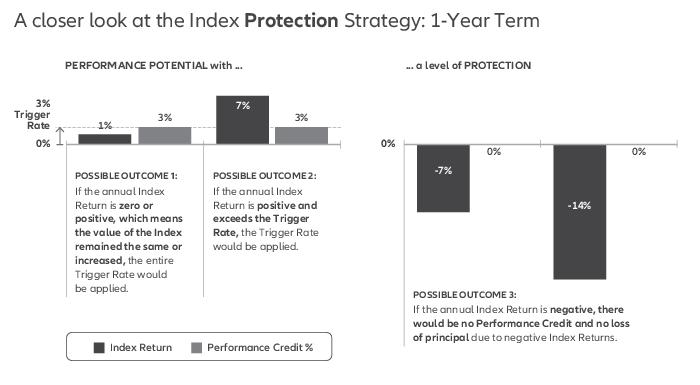
Allianz Index Advantage+ NF® Variable Annuity Prospectus – October
[XX], 2024
43

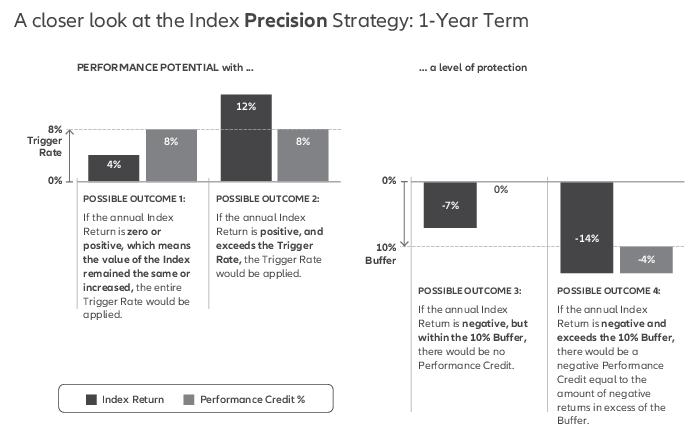

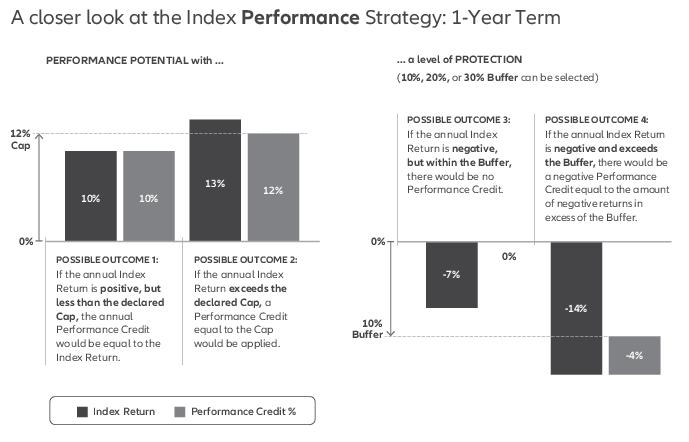
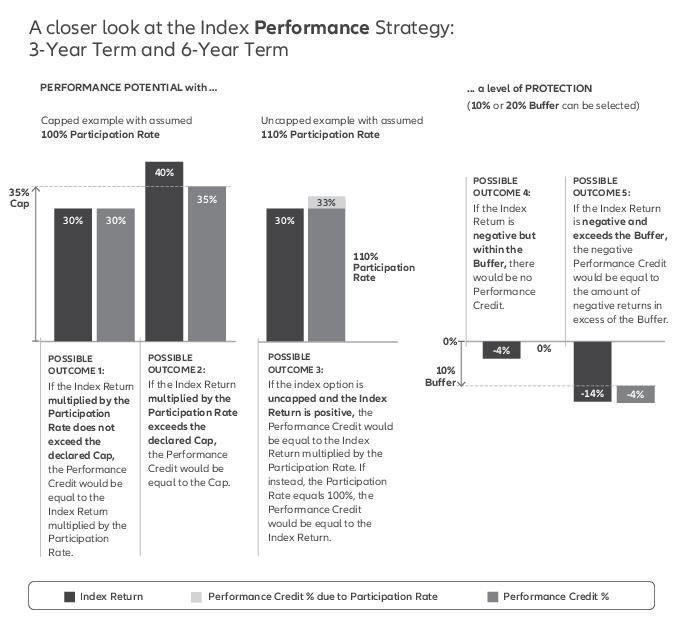
Determining Index Option Values
We calculate an Index Option Value for each Index Option at the end of each Business Day. Generally, the Index Option Value is equal to the Index Option Base plus any applicable Daily Adjustment. The Daily Adjustment applies on Business Days other than the Term Start Date or the Term End Date. The Daily Adjustment can be positive or negative and is discussed later in this section.
On the first Term Start Date, both the Index Option Value and the Index Option Base for each of your selected Index Options are initially equal to the amount of:
●
any Purchase Payment received that day which you allocated to that Index
Option, and
●
any Contract Value transferred into that Index Option.
At the end of each subsequent Business Day for each selected Index Option, we first either apply:
●
the Daily Adjustment if this is not the Term End Date, or
●
a Performance Credit if this is the Term End Date.
Allianz Index Advantage+ NF® Variable Annuity Prospectus – October
[XX], 2024
46
We calculate Performance Credits as described under “Calculating Performance Credits” in this section and apply them as follows:
●
We multiply each Index Option Base by its Performance Credit and add this
amount to its Index Option Base.
●
Then we set each Index Option Value equal to its new Index Option Base.
Lastly, we increase and/or decrease each Index Option Base and Index Option Value for additional Purchase Payments, transfers, partial withdrawals you take (including financial adviser fees that you choose to have us pay from this Contract and any withdrawal charge), and deductions we make for Contract fees and expenses.
●
Additional Purchase Payments received on the Term End Date and allocated to
this Index Option, and transfers of Variable Account Value or Index Option Value into this Index Option, increase these values by the dollar amount allocated or transferred.
●
Transfers out of this Index Option reduce these values by the dollar amount
removed from the Index Option.
●
Partial withdrawals you take (including financial adviser fees that you
choose to have us pay from this Contract and any withdrawal charge), and deductions we make for Contract fees and expenses reduce these values by the
dollar amount withdrawn from the Index Option.
−
We deduct partial withdrawals you take (including financial adviser fees
that you choose to have us pay from this Contract and any withdrawal charge), and deductions we make for Contract fees and expenses from the Index Options proportionately based on the percentage of Contract Value in each Index Option using values determined at the end of the Business Day before we process the withdrawal or deduct the Contract expense.
−
We then reduce each Index Option Base by the same percentage that the
amount withdrawn reduced its associated Index Option Value.
Example
●
Your Contract Value is $100,000 and you selected two Index Options. The
first Index Option has an Index Option Value of $75,000 and an Index Option Base of $72,000. The second Index Option has an Index Option Value of $25,000 and an Index Option Base of $22,000. You take a $10,000 partial withdrawal (including any withdrawal charge).
●
This partial withdrawal reduces your Index Option Value by the percentage
of Contract Value in each Index Option (Index Option Value ÷ Contract Value).
−
For the first Index Option this percentage is 75% ($75,000 ÷ $100,000) and
the $10,000 partial withdrawal reduces this value by $7,500 ($10,000 x 75%). For the second Index Option this percentage is 25% ($25,000 ÷ $100,000) and the $10,000 partial withdrawal reduces this value by $2,500 ($10,000 x 25%).
●
We then reduce each Index Option Base by the same percentage that the
amount withdrawn reduced its associated Index Option Value (amount withdrawn from Index Option Value ÷ Index Option Value).
−
For the first Index Option this percentage is 10% ($7,500 ÷ $75,000) and
the $10,000 partial withdrawal reduces this value by $7,200 ($72,000 x 10%). For the second Index Option this percentage is also 10% ($2,500 ÷ $25,000) and the $10,000 partial withdrawal reduces this value by $2,200 ($22,000 x 10%).
●
Deductions we make for Contract fees and expenses also reduce these values
proportionately in the same way as a partial withdrawal.
|
|
First Index Option
|
Second Index Option
|
||
|
|
Index Option Value
|
Index Option Base
|
Index Option Value
|
Index Option Base
|
|
Prior to partial withdrawal
|
$ 75,000
|
$ 72,000
|
$ 25,000
|
$ 22,000
|
|
$10,000 partial withdrawal
|
– $7,500
|
– $7,200
|
– $2,500
|
– $2,200
|
|
|
|
|
|
|
|
After partial withdrawal
|
$ 67,500
|
$ 64,800
|
$ 22,500
|
$ 19,800
|
|
● Amounts removed from the Index Options during the Term for partial withdrawals you take (including any
financial adviser fees that you choose to
have us pay from this Contract) and deductions we make for Contract
fees and expenses do not receive a
Performance Credit on the Term End Date. However, the remaining amount
in the Index Options is eligible for a Performance Credit
on the Term End Date.
|
|
● You cannot specify from which Index Option or the Variable Option we deduct Contract fees and expenses; we
deduct Contract fees and expenses from each Index Option
and the Variable Option proportionately based on its
percentage of Contract Value.
|
Allianz Index Advantage+ NF® Variable Annuity Prospectus – October
[XX], 2024
47
Calculating Performance Credits
We base Performance Credits on Index Values and Index Returns. We measure Index Values on the Term Start Date and Term End Date using the Index’s price at the end of the Business Day as provided by Bloomberg or another market source if Bloomberg is not available. If the Term Start Date or Term End Date is a non-Business Day we use the next Business Day’s Index price. If you select the EURO STOXX 50®, we determine Index Returns without any exchange rate adjustment. Because we calculate Index Returns only on Term End Dates, the Index Return does not necessarily reflect the highest or lowest Index Values that occurred during the Term.
|
Crediting Method
and Term Length
|
If Index Value is less than it was
on the
Term Start Date
(i.e., Index Return is negative):
|
If Index Value is equal to or greater
than it was
on the Term Start Date
(i.e., Index Return is zero or positive):
|
|
Index Protection
Strategy with Trigger
1-year Term
|
Performance Credit is zero.
|
Performance Credit is equal to the Trigger Rate set
on the Term Start Date.
|
|
Index Dual Precision
Strategy 1-year Term
• For Contracts issued
from May 1, 2023, to
November 13, 2023, the
Index Dual Precision
Strategy is not available.
• For Contracts issued
from November 14, 2023,
to April 30, 2024, only
the 10% Buffer is
available.
• For Contracts issued
since May 1, 2024, the
10%, 20%, and 30%
Buffers are available.
|
Performance Credit is equal to the Trigger Rate if the
negative Index Return is less than or equal to the
10%, 20%, or 30% Buffer. However, if the negative
Index Return is greater than the 10%, 20%, or 30%
Buffer you receive a Performance Credit equal to the
negative Index Return in excess of the applicable
Buffer.
Assume you select a 1-year Term Index Option with
10% Buffer. If the Index Return for the year is…
• -8%, the Performance Credit is equal to the Trigger
Rate set on the Term Start Date.
• -12%, the Performance Credit is -2%.
Instead assume you
select a 1-year Term Index
Option with 20%
Buffer, and the Index Return for
the Term is…
• -19%, the Performance Credit is equal to the
Trigger Rate set on the Term Start Date.
• -24%, the Performance Credit is -4%.
Instead assume you
select a 1-year Term Index
Option with 30%
Buffer, and the Index Return for
the Term is…
• -29%, the Performance Credit is equal to the
Trigger Rate set on the Term Start Date.
• -36%, the Performance Credit is -6%.
|
Performance Credit is equal to the Trigger Rate set
on the Term Start Date.
|
Allianz Index Advantage+ NF® Variable Annuity Prospectus – October
[XX], 2024
48
|
Crediting Method
and Term Length
|
If Index Value is less than it was
on the
Term Start Date
(i.e., Index Return is negative):
|
If Index Value is equal to or greater
than it was
on the Term Start Date
(i.e., Index Return is zero or positive):
|
|
Index Dual Precision
Strategy
3-year Term with 10%
or 20% Buffer
• For Contracts issued on
or before November
[XX], 2024, the Index
Dual Precision Strategy
3-year Term is not
available.
|
Performance Credit is equal to the Trigger Rate if the
negative Index Return is less than or equal to the
10% or 20% Buffer. However, if the negative Index
Return is greater than the 10% or 20% Buffer you
receive a Performance Credit equal to the negative
Index Return in excess of the applicable Buffer.
Assume you select a 3-year Term Index Option with
10% Buffer. If the Index Return for the Term is…
• -8%, the Performance Credit is equal to the Trigger
Rate set on the Term Start Date.
• -12%, the Performance Credit is -2%.
Instead assume you
select a 3-year Term Index
Option with 20%
Buffer, and the Index Return for
the Term is…
• -19%, the Performance Credit is equal to the
Trigger Rate set on the Term Start Date.
• -24%, the Performance Credit is -4%.
|
Performance Credit is equal to the Trigger Rate set
on the Term Start Date.
|
|
Index Dual Precision
Strategy
6-year Term with 10%
or 20% Buffer
• For Contracts issued on
or before November
[XX], 2024, the Index
Dual Precision Strategy
6-year Term is not
available.
|
Performance Credit is equal to the Trigger Rate if the
negative Index Return is less than or equal to the
10% or 20% Buffer. However, if the negative Index
Return is greater than the 10% or 20% Buffer you
receive a Performance Credit equal to the negative
Index Return in excess of the applicable Buffer.
Assume you select a 6-year Term Index Option with
10% Buffer. If the Index Return for the Term is…
• -8%, the Performance Credit is equal to the Trigger
Rate set on the Term Start Date.
• -12%, the Performance Credit is -2%.
Instead assume you
select a 6-year Term Index
Option with 20%
Buffer, and the Index Return for
the Term is…
• -19%, the Performance Credit is equal to the
Trigger Rate set on the Term Start Date.
• -24%, the Performance Credit is -4%.
|
Performance Credit is equal to the Trigger Rate set
on the Term Start Date.
|
|
Index Precision
Strategy 1-year Term
|
Performance Credit is equal to the negative Index
Return in excess of the 10% Buffer.
If the Index Return is…
• -8%, the Performance Credit is zero.
• -12%, the Performance Credit is -2%.
|
Performance Credit is equal to the Trigger Rate set
on the Term Start Date.
|
|
Index Guard Strategy
1-year Term
|
Performance Credit is equal to the negative Index
Return subject to the -10% Floor.
If the Index Return is…
• -8%, the Performance Credit is -8%.
• -12%, the Performance Credit is -10%.
|
Performance Credit is equal to the Index Return up
to the Cap set on the Term Start Date.
Assume the Cap is 8%. If the Index Return is…
• 0%, the Performance Credit is zero.
• 6%, the Performance Credit is 6%.
• 12%, the Performance Credit is 8%.
|
Allianz Index Advantage+ NF® Variable Annuity Prospectus – October
[XX], 2024
49
|
Crediting Method
and Term Length
|
If Index Value is less than it was
on the
Term Start Date
(i.e., Index Return is negative):
|
If Index Value is equal to or greater
than it was
on the Term Start Date
(i.e., Index Return is zero or positive):
|
|
Index Performance
Strategy 1-year Term
• For Contracts issued
from May 1, 2023, to
November 13, 2023, only
the 10% Buffer is
available.
• For Contracts issued
since November 14,
2023, the 10%, 20%, and
30% Buffers are
available.
|
Performance Credit is equal to the negative Index
Return in excess of the 10%, 20%, or 30% Buffer.
Assume you select a 1-year Term Index Option with
10% Buffer. If the Index Return for the year is…
• -8%, the Performance Credit is zero.
• -12%, the Performance Credit is -2%.
Instead assume you
select a 1-year Term Index
Option with 20%
Buffer, and the Index Return for
the Term is…
• -19%, the Performance Credit is 0%.
• -24%, the Performance Credit is -4%.
Instead assume you
select a 1-year Term Index
Option with 30%
Buffer, and the Index Return for
the Term is…
• -29%, the Performance Credit is 0%.
• -36%, the Performance Credit is -6%.
|
Performance Credit is equal to the Index Return up
to any Cap set on the Term Start Date.
Assume the Cap for the 1-year Term is 8%. If the
Index Return for the year is…
• 0%, the Performance Credit is zero.
• 6%, the Performance Credit is 6%.
• 12%, the Performance Credit is 8%. If instead the
1-year Term is
uncapped, the Performance
Credit is 12%.
|
|
Index Performance
Strategy 3-year Term
|
Performance Credit is equal to the negative Index
Return in excess of the 10% or 20% Buffer.
Assume you select a 3-year Term Index Option with
10% Buffer. If the Index Return for the Term is…
• -19%, the Performance Credit is -9%.
• -24%, the Performance Credit is -14%.
Instead assume you
select a 3-year Term Index
Option with 20%
Buffer, and the Index Return for
the Term is…
• -19%, the Performance Credit is 0%.
• -24%, the Performance Credit is -4%.
|
Performance Credit is equal to the Index Return
multiplied by the Participation Rate, up to any Cap
set on the Term Start Date.
Assume the Participation Rate is 100% and the Cap
is 80%. If the Index Return for the Term is…
• 0%, the Performance Credit is zero.
• 65%, the Performance Credit is 65%.
• 90%, the Performance Credit is 80%.
If instead the
Participation Rate is 110% and the
3-year Term is uncapped, and the Index Return for
the Term is…
• 0%, the Performance Credit is zero.
• 65%, the Performance Credit is 71.5%.
• 90%, the Performance Credit is 99%.
|
|
Index Performance
Strategy 6-year Term
• For Contracts issued
from May 1, 2023, to
November 13, 2023, only
the 10% Buffer is
available.
• For Contracts issued
since November 14,
2023, the 10% and 20%
Buffers are available.
|
Performance Credit is equal to the negative Index
Return in excess of the 10% or 20% Buffer.
If the Index Return for the Term is…
• -19%, the Performance Credit is -9%.
• -24%, the Performance Credit is -14%.
Instead assume you
select a 6-year Term Index
Option with 20%
Buffer, and the Index Return for
the Term is…
• -19%, the Performance Credit is 0%.
• -24%, the Performance Credit is -4%.
|
Performance Credit is equal to the Index Return
multiplied by the Participation Rate, up to any Cap
set on the Term Start Date.
Assume the Participation Rate is 100% and the Cap
is 85%. If the Index Return for the Term is…
• 0%, the Performance Credit is zero.
• 65%, the Performance Credit is 65%.
• 90%, the Performance Credit is 85%.
If instead the
Participation Rate is 110% and the
6-year Term is uncapped, and the Index Return for
the Term is…
• 0%, the Performance Credit is zero.
• 65%, the Performance Credit is 71.5%.
• 90%, the Performance Credit is 99%.
|
Daily Adjustment
The Daily Adjustment is how we calculate Index Option Values on Business Days other than the Term Start Date or Term End Date. The Variable Option is not subject to the
Daily Adjustment.
Allianz Index Advantage+ NF® Variable Annuity Prospectus – October
[XX], 2024
50
The Daily Adjustment can affect the amounts available for withdrawal, Performance Locks, annuitization, payment of the death benefit, and the Contract Value used to determine the RMD payments, Charge Base, and contract maintenance charge. The Daily Adjustment can be positive or negative. When the Daily Adjustment is positive, your Index Option Value has increased
since the Term Start Date. When it is negative, your Index Option Value has decreased (excluding the effect of the deduction of Contract expenses or any
partial withdrawal). The Daily Adjustment for the Index Protection Strategy with Trigger cannot be negative.
We calculate the Daily Adjustment for a given Business Day before we deduct any Contract fees or expenses or process any partial withdrawal on that Business Day, including Penalty-Free Withdrawals, and any financial adviser fees that you choose to have us pay from this Contract. The Daily Adjustment does not change the Contract fee or expense deducted, or the withdrawal amount; it only changes the Index Option Value from which we deduct the Contract fee or expense, or withdrawal.
The Daily Adjustment approximates the Index Option Value that will be available on the Term End Date. It is the estimated present value of the future Performance Credit that we will apply on the Term End Date. The Daily Adjustment takes into account:
(i)
any Index gains during the Term subject to the applicable Trigger Rate,
Cap, and/or Participation Rate,
(ii)
for the Index Dual Precision Strategy, any Index losses less than or equal
to the 10%, 20%, or 30% Buffer,
(iii)
either any Index losses greater than the 10%, 20%, or 30% Buffer, or Index
losses down to the -10% Floor (not applicable to the Index Protection Strategy with Trigger), and
(iv)
the number of days until the Term End Date.
The Daily Adjustment does this by using the hypothetical value of a Proxy Investment (Proxy Value) each Business Day, other
than the Term Start Date or Term End Date, based on the formulas described in Appendix B. The Proxy Investment provides a current estimated present value of what the Performance
Credit will be on the Term End Date taking into account the applicable Buffer, Floor, Trigger Rate, Cap, and/or Participation Rate. The Daily Adjustment is
not the actual Index return on the day of the calculation, and the estimated present value Performance Credit is not guaranteed. Therefore, the Daily Adjustment could result in a loss beyond the protection of the Buffer or Floor. In extreme circumstances, the Daily Adjustment could result in a loss beyond the protection of the
10%, 20%, or 30% Buffer; or -10% Floor. The maximum potential loss from a negative Daily Adjustment is: -99% for the Index Dual Precision Strategy, Index Precision Strategy, and Index Performance Strategy; and -35% for the Index Guard Strategy. Such losses will be greater
if the amount withdrawn (including any financial adviser fees that you choose to have us pay from this Contract) is also
subject to a withdrawal charge, or is a deduction of Contract fees and expenses.
A withdrawal taken during the Term may not receive the full benefit of the Buffer or Floor because the Daily Adjustment takes into account what may potentially happen between the withdrawal date and the Term End Date. All other factors being equal, even if the current Index return during the Term is greater than the Cap, or the Trigger Rate for the Index Dual Precision
Strategy or Index Precision Strategy, the Daily Adjustment will usually be lower than the Cap or Trigger Rate. For the Index Protection Strategy with
Trigger and Index Precision Strategy, even if the current Index return during the Term is greater than or equal to zero, the Daily Adjustment will usually
be lower than the Trigger Rate. For the Index Dual Precision Strategy, even if the Index return is greater than the applicable Buffer, the Daily Adjustment
will usually be lower than the Trigger Rate. This is because there is a possibility that the Index return could decrease before the Term End Date. Similarly, even though a negative Index return may be within the 10%, 20%, or 30% Buffer for the Index Dual Precision Strategy, Index Precision Strategy, and Index Performance Strategy, you still may receive a negative Daily Adjustment
because there is a possibility that the Index Return could decrease before the Term End Date. The Daily Adjustment for Index Options with a Term length of
more than 1 year may be more negatively impacted by changes in the expected volatility of Index prices than 1-year Term Index Options due to the difference
in Term length. Also, the risk of a negative Daily Adjustment is greater for Index Options with a Term length of more than 1 year than for 1-year Term Index
Options due to the Term length. The Index Performance Strategy 3-year and 6-year Term Index Options with a Participation Rate above 100% may also have larger fluctuations in the Daily Adjustment than Index Options either without a
Participation Rate, or with a Participation Rate equal to 100%. Finally, a negative Index return for the Index Guard Strategy may result in you receiving a
Daily Adjustment lower than the -10% Floor, because the Daily Adjustment reflects the present value of the Floor and you will not receive the full benefit
of the -10% Floor until the Term End Date. A negative Daily Adjustment may cause you to realize loss of principal and previous earnings.
The Daily Adjustment’s risks (including the impact on Contract Value used to determine Contract fees and charges) are discussed in more detail in Risk Factors – Risk of Negative Returns. The specific details of the Daily Adjustment formula are described in Appendix B and in Exhibit 99 of the Form S-1 Registration Statement filed with the SEC, of which this
Allianz Index Advantage+ NF® Variable Annuity Prospectus – October
[XX], 2024
51
prospectus is a part. This information is incorporated by reference into this prospectus. You can obtain a copy of
Exhibit 99 by calling (800) 624-0197, or visiting our website at www.allianzlife.com.
Performance Locks and Early Reallocations
We must receive a Performance Lock request in Good Order before the end of the current Business Day to lock an Index Option on that day. Otherwise, the Lock Date will occur on the next Business Day that your request is in Good Order. We do not allow Performance Locks to occur on Term End Dates. For requests submitted in writing, we do not consider the request to be received until it arrives at our Service Center.
You (or your Financial Professional, if authorized) can request a Performance Lock based on targets you set. You can set upper and/or lower targets for each Index Option each Term. Setting a target close to the current Index Option Value return
(or close to the Daily Adjustment once Contract Value is reduced to zero) may cause a Performance Lock to occur very
quickly. You can change or cancel targets at any time before we execute a Performance Lock. Each Index Option’s targets automatically expire on the earlier of the Lock Date, or the last Business Day before the Term End Date. By setting targets you are authorizing us to
automatically execute a Performance Lock at the end of the Business Day on the Lock Date upon which the target is
reached.
A Performance Lock can be executed once each Term for each Index Option. We will not execute a Performance Lock on the Index Protection Strategy with Trigger Index Options if the Daily Adjustment on the applicable date is zero. A Performance Lock applies to the total Index Option Value in an Index Option, and not just a portion of that Index Option Value.
We use the Daily Adjustment calculated at the end of the current Business Day on the Lock Date to determine your locked Index Option Value. This “locked”
Index Option Value may be more or less than the “unlocked” Index Option Value that is available for your review on the Lock Date because the unlocked Index
Option Value was determined at the end of the prior Business Day. After the Lock Date, the Index Option Value stays in the locked Index Option for the remainder of the Index Year unless you execute an Early Reallocation (if available to you). If you decide to execute an Early
Reallocation, you can execute a Performance Lock and then, at the earliest, execute an Early Reallocation on the same Business Day. When executing both the
Performance Lock and Early Reallocation on the same Business Day, your Lock Date is also the Term Start Date for the new Index Option. Daily Adjustments do
not apply to a locked Index Option for the remainder of the Term and the locked Index Option Value will not receive a Performance Credit on the Term End Date. For example, assume you selected one Index Option and your Index Option Value available for review in your account today is $20,326. If before the end of the Business Day you request a Performance Lock, today is your Lock Date. If your
Index Option Value at the end of the Business Day is $20,250, you will lock in this $20,250 and it will not change until the next Index Anniversary if you
do not execute an Early Reallocation. However, if you take a partial withdrawal (including financial adviser fees that you choose to have us pay from this
Contract) or when we deduct a Contract fee or expense, we deduct these amounts proportionately from the Index Option Values, which will decrease any locked
Index Option Value. On the next Index Anniversary that occurs on or immediately after the Lock Date, all locked Index Options will be unlocked, we will transfer the locked Index Option Value according to your instructions, and Daily Adjustments will again apply for the new Term. If you do not provide us with transfer instructions, the Index Option Value will remain in the same Index Option with a new Term Start Date subject to the renewal Trigger Rate, Cap, or Participation Rate for the new Term.
You can also transfer assets out of a locked Index Option by requesting an Early Reallocation. We do not accept Early Reallocation requests within 14 calendar days before an Index Anniversary and you are limited to two Early Reallocation requests each Index Year. However, each request can involve multiple locked Index Options. You can execute a Performance Lock and Early Reallocation on the same Business Day. After your second Early Reallocation request in an Index Year, any
locked Index Options will remain locked until the next Index Anniversary. These limitations mean you may not be able to take advantage of any increases to
Early Reallocation rates, or any advantageous changes to Index values when they become available. In all cases, executing an Early Reallocation will result
in the remainder of the Index Year from the date you execute the Early Reallocation being added to your new Term length. For example, assume you are allocated to a 1-year Term Index Option. Eight months into the Term, you elect to execute a Performance Lock, and at the end of the tenth month you execute an Early Reallocation and choose a new 1-Year Term Index Option. The remaining two months of the Index Year will be added to the new 1-year Term for your newly selected Index Option, making the new Term length 14
months.
A Performance Lock can help eliminate doubt about future Index performance and possibly limit the impact of a negative Performance Credit you would otherwise receive on an Index Dual Precision Strategy, Index Precision Strategy, Index Guard Strategy, or Index Performance Strategy Index Option. Because we transfer assets out of a locked Index Option on the Index
Anniversary that occurs on or immediately after the Lock Date, executing a Performance Lock can also allow
Allianz Index Advantage+ NF® Variable Annuity Prospectus – October
[XX], 2024
52
you to transfer assets out of a 3-year or 6-year Term Index Option before the Term End Date if you execute the lock on or
before the second Index Anniversary of a 3-year Term, or on or before the fifth Index Anniversary of a 6-year Term. If the Index Anniversary occurs on a non-Business Day, the Performance Lock must be executed before the end of the prior Business Day in order to transfer assets out of a 3-year or 6-year Term Index Option before the Term End Date. Executing an Early
Reallocation on a locked Index Option can also allow you to transfer assets out of an Index Option before the Term End Date. The disadvantage of executing a
Performance Lock is that the relevant Index Value could increase by the Term End Date, and you will not participate in that increase. In addition, if you
execute a Performance Lock on an Index Dual Precision Strategy, Index Precision Strategy, Index Guard Strategy, or Index Performance Strategy Index Option,
you may receive less than the full protection of the Buffer or Floor that you would have received if you waited for us to apply the Performance Credit on the Term End Date.
Early Reallocation Example. Assume your
Index Anniversary occurs on January 1st, and by June 15th you have locked four Index Options. You could submit an Early Reallocation request on July 17th
for one Index Option, and a second request on August 14th for two more Index Options. However, after August 14th we will not accept any additional Reallocation Request for the remainder of the Index Year, so your one remaining locked Index Option will stay locked until the next Index Anniversary. Although you are unable to execute an Early Reallocation for the remainder of the Index Year,
you can continue to execute Performance Locks on any unlocked Index Options.
|
We will not provide
advice or notify you regarding whether you should execute a Performance Lock or Early
Reallocation or the
optimal time for doing so. We will not warn you if you execute a Performance Lock or Early
Reallocation at a
sub-optimal time. We are not responsible for any losses related to your decision whether or not to
execute a Performance
Lock or Early Reallocation.
|
5. Information Related to the Variable Option's Underlying Fund
Information regarding the AZL Government Money Market Fund, including its (i) investment objective, (ii) investment adviser and subadviser, (iii) current expenses, and (iv) performance is available in Appendix E – Fund Available Under the Contract. The Fund has issued a prospectus that contains more detailed information about the Fund. You should read the prospectus for the Fund carefully before investing. The Fund’s prospectus and other information can be found online at www.allianzlife.com/variableoptions. You can also request this information at no cost by calling (800) 624-0197, by sending an email request to [email protected], or by contacting your Financial Professional. We send
you the current copy of the Fund's prospectus when we issue the Contract.
There are potential risks associated with the Fund and its investment strategies. Depending on market conditions, you can gain or lose value by investing in the Variable Option. In the future, we may add, eliminate or substitute underlying funds to the extent permitted by the federal securities laws and, when required, the SEC.
Currently, the Fund is not a publicly available mutual fund. It is available only through variable annuity contracts or variable life insurance policies issued by life insurance companies or in some cases, through participation in certain qualified pension or retirement plans. A material conflict of interest may arise between insurance companies, owners of different types of contracts, and retirement plans or their participants. The Fund's Board of Directors monitors for material conflicts, and determines what action, if any, should be taken to address any conflicts.
The Fund's name, investment objectives and policies may be similar to the names, investment objectives and policies of other portfolios managed by the same investment advisers. Although the names, objectives and policies may be similar, the Fund's investment results may be higher or lower than these other portfolios’ results. The investment advisers cannot guarantee, and make no representation, that these similar portfolios’ investment results will be comparable even though the Fund
has the same name, investment advisers, objectives, and policies.
The Fund pays 12b-1 fees to the Contracts’ distributor, our affiliate, Allianz Life Financial Services, LLC, for distribution and/or administrative services. In addition, we may enter into certain arrangements under which we, or Allianz Life Financial Services, LLC, are compensated by the Fund's advisers, distributors and/or affiliates for administrative services and
benefits we provide to the Fund. The compensation amount usually is based on the aggregate assets in the Fund attributable to contracts we issue or
administer. Some advisers may pay us more or less than others. The maximum service fee we currently receive from any underlying fund or affiliate thereof in
any variable annuity contract we offer is 0.25% annually.
Allianz Index Advantage+ NF® Variable Annuity Prospectus – October
[XX], 2024
53
Allianz Investment Management LLC, the Fund's investment adviser, is affiliated with us through common ownership.
Substitution and Limitation on Holdings
We may substitute another underlying fund for the Fund for any reason in our sole discretion. To the extent required by the Investment Company Act of 1940 or other applicable law, we do not substitute any shares without SEC approval (if required) and providing you notice. A new or substitute underlying fund may have different fees and expenses. We may limit the amount
of additional Purchase Payments that may be held in the Variable Option if marketing, tax, or investment considerations warrant, or for any reason in our
sole discretion. We may also close the Variable Option. However, we will always offer a variable investment option under the Contract. The Fund may
discontinue offering its shares in the future.
Excessive Trading and Market Timing
|
Currently the Contract does not offer any variable
investment options to which you can allocate money. As such, and
given the design of the Contract, we do not believe there
to be a risk of excessive trading and market timing. However, if
we were to offer multiple variable investment options in
the future, they would be subject to the following provisions.
|
We discourage and do not accommodate frequent transfers. We may restrict or modify your right to make transfers to prevent any use that we consider to be part of a market timing program.
Frequent transfers, programmed transfers, transfers into and then out of a variable investment option in a short period of time, and transfers of large amounts at one time (collectively referred to as “potentially disruptive trading”) may have harmful effects for other Owners, Annuitants and Beneficiaries. These risks and harmful effects include the following.
●
Dilution of the interests of long-term investors in a variable investment
option, if market timers or others transfer into a variable investment option at prices that are below their true value, or transfer out at prices above
their true value.
●
An adverse effect on portfolio management, such as causing an underlying
fund to maintain a higher level of cash or causing an underlying fund to liquidate investments prematurely.
●
Increased brokerage and administrative expenses for an underlying fund.
We attempt to protect our Owners against potentially disruptive trading through our Excessive Trading and Market Timing policies and procedures. Under these policies and procedures, we may modify your transfer privileges for some or all of the variable investment options as follows:
●
Limit transfer frequency (for example, prohibit more than one transfer a
week, or more than two a month, etc.).
●
Restrict the transfer method (for example, requiring all transfers be sent
by first-class U.S. mail and rescinding electronic transfer privileges).
●
Require a minimum time period between each transfer into or out of the same
variable investment option. Our current Excessive Trading and Market Timing policy, which is subject to change without notice, prohibits “round trips”
within 14 calendar days. We do not include transfers into and/or out of the Variable Option when available in your Contract or any automatic transfers made under any of our programs or Contract features. Round trips are transfers into and back out of the same variable investment option, or transfers out of and back into the same variable investment option.
●
Refuse transfer requests made on your behalf by an asset allocation and/or
market timing service.
●
Limit the dollar amount of any single Purchase Payment or transfer request
to a variable investment option.
●
Prohibit transfers into specific variable investment options.
●
Impose other limitations or restrictions to the extent permitted by federal
securities laws.
We also reserve the right to reject any specific Purchase Payment allocation or transfer request from any person if in the investment adviser’s, subadviser’s or our judgment, an underlying fund may be unable to invest effectively in accordance with its investment objectives and policies. This could occur, for example, where frequent or rapid trading causes the investment adviser to hold an excess of uninvested cash to meet redemption requests, or to sell investment positions to fund redemptions, thereby affecting underlying fund returns. Similarly, rapid or frequent trading may cause an underlying fund to incur excessive transaction fees, which also could affect performance.
We retain some discretion in determining what actions constitute potentially disruptive trading and in determining when and how to impose trading restrictions. Currently, we attempt to deter disruptive trading as follows. If a transfer(s) is/are identified as potentially
disruptive trading, we may (but are not required to) send a warning letter. If the conduct continues and we determine it constitutes disruptive trading, we
also impose transfer restrictions. Transfer restrictions may include refusing electronic transfers and requiring all transfers be sent by first-class U.S.
mail. If the disruptive trading affects only a single variable investment option, we may prohibit transfers into or Purchase Payment allocations to that
variable
Allianz Index Advantage+ NF® Variable Annuity Prospectus – October
[XX], 2024
54
investment option. We do not enter into agreements permitting market timing and would not permit activities determined to be disruptive trading to continue. We also reserve the right to impose transfer restrictions if we determine, in our sole discretion, that transfers disadvantage other Owners. We notify you in writing if we impose transfer restrictions on you.
We adopted these policies and procedures as a preventative measure to protect all Owners from the potential effects of disruptive trading, while also abiding by your legitimate interest in diversifying your investment and making periodic asset re-allocations based on your personal situation or overall market conditions. We attempt to protect your interests in making legitimate transfers by providing reasonable and convenient transfer methods that do not harm other Owners.
We may make exceptions when imposing transfer restrictions if we determine a transfer is appropriate, although it may technically violate our policies and procedures discussed here. In determining if a transfer is appropriate, we may, but are not required to, take into consideration its relative size, whether it was purely a defensive transfer into the Variable Option, and whether it involved an error or similar event. We may also reinstate electronic transfer privileges after we revoke them, but we do not reinstate these privileges if we believe they might be used for future disruptive trading.
We cannot guarantee the following.
●
Our monitoring will be 100% successful in detecting all potentially
disruptive trading activity.
●
Revoking electronic transfer privileges will successfully deter all
potentially disruptive trading.
In addition, some of the underlying funds are available to other insurance companies and we do not know if they adopted policies and procedures to detect and deter potentially disruptive trading, or what their policies and procedures might be. Because we may not be completely successful at detecting and preventing market timing activities, and other insurance companies that offer the underlying funds may not have adopted adequate market timing procedures, there is some risk that market
timing activity may occur and negatively affect other Owners.
We may, without prior notice to any party, take whatever action we deem appropriate to comply with any state or federal regulatory requirement. In addition, purchase orders for an underlying fund’s shares are subject to acceptance by that underlying fund’s manager. We reserve the right to reject, without prior notice, any variable investment option transfer request or Purchase Payment if the purchase order is rejected by the investment manager. We have entered into agreements required under SEC Rule 22c-2 (Rule 22c-2 agreements) whereby, upon request by an underlying fund or its designee, we must provide information about you and your trading activities to the underlying fund or its designee. Under the terms of the
Rule 22c-2 agreements, we are required to: (1) provide details concerning every purchase, redemption, transfer, or exchange of variable investment options
during a specified period; and (2) restrict your trading activity if the party receiving the information so requests. Under certain Rule 22c-2 agreements,
if we fail to comply with a request to restrict trading activity, the underlying fund or its designee may refuse to accept buy orders from us until we
comply.
Underlying funds may add or change policies designed to restrict market timing activities. For example, underlying funds may impose restrictions on transfers between underlying funds in an affiliated group if the investment adviser to one or more of the underlying funds determines that the person requesting the transfer has engaged, or is engaging in, market timing or other abusive trading activities. In addition, an underlying fund may impose a short-term trading fee on purchases and sales within a specified period. You should review the underlying funds’ prospectuses regarding any applicable transfer restrictions and the imposition of any fee to discourage short-term trading. The imposition of these restrictions would
occur as a result of underlying fund restrictions and actions taken by the underlying funds’ managers.
|
This Contract is not designed for professional market
timing organizations, or other persons using programmed, large, or
frequent transfers, and we may restrict excessive or
inappropriate transfer activity.
|
The retention of some level of discretion by us may result in disparate treatment among persons engaging in potentially disruptive trading, and it is possible that some persons could experience adverse consequences if others are able to engage in potentially disruptive trading practices that have negative effects.
Voting Privileges
We legally own the Fund shares held in the Separate Account. However, when the Fund holds a shareholder vote that affects your investment, we ask you to give us voting instructions. We then vote all of our shares, including any we own on our behalf, in proportion to those instructions. Because most Owners do not give us instructions and we vote shares proportionally, a small number of Owners may determine a vote’s outcome. If we determine we no longer need to get your voting
instructions, we will decide how to vote the shares. Only Owners have voting privileges. Annuitants, Beneficiaries, Payees and other persons have no voting
privileges unless they are also Owners. We determine your voting interest based
Allianz Index Advantage+ NF® Variable Annuity Prospectus – October
[XX], 2024
55
on the dollar value of the Fund shares attributable to your Contract. We calculate this based on the number and value of
accumulation units for your Contract on the record date. We count fractional units. You will receive proxy materials and a voting instruction form.
6. Expenses
Contract fees and expenses reduce your investment return and are described here in detail. We set the Contract fees and expenses on the Issue Date and they cannot change.
Optional Benefit Additional Rider Fee
Maximum Anniversary Value Death Benefit
If you have the Maximum Anniversary Value Death Benefit, we deduct an additional 0.20% rider fee from your Contract Value. The rider fee is an annualized rate that we calculate and accrue on a daily basis as a percentage of the Charge Base and deduct quarterly during the Accumulation Phase while your benefit is in effect as follows.
|
Issue Date
|
Non-Quarterly Contract Anniversaries
|
Quarterly Contract Anniversaries*
|
|
• The Charge Base is
equal to your initial
Purchase Payment.
• We begin calculating
and accruing the
daily rider fee, on
the day after the
Issue Date.
|
• First we calculate and accrue the daily rider fee,
using the Charge Base. If this is a non-Business
Day we use the Charge Base from the end of the
prior Business Day.
• Then if this is a Business Day we
increase/decrease the Charge Base as follows.
– If we receive an additional Purchase
Payment, we increase the Charge Base by
the dollar amount we receive.
– If you take a partial withdrawal (including any
financial adviser fees that you choose to have
us pay from this Contract), or we deduct
Contract fees and expenses other than the
withdrawal charge, we decrease the Charge
Base by the percentage of Contract Value
withdrawn (including any withdrawal charge).
All withdrawals you take reduce the Charge
Base, even Penalty-Free Withdrawals.
|
• First we process all daily transactions and
determine your Contract Value. Daily
transactions include any gains/losses due to AZL
Government Money Market Fund performance or
application of any Daily Adjustment (or
Performance Credit if this is also the Term End
Date), any additional Purchase Payment, any
partial withdrawals you take (including financial
adviser fees that you choose to have us pay from
this Contract and any withdrawal charge), and
deductions we make for other Contract fees and
expenses (including deduction of the accrued
daily rider fee for
the prior quarter). All partial
withdrawals you take reduce the Charge Base,
even Penalty-Free Withdrawals.
– We deduct the accrued rider fee for the prior
quarter on a dollar for dollar basis from the
Contract Value, and proportionately from each
Index Option and the Variable Option.
• Then we set the Charge Base equal to this
Contract Value and we calculate and accrue the
next quarter’s daily rider fee using the newly set
Charge Base.
* Or the next Business Day if the Quarterly Contract
Anniversary is a non-Business Day.
|
|
Example: Contract Value is $125,000; Charge
Base is $127,000; a $10,000 partial
withdrawal (including any withdrawal charge)
would decrease the Charge Base by $10,160.
[($10,000 ÷ $125,000) x $127,000]
Any increase/decrease to the Charge Base
will increase/decrease the daily rider fee we
calculate and accrue on the next day.
|
||
|
Examples of how we
calculate the rider fee are included in Appendix C.
|
||
We no longer assess the 0.20% additional rider fee once we receive either the first Valid Claim from any one Beneficiary, or due proof of a Determining Life’s death if you and the Determining Life are different individuals and the Determining Life predeceases you. We deduct the final accrued additional rider fee before calculating the death benefit. If you take a full withdrawal or annuitize the Contract, we deduct the final accrued rider fee before processing the withdrawal or calculating Annuity Payments. The additional rider fee compensates us for the risks we assume under the Maximum Anniversary Value
Death Benefit.
Allianz Index Advantage+ NF® Variable Annuity Prospectus – October
[XX], 2024
56
|
● When calculating the Maximum Anniversary Value, we deduct all Contract fees and expenses on the Index
Anniversary (including the accrued rider fee if this is
also a Quarterly Contract Anniversary) before we capture any
annual investment gains. However, we do not treat the
deduction of the accrued rider fee as a withdrawal when
calculating the Maximum Anniversary Value (see section 10).
|
|
● If on a Quarterly Contract Anniversary (or the next Business Day if the Quarterly Contract Anniversary is a
non-Business Day) the Contract Value is less than the
accrued rider fee, we deduct your total remaining Contract
Value to cover the accrued rider fee and reduce your
Contract Value to zero.
|
Contract Maintenance Charge (Administrative Expenses)
Your annual contract maintenance charge is $50. This charge is for Contract administration and maintenance expenses. We waive this charge as follows:
●
During the Accumulation Phase, if the Contract Value is at least $100,000
on the Contract Anniversary.
●
During the Accumulation Phase, if you take a full withdrawal of the Cash
Value and the Contract Value is at least $100,000 at the end of the last Business Day before the withdrawal.
●
During the Annuity Phase if the Contract Value on the last Business Day
before the Annuity Date is at least $100,000.
●
When paying death benefits.
During the Accumulation Phase, we deduct the contract maintenance charge:
●
on a dollar for dollar basis from the Contract Value on the Contract
Anniversary (or the next Business Day if the Contract Anniversary is a non-Business Day), and
●
we deduct it proportionately from each Index Option and the Variable
Option.
If you take a full withdrawal from your Contract (other than on a Contract Anniversary) and do not qualify for the waiver of this charge, we deduct the full contract maintenance charge from the Cash Value. We do not treat the deduction of the contract maintenance charge as a withdrawal when computing your Guaranteed Death Benefit Value. During the Annuity Phase, we deduct the contract maintenance charge proportionately from each Annuity Payment (e.g., if you request semi-annual
Annuity Payments we deduct 50% of the contract maintenance charge from each Annuity Payment).
Withdrawal Charge
You can take withdrawals during the Accumulation Phase. A withdrawal charge applies if any part of a withdrawal comes from a Purchase Payment that is still within the withdrawal charge period. We assess the
withdrawal charge against the Withdrawal Charge Basis, which is equal to total Purchase Payments, less any Purchase Payments withdrawn (excluding any Penalty-Free Withdrawals), and less any applicable withdrawal charge. We do not reduce the Withdrawal Charge Basis for any amounts we deduct to pay other Contract fees and expenses. For withdrawals that are subject to a withdrawal charge, to
pay your requested withdrawal amount, we deduct more than the amount you request and apply a withdrawal charge to the Purchase Payments deducted. Please see #3 in the following example.
We do not assess a withdrawal charge on Penalty-Free Withdrawals or amounts we deduct to pay Contract expenses, other than the withdrawal charge. Amounts withdrawn to pay
financial adviser fees are subject to a withdrawal charge if they exceed the free withdrawal privilege, and will reduce the Contract Value and Guaranteed
Death Benefit Value (perhaps
significantly and by more than the amount withdrawn).
|
Calculating a Withdrawal Charge
|
Example
|
|||
|
For purposes of calculating any withdrawal charge, we
withdraw
Purchase Payments on a “first-in-first-out” (FIFO) basis
and we
process withdrawal requests as follows.
|
You make an initial Purchase Payment of $55,000 and make
another Purchase Payment in the first month of the second
Contract Year of $45,000. In the third month of the third
Contract Year, your Contract Value is $110,000 and you
request a $70,000 withdrawal. We withdraw money and
compute the withdrawal charge as follows.
|
|||
|
1. First, we withdraw from Purchase Payments that we have had
for six or more complete years, which is your Contract’s
withdrawal charge period. This withdrawal is not subject
to a
withdrawal charge and it reduces the Withdrawal Charge
Basis
dollar for dollar.
|
1. Purchase Payments beyond the withdrawal charge
period. All payments are still within the withdrawal charge
period, so this does not apply.
|
|||
Allianz Index Advantage+ NF® Variable Annuity Prospectus – October
[XX], 2024
57
|
Calculating a Withdrawal Charge
|
Example
|
|||
|
2. Amounts available as a Penalty-Free Withdrawal. This includes
partial withdrawals you take during the Accumulation Phase
under the free withdrawal privilege or waiver of
withdrawal
charge benefit, and RMD payments you take under our
minimum distribution program. Penalty-Free Withdrawals are
not subject to a withdrawal charge, and they do not reduce
the
Withdrawal Charge Basis.
|
2. Amounts available as a Penalty-Free Withdrawal. You did
not take any other withdrawals this year, so the entire
free
withdrawal privilege (10% of your total Purchase Payments,
or $10,000) is available to you without incurring a
withdrawal
charge.
|
|||
|
3. Next, on a FIFO basis, we withdraw from Purchase Payments
within your Contract’s withdrawal charge period and assess
a
withdrawal charge. Withdrawing payments on a FIFO basis
may help reduce the total withdrawal charge because the
charge declines over time. We determine your total
withdrawal
charge by multiplying each payment by its applicable
withdrawal charge percentage and then totaling the
charges.
These withdrawals reduce the Withdrawal Charge Basis.
The withdrawal charge as a percentage of each Purchase
Payment withdrawn is as follows.
|
3. Purchase Payments within the withdrawal charge period
on a FIFO basis. The total amount we withdraw from the
first Purchase Payment is $55,000, which is subject to a
7%
withdrawal charge, and you receive $51,150. We determine
this amount as follows:
(amount withdrawn) x (1 – withdrawal charge) = the
amount you receive, or:
$55,000 x 0.93 = $51,150
The total amount we withdraw from the second Purchase
Payment is $9,620, which is subject to an 8% withdrawal
charge, and you receive $8,850. We determine this amount
as follows:
(amount withdrawn) x (1 – withdrawal charge) = the
amount you receive, or:
$9,620 x 0.92 = $8,850
|
|||
|
Number of
Complete Years
Since Purchase
Payment
|
Withdrawal Charge Amount
|
|
||
|
Contracts issued
on or before
April 30,2024
|
Contracts issued
on or after
May 1,2024
|
|
||
|
0
1
2
3
4
5
6 years or more
|
8.5%
8%
7%
6%
5%
4%
0%
|
8%
8%
7%
6%
5%
4%
0%
|
|
|
|
4. Finally, we withdraw any Contract earnings. This withdrawal is
not subject to a withdrawal charge and it does not reduce
the
Withdrawal Charge Basis.
|
4. Contract earnings. We already withdrew your requested
amount, so this does not apply.
In total we withdrew $74,620 from your
Contract, of
which you received $70,000 and paid a
withdrawal
charge of $4,620. We also reduced the 1st
Purchase
Payment from $55,000 to $0, and your 2nd
Purchase
Payment from $45,000 to $35,380 ($45,000
– $9,620).
Please note that this
example may differ from your
actual results due to
rounding.
|
|||
Upon a full withdrawal, we first deduct any final rider fee and contract maintenance charge from your Contract Value before we calculate the withdrawal charge. We then deduct any applicable withdrawal charge from the total remaining Contract Value and send you the remaining amount. For a partial withdrawal, we pay you the amount you requested and deduct this
amount and any withdrawal charge from the total Contract Value. We deduct any partial withdrawal (including any withdrawal charge) proportionately from each
Index Option and the Variable Option. If a partial withdrawal occurs on a day that we also deduct the rider fee and/or contract maintenance charge, we
deduct these fees and expenses before we calculate and deduct the partial withdrawal and any withdrawal charge from the Contract Value.
The withdrawal charge compensates us for expenses associated with selling the Contract.
Allianz Index Advantage+ NF® Variable Annuity Prospectus – October
[XX], 2024
58
Reduction or Elimination of the Withdrawal Charge
We may reduce or eliminate the withdrawal charge when the Contract is sold under circumstances that reduce its sales expenses. We will implement this withdrawal charge reduction or elimination in a nondiscriminatory manner. For example, if a large group of individuals purchases Contracts or if a prospective purchaser already has a relationship with us. We may choose not to deduct a withdrawal charge under a Contract issued to an officer, director, or employee of Allianz Life or any of its affiliates. Also, we may reduce or eliminate the withdrawal charge when a Contract is sold by a Financial Professional appointed with Allianz Life to any members of his or her immediate family and the Financial Professional waives
their commission. We must pre-approve any withdrawal charge reduction or elimination.
|
● Upon a full withdrawal, the free withdrawal privilege is not available to you, and we apply a withdrawal charge
against Purchase Payments that are still within the
withdrawal charge period, including amounts previously
withdrawn under the free withdrawal privilege. On a full withdrawal, your Withdrawal Charge Basis may be
greater than your Contract Value because
the following reduce your Contract Value, but do not reduce your
Withdrawal Charge Basis:
|
|
– prior Penalty-Free Withdrawals,
|
|
– deductions we make for Contract fees and expenses other than the withdrawal charge, and/or
|
|
– poor performance.
|
|
This also means that
upon a full withdrawal you may not receive any money.
|
|
● Withdrawals (including any financial adviser fees that you choose to have us pay from this Contract) are subject to
ordinary income taxes, and may also be
subject to a 10% additional federal tax for amounts withdrawn before
age 59 1∕2. The amount of Contract Value available for withdrawal is also affected by the Daily Adjustment
(which can be negative)
unless taken on a Term End Date. If you have Index Options with different Term End
Dates, there may be no
time you can take a withdrawal without application of at least one Daily Adjustment.
Please consult with your
Financial Professional before requesting us to pay financial adviser fees from this
Contract rather than
from other assets you may have.
|
|
● For tax purposes, and in most instances, withdrawals from Non-Qualified Contracts are considered to come from
earnings first, not Purchase Payments.
|
Daily Adjustment Maximum Potential Loss
The Daily Adjustment is how we calculate Index Option Values on days other than the Term Start Date or Term End Date. The Daily Adjustment approximates the Index Option Value that will be available on the Term End Date. If before the Term End Date you take a full or partial withdrawal (including any financial adviser fees that you choose to have us pay from
this Contract), you execute a Performance Lock, you annuitize the Contract, we pay a death benefit, or when we deduct Contract fees and expenses, we
calculate the Index Option Value by applying the Daily Adjustment. The Daily Adjustment can be positive or negative. Following is the maximum potential loss
associated with the Daily Adjustment.
|
|
Index Protection Strategy
with Trigger
|
Index Dual Precision Strategy,
Index Precision Strategy,
and
Index Performance Strategy
|
Index
Guard
Strategy
|
|
Daily Adjustment Maximum Potential Loss
|
0%
|
99%
|
35%
|
|
(as a percentage of Index Option Value, applies for
distributions from an Index Option before any Term
End Date)
|
|
|
|
Premium Tax
Premium tax is based on your state of residence at the time you make each Purchase Payment. In states that assess a premium tax, we do not currently deduct it from the Contract, although we reserve the right to do so in the future. Premium tax normally ranges from 0% to 3.5% of the Purchase Payment, depending on the state or governmental entity.
Income Tax
Currently, we do not deduct any Contract related income tax we incur, although we reserve the right to do so in the future.
Fund Expenses
Charges deducted from and expenses paid out of the assets of the Fund are described in the Fund's prospectus.
Allianz Index Advantage+ NF® Variable Annuity Prospectus – October
[XX], 2024
59
These expenses reduce the Fund's performance and, therefore, negatively affect your Contract Value and any payments based on Contract Value.
7. Access to Your Money
Your Contract Value is available under the following circumstances:
●
by taking a withdrawal (including financial adviser fees that you choose to
have us pay from this Contract; withdrawals under the free withdrawal privilege and waiver of withdrawal charge benefit; and, for Qualified Contracts
only, RMD payments under our minimum distribution program);
●
by taking Annuity Payments; or
●
when we pay a death benefit.
You can take withdrawals during the Accumulation Phase. We process withdrawal requests based on values next determined after receipt of the request in Good Order at our Service Center. Values are normally determined at the end of each Business Day. We process any withdrawal request received at or after the end of the current Business Day using values determined on the next Business Day.
Any partial withdrawal must be for at least $100.* The Contract Value after a partial withdrawal (including any withdrawal charge) must be at least $2,000.* Any partial
withdrawal that reduces the Contract Value below this minimum will be treated as a full withdrawal of the Cash Value. A full withdrawal
will cause the Contract and all of its benefits to end.
*
Does not apply to RMD payments under our minimum distribution program.
We deduct any partial withdrawal (including any withdrawal charge) proportionately from each Index Option and the Variable Option. The Index Option Value from which a partial withdrawal is deducted during a Term will include any applicable Daily Adjustment.
A partial or full withdrawal is subject to a withdrawal charge if taken within six years of your last Purchase Payment, and, if taken on a day other than a Term End Date, we will apply the Daily Adjustment, which may be negative, to the Index Option Values before deducting the withdrawal. A partial withdrawal is not subject to any Contract fees or expenses other than
the withdrawal charge, but on a full withdrawal we do deduct any final rider fee and contract maintenance charge. Partial withdrawals (including any
withdrawal charge) reduce Contract Value dollar for dollar, and reduce the Guaranteed Death Benefit Value proportionately. The reduction to Contract Value
also reduces the following which are based on Contract Value: the likelihood of receiving increases to the Maximum Anniversary Value if the Maximum
Anniversary Value Death Benefit is selected, and RMD payments. A full withdrawal of the Cash Value will end the Contract and all its benefits.
See the Fee Tables and section 6, Expenses for a discussion of the Contract fees and expenses.
We pay withdrawals promptly, but in no event later than seven days after receipt of your request in Good Order at our Service Center, unless the suspension of payments or transfers provision is in effect (see the discussion later in this section).
|
● Withdrawals are subject to a withdrawal charge, income taxes, and may also be subject to a 10% additional federal
tax for amounts withdrawn before age 59 1∕2. The amount of Contract Value available for
withdrawal may also be
affected by the Daily Adjustment (which can be negative). Please consult with your Financial Professional
before
requesting us to pay
financial adviser fees from this Contract rather than from other assets you may have.
|
|
● Joint Owners: We send each Joint Owner a check for half of the
withdrawal amount and we tax report that Joint
Owner individually. Tax reporting each Joint Owner individually can create a discrepancy in taxation if only one
Joint Owner is under age
59 1∕2 because that Joint Owner may be subject to the 10% additional federal tax.
|
|
● We may be required to provide information about you or your Contract to government regulators. We may also be
required to stop Contract disbursements and thereby refuse
any transfer requests, and refuse to pay any withdrawals
(including a full withdrawal), or death benefits until we
receive instructions from the appropriate regulator. If,
pursuant to SEC rules, the AZL Government Money Market Fund
suspends payment of redemption proceeds in
connection with a fund liquidation, we will delay payment
of any transfer, full or partial withdrawal, or death benefit
from the Variable Option until the Fund is liquidated.
|
Allianz Index Advantage+ NF® Variable Annuity Prospectus – October
[XX], 2024
60
Free Withdrawal Privilege
Each Contract Year during the Accumulation Phase, you can withdraw up to 10% of your total Purchase Payments without incurring a withdrawal charge (the free withdrawal privilege). Any unused free withdrawal privilege in one Contract Year is not added to the amount available to you in the next Contract Year. Withdrawals from Purchase Payments that are outside the six year withdrawal charge period are not subject to a withdrawal charge and do not reduce your free withdrawal
privilege. RMD payments you take under our minimum distribution program and withdrawals under the waiver of withdrawal charge benefit are not subject to a
withdrawal charge, but do reduce your free withdrawal privilege. Amounts we deduct for any financial adviser fees that you choose to have us pay from this
Contract also reduce your free withdrawal privilege.
Example
Assume your initial Purchase Payment 10 years ago was $100,000, and you made a second $90,000 Purchase Payment 3 years ago. You take an RMD payment of $1,500 and withdraw $150,000 when the Contract Value is $275,000. The RMD payment is not subject to a withdrawal charge, but reduces the amount available under the free withdrawal privilege to $17,500
(10% x $190,000 total Purchase Payments = $19,000 - $1,500 RMD payment). After the RMD payment, $117,500 is available to you without a withdrawal charge:
the initial $100,000 Purchase Payment that is beyond the 6-year withdrawal charge period, and $17,500 remaining free withdrawal privilege. The remaining
$32,500 of your requested withdrawal would be subject to a 7% withdrawal charge.
|
The free withdrawal privilege is not
available upon a full withdrawal.
|
Minimum Distribution Program and Required Minimum Distribution (RMD) Payments
If you own an IRA or SEP IRA Contract, you can participate in the minimum distribution program during the Accumulation Phase. If you have an Inherited IRA Contract or Inherited Roth IRA Contract, we generally require you to participate in the minimum distribution program when you purchase this Contract. Under this program, we make payments to you
designed to meet the applicable minimum distribution requirements imposed by the Code for this Qualified Contract. RMD payments are not subject to a
withdrawal charge, but they reduce the free withdrawal privilege amount during the Contract Year. We do not consider deductions we make for financial
adviser fees that you choose to have us pay from this Contract to be RMD payments. However, Contract Value is one of the components we use to calculate RMD
payments, so these deductions may reduce your future RMD payments. We apply the Daily Adjustment to the Index Option Values if RMD payments are deducted on days other
than a Term End Date. This contract may not be appropriate if you intend to
take RMD payments from an Index Option on days other than a Term End Date. You should consult your tax advisor before purchasing a Qualified Contract
subject to RMD payments.
We can make payments to you monthly, quarterly, semi-annually or annually. However, if your Contract Value is less than $25,000, we only make annual payments. We do not allow you to aggregate RMD payments between this Contract and other qualified contracts that you own for purposes of this program. We must receive your program form instructions in Good Order at
our Service Center before the end of the Business Day before payments begin.
We reserve the right to discontinue or modify the minimum distribution program subject to the requirements of law.
|
● You should consult a tax adviser before purchasing a Qualified Contract that is subject to RMD payments.
|
|
● The minimum distribution program is not available if you have a Qualified Contract purchased through a
qualified plan.
|
Waiver of Withdrawal Charge Benefit
After the first Contract Year, you can take withdrawals and we waive the withdrawal charge if you:
●
begin confinement after the first Contract Anniversary in an eligible
facility (a hospital, nursing facility, or assisted living facility) for at least 90 days in a 120-day period, or
●
are unable to perform at least two of six activities of daily living (ADLs)
for at least 90 consecutive days. ADLs include bathing, dressing, toileting, continence, eating, and transferring (moving into or out of a bed, chair, or
wheelchair).
We must receive proof of staying in an eligible facility or ADL eligibility before we waive the withdrawal charge. For ADL eligibility we may require, at our expense, an examination or tests by a physician of our choice. This waiver is not available if on the Issue Date you were confined to an eligible facility, or were unable to perform all six of the ADLs. We base this benefit on the Annuitant for non-individually owned Contracts. Withdrawals under this benefit reduce the free
Allianz Index Advantage+ NF® Variable Annuity Prospectus – October
[XX], 2024
61
withdrawal privilege amount during the Contract Year. We apply the Daily Adjustment to the Index Options if withdrawals under this benefit are deducted on days other than the Term End Date.
Suspension of Payments or Transfers
We may be required to suspend or postpone transfers or payments for withdrawals for more than seven days after receipt of your request in Good Order at our Service Center, for any period when:
●
the New York Stock Exchange is closed (other than customary weekend and
holiday closings);
●
trading on the New York Stock Exchange is restricted;
●
an emergency (as determined by the SEC) exists as a result of which
disposal of Fund shares by the Separate Account, or disposal of securities owned by the Fund, is not reasonably practicable, or it is not reasonably
practical for the Separate Account or the Fund to determine the value of their net assets; or
●
during any other period when the SEC, by order, so permits for the
protection of Owners.
8. The Annuity Phase
Prior to annuitization, you can take a full withdrawal and receive your Cash Value. If you take a full withdrawal on any day other than a Term Start Date or Term End Date we apply the Daily Adjustment to the Index Option Values before we deduct the final Contract fees and expenses.
Annuity Payments offer a guaranteed lifetime income stream with certain tax advantages and are designed for Owners who no longer need immediate access to Contract Value to meet their short-term income needs.
You can request regular periodic fixed Annuity Payments. The Payee receives the Annuity Payments. You receive tax reporting on the payments, whether or not you are the Payee. We may require proof of the Annuitant(s)’ age before we make any life contingent Annuity Payment. If you misstate the Annuitant(s)’ age or gender, we recalculate the Annuity Payments
based on the correct age or gender.
Calculating Your Annuity Payments
We base Annuity Payments upon the following:
●
The Contract Value less the final rider fee (if applicable) on the Annuity
Date.
●
The age of the Annuitant and any joint Annuitant on the Annuity Date.
●
The gender of the Annuitant and any joint Annuitant where permitted.
●
The Annuity Option you select.
●
Your Contract’s interest rate (or current rates, if higher) and mortality
table.
For any Index Option for which the Annuity Date is not a Term End Date, Contract Value reflects the Daily Adjustment. We guarantee the dollar amount of Annuity Payments and this amount remains fixed and does not change during the entire annuity payment option period that you selected, except as provided under Annuity Option G. We deduct the contract maintenance charge proportionately from each Annuity Payment (e.g., if you request semi-annual Annuity Payments we deduct 50% of
the contract maintenance charge from each Annuity Payment). However, if your Contract Value on the last Business Day before the Annuity Date is at least
$100,000, we waive the contract maintenance charge during the Annuity Phase.
Annuity Payment Options
You can choose one of the Annuity Options described below. After Annuity Payments begin, you cannot change the Annuity Option, or transfer or withdraw Contract Value.
Option A - Guaranteed Period. We make
Annuity Payments for a guaranteed period of ten years.
Option B - Life. We make Annuity Payments
during the life of the Annuitant, and the last payment is the one that is due before the Annuitant’s death. If the Annuitant dies shortly after the Annuity
Date, the Payee may receive less than your investment in the Contract.
Option C - Life with Guaranteed Period. We
make Annuity Payments during the life of the Annuitant, with payments for a minimum guaranteed period that you select. The guaranteed period must be either
five or ten years.
Allianz Index Advantage+ NF® Variable Annuity Prospectus – October
[XX], 2024
62
Option F - Joint and Survivor. We make Annuity Payments during the lifetimes of the Annuitant and the joint Annuitant. Upon the death of one Annuitant, Annuity
Payments to the Payee continue during the lifetime of the surviving joint Annuitant. If both Annuitants die shortly after the Annuity Date, the Payee may
receive less than your investment in the Contract.
Option G - Joint and 2/3 Survivor Annuity. We
make Annuity Payments during the lifetimes of the Annuitant and the joint Annuitant. Upon the death of one Annuitant, Annuity Payments to the Payee continue
during the lifetime of the surviving joint Annuitant at 2/3 of the original amount. If both Annuitants die shortly after the Annuity Date, the Payee may receive less than your investment in the Contract.
Under Annuity Options B, F and G, if all Annuitants die on or after the Annuity Date and before we send the first Annuity Payment, we will cancel Annuity Payments and, upon receipt of a Valid Claim, we will pay the Contract Value determined on the Annuity Date to surviving individual Owner, or the Beneficiary(ies) if there is no surviving Owner. If the Owner is a non-individual, we pay the Owner.
After the Annuitant’s death under Annuity Options A and C, we make Annuity Payments during the remaining guaranteed period in the following order based on who is still alive: the Payee, any surviving original Owner, the last surviving Owner’s Beneficiaries, or to the last surviving Owner’s estate if there are no remaining or named Beneficiaries.
Annuity Payments are usually lower if you select an Annuity Option that requires us to make more frequent Annuity Payments or to make payments over a longer period of time. If you choose life contingent Annuity Payments, payout rates for a younger Annuitant are lower than the payout rates for an older Annuitant and payout rates for life with a guaranteed period are typically lower than life only payments. Monthly payout rates are lower than annual payout rates, payout rates for a 10-year guaranteed period are less than payout rates for a 5-year guaranteed period, and payout rates for a 50-year-old Annuitant are less than payout rates for a 70-year-old Annuitant.
|
● If you do not choose an Annuity Option before the Annuity Date, we make Annuity Payments to the Payee
under Annuity Option C with ten years of
guaranteed monthly payments.
|
|
● For Owners younger than age 59 1∕2, Annuity
Payments may be subject to a 10% additional federal tax.
|
|
● For a Qualified Contract, the Annuity Payments must end ten years after the Owner’s death.
|
When Annuity Payments Begin
Annuity Payments must begin on the maximum Annuity Date stated in your Contract, which is the Index Anniversary that occurs on or immediately after the Annuitant reaches either age 90 or age 100 depending on the requirements of the Financial Professional from which you purchased your Contract. An earlier Annuity Date or a withdrawal may be required to satisfy
minimum required distribution rules under certain Qualified Contracts. You can make an authorized request for an earlier Annuity Date after the Issue Date, but any such request is subject to applicable law and our approval. Your Annuity Date must occur on an Index Anniversary. The earliest available Annuity Date
is the second Index Anniversary.
|
● If Annuity Payments would be less than $100, we reserve the right to require you to take a full withdrawal and
your Contract will then terminate. We do
not assess a withdrawal charge on this full withdrawal.
|
|
● If on the maximum Annuity Date your Contract Value is greater than zero, you must annuitize the Contract.
We notify you of your available options in writing 60 days
in advance. If on your maximum Annuity Date you have
not selected an Annuity
Option, we make payments under Annuity Option C with ten years of guaranteed monthly
payments. Upon annuitization you no longer have Contract Value or a death benefit, and you cannot receive any
other periodic withdrawals or payments other than Annuity
Payments.
|
Allianz Index Advantage+ NF® Variable Annuity Prospectus – October
[XX], 2024
63
9. Benefits Available Under the Contract
The following tables summarize information about the benefits available under the Contract.
|
Standard Benefits (No Additional Charge)
|
||
|
Name of
Benefit
|
Purpose
|
Brief Description of
Restrictions/Limitations
|
|
Free
Withdrawal
Privilege
|
Allows you to withdraw up to 10% of your total
Purchase Payments each Contract Year without
incurring a withdrawal charge.
|
• Only available during the Accumulation Phase.
• Not available upon a full withdrawal.
• Unused free withdrawal amounts not available in
future years.
• Program withdrawals may be subject to negative
Daily Adjustments.
• Program withdrawals are subject to income taxes,
and may also be subject to a 10% additional
federal tax for amounts withdrawn before age
59 1∕2.
|
|
Minimum
Distribution
Program
|
Allows you to automatically take withdrawals to
satisfy the minimum distribution requirements (RMD)
imposed by the Internal Revenue Code.
|
• Only available during the Accumulation Phase.
• Only available to IRA or SEP IRA Contracts.
• Generally required for Inherited IRA and Inherited
Roth IRA Contracts.
• Program withdrawals count against free withdrawal
privilege.
• Program withdrawals may be subject to negative
Daily Adjustments.
• Program withdrawals are subject to income taxes.
• Program withdrawals may be monthly, quarterly,
semi-annual or annual, unless you have less than
$25,000 in Contract Value, in which case only
annual payments are available.
• We reserve the right to discontinue or modify the
program subject to the requirements of law.
|
|
Financial
Adviser
Fees
|
If you have a financial adviser and want to pay their
financial adviser fees from this Contract, you can
instruct us to withdraw the fee from your Contract
and pay it to your Financial Professional or Financial
Professional’s firm as instructed.
|
• Only available during the Accumulation Phase.
• Financial adviser fees are in addition to the
Contract’s fees and expenses.
• Deductions for financial adviser fees are treated as
withdrawals under the Contract.
• Program withdrawals count against free withdrawal
privilege.
• Program withdrawals may be subject to negative
Daily Adjustments.
• Program withdrawals are subject to withdrawal
charges, income taxes, and may also be subject to
a 10% additional federal tax for amounts
withdrawn before age 59 1∕2.
• We reserve the right to discontinue or modify the
program.
• See section 1 for an example of how deduction of
financial adviser fees impact the Contract.
|
Allianz Index Advantage+ NF® Variable Annuity Prospectus – October
[XX], 2024
64
|
Standard Benefits (No Additional Charge)
|
||
|
Name of
Benefit
|
Purpose
|
Brief Description of
Restrictions/Limitations
|
|
Waiver of
Withdrawal
Charge
Benefit
|
Waives withdrawal charges if you are confined for
care, or are unable to perform at least two out of six
activities of daily living (ADLs).
|
• Only available during the Accumulation Phase.
• Confinement must begin after the first Contract
Anniversary, be for at least 90 days in a 120-day
period, and requires proof of stay.
• Inability to perform two ADLs must be for at least
90 consecutive days and may require an exam or
tests by a physician.
• Not available on the Issue Date if any Owner was
confined to an eligible facility, or unable to perform
all six ADLs.
• Program withdrawals count against free withdrawal
privilege.
• Program withdrawals may be subject to negative
Daily Adjustments.
• Program withdrawals are not subject to withdrawal
charges, but are subject to income taxes, and may
also be subject to a 10% additional federal tax for
amounts withdrawn before age 59 1∕2.
• State variations may apply.
|
|
Traditional
Death Benefit
|
Provides a death benefit equal to the greater of the
Contract Value, or Guaranteed Death Benefit Value.
The Guaranteed Death Benefit Value is total
Purchase Payments adjusted for withdrawals.
An example of the death benefit provided by the
Traditional Death Benefit is included in section 10,
Death Benefit.
An example of how deduction of financial adviser
fees impact the death benefit is included in section 1.
|
• Benefit only available during the Accumulation
Phase.
• Withdrawals, including any negative Daily
Adjustments, may significantly reduce the benefit
as indicated in section 1, Financial Adviser Fee
Deduction Example.
• Restrictions on Purchase Payments may limit the
benefit.
• Annuitizing the Contract will end the benefit.
|
Allianz Index Advantage+ NF® Variable Annuity Prospectus – October
[XX], 2024
65
|
Standard Benefits (No Additional Charge)
|
||
|
Name of
Benefit
|
Purpose
|
Brief Description of
Restrictions/Limitations
|
|
Performance
Lock and Early
Reallocations
|
Performance Lock allows you to capture the current
Index Option Value during the Term for an Index
Option. Performance Lock can help eliminate doubt
about future Index performance and possibly limit the
impact of negative performance. Early Reallocation
allows you to transfer out of a locked Index Option
on days other than an Index Anniversary, or a Term
End Date.
A Performance Lock example is included in section
4, Valuing Your Contract — Performance Locks and
Early Reallocations.
|
• Available during the Accumulation Phase.
• Performance Locks must be executed before the
Term End Date.
• If a Performance Lock is executed, the locked
Index Option will no longer participate in Index
performance (positive or negative) for the
remainder of the Term, and will not receive a
Performance Credit on the Term End Date.
• You will not know your locked Index Option Value
in advance.
• The locked Index Option Value will reflect a Daily
Adjustment.
• If a Performance Lock is executed when Daily
Adjustment has declined, it will lock in any loss.
• A Performance Lock can be executed only once
each Term for each Index Option.
• Cannot execute a Performance Lock for only a
portion of the Index Option Value.
• Early Reallocation requests are not accepted
within 14 calendar days before an Index
Anniversary, and are limited to two Early
Reallocation requests each Index Year.
• Deductions (e.g. withdrawals, fees) decrease the
locked Index Option Value.
• Cannot transfer locked Index Option Value until the
next Index Anniversary that occurs on or
immediately after the Lock Date unless you
execute an Early Reallocation.
• We will not provide advice or notify you
regarding whether you should execute a
Performance Lock or Early Reallocation
or the
optimal time for doing so.
• We will not warn you if you execute a
Performance Lock or Early Reallocation
at a
sub-optimal time.
• We are not responsible for any losses related
to your decision whether or not to
execute a
Performance Lock or Early Reallocation.
|
Allianz Index Advantage+ NF® Variable Annuity Prospectus – October
[XX], 2024
66
|
Optional Benefits
|
|||
|
Name of
Benefit
|
Purpose
|
Maximum
Fee
|
Brief Description of
Restrictions/Limitations
|
|
Maximum
Anniversary
Value Death
Benefit
|
Provides a death benefit equal to the greater of
the Contract Value, or Guaranteed Death Benefit
Value. The Guaranteed Death Benefit Value is
the Maximum Anniversary Value.
An example of the death benefit provided by the
Maximum Anniversary Value Death Benefit, and
calculation of the Maximum Anniversary Value is
included in section 10, Death Benefit.
An example of how deduction of financial adviser
fees impact the death benefit is included in
section 1.
|
0.20%
(as a
percentage of
the Charge
Base)
|
• Must be age 75 or younger to elect.
• Can only be added to a Contract at issue.
• Replaces the Traditional Death Benefit if
elected.
• Benefit cannot be removed from the Contract.
• Only available during the Accumulation Phase.
• Withdrawals, including any negative Daily
Adjustment, may significantly reduce the
benefit as indicated in section 1, Financial
Adviser Fee Deduction Example.
• Withdrawals reduce the likelihood of lock in.
• Restrictions on Purchase Payments may limit
the benefit.
• Annuitizing the Contract will end the benefit.
|
10. Death Benefit
“You” in this section refers to the Owner, or the Annuitant if the Contract is owned by a non-individual.
The Contract provides the Traditional Death Benefit, the standard death benefit, for no additional charge. If available, you can instead select the optional Maximum Anniversary Value Death Benefit at Contract issue for an additional rider fee if all Owners and the Annuitant are age 75 or younger. The Maximum Anniversary Value Death Benefit can only be added to a Contract at issue. The Maximum Anniversary Value Death Benefit cannot be less than the Traditional Death Benefit, but they may be equal. Please discuss this benefit’s appropriateness with your Financial Professional. The death benefit is the greater of the Contract Value, or Guaranteed Death Benefit
Value. The Guaranteed Death Benefit Value is either total Purchase Payments reduced proportionately for withdrawals you take (including any withdrawal charge) if you select the Traditional Death Benefit, or the Maximum Anniversary Value if you select the Maximum Anniversary Value Death Benefit.
The death benefit is only available during the Accumulation Phase. If you or the Determining Life (Lives) die during the Accumulation Phase, we process the death benefit using prices determined after
we receive the required information, which is either a Valid Claim or due proof of death as stated here. (For information on due proof of death see the
Glossary – Valid Claim). If we receive this information at or after the end of the current Business Day, we use the next Business Day’s prices.
If there are multiple Beneficiaries, each Beneficiary receives the portion of the death benefit he or she is entitled to when we receive his or her Valid Claim. If a Beneficiary dies before you or the Designated Life, that Beneficiary’s interest in this Contract ends unless your Beneficiary designation specifies otherwise. If there are no remaining Beneficiaries, or no named Beneficiaries, we pay the death benefit to your estate, or if the Owner is a non-individual, to the Owner. Unless you instruct
us to pay Beneficiaries a specific percentage of the death benefit, each Beneficiary receives an equal share.
Each Beneficiary’s portion of the death benefit remains in the Index Options based on the allocation instructions that were in effect on the date of death until we receive his or her Valid Claim and we either pay the claim or the Beneficiary provides alternate allocation instructions. If there is Variable Account Value in the Variable Option on the date of death, it remains
there until the next Index Anniversary. If an Index Anniversary occurs before we receive a Valid Claim, we will transfer that Beneficiary’s portion of the
Variable Account Value to the Index Options based on the allocation instructions that were in effect on the date of death.
From the time we determine the death benefit until we make a complete distribution, any amount in the Index Options and the Variable Option continues to be subject to investment risk that is borne by the recipient(s). Once we receive notification of death, we may no longer accept or process transfer requests. After we receive the first Valid Claim from any Beneficiary,
we also will not accept additional Purchase Payments or allow any partial or full withdrawals unless the withdrawal is required to comply with federal tax
law.
Allianz Index Advantage+ NF® Variable Annuity Prospectus – October
[XX], 2024
67
On the first death of a Determining Life during the Accumulation Phase, if your selected death benefit is in effect, your
Beneficiary(ies) will receive the greater of the Contract Value or Guaranteed Death Benefit Value. The Guaranteed Death Benefit Value is either total Purchase Payments reduced proportionately for withdrawals you take (including any withdrawal charge) if you select the Traditional Death Benefit, or the Maximum Anniversary Value if you select the Maximum Anniversary
Value Death Benefit. For example, assume total Purchase Payments are $90,000, you take no withdrawals, the highest Contract Value on any Index Anniversary
(the Maximum Anniversary Value) is $105,000, and the current Contract Value is $100,000. The death benefit for the Traditional Death Benefit is the $100,000
Contract Value, and for the Maximum Anniversary Value Death Benefit it is the $105,000 Maximum Anniversary Value.
If the date we are determining the death benefit is not the Term End Date, the Contract Value reflects the Daily Adjustment. Withdrawals you take reduce your Guaranteed Death Benefit Value by the percentage of Contract Value withdrawn (including any withdrawal charge), determined at the end of each Business Day. All
withdrawals you take reduce the Guaranteed Death Benefit Value and Contract Value, even Penalty-Free Withdrawals, and
financial adviser fees that you choose to have us pay from this Contract. However, we do not reduce the Guaranteed Death Benefit Value for deductions we make for
Contract fees and expenses. Deductions for Contract fees and expenses will, however, decrease the Contract Value by the dollar amount withdrawn and reduce the likelihood of receiving increases to the Maximum
Anniversary Value. In addition, because the
death benefit is the greater of Contract Value, or the Guaranteed Death Benefit Value, deductions we make for Contract
fees and expenses may reduce the death benefit available to your Beneficiaries.
Examples of the impact of withdrawals for financial adviser fees that you choose to have us pay from this Contract on the death benefit are included in section 1.
Maximum Anniversary Value
The Maximum Anniversary Value is initially equal to the Purchase Payment received on the Issue Date. At the end of each Business Day, we adjust the Maximum Anniversary Value as follows.
●
We increase it by the dollar amount of any additional Purchase Payments.
●
We reduce it by the percentage of any Contract Value you withdraw
(including any withdrawal charge).
If the Index Effective Date occurs after the Issue Date, the Maximum Anniversary Value on the Index Effective Date is calculated in the same way as on an Index Anniversary.
On each Index Anniversary before the end date (or on the next Business Day if the Index Anniversary is not on a Business Day) the Maximum Anniversary Value is equal to the greater of:
●
its current value after processing any additional Purchase Payments, or
withdrawals you take (including any withdrawal charge), or
●
the Contract Value determined at the end of the Business Day after we
process all daily transactions including Performance Credits, any additional Purchase Payments, withdrawals you take including any withdrawal charges, and
deductions we make for other Contract fees and expenses. Contract Value reflects the Daily Adjustment for an Index Option for which this anniversary is not a Term End Date. Negative Index Option performance, withdrawals you take, and
deductions we make for Contract fees or expenses decrease the Contract Value and reduce the likelihood of receiving
increases to the Maximum Anniversary Value.
On and after the end date, we no longer make this comparison and we no longer capture any annual investment gains in the Maximum Anniversary Value.
The end date occurs on the earliest of:
●
the older Determining Life’s 91st birthday, or
●
the end of the Business Day we receive the first Valid Claim from any one
Beneficiary.
Allianz Index Advantage+ NF® Variable Annuity Prospectus – October
[XX], 2024
68
Example
|
|
Contract
Value
|
Maximum Anniversary Value
|
|
Issue Date
|
$ 100,000
|
$ 100,000
|
|
1st Index Anniversary
|
$ 110,000
|
$ 110,000
|
|
2nd Index Anniversary
|
$ 95,000
|
$ 110,000
|
|
3rd Index Anniversary
|
$ 105,000
|
$ 110,000
|
|
4th Index Anniversary
|
$ 120,000
|
$ 120,000
|
●
On the Issue Date the Maximum Anniversary Value is equal to the initial
Purchase Payment of $100,000.
●
On the 1st Index Anniversary the Contract Value is greater than the Maximum
Anniversary Value, so the Maximum Anniversary Value increases to equal the Contract Value of $110,000.
●
On the 2nd and 3rd Index Anniversaries the Contract Value is less than the
Maximum Anniversary Value, so we neither increase nor decrease the Maximum Anniversary Value. The Maximum Anniversary Value will stay at $110,000 until the Contract Value on an Index Anniversary is greater than this amount or you make an additional Purchase Payment (either of which will increase the Maximum Anniversary Value), or you take a withdrawal (which will decrease the Maximum
Anniversary Value).
●
On the 4th Index Anniversary the Contract Value is greater than the Maximum
Anniversary Value, so the Maximum Anniversary Value increases to equal the Contract Value of $120,000.
What Happens Upon Death?
If you are the Determining Life, or if you and the Determining Life (Lives) are different individuals and die within 120 hours of each other, we determine the Guaranteed Death Benefit Value at the end of the Business Day we receive a Valid Claim. For multiple Beneficiaries, each surviving Beneficiary receives the greater of their portion of the:
●
Guaranteed Death Benefit Value determined at the end of the Business Day we
receive the first Valid Claim from any one Beneficiary, or
●
Contract Value determined at the end of the Business Day during which we
receive his or her Valid Claim.
In this instance, if the Beneficiary:
−
is a surviving spouse and chooses to continue the Contract;
−
selects death benefit payment Option B; or
−
selects death benefit payment Option C and takes payment over a period not
extending beyond the Beneficiary’s life expectancy;
we increase the Contract Value to equal the Guaranteed Death Benefit Value if greater when we receive a Valid Claim.
If you and the Determining Life (Lives) are different individuals and do not die within 120 hours of each other, the death benefit is as follows. This can only occur if you
change the Owner after the Issue Date.
●
If a Determining Life dies before you, we do not pay a
death benefit to the Beneficiary(ies), but we may increase the Contract Value if the Traditional Death Benefit or Maximum Anniversary
Value Death Benefit are still in effect. At the end of the
Business Day we receive due proof of a Determining Life’s death, we increase the Contract Value to equal the Guaranteed Death Benefit Value if greater, and your selected death benefit ends.
●
Upon your death, your Beneficiary(ies) receive the Contract Value
determined at the end of the Business Day during which we receive each Beneficiary’s Valid Claim.
Upon the death of a Determining Life, if we increase the Contract Value to equal the Guaranteed Death Benefit Value, we allocate this increase to the Variable Option. On the next Index Anniversary we transfer the Variable Account Value to the Index Options according to the allocation instructions.
The Traditional Death Benefit and Maximum Anniversary Value Death Benefit end upon the earliest of the following.
●
The Business Day before the Annuity Date.
●
The Business Day that the Guaranteed Death Benefit Value and Contract Value
are both zero.
Allianz Index Advantage+ NF® Variable Annuity Prospectus – October
[XX], 2024
69
●
Upon the death of a Determining Life, the end of the Business Day we
receive a Valid Claim from all Beneficiaries if you and the Determining Life are the same individuals, or if you and the Determining Life (Lives) are
different individuals and die within 120 hours of each other.
●
Upon the death of a Determining Life, the end of the Business Day we
receive due proof of the Determining Life’s death if you and the Determining Life (Lives) are different individuals and do not die within 120 hours of
each other.
●
Upon the death of an Owner (or Annuitant if the Owner is a non-individual),
the end of the Business Day we receive the first Valid Claim from any one Beneficiary, if the Owner (or Annuitant) is no longer a Determining Life.
●
The Business Day the Contract ends.
|
We base the Guaranteed Death Benefit Value on the first
death of a Determining Life (or Lives). This means that upon
the death of an Owner (or Annuitant if the Owner is a
non-individual), if a surviving spouse continues the Contract:
|
|
● the Guaranteed Death Benefit Value is no longer available, and
|
|
● if you selected the Maximum Anniversary Value Death Benefit, we no longer assess its 0.20% rider fee.
|
|
Also, if
you and the Determining Life (Lives) are different individuals and you die first, the Guaranteed Death Benefit
Value is not available
to your Beneficiary(ies).
|
Death of the Owner and/or Annuitant
Appendix A to the Form N-4 SAI includes tables that are intended to help you better understand what happens upon the death of any Owner and/or Annuitant under the different phases of the Contract.
Death Benefit Payment Options During the Accumulation Phase
Each Beneficiary must select one of the death benefit payment options listed below.
If a Beneficiary requests a lump sum payment under Option A, we pay that Beneficiary within seven days of receipt of his or her Valid Claim, unless the suspension of payments or transfers provision is in effect. Payment of the death benefit may be delayed, pending receipt of any state forms.
Spousal Continuation: If the Beneficiary is
the deceased Owner’s spouse, he or she can choose to continue the Contract with the portion of the death benefit the spouse is entitled to in his or her own
name. However, spousal continuation is not available if this is an Inherited IRA, or Inherited Roth IRA. For an IRA, Roth IRA, or SEP IRA Contract, spousal
continuation can only occur if the surviving spouse is the Contract’s sole primary Beneficiary. For Qualified Contracts purchased through a qualified plan and non-individually owned Contracts, spousal continuation is only available to Qualified Contracts through a direct rollover to an IRA. Spouses must qualify as such under federal law to
continue the Contract. Individuals who have entered into a
registered domestic partnership, civil union, or other similar relationship that is not considered to be a marriage under state law are also not considered
to be married under federal law. An election by the spouse to continue the Contract must be made on the death claim form before we pay the death benefit. If
the deceased Owner was a Determining Life and the surviving spouse Beneficiary continues the Contract, at the end of the Business Day we receive his or her Valid Claim, we increase the Contract Value to equal the Guaranteed Death Benefit Value if greater and available, and your selected death benefit ends. If the surviving spouse continues the Contract:
●
he or she becomes the new Owner and may exercise all of the Owner’s rights,
including naming a new Beneficiary or Beneficiaries;
●
he or she is subject to any remaining withdrawal charge; and
●
upon the surviving spouse’s death, their Beneficiary(ies) receive the
Contract Value determined at the end of the Business Day during which we receive a Valid Claim from each Beneficiary.
Death Benefit Payment Options
The following applies to Non-Qualified Contracts. Different rules may apply to Qualified Contracts. For more information, please see section 11, Taxes – Distributions Upon the Owner’s Death (or Annuitant’s Death if the Owner is a Non-Individual).
Option A: Lump sum payment of the death
benefit.
Option B: Payment of the entire death
benefit within five years of the date of any Owner’s death. The Beneficiary can continue to make transfers between Index Options.
Allianz Index Advantage+ NF® Variable Annuity Prospectus – October
[XX], 2024
70
Option C: If the
Beneficiary is an individual, payment of the death benefit as Annuity Payments under Annuity Options A, B, or C. If you take the death benefit as Annuity
Payments, we do not require that the Annuity Date occur on an Index Anniversary. With our written consent other options may be available for payment over a
period not extending beyond the Beneficiary’s life expectancy under which the Beneficiary can continue to make transfers between Index Options.
Distribution from Non-Qualified Contracts under Option C must begin within one year of the date of the Owner’s death. Any portion of the death benefit from Non-Qualified Contracts not applied to Annuity Payments within one year of the date of the Owner’s death must be distributed within five years of the date of death.
If a Non-Qualified Contract is owned by a non-individual, then we treat the death of an Annuitant as the death of an Owner for purposes of the Code’s distribution at death rules, which are set forth in Section 72(s) of the Code.
In all events, notwithstanding any provision to the contrary in the Contract or this prospectus, a Non-Qualified Contract is interpreted and administered in accordance with Section 72(s) of the Code.
11. Taxes
This section provides a summary explanation of the tax ramifications of purchasing a Contract. We do not provide individual tax advice. You should
contact your tax adviser to discuss this Contract’s effects on your personal tax situation.
Annuity Contracts in General
Annuity contracts are a means of setting aside money for future needs – usually retirement. Congress recognized the importance of saving for retirement and provided special rules in the Code for annuities.
There are different rules regarding how you will be taxed, depending upon how you take the money out and whether the annuity is Qualified or Non-Qualified. Generally, any taxable distribution is subject to income taxes at ordinary income tax rates (instead of capital gains rates).
You can purchase either a Qualified Contract or a Non-Qualified Contract. If you do not purchase one of the various types of Qualified Contracts described in this section, the Contract is referred to as a Non-Qualified Contract.
This prospectus does not address specific state tax laws. You should discuss state taxation with your tax adviser.
Qualified Contracts
If you purchase the Contract as an IRA, Roth IRA, SEP IRA, Inherited IRA, Inherited Roth IRA, or to fund a qualified retirement plan, the Contract is referred to as a Qualified Contract. Qualified Contracts are subject to certain restrictions under the Code, including restrictions on the amount of annual contributions, restrictions on how much you can earn and still be able to contribute to a Qualified Contract, and specialized restrictions on withdrawals. Qualified Contracts must be purchased from earned income from the relevant year or years, or from a rollover or transfer from a qualified contract. An IRA to IRA indirect rollover can occur only once in any twelve-month period from all of the IRAs you currently own. Adverse tax consequences may result if contributions, distributions, and transactions in connection with the Qualified Contract
do not comply with the law.
A Qualified Contract funded by an annuity does not provide any additional tax deferral. However, the Contract has features and benefits other than tax deferral that may make it appropriate for an IRA or qualified retirement plan. You should consult your tax adviser regarding these features and benefits before purchasing a Qualified Contract.
We may issue the following types of Qualified Contracts to an individual. Purchasers of a Contract for use with IRAs have the right to revoke their purchase within seven days of the earliest of the establishment of the IRA, or their purchase.
●
IRA (traditional IRA). Section 408 of the Code permits eligible individuals to fund IRAs. IRA contributions are limited each year to the lesser of a dollar amount specified in the Code or 100% of the amount of earned income included in the Owner’s
income. Contributions may be tax deductible based on the Owner’s income. Contributions must be made in cash. The limit on the amount contributed to an IRA
does not apply to distributions from certain other types of IRAs or qualified retirement plans that are transferred or rolled over on a tax-deferred basis
into an IRA.
Allianz Index Advantage+ NF® Variable Annuity Prospectus – October
[XX], 2024
71
●
Roth IRA. Section 408A of the Code permits certain eligible individuals to contribute to a Roth IRA. Contributions to a Roth IRA are limited each year to the lesser of a dollar amount specified in the Code or 100% of the amount of earned income
included in the Owner’s income. Contributions are also limited or prohibited if the Owner’s income is above certain limits. Contributions must be made in
cash. The limit on the amount contributed to a Roth IRA does not apply to distributions from certain other types of IRAs or qualified retirement plans
that are transferred or rolled over (conversion) into a Roth IRA.
Conversions to a Roth IRA from an IRA or other eligible qualified retirement plan are permitted regardless of an individual’s income. A conversion to a Roth IRA results in a taxable event, but not a 10% additional federal tax for early withdrawal if certain qualifications are met (please consult your tax adviser for more details).
●
SEP IRA. Employers may establish SEP IRAs under Code Section 408(k) to provide IRA contributions on behalf of their employees. In addition to all of the general rules governing IRAs, such plans are subject to additional requirements and
different contribution limits.
●
Inherited IRA and Inherited Roth IRA. The Code permits beneficiaries of investments that were issued under qualified retirement
plans or IRAs to directly transfer the death benefit from that investment into a variable annuity contract (Inherited IRA or Inherited Roth IRA). If you
purchase this Contract as a transfer from another carrier, you will become the Owner of the new Inherited IRA or Inherited Roth IRA Contract. The
ownership of this Contract will also reflect the name of the deceased previous owner. Once an Inherited IRA or Inherited Roth IRA is established, no
further Purchase Payments can be made. We may choose not to allow this Contact to be purchased as an Inherited IRA or Inherited Roth IRA.
We may issue the following type of Qualified Contract to a qualified retirement plan.
●
Qualified Retirement Plans: Pension and
Profit-Sharing Plans. A qualified plan is a retirement or pension plan that meets
the requirements for tax qualification under the Code. Sections 401(a) and 401(k) of the Code permit employers, including self-employed individuals, to
establish various types of retirement plans for employees. These retirement plans may permit the purchase of the Contracts to provide benefits under the
plan. Contributions to the plan for the benefit of employees are not included in the gross income of the employee until distributed from the plan. The tax
consequences to participants may vary, depending upon the particular plan design. Participant loans are not allowed under the Contracts purchased in connection with these plans.
If the Contract is purchased for a qualified plan under Section 401 of the Code, the plan is both the Owner and the Beneficiary. The authorized signatory, plan administrator, or plan trustee for the plan must make representations to us that the plan is qualified under the Code on the Issue Date and is intended to continue to be qualified for the entire Accumulation Phase of the Contract, or as long as the qualified plan owns the Contract. The qualified plan may designate a third party administrator to act on its behalf. All tax reporting is the responsibility of the plan. In the event the
qualified plan instructs us to roll the plan assets into an IRA for the Annuitant under this Contract, we change the qualification type of the Contract to
an IRA and make the Annuitant the Owner. The qualified plan is responsible for any reporting required for the rollover transactions out of the plan. We are
responsible for any reporting required for the Contract as an IRA.
Purchasers of Contracts for use with pension or profit-sharing plans should obtain competent tax advice as to the tax treatment and suitability of holding an annuity within a plan. Because of the minimum Purchase Payment requirements, these Contracts may not be appropriate for some retirement plans that are funded on a periodic basis. Owners,
Annuitants and Beneficiaries are cautioned that benefits under a Qualified Contract may be subject to the terms and conditions of the plan regardless of the
terms and conditions of the Contracts issued pursuant to the plan. Some retirement plans are subject to distribution and other requirements that are not
incorporated into our administrative procedures. We are not bound by the terms and conditions of such plans to the extent such terms conflict with the terms of a Contract, unless we specifically consent to be bound. Owners, participants, and Beneficiaries are responsible for determining that contributions, distributions and other transactions with respect to the Contracts comply with
applicable law. We may choose not to allow pension or profit-sharing plans to purchase this Contract.
Allianz Index Advantage+ NF® Variable Annuity Prospectus – October
[XX], 2024
72
Summary of Individuals and Entities That Can Own a Qualified Contract
Currently, we offer the following types of Qualified Contracts.
|
Type of Contract
|
Persons and Entities that can own the Contract
|
|
IRA
|
Must have the same individual as Owner and Annuitant.
|
|
Roth IRA
|
Must have the same individual as Owner and Annuitant.
|
|
SEP IRA
|
Must have the same individual as Owner and Annuitant.
|
|
Certain Code Section 401 Plans
|
A qualified retirement plan is the Owner and the Annuitant must be an
individual who is a
participant in the plan. If the qualified retirement plan is a defined benefit
plan, the individual
must be the only participant in the plan.
We may determine which types of qualified retirement plans are eligible to
purchase this
Contract.
|
|
Inherited IRA and Inherited Roth IRA
|
Must have the same individual as Owner and Annuitant. The deceased owner of
the
previously held tax-qualified arrangement will also be listed in the titling
of the Contract.
|
Non-Qualified Contracts
You can instead purchase a Non-Qualified Contract, which is not qualified pursuant to a specialized provision of the Code. There are no Code restrictions on annual contributions to a Non-Qualified Contract or how much you can earn and still contribute to a Contract.
Non-Qualified Contracts Owned by Non-Individuals
When a Non-Qualified Contract is owned by a non-individual (other than a trust holding the Contract as an agent for an individual), the Contract is not generally treated as an annuity for tax purposes. This means that the Contract may not receive the benefits of tax deferral and any Contract earnings may be taxable every year.
Taxation of Withdrawals
When you take money out of a Contract, we may deduct premium tax that we pay on your Contract. This tax varies from 0% to 3.5%, depending on your state. Currently, we pay this tax and do not pass it on to you.
Section 72 of the Code governs taxation of annuities in general. An Owner is generally not taxed on increases in the value of a Contract until a distribution occurs, either in the form of withdrawals or as Annuity Payments.
For a full withdrawal (total redemption), a partial withdrawal, or a death benefit, the recipient is taxed on the portion of the payment that exceeds your investment in the Contract (often referred to as cost basis). For Non-Qualified Contracts, this cost basis is generally the Purchase Payments, while for Qualified Contracts there is generally no cost basis, which means the withdrawal is fully taxable, except for qualified distributions from Roth IRAs and IRAs where you have separately tracked and reported any after-tax contributions that you have made.
For Non-Qualified Contracts, the taxable portion of a partial withdrawal is the portion of the payment considered to be gain in the Contract (for example, the difference, if any, between the Contract Value immediately before the withdrawal, unreduced by any withdrawal charges, and the Contract’s cost basis). The withdrawals are generally taxed as though you were paid
taxable earnings first, and then as a non-taxable return of Purchase Payments.
Distributions from a Roth IRA generally are not subject to income tax if the Roth IRA has been held for five years (starting with the year in which the first contribution is made to any Roth IRA) and the Owner satisfies a triggering event such as attaining age 59 1∕2, death,
disability or a first time homebuyer (subject to a $10,000 lifetime limit).
Distribution before satisfying the five year period or triggering event requirement may subject the distribution to taxation. Please be aware that each Roth IRA conversion has its own five year holding period requirement for purposes of determining if the 10% additional federal tax described below applies.
10% Additional Federal Tax
Withdrawals (whether partial or full) and Annuity Payments taken before age 59 1∕2 are subject to a 10% additional federal tax unless an exception applies. The exceptions
are different for Qualified Contracts and Non-Qualified Contracts, and are also different for IRAs and qualified plans. If the Contract is jointly owned, we
send each Joint Owner a check for half of
Allianz Index Advantage+ NF® Variable Annuity Prospectus – October
[XX], 2024
73
the withdrawal amount and we tax report that Joint Owner individually. Tax reporting each Joint Owner individually can create a discrepancy in taxation if only one Joint Owner is under age 59 1∕2 because that Joint
Owner may be subject to the 10% additional federal tax.
Exceptions to the 10% Additional Federal Tax for Qualified Contracts
1)
distributions made on or after the date you (or the Annuitant as
applicable) reach age 59 1∕2;
2)
distributions following your death or disability (or the Annuitant as
applicable) (for this purpose disability is as defined in Section 72(m)(7) of the Code);
3)
distributions paid in a series of substantially equal payments made
annually (or more frequently) for your life (or life expectancy) or joint lives of you and your designated Beneficiary;
4)
distributions made to you after separation from service after reaching age
55 (does not apply to IRAs);
5)
distributions made to you to the extent such distributions do not exceed
the amount allowed as a deduction under Code Section 213 for amounts paid during the tax year for medical care;
6)
distributions made on account of an IRS levy upon the Qualified Contract;
7)
distributions from an IRA for the purchase of medical insurance (as
described in Section 213(d)(1)(D) of the Code) for you and your spouse and dependents if you have received unemployment compensation for at least 12 weeks
(this exception will no longer apply after you have been re-employed for at least 60 days);
8)
distributions from an IRA made to you, to the extent such distributions do
not exceed your qualified higher education expenses (as defined in Section 72(t)(7) of the Code) for the tax year;
9)
distributions from an IRA which are qualified first-time homebuyer
distributions (as defined in Section 72(t)(8) of the Code);
10)
distributions made to an alternate Payee pursuant to a qualified domestic
relations order (does not apply to an IRA);
11)
distributions made to a reservist called to active duty after September
11, 2001, for a period in excess of 179 days (or for an indefinite period), from IRAs or amounts attributable to elective deferrals under a 401(k) plan
made during such active period;
12)
distributions that are corrective distributions (and associated earnings)
of excess contributions, excess aggregate contributions and excess deferrals, made timely;
13)
distributions made during the payment period starting on the birth of a
child or the finalization of an adoption (up to $5,000);
14)
distributions that are qualified disaster recovery distributions;
15)
distributions due to having a terminal illness;
16)
distributions that are emergency personal expense distributions up to
$1,000 after December 31, 2023; and
17)
distributions that are eligible distributions as a domestic abuse victim,
not to exceed the lesser of $10,000 or 50% of the IRA or qualified plan vested benefit value, after December 31, 2023.
With respect to (13) through (17) above, a qualified birth or adoption distribution, a qualified disaster recovery distribution, a terminal illness distribution, an emergency personal expense distribution and an eligible distribution as a domestic abuse victim may each be repaid any time within the 3-year period from the date the distribution was received in one or more contributions into an IRA or qualified retirement plan (if you are eligible to make a contribution to the qualified retirement plan). The repayment contribution will be treated as a rollover into the IRA or qualified retirement plan.
With respect to (3) above, if the series of substantially equal periodic payments is modified before the later of the Annuitant attaining age 59 1∕2 or the
close of the five year period that began on the date the first payment was received, then the tax for the year of the modification is increased by the 10%
additional federal tax, plus interest for the tax years in which the exception was used. A partial withdrawal, or prior to January 1, 2024, a partial
transfer, or partial rollover taken after a series of substantially equal periodic payments has begun will result in the modification of the series of
substantially equal payments and therefore will result in the imposition of the 10% additional federal tax and interest for the period as described above. You should obtain competent tax advice before you take any partial withdrawals from your Contract. Adding Purchase Payments to a Contract that is making substantially equal periodic payments will also result in a modification of
the payments.
For 2020 only, the Coronavirus Aid, Relief, and Economic Security (CARES) Act, permitted corona-virus related distributions from Qualified Contracts and IRAs up to an aggregate amount of $100,000. This type of distribution was an exception to the 10% additional federal tax. To qualify for the distribution, generally you, your spouse, or dependent had to have been diagnosed with the virus, or you had to have been affected economically in certain ways because of the virus.
Allianz Index Advantage+ NF® Variable Annuity Prospectus – October
[XX], 2024
74
The tax associated with the distributions may be paid ratably over three years, beginning with the 2020 tax year. The CARES Act also allows you to recontribute the amount you withdrew to an eligible retirement plan (to which you can make a rollover contribution) in one or more payments within three years.
Exceptions to the 10% Additional Federal Tax for Non-Qualified Contracts
1)
paid on or after you reach age 59 1∕2;
2)
paid after you die;
3)
paid if you become totally disabled (as that term is defined in Section
72(m)(7) of the Code);
4)
paid in a series of substantially equal payments made annually (or more
frequently) for your life (or life expectancy) or joint lives of you and your designated Beneficiary;
5)
paid as annuity payments under an immediate annuity; or
6)
that come from Purchase Payments made before August 14, 1982.
With respect to (4) above, if the series of substantially equal periodic payments is modified before the later of your attaining age 59 1∕2 or the
close of the five year period that began on the date the first payment was received, then the tax for the year of the modification is increased by the 10%
additional federal tax, plus interest, for the tax years in which the exception was used. A partial withdrawal or prior to January 1, 2024, a partial 1035
exchange taken after a series of substantially equal periodic payments has begun will result in the modification of the series of substantially equal payments and therefore will result in the imposition of the 10% additional federal tax and interest for the period as described above. Adding Purchase Payments to a Contract that is making substantially equal periodic payments will also result in
a modification of the payments.
Non-Qualified Annuity Medicare Tax
Distributions from Non-Qualified Contracts are considered investment income for purposes of the Medicare tax on investment income. Thus, in certain circumstances, a 3.8% tax may apply to some or all of the taxable portion of distributions (e.g. earnings) to individuals whose income exceeds certain threshold amounts ($200,000 for filing single, $250,000 for
married filing jointly and $125,000 for married filing separately.) This tax does not apply to distributions from Qualified Contracts. Please consult a tax
adviser for more information.
Payments for Financial Adviser Fees
Any financial adviser fees that you choose to have us pay from this Contract to your Financial Professional or Financial Professional's firm may result in a taxable distribution. Please consult with your Financial Professional before requesting us to pay financial adviser fees from this Contract rather than from other assets you may have.
RMDs From Qualified Contracts
Distributions from a Qualified Contract must commence no later than the required beginning date. For Roth IRAs, no distributions are required during the Owner’s lifetime. For IRAs other than Roth IRAs, the required beginning date is April 1 of the calendar year following the year in which you attain age 73. If you reached age 70 1∕2 on or before December 31, 2019, then age 70 1∕2 applies instead of age 73. If you reached age 72 on or before December 31, 2022, then age 72 applies instead of age 73. If you reach age 74 after December 31, 2032, then age 75 applies instead of age 73. Under a qualified plan or 403(b), the required beginning date is generally April 1 of the calendar year following the later of the calendar year in which you reach the age noted for IRAs above or retire.
Generally, RMDs must be made over a period not exceeding the life or life expectancy of the individual or the joint lives or life expectancies of the individual and his or her designated Beneficiary. If the RMDs are not made, a 25% excise tax is imposed as to the amount not distributed. If you are attempting to satisfy these rules through partial withdrawals, the present value of future benefits provided under the Contract may need to be included in calculating the amount required to be distributed. If you enroll in our minimum distribution program, we make RMD payments to you that are designed to meet this Contract’s RMD requirements.
Diversification
Code Section 817(h) and accompanying Treasury Department Regulations impose diversification standards on the assets underlying variable annuity contracts. The Code provides that a variable annuity contract cannot be treated as an annuity contract for any period during which its investments are not adequately diversified as required by the United States Treasury Department. If the Contract no longer qualifies as an annuity contract, you would be subject to federal income tax
Allianz Index Advantage+ NF® Variable Annuity Prospectus – October
[XX], 2024
75
each year with respect to Contract earnings accrued. We intend to manage all available Index Options, and we intend that
all available underlying funds be managed by the investment advisers so that they comply with these diversification standards.
Owner Control
The Treasury Department has indicated that the diversification regulations do not provide guidance regarding the circumstances in which an Owner’s control of the Separate Account’s investments may cause the Owner to be treated as the owner of the Separate Account’s assets, which would cause the Contract to lose its favorable tax treatment. In certain circumstances,
variable annuity contract owners have been considered for federal income tax purposes to be the owners of the separate account’s assets, due to their
ability to exercise investment control over those assets. In this case, the contract owners have been currently taxed on income and gains attributable to
the variable account assets. There is little guidance in this area and some of our Contract’s features, such as the flexibility of an Owner to allocate
Purchase Payments and transfer amounts among any available variable investment options, have not been explicitly addressed in published rulings. While we believe that the Contracts do not give Owners investment control over Separate Account assets, we reserve the right to modify the Contracts as necessary to prevent an Owner from being treated as the owner of the Separate Account assets.
Taxation of Annuity Payments
For Annuity Payments from Non-Qualified Contracts, the portion of each payment included in income is determined by an exclusion ratio. The exclusion ratio is a calculation that causes a portion of each Annuity Payment to be non-taxable, based upon the percentage of your Contract Value that is from Purchase Payments. We determine the exclusion ratio for Annuity Payments by dividing the investment in the Contract (adjusted for any guaranteed period or refund guarantee) by the expected return anticipated to be paid as Annuity Payments (which is determined by Treasury Regulations). We determine the amount
of each Annuity Payment that is excluded from income by multiplying the Annuity Payment by the exclusion ratio. Annuity Payments received after the
investment in the Contract has been recovered (for example, when the total of the amounts excluded from income equal the investment in the Contract) are
fully taxable.
Generally, Annuity Payments from Qualified Contracts are fully taxable unless you have separately tracked and reported any after-tax contributions that you have made. Annuity Payments that are qualified distributions from Roth IRAs are federal income tax free. Owners, Annuitants and Beneficiaries under the Contracts should seek competent financial advice about
the tax consequences of any distributions.
Distributions Upon the Owner’s Death (or Annuitant’s Death If the Owner Is a Non-individual)
Section 72(s) of the Code requires that, to be treated as an annuity contract for federal income tax purposes, a Non-Qualified Contract must contain certain provisions regarding distributions when an Owner dies. Specifically, Section 72(s) requires that: (a) if an Annuitant dies on or after you annuitize the Contract, but before distribution of the entire
Contract’s interest, the entire Contract’s interest must be distributed at least as rapidly as under the distribution method being used as of the
Annuitant’s date of death; and (b) if any Owner (or the Annuitant if the Owner is a non-individual) dies before you annuitize the Contract, the Contract’s
entire interest must be distributed within five years after the Owner’s date of death.
These requirements are satisfied as to any part of an Owner’s interest that is payable to, or for the benefit of, a designated Beneficiary and distributed over the designated Beneficiary’s life, or over a period not extending beyond that Beneficiary’s life expectancy, provided that distributions begin within one year of the Owner’s death. The designated Beneficiary refers to an individual designated by the Owner as a Beneficiary and to whom ownership of the Contract passes by reason of death.
However, if the designated Beneficiary is the deceased Owner’s surviving spouse, the surviving spouse can continue the Contract as the new Owner. If a couple is married in a jurisdiction (including a foreign country) that recognizes same-sex marriage, that marriage will be recognized for all federal tax purposes regardless of the law in the jurisdiction where they reside. However, the IRS did not recognize civil unions and registered domestic partnerships as marriages for federal tax purposes. Depending on the state in which your Contract is issued, we may offer certain spousal benefits to same-sex civil union couples, domestic partners or spouses. You should be aware, however, that, if state law does not recognize the civil union or registered domestic partnership as a marriage, we cannot permit the surviving partner/spouse to continue the Contract within the meaning of the federal tax law.
Allianz Index Advantage+ NF® Variable Annuity Prospectus – October
[XX], 2024
76
Same-sex civil union couples, domestic partners and spouses should contact their financial professional and a qualified
tax adviser regarding their personal tax situation, the implications of any Contract benefits based on a spousal relationship, and their partner’s/spouse’s rights and benefits under the Contract.
Non-Qualified Contracts contain provisions that are intended to comply with these Code requirements.
Upon death of an Owner of a Qualified Contract, the Setting Every Community Up for Retirement (SECURE) Act (contained within the Further Consolidated Appropriations Act enacted December 20, 2019) made significant changes to the payment options available to Beneficiaries of Owners who die on or after January 1, 2020. The rules discussed below reference
IRA Contracts, but similar rules also apply to qualified retirement plans. With some exceptions, IRA Beneficiaries must receive their entire death benefit
by December 31 following the tenth anniversary of the IRA Owner’s death.
The payment options for IRA Beneficiaries differ depending on several factors, including whether a Beneficiary is an Eligible Designated Beneficiary (EDB). An EDB includes any Beneficiary of the deceased IRA Owner who at time of death is: 1) the surviving spouse, 2) an individual not more than ten years younger than the IRA Owner, 3) a minor child of the IRA
Owner, 4) a chronically ill individual, or 5) disabled individual. EDB status is determined at the IRA Owner’s death.
If you are an EDB, then you can begin RMD payments based on your single life expectancy (“stretch payments”) in the year following the deceased Owner’s death. You must begin to receive these RMD payments by December 31 of the year following the deceased Owner’s death (but see the exception for a spouse beneficiary below). If you are an EDB that elected to
receive payments over your life expectancy, once you die, then your beneficiary must receive their entire death benefit by December 31 following the tenth
anniversary of your death. Proposed Treasury Regulations would also require your beneficiary in certain circumstances to continue stretch payments during
this 10-year period.
For a minor child Beneficiary, the payments based on life expectancy may continue only until the minor child reaches the age of majority (age 21 or the age specified in Treasury Regulations), unless the original IRA Owner had already reached the date at which he/she was required to begin receiving RMD payments, proposed Treasury Regulations would require a minor child Beneficiary to receive an RMD payment each year if the Owner died on or after their required beginning date. The
minor child Beneficiary must receive their entire death benefit by December 31 following the tenth anniversary of reaching the age of majority.
If you were the spouse Beneficiary of the deceased Owner’s IRA Contract and your spouse had not yet reached the date at which he/she was required to begin receiving RMD payments (treating a Roth IRA as a traditional IRA for this purpose only), then you can wait to begin receiving RMD payments until the year that your spouse would have reached age 73 (age 75 if
your spouse would have reached age 74 after December 31, 2032). Alternatively, if the deceased Owner had already reached the date at which he/she was
required to begin receiving RMD payments, you must begin to receive these RMD payments by December 31 of the year following the deceased Owner’s death.
If you are a designated Beneficiary (generally an individual), but are not an EDB, the entire death benefit must be distributed by December 31 after the tenth anniversary of the IRA Owner’s death. If you die before the end of the ten-year period and the entire death benefit has not been distributed, your beneficiary must receive the entire death benefit by the same date you would have been required to receive the death benefit. Proposed Treasury Regulations would require you to receive an RMD each year if the Owner died on or after their required beginning date.
If the Beneficiary of the IRA Contract is a trust, current Treasury Regulations provide “see-through” treatment for trusts that meet certain requirements. If such treatment applies, the beneficiaries of the trust, rather than the trust itself will be treated as having been designated as beneficiaries of the IRA Contract for purposes of determining the distribution period for RMD payments. Due to the changes made by SECURE, there is uncertainty regarding which distribution options are available when a trust is the Beneficiary of an IRA Contract. Proposed Treasury Regulations provide some additional information.
Further clarification of situations involving trust Beneficiaries is expected to be provided when the Treasury Department finalizes proposed regulations.
Individuals are encouraged to seek guidance from their own tax professional or legal counsel to determine how these new rules apply to their particular
situation.
If the IRA Beneficiary is not a “designated beneficiary” (e.g., beneficiary is an estate, charity, or a trust that does not meet the requirements for “see-through” treatment), then the payment options are unchanged by the SECURE Act. If the IRA Owner had not yet reached the date at which he/she was required to begin receiving RMD payments (treating a Roth IRA as a
traditional IRA for this purpose only), then these IRA Beneficiaries must receive their entire death benefit by December 31 following the fifth anniversary
of the IRA Owner’s death. Alternatively, if the deceased Owner had already
Allianz Index Advantage+ NF® Variable Annuity Prospectus – October
[XX], 2024
77
reached the date at which he/she was required to begin receiving RMD payments, these IRA Beneficiaries can begin RMD payments based on the single life expectancy of the Owner in the year of the deceased Owner’s death, reduced by one. These Beneficiaries must begin to receive these RMD payments by December 31 of the year following the deceased Owner’s death.
The SECURE Act impacts situations when the IRA Owner died before January 1, 2020 and the Beneficiary had elected stretch payments. In this situation, the stretch payments can continue to the Beneficiary, but once that Beneficiary dies, the successor beneficiary must receive any remaining death benefit by December 31 following the tenth anniversary of the original Beneficiary’s death. Proposed Treasury Regulations would require the successor beneficiary to receive an RMD payment
each year.
The SECURE Act may limit the annuitization options that a Beneficiary may elect at the IRA Owner’s death to comply with the new death benefit payment rules. Also, if an IRA Owner elected an annuitization option and then dies, action may be needed by the Beneficiary if any remaining Annuity Payments do not comply with the new death benefit payment rules for a Beneficiary.
Tax-Free Section 1035 Exchanges
Subject to certain restrictions, you can make a “tax-free” exchange under Section 1035 of the Code for all or a portion of one non-qualified annuity contract for another, or all of a life insurance policy for a non-qualified annuity contract. If you perform a partial 1035 exchange, please be aware that no distributions or withdrawals can occur from the old or new annuity contract within 180 days of the partial exchange, unless you qualify for an exception to this rule. IRS guidance also provides
that certain partial exchanges may not qualify as tax-free exchanges. You should consult a tax adviser to discuss the potential tax effects before making a
1035 exchange.
Before making an exchange, you should compare both contracts carefully. Remember that if you exchange a life insurance policy or annuity contract for the Contract described in this prospectus:
●
you might have to pay a withdrawal charge on your previous contract,
●
there is a new withdrawal charge period for this Contract,
●
other fees and expenses under this Contract may be higher (or lower),
●
the benefits may be different, and
●
you no longer have access to any benefits from your previous contract.
If the exchange does not qualify for Section 1035 treatment, you also may have to pay federal income tax, including a possible additional federal tax, on the exchange. You should not exchange an existing life insurance policy or another annuity contract for this Contract unless you determine the exchange is in your best interest and not just better for the person selling you the Contract who generally earns a commission on each sale.
Multiple Non-Qualified Contracts Purchased In the Same Year By the Same Owner
Code Section 72(e)(12) provides that multiple Non-Qualified deferred annuity contracts issued within the same calendar year to the same owner by one company or its affiliates are treated as one annuity contract for purposes of determining a distribution’s tax consequences. This treatment may result in adverse tax consequences, including more rapid taxation of distributions from combined contracts. For purposes of this rule, contracts received in a Section 1035 exchange are considered issued in the year of the exchange. You should consult a tax adviser before requesting a distribution if you purchased
more than one Non-Qualified Contract in any calendar year period.
Assignments, Pledges and Gratuitous Transfers
Any assignment or pledge (or agreement to assign or pledge) the Contract Value is treated for federal income tax purposes as a full withdrawal. The Contract will not qualify for tax deferral while the assignment or pledge is effective. Qualified Contracts generally cannot be assigned, pledged, or transferred to another individual. For Non-Qualified Contracts, the Contract’s cost basis is increased by the amount includible as income with respect to such amount or portion, though it is not affected by any other aspect of the assignment or pledge (including its release). If an Owner transfers a Non-Qualified Contract (an ownership change) without adequate consideration to a person other than their spouse (or to a former spouse incident to divorce), the Owner is taxed on the difference between his or her Contract Value and the Contract’s cost basis at the time of transfer. In such case, the transferee’s investment in the Contract is increased to reflect the increase in the transferor’s income. An Owner should consult a tax adviser before requesting an assignment, transfer, or pledge.
Allianz Index Advantage+ NF® Variable Annuity Prospectus – October
[XX], 2024
78
Income Tax Withholding
Any part of a distribution that is taxable to the Owner or Beneficiary is subject to federal and/or state income tax withholding. Generally, we withhold amounts from Annuity Payments at the same rate as wages, and we withhold 10% from non-periodic payments, such as withdrawals. However, in most cases, you may elect not to have taxes withheld or to have
withholding done at a different rate.
Certain distributions from retirement plans qualified under Code Section 401 that are not directly rolled over to another eligible retirement plan or IRA, are subject to a mandatory 20% federal income tax withholding. The 20% withholding requirement generally does not apply to:
●
a series of substantially equal payments made at least annually for the
life or life expectancy of the participant or joint and last survivor expectancy of the participant and a designated Beneficiary, or for a specified
period of ten years or more; or
●
RMDs; or
●
any part of a distribution not included in gross income (for example,
returns of after-tax contributions); or
●
hardship withdrawals.
Plan participants should consult a tax adviser regarding income tax withholding requirements.
Federal Estate Taxes
While no attempt is being made to discuss the Contract’s federal estate tax implications, an Owner should keep in mind the annuity contract’s value payable to a Beneficiary upon the Owner’s death is included in the deceased Owner’s gross estate. Depending on the annuity contract, the annuity’s value included in the gross estate may be the value of the lump sum payment payable to the designated Beneficiary, or the actuarial value of the payments to be received by the Beneficiary. Consult
an estate planning adviser for more information.
Generation-Skipping Transfer Tax
The Code may impose a “generation-skipping transfer tax” when all or part of an annuity contract is transferred to, or a death benefit is paid to, an individual two or more generations younger than the Owner. Regulations may require us to deduct this tax from your Contract, or from any applicable payment, and pay it directly to the IRS.
Foreign Tax Credits
We may benefit from any foreign tax credits attributable to taxes paid by certain funds to foreign jurisdictions to the extent permitted under the federal tax law.
Possible Tax Law Changes
Although the likelihood of legislative or regulatory changes is uncertain, there is always the possibility that the Contract’s tax treatment could change. Consult a tax adviser with respect to legislative or regulatory developments and their effect on the Contract.
We have the right to modify the Contract in response to legislative or regulatory changes that could otherwise diminish the favorable tax treatment that annuity owners currently receive. We make no guarantee regarding the tax status of any Contract and do not intend the above discussion as tax advice.
12. Other Information
The Registered Separate Account
We established Allianz Life Variable Account B (the Separate Account) as a separate account under Minnesota insurance law on May 31, 1985. The Separate Account is registered with the SEC as a unit investment trust under the Investment Company Act of 1940. The SEC does not supervise our management of the Separate Account.
The Separate Account holds the Fund's shares that have been purchased with Contract assets. We keep the Separate Account assets separate from the assets of our general account and other separate accounts, including the non-unitized separate accounts we established in connection with the Index Options. The Separate Account is divided into subaccounts, each of which is a variable investment option under one or more variable annuity contracts that we issue through the Separate Account. The only subaccount currently available under this Contract is the Variable Option, which invests exclusively
in shares of the AZL Government Money Market Fund.
Allianz Index Advantage+ NF® Variable Annuity Prospectus – October
[XX], 2024
79
We own the assets of the Separate Account. Income, gains, and losses credited to, or charged against, the Separate
Account reflect the Separate Account’s own investment experience and not the investment experience of our other assets. The assets of the Separate Account may not be used to pay any liabilities of Allianz Life other than those arising from the variable investment portion of the Contracts and other variable annuity contracts supported by the Separate Account.
If the Separate Account’s assets exceed the required reserves and other liabilities, we may transfer the excess to our general account, to the extent of seed money invested by us or earned fees and expenses. The obligations under the Contracts are obligations of Allianz Life. We are obligated to pay all amounts promised to investors under the Contracts.
Our General Account
Our general account holds all our assets other than assets in our separate accounts. We own our general account assets, and, subject to applicable law, have sole investment discretion over them. The assets are subject to our general business operation liabilities and claims of our creditors and may lose value. We have not registered our general account as an investment company under the Investment Company Act of 1940.
Our general account assets fund guarantees provided in the Contracts, including obligations associated with the death benefit. Contract Value that you apply to Annuity Payments becomes part of our general account.
Our Unregistered Separate Account
We hold the assets you allocate to the Index Options in Separate Account IANA, which we established under Minnesota Insurance Law for the purpose of supporting our obligations to pay Performance Credits. We invest the assets in Separate Account IANA in hedging instruments, including derivative hedging instruments such as put and call options, as well as cash and fixed income securities. Like our general account, the assets in Separate Account IANA are subject to our general business operation liabilities and the claims of our creditors. An Owner who allocates Contract Value to an Index Option does not have any interest in or claim on the assets in Separate Account IANA. In addition, neither the Owner nor these Index Options participate in any way in the performance of assets held in Separate Account IANA.
Distribution
Allianz Life Financial Services, LLC (ALFS), a wholly owned subsidiary of Allianz Life Insurance Company of North America, serves as principal underwriter for the Contracts. ALFS is a limited liability company organized in Minnesota, and is located at 5701 Golden Hills Drive, Minneapolis, MN 55416. ALFS is registered as a broker-dealer with the SEC under the Securities Exchange Act of 1934, as well as with the securities commissions in the states in which it operates, and is
a member of the Financial Industry Regulatory Authority (FINRA). ALFS is not a member of Securities Investors Protection Corporation. More information about
ALFS is available at www.finra.org or by calling 1-800-289-9999. You also can obtain an investor brochure from FINRA describing its Public Disclosure Program.
We have entered into a distribution agreement with ALFS for the distribution of the Contracts. ALFS also may perform various administrative services on our behalf.
We may fund ALFS operating and other expenses, including:
●
overhead,
●
legal fees,
●
accounting fees,
●
Financial Professional training,
●
compensation for the ALFS management team, and
●
other expenses associated with the Contracts.
Financial Professionals and their managers may also be eligible for various benefits, such as production incentive bonuses, insurance benefits, and non-cash compensation items that we may provide jointly with ALFS. Non-cash items include conferences, seminars and trips (including travel, lodging and meals in connection therewith), entertainment, awards, merchandise and
other similar items.
ALFS does not itself sell the Contracts on a retail basis. Rather, ALFS enters into selling agreements with other broker-dealers registered under the 1934 Act (selling firms) for the sale of the Contracts. We pay sales commissions to the selling firms and their Financial Professionals. The maximum commission payable to the selling firms for Contract sales is expected to not exceed 7% of Purchase Payments. Sometimes, we enter into an agreement with a selling firm to pay commissions as a combination of a certain amount of the commission at the time of sale and a trail commission which, when totaled,
could exceed 7% of Purchase Payments.
Allianz Index Advantage+ NF® Variable Annuity Prospectus – October
[XX], 2024
80
The following table shows the aggregate dollar amount of underwriting commissions paid to ALFS for Allianz Life’s last fiscal year. The underwriter did not retain any part of the commissions.
|
|
2023
|
|
Commission paid
|
$ 57,927,291.63
|
We and/or ALFS may make bonus payments to certain selling firms based on aggregate sales of our variable insurance contracts (including this Contract) or persistency standards, or as part of a special promotion. These additional payments are not offered to all selling firms, and the terms of any particular agreement governing the payments may vary among selling firms. In some instances, the amount paid may be significant.
A portion of the payments made to selling firms may be passed on to their Financial Professionals. Financial Professionals may receive cash and non-cash compensation and other benefits. Ask your Financial Professional for further information about what they and their firm may receive in connection with your Contract.
Commissions paid on the Contract, including other incentives or payments, are not charged directly to the Owners or the Separate Account. We intend to recover commissions and other expenses indirectly through fees and expenses imposed under the Contract.
Broker-dealers and their Financial Professionals and managers involved in sales of the Contracts may receive payments from us for administrative and other services that do not directly involve the sale of the Contracts, including payments made for recordkeeping, the recruitment and training of personnel, production of promotional literature and similar services. In addition, certain firms and their Financial Professionals may receive compensation for distribution and administrative
services when acting in a wholesaling capacity and working with retail firms.
In certain instances, we and/or ALFS may make payments to a broker-dealer for inclusion of this Contract in its list of products that it offers for sale.
We and/or ALFS may pay certain selling firms additional marketing support allowances for:
●
marketing services and increased access to their Financial Professionals;
●
sales promotions relating to the Contracts;
●
costs associated with sales conferences and educational seminars;
●
the cost of client meetings and presentations; and
●
other sales expenses incurred by them.
We retain substantial discretion in determining whether to grant a marketing support payment to a particular broker-dealer firm and the amount of any such payment.
We may also make payments for marketing and wholesaling support to broker-dealer affiliates of underlying funds that are available through the annuities we offer.
Additional information regarding marketing support payments can be found in the Distributor section of the Statement of Additional Information.
Some Financial Professionals may have a financial incentive to offer you a new contract in place of the one you already own. You should only exchange your contract if you determine, after comparing the features, fees and risks of both contracts, that it is better for you to purchase the new contract rather than continue to own your existing contract.
The AZL Government Money Market Fund assesses a Rule 12b-1 fee of 0.25% of the Fund’s average daily net assets for the most recent calendar year. This fee is paid to ALFS as consideration for providing distribution and certain other services and incurring certain expenses permitted under the Fund’s plan.
In certain instances, an investment adviser and/or subadviser (and/or their affiliates) of an underlying fund may make payments for administrative services to ALFS or its affiliates.
We offer the Contracts to the public on a continuous basis. We anticipate continuing to offer the Contracts but reserve the right to discontinue the offering.
Additional Credits for Certain Groups
We may credit additional amounts to a Contract instead of modifying charges because of special circumstances that result in lower sales or administrative expenses or better than expected mortality or persistency experience.
Allianz Index Advantage+ NF® Variable Annuity Prospectus – October
[XX], 2024
81
Administration/Allianz Service Center
The Allianz Service Center performs certain administrative services regarding the Contracts and is located at 5701 Golden Hills Drive, Minneapolis, Minnesota. The Service Center mailing address and telephone number are listed at the back of this prospectus. The administrative and routine customer services performed by our Service Center include processing and mailing of account statements and other mailings to Owners, responding to Owner correspondence and inquiries. Allianz Life also contracts with Tata Consultancy Services (Tata) located at #42(P) & 45(P), Think Campus, Electronic City, Phase II,
Bangalore, Karnataka 560100, India, to perform certain administrative services including:
●
issuance and maintenance of the Contracts,
●
maintenance of Owner records, and
●
routine customer service including:
−
processing of Contract changes,
−
processing withdrawal requests (both partial and total), and
−
processing requests for fixed annuity payments.
Services performed by Tata are overseen and quality control checked by our Service Center.
To reduce expenses, only one copy of most financial reports and prospectuses, including reports and the prospectus for the Fund, may be mailed to your household, even if you or other persons in your household have more than one contract issued by us or our affiliate. Call our Service Center at the toll-free telephone number listed at the back of this prospectus if you need additional copies of financial reports, prospectuses, or annual and semiannual reports, or if you would like to receive one copy for each contract in future mailings.
Legal Proceedings
We and our subsidiaries, like other life insurance companies, from time to time are involved in legal proceedings of various kinds, including regulatory proceedings and individual and class action lawsuits. In some legal proceedings involving insurers, substantial damages have been sought and/or material settlement payments have been made. Although the outcome
of any such proceedings cannot be predicted with certainty, we believe that, at the present time, there are no pending or threatened legal proceedings to
which we, the Separate Account, or ALFS is a party that are reasonably likely to materially affect the Separate Account, our ability to meet our obligations
under the Contracts, or ALFS ability to perform its obligations.
Status Pursuant to Securities Exchange Act of 1934
Allianz Life hereby relies on the exemption provided by Rule 12h-7 under the Securities Exchange Act of 1934 from the requirement to file reports pursuant to Section 15(d) of that Act.
13. Information on Allianz Life
Allianz Life is a stock life insurance company organized under the laws of the State of Minnesota in 1896. Our address is 5701 Golden Hills Drive, Minneapolis, MN 55416. We are a wholly owned subsidiary of Allianz of America, Inc. (AZOA), a financial holding company. AZOA is a wholly owned subsidiary of Allianz Europe, B.V., which in turn is a wholly owned
subsidiary of Allianz SE, which is registered in Munich, Germany. We currently offer fixed index annuities, individual life insurance, and registered
index-linked annuities. We are licensed to do direct business in 49 states and the District of Columbia.
Directors, Executive Officers and Corporate Governance
BOARD OF DIRECTORS
The Board currently consists of eight members, including our Chair, our President and Chief Executive Officer, our Chief Financial Officer and Treasurer, four independent outside board members, and one non-independent board member. Age and positions are provided as of December 31, 2023, except as otherwise noted.
The Board holds regular quarterly meetings, generally in February, April/May, July/August, and October/November of each year, and holds special meetings or takes action by unanimous written consent as circumstances warrant. The Board has standing Executive, Audit, and Nomination, Evaluation and Compensation Committees, each of which is described in further detail below.
The current members of our Board are as follows.
Allianz Index Advantage+ NF® Variable Annuity Prospectus – October
[XX], 2024
82
Andreas G. Wimmer
Director and Chair of the Board
Director and Chair of the Board
Andreas G. Wimmer, age 49, joined Allianz Life’s Board of Directors January 1, 2022 and currently serves as the Chair of the Board of Directors and Chair of its Executive Committee. Mr. Wimmer also has served as a Member of the Board of Management of Allianz SE since October 2021. Mr. Wimmer served as the Chair of the Board of Directors of Allianz Asset Management
GmbH from October 2021 to June 2022, the Chief Executive Officer of Allianz Lebensversicherungs-AG from January 2020 to March 2022 and as a Member of the
Board of Management of Allianz Deutschland AG from January 2020 to October 2021, respectively. Mr. Wimmer previously served as a member of the Board of
Management, Corp. Clients of Allianz Lebensversicherungs-AG from 2015 to 2019. Mr. Wimmer also previously served as a Member of the Governing Board of HSBC Trinkaus & Burkhardt AG from October 2020 to December 2021, Supervisory Boards of IconicFinance GmbH from April 2021 to January 2022, Syncier GmbH from August 2020 to April 2022 and Deutsche Lebensversicherungs AG
from February 2015 to October 2021. Mr. Wimmer has held several other positions with Allianz affiliates.
Mr. Wimmer brings to the Board extensive experience in the financial services and insurance industries, as well as extensive experience in investments and asset management, including serving as a Member of the Board of Management of Allianz SE, Asset Management, US Life Insurance.
Jasmine M. Jirele
Director, President, and Chief Executive Officer
Director, President, and Chief Executive Officer
Jasmine M. Jirele, age 46, re-joined Allianz Life in 2018 and currently serves as its President and Chief Executive Officer and a member of its Board of Directors and its Executive Committee effective September 1, 2021. Ms. Jirele also serves as the Chair of the Board and the Chief Executive Officer of Allianz Life of New York and as the Chair of its Executive and Conflict of Interest Committees. She also serves as the Chair of the Board of AZOA Services Corporation and as the Chair of its Shared Plans Management Committee. Ms. Jirele also serves as a Governor of Allianz Investment Management U.S. LLC, and as a Director of Allianz Australia Life Insurance Holdings Limited, Allianz Australia Life Insurance Limited and Allianz
Australia Life Policy Services Pty Limited. Ms. Jirele also serves as a member of the Allianz Australia Life Insurance Limited Board Customer, Conduct and
Culture Committee.
Previously, Ms. Jirele was the Senior Vice President, Chief Growth Officer of Allianz Life from October 2018 to September 2021. In that role, Ms. Jirele was responsible for the oversight of corporate strategy, product innovation, marketing, digital, Ventures, and corporate communications. Previously, Ms. Jirele was a Governor of Allianz Strategic Investments,
LLC from January to October 2021 and a Governor of Allianz Individual Insurance Group, LLC and TruChoice Financial Group, LLC from September 2021 to
November 2022. She was previously a Governor of Allianz Investment Management LLC from January 1, 2021, to February 15, 2022. Ms. Jirele was also the
President of AZOA Services Corporation from September 2021 to March 2022. Prior to that, Ms. Jirele held Executive Vice President and Senior Vice president roles at Wells Fargo.
Ms. Jirele brings to the Board extensive operations, product innovation, marketing and communications, growth strategy and insurance industry experience.
William E. Gaumond
Director, Senior Vice President, Chief Financial Officer and Treasurer
Director, Senior Vice President, Chief Financial Officer and Treasurer
William E. Gaumond, age 50, joined Allianz Life in 2004 and has served as Senior Vice President, Chief Financial Officer and Treasurer, and as a member of the Board of Directors since January 1, 2016. Mr. Gaumond also serves as a Director of Allianz Life of New York, its Chief Financial Officer and Treasurer, and as a member of its Executive Committee and Chair of its Finance Committee.
Mr. Gaumond also has served as the Chief Financial Officer of Allianz Foundation for North America since March 2016. He also serves as a Governor of Allianz Life Financial Services, LLC, Allianz Investment Management U.S. LLC, and Allianz Strategic Investments, LLC. Mr. Gaumond also serves as a Director and the President of Allianz Fund Investments, Inc., AZL PF
Investments, Inc., and Dresdner Kleinwort Pfandbriefe Investments II, Inc..
Mr. Gaumond also serves as a Director and the President of AZOA Services Corporation. He is also a Director of Questar Agency, Inc., Questar Capital Corporation, Yorktown Financial Companies, Inc., and Allianz Technology of America, Inc. Mr. Gaumond also serves as a Director of Allianz of America, Inc., and as its Executive Vice President. He also serves as a Director of Allianz Finance Corporation, and as its Chief Financial Officer and Treasurer.
Allianz Index Advantage+ NF® Variable Annuity Prospectus – October
[XX], 2024
83
Mr. Gaumond previously served as a Director of Questar Asset Management, Inc. from January 2016 to September 2021, and as a Governor of Allianz Individual Insurance Group, LLC and TruChoice Financial Group, LLC from January 2018 to November 2022. Mr. Gaumond served as the President of PFP Holdings, Inc. from December 2015 to February 2021 and as a Director of
PFP Holdings, Inc. from December of 2015 to December of 2022. Mr. Gaumond previously served as the Interim Controller for Allianz Life and Allianz Life of New
York, and as the Interim Treasurer for Allianz Foundation for North America, from October 2022 through March 2023. Mr. Gaumond also served as a Director and
the Interim Vice President, Controller and Assistant Treasurer and a Director of Allianz Life Insurance Company of Missouri through March 2023.
Mr. Gaumond brings to the Board extensive financial services, investment, and insurance industry experience. Mr. Gaumond is responsible for all finance and risk management functions, with oversight of the controller, financial planning, treasury, and corporate risk management areas.
Lauren K. Day
Director
Director
Lauren K. Day, age 46, joined the Allianz Life Board of Directors on May 9, 2023. Ms. Day has been the Group Head of Communications and Reputation of Allianz SE since August of 2021. Ms. Day also has been a member of the Board of Directors of Allianz Foundation for North America since October of 2021, a Member of the Board of Directors of the American Council
on Germany since 2022, and the Chair of the Advisory Board of Annycent Capital Partners since August 2021.
Prior to joining Allianz SE, Ms. Day served as Head of Strategy and Capital Relationships at Annycent Capital Partners from January to July of 2021. She also served at Prudential Financial, Inc. as Chief Communications Officer from 2015 to 2021 and as Vice President, Corporate and Financial Communications from 2011 to 2013. Ms. Day also served as the Managing Director, Head of Communications and Corporate Responsibility at AXA from 2013 to 2015. Prior to that, she held high-level
communications positions at American International Group, Inc., AIG Investments, and KfW Group.
Ms. Day brings to the Board over 20 years of global communications, strategy and business development experience spanning the private and public sectors of developed and emerging markets in North America, Asia, and Western, Central and Eastern Europe.
Udo Frank
Director
Director
Udo Frank, age 64, joined Allianz Life’s Board of Directors on May 1, 2015 and serves as its Lead Independent Director, the Chair of its Audit Committee and as a member of its Nomination, Evaluation and Compensation Committee and its Executive Committee. Mr. Frank has also served as a Director of Allianz Life of New York, its Lead Independent Director, as the Chair
of its Audit and Evaluation Committee, and as a member of its Executive Committee and Finance Committee since January 1, 2024. Mr. Frank has over 30 years
of experience in the financial services and insurance industries. Mr. Frank worked for various Allianz SE investment and asset management affiliates from
1994 to 2014, including serving in numerous executive positions. Mr. Frank served as the Global Chief Executive Officer of RCM Capital Management, LLC from 2001 to 2011. From 2012 to 2014, he served as the Head of Product Management and Chief Marketing Officer of Allianz Global Investors – U.S.
Mr. Frank brings to the Board extensive experience in the financial services and insurance industries, as well as extensive experience in investments and asset management.
Kevin E. Walker
Independent Director
Independent Director
Kevin E. Walker, age 61, joined Allianz Life’s Board of Directors on May 23, 2017, and serves as a member of its Audit Committee and Chair of its Nomination, Evaluation and Compensation Committee. Mr. Walker also serves as a Director of Allianz Life of New York, and as a member of its Audit and Evaluation Committee and its Finance Committee. Mr. Walker also serves
as the Chair and Director of Allianz Reinsurance America, Inc., and is a member of its Audit Committee and Executive Committee. Mr. Walker has over 30 years
of insurance and financial services experience. Mr. Walker served at various Allianz affiliates throughout his career, most recently as the President and
Chief Executive Officer of Allianz Reinsurance America, Inc. from 2015 to 2016. Mr. Walker has also served as a director and officer for several other Allianz affiliates.
Allianz Index Advantage+ NF® Variable Annuity Prospectus – October
[XX], 2024
84
Mr. Walker brings to the Board extensive experience in the insurance industry, as well as extensive experience in finance
and operations.
Walter R. White
Director
Director
Walter R. White, age 67, joined Allianz Life in 2009 and has served as an Allianz Life Board member since January 1, 2012. Mr. White also has served as a member of its Audit Committee and its Nomination, Evaluation and Compensation Committee since May 2022. Mr. White also has served as a Director of Allianz Life of New York and as a member its Audit and
Evaluation Committee and its Conflict of Interest Committee since January 1, 2024. Previously, Mr. White served as the President, Chief Executive Officer,
and as a member of the Executive Committee of Allianz Life from January 1, 2012 to September 1, 2021; and then as a Senior Advisor through December 31,
2021. Mr. White also previously served as the Chair of the Board, the Chief Executive Officer, Chair of the Executive Committee and Chair of the Conflict of Interest Committee of Allianz Life of New York, and as a Board member and the President of AZOA Services Corporation and as the Chair of its Shared Plans Management Committee. Mr. White also served as a Governor of Allianz
Individual Insurance Group, LLC, Allianz Investment Management LLC, Allianz Investment Management U.S. LLC, and TruChoice Financial Group, LLC. In addition,
Mr. White previously served as a Director of Questar Capital Corporation and Questar Agency, Inc.
Mr. White brings to the Board extensive financial services and brokerage experience as well as key strategic planning and leadership skills developed as the former President and Chief Executive Officer of Allianz Life and the former President of Woodbury Financial.
Howard E. Woolley
Director
Director
Howard E. Woolley, age 66, joined Allianz Life’s Board of Directors on May 1, 2020 and is a member of its Audit Committee and its Nomination, Evaluation and Compensation Committee. Mr. Woolley also has served as a Director of Allianz Life of New York and as a member its Audit and Evaluation Committee since January 1, 2024. In 2015, Mr. Woolley formed Howard
Woolley Group LLC, a strategic business and public policy firm serving leading technology and wireless industry clients, and serves as its President. He is
a leader in the field of regulatory risk management, public policy, and government affairs. Mr. Woolley is an NACD Leadership Fellow and an international
member of the Australian Institute of Company Directors. Mr. Woolley serves as a member of the board of directors of Apple Hospitality REIT, Inc., a publicly traded real estate investment trust that owns hotels across the United States, and is a member of its Compensation Committee and its Nomination and Governance Committee. He also serves as the Lead Independent Director for telecommunications company Somos Inc., and is a member of its Executive Committee, its Compensation Committee and its
Nomination and Governance Committee. He serves on the boards of trustees for Johns Hopkins Medicine, Johns Hopkins University and Syracuse University. Mr.
Woolley is co-chair of the Johns Hopkins University & Medicine External Affairs Committee and serves on the Johns Hopkins Medicine Executive Committee
and the Syracuse University Audit, Academic Affairs and Executive Committees.
Mr. Woolley brings to the Board more than 20 years of extensive board experience and brings a wealth of experience and insights in several areas, including risk management.
EXECUTIVE OFFICERS
The current executive officers (other than Ms. Jirele and Mr. Gaumond) are as follows. Age and positions are provided as of December 31, 2023, except as otherwise noted.
Karim Akhavan-Hezavei
Senior Vice President, Chief Operating Officer
Senior Vice President, Chief Operating Officer
Karim Akhavan-Hezavei, age 47, joined Allianz Life August 1, 2022 and currently serves as its Senior Vice President, Chief Operating Officer. He also serves as the Chief Operating Officer of Allianz Life of New York. Mr. Akhavan-Hezavei is responsible for Enterprise Operations, IT, and IT Security functions. Mr. Akhavan-Hezavei also has served as a Director of
Allianz Technology of America, Inc. since November 2022.
Mr. Akhavan-Hezavei was previously the Chief Operating Officer for Allianz Services from January 2019 to July 2022. He was also a member of the Allianz Services Executive Management team with responsibility for operations and IT, global projects, and development of global business models.
Allianz Index Advantage+ NF® Variable Annuity Prospectus – October
[XX], 2024
85
Mr. Akhavan-Hezavei has served at various Allianz affiliates since 2013 in a variety of senior leadership roles. Prior to
joining Allianz, he held positions with Siemens and Ernst & Young Consulting. Mr. Akhavan-Hezavei has a Master’s degree in Economics from Ludwig-Maximillans University in Munich, Germany.
Gretchen Cepek
Senior Vice President, General Counsel, and Secretary
Senior Vice President, General Counsel, and Secretary
Gretchen Cepek, age 55, joined Allianz Life in 2009 and has served as Senior Vice President, General Counsel and Secretary since February 17, 2012. In this role, Ms. Cepek is responsible for the legal, ethics, and compliance departments as well as government relations and the special investigations unit. She also serves as the Chief Legal Officer and Secretary of Allianz Life of New York and as a member of its Conflict of Interest Committee. She is also a Director and the Chair and President of Allianz Foundation for North America. She was also General Counsel and Secretary of AZOA Services Corporation from January 1, 2018, to February 6, 2023. Ms. Cepek received her J.D. from Valparaiso University School of Law in
1993.
Jenny L. Guldseth
Senior Vice President, Chief People & Culture Officer
Senior Vice President, Chief People & Culture Officer
Jenny L. Guldseth, age 48, joined Allianz Life in 2005 and has served as the Senior Vice President, Chief People and Culture Officer, and as Chair of its Benefits Plans Administration Committee since January 1, 2019. In this position, Ms. Guldseth is responsible for setting strategy and leading the People and Culture and Facilities departments to improve business results and increase employee engagement. Ms. Guldseth is also a Director of the Allianz Foundation for North America,
the Chief People & Culture Officer of AZOA Services Corporation, and the Chair of its Employee Benefits Administration Committee and a member of its
Benefit Plans Investment Committee and its Shared Plans Management Committee. Ms. Guldseth has over ten years of experience at Allianz Life, including, in
part, having served as the Vice President, Rewards and Performance from 2017 to 2018. In this position she was responsible for the performance and compensation functions for Allianz Life and the benefits functions for multiple U.S.-based affiliate companies.
Neil H. McKay
Senior Vice President, Chief Actuary
Senior Vice President, Chief Actuary
Neil H. McKay, age 62, joined Allianz Life in 1999 and has served as its Senior Vice President, Chief Actuary since May 15, 2000. Mr. McKay also has served as the Chief Actuary of Allianz Life of New York since April 8, 2014. Mr. McKay is responsible for all of the actuarial functions of Allianz Life and Allianz Life of New York, including the actuarial
assumptions underlying its products and the rate setting associated with existing and new products.
Jean-Roch P.F. Sibille
Senior Vice President, Chief Investment Officer
Senior Vice President, Chief Investment Officer
Jean-Roch P.F. Sibille, age 41, joined Allianz Life in October 2018 and has served as its Senior Vice President, Chief Investment Officer since May 2022. He also currently serves as the Chief Investment Officer of Allianz Life of New York and Allianz Life Insurance Company of Missouri, LLC. Mr. Sibille is a Governor and the Chief Executive Officer of Allianz Investment Management U.S. LLC and a Governor of Allianz Investment Management LLC and Allianz Strategic Investments, LLC.
In addition, he serves as a Director and Vice President and Treasurer of AZL PF Investments Inc., Dresdner Kleinwort Pfandbriefe Investments II Inc., and
Allianz Fund Investments, Inc. He also serves as a Director and the President of Allianz Finance Corporation.
Mr. Sibille leads the investment management, liquidity planning, hedging, and trading functions at Allianz Life. He is also a member of the global Allianz Investment Management Board, which serves the Allianz Group of insurance companies. Previously, Mr. Sibille served as the Senior Vice President, Chief Risk Officer and Chief Credit Officer of Allianz Life and as
the Chief Risk Officer of Allianz Life of New York from January 2019 to May 2022. Prior to his current roles, he spent four years at Allianz SE as the Head
of Market Risk Management and Risk Reporting, and Head of the Independent Validation Unit. Mr. Sibille also has broad work experience in risk management
with AXA Belgium and Risk Dynamics.
Mr. Sibille earned an Executive Master of Business Administration at the Kellogg-WHU School of Management, a Ph.D. in Finance from the University of Liѐge, and a Master in Business Engineering at the University of Namur.
Allianz Index Advantage+ NF® Variable Annuity Prospectus – October
[XX], 2024
86
Eric J. Thomes
Senior Vice President, Chief Distribution Officer
Senior Vice President, Chief Distribution Officer
Eric J. Thomes, age 51, joined Allianz Life in 1995 and has served as its Senior Vice President, Chief Distribution Officer since April 1, 2019. He also serves as the President and a Director of Allianz Life of New York. Mr. Thomes also serves as a Governor, the Chief Executive Officer and the Chief Manager of Allianz Life Financial Services, LLC. He also serves as the President and Chief Executive Officer and Board Chair of Yorktown Financial Companies, Inc., Questar Agency, Inc. and Questar Capital Corporation, respectively. Mr. Thomes previously served as a Director of Questar Asset Management, Inc. from
April 2019 to September 2021. He also served as a Governor of Allianz Individual Insurance Group, LLC, and TruChoice Financial Group, LLC, from April 2019
to November 2022. Mr. Thomes is responsible for the development, design and implementation of Allianz Life’s and Allianz Life of New York’s sales and
distribution strategies. Prior to his current roles, Mr. Thomes served as the Field Senior Vice President, FMO Sales from 2009 to 2019.
Emmanuelle Thommerot
Senior Vice President, Chief Marketing and Strategy Officer
Senior Vice President, Chief Marketing and Strategy Officer
Emmanuelle Thommerot, age 50, joined Allianz Life on April 1, 2023, and currently serves as its Senior Vice President, Chief Marketing and Strategy Officer. Ms. Thommerot previously served as the Head of Strategic Market Management for Allianz BeNeLux (Belgium, Netherlands, Luxembourg), from 2020-2023, where she was responsible for strategic marketing including
market intelligence, customer experience, customer insights and analytics, customer journey, and value proposition for all lines of business (life and
non-life, retail and commercial). Prior to joining Allianz Life, she held senior leadership roles at AXA as Head of Business Transformation Programs and
Change Management from 2017 to 2020.
Ms. Thommerot brings over 15 years of marketing, strategy and transformation experience in insurance, financial services and consulting. She oversees development of the company strategy, and has accountability for Marketing, Digital, Corporate Strategy, Sustainability, Strategic Communications, Community Engagement and Sponsorships.
CORPORATE GOVERNANCE
Committees of the Board
The Executive Committee of the Board (“Executive Committee”) is currently composed of Mr. Wimmer (Chair), Ms. Jirele and Mr. Frank. The function of the Executive Committee is to exercise the authority of the Board between meetings of the Board, with the exceptions set forth in Allianz Life’s By-Laws. The Executive Committee did not meet in 2023, but acted once by unanimous written action.
The Audit Committee of the Board is currently composed of Messrs. Frank (Chair), Walker, White and Woolley. The Audit Committee is responsible for overseeing Allianz Life’s accounting and financial reporting and control processes on behalf of the Board, which includes assisting with Board oversight of (1) quality and integrity of Allianz Life’s financial statements, (2) Allianz Life's compliance with legal and regulatory requirements, (3) the qualifications, independence and fees of the independent-auditors, (4) Allianz Life’s system of internal controls and (5) the performance of Allianz Life's internal audit function. The Board has determined that each member of the Audit Committee is financially literate. The Audit Committee met four times in 2023.
The Nomination, Evaluation and Compensation Committee (NEC Committee) is currently composed of Messrs. Walker (Chair), Frank, White and Woolley. The NEC Committee’s purpose is to (1) nominate candidates for director for election, (2) evaluate the performance of officers deemed to be “principal officers,” and (3) recommend to the Board the selection and compensation of the “principal officers.” The NEC Committee met one time in 2023 and acted twice by written action.
Independence of Certain Directors
Allianz Life is not subject to the independence standards of the New York Stock Exchange or any other national securities exchange, but is subject to the independence standards required under the Model Audit Rule. Applying the independence standards of the Model Audit Rule to the current members of the Board, the Board has determined that Messrs. Frank, Walker,
White, and Woolley are “independent” under the Model Audit Rule.
Code of Ethics
All of our officers and employees, including our Chief Executive Officer, Chief Financial Officer and Controller, are subject to Allianz Life’s Code of Ethics.
Allianz Index Advantage+ NF® Variable Annuity Prospectus – October
[XX], 2024
87
Executive Compensation
Compensation Discussion and Analysis
In this section, we provide an overview of the goals and principal components of our executive compensation program and describe how we determine the compensation of our “Named Executive Officers” or “NEOs.” For 2023, our NEOs were:
●
Jasmine M. Jirele, President and Chief Executive Officer
●
William E. Gaumond, Senior Vice President, Chief Financial Officer and Treasurer
●
Eric J. Thomes, Senior Vice President, Chief Distribution Officer
●
Neil H. McKay, Senior Vice President, Chief Actuary
●
Gretchen Cepek, Senior Vice President, General Counsel, and Secretary
The details of each NEO’s compensation may be found in the Summary Compensation Table and other compensation tables included in this Executive Compensation section.
Executive Summary
Allianz Life’s compensation programs are intended to align our NEOs’ interests with those of our ultimate stockholder, Allianz SE, the ultimate parent company of Allianz Life. Allianz Life's compensation programs are designed to reward performance that meets or exceeds the goals established by the Compensation Committee, a management committee of Allianz Life.
Allianz Life is tasked with establishing the executive compensation philosophy. In line with Allianz Life’s compensation philosophy described below, the
total compensation received by our NEOs will vary based on individual and corporate performance in light of annual and long-term performance goals. Our
NEOs’ total compensation is composed of a mix of annual base salary, annual cash awards based on corporate objectives and executive performance factors and
long-term equity incentive awards in the form of restricted stock units of the equity securities of Allianz SE.
Compensation Philosophy and Strategy
Overview
The overriding goal of Allianz Life’s executive compensation programs is to attract, retain and motivate top-performing executive officers who will dedicate themselves to long-term financial and operational success. To this end, Allianz Life has structured the executive compensation programs to foster a pay-for-performance management culture by:
●
providing total compensation opportunities that are competitive with the
levels of total compensation available at the large diversified financial services companies with which Allianz Life most directly competes in the
marketplace;
●
setting performance metrics and objectives for variable compensation
arrangements that reward executives for attaining both annual targets and long-term business objectives, thereby providing individual executives with the
opportunity to earn above-average compensation by achieving above-average results;
●
establishing equity-based arrangements that align executives’ financial
interests with those of Allianz SE by ensuring executives have a material financial stake in the equity value of Allianz SE and the business success of
its affiliates; and
●
structuring compensation packages and outcomes to foster internal pay
equity.
Allianz Index Advantage+ NF® Variable Annuity Prospectus – October
[XX], 2024
88
Compensation Components
To support this pay-for-performance strategy, Allianz Life’s total compensation program provides a mix of compensation components that bases the majority of each executive’s compensation on their success and on an assessment of each executive’s overall contribution to that success.
|
Compensation Element
|
Description
|
Objective
|
|
Base Salary
|
Fixed rate of pay that compensates employees for
fulfilling their
basic job responsibilities. For NEOs, increases are
generally
provided in the case of a significant increase in
responsibilities
or a significant discrepancy versus the market.
|
Attract and retain high-caliber
leadership.
|
|
Annual Incentive Plan
|
Incentive compensation that promotes and rewards the
achievement of annual performance objectives through
awards
under the Allianz Life Annual Incentive Plan (“AIP”).
|
• Link compensation to annual
performance results.
• Attract and motivate
high-caliber leadership.
• Align the interests of NEOs
and our stockholder.
|
|
Performance-Based Equity
Incentives
|
Incentive compensation through restricted stock unit
awards
made under the Allianz Equity Incentive Plan (“AEI”)
that
promotes and rewards the achievement of long term
performance objectives.
|
• Retain high-caliber leadership
with multi-year vesting.
• Align the interests of NEOs
and our stockholder.
|
|
Severance Arrangements
|
Severance payments to employees, including NEOs, under
certain company-initiated termination events.
|
Compensate employees for
situations where the employee’s
employment is involuntarily
terminated in a qualifying
termination of employment.
|
|
Perquisites-Benefits
|
Perquisites provided to our NEOs include employer
matching
contributions to the NEOs’ accounts in the 401(k) plan
and may
also include the payment of life insurance premiums,
relocation
reimbursements, and reimbursements for financial
planning, tax
preparation services, and spousal travel expenses.
|
Provide market competitive total
compensation package.
|
In addition, Allianz Life offers all employees, including our NEOs, broad-based benefits, including comprehensive medical, dental and vision insurance, group term life insurance and participation in a 401(k) plan.
How Compensation Decisions Are Made
Role of the Board of Directors and Compensation Committee
The framework governing the executive compensation policies for Allianz Life, except as such policies relate to the compensation for the Chief Executive Officer, is set through the Compensation Committee of Allianz Life. Decisions affecting the compensation of the Chief Executive Officer are outside the scope of the Allianz Life Compensation Committee. Any
such decisions are made by Allianz SE, subject to review by the NEC Committee, and final approval by Allianz Life’s Board of Directors. With respect to the
compensation of other “principal officers” selected by the Board for purposes of the duties of the NEC Committee under Minn. Stat. § 60D.20, subd. 3(d), the
Compensation Committee’s decisions are similarly subject to review by the NEC Committee and final approval by Allianz Life’s Board. The “principal officers” include the Chief Executive Officer, Chief Financial Officer, and General Counsel. Allianz Life’s Board has delegated the following responsibilities to the Compensation Committee:
●
In general, establish the compensation philosophy and strategy of Allianz
Life and oversee the development and implementation of compensation, benefit, and perquisite programs for corporate executives consistent with the principles of ensuring that leadership is compensated effectively in a manner consistent with the stated compensation strategy, internal equity considerations, competitive practices, shareholder interests, and the requirements of any applicable regulatory bodies in order to attract and retain high-quality leadership. This responsibility includes periodic review
of Allianz Life’s compensation programs to pursue certain goals, with the expectation that changes will be made periodically to ensure these goals are
attained.
●
Review and approve the establishment of, or material modification to, any
executive incentive compensation plans or programs for Allianz Life.
Allianz Index Advantage+ NF® Variable Annuity Prospectus – October
[XX], 2024
89
●
Review and approve any special benefits or perquisites in effect for, or
offered to, any prospective, current or former Allianz Life employee, regardless of the employee’s level or assignment within Allianz Life. Such benefits
and perquisites are those that are unusual or different from the benefits offered to all similarly-situated employees.
●
Review and approve any employment agreements proposed to be made with any
prospective or current employee of Allianz Life.
●
Review and approve any individual severance agreement with any Allianz Life
officer. This does not include an arrangement where the employee receives severance or incentive payments under existing terms of a broad-based benefit or compensation plan.
●
Oversee Allianz Life’s compliance with regulations with respect to
compensation matters and adopt and monitor adherence to global and local process requirements and timelines, including those required under the Corporate
Rules (as defined under the Allianz Life Standard for Corporate Rules) mandated by Allianz SE.
The Compensation Committee will at all times be composed of at least three members who are appointed by the full Board of Directors of Allianz Life. The Compensation Committee currently consists of the following members: the Chair of the Board, the Chief Executive Officer, and the Chief People and Culture Officer. The Compensation Committee also utilizes internal personnel to provide advice to the Compensation Committee regarding market trends in compensation policies at competing companies and on a more macro level.
Following its review and decision, the Compensation Committee produces and submits a report on executive compensation to Allianz Life’s Board of Directors at its request. With respect to the compensation of “principal officers” selected by Allianz Life’s Board for purposes of the duties of the NEC Committee under Minnesota Statutes § 60D.20, subd. 3(d), the Compensation Committee produces and submits a report on executive compensation proposed for the designated “principal officers” to the NEC Committee for its review and recommendation to Allianz Life’s Board for final approval.
Role of the Chief Executive Officer
Our Chief Executive Officer assists the Compensation Committee in its review of the total compensation of all the NEOs except themself. The Chief Executive Officer provides the Compensation Committee with their assessment of the NEOs’ respective performance relative to the corporate and individual goals and other expectations set for them for the preceding year.
The Chief Executive Officer then provides their recommendation for each NEO’s total compensation and the appropriate goals for each NEO in the year to come.
However, the Compensation Committee is not bound by the Chief Executive Officer’s recommendations.
Role of Allianz Life’s People and Culture Team
Allianz Life’s People and Culture Team supports the Compensation Committee on executive compensation matters by being responsible for many of the organizational and administrative tasks that underlie the compensation review and determination process and making presentations on various topics. Allianz Life’s People and Culture efforts include, among other
things:
●
evaluating the compensation data from industry groups, national executive
pay surveys, and other sources for the NEOs and other executive officers as appropriate;
●
gathering and correlating performance ratings and reviews for individual
executive officers, including the NEOs;
●
reviewing executive compensation recommendations against appropriate market
data and for internal consistency and equity; and
●
reporting to, and answering requests for information from, the Compensation
Committee.
Allianz Life’s People and Culture officers also coordinate and share information with their counterparts at Allianz SE.
Use of Competitive Compensation Data
Because Allianz Life competes most directly for executive talent with other large diversified financial services companies, Allianz Life regards it as essential to regularly review the competitiveness of the total compensation programs for executives to ensure that Allianz Life provides compensation opportunities that compare favorably with the levels of total compensation
offered to similarly situated executives by other companies that participate in the compensation surveys in which Allianz Life participates. Allianz Life
relies primarily on external market surveys of corporate compensation and benefits published by various national compensation consulting firms, especially
salary surveys focusing on insurance companies. In addition, other factors taken into account include the average revenues and number of employees of companies that participate in such surveys.
Allianz Index Advantage+ NF® Variable Annuity Prospectus – October
[XX], 2024
90
All these information sources are employed to measure and compare actual pay levels not only on an aggregate, total compensation basis, but also to break down the total compensation program component by component to review and compare specific compensation elements as well as the particular mixes of fixed versus variable, short-term versus long-term, and cash
versus equity-based compensation at the surveyed companies. This information, as collected and reviewed by Allianz Life’s People and Culture Team, is
submitted to the Compensation Committee for review and discussion.
Internal Pay Equity Analysis
Allianz Life’s compensation programs are designed with the goal of providing compensation to our NEOs that is fair, reasonable, and competitive. To achieve this goal, Allianz Life believes it is important to compare compensation paid to each NEO not only with compensation paid by the surveyed companies, as discussed above, but also with compensation paid to each of our other NEOs. Such an internal comparison is important to ensure that compensation is equitable among our NEOs.
Components of Total Compensation For Our NEOs
Allianz Life provides total compensation to our NEOs that consists of several components. These components include the three components of the total compensation program (i.e., base salary, annual incentives, and equity) as well as: (i) retirement, health, and other benefit programs; (ii) severance benefits; and (iii) perquisites.
Base Salary
Allianz Life’s philosophy is to make base salary a relatively small portion of the overall compensation package for our NEOs, which Allianz Life believes is common in the industry in which we operate. The amount of the base salary awarded to NEOs is based on the position held, the NEO’s tenure, the scope of the position’s responsibilities, and the NEO’s own performance, all of which are reviewed with the aid of market survey data. Using this data, Allianz Life maintains a 50th percentile pricing philosophy, comparing base salaries against the median for comparable salaries at surveyed companies, unless exceptional conditions require otherwise.
With respect to the base salary of our Chief Executive Officer, the Chair of the Board considered the Chief Executive Officer’s experience, performance, and contribution to overall corporate performance when determining their base salary for 2023 for recommendation to the NEC Committee. Base salaries for our other NEOs for 2023 were also set by the Compensation Committee based upon each NEO’s individual experience and contribution to the overall performance of Allianz Life, and
subject to Allianz SE Compensation Committee reviews and, with respect to the base salaries of “principal officers” selected by Allianz Life’s Board of
Directors for purposes of the duties of the NEC Committee under Minnesota Statutes § 60D.20, subd. 3(d), subject to NEC Committee review and recommendation
to Allianz Life’s Board for final approval.
AIP
Allianz Life offers annual cash bonuses to certain executive officers under the AIP. The AIP is designed to improve performance and profitability by motivating employees to accomplish organizational objectives and financial goals. Bonus awards that may be paid pursuant to the AIP are within the sole discretion of the Compensation Committee, and with respect to our CEO, the Chair of the Board, and are intended to:
●
reward the performance of participants who have made significant
contributions to the achievement of annual goals and objectives;
●
provide an incentive that will encourage future superior individual
performance; and
●
encourage the retention of employees who have demonstrated exceptional
performance and/or are anticipated to significantly contribute to the long-term success of Allianz Life.
Following the performance year, the Compensation Committee approved a specific amount of cash awards to be made pursuant to the AIP to executive officers, including our NEOs, for the 2023 performance year. The amount determined to be available for such awards was at the discretion of the Compensation Committee and was dependent upon many factors as outlined previously, including, but not limited to, current financial performance and contributions of our NEOs in achieving
performance objectives, and with respect to the awards to the “principal officers” selected by Allianz Life’s Board for purposes of the duties of the NEC
Committee under Minnesota Statutes § 60D.20, subd. 3(d), subject to NEC Committee review and recommendation to Allianz Life’s Board for final approval.
Allianz Index Advantage+ NF® Variable Annuity Prospectus – October
[XX], 2024
91
AEI
The AEI is (a) one part of the variable compensation component for certain individuals within designated classes of employees at Allianz Life or (b) offered by Allianz Life to select senior employees as an additional part of their variable compensation on a case by case basis. The AEI is granted in the form of restricted stock units of Allianz SE (“RSUs”). The award of RSU’s are intended to:
●
reward the performance of participants who have made significant
contributions to the achievement of their company’s annual goals and objectives,
●
provide an incentive that will encourage future superior individual
performance, and
●
encourage the retention of employees who have demonstrated exceptional
performance and/or are anticipated to significantly contribute to the long-term success of Allianz.
Awards made pursuant to the AEI are based upon both the performance of Allianz Life and Allianz Life of New York and the performance of the NEO. The Compensation Committee (and, with respect to those NEOs that are “principal officers” for purposes of the NEC Committee’s duties, the NEC Committee with final approval of Allianz Life’s Board of Directors) reviewed
the performance of our NEOs following the end of our 2023 fiscal year relative to the AEI allocation amount.
Benefit Perquisites
Allianz Life provides our NEOs with certain limited perquisites. All of our employees, including our NEOs, may participate in the qualified 401(k) plan. Allianz Life and Allianz Life of New York generally provide our executive officers, including our NEOs, with a matching contribution up to $24,750 annually. In addition, Allianz Life and Allianz Life of
New York provide excess liability insurance coverage to all of our NEOs and provide financial planning and tax preparation services, relocation
reimbursements, and reimbursements of spousal travel expenses to certain of our NEOs. The incremental costs of perquisites for the NEOs during 2023 are
included in the column entitled “All Other Compensation” in the Summary Compensation Table included in this section.
Certain Retention Arrangements
Allianz Life maintains retention bonus arrangements with certain executives, pursuant to which retention bonus payments are paid so long as such executive remains employed with Allianz Life in good standing.
Severance Arrangements
Allianz Life NEOs are eligible for severance payments under the Executive Severance Plan if they experience a qualifying termination of employment and otherwise satisfy the conditions set forth in the plan.
Other than the Executive Severance Plan, which is described later in this section, our NEOs are not eligible for severance payments. Certain of our executive officers receive offer letters which set forth the terms relating to base salary, sign-on incentives, and equity compensation. However, Allianz Life does not view these offer letters as employment agreements as each offer letter states that employment with Allianz Life is “at will.”
Other Compensation Policies
Tax and Accounting Implications
Stock-Based Compensation.
Stock-based compensation, comprised of Allianz SE restricted stock units (RSUs) granted pursuant to the AEI, are accounted for in accordance with the
requirements of Financial Accounting Standards Board Accounting Standards Codification (“FASB ASC”) Topic 718. The fair value of the RSUs at grant is the
arithmetic average of the closing prices of an Allianz SE share in the electronic cash market trading system Xetra (or any successor system) on that day and the nine immediately preceding trading days, less the present value of dividends expected to be paid on one Allianz SE share over the vesting period, and less the fair value of payout restrictions deriving from the vesting period and the payout cap.
Allianz Index Advantage+ NF® Variable Annuity Prospectus – October
[XX], 2024
92
Summary Compensation Table
The following table sets forth the compensation paid by Allianz Life to the NEOs for the years ended December 31, 2023, 2022, and 2021, as applicable.
|
Name and Principal
Position
(a)
|
Year
(b)
|
Salary
(c)
|
Bonus
(d)
|
Stock
Awards
(e)(1)
|
Non-Equity
Incentive Plan Compensation
(g)
|
All Other
Compensation
(i)(2)
|
Total
(j)
|
|
Jasmine M. Jirele
President and Chief Executive Officer
|
2023
|
$800,000
|
$0
|
$1,640,232
|
$1,093,488
|
$45,473
|
$3,579,193
|
|
2022
|
$750,000
|
$200,000
|
$1,348,875
|
$899,250
|
$23,810
|
$3,221,935
|
|
|
2021
|
$561,958
|
$390,000
|
$1,068,303
|
$712,202
|
$22,516
|
$2,754,979
|
|
|
William E. Gaumond
Senior Vice President, Chief Financial
Officer and Treasurer
|
2023
|
$532,625
|
$200,000
|
$689,811
|
$459,874
|
$45,504
|
$1,927,814
|
|
2022
|
$505,225
|
$0
|
$942,501
|
$428,334
|
$24,842
|
$1,900,902
|
|
|
2021
|
$475,900
|
$300,000
|
$770,958
|
$513,922
|
$22,437
|
$2,083,267
|
|
|
Eric J. Thomes
Senior Vice President, Chief Distribution
Officer
|
2023
|
$579,750
|
$0
|
$764,483
|
$509,656
|
$49,169
|
$1,903,058
|
|
2022
|
$555,750
|
$0
|
$719,772
|
$479,848
|
$29,026
|
$1,784,396
|
|
|
2021
|
$535,500
|
$320,000
|
$867,510
|
$578,340
|
$22,548
|
$2,323,898
|
|
|
Neil H. McKay
Senior Vice President, Chief Actuary
|
2023
|
$523,750
|
$0
|
$647,408
|
$431,605
|
$47,550
|
$1,650,313
|
|
2022
|
$517,500
|
$0
|
$657,981
|
$438,654
|
$23,622
|
$1,637,757
|
|
|
2021
|
$510,000
|
$50,000
|
$926,200
|
$550,800
|
$24,397
|
$2,061,397
|
|
|
Gretchen Cepek
Senior Vice President, General Counsel and
Secretary
|
2023
|
$513,250
|
$0
|
$633,876
|
$362,584
|
$45,349
|
$1,555,059
|
|
2022
|
$487,125
|
$0
|
$549,641
|
$366,427
|
$23,294
|
$1,426,487
|
|
|
2021
|
$469,500
|
$110,000
|
$733,825
|
$422,550
|
$22,167
|
$1,758,042
|
(1)
Represents the grant date fair value of the RSUs issued pursuant to the
AEI. The RSUs vest over a four-year period. The grant price of the RSUs was the arithmetic average of the closing prices of an Allianz SE share in the
electronic cash market trading system Xetra (or any successor system) on the date of grant and the nine immediately preceding trading days, less the
present value of dividends expected to be paid on one Allianz SE share over the vesting period, and less the fair value of the payout restrictions deriving
from the vesting period and the payout cap. These numbers show the amount realized for financial reporting purposes as calculated in accordance with the
FASB ASC Topic 718. Under FASB ASC Topic 718, the grant date fair value is calculated using the closing market price of the common stock of Allianz SE on
the date of grant, which is then recognized over the requisite service period of the award.
(2)
The following table provides additional details regarding compensation
found in the “All Other Compensation” column.
|
Name
|
Year
|
Spousal
Travel(3)
|
Milestone/
Anniversary/
Recognition(4)
|
Life
Insurance
Premiums
|
Employer
Match to
401(k) Plan
|
ASAAP
Contribution(5)
|
Other
Compensation(6)
|
Total
|
|
Jasmine M.
Jirele
|
2023
|
--
|
--
|
$723
|
$22,500
|
$2,250
|
$20,000
|
$45,473
|
|
2022
|
--
|
$250
|
$685
|
$20,500
|
$2,375
|
--
|
$23,810
|
|
|
2021
|
--
|
$350
|
$416
|
$19,500
|
$2,250
|
--
|
$22,516
|
|
|
William E.
Gaumond
|
2023
|
--
|
--
|
$754
|
$24,750
|
--
|
$20,000
|
$45,504
|
|
2022
|
--
|
$1,270
|
$697
|
$20,500
|
$2,375
|
--
|
$24,842
|
|
|
2021
|
--
|
--
|
$687
|
$19,500
|
$2,250
|
--
|
$22,437
|
|
|
Eric J.
Thomes
|
2023
|
$3,545
|
$50
|
$824
|
$24,750
|
--
|
$20,000
|
$49,169
|
|
2022
|
$5,366
|
--
|
$785
|
$22,875
|
--
|
--
|
$29,026
|
|
|
2021
|
--
|
--
|
$798
|
$19,500
|
$2,250
|
--
|
$22,548
|
|
|
Neil H. McKay
|
2023
|
$2,039
|
--
|
$761
|
$24,750
|
--
|
$20,000
|
$47,550
|
|
2022
|
--
|
--
|
$747
|
$22,875
|
--
|
--
|
$23,622
|
|
|
2021
|
$200
|
$1,700
|
$747
|
$21,750
|
--
|
--
|
$24,397
|
|
|
Gretchen
Cepek
|
2023
|
$175
|
--
|
$424
|
$24,750
|
--
|
$20,000
|
$45,349
|
|
2022
|
--
|
--
|
$419
|
$22,875
|
--
|
--
|
$23,294
|
|
|
2021
|
--
|
--
|
$417
|
$21,750
|
--
|
--
|
$22,167
|
(3)
Represents reimbursement or payments made to defray the costs of a spouse’s
travel.
(4)
Represents Milestone Anniversary Program, which pays a bonus at three and
five year anniversaries, and then every five years thereafter.
(5)
Represents company matching contribution to the Allianz Supplemental Asset
Accumulation Plan for deferrals in excess of IRS compensation limit.
(6)
Represents reimbursement under the Lifestyle Spending Account for financial
planning, tax preparation services and other eligible expenses supporting NEO’s wellbeing.
Allianz Index Advantage+ NF® Variable Annuity Prospectus – October
[XX], 2024
93
Performance-Based Incentive Compensation Plans
AIP
The AIP is intended to provide an incentive that will encourage superior individual performance and encourage retention of employees who have demonstrated exceptional performance or who are anticipated to significantly contribute to the long-term success of Allianz Life. The AIP seeks to accomplish this purpose by providing a bonus opportunity to eligible employees
who have made significant contributions during the plan year to the achievement of annual goals and objectives. The guidelines for target awards are meant
to be illustrative of competitive market bonuses for similar job levels in the marketplace. While the target awards may be used for illustrative, budget
planning, or distribution scenarios, all bonus awards are discretionary and are in no way guaranteed.
The Compensation Committee or other duly authorized committee determines allocation of bonus awards to employees. With respect to “principal officers” for purposes of the NEC Committee’s duties, the NEC Committee recommends to Allianz Life’s Board of Directors awards for final approval.
AEI
The AEI is designed to recognize the participant’s continuous employment with Allianz Life over the relevant period and shall be an incentive to continue employment. Grants under the AEI will generally only be made if the participant is employed with Allianz Life at the date of grant. Payments will be made only if the participant remains employed with Allianz Life
during the vesting period of the RSU, or leaves employment under circumstances set out in the AEI, including after retirement or early retirement
eligibility, disability, or under certain other circumstances. The securities issuable under the AEI are RSUs. An RSU constitutes the right to receipt of
the market value of Allianz SE common stock at the time of exercise. This amount will be paid in cash. RSUs are subject to a four-year vesting period. At
the end of the four-year vesting period, the RSUs are exercised uniformly for all participants, provided they remain employed by Allianz Life, terminate after retirement or early retirement eligibility, or under certain other circumstances. Vesting and exercise may accelerate if a participant leaves employment under other “good leaver” circumstances set forth in the AEI. The grant at fair value cannot be greater than 165% of a participant’s target amount. The maximum value of an exercise is an increase of 200% over the grant value (i.e., 300% of the grant value).
Allianz Index Advantage+ NF® Variable Annuity Prospectus – October
[XX], 2024
94
Grants of Plan-Based Awards
The following table provides additional information about plan-based compensation disclosed in the Summary Compensation Table. This table includes both equity and non-equity awards granted for the year ended December 31, 2023.
|
Name
(a)
|
Grant Date
(b)
|
Estimated Future Payouts Under
Non-Equity
Incentive Plan Awards(1)
|
Estimated Future Payouts Under Equity
Incentive
Plan Awards(2,3)
|
||||
|
Threshold ($)
(c)
|
Target ($)
(d)
|
Maximum ($)
(e)
|
Threshold ($)
(f)
|
Target ($)
(g)
|
Maximum ($)
(h)
|
||
|
Jasmine M. Jirele
|
3/8/2024
|
|
|
|
|
|
|
|
RSUs (under AEI)
|
|
|
|
|
$0
|
$1,320,000
|
$5,940,000
|
|
AIP Award
|
|
$0
|
$880,000
|
$1,320,000
|
|
|
|
|
William E. Gaumond
|
3/8/2024
|
|
|
|
|
|
|
|
RSUs (under AEI)
|
|
|
|
|
$0
|
$575,322
|
$2,588,949
|
|
AIP Award
|
|
$0
|
$383,548
|
$575,322
|
|
|
|
|
Eric J. Thomes
|
3/8/2024
|
|
|
|
|
|
|
|
RSUs (under AEI)
|
|
|
|
|
$0
|
$626,215
|
$2,817,968
|
|
AIP Award
|
|
$0
|
$417,477
|
$626,216
|
|
|
|
|
Neil H. McKay
|
3/8/2024
|
|
|
|
|
|
|
|
RSUs (under AEI)
|
|
|
|
|
$0
|
$565,668
|
$2,545,506
|
|
AIP Award
|
|
$0
|
$377,112
|
$565,668
|
|
|
|
|
Gretchen Cepek
|
3/8/2024
|
|
|
|
|
|
|
|
RSUs (under AEI)
|
|
|
|
|
$0
|
$462,008
|
$2,079,036
|
|
AIP Award
|
|
$0
|
$308,005
|
$462,008
|
|
|
|
(1)
The target and maximum columns show the target award and maximum award for
2023 for each NEO under the AIP. There is no threshold amount for any participant in the AIP. The actual 2023 awards granted to the NEOs are listed in the
Non-Equity Incentive Compensation column of the Summary Compensation Table. AIP target and maximum awards are a pre-designated percentage of base salary
determined at the executive’s level.
(2)
RSUs have a vesting schedule as disclosed in the footnotes to the Summary
Compensation Table. See “Outstanding Equity Awards at December 31, 2023” for disclosure regarding the number of RSUs that are unvested as of December 31,
2023.
(3)
The target and maximum columns show the target award and maximum award for
2023 for each NEO under the AEI. There is no threshold amount for any participant in the AEI. The actual 2023 awards granted to the NEOs are listed in the
Stock Awards column of the Summary Compensation Table.
Allianz Index Advantage+ NF® Variable Annuity Prospectus – October
[XX], 2024
95
Outstanding Equity Awards at December 31, 2023
The following table sets forth the outstanding equity awards at the December 31, 2023 fiscal year-end. The table shows RSUs granted pursuant to the AEI.
|
Name
(a)
|
RSUs
|
|
|
Number of RSUs
That Have Not
Vested
(g)(1,2)
|
Market Value of
RSUs That Have
Not Vested
(h)(3)
|
|
|
Jasmine M. Jirele
|
|
|
|
|
1,886
|
$505,090
|
|
|
2,407
|
$644,619
|
|
|
6,195
|
$1,659,083
|
|
|
7,371
|
$1,974,028
|
|
William E. Gaumond
|
|
|
|
|
1,948
|
$521,694
|
|
|
2,463
|
$659,616
|
|
|
4,471
|
$1,197,379
|
|
|
5,150
|
$1,379,222
|
|
Eric J. Thomes
|
|
|
|
|
1,474
|
$394,752
|
|
|
3,625
|
$970,811
|
|
|
5,031
|
$1,347,352
|
|
|
3,933
|
$1,053,297
|
|
Neil H. McKay
|
|
|
|
|
2,123
|
$568,561
|
|
|
2,503
|
$670,328
|
|
|
5,362
|
$1,435,997
|
|
|
3,596
|
$963,045
|
|
Gretchen Cepek
|
|
|
|
|
1,512
|
$404,929
|
|
|
1,789
|
$479,112
|
|
|
4,246
|
$1,137,121
|
|
|
3,003
|
$804,233
|
(1)
Represents unvested RSUs issued pursuant to the AEI. RSUs issued under the
AEI during 2023 are subject to a four-year vesting period from the grant date. At the end of the respective vesting period, the RSUs are exercised
uniformly for all participants, provided they remain employed by Allianz Life or terminate after retirement or early retirement eligibility, or under
certain other circumstances. Vesting and exercise may accelerate if a participant leaves employment under other “good leaver” circumstances set forth in
the AEI.
(2)
For each of the NEOs, the number of RSUs listed on the first line were
exercised in 2024, the RSUs listed on the second line will exercise in 2025, the RSUs listed on the third line will exercise in 2026, and the RSUs listed
on the fourth line will exercise in 2027.
(3)
Based on an assumed stock price of $267.81 per share, which was the
arithmetic average of the closing prices of an Allianz SE share in the electronic cash market trading system Xetra (or any successor system) on December
29, 2023 and the nine immediately preceding trading days, converted from Euros into U.S. dollars.
Allianz SE Option Exercises and Stock Grants Vested in 2023
The following table summarizes the value received from Allianz SE stock grants vested during the year ended December 31, 2023.
|
Name
|
Stock Awards
|
|
|
Number of
Shares
Acquired
on Vesting (#)
|
Value Realized
on Vesting ($)(1)
|
|
|
Jasmine M. Jirele
|
1,467
|
$341,350
|
|
William E. Gaumond
|
1,538
|
$357,870
|
|
Eric J. Thomes
|
457
|
$106,337
|
|
Neil H. McKay
|
1,731
|
$402,779
|
|
Gretchen Cepek
|
1,413
|
$328,785
|
(1)
Represents Allianz SE RSUs that were exercised during 2023 pursuant to the
AEI. Amounts realized were paid in cash.
Allianz Index Advantage+ NF® Variable Annuity Prospectus – October
[XX], 2024
96
Executive Severance Plan
Executive officers who have the title of Senior Vice President or above and report directly to a senior executive officer at a specific level or title of Chief Executive Officer are eligible to receive severance benefits under the Executive Severance Plan if they experience a qualifying termination of employment, meaning an involuntary termination for any reason other than for “cause” with no offer of an equivalent position, and otherwise satisfy the conditions set forth in the plan. The purpose of the Executive Severance Plan is to provide severance benefits to executive officers whose employment is involuntarily terminated in a qualifying termination of employment in order to assist with job transition. Pursuant to the Executive
Severance Plan, eligible executive officers who are involuntarily terminated in a qualifying termination of employment will receive a lump sum cash payment
equal to one and one-half times their “annual base pay” in effect at the time of termination. Annual base pay, for purposes of this agreement, equals base
salary and excludes special payments, such as bonuses, expense reimbursements, living, or other allowances. Eligible executive officers would also be
entitled to continuation of medical and dental coverage at employee premium rates for a period of 18 months following termination, if the executive officer timely elects continuation coverage and pays the required premiums.
The following table shows the lump sum payments that would have been payable to each of our NEOs had they been terminated on December 31, 2023 and been eligible for severance payments pursuant to the Executive Severance Plan.
|
NEOs
|
Lump Sum Payment
|
|
Jasmine M. Jirele
|
$1,200,000
|
|
William E. Gaumond
|
$807,750
|
|
Eric J. Thomes
|
$878,250
|
|
Neil H. McKay
|
$787,500
|
|
Gretchen Cepek
|
$780,000
|
Director Compensation
The following table provides information on compensation paid to the directors of Allianz Life for the year ended December 31, 2023.
|
Name
|
Fees Earned
or Paid in
Cash
($)(1)
|
Total
($)
|
|
(a)
|
(b)
|
(h)
|
|
Andreas G. Wimmer(2)
Chair of the Board
|
N/A
|
N/A
|
|
Jasmine M. Jirele(3)
President and Chief Executive
Officer
|
N/A
|
N/A
|
|
William E. Gaumond(3)
Senior Vice President, Chief
Financial Officer and Treasurer
|
N/A
|
N/A
|
|
Lauren Kathryn Day(2)
Non-Independent Director
|
N/A
|
N/A
|
|
Walter R. White
Former President and Chief
Executive Officer; Independent
Director
|
$67,500
|
$67,500
|
|
Howard E. Woolley
Independent Director
|
$67,500
|
$67,500
|
|
Kevin E. Walker
Independent Director
|
$67,500
|
$67,500
|
|
Udo Frank
Independent Director
|
$97,500
|
$97,500
|
(1)
Represents cash compensation provided to our independent directors that is
formalized in the Non-Employee Director Compensation Plan for the year ended December 31, 2023.
(2)
Mr. Wimmer and Ms. Day did not receive any compensation for their services
as directors since they are employed by one of our affiliates.
(3)
As employee directors, Ms. Jirele and Mr. Gaumond did not receive any
compensation for their service as directors. The compensation Ms. Jirele and Mr. Gaumond received as executive officers of Allianz Life is disclosed in the
Summary Compensation Table as set forth herein.
Allianz Index Advantage+ NF® Variable Annuity Prospectus – October
[XX], 2024
97
CEO Pay Ratio
In accordance with SEC rules, we determined the annual total compensation of our median compensated employee and present a comparison of that annual total compensation to the annual total compensation of our President and Chief Executive Officer (“CEO”), Jasmine M. Jirele.
●
The 2023 annual total compensation of our CEO was $3,579,193.
●
The 2023 annual total compensation of our median compensated employee was
$114,941.
Accordingly, we estimate the ratio of our CEO's annual total compensation to the annual total compensation of our median compensated employee for 2023 was 31 to 1.
Determining the Median Compensated Employee
In 2023, we determined the median compensated employee by collecting compensation data for all employees, including full-time, part-time, seasonal, and temporary employees, excluding our CEO, employed by the Company as of December 31, 2023. We selected December 31, 2023 as the date upon which we would identify the median employee because it enabled us
to make such identification in a reasonably efficient manner and it aligns with the methodology used in the other compensation-based disclosures above. As
of December 31, 2023, our employee population consisted of 2,108 individuals. We do not have any employees who work outside of the U.S.
We identified our median compensated employee, using total compensation as our compensation measure, which included annual base salary, cash-based incentive compensation, long-term incentive compensation, and sales-based incentive compensation earned for 2023, plus employer contributions to the Allianz Asset Accumulation Plan, life insurance premiums, and
other compensation. Compensation for full-time employees hired after January 1, 2023, was annualized for the full year 2023. We did not make any cost of
labor adjustments as the majority of our employees are compensated based upon the cost of labor in Minneapolis, MN, the location of our corporate
headquarters. We did not include amounts representing employer medical and dental contributions. This methodology was consistently applied to all our
employees included in the calculation and is consistent with the methodology we use for our NEOs as set forth in the 2023 Summary Compensation Table.
Our pay ratio and compensation amount have been calculated using methodologies and assumptions consistent with SEC rules. The ratio and compensation amount may not be directly comparable to those of other companies because the methodologies and assumptions used to identify the median employee and determine that employee's total compensation may vary
significantly among companies.
Security Ownership of Certain Beneficial Owners and Management
We are an indirect wholly owned subsidiary of Allianz SE. Allianz SE’s principal executive offices are located at Königinstrasse 28, 80802 Munich, Germany. As of March 31, 2024, the directors and executive officers of Allianz Life held less than 1% of Allianz SE’s ordinary shares issued and outstanding.
Transactions with Related Persons, Promoters and Certain Control Persons
We are a wholly owned subsidiary of AZOA, which is a wholly owned subsidiary of Allianz Europe B.V. Allianz Europe B.V. is a wholly owned subsidiary of Allianz SE, our ultimate parent, which is registered in Munich, Germany.
Business and Operational Risks Relevant to the Contract
As an insurance company, a number of risks may affect our business. However, because the Contract (and any other insurance contract that we offer) is a regulated insurance product, as opposed to an investment in our business, many of the risks that may be relevant to an investor in our business are unlikely to be relevant to you. The risks described below are only those business and operational risks that are likely to be relevant to you as a purchaser of the Contract.
Risks Primarily Related to Our Financial Strength and Claims-Paying Ability
We make Annuity Payments, pay death benefits, and apply Performance Credits for this Contract from our general account. We also pay benefits for other insurance contracts from our general account, and our general account is subject to claims by our creditors. Our ability to make payments from our general account is subject to our financial strength and claims-paying ability. The following risks relate to circumstances and events that may negatively affect our general account and, in turn, our financial strength and claims-paying ability.
Allianz Index Advantage+ NF® Variable Annuity Prospectus – October
[XX], 2024
98
Financial losses may threaten our financial strength and claims-paying ability.
As an Owner of the Contract, you do not share in the profits and losses generated by our business. However, if we were to experience significant losses, we might not have sufficient assets in our general account to satisfy all of our financial obligations under the Contract. Circumstances and events that may result in financial losses include, but are not necessarily limited to, the circumstances and events listed below. We cannot predict the specific impact any of these circumstances or events may ultimately have on our financial strength or claims-paying ability.
●
Difficult Economic Conditions. Our financial condition is affected by conditions in the global capital markets and the economy
generally. During an economic downturn, the demand for our financial insurance products and services could be adversely affected. In addition, an economic
downturn could cause the number and amount of full and partial withdrawals under our insurance products to increase significantly, and owners of our
insurance products may choose to defer making purchase payments, defer paying insurance premiums, or stop paying them altogether.
●
Unfavorable Interest Rate Environments. During periods of declining interest rates, we may experience financial losses as the
spread between interest rates that we credit to customers under our insurance products and returns on our investments tighten. A sustained low interest
rate environment presents challenges for us and other life insurance companies, as it generally reduces investment returns, raises the value of future
obligations, and challenges asset-liability matching. During periods of increasing interest rates, we may experience financial losses due to increases in full and partial withdrawals under our insurance products as our customers choose to forgo insurance protection in favor of potentially higher returns. In an attempt to curb rising inflation, the Federal Reserve and other central banks raised interest rates multiple times in 2022 and 2023. It is unclear whether and how interest rates will change in future periods. Although we take measures to manage economic risks associated with different interest rate environments, we may not be able to fully mitigate those risks.
●
Losses on Fixed Maturity Investments. Our fixed maturity investments are subject to interest rate risk and credit risk. Interest
rate risk refers to how the values of our fixed maturity investments fluctuate in response to changes in market interest rates. Increases and decreases in
prevailing interest rates generally result in decreases and increases, respectively, in the values of our fixed maturity investments. Credit risk refers
to the risk that a counterparty will default on its commitments to us under a fixed maturity investment. See “Defaults by Counterparties” below.
●
Losses on Equity Investments. Our equity investments are generally valued based on quoted market prices and are subject
to market risk. Market risk refers to how market prices for equity investments are subject to fluctuation. A downward fluctuation in the market price for
an equity investment could result in losses upon the sale of that investment. Fluctuations in market prices may result from, among other things, actual or
perceived changes in the attractiveness of specific investments or in general market conditions.
●
Losses on Real Estate Investments. A portion of our investment portfolio consists of mortgage loans and mortgage-backed
securities related to commercial, agricultural and residential real estate. The value of our real estate investments may be negatively impacted by
general, regional, and local economic conditions in the real estate sector, such as supply and demand, market volatility, interest rate fluctuations,
vacancy rates, and geographic and extreme weather risks, as well as the creditworthiness of obligors.
●
Losses upon the Sale of Illiquid Investments. We hold certain investments that may lack liquidity, such as privately placed fixed
maturity investments, mortgage loans, collateralized debt obligations, commercial mortgage-backed securities, equity real estate and limited partnership
interests. Although we seek to minimize the likelihood that we would need to sell illiquid investments, if we were required to liquidate these investments
on short notice, we may have difficulty doing so and may be forced to sell them for less than their fair value.
●
Prolonged and Elevated Inflationary Periods. During inflationary periods, the value of our fixed maturity investments may fall. See
“Losses on Fixed Maturity Investments” above. Inflation also increases expenses, which will negatively impact our financial condition in the event that
such additional costs cannot be offset. Prolonged and elevated inflation could adversely affect the financial markets and the economy generally, and
dispelling it may require governments to pursue a restrictive fiscal and monetary policy, which could constrain overall economic activity and our growth.
Recently, the economy has experienced elevated inflation and inflationary pressures, which may continue in future periods.
Allianz Index Advantage+ NF® Variable Annuity Prospectus – October
[XX], 2024
99
●
Loss of Market Share to Competitors. There is strong competition among insurers, banks, brokerage firms and other financial
institutions and providers seeking clients for the types of products and services that we provide. A loss of market share to our competitors could result
in financial losses to our business. Our ability to successfully compete is dependent on numerous factors, some of which include the successful
implementation of our business strategy, our financial strength, the attractiveness of our products and services, our relationships with distributors, and
our reputation. Our ability to compete may also be hindered if our competitors obtain or seek to enforce intellectual property rights against us, or if we are otherwise precluded from offering products or services that are in demand. Our ability to compete may also be hindered if we are not able to protect or enforce our own intellectual property rights.
●
Defaults by Counterparties. Third-parties that owe us, or hold on our behalf (i.e., custodians), money, securities, or other assets may not fulfill their obligations to us. These parties may include issuers of investments that we may hold, borrowers
under loans that we may hold or extend, reinsurers, counterparties under swap and other derivative contracts and other third-parties (e.g., customers,
trading counterparties, brokers, dealers, banks, investment funds, clearing agents, exchanges and clearing houses). In addition, with respect to secured
transactions, the risk of default may be exacerbated when the collateral held by us, or for us, cannot be fully recovered, cannot be liquidated or is
liquidated at a price that is not sufficient to cover the full amount owed to us. A party may default on its obligations for a variety of reasons, including bankruptcy, lack of liquidity, downturns in the economy or real estate market and operational failure. General economic conditions and trends may also result in increased defaults.
●
Impairments of Other Financial Institutions. We routinely execute transactions with counterparties in the financial services
industry, including brokers, dealers, commercial banks, investment banks, insurers, reinsurers and other investment and financial institutions. A
disruption to, or decline in the financial condition of, such financial institutions may expose us to financial losses. Multiple bank failures in 2023
resulted in periods of market disruption and volatility and reduced confidence in depository institutions. While these events did not significantly impact
our business, if banks or other financial institutions with whom we do business were to enter into receivership or become insolvent in the future, there could be an adverse effect on our business and financial condition.
●
Payments through Guaranty Associations. When an insurance company becomes insolvent, state insurance guaranty associations have
the right to assess other insurance companies doing business in their state for funds to pay obligations to policyholders of the insolvent company, up to
the state-specified limit of coverage. The future failure of a large life, health or annuity insurer could trigger assessments which we would be obligated
to pay. Further, amounts for historical insolvencies may be assessed over many years, and there can be significant uncertainty around the total obligation
for a given insolvency.
●
Ineffectiveness of Risk Management Policies. Our risk management policies and procedures intended to identify, monitor and manage
economic risks may not be fully effective at mitigating our risk exposure in all market environments or against all types of risk. This could cause us to
incur investment losses or cause our hedging and other risk management strategies to be ineffective.
●
Impacts of Climate Conditions. We are exposed to economic risks related to climate conditions (i.e., long-term weather patterns).
Our financial condition could be negatively impacted by increased costs, or financial losses on investments, arising from various events related to
climate conditions, such as changes in public policy, changes in global investment asset values, systemic risk to financial systems, short-term or
long-term market disruptions, changes in mortality/morbidity assumptions, changes in consumer behavior, business disruptions, extreme weather events, litigation, increased regulatory requirements, advancements in technology, and longer-term shifts in weather patterns. Climate conditions could also impact the types of assets in which we invest. For example, a government mandated transition to a lower-carbon economy could require us (or we could voluntarily choose) to invest less in carbon-based industries,
even though investments in carbon-based industries may have better returns in the short or long term. In addition, real estate investments may expose us
to greater climate risk, as climate conditions may negatively impact market prices or supply and demand, and may make extreme weather events more likely
or frequent. Further, we may not be able to adequately predict and mitigate climate risk due to significant uncertainty and unknowns regarding the manifestations and timing of climate-driven events, absence of adequate historical data that captures this risk and the dependency of this risk on the extent of the actions taken in the short term by governments, corporations and communities around the world.
Changes in applicable law may negatively affect our financial strength and claims-paying ability.
We are subject to detailed and comprehensive regulation and supervision in all the jurisdictions in which we operate. Our operations, products and services are subject to varying state and federal laws. In addition, our operations, products and services are regulated by various regulatory authorities and self-regulatory authorities including state insurance
Allianz Index Advantage+ NF® Variable Annuity Prospectus – October
[XX], 2024
100
departments, state securities administrators, state banking authorities, the Securities and Exchange Commission (“SEC”),
the Financial Industry Regulatory Authority, the Internal Revenue Service, the Department of Labor, and the U.S. Commodity Futures Trading Commission.
Changes to federal and state laws and regulations may materially affect the way in which we conduct our business. We are faced with significant challenges due to the fact that our regulatory environment is evolving rapidly. Federal and state governments, including federal and state regulatory authorities, have become increasingly active in the regulation of the businesses in which we engage. In addition, federal and state regulatory authorities are assuming active, and in some cases increasingly aggressive, roles in interpreting and enforcing laws and regulations related to our business. We cannot predict the potential effects that any new laws or regulations, changes in existing laws or regulations, or the interpretation or enforcement of laws or regulations may have on our business, but such changes may negatively affect our financial strength and claims-paying ability. Below, we summarize areas of applicable law that have been subject to substantial change in
recent years.
Cyber-Security and Data Privacy. We are
subject to federal and state laws, regulations, and directives that require financial institutions and other businesses to protect the security of computer
systems and the confidentiality of personal information. Financial regulators continue to focus on data privacy and cyber-security, have communicated
heightened expectations with respect to security and regulatory compliance, and have increased emphasis in this area in their examinations of regulated entities. Recently, the SEC has proposed new rules that would require the Company's registered separate accounts to adopt and implement comprehensive cyber-security policies and procedures and disclose significant cyber-security incidents in the prospectuses for variable contracts. Also, many states have adopted comprehensive privacy and data protection laws, and insurance regulatory activity related to privacy, data protection and cyber-security also continues to increase. For example, the National Association of Insurance Commissioners ("NAIC") is considering a new Consumer Privacy Protection Model Law (to replace the corresponding existing model law) that would include stronger provisions
related to consumer rights, consent, and notification, as well as third-party service agreements, data retention and deletion policies, and data sharing
agreements. We actively monitor regulatory developments in this area, and may be subject to increased compliance costs, regulatory requirements, and legal
proceedings as new laws become effective.
Standards of Care. The SEC adopted rules
effective on June 30, 2020 (i) imposing a “best interest” standard of care on broker-dealers making recommendations to their customers (“Regulation BI”) and
(ii) requiring broker-dealers and investment advisers to provide a written summary of the relationship between a broker-dealer or investment adviser, as applicable, and its customer. Since its adoption, Regulation BI has been a focus of SEC examinations and enforcement activity. These rules have increased our overall compliance costs and could also increase our exposure to legal claims in certain
circumstances, including an increased risk of regulatory enforcement actions or potentially private claims.
Various states have also adopted laws raising the standard of care owed by broker-dealers, investment advisers, or insurance agents to their customers. For example, at least 40 states have adopted the NAIC revisions to its Suitability in Annuity Transactions Model Regulation, which imposes a requirement that any recommendation of an annuity product be in the consumer’s best interest. Some states have also adopted laws that differ from the NAIC’s Suitability in Annuity Transactions
Model Regulation but impose similar obligations. As changes are adopted by our state regulator(s) and made applicable to us or the third-party firms that
distribute our products, they could have an adverse impact on our business. In states that have adopted these increased standards with respect to annuity
recommendations, this may lead to an increased risk of regulatory enforcement actions or potentially private claims.
In addition, sales of annuities to employee benefit plans governed by provisions of the Employee Retirement Income Security Act ("ERISA") and to IRAs governed by similar provisions under the Internal Revenue Code are subject to restrictions that require ERISA fiduciaries to perform their duties solely in the interests of ERISA plan participants and beneficiaries,
and that prohibit ERISA fiduciaries from causing a covered plan or retirement account to engage in certain prohibited transactions absent an exemption. The
definition of a "fiduciary" as it relates to ERISA plans and IRAs has been the subject of multiple Department of Labor rulemaking initiatives, interpretive
guidance releases, and subsequent legal challenges in recent years. On October 31, 2023, the Department of Labor proposed rule amendments that would broaden
the circumstances under which fiduciary duties are imposed, particularly with regard to recommendations to "rollover" assets from a qualified retirement plan to an IRA or from an IRA to another IRA.
We continue to closely monitor these ongoing regulatory developments. It remains unclear the extent to which these regulatory initiatives and the evolving nature of enforcement and interpretation of them could ultimately affect how our insurance products are marketed and distributed. Any of the foregoing regulatory and legislative measures (or judicial matters on those measures), or the reaction to such activity by consumers or other members of the insurance industry could
Allianz Index Advantage+ NF® Variable Annuity Prospectus – October
[XX], 2024
101
have an adverse impact on our ability to sell annuities and other products, and to retain in-force business.
Inconsistencies among the rules adopted by the SEC, the DOL, and state insurance regulators could increase this impact.
Artificial Intelligence. State regulators
and the NAIC are evaluating existing regulatory frameworks for insurance industry use of artificial intelligence, machine learning, and large language
models (“AI”). Regulators are concerned about the privacy and protection of individual consumer data and about bias and discrimination resulting from the
use of AI in algorithms and predictive models, as may be used either directly by insurance companies or indirectly through third party service providers. For example, in December 2023, the NAIC adopted a model bulletin on the use of AI by insurers, which was intended to remind insurance companies that decisions impacting consumers that are made or supported by advanced analytical and computational technologies, including AI, must comply with all applicable insurance laws and regulations, including
unfair trade practices. The bulletin also sets forth state insurance regulators’ expectations on how insurers should govern the use of such technologies by
or on behalf of the insurer to make or support such decisions. Our adoption of new AI technologies may be inhibited by the emergence of industry-wide
standards, a changing legislative and regulatory environment, and other factors. In addition, our adoption of new AI technologies may expose us to increased
compliance costs and heightened regulatory risks.
Our reserves could be inadequate due to differences between our actual experience and management’s estimates and assumptions.
We establish and carry reserves to pay future benefits and claims of contract owners. Our reserves are calculated based on a number of estimates and assumptions, including estimates and assumptions related to future mortality, morbidity, interest rates, future equity performance, reinvestment rates, persistency, claims experience, and contract owner elections (i.e., the exercise or non-exercise of contract benefits). The assumptions and estimates used in connection with the reserve estimation process are inherently uncertain, involve the exercise of significant judgment and reflect evolving information. For
example, the current rates of mortality and morbidity may continue to improve in the future due to medical and technological advancements that result in
contract owners living longer than anticipated. We periodically review the adequacy of reserves and the underlying assumptions and make adjustments when
appropriate. We cannot, however, determine with precision the amounts that we will pay for, or the timing of payment of, actual benefits and claims or whether the assets supporting the contract liabilities will grow to the level assumed prior to payment of benefits or claims. If actual results differ significantly from our estimates and assumptions, our claim costs could increase significantly and our reserves could be inadequate. If so, we will be required to increase reserves. However, we cannot be certain that our reserves will ultimately be sufficient to pay future benefits and claims of contract owners.
The amount of statutory capital that we must hold to meet our statutory capital requirements can vary significantly from time to time.
Statutory accounting standards and capital and reserve requirements are prescribed by the applicable state insurance regulators and the NAIC. State insurance regulators have established regulations that govern reserving requirements and provide minimum capitalization requirements based on risk-based capital (“RBC”) ratios for life insurance companies. In any particular year, statutory surplus amounts and RBC ratios may increase or decrease depending on a variety of factors, including but not limited to, the amount of statutory income or losses that we generate, changes in reserves, the amount of additional capital that we must hold to support business growth, changes in equity market levels, the value of certain fixed-income and equity securities in our investment portfolio, changes in interest rates, and changes to existing RBC formulas. Additionally, state insurance regulators have significant leeway in interpreting existing regulations, which could further impact the amount of statutory capital or reserves that we must maintain. There can be no assurance that we will be able to maintain our current RBC ratio in the future or that our RBC ratio will not fall to a level that could have a material adverse effect on our business. If we are unable to maintain minimum capitalization requirements, our business may be subject to significant increases in supervision and control by state insurance regulators.
Litigation and regulatory proceedings may negatively affect our financial strength and claims-paying ability.
We have been named as defendants in lawsuits (both class actions and individual lawsuits) and have been involved in various regulatory investigations and examinations, and we may be involved in more in the future. These actions arise in various contexts, including in connection with our activities as an insurer, securities issuer, employer, investor, and taxpayer. Lawsuits and regulatory proceedings may involve significant amounts of damages (including punitive damages) or fines that we must pay, and certain regulatory authorities involved in regulatory proceedings have substantial power over our
business operations. An adverse outcome in any lawsuit or regulatory proceeding that results in significant financial losses or operational burdens may
negatively affect our financial strength and claims-paying ability.
Allianz Index Advantage+ NF® Variable Annuity Prospectus – October
[XX], 2024
102
Reinsurance may not be available or affordable, or may not be adequate to protect against harm to our
financial strength and claims-paying ability.
As part of our overall risk management strategy, we purchase reinsurance for certain risks underwritten by our various business segments. While reinsurance agreements generally bind the reinsurer for the life of the business reinsured at generally fixed pricing, market conditions beyond our control can determine the availability and cost of the reinsurance protection for new business. If we are unable to purchase the desired amount of reinsurance protection on acceptable terms, our risk of loss may increase. As our risk of loss increases, so does the risk that we may not be able to meet our financial obligations.
Our hedging programs may be inadequate to protect against harm to our financial strength and claims-paying ability.
Certain types of insurance and investment products that we offer expose us to risks associated with fluctuations in financial markets. Although we use hedging techniques to manage risks associated with our insurance guarantees, increased volatility in the financial markets and unanticipated contract owner behavior may increase the cost of these hedges and/or negatively
affect our ability to hedge certain risks. We may lose money on the derivatives that we hold as part of our hedging programs or otherwise. Ultimately, our
hedging programs may be inadequate to protect us against the full extent of the exposure or losses we seek to mitigate, which in turn may negatively impact
our financial strength and claims-paying ability.
Downgrades and potential downgrades to our claims-paying and financial strength ratings may signal a higher risk that we may be unable to meet our financial obligations, and may themselves negatively affect our financial strength and claims-paying ability.
Our claims-paying and financial strength ratings, which various ratings organizations publish as measures of an insurance company's ability to meet contract owner obligations, are important to maintaining public confidence in Allianz Life and our products, and the ability to market our products and services. A downgrade or an announced potential downgrade by credit rating agencies in our claims-paying and financial strength ratings may reflect an increased risk that we may not be able
to meet our financial obligations. Any such downgrade or potential downgrade may itself harm our financial strength and claims-paying ability by causing
financial losses to our business. Such losses may be the result of:
●
reductions in new sales of insurance products, annuities and other
investment products;
●
increases in our cost of capital or limitations on our access to sources of
capital;
●
harm to our relationships with distributors and sales specialists;
●
increases in the number or amount of full and partial withdrawals under our
insurance products;
●
pressure on us to reduce prices or increase crediting rates for many of our
insurance products; and
●
harm to our ability to obtain reinsurance or obtain reasonable pricing for
reinsurance.
Similarly, credit rating agencies also evaluate the insurance industry as a whole and may change Allianz Life’s and other insurance companies’ financial strength ratings based on the agencies’ overall view of the industry. It is possible that Allianz Life’s credit rating could be similarly downgraded in the future based on credit rating agencies’ evaluation of the life insurance industry as a whole due to changes in their view of Allianz Life relative to the industry or a change in their rating assessment methodologies. In addition, downgrades or announced potential downgrades in the financial strength ratings of the financial institutions with which we do business may adversely impact our business operations and may cause
financial losses to our business.
The evolving landscape of environmental, social and governance standards could adversely affect our reputation or business results and could lead to litigation or regulatory proceedings that harm our financial condition.
Customers, regulators, and other market participants may evaluate our business or other practices according to a variety of environmental, social and governance ("ESG") standards, expectations, or metrics, all of which may evolve, may be subjective or underdeveloped in nature, and may reflect contrasting or conflicting values. Standard-setting organizations and
regulators including, but not limited to, the NAIC, SEC, and state insurance regulators, have proposed or adopted, or may propose or adopt, ESG rules or
standards applicable to us. For example, the NAIC has generally modified the Insurer Climate Risk Disclosure survey to align with aspects of the Financial
Stability Board’s Task Force on Climate-Related Financial Disclosures ("TCFD") framework, a recognized framework of recommendations that were developed to
enhance climate-related disclosures. In addition, the SEC has recently adopted new disclosure rules that will generally require a wide range of registered companies to prepare extensive disclosures and financial information on climate-related risk in their registration statements and periodic reports filed with the SEC. Also, in October 2023, the Governor of California
Allianz Index Advantage+ NF® Variable Annuity Prospectus – October
[XX], 2024
103
signed two bills into law that will require significant climate-related disclosures by large entities doing business in
that state. In addition, certain organizations that provide information to investors have developed ratings for evaluating companies on their approach to different ESG matters. Due to the sometimes conflicting, uncertain, and subjective ESG regulatory and market environment, we may be seen as acting inconsistently with ESG standards or values from the perspective of
certain customers, regulators, or other constituents. As a result, we may face adverse regulatory, customer, media, or public scrutiny related to ESG that
potentially could have a negative impact on our business or reputation or lead to legal challenges.
Risks Primarily Related to Our Business Operations
Breaches of security, or interference with our technology infrastructure, could harm our business.
Our business relies on technology systems and networks, including systems and networks managed by third parties to process, transmit and store information, and to conduct business activities and transactions with clients, distributors, vendors, and other third parties. We are also subject to certain federal and state regulations that require us to establish and maintain policies and procedures designed to protect sensitive client information. Maintaining the integrity of our systems is critical to the success of our business operations, including the retention of clients, and to the protection of our clients’ personal information. To date, we have not identified any material breaches or interference with our systems and networks; however, we routinely encounter and address such threats, including an increasing frequency of phishing scams, introductions of malware and unauthorized payment requests. Any such breaches or interference by third parties or by our employees
that may in the future occur could have a material adverse impact on our business operations and our financial condition.
Publicly-reported cyber-security threats and incidents have dramatically increased in recent years, and financial services companies and their third-party service providers are increasingly the targets of cyber-attacks involving the encryption and/or threat to disclose personal or confidential information (e.g., ransomware) or disruptions of communications (e.g., denial of service) to extort money or for other malicious purposes. The techniques used to attack systems and networks change frequently, are becoming more sophisticated, and can originate from a wide variety of sources. The use of remote or flexible work arrangements, remote access tools, and mobile technology have expanded potential targets for cyber-attack.
We have implemented and maintain security measures designed to protect against breaches of security and other interference with systems and networks resulting from attacks by third parties, including hackers, and from employee error or malfeasance. We also require third party vendors who, in the provision of services to us, are provided with or process information pertaining to our business or our clients to meet certain information security standards. Changes in our technology platforms may also require corresponding changes in our systems, networks and data security measures. In addition, the
increasing reliance on technology systems and networks and the occurrence and potential adverse impact of attacks on such systems and networks, both
generally and in the financial services industry, have enhanced government and regulatory scrutiny of the measures taken by companies to protect against
cyber-security threats. As these threats, and government and regulatory oversight of associated risks, continue to evolve, we may be required to expend
additional resources to enhance or expand upon the security measures we currently maintain.
Despite the measures we have taken and will in the future take to address and mitigate these risks, we cannot ensure that our systems and networks will not be subject to breaches or interference. Any such event may result in operational disruptions as well as unauthorized access to or the disclosure or loss of our proprietary information or our clients’ personal
information, which in turn may result in legal claims, regulatory scrutiny and liability, reputational damage, the incurrence of costs to eliminate or
mitigate further exposure, the loss of clients or other damage to our business. Any such event may interfere with, impede or cause delays in our calculation
of values, processing of transactions and making of payments under the Contract. In addition, the trend toward broad consumer and general public
notification of such incidents could exacerbate the harm to our business operations and our financial condition. Even if we successfully protected our technology infrastructure and the confidentiality of sensitive data, we may incur significant expenses in responding to any such attacks as well as the adoption and maintenance of appropriate security measures. Although we maintain cyber-security insurance coverage against costs resulting from cyber-security incidents, it is possible losses will exceed
the amount available under our coverage. We could also suffer harm to our business and reputation if attempted security breaches are publicized. We cannot
be certain that advances in criminal capabilities, discovery of new vulnerabilities, attempts to exploit vulnerabilities in our systems, data thefts,
physical system or network break-ins or inappropriate access, or other developments will not compromise or breach the technology or other security measures
Allianz Index Advantage+ NF® Variable Annuity Prospectus – October
[XX], 2024
104
protecting our networks and systems used in connection with our products and services. It is possible that a
cyber-security incident could persist for an extended period of time without detection. There may be an increased risk of cyberattacks during periods of geo-political or military conflict.
The failure to protect our clients’ confidential information and privacy could adversely affect our business.
A number of our businesses are subject to privacy regulations and confidentiality obligations, including the Gramm-Leach-Bliley Act and state privacy laws and regulations. We also have contractual obligations to protect certain confidential information we obtain from our existing vendors and clients. These obligations generally include protecting such confidential
information in the same manner and to the same extent as we protect our own confidential information. The actions we take to protect confidential
information vary by business segment and may include, among other things:
●
training and educating our employees regarding our obligations relating to
confidential information;
●
monitoring changes in state or federal privacy and compliance requirements;
●
drafting appropriate contractual provisions into any contract that raises
proprietary and confidentiality issues;
●
maintaining secure storage facilities for tangible records;
●
limiting access to electronic information; and
●
in the event of a security breach, providing credit monitoring or other
services to affected customers.
In addition, we must develop, implement and maintain a comprehensive written information security program with appropriate administrative, technical and physical safeguards to protect such confidential information. If we do not properly comply with privacy regulations and protect confidential information, we could experience adverse consequences, including
regulatory sanctions, such as penalties, fines and loss of license, as well as loss of reputation and possible litigation. This could have an adverse impact
on our Company’s reputation and business results.
Protection from system interruptions and operating errors is important to our business. A sustained interruption to our telecommunications, or data processing systems or other failure in operational execution could harm our business operations and our business results.
Operating errors and system or network interruptions could delay and disrupt our ability to develop, deliver or maintain our products and services, causing harm to our business and reputation and resulting in loss of customers or revenue. Operating errors and system or network interruptions may also interfere with, impede or cause delays in our calculation of values, processing of transactions and making of payments under the Contract. Interruptions could be caused by operational failures arising from employee error or malfeasance, interference by third parties (including hackers and other cyber-attacks),
implementation of new technology, and maintenance of existing technology. Our financial, accounting, data processing or other operating systems and
facilities may fail to operate or report data properly, experience connectivity disruptions or otherwise become disabled as a result of events that are
wholly or partially beyond our control, adversely affecting our ability to process transactions or provide products and services to customers. The cause of
these interruptions can include fires, floods, earthquakes and other natural disasters, power losses, equipment failures, attacks by third parties, failures of internal or vendor software or systems and other events beyond our control.
In addition, we rely on third party service providers and vendors for certain communications, technology and business functions and face the risk of operational failure (including, without limitation, failure caused by an inaccuracy, untimeliness or other deficiency in data reporting), termination or capacity constraints of any of the clearing agents, exchanges,
clearing houses or other third party service providers that we use to facilitate or are component providers to our transactions and other product
manufacturing and distribution activities. These risks are heightened by the evolution in the financial markets of increasingly sophisticated products, by
business-driven hedging, by compliance issues and by other risk management or investment or by financial management strategies. Any such failure,
termination or constraint could adversely impact our ability to implement transactions, service our clients, manage our exposure to risk or otherwise achieve desired outcomes.
The occurrence of natural or man-made disasters and catastrophes could adversely affect our business operations and our business results.
The occurrence of natural or man-made disasters and catastrophes, including extreme weather events, acts of terrorism, geo-political disputes, public health crises (e.g. COVID-19), industrial accident, blackout, cyber-attack, computer virus, insider threat, insurrections and military actions, unanticipated problems with our disaster recovery systems, or a support failure from external providers, could adversely affect our business operations and our business results, particularly if those events affect our computer-based data processing, transmission, storage, and retrieval systems or destroy data. Such disasters and catastrophes may damage our facilities, preventing our employees from performing their roles or otherwise
Allianz Index Advantage+ NF® Variable Annuity Prospectus – October
[XX], 2024
105
disturbing our ordinary business operations, and by impacting claims. Such disasters and catastrophes may also impact us
indirectly by changing the condition and behaviors of our customers, business counterparties and regulators, as well as by causing declines or volatility in the economic and financial markets. Climate conditions could increase our overall risk as extreme weather events may become more likely or frequent. We rely on certain third-parties to provide certain services important to our business operations. While we monitor the performance of such third-parties, including those with employees who
operate remotely, successful implementation and execution of their business continuity strategies are largely outside of our control. Weaknesses or failures
within a vendor’s business continuity plan in light of a natural or man-made disaster or catastrophe could materially disrupt our business operations.
Inadequate or failed processes or systems, human factors or external events may adversely affect our reputation or operational effectiveness, as well as our financial condition.
Operational risk is inherent in our business and can manifest itself in various ways, including business interruption, poor vendor performance, information systems malfunctions or failures, regulatory breaches, human errors, employee misconduct, external fraud, and inability to recruit, motivate, and retain key employees. These events can potentially result in
financial loss, harm to our reputation and/or hinder our operational effectiveness. Management attempts to control these risks and keep operational risk at
low levels by maintaining a sound and well controlled environment in light of the characteristics of our business, markets and regulatory environment in
which we operate. Notwithstanding these measures, operational risk is part of the business environment in which we operate, and we may experience
operational disruptions and incur losses from time to time due to these types of risks.
14. Financial Statements
The statutory financial statements of Allianz Life Insurance Company of North America as of December 31, 2023 and 2022 and for each of the three years in the period ended December 31, 2023 included in Appendix F of this prospectus have been so included in reliance on the report of PricewaterhouseCoopers LLP, an independent registered public accounting firm,
given on the authority of said firm as experts in auditing and accounting.
The unaudited statutory financial statements of Allianz Life Insurance Company of North America as of June 30, 2024 and unaudited statutory statements of admitted assets, liabilities, and capital and surplus as of December 31, 2023, as well as the related unaudited statutory statements of operations, capital and surplus and cash flow for the six month periods ended June 30, 2024 and June 30, 2023 are also included in Appendix F.
The financial statements of the subaccounts of Allianz Life Variable Account B of Allianz Life Insurance Company of North America (“Variable Account B”) as of December 31, 2023 are incorporated herein by reference to Variable Account B’s Form
N-VPFS (File No. 811-05618) filed with the SEC have been so incorporated in reliance on the report of PricewaterhouseCoopers LLP, an independent registered public accounting firm, given on the authority of said firm as experts in auditing and accounting.
Allianz Index Advantage+ NF® Variable Annuity Prospectus – October
[XX], 2024
106
Appendix A – Available Indexes
[To be updated by amendment]
S&P 500® Index
The S&P 500® Index is comprised of 500 stocks representing major U.S. industrial sectors.
The "S&P 500® Index" is a product of S&P Dow Jones Indices LLC or its affiliates (“SPDJI”), and has been licensed for use by Allianz Life Insurance Company of North America ("Allianz"). S&P®, S&P 500®, US 500, and The 500 are trademarks of S&P Global, Inc. or its affiliates
(“S&P”); Dow Jones® is a registered
trademark of Dow Jones Trademark Holdings LLC (“Dow Jones”); and these trademarks have been licensed for use by SPDJI and sublicensed for certain purposes by Allianz. It is not possible to invest directly in an index. Allianz products are not sponsored, endorsed, sold or promoted by SPDJI, Dow Jones, S&P, any of their respective affiliates (collectively, “S&P Dow Jones Indices”). Neither S&P Dow Jones Indices nor any third party licensors make any representation or warranty, express or implied, to the owners of the Allianz products or any member of the public regarding the advisability of investing in securities generally or in Allianz products particularly or the ability of the S&P 500® Index to track general market performance. Past performance of an index is not an indication or guarantee of future results. S&P Dow Jones Indices’ only relationship to Allianz
with respect to the S&P 500® Index is the
licensing of the Index and certain trademarks, service marks and/or trade names of S&P Dow Jones Indices and/or its licensors. The S&P 500® Index is determined, composed and calculated by S&P Dow Jones Indices without regard to Allianz or the Allianz products. S&P Dow Jones Indices have no obligation to take the needs of Allianz or the owners of Allianz products into consideration in determining, composing or calculating the S&P 500® Index. S&P Dow Jones Indices have no obligation or liability in connection with the administration, marketing or trading of Allianz products. There is no assurance that investment products based on the S&P 500® Index will accurately
track index performance or provide positive investment returns. S&P Dow Jones Indices LLC is not an investment adviser, commodity trading advisory,
commodity pool operator, broker dealer, fiduciary, promoter” (as defined in the Investment Company Act of 1940, as amended), “expert” as enumerated within
15 U.S.C. § 77k(a) or tax advisor. Inclusion of a security, commodity, crypto currency or other asset within an index is not a recommendation by S&P Dow
Jones Indices to buy, sell, or hold such security, commodity, crypto currency or other asset, nor is it considered to be investment advice or commodity trading advice.
NEITHER S&P DOW JONES INDICES NOR THIRD PARTY LICENSOR GUARANTEES THE ADEQUACY, ACCURACY, TIMELINESS AND/OR THE COMPLETENESS OF THE S&P 500® INDEX OR ANY DATA RELATED THERETO OR ANY COMMUNICATION, INCLUDING BUT NOT LIMITED TO,
ORAL OR WRITTEN COMMUNICATION (INCLUDING ELECTRONIC COMMUNICATIONS) WITH RESPECT THERETO. S&P DOW JONES INDICES SHALL NOT BE SUBJECT TO ANY DAMAGES OR LIABILITY FOR ANY ERRORS, OMISSIONS, OR DELAYS THEREIN. S&P DOW JONES
INDICES MAKES NO EXPRESS OR IMPLIED WARRANTIES, AND EXPRESSLY DISCLAIMS ALL WARRANTIES, OF MERCHANTABILITY OR FITNESS FOR A PARTICULAR PURPOSE OR USE OR AS TO RESULTS TO BE OBTAINED BY ALLIANZ, OWNERS OF THE ALLIANZ
PRODUCTS, OR ANY OTHER PERSON OR ENTITY FROM THE USE OF THE S&P 500® INDEX OR WITH RESPECT TO ANY DATA RELATED THERETO. WITHOUT LIMITING ANY OF THE FOREGOING, IN NO EVENT WHATSOEVER SHALL S&P DOW JONES INDICES BE LIABLE FOR ANY INDIRECT, SPECIAL, INCIDENTAL,
PUNITIVE, OR CONSEQUENTIAL DAMAGES INCLUDING BUT NOT LIMITED TO, LOSS OF PROFITS, TRADING LOSSES, LOST TIME OR GOODWILL, EVEN IF THEY HAVE BEEN ADVISED OF
THE POSSIBLITY OF SUCH DAMAGES, WHETHER IN CONTRACT, TORT, STRICT LIABILITY, OR OTHERWISE. S&P DOW JONES INDICES HAS NOT REVIEWED, PREPARED AND/OR CERTIFIED ANY PORTION OF, NOR DOES S&P DOW JONES INDIES HAVE ANY
CONTROL OVER, THE LICENSEE PRODUCT REGISTRATION STATEMENT, PROSPECTUS OR OTHER OFFERING MATERIALS. THERE ARE NO THIRD-PARTY BENEFICIARIES OF ANY AGREEMENTS OR ARRANGEMENTS BETWEEN S&P DOW JONES INDICES AND ALLIANZ,
OTHER THAN THE LICENSORS OF S&P DOW JONES INDICES.
Russell 2000® Index
The Russell 2000® Index is an equity index that measures the performance of the 2,000 smallest companies in the Russell 3000® Index, which is
made up of 3,000 of the biggest U.S. stocks. The Russell 2000® Index is constructed to provide a comprehensive and unbiased small-cap barometer and is completely reconstituted annually to ensure
larger stocks do not affect the performance and characteristics of the true small-cap index.
Allianz Index Advantage+ NF® Variable Annuity Prospectus – October
[XX], 2024
107
The Russell 2000® Index (the “Index”) is a trademark of Frank Russell Company (“Russell”) and has been licensed for use by Allianz Life Insurance Company of North America (“Allianz”). Allianz products are not in any way sponsored, endorsed, sold or promoted by Russell or the London Stock Exchange Group companies (“LSEG”) (together the “Licensor Parties”) and none
of the Licensor Parties make any claim, prediction, warranty or representation whatsoever, expressly or impliedly, either as to (i) the results to be obtained
from the use of the Index (upon which the Allianz product is based), (ii) the figure at which the Index is said to stand at any particular time on any
particular day or otherwise, or (iii) the suitability of the Index for the purpose to which it is being put in connection with the Allianz product. None of
the Licensor Parties have provided or will provide any financial or investment advice or recommendation in relation to the Index to Allianz or to its clients. The Index is calculated by Russell or its agent. None of the Licensor Parties shall be (a) liable (whether in negligence or otherwise) to any person for any error in the Index or (b) under any obligation to advise any person of any error therein.
Nasdaq-100® Index
The NASDAQ-100 Index® includes 100 of the largest domestic and international non-financial securities listed on The NASDAQ Stock Market®
based on market capitalization.
The Product(s) is not sponsored, endorsed, sold or promoted by Nasdaq, Inc. or its affiliates (Nasdaq, with its affiliates, are referred to as the “Corporations”). The Corporations have not passed on the legality or suitability of, or the accuracy or adequacy of descriptions and disclosures relating to, the Product(s). The Corporations make no representation or warranty, express or implied to the owners of the Product(s) or any member of the public regarding the advisability of investing in securities generally or in the Product(s) particularly, or the ability of the Nasdaq-100 Index® to track general stock market performance. The Corporations' only relationship to Allianz Life Insurance Company of North America (“Licensee”) is in the licensing
of the NASDAQ®, and Nasdaq-100 Index® registered trademarks, and certain trade names of the Corporations and the use of the Nasdaq-100 Index® which is determined, composed and calculated by NASDAQ without regard to Licensee or the
Product(s). Nasdaq has no obligation to take the needs of the Licensee or the owners of the Product(s) into consideration in determining, composing or
calculating the Nasdaq-100 Index®. The
Corporations are not responsible for and have not participated in the determination of the timing of, prices of, or quantities of the Product(s) to be issued or in the determination or calculation of the equation by which the Product(s) is to be converted into cash. The Corporations have no liability in connection with the administration, marketing or trading of the Product(s).
THE CORPORATIONS DO NOT GUARANTEE THE ACCURACY AND/OR UNINTERRUPTED CALCULATION OF THE NASDAQ-100 INDEX®
OR ANY DATA INCLUDED THEREIN. THE CORPORATIONS MAKE NO WARRANTY, EXPRESS OR IMPLIED, AS TO RESULTS TO BE OBTAINED BY LICENSEE, OWNERS OF THE PRODUCT(S), OR ANY OTHER PERSON OR ENTITY FROM THE USE OF THE NASDAQ-100 INDEX® OR ANY DATA INCLUDED
THEREIN. THE CORPORATIONS MAKE NO EXPRESS OR IMPLIED WARRANTIES, AND EXPRESSLY DISCLAIM ALL WARRANTIES OF MERCHANTABILITY OR FITNESS FOR A PARTICULAR PURPOSE OR USE WITH RESPECT TO THE NASDAQ-100 INDEX® OR ANY DATA INCLUDED THEREIN. WITHOUT LIMITING ANY OF THE FOREGOING, IN NO EVENT SHALL
THE CORPORATIONS HAVE ANY LIABILITY FOR ANY LOST PROFITS OR SPECIAL, INCIDENTAL, PUNITIVE, INDIRECT, OR CONSEQUENTIAL DAMAGES, EVEN IF NOTIFIED OF THE POSSIBILITY OF SUCH DAMAGES.
EURO STOXX 50®
The EURO STOXX 50® provides a blue-chip representation of supersector leaders in the Eurozone. The index covers 50 stocks from 11 Eurozone countries: Austria, Belgium, Finland, France, Germany, Ireland, Italy, Luxembourg, the Netherlands, Portugal
and Spain.
STOXX Limited, Deutsche Börse Group and their licensors, research partners or data providers have no relationship to Allianz Life Insurance Company of North America (“Allianz”), other than the licensing of the EURO STOXX 50® and the related
trademarks for use in connection with Allianz products.
STOXX, Deutsche Börse Group and their licensors, research partners or data providers do not:
• sponsor, endorse, sell or promote Allianz products.
• recommend that any person invest in Allianz products or any other securities.
• have any responsibility or liability for or make any decisions about the timing, amount or pricing of Allianz products.
Allianz Index Advantage+ NF® Variable Annuity Prospectus – October
[XX], 2024
108
• have any responsibility or liability for the administration, management or marketing of Allianz products.
• consider the needs of Allianz products or the owners of Allianz products in determining, composing or calculating the EURO STOXX 50 or have any obligation to do so.
STOXX, Deutsche Börse Group and their licensors, research partners or data providers give no warranty, and exclude any liability (whether in negligence or otherwise), in connection with the Allianz products or their performance.
STOXX does not assume any contractual relationship with the purchasers of Allianz products or any other third parties.
Specifically,
• STOXX, Deutsche Börse Group and their licensors, research partners or data providers do not give any warranty, express or implied, and exclude any liability about:
• The results to be obtained by Allianz products, the owner of Allianz products or any other person in connection with the use of the EURO STOXX 50 and the data included in the EURO STOXX 50;
• The accuracy, timeliness, and completeness of the EURO STOXX 50 and its data;
• The merchantability and the fitness for a particular purpose or use of the EURO STOXX 50 and its data;
• The performance of Allianz products generally.
• STOXX, Deutsche Börse Group and their licensors, research partners or data providers give no warranty and exclude any liability, for any errors, omissions or interruptions in the EURO STOXX 50 or its data;
• Under no circumstances will STOXX, Deutsche Börse Group or their licensors, research partners or data providers be liable (whether in negligence or otherwise) for any lost profits or indirect, punitive, special or consequential damages or losses, arising as a result of such errors, omissions or interruptions in the EURO STOXX 50 or its data or generally in relation to Allianz products, even in circumstances where STOXX, Deutsche Börse Group or their licensors, research partners or data providers are aware that such loss or damage may occur.
The licensing Agreement between Allianz and STOXX is solely for their benefit and not for the benefit of the owners of Allianz products or any other third parties.
iShares® MSCI Emerging Markets ETF
The iShares® MSCI Emerging Markets ETF distributed by BlackRock Investments, LLC. iShares®, BLACKROCK®, and the
corresponding logos are registered trademarks of BlackRock, Inc. and its affiliates (“BlackRock”) and are used under license. These trademarks have been
licensed for certain purposes by Allianz Life Insurance Company of North America ("Allianz") and its wholly-owned subsidiaries. Products offered by Allianz
or its wholly-owned subsidiaries are not sponsored, endorsed, sold or promoted by BlackRock, and purchasers of such products do not acquire any interest in
the iShares® MSCI Emerging Markets ETF nor enter into any relationship of any kind with BlackRock. BlackRock makes no representations or warranties, express or implied, to the owners of any products offered by Allianz or its wholly-owned subsidiaries,
or any member of the public regarding the advisability of purchasing a product from Allianz or its wholly-owned subsidiaries. BlackRock has no obligation or
liability for any errors, omissions, interruptions or use of the iShares MSCI Emerging Markets ETF or any data related thereto, or with the operation,
marketing, trading or sale of any products or services offered by Allianz and its wholly-owned subsidiaries.
Allianz Index Advantage+ NF® Variable Annuity Prospectus – October
[XX], 2024
109
Appendix B – Daily Adjustment
Generally
We designed the Daily Adjustment to provide an Index Option Value for each Index Option on Business Days other than the Term Start Date or the Term End Date. The Daily Adjustment approximates the Performance Credit that will be available on the Term End Date, adjusting for:
(i)
any Index gains during the Term subject to the applicable Trigger Rate,
Cap, and/or Participation Rate,
(ii)
for the Index Dual Precision Strategy, any Index losses less than or equal
to the 10%, 20%, or 30% Buffer,
(iii)
either any Index losses greater than the 10%, 20%, or 30% Buffer, or Index
losses down to the -10% Floor (not applicable to the Index Protection Strategy with Trigger), and
(iv)
the number of days until the Term End Date.
The Daily Adjustment formula has two primary components, (i) the change in Proxy Value and (ii) accumulated proxy interest, which are added together and then multiplied by the Index Option Base. We designed the Daily Adjustment to estimate the present value of positive or negative Performance Credit on the Term End Date taking into account any applicable
Buffer, Floor, Trigger Rate, Cap, and/or Participation Rate. You should note that even if your selected Index(es) experience positive growth, the Daily
Adjustments may be negative because of other market conditions, such as the expected volatility of Index Values and interest rates. Therefore, the Daily
Adjustment could result in a loss beyond the protection of the Buffer or Floor. The Daily Adjustment for Index Options with a Term length of more than 1
year may be more negatively impacted by changes in the expected volatility of Index Values than 1-year Term Index Options due to the difference in Term length. Also, the risk of a negative Daily Adjustment is greater for Index Options with a Term length of more than 1 year than for 1-year Term Index Options with the same Buffer because the Buffer is exposed to a longer time period. The impact of the Cap and Buffer on the Daily Adjustment for an Index Performance Strategy 1-year Term Index Option is greater than it is for a 3-year or 6-year Term Index Option because we apply the Cap and Buffer for the entire Term
length, and the Term length is shorter for a 1-year Term. Similarly, the impact of the Trigger Rate and Buffer on the Daily Adjustment for the Index Dual
Precision Strategy 1-year Term Index Option is greater than it is for a 3-year or 6-year Term Index Option because we apply the Trigger Rate and Buffer for
the entire Term length, and the Term length is shorter for a 1-year Term. The Daily Adjustment for the Index Protection Strategy with Trigger cannot be
negative.
Daily Adjustment Formula
The formula for the calculation of the Daily Adjustment is as follows:
Daily Adjustment = [(a) change in Proxy Value + (b) proxy interest] x Index Option Base
Where:
(a)
change in Proxy Value = (current Proxy Value – beginning Proxy Value)
(b)
proxy interest = beginning Proxy Value x (1 – time remaining during the
Term)
Calculating Change in Proxy Value
The change in Proxy Value represents the current hypothetical value of the Proxy Investment (current Proxy Value), less the cost of the Proxy Investment on the Term Start Date (beginning Proxy Value).
The current Proxy Value is the Proxy Value calculated on the same day as the Daily Adjustment. The beginning Proxy Value is the Proxy Value calculated on the Term Start Date.
The Proxy Value is calculated differently for each Crediting Method.
For the Index
Performance Strategy, the Proxy Value involves tracking three hypothetical derivatives and is calculated using the following formula:
Proxy Value = (at-the-money call) – (out-of-the-money call) – (out-of-the-money put)
With respect to our Proxy Value formula, we designed the at-the-money call and out-of-the-money call to value the potential for Index gains subject to any applicable Participation Rate up to the Cap, and the out-of-the-money put to value the potential for Index losses greater than the Buffer for the Index Performance Strategy. Similar to the Index Precision Strategy and Index Dual Precision Strategy, it is important to note that the out-of-the-money put will almost always reduce the Proxy Value, even when the current Index Value on a Business Day is higher than the Index Value on the Term Start Date. This is because the risk that the Index Value could be lower on the Term End Date is present to some extent whether
Allianz Index Advantage+ NF® Variable Annuity Prospectus – October
[XX], 2024
110
or not the current Index Value on a Business Day is lower than the Index Value on the Term Start Date. For purposes of the Proxy Value formula the value of the out-of-the-money call will be zero if an Index Option is uncapped.
For the Index Guard
Strategy, the Proxy Value involves tracking four hypothetical derivatives and is calculated using the following formula:
Proxy Value = (at-the-money call) – (out-of-the-money call) – (at-the-money put) + (out-of-the-money put)
With respect to our Proxy Value formula, we designed the at-the-money call and out-of-the-money call to value the potential for Index gains up to the Cap and the at-the-money put to value the potential for Index losses, but add back the out-of-money put to mimic the protection of the -10% Floor for the Index Guard Strategy. It is important to note that the at-the-money put will almost always reduce the Proxy Value, even when the current Index Value on a Business Day is higher than the Index Value on the Term Start Date. It is also important to note that the out-of-money put will almost always
reduce, and never exceed, the negative impact of the at-the-money put for the Index Guard Strategy.
For the Index Dual
Precision Strategy, the Proxy Value involves tracking two hypothetical derivatives and is calculated using the following formula:
Proxy Value = [Trigger Rate x (in-the-money binary call)] – (out-of-the-money put)
With respect to our Proxy Value formula, we designed the in-the-money binary call to value the potential for gains equal to the Trigger Rate if on the Term End Date, the Index Value divided by the Index Value on the Term Start Date is greater than or equal to: 90% for a 10% Buffer, or 80% for a 20% Buffer, or 70% for a 30% Buffer, and the out-of-the-money put to value the potential for Index losses greater than the Buffer for the Index Dual Precision Strategy. Similar to the Index Performance Strategy and Index Precision Strategy, it is important to note that the out-of-the-money put will almost always reduce the Proxy Value, even when the current Index Value on a Business Day is higher than the Index Value on the Term Start Date. This is because the risk that the Index Value could be lower on the Term End Date is present to some extent whether or not the current Index Value on a Business Day is lower than the Index Value on the Term Start Date.
For the Index Precision
Strategy, the Proxy Value involves tracking two hypothetical derivatives and is calculated using the following formula:
Proxy Value = [Trigger Rate x (at-the-money binary call)] – (out-of-the-money put)
With respect to our Proxy Value formula, we designed the at-the-money binary call to value the potential for gains equal to the Trigger Rate if on the Term End Date, the Index Value is greater than or equal to the Index Value on the Term Start Date, and the out-of-the-money put to value the potential for Index losses greater than the Buffer for the Index Precision Strategy. Similar to the Index Performance Strategy and Index Dual Precision Strategy, it is important to note that the out-of-the-money put will almost always reduce the Proxy Value, even when the current Index Value on a Business Day is higher than the Index Value on the Term Start Date. This is because the risk that the Index Value could be lower on the Term End Date is present to some extent whether or not the current Index Value on a Business Day is lower than the Index Value on the Term Start Date.
For the Index Protection
Strategy with Trigger, the Proxy Value involves tracking one hypothetical derivative and is calculated using the following formula:
Proxy Value = Trigger Rate x (at-the-money binary call)
With respect to our Proxy Value formula, we designed the at-the-money binary call to value the potential for gains equal to the Trigger Rate if on the Term End Date, the Index Value is greater than or equal to the Index Value on the Term Start Date.
Calculating Proxy Interest
The proxy interest is an amount of interest that is earned to provide compensation for the cost of the Proxy Investment on the Term Start Date. The proxy interest is approximated by the value of amortizing the cost of the Proxy Investment over the Term to zero. The formula for proxy interest involves the calculation of: (i) the beginning Proxy Value (the formula for which varies depending on the Crediting Method, as previously discussed), and (ii) the time remaining during the Term. The time remaining during the Term is equal to the number of days remaining in the Term divided by the Term length. The Term length is equal to the number of days from the Term Start Date to the Term End Date. The proxy interest may be significantly different from current interest rates available on interest bearing investments.
Allianz Index Advantage+ NF® Variable Annuity Prospectus – October
[XX], 2024
111
Additional Information
You can find a more detailed explanation of the calculation of the Proxy Value, including examples, in Exhibit 99 of the Form S-1 Registration Statement filed with the SEC, of which this prospectus is a part. This Exhibit is incorporated by reference into this prospectus. You can obtain a copy of Exhibit 99 by calling (800)
624-0197, or visiting our website at www.allianzlife.com.
Allianz Index Advantage+ NF® Variable Annuity Prospectus – October
[XX], 2024
112
Appendix C – Rider Fee Calculation Example
Please note that this example may differ from your actual results due to rounding.
You purchase a Contract with the Maximum Anniversary Value Death Benefit. On the Quarterly Contract Anniversary your annual rider fee is 0.20% and your Contract Value and Charge Base are $100,000. This Contract Value includes any gains or losses on the Variable Option and any Daily Adjustments or Performance Credits on the Index Options. During the quarter
you make no additional Purchase Payments and take no withdrawals. We calculate the daily rider fee amount for this quarter as follows:
(the Charge Base) x (annual rider fee ÷ 365) = daily rider fee amount, or: $100,000 x (0.20% ÷ 365) = $0.55
If there are 89 days in the current quarter (which includes the next Quarterly Contract Anniversary), then the total quarterly rider fee is:
(number of days in the current quarter) x (daily rider fee amount), or: 89 x $0.55 = $48.77
On the next Quarterly Contract Anniversary we would deduct $48.77 from the Contract Value. We first account for any gains/losses on the Variable Option and add any Daily Adjustments or Performance Credits to the Index Option Values, then process any additional Purchase Payments, withdrawals you take, and deductions we make for the total quarterly rider fee. We
then set the Charge Base equal to this new Contract Value. If the Contract Value at the end of the day on the Quarterly Contract Anniversary after all
processing is $101,250 we would begin computing the daily rider fee for the next quarter on the next day as:
(the Charge Base) x (annual rider fee ÷ 365) = daily rider fee amount, or: $101,250 x (0.20% ÷ 365) = $0.55
If you make an additional Purchase Payment of $15,000 on the 43rd day of the next quarter, your Charge Base would increase by the dollar amount of the payment to $116,250 ($101,250 + $15,000). We would then use this new Charge Base to begin computing the daily rider fee for the remainder of the quarter on the next day as:
(the Charge Base) x (annual rider fee ÷ 365) = daily rider fee amount, or: $116,250 x (0.20% ÷ 365) = $0.64
If there are 92 days in the current quarter (which includes the next Quarterly Contract Anniversary), then the total quarterly rider fee is:
(number of days in the current quarter) x (daily rider fee amount), or:
(43 x $0.55) + (49 x $0.64) = $23.86 + $31.21 = $55.07
On the next Quarterly Contract Anniversary we would deduct $55.07 from the Contract Value after we account for any gains/losses on the Variable Option and add any Daily Adjustments or Performance Credits to the Index Option Values. We would then process any additional Purchase Payments, withdrawals you take, and deductions we make for the total quarterly
rider fee and set the Charge Base equal to this new Contract Value and begin computing the daily rider fee for the next quarter on the next day.
Allianz Index Advantage+ NF® Variable Annuity Prospectus – October
[XX], 2024
113
Appendix D – Material Contract Variations by State and Issue Date
[To be updated by amendment]
Your Contract is subject to the law of the state in which it is issued. Some of the features of your Contract may differ from the features of a Contract issued in another state because of state-specific legal requirements. In addition, not all features and benefits are approved in all states. All material state variations in the Contract are disclosed in this Appendix. If you would like more information regarding state specific Contract provisions, you should contact your Financial Professional or contact our Service Center at the toll-free telephone number listed at the back of this prospectus.
Crediting Method and/or Index Option Availability Restrictions
|
Crediting Method / Index Options
|
Availability Restrictions:
|
|
Index Dual Precision Strategy 1-year Term with 10% Buffer are
available only to Contracts issued since November 14, 2023.
|
– Not available to Contracts issued before November 14, 2023.
– Not available to Contracts issued in Missouri, and Nebraska.
– Not available to Contracts issued in Virginia before May 13, 2024.
– Not available to Contracts issued in Idaho, Indiana, Louisiana,
Maryland, Montana, Nevada, and Wyoming before January 22,
2024.
– For Contracts issued in all other states, this Crediting Method first
became available to newly issued Contracts on November 14,
2023.
|
|
Index Dual Precision Strategy 1-year Term with 20% or 30% Buffer
are available only to Contracts issued since May 1, 2024.
|
– Not available to Contracts issued before May 1, 2024.
– Not available to Contracts issued in Idaho, Missouri, and Nebraska.
– Not available to Contracts issued in Virginia before May 13, 2024.
– For Contracts issued in all other states, these first became
available to newly issued Contracts on May 1, 2024.
|
|
Index Dual Precision Strategy 3-year Term with 10% or 20% Buffer
are available only to Contracts issued since November [XX], 2024.
|
– Not available to Contracts issued before November [XX], 2024.
– Not available to Contracts issued in [XX].
– For Contracts issued in all other states, these first became
available to newly issued Contracts on November [XX], 2024.
|
|
Index Dual Precision Strategy 6-year Term with 10% or 20% Buffer
are available only to Contracts issued since November [XX], 2024.
|
– Not available to Contracts issued before November [XX], 2024.
– Not available to Contracts issued in [XX].
– For Contracts issued in all other states, these first became
available to newly issued Contracts on November [XX], 2024.
|
|
Index Performance Strategy 1-year Term with 20% or 30% Buffer are
available only to Contracts issued since November 14, 2023.
|
– Not available to Contracts issued before November 14, 2023.
– Not available to Contracts issued in Missouri, and Nebraska.
– Not available to Contracts issued in Virginia before May 13, 2024.
– Not available to Contracts issued in Idaho, Indiana, Louisiana,
Maryland, Montana, Nevada, and Wyoming before January 22,
2024.
– For Contracts issued in all other states, these first became
available to newly issued Contracts on November 14, 2023.
|
|
Index Performance Strategy 6-year Term with 20% Buffer are
available only to Contracts issued since November 14, 2023.
|
– Not available to Contracts issued before November 14, 2023.
– Not available to Contracts issued in Missouri, and Nebraska.
– Not available to Contracts issued in Virginia before May 13, 2024.
– Not available to Contracts issued in Idaho, Indiana, Louisiana,
Maryland, Montana, Nevada, and Wyoming before January 22,
2024.
– For Contracts issued in all other states, these first became
available to newly issued Contracts on November 14, 2023.
|
Allianz Index Advantage+ NF® Variable Annuity Prospectus – October
[XX], 2024
114
Material State Contract Variations
|
ISSUE STATE
|
FEATURE AND BENEFITS
|
VARIATION
|
|
California
|
Assignments, Changes of
Ownership and Other
Transfers of Contract Rights
See section 2
|
We cannot restrict assignments or changes
of ownership.
• We do not change the Determining Life (Lives) following an assignment or
ownership change. If you assign the Contract and the
Determining Life
(Lives) are no longer an Owner (or Annuitant if the Owner
is a
non-individual) the Traditional Death Benefit or Maximum
Anniversary
Value Death Benefit may not be available and on the
Owner’s death the
Beneficiary(s) will only receive the Contract Value.
|
|
|
Free Look/Right to Examine
Period
See section 3
|
For Owners age 60 or older (or Annuitants age 60 or older
for
non-individually owned Contracts), we are required to
allocate your initial
Purchase Payment to the AZL Government Money Market Fund
during the
30 day free look period unless you specify otherwise on
the appropriate
form. If you want to immediately apply your Purchase
Payment to the Index
Options you must opt out of this allocation. If you do not
opt out of this
allocation to the AZL Government Money Market Fund your
Index Effective
Date cannot occur until the free look period has ended.
|
|
|
Waiver of Withdrawal Charge
Benefit
See section 7
|
• Qualification for the portion of the benefit based on confinement for care
requiring a stay in an eligible facility is not
available.
• Qualification for the benefit is expanded to include requiring substantial
supervision due to severe cognitive impairment.
|
|
Connecticut
|
Assignments, Changes of
Ownership and Other
Transfers of Contract Rights
See section 2
|
We can only restrict assignments to
settlement companies and
institutional investors as described in
your Contract.
• We do not change the Determining Life (Lives) following an assignment or
ownership change. If you assign the Contract and the
Determining Life
(Lives) are no longer an Owner (or Annuitant if the Owner
is a
non-individual) the Traditional Death Benefit or Maximum
Anniversary
Value Death Benefit may not be available and on the
Owner’s death the
Beneficiary(s) will only receive the Contract Value.
|
|
Florida
|
Withdrawal Charges
See Fee Tables and section 6
|
The total withdrawal charge on a partial or full
withdrawal cannot be greater
than 10% of the Contract Value withdrawn.
|
|
|
Assignments, Changes of
Ownership and Other
Transfers of Contract Rights
See section 2
|
We cannot restrict assignments or changes
of ownership.
• We do not change the Determining Life (Lives) following an assignment or
ownership change. If you assign the Contract and the
Determining Life
(Lives) are no longer an Owner (or Annuitant if the Owner
is a
non-individual) the Traditional Death Benefit or Maximum
Anniversary
Value Death Benefit may not be available and on the
Owner’s death the
Beneficiary(s) will only receive the Contract Value.
|
|
|
Free Look/Right to Examine
Period
See section 3
|
We cannot allocate your initial Purchase Payment to the
Variable Option
during the free look period.
|
|
|
When Annuity Payments
Begin
See section 8
|
The earliest acceptable Annuity Date is the first Index
Anniversary.
|
|
Massachusetts
|
Waiver of Withdrawal Charge
Benefit
See section 7
|
This benefit is not available.
|
Allianz Index Advantage+ NF® Variable Annuity Prospectus – October
[XX], 2024
115
|
ISSUE STATE
|
FEATURE AND BENEFITS
|
VARIATION
|
|
Montana
|
Access to Your Money
See section 7
|
If you take a partial withdrawal that reduces the Contract
Value below
$2,000, we contact you and give you the option of
modifying your withdrawal
request. If we cannot reach you within seven days of our
receipt of your
request in Good Order at our Service Center, we process
your request as a
full withdrawal.
|
|
New Jersey
|
Joint Owner
See section 2
|
We allow civil union partners to be Joint Owners.
|
|
|
Determining Life (Lives)
See section 2
|
We allow civil union partners to be joint Determining
Lives.
|
|
|
Assignments, Changes of
Ownership and Other
Transfers of Contract Rights
See section 2
|
We cannot restrict assignments or changes
of ownership.
• We do not change the Determining Life (Lives) following an assignment or
ownership change. If you assign the Contract and the
Determining Life
(Lives) are no longer an Owner (or Annuitant if the Owner
is a
non-individual) the Traditional Death Benefit or Maximum
Anniversary
Value Death Benefit may not be available and on the
Owner’s death the
Beneficiary(s) will only receive the Contract Value.
|
|
|
Purchase Requirements
See section 3
|
The maximum total Purchase Payments that we can accept is
$10 million.
We must decline a Purchase Payment if it would cause total
Purchase
Payments to be more than $10 million, or if it would
otherwise violate the
Purchase Payment restrictions of your Contract (for
example, we do not
allow additional Purchase Payments on or after the Annuity
Date).
|
|
Ohio
|
Assignments, Changes of
Ownership and Other
Transfers of Contract Rights
See section 2
|
We cannot restrict assignments or changes
of ownership.
• We do not change the Determining Life (Lives) following an assignment or
ownership change. If you assign the Contract and the
Determining Life
(Lives) are no longer an Owner (or Annuitant if the Owner
is a
non-individual) the Traditional Death Benefit or Maximum
Anniversary
Value Death Benefit may not be available and on the
Owner’s death the
Beneficiary(s) will only receive the Contract Value.
|
|
Pennsylvania
|
Waiver of Withdrawal Charge
Benefit
See section 7
|
The requirement to begin confinement after the first
Contract Anniversary in
an eligible facility (a hospital, nursing facility, or
assisted living facility) is at
least 90 days provided each day of confinement is no more
than 6 months
after the previous day of confinement.
|
|
Texas
|
Assignments, Changes of
Ownership and Other
Transfers of Contract Rights
See section 2
|
We cannot restrict assignments or changes
of ownership.
• We do not change the Determining Life (Lives) following an assignment or
ownership change. If you assign the Contract and the
Determining Life
(Lives) are no longer an Owner (or Annuitant if the Owner
is a
non-individual) the Traditional Death Benefit or Maximum
Anniversary
Value Death Benefit may not be available and on the
Owner’s death the
Beneficiary(s) will only receive the Contract Value.
|
|
|
Access to Your Money
See section 7
|
We only treat a partial withdrawal that reduces the
Contract Value below
$2,000 as a full withdrawal if you have not made an
additional Purchase
Payment in the past two calendar years.
|
|
Wisconsin
|
Assignments, Changes of
Ownership and Other
Transfers of Contract Rights
See section 2
|
We cannot restrict assignments or changes
of ownership.
• We do not change the Determining Life (Lives) following an assignment or
ownership change. If you assign the Contract and the
Determining Life
(Lives) are no longer an Owner (or Annuitant if the Owner
is a
non-individual) the Traditional Death Benefit or Maximum
Anniversary
Value Death Benefit may not be available and on the
Owner’s death the
Beneficiary(s) will only receive the Contract Value.
|
Allianz Index Advantage+ NF® Variable Annuity Prospectus – October
[XX], 2024
116
Appendix E – Fund Available Under the Contract
The following includes information about the Fund available under the Contract. More information about the Fund is available in the Fund's prospectus, which may be amended from time to time and can be found online at www.allianzlife.com/variableoptions. You can also request this information at no cost by calling (800) 624-0197, or by sending an email request to [email protected].
The current expenses and performance information below reflects fees and expenses of the Fund, but do not reflect the other fees and expenses that your Contract may charge. Expenses would be higher and performance would be lower if these other charges were included. The Fund's past performance is not necessarily an indication of future performance.
|
Investment Objectives
|
Fund and
Adviser/Subadviser
|
Current
Expenses
|
Average Annual Total Returns
(as of December 31, 2023)
|
||
|
1 Year
|
5 Years
|
10 Years
|
|||
|
Current income consistent with
stability of principal
|
AZL®
Government Money
Market Fund(1)
Adviser: Allianz Investment
Management LLC
Subadviser: BlackRock
Advisors, LLC
|
0.87%
|
4.28%
|
1.32%
|
0.77%
|
(1)
The AZL® Government Money Market Fund’s annual expenses reflect a temporary fee reduction.
Please see the AZL® Government
Money Market Fund’s prospectus for information regarding the expense reimbursement or fee waiver arrangement.
Allianz Index Advantage+ NF® Variable Annuity Prospectus – October
[XX], 2024
117
Appendix F – Selected Financial Data and Statutory Financial Statements
[To be updated by amendment]
Management’s Discussion and Analysis of Financial Condition and Results of Operations (For the 6 month period ending June 30, 2024)
The following discussion of our financial condition and results of operations should be read in conjunction with our statutory financial statements and notes to those statements included in this Appendix. The discussion and analysis in this Appendix includes certain forward-looking statements that are subject to risks, uncertainties and other factors, as described in “Risk Factors” and elsewhere in this prospectus, that could cause our actual growth, results of operations, performance, financial position and business prospects and opportunities in the remainder of 2024 and beyond to differ materially from those expressed in, or implied by, those forward-looking statements. See “Forward-Looking Statements.”
Unaudited Statutory Financial Statements as of June 30, 2024
The following unaudited statutory financial statements of Allianz Life Insurance Company of North America as of June 30,
2024 and unaudited statutory statements of admitted assets, liabilities, and capital and surplus as of December 31, 2023, as well as the related unaudited statutory statements of operations, capital and surplus and cash flow for the six month periods ended June 30, 2024 and June 30, 2023 are included in this Appendix.
Management’s Discussion and Analysis of Financial Condition and Results of Operations (For the 12 month period ending December 31, 2023)
The following discussion of our financial condition and results of operations should be read in conjunction with our statutory financial statements and notes to those statements included in this Appendix. The discussion and analysis in this Appendix includes certain forward-looking statements that are subject to risks, uncertainties and other factors, as described in “Risk Factors” and elsewhere in this prospectus, that could cause our actual growth, results of operations, performance, financial position and business prospects and opportunities in 2024 and beyond to differ materially from those expressed in, or implied by, those forward-looking statements. See “Forward-Looking Statements.”
Statutory Financial Statements as of December 31, 2023
The statutory financial statements of Allianz Life Insurance Company of North America as of December 31, 2023 and 2022 and for each of the three years in the period ended December 31, 2023 included in this Appendix F have been so included in reliance on the report of PricewaterhouseCoopers LLP, an independent registered public accounting firm, given on the
authority of said firm as experts in auditing and accounting. The principal business address of PricewaterhouseCoopers LLP is 45 South Seventh Street, Suite
3400, Minneapolis, MN.
Allianz Index Advantage+ NF® Variable Annuity Prospectus – October
[XX], 2024
118
For Service or More Information
The Form N-4 Statement of Additional Information (SAI) contains additional information about the Contract, Allianz Life, and the Separate Account. The SAI is dated the same date as this prospectus, and the SAI is incorporated by reference into this prospectus. This prospectus and the SAI can be found online at www.allianzlife.com/prospectuses. You can also request this information at no cost by calling (800) 624-0197, or by sending an email request to [email protected].
The SEC maintains a website www.sec.gov. The prospectus, the Form N-4 SAI and other information about the Contract are available
on the EDGAR database on the SEC’s website. Copies of this information may be obtained, upon payment of a duplicating fee, by electronic request at the
following email address: [email protected].
Our Service Center
If you need customer service (for Contract changes, information on Contract Values, requesting a withdrawal or transfer, changing your allocation instructions, etc.) please contact our Service Center at (800) 624-0197.
To send applications, and/or a check for an additional Purchase Payment, or for general customer service, please mail to the appropriate address as follows:
|
To send applications, and/or a check for an additional Purchase Payment,
or for general customer service, please mail to the appropriate address as follows:
|
|
REGULAR MAIL
|
|
Allianz Life Insurance Company of North America
P.O. Box 59060
Minneapolis MN 55459-0060
|
|
|
|
OVERNIGHT, CERTIFIED, OR REGISTERED MAIL
|
|
Allianz Life Insurance Company of North America
5701 Golden Hills Drive
Minneapolis MN 55416-1297
|
|
Checks sent to the wrong address for
applications or additional Purchase Payments are forwarded to the 5701
Golden Hills Drive address listed above,
which may delay processing.
|
For general customer service by email, please use this address: [email protected]. To send information by email, please use this address: [email protected]. To send information over the web, please upload to your account on our website at: www.allianzlife.com. If you have questions about whether you can submit certain information by email or over
the web, please contact our Service Center.
All dealers that effect transactions in these securities are required to deliver a prospectus.
EDGAR Contract ID No.: C000241317
Allianz Index Advantage+ NF® Variable Annuity Prospectus – October
[XX], 2024
Back Cover
PART B – SAI
STATEMENT OF ADDITIONAL INFORMATION
ALLIANZ Index Advantage+ NF® VARIABLE ANNUITY contract
INDIVIDUAL FLEXIBLE PURCHASE PAYMENT VARIABLE and index-linked DEFERRED
ANNUITY CONTRACT
Issued by
Allianz Life Variable Account B (the Separate Account) and
Allianz Life Insurance Company of North America (Allianz Life, we, us, our)
This Statement of Additional Information (SAI) is not a prospectus. It should be read in conjunction
with the Contract’s prospectus, dated October [XX], 2024. Definitions of capitalized terms can be found in the glossary of the prospectus.
The prospectus contains important information about the Contract and Allianz Life that you ought to
know before investing. For a copy of the Contract’s prospectus, visit www.allianzlife.com/prospectuses, send an email request to [email protected], or call or write us at:
Allianz Life Insurance Company of North America
P. O. Box 59060
Minneapolis MN 55459-0060
(800) 624-0197
Dated: October [XX], 2024
IAPNFSAI-1024
TABLE OF CONTENTS
Allianz Index Advantage+ NF® Statement of Additional Information – October
[XX], 2024
2
Allianz Life as Custodian
Allianz Life does not have a separate custodian for the assets owned through the Separate Account. Most mutual fund
shares are not in certificated form, and as such, Allianz Life in effect acts as self custodian for the non-certificated shares we own through the Separate Account.
Legal Opinions
John P. Hite, Associate General Counsel, Senior Counsel of Allianz Life, has provided legal advice on certain
matters in connection with the issuance of the Contracts.
Distributor
The Contracts, which are offered continuously, are distributed by Allianz Life Financial Services, LLC (ALFS), a
wholly owned subsidiary of Allianz Life Insurance Company of North America.
ALFS sells annuity contracts issued by Allianz Life primarily through “wholesaling,” in which ALFS sells contracts
through a large group of mostly non-affiliated broker/dealer firms. Currently, ALFS has agreements with approximately 541 retail broker/dealers to sell its contracts.
As described in the prospectus, ALFS may pay marketing support payments to certain third-party firms for marketing
our contracts. Currently, ALFS makes marketing support payments to approximately 70 broker-dealer firms. These payments vary in amount. In 2023, the five firms receiving the largest payments, ranging from $1,021,971.93 to $13,733,465.05
are listed below.
|
Firm Name
|
|
LPL Financial
|
|
MML Investors Services, Inc
|
|
Royal Alliance
|
|
Wells Fargo Advisors LLC – Wealth (ISG)
|
|
Wells Fargo Advisors LLC (PCG)
|
Administrative Service Fees
Allianz Life contracts with Tata Consultancy Services (Tata) to perform certain administrative services as described
in prospectus section 13, Other Information – Administration/Allianz Service Center. Allianz Life paid Tata the following amounts for these services during the last three calendar years:
|
Calendar Year
|
Total Paid to Tata
|
|
2021
|
$2,112,265
|
|
2022
|
$2,015,485
|
|
2023
|
$2,503,039
|
Annuity Payments
We base Annuity Payments on the Contract Value. We guarantee the dollar amount of Annuity Payments (equal
installments) and this amount does not change except as provided under Annuity Option G. The Contract Value you apply to Annuity Payments is placed in our general account. Annuity Payments are based on an interest rate and mortality table
specified in your Contract. These rates are guaranteed and we cannot use lower rates.
Annuity Payments end upon the earliest of the following.
●
Under Annuity Option A, the end of the guaranteed period.
●
Under Annuity Options B, F, and G, the death of the last surviving Annuitant.
●
Under Annuity Option C, the death of the Annuitant and the end of the guaranteed
period.
Allianz Index Advantage+ NF® Statement of Additional Information – October
[XX], 2024
3
●
When the Contract ends.
Annuity Payment Options
The Annuity Payment Options are briefly described in prospectus section 8 – The Annuity Phase, and we included
additional information that you may find helpful here.
Option A - Guaranteed Period. We
make Annuity Payments for a guaranteed period of ten years. If the Annuitant dies before the end of the guaranteed period, then we continue to make Annuity Payments to the Payee for the rest of the guaranteed period. If the Payee and
Annuitant were the same person, we make payments to the Owner. If the Payee, Annuitant and Owner were the same person, we make payments to the Beneficiary(ies).
Option B - Life Annuity. We make
Annuity Payments during the life of the Annuitant, and the last payment is the one that is due before the Annuitant’s death. If the Annuitant dies shortly after the Annuity Date, the Payee may receive less than your investment in the
Contract.
Option C - Life Annuity with Payments Over 5 or 10 Years Guaranteed. We make Annuity Payments during the life of the Annuitant. If the Annuitant dies before the end of the selected guaranteed period, we continue to make Annuity Payments to the Payee for the rest of
the guaranteed period. If the Payee and Annuitant were the same person, we make payments to the Owner. If the Payee, Annuitant and Owner were the same person, we make payments to the Beneficiary(ies). If the Annuitant dies after the
selected guaranteed period ends, the last payment is the one that is due before the Annuitant’s death.
Option F - Joint and Last Survivor Annuity. We make Annuity Payments during the lifetimes of the Annuitant and the joint Annuitant. Upon the death of one Annuitant, Annuity Payments to the Payee continue during the lifetime of the surviving joint Annuitant. Annuity
Payments stop with the last payment that is due before the last surviving joint Annuitant’s death. If both Annuitants die shortly after the Annuity Date, the Payee may receive less than your investment in the Contract.
Option G - Joint and 2/3 Survivor Annuity. We make Annuity Payments during the lifetimes of the Annuitant and the joint Annuitant. Upon the death of one Annuitant, Annuity Payments to the Payee continue during the lifetime of the surviving joint Annuitant at 2/3 of
the original amount. Annuity Payments stop with the last payment that is due before the last surviving joint Annuitant’s death. If both Annuitants die shortly after the Annuity Date, the Payee may receive less than your investment in the
Contract.
Allianz Index Advantage+ NF® Statement of Additional Information – October
[XX], 2024
4
Appendix A – Death of the Owner and/or Annuitant
The following tables are intended to help you better understand what happens upon the death of any Owner and/or
Annuitant under the different portions of the Contract.
|
UPON THE DEATH OF A SOLE OWNER
|
|
|
Action if the Contract is in the Accumulation Phase
|
Action if the Contract is in the Annuity Phase
|
|
● If this is an Inherited IRA Contract, the Beneficiary can either:
– continue to receive RMD payments based on the
remaining life expectancy of the deceased Inherited IRA
Owner and the Contract Value as of the Business Day we
receive a Valid Claim, until ten years after the Inherited
IRA Owner’s death at which time we make a lump sum
payment, or
– receive a lump sum payment of the Contract Value as of
the Business Day we receive a Valid Claim.
● For all other Contracts, we pay a death benefit to the
Beneficiary unless the Beneficiary is the surviving spouse
and continues the Contract. For a description of the death
benefit and payout options, see prospectus section 11, Death
Benefit - Death Benefit Payment Options During the
Accumulation Phase.
● If the deceased Owner was a Determining Life and the
surviving spouse Beneficiary continues the Contract:
– we increase the Contract Value to equal the Guaranteed
Death Benefit Value if greater and available, and the
death benefit ends,
– the surviving spouse becomes the new Owner,
– the Accumulation Phase continues, and
– upon the surviving spouse’s death, his or her
Beneficiary(ies) receives the Contract Value.
● If the deceased Owner was not the Determining Life the
Traditional Death Benefit or Maximum Anniversary Value
Death Benefit are not available and the Beneficiary(ies)
receive the Contract Value.
|
● The Beneficiary becomes the Payee. If we are still required to
make Annuity Payments under the selected Annuity Option,
the Beneficiary also becomes the new Owner.
● If the deceased was not an Annuitant, Annuity Payments to
the Payee continue. No death benefit is payable.
● If the deceased was the only surviving Annuitant, Annuity
Payments end or continue as follows.
– Annuity Option A or C, payments end when the
guaranteed period ends.
– Annuity Option B, F, or G, payments end.
● If the deceased was an Annuitant and there is a surviving
joint Annuitant, Annuity Payments to the Payee continue
during the lifetime of the surviving joint Annuitant. No death
benefit is payable.
● For a Qualified Contract, the Annuity Payments must end ten
years after the Owner’s death.
|
Allianz Index Advantage+ NF® Statement of Additional Information – October
[XX], 2024
5
|
UPON THE DEATH OF A JOINT OWNER
|
|
|
Action if the Contract is in the Accumulation Phase
|
Action if the Contract is in the Annuity Phase
|
|
● The surviving Joint Owner is the sole primary Beneficiary. If
the Joint Owners were spouses there may also be contingent
Beneficiaries.
● We pay a death benefit to the surviving Joint Owner unless
he or she is the surviving spouse and continues the Contract.
For a description of the death benefit and payout options, see
prospectus section 11, Death Benefit - Death Benefit
Payment Options During the Accumulation Phase.
● If the deceased Joint Owner was a Determining Life and the
surviving spouse/Joint Owner continues the Contract:
– we increase the Contract Value to equal the Guaranteed
Death Benefit Value if greater and available, and the
death benefit ends,
– the surviving spouse/Joint Owner becomes the new sole
Owner,
– the Accumulation Phase continues, and
– upon the surviving spouse/Joint Owner’s death, his or her
Beneficiary(s) receives the Contract Value.
● If the deceased Joint Owner was not a Determining Life the
Traditional Death Benefit or Maximum Anniversary Value
Death Benefit are not available and the Beneficiary(ies)
receive the Contract Value.
|
● If we are still required to make Annuity Payments under the
selected Annuity Option, the surviving Joint Owner becomes
the sole Owner.
● If the deceased was not an Annuitant, Annuity Payments to
the Payee continue. No death benefit is payable.
● If the deceased was the only surviving Annuitant, Annuity
Payments end or continue as follows.
– Annuity Option A or C, payments end when the
guaranteed period ends.
– Annuity Option B, F, or G, payments end.
● If the deceased was an Annuitant and there is a surviving
joint Annuitant, Annuity Payments to the Payee continue
during the lifetime of the surviving joint Annuitant. No death
benefit is payable.
|
Allianz Index Advantage+ NF® Statement of Additional Information – October
[XX], 2024
6
|
UPON THE DEATH OF AN ANNUITANT AND THERE IS NO SURVIVING JOINT ANNUITANT
|
|
|
Action if the Contract is in the Accumulation Phase
|
Action if the Contract is in the Annuity Phase
|
|
● If the deceased Annuitant was not an Owner, and the
Contract is owned only by an individual(s), we do not pay a
death benefit. The Owner can name a new Annuitant subject
to our approval.
● If the deceased Annuitant was a sole Owner, we pay a death
benefit as discussed in the “Upon the Death of a Sole Owner”
table. If the Contract is continued by a surviving spouse, the
new surviving spouse Owner can name a new Annuitant
subject to our approval.
● If the deceased Annuitant was a Joint Owner, we pay a death
benefit as discussed in the “Upon the Death of a Joint Owner”
table. If the Contract is continued by a surviving Joint Owner
who is also a surviving spouse, the surviving spouse Joint
Owner can name a new Annuitant subject to our approval.
● If the Contract is owned by a non-individual, we treat the
death of the Annuitant as the death of a sole Owner, and we
pay a death benefit as discussed in the “Upon the Death of a
Sole Owner” table. NOTE: For non-individually owned
Contracts, spousal continuation is only available if the
Contract is Qualified, owned by a qualified plan or a
custodian, and the surviving spouse is named as the
sole primary beneficiary under the qualified plan or
custodial account.
|
● No death benefit is payable.
● If the deceased was the only surviving Annuitant, Annuity
Payments end or continue as follows.
– Annuity Option A or C, payments end when the
guaranteed period ends.
– Annuity Option B, F, or G, payments end.
● If we are still required to make Annuity Payments under the
selected Annuity Option and the deceased was a sole Owner,
the Beneficiary becomes the new sole Owner.
● If we are still required to make Annuity Payments under the
selected Annuity Option and the deceased was a Joint
Owner, the surviving Joint Owner becomes the sole Owner.
|
|
UPON THE DEATH OF THE ANNUITANT DURING THE ANNUITY PHASE AND THERE IS A SURVIVING JOINT
ANNUITANT
|
|
|
● Only Annuity Options F and G allow joint Annuitants. Under
Annuity Options F and G, Annuity Payments to the Payee
continue during the lifetime of the surviving joint Annuitant.
|
● No death benefit is payable.
● If we are still required to make Annuity Payments under the
selected Annuity Option and the deceased was a sole Owner,
the Beneficiary becomes the new Owner.
● If we are still required to make Annuity Payments under the
selected Annuity Option and the deceased was a Joint
Owner, the surviving Joint Owner becomes the sole Owner.
|
Allianz Index Advantage+ NF® Statement of Additional Information – October
[XX], 2024
7
PART C – OTHER INFORMATION
ITEM 27. EXHIBITS
|
(a)
|
1.
|
Resolution of Board of Directors of the Company authorizing the establishment of the
Separate Account, dated May 31, 1985 incorporated by reference as exhibit EX-99.B1. from Registrant's initial filing on Form N-4 (File Nos. 333-06709 and 811-05618), electronically filed on June 25, 1996.
|
|||||||||||||||
|
2.
|
Resolution of Board of Directors of the Company authorizing
registration of the Allianz Index Advantage annuity and establishment of a new separate account, dated December 11, 2012, incorporated by reference as exhibit EX-99.B1. from Registrant's initial filing on Form N-4 (File Nos. 333-185866 and
811-05618), electronically filed on January 3, 2013.
|
||||||||||||||||
|
(b)
|
Not Applicable
|
||||||||||||||||
|
(c)
|
1.
|
Principal
Underwriter Agreement by and between North American Life and Casualty Company on behalf of NALAC Variable Account B and NALAC Financial Plans, Inc. dated September 14, 1988 incorporated by reference as exhibit EX-99.B3 from
Pre-Effective Amendment No.1 to Registrant's Form N-4 (File Nos. 333-06709 and 811-05618), electronically filed on December 13, 1996. (North American Life and Casualty Company is the predecessor to Allianz Life Insurance Company of North
America. NALAC Financial Plans, Inc., is the predecessor to USAllianz Investor Services, LLC, which is the predecessor to Allianz Life Financial Services, LLC. NALAC Variable Account B is the predecessor of Allianz Life Variable Account B.)
|
|||||||||||||||
|
2.
|
Broker-Dealer Agreement (amended and restated) between Allianz Life Insurance
Company of North America and Allianz Life Financial Services, LLC, dated June 1, 2010 incorporated by reference as exhibit EX-99B3b. from Pre-Effective Amendment No. 1 to Registrant's Form N-4 (File Nos. 333-166408 and 811-05618),
electronically filed on September 24, 2010.
|
||||||||||||||||
|
3.
|
The current specimen of the selling agreement, M1252 (2/2021), (General
Agency Agreement) between Allianz Life Financial Services, LLC, the principal underwriter for the Contracts, and retail brokers which offer and sell the Contracts to the public, incorporated by reference as exhibit EX-99.27(c)3 from
Post-Effective Amendment No. 7 to Registrant’s Form N-4 (File Nos. 333-268962 and 811-05618) electronically filled on April 17, 2024..
|
||||||||||||||||
|
(d)
|
1.
|
Individual Variable Annuity Contract, L40538-01, incorporated by reference as
exhibit EX-99.D1 from Registrant's Initial Registration on Form N-4 (File Nos. 333-268963 and 811-05618), electronically filed on December 22, 2022.
|
|||||||||||||||
|
2.
|
Contract Schedule Page-S40875-01-NF, incorporated by reference as exhibit
EX-99.D2 from Registrant's Initial Registration on Form N-4 (File Nos. 333-268963 and 811-05618), electronically filed on December 22, 2022.
|
||||||||||||||||
|
3.
|
Index Options Contract Schedule Page,-S40877-02, incorporated by reference as
exhibit EX-99.D3 from Registrant's Initial Registration on Form N-4 (File Nos. 333-268963 and 811-05618), electronically filed on December 22, 2022.
|
||||||||||||||||
|
4.
|
Index Options Contract Schedule, S40877-03, incorporated by reference as Exhibit
4(i)(iv) from Registrant's Initial Registration on Form S-1 (File No. 333-274933), electronically filed on October 11, 2023.
|
||||||||||||||||
|
5.
|
Index Protection Strategy with Trigger Rider-S40879-02, incorporated by
reference as exhibit EX-99.D4 from Registrant's Initial Registration on Form N-4 (File Nos. 333-268963 and 811-05618), electronically filed on December 22, 2022.
|
||||||||||||||||
|
6.
|
Index Guard Strategy Rider-S40889-03, incorporated by reference as exhibit EX-99.D5 from Registrant's Initial Registration on Form N-4 (File Nos. 333-268963 and 811-05618), electronically filed on December 22, 2022.
|
||||||||||||||||
|
7.
|
Index Precision Strategy Rider, S40891-02, incorporated by reference as exhibit EX-99.D6 from Registrant's Initial Registration on Form N-4 (File Nos. 333-268963 and 811-05618), electronically filed on December 22, 2022.
|
||||||||||||||||
|
8.
|
Index Precision Strategy Rider, S40891-03, incorporated by reference as Exhibit
4(g)(iv) from Post-Effective Amendment No. 4 to Registrant's Form S-1 (File No. 333-264349), electronically filed on October 11, 2023.
|
||||||||||||||||
|
9.
|
Index Dual Precision Strategy Rider, S40909, incorporated by reference as
Exhibit 4(g)(iii) from Post-Effective Amendment No. 4 to Registrant's Form S-1 (File No. 333-264349), electronically filed on October 11, 2023.
|
||||||||||||||||
|
10.
|
Index Performance Strategy Rider II – S40903-01, incorporated by reference as
exhibit EX-99.D7 from Registrant's Initial Registration on Form N-4 (File Nos. 333-268963 and 811-05618), electronically filed on December 22, 2022.
|
||||||||||||||||
|
11.
|
Index Performance Strategy Rider III – S40904-01, incorporated by reference as
exhibit EX-99.D8 from Registrant's Initial Registration on Form N-4 (File Nos. 333-268963 and 811-05618), electronically filed on December 22, 2022.
|
||||||||||||||||
|
12.
|
Performance Lock Rider S40908, incorporated by reference as exhibit EX-99.D9
from Registrant's Initial Registration on Form N-4 (File Nos. 333-268963 and 811-05618), electronically filed on December 22, 2022.
|
||||||||||||||||
|
13.
|
Waiver of Withdrawal Charge Rider-S40749-01, incorporated by reference as
exhibit EX-99.D10 from Registrant's Initial Registration on Form N-4 (File Nos. 333-268963 and 811-05618), electronically filed on December 22, 2022.
|
||||||||||||||||
|
14.
|
Traditional Death Benefit Rider-S40880-01, incorporated by reference as exhibit
EX-99.D11 from Registrant's Initial Registration on Form N-4 (File Nos. 333-268963 and 811-05618), electronically filed on December 22, 2022.
|
||||||||||||||||
|
15.
|
Maximum Anniversary Death Benefit Rider- S40897-01, incorporated by reference
as exhibit EX-99.D12 from Registrant's Initial Registration on Form N-4 (File Nos. 333-268963 and 811-05618), electronically filed on December 22, 2022.
|
||||||||||||||||
|
16.
|
Maximum Anniversary Value Death Benefit Contract Schedule-S40898-IVA
incorporated by reference as exhibit EX-99.D14 from Registrant's Initial Registration on Form N-4 (File Nos. 333-268963 and 811-05618), electronically filed on December 22, 2022.
|
||||||||||||||||
|
17.
|
Inherited IRA/Roth IRA Endorsement-S40713 incorporated by reference as exhibit
EX-99.B4.q. from Pre-Effective Amendment No. 1 to Registrant's Form N-4 (File Nos. 333-134267 and 811-05618), electronically filed on September 25, 2006.
|
||||||||||||||||
|
18.
|
Roth IRA Endorsement-S40342 incorporated by reference as exhibit EX-99.B4.l.
from Pre-Effective Amendment No. 1 to Registrant's Form N-4 (File Nos. 333-134267 and 811-05618), electronically filed on September 25, 2006.
|
||||||||||||||||
|
19.
|
IRA Endorsement-S40014 incorporated by reference as exhibit
EX-99.B4.g. from Pre-Effective Amendment No.1 to Registrant's Form N-4 (File Nos. 333-82329 and 811-05618), electronically filed on December 30, 1999.
|
||||||||||||||||
|
20.
|
Unisex Endorsement-(S20146) incorporated by reference as exhibit
EX-99.B4.h. from Pre-Effective Amendment No.1 to Registrant's Form N-4 (File Nos. 333-82329 and 811-05618), electronically filed on December 30, 1999.
|
||||||||||||||||
|
(e)
|
1.
|
Application for Ind. Var. Annuity Contract-IXA-APP-04-NF, incorporated by
reference as exhibit EX-99.E1 from Registrant's Initial Registration on Form N-4 (File Nos. 333-268963 and 811-05618), electronically filed on December 22, 2022.
|
|||||||||||||||
|
2.
|
Annuity Purchase Acknowledgment- E-APA-VAR-03, incorporated by reference as exhibit EX-99.D13 from Registrant's Initial Registration on Form N-4 (File Nos. 333-268963
and 811-05618), electronically filed on December 22, 2022.
|
||||||||||||||||
|
(f)
|
1.
|
Articles of Incorporation, as
amended and restated August 1, 2006, of Allianz Life Insurance Company of North America, incorporated by reference as exhibit EX-99.B6.i. from Pre-Effective Amendment No. 1 to Registrant's Form N-4 (File Nos. 333-166408 and 811-05618),
electronically filed on September 24, 2010.
|
|||||||||||||||
|
2.
|
Bylaws, as amended and restated August 1, 2006, of Allianz Life Insurance Company of North America, incorporated by reference as exhibit EX-99.B6.ii. from Pre-Effective Amendment No. 1 to Registrant's Form N-4 (File Nos. 333-166408 and 811-05618), electronically filed
on September 24, 2010.
|
||||||||||||||||
|
(g)
|
Not Applicable
|
||||||||||||||||
|
(h)
|
1.
|
Amended and Restated Participation Agreement dated November 1, 2015, between
Allianz Variable Insurance Products Trust, Allianz Life Insurance Company of North America, and Allianz Life Financial Services, LLC, filed on February 12, 2016 as Exhibit (e)(2) to Registrant's Post-Effective Amendment No. 53 (File Nos.
333-83423 and 811-09491), is incorporated by reference.
|
|||||||||||||||
|
(i)
|
1.
|
Master Professional Services Agreement effective January 1, 2020
between Allianz Life Insurance Company of North America and Tata Consultancy Services Limited, incorporated by reference as exhibit 27(i)(1). from Post-Effective Amendment No. 23 to Registrant's Form N-4 (File Nos. 333-185866 and 811-05618),
electronically filed on April 18, 2022.
|
|||||||||||||||
|
2.
|
BPO Service Description and Statement of Work of the Master Professional
Serives Agreement between Allianz Life Insurance Company of North America and Tata Consultancy Services Limited effective January 1, 2020, incorporated by reference as exhibit 27(i)(2). from Post-Effective Amendment No. 23 to Registrant's
Form N-4 (File Nos. 333-185866 and 811-05618), electronically filed on April 18, 2022.
|
||||||||||||||||
|
3.
|
Attachment 2-F to BPO Schedule 2 of the BPO Service Description and
Statement of Work of the Master Professional Serives Agreement between Allianz Life Insurance Company of North America and Tata Consultancy Services Limited effective January 1, 2020, incorporated by reference as exhibit 27(i)(3). from
Post-Effective Amendment No. 23 to Registrant's Form N-4 (File Nos. 333-185866 and 811-05618), electronically filed on April 18, 2022.
|
||||||||||||||||
|
(j)
|
Not Applicable
|
||||||||||||||||
|
(k)**
|
Opinion and Consent of Counsel
|
||||||||||||||||
|
(l)**
|
Consent of Independent Registered Public Accounting Firms
|
||||||||||||||||
|
(m)
|
Not Applicable
|
||||||||||||||||
|
(n)
|
Not Applicable
|
||||||||||||||||
|
(o)
|
Not Applicable
|
||||||||||||||||
|
(p)
|
Powers of Attorney, dated March 2024, incorporated by reference as
EX-99. 27(p) from Post-Effective Amendment No. 7 to Registrant’s Form N-4 (File Nos. 333-268962 and 811-05618) electronically filled on April 17, 2024.
|
||||||||||||||||
|
*
|
Filed herewith
|
||||||||||||||||
|
**
|
To be filed by amendment
|
||||||||||||||||
ITEM 28. DIRECTORS AND OFFICERS OF THE DEPOSITOR
|
Unless noted otherwise, all officers and directors have the following principal business address:
|
|
|
5701 Golden Hills Drive
|
|
|
Minneapolis, MN 55416-1297
|
|
|
The following are the Officers and Directors of the Company:
|
|
|
Name and Principal Business Address
|
Positions and Offices with Depositor
|
|
Jasmine M. Jirele
|
Director, President, and Chief Executive Officer
|
|
Andreas G. Wimmer
Allianz SE
Königinstraße 28
Munich, Germany 80802
|
Director and Board Chair
|
|
William E. Gaumond
|
Director, Senior Vice President, Chief Financial Officer, and Treasurer
|
|
Eric J. Thomes
|
Senior Vice President, Chief Distribution Officer
|
|
Neil H. McKay
|
Senior Vice President, Chief Actuary
|
|
Gretchen Cepek
|
Senior Vice President, General Counsel, and Secretary
|
|
Jean-Roch P.F. Sibille
|
Senior Vice President, Chief Investment Officer
|
|
Rebecca A. Wysocki
|
Vice President, Controller and Assistant Treasurer
|
|
Jenny L. Guldseth
|
Senior Vice President, Chief People and Culture Officer
|
|
Emmanuelle Thommerot
|
Senior Vice President, Chief Marketing and Strategy Officer
|
|
Karim Akhavan-Hezavei
|
Senior Vice President, Chief Operating Officer
|
|
Walter R. White
|
Director
|
|
Udo Frank
|
Director
|
|
Kevin E. Walker
|
Director
|
|
Howard E. Woolley
|
Director
|
|
Lauren Kathryn Day
Allianz SE
Koeniginstrasse 28
Munich, Germany 80802
|
Director
|
ITEM 29. PERSONS CONTROLLED BY OR UNDER COMMON CONTROL WITH THE DEPOSITOR OR REGISTRANT
The Insurance Company
organizational chart is incorporated by reference as EX-99.29 from Post-Effective Amendment No. 7 to Registrant’s Form N-4 (File Nos. 333-268962 and 811-05618) electronically filled on April 17, 2024.
ITEM 30. INDEMNIFICATION
|
Indemnification provision, as required by the ’33 Act, Rule 484
|
||
|
The Bylaws of the Insurance Company provide:
|
||
|
ARTICLE XI. INDEMNIFICATION OF DIRECTORS, OFFICERS AND EMPLOYEES
|
||
|
SECTION 1. RIGHT TO INDEMNIFICATION:
|
||
|
(a)
|
Subject to the conditions of this Article and any conditions or limitations imposed by applicable law, the Corporation shall indemnify any employee, director or officer of
the Corporation (an "Indemnified Person") who was, is, or in the sole opinion of the Corporation, may reasonably become a party to or otherwise involved in any Proceeding by reason of the fact that such Indemnified Person is or was:
|
|
|
(i)
|
a director of the Corporation; or
|
|
|
(ii)
|
acting in the course and scope of his or her duties as an officer or employee of the Corporation; or
|
|
|
(iii)
|
rendering Professional Services at the request of and for the benefit of the Corporation; or
|
|
|
(iv)
|
serving at the request of the Corporation as an officer, director, fiduciary or member of another corporation, association, committee, partnership, joint venture, trust,
employee benefit plan or other enterprise (an "Outside Organization").
|
|
|
(b)
|
Notwithstanding the foregoing, no officer, director or employee shall be indemnified pursuant to these bylaws under the following circumstances:
|
|
|
(i)
|
in connection with a Proceeding initiated by such person, in his or her own personal capacity, unless such initiation was authorized by the Board of Directors;
|
|
|
(ii)
|
if a court of competent jurisdiction finally determines that any indemnification hereunder is unlawful;
|
|
|
(iii)
|
for acts or omissions involving intentional misconduct or knowing and culpable violation of law;
|
|
|
(iv)
|
for acts or omissions that the Indemnified Person believes to be contrary to the best interests of the Corporation or its shareholders or that involve the absence of good
faith on the part of the Indemnified Person;
|
|
|
(v)
|
for any transaction for which the Indemnified Person derived an improper personal benefit;
|
|
|
(vi)
|
for acts or omissions that show a reckless disregard for the Indemnified Person's duty to the Corporation or its shareholders in circumstances in which the Indemnified
Person was aware or should have been aware, in the ordinary course of performing the Indemnified Person's duties, of the risk of serious injury to the Corporation or its shareholders;
|
|
|
(vii)
|
for acts or omissions that constitute an unexcused pattern of inattention that amounts to an abdication of the Indemnified Person's duties to the Corporation or its
shareholders;
|
|
|
(viii)
|
in circumstances where indemnification is prohibited by applicable law;
|
|
|
(ix)
|
in the case of service as an officer, director, fiduciary or member of an Outside Organization, where the Indemnified Person was aware or should have been aware that the
conduct in question was outside the scope of the assignment as contemplated by the Corporation.
|
|
|
SECTION 2. SCOPE OF INDEMNIFICATION:
|
||
|
(a)
|
Indemnification provided pursuant to Section 1(a)(iv) shall be secondary and subordinate to indemnification or insurance provided to an Indemnified Person by an Outside
Organization or other source, if any.
|
|
|
(b)
|
Indemnification shall apply to all reasonable expenses, liability and losses, actually incurred or suffered by an Indemnified Person in connection with a Proceeding,
including without limitation, attorneys' fees and any expenses of establishing a right to indemnification or advancement under this article, judgments, fines, ERISA excise taxes or penalties, amounts paid or to be paid in settlement and all
interest, assessments and other charges paid or payable in connection with or in respect of such expense, liability and loss.
|
|
|
(c)
|
Such indemnification shall continue as to any Indemnified Person who has ceased to be an employee, director or officer of the Corporation and shall inure to the benefit of
his or her heirs, estate, executors and administrators.
|
|
|
SECTION 3. DEFINITIONS:
|
||
|
(a)
|
"Corporation" for the purpose of Article XI shall mean Allianz Life Insurance Company of North America and all of its subsidiaries.
|
|
|
(b)
|
"Proceeding" shall mean any threatened, pending, or completed action, suit or proceeding whether civil, criminal, administrative, investigative or otherwise, including
actions by or in the right of the Corporation to procure a judgment in its favor.
|
|
|
(c)
|
"Professional Services" shall mean services rendered pursuant to (i) a professional actuarial designation, (ii) a license to engage in the practice of law issued by a
State Bar Institution or (iii) a Certified Public Accountant designation issued by the American Institute of Certified Public Accountants.
|
|
|
Insofar as indemnification for liability arising under the Securities Act of 1933 may be permitted for directors and officers or controlling persons of the Insurance
Company pursuant to the foregoing, or otherwise, the Insurance Company has been advised that in the opinion of the Securities and Exchange Commission such indemnification is against public policy as expressed in the Act and, therefore,
unenforceable. In the event that a claim for indemnification against such liabilities (other than the payment by the Insurance Company of expenses incurred or paid by a director, officer or controlling person of the Insurance Company in the
successful defense of any action, suit or proceeding) is asserted by such director, officer or controlling person in connection with the securities being registered, the Company will, unless in the opinion of its counsel the matter has been
settled by controlling precedent, submit to a court of appropriate jurisdiction the question whether such indemnification by it is against public policy as expressed in the Act and will be governed by the final adjudication of such issue.
|
||
ITEM 31. PRINCIPAL UNDERWRITERS
|
Allianz Life Financial Services, LLC (previously USAllianz Investor Services, LLC) is the principal underwriter for the Contracts. It also is the principal underwriter
for:
|
|||||
|
Allianz Life Variable Account A
|
|||||
|
Allianz Life of NY Variable Account C
|
|||||
|
Allianz Funds
|
|||||
|
The following are the officers (managers) and directors (Board of Governors) of Allianz Life Financial Services, LLC. All officers and directors have the following
principal business address:
|
|||||
|
5701 Golden Hills Drive
|
|||||
|
Minneapolis, MN 55416-1297
|
|||||
|
Name
|
Positions and Offices with Underwriter
|
||||
|
Corey J. Walther
|
Governor and President
|
||||
|
Eric J. Thomes
|
Governor, Chief Executive Officer, and Chief Manager
|
||||
|
William E. Gaumond
|
Governor
|
||||
|
Amy K. Borden
|
Chief Financial Officer and Treasurer
|
||||
|
John C. Helmen
|
Assistant Vice President, Distribution National Accounts
|
||||
|
Matthew C. Dian
|
Vice President, Chief Compliance Officer
|
||||
|
Kristine M. Lord-Krahn
|
Chief Legal Officer and Secretary
|
||||
|
Nicole D. Van Walbeek
|
Assistant Secretary
|
||||
|
For the period 1-1-2023 to 12-31-2023
|
|||||
|
Name of Principal Underwriter
|
Net Underwriting Discounts and Commissions
|
Compensation on Redemption
|
Brokerage Commissions
|
Compensation
|
|
|
Allianz Life Financial Services, LLC
|
$401,570,139.26
|
$0
|
$0
|
$0
|
|
|
The $401,570,139.26 that Allianz Life Financial Services, LLC received from Allianz Life as commissions on the sale of Contracts issued under Allianz Life
Variable Account B was subsequently paid entirely to the third party broker/dealers that perform the retail distribution of the Contracts and, therefore, no commission or compensation was retained by Allianz Life Financial Services, LLC.
|
|||||
ITEM 32. LOCATION OF ACCOUNTS AND RECORDS
Incorporated by reference as Item
B3 on form NCEN, filed by the Registrant on March 14, 2024.
ITEM 33. MANAGEMENT SERVICES
Not Applicable
ITEM 34. FEE REPRESENTATIONS
Allianz Life Insurance Company of North America ("Company") hereby represents that the fees and charges deducted under the Contract in the
aggregate, are reasonable in relation to the services rendered, the expenses expected to be incurred and the risks assumed by the Company.
The Company hereby represents that it is relying upon a No Action Letter issued to the American Council of Life Insurance, dated November 28,
1988 (Commission ref. IP-6-88), and that the following provisions have been complied with:
| 1. |
Include appropriate disclosure regarding the redemption restrictions imposed by Section 403(b)(11) in each registration statement, including the prospectus, used in connection with the offer
of the contract;
|
| 2. |
Include appropriate disclosure regarding the redemption restrictions imposed by Section 403(b)(11) in any sales literature used in connection with the offer of the contract;
|
| 3. |
Instruct sales representatives who solicit participants to purchase the contract specifically to bring the redemption restrictions imposed by Section 403(b)(11) to the attention of the
potential participants;
|
| 4. |
Obtain from each plan participant who purchases a Section 403(b) annuity contract, prior to or at the time of such purchase, a signed statement acknowledging the participant's understanding of
(1) the restrictions on redemption imposed by Section 403(b)(11), and (2) other investment alternatives available under the employer's Section 403(b) arrangement to which the participant may elect to transfer his contract value.
|
SIGNATURES
Pursuant to the requirements of the Securities Act of 1933 and the Investment Company Act of 1940, as amended, Allianz Life Insurance Company
of North America on behalf of the Registrant certifies that it has duly caused this registration statement to be signed on its behalf by the undersigned, duly authorized, in the City of Minneapolis and State of Minnesota, on this 8th day of July,
2024.
ALLIANZ LIFE VARIABLE ACCOUNT B
(Registrant)
(Registrant)
By: ALLIANZ LIFE INSURANCE COMPANY OF NORTH AMERICA
(Depositor)
(Depositor)
By: /s/ JOHN P. HITE
John P. Hite, Senior Counsel, Associate General Counsel
John P. Hite, Senior Counsel, Associate General Counsel
By: JASMINE M. JIRELE (1)
Jasmine M. Jirele
President and Chief Executive Officer
Jasmine M. Jirele
President and Chief Executive Officer
Pursuant to the requirements of the Securities Act of 1933, this registration statement has been signed by the following persons in the
capacities indicated on the 8th day of July, 2024.
|
Signature
|
Title
|
|
Jasmine M. Jirele (1)
|
Director, President & Chief Executive Officer
|
|
Andreas G. Wimmer (1)
|
Director and Board Chair
|
|
William E. Gaumond(1)
|
Director, Senior Vice President, Chief Financial Officer and Treasurer
(principal accounting officer)
|
|
Howard E. Woolley(1)
|
Director
|
|
Udo Frank(1)
|
Director
|
|
Kevin E. Walker(1)
|
Director
|
|
Walter R. White(1)
|
Director
|
|
Lauren Kathryn Day(1)
|
Director
|
|
(1)
|
By Power of Attorney incorporated by reference as exhibit 27(p) from Post-Effective Amendment No.
7 to Registrant’s Form N-4 (File Nos. 333-268962 and 811-05618.
|
By: /s/ John P. Hite
John P. Hite
John P. Hite
Senior Counsel, Associate General Counsel
EXHIBITS TO
POST-EFFECTIVE AMENDMENT NO. 8
TO
FORM N-4
(FILE NOS. 333-268963 AND 811-05618)
ALLIANZ LIFE VARIABLE ACCOUNT B
ALLIANZ LIFE INSURANCE COMPANY OF NORTH AMERICA
|
INDEX TO EXHIBITS
|
|
Serious News for Serious Traders! Try StreetInsider.com Premium Free!
You May Also Be Interested In
- Qatar Foundation - Wilton Park Dialogue Calls for Global Action to Drive Social Development Through Sport
- Stay Prepared for Canada's Grid Outages with Up to 65% Off Jackery Power Stations During Prime Big Deal Days' Early Access Event
- Solana Tests a Crucial Level as Remittix Builds Momentum for a Potentially Explosive Run
Create E-mail Alert Related Categories
SEC FilingsSign up for StreetInsider Free!
Receive full access to all new and archived articles, unlimited portfolio tracking, e-mail alerts, custom newswires and RSS feeds - and more!
