



Form 424B2 UBS AG
 Tweet
Tweet Share
Share E-mail
|
|
|
||
|
|
|
March 2024 Pricing Supplement Dated March 28, 2024 Registration Statement No. 333-263376 Filed pursuant to Rule 424(b)(2) (To Prospectus dated May 27, 2022 and Product Supplement dated May 27, 2022) |
|

STRUCTURED INVESTMENTS
Opportunities in U.S. Equities
Buffered Performance Leveraged Upside SecuritiesSM with Downside Leverage (Buffered PLUSSM) due April 1, 2027
$7,050,000 Based on the Performance of the Shares of the Invesco S&P 500® Equal Weight ETF
Principal at Risk Securities
The Buffered Performance Leveraged Upside SecuritiesSM with Downside Leverage (the “Buffered PLUS”) offer leveraged exposure to the performance of the Shares of the Invesco S&P 500® Equal Weight ETF (the “underlying fund”). The Buffered PLUS are for investors who are willing to risk their principal and forgo current income and upside above the maximum payment at maturity in exchange for the leverage feature which applies to a limited range of positive performance of the underlying fund. The amount that investors receive at maturity for each Buffered PLUS, will be based on the direction and percentage change in the price of the underlying fund from the pricing date to the valuation date (the “underlying return”) and whether the percentage decline of the underlying fund from the closing price of the underlying fund on the pricing date (the “initial price”) to the closing price of the underlying fund on the valuation date (the “final price”) is greater than the buffer amount. At maturity, if the underlying fund has appreciated, investors will receive the stated principal amount of their investment plus the leveraged upside performance of the underlying fund, subject to the maximum payment at maturity. At maturity, if the underlying fund has depreciated and the percentage decline from the initial price to the final price is equal to or less than the buffer amount, the investor will receive the stated principal amount. However, if the underlying fund has depreciated and the percentage decline from the initial price to the final price is greater than the buffer amount, investors will receive less than the stated principal amount, if anything. In this case, investors will be exposed to the decline in the closing price of the underlying fund in excess of the buffer amount, as compared to the initial price, on an approximately 1.1111% basis and, in extreme situations investors could lose all of their initial investment. Accordingly, the Buffered PLUS do not guarantee the return of the principal amount at maturity. The Buffered PLUS are unsubordinated, unsecured debt obligations issued by UBS AG (“UBS”), and all payments on the Buffered PLUS are subject to the credit risk of UBS. If UBS were to default on its obligations you may not receive any amounts owed to you under the Buffered PLUS and you could lose some or all of your initial investment.
|
SUMMARY TERMS |
||||
|
Issuer: |
UBS AG London Branch (“UBS”) |
|||
|
Underlying fund: |
Shares of the Invesco S&P 500® Equal Weight ETF (Bloomberg Ticker: “RSP”) |
|||
|
Aggregate principal amount: |
$7,050,000 |
|||
|
Stated principal amount: |
$1,000.00 per Buffered PLUS |
|||
|
Issue price: |
$1,000.00 per Buffered PLUS (see “Commissions and issue price” below) |
|||
|
Denominations: |
$1,000.00 per Buffered PLUS and integral multiples thereof |
|||
|
Interest: |
None |
|||
|
Pricing date: |
March 28, 2024 |
|||
|
Original issue date: |
April 3, 2024 (3 DTC settlement days after the pricing date), subject to postponement in the event of a market disruption event as described in the accompanying product supplement. Under Rule 15c6-1 of the Securities Exchange Act of 1934, as amended, trades in the secondary market generally are required to settle in two DTC settlement days (T+2), unless the parties to a trade expressly agree otherwise. Accordingly, purchasers who wish to trade Buffered PLUS on any date prior to two DTC settlement days before delivery will be required, by virtue of the fact that the Buffered PLUS will settle in three DTC settlement days (T+3), to specify alternative settlement arrangements to prevent a failed settlement of the secondary market trade. |
|||
|
Valuation date: |
March 29, 2027 (approximately 36 months after the pricing date), subject to postponement in the event of a market disruption event, as described in the accompanying product supplement |
|||
|
Maturity date: |
April 1, 2027 (3 business days after the valuation date), subject to postponement in the event of a market disruption event, as described in the accompanying product supplement |
|||
|
Payment at maturity: |
■ If the underlying return is positive: The lesser of (a) $1,000.00 + Leveraged Upside Payment and (b) Maximum Payment at Maturity In no event will the payment at maturity exceed the maximum payment at maturity. ■ If the underlying return is zero or negative and the percentage decline from the initial price to the final price is equal to or less than the buffer amount: The Stated Principal Amount of $1,000.00 ■ If the underlying return is negative and the percentage decline from the initial price to the final price is greater than the buffer amount: $1,000.00 + [$1,000.00 × (Underlying Return + Buffer Amount) × Downside Leverage Factor] Accordingly, if the underlying return is negative and the percentage decline from the initial price to the final price is greater than the buffer amount, you will lose approximately 1.1111% of your stated principal amount for each 1% that the final price is less than the initial price in excess of the buffer amount and, in extreme situations, you could lose some or all of your initial investment. |
|||
|
Underlying return: |
The quotient, expressed as a percentage, of (i) the final price minus the initial price, divided by (ii) the initial price. Expressed as a formula: (Final Price − Initial Price) / Initial Price |
|||
|
Leveraged upside payment: |
$1,000.00 × Leverage Factor × Underlying Return |
|||
|
Maximum gain: |
39.60% |
|||
|
Initial price*: |
169.37, which is the closing price of the underlying fund on the pricing date, as determined by the calculation agent |
|||
|
Final price*: |
The closing price of the underlying fund on the valuation date, as determined by the calculation agent |
|||
|
Leverage factor: |
1.2 |
|||
|
Maximum payment at maturity: |
$1,396.00 per Buffered PLUS, which is equal to $1,000.00 + ($1,000.00 × Maximum Gain) |
|||
|
Buffer amount*: |
10% |
|||
|
Downside leverage factor: |
The quotient of (i) 1 divided by (ii) 1 minus the buffer amount, which equals approximately 1.1111 |
|||
|
CUSIP / ISIN: |
902674Z78 / US902674Z781 |
|||
|
Listing: |
The Buffered PLUS will not be listed or displayed on any securities exchange or any electronic communications network. |
|||
|
Agent: |
UBS Securities LLC |
|||
|
Commissions and issue price: |
Price to Public(1) |
Fees and Commissions(1) |
Proceeds to Issuer |
|
|
Per Buffered PLUS: |
100.00% |
2.50%(a) + 0.50%(b) 3.00% |
97.00% |
|
|
Total: |
$7,050,000.00 |
$211,500.00 |
$6,838,500.00 |
|
* As may be adjusted in the case of certain adjustment events as described under “General Terms of the Securities — Antidilution Adjustments for Securities Linked to an Underlying Equity or Equity Basket Asset”, “— Reorganization Events for Securities Linked to an Underlying Equity or Equity Basket Asset” and “— Delisting of, Suspension of Trading in, or Change in Law Affecting, an Underlying Equity” in the accompanying product supplement.
(1)UBS Securities LLC has agreed to purchase from UBS AG the Buffered PLUS at the price to public less a fee of $30.00 per $1,000.00 stated principal amount of Buffered PLUS. UBS Securities LLC has agreed to resell all of the Buffered PLUS to Morgan Stanley Smith Barney LLC (“Morgan Stanley Wealth Management”) at an underwriting discount which reflects:
(a) a fixed sales commission of $25.00 per $1,000.00 stated principal amount of Buffered PLUS that Morgan Stanley Wealth Management sells and
(b)a fixed structuring fee of $5.00 per $1,000.00 stated principal amount of Buffered PLUS that Morgan Stanley Wealth Management sells, each payable to Morgan Stanley Wealth Management. See “Supplemental plan of distribution (conflicts of interest); secondary markets (if any)”.
The estimated initial value of the Buffered PLUS as of the pricing date is $964.00. The estimated initial value of the Buffered PLUS was determined as of the close of the relevant markets on the date hereof by reference to UBS’ internal pricing models, inclusive of the internal funding rate. For more information about secondary market offers and the estimated initial value of the Buffered PLUS, see “Risk Factors — Estimated Value Considerations” and “— Risks Relating to Liquidity and Secondary Market Price Considerations” beginning on page 10 herein.
Notice to investors: the Buffered PLUS are significantly riskier than conventional debt instruments. The issuer is not necessarily obligated to repay the full stated principal amount of the Buffered PLUS at maturity, and the Buffered PLUS may have downside market risk proportionate to that of an investment in the underlying fund, subject to the buffer amount. This market risk is in addition to the credit risk inherent in purchasing a debt obligation of UBS. You should not purchase the Buffered PLUS if you do not understand or are not comfortable with the significant risks involved in investing in the Buffered PLUS.
You should carefully consider the risks described under “Risk Factors” beginning on page 9 herein and under “Risk Factors” beginning on page PS-9 of the accompanying product supplement before purchasing any Buffered PLUS. Events relating to any of those risks, or other risks and uncertainties, could adversely affect the market value of, and the return on, your Buffered PLUS. You may lose some or all of your initial investment in the Buffered PLUS.
Neither the Securities and Exchange Commission nor any other regulatory body has approved or disapproved of these Buffered PLUS or passed upon the adequacy or accuracy of this document, the accompanying product supplement or the accompanying prospectus. Any representation to the contrary is a criminal offense.
The Buffered PLUS are not bank deposits and are not insured by the Federal Deposit Insurance Corporation or any other governmental agency.
|
March 2024 |
Page 4 |
|
|
|
Buffered PLUSSM with Downside Leverage due April 1, 2027 $7,050,000 Based on the Performance of the Shares of the Invesco S&P 500® Equal Weight ETF Principal at Risk Securities |

Additional Information About UBS and the Buffered PLUS
UBS has filed a registration statement (including a prospectus as supplemented by a product for various securities we may offer, including the Buffered PLUS) with the Securities and Exchange Commission (the “SEC”) for the offering to which this document relates. You should read these documents and any other documents relating to this offering that UBS has filed with the SEC for more complete information about UBS and this offering. You may obtain these documents for free from the SEC website at www.sec.gov. Our Central Index Key, or CIK, on the SEC web site is 0001114446.
You may access these documents on the SEC website at www.sec.gov as follows:
|
■ |
Prospectus dated May 27, 2022: http://www.sec.gov/Archives/edgar/data/1114446/000119312522162430/d632731d424b3.htm |
|
■ |
Product Supplement dated May 27, 2022: http://www.sec.gov/Archives/edgar/data/1114446/000183988222011628/ubs2000004208_424b2-04373.htm |
References to “UBS,” “we,” “our” and “us” refer only to UBS AG and not to its consolidated subsidiaries. In this document, the “Buffered PLUS” refers to the Buffered Performance Leveraged Upside Securities with Downside Leverage that are offered hereby. Also, references to the “accompanying prospectus” mean the UBS prospectus titled “Debt Securities and Warrants”, dated May 27, 2022 and references to the “accompanying product supplement” mean the UBS product supplement titled “Market-Linked Securities Product Supplement”, dated May 27, 2022.
You should rely only on the information incorporated by reference or provided in this document, the accompanying product supplement or the accompanying prospectus. We have not authorized anyone to provide you with different information. We are not making an offer of these Buffered PLUS in any state where the offer is not permitted. You should not assume that the information in this document, the accompanying product supplement or the accompanying prospectus is accurate as of any date other than the date on the front of this document.
UBS reserves the right to change the terms of, or reject any offer to purchase, the Buffered PLUS prior to their issuance. In the event of any changes to the terms of the Buffered PLUS, UBS will notify you and you will be asked to accept such changes in connection with your purchase. You may also choose to reject such changes in which case UBS may reject your offer to purchase.
In the event of any discrepancies between this document, the accompanying product supplement and the accompanying prospectus, the following hierarchy will govern: first, this document; second, the accompanying product supplement; and finally, the accompanying prospectus.
“Performance Leveraged Upside SecuritiesSM” and “PLUSSM” are service marks of Morgan Stanley.
|
March 2024 |
Page 3 |
|
|
|
Buffered PLUSSM with Downside Leverage due April 1, 2027 $7,050,000 Based on the Performance of the Shares of the Invesco S&P 500® Equal Weight ETF Principal at Risk Securities |
Investment Overview
Buffered Performance Leveraged Upside Securities with Downside Leverage
The Buffered PLUS with Downside Leverage Based on the Performance of the shares of the Invesco S&P 500® Equal Weight ETF due April 1, 2027 can be used:
■As an alternative to direct exposure to the underlying fund that enhances the return for a certain range of positive performance of the underlying fund; however, by investing in the Buffered PLUS, you will not be entitled to receive any dividends paid with respect to the stocks comprising the underlying fund (the “underlying constituents”) or any interest payments, and your return will not exceed the maximum payment at maturity. You should carefully consider whether an investment that does not provide for any dividends, interest payments or exposure to the positive performance of the underlying fund beyond a price that, when multiplied by the leverage factor, exceeds the maximum gain is appropriate for you.
■To enhance returns and potentially outperform the underlying fund in a moderately bullish scenario.
■To achieve similar prices of upside exposure to the underlying fund as that of a hypothetical direct investment while using fewer dollars by taking advantage of the leverage factor.
■To provide a return of the stated principal amount in the event that the underlying return is negative and the percentage decline from the initial price to the final price is equal to or less than the buffer amount.
However, if the underlying return is negative and the percentage decline from the initial price to the final price is greater than the buffer amount, investors will lose approximately 1.1111% of the stated principal amount for each 1% that the final price is less than the initial price in excess of the buffer amount and, in extreme situations, could lose all of their initial investment.
|
Maturity: |
Approximately 36 months |
|
Leverage factor: |
1.2 |
|
Buffer amount: |
10% |
|
Downside leverage factor: |
The quotient of (i) 1 divided by (ii) 1 minus the buffer amount, which equals approximately 1.1111 |
|
Maximum payment at maturity: |
$1,396.00 per Buffered PLUS, which is equal to $1,000.00 + ($1,000.00 × Maximum Gain) |
|
Maximum Gain: |
39.60% |
|
Interest: |
None |
|
Minimum payment at maturity: |
None. Investors may lose all of their initial investment in the Buffered PLUS. |
|
Listing: |
The Buffered PLUS will not be listed or displayed on any securities exchange or any electronic communications network. |
Key Investment Rationale
Investors can use the Buffered PLUS to leverage returns by a factor of 1.2, up to the maximum gain, and obtain contingent protection against a loss of the stated principal amount in the event that the underlying return is zero or negative and the percentage decline from the initial price to the final price is equal to or less than the buffer amount. At maturity, investors will receive an amount in cash based upon the underlying return. Investors may lose some or all of their initial investment in the Buffered PLUS.
Investors will not be entitled to receive any dividends paid with respect to the underlying fund and the Buffered PLUS do not pay periodic interest. You should carefully consider whether an investment that does not provide for any dividends or periodic interest is appropriate for you.
|
Leveraged Performance |
The Buffered PLUS offer investors an opportunity to capture enhanced returns relative to a hypothetical direct investment in the underlying fund or the underlying constituents, within a certain range of positive performance. |
|
|
|
Buffer Feature |
If the underlying return of the Buffered PLUS is zero or negative, at maturity, and the percentage decline from the initial price to the final price is equal to or less than the buffer amount, you will receive your stated principal amount even though the price of the underlying fund has depreciated. |
|
|
|
Upside Scenario |
If the underlying return is positive, at maturity, the Buffered PLUS redeem for the lesser of (a) the stated principal amount of $1,000.00 plus the leveraged upside payment and (b) the maximum payment at maturity. |
|
|
|
Par Scenario |
If the underlying return is zero or negative and the percentage decline from the initial price to the final price is equal to or less than the buffer amount, at maturity, you will receive the stated principal amount. |
|
|
|
Downside Scenario |
If the underlying return is negative and the percentage decline from the initial price to the final price is greater than the buffer amount, at maturity, you will receive less than the stated principal amount, if anything. In this case, you will lose approximately 1.1111% of your stated principal amount for each 1% that the final price is less than the initial price in excess of the buffer amount and, in extreme situations, you could lose some or all of your initial investment. For example, if the underlying return is −50%, each Buffered PLUS will redeem for $555.56, or 55.556% of the stated principal amount. There is no minimum payment on the Buffered PLUS and you could lose all of your initial investment. |
|
March 2024 |
Page 4 |
|
|
|
Buffered PLUSSM with Downside Leverage due April 1, 2027 $7,050,000 Based on the Performance of the Shares of the Invesco S&P 500® Equal Weight ETF Principal at Risk Securities |
Investor Suitability
The Buffered PLUS may be suitable for you if:
■You fully understand the risks of an investment in the Buffered PLUS, including the risk of loss of some or all of your initial investment.
■You can tolerate a loss of some or all of your investment and are willing to make an investment that may have the full downside market risk as that of a direct investment in the underlying fund.
■You believe that the percentage decline of the underlying fund from the initial price to the final price will be equal to or less than the buffer amount and, if the percentage decline of the underlying fund from the initial price to the final price is greater than the buffer amount, you can tolerate the loss of some or all of your initial investment.
■You believe that the price of the underlying fund will appreciate over the term of the Buffered PLUS, and that the percentage of appreciation, when multiplied by the leverage factor, is unlikely to exceed the maximum gain indicated on the cover hereof.
■You understand and accept that your potential return on the Buffered PLUS is limited to the maximum gain and you are willing to invest in the Buffered PLUS based on the maximum payment at maturity indicated on the cover hereof.
■You can tolerate fluctuations in the price of the Buffered PLUS prior to maturity that may be similar to or exceed the downside fluctuations in the price of the underlying fund.
■You do not seek current income from your investment and are willing to forgo any dividends paid on the underlying fund.
■You are willing and able to hold the Buffered PLUS to maturity, a term of approximately 36 months, and accept that there may be little or no secondary market for the Buffered PLUS.
■You understand and are willing to accept the risks associated with the underlying fund.
■You are willing to assume the credit risk of UBS for all payments under the Buffered PLUS, and understand that if UBS defaults on its obligations you may not receive any amounts due to you, including any repayment of principal.
■You understand that the estimated initial value of the Buffered PLUS determined by our internal pricing models is lower than the issue price.
The Buffered PLUS may not be suitable for you if:
■You do not fully understand the risks of an investment in the Buffered PLUS, including the risk of loss of some or all of your initial investment.
■You require an investment designed to provide a full or at least partial return of principal at maturity.
■You are not willing to make an investment that may have the full downside market risk as that of a direct investment in the underlying fund.
■You believe that the percentage decline of the underlying fund from the initial price to the final price will be greater than the buffer amount or you cannot tolerate the loss of some or all of your initial investment.
■You believe that the price of the underlying fund will appreciate during the term of the Buffered PLUS, and that the percentage of appreciation, when multiplied by the leverage factor, is likely to exceed the maximum gain indicated on the cover hereof.
■You seek an investment that has an unlimited return potential or you are unwilling to invest in the Buffered PLUS based on the maximum payment at maturity indicated on the cover hereof.
■You cannot tolerate fluctuations in the price of the Buffered PLUS prior to maturity that may be similar to or exceed the downside fluctuations in the price of the underlying fund.
■You seek current income from your investment or prefer to receive the dividends paid on the underlying fund.
■You are unable or unwilling to hold the Buffered PLUS to maturity, a term of approximately 36 months, or seek an investment for which there will be an active secondary market.
■You do not understand or are unwilling to accept the risks associated with the underlying fund.
■You are not willing to assume the credit risk of UBS for all payments under the Buffered PLUS, including any repayment of principal.
|
March 2024 |
Page 5 |
|
|
|
Buffered PLUSSM with Downside Leverage due April 1, 2027 $7,050,000 Based on the Performance of the Shares of the Invesco S&P 500® Equal Weight ETF Principal at Risk Securities |
How the Buffered PLUS Work
Hypothetical Examples
The below examples are based on the following terms and are purely hypothetical (the actual terms of your Buffered are indicated on the cover hereof).
Investors will not be entitled to receive any dividends paid with respect to the underlying constituents or any periodic interest. You should carefully consider whether an investment that does not provide for any dividends or periodic interest is appropriate for you.
|
Stated Principal Amount: |
$1,000.00 per Buffered PLUS |
|
Leverage Factor: |
1.2 |
|
Hypothetical Initial Price: |
$160.00 |
|
Buffer Amount: |
10% |
|
Downside Leverage Factor: |
The quotient of (i) 1 divided by (ii) 1 minus the buffer amount, which equals approximately 1.1111 |
|
Maximum Payment at Maturity: |
$1,396.00 per Buffered PLUS |
|
Maximum Gain: |
39.60% |
|
Minimum Payment at Maturity: |
None |
EXAMPLE 1: The underlying fund appreciates over the term of the Buffered PLUS, and investors receive the stated principal amount plus the leveraged upside payment.
|
Final Price |
$168.00 |
|
Underlying Return |
($168.00 − $160.00) / $160.00 = 5.00% |
|
Payment at Maturity |
= lesser of (a) $1,000.00 + Leveraged Upside Payment and (b) Maximum Payment at Maturity |
|
|
= lesser of (a) $1,000.00 + ($1,000.00 × Leverage Factor × Underlying Return) and (b) $1,000.00 + ($1,000.00 × Maximum Gain) |
|
|
= lesser of (a) $1,000.00 + ($1,000.00 × 1.2 × 5.00%) and (b) $1,000.00 + ($1,000.00 × 39.60%) |
|
|
= lesser of (a) $1,060.00 and (b) $1,396.00 |
|
|
= $1,060.00 (Payment at Maturity) |
In Example 1, the final price is greater than the initial price and the underlying return is 5.00%. Therefore, at maturity, investors receive the stated principal amount plus a return equal to 1.2 times the underlying return, resulting in a payment at maturity of $1,060.00 per Buffered PLUS (a total return of 6.00%).
|
March 2024 |
Page 6 |
|
|
|
Buffered PLUSSM with Downside Leverage due April 1, 2027 $7,050,000 Based on the Performance of the Shares of the Invesco S&P 500® Equal Weight ETF Principal at Risk Securities |
EXAMPLE 2: The underlying fund appreciates over the term of the Buffered PLUS, and investors receive the maximum payment at maturity.
|
Final Price |
$224.00 |
||
|
Underlying Return |
($224.00 − $160.00) / $160.00 = 40.00% |
||
|
Payment at Maturity |
= lesser of (a) $1,000.00 + Leveraged Upside Payment and (b) Maximum Payment at Maturity |
||
|
|
= lesser of (a) $1,000.00 + ($1,000.00 × Leverage Factor × Underlying Return) and (b) $1,000.00 + ($1,000.00 × Maximum Gain) |
||
|
|
= lesser of (a) $1,000.00 + ($1,000.00 × 1.2 × 40.00%) and (b) $1,000.00 + ($1,000.00 × 39.60%) |
||
|
|
= lesser of (a) $1,480.00 and (b) $1,396.00 |
||
|
|
= $1,396.00 (Payment at Maturity) |
||
In Example 2, the final price is greater than the initial price and the underlying return is 40.00%. Because the underlying return, when multiplied by the leverage factor of 1.2, is greater than the maximum gain, investors receive the maximum payment at maturity of $1,396.00 per Buffered PLUS (a total return of 39.60%).
EXAMPLE 3: The underlying fund declines over the term of the Buffered PLUS, and investors receive the stated principal amount at maturity.
|
Final Price |
$152.00 |
|
Underlying Return |
($152.00 − $160.00) / $160.00 = −5.00% |
|
Payment at Maturity |
= $1,000.00 (Payment at Maturity) |
In Example 3, the final price is less than the initial price and the percentage decline from the initial price to the final price is equal to or less than the buffer amount. Because the percentage decline from the initial price to the final price is equal to or less than the buffer amount, even though the underlying return is negative, investors receive the stated principal amount of $1,000.00 per Buffered PLUS (a total return of 0.00%).
EXAMPLE 4: The underlying fund declines over the term of the Buffered PLUS, and investors receive less than the stated principal amount at maturity.
|
Final Price |
$72.00 |
|
Underlying Return |
($72.00 − $160.00) / $160.00 = −55.00% |
|
Payment at Maturity |
= $1,000.00 + [$1,000.00 × (Underlying Return + Buffer Amount) × Downside Leverage Factor] |
|
|
= $1,000.00 + [$1,000.00 × (−55.00% + 10.00%) × approximately 1.1111] |
|
|
= $1,000.00 + ($1,000.00 × −50.00%) |
|
|
= $1,000.00 − $500.00 |
|
|
= $500.00 (Payment at Maturity) |
In Example 4, the final price is less than the initial price and the percentage decline from the initial price to the final price is greater than the buffer amount. Because the percentage decline from the initial price to the final price is greater than the buffer amount, investors will lose approximately 1.1111% of the stated principal amount for each 1% that the final price is less than the initial price in excess of the buffer amount, resulting in a payment at maturity of $500.00 per Buffered PLUS (a loss of 50.00%).
|
March 2024 |
Page 7 |
|
|
|
Buffered PLUSSM with Downside Leverage due April 1, 2027 $7,050,000 Based on the Performance of the Shares of the Invesco S&P 500® Equal Weight ETF Principal at Risk Securities |
How it works
■Upside Scenario. If the underlying return is positive, investors will receive the lesser of (a) the stated principal amount of $1,000.00 plus the product of the stated principal amount of $1,000.00 multiplied by the leverage factor of 1.2 multiplied by the underlying return and (b) the maximum payment at maturity. Under the hypothetical terms of the Buffered PLUS, an investor will realize the maximum payment at maturity at a final price of 133.00% of the initial price.
■If the underlying return is 5%, investors will receive a return of 10%, or $1,100.00 per Buffered PLUS.
■If the underlying return is 33.00%, investors will receive only the maximum payment at maturity of $1,396.00 per Buffered PLUS, a return of 39.60%.
■If the underlying return is 50%, investors will receive only the maximum payment at maturity of $1,396.00 per Buffered PLUS, a return of 39.60%.
■Par Scenario. If the underlying return is zero or negative but the percentage decline from the initial price to the final price is equal to or less than the buffer amount, investors will receive an amount equal to the $1,000.00 stated principal amount.
■If the underlying return is −5%, investors will receive an amount equal to the $1,000.00 stated principal amount.
■Downside Scenario. If the underlying return is negative and the percentage decline from the initial price to the final price is greater than the buffer amount, investors will receive an amount that is less than the $1,000.00 stated principal amount, resulting in a loss of approximately 1.1111% of the stated principal amount for each 1% that the final price is less than the initial price in excess of the buffer amount.
■If the underlying return is −55%, investors would lose 50.00% of the stated principal amount and receive only $500.00 per Buffered PLUS at maturity, or 50% of the stated principal amount. There is no minimum payment on the Buffered PLUS and investors could lose all of their initial investment.
|
March 2024 |
Page 8 |
|
|
|
Buffered PLUSSM with Downside Leverage due April 1, 2027 $7,050,000 Based on the Performance of the Shares of the Invesco S&P 500® Equal Weight ETF Principal at Risk Securities |
Payment at Maturity
At maturity, investors will receive for each $1,000.00 stated principal amount of Buffered PLUS that they hold an amount in cash based upon the underlying return of the underlying fund on the valuation date, as determined as follows:
If the underlying return is positive:
The lesser of (a) $1,000.00 + leveraged upside payment and (b) the maximum payment at maturity
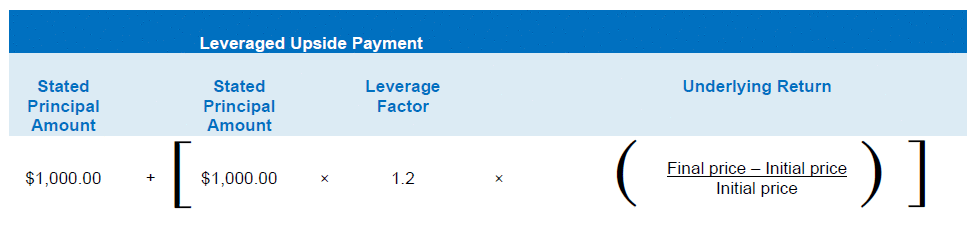
In no event will the payment at maturity be greater than the maximum payment at maturity.
If the underlying return is zero or negative and the percentage decline from the initial price to the final price is equal to or less than the buffer amount:
The Stated Principal Amount of $1,000.00
If the underlying return is negative and the percentage decline from the initial price to the final price is greater than the buffer amount:
$1,000.00 + [$1,000.00 × (Underlying Return + Buffer Amount) × Downside Leverage Factor]

Accordingly, if the final price is less than the initial price and the percentage decline of the underlying fund from the initial price to the final price is greater than the buffer amount, you will lose approximately 1.1111% of your stated principal amount for each 1% that the final price is less than the initial price in excess of the buffer amount and, in extreme situations, you could lose all of your initial investment.
|
March 2024 |
Page 9 |
|
|
|
Buffered PLUSSM with Downside Leverage due April 1, 2027 $7,050,000 Based on the Performance of the Shares of the Invesco S&P 500® Equal Weight ETF Principal at Risk Securities |
Risk Factors
The following is a non-exhaustive list of certain key risk factors for investors in the Buffered PLUS. For further discussion of these and other risks, you should read the section entitled “Risk Factors” in the accompanying product supplement. We also urge you to consult your investment, legal, tax, accounting and other advisors concerning an investment in the Buffered PLUS.
Risks Relating to Return Characteristics
■The Buffered PLUS do not pay interest or guarantee return of any of the stated principal amount and your investment in the Buffered PLUS may result in a loss. The terms of the Buffered PLUS differ from those of ordinary debt securities in that the Buffered PLUS do not pay interest or guarantee the return of any of the stated principal amount at maturity. If the underlying return is negative and the percentage decline of the underlying fund from the initial price to the final price is greater than the buffer amount, you will lose approximately 1.1111% of your stated principal amount for each 1% that the final price is less than the initial price in excess of the buffer amount and, in extreme situations, you could lose all of your initial investment. There is no minimum payment at maturity on the Buffered PLUS and you could lose all of your initial investment.
■Your potential return on the Buffered PLUS is limited to the maximum gain. The return potential of the Buffered PLUS is limited to the maximum gain indicated on the cover hereof. Therefore, you will not benefit from any positive underlying return in excess of an amount that, when multiplied by the leverage factor, exceeds the maximum gain and your return on the Buffered PLUS may be less than that of a hypothetical direct investment in the underlying fund or the underlying constituents.
■The leverage factor applies only if you hold the Buffered PLUS to maturity. You should be willing to hold the Buffered PLUS to maturity. If you are able to sell the Buffered PLUS prior to maturity in the secondary market, the price you receive will likely not reflect the full economic value of the leverage factor and the return you realize may be less than the leverage factor multiplied by the then-current underlying return even if such return is positive and does not exceed the maximum gain. You can receive the full benefit of the leverage factor, subject to the maximum gain, from UBS only if you hold the Buffered PLUS to maturity.
■The contingent repayment of principal at maturity applies only at maturity. You should be willing to hold the Buffered PLUS to maturity. If you are able to sell the Buffered PLUS prior to maturity in the secondary market, you may have to sell them at a loss relative to your initial investment even if the then-current price of the underlying fund is negative and the percentage decline of the underlying fund from the initial price to the final price is equal to or less than the buffer amount.
■Owning the Buffered PLUS is not the same as owning the underlying fund. The return on the Buffered PLUS may not reflect the return you would realize if you actually owned the underlying fund. For example, your return on the Buffered PLUS is limited to the maximum gain, while the potential return on a direct investment in the underlying fund would be unlimited. Furthermore, you will not receive or be entitled to receive any dividend payments or other distributions during the term of the Buffered PLUS, and any such dividends or distributions will not be factored into the calculation of the payment at maturity on the Buffered PLUS. In addition, as an owner of the Buffered PLUS, you will not have voting rights or any other rights that a holder of the underlying fund would have.
Risks Relating to Characteristics of the Underlying fund
■Market risk. The return on the Buffered PLUS, which may be positive or negative, is linked to the performance of the underlying fund and indirectly linked to the value of the securities comprising the underlying constituents. The price of the underlying fund can rise or fall sharply due to factors specific to the underlying fund or its underlying constituents, such as stock or commodity price volatility, earnings, financial conditions, corporate, industry and regulatory developments, management changes and decisions and other events, as well as general market factors, such as general stock market or commodity market volatility and prices, interest rates and economic and political conditions. You, as an investor in the Buffered PLUS, should conduct your own investigation sponsor of the underlying fund (the “sponsor”) and the underlying fund. For additional information regarding the underlying fund and the sponsor, please see “Information About the Underlying Fund” herein and the sponsor’s SEC filings referred to in that section. We urge you to review financial and other information filed periodically by the sponsor with the SEC.
■The price of the underlying fund may not completely track the price of the underlying constituents. Although the trading characteristics and valuations of an exchange traded fund (an “ETF”) will usually mirror the characteristics and valuations of the underlying constituents, the price of an ETF may not completely track the price of the underlying constituents. The price of the underlying fund will reflect transaction costs and fees that the underlying constituents in which an ETF invests do not have. In addition, although an ETF may be currently listed for trading on an exchange, there is no assurance that an active trading market will continue for an ETF or that there will be liquidity in the trading market.
■Fluctuation of NAV. The net asset value (the “NAV”) of an ETF may fluctuate with changes in the market value of the underlying constituents. The market prices of an ETF may fluctuate in accordance with changes in NAV and supply and demand on the applicable stock exchanges. In addition, the market price of an ETF may differ from its NAV per share; an ETF may trade at, above or below its NAV per share, meaning the price of the underlying fund may not reflect its NAV.
|
March 2024 |
Page 10 |
|
|
|
Buffered PLUSSM with Downside Leverage due April 1, 2027 $7,050,000 Based on the Performance of the Shares of the Invesco S&P 500® Equal Weight ETF Principal at Risk Securities |
■The value of the underlying fund may not completely track the value of its underlying constituents. Although the trading characteristics and valuations of an ETF will usually mirror the characteristics and valuations of its underlying constituents, the price of an ETF may not completely track the value of its underlying constituents. The price of the underlying fund will reflect transaction costs and fees that its underlying constituents do not have. In addition, although the underlying fund is currently listed for trading on an exchange, there is no assurance that an active trading market will continue for an ETF or that there will be liquidity in the trading market.
■There can be no assurance that the investment view implicit in the Buffered PLUS will be successful. It is impossible to predict whether and the extent to which the price of the underlying fund will rise or fall and there can be no assurance that the underlying return will be positive. The final price (and therefore the underlying return) will be influenced by complex and interrelated political, economic, financial and other factors that affect the underlying constituent issuers. You should be willing to accept the risks associated with the relevant markets tracked by the underlying fund in general and each underlying constituent in particular, and the risk of losing some or all of your initial investment.
■There is no affiliation between the sponsor, index sponsor or any underlying constituent issuer and UBS, and UBS is not responsible for any disclosure by any such entity. We or our affiliates may currently, or from time to time engage in business with the sponsor, sponsor of the target index (the “index sponsor”) or any underlying constituent issuer. However, we and our affiliates are not affiliated with any such entity, have no ability to control or predict their actions and are not responsible for such entities’ public disclosure of information, whether contained in SEC filings or otherwise. You, as an investor in the Buffered PLUS, should conduct your own independent investigation of the sponsor, the index sponsor, the underlying fund and the underlying constituent issuers. No such entity is involved in the Buffered PLUS offered hereby in any way, has any obligation of any sort with respect to your Buffered PLUS or has any obligation to take your interests into consideration for any reason, including when taking any actions that might affect the market value of, and return on, your Buffered PLUS.
Estimated Value Considerations
■The issue price you pay for the Buffered PLUS exceeds their estimated initial value. The issue price you pay for the Buffered PLUS exceeds their estimated initial value as of the pricing date due to the inclusion in the issue price of the underwriting discount, the hedging costs, issuance and other costs and projected profits. As of the close of the relevant markets on the pricing date, we have determined the estimated initial value of the Buffered PLUS by reference to our internal pricing models and the estimated initial value of the Buffered PLUS is set forth in this pricing supplement. The pricing models used to determine the estimated initial value of the Buffered PLUS incorporate certain variables, including the price of the underlying fund, volatility and any dividends paid on the underlying fund, prevailing interest rates, the term of the Buffered PLUS and our internal funding rate. Our internal funding rate is typically lower than the rate we would pay to issue conventional fixed or floating rate debt securities of a similar term. The underwriting discount, hedging costs, issuance and other costs, projected profits and the difference in rates will reduce the economic value of the Buffered PLUS to you. Due to these factors, the estimated initial value of the Buffered PLUS as of the pricing date is less than the issue price you pay for the Buffered PLUS.
■The estimated initial value is a theoretical price and the actual price that you may be able to sell your Buffered PLUS in any secondary market (if any) at any time after the pricing date may differ from the estimated initial value. The value of your Buffered PLUS at any time will vary based on many factors, including the factors described above and in “Risks Relating to Characteristics of the Underlying Fund —Market risk” above and is impossible to predict. Furthermore, the pricing models that we use are proprietary and rely in part on certain assumptions about future events, which may prove to be incorrect. As a result, after the pricing date, if you attempt to sell the Buffered PLUS in the secondary market, the actual value you would receive may differ, perhaps materially, from the estimated initial value of the Buffered PLUS determined by reference to our internal pricing models. The estimated initial value of the Buffered PLUS does not represent a minimum or maximum price at which we or any of our affiliates would be willing to purchase your Buffered PLUS in any secondary market at any time.
■Our actual profits may be greater or less than the differential between the estimated initial value and the issue price of the Buffered PLUS as of the pricing date. We may determine the economic terms of the Buffered PLUS, as well as hedge our obligations, at least in part, prior to the pricing date. In addition, there may be ongoing costs to us to maintain and/or adjust any hedges and such hedges are often imperfect. Therefore, our actual profits (or potentially, losses) in issuing the Buffered PLUS cannot be determined as of the pricing date and any such differential between the estimated initial value and the issue price of the Buffered PLUS as of the pricing date does not reflect our actual profits. Ultimately, our actual profits will be known only at the maturity of the Buffered PLUS.
Risks Relating to Liquidity and Secondary Market Price Considerations
■There may be little or no secondary market for the Buffered PLUS. The Buffered PLUS will not be listed or displayed on any securities exchange or any electronic communications network. UBS Securities LLC and its affiliates intend, but are not required to make a market for the Buffered PLUS and may stop making a market at any time. If you are able to sell your Buffered PLUS prior to maturity, you may have to sell them at a substantial loss. Furthermore, there can be no assurance that a secondary market for the Buffered PLUS will develop. The estimated initial value of the Buffered PLUS does not represent a minimum or maximum price at which we or any of our affiliates would be willing to purchase your Buffered PLUS in any secondary market at any time.
|
March 2024 |
Page 11 |
|
|
|
Buffered PLUSSM with Downside Leverage due April 1, 2027 $7,050,000 Based on the Performance of the Shares of the Invesco S&P 500® Equal Weight ETF Principal at Risk Securities |
■The price at which UBS Securities LLC and its affiliates may offer to buy the Buffered PLUS in the secondary market (if any) may be greater than UBS’ valuation of the Buffered PLUS at that time, greater than any other secondary market prices provided by unaffiliated dealers (if any) and, depending on your broker, greater than the valuation provided on your customer account statements. For a limited period of time following the issuance of the Buffered PLUS, UBS Securities LLC or its affiliates may offer to buy or sell the Buffer PLUS at a price that exceeds (i) our valuation of the Buffered PLUS at that time based on our internal pricing models, (ii) any secondary market prices provided by unaffiliated dealers (if any) and (iii) depending on your broker, the valuation provided on customer account statements. The price that UBS Securities LLC may initially offer to buy such Buffered PLUS following issuance will exceed the valuations indicated by our internal pricing models due to the inclusion for a limited period of time of the aggregate value of the underwriting discount, hedging costs, issuance and other costs and theoretical projected trading profit. The portion of such amounts included in our price will decline to zero on a straight-line basis over a period ending no later than the date specified under “Supplemental plan of distribution (conflicts of interest); secondary markets (if any)”. Thereafter, if UBS Securities LLC or an affiliate makes secondary markets in the Buffered PLUS, it will do so at prices that reflect our estimated value determined by reference to our internal pricing models at that time. The temporary positive differential relative to our internal pricing models arises from requests from and arrangements made by UBS Securities LLC with the selling agents of structured debt securities such as the Buffered PLUS. As described above, UBS Securities LLC and its affiliates are not required to make a market for the Buffered PLUS and may stop making a market at any time. The price at which UBS Securities LLC or an affiliate may make secondary markets at any time (if at all) will also reflect its then current bid-ask spread for similar sized trades of structured debt securities. UBS Securities LLC reflects this temporary positive differential on its customer statements. Investors should inquire as to the valuation provided on customer account statements provided by unaffiliated dealers.
■Price of the Buffered PLUS prior to maturity. The market price of the Buffered PLUS will be influenced by many unpredictable and interrelated factors, including the price of the underlying fund; the volatility of the underlying fund; any dividends on the underlying fund; the time remaining to the maturity of the Buffered PLUS; interest rates in the markets; geopolitical conditions and economic, financial, political, force majeure and regulatory or judicial events; the creditworthiness of UBS and the then current bid-ask spread for the Buffered PLUS.
■Impact of fees and the use of internal funding rates rather than secondary market credit spreads on secondary market prices. All other things being equal, the use of the internal funding rates described above under “—Estimated Value Considerations” as well as the inclusion in the issue price of the underwriting discount, hedging costs, issuance and other costs and any projected profits are, subject to the temporary mitigating effect of UBS Securities LLC’s and its affiliates’ market making premium, expected to reduce the price at which you may be able to sell the Buffered PLUS in any secondary market.
Risks Relating to Hedging Activities and Conflicts of Interest
■Potential conflict of interest. UBS and its affiliates may engage in business with the sponsor or any underlying constituent issuers or trading activities related to the underlying fund or any underlying constituents, which may present a conflict between the interests of UBS and you, as a holder of the Buffered PLUS. There are also potential conflicts of interest between you and the calculation agent, which will be an affiliate of UBS and which will make potentially subjective judgments. The calculation agent will determine the payment at maturity, if any, based on the observed closing price of the underlying fund. The calculation agent can postpone the determination of the initial price or final price (and therefore the original issue date or maturity date, as applicable) if a market disruption event occurs and is continuing on the pricing date or valuation date, respectively. As UBS determines the economic terms of the Buffered PLUS, including the maximum gain, leverage factor and buffer amount (and corresponding downside leverage factor), and such terms include the underwriting discount, hedging costs, issuance and other costs and projected profits, the Buffered PLUS represent a package of economic terms. There are other potential conflicts of interest insofar as an investor could potentially get better economic terms if that investor entered into exchange-traded and/or OTC derivatives or other instruments with third parties, assuming that such instruments were available and the investor had the ability to assemble and enter into such instruments.
In addition, we or one of our affiliates may enter into swap agreements or related hedging activities with the dealer or its affiliates in connection with the Buffered PLUS, which could cause the economic interests of UBS, the dealer or our or their respective affiliates to be adverse to your interests as an investor in the Buffered PLUS. If the dealer or any of its affiliates conduct hedging activities for us or our affiliate in connection with the Buffered PLUS and earns profits in connection with such hedging activities, such profit will be in addition to the underwriting compensation it receives for the sale of the Buffered PLUS to you. You should be aware that the potential to receive compensation both for hedging activities and sales may create a further incentive for the dealer to sell the Buffered PLUS to you.
■Hedging and trading activities by the calculation agent and its affiliates could potentially affect the value of, and any amounts payable on, the Buffered PLUS. The hedging or trading activities of the issuer’s affiliates and of any other hedging counterparty with respect to the Buffered PLUS on or prior to the pricing date and prior to maturity could adversely affect the value of, and any amounts payable on, the Buffered PLUS. These hedging or trading activities on or prior to the pricing date could potentially affect the initial price of the underlying fund. Additionally, these hedging or trading activities during the term of the Buffered PLUS could potentially affect the final price of the underlying fund on the valuation date and, accordingly, any amounts payable on the Buffered PLUS. It is possible that these hedging or trading activities could result in substantial returns for us or our affiliates while the value of the Buffered PLUS declines.
|
March 2024 |
Page 12 |
|
|
|
Buffered PLUSSM with Downside Leverage due April 1, 2027 $7,050,000 Based on the Performance of the Shares of the Invesco S&P 500® Equal Weight ETF Principal at Risk Securities |
■Potentially inconsistent research, opinions or recommendations by UBS. UBS and its affiliates publish research from time to time on financial markets and other matters that may influence the value of the Buffered PLUS, or express opinions or provide recommendations that are inconsistent with purchasing or holding the Buffered PLUS. Any research, opinions or recommendations expressed by UBS or its affiliates may not be consistent with each other and may be modified from time to time without notice. Investors should make their own independent investigation of the merits of investing in the Buffered PLUS and the underlying fund.
■Potential UBS impact on price. Trading or hedging transactions by UBS and/or its affiliates in any underlying fund or any underlying constituents, listed and/or over-the-counter options, futures, exchange-traded funds or other instruments with returns linked to the performance of the underlying fund or underlying constituents may adversely affect the price of the underlying fund, the performance and, therefore, the market value of, and any amount payable on, the Buffered PLUS.
■Following certain events, the calculation agent can make adjustments to the underlying fund and terms of the Buffered PLUS that may adversely affect the market value of, and return on, the Buffered PLUS. The calculation agent may make adjustments to the initial price and/or final price or any other term of the Buffered PLUS and, in some instances, may replace the underlying fund, for certain events affecting the underlying fund. However, the calculation agent will not make an adjustment in response to all events that could affect the underlying fund. If an event occurs that does not require the calculation agent to make an adjustment, the market value of, and return on, the Buffered PLUS may be materially and adversely affected. You should also be aware that the calculation agent may make adjustments in response to events that are not described in the accompanying product supplement as necessary to achieve an equitable result, but the calculation agent is under no obligation to do so or to consider your interests as a holder of the Buffered PLUS in making these determinations. Following certain events relating to the underlying fund, such as a reorganization event or a delisting or suspension of trading, the return on the Buffered PLUS may be based on the shares of another ETF, on a basket of securities, futures contracts, commodities and/or other assets that the calculation agent determines is comparable to the underlying constituents or on an alternative calculation of the underlying fund. The occurrence of any such event and the consequent adjustments may materially and adversely affect the value of, and return on, the Buffered PLUS. For more information, see the sections “General Terms of the Securities — Antidilution Adjustments for Securities Linked to an Underlying Equity or Equity Basket Asset”, “— Reorganization Events for Securities Linked to an Underlying Equity or Equity Basket Asset” and “— Delisting of, Suspension of Trading in, or Change in Law Affecting, an Underlying Equity” in the accompanying product supplement.
Risks Relating to General Credit Characteristics
■Credit risk of UBS. The Buffered PLUS are unsubordinated, unsecured debt obligations of UBS, and are not, either directly or indirectly, an obligation of any third party. Any payment to be made on the Buffered PLUS, including any repayment of principal at maturity, depends on the ability of UBS to satisfy its obligations as they come due. As a result, UBS’ actual and perceived creditworthiness may affect the market value of the Buffered PLUS. If UBS were to default on its obligations, you may not receive any amounts owed to you under the terms of the Buffered PLUS, you could lose all of your initial investment.
■The Buffered PLUS are not bank deposits. An investment in the Buffered PLUS carries risks which are very different from the risk profile of a bank deposit placed with UBS or its affiliates. The Buffered PLUS have different yield and/or return, liquidity and risk profiles and would not benefit from any protection provided to deposits.
■If UBS experiences financial difficulties, FINMA has the power to open restructuring or liquidation proceedings in respect of, and/or impose protective measures in relation to, UBS, which proceedings or measures may have a material adverse effect on the terms and market value of the Buffered PLUS and/or the ability of UBS to make payments thereunder. The Swiss Financial Market Supervisory Authority (“FINMA”) has broad statutory powers to take measures and actions in relation to UBS if (i) it concludes that there is justified concern that UBS is over-indebted or has serious liquidity problems or (ii) UBS fails to fulfill the applicable capital adequacy requirements (whether on a standalone or consolidated basis) after expiry of a deadline set by FINMA. If one of these pre-requisites is met, FINMA is authorized to open restructuring proceedings or liquidation (bankruptcy) proceedings in respect of, and/or impose protective measures in relation to, UBS. The Swiss Banking Act grants significant discretion to FINMA in connection with the aforementioned proceedings and measures. In particular, a broad variety of protective measures may be imposed by FINMA, including a bank moratorium or a maturity postponement, which measures may be ordered by FINMA either on a stand-alone basis or in connection with restructuring or liquidation proceedings. The resolution regime of the Swiss Banking Act is further detailed in Ordinance of 30 August 2012 of FINMA on the Insolvency of Banks and Securities Dealers, as amended (the “Swiss Banking Insolvency Ordinance”). In restructuring proceedings, FINMA, as resolution authority, is competent to approve the resolution plan. The resolution plan may, among other things, provide for (a) the transfer of all or a portion of UBS’ assets, debts, other liabilities and contracts (which may or may not include the contractual relationship between UBS and the holders of securities) to another entity, (b) a stay (for a maximum of two business days) on the termination of contracts to which UBS is a party, and/or the exercise of (w) rights to terminate, (x) netting rights, (y) rights to enforce or dispose of collateral or (z) rights to transfer claims, liabilities or collateral under contracts to which UBS is a party, (c) the conversion of UBS’ debt and/or other obligations, including its obligations under the Buffered PLUS, into equity (a “debt-to-equity” swap), and/or (d) the partial or full write-off of obligations owed by UBS (a “write-off”), including its obligations under the Buffered PLUS. The Swiss Banking Insolvency Ordinance provides that a debt-to-equity swap and/or a write-off of debt and other obligations (including the Buffered PLUS) may take place only after (i) all debt instruments issued by UBS qualifying as additional tier 1 capital or tier 2 capital have been converted into equity or written-off, as applicable, and (ii) the existing equity of UBS has been fully cancelled. While the Swiss Banking Insolvency Ordinance does not
|
March 2024 |
Page 13 |
|
|
|
Buffered PLUSSM with Downside Leverage due April 1, 2027 $7,050,000 Based on the Performance of the Shares of the Invesco S&P 500® Equal Weight ETF Principal at Risk Securities |
expressly address the order in which a write-off of debt instruments other than debt instruments qualifying as additional tier 1 capital or tier 2 capital should occur, it states that debt-to-equity swaps should occur in the following order: first, all subordinated claims not qualifying as regulatory capital; second, all other claims not excluded by law from a debt-to-equity swap (other than deposits); and third, deposits (in excess of the amount privileged by law). However, given the broad discretion granted to FINMA as the resolution authority, any restructuring plan in respect of UBS could provide that the claims under or in connection with the Buffered PLUS will be partially or fully converted into equity or written-off, while preserving other obligations of UBS that rank pari passu with, or even junior to, UBS’ obligations under the Buffered PLUS. Consequently, the exercise of any such powers by FINMA or any suggestion of any such exercise could materially adversely affect the rights of holders of the Buffered PLUS, the price or value of their investment in the Buffered PLUS and/or the ability of UBS to satisfy its obligations under the Buffered PLUS and could lead to holders losing some or all of their investment in the Buffered PLUS. In the case of restructuring proceedings with respect to a systemically important Swiss bank (such as UBS), the creditors whose claims are affected by the restructuring plan will not have a right to vote on, reject, or seek the suspension of the restructuring plan. In addition, if a restructuring plan has been approved by FINMA, the rights of a creditor to seek judicial review of the restructuring plan (e.g., on the grounds that the plan would unduly prejudice the rights of holders of securities or otherwise be in violation of the Swiss Banking Act) are very limited. In particular, a court may not suspend the implementation of the restructuring plan. Furthermore, even if a creditor successfully challenges the restructuring plan, the court can only require the relevant creditor to be compensated ex post and there is currently no guidance as to on what basis such compensation would be calculated or how it would be funded.
Risks Relating to U.S. Federal Income Taxation
■Uncertain tax treatment. Significant aspects of the tax treatment of the Buffered PLUS are uncertain. You should read carefully the section entitled “Tax Considerations” herein and the section entitled “Material U.S. Federal Income Tax Consequences”, including the section “— Securities Treated as Prepaid Derivatives or Prepaid Forwards”, in the accompanying product supplement and consult your tax advisor about your tax situation.
|
March 2024 |
Page 14 |
|
|
|
Buffered PLUSSM with Downside Leverage due April 1, 2027 $7,050,000 Based on the Performance of the Shares of the Invesco S&P 500® Equal Weight ETF Principal at Risk Securities |
Information About the Underlying Fund
Shares of the Invesco S&P 500® Equal Weight ETF
We have derived all information contained herein regarding the Invesco S&P 500® Equal Weight ETF (the “RSP Fund”) and its target index, as defined below, from publicly available information. Such information reflects the policies of, and is subject to changes by, Invesco Capital Management LLC (its “sponsor”) and the index sponsor of the target index, as defined below.
The RSP Fund that seeks to track the investment results (before fees and expenses) of the S&P 500® Equal Weight Index (the “target index”). The target index is an equal-weighted version of the S&P 500® Index that is sponsored, maintained and calculated by S&P Dow Jones Indices LLC (the “index sponsor”). Unlike the S&P 500® Index, which employs a market capitalization weighted methodology, the target index assigns each component security the same weight. The RSP Fund employs a “full replication” methodology in seeking to track the target index, meaning that the RSP Fund generally invests in all of the securities comprising the target index in proportion to their weightings in the target index. The RSP Fund generally will invest at least 90% of its total assets in the securities that comprise the target index.
Select information regarding the RSP Fund’s expense ratio and its top constituents, country, industry and/or sector weightings may be made available on the RSP Fund’s website. Expenses of the RSP Fund reduce the net asset value of the underlying constituents and, therefore, reduce the value of the shares of the RSP Fund.
Shares of the RSP Fund are listed on the NYSE Arca under the ticker symbol “RSP”.
Information from outside sources including, but not limited to the prospectus related to the RSP Fund and any other website referenced in this section, is not incorporated by reference in, and should not be considered part of, this document or any document incorporated herein by reference. We have not undertaken an independent review or due diligence of any publicly available information with respect to the RSP Fund or the target index.
Information filed by the RSP Fund with the SEC can be found by reference to its SEC file numbers: 333-102228 and 811-21265 or its CIK Code: 0001209466.
Information as of market close on March 28, 2024:
|
Bloomberg Ticker Symbol: |
RSP |
52 Week High (on March 28, 2024): |
$169.37 |
|
Current Price: |
$169.37 |
52 Week Low (on October 27, 2023): |
$133.66 |
|
52 Weeks Ago (on March 28, 2023): |
$139.72 |
|
|
|
March 2024 |
Page 15 |
|
|
|
Buffered PLUSSM with Downside Leverage due April 1, 2027 $7,050,000 Based on the Performance of the Shares of the Invesco S&P 500® Equal Weight ETF Principal at Risk Securities |
Historical Information
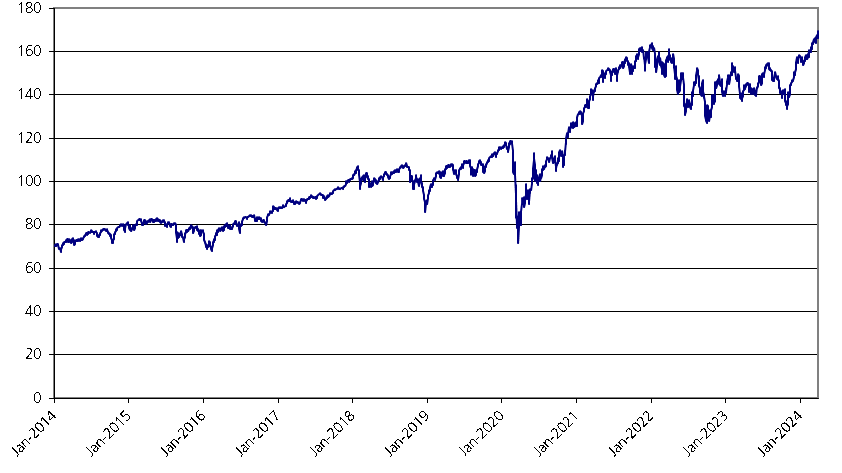
The table below sets forth the published high and low closing prices, as well as the end-of-quarter closing prices, of the underlying fund for the specified period. The closing price of the underlying fund on March 28, 2024 was $169.37. The graph below sets forth the daily closing prices of the underlying fund for the period from January 1, 2014 through March 28, 2024. We obtained the information in the table below from Bloomberg Professional® service (“Bloomberg”), without independent verification. UBS has not undertaken an independent review or due diligence of any publicly available information obtained from Bloomberg. The historical performance of the underlying fund should not be taken as an indication of its future performance, and no assurance can be given as to the closing price of the underlying fund at any time, including the valuation date.
|
Shares of the Invesco S&P 500® Equal Weight ETF |
High |
Low |
Period End |
|
2020 |
|
|
|
|
First Quarter |
$118.71 |
$71.66 |
$84.02 |
|
Second Quarter |
$113.09 |
$79.83 |
$101.76 |
|
Third Quarter |
$113.96 |
$100.38 |
$108.11 |
|
Fourth Quarter |
$127.54 |
$106.78 |
$127.54 |
|
2021 |
|
|
|
|
First Quarter |
$142.80 |
$125.70 |
$141.66 |
|
Second Quarter |
$152.26 |
$143.08 |
$150.73 |
|
Third Quarter |
$157.39 |
$146.61 |
$149.82 |
|
Fourth Quarter |
$163.01 |
$150.88 |
$162.75 |
|
2022 |
|
|
|
|
First Quarter |
$164.20 |
$148.26 |
$157.71 |
|
Second Quarter |
$158.96 |
$130.84 |
$134.23 |
|
Third Quarter |
$152.39 |
$127.28 |
$127.28 |
|
Fourth Quarter |
$149.03 |
$128.02 |
$141.25 |
|
2023 |
|
|
|
|
First Quarter |
$154.96 |
$137.35 |
$144.62 |
|
Second Quarter |
$149.64 |
$139.61 |
$149.64 |
|
Third Quarter |
$155.00 |
$141.04 |
$141.69 |
|
Fourth Quarter |
$158.41 |
$133.66 |
$157.80 |
|
2024 |
|
|
|
|
First Quarter |
$169.37 |
$153.84 |
$169.37 |
|
March 2024 |
Page 16 |
|
|
|
Buffered PLUSSM with Downside Leverage due April 1, 2027 $7,050,000 Based on the Performance of the Shares of the Invesco S&P 500® Equal Weight ETF Principal at Risk Securities |
|
Shares of the Invesco S&P 500® Equal Weight ETF – Daily Closing Prices January 1, 2014 to March 28, 2024 |
|
March 2024 |
Page 17 |
|
|
|
Buffered PLUSSM with Downside Leverage due April 1, 2027 $7,050,000 Based on the Performance of the Shares of the Invesco S&P 500® Equal Weight ETF Principal at Risk Securities |
Additional Information About the Buffered PLUS
|
General Information |
|
|
Listing: |
The Buffered PLUS will not be listed or displayed on any securities exchange or any electronic communication network. |
|
Tax considerations: |
The U.S. federal income tax consequences of your investment in the Buffered PLUS are uncertain. There are no statutory provisions, regulations, published rulings or judicial decisions addressing the characterization for U.S. federal income tax purposes of securities with terms that are substantially the same as the Buffered PLUS. Some of these tax consequences are summarized below, but we urge you to read the more detailed discussion in “Material U.S. Federal Income Tax Consequences”, including the section “— Securities Treated as Prepaid Derivatives or Prepaid Forwards” in the accompanying product supplement and to discuss the tax consequences of your particular situation with your tax advisor. This discussion is based upon the U.S. Internal Revenue Code of 1986, as amended (the “Code”), final, temporary and proposed U.S. Department of the Treasury (the “Treasury”) regulations, rulings and decisions, in each case, as available and in effect as of the date hereof, all of which are subject to change, possibly with retroactive effect. Tax consequences under state, local and non-U.S. laws are not addressed herein. No ruling from the U.S. Internal Revenue Service (the “IRS”) has been sought as to the U.S. federal income tax consequences of your investment in the Buffered PLUS, and the following discussion is not binding on the IRS. U.S. Tax Treatment. Pursuant to the terms of the Buffered PLUS, UBS and you agree, in the absence of a statutory or regulatory change or an administrative determination or judicial ruling to the contrary, to characterize the Buffered PLUS as prepaid derivative contracts with respect to the underlying fund. If your Buffered PLUS are so treated, you should generally recognize gain or loss upon the taxable disposition of your Buffered PLUS. Subject to the “constructive ownership” rules of Section 1260 of the Code, discussed below, such gain or loss should generally be long-term capital gain or loss if you hold your Buffered PLUS for more than one year (otherwise such gain or loss would be short-term capital gain or loss if held for one year or less) in an amount equal to the difference between the amount you receive at such time and the amount you paid for your Buffered PLUS. The deductibility of capital losses is subject to limitations. Section 1260. Because the underlying fund is an ETF that would be treated as a “pass-thru entity” for purposes of Section 1260 of the Code, it is possible that the Buffered PLUS could be treated as a constructive ownership transaction under Section 1260 of the Code. If the Buffered PLUS were treated as a constructive ownership transaction, certain adverse U.S. federal income tax consequences could apply (i.e., all or a portion of any long-term capital gain that you recognize upon the taxable disposition of your Buffered PLUS could be recharacterized as ordinary income and you could be subject to an interest charge on any deferred tax liability with respect to such recharacterized gain). We urge you to read the discussion concerning the possible treatment of the Buffered PLUS as a constructive ownership transaction under “Material U.S. Federal Income Tax Consequences — Securities Treated as Prepaid Derivatives or Prepaid Forwards — Section 1260” in the accompanying product supplement. It is not clear to what extent any long-term capital gain recognized by a U.S. holder in respect of the Buffered PLUS would be recharacterized as ordinary income and subject to the interest charge described above, in part, because it is not clear how the “net underlying long-term capital gain” would be computed in respect of the Buffered PLUS. Under Section 1260 of the Code, the net underlying long-term capital gain is generally the net long-term capital gain a taxpayer would have recognized by investing in the underlying “pass-thru entity” at the inception of the constructive ownership transaction and selling on the date the constructive ownership transaction is closed out (i.e. at maturity or earlier disposition). It is possible that because the U.S. holder does not share in distributions made on the underlying fund, these distributions could be excluded from the calculation of the amount and character of gain, if any, that would have been realized had the U.S. holder held the underlying fund directly and that the application of constructive ownership rules may not recharacterize adversely a significant portion of the long-term capital gain you may recognize with respect to the Buffered PLUS. However, it is also possible that all or a portion of your gain with respect to the Buffered PLUS could be treated as “Excess Gain” because an underlying fund is an ETF, the “net underlying long-term capital gain” could equal the amount of long-term capital gain a U.S. holder would have recognized if on the issue date of the Buffered PLUS the holder had invested, pro rata, the principal amount of the Buffered PLUS in shares of the underlying fund and sold those shares for their fair market value on the date the Buffered PLUS are sold, exchanged or retired. In addition, all or a portion of your gain recognized with respect to the Buffered PLUS could be “Excess Gain” if you purchase the Buffered PLUS for an amount that is less than the principal amount of the Buffered PLUS or if the return on the Buffered PLUS is adjusted to take into account any extraordinary dividends that are paid on the shares of the underlying fund. Furthermore, unless otherwise established by clear and convincing evidence, the “net underlying long-term capital gain” is treated |
|
March 2024 |
Page 18 |
|
|
|
Buffered PLUSSM with Downside Leverage due April 1, 2027 $7,050,000 Based on the Performance of the Shares of the Invesco S&P 500® Equal Weight ETF Principal at Risk Securities |
|
as zero. Accordingly, it is possible that all or a portion of any gain on the taxable disposition of the Buffered PLUS after one year could be treated as “Excess Gain” from a “constructive ownership transaction,” which gain would be recharacterized as ordinary income, and subject to an interest charge. Because the application of the constructive ownership rules to the Buffered PLUS is unclear, you are urged to consult your tax advisor regarding the potential application of the “constructive ownership” rules to an investment in the Buffered PLUS. Based on certain factual representations received from us, our special U.S. tax counsel, Cadwalader, Wickersham & Taft LLP, is of the opinion that it would be reasonable to treat your Buffered PLUS in the manner described above. However, because there is no authority that specifically addresses the tax treatment of the Buffered PLUS, it is possible that your Buffered PLUS could alternatively be treated for tax purposes as a single contingent payment debt instrument, or pursuant to some other characterization (including possible treatment as a “constructive ownership transaction” under Section 1260 of the Code), such that the timing and character of your income from the Buffered PLUS could differ materially and adversely from the treatment described above, as described further under “Material U.S. Federal Income Tax Consequences”, including the section “— Securities Treated as Prepaid Derivatives or Prepaid Forwards”, in the accompanying product supplement. Notice 2008-2. In 2007, the IRS released a notice that may affect the taxation of holders of the Buffered PLUS. According to Notice 2008-2, the IRS and the Treasury are actively considering whether the holder of an instrument similar to the Buffered PLUS should be required to accrue ordinary income on a current basis. It is not possible to determine what guidance they will ultimately issue, if any. It is possible, however, that under such guidance, holders of the Buffered PLUS will ultimately be required to accrue income currently and this could be applied on a retroactive basis. The IRS and the Treasury are also considering other relevant issues, including whether additional gain or loss from such instruments should be treated as ordinary or capital, whether non-U.S. holders of such instruments should be subject to withholding tax on any deemed income accruals and whether the special “constructive ownership rules” of Section 1260 of the Code should be applied to such instruments. Both U.S. and non-U.S. holders are urged to consult their tax advisors concerning the significance, and the potential impact, of the above considerations. Medicare Tax on Net Investment Income. U.S. holders that are individuals, estates or certain trusts are subject to an additional 3.8% tax on all or a portion of their “net investment income”, which may include any income or gain realized with respect to the Buffered PLUS, to the extent of their net investment income that when added to their other modified adjusted gross income, exceeds $200,000 for an unmarried individual, $250,000 for a married taxpayer filing a joint return (or a surviving spouse), $125,000 for a married individual filing a separate return or the amount at which the highest tax bracket begins for an estate or trust. The 3.8% Medicare tax is determined in a different manner than the income tax. U.S. holders should consult their tax advisors with respect to their consequences with respect to the 3.8% Medicare tax. Specified Foreign Financial Assets. Certain U.S. holders that own “specified foreign financial assets” in excess of an applicable threshold may be subject to reporting obligations with respect to such assets with their tax returns, especially if such assets are held outside the custody of a U.S. financial institution. U.S. holders are urged to consult their tax advisors as to the application of this legislation to their ownership of the Buffered PLUS. Non-U.S. Holders. Subject to Section 871(m) of the Code and FATCA (as discussed below), if you are not a U.S. holder, you should generally not be subject to U.S. withholding tax with respect to payments on your Buffered PLUS and you should not be subject to generally applicable information reporting and backup withholding requirements with respect to payments on your Buffered PLUS if you comply with certain certification and identification requirements, including providing us (and/or the applicable withholding agent) with a validly executed and fully completed applicable IRS Form W-8. Subject Section 897 of the Code and Section 871(m) of the Code, discussed below, gain realized from the taxable disposition of a Buffered PLUS generally should not be subject to U.S. tax unless (i) such gain is effectively connected with a trade or business conducted by the non-U.S. holder in the U.S., (ii) the non-U.S. holder is a non-resident alien individual and is present in the U.S. for 183 days or more during the taxable year of such taxable disposition and certain other conditions are satisfied or (iii) the non-U.S. holder has certain other present or former connections with the U.S. Section 897. We will not attempt to ascertain whether the issuer of the underlying fund would be treated as a “United States real property holding corporation” (“USRPHC”) within the meaning of Section 897 of the Code. We also have not attempted to determine whether the Buffered PLUS should be treated as “United States real property interests” (“USRPI”) as defined in Section 897 of the Code. If any such entity and the Buffered PLUS were so treated, certain adverse U.S. federal income tax consequences could possibly apply, including subjecting any gain to a non-U.S. holder in respect of a Buffered PLUS upon a taxable disposition of the Buffered PLUS to the U.S. federal income tax on a net basis, and the proceeds from such a taxable disposition may be subject to a 15% withholding tax. Non-U.S. holders should consult their tax advisors regarding the potential treatment of any such entity as a USRPHC and the Buffered PLUS as USRPI. |
|
March 2024 |
Page 19 |
|
|
|
Buffered PLUSSM with Downside Leverage due April 1, 2027 $7,050,000 Based on the Performance of the Shares of the Invesco S&P 500® Equal Weight ETF Principal at Risk Securities |
|
Section 871(m). A 30% withholding tax (which may be reduced by an applicable income tax treaty) is imposed under Section 871(m) of the Code on certain “dividend equivalents” paid or deemed paid to a non-U.S. holder with respect to a “specified equity-linked instrument” that references one or more dividend-paying U.S. equity securities or indices containing U.S. equity securities. The withholding tax can apply even if the instrument does not provide for payments that reference dividends. Treasury regulations provide that the withholding tax applies to all dividend equivalents paid or deemed paid on specified equity-linked instruments that have a delta of one (“delta-one specified equity-linked instruments”) issued after 2016 and to all dividend equivalents paid or deemed paid on all other specified equity-linked instruments issued after 2017. However, the IRS has issued guidance that states that the Treasury and the IRS intend to amend the effective dates of the Treasury regulations to provide that withholding on dividend equivalents paid or deemed paid will not apply to specified equity-linked instruments that are not delta-one specified equity-linked instruments and are issued before January 1, 2025. Based on our determination that the Buffered PLUS are not “delta-one” with respect to the underlying fund or any underlying constituent, our special U.S. tax counsel is of the opinion that the Buffered PLUS should not be delta-one specified equity-linked instruments and thus should not be subject to withholding on dividend equivalents. Our determination is not binding on the IRS, and the IRS may disagree with this determination. Furthermore, the application of Section 871(m) of the Code will depend on our determinations on the date the terms of the Buffered PLUS are set. If withholding is required, we will not make payments of any additional amounts. Nevertheless, after the date the terms are set, it is possible that your Buffered PLUS could be deemed to be reissued for tax purposes upon the occurrence of certain events affecting the underlying fund, underlying constituents or your Buffered PLUS, and following such occurrence your Buffered PLUS could be treated as delta-one specified equity-linked instruments that are subject to withholding on dividend equivalents. It is also possible that withholding tax or other tax under Section 871(m) of the Code could apply to the Buffered PLUS under these rules if you enter, or have entered, into certain other transactions in respect of the underlying fund, underlying constituents or the Buffered PLUS. If you enter, or have entered, into other transactions in respect of the underlying fund, underlying constituents or the Buffered PLUS, you should consult your tax advisor regarding the application of Section 871(m) of the Code to your Buffered PLUS in the context of your other transactions. Because of the uncertainty regarding the application of the 30% withholding tax on dividend equivalents to the Buffered PLUS, you are urged to consult your tax advisor regarding the potential application of Section 871(m) of the Code and the 30% withholding tax to an investment in the Buffered PLUS. Foreign Account Tax Compliance Act. Legislation commonly referred to as the Foreign Account Tax Compliance Act (“FATCA”) generally imposes a withholding tax of 30% on payments to certain non-U.S. entities (including financial intermediaries) with respect to certain financial instruments, unless various U.S. information reporting and due diligence requirements have been satisfied. An intergovernmental agreement between the U.S. and the non-U.S. entity’s jurisdiction may modify these requirements. This legislation generally applies to certain financial instruments that are treated as paying U.S.-source interest or other U.S.-source “fixed or determinable annual or periodical” income (“FDAP income”). Withholding (if applicable) applies to payments of U.S.-source FDAP income but, pursuant to certain Treasury regulations and IRS guidance, does not apply to payments of gross proceeds on the disposition (including upon retirement) of financial instruments. As the treatment of the Buffered PLUS is unclear, it is possible that any payment with respect to the Buffered PLUS could be subject to the FATCA rules. If withholding applies to the Buffered PLUS, we will not be required to pay any additional amounts with respect to amounts withheld. Both U.S. and non-U.S. holders should consult their tax advisors regarding the potential application of FATCA to the Buffered PLUS. Proposed Legislation. In 2007, legislation was introduced in Congress that, if it had been enacted, would have required holders of securities similar to the Buffered PLUS purchased after the bill was enacted to accrue interest income over the term of such securities despite the fact that there will be no interest payments over the term of such securities. Furthermore, in 2013, the House Ways and Means Committee released in draft form certain proposed legislation relating to financial instruments. If it had been enacted, the effect of this legislation generally would have been to require instruments such as the Buffered PLUS to be marked to market on an annual basis with all gains and losses to be treated as ordinary, subject to certain exceptions. It is not possible to predict whether any similar or identical bills will be enacted in the future, or whether any such bill would affect the tax treatment of your Buffered PLUS. You are urged to consult your tax advisor regarding the possible changes in law and their possible impact on the tax treatment of your Buffered PLUS. Both U.S. and non-U.S. holders are urged to consult their tax advisors concerning the application of U.S. federal income tax laws to their particular situations, as well as any tax consequences of the purchase, beneficial ownership and disposition of the Buffered PLUS arising under the laws of any state, local, non-U.S. or other taxing jurisdiction. |
|
March 2024 |
Page 20 |
|
|
|
Buffered PLUSSM with Downside Leverage due April 1, 2027 $7,050,000 Based on the Performance of the Shares of the Invesco S&P 500® Equal Weight ETF Principal at Risk Securities |
|
Trustee: |
U.S. Bank Trust National Association |
|
Calculation agent: |
UBS Securities LLC, a wholly-owned subsidiary of UBS AG |
|
Use of proceeds and hedging: |
We will use the net proceeds we receive from the sale of the Buffered PLUS for the purposes we describe in the accompanying prospectus under “Use of Proceeds and Hedging.” We and/or our affiliates may also use those proceeds in transactions intended to hedge our obligations under the Buffered PLUS as described below. |
|
|
In connection with the sale of the Buffered PLUS, we and/or our affiliates may enter into hedging transactions involving the execution of swaps, futures and/or option transactions on the underlying fund or underlying constituents, or purchases and sales of Buffered PLUS, in each case before, on and/or after the pricing date of the Buffered PLUS. From time to time, we and/or our affiliates may enter into additional hedging transactions or unwind those we have entered into. In addition, we or one of our affiliates may enter into swap agreements or related hedging activities with the dealer or its affiliates. We and/or our affiliates may acquire a long or short position in securities similar to the Buffered PLUS from time to time and may, in our or their sole discretion, hold or resell those securities. The hedging activity discussed above may adversely affect the market value of the Buffered PLUS from time to time and payment on the Buffered PLUS at maturity. See “Risk Factors” herein for a discussion of these adverse effects. |
|
Supplemental plan of distribution (conflicts of interest); secondary markets (if any): |
Pursuant to the terms of a distribution agreement, UBS has agreed to sell to UBS Securities LLC, and UBS Securities LLC has agreed to purchase from UBS, the stated principal amount of the Buffered PLUS specified on the front cover of this document at the price to public less a fee of $30.00 per $1,000.00 stated principal amount of Buffered PLUS. UBS Securities LLC has agreed to resell all of the Buffered PLUS to Morgan Stanley Wealth Management with an underwriting discount of $30.00 reflecting a fixed sales commission of $25.00 and a fixed structuring fee of $5.00 per $1,000.00 stated principal amount of Buffered PLUS that Morgan Stanley Wealth Management sells. UBS or an affiliate will pay a fee to LFT Securities, LLC, an entity in which an affiliate of Morgan Stanley Smith Barney LLC and an affiliate of UBS Securities LLC each has an ownership interest, for providing certain electronic platform services with respect to this offering. UBS, UBS Securities LLC or any other affiliate of UBS may use this document, the accompanying product supplement and the accompanying prospectus in a market-making transaction for any Buffered PLUS after their initial sale. In connection with this offering, UBS, UBS Securities LLC, any other affiliate of UBS or any other securities dealers may distribute this document, the accompanying product supplement and the accompanying prospectus electronically. Unless UBS or its agent informs the purchaser otherwise in the confirmation of sale, this document, the accompanying product supplement and the accompanying prospectus are being used in a market-making transaction. Conflicts of Interest — UBS Securities LLC is an affiliate of UBS and, as such, has a “conflict of interest” in this offering within the meaning of Financial Industry Regulatory Authority, Inc. (“FINRA”) Rule 5121. In addition, UBS will receive the net proceeds (excluding the underwriting discount) from the initial public offering of the Buffered PLUS, thus creating an additional conflict of interest within the meaning of FINRA Rule 5121. UBS Securities LLC is not permitted to sell the Buffered PLUS in this offering to an account over which it exercises discretionary authority without the prior specific written approval of the account holder. UBS Securities LLC and its affiliates may offer to buy or sell the Buffered PLUS in the secondary market (if any) at prices greater than UBS’ internal valuation — The value of the Buffered PLUS at any time will vary based on many factors that cannot be predicted. However, the price (not including UBS Securities LLC’s or any affiliate’s customary bid-ask spreads) at which UBS Securities LLC or any affiliate would offer to buy or sell the Buffered PLUS immediately after the pricing date in the secondary market is expected to exceed the estimated initial value of the Buffered PLUS as determined by reference to our internal pricing models. The amount of the excess will decline to zero on a straight-line basis over a period ending no later than 6 weeks after the pricing date, provided that UBS Securities LLC may shorten the period based on various factors, including the magnitude of purchases and other negotiated provisions with selling agents. Notwithstanding the foregoing, UBS Securities LLC and its affiliates are not required to make a market for the Buffered PLUS and may stop making a market at any time. For more information about secondary market offers and the estimated initial value of the Buffered PLUS, see “Risk Factors — Estimated Value Considerations” and “— Risks Relating to Liquidity and Secondary Market Price Considerations” herein. |
|
March 2024 |
Page 21 |
|
|
|
Buffered PLUSSM with Downside Leverage due April 1, 2027 $7,050,000 Based on the Performance of the Shares of the Invesco S&P 500® Equal Weight ETF Principal at Risk Securities |
|
Prohibition of sales to EEA & UK retail investors: |
The Buffered PLUS are not intended to be offered, sold or otherwise made available to and should not be offered, sold or otherwise made available to any retail investor in the European Economic Area (“EEA”). For these purposes, a retail investor means a person who is one (or more) of: (i) a retail client as defined in point (11) of Article 4(1) of Directive 2014/65/EU, as amended (“MiFID II”); (ii) a customer within the meaning of Directive 2002/92/EC, as amended, where that customer would not qualify as a professional client as defined in point (10) of Article 4(1) of MiFID II; or (iii) not a qualified investor as defined in Directive 2003/71/EC, as amended. Consequently, no key information document required by Regulation (EU) No 1286/2014 (as amended, the “EU PRIIPs Regulation”) for offering or selling the Buffered PLUS or otherwise making them available to retail investors in the EEA has been prepared and therefore offering or selling the Buffered PLUS or otherwise making them available to any retail investor in the EEA may be unlawful under the EU PRIIPs Regulation. The Buffered PLUS are not intended to be offered, sold or otherwise made available to and should not be offered, sold or otherwise made available to any retail investor in the United Kingdom (the “UK”). For these purposes, a retail investor in the UK means a person who is one (or more) of: (i) a retail client as defined in point (8) of Article 2 of Regulation (EU) No 2017/565 as it forms part of domestic law by virtue of the European Union (Withdrawal) Act 2018, subject to amendments made by the Markets in Financial Instruments (Amendment) (EU Exit) Regulations 2018 (SI 2018/1403), as may be amended or superseded from time to time (the “EUWA”); (ii) a customer within the meaning of the provisions of the Financial Services and Markets Act 2000 (the “FSMA”) and any rules or regulations made under the FSMA to implement Directive (EU) 2016/97, where that customer would not qualify as a professional client, as defined in point (8) of Article 2(1) of Regulation (EU) No 600/2014 as it forms part of UK domestic law by virtue of the EUWA; or (iii) not a qualified investor as defined in Article 2 of the Prospectus Regulation as it forms part of domestic law by virtue of the EUWA (“UK Prospectus Regulation”). Consequently, no key information document required by the PRIIPs Regulation as it forms part of UK domestic law by virtue of the EUWA (the “UK PRIIPs Regulation”) for offering or selling the Buffered PLUS or otherwise making them available to retail investors in the UK has been prepared and therefore offering or selling the Buffered PLUS or otherwise making them available to any retail investor in the UK may be unlawful under the UK PRIIPs Regulation. |
|
Validity of the Buffered PLUS: |
In the opinion of Fried, Frank, Harris, Shriver & Jacobson LLP, as special counsel to the issuer, when the Buffered PLUS offered by this pricing supplement have been executed and issued by the issuer and authenticated by the trustee pursuant to the indenture and delivered, paid for and sold as contemplated herein, the Buffered PLUS will be valid and binding obligations of the issuer, enforceable against the issuer in accordance with their terms, subject to applicable bankruptcy, insolvency, fraudulent conveyance, reorganization, moratorium, receivership or other laws relating to or affecting creditors’ rights generally, and to general principles of equity (regardless of whether enforcement is sought in a proceeding at law or in equity). This opinion is given as of the date hereof and is limited to the laws of the State of New York. Insofar as this opinion involves matters governed by Swiss law, Fried, Frank, Harris, Shriver & Jacobson LLP has assumed, without independent inquiry or investigation, the validity of the matters opined on by Homburger AG, Swiss legal counsel for the issuer, in its opinion dated March 8, 2022 filed on that date with the Securities and Exchange Commission as Exhibit 5.3 to the issuer’s registration statement on Form F-3 (the “Registration Statement”). In addition, this opinion is subject to customary assumptions about the trustee’s authorization, execution and delivery of the indenture and, with respect to the Buffered PLUS, authentication of the Buffered PLUS and the genuineness of signatures and certain factual matters, all as stated in the opinion of Fried, Frank, Harris, Shriver & Jacobson LLP dated March 8, 2022 filed with the Securities and Exchange Commission as Exhibit 5.4 to the Registration Statement. |
|
March 2024 |
Page 22 |
ATTACHMENTS / EXHIBITS
Create E-mail Alert Related Categories
SEC FilingsRelated Entities
UBSSign up for StreetInsider Free!
Receive full access to all new and archived articles, unlimited portfolio tracking, e-mail alerts, custom newswires and RSS feeds - and more!
