



Form 424B2 MORGAN STANLEY
 Tweet
Tweet Share
Share E-mail
September 2026
Preliminary Pricing Supplement No. 18,746
Registration Statement Nos. 333-293641; 333-293641-01
Dated September 14, 2026
Filed pursuant to Rule 424(b)(2)
Morgan Stanley Finance LLC
Structured Investments
Opportunities in U.S. Equities
Partial Principal At Risk Contingent Income Auto-Callable Securities with Memory Coupon due September 21, 2028, with 1-Year Initial Non-Call Period
Based on the Worst Performing of the Common Stock of Microsoft Corporation, the Common Stock of NVIDIA Corporation and the Common Stock of Bank of America Corporation
Fully and Unconditionally Guaranteed by Morgan Stanley
The Partial Principal At Risk Contingent Income Auto-Callable Securities with Memory Coupon, which we refer to as the securities, are unsecured obligations of Morgan Stanley Finance LLC (“MSFL”) and are fully and unconditionally guaranteed by Morgan Stanley. Unlike ordinary debt securities, the securities have the terms described in the accompanying prospectus supplement, tax supplement and prospectus, as supplemented and modified by this document. The securities do not provide for the regular payment of interest. Instead, the securities will pay a contingent semi-annual coupon but only if the determination closing price of each of the common stock of Microsoft Corporation, the common stock of NVIDIA Corporation and the common stock of Bank of America Corporation, which we refer to collectively as the underlying stocks, is greater than or equal to 70% of the respective initial share price, which we refer to as the respective coupon threshold level, on the related observation date. If, however, the determination closing price of any underlying stock is less than the respective coupon threshold level, you will receive no contingent semi-annual coupon with respect to the related observation date. However, if the determination closing price of each underlying stock is greater than or equal to the respective coupon threshold level on any subsequent observation date, investors will receive, in addition to the contingent semi-annual coupon for the related semi-annual period, any previously unpaid contingent semi-annual coupons from prior observation dates pursuant to the memory coupon feature. In addition, starting approximately one year after the original issue date, the securities will be automatically redeemed if the determination closing price of each underlying stock is greater than or equal to 100% of the respective initial share price, which we refer to as the respective call threshold level, on any semi-annual redemption determination date for an early redemption payment equal to (i) the stated principal amount plus (ii) the contingent semi-annual coupon with respect to the related observation date and any previously unpaid contingent semi-annual coupons from prior observation dates pursuant to the memory coupon feature. No further payments will be made on the securities once they have been redeemed. At maturity, if the securities have not been previously redeemed, and the final share price of the worst performing underlying stock is greater than or equal to the respective initial share price, you will receive for each security you hold the stated principal amount plus the contingent semi-annual coupon with respect to the final observation date and any previously unpaid contingent semi-annual coupons from prior observation dates pursuant to the memory coupon feature. However, if the final share price of any underlying stock closes below the respective call threshold level but remains at or above the respective coupon threshold level, you will lose 1% for every 1% decline of the final share price from the initial share price, subject to the minimum payment amount plus the contingent semi-annual coupon with respect to the final observation date and any previously unpaid contingent semi-annual coupons from prior observation dates pursuant to the memory coupon feature. If the final share price of any underlying stock closes below the respective coupon threshold level, you will receive the minimum payment amount. We will not pay a contingent semi-annual coupon on any coupon payment date if the determination closing price of any underlying stock is less than the respective coupon threshold level on the related observation date. Accordingly, investors in the securities must be willing to accept the risk of not receiving any contingent semi-annual coupons throughout the 2-year term of the securities. The securities are for investors who are willing to risk 10% of their principal and to forgo upside participation in any appreciation of the underlying stocks and dividend payments and who seek the opportunity to earn interest at a potentially above-market rate in exchange for the repayment of at least 90% of principal at maturity and the risk of receiving no semi-annual interest over the entire 2-year term of the securities and the possibility of an automatic early redemption of the securities prior to maturity. Because the payment of contingent semi-annual coupons is based on the worst performing of the underlying stocks, the fact that the securities are linked to three underlying stocks does not provide any asset diversification benefits and instead means that a decline of any underlying stock below the respective coupon threshold level will result in no contingent semi-annual coupon on the related observation date, even if one or both of the other underlying stocks have appreciated or have not declined as much. Investors will not participate in any appreciation of any underlying stock and should be willing to hold their securities for the entire 2-year term. The securities are securities issued as part of MSFL’s Series A Global Medium-Term Securities program.
All payments on the securities, including the payment of minimum payment amount at maturity, are subject to our credit risk. If we default on our obligations, you could lose some or all of your investment. These securities are not secured obligations and you will not have any security interest in, or otherwise have any access to, either underlying reference asset or assets.
|
SUMMARY TERMS |
|||
|
Issuer: |
Morgan Stanley Finance LLC |
||
|
Guarantor: |
Morgan Stanley |
||
|
Underlying stocks: |
Microsoft Corporation common stock (the “MSFT Stock”), NVIDIA Corporation common stock (the “NVDA Stock”) and Bank of America Corporation common stock (the “BAC Stock”) |
||
|
Aggregate principal amount: |
$ |
||
|
Stated principal amount: |
$1,000 per security |
||
|
Issue price: |
$1,000 per security (see “Commissions and issue price” below) |
||
|
Pricing date: |
September 16, 2026 |
||
|
Original issue date: |
September 21, 2026 (3 business days after the pricing date) |
||
|
Maturity date: |
September 21, 2028 |
||
|
Contingent semi-annual coupon: |
●If, on any observation date, the determination closing price of the worst performing underlying stock or the final share price of the worst performing underlying stock, as applicable, is greater than or equal to the respective coupon threshold level, we will pay a contingent semi-annual coupon at an annual rate of 8.30% (corresponding to approximately $41.50 per semi-annual period per security) on the related coupon payment date. ●If, on any observation date, the determination closing price of the worst performing underlying stock or the final share price of the worst performing underlying stock, as applicable, is less than the respective coupon threshold level, no contingent semi-annual coupon will be paid with respect to that observation date. |
||
|
Memory coupon feature: |
If the contingent semi-annual coupon is not paid on any coupon payment date (because the determination closing price of the worst performing underlying stock on the related observation date is less than the respective coupon threshold level), such unpaid contingent semi-annual coupon will be paid on a later coupon payment date but only if the determination closing price of the worst performing underlying stock on such later observation date is greater than or equal to the respective coupon threshold level; provided, however, in the case of any such payment of a previously unpaid contingent semi-annual coupon, that no additional interest shall accrue or be payable in respect of such unpaid contingent semi-annual coupon from and after the end of the original interest period for such unpaid contingent semi-annual coupon. You will not receive such unpaid contingent semi-annual coupons if the determination closing price of the worst performing underlying stock is less than the respective coupon threshold level on each subsequent observation date. If the determination closing price of the worst performing underlying stock is less than the respective coupon threshold level on each observation date, you will not receive any contingent semi-annual coupons for the entire term of the securities. |
||
|
Payment at maturity: |
If the securities have not been automatically redeemed prior to maturity, the payment at maturity will be as follows: If the final share price of the worst performing underlying stock is greater than or equal to the respective initial share price: ●$1,000 plus the contingent semi-annual coupon with respect to the final observation date and any previously unpaid contingent semi-annual coupons with respect to the prior observation dates pursuant to the memory coupon feature; or If the final share price of the worst performing underlying stock is less than the respective initial share price but at or above the respective coupon threshold level: ●$1,000 x (performance factor of the worst performing underlying stock), subject to the minimum payment amount plus the contingent semi-annual coupon with respect to the final observation date and any previously unpaid contingent semi-annual coupons with respect to the prior observation dates pursuant to the memory coupon feature; or If the final share price of the worst performing underlying stock is less than the respective coupon threshold level: ●the minimum payment amount. Under these circumstances, the payment at maturity will be less than the stated principal amount of $1,000 per security by an amount that is proportionate to the percentage decline of the worst performing underlying stock. However, under no circumstances will the payment due at maturity be less than the minimum payment amount of $900 per security. |
||
|
Minimum payment amount: |
$900 per security (90% of the stated principal amount). You could lose up to 10% of the stated principal amount of the securities. |
||
|
|
Terms continued on the following page |
||
|
Agent: |
Morgan Stanley & Co. LLC (“MS & Co.”), an affiliate of MSFL and a wholly owned subsidiary of Morgan Stanley. See “Supplemental information regarding plan of distribution; conflicts of interest.” |
||
|
Estimated value on the pricing date: |
Approximately $962.30 per security, or within $25.00 of that estimate. See “Investment Summary” beginning on page 3. |
||
|
Commissions and issue price: |
Price to public |
Agent’s commissions and fees |
Proceeds to us(3) |
|
Per security |
$1,000 |
$20(1) |
|
|
|
|
$5(2) |
$975 |
|
Total |
$ |
$ |
$ |
(1)Selected dealers, including Morgan Stanley Wealth Management (an affiliate of the agent), and their financial advisors will collectively receive from the agent, MS & Co., a fixed sales commission of $20 for each security they sell. See “Supplemental information regarding plan of distribution; conflicts of interest.” For additional information, see “Plan of Distribution (Conflicts of Interest)” in the accompanying prospectus supplement.
(2)Reflects a structuring fee payable to Morgan Stanley Wealth Management by the agent or its affiliates of $5 for each security.
(3)See “Use of proceeds and hedging” on page 27.
The securities involve risks not associated with an investment in ordinary debt securities. See “Risk Factors” beginning on page 12.
The Securities and Exchange Commission and state securities regulators have not approved or disapproved these securities, or determined if this document or the accompanying prospectus supplement, tax supplement and prospectus is truthful or complete. Any representation to the contrary is a criminal offense.
The securities are not deposits or savings accounts and are not insured by the Federal Deposit Insurance Corporation or any other governmental agency or instrumentality, nor are they obligations of, or guaranteed by, a bank.
You should read this document together with the related prospectus supplement, tax supplement and prospectus, each of which can be accessed via the hyperlinks below. Please also see “Additional Information About the Securities” at the end of this document.
As used in this document, “we,” “us” and “our” refer to Morgan Stanley or MSFL, or Morgan Stanley and MSFL collectively, as the context requires.
Morgan Stanley Finance LLC
Partial Principal At Risk Contingent Income Auto-Callable Securities with Memory Coupon due September 21, 2028, with 1-Year Initial Non-Call Period
Based on the Worst Performing of the Common Stock of Microsoft Corporation, the Common Stock of NVIDIA Corporation and the Common Stock of Bank of America Corporation
|
Terms continued from previous page: |
|
|
Coupon threshold level: |
With respect to the MSFT Stock, $ , which is equal to 70% of the initial share price With respect to the NVDA Stock, $ , which is equal to 70% of the initial share price With respect to the BAC Stock, $ , which is equal to 70% of the initial share price |
|
Call threshold level: |
With respect to the MSFT Stock, $ , which is equal to 100% of the initial share price With respect to the NVDA Stock, $ , which is equal to 100% of the initial share price With respect to the BAC Stock, $ , which is equal to 100% of the initial share price |
|
Initial share price: |
With respect to the MSFT Stock, $ , which is the closing price of such underlying stock on the pricing date With respect to the NVDA Stock, $ , which is the closing price of such underlying stock on the pricing date With respect to the BAC Stock, $ , which is the closing price of such underlying stock on the pricing date |
|
Early redemption: |
The securities are not subject to early redemption until one year after the original issue date. Following this one-year non-call period, if, on any redemption determination date, beginning on September 16, 2027, the determination closing price of each underlying stock is greater than or equal to the respective call threshold level, the securities will be automatically redeemed for an early redemption payment on the related early redemption date. No further payments will be made on the securities once they have been redeemed. |
|
Early redemption payment: |
The early redemption payment will be an amount equal to (i) the stated principal amount for each security you hold plus (ii) the contingent semi-annual coupon with respect to the related observation date and any previously unpaid contingent semi-annual coupons with respect to the prior observation dates pursuant to the memory coupon feature. |
|
Determination closing price: |
For each underlying stock, the closing price of such underlying stock on any redemption determination date or observation date, multiplied by the adjustment factor for such underlying stock on such redemption determination date or observation date, as applicable |
|
Observation dates: |
Semi-annually, as set forth under “Observation Dates, Redemption Determination Dates, Coupon Payment Dates and Early Redemption Dates” below, subject to postponement for non-trading days and certain market disruption events. We also refer to September 18, 2028 as the final observation date. |
|
Coupon payment dates: |
Semi-annually, as set forth under “Observation Dates, Redemption Determination Dates, Coupon Payment Dates and Early Redemption Dates” below; provided that if any such day is not a business day, that coupon payment will be made on the next succeeding business day and no adjustment will be made to any coupon payment made on that succeeding business day; provided further that the coupon payment with respect to the final observation date, if any, shall be paid on the maturity date. |
|
Redemption determination dates: |
Beginning after one year, semi-annually, as set forth under “Observation Dates, Redemption Determination Dates, Coupon Payment Dates and Early Redemption Dates” below, subject to postponement for non-trading days and certain market disruption events. |
|
Early redemption dates: |
Starting on September 21, 2027, semi-annually. See “Observation Dates, Redemption Determination Dates, Coupon Payment Dates and Early Redemption Dates” below. If any such day is not a business day, that early redemption payment will be made on the next succeeding business day and no adjustment will be made to any early redemption payment made on that succeeding business day. |
|
Final share price: |
With respect to each underlying stock, the closing price of such underlying stock on the final observation date multiplied by the adjustment factor on such date. |
|
Worst performing underlying stock: |
The underlying stock with the largest percentage decrease from the respective initial share price to the respective final share price. |
|
Performance factor: |
With respect to each underlying stock, the final share price divided by the initial share price. |
|
Adjustment factor: |
With respect to each underlying stock, 1.0, subject to adjustment in the event of certain corporate events affecting such underlying stock. |
|
CUSIP / ISIN: |
61781LJY7 / US61781LJY74 |
|
Listing: |
The securities will not be listed on any securities exchange. |
Observation Dates, Redemption Determination Dates, Coupon Payment Dates and Early Redemption Dates
|
Observation Dates / Redemption Determination Dates |
Coupon Payment Dates / Early Redemption Dates |
|
March 16, 2027* |
March 19, 2027* |
|
September 16, 2027 |
September 21, 2027 |
|
March 16, 2028 |
March 21, 2028 |
|
September 18, 2028 (final observation date) |
September 21, 2028 (maturity date) |
* The securities are not subject to automatic early redemption until the second observation date, which is September 16, 2027.
September 2026 Page 2
Morgan Stanley Finance LLC
Partial Principal At Risk Contingent Income Auto-Callable Securities with Memory Coupon due September 21, 2028, with 1-Year Initial Non-Call Period
Based on the Worst Performing of the Common Stock of Microsoft Corporation, the Common Stock of NVIDIA Corporation and the Common Stock of Bank of America Corporation
Investment Summary
Partial Principal At Risk Contingent Income Auto-Callable Securities with Memory Coupon
The Partial Principal At Risk Contingent Income Auto-Callable Securities with Memory Coupon due September 21, 2028, with 1-Year Initial Non-Call Period Based on the Worst Performing of the Common Stock of Microsoft Corporation, the Common Stock of NVIDIA Corporation and the Common Stock of Bank of America Corporation (the “securities”) do not provide for the regular payment of interest. Instead, the securities will pay a contingent semi-annual coupon at a rate of 8.30% per annum but only if the determination closing price of each underlying stock is greater than or equal to 70% of the respective initial share price, which we refer to as the respective coupon threshold level, on the related observation date. If the determination closing price of the worst performing underlying stock closes below the respective coupon threshold level, we will pay no coupon for the related semi-annual period. However, if the determination closing price of each underlying stock is greater than or equal to the respective coupon threshold level on any subsequent observation date, investors will receive, in addition to the contingent semi-annual coupon for the related semi-annual period, any previously unpaid contingent semi-annual coupons from prior observation dates pursuant to the memory coupon feature. It is possible that the determination closing price(s) of one or more underlying stock(s) will remain below the respective coupon threshold level(s) for extended periods of time or even throughout the entire 2-year term of the securities so that you will receive few or no contingent semi-annual coupons during the entire term of the securities. We refer to these coupons as contingent because there is no guarantee that you will receive a coupon payment on any coupon payment date. Even if each underlying stock was to be at or above the respective coupon threshold levels on some semi-annual observation dates, one or more underlying stocks may fluctuate below the respective coupon threshold level(s) on others. In addition, even if one underlying stock were to be at or above the respective coupon threshold level on all semi-annual observation dates, you will receive a contingent semi-annual coupon only with respect to the observation dates on which each underlying stock is at or above the respective coupon threshold levels, if any. If the securities have not been automatically redeemed prior to maturity and the final share price of each underlying stock is greater than or equal to the respective initial share price, you will receive for each security you hold at maturity an amount equal to the stated principal amount plus the contingent semi-annual coupon with respect to the final observation date and any previously unpaid contingent semi-annual coupons from prior observation dates pursuant to the memory coupon feature. If the worst performing underlying stock closes below the respective initial share price but remains at or above the respective coupon threshold level, you will receive the stated principal amount multiplied by the performance factor of the worst performing underlying stock, subject to the minimum payment amount, plus the contingent semi-annual coupon with respect to the final observation date and any previously unpaid contingent semi-annual coupons from prior observation dates pursuant to the memory coupon feature. If the worst performing underlying stock closes below the respective coupon threshold level, you will receive the minimum payment amount. Investors will not participate in any appreciation in the price of any of the underlying stocks and must be willing to accept the risk of not receiving any contingent semi-annual coupon payments throughout the entire 2-year term of the securities. The securities provide investors:
◼the repayment of principal upon early redemption or at maturity, subject to our credit risk,
◼the possibility of receiving a contingent semi-annual coupon (plus any previously unpaid contingent semi-annual coupons from prior observation dates pursuant to the memory coupon feature) when the determination closing price of each underlying stock is greater than or equal to the respective coupon threshold level on a semi-annual observation date, and
◼a minimum payment at maturity if any underlying stock closes below the respective coupon threshold level on the final observation date.
All payments on the securities are subject to our credit risk.
|
Maturity: |
2 years |
|
Contingent semi-annual coupon: |
●If, on any observation date, the determination closing price of the worst performing underlying stock or the final share price of the worst performing underlying stock, as applicable, is greater than or equal to the respective coupon threshold level, we will pay a contingent semi-annual coupon at an annual rate of 8.30% (corresponding to approximately $41.50 per semi-annual period per security) on the related coupon payment date. ●If, on any observation date, the determination closing price of the worst performing underlying stock or the final share price of the worst performing underlying stock, as applicable, is less than the respective coupon threshold level, no contingent semi-annual coupon will be paid with respect to that observation date. |
September 2026 Page 3
Morgan Stanley Finance LLC
Partial Principal At Risk Contingent Income Auto-Callable Securities with Memory Coupon due September 21, 2028, with 1-Year Initial Non-Call Period
Based on the Worst Performing of the Common Stock of Microsoft Corporation, the Common Stock of NVIDIA Corporation and the Common Stock of Bank of America Corporation
|
Memory coupon feature: |
If the contingent semi-annual coupon is not paid on any coupon payment date (because the determination closing price of the worst performing underlying stock on the related observation date is less than the respective coupon threshold level), such unpaid contingent semi-annual coupon will be paid on a later coupon payment date but only if the determination closing price of the worst performing underlying stock on such later observation date is greater than or equal to the respective coupon threshold level; provided, however, in the case of any such payment of a previously unpaid contingent semi-annual coupon, that no additional interest shall accrue or be payable in respect of such unpaid contingent semi-annual coupon from and after the end of the original interest period for such unpaid contingent semi-annual coupon. You will not receive such unpaid contingent semi-annual coupons if the determination closing price of the worst performing underlying stock is less than the respective coupon threshold level on each subsequent observation date. If the determination closing price of the worst performing underlying stock is less than the respective coupon threshold level on each observation date, you will not receive any contingent semi-annual coupons for the entire term of the securities. |
|
Automatic early redemption beginning after one year: |
Beginning on September 16, 2027 (approximately one year after the original issue date), if the determination closing price of each underlying stock is greater than or equal to the respective call threshold level on any semi-annual redemption determination date, the securities will be automatically redeemed for an early redemption payment equal to (i) the stated principal amount plus (ii) the contingent semi-annual coupon with respect to the related observation date and any previously unpaid contingent semi-annual coupons from prior observation dates pursuant to the memory coupon feature. No further payments will be made on the securities once they have been redeemed. |
|
Payment at maturity: |
If the securities have not been automatically redeemed prior to maturity and the final share price of each underlying stock is greater than or equal to the respective initial share price, the payment at maturity will be the stated principal amount plus the contingent semi-annual coupon with respect to the final observation date and any previously unpaid contingent semi-annual coupons from prior observation dates pursuant to the memory coupon feature. If the final share price of the worst performing underlying stock is less than the respective initial share price but is greater than or equal to the respective coupon threshold level, the payment at maturity will be: • $1,000 x (final share price / initial share price), subject to the minimum payment amount plus the contingent semi-annual coupon with respect to the final observation date and any previously unpaid contingent semi-annual coupons from prior observation dates pursuant to the memory coupon feature. If the final share price of the worst performing underlying stock is less than the respective coupon threshold level, the payment at maturity will be: • the minimum payment amount. Under these circumstances, the payment at maturity will be less than the stated principal amount of $1,000 per security by an amount that is proportionate to the percentage decline of the worst performing underlying stock. However, under no circumstances will the payment due at maturity be less than the minimum payment amount of $900 per security. |
|
Minimum payment amount: |
$900 per security (90% of the stated principal amount). You could lose up to 10% of the stated principal amount of the securities. |
September 2026 Page 4
Morgan Stanley Finance LLC
Partial Principal At Risk Contingent Income Auto-Callable Securities with Memory Coupon due September 21, 2028, with 1-Year Initial Non-Call Period
Based on the Worst Performing of the Common Stock of Microsoft Corporation, the Common Stock of NVIDIA Corporation and the Common Stock of Bank of America Corporation
The original issue price of each security is $1,000. This price includes costs associated with issuing, selling, structuring and hedging the securities, which are borne by you, and, consequently, the estimated value of the securities on the pricing date will be less than $1,000. We estimate that the value of each security on the pricing date will be approximately $962.30, or within $25.00 of that estimate. Our estimate of the value of the securities as determined on the pricing date will be set forth in the final pricing supplement.
What goes into the estimated value on the pricing date?
In valuing the securities on the pricing date, we take into account that the securities comprise both a debt component and a performance-based component linked to the underlying stocks. The estimated value of the securities is determined using our own pricing and valuation models, market inputs and assumptions relating to the underlying stocks, instruments based on the underlying stocks, volatility and other factors including current and expected interest rates, as well as an interest rate related to our secondary market credit spread, which is the implied interest rate at which our conventional fixed rate debt trades in the secondary market.
What determines the economic terms of the securities?
In determining the economic terms of the securities, including the contingent semi-annual coupon rate, the coupon threshold levels, the minimum payment amount and the call threshold levels, we use an internal funding rate, which is likely to be lower than our secondary market credit spreads and therefore advantageous to us. If the issuing, selling, structuring and hedging costs borne by you were lower or if the internal funding rate were higher, one or more of the economic terms of the securities would be more favorable to you.
What is the relationship between the estimated value on the pricing date and the secondary market price of the securities?
The price at which MS & Co. purchases the securities in the secondary market, absent changes in market conditions, including those related to the underlying stocks, may vary from, and be lower than, the estimated value on the pricing date, because the secondary market price takes into account our secondary market credit spread as well as the bid-offer spread that MS & Co. would charge in a secondary market transaction of this type and other factors. However, because the costs associated with issuing, selling, structuring and hedging the securities are not fully deducted upon issuance, for a period of up to 6 months following the issue date, to the extent that MS & Co. may buy or sell the securities in the secondary market, absent changes in market conditions, including those related to the underlying stocks, and to our secondary market credit spreads, it would do so based on values higher than the estimated value. We expect that those higher values will also be reflected in your brokerage account statements.
MS & Co. may, but is not obligated to, make a market in the securities, and, if it once chooses to make a market, may cease doing so at any time.
September 2026 Page 5
Morgan Stanley Finance LLC
Partial Principal At Risk Contingent Income Auto-Callable Securities with Memory Coupon due September 21, 2028, with 1-Year Initial Non-Call Period
Based on the Worst Performing of the Common Stock of Microsoft Corporation, the Common Stock of NVIDIA Corporation and the Common Stock of Bank of America Corporation
Key Investment Rationale
Partial Principal At Risk Contingent Income Auto-Callable Securities with Memory Coupon provide for a minimum repayment of 90% of the stated principal amount upon early redemption or at maturity, subject to our creditworthiness. They are for investors who are willing to risk 10% of their principal and to forgo upside participation in any appreciation of the underlying stocks and dividend payments and who seek an opportunity to receive the repayment of at least 90% of the principal at maturity and earn interest at a potentially above-market rate when the determination closing price of each underlying stock is greater than or equal to the respective coupon threshold level on the semi-annual observation dates until the securities are redeemed early or reach maturity. Investors will not participate in any appreciation in the price of any of the underlying stocks. The following scenarios are for illustrative purposes only and do not attempt to demonstrate every situation that may occur. Accordingly, the securities may or may not be redeemed early, plus the contingent semi-annual coupon may be payable in none of, or some but not all of, the semi-annual periods during the 2-year term of the securities.
|
Minimum Payment Amount: |
The securities provide for the minimum payment amount of 90% of principal, subject to our creditworthiness. |
|
Repayment of Principal |
The securities offer investors an opportunity to receive a contingent semi-annual coupon, while providing for the repayment of principal in full upon early redemption or at maturity, subject to our creditworthiness. |
|
Scenario 1: The securities are redeemed prior to maturity. |
This scenario assumes that, prior to early redemption, each underlying stock closes at or above the respective coupon threshold levels on some semi-annual observation dates, but one or more underlying stocks close below the respective coupon threshold level(s) on the others. Investors receive the contingent semi-annual coupon, corresponding to a return of 8.30% per annum, as well as any previously unpaid contingent semi-annual coupons from prior observation dates pursuant to the memory coupon feature, for the semi-annual periods for which the determination closing price of each underlying stock is greater than or equal to the respective coupon threshold level on the related observation date, but not for the semi-annual periods for which the determination closing price of one or more underlying stocks is less than the respective coupon threshold level(s) on the related observation date.
Starting on September 16, 2027, when each underlying stock closes at or above the respective call threshold levels on a semi-annual redemption determination date, the securities will be automatically redeemed for the stated principal amount plus the contingent semi-annual coupon with respect to the related observation date and any previously unpaid contingent semi-annual coupons from prior observation dates pursuant to the memory coupon feature. No further payments will be made on the securities once they have been redeemed. |
|
Scenario 2: The securities are not redeemed prior to maturity and investors receive principal back at maturity. |
This scenario assumes that at least one of the underlying stocks closes below the respective call threshold level on every semi-annual redemption determination date. Consequently, the securities are not redeemed early. If the worst performing underlying stock closes at or above the respective initial share price on the final observation date, investors receive the stated principal amount plus the contingent semi-annual coupon, corresponding to a return of 8.30% per annum with respect to the final observation date, as well as any previously unpaid contingent semi-annual coupons from prior observation dates pursuant to the memory coupon feature. |
September 2026 Page 6
Morgan Stanley Finance LLC
Partial Principal At Risk Contingent Income Auto-Callable Securities with Memory Coupon due September 21, 2028, with 1-Year Initial Non-Call Period
Based on the Worst Performing of the Common Stock of Microsoft Corporation, the Common Stock of NVIDIA Corporation and the Common Stock of Bank of America Corporation
|
Scenario 3: The securities are not redeemed prior to maturity and investors lose some of their investment at maturity. |
This scenario assumes that at least one of the underlying stocks closes below the respective call threshold level on every semi-annual redemption determination date. Consequently, the securities are not redeemed early. If the worst performing underlying stock closes below the respective initial share price but at or above the respective coupon threshold level on the final observation date, investors receive the stated principal amount multiplied by the performance factor of the worst performing underlying stock, subject to the minimum payment amount, plus the contingent semi-annual coupon, corresponding to a return of 8.30% per annum with respect to the final observation date, as well as any previously unpaid contingent semi-annual coupons from prior observation dates pursuant to the memory coupon feature. Under these circumstances, the payment at maturity will be less than the stated principal amount of $1,000 per security by an amount that is proportionate to the percentage decline of the worst performing underlying stock. However, under no circumstances will the payment due at maturity be less than the minimum payment amount of $900 per security. |
|
Scenario 4: The securities are not redeemed prior to maturity, and investors receive the minimum payment at maturity. |
This scenario assumes that at least one underlying stock closes below the respective call threshold level on every semi-annual redemption determination date. Consequently, the securities are not redeemed early. If the worst performing underlying stock closes below the respective coupon threshold level on the final observation date, investors will not receive any contingent semi-annual coupons with respect to the final observation date, and investors will not receive payment of any previously unpaid contingent semi-annual coupons at maturity. In this scenario, investors will lose 1% for every 1% decline of the final share price from the initial share price, subject to the minimum payment amount. Under these circumstances, the payment at maturity will be less than the stated principal amount of $1,000 per security by an amount that is proportionate to the percentage decline of the worst performing underlying stock. However, under no circumstances will the payment due at maturity be less than the minimum payment amount of $900 per security. |
September 2026 Page 7
Morgan Stanley Finance LLC
Partial Principal At Risk Contingent Income Auto-Callable Securities with Memory Coupon due September 21, 2028, with 1-Year Initial Non-Call Period
Based on the Worst Performing of the Common Stock of Microsoft Corporation, the Common Stock of NVIDIA Corporation and the Common Stock of Bank of America Corporation
How the Securities Work
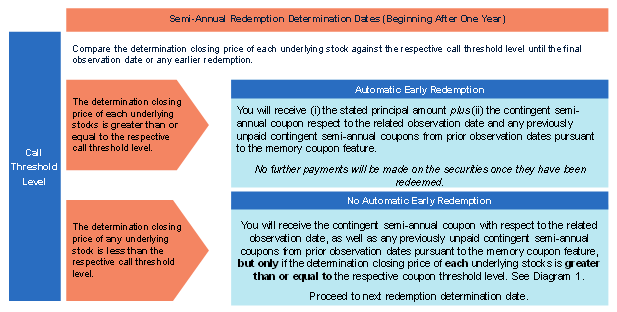
The following diagrams illustrate the potential outcomes for the securities depending on (1) the determination closing prices on each semi-annual observation date and (2) the determination closing prices on each semi-annual redemption determination date (beginning after one year). Please see “Hypothetical Examples” below for an illustration of hypothetical payouts on the securities.
Diagram #1: Contingent Semi-Annual Coupons (Beginning on the First Coupon Payment Date until Early Redemption or Maturity)

Diagram #2: Automatic Early Redemption (Beginning After One Year)
September 2026 Page 8
Morgan Stanley Finance LLC
Partial Principal At Risk Contingent Income Auto-Callable Securities with Memory Coupon due September 21, 2028, with 1-Year Initial Non-Call Period
Based on the Worst Performing of the Common Stock of Microsoft Corporation, the Common Stock of NVIDIA Corporation and the Common Stock of Bank of America Corporation
Diagram #3: Payment at Maturity if No Automatic Early Redemption Occurs
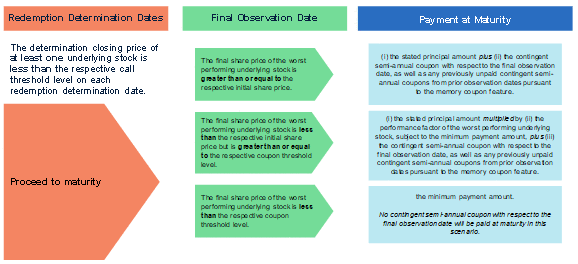
For more information about the payout upon an early redemption or at maturity in different hypothetical scenarios, see “Hypothetical Examples” below.
September 2026 Page 9
Morgan Stanley Finance LLC
Partial Principal At Risk Contingent Income Auto-Callable Securities with Memory Coupon due September 21, 2028, with 1-Year Initial Non-Call Period
Based on the Worst Performing of the Common Stock of Microsoft Corporation, the Common Stock of NVIDIA Corporation and the Common Stock of Bank of America Corporation
Hypothetical Examples
The following hypothetical examples illustrate how to determine whether a contingent semi-annual coupon is payable with respect to an observation date and how to calculate the payment at maturity, assuming the securities are not automatically redeemed early. The following examples are for illustrative purposes only. Whether you receive a contingent semi-annual coupon will be determined by reference to the determination closing price of each underlying stock on each semi-annual observation date. Whether the securities are redeemed early will be determined by reference to the determination closing price of each underlying stock on each semi-annual redemption determination date (beginning approximately one year after the original issue date) and the payment at maturity will be determined by reference to the final share price of each underlying stock on the final observation date. All payments on the securities, including the repayment of principal at maturity, are subject to our credit risk. The actual initial share price, coupon threshold level and call threshold level for each underlying stock will be determined on the pricing date. The below examples are based on the following terms:
|
Stated Principal Amount: |
$1,000 per security |
|
Contingent Semi-Annual Coupon: |
8.30% per annum (corresponding to approximately $41.50 per semi-annual period per security)1 With respect to each coupon payment date, a contingent semi-annual coupon plus any previously unpaid semi-annual coupons from any prior observation dates pursuant to the memory coupon feature will be paid but only if the determination closing price of each underlying stock is greater than or equal to the respective coupon threshold level on the related observation date. |
|
Hypothetical Initial Share Price: |
With respect to the MSFT Stock: $450.00 With respect to the NVDA Stock: $200.00 With respect to the BAC Stock: $50.00 |
|
Hypothetical Coupon Threshold Level: |
With respect to the MSFT Stock: $315.00, which is 70% of the hypothetical initial share price With respect to the NVDA Stock: $140.00, which is 70% of the hypothetical initial share price With respect to the BAC Stock: $35.00, which is 70% of the hypothetical initial share price |
|
Hypothetical Call Threshold Level: |
With respect to the MSFT Stock: $450.00, which is 100% of the hypothetical initial share price With respect to the NVDA Stock: $200.00, which is 100% of the hypothetical initial share price With respect to the BAC Stock: $50.00, which is 100% of the hypothetical initial share price |
|
Minimum Payment Amount: |
$900 per security (90% of the stated principal amount) |
1 The actual contingent semi-annual coupon will be an amount determined by the calculation agent based on the number of days in the applicable payment period, calculated on a 30/360 day-count basis. The hypothetical contingent semi-annual coupon of $41.50 is used in these examples for ease of analysis.
September 2026 Page 10
Morgan Stanley Finance LLC
Partial Principal At Risk Contingent Income Auto-Callable Securities with Memory Coupon due September 21, 2028, with 1-Year Initial Non-Call Period
Based on the Worst Performing of the Common Stock of Microsoft Corporation, the Common Stock of NVIDIA Corporation and the Common Stock of Bank of America Corporation
How to determine whether a contingent semi-annual coupon is payable with respect to an observation date:
|
|
Determination Closing Price |
|
||
|
|
MSFT Stock |
NVDA Stock |
BAC Stock |
Contingent Semi-Annual Coupon |
|
Hypothetical Observation Date 1 |
$350.00 (at or above the respective coupon threshold level) |
$170.00 (at or above the respective coupon threshold level) |
$45.00 (at or above the respective coupon threshold level) |
$41.50 |
|
Hypothetical Observation Date 2 |
$300.00 (below the respective coupon threshold level) |
$180.00 (at or above the respective coupon threshold level) |
$20.00 (below the respective coupon threshold level) |
$0 |
|
Hypothetical Observation Date 3 |
$320.00 (at or above the respective coupon threshold level) |
$190.00 (at or above the respective coupon threshold level) |
$55.00 (at or above the respective coupon threshold level) |
$41.50 + $41.50 + = $83.00 |
On hypothetical observation date 1, each underlying stock closes at or above the respective coupon threshold level. Therefore, a contingent semi-annual coupon of $41.50 is paid on the relevant coupon payment date.
On hypothetical observation date 2, at least one underlying stock closes at or above the respective coupon threshold level, but the other underlying stocks close below the respective coupon threshold levels. Therefore, no contingent semi-annual coupon is paid on the relevant coupon payment date.
On hypothetical observation date 3, each underlying stock closes at or above the respective coupon threshold level. Therefore, investors receive the contingent semi-annual coupon with respect to the third observation date as well as the previously unpaid contingent semi-annual coupon with respect to the second observation date pursuant to the memory coupon feature.
You will not receive a contingent semi-annual coupon on any coupon payment date if the determination closing price of any underlying stock is below the respective coupon threshold level on the related observation date.
September 2026 Page 11
Morgan Stanley Finance LLC
Partial Principal At Risk Contingent Income Auto-Callable Securities with Memory Coupon due September 21, 2028, with 1-Year Initial Non-Call Period
Based on the Worst Performing of the Common Stock of Microsoft Corporation, the Common Stock of NVIDIA Corporation and the Common Stock of Bank of America Corporation
How to calculate the payment at maturity (if the securities have not been automatically redeemed):
In the following examples, one or more of the underlying stocks close below the respective call threshold level(s) on each redemption determination date, and, consequently, the securities are not automatically redeemed prior to, and remain outstanding until, maturity.
|
|
Final Share Price |
Payment at Maturity |
||
|
|
MSFT Stock |
NVDA Stock |
BAC Stock |
|
|
Example 1: |
$500.00 (at or above the respective initial share price) |
$250.00 (at or above the respective initial share price) |
$70.00 (at or above the respective initial share price) |
$1,000 plus the contingent semi-annual coupon with respect to the final observation date and any previously unpaid contingent semi-annual coupons from the prior observation dates pursuant to the memory coupon feature |
|
Example 2: |
$420.00 (below the respective initial share price but at or above the respective coupon threshold level) |
$190.00 (below the respective initial share price but at or above the respective coupon threshold level) |
$46.00 (below the respective initial share price but at or above the respective coupon threshold level) |
$1,000 × ($46.00 / $50.00), subject to the minimum payment amount, plus the contingent semi-annual coupon with respect to the final observation date and any previously unpaid contingent semi-annual coupons from the prior observation dates pursuant to the memory coupon feature |
|
Example 3: |
$200.00 (below the respective coupon threshold level) |
$80.00 (below the respective coupon threshold level) |
$15.00 (below the respective coupon threshold level) |
$1,000 × ($15.00 / $50.00), subject to the minimum payment amount |
In example 1, the final share price of each underlying stock is greater than or equal to the respective initial share price. Therefore, investors receive at maturity the stated principal amount of the securities plus the contingent semi-annual coupon with respect to the final observation date and any previously unpaid contingent semi-annual coupons from the prior observation dates pursuant to the memory coupon feature. Investors do not participate in the appreciation of any of the underlying stocks.
In example 2, the final share price of each underlying stock is below the respective initial share price, but the final share price of each underlying stock remains at or above the respective coupon threshold level. Therefore, investors are exposed to the downside performance of the worst performing underlying stock and receive at maturity an amount less than the stated principal amount multiplied by the performance factor of the BAC stock, subject to the minimum payment amount of $900 per security, plus the contingent semi-annual coupon with respect to the final observation date and any previously unpaid contingent semi-annual coupons from the prior observation dates pursuant to the memory coupon feature.
In example 3, the final share price of each underlying stock is below the respective coupon threshold level. Therefore, no contingent semi-annual coupon is paid with respect to the final observation date and investors receive the stated principal amount multiplied by the performance factor of the BAC stock, subject to the minimum payment amount of $900 per security.
September 2026 Page 12
Morgan Stanley Finance LLC
Partial Principal At Risk Contingent Income Auto-Callable Securities with Memory Coupon due September 21, 2028, with 1-Year Initial Non-Call Period
Based on the Worst Performing of the Common Stock of Microsoft Corporation, the Common Stock of NVIDIA Corporation and the Common Stock of Bank of America Corporation
Risk Factors
This section describes the material risks relating to the securities. For further discussion of these and other risks, you should read the section entitled “Risk Factors” in the accompanying prospectus supplement, tax supplement and prospectus. You should also consult with your investment, legal, tax, accounting and other advisers in connection with your investment in the securities.
Risks Relating to an Investment in the Securities
◼The securities do not provide for the regular payment of interest and may pay no interest over the entire term of the securities. The terms of the securities differ from those of ordinary debt securities in that they do not provide for the regular payment of interest. Instead, the securities will pay a contingent semi-annual coupon but only if the determination closing price of each underlying stock is greater than or equal to 70% of the respective initial share price, which we refer to as the respective coupon threshold level, on the related observation date. If, on the other hand, the determination closing price of any underlying stock is less than the respective coupon threshold level on the related observation date for any interest period, we will pay no coupon on the applicable coupon payment date. However, if the determination closing price of each underlying stock is greater than or equal to the respective coupon threshold level on any subsequent observation date, investors will receive, in addition to the contingent semi-annual coupon for the related semi-annual period, any previously unpaid contingent semi-annual coupons from prior observation dates pursuant to the memory coupon feature. Nevertheless, it is possible that the determination closing price(s) of one or more underlying stocks could remain below the respective coupon threshold level(s) for extended periods of time or even throughout the entire 2-year term of the securities so that you will receive few or no contingent semi-annual coupons. If you do not earn sufficient contingent coupons over the term of the securities, the overall return on the securities may be less than the amount that would be paid on a conventional debt security of ours of comparable maturity.
◼The securities provide for a minimum payment amount of only 90% of principal. The terms of the securities differ from those of ordinary debt securities in that the securities provide for a minimum payment amount of only 90% of principal at maturity. If the securities have not been automatically redeemed prior to maturity and the worst performing underlying stock declines below the respective initial share price, investors will lose 1% for every 1% decline of the respective final share price from the respective initial share price, subject to the minimum payment amount. Under no circumstances will the payment due at maturity be less than the minimum payment amount of $900 per security.
◼The contingent semi-annual coupon, if any, is based only on the determination closing price of each underlying stock on the related semi-annual observation date at the end of the related interest period. Whether the contingent semi-annual coupon (plus any previously unpaid contingent semi-annual coupons from prior observation dates pursuant to the memory coupon feature) will be paid on any coupon payment date will be determined at the end of the relevant interest period based on the determination closing price of each underlying stock on the relevant semi-annual observation date. As a result, you will not know whether you will receive the contingent semi-annual coupon on any coupon payment date until near the end of the relevant interest period. Moreover, because the contingent semi-annual coupon is based solely on the price of each underlying stock on semi-annual observation dates, if the determination closing price of any underlying stock on any observation date is less than the respective coupon threshold level, you will receive no coupon for the related interest period, or any previously unpaid contingent semi-annual coupons, even if the price of such underlying stock was greater than or equal to the respective coupon threshold level on other days during that interest period and even if the determination closing price(s) of the other underlying stocks are greater than or equal to the respective coupon threshold level(s) on the relevant observation date.
◼Investors will not participate in any appreciation of the underlying stocks. Investors will not participate in any appreciation in the prices of the underlying stocks from the respective initial share prices, and the return on the securities will be limited to the contingent semi-annual coupons, if any, that are paid with respect to each observation date on which the determination closing price of each underlying stock is greater than or equal to the respective coupon threshold level, if any.
◼Reinvestment risk. The term of your investment in the securities may be shortened due to the automatic early redemption feature of the securities. If the securities are redeemed prior to maturity, you will receive no more contingent semi-annual coupons and may be forced to invest in a lower interest rate environment and may not be able to reinvest at comparable
September 2026 Page 13
Morgan Stanley Finance LLC
Partial Principal At Risk Contingent Income Auto-Callable Securities with Memory Coupon due September 21, 2028, with 1-Year Initial Non-Call Period
Based on the Worst Performing of the Common Stock of Microsoft Corporation, the Common Stock of NVIDIA Corporation and the Common Stock of Bank of America Corporation
terms or returns. However, under no circumstances will the securities be redeemed in the first year of the term of the securities.
◼The market price of the securities may be influenced by many unpredictable factors. Several factors, many of which are beyond our control, will influence the value of the securities in the secondary market and the price at which MS & Co. may be willing to purchase or sell the securities in the secondary market. We expect that generally the level of interest rates available in the market and the prices of the underlying stocks on any day, including in relation to the respective coupon threshold levels, will affect the value of the securities more than any other factors. Other factors that may influence the value of the securities include:
othe trading price and volatility (frequency and magnitude of changes in price) of the underlying stocks,
owhether the determination closing price of any underlying stock has been below the respective coupon threshold level on any observation date,
odividend rates on the underlying stocks, if any,
ogeopolitical conditions and economic, financial, political, regulatory or judicial events that affect the underlying stocks or stock markets generally and which may affect the prices of the underlying stocks,
othe time remaining until the securities mature,
ointerest and yield rates in the market,
othe availability of comparable instruments,
othe occurrence of certain events affecting the underlying stock that may or may not require an adjustment to the adjustment factor, and
oany actual or anticipated changes in our credit ratings or credit spreads.
Some or all of these factors will influence the price that you will receive if you sell your securities prior to maturity. For example, you may have to sell your securities at a substantial discount from the stated principal amount of $1,000 per security if the price of any underlying stock at the time of sale is near or below the respective coupon threshold level or if market interest rates rise.
The prices of the underlying stocks may be, and have recently been, volatile, and we can give you no assurance that the volatility will lessen. You cannot predict the future performance of any underlying stock based on its historical performance. The prices of the underlying stocks may decrease and be below the respective coupon threshold level(s) on each observation date so that you will receive no return on your investment. There can be no assurance that the determination closing prices of each of the underlying stocks will be greater than or equal to the respective coupon threshold levels on any observation date so that you will receive a contingent semi-annual coupon payment on the securities for the applicable interest period. See “Microsoft Corporation Overview,” “NVIDIA Corporation Overview,” and “Bank of America Corporation Overview” below.
◼The securities are subject to our credit risk, and any actual or anticipated changes to our credit ratings or credit spreads may adversely affect the market value of the securities. You are dependent on our ability to pay all amounts due on the securities at maturity, upon early redemption or on any coupon payment date, and therefore, you are subject to our credit risk. The securities are not guaranteed by any other entity. If we default on our obligations under the securities, your investment would be at risk and you could lose some or all of your investment. As a result, the market value of the securities prior to maturity will be affected by changes in the market’s view of our creditworthiness. Any actual or anticipated decline in our credit ratings or increase in the credit spreads charged by the market for taking our credit risk is likely to adversely affect the market value of the securities.
◼As a finance subsidiary, MSFL has no independent operations and will have no independent assets. As a finance subsidiary, MSFL has no independent operations beyond the issuance and administration of its securities and will have no independent assets available for distributions to holders of MSFL securities if they make claims in respect of such securities in a bankruptcy, resolution or similar proceeding. Accordingly, any recoveries by such holders will be limited to those available under the related guarantee by Morgan Stanley and that guarantee will rank pari passu with all other unsecured,
September 2026 Page 14
Morgan Stanley Finance LLC
Partial Principal At Risk Contingent Income Auto-Callable Securities with Memory Coupon due September 21, 2028, with 1-Year Initial Non-Call Period
Based on the Worst Performing of the Common Stock of Microsoft Corporation, the Common Stock of NVIDIA Corporation and the Common Stock of Bank of America Corporation
unsubordinated obligations of Morgan Stanley. Holders will have recourse only to a single claim against Morgan Stanley and its assets under the guarantee. Holders of securities issued by MSFL should accordingly assume that in any such proceedings they would not have any priority over and should be treated pari passu with the claims of other unsecured, unsubordinated creditors of Morgan Stanley, including holders of Morgan Stanley-issued securities.
◼The securities will not be listed on any securities exchange and secondary trading may be limited, and accordingly, you should be willing to hold your securities for the entire 2-year term of the securities. The securities will not be listed on any securities exchange. Therefore, there may be little or no secondary market for the securities. MS & Co. may, but is not obligated to, make a market in the securities and, if it once chooses to make a market, may cease doing so at any time. When it does make a market, it will generally do so for transactions of routine secondary market size at prices based on its estimate of the current value of the securities, taking into account its bid/offer spread, our credit spreads, market volatility, the notional size of the proposed sale, the cost of unwinding any related hedging positions, the time remaining to maturity and the likelihood that it will be able to resell the securities. Even if there is a secondary market, it may not provide enough liquidity to allow you to trade or sell the securities easily. Since other broker-dealers may not participate significantly in the secondary market for the securities, the price at which you may be able to trade your securities is likely to depend on the price, if any, at which MS & Co. is willing to transact. If, at any time, MS & Co. were to cease making a market in the securities, it is likely that there would be no secondary market for the securities. Accordingly, you should be willing to hold your securities to maturity.
◼The rate we are willing to pay for securities of this type, maturity and issuance size is likely to be lower than the rate implied by our secondary market credit spreads and advantageous to us. Both the lower rate and the inclusion of costs associated with issuing, selling, structuring and hedging the securities in the original issue price reduce the economic terms of the securities, cause the estimated value of the securities to be less than the original issue price and will adversely affect secondary market prices. Assuming no change in market conditions or any other relevant factors, the prices, if any, at which dealers, including MS & Co., may be willing to purchase the securities in secondary market transactions will likely be significantly lower than the original issue price, because secondary market prices will exclude the issuing, selling, structuring and hedging-related costs that are included in the original issue price and borne by you and because the secondary market prices will reflect our secondary market credit spreads and the bid-offer spread that any dealer would charge in a secondary market transaction of this type as well as other factors.
The inclusion of the costs of issuing, selling, structuring and hedging the securities in the original issue price and the lower rate we are willing to pay as issuer make the economic terms of the securities less favorable to you than they otherwise would be.
However, because the costs associated with issuing, selling, structuring and hedging the securities are not fully deducted upon issuance, for a period of up to 6 months following the issue date, to the extent that MS & Co. may buy or sell the securities in the secondary market, absent changes in market conditions, including those related to the underlying stocks, and to our secondary market credit spreads, it would do so based on values higher than the estimated value, and we expect that those higher values will also be reflected in your brokerage account statements.
◼The estimated value of the securities is determined by reference to our pricing and valuation models, which may differ from those of other dealers and is not a maximum or minimum secondary market price. These pricing and valuation models are proprietary and rely in part on subjective views of certain market inputs and certain assumptions about future events, which may prove to be incorrect. As a result, because there is no market-standard way to value these types of securities, our models may yield a higher estimated value of the securities than those generated by others, including other dealers in the market, if they attempted to value the securities. In addition, the estimated value on the pricing date does not represent a minimum or maximum price at which dealers, including MS & Co., would be willing to purchase your securities in the secondary market (if any exists) at any time. The value of your securities at any time after the date of this document will vary based on many factors that cannot be predicted with accuracy, including our creditworthiness and changes in market conditions. See also “The market price of the securities may be influenced by many unpredictable factors” above.
◼The calculation agent, which is a subsidiary of Morgan Stanley and an affiliate of the issuer, will make determinations with respect to the securities. As calculation agent, MS & Co. will determine the initial share prices, the coupon threshold levels, the call threshold levels, the determination closing prices on each observation date, whether you receive a contingent semi-annual coupon on each coupon payment date and/or at maturity (if the securities have not
September 2026 Page 15
Morgan Stanley Finance LLC
Partial Principal At Risk Contingent Income Auto-Callable Securities with Memory Coupon due September 21, 2028, with 1-Year Initial Non-Call Period
Based on the Worst Performing of the Common Stock of Microsoft Corporation, the Common Stock of NVIDIA Corporation and the Common Stock of Bank of America Corporation
previously been redeemed), whether the securities will be redeemed on any early redemption date, whether a market disruption event has occurred and whether to make any adjustments to the adjustment factors. Moreover, certain determinations made by MS & Co., in its capacity as calculation agent, may require it to exercise discretion and make subjective judgments, such as with respect to the occurrence or non-occurrence of market disruption events (and of any adjustments to the adjustment factors). These potentially subjective determinations may affect the payout to you on the securities. For further information regarding these types of determinations, see “Additional Terms of the Securities—Additional Terms—Postponement of coupon payment dates (including the maturity date) and early redemption dates,” “—Postponement of observation dates and redemption determination dates,” “—Calculation agent,” “—Market disruption event,” “—Antidilution adjustments” and “—Alternate exchange calculation in case of an event of default.” In addition, MS & Co. has determined the estimated value of the securities on the pricing date.
◼Hedging and trading activity by our affiliates could potentially affect the value of the securities. One or more of our affiliates and/or third-party dealers expect to carry out hedging activities related to the securities (and to other instruments linked to the underlying stocks), including trading in the underlying stocks and in futures and/or options contracts on the underlying stocks, as well as in other instruments related to the underlying stocks. As a result, these entities may be unwinding or adjusting hedge positions during the term of the securities, and the hedging strategy may involve greater and more frequent dynamic adjustments to the hedge as the observation dates approach. Some of our other affiliates also trade the underlying stocks and other financial instruments related to the underlying stocks on a regular basis as part of their general broker-dealer and other businesses. Any of these hedging or trading activities on or prior to the pricing date could potentially increase the initial share price of an underlying stock, and, therefore, could potentially increase (i) the price at or above which such underlying stock must close on the redemption determination dates so that the securities are redeemed prior to maturity for the early redemption payment (depending also on the performance of the other underlying stocks) and (ii) the coupon threshold level for such underlying stock, which is the price at or above which such underlying stock must close on the observation dates so that you receive a contingent semi-annual coupon on the securities (depending also on the performance of the other underlying stocks). Additionally, such hedging or trading activities during the term of the securities could potentially affect the closing price of any underlying stock on the redemption determination dates and the observation dates, and, accordingly, whether we redeem the securities prior to maturity and whether we pay a contingent semi-annual coupon on the securities (depending also on the performance of the other underlying stocks).
◼You may be required to recognize an amount of taxable income in a year that exceeds the coupon payments received in that year. We expect to treat the securities offered by this pricing supplement as contingent payment debt instruments for U.S. federal income tax purposes. If you are a U.S. investor in a security, under the treatment of a security as a contingent payment debt instrument, you generally will be required to accrue interest income in each year on a constant yield to maturity basis at the “comparable yield,” as determined by us, adjusted upward or downward to reflect the difference, if any, between the actual and projected payments on the securities during the year. Therefore, the amount of taxable income you are required to recognize in a given taxable year could exceed the amount of coupon payments you receive in that year. You should review carefully the section entitled “United States Federal Income Tax Considerations” herein, in combination with the section entitled “United States Federal Taxation” in the accompanying tax supplement, and consult your tax adviser regarding the U.S. federal income tax consequences of an investment in the securities.
Risks Relating to the Underlying Stocks
◼You are exposed to the price risk of each underlying stock with respect to the contingent semi-annual coupons. Your return on the securities is not linked to a basket consisting of the underlying stocks. Rather, it will be based upon the independent performance of each underlying stock. Unlike an instrument with a return linked to a basket of underlying assets, in which risk is mitigated and diversified among all the components of the basket, you will be exposed to the risks related to each underlying stock. Poor performance by any underlying stock over the term of the securities may negatively affect your return and will not be offset or mitigated by any positive performance by the other underlying stocks. To receive any contingent semi-annual coupons, each of the underlying stocks must close at or above the respective coupon threshold levels on the applicable observation date. Therefore, if any underlying stock has declined to below the respective coupon threshold level as of an observation date, you will not receive the contingent semi-annual coupon on the related coupon payment date, even if the other underlying stocks have appreciated or have not declined as much. Accordingly, your investment is subject to the price risk of each underlying stock.
September 2026 Page 16
Morgan Stanley Finance LLC
Partial Principal At Risk Contingent Income Auto-Callable Securities with Memory Coupon due September 21, 2028, with 1-Year Initial Non-Call Period
Based on the Worst Performing of the Common Stock of Microsoft Corporation, the Common Stock of NVIDIA Corporation and the Common Stock of Bank of America Corporation
◼Because the securities are linked to the performance of the worst performing of the underlying stocks, you are exposed to a greater risk of receiving no contingent semi-annual coupons than if the securities were linked to just one of the underlying stocks. The risk that you will not receive any contingent semi-annual coupons is greater if you invest in the securities as opposed to similar securities that are linked to the performance of just one of the underlying stocks. With three underlying stocks, it is more likely that any underlying stock will close below the respective coupon threshold level on each observation date, and therefore it is more likely that you will not receive any contingent semi-annual coupons than if the securities were linked to just one of the underlying stocks. In addition, because each underlying stock must close at or above the respective call threshold level on a semi-annual redemption determination date (beginning after one year) in order for the securities to be called prior to maturity, the securities are less likely to be called on any early redemption date than if the securities were linked to just one underlying stock.
◼Investing in the securities is not equivalent to investing in the common stock of Microsoft Corporation, the common stock of NVIDIA Corporation or the common stock of Bank of America Corporation. Investors in the securities will not participate in any appreciation in the underlying stocks, and will not have voting rights or rights to receive dividends or other distributions or any other rights with respect to the underlying stocks. As a result, any return on the securities will not reflect the return you would realize if you actually owned shares of the underlying stocks and received the dividends paid or distributions made on them.
◼No affiliation with Microsoft Corporation, NVIDIA Corporation or Bank of America Corporation. Microsoft Corporation, NVIDIA Corporation and Bank of America Corporation are not affiliates of ours, are not involved with this offering in any way, and have no obligation to consider your interests in taking any corporate actions that might affect the value of the securities. We have not made any due diligence inquiry with respect to Microsoft Corporation, NVIDIA Corporation or Bank of America Corporation in connection with this offering.
◼We may engage in business with or involving Microsoft Corporation, NVIDIA Corporation or Bank of America Corporation without regard to your interests. We or our affiliates may presently or from time to time engage in business with Microsoft Corporation, NVIDIA Corporation or Bank of America Corporation without regard to your interests and thus may acquire non-public information about Microsoft Corporation, NVIDIA Corporation or Bank of America Corporation. Neither we nor any of our affiliates undertakes to disclose any such information to you. In addition, we or our affiliates from time to time have published and in the future may publish research reports with respect to Microsoft Corporation, NVIDIA Corporation or Bank of America Corporation, which may or may not recommend that investors buy or hold the underlying stock(s).
◼Governmental regulatory actions, such as sanctions, could adversely affect your investment in the securities. Governmental regulatory actions, including, without limitation, sanctions-related actions by the U.S. or a foreign government, could prohibit or otherwise restrict persons from holding the securities or the underlying stock, or engaging in transactions therein, and any such action could adversely affect the value of the underlying stock or the securities. These regulatory actions could result in restrictions on the securities and could result in the loss of a significant portion or all of your initial investment in the securities, including if you are forced to divest the securities due to the government mandates, especially if such divestment must be made at a time when the value of the securities has declined.
◼The antidilution adjustments the calculation agent is required to make do not cover every corporate event that could affect the underlying stocks. MS & Co., as calculation agent, will adjust the adjustment factors for certain corporate events affecting the underlying stocks, such as stock splits, stock dividends and extraordinary dividends, and certain other corporate actions involving the issuers of the underlying stocks, such as mergers. However, the calculation agent will not make an adjustment for every corporate event that can affect the underlying stocks. For example, the calculation agent is not required to make any adjustments if the issuers of the underlying stocks or anyone else makes a partial tender or partial exchange offer for the underlying stocks, nor will adjustments be made following the final observation date. In addition, no adjustments will be made for regular cash dividends, which are expected to reduce the price of the underlying stocks by the amount of such dividends. If an event occurs that does not require the calculation agent to adjust an adjustment factor, such as a regular cash dividend, the market price of the securities and your return on the securities may be materially and adversely affected. For example, if the record date for a regular cash dividend were to occur on or shortly before an observation date, this may decrease the determination closing price of an underlying stock to be less than the respective coupon threshold level (resulting in no contingent semi-annual coupon being paid with respect to such date), materially and adversely affecting your return.
September 2026 Page 17
Morgan Stanley Finance LLC
Partial Principal At Risk Contingent Income Auto-Callable Securities with Memory Coupon due September 21, 2028, with 1-Year Initial Non-Call Period
Based on the Worst Performing of the Common Stock of Microsoft Corporation, the Common Stock of NVIDIA Corporation and the Common Stock of Bank of America Corporation
Microsoft Corporation Overview
Bloomberg Ticker Symbol: MSFT
Microsoft Corporation develops, licenses and supports a range of software products and services, designs, manufactures and sells devices and delivers online advertising to a global customer audience. The underlying stock is registered under the Securities Exchange Act of 1934, as amended (the “Exchange Act”). Information provided to or filed with the Securities and Exchange Commission by Microsoft Corporation pursuant to the Exchange Act can be located by reference to the Securities and Exchange Commission file number 001-37845 through the Securities and Exchange Commission’s website at www.sec.gov. In addition, information regarding Microsoft Corporation may be obtained from other publicly available sources. Neither the issuer nor the agent makes any representation that such publicly available documents or any other publicly available information regarding the issuer of the underlying stock is accurate or complete.
The closing price of the MSFT Stock on September 11, 2026 was $495.63. The following graph sets forth the daily closing prices of the underlying stock for the period noted below. We obtained the historical information presented in this document from Bloomberg Financial Markets, without independent verification. The underlying stock has at times experienced periods of high volatility. The historical performance of the underlying stock should not be taken as an indication of its future performance, and no assurance can be given as to the closing price of the underlying stock at any time.
|
MSFT Stock Daily Closing Prices |
|
|
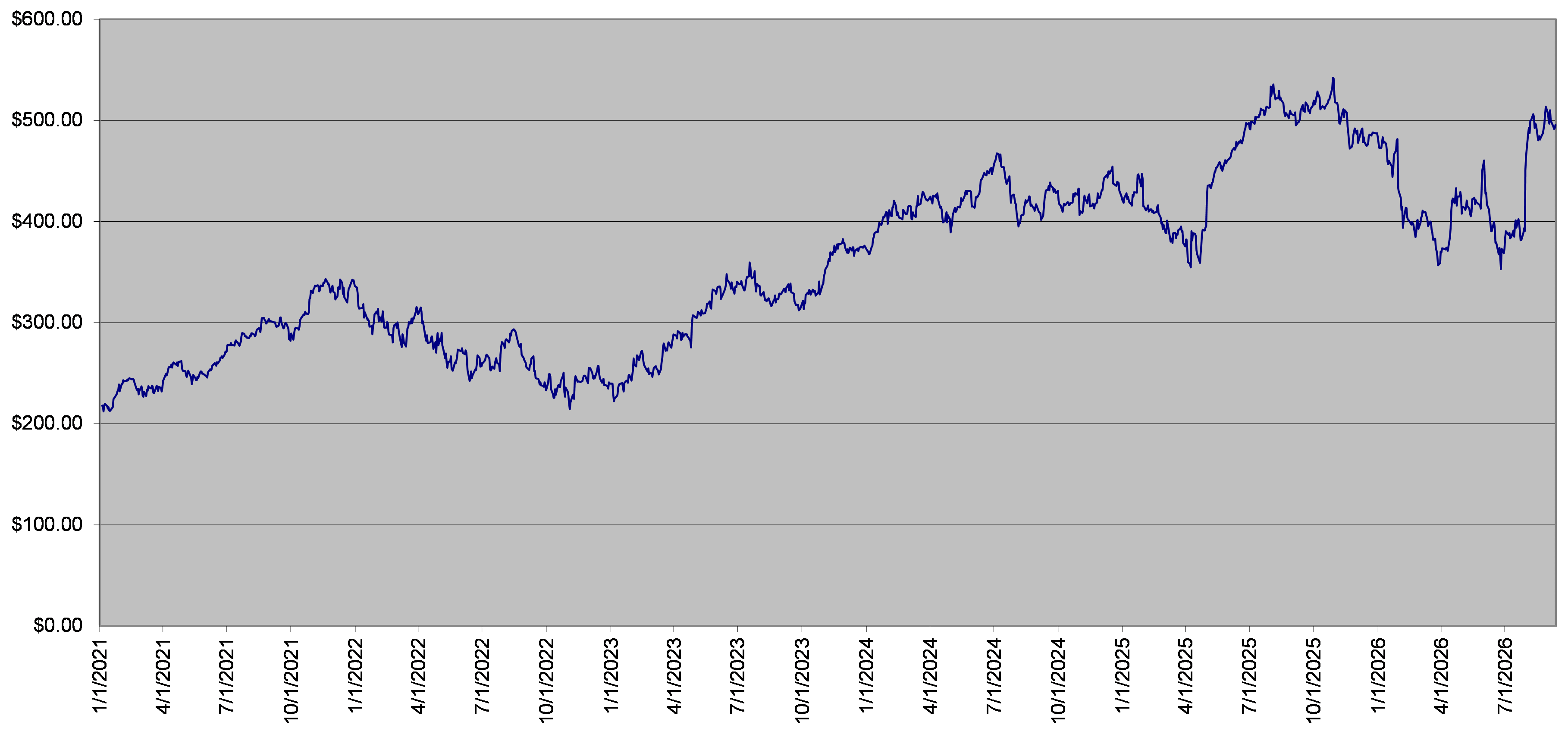
This document relates only to the securities referenced hereby and does not relate to the underlying stock or other securities of the underlying stock issuer. We have derived all disclosures contained in this document regarding the underlying stock from the publicly available documents described above. In connection with this offering of securities, neither we nor the agent has participated in the preparation of such documents or made any due diligence inquiry with respect to the underlying stock issuer. Neither we nor the agent makes any representation that such publicly available documents or any other publicly available information regarding the underlying stock issuer is accurate or complete. Furthermore, we cannot give any assurance that all events occurring prior to the date hereof (including events that would affect the accuracy or completeness of the publicly available documents described above) that would affect the trading price of the underlying stock (and therefore the closing price of the underlying stock on the day on which the initial share price is determined) have been publicly disclosed. Subsequent disclosure of any such events or the disclosure of or failure to disclose material future events concerning the underlying stock issuer could affect the value received with respect to the securities and therefore the value of the securities.
Neither we nor any of our affiliates makes any representation to you as to the performance of the underlying stock.
September 2026 Page 18
Morgan Stanley Finance LLC
Partial Principal At Risk Contingent Income Auto-Callable Securities with Memory Coupon due September 21, 2028, with 1-Year Initial Non-Call Period
Based on the Worst Performing of the Common Stock of Microsoft Corporation, the Common Stock of NVIDIA Corporation and the Common Stock of Bank of America Corporation
NVIDIA Corporation Overview
Bloomberg Ticker Symbol: NVDA
NVIDIA Corporation is a visual computing company. The underlying stock is registered under the Exchange Act. Information provided to or filed with the Securities and Exchange Commission by NVIDIA Corporation pursuant to the Exchange Act can be located by reference to the Securities and Exchange Commission file number 000-23985 through the Securities and Exchange Commission’s website at www.sec.gov. In addition, information regarding NVIDIA Corporation may be obtained from other sources including, but not limited to, press releases, newspaper articles and other publicly disseminated documents. Neither the issuer nor the agent makes any representation that such publicly available documents or any other publicly available information regarding the issuer of the underlying stock is accurate or complete.
The closing price of the NVDA Stock on September 11, 2026 was $218.29. The following graph sets forth the daily closing prices of the underlying stock for the period noted below. We obtained the historical information presented in this document from Bloomberg Financial Markets, without independent verification. The underlying stock has at times experienced periods of high volatility. The historical performance of the underlying stock should not be taken as an indication of its future performance, and no assurance can be given as to the closing price of the underlying stock at any time.
|
NVDA Stock Daily Closing Prices |
|
|

This document relates only to the securities referenced hereby and does not relate to the underlying stock or other securities of the underlying stock issuer. We have derived all disclosures contained in this document regarding the underlying stock from the publicly available documents described above. In connection with this offering of securities, neither we nor the agent has participated in the preparation of such documents or made any due diligence inquiry with respect to the underlying stock issuer. Neither we nor the agent makes any representation that such publicly available documents or any other publicly available information regarding the underlying stock issuer is accurate or complete. Furthermore, we cannot give any assurance that all events occurring prior to the date hereof (including events that would affect the accuracy or completeness of the publicly available documents described above) that would affect the trading price of the underlying stock (and therefore the closing price of the underlying stock on the day on which the initial share price is determined) have been publicly disclosed. Subsequent disclosure of any such events or the disclosure of or failure to disclose material future events concerning the underlying stock issuer could affect the value received with respect to the securities and therefore the value of the securities.
Neither we nor any of our affiliates makes any representation to you as to the performance of the underlying stock.
September 2026 Page 19
Morgan Stanley Finance LLC
Partial Principal At Risk Contingent Income Auto-Callable Securities with Memory Coupon due September 21, 2028, with 1-Year Initial Non-Call Period
Based on the Worst Performing of the Common Stock of Microsoft Corporation, the Common Stock of NVIDIA Corporation and the Common Stock of Bank of America Corporation
Bank of America Corporation Overview
Bloomberg Ticker Symbol: BAC
Bank of America Corporation is a bank holding company and a financial holding company. The underlying stock is registered under the Exchange Act. Information provided to or filed with the Securities and Exchange Commission by Bank of America Corporation pursuant to the Exchange Act can be located by reference to the Securities and Exchange Commission file number 001-06523 through the Securities and Exchange Commission’s website at www.sec.gov. In addition, information regarding Bank of America Corporation may be obtained from other sources including, but not limited to, press releases, newspaper articles and other publicly disseminated documents. Neither the issuer nor the agent makes any representation that such publicly available documents or any other publicly available information regarding the issuer of the underlying stock is accurate or complete.
The closing price of the BAC Stock on September 11, 2026 was $62.69. The following graph sets forth the daily closing prices of the underlying stock for the period noted below. We obtained the historical information presented in this document from Bloomberg Financial Markets, without independent verification. The underlying stock has at times experienced periods of high volatility. The historical performance of the underlying stock should not be taken as an indication of its future performance, and no assurance can be given as to the closing price of the underlying stock at any time.
|
BAC Stock Daily Closing Prices |
|
|

This document relates only to the securities referenced hereby and does not relate to the underlying stock or other securities of the underlying stock issuer. We have derived all disclosures contained in this document regarding the underlying stock from the publicly available documents described above. In connection with this offering of securities, neither we nor the agent has participated in the preparation of such documents or made any due diligence inquiry with respect to the underlying stock issuer. Neither we nor the agent makes any representation that such publicly available documents or any other publicly available information regarding the underlying stock issuer is accurate or complete. Furthermore, we cannot give any assurance that all events occurring prior to the date hereof (including events that would affect the accuracy or completeness of the publicly available documents described above) that would affect the trading price of the underlying stock (and therefore the closing price of the underlying stock on the day on which the initial share price is determined) have been publicly disclosed. Subsequent disclosure of any such events or the disclosure of or failure to disclose material future events concerning the underlying stock issuer could affect the value received with respect to the securities and therefore the value of the securities.
Neither we nor any of our affiliates makes any representation to you as to the performance of the underlying stock.
September 2026 Page 20
Morgan Stanley Finance LLC
Partial Principal At Risk Contingent Income Auto-Callable Securities with Memory Coupon due September 21, 2028, with 1-Year Initial Non-Call Period
Based on the Worst Performing of the Common Stock of Microsoft Corporation, the Common Stock of NVIDIA Corporation and the Common Stock of Bank of America Corporation
Additional Terms of the Securities
Please read this information in conjunction with the terms on the front cover of this document.
|
Additional Terms: |
|
|
If the terms described herein are inconsistent with those described in the accompanying prospectus supplement, tax supplement or prospectus, the terms described herein shall control. |
|
|
Interest period: |
The semi-annual period from and including the original issue date (in the case of the first interest period) or the previous scheduled coupon payment date, as applicable, to but excluding the following scheduled coupon payment date, with no adjustment for any postponement thereof. |
|
Underlying stock issuer: |
With respect to the MSFT Stock, Microsoft Corporation With respect to the NVDA Stock, NVIDIA Corporation With respect to the BAC Stock, Bank of America Corporation |
|
Day-count convention: |
Interest will be computed on the basis of a 360-day year of twelve 30-day months. |
|
Record date: |
The record date for each coupon payment date, including the coupon payment date scheduled to occur on the maturity date, shall be the date one business day prior to such scheduled coupon payment date; provided, however, that any coupon payable at maturity or upon early redemption shall be payable to the person to whom the payment at maturity or early redemption payment, as the case may be, shall be payable. |
|
Denominations: |
$1,000 and integral multiples thereof |
|
Senior Security or Subordinated Security: |
Senior |
|
Business day: |
Any day, other than a Saturday or Sunday, that is neither a legal holiday nor a day on which banking institutions are authorized or required by law or regulation to close in The City of New York. |
|
Trading day: |
A day, as determined by the calculation agent, on which trading is generally conducted on the New York Stock Exchange, the Nasdaq National Market, the Chicago Mercantile Exchange Inc. and the Chicago Board Options Exchange and in the over-the-counter market for equity securities in the United States. |
|
Postponement of coupon payment dates (including the maturity date) and early redemption dates: |
If any scheduled coupon payment date (including the maturity date) or early redemption date is not a business day, the applicable payment will be made on the next succeeding business day and no adjustment will be made to the payment made on any such succeeding business day. If, due to a market disruption event or otherwise, any observation date or redemption determination date for any underlying stock is postponed so that it falls less than two business days prior to the scheduled coupon payment date (including the maturity date) or early redemption date, as applicable, the coupon payment date (or the maturity date) or the early redemption date, as applicable, shall be postponed to the second business day following that observation date or redemption determination date as postponed. In any of these cases, no adjustment shall be made to any payment made on that postponed date. |
|
Postponement of observation dates and redemption determination dates: |
If any scheduled observation date or redemption determination date is not a trading day, that observation date or redemption determination date, as applicable, will be postponed to the next trading day. In addition, if a market disruption event occurs on any scheduled observation date or redemption determination date with respect to any underlying stock, the determination closing price for that underlying stock only will be determined on the next trading day on which no market disruption event occurs with respect to that underlying stock. The determination of the closing price for the unaffected underlying stocks will not be postponed. If the determination closing price for any underlying stock has not been determined by the fifth trading day following a scheduled observation date or redemption determination date, the calculation agent will determine such determination closing price for such underlying stock as (i) the closing price for such underlying stock determined on such fifth trading day in accordance with the second paragraph of “Closing price” below times (ii) the related adjustment factor. |
|
Calculation agent: |
MS & Co. and its successors All determinations made by the calculation agent will be at the sole discretion of the calculation agent and will, in the absence of manifest error, be conclusive for all purposes and binding on you, the trustee and us. All calculations with respect to the contingent semi-annual coupon, if any, and payment at maturity (or early redemption payment) will be made by the calculation agent and will be rounded to the nearest one hundred-thousandth, with five one-millionths rounded upward (e.g., .876545 would be rounded to .87655); all dollar |
September 2026 Page 21
Morgan Stanley Finance LLC
Partial Principal At Risk Contingent Income Auto-Callable Securities with Memory Coupon due September 21, 2028, with 1-Year Initial Non-Call Period
Based on the Worst Performing of the Common Stock of Microsoft Corporation, the Common Stock of NVIDIA Corporation and the Common Stock of Bank of America Corporation
|
amounts related to determination of the amount of cash payable per security will be rounded to the nearest ten-thousandth, with five one hundred-thousandths rounded upward (e.g., .76545 would be rounded up to .7655); and all dollar amounts paid on the aggregate number of the securities will be rounded to the nearest cent, with one-half cent rounded upward. Because the calculation agent is our affiliate, the economic interests of the calculation agent and its affiliates may be adverse to your interests as an investor in the securities, including with respect to certain determinations and judgments that the calculation agent must make in determining the initial share prices, the determination closing prices, the share percent changes, the payment that you will receive, if any, on each coupon payment date, the payment that you will receive at maturity (if the securities have not previously been redeemed), what adjustments should be made, if any, to the adjustment factor with respect to an underlying stock or whether a market disruption event has occurred. See “Market disruption event”, “Antidilution adjustments,” and “Alternate exchange calculation in case of an event of default” below. MS & Co. is obligated to carry out its duties and functions as calculation agent in good faith and using its reasonable judgment. |
|
|
Closing price: |
Subject to the provisions set out under “Antidilution adjustments” below, the closing price for one share of each underlying stock (or one unit of any other security for which a closing price must be determined) on any trading day means: (i) if such underlying stock (or any such other security) is listed on a national securities exchange (other than Nasdaq), the last reported sale price, regular way, of the principal trading session on such day on the principal national securities exchange registered under the Securities Exchange Act of 1934, as amended, on which such underlying stock (or any such other security) is listed, (ii) if such underlying stock (or any such other security) is a security of the Nasdaq, the official closing price of such underlying stock published by the Nasdaq on such day, or (iii) if such underlying stock (or any such other security) is not listed on any national securities exchange but is included in the OTC Bulletin Board Service (the OTC Bulletin Board) operated by the Financial Industry Regulatory Authority, Inc. (FINRA), the last reported sale price of the principal trading session on the OTC Bulletin Board on such day. If such underlying stock (or any such other security) is listed on any national securities exchange but the last reported sale price or the official closing price published by such exchange, or by the Nasdaq, as applicable, is not available pursuant to the preceding sentence, then the closing price for one share of such underlying stock (or one unit of any such other security) on any trading day will mean the last reported sale price of the principal trading session on the over-the-counter market as reported on the Nasdaq or the OTC Bulletin Board on such day. If a market disruption event (as defined below) occurs with respect to such underlying stock, (or any such other security) or the last reported sale price or the official closing price published by the Nasdaq, as applicable, for such underlying stock (or any such other security) is not available pursuant to either of the two preceding sentences, then the closing price for any trading day will be the mean, as determined by the calculation agent, of the bid prices for such underlying stock (or any such other security) for such trading day obtained from as many recognized dealers in such security, but not exceeding three, as will make such bid prices available to the calculation agent. Bids of MS & Co. and its successors or any of its affiliates may be included in the calculation of such mean, but only to the extent that any such bid is the highest of the bids obtained. If no bid prices are provided from any third-party dealers, such closing price will be determined by the calculation agent in its sole and absolute discretion (acting in good faith) taking into account any information that it deems relevant. The term OTC Bulletin Board Service will include any successor service thereto, or, if applicable, the OTC Reporting Facility operated by FINRA. See “Antidilution adjustments” below. |
|
Market disruption event: |
With respect to each underlying stock, market disruption event means: (i) the occurrence or existence of any of: (a)a suspension, absence or material limitation of trading of such underlying stock on the primary market for that underlying stock for more than two hours of trading or during the one-half hour period preceding the close of the principal trading session in such market; or (b)a breakdown or failure in the price and trade reporting systems of the primary market for such underlying stock as a result of which the reported trading prices for that underlying stock during the last one-half hour preceding the close of the principal trading session in such market are materially inaccurate; or (c)the suspension, absence or material limitation of trading on the primary market for trading in futures or options contracts related to that underlying stock, if available, during the one-half hour period preceding the close of the principal trading session in the applicable market, in each case as determined by the calculation agent in its sole discretion; and (ii) a determination by the calculation agent in its sole discretion that any event described in clause (i) above materially interfered with our ability or the ability of any of our affiliates to unwind or adjust all or a |
September 2026 Page 22
Morgan Stanley Finance LLC
Partial Principal At Risk Contingent Income Auto-Callable Securities with Memory Coupon due September 21, 2028, with 1-Year Initial Non-Call Period
Based on the Worst Performing of the Common Stock of Microsoft Corporation, the Common Stock of NVIDIA Corporation and the Common Stock of Bank of America Corporation
|
material portion of the hedge position with respect to the securities. For the purposes of determining whether a market disruption event has occurred with respect to an underlying stock: (1) a limitation on the hours or number of days of trading will not constitute a market disruption event if it results from an announced change in the regular business hours of the primary market, (2) a decision to permanently discontinue trading in the relevant options contract will not constitute a market disruption event, (3) a suspension of trading in options contracts on such underlying stock by the primary securities market trading in such contracts by reason of (a) a price change exceeding limits set by such securities exchange or market, (b) an imbalance of orders relating to such contracts or (c) a disparity in bid and ask quotes relating to such contracts will constitute a suspension, absence or material limitation of trading in options contracts related to such underlying stock and (4) a suspension, absence or material limitation of trading on the primary market on which options contracts related to such underlying stock are traded will not include any time when such securities market is itself closed for trading under ordinary circumstances. |
|
|
Antidilution adjustments: |
The adjustment factor with respect to an underlying stock will be adjusted as follows: 1. If such underlying stock is subject to a stock split or reverse stock split, then once such split has become effective, the adjustment factor for such underlying stock will be adjusted to equal the product of the prior adjustment factor for such underlying stock and the number of shares issued in such stock split or reverse stock split with respect to one share of such underlying stock. 2. If such underlying stock is subject (i) to a stock dividend (issuance of additional shares of such underlying stock) that is given ratably to all holders of shares of such underlying stock or (ii) to a distribution of such underlying stock as a result of the triggering of any provision of the corporate charter of the issuer of such underlying stock (the relevant “underlying stock issuer”), then once the dividend has become effective and such underlying stock is trading ex-dividend, the adjustment factor for such underlying stock will be adjusted so that the new adjustment factor for such underlying stock shall equal the prior adjustment factor for such underlying stock plus the product of (i) the number of shares issued with respect to one share of such underlying stock and (ii) the prior adjustment factor for such underlying stock. 3. If the applicable underlying stock issuer issues rights or warrants to all holders of such underlying stock to subscribe for or purchase that underlying stock at an exercise price per share less than the closing price of that underlying stock on both (i) the date the exercise price of such rights or warrants is determined and (ii) the expiration date of such rights or warrants, and if the expiration date of such rights or warrants precedes the maturity of the securities, then the adjustment factor for such underlying stock will be adjusted to equal the product of the prior adjustment factor for such underlying stock and a fraction, the numerator of which shall be the number of shares of such underlying stock outstanding immediately prior to the issuance of such rights or warrants plus the number of additional shares of such underlying stock offered for subscription or purchase pursuant to such rights or warrants and the denominator of which shall be the number of shares of such underlying stock outstanding immediately prior to the issuance of such rights or warrants plus the number of additional shares of such underlying stock which the aggregate offering price of the total number of shares of such underlying stock so offered for subscription or purchase pursuant to such rights or warrants would purchase at the closing price on the expiration date of such rights or warrants, which shall be determined by multiplying such total number of shares offered by the exercise price of such rights or warrants and dividing the product so obtained by such closing price. 4. There will be no required adjustments to the adjustment factors to reflect cash dividends or other distributions paid with respect to an underlying stock other than distributions described in paragraph 2, paragraph 3 and clauses (i), (iv) and (v) of the first sentence of paragraph 5 and extraordinary dividends as described below. A cash dividend or other distribution with respect to an underlying stock will be deemed to be an “extraordinary dividend” if such cash dividend or distribution exceeds the immediately preceding non-extraordinary dividend for such underlying stock by an amount equal to at least 10% of the closing price of such underlying stock (as adjusted for any subsequent corporate event requiring an adjustment hereunder, such as a stock split or reverse stock split) on the trading day preceding the ex-dividend date (that is, the day on and after which transactions in such underlying stock on the primary U.S. organized securities exchange or trading system on which such underlying stock is traded no longer carry the right to receive that cash dividend or that cash distribution) for the payment of such extraordinary dividend (such closing price, the “base closing price”). Subject to the following sentence, if an extraordinary dividend occurs with respect to an underlying stock, the adjustment factor with respect to such underlying stock will be adjusted on the ex-dividend date with respect to such extraordinary dividend so that the new adjustment factor will equal the product of (i) the then current adjustment factor and (ii) a fraction, the numerator of which is the base closing price, and the denominator of which is the amount by which the base closing price exceeds the extraordinary dividend amount. If any extraordinary dividend amount is at least 35% of the base closing price, then, instead of adjusting the adjustment factor, the calculation of the closing price with respect to the affected underlying stock will be determined as described in paragraph 5 below, and the extraordinary dividend will be allocated to the replacement stock in accordance with the procedures for a replacement underlying stock as described in clause (c) (ii) of paragraph 5 below. The “extraordinary dividend amount” with respect to an extraordinary |
September 2026 Page 23
Morgan Stanley Finance LLC
Partial Principal At Risk Contingent Income Auto-Callable Securities with Memory Coupon due September 21, 2028, with 1-Year Initial Non-Call Period
Based on the Worst Performing of the Common Stock of Microsoft Corporation, the Common Stock of NVIDIA Corporation and the Common Stock of Bank of America Corporation
|
dividend for such underlying stock will equal (i) in the case of cash dividends or other distributions that constitute regular dividends, the amount per share of such extraordinary dividend minus the amount per share of the immediately preceding non-extraordinary dividend for such underlying stock or (ii) in the case of cash dividends or other distributions that do not constitute regular dividends, the amount per share of such extraordinary dividend. The value of the non-cash component of an extraordinary dividend will be determined on the ex-dividend date for such distribution by the calculation agent, whose determination shall be conclusive in the absence of manifest error. A distribution on such underlying stock described in clause (i), (iv) or (v) of the first sentence of paragraph 5 below shall cause an adjustment to the adjustment factor pursuant only to clause (i), (iv) or (v) of the first sentence of paragraph 5, as applicable. 5. If, with respect to one or more of the underlying stocks, (i) there occurs any reclassification or change of such underlying stock, including, without limitation, as a result of the issuance of any tracking stock by the underlying stock issuer for such underlying stock, (ii) such underlying stock issuer or any surviving entity or subsequent surviving entity of such underlying stock issuer (the “successor corporation”) has been subject to a merger, combination or consolidation and is not the surviving entity, (iii) any statutory exchange of securities of such underlying stock issuer or any successor corporation with another corporation occurs (other than pursuant to clause (ii) above), (iv) such underlying stock issuer is liquidated, (v) such underlying stock issuer issues to all of its shareholders equity securities of an issuer other than such underlying stock issuer (other than in a transaction described in clause (ii), (iii) or (iv) above) (a “spin-off event”) or (vi) a tender or exchange offer or going-private transaction is consummated for all of the outstanding shares of such underlying stock (any such event in clauses (i) through (vi), a “reorganization event”), the method of determining whether an early redemption has occurred and the amount payable upon an early redemption date or at maturity for each security will be as follows: ●Upon any redemption determination date following the effective date of a reorganization event and prior to the final observation date: If the exchange property value (as defined below) is greater than or equal to the respective call threshold level, and the determination closing price (or exchange property value, if applicable) of each other underlying stock is also greater than or equal to the respective call threshold level, the securities will be automatically redeemed for an early redemption payment. ●Upon the final observation date, if the securities have not previously been automatically redeemed: You will receive for each security that you hold a payment at maturity equal to: ➢If the exchange property value on the final observation date is greater than or equal to the respective initial share price, and the final share price of each other underlying stock (or exchange property value, as applicable) is also greater than or equal to the respective initial share price: (i) the stated principal amount plus (ii) the contingent semi-annual coupon with respect to the final observation date and any previously unpaid contingent semi-annual coupons from the prior observation dates pursuant to the memory coupon feature. ➢If the exchange property value on the final observation date is less than the respective initial share price but is greater than or equal to the respective coupon threshold level, and the final share price of each other underlying stock (or exchange property value, as applicable) is also greater than or equal to the respective coupon threshold level: ➢If the worst performing underlying stock has not undergone a reorganization event as described in paragraph 5 above:(i) the stated principal amount multiplied by the (ii) performance factor of the worst performing underlying stock, subject to the minimum payment amount, plus (iii) the contingent semi-annual coupon with respect to the final observation date and any previously unpaid contingent semi-annual coupons from the prior observation dates pursuant to the memory coupon feature. ➢If the worst performing underlying stock has undergone a reorganization event as described in paragraph 5 above:(i) the stated principal amount multiplied by the (ii) performance factor of the worst performing underlying stock, subject to the minimum payment amount, plus (iii) the contingent semi-annual coupon with respect to the final observation date and any previously unpaid contingent semi-annual coupons from the prior observation dates pursuant to the memory coupon feature. For purposes of determining the performance factor of the worst performing underlying stock, the final share price of such worst performing underlying stock will be deemed to equal the per-share cash value (the “exchange property value”), determined as of the final observation date, of the securities, cash or any other assets distributed to holders of the worst performing underlying stock in or as a result of any such reorganization event, including (A) in the case of the issuance of tracking stock, the reclassified share of such worst performing underlying stock, (B) in the case of a spin-off event, the share of such worst performing underlying stock with respect to which the spun-off security was |
September 2026 Page 24
Morgan Stanley Finance LLC
Partial Principal At Risk Contingent Income Auto-Callable Securities with Memory Coupon due September 21, 2028, with 1-Year Initial Non-Call Period
Based on the Worst Performing of the Common Stock of Microsoft Corporation, the Common Stock of NVIDIA Corporation and the Common Stock of Bank of America Corporation
|
issued, and (C) in the case of any other reorganization event where such worst performing underlying stock continues to be held by the holders receiving such distribution, such worst performing underlying stock (collectively, the “exchange property”). ➢If the exchange property value on the final observation date is less than the respective coupon threshold level, or if the determination closing price (or exchange property value, if applicable) of any other underlying stock is less than the respective coupon threshold level on the final observation date: the minimum payment amount. Following the effective date of a reorganization event, the contingent semi-annual coupon, as well as any previously unpaid contingent semi-annual coupons, will be payable for each observation date on which the exchange property value is greater than or equal to the coupon threshold level and the determination closing price (or exchange property value, as applicable) of each other underlying stock is also greater than or equal to the respective coupon threshold level. If exchange property includes a cash component, investors will not receive any interest accrued on such cash component. In the event exchange property consists of securities, those securities will, in turn, be subject to the antidilution adjustments set forth in paragraphs 1 through 5. For purposes of determining whether or not the exchange property value is less than the call threshold level, or less than the coupon threshold level, “exchange property value” means (x) for any cash received in any reorganization event, the value, as determined by the calculation agent, as of the date of receipt, of such cash received for one share of such underlying stock, as adjusted by the adjustment factor at the time of such reorganization event, (y) for any property other than cash or securities received in any such reorganization event, the market value, as determined by the calculation agent in its sole discretion, as of the date of receipt, of such exchange property received for one share of such underlying stock, as adjusted by the adjustment factor at the time of such reorganization event and (z) for any security received in any such reorganization event, an amount equal to the determination closing price, as of the day on which the exchange property value is determined, per share of such security multiplied by the quantity of such security received for each share of such underlying stock, as adjusted by the adjustment factor at the time of such reorganization event. For purposes of paragraph 5 above, in the case of a consummated tender or exchange offer or going-private transaction involving consideration of particular types, exchange property shall be deemed to include the amount of cash or other property delivered by the offeror in the tender or exchange offer (in an amount determined on the basis of the rate of exchange in such tender or exchange offer or going-private transaction). In the event of a tender or exchange offer or a going-private transaction with respect to exchange property in which an offeree may elect to receive cash or other property, exchange property shall be deemed to include the kind and amount of cash and other property received by offerees who elect to receive cash. Following the occurrence of any reorganization event referred to in paragraph 5 above, all references in this offering document with respect to the securities to such “underlying stock” shall be deemed to refer to the exchange property and references to a “share” or “shares” of such underlying stock shall be deemed to refer to the applicable unit or units of such exchange property, unless the context otherwise requires. No adjustment to the adjustment factor for any underlying stock will be required unless such adjustment would require a change of at least 0.1% in the adjustment factor of such underlying stock then in effect. The adjustment factor resulting from any of the adjustments specified above will be rounded to the nearest one hundred-thousandth, with five one-millionths rounded upward. Adjustments to the adjustment factors will be made up to the close of business on the final observation date. No adjustments to the adjustment factor for any underlying stock or method of calculating the adjustment factors will be required other than those specified above. The adjustments specified above do not cover all events that could affect the closing price of an underlying stock, including, without limitation, a partial tender or exchange offer for an underlying stock. The calculation agent shall be solely responsible for the determination and calculation of any adjustments to the adjustment factor for an underlying stock or method of calculating the adjustment factors and of any related determinations and calculations with respect to any distributions of stock, other securities or other property or assets (including cash) in connection with any corporate event described in paragraphs 1 through 5 above, and its determinations and calculations with respect thereto shall be conclusive in the absence of manifest error. The calculation agent will provide information as to any adjustments to an adjustment factor or to the method of calculating the amounts payable on the securities made pursuant to paragraph 5 above upon written request by any investor in the securities. |
|
|
Trustee: |
The Bank of New York Mellon |
|
Issuer notice to registered security holders, the |
In the event that any coupon payment date or the maturity date is postponed as described above, the issuer shall give notice of such postponement and, once it has been determined, of the date to which the applicable coupon payment date or the maturity date, as applicable, has been rescheduled (i) to each registered holder of |
September 2026 Page 25
Morgan Stanley Finance LLC
Partial Principal At Risk Contingent Income Auto-Callable Securities with Memory Coupon due September 21, 2028, with 1-Year Initial Non-Call Period
Based on the Worst Performing of the Common Stock of Microsoft Corporation, the Common Stock of NVIDIA Corporation and the Common Stock of Bank of America Corporation
|
trustee and the depositary: |
the securities by mailing notice of such postponement by first class mail, postage prepaid, to such registered holder’s last address as it shall appear upon the registry books, (ii) to the trustee by facsimile confirmed by mailing such notice to the trustee by first class mail, postage prepaid, at its New York office and (iii) to The Depository Trust Company (the “depositary”) by telephone or facsimile confirmed by mailing such notice to the depositary by first class mail, postage prepaid. Any notice that is mailed to a registered holder of the securities in the manner herein provided shall be conclusively presumed to have been duly given to such registered holder, whether or not such registered holder receives the notice. The issuer shall give such notice as promptly as possible, and in no case later than (i) with respect to notice of postponement of any coupon payment date or maturity date, as applicable, the business day immediately preceding the scheduled coupon payment date or maturity date, as applicable, and (ii) with respect to notice of the date to which the coupon payment date or maturity date, as applicable, has been rescheduled, the business day immediately following the applicable observation date as postponed. In the event that the securities are subject to early redemption, the issuer shall, (i) on the business day following the applicable redemption determination date, give notice of the early redemption and the early redemption payment, including specifying the payment date of the amount due upon the early redemption, (x) to each registered holder of the securities by mailing notice of such early redemption by first class mail, postage prepaid, to such registered holder’s last address as it shall appear upon the registry books, (y) to the trustee by facsimile confirmed by mailing such notice to the trustee by first class mail, postage prepaid, at its New York office and (z) to the depositary by telephone or facsimile confirmed by mailing such notice to the depositary by first class mail, postage prepaid, and (ii) on or prior to the early redemption date, deliver the aggregate cash amount due with respect to the securities to the trustee for delivery to the depositary, as holder of the securities. Any notice that is mailed to a registered holder of the securities in the manner herein provided shall be conclusively presumed to have been duly given to such registered holder, whether or not such registered holder receives the notice. This notice shall be given by the issuer or, at the issuer’s request, by the trustee in the name and at the expense of the issuer, with any such request to be accompanied by a copy of the notice to be given. The issuer shall, or shall cause the calculation agent to, (i) provide written notice to the trustee at its New York office, on which notice the trustee may conclusively rely, and to the depositary of the amount of cash to be delivered as contingent semi-annual coupon, if any, with respect to each security, on or prior to 10:30 a.m. (New York City time) on the business day preceding each coupon payment date (but if such trading day is not a business day, prior to the close of business on the business day preceding such coupon payment date) and (ii) deliver the aggregate cash amount due, if any, with respect to the contingent semi-annual coupon, to the trustee for delivery to the depositary, as a holder of the securities, on each coupon payment date. The issuer shall, or shall cause the calculation agent to, (i) provide written notice to the trustee at its New York office, on which notice the trustee may conclusively rely, and to the depositary of the payment at maturity on or prior to 10:30 a.m. (New York City time) on the business day preceding the maturity date (but if such trading day is not a business day, prior to the close of business on the business day preceding the maturity date) and (ii) deliver the aggregate cash amount due with respect to the securities to the trustee for delivery to the depositary, as a holder of the securities, on the maturity date. |
|
Alternate exchange calculation in case of an event of default: |
If an event of default with respect to the securities shall have occurred and be continuing, the amount declared due and payable upon any acceleration of the securities (the “Acceleration Amount”) will be an amount, determined by the calculation agent in its sole discretion, that is equal to the cost of having a qualified financial institution, of the kind and selected as described below, expressly assume all our payment and other obligations with respect to the securities as of that day and as if no default or acceleration had occurred, or to undertake other obligations providing substantially equivalent economic value to you with respect to the securities. That cost will equal: ●the lowest amount that a qualified financial institution would charge to effect this assumption or undertaking, plus ●the reasonable expenses, including reasonable attorneys’ fees, incurred by the holders of the securities in preparing any documentation necessary for this assumption or undertaking. During the default quotation period for the securities, which we describe below, the holders of the securities and/or we may request a qualified financial institution to provide a quotation of the amount it would charge to effect this assumption or undertaking. If either party obtains a quotation, it must notify the other party in writing of the quotation. The amount referred to in the first bullet point above will equal the lowest—or, if there is only one, the only—quotation obtained, and as to which notice is so given, during the default quotation period. With respect to any quotation, however, the party not obtaining the quotation may object, on reasonable and significant grounds, to the assumption or undertaking by the qualified financial institution providing the quotation and notify the other party in writing of those grounds within two business days after the last day of the default quotation period, in which case that quotation will be disregarded in determining the Acceleration Amount. |
September 2026 Page 26
Morgan Stanley Finance LLC
Partial Principal At Risk Contingent Income Auto-Callable Securities with Memory Coupon due September 21, 2028, with 1-Year Initial Non-Call Period
Based on the Worst Performing of the Common Stock of Microsoft Corporation, the Common Stock of NVIDIA Corporation and the Common Stock of Bank of America Corporation
|
Notwithstanding the foregoing, if a voluntary or involuntary liquidation, bankruptcy or insolvency of, or any analogous proceeding is filed with respect to MSFL or Morgan Stanley, then depending on applicable bankruptcy law, your claim may be limited to an amount that could be less than the Acceleration Amount. If the maturity of the securities is accelerated because of an event of default as described above, we shall, or shall cause the calculation agent to, provide written notice to the trustee at its New York office, on which notice the trustee may conclusively rely, and to the depositary of the Acceleration Amount and the aggregate cash amount due, if any, with respect to the securities as promptly as possible and in no event later than two business days after the date of such acceleration. Default quotation period The default quotation period is the period beginning on the day the Acceleration Amount first becomes due and ending on the third business day after that day, unless: ●no quotation of the kind referred to above is obtained, or ●every quotation of that kind obtained is objected to within five business days after the due date as described above. If either of these two events occurs, the default quotation period will continue until the third business day after the first business day on which prompt notice of a quotation is given as described above. If that quotation is objected to as described above within five business days after that first business day, however, the default quotation period will continue as described in the prior sentence and this sentence. In any event, if the default quotation period and the subsequent two business day objection period have not ended before the final observation date, then the Acceleration Amount will equal the principal amount of the securities. Qualified financial institutions For the purpose of determining the Acceleration Amount at any time, a qualified financial institution must be a financial institution organized under the laws of any jurisdiction in the United States or Europe, which at that time has outstanding debt obligations with a stated maturity of one year or less from the date of issue and rated either: ●A-2 or higher by Standard & Poor’s Ratings Services or any successor, or any other comparable rating then used by that rating agency, or ●P-2 or higher by Moody’s Investors Service or any successor, or any other comparable rating then used by that rating agency. |
September 2026 Page 27
Morgan Stanley Finance LLC
Partial Principal At Risk Contingent Income Auto-Callable Securities with Memory Coupon due September 21, 2028, with 1-Year Initial Non-Call Period
Based on the Worst Performing of the Common Stock of Microsoft Corporation, the Common Stock of NVIDIA Corporation and the Common Stock of Bank of America Corporation
Additional Information About the Securities
|
Additional Information: |
|
|
Minimum ticketing size: |
$1,000 / 1 security |
|
United States federal income tax considerations: |
You should review carefully the section in the accompanying tax supplement entitled “United States Federal Taxation.” The following discussion, when read in combination with that section, constitutes the full opinion of our counsel, Davis Polk & Wardwell LLP, regarding the material U.S. federal income tax consequences of owning and disposing of the securities offered by this pricing supplement. Generally, this discussion assumes that you purchased a security for cash in the original issuance at the stated issue price and does not address other circumstances specific to you, including consequences that may arise due to any other investments relating to an underlier. You should consult your tax adviser regarding these issues, including the effect any circumstances specific to you may have on the U.S. federal income tax consequences of your ownership of a security. The securities should be treated as debt instruments for U.S. federal income tax purposes. Based on current market conditions, we expect to treat the securities for U.S. federal income tax purposes as contingent payment debt instruments, or “CPDIs,” as described in “United States Federal Taxation—Tax Consequences to U.S. Holders—Program Securities Treated as Debt Instruments—Program Securities Treated as Contingent Payment Debt Instruments” in the accompanying tax supplement. Because this expected treatment of the securities is based on market conditions as of the date hereof, it is subject to confirmation on the pricing date. Under this treatment, regardless of your method of accounting for U.S. federal income tax purposes, you generally will be required to accrue interest income in each year on a constant yield to maturity basis at the “comparable yield,” as determined by us, adjusted upward or downward to reflect the difference, if any, between the actual and projected payments on the securities during the year. Upon a taxable disposition of a security, you generally will recognize taxable income or loss equal to the difference between the amount received and your tax basis in the security. You generally must treat any income realized on the taxable disposition as interest income and any loss as ordinary loss to the extent of previous interest inclusions, and the balance as capital loss, the deductibility of which is subject to limitations. We will determine the comparable yield for the securities and will provide that comparable yield, and the projected payment schedule, or information about how to obtain them, in the final pricing supplement for the securities. Neither the comparable yield nor the projected payment schedule constitutes a representation by us regarding the actual amount(s) that we will pay on the securities. Possible Alternative Tax Treatment of an Investment in the Securities Due to the absence of authorities that directly address the proper tax treatment of the securities, no assurance can be given that the Internal Revenue Service (the “IRS”) will accept, or that a court will uphold, the treatment described above. In particular, the IRS could seek to analyze the U.S. federal income tax consequences of owning the securities under Treasury regulations governing variable rate debt instruments, as described in “United States Federal Taxation—Tax Consequences to U.S. Holders—Program Securities Treated as Debt Instruments—Program Securities Treated as Variable Rate Debt Instruments” in the accompanying tax supplement. Non-U.S. Holders. If you are a Non-U.S. Holder (as defined in the accompanying tax supplement), please also read the section entitled “United States Federal Taxation—Tax Consequences to Non-U.S. Holders—Program Securities Treated as Debt Instruments” in the accompanying tax supplement. As discussed under “United States Federal Taxation—Tax Consequences to Non-U.S. Holders—Dividend Equivalents under Section 871(m) of the Code” in the accompanying tax supplement, Section 871(m) of the Internal Revenue Code and Treasury regulations promulgated thereunder (“Section 871(m)”) generally impose a 30% withholding tax on dividend equivalents paid or deemed paid to Non-U.S. Holders with respect to certain financial instruments linked to U.S. equities or indices that include U.S. equities. The Treasury regulations, as modified by an IRS notice, exempt financial instruments issued prior to January 1, 2027 that do not have a “delta” of one. Based on certain determinations made by us, we expect that Section 871(m) will not apply to the securities with respect to Non-U.S. Holders. Our determination is not binding on the IRS, and the IRS may disagree with this determination. If necessary, further information regarding the potential application of Section 871(m) will be provided in the final pricing supplement for the securities. We will not be required to pay any additional amounts with respect to U.S. federal withholding taxes. You should consult your tax adviser regarding the U.S. federal income tax consequences of an investment in the securities, as well as tax consequences arising under the laws of any state, local or non-U.S. taxing jurisdiction. |
|
Use of proceeds and |
The proceeds from the sale of the securities will be used by us for general corporate purposes. We will receive, |
September 2026 Page 28
Morgan Stanley Finance LLC
Partial Principal At Risk Contingent Income Auto-Callable Securities with Memory Coupon due September 21, 2028, with 1-Year Initial Non-Call Period
Based on the Worst Performing of the Common Stock of Microsoft Corporation, the Common Stock of NVIDIA Corporation and the Common Stock of Bank of America Corporation
|
hedging: |
in aggregate, $1,000 per security issued, because, when we enter into hedging transactions in order to meet our obligations under the securities, our hedging counterparty will reimburse the cost of the agent’s commissions. The costs of the securities borne by you and described beginning on page 5 above comprise the agent’s commissions and the cost of issuing, structuring and hedging the securities. On or prior to the pricing date, we expect to hedge our anticipated exposure in connection with the securities by taking positions in the underlying stocks, in futures and/or options contracts on the underlying stocks listed on major securities markets or positions in any other available securities or instruments that we may wish to use in connection with such hedging. Such purchase activity could potentially increase the initial share price of an underlying stock, and, therefore, could potentially increase (i) the price at or above which such underlying stock must close on the redemption determination dates so that the securities are redeemed prior to maturity for the early redemption payment (depending also on the performance of the other underlying stocks) and (ii) the coupon threshold level for such underlying stock, which is the price at or above which the underlying stock must close on the observation dates so that you receive a contingent semi-annual coupon on the securities (depending also on the performance of the other underlying stocks). In addition, through our affiliates, we are likely to modify our hedge position throughout the term of the securities, including on the observation dates, by purchasing and selling the underlying stocks, futures or options contracts on the underlying stocks that are listed on major securities markets or positions in any other available securities or instruments that we may wish to use in connection with such hedging activities, including by selling any such securities or instruments on the observation dates. As a result, these entities may be unwinding or adjusting hedge positions during the term of the securities, and the hedging strategy may involve greater and more frequent dynamic adjustments to the hedge as the observation dates approach. We cannot give any assurance that our hedging activities will not affect the closing price of any underlying stock on the redemption determination dates and other observation dates, and, accordingly, whether we redeem the securities prior to maturity and whether we pay a contingent semi-annual coupon on the securities (depending also on the performance of the other underlying stocks). |
|
Additional considerations: |
Client accounts over which Morgan Stanley, Morgan Stanley Wealth Management or any of their respective subsidiaries have investment discretion are not permitted to purchase the securities, either directly or indirectly. |
|
Supplemental information regarding plan of distribution; conflicts of interest: |
The agent may distribute the securities through Morgan Stanley Smith Barney LLC (“Morgan Stanley Wealth Management”), as selected dealer, or other dealers, which may include Morgan Stanley & Co. International plc (“MSIP”) and Bank Morgan Stanley AG. Morgan Stanley Wealth Management, MSIP and Bank Morgan Stanley AG are affiliates of ours. Selected dealers, including Morgan Stanley Wealth Management, and their financial advisors will collectively receive from the agent, Morgan Stanley & Co. LLC, a fixed sales commission of $20 for each security they sell. In addition, Morgan Stanley Wealth Management will receive a structuring fee of $5 for each security. The costs included in the original issue price of the securities will include a fee paid by MS & Co. to LFT Securities, LLC, an entity in which an affiliate of Morgan Stanley Wealth Management has an ownership interest, for providing certain electronic platform services with respect to this offering. MS & Co. is an affiliate of MSFL and a wholly owned subsidiary of Morgan Stanley, and it and other affiliates of ours expect to make a profit by selling, structuring and, when applicable, hedging the securities. When MS & Co. prices this offering of securities, it will determine the economic terms of the securities such that for each security the estimated value on the pricing date will be no lower than the minimum level described in “Investment Summary” beginning on page 3. MS & Co. will conduct this offering in compliance with the requirements of FINRA Rule 5121 of the Financial Industry Regulatory Authority, Inc., which is commonly referred to as FINRA, regarding a FINRA member firm’s distribution of the securities of an affiliate and related conflicts of interest. MS & Co. or any of our other affiliates may not make sales in this offering to any discretionary account. |
|
Where you can find more information: |
Morgan Stanley and MSFL have filed a registration statement (including a prospectus, as supplemented by the prospectus supplement and the tax supplement) with the Securities and Exchange Commission, or SEC, for the offering to which this communication relates. You should read the prospectus in that registration statement, the prospectus supplement, tax supplement and any other documents relating to this offering that Morgan Stanley and MSFL have filed with the SEC for more complete information about Morgan Stanley, MSFL and this offering. You may get these documents without cost by visiting EDGAR on the SEC web site at.www.sec.gov. Alternatively, Morgan Stanley, MSFL, any underwriter or any dealer participating in the offering will arrange to send you the prospectus supplement, tax supplement and prospectus if you so request by calling toll-free 1-(800)-584-6837. You may access these documents on the SEC web site at.www.sec.gov as follows: Prospectus Supplement dated April 8, 2026 Tax Supplement dated April 8, 2026 Prospectus dated April 8, 2026 Terms used but not defined in this document are defined in the prospectus supplement, in the tax supplement or in the prospectus. |
September 2026 Page 29
Create E-mail Alert Related Categories
SEC FilingsRelated Entities
Morgan StanleySign up for StreetInsider Free!
Receive full access to all new and archived articles, unlimited portfolio tracking, e-mail alerts, custom newswires and RSS feeds - and more!
