



Form 424B2 MORGAN STANLEY
 Tweet
Tweet Share
Share E-mail
Pricing Supplement No. 8,909
Registration Statement Nos. 333-275587; 333-275587-01
Dated June 9, 2025
Filed pursuant to Rule 424(b)(2)
Morgan Stanley Finance LLC
Structured Investments
Jump Notes with Auto-Callable Feature due June 14, 2032
Based on the Performance of the Morgan Stanley MAP Trend Horizon Index
Fully and Unconditionally Guaranteed by Morgan Stanley
■The notes are unsecured obligations of Morgan Stanley Finance LLC (“MSFL”) and are fully and unconditionally guaranteed by Morgan Stanley. The notes will pay no interest and have the terms described in the accompanying product supplement, index supplement and prospectus, as supplemented or modified by this document.
■Automatic early redemption. The notes will be automatically redeemed if the closing level of the underlier is greater than or equal to the call threshold level on any determination date (other than the final determination date) for an early redemption payment that will increase over the term of the notes. No further payments will be made on the notes once they have been automatically redeemed.
■Payment at maturity. If the notes have not been automatically redeemed prior to maturity and the final level is greater than or equal to the initial level, investors will receive a fixed positive return at maturity. If, however, the final level is less than the initial level, investors will receive only the stated principal amount at maturity.
■The underlier was established by Morgan Stanley on January 31, 2023. For more information about the underlier, see the information set forth in the accompanying index supplement.
■The notes are for investors who are concerned about principal risk but seek exposure to a multiple asset-linked index, and who are willing to forgo current income in exchange for the repayment of principal at maturity and the possibility of receiving an early redemption payment or payment at maturity that exceeds the stated principal amount. You will not participate in any appreciation of the underlier. The notes are notes issued as part of MSFL’s Series A Global Medium-Term Notes program.
■All payments are subject to our credit risk. If we default on our obligations, you could lose some or all of your investment. These notes are not secured obligations and you will not have any security interest in, or otherwise have any access to, any underlying reference asset or assets.
|
FINAL TERMS |
|||
|
Issuer: |
Morgan Stanley Finance LLC |
||
|
Guarantor: |
Morgan Stanley |
||
|
Stated principal amount: |
$1,000 per note |
||
|
Issue price: |
$1,000 per note (see “Commissions and issue price” below) |
||
|
Aggregate principal amount: |
$361,000 |
||
|
Underlier: |
Morgan Stanley MAP Trend Horizon Index (the “underlying index”) |
||
|
Strike date: |
June 9, 2025 |
||
|
Pricing date: |
June 9, 2025 |
||
|
Original issue date: |
June 12, 2025 |
||
|
Final determination date: |
June 9, 2032, subject to postponement for non-trading days and certain market disruption events |
||
|
Maturity date: |
June 14, 2032 |
||
|
Terms continued on the following page |
|||
|
Agent: |
Morgan Stanley & Co. LLC (“MS & Co.”), an affiliate of MSFL and a wholly owned subsidiary of Morgan Stanley. See “Supplemental information regarding plan of distribution; conflicts of interest.” |
||
|
Estimated value on the pricing date: |
$967.60 per note. See “Estimated Value of the Notes” on page 3. |
||
|
Commissions and issue price: |
Price to public |
Agent’s commissions and fees(1)(2) |
Proceeds to us(3) |
|
Per note |
$1,000 |
$2.50 |
$997.50 |
|
Total |
$361,000 |
$902.50 |
$360,097.50 |
(1)The notes will be sold only to investors purchasing the notes in fee-based advisory accounts.
(2)MS & Co. expects to sell all of the notes that it purchases from us to an unaffiliated dealer at a price of $997.50 per note, for further sale to certain fee-based advisory accounts at the price to public of $1,000 per note. MS & Co. will not receive a sales commission with respect to the notes. See “Supplemental information regarding plan of distribution; conflicts of interest.” For additional information, see “Plan of Distribution (Conflicts of Interest)” in the accompanying product supplement.
(3)See “Use of Proceeds and Hedging” in the accompanying product supplement.
The notes involve risks not associated with an investment in ordinary debt securities. See “Risk Factors” beginning on page 6.
The Securities and Exchange Commission and state securities regulators have not approved or disapproved these notes, or determined if this document or the accompanying product supplement, index supplement and prospectus is truthful or complete. Any representation to the contrary is a criminal offense.
The notes are not deposits or savings accounts and are not insured by the Federal Deposit Insurance Corporation or any other governmental agency or instrumentality, nor are they obligations of, or guaranteed by, a bank.
You should read this document together with the related product supplement, index supplement and prospectus, each of which can be accessed via the hyperlinks below. When you read the accompanying index supplement, please note that all references in such supplement to the prospectus dated November 16, 2023, or to any sections therein, should refer instead to the accompanying prospectus dated April 12, 2024 or to the corresponding sections of such prospectus, as applicable. Please also see “Additional Terms of the Notes” and “Additional Information About the Notes” at the end of this document.
References to “we,” “us” and “our” refer to Morgan Stanley or MSFL, or Morgan Stanley and MSFL collectively, as the context requires.
Product Supplement for Notes dated February 7, 2025 Index Supplement dated November 16, 2023
Prospectus dated April 12, 2024
Morgan Stanley Finance LLC
|
Jump Notes with Auto-Callable Feature |
|
Terms continued from the previous page |
|
|
Automatic early redemption: |
The notes are not subject to automatic early redemption until the first determination date. If, on any determination date (other than the final determination date), the closing level of the underlier is greater than or equal to the call threshold level, the notes will be automatically redeemed for the applicable early redemption payment on the related early redemption date. No further payments will be made on the notes once they have been automatically redeemed. The notes will not be redeemed on any early redemption date if the closing level of the underlier is less than the call threshold level on the related determination date. |
|
First determination date: |
June 9, 2026. Under no circumstances will the notes be redeemed prior to the first determination date. |
|
Determination dates: |
As set forth under “Determination Dates, Early Redemption Dates and Early Redemption Payments” below, subject to postponement for non-trading days and certain market disruption events |
|
Call threshold level: |
135.86, which is 100% of the initial level |
|
Early redemption payment: |
The early redemption payment with respect to a determination date will be an amount in cash per stated principal amount corresponding to a return of approximately 11.00% per annum, as set forth under “Determination Dates, Early Redemption Dates and Early Redemption Payments” below. |
|
Early redemption dates: |
As set forth under “Determination Dates, Early Redemption Dates and Early Redemption Payments” below |
|
Payment at maturity per note: |
If the notes have not been automatically redeemed prior to maturity, investors will receive a payment at maturity determined as follows: •If the final level is greater than or equal to the initial level: $1,770 •If the final level is less than the initial level: stated principal amount Under no circumstances will the payment at maturity be less than the stated principal amount. |
|
Final level: |
The closing level of the underlier on the final determination date |
|
Initial level: |
135.86, which is the closing level of the underlier on the strike date |
|
CUSIP: |
61778KZF7 |
|
ISIN: |
US61778KZF73 |
|
Listing: |
The notes will not be listed on any securities exchange. |
Determination Dates, Early Redemption Dates and Early Redemption Payments
|
Determination Date |
Early Redemption Date |
Early Redemption Payment (per Note) |
||||
|
#1 |
June 9, 2026 |
June 12, 2026 |
$1,110 |
|||
|
#2 |
December 9, 2026 |
December 14, 2026 |
$1,165 |
|||
|
#3 |
June 9, 2027 |
June 14, 2027 |
$1,220 |
|||
|
#4 |
December 9, 2027 |
December 14, 2027 |
$1,275 |
|||
|
#5 |
June 9, 2028 |
June 14, 2028 |
$1,330 |
|||
|
#6 |
December 11, 2028 |
December 14, 2028 |
$1,385 |
|||
|
#7 |
June 11, 2029 |
June 14, 2029 |
$1,440 |
|||
|
#8 |
December 10, 2029 |
December 13, 2029 |
$1,495 |
|||
|
#9 |
June 10, 2030 |
June 13, 2030 |
$1,550 |
|||
|
#10 |
December 9, 2030 |
December 12, 2030 |
$1,605 |
|||
|
#11 |
June 9, 2031 |
June 12, 2031 |
$1,660 |
|||
|
#12 |
December 9, 2031 |
December 12, 2031 |
$1,715 |
|||
|
Final determination date |
June 9, 2032 |
The maturity date |
See “Payment at maturity” above. |
|||
Page 2
Morgan Stanley Finance LLC
|
Jump Notes with Auto-Callable Feature |
Estimated Value of the Notes
The original issue price of each note is $1,000. This price includes costs associated with issuing, selling, structuring and hedging the notes, which are borne by you, and, consequently, the estimated value of the notes on the pricing date is less than $1,000. Our estimate of the value of the notes as determined on the pricing date is set forth on the cover of this document.
What goes into the estimated value on the pricing date?
In valuing the notes on the pricing date, we take into account that the notes comprise both a debt component and a performance-based component linked to the underlier. The estimated value of the notes is determined using our own pricing and valuation models, market inputs and assumptions relating to the underlier, instruments based on the underlier, volatility and other factors including current and expected interest rates, as well as an interest rate related to our secondary market credit spread, which is the implied interest rate at which our conventional fixed rate debt trades in the secondary market.
What determines the economic terms of the notes?
In determining the economic terms of the notes, we use an internal funding rate, which is likely to be lower than our secondary market credit spreads and therefore advantageous to us. If the issuing, selling, structuring and hedging costs borne by you were lower or if the internal funding rate were higher, one or more of the economic terms of the notes would be more favorable to you.
What is the relationship between the estimated value on the pricing date and the secondary market price of the notes?
The price at which MS & Co. purchases the notes in the secondary market, absent changes in market conditions, including those related to the underlier, may vary from, and be lower than, the estimated value on the pricing date, because the secondary market price takes into account our secondary market credit spread as well as the bid-offer spread that MS & Co. would charge in a secondary market transaction of this type and other factors. However, because the costs associated with issuing, selling, structuring and hedging the notes are not fully deducted upon issuance, to the extent that MS & Co. may buy or sell the notes in the secondary market during the amortization period specified herein, absent changes in market conditions, including those related to the underlier, and to our secondary market credit spreads, it would do so based on values higher than the estimated value. We expect that those higher values will also be reflected in your brokerage account statements.
MS & Co. may, but is not obligated to, make a market in the notes, and, if it once chooses to make a market, may cease doing so at any time.
Page 3
Morgan Stanley Finance LLC
|
Jump Notes with Auto-Callable Feature |
Hypothetical Examples
The following hypothetical examples illustrate how to determine whether the notes will be automatically redeemed with respect to a determination date and how to calculate the payment at maturity if the notes have not been automatically redeemed prior to maturity. The following examples are for illustrative purposes only. Whether the notes are automatically redeemed prior to maturity will be determined by reference to the closing level of the underlier on each determination date. The payment at maturity will be determined by reference to the closing level of the underlier on the final determination date. The actual initial level and call threshold level were determined on the strike date. All payments on the notes are subject to our credit risk. The numbers in the hypothetical examples below may have been rounded for ease of analysis. The below examples are based on the following terms:
|
Stated principal amount: |
$1,000 per note |
||
|
Hypothetical initial level: |
100.00* |
||
|
Hypothetical call threshold level: |
100.00, which is 100% of the hypothetical initial level |
||
|
Early redemption payment: |
The early redemption payment with respect to a determination date will be an amount in cash per stated principal amount corresponding to a return of approximately 11.00% per annum, as follows: |
||
|
|
Determination Date |
Payment per Note |
|
|
|
#1 |
$1,110 |
|
|
|
#2 |
$1,165 |
|
|
|
#3 |
$1,220 |
|
|
|
#4 |
$1,275 |
|
|
|
#5 |
$1,330 |
|
|
|
#6 |
$1,385 |
|
|
|
#7 |
$1,440 |
|
|
|
#8 |
$1,495 |
|
|
|
#9 |
$1,550 |
|
|
|
#10 |
$1,605 |
|
|
|
#11 |
$1,660 |
|
|
|
#12 |
$1,715 |
|
|
|
No further payments will be made on the notes once they have been automatically redeemed. |
||
|
Payment at maturity (if the final level is greater than or equal to the initial level): |
$1,770 per note |
||
*The hypothetical initial level of 100.00 for the underlier has been chosen for illustrative purposes only and does not represent the actual initial level of the underlier. Please see “Historical Information” below for historical data regarding the actual closing levels of the underlier.
Page 4
Morgan Stanley Finance LLC
|
Jump Notes with Auto-Callable Feature |
How to determine whether the notes will be automatically redeemed with respect to a determination date:
|
|
Closing Level of the Underlier |
Early Redemption Payment |
|
Hypothetical Determination Date #1 |
90.00 (less than the call threshold level) |
N/A |
|
Hypothetical Determination Date #2 |
105.00 (greater than or equal to the call threshold level) |
$1,165 |
On hypothetical determination date #1, because the closing level of the underlier is less than the call threshold level, the notes are not automatically redeemed on the related early redemption date.
On hypothetical determination date #2, because the closing level of the underlier is greater than or equal to the call threshold level, the notes are automatically redeemed on the related early redemption date for an early redemption payment corresponding to a return of approximately 11.00% per annum. No further payments are made on the notes once they have been automatically redeemed.
If the closing level of the underlier is less than the call threshold level on each determination date, the notes will not be automatically redeemed prior to maturity.
How to calculate the payment at maturity (if the notes have not been automatically redeemed):
The hypothetical examples below illustrate how to calculate the payment at maturity if the notes have not been automatically redeemed prior to maturity.
|
|
Final Level |
Payment at Maturity per Note |
|
Example #1 |
110.00 (greater than or equal to the initial level) |
$1,770 |
|
Example #2 |
80.00 (less than the initial level) |
$1,000 |
In example #1, the final level is greater than or equal to the initial level. Therefore, investors receive at maturity a payment corresponding to a return of approximately 11.00% per annum. Investors do not participate in any appreciation of the underlier.
In example #2, the final level is less than the initial level. Therefore, investors receive at maturity the stated principal amount.
Page 5
Morgan Stanley Finance LLC
|
Jump Notes with Auto-Callable Feature |
Risk Factors
This section describes the material risks relating to the notes. For further discussion of these and other risks, you should read the section entitled “Risk Factors” in the accompanying product supplement, index supplement and prospectus. We also urge you to consult with your investment, legal, tax, accounting and other advisers in connection with your investment in the notes.
Risks Relating to an Investment in the Notes
■The notes may not pay more than the stated principal amount at maturity. If the notes have not been automatically redeemed prior to maturity and the final level is less than the initial level, you will receive only the stated principal amount at maturity, and you will not receive a positive return on your investment.
■The notes do not pay interest. Because the notes do not pay interest, if the notes have not been automatically redeemed prior to maturity and the final level is less than the initial level, you will not receive a positive return on your investment, and therefore the overall return on the notes (the effective yield to maturity) will be less than the amount that would be paid on an ordinary debt security. Accordingly, the return of only the stated principal amount at maturity will not compensate you for the effects of inflation and other factors relating to the value of money over time.
■The appreciation potential of the notes is limited by the fixed early redemption payment or payment at maturity specified for each determination date. The appreciation potential of the notes is limited by the applicable fixed early redemption payment or payment at maturity, as applicable, payable only if the closing level of the underlier is greater than or equal to the call threshold level on the related determination date. In all cases, you will not participate in any appreciation of the underlier, which could be significant.
■The notes are subject to early redemption risk. The term of your investment in the notes may be shortened due to the automatic early redemption feature of the notes. If the notes are automatically redeemed prior to maturity, you will receive no further payments on the notes, may be forced to invest in a lower interest rate environment and may not be able to reinvest at comparable terms or returns. However, under no circumstances will the notes be redeemed prior to the first determination date.
■The market price of the notes may be influenced by many unpredictable factors. Several factors, many of which are beyond our control, will influence the value of the notes in the secondary market and the price at which MS & Co. may be willing to purchase or sell the notes in the secondary market. We expect that generally the value of the underlier at any time will affect the value of the notes more than any other single factor. Other factors that may influence the value of the notes include:
othe volatility (frequency and magnitude of changes in value) of the underlier;
ointerest and yield rates in the market;
ogeopolitical conditions and economic, financial, political, regulatory or judicial events that affect the underlier or equity markets generally;
othe availability of comparable instruments;
othe composition of the underlier and changes in the component securities of the underlier;
othe time remaining until the notes mature; and
oany actual or anticipated changes in our credit ratings or credit spreads.
Some or all of these factors will influence the price that you will receive if you sell your notes prior to maturity. Generally, the longer the time remaining to maturity, the more the market price of the notes will be affected by the other factors described above. For example, you may have to sell your notes at a substantial discount from the stated principal amount if, at the time of sale, the closing level of the underlier is at, below or not sufficiently above the initial level, or if market interest rates rise.
You can review the historical closing levels of the underlier in the section of this document called “Historical Information.” You cannot predict the future performance of the underlier based on its historical performance. The value of the underlier may be, and has recently been, volatile, and we can give you no assurance that the volatility will lessen. There can be no assurance that the closing level of the underlier will be greater than or equal to the call threshold level on any determination date, or that the final level will be greater than or equal to the initial level, so that you will receive a payment on the notes that exceeds the stated principal amount of the notes.
■The notes are subject to our credit risk, and any actual or anticipated changes to our credit ratings or credit spreads may adversely affect the market value of the notes. You are dependent on our ability to pay all amounts due on the notes, and, therefore, you are subject to our credit risk. The notes are not guaranteed by any other entity. If we default on our obligations under the notes, your investment would be at risk and you could lose some or all of your investment. As a result, the market value of the notes prior to maturity will be affected by changes in the market’s view of our creditworthiness. Any actual or anticipated decline in our credit ratings or increase in the credit spreads charged by the market for taking our credit risk is likely to adversely affect the market value of the notes.
Page 6
Morgan Stanley Finance LLC
|
Jump Notes with Auto-Callable Feature |
■As a finance subsidiary, MSFL has no independent operations and will have no independent assets. As a finance subsidiary, MSFL has no independent operations beyond the issuance and administration of its securities and will have no independent assets available for distributions to holders of MSFL securities if they make claims in respect of such securities in a bankruptcy, resolution or similar proceeding. Accordingly, any recoveries by such holders will be limited to those available under the related guarantee by Morgan Stanley and that guarantee will rank pari passu with all other unsecured, unsubordinated obligations of Morgan Stanley. Holders will have recourse only to a single claim against Morgan Stanley and its assets under the guarantee. Holders of securities issued by MSFL should accordingly assume that in any such proceedings they would not have any priority over and should be treated pari passu with the claims of other unsecured, unsubordinated creditors of Morgan Stanley, including holders of Morgan Stanley-issued securities.
■The rate we are willing to pay for securities of this type, maturity and issuance size is likely to be lower than the rate implied by our secondary market credit spreads and advantageous to us. Both the lower rate and the inclusion of costs associated with issuing, selling, structuring and hedging the notes in the original issue price reduce the economic terms of the notes, cause the estimated value of the notes to be less than the original issue price and will adversely affect secondary market prices. Assuming no change in market conditions or any other relevant factors, the prices, if any, at which dealers, including MS & Co., may be willing to purchase the notes in secondary market transactions will likely be significantly lower than the original issue price, because secondary market prices will exclude the issuing, selling, structuring and hedging-related costs that are included in the original issue price and borne by you and because the secondary market prices will reflect our secondary market credit spreads and the bid-offer spread that any dealer would charge in a secondary market transaction of this type as well as other factors.
The inclusion of the costs of issuing, selling, structuring and hedging the notes in the original issue price and the lower rate we are willing to pay as issuer make the economic terms of the notes less favorable to you than they otherwise would be.
However, because the costs associated with issuing, selling, structuring and hedging the notes are not fully deducted upon issuance, to the extent that MS & Co. may buy or sell the notes in the secondary market during the amortization period specified herein, absent changes in market conditions, including those related to the underlier, and to our secondary market credit spreads, it would do so based on values higher than the estimated value, and we expect that those higher values will also be reflected in your brokerage account statements.
■The estimated value of the notes is determined by reference to our pricing and valuation models, which may differ from those of other dealers and is not a maximum or minimum secondary market price. These pricing and valuation models are proprietary and rely in part on subjective views of certain market inputs and certain assumptions about future events, which may prove to be incorrect. As a result, because there is no market-standard way to value these types of securities, our models may yield a higher estimated value of the notes than those generated by others, including other dealers in the market, if they attempted to value the notes. In addition, the estimated value on the pricing date does not represent a minimum or maximum price at which dealers, including MS & Co., would be willing to purchase your notes in the secondary market (if any exists) at any time. The value of your notes at any time after the date of this document will vary based on many factors that cannot be predicted with accuracy, including our creditworthiness and changes in market conditions. See also “The market price of the notes may be influenced by many unpredictable factors” above.
■The notes will not be listed on any securities exchange and secondary trading may be limited. The notes will not be listed on any securities exchange. Therefore, there may be little or no secondary market for the notes. MS & Co. may, but is not obligated to, make a market in the notes and, if it once chooses to make a market, may cease doing so at any time. When it does make a market, it will generally do so for transactions of routine secondary market size at prices based on its estimate of the current value of the notes, taking into account its bid/offer spread, our credit spreads, market volatility, the notional size of the proposed sale, the cost of unwinding any related hedging positions, the time remaining to maturity and the likelihood that it will be able to resell the notes. Even if there is a secondary market, it may not provide enough liquidity to allow you to trade or sell the notes easily. Since other broker-dealers may not participate significantly in the secondary market for the notes, the price at which you may be able to trade your notes is likely to depend on the price, if any, at which MS & Co. is willing to transact. If, at any time, MS & Co. were to cease making a market in the notes, it is likely that there would be no secondary market for the notes. Accordingly, you should be willing to hold your notes to maturity.
■As discussed in more detail in the accompanying product supplement, investing in the notes is not equivalent to investing in the underlier(s).
■You may be required to recognize taxable income on the notes prior to maturity. If you are a U.S. investor in a note, under the treatment of a note as a contingent payment debt instrument, you will generally be required to recognize taxable interest income in each year that you hold the note. In addition, any gain you recognize under the rules applicable to contingent payment debt instruments will generally be treated as ordinary interest income rather than capital gain. You should review carefully the section entitled “United States Federal Income Tax Considerations” herein, in combination with the section entitled “United States Federal Income Tax Considerations” in the accompanying product supplement, and consult your tax adviser regarding the U.S. federal income tax consequences of an investment in the notes.
Page 7
Morgan Stanley Finance LLC
|
Jump Notes with Auto-Callable Feature |
Risks Relating to the Underlier(s)
■Because your return on the notes will depend upon the performance of the underlier, the notes are subject to the following risks, as discussed in more detail in the accompanying index supplement. The accompanying index supplement refers to the underlier as the “Index.”
oThe level of the Index can go down as well as up.
oThe base allocation of Sub-Indices in the Asset Portfolio is determined in reference to each Sub-Index’s Risk Budget and volatility.
oThere are risks associated with the Index’s momentum investment strategy.
oLow volatility in the Index is not synonymous with low risk in an investment linked to the Index.
oWhile the Index has a Volatility Target of 5%, there can be no guarantee, even if the Asset Portfolio is rebalanced daily, that the realized volatility of the Index will not be less than or greater than 5%.
oThere can be no assurance that the actual volatility of the Index will be lower than the volatility of any or all of the Index Components.
oThe volatility target feature of the Index may dampen its performance in bullish markets.
oThe Index is particularly susceptible to “choppy” markets.
oThe value of the Index and any instrument linked to the Index may increase or decrease due to a number of factors, many of which are beyond our control.
oNo assurance can be given that the investment strategy used to construct the Index will achieve its intended results or that the Index will be successful or will outperform any alternative index or strategy that might reference the Index Components.
oChanges in the value of the Index Components may offset each other.
oThe Morgan Stanley US 2-Year T-Note Rolling Futures Index can produce negative returns, which may have an adverse effect on the level of the respective Sub-Indices, and consequently, the level of the Index.
oInvesting in notes linked to the Index is not equivalent to investing in the Index.
oThe Index is subject to risks associated with the use of significant leverage.
oThe Index was established on January 31, 2023 and therefore has very limited actual operating history.
oHigher future prices of the futures contracts constituting the Sub-Indices relative to their current prices may lead to a decrease in any payment on notes linked to the Index.
oThe Index may not be fully invested in the Sub-Indices.
■The servicing cost of 0.85% per annum will adversely affect the performance of the underlier in all cases, whether the underlier appreciates or depreciates. The underlier includes a servicing cost of 0.85% per annum which is deducted daily from the level of the underlier. The level of the underlier may decline even if the Index Components appreciate. Because of the deduction of the servicing cost, the underlier will underperform the performance of an identical index without such a servicing cost feature. This servicing cost is separate from, and in addition to, any negative roll yield, discussed in the next risk factor, that reduces the value of the Sub-Indices and, therefore, the level of the underlier.
■As the underlier is new and has very limited actual historical performance, any investment in the underlier may involve greater risk than an investment in an index with longer actual historical performance and a proven track record. All information regarding the performance of the underlier prior to January 31, 2023 is hypothetical and back-tested, as the underlier did not exist prior to that time. It is important to understand that hypothetical back-tested underlier performance information is subject to significant limitations, in addition to the fact that past performance is never a guarantee of future performance. In particular:
oMS & Co. developed the rules of the underlier with the benefit of hindsight—that is, with the benefit of being able to evaluate how the underlier rules would have caused the underlier to perform had it existed during the hypothetical back-tested period.
oThe hypothetical back-tested performance of the underlier might look different if it covered a different historical period. The market conditions that existed during the historical period covered by the hypothetical back-tested underlier performance information in this document are not necessarily representative of the market conditions that will exist in the future.
oIt is impossible to predict whether the level of the underlier will rise or fall. The actual future performance of the underlier may bear little relation to the historical or hypothetical back-tested levels of the underlier.
Page 8
Morgan Stanley Finance LLC
|
Jump Notes with Auto-Callable Feature |
■An investment in the notes involves risks associated with small-capitalization companies, emerging markets equities and bonds, currency exchange rates, commodities, interest rates and credit. The underlier can consist of Sub-Indices representing foreign equities (including emerging markets equities) and emerging markets bonds. Therefore, an investment in the notes involves risks associated with the securities markets in those foreign markets and emerging markets countries, including but not limited to risks of volatility in those markets, governmental intervention in those markets and cross-shareholdings in companies in certain countries. The prices of securities issued in foreign markets may be affected by political, economic, financial and social factors in those countries, or global regions, including changes in government, economic and fiscal policies and currency exchange laws. In addition, because the value of a Sub-Index representing foreign securities is generally related to the U.S. dollar value of securities underlying the index tracked by such Sub-Index, an investment in the notes involves currency exchange rate risk with respect to each of the currencies in which such securities trade. Exchange rate movements for a particular currency are volatile and are the result of numerous factors including the supply of, and the demand for, those currencies, as well as relevant government policy, intervention or actions, but are also influenced significantly from time to time by political or economic developments, and by macroeconomic factors and speculative actions related to the relevant region.
The underlier can also consist of a Sub-Index which is comprised by futures contracts consisting of stocks issued by companies with relatively small market capitalization. Therefore, at times, the underlier will be based in part on the value of small-capitalization companies. These companies often have greater stock price volatility, lower trading volume and less liquidity than large-capitalization companies and therefore, the relevant Sub-Index may be more volatile than a Sub-Index comprised of futures contracts based on indices that consist of stocks issued by large-capitalization companies. Stock prices of small-capitalization companies are also more vulnerable than those of large-capitalization companies to adverse business and economic developments, and the stocks of small-capitalization companies may be thinly traded. In addition, small capitalization companies are typically less well-established and less stable financially than large-capitalization companies and may depend on a small number of key personnel, making them more vulnerable to loss of personnel. Such companies tend to have smaller revenues, less diverse product lines, smaller shares of their product or service markets, fewer financial resources and less competitive strengths than large-capitalization companies and are more susceptible to adverse developments related to their products.
In addition, potential underlier components also include Sub-Indices representing commodities and thus investors in instruments linked to the underlier are exposed to risks associated with commodities. Investments linked to the prices of commodities are subject to sharp fluctuations in the prices of commodities over short periods of time for a variety of factors, including: changes in supply and demand relationships; weather; climatic events; the occurrence of natural disasters; wars; political and civil upheavals; acts of terrorism; trade, fiscal, monetary, and exchange control programs; domestic and foreign political and economic events and policies; disease; pestilence; technological developments; changes in interest rates; and trading activities in commodities and related contracts. These factors may affect the prices of commodities and therefore the value of the underlier and the notes, in varying and potentially inconsistent ways.
Moreover, potential underlier components also include Sub-Indices representing fixed-income securities. The market prices of the bonds held by these Sub-Indices are volatile and significantly influenced by several factors, particularly the yields on these bonds as compared to current market interest rates and the actual or perceived credit quality of the issuers of these bonds. In general, the value of bonds is significantly affected by changes in current market interest rates. Securities with longer durations tend to be more sensitive to interest rate changes, usually making them more volatile than securities with shorter durations.
Interest rates are subject to volatility due to a variety of factors, including:
osentiment regarding underlying strength in the U.S. economy and global economies;
oexpectations regarding the level of price inflation;
osentiment regarding credit quality in the U.S. and global credit markets;
ocentral bank policies regarding interest rates; and
othe performance of U.S. and foreign capital markets.
In addition, the prices of the bonds held by the relevant Sub-Indices are significantly influenced by the creditworthiness of the issuers of those bonds. The issuers of the bonds held by these Sub-Indices may have their credit ratings modified, or their credit spreads may change significantly. These events may affect only a few or many bonds and may have a significant effect on the value of the notes.
■If the underlier is discontinued and no successor index is available, at maturity, Morgan Stanley will pay an alternate payment amount, if any, in lieu of the payment due at maturity in excess of the stated principal amount. If MS & Co., as the underlying index publisher, discontinues publication of the underlier and, as the calculation agent, determines in its sole discretion that no successor index is available, no payment in excess of the stated principal amount will be paid on the notes. Instead, on the date of such determination, the calculation agent will determine, in good faith and in a commercially reasonable manner, an alternate payment amount, which will equal its estimate of the value, if any, of the investors’ forgone opportunity to receive any payment at maturity in excess of the stated principal amount, determined by reference to the calculation agent’s pricing models, inputs, assumptions about future market conditions including, without limitation, the volatility of the underlier and its components and current and expected interest rates. The alternate payment amount, if any, will be paid at maturity in addition to the stated
Page 9
Morgan Stanley Finance LLC
|
Jump Notes with Auto-Callable Feature |
principal amount of the notes. As a result, investors will have no more exposure to the underlier once the calculation agent determines that no successor index is available to replace the discontinued underlier, but will not receive the alternate payment amount until the maturity date. See “Additional Terms of the Notes—Discontinuance of the underlier” below.
■Adjustments to the underlier could adversely affect the value of the notes. The Strategy Sponsor may add, delete or substitute the Index Components or make other methodological changes that could change the value of the underlier. Any of these actions could adversely affect the value of the notes. The Strategy Sponsor may also discontinue or suspend calculation or publication of the underlier at any time. In these circumstances, MS & Co., as the calculation agent, will have the sole discretion to substitute a successor index that is comparable to the discontinued index. MS & Co. could have an economic interest that is different than that of investors in the notes insofar as, for example, MS & Co. is permitted to consider indices that are calculated and published by MS & Co. or any of its affiliates.
Risks Relating to Conflicts of Interest
■The calculation agent, which is a subsidiary of Morgan Stanley and an affiliate of MSFL, is the underlying index publisher. MS & Co. is the underlying index publisher and retains the final discretion as to the manner in which the underlier is calculated and constructed. The underlying index publisher may change the methodology of the underlier or discontinue the publication of the underlier without prior notice, and such changes or discontinuance may affect the value of the underlier. The underlying index publisher’s calculations and determinations in relation to the underlier shall be binding in the absence of manifest error. MS & Co. is also the publisher of the Morgan Stanley US 2-Year T-Note Rolling Futures Index, a potential component of the underlier. The Morgan Stanley US 2-Year T-Note Rolling Futures Index has been developed by MS & Co. and will be calculated and rebalanced by MS & Co. acting in such capacity. In performing its duties as the calculation agent of the notes and the underlying index publisher, MS & Co. may have interests adverse to your interests, which may affect the value of the underlier and the value of the notes.
In engaging in certain activities described below and as discussed in more detail in the accompanying product supplement, our affiliates may take actions that may adversely affect the value of and your return on the notes, and in so doing they will have no obligation to consider your interests as an investor in the notes.
■The calculation agent, which is a subsidiary of Morgan Stanley and an affiliate of MSFL, will make determinations with respect to the notes. As calculation agent, MS & Co. will make any determinations necessary to calculate any payment(s) on the notes. Moreover, certain determinations made by MS & Co., in its capacity as calculation agent, may require it to exercise discretion and make subjective judgments, which may adversely affect your return on the notes. In addition, MS & Co. has determined the estimated value of the notes on the pricing date.
■Hedging and trading activity by our affiliates could potentially adversely affect the value of the notes.
Page 10
Morgan Stanley Finance LLC
|
Jump Notes with Auto-Callable Feature |
Historical Information
Morgan Stanley MAP Trend Horizon Index Overview
Bloomberg Ticker Symbol: MSUSMPTD
The Morgan Stanley MAP Trend Horizon Index has been developed by and is calculated, published and rebalanced by MS & Co., which is the underlying index publisher with respect to the Morgan Stanley MAP Trend Horizon Index. The underlier employs a rules-based quantitative strategy that combines a risk-weighted approach to portfolio construction with a momentum-based, or trend-following, asset allocation methodology to construct a notional portfolio. In addition, the strategy imposes an overall volatility-targeting feature upon the resulting portfolio. The goal of the underlier is to maximize returns for a given level of risk based upon recent trends in the underlying assets. The investment assumption underlying the allocation strategy is two-fold: that historical volatility of the underlying assets can be used to risk-weight a portfolio, and that past trends are likely to continue to be a good indicator of the future performance of that portfolio. The underlier therefore seeks to capture returns by taking risk-weighted positions indicated by such trends. For additional information about the underlier, see the information set forth in the accompanying index supplement.
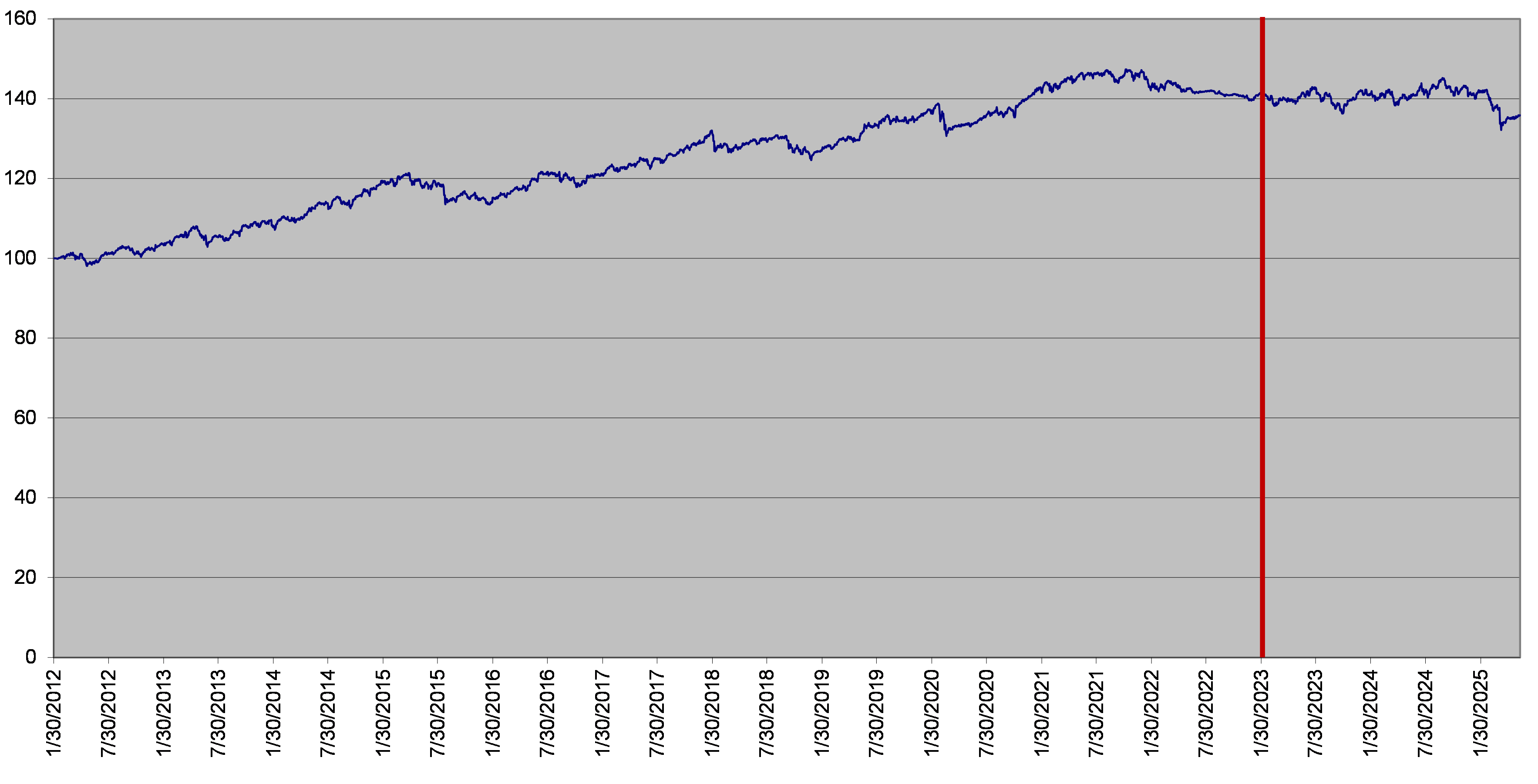
The inception date for the underlier was January 31, 2023. The information regarding the underlier prior to January 31, 2023 is a hypothetical retrospective simulation calculated by the underlying index publisher, using the same methodology as is currently employed for calculating the level of the underlier based on historical data. A retrospective simulation means that no actual investment which allowed a tracking of the performance of the underlier existed at any time during the period of the retrospective simulation. Therefore, information regarding the underlier prior to January 31, 2023 is hypothetical only and does not reflect actual historical performance. Investors should be aware that no actual investment which allowed a tracking of the performance of the underlier was possible at any time prior to January 31, 2023. Such data must be considered illustrative only.
The closing level of the underlier on June 9, 2025 was 135.86. The following graph sets forth the hypothetical retrospective and daily closing levels of the underlier for the period noted below. No assurance can be given as to the closing level of the underlier at any time.
|
Underlier Daily Closing Levels January 30, 2012* to June 9, 2025 |
|
|
|
*The red vertical line indicates January 31, 2023, which is the date on which the underlier was established. All information regarding the underlier prior to January 31, 2023 is a hypothetical retrospective simulation calculated by the underlying index publisher and must be considered illustrative only. |
Page 11
Morgan Stanley Finance LLC
|
Jump Notes with Auto-Callable Feature |
Hypothetical Underlier Returns
The following table shows the hypothetical returns on the underlier from January 30, 2012 to June 9, 2025. Because the publication of the underlier began on January 31, 2023, the returns on the underlier shown below are retrospectively simulated. No actual investment which allowed a tracking of the performance of the underlier was possible at any time prior to January 31, 2023. Because the Morgan Stanley US 2-Year T-Note Rolling Futures Index and certain Sub-Indices included in the Index Components existed for only a portion of the back-tested period, substitute data have been used for portions of the simulation.
|
Underlier Returns1 |
|||||||||||||||
|
January 30, 2012 – June 9, 2025 |
20122 |
2013 |
2014 |
2015 |
2016 |
2017 |
2018 |
2019 |
2020 |
2021 |
2022 |
2023 |
2024 |
20252 |
|
|
2.32% |
2.54% |
6.66% |
7.31% |
-2.09% |
4.70% |
7.29% |
-2.32% |
7.72% |
4.16% |
3.68% |
-4.74% |
1.64% |
-0.78% |
-3.57% |
|
|
Data based on simulated returns from January 30, 2012 to January 31, 2023 and actual returns thereafter. 1 All returns except year-to-date 2012 and 2025 returns are annualized. 2 Year-to-date 2012 and 2025 returns are not annualized. |
|||||||||||||||
Page 12
Morgan Stanley Finance LLC
|
Jump Notes with Auto-Callable Feature |
Additional Terms of the Notes
Please read this information in conjunction with the terms on the cover of this document.
|
Additional Terms: |
|
|
If the terms described herein are inconsistent with those described in the accompanying product supplement, index supplement or prospectus, the terms described herein shall control. |
|
|
Denominations: |
$1,000 per note and integral multiples thereof |
|
Some definitions: |
All references to an underlying index in the definitions of the following terms, as set forth under “Description of Notes—General Terms of Notes—Some Definitions” in the accompanying product supplement, shall be deemed to refer to a Sub-Index when read in conjunction with this document: •market disruption event •relevant exchange •All references to the securities constituting the underlying index in the sections of the accompanying product supplement called “Description of Notes—Postponement of Observation Date(s)” and “—Postponement of Payment Date(s) (Including the Maturity Date)” shall be deemed to refer to the Sub-Indices and the Morgan Stanley US 2-Year T-Note Rolling Futures Index, as applicable, when read in conjunction with this document. |
|
Discontinuance of the underlier: |
The following provision supersedes in its entirety “Description of Notes—Additional Terms of Notes Linked to an Underlying Index or a Basket Index—Discontinuance of Any Underlying Index; Alteration of Method of Calculation” in the accompanying product supplement: If the underlying index publisher discontinues publication of the underlier and such underlying index publisher or another entity publishes a successor or substitute index that MS & Co., as the calculation agent, determines, in its sole discretion, to be comparable to the discontinued underlier (such index being referred to herein as a “successor index”), then any subsequent closing level will be determined by reference to the published value of such successor index at the regular weekday close of trading on any trading day that the closing level is to be determined, and, to the extent the closing level of such successor index differs from the closing level of the underlier at the time of such substitution, a proportionate adjustment will be made by the calculation agent to the initial level. Upon any selection by the calculation agent of a successor index, the calculation agent will cause written notice thereof to be furnished to the trustee, to us and to The Depositary Trust Company, New York, New York (“DTC”), as holder of such notes, within three business days of such selection. We expect that such notice will be made available to you, as a beneficial owner of the relevant notes, in accordance with the standard rules and procedures of DTC and its direct and indirect participants. If the underlying index publisher discontinues publication of the underlier and the calculation agent determines, in its sole discretion, that no successor index is available, then, on the date of such determination, the calculation agent will determine, in good faith and in a commercially reasonable manner, an alternate payment amount, which will equal its estimate of the value, if any, of the investors’ forgone opportunity to receive any subsequent payment on the notes, determined by reference to the calculation agent’s pricing models, inputs, assumptions about future market conditions including, without limitation, the volatility of underlier and its components and current and expected interest rates. The alternate payment amount, if any, will be paid at maturity in addition to the stated principal amount of the notes. |
|
Amortization period: |
The 6-month period following the issue date |
|
Trustee: |
The Bank of New York Mellon |
|
Calculation agent: |
Morgan Stanley & Co. LLC (“MS & Co.”) |
Page 13
Morgan Stanley Finance LLC
|
Jump Notes with Auto-Callable Feature |
Additional Information About the Notes
|
Additional Information: |
|
|
Minimum ticketing size: |
$1,000 / 1 note |
|
United States federal income tax considerations: |
You should review carefully the section in the accompanying product supplement entitled “United States Federal Income Tax Considerations.” The following discussion, when read in combination with that section, constitutes the full opinion of our counsel, Davis Polk & Wardwell LLP, regarding the material U.S. federal income tax consequences of owning and disposing of the notes. Generally, this discussion assumes that you purchased the notes for cash in the original issuance at the stated issue price and does not address other circumstances specific to you, including consequences that may arise due to any other investments relating to an underlier. You should consult your tax adviser regarding the effect any such circumstances may have on the U.S. federal income tax consequences of your ownership of a note. The notes should be treated as debt instruments for U.S. federal income tax purposes. Based on current market conditions, we intend to treat the notes for U.S. federal income tax purposes as contingent payment debt instruments, or “CPDIs,” as described in “United States Federal Income Tax Considerations—Tax Consequences to U.S. Holders—Notes Treated as Contingent Payment Debt Instruments” in the accompanying product supplement. Under this treatment, regardless of your method of accounting for U.S. federal income tax purposes, you generally will be required to accrue interest income in each year on a constant yield to maturity basis at the “comparable yield,” as determined by us, adjusted upward or downward to reflect the difference, if any, between the actual and projected payments on the notes during the year. Upon a taxable disposition of a note, you generally will recognize taxable income or loss equal to the difference between the amount received and your tax basis in the notes. You generally must treat any income realized as interest income and any loss as ordinary loss to the extent of previous interest inclusions, and the balance as capital loss, the deductibility of which is subject to limitations. We have determined that the comparable yield for a note is a rate of 5.0938% per annum, compounded semi-annually. Based upon our determination of the comparable yield and assuming a semi-annual accrual period, the following table sets out the “projected payment schedule” per $1,000 principal amount of note, as well as the amount of taxable interest income (without taking into account any adjustment to reflect the difference, if any, between the actual and the projected amount of the contingent payment on a note) that will be deemed to have accrued with respect to a note during each calendar period. Projected Payment Date(s) Projected Payment(s) (per $1,000) Accrued OID During Calendar Period (per $1,000) Total Accrued OID (per $1,000) June 30, 2025 $0.0000 $2.5469 $2.5469 December 30, 2025 $0.0000 $25.5339 $28.0808 June 30, 2026 $0.0000 $26.1842 $54.2650 December 30, 2026 $0.0000 $26.8511 $81.1161 June 30, 2027 $0.0000 $27.5349 $108.6510 December 30, 2027 $0.0000 $28.2362 $136.8872 June 30, 2028 $0.0000 $28.9554 $165.8426 December 30, 2028 $0.0000 $29.6928 $195.5354 June 30, 2029 $0.0000 $30.4491 $225.9845 December 30, 2029 $0.0000 $31.2246 $257.2091 June 30, 2030 $0.0000 $32.0199 $289.2290 December 30, 2030 $0.0000 $32.8354 $322.0644 June 30, 2031 $0.0000 $33.6717 $355.7361 December 30, 2031 $0.0000 $34.5292 $390.2653 June 14, 2032 $1,422.5265 $32.2612 $422.5265 Neither the comparable yield nor the projected payment schedule constitutes a representation by us regarding the actual amount(s) that we will pay on the notes. Non-U.S. Holders. If you are a Non-U.S. Holder, please also read the section entitled “United States |
Page 14
Morgan Stanley Finance LLC
|
Jump Notes with Auto-Callable Feature |
|
Federal Income Tax Considerations—Tax Consequences to Non-U.S. Holders” in the accompanying product supplement. As discussed under “United States Federal Income Tax Considerations—Tax Consequences to Non-U.S. Holders—Dividend Equivalents under Section 871(m) of the Code” in the accompanying product supplement, Section 871(m) of the Internal Revenue Code and Treasury regulations promulgated thereunder (“Section 871(m)”) generally impose a 30% withholding tax on dividend equivalents paid or deemed paid to Non-U.S. Holders with respect to certain financial instruments linked to U.S. equities or indices that include U.S. equities. The Treasury regulations, as modified by an IRS notice, exempt financial instruments issued prior to January 1, 2027 that do not have a “delta” of one. Based on certain representations made by us, our counsel is of the opinion that Section 871(m) should not apply to the notes with respect to Non-U.S. Holders. Our determination is not binding on the IRS, and the IRS may disagree with this determination. We will not be required to pay any additional amounts with respect to U.S. federal withholding taxes. You should consult your tax adviser regarding the U.S. federal income tax consequences of an investment in the notes, as well as tax consequences arising under the laws of any state, local or non-U.S. taxing jurisdiction. |
|
|
Additional considerations: |
Client accounts over which Morgan Stanley, Morgan Stanley Wealth Management or any of their respective subsidiaries have investment discretion are not permitted to purchase the notes, either directly or indirectly. |
|
Supplemental information regarding plan of distribution; conflicts of interest: |
MS & Co. expects to sell all of the notes that it purchases from us to an unaffiliated dealer at a price of $997.50 per note, for further sale to certain fee-based advisory accounts at the price to public of $1,000 per note. MS & Co. will not receive a sales commission with respect to the notes. MS & Co. is an affiliate of MSFL and a wholly owned subsidiary of Morgan Stanley, and it and other affiliates of ours expect to make a profit by selling, structuring and, when applicable, hedging the notes. MS & Co. will conduct this offering in compliance with the requirements of FINRA Rule 5121 of the Financial Industry Regulatory Authority, Inc., which is commonly referred to as FINRA, regarding a FINRA member firm’s distribution of the securities of an affiliate and related conflicts of interest. MS & Co. or any of our other affiliates may not make sales in this offering to any discretionary account. See “Plan of Distribution (Conflicts of Interest)” and “Use of Proceeds and Hedging” in the accompanying product supplement. |
|
Validity of the notes: |
In the opinion of Davis Polk & Wardwell LLP, as special counsel to MSFL and Morgan Stanley, when the notes offered by this pricing supplement have been executed and issued by MSFL, authenticated by the trustee pursuant to the MSFL Senior Debt Indenture (as defined in the accompanying prospectus) and delivered against payment as contemplated herein, such notes will be valid and binding obligations of MSFL and the related guarantee will be a valid and binding obligation of Morgan Stanley, enforceable in accordance with their terms, subject to applicable bankruptcy, insolvency and similar laws affecting creditors’ rights generally, concepts of reasonableness and equitable principles of general applicability (including, without limitation, concepts of good faith, fair dealing and the lack of bad faith), provided that such counsel expresses no opinion as to (i) the effect of fraudulent conveyance, fraudulent transfer or similar provision of applicable law on the conclusions expressed above and (ii) any provision of the MSFL Senior Debt Indenture that purports to avoid the effect of fraudulent conveyance, fraudulent transfer or similar provision of applicable law by limiting the amount of Morgan Stanley’s obligation under the related guarantee. This opinion is given as of the date hereof and is limited to the laws of the State of New York, the General Corporation Law of the State of Delaware and the Delaware Limited Liability Company Act. In addition, this opinion is subject to customary assumptions about the trustee’s authorization, execution and delivery of the MSFL Senior Debt Indenture and its authentication of the notes and the validity, binding nature and enforceability of the MSFL Senior Debt Indenture with respect to the trustee, all as stated in the letter of such counsel dated February 26, 2024, which is Exhibit 5-a to Post-Effective Amendment No. 2 to the Registration Statement on Form S-3 filed by Morgan Stanley on February 26, 2024. |
|
Where you can find more information: |
Morgan Stanley and MSFL have filed a registration statement (including a prospectus, as supplemented by the product supplement and the index supplement) with the Securities and Exchange Commission (the “SEC”) for the offering to which this communication relates. You should read the prospectus in that registration statement, the product supplement, the index supplement and any other documents relating to this offering that MSFL and Morgan Stanley have filed with the SEC for more complete information about Morgan Stanley and this offering. When you read the accompanying index supplement, please note that all references in such supplement to the prospectus dated November 16, 2023, or to any sections therein, should refer instead to the accompanying prospectus dated April 12, 2024 or to the corresponding sections of such prospectus, as applicable. You may get these documents without cost by visiting EDGAR on the SEC website at www.sec.gov. Alternatively, MSFL, Morgan Stanley, any underwriter or any dealer participating in the |
Page 15
Morgan Stanley Finance LLC
|
Jump Notes with Auto-Callable Feature |
|
offering will arrange to send you the prospectus, the index supplement and the product supplement if you so request by calling toll-free 1-(800)-584-6837. Terms used but not defined in this document are defined in the product supplement, in the index supplement or in the prospectus. Each of the product supplement, the index supplement and the prospectus can be accessed via the hyperlinks set forth on the cover of this document. |
Page 16
ATTACHMENTS / EXHIBITS
Serious News for Serious Traders! Try StreetInsider.com Premium Free!
You May Also Be Interested In
- Morgan Stanley launches $1.5 trillion U.S. innovation initiative
- Janus Living prices stock offering at $29 per share
- Tyson Foods prices $1B senior notes offering due 2031 and 2037
Create E-mail Alert Related Categories
SEC FilingsRelated Entities
Morgan StanleySign up for StreetInsider Free!
Receive full access to all new and archived articles, unlimited portfolio tracking, e-mail alerts, custom newswires and RSS feeds - and more!
