




Form 424B2 CITIGROUP INC
 Tweet
 Share
 E-mail
The information in this preliminary pricing supplement is not complete and may be changed. This preliminary pricing supplement and the accompanying underlying supplement, prospectus supplement and prospectus are not an offer to sell these securities, nor are they soliciting an offer to buy these securities, in any state where the offer or sale is not permitted.
|
Subject to Completion. Dated October 27, 2026 Filed Pursuant to Rule 424(b)(2) Registration Statement Nos. 333-293732 and 333-293732-02 | ||
 |
Citigroup Global Markets Holdings Inc. $ | |
|
Bloomberg Agriculture Subindex-Linked Notes due All Payments Due from Citigroup Global Markets Holdings Inc. Fully and Unconditionally Guaranteed by Citigroup Inc. | ||
Unlike conventional debt securities, the notes offered by this pricing supplement do not pay interest. The amount that you will be paid on your notes on the maturity date (expected to be the second business day after the scheduled determination date) is based on the performance of the Bloomberg Agriculture Subindex (the “underlier”) as measured from the trade date to and including the determination date (expected to be between 12 and 14 months after the trade date). If the final underlier level on the determination date is greater than the initial underlier level (set on the trade date and may be higher or lower than the actual closing level of the underlier on the trade date), the return on your notes will be positive, subject to the maximum settlement amount (set on the trade date and expected to be between $1,319.20 and $1,374.50 for each $1,000 stated principal amount of your notes). However, if the final underlier level is equal to or less than the initial underlier level, for each $1,000 stated principal amount of your notes, you will receive the greater of (i) the minimum settlement amount of $950 and (ii) $1,000 plus the product of $1,000 times the underlier return. If the final underlier level is less than the initial underlier level, the return on your notes will be negative. You could lose up to 5% of your investment in the notes. In exchange for the repayment of at least the minimum settlement amount at maturity, you must be willing to forgo (i) any return in excess of the maximum return at maturity of 31.92% to 37.45% (set on the trade date and results from the maximum settlement amount), and (ii) interest on the notes.
To determine your payment at maturity, we will calculate the underlier return, which is the percentage increase or decrease in the level of the underlier from the initial underlier level (set on the trade date) to the final underlier level on the determination date. On the maturity date, for each $1,000 stated principal amount note you then hold, you will receive an amount in cash equal to:
| · | if the underlier return is positive (the final underlier level is greater than the initial underlier level), the sum of (i) $1,000 plus (ii) the product of (a) $1,000 times (b) the upside participation rate of 100% times (c) the underlier return, subject to the maximum settlement amount; or |
| · | if the underlier return is zero or negative (the final underlier level is equal to or less than the initial underlier level), the greater of (i) the minimum settlement amount and (ii) the sum of (a) $1,000 plus (b) the product of (1) $1,000 times (2) the underlier return. |
The notes are unsecured senior debt securities issued by Citigroup Global Markets Holdings Inc. and guaranteed by Citigroup Inc. All payments on the notes are subject to the credit risk of Citigroup Global Markets Holdings Inc. and Citigroup Inc. If Citigroup Global Markets Holdings Inc. and Citigroup Inc. default on their obligations, you may not receive any amount due under the notes. The notes will not be listed on any securities exchange and may have limited or no liquidity.
Investing in the notes involves risks not associated with an investment in conventional debt securities. See “Risk Factors” beginning on page PS-6.
| Issue Price(1) | Underwriting Discount(2) | Net Proceeds to Issuer | |
| Per Note: | $1,000.00 | $10.00 | $990.00 |
| Total: | $ | $ | $ |
(1) Citigroup Global Markets Holdings Inc. currently expects that the estimated value of the notes on the trade date will be between $964.50 and $984.50 per note, which will be less than the issue price. The estimated value of the notes is based on proprietary pricing models of Citigroup Global Markets Inc. (“CGMI”) and our internal funding rate. It is not an indication of actual profit to CGMI or other of our affiliates, nor is it an indication of the price, if any, at which CGMI or any other person may be willing to buy the notes from you at any time after issuance. See “Valuation of the Notes” in this pricing supplement.
(2) CGMI, an affiliate of the issuer, is the underwriter for the offering of the notes and is acting as principal. The total underwriting discount in the table above assumes that the underwriter receives an underwriting discount for each note sold in this offering. For more information on the distribution of the notes, see “Summary Information—Key Terms—Supplemental Plan of Distribution” in this pricing supplement. In addition to the underwriting discount, CGMI and its affiliates may profit from expected hedging activity related to this offering, even if the value of the notes declines. See “Use of Proceeds and Hedging” in the accompanying prospectus.
Neither the Securities and Exchange Commission nor any state securities commission has approved or disapproved of the notes or determined that this pricing supplement and the accompanying underlying supplement, prospectus supplement and prospectus are truthful or complete. Any representation to the contrary is a criminal offense.
The notes are not bank deposits and are not insured or guaranteed by the Federal Deposit Insurance Corporation or any other governmental agency, nor are they obligations of, or guaranteed by, a bank.
The notes are part of the Medium-Term Senior Notes, Series N of Citigroup Global Markets Holdings Inc. This pricing supplement is a supplement to the documents listed below and should be read together with such documents, which are available at the following hyperlinks:
| · | Underlying Supplement No. 13 dated February 25, 2026 |
| · | Prospectus Supplement and Prospectus each dated February 25, 2026 |
Citigroup Global Markets Inc.
Pricing Supplement No. 2026—USNCH34768 dated----------, 2026
The issue price, underwriting discount and net proceeds listed above relate to the notes we sell initially. We may decide to sell additional notes after the date of this pricing supplement, at issue prices and with underwriting discounts and net proceeds that differ from the amounts set forth above. The return on your investment in notes will depend in part on the issue price you pay for such notes.
CGMI may use this pricing supplement in the initial sale of the notes. In addition, CGMI or any other affiliate of Citigroup Inc. may use this pricing supplement in a market-making transaction in a note after its initial sale.
PS-1
SUMMARY INFORMATION
|
The terms of the notes are set forth in the accompanying prospectus supplement and prospectus, as supplemented by this pricing supplement. The accompanying underlying supplement, prospectus supplement and prospectus contain important disclosures that are not repeated in this pricing supplement. It is important that you read the accompanying underlying supplement, prospectus supplement and prospectus together with this pricing supplement before deciding whether to invest in the notes.
This section is meant as a summary and should be read in conjunction with the section titled “Additional Terms of the Notes” beginning on page PS-13 of this pricing supplement. |
Key Terms
Issuer: Citigroup Global Markets Holdings Inc., a wholly owned subsidiary of Citigroup Inc.
Guarantee: all payments due on the notes are fully and unconditionally guaranteed by Citigroup Inc.
Underlier: the Bloomberg Agriculture Subindex (ticker symbol: “BCOMAG”), as maintained by Bloomberg Index Services Limited (“BISL” or the “underlier sponsor,” and collectively with its affiliates, “Bloomberg”). See “The Underlier” on page PS-16 of this pricing supplement.
Stated principal amount: each note will have a stated principal amount of $1,000
Purchase at amount other than the stated principal amount: the amount we will pay you at the maturity date for your notes will not be adjusted based on the issue price you pay for your notes, so if you acquire notes at a premium (or discount) to the stated principal amount and hold them to the maturity date, it could affect your investment in a number of ways. The return on your investment in such notes will be lower (or higher) than it would have been had you purchased the notes at the stated principal amount. Additionally, the cap level would be triggered at a lower (or higher) percentage return than indicated below, relative to your initial investment. See “Risk Factors — If You Purchase Your Notes at a Premium to the Stated Principal Amount, the Return on Your Investment Will Be Lower Than the Return on Notes Purchased at the Stated Principal Amount and the Impact of Certain Key Terms of the Notes Will Be Negatively Affected” on page PS-12 of this pricing supplement.
Cash settlement amount (paid on the maturity date): on the maturity date, for each $1,000 stated principal amount of notes you then hold, we will pay you an amount in cash equal to:
| · | if the final underlier level is greater than or equal to the cap level, the maximum settlement amount; |
| · | if the final underlier level is greater than the initial underlier level but less than the cap level, the sum of (i) $1,000 plus (ii) the product of (a) $1,000 times (b) the upside participation rate times (c) the underlier return; or |
| · | if the final underlier level is equal to or less than the initial underlier level, the greater of (1) the minimum settlement amount and (2) the sum of (a) $1,000 plus (b) the product of (x) $1,000 times (y) the underlier return. |
Closing level: When we refer to the closing level of the underlier on any scheduled trading day, we mean the closing level of the underlier or any successor underlier reported by Bloomberg Financial Services, or any successor reporting service we may select, on such scheduled trading day.
Initial underlier level (to be set on the trade date, which may be an intraday level and which may be higher or lower than the actual closing level of the underlier on the trade date):
Final underlier level: the closing level of the underlier on the determination date, subject to adjustment as provided in “Additional Terms of the Notes— Consequences of a Market Disruption Event” and “— Discontinuation or Material Modification of the Underlier” on page PS-13 of this pricing supplement.
Underlier return: the quotient of (i) the final underlier level minus the initial underlier level divided by (ii) the initial underlier level, expressed as a percentage
Upside participation rate: 100.00%
Cap level (to be set on the trade date): expected to be between 131.92% and 137.45% of the initial underlier level
Maximum settlement amount (to be set on the trade date): expected to be between $1,319.20 and $1,374.50 per $1,000 stated principal amount note
Minimum settlement amount: $950
Trade date: , 2026
Original issue date (settlement date) (to be set on the trade date): expected to be the third scheduled business day following the trade date. See “Supplemental plan of distribution” below for additional information.
Determination date (to be set on the trade date): expected to be between 12 and 14 months after the trade date. If such day is not a trading day, the next succeeding trading day, but in no event later than the business day immediately preceding the maturity date.
PS-2
Maturity date (to be set on the trade date): expected to be the second business day after the scheduled determination date
No interest: the notes will not bear interest
No listing: the notes will not be listed on any securities exchange or interdealer quotation system
Business day: any day that is not a Saturday, a Sunday or a day on which the securities exchanges or banking institutions or trust companies in the City of New York are authorized or obligated by law or executive order to close.
Supplemental plan of distribution: Citigroup Global Markets Holdings Inc. expects to sell to CGMI, and CGMI expects to purchase from Citigroup Global Markets Holdings Inc., the aggregate stated principal amount of the offered notes specified on the front cover of this pricing supplement. CGMI proposes initially to offer the notes to the public at the issue price set forth on the cover page of this pricing supplement, and to certain unaffiliated securities dealers at such price less a concession not in excess of 1.00% of the stated principal amount. In addition to the underwriting discount, CGMI and its affiliates may profit from expected hedging activity related to this offering, even if the value of the notes declines. See “Use of Proceeds and Hedging” in the accompanying prospectus.
CGMI is an affiliate of ours. Accordingly, this offering will conform with the requirements addressing conflicts of interest when distributing the securities of an affiliate set forth in Rule 5121 of the Financial Industry Regulatory Authority. Client accounts over which Citigroup Inc. or its subsidiaries have investment discretion will not be permitted to purchase the notes, either directly or indirectly, without the prior written consent of the client.
Secondary market sales of securities typically settle one business day after the date on which the parties agree to the sale. Because the settlement date for the notes is more than one business day after the trade date, investors who wish to sell the notes at any time prior to the business day preceding the original issue date will be required to specify an alternative settlement date for the secondary market sale to prevent a failed settlement. Investors should consult their own investment advisors in this regard.
See “Plan of Distribution” in each of the accompanying prospectus supplement and prospectus for additional information.
A portion of the net proceeds from the sale of the notes will be used to hedge our obligations under the notes. We expect to hedge our obligations under the notes through CGMI or other of our affiliates, or through a dealer participating in this offering or its affiliates. CGMI or such other of our affiliates or such dealer or its affiliates may profit from this expected hedging activity even if the value of the notes declines. This hedging activity could affect the closing level of the underlier and, therefore, the value of and your return on the notes. For additional information on the ways in which our counterparties may hedge our obligations under the notes, see “Use of Proceeds and Hedging” in the accompanying prospectus.
ERISA: as described under “Benefit Plan Investor Considerations” beginning on page PS-19 of this pricing supplement
Calculation Agent: CGMI
CUSIP: 17334DZW5
ISIN: US17334DZW54
PS-3
HYPOTHETICAL EXAMPLES
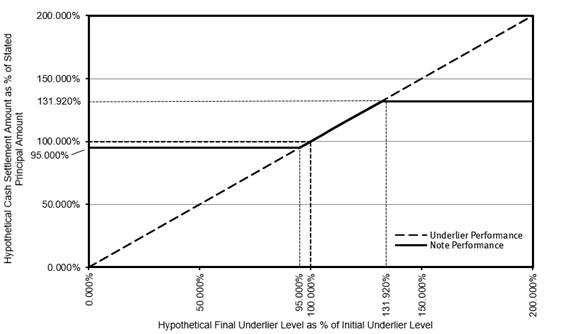
The table and chart below are provided for purposes of illustration only. They should not be taken as an indication or prediction of future investment results and are intended merely to illustrate the impact that various hypothetical underlier levels on the determination date could have on the cash settlement amount at maturity.
The table and chart below are based on a range of final underlier levels that are entirely hypothetical; no one can predict what the underlier level will be on any day throughout the life of your notes, and no one can predict what the final underlier level will be on the determination date. The underlier has been highly volatile in the past — meaning that the underlier level has changed considerably in relatively short periods — and its performance cannot be predicted for any future period.
The information in the table and chart below reflects hypothetical returns on the notes assuming that they are purchased on the original issue date at the stated principal amount and held to the maturity date. If you sell your notes in a secondary market prior to the maturity date, your return will depend upon the value of your notes at the time of sale, which may be affected by a number of factors that are not reflected in the table or chart below such as interest rates, the volatility of the underlier and our and Citigroup Inc.’s creditworthiness. Please read “Risk Factors—The Value of the Notes Prior to Maturity Will Fluctuate Based on Many Unpredictable Factors” in this pricing supplement. It is likely that any secondary market price for the notes will be less than the issue price.
The information in the table and chart also reflects the key terms and assumptions in the box below.
| Key Terms and Assumptions | |
| Stated principal amount | $1,000 |
| Cap level | 131.92% of the initial underlier level |
| Maximum settlement amount | $1,319.20 per $1,000 stated principal amount note |
|
Neither a market disruption event nor a non-scheduled trading day occurs on the originally scheduled determination date
No change in or affecting underlying contracts comprising the underlier or the method by which the underlier sponsor calculates the underlier
Notes purchased on original issue date at the stated principal amount and held to the maturity date | |
Moreover, we have not yet set the initial underlier level that will serve as the baseline for determining the underlier return and the amount that we will pay on your notes at maturity. We will not do so until the trade date. As a result, the actual initial underlier level may differ substantially from the underlier level prior to the trade date and may be higher or lower than the closing level of the underlier on the trade date.
For these reasons, the actual performance of the underlier over the life of your notes, as well as the amount payable at maturity may bear little relation to the hypothetical examples shown below or to the historical underlier levels shown elsewhere in this pricing supplement. For information about the historical levels of the underlier during recent periods, see “The Underlier — Historical Closing Levels of the Underlier” below. Before investing in the offered notes, you should consult publicly available information to determine the levels of the underlier between the date of this pricing supplement and the date of your purchase of the offered notes.
The levels in the left column of the table below represent hypothetical final underlier levels and are expressed as percentages of the initial underlier level. The amounts in the right column represent the hypothetical cash settlement amounts, based on the corresponding hypothetical final underlier level (expressed as a percentage of the initial underlier level), and are expressed as percentages of the stated principal amount of a note (rounded to the nearest one-thousandth of a percent). Thus, a hypothetical cash settlement amount of 100.000% means that the value of the cash payment that we would deliver for each $1,000 of the outstanding stated principal amount of the notes on the maturity date would equal 100.000% of the stated principal amount of a note, based on the corresponding hypothetical final underlier level (expressed as a percentage of the initial underlier level) and the assumptions noted above.
| Hypothetical Final Underlier Level (as Percentage of Initial Underlier Level) | Hypothetical Cash Settlement Amount (as Percentage of Stated Principal Amount) |
| 200.000% | 131.920% |
| 175.000% | 131.920% |
| 150.000% | 131.920% |
| 131.920% | 131.920% |
| 125.000% | 125.000% |
| 115.000% | 115.000% |
| 100.000% | 100.000% |
| 99.000% | 99.000% |
| 97.000% | 97.000% |
| 95.000% | 95.000% |
| 75.000% | 95.000% |
| 50.000% | 95.000% |
PS-4
| 25.000% | 95.000% |
| 0.000% | 95.000% |
If, for example, the final underlier level were determined to be 25.000% of the initial underlier level, the cash settlement amount that we would deliver on your notes at maturity would be 95.000% of the stated principal amount of your notes, as shown in the table above. In addition, if the final underlier level were determined to be 150.000% of the initial underlier level, the cash settlement amount that we would deliver on your notes at maturity would be capped at the maximum settlement amount (expressed as a percentage of the stated principal amount), or 131.920% of each $1,000 stated principal amount of your notes, as shown in the table above. As a result, you would not benefit from any increase in the final underlier level over 131.920% of the initial underlier level.
The following chart also shows a graphical illustration of the hypothetical cash settlement amounts that we would pay on your notes on the maturity date, if the final underlier level (expressed as a percentage of the initial underlier level) were any of the hypothetical levels shown on the horizontal axis. The chart shows that any hypothetical final underlier level (expressed as a percentage of the initial underlier level) of greater than or equal to 131.920% (the section right of the 131.920% marker on the horizontal axis) would result in a capped return on your investment.
The cash settlement amounts shown above are entirely hypothetical; they are based on levels of the underlier that may not be achieved on the determination date. The actual cash settlement amount you receive on the maturity date may bear little relation to the hypothetical cash settlement amounts shown above, and these amounts should not be viewed as an indication of the financial return on an investment in the notes. The actual market value of your notes on the maturity date or at any other time, including any time you may wish to sell your notes, may bear little relation to the hypothetical cash settlement amounts shown above, and these amounts should not be viewed as an indication of the financial return on an investment in the offered notes. The hypothetical cash settlement amounts on notes held to the maturity date in the examples above assume you purchased your notes at their stated principal amount and have not been adjusted to reflect the actual issue price you pay for your notes. The return on your investment in your notes will be affected by the amount you pay for your notes. If you purchase your notes for a price other than the stated principal amount, the return on your investment will differ from, and may be significantly lower than, the hypothetical returns suggested by the above examples. Please read “Risk Factors — The Value of the Notes Prior to Maturity Will Fluctuate Based on Many Unpredictable Factors” on page PS-8 of this pricing supplement.
| We cannot predict the actual final underlier level or what the value of your notes will be on any particular day, nor can we predict the relationship between the underlier level and the value of your notes at any time prior to the maturity date. The actual amount that you will receive at maturity and the return on the notes will depend on the actual initial underlier level, the cap level and the maximum settlement amount, which we will set on the trade date, and the actual final underlier level determined by the calculation agent as described above. Moreover, the assumptions on which the hypothetical returns are based may turn out to be inaccurate. Consequently, the amount of cash to be paid in respect of your notes on the maturity date may be very different from the information reflected in the table and chart above. |
PS-5
RISK FACTORS
|
An investment in the notes is significantly riskier than an investment in conventional debt securities. The notes are subject to all of the risks associated with an investment in our conventional debt securities (guaranteed by Citigroup Inc.), including the risk that we and Citigroup Inc. may default on our obligations under the notes, and are also subject to risks associated with the underlier. Accordingly, the notes are suitable only for investors who are capable of understanding the complexities and risks of the notes. You should consult your own financial, tax and legal advisors as to the risks of an investment in the notes and the suitability of the notes in light of your particular circumstances.
The following is a description of certain key risk factors for investors in the notes. You should also carefully read the risk factors included in the accompanying prospectus supplement and in the documents incorporated by reference in the accompanying prospectus, including Citigroup Inc.’s most recent Annual Report on Form 10-K and any subsequent Quarterly Reports on Form 10-Q, which describe risks relating to the business of Citigroup Inc. more generally. |
You May Not Receive Any Positive Return On Your Investment in the Notes and You May Lose Up to 5% of Your Investment
You will receive a positive return on your investment in the notes only if the underlier appreciates from the initial underlier level to the final underlier level. If the final underlier level is equal to or less than the initial underlier level, you will receive the greater of (i) the minimum settlement amount of $950 and (ii) $1,000 plus the product of $1,000 times the underlier return for each note you hold at maturity, and you could lose up to 5% of your investment in the notes. As the notes do not pay any interest, even if the underlier appreciates from the initial underlier level to the final underlier level, there is no assurance that your total return at maturity on the notes will be as great as could have been achieved on conventional debt securities of ours of comparable maturity.
The Initial Underlier Level Will Be Determined at the Discretion of CGMI, as the Calculation Agent
The initial underlier level may be an intraday level of the underlier on the trade date, as determined by the calculation agent in its sole discretion, and may not be based on the closing level of the underlier on such trade date. The initial underlier level may be higher or lower than the actual closing level of the underlier on the trade date. Although the calculation agent will determine the initial underlier level in good faith, the discretion exercised by the calculation agent in determining the initial underlier level could have an impact (positive or negative) on the value of your notes. The calculation agent is under no obligation to consider your interests as a holder of the notes in taking any actions that might affect the value of your notes, including the determination of the initial underlier level.
The Notes Do Not Pay Interest
Unlike conventional debt securities, the notes do not pay interest or any other amounts prior to maturity. You should not invest in the notes if you seek current income during the term of the notes.
Your Potential Return On the Notes Is Limited
Your potential total return on the notes at maturity is limited by the maximum settlement amount. Any increase in the final underlier level over the cap level will not increase your return on the notes and will progressively reduce the effective degree of your participation in the appreciation of the underlier.
The Determination Date of the Notes Is a Pricing Term and Will Be Determined by the Issuer on the Trade Date
We will not determine the determination date until the trade date, so you will not know the exact term of, or the maturity date for, the notes at the time that you make your investment decision. The term of the notes could be as short as the shorter end of the determination date range described on page PS-2, and as long as the longer end of the determination date range. You should be willing to hold your notes until the latest possible maturity date contemplated by the determination date range. The determination date selected by us could have an impact on the value of the notes. Assuming no changes in other economic terms of the notes, the value of the notes would likely be lower if the term of the notes is at the longer end of the determination date range, rather than the shorter end of the determination date range.
Your Cash Settlement Amount at Maturity Depends on the Closing Level of the Underlier on a Single Day
Because your cash settlement amount at maturity depends on the closing level of the underlier solely on the determination date, you are subject to the risk that the closing level of the underlier on that day may be lower, and possibly significantly lower, than on one or more other dates during the term of the notes. If you had invested in another instrument linked to the underlier that you could sell for full value at a time selected by you, or if the cash settlement amount at maturity were based on an average of closing levels of the underlier, you might have achieved better returns.
The Notes Are Subject to the Credit Risk of Citigroup Global Markets Holdings Inc. and Citigroup Inc.
PS-6
If we default on our obligations under the notes and Citigroup Inc. defaults on its guarantee obligations, you may not receive anything owed to you under the notes.
The Notes Will Not Be Listed on Any Securities Exchange and You May Not Be Able to Sell Them Prior to Maturity
The notes will not be listed on any securities exchange. Therefore, there may be little or no secondary market for the notes. CGMI currently intends to make a secondary market in relation to the notes and to provide an indicative bid price for the notes on a daily basis. Any indicative bid price for the notes provided by CGMI will be determined in CGMI’s sole discretion, taking into account prevailing market conditions and other relevant factors, and will not be a representation by CGMI that the notes can be sold at that price, or at all. CGMI may suspend or terminate making a market and providing indicative bid prices without notice, at any time and for any reason. If CGMI suspends or terminates making a market, there may be no secondary market at all for the notes because it is likely that CGMI will be the only broker-dealer that is willing to buy your notes prior to maturity. Accordingly, an investor must be prepared to hold the notes until maturity.
Sale of the Notes Prior to Maturity May Result in a Loss of Principal
You will be entitled to receive at least the minimum settlement amount, subject to the credit risk of Citigroup Global Markets Holdings Inc. and Citigroup Inc., only if you hold the notes to maturity or the notes are redeemed following a commodity hedging disruption event. The value of the notes may fluctuate during the term of the notes, and if you are able to sell your notes prior to maturity, you may receive less than the minimum settlement amount.
The Estimated Value of the Notes on the Trade Date, Based on CGMI’s Proprietary Pricing Models and Our Internal Funding Rate, Will Be Less than the Issue Price
The difference is attributable to certain costs associated with selling, structuring and hedging the notes that are included in the issue price. These costs include (i) any selling concessions or other fees paid in connection with the offering of the notes, (ii) hedging and other costs incurred by us and our affiliates in connection with the offering of the notes and (iii) the expected profit (which may be more or less than actual profit) to CGMI or other of our affiliates in connection with hedging our obligations under the notes. These costs also include a fee paid to iCapital Markets LLC, an electronic platform in which an affiliate of Goldman Sachs & Co. LLC, who is acting as a dealer in connection with the distribution of the notes, holds an indirect minority equity interest, for services it is providing in connection with this offering. These costs adversely affect the economic terms of the notes because, if they were lower, the economic terms of the notes would be more favorable to you. The economic terms of the notes are also likely to be adversely affected by the use of our internal funding rate, rather than our secondary market rate, to price the notes. See “The Estimated Value of the Notes Would Be Lower if It Were Calculated Based on Our Secondary Market Rate” below.
The Estimated Value of the Notes Was Determined for Us by Our Affiliate Using Proprietary Pricing Models
CGMI derived the estimated value disclosed on the cover page of this pricing supplement from its proprietary pricing models. In doing so, it may have made discretionary judgments about the inputs to its models, such as the volatility of the underlier and interest rates. CGMI’s views on these inputs may differ from your or others’ views, and as an underwriter in this offering, CGMI’s interests may conflict with yours. Both the models and the inputs to the models may prove to be wrong and therefore not an accurate reflection of the value of the notes. Moreover, the estimated value of the notes set forth on the cover page of this pricing supplement may differ from the value that we or our affiliates may determine for the notes for other purposes, including for accounting purposes. You should not invest in the notes because of the estimated value of the notes. Instead, you should be willing to hold the notes to maturity irrespective of the initial estimated value.
The Estimated Value of the Notes Would Be Lower if It Were Calculated Based on Our Secondary Market Rate
The estimated value of the notes included in this pricing supplement is calculated based on our internal funding rate, which is the rate at which we are willing to borrow funds through the issuance of the notes. Our internal funding rate is generally lower than our secondary market rate, which is the rate that CGMI will use in determining the value of the notes for purposes of any purchases of the notes from you in the secondary market. If the estimated value included in this pricing supplement were based on our secondary market rate, rather than our internal funding rate, it would likely be lower. We determine our internal funding rate based on factors such as the costs associated with the notes, which are generally higher than the costs associated with conventional debt securities, and our liquidity needs and preferences. Our internal funding rate is not an interest rate that we will pay to investors in the notes, which do not bear interest.
Because there is not an active market for traded instruments referencing our outstanding debt obligations, CGMI determines our secondary market rate based on the market price of traded instruments referencing the debt obligations of Citigroup Inc., our parent company and the guarantor of all payments due on the notes, but subject to adjustments that CGMI makes in its sole discretion. As a result, our secondary market rate is not a market-determined measure of our creditworthiness, but rather reflects the market’s perception of our parent company’s creditworthiness as adjusted for discretionary factors such as CGMI’s preferences with respect to purchasing the notes prior to maturity.
PS-7
The Estimated Value of the Notes Is Not an Indication of the Price, if Any, at Which CGMI or Any Other Person May Be Willing to Buy the Notes From You in the Secondary Market
Any such secondary market price will fluctuate over the term of the notes based on the market and other factors described in the next risk factor. Moreover, unlike the estimated value included in this pricing supplement, any value of the notes determined for purposes of a secondary market transaction will be based on our secondary market rate, which will likely result in a lower value for the notes than if our internal funding rate were used. In addition, any secondary market price for the notes will be reduced by a bid-ask spread, which may vary depending on the aggregate stated principal amount of the notes to be purchased in the secondary market transaction, and the expected cost of unwinding related hedging transactions. As a result, it is likely that any secondary market price for the notes will be less than the issue price.
The Value of the Notes Prior to Maturity Will Fluctuate Based on Many Unpredictable Factors
The value of your notes prior to maturity will fluctuate based on the level and volatility of the underlier and a number of other factors, including the price and volatility of the underlying contracts comprising the underlier, interest rates generally, the time remaining to maturity and our and Citigroup Inc.’s creditworthiness, as reflected in our secondary market rate. Changes in the level of the underlier may not result in a comparable change in the value of your notes. You should understand that the value of your notes at any time prior to maturity may be significantly less than the issue price.
If the Level of the Underlier Changes, the Market Value of Your Notes May Not Change in the Same Manner
Your notes may trade quite differently from the performance of the underlier. Changes in the level of the underlier may not result in a comparable change in the market value of your notes. We discuss some of the reasons for this disparity under “— The Value of the Notes Prior to Maturity Will Fluctuate Based on Many Unpredictable Factors” above.
Immediately Following Issuance, Any Secondary Market Bid Price Provided by CGMI, and the Value That Will Be Indicated on Any Brokerage Account Statements Prepared by CGMI or Its Affiliates, Will Reflect a Temporary Upward Adjustment
The amount of this temporary upward adjustment will steadily decline to zero over the temporary adjustment period. See “Valuation of the Notes” in this pricing supplement.
The Notes May Be Adversely Affected By “Negative Roll Yields” In “Contango” Markets
The underlier tracks the value of a hypothetical position in a basket of exchange-traded futures contracts on agricultural commodities, where the position is notionally “rolled” periodically out of certain of the futures contracts as the expiration dates of such futures contracts approach and into other futures contracts on the same physical commodities but with later expiration dates. Unlike stocks, which typically entitle the holder to a continuing stake in a corporation, commodity futures contracts specify a certain future date for the physical delivery of such commodity. In order to avoid physical delivery and maintain continuing exposure to the basket of futures contracts on agricultural commodities, the underlier unwinds its hypothetical positions in the component futures contracts before any expiration date thereof and replaces any such futures contract with a hypothetical position in another futures contract on the same physical commodity with a later expiration date. For example, a hypothetical commodity futures contract entered into in January may specify a May expiration. In February, the hypothetical commodity futures contract expiring in May may be replaced with a futures contract on the same commodity expiring in July. We refer to this process as “rolling” exposure to an expiring futures contract into another futures contract with a later expiration date. Through this rolling process, the underlier is able to reflect continuing exposure to the basket of futures contracts on agricultural commodities.
The “rolling” feature of the underlier creates the potential for a significant negative effect on the level of the underlier—which we refer to as a “negative roll yield”—that is independent of the performance of the spot price of the underlying physical commodities. The “spot price” of a physical commodity is the price of the commodity for immediate delivery, as opposed to a futures price, which represents the price for delivery on a specified date in the future. The underlier would be expected to experience a negative roll yield if the prices of the underlying contracts comprising the underlier tend to be greater than the spot prices for the underlying physical commodities. A market where futures prices are greater than the spot prices is referred to as a “contango” market. Commodity futures prices may be greater than spot prices for a variety of reasons, including costs of storing physical commodities until the delivery date, financing costs, and market expectations that future spot prices of the commodity may be higher than current spot prices. As any commodity futures contract approaches expiration, its value will approach the spot price of the underlying physical commodity, because by expiration it will effectively represent a contract to buy or sell the physical commodity for immediate (or “spot”) delivery. Therefore, if the market for any commodity futures contract is in contango, then the value of the futures contract would tend to decline over time (assuming the spot price for the underlying physical commodity remains unchanged), because the higher futures price would fall as it converges to the lower spot price by expiration. If the market for a commodity futures contract is in contango and the spot price for the underlying physical commodity remains constant, the underlier would enter into a hypothetical position in the futures contract at the higher contango futures price and then unwind that position closer to the lower spot price, and then enter into a hypothetical position in a new futures contract at the higher contango futures price and unwind that
PS-8
position closer to the lower spot price, and so on over the term of the notes, all the while accumulating losses from the erosion in value that results as the higher contango price declines toward the lower spot price.
Prospective investors in the notes should understand that many of the underlying contracts comprising the underlier have historically been in contango markets. Therefore, negative roll yields are likely to adversely affect the level of the underlier and the return you receive on the notes. Any negative roll yield with respect to a commodity futures contract will offset any gains in the spot price of the underlying physical commodity that may occur over the term of the notes, exacerbate any decline and cause a steady erosion in value if the spot price of the commodity remains relatively constant.
If a Commodity Hedging Disruption Event Occurs During the Term of the Notes, We May Redeem the Notes Early for an Amount That May Be Less Than the Principal Amount of Your Investment, Subject to the Minimum Settlement Amount
See “Additional Terms of the Notes—Commodity Hedging Disruption Event” in this pricing supplement for information about the events that may constitute a commodity hedging disruption event. If a commodity hedging disruption event occurs, we may redeem the notes prior to the maturity date for an amount equal to the early redemption amount determined as of the early redemption notice date , subject to the minimum settlement amount. The early redemption amount will be determined in a manner based upon (but not necessarily identical to) CGMI’s then contemporaneous practices for determining secondary market bid prices for the notes and similar instruments, subject to the exceptions and more detailed provisions set forth under “Additional Terms of the Notes—Commodity Hedging Disruption Event” below. As discussed above, any secondary market bid price is likely to be less than the issue price and, absent favorable changes in market conditions and other relevant factors, is also likely to be less than the estimated value of the notes set forth on the cover page of this pricing supplement. Accordingly, if a commodity hedging disruption event occurs, there is a significant likelihood that the early redemption amount you receive will result in a loss on your investment in the notes, subject to the minimum settlement amount. Moreover, in determining the early redemption amount, the calculation agent will take into account the relevant event that has occurred, which may have a significant adverse effect on commodity markets generally, resulting in an early redemption payment amount that may be equal to the minimum settlement amount.
The early redemption amount may be significantly less than the amount you would have received had we not elected to redeem the notes and had you been able instead to hold them to maturity. For example, the early redemption amount may be determined during a market disruption that has a significant adverse effect on the early redemption amount. That market disruption may be resolved by the time of the originally scheduled maturity date and, had your payment on the notes been determined on the scheduled determination date rather than on the early redemption notice date, you might have achieved a significantly better return.
Prices Of Commodity Futures Contracts Are Characterized by High and Unpredictable Volatility, Which Could Lead to High and Unpredictable Volatility in the Underlier
Market prices of the underlying contracts included in the underlier tend to be highly volatile and may fluctuate rapidly based on numerous factors, including the factors that affect the price of any commodity underlying the futures contracts included in the underlier. The prices of commodities and commodity futures contracts are subject to variables that may be less significant to the values of traditional securities, such as stocks and bonds. These variables may create additional investment risks that cause the value of the notes to be more volatile than the values of traditional securities.
As a general matter, the risk of low liquidity or volatile pricing around the maturity date of a commodity futures contract is greater than in the case of other futures contracts because (among other factors) a number of market participants take physical delivery of the underlying commodities. Many commodities are also highly cyclical. The high volatility and cyclical nature of commodity markets may render such an investment inappropriate as the focus of an investment portfolio.
Holders of the Notes Will Not Benefit from Regulatory Protections of the Commodity Futures Trading Commission
The notes are our direct obligations. The net proceeds to be received by us from the sale of the notes will not be used to purchase or sell commodity futures contracts or options contracts on commodity futures for the benefit of the holders of notes. An investment in the notes does not constitute an investment in commodity futures or options contracts on commodity futures, and holders of the notes will not benefit from the regulatory protections of the Commodity Futures Trading Commission (the “CFTC”) afforded to persons who trade in such contracts.
Legal and Regulatory Changes Could Adversely Affect the Return on and Value of the Notes
Futures contracts and options on futures contracts, including the underlying contracts comprising the underlier, are subject to extensive statutes, regulations and margin requirements. The CFTC and the exchanges on which such futures contracts trade are authorized to take extraordinary actions in the event of a market emergency, including, for example, the retroactive implementation of speculative position limits or higher margin requirements, the establishment of daily limits and the suspension of trading. Furthermore, some of the exchanges on which such
PS-9
commodity futures contracts trade have regulations designed to limit the amount of fluctuations in futures contract prices. These limits could adversely affect the market prices of the underlying contracts comprising the underlier.
In addition, the regulation of commodity transactions in the U.S. is subject to ongoing modification by government and judicial action. The effect on the value of the notes of any future regulatory change is impossible to predict, but could be substantial and adverse to the interests of holders of the notes. In October 2020, the CFTC adopted rules to establish revised or new limits on the size of the positions any person may hold in 25 agricultural, metals and energy futures contracts and futures, options and swaps that are economically equivalent to those futures contracts. The limits apply to a person’s combined position in the specified 25 futures contracts and options on futures (“core referenced futures contracts”), futures and options on futures directly or indirectly linked to the core referenced futures contracts, and economically equivalent swaps. These rules came into effect on January 1, 2022 for covered futures and options on futures contracts and on January 1, 2023 for covered swaps. The rules may reduce liquidity in the exchange-traded market for commodity futures, which may, in turn, have an adverse effect on your cash settlement amount at maturity. Market participants may decide, or be required, to sell their positions in certain commodity futures as a result of these rules. While the effects of these or other regulatory developments are difficult to predict, if broad market selling were to occur, it would likely lead to declines, possibly significant declines, in the price of commodity futures and therefore, the level of the underlier and the value of the notes.
Changes in Exchange Methodology May Affect the Value of Your Notes
The level of the underlier depends on the settlement price of the underlying contracts as determined by the primary exchange on which they trade. Any such exchange may from time to time change any rule or bylaw or take emergency action under its rules, any of which could adversely affect the settlement price of the underlying contracts and, in turn, your investment in the notes.
Investing in the Notes Is Not Equivalent to Investing in Commodity Futures
The return on the notes will not reflect the return you would realize if you actually owned the underlying contracts comprising the underlier. You will not have any entitlement to any commodity futures or any physical commodity by virtue of your investment in the notes.
Distortions or Disruptions of Market Trading in Commodity Futures Could Adversely Affect the Value of and Return on the Notes
The commodity markets are subject to temporary distortions or other disruptions due to various factors, including the lack of liquidity in the markets, the participation of speculators and government regulation and intervention. These circumstances could adversely affect the settlement price of the underlying contracts and, therefore, the level of the underlier and the value of and return on the notes. In addition, if a market disruption event occurs on the determination date, the calculation agent will determine a substitute closing level of the underlier with respect to the determination date, as described under “Additional Terms of the Notes” in this pricing supplement. The calculation agent’s determination of the level of the underlier in this circumstance may result in an unfavorable return on the notes.
The Notes Do Not Offer Direct Exposure to the Spot Prices of Physical Commodities
The notes are linked to the underlier, which tracks agricultural exchange-traded commodity futures contracts, not any physical commodity (or its spot price). The price of a commodity futures contract reflects the expected value of the physical commodity upon delivery in the future, whereas the spot price of a physical commodity reflects the immediate delivery value of the commodity. A variety of factors can lead to a disparity between the expected future price of a commodity and the spot price at a given point in time, such as the cost of storing the commodity for the term of the futures contract, interest charges incurred to finance the purchase of the commodity and expectations concerning supply and demand for the commodity. The price movements of a futures contract are typically correlated with the movements of the spot price of the referenced commodity, but the correlation is generally imperfect and price movements in the spot market may not be reflected in the futures market (and vice versa). Accordingly, the notes may underperform a similar investment that is linked to the spot prices of the physical commodities included in the underlier.
The Notes are Linked to an Excess Return Index and Not a Total Return Index
The notes are linked to an excess return index and not a total return index. An excess return index, such as the underlier, reflects the returns that are potentially available through an unleveraged investment in the contracts composing that index. By contrast, a “total return” index, in addition to reflecting those returns, also reflects interest that could be earned on funds committed to the trading of the underlying futures contracts.
Our Offering of the Notes Does Not Constitute a Recommendation of the Underlier
The fact that we are offering the notes does not mean that we believe that investing in an instrument linked to the underlier is likely to achieve favorable returns. In fact, as we are part of a global financial institution, our affiliates may have positions (including short positions) in the underlying contracts or in instruments related to the underlier, and may publish research or express opinions, that in each case are inconsistent with an investment linked to the
PS-10
underlier. These and other activities of our affiliates may affect the level of the underlier in a way that has a negative impact on your interests as a holder of the notes.
The Level of the Underlier May Be Adversely Affected by Our or Our Affiliates’ Hedging and Other Trading Activities
We expect to hedge our obligations under the notes through CGMI or other of our affiliates, or through a dealer participating in this offering or its affiliates, who may take positions directly in the underlying contracts and other financial instruments related to the underlier and may adjust such positions during the term of the notes. Our affiliates also trade the underlying contracts and other financial instruments related to the underlier on a regular basis (taking long or short positions or both), for their accounts, for other accounts under their management or to facilitate transactions on behalf of customers. Any dealer participating in the offering of the notes or its affiliates may engage in similar activities. These activities could affect the level of the underlier in a way that negatively affects the value of the notes. They could also result in substantial returns for us or our affiliates or any dealer or its affiliates while the value of the notes declines. If the dealer from which you purchase notes is to conduct hedging activities for us in connection with the notes, that dealer may profit in connection with such hedging activities and such profit, if any, will be in addition to the compensation that the dealer receives for the sale of the notes to you. You should be aware that the potential to earn fees in connection with hedging activities may create a further incentive for the dealer to sell the notes to you in addition to the compensation they would receive for the sale of the notes.
The Underlier Is Subject to Concentration Risks Associated with the Agricultural Sector
The underlier is composed solely of futures contracts on agricultural commodities. As a result, the value of the notes may be subject to greater volatility and be more adversely affected by a single economic, political or regulatory occurrence affecting this sector than a different investment linked to a more broadly diversified group of commodities. The prices of agricultural commodities may be affected by factors that are specific to agricultural markets, including weather conditions, drought, flooding and other natural disasters; crop yields and the timing of planting and harvesting; plant disease and pestilence; changes in agricultural production and inventory levels; government agricultural programs and policies, including subsidies, biofuel mandates and import or export restrictions; trade policies, tariffs and trade disputes; and changes in global demand for food, animal feed and biofuels. These or other factors or the absence of such factors could cause a downturn in the agricultural sector generally or regionally and could cause the value of the underlier to decline during the term of the notes.
The Calculation Agent, Which Is an Affiliate of Ours, Will Make Important Determinations With Respect to the Notes
CGMI, the calculation agent for the notes, is an affiliate of ours and will determine the closing level of the underlier on the determination date and any amount owed to you on the notes. In addition, in certain circumstances CGMI may be required to exercise judgments in its capacity as calculation agent. Such judgments could include, among other things:
| · | determining whether a market disruption event has occurred; |
| · | if a market disruption event occurs on the determination date, determining a substitute closing level of the underlier with respect to the determination date; |
| · | determining whether a commodity hedging disruption event has occurred; |
| · | if a commodity hedging disruption event has occurred and we exercise our right to redeem the notes, determining the amount due and payable on the notes; and |
| · | selecting a successor underlier or performing an alternative calculation of the level of the underlier if the underlier is discontinued or materially modified (see “Additional Terms of the Notes—Discontinuation or Material Modification of the Underlier” in this pricing supplement). |
In making these judgments, the calculation agent’s interests as an affiliate of ours could be adverse to your interests as a holder of the notes.
We May Sell an Additional Aggregate Stated Principal Amount of the Notes at a Different Issue Price
At our sole option, we may decide to sell an additional aggregate stated principal amount of the notes subsequent to the date of this pricing supplement. The issue price of the notes in the subsequent sale may differ substantially (higher or lower) from the original issue price you paid as provided on the cover of this pricing supplement.
If You Purchase Your Notes at a Premium to the Stated Principal Amount, the Return on Your Investment Will Be Lower Than the Return on Notes Purchased at the Stated Principal Amount and the Impact of Certain Key Terms of the Notes Will Be Negatively Affected
The cash settlement amount will not be adjusted based on the issue price you pay for the notes. If you purchase notes at a price that differs from the stated principal amount of the notes, then the return on your investment in such
PS-11
notes held to the maturity date will differ from, and may be substantially less than, the return on notes purchased at the stated principal amount. If you purchase your notes at a premium to the stated principal amount and hold them to the maturity date, the return on your investment in the notes will be lower than it would have been had you purchased the notes at the stated principal amount or a discount to the stated principal amount. In addition, the impact of the cap level on the return on your investment will depend upon the price you pay for your notes relative to the stated principal amount. For example, if you purchase your notes at a premium to the stated principal amount, the cap level will only permit a lower percentage increase in your investment in the notes than would have been the case for notes purchased at the stated principal amount or a discount to the stated principal amount.
PS-12
ADDITIONAL TERMS OF THE NOTES
General
The terms of the notes are set forth in the accompanying prospectus supplement and prospectus, as supplemented by this pricing supplement. The accompanying prospectus supplement and prospectus contain important disclosures that are not repeated in this pricing supplement. It is important that you read the accompanying prospectus supplement and prospectus together with this pricing supplement before deciding whether to invest in the notes.
If the maturity date is not a business day, the payment required to be made on the maturity date will be made on the next succeeding business day with the same force and effect as if made on the originally scheduled maturity date. No interest will be payable as a result of the delay in payment.
A “scheduled trading day” means a day, as determined by the calculation agent, on which each relevant exchange is scheduled to open for trading for its regular trading session.
A “trading day” means a day, as determined in good faith by the calculation agent, on which trading is generally conducted on the relevant exchange for each relevant underlying contract. A "trading day for a relevant underlying contract" means a day, as determined in good faith by the calculation agent, on which trading is generally conducted on the relevant exchange for that relevant underlying contract.
The “relevant exchange” for any relevant underlying contract means the primary exchange or market of trading for that relevant underlying contract.
A “relevant underlying contract” means any futures contract included in the underlier.
Consequences of a Market Disruption Event
If a market disruption event has occurred and is continuing on the determination date, the calculation agent will calculate a substitute closing level of the underlier with respect to the determination date in good faith in accordance with the formula for and method of calculating the underlier last in effect prior to commencement of the market disruption event, using:
| o | for each relevant underlying contract that did not suffer a market disruption event on the determination date, the official settlement price of that relevant underlying contract on the relevant exchange for that relevant underlying contract on the determination date, and |
| o | for each relevant underlying contract that did suffer a market disruption event on the determination date, the official settlement price of that relevant underlying contract on the relevant exchange for that relevant underlying contract on the immediately succeeding trading day for that relevant underlying contract on which no market disruption event occurs or is continuing with respect to that relevant underlying contract; provided, however, that if a market disruption event has occurred or is continuing with respect to that relevant underlying contract on each trading day for that relevant underlying contract from and including the determination date to and including the business day immediately preceding the maturity date (the “cut-off day”), then the calculation agent will determine the settlement price of that relevant underlying contract on the cut-off day acting in good faith and in a commercially reasonable manner, taking into account the latest available quotation for the settlement price of the relevant underlying contract and any other information that in good faith it deems relevant (which price shall be used in the determination of the final underlier level). |
A “market disruption event” means, on any date of determination:
| o | the closing level of the underlier is not published by the underlier sponsor on that date; or |
| o | with respect to any relevant underlying contract, any of the following events occurs: |
| o | any suspension of or limitation imposed on trading in that relevant underlying contract on the relevant exchange or any other event that disrupts or impairs the ability of market participants in general to effect transactions in, or obtain market values for (including a failure to publish the official settlement price for), that relevant underlying contract on the relevant exchange, in each case which the calculation agent determines is material; |
| o | all trading in that relevant underlying contract is suspended or otherwise does not occur for the entire day; |
| o | all trading in that relevant underlying contract is suspended (which term, for the avoidance of doubt, will not include, for purposes of this bullet point, the relevant underlying contract being bid or offered at the limit price) subsequent to the opening of trading on that date, and trading does not recommence at least ten minutes prior to the actual closing time of the regular trading session of that relevant underlying contract on that date; or |
PS-13
| o | if the relevant exchange establishes limits on the range within which the price of that relevant underlying contract may fluctuate, the official settlement price of that relevant underlying contract is at the upper or lower limit of that range on that date, |
in each case as determined by the calculation agent in its sole discretion.
Commodity Hedging Disruption Event
If, on any day during the term of the notes up to but excluding the determination date, the calculation agent determines that a commodity hedging disruption event has occurred, we will have the right, but not the obligation, to redeem the notes, in whole and not in part, by providing written notice of our election to exercise that right to the trustee (the date of such notice, the “early redemption notice date”) on a redemption date of our choosing that is no later than the 30th business day immediately following the early redemption notice date and no earlier than the fifth business day following the early redemption notice date. A commodity hedging disruption event need not be continuing on the early redemption notice date or on the redemption date. The amount due and payable on each $1,000 stated principal amount note upon such redemption (the "early redemption payment amount") will be equal to the greater of (i) the early redemption amount determined as of the early redemption notice date and (ii) the minimum settlement amount.
A “commodity hedging disruption event” means any event or condition following which we or our affiliates are unable, after using commercially reasonable efforts, to (i) acquire, establish, re-establish, substitute, maintain, unwind or dispose of any security, option, future, derivative, currency, instrument, transaction, asset or arrangement that the calculation agent deems necessary to hedge the risk of entering into and performing our obligations with respect to the notes on a trade-by-trade basis (each a “hedge position”) or (ii) realize, recover or remit the proceeds of any such hedge position, in each case including (without limitation) if those hedge positions (in whole or in part) are (or, but for the consequent disposal thereof, would otherwise be) in excess of any allowable position limit(s) in relation to any commodity traded on any exchange(s) or other trading facility (provided that hedge positions in respect of the notes will be counted towards that limit on a basis no less favorable than pro rata with all other positions of us and our affiliates subject to that limit).
The “early redemption amount” will be the fair value of each $1,000 stated principal amount note determined by the calculation agent as of the early redemption notice date in good faith and in a manner based upon (but not necessarily identical to) CGMI’s then contemporaneous practices for determining a secondary market bid price for the notes and similar instruments, taking into account the commodity hedging disruption event that has occurred. In determining the early redemption amount, the calculation agent may take into account proprietary pricing models and may make adjustments to those models or inputs to those models in good faith and in a commercially reasonable manner. The calculation agent may also take into account other facts, whether or not unique to us or our affiliates, in determining the early redemption amount so long as it is in good faith and commercially reasonable. The early redemption amount may be less than the principal amount of your notes, but the early redemption payment amount will not be less than the minimum settlement amount. See “Risk Factors—If a Commodity Hedging Disruption Event Occurs During the Term of the Notes, We May Redeem the Notes Early for an Amount That May Be Less Than the Principal Amount of Your Investment, Subject to the Minimum Settlement Amount" in this pricing supplement.
Under the terms of the notes, the calculation agent will be required to exercise discretion under certain circumstances, including (i) determining whether a market disruption event or a commodity hedging disruption event has occurred; (ii) if a market disruption event occurs on the determination date, determining a substitute closing level of the underlier on that day; (iii) if a commodity hedging disruption event occurs, determining the early redemption amount; (iv) if the underlier is discontinued, selecting a successor underlier; and (v) in the event of certain changes in the way the underlier is calculated, performing an alternative calculation of the closing level of the underlier. In exercising this discretion, the calculation agent will be required to act in good faith and in a commercially reasonable manner, but it may take into account any factors it deems relevant, including, without limitation, whether the applicable event materially interfered with our or our affiliates’ ability to adjust or unwind all or a material portion of any hedge position with respect to the notes.
Discontinuation or Material Modification of the Underlier
If the underlier sponsor discontinues publication of the underlier and the underlier sponsor or another entity publishes a successor or substitute index that the calculation agent determines, in its sole discretion, to be comparable to the discontinued underlier (such index being referred to in this pricing supplement as a “successor underlier”), then the closing level of the underlier on the determination date will be determined by reference to the level of that successor underlier published with respect to that day. In such event, the calculation agent will make such adjustments, if any, to any level of the underlier that is used for purposes of the notes as it determines are appropriate in the circumstances. Upon any selection by the calculation agent of a successor underlier, the calculation agent will cause written notice thereof to be promptly furnished to the issuer and to the holders of the notes.
If the underlier sponsor for the underlier discontinues publication of the underlier prior to, and that discontinuation is continuing on, the determination date and the calculation agent determines, in its sole discretion, that no successor underlier for the underlier is available at that time, or the calculation agent has previously selected a successor underlier for the underlier and publication of that successor underlier is discontinued prior to, and that discontinuation is continuing on, the determination date, then the calculation agent will determine the closing level of the underlier for the determination date on that date. The closing level of the underlier will be computed by the calculation agent in
PS-14
accordance with the formula for and method of calculating the underlier or successor underlier, as applicable, last in effect prior to that discontinuation using the official settlement price(s) (or, if a market disruption event has occurred with respect to a relevant underlying contract, the calculation agent’s good faith estimate of the applicable settlement price(s) that would have prevailed but for that market disruption event) at the close of the principal trading session on that date of each relevant underlying contract most recently composing the underlier or successor underlier, as applicable, as well as any futures contract required to roll any expiring futures contract in accordance with the method of calculating the underlier or successor underlier, as applicable. Notwithstanding these alternative arrangements, discontinuation of the publication of the underlier or its successor underlier, as applicable, may adversely affect the value of the notes.
If at any time the method of calculating the underlier or a successor underlier, or the level thereof, is changed in a material respect, or if the underlier or a successor underlier is in any other way modified so that it does not, in the opinion of the calculation agent, fairly represent the level of the underlier or successor underlier, as applicable, had those changes or modifications not been made, then the calculation agent will, at the close of business in the City of New York on the determination date, make such calculations and adjustments as, in the good faith judgment of the calculation agent, may be necessary in order to arrive at a level of an index comparable to the underlier or successor underlier, as the case may be, as if those changes or modifications had not been made, and the calculation agent will calculate the closing level of the underlier or successor underlier, as applicable, with reference to the underlier or successor underlier, as adjusted. Accordingly, if the method of calculating the underlier or a successor underlier is modified so that the level of the underlier or successor underlier is a fraction of what it would have been if there had been no such modification, then the calculation agent will adjust its calculation of the underlier or successor underlier, as applicable, in order to arrive at a level of the underlier or successor underlier, as applicable, as if there had been no modification.
Events of Default and Acceleration
In case an event of default (as defined in the accompanying prospectus) with respect to the notes shall have occurred and be continuing, the amount declared due and payable upon any acceleration of the notes will be determined by the calculation agent and will equal, for each note, the cash settlement amount at maturity, calculated as though the determination date were the date of such acceleration.
In case of default in payment of the cash settlement amount at maturity of the notes, no interest will accrue on such overdue payment either before or after the maturity date.
Calculation Agent
The calculation agent for the notes will be CGMI, an affiliate of Citigroup Global Markets Holdings Inc. All determinations made by the calculation agent will be at the sole discretion of the calculation agent and will, in the absence of manifest error, be conclusive for all purposes and binding on Citigroup Global Markets Holdings Inc. and the holders of the notes. The calculation agent is obligated to carry out its duties and functions in good faith and using its reasonable judgment.
PS-15
THE UNDERLIER
The Bloomberg Agriculture Subindex is a subindex of the Bloomberg Commodity IndexSM (“BCOM”) that is composed of the exchange-traded futures contracts on agricultural commodities included in BCOM, which currently are futures contracts on soybeans, corn, soybean oil, sugar, Chicago wheat, soybean meal, Kansas City wheat, coffee, cotton and cocoa.
The Bloomberg Agriculture Subindex follows the same rules, including rounding conventions, as the calculation of BCOM.
It is calculated, maintained and published by BISL. The Bloomberg Agriculture Subindex is reported by Bloomberg L.P. under the ticker symbol “BCOMAG.” “Bloomberg Agriculture Subindex” is a trademark of Bloomberg Finance L.P. and its affiliates, including BISL, and has been licensed for use by CGMI and certain of its affiliates. For more information, see “Commodity Index Descriptions—The Bloomberg Commodity Indices—License Agreement” in the accompanying underlying supplement.
Please refer to the section “Commodity Index Descriptions—The Bloomberg Commodity Indices” in the accompanying underlying supplement for important disclosures regarding the Bloomberg Commodity IndexSM. Additional information is available on the underlier sponsor’s website. We are not incorporating by reference the website or any material it includes in this document. Neither the issuer nor CGMI makes any representation that such publicly available information regarding the underlier is accurate or complete.
Historical Closing Levels of the Underlier
The closing level of the underlier has fluctuated in the past and may, in the future, experience significant fluctuations. Any historical upward or downward trend in the closing level of the underlier during the period shown below is not an indication that the underlier is more or less likely to increase or decrease at any time during the life of your notes.
You should not take the historical levels of the underlier as an indication of the future performance of the underlier. We cannot give you any assurance that the future performance of the underlier will result in your receiving an amount greater than the stated principal amount of your notes on the maturity date.
Neither we nor any of our affiliates make any representation to you as to the performance of the underlier. The actual performance of the underlier over the life of the notes, as well as the cash settlement amount, may bear little relation to the historical levels shown below.
The graph below shows the closing level of the underlier for each day such level was available from January 4, 2021 to October 26, 2026. We obtained the closing levels from Bloomberg L.P., without independent verification.
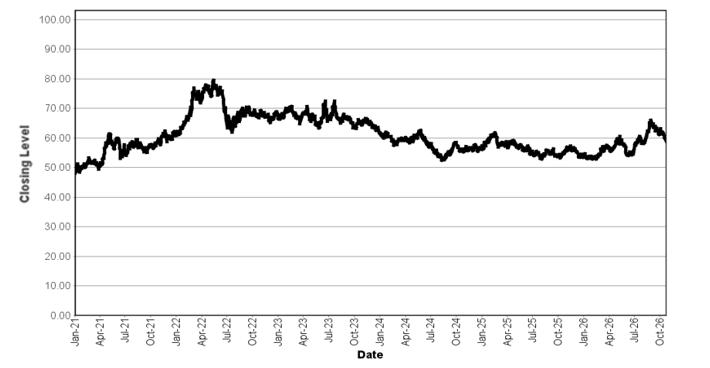
The closing level of the underlier on October 26, 2026 was 58.8126.
PS-16
UNITED STATES FEDERAL INCOME TAX CONSIDERATIONS
In the opinion of our counsel, Davis Polk & Wardwell LLP, the notes should be treated as “short-term debt instruments” for U.S. federal income tax purposes, as described in the section of the accompanying prospectus supplement called “United States Federal Tax Considerations—Tax Consequences to U.S. Holders—Short-Term Notes,” and the remaining discussion is based on this treatment.
Under the rules applicable to short-term debt instruments, if you are a cash-method U.S. Holder (as defined in the accompanying prospectus supplement), you generally should not be required to recognize income with respect to the notes until maturity or an earlier disposition. If you are an accrual-method U.S. Holder (or a cash-method U.S. Holder who elects to accrue income currently on short-term debt instruments), you are required to accrue original issue discount into income over the term of the notes; however, because the amount of the payment at maturity is contingent, the amount required to be included in income is uncertain.
Upon the sale, exchange or retirement of the notes (including retirement at maturity), you generally will recognize gain or loss equal to the difference between the proceeds received and your adjusted tax basis in the notes. Your adjusted tax basis will equal your purchase price for the notes, increased, if you accrue income on the notes currently, by any previously accrued but unpaid discount. Any loss recognized should be treated as short-term capital loss and any gain recognized at maturity should be treated as ordinary income. If you dispose of a note prior to maturity at a gain, you should consult your tax adviser regarding the determination of the amount of such gain that is treated as ordinary income and the amount that is treated as short-term capital gain.
You should read the section entitled “United States Federal Tax Considerations—Tax Consequences to U.S. Holders—Short-Term Notes” in the accompanying prospectus supplement. You should also consult your tax adviser regarding the U.S. federal tax consequences of an investment in the notes.
Non-U.S. Holders. Subject to the discussions below regarding Section 871(m) and in “United States Federal Tax Considerations—Tax Consequences to Non-U.S. Holders” and “—FATCA” in the accompanying prospectus supplement, if you are a Non-U.S. Holder (as defined in the accompanying prospectus supplement) of the notes, under current law you generally will not be subject to U.S. federal withholding or income tax in respect of any payment on or any amount received on the sale, exchange or retirement of the notes, provided that (i) income in respect of the notes is not effectively connected with your conduct of a trade or business in the United States, and (ii) you comply with the applicable certification requirements. See “United States Federal Tax Considerations—Tax Consequences to Non-U.S. Holders” in the accompanying prospectus supplement for a more detailed discussion of the rules applicable to Non-U.S. Holders of the notes.
As discussed under “United States Federal Tax Considerations—Tax Consequences to Non-U.S. Holders—Dividend Equivalents Under Section 871(m) of the Code” in the accompanying prospectus supplement, Section 871(m) of the Internal Revenue Code of 1986, as amended, and Treasury regulations promulgated thereunder (“Section 871(m)”) generally impose a 30% withholding tax on dividend equivalents paid or deemed paid to Non-U.S. Holders with respect to certain financial instruments linked to U.S. equities (“Underlying Securities”) or indices that include Underlying Securities. Section 871(m) generally applies to instruments that substantially replicate the economic performance of one or more Underlying Securities, as determined based on tests set forth in the applicable Treasury regulations. However, the regulations, as modified by an Internal Revenue Service (“IRS”) notice, exempt financial instruments issued prior to January 1, 2029 that do not have a “delta” of one. Based on the terms of the notes and representations provided by us as of the date of this preliminary pricing supplement, our counsel is of the opinion that the notes should not be treated as transactions that have a “delta” of one within the meaning of the regulations with respect to any Underlying Security and, therefore, should not be subject to withholding tax under Section 871(m). However, the final determination regarding the treatment of the notes under Section 871(m) will be made as of the trade date for the notes, and it is possible that the notes will be subject to withholding under Section 871(m) based on the circumstances as of that date.
A determination that the notes are not subject to Section 871(m) is not binding on the IRS, and the IRS may disagree with this treatment. Moreover, Section 871(m) is complex and its application may depend on your particular circumstances, including your other transactions. You should consult your tax adviser regarding the potential application of Section 871(m) to the notes.
If withholding tax applies to the notes, we will not be required to pay any additional amounts with respect to amounts withheld.
You should read the section entitled “United States Federal Tax Considerations” in the accompanying prospectus supplement. The preceding discussion, when read in combination with that section, constitutes the full opinion of Davis Polk & Wardwell LLP regarding the material U.S. federal tax consequences of owning and disposing of the notes.
You should also consult your tax adviser regarding all aspects of the U.S. federal tax consequences of an investment in the notes and any tax consequences arising under the laws of any state, local or non-U.S. taxing jurisdiction.
PS-17
BENEFIT PLAN INVESTOR CONSIDERATIONS
A fiduciary of a pension, profit-sharing or other employee benefit plan subject to the Employee Retirement Income Security Act of 1974, as amended (“ERISA”), including entities such as collective investment funds, partnerships and separate accounts whose underlying assets include the assets of such plans (collectively, “ERISA Plans”), should consider the fiduciary standards of ERISA in the context of the ERISA Plan’s particular circumstances before authorizing an investment in the notes. Among other factors, the fiduciary should consider whether the investment would satisfy the prudence and diversification requirements of ERISA and would be consistent with the documents and instruments governing the ERISA Plan.
Section 406 of ERISA and Section 4975 of the Internal Revenue Code of 1986, as amended, (the “Code”) prohibit ERISA Plans, as well as plans (including individual retirement accounts and Keogh plans) subject to Section 4975 of the Code (together with ERISA Plans, “Plans”), from engaging in certain transactions involving the “plan assets” with persons who are “parties in interest” under ERISA or “disqualified persons” under Section 4975 of the Code (in either case, “Parties in Interest”) with respect to such Plans. As a result of our business, we, and our current and future affiliates, may be Parties in Interest with respect to many Plans. Where we (or our affiliate) are a Party in Interest with respect to a Plan (either directly or by reason of our ownership interests in our directly or indirectly owned subsidiaries), the purchase and holding of the notes by or on behalf of the Plan could be a prohibited transaction under Section 406 of ERISA and/or Section 4975 of the Code, unless exemptive relief were available under an applicable exemption (as described below).
Certain prohibited transaction class exemptions (“PTCEs”) issued by the U.S. Department of Labor may provide exemptive relief for direct or indirect prohibited transactions resulting from the purchase or holding of the notes. Those class exemptions are PTCE 96-23 (for certain transactions determined by in-house asset managers), PTCE 95-60 (for certain transactions involving insurance company general accounts), PTCE 91-38 (for certain transactions involving bank collective investment funds), PTCE 90-1 (for certain transactions involving insurance company separate accounts) and PTCE 84-14 (for certain transactions determined by independent qualified asset managers). In addition, ERISA Section 408(b)(17) and Section 4975(d)(20) of the Code may provide a limited exemption for the purchase and sale of the notes and related lending transactions, provided that neither the issuer of the notes nor any of its affiliates have or exercise any discretionary authority or control or render any investment advice with respect to the assets of the Plan involved in the transaction and provided further that the Plan pays no more, and receives no less, than adequate consideration in connection with the transaction (the so-called “service provider exemption”). There can be no assurance that any of these statutory or class exemptions will be available with respect to transactions involving the notes.
Accordingly, the notes may not be purchased or held by any Plan, any entity whose underlying assets include “plan assets” by reason of any Plan’s investment in the entity (a “Plan Asset Entity”) or any person investing “plan assets” of any Plan, unless such purchaser or holder is eligible for the exemptive relief available under PTCE 96-23, 95-60, 91-38, 90-1 or 84-14 or the service provider exemption or there is some other basis on which the purchase and holding of the notes will not constitute a non-exempt prohibited transaction under ERISA or Section 4975 of the Code. Each purchaser or holder of the notes or any interest therein will be deemed to have represented by its purchase or holding of the notes that (a) it is not a Plan and its purchase and holding of the notes is not made on behalf of or with “plan assets” of any Plan or (b) its purchase and holding of the notes will not result in a non-exempt prohibited transaction under Section 406 of ERISA or Section 4975 of the Code.
Certain governmental plans (as defined in Section 3(32) of ERISA), church plans (as defined in Section 3(33) of ERISA) and non-U.S. plans (as described in Section 4(b)(4) of ERISA) (“Non-ERISA Arrangements”) are not subject to these “prohibited transaction” rules of ERISA or Section 4975 of the Code, but may be subject to similar rules under other applicable laws or regulations (“Similar Laws”). Accordingly, each such purchaser or holder of the notes shall be required to represent (and deemed to have represented by its purchase of the notes) that such purchase and holding is not prohibited under applicable Similar Laws.
Due to the complexity of these rules, it is particularly important that fiduciaries or other persons considering purchasing the notes on behalf of or with “plan assets” of any Plan consult with their counsel regarding the relevant provisions of ERISA, the Code or any Similar Laws and the availability of exemptive relief under PTCE 96-23, 95-60, 91-38, 90-1, 84-14, the service provider exemption or some other basis on which the acquisition and holding will not constitute a non-exempt prohibited transaction under ERISA or Section 4975 of the Code or a violation of any applicable Similar Laws.
The notes are contractual financial instruments. The financial exposure provided by the notes is not a substitute or proxy for, and is not intended as a substitute or proxy for, individualized investment management or advice for the benefit of any purchaser or holder of the notes. The notes have not been designed and will not be administered in a manner intended to reflect the individualized needs and objectives of any purchaser or holder of the notes.
Each purchaser or holder of any notes acknowledges and agrees that:
| (i) | the purchaser or holder or its fiduciary has made and shall make all investment decisions for the purchaser or holder and the purchaser or holder has not relied and shall not rely in any way upon us or our affiliates to act as a fiduciary or adviser of the purchaser or holder with respect to (A) the design and terms of the notes, |
PS-18
(B) the purchaser or holder’s investment in the notes, or (C) the exercise of or failure to exercise any rights we have under or with respect to the notes;
| (ii) | we and our affiliates have acted and will act solely for our own account in connection with (A) all transactions relating to the notes and (B) all hedging transactions in connection with our obligations under the notes; |
| (iii) | any and all assets and positions relating to hedging transactions by us or our affiliates are assets and positions of those entities and are not assets and positions held for the benefit of the purchaser or holder; |
| (iv) | our interests are adverse to the interests of the purchaser or holder; and |
| (v) | neither we nor any of our affiliates is a fiduciary or adviser of the purchaser or holder in connection with any such assets, positions or transactions, and any information that we or any of our affiliates may provide is not intended to be impartial investment advice. |
Each purchaser and holder of the notes has exclusive responsibility for ensuring that its purchase, holding and subsequent disposition of the notes does not violate the fiduciary or prohibited transaction rules of ERISA, the Code or any applicable Similar Laws. The sale of any notes to any Plan is in no respect a representation by us or any of our affiliates or representatives that such an investment meets all relevant legal requirements with respect to investments by Plans or Non-ERISA Arrangements generally or any particular Plan or Non-ERISA Arrangement, or that such an investment is appropriate for Plans or Non-ERISA Arrangements generally or any particular Plan or Non-ERISA Arrangement.
However, individual retirement accounts, individual retirement annuities and Keogh plans, as well as employee benefit plans that permit participants to direct the investment of their accounts, will not be permitted to purchase or hold the notes if the account, plan or annuity is for the benefit of an employee of CGMI or a family member and the employee receives any compensation (such as, for example, an addition to bonus) based on the purchase of notes by the account, plan or annuity.
VALUATION OF THE NOTES
CGMI calculated the estimated value of the notes set forth on the cover page of this pricing supplement based on proprietary pricing models. CGMI’s proprietary pricing models generated an estimated value for the notes by estimating the value of a hypothetical package of financial instruments that would replicate the payout on the notes, which consists of a fixed-income bond (the “bond component”) and one or more derivative instruments underlying the economic terms of the notes (the “derivative component”). CGMI calculated the estimated value of the bond component using a discount rate based on our internal funding rate. CGMI calculated the estimated value of the derivative component based on a proprietary derivative-pricing model, which generated a theoretical price for the instruments that constitute the derivative component based on various inputs, including the factors described under “Risk Factors—The Value of the Notes Prior to Maturity Will Fluctuate Based on Many Unpredictable Factors” in this pricing supplement, but not including our or Citigroup Inc.’s creditworthiness. These inputs may be market-observable or may be based on assumptions made by CGMI in its discretionary judgment.
The estimated value of the notes is a function of the terms of the notes and the inputs to CGMI’s proprietary pricing models. The range for the estimated value of the notes set forth on the cover page of this preliminary pricing supplement reflects terms of the notes that have not yet been fixed as well as uncertainty on the date of this preliminary pricing supplement about the inputs to CGMI’s proprietary pricing models on the trade date.
For a period of approximately three months following issuance of the notes, the price, if any, at which CGMI would be willing to buy the notes from investors, and the value that will be indicated for the notes on any brokerage account statements prepared by CGMI or its affiliates (which value CGMI may also publish through one or more financial information vendors), will reflect a temporary upward adjustment from the price or value that would otherwise be determined. This temporary upward adjustment represents a portion of the hedging profit expected to be realized by CGMI or its affiliates over the term of the notes. The amount of this temporary upward adjustment will decline to zero on a straight-line basis over the three-month temporary adjustment period. However, CGMI is not obligated to buy the notes from investors at any time. See “Risk Factors — The Notes Will Not Be Listed on Any Securities Exchange and You May Not Be Able to Sell Them Prior to Maturity.”
© 2026 Citigroup Global Markets Inc. All rights reserved. Citi and Citi and Arc Design are trademarks and service marks of Citigroup Inc. or its affiliates and are used and registered throughout the world.
PS-19

FREE Breaking News Alerts from StreetInsider.com!
StreetInsider.com Top Tickers, 10/27/2026
- Wall Street rises on revived AI momentum as earnings season picks up
- Meta's $97.5B AI money grab: why Zuckerberg is racing to raise cash before rivals
- Deutsche Bank’s Reid sees potential final dip this year before Santa rally
- UPS tops estimates as efficiency drive gains momentum
- GM to move stock listing to Nasdaq in November, shares gain
Serious News for Serious Traders! Try StreetInsider.com Premium Free!
You May Also Be Interested In
- Nebius Group shares jump after France data center funding
- The Whiskey & Wireless Podcast, by ClearSky Technologies, Wins Gold at the 2026 Signal Awards
- StoneX Reiterates Buy Rating on Broadcom Limited (AVGO)
Create E-mail Alert Related Categories
SEC FilingsRelated Entities
CitiSign up for StreetInsider Free!
Receive full access to all new and archived articles, unlimited portfolio tracking, e-mail alerts, custom newswires and RSS feeds - and more!
