




Where Will We Get the Energy?

FREE Breaking News Alerts from StreetInsider.com!
StreetInsider.com Top Tickers, 10/12/2026
- US stock futures steady as oil jumps to two-week high ahead of key earnings
- Oil prices rise as attacks on Saudi Arabia overshadow Trump's Russian supply announcements
- Will surging equity supply derail the U.S. bull market? Goldman Sachs weighs in
- Broadcom CEO says many AI investors are gamblers
- Iren shares jump 5% in premarket trade on report of Anthropic AI cloud deal
 Tweet
Tweet Share
Share E-mail
Surging demand for power requires upgrades to the nation's electric grid—and governments, utilities, and consumers all must play a part
In
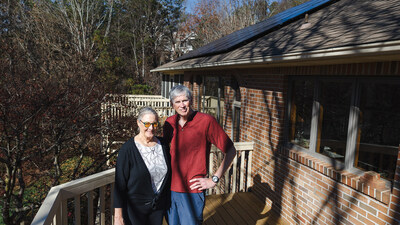
"The process was pretty easy for novices like us," says King, and by
"The infrastructure is reliable," King says of their town in the metropolitan area of
While the couple never had concerns about power outages in the years before the new battery was installed, they quickly learned about another essential benefit of their new system. Only six weeks after its installation, Hurricane Helene tore through western
When King and Cleveland woke up the morning after the
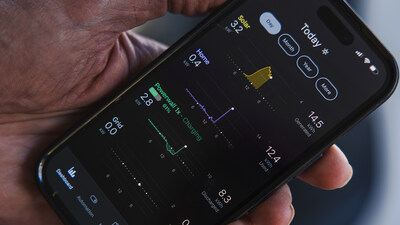
"We were stuck," Cleveland says. "But we had power." And they continued to have power for three weeks, unlike neighbors who had to wait for the main grid to be repaired.
The nation's electric grid, often called the biggest machine ever built, consists of a vast array of power plants, high-voltage transmission lines that send electricity over long distances, and substations that convert high-voltage power to a lower one so it can be distributed locally. Interconnected throughout
As big as it is, it can't keep up. Data centers, AI, increased manufacturing, and everyday citizens are consuming unprecedented amounts of power.
The U.S. Energy Information Administration has forecast that power consumption in the
Policymakers around the nation are embracing innovations that can meet this demand, and The Pew Charitable Trusts' energy modernization project provides research that is guiding those decisions. Some of those new approaches include close-to-consumer alternatives such as the batteries installed in homes and other facilities and products that lie outside the main grid. Others target new technologies that increase the capacity of the existing grid, with at least 10 states passing legislation to evaluate the new methods, often with strong bipartisan backing.
Our consumption of electricity is larger than it has ever been. And it's growing.
"Even in our daily lives, we see energy demand increase," says
In addition to demand, extreme weather events are becoming more common. Hurricanes such as Helene destroy transmission lines and energy facilities. Heat waves demand more air conditioning, while freezing temperatures command more heat. Ice storms snap power lines and lightning zaps transformers. All can result in interruptions in the power flow—and the lights go out.
The new energy technologies in King and Cleveland's
DERs also reduce electric bills. The system King and Cleveland installed cost
It's one of the technologies that Pew's team says could have real impact as demand increases.
"DERs benefit the customer, and they benefit the grid," says
Using DERs extensively isn't unprecedented.
"
Some DERs can be grouped into microgrid systems and, if needed, operate independently from the big grid. Instead of transmitting power over long distances, these independent systems send electricity locally into a small community or facility. Hundreds operate in
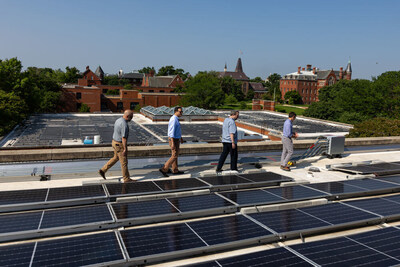
Gallaudet University, the world's premier institution dedicated to the education of deaf and hard of hearing students, is home to one of the first microgrids in
The Gallaudet microgrid can work in tandem with the local utility grid—but if electricity goes out, the entire university could run from the power generated by the DERs that make up the microgrid.
The microgrid is also a smart financial move. The university earns revenue from leasing rooftops for solar arrays to Scale Microgrids. The battery storage system also provides grid stabilizing services to the regional grid operator, PJM, allowing the university to earn revenue from the energy it provides.
Though it required a significant capital investment, the system will soon be a big money saver for the school, says
The school's microgrid also helps D.C. families reduce energy costs. Through a community solar program, 400 residences subscribe to Gallaudet's solar system and receive a credit on their electricity bills, reducing electricity costs by about 10%.
Gallaudet's investment and commitment to managing a physical plant that serves the community was one necessity. The other was the local utility company, Pepco, making improvements on its grid.
"But the steps are all doable. And they're all scalable," says
To help policymakers enable more DERs, Pew has formed an advisory council of energy leaders to show how people, localities, and states can be a part of innovative solutions, like the one at Gallaudet.
"Every state in the nation benefits from having disaggregated, dispersed energy resources all around the grid, and not just these great big central stations in the middle of grids," says
"The problem is, a lot of the people in the utility industry, and in the government, don't understand what a transformative potential we have just sitting there ready for us," he says. "I'm trying to unlock innovation and risk-taking and an entrepreneurial mindset that is missing in energy."
Power companies are also testing approaches to supplement the grid. In addition to the virtual power plants in homes like King and Cleveland's, Duke Energy in 2023 installed a microgrid with solar and battery storage in
Other Duke microgrids generate electricity in
While extensive cloud cover or solar panel storm damage can compromise those facilities, "in the right setting, microgrids are a strong tool in the toolbox of reliability and resiliency solutions," says
As energy experts and policymakers look for ways to increase electricity output, they're also turning to the existing grid itself. New software as well as hardware that is installed right onto power lines is known as advanced transmission technologies, or ATTs, and can allow more energy to be transported more efficiently.
Sensors can be placed on transmission lines that give grid operators real-time information about how much power is being transmitted, which allows them to better estimate how much power they can transmit—and that can increase the amount of power on the grid by 10% to 30%. Another technology is new and improved wires that connect towers that use better materials and have a better design—and transport 50% to 110% more power.
ATTs such as these sensors and wires can be deployed relatively quickly—in two to three years—as opposed to constructing brand new lines, which can take about a decade. According to the U.S. Department of Energy, nationwide use of these technologies could unlock up to 100 gigawatts of additional grid capacity and save consumers
"ATTs make the grid more efficient and able to squeeze more power out of the existing infrastructure," says Pew's Miller. "So if you already have some of the infrastructure built, that's a low-hanging fruit, and a really smart move to get more capacity to connect more projects."
Pew has been working with state policymakers seeking to understand and install ATTs. In the past three years, at least 16 states have passed laws encouraging ATT deployment, including, in 2025,
"We're no different from any other place. Our grid is aging, and it hasn't been maintained," says
"Our grid was built 100 years ago and needs upgrading," says state Senator
Whether adding ATTs to the existing power lines to transmit more electricity or incorporating distributed energy sources in a community to offset the demand on the main grid and provide additional energy, the new—and readily available—technology provides immediate as well as long-term solutions to modernizing energy transmission in
Modernization also provides consumers with more options—and a say about the source of their energy.
"I love knowing that I'm not pulling power from anywhere but from the sun," says Cleveland in
For more information, visit Energy Modernization | The Pew Charitable Trusts (pewtrusts.org)
Contact:

 View original content to download multimedia:https://www.prnewswire.com/news-releases/where-will-we-get-the-energy-302694549.html
SOURCE The Pew Charitable Trusts
Serious News for Serious Traders! Try StreetInsider.com Premium Free!
You May Also Be Interested In
- Flexcompute Raises Strategic Investment From Samsung Ventures and Applied Ventures to Build the Physics World Model
- AITO Announces 2027 European Market Entry at Paris Motor Show
- Mercedes Service Options Explained In HelloNation With Insights From Automotive Expert John Anderson
Create E-mail Alert Related Categories
PRNewswire, Press ReleasesSign up for StreetInsider Free!
Receive full access to all new and archived articles, unlimited portfolio tracking, e-mail alerts, custom newswires and RSS feeds - and more!
