



Two Studies Show Mixed Progress Against EoE
 Tweet
Tweet Share
Share E-mail
Experts at Cincinnati Children's play key roles in one trial that supports dupilumab use for children under 12 and another study showing no relief for people taking benralizumab.
Both studies appear in The New England Journal of Medicine.
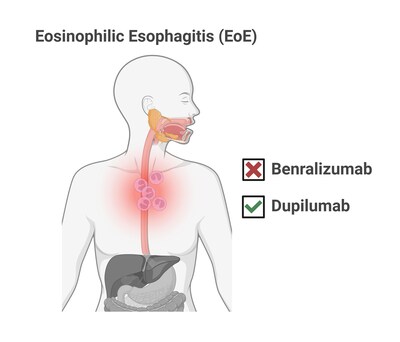
Meanwhile, data show that a different drug that had previously been approved for use in adults and teens with EoE is also safe and effective for children under 12 who weigh at least 15 kg (about 33 pounds).
The results of these clinical trials—plus an accompanying editorial—appear in the
"Together, these trials provide exciting advances in our understanding of, and treatment options for, this increasingly common and perplexing disease," writes
Long-time EoE expert
What is EoE?
This severe form of food allergy occurs in an estimated 180,000 people in
The most distinguishing feature of EoE has been a well-documented spike in the number of eosinophils – a type of white blood cell – found in the throat. For many years this surge of immune cells also was believed to be the primary cause of the disease.
New findings from the Phase 3 MESSINA clinical trial add to a body of evidence suggesting otherwise.
Effective but not helpful
This study evaluated a monoclonal antibody treatment called benralizumab, which has been shown in other studies to be highly effective at reducing unwanted eosinophils. Somewhat like an exploding paint capsule making it easier for cops to catch a bank robber, the antibody binds to eosinophil cells and exposes them to patrolling natural killer cells.
In fact, this treatment has been approved for treating poorly controlled asthma because it helps break a feedback cycle of eosinophil-mediated hyperreaction and mucus production in inflamed airways. That asthma success inspired many scientists to hope that benralizumab would become a difference-maker in treating EoE.
But when tested in 211 patients with EoE—ages 12 to 65—people still experienced inflammation, difficulty swallowing, pain, and reduced quality of life. This occurred despite more than 80% of those taking benralizumab showing "near-complete depletion" of eosinophils in their blood and esophagus. Further, microscopic exams of tissue samples showed no significant improvement at a biological level.
"This trial calls into question the clinical relevance of monitoring EoE for treatment effect solely on the basis of the degree of eosinophilic inflammation," says Rothenberg. "The
Rothenberg, who directs the Division of Allergy and Immunology at Cincinnati Children's, served as corresponding author for the study.
Extended approval for dupilumab
Benralizumab targets the activity of interleukin-5 (one of several proteins involved in our bodies' immune response). But other research has shown better results against EoE by targeting two other interleukins at the same time: IL-4 and IL-13.
The US Food and Drug Administration initially approved the drug dupilumab for treating EoE in 2022, but only for adults and teens. Based on data from a more recent clinical trial focusing on younger children, the FDA acted in
The data and related findings that supported that decision also were published in NEJM on
To date, dupilumab is the only FDA-approved medication that precisely treats EoE in children.
Years of research producing results
Rothenberg and
What's next for doctors, researchers and people with EoE?
In the short term, Rothenberg says that patients should consider dupilumab, but not benralizumab, or continue (or return to) other treatments that have been helpful. Dietary elimination therapy to avoid offending food triggers has been used for years but can be tough to follow. Various medications have helped some patients manage symptoms, including proton-pump inhibitors and steroid treatments. A few newer approaches are still being studied in other clinical trials.
Longer term, Rothenberg and other scientists are looking farther "upstream" from eosinophils in the body's natural cascade of immune system responses to find other ways to stop, slow, or prevent the damage caused by EoE.
Until such work produces new options, Rothenberg also recommends that clinicians rely less upon eosinophil levels as the sole feature to gauge the severity of EoE. Other tests such as endoscope exams and collecting tissue samples for microscope analysis appear more likely to provide meaningful information.
"We need a more relevant biomarker to measure clinical response in eosinophilic esophagitis," Rothenberg says. "That is certainly one of our main research goals as we move forward."
About these studies
The

 View original content to download multimedia:https://www.prnewswire.com/news-releases/two-studies-show-mixed-progress-against-eoe-302183823.html
SOURCE Cincinnati Children's Hospital Medical Center
Serious News for Serious Traders! Try StreetInsider.com Premium Free!
You May Also Be Interested In
- Now, More Than Ever: Thousands of Cyclists and Volunteers Unite for 2026 Pan-Mass Challenge, Raising Critically Needed Funds for Cancer Research and Care
- Harmony Care Finder Launches Free Concierge Service to Simplify ABA Therapy and Autism Care Matching for Families
- The Lakeshore Inn Unveils Newly Renovated Guest Rooms in Lake Oswego
Create E-mail Alert Related Categories
PRNewswire, Press ReleasesRelated Entities
FDASign up for StreetInsider Free!
Receive full access to all new and archived articles, unlimited portfolio tracking, e-mail alerts, custom newswires and RSS feeds - and more!
