




The Building Security Line Item NYC Property Investors Keep Underpricing

FREE Breaking News Alerts from StreetInsider.com!
StreetInsider.com Top Tickers, 10/8/2026
- Wall Street ends lower, off record highs, as Treasury yields climb
- Want to be a stock market bear? BCA says watch potential U.S. tax increases
- SpaceX seeks $40bn in financing for Nvidia chip purchase
- Chip stock could soar nearly 200%, analyst says: "If you don’t buy it, they will"
- Musk rules out TSMC role in Terafab operations; Intel gains
 Tweet
Tweet Share
Share E-mail
TL;DR: Building security systems -- intercoms, cameras, access control, and door hardware -- are usually filed under "maintenance" in NYC multifamily budgets, but they behave more like capital items with measurable effects on insurance premiums, tenant retention, and liability exposure. Owners and co-op/condo boards that treat these systems as a one-time install rather than an ongoing asset often get surprised by the cost of catching up later.
What Is a Building Security Capital Audit?
A building security capital audit reviews a property's entry and surveillance infrastructure -- intercoms, buzzer systems, cameras, access control readers, and door hardware -- scored by age, failure rate, and compliance status, not whether it still technically functions. Most NYC buildings never get this review. Systems get patched reactively, one broken buzzer or dead camera at a time, until the whole stack is a mismatched collection of equipment installed across three different decades.
Why It Matters for NYC Property Returns
Investors underwriting a multifamily acquisition in Brooklyn or Queens will model roof age, boiler condition, and Local Law compliance down to the dollar. Security infrastructure rarely gets the same treatment, even though it touches three line items that directly affect returns.
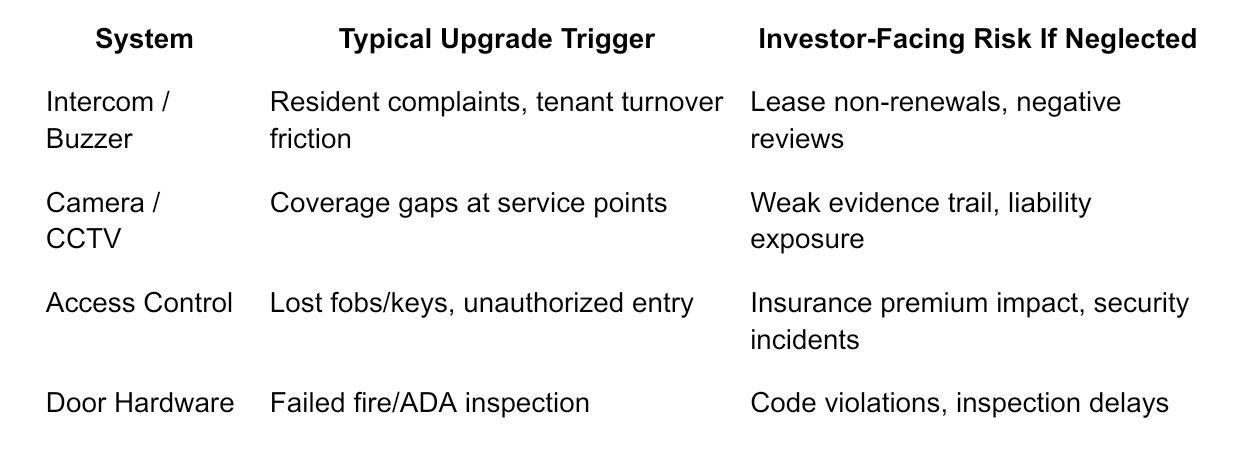
First, insurance. Carriers increasingly ask about access control and camera coverage when underwriting commercial and multifamily policies, and a documented, functioning system can be the difference between a standard premium and a loaded one. Second, tenant retention. A broken intercom or buzzer isn't a cosmetic issue -- it's a daily friction point that shows up in lease-renewal conversations and online reviews faster than almost any other building complaint. Third, liability. If a break-in or unauthorized entry happens at a property with a known-broken access system, the paper trail of "we knew and didn't fix it" is exactly what a plaintiff's attorney looks for.
How It Works
Access Control and Intercoms
Most pre-war and mid-century NYC buildings started with a simple buzzer-to-apartment wire and have layered on partial upgrades since. The result is often a hybrid system -- an old audio-only panel spliced into a newer video unit, or a landline-based buzzer that stopped syncing with residents' cell phones years ago. When that combination fails, it often fails intermittently, which is harder to diagnose than a clean, total failure. It's one of the more common maintenance tickets in older residential stock, and boards often discover the layered wiring problem only after a resident flags that their intercom not working has become a recurring, not one-time, complaint.
Camera Systems and Liability
Camera coverage gaps tend to cluster at the same points: rear service entrances, stairwell landings, and loading areas that were never part of the original building design. Anecdotally, a meaningful share of the traffic behind terms like camera installation for buildings now comes from co-op and condo board members researching coverage for common areas, not just single-family homeowners protecting a front porch -- a sign that building-level buyers are doing this research themselves before ever calling a contractor.
Door Hardware and Compliance
Electronic strikes, fire-rated hardware, and ADA-compliant door closers intersect with New York City's building and fire codes in ways that pure security vendors sometimes miss. A system that's technically "working" can still fail an inspection if the hardware isn't rated correctly for the door assembly it's installed on.
Practical Steps for Owners and Boards
- Inventory every access point -- building entry, service doors, stairwells, roof access -- and note the age and type of hardware at each.
- Cross-reference camera coverage against actual incident reports or complaint logs from the last two years, not just where cameras happen to already be mounted.
- Ask your insurance broker directly whether documented access control affects your premium; many owners never ask.
- Budget security refreshes on a hardware lifecycle (typically 7-10 years for cameras, longer for wired intercom backbones), not on a break-fix basis.
- Loop in vendors during a board's capital planning cycle, not after a resident complaint forces a same-week decision.
Common Mistakes NYC Owners Make
- Treating a symptom as the whole problem. Replacing one dead camera without checking whether the recorder or the rest of the run is also near end-of-life.
- Ignoring the compliance angle. Assuming any electronic strike or door closer satisfies fire code, without checking the rating.
- Budgeting security like a repair, not a capital item. This is how a $2,000 fix becomes a $20,000 emergency replacement a year later.
- Skipping the insurance conversation. Many owners never find out their carrier would price a documented system differently.
FAQ
Does upgrading building security actually lower insurance costs? It can, though the effect varies by carrier and property type. The only reliable way to know is to ask your broker directly what documentation they'd want to see before quoting a lower premium.
How often should a multifamily building replace its cameras? Most commercial-grade systems have a useful life of roughly 7-10 years before recording quality, storage compatibility, or vendor support becomes a problem.
Is a broken intercom actually a liability issue, or just an inconvenience? Both. It's a daily inconvenience for residents and a documented-and-ignored issue if anything happens at the building afterward.
Who typically pays for security upgrades in a co-op -- the building or unit owners? Common-area systems like entry intercoms and cameras are almost always a building-level capital expense, funded through reserves or a special assessment, not individual owners.
What's the first thing a board should check before budgeting a security refresh? An inventory of every access point's age and condition -- most boards are surprised how mismatched their existing hardware actually is once they look.
Conclusion
Security infrastructure sits in an odd spot for NYC property investors: too operational to show up in most acquisition models, too consequential to actually ignore. Treating it as a capital planning line item -- reviewed on a cycle, cross-checked against insurance and compliance, rather than patched one complaint at a time -- is a small process change with an outsized effect on both retention and risk.
COMTEX_490808219/2891/2026-08-16T12:07:16
Serious News for Serious Traders! Try StreetInsider.com Premium Free!
You May Also Be Interested In
- Morgan Stanley looking to sell $3bn loan for Royal Caribbean deal - report
- Regulated information – inside information: Fagron delivers strong 23.2% revenue growth in the third quarter to €281.3 million and confirms FY guidance range
- Axelera AI Appoints Osman Kent and Catherine Lewis La Torre CBE as Non-Executive Directors
Create E-mail Alert Related Categories
Globe PR Wire, Press ReleasesRelated Entities
Definitive AgreementSign up for StreetInsider Free!
Receive full access to all new and archived articles, unlimited portfolio tracking, e-mail alerts, custom newswires and RSS feeds - and more!
