



Real-World Clinical Impact of AI-Powered Consults: The GenXRT Experience
 Tweet
Tweet Share
Share E-mail
His experience is far from unique. Many radiation oncology providers today share Dr. Jahraus's self-described plight: "There's not enough of me to go around to do everything I need and want to do." A 2025 report from the American Society of Clinical Oncology found that 59% of oncologists report symptoms of burnout, with documentation demands cited as a major contributor. End-of-treatment summaries and consultation notes are time-consuming and often delayed—adding to the strain. As documentation requirements grow increasingly complex, the need for efficient, intelligent solutions has never been more urgent.
FuseDocs: AI-Powered Documentation for Oncology Workflows
To address these challenges, GenXRT adopted FuseDocs, an AI-powered documentation solution from Fuse Oncology. Designed to streamline clinical workflows and reduce physician workload, FuseDocs automates the creation of key patient documents, helping providers reclaim time and reduce burnout.
GenXRT has already partnered with Fuse Oncology to enhance operations using S!GNAL and data analytics. FuseDocs was the next step in its journey to optimize documentation and elevate clinical note quality.
FuseDocs for Consultations
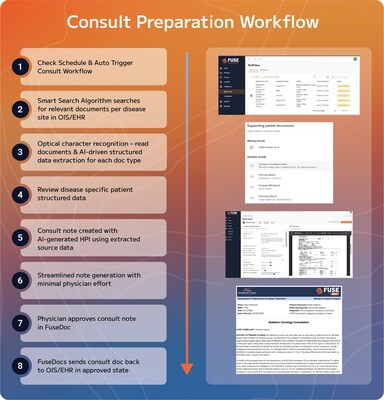
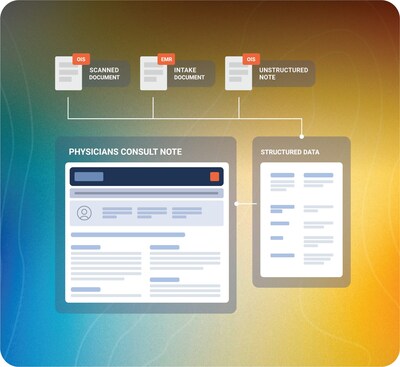
Preparing for new patient consultations typically takes 30 to 90 minutes, involving manual data aggregation, cut-and-paste tasks, and structuring notes from disparate sources. FuseDocs transforms this process. The consultation workspace automatically identifies relevant patient documentation and disease-specific data, generating a structured summary for the physician. This is especially impactful for the History of Present Illness (HPI) section, which traditionally requires significant manual effort. FuseDocs uses generative AI to also summarize other areas of the document such as pathology, imaging, and lab reports—saving valuable time.
Dr. Jahraus was recently scheduled to see a new breast cancer patient with limited time to prepare, and the supporting clinical documentation—scanned into the chart as low-resolution, poor-quality—would normally require a time-consuming, manual review. With FuseDocs, however, the process was fully automated: the platform intelligently parsed the degraded documents, extracted key clinical details, "with remarkable accuracy" such as tumor characteristics, lymph node status, and systemic therapy history, and presented them in a clear, AI-generated summary within a streamlined digital interface. "FuseDocs' AI-generated consult note is a real game-changer," he says. "The time is now reduced to less than half compared to my original estimate of 30–45 minutes, and it keeps getting faster."
Fuse Oncology will present its research at ASTRO's 67th Annual Meeting (Sept. 27–Oct. 1,
FuseDocs: End of Treatment (EOT) and Other Physician Documentation
With Fuse solutions now installed across the nation and in large national networks, we are seeing firsthand how cumbersome EOT workflows can be. It is not uncommon for physicians to be behind on completing EOTs—a delay that unfortunately impacts the care team's ability to understand and act on the outcomes of radiation therapy. FuseDocs ensures that this critical step in comprehensive care collaboration is not missed.
End of Treatment (EOT) or Completion Summary documents are a key area where FuseDocs delivers immediate impact. By auto-generating summaries triggered by the patient completing treatment, the tool eliminates manual steps and reduces error-prone workflows—such as forgetting to create the document altogether. The resulting output is a comprehensive summary that communicates how the patient tolerated treatment, an essential component for informing the broader care team.
"It used to take me about 5 minutes per patient to complete the note in OIS. Now it's about 30 seconds with FuseDocs,"
In addition to EOTs, FuseDocs automates the generation and approval of several other physician-facing documents, including the SBRT Treatment Procedure note, Treatment Plan, Clinical Treatment Planning, Simulation, On-Treatment Visit, and Follow-Up. The platform also supports approval workflows for OIS-generated documents authored by staff, allowing physicians to sign off directly within FuseDocs.
A New Standard for Oncology Documentation
The integration of FuseDocs into radiation oncology workflows marks a significant advancement in clinical documentation efficiency. By leveraging multiple facets of artificial intelligence—including optical character recognition to extract structured data from clinical images, rules-based engines to trigger contextually appropriate documents, and generative AI to produce clinically relevant narratives—FuseDocs dramatically reduces time spent on manual data entry, improves documentation quality, and helps mitigate physician burnout.
"FuseDocs takes what has been the least pleasant part of being a physician—note writing—and turns it into an exceedingly valuable resource," says

 View original content to download multimedia:https://www.prnewswire.com/news-releases/real-world-clinical-impact-of-ai-powered-consults-the-genxrt-experience-302569867.html
SOURCE Fuse Oncology, Inc.
Serious News for Serious Traders! Try StreetInsider.com Premium Free!
You May Also Be Interested In
- Actions will help translate vision for Sino-US ties into reality: China Daily editorial
- Guyana Directory Gives the Guyanese Diaspora a Trusted Way to Find Businesses Back Home
- MagLev Aero Secures Dual DARPA Contracts to Advance Next-Generation U.S. Drone Propulsion
Create E-mail Alert Related Categories
PRNewswire, Press ReleasesSign up for StreetInsider Free!
Receive full access to all new and archived articles, unlimited portfolio tracking, e-mail alerts, custom newswires and RSS feeds - and more!
