



Position Trading Strategies: Capturing Long-Term Trends in Volatile Markets
 Tweet
Tweet Share
Share E-mail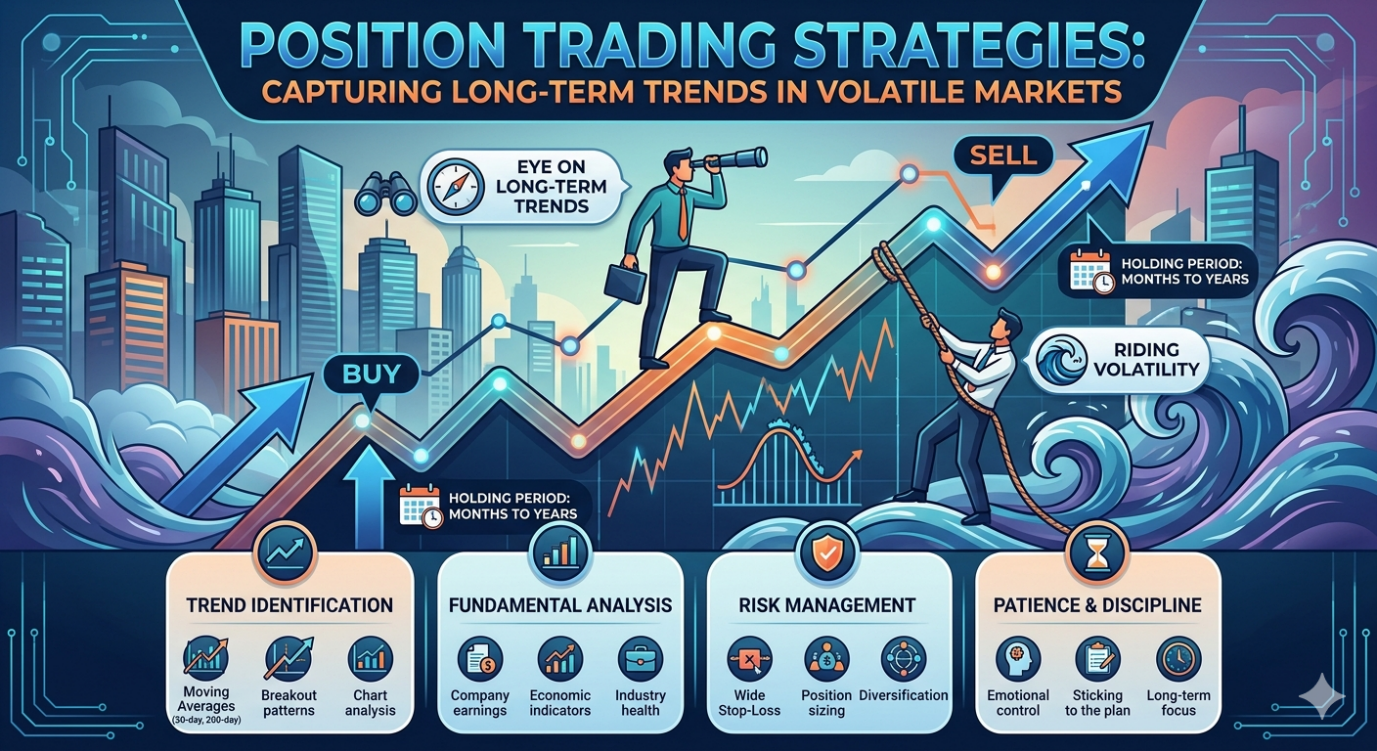
Trading is a paradox of a sort. The bigger the market shifts, the more traders are compelled to act. Charts soar, candles grow, and every little movement seems to be an opportunity, which you will never give up. But what usually happens is different from this. You buy, sell, buy again, pull levers, run prices, and when it is finished, you are so tired.
Not because it was a hard market, but because you were going to catch it all.
Meanwhile, somewhere in the background, the market quietly trends for weeks. Clean direction. Structured movement. Big potential.
And that is the bit that traders want to miss. This is exactly where position trading can change your perspective. When you understand position trading, you begin paying attention to the bigger picture rather than responding to changes in movement at any point in time, the direction of the market, not where it has gone now.
What is Position Trading Strategy?
Before starting with how to enter the markets with a position trading strategy, let's see what is position trading.
Position trading does not involve accuracy, but rather outlook. It is constructed out of a simple concept that markets do not go in arbitrary directions, they go in cycles of expansion, correction, and continuation.
And in that order, there exist tendencies which span much longer than current expectations by most traders.
This is all the more crucial in volatile markets. Noise is caused by volatility in smaller periods, and therefore, it is more difficult to identify any real opportunities and false signals. However, a similar volatility is usually neatly packed into a wider trend on a zoom out.
It is in this position that traders who know position trading strategy get involved. They do not attempt to take each swing. They are attempting to band together with the prevailing line and hang on till they can reap its reward.
How does Position Trading Strategy Work?
The biggest error of traders is to distinguish direction with no idea of strength. They can be trending, but there is a lack of momentum, their movement may easily come to a halt or even go the other way.
This is where such tools as the relative strength index come in. The traders who know what is relative strength index knows that RSI is not merely a measure of overbought or oversold. In fact, the actual concept of RSI is to determine the strength behind price movement.
In position trading, RSI is commonly applied in a different manner than the short-term strategies. They do not seek short-term reversals, rather traders rely on it to determine if a trend has sufficient strength to endure in the long term.
For example, in an uptrend, the RSI can remain high over longer periods. Instead of this being a sell signal, position traders take it as a signal of strength. This change in meaning is slight, yet strong.
What is the Role of Volatility in Position Trading?
The majority of traders use volatility as an aspect that needs to be controlled or avoided. It is different from position traders.
Volatility is what creates opportunity.
Price hardly follows a straight line in the long-term trends. Pullbacks, consolidations and temporary dynamics exist. Such movements can frequently knock out short-term traders and provide more favourable entrances to the bigger-picture-minded people.
Position traders predict volatility, as opposed to responding to it. They know that short-run variability is a part of the process and is not indicative of the characteristics of the trend being violated.
Such an attitude decreases the influence of emotions in decision-making and provides stability over time.
When Should You Enter the Market in Position Trading?
One common misconception about position trading is that entries don't matter.
Well, they do! But not so as most traders believe.
In position trading strategies, you don't need the perfect entry, but you need a good enough entry within a strong trend. Position traders usually wait for pullbacks in an ongoing direction. The presence of these pullbacks is like a rest point of the market which proceeds. Traders can set themselves at advantageous risk-reward without price chasing by trading in these stages.
In this way, the stress of accuracy is eliminated. You are not trying to make predictions on precise turning points, but rather, you are operating within a fabric which is not even in motion.
How to Manage Trades Over Time?
It takes a new type of discipline to hold the trades longer. It is not a matter of responding promptly, it is a matter of patience. Your belief will be put to the test in the markets. It will happen that there will be days when the price will go against you, even in a good trend. In the absence of a definite structure, one can get out prematurely.
But with a position trading strategy, things can be different.
Structure is the guiding force of position traders as opposed to emotion. With the overall trend intact, minor pullbacks are not considered threats but are considered normal behaviour.
This would change perspective, and instead of short-term results, it is intended to be concerned with long-term results.
How to Manage Risk in Position Trading Strategy?
In position trading, risk does not go away. It is just re-packaged.
Here, you are trading fewer positions over longer lengths of time rather than making frequent trades. It implies that there is more weight to each trade, and risk management is all the more crucial.
Position traders normally have broader levels of stop-loss to take into consideration the market variations. This enables trades to exhale without being short-circuited before their time.
Meanwhile, position sizing is changed as well. The idea is not to have maximum exposure but to be sustainable in the long run.
Conclusion
To conclude, the majority of the traders attempt to gain profits and keep on attacking the market. Position traders do it another way- they allow the market to do the heavy trading.
Through staying on course with long-term trends and being patient with trades, they also get moves that are not frequent among traders. Because, in the long run, it does not matter how many times you trade. It is how well you ride the moves that really count.
COMTEX_482931780/2891/2026-06-04T11:48:35
Serious News for Serious Traders! Try StreetInsider.com Premium Free!
You May Also Be Interested In
- TetherMax Highlights Ongoing WOO X Pro and Binance Campaigns
- Moody’s Ratings affirms Iceland’s A1 ratings, maintains stable outlook
- QUORRA X5 Makes Its Global Debut at REHACARE International 2026 in Germany
Create E-mail Alert Related Categories
Globe PR Wire, Press ReleasesSign up for StreetInsider Free!
Receive full access to all new and archived articles, unlimited portfolio tracking, e-mail alerts, custom newswires and RSS feeds - and more!
