



New Research on Postpartum Depression vs. Depression: What Brain Imaging Reveals
 Tweet
Tweet Share
Share E-mail
New Amen Clinics research finds several distinct brain-function patterns in postpartum depression, differing significantly from those seen in major depression.
Clancy, a
It has sparked a critical conversation about postpartum mental health care and how biology factors into psychiatric diagnosis and treatment. For example, are there functional brain differences between postpartum depression vs depression?
Now, new research from Dr.
Key Study Statistics
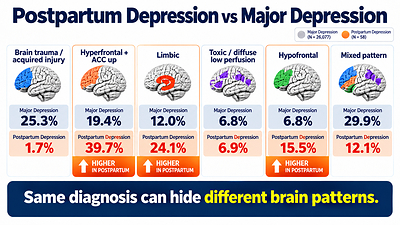
- Nearly 40% of women with PPD showed a hyperfrontal/ACC pattern, compared with 19.4% of those with major depression.
- Limbic patterns were also about twice as common: 24.1% in PPD versus 12% in major depression.
- Hypofrontal patterns appeared in 15.5% of PPD patients versus 6.8% in major depression.
- One of the most striking differences involved the brain trauma/acquired injury pattern: it appeared in 25.3% of the major depression group but just 1.7% of the postpartum depression group.
These new research findings from Amen Clinics reinforce an important point: The same psychiatric diagnosis can encompass different patterns of brain function. Understanding those differences may help explain why women with similar symptoms can respond differently to treatment and why a more individualized approach to care may be beneficial.
The new Amen Clinics research adds to a growing body of evidence suggesting that psychiatric diagnoses based on symptoms alone may not tell the whole story. Women with postpartum depression in the study showed several distinct patterns of brain function, and those patterns differed significantly from those seen in the much larger major depression group.
At Amen Clinics, brain SPECT imaging is not used in isolation to diagnose postpartum depression or determine treatment. It is one component of a comprehensive evaluation designed to provide clinicians with more information about the individual patient.
The emerging postpartum depression research suggests why that additional information may matter: The same symptoms and diagnostic labels can be associated with different patterns in the brain, and understanding those differences may ultimately help support more individualized care.
Read the full Amen Clinics article on postpartum depression vs. depression.
About Amen Clinics
For decades, Amen Clinics has used brain SPECT imaging as part of a comprehensive evaluation of mental health conditions.
Based on a database of nearly 300,000 SPECT scans, Amen Clinics clinicians have identified certain brain patterns, or brain dysfunction, associated with different mental health conditions.
Media Contact
Jordyn Dean
Publicist, Amen Clinics
[email protected]

 View original content to download multimedia:https://www.prnewswire.com/news-releases/new-research-on-postpartum-depression-vs-depression-what-brain-imaging-reveals-302896713.html
SOURCE Amen Clinics, Inc.
Serious News for Serious Traders! Try StreetInsider.com Premium Free!
You May Also Be Interested In
- Quotient Sciences and Acesion Pharma Announce Collaboration on AI-Enhanced Formulation Development to Advance Atrial Fibrillation Pipeline
- Solana Price Prediction: The $200 SOL Debate Meets Remittix’s BINANCE500 Purchase Bonus
- XRP Price Prediction: Traders Watch $1.66 as Remittix Invites 1,000 Holders to Test PayFi
Create E-mail Alert Related Categories
PRNewswire, Press ReleasesSign up for StreetInsider Free!
Receive full access to all new and archived articles, unlimited portfolio tracking, e-mail alerts, custom newswires and RSS feeds - and more!
