



Nanoparticle Based Vaccines to Treat, Prevent Severe Allergic Reactions
 Tweet
Tweet Share
Share E-mail
Novel approach could apply to multiple types of allergy, including food allergies, and may become an alternative to routine allergy shots
Details were published
"This publication reports exciting findings that we hope will lead to clinical trials and has potential as a revolutionary approach for allergy interventions and treatment," says Marc Rothenberg, MD, PhD, director of the Division of Allergy and Immunology at Cincinnati Children's.
Rothenberg and
Can vaccines tame the allergy epidemic?
Allergic diseases have reached epidemic proportions worldwide, affecting nearly 30% of the population. Asthma—a dangerous outcome of allergic reactions—causes about 250,000 deaths globally each year, according to the World Health Organization. And food allergy now inflicts 10% of the population. Allergic diseases also send millions to emergency departments and intensive care units while driving widespread missed time from school and work.
A wide range of foods, pollens, molds and other factors—called allergens—trigger the misery. Millions of people rely on a variety of treatments including special diets, inhalers and injections to manage their symptoms, along with difficult regimens to avoid allergy triggers. But experts in immunology contend that severe inflammatory reactions follow similar courses despite having differing initial triggers. This suggests that a single well-designed vaccine that can blunt inflammatory responses might be a lifesaver against multiple allergic diseases.
About the new vaccine
The novel allergy vaccine concept is an outgrowth of years of work led by Weissman, who was awarded a Nobel Prize in 2023 for his contributions to the mRNA technology that led to the first effective COVID vaccines.
In this application, the research team attached specific allergy-related mRNA strands to nanoparticles derived from lipids. Each nanoparticle is about 50 nanometers across; which means it would take about 2000 of these particles to be as wide as a single human hair.
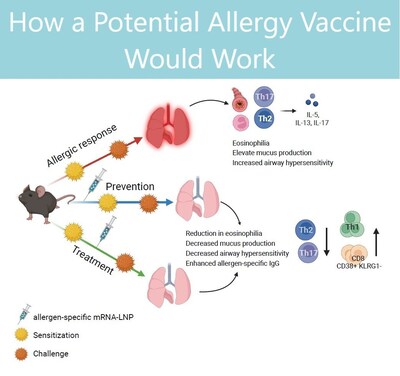
After being injected with the nanoparticle vaccine, mice were exposed to allergens that normally cause evoke a variety of immunological responses typical of allergy as well as clinical responses such as airway-swelling asthmatic responses.
When exposed to allergy-inducing triggers, the vaccinated mice showed reduced levels of inflammation including allergy-associated white blood cells (eosinophils), reduction in inflammatory cytokine mediators known to be critical in the induction of a variety of allergic responses (e.g. Interleukin-4 and Interleukin-13), less mucus production in the lung, and protection from lung hyper-responsiveness that is typically seen in asthma. The treated mice also produced allergen-specific antibodies known to block allergic responses.
"These findings identify a conserved immune mechanism across species, regardless of the mRNA-encoded protein. Allergen-specific mRNA-LNP therapy may be a promising approach for prevention and treatment of human allergic diseases," Weissman says.
Next steps
The key impact of this study is proof-of-concept that a more versatile vaccine approach exists for treating and preventing allergic disease. This approach differs from existing "allergy shot" regimens, which involve complex protocols focused on injecting purified allergens into patients.
More research is needed to develop the vaccine, including determining safety for people, how many types of allergens can be included in a single dose, and how long any increased protection might last.
"Our study demonstrates that mRNA-LNP therapy can reshape immune response to allergens, offering a powerful new tool for allergy treatment," says first author
About the Study
In addition to Rochman and Rothenberg, Cincinnati Children's co-authors included Michael Kotliar, ME,
Cincinnati Children's Comprehensive Rodent and Radiation Shared Facility, Integrated Pathology Research Facility, Single Cell Genomics Facility, Genomics Sequencing Facility, and Research Flow Cytometry Facility also contributed to the research.

 View original content to download multimedia:https://www.prnewswire.com/news-releases/nanoparticle-based-vaccines-to-treat-prevent-severe-allergic-reactions-302564419.html
SOURCE Cincinnati Children's Hospital Medical Center
Serious News for Serious Traders! Try StreetInsider.com Premium Free!
You May Also Be Interested In
- U.S.-Africa Trade Desk Formally Announces Trans-Atlantic Cotton Partnership
- NEW PACIFIC FILES FORM 40-F ANNUAL REPORT
- UN Global Compact Leaders Summit calls on business leaders to turn sustainability ambition into action at scale
Create E-mail Alert Related Categories
PRNewswire, Press ReleasesSign up for StreetInsider Free!
Receive full access to all new and archived articles, unlimited portfolio tracking, e-mail alerts, custom newswires and RSS feeds - and more!
