



Lung Cancer Research Foundation Announces Additional 2025 Scientific Research Grant Awards
 Tweet
Tweet Share
Share E-mail
Foundation funds five new research projects, bringing 2025 total to
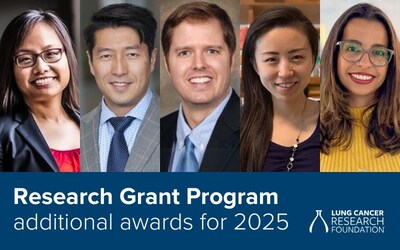
Also in 2025, LCRF awarded the American Lung Cancer Screening Initiative (ALCSI) a grant to conduct its "Plus One" screening initiative and research study, funded a three-year project in collaboration with the Israeli Cancer Research Fund, and announced two research grants focused on innovative strategies to advance the understanding and management of lung cancers harboring HER2 mutations and/or other HER2 alterations in collaboration with Bayer Pharmaceuticals. Additionally, AstraZeneca partnered with LCRF to fund three awards focused on prevention and early detection.
"AstraZeneca shares LCRF's commitment to improving survival of people with a lung cancer diagnosis," remarked Nabil Chebab, US Medical Head,
LCRF funds projects that demonstrate profound promise to make a sustained and lasting impact on lung cancer research and outcomes. The strength of LCRF's research program is underscored by the trust, generosity, and vision of its partners, fundraisers, and donors.
"LCRF is grateful to everyone who has made this grant cycle the largest in its history – 21 grant awards for more than
"It is gratifying to be able to fund even more innovative projects," said
LCRF's Leading-Edge Research Grant in
LCRF's Minority Career Development Award for
Additional LCRF 2025 Research
Leading Edge Grant Program:
Riyue Bao, PhD, University of Pittsburgh
Radiomics to Decipher Patient and Organ Heterogeneity in Response to Immunotherapies in Non-small Cell
Radiomics is emerging as a non-invasive biomarker to predict the efficacy of anti-PD1/PDL1 therapy across cancers and patients with increased organ-level metastasis heterogeneity are more likely to progress. This study aims to develop machine-learning and artificial-intelligence models to distinguish disease control from progression with organ specificity in patients with non-small cell lung cancer. By linking these findings to tumor biology, the resulting data will not only shed light on the mechanisms underlying variations in response to immunotherapies but will also provide essential advancement in the non-invasive biomarker development investigating therapy resistance.
Biomarkers of Response and Toxicity to Tarlatamab in Patients with Metastatic Small Cell
Small cell lung cancer (SCLC) is an aggressive and deadly form of lung cancer with limited treatment options and poor long-term survival. However, a newly approved drug represents a promising advance. Although it has shown encouraging early results, one side effect is cytokine release syndrome (CRS)—a potentially serious immune reaction that can cause fever, low blood pressure, and difficulty breathing. The goal of this study is to utilize new technologies in tandem with advanced computer modeling to improve how to predict which patients will benefit from this treatment and who is at higher risk for CRS. The study has two main aims: 1. Predicting who responds to the drug and 2. Identifying who is at risk for CRS in order to develop a new framework for personalizing treatment, making it more effective and safer, allowing patients to receive treatment more conveniently, avoid dangerous side effects, and ultimately, live longer.
Understanding the Dependency of RAS-driven Lung Adenocarcinomas on PRPS enzyme remodeling
Alterations in cellular metabolism are a well-established hallmark of lung cancers driven by the oncogene KRAS. Although much is known about how this occurs, we still lack clinically effective therapies targeting these processes. This study aims to leverage a novel metabolic vulnerability as a safe starting point in order to systematically dismantle the metabolic resiliency of KRAS-driven lung adenocarcinomas, will nominate a path for the development of effective, but less toxic, targeted therapies, and address key questions in basic lung cancer biology at a broad biochemical level. It will deliver new knowledge regarding the mechanisms oncogenic KRAS employs to deregulate gene expression and metabolism, and it will supply new diagnostic assays and therapeutic tools that can translate to the clinic to help patients with lung cancer.
Research Grant on Overcoming Resistance in
Chendi Li, PhD, Massachusetts General Hospital
Enhancing anti-tumor chemokines in KRAS G12C inhibitor-resistant non-small cell lung cancer
Over the past few years, treatment options for patients with the KRAS-mutant non small cell lung cancer (NSCLC) have expanded to include immunotherapies and targeted KRAS inhibitors. These agents, while effective in some patients, do not induce deep or durable responses in the majority of patients. This has prompted clinical trials combining KRAS inhibitors with immunotherapies. Early results look promising, with response rates greater than either agent alone. However, 25–40% of patients still do not respond to the combination. Thus, there remains an urgent need to understand why these treatments fail in order to develop new strategies with enhanced efficacy to benefit a greater number of patients. This project seeks to understand mechanisms underlying the failure of some tumors to respond to combined KRAS and PD-L1/PD-1 inhibition. By identifying the transcriptional regulators of chemokines that recruit T cells and turn immune "cold" tumors "hot", this work will provide a foundation for future efforts to design therapeutic strategies to promote immune cell infiltration.
Minority Career Development Award (CDA):
The Role of BMAL1 and Circadian Disruption in Modulating Tumor Immunity and Immunotherapy Response in Lung Adenocarcinoma
Our body runs on a natural 24-hour cycle known as the circadian rhythm, which regulates many important functions, such as sleep, metabolism, and the immune system. Interestingly, recent research has shown that these internal clocks also affect how well cancer treatments work, especially a type of immunotherapy called immune checkpoint inhibitors (ICIs), which help the immune system attack tumors. In people with lung cancer, ICI treatments given in the morning are up to four times more effective than those given later in the day. The main question is why timed immunotherapy might not work in some patients, and what factors might cause it to not work. In lung cancer, the circadian rhythm in the cancer cells is often altered or completely absent. Ultimately, this research could help improve outcomes for lung cancer patients by optimizing the timing of immunotherapy and identifying new markers to guide treatment. If successful, our findings may lead to more personalized and effective approaches to cancer care, taking into account not only the genetic makeup of the tumor but also the biological clock that governs the immune system.
For more information about LCRF and the Scientific Grant Program, visit LCRF.org/Research.
About the Lung Cancer Research Foundation
The Lung Cancer Research Foundation® (LCRF) is the leading nonprofit organization focused on funding innovative, high-reward research with the potential to extend survival and improve quality of life for people with lung cancer. LCRF's mission is to improve lung cancer outcomes by funding research for the prevention, diagnosis, treatment, and cure of lung cancer. To date, LCRF has funded 450 research grants, totaling nearly
Contact:
Sr. Director, Marketing and Communications
[email protected]
 View original content to download multimedia:https://www.prnewswire.com/news-releases/lung-cancer-research-foundation-announces-additional-2025-scientific-research-grant-awards-302653170.html
SOURCE Lung Cancer Research Foundation
Serious News for Serious Traders! Try StreetInsider.com Premium Free!
You May Also Be Interested In
- Gemmy Inflatables Bring Big Impact and Playful Charm to Halloween Decorating
- Statement from Joy Chen, Every Fire Survivor's Network, and Jamie Court, Consumer Watchdog, on the Death of SB 492
- RED ROBIN GOURMET BURGERS, INC., COMPLETES SALE OF 108 RESTAURANTS FOR $89.4 MILLION
Create E-mail Alert Related Categories
PRNewswire, Press ReleasesSign up for StreetInsider Free!
Receive full access to all new and archived articles, unlimited portfolio tracking, e-mail alerts, custom newswires and RSS feeds - and more!
