




FRACTAL Discloses Mesh-to-Gateway System for Part 15 D2D Satellite Connectivity

FREE Breaking News Alerts from StreetInsider.com!
StreetInsider.com Top Tickers, 10/15/2026
- S&P 500 near flat as traders shift out of risky AI bets
- U.S. producer prices rise by 1.3% month-on-month in September
- Brent steady as US weighs easing sanctions on global 'shadow fleet'
- UBS now expects a third Fed rate hike after hot September inflation print
- Tesla-SpaceX Merger could be announced before December, Barclays says
 Tweet
Tweet Share
Share E-mail
BEDFORD, Mass.--(BUSINESS WIRE)-- Fractal Antenna Systems, Inc. (“FRACTAL”) today disclosed a patented and patent-pending Mesh-to-Gateway, or “M2G”, architecture for unlicensed Part 15 wireless networks with D2D/LEO satellites. This proposed satellite network enables ubiquitous connectivity for sensors, machine control, fleet management, IoT, robotics, and other Part 15 devices.
This press release features multimedia. View the full release here: https://www.businesswire.com/news/home/20260819016778/en/
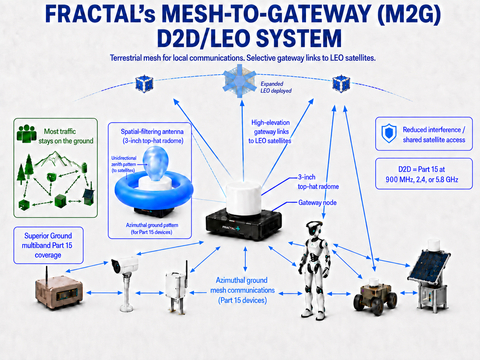
Caption Figure 1: FRACTAL’s M2G architecture keeps most Part 15 traffic within the terrestrial mesh while selected gateways provide high-elevation links to D2D/LEO satellites, extending connectivity while reducing terrestrial interference. Under the FCC’s August 2026 NPRM, 2.4 and 5.8 GHz may support Earth-to-space operation while continuing to serve terrestrial Part 15 networks; 900 MHz remains available for terrestrial mesh operation.
Nathan Cohen, CEO of the firm, notes: “Unlicensed Part 15 devices have been wildly successful, and yet they can fail at the same time. Too many devices create wireless traffic jams, while remote devices require expensive link access. M2G solves this by fusing two wireless ecosystems that have until now been largely separate: Part 15 and D2D satellite connectivity.”
On August 6, 2026, the FCC adopted an NPRM, ET Docket No. 26-169, proposing Earth-to-space satellite use in the 2400–2483.5 MHz and 5725–5850 MHz Part 15 bands. Significantly, the proposed uplink allocation does not include the 902–928 MHz Part 15 band. The Commission cites recent waiver-based 2.4 GHz operations as a precedent and states that streamlined rules could facilitate systems of that type.
That precedent, however, points to different network architectures. One firm’s broader commercial model emphasizes direct satellite reception of low-power Bluetooth-class transmissions. For FRACTAL, instead of connecting millions of individual Part 15 devices directly to satellites, M2G makes the existing Part 15 mesh satellite-capable through hardware-modest selected gateways, while allowing isolated assets to go direct-to-satellite. FRACTAL’s M2G does not require every endpoint to close a link to orbit: ordinary devices remain in the local Part 15 mesh, while selected Part 15 gateways aggregate traffic and make the D2D/LEO connection.
The FCC’s omission of 900 MHz from its proposed satellite-uplink bands highlights a central M2G advantage rather than a limitation. A 900 MHz sensor or control device can remain entirely on the terrestrial mesh, and its data relayed at 2.4 and/or 5.8 GHz for the orbital connection. M2G therefore does not impose a fixed frequency division between ground and space. The terrestrial and satellite links can be optimized independently for frequency, antenna pattern, power, traffic load, and geometry. In addition, isolated 2.4 and 5.8 GHz Part 15 devices could link directly to satellite. This gives M2G a central advantage: it extends satellite connectivity across existing Part 15 networks without requiring every device to link to orbit, reducing terrestrial congestion and the number of independent satellite links the constellation must serve.
An important part of the invention is the use of unique, low-profile gateway antennas covering 900 MHz, 2.4 GHz, and 5.8 GHz Part 15 bands for terrestrial/mesh operation, with 2.4 and/or 5.8 GHz also available for a separate high-elevation satellite function under the proposed FCC framework. Terrestrial coverage is principally azimuthal, while the satellite link preferentially uses high-elevation geometry, placing the two links in substantially different spatial domains. This spatial separation deters interference that might otherwise hamper terrestrial Part 15 operation and other services.
At the satellite end, M2G uses its proprietary deployable Aperture Engine: an antenna-based satellite with “something extra”: solar power harvesting and electronics incorporated into the same surface stack as the antenna. First disclosed by Cohen in 1998, the patented and patent-pending Aperture Engines have since become an important design approach. These satellites are smaller than other proposed D2D satellites, low power, lightweight, high antenna gain, and collapsible for launch. They are designed for Part 25 authorization. Costs are projected to be substantially lower compared with conventional satellite constellation networks.
Because gateways are selected rather than ubiquitous, M2G concentrates the demanding orbital-link function in nodes that can be equipped for the skyward link. Traffic can be selected and aggregated before satellite transport, and the gateway can preferentially use the favorable high-elevation portion of a LEO pass. This avoids imposing satellite link-budget and sky-view requirements on every low-cost endpoint and reduces the number of independent orbital links the constellation must serve.
M2G extends Part 15 from a local wireless technology into a wide-area, potentially global communications platform. For transportation and asset monitoring, vehicles, equipment, and cargo can remain connected in network-barren areas. For IoT, inexpensive sensors can now report from locations far beyond the reach of their local wireless network. For robotics, robotic groups can operate beyond cellular coverage while retaining local machine-to-machine communications. For farming, sensors and equipment can be spread across large or remote areas without needing terrestrial communications infrastructure at every location.
The firm is presently developing M2G gateway hardware and satellite integration in anticipation of an FCC regulatory framework permitting such operations. M2G space testing is targeted for 2028 and after, subject to FCC authorization.
ABOUT FRACTAL: Fractal Antenna Systems, Inc. (“FRACTAL”), based in Bedford, Massachusetts, creates and sells advanced antenna, metamaterial, electromagnetic, and communications technologies and products for commercial, telecom, wireless, aerospace, public-safety, and defense applications. FRACTAL has been working at the antenna/satellite interface for over a decade, with patented and patent pending technologies spanning satellite antennas and arrays, spacecraft, and ground communications systems.
View source version on businesswire.com: https://www.businesswire.com/news/home/20260819016778/en/
Phil Salkind
[email protected]
or [email protected]
Source: Fractal Antenna Systems, Inc.
Serious News for Serious Traders! Try StreetInsider.com Premium Free!
You May Also Be Interested In
- Interactive Brokers Group Announces 3Q2026 Results
- Nekome: Nazi Hunter Unmasks Hitler’s Hyenas in New Trailer Ahead of Steam Next Fest Demo
- American Coastal Insurance Corporation Schedules Third Quarter Financial Results and Conference Call
Create E-mail Alert Related Categories
Business Wire, Press ReleasesSign up for StreetInsider Free!
Receive full access to all new and archived articles, unlimited portfolio tracking, e-mail alerts, custom newswires and RSS feeds - and more!
