



Americans' knowledge of civics increases, Annenberg survey finds
 Tweet
Tweet Share
Share E-mail
Survey also finds that most have little or no trust in Supreme Court as gap between parties widens
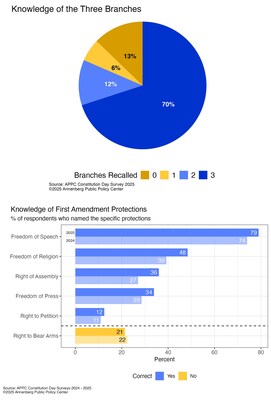
More than two-thirds of
"People can't cherish, safeguard, or exercise their constitutionally protected rights unless they know that they have them and understand how effective use of them sustains our system of government," said APPC director
Released for Constitution Day (
Highlights
The 2025 Annenberg Constitution Day Civics Survey finds that:
- Over two-thirds of Americans (70%) can name all three branches of government.
- Asked what specific rights are guaranteed by the First Amendment, 79% say freedom of speech.
- Four in 10 U.S. adults (41%) have at least a moderate amount of trust the Supreme Court is operating in their best interests. There is a nearly 60-point gap between the parties – 75% of Republicans have at least a moderate amount of trust in the court but just 18% of Democrats do.
- There's bipartisan support for several potential Supreme Court reforms, with over 80% favoring prohibiting justices from participating in cases in which they have "personal or financial interests."
Annenberg Constitution Day Civics Survey
The nationally representative Annenberg Constitution Day Civics Survey, conducted for the Annenberg Public Policy Center by independent research company SSRS, draws on responses to Annenberg surveys of empaneled, nationally representative samples of
The branches of government and First Amendment
More than two-thirds of Americans (70%) can name all three branches of government, the highest in a few years. (The question has been asked since 2007 and annually since 2014, but a shift in survey methodology from phone to internet in 2023 means the recent figures are not directly comparable to the older ones.) In addition, 12% can name two branches, 6% can name one, and 13% cannot name any, no significant change from last year.
There is an upsurge in awareness of most of the five First Amendment rights, with 40% able to name most of the rights, up from 30% in 2024. When respondents are asked if they can name the specific rights guaranteed by the First Amendment:
- Nearly 4 out of 5 (79%) say freedom of speech, up significantly from 74% in 2024;
- Nearly half (48%) say freedom of religion, up from 39% in 2024;
- 36% say right of assembly, up from 27% in 2024;
- 34% say freedom of the press, statistically unchanged;
- 12% say the right to petition, statistically unchanged.
The 2025 increases in knowledge, during the first year of the second Trump administration, parallel a 2018 increase during the first Trump administration. In both cases, a torrent of executive actions and the resulting judicial cases and actions by Congress produced a rush of political news.
Political party affiliation did not appear to play a role in the increase in civics knowledge.
Eroding trust in the Supreme Court
In the past few years, a number of surveys have shown declining trust in the Supreme Court and a widening gap between the political parties in views on the court. The Annenberg survey finds that from 2019 to
"Trust has fallen sharply and become polarized," said University of Pennsylvania political science professor
The survey finds a widening, nearly 60-point gap between the parties on trust in the Supreme Court. As of
"The court was once held in high esteem by Democrats and Republicans alike, but that is no longer the case," Levendusky said. "If the court is just another political actor, then it loses its special place in our political system, with worrying long-term implications."
Broad popular support for some Supreme Court reforms
Asked about potential measures to reform the Supreme Court, most Americans favor prohibiting participation of justices in cases in which they have personal or financial conflicts (83%); creating a formal ethics code for justices (78%); mandatory retirement age (72%); and term limits (69%). Under half favor other proposals – allowing the public to vote to overturn Supreme Court rulings on controversial issues (44%) and increasing the size of the court (31%).
See the full release online for more on how partisanship affects views of court reform.
Constitution Day
APPC releases its annual civics survey in advance of Constitution Day, which celebrates the signing of the Constitution on
"Strengthening the citizenry's knowledge of the
The Annenberg Constitution Day Civics Survey was developed under the leadership of Levendusky, Jamieson, Holbert, research analyst
The Annenberg Public Policy Center was established in 1993 to educate the public and policy makers about communication's role in advancing public understanding of political, science, and health issues at the local, state, and federal levels.
Contact:

 View original content to download multimedia:https://www.prnewswire.com/news-releases/americans-knowledge-of-civics-increases-annenberg-survey-finds-302553060.html
SOURCE Annenberg Public Policy Center
Serious News for Serious Traders! Try StreetInsider.com Premium Free!
You May Also Be Interested In
- Accuray and Samsung NeuroLogica Advance Volumetric Imaging Collaboration for the Accuray CyberKnife® Platform
- UPDATE: WSP to host Power & Energy-focused investor event virtually only
- Best Prescription Sunglasses (2026): Quay Featured Among Stylish, Fashion-Forward RX Frames for Everyday Wear and Versatile Personal Style by Consumer365
Create E-mail Alert Related Categories
PRNewswire, Press ReleasesSign up for StreetInsider Free!
Receive full access to all new and archived articles, unlimited portfolio tracking, e-mail alerts, custom newswires and RSS feeds - and more!
