




5 Best Fundamental Stock Analysis Software Tools: The Definitive 2026 Ranking

FREE Breaking News Alerts from StreetInsider.com!
StreetInsider.com Top Tickers, 10/11/2026
- Wall Street posts weekly gains with earnings, inflation data on tap
- Oil prices settle higher as more production shut ahead of hurricane
- Apple cuts iPhone 18 Pro orders due to soft demand, Nikkei Asia reports
- UBS flags level in gold prices where dip buyers will likely emerge
- Telecom stocks tumble on SpaceX spectrum acquisition news
 Tweet
Tweet Share
Share E-mail
Whether you're investing for retirement or trying to start a college fund for your kid, finding the right long-term stocks means doing deep work on the financial data and fundamentals behind every company. But what if you didn't have to run all that research manually?
The best fundamental stock analysis software saves you time and stress while empowering you to make smarter, more calculated investment decisions. The problem: with so many options on the market, it's easy to get overwhelmed and settle for the wrong tool.
We put this list together to help you narrow things down to the best fundamental analysis tools. Compare five options below and take the uncertainty out of investing.
Ranking the 5 Best Fundamental Stock Analysis Software
You can't really go wrong with any of these, but they all work differently and suit different investor profiles. We ranked them on usability and insight power, starting with VectorVest's stock analysis software.
1. VectorVest
This proprietary stock rating system from VectorVest has outperformed the S&P 500 index by 10x over the past 20+ years. It tells you what to buy, when to buy it, and when to sell it. No guesswork, no emotion, no hours glued to the screen. It's the simplest way to win more trades with less work.
Every stock gets an overall VST rating, which combines three sub-ratings:
Relative value (RV): Compares a stock's long-term price appreciation potential (forecasted three years out), AAA corporate bond rates, and risk. A much better indicator than price-to-value alone.
Relative safety (RS): Assesses the company's financial consistency and predictability, debt-to-equity ratio, business longevity, sales volume, and other risk factors.
Relative timing (RT): Based on the direction, dynamics, and magnitude of a stock's price movement. It's calculated day over day, week over week, quarter over quarter, and year over year.
Each rating sits on a simple 0.00 to 2.00 scale, with 1.00 as the average. The combined result generates a buy, sell, or hold recommendation. Advanced tiers unlock real-time data powered by the Nasdaq last sale feed.
There's also an overall market timing indicator that signals when it's favorable to invest and when sitting in cash is smarter. VectorVest has called every major market move over the past 20 years.
Daily stock picks mean you're never hunting for your next trade. Plans start at $49.99/month for Market Launchpad (covering 9,500+ stocks). The full desktop experience starts at $149/month.
Pros
Clear Buy, Sell, or Hold recommendation on every stock, every day
Proprietary VST system backed by 30+ years of development
Market timing signals with a documented historical track record
Plans for beginners through active traders
US-based phone support on all tiers
Cons
Desktop software required for Enhanced and Premium tiers
No free plan (30-day trial at $9.95)
Best For
Investors looking to take all the human error, emotion, and guesswork out of investing and win more trades with less work.
2. Seeking Alpha
Seeking Alpha is a different kind of option if you're looking for the best fundamental stock analysis software that surfaces commentary from a wide range of individuals. Thousands of contributors publish long-form stock analysis in one spot, and you can read across them to form your own view.
The platform also layers in its proprietary Quant Ratings system, grading every stock across Value, Growth, Profitability, Momentum, and EPS Revisions. Similar in spirit to VectorVest's VST system, both being proprietary stock rating systems.
The real differentiator is price. Seeking Alpha runs just $299/year for the premium tier. No monthly billing option, but at that price point, taking a chance isn't a stretch.
Pros
Massive library of analyst opinions and long-form research
Quant Ratings scored daily across five fundamental factors
You get access to earnings call transcripts
Cons
Annual billing only
No direct Buy/Sell/Hold action signal
Information overload from 10,000+ articles per month
The quality of information in contributor pieces can be hit or miss
Best For
Self-directed investors who want multiple perspectives before making their own call.
3. Morningstar
Morningstar has been the benchmark in independent investment research since 1984, so it's legitimately impressive that the platform still earns a place on lists ranking the best fundamental stock analysis software in 2026.
More than 120 global analysts cover 1,000 individual stocks and 1,600 mutual funds and ETFs. They produce reports with fair value estimates built on a proprietary discounted cash flow model. Every covered stock also gets an Economic Moat Rating:
Wide (competitive advantage expected to last 20+ years)
Narrow (10+ years)
None
Moats are scored across five sources, including cost advantage, intangible assets, network effect, switching costs, and efficient scale.
There's also the Star Rating system (1 to 5), which assesses risk-adjusted historical performance. Newer Medalist Ratings are forward-looking, grading funds on process, people, parent company, performance, and price.
Another worthwhile feature is Portfolio X-Ray. It breaks down your combined holdings and surfaces overlaps you may not have realized existed, along with fee drag and sector concentration. Pricing starts at $34.95/month or $249/year, with a 7-day for both plans.
Pros
40+ years of independent, conflict-free research credibility
Economic Moat Rating on covered stocks with five structural factors
Fair value estimates powered by analyst-driven DCF models
Portfolio X-Ray exposes hidden overlaps and fee drag across holdings
Cons
Only about 1,000 stocks get full analyst coverage
Dense interface with a steep learning curve
Even paid plans get served ads
Free brokerage platforms (Schwab, Fidelity) already include some Morningstar data
Best For
Buy-and-hold investors who care about independent analyst research.
4. Koyfin
Koyfin is interesting. It's built like a financial terminal but priced for retail investors. You can build custom dashboards on the browser-based platform, combining charts, watchlists, financial data tables, and news feeds in one workspace.
Koyfin lets you graph a company's P/E ratio over a decade while overlaying revenue growth on the same chart, then compare the result against an index or a competitor. Extremely detailed fundamental analysis. Empowering for some, overwhelming for others.
Another thing worth noting: Koyfin goes beyond equities, so you could make the case for it as the best fundamental stock analysis software if you're invested in ETFs, global stocks, bonds, forex, and futures as well.
There's a free tier for basic screening, though it's limited. The Plus plan ($39/month on annual billing) unlocks 10 years of company financial history, analyst estimate data, earnings transcripts, SEC filings, and up to 10 custom formulas. Premium ($79/month) removes formula limits and adds portfolio risk metrics, hypothetical performance modeling, and alerts.
Pros
Unparalleled charting capabilities with fully customizable multi-panel dashboards
Global coverage spanning equities, bonds, forex, futures, and macro data
10 years of financial history on Plus, with analyst estimates and transcripts
Free tier for basic research
Cons
No actionable recommendations (just raw data)
Can't download/export financial statements
No backtesting capabilities
Browser-only, no mobile app
Best For
Investors who want as much data as they can get their hands on at consumer pricing. You will have to be comfortable building your own analytical workflow.
5. Stock Rover
Stock Rover delivers serious screening depth. The platform features 800+ filtering criteria (on the Ultimate plan) across stocks, ETFs, and mutual funds. Pre-built screeners like Bargain Hunter and the Buffetology Screener are available if you'd rather not build your own from scratch.
You can pull historical fundamental data going back up to 20 years depending on the plan, which gives you a chance to evaluate valuation metrics against actual outcomes over full market cycles.
More sophisticated features live on higher tiers, including correlation analysis, Monte Carlo simulations for portfolio projections, and dividend forecasting. Premium starts at $34/month, while Ultimate Pro (built for advisors and professionals) runs $199/month.
Pros
Unparalleled depth with 800+ screening criteria on top-tier plans
10-20+ years of historical fundamental data (depending on subscription)
Monte Carlo simulations, correlation analysis, and dividend forecasting
Research reports and peer comparison tools on Premium Plus and above
Cons
Significant learning curve: the sheer volume of metrics is overwhelming
Deep screening limited to US and Canadian securities
No mobile app (browser-only on desktop)
Interface is powerful but a little dated visually
Best For
Investors who build custom screens, backtest valuation criteria, and want granular control over hundreds of financial metrics.
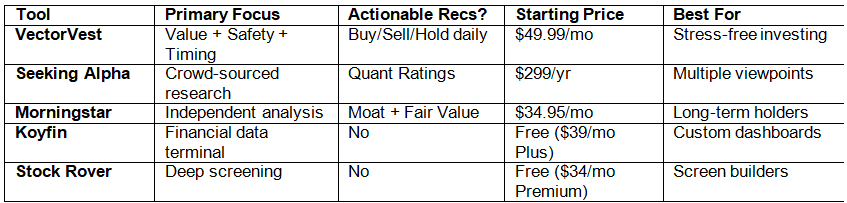
Snapshot Comparison of the Best Fundamental Analysis Tools
Is There a Difference Between the Tools Retail Investors and Institutions Use?
Yes, at least historically. But the playing field has started leveling out as retail investors gain access to the best fundamental stock analysis software powered by a lot of the same feeds.
That said, institutional investors still run Bloomberg Terminal, FactSet, and Capital IQ. Seats on those platforms cost $20,000+ per year each. Companies pay that premium for real-time data and proprietary models that inform more calculated decisions.
Tools like VectorVest now have real-time data feeds too. VectorVest pulls data from the Nasdaq last sale feed. That may matter less for a buy-and-hold investor than for a day trader or swing trader, but it still makes a real difference in how quickly you can react to news and price action.
Tips on Assessing the Fundamental Analysis Software
You could make the case for any of these as the best fundamental analysis tools for a specific investor. The easiest way to narrow it down is answering a few questions:
Do you want data or direction? Many tools give you raw insights and leave you to figure out next steps. VectorVest, by contrast, tells you what to DO.
How much time can you commit daily? Stock Rover and Koyfin are chart-heavy tools that demand hours. Options like VectorVest's Market Launchpad only ask 10 minutes.
What markets do you trade? Some of these are limited to US and Canadian equities. Koyfin covers global markets.
What's your budget? Koyfin and Stock Rover have free tiers to start. But you get what you pay for, and options like VectorVest may deliver better value overall.
At the end of the day, only you can decide which is the best stock forecasting software for your goals. But if we had to make a single recommendation on the best fundamental stock analysis software, it would be VectorVest.
Frequently asked questions
What is fundamental analysis?
Fundamental analysis is the practice of evaluating a company's financial health. It takes into account earnings, revenue, debt, and growth rates. The goal is determining whether a stock is overpriced, undervalued, or fairly priced relative to what the business is actually worth.
What is the best fundamental analysis tool for retail investors?
VectorVest. It handles both the fundamental and technical analysis for you, then delivers a clear buy, sell, or hold recommendation. Every other tool makes you interpret raw numbers.
What's the difference between fundamental stock analysis software and technical trading tools?
Fundamental stock tools assess a company's value and safety. Technical tools focus on timing to project what a stock's price might do next. Most investors use a mix of both. Long-term holders care more about fundamentals, short-term traders lean technical.
What is the best app for fundamental analysis of stocks?
The best stock app for iPhone or Android users alike is the VectorVest stock advisory.
How much should I plan on spending per month on the best fundamental stock analysis software?
Anywhere from $10 to $150 per month. VectorVest may be the most expensive option here, but you get what you pay for. It's the best fundamental analysis tool on the market.
Bottom Line on the Best Fundamental Stock Analysis Software
All five of these platforms earned a spot on this list for good reason. But you only need one in your arsenal, and chances are, that one is VectorVest. It simplifies complex fundamental analysis and delivers the insights you need to make decisions. Learn more about how it works today.
COMTEX_494133206/2891/2026-10-11T12:39:31
Serious News for Serious Traders! Try StreetInsider.com Premium Free!
You May Also Be Interested In
- Mangoceuticals closes $500K offering at 74% premium to recent price
- China SXT Pharmaceuticals closes $12M registered direct offering
- Accendra Health gets NYSE notice over low share price
Create E-mail Alert Related Categories
Globe PR Wire, Press ReleasesRelated Entities
Morningstar, Inc., Dividend, EarningsSign up for StreetInsider Free!
Receive full access to all new and archived articles, unlimited portfolio tracking, e-mail alerts, custom newswires and RSS feeds - and more!
