



15 Million Americans Live in a County With No General Surgeon
 Tweet
Tweet Share
Share E-mail
A new study in the Journal of the American College of Surgeons compares, for the first time, the surgeon supply across 12 surgical specialties, county by county, with an interactive data visualization available to the public
Key Takeaways
- A new study from the American College of Surgeons and the UNC Cecil G. Sheps Center maps surgeon supply across 12 surgical specialties and every US county, and a companion interactive tool visualizes the findings.
- Of 3,144 US counties, 951 had no identified surgeon in any of the 12 surgical specialties, and 1,180 counties had no general surgeon, representing 15.1 million people lacking access to surgical care.
- 434 critical access hospitals, the small rural facilities many communities rely on for emergency and inpatient care, are in counties with no identified full-time surgeon.
- Every US hospital referral region had at least one general surgeon, yet 1,180 counties had none, illustrating that the potential designation of federal shortage areas will be critically dependent on the choice of geographic scale.
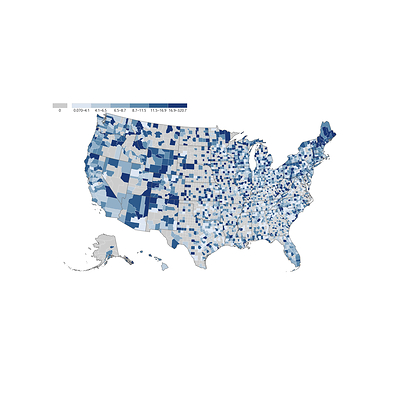
The study and a companion interactive tool built on the same data, developed by the American College of Surgeons (ACS) and the Cecil G. Sheps Center for Health Services Research at the University of North Carolina at Chapel Hill, map surgeons across 12 specialties and all 3,144 US counties from a single data source, allowing direct comparison for the first time. Previous studies examined one specialty at a time, used different data sources, or reported only national and state totals.
The ACS Surgical Workforce Mapping Tool visualizes the study's findings and gives patients, clinicians, and policymakers direct access to county-level data, allowing hospital boards, residency program directors, state legislators, congressional staffers, and patients to look up, compare, and download surgical workforce data for any county, referral region, or metropolitan/micropolitan area in the country.
"For a patient, the question is not how many surgeons the country has; it is whether there is one available where they live," said
The analysis identified 201,394 surgeons practicing in the
Study Results
The 951 counties (30%) with no identified surgeon in any of the 12 specialties are home to 9.6 million people. The 1,180 counties (38%) with no general surgeon are home to 15.1 million.
Every one of the country's 306 hospital referral regions had at least one general surgeon, but these regions are large, multi-county areas defined by where patients travel for major surgical care, so the presence of a surgeon somewhere within one does not mean surgical care is close at hand for patients in its rural counties. Overall, surgeon supply across all 12 specialties was 12 times higher in some regions than others, from 20.8 surgeons per 100,000 people in
Access varied sharply by specialty. Transplant surgery, at 0.3 surgeons per 100,000 people, was absent from 179 of the country's 306 hospital referral regions, and the most specialized fields were consistently the smallest and the most geographically concentrated. Because the study classified all 12 specialties from a single data source using definitions the ACS developed with input from more than a dozen surgical societies, a community can see which specific specialties it lacks rather than a single aggregate surgeon count.
The findings also highlight potential challenges for rural communities. Researchers overlaid surgeon locations with federal facility files and found 475 hospitals and surgical facilities in counties with no identified full-time surgeon. Of those, 434 were critical access hospitals, the small rural facilities many communities depend on for emergency and inpatient care.
"The Surgical Workforce Mapping Tool gives policymakers, health systems, and communities a practical tool to understand their local surgical workforce and identify gaps in access to care," said
Users can filter by specialty, switch between counties, hospital referral regions, and metropolitan/micropolitan areas, overlay hospitals and ambulatory surgical centers, and download maps for use in reports and presentations.
"Mapping the surgical workforce is the first step to crafting a thoughtful growth strategy," said
The authors caution that uneven distribution is not automatically a problem to be corrected. Transplant surgery is concentrated in part because complex procedures are deliberately regionalized to preserve quality, and the most appropriate distribution is unlikely to be the same for every specialty.
Policy Applications
The findings come as federal policymakers consider how to better identify communities with limited access to surgical care. The Ensuring Access to General Surgery Act of 2026 (H.R. 7198) would direct the Health Resources and Services Administration to develop a methodology for identifying general surgery shortage areas that considers surgeon supply and geographic service areas.
The mapping tool could help policymakers and health care leaders identify where workforce interventions may have the greatest impact, including investments in graduate medical education, rural surgical training, and programs designed to attract and retain surgeons in underserved communities.
About the Data
The study and interactive tool use surgeon location data from the
The analysis identifies where surgeons are located but does not measure patient travel time, surgical volume or capacity, or whether individual surgeons practice at specific hospitals. Full methodology, data sources, and study limitations are available in the JACS study.
Access The ACS Surgical Workforce Mapping Tool
The ACS Surgical Workforce Mapping Tool is free and publicly available on the ACS website. Full methodology and data source documentation are available on facs.org. The study is published as an article in press on the JACS website.
Manuscript Citation: Fraher E, Galloway E, Ricketts T, et al. A National Atlas of Surgeon Supply Across Specialties and Geographic Areas. Journal of the American College of Surgeons. 2026. DOI: 10.1097/XCS.0000000000002224
Cite the Tool: American College of Surgeons & Program on Health Workforce Research and Policy (PHWRP), Cecil G. Sheps Center for Health Services Research, UNC-Chapel Hill. (2026). Surgery Workforce Interactive Map. Data from NPPES
Note: The ACS Surgical Workforce Mapping Tool reflects surgeon locations as of
About the American College of Surgeons
The American College of Surgeons (ACS) is a scientific and educational organization of surgeons that was founded in 1913 to raise the standards of surgical practice and improve the quality of care for all surgical patients. The ACS is dedicated to the ethical and competent practice of surgery. Its achievements have significantly influenced the course of scientific surgery in America and have established it as an important advocate for all surgical patients. The ACS has approximately 95,000 members and is the largest organization of surgeons in the world. "FACS" designates that a surgeon is a Fellow of the ACS.
Follow the ACS on social media: X | Instagram | YouTube | LinkedIn | Facebook
About the UNC Cecil G. Sheps Center for Health Services Research
The Cecil G. Sheps Center for Health Services Research at the University of North Carolina at Chapel Hill, a pan-university center, undertakes innovative research and program evaluation to understand health care access, costs, delivery, outcomes and value. This research provides the evidence base to improve health through a more effective and efficient health care system. Its Program on Health Workforce Research and Policy studies the supply, distribution, and training of the health workforce. The study was supported by UNC-CH faculty, researchers, and staff Anthony Charles, MD, MPH, Mustafa Abid, MD and Abhi Joshi, MCS.
 View original content to download multimedia:https://www.prnewswire.com/news-releases/15-million-americans-live-in-a-county-with-no-general-surgeon-302890898.html
SOURCE American College of Surgeons
Serious News for Serious Traders! Try StreetInsider.com Premium Free!
You May Also Be Interested In
- Fifth Ocean Capital and Tartan Investment Partners Announce Strategic Investment in Complete Production Resources
- Amber International Holding Limited Schedules 2026 Annual General Meeting for October 23, 2026
- Dozuki Launches Forge AI to Power the Future of the Industrial Workforce
Create E-mail Alert Related Categories
PRNewswire, Press ReleasesSign up for StreetInsider Free!
Receive full access to all new and archived articles, unlimited portfolio tracking, e-mail alerts, custom newswires and RSS feeds - and more!
