



Vitamin K supplement slows prostate cancer in mice
 Tweet
Tweet Share
Share E-mail
In 2001, the National Cancer Institute's SELECT trial sought to determine if an antioxidant vitamin E supplement could successfully treat or prevent prostate cancer. The trial involving 35,000 men was planned to last up to 12 years. However, after just three years, participants were told to stop taking their supplements. Not only had vitamin E failed to slow or prevent prostate cancer—more men taking the supplement started to get the disease. Seeing these results, Trotman thought, 'If an antioxidant failed, maybe a pro-oxidant would work.' His new findings in mice show just that.
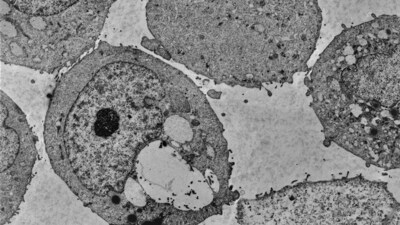
When mice with prostate cancer are given menadione, it messes with the cancer's survival processes. Trotman's team has discovered that menadione kills prostate cancer cells by depleting a lipid called PI(3)P, which works like an ID tag. Without it, the cells stop recycling incoming materials and eventually explode. Trotman explains:
"It's like a transport hub, like JFK. If everything that goes in is immediately de-identified, nobody knows where the airplanes should go next. New stuff keeps coming in, and the hub starts to swell. This ultimately leads to the cell bursting."
This causes the cancer's progression to slow significantly in mice. Trotman now hopes to see the experiment translated to pilot studies in human prostate cancer patients:
"Our target group would be men who get biopsies and have an early form of the disease diagnosed. We wonder if they start to take the supplement, whether we would be able to slow that disease down."
Amazingly, Trotman's research suggests menadione may also prove effective against myotubular myopathy, a rare condition that prevents muscle growth in infant boys. Those diagnosed rarely live beyond early childhood. Trotman's lab has found that depleting PI(3)P with menadione can double the lifespan of mice with this condition.
If the results hold up in humans, it would mean that men with prostate cancer can enjoy a better quality of life and more time with their families. It could also mean more precious time for children born with an incurable disease.
About Cold Spring Harbor Laboratory
Founded in 1890, Cold Spring Harbor Laboratory has shaped contemporary biomedical research and education with programs in cancer, neuroscience, plant biology and quantitative biology. Home to eight Nobel Prize winners, the private, not-for-profit Laboratory employs 1,000 people including 600 scientists, students and technicians. For more information, visit www.cshl.edu
 View original content to download multimedia:https://www.prnewswire.com/news-releases/vitamin-k-supplement-slows-prostate-cancer-in-mice-302286057.html
SOURCE Cold Spring Harbor Laboratory
Serious News for Serious Traders! Try StreetInsider.com Premium Free!
You May Also Be Interested In
- The future of China-US relations lies in people-to-people friendship: China Daily editorial
- Slate Grocery REIT Provides Capital Allocation Update in Connection with Ongoing Strategic Review Process
- Best Crypto to Buy Now: Remittix, Solana, and Cardano After $6 Billion in New Futures Bets
Create E-mail Alert Related Categories
PRNewswire, Press ReleasesSign up for StreetInsider Free!
Receive full access to all new and archived articles, unlimited portfolio tracking, e-mail alerts, custom newswires and RSS feeds - and more!
