




Virtual Power Plants: Powering the Grid From Your Neighborhood

FREE Breaking News Alerts from StreetInsider.com!
StreetInsider.com Top Tickers, 10/24/2026
- Wall Street closes lower to end rocky week
- Meta's capital-raising plans expose a major weakness in the AI boom
- Oil prices jump $3 on Houthi attacks, oil spill, highest settlement since April
- BofA flags further downside risk for stocks, yields and dollar
- SpaceX cell-site ambitions lift tower stocks and weigh on carriers
 Tweet
Tweet Share
Share E-mail
Solar, battery storage, and other 'distributed energy resources' could help bolster the
The
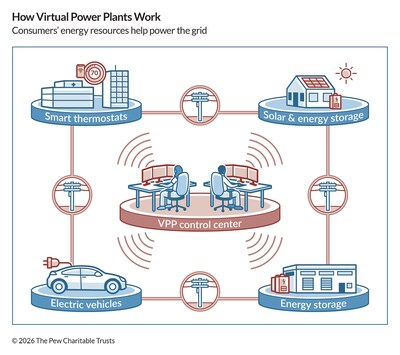
One emerging solution could provide some relief. Virtual power plants (VPPs) can play a key role in providing reliable and affordable power on demand in seconds. VPPs are an aggregation of distributed energy resources (DERs)—energy solutions such as solar and battery systems, smart thermostats, and electric vehicles installed at or close to homes and businesses—that can help balance electricity demand and supply.
In places where VPP programs are available through a utility or third-party company, customers who install eligible DERs at their homes or businesses can enroll their devices into these programs. These customers are then compensated—usually in the form of a credit on their utility bill—in return for allowing their DER to provide energy to the grid when it needs it the most. Customers with batteries can typically reserve some battery capacity solely for their personal use or even opt out of VPP events entirely.
To send energy from a VPP to the grid, a central controller (a utility or independent company) monitors VPP resources from hundreds or thousands of buildings and dispatches their energy when it's needed most. Traditional power plants, on the other hand, generate a large amount of energy at one site and inject it onto the transmission grid.
The earliest VPPs in the
The Benefits of Community-Based Energy
There is growing interest from state policymakers and utilities in VPPs today because they can improve grid reliability at relatively low costs, can be permitted and deployed more quickly than traditional generation, and help to meet emissions reductions objectives.
Lower electricity costs
VPPs offer a cost-effective way to meet electricity demand, resulting in savings on electricity bills for all electric customers. Customers save money when utilities leverage VPP programs and offset the need to invest in large capital infrastructure such as new power plants. Additionally, VPP participants can receive direct payments or credits on their energy bill for enrolling their devices in these programs.
Green Mountain Power's Bring Your Own Device and Powerwall programs in
Meeting peak demand and reliability
VPPs help ensure "resource adequacy," a term experts use to refer to the ability of the grid to supply enough electricity at all times. So, in periods of high demand, such as a summer heat wave, VPPs can dispatch power from clusters of DERs to augment the supply from utility-scale generation. This also gives utilities the ability to rely on a more diverse set of generation sources across a broader geography.
VPPs can also automatically adjust devices such as thermostats during periods of high demand, thereby reducing electricity consumption; they can also remotely charge batteries when the grid has excess energy.
In just one example, Arizona Public Service's Cool Rewards program has 90,000 thermostats enrolled, which is the equivalent of taking 140 megawatts of energy off the grid during times of peak demand (enough to serve 22,000
Speed of deployment
By tapping DERs, VPPs are less capital-intensive and quicker to deploy when compared with building new power plants.
In 2023, PG&E launched a pilot VPP—the Energy Efficiency Summer Reliability Program—in
Emissions reductions
These VPP programs can also accelerate the use of clean energy solutions such as batteries, solar, and electric vehicles. Compared with fossil fuel-based generation, this can lower greenhouse gas and local air pollutant emissions, leading to healthier air.
Scaling VPPs
VPPs have scaled beyond the pilot stage in the
In a 2023 report, DOE recommended:
- Expanding DER adoption
- Simplifying customer enrollment in VPP programs
- Increasing standardization in VPP operations to allow systems to work together and easily exchange information
- Integrating VPPs into utility planning and financial incentives
- Integrating VPPs into wholesale markets (where power is purchased and sold in bulk)
Recognizing the value of VPPs, utilities, state lawmakers, regulators, and industry professionals are working together to bridge some of these gaps and scale VPPs as cost-effective, near-term energy solutions.
For more information, visit Energy Modernization | The Pew Charitable Trusts (pewtrusts.org)
Contact:

 View original content to download multimedia:https://www.prnewswire.com/news-releases/virtual-power-plants-powering-the-grid-from-your-neighborhood-302660115.html
SOURCE The Pew Charitable Trusts
Serious News for Serious Traders! Try StreetInsider.com Premium Free!
You May Also Be Interested In
- CARNE Brings a Nightmare Before Christmas to Oxnard with Limited-Time Halloween Pop-Up
- Axon Announces Body 5: Next-Generation Camera Built for the AI Era
- Cantein Launches Organic Hemp Protein Powder
Create E-mail Alert Related Categories
PRNewswire, Press ReleasesSign up for StreetInsider Free!
Receive full access to all new and archived articles, unlimited portfolio tracking, e-mail alerts, custom newswires and RSS feeds - and more!
