




Up to 20 AI Firewall Vendors Face First Independent Security Validation

FREE Breaking News Alerts from StreetInsider.com!
StreetInsider.com Top Tickers, 10/26/2026
- Wall St rises as Anthropic's IPO filing sharpens focus on AI trade
- Anthropic files for Nasdaq IPO as revenue jumps to $16.3 billion
- Meta reverses losses to rise as investors weigh $35 billion AI funding plan
- Post-election relief ahead for markets, says Morgan Stanley
- Musk says SpaceX raised $40 billion in debt, warns of neocloud collapse
 Tweet
Tweet Share
Share E-mail
32 real-world validation scenarios across three security layers evaluate whether AI security products stop attacks or just claim to — OWASP and MITRE ATLAS-aligned, with up to 20 vendors and results targeted for Black Hat USA 2026.
Key Facts:
- SecureIQLab has published the first independent methodology for validating AI security solutions, spanning 32 validation scenarios across three security layers
- Up to 20 vendors are considered for validation, spanning pure-play Large Language Model (LLM) firewalls, broader AI security solutions, and API security and edge platforms offering LLM protection
- The methodology measures both prevention and detection, penalizing products that block threats without logging them
- OWASP LLM Top 10 and MITRE ATLAS-aligned; AMTSO-compliant (Test ID: AMTSO-LS1-TP193)
- Testing commences in
April 2026 , with results targeted for Black Hat USA 2026
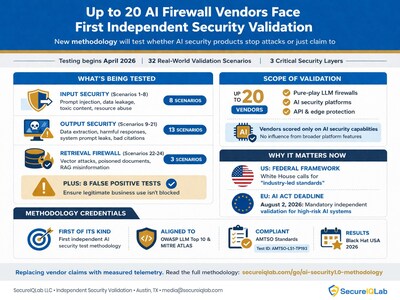
AI firewall vendors claim protection against prompt injection, data exfiltration, and model manipulation. Until now, those claims rested on self-reported testing. No independent methodology existed to measure what AI security products actually prevent versus what they detect, and what they miss entirely.
Version 1.0 fills that gap with a repeatable framework mapped to OWASP LLM Top 10 and MITRE ATLAS. It arrives as the OWASP GenAI Security Project releases the Top 10 for Agentic Applications 2026 and a Guide for Secure MCP Server Development ahead of RSA Conference 2026, reinforcing industry demand for structured evaluation of AI security controls.
What the methodology tests
The three security layers target distinct attack surfaces across the AI execution lifecycle:
- Input Security (validation scenarios 1-8) evaluates defenses against prompt injection (direct, indirect, and multimodal), toxic content generation, PII and PCI data leakage, and resource abuse attacks
- Output Security (validation scenarios 9-21) measures protection against data extraction, cross-session information leakage, injection attacks in model responses, toxic output, excessive agency in agentic systems, system prompt protection, and fabricated citations
- Retrieval Firewall (validation scenarios 22-24) tests vector and embedding security, poisoned document detection, and misinformation propagation through RAG pipelines
Eight false positive validation scenarios (25-32) verify that benign prompts, quoted malicious text, business identifiers, multilingual input, and high-token workloads are not incorrectly blocked. An AI firewall that blocks legitimate business communication is no more useful than one that misses attacks.
The methodology penalizes products that block threats silently. A firewall that stops an attack but generates no alert leaves security teams operationally blind: unable to investigate the incident, correlate it with other activity, or demonstrate compliance to auditors.
Six operational efficiency categories evaluate enterprise readiness beyond security efficacy: Deployment and Onboarding, Policy Management and Administration, Integration with Enterprise Ecosystem, Incident Response and Visibility, Insight for Threat Hunting and Forensics, and Security Administration.
Who is being tested
Up to 20 AI security vendors are considered for validation spanning three product categories: pure-play LLM firewalls, broader AI security solutions, and API security or edge platforms offering LLM protection. Vendors are scored only on their AI security components; broader platform capabilities outside the defined scope do not influence results.
"Two years ago, none of these threat categories existed in production. Today, every enterprise deploying RAG or LLM-integrated applications is trusting a firewall to stop them, but no one has verified that trust independently. Version 1.0 replaces vendor self-attestation with measured telemetry," said
Regulatory context
In
The methodology is AMTSO-compliant, conforming to Testing Protocol Standard v1.3 and Test Plan Template v2.4 (Test ID: AMTSO-LS1-TP193). The validation is non-commissioned and funded entirely by SecureIQLab, with no vendor influence on methodology, testing, or results. Testing commences
Security vendors interested in participating in the validation can contact [email protected]. Enterprise security leaders can request a methodology briefing at secureiqlab.com/contact or request a live briefing and demo at RSA Conference 2026 (
FAQ
What is AI Security CyberRisk Validation? SecureIQLab's AI Security CyberRisk Validation is the first independent methodology for evaluating whether AI security products prevent, detect, or miss adversarial threats under controlled conditions. It spans 32 validation scenarios across three security layers.
How does this differ from WAAP or firewall testing? AI security operates at the semantic and decision layer, not the network or application layer. The methodology evaluates intent-aware defenses against natural language attacks, embedding manipulation, and autonomous agent behavior — threat categories that traditional WAF and firewall testing does not address.
When will results be available? Testing commences in April, with results targeted for publication ahead of Black Hat USA 2026. Individual vendor reports and a comparative report will be published simultaneously.
How can vendors participate? Contact [email protected]. The validation considers up to 20 vendors across three product categories. Vendors offering broader AI security platforms are scored only on their AI security components.
Is the validation funded by vendors? No. The validation is non-commissioned and funded entirely by SecureIQLab. No vendor influences methodology design, testing execution, or results.
Data Integrity Disclosure: SecureIQLab does not endorse specific vendors. This methodology defines the test framework and procedures to be applied uniformly across all participating vendors. Results will be presented as verified performance metrics and do not constitute a subjective recommendation or "rating" of any product. SecureIQLab disclaims all warranties regarding the application of this data to unique user environments.
About SecureIQLab
SecureIQLab is an independent cloud security validation laboratory based in
Media Contact
SecureIQLab Communications [email protected] 1-512-575-3457

 View original content to download multimedia:https://www.prnewswire.com/news-releases/up-to-20-ai-firewall-vendors-face-first-independent-security-validation-302724473.html
SOURCE SecureIQLab
Serious News for Serious Traders! Try StreetInsider.com Premium Free!
You May Also Be Interested In
- ELEMENTL POWER, DS INVESTMENT PARTNERS AND SAMSUNG C&T TO ADVANCE NEW U.S. NUCLEAR DEVELOPMENT
- Harper Names Lelah Manz as Chief Executive Officer
- Mount Sinai Medical Center Physician Leads Global Phase 3 Trial Showing Chemotherapy-Free Treatment Improves Outcomes for Women with dMMR Endometrial Cancer
Create E-mail Alert Related Categories
PRNewswire, Press ReleasesSign up for StreetInsider Free!
Receive full access to all new and archived articles, unlimited portfolio tracking, e-mail alerts, custom newswires and RSS feeds - and more!
