



This Butterfly Is a Warning About the Future of the Food System
 Tweet
Tweet Share
Share E-mail
The Iowa Skipper Is a Canary in the Coalmine of Industrial Agriculture
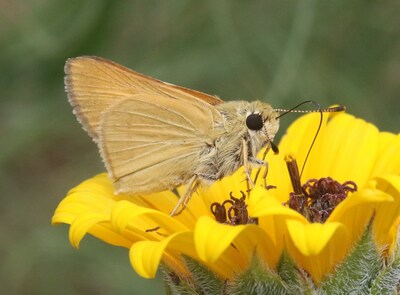
Behind the celebration lies an alarming reality: pollinators are disappearing at unprecedented rates.
That reality is at the heart of Center for Food Safety's newest lawsuit to protect the
This week, Center for Food Safety sued the U.S. Fish and Wildlife Service for failing to meet its legal obligation under the Endangered Species Act to determine whether the
The
The bright amber butterfly depends on healthy tallgrass prairie ecosystems to survive. Yet nearly 99 percent of America's tallgrass prairie has already been destroyed. What remains exists largely as fragmented habitat surrounded by industrial monocultures saturated with pesticides and largely devoid of the biodiversity pollinators need to thrive. Much of these crops aren't even used to feed us. The corn and soy grown in these decimated prairie ecosystems goes towards manufacturing biofuels or factory farm animal feed, which furthers the treadmill of the industrial food system.
The
The
For years, Center for Food Safety has been at the forefront of efforts to protect pollinators from the growing threats posed by industrial agriculture. The organization has fought for protections for the monarch butterfly, challenged pesticide approvals that threaten bees and other beneficial insects, and defended the Endangered Species Act as one of the nation's most important safeguards against extinction.
Its work has repeatedly exposed a troubling pattern: federal regulators continue to approve and allow widespread pesticide use without adequately accounting for impacts on pollinators and endangered species.
That pattern is especially evident in Center for Food Safety's efforts to close the "treated seed loophole." Every year, hundreds of millions of acres of seeds coated with neonicotinoid pesticides are planted across
The extinction crisis facing pollinators is not the result of a single pesticide or a single species decline. It is the predictable outcome of an agricultural model built on habitat destruction, chemical dependency, and biological simplification.
The consequences extend far beyond wildlife conservation. More than 75 percent of flowering plants and roughly one-third of global food crops depend on pollinators. As pollinator populations decline, so too does the resilience of the food system itself.
Pollinator Week exists because public awareness is finally beginning to catch up with the science. Increasingly, people are recognizing the connection between disappearing pollinators, pesticide-intensive agriculture, and the growing extinction crisis.
The
This Pollinator Week, the
Photo ©

 View original content to download multimedia:https://www.prnewswire.com/news-releases/this-butterfly-is-a-warning-about-the-future-of-the-food-system-302791620.html
SOURCE The Center For Food Safety
Serious News for Serious Traders! Try StreetInsider.com Premium Free!
You May Also Be Interested In
- 2026 IMS | IASO Bio Presented FUCASO China Real-World Data
- Crypto Price Prediction for 2026: ADA and DOGE Move Higher While Pepeto Presale Offers a Second Chance
- Bitcoin Price Prediction: BTC Is Still 32% Below Its Peak as AlphaPepe Buyers Prepare for Their First Exchange Run
Create E-mail Alert Related Categories
PRNewswire, Press ReleasesSign up for StreetInsider Free!
Receive full access to all new and archived articles, unlimited portfolio tracking, e-mail alerts, custom newswires and RSS feeds - and more!
