




Study Points to New Strategy for TB Meningitis Care

FREE Breaking News Alerts from StreetInsider.com!
StreetInsider.com Top Tickers, 10/25/2026
- Wall Street closes lower to end rocky week
- Meta's capital-raising plans expose a major weakness in the AI boom
- Oil prices jump $3 on Houthi attacks, oil spill, highest settlement since April
- BofA flags further downside risk for stocks, yields and dollar
- SpaceX cell-site ambitions lift tower stocks and weigh on carriers
 Tweet
Tweet Share
Share E-mail
A multi‑model study led by experts at Cincinnati Children's shows that targeted immune‑modulating therapies can outperform current anti-inflammatory treatment for TB meningitis
Addressing this challenge requires not only new antibiotic therapies, but also better ways to reduce harmful inflammation in the human brain.
In a study published on
"These findings are important because they show, across multiple models, that targeting specific immune responses in the body—not just the bacteria—may be a better way to limit brain damage seen in tuberculous meningitis," says
CHANGING PERSPECTIVES: HOST-DIRECTED THERAPIES
Inflammation plays a dual role in TB meningitis. While immune responses are necessary to control infection, excessive inflammation in the central nervous system can damage blood vessels, disrupt the blood–brain barrier and injure neurons. Corticosteroids have been used for decades to address this problem and can reduce mortality, but they do not consistently prevent neurological injury and may work differently across patient populations.
New host‑directed therapies offer an alternative approach. By targeting specific immune pathways involved in damaging inflammation, these therapies aim to reduce tissue injury without broadly suppressing protective immune functions.
A MULTI-MODEL APPROACH
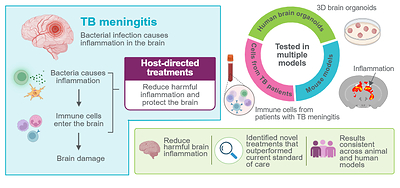
No single model can answer all the questions needed to evaluate new treatments for TB meningitis. Animal models are essential for measuring outcomes such as survival, neurological deficits, and brain imaging changes, but they cannot fully capture how the human immune system responds. At the same time, key features of brain inflammation—particularly how immune cells behave in the human brain—cannot be studied directly in patients. To address these gaps, researchers used a coordinated, multi‑model strategy:
- Mouse model of TB meningitis: used to measure survival, neurological deficits, brain inflammation and MRI findings, similar to what is used in clinical trials.
- Human brain organoid model with immune and blood-vessel cells: used to measure inflammatory responses in human brain‑like tissue
- Patient-derived immune cells: used to directly assess immune responses in patients with TB meningitis
Together, these complementary models helped confirm that the observed effects were not confined to a single system and were relevant across species and biological contexts.
MIRRORED RESPONSES ACROSS MODELS
Across all three model systems, several host‑directed therapies consistently reduced harmful inflammation when added to standard TB antibiotic treatment.
In the murine model, these therapies reduced both mortality and neurological deficits, with brain imaging and tissue studies showing decreased neuroinflammation. Importantly, bacterial levels in the brain and other organs were unchanged, showing that calming the immune response did not reduce antibiotic effectiveness.
Similar effects were seen in the human‑based systems. In human brain organoids, host‑directed therapies reduced activation of microglia following infection. In immune cells taken from patients with TB meningitis, the same treatments lowered inflammatory cytokine responses when cells were re‑exposed to tuberculosis bacteria.
"We used multiple models because no single system can answer all the questions that matter for patients," says
LOOKING AHEAD
Together, these findings show that targeted host‑directed therapies can reduce harmful inflammation in TB meningitis across multiple experimental systems while preserving the effectiveness of antibiotics. The use of FDA‑approved or late‑stage drugs also raises the possibility of moving these approaches more quickly into clinical trials.
By integrating animal models with human brain organoids and patient‑derived immune cells, the researchers were able to assess both clinical impact and underlying immune mechanisms. Future clinical studies will be needed to determine whether these approaches can improve survival and long‑term neurological outcomes for people with TB meningitis.
"Our coordinated use of complementary models highlights an approach that extends beyond TB meningitis to other complex diseases," says Jain. "Used together, these complementary models help clarify which findings are likely to translate to human disease and which require further refinement, offering a more efficient and human‑relevant framework for studying complex diseases."
ABOUT THE STUDY
The experimental work for this study was conducted prior to the Jain laboratory's move to Cincinnati Children's. Data analysis, interpretation, and integration across models were completed after the lab joined Cincinnati Children's, where this research program is now based.
Carlos Ruiz-Gonzalez, Medha Singh and Yuderleys Masias-Leon were co-first authors of the study. Additional Cincinnati Children's co-authors included Mona Sarhan.
Co-authors also included experts from Johns Hopkins University School of Medicine, University of Miami and National Institutes of Health.
Funding for the study included grants from National Institutes of Health (R01 AI145435, R01 AI153349, R56 AI179012, R01 AI190038 and S10 OD030381), Intramural Research Program of the National Institutes of Health and Johns Hopkins Alzheimer's Disease Research Center Faculty Awards (P30 AG066507 and R01 AI152688).

 View original content to download multimedia:https://www.prnewswire.com/news-releases/study-points-to-new-strategy-for-tb-meningitis-care-302829665.html
SOURCE Cincinnati Children's Hospital Medical Center
Serious News for Serious Traders! Try StreetInsider.com Premium Free!
You May Also Be Interested In
- Clarins Lights Up the Austin Skyline with an Immersive Celebration of Skin Longevity
- Sweet Security Research Identifies Go Implementation of Node2Shell Vulnerability, Expanding Attack Surface to Major HTTP Frameworks
- Dogecoin Price Prediction: Can DOGE Reclaim $0.10 as Remittix Recruits Earn Testers for 18-22% APY?
Create E-mail Alert Related Categories
PRNewswire, Press ReleasesRelated Entities
S1, FDASign up for StreetInsider Free!
Receive full access to all new and archived articles, unlimited portfolio tracking, e-mail alerts, custom newswires and RSS feeds - and more!
