



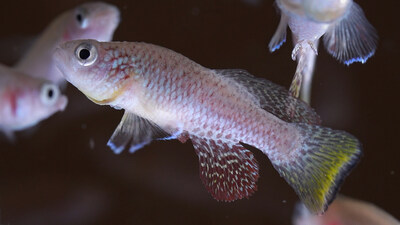
Stowers scientists uncover a critical component that helps killifish regenerate their fins
 Tweet
Tweet Share
Share E-mail
The findings are a step toward closing the gap on how we could one day deploy regenerative medicine in humans
A recent study published in iScience on
"One of the greatest unsolved mysteries of regeneration is how an organism knows what has been lost after injury," said Sánchez Alvarado. "Essentially, the study points to a new variable in the equation of regeneration. If we can modulate the rate and the length of time that a tissue can launch a regenerative response, this could help us devise therapies that may activate and perhaps prolong the regenerative response of tissues that normally would not do so."
Shortly after a killifish tail injury, the remaining tissue needs to know how much damage has occurred. Then, this tissue must enlist the right number of repair cells to the site of injury for the right amount of time. Damage sensing, repair cell recruitment, and timing somehow must work together to regrow the tail.
"If an animal that can regenerate extremities, like a tail, loses just a tiny portion, how does it know not to regenerate a whole new tail but just the missing piece?" said
They found that skin cells both near an injury and in distant, uninjured regions launch a genetic program that primes the whole animal to prepare for a repair response. Then, skin cells at the site of injury sustain this response and temporarily change their state to modify the surrounding material called the extracellular matrix.
"We very clearly defined when and where—at 24 hours post-injury and in the extracellular matrix—the transient cell state is acting in the fin tissue," said
To investigate whether these distinct cellular states communicate information to the extracellular matrix—the supportive structure surrounding cells—during the repair process, the researchers employed the CRISPR-Cas9 gene editing technique. They specifically targeted a gene known to modify the extracellular matrix, as they had observed its activation at the onset of the regeneration response. By disrupting the function of this gene, the team aimed to determine its role in relaying information from cells to the matrix during regeneration.
"These modified animals no longer know how much tissue was lost," said
Indeed, the speed and amount of tissue regenerated in these genetically modified killifish increased regardless of whether the tail injury was mild or severe. This finding opens the possibility that cell states that modify the matrix increase regenerative regrowth. If the cell states could be adjusted, it may be a way to stimulate a more robust regeneration response.
From an evolutionary perspective, understanding why certain organisms excel at regeneration while others, such as humans, have limited regenerative abilities is a driving force in the field of regenerative biology. By identifying general principles in organisms with high regenerative capacity, researchers aim to potentially apply these insights to enhance regeneration in humans. This comparative approach not only sheds light on the evolutionary aspects of regeneration but also holds promise for developing novel therapeutic strategies in regenerative medicine.
"Our goal is to understand how to shape and grow tissues," said
Additional authors include
This work was funded by institutional support from the Stowers Institute for Medical Research and the Howard Hughes Medical Institute.
About the Stowers Institute for Medical Research
Founded in 1994 through the generosity of
The Institute consists of 21 independent research programs. Of the approximately 500 members, over 370 are scientific staff that include principal investigators, technology center directors, postdoctoral scientists, graduate students, and technical support staff. Learn more about the Institute at www.stowers.org and about its graduate program at www.stowers.org/gradschool.
Media Contact:
Joe Chiodo, Head of Media Relations
724.462.8529
[email protected]

 View original content to download multimedia:https://www.prnewswire.com/news-releases/stowers-scientists-uncover-a-critical-component-that-helps-killifish-regenerate-their-fins-302259978.html
SOURCE Stowers Institute for Medical Research
Serious News for Serious Traders! Try StreetInsider.com Premium Free!
You May Also Be Interested In
- Leo Cancer Care Brings Into Clinical Use an Upright Radiotherapy Platform Cleared for Use With Any Radiation Beam
- Best Prescription Sunglasses (2026): Quay Featured Among Stylish, Fashion-Forward RX Frames for Everyday Wear and Versatile Personal Style by Consumer365
- LetPot to Launch LPH-Home Smart 2-Tier Indoor Garden on Kickstarter October 1
Create E-mail Alert Related Categories
PRNewswire, Press ReleasesSign up for StreetInsider Free!
Receive full access to all new and archived articles, unlimited portfolio tracking, e-mail alerts, custom newswires and RSS feeds - and more!
