



OTC Medicines Play Central Role in How Americans Manage Health, New Study Finds
 Tweet
Tweet Share
Share E-mail
National Survey of 21,000 Adults Captures Seven-Day Snapshot of Medication Use; OTC and Prescription Medicines Used in Tandem to Address Distinct Health Needs
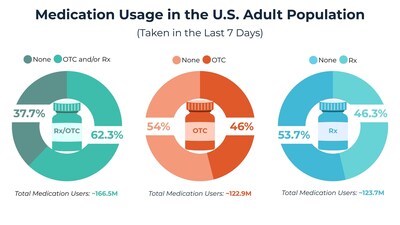
Rather than focusing on prescriptions written or medications taken at any point during an individual's lifetime, the study, Prevalence of Over-the-Counter and Prescription Medication Use in the US (Green et al, 2026), captures a snapshot of recent, self-reported use. Within a seven-day period, OTC and prescription medicines were reported at nearly identical rates, reflecting the co-use of different types of medicines within the same week to address distinct health needs.
"These findings show that OTC medicines are an important part of everyday health management for millions of Americans," said CHPA President and CEO
"Usually, medication evidence comes from prescriptions dispensed by pharmacies or products sold," said
What the Study Measured
Adults often manage multiple health concerns at once, using more than one medication during a given week. The study evaluated recent, self-reported use of OTC and prescription medications across a range of common conditions, including both single-ingredient and fixed-dose combination products.
No information was collected on the care settings in which medications were taken or on health outcomes. The findings reflect how
What Americans Use Most
The published study identified the most commonly used Rx and OTC medicines reported by
"It's also notable that several of the most commonly used OTCs on the list were once only available by prescription," continued Melville. "Over the years, OTC medications — like naproxen, omeprazole, cetirizine, and loratadine to name a few — went through FDA's Rx-to-OTC switch process to change their status from prescription-only access to OTC. Their appearance on the list among the most commonly-used medicines is a great example of how smart regulatory changes can expand consumer access to safe and effective treatments for better self-care."
Notably, the four most commonly used medicines overall — acetaminophen, ibuprofen, aspirin, and naproxen — are all available over the counter, with the top three unchanged from patterns observed in national medication use surveys conducted approximately 25 years ago. The top 20 most commonly used medications include:
Rank | Medication | Total | Male | Female |
1 | Acetaminophen | 6184 (29.4) | 2452 (24.9) | 3732 (33.4) |
2 | Ibuprofen | 4693 (22.3) | 1889 (19.2) | 2804 (25.1) |
3 | Aspirin | 3323 (15.8) | 1705 (17.3) | 1618 (14.5) |
4 | Naproxen | 1454 (6.9) | 652 (6.6) | 802 (7.2) |
5 | Atorvastatin | 1342 (6.4) | 745 (7.6) | 597 (5.3) |
6 | Lisinopril | 1163 (5.5) | 633 (6.4) | 530 (4.7) |
7 | Levothyroxine | 1086 (5.2) | 251 (2.6) | 835 (7.5) |
8 | Diphenhydramine | 1082 (5.2) | 399 (4.1) | 683 (6.1) |
9 | Omeprazole | 969 (4.6) | 432 (4.4) | 537 (4.8) |
10 | Amlodipine | 965 (4.6) | 487 (5.0) | 478 (4.3) |
11 | Metformin | 934 (4.4) | 501 (5.1) | 433 (3.9) |
12 | Caffeine | 928 (4.4) | 364 (3.7) | 564 (5.0) |
13 | Cetirizine | 833 (4.0) | 319 (3.2) | 514 (4.6) |
14 | Hydrochlorothiazide | 828 (3.9) | 367 (3.7) | 461 (4.1) |
15 | Losartan | 813 (3.9) | 378 (3.8) | 435 (3.9) |
16 | Metoprolol | 756 (3.6) | 369 (3.8) | 387 (3.5) |
17 | Loratadine | 606 (2.9) | 237 (2.4) | 369 (3.3) |
18 | Rosuvastatin | 542 (2.6) | 273 (2.8) | 269 (2.4) |
19 | Fluticasone | 534 (2.5) | 216 (2.2) | 318 (2.8) |
20 | Sertraline | 524 (2.5) | 156 (1.6) | 368 (3.3) |
Source: Green, et al (2026), Table 3
OTC Medicines in Everyday Use
One of the key findings of the study is the extent to which OTC medicines are used for self-treatable health concerns. Overall, six of the 10 most commonly used medicines identified in this study are available, or primarily available, as an OTC medication.
OTCs, Self-Care, and Health Policy
These findings provide updated, real-world context on how Americans use both Rx and OTC medicines as part of everyday health management. By documenting recent medication use rather than prescriptions written or products sold, the study offers relevant data to inform ongoing discussions about self-care, access, and the appropriate role of nonprescription medicines within the broader healthcare landscape.
Study Methods
Researchers conducted a large, nationally representative survey of
- Sample size: 21,000
U.S. adults - Timeframe:
June 2023 throughApril 2024 - Recall window: Past seven days
Additional study details, including full methodology and detailed findings, are available in this fact sheet. See the full article here.
The Consumer Healthcare Products Association (CHPA), founded in 1881, is the national trade association representing the leading manufacturers and marketers of consumer healthcare products, including over-the-counter (OTC) medicines, dietary supplements, and OTC medical devices. CHPA is committed to empowering self-care by ensuring that Americans have access to products they can count on to be reliable, affordable, and convenient, while also delivering new and better ways to get and stay healthy. Visit www.chpa.org
 View original content to download multimedia:https://www.prnewswire.com/news-releases/otc-medicines-play-central-role-in-how-americans-manage-health-new-study-finds-302691964.html
SOURCE Consumer Healthcare Products Association
Serious News for Serious Traders! Try StreetInsider.com Premium Free!
You May Also Be Interested In
- TELUS Mental Health Index: Cost of living is the top money worry for 58 percent of US workers as financial anxiety hits workplace productivity
- Vertiv Declares Quarterly Dividend
- Acer Introduces Veriton RI110 AI Mini Workstation for Powering Hybrid Agentic AI Workloads
Create E-mail Alert Related Categories
PRNewswire, Press ReleasesRelated Entities
FDASign up for StreetInsider Free!
Receive full access to all new and archived articles, unlimited portfolio tracking, e-mail alerts, custom newswires and RSS feeds - and more!
