




Novel Approach Emerging for Rescuing Limbs at Risk

FREE Breaking News Alerts from StreetInsider.com!
StreetInsider.com Top Tickers, 10/6/2026
- Nasdaq notches record high close as investors focus on earnings
- Oil slips on rising Mideast crude exports, G7 stocks release
- Intel stock slides as TSMC explores Terafab tie-up, analyst flags share losses
- Schneider Electric to acquire PTC for $22.6 billion in all-cash deal
- Five things to watch in markets in the week ahead
 Tweet
Tweet Share
Share E-mail
Scientists in
And as more people are diagnosed with diabetes, in the
Now, experts at Cincinnati Children's in collaboration with colleagues from Kanazawa University in
The study, published
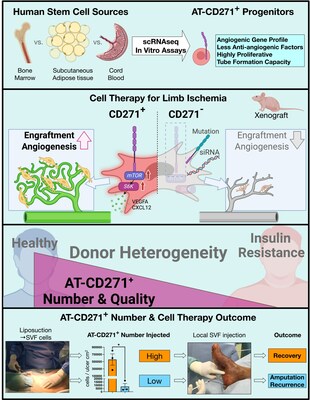
Their team reports that a specific subset of stem cells isolated from adipose tissue (fat) that also carry the cell surface marker CD271 outperformed all other similar cell types at inducing blood vessel formation. The study also details key molecular mechanisms involved in the process.
The scientists confirmed these findings by transplanting this population of human stem cells into mice with limb ischemia. In every case, the treatment rescued limbs that otherwise would have required amputation.
Then the team analyzed data from a clinical trial to provide initial evidence that such a cell transplant may have already worked in humans. In this case, people with foot ulcers were treated with a generalized mix of stem cells collected from the patients' own tissues. Of the small number of patients analyzed, the two patients with fully recovered limbs received high numbers of CD271-positive stem cells. Those results in combination with the highly consistent benefits found in the mouse testing, appear to justify further work to launch a formal clinical trial, the co-authors say.
"Critical limb ischemia is one of the most severe outcomes for PAD and undertreated diabetes. This research shows hopeful results that this new subset of progenitors may have positive therapeutic value," Inoue says. "It was quite inspiring to see that one of the patients has recovered enough to return to work."
A race to address a widespread health problem
With rising rates of obesity plaguing
Doctors treat PAD by using medications to slow the disease while performing bypass surgeries or catheter-based procedures to open clogged arteries in the limbs. However, many of the arteries that need treatment in the limbs are too small and difficult to access with surgery. As a result, at least a third of the people who need revascularization therapy are not eligible for surgical interventions. Those who lose their limbs go on to experience significant pain and disability while their underlying cardiovascular disease makes them increasingly likely to experience potentially fatal heart attacks, strokes, and other problems.
Once seen as a purely adult health problem, researchers at Cincinnati Children's and other centers have been finding early signs of vascular disease in teens and even younger children who struggle with severe obesity and diabetes.
Emerging alternatives from international collaboration
Inoue, 40, has been studying PAD in
Many researchers have explored the idea of transplanting progenitor cells to jump-start the body's own tissue-repair capabilities. However, the major limitation has been finding the right cells to use.
To solve this, the team used single-cell transcriptomics to hunt through a haystack of different types of progenitor cells to find the right population of cells. While many stem cells reside naturally in the bone marrow, this study found the strongest trigger of blood vessel formation lurking within fat tissue. These cells carry the marker CD271, which has been shown in other studies to play important roles in tissue growth.
The team transplanted these human CD271-positive cells into mice to confirm their abilities. The human CD271 cells were 100% effective at prompting enough blood vessel growth in the mice to restore normal blood flow to the diseased limbs.
Evidence that this new cell population may work in human disease also was provided. The authors found that among people who received progenitor cells self-transplanted from fat, those who recovered better and saved their limbs had higher numbers of CD271 progenitor cells present.
"The positive correlation between recovery and the number of CD271+ progenitors injected in the affected area of these patients was striking," Sanchez-Gurmaches says.
Challenges ahead
The co-authors emphasize that the findings so far are preliminary. The therapeutic value of adipose tissue CD271-positive cells should be evaluated in larger numbers of patients through a formal clinical trial.
One significant issue to resolve is how to obtain enough CD271 progenitor cells to use as treatment. The new paper reports that the number of CD271 progenitors found in the fat of people with insulin resistance can be as much as 75% lower than people without insulin resistance. Also, the cells that are found tend to be less active in generating new vessels.
"Unfortunately, the people living with insulin resistance who face elevated risk of limb ischemia are the same people with low numbers of CD271-postive progenitor cells, which could make self-transplantation more difficult," Inoue says.
More research is needed to determine if these cells can be multiplied in the lab before transplantation.
About the study
In addition to Inoue and Sanchez-Gurmaches, Cincinnati Children's co-authors included PhD student Manasi Halurkar,
Funding sources for this study include the National Institutes of Health (R21OD031907); the Japan Society for the Promotion of Science (JP16H06828); the Japanese Heart Foundation; the American Heart Association (18CDA34080527), and three grants from Cincinnati Children's (a Trustee Award, a Center for Pediatric Genomics Award and a Center for Mendelian Genomics & Therapeutics Award.
 View original content to download multimedia:https://www.prnewswire.com/news-releases/novel-approach-emerging-for-rescuing-limbs-at-risk-302019380.html
SOURCE Cincinnati Children's Hospital Medical Center
Serious News for Serious Traders! Try StreetInsider.com Premium Free!
You May Also Be Interested In
- Beactica Therapeutics selects BEA-28 as a preclinical candidate, a first-in-class TEAD degrader for biomarker-selected cancers
- Jonathan Banks, Carly Chaikin, Edwin Hodge, Rhett McLaughlin and Kevin Nealon Hit the Links at 26th Emmys Golf Classic to Raise Over $335,000 for the Television Academy Foundation
- Axcera and RUBIK Partner with PropLaunch to Power the Next Generation of Prop Firms
Create E-mail Alert Related Categories
PRNewswire, Press ReleasesSign up for StreetInsider Free!
Receive full access to all new and archived articles, unlimited portfolio tracking, e-mail alerts, custom newswires and RSS feeds - and more!
