




Noble Research Institute Releases Updates on Year Two of 3M Research Project

FREE Breaking News Alerts from StreetInsider.com!
StreetInsider.com Top Tickers, 10/9/2026
- S&P 500, Nasdaq end lower as crude prices jump, chip stocks weigh
- Oil rises 4% on revived Middle East worries, Hurricane Isaias supply disruption
- Chipotle, Starbucks shares volatile after report of potential takeover
- Why Citi says the Fed could be setting up for a dovish surprise
- Alphabet shares rise as Google pushes Gemini deeper into enterprise AI
 Tweet
Tweet Share
Share E-mail
The Metrics, Management, and Monitoring (3M) team reports progress and early insights into the five-year study on grazing, soil health and farmer and rancher well-being
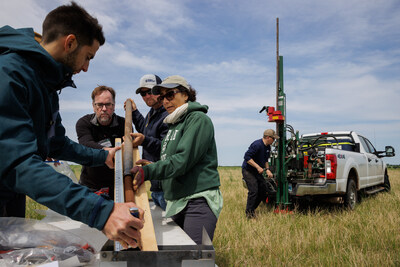
Metrics, Management, and Monitoring: An Investigation of Pasture and Rangeland Soil Health and its Drivers, also known as the 3M project, is described as one of the most robust investigations of ecosystem function across time and space, diversity of landscapes and gradients of grazing management. It is led by renowned researchers from Noble Research Institute, Michigan State University, Colorado State University, University of Wyoming, Oregon State University, Texas A&M University, University of Leeds (
"The 3M team continues to earnestly work on sites from
"Even further, we balance this on the social side with producer interviews to understand behavior that influences management plus economics," said Rowntree. "With all said, the 3M project is the most forward-thinking, data-centric project that centers on the farmer and rancher and their respective operations in their operating environment."
"Land, forage, animal people – those are the key components of the 3M Project," said Dr.
3M Project Progress and Early Insights
While data gathering and analysis are still in the early stages, the project team reported that at the end of 2023:
- The project installed 30 additional flux towers to cover optimal locations on selected producer sites, bringing the tower total to 58. This is an unprecedented level of measurement across this geography and its participants. Sensors on the towers constantly monitor carbon dioxide concentrations, wind speed and direction, precipitation, air temperature, soil temperature and moisture, light and more. Preliminary data analysis suggests that the immediate impact of grazing events and other farm-level management practices may be detectable on very short timescales, reinforcing the requirement to collect as much management information as possible.
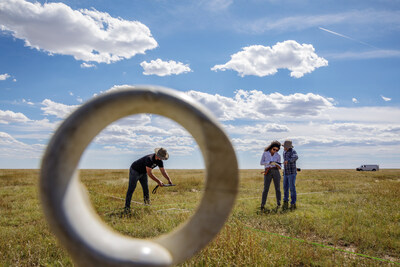
- Soil samples were completed for half (30) of the producer sites in
Michigan ,Colorado ,Wyoming ,Texas andOklahoma . Since the project's inception, the research team has collected more than 2 thousand soil cores — to a depth of nearly 36 inches — at locations acrossOklahoma ,Texas, Michigan ,Wyoming andColorado . - After producer recruitment, the team began its comprehensive interviews and surveys of participating farmers and ranchers across the five study states in fall 2023. Farmers and ranchers volunteered to participate in this research following an open call for participants in these key states. Interviews cover participant background, operation characteristics, management goals, grazing management practices, monitoring, relational values and producer well-being. The socioeconomic well-being survey data was used to calculate a well-being index score (WB index), ranging from 0 to 100, where a higher score indicates a better level of well-being. The initial results reveal a high level of well-being among farmers/ranchers across the ecoregions.
- The Colorado State University team's model, Microbial Efficiency — Matrix Stabilization (MEMS) simulates grazing and is intended to provide a model for estimating the ecological impacts of grazing. While still in development, MEMS now considers the effect of elevated carbon dioxide levels on plant growth to represent a climate-related impact.
- Soil moisture sensors have been installed on selected producer sites, totaling 522 sensors installed in the five study states. The sensors are constantly monitoring soil water content. The team is also performing water infiltration rates, and early observations have shown significant differences between fall and spring infiltration rates.
- The project team verified their remote sensing products with in-field measurements suggesting they have a good response to climate drivers such as drought.
"Nothing of this scale in terms of grazing land soil science has ever been attempted before, which is part of what makes this project so special," said Dr.
Presenting on the Project
As work on the project continues, members of the 3M team spoke at the Society for Range Management's Change on the Range annual meeting in
3M speakers for the symposium include Dr.
Year 3 Project Meeting
The 3M project is characterized by more than great individual scientists, a comprehensive data collection and sampling protocol, and a sound research plan. At its core is a dedicated research team that enjoys working together to find answers to some of the most difficult questions in grazing land systems. This team spans multiple organizations and multiple states and countries brought together to identify key, measured ecological and human drivers that impact soil health and land stewardship.
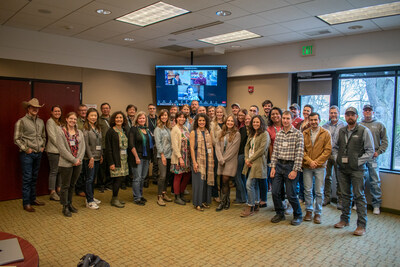
In early March of this year, the entire project team came together in
For one example of this, the meeting included a data scaffolding demonstration that showed how datasets from the study are being collected from the multiple science teams across the project and integrated for analysis and greater exploration. The data scaffolding is being developed and managed at Colorado State University.
"Beyond the invaluable contribution of each science team, what makes the 3M project so special is our effort to build a curated integrated data collection available online," said Dr.
Looking Ahead
In year three, the team will continue project activities such as monitoring and collecting data at all "intensive sites" (working sites managed by Noble Research Institute, Michigan State University and the University of Wyoming), completing soil sampling at the almost 30 remaining producer sites (not collected in 2023), collecting additional data from producer sites, continuing model development and refinement, and conducting regional producer meetings.
Importantly, the project is more than data collection and modeling. At its conclusion, the project will provide farmers and ranchers with tools to simply and accurately measure soil health outcomes in grazing land environments. These tools will guide management decisions and quantify the impact of intentional management.
"Noble Research Institute's founder,
The Metrics, Management, and Monitoring project is supported by the Foundation for Food and Agriculture Research, Noble Research Institute, The Jones Family Foundation, Greenacres Foundation and ButcherBox.
To learn more about Noble Research Institute and the 3M research project, visit www.noble.org/3m/.
About Noble Research Institute
Noble Research Institute is the nation's largest nonprofit dedicated to farm and ranch management education, serving as a trusted guide in land stewardship through education and mentorship of farmers and ranchers. Demonstrating our ongoing commitment to regenerating our nation's grazing lands, Noble actively manages 13,500 acres of working ranchlands to provide real-world insights and applications for farmers and ranchers.To learn more about Noble Research Institute, visit www.noble.org.
 View original content to download multimedia:https://www.prnewswire.com/news-releases/noble-research-institute-releases-updates-on-year-two-of-3m-research-project-302238914.html
SOURCE Noble Research Institute LLC
Serious News for Serious Traders! Try StreetInsider.com Premium Free!
You May Also Be Interested In
- Online English Courses (2026): EF English Live Recognized for Live Classes with Real, Certified Teachers by Expert Consumers
- How Is Your Soul?
- CaixaBank Expands Strategic Collaboration with Google Cloud to Accelerate AI and Data Capabilities
Create E-mail Alert Related Categories
PRNewswire, Press ReleasesSign up for StreetInsider Free!
Receive full access to all new and archived articles, unlimited portfolio tracking, e-mail alerts, custom newswires and RSS feeds - and more!
