



New study: Government GenAI optimism may be outpacing ability to deploy
 Tweet
Tweet Share
Share E-mail
Despite high hopes and dedicated budgets for GenAI, government agencies need to increase guardrails, training; synthetic data could be missed opportunity
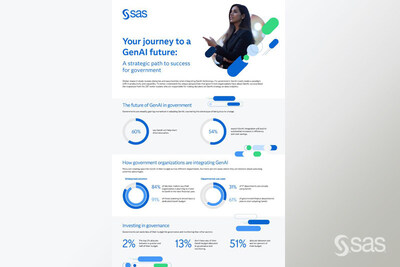
Despite trailing other sectors by 10% (44% vs. 54%) in the current use of generative AI, the success of these early adopter agencies suggests enormous potential for the technology. Those benefits could arrive soon, with 84% of government decision makers saying their organizations are planning to invest in GenAI in the next fiscal year, and 91% of those respondents already having dedicated GenAI budget.
"While they haven't been first to adopt GenAI, government agencies are poised to increase productivity and transform citizen services with this technology," said
Need to overcome organizational obstacles with better governance, communication and policy
All sectors shared top concerns about data privacy, data security and AI governance. However, government respondents had larger concerns (52%) about cultural resistance to change compared to other concerns (46%) and believe compatibility with legacy systems could be a challenge.
Additionally, the promise of GenAI in government may be imperiled by inadequate regulatory preparedness and lack of understanding of GenAI, relative to other industries. While many organizations have rushed to put GenAI guidance in place, only 52% of government organizations have a policy stating how employees are and are not allowed to use GenAI at work, compared to 61% across all sectors.
The study found that government agencies set aside less of their budgets for governance and monitoring than other sectors; 64% have allotted one-tenth or less of their GenAI budgets to governance and monitoring. Additionally, 50% of public sector respondents said they either don't have a framework or that it's ad hoc or informal, in comparison to 39% across the board.
GenAI regulation is moving quickly, so keeping up with it while unlocking the technology's value is a universal challenge. However, government may be less prepared than other sectors, as 51% of government leaders say they're fully or moderately prepared to comply with current and upcoming GenAI regulations, compared to an average of 58% across all sectors.
Awareness is also a concern, as only 35% of public sector employees are familiar with their organizations' adoption of GenAI, far less than the 46% average. These lagging indicators could be the result of a problem at the leadership level, as only 38% of senior government decision makers say they understand GenAI and its impacts on business processes well or completely, compared to 48% across all sectors.
There is good news though. Lower adoption rates in government corresponded with slightly lower policy preparedness and personal understanding, indicating that there is value in learning by doing. Government organizations that are implementing GenAI now are already seeing a range of benefits, in many cases outpacing other sectors. More government decision makers than the cross-sector average say that implementing GenAI has improved employee experience and satisfaction (94%) or created operational cost and time savings (84%).
"It's natural that government would have some reticence to adopt GenAI, but the public sector pioneers are already showing that the more it's used, the more confidence will grow, and innovation will accelerate," said
Low interest in synthetic data could inhibit innovation
Synthetic data is artificial data that accurately mimics real data. It reproduces the same statistical properties, probabilities, patterns and characteristics of the real-world data set from which the synthetic data is trained and has been found to be as much as 99% statistically valid.
For example, synthetic data of simulated traffic flows could help transportation departments test a road improvement with what-if scenarios even if they only have a few months of traffic data. Since it can mimic sensitive data, it can be created to train and test a system that processes health records, student records or tax information.
However, the study found that 32% of government decision makers would not consider using synthetic data. This exceeds the mere 23% of respondents across industries who are averse to its use.
"Synthetic data is particularly relevant for government agencies that must follow strict data privacy regulations," said Robinson. "Governments can use synthetic data for various purposes, including research, testing and analysis, while mitigating risks of violating privacy regulations or exposing sensitive information."
SAS: The past, present and future of public sector AI
Technologies like AI and generative AI are enabling fresh ideas about how public sector organizations can deliver services and are helping them rethink what services are offered. Gaze into the future of public service with a new e-book from SAS.
SAS has embedded AI capabilities into its software – from the powerful SAS® Viya® to targeted solutions for public sector organizations. With an emphasis on greater interpretability and transparency, SAS AI capabilities enable government agencies to better understand an algorithm's outputs while better managing and protecting personal information. Learn more about how SAS analytics and AI are helping government agencies face today's challenges at www.sas.com/en_us/industry/government/technology/ai.html.
About SAS
SAS is a global leader in data and AI. With SAS software and industry-specific solutions, organizations transform data into trusted decisions. SAS gives you THE POWER TO KNOW®.
SAS and all other SAS Institute Inc. product or service names are registered trademarks or trademarks of SAS Institute Inc. in the
Editorial Contact:
[email protected]
919-531-4726
sas.com/news

 View original content to download multimedia:https://www.prnewswire.com/news-releases/new-study-government-genai-optimism-may-be-outpacing-ability-to-deploy-302267084.html
SOURCE SAS
Serious News for Serious Traders! Try StreetInsider.com Premium Free!
You May Also Be Interested In
- Solidion Technology Chairman and CEO Jaymes Winters Justifies Below Market Acquisition Price for Flux Power, Inc. (Nasdaq: FLUX)
- Ittikar Is Live and Open to New Members
- Paladone WeCool strengthens US leadership team with new appointment
Create E-mail Alert Related Categories
PRNewswire, Press ReleasesSign up for StreetInsider Free!
Receive full access to all new and archived articles, unlimited portfolio tracking, e-mail alerts, custom newswires and RSS feeds - and more!
