



New Report: Half of U.S. Kids Are Breathing Dangerous Air Pollution
 Tweet
Tweet Share
Share E-mail
American Lung Association's "State of the Air" report finds 33.5 million children live in areas with poor air quality
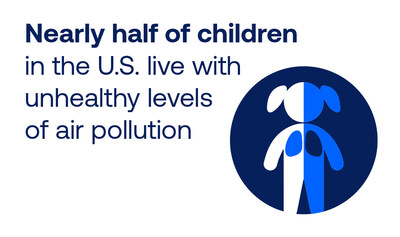
The Lung Association's "State of the Air" report grades counties' air quality in terms of unhealthy levels of ground-level ozone air pollution (also known as smog), and year-round and short-term spikes in particle pollution (also known as soot) over a three-year period. The report also ranks counties and metropolitan areas in cleanest and most polluted lists for each pollutant. The report looks at the latest quality-assured air quality data available, which is from 2022-2024.
The report finds that 33.5 million children in the
Infants, children and teens as a group are more susceptible to the health impacts of air pollution. Their lungs are still developing, they breathe more air for their body size than adults and they are frequently exposed to outdoor air. Air pollution exposure in childhood can cause long-term harm, including reduced lung growth, new asthma cases, increased risk of respiratory diseases and impaired cognitive functioning later in life. More broadly, both ozone and particle pollution can cause premature death and other serious health effects such as asthma attacks, heart attacks and strokes and preterm births. Particle pollution can also cause lung cancer.
"Clean air is not something we can take for granted. It takes work. For decades, people in the
In total, the "State of the Air" report finds that 44% of people of all ages in the
The report also examines data centers as a growing source of air quality concern for communities across the nation. While the report doesn't have specific information quantifying emissions from data centers, it highlights that the rapidly increasing number of data centers powered by fossil fuels can contribute significantly to local air pollution burdens.
The Lung Association is calling on everyone to urge EPA to value the health of America's kids. Historically, EPA has played an essential role in protecting people's health from air pollution. The current EPA has retreated from its public health foundation by rolling back clean air protections. This EPA has also taken the recent step of eliminating health-related information from its economic analyses, meaning that the costs of pollution to kids, families and communities will not be counted as policies are undone. EPA must not devalue kids' health.
Key Findings of the Report
Ozone Pollution
Ground-level ozone pollution, also known as smog, is a powerful respiratory irritant whose effects have been likened to a sunburn of the lungs. Inhaling ozone can cause shortness of breath, trigger coughing and asthma attacks, and can cause premature death.
Though progress has been made over the years to clean up ozone, that progress is fragile, and more communities are seeing their worst ozone levels in years. The number of people living in counties with unhealthy ozone pollution increased compared to last year's report. More than 129 million people (38% of the nation's population) lived in counties earning F grades for ozone, which is nearly 4 million more than in last year's report. Extreme heat, smoke and other factors during the report period contributed to the formation of ozone from precursor pollutants, resulting in higher levels for many parts of the country, most notably in Central states from
Top 5 Cities Most Polluted by Ozone Pollution:
1. Los Angeles-
2.
3 .
4.
5.
Particle Pollution
Fine particulate matter air pollution, also known as PM2.5, particle pollution or soot, can be deadly. These particles come from wildfires, wood-burning stoves, coal-fired power plants, diesel engines and other sources. The report has two grades for particle pollution: one for "short-term" particle pollution, or daily spikes, and one for the annual average "year-round" level that represents the concentration of particles in each location.
Short-Term Particle Pollution
Deadly short-term particle pollution continues to impact communities in many parts of the country. The report finds that 61.5 million people lived in counties that experienced enough unhealthy spikes in particle pollution to earn F grades. This is 15.6 million fewer than in last year's report but is much higher than the historic low of 35.1 million in the 2018 report.
Top 5 Cities Most Polluted by Short-Term Particle Pollution:
1. Fairbanks-College, AK
2.
3.
4.
5.
Year-Round Particle Pollution
This year's report reveals that 75.9 million people lived in a county that received a failing grade based on the nation's standard for year-round levels of particle pollution. This is the third largest number in the report's history—after the 90.7 million and 85.0 million posted in the past two years' reports.
Top 5 Cities Most Polluted by Year-Round Particle Pollution:
1.
2.
3.
4.
5.
5.
Cleanest Cities
The report also recognizes the nation's cleanest cities. To make the cleanest list for all three measures, a city must experience no high ozone or particle pollution days and rank among the 25 cities with the lowest year-round particle pollution levels. This year, only one city—Bangor, Maine—made the cleanest cities lists for all three pollution measures. Last year, there were two cities on this list and in 2024, there were five cities on this list. This reflects an overall worsening of air quality across the country.
See the full report results and take action at Lung.org/sota.
B-roll, logos and graphics are available for media use here.
About the American Lung Association
The American Lung Association is the leading organization working to save lives by improving lung health and preventing lung disease through education, advocacy and research. The work of the American Lung Association is focused on four strategic imperatives: to defeat lung cancer; to champion clean air for all; to improve the quality of life for those with lung disease and their families; and to create a tobacco-free future. For more information about the American Lung Association, which has a 4-star rating from Charity Navigator and is a Platinum-Level GuideStar Member, call 1-800-LUNGUSA (1-800-586-4872) or visit: Lung.org. To support the work of the American Lung Association, find a local event at Lung.org/events.
CONTACT:
P: 312-940-7001 E: [email protected]
 View original content to download multimedia:https://www.prnewswire.com/news-releases/new-report-half-of-us-kids-are-breathing-dangerous-air-pollution-302748301.html
SOURCE American Lung Association
Serious News for Serious Traders! Try StreetInsider.com Premium Free!
You May Also Be Interested In
- RIMAN Expands Global Footprint to 22 Markets with Launches Across Europe and Latin America
- Hyperliquid Price Prediction After Binance Listing: HYPE Nears $95 While Pepeto Presale Builds a 100x Case
- Bitcoin Price Predicted To Push To $150,000, But AlphaPepe Still Offers the Presale Entry Bitcoin Buyers Missed
Create E-mail Alert Related Categories
PRNewswire, Press ReleasesSign up for StreetInsider Free!
Receive full access to all new and archived articles, unlimited portfolio tracking, e-mail alerts, custom newswires and RSS feeds - and more!
