



NEW STUDY REVEALS BIG COMPOSITIONAL SHIFT IN SMALL NEAR-EARTH ASTEROIDS
 Tweet
Tweet Share
Share E-mail
Findings improve understanding of meteorite origins and impact‑risk models.
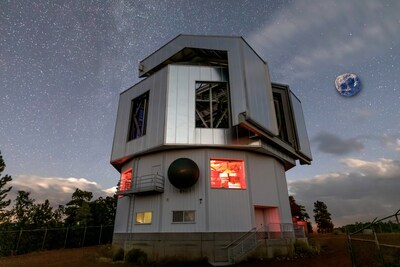
The research draws on more than a decade of data, from 2014 to 2025, collected by the Mission Accessible Near-Earth Object Survey (MANOS). Observations were made using three major 4-meter-class telescopes: the Lowell Discovery Telescope in
These facilities enabled the team to classify the asteroids based on how they reflect sunlight at four different wavelengths of light, which provides a measure of the surface colors of the objects.
The team devoted special attention to understanding and correcting for how rotational brightness variations—changes in an asteroid's brightness as it spins–can influence the measured colors. These corrections proved essential for accurate color measurements. "If you don't account for how an asteroid brightens and dims as it spins, you can end up with misleading colors," says Moskovitz. "For individual objects, the effect can be dramatic, and for population studies, it can introduce subtle but important biases."
After classifying the objects, the researchers combined their results with other similar surveys to build a comprehensive dataset of colors across a wide range of NEA sizes. A clear pattern emerged: S-complex asteroids—those most similar to the most common type of meteorites, known as ordinary chondrites—dominate the population at kilometer scales but become far less common among smaller objects.
According to the study, S-complex NEAs represent roughly 65% of kilometer-scale objects, but only one-third of objects smaller than 50 meters. The team evaluated several potential explanations for this trend, including heating from the Sun, tidal resurfacing during near-Earth encounters, and the size of the grains of material that cover the surfaces of asteroids. None could fully account for the observed shift. Instead, the results align with recent models showing that small NEAs originate from a handful of young asteroid families in the Main Belt, whose compositions differ from the broader population feeding larger NEAs.
"This is one of the clearest pieces of evidence yet that the smallest NEAs come from a different mix of sources," Moskovitz says. "It helps explain why the meteorites that land on Earth don't perfectly match what we see among larger asteroids."
Beyond scientific insight, the findings have practical importance. "Understanding what small NEAs are made of is essential for impact-risk assessment," Moskovitz notes. "These are the objects most likely to reach Earth's atmosphere, so knowing their compositions helps us model how they behave if they were to enter the atmosphere and to inform any risk posed by an object large enough to reach the ground."
The study was published on
About Lowell Observatory
Founded in 1894, Lowell Observatory in

 View original content to download multimedia:https://www.prnewswire.com/news-releases/new-study-reveals-big-compositional-shift-in-small-near-earth-asteroids-302753086.html
SOURCE Lowell Observatory
Serious News for Serious Traders! Try StreetInsider.com Premium Free!
You May Also Be Interested In
- Over 12,000 eggs protected: Grupo Sunset World and Sunset Royal celebrate the success of their 2026 Sea Turtle Protection Program
- Cotchett, Pitre & McCarthy Announces Bank of America Must Face Trial in California Pandemic Unemployment Benefits Litigation
- /C O R R E C T I O N -- National Law Enforcement Officer Hall of Fame/
Create E-mail Alert Related Categories
PRNewswire, Press ReleasesSign up for StreetInsider Free!
Receive full access to all new and archived articles, unlimited portfolio tracking, e-mail alerts, custom newswires and RSS feeds - and more!
